Theorıes of Internatıonal Relatıons I (ENG) - Tüm Sorular
Ünite 1
Soru 1
Anarchical structure is the main feature of the international system. Moral principles guide politics. Security issues are always on the top of the state agenda. Humanitarian issues are the main determinants offoreign policy. Which of the above are among the basic assumptions of classical or structural realism?
Seçenekler
A
I and II
B
I and III
C
II and III
D
III and IV
E
I, II and IV
Açıklama:
According to classical or structural realism,
The correct answer is B.
- an anarchical structure is main feature of the international system.
- Moral principles cannot guide politics.
- Security issues are always on the top of the state agenda.
- States are the main actors.
The correct answer is B.
Soru 2
Which of the following philosophers is closely associated with classical realism?
Seçenekler
A
Immanuel Kant
B
Karl Marx
C
Niccolò Machiavelli
D
David Hume
E
John Locke
Açıklama:
The ideas and works of Kant, Hume, and Locke influenced and developed liberalism, where as the Karl Marx was influencial in Marksist theory. Machiavelli is the founder of classical realism. The correct answer is C.
Soru 3
Which of the following major theories of International Relations try to explain war and peace through economic reasons?
Seçenekler
A
Globalism
B
Classical realism
C
Neo-realism
D
Liberalism
E
Pluralist
Açıklama:
Realist approaches focus on the security problems of the states in the anarchical nature of the international system, and pluralists research on how to realize peace and cooperation in the face of multi actors and their interdependent relations in terms of economic, political and social fields. Globalism tries to explain war and peace through economic reasons, war and conflicts emanate from contradictions of capitalism. The correct answer is A.
Soru 4
- Deduction can also be used as a scientific method.
- Knowledge can only be reached by experiments and observations.
- Priori knowledge is universal.
Seçenekler
A
Only I
B
I and II
C
I and III
D
II and III
E
I, II and III
Açıklama:
Rationalism has adopted deduction as a scientific method that depends on the reason and intuition as well as a source of knowledge rather than observation and experiment and it is called as a priori knowledge. The correct answer is C.
Soru 5
Which of the following is NOT one of the assumptions closely associated with positivism?
Seçenekler
A
There is no important difference between natural world and social world.
B
There are regularities in the social world, just as are in the universe or natural World.
C
There should be a distinction between facts and values.
D
Priori knowledge is important and can guide scientific research.
E
Research must be based on the methods of empirical verification or falsification.
Açıklama:
Among the theories of knowledge, empiricism as a way of reaching-knowledge, the basic assumption is that true knowledge can only be acquired through senses and observations. So, empiricists don’t accept a priori knowledge. Positivism is distinguished by four important assumptions. First of these is the belief about the uniqueness of science. According to this assumption which is called as naturalism in philosophical language, there is no important difference between natural world and social world and through the methodology of natural science, social world can be analyzed. Second assumption is that there should be a distinction between facts and values. In terms of philosophy, this point of view which is known as objective position assumes that objective knowledge can be attained by scientific methods despite the existence of subjective factors influencing the research. Third assumption is based on the belief that as in the universe or natural world, there are also regularities in the social world. In this way, as research is carried out, either deductive or inductive methods are employed. According to the final assumption, research must be based on the methods of empirical verification or falsification. The answer is D.
Soru 6
Which of the following is not among the major international theories?
Seçenekler
A
Postmodernism
B
Kantianism
C
Liberalism
D
Marxism
E
Grotianism
Açıklama:
Indeed, realism, liberalism and Marxism are the fundamental divisions which are very common in different studies. On the other hand, Shimko used the basic division of realism and liberalism and further elaborated it with the division as Machiavellianism, Grotianism and Kantianism. Moreover, approaches about post-positivism and post-modernism remained only as intellectual contentions rather than a framework for analysis to be applied to the scientific research in the field of IR. The correct option is A.
Soru 7
Which of the following cannot be said about International Relations (IR) according to realists?
Seçenekler
A
States are unitary actors capable of rational decision making.
B
There is no central authority to govern the relations among states.
C
Basic agenda of IR are security issues.
D
Multinational companies are the major actors of international politics.
E
Norms and rules should be applied to IR for preserving peace and order.
Açıklama:
Realism depicted the international politics as a struggle for power and interest, and states as unitary actors capable of rational decision making. According to all realists, basic agenda of IR are security issues, thus political and military issues are primary topics and top issues in the hierarchy among the topics of the agenda. One of the important premises of realism (particularly neo-realism) is the anarchical structure of the international system. There is no central authority to govern the relations among states. Whereas for idealists, the norms and rules which are relevant to international law and international organizations should be applied to international relations for preserving peace and order. According to realism, states are the major actors of international politics. Their interests and the rivalry for getting more powerful, shapes politics. Multinational companies (MNCs) and international organizations are not assumed as actors of international politics. The correct option is D.
Soru 8
What is the main focus for international relations according to the liberal theory?
Seçenekler
A
Anarchy
B
Security
C
Peace
D
War
E
Military
Açıklama:
This Kantian Liberalism approach sees international relations (IR) as a cooperation process, and there are certain rules restricting the states to use power rather than to see the international relations as a war among gladiators or struggle of interest between states as in the Hobbesian thought. According to this approach, there is no anarchy and no state of war in IR. Peace is the main focus for international relations. The correct option is C.
Soru 9
Which of the following criticize the reasons behind the underdevelopment of Third World countries and focus to explain war and peace through economic reasons?
Seçenekler
A
Idealist approaches
B
Kantian liberalists
C
Pluralists
D
Marxist theories
E
Realist approaches
Açıklama:
As realist approaches focus on the security problems of the states in the anarchical nature of the international system, and pluralists research on how to realize peace and cooperation in the face of multi actors and their interdependent relations in terms of economic, political and social fields, globalist approaches criticize the reasons behind the underdevelopment of Third World countries in Asia, Latin America and Africa while other countries get richer. According to the Marxist theories focusing to explain war and peace through economic reasons, war and conflicts emanate from contradictions of capitalism. The correct option is D.
Soru 10
- Increasing interdependency relations in global politics
- Increase in the number of new actors
- International relations getting more transnational
- War and peace shaping the main agenda
Seçenekler
A
I and II
B
I, II and IV
C
III and IV
D
I, II, III and IV
E
I, II and III
Açıklama:
Transnationalism as a new paradigm was encouraged by the developments such as emergence of new actors and state-centric approach lost its attractiveness. In the field of IR, the number of actors increased and differentiated extending from individual to the larger international social organizations. The critics focusing on state-centric paradigm intensify as international relations get more transnational and the numbers of actors increase. After 1970’s a group of scientists led by J. Nye, R. Keohane and K. J. Holsti claimed clearly the invalidity of the state-centric approaches as a result of globalization and emerging non-state actors. While state-centric paradigm focused on subjects such as security and stability, Wallerstein and Galtung proposed “dependency” and Keohane and Nye offered interdependency and transnationalism as conceptual frameworks whereby military and security issues are no longer main subjects. The correct option is E.
Soru 11
According to realism, __________ are the major actors of international politics. Their interests and the rivalry for getting more powerful shapes politics.
Seçenekler
A
states
B
organizations
C
companies
D
people
E
politicians
Açıklama:
Realism
states
states
Soru 12
“This approach sees international relations as a cooperation process, and there are certain rules restricting the states to use power rather than to see the international relations as a war among gladitors or struggle of interest between the states”.
Which approach is described above?
Which approach is described above?
Seçenekler
A
Realist
B
Kantian
C
Economic
D
Hobbesian
E
- Pluralist
Açıklama:
Kantian
Soru 13
Which approach state that theories focusing to explain war and peace through economic reasons, war and conflicts emanete from contradictions of capitalism?
Seçenekler
A
Globalist
B
Liberalist
C
Realist
D
Marxist ***
E
Communist
Açıklama:
Marxist
Soru 14
In system theories, state is accepted as an entity responding to the effects from outside, i.e., like a billiard ball or black box whereby internal features are ____________.
Seçenekler
A
facilitated
B
enhanced
C
accepted
D
ignored
E
based
Açıklama:
ignored
Soru 15
Which one of the following is not one of the variables concerning the state in analytical level?
Seçenekler
A
Ideologies
B
Public opinion
C
Famine
D
Wars
E
Economic needs
Açıklama:
Famine
Soru 16
What are the three levels of analysis?
Seçenekler
A
Class, text and system
B
System, state and individual
C
State, system and text
D
System, text and individual
E
State, individual and class
Açıklama:
The level of analysis is a subject of study in IR. In general there are two or three levels such as system and state or system, state and individual. The correct option is B.
Soru 17
Which of the following is not among the basic assumptions of positivism?
Seçenekler
A
True knowledge can only be acquired through observations.
B
A priori knowledge is accepted as universal and deductive.
C
Research must be based on the methods of empirical verification or falsification.
D
There should be a distinction between facts and values.
E
Deductive or inductive methods are employed in research.
Açıklama:
Among the theories of knowledge, empiricism as a way of reaching-knowledge, the basic assumption is that true knowledge can only be acquired through senses and observations. So, empiricists don’t accept a priori knowledge, instead knowledge can only be gained by experience and the consequences of empirical observations. The correct option is B.
Soru 18
Which of the following philosophers does not represent rationalism?
Seçenekler
A
John Dewey
B
Rene Descartes
C
Gottfried Wilhelm Leibniz
D
Immanuel Kant
E
Benedictus de Spinoza
Açıklama:
Rationalism is represented by certain philosophers belonging to Cartesian School such as Descartes, Leibniz and Spinoza. It should be noted that Grotius and Kant also contributed significantly to this philosophical approach as well as they did in the field of IR. However, traditional pragmatism particularly depends on the views of American philosophers such as William James (1842-1910), Charles Peirce (1839-1914) and John Dewey (1859-1952). The correct option is A.
Soru 19
Which of the following is TRUE about pragmatism?
Seçenekler
A
Knowledge must depend on observation and experiment.
B
Knowledge can only be reached through reason.
C
Reality can only be acquired without experiment or observation.
D
The main source of human knowledge is data (fact) and it is easily observed.
E
Our beliefs influence our actions directly and orientate them to a certain way.
Açıklama:
Third epistemology besides empiricism and rationalism is pragmatism. It in fact represents a midway approach between empiricism and rationalism. As experiment and observation are made by researchers, they regard the importance of reasoning and the difference from rationalist experiments and observations-causes the change of belief and values of the human being which may be relative. For pragmatics emphasizing on the inextricability of theory and observation, there can be more than one theory at a time and the researcher can be forced to choose one of them. Moreover, pragmatism, as a different approach from other epistemologies, assumes that every belief or assumption is questionable and might change if necessary. According to pragmatism, our beliefs influence our actions directly and orientate them to a certain way. The correct option is E.
Soru 20
- Both have positivist features.
- Both apply the mathematical and statistical analyses in their studies.
- Basic premises of both are value free and are based on verification.
Seçenekler
A
Only II
B
I and II
C
Only III
D
I, II and III
E
I and III
Açıklama:
Assumptions of both traditional and behavioural approaches are in particular factual and verified by empirical data as well as employing objective methods. So, they have positivist features. Assumptions of both of these approaches to a certain extent escape to be subjective and are free from artificial judgements. Whether they are notified either traditional or scientific, basic premises of these approaches are value free and are based on verification of factual hypotheses. For this reason, they differ from normative approaches. The correct option is E.
Soru 21
Among the theories of knowledge, empiricism as a way of reaching-knowledge, the basic assumption is that true knowledge can only be acquired through senses and __________.
Seçenekler
A
feelings
B
moods
C
concerns
D
observations
E
perspectives
Açıklama:
Positivism
observations
observations
Soru 22
I. Science is accepted only as valid scientific knowledge and acts are basic objects to be experimented on.
II. There are two important philosophical beliefs: 1) The main source of human knowledge is data (fact) and it is easily observed, 2) Data (or fact) is available only as a result of our senses.
Which term is described above?
II. There are two important philosophical beliefs: 1) The main source of human knowledge is data (fact) and it is easily observed, 2) Data (or fact) is available only as a result of our senses.
Which term is described above?
Seçenekler
A
Positivism
B
Realism
C
Pluralism
D
Globalism
E
Marxism
Açıklama:
Positivism
Soru 23
According to Rationalism, the nature is ___________ by certain rules and laws results of which could only be observed rather than themselves.
Seçenekler
A
led
B
commanded
C
surrounded
D
belonged
E
directed
Açıklama:
Rationalism
commanded
commanded
Soru 24
Which approach assumes that every belief or assumption is questionable and might change if necessary?
Seçenekler
A
Realism
B
Rationalism
C
Pragmatism
D
Liberalism
E
Marxism
Açıklama:
Pragmatism
Soru 25
I. It can be identified among the others as an approach challenging the scientific and social standpoints of modernism.
II. It is an alternative effort not only related with the international relations but all social and natural sciences.
III. It rejects the traditional approaches which are concerned with the general principles and universal rules that science and society would be managed by.
Which term is described by the above sentences?
II. It is an alternative effort not only related with the international relations but all social and natural sciences.
III. It rejects the traditional approaches which are concerned with the general principles and universal rules that science and society would be managed by.
Which term is described by the above sentences?
Seçenekler
A
Post-modernism
B
Normativism
C
Behaviouralism
D
Traditionalism
E
Modernism
Açıklama:
Behaviouralism vs Traditionalism
Post-modernism
Post-modernism
Soru 26
Which of the following theories or approaches analyzes foreign policy at individual level?
Seçenekler
A
Classical realism and some conflict theories
B
Game theory
C
Decision making theories
D
Theories of strategy
E
Internatonal system theories
Açıklama:
In general, there are two or three levels such as system and state or system, state and individual. In case the system approach is used, then the structure becomes the main focus to emphasize and the features of each state and their decision makers or power capabilities are not taken into consideration. In other words, in such cases, public opinions, local characters, ethnic or ideological differences are not a point of concern for the researcher. Hence, in system theories, state is accepted as an entity responding to the effects from outside whereby internal features are ignored. In these models based on the system level of analysis, foreign policy is accepted as a response of state to the foreign environment.On the other hand, in the case of state level analysis, according to the theoretical framework used, state is accepted as the main determinant for foreign policy process and in some theories such as game theories, state is assumed to maximize its gains, but for realist theories state takes balance of power into consideration and tries to attain more power to survive. Taking the states to the core of research as mentioned above provides the researcher the opportunity to make concrete generalizations.Theories only focusing on individuals such as decision making theories and its models, foreign policy process is tried to be analyzed through behaviors of decision makers or political leaders. In this kind of analysis, individual is very central and also ideologies, motivations, values and beliefs are very important factors to be included to the analysis. The correct answer is C.
Soru 27
Which of the following theories of knowledge assumes that if one theory cannot yield productive result and function effectively; it can be changed or completely be abandoned?
Seçenekler
A
Pragmatism
B
Post-modernism
C
Positivism
D
Rationalism
E
Deduction
Açıklama:
Pragmatism, as a different approach from other epistemologies, assumes that every belief or assumption is questionable and might change if necessary. In this context, one of basic premises of pragmatism is that if one theory cannot yield productive result and function effectively; it can be changed or completely be abandoned. So, it should be assessed with the consequences of theory or thesis and no need to be engaged to a certain theory without reservation. The answer is A.
Soru 28
Globalization and emerging non-state actors led to the emergence of which of the following approaches to International Relations?
Seçenekler
A
Marxism
B
State-centric
C
Realism
D
Non-state centric
E
Positivist
Açıklama:
- Globalization and emerging non-state actors
- Increasing interdependency relations in global politics
- International relations getting more transnational
- The increase in the number of actors are the reasons of emergence of non-state centric approaches. The answer is D.
Soru 29
Which of the following is included in analytic models based on the system as a level of analysis?
Seçenekler
A
decision makers
B
elites
C
public opinion
D
state’s own characteristics
E
response of state to the foreign environment
Açıklama:
In all analytic models based on the system as a level of analysis; decision makers, elites and public opinion are not included to analysis as well as state’s own characteristics. In these models based on the system level of analysis, foreign policy is accepted as a response of state to the foreign environment. The answer is E.
Soru 30
Which of the following theories is advocating hermeneutic/interpretation instead of reality/empirical verification?
Seçenekler
A
Empricism
B
Post-modernism
C
Rationalism
D
Pragmatism
E
Positivism
Açıklama:
Post-modernism rejects the traditional approaches which are concerned with the general principles and universal rules that science and society would be managed by. The reflection to science is discerned as positivism which is relevant to objective knowledge and scientific methodology depending on observable and empirical research methods. Postmodernists are clearly opposing to a general methodology to be applied in all fields of sciences. Therefore, universal rules and principles shouldn’t be applied to science. In this context, incomparability and uncountability are main theoretical problems for science. Accordingly, different justice and truth positions cannot be compared with each other. In conclusion it is difficult to believe that only one truth or one reason and one universal social life position would be valid for all, and for progress of history. The answer is B.
Soru 31
Which of the followings could also be used instead of "realism"?
Seçenekler
A
Machiavellianism
B
Marxism
C
Positivism
D
Liberalism
E
Pluralism
Açıklama:
Theories of International Relations have been categorized or classified by different writers or scholars. Among these, the classification as realism, liberalism and Marxism are very common. Since some concepts are being used to define these concepts, some others are using different identification for the same ones. For example, conservatism or Machiavelism as well as Hobbesianism could be used instead of realism. Similarly, instead of liberalism some scholars are using pluralism, Kantianalism or Grotianalism. The same conceptual difference would be for Marxism since some writers are using radicalism or globalism to define the same thing.
Soru 32
Which one is the main assumption of realism?
Seçenekler
A
Human beings are good in nature.
B
Security issues are always on top of the state agenda.
C
Inernational organizations are the real actors of international politics.
D
Wars and conflicts among states are not natural.
E
Moral principles can guide politics.
Açıklama:
According to all realists, basic agenda of IR are security issues, thus political and military issues are primary topics and top issues in the hierarchy among the topics of the agenda. The correct is B.
Soru 33
Which of the followings defines the idea that states have to deal with their own security problem?
Seçenekler
A
high politics
B
security dilemma
C
central authority
D
military capability
E
self help
Açıklama:
One of the important premises of realism (particularly neo-realism) is the anarchical structure of the international system. There is no central authority to govern the relations among states. In such an international environment, naturally providing security becomes the main concern of states. States have to deal with their own security problem that is called as the rule of “self help”. Since all states behave the same way, no state can attain utmost security; rather feed the insecurity for all states that is called as the security dilemma
Soru 34
Which of the followings is true about Kantian Approach?
Seçenekler
A
The root of international relation is the struggle for interest.
B
The state is no longer the only actor.
C
Moral and ethical factors are disregarded.
D
Anarchical sturucture is the main feature of the system.
E
Peace reflects only the interwar period.
Açıklama:
The correct option is B. One of main premises of pluralism is that state is no longer the only actor, rather there are many political actors in international system which are known as nongovernmental organizations or civil society organizations operating at local or international levels. For realist approaches, the states are rational and state interest is the basis for political process as well as military and security issues being main agenda of international relations. Whereas, for pluralists, the subject of rationality of states is a contentious issue, noting the plurality of agenda in the international system.
Soru 35
Which of the following focuses that war and conflicts emanate from contradictions of capitalism?
Seçenekler
A
Liberalism
B
Realism
C
Marxism
D
Kantianism
E
Grotianism
Açıklama:
According to the Marxist theories focusing to explain war and peace through economic reasons, war and conflicts emanate from contradictions of capitalism. Based on these ideas, imperialist powers seek to divide the world among them hence conflicts become inevitable in the form of struggle for colonies.The correct is C.
Soru 36
Which one is the paradigm that focuses on concepts such inequality and exploitation rather than security and stability?
Seçenekler
A
state centrism
B
non-state centrism
C
classical realism
D
neo-realism
E
conservatism
Açıklama:
After 1970s, a group of scientists claimed clearly the invalidity of the state-centric approaches as a result of globalization and emerging non-state actors. While state-centric paradigm focused on subjects such as security and stability, the others offered interdependency and transnationalism as conceptual frameworks whereby military and security issues were no longer main subjects. Concepts such as inequality and exploitation were increasingly discussed. Paradigm debate began with the rejection of assumptions adopting the state as a basic actor.
Soru 37
Which of the followings is not one of the assumptions of positivism?
Seçenekler
A
Social world can be analysed by the methodology of natural science.
B
There should be a distinction between facts and values.
C
There are regularities in the social world as in the universe.
D
Research must be based on the methods of empirical verification or falsification.
E
A priori knowledge is the only valid knowledge to be accepted.
Açıklama:
Among the theories of knowledge, empiricism as a way of reaching-knowledge, the basic assumption is that true knowledge can only be acquired through senses and observations. So, empiricists don’t accept a priori knowledge, instead knowledge can only be gained by experience and the consequences of empirical observations. In the beginning, when human was created, reason was empty like a tabula rasa or a blank sheet that nothing was written on. The correct is E.
Soru 38
Which of the following suggests that the accuracy of an opinion or thought can only be understood by looking at the success in practice?
Seçenekler
A
conservatism
B
rationalism
C
positivism
D
pragmatism
E
behaviorism
Açıklama:
According to pragmatism, our beliefs influence our actions directly and orientate them to a certain way. If the impact of beliefs over our actions lead to the success and effectiveness of our behaviors then it is acceptable. Therefore, beliefs and theories are evaluated according to the contribution to the realization of the supposed research purposes; this can only be learned and tested through experience. The accuracy of an opinion or thought can only be understood by looking at the success in practice. This is briefly called as pragmatist verification.
Soru 39
- Positivism
- Pragmatism
- Rationalism
- Marxism
Seçenekler
A
I, II,III
B
Only I
C
Only IV
D
I and III
E
II and IV
Açıklama:
In terms of theory of knowledge, in the history of philosophy or history of scientific thought, it can be stated that there have been three perspectives or three theories of scientific knowledge in order to answer the question: what is scientific knowledge? The correct is A.
Soru 40
Which one's main agenda is to criticize modernism and refute its foundations but not to replace it with certain approaches?
Seçenekler
A
Empricism
B
Pragmatism
C
Post modernism
D
Realism
E
Positivism
Açıklama:
Post-modernism can be identified among them as an approach challenging the scientific and social standpoints of modernism. In fact, it is an alternative effort not only related with the international relations but all social and natural sciences. It rejects the traditional approaches which are concerned with the general principles and universal rules that science and society would be managed by.
Soru 41
Which theory tries to explain the international politics through human nature?
Seçenekler
A
Realism
B
Idealism
C
Liberalism
D
Marxism
E
Globalism
Açıklama:
According to the realist paradigm, nature of human has important results for the international politics. For realist scholars, human is naturally sinful, egoist, interest oriented, aggressive and all the time power seeking in character. In particular, classical realism depends on the opinions of Carr and Morgenthau, and explains the international politics through human nature. Objective laws which dominate human nature must be understood to conceive international politics. In other words, as long as these laws are neglected, IR cannot be figured out. Naturally, humans are created with negative evil character and has passion and vanity (Shimko, 1992: 286; Buzan, 1996: 50). Morgenthau and Niebuhr among leading post war realists explain IR with human nature. According to them, just like individuals, states also have negative characters such as interest seeking and aggressive. States seek persistently to increase their power and capabilities to the extent that they can take other states under their control. Therefore, in such a structure, war and conflict are normal processes.
Soru 42
According to which theory, states are the major actors of international politics whereas multinational companies and international organizations are not?
Seçenekler
A
Idealism
B
Liberalism
C
Marxism
D
Globalism
E
Realism
Açıklama:
According to realism, states are the major actors of international politics. Their interests and the rivalry for getting more powerful, shapes politics. Multinational companies (MNCs) and international organizations are not assumed as actors of international politics.
Soru 43
- One of the important premises is the anarchical structure of the international system.
- There is no central authority to govern the relations among states.
- Multinational companies and international organizations are the major actors of international politics.
- States are the minor actors of international politics.
- As the concept of self help describes, states have to deal with their own security problem.
Seçenekler
A
I, II and IV
B
I, II and V
C
II, III and IV
D
I, III and V
E
III, IV and V
Açıklama:
One of the important premises of realism (particularly neo-realism) is the anarchical structure of the international system. There is no central authority to govern the relations among states. In such an international environment, naturally providing security becomes the main concern of states. States have to deal with their own security problem that is called as the rule of “self help”.
According to realism, states are the major actors of international politics. Their interests and the rivalry for getting more powerful, shapes politics. Multinational companies (MNCs) and international organizations are not assumed as actors of international politics
According to realism, states are the major actors of international politics. Their interests and the rivalry for getting more powerful, shapes politics. Multinational companies (MNCs) and international organizations are not assumed as actors of international politics
Soru 44
- Thomas Hobbes
- Immanuel Kant
- Woodrow Wilson
- Niccolo Machiavelli
- Karl Marx
Seçenekler
A
II and III
B
I and IV
C
III and V
D
II and IV
E
I, II, III, IV and V
Açıklama:
Consequently, realism, philosophical roots of which depends on Machiavelli and Hobbes, depicted the international politics as a struggle for power and interest, and states as unitary actors capable of rational decision making
Soru 45
Which theory emphasizes the enlargement of the rights of individuals as a main point of concern?
Seçenekler
A
Idealism
B
Marxism
C
Realism
D
Neo-realism
E
Globalism
Açıklama:
In contrast to realism or conservatism, Wilsonian idealism depends on Kantian liberalism, and it emphasizes the enlargement of the rights of individuals as a main point of concern.
Soru 46
- This approach sees international relations as a cooperation process.
- Cooperation is the main feature ıf international relations instead of struggle for conflicting interests.
- According to this approach, there is no anarchy and no state of war in international relations.
Seçenekler
A
Realism
B
Neo-realism
C
Marxism
D
Globalism
E
Liberalism
Açıklama:
Besides, for Kantian universalism representing the cosmopolitan outlook, the root of international relations is transnational relations and linkages rather than the struggle for interest. In fact, according to cosmopolitan mode of thought the will of all human beings are the same and is to reach the best and universal society. Moral and ethical factors are not disregarded and international relations looks like nonzero sum game models of the game theories in which cooperation is the main feature instead of struggle for conflicting interests. This approach is also called as liberal/ idealist view. This Kantian approach sees international relations (IR) as a cooperation process, and there are certain rules restricting the states to use power rather than to see the international relations as a war among gladiators or struggle of interest between states as in the Hobbesian thought. According to this approach, there is no anarchy and no state of war in IR. However, neither complete struggle of interest like Hobbesian view nor complete harmony of interest like in Kantian thought is the real/exact situation in international relations. Therefore, international society reflects either of the both cases to some respect. There are international institutions and international rules binding on states.
Soru 47
According to the which theory focusing to explain war and peace through economic reasons, do war and conflicts emanate from contradictions of capitalism?
Seçenekler
A
Imperialism
B
Marxism
C
Idealism
D
Liberalism
E
Realism
Açıklama:
According to the Marxist theories focusing to explain war and peace through economic reasons, war and conflicts emanate from contradictions of capitalism.
Soru 48
Which approaches criticize the reasons behind the underdevelopment of Third World countries in Asia, Latin America and Africa while other countries get richer?
Seçenekler
A
Realism
B
Pluralism
C
Liberalism
D
Globalism
E
Idealism
Açıklama:
Globalist approaches criticize the reasons behind the underdevelopment of Third World countries in Asia, Latin America and Africa while other countries get richer.
Soru 49
- There is no important difference between natural world and social world and through the methodology of natural science, social world can be analyzed.
- There should be a distinction between facts and values.
- As in the universe or natural world, there are also regularities in the social world.
- Research must be based on the methods of empirical verification or falsification.
Seçenekler
A
Behaviouralism
B
Traditionalism
C
Positivism
D
Rationalism
E
Pragmatism
Açıklama:
Positivism is distinguished by four important assumptions. First of these is the belief about the uniqueness of science. According to this assumption which is called as naturalism in philosophical language, there is no important difference between natural world and social world and through the methodology of natural science, social world can be analyzed. Second assumption is that there should be a distinction between facts and values. In terms of philosophy, this point of view which is known as objective position assumes that objective knowledge can be attained by scientific methods despite the existence of subjective factors influencing the research. Third assumption is based on the belief that as in the universe or natural world, there are also regularities in the social world. In this way, as research is carried out, either deductive or inductive methods are employed. According to the final assumption, research must be based on the methods of empirical verification or falsification.
Soru 50
Which approach states that the nature is commanded by certain rules and laws results of which could only be observed rather than themselves?
Seçenekler
A
Normativism
B
Pragmatism
C
Rationalism
D
Positivism
E
Behaviouralism
Açıklama:
Another epistemology is rationalism which is represented by certain philosophers belonging to Cartesian School such as Descartes, Leibniz and Spinoza. This thought was developed by the scientific revolutions of Newton, Kepler and Galileo. It should be noted that Grotius and Kant also contributed significantly to this philosophical approach as well as they did in the field of IR. Rationalism reached to the top with Hegel. Rationalism has adopted deduction as a scientific method that depends on the reason and intuition as well as a source of knowledge rather than observation and experiment and it is called as a priori knowledge. According to this approach, the nature is commanded by certain rules and laws results of which could only be observed rather than themselves
Soru 51
Which of the following divisions are commenly used for internatinal relations?
Seçenekler
A
Realism, pluralism and globalism
B
Realism, liberalism and Marxism
C
Conservatism, liberalism and radicalism
D
Traditional, global society and neo-Marxism
E
Communitarianism, cosmopolitanism and functionalism
Açıklama:
Indeed, realism, liberalism and Marxism are the fundamental divisions which are very common in different studies.
Soru 52
Which of the following paradigms supports that human is naturally sinful, egoist, interest oriented, aggressive and all the time power seeking in character?
Seçenekler
A
Kantianism
B
Functionalism
C
Grotianism
D
Realism
E
Cosmopolitanism
Açıklama:
For realist scholars, human is naturally sinful, egoist, interest oriented, aggressive and all the time power seeking in character.
Soru 53
"According to _______________, instabilities in international structure threaten the security of states."
Which of the following options fills in the gap correctly?
Which of the following options fills in the gap correctly?
Seçenekler
A
Conservatism
B
Liberalism
C
Idealism
D
Machiavellianism
E
Neorealism
Açıklama:
According to neorealism, instabilities in international structure threaten the security of states.
Soru 54
Which of the following paradigms emphasizes the enlargement of the rights of individuals as a main point of concern?
Seçenekler
A
Kantian universalism
B
Kantian liberalism
C
Wilsonian Idealism
D
Realism
E
Conservatism
Açıklama:
In contrast to realism or conservatism, Wilsonian idealism depends on Kantian liberalism, and it emphasizes the enlargement of the rights of individuals as a main point of concern.
Soru 55
Which appraoach sees international relations (IR) as a cooperation process?
Seçenekler
A
Kantian universalism
B
Grotianism
C
Structural Marxism
D
Grotian approach
E
Transnationalism
Açıklama:
Kantian universalism sees international relations (IR) as a cooperation process.
Soru 56
Who prefers the concept of world society, instead of international relations which can be counted as a traditional approach?
Seçenekler
A
Modelski
B
Galtung
C
Burton
D
Bull
E
Wallerstein
Açıklama:
Burton prefers the concept of world society, instead of international relations which can be counted as a traditional approach. Because, according to Burton, concept of world society comprises not only the concept of international relations, but also relations among other non-state actors and processes at the same time.
Soru 57
Which of the following is one of the three epistemologies?
Seçenekler
A
Pragmatism
B
Realism
C
State-centrism
D
Liberalism
E
Idealism
Açıklama:
There are three theories of knowledge or three epistemologies for scientific knowledge: empricism, rationalism and pragmatism.
Soru 58
Which of the following is NOT an assumption of Positivism?
Seçenekler
A
Objective knowledge can be attained by scientific methods.
B
Our beliefs influence our actions directly and orientate them to a certain way.
C
As in the universe or natural world, there are also regularities in the social world.
D
There is no important difference between natural world and social world.
E
Research must be based on the methods of empirical verification or falsification.
Açıklama:
Positivism is distinguished by four important assumptions. First of these is the belief about the uniqueness of science. According to this assumption which is called as naturalism in philosophical language, there is no important difference between natural world and social world and through the methodology of natural science, social world can be analyzed. Second assumption is that there should be a distinction between facts and values. In terms of philosophy, this point of view which is known as objective position assumes that objective knowledge can be attained by scientific methods despite the existence of subjective factors influencing the research. Third assumption is based on the belief that as in the universe or natural world, there are also regularities in the social world. In this way, as research is carried out, either deductive or inductive methods are employed. According to the final assumption, research must be based on the methods of empirical verification or falsification. According to pragmatism, our beliefs influence our actions directly and orientate them to a certain way.
Soru 59
Which of the following is a contemporary representative of pragmatism?
Seçenekler
A
William James
B
Friedrich Hegel
C
Jean-Francois Lyotard
D
Richard Rorty
E
Charles Peirce
Açıklama:
Thomas Kuhn and Richard Rorty, contemporary representatives of pragmatism, also point out that a paradigm can only be valid as long as it can solve the problem.
Soru 60
Which of the following is NOT among the writers that made valuable contributions to post-modernism?
Seçenekler
A
Paul Feyerabend
B
Gilles Deleuze
C
Judith Butler
D
Roland Barthes
E
Auguste Comte
Açıklama:
In general context, Jean-François Lyotard, Roland Barthes, Judith Butler, Gilles Deleuze, Luce Irigaray, Paul Feyerabend, Jacques Derrida, Michel Foucault and Richard Rorty are among the writers that made valuable contributions to post-modernism.
Soru 61
Which of the following does not represent the classical school division correctly in the field of IR?
Seçenekler
A
traditional theories, global society theories and neo-Marksist theories
B
realism, pluralism and globalism
C
realism, liberalism and Marxism
D
Machiavellianism, Grotianism and Kantianism
E
Nationalist approach, modern approach and post-modern approach
Açıklama:
Studies in the field of International Relations (IR) are taken into account by dividing the discipline into two or three schools. For example:
* “traditional theories, global society theories and neo-Marxist theories”
* “realism, pluralism and globalism”
* “conservatism, liberalism and radicalism”.
* Machiavellianism, Grotianism and Kantianism
There are some other categorizations which are not mentioned above, such as realist approach, rationalist approach and revolutionary/ cosmopolitan approach.
As it is understood from the classifications and conceptualization, they all set forth the different aspects of the similar approaches. For example, the concepts of traditional classic theories, realism and conservatism are used to explain the basic arguments of the realist approach. Similarly, the theories of global society, pluralism and liberalism can be named under pluralism or liberalism. They can also be named under Kantianism, Grotianism communitarianism, cosmopolitanism and functionalism. The third group, which is classified with neo-Marxist theories, globalism and radicalism can be grouped with the concepts of Third World theories, Neo-Marxist theories, structuralist theories and dependency theories.
There is NO mention of post-modern approach among all these divisions.
* “traditional theories, global society theories and neo-Marxist theories”
* “realism, pluralism and globalism”
* “conservatism, liberalism and radicalism”.
* Machiavellianism, Grotianism and Kantianism
There are some other categorizations which are not mentioned above, such as realist approach, rationalist approach and revolutionary/ cosmopolitan approach.
As it is understood from the classifications and conceptualization, they all set forth the different aspects of the similar approaches. For example, the concepts of traditional classic theories, realism and conservatism are used to explain the basic arguments of the realist approach. Similarly, the theories of global society, pluralism and liberalism can be named under pluralism or liberalism. They can also be named under Kantianism, Grotianism communitarianism, cosmopolitanism and functionalism. The third group, which is classified with neo-Marxist theories, globalism and radicalism can be grouped with the concepts of Third World theories, Neo-Marxist theories, structuralist theories and dependency theories.
There is NO mention of post-modern approach among all these divisions.
Soru 62
Which of the following is an assumption of realism?
Seçenekler
A
Nature of human and states are the major determinants of international politics.
B
Political and military issues are secondary topics to be concerned.
C
The pre-determined authority governs the relations among states.
D
The structure of international system is considered democratic.
E
Commerce, finance and health issues are high politics.
Açıklama:
According to realism, states are the major actors of international politics. There is NO central authority to govern the relations among states. According to all realists, the basic agenda of IR are security issues, and finance, commerce, money and health are assumed as low politics.
Soru 63
Which of the following is the focus of Kantian liberalism?
Seçenekler
A
military and security issues
B
the rights of individuals in realizing peace and cooperation
C
maintaining dominance on all states
D
constant struggle for conflicting interests
E
keeping states as the only political actors
Açıklama:
Kantian liberalism emphasizes the enlargement of the rights of individuals as a main point of concern.
Soru 64
Which of the following is not an argument of the Marxist theories?
Seçenekler
A
War and peace stem from economic reasons and might be well explained through them.
B
Imperialist powers have tried to divide the world among them hence conflicts became inevitable for colonies.
C
The scientists Wallerstein, Galtung and Modelski are influenced by the ideas of Marx.
D
The Communist Manifesto was written to present the argument that capitalism is by its very nature exploitative and hence is antithetical to freedom.
E
Developing countries want to restructure of the world market for their interests, which causes potential wars among them.
Açıklama:
It's not the developing countries but major/global powers seeking to restructure the world market for their interests cause the deep conflicts and competition particularly along with the development process of world economy. Since these situations persist, potential wars among the global powers are inevitable and inherently exist according to Marxist theories.
Soru 65
Which of the following is among the neoliberal writers who claimed the necessity of changes in the state-centric paradigm?
Seçenekler
A
Galtung
B
Wallerstein
C
Joseph S. Nye
D
Niebuhr
E
Morgenthau
Açıklama:
Morgenthau and Niebuhr among leading post war realists explain IR with human nature.
Wallerstein, Galtung and Modelski are well known scientists and made real contribution for dependency theories or theories of structural Marxism.
Joseph S. Nye, Robert O. Keohane, Richard W. Mansbach and John A. Vasques who agreed with the description of David Easten for politics as authoritative allocation of values claimed the necessity of changes in the statecentric paradigm.
Wallerstein, Galtung and Modelski are well known scientists and made real contribution for dependency theories or theories of structural Marxism.
Joseph S. Nye, Robert O. Keohane, Richard W. Mansbach and John A. Vasques who agreed with the description of David Easten for politics as authoritative allocation of values claimed the necessity of changes in the statecentric paradigm.
Soru 66
Which of the following is the main focus when the systems approach is used as a level of analysis in the field of IR?
Seçenekler
A
The structure
B
Local characters
C
Public opinions
D
Ethnic differences
E
Decision makers
Açıklama:
When the systems approach is used, the structure becomes the main focus to emphasize and the features of each state and their decision makers or power capabilities are not taken into consideration. In other words, in such cases, public opinions, local characters, ethnic or ideological differences are not a point of concern for the researcher.
Soru 67
Which of the following is a basic advantage of approaches that take the state as the level of analysis?
Seçenekler
A
Taking the states to the core of research prevents the researcher from making concrete generalizations.
B
Such theories and models lead the researcher to disregard the details of variables concerning the states.
C
They point out the differences between states by taking each state’s characteristics into consideration.
D
The state level analysis sometimes overemphasizes the unnecessary details.
E
In state level analysis, characteristic differences among states are neglected.
Açıklama:
The basic advantages of approaches receiving the state as a level of analysis is that they point out the differences between states by taking each state’s characteristics into consideration. These theories and models lead the researcher to regard (not disregard) the details of variables concerning the states. Taking the states to the core of research as mentioned above provides the researcher the opportunity to make concrete generalizations (not prevent them from doing so). On the other hand, in system (not state) level analysis, characteristic differences among states are neglected. Nevertheless, state level analysis sometimes overemphasizes the unnecessary details (and this in not an advantage).
Soru 68
"The only valid knowledge is knowledge gained through the scientific method." (Auguste Comte)
Which of the following may be argued based on the above quote from Comte?
Which of the following may be argued based on the above quote from Comte?
Seçenekler
A
It is the source of knowledge and intuition determining the knowledge.
B
True knowledge can only be acquired through senses and observations.
C
Every belief or assumption is questionable.
D
There are important difference between natural and social world.
E
The main source of human knowledge is public.
Açıklama:
The basic feature of positivism as a methodological position and philosophical thought is that science is accepted only as valid scientific knowledge and acts are basic objects to be experimented on. This outlook is based on two important philosophical beliefs: 1) The main source of human knowledge is data (fact) and it is easily observed, 2) Data (or fact) is available only as a result of our senses.
The others are not related to positivism but other approaches.
The others are not related to positivism but other approaches.
Soru 69
"The law of gravity cannot be observed."
Which of the following epistemology might refer to this statement to prove that empiricism and observation in certain cases may not be enough?
Which of the following epistemology might refer to this statement to prove that empiricism and observation in certain cases may not be enough?
Seçenekler
A
Realism
B
Behaviorism
C
Traditionalism
D
Rationalism
E
Pragmatism
Açıklama:
The law of gravity cannot be observed but its results can. Hence, according to rationalist scientists, empiricism is not enough for the theory of knowledge (or epistemology) and for this reason they prefer reason and logic to empiricism to find out scientific knowledge. However, Rationalists don’t completely ignore experimental knowledge stemming from experiences and observations that is they don’t claim that knowledge can only be reached through reason.
Soru 70
Which of the following statement is an argument against postmodernism?
Seçenekler
A
Postmodernism is an alternative effort only related with the international relations.
B
Postmodernism is too influential in the field of International Relations.
C
Postmodernism does not challenge the scientific standpoints of modernism.
D
Postmodernists criticize all other methodologies by offering replacements.
E
Postmodernists don’t introduce an alternative methodology or viewpoint.
Açıklama:
Positivism is an alternative effort not only related with the international relations but all social and natural sciences. (So it is not related to postmodernism.)
It is positivism which is still influential in the field of IR. It is not postmodernism criticised by others for not being influential enough.
Main agenda of post-modernism is to criticize modernism and refute its foundations but not replace it with certain methodological and social approaches. Because postmodernists do not offer alternatives to replace the existing ones -the ones that they criticise, they are themselves criticised.
Finally, Postmodernism actually challenges the scientific standpoints of modernism.
It is positivism which is still influential in the field of IR. It is not postmodernism criticised by others for not being influential enough.
Main agenda of post-modernism is to criticize modernism and refute its foundations but not replace it with certain methodological and social approaches. Because postmodernists do not offer alternatives to replace the existing ones -the ones that they criticise, they are themselves criticised.
Finally, Postmodernism actually challenges the scientific standpoints of modernism.
Soru 71
International relations were divided into three categories as traditional theories, global society theories and Maxist theories by.......... What is the best option to complete the statement above?
Seçenekler
A
Holsti
B
Viotti and Kauppi
C
Barry Buzan
D
Shimko
E
Smith
Açıklama:
- International relations can be divided into three categories such as “traditional theories, global society theories and neo-Marxist theories” as Holsti accepted.
- It can be named differently such as “realism, pluralism and globalism” (Viotti andKauppi, 1993).
- Barry Buzan identified the theories of international relations as “conservatism, liberalism and radicalism”.
- Indeed, realism, liberalism and Marxism are the fundamental divisions which are very common in different studies.
- On the other hand, Shimko used the basic division of realism and liberalism and further elaborated it with the division as Machiavellianism, Grotianism and Kantianism.
Soru 72
Which option is not a feature that a human has for realist scholars?
Seçenekler
A
interest oriented
B
sinful
C
egoist
D
obedient
E
power seeking
Açıklama:
According to the realist paradigm, nature of human has important results for the international politics. For realist scholars, human is naturally sinful, egoist, interest oriented, aggressive and all the time power seeking in character.
Soru 73
Which information below is not true about realistic scholars?
Seçenekler
A
Realists accept states as rational actors.
B
According to all realists, basic agenda of IR are security issues.
C
There is a central authority to govern the relations among states.
D
Political and military issues are primary topics.
E
States have to deal with their own security problem.
Açıklama:
- Realists accept states as rational actors; that behave in accordance with
certain rules and national interests to realize their objectives and to sustain
themselves through national capacity (Viotti and Kauppi, 1993: 35; Grieco,
1995: 153; Buzan, 1996: 54; Senarclens, 1991: 11-12). - According to all realists, basic agenda of IR are security issues, thus political and military issues are primary topics and top issues in the hierarchy among the topics of the agenda.
- One of the important premises of realism (particularly neo-realism) is the anarchical structure of the international system.
- There is no central authority to govern the relations among states. In such an international environment, naturally providing security becomes the main concern of states.
- States have to deal with their own security problem that is called as the rule of “self help”
Soru 74
Which information below is not true about Hobbesian approach?
Seçenekler
A
There is a situation of a war against all and threat of use of force.
B
It is also called as Machiavellianism.
C
Conflicts among states are strange.
D
Moral principles cannot guide politics.
E
States aren’t concerned with the ethical rules of the society.
Açıklama:
According to Hobbesian approach, there is a situation of a war against
all and threat of use of force. This is why state of nature means state of war and it is indispensable feature of the international system. For Hobbesian approach which is also called as Machiavellianism, conflicts among states are very natural. In conclusion, according to Hobbesian approach, moral principles cannot guide politics and politicians don’t regard moral principles for making their decisions. States, when engaged with others, aren’t concerned with the moral and ethical rules of the society.
all and threat of use of force. This is why state of nature means state of war and it is indispensable feature of the international system. For Hobbesian approach which is also called as Machiavellianism, conflicts among states are very natural. In conclusion, according to Hobbesian approach, moral principles cannot guide politics and politicians don’t regard moral principles for making their decisions. States, when engaged with others, aren’t concerned with the moral and ethical rules of the society.
Soru 75
Which information below is not true about Wilsonian idealism?
Seçenekler
A
It is in contrast to conservatism.
B
It is in contrast to realism.
C
It depends on Kantian liberalism.
D
It emphasizes the enlargement of the rights of individuals.
E
International politics is a struggle for power.
Açıklama:
In contrast to realism or conservatism, Wilsonian idealism depends on Kantian liberalism, and it emphasizes the enlargement of the rights of individuals as a main point of concern.
Also, realism, philosophical roots of which depends on Machiavelli and Hobbes, depicted the international politics as a struggle for power and interest.
Also, realism, philosophical roots of which depends on Machiavelli and Hobbes, depicted the international politics as a struggle for power and interest.
Soru 76
How many sovereign states which are members to the United Nations (UN) as a major actor in international politics are there?
Seçenekler
A
162
B
169
C
177
D
185
E
193
Açıklama:
There are 193 sovereign states which are member to the United Nations (UN) as a major actor in international politics.
Soru 77
Which information below is not true about dependency theories like pluralists?
Seçenekler
A
They accept the states as important actors.
B
Their main concern is to understand the uneven development of international economic system.
C
They focus on developed countries.
D
They focus on the dependency relations between industrialized northern countries.
E
Nonstate actors are important for them.
Açıklama:
Dependency theories like pluralists are likely to accept the states, international organizations and nonstate actors as important actors. However, their main concern is to understand the uneven development of international economic system and its results. In particular, they focus on the dependency relations between industrialized northern countries (in North America, Europe and
Far East) and underdeveloped poor countries in Asia, Africa and South America.
Far East) and underdeveloped poor countries in Asia, Africa and South America.
Soru 78
Who wrote the well-known article titled “The Level-of-Analysis Problem in International Relations” in 1969?
Seçenekler
A
Holsti
B
Singer
C
Buzan
D
Waltz
E
Simon
Açıklama:
David Singer known by his contributions to the problem of level of analysis, in his well-known article titled “The Level-of-Analysis Problem in International Relations” (1969: 22), reduced the number of levels of analysis to two categories as: system level analysis and state level analysis.
Soru 79
Which information below is not true about rationalism?
Seçenekler
A
Observation is the source of knowledge.
B
It is represented by certain philosophers such as Descartes, Leibniz and Spinoza.
C
This thought was developed by the scientific revolutions of Newton, Kepler and Galileo.
D
Rationalism reached to the top with Hegel.
E
Rationalism has adopted deduction as a scientific method.
Açıklama:
- Another epistemology is rationalism which is represented by certain philosophers belonging to Cartesian School such as Descartes, Leibniz and Spinoza.
- This thought was developed by the scientific revolutions of Newton, Kepler and Galileo.
- Rationalism reached to the top with Hegel.
- Rationalism has adopted deduction as a scientific method that depends on the reason and intuition as well as a source of knowledge rather than observation and experiment and it is called as a
priori knowledge.
Soru 80
Which writer below has not contributed to post-modernism?
Seçenekler
A
Jean-François Lyotard
B
Roland Barthes
C
Thomas Kuhn
D
Gilles Deleuze
E
Luce Irigaray
Açıklama:
- Jean-François Lyotard, Roland Barthes, Judith Butler, Gilles Deleuze, Luce Irigaray, Paul Feyerabend, Jacques Derrida, Michel Foucault and Richard Rorty are among the writers that made valuable contributions to post-modernism.
- Thomas Kuhn and Richard Rorty, contemporary representatives of pragmatism, also point out that a paradigm can only be valid as long as it can solve the problem. For Kuhn, survival of a paradigm depends on its problem-solving capacity.
Ünite 2
Soru 1
- States are the central and most important actors of world politics.
- Terrorist groups or multinational companies are part of international politics.
- In the hierarchy of issues, socio-economic topics are referred to as high politics.
- States are rational and purposive actors.
Seçenekler
A
I and II
B
II an III
C
III and IV
D
I and IV
E
I and IV
Açıklama:
Realist theory of international relations has four main assumptions upon which further various hypotheses are built to analyze certain events and/or phenomena. These are:
- States are the central and most important actors of world politics.
- State is seen as a unitary actor.
- States are rational and purposive actors.
- According to hierarchy of issues, national and international security are located at the top. In this regard, socio-economic topics remains in the field of low-politics.
Soru 2
Which of the following is one of the principles of classical realism?
Seçenekler
A
Politics is governed by mutually-agreed laws.
B
Nations actions should be judged by universal moral principles.
C
Statesmen are entailed to universal moral principles in their acts and actions.
D
Political realism is in favor of legalistic-moralistic approach to international politics.
E
Prudence is the supreme virtue in international politics.
Açıklama:
One of the pioneers of classical realism, Hans Morgenthau (1997) states six principles of realism that could help us comprehend profoundly the realist vision of international phenomenon. These six principles are:
1. Politics is governed by objective laws that have their roots in human nature.
2. Statesmen conduct themselves in terms of interest defined as power.
3. Interest determines political conduct within the political and cultural context which foreign policy is formulated.
4. Prudence is the supreme virtue in international politics. There can be no political morality without prudence.
5. Nations are entities that pursue their interests as defined by power and should not be judged by universal moral principles.
6. Political realism rejects the legalistic-moralistic approach to international politics.
The correct answer is E.
1. Politics is governed by objective laws that have their roots in human nature.
2. Statesmen conduct themselves in terms of interest defined as power.
3. Interest determines political conduct within the political and cultural context which foreign policy is formulated.
4. Prudence is the supreme virtue in international politics. There can be no political morality without prudence.
5. Nations are entities that pursue their interests as defined by power and should not be judged by universal moral principles.
6. Political realism rejects the legalistic-moralistic approach to international politics.
The correct answer is E.
Soru 3
Which of the following scholars is in favor of bipolarity to organize international relations?
Seçenekler
A
Raymond Aron
B
Kenneth Waltz
C
Hans Morgenthau
D
Randall Schweller
E
John Mearschimer
Açıklama:
Unlike Morgenthau who defends the necessity of a unipolar system to better organize international structure and Raymond Aron who counts on a multipolar structure because of its homogeneity in terms of power; Waltz is the only great realist who is in favor of bipolarity (Battistella, 2012: 151). Mearsheimer, in his essay about future of the post-Cold War World, particularly Europe, emphasizes that a transition to a multipolar order from a bipolar one provokes instability. The correct answer is B.
Soru 4
Which of the following is NOT one of the points in which classical and structural realism differ from each other?
Seçenekler
A
Units of analysis to be employed
B
The politics and ethics of statecraft
C
Existence of independent sovereign states in an anarchical environment
D
Their view related to polarity of international system
E
Conception of balance of power
Açıklama:
Classical and structural realism are founded on same basic principles and differ from each other at certain points such as unit of analysis to be employed, conception of balance of power, or their view related to polarity of international system. What separates essentially neorealism from the classical tradition is that it gives no account of human nature and that it disregards the statecraft ethics. However, certain elements such as the existence of independent sovereign states operating in an international system characterized by anarchy constitutes a point of departure of neorealist arguments as well. The correct answer is C.
Soru 5
Which of the following is the main area in which neoclassical perspective differ from both classical realism and neorealism?
Seçenekler
A
Domestic society
B
Anarchy
C
Statecraft ethics
D
Social science
E
Leadership
Açıklama:
Comparison of Classical realism, neorealism, and neoclassical realism
Classical Neorealism Neoclassical
Anarchy yes yes yes
State power yes yes yes
Leadership yes no yes
Statecraft ethics yes no no
Domestic society no no yes
Social science no yes yes
The correct answer is A.
Classical Neorealism Neoclassical
Anarchy yes yes yes
State power yes yes yes
Leadership yes no yes
Statecraft ethics yes no no
Domestic society no no yes
Social science no yes yes
The correct answer is A.
Soru 6
Which of the following is the main area in which neorealism perspective differ from both classical realism and neoclassical realism?
Seçenekler
A
Anarchy
B
State power
C
Leadership
D
Domestic society
E
Social Sciences
Açıklama:
Comparison of Classical realism, neorealism, and neoclassical realism
Classical Neorealism Neoclassical
Anarchy yes yes yes
State power yes yes yes
Leadership yes no yes
Statecraft ethics yes no no
Domestic society no no yes
Social science no yes yes
The correct answer is C.
Classical Neorealism Neoclassical
Anarchy yes yes yes
State power yes yes yes
Leadership yes no yes
Statecraft ethics yes no no
Domestic society no no yes
Social science no yes yes
The correct answer is C.
Soru 7
Which of the following is NOT one of the four broad categories of unit-level analyses employed by neoclassical paradigm?
Seçenekler
A
Leader images
B
Statescraft ethics
C
Strategic culture
D
State-society relations
E
Domestic institutional arrangements
Açıklama:
Unit-level variables employed by neoclassical paradigm could simply be classified in four broad categories, namely, “images and perception of state leaders, strategic culture, state-society relations, and domestic institutional arrangements.” The correct answer is B.
Soru 8
Which of the following theories supports the assumption that "great powers … are always searching for opportunities to gain power over their rivals, with hegemony as their final goal"?
Seçenekler
A
Realism
B
Neo-realism
C
Neo-classical realism
D
Defensive realism
E
Offensive realism
Açıklama:
Mearscheimer claims that states seek hegemony; they all want to become, ultimately, regional hegemons. His theory, as it is called, offensive realism is built upon the assumption that “[G]reat powers… are always searching for opportunities to gain power over their rivals, with hegemony as their final goal” (Mearsheimer, 2001: 29). The correct answer is E.
Soru 9
Which of the following is not one of the assumptions of realist theory?
Seçenekler
A
States are the central and most important actors of world politics.
B
State is seen as a unitary actor.
C
States are rational actors.
D
People are the central and most important actors in world politics.
E
Military and related political issues dominate world politics.
Açıklama:
Introduction
People are the central and most important actors in world politics.
People are the central and most important actors in world politics.
Soru 10
According to Thomas Hobbes (2016), man is naturally ___________ and in a world of limited resources, he is guided by an endless will to gain power and it is this will that shapes his relations with others.
Seçenekler
A
egoist
B
easygoing
C
relaxed
D
careless
E
restless
Açıklama:
Classical Realism
According to Thomas Hobbes (2016), man is naturally egoist and in a world of limited resources, he is guided by an endless will to gain power and it is this will that shapes his relations with others.
According to Thomas Hobbes (2016), man is naturally egoist and in a world of limited resources, he is guided by an endless will to gain power and it is this will that shapes his relations with others.
Soru 11
- It refers to an interest that encompasses the values, expectations and aspirations of the people of the state, as well as their security from external threats and their material well-being.
- It is the more effective guide to foreign policy than the moral or traditional considerations of a given state.
Seçenekler
A
National security
B
National interest
C
National peace
D
National economy
E
National ethics
Açıklama:
Classical Realism
National interest
National interest
Soru 12
____________________ creates a kind of order and constitutes the distinction between anarchy and chaos.
Seçenekler
A
National security
B
Moral principle
C
Balance of power
D
Religious consideration
E
Regulating mechanism
Açıklama:
Classical Realism
Balance of power creates a kind of order and constitutes the distinction between anarchy and chaos.
Balance of power creates a kind of order and constitutes the distinction between anarchy and chaos.
Soru 13
Which one of the following is not one of the differences between realism and neorealism?
Seçenekler
A
Neorealism gives no account of human nature and it disregards the statecraft ethics.
B
Neorealism puts the emphasis on leaders and their decisions.
C
Politics is governed by objective laws that have their roots in human nature in neorealism.
D
Neorealism rejects the legalistic-moralistic approach to international politics.
E
Neorealists emphasize the primacy of absolute gain to take a better position at international scene.
Açıklama:
Structural Realism (Neorealism)
Neorealism puts the emphasis on leaders and their decisions.
Neorealism puts the emphasis on leaders and their decisions.
Soru 14
Which of the following is not one of the factors that encourages the limitation of violence, the stability, within a bipolar world?
Seçenekler
A
There are no peripheries as a result of an international system with only two major powers.
B
Increased intensity is expressed in a reluctance to accept small territorial losses.
C
Competition is more complicated than multipolar systems. ***
D
To fight small wars in the present may be the means of avoiding large wars later.
E
Comprehension of revolutionary political, military and economic changes within the bipolar balance, are to be seen as sources of peace and stability.
Açıklama:
Structural Realism (Neorealism)
Competition is more complicated than multipolar systems.
Competition is more complicated than multipolar systems.
Soru 15
Which one of the following is not one of the types of Balance of Power?
Seçenekler
A
Simple balance
B
Local balance
C
Global balance
D
Rigid balance
E
Multipolar balance
Açıklama:
Structural Realism (Neorealism)
Multipolar balance
Multipolar balance
Soru 16
I. It is not only a theory of international politics but one of foreign policy.
II. It puts forward more accurate explications in terms of foreign policy actions of international actors on a wide range of issues.
III. It explains political phenomena ranging from short-term crisis decision-making, foreign policy behavior and patterns of grand strategic adjustment of individual states.
Which term is described above?
II. It puts forward more accurate explications in terms of foreign policy actions of international actors on a wide range of issues.
III. It explains political phenomena ranging from short-term crisis decision-making, foreign policy behavior and patterns of grand strategic adjustment of individual states.
Which term is described above?
Seçenekler
A
Neoclassical realism
B
Realism
C
Structural realism
D
International system
E
Neorealism
Açıklama:
Neoclassical realism 5
Soru 17
Unit-level variables employed by neoclassical paradigm could simply be classified in four broad categories except _______________.
Seçenekler
A
images and perception of state leaders
B
strategic culture
C
state-society relations
D
domestic institutional arrangements
E
intercultural relations
Açıklama:
Neoclassical realism
intercultural relations
intercultural relations
Soru 18
Which event caused ‘a stunning comeback’ of realism?
Seçenekler
A
Fall of Berlin Wall
B
Cold War
C
9/11 terrorist attacks
D
World War I
E
War in Algeria
Açıklama:
Conclusion
9/11 terrorist attacks
9/11 terrorist attacks
Soru 19
Which of the following assumptions is correct about defensive realism?
Seçenekler
A
States react more to imbalances of power than imbalances of threat.
B
States prefer to bandwagon with dominant state for domestic security.
C
Bipolar structure of power is more stable than multipolar order.
D
Bandwagoning with the most threating power is more common than bandwagoning with the most dominant power.
E
States will continue to strive for power unless they become a hegemon.
Açıklama:
States are susceptible to balance against dominant power instead of bandwagoning with it and having not more than necessary power for security and survival is the key to a stable international system. This view is known as the defensive realism. Stephen Walt put forward the balance of threat theory according to which states react not to imbalances of power but to an imbalance of threat (Walt, 1987: 263). Thus, they form alliance against the most threatening power which is not always the dominant power in the system. The correct answer is D.
Soru 20
Which of the following is the center of attention in neorealist paradigm of international relations?
Seçenekler
A
Leaders and their decisions and actions at international level
B
Traits of states
C
Systemic structure
D
Domestic or internal forces
E
Absolute gain
Açıklama:
Neorealism's center of attention is the systemic structure that is completely external to the actors, particularly, relative distribution of power and capabilities. Neorealism asserts that neither individual decision makers nor states' traits are important in international relations. Neorealist paradigm is interested in external factors and their impact of state's decisions and actions in the international relations. Neorealist paradigm disregard internal factors and asserts that states are happy with relative gains and are not always in search of absolute gains. Therefore, the correct answer is C.
Soru 21
Which cannot be said to be one of the characteristics of realism?
Seçenekler
A
It is pessimist about human reason.
B
It is not convinced that humans can achieve liberal goals.
C
It is not utopist.
D
It was provoked by authoritarian political currents.
E
It has been the dominant theory in international relations since 1920s.
Açıklama:
Realist thinking represents a long historical tradition that extends from Thucydides and Machiavelli to Hobbes, Rousseau and Clausewitz and that refers to Realpolitik vision of (post)-Westphalian epoch.
Realism has been the dominant theory in international relations since the end of the Second World War.
Realism has been the dominant theory in international relations since the end of the Second World War.
Soru 22
Which name below is not one of the thinkers who contributed to realism in its classical shape?
Seçenekler
A
Nicholas Spykman
B
Kenneth Waltz
C
Henry Kissenger
D
Edward H. Carr
E
George Kennan
Açıklama:
Since 1980s, the realist paradigm has witnessed, a fragmentation for some, a sophistication or adaptation for others.
Kenneth Waltz was a neo-realist.
Kenneth Waltz was a neo-realist.
Soru 23
Which below is not one of the four realist assumptions?
Seçenekler
A
Military and related political issues dominate world politics.
B
States are influenced to a great extent by international organizations.
C
States are unitary actors.
D
States are rational actors.
E
States are central actors in world politics.
Açıklama:
Other non-state actors such as terrorist groups, multinational corporations etc. play a secondary role at best, in realist perspective.
Acoording to realist theory, international organizations have no capacity to do more than its member states want to do and they have very little influence on state behavior (Mearsheimer, 1994).
Acoording to realist theory, international organizations have no capacity to do more than its member states want to do and they have very little influence on state behavior (Mearsheimer, 1994).
Soru 24
Hans Morgenthau (1997) states six principles of realism. Which below is not one of them?
Seçenekler
A
Politics is governed by objective laws.
B
Interest determines political conduct.
C
Nations can be judged by universal moral principles when necessary.
D
Prudence is the supreme virtue in international politics.
E
Statesmen conduct themselves in terms of interest defined as power.
Açıklama:
One of the pioneers of classical realism, Hans Morgenthau (1997) states six principles of realism that could help us comprehend profoundly the realist vision of international phenomenon.
Nations are entities that pursue their interests as defined by power and should not be judged by universal moral principles.
Nations are entities that pursue their interests as defined by power and should not be judged by universal moral principles.
Soru 25
What do all realists believe is at stake when it comes to international politics?
Seçenekler
A
Influence of state
B
Welfare of state
C
Structure of state
D
Survival of state
E
Relations of state
Açıklama:
If a policy is necessary to defend state’s interest but inconsistent with moral considerations, an ideal statesman, in a Machiavellian manner, must disregard the morality aspect of political action.
While some realists like Carr (1981), do not support a categorical separation (or divorce, in his exact words) between political and moral field (97-100), all of them underlines the fact that when it comes to international politics, what is at stake is survival of state.
While some realists like Carr (1981), do not support a categorical separation (or divorce, in his exact words) between political and moral field (97-100), all of them underlines the fact that when it comes to international politics, what is at stake is survival of state.
Soru 26
Which thinker below is in favour of structural realism (neorealism)?
Seçenekler
A
John Mearsheimer
B
Stephen Walt
C
Kenneth Waltz
D
Gideon Rose
E
Reinhold Niebuhr
Açıklama:
In his seminal work, Theory of International Politics (1979), he tries to develop a scientific approach to understand and explain the international political system.
Kenneth Waltz is considered precursor of neorealism.
Kenneth Waltz is considered precursor of neorealism.
Soru 27
What affects state behaviour according to defensive realism?
Seçenekler
A
Imbalance of threat
B
Imbalance of wealth
C
Imbalance of power
D
Imbalance of views
E
Imbalance of structures
Açıklama:
In this view, the factor that affects state behavior is threat perception and the power others have is just one of the multiple factors.
Defensive realism which is further developed by Stephen Walt who, in the same vein, put forward the balance of threat theory according to which states react not to imbalances of power but to an imbalance of threat (Walt, 1987: 263).
Defensive realism which is further developed by Stephen Walt who, in the same vein, put forward the balance of threat theory according to which states react not to imbalances of power but to an imbalance of threat (Walt, 1987: 263).
Soru 28
What type of realism explicitly incorporates both external and internal variables, updating and systematizing certain insights drawn from classical realist thought?
Seçenekler
A
Neo-classical realism
B
Defensive realism
C
Offensive realism
D
Classical realism
E
Structural realism
Açıklama:
“Neoclassical realism is”, as stated by Randall Schweller, “essentially the only game in town for the current and next generation of realists” (Schweller, 2003: 344-45).
Gideon Rose (1998) says, “it [neoclassical realism] explicitly incorporates both external and internal variables, updating and systematizing certain insights drawn from classical realist thought.”
Gideon Rose (1998) says, “it [neoclassical realism] explicitly incorporates both external and internal variables, updating and systematizing certain insights drawn from classical realist thought.”
Soru 29
What is the primary factor that shapes foreign policy choices of states according neoclassical realism?
Seçenekler
A
Soft power
B
Hard power
C
Relative power
D
Absolute power
E
Lack of power
Açıklama:
They combine it with the classical realist view that defends the importance of national level variables related to statecraft and state-society relations in forming the state’s external actions.
Neoclassical realists agree with neorealist assumption that the primary factor that shapes foreign policy choices of states is their relative power at international level.
Neoclassical realists agree with neorealist assumption that the primary factor that shapes foreign policy choices of states is their relative power at international level.
Soru 30
Which thinker below is considered a neoclassical realist?
Seçenekler
A
Kenneth Waltz
B
Henry Kissenger
C
Stephen Walt
D
George Kennan
E
Gideon Rose
Açıklama:
Gideon Rose (1998) says, “it [neoclassical realism] explicitly incorporates both external and internal variables, updating and systematizing certain insights drawn from classical realist thought.”
One of the precursors of neoclassical realism is Gideon Rose.
One of the precursors of neoclassical realism is Gideon Rose.
Soru 31
Which one of the following is not among the scholars who contributed to the development of realism in its classical shape?
Seçenekler
A
George Kennan
B
Hans Morgenthau
C
John Locke
D
Nicholas Spykman
E
Henry Kissinger
Açıklama:
In modern sense, however, it is influenced the most by two authors, namely, Edward H. Carr and Reinhold Niebuhr (Battistella, 2012: 129-131). Until today, there are, of course, many other names such as George Kennan, Hans Morgenthau, Nicholas Spykman, Henry Kissinger etc. who contributed to the development of the theory in its classical shape. Moreover, since 1980s, the realist paradigm has witnessed, a fragmentation for some, a sophistication or adaptation for others
Soru 32
I. States are the central and most important actors of world politics
II. The emphasis is on hierarchy of issues according to which the ones related to national and international security are located at the top
III. The importance of the freedom of the individual is highly prioratized.
Which one of these is/are among the four main assumptions of realist theory of international relations?
II. The emphasis is on hierarchy of issues according to which the ones related to national and international security are located at the top
III. The importance of the freedom of the individual is highly prioratized.
Which one of these is/are among the four main assumptions of realist theory of international relations?
Seçenekler
A
Only I
B
Only II
C
Only III
D
I-II
E
I-III
Açıklama:
In that respect, realist theory of international relations has four main assumptions upon which further various hypotheses are built to analyze certain events and/or phenomena. First of all, states are the central and most important actors of world politics. Secondly, from the realist point of view, state is seen as a unitary actor. Third realist assumption is based on the belief that, incarnated in the leader, states are, in essence, rational (purposive) actors. Fourth and the last main realist assumption puts emphasis on hierarchy of issues according to which the ones related to national and international security are located at the top.
Soru 33
Which one of the following is not among the six principles of realism stated by Hans Morgenthau (1997)?
Seçenekler
A
Politics is governed by objective laws that have their roots in human nature.
B
Statesmen conduct themselves in terms of interest defined as power.
C
Interest determines political conduct within the political and cultural context which foreign policy is formulated.
D
Prudence is the supreme virtue in international politics. There can be no political morality without prudence
E
The basic of governence is the importance given to the freedom of the individual.
Açıklama:
Hans Morgenthau (1997) states six principles of realism that could help us comprehend profoundly the realist vision of international phenomenon. These
six principles are:
1. Politics is governed by objective laws that have their roots in human nature.
2. Statesmen conduct themselves in terms of interest defined as power.
3. Interest determines political conduct within the political and cultural context which foreign policy is formulated.
4. Prudence is the supreme virtue in international politics. There can be no political morality without prudence.
5. Nations are entities that pursue their interests as defined by power and should not be judged by universal moral principles.
6. Political realism rejects the legalistic-moralistic approach to international politics.
six principles are:
1. Politics is governed by objective laws that have their roots in human nature.
2. Statesmen conduct themselves in terms of interest defined as power.
3. Interest determines political conduct within the political and cultural context which foreign policy is formulated.
4. Prudence is the supreme virtue in international politics. There can be no political morality without prudence.
5. Nations are entities that pursue their interests as defined by power and should not be judged by universal moral principles.
6. Political realism rejects the legalistic-moralistic approach to international politics.
Soru 34
Which one of the following expressions stands for the regulating mechanism at the center of an anarchical environment full of powerseeker, rational and amoral actors?
Seçenekler
A
status quo
B
balance of power
C
Machiavellian manner
D
national interest
E
security dilemma
Açıklama:
Nevertheless, realists do not deny existence and necessity of a regulating mechanism at the center of an anarchical environment full of powerseeker, rational and amoral actors. This mechanism, called as “balance of power”, creates a kind of order and constitutes, as mentioned above, the distinction between anarchy and chaos.
Soru 35
Which one of the following is a component of political situation according to Morgenthau’s Concept of Statecraft?
Seçenekler
A
Power politics
B
Political ethics
C
Human necessities
D
National interest
E
Balance of power
Açıklama:
Power politics is a component of political situation according to Morgenthau’s Concept of Statecraft. The other are related with the political conduct.
Soru 36
I. self-interest
II. animus dominandi
III. balance of power
Which one(s) of these is/are among the components of human nature according to Morgenthau’s Concept of Statecraft?
II. animus dominandi
III. balance of power
Which one(s) of these is/are among the components of human nature according to Morgenthau’s Concept of Statecraft?
Seçenekler
A
Only I
B
Only II
C
Only III
D
I-II
E
II-III
Açıklama:
self-interest and animus dominandi are among the components of human nature according to Morgenthau’s Concept of Statecraft
Soru 37
I. puts the emphasis on leaders and their decisions at international level
II. Center of attention is the systemic structure that is completely external to the actors
III. There is the relative distribution of power and capabilities
When classical realism and neorealism are considered, which one(s) of these is are among the assumptions of neoliberalism?
II. Center of attention is the systemic structure that is completely external to the actors
III. There is the relative distribution of power and capabilities
When classical realism and neorealism are considered, which one(s) of these is are among the assumptions of neoliberalism?
Seçenekler
A
Only I
B
Only II
C
Only III
D
I-II
E
II-III
Açıklama:
Unlike classical realism that puts the emphasis on leaders and their decisions and actions at international level; neorealism’s center of attention is the systemic structure that is completely external to the actors, particularly, relative distribution of power and capabilities.
Soru 38
Which one of the following scholars is considered as the precursor of neorealism?
Seçenekler
A
Kenneth Waltz
B
John Locke
C
Hans Morgenthau
D
Edward Carr
E
George Kennan
Açıklama:
In this vein, considered as the precursor of neorealism, Kenneth Waltz, in his seminal work, Theory of International Politics (1979), tries to develop a scientific approach to understand and explain the international political system.
Soru 39
Which one of the following is not among the types of balance of power?
Seçenekler
A
simple
B
rigid
C
unique
D
local
E
flexible
Açıklama:
Simple, rigid, local and flexible are among the types of balance of power.
Soru 40
I. Offensive intentions
II. Aggregate power
III. Local balance
Which one(s) of these is/are among the components of Walt's the balance of
threat theory?
II. Aggregate power
III. Local balance
Which one(s) of these is/are among the components of Walt's the balance of
threat theory?
Seçenekler
A
Only I
B
Only II
C
Only III
D
I-II
E
I-III
Açıklama:
Walt's theory include AGGREGATE POWER, OFFENSIVE CAPABILITIES, GEOGRAPHICAL PROXIMITY and OFFENSIVE INTENTIONS
Soru 41
Who is the author of "Politics Among Nations"?
Seçenekler
A
Edward H. Carr
B
Hans Morgenthau
C
Reinhold Niebuhr
D
Henry Kissinger
E
Nicholas Spykman
Açıklama:
Politics Among Nations was written by Hans Morgenthau in 1948.
Soru 42
Which of the following is NOT an assumption of the realist theory of international theory?
Seçenekler
A
States are the central and most important actors of world politics.
B
State is seen as a unitary actor.
C
Statesmen conduct themselves in terms of interest defined as power.
D
Military and related political issues dominate world politics.
E
Incarnated in the leader, states are, rational (purposive) actors.
Açıklama:
Realist theory of international relations has four main assumptions:
- States are the central and most important actors of world politics.
- State is seen as a unitary actor.
- Incarnated in the leader, states are, in essence, rational (purposive) actors.
- Military and related political issues dominate world politics.
Soru 43
Which of the following is a principle of classical realism, Hans Morgenthau states?
Seçenekler
A
Political realism accepts the legalistic-moralistic approach.
B
Statesmen conduct themselves.
C
Prudence is the weakest virtue in international politics.
D
Politics is governed by subjective laws.
E
Interest determines political conduct .
Açıklama:
One of the pioneers of classical realism, Hans Morgenthau (1997) states six principles of realism that could help us comprehend profoundly the realist vision of international phenomenon. These six principles are: 1. Politics is governed by objective laws that have their roots in human nature. 2. Statesmen conduct themselves in terms of interest defined as power. 3. Interest determines political conduct within the political andal context which foreign policy is formulated. 4. Prudence is the supreme virtue in international politics. There can be no political morality without prudence. 5. Nations are entities that pursue their interests as defined by power and should not be judged by universal moral principles. 6. Political realism rejects the legalistic-moralistic approach to international politics.
Soru 44
Which of the following is a regulating mechanism at the center of an anarchical environment full of powerseeker, rational and amoral actors?
Seçenekler
A
Balance of power
B
State of nature
C
Security dilemma
D
Global state
E
National interest
Açıklama:
Realists do not deny existence and necessity of a regulating mechanism at the center of an anarchical environment full of powerseeker, rational and amoral actors. This mechanism is called as “balance of power”.
Soru 45
Which of the following is one of the items of political situation in Morgenthau’s Concept of Statecraft?
Seçenekler
A
Balance of power
B
Political ethics
C
Sel-interest
D
Political power
E
National interest
Açıklama:
Table 2.1: Morgenthau’s Concept of Statecraft
Human Nature (basic condition):Self-interest
Political Situation (means and context): Power politics, Political power, Political circumstances, Political skills
Political Conduct (goals and values): Political ethics (prudence, etc.), Human necessities (security, etc.), National interest, Balance of power
Human Nature (basic condition):Self-interest
Political Situation (means and context): Power politics, Political power, Political circumstances, Political skills
Political Conduct (goals and values): Political ethics (prudence, etc.), Human necessities (security, etc.), National interest, Balance of power
Soru 46
I. Flexible
II. Rigid balance
III. Subjective balance
IV. Global balance
V. Specific balance
Which of the above given options are types of balance of power?
II. Rigid balance
III. Subjective balance
IV. Global balance
V. Specific balance
Which of the above given options are types of balance of power?
Seçenekler
A
I, III ve V
B
I, II ve IV
C
II ve IV
D
II, IV ve V
E
III, IV ve V
Açıklama:
Types of BOP: RIGID BALANCE SIMPLE BALANCE MULTIPLE BALANCE LOCAL BALANCE REGIONAL BALANCE GLOBAL BALANCE FLEXIBLE BALANCE.
Soru 47
“[G]reat powers… are always searching for opportunities to gain power over their rivals, with hegemony as their final goal.” How is this assumption called?
Seçenekler
A
Balance of power
B
The balance of threat theory
C
Defensive realism
D
Defensive security
E
Offensive realism
Açıklama:
Offensive realism is built upon the assumption that “[G]reat powers… are always searching for opportunities to gain power over their rivals, with hegemony as their final goal”.
Soru 48
"_____________ has been the dominant theory of International Relations discipline since the end of the Second World War."
Which of the following options fills in the gap correctly?
Which of the following options fills in the gap correctly?
Seçenekler
A
Realism
B
Moral
C
Politics
D
Anarchy
E
Law
Açıklama:
Realism has been the dominant theory of International Relations discipline since the end of the Second World War.
Soru 49
Which of the following names is of neoclassical realism?
Seçenekler
A
Kenneth Waltz
B
Henry Kissinger
C
Gideon Rose
D
Stephen Walt
E
John Mearsheimer
Açıklama:
Starting with neo-realism (structural realism) of Kenneth Waltz, followed by offensive/defensive realism of John Mearsheimer and Stephen Walt and neoclassical realism of Gideon Rose, realists keep to exert relatively accurate and profound insights regarding the international politics and state behavior in the post-Cold War World.
Soru 50
Which of the following names wrote "Twenty Years' Crisis"?
Seçenekler
A
Hans Morgenthau
B
Thomas Hobbes
C
Edward Carr
D
Kenneth Waltz
E
Raymond Aron
Açıklama:
Edward Carr wrote Twenty Years’ Crisis.
Soru 51
Which of the following lists the two most influential figures in the development of the theory of realism in modern sense?
Seçenekler
A
Edward H. Carr and Reinhold Niebuhr
B
Hobbes and Rousseau
C
Nicholas Spykman and Henry Kissinger
D
Thucydides and Machiavelli
E
George Kennan and Hans Morgenthau
Açıklama:
In modern sense, realism is influenced the most by two authors, namely, Edward H. Carr and Reinhold Niebuhr. Until today, there are many other names such as George Kennan, Hans Morgenthau, Nicholas Spykman, Henry Kissinger etc. who contributed to the development of the theory in its classical shape.
Soru 52
Which of the following is NOT among the assumptions of realist theory of international relations?
Seçenekler
A
States are the central and most important actors of world politics.
B
State is seen as a unitary actor from the realist point of view,
C
Incarnated in the leader, states are rational (purposive) actors.
D
Military and related political issues dominate world politics.
E
Socio-economic issues are considered high-politics.
Açıklama:
The statements in the first options are about the four assumptions that realist theory of international relations has. However, according to realist theory, socio-economic issues are considered low-politics as opposed to what is stated in the option E. Indeed, military, strategic issues that concerns security of state are often referred to as “high politics”.
Soru 53
“… in the first place, I put for a general inclination of all mankind a perpetual and restless desire of power after power, that ceaseth only in death."
The quotation from Hobbes (2016) above is used to show that __________ .
The quotation from Hobbes (2016) above is used to show that __________ .
Seçenekler
A
humans live in a world of endless resources
B
politics have their roots in human nature
C
human in nature look for equality among all people
D
political morality is possible without prudence
E
interest determines political conduct regardless cultural context
Açıklama:
First, let's have a look at the six principles:
1. Politics is governed by objective laws that have their roots in human nature.
2. Statesmen conduct themselves in terms of interest defined as power.
3. Interest determines political conduct within the political and cultural context which foreign policy is formulated.
4. Prudence is the supreme virtue in international politics. There can be no political morality without prudence.
5. Nations are entities that pursue their interests as defined by power and should not be judged by universal moral principles.
6. Political realism rejects the legalistic-moralistic approach to international politics.
As seen in these principles, first classical realists, without denying the importance of anarchy, underlines the role of human nature. To describe this nature, Thomas Hobbes uses these words:
“… in the first place, I put for a general inclination of all mankind a perpetual and restless desire of power after power, that ceaseth only in death” (Hobbes, 2016).
Simply put, man is naturally egoist and in a world of limited resources, he is guided by an endless will to gain power and it is this will that shapes his relations with others. As an animus dominandi, he constantly seeks to make others the subject of his domination. In realist perspective, this egoism and powerseeker (domination-seeker) character of human-being is also found as a constitutive element in every association and organization created by man. So, if international politics is all about power, it is the inevitable result of the reflection of human characteristic on international actors.
1. Politics is governed by objective laws that have their roots in human nature.
2. Statesmen conduct themselves in terms of interest defined as power.
3. Interest determines political conduct within the political and cultural context which foreign policy is formulated.
4. Prudence is the supreme virtue in international politics. There can be no political morality without prudence.
5. Nations are entities that pursue their interests as defined by power and should not be judged by universal moral principles.
6. Political realism rejects the legalistic-moralistic approach to international politics.
As seen in these principles, first classical realists, without denying the importance of anarchy, underlines the role of human nature. To describe this nature, Thomas Hobbes uses these words:
“… in the first place, I put for a general inclination of all mankind a perpetual and restless desire of power after power, that ceaseth only in death” (Hobbes, 2016).
Simply put, man is naturally egoist and in a world of limited resources, he is guided by an endless will to gain power and it is this will that shapes his relations with others. As an animus dominandi, he constantly seeks to make others the subject of his domination. In realist perspective, this egoism and powerseeker (domination-seeker) character of human-being is also found as a constitutive element in every association and organization created by man. So, if international politics is all about power, it is the inevitable result of the reflection of human characteristic on international actors.
Soru 54
Which of the following is the writer of Theory of International Politics?
Seçenekler
A
Thucydides
B
Thomas Hobbes
C
Hans Morgenthau
D
Kenneth Waltz
E
Carr
Açıklama:
Kenneth Waltz is considered as the precursor of neorelaism. Theory of International Politics (1979) is his seminal work and in this book he tries to develop a scientific approach to understand and explain the international political system.
Soru 55
"Competition in __________ systems is more complicated than competition in __________ones because uncertainties about the comparative capabilities of states multiply as numbers grow, and because estimates of the cohesiveness and strength of coalitions are hard to make."
Which of the following meaningfully complete the quotation above?
Which of the following meaningfully complete the quotation above?
Seçenekler
A
multipolar / bipolar
B
unipolar / multipolar
C
bipolar / unipolar
D
bipolar / multipolar
E
unipolar / bipolar
Açıklama:
In Waltzian perspective, having only two great powers in the system is a sine qua non condition to a stable international environment. “Significant changes take place when the number of great powers reduces to two or one. With more than two, states rely for their security both on their own internal efforts and on alliances they may make with others. Competition in multipolar systems is more complicated than competition in bipolar ones because uncertainties about the comparative capabilities of states multiply as numbers grow, and because estimates of the cohesiveness and strength of coalitions are hard to make”.
Soru 56
According to defensive realists, what is the main goal of international structure?
Seçenekler
A
Increase their existing power
B
Be content with the existing status quo
C
Stop others' strive for power
D
Preserve their relative power
E
Gain as much power as possible
Açıklama:
For defensive realists, international structure incites states to maintain the existing balance of power, the present status quo. So, in this regard, main goal of international actors is to preserve their relative power not to increase it. However, in offensive realist perspective, common belief is that it is extremely rare to find states that are content with the existing status quo. That is because the international structure compels them to maximize their relative power as it is the only way to maximize their security. In that sense, their aggressive actions should be considered as an implication of their natural desire to survive.
Soru 57
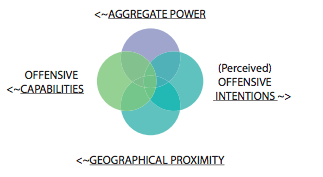 The figure above shows __________ .
Seçenekler
A
Balance of Threat
B
Power Relations
C
Types of Balance
D
Realist Model of Foreign Policy
E
Types of Balance of Power
Açıklama:
According to Walt, there are four elements that define perceived threat. The four elements of threat are aggregate power, geographic proximity, offensive capabilities, and offensive intentions. Basically, how powerful is it, how close is it, how much military might is it capable of, and is it acting aggressively? Those are the four criteria that states use to evaluate the threat posed by other states.
Soru 58
Neoclassical realism is seen as a promising prospect for the study of international relations because of __________ .
Seçenekler
A
giving less importance to some domestic variables
B
combining “outside and inside” elements to establish a solid analytical framework for IR
C
highlighting the importance of material factors in international relations
D
ignoring public opinion, civil society on foreign policy process
E
establishing power balance for states
Açıklama:
Neoclassical realism could be considered as an approach that seizes the middle-ground in realist perspective. Given the increasing importance of some domestic variables such as public opinion, civil society on foreign policy process, adding that the immaterial factors that have been mostly ignored by the other realist views, its inclination to combine “outside and inside” elements to establish a solid analytical framework for not only states’ foreign policies but also international politics in general, offers, without doubt, a promising prospect for the study of international relations in 21st century.
Soru 59
Which of the following states the reason why neorealist paradigm of international relations is not capable of offering an explicit policy guidance
Seçenekler
A
They have little or no choice owing to the confining international structure in which they must operate.
B
International actors are not interested in having a solid framework to facilitate foreign policy.
C
New developments in international relations do not leave any room for initiations.
D
State leaders are not interested in confronting the practical problems of world politics.
E
They do not want to change the balance of power and threat in IR.
Açıklama:
Neorealist paradigm of international relations is not capable of offering an “… explicit policy guidance to state leaders as they confront the practical problems of world politics. This is presumably because they have little or no choice owing to the confining international structure in which they must operate”. It is not at all interested in developing a solid framework to facilitate foreseeing foreign policy moves of international actors. Waltzian argument, conforming to its determinist character, is simply that structure determines behavior and dictates policy.
Soru 60
Which of the following factors are NOT among the factors that encourage the limitation of violence in interstate relations, hence stability, within a bipolar world?
Seçenekler
A
As a natural result of an international system with only two major powers, there are no peripheries.
B
The intensity of competition increases and there is a reluctance to accept small territorial losses.
C
The nearly constant presence of pressure and the recurrence of crisis must be pointed out.
D
The preponderant power of major actors are to be seen as sources of peace and stability.
E
States should be encouraged more to maximize their power over other countries.
Açıklama:
There are “four factors that encourage the limitation of violence in interstate relations”, thus, the stability, within a bipolar world. First of all, as a natural result of an international system with only two major powers, there are no peripheries. Secondly, the scope of factors those included in the competition is extended as the intensity of competition increases and “increased intensity is expressed in a reluctance to accept small territorial losses.” As a third characteristic of bipolar world, one must point out “the nearly constant presence of pressure and the recurrence of crisis.” Although it may sound, at first glance, a bit odd that this condition of permanent tension is considered to be a factor that encourages peace and stability, this assumption emphasizes the fact that “to fight small wars in the present may be the means of avoiding large wars later.” These three factors as the stabilizing particularities of a bipolar world, combined with a fourth element which is the preponderant power of major actors that help to achieve, in one way or another, comprehension and absorption of revolutionary political, military, and economic changes within the bipolar balance, are to be seen as sources of peace and stability. These are also the characteristics of the AmericanSoviet relations in the post-WWII era and in that perspective, they are considered to be generally effective to maintain the relative stability of this period and relevance of each factor is proved by various crisis examples of different degree such as Korea, Formosa Strait, Cuba, Berlin, Indo-China, etc..
Soru 61
Which of the following is not one of main assumptions of realist theory in international relations?
Seçenekler
A
States are the central and most important actors of world politics.
B
States are considered unitary actors.
C
States are rational actors.
D
National and international security rank at the top of the hierarchy of issues.
E
Socio-economic topics and the wellbeing of citizens rank at the top of the hierarchy of issues.
Açıklama:
Strategic issues such as the security of the state are often referred to as "high politics" whereas socio-economic topics remain in the field of "low politics". As such, the hierarchy of issues prioritises military and related national and international security issues.
Soru 62
Which of the following principles of classical realism is related to the pre-civil condition of animus dominandi, wherein life is ruled and shaped by a permanent state of war of every man against every man?
Seçenekler
A
Politics is governed by objective laws that have their roots in human nature.
B
Interest determines political conduct.
C
Nations cannot be judged by universal moral principles.
D
Political realism rejects the legalistic-moralistic approach to international politics.
E
Prudence is the supreme virtue in international politics.
Açıklama:
Classical realists state that man is naturally egotistical and has an endless will to gain power. As animus dominandi, he constantly seeks to make others the subject of his domination. Since this state is considered human nature, it is also a result of the state of nature, the pre-civil condition that is an extremely adverse human circumstance in which life is ruled and shaped by a permanent state of war of every man against every man. This constant fear of death has resulted in humans engaging in rational collaborations due to security concerns. As such, human nature lies at the root of politics.
Soru 63
Which of the following does the "balance of power" refer to?
Seçenekler
A
The concept that states must prioritise morality over security.
B
The realist notion that politics itself is not immoral, but amoral (non-moral) due to the fact that states are abstract entities and are therefore not bound by the limits of universal moral principles.
C
A regulating mechanism at the center of an anarchical environment that leads to a configuration and policies that balance out the will of states to either maintain or overthrow the status quo.
D
The international system with intricate policies and universal legislations that prioritise morality in an effort to automatically ensure permanent stability and peace on an international level.
E
The self regulatory mechanism in which more powerful states are determinant in the policies of international relations, while lesser states are reliant on them for security and, in fact, existence.
Açıklama:
The "balance of power" is a mechanism that creates the distinction between anarchy and chaos. While nations try to maintain or overthrow the status quo based on their own aspirations, the necessity for a configuration called the balance of power rises, leading to policies that aim at preserving it. The power relationships between states sustain international order, with the power of states being balanced by each other. Since this process is a result of statesmen policies and international relations, it does not appear automatically but emerges from these policies (which may be subject to change) and serves to provide temporary stability and peace at the international level.
Soru 64
Which below can be inferred from the statement “the vast majority of IR theorists are not realists because of its pessimistic conviction that there are severe limitations on human reason and its ability to achieve the progressive, liberal goals that most of us take for granted as moral truths"?
Seçenekler
A
There are not many IR theorists who can be considered realists.
B
Most of IR theorists are strongly realists.
C
Moral truths are what IR realists are mostly concerned with.
D
Human reason is capabable of achieving progress without limits.
E
Liberal goals do not interest most of IR theorists.
Açıklama:
Part of the statement “the vast majority of IR theorists are not realists" suggests that most IR theorists are not in fact realists. The reason for the claim is expalined further in the rest of it.
Soru 65
Which of the following is the fundamental difference of approach between classical realism and neorealism in international relations?
Seçenekler
A
Classical realism in international relations stems from the international politics of ancient Greece while neorealism has proven to be the dominant theory of international relations since the end of the Second World War.
B
Classical realism is based on the progressive, liberal thought of idealism whereas neorealism emerged following the brute force political currents that were influential in the rise of national socialism in Germany in the 1930's and the consolidation of authoritarian political currents.
C
Classical realism emphasizes human nature and the self-interest of states, while neorealism emphasizes that the traits of states and statesmen will determine the balance of power in international relations.
D
Neorealism abandons the human nature aspect and statecraft ethics that are dominant in the classical realism approach to international relations, instead determining that the international systemic structure as a whole is determinant as it may constrain individual decision makers.
E
Classical realists see international relations as a result of external pressures shaping state policy and international relations, while neorealism implies that internal forces result in power struggles that shape international relations.
Açıklama:
In essence, neorealism gives no account of human nature and disregards statecraft ethics, instead focusing on the systemic structure of international relations that is completely external to the actors. It is this international system that tell states and individual actors what to do, and not the other way around.
Soru 66
Within the relative gain approach to the concept of balance of power, which of the following reflects the differentiation of international systems from a neorealist perspective?
Seçenekler
A
Monopolar and bipolar.
B
Monopolar, multipolar, bipolar.
C
Multipolar, unipolar, bipolar.
D
Unipolar, bipolar.
E
Multipolar and unipolar.
Açıklama:
In the neorealist perspective, particular international systems can be differentiated as being multipolar, bipolar, and unipolar based on the number of major actors or the distribution capabilities across units (in which neorealism considered states to be units).
Soru 67
Which of the following is not one of the four factors that encourage the limitation of violence in interstate relations in a bipolar world according to neorealists?
Seçenekler
A
The lack of peripheries in a world with only two major powers.
B
The increase in the scope of factors included in the competition between the powers.
C
The permanent state of tension that arises in a bipolar arrangement.
D
The dominant power of major actors (in a bipolar structure) to absorb revolutionary political, military and economic changes.
E
A threat to the sine qua non condition of survival for each state.
Açıklama:
As the fundamental requirement to other needs, survival and security is the primary goal of any state. In a bipolar arrangement, the constant pressure of such a threat may result in permanent tension that may result in smaller conflicts to prevent larger ones, but a fundamental threat to the very existence of the state is not considered a limiting factor that contributes to stability in a bipolar world.
Soru 68
Which below is not an assumption of the realist theory?
Seçenekler
A
States are the central and most important actors of world politics.
B
State is a unitary actor.
C
States are, in essence, rational actors.
D
National and international security are the most important issues for states.
E
Security of state are often referred to as “low politics” whereas socio-economic topics remain in the field of “high politics”
Açıklama:
Fourth and the last main realist assumption puts emphasis on hierarchy of issues according to which the ones related to national and international security are located at the top. “Military and related political issues dominate world politics.” (Viotti and Kauppi, 2012: 40). In that logic, military, strategic issues that concerns security of state are often referred to as “high politics” whereas socio-economic topics remains in the field of “low politics”. In that context, the hierarchy mentioned here schematize the realist vision of political issues regarding their importance and primacy over one another.
Soru 69
Which of the following events may be characterised as exemplary of a bipolar international system?
Seçenekler
A
American-Soviet relations following World War II.
B
The rise of ISIS and terrorist organisations in the middle east.
C
American intervention during the Gulf wars.
D
The trade embargoes applied to Cuba leading up to the missile crisis.
E
The dissolution of the Soviet Union.
Açıklama:
American-Soviet relations in the post WW II era are considered to be a relatively stable example of bipolar balance in that despite constant tension during the Cold War era including certain crises such as the Cuban missile crisis, the two global superpowers were effective at maintaining the relative stability of this period.
Soru 70
What is a possible inferrence from the saying "Man is wolf to another man" in field of internatioanl relations?
Seçenekler
A
Humanism is above all else in international relations.
B
Liberal approaches to various issues would make the world a better place.
C
Acquisiton of power is very important in international relations.
D
Co-operation among states is a key to peace in the world.
E
Hostility is evitable in international relations.
Açıklama:
“The [realist] tradition focuses on the nationstate as the principle actor in international relations and its central proposition is that since the purpose of statecraft is national survival in an hostile environment, the acquisition of power is the proper, rational and inevitable goal of foreign policy (Evans and Newnham, 1998: 465). In this view, international arena is the scene of power politics and power, in that matter, it is conceptualized as both a means and an end in itself. In other words, international actors, nation-states notably, seek to gain power and it is this power what helps them survive in this environment in which reigns homo homini lupus est (man is wolf to another man) principle.
Soru 71
Which of the following explains the alliances formed in opposition to the Iranian and North Korean nuclear programs?
Seçenekler
A
Discrepancies in regional balances of power.
B
A struggle for offensive power to establish dominance in a neorealist multipolar viewpoint.
C
Defensive realism to stabilise the international system.
D
The balance of threat theory in response to the international security dilemma.
E
Offensive realism in an attempt to establish hegemony over Iran and North Korea.
Açıklama:
The international security dilemma establishes that states trying to increase their own security by means of offensive weapons decreases the security of others. As such, despite not being dominant powers on a global or even regional scale, the nuclear programs of Iran and North Korea signify an increasingly significant threat. As such, alliances established in opposition to these programs are reactions as results of a threat imbalance best explained by the balance of threat theory.
Soru 72
Which of the following is defined by Randall Schweller as "the only game in town for the current and next generation of realists"?
Seçenekler
A
Classical realism.
B
Structural realism.
C
Neorealism.
D
Offensive realism.
E
Neoclassical realism.
Açıklama:
Neoclassical realists agree with the neorealist assumption that the primary factors of foreign policy choices are the relative powers of states on an international level. This is then combined with the classical realist view of the importance of national level variables resulting in a complex implementation of both external and internal variables. As such, Randall Schweller stated that "Neoclassical realism is essentially the only game in town for the current and next generation of realists".
Soru 73
Which of the following may be considered the fundamental shortcoming of the neorealist paradigm?
Seçenekler
A
It completely disregards state-level issues.
B
It does not provide a solid framework for foreign policy moves and practical problems of world politics.
C
It complicates international relations by introducing a third level of analysis beyond human nature and the traits of states.
D
It rejects the notion that human nature is in any way influential in international relations.
E
It reduces international relations into an anarchical structure of functionally identical states.
Açıklama:
On a theoretical level, neorealism is not interested in developing a solid framework to facilitate foreseeing foreign policy moves of international actors. As such, this paradigm is not capable of offering an "explicit policy guidance to state leaders as they confront the practical problems of world politics. This is presumably because they have little or no choice owing to the confining international structure in which they must operate".
Soru 74
Which below is not one of the six principles of realism?
Seçenekler
A
Prudence is the supreme virtue in international politics.
B
Nations can be judged by universal moral principles.
C
Interest determines political conduct.
D
Statesmen conduct themselves in terms of interest defined as power.
E
Politics is governed by objective laws that have their roots in human nature.
Açıklama:
Nations cannot be judged by universal moral principles.
Soru 75
Which below is a summary of the classical realist point of view regarding politics?
Seçenekler
A
All politics is struggle for power.
B
Politics is focused mainly on welfare of people.
C
Politicians are concerned about universal moral values while acting.
D
Politics is governed by ethics.
E
States do not need politics to survive.
Açıklama:
Given classical realist point of view that sees “all politics” whether international or domestic, as a “struggle for power” and its distinction between “high” and “low” politics, it can be claimed that “the difference between domestic politics and international relations”, in classical realist thought, “are of degree, not of kind” (Halliday, 2012: 25).
Soru 76
Who is the pioneer of structural realism?
Seçenekler
A
George Kennan
B
Edward H. Carr
C
Rousseau
D
Henry Kissinger
E
Kenneth Waltz
Açıklama:
Considered as the precursor of neorealism, Kenneth Waltz, in his seminal work, Theory of International Politics (1979), tries to develop a scientific approach to understand and explain the international political system.
Soru 77
Which below is not a type of balance of power?
Seçenekler
A
Complex balance
B
Rigid balance
C
Global balance
D
Multiple balance
E
Regional balance
Açıklama:
Simple balance, regional balance, rigid balance, multiple balance, global balance, local balance and flexible balance are types of balance of power.
Soru 78
What is the theory that assumes “[G]reat powers… are always searching for opportunities to gain power over their rivals, with hegemony as their final goal”?
Seçenekler
A
Classical realism
B
Defensive realism
C
Offensive realism
D
Structural realism
E
Neoclassical realism
Açıklama:
As different from defensive realism, even in the contrary direction, Mearsheimer, in his essay about future of the post-Cold War World, particularly Europe, emphasizes that a transition to a multipolar order from a bipolar one provokes instability. He argues that “the next decades in a Europe without the superpowers would probably not be as violent as the first 45 years of this century but would probably be substantially more prone to violence than the past 45 years” (Mearsheimer, 1993: 43). He affirms partially Waltz’s view by accepting that the anarchic structure compels states to compete for power for security and survival. However, the image of state portrayed by Mearsheimer is greedier and more aggressive than how Waltz pictures it. He claims that states seek hegemony; they all want to become, ultimately, regional hegemons. His theory, as it is called, offensive realism is built upon the assumption that “[G]reat powers… are always searching for opportunities to gain power over their rivals, with hegemony as their final goal” (Mearsheimer, 2001: 29).
Soru 79
What type of realism does the definition “it explicitly incorporates both external and internal variables, updating and systematising certain insights drawn from classical realist thought" refer to?
Seçenekler
A
Neoclassical realism
B
Structural realism
C
Classical realism
D
Offensive realism
E
Defensive realism
Açıklama:
“Neoclassical realism is”, as stated by Randall Schweller, “essentially the only game in town for the current and next generation of realists” (Schweller, 2003: 344-45). Taken the definition offered by one of the precursors of this paradigm, Gideon Rose (1998) says, “it [neoclassical realism] explicitly incorporates both external and internal variables, updating and systematizing certain insights drawn from classical realist thought.”
Soru 80
Which type of realism can be considered the one that seizes the middle-ground in realist perspective?
Seçenekler
A
Classical realism
B
Offensive realism
C
Defensive realism
D
Structural realism
E
Neoclassical realism
Açıklama:
Neoclassical realism could be considered as an approach that seizes the middle-ground in realist perspective. Given the increasing importance of some domestic variables such as public opinion, civil society on foreign policy process, adding that the immaterial factors that have been mostly ignored by the other realist views, its inclination to combine “outside and inside” elements to establish a solid analytical framework for not only states’ foreign policies but also international politics in general, offers, without doubt, a promising prospect for the study of international relations in 21st century.
Ünite 3
Soru 1
When was international relations as a discipline born?
Seçenekler
A
After WWI
B
After WWII
C
Before WWI
D
After the Great Depression
E
After the French Revolution
Açıklama:
International Relations as a discipline was born following the devastation and trauma of the First World War (WWI).
Soru 2
When was the classical liberalism developed as a “political” theory?
Seçenekler
A
16th century
B
17th century
C
18th century
D
19th century
E
20th century
Açıklama:
The classical liberalism can be traced back to ancient thinkers and has its roots in the Stoic philosophy. It was developed as a “political” theory in the 17th century.
Soru 3
Which of the following is NOT one of the six core elements of classical liberal philosophy?
Seçenekler
A
Rule of law
B
Spontaneous order
C
Natural law
D
Human rationality
E
Individualism
Açıklama:
There are six key concepts of classical liberal philosophy that are commonly mentioned by the liberal writers, these are; individualism, freedom, natural law, spontaneous order, rule of law and limited state.
Soru 4
Which of the following is the school of thought which argues that human beings are all part of a larger community despite their different political entities and cultures?
Seçenekler
A
Aplicability
B
Equality
C
Stoicism
D
Normativism
E
Individualism
Açıklama:
Stoicism is a school of thought which argues that human beings are all part of a larger community despite their different political entities and cultures.
Soru 5
"The government played central role for enforcement of rules and coercion that were crucial for sustaining order. Both liberty and protection of the individual depended on laws enforced by the state." What is the given definition known as?
Seçenekler
A
Social utility
B
Secularization
C
Democracy
D
The rule of law
E
Classical liberalism
Açıklama:
The government played central role for enforcement of rules and coercion that were crucial for sustaining order. Both liberty and protection of the individual depended on laws enforced by the state. This is known as the rule of law.
Soru 6
According to classical liberals, which of the following duties does sovereign NOT have?
Seçenekler
A
protection of its people
B
protection of other nations
C
provision of public services
D
protection of property
E
sustainability of the societal institutions
Açıklama:
According to classical liberals, the sovereign (state) has three duties; (1) protection of its people from invasion of other states, (2) protection of each individual in society from oppression of other member(s) including protection of property and (3) provision of public services and sustainability of the societal institutions important for both individual freedom and peaceful coexistence.
Soru 7
Which of the following is NOT one of the strands of classical liberal theory?
Seçenekler
A
Sociological liberalism
B
Commercial liberalism
C
Republican liberalism
D
Democratic liberalism
E
Regulatory liberalism
Açıklama:
Robert Keohane in his studies, listed three strands of classical liberal theory as (1) commercial liberalism about the pacific effects of trade, (2) democratic liberalism about pacific effects of republican governments, (3) regulatory liberalism about rules and institutions for relations between countries. Joseph Nye has added a fourth one (4) sociological liberalism about the effects of transnational ties on national attitudes and interests.
Soru 8
Which of the following involves global institutions to guide and restrain collective activities of agents?
Seçenekler
A
Neorealism
B
Globalisation
C
Ideational liberalism
D
Constructive regime
E
Global governance
Açıklama:
Global governance does not mean a world government in Kantian terms, it involves global institutions to guide and restrain collective activities of agents.
Soru 9
Which of the following authors argued that rational capacities of humans could overcome both traditions and the passions?
Seçenekler
A
Cobden
B
Schumpeter
C
Hobbes
D
Kant
E
Grotius
Açıklama:
Kant argued that rational capacities of humans could overcome both traditions and the passions.
Soru 10
"According to the __________________, states in international anarchy are constrained by rules of law and by the interest in preserving the international society and its institutions." Which of the following fills the gap correctly?
Seçenekler
A
Cosmopolitanism
B
Idealism
C
Kantian theory
D
Classical liberalism
E
Grotian tradition
Açıklama:
According to the Grotian tradition, states in international anarchy are constrained by rules of law and by the interest in preserving the international society and its institutions.
Soru 11
Which of the following expressions is used to criticize liberal theory of International Relations?
Seçenekler
A
realistic
B
pragmatic
C
practical
D
positive
E
utopian
Açıklama:
The liberal IR theory that carries forward the basic arguments of the classical liberal theory is basicaly concentrated on the individual as the unit of analysis. This has led to a different view than the state-centric mentality of realism and brought forward the idea of pluralism in actors of IR besides the nation-state. Another feature is the faith in the power of human mind and universal values of liberalism that shall bring global peace. This is generally why the theory is called idealist and in some cases even criticized to be utopian.
Soru 12
Which of the following phrases best completes the following sentence?
"Thus, the __________ _________ of IR is composed of both conflictual and cooperative behaviors of states, non-state entities and individuals."
"Thus, the __________ _________ of IR is composed of both conflictual and cooperative behaviors of states, non-state entities and individuals."
Seçenekler
A
liberal reading
B
realistic understanding
C
classical concept
D
conditional reference
E
practical approach
Açıklama:
Thus, the liberal reading of IR is composed of both conflictual and cooperative behaviors of states, non-state entities and individuals. Liberal tradition (despite its variations) is cooperative in its nature because of its emphasis on human freedom which is thought to cumulate through cooperation, interaction and interdependence.
Soru 13
Which of the following is true about John Locke?
Seçenekler
A
His defense of property rights and religious toleration did not mean much to liberal thinkers.
B
His book ‘Second Treatise on Government’ is the best summary of his philosophy on individual freedom and state’s limited role.
C
John Locke argued that state of nature was state of war.
D
John Locke believed that humans in a natural state of freedom would immediately respect others’ right to freedom
E
According to Locke, the state of nature is one of limitations and compliance.
Açıklama:
John Locke’s philosophical and theological defense of property rights and religious toleration inspired other liberal thinkers (Thorsen, 2010, 191) His philosophy on individual freedom and state’s limited role can be best seen in his book titled “Second Treatise on Government” (Viotti & Kauppi, 2012, 132). John Locke (1632-1704) argued that the state of nature is not a state of war. He identified this state as one of freedom and maintained that it is governed by the law of reason. According to the social contract idea advanced by Locke and followed by others, humans in a natural state of freedom do not necessarily respect others’ right to freedom.
Soru 14
Which of the following is a key concept of classical philosophy that is also commonly mentioned by liberal writers?
Seçenekler
A
rule of God
B
pluralism
C
spontaneous order
D
unlimited state
E
democracy
Açıklama:
There are six key concepts of classical liberal philosophy that are commonly mentioned by the liberal writers, these are; individualism, freedom, natural law, spontaneous order, rule of law and limited state.
Soru 15
Which of the following sentences is true about Classical Liberal Theory of International Relations?
Seçenekler
A
As the basic unit of analysis is taken to be the state, classical liberals have concentrated on the nature of states.
B
Classical liberals have been realistic to recognize human nature as rigid and non-complying.
C
Conflict is never considered as part of human life.
D
Classical liberals have been away from the Kantian utopianism’s idea that that conflicts could be totally abolished.
E
Classical liberals are not at all concerned with the means/tools to deal with violence.
Açıklama:
As the basic unit of analysis is taken to be the human being, classical liberals have concentrated on the human nature and actions in explaining IR. They have been realistic to recognize the human nature as flexible and need to freedom to use his/ her reason and potential. Conflict is also recognized as a natural part of human life since individual is prone to making mistakes and act according to his/her passions. Thus, politics needs to study conflict resolution as well as conditions of peaceful cooperation, in both domestic and international spheres. Classical liberals in this sense have been away from the Kantian utopianism’s idea that conflicts could be totally abolished. They are concerned more with the means/tools to deal with violence and how to limit its occurrence (van de Haar, 2009, 128).
Soru 16
Which of the following is NOT one of the reasons why classical liberals oppose to the Kantian cosmopolitanism?
Seçenekler
A
There is no need for a universal enforcer
B
Separate nation states could realize this alone and together
C
A universal enforcer itself would be a threat to liberty
D
Sovereignty of nations matter more
E
Humanitarian intervention is the only option
Açıklama:
Classical liberals oppose to the Kantian cosmopolitanism on the ground that there is no need for a universal enforcer, separate nation states could realize this alone and together, since a universal enforcer itself would be a threat to liberty. By the same token, classical liberals valued sovereignty of nations, and humanitarian intervention was not their concern.
Soru 17
According to Haas (1970), which of the following is NOT one of the regularities observed within the industrialized-pluralistic nations?
Seçenekler
A
Collective decisions
B
Limiting the media
C
Spill-over
D
The faith of elites in increased integration
E
Mutual interests of governments and groups
Açıklama:
Haas defined integration as “a process for the creation of political communities defined in institutional and attitudinal terms” (Haas, 1970, 610- 611). Among his generalizations for the regularities observed within the industrialized-pluralistic nations (such as the case of economic integration of Western Europe) were: (1) interests of the governments and groups in direction of interdependence and mutual benefits (2) collective decisions, (3) spill-over and (4) the faith of elites in increased integration.
Soru 18
According to Robert Keohane, which of the following is one of the forms that institutions can take?
Seçenekler
A
Multinational corporations
B
Dictatorships
C
Companies
D
Occupational networks
E
Regimes
Açıklama:
Robert Keohane explained the role of institutions as “persistent and connected sets of formal and informal rules that prescribe behavioral roles, constrain activity and shape expectations”. In his words, international institutions could take one of three forms: (1) formal intergovernmental or cross-national, non-governmental organizations, (2) international regimes, and (3) conventions (customary norms and practices).
Soru 19
Which of the following is true about the assumptions of liberal theory as explained by Moravcsik?
Seçenekler
A
The fundamental actors are companies that act rationally and are prone to collective action for their interests.
B
An important source of social interests is nationalism.
C
States represent some domestic groups whose interests shape state preferences.
D
The independent individual preferences shape state behavior.
E
Groups’ demands may be towards conflict or cooperation.
Açıklama:
- The fundamental actors are individuals who act rationally and are prone to collective action for their interests. Their demands may be towards conflict or cooperation under different social conditions such as divergent beliefs, scarcity of materials and inequality in political power. This means that there is no automatic harmony of interests. An important source of social interests is globalization that offers transnational economic, social and cultural opportunities (2013, 711).
- States represent some domestic groups, whose interests shape state preferences. The nature of the state institutions and the societal demands shape the foreign policy.
- The interdependent state preferences shape state behavior, so the costs and benefits to foreign societies when dominant social groups want to realize their preferences are taken into consideration. Thus cooperation (its form, substance and depth) depends on patterns of these preferences and their influences on dominant groups in other states instead of realist priority on configuration of power.
Soru 20
Which of the following political tradition does the argument below depend on?
“Democratic peace theory argues that democracies can maintain peaceful relations among each other, owing to shared values and common approach in domestic republican governance.”
“Democratic peace theory argues that democracies can maintain peaceful relations among each other, owing to shared values and common approach in domestic republican governance.”
Seçenekler
A
Hobbesian
B
Grotian
C
Classical liberal
D
Classical realist
E
Kantian
Açıklama:
Democratic peace theory follows the Kantian tradition and scholars like Michael Doyle and Bruce Russett share the idea that democracies can maintain peaceful relations among themselves due to their shared values and common approach in their domestic republican governance
Soru 21
Which of the following is the main object of study or the unit of analysis in classical liberalism?
Seçenekler
A
Social interactions within and across states
B
Individuals and their behavior
C
States in an international infrastructure
D
Non-governmental international organizations
E
Violent anti-government groups
Açıklama:
In classical liberalism, individual is the main object of study (unit of analysis), not groups, societies or nations. The correct answer is B.
Soru 22
Which of the following is NOT one of the key concepts of classical liberal philosophy?
Seçenekler
A
Priority of the national interest
B
Spontaneous order
C
Rule of law
D
Natural law
E
Limited state
Açıklama:
There are six key concepts of classical liberal philosophy that are commonly mentioned by the liberal writers, these are; individualism, freedom, natural law, spontaneous order, rule of law and limited state. Priority of national interests is one of the concepts of classical realism. The correct answer is A.
Soru 23
Which of the following is not among the concepts of classical liberal philosophy?
Seçenekler
A
Individualism
B
Freedom
C
Natural law
D
Politics
E
Rule of law
Açıklama:
Classical liberalism
Politics
Politics
Soru 24
The basic mentality of the classical liberal writers is that social phenomena can only be understood through the study of the ______________ behavior (van de Haar, 2009).
Seçenekler
A
political
B
individual
C
situational
D
descriptive
E
prescriptive
Açıklama:
Classical Liberalism
individual
individual
Soru 25
I. Free market is the most widely used spontaneous order in liberal studies.
II. It is an outcome of human experience and collective result of trial and errors.
III. The related assumptions are based on the “laissez faire” (non-intervention) understanding so that state acts as an arbiter in disputes between individuals.
Which term is described by the above sentences?
II. It is an outcome of human experience and collective result of trial and errors.
III. The related assumptions are based on the “laissez faire” (non-intervention) understanding so that state acts as an arbiter in disputes between individuals.
Which term is described by the above sentences?
Seçenekler
A
Natural law
B
Individual freedom
C
Rule of law
D
Natural order
E
Limited state
Açıklama:
Classical Liberalism
Natural order
Natural order
Soru 26
Classical liberals see ___________ as a threat whenever it starts to limit the individual freedom and is shaped towards imperialism.
Seçenekler
A
utopianism
B
internationalism
C
anarchism
D
humanism
E
nationalism***
Açıklama:
Classical Liberalism
nationalism
nationalism
Soru 27
Which event provided room to manouver for the liberals, in the shape of economic interdependence and integration in Western Europe?
Seçenekler
A
Cold War
B
Colonialism
C
Foundation of IMF
D
The World War I
E
Integration of Western Europe
Açıklama:
Liberal Internationalism
Cold War
Cold War
Soru 28
Liberals reject the distinction made by __________ between international and domestic politics, since they see foreign policy as an extension of the latter.
Seçenekler
A
communists
B
institutionalists
C
realists
D
fascists
E
neoliberalists
Açıklama:
Neoliberal Institutionalism
realists
realists
Soru 29
What is neoliberalism criticized for?
Seçenekler
A
Its lack of a development-centered approach
B
Relative gains
C
Institutional cooperation
D
Its lack of a production-based approach
E
Its beneficial outcomes
Açıklama:
Neoliberal Institutionalism
Its lack of a development-centered approach
Its lack of a development-centered approach
Soru 30
___________ liberalism is about the effects of gains and losses of the people in transactional economics on the state behavior.
Seçenekler
A
Republican
B
Ideational
C
Commercial
D
Fundamental
E
International
Açıklama:
Neoliberal Institutionalism
Commercial
Commercial
Soru 31
Which theory is criticized to be incapable of explaining globalization since it ignores the transnational societal interaction among agents?
Seçenekler
A
Liberalism
B
Realism
C
Neoliberalism
D
Surrealism
E
Neorealism
Açıklama:
Neoliberal Institutionalism
Realism
Realism
Soru 32
Following the liberal tradition, democratic peace theory is not based on__________________________________.
Seçenekler
A
faith in human rationality
B
capability of maintaining peace
C
ability to overcome anarchy
D
peace enhancing effects of trade
E
conflicts among the countries
Açıklama:
Liberal Democratic Peace/Republican Liberalism
conflicts among the countries
conflicts among the countries
Soru 33
- International relations is an amalgam of conflictual and collaborative relations.
- Human freedom cumulates through cooperation and interdependence.
- The political and economic behaviours should be studies as two distinct areas.
Seçenekler
A
Only I
B
I and II
C
II and III
D
I and III
E
I, II and III.
Açıklama:
The liberal thinkers discuss that international cooperation, just like conflict, emanates from the anarchic nature of the international system and argue that IR is an amalgam of conflictual and collaborative relations. Liberal tradition is cooperative in its nature because of its emphasis on human freedom which is thought to cumulate through cooperation, interaction and interdependence. Another assumption of the theory is that political and economic behaviors cannot be seperated from each other. The correct answer is B.
Soru 34
Which of the following is the term used in classical liberalism to refer to customs and practices that serve as the general conditions to be preserved?
Seçenekler
A
Individualism
B
Freedom
C
Spontaneous law
D
Natural law
E
Rule of law
Açıklama:
There are six key concepts of classical liberal philosophy that are commonly mentioned by the liberal writers, these are; individualism, freedom, natural law, spontaneous order, rule of law and limited state. According to classical liberal writers, social phenomena can only be understood through the study of the individual behavior and this gives the theory its voluntaristic characteristic. The classical liberals emphasize the importance of freedom; protection from intrusion and interference by others. The natural law denotes the customs and practices that serve as the general conditions to be preserved. Another key concept used by liberals is the spontaneous (natural) order which is composed of informal tacit contracts such as customs or conventions. The state is a set of governmental institutions and is a political entity. According to classical liberals, the sovereign (state) has three duties; (1) protection of its people from invasion of other states, (2) protection of each individual in society from oppression of other member(s) including protection of property and (3) provision of public services and sustainability of the societal institutions important for both individual freedom and peaceful coexistence. The correct answer is D.
Soru 35
Why are economic organizations like the World Bank or the International Monetary Fund not in conformity with the classical liberal tradition?
Seçenekler
A
They pose a threat to sovereign states.
B
They set limits to the individual freedom.
C
Their actions force sovereign states to act violently.
D
They interfere with the free market.
E
They undervalue the vast impact of capitalism.
Açıklama:
According to the liberal theory of international relations, any treats to free market can lead to conflicts and also threaten world peace and democracy. Economic organizations interfere with the free market, so they are not in conformity with the classical liberal tradition. The correct answer is C.
Soru 36
Which of the following is not a key term of liberal internationalism?
Seçenekler
A
Functionalism
B
Interdependence
C
Neo-functionalism
D
Transnationalism
E
Global governance
Açıklama:
Functionalism, neo-functionalism, interdependence and transnationalism are all terms drived from the liberal internationalism. Global governance is a theory coined by neoliberal institutionalists. The correct answer is E.
Soru 37
- Cooperation is a positive-sum game which means that all participants benefit from its priviliges.
- It is only prone to studying cooperation among states.
- Political processes are the foci of analysis.
Seçenekler
A
I only
B
I and II
C
I and III
D
II and III
E
I, II and III
Açıklama:
Through liberal lenses, cooperation is a positive-sum game which means that all participants benefit from its priviliges, outcomes. This is called as absolute gains (where all can win) opposed to the relative gains perspective of the realist assumption as regards nature of cooperation (where gains of one party mean losses for others). Opposing to the realist dedication to nation-state as the focus of analysis, in liberal view, the political processes are foci and are formed through competition and cooperation among individuals and groups as agents (representing both state and non-state actors). According to liberal writers, structural theories such as neorealism lack a theory of preferences. In this connection, realism is criticized to be incapable of explaining globalization since it ignores the transnational societal interaction among agents. On the other hand, liberalism also takes policy interdependence into consideration. This is why the neoliberal view of power politics is not only prone to studying cooperation but is also applicable to the analysis of conflict. The correct answer is C.
Soru 38
Which of the following variants of neoliberal theory discusses the effects of the conflict and compatibility of collective social values and identitites on state behavior?
Seçenekler
A
Commercial liberalism
B
Republican liberalism
C
Regulatory liberalism
D
Sociological liberalism
E
Ideational liberalism
Açıklama:
There are three variants of neoliberal theory, ideational, commercial and republican. Ideational liberalism discusses the effects of the conflict and compatibility of collective social values and identities as regards public (collective) goods provision (like geographical border, political decision-making processes and socioeconomic regulation) on state behavior. Commercial liberalism is about the effects of gains and losses of the people in transactional economics on the state behavior. Finally, republican liberalism is about the effects of the variants of democratic representation and rent- seeking on state behavior. Regulatory and sociological liberalism are strands of classical liberal theory. The correct answer is E.
Soru 39
Which of the following is NOT one of the assumptions of liberal tradition?
Seçenekler
A
top-down analysis
B
economic interdependence or interconnectedness
C
an extensive agenda composed of all issue areas
D
pluralist image of world politics
E
analysis of decision making processes
Açıklama:
Liberal tradition has four main assumptions: (1) pluralist image of world politics where states, non-state and transnational entities are important actors (2) economic interdependence or interconnectedness where network of states, governmental and non-governmental organizations, multinational corporations, groups and individuals turn into a global civil society that has a pacifying affect on states (3) an extensive agenda composed of all issue areas not limited with military and security issues but involving economic, social and environmental ones (4) individual level of analysis, opposed to a top-down analysis of structural realism and analysis of decision-making processes with an eye to individual, social, cultural differences. The correct answer is A.
Soru 40
Which of the following theories put forth that social institutions govern the actions in the international arena?
Seçenekler
A
Functionalism
B
Neo-functionalism
C
Transnationalism
D
Regime
E
Interdependence
Açıklama:
Functionalism, neo-functionalism, transnationalism and interdepence are all theories and terms coined by liberal internationalists and they focus mainly on the importance of international cooperation and collaboration. Regime theory, on the other hand, is an outgrowth of neoliberal institutionalism and puts forth that social institutions govern the actions in the international arena. The correct answer is D.
Soru 41
When was International Relations as a discipline born?
Seçenekler
A
Just before the First World War
B
Following the First World War
C
Just before the Second World War
D
Following the Second World War
E
Just before the Cold War Period
Açıklama:
International Relations as a discipline was born following the devastation and trauma of the First World War (WWI)
Soru 42
When did classical liberalism emerge as a political theory?
Seçenekler
A
In the 15th century
B
In the 16th century
C
In the 17th century
D
In the 18th century
E
In the 19th century
Açıklama:
The classical liberalism can be traced back to ancient thinkers and has its roots in the Stoic philosophy. It was developed as a “political” theory in the 17th century by writers like John Locke whose philosophical and theological defense of property rights and religious toleration inspired other liberal thinkers (Thorsen, 2010, 191).
Soru 43
I. individualism
II. state-centricism
III. Natural law
Which one(s) of these is/are among the key concepts of classical liberal philosophy?
II. state-centricism
III. Natural law
Which one(s) of these is/are among the key concepts of classical liberal philosophy?
Seçenekler
A
Only I
B
Only II
C
Only III
D
I-II
E
I-III
Açıklama:
There are six key concepts of classical liberal philosophy that are commonly mentioned by the liberal writers, these are; individualism, freedom, natural law, spontaneous order, rule of law and limited state. The different classifications of classical liberalism is based on different interpretations of these six core elements.
Soru 44
Which one of the following terms refers to the school of thought which argues that human beings are all part of a larger community despite their different political entities and cultures?
Seçenekler
A
Secularization
B
Liberalism
C
Realism
D
Stoicism
E
Patriotism
Açıklama:
Stoicism is a school of thought which argues that human beings are all part of a larger community despite their different political entities and cultures. The equality of people comes from the universal ability of human kind to reason and the applicability of natural law. The emphasis on universalism in stoic philosophy affected liberal precursors like Hugo Grotius (17th century) and Immanuel Kant (19th century).
Soru 45
I. protection of its people from invasion of other states
II. provision of public services and sustainability of the societal institutions
III. Acting as a decision-maker independent of the public
Which one(s) of these is/are not among the duties of states according to classical liberals?
II. provision of public services and sustainability of the societal institutions
III. Acting as a decision-maker independent of the public
Which one(s) of these is/are not among the duties of states according to classical liberals?
Seçenekler
A
Only I
B
Only II
C
Only III
D
I-II
E
I-III
Açıklama:
According to classical liberals, the sovereign (state) has three duties; (1) protection of its people from invasion of other states, (2) protection of each individual in society from oppression of other member(s) including protection of property and (3) provision of public services and sustainability of the societal institutions important for both individual freedom and peaceful coexistence (van de Haar, 2009, 30-33). So contrary to realism, state is not a unitary, solitary actor to decide and act independent of the public.
Soru 46
Which one of the following was the dominant ideology in the 18th and 19th centuries in Great Britain and the United States?
Seçenekler
A
Classical liberalism
B
Neo-liberalism
C
Nationalism
D
Realism
E
Utopianism
Açıklama:
Classical liberalism became dominant ideology in the 18th and 19th centuries in Great Britain and the United States. Smith’s and Ricardo’s works in economics concentrated on the role of the individual entrepreneur, unconstrained by a minimalist state.
Soru 47
Which one of the following stands for the integration theory which studied the nature of international collaboration and how it could be achieved through apolitical processes?
Seçenekler
A
functionalism
B
commercial liberalism
C
neoliberalism
D
idealism
E
nationalism
Açıklama:
In post-WWII Western European politics, liberals such as David Mitrany studied the nature of international collaboration and how it could be achieved through apolitical processes in his integration theory named “functionalism”. According to Mitrany, nonpolitical experts could better deal with their areas of technical expertise and initiate collaboration which in time would expand into other areas as well.
Soru 48
Which one of the following is not among the four main assumptions liberal tradition?
Seçenekler
A
pluralist image of world politics where states, non-state and transnational entities are important actors
B
economic interdependence or interconnectedness where network of states, governmental and non-governmental organizations, multinational corporations, groups and individuals turn into a global civil society that has a pacifying affect on states
C
a state-centric perspective of governance making the state as the sole decision-maker independent of the public
D
an extensive agenda composed of all issue areas not limited with military and security issues but involving economic, social and environmental ones
E
individual level of analysis, opposed to a top-down analysis of structural realism and analysis of decision-making processes with an eye to individual, social, cultural differences.
Açıklama:
liberal tradition has four main assumptions: (1) pluralist image of world politics where states, non-state and transnational entities are important actors (2) economic interdependence or interconnectedness where network of states, governmental and non-governmental organizations, multinational corporations, groups and individuals turn into a global civil society that has a pacifying affect on states (3) an extensive agenda composed of all issue areas not limited with military and security issues but involving economic, social and environmental ones (4) individual level of analysis, opposed to a top-down analysis of structural realism and analysis of decision-making processes with an eye to individual, social, cultural differences.
Soru 49
I. Ideational liberalism
II. Republican liberalism
III. Democratic liberalism
Which one(s) of these is/are among the three variants of neoliberal theory according to Andrew Moravcsik?
II. Republican liberalism
III. Democratic liberalism
Which one(s) of these is/are among the three variants of neoliberal theory according to Andrew Moravcsik?
Seçenekler
A
Only I
B
Only II
C
Only III
D
I-II
E
II-III
Açıklama:
According to Andrew Moravcsik, there are three variants of neoliberal theory, the common ground of which is the relationship between social preferences and state behavior. Ideational liberalism discusses the effects of the conflict and compatibility of collective social values and identities as regards public (collective) goods provision (like geographical border, political decision-making processes and socioeconomic regulation) on state behavior. Commercial liberalism is about the effects of gains and losses of the people in transactional economics on the state behavior. Finally, republican liberalism is about the effects of the variants of democratic representation and rentseeking on state behavior
Soru 50
Which one of the following scholars supports the democratic peace theory and the idea that democracies can maintain peaceful relations among themselves due to their shared values and common approach in their domestic republican governance?
Seçenekler
A
Michael Doyle
B
Andrew Moravcsik
C
Robert Keohane
D
Joseph S. Nye
E
Thomas Woodrow Wilson
Açıklama:
As stated before, the liberal thesis is that free trade and democracy decrease the likelihood of war. The major question is then “whether the democracies are more peaceful or not in their foreign relations”. Democratic peace theory follows the Kantian tradition and scholars like Michael Doyle and Bruce Russett share the idea that democracies can maintain peaceful relations among themselves due to their shared values and common approach in their domestic republican governance.
Soru 51
Who is the author of “Second Treatise on Government” ?
Seçenekler
A
E.H. Carr
B
H. Morgenthau
C
John Locke
D
Hugo Grotius
E
David Hume
Açıklama:
John Locke's philosophy on individual freedom and state’s limited role can be best seen in his book titled “Second Treatise on Government”.
Soru 52
Which of the following is NOT true according to the social contract theory?
Seçenekler
A
Humans in a natural state of freedom do not necessarily respect others’ right to freedom.
B
A state’s role is to control individual frredom.
C
People need to form “a civil society by contracting with others”.
D
People organize their society so as to secure those rights and freedoms.
E
Human beings are assumed to be equal and rational.
Açıklama:
According to the social contract idea advanced by Locke and followed by others, humans in a natural state of freedom do not necessarily respect others’ right to freedom. This leads them to organize their society so as to secure those rights and freedoms. In this connection, the only way for individuals to surrender their natural freedoms and become responsible members of their communities is to form “a civil society by contracting with others” in order to live in comfort, peace and security
Soru 53
"__________ is a school of thought which argues that human beings are all part of a larger community despite their different political entities and cultures." Which of the following fills in the gap correctly?
Seçenekler
A
Universalism
B
Normatism
C
Neoliberalism
D
Liberalism
E
Stoicism
Açıklama:
Stoicism is a school of thought which argues that human beings are all part of a larger community despite their different political entities and cultures.
Soru 54
Which of the following is NOT one of the concepts of classical liberalism?
Seçenekler
A
Moral judgment
B
Limited state
C
Rule of law
D
Spontaneous order
E
Natural law
Açıklama:
There are six key concepts of classical liberal philosophy that are commonly mentioned by the liberal writers, these are; individualism, freedom, natural law, spontaneous order, rule of law and limited state.
Soru 55
Which of the following can explain the "invisible hand"?
Seçenekler
A
Economic growth
B
Free market
C
Unintended consequences
D
Recognition of rights
E
Control of state
Açıklama:
Classical liberals accept that order is possible as a result of customs, traditions and societal institutions. Smith’s explanation of the free market and his famous example the invisible hand denotes such understanding.
Soru 56
Who stated that in the state of nature, individuals lived together out of fear and they had the right to do anything necessary for survival in their struggle for life?
Seçenekler
A
Adam Smith
B
Immanuel Kant
C
David Hume
D
Thomas Hobbes
E
Hugo Gratius
Açıklama:
According to realist philosopher Thomas Hobbes, in the state of nature, individuals lived together out of fear and they had the right to do anything necessary for survival in their struggle for life.
Soru 57
Which book is about the dangers of unrestrained individual freedom and the stability sustained by the sovereign’s rule?
Seçenekler
A
The Wealth of Nations
B
The Rule of Law
C
The Twenty Years’ Crisis
D
Second Treatise on Government
E
Leviathan
Açıklama:
In Leviathan, Hobbes wrote about the dangers of unrestrained individual freedom and the stability sustained by the sovereign’s rule.
Soru 58
"In ____________, diplomacy is the bond between members of international society that converge around common norms and goals that is international law" Which of the fllowing fills in the gap correctly?
Seçenekler
A
Patriotism
B
Classic liberalism
C
the Grotian view
D
Kantian cosmopolitanism
E
Liberal internationalism
Açıklama:
In the Grotian view, diplomacy is the bond between members of international society that converge around common norms and goals that is international law
Soru 59
"Since there is need for consensus and collective decision making mechanisms, it is not easy to realize ______________ and it is in the interests of the actors to follow this path or not." Which of the following fills in the gap correctly?
Seçenekler
A
Complex interdependence
B
Republican liberalism
C
Golobal governence
D
Mutual dependence
E
International behavior
Açıklama:
Since there is need for consensus and collective decision making mechanisms, it is not easy to realize global governance and it is in the interests of the actors to follow this path or not.
Soru 60
Whose book is “Perpetual Peace”?
Seçenekler
A
Mikhail Gorbachev
B
Robert Keohane
C
Andrew Moravcsik
D
Immanuel Kant
E
Michael Doyle
Açıklama:
Kant in his book “Perpetual Peace” (1795) wrote about three definitive articles that had to be accepted by all nations for a perpetual peace to exist.
Soru 61
Which one of the following is true about liberalism?
Seçenekler
A
the political and economic behaviors needs to be separated in to two distinct issue areas.
B
The liberal reading of IR is composed of both ordinary and individual behaviors characteristic.
C
Human freedom is thought to cumulate through cooperation, interaction and interdependence in liberal tradition.
D
Liberalism has criticized because of inadequacy to explain international cooperation and narrow definitions of the national interest.
E
The liberal scholars were affected by the act of national governments.
Açıklama:
In liberalism, the political and economic behaviors cannot be separated from each other. It is impossible to categorize them as two distinct issue areas. The liberal reading of IR is composed of both conflictual and cooperative behaviors of states, non-state entities and individuals. Also, liberalism has criticized realism’s inadequacy to explain international cooperation and argues that the realist analyses are confined with the limits of narrow definitions of the national interest. The liberal scholars were affected by the international circumstances around them such as the Cold War or the increasing effects of globalization. Correct answer is C.
Soru 62
When did international relations was born as a discipline?
Seçenekler
A
First world war
B
second world war
C
Cold war
D
Rennaisance
E
Industrial revolution
Açıklama:
International Relations as a discipline was born following the devastation and trauma of the First World War (WWI).
Soru 63
If you hear your teacher talking about individualism, freedom, natural law, spontaneous order, rule of law and limited state what might be the topic of the lesson?
Seçenekler
A
Progressive philosophic understanding
B
Secularization of liberal economy
C
Patriotism in human nature
D
Classical liberal philosophy
E
Stoicism
Açıklama:
There are six key concepts of classical liberal philosophy that are commonly mentioned by the liberal writers, these are; individualism, freedom, natural law, spontaneous order, rule of law and limited state. Correct answer is D.
Soru 64
Which enlightenment philosopher argued that "human reason one day would be mature enough to establish a world society of harmony and peace"?
Seçenekler
A
Thomas Hobbes
B
Adam Smith
C
David Ricardo
D
David Hume
E
Immanuel Kant
Açıklama:
Immanuel Kant is a philosopher of the Enlightenment. He is the one who argued that human reason one day would be mature enough to establish a world society of harmony and peace. Kant believed in human dignity and that justice could be secured through a universal political order. Correct answer is E.
Soru 65
What is the concept that the Wilsonian doctrine revolved around and seen by some realists as an effort of idealists to escape from the reality of problem of the management of power?
Seçenekler
A
Collective security
B
Balance of power
C
Power of order
D
Mutual dependence
E
Harmony of interests
Açıklama:
The Wilsonian doctrine revolved around the concept of “collective security” aiming to provide
security for all states, by the action of all states, against all states that might challenge the existing
order.
security for all states, by the action of all states, against all states that might challenge the existing
order.
Soru 66
- The rise of multinational corporations increased interest towards state- centrism and politics
- Interdependence and transnationalism supported liberalism’s pluralistic nature
- The shift from integration to interdependence was due to acceleration in globalization
- The reluctance of states to transfer their sovereignty to regional organizations was due to complex interdepence.
- Haas and Nye formulated “complex interdependence” as a structure of multiple channels connecting states and making them sensitive to “what goes on” in each other reciprocally.
Which of the above statements are wrong?
Seçenekler
A
II, III and V
B
II and IV
C
I and V
D
I, III and V
E
III, IV and V
Açıklama:
The shift from integration to interdependence was also because of the acceleration in globalization. The reluctance of states to transfer their sovereignty to regional organizations was due to complex interdepence.Keohane and Nye formulated “complex interdependence” as a structure of multiple channels connecting states and making them sensitive to “what goes on” in each other reciprocally.
Correct answer is C
Correct answer is C
Soru 67
In 1970s, the liberal theory evolved into a more realist version compared with both classical liberalism and liberal internationalism. This became more apparent with the welfare liberals. What is the base of their ideas?
Seçenekler
A
The formation of republics or incompatibility with the rights or abilities of the other(s).
B
Keynesian doctrines of increased role of state in economics that brought economic nationalism on the agenda again
C
Perfecting the domestic political system and overcoming the war system through establishment of responsible governments,
D
The balance of power mechanism.
E
Collective security which aims to provide security for all states.
Açıklama:
It became more apparent with the welfare liberals who based their ideas on Keynesian doctrines of increased role of state in economics that brought economic nationalism on the agenda again. The doctrinal elements of liberalism were reevaluated under the light of changing international circumstances. Correct answer is B.
Soru 68
Which of the following consept is a positivesum game which means that all participants benefit from its priviliges, outcomes through liberal lenses?
Seçenekler
A
Cooperation
B
Colaboration
C
Instututionalism
D
Interdependence
E
Reformation
Açıklama:
Through liberal lenses, cooperation is a positivesum game which means that all participants benefit from its priviliges, outcomes. This is called as absolute gains (where all can win) opposed to the relative gains perspective of the realist assumption as regards nature of cooperation. Correct answer is A.
Soru 69
Which one of the following is the shared idea of Michael Doyle and Bruce Russett about democracies?
Seçenekler
A
In democracies, international commerce is a force for peace.
B
In democracies global institutions needs to guide and restrain collective activities of agents.
C
Democracies can maintain peaceful relations among themselves due to their shared values and common approach in their domestic republican governance.
D
In democracies, human rights and democracy shall continue as core values of liberalism
E
In democracies, the nature of the state institutions and the societal demands shape the foreign policy.
Açıklama:
Scholars like Michael Doyle and Bruce Russett share the idea that democracies can maintain peaceful relations among themselves due to their shared values and common approach in their domestic republican governance.
Soru 70
Which of the following can not be a basis of democratic peace theory?
Seçenekler
A
Ability to overcome anarchy and power politics.
B
Capability of maintaining peace.
C
Faith in human rationality.
D
Peace enhancing effects of trade.
E
Mutual advatages of politics.
Açıklama:
Following the liberal tradition; democratic peace theory is based on
(1) faith in human rationality,
(2) capability of maintaining peace,
(3) ability to overcome anarchy and power politics,
(4) peace enhancing effects of trade. Correct answer is E.
(1) faith in human rationality,
(2) capability of maintaining peace,
(3) ability to overcome anarchy and power politics,
(4) peace enhancing effects of trade. Correct answer is E.
Soru 71
Which of the following is FALSE about the classical liberalism?
Seçenekler
A
It can be tracked back to ancient thinkers.
B
It has its roots in the Stoic philosophy.
C
It was developed as a "theological" theory in the 17th century.
D
John Locke inspired other thinkers by his views.
E
Individualism and freedom are among key words of classical liberalism.
Açıklama:
The classical liberalism can be traced back to ancient thinkers and has its roots in the Stoic philosophy. It was developed as a “political” theory in the 17th century by writers like John Locke whose philosophical and theological defense of property rights and religious toleration inspired other liberal thinkers.
There are six key concepts of classical liberal philosophy that are commonly mentioned by the liberal writers, these are; individualism, freedom, natural law, spontaneous order, rule of law and limited state
There are six key concepts of classical liberal philosophy that are commonly mentioned by the liberal writers, these are; individualism, freedom, natural law, spontaneous order, rule of law and limited state
Soru 72
"Non-Christian people in a Christian country are not allowed to practice their religion, which has to be confined to the interior only. If they do so, they may be attacked or protests and in such a situation there are no laws to protect them."
Which of the following principles of classical liberalism is violated in the description above?
Which of the following principles of classical liberalism is violated in the description above?
Seçenekler
A
Individualism
B
Natural Law
C
Spontaneous Order
D
Freedom
E
Rule of Law
Açıklama:
Freedom is an indispensable condition for classical liberalism and is also closely related with the degree of state’s involvement in the life of the individual.
Freedom is the area where the individual is free to act, without violating the rights of others. The classical liberals emphasize the importance of protection from intrusion and interference by others.
Freedom is comprised of all personal liberties known as “personal security under the law” (protecting life of an individual), the freedoms of private property and contract, religious belief, intellectual inquiry and expression. Liberalism strongly argues for the protection of a large private sphere for the individual, whereas living together with others necessitates compliance with general rules which are required to maintain justice and order, both in domestic and international spheres
Freedom is the area where the individual is free to act, without violating the rights of others. The classical liberals emphasize the importance of protection from intrusion and interference by others.
Freedom is comprised of all personal liberties known as “personal security under the law” (protecting life of an individual), the freedoms of private property and contract, religious belief, intellectual inquiry and expression. Liberalism strongly argues for the protection of a large private sphere for the individual, whereas living together with others necessitates compliance with general rules which are required to maintain justice and order, both in domestic and international spheres
Soru 73
"What the liberal thinkers had in mind was a system where individuals could choose how to integrate with the division of labor. As result of experience, driving force was agreed to be the consumer taste to determine what to produce for the market, under very limited government planning."
Which of the following terms is related to the extract quoted above?
Which of the following terms is related to the extract quoted above?
Seçenekler
A
The rule of law and protection of the individual
B
Intellectual inquiry and expression
C
Spontaneous order and free market
D
Natural law and natural rights
E
Negative freedom and arbitrary authority
Açıklama:
The spontaneous (natural) order is composed of informal tacit contracts such as customs or conventions.
Free market is the most widely used spontaneous order in liberal studies, as a type of regularity in human affairs and a product of evolution of social practices. Thus, it is an outcome of human experience and collective result of trial and errors.
The related assumptions are based on the “laissez faire” (non-intervention) understanding so that state acts as an arbiter in disputes between individuals and ensures the conditions under which individuals can enjoy their rights.
In this connection, classical liberals accept that order is possible as a result of customs, traditions and societal institutions. Smith’s explanation of the free market and his famous example the invisible hand denotes such understanding. Free market then is all about the bartering and division of labor inherent to humans. The self interest of the humans have resulted in a system whereby other individuals could also find products and services for their consumption. The relationship between liberty, economic growth and progress were thought as the unintended consequences of the human action and evolved into the capitalist system.
Free market is the most widely used spontaneous order in liberal studies, as a type of regularity in human affairs and a product of evolution of social practices. Thus, it is an outcome of human experience and collective result of trial and errors.
The related assumptions are based on the “laissez faire” (non-intervention) understanding so that state acts as an arbiter in disputes between individuals and ensures the conditions under which individuals can enjoy their rights.
In this connection, classical liberals accept that order is possible as a result of customs, traditions and societal institutions. Smith’s explanation of the free market and his famous example the invisible hand denotes such understanding. Free market then is all about the bartering and division of labor inherent to humans. The self interest of the humans have resulted in a system whereby other individuals could also find products and services for their consumption. The relationship between liberty, economic growth and progress were thought as the unintended consequences of the human action and evolved into the capitalist system.
Soru 74
"In the state of nature, individuals lived together out of fear and they had the right to do anything necessary for survival in their struggle for life."
Which of the following philosophers stated the view quoted above?
Which of the following philosophers stated the view quoted above?
Seçenekler
A
Immanuel Kant
B
Adam Smith
C
David Hume
D
Richard Cobden
E
Thomas Hobbes
Açıklama:
According to realist philosopher Thomas Hobbes, in the state of nature, individuals lived together out of fear and they had the right to do anything necessary for survival in their struggle for life. This rather pessimistic view is at a distance from liberal ideas on state of nature and natural rights of human beings. In the Hobbesian (realist) tradition, for order in social life, obedience to law is important and the sovereign has the authority to use power. In terms of liberty, people are under complete subjection by the sovereign so through liberal lenses, their rights are not safe. Hobbes’ ideas have provided the philosophy behind the growth of the realist tradition in IR.
Soru 75
Classical liberals oppose to the Kantian cosmopolitanism.
Which of the following states the reason for this opposition?
Which of the following states the reason for this opposition?
Seçenekler
A
Kanians valued sovereignty of nations.
B
Kantians favored humanitarian intervention.
C
Classical liberals state there is no need for a universal enforcer.
D
Classical liberals want less free countries to avoid taking developed ones as models.
E
Classical liberals want international law to be flexible in protecting individual rights.
Açıklama:
Classical liberals oppose to the Kantian cosmopolitanism on the ground that there is no need for a universal enforcer, separate nation states could realize this alone and together, since a universal enforcer itself would be a threat to liberty.
By the same token, classical liberals valued sovereignty of nations, and humanitarian intervention was not their concern. They believed that the developed countries could be models for less free countries through international trade and cultural exchange. States communicate and negotiate through diplomacy and this maintains the stability. In the Grotian view, diplomacy is the bond between members of international society that converge around common norms and goals that is international law (rule of law at international level). Due to the anarchical nature of the international system that lacks a central authority, international law is enforced by the states themselves and the different interpretations of rules may lead to conflicts. Generally, states recognize that it is in their interest to conform to international law. According to classical liberalism, international law must be restricted to the international protection of individual rights. This has been the ground for the establishment of the international governmental organizations since the nineteenth century.
By the same token, classical liberals valued sovereignty of nations, and humanitarian intervention was not their concern. They believed that the developed countries could be models for less free countries through international trade and cultural exchange. States communicate and negotiate through diplomacy and this maintains the stability. In the Grotian view, diplomacy is the bond between members of international society that converge around common norms and goals that is international law (rule of law at international level). Due to the anarchical nature of the international system that lacks a central authority, international law is enforced by the states themselves and the different interpretations of rules may lead to conflicts. Generally, states recognize that it is in their interest to conform to international law. According to classical liberalism, international law must be restricted to the international protection of individual rights. This has been the ground for the establishment of the international governmental organizations since the nineteenth century.
Soru 76
Which of the following names studied the nature of international collaboration and how it could be achieved through apolitical processes in his integration theory named “functionalism”?
Seçenekler
A
David Mitrany
B
Thomas Woodrow Wilson
C
Robert Keohane
D
Josehp S Nye, Jr
E
Ernst Haas
Açıklama:
In post-WWII Western European politics, liberals such as David Mitrany studied the nature of international collaboration and how it could be achieved through apolitical processes in his integration theory named “functionalism”. According to Mitrany, nonpolitical experts could better deal with their areas of technical expertise and initiate collaboration which in time would expand into other areas as well. The ever closer union of Western Europe increased the attention towards liberal integration theories and the question evolved this time around whether political integration could be achieved or not.
Ernst Haas was the one putting forward the assumptions of "neofunctionalism".
The most well-known liberal internationalist Wilson in the aftermath of the WWI argued for a system of collective security to maintain peace, based on rule of law, instead of the old balance of power mechanism.
Robert Keohane listed three strands of classical liberal theory as (1) commercial liberalism about the pacific effects of trade, (2) democratic liberalism about pacific effects of republican governments, (3) regulatory liberalism about rules and institutions for relations between countries. Joseph Nye has added a fourth one (4) sociological liberalism about the effects of transnational ties on national attitudes and interests.
The term interdependence (mutual dependence) entered the liberal terminology and was followed by the term transnationalism, which further supported liberalism’s pluralistic nature as regards international actors. The rise of the multinational corporations (MNCs) in world politics and their business transactions across the national boundaries of sovereign nation states increased the interest towards international political economy. The transgovernmental coalitions of the MNCs began to have steering role in economics and were closely related with politics as studied by Nye and Keohane.
Ernst Haas was the one putting forward the assumptions of "neofunctionalism".
The most well-known liberal internationalist Wilson in the aftermath of the WWI argued for a system of collective security to maintain peace, based on rule of law, instead of the old balance of power mechanism.
Robert Keohane listed three strands of classical liberal theory as (1) commercial liberalism about the pacific effects of trade, (2) democratic liberalism about pacific effects of republican governments, (3) regulatory liberalism about rules and institutions for relations between countries. Joseph Nye has added a fourth one (4) sociological liberalism about the effects of transnational ties on national attitudes and interests.
The term interdependence (mutual dependence) entered the liberal terminology and was followed by the term transnationalism, which further supported liberalism’s pluralistic nature as regards international actors. The rise of the multinational corporations (MNCs) in world politics and their business transactions across the national boundaries of sovereign nation states increased the interest towards international political economy. The transgovernmental coalitions of the MNCs began to have steering role in economics and were closely related with politics as studied by Nye and Keohane.
Soru 77
Which of the following is FALSE about the role of institutions according to Robert Keohane?
Seçenekler
A
They are persistent and connected sets of formal and informal rules.
B
They prescribe behavioral roles, constrain activity and shape expectations.
C
They can be formal intergovernmental organizations.
D
They could take the form of international regimes and conventions.
E
They can be national and governmental organizations.
Açıklama:
Robert Keohane explained the role of institutions as “persistent and connected sets of formal and informal rules that prescribe behavioral roles, constrain activity and shape expectations”. In his words, international institutions could take one of three forms: (1) formal intergovernmental or cross-national, non-governmental organizations, (2) international regimes, and (3) conventions (customary norms and practices).
Soru 78
Which of the following is TRUE about global governance?
Seçenekler
A
It involves global institutions to guide and restrain collective activities of agents.
B
There is no need for consensus and collective decision making mechanisms.
C
It attempts to destroy the boundaries between states.
D
It aims to decrease institutionalism in areas like trade and finance.
E
New globalizm should be replaced with a different view.
Açıklama:
Global governance does not mean a world government in Kantian terms, it involves global institutions to guide and restrain collective activities of agents. Since there is need for consensus and collective decision making mechanisms, it is not easy to realize global governance and it is in the interests of the actors to follow this path or not.
As regards global governance, from a normative point of view, what is needed is a “new globalizm” based on principle of equality of peoples and civilizations.
With the increase in complex interdependence, neoliberal institutionalists have invented a concept known as “global governance” in order to define these networks of interdependence wherein state boundaries still matter. What these scholars expect is increasing institutionalization in different issueareas like trade, finance, environment, security and health under effects of globalization
As regards global governance, from a normative point of view, what is needed is a “new globalizm” based on principle of equality of peoples and civilizations.
With the increase in complex interdependence, neoliberal institutionalists have invented a concept known as “global governance” in order to define these networks of interdependence wherein state boundaries still matter. What these scholars expect is increasing institutionalization in different issueareas like trade, finance, environment, security and health under effects of globalization
Soru 79
The following lists the the regularities observed within the industrialized-pluralistic nations given by Haas:
(1) interests of the governments and groups in direction of interdependence and mutual benefits
(2) spill-over,
(3) the faith of elites in increased integration
Which of the following is missing in the given list above?
(1) interests of the governments and groups in direction of interdependence and mutual benefits
(2) spill-over,
(3) the faith of elites in increased integration
Which of the following is missing in the given list above?
Seçenekler
A
integration
B
mutual dependence
C
collective decisions
D
regulatory liberalism
E
technical expertise
Açıklama:
Haas defined integration as “a process for the creation of political communities defined in institutional and attitudinal terms”.
Among his generalizations for the regularities observed within the industrialized-pluralistic nations (such as the case of economic integration of Western Europe) were:
(1) interests of the governments and groups in direction of interdependence and mutual benefits
(2) collective decisions,
(3) spill-over and
(4) the faith of elites in increased integration.
Among his generalizations for the regularities observed within the industrialized-pluralistic nations (such as the case of economic integration of Western Europe) were:
(1) interests of the governments and groups in direction of interdependence and mutual benefits
(2) collective decisions,
(3) spill-over and
(4) the faith of elites in increased integration.
Soru 80
Which of the following argues that "there is no logical link between anarchy and war, but it is the conditions (prevailing rules and expectations of states) that matter"?
Seçenekler
A
Republican liberals
B
Post-liberals
C
Classic liberals
D
Neoliberals
E
All types of liberals
Açıklama:
Neoliberals argue that there is no logical link between anarchy and war, but it is the conditions (prevailing rules and expectations of states) that matter. States use international institutions for reputation and reciprocity in a way for their selfish reasons, but in the end enabling them to have mutually beneficial outcomes. Neoliberalism is criticized for its lack of a development-centered approach where the developed North should have moral responsibilities to the underdeveloped and developing South, by for example realizing redistributive policies towards them.
Ünite 4
Soru 1
Which one/s are the sub-theories of Marxism?
I.theory of alienation II.the labor theory of value
III. the materialist conception of history
I.theory of alienation II.the labor theory of value
III. the materialist conception of history
Seçenekler
A
I
B
I, II
C
I, III
D
II, III
E
I,II,III
Açıklama:
There are actually three sub-theories of Marxism, the theory of alienation, the labor theory of value, and the materialist conception of history.
Soru 2
What is the term used to describe a method of philosophical argument that involves some sort of contradictory process between opposing sides?
Seçenekler
A
Isolationism
B
Dialectics
C
Imperialism
D
Alienation
E
False consciousness
Açıklama:
Dialectics is a term used to describe a method of philosophical argument
that involves some sort of contradictory process between opposing sides.
that involves some sort of contradictory process between opposing sides.
Soru 3
Which one is NOT one of the characteristics of Marxism?
Seçenekler
A
It operates essentially on ideas.
B
It is actually materialist.
C
The system of economic production determines the institutional and ideological structure of society.
D
It is essentially based on the evolution of capitalism and class conflict in the Western world.
E
It tried to understand how the capitalist society works, how it arose out of feudalism, and where it is likely to lead.
Açıklama:
Unlike Hegel’s dialectic, which operates essentially on ideas, Marx’s dialectic is actually materialist. In other words, while Hegel examines ideas apart from the people who have them, Marx’s materialism puts ideas back into the heads of living people, focusing on human activities, especially on production.
Soru 4
Which one is NOT true about the system of labor at the core of Marx’s theory of alienation?
Seçenekler
A
The worker is alienated from his or her productive activity.
B
The worker is alienated from the product of that activity.
C
The worker is alienated from money.
D
The worker is alienated from other human beings.
E
The worker is alienated from the distinctive potential for creativity and community.
Açıklama:
This system of labor displays four relations that lie at the core of Marx’s theory of alienation: First, the worker is alienated from his or her productive activity, playing no part in deciding what to do or how to do. Second, the worker is alienated from the product of that activity, having no control over what happens to it. Third, the worker is alienated from other human beings, with competition and mutual indifference. This applies not only to relations with the capitalists, who use their control over the worker’s activity and product to further their own profit maximizing interests, but also to relations between individuals inside the working class as everyone tries to survive as best as he or she can. Finally, the worker is alienated from the distinctive potential for creativity and community.
Soru 5
What refers to the notion that members of the proletariat unwittingly misperceive their real position in society and systematically misunderstand their true interests within the social relations of production under capitalism?
Seçenekler
A
False consciousness
B
Dialectics
C
Marxism
D
Socialism
E
Alienation
Açıklama:
False consciousness, in Marxist philosophy, refers to the notion that members of the proletariat unwittingly misperceive their real position in society and systematically misunderstand their true interests within the social relations of production under capitalism. False consciousness, to Marx, denotes people’s inability to recognize inequality, oppression, and exploitation in a capitalist society (www.britannica.com).
Soru 6
Who developed the concept of “cultural hegemony”?
Seçenekler
A
Karl Marx
B
Antonio Gramsci
C
Friedrich Engels
D
Vladimir I. Lenin
E
John A. Hobson
Açıklama:
A. Gramsci developed the concept of “cultural hegemony”, through which capitalism perpetuates itself.
Soru 7
What refers to a national policy of avoiding political or economic entanglements with other countries?
Seçenekler
A
Postmodernism
B
Pluralism
C
Isolationism
D
Functionalism
E
Realism
Açıklama:
Isolationism, in a generic sense, refers to a national policy of avoiding political or economic entanglements with other countries.
Soru 8
Marx argues, the actual course of history is determined by _______.
Seçenekler
A
capitalism
B
value
C
production process
D
class struggle
E
alienation
Açıklama:
In this respect, Marx argues, the actual course of history is determined by class struggle.
Soru 9
Who argues that popular culture exists independent of capitalist control and is used by people?
Seçenekler
A
Pluralists
B
Neo-marxists
C
Modernists
D
Postmodernists
E
Realists
Açıklama:
Most postmodernists argue that popular culture exists independent of capitalist control and is used by people. There are also free individuals who do not necessarily feel exploited and who are, indeed, quite happy to identify themselves through the products they buy from the capitalist system. To them, classes are generally irrelevant to their lives.
Soru 10
What refers to the structural inequalities in the international economy?
Seçenekler
A
Economic Planning
B
The United Nations Security Council
C
The Group of Eight (G8)
D
Gross Domestic Product
E
The North-South Division
Açıklama:
North-South division refers to the structural inequalities in the international economy.
Soru 11
Classic Marxist theory is essentially based on the evolution of __________ and class conflict in the Western World.
Seçenekler
A
socialism
B
capitalism
C
communism
D
feudalism
E
realism
Açıklama:
Introduction
capitalism
capitalism
Soru 12
“Marx argues that workers in the capitalist society do not own the means of production, such as machines, raw materials, or factories”.
Which theory is explained above?
Which theory is explained above?
Seçenekler
A
alineation
B
extension
C
production
D
relation
E
distribution
Açıklama:
Introduction
alineation
alineation
Soru 13
___________ value is the difference between the amount of exchange and value created by workers.
Seçenekler
A
Wage
B
Product
C
Labor
D
Surplus
E
Worker
Açıklama:
Introduction
Surplus
Surplus
Soru 14
Which one of the following is not one of the criticisms of Marxism?
Seçenekler
A
The class structure today is more complex than the capitalists-workers or bourgeois-proletariat distinction.
B
The capitalist structure today can be said to be less exploitative.
C
It is an undeniable fact that workers have a lot more to say through worker unions.
D
The Marxist hypothesis that is determined by the economic infrastructure, controlled by the capitalists, to create false consciousness is questionable.
E
The socialist revolutions in the Soviet Union and Eastern Europe led to greater equality and freedom.
Açıklama:
Critics of Classic Marxism
The socialist revolutions in the Soviet Union and Eastern Europe led to greater equality and freedom.
The socialist revolutions in the Soviet Union and Eastern Europe led to greater equality and freedom.
Soru 15
Lenin’s theory of imperialism revolves around the idea of systematic ___________ of poor economies by rich economies.
Seçenekler
A
use
B
help
C
exploitation
D
motivation
E
formation
Açıklama:
Imperialism and Its Critics
exploitation
exploitation
Soru 16
______________ tends to take a less rigid and more modern approach to analyzing a situation, focusing especially on the issues of underdeveloped and core-developed country relations.
Seçenekler
A
Marxism
B
Imperialism
C
Socialism
D
Neo-Marxism
E
Communism
Açıklama:
Neo-Marxism
Soru 17
“It is the dominant ideology of the society that reflects the beliefs and interests of the ruling class. This term refers to the ability of a group of people to hold power over social institutions, and thus, to strongly influence the values, norms and worldview of the rest of society”.
Which terms is described by the above sentences?
Which terms is described by the above sentences?
Seçenekler
A
Capitalist system
B
Ruling class
C
Social condition
D
Cultural hegemony
E
Division of labor
Açıklama:
Neo-Marxism
Cultural hegemony
Cultural hegemony
Soru 18
Which one of the following is not one of the factors that the capitalist system reinforces to poor countries?
Seçenekler
A
Elites in poor countries are convinced to adapt the consumption patterns of the bourgeoise in rich countries.
B
The migration of the most educated and talented people to developed countries increases the dependency of less developed countries on them.
C
Foreign investments and multinational corporations discourage the urge of the host country’s growth.
D
Western capitalists create a labor aristocracy in poor countries by paying a small number of skilled workers higher wages.
E
Internalization of a country’s economy leads to a higher standard of living.
Açıklama:
Neo-Marxism
Internalization of a country’s economy leads to a higher standard of living.
Internalization of a country’s economy leads to a higher standard of living.
Soru 19
Which country has become a leading hegemonic power through its economic and military power?
Seçenekler
A
The United Kingdom
B
The United States
C
France
D
The Netherlands
E
Japan
Açıklama:
Neo-Marxism
The United States
The United States
Soru 20
Which one of the following is not one of the contribution of Western colonialism to colonial people?
Seçenekler
A
Literacy
B
Education
C
Science
D
Commerce
E
Hygiene
Açıklama:
Critics of Neo-Marxism
Commerce
Commerce
Soru 21
Classica Marxist theory is essentially based on which of the following?
Seçenekler
A
class conflict in the Western world
B
the impact of state policies on social class
C
the struggle of the labor class to earn more money
D
the sactions of controlling class on the working class
E
the failure of the feudal system in Western Europe
Açıklama:
Classic Marxist theory is essentially based on the evolution of capitalism and class conflict in the Western world. The correct answer is A.
Soru 22
Who provided Karl Marx with a first approxiamation of his labor theory?
Seçenekler
A
Friedrich Engels
B
Georg W. F. Hegel
C
Adam Smith
D
Charles Fourier
E
the Comte de Saint-Simon
Açıklama:
Marxism has its main intellectual origins in German philosophy, English political economy, and French utopianism. It is from the German philosopher Georg W. F. Hegel that Marx learned a way of thinking about the world, called “dialectics”. British political economists, especially Adam Smith and David Ricardo, provided Marx with a first approximation of his labor theory of value. Finally from many French utopians, such as Charles Fourier and the Comte de Saint-Simon, Marx borrowed the idea of a happier future beyond capitalism. The correct answer is C.
Soru 23
Which of the following is the core element of imperialism as put forth by Vladimir L. Lenin?
Seçenekler
A
free competition
B
formation of national banks
C
export of commodities
D
monopoly
E
financial investments.
Açıklama:
Lenin’s theory of imperialism revolves around the idea of systematic exploitation of poor economies by rich economies. According to Lenin, monopoly is the key to understand this exploitation in that it represents the highest stage of capitalism.The correct answer is D.
Soru 24
Who put forth the idea that the expanding tendencies of states can only be explained through economic interests?
Seçenekler
A
Joseph A. Schumpeter
B
Hans J. Morgenthau
C
Raymond Aron
D
Georg W. F. Hegel
E
Vladimir I. Lenin
Açıklama:
Joseph A. Schumpeter argued that international conflicts certainly precede advanced capitalism and the emergence of advanced capitalist states. Hans J. Morgenthau argued that it is the ruling classes, not the capitalists, in any state who take the decisions to go to war. Raymond Aron, in analyzing the First World War, gives a special importance to the Anglo-German rivalry over arms race and sphere of influence, denying that this had much to do with capitalism. Lenin viewed the First World War as a struggle among the advanced capitalist powers for the control of colonies and markets. The correct answer is E.
Soru 25
Which of the following terms refers to a national policy avoiding political and economic entaglements with other countries?
Seçenekler
A
internationalism
B
isolationism
C
imperialism
D
alineation
E
cultural hegomony
Açıklama:
Isolationism, in a generic sense, refers to a national policy of avoiding political or economic entanglements with other countries. The correct answer is B.
Soru 26
- the interests of the working class
- the power of ruling class over social institutions
- the influence of the majority on values and norms
Seçenekler
A
I
B
II
C
III
D
I and II
E
II and III
Açıklama:
Cultural hegemony, in a generic sense, is the dominant ideology of the society that reflects the beliefs and interests of the ruling class. More specifically, the term refers to the ability of a group of people to hold power over social institutions, and thus, to strongly influence the values, norms, and worldview of the rest of society. The correct answer is B.
Soru 27
Which of the following schools of thought accuse the West of keeping underdeveloped countries in a position of subordination and dependence through limiting investments and bribing local elites?
Seçenekler
A
Marxism
B
Imperialism
C
Socialism
D
Neo-marxism
E
Communism
Açıklama:
Neo-Marxism focuses especially on the issues of underdeveloped and core-developed country relations. In this regard, many neo-Marxists accuse the West that represents the world capitalist system of keeping underdeveloped countries in a position of subordination and dependence through limiting investments and bribing local elites. The correct answer is D.
Soru 28
Which of the following scholars has come up with the theory of world system?
Seçenekler
A
Immanuel M. Wallerstein
B
Antonio Gramsci
C
Raul Prebich
D
Thomas Weisskopf
E
Johann Galtung
Açıklama:
World system theory is put forth by Immanuel M. Wallerstein. The correct answer is A.
Soru 29
- The North-South division refers to the structural inequalities in the international economy.
- All countries situated in the south hemisphere are labeled as underdeveloped or developing Third World countries.
- The countries in the South account for a quarter of the global income.
Seçenekler
A
I
B
II
C
III
D
I and II
E
II and III
Açıklama:
The North-South division refers to the structural inequalities in the international economy. The North is roughly composed of developed northern hemisphere countries, while the South is comprised of underdeveloped or developing Third World countries. This categorization ignores the geographic position of some countries, such as Australia and New Zealand, taking placing in the South, yet being labeled as part of the North. The developed countries of the North account for over 90 percent of all manufacturing industries in the world. Even though these countries account for only one quarter of the total global population, they control almost 80 percent of the world’s total income. On the other hand, the countries in the South are characterized by low level of Gross Domestic Product (GDP) and high population. These countries account for only a fifth of the global income for over three quarters of the global population. The correct answer is A.
Soru 30
Which of the following is NOT one of the goals of United Nation's Millennium Development Goals (MDGs)?
Seçenekler
A
eradicating extreme poverty and hunger
B
ensuring environmental sustainability
C
promoting gender equality and empowering women
D
developing a global partnership for sustainable world economy
E
combatting fatal diseases
Açıklama:
The United Nations' Millennium Development Goals (MDGs) in 2000 has a total of eight goals revealed within this program were eradicating extreme poverty and hunger, achieving universal primary education, promoting gender equality and empowering women, reducing child mortality, improving maternal health, combatting fatal diseases, ensuring environmental sustainability, and developing a global partnership for development. The correct answer is D.
Soru 31
According to the Marxist theory, class conflict exists between the _____.
Seçenekler
A
government and citizens
B
white collar and blue collar workers
C
capitalists and workers
D
literate and illiterate
E
urban and rural communities
Açıklama:
Classic Marxist theory is essentially based on the evolution of capitalism and class conflict in the Western world. It is argued that the capitalism of 19th century in Europe emerged out of the earlier feudal system. In the capitalist system, private interests control labor and market exchanges. A clash inevitably arises between the controlling capitalist class and the controlled working class. The correct answer is C.
Soru 32
According to Marx, what would occur at the end of the class conflict?
Seçenekler
A
The victory of the capitalists and permanent defeat of workers
B
Overthrow of capitalism and the attainment of a new socialist order
C
Agreement between capitalists and workers based of bilateral compromise
D
Disappearance of the working class by using labor forces from other countries
E
Adopting the liberalist system and a totally free market approach
Açıklama:
Marx and Engels predicted the revolutionary overthrow of capitalism by workers and the eventual attainment of a classless society. A clash inevitably arises between the controlling capitalist class and the controlled working class. Out of this clash, a new socialist order is born in the end. The correct answer is B.
Soru 33
Who did Marx learn the idea of dialectics from?
Seçenekler
A
Georg Wilhelm Friedrich Hegel
B
Adam Smith
C
Charles Fourier
D
David Ricardo
E
Comte de Saint-Simon
Açıklama:
It is from the German philosopher Georg W. F. Hegel that Marx learned a way of thinking about the world, called “dialectics”. British political economists, especially Adam Smith and David Ricardo, provided Marx with a first approximation of his labor theory of value. Finally from many French utopians, such as Charles Fourier and the Comte de Saint-Simon, Marx borrowed the idea of a happier future beyond capitalism. These are the main ingredients that led to the formation of Marxism. The correct answer is A.
Soru 34
What is the theory of alieanation mainly about?
Seçenekler
A
Agreements among employees
B
Workers’ production and labor relations
C
The capitalists’ loss of surplus value
D
The wealth distribution of capitalists
E
Finding new markets for products
Açıklama:
In the theory of alienation, Marx argues that workers in the capitalist society do not own the means of production, such as machines, raw materials, or factories. These are owned by the capitalists to whom the workers must sell their labor force. This system of labor displays four relations that lie at the core of Marx’s theory of alienation: First, the worker is alienated from his or her productive activity, playing no part in deciding what to do or how to do. Second, the worker is alienated from the product of that activity, having no control over what happens to it. Third, the worker is alienated from other human beings, with competition and mutual indifference. This applies not only to relations with the capitalists, who use their control over the worker’s activity and product to further their own profit maximizing interests, but also to relations between individuals inside the working class as everyone tries to survive as best as he or she can. Finally, the worker is alienated from the distinctive potential for creativity and community. As a result, workers gradually lose their ability to develop finer qualities as members of human species. The correct answer is B.
Soru 35
Which of the following is NOT among the arguments against Classic Marxism?
Seçenekler
A
The existence of middle class who own stocks, private property, and other assets
B
The improved wages of the workers who can create demand for surplus production
C
Free individuals who do not feel exploited by buying products of the capilalist system
D
The fact that socialist revolutions in the Soviet Union did not lead to greater economy
E
The capitalists’ control of the state and instituions such as schools, media and religion
Açıklama:
Marx argues that the actual course of history is determined by class struggle. To Marx, each class is defined chiefly by its relation to the production process. The interests of the capitalists lie in securing their power and expanding profits. Workers, on the other hand, have interests in higher wages and better working conditions. In order to realize them, they need a new distribution of power. These two major classes constantly try to promote their interests at the expense of the other and their goals are truly incompatible. In this battle, the capitalists are aided by their wealth, their control of the state, and their domination over other institutions, such as schools, media, and religious institutions that guide people’s thinking. In brief, choice E reflects a view of Marx, so it is not a criticism against classical Marxism. The correct answer is E.
Soru 36
According to Marx, people’s inability to recognize inequality, oppression, and exploitation in a capitalist society is called ______.
Seçenekler
A
dialectic materialism
B
dependency
C
hegemony
D
false consciousness
E
empiricism
Açıklama:
False consciousness, in Marxist philosophy, refers to the notion that members of the proletariat unwittingly misperceive their real position in society and systematically misunderstand their true interests within the social relations of production under capitalism. False consciousness, to Marx, denotes people’s inability to recognize inequality, oppression, and exploitation in a capitalist society. The correct answer is D.
Soru 37
Which of the following is the best-known theorist of imperialism?
Seçenekler
A
Engels
B
Lenin
C
Hobson
D
Wallerstein
E
Gramsci
Açıklama:
Following Marxist thought and inspired by the work of Hobson, Lenin (1870-1924) also developed a theory of imperialism. In fact, it would not perhaps be wrong to say that the best-known theorist of imperialism is Lenin, who expressed his ideas in his influential book, Imperialism, the Highest Stage of Capitalism, first published in 1916. The correct answer is B.
Soru 38
According to Lenin, what was the main reason of the First World War?
Seçenekler
A
Some major disputes about the borders of some newly established states in Europe
B
The revolt of the working classes against the oppressive capitalist classes
C
The protests and struggles of some ethnic groups to become independent states
D
A struggle among the advanced capitalist powers for the control of colonies and markets
E
The Cold War between the US and the Soviet Union that lasted nearly half a century
Açıklama:
Lenin viewed the war as a struggle among the advanced capitalist powers for the control of colonies and markets. To Lenin, capitalist countries first formed alliances for the exploitation of underdeveloped areas, especially in Africa and East Asia. They claimed territories and spheres of influence. Yet eventually capitalist countries had to fight, since overseas markets and raw materials were not limitless. Because the advanced capitalist economic system was dependent heavily upon new markets and raw materials to survive, a large-scale conflict became endemic. The correct answer is D.
Soru 39
According to Wallerstein, the inter-regional and transnational division of labor divides the world into core countries, semi-periphery countries, and periphery countries. While core countries focus on high-skill and capital-intensive productions, the rest of the world basically focuses on low-skill, labor-intensive productions. This theory is known as ______.
Seçenekler
A
world-system theory
B
dependency school
C
cultural hegemony
D
overproduction
E
postmodernism
Açıklama:
The world-system, as used by Wallerstein, refers to the inter-regional and transnational division of labor that divides the world into core countries, semi-periphery countries, and periphery countries. While core countries focus on high-skill and capital-intensive productions, the rest of the world basically focuses on low-skill, labor-intensive productions. This, in turn, constantly reinforces the dominance of core countries over underdeveloped ones. The correct answer is A.
Soru 40
Which of the following is NOT a permanent member of the United Nations Security Council?
Seçenekler
A
The United Kingdom
B
France
C
Germany
D
The People’s Republic of China
E
Russian Federation
Açıklama:
The permanent members of the United Nations Security Council are the five states that the United Nations Charter grants a permanent seat on the United Nations Security Council. These are the United States, Russian Federation, the United Kingdom, France and People’s Republic of China. The correct answer is C.
Soru 41
Central to Marxist theory is an explanation of social change in terms of economic factors and class struggle between ...
Seçenekler
A
capitalists and proletariat
B
the lower class and the middle class
C
proletariat and the middle class
D
capitalists and the middle class
E
slaves and proletariat
Açıklama:
Marx tried to understand how the capitalist society works, how it arose out of feudalism, and where it is likely to lead. Concentrating on the social and economic relations in which people earn their livings, Marx saw behind capitalism a struggle of two main classes: the capitalists, who own the productive resources, and the workers or proletariat, who sell their labor force to survive. Marxism is basically Marx’s analysis of the complex and developing relations between these two classes.
Soru 42
The term used to describe a method of philosophical argument that involves some sort of contradictory process between opposing sides is ...
Seçenekler
A
Alienation
B
Dialectics
C
Commodification
D
Agitation
E
Dual Power
Açıklama:
Dialectics is a term used to describe a method of philosophical argument that involves some sort of contradictory process between opposing sides.
Soru 43
The difference between the amount of exchange and value created by workers is called ...
Seçenekler
A
Use value
B
Commodity
C
Exchange value
D
Surplus value
E
Usury
Açıklama:
Surplus value is the difference between the amount of exchange and value created by workers. The capitalist buys the worker’s labor force, as any other commodity. The capitalists’ control over this surplus value is the
basis of their power and wealth over the workers.
basis of their power and wealth over the workers.
Soru 44
The notion that members of the proletariat unwittingly misperceive their real position in society and systematically misunderstand their true interests within the social relations of production under capitalism is ...
Seçenekler
A
Alienation
B
False Consciousness
C
Class consciousness
D
Communism
E
Utilitarianism
Açıklama:
False consciousness, in Marxist philosophy, refers to the notion that members of the proletariat unwittingly misperceive their real position in society and systematically misunderstand their true interests within the social relations of production under capitalism. False consciousness, to Marx, denotes people’s inability to recognize inequality, oppression, and exploitation in a capitalist society.
Soru 45
Imperialism: A Study was written by ...
Seçenekler
A
J. A. Hobson
B
V. Lenin
C
D. K. Fieldhouse
D
A. Gramsci
E
R. Prebich
Açıklama:
Hobson (1858-1940) was an English economist influenced by liberal thinkers, such as John Stuart Mill and Herbert Spencer. In his classic study, Imperialism: A Study, first published in 1902, he attempts to explain the rise of new imperialism in the 1870s and 1880s when Great Britain, together with the other European powers, engaged in a scramble for colonies.
Soru 46
The term that refers to the ability of a group of people to hold power over social institutions, and thus, to strongly influence the values, norms, and worldview of the rest of society is ...
Seçenekler
A
Imperialism
B
Empirical Testing
C
Economic Planning
D
Isolationism
E
Cultural Hegemony
Açıklama:
Gramsci developed the concept of “cultural hegemony”, through which capitalism perpetuates itself. Cultural hegemony, in a generic sense, is the dominant ideology of the society that reflects the beliefs and interests of the ruling class. More specifically, the term refers to the ability of a group of people to hold power over social institutions, and thus, to strongly influence the values, norms, and worldview of the rest of society.
Soru 47
Which of the following countries is NOT one of the the permanent members of the United Nations Security Council?
Seçenekler
A
The United States
B
The United Kingdom
C
Italy
D
France
E
People’s Republic of China
Açıklama:
The permanent members of the United Nations Security Council are the five states that the United Nations Charter grants a permanent seat on the United Nations Security Council. These are the United States, Russian Federation, the United Kingdom, France and People’s Republic of China. Italy is not a permanent member.
Soru 48
The group of eight highly industrialized nations (G8) does NOT include ....
Seçenekler
A
Japan
B
Canada
C
Russia
D
Germany
E
Turkey
Açıklama:
The Group of Eight (G8) refers to the group of eight highly industrialized nations, which include the United States, Germany, France, Italy, the United Kingdom, Japan, Canada, and Russia.
Soru 49
The sub-theories of Marxism are ... I. The Theory of Alienation II. The World System Theory III. The Materialist Conception of History IV. The Labor Theory of Value
Seçenekler
A
I, II and III
B
III and IV
C
I, III and IV
D
I and IV
E
II and IV
Açıklama:
There are actually three sub-theories of Marxism, the theory of alienation, the labor theory of value, and the materialist conception of history. All these must be understood within the context of capitalist infrastructure.
Soru 50
A monetary measure of the market value of all the final goods and services produced in a country in a period of time is called ...
Seçenekler
A
Gross Domestic Product
B
Capital
C
Economic Planning
D
Equivalent Form
E
Exchange Value
Açıklama:
Gross Domestic Product (GDP) is a monetary measure of the market value of all the final goods and services produced in a country in a period (usually yearly) of time.
Soru 51
"A term used to describe a method of philosophical argument that involves some sort of contradictory process between opposing sides"
Which of the following is the term defined above?
Which of the following is the term defined above?
Seçenekler
A
Dialectics
B
Marksizm
C
Capitalism
D
Feudalism
E
Utopianism
Açıklama:
Dialectics is a term used to describe a method of philosophical argument that involves some sort of contradictory process between opposing sides.
Soru 52
Which of the following is the critical question shaping almost all aspects of Marxist theory?
Seçenekler
A
What should be done to better survive in a world where money determines everything?
B
How do the ways in which people earn their living affect their bodies, minds, and daily lives?
C
What are the most suggested ways for people to earn their living and pay their expenses?
D
How can people educate themselves to fight against a capitalist society?
E
In what ways does feudalism affect the way people lead their lives?
Açıklama:
The critical question shaping in almost all aspects of Marxist theory is how the ways in which people earn their living affect their bodies, minds, and daily lives.
Marx believes that the system of economic production determines the institutional and ideological structure of society. Whoever controls the economic system also controls the political system. Each period of history contains clashing forces, or a dialectic, from which a new order emerges. In ancient times, there were patricians, free people and slaves; in the Middle Ages, there were feudal lords and vassals; and in the capitalist era, there are capitalists and workers. So for Marx, all history, indeed, is the history of class struggle between a ruling group and an opposing one from which a new economic, political, and social system emerges. Currently, capitalism is the main bondage from which people strive to be liberated and this will be occurring through the laws of historical social change.
Marx believes that the system of economic production determines the institutional and ideological structure of society. Whoever controls the economic system also controls the political system. Each period of history contains clashing forces, or a dialectic, from which a new order emerges. In ancient times, there were patricians, free people and slaves; in the Middle Ages, there were feudal lords and vassals; and in the capitalist era, there are capitalists and workers. So for Marx, all history, indeed, is the history of class struggle between a ruling group and an opposing one from which a new economic, political, and social system emerges. Currently, capitalism is the main bondage from which people strive to be liberated and this will be occurring through the laws of historical social change.
Soru 53
"To Marx, each class is defined chiefly by its relation to the production process. The interests of the capitalists lie in securing their power and expanding profits. Workers, on the other hand, have interests in higher wages and better working conditions."
Taking into account the view above, what should workers do for better working conditions and higher wages?
Taking into account the view above, what should workers do for better working conditions and higher wages?
Seçenekler
A
Looking for well-paid job opportunities
B
Ensuring the bosses that they really work hard
C
Work for a new distribution of power
D
Compromise with the bosses in power
E
Contribute more to expand the profits
Açıklama:
In order to realize the aim of higher wages and better working conditions, workers need a new distribution of power.
These two major classes constantly try to promote their interests at the expense of the other and their goals are truly incompatible. In this battle, the capitalists are aided by their wealth, their control of the state, and their domination over other institutions, such as schools, media, and religious institutions that guide people’s thinking. On the workers’ side are their sheer numbers, trade unions, working class political parties, if exists, and the contradictions within capitalism that make current conditions increasingly irrational.
These two major classes constantly try to promote their interests at the expense of the other and their goals are truly incompatible. In this battle, the capitalists are aided by their wealth, their control of the state, and their domination over other institutions, such as schools, media, and religious institutions that guide people’s thinking. On the workers’ side are their sheer numbers, trade unions, working class political parties, if exists, and the contradictions within capitalism that make current conditions increasingly irrational.
Soru 54
Which of the following is NOT among the criticism that Marxism has received?
Seçenekler
A
The class structure today is more complex than the capitalists-workers or bourgeois-proletariat distinction.
B
The capitalist structure today can be said to be less exploitative.
C
Whoever controlled the means of production may not also be controlling the economic infrastructure in today's institutions.
D
The sociocultural structure today determines the economic relations.
E
In modern companies, there is less alienation observed as opposed to the claim by Marxist theory.
Açıklama:
Classic Marxist theory is too much deterministic. Marx argued that economic laws shape not only the society but also the direction of history itself. However, in light of our historical experiences, this may not necessarily be the case. Indeed, many different factors shape human history. For instance, most American and British leaders have pushed liberalism. Scandinavian countries have followed a social democratic line and used the state power to protect their citizens from capitalist exploitation. China has adapted a form of autocratic-capitalism, while Cuba preferred a socialist dictatorship. So as these examples reveal, Marxist interpretation of human history is too simplistic and reductionist.
Soru 55
The book Imperialism: A Study attempts to explain the rise of new imperialism in the 1870s and 1880s when Great Britain, together with the other European powers, engaged in a scramble for colonies.
Which of the following gives the writer of the book mentioned above?
Which of the following gives the writer of the book mentioned above?
Seçenekler
A
Hans J. Morgenthau
B
Vladimir Lenin
C
Herbert Spencer
D
John Stuart Mill
E
John A. Hobson
Açıklama:
Hobson (1858-1940) was an English economist influenced by liberal thinkers, such as John Stuart Mill and Herbert Spencer.
In his classic study, Imperialism: A Study, first published in 1902, he attempts to explain the rise of new imperialism in the 1870s and 1880s when Great Britain, together with the other European powers, engaged in a scramble for colonies. This move was different from the previous British pattern where it exercised power through free trade and political control.
In his classic study, Imperialism: A Study, first published in 1902, he attempts to explain the rise of new imperialism in the 1870s and 1880s when Great Britain, together with the other European powers, engaged in a scramble for colonies. This move was different from the previous British pattern where it exercised power through free trade and political control.
Soru 56
Which of the following is FALSE about neo-Marxism?
Seçenekler
A
It is a theory on its own - totally distinct from Marxism.
B
It addresses topics that are not specifically addressed by Marxism.
C
It offers an analysis that move beyond the simple infrastructure / superstructure interaction.
D
It may combine the classical Marxist analysis with forms of sociology or social psychology.
E
It takes a less rigid and more modern approach to analyzing a situation.
Açıklama:
Neo-Marxism is not actually a theory on its own. Neo-Marxists consider themselves working within the Marxist intellectual tradition, but seek to broaden or revise Marxist thought to address topics not specifically addressed by Marx.
Soru 57
"A national policy of avoiding political or economic entanglements with other countries"
Which of the following is the term defined above?
Which of the following is the term defined above?
Seçenekler
A
Dialectics
B
Isolationism
C
False consciousness
D
Economic planning
E
Empirical testing
Açıklama:
Dialectics is a term used to describe a method of philosophical argument that involves some sort of contradictory process between opposing sides.
False consciousness, in Marxist philosophy, refers to the notion that members of the proletariat unwittingly misperceive their real position in society and systematically misunderstand their true interests within the social relations of production under capitalism.
Isolationism, in a generic sense, refers to a national policy of avoiding political or economic entanglements with other countries.
Economic planning is the process by which key economic decisions are either directly made or heavily influenced by central governments.
Empirical testing is a way of gaining knowledge through direct and indirect observation or experience.
False consciousness, in Marxist philosophy, refers to the notion that members of the proletariat unwittingly misperceive their real position in society and systematically misunderstand their true interests within the social relations of production under capitalism.
Isolationism, in a generic sense, refers to a national policy of avoiding political or economic entanglements with other countries.
Economic planning is the process by which key economic decisions are either directly made or heavily influenced by central governments.
Empirical testing is a way of gaining knowledge through direct and indirect observation or experience.
Soru 58
* There had been almost no economic growth in Africa before the Europeans arrived there.
* Through Western domination, colonial people began to experience literacy, education, science, even hygiene and sanitary methods.
What do the examples given above tell us about neo-Marxism?
* Through Western domination, colonial people began to experience literacy, education, science, even hygiene and sanitary methods.
What do the examples given above tell us about neo-Marxism?
Seçenekler
A
Western countries have a negative impact on underdeveloped or less-developed countries.
B
They are to criticise the argument of neo-Marxism accusing the West of keeping underdeveloped countries dependent on them.
C
Western colonialism exploits the underdeveloped countries in any way they want.
D
It is always the developed countries that could benefit from the resources of underdeveloped ones.
E
Underdeveloped countries are to compromise with the developed countries if they want to move on.
Açıklama:
Many neo-Marxists accuse the West that represents the world capitalist system of keeping underdeveloped countries in a position of subordination and dependence through limiting investments and bribing local elites. In other words, it is said that the neo-Marxists that blame the Western countries for the underdevelopment of less developed countries display a rather reductionist approach, oversimplifying the situation. Sometimes, this approach may not even be true.
Pelter T. Bauer states, for example, that there had been almost no economic growth in Africa before the Europeans arrived there. Indeed, trade and economic activities in Africa, especially in West Africa, vividly increased in conjunction with the commercial activities of the Europeans. Bauer further argues that the states that were not subject to Western colonialism, such as Liberia and Ethiopia, are currently more backward than those of their neighbors colonized. Moreover, the relationship between Western countries and colonial people is not just one-sidedly exploitative. On the contrary, through Western domination, colonial people began to experience literacy, education, science, even hygiene and sanitary methods.
These examples in the question are given to criticise the view of neo-marxism that blaming the West for badness only in not true.
Pelter T. Bauer states, for example, that there had been almost no economic growth in Africa before the Europeans arrived there. Indeed, trade and economic activities in Africa, especially in West Africa, vividly increased in conjunction with the commercial activities of the Europeans. Bauer further argues that the states that were not subject to Western colonialism, such as Liberia and Ethiopia, are currently more backward than those of their neighbors colonized. Moreover, the relationship between Western countries and colonial people is not just one-sidedly exploitative. On the contrary, through Western domination, colonial people began to experience literacy, education, science, even hygiene and sanitary methods.
These examples in the question are given to criticise the view of neo-marxism that blaming the West for badness only in not true.
Soru 59
Which of the following is FALSE about North-South Division?
Seçenekler
A
It is an extension of the Marxist thought.
B
It refers to the structural inequalities in the international economy.
C
The North is roughly composed of developed northern hemisphere countries.
D
The South is comprised of underdeveloped or developing Third World countries.
E
It considers the geographic position of all countries.
Açıklama:
As an extension of the Marxist thought, the North-South division is argued to be a serious problem in the world agenda as well. The North-South division refers to the structural inequalities in the international economy. The North is roughly composed of developed northern hemisphere countries, while the South is comprised of underdeveloped or developing Third World countries. This categorization ignores the geographic position of some countries, such as Australia and New Zealand, taking placing in the South, yet being labeled as part of the North.
Soru 60
Which of the following states a criticism against North-South Division?
Seçenekler
A
It ignores the basic principles of Marxism theory.
B
It splits the world and segregating people along economic lines.
C
The North owns over 90 percent of all manufacturing industries in the world.
D
The division is made by considering the countries alignment with the United States.
E
It does not hold an optimistic approach.
Açıklama:
The North-South division is criticized for splitting the world and segregating people along economic lines.
Soru 61
In addition to the revolutionary overthrow of capitalism by workers, what did Marx and Engels envision that would be eventually attained?
Seçenekler
A
A classless society
B
An autocratic society
C
A neoliberal society
D
A utopian society
E
A dystopian society
Açıklama:
Marx and Engels predicted the revolutionary overthrow of capitalism by workers and the eventual attainment of a classless society (Mingst and Arreguin, 2011: 81).
Soru 62
According to the Classic Marxist theory, what controls the labor and market exchanges?
Seçenekler
A
Public interests
B
Private interests
C
Corporate interests
D
Community interests
E
Sectoral interests
Açıklama:
Classic Marxist theory is essentially based on the evolution of capitalism and class conflict in the Western world. It is argued that the capitalism of 19th century in Europe emerged out of the earlier feudal system. In the capitalist system, private interests control labor and market exchanges.
Soru 63
Which term is used to describe a method of philosophical argument that involves some sort of contradictory process between opposing sides?
Seçenekler
A
Dialogue
B
Thesis
C
Synthesis
D
Antithesis
E
Dialectics
Açıklama:
"Dialectics" is a term used to describe a method of philosophical argument that involves some sort of contradictory process between opposing sides. Hegel’s dialectics refers to the particular dialectical method of argument employed by the 19th century German philosopher, Georg W. F. Hegel, which, like other dialectical methods, relies on a contradictory process between opposing sides. Hegel believes that reason necessarily generates contradictions and new premises, indeed, produce further contradictions (https://plato.stanford.edu).
Soru 64
I. The theory of alienation II. The labor theory of value III. The materialist conception of history IV. The capitalist conception of history Which of the above are the sub-theories of Marxism?
Seçenekler
A
I and IV
B
II and IV
C
I, II and III
D
I, II and IV
E
I, III and IV
Açıklama:
There are three sub-theories of Marxism:
I. The theory of alienation,
II. The labor theory of value, and
III. The materialist conception of history.
I. The theory of alienation,
II. The labor theory of value, and
III. The materialist conception of history.
Soru 65
Which three main intellectual sources does Marxism draw from?
Seçenekler
A
German philosophy-English political economy-French utopianism
B
German philosophy-English economic philosophy-French utopianism
C
German philosophy-American pragmatism-French utopianism
D
German dualism-English political economy-French idealism
E
German philosophy-English realism-French determinism
Açıklama:
Marxism has its main intellectual origins in German philosophy, English political economy, and French utopianism.
Soru 66
From which German philosopher did Marx learn a way of thinking about the world, called “dialectics”?
Seçenekler
A
Immanuel Kant
B
Friedrich Nietzsche
C
Georg W. F. Hegel
D
Friedrich Schiller
E
Friedrich Engels
Açıklama:
It is from the German philosopher Georg W. F. Hegel that Marx learned a way of thinking about the world, called “dialectics”.
Soru 67
By using which theory, Marx argues that workers in the capitalist society do not own the means of production, such as machines, raw materials, or factories?
Seçenekler
A
The theory of superstructure
B
The theory of labor
C
The theory of value
D
The theory of alienation
E
The theory of infrastructure
Açıklama:
By using the theory of alienation, Marx argues that workers in the capitalist society do not own the means of production, such as machines, raw materials, or factories.
Soru 68
By using which theory, Marx emphasizes the separation of the worker from the means of production?
Seçenekler
A
The labor theory of value
B
The theory of alienation
C
The theory of exploitation
D
The theory of infrastructure
E
The theory of superstructure
Açıklama:
Regarding the labor theory of value, given the fact that everything produced in the capitalist society has a price, Marx emphasizes the separation of the worker from the means of production. To survive, workers, who lack the means to produce, must sell their labor force. In selling their labor force, they give up all claims with respect to the products of their labor. Hence, these products become available for exchange in the market. Workers can consume only a small portion of the product in the market with the wages they are paid for their labor force.
Soru 69
What is "the difference between the amount of exchange and value created by workers" called?
Seçenekler
A
Surplus product
B
Plus exchange
C
Surplus exchange
D
Plus value
E
Surplus value
Açıklama:
The difference between the amount of exchange and value created by workers is called "surplus value." The capitalist buys the worker’s labor force, as any other commodity. The capitalists’ control over this surplus value is the basis of their power and wealth over the workers (Marx, 2004: chs. 1, 24).
Soru 70
Which term is used by Marx to refer to people’s inability to recognize inequality, oppression, and exploitation in a capitalist society?
Seçenekler
A
Acceptance of inequality
B
Hegemonic oppression
C
False consciousness
D
Capitalist control
E
Capitalist exploitation
Açıklama:
False consciousness, in Marxist philosophy, refers to the notion that members of the proletariat unwittingly misperceive their real position in society and systematically misunderstand their true interests within the social relations of production under capitalism. False consciousness, to Marx, denotes people’s inability to recognize inequality, oppression, and exploitation in a capitalist society.
Ünite 5
Soru 1
The trading body set up in December 31, 1600 which acted as an agent of British imperialism in India from the early 18th century to the mid-19th was called:
Seçenekler
A
The Dutch East India Company.
B
The Bretton Woods.
C
The British East India Company.
D
Pax Britannica.
E
Great Society.
Açıklama:
The British East India Company was set up on December 31, 1600 for the exploitation of trade with Southeast Asia and India. Starting as a monopolistic trading body, the company became involved in politics and acted as an agent of British imperialism in India from the early 18th century to the mid-19th
Soru 2
Which of the following statements is not compatible with the liberal approach?
Seçenekler
A
Individuals act in rational ways to maximize their self-interests.
B
Market functions best when there is government interference.
C
National currencies should be bought and sold in free market.
D
Along with innovation, a division of labor is needed.
E
International wealth is maximized with free exchange of goods and services.
Açıklama:
The economic liberals believe that individuals act in rational ways to maximize their self-interests, that when individuals act rationally, markets are created to produce goods and services that people need, and that market functions best when it is free of government interference. At the macro level, international wealth is believed to be maximized with free exchange of goods and services on the basis of comparative advantage.
Soru 3
The concept of 'comparative advantage' was introduced by:
Seçenekler
A
Adam Smith.
B
Friedrich List.
C
Karl Marx.
D
Alexander Hamilton.
E
David Ricardo.
Açıklama:
For the liberals, nations can and should be specialized in certain arenas. For instance, the United States has huge amount of land and great soil, thus it can produce food. Gulf countries have oil, so they can produce oil. Japanese and South Korean companies can get into shipbuilding, while Chinese can make inexpensive, labor-intensive products. David Ricardo (1772-1823) calls this “comparative advantage”. That is, states should produce and export those products which they can produce most efficiently, relative to other states.
Soru 4
Which of the following statements is true regarding the beliefs of economic nationalists?
Seçenekler
A
Companies compete economically, but states do not.
B
Free trade benefits all nations.
C
Companies are elements of state power.
D
Closing off an economy to external influences can only create an obstacle on the growth and economic progress.
E
Infant industries should be protected by the state from foreign competition by putting an end to trade with other nations.
Açıklama:
The nationalists believe that closing off an economy to external influences can be beneficial to growth and economic progress. Also the nationalists see companies as elements of state power.Besides, the nationalists believe that closing off an economy to external influences can be beneficial to growth and economic progress. The nationalists also believe that free trade only benefits the wealthiest, most advanced nations. In head-to-head competition, the advanced industries can easily defeat the less advanced industries. Therefore, infant industries should be protected by the state from foreign competition, or else, they simply perish. This does not mean putting an end to trade with other nations. It means protecting industries that are identified as being infant but crucial to national power.
Soru 5
The dependency approach is a sub-approach of:
Seçenekler
A
Structuralist approach.
B
Marxist approach.
C
Liberal approach.
D
Economic nationalism.
E
Capitalism.
Açıklama:
Within the structuralist approach, there are actually two sub-approaches: the Marxist approach, which rejects capitalism completely, and the dependency approach, which aims to reform it.
Soru 6
Adam Smith is one of the main representatives of:
Seçenekler
A
Economic nationalism.
B
Economic liberalism.
C
Economic structuralism.
D
Marxism.
E
Communism.
Açıklama:
The liberal approach can perhaps be best summarized by the writings of Adam Smith (1723- 1790), a famous English economist. Smith argues that the key to national wealth, and therefore national power, is economic growth. The key to economic growth is free trade, the free flow of goods, services and investment across borders.
Soru 7
The Bretton Woods Agreement was signed on:
Seçenekler
A
July 22, 1929.
B
July 22, 1939.
C
July 22, 1944.
D
July 22, 1948.
E
Jyly 22, 1958.
Açıklama:
Delegates from 44 countries met in the United States, in Bretton Woods, New Hampshire in July 1944. The main goals were to ensure a foreign exchange rate system, prevent competitive devaluation, encourage international trade, and eventually promote economic growth. With the intention of realizing these goals, the Bretton Woods Agreement was signed on July 22, 1948, whereby the so-called Bretton Woods system came into being. In 1958, the Bretton Woods system became fully functional, as national currencies became convertible.
Soru 8
The economic institution designed to monitor exchange rates, secure financial stability and promote sustainable economic growth by providing policy, advice and financing the members, and by working with developing nations to help them achieve macroeconomic stability is called:
Seçenekler
A
International Monetary Fund.
B
The World Bank.
C
The General Agreement on Tariffs and Trade.
D
The World Trade Oeganization.
E
The G20.
Açıklama:
Even though the Bretton Woods monetary system itself collapsed , the so-called Bretton Woods institutions, the World Bank, the International Monetary Fund (IMF), and the General Agreement on Tariffs and Trade (GATT), now the World Trade Organization (WTO), have survived, still directing international trade and finance to a great extent. The IMF was designed to monitor exchange rates, secure financial stability, and promote sustainable economic growth by providing policy, advice and financing the members and by working with developing nations to help them achieve macroeconomic stability.
Soru 9
Which of the following is not one of the claims made by those opposing multinational corporations?
Seçenekler
A
They have a detrimental effect on the world peace by causing conflicts between countries and even leading to wars.
B
They have undue political influence over governments.
C
They tend to develop a monopoly for certain products, driving up prices for consumers.
D
They have a negative effect on the environment because their operations may encourage land development and the depletion of local resources.
E
They exploit developing nations and create job losses in their own home countries.
Açıklama:
Some liberal economists go further than extolling the economic benefits of MNCs, pointing a positive relationship between the international liberal economy and peace. It is argued that through enhanced international trade and growing interdependence, national differences would vanish and increasing economic well-being would eventually lead to world peace (Mingst and Arreguin-Toft, 2011).
Soru 10
The process of interaction among people, companies and governments of different nations, a process driven by international trade and investment is called:
Seçenekler
A
Trade rivalry.
B
Trade discrimination.
C
Globalization.
D
North-South division.
E
Illicit market.
Açıklama:
Globalization is, in a generic sense, a process of interaction among people, companies, and governments of different nations, a process driven by international trade and investment.
Soru 11
- Under foreign rule, local economies could not find a chance to grow. Imported goods wiped out local ones.
- Colonialism led to a cultural clash. The pressures to Westernize led the colonial people to reevaluate their traditions.
- Western countries introduced modern medicine that stressed the use of vaccines and more sanitary hygiene, helping to save lives and increase life expectancy.
- Throughout the 19th century, it, in a way, became necessary for European industrialized nations to expand their markets globally in order to sell products that they could not sell domestically in their countries.
- The need for cheap labor and a steady supply of raw materials necessitated that the industrial nations maintain firm control over these unexplored areas.
Seçenekler
A
I and II
B
II and IV
C
I, II and III
D
I, IV and V
E
III, IV and V
Açıklama:
From the beginning of the 19th century to the First World War, the rapid expansion of colonialism and the Industrial Revolution occurred as a result of other major technological improvements in communications, transportation, and manufacturing processes. The European states needed raw materials found in colonies, hence international trade expanded, so did international investment. This way, capital especially moved from Europe to North America in search for higher profits. Throughout the 19th century, it, in a way, became necessary for European industrialized nations to expand their markets globally in order to sell products that they could not sell domestically in their countries. Besides, businessmen and bankers had excess capital to invest, and foreign investments offered the incentive of greater profits, despite the risks. The need for cheap labor and a steady supply of raw materials necessitated that the industrial nations maintain firm control over these unexplored areas. Only by directly controlling these regions, which meant setting up colonies under their direct control, could the industrial economy work without any serious problem (www. tamaqua.k12.pa.us).
The era of colonialism brought about serious consequences, changing both Western society and its colonies. Through it, Western countries managed to establish a global economy in which the transfer of goods, money, and technology needed to be regulated in an orderly way to ensure a continuous flow of natural resources and cheap labor for the industrialized world. Yet colonialism adversely affected the colonies. Under foreign rule, local economies could not find a chance to grow. Imported goods wiped out local ones. This way, powers held back the colonies from developing industries. Colonialism also led to a cultural clash. By the start of the 20th century, Western nations had control over most of the globe. Europeans were convinced that they had superior cultures and forced the people to accept the Western way of life. The pressures to Westernize led the colonial people to reevaluate their traditions. But the good thing was Western countries introduced modern medicine that stressed the use of vaccines and more sanitary hygiene, helping to save lives and increase life expectancy.
As also understood from the information given, the correct answer is A. The argument in the option I “Under foreign rule, local economies could not find a chance to grow. Imported goods wiped out local ones.” and in the option II “Colonialism led to a cultural clash. The pressures to Westernize led the colonial people to reevaluate their traditions.” can be used by the one who has been planning to underline the drawbacks of colonialism, so the correct answer is A. The argument in the option III underlines the good side of that period. The arguments in the options IV and V express the reasons in favor of colonists for the rise of colonialism.
The era of colonialism brought about serious consequences, changing both Western society and its colonies. Through it, Western countries managed to establish a global economy in which the transfer of goods, money, and technology needed to be regulated in an orderly way to ensure a continuous flow of natural resources and cheap labor for the industrialized world. Yet colonialism adversely affected the colonies. Under foreign rule, local economies could not find a chance to grow. Imported goods wiped out local ones. This way, powers held back the colonies from developing industries. Colonialism also led to a cultural clash. By the start of the 20th century, Western nations had control over most of the globe. Europeans were convinced that they had superior cultures and forced the people to accept the Western way of life. The pressures to Westernize led the colonial people to reevaluate their traditions. But the good thing was Western countries introduced modern medicine that stressed the use of vaccines and more sanitary hygiene, helping to save lives and increase life expectancy.
As also understood from the information given, the correct answer is A. The argument in the option I “Under foreign rule, local economies could not find a chance to grow. Imported goods wiped out local ones.” and in the option II “Colonialism led to a cultural clash. The pressures to Westernize led the colonial people to reevaluate their traditions.” can be used by the one who has been planning to underline the drawbacks of colonialism, so the correct answer is A. The argument in the option III underlines the good side of that period. The arguments in the options IV and V express the reasons in favor of colonists for the rise of colonialism.
Soru 12
- Political leaders should allow trade among nations to expand and keep government intervention in that trade down to a minimum.
- The government should be out of foreign trade, as well as domestic economy, as much as possible.
- Closing off an economy to external influences can be beneficial to growth and economic progress.
- The simple formula is that industrial power equals national power and national power equals independence.
- Free trade only benefits the wealthiest, most advanced nations. In headto-head competition, the advanced or “mature” industries can easily defeat the less advanced or “infant” industries.
Seçenekler
A
I and II
B
I, II and V
C
III, IV and V
D
I, II, III and IV
E
II, III, IV and V
Açıklama:
Recommendation for Revision
Page 96
According to the liberals, all economic decisions should be made by the market place and by the market place, it is meant free market.
According to the liberals, all economic decisions should be made by the market place, which is meant free market.
Economic nationalism, as another major approach to IPE, refers, in a generic sense, to an ideology that favors state interventionism in the economic sphere. The nationalists also believe that closing off an economy to external influences can be beneficial to growth and economic progress. Thus, economic nationalism can be defined as a mixture of trade protectionism and economic planning, with an aim to preserve national interests in the context of world markets.
The main theorists of economic nationalism are Alexander Hamilton (1780-1804), the first United States Secretary of the Treasury, who wrote The Report on the Subject of Manufactures (1791) and Friedrich List (1789-1846), a Prussian economist, who wrote The National System of Political Economy (1841). According to them, the simple formula is that industrial power equals national power and national power equals independence (Hamilton, 2001; List, 1991).
The rise of economic nationalism in recent history occurred particularly in the first part of the 20th century and it was essentially a response to the economic crises, nationalist movements, and enlarged states. In this respect, economic nationalism emerged as a criticism of economic liberalism as well. It is argued that states compete economically. This is very different from liberalism. The liberals believe that companies compete economically, but states do not. However, the nationalists see companies as elements of state power. So from this point of view, while Ford and McDonald’s, for example, contribute to United States power, Honda and Fuji contribute to Japanese power. The nationalists also believe that free trade only benefits the wealthiest, most advanced nations. In headto-head competition, the advanced or “mature” industries can easily defeat the less advanced or “infant” industries.
As also understood from the information given, the correct answer is C. The arguments in the option III “Closing off an economy to external influences can be beneficial to growth and economic progress.”, in the option IV “The simple formula is that industrial power equals national power and national power equals independence.” and in the option V “In headto-head competition, the advanced or “mature” industries can easily defeat the less advanced or “infant” industries.” can be used by a debater who advocates economic nationalism. The arguments in the option I “Political leaders should allow trade among nations to expand and keep government intervention in that trade down to a minimum.” and “The government should be out of foreign trade, as well as domestic economy, as much as possible.” are the arguments in favor of economic liberalism.
Page 96
According to the liberals, all economic decisions should be made by the market place and by the market place, it is meant free market.
According to the liberals, all economic decisions should be made by the market place, which is meant free market.
Economic nationalism, as another major approach to IPE, refers, in a generic sense, to an ideology that favors state interventionism in the economic sphere. The nationalists also believe that closing off an economy to external influences can be beneficial to growth and economic progress. Thus, economic nationalism can be defined as a mixture of trade protectionism and economic planning, with an aim to preserve national interests in the context of world markets.
The main theorists of economic nationalism are Alexander Hamilton (1780-1804), the first United States Secretary of the Treasury, who wrote The Report on the Subject of Manufactures (1791) and Friedrich List (1789-1846), a Prussian economist, who wrote The National System of Political Economy (1841). According to them, the simple formula is that industrial power equals national power and national power equals independence (Hamilton, 2001; List, 1991).
The rise of economic nationalism in recent history occurred particularly in the first part of the 20th century and it was essentially a response to the economic crises, nationalist movements, and enlarged states. In this respect, economic nationalism emerged as a criticism of economic liberalism as well. It is argued that states compete economically. This is very different from liberalism. The liberals believe that companies compete economically, but states do not. However, the nationalists see companies as elements of state power. So from this point of view, while Ford and McDonald’s, for example, contribute to United States power, Honda and Fuji contribute to Japanese power. The nationalists also believe that free trade only benefits the wealthiest, most advanced nations. In headto-head competition, the advanced or “mature” industries can easily defeat the less advanced or “infant” industries.
As also understood from the information given, the correct answer is C. The arguments in the option III “Closing off an economy to external influences can be beneficial to growth and economic progress.”, in the option IV “The simple formula is that industrial power equals national power and national power equals independence.” and in the option V “In headto-head competition, the advanced or “mature” industries can easily defeat the less advanced or “infant” industries.” can be used by a debater who advocates economic nationalism. The arguments in the option I “Political leaders should allow trade among nations to expand and keep government intervention in that trade down to a minimum.” and “The government should be out of foreign trade, as well as domestic economy, as much as possible.” are the arguments in favor of economic liberalism.
Soru 13
- Free trade only benefits the wealthiest, most advanced nations.
- The simple formula is that industrial power equals national power and national power equals independence.
- The key to economic growth is free trade, the free flow of goods, services and investment across borders.
- The key to national wealth, and therefore national power, is economic growth.
Seçenekler
A
I
B
III
C
I and II
D
III and IV
E
I, II and III
Açıklama:
The liberal approach can perhaps be best summarized by the writings of Adam Smith (17231790), a famous English economist. Smith argues that the key to national wealth, and therefore national power, is economic growth. The key to economic growth is free trade, the free flow of goods, services and investment across borders. Hence, political leaders should allow trade among nations to expand and keep government intervention in that trade down to a minimum. This means that imports and exports should flourish with as little restriction as possible (Smith, 2003).
As also undertsood from the information given the arguments in the option III and in the option IV are the arguments of economic liberalism approach and can be evaluated as the ones which do not not conflict with the arguments of economic nationalism by the one who advocates economic nationalism, so the correct answer is D.
The ones in the option I “Free trade only benefits the wealthiest, most advanced nations.” and in the option II “The simple formula is that industrial power equals national power and national power equals independence.” are the arguments of economic nationalism.
As also undertsood from the information given the arguments in the option III and in the option IV are the arguments of economic liberalism approach and can be evaluated as the ones which do not not conflict with the arguments of economic nationalism by the one who advocates economic nationalism, so the correct answer is D.
The ones in the option I “Free trade only benefits the wealthiest, most advanced nations.” and in the option II “The simple formula is that industrial power equals national power and national power equals independence.” are the arguments of economic nationalism.
Soru 14
- Adam Smith
- David Ricardo
- Alexander Hamilton
- Friedrich List
- Karl Marx
- Friedrich Engels
Seçenekler
A
I and II
B
II and IV
C
IV and V
D
V and VI
E
III, V and VI
Açıklama:
Economic structuralism, on the other hand, is concerned with the international division of labor created by the capitalist system. It sees that the division of labor is unfair, creating categories of rich and poor people, as well as rich and poor nations, at the macro level. Within the structuralist approach, there are actually two sub-approaches: the Marxist approach, which rejects capitalism completely, and the dependency approach, which aims to reform it. Particularly Karl Marx (1818-1883) and Friedrich Engels (1820-1895) created a great amount of literature outlining a theoretical critique of capitalism. The best place to look for details would be Marx and Engels’ The Communist Manifesto (1848) or Marx’s The Capital (1867).
As also understood from the information given, the correct answer is D. Karl Marx and Friedrich Engels can be said to be the main theorists of economic structualism approach. Adam Smith and David Ricardo formulated economic liberalism approach. Alexander Hamilton and Friedrich List can be said to be main theorists of economic nationalism.
As also understood from the information given, the correct answer is D. Karl Marx and Friedrich Engels can be said to be the main theorists of economic structualism approach. Adam Smith and David Ricardo formulated economic liberalism approach. Alexander Hamilton and Friedrich List can be said to be main theorists of economic nationalism.
Soru 15
- The gold standard system was first adopted by the economically-developed nations, under the leadership of the Great Britain, the hegemonic power at that time
- The Great Depression, the worst economic crisis in the history of the industrialized World, began after the stock market crash, which sent Wall Street into a panic and wiped out millions of investors.
- The Bretton Woods Conference, formally known as the United Nations Monetary and Financial Conference, was held.
- The Bretton Woods system became fully functional, as national currencies became convertible.
- The Bretton Woods Agreement was signed, whereby the so-called Bretton Woods system came into being.
Seçenekler
A
I, II, III, V, IV
B
III, I, II, V, IV
C
V, IV, II, I III
D
III, V, I, II, IV
E
V, IV, III, II, I
Açıklama:
In the late 19th century, the gold standard system was first adopted by the economically-developed nations, under the leadership of the Great Britain, the hegemonic power at that time. The gold standard was a monetary system where a country’s currency or paper money had a value directly linked to gold. With the gold standard, countries agreed to convert paper money into a fixed amount of gold. A country that used the gold standard set a fixed price for gold and bought and sold gold at that price. That fixed price was used to determine the value of the national currency (Bryan, 2010). Until the First World War, most countries in Europe were on the gold standard. Yet with the war, the system collapsed, because of the declining power of Great Britain and of the terrible economic conditions during and after the war. Even though there were some efforts to return to the safety of the gold standard in the second part of the 1920s, this did not last long due to the stock market crash, or the Great Depression, in late 1929. Therefore, the interwar period was basically an era characterized by financial instability and low level of international trade, with no vivid economically hegemonic power. The Great Depression, the worst economic crisis in the history of the industrialized World, began after the stock market crash of October 1929, which sent Wall Street into a panic and wiped out millions of investors. Then the Second World War erupted in late 1939, lasting about six years. Towards the end of the war, a stable finance and monetary system was aimed to be established by the Western countries fighting against Nazi Germany under the leadership of the United States. To that end, delegates from 44 countries met in the United States, in Bretton Woods, New Hampshire in July 1944. The Bretton Woods Conference, formally known as the United Nations Monetary and Financial Conference, was held from July 1-22, 1944. The main goals were to ensure a foreign exchange rate system, prevent competitive devaluation, encourage international trade, and eventually promote economic growth.
With the intention of realizing these goals, the Bretton Woods Agreement was signed on July 22, 1948, whereby the so-called Bretton Woods system came into being.
In 1958, the Bretton Woods system became fully functional, as national currencies became convertible. In order to convert currencies, countries settled their international balances in dollars, while United States dollars were fully convertible to gold. As also understood from the information given, the correct chronological order of the events in the options is “I, II, III, IV, V”, so the correct answer is A.
With the intention of realizing these goals, the Bretton Woods Agreement was signed on July 22, 1948, whereby the so-called Bretton Woods system came into being.
In 1958, the Bretton Woods system became fully functional, as national currencies became convertible. In order to convert currencies, countries settled their international balances in dollars, while United States dollars were fully convertible to gold. As also understood from the information given, the correct chronological order of the events in the options is “I, II, III, IV, V”, so the correct answer is A.
Soru 16
- The World Bank
- The International Monetary Fund (IMF)
- The General Agreement on Tariffs and Trade (GATT)
- The World Trade Organization (WTO)
Seçenekler
A
I and II
B
II and IV
C
III and IV
D
I, II and III
E
I, II, III and IV
Açıklama:
The Bretton Woods system was eventually dissolved between 1968 and 1973. The overvaluation of the United States dollar led to concerns among the members of the system over the exchange rates and their tie to the price of gold. In August 1971, President Richard Nixon announced the “temporary” suspension of the dollar’s convertibility into gold. While the dollar had struggled throughout most of the 1960s within the parity established at Bretton Woods, this crisis marked the breakdown of the system. A later attempt to revive the fixed exchange rates failed and by March 1973, major currencies began to float against each other.
Even though the Bretton Woods monetary system itself collapsed this way, the so-called Bretton Woods institutions, which were set up along with the Bretton Woods Agreement, the World Bank, the International Monetary Fund (IMF), and the General Agreement on Tariffs and Trade (GATT), now the World Trade Organization (WTO), have survived, still directing international trade and finance to a great extent. As also understood from the information given, the crrect answer is E.
Even though the Bretton Woods monetary system itself collapsed this way, the so-called Bretton Woods institutions, which were set up along with the Bretton Woods Agreement, the World Bank, the International Monetary Fund (IMF), and the General Agreement on Tariffs and Trade (GATT), now the World Trade Organization (WTO), have survived, still directing international trade and finance to a great extent. As also understood from the information given, the crrect answer is E.
Soru 17
- The world system is most prosperous when there is a hegemon to organize the international political and economic system.
- When hegemony breaks down, it is assumed, the international system falls into disorder, with the resulting decline in peace and prosperity.
- The hegemon comes to the conclusion that it is unable to bear the costs of the system it has created.
- At some point, either the hegemon begins to put domestic interests over its international obligations or it becomes too weak to realize its widespread commitments.
Seçenekler
A
I and II
B
I and IV
C
III and IV
D
I, II and IV
E
II, III and IV
Açıklama:
The theory of hegemonic stability holds the assumption that the world system is most prosperous when there is a hegemon to organize the international political and economic system. Historically, the periods of the Dutch (162072), British (1815-73), and United States (post1945) hegemony are commonly cited as evidence of the link between hegemony and prosperity (Kindleberger, 1977, 1981). When hegemony breaks down, it is assumed, the international system falls into disorder, with the resulting decline in peace and prosperity (Keohane, 1981). As also understood from the information given the correct answer is A. “The world system is most prosperous when there is a hegemon to organize the international political and economic system.” and “When hegemony breaks down, it is assumed, the international system falls into disorder, with the resulting decline in peace and prosperity.” are the assumptions which the theory ofhegemonic stability holds. However, some scholars argue that hegemony is a self-defeating and hence, temporary condition. While the hegemonic state bears the burdens of organizing the international system and supplying public goods, free-rider states prosper and increase the burdens on the hegemon. At some point, the hegemon comes to the conclusion that it is unable to bear the costs of the system it has created. So either it begins to put domestic interests over its international obligations or it becomes too weak to realize its widespread commitments. The Great Britain’s decline in the late 19th and early 20th century can be cited as an example of that (www. pugetsound.edu/what-is-ipe).
Soru 18
- The history of MNCs is closely related to the history of colonialism.
- Some of the first multinationals were directed by European monarchs in order to conduct expeditions.
- The East India Company, which showed up in as early as 1660, founded by the British, was one of the world’s earliest multinationals.
- The MNCs, as we know today, did not really appear until the 19th century. That was due to the rise of industrial revolution.
- The development of the factory system; that is, capital-intensive manufacturing processes, combined with better storage techniques and faster transportation, rapidly brought about the emergence of many MNCs.
Seçenekler
A
I and II
B
I, III and IV
C
II, IV and V
D
I, III, IV and V
E
I, II, III, IV and V
Açıklama:
The history of MNCs is closely related to the history of colonialism. Some of the first multinationals were directed by European monarchs in order to conduct expeditions. Many of the colonies that were not held by Spain or Portugal were under the administration of some of the world’s earliest multinationals. The East India Company, which showed up in as early as 1660, founded by the British, was one of them. It was headquartered in London and took part in international trade and exploration with trading posts in India. Some other examples include the Swedish Africa Company, founded in 1649, and the Hudson’s Bay Company, which was incorporated in Canada in the 19th century. However, the MNCs, as we know today, did not really appear until the 19th century. That was due to the rise of industrial revolution. The development of the factory system; that is, capital-intensive manufacturing processes, combined with better storage techniques and faster transportation, rapidly brought about the emergence of many MNCs. During the 19th and early 20th century, the search for natural resources and pressure to protect or increase markets drove transnational expansion by companies almost exclusively from the United States and Western Europe. As also understood from the information given, all statements with regard to the history of MNCs in the options are correct, so the correct answer is E.
Right after the Second World War, the United States-based MNCs heavily dominated foreign markets for a few years. Then from the 1950s on, European and Japanese MNCs started to show up and in time, they quickly increased in number. At the same time, major technological advances in shipping and communication accelerated the expansion of these MNCs almost all over the world. By the early 1970s, major MNCs had come to control about 70-80 percent of the world trade outside the centrally planned economies. Over the past half century, particularly after the end of the Cold War, there has been an obvious proliferation of MNCs. For example, while in 1970, there were some 7.000 parent MNCs, today that number has jumped to roughly 38.000. Approximately 90 percent of them is based in the industrialized world, controlling over 207.000 foreign subsidiaries. The large number of MNCs can be somewhat misleading, however, since the wealth of MNCs is actually concentrated among the top 100 firms (Greer and Singh, 2018).
Right after the Second World War, the United States-based MNCs heavily dominated foreign markets for a few years. Then from the 1950s on, European and Japanese MNCs started to show up and in time, they quickly increased in number. At the same time, major technological advances in shipping and communication accelerated the expansion of these MNCs almost all over the world. By the early 1970s, major MNCs had come to control about 70-80 percent of the world trade outside the centrally planned economies. Over the past half century, particularly after the end of the Cold War, there has been an obvious proliferation of MNCs. For example, while in 1970, there were some 7.000 parent MNCs, today that number has jumped to roughly 38.000. Approximately 90 percent of them is based in the industrialized world, controlling over 207.000 foreign subsidiaries. The large number of MNCs can be somewhat misleading, however, since the wealth of MNCs is actually concentrated among the top 100 firms (Greer and Singh, 2018).
Soru 19
- MNCs create job opportunities for many and technologically advanced goods.
- By producing the same quality of goods at lower costs, multinationals reduce prices and increase the purchasing power of consumers worldwide.
- Through enhanced international trade and growing interdependence, national differences would vanish and increasing economic well-being would eventually lead to world peace.
- Multinationals have undue political influence over governments, exploit developing nations, and create job losses in their own home countries.
- MNCs have a detrimental effect on the environment because their operations may encourage land development and the depletion of local resources.
- The introduction of multinationals into a host country’s economy may lead to the downfall of smaller, local businesses as well, since MNCs have better products and they can afford to even offer them at lower prices, as they have the financial resources to buy in bulk.
Seçenekler
A
I and II
B
I, IV and V
C
IV, V and VI
D
III, IV, V and VI
E
I, II, III, IV, V and VI
Açıklama:
MNCs have long been subject to serious discussions. Advocates of MNCs argue that they create job opportunities for many and technologically advanced goods. It is also said that MNCs tend to establish operations in markets where their capital is most efficient or wages are lowest. By producing the same quality of goods at lower costs, multinationals reduce prices and increase the purchasing power of consumers worldwide. Some liberal economists go further than extolling the economic benefits of MNCs, pointing a positive relationship between the international liberal economy and peace. It is argued that through enhanced international trade and growing interdependence, national differences would vanish and increasing economic well-being would eventually lead to world peace (Mingst and Arreguin-Toft, 2011). Those opposed to MNCs, on the other hand, say that multinationals have undue political influence over governments, exploit developing nations, and create job losses in their own home countries. In addition, they argue that MNCs tend to develop a monopoly for certain products, driving up prices for consumers. MNCs are also said to have a detrimental effect on the environment because their operations may encourage land development and the depletion of local resources. Moreover, the introduction of multinationals into a host country’s economy may lead to the downfall of smaller, local businesses as well, since MNCs have better products and they can afford to even offer them at lower prices, as they have the financial resources to buy in bulk. Some critics further claim that MNCs breach ethical standards, accusing them of evading ethical laws and leveraging their business agenda with capital (Evans, 1979; Dunning, 1981). As also understood from the information given, the correct answer is C. The arguments in the option IV “Multinationals have undue political influence over governments, exploit developing nations, and create job losses in their own home countries.”, in the option V “MNCs are also said to have a detrimental effect on the environment because their operations may encourage land development and the depletion of local resources.” and in the option VI “The introduction of multinationals into a host country’s economy may lead to the downfall of smaller, local businesses as well, since MNCs have better products and they can afford to even offer them at lower prices, as they have the financial resources to buy in bulk.” can be expressed by the one who is opposed to MNCs. The arguments in the option I “MNCs create job opportunities for many and technologically advanced goods.”, in the option II “By producing the same quality of goods at lower costs, multinationals reduce prices and increase the purchasing power of consumers worldwide.” And in the option III “Through enhanced international trade and growing interdependence, national differences would vanish and increasing economic well-being would eventually lead to world peace.” can be expressed by the advocate of MNCs, not the one who is opposed to MNCs.
Soru 20
- High-tech Trade Rivalry
- Trade Discrimination
- Unpredictable Economic Crises
- North-South Inequalities
- Illicit Market
Seçenekler
A
I and V
B
I, II and III
C
II, III and IV
D
II, III, IV and V
E
I, II, III, IV and V
Açıklama:
It is a fact that after the end of the Cold War, the globalization of the world economy has been occurring at an extraordinarily rapid pace. Accompanying the process of globalization, however, it has appeared as a trend counter to the benign vision of economic and political harmony from more open borders. While it is true that in terms of national welfare, greater openness to competitive market forces, including competitive market forces from abroad, and greater freedom from artificial market restrains are closely associated with higher economic growth, as well as higher standards of living, there are basically five areas posing a serious challenge to economic globalization and the triumph of economic liberalism. These include high-tech trade rivalry, trade discrimination, unpredictable economic crises, North-South inequalities, and illicit market. As also understood from the information given, the correct answer is E. All of the areas in the options are posing a serious challenge to economic globalization and triumph of economic liberalism.
- High-Tech Trade Rivalry: As opposed to the predominant win-win nature of conventional trade interactions, special concerns have arisen about trade competition in high-tech sectors, such as telecommunications, advanced materials, computers, bio-chemicals, and so on. Economies of scale dictate that only a few countries actually enjoy the presence of a critical industry that has important economic and defense ramifications. From any country’s point of view, strategic trade industries are valuable not only because they incorporate a large proportion of high-wage, highskill jobs, but also because they are likely to generate economic, social, or defense-related benefits. Therefore, countries generally desire to ensure the presence of their own country’s companies in strategic industries.
- Trade Discrimination: As the world is moving toward internationalism fast in the post-Cold War era, it has become fashionable to argue that trade discrimination among nations is now over. This argument was also supported by the successful completion of the Tokyo (1973-1979) and Uruguay Rounds (19861994) of trade negotiations in the past. However, the observable reality is quite the otherwise. Even not counting the impact of natural determinants of trade patterns, such as geographic proximity or absolute size of the nations in question, we have seen the emergence of great trade blocs in Europe, the Western hemisphere, and Asia in the post-Cold War period.
- Unpredictable Economic: Crises Another serious issue is unpredictable economic crises. As argued above, international economic relations have become truly global in the post-Cold War world. Communications are instantaneous and the world economy operates on all continents simultaneously. Thus, wherever the origin of a crisis arises, it inevitably affects almost all countries of the world.
- North-South Division: The post-Cold War period also witnessed the resurgence of North-South economic antagonism, resulting from deep inequalities between the two sides. Not counting exceptions, the North, in general, refers to developed northern hemisphere countries, while the South refers to underdeveloped or developing southern hemisphere countries. Indeed, the North-South confrontation is not new. It has occurred before in international arena. However, in accordance with the decline of ideological clashes, it has recently begun to occupy a more significant agenda in international affairs (Yılmaz, 2012: 91).
- Illicit Market: Finally, the clandestine side of globalization in the post-Cold War era has showed itself in the rise of illicit market, or sometimes called black market. The illicit market refers, in a generic sense, to economic activities that circumvent the institutional rules. To be more specific, what makes a market illicit can either be the illegal nature of goods and services themselves, or the illegal ways of their transaction. Thus, illicit market activities may include the illegal movement of commodities to evade tariffs, trade restrictions and sanctions, or the illegal movements of the banned materials, like drugs, human organs, endangered species, even protected intellectual property.
Soru 21
Which period does Pax Britannica refer to?
Seçenekler
A
17th century
B
From 1602 to 1799
C
From 1815 to 1914
D
19th century
E
From 1945 to 1991
Açıklama:
Pax Britannica refers to the period between the end of the Napoleonic Wars in 1815 and the start of the First World War in 1914. That period, under the leadership of the Great Britain, was comparatively free of military conflict among major powers.The correct answer is "C".
Soru 22
Which of the followings are the consequences of the era of colonialism?
I. Western countries managed to establish a global economy.
II. Local economies could not find a chance to grow.
III. It led to a cultural clash.
IV. Western countries introduced modern medicine to the colonial people.
I. Western countries managed to establish a global economy.
II. Local economies could not find a chance to grow.
III. It led to a cultural clash.
IV. Western countries introduced modern medicine to the colonial people.
Seçenekler
A
I, II, II
B
II, III, IV
C
I, II, IV
D
I, III, IV
E
I, II, III, IV
Açıklama:
Western countries managed to establish a global economy in which the transfer of goods, money, and technology needed to be regulated in an orderly way to ensure a continuous flow of natural resources and cheap labor for the industrialized world. Yet colonialism adversely affected the colonies. Under foreign rule, local economies could not find a chance to grow. Imported goods wiped out local ones. Colonialism also led to a cultural clash. The pressures to Westernize led the colonial people to reevaluate their traditions. But the good thing was Western countries introduced modern medicine that stressed the use of vaccines and more sanitary hygiene, helping to save lives and increase life expectancy. The correct answer is "E".
Soru 23
The liberal approach can perhaps be best summarized by:
Seçenekler
A
Adam Smith
B
Alexander Hamilton
C
Friedrich List
D
Karl Marx
E
Friedrich Engels
Açıklama:
The liberal approach can perhaps be best summarized by the writings of Adam Smith (1723-1790), a famous English economist. Smith argues that the key to national wealth, and therefore national power, is economic growth. The key to economic growth is free trade, the free flow of goods, services and investment across borders.The correct answer is "A".
Soru 24
Which IPE approach argues that closing off an economy to external influences can be beneficial to growth and economic progress?
Seçenekler
A
Economic liberalism
B
Economic nationalism
C
Economic structuralism
D
Economic planning
E
Marxism
Açıklama:
Economic nationalism refers to an ideology that favors state interventionism in the economic sphere. The nationalists believe that closing off an economy to external influences can be beneficial to growth and economic progress. Thus, economic nationalism can be defined as a mixture of trade protectionism and economic planning, with an aim to preserve national interests in the context of world markets.The correct answer is"B".
Soru 25
Which economic approach rejects capitalism completely?
Seçenekler
A
The liberal approach
B
Nationalist approach
C
The Marxist approach
D
The dependency approach
E
The capitalist approach
Açıklama:
Within the structuralist approach, there are actually two sub-approaches: the Marxist approach, which rejects capitalism completely, and the dependency approach, which aims to reform it. The correct answer is "C".
Soru 26
When was the Bretton Woods Agreement signed?
Seçenekler
A
1944
B
1948
C
1958
D
1968
E
1973
Açıklama:
The Bretton Woods Agreement was signed on July 22, 1948, whereby the so-called Bretton Woods system came into being.The correct answer is "B".
Soru 27
Which of the following isnot one of the G20 countries?
Seçenekler
A
The United Kingdom
B
The United States
C
China
D
Turkey
E
European Union
Açıklama:
The 19 countries are Argentina, Australia, Brazil, Canada, China, Germany, France, India, Indonesia, Italy, Japan, Mexico, Russia, Saudi Arabia, South Africa, South Korea, Turkey, the United Kingdom, and the United States. The correct answer is "E".
Soru 28
.....................is a powerful state supplying public goods to the international system. What can be written in the blank?
Seçenekler
A
The G20
B
The IMF
C
The European Union
D
A hegemon
E
The Bretton Woods
Açıklama:
A hegemon is a powerful state supplying public goods to the international system. These public goods include stable money, security and a system of free trade that can be shared by all. The correct answer is"D".
Soru 29
'Economic activities that circumvent the institutional rules' can be called:
Seçenekler
A
Trade discrimination
B
Trade blocs
C
Economic antagonism
D
Illicit market
E
High-tech trade
Açıklama:
The illicit market refers, in a generic sense, to economic activities that circumvent the institutional rules. To be more specific, what makes a market illicit can either be the illegal nature of goods and services themselves, or the illegal ways of their transaction. The correct answer is "D".
Soru 30
Which one is not a result of an economic crisis?
Seçenekler
A
High rates of unemployment
B
High level of income
C
Recession
D
Decreasing growth in local economy
E
Deprivation of human needs
Açıklama:
Whenever occurs, an economic crisis means, first of all, high rates of unemployment, low level of income, recession, decreasing growth in local economy and subsequently, deprivation of human needs for many. The correct answer is "B".
Soru 31
- refers to the period between the end of the Napoleonic Wars in 1815 and the start of the First World War in 1914.
- the period, under the leadership of the USA, was comparatively free of military conflict among major powers.
- The hegemonic power of the period was France and Germany.
Seçenekler
A
I
B
I and II
C
I and III
D
II and III
E
I, II and III
Açıklama:
Pax Britannica refers to the period between the end of the Napoleonic Wars in 1815 and the start of the First World War in 1914. That period, under the leadership of the Great Britain, was comparatively free of military conflict among major powers. The correct answer is A.
Soru 32
- European industrialized nations expanded their markets globally in order to sell products that they could not sell domestically in their countries.
- The world experienced a major decline in trade and investment, so states enacted policies to protect themselves from the effects of the crisis.
- The European states needed raw materials found in colonies, hence international trade expanded throughout the world.
- Due to the advances in ship design and navigation system, the European explorers opened up new frontiers in the American continent and the Middle East to trade.
- The states strived to promote free trade to stimulate international capital flow and to establish a stable exchange rate system.
Seçenekler
A
I, II, III, IV, V
B
IV, III, I, II, IV
C
III, II, V, IV, I
D
IV, I, III, II, V
E
V, II, III, I, IV
Açıklama:
In the period from the late Middle Ages through the end of the 18th century, Mainly due to the advances in ship design and navigation system, the European explorers opened up new frontiers in the American continent and the Middle East to trade. In the beginning of 19th centruy, the European states needed raw materials found in colonies, hence international trade expanded throughout the world. Throughout 19th century it became necessary for European industrialized nations to expand their markets globally in order to sell products that they could not sell domestically in their countries. The period following World War I, the world experienced a major decline in trade and investment in the period following World War I, so states enacted policies to protect themselves from the effects of the crisis. The post World War II period, the goals were to promote free trade to stimulate international capital flow and to establish a stable exchange rate system. The correct answer is B.
Soru 33
Which of the following statements best explains the economic structuralist view of the politics of the international economy?
Seçenekler
A
Along with innovation, a division of labor is needed.
B
Nations can and should be specialized in certain arenas
C
Closing off an economy to external influences can be beneficial to growth and economic progress
D
Free trade only benefits the wealthiest, most advanced nations
E
The division of labor is unfair, creating categories of rich and poor people
Açıklama:
Economic structuralism is concerned with the international division of labor created by the capitalist system. It sees that the division of labor is unfair, creating categories of rich and poor people, as well as rich and poor nations, at the macro level. The correct answer is E.
Soru 34
Which of the following statements best explains the economic nationalist view of the politics of international economy?
Seçenekler
A
The relationship among individuals, society, state and the market, in general, can be characterized by severe competition which is conflictual and exploitative.
B
International wealth is believed to be maximized with free exchange of goods and services on the basis of comparative advantage
C
Closing off an economy to external influences can be beneficial to growth and economic progress.
D
Constantly expanding markets of capitalism inevitably lead to economic crises, and dangerous speculation by holders of capital only exacerbates these crises.
E
Market functions best when it is free of government interference.
Açıklama:
Economic liberals believe that individuals act in rational ways to maximize their self-interests, that when individuals act rationally, markets are created to produce goods and services that people need, and that market functions best when it is free of government interference. At the international level, international wealth is believed to be maximized with free exchange of goods and services on the basis of comparative advantage. Economic nationalism, on the other hand, refers to an ideology that favors state interventionism in the economic sphere. The nationalists believe that closing off an economy to external influences can be beneficial to growth and economic progress. Thus, economic nationalism can be defined as a mixture of trade protectionism and economic planning, with an aim to preserve national interests in the context of world markets. Economic structuralism, finally, stresses that the relationship among individuals, society, state and the market, in general, can be characterized by severe competition which is conflictual and exploitative. By extension, the relationship among states, which support owners of the means of production, is also conflictual because of inherent expansion of capitalism. It is also argued that constantly expanding markets of capitalism inevitably lead to economic crises, and dangerous speculation by holders of capital only exacerbates these crises. To eliminate economic problems and conflict inherent in the capitalist system, the capitalist system must be overthrown. The correct answer is C.
Soru 35
- It was first adopted by the economically-developed nations, under the leadership of Great Britain.
- The exchange rate applied at the time was $35/ounce.
- A country that used the gold standard set a fixed price for gold and bought and sold gold at that price.
Which of the above statements best describes the classic gold standard system developed in order to achieve financial stability?
Seçenekler
A
I and II
B
I and III
C
II and III
D
I only
E
II only
Açıklama:
Financial stability is very important for the growth and expansion of international trade. In order to achieve financial stability, in the late 19th century, the gold standard system was adopted by the economically-developed nations, under the leadership of Great Britain, the hegemonic power at that time. The gold standard was a monetary system where a country’s currency or paper money had a value directly linked to gold. With the gold standard, countries agreed to convert paper money into a fixed amount of gold. A country that used the gold standard set a fixed price for gold and bought and sold gold at that price. That fixed price was used to determine the value of the national currency. The correct answer is C.
Soru 36
Which of the following institutions was establised to promote liberal economic principles, like non-discrimination in trade, support for foreign enterprises and preferential access to developed markets?
Seçenekler
A
the International Monetary Fund (IMF)
B
the British East India Company
C
the World Bank
D
the General Agreement on Tariffs and Trade (GATT)
E
the Dutch East India Company
Açıklama:
The third part of the economic order formed after the Second World War was the General Agreement on Tariffs and Trade (GATT). This treaty was aimed at promoting liberal economic principles, such as non-discrimination in trade, support for foreign enterprises, preferential access to developed markets, and so on. In short, the GATT was essentially a series of multilateral trade negotiations, with an aim to stimulate international trade by lowering trade barriers. The correct answer is D.
Soru 37
Which of the following caused the collapse of the Bretton Woods system?
Seçenekler
A
The end of Cold War
B
The establishment of European Union
C
Free float of currencies in 1973
D
Growing importance and pressure of IMF on developing countries
E
The establishment of World Trade Organization
Açıklama:
After the Second World War, the Bretton Woods system came into being. Under the Bretton Woods Agreement, currencies were pegged to the price of gold, and the United States dollar was seen as a reserve currency linked to the price of gold. In 1958, the Bretton Woods system became fully functional, as national currencies became convertible. In order to convert currencies, countries settled their international balances in dollars, while United States dollars were fully convertible to gold. The exchange rate applied at the time was $35/ounce. The system had worked well for a while, but eventually dissolved between 1968 and 1973. The overvaluation of the United States dollar led to concerns among the members of the system over the exchange rates and their tie to the price of gold. An attempt to revive the fixed exchange rates failed and by March 1973, major currencies began to float against each other. The correct answer is C.
Soru 38
What do the liberal economists think about the multinational companies (MNCs)?
Seçenekler
A
Through enhanced international trade and growing interdependence, national differences would vanish and increasing economic well-being would eventually lead to world peac
B
The introduction of MNCs into a host country’s economy leads to the downfall of smaller, local businesses.
C
MNCs have undue political influence over governments, exploit developing nations, and create job losses in their own home countries.
D
MNCs have a detrimental effect on the environment because their operations may encourage land development and the depletion of local resources.
E
MNCs breach ethical standards, accusing them of evading ethical laws and leveraging their business agenda with capital
Açıklama:
Liberal economists are in favor of MNCs. They believe that through stronger bonds between states, MNCs can also help world peace. The correct answer is A.
Soru 39
- high-tech trade rivalry
- unpredictable economic crises
- illicit market
Seçenekler
A
I and II
B
I and III
C
II and III
D
I, II and III
E
Only II
Açıklama:
There are five areas posing a serious challenge to economic globalization and the triumph of economic liberalism. These are high-tech trade rivalry, trade discrimination, unpredictable economic crises, North-South inequalities, and illicit market. The correct answer is D.
Soru 40
According to many critics what is one of the main causes for the reflashing of terrorism in the 21st century?
Seçenekler
A
Illicit Market
B
North-South Division
C
Unpredictable Economic Crises
D
Trade Discrimination
E
High-Tech Trade Rivalry
Açıklama:
Many critics, nevertheless, see the NorthSouth inequalities as one main cause for the reflashing of terrorism in the 21st century. The correct answer is B.
Soru 41
Which country was the center of the Industrial Revolution, the major trading state and source of international capital in the 19th century?
Seçenekler
A
France
B
The Great Britain
C
The United States
D
Germany
E
Italy
Açıklama:
Historical background
The Great Britain
The Great Britain
Soru 42
I. All economic decisions should be made by the market place and by the market place, it is meant free market.
II. Along with innovation, a division of labor is needed. Everyone finds a niche to make a living. If one loses a competition, he or she moves on to another one.
III. nations can and should be specialized in certain arenas as well.
Which approach is described by the above sentences in international political economy?
II. Along with innovation, a division of labor is needed. Everyone finds a niche to make a living. If one loses a competition, he or she moves on to another one.
III. nations can and should be specialized in certain arenas as well.
Which approach is described by the above sentences in international political economy?
Seçenekler
A
Liberalism
B
Economic nationalism
C
Economic structuralism
D
Colonialism
E
Industrialism
Açıklama:
Three Major Approaches to International Political Economy
Liberalism
Liberalism
Soru 43
_________________________ is concerned with the international division of labor created by the capitalist system. It sees that the division of labor is unfair, creating categories of rich and poor people, as well as rich and poor nations, at the macro level.
Seçenekler
A
Economic nationalism
B
Interventionism
C
Liberalism
D
Economic sructuralism
E
Imperialism
Açıklama:
Economic Structuralism
Economic sructuralism
Economic sructuralism
Soru 44
Financial ______________ has been very important for the growth and expansion of international trade.
Seçenekler
A
flexibility
B
stability
C
currency
D
variability
E
clarity
Açıklama:
International trade and finance
stability
stability
Soru 45
Which of the following is not one of the aims of The Bretton Woods Conference?
Seçenekler
A
to ensure a foreign exchange rate system
B
prevent competitive devaluation
C
encourage international trade
D
to build more factories
E
promote economic growth
Açıklama:
International trade and finance
to build more factories
to build more factories
Soru 46
Which institution was designed to monitor exchange rates, secure financial stability, and promote sustainable economic growth by providing policy, advice and financing the members, and by working with developing nations to help them achieve macroeconomic stability?
Seçenekler
A
The World Bank
B
The IMF
C
World Trade Organization
D
The General Agreement on Tariffs and Trade
E
The G20
Açıklama:
International trade and finance
The IMF
The IMF
Soru 47
Which one of the following is not one of the Multinational corporations?
Seçenekler
A
Coca-Cola
B
Nestle
C
Google
D
Baidu
E
Toyota
Açıklama:
Multinational Corporations
Baidu
Baidu
Soru 48
Which one of the following opinions support multinational corporations?
Seçenekler
A
They create job opportunities for many people.
B
They exploit developing nations.
C
They create job losses in their own home countries.
D
They tend to develop a monopoly for certain products.
E
They leverage their business agenda with capital.
Açıklama:
Multinational Corporations
They create job opportunities for many people.
They create job opportunities for many people.
Soru 49
High rates of unemployment
Low level of income
Recession
Decreasing growth in local economy
Deprivation of human needs for many
All of the above terms are the results of economic _______________
Low level of income
Recession
Decreasing growth in local economy
Deprivation of human needs for many
All of the above terms are the results of economic _______________
Seçenekler
A
confrontation
B
crisis
C
globalization
D
stratification
E
dedication
Açıklama:
Trade discrimination
crisis
crisis
Soru 50
_____________ refers, in a generic sense, to economic activities that circumvent the institutional rules because of the illegal nature of goods and services themselves, or the illegal ways of their transaction.
Seçenekler
A
The North-South division
B
The open market
C
The illicit market
D
The financial sector
E
The high-tech trade rivalry
Açıklama:
The illicit market
Soru 51
When did International Political Economy (IPE) become a more distinct discipline freeing itself from being a sub-field of International Relations?
Seçenekler
A
During the Cold War era
B
During the expansion of Western Colonialism
C
In the post-Cold War era
D
Between the First and Second World War
E
After the foundation of the European Union
Açıklama:
IPE developed as a sub-field of International Relations during the Cold War years (1945-1991), particularly in the 1970s, but it has especially become a more distinct discipline in the post-Cold War era. The correct answer is C.
Soru 52
Which of the following is NOT a reason for colonialism?
Seçenekler
A
To find raw materials
B
To expand markets
C
To invest excess capital
D
To benefit from cheap labor
E
To help colonized countries grow
Açıklama:
Throughout the 19th century, it became necessary for European industrialized nations to expand their markets globally in order to sell products that they could not sell domestically in their countries. Besides, businessmen and bankers had excess capital to invest, and foreign investments offered the incentive of greater profits, despite the risks. The need for cheap labor and a steady supply of raw materials necessitated that the industrial nations maintain firm control over these unexplored areas. The era of colonialism brought about serious consequences, changing both Western society and its colonies. Through it, Western countries managed to establish a global economy in which the transfer of goods, money, and technology needed to be regulated in an orderly way to ensure a continuous flow of natural resources and cheap labor for the industrialized world. Yet colonialism adversely affected the colonies. Under foreign rule, local economies could not find a chance to grow. Imported goods wiped out local ones. This way, powers held back the colonies from developing industries. The correct answer is E.
Soru 53
Which theoretical approach to IPE argues that the key to national wealth is economic growth which is made through free trade, the free flow of goods, services and investment across borders, and thus, imports and exports should flourish with as little restriction as possible?
Seçenekler
A
Economic Liberalism
B
Economic Nationalism
C
The dependency approach
D
Economic Structuralism
E
The Marxist approach
Açıklama:
The liberal approach can perhaps be best summarized by the writings of Adam Smith who argues that the key to national wealth, and therefore national power, is economic growth. The key to economic growth is free trade, the free flow of goods, services and investment across borders. Hence, political leaders should allow trade among nations to expand and keep government intervention in that trade down to a minimum. This means that imports and exports should flourish with as little restriction as possible. The correct answer is A.
Soru 54
Which of the following is a belief of Economic Structuralism?
Seçenekler
A
Closing off an economy to external influences can be beneficial to growth and economic progress.
B
Capitalists own everything, while workers do all the work but have no power and no money.
C
The government should be out of foreign trade, as well as domestic economy, as much as possible.
D
Infant industries should be protected by the state from foreign competition until they flourish.
E
International economy is conflictual and insecure, so the state should defend itself.
Açıklama:
Statements A, D, and E reflect the views of Economic Nationalism while C supports Economic Liberalism. Marx and Engels maintained that advanced capitalism divides people into several classes, two of which are especially important: the capitalists and the workers, or the rich and the poor. The capitalists own everything, have all the power and all the money, whereas the workers do all the work, but have no power and no money. The correct answer is B.
Soru 55
Which of the following is FALSE about the Great Depression?
Seçenekler
A
There was no vivid economically hegemonic power during this period.
B
In its lowest point, about 15 million Americans were unemployed.
C
It began after the Wall Street stock market crashed.
D
It occurred because of the effects of the Second World War.
E
It was an era of financial instability and low level of international trade.
Açıklama:
Until the First World War, most countries in Europe were on the gold standard. Yet with the war, the system collapsed, because of the declining power of Great Britain and of the terrible economic conditions during and after the war. Even though there were some efforts to return to the safety of the gold standard in the second part of the 1920s, this did not last long due to the stock market crash, or the Great Depression, in late 1929. The Great Depression was the worst economic crisis in the history of the industrialized world, lasting from 1929 to roughly 1939. The correct answer is D.
Soru 56
Which of the following was the main hegemonic power behind the Bretton Woods system?
Seçenekler
A
Great Britain
B
The Netherlands
C
Spain
D
The United States
E
Germany
Açıklama:
With the intention of realizing these goals, the Bretton Woods Agreement was signed on July 22, 1948, whereby the so-called Bretton Woods system came into being. Under the agreement, currencies were pegged to the price of gold, and the United States dollar was seen as a reserve currency linked to the price of gold. In 1958, the Bretton Woods system became fully functional, as national currencies became convertible. In order to convert currencies, countries settled their international balances in dollars, while United States dollars were fully convertible to gold. Keeping the price of gold fixed and adjusting the supply of dollars was the responsibility of the United States. The correct answer is D.
Soru 57
Which Bretton Woods institution became later the World Trade Organization (WTO)?
Seçenekler
A
GATT
B
IMF
C
World Bank
D
The Dutch East India Company
E
Pax Britannica
Açıklama:
The General Agreement on Tariffs and Trade (GATT) aimed at promoting liberal economic principles, such as non-discrimination in trade, support for foreign enterprises, preferential access to developed markets, and so on. In short, the GATT was essentially a series of multilateral trade negotiations, with an aim to stimulate international trade by lowering trade barriers. In 1995, the GATT became a formal institution, renaming itself as the World Trade Organization (WTO). Representing states that conduct over 90 percent of the World’s trade, the WTO has the task of implementing the Uruguay Round, serving as a forum for trade negotiations and providing a venue for trade review. Choices D and E are not Bretton Woods institutions. The correct answer is A.
Soru 58
Which of the following trading blocs was established by some of the former Soviet republics?
Seçenekler
A
ASEAN
B
CIS
C
UNASUR
D
SAARC
E
NAFTA
Açıklama:
The Commonwealth of Independent States, or CIS, was formed during the disintegration of the Soviet Union by some of the former Soviet republics. The CIS is comparable to a very loose association of states and in no way comparable to a federation or a confederation The correct answer is B.
Soru 59
Which of the following is generally NOT a high-tech sector?
Seçenekler
A
Telecommunications
B
Bio-chemicals
C
Agriculture
D
Military equipment
E
Microelectronics
Açıklama:
As opposed to the predominant win-win nature of conventional trade interactions, special concerns have arisen about trade competition in high-tech sectors, such as telecommunications, advanced materials, computers, bio-chemicals, and so on. Economies of scale dictate that only a few countries actually enjoy the presence of a critical industry that has important economic and defense ramifications. For instance, the United States, Japan, Russia, European countries, and other great powers all want to be the major producers in telecommunications, microelectronics, military equipment, and other advanced products. The correct answer is C.
Soru 60
Turkey is a member of:
Seçenekler
A
the EU
B
the G7
C
NAFTA
D
APEC
E
the G20
Açıklama:
The G20 is made up of 19 countries and the European Union. The 19 countries are Argentina, Australia, Brazil, Canada, China, Germany, France, India, Indonesia, Italy, Japan, Mexico, Russia, Saudi Arabia, South Africa, South Korea, Turkey, the United Kingdom, and the United States. The correct answer is E.
Soru 61
Which of the following accurately describes the fundamental assumption of the field of political economy?
Seçenekler
A
Local politics determine local economy, international politics and relations determine the global economy.
B
The policies and power positions of states are determined by their inherent economic power such as natural resources.
C
Neither politics, nor economy can be fully understood in the absence of each other as they are intertwined.
D
The fundamental drive for survival results in economic power struggles that drive politics.
E
Politics and economics are separate fields with both corollary and causational influences with each other.
Açıklama:
Political economy is, in a generic sense, a discipline analyzing the relationship between economy and politics, or vice versa. The basic assumption on which the discipline is based is that neither politics, nor economy can be fully understood in the absence of the other. That is to say, economy affects politics, as politics affects economy. Even the two can be said to be intertwined most of the time.
Soru 62
Which of the following may be considered the catalyst that led to the development of the field of international political economy?
Seçenekler
A
The space race.
B
World War II.
C
World War I.
D
The development of the Internet.
E
The expansion of Western colonialism.
Açıklama:
The expansion of Western colonialism, mainly advances in ship design and navigation allowing global trade routes to be established may be considered the roots of both the global economy and of international political economy.
Soru 63
I. Economic Liberalism
II. Economic Structuralism
III. Economic Nationalism
IV. Economic Realism
Which of these are the major approaches to international political economy?
II. Economic Structuralism
III. Economic Nationalism
IV. Economic Realism
Which of these are the major approaches to international political economy?
Seçenekler
A
I & II.
B
I, II & III.
C
II & III.
D
II, III & IV.
E
I, II, III & IV.
Açıklama:
Economic liberalism, economic nationalism and economic structuralism are the three major approaches to international political economy.
Soru 64
Which of the following economists established the notion that economic growth is the key to national wealth?
Seçenekler
A
Adam Smith.
B
David Ricardo.
C
Alexander Hamilton.
D
Friedrich List.
E
Friedrich Engels.
Açıklama:
Adam Smith argued that the key to national wealth and therefore national power is economic growth, which could be ensured through free trade, free flow of goods, services and investments across borders.
Soru 65
Which approach of international political economy advocates state protection of businesses from foreign competition through the implementation of policies such as tariffs, quotas, bans and similar protections?
Seçenekler
A
Economic liberalism.
B
Economic nationalism.
C
Economic structuralism.
D
Capitalism.
E
Socialism.
Açıklama:
Economic nationalism can be defined as a mixture of trade protectionism and economic planning, with an aim to preserve national interests in the context of world markets. Emerging as a response to economic crises, nationalist movements and enlarged states, nationalists see companies as elements of state power and therefore contributory to state wellbeing. More advanced nations therefore have a competitive advantage and therefore ''infant'' industries must be protected by the state from foreign competition
Soru 66
Which of the following is responsible for implementing the most comprehensive trade agreement in history?
Seçenekler
A
The gold standard.
B
The World Bank
C
The Bretton Woods Monetary Conference.
D
The World Trade Organization.
E
The International Monetary Fund.
Açıklama:
While the General Agreement on Tariffs and Trade (GATT)was the treaty aimed at promoting liberal economic principles, and established the most comprehensive trade agreement in history, it became a formal institution in 1995 and was renamed the World Trade Organization. The WTO has the task of implementing the Uruguay Round of the negotiations conducted by GATT, serving as a forum for trade negotiations and providing a venue for trade review. It represents the states that conduct over 90 percent of the world's trade.
Soru 67
As a critical question to current events in international political economy, which of the following countries is considered a possible challenger and threat to the liberal international order currently under the hegemony of the United States?
Seçenekler
A
Germany.
B
China.
C
Great Britain.
D
Russia.
E
The European Union.
Açıklama:
Despite the relative erosion of its position within the global economy, the United States continues to bear roughly the same major share of the international strategic burden, as it has done before. Yet a critical question in IPE with respect to the issue of hegemony today is whether China will challenge the United States hegemony and threaten the liberal international order. Another is whether Germany will move to establish itself as a hegemon within the European Union.
Soru 68
Which of the following arguments about multinational corporations (MNCs) may be made by a liberal economist?
Seçenekler
A
MNCs exploit developing nations.
B
MNCs have too much political influence over governments.
C
MNCs establish market monopolies by undercutting smaller businesses.
D
MNCs enhance international trade, linking interdependence and thereby peace.
E
MNCs may be detrimental to the environment due to the depletion of local resources.
Açıklama:
Liberal economists usually extoll the virtues of MNCs, and even go so far as to arguing that they result in an interdependence in international trade. This, in turn, requires states to put aside their national differences for economic wellbeing, resulting in peace.
Soru 69
Which of the following issues is related to the establishment of trade blocs such as the European Union and the North American Free Trade Agreement?
Seçenekler
A
High-tech trade rivalry.
B
Trade discrimination.
C
Unpredictable economic crises.
D
North-South division.
E
Illicit market.
Açıklama:
Through globalisation and internationalism in the post Cold War era, it was argued that trade discrimination would be a thing of the past. The observable reality indicates that this is not the case, with localised trade agreements such as the EU and NAFTA being established and providing preferential benefits to member states.
Soru 70
Which of the following issues in the post Cold War era do international political economy critics blame for the rise of terrorism in the 21st century?
Seçenekler
A
North-South division.
B
Illicit market.
C
Unpredictable economic crises.
D
Trade discrimination.
E
High tech trade rivalry.
Açıklama:
It is remarkable that the economic north-south division has not yet led to military conflict, yet many critics see this issue as one main cause for the rise of terrorism in the 21st century as the power imbalance between the northern hemisphere and underdeveloped or developing nations in the southern hemisphere has also previously led to confrontation in the international arena.
Soru 71
Which of the following about Economic Liberalism is not true?
Seçenekler
A
The liberal approach can perhaps be best summarized by the writings of Adam Smith.
B
All economic decisions are made by the market place and by the market place.
C
Winners and losers in the economy are not decided by the government, but by the market.
D
All the decisions made by consumers is the marketplace, the “invisible hand”.
E
Closing off an economy to external influences can be beneficial to growth and economic progress.
Açıklama:
The nationalists also believe that closing off an economy to external influences can be beneficial to growth and economic progress. Thus, economic nationalism can be defined as a mixture of trade protectionism and economic planning, with an aim to preserve national interests in the context of world markets.
Soru 72
Approach Representative
Economic Liberalism I
Economic Nationalism II
Economic Structuralism III
Which of the following about approach and their representatives is true?
Economic Liberalism I
Economic Nationalism II
Economic Structuralism III
Which of the following about approach and their representatives is true?
Seçenekler
A
I- Adam Smith
II- Alexander Hamilton
III- Karl Marx
II- Alexander Hamilton
III- Karl Marx
B
I- Alexander Hamilton
II- Karl Marx
III- Adam Smith
II- Karl Marx
III- Adam Smith
C
I- Karl Marx
II- Adam Smith
III- Alexander Hamilton
II- Adam Smith
III- Alexander Hamilton
D
I- Adam Smith
II- Karl Marx
III- Alexander Hamilton
II- Karl Marx
III- Alexander Hamilton
E
I- Alexander Hamilton
II- Adam Smith
III- Karl Marx
II- Adam Smith
III- Karl Marx
Açıklama:
Approach Representative
Economic Liberalism I- Adam Smith
Economic Nationalism II- Alexander Hamilton
Economic Structuralism III- Karl Marx
Economic Liberalism I- Adam Smith
Economic Nationalism II- Alexander Hamilton
Economic Structuralism III- Karl Marx
Soru 73
Which country adopted the gold standard system as a leader in the late 19th century?
Seçenekler
A
Austria
B
Germany
C
Great Britain
D
Japan
E
United States
Açıklama:
In the late 19th century, the gold standard system was first adopted by the economically-developed nations, under the leadership of the Great Britain, the hegemonic power at that time. The gold standard was a monetary system where a country’s currency or paper money had a value directly linked to gold.
Soru 74
Which of the followings is not one of the advantages of multinational corporations according to its advocates?
Seçenekler
A
They create job opportunities for many and technologically advanced goods.
B
They tend to establish operations in markets where their capital is most efficient or wages are lowest.
C
By producing the same quality of goods at lower costs, multinationals reduce prices and increase the purchasing power of consumers worldwide.
D
They can lead a positive relationship between the international liberal economy and world peace.
E
They tend to develop a monopoly for certain products, driving up prices for consumers.
Açıklama:
Multinationals have undue political influence over governments, exploit developing nations, and create job losses in their own home countries. In addition, they argue that MNCs tend to develop
a monopoly for certain products, driving up prices for consumers. MNCs are also said to have a detrimental effect on the environment because their operations may encourage land development and the depletion of local resources.
a monopoly for certain products, driving up prices for consumers. MNCs are also said to have a detrimental effect on the environment because their operations may encourage land development and the depletion of local resources.
Soru 75
States should produce and export those products which they can produce most efficiently, relative to other states. If international trade is free and is away from certain restrictions, it is believed that all nations win in the final analysis out of a great amount of international exchanges. This way, nations also get to know each other, cultural exchanges can occur, stereotypes can be reduced, and peace can spread all over the world.
Which of the following is the approach which is supported by David Ricardo?
Which of the following is the approach which is supported by David Ricardo?
Seçenekler
A
Colonialism
B
Economic liberalism
C
Economic nationalism
D
Economic structuralism
E
Hegemony
Açıklama:
David Ricardo (1772-1823) is a representative for economic liberalism.
That is, states should produce and export those products which they can produce most efficiently, relative to other states. If international trade is free and is away from certain restrictions, it is believed that all nations win in the final analysis out of a great amount of international exchanges. This way, nations also get to know each other, cultural exchanges can occur, stereotypes can be reduced, and peace can spread all over the world.
That is, states should produce and export those products which they can produce most efficiently, relative to other states. If international trade is free and is away from certain restrictions, it is believed that all nations win in the final analysis out of a great amount of international exchanges. This way, nations also get to know each other, cultural exchanges can occur, stereotypes can be reduced, and peace can spread all over the world.
Soru 76
Closing off an economy to external influences can be beneficial to growth and economic progress. Thus, it can be defined as a mixture of trade protectionism and economic planning, with an aim to preserve national interests in the context of world markets.
Which of the following approach is defined in the paragraph above?
Which of the following approach is defined in the paragraph above?
Seçenekler
A
Colonialism
B
Economic liberalism
C
Economic nationalism
D
Economic structuralism
E
Hegemony
Açıklama:
The nationalists believe that closing off an economy to external influences can be beneficial to growth and economic progress. Thus, economic nationalism can be defined as a mixture of trade protectionism and economic planning, with an aim to preserve national interests in the context of world markets.
Soru 77
A: Advanced capitalism divides people into several classes, two of which are especially important: the capitalists and the workers, or the rich and the poor. The capitalists own everything, have all the power and all the money, whereas the workers do all the work, but have no power and no money.
B: The simple formula is that industrial power equals national power and national power equals independence.
Which of the following matching is true according to expressions of A and B?
B: The simple formula is that industrial power equals national power and national power equals independence.
Which of the following matching is true according to expressions of A and B?
Seçenekler
A
A: Economic liberalist
B: Economic nationalist
B: Economic nationalist
B
A: Economic liberalist
B: Economic structuralist
B: Economic structuralist
C
A: Economic nationalist
B: Economic liberalist
B: Economic liberalist
D
A: Economic structuralist
B: Economic nationalist
B: Economic nationalist
E
A: Economic structuralist
B: Economic liberalist
B: Economic liberalist
Açıklama:
Marx and Engels started their critiques of the capitalist system by examining the most advanced
capitalist nations at that time, namely the Great Britain and Prussia. To them, advanced capitalism
divides people into several classes, two of which are especially important: the capitalists and the workers, or the rich and the poor. The capitalists own everything, have all the power and all the
money, whereas the workers do all the work, but have no power and no money. (A)
The main theorists of economic nationalism are Alexander Hamilton (1780-1804), the first United
States Secretary of the Treasury, who wrote The Report on the Subject of Manufactures (1791) and Friedrich List (1789-1846), a Prussian economist, who wrote The National System of Political Economy (1841). According to them, the simple formula is that industrial power equals national power and national power equals independence (Hamilton, 2001; List, 1991). (B)
capitalist nations at that time, namely the Great Britain and Prussia. To them, advanced capitalism
divides people into several classes, two of which are especially important: the capitalists and the workers, or the rich and the poor. The capitalists own everything, have all the power and all the
money, whereas the workers do all the work, but have no power and no money. (A)
The main theorists of economic nationalism are Alexander Hamilton (1780-1804), the first United
States Secretary of the Treasury, who wrote The Report on the Subject of Manufactures (1791) and Friedrich List (1789-1846), a Prussian economist, who wrote The National System of Political Economy (1841). According to them, the simple formula is that industrial power equals national power and national power equals independence (Hamilton, 2001; List, 1991). (B)
Soru 78
Which of the following is not one of the critiques of people who opposed to multinational corporations?
Seçenekler
A
They have undue political influence over governments.
B
They exploit developing nations.
C
They creates job losses in their own home countries.
D
They tend to develop a monopoly for certain products.
E
They reduce prices and increase the purchasing power of consumers.
Açıklama:
Advocates of MNCs argue that they create job opportunities for many and technologically advanced goods. It is also said that MNCs tend to establish operations in markets where their capital is most efficient or wages are lowest. By producing the same quality of goods at lower costs, multinationals reduce prices and increase the purchasing power of consumers worldwide.
Soru 79
Which of the following is not as a part of illicit market?
Seçenekler
A
Trade of illegal drugs
B
Trade of human organs
C
Trade of petroleum goods
D
Trade of endangered species
E
Trade of protected intellectual property
Açıklama:
The illicit market refers, in a generic sense, to economic activities that circumvent the institutional rules. To be more specific, what makes a market illicit can either be the illegal nature of goods and services themselves, or the illegal ways of their transaction. Thus, illicit market activities may include the illegal movement of commodities to evade tariffs, trade restrictions and sanctions, or
the illegal movements of the banned materials, like drugs, human organs, endangered species, even protected intellectual property.
the illegal movements of the banned materials, like drugs, human organs, endangered species, even protected intellectual property.
Soru 80
Which of the following is evaluated as the largest trade negotiation ever any kind in history?
Seçenekler
A
Bretton Woods system
B
The Great Depression
C
The G20
D
Tokyo Round
E
Uruguay Round
Açıklama:
Uruguay Round took seven and a half years, almost twice the original schedule. By the end, 123 countries were taking part. It covered almost all trade, from toothbrushes to pleasure boats, from banking to telecommunications, from the genes of wild rice to AIDS treatments. It was the largest
trade negotiation ever, and most probably the largest negotiation of any kind in history.
trade negotiation ever, and most probably the largest negotiation of any kind in history.
Ünite 6
Soru 1
According to Krasner, which of the followings is among the elements that define international regime?
Seçenekler
A
Legislature.
B
Mutual values.
C
Dogmas.
D
Rectitude.
E
Religion.
Açıklama:
Page 119.
According to Krasner, regime can be described as explicit and implicit rules, norms, principles and decision making procedures related to a certain subject in international relations. “International regime can be defined as sets of implicit or explicit principles, norms, rules, and decision-making procedures around which actors’ expectations converge in a given area of international relations. Principles are beliefs of fact, causation, and rectitude. Norms are standards of behavior defined in terms of rights and obligations. Rules are specific prescriptions or proscriptions for action. Decision-making procedures are prevailing practices for making and implementing collective choice”. Therefore, the correct option is D.
According to Krasner, regime can be described as explicit and implicit rules, norms, principles and decision making procedures related to a certain subject in international relations. “International regime can be defined as sets of implicit or explicit principles, norms, rules, and decision-making procedures around which actors’ expectations converge in a given area of international relations. Principles are beliefs of fact, causation, and rectitude. Norms are standards of behavior defined in terms of rights and obligations. Rules are specific prescriptions or proscriptions for action. Decision-making procedures are prevailing practices for making and implementing collective choice”. Therefore, the correct option is D.
Soru 2
Which of the followings argues that regimes are not only making the cooperation easier in short run, but also in the long run, providing an environment of cooperation for promoting relations?
Seçenekler
A
Jervis.
B
Krasner.
C
Keohane.
D
Nye.
E
Stein.
Açıklama:
Page 119.
The purpose of regimes is to form a frame for facilitating the solution of problems through treaties. Regimes as Jervis stated are not only making the cooperation easier in short run, but also in the long run, providing an environment of cooperation for promoting relations. Therefore, the correct option is A.
The purpose of regimes is to form a frame for facilitating the solution of problems through treaties. Regimes as Jervis stated are not only making the cooperation easier in short run, but also in the long run, providing an environment of cooperation for promoting relations. Therefore, the correct option is A.
Soru 3
I. To dominate nation states,
II. To identify violations,
III. To reduce uncertainties,
IV. To eradicate local identities.
Which of the ones stated above is among the funtions of international regimes?
II. To identify violations,
III. To reduce uncertainties,
IV. To eradicate local identities.
Which of the ones stated above is among the funtions of international regimes?
Seçenekler
A
II, III & IV.
B
III & IV.
C
Only IV.
D
I & II.
E
II & III.
Açıklama:
Page 122.
International regimes reduce uncertainties and provide a reference for which behaviors are false or right. In other words, regimes facilitate the identification of violations of rules in social, political and security related fields. Moreover, they also reduce the cost of common effort for those responding to such violations. According to Krasner, regimes make it easier to reach an agreement for parties, since it increases the communication among sides and influence the quality and quantity of knowledge in a positive manner. Therefore, the correct option is E.
International regimes reduce uncertainties and provide a reference for which behaviors are false or right. In other words, regimes facilitate the identification of violations of rules in social, political and security related fields. Moreover, they also reduce the cost of common effort for those responding to such violations. According to Krasner, regimes make it easier to reach an agreement for parties, since it increases the communication among sides and influence the quality and quantity of knowledge in a positive manner. Therefore, the correct option is E.
Soru 4
Which of the followings is among the common assumptions of liberalist and realist approach to regimes?
Seçenekler
A
Regimes generate differential benefits for states.
B
Regimes promote international order.
C
Regimes promote the common good.
D
Power is the central feature of regime formation and survival.
E
Regimes enable states to collaborate.
Açıklama:
Page 125.
LIBERAL AND REALIST APPROACHES TO REGIMES
Common assumptions
1 States operate in an anarchic international system.
2 States are rational and unitary actors.
3 States are the units responsible for establishing regimes.
4 Regimes are established on the basis of cooperation in the international system.
5 Regimes promote international order.
Therefore, the correct option is B.
LIBERAL AND REALIST APPROACHES TO REGIMES
Common assumptions
1 States operate in an anarchic international system.
2 States are rational and unitary actors.
3 States are the units responsible for establishing regimes.
4 Regimes are established on the basis of cooperation in the international system.
5 Regimes promote international order.
Therefore, the correct option is B.
Soru 5
Which of the followings is among assumptions of liberal institutionalists?
Seçenekler
A
States are rational and unitary actors.
B
Regimes generate differential benefits for states.
C
Regimes promote globalization and a liberal world order.
D
Regimes are established on the basis of cooperation in the international system.
E
The nature of world order depends on the underlying principles and norms of regimes.
Açıklama:
Page 125.
LIBERAL AND REALIST APPROACHES TO REGIMES
Liberal institutionalists
1 Regimes enable states to collaborate.
2 Regimes promote the common good.
3 Regimes flourish best when promoted and maintained by a benign hegemon.
4 Regimes promote globalization and a liberal world order.
Therefore, the correct option is C.
LIBERAL AND REALIST APPROACHES TO REGIMES
Liberal institutionalists
1 Regimes enable states to collaborate.
2 Regimes promote the common good.
3 Regimes flourish best when promoted and maintained by a benign hegemon.
4 Regimes promote globalization and a liberal world order.
Therefore, the correct option is C.
Soru 6
Which of the followings is among assumptions of realists?
Seçenekler
A
Power is the central feature of regime formation and survival.
B
Regimes promote globalization and a liberal world order.
C
Regimes promote international order.
D
Regimes flourish best when promoted and maintained by a benign hegemon.
E
Regimes are established on the basis of cooperation in the international system.
Açıklama:
Page 125.
LIBERAL AND REALIST APPROACHES TO REGIMES
Realists
1 Regimes enable states to coordinate.
2 Regimes generate differential benefits for states.
3 Power is the central feature of regime formation and survival.
4 The nature of world order depends on the underlying principles and norms of regimes.
Therefore, the correct option is A.
LIBERAL AND REALIST APPROACHES TO REGIMES
Realists
1 Regimes enable states to coordinate.
2 Regimes generate differential benefits for states.
3 Power is the central feature of regime formation and survival.
4 The nature of world order depends on the underlying principles and norms of regimes.
Therefore, the correct option is A.
Soru 7
Which of the followings argues that hegemonic leader would assist to establishing order?
Seçenekler
A
Haggard.
B
Keohane.
C
Hobbes.
D
Locke.
E
Axelrod.
Açıklama:
Page 124.
Keohane elaborating the concepts of hegemony and cooperation in the study titled as “After Hegemony”, stated that hegemonic leader would assist to establishing order. As well, he noted that hegemony and cooperation would not be opposite concepts since most of the international cooperation was raised in post-Second World War era, in which American hegemonic leadership was an issue. Therefore, the correct option is B.
Keohane elaborating the concepts of hegemony and cooperation in the study titled as “After Hegemony”, stated that hegemonic leader would assist to establishing order. As well, he noted that hegemony and cooperation would not be opposite concepts since most of the international cooperation was raised in post-Second World War era, in which American hegemonic leadership was an issue. Therefore, the correct option is B.
Soru 8
"Peace and order can only be explained by realist writers through the concepts of national interest and selfish interest."
Through which of the followings do the functional theories explain the international regime theory?
Through which of the followings do the functional theories explain the international regime theory?
Seçenekler
A
The number of democratic states.
B
The benefits of international organizations.
C
The dimension of the organization.
D
The level of collaboration.
E
The historical progress.
Açıklama:
Page 125.
IRT is a theory to explain the peace and cooperation among nations. As it is known, peace and order can only be explained by realist writers through the concepts of national interest and selfish interest, but functional theories explain it through the benefits of international organizations. On the other hand, according to liberals, peace and order can only be achieved by the increase in the number of democratic states. Therefore, the correct option is B.
IRT is a theory to explain the peace and cooperation among nations. As it is known, peace and order can only be explained by realist writers through the concepts of national interest and selfish interest, but functional theories explain it through the benefits of international organizations. On the other hand, according to liberals, peace and order can only be achieved by the increase in the number of democratic states. Therefore, the correct option is B.
Soru 9
Which of the followings is among the critiques of theory of international regimes?
Seçenekler
A
Regime theories are related to common interests.
B
States do make the decision as a dominant actor in international relations.
C
All states would need a regime in international relations.
D
Regime theory can only be applied to liberal states.
E
Non-state actors might be influential in political process.
Açıklama:
Page 128.
Theory of International regimes has been criticized in different aspects, some of these critiques are acceptance of the states as basic actors and ignorance of the non-state actors. While the advocators of regime theories reply that even these actors might be influential in political process, in final stage the states do make the decision as a dominant actor in IR, which are determined through power relations. Some critics of the theory claim that regime theory can only be applied to liberal states. But the defenders of this theory respond that all states, more or less at least for some issues, would need a regime in IR. As noted earlier, increasing economic welfare and security concerns would enforce the states to sacrifice some of their powers emanating from sovereignty. Therefore, the correct option is D.
Theory of International regimes has been criticized in different aspects, some of these critiques are acceptance of the states as basic actors and ignorance of the non-state actors. While the advocators of regime theories reply that even these actors might be influential in political process, in final stage the states do make the decision as a dominant actor in IR, which are determined through power relations. Some critics of the theory claim that regime theory can only be applied to liberal states. But the defenders of this theory respond that all states, more or less at least for some issues, would need a regime in IR. As noted earlier, increasing economic welfare and security concerns would enforce the states to sacrifice some of their powers emanating from sovereignty. Therefore, the correct option is D.
Soru 10
Which of the followings is among the defenders of theory of international regimes against its critiques?
Seçenekler
A
All states would need a regime in international relations.
B
The states are accepted as basic actors whereas the non-state actors are ignored.
C
Regime theory can only be applied to liberal states.
D
The non-state actors might be influential in political process.
E
Initiatives for cooperation would reflect the interest of powerful states instead of weak and small states.
Açıklama:
Page 128.
Theory of International regimes has been criticized in different aspects, some of these critiques are acceptance of the states as basic actors and ignorance of the non-state actors. While the advocators of regime theories reply that even these actors might be influential in political process, in final stage the states do make the decision as a dominant actor in IR, which are determined through power relations. Some critics of the theory claim that regime theory can only be applied to liberal states. But the defenders of this theory respond that all states, more or less at least for some issues, would need a regime in IR. As noted earlier, increasing economic welfare and security concerns would enforce the states to sacrifice some of their powers emanating from sovereignty. Therefore, the correct option is A.
Theory of International regimes has been criticized in different aspects, some of these critiques are acceptance of the states as basic actors and ignorance of the non-state actors. While the advocators of regime theories reply that even these actors might be influential in political process, in final stage the states do make the decision as a dominant actor in IR, which are determined through power relations. Some critics of the theory claim that regime theory can only be applied to liberal states. But the defenders of this theory respond that all states, more or less at least for some issues, would need a regime in IR. As noted earlier, increasing economic welfare and security concerns would enforce the states to sacrifice some of their powers emanating from sovereignty. Therefore, the correct option is A.
Soru 11
Who argues that “regime theory is a theory for explaining and understanding the international cooperation intending the coordination and harmonization of interest among nations”?
Seçenekler
A
Keohane
B
Perritt
C
Hurrell
D
Rosecrance
E
Conca
Açıklama:
Keohane (1993:23) argues that “regime theory is a theory for explaining and understanding the international cooperation intending the coordination and harmonization of interest among nations."
Soru 12
Who argues that “regime theories introduce the possibility of cooperation in an environment of anarchy in which sovereign states are struggling for power and interest”?
Seçenekler
A
Keohane
B
Perritt
C
Hurrell
D
Rosecrance
E
Conca
Açıklama:
Hurrell (1993:50) argues that regime theories introduce the possibility of cooperation in an environment of anarchy in which sovereign states are struggling for power and interest.
Soru 13
Who argues that “regime is thought as a result of consent of states and the limited surrender for independent decision making authority”?
Seçenekler
A
Keohane
B
Perritt
C
Hurrell
D
Rosecrance
E
Conca
Açıklama:
Rosecrance argues that regime is thought as a result of consent of states and the limited surrender for independent decision making authority.
Soru 14
Who argues that “regime can be defined in narrow and broader meanings”?
Seçenekler
A
Keohane
B
Perritt
C
Hurrell
D
Rosecrance
E
Conca
Açıklama:
Conca (1996) argues that regime can be defined in narrow and broader meanings.
Soru 15
Who argues that “regime can be described as explicit and implicit rules, norms, principles and decision making procedures related to a certain subject in international relations”?
Seçenekler
A
Keohane
B
Perritt
C
Hurrell
D
Rosecrance
E
Krasner
Açıklama:
According to Krasner (1982: 186), regime can be described as explicit and implicit rules, norms, principles and decision making procedures related to a certain subject in international relations.
Soru 16
Who argues that “regimes are social institutions and structures created to regulate the behaviors of states for a certain phenomenon”?
Seçenekler
A
Perritt
B
Hurrell
C
Rosecrance
D
Krasner
E
Young
Açıklama:
Young (1991: 93) argues that regimes are social institutions and structures created to regulate the behaviors of states for a certain phenomenon.
Soru 17
According to Little (2014:290), which of the following is NOT a liberal approach to regimes?
Seçenekler
A
Regimes enable states to collaborate.
B
Regimes promote the common good.
C
Regimes flourish best when promoted and maintained by a benign hegemon.
D
Regimes promote globalization and a liberal world order.
E
Regimes enable states to coordinate.
Açıklama:
According to Little (2014:290), that "regimes enable states to coordinate" is a realist approach, not a liberalist approach.
Soru 18
According to Little (2014:290), which of the following is NOT a realist approach to regimes?
Seçenekler
A
Regimes enable states to coordinate.
B
Regimes generate differential benefits for states.
C
Power is the central feature of regime formation and survival.
D
The nature of world order depends on the underlying principles and norms of regimes.
E
Regimes promote the common good.
Açıklama:
According to Little (2014:290), that "regimes promote the common good" is not a realist approach but a liberal approach.
Soru 19
Who argues that “regimes are products of efforts to conciliate the conflicting interests”?
Seçenekler
A
Haas
B
Krasner
C
Rosecrance
D
Hurrell
E
Perritt
Açıklama:
According to Haas (1991: 23-24), regimes are products of efforts to conciliate the conflicting interests, and also consequences of developments through which mutual interdependencies would increase the cost for conflicting relations among nations.
Soru 20
According to Little (2014:290), which of the following is NOT a realist approach to regimes?
Seçenekler
A
Regimes enable states to coordinate.
B
Regimes generate differential benefits for states.
C
Power is the central feature of regime formation and survival.
D
The nature of world order depends on the underlying principles and norms of regimes.
E
Regimes promote globalization and a liberal world order.
Açıklama:
According to Little (2014:290), that "regimes promote globalization and a liberal world order" is a liberal approach, not a realist approach.
Soru 21
Which of the following is most likely beyond of the scope of international regimes?
Seçenekler
A
International cooperation
B
Coordination of interests among nations
C
Internal affairs of sovereign states
D
Harmonization of world policies
E
Realization of collective goals
Açıklama:
Regime theory is a theory for explaining and understanding the international cooperation intending the coordination and harmonization of interest among nations. In fact, international cooperation which means mutual harmonization of policies benefitting to all sides are widely seen in world politics. On the other hand, states in fact would hesitate to form regime in the field of their sovereignty, because regime would limit the sovereign rights of states in those areas in favor of international inspection and sharing their powers with other states. In particular, states would not be willing to share their power about legitimate use of power for internal issues. So they don’t prefer to establish common regimes in these domestic issues if they do not perceive a real threat to their rights inside the country. The correct answer is C.
Soru 22
Contrary to the narrow definition, which of the following reflects the broader definition of ‘regime’?
Seçenekler
A
Conditioning the behaviors of states consciously to realize collective goals
B
All international relations and all international interactions for a certain topic
C
A resemblance of the specific version of international institutions
D
A state of cooperation of nations in an anarchical international structure
E
The willingness of states for cooperation in different institutional environments
Açıklama:
Stein, in terms of broader meaning, defined the concept as comprising all international relations and all international interactions for a certain topic. For example, international monetary regime is just seen as international relations relating to money. “At one extreme, regimes are defined so broadly as to constitute either all international relations or all international interactions within a given issue area. In this sense, an international monetary regime is nothing more than all international relations involving Money.” Therefore, regime, at least for simple meaning, refers to rules of game (game of international politics). In broader meaning, it comprises all international institutions and regulations and formal aspect of all state behaviors. The correct answer is B.
Soru 23
Which of the following is NOT a purpose of regimes?
Seçenekler
A
To unify all cultural, social and political beliefs throughout the world
B
To form a frame for facilitating solutions to problems through treaties
C
To provide an environment of cooperation for promoting relations
D
To regulate the behaviors of states for a certain phenomenon
E
To regulate the areas out of sovereign rights of individual states
Açıklama:
According to Young, regimes are social institutions and structures created to regulate the behaviors of states for a certain phenomenon. Like all other social institutions, they are supposed to influence and regulate the behaviors of states. In a system of sovereign states, one of the basic functions of regimes is to encourage the states for cooperation in a certain subject. The purpose of regimes is to form a frame for facilitating the solution of problems through treaties. Regimes are not only making the cooperation easier in the short run, but also in the long run, providing an environment of cooperation for promoting relations. International regime, in the first stance, is understood to regulate the areas out of sovereign rights of states. However, regimes do not intend to unify all cultural, social and political beliefs of all countries unless these have international negative consequences. The correct answer is A.
Soru 24
States would probably be reluctant to face limitations of international regimes which constrain their rights about:
Seçenekler
A
open seas
B
straits
C
outer space
D
local natural resources
E
diplomatic behaviours
Açıklama:
International regimes may be formed in every field of subjects of international relations starting from security issues to environmental issues, and might comprise all international regulations and common standards, such as regimes related to seas, outer spaces, straits and rivers and other waterways as well as economic, financial and commercial subjects or even about diplomatic behaviors. For example, regime of straits, regime of rivers and waterways, international trade regime, international payment regime and international environmental regime exist and are often used to explain the rules governing those areas.
In fact, the concept of regime would cause the question of the limits of state sovereignty. Because states in many subjects would face some limitations of international regimes which constrain their sovereign rights, they are blurred to determine the subjects either domestic or global in character. For example, use of waters, use of natural resources, protection of wild life, animal rights, prevention of environmental pollution are the subjects that states are not willing to share their authority. The correct answer is D.
In fact, the concept of regime would cause the question of the limits of state sovereignty. Because states in many subjects would face some limitations of international regimes which constrain their sovereign rights, they are blurred to determine the subjects either domestic or global in character. For example, use of waters, use of natural resources, protection of wild life, animal rights, prevention of environmental pollution are the subjects that states are not willing to share their authority. The correct answer is D.
Soru 25
Which of the following are among the aims of regimes?
- I- Increase uncertainties
- II- Establish an order
- III- Maintain security
- IV- Establish global governance
- V- Provide reference for right/false behaviour
- VI- Increase the cost of common effort to reduce violations
- VII- Increase the quality of kowledge among sides
- VIII- Surrender to a hegemon
Seçenekler
A
I, III, IV, VI
B
II, V, VII, VIII
C
III, V, VI, VIII
D
I, II, VI, VI, VII
E
II, III, IV, V, VII
Açıklama:
In some fields, states would be eager to create regimes to prevent the anarchy and uncertainty, and establish an order and maintain security. Like social contract law of John Locke and Thomas Hobbes, states through surrendering some parts of their sovereignty have had to consent to establish global governance.
International regimes reduce uncertainties and provide a reference for which behaviors are false or right. In other words, regimes facilitate the identification of violations of rules in social, political and security related fields. Moreover, they also reduce the cost of common effort for those responding to such violations. According to Krasner, regimes make it easier to reach an agreement for parties, since it increases the communication among sides and influence the quality and quantity of knowledge in a positive manner. In terms of the need for a hegemonic power, there are different views. While realists believe having a hegemon is essential for cooperation, liberals think that this cooperation would be persisting even after hegemony ended through institutions. The choice which includes the correct aims is E.
International regimes reduce uncertainties and provide a reference for which behaviors are false or right. In other words, regimes facilitate the identification of violations of rules in social, political and security related fields. Moreover, they also reduce the cost of common effort for those responding to such violations. According to Krasner, regimes make it easier to reach an agreement for parties, since it increases the communication among sides and influence the quality and quantity of knowledge in a positive manner. In terms of the need for a hegemonic power, there are different views. While realists believe having a hegemon is essential for cooperation, liberals think that this cooperation would be persisting even after hegemony ended through institutions. The choice which includes the correct aims is E.
Soru 26
In which situation would states NOT need to establish/agree with a regime to coordinate their cooperation?
Seçenekler
A
If there is a need to reduce the effects of anarchy hindering cooperation among states
B
If there are issues that go beyond the physical and political limits of individual states
C
If they are too weak and small to resolve the problem through power relations
D
If they want to reduce the probability of international conflict to maintain their own security
E
If they have opportunity to behave unilaterally without jeopardizing the interests of others
Açıklama:
It can be stated that in certain conditions, states would not need to form a regime to coordinate their cooperation or eliminate the conflicts:
The correct answer is E.
- Firstly, states wouldn’t need to form a regime, if they have opportunity to behave unilaterally without jeopardizing the interests of others.
- Secondly, if states having common interest could behave in the same manner, they don’t need an international regime.
- Finally, if the best strategy of one state is the better of the worst strategy of the others, then states would not need to establish a regime to act in the same way.
The correct answer is E.
Soru 27
Which of the following insist that a hegemonic power is necessary for enforcing states to cooperate and that this cooperation is possbbile only in the hegemonic era?
Seçenekler
A
Humanists
B
Realists
C
Liberals
D
Impressionists
E
Democrats
Açıklama:
Ünitenin geneli ile ilgili eleştiri, öneri ve kısmi düzeltmelerimi 8, 9 ve 10. soruların açıklama kısımlarına yazdım.
Realists insist that a hegemonic power is necessary for enforcing states to cooperate and that this cooperation may not continue in post hegemonic era, liberals focus that this cooperation would be persisting even after hegemony ended through institutions. The correct answer is B.
Realists insist that a hegemonic power is necessary for enforcing states to cooperate and that this cooperation may not continue in post hegemonic era, liberals focus that this cooperation would be persisting even after hegemony ended through institutions. The correct answer is B.
Soru 28
Who argues that cooperation would be possible even in the lack of a hegemonic power in case there are international regimes that assist to establish cooperation?
Seçenekler
A
Keohane
B
Krasner
C
Conca
D
Zacher
E
Hopkins
Açıklama:
İçeriğin düzeni de okuyucu için net anlaşılır değil. Bu yüzden soru yazarken, sayfa numarası belirtmek zor oldu çünkü konu dağınık ve sürekli tekrar ettiği için çeldirici seçenekler ünitenin her yerinden yazılmak zorunda. Benim okuyucu olarak metin içeriği konusunda beklentim şöyle olurdu:
Bunların büyük bir kısmı ünitede olsa bile çok dağınık.
Keohane adopts the significant role of hegemony for establishing and creating the international regimes. Howver, Keohane opposed the argument that international regimes and cooperation would not be created or continued in post hegemonic era. Keohane, in his study, argues that cooperation would be possible even in the lack of a hegemonic power in case there are international regimes that assist to establish cooperation. In other words, “regimes are examples of cooperative behavior, and facilitate cooperation, but cooperation can take place in the absence of established regimes.
While realists insist that a hegemonic power is necessary for enforcing states to cooperate and that this cooperation may not continue in post hegemonic era, liberals focus that this cooperation would be persisting even after hegemony ended through institutions. This is why cooperation, according to Keohane, should be thought with institutions in the post hegemonic era. The correct answer is A.
- What are ‘regimes’? What are they not? (Prisoner’s dilemma ilk paragrafta vermek için çok erken. Net olarak IRT ile ilgisi de metinden anlaşılmıyor. Bunu önce regime’i iyice açıkladıktan sonra vermek lazım.)
- Historical background
- Why are regimes needed? (Prisoner’s dilemma burada verilebilir)
- How are they established? How do they work? What regulates them? What happens if they are violated?
- Examples where they are necessary. Real life examples of good practices
- Different approaches to regimes
- Advantages and disadvantages, critiques
Bunların büyük bir kısmı ünitede olsa bile çok dağınık.
Keohane adopts the significant role of hegemony for establishing and creating the international regimes. Howver, Keohane opposed the argument that international regimes and cooperation would not be created or continued in post hegemonic era. Keohane, in his study, argues that cooperation would be possible even in the lack of a hegemonic power in case there are international regimes that assist to establish cooperation. In other words, “regimes are examples of cooperative behavior, and facilitate cooperation, but cooperation can take place in the absence of established regimes.
While realists insist that a hegemonic power is necessary for enforcing states to cooperate and that this cooperation may not continue in post hegemonic era, liberals focus that this cooperation would be persisting even after hegemony ended through institutions. This is why cooperation, according to Keohane, should be thought with institutions in the post hegemonic era. The correct answer is A.
Soru 29
What is the connection betwen prisoner’s dilemma and IRT?
Seçenekler
A
High crime rates, anarchists and international terrorism in states
B
Laws concerning the punishment conditons of prisoners
C
Uncertainty, mutual suspicion and issues about cooperation of states
D
International conflicts arising from the use of nuclear weapons
E
International laws regulating the exchange of prisoners between states
Açıklama:
Ünite sonundaki 10 sorunun tümünün soru kökü olumsuz ifade (not) içeriyor ve seçeneklerde de ‘not’ olması sorunun anlaşılmasını daha da zorlaştırıyor. Ünitedeki gramer hatalına değinmedim ama testtekiler aşağıda yazıyorum:
It is well known that model of prisoner’s dilemma explains why the states escape from cooperation. Therefore, while the realist approach based on prisoner’s dilemma emphasizes that possible risks and uncertainties might cause to escape/refrain from cooperation, free rider approach also argues that the existence of some countries trying to employ the collective action without paying any cost might restrict the cooperation of states.
Realists who are adopting the assumptions of uncertainty and prisoner’s dilemma assume that these mutual suspicion and non-confidence of states would feed and sustain the process. Therefore, international regimes would eliminate these uncertainties and feed the confidence instead of non-confidence.
Moreover, conditioned cooperation (if game is reiterated, players would be encouraged to cooperate in order to escape from the probable cost) in the model of prisoner’s dilemma might be effective to encourage states to establish regimes. Meetings frequently done between states to boost the cooperation would be main imperative for realization of conditioned cooperation in prisoner’s dilemma.
The correct answer is C.
- 3. sorunun A şıkkında not THE veya A main obstacle (bir article eklenmeli. Genel olarak ünitede article eksikliği sorunu var.)
- 5. soruda D şıkkındaki ‘is’ gereksiz ve gramer hatası oluşturuyor.
- 6. sorunun yanıtının neden E olduğunu bilmek isterim. Soru yanıtları, tıpkı bizim bu soruların cevaplarını yazdığımız gibi kitaplarda da açıklanmalı; sadece ‘doğru yanıt … dır’ deyip bırakılmamalı.
- 8. sorunun seçenekleri büyük harfle başlamalı
It is well known that model of prisoner’s dilemma explains why the states escape from cooperation. Therefore, while the realist approach based on prisoner’s dilemma emphasizes that possible risks and uncertainties might cause to escape/refrain from cooperation, free rider approach also argues that the existence of some countries trying to employ the collective action without paying any cost might restrict the cooperation of states.
Realists who are adopting the assumptions of uncertainty and prisoner’s dilemma assume that these mutual suspicion and non-confidence of states would feed and sustain the process. Therefore, international regimes would eliminate these uncertainties and feed the confidence instead of non-confidence.
Moreover, conditioned cooperation (if game is reiterated, players would be encouraged to cooperate in order to escape from the probable cost) in the model of prisoner’s dilemma might be effective to encourage states to establish regimes. Meetings frequently done between states to boost the cooperation would be main imperative for realization of conditioned cooperation in prisoner’s dilemma.
The correct answer is C.
Soru 30
Which of the following is an assumption of realists?
Seçenekler
A
Regimes enable states to collaborate.
B
Regimes promote the common good.
C
Peace can only be achieved by the increase of democratic states.
D
Regimes generate differential benefits for states.
E
Regimes promote globalization and a liberal world order.
Açıklama:
- Bu ünitede genel olarak ‘a, an, the’ kullanımında eksiklikler, bazı dil kullanım hataları ve anlatım bozuklukları var. Bunları tek tek yazmak oldukça çok zaman alacağı için burada yazamıyorum. İngilizce kaynaklar için dil editörlüğünün daha dikkatli yapılması gerektiğini düşünüyorum. Bu konuda görevlendirme verilirse yapabilirim.
- Toplam 12 sayfalık ana gövdede çok fazla kitap ve kişi görseli var. Ünitenin toplam 3,5-4 sayfası bu görsellerden oluşuyor. Geriye çok az içerik kalıyor ve içeriğin çoğu sıkça tekrar eden bilgilerden oluşuyor. Konu uzmanı olmadığım halde içeriğin zayıf kaldığını söyleyebilirim ve bu yüzden soru yazmak kolay olmadı. Öte yandan, ünite içindeki kitap resimleri ve altında kitaplara dair açıklamalar reklam gibi görünüyor. Ünite bitiminde 'okunması önerilen kaynaklar' diye ayrı olarak verilebilirdi.
- Sayfa 119’daki görsel ünite içinde hiçbir konuya bağlanmamış ve açıklanmamış.
Liberal institutionalists assume the following:
- 1 Regimes enable states to collaborate.
- 2 Regimes promote the common good.
- 3 Regimes flourish best when promoted and maintained by a benign hegemon.
- 4 Regimes promote globalization and a liberal world order.
Realists assume the following:
- 1 Regimes enable states to coordinate.
- 2 Regimes generate differential benefits for states.
- 3 Power is the central feature of regime formation and survival.
- 4 The nature of world order depends on the underlying principles and norms of regimes.
Soru 31
International _______________ can be defined as explicit or implicit norms, rules, principles and decision making processes related to certain issue areas/ subjects.
Seçenekler
A
organizations
B
regimes
C
politics
D
trade
E
relations
Açıklama:
The Concept of Regime
regimes
regimes
Soru 32
Which of the definitions of regime is correct?
Seçenekler
A
Regime is thought as a result of consent of states and the limited surrender for independent decision making authority.
B
Regime theory is a theory for explaining and understanding the international conflict intending the coordination and harmonization of interest among nations.
C
Regimes are defined so broadly as not to constitute either all international relations or all international interactions within a given issue area.
D
Regime can be described as explicit rules, norms, principles and decision making procedures related to a certain subject in international relations.
E
Regimes do not include regulations comprising of the rules, norms and procedures influencing behaviors and results.
Açıklama:
The Concept of Regime
Regime is thought as a result of consent of states and the limited surrender for independent decision making authority.
Regime is thought as a result of consent of states and the limited surrender for independent decision making authority.
Soru 33
Decision-making procedures are prevailing practices for making and ______________collective choice (Krasner, 1982: 186).
Seçenekler
A
carrying
B
implementing
C
choosing
D
adapting
E
deleting
Açıklama:
The Concept of Regime
implementing
implementing
Soru 34
States are willing to share their authority in global or domestic issues in .............
Seçenekler
A
the use of waters
B
the use of natural resources
C
the protection of wild life
D
animal rights
E
the increase in pollution
Açıklama:
The Concept of Regime
the increase in pollution
the increase in pollution
Soru 35
International regimes reduce and even prevent the ____________ applications stemming from uncertainties and gaps in certain fields.
Seçenekler
A
unfair
B
wrong
C
true
D
exact
E
common
Açıklama:
International Regimes and Cooperation
unfair
unfair
Soru 36
Which of the following is not one of the ideas of Realist approach to regimes?
Seçenekler
A
Regimes enable states to coordinate.
B
Regimes generate differential benefits for states.
C
Power is the central feature of regime formation and survival.
D
Regimes promote globalization and a liberal world order.
E
The nature of world order depends on the underlying principles and norms of regimes.
Açıklama:
International Regimes and Cooperation
Regimes promote globalization and a liberal world order.
Regimes promote globalization and a liberal world order.
Soru 37
Powerful states and coalitions that have vigorous ______________cannot establish effective regimes.
Seçenekler
A
harmony
B
competition
C
cooperation
D
interest
E
hesitation
Açıklama:
International Regimes and Cooperation
competition
competition
Soru 38
International regulations should increase the economic productivity and eliminate uncertainties because such uncertainties might cause ........................
Seçenekler
A
violations and differentiation of goods
B
insufficient food supplies
C
increase in productivity
D
economic barriers
E
protectionist behaviors
Açıklama:
International Regimes and Cooperation
violations and differentiation of goods
violations and differentiation of goods
Soru 39
Hegemonic theory assumes that hegemonic power is an important __________________ to form regimes leading to institutional cooperation.
Seçenekler
A
act
B
bargain
C
catalyzer
D
gain
E
means
Açıklama:
The Critiques of International Regimes
catalyzer
catalyzer
Soru 40
Which of the following is an example of regime theories’ using the concepts of realist theory?
Seçenekler
A
The presence of hegemonic power reduces the security concerns, and leads the states to think directly to increase their absolute gains instead of relative gains.
B
Regimes in terms of determining the rights and liabilities, responsibilities and rights, discourage the states to act together.
C
The costs of bargaining would increase through increasing the use of institutions and cooperation among states.
D
Hegemonic power does not assist states to understand the intentions and choices of each other.
E
The choices would increase the effects of anarchy and uncertainty hindering further cooperation among states.
Açıklama:
The Critiques of International Regimes
The presence of hegemonic power reduces the security concerns, and leads the states to think directly to increase their absolute gains instead of relative gains.
The presence of hegemonic power reduces the security concerns, and leads the states to think directly to increase their absolute gains instead of relative gains.
Soru 41
- International regimes can be defined as explicit or implicit norms, rules, principles and decision making processes related to certain issue areas / subjects.
- Cooperation is possible in an environment in which there is a higher authority to enforce the nations to cooperate.
- Cooperation is possible even in an environment of anarchy in which soverign states are struggling for power and interest.
Seçenekler
A
I only
B
I and II
C
I and III
D
II and III
E
I, II, III
Açıklama:
International regimes can be defined as explicit or implicit norms, rules, principles and decision making processes. International regime theories indicate that cooperation is possible in an environment in which there is no higher authority. Regime theories also introduce the possibility of cooperation in an environment of anarchy in which soverign states are struggling for power and interest. The correct answer is C.
Soru 42
I. Cooperation is possible in an environment in which there is no higher authority to enforce nations to cooperate.
II. It's a theory for explaining and understanding the international cooperation.
III. It aims for the coordination and harmonization of interest among nations.
Which of the above is correct regarding the international regime theories?
II. It's a theory for explaining and understanding the international cooperation.
III. It aims for the coordination and harmonization of interest among nations.
Which of the above is correct regarding the international regime theories?
Seçenekler
A
Only I
B
Only
C
I and II
D
II and III
E
I, II and III
Açıklama:
International regime theories (IRT) indicate that cooperation is possible in an environment in which there is no higher authority to enforce the nations to cooperate. According to Keohane (1993:23), regime theory is a theory for explaining and understanding the international cooperation intending the coordination and harmonization of interest among nations.
Soru 43
Which of the above stands in the most outer circle in the regime formation?
Seçenekler
A
Economic conditions
B
Civil Society
C
Statehood
D
Civil liberties
E
Political participation
Açıklama:
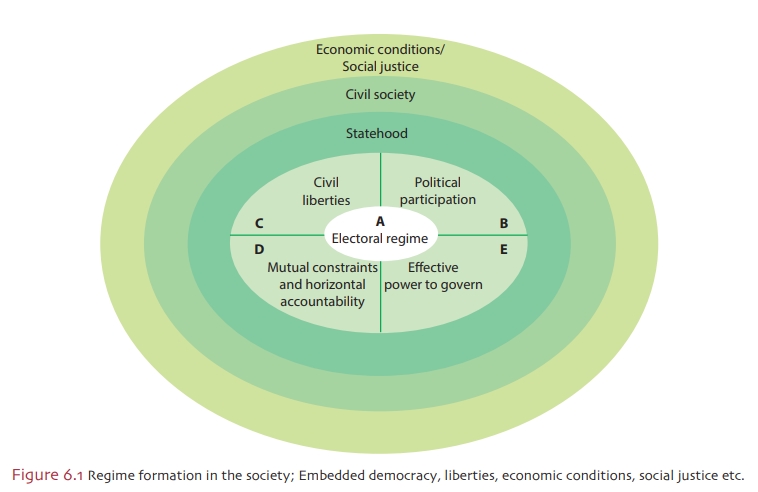
Soru 44
I. Principles are beliefs of fact, causation and rectitude.
II. Norms are standards of behavior defined in terms of rights and obligations.
III. Rules are specific prescriptions of proscriptions for action.
Which of the terms above is correctly given according to Krasner?
II. Norms are standards of behavior defined in terms of rights and obligations.
III. Rules are specific prescriptions of proscriptions for action.
Which of the terms above is correctly given according to Krasner?
Seçenekler
A
Only I
B
Only II
C
I and II
D
II and III
E
I, II and III
Açıklama:
International regime can be defined as sets of implicit or explicit principles, norms, rules, and decision-making procedures around which actors’ expectations converge in a given area of international relations. Principles are beliefs of fact, causation, and rectitude. Norms are standards of behavior defined in terms of rights and obligations. Rules are specific prescriptions or proscriptions for action. Decision-making procedures are prevailing practices for making and implementing collective choice.
Soru 45
I. Hedley Bull defines the regimes as rules and institutions that regulates behaviors of individuals and states.
II. Krasner notes that regimes should not be seen as provisional regulations.
III. Keohane points out that regimes should be differentiated from treaties in a certain subject.
Which of the explanations above is correctly given with the correct author?
II. Krasner notes that regimes should not be seen as provisional regulations.
III. Keohane points out that regimes should be differentiated from treaties in a certain subject.
Which of the explanations above is correctly given with the correct author?
Seçenekler
A
Only I
B
Only II
C
I and II
D
II and III
E
I, II and III
Açıklama:
Keohane and Nye argue that regimes are regulations comprising of the rules, norms and procedures influencing behaviors and results. Hedley Bull, defines the regimes as rules and institutions that regulate behaviors of individuals and states. Krasner noted that regimes should not be seen as provisional regulations changing according to the change of power and interest in international relations. Keohane also pointed out that regimes should be differentiated from treaties in a certain subject.
Soru 46
I. International regimes reduce uncertainties and provide a reference for which behaviors are false or right.
II. Regimes facilitate the identification of violations of rules in social and political fields.
III. Regimes also reduce the cost of common effort for those responding to violations of rules.
Which of the above is correct regarding the international regimes and cooperation?
II. Regimes facilitate the identification of violations of rules in social and political fields.
III. Regimes also reduce the cost of common effort for those responding to violations of rules.
Which of the above is correct regarding the international regimes and cooperation?
Seçenekler
A
Only I
B
Only II
C
I and II
D
II and III
E
I, II and III
Açıklama:
International regimes reduce uncertainties and provide a reference for which behaviors are false or right. In other words, regimes facilitate the identification of violations of rules in social, political and security related fields. Moreover, they also reduce the cost of common effort for those responding to such violations.
Soru 47
I. IRT would be needed to reduce uncertainties in certain fields that states cannot control by unilateral initiatives.
II. . The possibility of international collective response may deter the states that tend to violate the existing regimes.
III. International regimes, at the same time, reduce and even prevent the unfair applications stemming from uncertainties and gaps in certain fields.
Which of the above is correct regarding the international regime theories?
II. . The possibility of international collective response may deter the states that tend to violate the existing regimes.
III. International regimes, at the same time, reduce and even prevent the unfair applications stemming from uncertainties and gaps in certain fields.
Which of the above is correct regarding the international regime theories?
Seçenekler
A
Only I
B
Only II
C
I and II
D
II and III
E
I, II and III
Açıklama:
IRT would be needed to reduce uncertainties in certain fields that states cannot control by unilateral initiatives. International regimes, at the same time, reduce and even prevent the unfair applications stemming from uncertainties and gaps in certain fields. As well, in the areas where regimes don’t exist, states intend to resolve the problem through power relations, and consequently weak and small countries have some disadvantages. On the other hand, if there is a regime in any field, this reduces the probability of conflict and provides the maintenance of the security and stability. The possibility of international collective response may deter the states that tend to violate the existing regimes.
Soru 48
I. The hegemonic leader would assist to establishing order.
II. Hegemony and cooperation would not be opposite concepts.
III. Keohane adopts the significant role of hegemony for establishing and creating the
international regimes.
Which of the above is correct regarding the study titled "After Hegemony" by Keohane?
II. Hegemony and cooperation would not be opposite concepts.
III. Keohane adopts the significant role of hegemony for establishing and creating the
international regimes.
Which of the above is correct regarding the study titled "After Hegemony" by Keohane?
Seçenekler
A
Only I
B
Only II
C
I and II
D
II and III
E
I, II and III
Açıklama:
Keohane elaborating the concepts of hegemony and cooperation in the study titled as “After Hegemony”, stated that hegemonic leader would assist to establishing order. As well, he noted that hegemony and cooperation would not be opposite concepts since most of the international cooperation was raised in post-Second World War era, in which American hegemonic leadership was an issue. Therefore, Keohane adopts the significant role of hegemony for establishing and creating the international regimes.
Soru 49
I. Regimes enable states to coordinate.
II. Regimes generate differential benefits for states.
III. Regimes promote the common good.
Which of the above is correct related to the realist's approach to regimes?
II. Regimes generate differential benefits for states.
III. Regimes promote the common good.
Which of the above is correct related to the realist's approach to regimes?
Seçenekler
A
Only I
B
Only II
C
I and II
D
II and III
E
I, II and III
Açıklama:
Realists Approach to Regimes
1 Regimes enable states to coordinate.
2 Regimes generate differential benefits for states.
3 Power is the central feature of regime formation and survival.
4 The nature of world order depends on the underlying principles and norms of
regimes.
1 Regimes enable states to coordinate.
2 Regimes generate differential benefits for states.
3 Power is the central feature of regime formation and survival.
4 The nature of world order depends on the underlying principles and norms of
regimes.
Soru 50
I. Regimes enable states to collaborate.
II. Regimes promote international order.
III. Regimes promote the common good.
Which of the above is correct regarding the liberal institutionalists approach to regimes?
II. Regimes promote international order.
III. Regimes promote the common good.
Which of the above is correct regarding the liberal institutionalists approach to regimes?
Seçenekler
A
Only I
B
Only III
C
I and II
D
I and III
E
I, II and III
Açıklama:
Liberal institutionalists approach to regimes
1 Regimes enable states to collaborate.
2 Regimes promote the common good.
3 Regimes flourish best when promoted and maintained by a benign hegemon.
4 Regimes promote globalization and a liberal world order.
1 Regimes enable states to collaborate.
2 Regimes promote the common good.
3 Regimes flourish best when promoted and maintained by a benign hegemon.
4 Regimes promote globalization and a liberal world order.
Soru 51
International regimes can be defined as all of the below, except for__________.
Seçenekler
A
treaties
B
rules
C
principles
D
treaties
E
decision making processes
Açıklama:
International regimes can be defined as explicit or implicit norms, rules, principles and decision making processes related to certain issue areas / subjects, yet treaties are not specifically international regimes. The correct answer is A.
Soru 52
- to indicate the regulations related to international issue areas
- to explain the legitimate and accepted rules of games and behaviors for sovereign states in international area
- to point out the willigness of states for cooperation in different institutional environments and different conditions
Which of the above statements are among the purposes of adopting both a narrower and a broader definition of the international regimes?
Seçenekler
A
I only
B
I and II
C
I and III
D
II and III
E
I, II and III
Açıklama:
Main purpose of adopting the broader definition is to indicate the regulations related to international topics, civil societies, social movements and global governance. The concept of international regime is explaining the legitimate and accepted rule of games and behaviours for sovereign states in international are. On the other hand, the narrow definition is widely used and the narrow use of concept is to intend to point out the willingness of states for cooperation in different institutional environments and different conditions. The correct answer is E.
Soru 53
In which of the following are theoreticians and their definition of international regimes given correctly?
Seçenekler
A
Regimes are regulations comprimising of the rules, norms and procedures influencing behaviour and results (Puchala and Hopkins)
B
Regimes are regulations resulting from voluntary cooperation of governments (Keohane and Nye)
C
Regime is a conceptual framework to understand the behavious of states and to explain the situation which couldn't be explained before (Krasner)
D
Regimes are social institutions and structures created to regulate the behaviours of states for a certain phenomenon (Young)
E
Regimes should be differentiated from treaties in a certain subject (Jervis)
Açıklama:
Regimes are defined by various theoreticians as also discussed in the related chapter of the book. Below is a summary of what each person has stated about regimes:
- Regime can be described as explicit and implicit rules, norms, principles and decision making procedures related to a certain subject in international relations (Krasner).
- Regimes are regulations comprising of the rules, norms and procedures influencing behaviors and results (Keohane and Nye).
- Regimes are rules and institutions that regulate behaviors of individuals and states (Hedley Bull).
- Regimes should be differentiated from treaties in a certain subject (Keohane).
- Regimes are not only making the cooperation easier in short run, but also in the long run, providing an environment of cooperation for promoting relations (Jervis).
- Regimes are regulations resulting from voluntary cooperation of governments (Krasner).
- Regime is a conceptual framework to understand the behaviors of states and to explain the situation which couldn’t be explained before (Puchala and Hopkins).
- Regimes are social institutions and structures created to regulate the behaviors of states for a certain phenomenon (Young).
Soru 54
In which of the following is the theory and the particular explanatory variable each theory stresses given correctly?
Seçenekler
A
realist theories-knowledge and ideas
B
neoliberal theories-constellations of interests
C
cognitive theories-state power
D
neoliberal theories-knowledge and ideas
E
cognitive theories-constellations of interests
Açıklama:
International regimes are “codes of conduct” agreed upon by states to govern their relations in specific areas of international politics. There are three most important theories of international regimes. Each of these theories stress a particular explanatory variable: realist theories emphasize state power; neoliberal theories focus on constellations of interests; and cognitivist theories are concerned with knowledge and ideas. The correct answer is B.
Soru 55
Which of the following is NOT one of the advantages that international regimes provide?
Seçenekler
A
reduce the uncertainties in certain fields
B
prevent any unfair applications stemming from uncertainties
C
faciliate the identification of violations of rules
D
increases the communication among sides
E
increase the likelyhood of conflict and chaos
Açıklama:
International regimes reduce uncertainties and provide a reference for which behaviors are false or right. In other words, regimes facilitate the identification of violations of rules in social, political and security related fields. Moreover, they also reduce the cost of common effort for those responding to such violations (Perritt, 1998). According to Krasner (1991: 12), regimes make it easier to reach an agreement for parties, since it increases the communication among sides and influence the quality and quantity of knowledge in a positive manner. The correct answer is E.
Soru 56
- A hegomonic leader may lead the world into chaos and war.
- Hegemony and cooperation are opposite concepts.
- Cooperation is possible even in the lack of a hegemonic power
Seçenekler
A
Only I
B
Only II
C
Only III
D
II and III
E
I and III
Açıklama:
Keohane elaborating the concepts of hegemony and cooperation in the study titled as “After Hegemony”, stated that hegemonic leader would assist to establishing order. As well, he noted that hegemony and cooperation would not be opposite concepts since most of the international cooperation was raised in post-Second World War era, in which American hegemonic leadership was an issue. Keohane argues that cooperation would be possible even in the lack of a hegemonic power in case there are international regimes that assist to establish cooperation. The correct answer is E.
Soru 57
Which one is one of the liberal institutionalists' approaches to regimes?
Seçenekler
A
Regimes flourish best when promoted and maintained by a benign hegemon.
B
Regimes lead states to aggression
.
.
C
Regimes generate differential benefits for states.
D
Power is the central feature of regime formation and survival.
E
The nature of world order depends on the underlying principles and norms of regimes.
Açıklama:
Liberal institutionalists assert that regimes:
The answer is A.
- enable states to collaborate.
- promote the common good.
- flourish best when promoted and maintained by a benign hegemon.
- promote globalization and a liberal world order.
The answer is A.
Soru 58
Which of the following assumptions find support in international regimes theory (IRT)?
Seçenekler
A
States generally prefer regime formation in areas in which they don't have common interests.
B
If states have less competition and strong common interest, this would lead to powerful regimes.
C
States would be willing to cooperate despite the possible extra costs that regimes formation may bring.
D
States are more likely to establish regimes to share their power about legitimate use of power for internal issues.
E
States will form regimes especially in areas where they have the opportunity to behave unilaterally.
Açıklama:
Regimes are products of efforts to conciliate the conflicting interests, and also consequences of developments through which mutual interdependencies would increase the cost for conflicting relations among nations. Another important reason that leads to the formation of regimes is the multiplicity of interests of states as mentioned above. Therefore, if states don’t have common interests and/or states prefer the unilateral initiatives, then international regime would be impossible. Regimes formed between great powers would be stronger than those formed between weak states. As well, powerful states and coalitions that have vigorous competition cannot establish effective regimes. Therefore if states have less competition and strong common interest, this would lead to powerful regimes. At the same time, as noted earlier, since states would try to reduce costs by establishing regimes, if cost exceeds the benefits, then they would be reluctant to form regimes. For this reason, states should be persuaded and convinced for having common interests. In fact, states would hesitate to form regime in the field of their sovereignty, because regime would limit the sovereign rights of states in those areas in favor of international inspection and sharing their powers with other states. In particular, states would not be willing to share their power about legitimate use of power for internal issues. So they don’t prefer to establish common regimes in these domestic issues if they do not perceive a real threat to their rights inside the country. The correct answer is B.
Soru 59
- Acceptance of the states as basic actors
- Ignorance of the non-state actors
- Zero-sum assumption
Seçenekler
A
Only I
B
I and II
C
I and III
D
II and III
E
I, II and III
Açıklama:
Theory of International regimes has been criticized for its acceptance of the states as basic actors, and ignorance of the non-state actors. The correct answer is B
Soru 60
... can be defined as explicit or implicit norms, rules, principles and decision making processes related to certain issue areas/subjects.
Which of the following completes the definition given above?
Which of the following completes the definition given above?
Seçenekler
A
First-image theories
B
Bipolar system
C
Unipolar system
D
International regimes
E
Prisoner's dilemma
Açıklama:
International regimes can be defined as explicit or implicit norms, rules, principles and decision making processes related to certain issue areas/subjects.
Thus, the correct answer is D.
Thus, the correct answer is D.
Soru 61
Regime theory is a theory for explaining and understanding ... intending the coordination and harmonization of ....
Which of the following completes the definition given above?
Which of the following completes the definition given above?
Seçenekler
A
the international cooperation - interest among nations
B
collective goal - mutual harmonization
C
mutual harmonization - collective goal
D
collective goal - interest among nations
E
interest among nations - mutual harmonization
Açıklama:
Regime theory is a theory for explaining and understanding the international cooperation intending the coordination and harmonization of interest among nations.
Thus, the correct answer is A.
Thus, the correct answer is A.
Soru 62
Where ... see regimes as more or less efficient responses to fixed needs, ... see them as conditioned by ideology and consensual knowledge and evolving as actors learn.
Which of the following should complete the statement?
Which of the following should complete the statement?
Seçenekler
A
Functional theories - cognitive theories
B
Marxist theories - cognitive theories
C
Marxist theories - liberal theories
D
Marxist theories - constructivist theories
E
Functional theories - constructivist theories
Açıklama:
Where functional theories see regimes as more or less efficient responses to fixed needs, cognitive theories see them as conditioned by ideology and consensual knowledge and evolving as actors learn.
Thus, the correct answer is A.
Thus, the correct answer is A.
Soru 63
Why the concept of regime would cause the question of the limits of state sovereignty?
Seçenekler
A
Because states, naturally, are eager to establish international regimes in the fields out of their authority.
B
Because some limitations of international regimes which constrain states' sovereign rights are blurred to determine the subjects either domestic or global in character.
C
Because states would be eager to create regimes to prevent the anarchy and uncertainty.
D
Because there is no compulsion for regulations to be bilateral or multilateral.
E
Because international regimes may be formed in every field of subjects of international relations.
Açıklama:
The concept of regime would cause the question of the limits of state sovereignty. Because states in many subjects would face some limitations of international regimes which constrain their sovereign rights, so they are blurred to determine the subjects either domestic or global in character.
Thus, the correct answer is B.
Thus, the correct answer is B.
Soru 64
Who, elaborating the concepts of hegemony and cooperation in the study titled “After Hegemony”, stated that hegemonic leader would assist to establishing order?
Seçenekler
A
Puchala and Hopkins
B
Arthur A. Stein
C
Stephen D. Krasner
D
Robert Keohane
E
Haggard and Simmons
Açıklama:
Robert Keohane elaborating the concepts of hegemony and cooperation in the study titled as “After Hegemony”, stated that hegemonic leader would assist to establishing order. Thus, the correct answer is D.
Soru 65
I-States operate in an anarchic international system.
II-States are not rational and unitary actors.
III-States are not the units responsible for establishing regimes.
IV-Regimes are established on the basis of cooperation in the international system.
Which of the statements given above are true for the common assumptions of liberal and realist approaches to regimes?
II-States are not rational and unitary actors.
III-States are not the units responsible for establishing regimes.
IV-Regimes are established on the basis of cooperation in the international system.
Which of the statements given above are true for the common assumptions of liberal and realist approaches to regimes?
Seçenekler
A
I-II
B
I-II-III
C
II-III-IV
D
III-IV
E
I-IV
Açıklama:
Some of the common assumptions of liberal and realist approaches to regimes can be listed as:
States operate in an anarchic international system.
States are rational and unitary actors.
States are the units responsible for establishing regimes.
Regimes are established on the basis of cooperation in the international system.
Thus, the correct answer is E.
States operate in an anarchic international system.
States are rational and unitary actors.
States are the units responsible for establishing regimes.
Regimes are established on the basis of cooperation in the international system.
Thus, the correct answer is E.
Soru 66
- Regimes enable states to coordinate.
- Regimes promote the common good.
- Regimes flourish best when promoted and maintained by a benign hegemon.
- Regimes promote globalization and a liberal world order.
Which of the assertions belong to the liberal institutionalists' approach to regimes?
Seçenekler
A
I-II-III
B
II-III-IV
C
I-III-IV
D
II-III-IV
E
I-II-IV
Açıklama:
Liberal institutionalists' approach to regimes:
1- Regimes enable states to collaborate.
2- Regimes promote the common good.
3- Regimes flourish best when promoted and maintained by a benign hegemon.
4- Regimes promote globalization and a liberal world order.
Thus, the correct answer is B.
1- Regimes enable states to collaborate.
2- Regimes promote the common good.
3- Regimes flourish best when promoted and maintained by a benign hegemon.
4- Regimes promote globalization and a liberal world order.
Thus, the correct answer is B.
Soru 67
I.Regimes enable states to coordinate.
II.Regimes generate differential benefits for states.
III.Power is the least important feature of regime formation and survival.
IV.The nature of world order does not depend on the underlying principles and norms of regimes.
Which of the assertions belong to the realists' approach to regimes?
II.Regimes generate differential benefits for states.
III.Power is the least important feature of regime formation and survival.
IV.The nature of world order does not depend on the underlying principles and norms of regimes.
Which of the assertions belong to the realists' approach to regimes?
Seçenekler
A
I-II
B
I-III
C
I-IV
D
II-III
E
II-IV
Açıklama:
Realists approaches to regimes argues that:
Regimes enable states to coordinate.
Regimes generate differential benefits for states.
Power is the central feature of regime formation and survival.
The nature of world order depends on the underlying principles and norms of
regimes.
Thus, the correct answer is A.
Regimes enable states to coordinate.
Regimes generate differential benefits for states.
Power is the central feature of regime formation and survival.
The nature of world order depends on the underlying principles and norms of
regimes.
Thus, the correct answer is A.
Soru 68
According to whom, since states might not have control in certain fields anyway and have to accept foreign involvement, they might prefer to form international regimes in their own domain in order to escape/refrain from uncontrolled foreign interference?
Seçenekler
A
Mark Zacher
B
Robert Keohane
C
Peter Mayer
D
Volker Rittberger
E
Stephen D. Krasner
Açıklama:
According to Zacher, since states might not have control in certain fields anyway and have to accept foreign involvement, they might prefer to form international regimes in their own domain in order to escape/refrain from uncontrolled foreign interference. Thus, the correct answer is A.
Soru 69
I- Theory of international regime claims that functional theories are related to mutual interest but the regime theories are related to common interests.
II- The regime theories are intending to explain the relations between certain states in certain areas, in contrast functional theories are related to all community of states.
III- Functional theories are explaining clearly where, why and when states cooperate.
Which of the above is/are among the counter-arguement of Theory of International regimes as a response to the critiques of functional theories?
II- The regime theories are intending to explain the relations between certain states in certain areas, in contrast functional theories are related to all community of states.
III- Functional theories are explaining clearly where, why and when states cooperate.
Which of the above is/are among the counter-arguement of Theory of International regimes as a response to the critiques of functional theories?
Seçenekler
A
Only I
B
Only II
C
Only III
D
I-II
E
I-III
Açıklama:
Responding to some other critics about assumptions of international regime theories
set forth by functional theories, regime theories argue that:
Theory of international regime claims that functional theories are related to mutual interest but the regime theories are related to common interests.
Functional theories are intending to explain the relations between certain states in certain areas, in contrast regime theories are related to all community of states.
Besides, functional theories are not explaining clearly where, why and when states cooperate.
Thus, the correct answer is A.
set forth by functional theories, regime theories argue that:
Theory of international regime claims that functional theories are related to mutual interest but the regime theories are related to common interests.
Functional theories are intending to explain the relations between certain states in certain areas, in contrast regime theories are related to all community of states.
Besides, functional theories are not explaining clearly where, why and when states cooperate.
Thus, the correct answer is A.
Soru 70
Which of the following is an accurate definition of international regime theory?
Seçenekler
A
Regime theory is the study and analysis of the rules and ratifications that establish state power structures, ruling, and decision making processes.
B
Regime theory is a theory for explaining and understanding the international cooperation intending the coordination and harmonization of interest among nations.
C
Explicit or implicit norms, rules, principles and decision making processes related to certain issue areas/subjects.
D
A result of consent of states and the limited surrender for independent decision making authority.
E
Conditioning the behaviors of states consciously to realize collective goals.
Açıklama:
According to Keohane, regime theory is a theory for explaining and understanding the international cooperation intending the coordination and harmonization of interest among nations. This definition accurately describes international regime theory, while the other definitions are descriptive of the concept of regime itself.
Soru 71
Krasner's definition of international regime is that it "can be defined as sets of implicit or explicit principles, norms, rules, and decision-making procedures around which actors' expectations converge in a given area of international relations."
Which of the following refer to norms within the context of this definition?
Which of the following refer to norms within the context of this definition?
Seçenekler
A
Beliefs of fact, causation, and rectitude.
B
Standards of behavior defined in terms of rights and obligations.
C
Specific prescriptions or proscriptions for action.
D
Prevailing practices for making and implementing collective choice.
E
The normalization practices legitimizing regime relations.
Açıklama:
Based on Krasner's definition of international regime, norms are standards of behavior defined in terms of rights and obligations.
Soru 72
How does the 'prisoner's dilemma' present a case for international regime theory?
Seçenekler
A
As is the case in the prisoner's dilemma, the rational option for all sides regardless of national interest would be cooperation.
B
The prisoner's dilemma indicates that the establishment of international regimes would depend on the willingness of one party to cooperate over the other.
C
Regime theory indicates that the prisoner's dilemma is not applicable to international relations because nations may make unilateral decisions.
D
The prisoner's dilemma may be interpreted as both a cause for, and a hindrance to the establishment of international regimes depending on the viewpoint.
E
The prisoner's dilemma indicates that actors of international relations will act in their own best interests, thereby preventing cooperation and eliminating the possibility for the establishment of international regimes.
Açıklama:
Ünite'nin en temel aldığı, ünite boyunca örnek olarak gösterilen 'prisoner's dilemma', ünite boyunca çelişkili örneklerle anlatılmaya çalışılmış ve bu nedenle ünitenin bütününde kargaşaya neden olmaktadır. Genel bir bütün olarak ünitenin baştan yazılmasında fayda vardır çünkü şu anki haliyle uluslararası rejim kuramları hakkında ölçülebilir bilgi sunmakta zorlanıyor.
The realist approach based on the prisoner's dilemma emphasizes that possible risks and uncertainties might cause refrain from cooperation while the cognitivist approach implies that regimes would encourage and institutionalize the mutuality of international relations, while the principle of reciprocity would prevent states from defecting from cooperation.
The realist approach based on the prisoner's dilemma emphasizes that possible risks and uncertainties might cause refrain from cooperation while the cognitivist approach implies that regimes would encourage and institutionalize the mutuality of international relations, while the principle of reciprocity would prevent states from defecting from cooperation.
Soru 73
How does Keohane describe the roles of hegemony, regimes, and international political economy?
Seçenekler
A
He states that hegemony is the only way for international relations to be conducted.
B
He states that international regimes and cooperation will dissolve in the post hegemonic era.
C
He states that the rise of American hegemonic leadership following WW II is indicative of how hegemony is detrimental to establishing international regimes.
D
He states that international regimes are bound to explicit agreements on an international level, thereby avoiding substantial conflict.
E
He states that regimes are examples that facilitate cooperation, which can take place with or without hegemony or regimes.
Açıklama:
Keohane asserts that hegemony can assist in the establishment of cooperation, but also that cooperation is possible without hegemony as long as regimes exist to guide the way to such cooperation. Regimes merely regularize expectations. In addition, the rights and rules of cooperation may not be explicit, but may also arise from convergent expectations or even conflict.
Soru 74
Which approach to international regime theory suggests that peace and order can only be achieved by the increase in the number of democratic states?
Seçenekler
A
Liberal.
B
Functional.
C
Realist.
D
Cognitivists.
E
Game theorists.
Açıklama:
Realists explain peace and order within IRT theory through the concepts of national interest and selfish interest. Functional theories explain it through the benefits of international organizations. Liberals, however, assert that peace and order can only be achieved by the increase in the number of democratic states.
Soru 75
Which of the following is not a common assumption of both liberal and realist approaches to regimes?
Seçenekler
A
States are rational and unitary actors.
B
States are the units responsible for establishing regimes.
C
Regimes are established on the basis of cooperation in the international system.
D
States operat in an anarchic international system.
E
Regimes generate differential benefits for states.
Açıklama:
While liberal institutionalists assert that regimes promote the common good for all parties involved, promoting globalization and a liberal world order, realists assert that power is the central figure of regime formation and survival which therefore means that regimes generate differential benefits for states depending on which states the regimes benefit the most.
Soru 76
Which of the following is an example where there is no need for states to form a regime?
Seçenekler
A
Relinquishing control over international trade routes.
B
Determining airspace for commercial flights.
C
Conducting joint military exercises against a common threat.
D
Imposing sanctions due to condemnable behavior.
E
Conducting humanitarian aid in areas of conflict.
Açıklama:
While safe passage and the security of aid workers may be subject to international regimes, the act of providing humanitarian aid to war zones, famines and natural disasters is a unilateral decision that does not jeopardize the interests of others. Similarly, coalitions are established for humanitarian aid in which all states providing aid (and often the state receiving aid) have a common interest to behave similarly, negating the necessity for an international regime.
Soru 77
Which critique of regime theory contradicts the liberal institutionalist approach to regimes that states regimes flourish best when promoted and maintained by a benign hegemon?
Seçenekler
A
The acceptance of states as basic actors and ignorance of non-state actors criticism.
B
The criticism that functional theories cannot clearly explain where, why and when states cooperate.
C
The criticism that functional theories ignore power relations among states.
D
The criticism that regime theories are based on asymmetric relations among states.
E
The criticism that international regimes do not sufficiently explain unilateral actions that place states in greater security risks.
Açıklama:
Ünitenin bu bölümü yanlış yazılmış. Uluslararası rejim kuramlarına olan eleştiriler yerine gelen eleştirilere verilen yanıtlar ve rejim kuramlarının üstünlükleri yazılmış.
Stone argues that regime theories are constructed on the theory of hegemony that refers to asymmetric relations among states, and therefore it derived from the American hegemony that began after WW II.
Stone argues that regime theories are constructed on the theory of hegemony that refers to asymmetric relations among states, and therefore it derived from the American hegemony that began after WW II.
Soru 78
Which of the following would not be considered a factor in states avoiding regimes?
Seçenekler
A
A lack of common interests.
B
Unilateral initiatives with no consequence to any other state.
C
Limitations introduced to the sovereignty of the state.
D
Limitations introduced to the autonomy of the state.
E
The existence of a conflict of interest.
Açıklama:
Regimes themselves are products of efforts to conciliate conflicting interests. The other options would all be limiting factors that would dissuade or prevent a state from establishing regimes.
Soru 79
Which of the following is one of the common assumptions of both liberal and realist approaches to regimes?
Seçenekler
A
Regimes promote the common good.
B
Power is the central feature of regime formation and survival.
C
The nature of world order depends on the underlying principles and norms of regimes.
D
Regimes promote the common good.
E
Regimes are established on the basis of cooperation in the international system.
Açıklama:
Regimes are established on the basis of cooperation in the international system. The reasoning and benefits to such cooperation is approached differently by realists and liberals. Realists assume regimes create differential benefits while liberals assume they promote the common good.
Soru 80
Which of the following about definitions of the regime is not true?
Seçenekler
A
Regime can be described as explicit and implicit rules, norms, principles and decision making procedures related to a certain subject in international relations.
B
Regimes are regulations comprising of the rules, norms and procedures influencing behaviors and results.
C
Regimes as rules and institutions that regulate behaviors of individuals and states.
D
Regime is a conceptual framework to understand the behaviors of states and to explain the situation which couldn’t be explained before.
E
Regimes can be seen as provisional regulations changing according to the change of power and interest in international relations.
Açıklama:
Keohane and Nye argue that regimes are regulations comprising of the rules, norms and procedures
influencing behaviors and results. Hedley Bull, defines the regimes as rules and institutions that regulate behaviors of individuals and states. Krasner noted that regimes should not be seen as provisional regulations changing according to the change of power and interest in international relations. Keohane also pointed out that regimes should be differentiated from treaties in a certain subject. A treaty can be ad hoc in character but also would be narrow in terms of subject matter and parties. However, regimes are not always limited to a certain subject and not interim provision.
influencing behaviors and results. Hedley Bull, defines the regimes as rules and institutions that regulate behaviors of individuals and states. Krasner noted that regimes should not be seen as provisional regulations changing according to the change of power and interest in international relations. Keohane also pointed out that regimes should be differentiated from treaties in a certain subject. A treaty can be ad hoc in character but also would be narrow in terms of subject matter and parties. However, regimes are not always limited to a certain subject and not interim provision.
Soru 81
Which of the following view about regimes is not advocated by liberal institutionalists?
Seçenekler
A
Regimes enable states to collaborate.
B
Regimes promote the common good.
C
Regimes flourish best when promoted and maintained by a benign hegemon.
D
Regimes promote globalization and a liberal world order.
E
Regimes generate differential benefits for states.
Açıklama:
The view that regimes generate differential benefits for states belongs to realists.
Soru 82
I) Regimes enable states to collaborate.
II) Regimes generate differential benefits for states.
III) Regimes flourish best when promoted and maintained by a benign hegemon.
IV) Power is the central feature of regime formation and survival.
V) Regimes promote the common good.
Which of the numbered definitions belong to Liberal institutionalists?
II) Regimes generate differential benefits for states.
III) Regimes flourish best when promoted and maintained by a benign hegemon.
IV) Power is the central feature of regime formation and survival.
V) Regimes promote the common good.
Which of the numbered definitions belong to Liberal institutionalists?
Seçenekler
A
I and II
B
I, II, and III
C
I, III, and V
D
II, III, and V
E
II, IV, and V
Açıklama:
Numbered views as I, III, and V belong to Liberal institutionalists.
Soru 83
Which of the following expression about regimes is not advocated by realists?
Seçenekler
A
Regimes enable states to coordinate.
B
Regimes generate differential benefits for states.
C
Power is the central feature of regime formation and survival.
D
Regimes flourish best when promoted and maintained by a benign hegemon.
E
The nature of world order depends on the underlying principles and norms of regimes.
Açıklama:
The expression that regimes flourish best when promoted and maintained by a benign hegemon belongs to Liberal institutionalists.
Soru 84
Which of the following expression about the regime is not true?
Seçenekler
A
Regime is thought as a result of consent of states and the limited surrender for independent decision making authority.
B
Regime is that conditioning the behaviors of states consciously to realize collective goals, and can be seen as a specific version of international institutions.
C
Regime is that explaining the legitimate and accepted rule of games and behaviors for sovereign states in international area.
D
Regime is that comprises all international institutions and regulations and formal aspect of all state behaviors.
E
Regimes are always limited to a certain subject and interim provision.
Açıklama:
Keohane also pointed out that regimes should be differentiated from treaties in a certain subject. A treaty can be ad hoc in character but also would be narrow in terms of subject matter and parties. However, regimes are not always limited to a certain subject and not interim provision.
Soru 85
Which of the following about definitions of the regime is not true according to Conca's view?
Seçenekler
A
All international institutions can be assumed as international regimes.
B
International regimes are sub section of international institutions.
C
International institutions are codified by states.
D
International institutions would represent the limits of state's authority and power.
E
All international institutions cannot be assumed as international regimes.
Açıklama:
All international institutions cannot be assumed as international regimes. International regimes are sub section of international institutions.
Soru 86
I) Regimes enable states to coordinate.
II) Regimes promote the common good.
III) Regimes generate differential benefits for states.
IV) Regimes promote globalization.
V) Power is the central feature of regime formation and survival.
Which of the numbered definitions reflect realists?
II) Regimes promote the common good.
III) Regimes generate differential benefits for states.
IV) Regimes promote globalization.
V) Power is the central feature of regime formation and survival.
Which of the numbered definitions reflect realists?
Seçenekler
A
I and II
B
II and IV
C
I, III, and V
D
II, III, and IV
E
III, IV, and V
Açıklama:
Numbered views as I, III, and V belong to realists.
Soru 87
Which of the following is one of the assumptions of liberal institutionalists?
Seçenekler
A
Regimes promote international order.
B
Regimes are established on the basis of cooperation in the international system.
C
Regimes flourish best when promoted and maintained by a benign hegemon.
D
Power is the central feature of regime formation and survival.
E
Regimes generate differential benefits for states.
Açıklama:
That regimes flourish best when promoted and maintained by a benign hegemon is the one of the assumptions of liberal institutionalists.
Soru 88
Which of the following is one of the assumptions of realists?
Seçenekler
A
Regimes promote international order.
B
Regimes enable states to coordinate.
C
Regimes promote the common good.
D
Regimes promote globalization and a liberal world order.
E
Regimes enable states to collaborate.
Açıklama:
Regimes enable states to coordinate. This assumption is one of the assumptions of realists.
Soru 89
Which of the following definition about regime is not true?
Seçenekler
A
It is thought as a result of consent of states and the limited surrender for independent decision making authority.
B
They are patterns of behaviors in international relations.
C
It is that conditioning the behaviors of states consciously to realize collective goals.
D
Expliciting or impliciting norms, rules, principles and decision making processes related to certain issue areas/ subjects.
E
They are seen as provisional regulations changing according to the change of interest in international relations.
Açıklama:
Krasner noted that regimes should not be seen as provisional regulations changing according to the change of power and interest in international relations.
Ünite 7
Soru 1
Which of the following is the idea that all of humanity belongs to a single global community?
Seçenekler
A
Nationalism
B
Cosmopolitanism
C
Imperialism
D
Globalism
E
Populism
Açıklama:
Cosmopolitanism is the idea that all of humanity belongs to a single global community.
Soru 2
Which of the following is a qualification of empirical theories?
Seçenekler
A
Value is always an important element.
B
They are related with the subjects of philosophy and ethic.
C
They place the discussion of politics in the context of morality.
D
They rest on value preferences which cannot be tested or verified.
E
They intensify on the real reasons of relations between statesmen and foreign policy.
Açıklama:
Empirical theories intensify on the real reasons of relations between statesmen and foreign policy.
Soru 3
Which of the following is accepted by the scholars that base their arguments on relativism?
Seçenekler
A
Different perceptions
B
Universal morality
C
Cosmopolitanism
D
Natural law
E
Perpetual peace
Açıklama:
The scholars that base their arguments on relativism refuse cosmopolitanism. In other words, they do not accept the universality of some values. Universal law, natural law, universal peace, universal morality, universal human rights are not accepted by them.
Soru 4
Which approach supports that values transcend the societies, and it is not possible to attribute them to one society?
Seçenekler
A
Objectivism
B
Universalism
C
Cosmopolitan
D
Utilitarianism
E
Kantian Idealism
Açıklama:
The background of this cosmopolitan viewpoint rests on the idea of common law in Roman Empire. According to this approach, values transcend the societies, and it is not possible to attribute them to one society.
Soru 5
" _________________ theory depends on the assumption that the individuals might voluntarily bind themselves to the certain principles." Which of the following fills in the gap correctly?
Seçenekler
A
Social contract
B
Kantian idealism
C
Universalism
D
Empirical
E
Cosmopolitan
Açıklama:
Social contract theory depends on the assumption that the individuals might voluntarily bind themselves to the certain principles.
Soru 6
"As he works for the happiness for himself, he works for the happiness of other people." Which philosophy supports this idea?
Seçenekler
A
Cosmopolitan
B
Kantian
C
Hobbesian approach
D
Utilitarianism
E
Social contract
Açıklama:
For utilitarianism, the social and individual interests overlap. And as he works for the happiness for himself, he works for the happiness of other people.
Soru 7
What does "jus ad bellum" refer to?
Seçenekler
A
True law is right reason in agreement with nature.
B
The individuals might voluntarily bind themselves to the certain principles.
C
The concept of justice would be accepted as fundamental for all societies.
D
The conditions under which States may resort to war or to the use of armed force in general.
E
The irrational behaviors and actions of individuals and society might stem from the underdevelopment of intellectual capability of them.
Açıklama:
Jus ad bellum refers to the conditions under which States may resort to war or to the use of armed force in general.
Soru 8
Which of the following refers to the right of the people of a particular place to choose the form of government they will have?
Seçenekler
A
Decision-making
B
Self-determination
C
Covert operation
D
perpetual peace
E
Consideration
Açıklama:
Self-determination is the right of the people of a particular place to choose the form of government they will have.
Soru 9
Which of the following expressions refers to the principle of international law that treaties and other international engagements are bin- ding upon the nations that accede to them, and obligations accepted under such engagements must be performed, or reparations made in the event of a breach?
Seçenekler
A
Jus ad bellum
B
Pacta Sunt Servanda
C
Covert operation
D
Territorial integrity
E
Non-intervention
Açıklama:
Pacta Sunt Servanda:
A principle of international law that treaties and other international engagements are bin- ding upon the nations that accede to them, and obligations accepted under such engagements must be performed, or reparations made in the event of a breach.
A principle of international law that treaties and other international engagements are bin- ding upon the nations that accede to them, and obligations accepted under such engagements must be performed, or reparations made in the event of a breach.
Soru 10
Whose approach is perpetual peace?
Seçenekler
A
Immanuel Kant
B
J. J. Rousseau
C
Cicero
D
Thomas Hobbes
E
John Locke
Açıklama:
Perpetual peace approach of Kant and European federation idea of J. J. Rousseau were interesting examples for normative studies
Soru 11
Post-modernism theory moved to which filled the deficit.
Seçenekler
A
Adopting the moral values that it would play significant role for policy making processes to reach a stable and peaceful world.
.
.
B
Its concept is right or wrong.
C
Its concept is just or unjust.
D
Concepts such as single global community.
E
Concepts such as economic, and/or political relationships.
Açıklama:
Post-behavioralism moved to fill this gap, and in 1980s the problem was still not completely overcome, but at least normative theories regained their popularity. It was required to adopt a new idealist viewpoint that moral values would play significant role for policy making processes to reach a stable and peaceful world.
Soru 12
Who belongs to the idea of The Basic Principles of Perpetual Peace?
Seçenekler
A
J. J. Rousseau
B
Immanuel Kant
C
Cicero
D
Jeremy Bentham
E
Thomas Hobbes
Açıklama:
Immanuel Kant
Soru 13
What cicero has pointed out about Justice his famous nation?
Seçenekler
A
Quarrels never could last long, if on one side only lay the wrong.
B
Injustice anywhere is a threat to justice everywhere.
C
A single justice depending on single law is valid for all society.
D
The dead cannot cry out for justice. It is a duty of the living to do so for them.
E
In matters of truth and justice, there is no difference between large and small problems, for issues concerning the treatment of people are all the same.
Açıklama:
Cicero pointed out that a single justice depending on single law is valid for all society. For him, if there was not justice in the nature, it would not be known as the concept of justice.
Soru 14
What does the Universal principle refer as a concept of legal legitimacy actions?
Seçenekler
A
These principle that is founded on the moral standards that govern human behavior are, in some sense.
B
These principle that is founded on the World peace, or peace on Earth.
C
This idea of world should be non-violence.
D
These principle that is founded on acceptability, their applicability, translation, and philosophical basis.
E
These principle that has different cultures, religions, philosophies and organizations.
Açıklama:
Universal law or universal principle refers as concepts of legal legitimacy actions, whereby those principles and rules for governing human beings’ conduct which are most universal in their acceptability, their applicability, translation, and philosophical basis, are therefore considered to be most legitimate.
Soru 15
Kant has contributed to representative of the cosmopolitan understanding according to him ?
Seçenekler
A
it is claimed that the principle of utilitarianism (principle of pleasure and satisfaction) should be obeyed to reach to the best.
B
According to him, values transcend the societies, and it is not possible to attribute them to one society.
C
According to him, ideas were based on more secular contexts.
D
According to him, to act in accord with human nature, human beings must exercise right reason.
E
The ethical laws are known to individuals, and they are universally obligatory rules for all humankind.
Açıklama:
Kant (1724-1804), who is the best known representative of the cosmopolitan understanding, discusses ethics and reason in his studies, as well, and he takes on hand the concepts of peace and war as the basic phenomena of social structure. According to him, an individual has the freedom to choose right, ethic and moral. The ethical laws are known to individuals, and they are universally obligatory rules for all humankind.
Soru 16
What is the basic meaning of the social contract theory?
Seçenekler
A
Social contract theory depends on the assumption that the individuals might voluntarily bind themselves to the certain principles
B
There is an understanding of cosmopolitan international society which is composed of individuals, states and other actors adopting ethical principles.
C
Social contract should be obeyed to reach to the best.
D
It is certain that the society is regulated rightly.
E
The reality that the world is divided into separate sovereign states having different perspectives.
Açıklama:
Social contract theory depends on the assumption that the individuals might voluntarily bind themselves to the certain principles. From this point, like stag hunt model of game theory, individuals would sacrifice their small satisfactions to reach a highest satisfaction.
Soru 17
What does Rawls insist on social values?
Seçenekler
A
Rawl insists that obligations accepted under such engagements must be performed force in general.
B
Rawl insists that social values as freedom, opportunity, income, wealth and respectfulness.
C
Rawl insists that obligations accepted under such engagements must be performed.
D
Rawl insists that emphasize that individuals and states must decide which rules would be binding.
E
Rawl insists that decision makers would reach a consensus for common values to be attained, some disagreements might arise for defining or conducting of these values.
Açıklama:
Emphasizing the concept of justice, Rawl insists that social values (freedom, opportunity, income, wealth and respectfulness) are delivered equally to individuals.
Soru 18
What is the purpose of the Truman Doctrine?
Seçenekler
A
He assigns a major role in successful reconstruction.
B
The economic redevelopment, it was one of the stated goals of the Truman Doctrine.
C
He was expressed as an “help to free nations”.
D
Self-determination is a cardinal principle in modern international law.
E
The right of the people of a particular place to choose the form of government they will have.
Açıklama:
Furthermore, Truman Doctrine declared in the aftermath of the Second World War, was expressed as an “help to free nations”.
Soru 19
What it means the principle of non-intervention.
Seçenekler
A
Every State should respond to such national liberation movements inside the country.
B
Every State could be seen as a legitimate instrument to use of force against domestic problems and such movements.
C
They have a right to choose between becoming refugee or returning back home.
D
The principle of non-intervention involves the right of every sovereign State to conduct its affairs without outside interference.
E
States should save the human rights.
Açıklama:
The principle of non-intervention involves the right of every sovereign State to conduct its affairs without outside interference.
Soru 20
What do the sovereign states seek according to according to realist writers?
Seçenekler
A
Can an international organization achieve this, in the lack of a world government?
B
What kind of international organizations must be established?
C
Do we need such organizations to secure these rights?
D
To find a way for peaceful solution of conflicts according to realist writers.
E
According to realist writers, in a real world, sovereign state seeks to increase its power.
Açıklama:
According to realist writers, in a real world, sovereign state seeks to increase its power. States looking for power and national interest are not expected to be ethical.
Soru 21
Which of the concept below defines the idea that all of humanity belongs to a single global community?
Seçenekler
A
nationalism
B
globalization
C
cosmopolitanism
D
imperialism
E
utopia
Açıklama:
Every human being was seen as a citizen of the world in his capacity of “reason” regardless of bloodlineage and racial origins.
Soru 22
Which of the concept below is considered as a very interesting example for normative studies?
Seçenekler
A
idealism
B
perpetual peace
C
realism
D
philosophy
E
liberalism
Açıklama:
Normative theories, essentially are related with the subjects of philosophy and ethic. Perpetual peace approach of Kant and European federation idea of J. J. Rousseau were interesting examples for normative studies.
Soru 23
Which statement below can be said related with the normative theory?
Seçenekler
A
For normative studies, value hasn’t got any importance.
B
For normative theory, morality hasn’t got any significance.
C
Thanks to normative theory, value can be tested.
D
Thanks to normative theory, value can be verified with factual experiments.
E
Normative theory isn’t concerned with what ought to be or should be.
Açıklama:
Normative theories rest on value preferences which cannot be tested or verified with factual experiments and this is an important difference from empirical/positivist theories. Moreover, they are not concerned with the proposition related to “what is” but “what ought to be, what should be”.
Soru 24
Which of the statement below is true?
Seçenekler
A
Normative theory has no weaknesses.
B
Empirical theory has no weaknesses.
C
Normative theory isn’t considered as utopist.
D
Normative theory isn’t considered as idealist.
E
Empirical theory is condemned for being too factual.
Açıklama:
However, either normative theories or empirical theories are also criticized for some perspectives. In other words, both have certain weaknesses. Since normative theories are claimed to be utopist and idealist and empirical theories too, they are condemned to be over factual for consideration of being scientific.
Soru 25
Which of the statement below is true related with what Cicero said?
Seçenekler
A
According to Cicero there is no single law that is valid for all society.
B
Scholars who base their arguments on relativism accept cosmopolitanism.
C
Scholars who base their arguments on relativism accept the universality of some values.
D
Universal law, natural law, universal peace, universal morality and universal human rights are accepted by relativists.
E
According to Cicero, the law of nature and human nature are harmonious with each other because they both reflect the will of God.
Açıklama:
Normative writers criticize the relativist approach and if everything is accepted to be relative, then nothing would have any concrete meaning. On the other hand, those scholars that base their arguments on relativism refuse cosmopolitanism. In other words, they do not accept the universality of some values. Universal law, natural law, universal peace, universal morality, universal human rights are not accepted by them. What Cicero is ultimately saying here and elsewhere is that there is the law of nature, and there is human nature. These are of necessity harmonious with each other (and, ultimately, the same thing) because both reflect the will of a benevolent Supreme Being who creates and governs the universe.
Soru 26
What is the name of the meta-ethical position that applies universally to all similarly situated individuals?
Seçenekler
A
universal law
B
moral universalism
C
natural law moral theory
D
universal principle
E
perpetual peace
Açıklama:
It is the meta-ethical position that some system of ethics, or a universal ethic, applies universally, that is, for “all similarly situated individuals”, regardless of culture, race, sex, religion, nationality, sexual orientation, or any other distinguishing feature. Moral universalism is opposed to moral nihilism and moral relativism.
Soru 27
Which statement below is correct related with the social contract theory?
Seçenekler
A
Individuals do not sacrifice their small satisfactions to reach a highest satisfaction.
B
According to social contract theory individuals don’t bind themselves to certain principles.
C
According to social contract theory individuals would accept voluntarily to leave their certain rights to preserve their freedoms and security.
D
According to social contract theory, people wouldn’t sacrifice their small interests for larger interests.
E
Social contract theory is not regarded as normative thought.
Açıklama:
The approach of social contract is another important approach which should be regarded for normative thought. According to Locke and Rousseau, by forming a higher authority, individuals would accept voluntarily to leave their certain rights to preserve their freedoms and security (freedom of life). Social contract theory depends on the assumption that the individuals might voluntarily bind themselves to the certain principles. From this point, like stag hunt model of game theory, individuals would sacrifice their small satisfactions to reach a highest satisfaction.
Soru 28
Which statement below is correct related with utilitarianism?
Seçenekler
A
The principle of utilitarianism is not the principle of pleasure and satisfaction.
B
For utilitarianism, the social and individual interests do not overlap.
C
According to utilitarianism, if an individual might seek for his own interest, he wouldn’t play for the increment of the interest of society.
D
According to utilitarianism, if an individual seeks for the happiness for himself, he works for the happiness of other people as well.
E
Utilitarian philosophy doesn’t assume that the individual who works for his own utility, automatically works for the utility of community.
Açıklama:
For utilitarianism, the social and individual interests overlap (harmony of interest thesis). As individual might seek for his own interest, he would play for the increment of the interest of society. And as he works for the happiness for himself, he works for the happiness of other people. Utilitarian philosophy assumes that the individual who works for his own utility, automatically works for the utility of community.
Soru 29
What is the name of the concept which refers to the conditions under which States may resort to war or to the use of armed force in general?
Seçenekler
A
covert operation
B
pacta sund servanda
C
jus ad bellum
D
Self-determination
E
perpetual peace
Açıklama:
The prohibition against the use of force amongst States and the exceptions to it (self-defence and UN authorization for the use of force), set out in the United Nations Charter of 1945, are the core ingredients of jus ad bellum.
Soru 30
What is the name of the principle which involves the right of every sovereign State to conduct its affairs without outside interference?
Seçenekler
A
non-intervention
B
perpetual peace
C
Utilitarian
D
Moral universalism
E
Universal law
Açıklama:
The principle of non-intervention involves the right of every sovereign State to conduct its affairs without outside interference; …“the principle forbids all States or groups of States to intervene directly or indirectly in the internal or external affairs of other States” and that “a prohibited intervention must accordingly be one bearing on matters in which each State is permitted, by the principle of State sovereignty, to decide freely. Intervention is wrongful when it uses methods of coercion in regard to such choices, which must remain free ones.”
Soru 31
Which of the following is a subject of empirical theories?
Seçenekler
A
War between states
B
Perpetual peace
C
Ethical values
D
Reasons of relations
E
Moral factors
Açıklama:
Empirical theories intensify on the real reasons of relations between statesmen and foreign policy.
Soru 32
Which of the following philosopher maintained the principle of perpetual peace?
Seçenekler
A
Immanuel Kant
B
Jean Jacques Rousseau
C
John Stuart Mill
D
Jeremy Bentham
E
John Locke
Açıklama:
Normative theories, essentially are related with the subjects of philosophy and ethic. Perpetual peace approach of Kant and European federation idea of J. J. Rousseau were interesting examples for normative studies.
Soru 33
Which of the following philosopher supported the idea that ‘there is no absolute good and absolute bad’?
Seçenekler
A
John Locke
B
John Stuart Mill
C
Thomas Hobbes
D
Immanuel Kant
E
Jean Jacques Rousseau
Açıklama:
According to Hobbes, good or bad are relative concepts and consequently there is no absolute good and absolute bad. There are no sensible and objective criteria to divide the good and bad; in contrast, it depends subjectively to the individuals themselves.
Soru 34
Which of the following term refers to the standards of the connection between human beings and the world?
Seçenekler
A
Universal law theory
B
Universal principle
C
Moral universalism theory
D
Moral objectivism theory
E
Natural law moral theory
Açıklama:
Natural law moral theory, the moral standards that govern human behavior are, in some sense, objectively derived from the nature of human beings and the nature of the world.
Soru 35
Which of the following statement is False about Kant?
Seçenekler
A
An individual has the freedom to choose right, ethic and moral.
B
An individual’s behaviors are determined in advance.
C
An individual has responsibilities and obligations to perform.
D
An individual has to obey universally obligatory rules.
E
An individual has to know the ethical laws.
Açıklama:
According to Kant, an individual has the freedom to choose right, ethic and moral, and his behaviors are not determined in advance. But, he has responsibilities and obligations to perform and to obey to the ethical laws accepted as right by universal reason. The ethical laws are known to individuals, and they are universally obligatory rules for all humankind.
Soru 36
Which of the following term is used to define ‘the principle of pleasure and satisfaction’?
Seçenekler
A
Utilatarianism
B
Idealism
C
Conservatism
D
Liberalism
E
Behavioralism
Açıklama:
In the writings of Jeremy Bentham (1748-1832) and John Stuart Mill (1806-1873), it is claimed that the principle of utilitarianism (principle of pleasure and satisfaction) should be obeyed to reach to the best.
Soru 37
Which of the following theory depends on the assumption that the individuals might voluntarily bind themselves to the certain principles?
Seçenekler
A
Analytical theory
B
Social contract theory
C
Normative theory
D
Cosmopolitan theory
E
Emprical theory
Açıklama:
Social contract theory depends on the assumption that the individuals might voluntarily bind themselves to the certain principles.
Soru 38
Which of the following philosopher supported the idea that by forming a higher authority, individuals would accept voluntarily to leave their certain rights to preserve their freedoms and security?
Seçenekler
A
Immanuel Kant
B
John Stuart Mill
C
Jeremy Bentham
D
Thomas Hobbes
E
John Locke
Açıklama:
The approach of social contract is another important approach which should be regarded for normative thought. According to Locke and Rousseau, by forming a higher authority, individuals would accept voluntarily to leave their certain rights to preserve their freedoms and security (freedom of life).
Soru 39
Which of the following principle involves the right of a state to conduct its affairs without the affairs of other states?
Seçenekler
A
Free trade
B
Self determination
C
Non-intervention
D
Respect to territorial integrity
E
Peaceful solution of conflicts
Açıklama:
The principle of non-intervention involves the right of every sovereign State to conduct its affairs without outside interference.
Soru 40
Which of the following can be an aim of a state from a realist point of view?
Seçenekler
A
To develop human rights
B
To abide by universal values
C
To maintain perpetual peace
D
To increase its power
E
To obey moral principles
Açıklama:
In particular, according to realist writers, in a real world, sovereign state seeks to increase its power. States looking for power and national interest are not expected to be ethical. Moreover, since there must be numerous moral principles depending on the number of sovereign states, a universal normative theory which is valid for all states is not plausible to establish.
Soru 41
_____ is the idea that all of humanity belongs to a single global community. Every human being was seen as a citizen of the world in his capacity of “reason” regardless of bloodlineage and racial origins.
Fill in the blanks with the correct answer.
Fill in the blanks with the correct answer.
Seçenekler
A
Enlightment
B
Humanism
C
Individualism
D
Cosmopolitanism
E
Nationalism
Açıklama:
Cosmopolitanism is the idea that all of humanity belongs to a single global community. Every human being was seen as a citizen of the world in his capacity of “reason” regardless of bloodlineage and racial origins. The thinkers of the Enlightenment, such as Kant, in the eighteenth century, embraced this idea. With the rise of Imperialism and Nationalism in the nineteenth century, however, cosmopolitanism was criticized as an unrealistic, utopian vision.
Soru 42
______ pointed out that a single justice depending on single law is valid for all society. For him, if there was not justice in the nature, it would not be known as the concept of justice.
Fill in the blanks with the correct answer.
Fill in the blanks with the correct answer.
Seçenekler
A
Cicero
B
Hobbes
C
Rousseau
D
Locke
E
Kant
Açıklama:
Cicero (BC 106-43) who is an important philosopher in the western thought stated that true law is a law in coincidence with the nature. Cicero pointed out that a single justice depending on single law is valid for all society. For him, if there was not justice in the nature, it would not be known as the concept of justice (Viotti and Kauppi, 1993: 533).
Soru 43
In whose idealism is an understanding of cosmopolitan international society which is composed of individuals, states and other actors adopting ethical principles?
Seçenekler
A
Jefferson
B
Hobbes
C
Rousseau
D
Locke
E
Kant
Açıklama:
In Kantian idealism, there is an understanding of cosmopolitan international society which is composed of individuals, states and other actors adopting ethical principles. Right reason which has a different character transcends the law made by states, necessitates to fulfill states’ responsibilities stemming from universal law. This indicates the way toward the state of perpetual peace. A world federation formed by peaceful states was introduced by Kant as a recipe to solve the security demands of states (Viotti and Kauppi, 1993: 533).
Soru 44
In the writings of _____ it is claimed that the principle of utilitarianism (principle of pleasure and satisfaction) should be obeyed to reach to the best.
Seçenekler
A
Bentham and Mill
B
Hobbes
C
Locke and Rousseau
D
Kant
E
Augustine
Açıklama:
In the writings of Jeremy Bentham (1748-1832) and John Stuart Mill (1806-1873), it is claimed that the principle of utilitarianism (principle of pleasure and satisfaction) should be obeyed to reach to the best. For utilitarianism, if fundamental institutions are reshaped or reconstructed for providing the highest satisfaction, then it is certain that the society is regulated rightly.
Soru 45
According to_____ , by forming a higher authority, individuals would accept voluntarily to leave their certain rights to preserve their freedoms and security (freedom of life).
Seçenekler
A
Hegel
B
Locke and Rousseau
C
Kant
D
Bentham and Mill
E
Hobbes
Açıklama:
According to Locke and Rousseau, by forming a higher authority, individuals would accept voluntarily to leave their certain rights to preserve their freedoms and security (freedom of life). Social contract theory depends on the assumption that the individuals might voluntarily bind themselves to the certain principles. From this point, like stag hunt model of game theory, individuals would sacrifice their small satisfactions to reach a highest satisfaction.
Soru 46
Who was influenced by Locke’s arguments for the social contract?
Seçenekler
A
Napoleon
B
Jefferson
C
Roosevelt
D
Hobbes
E
Hegel
Açıklama:
Locke’s arguments for the social contract, and for the right of citizens to revolt against their king were enormously influential on the democratic revolutions that followed, especially on Thomas Jefferson, and the founders of the United States.
Soru 47
Whose concept brought new economic order demands of poor Third World countries?
Seçenekler
A
Bentham
B
Rawl
C
Hegel
D
Mill
E
Locke
Açıklama:
Rawl’s concept of justice founded the background of new economic order demands of poor Third World countries to fill the rift between North and South (Viotti and Kauppi, 1993: 534).
Soru 48
_____ refers to the conditions under which States may resort to war or to the use of armed force in general.
Seçenekler
A
Force Major
B
Jus ad Bellum
C
Pacta Sunt Servanda
D
In Dulci Jubilo
E
Acta Non Verba
Açıklama:
Jus ad bellum refers to the conditions under which States may resort to war or to the use of armed force in general. The prohibition against the use of force amongst States and the exceptions to it (self-defence and UN authorization for the use of force), set out in the United Nations Charter of 1945, are the core ingredients of jus ad bellum.
Soru 49
Which of the following is the principle of international law that treaties and other international engagements are binding upon the nations that accede to them?
Seçenekler
A
Force Major
B
Jus ad Bellum
C
Pacta Sunt Servanda
D
In Dulci Jubilo
E
Acta Non Verba
Açıklama:
A principle of international law that treaties and other international engagements are binding upon the nations that accede to them, and obligations accepted under such engagements must be performed, or reparations made in the event of a breach.
Soru 50
Which of the following is not a certain ethical and moral concept of foreign policy goals?
Seçenekler
A
law
B
justice
C
international stability
D
social solidarity
E
ceasefire
Açıklama:
In addition to the fact that foreign policy
activities are tied to moral principles, some foreign
policy goals also have ethical and moral content.
Foreign policy goals are addressed to certain
concepts such as peace, law, justice, international
stability, social solidarity and freedom.
activities are tied to moral principles, some foreign
policy goals also have ethical and moral content.
Foreign policy goals are addressed to certain
concepts such as peace, law, justice, international
stability, social solidarity and freedom.
Soru 51
Which of the following is the idea that all of humanity belongs to a single global community?
Seçenekler
A
Globalism
B
Cosmopolitanism
C
Realism
D
Pluralism
E
Normativizm
Açıklama:
Cosmopolitanism is the idea that all of humanity belongs to a single global community.
Soru 52
Which of the following scholars noted that from past to present, in the history of IR value and normative preferences became primary issues?
Seçenekler
A
Ferguson and Mansbach
B
Kant
C
Rousseau
D
Hobbes
E
John Stuart Mill
Açıklama:
In the late 1980s, paradigmatic uncertainty was increasingly debated among IR scholars. For example, Ferguson and Mansbach noted that from past to present, in the history of IR theory, value and normative preferences became primary issues.
Soru 53
Which of the following scholars assumes that “good or bad are relative concepts and consequently there is no absolute good and absolute bad.”
Seçenekler
A
Cicero
B
Kant
C
Rousseau
D
Hobbes
E
John Stuart Mill
Açıklama:
According to Hobbes, good or bad are relative concepts and consequently there is no absolute good and absolute bad. There are no sensible and objective criteria to divide the good and bad; in contrast, it depends subjectively to the individuals themselves.
Soru 54
Which of the followings can not be said for moral universalism?
Seçenekler
A
It is also called moral objectivism
B
It is the meta-ethical position
C
It is opposed to moral nihilism
D
It is opposed to moral relativism
E
Distinguishing features are important for it
Açıklama:
Moral universalism (also called moral objectivism) is the meta-ethical position that some system of ethics, or a universal ethic, applies universally, that is, for “all similarly situated individuals”, regardless of culture, race, sex, religion, nationality, sexual orientation, or any other distinguishing feature. Moral universalism is opposed to moral nihilism and moral relativism.
Soru 55
……………………………..depends on the assumption that the individuals might voluntarily bind themselves to the certain principles.
Seçenekler
A
Utilitarian philosophy
B
Social contract theory
C
Cosmopolitan understanding
D
Normative theory
E
Marxist theory
Açıklama:
Social contract theory depends on the assumption that the individuals might voluntarily bind themselves to the certain principles.
Soru 56
Which of the following philosophies assume that the individual who works for his own utility, automatically works for the utility of community.
Seçenekler
A
Behaviouralism
B
Materialism
C
Idealism
D
Utilitarianism
E
Rationalizm
Açıklama:
Utilitarian philosophy assumes that the individual who works for his own utility, automatically works for the utility of community.
Soru 57
………………………..refers to the conditions under which states may resort to war or to the use of armed force in general.
Seçenekler
A
Pacta Sund Servanda
B
Jus Ad Bellum
C
Social Contract
D
Self-Defence
E
Justification Of War
Açıklama:
Jus ad bellum refers to the conditions under which States may resort to war or to the use of armed force in general.
Soru 58
………………………..is the right of the people of a particular place to choose the form of government they will have.
Seçenekler
A
Social Contract
B
Self-Defence
C
Self-Determination
D
Self- Direction
E
Self- Expression
Açıklama:
Self-determination is the right of the people of a particular place to choose the form of government they will have.
Soru 59
Which of the following terms was used by American President George W. Bush in order to introduce the operation against Afghanistan?
Seçenekler
A
Clandestine Operation
B
Territorial Integrity
C
Peaceful Solution
D
Self Defence
E
Perpetual Peace
Açıklama:
American President George W. Bush, in 2001, identified the attack of Al-Qaeda as an attack to the democracy and human rights, and he also introduced the operation against Afghanistan with the concepts of “perpetual peace” (or infinite peace) and “infinite justice/enduring freedom”.
Soru 60
……………………….aim to secretly fulfill therir mission objectives without any parties knowing who sponsored or carried out the operation.
Seçenekler
A
Clandestine operations
B
Covert operations
C
Central Intelligence Agency (CIA) members
D
American Government elites
E
Multi-national corporations
Açıklama:
Covert operations aim to secretly fulfill their mission objectives without any parties knowing who sponsored or carried out the operation.
Soru 61
Which of the following cannot be said about the differences between the normative theories and empirical theories?
Seçenekler
A
Normative theories, essentially are related with the subjects of philosophy and ethic. Empirical theories intensify on the real reasons of relations between statesmen and foreign policy.
B
Value is always an important element for the background of normative studies, and such theories placed the discussion of politics in the context of morality.
C
Moral factors became evident and interests were expressed through moral and ethical dimensions or in the context of values related to ideology, morality and politics. Normative theories are not concerned with the proposition related to (empirical) “what is” but “what ought to be, what should be”
D
Normative theories rest on value preferences which cannot be tested or verified with factual experiments and this is an important difference from empirical/positivist theories.
E
Empirical political scientists never use the normative/philosophical concepts, even if they need to adopt normative facts.
Açıklama:
Normative theories, essentially are related with the subjects of philosophy and ethic. Perpetual peace approach of Kant and European federation idea of J. J. Rousseau were interesting examples for normative studies. Value is always an important element for the background of normative studies, and such theories placed the discussion of politics in the context of morality. Here, moral factors became evident and interests were expressed through moral and ethical dimensions or in the context of values related to ideology, morality and politics (Johari, 1985: 72).
However, normative theories rest on value preferences which cannot be tested or verified with factual experiments and this is an important difference from empirical/positivist theories. Moreover, they are not concerned with the proposition related to “what is” but “what ought to be, what should be” (Viotti and Kauppi, 1993:5;
Rosenau, 1993, 25; Frost, 1986: 15).
Empirical theories intensify on the real reasons of relations between statesmen and foreign policy. Diplomatic history introduces ample proofs for this perspective. From time to time, this contention is conducted in the axis of idealism-realism. However, the traces of the elements of value and norm would be seen in the studies carried out in the framework of realism as well. Therefore, this subjective factor could not be completely eliminated in empirical theories too. Empirical political scientists sometimes use the normative/philosophical concepts, even if they adopt empirical facts. In this context, coinciding theory and fact, inevitably, demonstrates the necessities that the empirical theories at the same time should utilize analytical approaches.
According to these information the correct answer is option E.
However, normative theories rest on value preferences which cannot be tested or verified with factual experiments and this is an important difference from empirical/positivist theories. Moreover, they are not concerned with the proposition related to “what is” but “what ought to be, what should be” (Viotti and Kauppi, 1993:5;
Rosenau, 1993, 25; Frost, 1986: 15).
Empirical theories intensify on the real reasons of relations between statesmen and foreign policy. Diplomatic history introduces ample proofs for this perspective. From time to time, this contention is conducted in the axis of idealism-realism. However, the traces of the elements of value and norm would be seen in the studies carried out in the framework of realism as well. Therefore, this subjective factor could not be completely eliminated in empirical theories too. Empirical political scientists sometimes use the normative/philosophical concepts, even if they adopt empirical facts. In this context, coinciding theory and fact, inevitably, demonstrates the necessities that the empirical theories at the same time should utilize analytical approaches.
According to these information the correct answer is option E.
Soru 62
Which of the following can not be said about "Natural Law"?
Seçenekler
A
Cicero pointed out that a single justice depending on single law is valid for all society. For him, if there was not justice in the nature, it would not be known as the concept of justice.
B
There is the law of nature, and there is human nature. These are of necessity harmonious with each other (and, ultimately, the same thing) because both reflect the will of a benevolent Supreme Being who creates and governs the universe.
C
To act in accord with human nature, human beings must deny reason (recta ratio) and they trust their animal instincts.
D
The purpose of philosophy is to assist people to achieve right reason-a real and distinct level of cognitive function where emotional and egoistic thinking gives way to virtue, morality, piety (or sense of the sacred), and intellectual and social humility.”
E
We cannot be freed from its obligations by senate or people, and we need not look outside ourselves for an expounder or interpreter of it.
Açıklama:
Universal law, natural law, universal peace, universal morality, universal human rights are not accepted by them. Cicero (BC 106-43) who is an important philosopher in the western thought stated that true law is a law in coincidence with the nature. Cicero pointed out that a single justice depending on single law is valid for all society. For him, if there was not justice in the nature, it would not be known as the concept of justice.
We cannot be freed from its obligations by senate or people, and we need not look outside ourselves for an expounder or interpreter of it.
“What Cicero is ultimately saying here and elsewhere is that there is the law of nature, and there is human nature. These are of necessity harmonious with each other (and, ultimately, the same thing) because both reflect the will of a benevolent Supreme Being who creates and governs the universe. To act in accord with human nature, human beings must exercise right reason (recta ratio). The purpose of philosophy is to assist people to achieve right reason-a real and distinct level of cognitive function where emotional and egoistic thinking gives way to virtue, morality, piety (or sense of the sacred), and intellectual and social humility.”
In this sense, the correct answer is option C.
We cannot be freed from its obligations by senate or people, and we need not look outside ourselves for an expounder or interpreter of it.
“What Cicero is ultimately saying here and elsewhere is that there is the law of nature, and there is human nature. These are of necessity harmonious with each other (and, ultimately, the same thing) because both reflect the will of a benevolent Supreme Being who creates and governs the universe. To act in accord with human nature, human beings must exercise right reason (recta ratio). The purpose of philosophy is to assist people to achieve right reason-a real and distinct level of cognitive function where emotional and egoistic thinking gives way to virtue, morality, piety (or sense of the sacred), and intellectual and social humility.”
In this sense, the correct answer is option C.
Soru 63
Which of the following can be said about Kant's cosmopolitan understanding?
Seçenekler
A
It is claimed that the principle of utilitarianism (principle of pleasure and satisfaction) should be obeyed to reach to the best.
B
If fundamental institutions are reshaped or reconstructed for providing the highest satisfaction, then it is certain that the society is regulated rightly.
C
In Kantian idealism, there is an understanding of cosmopolitan international society which consist of only states. Individuals are not the part of this international society and its ethical codes.
D
Right reason which has a different character transcends the law made by states, necessitates to fulfill states’ responsibilities stemming from universal law. This indicates the way toward the state of perpetual peace.
E
A world federation formed by peaceful states was opposed by Kant as a recipe to solve the security demands of states.
Açıklama:
Kant (1724-1804), who is the best known representative of the cosmopolitan understanding, discusses ethics and reason in his studies, as well, and he takes on hand the concepts of peace and war as the basic phenomena of social structure. According to him, an individual has the freedom to choose right, ethic and moral, and his behaviors are not determined in advance. But, he has responsibilities and obligations to perform and to obey to the ethical laws accepted as right by universal reason. The ethical laws are known to individuals, and they are universally obligatory
rules for all humankind. The universal dimension of Kantian ethics is accepted as fundamental in IR. In Kantian idealism, there is an understanding of cosmopolitan international society which is composed of individuals, states and other actors adopting ethical principles. Right reason which has a different character transcends the law made by states, necessitates to fulfill states’ responsibilities stemming from universal law. This indicates the way toward the state of perpetual peace. A world federation formed by peaceful states was introduced by Kant as a recipe to solve the security demands of states. According to these information, the correct answer is given in the option D.
rules for all humankind. The universal dimension of Kantian ethics is accepted as fundamental in IR. In Kantian idealism, there is an understanding of cosmopolitan international society which is composed of individuals, states and other actors adopting ethical principles. Right reason which has a different character transcends the law made by states, necessitates to fulfill states’ responsibilities stemming from universal law. This indicates the way toward the state of perpetual peace. A world federation formed by peaceful states was introduced by Kant as a recipe to solve the security demands of states. According to these information, the correct answer is given in the option D.
Soru 64
"According to Locke and Rousseau, by forming a higher authority, individuals would accept voluntarily to leave their certain rights to preserve their freedoms and security." This statement is closely related to which of the following concepts?
Seçenekler
A
Universal law
B
Social contract
C
Natural Law
D
Perpetual peace
E
Moral universalism
Açıklama:
The approach of social contract is another important approach which should be regarded for normative thought. According to Locke and Rousseau, by forming a higher authority, individuals would accept voluntarily to leave their certain rights to preserve their freedoms and security (freedom of life). Social contract theory depends on the assumption that the individuals might voluntarily bind themselves to the certain principles. In this sense, the correct answer is given in option B.
Soru 65
"____________ refers to the conditions under which States may resort to war or to the use of armed force in general." Fill in the blank with he correct statement.
Seçenekler
A
pacta sund servanda
B
recta ratio
C
Bonum commune communitatis
D
Jus ad bellum
E
Homo homini lupus
Açıklama:
Jus ad bellum refers to the conditions under which States may resort to war or to the use of armed force in general. The prohibition against the use of force amongst States and the exceptions to it (self-defence and UN authorization for the use of force), set out in the United Nations Charter of 1945, are the core ingredients of jus ad bellum. According to these, the correct answer is option D.
Soru 66
Which of the following can not be said about Normative theories in general?
Seçenekler
A
Normative theories, adopt human being’s freedom and capability to determine the outside world rather than emphasizing the influence of international structure and national interest.
B
These theories are known as educational and instructional theories.
C
Normative theories have features of being voluntarist and eclectic.
D
They look like predictive and explanatory theories rather than being deterministic theories.
E
The propositions of normative theories can be tested and verified by facts.
Açıklama:
Normative theories, adopt human being’s freedom and capability to determine the outside world rather than emphasizing the influence of international structure and national interest. In this sense, normative theories have features of being voluntarist and eclectic. They look like predictive and explanatory theories rather than being deterministic theories. But, the propositions of normative theories cannot be tested or
verified by facts. However, these theories are known as educational and instructional theories. According to these, the correct answer is E.
verified by facts. However, these theories are known as educational and instructional theories. According to these, the correct answer is E.
Soru 67
"Therefore, it is frequently observed that ethical norms are employed to excuse foreign policies. According to _______, brother nations and parties have responsibilities to support each other." Fill in the blank with correct historical figure.
Seçenekler
A
Marx
B
Lenin
C
Hobbes
D
Luxemburg
E
Rousseau
Açıklama:
Therefore, it is frequently observed that ethical norms are employed to excuse foreign policies. According to Lenin, brother nations and parties have responsibilities to support
each other. Similarly, according to the former Soviet Union, communist countries had special responsibilities for saving the weak block members. In this sense, the correct answer is option B.
each other. Similarly, according to the former Soviet Union, communist countries had special responsibilities for saving the weak block members. In this sense, the correct answer is option B.
Soru 68
Which of the following option states that a people, based on respect for the principle of equal rights and fair equality of opportunity, have the right to freely choose their sovereignty and international political status with no interference?
Seçenekler
A
Self-determination
B
Natural Law
C
Social Contract
D
Perpetual Peace
E
Non-intervention
Açıklama:
Self-determination is a cardinal principle in modern international law (commonly regarded as a jus cogens rule (compelling law/peremptory norm) binding, as such, on the United Nations as authoritative interpretation of the Charter’s norms. It states that a people, based on respect for the principle of equal rights and fair equality of opportunity, have the right to freely choose their sovereignty and international political status with no interference. In other words, the right of the people of a particular place to choose the form of government they will have. According to this, the correct answer is option A.
Soru 69
Which of the following option involves the right of every sovereign State to conduct its affairs without outside interference?
Seçenekler
A
perpetual peace
B
Covert operations
C
Self-determination
D
Moral universalism
E
Non-intervention
Açıklama:
The principle of non-intervention involves the right of every sovereign State to conduct
its affairs without outside interference; …“the principle forbids all States or groups of States to intervene directly or indirectly in the internal or external affairs of other States” and that “a prohibited intervention must accordingly be one bearing on matters in which each State is permitted, by the principle of State sovereignty, to decide freely. Intervention is wrongful when it uses methods of coercion in regard to such choices, which must remain free ones.” In this sense, the correct answer is E.
its affairs without outside interference; …“the principle forbids all States or groups of States to intervene directly or indirectly in the internal or external affairs of other States” and that “a prohibited intervention must accordingly be one bearing on matters in which each State is permitted, by the principle of State sovereignty, to decide freely. Intervention is wrongful when it uses methods of coercion in regard to such choices, which must remain free ones.” In this sense, the correct answer is E.
Soru 70
According to Mervin Frost, many issues in IR are normative in content and/or introduced with some normative notions. Which of the following can not be one of these issues?
Seçenekler
A
Could the states justify waging war?
B
What are the normative constraints for states to abide?
C
What are the rights and obligations of states trying to be neutral in a war?
D
Did God create the State?
E
Should the states have nuclear weapons?
Açıklama:
According to Mervin Frost (1986: 82-83), many issues in IR are normative in content and/ or introduced with some normative notions. Could the states justify waging war? What are the normative constraints for states to abide? What are the rights and obligations of states trying to be neutral in a war? Should the states have nuclear weapons? Could the nuclear weapons ethically be advocated? Is deterrence policy legitimate?... and so on. According to these questions, the correct answer is option D.
Soru 71
________________ is the idea that all of humanity belongs to a single global community. Every human being was seen as a citizen of the world in his capacity of “reason” regardless of bloodlineage and racial origins.
Seçenekler
A
Imperialism
B
Nationalism
C
Cosmopolitanism
D
Realism
E
Conservatism
Açıklama:
Introduction
Cosmopolitanism
Cosmopolitanism
Soru 72
Natural law moral theory, the moral standards that govern human behavior are, in
some sense, objectively derived from the nature of ______________ and the nature of the __________.
some sense, objectively derived from the nature of ______________ and the nature of the __________.
Seçenekler
A
human beings-world
B
all living creatures-country
C
animals-state
D
human beings-city
E
plants-world
Açıklama:
COSMOPOLITAN APPROACH AND NORMATIVE THEORY
human beings-world
human beings-world
Soru 73
I. An individual has the freedom to choose right, ethic and moral, and his behaviors are not determined in advance.
II. An individual has responsibilities and obligations to perform and to obey to the ethical laws accepted as right by universal reason.
III. The ethical laws are known to individuals, and they are universally obligatory rules for all humankind.
Whose views are stated above?
II. An individual has responsibilities and obligations to perform and to obey to the ethical laws accepted as right by universal reason.
III. The ethical laws are known to individuals, and they are universally obligatory rules for all humankind.
Whose views are stated above?
Seçenekler
A
Cicero
B
Kant
C
Locke
D
Rousseau
E
Bentham
Açıklama:
COSMOPOLITAN APPROACH AND NORMATIVE THEORY
Kant
Kant
Soru 74
“This theory depends on the assumption that the individuals might voluntarily bind themselves to the certain principles. From this point, like stag hunt model of game theory, individuals would sacrifice their small satisfactions to reach a highest satisfaction”.
Which theory is described by the above sentences?
Which theory is described by the above sentences?
Seçenekler
A
Utilitarian
B
Kantian idealism
C
Human nature
D
Social contract
E
Natural law
Açıklama:
Social contract approach and normative theory
Soru 75
__________________ philosophy assumes that the individual who works for his own utility, automatically works for the utility of community.
Seçenekler
A
Kantian
B
Normative
C
Relativist
D
Empirical
E
Utilitarian
Açıklama:
Social contract approach and normative theory
Utilitarian
Utilitarian
Soru 76
_________ refers to the conditions under which states may resort to war or to the use of armed force in general.
Seçenekler
A
Jus ad bellum
B
Pacta sunt servanda
C
Anarchy
D
Supreme Being
E
Recta ratio
Açıklama:
Social contract approach and normative theory
Jus ad bellum
Jus ad bellum
Soru 77
I. These theories have features of being voluntarist and eclectic.
II. They look like predictive and explanatory theories rather than being deterministic theories.
III. The propositions of these theories cannot be tested or verified by facts.
IV. These theories are known as educational and instructional theories.
What kind of theories are described by the above sentences?
II. They look like predictive and explanatory theories rather than being deterministic theories.
III. The propositions of these theories cannot be tested or verified by facts.
IV. These theories are known as educational and instructional theories.
What kind of theories are described by the above sentences?
Seçenekler
A
Idealist
B
Conservative
C
Realist
D
Normative
E
Rationalist
Açıklama:
Normative theories and International Relations
Soru 78
Which of the following is not one of the concepts that foreign policy goals are addressed to?
Seçenekler
A
peace
B
law
C
justice
D
freedom
E
slavery
Açıklama:
Normative theories and International Relations
slavery
slavery
Soru 79
“This theory states that people, based on respect for the principle of equal rights and fair equality of opportunity, have the right to freely choose their sovereignty and international political status with no interference. In other words, the right of the people of a particular place to choose the form of government they will have”.
Which theory is described above?
Which theory is described above?
Seçenekler
A
International law
B
Self-determination
C
Law of nature
D
Compelling law
E
Truman doctrine
Açıklama:
Normative theories and International Relations
Self-determination
Self-determination
Soru 80
In Chile, Allende who was a democratically elected president was replaced with General Pinochet who was a military dictator and the US tried to justify this with a policy of prevention of communist threat. What is the name of this operation?
Seçenekler
A
Clandestine
B
Cold war
C
Covert
D
Apartheid
E
Foreign
Açıklama:
Normative theories and International Relations
Covert
Covert
Soru 81
Which of the following is TRUE about normative theories in late 20th century?
Seçenekler
A
After 1960s, the growing tension between the USA and the former USSR contributed to the arising of normative theories.
B
Before 1960s, scholars started to use normative standards and concepts such as right and wrong.
C
Behavioralism in 1960s embraced the ideological elements and answered contemporary needs.
D
Post-behavioralism in 1970s emerged to include some forgotten concepts such as value, purpose and preference.
E
Normative theories, which gained popularity in 1960s, started to lose its impact on International Relations theory in 1980s.
Açıklama:
After 1960s, technological and ideological developments contributed to the arising of normative theories. During that decade, popular methodological debate was on the empirical/analytical theories and methodologies, and the scholars put aside the normative theories, and escaped to use normative standards and concepts such as right or wrong and just or unjust assumed as old fashion for the field of IR. Empirical/analytical theories in these years could not cope with the problems of difference among political institutions, practices and values. In 1970s, post-behavioral revolution emerged as a challenge against the so called behavioral revolution of 1960s, since behavioralism could not answer the contemporary needs, and became abstract by distancing from real world and ignoring the ideological elements for consideration of empirical conservatism. In this framework, some concepts such as value, purpose and preference lost their importance. Therefore, post-behavioralism moved to fill this gap, and in 1980s the problem was still not completely overcome, but at least normative theories regained their popularity. It was required to adopt a new idealist viewpoint that moral values would play significant role for policy making processes to reach a stable and peaceful world. In this framework, post-behavioralist scholars founded a theory which could be verified by empirical observations through synthesizing moral principles of liberal thought and rigid conservatism of realist approach (Dougherty and Pfaltzgraff, 1990: 565-66). The correct answer is D.
Soru 82
Which of the following describes the idea that all of humanity belongs to a single global community?
Seçenekler
A
Social contract theory
B
Behavioralism
C
Cosmopolitanism
D
Positivist theory
E
Utilitarianism
Açıklama:
Cosmopolitanism is the idea that all of humanity belongs to a single global community. The correct answer is C.
Soru 83
- Normative theories are related with the subjects of economy and social welfare.
- Value is an important element for the background of normative studies.
- Normative theories are concerned with the proposition related to "what is", rather than "what should be".
- Normative scholars object to the thesis of relativity of ethic and value.
Seçenekler
A
I and II
B
I, III and IV
C
II and III
D
III and IV
E
II and IV
Açıklama:
Normative theories, essentially are related with the subjects of philosophy and ethic. Value is always an important element for the background of normative studies, and such theories placed the discussion of politics in the context of morality. However, normative theories rest on value preferences which cannot be tested or verified with factual experiments and this is an important difference from empirical/positivist theories. Moreover, they are not concerned with the proposition related to “what is” but “what ought to be, what should be”. Normative scholars are against and they object to the thesis of relativity of ethic and value. Kantian, utilitarian and social contract insights are approaches that rest on universality of values. The correct answer is E.
Soru 84
Which of the following schools of thought does not accept the universality of some values?
Seçenekler
A
Relativist
B
Normative
C
Cosmopolitanism
D
Utilitarianism
E
Kantianism
Açıklama:
Scholars that base their arguments on relativism refuse cosmopolitanism. In other words, they do not accept the universality of some values. The correct answer is A.
Soru 85
Which of the following scholars claims that individuals would voluntarily accept to leave their certain rights to preserve their freedoms and security?
Seçenekler
A
Augustine
B
Locke
C
Cicero
D
Kant
E
Jefferson
Açıklama:
According to Locke and Rousseau, by forming a higher authority, individuals would accept voluntarily to leave their certain rights to preserve their freedoms and security (freedom of life). The correct answer is B.
Soru 86
- Universal ethics
- Universal anarchy
- Universal peace
Seçenekler
A
I only
B
I and II
C
I and III
D
II and III
E
I, II and III
Açıklama:
Normative theories are generally concerned with value laden concepts. Universal law, principles, peace and ethics are some of these concepts; however, the universal anarchy is not one of these concepts. The answer is C.
Soru 87
Which of the following statements is incorrect about the normative theories?
Seçenekler
A
They adopt human being's freedom and capability to determine the outside world
B
They emphasize the influence of international structure and national interest.
C
They look like predictive and explanatory theories.
D
The propositions of normative theories cannot be tested or verified by facts.
E
They introduce some proposals to foreign policy decision makers about the social issues to be taken into consideration.
Açıklama:
Normative theories, adopt human being’s freedom and capability to determine the outside world rather than emphasizing the influence of international structure and national interest. They look like predictive and explanatory theories rather than being deterministic theories. But, the propositions of normative theories cannot be tested or verified by facts. They introduce some proposals to foreign policy decision makers about the social issues to be taken into consideration. The correct answer is B
Soru 88
Which of the following principles asserts that every sovereign state has the right to conduct its affairs without outside interference?
Seçenekler
A
self-determination
B
perpetual peace
C
universal morality
D
conflict resolution
E
non-intervention
Açıklama:
The principle of non-intervention involves the right of every sovereign State to conduct its affairs without outside interference; …“the principle forbids all States or groups of States to intervene directly or indirectly in the internal or external affairs of other States” and that “a prohibited intervention must accordingly be one bearing on matters in which each State is permitted, by the principle of State sovereignty, to decide freely. Intervention is wrongful when it uses methods of coercion in regard to such choices, which must remain free ones.” The correct answer is E.
Soru 89
How does the utilitarian philosophy explain the irrational behaviours and actions of individuals?
Seçenekler
A
Corrupted moral values
B
Egocenterism
C
Underdevelopment of intellectual capability
D
Harmony of interest
E
Conflict of interests
Açıklama:
For utilitarianism, the social and individual interests overlap (harmony of interest thesis). As individual might seek for his own interest, he would play for the increment of the interest of society. And as he works for the happiness for himself, he works for the happiness of other people. Utilitarian philosophy assumes that the individual who works for his own utility, automatically works for the utility of community. For them, the irrational behaviors and actions of individuals and society might stem from the underdevelopment of intellectual capability of them.
Soru 90
- When is war justified?
- When is intervention in domestic affairs of other states justified?
- Is the policy of nuclear deterrence morally defensible?
Seçenekler
A
Only I
B
I and II
C
II and III
D
I and III
E
I, II and III
Açıklama:
Normative theories try to find answers for questions like When is war justified? When is intervention in the domestic affairs of other states justified? Is international terrorist activity ever justified? Is the policy of nuclear deterrence morally defensible? The correct answer is E.
Soru 91
"______is the idea that all of humanity belongs to a single global community"
Which of the following completes the sentence the best?
Which of the following completes the sentence the best?
Seçenekler
A
Cosmopolitanism
B
Universal law
C
Natural law
D
Universal peace
E
Universal morality
Açıklama:
The correct answer is A
Soru 92
"Perpetual peace approach is created by_____."
Which of the following completes the sentence the best?
Which of the following completes the sentence the best?
Seçenekler
A
Kant
B
J.J.Rousseau
C
Cicero
D
Hobbes
E
Augustine
Açıklama:
The correct answer is A.
Soru 93
- They rest on value preferences which cannot be tested or verified with factual experiments.
- They are concerned with the proposition related to “what ought to be, what should be”.
- They are related with the subjects of philosophy and ethic.
IV. They depends on the assumption that the individuals might voluntarily bind themselves to the certain principles.
Which of the above are about normative theories?
Seçenekler
A
I-II-III
B
II-III-IV
C
I-III-IV
D
I-IV
E
II-IV
Açıklama:
The correct answer is A.
Soru 94
"True law is a law in coincidence with the nature."
"A single justice depending on single law is valid for all society"
The ideas above are stated by________.
"A single justice depending on single law is valid for all society"
The ideas above are stated by________.
Seçenekler
A
Cicero
B
Kant
C
J.J. Rousseau
D
Locke
E
Rail
Açıklama:
The correct answer is A.
Soru 95
"good or bad are relative concepts and consequently there is no absolute good and absolute bad. ere are no sensible and objective criteria to divide the good and bad; in contrast, it depends subjectively to the individuals themselves"
The ideas above belong to_______.
The ideas above belong to_______.
Seçenekler
A
Hobbes
B
Cicero
C
Kant
D
Locke
E
J.J. Rousseau
Açıklama:
The answer is A.
Soru 96
"_____ theory depends on the assumption that the individuals might voluntarily bind themselves to the certain principles."
Which of the following completes the sentence the most appropriately?
Which of the following completes the sentence the most appropriately?
Seçenekler
A
Social contract
B
Universal principle
C
Natural law
D
Moral universalism
E
Cosmopolitism
Açıklama:
The correct answer is A.
Soru 97
"According to ______ the social and individual interests overlap"
Which of the following completes the sentence the best?
Which of the following completes the sentence the best?
Seçenekler
A
kantism
B
utilitarianism
C
cosmopolitan understanding
D
empirical theory
E
normative theory
Açıklama:
The correct answer is B
Soru 98
Which of the following cannot be considered as a social value?
Seçenekler
A
Freedom
B
income
C
opportunity
D
wealth
E
wage
Açıklama:
The answer is E
Soru 99
Whose concept of justice founded the background of new economic order demands of poor ird World countries to fill the rift between North and South?
Seçenekler
A
Cicero's
B
Kant's
C
Rawl's
D
Locke's
E
Rousseau's
Açıklama:
The correct answer is C
Soru 100
"_____refers to the conditions under which States may resort to war or to the use of armed force in general"
Which of the following completes the sentence above the best?
Which of the following completes the sentence above the best?
Seçenekler
A
Jus ad bellum
B
Social construct
C
Universal morality
D
Cosmopolitanism
E
Kantism
Açıklama:
The correct answer is A.
Soru 101
Which of the following thinkers developed the idea of European federation?
Seçenekler
A
J.J. Rousseau
B
Hobbes
C
Locke
D
Marx
E
Durkheim
Açıklama:
J.J. Rousseau developed the idea of the European federation.
Soru 102
Which of the following thinkers introduced the concept of "perpetual peace"?
Seçenekler
A
Jean J. Rousseau
B
Immanuel Kant
C
Karl Marx
D
Thomas Hobbes
E
John Locke
Açıklama:
Immanuel Kant introduced the concept of Perpetual Peace.
Soru 103
Which of the following was introduced by Kant as a recipe to solve the security demands of states?
Seçenekler
A
A dominant state
B
A hegemon
C
A world federation
D
An international organization
E
Power
Açıklama:
A world federation of peaceful states was introduced by Kant as a recipe to solve the security demands of states
Soru 104
Which of the following approaches holds that the society regulated rightly if fundamental institutions are reshaped for providing the highest satisfaction?
Seçenekler
A
Realizm
B
Empiricism
C
Normativism
D
Utilitarianism
E
Feminism
Açıklama:
For utilitarianism, if fundamental institutions are reshaped or reconstructed for providing the highest satisfaction, then it is certain that the society is regulated rightly.
Soru 105
In his writings, which one of the following thinkers claims that the principle of utilitarianism should be obeyed to reach to the best?
Seçenekler
A
Karl Marx
B
John Locke
C
Thomas Hobbes
D
J.J. Rouseau
E
Jeremy Bentham
Açıklama:
Jeremy Bentham is one of the thinkers who claim that the principle of utilitarianism should be obeyed to reach to the best
Soru 106
..... theory depends on the assumption that the individuals might voluntarily bind themselves to the certain principles.
Which of the following correctly completes the sentence above?
Which of the following correctly completes the sentence above?
Seçenekler
A
Social contract
B
Realist
C
Empirical
D
Marxist
E
Feminist
Açıklama:
Social contract theory depends on the assumption that the individuals might voluntarily bind themselves to the certain principles.
Soru 107
Which of the following is one of the thinkers who developed the social contract theory?
Seçenekler
A
John Locke
B
Immanuel Kant
C
Karl Marx
D
Jeremy Bentham
E
John Stuart Mill
Açıklama:
John Locke is one of the thinkers who developed the social contract theory.
Soru 108
Which of the following involves the right of every sovereign State to conduct its affairs without outside interference?
Seçenekler
A
Self-defense
B
Use of force
C
Balance of power
D
Principle of non-intervention
E
Humanitarian intervention
Açıklama:
The principle of non-intervention involves the right of every sovereign State to conduct its affairs without outside interference;
Soru 109
Which of the following is not one of the thinkers who have dealt with the concept of just war?
Seçenekler
A
Augustine
B
Cicero
C
Aquinas
D
Suarez
E
Bentham
Açıklama:
The concept of just war was dealt by thinkers such as Augustine, Cicero, Aquinas, Suareaz, and Vitoria but not by Bentham.
Soru 110
Which of the following is about the right of the people of a particular place to choose the form of their government?
Seçenekler
A
Self-determination
B
Self-defence
C
Non-intervention
D
Humanitarian intervention
E
Just war
Açıklama:
Self-determination is about the right of the people of a particular place to choose the form of their government.
Ünite 8
Soru 1
The term 'English School' was first used by:
Seçenekler
A
Peter Wilson.
B
Roy Jones.
C
Michael Donelan.
D
Tim Dunne.
E
Herbert Butterfield.
Açıklama:
The term “English School” was first coined by Roy Jones in a 1981 article titled as “The English School of International Relations: A Case for Closure”. Jones argued that a group of scholars, basically gathered at London School of Economics, could be taken as forming a distinct school of international relations and this school could be named as “English School”.
Soru 2
According to Roy Jones, one of the elements shared by the founders of the 'English School' was:
Seçenekler
A
English school scholars consider International Relations as part of (International) Politics rather than an autonomous subject.
B
The English School has a commitment to holism whole is the mere summation of its parts.
C
They have a common style that involves rhetoric of world problems, such as poverty and monetary reform.
D
They have a common style that involves the use of statistics, geometry and algebra.
E
They examine order in the world in terms of the structure of relations between sovereign nation-states.
Açıklama:
Jones argued that a group of scholars could be taken as forming a distinct school of international relations and this school could be named as “English School”. According to Jones, there were four defining elements shared by the authors of this school: 1) English school scholars consider International Relations (IR) as an autonomous subject rather than being a part of (International) Politics. 2) They examine order in the world in terms of the structure of relations between sovereign nation-states. 3) They have a common style that involves no use of statistics, geometry and algebra, no rhetoric of world problems, such as poverty and monetary reform. 4) The English School has a commitment to holism in the sense that the whole is more than the mere summation of its parts.
Soru 3
Which of these authors supported the idea that there was not a distinct school of international relations (English school)?
Seçenekler
A
Peter Wilson
B
Roy Jones
C
Sheila Grader
D
Hidemi Suganami
E
Tim Dunne
Açıklama:
The term “English School” was first coined by Roy Jones.He argued that a group of scholars, could be taken as forming a distinct school of international relations and this school could be named as “English School”. Hidemi Suganami agreed with Jones on the existence of a distinct school and called it as “British institutionalist approach”. Sheila Grader directly took the issue with Jones’ article and disagreed with him on the existence of a distinct English School. Peter Wilson replied to Grader and formidably argued for the existence of a distinct English School. Also Tim Dunne had no doubt about the existence and significance of the School.
Soru 4
It is convenient to say that the English School began in:
Seçenekler
A
1954
B
1959
C
1963
D
1965
E
1977
Açıklama:
A convenient date for the beginning of the English School is 1959 when the British Committee on the Theory of International Politics (hereafter, the British Committee) first met at the Peterhouse College of Cambridge University.The year 1959 is a reasonable date because the three conditions for the definition of a school (commonality of views, self identification, and recognition by the community) were in a sense satisfied with the establishment and the works of the British Committee.
Soru 5
Which of the following is true regarding the British Committee?
Seçenekler
A
It was composed of scholars coming from the discipline of International Relations only.
B
It included only theorists.
C
Theory emerged out of abstractions by individual scholars rather than consensual discussion.
D
It emerged as a result of an American initiative.
E
The Committee was co-convened by Kenneth Thomson and Barry Buzan.
Açıklama:
The British Committee emerged as a result of ironically an American initiative. Kenneth Thompson, whom was a member of the (American) Committee on the Theory of International Politics founded in 1954, suggested the idea as he thought that a similar committee in Britain would help the study of international relations.
Soru 6
One of the founding members of the British Committee was:
Seçenekler
A
Herbert Butterfield.
B
Tim Dunne.
C
Hugo Grotius.
D
Edmund Burke.
E
Barry Buzan.
Açıklama:
The founding members of the British Committee were Herbert Butterfield (historian), Martin Wight (IR Scholar), Desmond Williams (historian), Michael Howard (military historian), Geoffrey Hudson (historian), Donald McKinnon (philosopher), William Armstrong (economist from the Treasury Department), Adam Watson (diplomat), and Hedley Bull (IR scholar).
Soru 7
''The English School has an historical approach not just in the sense that the phenomena is something historical and must be understood in its historical process.'' Which premise of the English School does the sentence above describe?
Seçenekler
A
Rejection of presentism.
B
Salience of the cultural/civilisational factors and values.
C
Epistemological/methodological pluralism.
D
Ontological and epistemological pluralism.
E
International society as the core concept of international relations.
Açıklama:
A final premise of the English School, which is worth mentioning again, is rejection of presentism. The English School has an historical approach not just in the sense that the phenomena is something historical and must be understood in its historical process.
Soru 8
The core concept and element of international relations is:
Seçenekler
A
International justice.
B
International society.
C
Solidarism.
D
International order.
E
Epistemological pluralism.
Açıklama:
International society has been the core concept of the English School from very early on as it was one of the concepts discussed within the British Committee. English School argues that international relations constitute a society just like individual national societies.
Soru 9
One of the three R's in Wight’s triple conceptualization of international thought is:
Seçenekler
A
Rigorism.
B
Revanchism.
C
Reformism.
D
Radicalism.
E
Rationalism.
Açıklama:
Wight’s triple conceptualization of international thought in terms of three Rs, namely Realism (associated with Machiavelli and Hobbes), Rationalism (associated with Grotius) and Revolutionism (associated with Kant), actually corresponded with the international system, international society and world society.
Soru 10
Which of the following is not a distinction of the English School from the other schools ?
Seçenekler
A
English school's ontological and epistemological pluralism.
B
English school's historical approach repudiating determinism.
C
English school's approach accepting and emphasising presentism.
D
The significance given to values by the English school.
E
The significance given to civilizational identities by the English school.
Açıklama:
The distinctions of the English School from the other schools and its merits are: a) ontological and epistemological pluralism, b) its historical approach repudiating both determinism and presentism, c) the significance given to values and cultural and civilizational identities.
Soru 11
Which one is not one of the factors identified by Hidemi Suganami?
Seçenekler
A
aspiration to werthfreiheit (morally neutral analysis)
B
reliance on utopianism
C
rejection of behaviourism or scientism
D
unity and specificity of the statessystem
E
reliance on sociological methods (institutional analysis)
Açıklama:
Hidemi Suganami (1983) agreed with Jones on the existence of a distinct school and called it as “British institutionalist approach”. He identified five factors that united the authors of this approach: 1) aspiration to werthfreiheit (morally neutral analysis), 2) rejection of behaviourism or scientism, 3) reliance on sociological methods (institutional analysis), 4) unity and specificity of the statessystem (autonomy of IR), and 5) rejection of utopianism. Suganami however disagreed with Jones and considered the contribution of the School to be significant and consequently he did not call for a closure.
Soru 12
Which one is not identified as one of the characteristics of the School by Peter Wilson?
Seçenekler
A
a perspective of the whole (holism)
B
the idea of international society, the view that international relations can be conceptualized in terms of a society
C
the existence of order within international relations unlike the prevalent conception of anarchy or disorder
D
rejection of utopian schemes
E
reliance on behaviourism
Açıklama:
Peter Wilson (1989) replied to Grader and formidably argued for the existence of a distinct English School. He identified six characteristics of the School: 1) a perspective of the whole (holism), in other words, the view that international relations constitute a whole, 2) the idea of international society, the view that international relations can be conceptualized in terms of a society, 3) the existence of order within international relations unlike the prevalent conception of anarchy or disorder, 4) the institutional basis of international order
rather than mechanical or hegemonial/hegemonic imposition, 5) rejection of utopian schemes, and 6)rejection of behaviourism.
rather than mechanical or hegemonial/hegemonic imposition, 5) rejection of utopian schemes, and 6)rejection of behaviourism.
Soru 13
According to the statements below which statement is true related with the English School?
Seçenekler
A
English school scholars don’t consider International Relations as an autonomous subject.
B
English school scholars don’t examine order in the world in terms of the structure of relations between sovereign nation-states.
C
English school scholars don’t have a common style that involves the use of statistics, geometry and algebra.
D
English school scholars has a commitment to holism in the sense that the whole is more than the mere summation of its parts.
E
As said by Jones, English school scholars made a significant contribution to the study of international relations.
Açıklama:
The term “English School” was first coined by Roy Jones in a 1981 article titled as “The English School of International Relations: A Case for Closure”. Jones argued that a group of scholars, basically gathered at London School of Economics, could be taken as forming a distinct school of international relations and this school could be named as “English School”. Jones argued that the School did not make a significant contribution to the study of international relations and it was time to close it.
Soru 14
Which factor identifiying the British institutionalist approach is wrong among the statements below?
Seçenekler
A
aspiration to werthfreiheit
B
rejection of behaviourism or scientism
C
acceptance of utopianism
D
reliance on sociological methods
E
unity and specificity of the statessystem
Açıklama:
Hidemi Suganami (1983) agreed with Jones on the existence of a distinct school and called it as “British institutionalist approach”. Suganami however disagreed with Jones and considered the contribution of the School to be significant and consequently he did not call for a closure.
Soru 15
According to the statements below which point of view indicates Sheila Grader’s perspective related with the English School?
Seçenekler
A
Sheila Grader agreed with Jones on the existence of a distinct English School.
B
Sheila Grader agreed that the authors in the English school had all common views about the study of international relations.
C
Sheila Grader said that the unifying elements listed by Jones are too specific and clear so as to consider those authors as a part of a distinct school.
D
The authors in the English school didn’t have their own interpretations related with the study of international relations.
E
Sheila Grader said that the authors in the English school had his own views and opinions about the study of international relations.
Açıklama:
Sheila Grader (1988) directly took the issue with Jones’ article and disagreed with him on the existence of a distinct English School. She argued that the authors, whom Jones grouped within a school, could not be taken as forming a distinct and common school because each of those authors had his own views and opinions about the study of international relations. The unifying elements listed by Jones were too general and vague so as to consider those authors as part of a distinct school. Even if the said authors shared those elements, they had their own interpretations rather than a common understanding.
Soru 16
Which of the charachter identifying the English School below is wrong according to Peter Wilson?
Seçenekler
A
holism, the view that international relations constitute only a part
B
the idea of international society, the view that international relations can be conceptualized in terms of a society
C
the existence of order within international relations unlike the prevalent conception of anarchy or disorder
D
the institutional basis of international order rather than mechanical or hegemonial/hegemonic imposition
E
rejection of utopian schemes, and rejection of behaviourism.
Açıklama:
Peter Wilson (1989) replied to Grader and formidably argued for the existence of a distinct English School. He identified six characteristics of the School: One of them is a perspective of the whole (holism), in other words, the view that international relations constitute a whole.
Soru 17
Which of the charachter identifying the English School below is wrong according to Yurdusev?
Seçenekler
A
the significance of cultural/ civilizational factors in international relations
B
international relations being an disorderly realm
C
the adherence to a via media (middle way) approach
D
precaution and refrain from the extremes
E
a broad historical perspective and the use of historical parallels to current problems
Açıklama:
Yurdusev (1996) argued for the existence of a distinct school and outlined basic premises as follows: 1) concern for history, historical explanation and classical works, 2) international relations being an orderly realm, 3) the view of the whole, 4) the adherence to a via media (middle way) approach, in other words, precaution and refrain from the extremes 5) the significance of and emphasis upon cultural/ civilizational factors in international relations, 6) the volitional/voluntaristic conceptualization of international society/system against mechanical/ structural conception, 7) a broad historical perspective and the use of historical parallels to current problems (rejection of presentism), and 8) avoidance of scientific jargon.
Soru 18
According to Tim Dunne’s perspective to the English School which statement below can be said correctly?
Seçenekler
A
Dunne said that if we are to speak for the existence of a distinct English School, there isn’t a need for collective self-identification among the members of the said school.
B
In his work named “a history of the English School”, Dunne didn’t have doubt about the existence and significance of the School.
C
Dunne defined international theory as a normative theory rather than a positivist and explanatory theory.
D
Tim Dunne (1998) argued that we need to take into account six preliminary articles in order to define the English School.
E
Dunne argued that the English School didn’t have an interpretive approach.
Açıklama:
Tim Dunne (1998) argued that we need to take into account three preliminary articles in order to define the English School: 1) self-identification with a particular tradition of enquiry, meaning that if we are to speak for the existence of a distinct English School, there must be a collective self-identification among the members of the said school, 2) an interpretive approach, and 3) international theory as a normative theory rather than a positivist and explanatory theory. As the subtitle of his work, i.e., “a history of the English School”, showed; Dunne had no doubt about the existence and significance of the School, so that, it was time to write its history.
Soru 19
Which of the statements below is true regarding the British Committee as the founder of the English School in IR?
Seçenekler
A
The penulmative work of the British Committee was published in 1966.
B
The initial founding for the British Committee came from the Wight Foundation.
C
The British Committee emerged as a result of a European initiative.
D
The first publication of the British Committee was titled as The Expansion of International Society.
E
The penulmative work of the British Committee was titled as The Expansion of International Society.
Açıklama:
The British Committee worked in the way that members prepared and distributed draft papers among themselves and then they discussed them over a week. The first publication of the Committee came out in 1966, titled Diplomatic Investigations: Essays in the Theory of International Politics, edited by Butterfield and Wight. In addition to Butterfield and Wight, the book included contributions by other members of the Committee such as Bull, Howard and MacKinnon. The penultimate work that came out of the working of the Committee was published in 1984, titled The Expansion of International Society, edited by Bull and Watson. In-between, we see various works, either collective or individually authored, by members of the Committee or authors inspired by the works of the Committee.
Soru 20
Which of the statement below is true regarding the British Committee?
Seçenekler
A
The Committee was composed of scholars coming from the same discipline.
B
The Committee included different historians, economist, philosopher and people from the practice.
C
The Committee study of international relations didn’t require the insights from politics, economics, history, and philosophy.
D
The Committee didn’t include people from the practice, it just included the theorists.
E
The English School didn’t argue for the unity of the theory and practice.
Açıklama:
The Committee was composed of scholars coming from different disciplines, not just those coming from the discipline of IR. It included different historians, economist, philosopher and people from the practice. Here we see that for the Committee study of international relations required the insights from politics, economics, history, and philosophy. Secondly, as the Committee included people from the practice (diplomat and expert of Treasury), not just the theorists, it is again fair to say that, from the very beginning, English School argued for the unity of the theory and practice.
Soru 21
Which of the statement below can be said about the British Committee?
Seçenekler
A
The British Committee wasn’t founded by an initial American funding.
B
The approach of the British Committee didn’t visibly differ from the Behaviouralist and Realist approaches of the United States.
C
In the 1950s, there was only one dominant school for the study of international relations within the United States, namely Realism.
D
The English School was somewhat didn’t pose against the dominance of American approaches to the study of international relations.
E
In the Preface to Diplomatic Investigations, which is the seminal work of the British Committee, the editors starkly expressed their differences from the American colleagues.
Açıklama:
Although the British Committee was founded by an initial American funding, it has been a prevalent view in the literature of IR that the English School was somewhat posed against the dominance of American approaches to the study of international relations, especially American Social Science approaches, i.e. the Behaviouralist School, arguing that international relations can be studied with the use of the methods and techniques of the basic sciences. In the 1950s, there were two dominant schools for the study of international relations within the United States, namely Realism and Behaviouralism. In the Preface to Diplomatic Investigations, the seminal work of the British Committee, the editors starkly expressed their differences from the American colleagues.
Soru 22
Which of the statement below indicates the basic premises of the English School correctly?
Seçenekler
A
The English School argues that the reality of IR, can be be confined, or reduced, to a single element.
B
The reality of international relations is composed of ontologically plural phenomena.
C
The idea of ontological pluralism isn’t expressed in the description of international reality as comprising the elements of international system, international society and world society.
D
The international reality doesn’t simultaneously comprise the systemic, societal and world-wide (global) elements.
E
The first and basic argument of the School isn’t ontological and epistemological pluralism.
Açıklama:
The first and basic argument of the School is ontological and epistemological pluralism. The English School argues that the reality of IR, i.e. the practice of international relations, cannot be confined, or reduced, to a single element; it is always multi-dimensional. In other words, the reality of international relations is composed of ontologically plural phenomena. This idea of ontological pluralism is expressed in the description of international reality as comprising the elements of international system, international society and world society.
Soru 23
Who called the existence of a distinct school as “British institutionalist approach” ?
Seçenekler
A
Hidemi Suganami
B
Sheila Grader
C
Roy Jones
D
Peter Wilson
E
Barry Buzan
Açıklama:
Hidemi Suganami (1983) agreed with Jones on the existence of a distinct school and called it as “British institutionalist approach”.
Soru 24
Which one is one of the members of the first generation scholars?
Seçenekler
A
Barry Buzan
B
Tim Dunne
C
Hidemi Suganami
D
Roy J. Vincent
E
Nicholas Wheeler
Açıklama:
Indeed, several authors consciously associated with each other and identified themselves as members of the English School from the first generation scholars of the 1950s to 1970s such as Herbert Butterfield, Martin Wight, Hedley Bull, Adam Watson, Michael Donelan, Roy J. Vincent; to the second generation scholars emerging with the 1990s onwards such as Barry Buzan, Tim Dunne, Peter Wilson, Hidemi Suganami, Nicholas Wheeler and Robert Jackson, to name but a few.
Soru 25
When was the Committee on the Theory of International Politics founded?
Seçenekler
A
1950
B
1951
C
1952
D
1953
E
1954
Açıklama:
The British Committee emerged as a result of ironically an American initiative. Kenneth Thompson, whom was a member of the (American) Committee on the Theory of International Politics founded in 1954, suggested the idea as he thought that a similar committee in Britain would help the study of international relations.
Soru 26
Which one of the matchings below is not true?
Seçenekler
A
Hedley Bull-IR scholar
B
Adam Watson-diplomat
C
Desmond Williams-philosopher
D
Michael Howard-military historian
E
William Armstrong-economist from the Treasury Department
Açıklama:
The founding members of the British Committee were Herbert Butterfield
(historian), Martin Wight (IR Scholar), Desmond Williams (historian), Michael Howard (military historian), Geoffrey Hudson (historian), Donald McKinnon (philosopher), William Armstrong (economist from the Treasury Department), Adam Watson (diplomat), and Hedley Bull (IR scholar).
(historian), Martin Wight (IR Scholar), Desmond Williams (historian), Michael Howard (military historian), Geoffrey Hudson (historian), Donald McKinnon (philosopher), William Armstrong (economist from the Treasury Department), Adam Watson (diplomat), and Hedley Bull (IR scholar).
Soru 27
Which one is one of the similarities between English School and Constructivist School?
Seçenekler
A
They both strive to show the social bases of international relations
B
For both of them society is constructed with norms and institutions
C
They both stress the significance of norms
D
They both stress the significance of other ideational factors such as identity and values
E
The both have their main roots in the study of history, political theory and international law
Açıklama:
English School and Constructivist School too have similarities and differences. They both strive to show the social bases of international relations and for both of them society is constructed with norms and institutions. They also stress the
significance of norms and other ideational factors such as identity and values. Yet again there are key differences. As Buzan (2014, 33) pointed out the
“English School has its main roots in the study of history, political theory and international law, whereas Constructivism grew out of debates about epistemology and method.
significance of norms and other ideational factors such as identity and values. Yet again there are key differences. As Buzan (2014, 33) pointed out the
“English School has its main roots in the study of history, political theory and international law, whereas Constructivism grew out of debates about epistemology and method.
Soru 28
Who identified six characteristics of the School?
Seçenekler
A
Roy Jones
B
Peter Wilson
C
Hidemi Suganami
D
Sheila Grader
E
Barry Buzan
Açıklama:
Peter Wilson (1989) replied to Grader and formidably argued for the existence of a distinct English School.He identified six characteristics of the School.
Soru 29
Which one is one of the second generation scholars?
Seçenekler
A
Herbert Butterfield
B
Barry Buzan
C
Martin Wight
D
Hedley Bull
E
Michael Donelan
Açıklama:
Indeed, several authors consciously associated with each other and identified themselves as members of the English School from the first generation scholars of the 1950s to 1970s such as Herbert Butterfield, Martin Wight, Hedley Bull, Adam Watson, Michael Donelan, Roy J. Vincent; to the second generation scholars emerging with the 1990s onwards such as Barry Buzan, Tim Dunne, Peter Wilson, Hidemi Suganami, Nicholas Wheeler and Robert Jackson, to name but a few.
Soru 30
What is the convenient date for the beginning of the English School?
Seçenekler
A
1956
B
1957
C
1958
D
1959
E
1960
Açıklama:
A convenient date for the beginning of the English School is 1959 when the British Committee on the Theory of International Politics (hereafter, the British Committee) first met at the Peterhouse College of Cambridge University.
Soru 31
Which of the following scholars first coined the term English school?
Seçenekler
A
Roy Jones
B
Peter Wilson
C
Hidemi Suganami
D
Sheila Grader
E
Tim Dunne
Açıklama:
The term “English School” was first coined by Roy Jones in a 1981 article titled as “The English School of International Relations: A Case for Closure”.
Soru 32
Which of the following names was not used for English School until the agreement upon the name “English School”?
Seçenekler
A
British School
B
British Institutionalists
C
International Society Approach
D
British Idealists and Rationalism
E
Cambridge International Society
Açıklama:
Barry Buzan made a call for the reconvening of the English School in 1999 and took the issue with the naming of the School. By that time, besides the “English School”, the School was variously named by different scholars such as “British School, British Institutionalists, International Society Approach, the Classical School, British Idealists and Rationalism”. As a result of Buzan’s call for reconvening, there emerged some agreement upon the name “English School” and since then it has been commonplace name for the School.
Soru 33
Which of the following first generation scholars of the of the English School is a non-English scholar?
Seçenekler
A
Herbert Butterfield
B
Martin Wight
C
Charles Manning
D
Hedley Bull
E
Adam Watson
Açıklama:
The two prominent scholars of the first generation of the School, Hedley Bull and Charles Manning, were not English; the first one being an Australian and the second one a South African.
Soru 34
Which of the followings is not one of the conditions must be satisfied in order to speak of the existence of a distinct English School, or any school within a particular discipline
Seçenekler
A
The commonality of the view
B
The commonality of the methods
C
Conscious self-identification
D
Recognition by the community of the discipline
E
A regular building
Açıklama:
In order to speak of the existence of a distinct English School, or any school within a particular discipline for that matter, the three conditions must be satisfied: 1) there must be some commonalities of the views in terms of the subject matter, concepts, principles and methods among the scholars/ members in concern, 2) conscious self-identification with the school by the members, and 3) recognition by the larger community of the discipline. The commonality of the view is required because if the scholars in concern do not have anything in common, then, we cannot speak of them as being part of a group, let alone a distinct school.
Soru 35
Which of the following is not one of the second generation scholars of the English School?
Seçenekler
A
Barry Buzan
B
Hugo Grotius
C
Tim Dunne
D
Peter Wilson
E
Hidemi Suganami
Açıklama:
The second generation scholars emerging with the 1990s onwards such as Barry Buzan, Tim Dunne, Peter Wilson, Hidemi Suganami, Nicholas Wheeler and Robert Jackson, to name but a few.
Soru 36
Where did the initial funding for the British Committee come from?
Seçenekler
A
Kenneth Thompson
B
Rockefeller Foundation
C
Royal Society
D
The British Academy
E
Cambridge University
Açıklama:
Kenneth Thompson, whom was a member of the (American) Committee on the Theory of International Politics founded in 1954, suggested the idea as he thought that a similar committee in Britain would help the study of international relations. The initial funding for the British Committee came from the Rockefeller Foundation for which Thompson was then working
Soru 37
What is the determining factor in international relations for the realists?
Seçenekler
A
Power
B
Economy
C
Ideational forces
D
Organizational structures
E
Cultural elements
Açıklama:
For the Realists, the determining factor in international relations is power and other elements are neglected.
Soru 38
What is the determining factor in international relations for the Marxists?
Seçenekler
A
Power
B
Economy
C
Ideational forces
D
Organizational structures
E
Cultural elements
Açıklama:
For the Marxists, the determining element in international relations is economy (welfare) and other factors are neglected.
Soru 39
According to Roy Jones, which one is NOT one of four defining elements shared by the authors of 'English School'?
Seçenekler
A
English school scholars consider International Relations (IR) as an autonomous subject rather than being a part of (International) Politics.
B
They examine order in the world in terms of the structure of relations between sovereign nation-states.
C
They have a common style that involves no use of statistics, geometry and algebra, no rhetoric of world problems, such as poverty and monetary reform.
D
The English School has a commitment to holism in the sense that the whole is more than the mere summation of its parts.
E
They have a common style that involves no use of religious education.
Açıklama:
According to Jones, there were four defining elements shared by the authors of this school:
1) English school scholars consider International Relations (IR) as an autonomous subject rather than being a part of (International) Politics.
2) They examine order in the world in terms of the structure of relations between sovereign nation-states.
3) They have a common style that involves no use of statistics, geometry and algebra, no rhetoric of world problems, such as poverty and monetary reform.
4) The English School has a commitment to holism in the sense that the whole is more than the mere summation of its parts.
1) English school scholars consider International Relations (IR) as an autonomous subject rather than being a part of (International) Politics.
2) They examine order in the world in terms of the structure of relations between sovereign nation-states.
3) They have a common style that involves no use of statistics, geometry and algebra, no rhetoric of world problems, such as poverty and monetary reform.
4) The English School has a commitment to holism in the sense that the whole is more than the mere summation of its parts.
Soru 40
Which of the followings reflects the historical approach of English School?
Seçenekler
A
The phenomena is historical and must be understood in its historical process.
B
The present is conceived as the penultimate culmination point of history
C
The past is subordinated to the present
D
The present is conceived for the sake of an imaginary future
E
History is conceived as a combination of the past, the present and the future
Açıklama:
The English School has a historical approach as a combination of the past, the present and the future.
Soru 41
Which of the followings is not one of the distinctions of the English School from the other schools and its merits?
Seçenekler
A
Ontological pluralism
B
Epistemological pluralism
C
Its historical approach which combines continuity and diversity
D
The significance given to values and identities.
E
Material and structural understanding of history
Açıklama:
The distinctions of the English School from the other schools and its merits are: a) ontological and epistemological pluralism, b) its historical approach repudiating both determinism and presentism, c) the significance given to values and cultural and civilizational identities.
Soru 42
According to Hidemi Suganami, which one is NOT one of the five factors that united the authors of “British institutionalist approach”?
Seçenekler
A
Aspiration to werthfreiheit (morally neutral analysis)
B
Rejection of behaviourism or scientism
C
Reliance on sociological methods (institutional analysis)
D
Unity and specificity of the states- system (autonomy of IR)
E
Acceptance of utopianism
Açıklama:
Hidemi Suganami (1983) agreed with Jones on the existence of a distinct school and called it as “British institutionalist approach”. He identified five factors that united the authors of this approach:
1) aspiration to werthfreiheit (morally neutral analysis),
2) rejection of behaviourism or scientism,
3) reliance on sociological methods (institutional analysis),
4) unity and specificity of the states- system (autonomy of IR)
5) rejection of utopianism.
Suganami however disagreed with Jones and considered the contribution of the School to be significant and consequently he did not call for a closure.
1) aspiration to werthfreiheit (morally neutral analysis),
2) rejection of behaviourism or scientism,
3) reliance on sociological methods (institutional analysis),
4) unity and specificity of the states- system (autonomy of IR)
5) rejection of utopianism.
Suganami however disagreed with Jones and considered the contribution of the School to be significant and consequently he did not call for a closure.
Soru 43
Peter Wilson formidably argued for the existence of a distinct English School. Which option is one of the six characteristics of the School he identified?
Seçenekler
A
International relations can not be conceptualized in terms of a society
B
The existence of anarchy within international relations
C
The institutional basis of international order rather than mechanical or hegemonial/hegemonic imposition
D
Acceptance of utopian schemes
E
Acceptance of behaviourism
Açıklama:
Peter Wilson formidably argued for the existence of a distinct English School. He identified six characteristics of the School:
1) a perspective of the whole (holism), in other words, the view that international relations constitute a whole,
2) the idea of international society, the view that international relations can be conceptualized in terms of a society,
3) the existence of order within international relations unlike the prevalent conception of anarchy or disorder,
4) the institutional basis of international order rather than mechanical or hegemonial/hegemonic imposition,
5) rejection of utopian schemes
6) rejection of behaviourism.
1) a perspective of the whole (holism), in other words, the view that international relations constitute a whole,
2) the idea of international society, the view that international relations can be conceptualized in terms of a society,
3) the existence of order within international relations unlike the prevalent conception of anarchy or disorder,
4) the institutional basis of international order rather than mechanical or hegemonial/hegemonic imposition,
5) rejection of utopian schemes
6) rejection of behaviourism.
Soru 44
Yurdusev, who argued for the existence of a distinct school, outlined basic premises of it. Which option is one of the premises he pointed out?
Seçenekler
A
Concern for future
B
Hold on to extremes
C
The volitional/voluntaristic conceptualization of mechanical/ structural conception
D
A broad imaginary perspective
E
Avoidance of scientific jargon
Açıklama:
Yurdusev argued for the existence of a distinct school and outlined basic premises as follows:
1) concern for history, historical explanation and classical works
2) international relations being an orderly realm
3) the view of the whole
4) the adherence to a via media (middle way) approach, in other words, precaution and refrain from the extremes
5) the significance of and emphasis upon cultural/ civilizational factors in international relations
6) the volitional/voluntaristic conceptualization of international society/system against mechanical/ structural conception
7) a broad historical perspective and the use of historical parallels to current problems (rejection of presentism)
8) avoidance of scientific jargon.
1) concern for history, historical explanation and classical works
2) international relations being an orderly realm
3) the view of the whole
4) the adherence to a via media (middle way) approach, in other words, precaution and refrain from the extremes
5) the significance of and emphasis upon cultural/ civilizational factors in international relations
6) the volitional/voluntaristic conceptualization of international society/system against mechanical/ structural conception
7) a broad historical perspective and the use of historical parallels to current problems (rejection of presentism)
8) avoidance of scientific jargon.
Soru 45
Which of the below is one of the founding members of the British Committee?
Seçenekler
A
Herbert Butterfield
B
Michael Oakeshott
C
Harold Temperley
D
Kenneth Waltz
E
Thomas Kuhn
Açıklama:
The founding members of the British Committee were:
- Herbert Butterfield (historian),
- Martin Wight (IR Scholar),
- Desmond Williams (historian),
- Michael Howard (military historian),
- Geoffrey Hudson (historian),
- Donald McKinnon (philosopher),
- William Armstrong (economist from the Treasury Department),
- Adam Watson (diplomat),
- Hedley Bull (IR scholar).
Soru 46
Which one is a correct argument about the British Committee?
Seçenekler
A
The Committee was composed of scholars coming from different disciplines.
B
The British Committee met for the first time in 1959 and then worked well into the mid-1980s. Initially the Committee met 6 times a year.
C
In time, no other scholars participated in the meetings of the Committee.
D
The penultimate work that came out of the working of the Committee was published in 1981.
E
The Expansion of International Society, edited by William Armstrong.
Açıklama:
The British Committee met for the first time in 1959 and then worked well into the mid-1980s. Initially the Committee met 3 times a year and discussed the selected issues over a week. In time we see other scholars participate in the meetings of the Committee and also scholars who were inspired by the workings of the Committee such as R.J. Vincent, M. Donelan, J. Mayall, A. James, G. Gong, to name but a few. Martin Wight and Hedley Bull have come to be recognized as the most prominent scholars among the authors of the English School.
The British Committee worked in the way that members prepared and distributed draft papers among themselves and then they discussed them over a week. The first publication of the Committee came out in 1966, titled Diplomatic Investigations: Essays in the Theory of International Politics, edited by Butterfield and Wight. In addition to Butterfield and Wight, the book included contributions by other members of the Committee such as Bull, Howard and MacKinnon. The penultimate work that came out of the working of the Committee was published in 1984, titled The Expansion of International Society, edited by Bull and Watson. In-between, we see various works, either collective or individually authored, by members of the Committee or authors inspired by the works of the Committee. It is fair to say that the British Committee thus led to the formation of a body of works, which we now consider as the output of the English School of International Relations.
When one examines the composition and the working of the British Committee, some of the premises and arguments of the English School can be discerned. The Committee was composed of scholars coming from different disciplines, not just those coming from the discipline of IR.
The British Committee worked in the way that members prepared and distributed draft papers among themselves and then they discussed them over a week. The first publication of the Committee came out in 1966, titled Diplomatic Investigations: Essays in the Theory of International Politics, edited by Butterfield and Wight. In addition to Butterfield and Wight, the book included contributions by other members of the Committee such as Bull, Howard and MacKinnon. The penultimate work that came out of the working of the Committee was published in 1984, titled The Expansion of International Society, edited by Bull and Watson. In-between, we see various works, either collective or individually authored, by members of the Committee or authors inspired by the works of the Committee. It is fair to say that the British Committee thus led to the formation of a body of works, which we now consider as the output of the English School of International Relations.
When one examines the composition and the working of the British Committee, some of the premises and arguments of the English School can be discerned. The Committee was composed of scholars coming from different disciplines, not just those coming from the discipline of IR.
Soru 47
Initially, which country funded the British Committee?
Seçenekler
A
The USA
B
France
C
Germany
D
Italy
E
Romania
Açıklama:
Although the British Committee was founded by an initial American funding, it has been a prevalent view in the literature of IR that the English School was somewhat posed against the dominance of American approaches to the study of international relations, especially American Social Science approaches, i.e. the Behaviouralist School, arguing that international relations can be studied with the use of the methods and techniques of the basic sciences.
Soru 48
Which one is NOT one of the four bastions from which the arguments of the English School are derived?
Seçenekler
A
The empirical or historical tradition in epistemology, which could be traced back to Hume.
B
The cautiousness and refrain from the extremes and the pursuit of a middle
way.
way.
C
The imperial and national tradition in which the diversity, rather than unity, was given prominence.
D
The diplomatic tradition.
E
Use of force must be the first choice.
Açıklama:
a positive definition of the English School can be made out of or within the British tradition. There may be identified four bastions from which the arguments of the English School are derived;
1. The empirical or historical tradition in epistemology, which could be traced back to Hume. Instead of rationalist explanations or abstract formulations
as seen in Continental Europe and the United States, the British tradition generally relied on empirical analysis and historical explanation.
2. The cautiousness and refrain from the extremes and the pursuit of a middle
way. Within the British tradition, one cannot find the salience of rigid and radical positions; instead, an effort to accommodate the extremes is highlighted.
3. The imperial and national tradition in which the diversity, rather than unity, was given prominence. Unlike the British tradition, the French, for example, emphasized the unity.
4. The diplomatic tradition. This tradition involved that the diplomacy must be given a chance until the last hour and resort to the use of force must be the ultimate choice.
1. The empirical or historical tradition in epistemology, which could be traced back to Hume. Instead of rationalist explanations or abstract formulations
as seen in Continental Europe and the United States, the British tradition generally relied on empirical analysis and historical explanation.
2. The cautiousness and refrain from the extremes and the pursuit of a middle
way. Within the British tradition, one cannot find the salience of rigid and radical positions; instead, an effort to accommodate the extremes is highlighted.
3. The imperial and national tradition in which the diversity, rather than unity, was given prominence. Unlike the British tradition, the French, for example, emphasized the unity.
4. The diplomatic tradition. This tradition involved that the diplomacy must be given a chance until the last hour and resort to the use of force must be the ultimate choice.
Soru 49
Which one is one of the components that define international society?
Seçenekler
A
Common land
B
Common ideologies
C
Common rules
D
Common history
E
Common words
Açıklama:
International society has been the core concept of English School so that it has been well-explained compared to the two other concepts of international system and world society. International society is defined by four components: common interests, common rules, common values and common institutions.
Soru 50
Which one is true about English School?
Seçenekler
A
The international system conception of the School is very much different from the system conception found in Realist or Neo-Realist schools.
B
With the conception of international society, English School shares the same values as the Realist approaches.
C
While English School strives to show the social bases of international relations, Constructivist School tries to do the opposite
D
Unlike the Marxist conception of history, the English School does not have a material and structural understanding of history as the English School scholars entertain a volitional/ voluntaristic and cultural/civilizational conception of history.
E
Contrary to the critical theorists, the English School’s concern for humanity implicates the transcendence of the existing states and cultural identities.
Açıklama:
The international system conception of the School is very much similar to the system conception found in Realist or Neo-Realist schools as both of them consider system in terms of an interdependence relationship and both of them take the sovereign nation states as the primary members.
With the conception of international society, English School significantly differs from the Realist approaches.
English School and Constructivist School too have similarities and differences. They both strive to show the social bases of international relations and for both of them society is constructed with norms and institutions.
Unlike the Marxist conception of history, the English School does not have a material and structural understanding of history as the English School scholars entertain a volitional/ voluntaristic and cultural/civilizational conception of history.
Contrary to the critical theorists, the English School’s concern for humanity does not implicate the transcendence of the existing states and cultural identities.
With the conception of international society, English School significantly differs from the Realist approaches.
English School and Constructivist School too have similarities and differences. They both strive to show the social bases of international relations and for both of them society is constructed with norms and institutions.
Unlike the Marxist conception of history, the English School does not have a material and structural understanding of history as the English School scholars entertain a volitional/ voluntaristic and cultural/civilizational conception of history.
Contrary to the critical theorists, the English School’s concern for humanity does not implicate the transcendence of the existing states and cultural identities.
Soru 51
I. International Relations (IR) is considered as an autonomous subject rather than being a part of (International) Politics.
II. The order in the world is examined in terms of the structure of relations between sovereign nation-states.
III. It involves no use of statistics, geometry and algebra, no rhetoric of world problems, such as poverty and monetary reform.
Which International Relations approach is explained above?
II. The order in the world is examined in terms of the structure of relations between sovereign nation-states.
III. It involves no use of statistics, geometry and algebra, no rhetoric of world problems, such as poverty and monetary reform.
Which International Relations approach is explained above?
Seçenekler
A
English School
B
Prague School
C
Normativism
D
Liberalism
E
Imperialism
Açıklama:
Debate about the English School
Soru 52
The English School has emerged especially against the ___________ approach.
Seçenekler
A
liberalist
B
behavioralist
C
liberalist
D
realist
E
Marxist
Açıklama:
The historical development of the English School
behavioralist
behavioralist
Soru 53
The reality of international relations is composed of ontologically plural phenomena. This idea of ontological ___________ is expressed in the description of international reality as comprising the elements of international system, international society and world society.
Seçenekler
A
determinism
B
ideology
C
singularism
D
pluralism
E
unity
Açıklama:
Basic premises and arguments of the English School
pluralism
pluralism
Soru 54
International society has been the core concept of English School so that it has been well-explained compared to the two other concepts of international system and world society. International society is defined by four components except________________________.
Seçenekler
A
common interests
B
common rules
C
common values
D
common institutions
E
common parties
Açıklama:
Basic premises and arguments of the English School
common parties
common parties
Soru 55
The historicism of the English School __________ presentism in the sense that the present is not conceived as the penultimate culmination point of history, rather it is just one experience within the course of history and part of it.
Seçenekler
A
accepts
B
prioritizes
C
idealizes
D
rejects
E
includes
Açıklama:
Basic premises and arguments of the English School
rejects
rejects
Soru 56
The international system conception of the English School is very much similar to the system conception found in __________ school as both of them consider system in terms of an interdependence relationship and both of them take the sovereign nation states as the primary members.
Seçenekler
A
Marxist
B
Realist
C
Conformist
D
Constructivist
E
Structuralist
Açıklama:
English School vs. Other schools and Its merits
Realist
Realist
Soru 57
English School and Constructivist School both strive to show the social bases of international relations and for both of them society is constructed with _________ and institutions.
Seçenekler
A
rules
B
schools
C
norms
D
people
E
politicians
Açıklama:
English School vs. Other schools and Its merits
norms
norms
Soru 58
Contrary to the critical theorists, the English School’s concern for humanity does not implicate the transcendence of the ___________ states and cultural identities.
Seçenekler
A
existing
B
sovereign
C
free
D
national
E
regime
Açıklama:
English School vs. Other schools and Its merits
existing
existing
Soru 59
Which one of the following includes the similarities among English School and Critical theory
and Marxist approaches?
and Marxist approaches?
Seçenekler
A
Not having a material and structural understanding of history
B
Historical orientation and concern for world community
C
Entertaining a volitional/voluntaristic conception of history
D
The significance given to values and cultural and civilizational identities
E
Ontological and epistemological pluralism
Açıklama:
English School vs. Other schools and Its merits
Historical orientation and concern for world community
Historical orientation and concern for world community
Soru 60
Which one of the following is true about the English School and International Relations?
Seçenekler
A
The English School has a solid base in the theoretical milieu of IR with its basic premises and arguments.
B
International relations are part of human social phenomena as they are the results of unconscious human decisions and actions.
C
Human social phenomena and international relations as well are historical in the sense that they do not change in time and space.
D
International phenomena can be encapsulated within only political power rivalry or material and economical struggle.
E
The English School emphasized only the role of values from the very beginning in the study of international relations.
Açıklama:
Conclusion
The English School has a solid base in the theoretical milieu of IR with its basic premises and arguments.
The English School has a solid base in the theoretical milieu of IR with its basic premises and arguments.
Soru 61
Which of the following is NOT one of the four components of international society?
Seçenekler
A
common interests
B
common rules
C
common political system
D
common institutions
E
common values
Açıklama:
International society is the core concept and element of international relations. It is defined by four components: common interests, common values, common rules and common institutions. The correct answer is C.
Soru 62
- salience of power and welfare
- ontological and methodological pluralism
- acceptence of presentism
Seçenekler
A
I
B
II
C
I and II
D
I and III
E
II and III
Açıklama:
There are five basic premises of English School. These are:
- ontological and epistomological pluralisn
- core concept / element of IR being international society
- salience of cultural / civilizational factors and values
- epistomological / methodological pluralism
- rejection of presentism.
Soru 63
- It was composed of scholars coming from different disciplines.
- It included theoreticians and people from practice
- Publications came after a through discussion
Seçenekler
A
I only
B
I and II
C
II and III
D
I and II
E
I, II and III
Açıklama:
When we look at the composition and the working of the British Committee, it is easily recognized that:
- it was composed of scholars coming from disciplines
- it included people from the practice, not just the theorists
- many of its publications came after a through discussion among the members of the Committee.
Soru 64
Which of the following is TRUE about the historical development of the English School?
Seçenekler
A
The English school was defined against the American approaches to International Relations (IR)
B
Their first publication came out the year following their first meeting.
C
The British royal family encouraged the foundation of the Committee.
D
The founding members of the committee were all distinguished English historians.
E
They had their first meeting in Oxford University in 1959.
Açıklama:
The British Committee emerged as a result of an American initiative. The committee first met in 1959 in Cambridge University. The committee consisted of members from different disciplines. Some of these members were theorists, whereas some were involved in practice. The committee had their first publication in 1984. Despite being an American initiative, the English school stood against the American ideology in International Relations. The correct answer is A.
Soru 65
Who first coined the term "English School" in 1981?
Seçenekler
A
Martin Wight
B
Herbert Butterfield
C
Roy Jones
D
Hidemi Suganami
E
Peter Wilson
Açıklama:
Prof. Wight and Butterfield were both in the English Committee founded in 1959; however, the first theorists to use "English school" was Roy Jones in 1981. Prof. Suganami and Wilson also supported the idea of a distinct English school of International Relations; however, neither coined the term "English school". The correct answer is C.
Soru 66
Which of the following scholars stood against the existence of a distinct English School?
Seçenekler
A
Roy Jones
B
Sheila Grader
C
Hidemi Suganami
D
Peter Wilson
E
Tim Dunne
Açıklama:
All of the above scholars, expect for Sheila Grader, supported the English School as a distinct school of International Relations. The correct answer is B.
Soru 67
In which of the following is Wight's conceptualization of international thought and its corrensponding term is presented accurately?
Seçenekler
A
Realism - internationa society
B
Rationalism-International system
C
Revolutionism-World society
D
Revolutionism-international society
E
Rationalism-world society
Açıklama:
The ontological pluralism of the international reality was suggested by Wight. His triple conceptualization of international thought in terms of three Rs, namely Realism, Rationalism and Revolutionism corresponded with the international system, international society and world society. The correct answer is C.
Soru 68
- prioritize justice to order.
- emphasize the significance of sovereignty.
- give room to humanitarian intervention
Seçenekler
A
Only I
B
I and II
C
I and III
D
II and III
E
I, II and III
Açıklama:
The solidarist version of international relations prioritize justice over order. Because they include international cooperation in their interpretation of international relations, they undervalue the significance of sovereignty and diversity, and give room to humanitarian intervention, especially when there is violation of human rights. The answer is C
Soru 69
Which of the following is TRUE about the English school?
Seçenekler
A
The states are power-seeking and maximizing atomistic billiard balls.
B
States are historical formations with particular identities existing within a social milieu.
C
Formation of norms and institutions within a society is purpose oriented and contemporary.
D
They have a materalistic and structural understanding of history.
E
The concern for humanity implicate the transcendence of the existing states and cultural identities.
Açıklama:
English School distinguishes from other schools in various ways. For the English School, the states are historical formations with particular identities existing
within a social milieu. The English School has a much more normative orientation. As to the formation norms and institutions of the society, the English School scholars see them as historical formations. Unlike the Marxist conception of history, the English School does not have a material and structural understanding of history as the English School scholars entertain a volitional/
voluntaristic and cultural/civilizational conception of history. Likewise, contrary to the critical theorists, the English School’s concern for humanity does not implicate the transcendence of the existing states and cultural identities. The correct answer is B
within a social milieu. The English School has a much more normative orientation. As to the formation norms and institutions of the society, the English School scholars see them as historical formations. Unlike the Marxist conception of history, the English School does not have a material and structural understanding of history as the English School scholars entertain a volitional/
voluntaristic and cultural/civilizational conception of history. Likewise, contrary to the critical theorists, the English School’s concern for humanity does not implicate the transcendence of the existing states and cultural identities. The correct answer is B
Soru 70
Historicism and voluntarism are the two common grounds between the English school and ______________________.
Seçenekler
A
Realist approaches
B
Poststructuralist and postmodernist approaches
C
Marxist approaches
D
Constructivist approaches
E
Critical theory
Açıklama:
Historicism and voluntarism are two common grounds between the English school and Poststructuralist and Postmodernist approaches. The correct answer is B.
Soru 71
- English school scholars consider International Relations (IR) as an autonomous subject rather than being a part of (International) Politics.
- They examine order in the world in terms of the structure of relations between sovereign nation-states.
- They have a common style that involves no use of statistics, geometry and algebra, no rhetoric of world problems, such as poverty and monetary reform.
- The English School has a commitment to holism in the sense that the whole is more than the mere summation of its parts.
- the existence of order within international relations unlike
the prevalent conception of anarchy or disorder
Seçenekler
A
I-II-III-IV
B
II-III-IV-V
C
I-III-IV-V
D
I-II-IV-V
E
III-IV-V
Açıklama:
The correct answer is A.
Soru 72
Which of the following supported the view of Jones (1981) related to the characteristics of English Schools and being a distinct school?
Seçenekler
A
Nuri Yurdusev
B
Tim Dunne
C
Martin Wight
D
Sheila Grader
E
Hidemi Sugunami
Açıklama:
The correct answer is A.
Soru 73
Sugunami (1983) identified five factors that united the authors of Jones's (1981) approach on English Schools. Which of the following is not one of those factors?
Seçenekler
A
aspiration to werthfreiheit
B
rejection of behaviourism or scientism
C
reliance on sociological methods
D
unity and specificity of the statessystem
E
a perspective of the whole
Açıklama:
The correct answer is E because it is one of the six characteristics of the School Wilson (1989) describes.
Soru 74
Peter Wilson (1989) argued for the existence of a distinct English School. He identified six characteristics of the School. Which of the following are one of these six characteristics?
Seçenekler
A
rejection of behaviourism
B
unity and specificity of the statessystem
C
concern for history
D
international relations being an orderly realm
E
avoidance of scientific jargon
Açıklama:
The correct answer is A.
Soru 75
Who was NOT one of the founding members of the British Committee?
Seçenekler
A
Herbert Butterfield
B
Desmond Williams
C
Michael Howard
D
Geoffrey Hudson
E
Tim Dunne
Açıklama:
The correct answer is E.
Soru 76
- The English School emerged against the American approaches.
- The British tradition generally relied on empirical analysis and historical explanation.
- The imperial and national tradition in which unity was given prominence.
- The School has an ontologically pluralist conception of the reality of IR.
Seçenekler
A
I-II-III
B
II-III-IV
C
I-III-IV
D
I-II
E
I-IV
Açıklama:
The correct answer is B.
Soru 77
- They both strive to show the social bases of international relations and for both of them society is constructed with norms and institutions.
- They also stress the significance of norms and other ideational factors such as identity and values.
Seçenekler
A
Realist schools
B
Constructivist school
C
Critical theory
D
Marxist apporach
E
Postmodernist approach
Açıklama:
The correct answer is B.
Soru 78
Which of the following is one of the first generation scholars of English schools?
Seçenekler
A
Herbert Butterfield
B
Barry Buzan
C
Tim Dunne
D
Peter Wilson
E
Nicholas Wheeler
Açıklama:
The correct answer is A
Soru 79
The Committee of English school was composed of scholars coming from different disciplines. Which of the following is NOT from the disciplines of the scholars of the committee?
Seçenekler
A
International relations
B
History
C
Politics
D
Economics
E
Psychology
Açıklama:
The correct answer is E.
Soru 80
"World society refers to_________."
Which of the following completes the sentence the best?
Which of the following completes the sentence the best?
Seçenekler
A
non-state organizations
B
international practices
C
social individual
D
power politics
E
intentional reality
Açıklama:
The correct answer is A.
Soru 81
Which school does the 1981 Roy Jones article, which coined the term 'English School', refer to?
Seçenekler
A
University of Oxford.
B
University of Cambridge.
C
London School of Economics.
D
King's College London.
E
Imperial College London.
Açıklama:
The term 'English School' was first coined by Roy Jones in a 1981 article titled 'The English School of International Relations: A Case for Closure' in which Jones argued that a group of scholars, basically gathered at the London School of Economics, could be taken as forming a distinct school of international relations and this could could be referred to as the 'English School'.
Soru 82
Which of the following is not one of the four defining elements of the English School as determined by Roy Jones?
Seçenekler
A
They consider International relations to be an autonomous subject rather than a part of (international) politics.
B
They examine order in the world in terms of the structure of relations between sovereign nation-states.
C
They have a common style that does not involve the use of statistics, geometry, algebra, and avoids the rhetoric of world issues such as poverty and monetary reform.
D
They are committed to holism in the sense that the whole is more than the summation of its parts.
E
They established that international relations as a field has existed for centuries, but has emerged as a subject field from the rise of colonialism.
Açıklama:
The English School does not limit the study (and scope) of the field of international relations to the colonial and post-colonial eras.
Soru 83
Which of the following are required for the sustained definition of the English School?
I. Commonalities of view.
II. Self-identification by members.
III. Recognition by the community.
IV. Historical lineage and evidence.
I. Commonalities of view.
II. Self-identification by members.
III. Recognition by the community.
IV. Historical lineage and evidence.
Seçenekler
A
I, III, IV.
B
I, II, III.
C
II, III, IV.
D
II, III.
E
I, II.
Açıklama:
Commonality of views, self-identification, and recognition by the community are the three conditions for the definition of a school. While historical lineage and evidence may seem important, the English School itself may also be traced back to arguments from the writings of scholars from previous centuries such as Hugo Grotius, Edmund Burke, and A.H.L. Heeren. Therefore, the first meeteing of the British Committee on the Theory of International Politics in 1959 is considered the birthplace of the English School as one can always take the traces of an event further back.
Soru 84
Which of the following is not one of the four bastions from which the arguments of the English School are derived?
Seçenekler
A
A historical tradition in epistemology that relies on empirical analysis and historical explanation.
B
A refrain from extremes and the pursuit of accommodation rather than rigid and radical positions.
C
The prominence of diversity rather than unity.
D
A preference for diplomacy over force, until absolutely unavoidable.
E
A focus on international relations as a distinct field rather than an amalgam of theorists and theories from others such as economy, philosophy and mathematics.
Açıklama:
The English School is renowned for its multidisciplinary approach to international relations, as the school conceived study in this field in terms of a multi or inter disciplinary approach since its beginning. While the Committee that established the foundations of the school determined that insight was required from politics, economics, history and philosophy, the convenors of the committee even considered inviting a mathematician for a while.
Soru 85
Which of the following was the initiative that resulted in the emergence of the British Committee?
Seçenekler
A
The unification of scholars in higher education institutes around Britain in search for a unified understanding of international politics.
B
The expansion of international society to include scholars from Great Britain in discussions of international relations.
C
The American Committee on the Theory of International Politics suggesting the establishment of the British Committee through the Rockefeller Foundation.
D
Cambridge historian Herbert Butterfield transferring from Cambridge to the London School of Economics and Political Science.
E
The British government requiring the establishment of such a committee for a better understanding of and research in international relations and foreign policy.
Açıklama:
The British Committee emerged as a result of an American initiative. Kenneth Thompson, a member of the American Committee on the Theory of International Politics suggested the idea and provided funding through the Rockefeller Foundation.
Soru 86
Which of the following examples would be considered an international system rather than an international society?
Seçenekler
A
NAFTA (North American Free Trade Agreement).
B
EU (European Union).
C
OPEC (Organization of Petroleum Exporting Countries).
D
The Cold War.
E
NATO (North Atlantic Treaty Organization)
Açıklama:
The Cold War is the result of rising tensions between the U.S. and Russia/U.S.S.R. following World War II. The relationship between the two nations was borne out of their contact and the impact that their decisions had on each other, where each nation had to calculate their behavior in accordance with the other. The other examples are groups of states with common interests, and therefore bind themselves to a common set of rules in their relations with one another, forming a society of states.
Soru 87
Which of the following is not one of the components defined by international society?
Seçenekler
A
Common interests.
B
Common threats.
C
Common rules.
D
Common values.
E
Common institutions.
Açıklama:
International society is defined by four components: common interests, common rules, common values and common institutions.
Soru 88
Which of the following basic premises of the English School has an ongoing discussion regarding the priority of either order, or justice within a system?
Seçenekler
A
Ontological pluralism.
B
Epistemological pluralism.
C
The salience of cultural factors and values.
D
International society as a core concept.
E
The rejection of presentism.
Açıklama:
In time, English School authors have elaborated two versions of international society: the pluralist version and the solidarist version. This typology is an offspring of the order versus justice debate in international relations where pluralists prioritize order to justice, as an unjust system cannot be stable. Solidarists prioritize justice as an unjust system (even if it has order) is undesirable and ultimately unsustainable. This debate is a continuing argument between second-generation scholars that ties into international society as a core concept of international relations - the second basic argument of the English School.
Soru 89
Which of the following is not one of the distinctions of the English School from other schools of thought in international relations?
Seçenekler
A
Emergence from debates on epistemology and method.
B
A historical approach repudiating determinism.
C
A historical approach repudiating presentism.
D
Ontological and epistemological pluralism.
E
The significance given to values and cultural and civilizational identities.
Açıklama:
The English School has its main roots in the study of history, political theory and international law, whereas constructivism grew out of debates about epistemology and method. The distinctions of the English School from other schools and its merits are ontological and epistemological pluralism, its historical approach repudiating both determinism and presentism, and the significance given to values and cultural civilizational identities.
Soru 90
Which of the following statements is true about the pluralist version of the concept of international society?
Seçenekler
A
It prioritizes order, as it is a prior condition to justice.
B
It prioritizes justice, as an unjust system cannot be stable.
C
It prioritizes human rights to allow for humanitarian intervention.
D
It prioritizes commonalities such as culture as a prerequisite for cooperation.
E
It prioritizes primary institutions of international relations such as the balance of power.
Açıklama:
Pluralists typically prioritize order to justice within the system as they argue that, although a deeply unjust system cannot be stable, order is in many ways a prior condition for justice. They also enphasize the significance of sovereignt, non-intervention, and cultural and political diversity.