Introductıon to Internatıonal Relatıons (ENG) - Tüm Sorular
Ünite 1
Soru 1
Which of the following is not one of the factors that altered international relations?
Seçenekler
A
The Peace of Westphalia
B
The rise of empires
C
Ethics
D
The Great Powers
E
World Wars
Açıklama:
Ethics is one of the concepts that international relations study. It is a concept that is usually discussed when it comes to wars, famines, and embargo. It hasn't shaped international relations but widely focused on by it.
Significant historical events such as the rise of empires and the Peace of Westphalia have altered international relations in some respects, as have the Great Powers, World Wars, globalization and conflicts.
Significant historical events such as the rise of empires and the Peace of Westphalia have altered international relations in some respects, as have the Great Powers, World Wars, globalization and conflicts.
Soru 2
Which of the following is not one of the results of worldwide recession of 2008?
Seçenekler
A
Sanctions against Russia and Iran created further unsettling conditions.
B
The society of nations justifiably felt threatened and, most would agree, with good cause
C
Migrants into Europe placed European states in a difficult position
D
Populism and nationalism pose their own sets of challenges
E
Nationalist leaders became more belligerent about protecting their sovereign nation-states
Açıklama:
The society of nations justifiably felt threatened and, most would agree, with good cause after the nuclear proliferation, especially of North Korea and Iran.
The worldwide recession of 2008 changed international relations and relevant institutions. Attitudes changed markedly toward the World Bank and the International Monetary Fund. Sanctions put into place against Russia, Iran, and other states created further unsettling conditions. Migrants into Europe, particularly from Africa’s war-torn states, have placed European states in a difficult position regarding their acceptance of these migrants and the impact they may make on European cultures, societies, and economies. Populism and nationalism also pose their own sets of challenges, with nationalist leaders becoming more belligerent about protecting their sovereign nation-states.
The worldwide recession of 2008 changed international relations and relevant institutions. Attitudes changed markedly toward the World Bank and the International Monetary Fund. Sanctions put into place against Russia, Iran, and other states created further unsettling conditions. Migrants into Europe, particularly from Africa’s war-torn states, have placed European states in a difficult position regarding their acceptance of these migrants and the impact they may make on European cultures, societies, and economies. Populism and nationalism also pose their own sets of challenges, with nationalist leaders becoming more belligerent about protecting their sovereign nation-states.
Soru 3
I. social sciences
II. history
III. law
IV. economics
Which of the disciplines above do international relations take in?
II. history
III. law
IV. economics
Which of the disciplines above do international relations take in?
Seçenekler
A
Only I
B
I and II
C
II and III
D
I, II, and III
E
I, II, III, and IV
Açıklama:
Politics, law, morality, and economics overlap in many ways; to simply separate one area, such as politics, off from the others would be not only impractical but would not represent the way the world actually is. International Relations is truly an interdisciplinary field, taking in social sciences, history, law, and economics at the very least.
Soru 4
Which of the movements below can be considered as an effective factor in the foundation of international relations?
Seçenekler
A
Realism
B
Liberalism
C
Positivism
D
Globalism
E
Feminism
Açıklama:
When the study of International Relations first began in modern times (1930s and forward), it was largely considered a theoretical discipline. The first two foundational volumes were, indeed, theoretically inclined: E.H. Carr’s The Twenty Years’ Crisis (1939) and Hans Morgenthau’s Politics Among Nations (1948). These were formative in the development of the theory of realism, as had been the prior works of Thucydides (The Peloponnesian Wars, in the mid-300s BCE), Thomas Hobbes (Leviathan, 1651) and Niccolò Machiavelli (The Prince, 1532).
Soru 5
Which movement's primary emphasis is placed on securing the freedoms of the individual by limiting the power of the government?
Seçenekler
A
Realism
B
Idealism
C
Positivism
D
Feminism
E
Globalism
Açıklama:
Liberal theory (idealism) was also formulated in the 16th century and forward. Thus, realism was not the sole theory International Relations scholars took up. Classical liberalism is a political philosophy and an ideology in which primary emphasis is placed on securing the freedoms of the individual by limiting the power of the government.
Soru 6
Which movement claims that the existence of a state can only begin with its formal or implied recognition by other states?
Seçenekler
A
Realism
B
Idealism
C
Feminism
D
Globalism
E
Pozitivism
Açıklama:
The positivist position views theory as constitutive: “the existence of a state can only begin with its formal or implied recognition by other states. The constitutive theory of recognition insists that only the positive act of recognition creates the new international legal personality” (Oxford Reference Online, 2017).
Soru 7
In which of the analysis level, the type of government plays an important role?
Seçenekler
A
Individual level
B
State level
C
Interstate level
D
Global level
E
System level
Açıklama:
Analysis at the state level explores how the structure and operations of a government affect decisions and policies. The type of government matters (the continuum from liberal democracy to authoritarian state), as does the kind of situations the state faces (crisis versus non-crisis), the kinds of policies under consideration, and the impact the policies could have domestically and on interstate or international relations.
Soru 8
In which of the state systems, one or more very powerful states dominate the state system?
Seçenekler
A
Independent
B
Imperial
C
Hegemonic
D
Feudal
E
Sovereign
Açıklama:
The hegemonic state system means that one or more very powerful states dominate the state system. They can constrain the actions of other states and set rules for the world. So, they have a direct effect on the external affairs of states.
Soru 9
Which of the concepts below can be defined as "an agreement between two or more states to work together on mutual security issues"
Seçenekler
A
Alliance
B
Dominance
C
Reciprocity
D
Identity
E
Sovereignty
Açıklama:
Alliances: An alliance can be defined as “an agreement between two or more states to work together on mutual security issues. States enter such cooperative security arrangements to protect themselves against a common (or perceived) threat.
Soru 10
Which of the concepts below can be defined as the difference regarding values relevant to a society, between at least two decisive and directly involved actors?
Seçenekler
A
Humanitarian Assistance
B
Morals and Ethics
C
The Ecological Framework
D
International Law
E
Political Conflict
Açıklama:
A political conflict is a difference regarding values relevant to a society, between at least two decisive and directly involved actors, being carried out using observable and interrelated conflict means that lie beyond established regulatory procedures and threaten a core state function or the order of international law, or hold out the prospect to do so. Political conflicts constitute a subtype of social conflict.
Soru 11
Which one is not among the state systems that have evolved in the history?
Seçenekler
A
Independent
B
Hegemonic
C
Imperial
D
Feudal
E
Dependant
Açıklama:
For as long as any state interacted with another in any politically significant manner, international relations were involved: relations between states. International relations encompass all sorts of interstate activities: trade, travel, war, peace, the environment, social interactions, religions, natural resources, diplomacy and many more exchanges of various types. The history of international relations began when two states interacted with one another. Four types of state systems evolved (the independent, hegemonic, imperial, and feudal). The correct answer is E.
Soru 12
Which of the following isthe first university that was entirely dedicated to the study of international relations?
Seçenekler
A
Graduate Institute of International Studies
B
Brown University, Rhode Island
C
University of Michigan
D
University of Tokyo
E
Bauhaus
Açıklama:
The first university entirely dedicated to the study of International Relations was the Graduate Institute of International Studies (now the Graduate Institute of International and Development Studies), which was founded in 1927 to form diplomats associated to the League of Nations. The Committee on International Relations at the University of Chicago was the first to offer a graduate degree, in 1928. In 1965, Glendon College and the Norman Paterson School of International Affairs were the first institutions in Canada to offer an undergraduate and a graduate program in international studies and affairs, respectively. The correct answe is A.
Soru 13
I. The individual level II. The state level III. The system level IV. The dependent level Which of the above make up the of analysis in international relations?
Seçenekler
A
only I and II
B
only I and III
C
only II and III
D
I, II, and III
E
I, II, and IV
Açıklama:
International Relations has come to explore, examine, and embrace important concepts and theories in scholarly pursuits since its formal inception. Part of this is driven, no doubt, by the ever-increasing number and complexity of changes and challenges the world faces. Several useful frameworks have been developed to address these issues. One of them is the levels of analysis approach, particularly useful in foreign policy matters. There are three of these analytical levels: the individual level, the state-level, and the system level. The correct answer is D.
Soru 14
How is the individual level of levels of analysis in international relations defined?
Seçenekler
A
It attempts to highlight and understand how persons and their characteristics impact policy.
B
It explores how the structures and operations of a government affect decisions and policies.
C
It is focused on the external conditions and pressures that shape a country's practices and policies.
D
It focuses on how global events affect policies.
E
It tries to explore how state operations affect policies.
Açıklama:
The first level (the individual) attempts to highlight and understand how persons and their characteristics (alone or in groups) impact policy (part of the decision-making process). Individual level analysis is further broken down into factors that affect policy: cognitive, emotional, and psychological ones. Biological factors may also matter. Gender is another biopolitical facet. Finally, individual and group perceptions are very important. If a person is part of a group, other influences can come into play, such as “groupthink” and roles. the correct answer is A.
Soru 15
How is the concept of 'sovereignty' defined in international relations?
Seçenekler
A
Supreme authority in a state
B
A society of ethnic groups
C
A state’s ability to control other states
D
An agreement between two or more states
E
Alliances against a common threat
Açıklama:
Sovereignty: “Supreme authority in a state. In any state sovereignty is vested in the institution, person, or body having the ultimate authority to impose law on everyone else in the state and the power to alter any pre-existing law. In international law, it is an essential aspect of sovereignty that all states should have supreme control over their internal affairs, subject to the recognized limitations imposed by international law. However, no state or international organization may intervene in matters that fall within the domestic jurisdiction of another state” The correct answer is A.
Soru 16
I. Dominance
II. Reciprocity
III. Identity
IV. Alliance
According to Goldstein and Pevehouse, which of the principles above address potential solutions to uncooperative relations among countries?
II. Reciprocity
III. Identity
IV. Alliance
According to Goldstein and Pevehouse, which of the principles above address potential solutions to uncooperative relations among countries?
Seçenekler
A
only I and II
B
only I and III
C
only II and III
D
I, II, and III
E
I, II, and IV
Açıklama:
Three basic principles address potential solutions to uncooperative relations among countries: (1) dominance; (2) reciprocity; and (3) identity, according to Goldstein and Pevehouse.
In dominance, there is a hierarchy, with those at the top of the hierarchy controlling those below them. the correct answer is D.
Reciprocity, on the other hand, addresses the collective goods challenge by rewarding actions that contribute to the group good, and by punishing those behaviors that are simply self-interested.
Finally, identity means that states redefine their interests and make a sacrifice for the group possible.
In dominance, there is a hierarchy, with those at the top of the hierarchy controlling those below them. the correct answer is D.
Reciprocity, on the other hand, addresses the collective goods challenge by rewarding actions that contribute to the group good, and by punishing those behaviors that are simply self-interested.
Finally, identity means that states redefine their interests and make a sacrifice for the group possible.
Soru 17
Which of the followings show the time period for the cold war, the period of highest tension between the Western Bloc and the Eastern bloc countries?
Seçenekler
A
1941 - 1990
B
1945 - 1991
C
1943 - 1995
D
1940 - 1990
E
1946 - 1993
Açıklama:
Lasting about 45 years, from 1945 (the end of World War II) until the fall of the Soviet Union in 1991. This was a period of highest tensions between the Western bloc countries (primarily the United States) and the Eastern bloc (mainly the U.S.S.R. and states controlled by the Soviet Union). It was initially a political stand-off, but escalated. The two main actors sought to set up zones of control that included countries within their geographic reach. The correct answer is B.
Soru 18
I. Refugees or Internally Displaced Persons
II. Group Grievance
III. Poverty and Economic Decline
IV. Security Apparatus
Which of the above are among the 'Social indicators' in the Fragile States Index?
II. Group Grievance
III. Poverty and Economic Decline
IV. Security Apparatus
Which of the above are among the 'Social indicators' in the Fragile States Index?
Seçenekler
A
I and II
B
II and III
C
III and IV
D
I and IV
E
II and IV
Açıklama:
The Fragile States Index (2015) ranked United Nations member-states on the following capabilities and characteristics, each valued at ten points for a total of 120:
Social Indicators:
Economic Indicators:
Political and Military Indicators:
Social Indicators:
Demographic Pressures
Refugees or Internally Displaced Persons
Group Grievance
Human Flight and Brain Drain
Economic Indicators:
Uneven Economic Development
Poverty and Economic Decline
Political and Military Indicators:
State Legitimacy
Public Services
Human Rights and Rule of Law
Security Apparatus
Factionalized Elites
External Intervention The correct answer is A.
Soru 19
What does Article 1 of the Universal Declaration of Human Rights read?
Seçenekler
A
All human beings are born free and equal in dignity and rights. They are endowed with reason and conscience and should act towards one another in a spirit of brotherhood.
B
Everyone is entitled to all the rights and freedoms set forth in this Declaration, without distinction of any kind.
C
Everyone has the right to life, liberty and security of person.
D
No one shall be held in slavery or servitude; slavery and the slave trade shall be prohibited in all their forms.
E
No one shall be subjected to torture or to cruel, inhuman or degrading treatment or punishment.
Açıklama:
The Universal Declaration of Human Rights is a milestone document in the history of human rights. Drafted by representatives with different legal and cultural backgrounds from all regions of the world, it set out for the first time fundamental human rights to be universally protected. The Declaration was adopted by the United Nations General Assembly in Paris on 10 December 1948 during its 183rd plenary meeting.
Article 1 of the Declaration reads that “All human beings are born free and equal in dignity and rights. They are endowed with reason and conscience and should act towards one another in a spirit of brotherhood.” The correct answer is A.
Article 1 of the Declaration reads that “All human beings are born free and equal in dignity and rights. They are endowed with reason and conscience and should act towards one another in a spirit of brotherhood.” The correct answer is A.
Soru 20
Which option is not among the major substantive fields of international law?
Seçenekler
A
International economic law
B
International security law
C
International criminal law
D
International environmental law
E
International social law
Açıklama:
International Law includes the basic, classic concepts of law in national legal systems -- status, property, obligation, and tort law. It also includes substantive law, procedure, process and remedies. International Law is rooted in acceptance by the nation states which constitute the international system.
The following are major substantive fields of international law:
The following are major substantive fields of international law:
International economic law
International security law
International criminal law
International environmental law
Diplomatic law
International humanitarian law or law of war.
International human rights law The correct answer is E.
Soru 21
What does International Relations focus?
I. Providing systematic understanding of how states behave.
II. Forming a close relationship between states.
III. Getting in touch with the neighboring states.
IV. Spreading the international news among the states.
V. Protecting relations among the nations.
I. Providing systematic understanding of how states behave.
II. Forming a close relationship between states.
III. Getting in touch with the neighboring states.
IV. Spreading the international news among the states.
V. Protecting relations among the nations.
Seçenekler
A
Only I
B
Only V
C
I, III, V
D
II, III
E
Only IV
Açıklama:
On p. 4, There is a definition stating that "The discipline of International Relations is focused on a systematic understanding of how states behave", which says that only I is correct.
Soru 22
Which of the following is not a concern of International Relations?
I. Nuclear proliferation
II. Ecological issues
III. Humanitarian issues
IV. Morality and Ethics
V. External debt
I. Nuclear proliferation
II. Ecological issues
III. Humanitarian issues
IV. Morality and Ethics
V. External debt
Seçenekler
A
I, II, III, IV, V
B
I, II, III
C
Only III
D
Only V
E
Only II
Açıklama:
External debt is not mentioned at all.
Soru 23
Which of the following theories was International Relations based on?
I. Realism
II. Liberalism
III. Reasoning
IV. Positivism
I. Realism
II. Liberalism
III. Reasoning
IV. Positivism
Seçenekler
A
Only I
B
I, II, III, IV
C
I, II
D
I, IV
E
Only IV
Açıklama:
Positivism is a position, not a theory and through which the liberal theory is viewed.
Soru 24
Which of the following is/are true in terms of the individual level of analysis in international relations?
I. The effect of individual characteristics on policy
II. Cognitive factors always affect policy.
III. Group perceptions are never considered in the individual level analysis.
IV. Gender does not have any effect.
V. Biopolitical factors such as gender has an effect on the individual level analysis.
VI. Personal characteristics are a part of the decision-making process.
I. The effect of individual characteristics on policy
II. Cognitive factors always affect policy.
III. Group perceptions are never considered in the individual level analysis.
IV. Gender does not have any effect.
V. Biopolitical factors such as gender has an effect on the individual level analysis.
VI. Personal characteristics are a part of the decision-making process.
Seçenekler
A
I, II, III, IV, V, VI
B
V, VI
C
Only I
D
I, II, V, VI
E
I, II, III, IV
Açıklama:
Biological factors may have an effect on the individual level of analysis and gender is considered as a biopolitical factor. Therefore, it has an effect. Besides, group perceptions are important since an individual belongs to a group and can easily be affected by the group.
Soru 25
Which of the following is/are correct for groupthink?
I. Groupthink occurs when the best decision is made.
II. Groupthink is related to a faulty decision because group pressures has a negative effect on decision-making.
III. Groupthink leads to positive behaviors of the group members.
IV. People from the same background tend to make the same decisions no matter how irrational they are.
V. Having no connections to other groups in the society lead individuals to ignore other options and ideas.
I. Groupthink occurs when the best decision is made.
II. Groupthink is related to a faulty decision because group pressures has a negative effect on decision-making.
III. Groupthink leads to positive behaviors of the group members.
IV. People from the same background tend to make the same decisions no matter how irrational they are.
V. Having no connections to other groups in the society lead individuals to ignore other options and ideas.
Seçenekler
A
I, III,
B
II, IV, V
C
I, II, III, IV, V
D
IV, V
E
Only V
Açıklama:
I is incorrect and II is correct because Groupthink occurs when a group makes faulty decisions because group pressures leadto a deterioration of “mental efficiency, reality testing, and moral judgment.”
III. is incorrect because Groups affected by groupthink tend to take irrational actions
IV & VA are correct because group is especially vulnerable to groupthink when its members are similar in background, when the group is insulated from outside opinions, and when there are no clear rules for decision making
III. is incorrect because Groups affected by groupthink tend to take irrational actions
IV & VA are correct because group is especially vulnerable to groupthink when its members are similar in background, when the group is insulated from outside opinions, and when there are no clear rules for decision making
Soru 26
I. The type of the government
II. Any kind of crisis that may occur
III. State policies
IV. Bureaucratic issues
V. Legislation
Which of the factors above influence analysis at the state level?
II. Any kind of crisis that may occur
III. State policies
IV. Bureaucratic issues
V. Legislation
Which of the factors above influence analysis at the state level?
Seçenekler
A
II, III
B
III. IV, V
C
II, IV
D
I, II, IV, V
E
I, II, III, IV, V
Açıklama:
- Analysis at the state level explores how the structure and operations of a government affect decisions and policies.
I. is correct because The type of government matters (the continuum from liberal democracy to authoritarian state),
II is correct because the kind of situations the state faces matters as well (crisis versus non-crisis),
III is correct because the kinds of policies under consideration are important because these policies can have a domestic or interstate or international impacts.
IV. is correct because how the bureaucracies (career political personnel and their offices) function can be significant.
V is correct because one cannot ignore the influences of interest groups and legislatures, either.
Soru 27
Which of the following is included in system-level analysis?
I. The organization of the authority
II. Type of the international system
III. The psychology of the citizens
IV. The political situation
V. The governing body
I. The organization of the authority
II. Type of the international system
III. The psychology of the citizens
IV. The political situation
V. The governing body
Seçenekler
A
Only III
B
I, II, III, IV, V
C
I, II, IV, V
D
I, II, V
E
Only V
Açıklama:
I. is correct because the question asked is what is the organization of authority?
II. is correct because the question asked is whether the international system anarchical or hierarchical?
IV. is correct because the question asked is whether it is a unipolar (with only one state as most powerful), bipolar (two great powers), or multipolar.
V. is correct because the question asked is whether there is a hegemon or there
are international organizations to which some states belong.
III. is not mentioned.
II. is correct because the question asked is whether the international system anarchical or hierarchical?
IV. is correct because the question asked is whether it is a unipolar (with only one state as most powerful), bipolar (two great powers), or multipolar.
V. is correct because the question asked is whether there is a hegemon or there
are international organizations to which some states belong.
III. is not mentioned.
Soru 28
Which of the following are the characteristics of the hegemonic state system?
I. Acceptance of a superior power
II. Equal sovereignty
III. Constraints on the actions of a particular state
IV. No involvement in other state's internal affairs
I. Acceptance of a superior power
II. Equal sovereignty
III. Constraints on the actions of a particular state
IV. No involvement in other state's internal affairs
Seçenekler
A
I, III, IV
B
II, IV
C
I, IV
D
Only III
E
Only I
Açıklama:
The hegemonic state system means that one
or more very powerful states dominate the state
system. They can constrain the actions of other
states and set rules for the world. ...Hegemons historically do not tend to
become involved in another state’s internal affairs.
or more very powerful states dominate the state
system. They can constrain the actions of other
states and set rules for the world. ...Hegemons historically do not tend to
become involved in another state’s internal affairs.
Soru 29
Which of the following are among the characteristics of a failed state?
I. no guarantee of protection
II. low chance of employment
III. interethnic conflict
IV. existence of natural sources
V. civil war
VI. high rate of corruption
I. no guarantee of protection
II. low chance of employment
III. interethnic conflict
IV. existence of natural sources
V. civil war
VI. high rate of corruption
Seçenekler
A
I, II, III, IV, V, VI
B
I, II, III, V, VI
C
I, II, III, VI
D
I, II, III,
E
III, V, VI
Açıklama:
The book says " Often these states fail because of interethnic conflict, a lack of desirable natural resources or other products for world markets, post-colonial issues (if they were once a colony of a great power), civil war, internal corruption, and the like.
Soru 30
Which of the following are considered as related to international relations?
I. International law
II. Morals and ethics
III. Ecological framework
IV. Domestic law
V. Humanitarian assistance
VI. Prevention of crime
I. International law
II. Morals and ethics
III. Ecological framework
IV. Domestic law
V. Humanitarian assistance
VI. Prevention of crime
Seçenekler
A
V, VI
B
III, IV
C
I, II, V, VI
D
I, III, IV, VI
E
I, II, III, V
Açıklama:
These headings are given and explained under the section titled as Expanded Issues in International Relations.
Soru 31
Nowadays which is the least likely concern of international relations?
Seçenekler
A
A large scale war
B
Displaced persons
C
Climate change
D
Human rights violations
E
Ethnic disputes
Açıklama:
The nature of conflict has changed; Large scale war is now improbable.
Soru 32
Which seems to be the primary current problem for the European Union?
Seçenekler
A
Russia's annexation of Crimea
B
Migrants, populism and nationalism
C
China's increasing influence
D
Questioning functions of IMF and WB
E
Shrinking rain forests in Brazil
Açıklama:
Migrants into Europe, rising populism,and nationalism pose serious challenges to EU
Soru 33
Which is the essential condition for the examination of international relations?
Seçenekler
A
Law
B
Ethics
C
States
D
Peace
E
Democracy
Açıklama:
States are crucial in examining international relations.
Soru 34
In which international relations theory is the emphasis placed upon freedom of individual and limiting the power of government?
Seçenekler
A
Realism
B
Positivism
C
Feminism
D
Idealism
E
Globalism
Açıklama:
Liberal theory of idealism consider individual's freedom important and favors limited state power
Soru 35
Which level analyisis in international relations is concerned with the type of government?
Seçenekler
A
Individual
B
system
C
domestic
D
Global
E
State
Açıklama:
The type of government matters in the state level of analyisis
Soru 36
which one is a hegomanic state?
Seçenekler
A
The USA
B
Grecee
C
Türkiye
D
Hungary
E
Cyprus
Açıklama:
It is the USA which constrains the actions of other states and sets rules for the world
Soru 37
Which one of the following concepts refers to a state's ability to control other states or the outcome of events in interstate relations?
Seçenekler
A
Sovereignty
B
Power
C
Cooperation
D
Alliance
E
Legitimacy
Açıklama:
The concept of power, at its simplest form, can be considered as a state’s ability to control, or at least influence, other states or the outcome of events in the interstate relations. Two dimensions are important, internal and external. The internal dimension corresponds to the dictionary definition of power as a capacity for action. A state is powerful to the extent that it is insulated from outside influence or coercion in the formulation and implementation of policy.
Soru 38
Which of the following concepts is most likely associated with non-government actors?
Seçenekler
A
Sovereignty
B
Cooperation
C
Terrorism
D
Coalition
E
Alliance
Açıklama:
The great bulk of terrorists are non-governmental actors
Soru 39
Which of the following international non-governmental organization operates in ecological framework?
Seçenekler
A
Amnesty International
B
International Red Crescent
C
Doctors without Borders
D
Greenpeace
E
Human Rights Watch
Açıklama:
Greenpeace work in ecological issues
Soru 40
Which will not be among the main concerns of international relations in the future according to optimistic expectations?
Seçenekler
A
Ways will be found to avoid conflicts entirely or minimize them
B
Climate change pollution will continue to be a valid issue
C
Cultural diversity will become more tolerated
D
Wealth will be redistributed,so there will be more equity
E
Huntington's "clash of civilisations" will turn into a third World war.
Açıklama:
option E is not among those expectations
Soru 41
I. International relations as a distinct field of study began in Britain and International Relations emerged as a formal academic discipline in 1919 at Aberystwyth, University of Wales (now Aberystwyth University).
II. The University of Chicago’s Edmund A. Walsh School of Foreign Service is the oldest International Relations faculty in the United States, founded in 1919.
III. In the early 1920s, the famed London School of Economics Department of International Relations, the first institute to offer a wide range of degrees in the field, was founded.
IV. The first university entirely dedicated to the study of International Relations was the Graduate Institute of International Studies (now the Graduate Institute of International and Development Studies) which was founded in 1928.
V. The Committee on International Relations at the University of Chicago was the first to offer a graduate degree, in 1928.
VI. In 1965, Glendon College and the Norman Paterson School of International Affairs were the first institutions in Canada to offer an undergraduate and a graduate program in international studies and affairs, respectively.
Which of the statements above with regard to the history of International Relations are correct?
II. The University of Chicago’s Edmund A. Walsh School of Foreign Service is the oldest International Relations faculty in the United States, founded in 1919.
III. In the early 1920s, the famed London School of Economics Department of International Relations, the first institute to offer a wide range of degrees in the field, was founded.
IV. The first university entirely dedicated to the study of International Relations was the Graduate Institute of International Studies (now the Graduate Institute of International and Development Studies) which was founded in 1928.
V. The Committee on International Relations at the University of Chicago was the first to offer a graduate degree, in 1928.
VI. In 1965, Glendon College and the Norman Paterson School of International Affairs were the first institutions in Canada to offer an undergraduate and a graduate program in international studies and affairs, respectively.
Which of the statements above with regard to the history of International Relations are correct?
Seçenekler
A
I and II
B
I, II and IV
C
I, III, V and VI
D
I, III, IV, V and VI
E
I, II, III, IV, V and VI
Açıklama:
International relations as a distinct field of study began in Britain. International Relations emerged as a formal academic discipline in 1919, just after the end of World War I, with the founding of the first International Relations professorship: the Woodrow Wilson Chair at Aberystwyth, University of Wales (now Aberystwyth University), endowed by David Davies. Georgetown University’s Edmund A. Walsh School of Foreign Service is the oldest International Relations faculty in the United States, founded in 1919. In the early 1920s, the famed London School of Economics Department of International Relations was founded at the behest of Nobel Peace Prize winner Philip Noel-Baker: this was the first institute to offer a wide range of degrees in the field. This was rapidly followed by establishment of International Relations at universities in the United States and in Geneva, Switzerland. The creation of the posts of Montague Burton Professor of International Relations at the London School of Economics and at Oxford gave further impetus to the academic study of international relations. Furthermore, the International History department at the London School of Economics developed a focus on the history of International Relations in the early modern, colonial and Cold War periods. The first university entirely dedicated to the study of International Relations was the Graduate Institute of International Studies (now the Graduate Institute of International and Development Studies), which was founded in 1927 to form diplomats associated to the League of Nations. The Committee on International Relations at the University of Chicago was the first to offer a graduate degree, in 1928. In 1965, Glendon College and the Norman Paterson School of International Affairs were the first institutions in Canada to offer an undergraduate and a graduate program in international studies and affairs, respectively.
As also understood from the information given, the correct answer is C. The statements in the option I “International relations as a distinct field of study began in Britain and International Relations emerged as a formal academic discipline in 1919 at Aberystwyth, University of Wales (now Aberystwyth University).”, in the option III “In the early 1920s, the famed London School of Economics Department of International Relations, the first institute to offer a wide range of degrees in the field, was founded.”, in the option V “The Committee on International Relations at the University of Chicago was the first to offer a graduate degree, in 1928.” and in the option VI “In 1965, Glendon College and the Norman Paterson School of International Affairs were the first institutions in Canada to offer an undergraduate and a graduate program in international studies and affairs, respectively.” are correct. The statement in the option II “The University of Chicago’s Edmund A. Walsh School of Foreign Service is the oldest International Relations faculty in the United States, founded in 1919.” is not correct because of the fact that Georgetown University’s Edmund A. Walsh School of Foreign Service is the oldest International Relations faculty in the United States, founded in 1919. The statement in the option VI “The first university entirely dedicated to the study of International Relations was the Graduate Institute of International Studies (now the Graduate Institute of International and Development Studies) which was founded in 1928.” is not correct, either. “The first university entirely dedicated to the study of International Relations was the Graduate Institute of International Studies (now the Graduate Institute of International and Development Studies) which was founded in 1927.”
As also understood from the information given, the correct answer is C. The statements in the option I “International relations as a distinct field of study began in Britain and International Relations emerged as a formal academic discipline in 1919 at Aberystwyth, University of Wales (now Aberystwyth University).”, in the option III “In the early 1920s, the famed London School of Economics Department of International Relations, the first institute to offer a wide range of degrees in the field, was founded.”, in the option V “The Committee on International Relations at the University of Chicago was the first to offer a graduate degree, in 1928.” and in the option VI “In 1965, Glendon College and the Norman Paterson School of International Affairs were the first institutions in Canada to offer an undergraduate and a graduate program in international studies and affairs, respectively.” are correct. The statement in the option II “The University of Chicago’s Edmund A. Walsh School of Foreign Service is the oldest International Relations faculty in the United States, founded in 1919.” is not correct because of the fact that Georgetown University’s Edmund A. Walsh School of Foreign Service is the oldest International Relations faculty in the United States, founded in 1919. The statement in the option VI “The first university entirely dedicated to the study of International Relations was the Graduate Institute of International Studies (now the Graduate Institute of International and Development Studies) which was founded in 1928.” is not correct, either. “The first university entirely dedicated to the study of International Relations was the Graduate Institute of International Studies (now the Graduate Institute of International and Development Studies) which was founded in 1927.”
Soru 42
I. Initial frameworks and analyses of International Relations such as the three levels of analysis (individual, state and the international system) remain valuable.
II. International law is now a key element of relations between states and the overall international system.
III. International governmental organizations and non-governmental organizations are relative newcomers to International Relations.
IV. While the League of Nations was not maintained successfully, the United Nations was founded in 1946, immediately following World War II.
V. The European Union has grown and expanded from its founding in 1950 to encompass many international issues, with even its own currency, the euro.
Which of the statements above with regard to the scope and history of International Relations are correct?
II. International law is now a key element of relations between states and the overall international system.
III. International governmental organizations and non-governmental organizations are relative newcomers to International Relations.
IV. While the League of Nations was not maintained successfully, the United Nations was founded in 1946, immediately following World War II.
V. The European Union has grown and expanded from its founding in 1950 to encompass many international issues, with even its own currency, the euro.
Which of the statements above with regard to the scope and history of International Relations are correct?
Seçenekler
A
I and II
B
I, II and III
C
I, III and IV
D
II, III, IV and V
E
I, II, III, IV and V
Açıklama:
The frameworks and analyses of International Relations consider a range of concepts. Initial frameworks such as the three levels of analysis (individual, state and the international system) remain valuable; the three principles of cooperation also are valid. But the range of outcomes has altered, particularly regarding practice and policies.
There are important concepts such as alliances, cooperation, the collective goods problem, the clash of civilizations argument, socialism, terrorism, and the political spectrum. Power remains very important, as is the projection of that power. It has been argued the world is still affected by the former Cold War (1945 - 1999), and that therefore, so have international relations, especially between the United States and Russia, along with the former Soviet states.
Expanded issues in international relations include further development of specific theories, along with the addition of newer ones. International law is now a key element of relations between states and the overall international system. It arose from customary and conventional laws, many of them domestic. Issues of morality and ethics have moved from the philosophical arena to that of political ethics and morality. Humanitarian and humane concerns make up part of this discussion in IR.
International governmental organizations and non-governmental organizations are relative newcomers to International Relations. While the League of Nations was not maintained successfully, the United Nations was founded in 1945, immediately following World War II. The initial purpose of both was to avoid future wars like those that had just been experienced, in which tens of millions died and more millions faced ruined lives and lands. Global devastation from new weapon technology is a genuine concern today, and international organizations attempt to address these threats and others, even those from non-state actors such as paramilitaries, terrorists, nationalist groups, inter-ethnic rivalries and the like. The European Union has grown and expanded from its founding in 1948 to encompass many international issues, with even its own currency, the euro.
As also understood from the information given, the correct answer is B. The statements with regard to the scope and history of Internation Relations in the option I “Initial frameworks and analyses of International Relations such as the three levels of analysis (individual, state and the international system) remain valuable.”, in the option II “International law is now a key element of relations between states and the overall international system.” and in the option III “International governmental organizations and non-governmental organizations are relative newcomers to International Relations.” are correct. The statement in the option IV “While the League of Nations was not maintained successfully, the United Nations was founded in 1946, immediately following World War II.” is not correct due to the fact that “ While the League of Nations was not maintained successfully, the United Nations was founded in 1945, immediately following World War II.”. The statement in the option V “The European Union has grown and expanded from its founding in 1950 to encompass many international issues, with even its own currency, the euro.” is not correct, either because of the fact that “ The European Union has grown and expanded from its founding in 1948 to encompass many international issues, with even its own currency, the euro.”
There are important concepts such as alliances, cooperation, the collective goods problem, the clash of civilizations argument, socialism, terrorism, and the political spectrum. Power remains very important, as is the projection of that power. It has been argued the world is still affected by the former Cold War (1945 - 1999), and that therefore, so have international relations, especially between the United States and Russia, along with the former Soviet states.
Expanded issues in international relations include further development of specific theories, along with the addition of newer ones. International law is now a key element of relations between states and the overall international system. It arose from customary and conventional laws, many of them domestic. Issues of morality and ethics have moved from the philosophical arena to that of political ethics and morality. Humanitarian and humane concerns make up part of this discussion in IR.
International governmental organizations and non-governmental organizations are relative newcomers to International Relations. While the League of Nations was not maintained successfully, the United Nations was founded in 1945, immediately following World War II. The initial purpose of both was to avoid future wars like those that had just been experienced, in which tens of millions died and more millions faced ruined lives and lands. Global devastation from new weapon technology is a genuine concern today, and international organizations attempt to address these threats and others, even those from non-state actors such as paramilitaries, terrorists, nationalist groups, inter-ethnic rivalries and the like. The European Union has grown and expanded from its founding in 1948 to encompass many international issues, with even its own currency, the euro.
As also understood from the information given, the correct answer is B. The statements with regard to the scope and history of Internation Relations in the option I “Initial frameworks and analyses of International Relations such as the three levels of analysis (individual, state and the international system) remain valuable.”, in the option II “International law is now a key element of relations between states and the overall international system.” and in the option III “International governmental organizations and non-governmental organizations are relative newcomers to International Relations.” are correct. The statement in the option IV “While the League of Nations was not maintained successfully, the United Nations was founded in 1946, immediately following World War II.” is not correct due to the fact that “ While the League of Nations was not maintained successfully, the United Nations was founded in 1945, immediately following World War II.”. The statement in the option V “The European Union has grown and expanded from its founding in 1950 to encompass many international issues, with even its own currency, the euro.” is not correct, either because of the fact that “ The European Union has grown and expanded from its founding in 1948 to encompass many international issues, with even its own currency, the euro.”
Soru 43
- Between states
- Between states and non-state organizations
- Between actors such as multi-national corporations, religious institutions, humanitarian assistance organizations
- Between states and intergovernmental organizations like the European Union and the United Nations, among others.
Seçenekler
A
I
B
I and II
C
I and IV
D
I, III and IV
E
I, II, III and IV
Açıklama:
The objects of study of International Relations have come to include relations between states; between states and non-state organizations; and between actors such as multi-national corporations, religious institutions, humanitarian assistance organizations; between states and intergovernmental organizations like the European Union and the United Nations, among others. As also understood from the information given, the correct answer is E.
Soru 44
- Trade and markets
- Conflict management
- Peace studies
- Nationalism
- Feminism
Which of the above are among the fields which there are theories, models or topics in International Relations ?
Seçenekler
A
I and II
B
I, III and IV
C
II, IV and V
D
II, III, IV and V
E
I, II, III, IV and V
Açıklama:
Recommendation for Correction
Page: Question Evaluation Form, the first question in the Envanter Takip Sistemi (ETS)_Answer options for the first question “Which objective is the question related to?”
Appraise the importance of expanded issues in 3 international relations
Appraise the importance of expanded issues in International Relations
Because of the broad swath of the subjects, there is an equally broad group of theories or models through which one can view them: there are theories regarding:
As also understood from the list given, the correct answer is E. All of the fields in the options are among the fields which there are theories or models in International Relations regarding. Nearly every theory of International Relations pays service to the explanatory capabilities of history. It is in history one can locate many of the characteristics that International Relations addresses even today. Some of the earliest thinkers in international relations lived in BCE times, such as Thucydides, Plato, Aristotle, and others. Each era, century and decade offers some signs, traits or other markers that international theorists either have considered or still consider-or after such consideration, set aside.
Page: Question Evaluation Form, the first question in the Envanter Takip Sistemi (ETS)_Answer options for the first question “Which objective is the question related to?”
Appraise the importance of expanded issues in 3 international relations
Appraise the importance of expanded issues in International Relations
Because of the broad swath of the subjects, there is an equally broad group of theories or models through which one can view them: there are theories regarding:
- The arms race
- International development and political economies
- Trade and markets
- Conflict management
- Peace studies
- Nationalism
- Feminism
- Political culture
- International cooperation
- Civilizational theories
- International law
- International organizations
As also understood from the list given, the correct answer is E. All of the fields in the options are among the fields which there are theories or models in International Relations regarding. Nearly every theory of International Relations pays service to the explanatory capabilities of history. It is in history one can locate many of the characteristics that International Relations addresses even today. Some of the earliest thinkers in international relations lived in BCE times, such as Thucydides, Plato, Aristotle, and others. Each era, century and decade offers some signs, traits or other markers that international theorists either have considered or still consider-or after such consideration, set aside.
Soru 45
I. E.H. Carr’s The Twenty Years’ Crisis (1939) and Hans Morgenthau’s Politics Among Nations (1948). were formative in the development of the theory of realism.
II. Realism focuses on how power contributes to a variety of political outcomes and to a state’s security, and by its assumptions, concludes there can be little security for any weak state (one with little power).
III. The prior works of Thucydides (The Peloponnesian Wars, in the mid-300s BCE), Thomas Hobbes (Leviathan, 1651) and Niccolò Machiavelli (The Prince, 1532) were also formative in the development of the theory of realism.
IV. Both Machiavelli and Hobbes argued that the liberal internationalist worldview had been chiefly responsible for the crises of the inter-war years (between World War I and World War II) because that view ignored the ongoing struggle for power.
V. The realist theories of Carr and Morgenthau also lacked the capacity to predict human behavior, according to those who critiqued them.
Which of the statements with regard to the theory of realism above are correct?
II. Realism focuses on how power contributes to a variety of political outcomes and to a state’s security, and by its assumptions, concludes there can be little security for any weak state (one with little power).
III. The prior works of Thucydides (The Peloponnesian Wars, in the mid-300s BCE), Thomas Hobbes (Leviathan, 1651) and Niccolò Machiavelli (The Prince, 1532) were also formative in the development of the theory of realism.
IV. Both Machiavelli and Hobbes argued that the liberal internationalist worldview had been chiefly responsible for the crises of the inter-war years (between World War I and World War II) because that view ignored the ongoing struggle for power.
V. The realist theories of Carr and Morgenthau also lacked the capacity to predict human behavior, according to those who critiqued them.
Which of the statements with regard to the theory of realism above are correct?
Seçenekler
A
I and II
B
I, III and V
C
II, IV and V
D
I, II, III and V
E
I, II, III, IV and V
Açıklama:
When the study of International Relations first began in modern times (1930s and forward), it was largely considered a theoretical discipline. The first two foundational volumes were, indeed, theoretically inclined: E.H. Carr’s The Twenty Years’ Crisis (1939) and Hans Morgenthau’s Politics Among Nations (1948). These were formative in the development of the theory of realism, as had been the prior works of Thucydides (The Peloponnesian Wars, in the mid-300s BCE), Thomas Hobbes (Leviathan, 1651) and Niccolò Machiavelli (The Prince, 1532). Realism focuses on how power contributes to a variety of political outcomes and to a state’s security, and by its assumptions, concludes there can be little security for any weak state (one with little power).
Both Carr and Morgenthau argued that the liberal internationalist worldview had been chiefly responsible for the crises of the inter-war years (between World War I and World War II) because that view ignored the ongoing struggle for power. Were a solution to be proposed to this focus of the international system (to ignore power accumulation and the struggles for security), it would be doomed to fail. The realist theories of Carr and Morgenthau also lacked the capacity to predict human behavior, according to those who critiqued them. Noam Chomsky, one of the more radical scholars, noted in 1994 that in international relations, ‘historical conditions are too varied and complex for anything that might be called ‘a theory’ to apply uniformly’ (quoted in Devetak, Burke, and George, 2011, 120).
As also understood from the information given, the correct answer is D. The statements with regard to the theory of realism in the option I “E.H. Carr’s The Twenty Years’ Crisis (1939) and Hans Morgenthau’s Politics Among Nations (1948). were formative in the development of the theory of realism.”, in the option II “Realism focuses on how power contributes to a variety of political outcomes and to a state’s security, and by its assumptions, concludes there can be little security for any weak state (one with little power).”, in the option III “The prior works of Thucydides (The Peloponnesian Wars, in the mid-300s BCE), Thomas Hobbes (Leviathan, 1651) and Niccolò Machiavelli (The Prince, 1532) were also formative in the development of the theory of realism.” and in the option V “The realist theories of Carr and Morgenthau also lacked the capacity to predict human behavior, according to those who critiqued them.” are correct. The statement in the option IV “Both Machiavelli and Hobbes argued that the liberal internationalist worldview had been chiefly responsible for the crises of the inter-war years (between World War I and World War II) because that view ignored the ongoing struggle for power.” is not correct because of the fact that both Carr and Morgenthau, not Machiavelli and Hobbes argued that the liberal internationalist worldview had been chiefly responsible for the crises of the inter-war years (between World War I and World War II) because that view ignored the ongoing struggle for power.
Both Carr and Morgenthau argued that the liberal internationalist worldview had been chiefly responsible for the crises of the inter-war years (between World War I and World War II) because that view ignored the ongoing struggle for power. Were a solution to be proposed to this focus of the international system (to ignore power accumulation and the struggles for security), it would be doomed to fail. The realist theories of Carr and Morgenthau also lacked the capacity to predict human behavior, according to those who critiqued them. Noam Chomsky, one of the more radical scholars, noted in 1994 that in international relations, ‘historical conditions are too varied and complex for anything that might be called ‘a theory’ to apply uniformly’ (quoted in Devetak, Burke, and George, 2011, 120).
As also understood from the information given, the correct answer is D. The statements with regard to the theory of realism in the option I “E.H. Carr’s The Twenty Years’ Crisis (1939) and Hans Morgenthau’s Politics Among Nations (1948). were formative in the development of the theory of realism.”, in the option II “Realism focuses on how power contributes to a variety of political outcomes and to a state’s security, and by its assumptions, concludes there can be little security for any weak state (one with little power).”, in the option III “The prior works of Thucydides (The Peloponnesian Wars, in the mid-300s BCE), Thomas Hobbes (Leviathan, 1651) and Niccolò Machiavelli (The Prince, 1532) were also formative in the development of the theory of realism.” and in the option V “The realist theories of Carr and Morgenthau also lacked the capacity to predict human behavior, according to those who critiqued them.” are correct. The statement in the option IV “Both Machiavelli and Hobbes argued that the liberal internationalist worldview had been chiefly responsible for the crises of the inter-war years (between World War I and World War II) because that view ignored the ongoing struggle for power.” is not correct because of the fact that both Carr and Morgenthau, not Machiavelli and Hobbes argued that the liberal internationalist worldview had been chiefly responsible for the crises of the inter-war years (between World War I and World War II) because that view ignored the ongoing struggle for power.
Soru 46
- Liberal theory (idealism) was also formulated in the 16th century and forward.
- Classical liberalism is a political philosophy and an ideology in which primary emphasis is placed on securing the freedoms of the individual by limiting the power of the government.
- Classical liberalism is built on ideas that had already arisen by the end of the 18th century, such as selected concepts of E. H. Carr, Hans Morgenthau, Thomas Hobbes, and Niccolò Machiavelli.
- Idealism promotes toleration, reason and progress, equality before the law, and an open economy.
- Idealism suggests that states will search for long-term mutual gains instead of short-term individual gains-if their security and sovereignty are not significantly diminished or threatened.
- Idealism’s terms underlie liberal political thought.
Seçenekler
A
I and III
B
II and III
C
I, III, IV and V
D
I, II, IV, V and VI
E
I, II, III, IV, V and VI
Açıklama:
Liberal theory (idealism) was also formulated in the 16th century and forward. Thus, realism was not the sole theory International Relations scholars took up. Classical liberalism is a political philosophy and an ideology in which primary emphasis is placed on securing the freedoms of the individual by limiting the power of the government. Classical liberalism is built on ideas that had already arisen by the end of the 18th century, such as selected concepts of Adam Smith, John Locke, Jean-Baptiste Say, Thomas Malthus, and David Ricardo. Idealism promotes toleration, reason and progress, equality before the law, and an open economy. It suggests that states will search for long-term mutual gains instead of short-term individual gains-if their security and sovereignty are not significantly diminished or threatened. Idealism’s terms underlie liberal political thought.
As also understood from the information given, the correct answer is D. The statements in the options I, II, IV, V and VI are correct. The statement in the option III is not correct. Classical liberalism is built on ideas that had already arisen by the end of the 18th century, such as selected concepts of Adam Smith, John Locke, Jean-Baptiste Say, Thomas Malthus, and David Ricardo.
As also understood from the information given, the correct answer is D. The statements in the options I, II, IV, V and VI are correct. The statement in the option III is not correct. Classical liberalism is built on ideas that had already arisen by the end of the 18th century, such as selected concepts of Adam Smith, John Locke, Jean-Baptiste Say, Thomas Malthus, and David Ricardo.
Soru 47
- Idiosyncratic Analysis
- Parsimony
- Occam’s Razor
- Interdependence
- Groupthink
Seçenekler
A
I and II
B
II and III
C
III and V
D
IV and V
E
I and V
Açıklama:
Parsimony: economy of explanation in conformity with Occam’s razor. The scientific law of parsimony dictates that any example of human behavior should be interpreted at its simplest, most immediate level. As also understood from the information given, the correct answer is B. Occam’s Razor: If there are two or more explanations for an occurrence, the simplest one is usually better. In other words, the more assumptions you must make, the more unlikely an explanation is. If one strips away all extraneous issues, what remains is likely true --no matter how implausible that may seem. One of the more famous fictional characters to apply Occam’s razor to solving his cases was Sherlock Holmes, created by Sir Arthur Conan Doyle.
The explanations for the other terms in the options are as follows:
Analyzing the characteristics of individual leaders is another approach to individual-level analysis. This is idiosyncratic analysis: how did an individual’s personal traits influence or shape his or her decisions?
Interdependence began to be examined in earnest in the early 1970s. To many theorists of interdependence, the crude power politics of the cold war years appeared to be giving way to a more cooperative and rule-governed world. It is important to understand that the theorists of interdependence were not just talking about increased interconnectedness in a variety of issue areas. The shift was also qualitative. The world was changing. The realist view that states were independently pursuing their national interests did not seem to present an accurate picture of the way states acted under conditions of what Robert Keohane and Joseph Nye called “complex interdependence” (Griffiths and O’Callaghan, 2002, 157-158).
Groupthink: a term coined by social psychologist Irving Janis (1972). It occurs when a group makes faulty decisions because group pressures lead to a deterioration of “mental efficiency, reality testing, and moral judgment.” Groups affected by groupthink ignore alternatives and tend to take irrational actions that dehumanize other groups. A group is especially vulnerable to groupthink when its members are similar in background, when the group is insulated from outside opinions, and when there are no clear rules for decision making (Janis, 1972, 9).
The explanations for the other terms in the options are as follows:
Analyzing the characteristics of individual leaders is another approach to individual-level analysis. This is idiosyncratic analysis: how did an individual’s personal traits influence or shape his or her decisions?
Interdependence began to be examined in earnest in the early 1970s. To many theorists of interdependence, the crude power politics of the cold war years appeared to be giving way to a more cooperative and rule-governed world. It is important to understand that the theorists of interdependence were not just talking about increased interconnectedness in a variety of issue areas. The shift was also qualitative. The world was changing. The realist view that states were independently pursuing their national interests did not seem to present an accurate picture of the way states acted under conditions of what Robert Keohane and Joseph Nye called “complex interdependence” (Griffiths and O’Callaghan, 2002, 157-158).
Groupthink: a term coined by social psychologist Irving Janis (1972). It occurs when a group makes faulty decisions because group pressures lead to a deterioration of “mental efficiency, reality testing, and moral judgment.” Groups affected by groupthink ignore alternatives and tend to take irrational actions that dehumanize other groups. A group is especially vulnerable to groupthink when its members are similar in background, when the group is insulated from outside opinions, and when there are no clear rules for decision making (Janis, 1972, 9).
Soru 48
- Individual level analysis attempts to highlight and understand how persons and their characteristics (alone or in groups) impact policy (part of the decision-making process).
- Individual level analysis is further broken down into factors that affect policy: cognitive, emotional, and psychological ones.
- Biological factors, gender and individual and group perceptions are very important in individual level analysis.
- Analysis at the state level explores how the structure and operations of a government affect decisions and policies.
- The system-level analysis is focused on the external conditions and pressures that shape a country’s practices and policies.
Seçenekler
A
I and II
B
II and III
C
I, IV and V
D
I, II, IV and V
E
I, II, III, IV and V
Açıklama:
Some International Relations scholars suggest four levels of analysis: the individual level, the domestic level (the state), then the interstate level, and following that, the global level (Goldstein and Pevehouse, 2013, 16). Here we will consider the three major analytical levels.
- The first level (the individual) attempts to highlight and understand how persons and their characteristics (alone or in groups) impact policy (part of the decision-making process). Individual level analysis is further broken down into factors that affect policy: cognitive, emotional, and psychological ones. Biological factors may also matter. Gender is another biopolitical facet. Finally, individual and group perceptions are very important. If a person is part of a group, other influences can come into play, such as “groupthink” and roles. Analyzing the characteristics of individual leaders is another approach to individual-level analysis. This is idiosyncratic analysis: how did an individual’s personal traits influence or shape his or her decisions? This can be very important because an individual’s characteristics “are crucial to the intentions, capabilities and strategies of a state” (Byman and Pollack, 2001, 111, in Rourke, 2008, 73-74). Many other politically relevant concepts enter into idiosyncratic individual analyses: personality, physical and mental health, ego and ambition, one’s political history and personal experiences, perceptions, and operational reality (this includes leaders’ worldviews). Leaders have formal and informal powers, and each has his or her own leadership capabilities -- a group of characteristics relevant to a chief executive’s authority (Rourke, 2008, 76 and 82).
- Analysis at the state level explores how the structure and operations of a government affect decisions and policies. The type of government matters (the continuum from liberal democracy to authoritarian state), as does the kind of situations the state faces (crisis versus non-crisis), the kinds of policies under consideration, and the impact the policies could have domestically and on interstate or international relations. How the bureaucracies (career political personnel and their offices) function can be significant. One cannot ignore the influences of interest groups and legislatures, either. How interested the public is in international affairs can make a difference, too, along with how public opinion is aligned to policies. It is important to remember, especially in relation to a state’s foreign policy, that it often reflects its political culture. Henry Kissinger explained American political culture in the following words: “Washington is like a Roman arena [in which] gladiators do battle” (Kissinger, 1982, 421). Other political cultures may be quite different, Asian state cultures, for example.
- The last level of analysis, the system-level, is focused on the external conditions and pressures that shape a country’s practices and policies (Rourke, 2008, 65). There are specific structural characteristics that are included in system-level analysis: what is the organization of authority? Is the international system anarchical or hierarchical? Further: Is it:
- Unipolar (with only one state as most powerful),
- bipolar (two great powers), or
- multipolar? Additionally, is there a hegemon? Are there international organizations to which some states belong? Are there wars or conflicts going on?
Soru 49
- Dominance
- Reciprocity
- Identity
- Coalition
- Alliances
Seçenekler
A
I, II and III
B
I, III and IV
C
II, III and IV
D
I, IV and V
E
II, IV and V
Açıklama:
Cooperation: Three basic principles address potential solutions to uncooperative relations among countries: (1) dominance; (2) reciprocity; and (3) identity, according to Goldstein and Pevehouse. In dominance, there is a hierarchy, with those at the top of the hierarchy controlling those below them. This is related to an understanding of “great powers” among states. But it can lead to resentment of those not at the pinnacle. If those at the peak of this arrangement do not act in everyone’s best interests, oppression of those lower on the ladder might follow. Reciprocity, on the other hand, addresses the collective goods challenge by rewarding actions that contribute to the group good, and by punishing those behaviors that are simply self-interested. No central authority is needed, but it can demand very complicated accounting methods and monitoring to track positive contributions and negative actions. Reciprocity is relevant to international relations because it forms the backbone of most norms and many international organizations. Reciprocity can have a negative side, too: in the arms race or security dilemma, each state responds to an increase in military materiel and weapons by others. Identity is very complex in today’s world, particularly because shared identities may well ignore state borders and therefore be transnational. Essentially, this principle means that states redefine their interests and make sacrifice for the group possible. Identity groups will accept collective goods solutions that may not give them the best outcome as individuals, because what benefits there are remain in the family.
As also understood from the information given, three basic principles which address potential solutions to uncooperative relations among countries are dominance, reciprocity and identity, so the correct answer is A. The definitions for the other terms in the options are as follows:
Coalitions are sometimes thought of as alliances, especially when states come together against a common threat. Coalition means a joining together. Coalitions are always multilateral (with associates from different states).
Alliances: An alliance can be defined as “an agreement between two or more states to work together on mutual security issues. States enter such cooperative security arrangements to protect themselves against a common (or perceived) threat.
As also understood from the information given, three basic principles which address potential solutions to uncooperative relations among countries are dominance, reciprocity and identity, so the correct answer is A. The definitions for the other terms in the options are as follows:
Coalitions are sometimes thought of as alliances, especially when states come together against a common threat. Coalition means a joining together. Coalitions are always multilateral (with associates from different states).
Alliances: An alliance can be defined as “an agreement between two or more states to work together on mutual security issues. States enter such cooperative security arrangements to protect themselves against a common (or perceived) threat.
Soru 50
- Many thinkers foresee the development of ways to avoid conflict entirely - or at the very least, minimize it.
- Some theorists predict that wealth will be redistributed worldwide so that there will be more equity.
- Others hope for a decrease in nationalism and an upswing in “cosmopolitanism”, the sense that one is a citizen of the world rather than of a narrower group or affiliation.
- Some have suggested that cultural diversity will become more tolerated and more understood by greater proportions of the global population, and that this will render some of today’s International Relations theories null.
- To others, power and selfinterest will no longer dominate international relations as it does today, foregoing the terms of realism, and more liberal and perhaps even idealistic theories will be able to explain a different kind of world than we have today.
Seçenekler
A
Coalitions
B
Mutually Assured Destruction
C
Non-discrimination
D
Power Projection
E
Globalization
Açıklama:
The future of International Relations will undoubtedly include the forces of globalization. As also understood from the information given, the correct answer is E. The statements with regard to the future prospects of International Relations in the options can be summarized by using the concept “Globalization”. Many thinkers foresee the development of ways to avoid conflict entirely - or at the very least, minimize it. Some theorists predict that wealth will be redistributed worldwide so that there will be more equity; the international system will not be comprised of “haves” and “have-nots.” Others hope for a decrease in nationalism and an upswing in “cosmopolitanism”, the sense that one is a citizen of the world rather than of a narrower group or affiliation. Some have suggested that cultural diversity will become more tolerated and more understood by greater proportions of the global population, and that this will render some of today’s International Relations theories null. To others, power and selfinterest will no longer dominate international relations as it does today, foregoing the terms of realism, and more liberal and perhaps even idealistic theories will be able to explain a different kind of world than we have today. Huntington’s “clash of civilizations” theory may no longer explain international relations and zones of conflict, or even make sense, as boundaries, difference and acceptance adapt to changing global politics. Humanitarianism may well arise as the leading topic; peoples might become as concerned with the well-being of others who share the globe as they currently are of their own strengths. Certainly, climate change, pollution, and non-fossil-fueled power will continue to be valid issues.
The explanations for the other concepts in the options are as follows:
Coalitions are sometimes thought of as alliances, especially when states come together against a common threat. Coalition means a joining together. Coalitions are always multilateral (with associates from different states). Before, during and post-World Wars I and II, alliances formed and then re-formed, depending on how international conditions were interpreted by various states and other entities. Multilateral coalitions are generally favored in modern times, allying several states together to take on a threat to or concern of all involved, either on the state or international level (consider United Nations peacekeeping missions containing troops from several or many states).
Mutually Assured Destruction: A relationship between two states in which each can destroy the other’s society even after absorbing an all-out attack (or first strike) by the other state. In short, each state has an invulnerable second-strike capability (Griffiths and O’Callaghan, 2002, 201).
Human rights are also equal and nondiscriminatory. “Non-discrimination is a cross-cutting principle in international human rights law. The principle is present in all the major human rights treaties and provides the central theme of international human rights conventions such as the International Convention on the Elimination of All Forms of Racial Discrimination and the Convention on the Elimination of All Forms of Discrimination against Women.
Power Projection: The capability of a country to project (or, alternatively, physically bring via sealift or airlift) its military power to any part of the world rapidly and with little advance notice. The United States is assessed to be especially good at this, as it has the largest inventory of nuclear weapons and the most high-tech weaponry overall. It continues to lead the world in terms of research on products intended for military use.
The explanations for the other concepts in the options are as follows:
Coalitions are sometimes thought of as alliances, especially when states come together against a common threat. Coalition means a joining together. Coalitions are always multilateral (with associates from different states). Before, during and post-World Wars I and II, alliances formed and then re-formed, depending on how international conditions were interpreted by various states and other entities. Multilateral coalitions are generally favored in modern times, allying several states together to take on a threat to or concern of all involved, either on the state or international level (consider United Nations peacekeeping missions containing troops from several or many states).
Mutually Assured Destruction: A relationship between two states in which each can destroy the other’s society even after absorbing an all-out attack (or first strike) by the other state. In short, each state has an invulnerable second-strike capability (Griffiths and O’Callaghan, 2002, 201).
Human rights are also equal and nondiscriminatory. “Non-discrimination is a cross-cutting principle in international human rights law. The principle is present in all the major human rights treaties and provides the central theme of international human rights conventions such as the International Convention on the Elimination of All Forms of Racial Discrimination and the Convention on the Elimination of All Forms of Discrimination against Women.
Power Projection: The capability of a country to project (or, alternatively, physically bring via sealift or airlift) its military power to any part of the world rapidly and with little advance notice. The United States is assessed to be especially good at this, as it has the largest inventory of nuclear weapons and the most high-tech weaponry overall. It continues to lead the world in terms of research on products intended for military use.
Soru 51
In which year did the international relations emerge as a formal academic discipline?
Seçenekler
A
1909
B
1919
C
1929
D
1939
E
1949
Açıklama:
International Relations emerged as a formal academic discipline in 1919, just after the end of World War I, with the founding of the first International Relations professorship: the Woodrow Wilson Chair at Aberystwyth, University of Wales (now Aberystwyth University), endowed by David Davies. The correct answer is B.
Soru 52
What was the first university entirely dedicated to the study of International Relations?
Seçenekler
A
Graduate Institute of International Studies
B
London School of Economics
C
University of Chicago
D
Glendon College
E
Georgetown University
Açıklama:
The first university entirely dedicated to the study of International Relations was the Graduate Institute of International Studies (now the Graduate Institute of International and Development Studies), which was founded in 1927 to form diplomats associated to the League of Nations.
Soru 53
When was the United Nations founded?
Seçenekler
A
1941
B
1942
C
1943
D
1944
E
1945
Açıklama:
The United Nations was founded in 1945, immediately following World War II. The correct answer is E.
Soru 54
In which year was the Universal Declaration of Human Rights approved by the United Nations General Assembly?
Seçenekler
A
1945
B
1946
C
1947
D
1948
E
1949
Açıklama:
In 1948, the United Nations General Assembly approved the Universal Declaration of Human Rights. The correct answer is D.
Soru 55
E.H. Carr’s The Twenty Years’ Crisis (1939) and Hans Morgenthau’s Politics Among Nations (1948) were formative in the development of which theory?
Seçenekler
A
Idealism
B
Realism
C
Pragmatism
D
Existentialism
E
Liberalism
Açıklama:
E.H. Carr’s The Twenty Years’ Crisis (1939) and Hans Morgenthau’s Politics Among Nations (1948) were formative in the development of realism. The correct answer is B.
Soru 56
Which political philosophy places primary emphasis on securing the freedoms of the individual by limiting the power of the government?
Seçenekler
A
Realism
B
Positivism
C
Classical liberalism
D
Feminism
E
Socialism
Açıklama:
Classical liberalism is a political philosophy and an ideology in which primary emphasis is placed on securing the freedoms of the individual by limiting the power of the government. The correct answer is C.
Soru 57
Which of the following theoreticians represents the “English School” of International Relations?
Seçenekler
A
Hedley Bull
B
Noam Chomsky
C
Adam Smith
D
E.H. Carr
E
John Locke
Açıklama:
Hedley Bull is one of the most prominent theoreticians of the “English School” of International Relations. The correct answer is A.
Soru 58
Which of the following is NOT one of the four types of state systems?
Seçenekler
A
Dependent
B
Independent
C
Hegemonic
D
Imperial
E
Feudal
Açıklama:
The four types of state systems are identified as independent, hegemonic, imperial, and feudal (Viotti and Kauppi, 2013, 53-99). "Dependent" is NOT a state system type.
Soru 59
Which of the following is NOT considered among the scope of International Relations?
Seçenekler
A
Nationalism
B
Political structure
C
Conflict management
D
Education
E
Trade and markets
Açıklama:
there is an equally broad group of theories or models through which one can view them: there are theories regarding:
- the arms race
- international development and political
economies - trade and markets
- conflict management
- peace studies
- nationalism
- feminism
- political culture
- international cooperation
- civilizational theories
- international law
international organizations
The correct choice is D.
Soru 60
"According to international law, states have a legal personality, a defined territory, a permanent population, and a/an _____________ capable of maintaining effective control over its territory, and capable of conducting international relations with other states."
Which of the following best completes the text above which is about the characteristics of a state?
Which of the following best completes the text above which is about the characteristics of a state?
Seçenekler
A
army
B
government
C
leader
D
parliament
E
system
Açıklama:
"According to international law, states have a legal personality, a defined territory, a permanent population, and a government capable of maintaining effective control over its territory, and capable of conducting international relations with other states."
The correct choice is B.
The correct choice is B.
Soru 61
__________ values knowledge based on natural phenomena and their properties and relations as tested and verified by empirical science. Only scientific knowledge, proven through empirical testing, constitutes true knowledge of the world as perceived through the senses.
Which of the following best completes the text above?
Which of the following best completes the text above?
Seçenekler
A
Groupthink
B
Parsimony
C
Globalization
D
Interdependence
E
Positivism
Açıklama:
Positivism values knowledge based on natural phenomena and their properties and relations as tested and verified by empirical science. Only scientific knowledge, proven through empirical testing, constitutes true knowledge of the world as perceived through the senses.
The correct choice is E.
The correct choice is E.
Soru 62
Which of the following is not one of the types of the state systems?
Seçenekler
A
Independent
B
Hegemonic
C
Imperial
D
National
E
Feudal
Açıklama:
The four types of state systems are identified as independent, hegemonic, imperial, and feudal.
The correct choice is D.
The correct choice is D.
Soru 63
Which of the following addresses the collective goods challenge by rewarding actions that contribute to the group good, and by punishing those behaviors that are simply self-interested?
Seçenekler
A
Cooperation
B
Collective godds problem
C
Reciprocity
D
Dominance
E
Coalitions
Açıklama:
Reciprocity addresses the collective goods challenge by rewarding actions that contribute to the group good, and by punishing those behaviors that are simply self-interested. No central authority is needed, but it can demand very complicated accounting methods and monitoring to track positive contributions and negative actions.
The correct choice is C.
The correct choice is C.
Soru 64
Which of the following is on the very right of the political spectrum?
Seçenekler
A
Liberalism
B
Communism
C
Conservatism
D
Socialism
E
Fascism
Açıklama:
The political spectrum (from left to right):
Communism
Socialism
Liberalism
Moderate
Conservatism
Libertarianism
Fascism
The correct choice is E.
Communism
Socialism
Liberalism
Moderate
Conservatism
Libertarianism
Fascism
The correct choice is E.
Soru 65
Which of the following is a non-governmental organization?
Seçenekler
A
The Organization of American States
B
The Association of Southeast Nations
C
The European Union
D
Amnesty International
E
The Organization for Security and Cooperation
Açıklama:
Amnesty International is a non-governmental organization.
The correct choice is D.
The correct choice is D.
Soru 66
Which of the following ended the Thirty Years War in 1648 and is regarded as a milestone in the development toward tolerance and secularization?
Seçenekler
A
The Truman Doctrine
B
The Peace of Westphalia
C
The Geneva Convention
D
The Universal Declaration of Human Rights
E
The Warsaw Pact
Açıklama:
The Peace of Westphalia ended the Thirty Years War in 1648 and is regarded as a milestone in the development toward tolerance and secularization.
Soru 67
Which of the following terms conforms with Occam's razor and dictates that any example of human behavior should be interpreted at its simplest, most immediate level?
Seçenekler
A
Positivism
B
Classical Liberalism
C
Parsimony
D
Globalization
E
Hegemonic Stability
Açıklama:
The term Parsimony conforms with Occam's razor and dictates that any example of human behavior should be interpreted at its simplest, most immediate level.
Soru 68
I. Groupthink
II. Psychological factors
III. Hegemon
IV. Perception
Which of the above is/are related to the individual level of analysis in international relations?
II. Psychological factors
III. Hegemon
IV. Perception
Which of the above is/are related to the individual level of analysis in international relations?
Seçenekler
A
Only I
B
II and III
C
I and III
D
I-II and IV
E
I-III and IV
Açıklama:
Statements I-II and IV are related to the individual level of analysis in international relations.
Soru 69
Which one of the following state systems consists of sovereign political entities that accept no superior power?
Seçenekler
A
Imperial
B
Feudal
C
Totalitarian
D
Hegemon
E
Independent
Açıklama:
The independent state system consists of sovereign political entities that accept no superior power.
Soru 70
................argues that international economic openness and stability is most likely when there is a single dominant state.
Seçenekler
A
Parsimony
B
The Classical Liberalism
C
The Occam's Razor
D
Hegemonic Stability Theory
E
Positivism
Açıklama:
Hegemonic Stability Theory argues that international economic openness and stability is most likely when there is a single dominant state.
Soru 71
Who proposed the Clash of Civilizations hypothesis?
Seçenekler
A
Samuel P. Huntington
B
Henry Kissinger
C
Thomas More
D
Harry Truman
E
George F. Kennan
Açıklama:
Samuel P. Huntington proposed the Clash of Civilizations hypothesis.
Soru 72
I. It lasted between 1945 to 1991.
II. It was based on the coalition of the superpowers of the world.
III. The Truman Doctrine ended it.
IV. It was a period of tension between the Western and Eastern bloc countries.
Which of the above is/are true for The Cold War period?
II. It was based on the coalition of the superpowers of the world.
III. The Truman Doctrine ended it.
IV. It was a period of tension between the Western and Eastern bloc countries.
Which of the above is/are true for The Cold War period?
Seçenekler
A
Only I
B
Only II
C
II and III
D
I and IV
E
I-II and III
Açıklama:
The Statements I and IV are true for the Cold War period.
Soru 73
Which of the following marked the positioning of the U.S.A as an interventionist in faraway conflicts?
Seçenekler
A
The Clash of Civilization Hypothesis
B
The Warsaw Pact
C
The Truman Doctrine
D
The G-20 Assembly
E
The Fragile States Index
Açıklama:
The Truman Doctrine marked the positioning of the U.S.A as an interventionist in faraway conflicts.
Soru 74
Which of the following is one of the political and military indicators of the Fragile States Index?
Seçenekler
A
Human Flight
B
Economic Decline
C
Group Grievance
D
Demographic Pressures
E
Security Apparatus
Açıklama:
Security Apparatus is one of the political and military indicators of the Fragile States Index.
Soru 75
............. defines the relationship between two states in which each can destroy the other’s society even after absorbing an all-out attack by the other state.
Seçenekler
A
Coalition
B
Mutually Assured Destruction
C
The Clash of Civilizations
D
Power Projection
E
The Strategy of Containment
Açıklama:
It is the definition of Mutually Assured Destruction in which each state has an invulnerable second-strike capability.
Ünite 2
Soru 1
Which of the following constituted the starting point of the international system?
Seçenekler
A
Renaissance
B
Protestant Reformation
C
Peace of Augsburg
D
Peace of Westphalia
E
French Revolution
Açıklama:
According to Bull, an international system has three defining characteristics:
1. First, it requires the presence of multiple sovereign states.
2. Second, regular relations and interactions of these states must exist as a part of a system.
3. Third, these states must act while being bound by shared rules and norms that bring them together.
(Bull, 1995: 225)
From this assessment, we can conclude that the Peace of Westphalia in 1648 constituted the starting point of the international system: Europe adopted a specific kind of sovereignty and regular interactions among mutually-recognized sovereign states emerged. The correct answer is D.
1. First, it requires the presence of multiple sovereign states.
2. Second, regular relations and interactions of these states must exist as a part of a system.
3. Third, these states must act while being bound by shared rules and norms that bring them together.
(Bull, 1995: 225)
From this assessment, we can conclude that the Peace of Westphalia in 1648 constituted the starting point of the international system: Europe adopted a specific kind of sovereignty and regular interactions among mutually-recognized sovereign states emerged. The correct answer is D.
Soru 2
How could states ensure their survival in this anarchical international system?
Seçenekler
A
Hegemony
B
Cooperation
C
Taxes
D
Secularity
E
Constitution
Açıklama:
How could states ensure their survival in this anarchical international system? One word: Taxes! Taxes served as a vital resource for European monarchies, enabling them to finance and equip their armies. Nevertheless, at this early stage in the Westphalian system, the abilities of states to raise taxes varied. States holding vast territories could collect more taxes than territorially small states. The correct answer is C.
Soru 3
Which of the following matchings of Major Conflicts and Peace Settlements is wrong?
Seçenekler
A
The Thirty Years’ War --> The Peace of Westphalia - 1648
B
The Spanish Succession Wars --> The Peace of Utrecht - 1713
C
The Napoleonic Wars --> The Congress of Vienna - 1815
D
World War I --> The Treaty of Sevres
E
World War II --> The United Nations Charter - 1945
Açıklama:
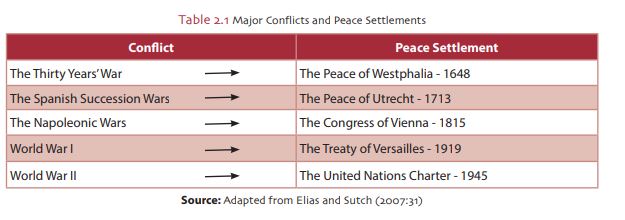
Soru 4
Which of the following did have the most effect on the spreading of the ideas of nationalism and nation-states?
Seçenekler
A
French Revolution
B
Enlightenment
C
Industrial Revolution
D
Napoleonic Wars
E
Renaissance
Açıklama:
One significant European-wide result of the French Revolution was the spread of the concepts of nationalism and nation-states, which were to shape developments for the nineteenth and twentieth centuries. The correct answer is A.
Soru 5
Which of the following created the term "citizen-army"?
Seçenekler
A
Napoleonic Wars
B
French Revolution
C
First World War
D
Second World War
E
Peace of Westphalia
Açıklama:
One significant innovation of the French Republic was the formation of the citizen-army. It enabled France to conscript large numbers of citizens to fight Revolutionary Wars. This mass conscription not only brought military success to the Republic but also led to a shift in the military tactics of other European powers. The correct answer is B.
Soru 6
Which of the following countries did not have a role in decision-making processes during the Congress of Vienna?
Seçenekler
A
Austria
B
Britain
C
Prussia
D
Germany
E
Russia
Açıklama:
Even though every European state appeared at the Congress of Vienna, final decisions ultimately were made by the four major powers: Austria, Britain, Prussia, and Russia. They focused particularly on territorial rearrangements in Europe. To ease their security concerns, they abolished new political units created by Napoleon.
Soru 7
Which of the following is related to the creation of "a twodimensional collective security mechanism"?
Seçenekler
A
The Congress of Vienna
B
The Concert of Europe
C
The Congress of Paris
D
The Bismarckian System
E
The Metternich System
Açıklama:
The Metternich System 1815-1848:
The struggle between conservative monarchies and revolutionary movements had a profound impact on the nature of European politics in the 19th century. After 1815, European states were not only restored as monarchies but were also committed to collectively preserve the monarchical nature of the international system. To that end, they constructed a twodimensional
collective security mechanism. The correct answer is E.
The struggle between conservative monarchies and revolutionary movements had a profound impact on the nature of European politics in the 19th century. After 1815, European states were not only restored as monarchies but were also committed to collectively preserve the monarchical nature of the international system. To that end, they constructed a twodimensional
collective security mechanism. The correct answer is E.
Soru 8
Which of the following was one of the main reasons for the absence of war in Europe from 1871 to 1914?
Seçenekler
A
The Bismarckian System
B
The Congress of Paris
C
The Metternich System
D
The Congress of Vienna
E
The Concert of Europe
Açıklama:
Bismarck’s diplomacy was one of the main reasons for the absence of war in Europe from 1871 to 1914. The correct answer is A.
Soru 9
Which of the following paved the way to recognition of all national borders in Europe and outlawed the use of force to change these borders?
Seçenekler
A
Ostpolitik
B
Strategic Arms Limitation Talks
C
Cuban Missile Crisis
D
Truman Doctrine
E
Helsinki Final Act
Açıklama:
A summit including both Western and Eastern states of Europe was launched in Helsinki, with the Helsinki Final Act being signed in 1975. This treaty recognized all national borders in Europe and outlawed the use of force to change these borders. The Act stated that “the participating states regard as inviolable all one another’s frontiers as well as the frontiers of all states in Europe and therefore they will refrain now and in the future from assaulting these frontiers. The correct answer is E.
Soru 10
Which country does have the highest number of troops for the “Resolute Support Mission” of the North Atlantic Treaty Organization in Afghanistan?
Seçenekler
A
The U.S.A.
B
Germany
C
Turkey
D
Italy
E
Georgia
Açıklama:
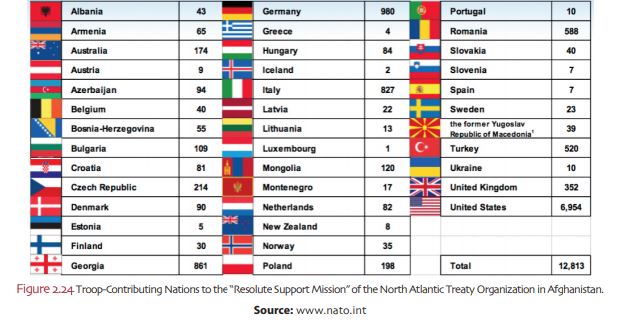
Soru 11
When was Peace of Westphalia that ended The Thirty Years' War signed?
Seçenekler
A
1645
B
1646
C
1647
D
1648
E
1649
Açıklama:
The Peace of Westphalia ended the Thirty Years’ War in 1648. This peace agreement formed the basic characteristics of modern international politics: the rise of the territorially-conceived sovereign state and the beginning of the state-system in Europe. Also, it led to the development of crucial instruments like diplomacy, international congresses, and international law that still constitute the core of International Relations. The correct answer is D.
Soru 12
I. It requires the presence of multiple sovereign states. II. Regular relations and interactions of states must exist as a part of a system. III. States must act while being bound by shared rules and norms that bring them together. IV. States that violate rules and norms must be intervened using military immediately. According to Hedley Bull, which of the above are the defining characteristics of an international system?
Seçenekler
A
only I and II
B
only I an III
C
only II and III
D
I, II, and IV
E
I, II, and III
Açıklama:
Hedley Bull underlines the formation of an international society as one of the patterns of relationships based upon mutual rules and institutions that have been set from interactions among those actors having a specific kind of sovereignty.
According to Bull, an international system has three defining characteristics:
1. First, it requires the presence of multiple sovereign states.
2. Second, regular relations and interactions of these states must exist as a part of a system.
3. Third, these states must act while being bound by shared rules and norms that bring them together. The correct answer is E.
According to Bull, an international system has three defining characteristics:
1. First, it requires the presence of multiple sovereign states.
2. Second, regular relations and interactions of these states must exist as a part of a system.
3. Third, these states must act while being bound by shared rules and norms that bring them together. The correct answer is E.
Soru 13
I. Limited geography of the international system II. Similar political units III. A developing pattern of relationships based on the dynamics of conflict and cooperation between similar political units IV. Political units which are utterly satisfied with their borders and seeking no war Which of the above are the characteristics of the international system that emerged after 1648?
Seçenekler
A
Ionly I and II
B
only I and III
C
only II and II
D
I, II and III
E
I, II and IV
Açıklama:
The most remarkable characteristics of the international system that emerged after the year 1648 were:
• its limited geography,
• similar political units
• a developing pattern of relationships based on the dynamics of conflict and cooperation between these units. The correct answer is D.
• its limited geography,
• similar political units
• a developing pattern of relationships based on the dynamics of conflict and cooperation between these units. The correct answer is D.
Soru 14
After realizing that tax could provide their armies in a limited way, to which way did the European states consult?
Seçenekler
A
Cooperation
B
Slavery of people
C
More taxes
D
Cutback on army expenses
E
Cutback on the expenses of royal traditions
Açıklama:
Realizing that their armies had only limited power because tax resources proved so little, European states discovered that cooperation was cheaper and a more effective way to maximize their interests. Thus, the fast development of a central mechanism for the functioning of the international system: diplomacy. The correct answer is A.
Soru 15
Which peace settlement was signed after The Napoleonic Wars?
Seçenekler
A
The Peace of Westphalia
B
The Peace of Utrecht
C
The Congress of Vienna
D
The Treaty of Versailles
E
The United Nations Charter
Açıklama:
Between 1648 and 1789, each succession war was concluded with a peace settlement following an international diplomatic congress that included all the warring parties. Here are the conflicts and the settlements that followed them:
The Thirty Years’ War --- The Peace of Westphalia - 1648
The Spanish Succession Wars --- The Peace of Utrecht - 1713
The Napoleonic Wars --- The Congress of Vienna - 1815
World War I --- The Treaty of Versailles - 1919
World War II --- The United Nations Charter - 1945 The correct answer is C.
The Thirty Years’ War --- The Peace of Westphalia - 1648
The Spanish Succession Wars --- The Peace of Utrecht - 1713
The Napoleonic Wars --- The Congress of Vienna - 1815
World War I --- The Treaty of Versailles - 1919
World War II --- The United Nations Charter - 1945 The correct answer is C.
Soru 16
Which historical event triggered the collapse of the modern international system in 1793?
Seçenekler
A
Proclamation of the French Republic
B
The assassination of King Gustav III of Sweden
C
Death of George Washington
D
Circumnavigation of the first American ship around the globe
E
Proposition of Bill of Rights in the US House of Representatives
Açıklama:
Until the end of the 1700s, the international system functioned almost perfectly. Its structure and norms were not seriously challenged. The Spanish or Austrian Wars of Succession were not sufficiently brutal to jeopardize the international system. However, the French revolutionary process, which started with the French Revolution in 1789 and reached its peak with the proclamation of the French Republic in 1793, posed a serious threat to the structure of the modern international system, which now was standing on the verge of collapse. Tjhe correct answer is A.
Soru 17
Which of the following is not one of the new ideas that France became the center of during the Enlightenment of the 18th century?
Seçenekler
A
Liberty
B
Citizenship
C
Equality
D
Fraternity
E
Loyalty to the king
Açıklama:
Political revolution was one of the developments that took place in France in the late 18th century. During the Enlightenment of the eighteenth century, France became the center for new ideas, especially liberty, citizenship, equality, fraternity, and patriotism. Against a background of a severe economic crisis, military reversals, and a series of poor harvests, the French Revolution began in 1789. It first sought to end the absolutist rule of Louis XVI and the vicious feudal system of estates or castes. The correct answer is E.
Soru 18
Whicho of the following states is not among the dominant powers that formed a Quadruple Alliance after the Congress of Vienna?
Seçenekler
A
Austria
B
Russia
C
Prussia
D
Britain
E
Ottoman Empire
Açıklama:
Imposed top-down by the victorious powers, the restoration of Europe came under threat from modern ideas introduced by the French Revolution, including liberalism and nationalism. For this reason, it was considered essential to set up a structure that would guarantee the maintenance of the Vienna settlement.
The four dominant powers took measures against the potential threats to the international system. They gave up some of their national interests.
Thus, the Holy Alliance was formed among the autocratic monarchs. It included Alexander I of Russia, Francis I of Austria, and Frederick William III of Prussia. One month later Austria, Britain, Prussia, and Russia signed the treaty that created the Quadruple Alliance. The correct answer is E.
The four dominant powers took measures against the potential threats to the international system. They gave up some of their national interests.
Thus, the Holy Alliance was formed among the autocratic monarchs. It included Alexander I of Russia, Francis I of Austria, and Frederick William III of Prussia. One month later Austria, Britain, Prussia, and Russia signed the treaty that created the Quadruple Alliance. The correct answer is E.
Soru 19
I. The war reparations brought the German economy to the verge of collapse. II. Revolutionary upheavals broke out in virtually every defeated European state. III. To end the turmoil in the defeated states, the United States and Britain proposed a plan that would guarantee recovery of the German economy and the normalization of German foreign policy. IV. Winning nations couldn't give up their desire to invade losing sides completely. Which of the above are the serious problems that emerged in the international system after WWI despite the League of Nations' efforts?
Seçenekler
A
only I and II
B
only I and III
C
only II and III
D
I, II, and III
E
I, II, and IV
Açıklama:
After the Paris Peace Conference in January 1919, hopes for a new world emerged; the League of Nations would resolve all international disputes peacefully.
However, serious problems in the international system emerged, overwhelming the League’s efforts.
- First, the war reparations brought the German economy to the verge of collapse.
- Second, revolutionary upheavals broke out in virtually every defeated European state. -
- Third, to end the turmoil in the defeated states, the United States and Britain proposed a plan that would guarantee recovery of the German economy and the normalization of German foreign policy. The correct answer is D.
However, serious problems in the international system emerged, overwhelming the League’s efforts.
- First, the war reparations brought the German economy to the verge of collapse.
- Second, revolutionary upheavals broke out in virtually every defeated European state. -
- Third, to end the turmoil in the defeated states, the United States and Britain proposed a plan that would guarantee recovery of the German economy and the normalization of German foreign policy. The correct answer is D.
Soru 20
Whichof the following is not included in the five sovereign states that were given the power to veto in the Security Council in the United Nations?
Seçenekler
A
The United States
B
The Union of the Soviet Socialist Republics
C
The Republic of China
D
Britaion
E
Italy
Açıklama:
World War II had been a major victory over fascism in which the two biggest aggressors, Germany and Japan, were soundly defeated. Most of mankind wondered how the new international organization, the United Nations, would work out. Although the new organization was like the League of Nations, it differed in some important respects. Although it was designed to incorporate all sovereign states in the international system, this proved to be legal equality in the General Assembly rather than political equality, because the five victorious allies (the United States, the Union of Soviet Socialist Republics, Britain, France, and the Republic of China) were given veto power in the Security Council.
Soru 21
- The rise of the territorially-conceived sovereign state
- The beginning of the state-system in Europe
- The way for the development of crucial instruments such as diplomacy, international congresses, and international law
- The unchangeable nature of its principles, instruments, and political units
Which of the above are from the Peace of Westphalia from which modern international politics derived its fundamental characteristics ?
Seçenekler
A
I and II
B
I and III
C
II and IV
D
I, II and III
E
II, III and IV
Açıklama:
We start with the Peace of Westphalia that ended the Thirty Years’ War in 1648. It is from this peace settlement that modern international politics derived its fundamental characteristics: the rise of the territorially-conceived sovereign state and the beginning of the state-system in Europe. Furthermore, it paved the way for the development of crucial instruments such as diplomacy, international congresses, and international law that still constitute the core of International Relations. As it can be understood from the information given, the correct answer is D. The international system itself as well as its principles, instruments, and political units have been undergoing constant change since the Peace of Westphalia. In other words, the nature of the international system’s principles, instruments and political units is subject to changes.
Soru 22
- The Renaissance
- The Protestant Reformation
- Congress of Vienna
- The Quadruple Alliance
Which of the above are the two significant developments that hastened the dissolution of the feudal system in Europe?
Seçenekler
A
I and II
B
I and III
C
II and III
D
III and IV
E
I and IV
Açıklama:
The feudal period existed prior to the Westphalian system; then, political authority was fragmented and decentralized among kings, princes, and nobles, all under the supreme authority of the Roman Catholic Pope. Starting in the sixteenth century, dominant European monarchies gradually consolidated their political authority over territories and subjects, even though the feudal power structures left by the Medieval Age still restrained their claims to sovereignty. The Renaissance and the Protestant Reformation, as two significant developments, hastened the dissolution of the feudal system Having begun in Italy and spread across Europe, the Renaissance gave birth to the idea of stato _the core of the modern secular state_. Now European monarchs became keen to assert their sovereignty both internally and externally. As can be understood from the information given the correct answer is A. The Renaissance and the Protestant Reformation, as two significant developments, hastened the dissolution of the feudal system.
Soru 23
- The political authority of the Catholic Church over European rulers
- The spread of independent states across Europe
- The legitimacy gained by allying with the Pope
- The idea of stato, the core of the modern secular state
Which of the above are among the political impacts of the Renaissance and Protestant Reformation in Europe?
Seçenekler
A
I and II
B
I and III
C
II and III
D
II and IV
E
III and IV
Açıklama:
The Renaissance and the Protestant Reformation, as two significant developments, hastened the dissolution of the feudal system. Having begun in Italy and spread across Europe, the Renaissance gave birth to the idea of stato _the core of the modern secular state_. Now European monarchs became keen to assert their sovereignty both internally and externally. Next, the Reformation weakened the political authority of the Catholic Church over European rulers. As of the middle of the sixteenth century Europe was divided into two main camps: Catholic and Protestant. This division was political as much as religious, because there was a power struggle between rulers who had obtained their legitimacy by allying with the Pope and those who had challenged or confronted his authority. The Reformation had considerable political impact, since it reinforced the spread of independent states across Europe. As is also understood from the information given, the correct answer is D. The spread of independent states across Europe and the idea of stato, the core of the modern secular state are among the political impacts of the Renaissance and the Protestant Reformation in Europe.
Soru 24
- The Treaty of Munster
- The Treaty of Osnabrück
- Peace of Augsburg
- The Peace of Utrecht
- Congress of Vienna
Seçenekler
A
I and II
B
III and IV
C
IV and V
D
III and V
E
I and V
Açıklama:
The Peace of Westphalia in 1648 constituted the starting point of the international system: Europe adopted a specific kind of sovereignty and regular interactions among mutually-recognized sovereign states emerged. Further, these interactions developed specific patterns of relations in terms of cooperation and conflict through the normative institutionalization of mutual exchanges between states. They have evolved and developed over time as the international system geographically expanded and its numbers of political actors increased. The Peace of Westphalia incorporated the treaties of Münster and Osnabrück that officially ended the Thirty Years’ War in 1648. Some key features of international politics have been ascribed to the content of these treaties, since they symbolized the emergence of a new international order in which sovereign states interact with each other. As can be understood from the information given the correct answer is A.
The information about the treaties which take place in the other options is as follows:
In 1555, the Peace of Augsburg was signed to reduce sectarian tensions in Europe. It sought peaceful coexistence between Roman Catholics and Protestants (at that time limited to Lutherans) and gave every prince within the Holy Roman Empire the right to choose either Lutheranism or Roman Catholicism in their own domains. However, in practice the Peace of Augsburg was not able to resolve the dispute either religiously or politically.
Between 1648 and 1789, each succession war was concluded with a peace settlement following an international diplomatic congress that included all the warring parties, The Peace of Utrecht put an end to the Spanish Succession Wars in 1713, for instance.
Imposed top-down by the victorious powers, the restoration of Europe came under threat from modern ideas introduced by the French Revolution, including liberalism and nationalism. For this reason, it was considered essential to set up a structure that would guarantee the maintenance of the Vienna settlement. To do so, the Congress of Vienna made significant arrangements for the restructuring of the international system. The major powers sought to recreate a new European political landscape that would parallel the former system and restore the balance of power.
The information about the treaties which take place in the other options is as follows:
In 1555, the Peace of Augsburg was signed to reduce sectarian tensions in Europe. It sought peaceful coexistence between Roman Catholics and Protestants (at that time limited to Lutherans) and gave every prince within the Holy Roman Empire the right to choose either Lutheranism or Roman Catholicism in their own domains. However, in practice the Peace of Augsburg was not able to resolve the dispute either religiously or politically.
Between 1648 and 1789, each succession war was concluded with a peace settlement following an international diplomatic congress that included all the warring parties, The Peace of Utrecht put an end to the Spanish Succession Wars in 1713, for instance.
Imposed top-down by the victorious powers, the restoration of Europe came under threat from modern ideas introduced by the French Revolution, including liberalism and nationalism. For this reason, it was considered essential to set up a structure that would guarantee the maintenance of the Vienna settlement. To do so, the Congress of Vienna made significant arrangements for the restructuring of the international system. The major powers sought to recreate a new European political landscape that would parallel the former system and restore the balance of power.
Soru 25
- International organizations such as the United Nations
- International norms such as “the prohibition on the alteration of state borders by force”
- The rapid development of a central mechanism for the functioning of the international system: diplomacy
- The principle of sovereign equality
- An anomaly at the heart of the international system
Seçenekler
A
I, II and III
B
II, III and IV
C
III, IV and V
D
I, II, III and IV
E
II, III, IV and V
Açıklama:
The international system has so far been successful in protecting its basic political unit, the sovereign state. Despite inherent conflicts in the international system, the Westphalian principles of state sovereignty, equality, and non-interference have formed a basis for cooperation among states. These principles have led to the uniformity of political units, allowing states to develop and adopt norms and principles for cooperation. International organizations such as the United Nations and international norms such as “the prohibition on the alteration of state borders by force” arise from the political and legal inheritance of Westphalian principles.
Realizing that their armies had only limited power because tax resources proved so meager, European states discovered that cooperation was cheaper and a more effective way to maximize their interests. Thus, the rapid development of a central mechanism for the functioning of the international system: diplomacy.
Between 1648 and 1789, each succession war was concluded with a peace settlement following an international diplomatic congress that included all the warring parties, as noted in Table 2.1. The Peace of Utrecht put an end to the Spanish Succession Wars in 1713, for instance. At these congresses, inter-dynastic kinship also facilitated compromise rather than punishment. Congress diplomacy rarely had a transformative impact on the structure of the international system. Instead, it served to restore the status quo and confirm the international system established by the Peace of Westphalia. Both winners and losers of wars had a role to play in the construction of peace. In this period, the principle of sovereign equality provided both powerful and small states with the opportunity of equal representation within the framework of congress diplomacy. The international system based on the principles of the Peace of Westphalia prevailed and was consolidated.
As understood from the information given the correct answer is D.
On the other hand, The French Revolution constituted a major blow to the existence of the Westphalian system in many respects. First it created an anomaly at the heart of international system. The international system had been composed of states whose political systems were monarchies; the practices and norms of the international system were entirely based on aristocratic traditions and values.
So when France proclaimed itself a republic in 1793, it also undermined the political homogeneity of states within the international system.
Moreover the new regime in France interrupted inter-dynastic relations that had formed the basis of European diplomacy. European monarchies could not establish a regular relationship with France other than war. Why? Because the bureaucracies of monarchs had no common basis on which to establish relations with a government that did not share their aristocratic values and qualifications. Nor did the French Republic have a diplomatic alternative to war, since it had not been recognized as a legitimate political unit by other states.
Realizing that their armies had only limited power because tax resources proved so meager, European states discovered that cooperation was cheaper and a more effective way to maximize their interests. Thus, the rapid development of a central mechanism for the functioning of the international system: diplomacy.
Between 1648 and 1789, each succession war was concluded with a peace settlement following an international diplomatic congress that included all the warring parties, as noted in Table 2.1. The Peace of Utrecht put an end to the Spanish Succession Wars in 1713, for instance. At these congresses, inter-dynastic kinship also facilitated compromise rather than punishment. Congress diplomacy rarely had a transformative impact on the structure of the international system. Instead, it served to restore the status quo and confirm the international system established by the Peace of Westphalia. Both winners and losers of wars had a role to play in the construction of peace. In this period, the principle of sovereign equality provided both powerful and small states with the opportunity of equal representation within the framework of congress diplomacy. The international system based on the principles of the Peace of Westphalia prevailed and was consolidated.
As understood from the information given the correct answer is D.
On the other hand, The French Revolution constituted a major blow to the existence of the Westphalian system in many respects. First it created an anomaly at the heart of international system. The international system had been composed of states whose political systems were monarchies; the practices and norms of the international system were entirely based on aristocratic traditions and values.
So when France proclaimed itself a republic in 1793, it also undermined the political homogeneity of states within the international system.
Moreover the new regime in France interrupted inter-dynastic relations that had formed the basis of European diplomacy. European monarchies could not establish a regular relationship with France other than war. Why? Because the bureaucracies of monarchs had no common basis on which to establish relations with a government that did not share their aristocratic values and qualifications. Nor did the French Republic have a diplomatic alternative to war, since it had not been recognized as a legitimate political unit by other states.
Soru 26
- The Industrial Revolution in Great Britain
- Political Revolution in France
- The Westphalian settlement
- German Unification
- The Paris Peace Conference
Which of the above are the two significant developments that Europe witnessed and that had a profound impact on world politics in the late 18th century?
Seçenekler
A
I and II
B
II and III
C
III and IV
D
IV and V
E
I and III
Açıklama:
In the late 18th century, Europe witnessed two significant developments that had a frofound impact on World politics. First in the second half of the century Great Britain was the setting fort he Industrial Revolution . New Industrial Technologies and overseas markets paved the way for a global economic transformation. The second development was the political revolotuion in France. During the Enlightenment of the eighteenth century. France became the center for new ideas, especially liberty, citizenship equality, fraternity, and patriotism. Against a background of a severe economic crisis, military reversals, and a series of poor harvests, the French Revolution began in 1789. It first sought to end the absolutist rule of Louis XVI and the vicious feudal system of estates or castes. The French Revolution had far-reaching consequences. As understood from the information given the correct answer is A. The other hand, the Peace of Westphalia incorporated the treaties of Münster and Osnabrück that officially ended the Thirty Years’ War in 1648. German Unification was accomplished in 1871 through Bismarck’s successful foreign policy. In January 1919, the Paris Peace Conference convened to negotiate peace agreements that would shape the new international system.
Soru 27
- Austria
- Britain
- Prussia
- Russia
- France
Which of the above made the final decisions at the Congress of Vienna?
Seçenekler
A
I and II
B
I, II and III
C
II, III and IV
D
I, II, III and IV
E
II, III, IV and V
Açıklama:
Even though every European state appeared at the Congress of Vienna, final decisions ultimately made by the four major powers: Austria, Britain, Prussia and Russia. They focused on particularly on territorial rearrangements in Europe. To ease their security concerns, they abolished new political units created by Napolean. As also understood from the information given the correct answer is D.
Soru 28
What was the international system called after 1815?
Seçenekler
A
Holy Alliance
B
The Concert of Europe
C
The Westphalian System
D
The Long Peace
E
Congress of Vienna
Açıklama:
The international system after 1815 was called the Concert of Europe. The correct answer is B. The Holy Alliance was a conservative agreement between three dominant Powers_i.e. Austria, Prussia and Russia_to keep the monarchical nature of the international system. The Westphalian System refers to the previous period before The Concert of Europe. The Long Peace refers to the time period lasted until the outbreak of World War I. Congress of Vienna was held 1814-15 to agree the settlement of Europe after the Napoleonic Wars and marked a return to a Europe composed of monarchies.
Soru 29
Which treaty recognized all national borders in Europe and outlawed the use of force to change these borders?
Seçenekler
A
Helsinki Final Act
B
Strategic Arms Limitations Treaty
C
Non-Aligned Movement
D
The Hague Conference
E
Paris Peace Conference
Açıklama:
A summit including both Western and Eastern states of Europe was launched in Helsinki, with the Helsinki Final Act being signed in 1975. This treaty recognized all national borders in Europe and outlawed the use of force to change these borders. The Act stated that “the participating states regard as inviolable all one another’s frontiers as well as the frontiers of all states in Europe and therefore they will refrain now and in the future from assaulting these frontiers. Accordingly, they will also refrain from any demand for, or act of, seizure and usurpation of part or all of the territory of any participating state”. As also understood from the information given the correct answer is A.
The information about the treaties taking place in the other options are as follows:
The de-escalation of the Cold War in Europe also affected the relationship between the bloc leaders. The United States and the Union of Soviet Socialist Republics began negotiations to decrease their nuclear arsenals. The Strategic Arms Limitation Talks bore fruit when the first Strategic Arms Limitations Treaty was signed in 1972. In 1979 both parties found common ground to sign a section treaty, although the United States withdrew from the treaty in 1980, thus blocking any further cooperation between the two superpowers
A third bloc of states appeared in the mid-1950s that wanted to distance itself both ideological camps. This was the so-called Non-Aligned Movement, a collective movement of states that had only recently gained their independence from Western imperial powers.
The United States organized The Hague Conference of 1907 to determine a set of common values and diplomatic practices. One significant decision taken at that conference called for the creation of a permanent international organization within seven years, one where states would be equally represented and where they could resolve their disputes through negotiations.
In January 1919, the Paris Peace Conference convened to negotiate peace agreements that would shape the new international system.
The information about the treaties taking place in the other options are as follows:
The de-escalation of the Cold War in Europe also affected the relationship between the bloc leaders. The United States and the Union of Soviet Socialist Republics began negotiations to decrease their nuclear arsenals. The Strategic Arms Limitation Talks bore fruit when the first Strategic Arms Limitations Treaty was signed in 1972. In 1979 both parties found common ground to sign a section treaty, although the United States withdrew from the treaty in 1980, thus blocking any further cooperation between the two superpowers
A third bloc of states appeared in the mid-1950s that wanted to distance itself both ideological camps. This was the so-called Non-Aligned Movement, a collective movement of states that had only recently gained their independence from Western imperial powers.
The United States organized The Hague Conference of 1907 to determine a set of common values and diplomatic practices. One significant decision taken at that conference called for the creation of a permanent international organization within seven years, one where states would be equally represented and where they could resolve their disputes through negotiations.
In January 1919, the Paris Peace Conference convened to negotiate peace agreements that would shape the new international system.
Soru 30
Which of the following are the defining characteristics of an international system?
I. It should be modern.
II. It requires the existence of a number of states.
III. The states may not be self-governing.
IV. The states should be autonomous.
V. All the states should obey the shared rules and defined norms.
I. It should be modern.
II. It requires the existence of a number of states.
III. The states may not be self-governing.
IV. The states should be autonomous.
V. All the states should obey the shared rules and defined norms.
Seçenekler
A
Only V
B
Only I
C
II, IV, V
D
Only II
E
I, III
Açıklama:
There are three defining characteristics of an international system. It requires multiple states and these states should be autonomus (sovereign). Although the states are autonomous, they should act within the defined rules.
Soru 31
What was the main goal of the Peace of Augsburg?
Seçenekler
A
To end the religious conflict among the Christianity and Islam.
B
To end the conflict between Roman Catholics and Protestants.
C
To make the Roman Catholics dominant.
D
To resolve political dispute.
E
To form a new religious coalition.
Açıklama:
In the book, it is stated that the Peace of Augsburg sought peaceful coexistence between Roman Catholics and Protestants. Since this is a religious conflict, D is not correct. The new coalition was formed following the Peace of Ausburg. Islam and the dominance of Roman Catholics is not mentioned at all.
Soru 32
Which of the following are among the consequences of the Peace of Westphalia?
I. rise of sovereignty as a new principle
II. end of the Thirty Years’ war
III. being independent in domestic affairs
IV. prohibition of wars
V. the right to declare wars
I. rise of sovereignty as a new principle
II. end of the Thirty Years’ war
III. being independent in domestic affairs
IV. prohibition of wars
V. the right to declare wars
Seçenekler
A
Only I
B
Only 4
C
I, II, III
D
IV, V
E
I, V
Açıklama:
The book states that "Sovereignties were granted the right to enter alliances with other states and to declare war." That means, wars are not prohibited; nor are the states given the right to declare war. On the contrary, it states that states can unite and declare war together.
Soru 33
What is the underlying reason of the balance of power?
Seçenekler
A
To form a horizontal relationship among powerful states
B
To create a vertical relationship among less powerful states
C
To gain hegemony over the other states either powerful or less powerful
D
To form an alliance to defeat threats, which might come from other states.
E
For creating competition among the powerful states
Açıklama:
The book notes that "States therefore form a counterbalancing alliance against common threats that they percieve from another state or a coalition of states." meaning that states unite against any kind of threat.
Soru 34
Which of the following is/are the effects of the French Revolution on the Wesphalian system?
I. France changed the nature of the international system.
II. Mutual common understanding among the states of the international system was distorted.
III. All the other stated recognized France a legitimate state immediately.
IV. The international system was not affected by the consequences of the French revolution.
I. France changed the nature of the international system.
II. Mutual common understanding among the states of the international system was distorted.
III. All the other stated recognized France a legitimate state immediately.
IV. The international system was not affected by the consequences of the French revolution.
Seçenekler
A
Only I
B
Only IV
C
I, II, III, IV
D
III, IV
E
I, II,
Açıklama:
France proclaimed itsef a republic; therefore, France changed the nature of the international system, which was composed of monarchy. Mutual common understanding among the states of the international system was distorted because the international system was based on aristocratic traditions and values; and France had no more aristocracy. All the other stated did not recognize France as a republic, and this excludes France from the international system. The international system was affected by the consequences of the French revolution because of the reasons given before.
Soru 35
Which of the following is/are the characteristics of the Concert of Europe?
I. Any structure other than monarcy was not accepted.
II. The main objectives was to maintain the monarchical nature of the international system.
III. It aimed to declare war against liberal and nationalist tendencies.
IV. It held a number of congresses to resolve the differences.
I. Any structure other than monarcy was not accepted.
II. The main objectives was to maintain the monarchical nature of the international system.
III. It aimed to declare war against liberal and nationalist tendencies.
IV. It held a number of congresses to resolve the differences.
Seçenekler
A
I, IV
B
II, IV
C
I, II, IV
D
Only III
E
Only I
Açıklama:
The book states that the main factor behind the Concert of Europe was war-weariness meaning that states, as well as, individuals disapproved the continuance of wars. That is why, III does not belong to the Concert of Europe.
Soru 36
What are the limitations of Bismarckian system?
I. the absence of war in Europe.
II. Germany's unification with other monarchies to get strong.
III. The system Bismarck founded was stable enough.
IV. Bismarck considered each and every monarch in the alliance equally.
I. the absence of war in Europe.
II. Germany's unification with other monarchies to get strong.
III. The system Bismarck founded was stable enough.
IV. Bismarck considered each and every monarch in the alliance equally.
Seçenekler
A
Only I
B
I, II, III, IV
C
I, II
D
II, III
E
III, IV
Açıklama:
The absence of war in Europe was not a limitation but a good thing after the long Napoleon wars. Germany was quite weak so Bismarck helped Germany to gain strength in this way. But his system was not stable and a web of complex relations among the other nations; so, it was not possible to maintain the same system after Bismarck. Besides, Bismarck's system led France and Russia into an imperialistic competition, which would create a conflict among the other states. Therefore, III and IV were the limitations of the Bismarckian system.
Soru 37
Which of the following are the consequences of the World War I?
I. economic independence of the states
II. positive economic contributions to the international system
III. a new ideological dimension with the foundation of SSCR.
I. economic independence of the states
II. positive economic contributions to the international system
III. a new ideological dimension with the foundation of SSCR.
Seçenekler
A
I, II
B
I, II, III
C
II, III
D
I, III
E
Only I
Açıklama:
The book implied that these developments are contributions.
Soru 38
Which of the following are the characteristics of the Cold War?
I. The Cold War lies between two distinct view of politics.
II. It was a kind of one-man system since each bloc has a leader.
III. The bloc leader defines the policies.
IV. Each bloc remained equal.
V. Each leader was contended within their own territory.
I. The Cold War lies between two distinct view of politics.
II. It was a kind of one-man system since each bloc has a leader.
III. The bloc leader defines the policies.
IV. Each bloc remained equal.
V. Each leader was contended within their own territory.
Seçenekler
A
I, II, III, IV, V
B
I, II, III
C
IV, V
D
Only I
E
III, IV
Açıklama:
Each bloc did not remain equal because there was a growing competiton between the bloc leaders. Besides, each leader was not contended within their own territory because leaders of each bloc tried to spread their influence beyond their own limits. Under the light of this information, III and IV are not among the characteristics of the Cold War.
Soru 39
What are the characteristics of the new international system during the post-cold war?
I. The international system has become multi-polar.
II. The USA acts as if there is unipolar international system holding the power.
III. Increasing military and economic powers lead to hold more power in the international system.
IV. States avoid wars no matter how much powerful they are.
I. The international system has become multi-polar.
II. The USA acts as if there is unipolar international system holding the power.
III. Increasing military and economic powers lead to hold more power in the international system.
IV. States avoid wars no matter how much powerful they are.
Seçenekler
A
I, II, III
B
II, III
C
III, IV
D
II, IV
E
Only IV
Açıklama:
The book states that the internation system has an evident unipolarity while the states move towards multipolarity at the sub-systemic level. Such a movement may always have a tendency to trigger another Cold War era. That is why IV is not considered as one of the characteristics of the Post Cold War era.
Soru 40
Which of the following did modern international politics derive its fundamental characteristics from?
Seçenekler
A
Peace of Westphalia
B
The French Revolution
C
The Napoleonic Wars
D
The Congress of Vienna
E
The World War II
Açıklama:
It's the Peace of Westphalia that modern international politics derived its fundamental characteristics
Soru 41
Which of the following is incorrect in relation to the results of the Peace of Westphalia?
Seçenekler
A
It de-escalated tension between Catholicism and Protestantism.
B
It entirely ended the religious wars in Europe.
C
Participants recognized each other's sovereignty.
D
It gave stability to the sectarian divisions within European Christianity.
E
It broke the geographical power of Habsburg Empire.
Açıklama:
The Peace of Westphalia did not entirely end the religious wars.
Soru 42
What does "anarchical nature of the international system" refer to?
Seçenekler
A
Non-interference
B
States' sovereignty
C
States' power seeking
D
States' equality
E
Principles of cooperation
Açıklama:
It refers to the fact that each sovereign state start to seek for more power for their survival
Soru 43
What is the central mechanism developed after Westphalian system in the 17th and 18th centuries?
Seçenekler
A
Army
B
Monarchy
C
Supreme authority
D
Diplomacy
E
Inter-dynastic relations
Açıklama:
The central mechanism developed after 1648 for functioning of the international system is diplomacy.
Soru 44
Which of the following challenged the most the Westphalian system of international relations and caused important changes in the 19th century?
Seçenekler
A
The Peace of Utrecht
B
The Industrial Revolution
C
The Treaty of Vesailles
D
The Treaty of Luneville
E
The French Revolution
Açıklama:
It's the French Revolution that posed serious threat to that system.
Soru 45
Which of the following did the French Revolution end?
Seçenekler
A
Feodalism
B
Patriotism
C
Equality
D
Liberty
E
Citizenship
Açıklama:
It ended vicious feodal system of estates and castes
Soru 46
Which may be considered as one of the causes that weakened the Concert of Europe in the 19th century?
Seçenekler
A
Return to and restoration of monarchical regimes
B
Countries' transformation into constitutional regimes
C
Formation of the Holly Allience among autocratic monarchs
D
Promotion of Christian values in European monarchies
E
Development of a new pattern of diplomacy
Açıklama:
It is the replacement of every European autocracy by constitutional regime.
Soru 47
Which one emerged as a non-European great power at the beginning of the 20th century?
Seçenekler
A
France
B
China
C
Japan
D
India
E
German
Açıklama:
It was Japan that emerged as one of the great powers then. The other one was the USA.
Soru 48
Which event can be considered as a mark of the end of the hegomonic position of Europe in world affairs?
Seçenekler
A
Formation of the Holly Allience
B
German Unification
C
The Congress of Paris
D
World War I
E
World War II
Açıklama:
After World War I, appearance of the new great powers like the USA and Japan indicated the end of the European hegomony.
Soru 49
Which is not true about the World War II and its outcomes?
Seçenekler
A
Liberal and communist states allied to defeat the fascist regimes like the ones in Germany and Italy.
B
A series of satallite communist governments were installed in some European and Baltic states.
C
Europe was ideologically divided into Eastern and Western blocks.
D
The USA started a financial aid program to restore the democratic Western European countries.
E
Germany, France and the UK signed an official pact to control the competition between The USA and SU.
Açıklama:
Except the last option all the others are true about the World War II and its results.
Soru 50
Which of the following period gave birth to the idea of stato - the core of the modern secular state?
Seçenekler
A
The feudal period
B
The Renaissance
C
The Reformation
D
The Medieval Age
E
The Roman catholic period
Açıklama:
Having begun in Italy and spread across Europe, the Renaissance gave birth to the idea of stato - the core of the modern secular state.
Soru 51
Which of the folllowing was signed to reduce sectarian tensions in Europe in 1555?
Seçenekler
A
The Peace of Utrecht
B
The Treaty of Hubertusburg
C
The Peace of Westphalia
D
The Peace of Augsburg
E
The Treaty of Aix la Chapelle
Açıklama:
In 1555, the Peace of Augsburg was signed to reduce sectarian tensions in Europe. It sought peaceful coexistence between Roman Catholics and Protestants (at that time limited to Lutherans) and gave every prince within the Holy Roman Empire the right to choose either Lutheranism or Roman Catholicism in their own domains.
Soru 52
Which of the following was the core principle of the Peace of Westphalia about the modern state and international politics?
Seçenekler
A
Sovereignty
B
Hegemony
C
Feudality
D
Authority
E
Dynasty
Açıklama:
Although some European monarchies such as France or Sweden had been established before 1648, the Peace of Westphalia officially guaranteed not only them but also around 300 small German states exclusive political authority over their respective territories and peoples. For that reason, it marked the emergence of the concept of territoriality, a constitutive characteristic of the modern nation-state. The mutual recognition of the legitimate and independent authority of each territorially-conceived state thus established one of the core principles of the modern state and international politics: sovereignty
Soru 53
Which of the following about the Westphalian system is not correct?
Seçenekler
A
Launched an international system of independent states
B
Launched a territorially-conceived sovereign states
C
Based on common rules
D
Established regular patterns of relationships
E
The Papacy played a leading role
Açıklama:
The Westphalian settlement launched an international system of independent and territorially-conceived sovereign states, a system that acted based on common rules and established regular patterns of relationships.
Soru 54
What does the “invisible hand” mean in the Westphalian system?
Seçenekler
A
The anarchy
B
The unity
C
The hierarchy
D
The hegemony
E
The autonomy
Açıklama:
The hierarchy within the evolving Westphalian system has emerged as a kind of an “invisible hand” which ensures the system consisting of political units, legally equal but varying in material capability, all operating in an equilibrium and maintaining their own continuity without the intervention of a central regulatory authority.
Soru 55
Which of the following matching pair about major conflicts and peace settlements is correct?
Seçenekler
A
The Thirty Years’ War-The Congress of Vienna
B
The Spanish Succession Wars-The Peace of Utrecht
C
The Napoleonic Wars-The Peace of Westphalia
D
World War I-The United Nations Charter
E
World War II-The Treaty of Versailles
Açıklama:
The Thirty Years’ War -The Peace of Westphalia - 1648
The Spanish Succession Wars -The Peace of Utrecht - 1713
The Napoleonic Wars -The Congress of Vienna - 1815
World War I -The Treaty of Versailles - 1919
World War II -The United Nations Charter - 1945
The Spanish Succession Wars -The Peace of Utrecht - 1713
The Napoleonic Wars -The Congress of Vienna - 1815
World War I -The Treaty of Versailles - 1919
World War II -The United Nations Charter - 1945
Soru 56
Which of the following state heralded the end of the Westphalian system?
Seçenekler
A
Russia
B
Prussia
C
Britain
D
Austria
E
France
Açıklama:
The successes of France heralded the end of the Westphalian system and the beginning of a new Napoleonic system.
Soru 57
Which of the following country signed a treaty with the members of the Holy Alliance and created the Quadruple Alliance?
Seçenekler
A
Italy
B
Spain
C
Britain
D
Belgium
E
Denmark
Açıklama:
Although Britain was a monarchy, it did not join the Holy Alliance, for both liberal and constitutional reasons. However, it signed a treaty with the members of the
Holy Alliance, creating the Quadruple Alliance. Thus, Britain was included in the new status quo in Europe and an alliance was formed against possible future aggression from France.
Holy Alliance, creating the Quadruple Alliance. Thus, Britain was included in the new status quo in Europe and an alliance was formed against possible future aggression from France.
Soru 58
Which of the following countries created Three Emperor’s League in 1872?
Seçenekler
A
Austria-Hungary, Germany, and Russia
B
Austria-Hungary, Germany, and Prussia
C
Austria-Hungary, Germany, and Britain
D
Austria-Hungary, France, and Russia
E
Austria-Hungary, Italy, and Prussia
Açıklama:
In 1872, Bismarck devised the Three Emperor’s League between Austria-Hungary, Germany, and Russia. A renewed version of the Holy Alliance, this was a semi-official alliance that sought to control Austrian-Russian competition in the
Balkans.
Balkans.
Soru 59
Which of the following event was the first major turning point in the high tension of the Cold War?
Seçenekler
A
The unification of Germany
B
The Revolution in Iran
C
The Iran-Iraq War
D
The Soviet invasion of Afghanistan
E
Glasnost and Perestroika policies
Açıklama:
By the mid-1970s, it seemed that the high tension of the Cold War had eased. However, near the end of the decade the situation grew worse. The Soviet invasion of Afghanistan was a major turning point, followed by the Revolution in Iran and the Iran-Iraq War. All sent large shockwaves through the Middle East. Alarmed by Soviet aggression and the possibility of another Soviet intervention in Iran, the United States opted for a more assertive foreign policy, adding fuel to the flames.
Soru 60
Which of the following is considered to be the starting point of the international system?
Seçenekler
A
The Peace of Utrecht
B
The Congress of Vienna
C
The peace of Westphalia
D
The United Nations Charter
E
The tReaty of Versailles
Açıklama:
The Peace of Westphalia in 1648 constituted the starting point of the international system.
The correct choice is C.
The correct choice is C.
Soru 61
I. It created an environment conducive to a new political environment.
II. It settled the disputes that hadn't been solved with the Peace of Augsburg.
III. It strengthened the authority of the Roman Catholic Church.
IV. It reinforced the sovereignty of all monarchies.
V. It entirely ended the religious wars.
Which of the above statements are TRUE about the Peace of Westphalia?
II. It settled the disputes that hadn't been solved with the Peace of Augsburg.
III. It strengthened the authority of the Roman Catholic Church.
IV. It reinforced the sovereignty of all monarchies.
V. It entirely ended the religious wars.
Which of the above statements are TRUE about the Peace of Westphalia?
Seçenekler
A
I, II, III
B
II, III, IV
C
III, IV, V
D
I, III, V
E
I, II, IV
Açıklama:
The Peace of Westphalia neither ended the religious wars entirely nor strengthened the authority of the Roman Catholic Church, so III and V are false.
The correct choice is E.
The correct choice is E.
Soru 62
Which of the following refers to a situation in which a powerful state or a coalition of powerful states shapes the international system?
Seçenekler
A
Appeasement
B
Hegemony
C
A counterbalancing alliance
D
Sovereign equality
E
Unipolarity
Açıklama:
Hegemony refers to a situation in which a powerful state or a coalition of powerful states shapes the international system through a set of coercive and non-coercive instruments. The United Kingdom in the nineteenth century and the United States since 1945 are prime examples of hegemonic powers.
The correct choice is B.
The correct choice is B.
Soru 63
Which of the following posed the first serious threat to the modern international system?
Seçenekler
A
The Thirty Years' War
B
The Spanish Succession Wars
C
The French Revolution
D
Cuban Missile Crises
E
World War I
Açıklama:
The French revolutionary process, which started with the French Revolution in 1789 and reached its peak with the proclamation of the French Republic in 1793, posed a serious threat to the structure of the modern international system.
The correct choice is C.
The correct choice is C.
Soru 64
Which of the following aimed to restore a democraticWestern Europe after World War II?
Seçenekler
A
The Truman Doctrine
B
The Marshal Plan
C
The North Atlantic Treaty Organization
D
The Warsaw Pact
E
The Council for Mutual Economic Assistance
Açıklama:
The first post-war ideological confrontation occurred in Europe. As the Soviet Union strengthened its presence through building satellite states in Eastern Europe, America adopted the policy of containment of the Soviet Union. First was the Truman Doctrine in 1947, designed to stop and reverse the expansion of the Soviet Union, and then a year later the Marshall Plan, a financial aid program for Western European states whose infrastructure had been devastated in the war. The Marshal Plan aimed to restore a democratic Western Europe. Another initiative was launched in 1949 with the establishment of the North Atlantic Treaty Organization. It aimed to foster collaboration on security and defense issues among Western nations.
The correct choice is B.
The correct choice is B.
Soru 65
Which of the following is NOT one of the challenges to the Westphalian System caused by the Napoleonic Wars?
Seçenekler
A
Napoleon imposed peace settlement on the defeated European monarchies.
B
European states turned into satellite states.
C
Great Britain and Russia were pushed out of the Westphalian system.
D
The monarchical European powers became incapable of forming any kind of alliance against Napoleon.
E
Territorial arrangements and political structure of the Westphalian system were altered.
Açıklama:
At the Treaty of Chaumont in March 1814, the four old, great monarchical European powers - Austria, Britain, Prussia, and Russia - decided on the principle that none of them would make a separate agreement until the end of Napoleonic rule in France.
The correct choice is D.
The correct choice is D.
Soru 66
Which of the following prioritized the security of Germany in the 19th century?
Seçenekler
A
The Concert of Europe
B
The Bismarckian System
C
The Westphalian System
D
The Congress of Vienna
E
The Metternich System
Açıklama:
Bismarck’s foreign policy priority was the security of Germany.
The correct choice is B.
The correct choice is B.
Soru 67
Which of the following eventually led to the defeat of Napoleon?
Seçenekler
A
The Treaty of Chaumont
B
The Congress of Vienna
C
The Quintiple Alliance
D
The Holy Alliance
E
The Treaty of Versailles
Açıklama:
Firm and united resistance was crucial for preventing Napoleon from permanently altering the Westphalian system. So, at the Treaty of Chaumont in March 1814, the four old, great monarchical European powers - Austria, Britain, Prussia, and Russia - decided on the principle that none of them would make a separate agreement until the end of Napoleonic rule in France. It was the first time the great powers had entered an alliance in the history of the Westphalian system. This cooperation not only hastened Napoleon’s end, but also laid the basis for restructuring the Westphalian system.
The correct choice is A.
The correct choice is A.
Soru 68
When was the first Strategic Arms Limitations Treaty signed?
Seçenekler
A
1969
B
1972
C
1974
D
1980
E
1982
Açıklama:
The de-escalation of the Cold War in Europe also affected the relationship between the bloc leaders. The United States and the Union of Soviet Socialist Republics began negotiations to decrease their nuclear arsenals. The Strategic Arms Limitation Talks bore fruit when the first Strategic Arms Limitations Treaty was signed in 1972.
The correct choice is B.
The correct choice is B.
Soru 69
Which of the following defended strengthening West Germany's ties with the members of the eastern bloc?
Seçenekler
A
Strategic Arms Limitation Talks
B
The Cold War
C
The Helsinki Final Act
D
Ostpolitik
E
The Warsaw Pact
Açıklama:
In the late 1960s West German Chancellor Willy Brandt launched his policy of Ostpolitik. This approach defended the strengthening of ties with members of the eastern bloc. West Germany recognized the regimes of the Soviet Bloc and built strong diplomatic ties with both the Soviet Union and East Germany.
The correct choice is D.
The correct choice is D.
Soru 70
Which of the following ended the Thirty Years War in 1648 and considered as the founding moment of the international system?
Seçenekler
A
The Peace of Westphalia
B
The United Nations Charter
C
The Peace of Augsburg
D
The Treaty of Münster
E
The Congress of Vienna
Açıklama:
The Peace of Westphalia that ended the Thirty Years’ War in 1648. It is from this peace settlement that modern international politics derived its fundamental characteristics: the rise of the territorially-conceived sovereign state and the beginning of the state-system in Europe.
Furthermore, it paved the way for the development of crucial instruments such as diplomacy, international congresses, and international law that still constitute the core of International Relations.
The Peace of Westphalia that ended the Thirty Years’ War in 1648. Therefore, the correct choice is A.
Furthermore, it paved the way for the development of crucial instruments such as diplomacy, international congresses, and international law that still constitute the core of International Relations.
The Peace of Westphalia that ended the Thirty Years’ War in 1648. Therefore, the correct choice is A.
Soru 71
Which of the following is one of the defining characteristics of an international system?
Seçenekler
A
The states should have flags and national anthems.
B
The presence of multiple sovereign states.
C
The states should have certain territory, basically a land.
D
The presence of public on their land and supreme control over its people.
E
The states should have a constitution.
Açıklama:
The primary goal of International Relations is to understand the complex structure of political, economic, social, and military interactions between states; the modern international system must be a network consisting of independent states that structure their interactions according to a set of defined rules. The most significant feature of the international system is its changing nature: its boundaries, political units or actors, defined rules, and unit interactions are all subject to constant change and evolution.
An international system has three defining characteristics: First, it requires the presence of multiple sovereign states. Second, regular relations and interactions of these states must exist as a part of a system. Third, these states must act while being bound by shared rules and norms that bring them together. Therefore the correct choice is B.
An international system has three defining characteristics: First, it requires the presence of multiple sovereign states. Second, regular relations and interactions of these states must exist as a part of a system. Third, these states must act while being bound by shared rules and norms that bring them together. Therefore the correct choice is B.
Soru 72
Why is the Peace of Westphalia, ending the Thirty Years’ War in 1648, considered as the founding moment of the international system?
Seçenekler
A
The Peace of Westphalia was the first step to the formation of sovereign states that hadn't exist before.
B
The Peace of Westphalia was the first agreement between any states in history.
C
The Peace of Westphalia is the most democratic peace agreement that was ever signed between the states in history.
D
The Peace of Westphalia marked the emergence of the modern international system composed of mutually-recognized sovereign and equal states.
E
The Peace of Westphalia is considered as the most universal agreement of its time.
Açıklama:
The international system is constantly evolving, it is a historical phenomenon. In other words, it emerged at a moment of history and has been evolving ever since. To begin, we should identify its starting point. The Anglo-Saxon School of International Relations, founded in the aftermath of World War II, refers to the Peace of Westphalia ending the Thirty Years’ War in 1648 as the founding moment of the international system. This is because it marked the emergence of the modern international system composed of mutually-recognized sovereign and equal states.
The Peace of Westphalia marked the emergence of the modern international system composed of mutually-recognized sovereign and equal states. Therefore, the correct choice is D.
The Peace of Westphalia marked the emergence of the modern international system composed of mutually-recognized sovereign and equal states. Therefore, the correct choice is D.
Soru 73
Which of the following peace settlements put an end to the Napoleonic Wars?
Seçenekler
A
The Peace of Westphalia in 1648
B
The Congress of Vienna in 1815
C
The Peace of Utrecht in 1713
D
The Treaty of Versailles in 1919
E
The United Nations Charter in 1945
Açıklama:
The correct match of the conflicts and peace settlements is as follows:
The Thirty Years’ War - The Peace of Westphalia - 1648
The Spanish Succession Wars - The Peace of Utrecht - 1713
The Napoleonic Wars - The Congress of Vienna - 1815
World War I - The Treaty of Versailles - 1919
World War II - The United Nations Charter - 1945
The Napoleonic Wars were over by the peace settlement made in the Congress of Vienna in 1815. Therefore, the correct choice is D.
The Thirty Years’ War - The Peace of Westphalia - 1648
The Spanish Succession Wars - The Peace of Utrecht - 1713
The Napoleonic Wars - The Congress of Vienna - 1815
World War I - The Treaty of Versailles - 1919
World War II - The United Nations Charter - 1945
The Napoleonic Wars were over by the peace settlement made in the Congress of Vienna in 1815. Therefore, the correct choice is D.
Soru 74
Which of the following peace agreements was the first one in which a European power recognized France as a republic?
Seçenekler
A
The Treaty of Lunéville
B
The Treaty of Chaumont
C
The Treaty of Basel
D
The Congress of Vienna
E
The Treaty of Versailles
Açıklama:
Following the French Revolution, the international system underwent a dramatic transformation. France proved itself to be a very powerful political entity, achieving military successes on the battlefields from 1795 onward. When Prussia signed the Treaty of Basel with France in 1795, it was the first time a European power recognized France as a republic.
When Prussia signed the Treaty of Basel with France in 1795, it was the first time a European power recognized France as a republic. Therefore, the correct choice is C.
When Prussia signed the Treaty of Basel with France in 1795, it was the first time a European power recognized France as a republic. Therefore, the correct choice is C.
Soru 75
Which of the following monarchical European powers signed the Treaty of Chaumont in March 1814 and decided on the principle that none of them would make a separate agreement until the end of Napoleonic rule in France?
Seçenekler
A
Russia - Norway - Denmark - Prussia
B
Italy - Britain - Portugal - Spain
C
Austria - Britain - Prussia - Russia
D
Britain - Russia - Sweden - Italy
E
Britain - Russia - Ottoman Empire - Spain
Açıklama:
Firm and united resistance was crucial for preventing Napoleon from permanently altering the Westphalian system. So, at the Treaty of Chaumont in March 1814, the four old, great monarchical European powers; Austria, Britain, Prussia, and Russia.
They decided on the principle that none of them would make a separate agreement until the end of Napoleonic rule in France. It was the first time the great powers had entered an alliance in the history of the Westphalian system. This cooperation not only hastened Napoleon’s end, but also laid the basis for restructuring the Westphalian system.
The Treaty of Chaumont bound the four great powers to fight Napoleon to the end. The treaty also envisaged holding a congress in Vienna in which the post Napoleonic international system would be shaped. Following the defeat of France in 1814, the Napoleonic Wars ended with the Treaty of Paris.
The Treaty of Chaumont was signed in March 1814 between the four old, great monarchical European powers; Austria, Britain, Prussia, and Russia. They agreed on that none of them would make a separate agreement until the end of Napoleonic rule in France. Therefore, the correct choice is C.
They decided on the principle that none of them would make a separate agreement until the end of Napoleonic rule in France. It was the first time the great powers had entered an alliance in the history of the Westphalian system. This cooperation not only hastened Napoleon’s end, but also laid the basis for restructuring the Westphalian system.
The Treaty of Chaumont bound the four great powers to fight Napoleon to the end. The treaty also envisaged holding a congress in Vienna in which the post Napoleonic international system would be shaped. Following the defeat of France in 1814, the Napoleonic Wars ended with the Treaty of Paris.
The Treaty of Chaumont was signed in March 1814 between the four old, great monarchical European powers; Austria, Britain, Prussia, and Russia. They agreed on that none of them would make a separate agreement until the end of Napoleonic rule in France. Therefore, the correct choice is C.
Soru 76
Which the following was NOT one of the main characteristics of the Concert of Europe?
Seçenekler
A
To encourage nationalist movements in Europe.
B
To block any liberal tendencies in Europe.
C
To keep the monarchical nature of the international system.
D
To prevent any revolutionary movement across Europe.
E
To sustain the new political and territorial order of Europe.
Açıklama:
Inspired by Alexander I of Russia, the Holy Alliance was to promote Christian values in both the external and internal affairs of European monarchies. Austria, Prussia and Russia promised to defeat possible threats to their governments by any means, including the use of force. The main objective was to sustain the new political and territorial order of Europe and prevent any revolutionary movement across Europe. The Holy Alliance was a conservative agreement between three dominant powers to keep the monarchical nature of the international system. Calling upon other European monarchies to join them, the three rulers sought to block any liberal and nationalist tendencies in Europe.
To encourage nationalist movements in Europe was not one of the main characteristics of the Concert of Europe. Therefore, the correct choice is A.
To encourage nationalist movements in Europe was not one of the main characteristics of the Concert of Europe. Therefore, the correct choice is A.
Soru 77
Which of the following is NOT one of the points in Bismarck’s foreign policy which had several important consequences for international politics?
Seçenekler
A
Conducted a strategy that isolated Napoleon III.
B
Reconstructed the Concert of Europe.
C
Created The Dual Alliance Austria-Hungary and Germany.
D
Unified Germany under the leadership of Prussia.
E
Promoted liberal and nationalist tendencies in Europe.
Açıklama:
Bismarck conducted a strategy that isolated Napoleon III, who had launched a bid for mastery in Europe. He successfully unified Germany under the leadership of Prussia, a relatively weak power in Europe. After unification, Germany replaced Austria as the key power in central Europe.
Bismarck reconstructed the Concert of Europe that seemed to have failed by the mid-nineteenth century. For that reason, after 1871 the revivified European system was named after its architect: The Bismarckian system.
In 1872, Bismarck devised the Three Emperor’s League between Austria- Hungary, Germany, and Russia. A renewed version of the Holy Alliance, this was a semi-official alliance that sought to control Austrian-Russian competition in the Balkans. In 1879, Austria-Hungary and Germany also signed an official pact which created The Dual Alliance between the two countries that lasted until the end of World War I.
Promoting liberal and nationalist tendencies in Europe was not a part of Bismarck’s foreign policy. Therefore, the correct choice is E.
Bismarck reconstructed the Concert of Europe that seemed to have failed by the mid-nineteenth century. For that reason, after 1871 the revivified European system was named after its architect: The Bismarckian system.
In 1872, Bismarck devised the Three Emperor’s League between Austria- Hungary, Germany, and Russia. A renewed version of the Holy Alliance, this was a semi-official alliance that sought to control Austrian-Russian competition in the Balkans. In 1879, Austria-Hungary and Germany also signed an official pact which created The Dual Alliance between the two countries that lasted until the end of World War I.
Promoting liberal and nationalist tendencies in Europe was not a part of Bismarck’s foreign policy. Therefore, the correct choice is E.
Soru 78
Which of the following is the financial aid program designed by the USA for Western European states whose infrastructure had been devastated in the World War II?
Seçenekler
A
Non-Aligned Movement
B
North Atlantic Treaty Organization
C
The Bismarckian system
D
The Strategic Arms Limitation Talks
E
The Marshal Plan
Açıklama:
The first post-war ideological confrontation occurred in Europe. As the Soviet Union strengthened its presence through building satellite states in Eastern Europe, America adopted the policy of containment of the Soviet Union. First was the Truman Doctrine in 1947, designed to stop and reverse the expansion of the Soviet Union, and then a year later the Marshall Plan, a financial aid program for Western European states whose infrastructure had been devastated in the war. The Marshal Plan aimed to restore a democratic Western Europe.
The Marshal Plan aimed to restore a democratic Western Europe. Therefore, the correct choice is E.
The Marshal Plan aimed to restore a democratic Western Europe. Therefore, the correct choice is E.
Soru 79
Which of the following is West German Chancellor Willy Brandt's approach that involved strengthening ties with members of the eastern bloc?
Seçenekler
A
Unipolar
B
Ostpolitik
C
Status Quo
D
Perestroika
E
Glasnost
Açıklama:
Willy Brandt's approach defended the strengthening of ties with members of the eastern bloc. West Germany recognized the regimes of the Soviet Bloc and built strong diplomatic ties with both the Soviet Union and East Germany. Brandt and German officials were aware that if the two German states would unite one day, that could be possible only with the consent of the Soviets; of course, that turned out to be true in 1990.
In the late 1960s West German Chancellor Willy Brandt launched his policy of Ostpolitik. Therefore, the correct choice is B.
In the late 1960s West German Chancellor Willy Brandt launched his policy of Ostpolitik. Therefore, the correct choice is B.
Soru 80
Which of the following is defined by "a whole or a network consisting of multiple units that interact within the framework of defined rules"?
Seçenekler
A
System
B
Interaction
C
Characteristic
D
Diplomacy
E
Pattern
Açıklama:
A “system” is either a whole or a network consisting of multiple units that interact within the framework of defined rules.
Soru 81
Which two events hastened the dissolution of the feudal system?
Seçenekler
A
The Renaissance and the Protestant Reformation
B
The Renaissance and the Catholic Reformation
C
The Renaissance and the Lutheran Reformation
D
The Peace of Westphalia and the Renaissance
E
The Peace of Westphalia and the Thirty Years’ War
Açıklama:
The Renaissance and the Protestant Reformation, as two significant developments, hastened the dissolution of the feudal system.
Soru 82
What significant event did the Protestant uprising of Bohemia in 1618 trigger?
Seçenekler
A
the Peace of Augsburg
B
the Thirty Years War
C
the Evangelical Union
D
the Protestant Reformation
E
The Renaissance
Açıklama:
The Protestant uprising of Bohemia in 1618 against the repressive rule of the Habsburg dynasty triggered the Thirty Years War.
Soru 83
According to Henry Kissinger, from which year onwards did politics prioritizing state self-interests replaced politics based on religion?
Seçenekler
A
The early 1530s
B
The late 1530s
C
The late 1540s
D
The early 1550s
E
The early 1630s
Açıklama:
According to Henry Kissinger, from the early 1630s politics prioritizing state self-interests replaced politics based on religion.
Soru 84
What was the most significant result of the Peace of Westphalia?
Seçenekler
A
The idea of secular harmony
B
The idea of secular autonomy
C
The idea of religious solidarity
D
The idea of religious autonomy
E
The idea of religious unity
Açıklama:
The most significant result of the Peace of Westphalia was the establishment of the idea of religious autonomy.
Soru 85
What concept is referred by "the lack of a central authority or world government to enforce rules in the modern international system"?
Seçenekler
A
Meritocracy
B
Democracy
C
Anarchy
D
Aristocracy
E
Monarchy
Açıklama:
Anarchy means the lack of a central authority or world government to enforce rules in the modern international system. In the absence of a higher authority, each actor seeks to ensure its own survival and mobilize all resources at its disposal to this effect (Waltz, 1959: 160; Mearsheimer, 2001: 54-55).
Soru 86
What concept is referred by "a situation in which a powerful state or a coalition of powerful states shapes the international system through a set of coercive and non-coercive instruments"?
Seçenekler
A
Imperialism
B
Colonialism
C
Authority
D
Alliance
E
Hegemony
Açıklama:
Hegemony refers to a situation in which a powerful state or a coalition of powerful states shapes the international system through a set of coercive and non-coercive instruments. The United Kingdom in the nineteenth century and the United States since 1945 are prime examples of hegemonic powers (Kwon, 2011: 594-595)
Soru 87
Which peace settlement put an end to the Spanish Succession Wars in 1713?
Seçenekler
A
The Peace of Utrecht
B
The Peace of Westphalia
C
The Congress of Vienna
D
The Treaty of Versailles
E
The United Nations Charter
Açıklama:
The Peace of Utrecht put an end to the Spanish Succession Wars in 1713.
Soru 88
Which peace settlement put an end to The Thirty Years’ War?
Seçenekler
A
The Peace of Westphalia
B
The Peace of Utrecht
C
The Congress of Vienna
D
The Treaty of Versailles
E
The United Nations Charter
Açıklama:
The Peace of Westphalia put an end to The Thirty Years’ War.
Soru 89
Which of the following remarks the rise of the territorially-conceived sovereign state and the beginning of the state-system in Europe?
Seçenekler
A
The Second World War
B
The Peace of Westfalia
C
The French Revolution
D
The Cold War
E
The First World War
Açıklama:
The Peace of Westfalia remarks the rise of the territorially-conceived sovereign state and the beginning of the state-system in Europe
Soru 90
I. A system requires single units or actors. II. Independent political units act only on the local levels. III. Interactions in the international system take place within the framework of defined rules. IV. The international system includes the collection of independent political entities. Which of the above is/are true about the concept of the international system?
Seçenekler
A
Only I
B
Only III
C
I and II
D
III and IV
E
I and IV
Açıklama:
Statements III and IV are true for the concept of the international system.
Soru 91
I. It marks the ending of the Thirty Years' War in 1648. II. It officially defines and lists the characteristics of the international system. III. It is the beginning of the new international order in which sovereign states interact with each other. IV. It symbolizes the starting point of a new feudal system in Europe. Which of the above is/are true for the Peace of Westphalia?
Seçenekler
A
Only II
B
Only IV
C
I and II
D
I and III
E
II and IV
Açıklama:
Statements I and III are true about the Peace of Westphalia.
Soru 92
Which of the following has an influence on the dissolution of the feudal system prior to the Peace of Westphalia?
Seçenekler
A
The Renaissance
B
The War of the Roses
C
The Industrial Revolution
D
The First World War
E
The Napoleonic Wars
Açıklama:
The Renaissance has an influence on the dissolution of the feudal system prior to the Peace of Westphalia.
Soru 93
Who is the founder of the Protestantism that has an influence on the emergence of international relations?
Seçenekler
A
Napoleon Bonaparte
B
Ferdinand II
C
Martin Luther
D
The Habsburg Dynasty
E
Stephen J. Lee
Açıklama:
Martin Luther is the founder of the Protestantism that has an influence on the emergence of international relations.
Soru 94
Which of the following remarks the reduction of the sectarian conflicts in Europe giving every prince within the Holy Roman Empire the right to choose either Lutheranism or Roman Catholicism in their own domains?
Seçenekler
A
The Thirty Years' War
B
The Peace of Westphalia
C
Treaty of Aix la Chapelle
D
Treaty of Utrecht
E
The Peace of Augsburg
Açıklama:
The Peace of Augsburg remarks the reduction of the sectarian conflicts in Europe giving every prince within the Holy Roman Empire the right to choose either Lutheranism or Roman Catholicism in their own domains.
Soru 95
I. The primary actor of the Westphalian system is the Catholic Church. II. It helps to form a structure of a system for the political actors in international relations. III. There is a power-based hierarchy in the Westphalian system. IV. It allows for the emergence of a superior authority above all political actors. Which of the above is/are true for the Westphalian System?
Seçenekler
A
Only II
B
I and II
C
II and III
D
I-II and III
E
III and IV
Açıklama:
Statements II and III are true for the Westphalian System.
Soru 96
Which of the following has an influence on the functioning of diplomacy as an international system that allows for the cooperation of European states in the post-Westphalian period?
Seçenekler
A
The effects of Renaissance on thinking
B
Limited tax resources for military actions
C
Kings' unlimited expenses on luxury
D
Landowners' ambitions for tightening the feudal system
E
Improvements in living conditions for the middle class
Açıklama:
Limited tax resources for military actions have an influence on the functioning of diplomacy as an international system that allows for the cooperation of European states in the post-Westphalian period.
Soru 97
I. Its limited geography
II. Supreme authorities of certain states
III. Similar political units
IV. Development of conflict and cooperation among political units
Which of the following is/are true about the characteristics of the international system emerged after 1648?
II. Supreme authorities of certain states
III. Similar political units
IV. Development of conflict and cooperation among political units
Which of the following is/are true about the characteristics of the international system emerged after 1648?
Seçenekler
A
Only II
B
II-III and IV
C
I and IV
D
I and II
E
I-III and IV
Açıklama:
Statements I-III and IV are true about the characteristics of the international system emerged after 1648.
Soru 98
................. refers to a situation in which a powerful state or a coalition of powerful states shapes the international system through a set of coercive and non-coercive instruments.
Seçenekler
A
Hegemony
B
Cooperation
C
Diplomatics
D
Sovereignty
E
Feudalism
Açıklama:
Hegemony refers to a situation in which a powerful state or a coalition of powerful states shapes the international system through a set of coercive and non-coercive instruments.
Ünite 3
Soru 1
Which of the followings is considered to be the foremost classical theories in International Relations?
- I_Realism
- II_Neorealism
- III_Neoliberalism
- IV_Idealism
Seçenekler
A
I and II
B
I, II and III
C
III and IV
D
I and IV
E
II and IV
Açıklama:
The foremost classical theories are realism and idealism/liberalism. Contemporary alternative theories are neorealism, neoliberalism, and the “English School” of thought. The correct option is D.
Soru 2
- Who is the author of the book “The Prince”?
Seçenekler
A
Thomas Hobbes
B
Niccolò Machiavelli
C
Thucydides
D
John Locke
E
Hans Morgenthau
Açıklama:
Niccolò Machiavelli followed Thucydides’ initial premises in theoretical realism. He was the author of The Prince written in 1513. The correct option is B.
Soru 3
Which of the following theories focuses on a political philosophy and ideology in which primary emphasis is placed on securing the freedom of the individual and limiting the power of the government?
Seçenekler
A
Classical Liberalism
B
Realism
C
Neoliberalism
D
Marxism
E
Neorealism
Açıklama:
Classical liberalism is a political philosophy and ideology in which primary emphasis is placed on securing the freedom of the individual and limiting the power of the government. The correct option is A.
Soru 4
Which of the followings is TRUE about the main points of Neoliberalism?
- I_ The rule of the market-freedom for capital, goods and services
- II_ Increasing public expenditure for social services by the government
- III_ Privatization of public enterprise
- IV_ Deregulation, to allow market forces to act as a self-regulating mechanism
Seçenekler
A
I and II
B
II, III and IV
C
I, III and IV
D
I and III
E
III and IV
Açıklama:
The main points of neoliberalism include:
In this respect, item II is not correct. The correct option is C.
- The rule of the market-freedom for capital, goods and services, where the market is self-regulating allowing the trickle-down notion of wealth distribution.
- Reducing public expenditure for social services, such as health and education, by the government
- Deregulation, to allow market forces to act as a self-regulating mechanism • Privatization of public enterprise (from water to the Internet)
In this respect, item II is not correct. The correct option is C.
Soru 5
Marx, who based his views on _________, advocated that workers free themselves from the burdens placed upon them by those who control the means of production. Which of the followings completes the blank above?
Seçenekler
A
Materialism
B
Anarchy
C
Mercantilism
D
Bandwagoning
E
Polarity
Açıklama:
Marxism, developed by Karl Marx (and to a lesser extent by his associate, Friedrich Engels) in the mid1800s, is based upon principles related to social class and to economics. Marx, basing his views on materialism, advocated that workers free themselves from the burdens placed upon them by those who control the means of production. The correct option is A.
Soru 6
Which of the following items is among the principles about order according to The English School?
- I_ National System or social order
- II_ World Society
- III_ International Society or order
Seçenekler
A
Only I
B
I and II
C
II and III
D
Only III
E
I and III
Açıklama:
The English School’s theory of International Relations is posited on several sets of principles. The first of these sets relates to the three kinds of order always influencing the world simultaneously: The first is the International System or social order, the second one is International Society or order between states in a system or society of states. The third is World Society-from Kantian philosophy regarding the liberal aspects of the state system. The correct option is C.
Soru 7
- Nothing can be objectively true or false; indeed, there is no such thing as truth.
- There is no value on scientific and technological advances for human progress.
- Language does not reflect nature.
- Reason and logic are valid only within the established intellectual traditions they are used.
What theory do the principles above belong to?
Seçenekler
A
Critical Theory
B
Constructivism
C
Feminism
D
Liberalism
E
Realism
Açıklama:
Critical theorists made their approach distinctive from the more traditional ones.
• Critical theorists deny that there is a natural reality, apart from human beings.
• Nothing, they argue, can be objectively true or false; indeed, there is no such thing as truth.
• They also place no value on scientific and technological advances for human progress.
• Reason and logictoo are merely conceptual, and are therefore valid only within the established intellectual traditions in which
they are used.
• Furthermore, there is no such thing as human nature; what is taken for it is human psychology, socially created and determined.
• Language does not reflect nature; the meaning of a word is not a staticthing in the world oreven an idea in the mind but rather
a range of contrasts and differences with the meanings of other words.
The correct option is A.
• Critical theorists deny that there is a natural reality, apart from human beings.
• Nothing, they argue, can be objectively true or false; indeed, there is no such thing as truth.
• They also place no value on scientific and technological advances for human progress.
• Reason and logictoo are merely conceptual, and are therefore valid only within the established intellectual traditions in which
they are used.
• Furthermore, there is no such thing as human nature; what is taken for it is human psychology, socially created and determined.
• Language does not reflect nature; the meaning of a word is not a staticthing in the world oreven an idea in the mind but rather
a range of contrasts and differences with the meanings of other words.
The correct option is A.
Soru 8
___________ is freedom from power, domination, and influence of others over a person or society. It includes efforts to obtain social, economic and/or political rights or equality. Which of the followings completes the sentence above correctly?
Seçenekler
A
Ontology
B
Balance of power
C
Pluralist account
D
Normative feminism
E
Emancipation
Açıklama:
Emancipation is freedom from power, domination, and influence of others over a person or society. It includes efforts to obtain social, economic and/ or political rights or equality. The correct option is E.
Soru 9
Who is the author of the book “Social Theory of International Politics”?
Seçenekler
A
Martha Finnemore
B
Cynthia Enloe
C
Nicholas Onuf
D
Alexander Wendt
E
Herbert Marcuse
Açıklama:
One cannot address constructivist theory without citing Alexander Wendt, who is the author of “Social Theory of International Politics”. The correct option is D.
Soru 10
Which of the followings cannot be one of the concerns of Feminism?
Seçenekler
A
International organizations
B
Transnational actors
C
Race and class
D
The actions of states
E
The use of force and violence
Açıklama:
More recently, feminism has examined broad areas of concern, including: the actions of states, international organizations, transnational actors, race, and class. Feminist theoreticians tend to avoid conclusions that indicate “masculinist” approaches, those which emphasize coercion, coercive diplomacy, the use of force and violence, and unilateralism. The correct option is E.
Soru 11
I.All men are equal. II.They interact in anarchy. III. They are driven by competition, distrust of others (egoism), and glory. Hobbes argues that the best way to achieve peace is to construct the Leviathan, the undivided, sovereign government, through social contract. Which assumption/s above is/are Hobbes’s this conclusion based on?
Seçenekler
A
only I
B
only II
C
only I and II
D
only I and III
E
I, II and III
Açıklama:
Hobbes argues that the best way to achieve peace is to construct the Leviathan, the undivided, sovereign government, through social contract. Hobbes based this conclusion on three assumptions: 1. All men are equal; 2. They interact in anarchy; 3. They are driven by competition, distrust of others (egoism), and glory. the correct answer is E.
Soru 12
It is formally defined as a group of sovereign states associated by their own choices, and linked by common interests and objectives. Which following notions does the definition above belong to?
Seçenekler
A
Commonwealth
B
Leviathan
C
Sovereign
D
Anarchy
E
Paradigm
Açıklama:
Commonwealth is formally defined as a group of sovereign states associated by their own choices, and linked by common interests and objectives (Evans and Newnham, 1998, 82-84). The correct answer is A.
Soru 13
Which one of the following philosophers is associated with Neorealism, a modern international relations theory?
Seçenekler
A
Kenneth Waltz
B
Adam Smith
C
John Locke
D
Hans Morgenthau
E
Niccolò Machiavelli
Açıklama:
John Locke and Adam Smith were two who had significant influence on the assumptions of idealism, the foundation of classical liberalism. Hans Morgenthau and Niccolò Machiavelli are supporters of realism. On the other hand, Kenneth Waltz (author of the influential Theory of International Politics, 1979) is most often associated with neorealism. The correct anwer is A.
Soru 14
Which of the following international relations thearies was characterized above all by explicit reliance upon the exercise of judgment, i.e., a pragmatic approach that stressed normative traits of International Relations?
Seçenekler
A
Marxism
B
The English School
C
Neoliberalism
D
Critical Theory
E
Realism
Açıklama:
Hedley Bull indicated that this traditional approach, that is The English School was characterized above all by explicit reliance upon the exercise of judgment (Bull 1969), i.e., a pragmatic approach that stressed normative traits of International Relations. The correct answer is B.
Soru 15
Which one of the followings is a post-modern international relations theory?
Seçenekler
A
realism
B
liberalism
C
neoliberalism
D
feminism
E
the English school
Açıklama:
The foremost classical theories are realism and idealism/liberalism. Contemporary alternative theories are neorealism, neoliberalism, and the “English School” of thought. On the other hand, three of the more well-known postmodern International Relations theories are Critical Theory, Constructivism, and Feminism. The correct answer is D.
Soru 16
I.These theorists deny that there is a natural reality, apart from human beings.II.Nothing, they argue, can be objectively true or false; indeed, there is no such thing as truth.III.They also place no value on scientific and technological advances for human progress.IV.Reason and logic too are merely conceptual, and are therefore valid only within the established intellectual traditions in which they are used.V.This theory does not argue against the necessity of the state in world affairs, nor does it deny anarchy. Which of the principles above belong to Critical Theory?
Seçenekler
A
only I and IV
B
only I, II
C
II, IV and V
D
I, II, III and IV
E
I, II, III and V
Açıklama:
Critical theorists made their approach distinctive from the more traditional ones: Critical theorists deny that there is a natural reality, apart from human beings. Nothing, they argue, can be objectively true or false; indeed, there is no such thing as truth. They also place no value on scientific and technological advances for human progress. Reason and logic too are merely conceptual, and are therefore valid only within the established intellectual traditions in which they are used. However, The English School does not argue against the necessity of the state in world affairs, nor does it deny anarchy. The correct answer is D.
Soru 17
Which one of the followings is not among the critical theorists forming the Frankfurt School in Germany?
Seçenekler
A
Max Horkheimer
B
Peter Katzenstein
C
Theodor Adorno
D
Erich Fromm
E
Walter Benjamin
Açıklama:
The most well-known group of critical theorists formed the Frankfurt School in Germany. Max Horkheimer, Theodor Adorno, Erich Fromm, Walter Benjamin, Jürgen Habermas, and Herbert Marcuse were among the core group at the Frankfurt School (the Institute for Social Research) beginning in the early 1920s). Peter Katzenstein is a constructivst. The correct answer is B.
Soru 18
Which of the following notions can be defined as the freedom from power, domination, and influence of others over a person or society?
Seçenekler
A
Ontology
B
Neomercantilism
C
Emancipation
D
Epistemology
E
Neoliberalism
Açıklama:
Emancipation: freedom from power, domination, and influence of others over a person or society. The correct answer is c.
Soru 19
Which one of the followings is not a Constructivist international relations theorist?
Seçenekler
A
Alexander Wendt
B
Nicholas Onuf
C
Martha Finnemore
D
Peter Katzenstein
E
Stephen D. Krasner
Açıklama:
One cannot address constructivist theory without citing Alexander Wendt, its foremost theorist. Nicholas Onuf, Martha Finnemore, and Peter Katzenstein are other leading constructivists. On the other hand, Stephen D. Krasner is a neorealist. The correct answer is E.
Soru 20
Who is the writer of the book “Bananas, Beaches and Bases” and which theory does this writer support?
Seçenekler
A
Martha Finnemore, constructivism
B
Max Horkheimer, critical theory
C
Hedley Bull, the English School
D
Cynthia Enloe, feminism
E
Kenneth Waltz, neorealism
Açıklama:
Enloe, in her 1989 book, Bananas, Beaches and Bases, laid out how international politics “frequently involves intimate relationships, personal identities and private lives.” She is a supporter of feminist approach. The correct answer is D.
Soru 21
Which of the following theories does Cynthia Enloe, the writer of Bananas, Beaches, and Bases support?
Seçenekler
A
constructivism
B
critical theory
C
the English school
D
feminism
E
neorealism
Açıklama:
One of the feminist International Relations scholars who is quite well-known, Cynthia
Enloe, approached the feminist “revolution” by suggesting that “the personal which is political” is also, quite likely, international. Enloe, in her 1989 book, Bananas, Beaches and Bases, laid out how international politics “frequently involves intimate relationships, personal identities and private lives.” Too often, these have been ignored by scholars (True, 2005, 214).
Enloe, approached the feminist “revolution” by suggesting that “the personal which is political” is also, quite likely, international. Enloe, in her 1989 book, Bananas, Beaches and Bases, laid out how international politics “frequently involves intimate relationships, personal identities and private lives.” Too often, these have been ignored by scholars (True, 2005, 214).
Soru 22
- Thucydides
- Niccolò Machiavelli
- Thomas Hobbes
- John Locke
- Adam Smith
Seçenekler
A
I and II
B
I, II and III
C
I, III and IV
D
II, III and V
E
II, IV and V
Açıklama:
One of the oldest and most widely accepted political theories is realism. There are several theorists and their works that are regarded as classics of realism. Many date realism’s initial formulation back to the writer Thucydides in his History of the Peloponnesian Wars (341-301 BCE).Thucydides wrote his masterwork as a disgraced general, sometimes from second-hand sources, of the events of the Peloponnesian War. Hobbes are considered by some experts to be the forefathers of today’s realist approaches to IR. As also understood from the information given, the correct answer is B. John Locke and Adam Smith were two who had significant influence on the assumptions of idealism, the foundation of classical liberalism.
Soru 23
- Strong Sovereign
- Sovereign States
- The Social Contract
- Politics as a Non-Zero-Sum Game
- A Self-Help System
Seçenekler
A
I and II
B
II and V
C
I, II and III
D
I, III and V
E
III, IV and V
Açıklama:
The concepts of (a) the strong sovereign (the “Leviathan”), (b) sovereign states, and (c) the social contract were three of Hobbes’s important contributions to realism. As also onderstood from the information given, the correct answer is C.
Information related to the other two options as follows;
Politics as a non-zero-sum game: The current international system includes aspects of idealism. There are communities and cooperation, often expressed in modern international institutions such as the European Union, the Organization for Security and Cooperation in Europe, or the North Atlantic Treaty Organization. Idealism bases elements of its theory on politics as a non-zero-sum game; states can benefit by cooperating with other states, and by tolerating difference. Mutual gains, especially economic and security gains, then become more meaningful and significant than entering conflicts with other states.
A Self-Help System: There are two basic principles underlying neorealism: first, the international system’s ordering principle is anarchy: there is no such thing as a world power superior to states. This results in an international system that is essentially a self-help system, with autonomous states that are functionally similar actors, each of which must always be prepared to defend or protect itself.
Information related to the other two options as follows;
Politics as a non-zero-sum game: The current international system includes aspects of idealism. There are communities and cooperation, often expressed in modern international institutions such as the European Union, the Organization for Security and Cooperation in Europe, or the North Atlantic Treaty Organization. Idealism bases elements of its theory on politics as a non-zero-sum game; states can benefit by cooperating with other states, and by tolerating difference. Mutual gains, especially economic and security gains, then become more meaningful and significant than entering conflicts with other states.
A Self-Help System: There are two basic principles underlying neorealism: first, the international system’s ordering principle is anarchy: there is no such thing as a world power superior to states. This results in an international system that is essentially a self-help system, with autonomous states that are functionally similar actors, each of which must always be prepared to defend or protect itself.
Soru 24
Realpolitik is…
Seçenekler
A
a 19th century German term, indicating the adoption of limited objectives that have a fair chance of success.
B
defined as the capability to induce or force another to comply with one’s wishes: either to start or continue an activity, or to cease that behavior
C
also called “structural realism” because it emphasizes the design and structure of the world system rather than stressing man’s nature and the states as units, as realism does.
D
a school of thought inspired by the writings of Karl Marx, and refined by V.I. Lenin and others.
E
the study of knowledge and justified belief.
Açıklama:
Realpolitik is a 19th century German term, indicating the adoption of limited objectives that have a fair chance of success. The correct answer is A. The definitons for the terms taking place in the other options as follows:
Power is defined as the capability to induce or force another to comply with one’s wishes: either to start or continue an activity, or to cease that behavior.
Neorealism is also called “structural realism” because it emphasizes the design and structure of the world system rather than stressing man’s natüre and the states as units, as realism does.
Marxism is a school of thought inspired by the writings of Karl Marx, and refined by V. I. Lenin and others.
Epistemology: the study ofmknowledge and justified belief. As the study of knowledge, epistemology is concerned with the following questions: What are the necessary and sufficient conditions of knowledge? What are its sources? What is its structure, and what are its limits? How is knowledge justified? Epistemology addresses issues having to do with the creation and dissemination of knowledge in areas of inquiry. It examines “how we know what we think we know”
Power is defined as the capability to induce or force another to comply with one’s wishes: either to start or continue an activity, or to cease that behavior.
Neorealism is also called “structural realism” because it emphasizes the design and structure of the world system rather than stressing man’s natüre and the states as units, as realism does.
Marxism is a school of thought inspired by the writings of Karl Marx, and refined by V. I. Lenin and others.
Epistemology: the study ofmknowledge and justified belief. As the study of knowledge, epistemology is concerned with the following questions: What are the necessary and sufficient conditions of knowledge? What are its sources? What is its structure, and what are its limits? How is knowledge justified? Epistemology addresses issues having to do with the creation and dissemination of knowledge in areas of inquiry. It examines “how we know what we think we know”
Soru 25
- Being too focused on higher-level political analyses
- The centrality it places on the unit of the state
- Its reliance on human nature, ego and emotion
- Telling us “a small number of big and important things
Seçenekler
A
I and II
B
I and III
C
III and IV
D
I, II and III
E
II, III and IV
Açıklama:
Realism is the dominant and most effective framework today to explain world politics. However, it does have both strengths and weaknesses when used in the real world because it is a theoretical account of how the world works. Realism has been criticized for being too focused on higher-level political analyses, for the centrality it places on the unit of the state, and for its reliance on human nature, ego and emotion. As also understood from the information given the correct answer is D.
Realism as a perspective cannot explain everything. As Kenneth Waltz indicated, the contribution of realism to international relations lies is telling us “a small number of big and important things” . What is mentioned in the last option has not been considered as a critics. Telling us “a small number of big and important things” has been indicated as a contibution.
Realism as a perspective cannot explain everything. As Kenneth Waltz indicated, the contribution of realism to international relations lies is telling us “a small number of big and important things” . What is mentioned in the last option has not been considered as a critics. Telling us “a small number of big and important things” has been indicated as a contibution.
Soru 26
- It promotes toleration, reason and progress, equality before the law, and an open economy.
- It suggests that states would search for long-term mutual gains instead of short-term individual gains if their security and sovereignty were not significantly diminished or threatened.
- It focuses on how power contributes to a variety of political outcomes and to a state’s security, and by its assumptions, concludes there can be little security for any weak state (one with little power).
- The main indicator of it is the concept of interest defined in terms of power, which inserts rational order into politics and thus makes the theoretical understanding of politics possible.
Seçenekler
A
I and II
B
I and III
C
II and III
D
III and IV
E
I and V
Açıklama:
Idealism promotes toleration, reason and progress, equality before the law, and an open economy. It suggests that states would search for long-term mutual gains instead of short-term individual gains if their security and sovereignty were not significantly diminished or threatened. Idealism’s terms underlie liberal political thought. As also understood from the information given the correct answer is A. The information taking place in the third option is related to realism. To Morgenthau, realism is a power politics theory. That is, it focuses on how power contributes to a variety of political outcomes and to a state’s security, and by its assumptions, concludes there can be little security for any weak state (one with little power). The information taking place in the fourth option is related to political realism. The main indicator of political realism is the concept of interest defined in terms of power, which inserts rational order into politics and thus makes the theoretical understanding of politics possible. Political realism avoids concerns with the motives and ideology of politicians, diplomats, military leaders, and others in the political arena.
Soru 27
- It emerged as a response to the Industrial Revolution and urbanization in the 19th century in Europe and the United States
- It emerged as a response to dehumanizing aspects of the social order.
- It was a turn away from the traditional central focus of International Relations, the development of sovereign states.
- It focuses on how power contributes to a variety of political outcomes and to a state’s security, and by its assumptions, concludes there can be little security for any weak state (one with little power).
Which of the above gives correct information about classical liberalism?
Seçenekler
A
I and IV
B
II and IV
C
III and IV
D
I, II and III
E
II, III and IV
Açıklama:
Classical liberalism emerged as a response to the Industrial Revolution and urbanization in the 19th century in Europe and the United States, a time when dehumanizing aspects of the social order were of concern to many. It was also a turn away from the traditional central focus of International Relations, the development of sovereign states. As also understood from the information givent, the correct answer is D. The information taking place in the fourth option is related to realism. To Morgenthau, realism is a power politics theory. That is, it focuses on how power contributes to a variety of political outcomes and to a state’s security, and by its assumptions, concludes there can be little security for any weak state (one with little power).
Soru 28
- The International System or social order
- International Society or order between states in a system or society of states.
- World Society from Kantian philosophy regarding the liberal aspects of the state system.
- Anarchy; there is no such thing as a World power superior to states.
Seçenekler
A
I and II
B
II and III
C
III and IV
D
I, II and III
E
II, III and IV
Açıklama:
The English School’s theory of International Relations is posited on several sets of principles. The first of these sets relates to the three kinds of order always influencing the world simultaneously.
- The first is the International System or social order ; this is about power politics.
- The second is International Society or order between states in a system or society of states.
- The third is World Society_from Kantian philosophy regarding the liberal aspects of the state system.
- First, the international system’s ordering principle is anarchy: there is no such thing as a world power superior to states. This results in an international system that is essentially a self-help system, with autonomous states that are functionally similar actors, each of which must always be prepared to defend or protect itself.
- The second defining principle of the structure of international politics is the distribution of capabilities (power) across the units inhabiting the international system.
Soru 29
- Critical Theory
- Constructivism
- Feminism
- The English School
- Classical Liberalism
Seçenekler
A
I and II
B
I and V
C
I, II and III
D
I, IV and V
E
II, IV and V
Açıklama:
Three of the more well-known postmodern International Relations theories are:
- Critical Theory
- Constructivism
- Feminism
Soru 30
What did the most well-known group of critical theorists form?
Seçenekler
A
The Frankfurt School
B
The English School
C
Social Constructivism
D
Classical Liberalism
E
Neorealism
Açıklama:
The most well-known group of critical theorists formed the Frankfurt School in Germany. As also understood from the information given, the correct answer is A. Max Horkheimer, Theodor Adorno, Erich Fromm, Walter Benjamin, Jürgen Habermas, and Herbert Marcuse were among the core group at the Frankfurt School (the Institute for Social Research) beginning in the early 1920s). Kant, Schiller, and Hegel, as well as Nietzsche, Lukács, Weber, and Freud, inspired the critical perspective of the Frankfurt School.
Soru 31
Which feminism values the unique contributions of women as women and doesn't think women do all things as well as men or vice versa?
Seçenekler
A
Difference Feminism
B
Liberal Feminism
C
Empirical Feminism
D
Analytical Feminism
E
Normative Feminism
Açıklama:
There are two strands of feminism that tend to be utilized in theoretical analysis based on feminism: (1) difference feminism, and (2) liberal feminism. Difference feminism values the unique contributions of women as women. Difference feminists do not think women do all things as well as men or vice versa. As also understood from the information given, the correct answer is A. Liberal feminists allege that difference feminist assertions are based on stereotypes of gender roles. Men and women are equal, according to them. Liberal feminists tend to examine the International Relations system less, and to explore women as subjects of study more: women in the military, women state leaders, and other women operating outside the traditional gender roles. Empirical feminism focuses on women or examining gender as a specific dimension of International Relations. Analytical feminism takes up gender as a theoretical category to reveal and explore. Normative feminism reflects on the process of “theorizing as part of a normative agenda for socio-political change.
Soru 32
What is defined below?
"The study of concepts,assumptions, and principles used to define, explain, and assess political events, behaviors, and institutions."
"The study of concepts,assumptions, and principles used to define, explain, and assess political events, behaviors, and institutions."
Seçenekler
A
Political theory
B
Paradigm
C
Sovereignty
D
Political philosophy
E
Bandwagoning
Açıklama:
The quotation gives the definition of political theory.
Soru 33
Which one is a crucial element in examination of international relations and the related theories?
Seçenekler
A
Armies
B
States
C
Churches
D
Academicians
E
Politicians
Açıklama:
The crucial basic element in examining international relations is states
Soru 34
Which one is basic and emphasized by Realism?
Seçenekler
A
Reason and progress
B
Equality before the law
C
Power and security
D
Long term mutual gains
E
Open-market economy
Açıklama:
Realism is apower politics theory
Soru 35
Which of the following is relatively less important for liberals?
Seçenekler
A
Moral values
B
Legal and social norms
C
Harmony of interest
D
Power accumulation
E
cooperation of states
Açıklama:
Except the power accumulation all the others are considered important by liberals
Soru 36
Which concept is highlighted by Neorealism, and points out the difference between Classical and Neorealists?
Seçenekler
A
power
B
Anarchy
C
States
D
Self-interest
E
Structure
Açıklama:
Neorealism assumes that international relations and patterns they tend to follow are shaped by system's structure.
Soru 37
Which explains best the alliance between the US and USSR during the World War II?
Seçenekler
A
Balance of power
B
Bandwagoning
C
Polarity
D
Security dilemma
E
Anarchy
Açıklama:
Alliace formation is result of (external) balancing of power
Soru 38
What does the arms race between the US and the USSR during the Cold War basically indicate?
Seçenekler
A
Geographical modifiers
B
Security dilemma
C
Anarchy
D
Commonwealth
E
Non-zero sum relations
Açıklama:
It indicates security dilemma: One country's attempt to increase it security results in the other's feeling less secure, and this leads to arms race
Soru 39
Which is closely associated with Mercantilism?
Seçenekler
A
Freedom for capital, goods and services
B
Reducing public expenditure for social services
C
Bailing out bankrupted big banks
D
Privatization of public expertise
E
Elimination of unionized labor forces
Açıklama:
Correct option is C. All the others are related to neoliberalism.
Soru 40
What is the major unit of analysis in Marxist theory?
Seçenekler
A
State
B
Individual
C
Nation
D
Class
E
Leviathan
Açıklama:
The major unit of analysis from a Marxist perspective is Class.
Soru 41
Which theory of international relations stresses the importance of social interaction and social theory, and the role of international state norms?
Seçenekler
A
Feminism
B
Critical theory
C
Green theory
D
Neorealism
E
Constructivism
Açıklama:
Constructivists emphasize social interactin, social theory and international state norms.
Soru 42
Which of the following is/are classical international theories?
I. realism
II. liberalism
III. neoliberalism
IV. neorealism
I. realism
II. liberalism
III. neoliberalism
IV. neorealism
Seçenekler
A
I, II, III, IV
B
I, II
C
III, IV
D
I, IV
E
II, III
Açıklama:
Realism and liberalism are mentioned as classical theories while neorealism and neoliberalism are mentioned as their contemprorary alternatives.
Soru 43
What is the common belief of the proponents of realism such as Thucydides, Machiavelli and Hobbes?
Seçenekler
A
Power
B
Nature
C
Society
D
War
E
Peace
Açıklama:
Thucydides mentiones military might and economic power. Machiavelli and Hobbes claimed that power is the most attractive goal to men and to rulers
Soru 44
Why is anarchy considered one of the defining characteristics of the international system?
Seçenekler
A
Because, as Hobbes, assumed, all men are equal.
B
Because all men interact in anarchy.
C
Because anarchy no longer exists today.
D
Because anarchy means the absence of a worldwide government.
E
Because there are behavioral and institutional controlling influences over states.
Açıklama:
Anarchy is defined as a defining characteristics by McLeanand McMillan because they state that there is no authority above states, therefore, this lack of authority and anarchy go hand in hand.
Soru 45
Which of the following are related to political realism?
I. Political realism gives emphasis on human nature.
II. Political realism is related to power.
III. Political realism does not recognize benefits and interests of a state.
IV. Political realism denies moral aspects of political actions.
I. Political realism gives emphasis on human nature.
II. Political realism is related to power.
III. Political realism does not recognize benefits and interests of a state.
IV. Political realism denies moral aspects of political actions.
Seçenekler
A
I, III
B
II, IV
C
I, II, III, IV
D
Only III
E
I, II
Açıklama:
The chapter states that power is the main interest of the political realism and its relation to human nature; that realism recognizes interests of a state; and that political realism is aware of the moral significance of political action
Soru 46
Which of the following principles explain Idealism?
I. tolerance
II. reasoning
III. equality
IV. short term gains
V. long term gains
VI. superiority of individuals
I. tolerance
II. reasoning
III. equality
IV. short term gains
V. long term gains
VI. superiority of individuals
Seçenekler
A
I, II, III, V
B
I, II, III, IV
C
III, IV, V, VI
D
Only III
E
I, IIIi V
Açıklama:
The chapter states that idealism promotes toleration, reason and progress, equality, long-term mutual gains instead of short-term individual gains.
Soru 47
Which of the following is correct about realism and idealism?
Seçenekler
A
Both realism and idealism focus on mutual gains.
B
The current international system includes aspects of both idealism and realism.
C
Idealism recognizes individuals whereas realism recognizes a powerful individual.
D
Realism recognizes democratic peace.
E
Realism emphasizes the cooperation of states.
Açıklama:
According to the chapter, realism focuses on individual gains while idealism focuses on mutual gains. Idealism recognizes democratic peace and emphasized the cooperation of states. Idealism recognizes people as decision-makers unlike realism. The current international system includes aspects of idealism. These facts make A, B, D, and E incorrect. C is correct because idealism recognizes people as decision-makers unlike realism.
Soru 48
Which of the following is claimed to be a setting for conflict between classes?
I. realism
II. capitalism
III. socialism
IV. neorealism
V.liberalism
I. realism
II. capitalism
III. socialism
IV. neorealism
V.liberalism
Seçenekler
A
I, II, III, IV, V
B
I, II, III
C
I, IV
D
Only I
E
Only II
Açıklama:
The book states that "capitalism is a setting for conflict between two classes, the controlling bourgeoisie (those who control the means of production) and the proletariat (those who provide the labor for production). On the other hand, socialism, which abolishes classes, must
therefore also eliminate war. Liberalism, realism, and neorealism, on the other hand, are related to the relationship of power, state and individuals.
therefore also eliminate war. Liberalism, realism, and neorealism, on the other hand, are related to the relationship of power, state and individuals.
Soru 49
How does neorealism essentially view anarchy?
Seçenekler
A
Anarchy forms the basis of nation-states.
B
Anarchy represents a higher power than the state itself.
C
Anarchy explains how a state must protect itself.
D
Anarchy is the ordering principle of the international systems.
E
Anarchy is a violent condition that overthrows governments.
Açıklama:
Anarchy is one of the two principles underlying neorealism. It is considered as an ordering principle.
Soru 50
Which of the following are postmodern international relations theories?
I. Neorealism
II. Neoliberalism
III. Critical theory
IV. Constructivism
V. Feminism
I. Neorealism
II. Neoliberalism
III. Critical theory
IV. Constructivism
V. Feminism
Seçenekler
A
I, II, III, IV, V
B
I, II, III, IV
C
III, IV, V
D
Only V
E
III, IV
Açıklama:
Critical theory, constructivist theory and feminist theory are given under the heading of postmodern theories of international relations.
Soru 51
Why did feminism become one of the theories of international relations?
Seçenekler
A
Because scholars felt that the other theories remained inadequate to explain international relations.
B
Because the focus was shifted from politics and economy to human beings as the actors of nations.
C
Because more women were involved in the work force.
D
Because women are against politics.
E
Because international relations criticizes intimate relationships.
Açıklama:
Because international scholars became aware of the presence of another gender, women. Therefore, the place of different genders, especially of women, in international relations was questioned. The answers led feminism as a postmodern international relations theory.
Soru 52
Which of the following is one of the forefathers of today's realist approaches to International Relations?
Seçenekler
A
John Locke
B
Kenneth Waltz
C
Thomas Hobbes
D
Immanuel Kant
E
Adam Smith
Açıklama:
Machiavelli and Hobbes are considered by some experts to be the forefathers of today’s realist approaches to IR.
The correct choice is C.
The correct choice is C.
Soru 53
Which of the following is NOT among classical and contemporary alternative theories of International Relations?
Seçenekler
A
Realism
B
Liberalism
C
Structural Realism
D
Positivism
E
English School of thought
Açıklama:
The foremost classical theories are realism and idealism/liberalism. Contemporary alternative theories are neorealism (structural realism), neoliberalism, and the “English School” of thought.
Soru 54
In International Relations the absence of a worldwide government is called __________.
Which of the following best completes the sentence above?
Which of the following best completes the sentence above?
Seçenekler
A
sovereignty
B
anarchy
C
commonwealth
D
bandwagonning
E
power
Açıklama:
Anarchy is considered one of the defining characteristics of the international system. The term anarchy simply means the absence of a worldwide government. There is no authority above states to enforce contracts, adjudicate disputes among states, or prevent the outbreak of war.
The correct choice is B.
The correct choice is B.
Soru 55
Which of the following emphasizes the design and structure of the world system rather than stressing man's nature and the states as units?
Seçenekler
A
Realism
B
Neoliberalism
C
Idealism
D
Structural realism
E
English School of Thought
Açıklama:
Neorealism is also called “structural realism” because it emphasizes the design and structure of the world system rather than stressing man’s nature and the states as units, as realism does.
The correct choice is D.
The correct choice is D.
Soru 56
Which of the following is NOT one of the main points of neoliberalism?
Seçenekler
A
Freedom for capital , goods and services from the state
B
Increasing public expenditure for social services
C
Deregulation to allow market forces to act on self-regulating mechanism
D
Privatization of public enterprise
E
Changing perceptions of public and community good to individualism and individual responsibility
Açıklama:
The main points of neoliberalism include:
- The rule of the market - freedom for capital, goods and services, where the market is self- regulating allowing the trickle-down notion of wealth distribution. It also includes the elimination of unionized labor forces and removals of any impediments to capital mobility, such as regulations. The freedom is from the state, or government.
- Reducing public expenditure for social services, such as health and education, by the government
- Deregulation, to allow market forces to act as a self-regulating mechanism
- Privatization of public enterprise (from water to the Internet)
- Changing perceptions of public and community good to individualism and individual responsibility.
Soru 57
Which of the following meant a form of economic nationalism, and part of international political economy theory, wherein a state sought to increase exports, decrease imports and accrue greater wealth?
Seçenekler
A
Socialism
B
Imperialism
C
Materialism
D
Capitalism
E
Merchantilism
Açıklama:
The correct choice is E.
Soru 58
Which of the following is NOT one of the postmodern theories of International Relations?
Seçenekler
A
Constructivism
B
Green Theory
C
Pluralism
D
Feminist Theory
E
Critical Theory
Açıklama:
Critical theory, Constructivism, Feminist Theory, and Green Theory are the postmodern International Relations theories.
The correct choice is C.
The correct choice is C.
Soru 59
Who is the foremost theorist of constructivism in International Relations?
Seçenekler
A
Jürgen Habermas
B
Alexander Wendt
C
Martha Finnemore
D
Cynthia Enloe
E
Herbert Marcuse
Açıklama:
The correct choice is B.
Soru 60
Which of the following means freedom from power, domination, and influence of others over a person or society and includes efforts to obtain social, economic and/or political rights or equality?
Seçenekler
A
Emancipation
B
Ontology
C
Epistemology
D
Solidarism
E
Polarity
Açıklama:
The correct choice is A.
Soru 61
Which IR theory does not seek to understand and explain but rather to analyze and change society, remove domination, and increase peace, freedom, justice, and equality?
Seçenekler
A
Constructivism
B
Feminism
C
Liberalism
D
Neorealism
E
Critical theory
Açıklama:
The correct choice is E.
Soru 62
Which term is defined by "the study of concepts, assumptions, and principles used to define, explain, and assess political events, behaviors, and institutions"?
Seçenekler
A
Political theory
B
International relations
C
Post-modern theory
D
Paradigm
E
The Melian Dialogue
Açıklama:
Political theory is the study of concepts, assumptions, and principles used to define, explain, and assess political events, behaviors, and institutions.
Soru 63
Who is the writer of the book titled "History of the Peloponnesian Wars"?
Seçenekler
A
Aristoteles
B
Thucydides
C
Machiavelli
D
Hobbes
E
Archimedes
Açıklama:
There are several theorists and their works that are regarded as classics of realism. Many date realism’s initial formulation back to the writer Thucydides in his History of the Peloponnesian Wars (341-301 BCE). Thucydides wrote his masterwork as a disgraced general, sometimes from second-hand sources, of the events of the Peloponnesian War.
Soru 64
Who is the writer of the book titled "The Prince"?
Seçenekler
A
Thucydides
B
Archimedes
C
Niccolò Machiavelli
D
Thomas Hobbes
E
John Locke
Açıklama:
Niccolò Machiavelli followed Thucydides’ initial premises in theoretical realism. He was the author of The Prince in 1513, when he was unemployed in Florence, Italy.
Soru 65
Who is the writer of the book titled "Leviathan"?
Seçenekler
A
Niccolò Machiavelli
B
Isaac Newton
C
René Descartes
D
Thomas Hobbes
E
John Locke
Açıklama:
Thomas Hobbes, a 17th century English philosopher, also wrote about the concepts of realism in his book, Leviathan or The Matter, Forme and Power of a Common Wealth Ecclesiasticall and Civil (1651). The book was divided into four parts, and most often referred to as “Leviathan”.
Soru 66
Which term refers to "the absence of a worldwide government"?
Seçenekler
A
Liberalism
B
Independence
C
Sovereignty
D
Self-determination
E
Anarchy
Açıklama:
The term anarchy means the absence of a worldwide government.
Soru 67
Who wrote the book titled "Second Treatise on Civil Government"?
Seçenekler
A
John Locke
B
Rene Descartes
C
Thomas Hobbes
D
Niccolò Machiavelli
E
Hans Morgenthau
Açıklama:
John Locke wrote Second Treatise on Civil Government in 1690.
Soru 68
Who wrote the book titled "Politics Among Nations: The Struggle for Power and Peace"?
Seçenekler
A
Thucydides
B
Thomas Hobbes
C
Niccolò Machiavelli
D
Hans Morgenthau
E
John Locke
Açıklama:
Hans Morgenthau wrote the book titled "Politics Among Nations: The Struggle for Power and Peace".
Soru 69
Who wrote the book titled "The Twenty Years’ Crisis"?
Seçenekler
A
Edward H. Carr
B
Hans Morgenthau
C
John Locke
D
Thomas Hobbes
E
Niccolò Machiavelli
Açıklama:
In England, Edward H. Carr wrote on realism after World War I. He, too, was involved in his nation’s politics as a diplomat and negotiator. Carr, in his book The Twenty Years’ Crisis (1939), argued that any potential political theory that ignored the issues of power and security would be doomed, not able to result in desired reforms in the international system.
Soru 70
Which of the following is NOT one of the philosophical thinkers in the French Enlightenment period that contributed to the development of idealism?
Seçenekler
A
John Locke
B
Adam Smith
C
Immanuel Kant
D
Montesquieu
E
Hans Morgenthau
Açıklama:
Immanuel Kant, John Locke, Adam Smith, Montesquieu, Voltaire, and other famous philosophical thinkers in the French Enlightenment period (late 1600s through the late 1700s) were key to the development of idealism as a theoretical alternative. Hans Morgenthau was not among them.
Soru 71
Which of the following is NOT promoted by idealism?
Seçenekler
A
Toleration
B
Reason and progress
C
Equality before the law
D
Open economy
E
Self-sufficiency
Açıklama:
Idealism promotes toleration, reason and progress, equality before the law, and an open economy. "Self-sufficiency" (or closed economy) is NOT one of these ideals.
Soru 72
In terms of international relations, a/an .................... is a term that defines an example, pattern, an unusually clear or typical example.
Seçenekler
A
concept
B
practice
C
paradigm
D
paradox
E
analysis
Açıklama:
A paradigm is a term that defines an example, pattern, an unusually clear or typical example. When theories become well accepted and known, they become paradigms.
Soru 73
Which of the famous historical figures is associated with Realism?
Seçenekler
A
Adam Smith
B
Immanuel Kant
C
Karl Marx
D
Thomas Hobbes
E
Arthur Schopenhauer
Açıklama:
Thomas Hobbes is one of the pioneers of Realism.
Soru 74
I. All men are equal
2. They interact in harmony
3. They are driven by competition, distrust of others (egoism), and glory.
Which of the above is/are among Hobbes's assumptions that lead to 'war of all against all'?
2. They interact in harmony
3. They are driven by competition, distrust of others (egoism), and glory.
Which of the above is/are among Hobbes's assumptions that lead to 'war of all against all'?
Seçenekler
A
Only I
B
I and II
C
I-II and III
D
II and III
E
I and III
Açıklama:
Statements I and III are among Hobbes's assumptions that lead to 'war of all against all'.
Soru 75
Which of the following defines Leviathan?
Seçenekler
A
Power of conflict
B
Sovereign government
C
Lack of authority
D
Submission
E
Commonality
Açıklama:
Leviathan is the sovereign government which makes it possible to achieve peace in Hobbes' terms.
Soru 76
I. It argues that politics is governed by subjective laws.
II. It recognizes that a state’s interest varies depending on the political and cultural contexts.
III. It maintains that universal moral principles must be filtered through the concrete circumstances of time and place.
IV. It proposes that human beings can best fulfill themselves in the lack of supreme authority.
Which of the above is/are true about Political Realism?
II. It recognizes that a state’s interest varies depending on the political and cultural contexts.
III. It maintains that universal moral principles must be filtered through the concrete circumstances of time and place.
IV. It proposes that human beings can best fulfill themselves in the lack of supreme authority.
Which of the above is/are true about Political Realism?
Seçenekler
A
Only I
B
Only III
C
II and III
D
I and IV
E
I-II-III and IV
Açıklama:
Statements II and III are true about Political Realism
Soru 77
Which of the following emphasizes securing the freedom of the individual and limiting the power of the government?
Seçenekler
A
Realism
B
Marxism
C
Classical Liberalism
D
Anarchy
E
Mercantilism
Açıklama:
Classical Liberalism emphasizes securing the freedom of the individual and limiting the power of the government.
Soru 78
Which of the following theory is associated with international institutions such as the European Union, the Organization for Security and Cooperation in Europe, and the North Atlantic Treaty Organization?
Seçenekler
A
Materialism
B
Realism
C
Marxism
D
Idealism
E
Capitalism
Açıklama:
These associations/organizations are often based on the aspects of Idealism.
Soru 79
Which of the following modern theories assumes that international relations and the patterns they tend to follow are shaped by the system’s structure, not so much by human characteristics?
Seçenekler
A
Neorealism
B
Idealism
C
Marxsizm
D
Liberalism
E
Capitalism
Açıklama:
Neorealism assumes that international relations and the patterns they tend to follow are shaped by the system’s structure, not so much by human characteristics.
Soru 80
........... means absence of a world power over states, the absence of any higher power than a state itself.
Seçenekler
A
Capital
B
Anarchy
C
Bandwagoning
D
Leviathan
E
Polarity
Açıklama:
Anarchy means the absence of a world power over states, the absence of any higher power than a state itself.
Soru 81
Which of the following approaches of Feminism focuses on women or examining gender as a specific dimension of International Relations?
Seçenekler
A
Liberal Feminism
B
Analytical Feminism
C
Difference Feminism
D
Normative Feminism
E
Empirical Feminism
Açıklama:
Empirical feminism focuses on women or examining gender as a specific dimension of International Relations.
Soru 82
Which of the following is claimed to be a setting for conflict between classes?
Seçenekler
A
realism
B
liberalism
C
neoliberalism
D
socialism
E
capitalism
Açıklama:
The book states that "capitalism is a setting for conflict between two classes, the controlling bourgeoisie (those who control the means of production) and the proletariat (those who provide the labor for production). On the other hand, socialism, which abolishes classes, must
therefore also eliminate war. Liberalism, realism, and neorealism, on the other hand, are related to the relationship of power, state and individuals.
therefore also eliminate war. Liberalism, realism, and neorealism, on the other hand, are related to the relationship of power, state and individuals.
Ünite 4
Soru 1
Safety threats might come from one on-one interaction with peers. Which one below is is a global problem for school youngsters, college students, and even adults?
Seçenekler
A
Domestic terror
B
Global terror
C
Bullying
D
Kidnapping
E
Threatening
Açıklama:
Sometimes safety threats come from oneon-one interaction with peers. Such behavior,
known as bullying, is a global problem for school
youngsters, college students, and even adults. On
a personal level, such threats can compromise one’s
health and mental well-being. Often the target
of bullying cannot find a haven away from the
bullying.
known as bullying, is a global problem for school
youngsters, college students, and even adults. On
a personal level, such threats can compromise one’s
health and mental well-being. Often the target
of bullying cannot find a haven away from the
bullying.
Soru 2
United Nations prohibits preemptive
self-defense or anticipatory self-defense.
Which one of the following describes the terms above?
self-defense or anticipatory self-defense.
Which one of the following describes the terms above?
Seçenekler
A
UN's members' security is contained by other members.
B
Nations and alliances should not attack others
to prevent an attack that has not yet occurred.
to prevent an attack that has not yet occurred.
C
UN members are responsible for their own security.
D
Nations and alliances are allowed to attack others
to prevent an attack that has not yet occurred.
to prevent an attack that has not yet occurred.
E
All members shall refrain in their international
relations from the threat or use of force.
relations from the threat or use of force.
Açıklama:
One question of the ‘use of force’ in preventing
war or attack has long been debated in international
law. The United Nations prohibits preemptive
self-defense or anticipatory self-defense.
In other words, according to the United Nations language,
nations and alliances should not attack others
to prevent an attack that has not yet occurred.
war or attack has long been debated in international
law. The United Nations prohibits preemptive
self-defense or anticipatory self-defense.
In other words, according to the United Nations language,
nations and alliances should not attack others
to prevent an attack that has not yet occurred.
Soru 3
Soruya en uygun olan cevabı işaretleyiniz.
Why have states formed political and military organizations like the United Nations?
Why have states formed political and military organizations like the United Nations?
Seçenekler
A
To increase their economic and technological power
B
To secure their people and their political values.
C
To preserve their culture and their hegemony.
D
To expand their territory and their political actions.
E
To expand their economic power and their culture.
Açıklama:
Universal international organizations such as the United Nations and its many specialized agencies as well as alliances such as the North Atlantic Treaty Organization (NATO) and the Warsaw Pact have created guidelines and methods of deterrence for governments when facing invasion or the imposition of sanctions to maintain peace and
security.
Since World War II, especially, states have formed political and military organizations to secure their people and their political values.
security.
Since World War II, especially, states have formed political and military organizations to secure their people and their political values.
Soru 4
Soruya en uygun olan cevabı işaretleyiniz.
When was the United Nations organization created?
When was the United Nations organization created?
Seçenekler
A
In 1914.
B
In 1918.
C
At the end of World War II.
D
At the beginning of World War I.
E
In 1935.
Açıklama:
The United Nations organization was created in October of 1945 to prevent future wars. Initially, it was comprised of 51 member states, principally the victors of World War II.
The United Nations organization was created in October of 1945 --> At the end of World War II. (1939-1945)
The United Nations organization was created in October of 1945 --> At the end of World War II. (1939-1945)
Soru 5
Soruda boş bırakılan yere uygun gelen ifadeyi bulunuz.
……………….. are the actions and strategies that countries, states, and alliances take to make the world safe for all.
……………….. are the actions and strategies that countries, states, and alliances take to make the world safe for all.
Seçenekler
A
International security measures
B
Human history
C
Economic security and power
D
Economic security and military power
E
The members of the United Nations
Açıklama:
International security is an opportunity to build peace through global cooperation and to protect all from harm and terror. Such protection can be achieved through diplomacy, treaties, negotiations, alliances, sanctions, conventions, and military action.
International security measures are the actions and strategies that countries, states, and alliances take to make the world safe for all.
International security measures are the actions and strategies that countries, states, and alliances take to make the world safe for all.
Soru 6
Soruya en uygun olan cevabı işaretleyiniz.
Under how many circumstances is the use of force under United Nations rules lawful?
Under how many circumstances is the use of force under United Nations rules lawful?
Seçenekler
A
1
B
2
C
3
D
4
E
5
Açıklama:
These two circumstances are:
1. Through an alliance of countries which join to maintain international peace, and
2. Based on the right of individuals, states or a collection of states to respond in an act of self-defense.
The use of force under the United Nations rules is lawful only under two circumstances.
1. Through an alliance of countries which join to maintain international peace, and
2. Based on the right of individuals, states or a collection of states to respond in an act of self-defense.
The use of force under the United Nations rules is lawful only under two circumstances.
Soru 7
Soruya en uygun olan cevabı işaretleyiniz.
Which term can be defined as "An agreement between two or more states to work together on mutual security issues"?
Which term can be defined as "An agreement between two or more states to work together on mutual security issues"?
Seçenekler
A
Coalition
B
Association
C
Federation
D
Alliance
E
Policies
Açıklama:
Alliance: An agreement between two or more states to work together on mutual security issues. States enter into such cooperative security arrangements in order to protect themselves against a common (or perceived) threat. By pooling their resources and acting in concert, the alliance partners believe that they can improve their overall power position within the international system and their security relative to states outside the alliance. Alliances can be either formal or informal arrangements.
An agreement between two or more states to work together on mutual security issues --> Alliance
An agreement between two or more states to work together on mutual security issues --> Alliance
Soru 8
Soruya en uygun olan cevabı işaretleyiniz.
What does environmental security focus on?
What does environmental security focus on?
Seçenekler
A
On Strategic military interests
B
On diplomatic interest of the nation.
C
On acts of war.
D
On the use of biochemical weapons
E
On natural disasters.
Açıklama:
Natural disasters include the storms, floods, mudslides and cyclones that cause irreparable damage to communities, often with little time for a warning to evacuate.
Though a natural disaster is not an act of war, nor is it one state invading another, the devastation in the aftermath of an earthquake can destroy security for hundreds of thousands of people.
Environmental security is focused on Floods, tsunamis, earthquakes and hurricane, in others words, on natural disasters.
Though a natural disaster is not an act of war, nor is it one state invading another, the devastation in the aftermath of an earthquake can destroy security for hundreds of thousands of people.
Environmental security is focused on Floods, tsunamis, earthquakes and hurricane, in others words, on natural disasters.
Soru 9
Soruya en uygun olan cevabı işaretleyiniz.
Which of the following is a primary concern of environmental security?
Which of the following is a primary concern of environmental security?
Seçenekler
A
Refugees
B
An act of war
C
Economic unrest
D
Immigrants
E
Natural disasters
Açıklama:
Homelessness, disease, and displacement can all be a direct result of a natural disaster. Such disasters threaten a local community but also the neighboring community. Security, then, is more than merely the absence of conflict.
a) Refugees --> Human security
b) An act of war --> International security
c) Economic unrest --> Human security
d) Immigrants --> Human security
Natural disasters have killed far more people than have wars.
Natural disasters across the globe pose a major security threat.
Natural disasters include the storms, floods, mudslides and cyclones that cause irreparable damage to communities, often with little time for a warning to evacuate.
Also, Natural disasters include Floods, tsunamis, earthquakes and hurricanes.
a) Refugees --> Human security
b) An act of war --> International security
c) Economic unrest --> Human security
d) Immigrants --> Human security
Natural disasters have killed far more people than have wars.
Natural disasters across the globe pose a major security threat.
Natural disasters include the storms, floods, mudslides and cyclones that cause irreparable damage to communities, often with little time for a warning to evacuate.
Also, Natural disasters include Floods, tsunamis, earthquakes and hurricanes.
Soru 10
Soruya en uygun olan cevabı işaretleyiniz.
Which of the following statements is false?
Which of the following statements is false?
Seçenekler
A
Disease and famine is primary concern of Human security.
B
Natural disasters continue to be a major threat to human security.
C
The eruption of Mount Vesuvius concerns environmental security.
D
9/11 attacks in New York are not about environmental security.
E
Human security excludes individuals and the community.
Açıklama:
In our modern era, the human security approach to international security stresses the good for all people. It assumes that a basic human right
is the right to freedom. Put differently, human security privileges individuals and the community, beyond the boundaries of the state.
is the right to freedom. Put differently, human security privileges individuals and the community, beyond the boundaries of the state.
Soru 11
Soruya en uygun olan cevabı işaretleyiniz.
Which of the following statements about cybercrime is true?
Which of the following statements about cybercrime is true?
Seçenekler
A
Cybercrime is a declining area of crime.
B
Cybercrime only affects military applications.
C
The dark net is not involved in cybercrime.
D
With the use of the Internet, cybercrime is increasing.
E
Cybercrime is not a global problem.
Açıklama:
Cybercrime affects people on an individual level but cyber-espionage can affect military applications, national banking systems, currency, and governments.
Cybercrime includes a relatively new form of the Internet called the dark net.,
The Internet has become a global society. This has real consequences for us in the physical world. Documents, currency, and security are all threatened by attacks, and threats of attacks, on human security, nationally and internationally.
Cybercrime is a fastgrowing area of crime. More and more criminals are exploiting the speed, convenience and anonymity of the Internet to commit a diverse range of criminal activities that know no borders, either physical or virtual, cause serious harm and pose very real threats to victims worldwide.
The Internet, with its almost infinite access to information and other societies, has also facilitated access for criminals.
Cybercrime includes a relatively new form of the Internet called the dark net.,
The Internet has become a global society. This has real consequences for us in the physical world. Documents, currency, and security are all threatened by attacks, and threats of attacks, on human security, nationally and internationally.
Cybercrime is a fastgrowing area of crime. More and more criminals are exploiting the speed, convenience and anonymity of the Internet to commit a diverse range of criminal activities that know no borders, either physical or virtual, cause serious harm and pose very real threats to victims worldwide.
The Internet, with its almost infinite access to information and other societies, has also facilitated access for criminals.
Soru 12
Soruya en uygun olan cevabı işaretleyiniz.
Which term can be defined as “The endeavor of states to ensure security for their citizens”?
Which term can be defined as “The endeavor of states to ensure security for their citizens”?
Seçenekler
A
International Security
B
Human Security
C
Environmental Security
D
Security
E
Cybersecurity
Açıklama:
• Security: The quality or state of being secure, with freedom from danger, fear or anxiety.
• Human Security: Security from threats that challenge survival (such as disease, catastrophes, terrorism, and poverty).
• Environmental Security: The need to protect humans from natural disasters and extreme weather events (such as tsunamis, earthquakes, tornadoes, and floods) that threaten human life.
• Cybersecurity: Protecting technology, data, and information from malicious use or corruption arising from the use of computers and the Internet.
International Security: The endeavor of states to ensure security for their citizens.
• Human Security: Security from threats that challenge survival (such as disease, catastrophes, terrorism, and poverty).
• Environmental Security: The need to protect humans from natural disasters and extreme weather events (such as tsunamis, earthquakes, tornadoes, and floods) that threaten human life.
• Cybersecurity: Protecting technology, data, and information from malicious use or corruption arising from the use of computers and the Internet.
International Security: The endeavor of states to ensure security for their citizens.
Soru 13
Which of the following accurately describes the coronavirus pandemic based on contemporary security studies?
Seçenekler
A
Security.
B
International security.
C
Human security.
D
Environmental security.
E
Health security.
Açıklama:
Contemporary security studies focus on human security. Therefore, this chapter will focus on five keywords:
• Security: The quality or state of being secure, with freedom from danger, fear or anxiety,
• International Security: The endeavor of states to ensure security for their citizens,
• Use of Force: When aggression, war, and other types of force are utilized, forming alliances and adopting overarching documents that include language which will secure the international system and protect global citizenry,
• Human Security: Security from threats that challenge survival (such as disease, catastrophes, terrorism, and poverty),
• Environmental Security: The need to protect humans from natural disasters and extreme weather events (such as tsunamis, earthquakes, tornadoes, and floods) that threaten human life,
• Cybersecurity: Protecting technology, data, and information from malicious use or corruption arising from the use of computers and the Internet.
As a pandemic, the coronavirus outbreak falls under "human security", a disease that threatens human survival.
• Security: The quality or state of being secure, with freedom from danger, fear or anxiety,
• International Security: The endeavor of states to ensure security for their citizens,
• Use of Force: When aggression, war, and other types of force are utilized, forming alliances and adopting overarching documents that include language which will secure the international system and protect global citizenry,
• Human Security: Security from threats that challenge survival (such as disease, catastrophes, terrorism, and poverty),
• Environmental Security: The need to protect humans from natural disasters and extreme weather events (such as tsunamis, earthquakes, tornadoes, and floods) that threaten human life,
• Cybersecurity: Protecting technology, data, and information from malicious use or corruption arising from the use of computers and the Internet.
As a pandemic, the coronavirus outbreak falls under "human security", a disease that threatens human survival.
Soru 14
Under the concept of international security, which of the following most accurately describes the relationships, alliances and dissolutions of alliances of the Cold War era and beyond?
Seçenekler
A
The United Nations was established as a "world peace" alliance but failed in it's mission due to the Warsaw Pact.
B
NATO was established as an alliance to serve as a deterrent for Eastern European and Soviet threats, which was countered by the Warsaw Pact. The Pact has dissolved as member states withdrew over time.
C
The United Nations and NATO were established as "world peace" alliances to deter the Soviet nuclear threat. The Warsaw Pact was established to balance these new alliances.
D
The UN Charter paradigm of making the world safe for all only applies if all are members of the UN. Thus, NATO was established to protect Europe through the implication of U.S. presence to counter the threat of the Warsaw Pact nations.
E
The United Nations and NATO were established to prevent another "world war" situation, while the Warsaw Pact was a deterrent between nuclear nations to prevent another instance of Hiroshima or Nagasaki.
Açıklama:
The mission of NATO had been to improve transatlantic relations by tying the United States to Europe to deter the Soviet/ Russian aggression and to secure European security through taming German power. However, in response to West Germany’s joining NATO in 1955, the Soviet Union created its own alliance (with Poland, East Germany, Czechoslovakia, Hungary, Romania, Bulgaria, and Albania), which was called the Warsaw Pact. These two alliances, NATO and the Warsaw Pact, thus created a balance and deterrence for countries in one group from attacking countries in the rival alliance. The two alliances carried the world through the Cold War and proved to prevent escalating aggression. However, given the restructuring of many of these countries over the years, the Warsaw Pact became ineffective. In 1990, East Germany left the Warsaw Pact to reunite with West Germany, forming a unified Germany. Czechoslovakia, Hungary, and Poland all withdrew. In 1991, Soviet president Mikhail Gorbachev resigned, thereby finally eroding the Warsaw Pact (Office of the Historian).
Soru 15
According to the Mercy Corps NGO, which of the following countries have received the highest number of asylum requests following the 2011 Arab Spring in Syria?
Seçenekler
A
Türkiye and Egypt.
B
Jordan and Lebanon.
C
Iraq and Iran.
D
Germany and Sweden.
E
France and Greece.
Açıklama:
According to Mercy Corps, over eleven million people have been displaced including at least 4.8 million who have sought asylum in Türkiye, Lebanon, Jordan, Egypt and Iraq. Others have traveled to such countries as Germany and Sweden, the countries with the most requests (Mercy Corp, 2017).
Soru 16
The nature of war has changed, and the days of nation-states declaring war on each other, or large entities threatening the security of other large entities has mostly diminished. Instead, decentralized or networked threats such as militia uprisings, individual attacks or terrorist organizations are considered the greatest threat to both human and national security. Which strategy has the United States adopted to deal with this new type of threat since the Obama administration?
Seçenekler
A
Declaring all-out war on host nations of these threats.
B
Employing reactionary politics to skirt the UN prohibition of preemptive self defence.
C
Increasing non-military human security measures such as surveillance and travel security.
D
Infiltrating decentralized threats through covert military operations.
E
Providing resources and training support to locals to deal with these threats.
Açıklama:
One proxy strategy, as discussed by the New York Times, gives an example of the United States using Somali fighters, supported by American resources, to infiltrate strongholds like Mogadishu, the capital city of Somalia. The American military is also training other countries to tackle these decentralized security problems. As a result, the United States Department of Defense has spent $2.2 billion in over 40 countries.
President Obama had suggested a partnership with other countries to work on this global security threat. Stated former Secretary of Defense Chuck Hagel, “We’re dealing with networks, and not just regional networks, but global networks of terrorists. So, this fund would be used to deal with all of our efforts on counterterrorism” (Schmitt, 2014).
President Obama had suggested a partnership with other countries to work on this global security threat. Stated former Secretary of Defense Chuck Hagel, “We’re dealing with networks, and not just regional networks, but global networks of terrorists. So, this fund would be used to deal with all of our efforts on counterterrorism” (Schmitt, 2014).
Soru 17
Which of the following does not constitute a threat to cybersecurity?
Seçenekler
A
Hackers withdrawing money from the end users' bank accounts.
B
Hackers stealing money directly from banks.
C
Releasing ransomware that charges a fee for access to systems and files.
D
Stealing a storage disk with unencrypted and unsecured sensitive data.
E
Computer viruses spreading through e-mail attachments that replicate themselves throughout the Internet.
Açıklama:
While electronically obtaining sensitive data through illegal means would be cybercrime, stealing the physical disk or storage device containing the data would constitute petty theft and would not itself be considered cybercrime. Using the data on the disk to conduct illegal online activity, however, may also be considered cybercrime under certain laws. In essence, since the crime in this instance is of a physical nature, it does not fall under the cybersecurity category.
Soru 18
Which of the following is an example of national security being used as an excuse for overlooking human security?
Seçenekler
A
The failure of UN intervention when Russia annexed Crimea from Ukraine.
B
The deployment of the U.S. National Guard to ensure evacuation prior to, and prevent looting in the wake of Hurricane Katrina.
C
The increased security measures imposed on air travel following the September 11 attacks in the United States.
D
The emergence of World War II following Hitler's invasion of Poland.
E
Many countries blocking the immigration of Syrian nationals as refugees.
Açıklama:
Many countries have blocked immigration of Syrian nationals, claiming that the refugees threaten the security of their countries. Thus, in 2016, the British House of Commons voted by a slim margin to reject 3,000 children from Syria (Bloom, 2016). While Germany has agreed to take refugees, it is experiencing internal opposition by some who seek to stop the entrance of Syrians. The newly elected U.S. President Donald Trump has made two attempts at travel bans, in part to stop to the influx of Syrian refugees. His claim is that there is a matter of national security relating to the welcoming of refugees. Raven (2015) notes that racism, fear of ISIS and a country’s respective internal conflicts lie at the root of the many countries denying or minimizing access.
By contrast to the American approach, Prime Minister Justin Trudeau of Canada has made a commitment to resettling Syrian refugees. Canada is offering a website and list of Canadian communities willing to accept Syrian refugees escaping their war-torn country (Global Affairs Canada, 2016). Though President Trump of the United States has claimed that cancelling visas from seven Muslim countries would help secure the American homeland, his opponents have argued that his policy emboldens terrorist claims that the western states are anti-Muslim. This, they maintain, has given some Muslims a reason to join the terrorism organization.
By contrast to the American approach, Prime Minister Justin Trudeau of Canada has made a commitment to resettling Syrian refugees. Canada is offering a website and list of Canadian communities willing to accept Syrian refugees escaping their war-torn country (Global Affairs Canada, 2016). Though President Trump of the United States has claimed that cancelling visas from seven Muslim countries would help secure the American homeland, his opponents have argued that his policy emboldens terrorist claims that the western states are anti-Muslim. This, they maintain, has given some Muslims a reason to join the terrorism organization.
Soru 19
Which of the following sentences accurately defines the concept of deterrence?
Seçenekler
A
Attacking an adversary to prevent their attack in the first place.
B
Negotiating an agreement or alliance with a threat to eliminate the possibility of that threat.
C
Seeking the aid of allies following an attack on a state.
D
Implying a credible counter threat as a consequence of the threat of attack.
E
Responding to any attack with equal or greater military force
Açıklama:
Deterrence: “In its simplest form, deterrence consists of the following threat, intended to dissuade a state from aggression: ‘Do not attack me because if you do, something unacceptably horrible will happen to you.’ In other words, deterrence is a form of persuasion in military strategy. To convey such a threat, the deterrer must decide what constitutes an attack, and must then decide what level of response would be adequate to deter it. This in turn depends on the deterrer’s estimation of the adversary’s intentions and the values it places on them. For deterrence to succeed, the threat must also be credible” (Griffiths and O’Callaghan, 2002: 73).
Soru 20
Which of the following is not considered an act of decentralized aggression?
Seçenekler
A
September 11, 2001 World Trade Center Attack.
B
2 August 1990 Iraqi attack and annexation of Kuwait.
C
July 7, 2005 London Underground bombing.
D
15 April 2013 Boston Marathon bombing.
E
July 14, 2016 Bastille Day attack, France.
Açıklama:
The wars of late include those of decentralized aggression. The soldiers come from multiple countries; often live within the borders of the country they are attacking, or are fighting for conviction, having been converted to aggressive action through propaganda and social media. The nature of war has changed. While states do still invade each other, another form of war has been on the rise over the last twenty years. The Iraqi invasion of Kuwait was a centralized act of aggression that led to the Gulf War.
Soru 21
In March, 2019, U.S. Special Counsel Robert S. Mueller published the U.S. Department of Justice Report on the Investigation into Russian Interference in the 2016 Presidential Election (which resulted in the election of current U.S. Presiden Donald Trump. The report concluded that Russia had interfered with the election process in the United States of America. Which element of the Charter of the United Nations was violated through this intervention?
Seçenekler
A
Article 2, Paragraph 4.
B
The United Nations rules on the lawful use of force.
C
Article 42 of the Charter.
D
Article 51 of the charter.
E
The Declaration on Principles of International Law.
Açıklama:
Despite the policies of the United Nations, the conversation continues to consider what exactly is meant by the relevant words, especially “force”. Article 2 Paragraph 4 uses terms like “the threat or use of force,” but not “war.” However, force can include psychological force, economic force, military force, or political force. In 1970, this issue was addressed with the Declaration on Principles of International Law Concerning Friendly Relations and Co-operation Among States in Accordance with the Charter of the United Nations: No State or group of States has the right to intervene, directly or indirectly, for any reason whatever, in the internal or external affairs of any other State. Consequently, armed intervention and all against its political, economic and cultural elements are in violation of international law (Rauschning, 1997: 5). Therefore, for example, interfering in elections and governments is construed as a violation of international law.
Soru 22
The mission of an alliance, unlike a general international organization, is best summarized with which of the following statements?
Seçenekler
A
One for all, all for one.
B
Strength in numbers.
C
E pluribus unum (Out of many, one).
D
A strategy of deterrence.
E
The maintenance of peace and security around the world
Açıklama:
An alliance’s mission, unlike a general international organization, then, is one of “Unus pro omnibus, omnes pro uno” (One for all, all for one).
Soru 23
Which military oriented international term below states "Do not
attack me because if you do, something
unacceptably horrible will happen to
you"?
attack me because if you do, something
unacceptably horrible will happen to
you"?
Seçenekler
A
Deterrence
B
Alliance
C
Strategy
D
Alliance
E
Self-defence
Açıklama:
“In its simplest form, deterrence consists
of the following threat, intended to
dissuade a state from aggression: ‘Do not
attack me because if you do, something
unacceptably horrible will happen to
you.’ In other words, deterrence is a form
of persuasion in military strategy. To
convey such a threat, the deterrer must
decide what constitutes an attack, and
must then decide what level of response
would be adequate to deter it
of the following threat, intended to
dissuade a state from aggression: ‘Do not
attack me because if you do, something
unacceptably horrible will happen to
you.’ In other words, deterrence is a form
of persuasion in military strategy. To
convey such a threat, the deterrer must
decide what constitutes an attack, and
must then decide what level of response
would be adequate to deter it
Soru 24
Which of the following is about human security in general?
Seçenekler
A
Educational statistics in various countries.
B
Measures about the population in the world.
C
Measures to keep the state
and community safe and considers all threats.
and community safe and considers all threats.
D
Clothing standarts according to different religions in the world.
E
The percentage of genders in different regions of the world.
Açıklama:
Human security, another aspect of international
security, includes measures to keep the state
and community safe and considers all threats. The field of international
security is concerned, increasingly, with how people
can be more secure
security, includes measures to keep the state
and community safe and considers all threats. The field of international
security is concerned, increasingly, with how people
can be more secure
Soru 25
Which of the following was realized when "North Korea attempted to damage South
Korea's ability to mobilize and potentially enhanced North Korea’s
nuclear advancement"?
Korea's ability to mobilize and potentially enhanced North Korea’s
nuclear advancement"?
Seçenekler
A
Cyberware
B
Cybercrime
C
Computer games
D
Cyber-espionage
E
Computer software
Açıklama:
Cybercrime affects people on an individual level
but cyber-espionage can affect military applications,
national banking systems, currency, and governments.
For example, North Korea’s cyber-attack on South
Korea has an impact on that country’s ability to
mobilize and potentially enhances North Korea’s
nuclear advancement
but cyber-espionage can affect military applications,
national banking systems, currency, and governments.
For example, North Korea’s cyber-attack on South
Korea has an impact on that country’s ability to
mobilize and potentially enhances North Korea’s
nuclear advancement
Soru 26
Which one below is a term for describing "Activities such as illegal arms sales,
human trafficking, illegal drug trafficking, child
pornography and other illicit behavior all may
occur in this space"?
human trafficking, illegal drug trafficking, child
pornography and other illicit behavior all may
occur in this space"?
Seçenekler
A
Social media
B
Social network
C
Internet
D
Computer malware
E
Dark net
Açıklama:
Cybercrime includes a relatively new form of
the Internet called the dark net. Criminal behavior
occurs anonymously without the same risk of
detection. Activities such as illegal arms sales,
human trafficking, illegal drug trafficking, child
pornography and other illicit behavior all may
occur in this space. Cyber criminals also use tools
such as malware to dispatch viruses that interfere
with operation systems. Ransom ware, another
tool, locks computers, and then the criminals
demand money to unlock the files.
the Internet called the dark net. Criminal behavior
occurs anonymously without the same risk of
detection. Activities such as illegal arms sales,
human trafficking, illegal drug trafficking, child
pornography and other illicit behavior all may
occur in this space. Cyber criminals also use tools
such as malware to dispatch viruses that interfere
with operation systems. Ransom ware, another
tool, locks computers, and then the criminals
demand money to unlock the files.
Soru 27
Which of the following describes ransomware?
Seçenekler
A
A type of malware that
prevents social media accsess.
prevents social media accsess.
B
A type of malware that
prevents or limits users from accessing
their system, either by locking the system›s
screen or by locking the files of the users
until they get paid.
prevents or limits users from accessing
their system, either by locking the system›s
screen or by locking the files of the users
until they get paid.
C
A type of computer program that
prevents or limits users from accessing
their system.
prevents or limits users from accessing
their system.
D
A type of terrorist attack.
E
A form of misuse of organizational resources.
Açıklama:
Ransomware is “a type of malware that
prevents or limits users from accessing
their system, either by locking the system›s
screen or by locking the files of the users
until ransom is paid. More recent types
of ransomware, collectively categorized as
crypto-ransomware, encrypt certain file
types on infected systems and force users
to pay the ransom through certain online
payment methods to get a decrypt key.
A type of malware that
prevents or limits users from accessing
their system, either by locking the system›s
screen or by locking the files of the users
until they get paid.
prevents or limits users from accessing
their system, either by locking the system›s
screen or by locking the files of the users
until ransom is paid. More recent types
of ransomware, collectively categorized as
crypto-ransomware, encrypt certain file
types on infected systems and force users
to pay the ransom through certain online
payment methods to get a decrypt key.
A type of malware that
prevents or limits users from accessing
their system, either by locking the system›s
screen or by locking the files of the users
until they get paid.
Soru 28
What type of military threat becomes the case when "The soldiers come from multiple
countries; often live within the borders of the country they are attacking, or are fighting for conviction, having been converted to aggressive action through propaganda and social media"?
countries; often live within the borders of the country they are attacking, or are fighting for conviction, having been converted to aggressive action through propaganda and social media"?
Seçenekler
A
Centralized aggression
B
Decentralized aggression
C
Decentralized organization
D
Decentralized management
E
Centralized threat
Açıklama:
The wars of late include those of decentralized aggression. The soldiers come from multiple
countries; often live within the borders of the country they are attacking, or are fighting for conviction, having been converted to aggressive action through propaganda and social media. The nature of war has changed. While states do still invade each other, another form of war has been on the rise over the last twenty years.
countries; often live within the borders of the country they are attacking, or are fighting for conviction, having been converted to aggressive action through propaganda and social media. The nature of war has changed. While states do still invade each other, another form of war has been on the rise over the last twenty years.
Soru 29
As a response to West Germany’s joining NATO in
1955, the Soviet Union created its own alliance
which was called the Warsaw Pact?
Which of the following events triggered the erosion of the Warsaw Pact?
1955, the Soviet Union created its own alliance
which was called the Warsaw Pact?
Which of the following events triggered the erosion of the Warsaw Pact?
Seçenekler
A
Canada joining the the North Atlantic Treaty Organization.
B
The US alllies formed a military defense system.
C
Czechoslovakia, Hungary, and
Poland withdrew from the Pact.
Poland withdrew from the Pact.
D
The North Atlantic Treaty Organization was established by western countries.
E
East Germany left the
Warsaw Pact to reunite with West Germany.
Warsaw Pact to reunite with West Germany.
Açıklama:
Given the restructuring of many of
these countries over the years, the Warsaw Pact
became ineffective. In 1990, East Germany left the
Warsaw Pact to reunite with West Germany, forming
a unified Germany. Czechoslovakia, Hungary, and
Poland all withdrew. In 1991, Soviet president
Mikhail Gorbachev resigned, thereby finally eroding
the Warsaw Pact
East Germany left the
Warsaw Pact to reunite with West Germany.
these countries over the years, the Warsaw Pact
became ineffective. In 1990, East Germany left the
Warsaw Pact to reunite with West Germany, forming
a unified Germany. Czechoslovakia, Hungary, and
Poland all withdrew. In 1991, Soviet president
Mikhail Gorbachev resigned, thereby finally eroding
the Warsaw Pact
East Germany left the
Warsaw Pact to reunite with West Germany.
Soru 30
International alliances play a major role in the issues of
international security and collective defense.
NATO is one of them. Which of the following is related to Article 5 of the Treaty?
international security and collective defense.
NATO is one of them. Which of the following is related to Article 5 of the Treaty?
Seçenekler
A
The Parties in the Treaty agree that military exercises will be launched.
B
The Parties are responsible for the eceonomic development of the Treaty Organization.
C
The Parties agree that an armed attack against
one or more of them in Europe or North America
shall be considered an attack against them all.
one or more of them in Europe or North America
shall be considered an attack against them all.
D
The Parties agree that economic development of each of the countries will be supported.
E
The Parties agree that social uniformity will be formed.
Açıklama:
NATO was formed for countries to agree to
defend each other in the case of an external attack.
The agreement was that an attack on any of the
member countries would be considered an attack on
all the countries. All members agreed to defend the
others; however military reaction was not required.
Other supports or reactions, such as embargos or
sanctions, could meet the terms of the treaty.
Thus, Article 5 of the North Atlantic
(Washington)Treaty reads:
“The Parties agree that an armed attack against
one or more of them in Europe or North America
shall be considered an attack against them all."
defend each other in the case of an external attack.
The agreement was that an attack on any of the
member countries would be considered an attack on
all the countries. All members agreed to defend the
others; however military reaction was not required.
Other supports or reactions, such as embargos or
sanctions, could meet the terms of the treaty.
Thus, Article 5 of the North Atlantic
(Washington)Treaty reads:
“The Parties agree that an armed attack against
one or more of them in Europe or North America
shall be considered an attack against them all."
Soru 31
Which one of the following option is related to protecting technology, data, and information from malicious use or corruption arising from the use of computers and the Internet?
Seçenekler
A
Human Security
B
Cybersecurity
C
Use of Force
D
Technosecurity
E
Industrial Security
Açıklama:
Protecting technology, data, and information from malicious use or corruption arising from the use of computers and the Internet is called Cybersecurity
Soru 32
After especially which specific thing, states have formed political and military organizations to secure their people and their political values?
Seçenekler
A
NATO
B
World War 2
C
Warsaw Pact
D
Use of Force
E
Cold War
Açıklama:
Since World War II, especially, states have formed political and military organizations to secure their people and their political values.
Soru 33
Which one of the below is a key element to productivity and collaboration?
Seçenekler
A
Environmental safety
B
social safety
C
Personal safety
D
Public safety
E
Economic safety
Açıklama:
Personal safety is a key element to productivity and collaboration.
Soru 34
What is the drop rate in France's tourism sector after a series of recent bombings; in January 2015, terrorist attacks killed 17 in Paris; in November of that same year, a further 137 were killed in the capital?
Seçenekler
A
%25
B
%20
C
%30
D
%40
E
%45
Açıklama:
France anticipated a 30% drop in their tourism sector after a series of recent bombings; in January 2015, terrorist attacks killed 17 in Paris; in November of that same year, a further 137 were killed in the capital. And in July of 2016, fully 84 people were killed on Bastille Day in Nice by a terrorist in a truck (Rose & Bergin, 2016). These tragedies caused a backlash when citizens avoided public places.
Soru 35
Which one of the following is related to cybercrime includes a relatively new form of the Internet ?
Seçenekler
A
part net
B
dark net
C
cyber net
D
black net
E
social net
Açıklama:
Cybercrime includes a relatively new form of the Internet called the dark net.
Soru 36
What was the name of a nasty cyber virus launched by David L. Smith of Trenton, New Jersey in 1999?
Seçenekler
A
Samantha
B
Vanessa
C
Melissa
D
Larissa
E
Ferista
Açıklama:
In 1999, David L. Smith of Trenton, New Jersey launched a nasty cyber virus “just to see if it would work” (CNN. com, 1999). The malicious virus called Melissa was launched as a successful email virus and it shut down some large companies. Someone opened an infected Word file, and then the file was attached to the first 50 people in the email contact list. The virus was so successful that it inspired other cyber-pranksters to develop malware (Cluley, 2009).
Soru 37
Which one of the following is not a natural disaster?
Seçenekler
A
tsunami
B
earthquake
C
flood
D
war
E
landslide
Açıklama:
“Natural disasters in all its forms - tsunamis, earthquakes, forest fires, floods, landslides, and volcanic eruptions - have been the greatest threats to our national security and public well-being. They have caused more damages to property and to citizens’ lives than any other factors”
Soru 38
Which two alliances carried the world through the Cold War and proved to prevent escalating aggression?
Seçenekler
A
United Nations and NATO
B
NATO and the Warsaw Pact
C
UNESCO and the NATO
D
UNESCO and the Warsaw Pact
E
United Nations and the Warsaw Pact
Açıklama:
NATO and the Warsaw Pact, thus created a balance and deterrence for countries in one group from attacking countries in the rival alliance. The two alliances carried the world through the Cold War and proved to prevent escalating aggression.
Soru 39
Which article in the Charter’s of United Nations asserts the right to self-defense: Nothing in the present Charter shall impair the inherent right of collective or individual self-defense if an armed attack occurs against a member of the United Nations, until the Security Council has taken the measures necessary to maintain international peace and security?
Seçenekler
A
Article 42
B
Article 21
C
Article 51
D
Article 2
E
Article 34
Açıklama:
Article 51 of the Charter asserts the right to self-defense: Nothing in the present Charter shall impair the inherent right of collective or individual self-defense if an armed attack occurs against a member of the United Nations, until the Security Council has taken the measures necessary to maintain international peace and security.
Soru 40
What kind of defenses are prohibited by The United Nations?
Seçenekler
A
preliminary self-defense or participatory self-defense
B
economic self-defense or anticipatory self-defense
C
preemptive self-defense or participatory self-defense
D
preemptive self-defense or anticipatory self-defense
E
preparatory self-defense or participatory self-defense
Açıklama:
The United Nations prohibits preemptive self-defense or anticipatory self-defense. In other words, according to the United Nations language, nations and alliances should not attack others to prevent an attack that has not yet occurred.
Ünite 5
Soru 1
Which of the following terms below can be desribed as "a difference between the
laws of two or more jurisdictions"?
laws of two or more jurisdictions"?
Seçenekler
A
Municipal Law
B
Dualist Law
C
Monist Law
D
Conflict of Laws
E
International Law
Açıklama:
Conflict of Laws: A difference between the laws of two or more jurisdictions with some connection to a case such that the outcome depends on which jurisdiction’s law will be used to resolve each issue in dispute. The correct answer is D.
Soru 2
Which of the following is among the binding sources of international law?
Seçenekler
A
Judicial Decisions
B
Doctrine
C
Opinio Juris
D
Soft Law
E
International Treaties
Açıklama:
The 1969 Vienna Convention defines “treaty” as “an international agreement concluded between states in written form and governed by international law, whether embodied in a single instrument or in two or more related instruments and whatever its particular designation.” While the rules of customary international law are binding upon all states, treaty provisions are binding only on their parties as the consent of the states to a treaty is required. The correct answer is E.
Soru 3
Which of the following is not one of the general principles of law?
Seçenekler
A
fair trial
B
opinio juris
C
liability for fault
D
obligation to make reparation
E
good faith
Açıklama:
It is possible to find in international court decisions
some general principles of law, among which are:
• good faith,
• obligation to make reparation,
• res judiciata (a matter may not, generally, be
relitigated once it has been judged on the merits),
• estoppel (the requirement of consistency in legal
argumentation), proportionality,
• lex specialis derogate legi generali (special law should prevail over general law),
• lex posterior derogate legi priori (more recent law prevails over an inconsistent earlier law),
• fair trial,
• liability for fault, and
• exhaustion of local remedies.
The correct answer is B.
some general principles of law, among which are:
• good faith,
• obligation to make reparation,
• res judiciata (a matter may not, generally, be
relitigated once it has been judged on the merits),
• estoppel (the requirement of consistency in legal
argumentation), proportionality,
• lex specialis derogate legi generali (special law should prevail over general law),
• lex posterior derogate legi priori (more recent law prevails over an inconsistent earlier law),
• fair trial,
• liability for fault, and
• exhaustion of local remedies.
The correct answer is B.
Soru 4
Which of the following cannot be listed among the qualifications that the state as a person of international law should possess?
Seçenekler
A
language of its own
B
a permanent population
C
a defined territory
D
government
E
capacity to enter into relations with the other states
Açıklama:
The 1933 Montevideo Convention on the Rights and Duties of States declares in Article 1: The state as a person of international law should possess the following qualifications:
• a permanent population;
• a defined territory;
• government; and
• capacity to enter into relations with the other states
The correct answer is A.
• a permanent population;
• a defined territory;
• government; and
• capacity to enter into relations with the other states
The correct answer is A.
Soru 5
Which of the following countries cannot be an example of a federal state?
Seçenekler
A
Belgium
B
Brazil
C
Germany
D
Chile
E
Mexico
Açıklama:
Examples of federal states today include Belgium, Brazil, the United States, Germany, Canada, Mexico, India, and Australia. The correct answer is D.
Soru 6
Which of the following means "a willingness to deal with the new state as a member of the international community"?
Seçenekler
A
Recognition
B
Sovereignty
C
Enforcement
D
Jurisdiction
E
Sanction
Açıklama:
“Recognition means a willingness to deal with the new state as a member of the international community. The first example in history was the recognition in 1648 by Spain of the United Netherlands” (Malanczuk, 1997, 82-83). The correct answer is A.
Soru 7
Which of the following recognition terms claims that "the existence of a state or government is a question of pure fact, and recognition is merely an acknowledgment of the facts"?
Seçenekler
A
constitutive theory
B
declaratory theory
C
de facto
D
de jure
E
mode of recognition
Açıklama:
The constitutive theory is opposed by the declaratory theory, according to
which recognition has no legal effects. “The existence of a state or government is a question of pure fact, and recognition is merely an acknowledgment of the facts. If an entity satisfies the requirements of a state objectively, it is a state with all international rights and duties and other states are obliged to treat it as such” (Malanczuk, 1997, 83). The correct answer is B.
which recognition has no legal effects. “The existence of a state or government is a question of pure fact, and recognition is merely an acknowledgment of the facts. If an entity satisfies the requirements of a state objectively, it is a state with all international rights and duties and other states are obliged to treat it as such” (Malanczuk, 1997, 83). The correct answer is B.
Soru 8
Which of the following is not among the circumstances precluding wrongfulness?
Seçenekler
A
consent
B
countermeasures
C
distress
D
necessity
E
attributability
Açıklama:
The existence in a case of a circumstance precluding wrongfulness in accordance with the chapter provides a shield against an otherwise well-founded claim for the breach of an international obligation.
The six circumstances are:
1. Consent (Article 20),
2. Self-defense (Article 21),
3. Countermeasures (Article 22),
4. Force Majeure (Article 23),
5. Distress (Article 24) and
6. Necessity (Art. 25).
The correct answer is E.
The six circumstances are:
1. Consent (Article 20),
2. Self-defense (Article 21),
3. Countermeasures (Article 22),
4. Force Majeure (Article 23),
5. Distress (Article 24) and
6. Necessity (Art. 25).
The correct answer is E.
Soru 9
Which of the circumstances below is related to a situation of peril?
Seçenekler
A
force majeure
B
distress
C
necessity
D
self-defense
E
consent
Açıklama:
“Distress is related to a situation of peril. In this situation either a person alone or in relation to persons under his or her care is acting, though not involuntarily,
to save people’s lives, irrespective of their nationality.
to save people’s lives, irrespective of their nationality.
Soru 10
Which of the following is not among acceptable and peaceful means of dispute settlement between states?
Seçenekler
A
enquiry
B
conciliation
C
consent
D
arbitration
E
mediation
Açıklama:
Acceptable, peaceful means of dispute settlement between states are:
1. negotiation,
2. enquiry,
3. mediation,
4. conciliation,
5. arbitration,
6. judicial settlement,
7. any other peaceful means.
1. negotiation,
2. enquiry,
3. mediation,
4. conciliation,
5. arbitration,
6. judicial settlement,
7. any other peaceful means.
Soru 11
Which of the following is private international law concerned about?
Seçenekler
A
resolutions about claims to territory
B
state claims over the sea
C
enpowering human rights
D
resolution of disputes between individuals and companies
E
control arms
Açıklama:
International private law is concerned with the resolution of international disputes between individuals and companies. The answer is D
Soru 12
I-International law and municipal laws are two separate legal systems so that there cannot be a conflict of rules. II-To apply the rules in the other realm, a given rule must be transferred into the realm of the other legal system. III- In the case of a conflict of rules, international law is superior over the municipal rules. Which of the above is/are related to the Monist View?
Seçenekler
A
Only I
B
Only III
C
I-II
D
I-III
E
II-III
Açıklama:
For the Monist View, In the case of a conflict
of rules, some argue that international law
is superior over the municipal rules, but
others differ. The Answer is B.
of rules, some argue that international law
is superior over the municipal rules, but
others differ. The Answer is B.
Soru 13
I-The Vienna Convention of Law of Treaties II- The Law of the Sea Convention III- Geneva Conventions and human rights conventions IV- Asia-Pacific Trade Agreement Which of the above is/are examples of law-making treaties?
Seçenekler
A
I,II and III
B
I, II and IV
C
II, III and IV
D
Only I
E
Only IV
Açıklama:
The Vienna
Convention of Law of Treaties, the Law of
the Sea Convention, Geneva Conventions
and human rights conventions are the
examples of law-making treaties. The answer is A.
Convention of Law of Treaties, the Law of
the Sea Convention, Geneva Conventions
and human rights conventions are the
examples of law-making treaties. The answer is A.
Soru 14
Which of the following cannot be an example for multilateral treaties?
Seçenekler
A
NAFTA
B
US-Turkish Defense and Economic Cooperation Agreement
C
The United Nations Convention on the Law of the Sea
D
The Geneva Conventions
E
Trans-Pacific Partnership
Açıklama:
US-Turkish Defense and Economic Cooperation Agreement is a bilateral treaty. The answer is B.
Soru 15
I-Good faith II-Obligation to make reparation III-Exhaustion of local remedies IV-Constant and uniform practice Which of the above is/are among the general Principles of Law?
Seçenekler
A
Only I
B
I,II and III
C
II, III and IV
D
I,III and IV
E
Only IV
Açıklama:
Some general principles of law are:
• good faith,
• obligation to make reparation,
• res judiciata (a matter may not, generally, be
relitigated once it has been judged on the merits),
• estoppel (the requirement of consistency in legal
argumentation), proportionality,
• lex specialis derogate legi generali (special law should prevail over general law),
• lex posterior derogate legi priori (more recent law prevails over an inconsistent earlier law),
• fair trial,
• liability for fault, and
• exhaustion of local remedies.
But IV is related to custom (objective element). The answer is B
• good faith,
• obligation to make reparation,
• res judiciata (a matter may not, generally, be
relitigated once it has been judged on the merits),
• estoppel (the requirement of consistency in legal
argumentation), proportionality,
• lex specialis derogate legi generali (special law should prevail over general law),
• lex posterior derogate legi priori (more recent law prevails over an inconsistent earlier law),
• fair trial,
• liability for fault, and
• exhaustion of local remedies.
But IV is related to custom (objective element). The answer is B
Soru 16
I-res judiciata II- lex specialis derogate legi generali III-lex posterior derogate legi priori Which of the following concepts includes the terms above?
Seçenekler
A
General Principles of Law
B
Opinio juris
C
Customary International Law
D
Binding Sources
E
Subsidiary Sources
Açıklama:
They are the general principles of law. The answer is A
Soru 17
I-Their written consent (agreements) II-Their attitudes (custom) III-Their domestic legal order (general principles of law) IV-Their declaration of law Which of the above can be used by states to demonstrate their consent to create rules?
Seçenekler
A
I, II and III
B
I, II and IV
C
II,III and IV
D
I and IV
E
II and IV
Açıklama:
The consent of states creates the rules. States demonstrate their consent by:
- their written consent (agreements) and
- their attitudes (custom) as well as in
- their domestic legal order (general
principles of law).
The answer is A.
- their written consent (agreements) and
- their attitudes (custom) as well as in
- their domestic legal order (general
principles of law).
The answer is A.
Soru 18
Which of the following is not among the qualifications that a person of international law should possess according to the 1933 Montevideo Convention on the Rights and Duties of States ?
Seçenekler
A
a permanent population
B
a defined territory
C
government
D
capacity to enter into relations with the other states
E
a doctrine
Açıklama:
The 1933 Montevideo Convention on the Rights and Duties of States declares in Article 1: The state as a person of international law should possess the following qualifications:
• a permanent population;
• a defined territory;
• government; and
• capacity to enter into relations with the other states.
The answer is E.
• a permanent population;
• a defined territory;
• government; and
• capacity to enter into relations with the other states.
The answer is E.
Soru 19
Which of the following can be true about the rules of law?
Seçenekler
A
They are designed to keep the unity of a community by balancing the interests of the members.
B
They are religion-based, unchangeable and universal notions for humanity.
C
They imply the implementation of customs of a nation through teachings passing from past generations.
D
The are historically inherited rules for each nation depending on their traditions.
E
They are nation-based rules stemming from morality and right of property.
Açıklama:
Human beings need to live together to be able to
meet their basic needs such as finding shelter, food,
security and many other physiological needs; we
know this from social science. However, a conflict
of interests seems inevitable when people live
together as a community. To keep the community
together, the interests of all members need to be
balanced by various means; the usual ones include
customs, religion, and morality. Community order
is eventually established through these rules. The
rules of law are among such rules, all designed to
keep the unity of a community by balancing the
interests of the members. The answer is A.
meet their basic needs such as finding shelter, food,
security and many other physiological needs; we
know this from social science. However, a conflict
of interests seems inevitable when people live
together as a community. To keep the community
together, the interests of all members need to be
balanced by various means; the usual ones include
customs, religion, and morality. Community order
is eventually established through these rules. The
rules of law are among such rules, all designed to
keep the unity of a community by balancing the
interests of the members. The answer is A.
Soru 20
Which of the following is among the reasons for the appearance of international law?
Seçenekler
A
Wars
B
International trade
C
Religion
D
Traditions
E
Migrations
Açıklama:
A system of law governing relations between and among states existed as back as in the times of Hittites, roughly 1650 BCE, and there were the Draconian and other laws of the Hellenes in the west, the laws of Solon, some Greek laws intended for strictly local use but others governing relations among the Greek city-states. International trade and boundary issues led to the employment of international law throughout Africa, both north and south of the Sahara. Much
of modern international law is based on concepts that were established during the Roman Empire. The answer is B.
of modern international law is based on concepts that were established during the Roman Empire. The answer is B.
Soru 21
Which of the following is the authority to enforce international law among states?
Seçenekler
A
The USA
B
European Union
C
Strong countries
D
United Nations
E
Nongovernmental Organizations
Açıklama:
The rules of international law are created by those who must apply or obey these rules. These are basically states and to a limited extent other international actors. The decisions of international organizations such as the United Nations also contribute to the creation of the rules of international law.
Soru 22
Which of the following is not among the concerns of public international law?
Seçenekler
A
Resolution of international disputes
B
Claims to territory
C
The use of the sea
D
Arms control
E
Human rights
Açıklama:
There are two kinds of international law: private and public. The former is concerned with the resolution of international disputes between individuals and companies, while the latter governs relations among states. It includes such things as claims to territory, the use of the sea, arms control, and human rights
Soru 23
Which one of the following stipulates that international law and municipal law are parts of the same legal system?
Seçenekler
A
Municipal law
B
International law
C
Dualist view
D
Monist view
E
Global law
Açıklama:
According to the Dualist View, international law and municipal laws are two separate legal systems. The Monist View, by contrast, holds that international law and municipal law are parts of the same legal system as there is only
one legal realm in the world.
one legal realm in the world.
Soru 24
Which of the following enumerates the sources where the rules of international law may be found?
Seçenekler
A
Human rights conventions
B
Geneva Conventions
C
Law of the Sea Convention
D
1969 Vienna Convention
E
The Statute of the International Court of Justice
Açıklama:
Article 38 of the Statute of the International Court of Justice enumerates the sources where the rules of international law may be found.
Soru 25
Considering the hierarchy of the sources, which of the following is the first thing international lawyers look at?
Seçenekler
A
Opinions
B
Articles
C
General principles
D
Applicable treaty rules
E
Customs
Açıklama:
Rules of international law may sometimes conflict with one another; therefore, it is important to find out which rules should prevail under such circumstances. In other words, the hierarchy of norms among the sources of international law should be determined. “In theory, there is no hierarchy among the three sources of law listed in Article 38 of the International Court of Justice Statute. In practice, however, international lawyers usually look first to any applicable treaty rules, then to custom, and last to general principles”.
Soru 26
Which of the following is among the qualifications that are necessary to accept a state as a person of international law?
Seçenekler
A
Government
B
Educated population
C
Nongovernmental organizations
D
Welfare rates
E
International power
Açıklama:
The state as a person of international law should possess the following qualifications:
• a permanent population;
• a defined territory;
• government; and
• capacity to enter into relations with the other states.
A state must have a territory (land) over which state sovereignty is exercised.
• a permanent population;
• a defined territory;
• government; and
• capacity to enter into relations with the other states.
A state must have a territory (land) over which state sovereignty is exercised.
Soru 27
Which of the following is the reason for not regarding Antarctica as a state?
Seçenekler
A
Its remote territory
B
Its not having a permanent population
C
Its not having a government
D
Its not having an army
E
Its not having a capacity of international relations
Açıklama:
“The criterion of a ‘permanent population’ relates to that of territory and constitutes the physical basis for the existence of a state. For this reason alone, Antarctica, for example, cannot be regarded as a state. People do live on Antarctica, even year-round, but these are researchers, scientists supported by other governments. They are not permanent residents.
Soru 28
Which of the following contry is an example to practices of de facto recognition of a country?
Seçenekler
A
Japan
B
India
C
Taiwan
D
Israel
E
Sudan
Açıklama:
The official recognition of other countries is a complex matter. For example, in diplomacy there is de facto recognition and de jure recognition.
• The United Kingdom recognized the Soviet Union’s existence de facto in 1921, four years after the revolution had occurred there. In other words, the Communist government was in fact in charge there, sovereign, the British conceded. It granted de jure recognition of the regime in 1924.
• Many countries today grant merely de facto recognition to the Republic of China, on Taiwan, but avoid granting de jure recognition, perhaps for fear of offending the Chinese government headquartered in Beijing (People’s Republic of China). A major change occurred in the United Nations General Assembly in 1971, when the credentials of the Beijing administration’s delegation were accepted rather than those of the Taiwan delegation as being representative of China.
• The United Kingdom recognized the Soviet Union’s existence de facto in 1921, four years after the revolution had occurred there. In other words, the Communist government was in fact in charge there, sovereign, the British conceded. It granted de jure recognition of the regime in 1924.
• Many countries today grant merely de facto recognition to the Republic of China, on Taiwan, but avoid granting de jure recognition, perhaps for fear of offending the Chinese government headquartered in Beijing (People’s Republic of China). A major change occurred in the United Nations General Assembly in 1971, when the credentials of the Beijing administration’s delegation were accepted rather than those of the Taiwan delegation as being representative of China.
Soru 29
Which of the countries below can be an example for federal states?
Seçenekler
A
India
B
Republic of Turkey
C
France
D
Italy
E
China
Açıklama:
Examples of federal states today include Belgium,
Brazil, the United States, Germany,
Canada, Mexico, India, and Australia
Brazil, the United States, Germany,
Canada, Mexico, India, and Australia
Soru 30
"....... involves a situation where the state in question is in effect compelled to
act in a manner not in conformity with the requirements of an international obligation incumbent upon it."
Which of the following completes the sentence above correctly?
act in a manner not in conformity with the requirements of an international obligation incumbent upon it."
Which of the following completes the sentence above correctly?
Seçenekler
A
Force majeure
B
Distress
C
Countermeasures
D
Self-defense
E
Consent
Açıklama:
“Force majeure involves a situation where
thestatein question is in effect compelled to
act in a manner not in conformity with the
requirements of an international obligation
incumbent upon it.
thestatein question is in effect compelled to
act in a manner not in conformity with the
requirements of an international obligation
incumbent upon it.
Soru 31
Which of the followings can not be said about law?
Seçenekler
A
Law implies order.
B
Law is a tool to achieve international peace.
C
Law is a source of rights but also of obligations.
D
Law is a field that has emerged in recent times.
E
Law recognizes certain entities as capable of having rights and duties.
Açıklama:
Law itself arose in prehistoric times, emerging from custom, certainly as early as the Cuneiform Laws in 2350 BCE, the Code of Hammurabi in 1700 BCE, and the Laws of Moses, particularly the Ten Commandments, dating perhaps as far back as the Exodus from Egypt in roughly 1540 BCE and certainly codified during the period of the Babylonian exile. There were the law books of Manu in India, the Legalist School of China, and the extensive laws of the Aztecs and the Incas in the Americas. As civilizations emerged, so did law.
Soru 32
"Treaties are written agreements between states that are governed by international law. Treaties are referred to by different names, including ................."
Which of the following is not one of the expressions that can be written in the given space?
Which of the following is not one of the expressions that can be written in the given space?
Seçenekler
A
Agreements
B
Covenants
C
Conventions
D
Municipal law
E
Protocols
Açıklama:
Treaties are referred to by different names, including agreements, conventions, covenants, protocols and exchanges of notes.
Municipal Law: The national, or internal, law of a state, as opposed to international law.
Municipal Law: The national, or internal, law of a state, as opposed to international law.
Soru 33
"According to Beckman and Butte, one of the undisputed examples of the rules of customary law is ..............."
Which of the following is not one of the expressions that can be written in the given space?
Which of the following is not one of the expressions that can be written in the given space?
Seçenekler
A
giving foreign diplomats criminal immunity.
B
treating foreign diplomatic premises as inviolable.
C
recognizing the exclusive jurisdiction of the flag state on the high seas.
D
protecting combatants such as soldiers during international armed conflict.
E
recognizing the right of innocent passage of foreign ships in the territorial sea.
Açıklama:
According to Beckman and Butte, one of undisputed examples of the rules of customary law is protecting non-combatants such as civilians and sick or wounded soldiers during international armed conflict.
Soru 34
"............... is often carried out by a commission which is composed of an equal number of members from each party to the dispute as well as neutral members and a neutral head of commission."
Which of the following completes the sentence above correctly?
Which of the following completes the sentence above correctly?
Seçenekler
A
Conciliation
B
Fact-finding
C
Good offices
D
Mediation
E
Negotiation
Açıklama:
Conciliation involves a third-party investigation and the submission of a report embodying suggestions for a solution. Conciliation is often carried out by a commission which is composed of an equal number of members from each party to the dispute as well as neutral members and a neutral head of commission.
Soru 35
Which of the following is not identified as one of the circumstances precluding wrongfulness?
Seçenekler
A
Compensation
B
Consent
C
Distress
D
Force majeure
E
Necessity
Açıklama:
Circumstances Precluding Wrongfulness are
The state responsible for an internationally wrongful act is under an obligation to compensate for the damage caused thereby, insofar as such damage is not made good by restitution. The compensation should cover any financially assessable damage including loss of profits insofar as it is established.
- Consent (Article 20),
- Self-defense (Article 21),
- Countermeasures (Article 22),
- Force Majeure (Article 23),
- Distress (Article 24) and
- Necessity (Article 25).
The state responsible for an internationally wrongful act is under an obligation to compensate for the damage caused thereby, insofar as such damage is not made good by restitution. The compensation should cover any financially assessable damage including loss of profits insofar as it is established.
Soru 36
States may recognize the jurisdiction of the International Court of Justice in one of four ways.
Which of the following is not one of the ways?
Which of the following is not one of the ways?
Seçenekler
A
Compromis
B
Forum prorogatum
C
International treaty
D
Negotiation
E
Unilateral declaration
Açıklama:
States may recognize the jurisdiction of the International Court of Justice in one of four ways:
• Compromis (Special Agreement)
• Forum Prorogatum
• International treaty
• Unilateral declaration
Negotiation is the one of the diplomatic methods, simplest and most utilized method of dispute settlement. Negotiation is basically discussions between parties on how to resolve their differences.
• Compromis (Special Agreement)
• Forum Prorogatum
• International treaty
• Unilateral declaration
Negotiation is the one of the diplomatic methods, simplest and most utilized method of dispute settlement. Negotiation is basically discussions between parties on how to resolve their differences.
Soru 37
What is the term used for the situation which states express at any time unilaterally that they recognize the jurisdiction of the Court?
Seçenekler
A
Compromis
B
Conciliation
C
Forum prorogatum
D
International treaty
E
Unilateral declaration
Açıklama:
Unilateral Declaration: States also may at any time unilaterally declare that they recognize the jurisdiction of the Court.
Soru 38
Which of the following is not one of the attributes of the arbitration?
Seçenekler
A
Arbitrators are elected by the parties.
B
The consent of all parties is required for arbitration.
C
Arbitration is much more flexible than adjudication.
D
Arbitration as one of the legal means of dispute settlement is binding.
E
Arbitration as one of the legal means of dispute settlement is not binding.
Açıklama:
"Arbitration as one of the legal means of dispute settlement is not binding." is not true expression. On the contrary of it, arbitration as one of the legal means of dispute settlement is binding.
Soru 39
Which of the following is not one of the attributes of negotiation?
Seçenekler
A
Negotiation is the simplest and most utilized method of dispute settlement.
B
Negotiation is basically discussions between parties on how to resolve their differences.
C
Direct-indirect, opensecret, written-verbal, bilateral-multilateral methods can be employed.
D
It must be conducted in a meaningful way with the aim of arriving at a settlement.
E
The duty to negotiate means that there exists a duty to reach an agreement.
Açıklama:
"The duty to negotiate means that there exists a duty to reach an agreement." is not true, on the contrary, the duty to negotiate does not mean that there exists a duty to reach an agreement.
Soru 40
Which of the following statements about recognition is true?
Seçenekler
A
The Republic of Armenia is recognized by Pakistan.
B
The Republic of Cyprus is not recognized by Turkey.
C
Turkish Republic of Northern Cyprus is not recognized by Turkey.
D
The Democratic People’s Republic of Korea is recognized by France and Japan.
E
The Republic of Korea (South Korea) is recognized by the Democratic People’s Republic of Korea (North Korea).
Açıklama:
The Republic of Cyprus is not recognized by Turkey, and the Turkish Republic of Northern Cyprus is recognized by Turkey.
Soru 41
- The Resolution of International Disputes Between Individuals and Companies
- Claims to Territory
- The Use of Sea
- Arms Control
- Human Rights
Seçenekler
A
I, II and III
B
I, III and V
C
III, IV and V
D
I, II, III and IV
E
II, III, IV and V
Açıklama:
There are two kinds of international law: private and public. The former is concerned with the resolution of international disputes between individuals and companies, while the latter governs relations among states. It includes such things as claims to territory, the use of the sea, arms control, and human rights. As also understood from the information given, the correct answer is E. The resolution of international disputes between individuals and companies is governed by private international law.
Soru 42
- The international law and municipal law are parts of the same legal system.
- To apply the rules in the other realm, a given rule must be transferred into the realm of the other legal system.
- International law and municipal laws are two separate legal systems so that there cannot be a conflict of rules.
- There is only one legal realm in the world.
- Both international law and municipal law can be applied directly.
Seçenekler
A
I and II
B
II and III
C
I, II and IV
D
I, IV and V
E
II, III and IV
Açıklama:
Because some issues are regulated by both international law and municipal laws, and since the main actor in both legal systems is the state, there is naturally a relationship between the two legal systems. There are, however, two aspects or problems to be dealt with.
First is the Dualist View. This stipulates that international law and municipal laws are two separate legal systems so that there cannot be a conflict of rules. What about the application of the rules of one to the other? This perspective stipulates that to apply the rules in the other realm, a given rule must be transferred into the relam of the other legal system. On the other hand, the Monist View differs. It stipulates that international law and municipal law are parts of the same legal system, because there is only one legal realm in the world. In the case of a conflict of rules, some argue that international law is superior over the municipal rules, but others differ. Both views are grounded in reason.
As to the issue of transfer of rules, the Monist View stipulates that there is no need to transfer the rules from one to the other, simply because they are parts of the same legal system. Thus, both can be applied directly. As also understood from the information given, the correct answer is D, in other words the first, the fourth and the fifth options reflect the Monis View. The second and the third options, by contrast reflect the Dualist perspective. The Dualist View stipulates that international law and municipal laws are two separate legal systems so that there cannot be a conflict of rules. This perspective also stipulates that to apply the rules in the other realm, a given rule must be transferred into the relam of the other legal system.
- First, when rules of the two systems on the same issue conflict, this must be settled.
- Second, as there are common issues and actors, can rules of one legal system, thet is those of international law, be directly applied in the relam of the other system?
First is the Dualist View. This stipulates that international law and municipal laws are two separate legal systems so that there cannot be a conflict of rules. What about the application of the rules of one to the other? This perspective stipulates that to apply the rules in the other realm, a given rule must be transferred into the relam of the other legal system. On the other hand, the Monist View differs. It stipulates that international law and municipal law are parts of the same legal system, because there is only one legal realm in the world. In the case of a conflict of rules, some argue that international law is superior over the municipal rules, but others differ. Both views are grounded in reason.
As to the issue of transfer of rules, the Monist View stipulates that there is no need to transfer the rules from one to the other, simply because they are parts of the same legal system. Thus, both can be applied directly. As also understood from the information given, the correct answer is D, in other words the first, the fourth and the fifth options reflect the Monis View. The second and the third options, by contrast reflect the Dualist perspective. The Dualist View stipulates that international law and municipal laws are two separate legal systems so that there cannot be a conflict of rules. This perspective also stipulates that to apply the rules in the other realm, a given rule must be transferred into the relam of the other legal system.
Soru 43
- International law must be obeyed by states regardless of their municipal regulations.
- States bear a responsibility to apply the rules of international law whatever their internal law requires.
- The matter of superiority and application of the rules of international law in municipal laws vary from one country to another.
Seçenekler
A
I
B
II
C
I and II
D
I and III
E
I, II and III
Açıklama:
Today it is a matter of fact that international law must be obeyed by states regardless of their municipal regulations. The matter of superiority and application of the rules of international law in municipal laws vary from one country to another. One thing is settled: states bear a responsibility to apply the rules of international law whatever their internal law requires. As also understoof from the information given, the correct answer is E.
Soru 44
- Binding sources are those that create rules while subsidiary ones help grasp the meaning of rules and interpret them.
- By definition, subsidiary sources are non-binding.
- Both primary and subsidiary sources can be in written and unwritten form.
Seçenekler
A
I
B
II
C
I and II
D
I and III
E
I, II and III
Açıklama:
Sources of law can be divided into two groups: binding (primary) and subsidiary sources. Binding sources are those that create rules while subsidiary ones help grasp the meaning of rules and interpret them. By definition, subsidiary sources are non-binding. Both primary and subsidiary sources can be in written and unwritten form. As also understood from the information given, the correct answer is E.
Soru 45
- International conventions, whether general or particular, establishing rules expressly recognized by the contesting states
- International custom, as evidence of a general practice, accepted as law
- The general principles of law recognized by civilized nations
- Subject to provisions of Article 59, judicial decisions and the teachings of the most highly qualified publcist of the various nations as subsidiary means for the determination of rules of law
Seçenekler
A
I and II
B
II and III
C
III and IV
D
I, II and III
E
I, II, III and IV
Açıklama:
Article 38 of the Statute of the International Court of Justice enumerates the sources where the rules of international law may be found. The article reads as follows:
“1. The Court, whose function is to decide in accordance with international law such disputes as are submitted to it, shall apply:
“1. The Court, whose function is to decide in accordance with international law such disputes as are submitted to it, shall apply:
- International conventions, whether general or particular, establishing rules expressly recognized by the contesting states;
- International custom, as evidence of a general practice, accepted as law;
- The general principles of law recognized by civilized nations;
- Subject to provisions of Article 59, judicial decisions and the teachings of the most highly qualified publcist of the various nations as subsidiary means for the determination of rules of law.
Soru 46
- The Vienna Convention of Law of Treaties
- The Law of the Sea Convention
- Geneva Conventions
- Human Right Conventions
- Trade Agreements between States
Seçenekler
A
I and II
B
II and III
C
II and IV
D
I, II, III and IV
E
II, III, IV and V
Açıklama:
Law-making treaties set the rules of international law in each field. The Vienna Convention of Law of Treaties, the Law of the Sea Convention, Geneva Conventions and human right conventions are the examples of this category.
Treaty contracts deal with a narrow area of practice between states and they resemble contracts in national legal systems. Trade agreements between states can be given as an example; when a state supplies certain goods and the other party pays a sum of money, the obligations of parties under this state contract come to an end.
As also understood from the information given, the correct answer is D. Trade agreements between states is an example can be given for treaty contracts.
Treaty contracts deal with a narrow area of practice between states and they resemble contracts in national legal systems. Trade agreements between states can be given as an example; when a state supplies certain goods and the other party pays a sum of money, the obligations of parties under this state contract come to an end.
As also understood from the information given, the correct answer is D. Trade agreements between states is an example can be given for treaty contracts.
Soru 47
What does “res judicata” mean?
Seçenekler
A
a matter may not, generally, be relitigated once it has been judged on the merits
B
the requirement of consistency in legal argumentation, proportionality
C
special law should prevail over general law
D
more recent law prevails over an inconsistent earlier law
E
obligation to make reparation
Açıklama:
It is possible to find in international court decisions some general principles of law, among which are:
- good faith,
- obligation to make reparation,
- res judiciata (a matter may not, generally, be relitigated once it has been judged on the merits),
- lex specialis derogate legi generali (special law should prevail over general law),
- lex posterior derogate legi priori (more recent law prevails over an inconsistent earlier law),
- fair trial,
- liability for fault, and
- exhaustion of local remedies
Soru 48
- Negoatiation
- Enquiry
- Mediation
- Conciliation
- Arbitration
- Judicial Settlement
Seçenekler
A
I, II and III
B
III, IV and V
C
II, III, IV and V
D
I, II, III, IV and V
E
I, II, III, IV, V and VI
Açıklama:
Acceptable, peaceful means of dispute settlement between states, then, are:
- negotiation,
- enquiry,
- mediation,
- conciliation,
- arbitration,
- judicial settlement,
- any other peaceful means.
Soru 49
- It involves a third-party investigation and the submission of a report embodying suggestions for a solution.
- It is often carried out by a commission which is composed of an equal number of members from each party to the dispute as well as neutral members and a neutral head of commission.
- It is a combination of inquiry and mediation. However, the report of the commission is still not binding.
- The procedure of the work of the commission is determined by the parties.
Seçenekler
A
I and II
B
II and III
C
III and IV
D
I, II and IV
E
I, II, III and IV
Açıklama:
Conciliation involves a third-party investigation and the submission of a report embodying suggestions for a solution. Conciliation is often carried out by a commission which is composed of an equal number of members from each party to the dispute as well as neutral members and a neutral head of commission. Conciliation is a combination of inquiry and mediation. However, the report of the commission is still not binding. The procedure of the work of the commission is determined by the parties. As alos understood from the information given, the correct answer is E.
Soru 50
- Compromis (Special Agreement)
- Forum Prorogatum
- International treaty
- Unilateral declaration
Seçenekler
A
I
B
II
C
I and II
D
II, III and IV
E
I, II, III and IV
Açıklama:
States may recognize the jurisdiction of the International Court of Justice in one of four ways:
- Compromis (Special Agreement)
- Forum Prorogatum
- International treaty
- Unilateral declaration.
Soru 51
Which is/are created and enforced by the highest political authority of the community to keep people together?
Seçenekler
A
Law
B
Customs
C
Religion
D
Traditions
E
Morality
Açıklama:
It's law which is created and enforced by the hihgest political authority of a community
Soru 52
Whose concepts served as the basis of modern international law?
Seçenekler
A
Moses'
B
Roman
C
Babylonian
D
Aztecs'
E
Hammurabi's
Açıklama:
Much of the modern international law is based on concepts that were established during Roman Empire
Soru 53
Which is untrue in relation to international law?
Seçenekler
A
International law is superior to municipal law
B
International organizations are also actors in international law
C
International and municipal laws are equal in effect
D
In both international and municipal laws, the most important actors are states
E
Non-governmental organizations may contribute to the creation of rules of international law
Açıklama:
International law is always superior to municipal one
Soru 54
Which is likely a non-binding source of international law?
Seçenekler
A
The law of the Sea Convention
B
The Vienna Convention of Law treaties
C
The Geneva Conventions
D
The German- American Trade treaties
E
The UN-human Rights treaties
Açıklama:
Trade agreements between two states may not be binding for all countries, so D is the correct option
Soru 55
Which is a probable example of customary international law?
Seçenekler
A
Good forth
B
Obligations to make reparation
C
Liability for fault
D
Fair trial
E
Diplomatic immunity
Açıklama:
Diplomatic immunity is an example of the rules of customary law
Soru 56
Which is the last/final source International lawyers consider in case of conflict while delivering judgements?
Seçenekler
A
Teaching of publicists
B
Treaty rules
C
Customs
D
Multilateral treaty rules
E
General principles of law
Açıklama:
Teaching of publicists are non-binding, subsidiary sources, all the others are binding, so the correct option is A
Soru 57
Which is not a necessary qualification a state must have to be regarded as an international legal person?
Seçenekler
A
A permanent population
B
A powerful army
C
A defined territory
D
A government
E
Capacity to establish international relations
Açıklama:
An army is not a necessary condition
Soru 58
Which one of the following countries has a united system?
Seçenekler
A
Türkiye
B
Azerbaijan
C
Belgium
D
Israel
E
Japon
Açıklama:
It's Belgium with a united system, all the others are with unitary systems
Soru 59
Which circumstance precluding the wrongfulness of conduct is the Turkish 2019 military intervention into Syria based mainly on?
Seçenekler
A
Concent
B
Countermeasure
C
Distress
D
Self-defence
E
Force majeure
Açıklama:
In the face of an armed attack nations have the right of self-defence
Soru 60
Which peaceful means of dispute settlement between states is legal and binding?
Seçenekler
A
Negotiation
B
Enquiry
C
Mediation
D
Conciliation
E
Arbitration
Açıklama:
Arbitration is one of the legal means and binding
Soru 61
Which of the following is/are essential to keep the unity of a community?
I. Customs
II. Religion
III. Family ties
IV. Morality
V. Law
VI. Politics
I. Customs
II. Religion
III. Family ties
IV. Morality
V. Law
VI. Politics
Seçenekler
A
I, II
B
I, II, III, IV, V
C
I, II, III, IV
D
I, II, IV, V
E
II, IV
Açıklama:
The community is kept together by various means such as customs, religion and morality. In addition to these values, the rules of law is needed.
Soru 62
Which of the following is within the concerns of public international law?
I. Resolution of international disputes between individuals
II. Resolution of international disputes between companies
III. Organizing relations among states
IV. Resolution of claims to territory
V. Arms control
VI. Resolution of human rights
I. Resolution of international disputes between individuals
II. Resolution of international disputes between companies
III. Organizing relations among states
IV. Resolution of claims to territory
V. Arms control
VI. Resolution of human rights
Seçenekler
A
I, II, III, IV, V, VI
B
I, II, III
C
III, IV, V, VI
D
Only I
E
Only V
Açıklama:
There are two kinds of international law:
private and public. The former is concerned
with the resolution of international disputes
between individuals and companies, while
the latter governs relations among states. It
includes such things as claims to territory, the
use of the sea, arms control, and human rights.
private and public. The former is concerned
with the resolution of international disputes
between individuals and companies, while
the latter governs relations among states. It
includes such things as claims to territory, the
use of the sea, arms control, and human rights.
Soru 63
Which of the following express the difference between the Dualist view and the Monist view?
I. There is a conflict between international law and municipal law.
II. Municipal law and international law are two separate legal systems.
III. International law and municipal law are parts of the same legal system.
IV. International law is superior to municipal rules.
I. There is a conflict between international law and municipal law.
II. Municipal law and international law are two separate legal systems.
III. International law and municipal law are parts of the same legal system.
IV. International law is superior to municipal rules.
Seçenekler
A
II, III
B
I, II
C
III, IV
D
Only II
E
Only III
Açıklama:
dualist view considers international law and municipal law are two separate legal systems while monist view considers the international law and the municipal law as the part of the same legal system. Monist view supporters consider international law superior than the municipal law.
Soru 64
Which of the following are the types of international law?
I. Binding
II. Subsidiary
III. Written
IV. Unwritten
I. Binding
II. Subsidiary
III. Written
IV. Unwritten
Seçenekler
A
I, II, III, IV, V, VI
B
I, II
C
III, IV
D
V, VI
E
III, V
Açıklama:
Binding laws are also called primary. And both binding and subsidiary rules may be written or unwritten.
Soru 65
Which of the following is correct about treaties?
I. Treaties are written agreements.
II. Treaties can be bilateral.
III. Treaties are never referred to by other names.
IV. Treaties can be signed by a number of states.
V. Treaties have the same characteristics with a Memorandum of Understanding.
I. Treaties are written agreements.
II. Treaties can be bilateral.
III. Treaties are never referred to by other names.
IV. Treaties can be signed by a number of states.
V. Treaties have the same characteristics with a Memorandum of Understanding.
Seçenekler
A
I, II
B
I, II, III
C
I, II, III, IV
D
I, II, IV
E
I, II, V
Açıklama:
Treaties can be referred to as agreements, conventions, or covenants. A momerandum of understanding is a written agreement which is not intended to be a treaty.
Soru 66
A state which is free in its internal affairs but dependent on a protecting states in international affairs is named as ………………….
Which is the option that completes the above blank place correctly?
Which is the option that completes the above blank place correctly?
Seçenekler
A
Fully independent state
B
a Protectorate state
C
a state under trusteeship
D
An associated state
E
A colony
Açıklama:
Protectorates are a by-product of the colonial period but they are not named as a colony.
Fully independent states are free in both internal and external affairs.
Trusteeships are under the control of the United Nations.
Associated territories are the same with trusteeships.
States which are protected by another state are named as Protectorates.
Fully independent states are free in both internal and external affairs.
Trusteeships are under the control of the United Nations.
Associated territories are the same with trusteeships.
States which are protected by another state are named as Protectorates.
Soru 67
Which of the below is/are the characteristics of a unitary system?
I. The governing power is held by a centralized government.
II. The governing power is shared by local governments.
III. The governing power is a protecting state.
IV. The governing power is the United Nations.
I. The governing power is held by a centralized government.
II. The governing power is shared by local governments.
III. The governing power is a protecting state.
IV. The governing power is the United Nations.
Seçenekler
A
Only I
B
Only II
C
I, III
D
III, IV
E
II, IV
Açıklama:
A unitary system is a system of political organization in which most, or all, of the governing power resides in a centralized government. In a unitary system, the central government commonly delegates authority to subnational units and channels policy decisions down to them
for implementation.
for implementation.
Soru 68
When two states sign a bilateral treaty and initiate diplomatic relations with an entity, such a recognition is called …………………
Which is the option that completes the above blank place correctly?
Which is the option that completes the above blank place correctly?
Seçenekler
A
Legal personality
B
Express recognition
C
Implied recognition
D
Constitutive theory
E
Declarative theory
Açıklama:
Legal personality is irrelevant. Express recognition is through declaration. D and E are theories of recognition.
Soru 69
- A state responsible for an internationally wrongful act is under an obligation to make ………
I: Restitution
II: Compensation
III: Satisfaction
IV: Protection
V: Establishment
Which is/are the option/options that completes the above blank place correctly?
Seçenekler
A
I, II, III, IV, V
B
I, II, III, IV
C
I, II, III
D
I, II
E
III, IV
Açıklama:
Implementation of state responsibility is explained by restitution, compensation, satisfaction
Soru 70
What is the international community is traditionally composed of?
Seçenekler
A
Countries
B
States
C
Organizations
D
Institutions
E
Bodies
Açıklama:
The international community is traditionally composed of states, so they were essentially the only units which could act internationally.
Soru 71
Which of the following is NOT one of the ways states demonstrate their consent?
Seçenekler
A
Agreements
B
Custom
C
Domestic legal order
D
General principles of law
E
Formal application
Açıklama:
The consent of states creates the rules. States demonstrate their consent by:
- their written consent (agreements) and
- their attitudes (custom), as well as in
- their domestic legal order (general principles of law). "Formal application" is not one of the ways they demonstrate their consent.
- their written consent (agreements) and
- their attitudes (custom), as well as in
- their domestic legal order (general principles of law). "Formal application" is not one of the ways they demonstrate their consent.
Soru 72
Which overarching principle dictates that there is no compulsory adjudication in international law?
Seçenekler
A
Equality of states
B
Equivalence of justice
C
Equality of power
D
Reciprocity of interest
E
Mutuality of sovereignity
Açıklama:
There is no compulsory adjudication in international law due to an overarching principle; equality of states. Therefore, states may choose to go or not to go to an international court, as regulated by Statute of the International Court of Justice.
Soru 73
Which view stipulates that international law and municipal laws are two separate legal systems so that there cannot be a conflict of rules?
Seçenekler
A
Municipal view
B
Dualist view
C
Monist view
D
Privatist view
E
Publicist view
Açıklama:
The Dualist view stipulates that international law and municipal laws are two separate legal systems so that there cannot be a conflict of rules. This perspective stipulates that to apply the rules in the other realm, a given rule must be transferred into the realm of the other legal system.
Soru 74
Which view stipulates that international law and municipal law are parts of the same legal system, because there is only one legal realm in the world?
Seçenekler
A
Municipal view
B
Dualist view
C
Monist view
D
Elitist view
E
Publicist view
Açıklama:
The Monist view stipulates that international law and municipal law are parts of the same legal system, because there is only one legal realm in the world.
Soru 75
Which term is described by “an international agreement concluded between States in written form and governed by international law, whether embodied in a single instrument or in two or more related instruments and whatever its particular designation.”?
Seçenekler
A
Agreement
B
Treaty
C
Convention
D
Statute
E
Provision
Açıklama:
The 1969 Vienna Convention defines “treaty” as “an international agreement concluded between States in written form and governed by international law, whether embodied in a single instrument or in two or more related instruments and whatever its particular designation.”
Soru 76
Which of the following is not a type of treaty?
Seçenekler
A
Bilateral
B
Multilateral
C
Lateral
D
Regional
E
Global
Açıklama:
Treaties can be bilateral, multilateral, regional and global. "Lateral" is not a type of treaty.
Soru 77
What is the hierarchical order of the sources of international law, from the most prevailing to the least?
Seçenekler
A
Jus cogens principles- Treaties- Customary law-General principles
B
Jus cogens principles- Customary law-Treaties-General principles
C
Jus cogens principles- Customary law-General Principles-Treaties
D
Treaties-Jus cogens principles- Customary law-General Principles
E
Customary law-General Principles- Jus cogens principles-Treaties
Açıklama:
Jus cogens principles are at the top of the hierarchy of norms which are followed by treaties, customary law, and general principles as primary sources.
Soru 78
According to the 1933 Montevideo Convention on the Rights and Duties of States, which of the following is not among the qualifications the state as a person of international law should possess?
Seçenekler
A
Permanent population
B
Temporary population
C
Defined territory
D
Government
E
Capacity to enter into relations with the other states
Açıklama:
The 1933 Montevideo Convention on the Rights and Duties of States declares in Article 1: The state as a person of international law should possess the following qualifications:
• a permanent population;
• a defined territory;
• government; and
• capacity to enter into relations with the other states.
• a permanent population;
• a defined territory;
• government; and
• capacity to enter into relations with the other states.
Soru 79
Which of the following is not a member of the United Nations' “Small Five Group” ?
Seçenekler
A
Costa Rica
B
Jordan
C
Lebanon
D
Singapore
E
Switzerland
Açıklama:
The United Nations has a “Small Five Group” made up of members Costa Rica, Jordan, Liechtenstein, Singapore, and Switzerland. Lebanon is not one of them.
Soru 80
Which of the following is the type of international law that is concerned with the resolution of international disputes between individuals and companies?
Seçenekler
A
Public
B
Human rights
C
Private
D
Historic
E
Traditional
Açıklama:
Private international law is concerned with the resolution of international disputes between individuals and companies.
Soru 81
Who is the father of international law?
Seçenekler
A
Hammurabi
B
Kofi Annan
C
Hersch Lauterpacht
D
Jeremy Bentham
E
Henry Kissenger
Açıklama:
Jeremy Bentham is considered as the father of international law.
Soru 82
I. There is no need to transfer the rules from one to the other legal systems.
II. International law and municipal laws are two separate legal systems.
III. There is only one legal realm in the world.
IV. Municipal laws cannot be used to solve conflicts.
Which of the above is/are true for the Monist View of international law?
II. International law and municipal laws are two separate legal systems.
III. There is only one legal realm in the world.
IV. Municipal laws cannot be used to solve conflicts.
Which of the above is/are true for the Monist View of international law?
Seçenekler
A
Only I
B
Only II
C
I and II
D
II and IV
E
I and III
Açıklama:
Statements I and III are true for Monist View of international law.
Soru 83
I. Treaties can be bilateral, multilateral, regional, and global.
II. Treaties are oral agreements between states which have historical origins.
III. Treaties are referred to by different names such as agreements, conventions, and protocols.
IV. Treaties are governed by private, national regularities.
Which of the above is/are true for Treaties?
II. Treaties are oral agreements between states which have historical origins.
III. Treaties are referred to by different names such as agreements, conventions, and protocols.
IV. Treaties are governed by private, national regularities.
Which of the above is/are true for Treaties?
Seçenekler
A
I and III
B
II and IV
C
I-II and III
D
Only I
E
II-III and IV
Açıklama:
Statements I and III are true for Treaties.
Soru 84
.................... requires that custom should be regarded as state practice amounting to a legal obligation, which distinguishes it from mere usage.
Seçenekler
A
Objective element
B
Opinio juris
C
Res judiciata
D
Jus cogens
E
Municipal law
Açıklama:
Opinio Juris requires that custom should be regarded as state practice amounting to a legal obligation, which distinguishes it from mere usage.
Soru 85
I. It is the leading court in the international legal system.
II. It consists of 100 judges from different countries of the world.
III. It is often referred to as the World Court.
IV. The judges are elected annually and they cannot be re-elected.
Which of the above is/are true for the International Court of Justice?
II. It consists of 100 judges from different countries of the world.
III. It is often referred to as the World Court.
IV. The judges are elected annually and they cannot be re-elected.
Which of the above is/are true for the International Court of Justice?
Seçenekler
A
Only II
B
Only III
C
I and III
D
II and IV
E
I-II-III and IV
Açıklama:
Statements I and III are true for the International Court of Justice.
Soru 86
I. It involves a third-party investigation and the submission of a report embodying suggestions for a solution.
II. It is often carried out by a commission which is composed of an equal number of members from each party to the dispute as well as neutral members and a neutral head of commission.
III. It is a combination of inquiry and mediation.
What is the term described above?
II. It is often carried out by a commission which is composed of an equal number of members from each party to the dispute as well as neutral members and a neutral head of commission.
III. It is a combination of inquiry and mediation.
What is the term described above?
Seçenekler
A
Doctrine
B
Negotiation
C
Treaty
D
Conciliation
E
Arbitration
Açıklama:
Conciliation is described here.
Soru 87
Which of the following is one of the diplomatic methods for dispute settlement in international relations?
Seçenekler
A
Negotiation
B
War
C
Adjudication
D
Advisory Opinion
E
Restitution
Açıklama:
Negotiation is one of the diplomatic methods for dispute settlement in international relations.
Soru 88
.................... refers to a situation where the state in question is in effect compelled to act in a manner not in conformity with the requirements of an international obligation incumbent upon it.
Seçenekler
A
Self-defense
B
Restitution
C
Force majeure
D
Distress
E
Necessity
Açıklama:
Force majeure refers to a situation where the state in question is in effect compelled to act in a manner not in conformity with the requirements of an international obligation incumbent upon it.
Soru 89
Where does the International Court of Justice generally sits?
Seçenekler
A
Brussels
B
New York City
C
The Hague
D
London
E
Zurich
Açıklama:
The International Court of Justice generally sits in The Hague, Netherlands.
Ünite 6
Soru 1
Which of the terms below can best be described as transcending established national boundaries or spheres of interest?
Seçenekler
A
Global governance
B
Functionalism
C
international governmental (intergovernmental) organizations
D
international nongovernmental organizations
E
Supranational
Açıklama:
Supranational is transcending established national boundaries or spheres of interest; “a supranational economy”; “supranational federations.” This term has been applied to the European Union in particular
Soru 2
Which term below can be described as a movement where states and political units recognize the sovereignty of a central government while retaining certain powers for themselves?
Seçenekler
A
Functionalism
B
Neofunctionalism
C
Federalism
D
Liberalism
E
Socialism
Açıklama:
Some scholars suggest that such a shift in sovereignty would more likely be some form of federalism, where “states and political units recognize the sovereignty of a central government while retaining certain powers for themselves. This is the form of government adopted in the U.S. Constitution” (Goldstein and Pevehouse, 2013, 227).
Soru 3
Which of the following is not listed in what epistemic communities have?
Seçenekler
A
a shared set of normative and principled beliefs
B
shared notions of validity
C
shared causal beliefs
D
a common policy enterprise
E
the notion of integration
Açıklama:
The first four alternatives are the features of epistemic communities. However, there is also another term called "security communities" -- a group of nations or peoples which has become integrated -- rests on the notion of integration, too (Vesa, 1999, 18).
Soru 4
Which of the following is best described as "sets of implicit or explicit principles, norms, rules, and decision making procedures around which actors’ expectations converge in each area of international relations”?
Seçenekler
A
Regime theory
B
Pragmatic Liberalism
C
Federalism
D
Neofunctionalism
E
Liberalism
Açıklama:
Regime theory is another approach that explains cooperation in international relations. In a world of anarchy among sovereign states, the basic function of regimes is to coordinate how states behave to realize desired outcomes in issue areas. For example, states get together and cooperate in such issue areas as financial or security issues (to create a “security regime”), or even in nuclear safety issues. Stephen Krasner defines a regime as those “sets of implicit or explicit principles, norms, rules, and decision making procedures around which actors’ expectations converge in each area of international relations” (Krasner, 1983, 2)
Soru 5
Which two countries were not permitted in Paris Peace Conference (1919) that formed League of Nations?
Seçenekler
A
Russia and Germany
B
Germany and the U.S.A.
C
Great Britain and Russia
D
Japan and Italy
E
Russia and Great Britain
Açıklama:
The League of Nations was formed in 1919 at the Paris Peace Conference, just after the horrors of World War I. It had initial, near-fatal flaws. One was that the United States never joined, although President Woodrow Wilson was a strong advocate of the League. Also, too, initially Russia and Germany (who lost in World War I) were not permitted into it. Japan and Italy left the League of Nations in the 1930s. It had been believed the great powers -- Great Britain, Russia, Germany, France and Japan -- would act as enforcers.
Soru 6
Which of the following is not one of the main organs of United Nations?
Seçenekler
A
The General Assembly
B
The Security Council
C
The Economic and Social Council (ECOSOC)
D
The Council of International Culture
E
The International Court of Justice
Açıklama:
The six main organs of the United Nations are:
• the General Assembly
• the Security Council
• the Economic and Social Council
(ECOSOC)
• the Trusteeship Council (now inactive)
• the International Court of Justice (ICJ)
• the UN Secretariat.
• the General Assembly
• the Security Council
• the Economic and Social Council
(ECOSOC)
• the Trusteeship Council (now inactive)
• the International Court of Justice (ICJ)
• the UN Secretariat.
Soru 7
Which of the following is not one of the permanent members of The United Nations Security Council?
Seçenekler
A
Russia
B
The United States
C
Germany
D
the United Kingdom of Great Britain
E
France
Açıklama:
The United Nations Security Council has five permanent members: Russia, the United States, China, France, and the United Kingdom of Great Britain and Northern Ireland. Together, these powers are known as the “P5”. They are the victors from World War II. These states have also veto power
Soru 8
Which organ of the United Nation has a main function to discuss any questions or any matters within the scope of the present Charter?
Seçenekler
A
The General Assembly
B
The Security Council
C
The Economic and Social Council
(ECOSOC)
(ECOSOC)
D
The UN Secretariat
E
The International Court of Justice (ICJ)
Açıklama:
The General Assembly is the second main body of the United Nations organization. Article 10 of the Charter addresses the Assembly’s main function: “The General Assembly may discuss any questions or any matters within the scope of the present Charter or relating to the powers and functions of any organs provided for in the present Charter, and, except as provided in Article 12, may make recommendations to the Members of the United Nations or to the Security Council or to both on any such questions or matters.”
Soru 9
Which country below is not one of the founding countries of European Union?
Seçenekler
A
Belgium
B
West Germany
C
Luxembourg
D
England
E
The Netherlands
Açıklama:
The six founding countries were Belgium, France, West Germany, Italy, Luxembourg, and the Netherlands. The 1950s were dominated by the tensions of the Cold War between East and West. In one notable incident, protests in Hungary against the Communist regime were put down by Soviet tanks in 1956
Soru 10
Which of the following is an example of international nongovernmantal organizations?
Seçenekler
A
African Union
B
The Association of Southeast Asian Nations
C
Doctors Without Borders
D
Organization of American States
(OAS)
(OAS)
E
The Cooperation Council for the Arab States of the Gulf
Açıklama:
Doctors Without Borders (Médecins sans Frontières-MSF) is a well-known international nongovernmental organization composed of a variety of medical professionals and specialists. They not only provide medical care “on the ground” in conflict zones such as Syria and Afghanistan, they work to gain donations of vital medical supplies, medications, hard equipment like incubators, prostheses, braces, medical beds, and the like.
Soru 11
Which of the following is not among the concerns of global governance?
Seçenekler
A
Security
B
Freedom
C
Health
D
Justice
E
Welfare.
Açıklama:
International organizations of all types act as part of global governance to address the most basic of concerns: security, freedom, order, justice, and
welfare. They attempt to reproduce internationally the results governments achieve at home. They are of importance when states are unable to meet all the needs of their citizens (for a variety of reasons), or decline to meet those needs, or when people are unsettled because of conflict, are victims of natural disasters, are economically disadvantaged, or are victims of human trafficking.
welfare. They attempt to reproduce internationally the results governments achieve at home. They are of importance when states are unable to meet all the needs of their citizens (for a variety of reasons), or decline to meet those needs, or when people are unsettled because of conflict, are victims of natural disasters, are economically disadvantaged, or are victims of human trafficking.
Soru 12
Which of the following might be the core term underlying functionalism?
Seçenekler
A
Common needs
B
Global terrorism
C
Increasing business
D
Epidemic diseases
E
Global unemployment
Açıklama:
Functionalism assumes that the provision of common needs may unite peoples transnationally, across territorial or regional boundaries, making them eventually meaningless. Functionalism assumes that there are specific, near-universal needs and services, and further assumes there is unity of interests in security, freedom, order, justice, and welfare. These, as ‘enmeshment’ (interdependence)
increased, would result in international integration.
increased, would result in international integration.
Soru 13
Which of the following is among the differences between functionalism and neofunctionalism?
Seçenekler
A
The viewpoint that integration would best proceed internationally by working
on areas of mutual interest.
on areas of mutual interest.
B
Neofunctionalism is a theory of regional and local integration.
C
Presume of weakening in individual loyalty to the original nation-states.
D
Knowing that people have become aware that integration offered many positive benefits.
E
Understanding of gained benefits' being best maintained and delivered by
cooperative arrangement.
cooperative arrangement.
Açıklama:
Neofunctionalism came next. It followed some of the arguments of functionalism (Haas, 1958). It too assumed the viewpoint that integration would best proceed internationally by working on areas of mutual interest, even if in small pieces and parts (sectors). Both functionalism and neofunctionalism presumed that individual loyalty to the original nation-states would weaken as people became aware that integration offered many positive benefits. The bulk of these benefits
would be best maintained and delivered by this new cooperative arrangement.
Functionalism and neofunctionalism differ from one another in several respects, however:
• Neofunctionalism is a theory of regional, not global, integration. “Concentrating
on a region in this way neo-functionalists have been able to achieve great parsimony of concepts and theories” (Evans and Newnham, 1998, 359).
• Functionalists were not much concerned with institution-building, but
neofunctionalists are.
• Neofunctionalists are attuned to the political implications and complications of strong integration because of a “spillover effect”: it would then include other related areas of action. Spillover integration would be very difficult to resist because of high levels of interdependency. Influential interest groups
within regional member-states would also begin to increase pressures to begin further integration.
would be best maintained and delivered by this new cooperative arrangement.
Functionalism and neofunctionalism differ from one another in several respects, however:
• Neofunctionalism is a theory of regional, not global, integration. “Concentrating
on a region in this way neo-functionalists have been able to achieve great parsimony of concepts and theories” (Evans and Newnham, 1998, 359).
• Functionalists were not much concerned with institution-building, but
neofunctionalists are.
• Neofunctionalists are attuned to the political implications and complications of strong integration because of a “spillover effect”: it would then include other related areas of action. Spillover integration would be very difficult to resist because of high levels of interdependency. Influential interest groups
within regional member-states would also begin to increase pressures to begin further integration.
Soru 14
Which of the following is considered among the negative effects of federalism?
Seçenekler
A
Formation of an economic community
B
Largely free trade promotion
C
Coordinated economic policies
D
Sovereignty of a central government
E
Rise of nationalism
Açıklama:
Some scholars suggest that such a shift in sovereignty would more likely be some form of federalism, where “states and political units recognize the sovereignty of a central government while retaining certain powers for themselves. This is the form of government adopted in the U.S. Constitution” (Goldstein and Pevehouse, 2013, 227). Still, integration, such as that seen in the
Western European states, with their supranational institutions and the formation of an economic community, largely free trade promotion and coordinated economic policies and programs, seemed to defy the realist presumption that states would never voluntarily yield power or sovereignty, and would remain autonomous entities. But there has been push-back against this greater level of integration. Nations and peoples, along with local groups, may want more, not
less, say in their own affairs. Cultures may feel threatened with the centralization of political authority, information and privileges-they might
not wish for homogeneous or melting pot effects. Nationalism has been on the rise over the past decade throughout Europe and elsewhere. Some of this nationalism has led to dis-integration such as that which occurred after the fall of the Soviet Union, especially in the former Yugoslavia and the Soviet Union itself (leaving, technically, Russia as the remaining entity from the original Union
of Soviet Socialist Republics) There is, without question, a tension between integration, no matter at what level, and nationalism.
Western European states, with their supranational institutions and the formation of an economic community, largely free trade promotion and coordinated economic policies and programs, seemed to defy the realist presumption that states would never voluntarily yield power or sovereignty, and would remain autonomous entities. But there has been push-back against this greater level of integration. Nations and peoples, along with local groups, may want more, not
less, say in their own affairs. Cultures may feel threatened with the centralization of political authority, information and privileges-they might
not wish for homogeneous or melting pot effects. Nationalism has been on the rise over the past decade throughout Europe and elsewhere. Some of this nationalism has led to dis-integration such as that which occurred after the fall of the Soviet Union, especially in the former Yugoslavia and the Soviet Union itself (leaving, technically, Russia as the remaining entity from the original Union
of Soviet Socialist Republics) There is, without question, a tension between integration, no matter at what level, and nationalism.
Soru 15
When was the United Nations organization founded
Seçenekler
A
1919
B
1921
C
1925
D
1945
E
1968
Açıklama:
The United Nations organization itself, after several interim agreements, was founded in 1945 in San Francisco, California, immediately following the end of World War II. That disastrous war was imprinted on the world’s collective mind,
particularly amongst political and economic elites. The overwhelming devastation wrought in Europe and, if more indirectly, worldwide forced world leaders to confront the indisputable fact that war on a massive scale had ravaged their territories and populations.
particularly amongst political and economic elites. The overwhelming devastation wrought in Europe and, if more indirectly, worldwide forced world leaders to confront the indisputable fact that war on a massive scale had ravaged their territories and populations.
Soru 16
Which of the following is not among the four purposes of United Nations?
Seçenekler
A
To maintain international peace and security
B
To have other countries accept the power of security council
C
To achieve international cooperation in solving international problems
D
To be a center for harmonizing the actions of nations
E
To develop friendly relations among nations
Açıklama:
The United Nations has four purposes:
1. to maintain international peace and security;
2. to develop friendly relations among nations;
3. to achieve international cooperation in solving international problems and in
promoting and encouraging respect for human rights; and
4. to be a center for harmonizing the actions of nations in the attainment of these common ends (United Nations Charter, Article 1).
1. to maintain international peace and security;
2. to develop friendly relations among nations;
3. to achieve international cooperation in solving international problems and in
promoting and encouraging respect for human rights; and
4. to be a center for harmonizing the actions of nations in the attainment of these common ends (United Nations Charter, Article 1).
Soru 17
Which one of the following countries is among the permanent members of UN Security Council?
Seçenekler
A
France
B
Germany
C
Japan
D
Canada
E
Italy
Açıklama:
The United Nations Security Council has five permanent members: Russia, the United States, China, France, and the United Kingdom of Great Britain and Northern Ireland. Together, these powers are known as the “P5”. They are the victors from World War II. These states have also veto power.
Soru 18
What makes European Union different from other global organizations?
Seçenekler
A
Its territorial size
B
Its democratic power
C
Its political power
D
Its military power
E
Its economic power
Açıklama:
The European Union is unique for several reasons: one of the most significant reasons is that “democracy in the EU comes from the member states
rather than the Union itself (Rumford, 2002, 215). Hence, the European Union should be understood as a unique political system because it (1) “governs
without government” but also because (2) it has a democratic tradition running through many of its member states. Democracy is fundamental to the applicant countries and is championed as a part of European identity (Rumford, 2002, 209-210). The European Union is also different from other regional organizations in that in some issue areas, such as trade and the economy, it has a supranational character. Put differently, decisions taken at the union’s headquarters in Brussels in these issue areas are binding for all member
states. However, in some issue areas -- security and defense, notably -- the European Union does not have any supranational power but acts as a
regional organization. In other words, currently the European Union is not a federal institution.
rather than the Union itself (Rumford, 2002, 215). Hence, the European Union should be understood as a unique political system because it (1) “governs
without government” but also because (2) it has a democratic tradition running through many of its member states. Democracy is fundamental to the applicant countries and is championed as a part of European identity (Rumford, 2002, 209-210). The European Union is also different from other regional organizations in that in some issue areas, such as trade and the economy, it has a supranational character. Put differently, decisions taken at the union’s headquarters in Brussels in these issue areas are binding for all member
states. However, in some issue areas -- security and defense, notably -- the European Union does not have any supranational power but acts as a
regional organization. In other words, currently the European Union is not a federal institution.
Soru 19
When was European Economic Community, or the “Common Market,” founded?
Seçenekler
A
1950
B
1955
C
1957
D
1963
E
1968
Açıklama:
In 1957, the Treaty of Rome created the European Economic Community, or the
“Common Market,” later renamed the European Community.
“Common Market,” later renamed the European Community.
Soru 20
Which organization did African Union take as a role model in its structure?
Seçenekler
A
Islamic Relief Organization
B
Organization of American States
C
Gulf Cooperation Council
D
European Union
E
United Nations
Açıklama:
The African Union, established in 2002, continues to serve the successor organization to the Organization for African Unity. Further, non-African states and organizations are accredited to the African Union, which enhances its reputation and its importance on the African continent and globally. It has a
structure (called African Union organs) much like the United Nations and other multi-purpose regional international organizations. An African Union president is chosen to serve, usually for a term of one year from January to January of the following year. many respects, especially on such a large and varied continent with so many ethnic, tribal, and other relationships that transcend national borders, the African Union has concentrated on security oriented projects, knowing firsthand how unsettled the continent has been historically. It has been able to mount specific military-peacekeeping missions in Sudan, Somalia, Libya, Mali, the Central African Republic and elsewhere, sometimes in joint efforts
with United Nations deployments.
structure (called African Union organs) much like the United Nations and other multi-purpose regional international organizations. An African Union president is chosen to serve, usually for a term of one year from January to January of the following year. many respects, especially on such a large and varied continent with so many ethnic, tribal, and other relationships that transcend national borders, the African Union has concentrated on security oriented projects, knowing firsthand how unsettled the continent has been historically. It has been able to mount specific military-peacekeeping missions in Sudan, Somalia, Libya, Mali, the Central African Republic and elsewhere, sometimes in joint efforts
with United Nations deployments.
Soru 21
Which of the following can be an example for governmental organizations?
Seçenekler
A
The United Nations
B
The International Red Cross
C
Human Rights Watch
D
Greenpeace
E
The International Red Crescent
Açıklama:
The answer is A.
Soru 22
- It is a theory of regional integration.
- It is attuned to the political implications because of a “spillover effect”.
- It explains cooperation in international relations.
Seçenekler
A
Only I
B
I-II
C
Only II
D
II-III
E
Only III
Açıklama:
The answer is B.
Soru 23
- Principles are beliefs about fact, causation, and moral correctness.
- Norms are standards of behavior defined in terms of rights and obligations.
- Rules are specific prescriptions or proscriptions for action.
- Functionalism and neofunctionalism successes rest upon this theory.
Seçenekler
A
I-II-III
B
I-II-IV
C
II-III-IV
D
I-III-IV
E
Only I
Açıklama:
The answer is A.
Soru 24
Which of the following is the country that did not join the League of Nations although the president favored to ?
Seçenekler
A
The USA
B
Germany
C
Japan
D
China
E
France
Açıklama:
The answer is A.
Soru 25
- representation
- collective security goals
- enforcement
- allied forces
Which of the following is among the reasons for the failure of league of nations?
Seçenekler
A
I-II-III
B
I-III-IV
C
II-III-IV
D
I-III
E
I-IV
Açıklama:
The answer is A.
Soru 26
Which of the following is NOT one of the purposes of the United Nations?
Seçenekler
A
to maintain international peace and security
B
to develop friendly relations among nations
C
to achieve international cooperation in solving international problems
D
to be a center for harmonizing the actions of nations in the attainment of these common ends
E
to gain donations for basic food supplies
Açıklama:
The answer is E. It is related to The ICRC.
Soru 27
Which of the following organs of UN is interested in promoting higher standards of living?
Seçenekler
A
the General Assembly
B
the Security Council
C
the Economic and Social Council
D
the Trusteeship Council
E
the International Court of Justice
Açıklama:
The answer is C.
Soru 28
Which of the following countries can be an example of one of the poorest countries in the EU?
Seçenekler
A
Germany
B
France
C
Bulgaria
D
Spain
E
Italy
Açıklama:
The answer is D.
Soru 29
Which of the following EU institutions is concerned with advice?
Seçenekler
A
European Commissin
B
European Council
C
European Court of Auditors
D
European Parliament
E
Committee of the Regions
Açıklama:
The answer is E.
Soru 30
Why has the European Union been in recent headlines frequently?
Seçenekler
A
Peacekeeping operations
B
Brexit
C
Lack of democratic institutions
D
Rising number of dictatorial governments in the Union
E
Human rights issues
Açıklama:
The United Nations, the European Union, the African Union, and others have been in recent headlines frequently-the United Nations because of peacekeeping operations, the European Union because of “Brexit” (the vote in Great Britain to exit from the European Union under the terms of Article 50 of the Treaty of the European Union), and the African Union because of challenges that face them, especially in sub-Saharan Africa. The correct answer is B.
Soru 31
In which of the following years was the "General Agreement on Trade and Tariffs" signed?
Seçenekler
A
1936
B
1942
C
1948
D
1952
E
1956
Açıklama:
Epistemic communities were very involved in the General Agreement on Trade and Tariffs (1948) and its subsequent modifications and discussion rounds. The correct answer is C.
Soru 32
In which year was "The League of Nations" formed?
Seçenekler
A
1907
B
1914
C
1919
D
1925
E
1931
Açıklama:
The League of Nations was formed in 1919 at the Paris Peace Conference, just after the horrors of World War I. The correct answer is C.
Soru 33
After which of the following events was the United Nations founded?
Seçenekler
A
World War I
B
World War II
C
Greece's invasion of Bulgaria
D
Dispute between Sweden and Finland over the Aaland Islands
E
Paris Peace Conference
Açıklama:
The United Nations organisation, after several interim agreements, was founded in 1945 in San Francisco, California, immediately following the end of World War II. The correct answer is B.
Soru 34
Which of the countries below was not one of "the four policemen"?
Seçenekler
A
The United States
B
Great Britain
C
Soviet Union
D
China
E
Germany
Açıklama:
When President Franklin D. Roosevelt met with Soviet Premier Joseph Stalin in Tehran, Iran, he proposed an international organization comprising an assembly of all member states and a 10-member executive committee to discuss social and economic issues. The United States, Great Britain, Soviet Union, and China would enforce peace as “the four policemen.” The correct answer is E.
Soru 35
Which of the following is not one of the main organs of the United Nations?
Seçenekler
A
the General Assembly
B
the Security Council
C
the Economic and Social Council
D
the International Court of Justice
E
the League of Nations
Açıklama:
The six main organs of the United Nations are: • the General Assembly • the Security Council • the Economic and Social Council (ECOSOC) • the Trusteeship Council (now inactive) • the International Court of Justice (ICJ) • the UN Secretariat. The correct answer is E.
Soru 36
Which of the following countries is not one of the permanent members of the United Nations Security Council?
Seçenekler
A
Russia
B
the United States
C
China
D
France
E
Italy
Açıklama:
The United Nations Security Council has five permanent members: Russia, the United States, China, France, and the United Kingdom of Great Britain and Northern Ireland. Together, these powers are known as the “P5”. The correct answer is E.
Soru 37
In which of the following years did the United Kingdom join the European Community?
Seçenekler
A
1962
B
1968
C
1973
D
1979
E
1985
Açıklama:
Denmark, Ireland, and the United Kingdom joined the European Community on January 1, 1973, raising the number of member states to nine. The correct answer is C.
Soru 38
Which of the following countries froze their applications for membership to the European Union?
Seçenekler
A
Montenegro
B
Serbia
C
Turkey
D
Kosovo
E
Iceland
Açıklama:
Switzerland and Iceland, previous applicants, “froze” their applications for membership; Switzerland withdrew its application shortly thereafter. The correct answer is E.
Soru 39
Which of the following are two well-known medically-oriented international nongovernmental organizations?
Seçenekler
A
MASH and USDA
B
Doctors Without Borders and the ICRC
C
African Union and OAS
D
ASEAN and Greenpeace
E
GCC and Roman Catholic Church
Açıklama:
Doctors Without Borders and the ICRC are two well-known medically-oriented international nongovernmental organizations. The correct answer is B.
Soru 40
Which idea is shared by both Functionalism and Neofunctionalism?
Seçenekler
A
Individual loyalty to nation-states would weaken
B
Provision of common needs may unite peoples trasnationally
C
Regional interaction would be too simple to become superpower
D
Regional integration is important and may lead to global integration
E
Members should build institutions
Açıklama:
Both approaches expect individuals to weaken their loyalty to their nation state
Soru 41
Which approach of international cooperation is the following areas closely related to?
"Principles, norms, rules, and decision-making procedures"
"Principles, norms, rules, and decision-making procedures"
Seçenekler
A
Epistemic theory
B
Regime theory
C
Fuctionalism
D
Neofunctionalism
E
Pragmatic iberalism
Açıklama:
Those areas define regime and thus related to regime theory
Soru 42
Which might have contributed the most to the failure of the League of Nations?
Seçenekler
A
Place of the headquarter
B
Representation
C
Veto power
D
Collective security goals
E
Enforcement
Açıklama:
The fact that each member held the veto power paralyzed it in its attempts to adress important issues
Soru 43
Which main organ of the United Nations is inactive now, at present?
Seçenekler
A
The General Assebly
B
The Security Council
C
The Economic and Social Council
D
The Trusteeship Council
E
The International Court of Justice
Açıklama:
The Trusteeship Council has been inactive since November 1, 1994
Soru 44
Which country is a permanent member of the Security Council and has veto power?
Seçenekler
A
Turkey
B
Germany
C
India
D
Brazil
E
France
Açıklama:
France is one of those P5
Soru 45
Which UN organ is principally responsible for encouraging a universal respect for human rights and fundemental freedom?
Seçenekler
A
The Economic and Social Council
B
The General Assemly
C
The Security Council
D
The International Court of Justice
E
Yhe Trusteeship Council
Açıklama:
It's the Economic and Social Council responsible for that activity
Soru 46
Which is untrue about the European Union?
Seçenekler
A
It governs without government
B
It has member states with totally different political systems
C
Democracy is fundemental to it
D
It has a supranational character in relation to trade and economy
E
In relation to security and defence, it doesn't have any supranational power
Açıklama:
All members have democratic system of government, so B is untrue
Soru 47
Which EU institution is composed of the leaders of each of the member states?
Seçenekler
A
European Commission
B
European Parliment
C
European Council
D
Council of European Union
E
Economic and Social Committee
Açıklama:
European Council consists of the leaders of the member states
Soru 48
Which one is the oldest regional intergovernmental organization
Seçenekler
A
The United Nations
B
Gulf Cooperation Council
C
African Union
D
Organization of American States
E
The Association of Southeast Asian Nations
Açıklama:
It's the Organization of American States, chartered in 1948
Soru 49
which is a non-state actor combatting the poverty in particular?
Seçenekler
A
Greanpeace
B
Amnesty International
C
Red Crescent
D
Boko Haram
E
Oxfam
Açıklama:
Oxfam Works to find practical ways for people to lift themselves out of poverty
Soru 50
Which of the following define/defines global governance?
I. governing the relationships that transcend national frontiers.
II. controlling international systems and rules.
III. governing national systems and rules.
I. governing the relationships that transcend national frontiers.
II. controlling international systems and rules.
III. governing national systems and rules.
Seçenekler
A
Only I
B
Only II
C
I, II
D
Only III
E
I, II, III
Açıklama:
The definition focuses on the government of the relationships that transcent national frontiers and system of rules at all levels of human activity. It is defined as a supranational activity.
Soru 51
Which of the following is/are the assumption(s) of functionalism?
I. The provision of needs unite nations.
II. Every nation has similar needs.
III. Every nation has similar interests.
I. The provision of needs unite nations.
II. Every nation has similar needs.
III. Every nation has similar interests.
Seçenekler
A
I, II, III
B
II, III
C
I, II
D
I, III
E
Only III
Açıklama:
These assumptions are stated as the provision of common needs that unite peoples; there are specific, near-universal needs and there is a unity of interests in security, freedom, order, justice, and welfare.
Soru 52
Which theory followed functionalism?
Seçenekler
A
a. Liberalism
B
Behaviourism
C
Neofunctonalism
D
Integration theory
E
Governing theory
Açıklama:
Following some of the arguments of functionalism, neofunctionalism appeared.
Soru 53
Which of the following points are common to both functionalism and neofunctionalism?
I. Integration should be disregarded.
II. Integration is emphasized.
III. Integration offers many positive benefits.
IV. Regional integration is supported.
I. Integration should be disregarded.
II. Integration is emphasized.
III. Integration offers many positive benefits.
IV. Regional integration is supported.
Seçenekler
A
I, II, III, IV
B
I, III
C
II, IV
D
III, IV
E
II, III
Açıklama:
Both neofunctionalism and functionalism support the idea of integration as it will bring many positive benefits. However, functionalism supoorts international integration while neofunctionalism support regional integration.
Soru 54
Which of the following are requirements of establishing a security community?
I. integration capabilities
II. integrative processes
III. mutual responsiveness
IV compatibility of major values
V. preparation for hostilities
I. integration capabilities
II. integrative processes
III. mutual responsiveness
IV compatibility of major values
V. preparation for hostilities
Seçenekler
A
I, II, III
B
I, III, V
C
II, IV
D
I, II, III, IV
E
I, V
Açıklama:
One requirement is the lack of preparation for hostilities.
Soru 55
Which of the below are the characteristics of an epistemic community?
I. a shared set of normative and principled community
II. unique casual beliefs
III. criteria for validating knowledge
IV. a common policy enterprise
I. a shared set of normative and principled community
II. unique casual beliefs
III. criteria for validating knowledge
IV. a common policy enterprise
Seçenekler
A
I, II, IV
B
III, IV
C
I, II,
D
III, IV
E
I, III, IV
Açıklama:
An epistemic community's characteristic is shared causal beliefs
Soru 56
What is the function of regime theory?
Seçenekler
A
sets a foundation for international rules
B
identifies individual domains in international relations
C
defines how to cooperate to reach desired outcome.
D
regulates the financial issues.
E
defeats security regime.
Açıklama:
the function of regime theory is stated as to explain cooperation in international relations.
Soru 57
Which of the below are among the roles of the United Nations organization?
I. regarding global and individual state identities
II. resolving disputes among the members.
III. providing a forum for views of the members
IV. managing conflicts in international security
V. giving money to the states in need.
I. regarding global and individual state identities
II. resolving disputes among the members.
III. providing a forum for views of the members
IV. managing conflicts in international security
V. giving money to the states in need.
Seçenekler
A
I, III, IV
B
I, II, III, IV
C
II, III, IV, V
D
III, V
E
I, V
Açıklama:
these are the specific roles stated in the chapter.
Soru 58
Which division of the United Nations is responsible for providing funding for the projects related to children?
Seçenekler
A
Economic Commission for Africa
B
United Nations Environment Programme
C
United Nations Research Institute for Social Development
D
United Nations Children's Fund
E
United Nations Population Fund
Açıklama:
UNICEF is a major branch which provides money and programmes for children.
Soru 59
Which of the below are among the international nongovernmental organizations?
I. Red Cross
II. Unicef
III. Red Crystal
IV. Red Crescent
V. World Health Organization
I. Red Cross
II. Unicef
III. Red Crystal
IV. Red Crescent
V. World Health Organization
Seçenekler
A
I, III, V
B
I, II, III
C
I, III, IV
D
III, V
E
III, IV, V
Açıklama:
Unicef and WHO are the division of the United Nations; therefore, they are governmental organizations.
Soru 60
Which of the theoretical approaches to international organizations assumes that the provision of common needs may unite peoples transnationally?
Seçenekler
A
Pragmatic liberalism
B
Functionalism
C
Regime theory
D
Integration theory
E
Collective action theory
Açıklama:
Functionalism assumes that the provision of common needs may unite peoples transnationally, across territorial or regional boundaries, making them eventually meaningless. Functionalism assumes that there are specific, near-universal needs and services, and further assumes there is unity of interests in security, freedom, order, justice, and welfare. These, as ‘enmeshment’ (interdependence) increased, would result in international integration.
Soru 61
Which of the following is the term used to describe a network of professionals with both recognized expertise and competence in a domain and an authoritative claim to policy-relevant knowledge within that domain or issue-area?
Seçenekler
A
Knowledge entrepreneurs
B
Cooperatives
C
Collective agencies
D
Information circles
E
Epistemic communities
Açıklama:
As an approach to how individuals and groups may foster cooperation and integration in international relations, the term epistemic communities refers to a network of professionals with both recognized expertise and competence in a domain and an authoritative claim to policy-relevant knowledge within that domain or issue-area.
Soru 62
How many members does United Nations have?
Seçenekler
A
170
B
188
C
193
D
197
E
200
Açıklama:
The best known international governmental organization is the United Nations, to which nearly all states (193 of them) in the world belong. Its creation came after the failure to thrive of its predecessor, the League of Nations following World War I, and because of the flaws associated with that effort. Those seeking to establish a similar organization following World War II attempted to avoid a repetition of the errors that were associated with the League’s inception.
Soru 63
Which of the following catastrophic events led the foundation of United Nations?
Seçenekler
A
Cold war
B
First World War
C
Second World War
D
Bosnian War
E
Great Depression of 1929
Açıklama:
The United Nations organization, after several interim agreements, was founded in 1945 in San Francisco, California, immediately following the end of World War II. That disastrous war was imprinted on the world’s collective mind, particularly amongst political and economic elites. The overwhelming devastation wrought in Europe and, if more indirectly, worldwide forced world leaders to confront the indisputable fact that war on a massive scale had ravaged their territories and populations.
Soru 64
Which of the following is not among the purposes of the United Nations?
Seçenekler
A
To help solve country-specific political issues
B
To develop friendly relations among nations
C
To maintain international peace and security
D
To achieve international cooperation in solving international problems and in promoting and encouraging respect for human rights
E
To be a center for harmonizing the actions of nations in the attainment of these common ends
Açıklama:
The United Nations has four purposes: 1. to maintain international peace and security; 2. to develop friendly relations among nations; 3. to achieve international cooperation in solving international problems and in promoting and encouraging respect for human rights; and 4. to be a center for harmonizing the actions of nations in the attainment of these common ends (United Nations Charter, Article 1).
Soru 65
Which of the following countries hold the veto power in the United Nations Security Council?
Seçenekler
A
Germany
B
Turkey
C
Spain
D
Russia
E
India
Açıklama:
The United Nations Security Council has five permanent members: Russia, the United States, China, France, and the United Kingdom of Great Britain and Northern Ireland. Together, these powers are known as the “P5”. They are the victors from World War II. These states have also veto power.
Soru 66
Which of the following is wrong for the functioning of European Union?
Seçenekler
A
It has its own judiciary system
B
It has a supranational character in economic issues
C
It has no supranational power in security issues
D
It has a government
E
Democracy is fundamental to it
Açıklama:
The European Union is unique for several reasons: one of the most significant reasons is that “democracy in the EU comes from the member states rather than the Union itself. Hence, the European Union should be understood as a unique political system because it (1) “governs without government” but also because (2) it has a democratic tradition running through many of its member states. Democracy is fundamental to the European Union; it is a condition of entry for all applicant countries and is championed as a part of European identity.
Soru 67
Which of the following countries is currently negotiating to join the European Union?
Seçenekler
A
Kosovo
B
Croatia
C
Bulgaria
D
Romania
E
Serbia
Açıklama:
Montenegro, Serbia, and Turkey are negotiating countries, whereas Bosnia-Herzegovina and Kosovo are recognized as potential candidates for membership by the European Union.
Soru 68
When was the African Union established?
Seçenekler
A
1971
B
1989
C
1995
D
2002
E
2011
Açıklama:
The African Union, established in 2002, continues to serve the successor organization to the Organization for African Unity. Further, non-African states and organizations are accredited to the African Union, which enhances its reputation and its importance on the African continent and globally. It has a structure (called African Union organs) much like the United Nations and other multi-purpose regional international organizations. An African Union president is chosen to serve, usually for a term of one year from January to January of the following year.
Soru 69
Which of the following does not belong in the motto of Doctors Without Borders?
Seçenekler
A
Need
B
Biased
C
Independent
D
Neutral
E
Impartial
Açıklama:
Their motto on their website (www. doctorswithoutborders.org) is, “Medical aid where it is needed most. Independent. Neutral. Impartial”. The organization was founded in 1971. Rarely if ever, has MSF been criticized for its work.
Soru 70
Which theoretical approach about international organizations was developed by Daniel Mitrany?
Seçenekler
A
Functionalism
B
Liberalism
C
Socialism
D
Pragmatism
E
Supranationalism
Açıklama:
Daniel Mitrany developed functionalism in 1943. He argued that common needs should be addressed through public provision of goods and services that were dependent upon transnational factors.
Soru 71
Which theoretical approach assumes that the provision of common needs may unite peoples transnationally, across territorial or regional boundaries, making them eventually meaningless?
Seçenekler
A
Neofunctionalism
B
Functionalism
C
Supranationalism
D
Internationalism
E
Globalism
Açıklama:
Functionalism assumes that the provision of common needs may unite peoples transnationally, across territorial or regional boundaries, making them eventually meaningless. Functionalism assumes that there are specific, near-universal needs and services, and further assumes there is unity of interests in security, freedom, order, justice, and welfare.
Soru 72
Which theoretical approach focuses on institution building and regional integration?
Seçenekler
A
Functionalism
B
Neofunctionalism
C
Federalism
D
Globalism
E
Nationalism
Açıklama:
Neofunctionalism is a theory of regional, not global, integration. Functionalists were not much concerned with institution-building, but neofunctionalists are.
Soru 73
What is the form of government adopted in the U.S. Constitution?
Seçenekler
A
Functionalism
B
Neofunctionalism
C
Federalism
D
Nationalism
E
Socialism
Açıklama:
Some scholars suggest that such a shift in sovereignty would more likely be some form of federalism, where “states and political units recognize the sovereignty of a central government while retaining certain powers for themselves. This is the form of government adopted in the U.S. Constitution” (Goldstein and Pevehouse, 2013, 227).
Soru 74
Who suggested the concept of "security communities" for the first time?
Seçenekler
A
Inis L. Claude Jr.
B
Stephen Krasner
C
Daniel Mitrany
D
Karl Marx
E
Karl W. Deutsch
Açıklama:
What are called security communities -- a group of nations or peoples which has become integrated -- rests on the notion of integration, too (Vesa, 1999, 18). Karl W. Deutsch had first suggested this concept and associated theory in his well-known 1954 work, entitled Political community at the international level. Problems of definition and measurement.
Soru 75
Which concept refers to "a network of professionals with both recognized expertise and competence in a domain and an authoritative claim to policy relevant knowledge within that domain or issue-area."?
Seçenekler
A
Political communities
B
Functional communities
C
Security communities
D
Epistemic communities
E
Safety communities
Açıklama:
As another approach to how individuals and groups may foster cooperation and integration in international relations, the term epistemic communities refers to a network of professionals with both recognized expertise and competence in a domain and an authoritative claim to policy-relevant knowledge within that domain or issue-area.
Soru 76
What is defined by “sets of implicit or explicit principles, norms, rules, and decision-making procedures around which actors’ expectations converge in each area of international relations”?
Seçenekler
A
Regime
B
Standard
C
System
D
Diplomacy
E
Sovereignty
Açıklama:
Stephen Krasner defines a regime as those “sets of implicit or explicit principles, norms, rules, and decisionmaking procedures around which actors’ expectations converge in each area of international relations” (Krasner, 1983, 2).
Soru 77
What is a potential third approach between realism and idealism in international politics?
Seçenekler
A
Pragmatism
B
Liberalism
C
Pragmatic Liberalism
D
Neofunctionalism
E
Federalism
Açıklama:
Inis L. C Claude Jr contributed to United Nations studies as well as to such issues as collective security, balance of power, and great-power leadership. He demonstrated that a third approach, between realism and idealism, is possible in international politics, an approach characterized by Nejat Dogan as Pragmatic Liberalism (Dogan, 2012).
Soru 78
When was The League of Nations formed?
Seçenekler
A
1919
B
1929
C
1939
D
1949
E
1959
Açıklama:
The League of Nations was formed in 1919 at the Paris Peace Conference, just after the horrors of World War I.
Soru 79
Which of the following are the three main reasons for the failure of the League of Nations?
Seçenekler
A
Representation-Collective security goals-Enforcement
B
Misrepresentation-Collective security goals-Reinforcement
C
Representation-Collective safety goals-Reinforcement
D
Representation-Power-Enforcement
E
Representation-Safety-Enforcement
Açıklama:
Scholars find that the League of Nations failed for three main reasons:
• representation,
• collective security goals, and
• enforcement.
• representation,
• collective security goals, and
• enforcement.
Soru 80
I. It is a global government that unites all nations under authority.
II. It coordinates organizational resources all over the world.
III. It is supranational in many of its activities.
IV. Its main mission is to prevent anarchy in some countries.
Which of the above is/are true about 'global governance'?
II. It coordinates organizational resources all over the world.
III. It is supranational in many of its activities.
IV. Its main mission is to prevent anarchy in some countries.
Which of the above is/are true about 'global governance'?
Seçenekler
A
Only I
B
Only II
C
I and III
D
II and IV
E
II and III
Açıklama:
Statements II and III are true about the term 'global governance'.
Soru 81
Which of the following theoretical approaches assumes that states and political units recognize the sovereignty of a central government while retaining certain powers for themselves?
Seçenekler
A
Liberalism
B
Federalism
C
Functionalism
D
Socialism
E
Nationalism
Açıklama:
Federalism assumes that states and political units recognize the sovereignty of a central government while retaining certain powers for themselves.
Soru 82
I. It was formed in 1919 at the Paris Peace Conference.
II. The United States was the founder of it.
III. Japan and Italy were not permitted to join it.
IV. Only Russia and the United States had right to veto proposed actions.
Which of the above is/are true for the League of Nations?
II. The United States was the founder of it.
III. Japan and Italy were not permitted to join it.
IV. Only Russia and the United States had right to veto proposed actions.
Which of the above is/are true for the League of Nations?
Seçenekler
A
Only I
B
Only III
C
I-II and III
D
II and IV
E
I and III
Açıklama:
Only Statement I is true for the League of Nations.
Soru 83
When was the United Nations organization founded?
Seçenekler
A
1919
B
1936
C
1945
D
1963
E
1965
Açıklama:
The United Nations was found in 1945 right after the end of the World War II.
Soru 84
In order for a European country to be admitted to the European Union, it needs to fulfill specific economic and political conditions. Accordingly, a candidate country requires a stable democratic government that respects the rule of law and its corresponding freedoms and institution. Which of the following refers to these conditions?
Seçenekler
A
European Unions charter
B
Treaty of Rome
C
Single European Act
D
Copenhagen Criteria
E
European Commission
Açıklama:
These conditions refer to the Copenhagen Criteria.
Ünite 7
Soru 1
Marx identified five successive stages in world history. Which of the following does NOT belong to these stages?
Seçenekler
A
primitive societies
B
feudalism
C
capitalism
D
socialism
E
functionalism
Açıklama:
Marx identified five successive stages in world history: primitive societies, feudalism, capitalism, socialism, and communism. The answer is E.
Soru 2
Which of the following countries accounts for almost a quarter of the world’s global Gross Domestic Product?
Seçenekler
A
the United States
B
China
C
India
D
Italy
E
Japan
Açıklama:
Today, the United States accounts for almost a quarter of the world’s global Gross Domestic Product.
The answer is A.
The answer is A.
Soru 3
Which of the following is a BRIC country?
Seçenekler
A
India
B
Germany
C
the US
D
Japan
E
Argentina
Açıklama:
BRIC countries are Brazil, Russia, India, and China. The answer is A.
Soru 4
"... describes the full range of activities that firms and workers do to bring a product, good or service from its conception to its end use and beyond." Which of the following can best complete the sentence above?
Seçenekler
A
A value chain
B
A transnational corporation
C
Dispute settlement
D
Periphery
E
Proletariat
Açıklama:
A value chain describes the full range of
activities that firms and workers do to
bring a product, good or service from its
conception to its end use and beyond.
The answer is A.
activities that firms and workers do to
bring a product, good or service from its
conception to its end use and beyond.
The answer is A.
Soru 5
"This framework for postwar commercial relations has proven to be an enduringregime under which international trade has flourished for over half a century." Which of the following refers to the statement above?
Seçenekler
A
The General Agreement on Tariffs and Trade
B
The United Nations
C
The European Union
D
World Trade Organization
E
VRIO framework
Açıklama:
The legal framework created
was called the General Agreement on Tariffs
and Trade (GATT). This framework for postwar
commercial relations has proven to be an enduring
regime under which international trade has
flourished for over half a century.
The answer is A.
was called the General Agreement on Tariffs
and Trade (GATT). This framework for postwar
commercial relations has proven to be an enduring
regime under which international trade has
flourished for over half a century.
The answer is A.
Soru 6
Which of the following is one of the "Asian Tigers"?
Seçenekler
A
Hong Kong
B
Japan
C
India
D
China
E
Thailand
Açıklama:
The four “Asian tigers” are Hong Kong, Singapore,
South Korea, and Taiwan. The answer is A.
South Korea, and Taiwan. The answer is A.
Soru 7
I- big data II- artificial intelligence III- additive manufacturing IV- social networking Which of the above are from the ten key emerging technology trends that The Organization for Economic Co-operation and Development (OECD) emphasizes ?
Seçenekler
A
I-II-III
B
II-III-IV
C
I-III-IV
D
II-IV
E
I-III
Açıklama:
The Organization for Economic Co-operation and Development (OECD) emphasizes ten key emerging technology trends:
• big data
• the internet of things
• artificial intelligence
• additive manufacturing
• nano/microsatellites
• neurotechnologies
• synthetic biotechnology
• nanotechnology materials
• advanced energy storage technologies
• blockchain.
The answer is A
• big data
• the internet of things
• artificial intelligence
• additive manufacturing
• nano/microsatellites
• neurotechnologies
• synthetic biotechnology
• nanotechnology materials
• advanced energy storage technologies
• blockchain.
The answer is A
Soru 8
Which of the countries below was affected by the crisis in Thailand, after the currency was devaluated in 1997?
Seçenekler
A
Philippines
B
South Korea
C
North Korea
D
Japan
E
Hong Kong
Açıklama:
Within a short time, the Thai crisis had
spread to nearby countries in 1997: Indonesia, Malaysia, and
the Philippines. The answer is A
spread to nearby countries in 1997: Indonesia, Malaysia, and
the Philippines. The answer is A
Soru 9
Which of the following refers to a situation in which an economic gain by one country results in an economic loss by another?
Seçenekler
A
Zero-sum Game
B
Doctrine
C
Invisible hand
D
Keynasianism
E
Autarky
Açıklama:
Zero-Sum Game refers to a situation in which an economic gain by one country results in an economic loss by another. The answer is A
Soru 10
Which of the following countries can be considered as an example for autarky country?
Seçenekler
A
North Korea
B
The USA
C
India
D
Turkey
E
Greece
Açıklama:
The answer is A.
Soru 11
In which of the following years did Richard Nixon announce the temporary suspension of the dollar's convertibility into gold?
Seçenekler
A
1962
B
1965
C
1968
D
1971
E
1974
Açıklama:
On August 15, 1971, United States President Richard Nixon announced the temporary suspension of the dollar’s convertibility into gold. The right choice is D.
Soru 12
Which of the following countries is one of the three NAFTA members?
Seçenekler
A
Argentina
B
Cuba
C
Canada
D
Russia
E
China
Açıklama:
The North American Free Trade Agreement (NAFTA) involves three countries: Canada, the US, and Mexico. The right choice is C.
Soru 13
Which paradigm is a state-centric approach and concentrates on state security?
Seçenekler
A
Mercantilism
B
Economic Liberalism
C
Keynesianism
D
Communism
E
Capitalism
Açıklama:
From the sixteenth to the late eighteenth centuries the dominant paradigm in world economy was mercantilism and this paradigm concentrates on state security. The right option is A.
Soru 14
Which economic model suggests that the state should be involved in regulating the national economy by lowering unemployment, raising wages, and increasing consumer demand for goods?
Seçenekler
A
Capitalism
B
Mercantilism
C
Neomercantilism
D
Economic nationalism
E
Embedded liberalism
Açıklama:
Keynes suggested that the state should be involved in regulating the national economy by lowering unemployment, raising wages, and increasing consumer demand for goods. This economic model is known as “embedded liberalism.” The correct choice is E.
Soru 15
Which of the following economic models proposes to examine political and economic issues through the concept of "social class"?
Seçenekler
A
Marxism
B
Feudalism
C
Capitalism
D
Embedded liberalism
E
Mercantilism
Açıklama:
Marxist thought proposes to examine political and economic issues through the concept of social class. The correct choice is A.
Soru 16
According to Marxist economic theory, which stage of history does capitalism lead to?
Seçenekler
A
Primitive societies
B
Feudalism
C
Liberalism
D
Socialism
E
Communism
Açıklama:
Marxism maintains that, as a result of the law of immiseration, over time wealth would become increasingly concentrated in the hands of the bourgeoisie. This would further diminish the purchasing power of the proletariat and make revolution inevitable. Capitalism contains the seeds of its own destruction. Nonetheless, capitalism is a necessary stage of history that replaces feudalism and leads to another stage of history: socialism. The correct choice is D.
Soru 17
Which of the following countries set the rules of global trade in the nineteenth century?
Seçenekler
A
USA
B
Great Britain
C
Russia
D
Spain
E
Japan
Açıklama:
Global trade rules have tended to favor dominant states. In the nineteenth century, it was Great Britain that set the rules of the game. The correct choice is B.
Soru 18
Which of the following is not one of the four "Asian tigers"?
Seçenekler
A
Hong Kong
B
Singapore
C
South Korea
D
Thailand
E
Taiwan
Açıklama:
The four “Asian tigers” (Hong Kong, Singapore, South Korea and Taiwan) are high-growth economies. These countries have consistently maintained high levels of economic growth since the 1960s. The correct choice is D.
Soru 19
Which of the following is a sign or symbol registered by a manufacturer or merchant to identify goods or services?
Seçenekler
A
Patents
B
Copyrights
C
Trademark
D
Geographical indication
E
Traditional knowledge
Açıklama:
Trademark is a sign or symbol (including logos and names) registered by a manufacturer or merchant to identify goods and services. The correct choice is C.
Soru 20
In which of the following years was the "International Monetary Fund" established?
Seçenekler
A
1929
B
1933
C
1940
D
1945
E
1951
Açıklama:
The International Monetary Fund, also known as the Fund, was established in 1945 to adopt a set of policies to provide monetary stability at the global level. The correct choice is D.
Soru 21
Which of the following refers to a principle under which one country agrees to reduce its level of protection in return for a reciprocal concession from its trading partner?
Seçenekler
A
Reciprocity
B
Discrimination
C
Equality
D
Responsibility
E
Sovereignty
Açıklama:
Reciprocity is a principle under which one country agrees to reduce its level of protection in return for a reciprocal concession from its trading partner. The answer is A.
Soru 22
- Who really governs the world economy?
- What are the political drivers of the global economy?
- Who benefits from economic globalization (cui bono)?
Seçenekler
A
Only I
B
I and II
C
I and III
D
II and III
E
I, II and III
Açıklama:
Among some of the core questions of Global Political Economy are: • Who really governs the world economy? • What are the political drivers of the global economy? • Who benefits from economic globalization (cui bono)? There are alternative answers to these questions.
Soru 23
According to Susan Strange, without understanding organizational and operational dynamics of the global system, it is impossible to evaluate the global political economy. For Strange, which of the following is not one of the major structures constituting the organizational and operational dynamics of the global system?
Seçenekler
A
The production and trade structure
B
The finance structure
C
The knowledge and technology structure
D
The security structure
E
The geographical structure
Açıklama:
These are: (1) the production and trade structure, (2) the finance structure, (3) the knowledge and technology structure, and (4) the security structure.
Soru 24
Which of the following is defined as a situation in which an economic gain by one country results in an economic loss by another?
Seçenekler
A
Zero-sum game
B
Mercantalism
C
Absolute gains
D
Relative wealth
E
International corporation
Açıklama:
Zero-sum Game: A situation in which an economic gain by one country results in an economic loss by another.
Soru 25
- From the sixteenth to the late eighteenth centuries the dominant paradigm in world economy was mercantilism.
- Statism and étatism are among the variants of mercantilism.
- Mercantilism is closely associated with the International Relations theory of realism.
Seçenekler
A
Only I
B
I and II
C
II ve III
D
I and III
E
I, II and III
Açıklama:
All of the following statements are true for mercantilism.
- From the sixteenth to the late eighteenth centuries the dominant paradigm in world economy was mercantilism.
- Statism and étatism are among the variants of mercantilism.
- Mercantilism is closely associated with the International Relations theory of realism.
Soru 26
Which of the following term is used for how, in a free market economy, self-interested individuals operate through a system of mutual interdependence to promote the general benefit of society at large?
Seçenekler
A
Invisible hand
B
Zero-sum game
C
Relative gains
D
International corporation
E
Economic liberalism
Açıklama:
The term “invisible hand” is a metaphor for how, in a free market economy, self-interested individuals operate through a system of mutual interdependence to promote the general benefit of society at large.
Soru 27
- Brazil
- Indonesia
- Romania
- China
Seçenekler
A
Only I
B
I and IV
C
I, II and IV
D
I, III and IV
E
I, II, III and IV
Açıklama:
BRIC: “is an acronym for the economies of Brazil, Russia, India and China combined.
Soru 28
- It is a firm that owns and controls production facilities in two or more countries.
- These firms account for almost half of world trade volume.
- Walmart and Apple are examples of transnational companies.
Seçenekler
A
Only I
B
I and II
C
II and III
D
I and III
E
I, II and III
Açıklama:
All of the following statements are true for transnational companies.
- It is a firm that owns and controls production facilities in two or more countries.
- These firms account for almost half of world trade volume.
- Walmart and Apple are examples of transnational companies.
Soru 29
Which of the following is defined as a practice used by different companies to reduce costs by transferring portions of work to outside suppliers rather than completing it internally?
Seçenekler
A
Outsourcing
B
Offshoring
C
Autarky
D
Global value chain
E
Transferring
Açıklama:
Outsourcing is defined as a practice used by different companies to reduce costs by transferring portions of work to outside suppliers rather than completing it internally.
Soru 30
- The key component of a knowledge economy is a larger concentration on intellectual capabilities than on physical inputs.
- Knowledge can lead to wealth for those who can use it effectively.
- Production of knowledge is worthless without turning it into commercial usage.
Seçenekler
A
Only I
B
I and II
C
II and III
D
I and III
E
I, II and III
Açıklama:
- The key component of a knowledge economy is a larger concentration on intellectual capabilities than on physical inputs.
- Knowledge can lead to wealth for those who can use it effectively.
- Production of knowledge is worthless without turning it into commercial usage.
Soru 31
- Japan and Hong Kong are among these countries.
- They are high growth economies.
- These countries maintained rapid industrialization
Seçenekler
A
Only I
B
I and II
C
II and III
D
I and III
E
I, II and III
Açıklama:
Japan is not and Asian Tiger country. Other statements are true.
Soru 32
Who defines Global Political Economy as the reciprocal and dynamic interaction in international relations of the pursuit of wealth and the pursuit of power?
Seçenekler
A
Robert Gilpin
B
Susan Strange
C
Richard Nixon
D
Joseph Nye
E
Alexander Hamilton
Açıklama:
Robert Gilpin defines Global Political Economy as the reciprocal and dynamic interaction in international relations of the pursuit of wealth and the pursuit of power. The correct answer is A.
Soru 33
According to Susan Strange, which of the following is not one of the four major structures constituting the organizational and operational dynamics of the global system?
Seçenekler
A
The production and trade structure
B
The cultural structure
C
The finance structure
D
The knowledge and technology structure
E
The security structure
Açıklama:
For Strange, there are four major structures constituting the organizational and operational dynamics of the global system. These are: (1) the production and trade structure, (2) the finance structure, (3) the knowledge and technology structure, and (4) the security structure. The correct answer is B.
Soru 34
- étatism,
- statism,
- state-led
- development,
- neomercantilism,
- economic nationalism
Seçenekler
A
I and II
B
I, II and III
C
I, II, III and IV
D
I, II, III, IV and V
E
I, II, III, IV, V and VI
Açıklama:
From the sixteenth to the late eighteenth centuries the dominant paradigm in the world economy was mercantilism. Among the variants of mercantilism are: étatism, statism, state-led development, neomercantilism, and economic nationalism. The correct answer is E.
Soru 35
Who was one of the prominent advocates of mercantilism?
Seçenekler
A
Robert Gilpin
B
Richard Nixon
C
Susan Strange
D
Fredrick List
E
Joseph Nye
Açıklama:
Alexander Hamilton and Fredrick List were two prominent advocates of mercantilism. Therefore, the correct answer is D.
Soru 36
Which of the following is a metaphor for how, in a free market economy, self-interested individuals operate through a system of mutual interdependence to promote the general benefit of society at large?
Seçenekler
A
Mercantilism
B
Etatism
C
Embedded liberalism
D
Neomercantilism
E
Invisible hand
Açıklama:
The term invisible hand is a metaphor for how, in a free market economy, self-interested individuals operate through a system of mutual interdependence to promote the general benefit of society at large. The correct answer is E.
Soru 37
Which of the following is not one of the BRIC countries?
Seçenekler
A
Brazil
B
Russia
C
India
D
China
E
United States
Açıklama:
BRIC is an acronym for the economies of Brazil, Russia, India, and China combined. Therefore, the answer is E.
Soru 38
... is a nation or entity that is self-sufficient.
Which of the following option correctly completes the sentence above?
Which of the following option correctly completes the sentence above?
Seçenekler
A
Autarky
B
Anarchy
C
Liberalism
D
Mercantilism
E
Keynesianism
Açıklama:
Autarky is a nation or entity that is self-sufficient. The correct answer is A.
Soru 39
Which of the following means production and services based on knowledge-intensive activities that contribute to an accelerated pace of technical and scientific advance, as well as rapid obsolescence?
Seçenekler
A
knowledge economy
B
commercialization
C
product innovation
D
process innovation
E
dispute settlement
Açıklama:
Knowledge economy means production and services based on knowledge-intensive activities that contribute to an accelerated pace of technical and scientific advance, as well as rapid obsolescence. The correct answer is A.
Soru 40
Which of the following is the international monetary regime in the pre-1870 period?
Seçenekler
A
Bimetallism
B
Classic gold standard
C
Bretton Woods system
D
Hybrid system
E
Autarky
Açıklama:
Bimetallism is the international monetary regime in the pre-1870 period. The correct answer is A.
Soru 41
Which of the following is a method of stabilizing a country’s currency by fixing its exchange rate to that of another country?
Seçenekler
A
additive manufacturing
B
big data
C
neurotechnologies
D
artificial intelligence
E
pegging
Açıklama:
Pegging is a method of stabilizing a country’s currency by fixing its exchange rate to that of another country. The correct answer is E.
Soru 42
Which president announced the temporary suspension of the dollar’s convertibility into gold on August 15, 1971?
Seçenekler
A
John F. Kennedy
B
Richard Nixon
C
Gerald Ford
D
Jimmy Carter
E
Ronald Reagan
Açıklama:
In the early 1970s two extraordinary developments in world politics revealed that there is a need for advanced studies of the intersection between economics and politics.
- First was the collapse of the international monetary system. On August 15, 1971, United States President Richard Nixon announced the temporary suspension of the dollar’s convertibility into gold.
- A second major event occurred two months later. It was linked to the first one and consisted of oil price shocks in world markets.
Soru 43
After Richard Nixon's announcement of the temporary suspension of the dollar’s convertibility into gold, which two countries attacked Israel?
Seçenekler
A
Egypt and Syria
B
Egypt and Lebanon
C
Syria and Lebanon
D
Lebanon and Iraq
E
Iraq and Iran
Açıklama:
The United States sprung to the aid of Israel, which was attacked by Egypt and Syria on October 6 in what became known as the Yom Kippur War. In solidarity with their brethren, Arab members of the Organization of Petroleum Exporting Countries ceased all oil exports to America and other Western countries.
Soru 44
Which discipline motivates declaring and embargo?
Seçenekler
A
Politics
B
Economics
C
Culture
D
Technology
E
Sociology
Açıklama:
States place trade embargoes as a tool of foreign policy. An embargo is the banning from export of some strategic commodity. The discipline of economics cannot explain the logic of trade embargoes through its theoretical assumptions. Declaring an embargo is a politically-motivated behavior; it entails the reduction of export earnings. In doing so, states reduce their own trade income and, as a result, their national wealth.
Soru 45
According to Susan Strange, which one is not one of the four major structures constituting the organizational and operational dynamics of the global system?
Seçenekler
A
The production and trade structure
B
The finance structure
C
The knowledge and technology structure
D
The security structure
E
The supervision structure
Açıklama:
According to Susan Strange, without understanding organizational and operational dynamics of the global system, it is impossible to evaluate the global political economy. For Strange, there are four major structures constituting the organizational and operational dynamics of the global system. These are:
(1) the production and trade structure,
(2) the finance structure,
(3) the knowledge and technology structure, and
(4) the security structure.
(1) the production and trade structure,
(2) the finance structure,
(3) the knowledge and technology structure, and
(4) the security structure.
Soru 46
Between which centuries was mercantilism the dominant paradigm in world economy?
Seçenekler
A
From the sixteenth to the late eighteenth centuries
B
From the fifteenth to the late eighteenth centuries
C
From the sixteenth to the late seventeenth centuries
D
From the sixteenth to the late nineteenth centuries
E
From the sixteenth to the twentieth centuries
Açıklama:
From the sixteenth to the late eighteenth centuries the dominant paradigm in world economy was mercantilism. Among the variants of mercantilism are: étatism, statism, state-led development, neomercantilism, and economic nationalism.
Soru 47
Which option has the three theoretical perspectives that dominate Global Political Economy studies correctly?
Seçenekler
A
Mercantilism, economic liberalism, and Marxism.
B
Mercantilism, economic liberalism, and Communism.
C
Mercantilism, economic liberalism, and Socialism.
D
Mercantilism, economic liberalism, and Leninism.
E
Communism, economic liberalism, and Leninism.
Açıklama:
Three theoretical perspectives dominate Global Political Economy studies: mercantilism, economic liberalism, and Marxism. Each perspective focuses on different levels of analysis with their distinct value sets; each has its own views on human nature, the state, and the global economic system. From each perspective flow many different variants or derivatives.
Soru 48
Whose classical monetarist thinker lay the basis for an approach known as neoliberalism?
Seçenekler
A
Adam Smith
B
Friedrich Hayek and Milton Friedman
C
John Maynard Keynes
D
Henry David Thoreau
E
David Ricardo
Açıklama:
The classical monetarist economic ideas of Friedrich Hayek and Milton Friedman lay the basis for an approach that would be named neoliberalism, which rose to popularity in the late twentieth century as a dominant paradigm of political economy. Neoliberal policies have defended privatizing public enterprises and diminishing the state’s role in national economies.
Soru 49
Tensions between countries have almost always existed over economic and trade relations. Forty years ago, there were major differences between the United States and Japan over economic issues. Today, which country has replaced Japan?
Seçenekler
A
Germany
B
China
C
France
D
India
E
Russia
Açıklama:
Tensions between countries have almost always existed over economic and trade relations. Forty years ago, there were major differences between the United States and Japan over economic issues. Today, it seems that China has replaced Japan; one indication is that the United States and China have resorted to the World Trade Organization’s dispute settlement mechanism to find solutions to their problems. The Americans complain about the Chinese industrial policy - especially the substantial government support for domestic enterprises by such means as tariffs, subsidies, grants, refunds, and exemptions from taxes. This has provided an unfair advantage to Chinese exporters. The United States has also criticized China for keeping the value of its currency low, thus increasing exports at the expense of firms and workers in the United States.
Soru 50
Which one is not among the building blocks for states to gain wealth, prosperity and power?
Seçenekler
A
The production of knowledge
B
Technology
C
Research
D
Human capital
E
Culture
Açıklama:
The production of knowledge, technology, research, human capital, and innovation are building blocks for states to gain wealth, prosperity and power. Today the possession of knowledge is the most important indicator of power in the global political system. Thus, the primary goal of all states is to gain advantage in terms of accessing and controlling knowledge and technology. During the Cold War among the most widely used terms in International Relations were: “arms race,” “mutually assured destruction,” and “deterrence.” By contrast, in this new era global power competition is more about technological development, high-tech exports, an atmosphere of innovation, and the management of knowledge.
Soru 51
Under whose leadership did the representatives of 44 countries came together in Bretton Woods/New Hampshire in July 1944 to build a framework for international economic cooperation and to avoid a recurrence of the past mistakes that had contributed to the Great Depression of the 1930s?
Seçenekler
A
France
B
Turkey
C
England
D
China
E
The USA
Açıklama:
After World War II the United States and its allies laid the foundations of a new international monetary and finance structure. In July 1944 representatives of 44 countries came together in Bretton Woods/New Hampshire under American leadership. The conference sought to build a framework for international economic cooperation, to avoid a recurrence of the past mistakes that had contributed to the Great Depression of the 1930s.
Soru 52
Which incident disclosed first the complex interdependence of global economies?
Seçenekler
A
OPEC's oil embargo against the USA and other Western countries
B
Trans-Pasific partnership among 12 countries
C
Trans- Atlantic Trade and Investment Partnership
D
China's One Belt One Road Initiation
E
North American Free Trade Agreement
Açıklama:
It's OPEC's oil Embargo which revealed that global economies are interdependent on each other
Soru 53
Which idea is closely associated with Mercantilism?
Seçenekler
A
Individuals must be encouraged to make their own choices
B
Economic gains are a zero-sum game; a gain by one means a loss by another
C
The best interest of all the society is served by rational individual choices
D
Two main social classes are shaped by the dominant economic structure; bourgeoisie and proletariat
E
These classes are structured by relations concerning labor and the ownership of property
Açıklama:
Option B is correct. The others are related ether to liberalism or socialism
Soru 54
Which concept is closely related to economic liberalism?
Seçenekler
A
Zero-sum game
B
Economic nationalism
C
Invisible hand
D
Social class
E
Bourgeoisie
Açıklama:
Economic liberalism claims that an invisiable hand will regulate markets
Soru 55
What does the following statement refer to?
"The greater the quantity of a good produced the lower the per-unit fixed and variable costs are."
"The greater the quantity of a good produced the lower the per-unit fixed and variable costs are."
Seçenekler
A
Absolute advantage
B
Comparative advantage
C
Relative gains
D
Economies of scale
E
Embedded liberalism
Açıklama:
It refers to economies of scale
Soru 56
What's the last and highest level of social development according to Marxism?
Seçenekler
A
Primitivism
B
Feodalism
C
Capitalism
D
Socialism
E
Communism
Açıklama:
It's communism
Soru 57
Which is the current leading country in global production and trade?
Seçenekler
A
The United States
B
China
C
Japon
D
Germany
E
India
Açıklama:
Currently it's the USA according to the World Bank
Soru 58
Which transnational corporations generally have the highest brand value?
Seçenekler
A
Energy
B
Technology
C
Automobile
D
Finans
E
Electricity
Açıklama:
Technoloy companies like Apple, Google have the highest brand value
Soru 59
Which is not among the responsibilities of the World Trade Organization?
Seçenekler
A
Administer trade agreements
B
Serve as a forum for trade negotiations
C
Encouraging protectionist trade policies
D
Mediate trade disputes
E
Monitor national trade policies
Açıklama:
T WTO does not have a duty such as promoting protectionist trade
Soru 60
What aspect of knowledge economy does the following statement refer to?
"... process undertaken by firms to transform knowledge and technology into new products or services in response to market opportunities."
"... process undertaken by firms to transform knowledge and technology into new products or services in response to market opportunities."
Seçenekler
A
Knowledge structure
B
Knowledge production
C
Intellectual capability
D
Knowledge commercialization
E
Proces innovation
Açıklama:
It defines commercialization
Soru 61
Which country is the most complaining about and making call for changes in the current global financial structure?
Seçenekler
A
The USA
B
The UK
C
France
D
Japan
E
China
Açıklama:
It's China complaining about Bretton Woods System and initiates alternatives
Soru 62
I. It's a subset of international relations and analyzes interactions between private economic actors.
II. Global Political Economy also employs history, sociology and other social science disciplines.
III. It aims to explain the interaction between two systems of economics and politics.
Which of the above is correct related to global political economy?
II. Global Political Economy also employs history, sociology and other social science disciplines.
III. It aims to explain the interaction between two systems of economics and politics.
Which of the above is correct related to global political economy?
Seçenekler
A
Only I
B
Only II
C
I and II
D
II and III
E
I, II and III
Açıklama:
Global Political Economy, as a subset of international relations, analyzes interactions between private economic actors (international and domestic) and states. Robert Gilpin (1975: 43) defines Global Political Economy as “the reciprocal and dynamic interaction in international relations of the pursuit of wealth and the pursuit of power.” In addition to politics and economics, Global Political Economy also employs history, sociology, and other relevant social science disciplines to explain the interaction between the two systems of economics and politics.
Soru 63
I. It was the dominant paradigm between 16th and 18th centuries.
II. It is closely associated with the International Relations theory of realism.
III. According to mercantilism, politics drives economics.
Which of the above is correct related to mercantilism?
II. It is closely associated with the International Relations theory of realism.
III. According to mercantilism, politics drives economics.
Which of the above is correct related to mercantilism?
Seçenekler
A
Only I
B
Only II
C
I and II
D
II and III
E
I, II and III
Açıklama:
From the sixteenth to the late eighteenth centuries the dominant paradigm in world economy was mercantilism. Mercantilism is most closely associated with the International Relations theory of realism, which is a state-centric approach and concentrates on state security. According to the mercantilist worldview, politics drives economics. In other words, politics has total supremacy over economics.
Soru 64
I. It became dominant with the advent of Industrial Revolution.
II. It argued for free markets and free international trades.
III. The most important advocate was Adam Smith.
Which of the above is correct regarding Economic Liberalism?
II. It argued for free markets and free international trades.
III. The most important advocate was Adam Smith.
Which of the above is correct regarding Economic Liberalism?
Seçenekler
A
Only I
B
Only III
C
I and II
D
II and III
E
I, II and III
Açıklama:
With the advent of Industrial Revolution in the late eighteenth century, liberal thought emerged as the dominant paradigm. It argued for free markets and free international trade. Adam Smith and, later, David Ricardo contributed to the critique of mercantilist policies, thus laying the intellectual foundations for liberalism.
Soru 65
I. It emerged as a new liberal school in the 1930s.
II. Ideas of Keynesianism became influential during the Great Depression.
III. The state should be involved in regulating the national economy by lowering unemployment.
Which of the above is correct regarding Keynesianism?
II. Ideas of Keynesianism became influential during the Great Depression.
III. The state should be involved in regulating the national economy by lowering unemployment.
Which of the above is correct regarding Keynesianism?
Seçenekler
A
Only I
B
Only II
C
I and II
D
II and III
E
I, II and III
Açıklama:
Keynesianism, represented by John Maynard Keynes and his followers, emerged as a new liberal school in the 1930s. Ideas of Keynesianism became influential during the Great Depression. Keynes suggested that the state should be involved in regulating the national economy by lowering unemployment, raising wages, and increasing consumer demand for goods.
Soru 66
I. It proposes to examine political and economic issues through the concept of social class.
II. It examines how different social classes are shaped by the dominant economic structure.
III. Classes are defined and structured by the relations concerning labour and the means of production.
Which of the above is correct the Marxist School?
II. It examines how different social classes are shaped by the dominant economic structure.
III. Classes are defined and structured by the relations concerning labour and the means of production.
Which of the above is correct the Marxist School?
Seçenekler
A
Only I
B
Only II
C
I and II
D
II and III
E
I, II and III
Açıklama:
Marxist thought proposes to examine political and economic issues through the concept of social class. It examines how different social classes are shaped by the dominant economic structure, which is capitalism, one that acts as the driving force in economic relations and social issues. For Marx, classes are defined and structured by the relations concerning labor, ownership of property, and the means of production.
Soru 67
I. It owns and controls production facilities in two or more countries.
II. Most transnational corporations operate in sectors like technology, energy and car.
III. These corporations optimise their production processes by placing various stages of the process in different locations.
Which of the above is correct regarding transnational corporations?
II. Most transnational corporations operate in sectors like technology, energy and car.
III. These corporations optimise their production processes by placing various stages of the process in different locations.
Which of the above is correct regarding transnational corporations?
Seçenekler
A
Only I
B
Only II
C
I and II
D
II and III
E
I, II and III
Açıklama:
A transnational corporation is a firm that owns and controls production facilities in two or more countries. Understanding the global production structure requires a close examination of transnational corporations. These giant corporations optimize their production processes by placing various stages of the process in different locations. Most transnational corporations operate in such sectors as information technology, energy, car manufacturing, and finance.
Soru 68
What is the name of the term that can be defined as the processes undertaken by firms to transform knowledge and technology into new products or services?
Seçenekler
A
VRIO framework
B
Commercialisation
C
Free trade area
D
Customs union
E
Outsourcing
Açıklama:
Commercialization could be defined as the processes undertaken by firms to transform knowledge and technology into new products or services, in response to market opportunities.
Soru 69
What is the name of the sign used on products that have a specific geographical origin and possess qualities or a reputation that are due to that origin?
Seçenekler
A
Patent
B
Copyright
C
Trademark
D
Geographical indication
E
Traditional knowledge
Açıklama:
A geographical indication is a sign used on products that have a specific geographical origin and possess qualities or a reputation that are due to that origin.
Soru 70
I. Big data
II. Artificial intelligence
III. Microsatellites
IV. Blockchain
Which of the above is among the key emerging technology trends according to OECD?
II. Artificial intelligence
III. Microsatellites
IV. Blockchain
Which of the above is among the key emerging technology trends according to OECD?
Seçenekler
A
Only I
B
I and II
C
I and IV
D
I, II and IV
E
I, II, III and IV
Açıklama:
The Organization for Economic Co-operation and Development (OECD) emphasizes ten key emerging technology trends:
• big data
• the internet of things
• artificial intelligence
• additive manufacturing
• nano/microsatellites
• neurotechnologies
• synthetic biotechnology
• nanotechnology materials
• advanced energy storage technologies
• blockchain.
• big data
• the internet of things
• artificial intelligence
• additive manufacturing
• nano/microsatellites
• neurotechnologies
• synthetic biotechnology
• nanotechnology materials
• advanced energy storage technologies
• blockchain.
Soru 71
I. The gold standard was suspended in this period.
II. These years were characterized by banking crises and the Great Depression.
III. Germany's burden with war reparations caused hyperinflation across Europe.
Which of the above is correct regarding the Interwar Years (1915-1944)?
II. These years were characterized by banking crises and the Great Depression.
III. Germany's burden with war reparations caused hyperinflation across Europe.
Which of the above is correct regarding the Interwar Years (1915-1944)?
Seçenekler
A
Only I
B
Only II
C
I and II
D
II and III
E
I, II and III
Açıklama:
With the outbreak of World War I in 1914, the gold standard was suspended. After 1918, there were some attempts to return to the prewar gold standard; but they proved fruitless. The interwar years were characterized by persistent economic volatility, recessions, banking crises, the Great Depression, and the rise of fascism in Europe. Germany was burdened with war reparations, causing hyperinflation across Europe.
Soru 72
Why does Global Political Economy occupy the intersection of politics and economics?
Seçenekler
A
Because Global Political Economy studies interactions between international and domestic economic actors and states.
B
Because Global Political Economy only interests politicians.
C
Because Global Political Economy is a part of international relations.
D
Because politics is deeply affected by economics.
E
Because economics is deeply affected by politics
Açıklama:
The definition is given as Global Political Economy, as a subset of international relations, analyzes interactions between private economic actors (international and domestic) and states
Soru 73
Which of the following are the major structures constituting the organizational and operational dynamics of the global system?
I: the trade structure
II: the finance structure
III: the technology structure
IV: the security structure
I: the trade structure
II: the finance structure
III: the technology structure
IV: the security structure
Seçenekler
A
Only I
B
Only II
C
I, III, IV
D
II, IV
E
I, II, III, IV
Açıklama:
They are: (1) the production and trade structure, (2) the finance structure, (3) the knowledge and technology structure, and (4) the security structure
Soru 74
Which of the following belong/belongs to merchantilism?
I:étatism
II:dynamism
III:neomerchantilism
IV:realism
V:economic nationalism
VI: economic globalization
I:étatism
II:dynamism
III:neomerchantilism
IV:realism
V:economic nationalism
VI: economic globalization
Seçenekler
A
I, II, III
B
II, IV, V
C
II, III, VI
D
I, III, V
E
I, II, V
Açıklama:
Among the variants of mercantilism are: étatism, statism, state-led development, neomercantilism, and economic nationalism.
Soru 75
Which of the following are the main principles of liberalism?
I:Individual choices
II: Individual freedom
III: Competitive
IV: Rational behaviors
V: High prices
I:Individual choices
II: Individual freedom
III: Competitive
IV: Rational behaviors
V: High prices
Seçenekler
A
I, II, V
B
I, II, III, IV
C
I, II, IV
D
III only
E
V only
Açıklama:
Liberalism holds that individuals must be encouraged to make their own choices. Competing interests in a society can be constructive. Under pure market conditions (i.e., the absence of state intervention or social influences), people are assumed to behave “rationally.”
Soru 76
- According to Keynesianism, which of the following represent/represents goverment role in the economy?
II: reducing the risks
III:lowering unemployment
IV: lovering wages
V: increasing demands
VI: limiting the supplies
Seçenekler
A
Only I
B
Only II
C
I, II, III, V
D
V, VI
E
III, V
Açıklama:
The government may try to alleviate the negative effects of the business cycle by protecting society. Keynes suggested that the state should be involved in regulating the national economy by lowering unemployment, raising wages, and increasing consumer demand for goods.
Soru 77
Which of the following is/are the keys of Marxist thought in economy?
I: analysis of social classes
II: analysis of class structures
III: analysis of changes in class structures
IV: analysis of class divisions
I: analysis of social classes
II: analysis of class structures
III: analysis of changes in class structures
IV: analysis of class divisions
Seçenekler
A
I, II, III, IV
B
II, III
C
Only I
D
Only II
E
III, IV
Açıklama:
According to Marxist thought, the analysis of social classes, class structures, and changes in those structures are key to understanding political economy. Analysis of class divisions and struggles is especially important in developing an understanding of the nature of capitalism.
Soru 78
Which view of economic structure are transnational corporations related to?
Seçenekler
A
Global political economy
B
Mercentilism
C
Keynesiasm
D
Marxist School
E
Global Production
Açıklama:
Understanding the global production structure requires a close examination of transnational corporations.
Soru 79
Which of the following does a value chain describe?
I: Activities of firms and workers during production
II: Design and production of the goods
III: Marketing and distribution of the goods
I: Activities of firms and workers during production
II: Design and production of the goods
III: Marketing and distribution of the goods
Seçenekler
A
Only I
B
Only II
C
II, III
D
I and III
E
I, II, III, IV
Açıklama:
A value chain describes the full range of activities that firms and workers do to bring a product, good or service from its conception to its end use and beyond. This includes activities such as design, production, marketing, distribution and support to the final consumer.
Soru 80
Which of the dynamics below drive economics?
I: utility
II: money
III: profits
IV: interests
V: power
I: utility
II: money
III: profits
IV: interests
V: power
Seçenekler
A
I, II, III
B
Only V
C
I, II, III, IV
D
III, V
E
Only III
Açıklama:
Different dynamics drive economics and politics. Economics is based on utility, money, profits, and interests; politics is about seizing power.
Soru 81
- How is knowledge economy defined?
Seçenekler
A
Production based on knowledge-intensive activities
B
Production of knowledge
C
Production of technical goods
D
Production of scientific goods
E
Production of intellectual capabilities
Açıklama:
The knowledge economy is defined as “production and services based on knowledge-intensive activities that contribute to an accelerated pace of technical and scientific advance,..."
Soru 82
In which year did President Richard Nixon announce the temporary suspension of the dollar’s convertibility into gold?
Seçenekler
A
1970
B
1971
C
1972
D
1973
E
1974
Açıklama:
On August 15, 1971, United States President Richard Nixon announced the temporary suspension of the dollar’s convertibility into gold.
Soru 83
Which two states attacked Israel during the Yom Kippur War?
Seçenekler
A
Egypt and Syria
B
Egypt and Jordan
C
Syria and Jordan
D
Egypt and Iraq
E
Syria and Iraq
Açıklama:
Israel, was attacked by Egypt and Syria on October 6 in what became known as the Yom Kippur War.
Soru 84
Which country has taken the “One Belt, One Road” initiative?
Seçenekler
A
The USA
B
The UK
C
China
D
Russia
E
Japan
Açıklama:
Americanled trade arrangements such as the Trans-Pacific Partnership and the Trans-Atlantic Trade and Investment Partnership versus the Chinese initiative called “One Belt, One Road” are indications not only of economic cooperation efforts but also deep political motivations.
Soru 85
Which of the following is NOT one of the four major structures constituting the
organizational and operational dynamics of the global system?
organizational and operational dynamics of the global system?
Seçenekler
A
Production and trade structure
B
Finance structure
C
Knowledge and technology structure
D
Security structure
E
Safety structure
Açıklama:
According to Susan Strange, without understanding organizational and operational dynamics of the global system, it is impossible to evaluate the global political economy. For Strange, there are four major structures constituting the organizational and operational dynamics of the global system. These are: (1) the production and trade structure, (2) the finance structure, (3) the knowledge and technology structure, and (4) the security structure. "Safety structure" is not one of these major structures.
Soru 86
Which three theoretical perspectives dominate Global Political Economy studies?
Seçenekler
A
Socialism, Economic liberalism, and Marxism
B
Mercantilism, Progressivism, and Marxism
C
Mercantilism, Economic conservatism, and Marxism
D
Mercantilism, Economic liberalism, and Marxism
E
Mercantilism, Capitalism, and Marxism
Açıklama:
Three theoretical perspectives dominate Global Political Economy studies: mercantilism, economic liberalism, and Marxism.
Soru 87
What was the dominant paradigm in world economy from the sixteenth to the late eighteenth centuries?
Seçenekler
A
Marxism
B
Mercantilism
C
Neoliberalism
D
Capitalism
E
Socialism
Açıklama:
From the sixteenth to the late eighteenth centuries the dominant paradigm in world economy was mercantilism.
Soru 88
Which of the following is NOT among the variants of mercantilism?
Seçenekler
A
Statism
B
State-led development
C
Neomercantilism
D
Economic nationalism
E
Neoliberalism
Açıklama:
Among the variants of mercantilism are: étatism, statism, state-led development, neomercantilism, and economic nationalism. Neoliberalism is not one of these variants.
Soru 89
Which theoretical perspective is most closely associated with the International Relations theory of realism?
Seçenekler
A
Mercantilism
B
Neoliberalism
C
Socialism
D
Economic liberalism
E
Marxism
Açıklama:
Mercantilism is most closely associated with the International Relations theory of realism, which is a state-centric approach and concentrates on state security.
Soru 90
Which of the following figures was a prominent advocate of mercantilism?
Seçenekler
A
David Ricardo
B
Adam Smith
C
Alexander Hamilton
D
Richard Nixon
E
Joseph Nye
Açıklama:
Alexander Hamilton and Fredrick List were two prominent advocates of mercantilism.
Soru 91
What is the basis of the Marxist theory?
Seçenekler
A
Dialectical materialism
B
Capitalism
C
Mercantilism
D
Neoliberalism
E
Keynesianism
Açıklama:
Marxist theory, in fact, is based on dialectical materialism, and Marx identified five successive stages in world history:
• primitive societies
• feudalism
• capitalism
• socialism
• communism
• primitive societies
• feudalism
• capitalism
• socialism
• communism
Ünite 8
Soru 1
I- Globalization is revolutionary shift in technology and economy, culture, and politics. II- Globalization is real and new. III- Globalization is the consequence of information and communications as well as capitalism. IV- Globalization is a myth. Which of the numbered expressions is related to what hyperglobalists believe?
Seçenekler
A
Only IV
B
III and IV
C
I-II-III
D
I-II-IV
E
II-III-IV
Açıklama:
For hyperglobalists, globalization is a revolutionary shift in technology, economy,
culture, and politics. It is real and new. These observers believe globalization is the consequence of information and communications as well as capitalism. Number IV is about sceptics.
culture, and politics. It is real and new. These observers believe globalization is the consequence of information and communications as well as capitalism. Number IV is about sceptics.
Soru 2
If a person is sceptic about globalization, it means.......
Seçenekler
A
she believes in the power of technology.
B
she tries to experience multiculture.
C
she believes globalization reshapes the world.
D
she thinks there are no borders in the world.
E
she thinks economy is shaped by regions.
Açıklama:
The other choices are about hyberglobalists and transformationalists.
Soru 3
A transformationalist would think.....
Seçenekler
A
The world is all about borders and regions.
B
The world relies just on economy and culture.
C
An earthquake is a problem just for those experiencing it.
D
The world is getting bigger.
E
The world is shrinking.
Açıklama:
The answer is E.
Soru 4
I- Technology II- Economy III- Politics IV- Art Which of the above are related to the contemporary process of globalization?
Seçenekler
A
I and IV
B
II and IV
C
III and IV
D
I, II, and III
E
II, III, and IV
Açıklama:
The answer is A
Soru 5
Which of the following is an example for transnational corporations?
Seçenekler
A
AVEA
B
A101
C
SÜTAŞ
D
MİGROS
E
Vodafone
Açıklama:
The answer is E. The other brands are not globally known.
Soru 6
Which of the following can be an example for international governmental organizations?
Seçenekler
A
Amnesty International
B
United Nations
C
British Petroleum
D
Nike
E
World Health Organization
Açıklama:
The answer is B.
Soru 7
"The crisis in the USA in 2008 affect many countries but one was the most affected. Three banks went bankrupt, inflation reached 15 percent, and national currency lost 40 percent of its value against the Euro." Which country was hit hard by the crisis the USA?
Seçenekler
A
Türkiye
B
Germany
C
Japan
D
Iceland
E
Canada
Açıklama:
The answer is Iceland.
Soru 8
I-Severe deprivation of food and safe drinking water II-Lack of health and shelter III-Limited or no access to education IV-Lack of enough income for standard living Which of above are the features of absolute poverty?
Seçenekler
A
I-II
B
I-III
C
I-IV
D
II-IV
E
III-IV
Açıklama:
III and IV are related to overall and relative poverty.
Soru 9
Which of the following can not be a goal of Millennium Development Goals in 2002?
Seçenekler
A
Eradicate extreme poverty and hunger
B
Achieve universal primary education
C
Reduce child mortality
D
Ensure environmental sustainability
E
Decrease the effect of global warming
Açıklama:
The answer is E
Soru 10
Which of the following is one of the poorest country according to global finance data in 2016?
Seçenekler
A
San Marino
B
Singapore
C
Turkey
D
Greece
E
Liberia
Açıklama:
The answer is E
Soru 11
Which one of the following definitions refers to the “intensification of worldwide social relations that link distant localities in a way that local happenings are shaped by events occurring many miles away and vice versa”?
Seçenekler
A
globalization
B
poverty
C
regionalism
D
global economy
E
sustainable development
Açıklama:
Globalization refers to the “intensification of worldwide social relations that link distant localities in a way that local happenings are shaped by events occurring many miles away and vice versa” (Giddens, 1990:64).
Soru 12
Which one of the following terms is defined as companies that operate in more than one country and Coca Cola, Shell, Apple, McDonald’s, British Petroleum, Siemens, Nestle, Toyota, and Vodafone are some examples of such companies operating globally in various sectors?
Seçenekler
A
universal companies
B
international migration
C
transnational companies
D
anti-globalization movement
E
global economy
Açıklama:
The terms “transnational corporations” and “multinational corporations” are often used interchangeably. These can be defined as companies that operate in more than one country. Coca Cola, Shell, Apple, McDonald’s, British Petroleum, Siemens, Nestle, Toyota, and Vodafone are some examples of such companies operating globally in various sectors.
Soru 13
Which one of the followings is one of the major regions dominating world economy according to the sceptics?
Seçenekler
A
Australia
B
Africa
C
Turkey
D
South America
E
Asia-Pasific
Açıklama:
Sceptics underline that the overwhelming bulk of international and economic activity take place within the group of member countries in the Organization for Economic Cooperation and Development. They argue that the world economy has been dominated by three major regions: Europe, North America, and Asia-Pacific.
Soru 14
Which one of the following positions approach globalization as a powerful, all-encompassing force, one which is responsible for reshaping the societies, economies, governance, and world politics?
Seçenekler
A
hyperglobalists
B
regionalists
C
sceptics
D
transformationalist
E
anti-globalists
Açıklama:
Transformationalists approach globalization as a powerful, all-encompassing force, one
which is responsible for reshaping the societies, economies, governance, and world politics. The transformationalists observe the stretching of social, cultural, economic, and political activities across national borders. They have emphasized the intensity of interconnectedness of all kinds of transborder activities and have noted the velocity of this interconnectedness between all kinds of parties.
which is responsible for reshaping the societies, economies, governance, and world politics. The transformationalists observe the stretching of social, cultural, economic, and political activities across national borders. They have emphasized the intensity of interconnectedness of all kinds of transborder activities and have noted the velocity of this interconnectedness between all kinds of parties.
Soru 15
Which one of the following actors of world politics is classified under international nongovernmental organizations?
Seçenekler
A
United Nations
B
Greenpeace
C
European Union
D
Coca Cola Company
E
British Petroleum
Açıklama:
New actors of world politics can be classified under three main types:
- Intergovernmental organizations such as the United Nations and the
European Union, - International nongovernmental organizations such as Greenpeace, Doctors without Borders, and Amnesty International, and
- Multinational or transnational corporations like the Coca Cola Company, British Petroleum, and Nike.
Soru 16
Which one of the following countries are the top three economies/corporations of 2015?
Seçenekler
A
United States/China/Germany
B
France/United Kingdom/Italy
C
Japan/Brazil/Canada
D
Spain/Australia/Walmart
E
Netherlands/Austria/Turkey
Açıklama:
United States, China, Germany are the top 100 economies of 2015.
Soru 17
What does regionalization processes produce between states in the emerging area?
Seçenekler
A
regional economies
B
regional political systems
C
interdependence
D
cooperation
E
regional dialogue
Açıklama:
Regionalization processes produce interdependence between states in the emerging area. Members of different regions, however, have different degrees of interaction and interdependence among themselves. Some participate merely in regional dialogue or regional cooperation, while others promote deep integration with common policies, laws, and institutions. In regions with relatively deep integration, one can observe the emergence of governance at the regional level. This governance entails new regional regimes, regional economies, and supranational regional political systems.
Soru 18
Which one of the followings is a condition characterized by severe deprivation of basic human needs, including food, safe drinking water, sanitation facilities, health, shelter, education, and information.
Seçenekler
A
overall poverty
B
social injustice
C
regional poverty
D
absolute poverty
E
global poverty
Açıklama:
Absolute poverty is a condition characterized by severe deprivation of basic human needs, including food, safe drinking water, sanitation facilities, health, shelter, education, and information. Absolute poverty hardly exists in the industrialized states, including the United States, Canada, the United Kingdom, and Australia.
Soru 19
Which of the following countries are the richest and poorest countries in the world (2016)?
Seçenekler
A
Qatar-Central African Republic
B
Luxemburg-Brundi
C
Macao-Liberia
D
Norway-Madagascar
E
Singapore-Niger
Açıklama:
The richest and poorest countries in the world (2016) are Qatar and Central African Republic. Sub-Saharan Africa continues to suffer from extreme poverty and hunger. Half of the extreme poor of world population live in this region.
Soru 20
I.Contemporary world is not marked by globalization but by regionalization. II.Globalization is a revolutionary shift in technology. III.Globalization is a myth. Which of above is/are related to sceptic view on globalization?
Seçenekler
A
I-II
B
II-III
C
I-III
D
Only III
E
Only I
Açıklama:
The answer is C
Soru 21
Which of the following movements have become perhaps the most visible popular manifestation of the anti-globalization movement?
Seçenekler
A
Occupy demonstrations
B
Battle of Seattle
C
Arab-Spring uprisings
D
Switzerland movement
E
Barcelona demonstrations
Açıklama:
Recently, occupy demonstrations have become perhaps the most visible popular manifestation of the anti-globalization movement. Everything started at Wall Street in New York. The protests announced on social media a march and a sit-in in the heart of the financial district of Manhattan. Protests started on September 17, 2011 but spread to many other American cities, including Boston, Chicago, Denver, Los Angeles, and San Francisco. This triggered additional “occupy” demonstrations in about 1,500 cities across the world.
Soru 22
"... addresses the acceleration in the pace of all interactions and processes because of the revolution in transportation and communications technology." Which of the following terms can complete the sentence above the best?
Seçenekler
A
Widening
B
Deepening
C
Speeding
D
Shrinking
E
Encompassing
Açıklama:
Speeding addresses the
acceleration in the pace of all interactions
and processes because of the revolution
in transportation and communications
technology. The answer is C.
acceleration in the pace of all interactions
and processes because of the revolution
in transportation and communications
technology. The answer is C.
Soru 23
I-Technology II- Economy III-Politics IV-Education Which of the above is/are the main drivers of globalization?
Seçenekler
A
I-II-III
B
I-II-IV
C
II-III-IV
D
I-IV
E
I-III
Açıklama:
The main drivers of globalization are technology, economy, and politics. The answer is A.
Soru 24
Which of the following is one of the countries that cooperates within the framework of the Association of Southeastern Asian Nations?
Seçenekler
A
Thailand
B
Taiwan
C
Brunei
D
Vietnam
E
Cambodia
Açıklama:
Having learned lessons from the failures of these
early regionalization efforts, Indonesia, Malaysia,
Philippines, Singapore, and Thailand decided
in 1967 to cooperate within the framework of
the Association of Southeastern Asian Nations.
The answer is A.
early regionalization efforts, Indonesia, Malaysia,
Philippines, Singapore, and Thailand decided
in 1967 to cooperate within the framework of
the Association of Southeastern Asian Nations.
The answer is A.
Soru 25
Which of the following is NOT focused by the regional integration efforts in Africa?
Seçenekler
A
economic gains
B
preferential trade
C
customs union
D
common market
E
common education
Açıklama:
The more recent regional cooperation and
integration efforts in Africa have
mostly focused on economic gains and aimed
to establish preferential trade, customs union,
monetary union, common market or single market
among the members.
The answer is E
integration efforts in Africa have
mostly focused on economic gains and aimed
to establish preferential trade, customs union,
monetary union, common market or single market
among the members.
The answer is E
Soru 26
Which of the following can be an example of regionalism in Latin America?
Seçenekler
A
Common Market of the South
B
Commonwealth of Independent States
C
Association of Southeastern Asian Nations
D
Southeast Asian Treaty Organization
E
Shanghai Cooperation Organization
Açıklama:
The outcomes of regional integration in Latin America are the Common Market
of the South (MERCOSUR), the Union of South
American Nations, the Andean Community of
Nations, and the North American Free Trade
Agreement (NAFTA). The answer is A.
of the South (MERCOSUR), the Union of South
American Nations, the Andean Community of
Nations, and the North American Free Trade
Agreement (NAFTA). The answer is A.
Soru 27
Which of the following is one of the founding state of the Common Marketof the South (MERCOSUR)?
Seçenekler
A
Uruguay
B
Kenya
C
China
D
Moldovia
E
Cuba
Açıklama:
MERCOSUR was established as an economic and political bloc in South America by Argentina, Brazil, Paraguay, and Uruguay in 1991. The answer is A.
Soru 28
I-Poverty II- Climate change III- Global terrorism IV- New actors in politics Which of the above is/are identified by Ulrich Beck as the risk/s of globalization?
Seçenekler
A
I-II-III
B
II-III-IV
C
I-III-IV
D
I-II
E
I-IV
Açıklama:
In our globalized society, which Beck calls the Risk
Society, unintentional “bads” which accompany
“the goods” include poverty, climate change, and
global terrorism, plus many others. The asnwer is A.
Society, unintentional “bads” which accompany
“the goods” include poverty, climate change, and
global terrorism, plus many others. The asnwer is A.
Soru 29
Which of the following is NOT one of the Millennium Development Goals to be reached by 2015?
Seçenekler
A
Eradicate extreme poverty and hunger
B
Achieve universal primary education
C
Promote gender equality and empower women
D
Ensure environmental sustainability
E
Ensure regional power
Açıklama:
The Millenium Development Goals are
1. Eradicate extreme poverty and hunger
2. Achieve universal primary education
3. Promote gender equality and
empower women
4. Reduce child mortality
5. Improve maternal health
6. Combat HIV/AIDS, malaria and
other diseases
7. Ensure environmental sustainability
8. Develop a global partnership for
development.
The answer is E.
1. Eradicate extreme poverty and hunger
2. Achieve universal primary education
3. Promote gender equality and
empower women
4. Reduce child mortality
5. Improve maternal health
6. Combat HIV/AIDS, malaria and
other diseases
7. Ensure environmental sustainability
8. Develop a global partnership for
development.
The answer is E.
Soru 30
I-Global warming II-Extinction of some species III-Flood IV-Pollution Which of the above can be the result of deforestation?
Seçenekler
A
I-II-III
B
II-III-IV
C
I-III-IV
D
II-IV
E
I-III
Açıklama:
The results of deforestation can be global warming, extinction of some species, and flood. The answer is A.
Soru 31
According to Held et al. (1999), globalization refers to the __________ of global interconnectedness.
- I- Widening
- II- Integrating
- III- Deepening
- IV- Interconnecting
- V- Economizing
- VI- Speeding up
- VII- Strengthening
Seçenekler
A
II, III and IV
B
I, II and VII
C
III, V and VII
D
I, III and VI
E
I, IV and VI
Açıklama:
Held et al. (1999:2) explain that “in its simplest sense globalization refers to the widening, deepening and speeding up of global interconnectedness.” The correct answer is D.
Soru 32
Which of the following reflects the views of the sceptics towards globalization?
Seçenekler
A
Globalization creates a “borderless world” in which the global economy renders the national economic policies and the borders of states irrelevant.
B
The transnational forces are the dominant actors of globalization, which is highly promising and aims at improvement of existing worldwide economic disparities.
C
The conceptualization and presentation of globalization masks negatively the significance of Western capitalism and US hegemony in shaping contemporary world politics.
D
Globalization reshapes societies and world order leading governments to adapt themselves for a world with no clear distinction between international and domestic affairs.
E
Globalization processes drive historically unprecedented social, economic, and political changes; yet they have not swept away all the traditional features.
Açıklama:
The first two views belong to hyperglobalists who, in general, have positive views about globalization believing it is highly promising and aimed at improvement of existing worldwide economic disparities. The last two views reflect the views of transformationalists whose stance falls between the highly positive views of the hyperglobalists and the negative views of the sceptics. Choice C is one of the opinions of the sceptics who believe that much of the arguments about globalization is highly exaggerated. In their view, globalization is a myth, since the world is now less globalized than it was in the early 19th century. They argue that the world economy has been dominated by three major regions: Europe, North America, and Asia-Pacific, especially under the hegemony of Western capitalism and US. The correct answer is C.
Soru 33
Shell, Apple, McDonald’s, Toyota are examples of ________.
Seçenekler
A
sovereign capitalist states
B
transnational corporations
C
non-governmental organizations
D
international legal institutions
E
intergovernmental organizations
Açıklama:
The terms “transnational corporations” and “multinational corporations” are often used interchangeably. These can be defined as companies that operate in more than one country. Coca Cola, Shell, Apple, McDonald’s, British Petroleum, Siemens, Nestle, Toyota, and Vodafone are some examples of such companies operating globally in various sectors. The correct answer is B.
Soru 34
According to 2015 estimates, which of the following states has the largest economy in the world?
Seçenekler
A
USA
B
China
C
Russia
D
Germany
E
Japan
Açıklama:
Of the world’s top 100 economies in 2015, USA is the top ranking sate with a revenue of 3.251 billion Dollars. The second largest is China with a revenue of 2.426 billion Dollars. Germany is third, Japan is fourth and France is the fifth, Russia is the 30th top ranking state with the largest economy. The correct answer is A.
Soru 35
Which of the following is a regionalization example from Africa?
Seçenekler
A
MERCOSUR
B
NAFTA
C
ASEAN
D
CIS
E
ECOWAS
Açıklama:
Common Market of the South (MERCOSUR) and the North American Free Trade Agreement (NAFTA) are Latin American examples. ASEAN (Association of Southeastern Asian Nations) and CIS (Commonwealth of Independent States) are Asian examples for regionalism. The correct answer is choice E: ECOWAS - The Economic Community of West African States.
Soru 36
Which of the following was not among the six countries that cooperated in 1951 for pooling their coal and steel production, triggering the earliest economic integration in Europe, which will later become the European Union?
Seçenekler
A
France
B
Germany
C
Luxemburg
D
Spain
E
The Netherlands
Açıklama:
Six West European countries (France, Germany, Italy, Belgium, the Netherlands, and Luxembourg) ended up pooling the production of coal and steel- two key industries for waging war - under a common supranational authority in 1951. This experience triggered economic integration among the members and it would later be followed by political integration in the early 1990s. Over time the number of member states has reached to 28 and regional integration in Europe has evolved into a sui generis regional polity - the European Union (EU). Spain was not among the first six countries. The correct answer is D.
Soru 37
New regionalism and the rise of regions can be considered as a consequence and reaction to _________.
Seçenekler
A
globalization
B
weapons of mass destruction
C
epidemic diseases
D
corrupt governments
E
environmental problems
Açıklama:
New regionalism is believed to owe its emergence to the transformations in the international system: the end of bipolarity, the decline of US hegemony, the emergence of a fragile multipolar world order, the growing interdependence between states, and the increased pace of globalization. States participate in the regionalization efforts voluntarily to manage the challenges of global transformations. Regionalism is one of those few instruments that are available to states as they work to cope with the challenges of globalization. In this context, for states, regionalism can also become a means to regain some control over the globalization process. One, therefore, can conclude that new regionalism and the rise of regions can be considered not only a result of, but also a reaction to, globalization. While the other choices (B, C, D, and) are individual problems related to globalization, they are not strong enough as single items to be cause of regionalism. Choice A covers all these issues under an umbrella.
Soru 38
Which of the following defines ‘relative poverty’?
Seçenekler
A
Severe deprivation of basic human needs, including food, clean drinking water, and safety
B
Lack of sanitation, health, shelter, education, and information facilities
C
Lack of income and productive resources sufficient to ensure sustainable livelihoods, e.g. in the form of increased morbidity and ill health
D
Social discrimination and exclusion; non- participation in decision-making as well as in civil and cultural life
E
Subjective assessment of poverty based on a feeling of disadvantage due to lack of income to maintain the average standard of living in a society
Açıklama:
Choices A and B are instances of ‘absolute poverty’ while choices C and D are examples of overall poverty. Choice E describes ‘relative poverty.’ The correct answer is E.
Soru 39
How many countries signed the Kyoto Protocol, an international agreement for the reduction of greenhouse gas emissions?
Seçenekler
A
180
B
191
C
203
D
193
E
167
Açıklama:
Of the 193 countries existing in today's world, only two - US and China - did not sign the protocol. The correct answer is B - 191.
Soru 40
Which of the following was the first location of the occupy demonstrations?
Seçenekler
A
Wall Street
B
Seattle
C
San Francisco
D
Los Angeles
E
Barcelona
Açıklama:
Occupy demonstrations are among the most visible popular manifestation of the anti-globalization movement. Everything started at Wall Street in New York. The protests announced on social media a march and a sit-in in the heart of the financial district of Manhattan. Protests started on September 17, 2011 but spread to many other American cities, including Boston, Chicago, Denver, Los Angeles, and San Francisco. This triggered additional “occupy” demonstrations in about 1,500 cities across the world. The correct answer is A.
Soru 41
When did anti-globalization movements appear?
Seçenekler
A
in 1950s
B
in 1970s
C
in 1990s
D
in 2000s
E
in 2010s
Açıklama:
The process of globalization gave birth to the anti-globalization movement at the end of
1990s. International society has been experiencing a wide range of threats and risks from the process of globalization since it began. The first instance of an anti-globalization
movement occurred with demonstrations held in 1999 in Seattle, where World Trade Organization members were meeting to discuss further integration through liberal economic measures, especially reductions in trade barriers.
1990s. International society has been experiencing a wide range of threats and risks from the process of globalization since it began. The first instance of an anti-globalization
movement occurred with demonstrations held in 1999 in Seattle, where World Trade Organization members were meeting to discuss further integration through liberal economic measures, especially reductions in trade barriers.
Soru 42
In September 2000, leaders of 189 United Nations member states came together in New York and signed the Millennium Declaration. Which of the follwings is not among the 8 specific goals of the Millennium Declaration?
Seçenekler
A
Ensure environmental sustainability
B
Improve maternal health
C
Develop new markets for the industry
D
Eradicate extreme poverty and hunger
E
Achieve universal primary education
Açıklama:
In line with the declaration, eight specific goals were set, with measurable targets and indicators determined. The aim was to reach these goals by 2015:
1. Eradicate extreme poverty and hunger
2. Achieve universal primary education
3. Promote gender equality and empower women
4. Reduce child mortality
5. Improve maternal health
6. Combat HIV/AIDS, malaria and other diseases
7. Ensure environmental sustainability
8. Develop a global partnership for development
The correct answer is C.
1. Eradicate extreme poverty and hunger
2. Achieve universal primary education
3. Promote gender equality and empower women
4. Reduce child mortality
5. Improve maternal health
6. Combat HIV/AIDS, malaria and other diseases
7. Ensure environmental sustainability
8. Develop a global partnership for development
The correct answer is C.
Soru 43
I- Technology
II- Economy
III- Politics
IV- Art
Which of the above are related to the contemporary process of globalization?
II- Economy
III- Politics
IV- Art
Which of the above are related to the contemporary process of globalization?
Seçenekler
A
I and IV
B
II and IV
C
III and IV
D
I, II, and III
E
II, III, and IV
Açıklama:
The contemporary process of globalization has three main drivers: technology, economy, and
politics. Art is not one of them.
politics. Art is not one of them.
Soru 44
Which one of the statements below is correct related with globalization?
Seçenekler
A
Time differences between places have become more important than before.
B
Communication technologies have been underdeveloped.
C
People have started to travel easier and faster.
D
Nation-state borders have increased their traditional importance.
E
States are less vulnerable to threats, risks, and crises that happen outside their territories.
Açıklama:
Economic, political, and cultural interdependence between states and people have been strengthened; nation-state borders have lost their traditional importance with the ever increasing mobility of goods, capital, and humans; and time and space have lost their meaning in the lives of many people with the development of information and communication technologies.
Soru 45
Which one of the statements below is correct related with globalization?
Seçenekler
A
State issues such as women’s status, and the rights and impacts of migrants, have become matters just to be dealt by nations on their own.
B
Climate change doesn’t concern other countries except the country that it has been influencing majorly.
C
A state doesn’t necessarily need to cooperate with other states as well as with international actors and non-state actors any more.
D
States have started to act together to cope with issues such as global warming, pandemic diseases, or terrorism.
E
New global actors such as multinational corporations, transnational networks, or non-governmental organizations haven’t emerged as a result of globalization.
Açıklama:
On the one hand, this means that states are more vulnerable to threats, risks, and crises that happen outside their territories. An economic crisis many miles away from their borders, a disease becoming a pandemic on another continent, devastating climate change wreaking havoc in an overseas country, or a vicious terrorist attack in the other hemisphere of the world now concern nation-states everywhere.
Soru 46
Which one of the statements below reflects the view of the hyperglobalists’ towards globalization correctly?
Seçenekler
A
They think that globalization isn’t a revolutionary shift in technology, economy, culture, and politics.
B
They believe globalization is the consequence of information and communications as well as capitalism.
C
Hyperglobalists depict an image of world full of physical borders.
D
Hyperglobalists didn’t aim the improvement of existing worldwide economic disparities.
E
They didn’t think that a single global economy have emerged as an impact of technological change.
Açıklama:
According to hyperglobalists, the global financial system and a single global economy have emerged as an impact of technological change. Now that they have emerged, they have generated an economic globalization in which capital, services and goods move freely, transcending the national borders. In other words, the hyperglobalists depict an image of “a borderless world” in which the global economy renders the national economic policies and the borders of states irrelevant.
Soru 47
Which one of the statements below reflects the view of the sceptics towards globalization correctly?
Seçenekler
A
They believe that much of the arguments about globalization are highly understated.
B
They underline that Organization for Economic Cooperation and Development didn’t have any role in the international and economic activity.
C
They thought that globalization is a myth, since the world is now less globalized than it was in the early 19th century.
D
The sceptics are convinced that the contemporary world is marked by globalization not by regionalization.
E
They argued that the world economy has been dominated by only one major region, which is North America.
Açıklama:
The sceptics, on the other hand, believe that much of the arguments about globalization is highly exaggerated. Moreover, they underline that the overwhelming bulk of international and economic activity take place within the group of member countries in the Organization for Economic Cooperation and Development. They argue that the world economy has been dominated by three major regions: Europe, North America, and Asia-Pacific. In other words, the sceptics are convinced that the contemporary world is not marked by globalization but by regionalization.
Soru 48
Which one of the statements below reflects the position of transformationalist in the debate over globalization?
Seçenekler
A
The transformationalist also has highly positive views towards globalization like hyperglobalists.
B
The transformationalist have the same negative views of the sceptics towards globalization.
C
The transformationalists believe that globalization has swept away all the traditional features.
D
The transformationalist stance falls between the highly positive views of the hyperglobalists and the negative views of the sceptics.
E
The transformationalists believe that no profound change is taking place in societies, instead everything is staying the same.
Açıklama:
For the transformationalists, globalization processes drive historically unprecedented social, economic, and political changes. They reshape societies and world order and lead governments to adapt themselves for a world in which there is no clear distinction between international and domestic affairs. Moreover, for the transformationalists, despite the profound changes it has caused in the patterns and processes of world politics, globalization has not swept away all the traditional features. They agree that profound change is taking place but argue that not everything is changing.
Soru 49
Which one of the statements below shows the perspective of transformationalists towards globalization?
Seçenekler
A
Transformationalists don’t approach globalization as a powerful, all -encompassing force.
B
Transformationalists don’t see globalization as a force, which is responsible for reshaping the societies.
C
Transformationalists have emphasized the intensity of interconnectedness of all kinds of transborder activities.
D
Anthony Giddens wasn’t among the most prominent transformationalists.
E
Another transformationalist Held didn’t believe that globalization refers to the widening, deepening and speeding up of global interconnectedness.
Açıklama:
Giddens (1990: 64) defines globalization as the intensification of worldwide social relations which link distant localities in such a way that local happenings are shaped by events occurring many miles away and vice versa.
Soru 50
Which one of the elements below doesn’t represent the characteristics of transformationalists towards globalization?
Seçenekler
A
Transformationalists say that ideas, information, news, goods, capital, and persons stay in the same place without moving in an unprecedented pace.
B
Transformationalist underline that the intensification of interconnectedness is just seen in the activities of multinational corporations.
C
According to the transformationalists, we don’t live at a time when the distinction between local and global has been blurred.
D
The transformationalists mention that local events can’t trigger global consequences.
E
Social, political and economic activities, events and decisions in one locality affect individuals and communities in distant places.
Açıklama:
Deepening implies the intensification of interconnectedness, patterns of interaction and flows in every field from economy to environment, from education to health, from the activities of multinational corporations to the spread of internet worms or explosion of pandemics because of actual, biological viruses such as Ebola.
Soru 51
Which one of the statements below doesn’t explain the main drivers of globalization?
Seçenekler
A
Modern communication technologies don’t enable the interconnectedness universally.
B
Worldwide trade, finance, and production systems lead to the emergence of a global market that function as a single global capitalist economy.
C
Multinational corporations don’t function in this system and they don’t have an effect on globalization.
D
International law doesn’t include diverse issues, which range from trade to human rights.
E
International migration, global climate change, the threat of weapons of mass destruction aren’t among the main problems that countries deal with as a result of globalization.
Açıklama:
The United Nations, through its many specialized agencies, and international conventions, such as the Geneva conventions on international humanitarian law, set the foundations of global legal regimes in a panoply of issue areas. At the same time, security scholars analyze the global arms trade, the threat of weapons of mass destruction, the growth of global terrorism, and the increased feelings of insecurity in the face of globally organized criminal groups.
Soru 52
Among these giant, worldwide multinational corporations, which one had the most highest revenue in 2015?
Seçenekler
A
Coca Cola
B
Shell
C
McDonald’s
D
Wal-Mart
E
Siemens
Açıklama:
It is remarkable to note that only thirty of the world’s top 100 economies in 2015 were states.The remaining seventy economies were all corporations! Among these giant, worldwide multinational corporations, Wal-Mart has the highest revenue. Moreover, it is the world’s largest private employer with 1.7 million workers in the early 2000s.
Soru 53
Which category below isn’t included into the movers who cross international borders due to the globalization of migration?
Seçenekler
A
refugees
B
asylum-seekers
C
white-collar employees
D
stateless people
E
victims of climate change
Açıklama:
Referring to several changes in its nature, scholars discuss a process they label the “globalization of migration.” In addition to the increasing, now huge number of international migrants, migrants today move over larger distances, they disperse across the world. All sorts of movers (labor migrants, asylum-seekers, refugees, students, victims of climate change, stateless people, irregular migrants) from many different countries cross international borders and they become more and more visible, in part due to the electronic expansion of news gathering.
Soru 54
Which of the following is NOT one of the issues that force states to act together?
Seçenekler
A
Domestic elections
B
Global warming
C
Pandemic diseases
D
Terrorism
E
Economic crises
Açıklama:
States are more vulnerable to threats, risks, and crises that happen outside their territories. An economic crisis many miles away from their borders, a disease becoming a pandemic on another continent, devastating climate change wreaking havoc in an overseas country, or a vicious terrorist attack in the other hemisphere of the world now concern nation-states everywhere.
This has forced states to act together to cope with issues such as global warming, pandemic diseases, or terrorism. A state must cooperate with other states as well as with international actors and non-state actors, both within and outside its borders, to deal with issues happening within its own sovereign national borders.
Domestic elections is not an issue that would force states to act together. Therefore, the correct choice is A.
This has forced states to act together to cope with issues such as global warming, pandemic diseases, or terrorism. A state must cooperate with other states as well as with international actors and non-state actors, both within and outside its borders, to deal with issues happening within its own sovereign national borders.
Domestic elections is not an issue that would force states to act together. Therefore, the correct choice is A.
Soru 55
Which of the following is the best option to complete the sentence below?
'____________ are convinced that the contemporary world is not marked by globalization but by regionalization.'
'____________ are convinced that the contemporary world is not marked by globalization but by regionalization.'
Seçenekler
A
The hyperglobalists
B
The sceptics
C
The transformationalist
D
Transnational corporations
E
Multinational corporations
Açıklama:
The sceptics believe that much of the arguments about globalization is highly exaggerated. They compare the contemporary levels of global integration with the statistical data of trade, investment and labor flows in the period between 1870 and 1914 and conclude that the world is not experiencing an entirely new phase.
In their view, globalization is a myth, since the world is now less globalized than it was in the early 19th century. Moreover, they underline that the overwhelming bulk of international and economic activity take place within the group of member countries in the Organization for Economic Cooperation and Development. They argue that the world economy has been dominated by three major regions: Europe, North America, and Asia-Pacific. Therefore, they dismiss the idea of an integrated global economy.
The sceptics are convinced that the contemporary world is not marked by globalization but by regionalization. Therefore, the correct choice is B.
In their view, globalization is a myth, since the world is now less globalized than it was in the early 19th century. Moreover, they underline that the overwhelming bulk of international and economic activity take place within the group of member countries in the Organization for Economic Cooperation and Development. They argue that the world economy has been dominated by three major regions: Europe, North America, and Asia-Pacific. Therefore, they dismiss the idea of an integrated global economy.
The sceptics are convinced that the contemporary world is not marked by globalization but by regionalization. Therefore, the correct choice is B.
Soru 56
Which of the following examples refers to the deepening of global interconnectedness?
Seçenekler
A
The volcanic eruption in New Zealand is on the news in Turkey on the same day.
B
An English company's package from Alibaba reaches to the purchaser in London almost in a week.
C
Democratic protest in Egypt expands to some other Arab states.
D
States have to deal with a number of global issues such as economy, environment, education and health.
E
The 2008 financial crisis in the US rapidly jumps to countries on other continents.
Açıklama:
The authors explain that 'in its simplest sense globalization refers to the widening, deepening and speeding up of global interconnectedness'. Though the authors also highlight 'the transformation in the spatial organization of social relations and transactions' in their more thorough explanation. It is primarily associated by them with the widening, deepening and speeding up of global interconnectedness between states.
Deepening implies the intensification of interconnectedness, patterns of interaction and flows in every field from economy to environment, from education to health, from the activities of multinational corporations to the spread of internet worms or explosion of pandemics because of actual, biological viruses such as Ebola. The deepening is mentioned only in option D, therefore it is the correct choice.
Deepening implies the intensification of interconnectedness, patterns of interaction and flows in every field from economy to environment, from education to health, from the activities of multinational corporations to the spread of internet worms or explosion of pandemics because of actual, biological viruses such as Ebola. The deepening is mentioned only in option D, therefore it is the correct choice.
Soru 57
In which of the following, three main drivers of globalization stated correctly?
Seçenekler
A
Environment - Logistics - Politics
B
Technology - Economy - Politics
C
Health - Global Warming - States
D
Security - Terrorism - United Nations
E
Environmental problems - Global Climate Change - Water Supplies
Açıklama:
Technological change is central to the process. Modern communication technologies enable the interconnectedness seen almost universally; they lead to the emergence of a worldwide economy.
Similarly, the economic logic of capitalism, which has an 'insatiable requirement for new markets and profits,' is as crucial as are the technological innovations, because it drives the globalization of economic activity.
Politics (manifesting itself as ideas, interests, power, or negotiations) provide the third important logic behind the process of globalization.
The contemporary process of globalization has three main drivers: technology, economy, and politics. Therefore, the correct option is B.
Similarly, the economic logic of capitalism, which has an 'insatiable requirement for new markets and profits,' is as crucial as are the technological innovations, because it drives the globalization of economic activity.
Politics (manifesting itself as ideas, interests, power, or negotiations) provide the third important logic behind the process of globalization.
The contemporary process of globalization has three main drivers: technology, economy, and politics. Therefore, the correct option is B.
Soru 58
Which of the following can be considered as an International nongovernmental organization?
Seçenekler
A
The United Nations
B
The World Bank
C
IMF
D
The Coca Cola Company
E
Doctors without Borders
Açıklama:
Both intensified efforts toward regionalism and the creation of new global regimes can be observed for managing problems such as global terrorism, transnational organized crime, and international migration. In addition, despite its continuing importance, the state today is no longer the only actor in world politics. Joining it are individuals, non-governmental actors, and non-state actors.
These new actors of world politics can be classified under three main types: Intergovernmental organizations such as the United Nations and the European Union. International nongovernmental organizations such as Greenpeace, Doctors without Borders, and Amnesty International. Multinational or transnational corporations like the Coca Cola Company, British Petroleum, and Nike.
International nongovernmental organizations do not only act in a state; some of them are Greenpeace, Doctors without Borders, and Amnesty International. Therefore, the correct option is E.
These new actors of world politics can be classified under three main types: Intergovernmental organizations such as the United Nations and the European Union. International nongovernmental organizations such as Greenpeace, Doctors without Borders, and Amnesty International. Multinational or transnational corporations like the Coca Cola Company, British Petroleum, and Nike.
International nongovernmental organizations do not only act in a state; some of them are Greenpeace, Doctors without Borders, and Amnesty International. Therefore, the correct option is E.
Soru 59
Which of the following is NOT one of the consequences of globalization of the economy?
Seçenekler
A
The number of multinational corporations has increased significantly.
B
There is a vast flow of capital and currency exchange all around the world.
C
The increase in international terrorism in terms of region and number.
D
The increase in the number of transnational corporations around the world.
E
Corporations took place in the world’s top 100 economies between the states.
Açıklama:
The increasing interdependence between national economies; the increasing power of gigantic multinational companies; an uncontrollable flow of currency and capital in addition to goods, humans, and services; and the development of communication and information technologies have all brought new risks along with opportunities and facilities.
Terrorism has existed throughout history. Therefore, the correct choice is C.
Terrorism has existed throughout history. Therefore, the correct choice is C.
Soru 60
Which of the following organization is an example of regionalism in Africa?
Seçenekler
A
CIS
B
The EU
C
ECOWAS
D
SCO
E
ASEAN
Açıklama:
The Economic Community of West African States (ECOWAS), the Southern African Customs Union, and the Common Market for Eastern and Southern Africa present examples of such economic cooperation.
ECOWAS is the Economic Community of West African States. Whereas; CIS is the Commonwealth of Independent States, The EU is the European Union, SCO is the Shanghai Cooperation Organization and ASEAN is the Association of Southeastern Asian Nations. Therefore, the correct option is C.
ECOWAS is the Economic Community of West African States. Whereas; CIS is the Commonwealth of Independent States, The EU is the European Union, SCO is the Shanghai Cooperation Organization and ASEAN is the Association of Southeastern Asian Nations. Therefore, the correct option is C.
Soru 61
Which of the following organizations/countries set Millennium Goals to combat poverty, hunger, disease, illiteracy, environmental pollution, and discrimination against women?
Seçenekler
A
The UK
B
The USA
C
NAFTA
D
The UN
E
NATO
Açıklama:
The Millennium Declaration was a commitment by all 189 United Nations member states to work together to combat poverty, hunger, disease, illiteracy, environmental pollution, and discrimination against women. In line with the declaration, eight specific goals were set, with measurable targets and indicators determined. The aim was to reach these goals by 2015: 1) Eradicate extreme poverty and hunger. 2) Achieve universal primary education. 3) Promote gender equality and empower women. 4) Reduce child mortality. 5) Improve maternal health. 6) Combat HIV/AIDS, malaria and other diseases. 7) Ensure environmental sustainability. 8) Develop a global partnership for development.
In September 2000, leaders of 189 United Nations member states came together in New York and signed the Millennium Declaration. Therefore, the correct choice is D.
In September 2000, leaders of 189 United Nations member states came together in New York and signed the Millennium Declaration. Therefore, the correct choice is D.
Soru 62
Which of the following international agreement was signed by 191 states and the European Union and was replaced by the Paris Agreement in 2015?
Seçenekler
A
The Kyoto Protocol
B
The Peace Treaty of Westphalia
C
Millennium Ecosystem Assessment
D
Intergovernmental Panel on Climate Change
E
Millennium Development Goals
Açıklama:
In 2015, it (the United Nations Framework Convention on Climate Change). With this agreement, nations declared their aim to strengthen the global response to the threat of climate change by keeping a global temperature rise this century below 2 degrees. The agreement also aimed to strengthen countries to deal with the impacts of climate change through financial flows, new technology, and enhanced capacity-building frameworks. The threshold for the agreement’s entry into force was achieved in October of 2016. The Agreement entered into force on 4 November 2016. In June of 2017 President Donald Trump of the United States announced that country’s withdrawal from the Paris Agreement.
The Kyoto Protocol was replaced by the Paris Agreement in 2015. Therefore, the correct choice is A.
The Kyoto Protocol was replaced by the Paris Agreement in 2015. Therefore, the correct choice is A.
Soru 63
Which of the following event is the most visible popular manifestation of the anti-globalization movement?
Seçenekler
A
9/11 Attacks
B
The UN adopted Millennium Development Goals
C
The US withdrawal from the Paris Agreement
D
Al-Qaeda pursuing jihad
E
Occupy Demonstrations
Açıklama:
Occupy demonstrations have become perhaps the most visible popular manifestation of the anti-globalization movement. Everything started at Wall Street in New York. The protests announced on social media a march and a sit-in in the heart of the financial district of Manhattan. Protests started on September 17, 2011 but spread to many other American cities, including Boston, Chicago, Denver, Los Angeles, and San Francisco. This triggered additional 'occupy' demonstrations in about 1,500 cities across the world.
Occupy demonstrations are the visible popular manifestation of the anti-globalization movement. Therefore, the correct option is E.
Occupy demonstrations are the visible popular manifestation of the anti-globalization movement. Therefore, the correct option is E.
Soru 64
Who believe that global economy renders the national economic policies and borders of states irrelevant?
Seçenekler
A
Hyperglobalists
B
Nationalists
C
Sceptics
D
Communists
E
Transformationalists
Açıklama:
It's hyperglobalists who see globalism highly promising, rendering national borders non-important.
Soru 65
Which idea is closely associated with transformationalists?
Seçenekler
A
Globalization is highly promising and aimed at improvement of existing worldwide economic disparities.
B
Global events can have local consequences, and local events can trigger global consequences.
C
Globalization is a myth since the World is now less globalized than it was in early 19th centurty.
D
The contemporary worldis not marked by globalization but by regionalization
E
Globalization is an idealogical tool that is employed to advance a market-oriented economic agenda.
Açıklama:
Transformationalists believe that local and global events may be mutually effective.
Soru 66
Which is one of the main drivers of globalization?
Seçenekler
A
Climate
B
Violence
C
Technology
D
Migrants
E
Terrorists
Açıklama:
Technological change is central to the process of globalization
Soru 67
Which one is an example of intergovernmental organization?
Seçenekler
A
Amnesty International
B
Coca Cola Company
C
Greenpeace
D
United Nations
E
Doctors Without Borders
Açıklama:
United Nations is an intergovernmental organization
Soru 68
Which are the main providers of foreign investment and flow of capital?
Seçenekler
A
China and Japan
B
The United States
C
Germany and France
D
Intergovernmental Organizations
E
Multinational Corporations
Açıklama:
Multinational Corporations contribute to economies of countries in which they operate.
Soru 69
Which event triggered the worlwide economic crisis in 2008?
Seçenekler
A
American mortgage market crisis
B
Financial crisis in South Asia
C
Greece economic bankruptcy
D
Banking Crisis in Turkey
E
Syrian civil war
Açıklama:
Mortgage Market Crisis in Amerika rapidly jumpedto countries in all continents
Soru 70
Which cross-border flow may bear the biggest threat to countries?
Seçenekler
A
Goods
B
People
C
Capital
D
Ideas
E
Students
Açıklama:
People, refugees, may be threat to economies and social order
Soru 71
Which regional cooperation and integration mechanism has Turkey long been a prospective member of?
Seçenekler
A
NATO
B
NAFTA
C
EU
D
AU
E
ASEAN
Açıklama:
It's EU Turkey has been a candidate for.
Soru 72
Where is it possible to observe overall poverty?
Seçenekler
A
South sudan
B
Birundi
C
Sierra Leone
D
The US
E
Mali
Açıklama:
It's the US. Overall poverty can be observed in developed countries
Soru 73
Between which two civilization did Huntington expect a clash?
Seçenekler
A
Islamic and Sinic
B
Buddhist and Sinic
C
Japanese and Western
D
Western and Orthodox
E
Western and Islamic
Açıklama:
Huntington expected a clash between Islamic and Western Civilisations
Soru 74
Which of the following is/are true about globalization?
I: Globalization is related to technology, economics, culture and politics.
II: Informatıon and communications has no effect on globalization.
III: Global economy affects national economic policies.
I: Globalization is related to technology, economics, culture and politics.
II: Informatıon and communications has no effect on globalization.
III: Global economy affects national economic policies.
Seçenekler
A
I, II, III
B
I, II
C
Only I
D
I, III
E
II, III
Açıklama:
The book says that "... globalization is a revolutionary shift in technology, economy, culture, and politics. globalization is the consequence of information and communications as well as capitalism. Global economy renders the national economic policies and the borders of states irrelevant."
Soru 75
Which division claims that regionalization shapes the issues in the contemprary world?
Seçenekler
A
Hyperglobalists
B
Sceptics
C
Nongovernmental organizations
D
Western capitalists
E
Transformationalists
Açıklama:
The sceptics are convinced that the contemporary world is not marked by globalization but by regionalization
Soru 76
Which of the following are the instruments of globalized economy?
I: money capital
II: stock market
III: banks
IV: internal debts
I: money capital
II: stock market
III: banks
IV: internal debts
Seçenekler
A
I, II, III, IV
B
I, IV
C
I, II, III
D
I, III, IV
E
III, IV
Açıklama:
Financial flows, money capital, stock markets, and banks are given as the main instruments of today’s globalized economy.
Soru 77
Why have the states felt the need for regionalism?
Seçenekler
A
To increase political power.
B
To protect their own territories.
C
To produce interdependence between states in a particular area
D
To establish different degrees of interaction
E
To establish deep integration among the states.
Açıklama:
The book states that "regionalization processes produce interdependence between states in the emerging area"; therefore, the need stems from the need to produce interdependence between states in a particular area.
Soru 78
Which of the following are among the current aims of regionalism in Latin America?
I: establishment of independence
II: establishment of dependence
III: establishment of common markets
IV: preventing organized crime across borders
V: preventing human traficking across borders
I: establishment of independence
II: establishment of dependence
III: establishment of common markets
IV: preventing organized crime across borders
V: preventing human traficking across borders
Seçenekler
A
I, II, III
B
I, V
C
II, III, IV, V
D
Only V
E
III, IV , V
Açıklama:
More recent efforts have led to the establishment of free trade areas, common markets, and cooperation in transborder problems such as organized crime, terrorism, human trafficking, security, and environment.
Soru 79
Anti-colonialism is the aim of regionalism .......
Seçenekler
A
in Latin America.
B
in Africa.
C
in Asia.
D
in Europe.
E
in North America.
Açıklama:
Since regionalism in Africa was marked by anti-colonialism, it is the aim of regionalism in Africa.
Soru 80
Which of the following are the reasons of the emergence of new regionalism?
I: the end of bipolarity
II: the decline of US hegemony
III: anticolonial tendency
IV: the growing interdependence between states
V: the growing dependence between states
I: the end of bipolarity
II: the decline of US hegemony
III: anticolonial tendency
IV: the growing interdependence between states
V: the growing dependence between states
Seçenekler
A
I, II, III, IV, V
B
I, II, IV
C
I, II, III
D
IV, V
E
III, V
Açıklama:
The book says "New regionalism is believed to owe its emergence to the transformations in the international system: the end of bipolarity, the decline of US hegemony, the emergence of a fragile multipolar world order, the growing interdependence".
Soru 81
Which of the following are the consequences of globalization?
I: increased communication
II: increased flow of goods
III: poverty
IV: anti-colonialism
V: environmental protection
VI: environmental degradation
I: increased communication
II: increased flow of goods
III: poverty
IV: anti-colonialism
V: environmental protection
VI: environmental degradation
Seçenekler
A
- I, II, III, IV, V, VI
B
I, III, IV
C
I, V, VI
D
I, II, III, VI
E
I, II, IV, VI
Açıklama:
In the book, the consequences are stated as "Globalization has many good sides - increased communication, new opportunities, new actors in world politics, and an increase in the volume of cross-border flows of goods, services, capital, ideas, ideologies, and people bad sides poverty, environmental degradation, globalization of terrorism".
Soru 82
Which of the following are the risks of modern societies?
I: ecological destruction
II: weapons of mass destruction
III: increased financial flow
IV: reflexive modernity
I: ecological destruction
II: weapons of mass destruction
III: increased financial flow
IV: reflexive modernity
Seçenekler
A
I, II
B
II, III
C
III, IV
D
Only I
E
Only II
Açıklama:
The risks of modern societies are stated with the following lines in the book. "A wealth-driven ecological destruction and technological-industrial dangers, such as climate change and risks related to genetic manipulation; b) poverty-related ecological destruction, for example the reduction of rainforests; and c) weapons of mass destruction such as air pollution, nuclear power, interference with food production".
Soru 83
Which globalization position envision a borderless world?
Seçenekler
A
Regionalists
B
Hyperglobalists
C
Transformationalists
D
Sceptics
E
Globalists
Açıklama:
The hyperglobalists depict an image of “a borderless world” in which the global economy renders the national economic policies and the borders of states irrelevant.
Soru 84
Which globalization position believes that globalization is a myth?
Seçenekler
A
Regionalists
B
Hyperglobalists
C
Sceptics
D
Transformationalists
E
Mythologists
Açıklama:
The sceptics believe that globalization is a myth, since the world is now less globalized than it was in the early 19th century.
Soru 85
Which globalization position argues that globalization processes drive historically unprecedented social, economic, and political changes?
Seçenekler
A
Regionalists
B
Hyperglobalists
C
Sceptics
D
Transformationalists
E
Globalists
Açıklama:
The transformationalist stance falls between the highly positive views of the hyperglobalists and the negative views of the sceptics. For the transformationalists, globalization processes drive historically unprecedented social, economic, and political changes.
Soru 86
Which globalization position does Anthony Giddens hold?
Seçenekler
A
Regionalist
B
Hyperglobalist
C
Sceptic
D
Transformationalist
E
Reformist
Açıklama:
One of the most prominent definitions of globalization has been given by Anthony Giddens, who is a transformationalist.
Soru 87
Which term is described by "social, political and economic activities, events and decisions in one locality affect individuals and communities in distant places"?
Seçenekler
A
Widening
B
Deepening
C
Speeding
D
Quickening
E
Expanding
Açıklama:
Widening refers to the stretching of social, political and economic activities in one locality in such a way that they become significant for individuals and policies in other distant localities and political communities. In other words, social, political and economic activities,events and decisions in one locality affect individuals and communities in distant places.
Soru 88
Which term is described by “the intensification of interconnectedness, patterns of interaction and flows in every field from economy to environment, from education to health, from the activities of multinational corporations to the spread of internet worms or explosion of pandemics"?
Seçenekler
A
Widening
B
Deepening
C
Speeding
D
Hastening
E
Expanding
Açıklama:
Deepening implies the intensification of interconnectedness, patterns of interaction and flows in every field from economy to environment, from education to health, from the activities of multinational corporations to the spread of internet worms or explosion of pandemics because of actual, biological viruses such as Ebola.
Soru 89
Which term is described by “the acceleration in the pace of all interactions and processes because of the revolution in transportation and communications technology"?
Seçenekler
A
Widening
B
Deepening
C
Speeding
D
Quickening
E
Hastening
Açıklama:
Speeding addresses the acceleration in the pace of all interactions and processes because of the revolution in transportation and communications technology. Ideas, information, news, goods, capital, and persons do not only move but they move in an unprecedented pace. The news about terrorist attacks or natural disasters in distant localities are now heard by individuals instantaneously, and goods move around the world within days.
Soru 90
Which of the following is NOT a definition of globalization?
Seçenekler
A
The intensification of worldwide social relations that link distant localities in a way that local happenings are shaped by events occurring many miles away and vice versa
B
The integration of world economies into the international economy through trade, direct foreign investment, international flows of shortterm capital, workers, and technology
C
The processes through which sovereign nation-states are crisscrossed and undermined by transnational actors with varying prospects of power, orientations, identities and networks
D
The widening, deepening and speeding up of global interconnectedness
E
an economic and political system in which a country's trade and industry are controlled by private owners for profit, rather than by the state
Açıklama:
The following are four different definitions of globalization:
1) The “intensification of worldwide social relations that link distant localities in a way that local happenings are shaped by events occurring many miles away and vice versa” (Giddens, 1990: 64).
2) “The integration of world economies into the international economy through trade, direct foreign investment, shortterm capital flows, international flows of workers and humanity generally, and flows of technology” (Bhagwati, 2004: 440).
3) “The processes through which sovereign nation-states are crisscrossed and undermined by transnational actors with varying prospects of power, orientations, identities and networks” (Beck, 2000: 11).
4) "The widening, deepening and speeding up of global interconnectedness” (Held et al. 1999: 2). However, "an economic and political system in which a country's trade and industry are controlled by private owners for profit, rather than by the state" given in choice "E" defines "capitalism."
1) The “intensification of worldwide social relations that link distant localities in a way that local happenings are shaped by events occurring many miles away and vice versa” (Giddens, 1990: 64).
2) “The integration of world economies into the international economy through trade, direct foreign investment, shortterm capital flows, international flows of workers and humanity generally, and flows of technology” (Bhagwati, 2004: 440).
3) “The processes through which sovereign nation-states are crisscrossed and undermined by transnational actors with varying prospects of power, orientations, identities and networks” (Beck, 2000: 11).
4) "The widening, deepening and speeding up of global interconnectedness” (Held et al. 1999: 2). However, "an economic and political system in which a country's trade and industry are controlled by private owners for profit, rather than by the state" given in choice "E" defines "capitalism."
Soru 91
What is the world’s largest private employer?
Seçenekler
A
Amazon.com
B
General Motors
C
China Construction Bank
D
Samsung Electronics
E
Wal-Mart
Açıklama:
Wal-Mart has the highest revenue. Moreover, it is the world’s largest private employer with 1.7 million workers.
Soru 92
Which country hosts the largest number of Syrian refugees in the world?
Seçenekler
A
Türkiye
B
Lebanon
C
Jordan
D
Iraq
E
Egypt
Açıklama:
Turkey is reported to host the largest number of Syrian refugees - almost three million people as of May 2017.