Internatıonal Securıty (ENG) - Tüm Sorular
Ünite 1
Soru 1
Which of the followings is among the characteristics of the traditionalist security approach?
Seçenekler
A
It has a dynamic perspective.
B
It focuses on socially-constructed threats.
C
It emphasizes the military aspects.
D
It adopts some form of post-positivist approach.
E
It puts an emphasis on process of identities.
Açıklama:
Page 4.
The traditionalist security approaches have the following features: First, they have mostly emphasized the military aspects of security as well as the concepts such as war, defense, strategy, and geopolitics. They have focused on the problem of national security and the nation-state. Second, the traditionalist security approaches mostly choose a narrow or mono-sectoral agenda and attach priority to one sector (military), one actor (the state), and one action (the use of force). Finally, the traditionalist security approaches have a statist perspective, which is based on a scientific and objectivist understanding of knowledge. Therefore, the correct option is C.
The traditionalist security approaches have the following features: First, they have mostly emphasized the military aspects of security as well as the concepts such as war, defense, strategy, and geopolitics. They have focused on the problem of national security and the nation-state. Second, the traditionalist security approaches mostly choose a narrow or mono-sectoral agenda and attach priority to one sector (military), one actor (the state), and one action (the use of force). Finally, the traditionalist security approaches have a statist perspective, which is based on a scientific and objectivist understanding of knowledge. Therefore, the correct option is C.
Soru 2
Which of the followings is among the characteristics of the critical security approach?
Seçenekler
A
It conceives threats as socially-constructed notions.
B
It focuses on the problem of national security.
C
It has a statist perspective.
D
It emphasizes the concepts such as war, defense, strategy, and geopolitics.
E
It mostly chooses a narrow or mono-sectoral agenda.
Açıklama:
Page 4.
The critical security approaches, on the other hand, aim to widen the concept of security through the issue linkage and bringing into discussion new types of threats, actors, and referent objects. The critical security approaches hold that threats and referent objects are socially-constructed. The critical ISS has developed over the past two decades with new debates on broadening and deepening the scope of security and its referent objects. It adopts diverse sets of theories and some form of post-positivist approach of security that shifts the ontological foundations of understanding of security towards on an emphasis on processes of construction, ideas, and identities. Critical approaches claim the logic of appropriateness in relation to norms and expectations, the logic of exceptionalism in securitization theory, the logic of practicality, the dynamics of discourse, or the potential paths towards security as emancipation. Therefore, the correct option is A.
The critical security approaches, on the other hand, aim to widen the concept of security through the issue linkage and bringing into discussion new types of threats, actors, and referent objects. The critical security approaches hold that threats and referent objects are socially-constructed. The critical ISS has developed over the past two decades with new debates on broadening and deepening the scope of security and its referent objects. It adopts diverse sets of theories and some form of post-positivist approach of security that shifts the ontological foundations of understanding of security towards on an emphasis on processes of construction, ideas, and identities. Critical approaches claim the logic of appropriateness in relation to norms and expectations, the logic of exceptionalism in securitization theory, the logic of practicality, the dynamics of discourse, or the potential paths towards security as emancipation. Therefore, the correct option is A.
Soru 3
Which of the followings presents crucial challenges in international security, such as the structures of authority, legitimacy, international law, and global governance?
Seçenekler
A
United Nations.
B
North Atlantic Treaty Organization.
C
Organization for Security and Cooperation in Europe.
D
Private military and security companies.
E
Economic Community of West African States.
Açıklama:
Page 5.
Private security has unforeseen impacts on international security. First, they present challenges in the structures of authority, legitimacy, international law, and global governance. Secondly, they erode the power of the state and threaten state authority inside and contemporary structures of governance. Therefore, the correct option is D.
Private security has unforeseen impacts on international security. First, they present challenges in the structures of authority, legitimacy, international law, and global governance. Secondly, they erode the power of the state and threaten state authority inside and contemporary structures of governance. Therefore, the correct option is D.
Soru 4
I. Threat against local state authority,
II. Decreasing importance of national geographical boundaries,
III. Challenges in egitimacy,
IV. Emergence of global security assemblages.
Which of the ones listed above is among the challenges and problems presented by private military and security companies?
II. Decreasing importance of national geographical boundaries,
III. Challenges in egitimacy,
IV. Emergence of global security assemblages.
Which of the ones listed above is among the challenges and problems presented by private military and security companies?
Seçenekler
A
I & II.
B
I, II & III.
C
I, II, III IV.
D
II, III & IV.
E
II & IV.
Açıklama:
Page 5.
Private security has unforeseen impacts on international security. First, they present challenges in the structures of authority, legitimacy, international law, and global governance. Secondly, they erode the power of the state and threaten state authority inside and contemporary structures of governance. Thirdly, they lead to the emergence of “global security assemblages: public and private as well as local and global new security structures. Lastly, the geographical boundaries of the nation-state became less important. Private security practices in different parts of the world produce complex relations and different tensions on private-public and global-local relations Therefore, the correct option is C.
Private security has unforeseen impacts on international security. First, they present challenges in the structures of authority, legitimacy, international law, and global governance. Secondly, they erode the power of the state and threaten state authority inside and contemporary structures of governance. Thirdly, they lead to the emergence of “global security assemblages: public and private as well as local and global new security structures. Lastly, the geographical boundaries of the nation-state became less important. Private security practices in different parts of the world produce complex relations and different tensions on private-public and global-local relations Therefore, the correct option is C.
Soru 5
Which of the followings is not within Buzan's models of security?
Seçenekler
A
Economic security.
B
Societal security.
C
Environmental security.
D
Military security.
E
Cyber Security.
Açıklama:
Page 5.
Buzan distinguished five models of security due to newly emerging diversity of perceived threats:
1. Military security concerns itself with the two-level interplay of the armed offensive and defensive capabilities of states and state’s perceptions of each other’s intentions,
2. Political security focuses on the organizational stability of states, systems of government, and ideologies that give them legitimacy,
3. Economic security emphasizes on prioritazing access to resources, finance, and markets necessary to sustain acceptable levels of welfare and state power,
4. Societal security concerns itself with the ability of societies to reproduce their traditional patterns of language, culture, association, religious and national identities and customs within acceptable conditions for evolution,
5. Environmental security deals with the maintenance of local and planetary biosphere as well as space in order to ensure continued existence of all human beings.
Therefore, the correct option is E.
Buzan distinguished five models of security due to newly emerging diversity of perceived threats:
1. Military security concerns itself with the two-level interplay of the armed offensive and defensive capabilities of states and state’s perceptions of each other’s intentions,
2. Political security focuses on the organizational stability of states, systems of government, and ideologies that give them legitimacy,
3. Economic security emphasizes on prioritazing access to resources, finance, and markets necessary to sustain acceptable levels of welfare and state power,
4. Societal security concerns itself with the ability of societies to reproduce their traditional patterns of language, culture, association, religious and national identities and customs within acceptable conditions for evolution,
5. Environmental security deals with the maintenance of local and planetary biosphere as well as space in order to ensure continued existence of all human beings.
Therefore, the correct option is E.
Soru 6
Which of the followings refers to a violent struggle among states and non-state actors for legitimacy and influence over the relevant populations?
Seçenekler
A
Information warfare.
B
Irregular warfare.
C
Cyber warfare.
D
Asymmetrical warfare.
E
Psychological warfare.
Açıklama:
Page 6.
Irregular warfare is a violent struggle among states and non-state actors for legitimacy and influence over the relevant populations. Therefore, the correct option is B.
Irregular warfare is a violent struggle among states and non-state actors for legitimacy and influence over the relevant populations. Therefore, the correct option is B.
Soru 7
Which of the followings refers to a type of battle for the control of the digital space involving the whole society?
Seçenekler
A
Information warfare.
B
Asymmetrical warfare.
C
Irregular warfare.
D
Psychological warfare.
E
Cyber warfare.
Açıklama:
Page 5.
Information warfare is a type of battle for the control of the digital space involving the whole society. The basic strategies of Information Warfare are to deny access to information, disrupt/ destroy information, steal data and manipulate data to change its context or its perception Therefore, the correct option is A.
Information warfare is a type of battle for the control of the digital space involving the whole society. The basic strategies of Information Warfare are to deny access to information, disrupt/ destroy information, steal data and manipulate data to change its context or its perception Therefore, the correct option is A.
Soru 8
Which of the followings refers to combination of conventional and irregular warfare?
Seçenekler
A
Nano-warfare.
B
Asymmetrical warfare.
C
Hybrid warfare.
D
Cyber warfare.
E
Information warfare.
Açıklama:
Page 5.
Hybrid warfare combines both conventional (state-tostate) and irregular warfare (terrorism, insurgency, and counterterrorism). Therefore, the correct option is C.
Hybrid warfare combines both conventional (state-tostate) and irregular warfare (terrorism, insurgency, and counterterrorism). Therefore, the correct option is C.
Soru 9
Which of the followings is among the nuclear weapons states are the Treaty on the Non-Proliferation of Nuclear Weapons?
Seçenekler
A
South Korea.
B
Japan.
C
Germany.
D
Canada.
E
Pakistan.
Açıklama:
Page 9.
The nuclear weapons states are the Treaty on the Non-Proliferation of Nuclear Weapons (NPT)-designated nuclear weapon states (China, France, Russia, United Kingdom, and United States) and other states with nuclear weapons (India, North Korea, and Pakistan). Therefore, the correct option is E.
The nuclear weapons states are the Treaty on the Non-Proliferation of Nuclear Weapons (NPT)-designated nuclear weapon states (China, France, Russia, United Kingdom, and United States) and other states with nuclear weapons (India, North Korea, and Pakistan). Therefore, the correct option is E.
Soru 10
Which of the followings is not among the levels to explain, analyze and understand the international security?
Seçenekler
A
National level.
B
Global level.
C
Religious level.
D
International level.
E
Individual level.
Açıklama:
Page 10.
It is possible to explain, analyze and understand the international security in six levels:
• Individual level: Security for the individual.
• Societal level: Security for the social group, i.e. ethnic, national, religious, linguistic, or community groups.
• National level: Security for the state or nation.
• Regional level: Security for the region, that is, a coherent security region.
• International level: Security for the international society, the society of nations, and most states in the world.
• Global level: Security for the planet Earth and space.
Therefore, the correct option is C.
It is possible to explain, analyze and understand the international security in six levels:
• Individual level: Security for the individual.
• Societal level: Security for the social group, i.e. ethnic, national, religious, linguistic, or community groups.
• National level: Security for the state or nation.
• Regional level: Security for the region, that is, a coherent security region.
• International level: Security for the international society, the society of nations, and most states in the world.
• Global level: Security for the planet Earth and space.
Therefore, the correct option is C.
Soru 11
Which of the following belongs to the traditionalist approach?
Seçenekler
A
Feminist Security Studies
B
The Copenhagen School
C
Post-structuralism
D
Peace Research
E
Constructivist Security Studies
Açıklama:
Peace Research belongs to traditionalist approach. Others belong to Critical approach.
Soru 12
1.The military aspects of security as well as the concepts such as war, defense, strategy, and geopolitics have mostly been emphasized.
2.Threats and referent objects are socially-constructed.
3.The regional and subregional international organizations have played more active roles in international security with globalization.
4.Contemporary globalization is a relatively new novelty and the nation-states are
still a primary actor.
Which of the above are the features of the traditionalist approach?
2.Threats and referent objects are socially-constructed.
3.The regional and subregional international organizations have played more active roles in international security with globalization.
4.Contemporary globalization is a relatively new novelty and the nation-states are
still a primary actor.
Which of the above are the features of the traditionalist approach?
Seçenekler
A
1 and 2
B
1 and 3
C
1 and 4
D
2 and 3
E
3 and 4
Açıklama:
Features of 1 and 4 belong to traditionalist approach. Other features belong to critical approach.
Soru 13
"Threats outside the range of conventional warfare and attacks that are difficult to respond to in kind"
Which of the following belongs to this definition?
Which of the following belongs to this definition?
Seçenekler
A
Irregular warfare
B
Asymmetrical warfare
C
Psychological warfare
D
Information warfare
E
Cyber warfare
Açıklama:
Asymmetrical warfare is defined as threats outside the range of conventional warfare
and attacks that are difficult to respond to in kind such as suicide bombings.
and attacks that are difficult to respond to in kind such as suicide bombings.
Soru 14
Which of the following terms is related to the Amphictyonic League?
Seçenekler
A
Security dilemma
B
Human security
C
İnsecurity
D
İnsecurity dilemma
E
Collective security
Açıklama:
The Amphictyonic League was established by the Greek-city states in order to maintain internal security by the commitment of the collective group of small city-states.
Soru 15
Which of the following statements regarding collective security is wrong?
Seçenekler
A
The state is the primary provider of security
B
Philosophical roots are liberal multilateralism and international law
C
The objective is national sovereignty, power, territorial integrity and national independence
D
Threat location is external/international system
E
Threats come from organized violence from other states, violence and coercion by other states and from non-states
Açıklama:
Philosophical roots of collective security are realism, neo-realism and neoliberal
institutionalism.
institutionalism.
Soru 16
"The essence of this strategy is a preventive military action rather than a diplomatic response. It involves the positioning of troops, military observers and related personnel on one or both sides of a border between entities that are in dispute"
What is the strategy described above?
What is the strategy described above?
Seçenekler
A
Preventive management
B
Preventive settlement
C
Preventive deployment
D
Preventive transformation
E
Preventive resolution
Açıklama:
Preventive deployment is a new concept for the UN. It was first advocated by the Secretary-General in Agenda for Peace and was applied for the first time in Macedonia. The essence of this strategy is a preventive military action rather than a diplomatic response. It involves the positioning of troops, military observers and related personnel on one or both sides of a border between entities that are in dispute (or where there is an emerging threat of conflict).
Soru 17
Which of the following is wrong?
Seçenekler
A
Negative peace is the absence of direct violance
B
Positive peace means negative peace plus the absence of structural and cultural
violence
violence
C
Direct violence involves intentionally hurting or killing people and directed against
a specific group or person
a specific group or person
D
Positive peace can be exemplified as the absence of inequalities and repression in
microstructures leading to unequal life chances and less freedom of choice and fulfillment
microstructures leading to unequal life chances and less freedom of choice and fulfillment
E
Cultural violence occurs when people can be killed, psychologically harmed, deprived
or maldeveloped because of violent political or socioeconomic structures
or maldeveloped because of violent political or socioeconomic structures
Açıklama:
Cultural violence is the use of nationalism, racism, sexism, Islamophobia, xenophobia, and other forms of discrimination in the media, the arts, education, literature, films, street names, monuments, celebrating special national days and heroes, etc. to intellectually justify direct and structural violence.
Soru 18
"There is a disagreement between Britain and Spain over the sovereignty of Gibraltar"
Which of the following is an example of the above situation?
Which of the following is an example of the above situation?
Seçenekler
A
International conflict
B
International dispute
C
Cultural violance
D
Structural violance
E
Direct violance
Açıklama:
A disagreement between Britain and Spain over the sovereignty of Gibraltar is an
international dispute rather than an international conflict.
international dispute rather than an international conflict.
Soru 19
- Persistent poverty
- Famine
- Unsafe food
- Pollution
Seçenekler
A
Economic security
B
Food security
C
Health security
D
Environmental security
E
Community security
Açıklama:
Community security includes inter-ethnic, religious, and
other identity-based tensions.
other identity-based tensions.
Soru 20
"It is a general term to put necessary measures to prevent unwanted biological invasions that may include human, plants, animals, viruses, and so on".
Which of the following is the definition of this sentence?
Which of the following is the definition of this sentence?
Seçenekler
A
Personal security
B
Political security
C
Biosecurity
D
Health security
E
Food security
Açıklama:
Biosecurity is a general term to put necessary measures to prevent unwanted biological invasions that may include human, plants, animals, viruses, and so on.
Soru 21
"Globalization and interdependence are the two central components that have changed the nature of power as well as our understanding of security in four major ways."
Which of the below is not one of them?
Which of the below is not one of them?
Seçenekler
A
Globalization, in fact, functions in a way to increase international anarchy and complexity
B
Globalization and interdependence may lead to a butterfly effect in that local problems may turn into major international threats
C
Governments are facing serious internal issues as various new beliefs and ideals form
D
The increase in the volume of global trade created an integrated global economy and made it necessary to take into account some new actors
E
The dynamics of international security have changed the power distribution across the board
Açıklama:
Globalization and interdependence are the two central components that have changed the nature of power as well as our understanding of security in four major ways.
First, the dynamics of international security have changed the power distribution across the board. Nowadays not only the United States but also the Russian Federation, the People’s Republic of China, and the European Union are considered “big powers.”
Second, the increase in the volume of global trade, international communication and travel as well as the emergence of the Industry 4.0 have created an integrated global economy and made it necessary to take into account some new actors, means, and perspectives for sustaining and promoting international security.
Third, globalization and interdependence may lead to a butterfly effect in that local problems may turn into major international threats and challenges that would affect regional and global security.
Finally, because there is no one institution that would act as a global government and create a just global system, globalization, in fact, functions in a way to increase international anarchy and complexity. This, in turn, heightens security concerns and calls for a creative problem-solving approach.
First, the dynamics of international security have changed the power distribution across the board. Nowadays not only the United States but also the Russian Federation, the People’s Republic of China, and the European Union are considered “big powers.”
Second, the increase in the volume of global trade, international communication and travel as well as the emergence of the Industry 4.0 have created an integrated global economy and made it necessary to take into account some new actors, means, and perspectives for sustaining and promoting international security.
Third, globalization and interdependence may lead to a butterfly effect in that local problems may turn into major international threats and challenges that would affect regional and global security.
Finally, because there is no one institution that would act as a global government and create a just global system, globalization, in fact, functions in a way to increase international anarchy and complexity. This, in turn, heightens security concerns and calls for a creative problem-solving approach.
Soru 22
Which of the below has international Security Studies(ISS) not directly been concerned with?
Seçenekler
A
Military History
B
Geopolitics
C
Politics
D
International Relations (IR)
E
War Studies
Açıklama:
International security studies (ISS) is a sub-field of International Relations (IR). It has evolved from the disciplines of War Studies, Military History, and Geopolitics after the Second World War.
Soru 23
Which one is classified under the traditionalist approach?
Seçenekler
A
Feminist Security Studies
B
Peace Research
C
the Copenhagen School
D
Poststructuralism
E
Constructivist Security Studies
Açıklama:
It is possible to classify ISS under two main approaches: Traditionalist and Critical. Militaryoriented and state-centered conception of Security Studies (SS) and Peace Research are classified under the traditionalist approach whereas the Feminist Security Studies, the Copenhagen School, Poststructuralism, and Constructivist Security Studies under the Critical approach.
Soru 24
Which of Buzan's five models of security is concerned with stability of states and ideologies that give them legitimacy?
Seçenekler
A
Political security
B
Environmental security
C
Societal security
D
Military security
E
Economic security
Açıklama:
Buzan distinguished five models of security due to newly emerging diversity of perceived threats:
1. Military security concerns itself with the two-level interplay of the armed offensive and defensive capabilities of states and state’s perceptions of each other’s intentions,
2. Political security focuses on the organizational stability of states, systems of government, and ideologies that give them legitimacy,
3. Economic security emphasizes on prioritazing access to resources, finance, and markets necessary to sustain acceptable levels of welfare and state power,
4. Societal security concerns itself with the ability of societies to reproduce their traditional patterns of language, culture, association, religious and national identities and customs within acceptable conditions for evolution,
5. Environmental security deals with the maintenance of local and planetary biosphere as well as space in order to ensure continued existence of all human beings (Buzan, 1999: 433).
1. Military security concerns itself with the two-level interplay of the armed offensive and defensive capabilities of states and state’s perceptions of each other’s intentions,
2. Political security focuses on the organizational stability of states, systems of government, and ideologies that give them legitimacy,
3. Economic security emphasizes on prioritazing access to resources, finance, and markets necessary to sustain acceptable levels of welfare and state power,
4. Societal security concerns itself with the ability of societies to reproduce their traditional patterns of language, culture, association, religious and national identities and customs within acceptable conditions for evolution,
5. Environmental security deals with the maintenance of local and planetary biosphere as well as space in order to ensure continued existence of all human beings (Buzan, 1999: 433).
Soru 25
What is the form of warfare where attempts are made to deny access to, disrupt or destroy, steal , and manipulate information or data?
Seçenekler
A
Irregular warfare
B
Hybrid
warfare
warfare
C
Information warfare
D
Psychological warfare
E
Asymmetrical warfare
Açıklama:
Irregular warfare is a violent struggle among states and non-state actors
for legitimacy and influence over the relevant populations.
Asymmetrical warfare is defined as threats outside the range of conventional warfare and attacks that are difficult to respond to in kind such as suicide bombings.
Psychological warfare is planned psychological activities designed to influence behavior, perceptions, and attitudes affecting the achievement of political and military objectives.
Information warfare is a type of battle for the control of the digital space involving the whole society. The basic strategies of Information Warfare are to deny access to information, disrupt/ destroy information, steal data and manipulate data to change its context or its perception.
Cyber warfare is an extension of policy by actions taken in cyberspace state or non-state actors that either is conducted in response to a perceived threat against a nation’s security or constitute a serious threat to a nation’s security. It occurs when nationstate engages in cyber operations and use the Internet as a new battlefield in conflict.
Hybrid warfare combines both conventional (state-tostate) and irregular warfare (terrorism, insurgency, and counterterrorism). Nano-warfare is a newly emerging field in strategy to use nanotechnologies and molecular manufacturing for future horrifically effective weapons.
for legitimacy and influence over the relevant populations.
Asymmetrical warfare is defined as threats outside the range of conventional warfare and attacks that are difficult to respond to in kind such as suicide bombings.
Psychological warfare is planned psychological activities designed to influence behavior, perceptions, and attitudes affecting the achievement of political and military objectives.
Information warfare is a type of battle for the control of the digital space involving the whole society. The basic strategies of Information Warfare are to deny access to information, disrupt/ destroy information, steal data and manipulate data to change its context or its perception.
Cyber warfare is an extension of policy by actions taken in cyberspace state or non-state actors that either is conducted in response to a perceived threat against a nation’s security or constitute a serious threat to a nation’s security. It occurs when nationstate engages in cyber operations and use the Internet as a new battlefield in conflict.
Hybrid warfare combines both conventional (state-tostate) and irregular warfare (terrorism, insurgency, and counterterrorism). Nano-warfare is a newly emerging field in strategy to use nanotechnologies and molecular manufacturing for future horrifically effective weapons.
Soru 26
What is the form of warfare which is a violent struggle among states and non-state actors for legitimacy and influence over the relevant populations?
Seçenekler
A
Irregular warfare
B
Hybrid warfare
C
Cyber warfare
D
Psychological warfare
E
Asymmetrical warfare
Açıklama:
Irregular warfare is a violent struggle among states and non-state actors
for legitimacy and influence over the relevant populations.
Asymmetrical warfare is defined as threats outside the range of conventional warfare and attacks that are difficult to respond to in kind such as suicide bombings.
Psychological warfare is planned psychological activities designed to influence behavior, perceptions, and attitudes affecting the achievement of political and military objectives.
Information warfare is a type of battle for the control of the digital space involving the whole society. The basic strategies of Information Warfare are to deny access to information, disrupt/ destroy information, steal data and manipulate data to change its context or its perception.
Cyber warfare is an extension of policy by actions taken in cyberspace state or non-state actors that either is conducted in response to a perceived threat against a nation’s security or constitute a serious threat to a nation’s security. It occurs when nationstate engages in cyber operations and use the Internet as a new battlefield in conflict.
Hybrid warfare combines both conventional (state-tostate) and irregular warfare (terrorism, insurgency, and counterterrorism). Nano-warfare is a newly emerging field in strategy to use nanotechnologies and molecular manufacturing for future horrifically effective weapons.
for legitimacy and influence over the relevant populations.
Asymmetrical warfare is defined as threats outside the range of conventional warfare and attacks that are difficult to respond to in kind such as suicide bombings.
Psychological warfare is planned psychological activities designed to influence behavior, perceptions, and attitudes affecting the achievement of political and military objectives.
Information warfare is a type of battle for the control of the digital space involving the whole society. The basic strategies of Information Warfare are to deny access to information, disrupt/ destroy information, steal data and manipulate data to change its context or its perception.
Cyber warfare is an extension of policy by actions taken in cyberspace state or non-state actors that either is conducted in response to a perceived threat against a nation’s security or constitute a serious threat to a nation’s security. It occurs when nationstate engages in cyber operations and use the Internet as a new battlefield in conflict.
Hybrid warfare combines both conventional (state-tostate) and irregular warfare (terrorism, insurgency, and counterterrorism). Nano-warfare is a newly emerging field in strategy to use nanotechnologies and molecular manufacturing for future horrifically effective weapons.
Soru 27
On what level is the international security concerned with religious groups?
Seçenekler
A
Individual level
B
International level
C
Global level
D
National level
E
Societal level
Açıklama:
It is possible to explain, analyze and understand the international security in six levels:
• Individual level: Security for the individual.
• Societal level: Security for the social group, i.e. ethnic, national, religious, linguistic, or community groups.
• National level: Security for the state or nation.
• Regional level: Security for the region, that is, a coherent security region.
• International level: Security for the international society, the society of nations, and most states in the world.
• Global level: Security for the planet Earth and space (Heurlin and Kristensen, 2010: 69).
• Individual level: Security for the individual.
• Societal level: Security for the social group, i.e. ethnic, national, religious, linguistic, or community groups.
• National level: Security for the state or nation.
• Regional level: Security for the region, that is, a coherent security region.
• International level: Security for the international society, the society of nations, and most states in the world.
• Global level: Security for the planet Earth and space (Heurlin and Kristensen, 2010: 69).
Soru 28
In conflict intervention, what option do the interveners not have?
Seçenekler
A
Peacemaking
B
Peacebuilding
C
Conflict management
D
Preventive diplomacy
E
Negotiating
Açıklama:
The interveners have the following options:
1. Preventive diplomacy
2. Conflict management or peacekeeping
3. Peacemaking
4. Peacebuilding or conflict transformation
1. Preventive diplomacy
2. Conflict management or peacekeeping
3. Peacemaking
4. Peacebuilding or conflict transformation
Soru 29
Which one of the below is conflict dynamic not related to?
Seçenekler
A
Social perception of individuals
B
Periods of peace
C
Changes of intensity
D
Paradigmatic changes
E
Cultural environment
Açıklama:
Conflict dynamic is related to the phasing of conflict, paradigmatic changes, and different phases in the course of violence/warfare:
1. Different periods of a conflict: Violence escalates and de-escalates and is sometimes interrupted by a period of peace.
2. Changes of intensity: The route of violence, strategies, and availability of weapons can be changed.
3. Paradigmatic changes: Objectives may change. New alliances, fall of the regime, and political shifts can happen
4. Cross-cultural and inter-cultural component: Conflict handling can be affected by high-context and low-context cultural environment (Scherrer, 2002: 13).
1. Different periods of a conflict: Violence escalates and de-escalates and is sometimes interrupted by a period of peace.
2. Changes of intensity: The route of violence, strategies, and availability of weapons can be changed.
3. Paradigmatic changes: Objectives may change. New alliances, fall of the regime, and political shifts can happen
4. Cross-cultural and inter-cultural component: Conflict handling can be affected by high-context and low-context cultural environment (Scherrer, 2002: 13).
Soru 30
Malnutrition is addressed as threat under which type of security?
Seçenekler
A
Food
B
Community
C
Economic
D
Health
E
Personal
Açıklama:
Below are some examples of main threats of certain types of security;
Economic Security - Persistent poverty.
Food Security -Hunger, famine.
Health Security - Deadly infectious disease, unsafe food, malnutrition, lack of access to basic health care.
Environmental Security - Environmental degradation, resource depletion, natural disasters, pollution.
Personal Security - Physical violence, crime, terrorism, domestic violence, child labor.
Community Security - Inter-ethnic, religious, and other identity-based tensions.
Political Security - Political repression, human rights abuses. Source: UN Trust Fund for Human Security, 2009, p. 7
Economic Security - Persistent poverty.
Food Security -Hunger, famine.
Health Security - Deadly infectious disease, unsafe food, malnutrition, lack of access to basic health care.
Environmental Security - Environmental degradation, resource depletion, natural disasters, pollution.
Personal Security - Physical violence, crime, terrorism, domestic violence, child labor.
Community Security - Inter-ethnic, religious, and other identity-based tensions.
Political Security - Political repression, human rights abuses. Source: UN Trust Fund for Human Security, 2009, p. 7
Soru 31
Which of the following is NOT among how globalization and interdependence have changed the nature of power and understanding of security?
Seçenekler
A
The dynamics of international security have changed the power distribution across the board.
B
The increase in the volume of global trade, international communication, and travel have created an integrated global economy.
C
Up until the post-Cold War era, the traditional focus on security has been state security and the maximization of the state’s power in the international system.
D
Globalization and interdependence may lead to a butterfly effect in that local problems may turn into major international threats.
E
Because there is no one institution that would act as a global government and create a just global system, globalization, in fact, functions in a way to increase international anarchy and complexity.
Açıklama:
Globalization and interdependence are the two central components that have changed the nature of power as well as our understanding of security in four major ways. First, the dynamics of international security have changed the power distribution across the board. Nowadays not only the United States but also the Russian Federation, the People’s Republic of China, and the European Union are considered “big powers.” Second, the increase in the volume of global trade, international communication and travel as well as the emergence of the Industry 4.0 have created an integrated global economy and made it necessary to take into account some new actors, means, and perspectives for sustaining and promoting international security. Third, globalization and interdependence may lead to a butterfly effect in that local problems may turn into major international threats and challenges that would affect regional and global security. Finally, because there is no one institution that would act as a global government and create a just global system, globalization, in fact, functions in a way to increase international anarchy and complexity. This, in turn, heightens security concerns and calls for a creative problem-solving approach.
Soru 32
Which of the following fits the definition of International Security Studies (ISS)?
Seçenekler
A
It is the study of threat, use, and control of military force.
B
It investigates how conditions produce world peace.
C
It examines how the use of peace tools affects individuals, states, and societies.
D
It addresses overall policies that states adopt to use military force.
E
It encompasses any effort to reduce war crimes in a specific region.
Açıklama:
ISS is defined as “the study of the threat, use, and control of military force.” It investigates how conditions make the use of force more likely and how the use of force affects individuals, states, and societies. It addresses the specific policies that states embrace in order to prepare for, prevent, or engage in war (Walt, 1991: 212). The nation-state is the referent object of security.
Soru 33
Which of the following is NOT classified under Critical Approach?
Seçenekler
A
Feminist Security Studies
B
Peace Research
C
Copenhagen School
D
Constructivist Security Studies
E
Post-structuralism
Açıklama:
It is possible to classify ISS under two main approaches: Traditionalist and Critical. Military-oriented and state-centered conception of Security Studies (SS) and Peace Research are classified under the traditionalist approach whereas the Feminist Security Studies, the Copenhagen School, Post-structuralism, and Constructivist Security Studies under the Critical approach (Buzan and Hansen, 2009: 3).
Soru 34
Which of the following is TRUE about the features of Traditional Security Approaches?
Seçenekler
A
They have mostly emphasized the economic aspects of security.
B
They have focused on the problem of regional security rather than national security.
C
They mostly choose a narrow or mono-sectoral agenda, and attach priority to one sector, one actor, and one action.
D
They have a dynamic perspective which is based on social interaction.
E
They aim to widen the concept of security through the issue linkage.
Açıklama:
The traditionalist security approaches have the following features: First, they have mostly emphasized the military aspects of security as well as the concepts such as war, defense, strategy, and geopolitics. They have focused on the problem of national security and the nation-state. Second, the traditionalist security approaches mostly choose a narrow or mono-sectoral agenda and attach priority to one sector (military), one actor (the state), and one action (the use of force). Finally, the traditionalist security approaches have a statist perspective, which is based on a scientific and objectivist understanding of knowledge.
Soru 35
Which of the following is the definition of Political Security as outlined by Buzan?
Seçenekler
A
It concerns itself with the two-level interplay of the armed offensive and defensive capabilities of states and state’s perceptions of each other’s intentions.
B
It focuses on the organizational stability of states, systems of government, and ideologies that give them legitimacy.
C
It emphasizes on prioritizing access to resources, finance, and markets necessary to sustain acceptable levels of welfare and state power.
D
It concerns itself with the ability of societies to reproduce their traditional patterns of language, culture, association, religious and national identities and customs within acceptable conditions for evolution.
E
It deals with the maintenance of local and planetary biosphere as well as space in order to ensure continued existence of all human beings.
Açıklama:
Buzan distinguished five models of security due to newly emerging diversity of perceived threats:
1. Military security concerns itself with the two-level interplay of the armed offensive and defensive capabilities of states and state’s perceptions of each other’s intentions,
2. Political security focuses on the organizational stability of states, systems of government, and ideologies that give them legitimacy,
3. Economic security emphasizes on prioritizing access to resources, finance, and markets necessary to sustain acceptable levels of welfare and state power,
4. Societal security concerns itself with the ability of societies to reproduce their traditional patterns of language, culture, association, religious and national identities and customs within acceptable conditions for evolution,
5. Environmental security deals with the maintenance of local and planetary biosphere as well as space in order to ensure continued existence of all human beings.
1. Military security concerns itself with the two-level interplay of the armed offensive and defensive capabilities of states and state’s perceptions of each other’s intentions,
2. Political security focuses on the organizational stability of states, systems of government, and ideologies that give them legitimacy,
3. Economic security emphasizes on prioritizing access to resources, finance, and markets necessary to sustain acceptable levels of welfare and state power,
4. Societal security concerns itself with the ability of societies to reproduce their traditional patterns of language, culture, association, religious and national identities and customs within acceptable conditions for evolution,
5. Environmental security deals with the maintenance of local and planetary biosphere as well as space in order to ensure continued existence of all human beings.
Soru 36
Which of the following is the definition of Irregular Warfare?
Seçenekler
A
It is a violent struggle among states and non-state actors for legitimacy and influence over the relevant populations.
B
It is defined as threats outside the range of conventional warfare and attacks that are difficult to respond to in kind such as suicide bombings.
C
It is planned psychological activities designed to influence behavior, perceptions, and attitudes affecting the achievement of political and military objectives.
D
It is a type of battle for the control of the digital space involving the whole society.
E
It is an extension of policy by actions taken in cyberspace state or non-state actors that either is conducted in response to a perceived threat against a nation’s security or constitute a serious threat to a nation’s security.
Açıklama:
Irregular warfare is a violent struggle among states and non-state actors for legitimacy and influence over the relevant populations. Asymmetrical warfare is defined as threats outside the range of conventional warfare and attacks that are difficult to respond to in kind such as suicide bombings. Psychological warfare is planned psychological activities designed to influence behavior, perceptions, and attitudes affecting the achievement of political and military objectives. Information warfare is a type of battle for the control of the digital space involving the whole society. The basic strategies of Information Warfare are to deny access to information, disrupt/ destroy information, steal data and manipulate data to change its context or its perception. Cyber warfare is an extension of policy by actions taken in cyberspace state or non-state actors that either is conducted in response to a perceived threat against a nation’s security or constitute a serious threat to a nation’s security.
Soru 37
Which of the following is TRUE about International Security?
Seçenekler
A
Security means “the presence of a threat to the stability of the international system and international actors.
B
After the Cold War, international security has been conceptualized within regional security perspective that aims to overcome the nuclear global destruction.
C
The study of international security has never focused on clearly defined enemies.
D
International security is in essence how to protect the state against internal and external threats.
E
Before the Cold War era, the emphasis in international security was on collective security, human security, ethnic conflicts, global economy, environment, international migration, global terrorism, and cyber warfare.
Açıklama:
Security means “the absence of a threat to the stability of the international system and international actors, namely nation-states, multi-national corporations (MNCs), international governmental organizations (IGOs), international non-governmental organizations (INGOs), and armed non-state actors (ANSAs). During the Cold War, international security has been conceptualized within national security perspective that aims to overcome the mutual nuclear global destruction. The study of international security has focused on clearly defined enemies, the threat of use of deadly military force, the fear of mutually assured destruction (MAD), the two bloc’s ideological confrontations, and the attempt to avoid the Third World War. International security is in essence how to protect the state against internal and external threats. After the Cold War era, the emphasis in international security has shifted to collective security, human security, ethnic conflicts, global economy, environment, international migration, global terrorism, and cyber warfare.
Soru 38
Which of the following is a tool to apply Cultural Violence?
Seçenekler
A
Olympic Games
B
Eurovision
C
Nationalism
D
Rio Carnival
E
Globalization
Açıklama:
Cultural violence is the use of nationalism, racism, sexism, Islamophobia, xenophobia, and other forms of discrimination in the media, the arts, education, literature, films, street names, monuments, celebrating special national days and heroes, etc. to intellectually justify direct and structural violence.
Soru 39
Which of the following is NOT among Conflict Intervention Methods?
Seçenekler
A
Conflict Settlement
B
Conflict Transformation
C
Conflict Prevention
D
Conflict Mitigation
E
Conflict Management
Açıklama:
Conflict intervention methods consist of the following: Conflict prevention, conflict management, conflict settlement, conflict resolution, conflict transformation, and conflict provention.
Soru 40
Which of the following matches is correct about Human Security Threats?
Seçenekler
A
Economic Security--Hunger / Famine
B
Food Security--Persistent Poverty
C
Personal Security--Political repression
D
Political Security--Physical violence, crime, terrorism
E
Health Security--Deadly infectious disease, unsafe food, malnutrition.
Açıklama:
| Type of Security | Examples of Main Threats |
| Economic Security | Persistent poverty. |
| Food Security | Hunger, famine. |
| Health Security | Deadly infectious disease, unsafe food, malnutrition, lack of access to basic health care. |
| Environmental Security | Environmental degradation, resource depletion, natural disasters, pollution. |
| Personal Security | Physical violence, crime, terrorism, domestic violence, child labor. |
| Community Security | Inter-ethnic, religious, and other identity-based tensions. |
| Political Security | Political repression, human rights abuses. |
Soru 41
Which of the followings is defined as “the study of the threat, use, and control of military force” ?
Seçenekler
A
International Security
B
Peace Studies
C
Conflict Resolution
D
Collective Security
E
Human Security
Açıklama:
INTERNATIONAL SECURITY AND SECURITY STUDIES IN THE 21st CENTURY
ISS is defined as “the study of the threat, use, and control of military force.”
ISS is defined as “the study of the threat, use, and control of military force.”
Soru 42
Which of the following features is not true regarding the traditionalist security approaches?
Seçenekler
A
They have mostly emphasized the military aspects of security as well as the concepts such as war, defense, strategy, and geopolitics.
B
They have focused on the problem of national security and the nation-state.
C
They mostly choose a narrow or mono-sectoral agenda and attach priority to one sector (military), one actor (the state), and one action (the use of force).
D
They aim to widen the concept of security through the issue linkage and bringing into discussion new types of threats, actors, and referent objects.
E
They have a statist perspective, which is based on a scientific and objectivist understanding of knowledge.
Açıklama:
INTERNATIONAL SECURITY AND SECURITY STUDIES IN THE 21st CENTURY
The critical security approaches, on the other hand, aim to widen the concept of security through the issue linkage and bringing into discussion new types of threats, actors, and referent objects.
The critical security approaches, on the other hand, aim to widen the concept of security through the issue linkage and bringing into discussion new types of threats, actors, and referent objects.
Soru 43
Which of the following features is not true regarding the critical security approaches?
Seçenekler
A
They aim to widen the concept of security through the issue linkage and bringing into discussion new types of threats, actors, and referent objects.
B
They have mostly emphasized the military aspects of security as well as the concepts such as war, defense, strategy, and geopolitics.
C
They hold that threats and referent objects are socially-constructed.
D
They claim the logic of appropriateness in relation to norms and expectations.
E
They adopt diverse sets of theories and some form of post-positivist approach of security.
Açıklama:
INTERNATIONAL SECURITY AND SECURITY STUDIES IN THE 21st CENTURY
The traditionalist security approaches have the following features: First, they have mostly emphasized the military aspects of security as well as the concepts such as war, defense, strategy, and geopolitics.
The traditionalist security approaches have the following features: First, they have mostly emphasized the military aspects of security as well as the concepts such as war, defense, strategy, and geopolitics.
Soru 44
Which of the followings deals with the maintenance of local and planetary biosphere as well as space in order to ensure continued existence of all human beings?
Seçenekler
A
Military security
B
Political security
C
Economic security
D
Societal security
E
Environmental security
Açıklama:
INTERNATIONAL SECURITY AND SECURITY STUDIES IN THE 21st CENTURY
Environmental security deals with the maintenance of local and planetary biosphere as well as space in order to ensure continued existence of all human beings (Buzan, 1999: 433).
Environmental security deals with the maintenance of local and planetary biosphere as well as space in order to ensure continued existence of all human beings (Buzan, 1999: 433).
Soru 45
Which of the followings focuses on the organizational stability of states, systems of government, and ideologies that give them legitimacy?
Seçenekler
A
Military security
B
Political security
C
Economic security
D
Societal security
E
Environmental security
Açıklama:
INTERNATIONAL SECURITY AND SECURITY STUDIES IN THE 21st CENTURY
Political security focuses on the organizational stability of states, systems of government, and ideologies that give them legitimacy.
Political security focuses on the organizational stability of states, systems of government, and ideologies that give them legitimacy.
Soru 46
Which of the following statements is not true regarding the concept of the international security?
Seçenekler
A
After the Cold War era, international security has been conceptualized within national security perspective that aims to overcome the mutual nuclear global destruction.
B
International security is in essence how to protect the state against internal and external threats.
C
The concept of the security dilemma was first time mentioned by Herz.
D
There is a close link between the concept of security and the concept of insecurity.
E
The main problem in the security dilemma is that although all actors in the international system aspire for security, the interaction of their efforts creates general insecurity.
Açıklama:
THE CONCEPT OF INTERNATIONAL SECURITY
During the Cold War, international security has been conceptualized within national security perspective that aims to overcome the mutual nuclear global destruction.
During the Cold War, international security has been conceptualized within national security perspective that aims to overcome the mutual nuclear global destruction.
Soru 47
Which of the following statements is a feature of collective security?
Seçenekler
A
The state is the primary provider of security.
B
Personal safety, well-being and individual freedom are aimed to be protected.
C
Threats from structural sources are the main potential dangers.
D
Aims to promote human development.
E
Liberal multilateralism is one of the philosophical roots.
Açıklama:
THE CONCEPT OF INTERNATIONAL SECURITY
The state is the primary provider of security. If the state is secure, all other actors are secure. A coalition of states, UN Security Council, state-sponsored private security firms: the others are the features of human security.
The state is the primary provider of security. If the state is secure, all other actors are secure. A coalition of states, UN Security Council, state-sponsored private security firms: the others are the features of human security.
Soru 48
Which of the followings is a tool of the complex dynamics of interactive processes to explain and / or understand why and how people use violence?
Seçenekler
A
Conflict mapping
B
Conflict transformation
C
Conflict analysis
D
Conflict management
E
Conflict diplomacy
Açıklama:
Conflict Analysis and Conflict Mapping
Conflict analysis is a tool of the complex dynamics of interactive processes to explain and / or understand (Hollis, 1994) why and how people use violence.
Conflict analysis is a tool of the complex dynamics of interactive processes to explain and / or understand (Hollis, 1994) why and how people use violence.
Soru 49
Which of the following samples of threats is related to political security?
Seçenekler
A
Persistent poverty
B
Hunger, famine.
C
Deadly infectious disease, unsafe food.
D
Environmental degradation.
E
Human rights abuses.
Açıklama:
CURRENT AND FUTURE GLOBAL THREATS AND CHALLENGES
Political repression and human rights abuses are about political security.
Political repression and human rights abuses are about political security.
Soru 50
Which of the followings is a general term to put necessary measures to prevent unwanted biological invasions that may include human, plants, animals, viruses, and so on?
Seçenekler
A
Community Security
B
Personal Security
C
Biosecurity
D
Food Security
E
Economic Security
Açıklama:
CURRENT AND FUTURE GLOBAL THREATS AND CHALLENGES
Biosecurity is a general term to put necessary measures to prevent unwanted biological invasions that may include human, plants, animals, viruses, and so on.
Biosecurity is a general term to put necessary measures to prevent unwanted biological invasions that may include human, plants, animals, viruses, and so on.
Soru 51
Which of the following can be classified under Traditionalist ISS approach?
Seçenekler
A
Military oriented conception of Security Studies
B
The Feminist Security Studies
C
The Copenhagen School
D
Poststructuralism
E
Constructivist Security Studies
Açıklama:
It is possible to classify ISS under two main approaches: Traditionalist and Critical. Military oriented and state-centered conception of Security Studies (SS) and Peace Research are classified under the traditionalist approach whereas the Feminist Security Studies, the Copenhagen School, Poststructuralism, and Constructivist Security Studies under the Critical approach.
Soru 52
Which of the following focuses on the organizational stability of states, systems of government, and ideologies that give them legitimacy?
Seçenekler
A
Military Security
B
Political Security
C
Economic Security
D
Societal Security
E
Environmental Security
Açıklama:
Buzan distinguished five models of security due to newly emerging diversity of perceived threats: Political security focuses on the organizational stability of states, systems of government, and ideologies that give them legitimacy.
Soru 53
Which of the following can be defined as a violent struggle among states and non-state actors for legitimacy and influence over the relevant populations?
Seçenekler
A
Hybrid warfare
B
Nano-warfare
C
Cyber warfare
D
Irregular warfare
E
Asymmetrical warfare
Açıklama:
Technology, innovations and new inventions based on information technologies, precision-guided weapons, and stealth technology have opened new and unconventional forms of warfare: irregular warfare, asymmetrical warfare, psychological and information warfare, cyber warfare, hybrid warfare, and Nano-warfare. Irregular warfare is a violent struggle among states and non-state actors for legitimacy and influence over the relevant populations.
Soru 54
During the Cold War, what has been the aim of international security conceptualized within national security perspective?
Seçenekler
A
To ensure human security
B
To define and overcome global terrorism
C
To overcome mutual nuclear global destruction
D
To found collective security
E
To regulate international migration
Açıklama:
During the Cold War, international security has been conceptualized within national security perspective that aims to overcome the mutual nuclear global destruction. The study of international security has focused on clearly defined enemies, the threat of use of deadly military force, the fear of mutually assured destruction (MAD), the two bloc’s ideological confrontations, and the attempt to avoid the Third World War.
Soru 55
Regarding the Musketeers motto, which of the following is not among the appropriate acts of the CSO when international peace and stability is threatened?
Seçenekler
A
Public condemnation
B
Economic boycott
C
Sanctions
D
Arbitration
E
Use of force
Açıklama:
Collective security is rested on Alexandre Dumas’ d’Artagnan and his fellow Musketeers motto: “One for all, and all for one!” The Musketeers motto has following rules in collective security: If international peace and stability is threatened, international community via the CSO act timely with appropriate acts including public condemnation, economic boycott, sanctions, and the use of force.
Soru 56
Which of the following is not one of the designated nuclear weapon states?
Seçenekler
A
Pakistan
B
China
C
France
D
Russia
E
The United Kingdom
Açıklama:
The nuclear weapons states are the Treaty on the Non-Proliferation of Nuclear Weapons (NPT)-designated nuclear weapon states (China, France, Russia, United Kingdom, and United States) and other states with nuclear weapons (India, North Korea, and Pakistan).
Soru 57
Which of the following levels helps us to analyze and understand international security for the planet, Earth and space?
Seçenekler
A
Societal level
B
Individual level
C
National Level
D
Regional Level
E
Global level
Açıklama:
It is possible to explain, analyze and understand the international security in six levels: • Individual level: Security for the individual. • Societal level: Security for the social group, i.e. ethnic, national, religious, linguistic, or community groups. • National level: Security for the state or nation. • Regional level: Security for the region, that is, a coherent security region. • International level: Security for the international society, the society of nations, and most states in the world. • Global level: Security for the planet Earth and space.
Soru 58
Which of the following is not one of the contexts in which conflicts occur?
Seçenekler
A
Interpersonal
B
Individual
C
Intergroup
D
Organizational
E
International
Açıklama:
The end of the Cold War has revived the effective handling of conflict and the resolution of self-stimulating and self-perpetuating violent conflicts with multidisciplinary analysis. Conflict occurs in different contexts, namely interpersonal, intergroup, organizational, international and global levels.
Soru 59
I Collaboration
II Compromise
III Competition
Iv Conservation
V Accomodation
Which of the conflict styles above are used by the conflicting parties to cope with the incompatible goals, objectives, images, and emotions?
II Compromise
III Competition
Iv Conservation
V Accomodation
Which of the conflict styles above are used by the conflicting parties to cope with the incompatible goals, objectives, images, and emotions?
Seçenekler
A
I, II, IV and V
B
II, III, IV and V
C
I, II, III ve V
D
III, IV and V
E
I, III, IV and V
Açıklama:
Conflict can be influenced by attitudes, situations, behaviors, goals, values, and beliefs. In order to cope with the incompatible goals, objectives, images, and emotions, the conflicting parties may use five main conflict styles: Avoidance, Accommodation, Competition, Compromise, and Collaboration.
Soru 60
Which of the following main threat could be an example for political security?
Seçenekler
A
Lack of access to basic health care
B
Domestic violence
C
Identity-based tensions
D
Resource depletion
E
Human rights abuses
Açıklama:
Types of Human Security Threats: Economic Security: Persistent poverty; Food Security: Hunger anad famine; Health Security: Deadly infectious disease, unsafe food, malnutrition, lack of access to basic health care; Environmental Security: Environmental degradation, resource depletion, natural disasters, pollution; Personal Security: Physical violence, crime, terrorism, domestic violence, child labor; Community Security: Inter-ethnic, religious, and other identity-based tensions; Political Security: Political repression, human rights abuses.
Soru 61
Which of the following refers to a defensive strategy involving the threat of force and sanctions in order to secure a peaceful resolution?
Seçenekler
A
Peace making
B
Conflict transformation
C
Coercive diplomacy
D
Conflict management
E
Conflict mapping
Açıklama:
Coercive diplomacy refers to a defensive strategy in order to secure a peaceful resolution of a serious dispute. This strategy primarily involves the threat of force or sanctions. The use of threats as an instrument of peaceful diplomacy is preventive by definition since threats are meant to prevent the escalation of a given conflict into war.
The correct choice is C.
The correct choice is C.
Soru 62
Which of the following is NOT one of the conflict conditions in Dennis Sandole's Three Pillar Model of Conflict Analysis and Resolution?
Seçenekler
A
Individual level
B
International level
C
Ecological level
D
State level
E
Societal level
Açıklama:
State level is NOT one the conditions in Dennis Sandole's Three Pillar Model.
The correct choice is D.
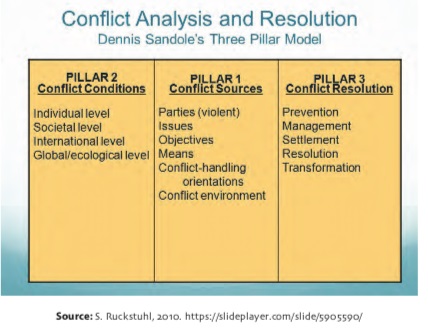
The correct choice is D.
Soru 63
Which of the following is the best example of conflict resolution and conflict transformation?
Seçenekler
A
NATO
B
EU
C
IFOR
D
SFOR
E
UN
Açıklama:
The best example of effective conflict resolution plus conflict transformation (peacebuilding) is the European Union.
The correct choice is B.
The correct choice is B.
Soru 64
With regard to conflict intervention which of the following takes necessary steps based on early warning systems and implements proactive measures?
Seçenekler
A
Conflict management
B
Peacebuilding
C
Peacemaking
D
Conflict resolution
E
Preventive diplomacy
Açıklama:
Preventive diplomacy: Violent conflict prevention takes necessary steps based on early warning systems and aims to prevent a house catching fire with proactive measures.
The correct choice is E.
The correct choice is E.
Soru 65
Which of the following is a violent struggle among states and non-state actors for legitimacy and influence over the relevant populations?
Seçenekler
A
Psychological warfare
B
Asymmetrical warfare
C
Information warfare
D
Cyber warfare
E
Irregular warfare
Açıklama:
Irregular warfare is a violent struggle among states and non-state actors for legitimacy and influence over the relevant populations.
The correct choice is E.
The correct choice is E.
Soru 66
Which of the following is the referent object of security in international security studies?
Seçenekler
A
Individual
B
Property
C
Principles
D
Nation-state
E
Region
Açıklama:
The nation-state is the referent object of security.
The correct choice is D.
The correct choice is D.
Soru 67
Which of the following is NOT classified under the Critical Approach to International Security Studies?
Seçenekler
A
Peace Research
B
Feminist Security Studies
C
The Copenhagen School
D
Constructivist Security Studies
E
Post Structuralism
Açıklama:
Peace Research is classified under traditional approach.
The correct choice is A.
The correct choice is A.
Soru 68
Which of the following is NOT a feature of traditional security approaches?
Seçenekler
A
Emphasizing military
B
Stressing geopolitics
C
Adopting diverse sets of theories
D
Focusing on national security
E
Having a statist perspective
Açıklama:
The traditionalist security approaches have the following features: First, they have mostly emphasized the military aspects of security as well as the concepts such as war, defense, strategy, and geopolitics. They have focused on the problem of national security and the nation-state. Second, the traditionalist security approaches mostly choose a narrow or mono-sectoral agenda and attach priority to one sector (military), one actor (the state), and one action (the use of force). Finally, the traditionalist security approaches have a statist perspective, which is based on a scientific and objectivist understanding of knowledge.
The correct choice is C.
The correct choice is C.
Soru 69
Which of the following is NOT among the models of security which Buzan distinguished due to newly emerging diversity of perceived threats?
Seçenekler
A
Military security
B
Cyber security
C
Economic security
D
Societal security
E
Environmental security
Açıklama:
Buzan distinguished five models of security due to newly emerging diversity of perceived threats:
1. Military security concerns itself with the two-level interplay of the armed offensive and defensive capabilities of states and state’s perceptions of each other’s intentions,
2. Political security focuses on the organizational stability of states, systems of government, and ideologies that give them legitimacy,
3. Economic security emphasizes on prioritazing access to resources, finance, and markets necessary to sustain acceptable levels of welfare and state power,
4. Societal security concerns itself with the ability of societies to reproduce their traditional patterns of language, culture, association, religious and national identities and customs within acceptable conditions for evolution,
5. Environmental security deals with the maintenance of local and planetary biosp
The correct choice is B.
1. Military security concerns itself with the two-level interplay of the armed offensive and defensive capabilities of states and state’s perceptions of each other’s intentions,
2. Political security focuses on the organizational stability of states, systems of government, and ideologies that give them legitimacy,
3. Economic security emphasizes on prioritazing access to resources, finance, and markets necessary to sustain acceptable levels of welfare and state power,
4. Societal security concerns itself with the ability of societies to reproduce their traditional patterns of language, culture, association, religious and national identities and customs within acceptable conditions for evolution,
5. Environmental security deals with the maintenance of local and planetary biosp
The correct choice is B.
Soru 70
Which of the statements given below are TRUE about the unforeseen impacts of private security on international security?
I. They present challenges in the structures of authority.
II. They erode the power of the state and threaten state authority.
III. They lead to the emergence of global security structures.
IV. The geographical boundaries of the nation-state became more important.
I. They present challenges in the structures of authority.
II. They erode the power of the state and threaten state authority.
III. They lead to the emergence of global security structures.
IV. The geographical boundaries of the nation-state became more important.
Seçenekler
A
I, II, III, IV
B
I, II, III
C
I, III, IV
D
I, II, IV
E
II, III, IV
Açıklama:
Private security has unforeseen impacts on international security. First, they present challenges in the structures of authority, legitimacy, international law, and global governance. Secondly, they erode the power of the state and threaten state authority inside and contemporary structures of governance. Thirdly, they lead to the emergence of “global security assemblages: public and private as well as local and global new security structures. Lastly, the geographical boundaries of the nation-state became less important. Private security practices in different parts of the world produce complex relations and different tensions on private-public and global-local relations.
The geographical boundaries of the nation-state became less important.
The correct choice is B.
The geographical boundaries of the nation-state became less important.
The correct choice is B.
Soru 71
Which of the following refers to protecting its citizens and its borders from an outside invasion?
Seçenekler
A
The raison d’être of the state
B
Referent object of security
C
Traditionalist security approach
D
Collective security
E
Conflict resolution
Açıklama:
In the Hobbesian anarchical world, the raison d’être of the state is to protect its citizens and it borders from an outside invasion. The correct answer is A.
Soru 72
Which of the following refers to the study of the threat, use, and control of military force?
Seçenekler
A
Conflict analysis
B
Critical approach
C
Military security
D
Referent object of security
E
International security studies
Açıklama:
International security studies (ISS) is a sub-field of International Relations (IR). It has evolved from the disciplines of War Studies, Military History, and Geopolitics after the Second World War. ISS is defined as “the study of the threat, use, and control of military force.” It investigates how conditions make the use of force more likely and how the use of force affects individuals, states, and societies. The correct answer is E.
Soru 73
- Peace research
- Post structuralism
- The Copenhagen School
- Constructivist security studies
- Military-oriented security studies
Seçenekler
A
I-II-III
B
II-III-IV
C
III-IV-V
D
I-II-III-IV
E
II-III-IV-V
Açıklama:
It is possible to classify ISS under two main approaches: Traditionalist and Critical. Military-oriented and state-centered conception of Security Studies (SS) and Peace Research are classified under the traditionalist approach whereas the Feminist Security Studies, the Copenhagen School, Post-structuralism, and Constructivist Security Studies under the Critical approach. The correct answer is B.
Soru 74
- Military security
- Political security
- Societal security
- Humanitarian security
- Environmental security
Seçenekler
A
I-II-III
B
III-IV-V
C
I-II-III-IV
D
I-II-III-V
E
II-III-IV-V
Açıklama:
Buzan distinguished five models of security due to newly emerging diversity of perceived threats:
- Military security,
- Political security,
- Economic security,
- Societal security,
- Environmental security.
Soru 75
Which of the following refers to violent struggle among states and non-state actors for legitimacy and influence over the relevant populations?
Seçenekler
A
Cyber warfare
B
Hybrid warfare
C
Irregular warfare
D
Asymmetrical warfare
E
Information warfare
Açıklama:
Irregular warfare is a violent struggle among states and non-state actors for legitimacy and influence over the relevant populations. The correct answer is C.
Soru 76
Security means the absence of a threat to the stability of the international actors.
Which of the following is not one of these actors?
Which of the following is not one of these actors?
Seçenekler
A
MADs
B
IGOs
C
MNCs
D
ANSAs
E
INGOs
Açıklama:
Security means “the absence of a threat to the stability of the international system and international actors, namely nation-states, multi-national corporations (MNCs), international governmental organizations (IGOs), international non-governmental organizations (INGOs), and armed non-state actors (ANSAs). Mutually assured destruction (MAD) is not one of them. The correct answer is A.
Soru 77
- United Nations
- The Berlin Wall
- The League of Nations
- The Amphictyonic League
Seçenekler
A
I-II
B
III-IV
C
I-II-III
D
I-III-IV
E
II-III-IV
Açıklama:
The concept of collective security can be traced back to the Greek-city states. The Amphictyonic League, The League of Nations and United Nations are collective security organizations. The correct answer is D.
Soru 78
- Individual
- Societal
- Environmental
- International
- Global
Seçenekler
A
I-II-III
B
III-IV-V
C
I-II-IV-V
D
I-III-IV-V
E
II-III-IV-V
Açıklama:
It is possible to explain, analyze and understand the international security in six levels:
- Individual level: Security for the individual.
- Societal level: Security for the social group, i.e. ethnic, national, religious, linguistic, or community groups.
- National level: Security for the state or nation.
- Regional level: Security for the region, that is, a coherent security region.
- International level: Security for the international society, the society of nations, and most states in the world.
- Global level: Security for the planet Earth and space.
Soru 79
The absence of which of the following is an example of positive peace?
Seçenekler
A
Rape
B
Inequalities
C
Child abuse
D
Street killings
E
War
Açıklama:
Examples of negative peace are as follows: Absence of wife battering, rape, child abuse, dowry deaths, street killings, and war. Positive peace can be exemplified as the absence of inequalities and repression in microstructures leading to unequal life chances and less freedom of choice and fulfillment. The correct answer is B.
Soru 80
Which of the following is child labor an example main threat to?
Seçenekler
A
Economic security
B
Health security
C
Political security
D
Community security
E
Personal security
Açıklama:
Child labor together with physical violence, crime, terrorism and domestic violence are examples of main threats to personal security. The correct answer is E.
Ünite 2
Soru 1
Which of the following names outlines the"six principles of political realism"?
Seçenekler
A
Morgenthau
B
Machiavelli
C
Thucydides
D
Thomas Hobbes
E
Sun Tzu
Açıklama:
Morgenthau outlines the “six principles of political realism” as follows:
• Politics is governed by objective laws which have their root in human nature.
• The key to understanding international politics is the concept of interest defined in terms of power.
• The forms and nature of state power will vary in time, place and context but the concept of interest remains consistent.
• Universal moral principles do not guide state behavior, although this does not rule out an awareness of the moral significance of political action.
• Moral aspirations are specific to a particular nation; there is no universally agreed set of moral principles.
• The political sphere is autonomous
• Politics is governed by objective laws which have their root in human nature.
• The key to understanding international politics is the concept of interest defined in terms of power.
• The forms and nature of state power will vary in time, place and context but the concept of interest remains consistent.
• Universal moral principles do not guide state behavior, although this does not rule out an awareness of the moral significance of political action.
• Moral aspirations are specific to a particular nation; there is no universally agreed set of moral principles.
• The political sphere is autonomous
Soru 2
Which of the following is NOT among the core elements of international politics according to structural realism?
Seçenekler
A
States are seen as rational actors and by far the most important actors in the international system.
B
Each state is responsible for ensuring its own survival.
C
There is an international authority to prevent the use of force between states.
D
The international system is anarchic.
E
The balance of power is the defining mechanism explaining war and peace.
Açıklama:
Structural realism emphasizes four core elements of international politics:
• States are seen as rational actors and by far the most important actors in the international system.
• The international system is anarchic; there is no international authority that can prevent the use of force between states.
• Each state cannot take its security for granted and thus, is responsible for ensuring its own survival, most notably through the nurturing of material capabilities.
• The balance of power (the formation of alliances with certain states to counter the threat of other states) is the defining mechanism that regulates the international system and explains war and peace
• States are seen as rational actors and by far the most important actors in the international system.
• The international system is anarchic; there is no international authority that can prevent the use of force between states.
• Each state cannot take its security for granted and thus, is responsible for ensuring its own survival, most notably through the nurturing of material capabilities.
• The balance of power (the formation of alliances with certain states to counter the threat of other states) is the defining mechanism that regulates the international system and explains war and peace
Soru 3
Which of the following is an example of an event pointing the need for a change towards global security?
Seçenekler
A
Road accidents
B
9/11 Attacks
C
Refugees
D
International relations
E
Charismatic leaders
Açıklama:
September 11 and the wider threat of terrorism has highlighted the emergence of new security challenges that are particularly problematic because they arise from non-state actors and exploit the greater interconnectedness of the modern world. International security may, therefore, have given way to ‘global’ security.
Soru 4
"People and governments in the modern world are affected by what happens elsewhere, and particularly by the actions of their counterparts in other countries."
According to the extract given above, which of the following might NOT be an example of the actions that affect other countries?
According to the extract given above, which of the following might NOT be an example of the actions that affect other countries?
Seçenekler
A
Economic fluctuations
B
Climate change
C
Poverty reduction
D
Education system
E
Human rights
Açıklama:
The stress on interdependence that is basic to commercial liberalism has been further developed by neoliberals into what Keohane and Nye (1977) called complex interdependence. Complex interdependence reflects the extent to which peoples and governments in the modern world are affected by what happens elsewhere, and particularly by the actions of their counterparts in other countries. This applies not only in the economic realm, through the advance of globalization, but is also evident in relation to a range of other issues, including climate change, development and poverty reduction, and human rights.
Soru 5
Which of the following is related to "hard power"?
Seçenekler
A
Culture
B
Political ideals
C
Foreign policies
D
Education
E
Sanctions
Açıklama:
“In the modern world, states, therefore, compete through trade rather than through the use of force. The realist understanding of hard power which encompasses both military and economic power is declined. Hard power is ‘command power’, the ability to change what others do through the use of inducements (carrots) or threats (sticks). By contrast, there has been a growth in soft power. Soft power is co-optive power; it rests on the ability to shape the preferences of others by attraction rather than coercion. Whereas hard power draws on resources such as force, sanctions, payments and bribes, soft power operates largely through culture, political ideals and foreign policies (especially when these are seen to be attractive, legitimate or to possess moral authority)”
Soru 6
Critical Security Studies _____ .
Which of the following best completes the sentece above?
Which of the following best completes the sentece above?
Seçenekler
A
rejects mainstream approaches such as realism and neorealism
B
stemmed from a conference book on security
C
focuses on referent subject of securiy, 'who or what to secure'
D
is proven to be irrelevant to the study of security to human emancipation
E
contributes to security studies by limiting the concept of security
Açıklama:
Critical Security Studies is an academic discipline within security studies which rejects mainstream approaches such as realism and neorealism.
In May 1994, a small conference was held at York University in Toronto entitled Strategies and Conflict: Critical Approaches to Security Studies. It brought together from around the world a variety of scholars with interests in security and with concern about new security studies in the early post-Cold War era. This conference title was used as the title of the book, edited by Keith Krause and Michael C. Williams. In their 1997 book, Critical Security Studies: Concept and Cases, Krause and Williams suggested a broad definition of critical security studies which covered all “new approaches” from Constructivism through Feminism and “Copenhagen School” to Poststructuralism.
Krause and Williams helped shape critical security studies as a pluralistic field. In addition, they pose such questions to open a broad and complex agenda for security studies. Questioning the referent object of security, ‘who or what is to be secured’, Krause and Williams challenged the traditional state-centric understanding of security and instead put forward the individual as the object of security.
The term Critical Security Studies is also used to refer to the coherent theoretical school created mostly by the endeavor of Professors Ken Booth and Richard Wyn Jones, Andrew Linklater and their colleagues from the Aberystwyth University. Booth and Wyn Jones developed a brand of ‘Critical Security Studies’ that challenged the definition of security in terms of military threats to the state, and instead linked the study of security to human emancipation.
Critical Security Studies contributes to security studies by broadening and deepening the concept of security. T
In May 1994, a small conference was held at York University in Toronto entitled Strategies and Conflict: Critical Approaches to Security Studies. It brought together from around the world a variety of scholars with interests in security and with concern about new security studies in the early post-Cold War era. This conference title was used as the title of the book, edited by Keith Krause and Michael C. Williams. In their 1997 book, Critical Security Studies: Concept and Cases, Krause and Williams suggested a broad definition of critical security studies which covered all “new approaches” from Constructivism through Feminism and “Copenhagen School” to Poststructuralism.
Krause and Williams helped shape critical security studies as a pluralistic field. In addition, they pose such questions to open a broad and complex agenda for security studies. Questioning the referent object of security, ‘who or what is to be secured’, Krause and Williams challenged the traditional state-centric understanding of security and instead put forward the individual as the object of security.
The term Critical Security Studies is also used to refer to the coherent theoretical school created mostly by the endeavor of Professors Ken Booth and Richard Wyn Jones, Andrew Linklater and their colleagues from the Aberystwyth University. Booth and Wyn Jones developed a brand of ‘Critical Security Studies’ that challenged the definition of security in terms of military threats to the state, and instead linked the study of security to human emancipation.
Critical Security Studies contributes to security studies by broadening and deepening the concept of security. T
Soru 7
"The state is not only the referent object of security but it also includes human individuals, institutions and groups."
Which of the following is about the above-defined key concept in Critical Security Studies?
Which of the following is about the above-defined key concept in Critical Security Studies?
Seçenekler
A
Referent Object
B
Deepening
C
Positivism
D
Post-positivism
E
Traditional Security Studies
Açıklama:
Key Concepts in Critical Security Studies
Referent Object: It is an object that is taken as the focus for analysis in security studies. As to this concept, there are two main approaches to the security: state-centric security (the state is the referent object) and human-centric approach (human is the referent object).
Traditional Security Studies: It refers to Realist, Liberal, Peace Studies and Strategic Studies perspectives in the study of security. All of them prioritize the state as the referent object of security and focus on military threats to the security of the state.
Broadening: The broadening security agenda refers to Barry Buzan’s sectoral analysis that the security agenda includes not only military sector issues but also political, economic, societal and environmental issues.
Deepening: The state is not only the referent object of security but it also includes human individuals, institutions and groups.
Positivism: It claims that social sciences can be built upon the same model as natural sciences. Scientific principles such as objectivity, verification/falsification, and generalization can adapt to the study of society.
Post-Positivism: It rejects the idea that it is possible to analyze the natural world and the social world in the same way. There is no objective view
Referent Object: It is an object that is taken as the focus for analysis in security studies. As to this concept, there are two main approaches to the security: state-centric security (the state is the referent object) and human-centric approach (human is the referent object).
Traditional Security Studies: It refers to Realist, Liberal, Peace Studies and Strategic Studies perspectives in the study of security. All of them prioritize the state as the referent object of security and focus on military threats to the security of the state.
Broadening: The broadening security agenda refers to Barry Buzan’s sectoral analysis that the security agenda includes not only military sector issues but also political, economic, societal and environmental issues.
Deepening: The state is not only the referent object of security but it also includes human individuals, institutions and groups.
Positivism: It claims that social sciences can be built upon the same model as natural sciences. Scientific principles such as objectivity, verification/falsification, and generalization can adapt to the study of society.
Post-Positivism: It rejects the idea that it is possible to analyze the natural world and the social world in the same way. There is no objective view
Soru 8
Which of the following is NOT among the names from the Welsh School?
Seçenekler
A
Pınar Bilgin
B
Ken Booth
C
Bary Buzan
D
Richard Wyn Jones
E
Andrew Linklater
Açıklama:
The Welsh School is a name that it is attributed to the security studies school at the Aberystwyth University. The Welsh School has been one of the leading critical security schools and it draws all the attention with the contributions of the scholars such as Ken Booth, Richard Wyn Jones, Andrew Linklater, and Pınar Bilgin. The school criticizes the approach of Traditional Security Studies that locates its analysis on a state as a central concern of the study and declares that traditional security approaches are not sufficient for the security needs of today.
Bary Buzan is a scholar from the Copenhagen School.
Bary Buzan is a scholar from the Copenhagen School.
Soru 9
* traditional methods are inadequate to describe the current security needs
* there is a need for ‘broadening and widening’ the security agenda
* its primary book is "Security: A New Framework for Analysis"
* the notion "sectoral analysis of security" and the concepts of "securitization" and "societal security" are the significant contributions of this school
Which of the following school is described above?
* there is a need for ‘broadening and widening’ the security agenda
* its primary book is "Security: A New Framework for Analysis"
* the notion "sectoral analysis of security" and the concepts of "securitization" and "societal security" are the significant contributions of this school
Which of the following school is described above?
Seçenekler
A
The Welsh School
B
The Copenhagen school
C
The Paris School
D
The Aberystwyth School
E
The Frankfurt school
Açıklama:
The Copenhagen School of security studies emerged at the Conflict and Peace Research Institute (COPRI) of Copenhagen. Its most prominent scholars are Barry Buzan, Ole Waever and Jaap de Wilde. They all claim that traditional methods are inadequate to describe the current security needs. Their main argument is the necessity of ‘broadening and widening’ the security agenda. In the school’s primary book, Security: A New Framework for Analysis (1998) Buzan, Waever and Wilde have built two important conceptual contributions to the study of security. Barry Buzan’s notion of sectoral analysis of security and Ole Waever’s concepts of securitization and societal security are the significant contributions of the Copenhagen School.
Soru 10
The Paris School treats security as ________ .
Which of the following completes the sentence correctly?
Which of the following completes the sentence correctly?
Seçenekler
A
objective reality
B
hegamony over others
C
social construction
D
the insecuritization of the other
E
a system of class oppression
Açıklama:
The Paris School treats security as a social construction as opposed to objective reality. It is argued that security is the result of what it refers to an (in) securitization process. The school questions the understanding of security as survival and as a positive value.
Soru 11
In which of the following terms realism defines international relations?
Seçenekler
A
Power
B
Security
C
Identity
D
Human nature
E
Survival
Açıklama:
Realism defines international relations in terms of power.
Soru 12
- States are seen as rational actors
- The international system is anarchic
- Each state cannot take its security for granted and thus, is responsible for ensuring its own survival
- The balance of power is the defining mechanism that regulates the international system and explains war and peace.
Seçenekler
A
Only I
B
Only II
C
II and III
D
I, II and III
E
I, II, III and IV
Açıklama:
Structural realism emphasizes four core elements of international politics:
• States are seen as rational actors and by far the most important actors in the international system.
• The international system is anarchic; there is no international authority that can prevent the use of force between states.
• Each state cannot take its security for granted and thus, is responsible for ensuring its own survival, most notably through the nurturing of material capabilities.
• The balance of power (the formation of alliances with certain states to counter the threat of other states) is the defining mechanism that regulates the international system and explains war and peace.
• States are seen as rational actors and by far the most important actors in the international system.
• The international system is anarchic; there is no international authority that can prevent the use of force between states.
• Each state cannot take its security for granted and thus, is responsible for ensuring its own survival, most notably through the nurturing of material capabilities.
• The balance of power (the formation of alliances with certain states to counter the threat of other states) is the defining mechanism that regulates the international system and explains war and peace.
Soru 13
Which of the following refers to a state’s reliance on its own capacities and resources, rather than external support, to ensure security and survival?
Seçenekler
A
Self-help
B
Security dilemma
C
Offensive realism
D
Balance of power
E
Relative gains
Açıklama:
Self-help refers to a state’s reliance on its own capacities and resources, rather than external support, to ensure security and survival.
Soru 14
Which of the following is not one of the six principles of political realism Morgenthau outlines?
Seçenekler
A
Politics is governed by objective laws which have their root in human nature.
B
The key to understanding international politics is the concept of interest defined in terms of power.
C
The forms and nature of state power will vary in time, place and context but the concept of interest remains consistent.
D
The political sphere is autonomous.
E
The actors in the international system must deprive one another of their power in order to add it to their own.
Açıklama:
In ancient Greece, Thucydides wrote on the Peloponnesian War (431-404 B.C.), focusing on relative power among the Greek city-states. Power is regarded as a zero-sum game. According to the zero-sum game, “the actors in the international system must deprive one another of their power in order to add it to their own” (Molloy, 2006). This is not one of the six principles.
Soru 15
Which of the following is a form of structural realism that portrays states as ‘power maximizers’, as there is no limit to their desire to control the international environment?
Seçenekler
A
Offensive realism
B
Self-help
C
Security dilemma
D
Classical realism
E
Power politics
Açıklama:
Offensive realism is a form of structural realism that portrays states as ‘power maximizers’, as there is no limit to their desire to control the international environment.
Soru 16
- Knowledge structure
- Financial structure
- Security structure
- Production structure
Seçenekler
A
Only II
B
Only III
C
I and III
D
I, II and IV
E
I, II, III and IV
Açıklama:
British scholar Susan Strange (1996) offers Structural Power Thoeory and defines it as “the power to decide how things shall be done, the power to shape frameworks within which states relate to one another, relate to people or relate to corporate enterprises”. She distinguishes between four primary power structures: • The knowledge structure, which influences actor’s beliefs, ideas or perceptions; • The financial structure, which controls access to credit or investment; • The security structure, which shapes defence and strategic issues; • The production structure, which affects economic development and prosperity
Soru 17
Which of the following term is defined as "to side with a stronger power in the hope of increasing security and influence"?
Seçenekler
A
Bandwagoning
B
Balance of threat
C
Knowledge structure
D
Self-help
E
Defensive realism
Açıklama:
Bandwagon is to side with a stronger power in the hope of increasing security and influence; ‘jumping on the bandwagon’.
Soru 18
- Republican Liberalism
- Interdependence Liberalism
- Liberal Institutionalism
Seçenekler
A
Only II
B
Only III
C
I and II
D
I and III
E
I, II and III
Açıklama:
Liberalism has three different forms:
• Republican Liberalism
• Interdependence Liberalism
• Liberal Institutionalism
• Republican Liberalism
• Interdependence Liberalism
• Liberal Institutionalism
Soru 19
Which of the following assumption does democratic peace theory is based?
Seçenekler
A
There is an intrinsic link between peace and democracy.
B
Ideas of trade and economic relations.
C
Advance of globalization
D
International politics is a struggle for power in which military security issues are the top priority.
E
Climate change, development and poverty reduction and human rights.
Açıklama:
Having emerged in the 1980s, democratic peace theory is based on an assumption that there is an intrinsic link between peace and democracy; in particular, that democratic states do not go to war with one another.
Soru 20
Which of the following is defined as the ability of one actor (usually but not necessarily a state) to influence another through the use of threats or rewards, typically involving military ‘sticks’ or economic ‘carrots’?
Seçenekler
A
Hard power
B
ecurity regimes
C
Balance of power
D
Self-help
E
Security dilemma
Açıklama:
Hard power is the ability of one actor (usually but not necessarily a state) to influence another through the use of threats or rewards, typically involving military ‘sticks’ or economic ‘carrots’.
Soru 21
What is the term used for a range of approaches which seek to challenge the orthodoxy of ‘traditional’ security studies?
Seçenekler
A
Referent object of security
B
State security
C
Critical Security Studies
D
Traditionalism
E
Securitization
Açıklama:
Critical Security Studies (CSS) is an umbrella term for a range of approaches which seek to challenge the orthodoxy of ‘traditional’ security studies. Critical approaches apply post-positivist perspectives such as critical theory and post-structuralism and change the referent object of security.
Soru 22
What is the concept introduced by Ole Weaver and Barry Buzan which emphasizes the role of threat discourses in the social construction of security?
Seçenekler
A
State security
B
Securitization
C
Power politics
D
The referent object of security
E
Classical realism
Açıklama:
Ole Waever and Barry Buzan along with other colleagues at the Copenhagen Peace Research Institute (COPRI) have introduced the concept of ‘securitization’ which emphasizes the role of threat discourses in the social construction of security.
Soru 23
What is the approach that explains power politics in terms of anarchy?
Seçenekler
A
Classical realism
B
Structural realism
C
Traditionalism
D
Post-positivism
E
Post-structualism
Açıklama:
Realism defines international relations in terms of power. The exercise of power by states toward each other is called power politics (Pevehouse and Goldstein, 2014). There are two main approaches of realism: classical realism that considers power politics in terms of egoism and neorealism, or structural realism, that explains power politics in terms of anarchy (Heywood, 2011).
Soru 24
Who defined the "six principles of political realism"?
Seçenekler
A
Thucydides
B
Machiavelli
C
Hans Morgenthau
D
Sun Tzu
E
Kenneth Waltz
Açıklama:
Morgenthau outlines the “six principles of political realism” as follows:
• Politics is governed by objective laws which have their root in human nature.
• The key to understanding international politics is the concept of interest defined in terms of power.
• The forms and nature of state power will vary in time, place and context but the concept of interest remains consistent.
• Universal moral principles do not guide state behavior, although this does not rule out an awareness of the moral significance of political action.
• Moral aspirations are specific to a particular nation; there is no universally agreed set of moral principles.
• The political sphere is autonomous (Heywood, 2011).
• Politics is governed by objective laws which have their root in human nature.
• The key to understanding international politics is the concept of interest defined in terms of power.
• The forms and nature of state power will vary in time, place and context but the concept of interest remains consistent.
• Universal moral principles do not guide state behavior, although this does not rule out an awareness of the moral significance of political action.
• Moral aspirations are specific to a particular nation; there is no universally agreed set of moral principles.
• The political sphere is autonomous (Heywood, 2011).
Soru 25
Which one is not a core element of international politics emphasized in structural realism?
Seçenekler
A
The international system is anarchic; there is no international authority that can prevent the use of force between states.
B
States are seen as rational actors and by far the most important actors in the
international system.
international system.
C
The actors in the international system are influenced by each other and the perception of power is constantly changing.
D
The balance of power (the formation of alliances with certain states to counter the threat of other states) is the defining mechanism that regulates the international system and explains war and peace.
E
Each state cannot take its security for granted and thus, is responsibleforensuring its own survival, most notably through the nurturing of material capabilities.
Açıklama:
Structural realism emphasizes four core elements of international politics:
• States are seen as rational actors and by far the most important actors in the international system.
• The international system is anarchic; there is no international authority that can prevent the use of force between states.
• Each state cannot take its security for granted and thus, is responsibleforensuring its own survival, most notably through the nurturing of material capabilities.
• The balance of power (the formation of alliances with certain states to counter the threat of other states) is the defining mechanism that regulates the international system and explains war and peace.
• States are seen as rational actors and by far the most important actors in the international system.
• The international system is anarchic; there is no international authority that can prevent the use of force between states.
• Each state cannot take its security for granted and thus, is responsibleforensuring its own survival, most notably through the nurturing of material capabilities.
• The balance of power (the formation of alliances with certain states to counter the threat of other states) is the defining mechanism that regulates the international system and explains war and peace.
Soru 26
What refers to "the position of states in relation to one another, reflected in the distribution of benefits and capabilities between and amongst them"?
Seçenekler
A
Self-help
B
Security dilemma
C
Relative gains
D
Offensive realism
E
Defensive realism
Açıklama:
Self-help refers to a state’s reliance on its own capacities and resources, rather than external support, to ensure security and survival.
Security dilemma arises from the fact that a build-up of military capacity for defensive
reasons by one state is always liable to be interpreted as aggressive by other states.
The concept of relative gains refers to the position of states in relation to one another, reflected in the distribution of benefits and capabilities between and amongst them.
Offensive realism is a form of structural realism that portrays states as ‘power maximizers’, as there is no limit to their desire to control the international
environment.
Defensive realism is a form of structural realism that views states as ‘security maximizers’, placing the desire to avoid attack above a bid for World power
Security dilemma arises from the fact that a build-up of military capacity for defensive
reasons by one state is always liable to be interpreted as aggressive by other states.
The concept of relative gains refers to the position of states in relation to one another, reflected in the distribution of benefits and capabilities between and amongst them.
Offensive realism is a form of structural realism that portrays states as ‘power maximizers’, as there is no limit to their desire to control the international
environment.
Defensive realism is a form of structural realism that views states as ‘security maximizers’, placing the desire to avoid attack above a bid for World power
Soru 27
Which of the below is not a primary power structure distinguished by Susan Strange in her "Structural Power Theory"?
Seçenekler
A
The security structure
B
The workforce structure
C
The production structure,
D
The financial structure
E
The knowledge structure
Açıklama:
British scholar Susan Strange (1996) offers Structural Power Thoeory and defines it as “the power to decide how things shall be done, the power to shape frameworks within which states relate to one another, relate to people or relate to corporate enterprises”. She distinguishes between four primary power structures:
• The knowledge structure, which influences actor’s beliefs, ideas or perceptions;
• The financial structure, which controls access to credit or investment;
• The security structure, which shapes defence and strategic issues;
• The production structure, which affects economic development and prosperity.
• The knowledge structure, which influences actor’s beliefs, ideas or perceptions;
• The financial structure, which controls access to credit or investment;
• The security structure, which shapes defence and strategic issues;
• The production structure, which affects economic development and prosperity.
Soru 28
In which of the key concepts in Critical Security Studies are human individuals, institutions, and groups accepted as the referent object of security?
Seçenekler
A
Broadening
B
Deepening
C
Positivism
D
Post-Positivism
E
Critical theory
Açıklama:
Referent Object: It is an object that is taken as the focus for analysis in security studies. As to this concept, there are two main approaches to the security: state-centric security (the state is the referent object) and human-centric approach (human is the referent object).
Traditional Security Studies: It refers to Realist, Liberal, Peace Studies and Strategic Studies perspectives in the study of security. All of them prioritize the state as the referent object of security and focus on military threats to the security of the state.
Broadening: The broadening security agenda refers to Barry Buzan’s sectoral analysis that the security agenda includes not only military sector issues but also political, economic, societal and environmental issues.
Deepening: The state is not only the referent object of security but it also includes human individuals, institutions and groups.
Positivism: It claims that social sciences can be built upon the same model as natural sciences. Scientific principles such as objectivity, verification/falsification, and generalization can adapt to the study of society.
Post-Positivism: It rejects the idea that it is possible to analyze the natural world and the social world in the same way. There is no objective view (Peoples and Vaughan-Williams, 2010:4).
Traditional Security Studies: It refers to Realist, Liberal, Peace Studies and Strategic Studies perspectives in the study of security. All of them prioritize the state as the referent object of security and focus on military threats to the security of the state.
Broadening: The broadening security agenda refers to Barry Buzan’s sectoral analysis that the security agenda includes not only military sector issues but also political, economic, societal and environmental issues.
Deepening: The state is not only the referent object of security but it also includes human individuals, institutions and groups.
Positivism: It claims that social sciences can be built upon the same model as natural sciences. Scientific principles such as objectivity, verification/falsification, and generalization can adapt to the study of society.
Post-Positivism: It rejects the idea that it is possible to analyze the natural world and the social world in the same way. There is no objective view (Peoples and Vaughan-Williams, 2010:4).
Soru 29
A regional security complex is is based on four components. Which one is not one of those components?
Seçenekler
A
Geographical features
B
Power differences among countries
C
Regional boundaries
D
Regional anarchical system
E
The patterns of amity and enmity
Açıklama:
Security regions can be regarded as miniature systems of international politics where all International Relations theories can be applied such as alliance theory, polarity, and balance of power etc. A regional security complex is is based on four components as follows:
1. Regional boundaries, which differentiate itself from its neighbors.
2. Regional anarchical system, which consists of two or three independents states
3. Power differences among countries in the region,
4. The patterns of amity and enmity (Buzan and Waever, 2003: 53).
1. Regional boundaries, which differentiate itself from its neighbors.
2. Regional anarchical system, which consists of two or three independents states
3. Power differences among countries in the region,
4. The patterns of amity and enmity (Buzan and Waever, 2003: 53).
Soru 30
Species is the referent object of which sector in the Analysis of Security?
Seçenekler
A
Military
B
Political
C
Economical
D
Societal
E
Enviromental
Açıklama:
Military Sector refers to the two-level interplay between the armed offensive capacity and defensive capabilities of states and their perceptions of each other’s intentions. It is about relationships of forceful coercion. Here the referent object can be states.
Political Sector means the regime type of states and their ideologies that provide them with legitimacy and authority. It is related to authority, governing status and recognition. In this sector, the referent object can be national sovereignty or an ideology.
Economical Sector shows the welfare of the state and its access to natural resources and financial markets. It concerns trade, production, and finance. Its referent object refers to national economies.
Societal Sector relates to national identity, sustainable culture, customs, and religion. It is about relationships of collective identity. The referent object here is collective identities.
Environmental Sector includes the maintenance of the planetary biosphere. It refers to the relationship between human activity and planetary biosphere. Its referent object is species or habitats (Buzan, Waever, and Wilde, 1998: 8)
Political Sector means the regime type of states and their ideologies that provide them with legitimacy and authority. It is related to authority, governing status and recognition. In this sector, the referent object can be national sovereignty or an ideology.
Economical Sector shows the welfare of the state and its access to natural resources and financial markets. It concerns trade, production, and finance. Its referent object refers to national economies.
Societal Sector relates to national identity, sustainable culture, customs, and religion. It is about relationships of collective identity. The referent object here is collective identities.
Environmental Sector includes the maintenance of the planetary biosphere. It refers to the relationship between human activity and planetary biosphere. Its referent object is species or habitats (Buzan, Waever, and Wilde, 1998: 8)
Soru 31
Who is the writer of Leviathan?
Seçenekler
A
Machiavelli
B
Sun Tzu
C
Thomas Hobbes
D
Thucydides
E
Hans Morgenthau
Açıklama:
Thomas Hobbes is the writer of Leviathan.
Soru 32
Morgenthau outlines the “six principles of political realism. Which of the below is NOT one of them?
Seçenekler
A
Politics is governed by objective laws which have their root in human nature.
B
The key to understanding international politics is the concept of interest defined in terms of power.
C
The forms and nature of state power will vary in time, place and context but the concept of interest remains consistent.
D
Moral aspirations are specific to a particular nation; there is no universally agreed set of moral principles.
E
The political sphere is not self-governing.
Açıklama:
Morgenthau outlines the “six principles of
political realism” as follows:
• Politics is governed by objective laws which
have their root in human nature.
• The key to understanding international
politics is the concept of interest defined in
terms of power.
• The forms and nature of state power will
vary in time, place and context but the
concept of interest remains consistent.
• Universal moral principles do not guide state
behavior, although this does not rule out
an awareness of the moral significance of
political action.
• Moral aspirations are specific to a particular
nation; there is no universally agreed set of
moral principles.
• The political sphere is autonomous
(Heywood, 2011).
political realism” as follows:
• Politics is governed by objective laws which
have their root in human nature.
• The key to understanding international
politics is the concept of interest defined in
terms of power.
• The forms and nature of state power will
vary in time, place and context but the
concept of interest remains consistent.
• Universal moral principles do not guide state
behavior, although this does not rule out
an awareness of the moral significance of
political action.
• Moral aspirations are specific to a particular
nation; there is no universally agreed set of
moral principles.
• The political sphere is autonomous
(Heywood, 2011).
Soru 33
Which of the below is NOT one of the core elements of international politics related to structural realism (neorealism)?
Seçenekler
A
Politics is governed by objective laws which have their root in human nature.
B
States are seen as rational actors and by far the most important actors in the international system.
C
The international system is anarchic; there is no international authority that can prevent the use of force between states.
D
Each state cannot take its security for granted and thus, is responsibleforensuring its own survival, most notably through the
nurturing of material capabilities.
nurturing of material capabilities.
E
The balance of power (the formation of alliances with certain states to counter the threat of other states) is the defining
mechanism that regulates the international system and explains war and peace.
mechanism that regulates the international system and explains war and peace.
Açıklama:
Structural realism emphasizes four core
elements of international politics:
• States are seen as rational actors and
by far the most important actors in the
international system.
• The international system is anarchic;
there is no international authority that can
prevent the use of force between states.
• Each state cannot take its security for
granted and thus, is responsibleforensuring
its own survival, most notably through the
nurturing of material capabilities.
• The balance of power (the formation of
alliances with certain states to counter
the threat of other states) is the defining
mechanism that regulates the intern
elements of international politics:
• States are seen as rational actors and
by far the most important actors in the
international system.
• The international system is anarchic;
there is no international authority that can
prevent the use of force between states.
• Each state cannot take its security for
granted and thus, is responsibleforensuring
its own survival, most notably through the
nurturing of material capabilities.
• The balance of power (the formation of
alliances with certain states to counter
the threat of other states) is the defining
mechanism that regulates the intern
Soru 34
What arises from the fact that a build-up of military capacity for defensive reasons by one state is always liable to be
interpreted as aggressive by other states?
interpreted as aggressive by other states?
Seçenekler
A
Self-help
B
Security dilemma
C
Offensive realism
D
Defensive realism
E
Balance of power
Açıklama:
Security dilemma arises from the fact that
a build-up of military capacity for defensive
reasons by one state is always liable to be
interpreted as aggressive by other states.
The concept of relative gains refers to the
position of states in relation to one another,
reflected in the distribution of benefits and
capabilities between and amongst them
a build-up of military capacity for defensive
reasons by one state is always liable to be
interpreted as aggressive by other states.
The concept of relative gains refers to the
position of states in relation to one another,
reflected in the distribution of benefits and
capabilities between and amongst them
Soru 35
Susan Strangeoffers Structural Power Thoeory and distinguishes some power structures. Which of the below is/are related to it?
I. knowledge structure
II. financial structure
III. security structure
IV. production structure
I. knowledge structure
II. financial structure
III. security structure
IV. production structure
Seçenekler
A
I and II
B
II and III
C
II, III, IV
D
I, II, IV
E
All of them
Açıklama:
Susan Strange distinguishes between
four primary power structures:
• The knowledge structure, which influences
actor’s beliefs, ideas or perceptions;
• The financial structure, which controls
access to credit or investment;
• The security structure, which shapes defence
and strategic issues;
• The production structure, which affects
economic development and prosperity.
four primary power structures:
• The knowledge structure, which influences
actor’s beliefs, ideas or perceptions;
• The financial structure, which controls
access to credit or investment;
• The security structure, which shapes defence
and strategic issues;
• The production structure, which affects
economic development and prosperity.
Soru 36
What is called to side with a stronger power in the hope of increasing security and influence?
Seçenekler
A
Bandwagon
B
Collective security
C
Hard power
D
Broadening
E
Security dilemma
Açıklama:
Bandwagon is to side with a stronger
power in the hope of increasing security and
influence; ‘jumping on the bandwagon’
power in the hope of increasing security and
influence; ‘jumping on the bandwagon’
Soru 37
Which of the below is true about Liberal Institutionalism?
Seçenekler
A
It is an approach to study that emphasizes the role of individuals in the realization of liberal principles and goals.
B
The chief ‘external’ mechanism that liberals believe is needed to constrain the ambitions of sovereign states is national organizations.
C
It rejects a realist argument that international politics is a struggle for power in which military security issues are the top priority.
D
It is based on an assumption that there is an intrinsic link between peace and democracy.
E
It emphasizes three core elements, namely republican democratic representation, and ideological commitment to human rights, and transnational interdependence.
Açıklama:
Liberal institutionalism is an approach to
study that emphasizes the role of institutions (both
formal and informal) in the realization of liberal
principles and goals. Liberal institutionalism
rejects a realist argument that international
politics is a struggle for power in which military
security issues are the top priority. In fact, the chief
‘external’ mechanism that liberals believe is needed
to constrain the ambitions of sovereign states is
international organizations. This reflects the ideas
of what is called liberal institutionalism.
study that emphasizes the role of institutions (both
formal and informal) in the realization of liberal
principles and goals. Liberal institutionalism
rejects a realist argument that international
politics is a struggle for power in which military
security issues are the top priority. In fact, the chief
‘external’ mechanism that liberals believe is needed
to constrain the ambitions of sovereign states is
international organizations. This reflects the ideas
of what is called liberal institutionalism.
Soru 38
What is the ability to influence other actors by persuading them to follow or agree to norms and aspirations that produce the desired behavior?
Seçenekler
A
Soft power
B
Hard power
C
Bandwagon
D
Balance of threat
E
Liberalism
Açıklama:
Hard power is the ability of one actor (usually
but not necessarily a state) to influence
another through the use of threats or
rewards, typically involving military ‘sticks’ or
economic ‘carrots’. Soft power is the ability to
influence other actors by persuading them to
follow or agree to norms and aspirations that
produce the desired behavior.
but not necessarily a state) to influence
another through the use of threats or
rewards, typically involving military ‘sticks’ or
economic ‘carrots’. Soft power is the ability to
influence other actors by persuading them to
follow or agree to norms and aspirations that
produce the desired behavior.
Soru 39
As to which concept of critical security studies are there two main approaches to
the security: state-centric security (the state is the referent object) and human-centric approach (human is the referent object)?
the security: state-centric security (the state is the referent object) and human-centric approach (human is the referent object)?
Seçenekler
A
Post-Positivism
B
Positivism
C
Deepening
D
Referent Object
E
Broadening
Açıklama:
Referent Object: It is an object that is taken as
the focus for analysis in security studies. As to
this concept, there are two main approaches to
the security: state-centric security (the state is
the referent object) and human-centric approach
(human is the referent object).
the focus for analysis in security studies. As to
this concept, there are two main approaches to
the security: state-centric security (the state is
the referent object) and human-centric approach
(human is the referent object).
Soru 40
What is an intellectual tradition that is based on the belief that truth is always contested and plural; sometimes summed up as
‘incredulity towards metanarratives?
‘incredulity towards metanarratives?
Seçenekler
A
Neoliberalism
B
Deconstruction
C
Postmodernism
D
Discourse
E
Hegemony
Açıklama:
Postmodernism is an intellectual tradition
that is based on the belief that truth is always
contested and plural; sometimes summed up as
‘incredulity towards metanarratives’ (Lyotard,
1984).
that is based on the belief that truth is always
contested and plural; sometimes summed up as
‘incredulity towards metanarratives’ (Lyotard,
1984).
Soru 41
Which of the following is the correct definition of the concept " Critical Security Studies "?
Seçenekler
A
It is an umbrella term for a range of approaches which seek to challenge the orthodoxy of ‘traditional’ security studies'.
B
It is distinguished by their aims and modes of analysis.
C
It is defined as an ‘essentially contested concept’.
D
They are incorporating nonmilitary threats such as the global economic crisis, the refugee crisis, international terrorism, and environmental problems into the security agenda.
E
It emphasizes the role of threat discourses in the social construction of security.
Açıklama:
Critical Security Studies (CSS) is an umbrella term for a range of approaches which seek to challenge the orthodoxy of ‘traditional’ security studies. Critical approaches apply post-positivist perspectives such as critical theory and post-structuralism and change the referent object of security. Doğrucevap " A " dır.
Soru 42
Which of the following is the definition of the sentence below?
" It considers power politics in terms of egoism ".
" It considers power politics in terms of egoism ".
Seçenekler
A
Power politics,
B
Classical realism,
C
Power,
D
Structural realism,
E
Security,
Açıklama:
Realism defines international relations in terms of power. The exercise of power by states toward each other is called power politics (Pevehouse and Goldstein, 2014). There are two main approaches of realism: classical realism that considers power politics in terms of egoism and neorealism, or structural realism, that explains power politics in terms of anarchy (Heywood, 2011). Doğru cevap " B " dir.
DÜZELTME HAKKINDA
Soruda tanımlama kısmında "and neorealism " ya da structural realism ikincisini karşılıyor. Dolayısıyla gerekli düzeltmeyi yaptım. Seçenek doğru, " B " dir.
DÜZELTME HAKKINDA
Soruda tanımlama kısmında "and neorealism " ya da structural realism ikincisini karşılıyor. Dolayısıyla gerekli düzeltmeyi yaptım. Seçenek doğru, " B " dir.
Soru 43
Which one of the options is not the one of the “six principles of political realism”?
Seçenekler
A
Politics is governed by objective laws which have their root in human nature.
B
The key to understanding international politics is the concept of interest defined in terms of power.
C
The struggle for power is the main motivation in political life.
D
Moral aspirations are specific to a particular nation; there is no universally agreed set of moral principles.
E
The political sphere is autonomous (Heywood, 2011).
Açıklama:
Morgenthau outlines the “six principles of political realism” as follows:
• Politics is governed by objective laws which have their root in human nature.
• The key to understanding international politics is the concept of interest defined in terms of power.
• The forms and nature of state power will vary in time, place and context but the concept of interest remains consistent.
• Universal moral principles do not guide state behavior, although this does not rule out an awareness of the moral significance of political action.
• Moral aspirations are specific to a particular nation; there is no universally agreed set of moral principles.
• The political sphere is autonomous (Heywood, 2011). Doğru cevap " C " dir.
• Politics is governed by objective laws which have their root in human nature.
• The key to understanding international politics is the concept of interest defined in terms of power.
• The forms and nature of state power will vary in time, place and context but the concept of interest remains consistent.
• Universal moral principles do not guide state behavior, although this does not rule out an awareness of the moral significance of political action.
• Moral aspirations are specific to a particular nation; there is no universally agreed set of moral principles.
• The political sphere is autonomous (Heywood, 2011). Doğru cevap " C " dir.
Soru 44
Which of the following is not one of the core elements of international politics?
Seçenekler
A
States are seen as rational actors and by far the most important actors in the
international system.
international system.
B
The international system is anarchic; there is no international authority that can prevent the use of force between states.
C
Each state cannot take its security for granted and thus, is responsible for ensuring its own survival, most notably through the nurturing of material capabilities.
D
The international system is accepted as a self-help system.
E
The balance of power (the formation of alliances with certain states to counter the threat of other states) is the defining mechanism that regulates the international system and explains war and peace.
Açıklama:
Structural realism emphasizes four core elements of international politics:
• States are seen as rational actors and by far the most important actors in the
international system.
• The international system is anarchic; there is no international authority that can prevent the use of force between states.
• Each state cannot take its security for granted and thus, is responsible for ensuring its own survival, most notably through the nurturing of material capabilities.
• The balance of power (the formation of alliances with certain states to counter the threat of other states) is the defining mechanism that regulates the international system and explains war and peace. Doğru cevap " D " dir.
• States are seen as rational actors and by far the most important actors in the
international system.
• The international system is anarchic; there is no international authority that can prevent the use of force between states.
• Each state cannot take its security for granted and thus, is responsible for ensuring its own survival, most notably through the nurturing of material capabilities.
• The balance of power (the formation of alliances with certain states to counter the threat of other states) is the defining mechanism that regulates the international system and explains war and peace. Doğru cevap " D " dir.
Soru 45
Which of the following is the definition of the sentence below?
" It mentions on peace and international harmony. "
" It mentions on peace and international harmony. "
Seçenekler
A
Republican Liberalism,
B
Interdependence Liberalism,
C
Imperialism,
D
Liberal Institutionalism,
E
Liberalism,
Açıklama:
“Liberalism’s mentions on peace and international harmony. Liberals believe that the external behaviour of a state is crucially influenced by its political and constitutional make-up. This is reflected in a tradition of republican liberalism that can be traced back to Woodrow Wilson, if not to Kant. Doğru cevap " E " dir.
Soru 46
" The concept of ....................... is an academic discipline within security studies which rejects mainstream approaches such as realism and neorealism. "
Which of the following correctly completes the sentence above?
Which of the following correctly completes the sentence above?
Seçenekler
A
Critical Security Studies
B
Security Regimes
C
Security Communities
D
Liberal Theories
E
Soft Power
Açıklama:
Critical Security Studies is an academic discipline within security studies which rejects mainstream approaches such as realism and neorealism. In May 1994, a small conference was held at York University in Toronto entitled Strategies and Conflict: Critical Approaches to Security Studies. Doğru cevap " A " dır.
Soru 47
Which of the following is not one of the Sectors in the Analysis of Security?
Seçenekler
A
Military Sector,
B
Critical Sector,
C
Political Sector,
D
Economical Sector,
E
Environmental Sector,
Açıklama:
Thinking about security in terms of sectors has widened the agenda of security. Buzan examines the dynamics of security in five sectors: military, political, economic, environmental and societal. Each sector is identified with specific types of interaction and determined by securitizing actors and referent objects. Doğru cevap " B " dir.
Soru 48
Which of the following is not one of the most prominent critical theories in IR?
Seçenekler
A
Marxism and Neo-Marxism,
B
Critical Theory,
C
İlliberal Security,
D
Poststructuralism/Postmodernism,
E
Social constructivism,
Açıklama:
Since the late 1980s, major IR theories have been challenged by critical perpectives. Critical perspectives vary remarkably. The most prominent critical theories in IR are as follows:
• Marxism and Neo-Marxism
• Critical Theory
• Poststructuralism/Postmodernism
• Social constructivism
Doğru cevap " C " dir.
• Marxism and Neo-Marxism
• Critical Theory
• Poststructuralism/Postmodernism
• Social constructivism
Doğru cevap " C " dir.
Soru 49
" ......................... is an intellectual tradition that is based on the belief that truth is always contested and plural;"
Which of the following correctly completes the sentence above?
Which of the following correctly completes the sentence above?
Seçenekler
A
Hegemony
B
Global Inequality
C
Global Hegemony
D
Postmodernism
E
Distinctive Perspective
Açıklama:
Postmodernism is an intellectual tradition that is based on the belief that truth is always contested and plural; sometimes summed up as ‘incredulity towards metanarratives’ (Lyotard, 1984). Doğru cevap " D " dir.
Soru 50
Which of the following correctly completes the sentence below?
" ................................. focuses on the nature of norms, identity, and social interactions. "
" ................................. focuses on the nature of norms, identity, and social interactions. "
Seçenekler
A
Deconstruction
B
Discourse
C
Poststructuralist Approach
D
International / Intertextual
E
Social Constructivism
Açıklama:
Social constructivism focuses on the nature of norms, identity, and social interactions. The constructivist approach is based on the belief that there is no objective social or political reality independent of our understanding of it. Constructivists hold that these state identities are complex and changing, and arise from interactions with other states-often through a process of socialization (Pevehouse and Goldstein, 2014). Doğru cevap " E " dir.
Soru 51
Who gave the example of zero-sum game - “the actors in the international system must deprive one another of their power in order to add it to their own” - to emphasise 'power' in classical realism theory?
Seçenekler
A
Chinese strategist Sun Tzu
B
Ancient Greek Commander Thucydides
C
Italian statesman and philosopher Machiavelli
D
English philosopher Thomas Hobbes
E
German-Americana classical realist Hans Morgenthau
Açıklama:
The roots of realism can be traced back to ancient times. Chinese strategist Sun Tzu advised the rulers of states on how to survive in an era when the war had become a systematic instrument of power for the first time (Chatturvedi, 2005). In ancient Greece, Thucydides wrote on the Peloponnesian War (431-404 B.C.), focusing on relative power among the Greek city-states. Power is regarded as a zero-sum game. According to the zero-sum game, “the actors in the international system must deprive one another of their power in order to add it to their own” (Molloy, 2006).
Soru 52
Which of the following concepts has underpinned foreign policy since the advent of the Westphalian system?
Seçenekler
A
Moral principles
B
Autonomy
C
Power
D
National interest
E
Objective laws
Açıklama:
The notion of national interest has underpinned foreign policy since the advent of the Westphalian system. As posited by Morgenthau, “objectives of a foreign policy must be defined in terms of the national interest” (Morgenthau, 1960). He defines the national interest “in terms of power” (1993). That means power is the ultimate result and cause of the national interest taking its roots from the will to power inherent in human nature. Whatever the ultimate aims of international politics, power is always the immediate aim. Therefore, international politics is a struggle for power (Morgenthau, 1993).
Soru 53
What is the most important actor in the international system for realists?
Seçenekler
A
State
B
Public
C
Moral rules
D
Objective laws
E
Economy
Açıklama:
For realism, the state is the most important actor in the international system and is, therefore, the primary unit of analysis. The state, as an actor, must ensure its survival in a self-help situation. Survival becomes the first objective of the state.
Soru 54
Which concept below is about a state’s reliance on its own capacities and resources, rather than external support, to ensure security and survival?
Seçenekler
A
Power maximizer
B
Offensive realism
C
Self-help
D
Relative gains
E
Security dilemma
Açıklama:
Self-help refers to a state’s reliance on its own capacities and resources, rather than external support, to ensure security and survival. Security dilemma arises from the fact that a build-up of military capacity for defensive reasons by one state is always liable to be interpreted as aggressive by other states. The concept of relative gains refers to the position of states in relation to one another, reflected in the distribution of benefits and capabilities between and amongst them. Offensive realism - Defensive realism Offensive realism is a form of structural realism that portrays states as ‘power maximizers’, as there is no limit to their desire to control the international environment. Defensive realism is a form of structural realism that views states as ‘security maximizers’, placing the desire to avoid attack above a bid for World power
Soru 55
Which of the following is not among the primary power structures according to British scholar Susan Strange?
Seçenekler
A
Knowledge
B
Financial
C
Security
D
Production
E
Cultural
Açıklama:
British scholar Susan Strange (1996) offers Structural Power Thoeory and defines it as “the power to decide how things shall be done, the power to shape frameworks within which states relate to one another, relate to people or relate to corporate enterprises”. She distinguishes between four primary power structures: • The knowledge structure, which influences actor’s beliefs, ideas or perceptions; • The financial structure, which controls access to credit or investment; • The security structure, which shapes defence and strategic issues; • The production structure, which affects economic development and prosperity.
Soru 56
Which of the following refers to an attempt to find a remedy for the insecurity of states in the international arena?
Seçenekler
A
Security communities
B
Collective security
C
Democratic Peace Theory
D
Hard Theory
E
Post-positivist Security
Açıklama:
Adler and Barnett (1998) emphasize the potential impact of institutions, values and identities even in the high politics of international security. The concept of security communities is an attempt to find a remedy for the insecurity of states in the international arena. It is thus related to the concept of collective security, in the sense that security communities aim to provide collective security for members
Soru 57
Which of the following is closely related to the concept of democratic peace theory?
Seçenekler
A
Liberal postmodernism
B
Liberal Constructivism
C
Republican Liberalism
D
Interdependence Liberalism
E
Liberal Institutionalism
Açıklama:
Having emerged in the 1980s, democratic peace theory is based on an assumption that there is an intrinsic link between peace and democracy; in particular, that democratic states do not go to war with one another. Relied on a Kantian logic, democratic peace emphasizes three core elements, namely republican democratic representation, and ideological commitment to human rights, and transnational interdependence
Soru 58
Which of the following key concepts in critical security studies can be described as "the state is not only the referent object of security but it also includes human individuals, institutions and groups"?
Seçenekler
A
Referent Object
B
Traditional Security Studies
C
Broadening
D
Deepening
E
Positivism
Açıklama:
Key Concepts in Critical Security Studies
Referent Object: It is an object that is taken as the focus for analysis in security studies. As to this concept, there are two main approaches to the security: state-centric security (the state is the referent object) and human-centric approach (human is the referent object). Traditional Security Studies: It refers to Realist, Liberal, Peace Studies and Strategic Studies perspectives in the study of security. All of them prioritize the state as the referent object of security and focus on military threats to the security of the state. Broadening: The broadening security agenda refers to Barry Buzan’s sectoral analysis that the security agenda includes not only military sector issues but also political, economic, societal and environmental issues. Deepening: The state is not only the referent object of security but it also includes human individuals, institutions and groups. Positivism: It claims that social sciences can be built upon the same model as natural sciences. Scientific principles such as objectivity, verification/falsification, and generalization can adapt to the study of society. Post-Positivism: It rejects the idea that it is possible to analyze the natural world and the social world in the same way. There is no objective view (Peoples and Vaughan-Williams, 2010:4)
Referent Object: It is an object that is taken as the focus for analysis in security studies. As to this concept, there are two main approaches to the security: state-centric security (the state is the referent object) and human-centric approach (human is the referent object). Traditional Security Studies: It refers to Realist, Liberal, Peace Studies and Strategic Studies perspectives in the study of security. All of them prioritize the state as the referent object of security and focus on military threats to the security of the state. Broadening: The broadening security agenda refers to Barry Buzan’s sectoral analysis that the security agenda includes not only military sector issues but also political, economic, societal and environmental issues. Deepening: The state is not only the referent object of security but it also includes human individuals, institutions and groups. Positivism: It claims that social sciences can be built upon the same model as natural sciences. Scientific principles such as objectivity, verification/falsification, and generalization can adapt to the study of society. Post-Positivism: It rejects the idea that it is possible to analyze the natural world and the social world in the same way. There is no objective view (Peoples and Vaughan-Williams, 2010:4)
Soru 59
Which of the security type and example of main threats matches below is false?
Seçenekler
A
Economic Security: Poverty and unemployment
B
Health Security: Lack of access to basic health care, infectious diseases
C
Environmental Security: Natural disasters, pollution
D
Personal Security:Physical violence, crime, terrorism
E
Community Security: Political repression, human rights abuses
Açıklama:
Type of Security: Examples of Main Threats
Food Security: Hunger, famine
Health Security: Lack of access to basic health care, infectious diseases
Environmental Security: Natural disasters, pollution
Personal Security:Physical violence, crime, terrorism
Community Security:Ethnic-religious based tensions
Political Security: Political repression, human rights abuses.
Food Security: Hunger, famine
Health Security: Lack of access to basic health care, infectious diseases
Environmental Security: Natural disasters, pollution
Personal Security:Physical violence, crime, terrorism
Community Security:Ethnic-religious based tensions
Political Security: Political repression, human rights abuses.
Soru 60
Which theory suggests that the existence of security is based on the continuity of relations between the peripheral areas and the core areas?
Seçenekler
A
Critical theory
B
World-system theory
C
Neo-Marxist Theory
D
Postmodernist Theory
E
Social Constructivism Theory
Açıklama:
As for security, the world-system theory holds that “the existence of security in the world-system theory is based on the continuity of relations between the peripheral areas and the core areas. In other words, a change in resource distribution is viewed as a threat to security of the system” (Soltani and Yusoff, 2012).
Soru 61
- Thucydides
- Machiavelli
- Hobbes
- Morgenthau
- Waltz
Seçenekler
A
I-II-III
B
III-IV-V
C
I-II-III-IV
D
I-III-IV-V
E
II-III-IV-V
Açıklama:
Thucydides, Machiavelli, Hobbes and Morgenthau can be considered to be classical realists. Waltz is a neorealist (structural realist). The correct answer is C.
Soru 62
Which of the following is not one of the “six principles of political realism” Morgenthau outlines?
Seçenekler
A
The political sphere is governed.
B
Politics is governed by objective laws which have their root in human nature.
C
The key to understanding international politics is the concept of interest defined in terms of power.
D
Moral aspirations are specific to a particular nation; there is no universally agreed set of moral principles.
E
The forms and nature of state power will vary in time, place and context but the concept of interest remains consistent.
Açıklama:
Morgenthau outlines the “six principles of political realism” as follows:
- Politics is governed by objective laws which have their root in human nature.
- The key to understanding international politics is the concept of interest defined in terms of power.
- The forms and nature of state power will vary in time, place and context but the concept of interest remains consistent.
- Universal moral principles do not guide state behavior, although this does not rule out an awareness of the moral significance of political action.
- Moral aspirations are specific to a particular nation; there is no universally agreed set of moral principles.
- The political sphere is autonomous - not governed.
Soru 63
Which of the following refers to a state’s reliance on its own capacities and resources, rather than external support, to ensure security and survival?
Seçenekler
A
Relative gains
B
Self-help
C
Security dilemma
D
Pursuit of power
E
Power politics
Açıklama:
Self-help refers to a state’s reliance on its own capacities and resources, rather than external support, to ensure security and survival. The correct answer is B.
Soru 64
- It is a form of structural realism.
- It portrays states as power maximizers.
- It views states as security maximizers.
- It desires to control the international environment.
- It avoids attack above a bid for world power.
Seçenekler
A
I-II-III
B
I-II-IV
C
I-III-V
D
II-III-IV
E
III-IV-V
Açıklama:
Offensive realism is a form of structural realism that portrays states as ‘power maximizers’, as there is no limit to their desire to control the international environment. Defensive realism is a form of structural realism that views states as ‘security maximizers’, placing the desire to avoid attack above a bid for world power. The correct answer is B.
Soru 65
Which of the following distinguishes between four primary power structures (knowledge, financial, security and production)?
Seçenekler
A
Defensive realism
B
Offensive realism
C
Classical
D
Structural power theory
E
Hegemonic stability theory
Açıklama:
British scholar Susan Strange (1996) offers Structural Power Theory and defines it as “the power to decide how things shall be done, the power to shape frameworks within which states relate to one another, relate to people or relate to corporate enterprises”. She distinguishes between four primary power structures:
- The knowledge structure, which influences actor’s beliefs, ideas or perceptions;
- The financial structure, which controls access to credit or investment;
- The security structure, which shapes defence and strategic issues;
- The production structure, which affects economic development and prosperity.
Soru 66
Which of the following means siding with a stronger power in the hope of increasing security and influence?
Seçenekler
A
Zones of peace
B
Security regime
C
Conflict
D
Bandwagon
E
Balance
Açıklama:
Bandwagon is to side with a stronger power in the hope of increasing security and influence; ‘jumping on the bandwagon’. The correct answer is D.
Soru 67
- Broadening
- Deepening
- Speech act
- Post-positivism
- Referent object
Seçenekler
A
I-II-III
B
III-IV-V
C
I-II-IV-V
D
I-III-IV-V
E
II-III-IV-V
Açıklama:
The key concepts in critical security studies are:
- Referent object,
- Traditional security studies,
- Broadening,
- Deepening,
- Positivism,
- Post-Positivism.
Soru 68
- The Copenhagen School
- The Paris School
- The Welsh School
- The Frankfurt School
Seçenekler
A
I-II
B
I-III
C
II-III
D
II-IV
E
III-IV
Açıklama:
The Welsh School originally identified emancipation as a key concept for security and placed it at the centre of their work. The concept was later taken up by the Frankfurt School consisting of a group of German social theorists. The Welsh School was inspired by the ideas of Jürgen Habermas on emancipation. The correct answer is E.
Soru 69
Which of the following is Immanuel Wallerstein the most prominent proponent of?
Seçenekler
A
Poststructuralism
B
Neo-Marxism
C
Critical theory
D
Social constructivism
E
The world systems theory
Açıklama:
The world systems theory is an approach to world history and social change. The most prominent proponent of the world systems theory is Immanuel Wallerstein. The correct answer is E.
Soru 70
Which of the following refers to a close reading of philosophical or other texts with an eye to their various blindspots and/or contradictions?
Seçenekler
A
Deconstruction
B
Postmodernism
C
Discourse
D
Panopticism
E
Speech acts
Açıklama:
Deconstruction is a close reading of philosophical or other texts with an eye to their various blindspots and/or contradictions. The correct answer is A.
Ünite 3
Soru 1
Which of the following is not a permanent members of the United Nations Security Council?
Seçenekler
A
The United States.
B
Germany.
C
France.
D
China.
E
The United Kingdom.
Açıklama:
The permanent members of the UN Security Council, namely the United States, Russia, China, France, and the United Kingdom.
Soru 2
Which of the following is true regarding the Non-Proliferation Treaty (NPT)?
Seçenekler
A
It came into force in 1945.
B
In 1989 the states parties to the treaty extended the NPT indefinitely.
C
It completely prohibits the use of nuclear energy in every situation.
D
Obligates the nuclear weapon states not to transfer nuclear-weapons technology to third parties.
E
It allows the nuclear weapon States to help the non- nuclear-weapon States in manufacturing such weapons, on the condition it happens under the control of United Nations.
Açıklama:
The Non-Proliferation Treaty (NPT) came into force in 1970 and on 11 May 1995 the states parties to the treaty have extended the NPT indefinitely. The NPT, which legitimizes the use of nuclear energy for peaceful reasons, bans the non-nuclear-weapon states to acquire a nuclear capacity while bringing an obligation on the part of the nuclear weapon states not to transfer nuclear-weapons technology to third parties.
Soru 3
Which article of the United Nations Charter is the main rule that regulates the use of force in international relations?
Seçenekler
A
Article 2/4 of the UN Charter.
B
Article 2/6 of the UN Charter.
C
Article 2/7 of the UN Charter
D
Article 51 of the UN Charter.
E
Article 53 of the UN Charter
Açıklama:
Article 2/4 of the UN Charter is the main rule that regulates the use of force in international relations. Accordingly, “All Members shall refrain in their international relations from the threat or use of force against the territorial integrity or political independence of any state, or in any other manner inconsistent with the Purposes of the United Nations.”
Soru 4
Which of the following is true regarding the right of self defense in the UN Charter?
Seçenekler
A
It is enshrined in Article 2/4 of the UN Charter.
B
The invasion by the armed forces of a State of the territory of another State does not qualify as an act of aggression if it lasts for 15 days or less.
C
Although self-defense is a natural right, in order for the state to exercise this right, the authorization of the Security Council is needed.
D
The first use of armed force by a State in contravention of the Charter shall constitute prima facie evidence of an act of aggression.
E
The states are entitled to use the right to self-defense even after the Security Council has taken measures necessary to maintain international peace and security.
Açıklama:
Article II of the Decision, with regard to the legitimacy of the attack, lays the burden of proof on that state who first resorted to force. In other words, “the first use of armed force by a State in contravention of the Charter shall constitute prima facie evidence of an act of aggression.” However, Article II also demands that the Security Council consider other “relevant circumstances” while debating a specific act and argues that in order for this act to amount to an aggression, either the act or its consequences must be of “sufficient gravity.”
Soru 5
If the threat of an attack by another state is imminent, and the threatened state uses force preemptively, this situation is known as:
Seçenekler
A
War of aggression.
B
Collective security system.
C
Preventive strike.
D
Compelling measures.
E
Humanitarian intervention.
Açıklama:
If the threat of an attack in imminent, does this justify the state to use force preemptively? This issue, which in the literature of International Relations is known as “preemptive strike” or “preventive strike,” is still controversial; however, the actual law is in conformity with the approach that the UN Charter should be interpreted rather narrowly.
Soru 6
According to Chapter VII of the UN Charter:
Seçenekler
A
The Council can not call for the suspension of the economic relations under the circumstances of an international dispute or conflict.
B
The use of force by member states to implement a decision of the UN Security Council is illegitimate under international law.
C
The authority to decide on a peacekeeping mission or a military intervention rests with the General Assembly.
D
The Council can not call for the suspension of sea, air, postal, telegraphic, radio and other means of communication under the circumstances of an international dispute or conflict.
E
If the Council considers Article 41 measures would be inadequate, it may take measures such as demonstrations and authorize use of armed forces in order to maintain international security.
Açıklama:
As it is defined in Article 41, the Council can call for “ the suspension of all or part of the economic relations and of rail, sea, air, postal, telegraphic, radio, and other means of communication” under the circumstances of an international dispute or conflict. However, according to Article 42 “If the Security Council considers that measures provided by Article 41 would be inadequate or have proved to be inadequate, it may take what steps are seen as necessary by air, sea, or land forces in order to maintain or restore international peace and security. Such actions may include demonstrations, blockade, and other operations by air, sea, or land forces of Members of the United Nations. Therefore, according to Article 42, the Security Council can authorize the use of armed force in the international system.
Soru 7
Which of the following UN peacekeeping - peace enforcement missions is not ongoing?
Seçenekler
A
United Nations Mission for Justice Supportin Haiti (MINUJUSTH).
B
The UN Operation in Congo (UNOC).
C
United Nations Military Observer Group in India and Pakistan (UNGOMIP).
D
United Nations Interim Administration Mission in Kosovo (UNMIK).
E
United Nations Interim Force in Lebanon (UNIFIL).
Açıklama:
The UN Operation in Congo (UNOC): started on July 14, 1960 with the Security Council Resolution 143 and continued until June 1964.
Soru 8
The agreement undertaking to prohibit all activity having the object of promoting directly or indirectly either the union of the Republic of Cyprus with any other State or partition of the Island is called:
Seçenekler
A
The Treaty of Guarantee.
B
The Cotonou Agreement.
C
The Non-Proliferation Treaty.
D
The League Covenant.
E
TheTreaty of Lausanne
Açıklama:
The Treaty of Guarantee was signed on August 16, 1960 among Turkey, Greece, and the United Kingdom. According to Article II of the Treaty “Greece, the United Kingdom and Turkey, undertake to prohibit, as far as lies within their power, all activity having the object of promoting directly or indirectly either the union of the Republic of Cyprus with any other State or partition of the Island.”
Soru 9
The threat of violence or the use of violence to create fear in a target group toward achieving certain political objectives is the definition for:
Seçenekler
A
Peremptory norm.
B
Non-aligned movement.
C
International terrorism.
D
Peace enforcement missions.
E
Reprisal.
Açıklama:
International terrorism is the threat of violence or the use of violence to create fear in a target group toward achieving certain political objectives. Therefore, an act of terror involves some sort of violence, has political objectives, and targets a certain group (Beck and Arend, 1993-1994: 162).
Soru 10
Resolution 1540 implies that:
Seçenekler
A
The International Criminal Court has jurisdiction “with respect to the following crimes: a) the crime of genocide; b) crimes against humanity; c) war crimes; d) the crime of aggression.”
B
A treaty that would eliminate the political sovereignty, territorial integrity, and political independence of states cannot be duly signed in international relations.
C
If a state resorts to force to protect its citizens living in another state in such a way that would conflict with Article 51 and/or international customary law, then, this use of force would be illegal and illegitimate.
D
An attack on a state’s citizens may be considered as an attack on that state and would invoke the right of self-defense.
E
All States shall refrain from providing any form of support to non-State actors that attempt to develop, acquire, manufacture, possess, transport or use nuclear, chemical or biological weapons and their means of delivery.
Açıklama:
The Security Council passed Resolution 1540 where it adopted that “all States shall refrain from providing any form of support to non-State actors that attempt to develop, acquire, manufacture, possess, transport, transfer or use nuclear, chemical or biological weapons and their means of delivery.”The Council has also established a separate committee, the 1540 Committee, for monitoring the subject matter.
Soru 11
Which of the followings refers to the actions and issues fall under the legal and political domain of state?
Seçenekler
A
Domestic jurisdiction.
B
Defensive force.
C
War of aggression.
D
Collective-security system.
E
Use of armed force.
Açıklama:
Page 67.
The legal key term in the wording of Article 2/7 is the domestic jurisdiction of states. This is so because which actions and issues fall under the legal and political domain of state and when the state can exclusively take decisions on these actions and issues have always been controversial. Therefore, many decisions that states take on issues related to use of force, self-defense, aggression, and political independence face opposition at international platforms. Therefore, the correct option is A.
The legal key term in the wording of Article 2/7 is the domestic jurisdiction of states. This is so because which actions and issues fall under the legal and political domain of state and when the state can exclusively take decisions on these actions and issues have always been controversial. Therefore, many decisions that states take on issues related to use of force, self-defense, aggression, and political independence face opposition at international platforms. Therefore, the correct option is A.
Soru 12
Which of the following articles of the UN Charter enshrines the right of self-defense?
Seçenekler
A
Article 2.
B
Article 13.
C
Article 51.
D
Article 62.
E
Article 77.
Açıklama:
Page 68.
The right of self-defense is enshrined in Article 51 of the UN Charter. Article 51 provides that “nothing in the present Charter shall impair the inherent right of individual or collective self-defense if an armed attack occurs against a Member of the United Nations, until the Security Council has taken measures necessary to maintain international peace and security. Measures taken by Members in the exercise of this right of self-defense shall be immediately reported to the Security Council and shall not in any way affect the authority and responsibility of the Security Council under the present Charter to take at any time such action as it deems necessary in order to maintain or restore international peace and security.” Therefore, the correct option is C.
The right of self-defense is enshrined in Article 51 of the UN Charter. Article 51 provides that “nothing in the present Charter shall impair the inherent right of individual or collective self-defense if an armed attack occurs against a Member of the United Nations, until the Security Council has taken measures necessary to maintain international peace and security. Measures taken by Members in the exercise of this right of self-defense shall be immediately reported to the Security Council and shall not in any way affect the authority and responsibility of the Security Council under the present Charter to take at any time such action as it deems necessary in order to maintain or restore international peace and security.” Therefore, the correct option is C.
Soru 13
I. Cyber attack,
II. Use of armed forces,
III. Bombardment,
IV. Invasion.
Which of the ones listed above qualifies as an act of aggression according to the article III of the Resolution ?
II. Use of armed forces,
III. Bombardment,
IV. Invasion.
Which of the ones listed above qualifies as an act of aggression according to the article III of the Resolution ?
Seçenekler
A
I, II & III.
B
II, III & IV.
C
I & II.
D
II & III.
E
II & IV.
Açıklama:
Page 69.
Based on these two articles, the General Assembly lists several specific acts in Article III of the Resolution and decides that any of these acts “shall, subject to and in accordance with the provisions of article 2, qualify as an act of aggression.” These acts include (UN General Assembly, 1974):
• “The invasion or attack by the armed forces of a State of the territory of another State, or any military occupation, however temporary, resulting from such invasion or attack, or any annexation by the use of force of the territory of another State or part thereof,
• Bombardment by the armed forces of a State against the territory of another State or the use of any weapons by a State against the territory of another State;
• The blockade of the ports or coasts of a State by the armed forces of another State;
• An attack by the armed forces of a State on the land, sea or air forces, or marine and air fleets of another State;
• The use of armed forces of one State which are within the territory of another State with the agreement of the receiving State, in contravention of the conditions provided for in the agreement or any extension of their presence in such territory beyond the termination of the agreement;
• The action of a State in allowing its territory, which it has placed at the disposal of another State, to be used by that other State for perpetrating an act of aggression against a third State;
• The sending by or on behalf of a State of armed bands, groups, irregulars or mercenaries, which carry out acts of armed force against another State of such gravity as to amount to the acts listed above, or its substantial involvement therein.”
• “The invasion or attack by the armed forces of a State of the territory of another State, or any military occupation, however temporary, resulting from such invasion or attack, or any annexation by the use of force of the territory of another State or part thereof,
• Bombardment by the armed forces of a State against the territory of another State or the use of any weapons by a State against the territory of another State;
• The blockade of the ports or coasts of a State by the armed forces of another State;
• An attack by the armed forces of a State on the land, sea or air forces, or marine and air fleets of another State;
• The use of armed forces of one State which are within the territory of another State with the agreement of the receiving State, in contravention of the conditions provided for in the agreement or any extension of their presence in such territory beyond the termination of the agreement;
• The action of a State in allowing its territory, which it has placed at the disposal of another State, to be used by that other State for perpetrating an act of aggression against a third State;
• The sending by or on behalf of a State of armed bands, groups, irregulars or mercenaries, which carry out acts of armed force against another State of such gravity as to amount to the acts listed above, or its substantial involvement therein.”
Therefore, the correct option is B.
Based on these two articles, the General Assembly lists several specific acts in Article III of the Resolution and decides that any of these acts “shall, subject to and in accordance with the provisions of article 2, qualify as an act of aggression.” These acts include (UN General Assembly, 1974):
• “The invasion or attack by the armed forces of a State of the territory of another State, or any military occupation, however temporary, resulting from such invasion or attack, or any annexation by the use of force of the territory of another State or part thereof,
• Bombardment by the armed forces of a State against the territory of another State or the use of any weapons by a State against the territory of another State;
• The blockade of the ports or coasts of a State by the armed forces of another State;
• An attack by the armed forces of a State on the land, sea or air forces, or marine and air fleets of another State;
• The use of armed forces of one State which are within the territory of another State with the agreement of the receiving State, in contravention of the conditions provided for in the agreement or any extension of their presence in such territory beyond the termination of the agreement;
• The action of a State in allowing its territory, which it has placed at the disposal of another State, to be used by that other State for perpetrating an act of aggression against a third State;
• The sending by or on behalf of a State of armed bands, groups, irregulars or mercenaries, which carry out acts of armed force against another State of such gravity as to amount to the acts listed above, or its substantial involvement therein.”
• “The invasion or attack by the armed forces of a State of the territory of another State, or any military occupation, however temporary, resulting from such invasion or attack, or any annexation by the use of force of the territory of another State or part thereof,
• Bombardment by the armed forces of a State against the territory of another State or the use of any weapons by a State against the territory of another State;
• The blockade of the ports or coasts of a State by the armed forces of another State;
• An attack by the armed forces of a State on the land, sea or air forces, or marine and air fleets of another State;
• The use of armed forces of one State which are within the territory of another State with the agreement of the receiving State, in contravention of the conditions provided for in the agreement or any extension of their presence in such territory beyond the termination of the agreement;
• The action of a State in allowing its territory, which it has placed at the disposal of another State, to be used by that other State for perpetrating an act of aggression against a third State;
• The sending by or on behalf of a State of armed bands, groups, irregulars or mercenaries, which carry out acts of armed force against another State of such gravity as to amount to the acts listed above, or its substantial involvement therein.”
Therefore, the correct option is B.
Soru 14
Which of the followings refers to a state's right of self-defense against a threat when it has reasonable doubt and adequate information that another state’s attack?
Seçenekler
A
Sufficient gravity.
B
Preemptive strike.
C
Domestic jurisdiction.
D
Defensive force.
E
Proliferation.
Açıklama:
Page 69.
the critical legal question here is, whether a state when it has reasonable doubt and adequate information that another state’s attack against itself is imminent can first act and use its right of self-defense. In other words, if the threat of an attack in imminent, does this justify the state to use force preemptively? This issue, which in the literature of International Relations is known as “preemptive strike” or “preventive strike,” is still controversial (Bellier, 2006); however, the actual law (with the exception of recent grave situations such as terrorism) is in conformity with the approach that the UN Charter should be interpreted rather narrowly. Therefore, the correct option is B.
the critical legal question here is, whether a state when it has reasonable doubt and adequate information that another state’s attack against itself is imminent can first act and use its right of self-defense. In other words, if the threat of an attack in imminent, does this justify the state to use force preemptively? This issue, which in the literature of International Relations is known as “preemptive strike” or “preventive strike,” is still controversial (Bellier, 2006); however, the actual law (with the exception of recent grave situations such as terrorism) is in conformity with the approach that the UN Charter should be interpreted rather narrowly. Therefore, the correct option is B.
Soru 15
On which of the following issues does Chapter VI of the UN Charter empower the Security Council?
Seçenekler
A
Role of regional organizations.
B
Right of self-defense.
C
Use of force in international relations.
D
Peaceful resolution of disputes.
E
Conventional weapons.
Açıklama:
Page 71.
Chapter VI of the UN Charter empowers the Security Council on the issue of “peaceful resolution of disputes” among states and defines various political and judicial solutions. Whereas these measures would be inadequate, Chapter VII of the UN Charter gives the authorization to the Security Council to take precautions of the implementation of necessary sanctions and coercive measures, including the use of force. Therefore, the correct option is D.
Chapter VI of the UN Charter empowers the Security Council on the issue of “peaceful resolution of disputes” among states and defines various political and judicial solutions. Whereas these measures would be inadequate, Chapter VII of the UN Charter gives the authorization to the Security Council to take precautions of the implementation of necessary sanctions and coercive measures, including the use of force. Therefore, the correct option is D.
Soru 16
Since 1948 to the date, how many has UN established peacekeeping missions in various regions and territories?
Seçenekler
A
51.
B
61
C
71
D
81
E
88
Açıklama:
Page 72.
From 1948 onwards the UN has established seventy-one peacekeeping missions in various geographies to address many different problems. Therefore, the correct option is C.
From 1948 onwards the UN has established seventy-one peacekeeping missions in various geographies to address many different problems. Therefore, the correct option is C.
Soru 17
I. Humanitarian intervention,
II. Promoting human rights,
III. Protecting state citizens.
IV. Terrorism.
Which of the ones listed aboce is among the reasons for resorting to force that may be classified as beyond the UN Charter paradigm?
II. Promoting human rights,
III. Protecting state citizens.
IV. Terrorism.
Which of the ones listed aboce is among the reasons for resorting to force that may be classified as beyond the UN Charter paradigm?
Seçenekler
A
I, II & III.
B
I & II.
C
II & IV.
D
I, III & IV.
E
II, III & IV.
Açıklama:
Page 74.
There are on some philosophical and political underpinnings or reasons such as humanitarian intervention, protecting state citizens, and terrorism that would help legitimize the instances of use of force in international relations. These reasons for resorting to force may be classified as “beyond the UN Charter paradigm” because the UN Charter does not cover or directly address them. Therefore, the correct option is D.
There are on some philosophical and political underpinnings or reasons such as humanitarian intervention, protecting state citizens, and terrorism that would help legitimize the instances of use of force in international relations. These reasons for resorting to force may be classified as “beyond the UN Charter paradigm” because the UN Charter does not cover or directly address them. Therefore, the correct option is D.
Soru 18
Which of the following events brought use of force against international terrorism to the forefront of international platform?
Seçenekler
A
Attacks on World trade Center.
B
Beslan school hostage crisis.
C
Massacre of Trujillo.
D
Charlie Hebdo shooting.
E
Charlottesville protest.
Açıklama:
Page 80.
Another issue that has become prominent especially with the attacks on the Twin Towers and the Pentagon building in the US on September 11, 2001 and that has provided the target states with the legitimacy for resorting to force beyond the UN Charter paradigm is the fight against international terrorism. Therefore, the correct option is A.
Another issue that has become prominent especially with the attacks on the Twin Towers and the Pentagon building in the US on September 11, 2001 and that has provided the target states with the legitimacy for resorting to force beyond the UN Charter paradigm is the fight against international terrorism. Therefore, the correct option is A.
Soru 19
Which of the followings constitutes the reason for the foundation of the Counter-Terrorism Committee by the Security Council through its Resolution 1373?
Seçenekler
A
To define the preemptive measures against terrorism.
B
To form a counter-terrorist force under UN.
C
To stop the international weapon trades.
D
To establish a unified stand against ISIS in Iraq and Syria.
E
To coordinate the member states’ activities against terrorism.
Açıklama:
Page 81.
the Security Council, through its Resolution 1373, adopted some measures to combat the financing of terrorism and established the Counter-Terrorism Committee in an attempt to coordinate the member states’ activities against terrorism. Therefore, the correct option is E.
the Security Council, through its Resolution 1373, adopted some measures to combat the financing of terrorism and established the Counter-Terrorism Committee in an attempt to coordinate the member states’ activities against terrorism. Therefore, the correct option is E.
Soru 20
For which of the following countries did the Council establish the International Security Assistance Force (ISAF)?
Seçenekler
A
Afghanistan.
B
Iraq.
C
Iran.
D
Israel.
E
Syria.
Açıklama:
Page 82.
The Council condemned all international terrorist actions carried out after 2001, including the attacks in Istanbul in 2003. Moreover, the Council passed Resolution 1386 that authorized the establishment of an international force toward preventing further terror acts in Afghanistan. More specifically, through this resolution the Council established the International Security Assistance Force (ISAF) that would assist “the Afghan Interim Authority in the maintenance of security in Kabul and its surrounding areas, so that the Afghan Interim Authority as well as the personnel of the United Nations can operate in a secure environment.” Therefore, the correct option is A.
The Council condemned all international terrorist actions carried out after 2001, including the attacks in Istanbul in 2003. Moreover, the Council passed Resolution 1386 that authorized the establishment of an international force toward preventing further terror acts in Afghanistan. More specifically, through this resolution the Council established the International Security Assistance Force (ISAF) that would assist “the Afghan Interim Authority in the maintenance of security in Kabul and its surrounding areas, so that the Afghan Interim Authority as well as the personnel of the United Nations can operate in a secure environment.” Therefore, the correct option is A.
Soru 21
When did the Non-Proliferation Treaty (NPT) come into force?
Seçenekler
A
1970
B
1975
C
1980
D
1985
E
1990
Açıklama:
The Non-Proliferation Treaty (NPT) came into force in 1970. The correct answer is A.
Soru 22
In principle, the UN Charter has outlawed initiating ...
Which of the following options correctly completes the sentence above?
Which of the following options correctly completes the sentence above?
Seçenekler
A
a defensive war.
B
a war of aggression.
C
the use of defensive force.
D
a war of defense.
E
the use of force in self-defense.
Açıklama:
In principle, the UN Charter has outlawed initiating a war of aggression. The correct answer is B.
Soru 23
Which of the following is enshrined in Article 51 of the UN Charter?
Seçenekler
A
Territorial integrity
B
Domestic jurisdiction
C
The right of self-defense
D
Political independence
E
Peacekeeping
Açıklama:
The right of self-defense is enshrined in Article 51 of the UN Charter.
Soru 24
Which article of the UN Charter is the main rule that regulates the use of force in international relations?
Seçenekler
A
Article 2/6
B
Article 2/7
C
Article 53
D
Article 2/4
E
Article 51
Açıklama:
Article 2/4 of the UN Charter is the main rule that regulates the use of force in international relations. The correct answer is D.
Soru 25
The UN Secretary-General who invented the concept of peacekeeping is ...
Which of the following best completes the sentence above?
Which of the following best completes the sentence above?
Seçenekler
A
Trygve Lie
B
Boutros Boutros-Ghali
C
Kofi Annan
D
Ban Ki-Moon
E
Dag Hammarskjöld
Açıklama:
The UN Secretary-General who invented the concept of peacekeeping is Dag Hammarskjöld. The correct answer is E.
Soru 26
Upon the Suez Crisis, which of the following was launched by the UN General Assembly in 1956?
Seçenekler
A
UN Emergency Force (UNEF-I)
B
UN Truce Supervision Organization (UNTSO)
C
UN Disengagement Observer Force (UNDOF)
D
UN Peacekeeping Force in Cyprus (UNFICYP)
E
UN Interim Force in Lebanon (UNIFIL)
Açıklama:
Upon the Suez Crisis, the UN Emergency Force (UNEF-I) was launched by the UN General Assembly in 1956. The correct answer is A.
Soru 27
Which of the following is an example of peace enforcement missions where the UN troops had to physically fight?
Seçenekler
A
UN Truce Supervision Organization (UNTSO)
B
UN Operation in Somalia (UNOSOM II)
C
UN Disengagement Observer Force (UNDOF)
D
UN Emergency Force (UNEF-I)
E
UN Interim Force in Lebanon (UNIFIL)
Açıklama:
The following two missions were the peace enforcement missions where the UN troops had to physically fight: 1) The UN Operation in Congo (UNOC): started on July 14, 1960 with the Security Council Resolution 143 and continued until June 1964; 2) The UN Operation in Somali (UNOSOM II): started on March 26, 1993 with the Security Council Resolution 814 and continued until March 1995 under the leadership of the USA. The correct answer is B.
Soru 28
According to Ajaj, which of the following concepts refers to the short-term use of force to exclusively re-establish respect for human rights?
Seçenekler
A
International society
B
Humanitarian intervention
C
Peace enforcement
D
Peacemaking
E
International terrorism
Açıklama:
According to Ajaj, humanitarian intervention refers to the short-term use of force to exclusively re-establish respect for human rights. The correct answer is B.
Soru 29
Which of the following is a permanent international court that was established by the Rome Statute?
Seçenekler
A
International Criminal Court
B
International Criminal Tribunal for the Former Yugoslavia
C
International Criminal Tribunal for Rwanda
D
European Court of Human Rights
E
International Court of Justice
Açıklama:
The International Criminal Court is a permanent international court that was established by the Rome Statute.
Soru 30
Which of the following is one of the permanent members (P5) of the UN Security Council?
Seçenekler
A
Germany
B
India
C
China
D
Italy
E
Turkey
Açıklama:
5 permanent members of the UN Security Council are the United States, Russia, China, France, and the United Kingdom. The correct answer is C.
Soru 31
Which of the following is true about Article 2/4 of the UN Charter from the positivists point of view?
Seçenekler
A
Use force inconsistent with the aims of the UN Charter
B
Use force against the political independence of member states
C
Use of force in international relations refers to the actual use of military force
D
A member state is banned from using force and from threatening other states
E
Use force against the territorial integrity of member states
Açıklama:
The first point of debate on Article 2/4 is the meaning and scope of the concept ‘force.’ According to the positivist approach, which interprets Article 2/4 from a relatively narrow perspective, the use of force in international relations refers to the actual use of military force or to threatening a state with using military force.
Soru 32
Which of the Article of the UN Charter emphasizes that even those states that are not members of the UN must comply with the Charter’s rules and norms on peace and security?
Seçenekler
A
Article 2/4 of the UN Charter
B
Article 2/6 of the UN Charter
C
Article 2/7 of the UN Charter
D
Article 51 of the UN Charter
E
Article 53 of the UN Charter
Açıklama:
Article 2/6 of the UN Charter stipulates that “the Organization shall ensure that states which are not Members of the United Nations act in accordance with these Principles so far as may be necessary for the maintenance of international peace and security.” As such, Article 2/6 emphasizes that even those states that are not members of the UN must comply with the Charter’s rules and norms on peace and security as well as it provides a legal ground for UN members to impose sanctions on these states, if necessary.
Soru 33
In which of the following Article of the UN Charter is the right of self-defense preserved?
Seçenekler
A
Article 53 of the UN Charter
B
Article 2/6 of the UN Charter
C
Article 2/7 of the UN Charter
D
Article 2/4 of the UN Charter
E
Article 51 of the UN Charter
Açıklama:
The right of self-defense is enshrined in Article 51 of the UN Charter. Article 51 provides that “nothing in the present Charter shall impair the inherent right of individual or collective self-defense if an armed attack occurs against a Member of the United Nations, until the Security Council has taken measures necessary to maintain international peace and security.
Soru 34
Which of the Article of the UN Charter restrict and regulate enforcement action taken under regional arrangements or by regional agencies without the authorization of the Security Council?
Seçenekler
A
Article 53 of the UN Charter
B
Article 2/6 of the UN Charter
C
Article 2/7 of the UN Charter
D
Article 2/4 of the UN Charter
E
Article 51 of the UN Charter
Açıklama:
According to Article 53 of the UN Charter, “The Security Council shall, where appropriate, utilize such regional arrangements or agencies for enforcement action under its authority. But no enforcement action shall be taken under regional arrangements or by regional agencies without the authorization of the Security Council.
Soru 35
Which of the following article gives gives the authorization to the Security Council to take precautions of the implementation of necessary sanctions and coercive measures, including the use of force?
Seçenekler
A
Article 42 of the UN Charter
B
Article 51 of the UN Charter
C
Article 41 of the UN Cahrter
D
Chapter VII of the UN Charter
E
Chapter VI pf the UN Charter
Açıklama:
Chapter VI of the UN Charter empowers the Security Council on the issue of “peaceful resolution of disputes” among states and defines various political and judicial solutions. Whereas these measures would be inadequate, Chapter VII of the UN Charter gives the authorization to the Security Council to take precautions of the implementation of necessary sanctions and coercive measures, including the use of force.
Soru 36
Which of the following UN Secretary General has invented the concept “peacekeeping” in the UN Charter?
Seçenekler
A
Boutros Boutros-Ghali
B
Javier Perez de Cuellar
C
U Thant
D
Trygve Lie
E
Dag Hammarskjöld
Açıklama:
There is no legal arrangement for “peacekeeping” in the UN Charter. In fact, the concept of, and the mission of, peacekeeping is something invented by the then UN Secretary General Dag Hammarskjöld, because the Security Council had become paralyzed and perplexed due to the Cold War and especially to the conflictual relations between the two superpowers that made it impossible for the UN to implement the clauses of Chapter VII.
Soru 37
Which of the UN Principal Organ has the authority to decide on a peacekeeping mission or a military intervention?
Seçenekler
A
General Assembly
B
Economic and Social Council
C
Secretariat
D
Security Council
E
Trusteeship Council
Açıklama:
As a rule, the authority to decide on a peacekeeping mission or a military intervention rests with the Security Council. As stated in Article 24 of the UN Charter, “in order to ensure prompt and effective action by the United Nations, its Members assign the Security Council with the main responsibility to maintain the international peace and security.”
Soru 38
In which of the following peace enforcement missions had the UN troops to fight physically?
Seçenekler
A
The UN Peacekeeping Force in Cyprus (UNFICYP)
B
The United Nations Hybrid Operation in Darfur (UNAMID)
C
The UN Operation in Congo (UNOC)
D
The UN Interim Administration Mission in Kosovo (UNMIK)
E
The UN Mission for the Referendum in Western Sahara (MINURSO)
Açıklama:
The following two missions were the peace enforcement missions where the UN troops had to physically fight: 1) The UN Operation in Congo (UNOC): started on July 14, 1960 with the Security Council Resolution 143 and continued until June 1964; 2) The UN Operation in Somali (UNOSOM II): started on March 26, 1993 with the Security Council Resolution 814 and continued until March 1995 under the leadership of the USA.
Soru 39
How does Rogers define the concept of humanitarian intervention?
Seçenekler
A
“Short-term use of force to exclusively re-establish respect for human rights”
B
“The use of force by one state in the territory of another to protect persons who are in imminent danger of death or grave injury”
C
“the threat or use of armed force by a State or a group of States, absent of formal authorization by the Security Council of the United Nations, in order to remedy genocide or crimes against humanity”
D
“Humanitarian intervention is an act of use of force carried out either unilaterally or multilaterally in an attempt to protect people in another state from severe human-rights violations”
E
“Protecting another state’s population from serious and enduring human rights violations without the decision of the Security Council”
Açıklama:
Scholars have given various definitions of the concept. For example, Rogers believes that humanitarian intervention is “protecting another state’s population from serious and enduring human rights violations without the decision of the Security Council” (Rogers, 2003-2004: 730).
Soru 40
Which of the following sub-organs were established to combat the financing of terrorism?
Seçenekler
A
The Trusteeship Council
B
The Counter-Terrorism Committee
C
The 1540 Committee
D
The International Law Committee
E
The Human Rights Committee
Açıklama:
the Security Council, through its Resolution 1373, adopted some measures to combat the financing of terrorism and established the Counter-Terrorism Committee in an attempt to coordinate the member states’ activities against terrorism (UN Security Council, 2001b).
Soru 41
What is the phrase used to express the permanent members of the UN Security Council?
Seçenekler
A
P5 states
B
5 nations
C
UN5
D
Security 5
E
Council States of 5
Açıklama:
The P5 states are the permanent members of the UN Security Council which are namely the United States, Russia, China, France, and the United Kingdom. The answer is A.
Soru 42
Which of the following legal documents has defined a defined a collective-security system as a system of “one for all, all for one"?
Seçenekler
A
The UN Charter
B
The Cotonou Agreement
C
The Covenant of the League of Nations
D
Treaty of Guarantee
E
The Protocol for the Suppression of Unlawful Acts Against the Safety of Fixed Platforms Located on the Continental Shelf
Açıklama:
The Covenant of the League of Nations defined a collective-security system. Article 10 of the Covenant states as follows: “The Members of the League undertake to respect and preserve as against external aggression the territorial integrity and existing political independence of all Members of the League. In case of any such aggression or in case of any threat or danger of such aggression the Council shall advise upon the means by which this obligation shall be fulfilled.” According to this system, which can be considered as a system of “one for all, all for one,” when one member of the League is attacked, all the other members would automatically come to the help of this victimized member. The answer is C.
Soru 43
Which of the following has been outlawed by the UN Charter in principle?
Seçenekler
A
Making regional collaboration
B
Initiating a war of aggression
C
Having bilateral agreements between states
D
Using defensive force
E
Becoming a part of the collective security system
Açıklama:
In principle, the UN Charter has outlawed initiating a war of aggression. In other words, it is against the UN-Charter principles for any state to wage an aggressive war. However, the UN does not outlaw the use of defensive force. We cannot too much stress the importance of this rule of the UN Charter; that is, the use of defensive force or waging a defensive war has not been outlawed by the UN. Therefore, it is one of the critical questions of international law today that under which circumstances the use of force by states can be considered as defensive rather than offensive. The answer is B.
Soru 44
Which Article of the UN Charter is the main rule that regulates the use of force in international relations?
Seçenekler
A
Article 2/4
B
Article 2/6
C
Article 2/7
D
Article 2/9
E
Article 51
Açıklama:
Article 2/4 of the UN Charter is the main rule that regulates the use of force in international relations. Accordingly, “All Members shall refrain in their international relations from the threat or use of force against the territorial integrity or political independence of any state, or in any other manner inconsistent with the Purposes of the United Nations.” This rule, then, bans a member state from using force and from threatening other states to use force in such a manner that it would be: a) against the territorial integrity of member states; b) against the political independence of member states; and c) inconsistent with the aims of the UN Charter. The answer is A.
Soru 45
Which Chapter of the UN Charter gives the authorization to the Security Council to take precautions of the implementation of necessary sanctions and coercive measures, including the use of force?
Seçenekler
A
Chapter II
B
Chapter IV
C
Chapter V
D
Chapter VII
E
Chapter VIII
Açıklama:
Chapter VII of the UN Charter gives the authorization to the Security Council to take precautions of the implementation of necessary sanctions and coercive measures, including the use of force The answer is D.
Soru 46
Which following statement about UN Charter is correct?
Seçenekler
A
Chapter VI of the UN Charter empowers the Security Council on the issue of “initiating a war” among states.
B
Chapter V of the UN Charter gives the authorization to the Security Council to take precautions of the implementation of necessary sanctions and coercive measures.
C
There is no legal arrangement for “peacekeeping” in the UN Charter.
D
The UN Charter has taken into account that there is no possibility to have a conflict of powers between the various organs of the UN, especially between the Assembly and the Council.
E
The right of self-defense is enshrined in Article 63 of the UN Charter.
Açıklama:
Chapter VI of the UN Charter is related to the Security Council’s authority with regard to pacific settlement of disputes, whereas Chapter VII is about the coercive measures, including the use of force in case of an attack against a member state. Nevertheless, there is no legal arrangement for “peacekeeping” in the UN Charter. In fact, the concept of, and the mission of, peacekeeping is something invented by the then UN SecretaryGeneral Dag Hammarskjöld, because the Security Council had become paralyzed and perplexed due to the Cold War and especially to the conflictual relations between the two superpowers that made it impossible for the UN to implement the clauses of Chapter VII. The answer is C.
Soru 47
Upon which crisis the General Assembly decided to initiate a peacekeeping mission, the UN Emergency Force (UNEF-I), in November 1956?
Seçenekler
A
The Suez crisis
B
The Kosovo crisis
C
The Israel crisis
D
The Western Sahara crisis
E
The Georgia crisis
Açıklama:
Upon the Suez crisis, the General Assembly decided to initiate a peacekeeping mission, the UN Emergency Force (UNEF-I), in November
1956. The answer is A.
1956. The answer is A.
Soru 48
Which of the following missions cannot be cited as examples of humanitarian intervention?
Seçenekler
A
Somali
B
Sierra Leone
C
Lebanon
D
Afghanistan
E
Georgia
Açıklama:
Recently the missions in Somali, Sierra Leone, Timor-Leste, Bosnia, Afghanistan, Darfur, and Lebanon have been cited as examples of humanitarian intervention. However, a typical example is the intervention by NATO forces in the Kosovo crisis in 1999 and the bombing of Serbia without the blessing of the UN Security Council. The answer is E.
Soru 49
Which of the following aims at creating an independent way in world politics which is separate from the USA and the USSR, refusing to join a military agreement with the great powers and to participate in a military alliance?
Seçenekler
A
United Nations
B
The Non-Aligned Movement
C
North Atlantic Treaty Organization
D
European Union
E
Organization for Security and Co-Operation in Europe
Açıklama:
The Non-Aligned Movement (NAM): NAM is an international organization with 120 member states. During the Cold War, a majority of developing countries in Asia and Africa came together to follow a route outside of the one already laid by the USA and the USSR. The Bandung Conference held in 1995(the AsianAfrican Conference) is a fundamental concept for this group. Objectives of the Non-Aligned Movement are: creating an independent way in world politics which is separate from the USA and the USSR, refusing to join a military
agreement with the great powers and to participate in a military alliance (www.nti.org). The answer is B.
agreement with the great powers and to participate in a military alliance (www.nti.org). The answer is B.
Soru 50
When was the Global Counter-Terrorism Strategy adopted by the General Assembly ?
Seçenekler
A
in 2003
B
in 2004
C
in 2005
D
in 2006
E
in 2007
Açıklama:
Besides the Security Council’s initiatives, the General Assembly adopted the Global Counter-Terrorism Strategy in 2006 and prepared a comprehensive “Plan of Action.” Through the adoption of the Global CounterTerrorism Strategy, all UN members have agreed to “a common strategic and operational approach to fight terrorism, not only sending a clear message that terrorism is unacceptable in all its forms and manifestation but also resolving to take practical steps individually and collectively to prevent and combat it”. The answer is D.
Soru 51
Which year did Non-Proliferation Treaty (NPT) come into force?
Seçenekler
A
1970.
B
1991.
C
1993.
D
1995.
E
2001.
Açıklama:
Page 65.
Besides, although the P5 states (the permanent members of the UN Security Council), namely the United States, Russia, China, France, and the United Kingdom, are in possession of nuclear weapons, there is already consensus reached by the international society on the non-proliferation of such weapons. In fact, not only that the Non-Proliferation Treaty (NPT) came into force in 1970 but also that on 11 May 1995 the states parties to the treaty have extended the NPT indefinitely. Therefore, the correct option is A.
Besides, although the P5 states (the permanent members of the UN Security Council), namely the United States, Russia, China, France, and the United Kingdom, are in possession of nuclear weapons, there is already consensus reached by the international society on the non-proliferation of such weapons. In fact, not only that the Non-Proliferation Treaty (NPT) came into force in 1970 but also that on 11 May 1995 the states parties to the treaty have extended the NPT indefinitely. Therefore, the correct option is A.
Soru 52
Which of the followings is banned by Non-Proliferation Treaty?
Seçenekler
A
The use of nuclear energy for peaceful reasons.
B
Nuclear weapon states from enriching and increasing their nuclear artillery.
C
The purchase of raw materials from making nuclear weapons.
D
Non-nuclear-weapon states from acquiring a nuclear capacity.
E
Nuclear weapon states from using their artillery for defense purposes.
Açıklama:
Page 65.
The NPT, which legitimizes the use of nuclear energy for peaceful reasons, bans the non-nuclear-weapon states to acquire a nuclear capacity while bringing an obligation on the part of the nuclear weapon states not to transfer nuclear-weapons technology to third parties. Therefore, the correct option is D.
The NPT, which legitimizes the use of nuclear energy for peaceful reasons, bans the non-nuclear-weapon states to acquire a nuclear capacity while bringing an obligation on the part of the nuclear weapon states not to transfer nuclear-weapons technology to third parties. Therefore, the correct option is D.
Soru 53
Which of the followings is a permanent member of Security Council according to the UN Charter?
Seçenekler
A
Germany.
B
Turkish Republic.
C
China.
D
Spain.
E
Japan.
Açıklama:
Page 66.
The UN Charter, different from the League Covenant, establishes a strong Security Council, where the Permanent 5 members (namely the US, China, the United Kingdom, France, and Russia) have had the veto power and acted somehow as arbitrators in the system. Besides the right of self-defense defined by the Charter, generally these veto states (the P5) decide when (and under which circumstances) the use of force in the system may be considered as legitimate as well as when the very UN members can resort to military force. Therefore, the correct option is C.
The UN Charter, different from the League Covenant, establishes a strong Security Council, where the Permanent 5 members (namely the US, China, the United Kingdom, France, and Russia) have had the veto power and acted somehow as arbitrators in the system. Besides the right of self-defense defined by the Charter, generally these veto states (the P5) decide when (and under which circumstances) the use of force in the system may be considered as legitimate as well as when the very UN members can resort to military force. Therefore, the correct option is C.
Soru 54
I. Inconsistency with the aims of the UN Charter,
II. Against the political independence of member states,
III. Waging a defensive war,
IV. Attack against the territorial integrity of member states.
Which of the ones listed above bans a member state from using force and from threatening other states to use force?
II. Against the political independence of member states,
III. Waging a defensive war,
IV. Attack against the territorial integrity of member states.
Which of the ones listed above bans a member state from using force and from threatening other states to use force?
Seçenekler
A
I, II & III.
B
I, II & IV.
C
II & IV.
D
II, III & IV.
E
I & III.
Açıklama:
Page 67.
Article 2/4 of the UN Charter is the main rule that regulates the use of force in international relations. Accordingly, “All Members shall refrain in their international relations from the threat or use of force against the territorial integrity or political independence of any state, or in any other manner inconsistent with the Purposes of the United Nations.” This rule, then, bans a member state from using force and from threatening other states to use force in such a manner that it would be: a) against the territorial integrity of member states; b) against the political independence of member states; and c) inconsistent with the aims of the UN Charter. Therefore, the correct option is B.
Article 2/4 of the UN Charter is the main rule that regulates the use of force in international relations. Accordingly, “All Members shall refrain in their international relations from the threat or use of force against the territorial integrity or political independence of any state, or in any other manner inconsistent with the Purposes of the United Nations.” This rule, then, bans a member state from using force and from threatening other states to use force in such a manner that it would be: a) against the territorial integrity of member states; b) against the political independence of member states; and c) inconsistent with the aims of the UN Charter. Therefore, the correct option is B.
Soru 55
"Article 2/7 has been one of the most controversial articles of the UN Charter."
Which of the followings does the aforementioned article concern?
Which of the followings does the aforementioned article concern?
Seçenekler
A
Territorial integrity.
B
Defensive force.
C
Meaning and scope of the concept force.
D
Political independence.
E
Domestic jurisdiction of states.
Açıklama:
Page 67.
Article 2/7 has been one of the most controversial articles of the UN Charter. It is the embodiment of power struggle among the member states on those issues that are stipulated in Article 2/4, Article 51, and Chapter VII of the Charter. According to Article 2/7, “Nothing contained in the present Charter shall authorize the United Nations to intervene in matters which are essentially within the domestic jurisdiction of any state or shall require the Members to submit such matters to settlement under the present Charter; but this principle shall not prejudice the application of enforcement measures under Chapter VII.”
The legal key term in the wording of Article 2/7 is the domestic jurisdiction of states. This is so because which actions and issues fall under the legal and political domain of state and when the state can exclusively take decisions on these actions and issues have always been controversial. Therefore, many decisions that states take on issues related to use of force, self-defense, aggression, and political independence face opposition at international platforms.
Therefore, the correct option is E.
Article 2/7 has been one of the most controversial articles of the UN Charter. It is the embodiment of power struggle among the member states on those issues that are stipulated in Article 2/4, Article 51, and Chapter VII of the Charter. According to Article 2/7, “Nothing contained in the present Charter shall authorize the United Nations to intervene in matters which are essentially within the domestic jurisdiction of any state or shall require the Members to submit such matters to settlement under the present Charter; but this principle shall not prejudice the application of enforcement measures under Chapter VII.”
The legal key term in the wording of Article 2/7 is the domestic jurisdiction of states. This is so because which actions and issues fall under the legal and political domain of state and when the state can exclusively take decisions on these actions and issues have always been controversial. Therefore, many decisions that states take on issues related to use of force, self-defense, aggression, and political independence face opposition at international platforms.
Therefore, the correct option is E.
Soru 56
In which of the following articles is the right of self-defense is enshrined?
Seçenekler
A
Article 51.
B
Article 2/7.
C
Article 4.
D
Article 37.
E
Article 1.
Açıklama:
Page 68.
The right of self-defense is enshrined in Article 51 of the UN Charter. Article 51 provides that “nothing in the present Charter shall impair the inherent right of individual or collective self-defense if an armed attack occurs against a Member of the United Nations, until the Security Council has taken measures necessary to maintain international peace and security. Therefore, the correct option is A.
The right of self-defense is enshrined in Article 51 of the UN Charter. Article 51 provides that “nothing in the present Charter shall impair the inherent right of individual or collective self-defense if an armed attack occurs against a Member of the United Nations, until the Security Council has taken measures necessary to maintain international peace and security. Therefore, the correct option is A.
Soru 57
Which of the followings is not considered an act of aggression in accordance with the provisions of article 2?
Seçenekler
A
Invasion or attack by the armed forces of a State of the territory of another State.
B
Bombardment by the armed forces of a State against the territory of another State.
C
Attempt to hack the electronic and information infrastructure of a State by another State.
D
Action of a State in allowing its territory to be used for perpetrating an act of aggression against a another State.
E
Blockade of the ports or coasts of a State by the armed forces of another State.
Açıklama:
Page 69.
Based on these two articles, the General Assembly lists several specific acts in Article III of the Resolution and decides that any of these acts “shall, subject to and in accordance with the provisions of article 2, qualify as an act of aggression.” These acts include (UN General Assembly, 1974):
• “The invasion or attack by the armed forces of a State of the territory of another State, or any military occupation, however temporary, resulting from such invasion or attack, or any annexation by the use of force of the territory of another State or part thereof,
• Bombardment by the armed forces of a State against the territory of another State or the use of any weapons by a State against the territory of another State;
• The blockade of the ports or coasts of a State by the armed forces of another State;
• An attack by the armed forces of a State on the land, sea or air forces, or marine and air fleets of another State;
• The use of armed forces of one State which are within the territory of another State with the agreement of the receiving State, in contravention of the conditions provided for in the agreement or any extension of their presence in such territory beyond the termination of the agreement;
• The action of a State in allowing its territory, which it has placed at the disposal of another State, to be used by that other State for perpetrating an act of aggression against a third State;
• The sending by or on behalf of a State of armed bands, groups, irregulars or mercenaries, which carry out acts of armed force against another State of such gravity as to amount to the acts listed above, or its substantial involvement therein.”•
Therefore, the correct option is C.
Based on these two articles, the General Assembly lists several specific acts in Article III of the Resolution and decides that any of these acts “shall, subject to and in accordance with the provisions of article 2, qualify as an act of aggression.” These acts include (UN General Assembly, 1974):
• “The invasion or attack by the armed forces of a State of the territory of another State, or any military occupation, however temporary, resulting from such invasion or attack, or any annexation by the use of force of the territory of another State or part thereof,
• Bombardment by the armed forces of a State against the territory of another State or the use of any weapons by a State against the territory of another State;
• The blockade of the ports or coasts of a State by the armed forces of another State;
• An attack by the armed forces of a State on the land, sea or air forces, or marine and air fleets of another State;
• The use of armed forces of one State which are within the territory of another State with the agreement of the receiving State, in contravention of the conditions provided for in the agreement or any extension of their presence in such territory beyond the termination of the agreement;
• The action of a State in allowing its territory, which it has placed at the disposal of another State, to be used by that other State for perpetrating an act of aggression against a third State;
• The sending by or on behalf of a State of armed bands, groups, irregulars or mercenaries, which carry out acts of armed force against another State of such gravity as to amount to the acts listed above, or its substantial involvement therein.”•
Therefore, the correct option is C.
Soru 58
Which of the followings was the concept of peacekeeping invented by?
Seçenekler
A
Dag Hammarskjöld.
B
George W. Bush.
C
Noam Chomsky.
D
Margaret Thatcher.
E
Bill Clinton.
Açıklama:
Page 71.
Chapter VI of the UN Charter is related to the Security Council’s authority with regard to pacific settlement of disputes, whereas Chapter VII is about the coercive measures, including the use of force in case of an attack against a member state. Nevertheless, there is no legal arrangement for “peacekeeping” in the UN Charter. In fact, the concept of, and the mission of, peacekeeping is something invented by the then UN SecretaryGeneral Dag Hammarskjöld, because the Security Council had become paralyzed and perplexed due to the Cold War and especially to the conflictual relations between the two superpowers that made it impossible for the UN to implement the clauses of Chapter VII. Therefore, the correct option is A.
Chapter VI of the UN Charter is related to the Security Council’s authority with regard to pacific settlement of disputes, whereas Chapter VII is about the coercive measures, including the use of force in case of an attack against a member state. Nevertheless, there is no legal arrangement for “peacekeeping” in the UN Charter. In fact, the concept of, and the mission of, peacekeeping is something invented by the then UN SecretaryGeneral Dag Hammarskjöld, because the Security Council had become paralyzed and perplexed due to the Cold War and especially to the conflictual relations between the two superpowers that made it impossible for the UN to implement the clauses of Chapter VII. Therefore, the correct option is A.
Soru 59
Which of the followinings is not among the peacekeeping missions still underway?
Seçenekler
A
United Nations Disengagement Observer Force (UNDOF).
B
United Nations Mission for the Referendum in Western Sahara.
C
UN Emergency Force (UNEF-I).
D
United Nations Mission in the Republic of South Sudan (UNMISS).
E
UN Truce Supervision Organization (UNTSO).
Açıklama:
Page 72.
From 1948 onwards the UN has established seventy-one peacekeeping missions in various geographies to address many different problems (UN, 2018a). Out of these seventy-one missions, the following fourteen peacekeeping missions are still underway:
• United Nations Mission for Justice Support in Haiti (MINUJUSTH)
• United Nations Mission for the Referendum in Western Sahara (MINURSO)
• United Nations Multidimensional Integrated Stabilization Mission in the Central African Republic (MINUSCA)
• United Nations Multidimensional Integrated Stabilization Mission in Mali (MINUSMA)
• United Nations Organization Stabilization Mission in the Democratic Republic of the Congo (MONUSCO)
• African Union - United Nations Hybrid Operation in Darfur (UNAMID)
• United Nations Disengagement Observer Force (UNDOF)
• United Nations Peacekeeping Force in Cyprus (UNFICYP)
• United Nations Interim Force in Lebanon (UNIFIL)
• United Nations Interim Security Force for Abyei (UNISFA)
• United Nations Interim Administration Mission in Kosovo (UNMIK)
• United Nations Mission in the Republic of South Sudan (UNMISS)
• United Nations Military Observer Group in India and Pakistan (UNGOMIP)
• United Nations Truce Supervision Organization (UNTSO).
Therefore, the correct option is C.
From 1948 onwards the UN has established seventy-one peacekeeping missions in various geographies to address many different problems (UN, 2018a). Out of these seventy-one missions, the following fourteen peacekeeping missions are still underway:
• United Nations Mission for Justice Support in Haiti (MINUJUSTH)
• United Nations Mission for the Referendum in Western Sahara (MINURSO)
• United Nations Multidimensional Integrated Stabilization Mission in the Central African Republic (MINUSCA)
• United Nations Multidimensional Integrated Stabilization Mission in Mali (MINUSMA)
• United Nations Organization Stabilization Mission in the Democratic Republic of the Congo (MONUSCO)
• African Union - United Nations Hybrid Operation in Darfur (UNAMID)
• United Nations Disengagement Observer Force (UNDOF)
• United Nations Peacekeeping Force in Cyprus (UNFICYP)
• United Nations Interim Force in Lebanon (UNIFIL)
• United Nations Interim Security Force for Abyei (UNISFA)
• United Nations Interim Administration Mission in Kosovo (UNMIK)
• United Nations Mission in the Republic of South Sudan (UNMISS)
• United Nations Military Observer Group in India and Pakistan (UNGOMIP)
• United Nations Truce Supervision Organization (UNTSO).
Therefore, the correct option is C.
Soru 60
Which of the following events elevated the fight against international terrorism to a higher level?
Seçenekler
A
9/11 attacks.
B
PKK terrorism in Turkish Republic.
C
Conflict between Palestin and Israel.
D
Drug trafficking in Afghanistan.
E
Conflict between India and Pakistan.
Açıklama:
Page 80.
Another issue that has become prominent especially with the attacks on the Twin Towers and the Pentagon building in the US on September 11, 2001 and that has provided the target states with the legitimacy for resorting to force beyond the UN Charter paradigm is the fight against international terrorism. Therefore, the correct option is A.
Another issue that has become prominent especially with the attacks on the Twin Towers and the Pentagon building in the US on September 11, 2001 and that has provided the target states with the legitimacy for resorting to force beyond the UN Charter paradigm is the fight against international terrorism. Therefore, the correct option is A.
Ünite 4
Soru 1
The measures targeted to reduce the risk of resuming the conflict by strengthening indigenous capacities to provide a basis for sustainable peace and development are called:
Seçenekler
A
Conflict prevention.
B
Peacemaking.
C
Peacebuilding.
D
Peacekeeping.
E
Peace enforcement.
Açıklama:
The UN enumerates peace operations as con ict prevention, peacemaking, peacekeeping, peace enforcement, and peacebuilding. The last one, peacebuilding, comprises a range of measures targeted to reduce the risk of resuming the conflict by strengthening indigenous capacities to provide a basis for sustainable peace and development.
Soru 2
The phase of evolution of peace operations that still continues is called:
Seçenekler
A
Antecedents.
B
Novice attempts.
C
Maturity.
D
The period before the League of Nations.
E
The League of Nations phase.
Açıklama:
The evolution of peace operations can be divided into three main phases as the period before the League of Nations (antecedents), the League of Nations phase (novice attempts), and the current period beginning after the foundation of the United Nations (maturity). The first phase could begin with the Crusades and end before the establishment of the League of Nations. The following phase covers the period of League of Nations. The third phase starts with the founding of United Nations, and still continues.
Soru 3
Which of the following statements is false regarding intervention?
Seçenekler
A
If there is breach of universally recognized civil rights in a sovereign state over its citizens, then humanitarian intervention is not permitted because it is a breach of state sovereignty.
B
International relations, political science, international and national comparative law and political philosophy are the main fields which discuss the humanitarian intervention.
C
Many argue that the notion of humanitarian intervention represents a coercive mode of liberal imperialism of Western ideas and ideals.
D
One of the main problems with intervention is who the authority will be and who is going to decide whether intervention is legitimate.
E
There was not Western humanitarian intervention in the 1994 genocide in Rwanda.
Açıklama:
If there is breach of universally recognized civil rights in a sovereign state over its citizens, then, that state could face the consequences of humanitarian intervention.
Soru 4
Which chapter of UN Charter examines the situations which yield threats to the peace, breaches of the peace and acts of aggression?
Seçenekler
A
Chapter V.
B
Chapter VI.
C
Chapter VII.
D
Chapter VIII.
E
Chapter IX.
Açıklama:
Chapter VII examines the situations which yield threats to the peace, breaches of the peace, and acts of aggression. Article 41 in Chapter VII outlines the measures of the interruption of economic relations and of rail, sea, air, postal, telegraphic, radio, and other means of communication, and the severance of diplomatic relations with these states threatening the security.
Soru 5
Which of the following statements is true regarding sovereignity?
Seçenekler
A
An unpopular and oppressive totalitarian government is not considered sovereign like a popularly elected and democratic republic.
B
Positive sovereignty is given to a state by the international community rather than achieving it on its own.
C
Negative sovereignity refers to the ability of the State to exercise effective control in the arena of its formal jurisdiction.
D
Even when States enter into international treaties and agreements, their sovereignty remains entirely absolute.
E
The sovereignty of a state is embodied by Westphalia Agreement.
Açıklama:
The sovereignty of a state is embodied by Westphalia Agreement, and it is reiterated and strengthened by Articles 2.1, 2.7, and 51 of the UN Charter.
Soru 6
“Peoples” have a right to determine the shape of their association, including the political association is a definition for:
Seçenekler
A
Territorial sovereignty.
B
National self-determination.
C
Humanitarian intervention.
D
Irredentism.
E
Peacebuilding.
Açıklama:
The theory of national self-determination is “peoples” have a right to determine the shape of their association, including the political association.
Soru 7
Which of the following statements is true regarding humanitarian intervention?
Seçenekler
A
It excludes use of military force.
B
Humanitarian intervention must be given the consent of the government of the target state.
C
An internal agent should carry out humanitarian intervention.
D
It takes place where there is actual or impending grievous suffering or loss of life.
E
The Security Council authorization is not required.
Açıklama:
Although there are minor differences in definitions, some common points could be derived from these conceptualization efforts on humanitarian intervention: 1.It comprises use of military force; 2.Humanitarian intervention must lack the consent of the government of the target state; 3.It takes place where there is actual or impending grievous suffering or loss of life; 4.External agent should carry out humanitarian intervention; 5.The Security Council authorization is required..
Soru 8
Which of the following is not a factor why there has been a rising role of regional organisations in peace operations?
Seçenekler
A
Because they are very eager to take parts in this kind of operations to pursue their own interests.
B
Because it has become mandatory for every regional organisation to carry out peace operations whenever necessary, otherwise they can lose their legitimacy.
C
Because of suffering from high intensity of violence by varied actors and the contagious transnational effects.
D
Because it is a response of the United Nations with a variety of related (sub) organizations by acknowledging local differences.
E
Because powerful donors have been needed in order to pursue peace operations effectively.
Açıklama:
The rising role of regional organizations in peace operations could be attributed to several factors. First, they are very eager to take parts in this kind of operations to pursue their own interests. Secondly, their intervention is required because of suffering from high intensity of violence by varied actors and contagious transnational effects. Third, it is a response of the UN with a variety of related (sub) organizations by acknowledging local differences. Fourth, powerful donors have been needed in order to pursue peace operations effectively
Soru 9
One of the distinctive features of the 4th generation of warfare is that:
Seçenekler
A
Actors are generally state armies.
B
There is not exploitation of high technological media.
C
The violence is committed by traditional means.
D
Psychological operations have been wielded alongside armed attacks.
E
Socio-cultural structures have never been on the target.
Açıklama:
The characteristics of armed conflicts have changed. Being called as the 4th generation of warfare, it has such distinctive features as follows: actors are generally non- state but state sponsored armed organizations and terrorist groups; socio-cultural structures have generally been on the target; the exploitation of high technological media assets is widespread; psychological operations have been wielded alongside armed attacks; the violence is protracted and committed by nontraditional means.
Soru 10
The League of Nations was founded in:
Seçenekler
A
1920.
B
1939.
C
1945.
D
1946.
E
1999.
Açıklama:
The League of Nations was founded in 1920 as a result of the Paris Peace Conference ending the First Great War. It was the first international organization established by the goal of achieving international peace. As stated in its agreement act, the organization aimed to resolve the disputes through negotiation and arbitration.
Soru 11
What is the action undertaken by an organization/international entity usually by a single state and/or a coalition of states?
Seçenekler
A
Humanitarian intervention
B
International intervention
C
Intervention
D
Sovereignty
E
Peacekeeping
Açıklama:
Humanitarian intervention is an action undertaken by an organization/international entity usually by a single state and/or a coalition of states.
Soru 12
What is called 'central governing authority within a specified geographical territory, combined with the recognition of its status by other states conferring on the state sovereignty'?
Seçenekler
A
Intervention
B
Use of Force
C
Sovereignty
D
Peacekeeping
E
Peacebuilding
Açıklama:
Sovereignty means a central governing authority within a specified geographical territory, combined with the recognition of its status by other states conferring on the state sovereignty.
Soru 13
Which one is NOT true about humanitarian intervention?
Seçenekler
A
It comprises use of force, particularly military elements.
B
It must lack the consent of the government of the target state.
C
It takes place where there is actual or impending grievous suffering or loss of life.
D
The Security Council authorization is required.
E
Internal agent should carry out humani- tarian intervention.
Açıklama:
uments among definitions, some common points could be derived from these conceptualization efforts on humanitarian intervention (Weiss, 2002; Pattison, 2010: 25-27; Shimko, 2010):
1.It comprises use of force, particularly mili- tary elements.
2.Humanitarian intervention must lack the consent of the government of the target state.
3.It takes place where there is actual or im- pending grievous suffering or loss of life.
4. External agent should carry out humani- tarian intervention.
5. Humanitarian intervention must have a humanitarian intention.
6. The Security Council authorization is required.
1.It comprises use of force, particularly mili- tary elements.
2.Humanitarian intervention must lack the consent of the government of the target state.
3.It takes place where there is actual or im- pending grievous suffering or loss of life.
4. External agent should carry out humani- tarian intervention.
5. Humanitarian intervention must have a humanitarian intention.
6. The Security Council authorization is required.
Soru 14
Which one is NOT about peacekeeping activities?
Seçenekler
A
It includes measures to address ongoing conflicts and usually comprises diplomatic action and mediation to bring hostile parties to a negotiated agreement.
B
It includes efforts undertaken at the end of conflict to halt overt violence, lessen its counter effects and prevent the recurrence of disturbances.
C
It comprises the basic principles which are impartiality; consent of the parties; non-use of force except in self-defense.
D
It is sometimes used as an umbrella term covering all aspects of peace operations.
E
It has evolved from predominantly military model of observing cease- fires and separation of forces after inter-state wars, to incorporate a complex model of many elements -military, police and civilian- working together to help lay the foundations for sustainable peace.
Açıklama:
Peace-building activities are the efforts undertaken at the end of conflict to halt overt violence, lessen its counter effects and prevent the recurrence of disturbances.
Soru 15
Which one is true about The Period of League of Nations?
Seçenekler
A
It is also known as Antecedents.
B
It is one of the earliest evidences of collective military action.
C
It was founded in 1920 as a result of the Paris Peace Conference ending the First Great War.
D
It has been carried out since the founding of the UN.
E
It is phase of Maturity in Evolution of Peace Operations.
Açıklama:
The League of Nations was founded in 1920 as a result of the Paris Peace Conference ending the First Great War.
Soru 16
Which one is NOT one of the phases of UN period?
Seçenekler
A
Traditional peacekeeping
B
Civilian tasks
C
Peace enforcement
D
Novice Attempts
E
Peace-building
Açıklama:
The UN period, that is the 3rd phase of peace operations, could be elaborated through four generations such as traditional peacekeeping, civilian tasks, peace enforcement, and peace-building.
Soru 17
Which one is NOT among the main contributors of peace operations?
Seçenekler
A
European Union (EU)
B
Organization for Security and Co-operation in Europe (OSCE)
C
African Union (AU)
D
Economic Community of West African States (ECOWAS)
E
Mission des Nations Unies pour la Stabilization en Haiti (MINUSTAH)
Açıklama:
European Union (EU), Organization for Security and Co-operation in Europe (OSCE), African Union (AU), Organization of American States, Organization for Security and Cooperation in Europe (OSCE), Economic Community of West African States (ECOWAS), the Organization of AmericanStates(OAS),NATO and the World Bank are among the main contributors of peace operations.
Soru 18
When did NATO expand its operational field by Afghanistan?
Seçenekler
A
2000
B
2003
C
2005
D
2007
E
2009
Açıklama:
NATO expanded its operational field by Afghanistan in 2003 as well. It took over the operational responsibility of the International Security Assistance Force (ISAF) mission, called as Resolute Support (RS) in January 1st 2015.
Soru 19
What did the EU constituted in 2004 as a Multinational Law Enforcement Force to participate in the stabilization of crisis and conflict areas outside the EU?
Seçenekler
A
European Gendarmerie Force (EUROGENDFOR)
B
Organization for Security and Co-operation in Europe (OSCE)
C
Economic Community of West African States (ECOWAS)
D
Afghan National Defense and Security Forces (ANDSF)
E
Common Defense and Security Policy (CDSP)
Açıklama:
The EU also constituted European Gendarmerie Force (EUROGENDFOR) in 2004 as a Multinational Law Enforcement Force to participate in the stabilization of crisis and conflict areas outside the EU. It currently operates in five countries such as Bosnia and Herzegovina, Haiti, Mali, Afghanistan, and Central African Republic (European Gendarmerie Force, 2018).
Soru 20
What did League of Nations fail?
Seçenekler
A
Eruption of 2nd World War
B
Territorial disputes of Åland Islands
C
Upper Silesia
D
The Greek-Bulgarian crisis
E
Vilnius
Açıklama:
League of Nations has not been successful to prevent aggression and proved its own incompetency with the eruption of the 2nd World War.
Soru 21
Which of the following is not one of the humanitarian interventions that took place during the 1990s?
Seçenekler
A
Syria
B
Bosnia
C
Iraq
D
East Timor
E
Kosovo
Açıklama:
During the 1990s, intervention took places in “no-fly zones” in Iraq, Somalia, Bosnia, Sierra Leone, East Timor, and Kosovo. In Syria, there was no intervention. The correct answer is A.
Soru 22
Which of the following means a central governing authority within a specified geographical territory?
Seçenekler
A
Humanitarian intervention
B
Sovereignty
C
Peacekeeping
D
Peacebuilding
E
Just war
Açıklama:
Sovereignty means a central governing authority within a specified geographical territory.
Soru 23
Which of the following norm was endorsed at the 2005 UN World Summit?
Seçenekler
A
Sovereignty
B
Peacekeeping
C
Peacebuilding
D
Right to truth
E
Responsibility to protect
Açıklama:
Responsibility to protect was endorsed at the 2005 UN World Summit.
Soru 24
Which of the following statements about humanitarian intervention is not correct?
Seçenekler
A
It comprises use of force, particularly military elements.
B
It must have the consent of the government of the target state.
C
It takes place where there is actual or impending grievous suffering or loss of life.
D
The Security Council authorization is required.
E
It must have a humanitarian intention.
Açıklama:
Humanitarian intervention must lack the consent of the government of the target state. The answer is B.
Soru 25
Which of the following is the activity that includes measures to address ongoing conflicts and usually comprises diplomatic action and mediation to bring hostile parties to a negotiated agreement?
Seçenekler
A
Peacemaking
B
Responsibility to protect
C
Humanitarian intervention
D
State sovereignty
E
Self-determination
Açıklama:
Peacemaking includes measures to address ongoing conflicts and usually comprises diplomatic action and mediation to bring hostile parties to a negotiated agreement.
Soru 26
I- Impartiality
II- Consent of the parties
III- Non-use of force except in self-defense and defense of the mandate
Which of the above are among the basic principles of peacekeeping?
II- Consent of the parties
III- Non-use of force except in self-defense and defense of the mandate
Which of the above are among the basic principles of peacekeeping?
Seçenekler
A
Only I
B
Only II
C
I and II
D
II and III
E
I, II and III
Açıklama:
Peacekeeping comprises the basic principles which are impartiality; consent of the parties; non-use of force except in self-defense and defense of the mandate.
Soru 27
Which of the following is not one of the achievements of the League of Nations?
Seçenekler
A
Åland Islands
B
Upper Silesia
C
Vilnius
D
The Boxer Rebellion in China
E
The Greek- Bulgarian crisis
Açıklama:
The Boxer Rebellion in China in 1900 is an example to give for the ancestors of peace operations before the League of Nations.
Soru 28
Which of the following is an example of the fourth generation peacebuilding?
Seçenekler
A
UN Transitional Administration in East Timor
B
UN Monitoring and Observation Group in India
C
UN Emergency Force
D
UN Operation in Congo
E
UN Interim Force in Lebanon
Açıklama:
The UN Transitional Administration in East Timor is an example of the fourth generation peacebuilding.
Soru 29
Who coined the term peacebuilding in his report, An Agenda for Peace?
Seçenekler
A
Kofi Annan
B
Boutros Ghali
C
Ban Ki-Moon
D
Javier Pèrez de Cuèllar
E
António Guterres
Açıklama:
Peacebuilding was coined by Boutros Ghali in his “An Agenda for Peace” report released in 1992.
Soru 30
I-carrying out international sanctions against the opposing sides
II- isolating the conflict zones and preventing penetration of armed groups into these areas
III- delivering air or missile strikes against the groups refusing the agreement
IV- disarming and eradicating armed formations which refuse to end armed fighting
Which of the above activities are included by peace enforcement?
II- isolating the conflict zones and preventing penetration of armed groups into these areas
III- delivering air or missile strikes against the groups refusing the agreement
IV- disarming and eradicating armed formations which refuse to end armed fighting
Which of the above activities are included by peace enforcement?
Seçenekler
A
Only I
B
I and II
C
II and III
D
I, II and III
E
I, II, III and IV
Açıklama:
Peace enforcement activities include carrying out international sanctions against the opposing sides; isolating the conflict zones and preventing penetration of armed groups into these areas; delivering air or missile strikes against the groups refusing the agreement; disarming and eradicating armed formations which refuse to end armed fighting. The answer is E.
Soru 31
...................is an action undertaken by an organization, international entity usually by a single state or a coalition of states
Which of the following is the type of intervention defined after the gap?
Which of the following is the type of intervention defined after the gap?
Seçenekler
A
International ıntervention
B
Humanitarian intervention
C
Peace operation
D
Traditional peace operation
E
Military intervention
Açıklama:
Humanitarian intervention is an action undertaken by an organization, international entity usually by a single state or a coalition of states. The correct answer is B
Soru 32
I. Intervention's legal and moral aspects need to be scrutinized
II. One of the main problems with intervention is who the authority will be and who is going to decide whether intervention is legitimate
III. There is no doubt of about theoretical and practical aspects of legitimacy
of humanitarian intervention and its consequences
Which of the above statements regarding interventions are not correct?
II. One of the main problems with intervention is who the authority will be and who is going to decide whether intervention is legitimate
III. There is no doubt of about theoretical and practical aspects of legitimacy
of humanitarian intervention and its consequences
Which of the above statements regarding interventions are not correct?
Seçenekler
A
I, II
B
Only I
C
II,III
D
Only III
E
I,III
Açıklama:
There are a number of debates going on about theoretical and practical aspects of the legitimacy of humanitarian intervention and its consequences. The correct answer is D
Soru 33
It examines the situations which yield threats to the peace, breaches of the peace, and acts of aggression
Which of the following is the UN charter explained above?
Which of the following is the UN charter explained above?
Seçenekler
A
Chapter I
B
Chapter II
C
Chapter VI
D
Chapter IX
E
Chapter VII
Açıklama:
Chapter VII examines the situations which yield threats to the peace, breaches of the peace, and acts of aggression. The correct answer is E
Soru 34
Which international treaty was adopted by the principle of sovereignty of state?
Seçenekler
A
North Atlantic Treaty Organization
B
Westphalia Treaty
C
Rome Treaty
D
Sevres Treaty
E
Versailles Treaty
Açıklama:
The sovereignty of a state is embodied by Westphalia Agreement. The correct answer is B
Soru 35
Which of the following statements about the right to sovereignty is wrong?
Seçenekler
A
Sovereignty should be re-examined in a normative sense
B
The concept of sovereignty has been in the process of newly emerged stances with alleged globalization of economic, cultural and social activities
C
Negative sovereignty refers to the illegal right to demand that other states refrain from interfering in the state’s internal affairs
D
The sovereignty of a state is embodied by Westphalia Agreement
E
Sovereignty flows from the recognition of the legitimacy of some central governing power
Açıklama:
Negative sovereignty refers to the legal right to demand that other states refrain from interfering in the state’s internal affairs, it does not refer to the illegal right. The correct answer is C
Soru 36
Which of the following statements about human intervention is not correct?
Seçenekler
A
Humanitarian intervention must the consent of the government of the target state
B
It comprises the use of force, particularly military elements
C
Humanitarian intervention must have a humanitarian intention
D
The Security Council authorization is required
E
The external agent should carry out humanitarian intervention
Açıklama:
Humanitarian intervention must lack the consent of the government of the target state, ıt does not must the consent of the government of the target state. The correct answer is A.
Soru 37
.......................as a more used term in practical field and literature, comprises the basic principles which are impartiality; consent of the parties; non-use of force except inself-defense and defense of the mandate
Which of the following concept should be brought to the empty space above?
Which of the following concept should be brought to the empty space above?
Seçenekler
A
Peacemaking
B
Peacekeeping
C
Peace Enforcement
D
Peacebuilding
E
Humanitarian Intervention
Açıklama:
The peacekeeping, as a more used term in practical field and literature, comprises the basic principles which are impartiality; consent of the parties; non-use of force except in self-defense and defense of the mandate. The correct answer is B.
Soru 38
The diplomat, who is the architect of the peace operation concept, is given correctly in which of the following options?
Seçenekler
A
Henry Kissinger
B
Kofi Annan
C
Butros Ghali
D
Gerhard Schröder
E
Antoine Pinay
Açıklama:
The last element of peace operations is called peacebuilding which was coined by Boutros Ghali in his “An Agenda for Peace” report released in 1992. The correct answer is C
Soru 39
The EU has been taking a role in peacekeeping activities and conflict prevention in accordance with............... help strengthen international security
Which of the following is the international agency abbreviated in the above space?
Which of the following is the international agency abbreviated in the above space?
Seçenekler
A
LEFMS
B
CIVPOL
C
AMISOM
D
CDSP
E
UNPOL
Açıklama:
The EU has been taking a role in peacekeeping activities and conflict prevention in accordance with the Common Defense and Security Policy (CDSP) to help strengthen international security. The correct answer is D.
Soru 40
In which conference was the League of Nations founded in 1920?
Seçenekler
A
Berlin
B
Yalta
C
Postdam
D
Tehran
E
Paris Peace
Açıklama:
The League of Nations was founded in 1920 as a result of the Paris Peace Conference ending the First Great War. The correct answer is E.
Soru 41
Which of the following peace operations is different than the others in terms of timing?
Seçenekler
A
Conflict prevention
B
Peace enforcement
C
Peacekeeping
D
Peacemaking
E
Peace building
Açıklama:
The UN enumerates peace operations as conflict prevention, peacemaking, peacekeeping, peace enforcement, and peace-building. The first one is an activity taking place before the conflict while the other four are carried out after the eruption of armed fighting. The correct answer is A.
Soru 42
- It is an act of involvement in a difficult situation.
- It aims to improve something.
- It requires a comprehensive program in different fields.
- It comprises the employment of diplomatic measures to prevent disputes.
Seçenekler
A
I-II
B
III-IV
C
I-II-III
D
I-III-IV
E
II-III-IV
Açıklama:
Intervention is an act of involvement, whether intentionally or not, in a difficult conflict situation to improve or prevent something getting worse. Intervention requires a comprehensive program with its new types of economics, commerce, military and politics fields. Conflict prevention, on the other hand, comprises the employment of structural or diplomatic measures to prevent disputes from escalating into violent conflict. The correct answer is C.
Soru 43
- Novice peace building
- Traditional peace keeping
- Humanitarian military intervention
- New generation peace operations
Seçenekler
A
I-II
B
III-IV
C
I-II-III
D
I-III-IV
E
II-III-IV
Açıklama:
There are three differing kinds of peace operations: traditional peace keeping (Cold War), humanitarian military intervention (1990s), and new generation peace operations (2000s). The correct answer is E.
Soru 44
Which of the following was a demonstration of Western hypocrisy on a real abuse of human rights and humanitarian crises since no country intervened?
Seçenekler
A
Iraq
B
Rwanda
C
Somalia
D
Bosnia
E
Sierra Leone
Açıklama:
During the 1990s, intervention took places in “no-fly zones” in Iraq, Somalia, Bosnia, Sierra Leone, East Timor and Kosovo. As there were no obvious economic and/or political interests at stake, none of the Western country intervened in the 1994 genocide in Rwanda. Rwanda case was a demonstration of Western hypocrisy on a real abuse of human rights and humanitarian crises. The correct answer is B.
Soru 45
Which of the following is not one of the pacifist settlements of disputes that Chapter VI of UN Charter involves?
Seçenekler
A
Negotiation
B
Mediation
C
Conciliation
D
Enforcement
E
Enquiry
Açıklama:
The approaches on resolution of disputes or conflict rely on two consecutive Chapters of UN Charter. One of them, Chapter VI, suggests pacifist settlements of disputes involving negotiation, enquiry, mediation, conciliation, arbitration, judicial settlement, resort to regional agencies or arrangements, or other peaceful means of their own choice. The correct answer is D.
Soru 46
Which of the following means a central governing authority within a specified geographical territory, combined with the recognition of its status by other states?
Seçenekler
A
Legality
B
Intervention
C
Sovereignty
D
Self-determination
E
Common defense
Açıklama:
Sovereignty means a central governing authority within a specified geographical territory, combined with the recognition of its status by other states conferring on the state sovereignty. The correct answer is C.
Soru 47
Which of the following means coercive action by one or more states involving the use of armed force in another state without the consent of its authorities, and with the purpose of preventing widespread suffering or death among the inhabitants?
Seçenekler
A
Self-determination
B
Humanitarian intervention
C
Peacebuilding
D
Peacemaking
E
Peace enforcement
Açıklama:
One of the most cited definition of humanitarian intervention, Adam Roberts (1993, p.429) points out that humanitarian intervention is “coercive action by one or more states involving the use of armed force in another state without the consent of its authorities, and with the purpose of preventing widespread suffering or death among the inhabitants”. The correct answer is B.
Soru 48
- It comprises use of force, particularly military elements.
- It must lack the consent of the government of the target state.
- It takes place where there is actual or impending grievous suffering or loss of life.
- Internal agent should carry out humanitarian intervention.
- The Parliament authorization is required.
Seçenekler
A
I-II-III
B
III-IV-V
C
I-II-III-IV
D
I-III-IV-V
E
II-III-IV-V
Açıklama:
Although there are minor differences in arguments among definitions, some common points could be derived from these conceptualization efforts on humanitarian intervention:
- It comprises use of force, particularly military elements.
- Humanitarian intervention must lack the consent of the government of the target state.
- It takes place where there is actual or impending grievous suffering or loss of life.
- External agent should carry out humanitarian intervention.
- Humanitarian intervention must have a humanitarian intention.
- The Security Council authorization is required.
Soru 49
Which of the following comprises the application of a range of coercive measures with the authorization of the UN Security Council?
Seçenekler
A
Military intervention
B
Peace building
C
Peace making
D
Peace keeping
E
Peace enforcement
Açıklama:
Peace enforcement comprises the application of a range of coercive measures with the authorization of the UN Security Council. Peace enforcement activities include carrying out international sanctions against the opposing sides; isolating the conflict zones and preventing penetration of armed groups into these areas; delivering air or missile strikes against the groups refusing the agreement; disarming and eradicating armed formations which refuse to end armed fighting. The correct answer is E.
Soru 50
Which part of the UN monitors and assesses global political developments to detect potential crises and develop effective responses?
Seçenekler
A
Truce Supervision Organization
B
Security Council
C
Interim Force
D
Department of Political Affairs
E
Emergency Force
Açıklama:
There are also political missions engaged in conflict prevention, peacemaking and post-conflict peace building managed by the Department of Political Affairs (DPA). It monitors and assesses global political developments to detect potential crises and develop effective responses. The correct answer is D.
Ünite 5
Soru 1
Which of the followings refers to a condition in which no one state predominates over others, which tends to create general equilibrium?
Seçenekler
A
Security dilemma.
B
Buck-passing.
C
Balance of power.
D
Alignment.
E
Alliance.
Açıklama:
Page 129.
In international politics, balance of power refers to a condition in which no one state predominates over others, tending to create general equilibrium and curb the hegemonic ambitions of all states. Therefore, the correct option is C
In international politics, balance of power refers to a condition in which no one state predominates over others, tending to create general equilibrium and curb the hegemonic ambitions of all states. Therefore, the correct option is C
Soru 2
When balance of power is taken into account, which of the followings refers to the condition in which the leaders of the Third World countries seek alliances to counter both internal and external threats to their rule?
Seçenekler
A
Offshore balancing.
B
Omni-balancing.
C
Negative balancing.
D
External balancing.
E
Onshore balancing.
Açıklama:
Page 130.
Omni-balancing is a more suitable strategy to explain the balancing behavior of the leaders of the third world states. This concept suggests that omnibalancing explains Third World alignments as a consequence of leaders seeking to counter internal and external threats to their rule. Therefore, the correct option is B.
Omni-balancing is a more suitable strategy to explain the balancing behavior of the leaders of the third world states. This concept suggests that omnibalancing explains Third World alignments as a consequence of leaders seeking to counter internal and external threats to their rule. Therefore, the correct option is B.
Soru 3
Which of the followings refers to an alliance whose signatories pledge not to resort to any military actions against the other signatories of the pact?
Seçenekler
A
Nonaggression pact.
B
Peacetime alliances.
C
Wartime alliances.
D
Defense pact.
E
Neutrality pact.
Açıklama:
Page 132.
A Nonaggression pact is an alliance whose signatories pledge not to resort to military action against other pact signatories. An example of a non-aggression treaty is the Molotov-Ribbentrop Pact of 1939 between the Soviet Union and Nazi Germany during World War II. Therefore, the correct option is A.
A Nonaggression pact is an alliance whose signatories pledge not to resort to military action against other pact signatories. An example of a non-aggression treaty is the Molotov-Ribbentrop Pact of 1939 between the Soviet Union and Nazi Germany during World War II. Therefore, the correct option is A.
Soru 4
Which of the followings refers to the alliance where the signatories merely agree to consult one another in the event of a security-military threat?
Seçenekler
A
Strategic partnership.
B
Casus foederis.
C
Ideological alliance.
D
Entente.
E
Nonaggression pact.
Açıklama:
Page 132.
In an entente, the signatories merely agree to consult one another in the event of a security-military threat. An example of an entente is the British-French Entente Cordiale of 1904. No firm commitment exists between the partners. Entente agreements are relatively flexible associations, and they make sense only if they serve the common interests of the partners. Secrecy, ideological issues etc. are well delineated in alliance treaties but not in ententes. Therefore, the correct option is D.
In an entente, the signatories merely agree to consult one another in the event of a security-military threat. An example of an entente is the British-French Entente Cordiale of 1904. No firm commitment exists between the partners. Entente agreements are relatively flexible associations, and they make sense only if they serve the common interests of the partners. Secrecy, ideological issues etc. are well delineated in alliance treaties but not in ententes. Therefore, the correct option is D.
Soru 5
Whisch of the followings does the neorealist scholar Kenneth N. Waltz mean saying "the balance of power politics is basically a zero-sum game"?
Seçenekler
A
Major powers may be interested in forming an alliance with minor powers.
B
Alliances and coalitions are clearly collective defense/offence institutions.
C
Alliances enhance the military power of its members.
D
The gain of one country is the loss of another country.
E
International relations and alliances always exist together.
Açıklama:
Page 134.
Waltz suggests that states behave in such a way that results in forming a balance. This tendency, in fact, owes much to the security dilemma. For Waltz, security is the most essential goal for states; however, increasing the national power, paradoxically, may not achieve this goal. It is basically a zero-sum game, the gain of one country is the loss of another. The division of gains may favor certain countries even in winning coalitions and, therefore, pose security challenges for other countries. Therefore, the correct option is D.
Waltz suggests that states behave in such a way that results in forming a balance. This tendency, in fact, owes much to the security dilemma. For Waltz, security is the most essential goal for states; however, increasing the national power, paradoxically, may not achieve this goal. It is basically a zero-sum game, the gain of one country is the loss of another. The division of gains may favor certain countries even in winning coalitions and, therefore, pose security challenges for other countries. Therefore, the correct option is D.
Soru 6
Against which of the following threats did the U.S.A. initiate and form NATO?
Seçenekler
A
Iran.
B
Turkey.
C
People's Republic of China.
D
European Union.
E
Soviet Union.
Açıklama:
Page 137.
Soon after the Second World War had ended, several disagreements emerged among the allied powers of the war, namely the United States of America, the United Kingdom, and the Soviet Union. Especially, they failed to reach an agreement on the post-war international order. The Soviet Union started to dominate Eastern Europe by imposing socialist ideology on the regional powers and expanded its sphere of influence. This was opposed, however, by the Western powers, including the US. As a result, the US decided to form an alliance to minimize the Soviet influence in Europe and get prepared for a possible attack by the socialist/communist states. Therefore, the correct option is E.
Soon after the Second World War had ended, several disagreements emerged among the allied powers of the war, namely the United States of America, the United Kingdom, and the Soviet Union. Especially, they failed to reach an agreement on the post-war international order. The Soviet Union started to dominate Eastern Europe by imposing socialist ideology on the regional powers and expanded its sphere of influence. This was opposed, however, by the Western powers, including the US. As a result, the US decided to form an alliance to minimize the Soviet influence in Europe and get prepared for a possible attack by the socialist/communist states. Therefore, the correct option is E.
Soru 7
In reaction to West Germany’s becoming a NATO member, which of the followings was formed by the Soviet Union and its East European allies?
Seçenekler
A
Iron Curtain.
B
Warsaw Pact.
C
Axis Powers.
D
Coalition of Willing.
E
Washington Treaty.
Açıklama:
Page 138.
After the foundation of the alliance in 1949, new allies joined NATO. Greece and Turkey became full members in 1952, and West Germany followed suit in 1955. In reaction to West Germany’s becoming a NATO member, the Soviet Union and its East European allies formed the Warsaw Pact in 1955. Therefore, the correct option is B.
After the foundation of the alliance in 1949, new allies joined NATO. Greece and Turkey became full members in 1952, and West Germany followed suit in 1955. In reaction to West Germany’s becoming a NATO member, the Soviet Union and its East European allies formed the Warsaw Pact in 1955. Therefore, the correct option is B.
Soru 8
Due to which of the followings did globalization emerge not only as an economic movement but also as a political ideology?
Seçenekler
A
West Germany’s becoming a NATO member.
B
The end of the Cold War.
C
Formation of Triple Alliance.
D
France's leaving NATO.
E
The signing the Brussels Treaty.
Açıklama:
Page 138.
In 1989, with the end of the Cold War, we witnessed a paradigm shift in the theories of international relations. For example, Francis Fukuyama considered the end of the Cold War as the end of history and the end of ideologies, except liberalism. Therefore, the correct option is B.
In 1989, with the end of the Cold War, we witnessed a paradigm shift in the theories of international relations. For example, Francis Fukuyama considered the end of the Cold War as the end of history and the end of ideologies, except liberalism. Therefore, the correct option is B.
Soru 9
I. Provide security for its members,
II. Peaceful resolution of disputes in the region,
III. Fueling regime changes in the region
IV. Promote democratic values.
Which of the ones listed above is among the political and military objectives of NATO?
II. Peaceful resolution of disputes in the region,
III. Fueling regime changes in the region
IV. Promote democratic values.
Which of the ones listed above is among the political and military objectives of NATO?
Seçenekler
A
I & II.
B
I, II & III.
C
I, II & IV.
D
II, III & IV.
E
III & IV.
Açıklama:
Page 142.
NATO aims at guaranteeing the freedom and security of its members through political and military means. The rationale of NATO is to provide security for its members. Moreover, NATO works to promote democratic values and enables members to consult and cooperate on defense and security-related issues to solve problems, build trust and, in the long run, prevent conflict. NATO is committed to the peaceful resolution of disputes. If diplomatic efforts fail, it has the military power to undertake crisis-management operations. These are carried out under the collective defense clause of NATO’s founding treaty - Article 5 of the Washington Treaty or under a United-Nations mandate, alone or in cooperation with other countries and international organizations. Therefore, the correct option is C.
NATO aims at guaranteeing the freedom and security of its members through political and military means. The rationale of NATO is to provide security for its members. Moreover, NATO works to promote democratic values and enables members to consult and cooperate on defense and security-related issues to solve problems, build trust and, in the long run, prevent conflict. NATO is committed to the peaceful resolution of disputes. If diplomatic efforts fail, it has the military power to undertake crisis-management operations. These are carried out under the collective defense clause of NATO’s founding treaty - Article 5 of the Washington Treaty or under a United-Nations mandate, alone or in cooperation with other countries and international organizations. Therefore, the correct option is C.
Soru 10
Which of the followings hosts NATO’s political headquarters?
Seçenekler
A
Brussels.
B
İstanbul.
C
Copenhagen.
D
New York.
E
Hague.
Açıklama:
Page 143.
Each member country has a permanent delegation at NATO’s political headquarters in Brussels. Each delegation is headed by an “ambassador,” who represents his/her government in the Alliance’s consultation and decision-making process. Therefore, the correct option is A.
Each member country has a permanent delegation at NATO’s political headquarters in Brussels. Each delegation is headed by an “ambassador,” who represents his/her government in the Alliance’s consultation and decision-making process. Therefore, the correct option is A.
Soru 11
Which term refers to a condition in which actions taken by one actor to improve its national security are interpreted as aggressive/offensive by other actors?
Seçenekler
A
Anarchy
B
Balance of power
C
Security dilemma
D
Internal balancing
E
Positive balancing
Açıklama:
Security dilemma is another key feature of the competitive international system. Security dilemma refers to a condition in which actions taken by one actor to improve its national security are interpreted as aggressive/offensive by other actors, thereby provoking military counter-moves (Griffiths, O’Callaghan, and Roach, 2008: 295; Heywood, 2011: 19).
Soru 12
What is the term used to describe a state that uses its military capacities?
Seçenekler
A
Internal balancing
B
External balancing
C
Negative balancing
D
Soft balancing
E
Hard balancing
Açıklama:
When states attempt to balance threats by an increase of their national capabilities, this is called internal balancing. Alternatively, when they try to balance against a prevailing threat by the establishment of informal or formal alliances with other states, this is known as external balancing (Grieco, 1997: 160).
Through internal and external efforts, a state can either increase its own capacity or impair that of its rival. While the former is called positive balancing, the latter is negative balancing (Steff and Khoo, 2014: 2227-228). One can make
another distinction between hard balancing and soft balancing. States use mainly their military and economic capacities in hard balancing, whereas soft balancing suggests the use of diplomatic and cultural means, which are the soft power resources (Fortmann, Paul and Wirtz, 2004: 362-365; Paul, 2004: 3; Pape, 2005: 9-10).
Through internal and external efforts, a state can either increase its own capacity or impair that of its rival. While the former is called positive balancing, the latter is negative balancing (Steff and Khoo, 2014: 2227-228). One can make
another distinction between hard balancing and soft balancing. States use mainly their military and economic capacities in hard balancing, whereas soft balancing suggests the use of diplomatic and cultural means, which are the soft power resources (Fortmann, Paul and Wirtz, 2004: 362-365; Paul, 2004: 3; Pape, 2005: 9-10).
Soru 13
What is the strategy used to align with or join the powerful actor toward
protecting itself from fear and attack, even if this means insecurity and a certain sacrifice from its independence?
protecting itself from fear and attack, even if this means insecurity and a certain sacrifice from its independence?
Seçenekler
A
Omni-balancing
B
Alignment
C
Coalition
D
Bandwagoning
E
Buck-passing
Açıklama:
An alignment is considered as any general commitment between states in order to achieve mutual security goals. Its objectives are cooperation and collaboration that are broad and vague rather than narrow and explicit (Krause and Singer, 2001: 16; Snyder, 1990: 105). A coalition is characterized by the commitment of two or more states to coordinate their behavior and policies in order to perform particular functions or pursue specific goals. It is often formed during a war (Snyder, 1990: 106).
Within the balance of power politics, there is another strategy employed by states; bandwagoning. Bandwagoning refers to aligning with or joining the powerful actor toward protecting itself from fear and attack, even if this means insecurity and a certain sacrifice from its independence. In fact one can differentiate between two types of bandwagoning: defensive and offensive. In defensive bandwagoning, which is a form of appeasement, a state aligns with a threatening power to avoid being attacked. Offensive bandwagoning is alignment with a dominant state for the payoffs.
Within the balance of power politics, there is another strategy employed by states; bandwagoning. Bandwagoning refers to aligning with or joining the powerful actor toward protecting itself from fear and attack, even if this means insecurity and a certain sacrifice from its independence. In fact one can differentiate between two types of bandwagoning: defensive and offensive. In defensive bandwagoning, which is a form of appeasement, a state aligns with a threatening power to avoid being attacked. Offensive bandwagoning is alignment with a dominant state for the payoffs.
Soru 14
Which of the following is true about alliances?
Seçenekler
A
Alliances are implicit agreements
B
Alliances are dependent authorities
C
General commitments are considered formal military alliances
D
The arrangements for mutual security and general defense cooperation are considered as alliances
E
Alliances contribute to the national security of states
Açıklama:
Alliances are arrangements between states and, in some cases, independent authorities other than states.
Alliances are explicit agreements. Nevertheless, explicitness of an alliance agreement does not necessarily mean that the agreement is made by a formal treaty and declared to other states and registered with the United Nations.
General commitments such as the League of Nations, the United Nations, or their affiliated specialized agencies and the Organization for Security and Cooperation in Europe (OSCE) are not considered formal military alliances.
The arrangements for mutual security and general defense cooperation like the US-Turkey Defense and Economic Cooperation, which deals exclusively with bases, military aid, financial aid, and training programs, are not considered as alliances (Krause
and Singer, 2001).
Alliances contribute to the national security of states. Alliances provide states an air of seriousness that clearly distinguishes them from agreements in other areas of foreign policy, such as finance or commerce.
Alliances are explicit agreements. Nevertheless, explicitness of an alliance agreement does not necessarily mean that the agreement is made by a formal treaty and declared to other states and registered with the United Nations.
General commitments such as the League of Nations, the United Nations, or their affiliated specialized agencies and the Organization for Security and Cooperation in Europe (OSCE) are not considered formal military alliances.
The arrangements for mutual security and general defense cooperation like the US-Turkey Defense and Economic Cooperation, which deals exclusively with bases, military aid, financial aid, and training programs, are not considered as alliances (Krause
and Singer, 2001).
Alliances contribute to the national security of states. Alliances provide states an air of seriousness that clearly distinguishes them from agreements in other areas of foreign policy, such as finance or commerce.
Soru 15
What is an alliance whose signatories pledge not to resort to military action against other pact signatories called?
Seçenekler
A
Wartime alliances
B
Peacetime alliances
C
Defense pact
D
Nonaggression pact
E
Neutrality pact
Açıklama:
Wartime alliances are, in fact, generally established in peacetime to prevent, or prevail in, a possible future war.
Peacetime alliances are just formal or informal agreements between two or more states intended to further the national security of the participating states, operating when the signatories are not at war. If war begins and the alliance does not dissolve, it turns into a wartime alliance.
A defense pact requires its signatories to intervene with military force on behalf of any alliance partner(s) engaged in armed hostilities.
A Nonaggression pact is an alliance whose signatories pledge not to resort to military action against other pact signatories.
A neutrality pact includes a promise to avoid supporting another country, which may act against the interests of any of the pact signatories.
Peacetime alliances are just formal or informal agreements between two or more states intended to further the national security of the participating states, operating when the signatories are not at war. If war begins and the alliance does not dissolve, it turns into a wartime alliance.
A defense pact requires its signatories to intervene with military force on behalf of any alliance partner(s) engaged in armed hostilities.
A Nonaggression pact is an alliance whose signatories pledge not to resort to military action against other pact signatories.
A neutrality pact includes a promise to avoid supporting another country, which may act against the interests of any of the pact signatories.
Soru 16
Which of the below is not a main benefit of alliances?
Seçenekler
A
Nations of an alliance benefit from each other socio-culturally
B
A formal military alliance has the purpose of collective defense
C
Alliances form an intimidating presence that acts as a deterrent for their opponents
D
Alliances enhance the military power of its members
E
Alliances may share financial burdens and pool military capabilities
Açıklama:
First of all, an alliance contributes to the balance of power in a given setting. Defensive alliances deter aggressive states from using military force.
A formal military alliance such as NATO usually has the purpose of collective defense, where its members pool their capabilities and launch a collective effort to protect one another against a potential outside aggressor.
Moreover, alliances help contain potential rivals. For example, the US has benefited from the alliances to contain the Soviet Union (later Russia), China, Iran, and other states that are perceived to be threatening the American political, military, and economic interests. Alliances also provide the means to keep the allies under control through restricting their interaction with potential rivals.
Furthermore, alliances enhance the military power of its members. The military strength of an alliance naturally enhances the national power in terms of personnel, military equipment, defense spending, high technology, intelligence sharing, and financial resources.
Finally, alliances provide the members with cost-effective options in pursuing national security interests through pooling the military capabilities and sharing the financial burdens. Otherwise, the members would be forced to extensively increase their defense spending and conscript many people that may ultimately strain the workforce. For minor powers, alliances have increasingly become a means not only to acquire essential military benefits but also to achieve various nonmilitary objectives such as diplomatic support, technology transfer, economic aid, and trade privileges.
A formal military alliance such as NATO usually has the purpose of collective defense, where its members pool their capabilities and launch a collective effort to protect one another against a potential outside aggressor.
Moreover, alliances help contain potential rivals. For example, the US has benefited from the alliances to contain the Soviet Union (later Russia), China, Iran, and other states that are perceived to be threatening the American political, military, and economic interests. Alliances also provide the means to keep the allies under control through restricting their interaction with potential rivals.
Furthermore, alliances enhance the military power of its members. The military strength of an alliance naturally enhances the national power in terms of personnel, military equipment, defense spending, high technology, intelligence sharing, and financial resources.
Finally, alliances provide the members with cost-effective options in pursuing national security interests through pooling the military capabilities and sharing the financial burdens. Otherwise, the members would be forced to extensively increase their defense spending and conscript many people that may ultimately strain the workforce. For minor powers, alliances have increasingly become a means not only to acquire essential military benefits but also to achieve various nonmilitary objectives such as diplomatic support, technology transfer, economic aid, and trade privileges.
Soru 17
What did the strategic doctrine of Massive Retaliation, which was followed during the
Cold War, say NATO would do in case of an attack on the alliance members?
Cold War, say NATO would do in case of an attack on the alliance members?
Seçenekler
A
NATO would not interfere unless in the case of a nuclear attack
B
NATO would respond with nuclear weapons
C
NATO would unite all military forces of the alliance
D
NATO would consider how they would counter and defeat possible future attacks
E
NATO would declare war on the attackers
Açıklama:
During the heyday of the Cold War (roughly between 1949 and 1962), NATO followed the strategic doctrine of Massive Retaliation. According to which, if a power (read it as the Soviet Union) launches an attack on the alliance members, NATO would respond with nuclear weapons, no matter what the nature of the first attack was. Scholars and NATO officials claimed that the strategy of Massive Retaliation allowed the members of the alliance to focus their energies on economic growth rather than on maintaining large conventional armies.
Soru 18
Which of the following is not a NATO principle?
Seçenekler
A
It aims at guaranteeing the freedom and security of its members
B
Members can bring an issue of concern only if it isfor the security of a member country
C
NATO is committed to the peaceful resolution of disputes
D
All decisions are taken by consensus of all 29 member countries
E
An attack against one or several of its members is considere as an attack against all
Açıklama:
NATO aims at guaranteeing the freedom and security of its members through political and military means.NATO is committed to the peaceful resolution of disputes. If diplomatic efforts fail, it has the military power to undertake crisis-management operations.
NATO is committed to the principle that an attack against one or several of its members is considered as an attack against all. This is the principle of collective defense
A “NATO decision” is the expression of the collective will of all 29 member countries since all decisions are taken by consensus.
Members can bring any issue of concern, especially related to the security of a member country.
NATO is committed to the principle that an attack against one or several of its members is considered as an attack against all. This is the principle of collective defense
A “NATO decision” is the expression of the collective will of all 29 member countries since all decisions are taken by consensus.
Members can bring any issue of concern, especially related to the security of a member country.
Soru 19
Who is responsible for steering the process of consultation and decisionmaking within the Alliance?
Seçenekler
A
NATO Delegations
B
The North Atlantic Council (NAC)
C
The Nuclear Planning Group (NPG)
D
Subordinate Committees
E
The Secretary General
Açıklama:
The Secretary General is the Alliance’s top international civil servant. He/she is responsible for steering the process of consultation and decisionmaking within the Alliance and ensuring that decisions are implemented.
Soru 20
What is the aim of “The Science for Peace and Security (SPS) Programme?
Seçenekler
A
To promote dialogue and practical cooperation between NATO member states and partner nations based on scientific research, technological innovation and knowledge exchange.
B
To seek to prevent the proliferation of weapons of mass destruction through an active political agenda of arms control, disarmament and nonproliferation
C
To protect its own networks (including operations and missions) and enhance resilience across the Alliance
D
To protect its European populations, territory and forces in light of the increasing proliferation of ballistic missiles and against threats
E
To enhance its strategic awareness of energy developments with security implications; develop its competence in supporting the protection of critical energy infrastructure; and work towards significantly improving the energy efficiency
Açıklama:
“The Science for Peace and Security (SPS) Programme promotes dialogue and practical cooperation between NATO member states and partner nations based on scientific research, technological innovation and knowledge exchange. The SPS offers funding, expert advice and support to tailor-made, security-relevant activities that respond to NATO’s strategic objectives”.
Soru 21
Which of the following refers to a condition in which no one state predominates over others, tending to create general equilibrium and curb the hegemonic ambitions of all states?
Seçenekler
A
Balance of power
B
Internal balancing
C
External balancing
D
Positive balancing
E
Negative balancing
Açıklama:
In international politics, balance of power refers to a condition in which no one state predominates over others, tending to create general equilibrium and curb the hegemonic ambitions of all states. States may balance in several ways. When states attempt to balance threats by an increase of their national capabilities, this is called internal balancing. Alternatively, when they try to balance against a prevailing threat by the establishment of informal or formal alliances with other states, this is known as external balancing (Grieco, 1997: 160). Through internal and external efforts, a state can either increase its own capacity or impair that of its rival. While the former is called positive balancing, the latter is negative balancing (Steff and Khoo, 2014: 2227-228).
Soru 22
Which of the following refers to aligning with or joining the powerful actor toward protecting itself from fear and attack, even if this means insecurity and a certain sacrifice from its independence?
Seçenekler
A
Alignment
B
Coalition
C
Bandwagoning
D
Transcending
E
Buck-passing
Açıklama:
Bandwagoning refers to aligning with or joining the powerful actor toward protecting itself from fear and attack, even if this means insecurity and a certain sacrifice from its independence (Schroeder, 1994; Vasquez and Elman, 2003; Walt, 1987: 21; Mearsheimer, 2001). In fact one can differentiate between two types of bandwagoning: defensive and offensive. In defensive bandwagoning, which is a form of appeasement, a state aligns with a threatening power to avoid being attacked. Offensive bandwagoning is alignment with a dominant state for the payoffs
Soru 23
The North Atlantic Treaty Organization (NATO) and the Collective Security Treaty Organization (CSTO) are examples of _______.
Seçenekler
A
Wartime alliances
B
Peacetime alliances
C
Nonaggression pact
D
Defense pact
E
Entente
Açıklama:
A defense pact requires its signatories to intervene with military force on behalf of any alliance partner(s) engaged in armed hostilities. The signatories to the defense pact determine the threats in the treaty and concretely prepare to respond to it together. The North Atlantic Treaty Organization (NATO) is the most frequently cited example of a defense pact. The Warsaw Pact was also a defense pact between the Soviet Union and seven other communist states during the Cold War. After it was dissolved in 1991, the Collective Security Treaty Organization (CSTO) was established in 1992 as a defense pact among Russia, Armenia, Belarus, Kazakhstan, Kyrgyzstan, and Tajikistan.
Soru 24
Which of the following sentences about alliance is wrong?
Seçenekler
A
An alliance contributes to the balance of power in a given setting.
B
A formal military alliance usually has the purpose of collective defense.
C
Alliances help contain potential rivals.
D
Alliances provide the means to keep the allies under control.
E
Alliances restrict the military power of its members.
Açıklama:
An alliance contributes to the balance of power in a given setting. A formal military alliance usually has the purpose of collective defense. Alliances help contain potential rivals. Alliances provide the means to keep the allies under control. Alliances enhance the military power of its members.
Soru 25
Who suggested that states balance against threat, rather than against power?
Seçenekler
A
Hans Morgenthau
B
Stephen Walt
C
George Liska
D
Kenneth N. Waltz
E
Randall Schweller
Açıklama:
A number of scholars question the validity of balance of power, since it ignores the perceptions of actors in balancing and forming alliances (Christensen, 1997: 81). For example, Stephen Walt questions the theory of balance of power on the grounds that the threat a state perceives is the most important driving factor for the balancing behavior. In other words, Walt suggest that states balance against threat, rather than against power. As such, Walt presents another theory of alliance: the balance of threat.
Soru 26
Which two alliances below represent the Western and Eastern countries in Cold War era respectively?
Seçenekler
A
NATO - Warsaw Pact
B
Catholic League - Protestant Union
C
League of the Three Emperors - Dual Alliance
D
Triple Alliance - Central Powers
E
Entente Powers - Axis Powers
Açıklama:
The Cold War is assumed to have begun with the famous Iron Curtain speech by Winston Churchill on March 5, 1946. Churchill said that “From Stettin in the Baltic to Trieste in the Adriatic, an iron curtain has descended across the continent.” The Cold War lasted more than four decades and ended with the fall of the Berlin Wall in November 1989 (Kolasi, 2013: 153). The most distinctive feature of the Cold War was the ideological struggle between the liberal Western Alliance and the socialist Eastern Alliance. The Western-Alliance nations came together under the NATO umbrella, whereas the Eastern Alliance formed the Warsaw Pact in 1955.
Soru 27
Which principle of NATO is about considering an attack against one or several of its members as an attack against all?
Seçenekler
A
Consensus
B
Collective defense
C
Active Engagement
D
Cooperative Security
E
Crisis Management
Açıklama:
NATO is committed to the principle that an attack against one or several of its members is considered as an attack against all. This is the principle of collective defense, which is enshrined in Article 5 of the Washington Treaty. So far, Article 5 has been invoked once - in response to the 9/11 terrorist attacks in the United States in 2001 (NATO Press Conference, 2001).
Soru 28
Which of the following is principal political decision-making body at NATO
Seçenekler
A
Nato ambassador
B
The Nuclear Planning Group (NPG)
C
The North Atlantic Council (NAC)
D
Subordinate Committees
E
The Secretary General
Açıklama:
“The North Atlantic Council (NAC) is the principal political decision-making body at NATO. Each member country has a seat at the NAC. The Council meets at least once a week or whenever the need arises, at different levels. Meetings are chaired by the Secretary General who helps members reach agreement on key issues.” The Council also meets from time to time at the level of Heads of State and Heads of Government or Ministers of Foreign Affairs and Ministers of Defense.
Soru 29
Which of the following sentences about Turkey-Nato relations is wrong?
Seçenekler
A
In the face of the Soviet threat, Turkey wanted to act within an alliance with the Western powers and, therefore, sought to join NATO.
B
Turkey together with Greece joined NATO in 1952.
C
During the Cold War, Turkey was a “wing country” under NATO’s strategic framework
D
Following the United States, Turkey has the second-largest number of troops in the alliance
E
NATO have always supported Turkey on such issues as combatting terrorism, developing the military infrastructure, and giving military supplies.
Açıklama:
Although the above-mentioned developments are some examples of support that NATO provided, it is a fact that NATO and some leading NATO countries also failed to provide Turkey with support especially on such issues as combatting terrorism, developing the military infrastructure, and giving military supplies.
Soru 30
Which of the following is about protecting NATO's own networks (including operations and missions) and enhancing resilience across the Alliance?
Seçenekler
A
Science for Peace and Security Programme
B
Prevention of Weapons of Mass Destruction
C
Ballistic Missile Defense
D
Cyber Defense
E
Women, Peace and Security Issues
Açıklama:
“Cyber threats and attacks are becoming more common, sophisticated and damaging. The Alliance is faced with an evolving complex threat environment. NATO needs to be prepared to defend its networks and operations against the growing sophistication of the cyber threats and attacks it faces. NATO’s main focus in cyber defense is to protect its own networks (including operations and missions) and enhance resilience across the Alliance.
Soru 31
Which of the following terms refers to a condition in which no one state predominates over others, tending to create general equilibrium and curb the hegemonic ambitions of all states?
Seçenekler
A
Balance of Power
B
Hide from Threats
C
Internal Balancing
D
Hard Balancing
E
Buck-passing
Açıklama:
In international politics, balance of power refers to a condition in which no one state predominates over others, tending to create general equilibrium and curb the hegemonic ambitions of all states. States may balance in several ways. When states attempt to balance threats by an increase of their national capabilities, this is called internal balancing. Alternatively, when they try to balance against a prevailing threat by the establishment of informal or formal alliances with other states, this is known as external balancing.
Balance of power refers to a condition in which no one state predominates over others. Therefore, the correct choice is A.
Balance of power refers to a condition in which no one state predominates over others. Therefore, the correct choice is A.
Soru 32
Which of the following refers to using diplomatic and cultural means for balancing?
Seçenekler
A
Negative balancing
B
Positive balancing
C
External balancing
D
Hard balancing
E
Soft balancing
Açıklama:
States use mainly their military and economic capacities in hard balancing, whereas soft balancing suggests the use of diplomatic and cultural means, which are the soft power resources.
Soft balancing suggests the use of diplomatic and cultural means by the states. Therefore, the correct choice is E.
Soft balancing suggests the use of diplomatic and cultural means by the states. Therefore, the correct choice is E.
Soru 33
Which of the following is the best option to complete the sentence below?
'Leaders of the Third World countries seek alliances to counter both internal and external threats to their rule by ____________.'
'Leaders of the Third World countries seek alliances to counter both internal and external threats to their rule by ____________.'
Seçenekler
A
Hard Balancing
B
Soft Balancing
C
Offshore Balancing
D
Omni Balancing
E
Onshore Balancing
Açıklama:
Omni-balancing is a more suitable strategy to explain the balancing behavior of the leaders of the third world states. This concept suggests that omni balancing explains Third World alignments as a consequence of leaders seeking to counter internal and external threats to their rule.
Leaders of the Third World countries seek alliances to counter both internal and external threats to their rule. Therefore, the correct choice is D.
Leaders of the Third World countries seek alliances to counter both internal and external threats to their rule. Therefore, the correct choice is D.
Soru 34
Which of the following is one of the principal goals of alliances?
Seçenekler
A
Economic growth
B
Territorial integrity
C
Creating partnerships
D
Preventing communism
E
Protecting the environment
Açıklama:
Alliances are established to deal with mainly military security affairs. Therefore, the principal goal of alliances is to ensure political sovereignty, territorial integrity, and national security on the basis of collective military defence.
The principal goal of alliances is to ensure political sovereignty, territorial integrity, and national security on the basis of collective military defence. Therefore, the correct choice is B.
The principal goal of alliances is to ensure political sovereignty, territorial integrity, and national security on the basis of collective military defence. Therefore, the correct choice is B.
Soru 35
Which of the following is an example of a Nonaggression/Neutralitypact?
Seçenekler
A
The Atlantic Charter
B
NATO
C
The Molotov-Ribbentrop Pact
D
The British-French Entente Cordiale of 1904
E
The Warsaw Pact
Açıklama:
A Nonaggression/Neutrality pact is an alliance whose signatories pledge not to resort to military action against other pact signatories.
The Molotov-Ribbentrop Pact of 1939 between the Soviet Union and Nazi Germany during World War II is an example of a non-aggression treaty. Therefore, the correct choice is C.
The Molotov-Ribbentrop Pact of 1939 between the Soviet Union and Nazi Germany during World War II is an example of a non-aggression treaty. Therefore, the correct choice is C.
Soru 36
Which of the following is the best option to complete the sentence below?
'The __________ is neither an alliance nor a coalition, rather a structured collaboration between states to take joint advantage of economic opportunities or to respond to security challenges more effectively.'
'The __________ is neither an alliance nor a coalition, rather a structured collaboration between states to take joint advantage of economic opportunities or to respond to security challenges more effectively.'
Seçenekler
A
casus foederis
B
strategic partnership
C
defense pact
D
peacetime alliance
E
security community
Açıklama:
The concept of strategic partnership has been widely used to describe the security alignments. Some examples are; Japan-Australia, the USA-India, the USA-Turkey, and NATO-the EU. The strategic partnership is neither an alliance nor a coalition, rather a structured collaboration between states to take joint advantage of economic opportunities or to respond to security challenges more effectively.
A structured collaboration between states to take joint advantage of economic opportunities or to respond to security challenges more effectively is called strategic partnership. Therefore, the correct choice is B.
A structured collaboration between states to take joint advantage of economic opportunities or to respond to security challenges more effectively is called strategic partnership. Therefore, the correct choice is B.
Soru 37
Which of the following organization is referred to as the Washington Treaty and has been the most influential security organization in the world since it was founded in 1949?
Seçenekler
A
The North Atlantic Treaty Organization
B
The Atlantic Charter
C
The Warsaw Pact
D
The International Security Assistance Force
E
The Treaty of the Holy Alliance
Açıklama:
The North Atlantic Treaty Organization (NATO) is an alliance that provides security for its members. NATO is an intergovernmental organization, where each member maintains its political sovereignty. All NATO decisions are taken jointly based on the agreement of each member country. NATO takes its decisions unanimously. Its members are states parties to the founding North Atlantic Treaty, which is also referred to as the Washington Treaty. It was founded in 1949, and it has been the most influential security organization in the world since then.
North Atlantic Treaty, which is also referred to as the Washington Treaty, was founded in 1949. Therefore, the correct choice is A.
North Atlantic Treaty, which is also referred to as the Washington Treaty, was founded in 1949. Therefore, the correct choice is A.
Soru 38
When did Turkey become a full member of NATO?
Seçenekler
A
1948
B
1949
C
1950
D
1951
E
1952
Açıklama:
After the foundation of the alliance in 1949, new allies joined NATO. Turkey became a full member in 1952.
Turkey became a full member in 1952. Therefore, the correct choice is E.
Turkey became a full member in 1952. Therefore, the correct choice is E.
Soru 39
Which of the following is the best option to complete the sentence below?
'If diplomatic efforts fail, NATO's military power carries out operations under the collective defence clause of NATO’s founding treaty- __________ of the Washington Treaty'
'If diplomatic efforts fail, NATO's military power carries out operations under the collective defence clause of NATO’s founding treaty- __________ of the Washington Treaty'
Seçenekler
A
Article 4
B
Article 15
C
Article 14
D
Article 5
E
Article 1
Açıklama:
NATO aims at guaranteeing the freedom and security of its members through political and military means. The rationale of NATO is to provide security for its members.
NATO works to promote democratic values and enables members to consult and cooperate on defense and security-related issues to solve problems, build trust and, in the long run, prevent conflict.
NATO is committed to the peaceful resolution of disputes. If diplomatic efforts fail, it has the military power to undertake crisis-management operations. These are carried out under the collective defense clause of NATO’s founding treaty - Article 5 of the Washington Treaty or under a United-Nations mandate, alone or in cooperation with other countries and international organizations.
Military operations are carried out under the collective defense clause of NATO’s founding treaty - Article 5 of the Washington Treaty. Therefore, the correct choice is D.
NATO works to promote democratic values and enables members to consult and cooperate on defense and security-related issues to solve problems, build trust and, in the long run, prevent conflict.
NATO is committed to the peaceful resolution of disputes. If diplomatic efforts fail, it has the military power to undertake crisis-management operations. These are carried out under the collective defense clause of NATO’s founding treaty - Article 5 of the Washington Treaty or under a United-Nations mandate, alone or in cooperation with other countries and international organizations.
Military operations are carried out under the collective defense clause of NATO’s founding treaty - Article 5 of the Washington Treaty. Therefore, the correct choice is D.
Soru 40
Which of the following event was the reason to invoke Article 5 for the first time?
Seçenekler
A
The armed conflict in neighboring Iraq / Turkey invoked Article 5
B
The end of the Cold War in 1989 / Germany invoked Article 5
C
The 9/11 terrorist attacks / The United States invoked Article 5
D
The 1979 Soviet invasion of Afghanistan / All members invoked Article 5
E
The Soviet deployment of SS-20 Saber ballistic missiles in Europe / European member states invoked Article 5
Açıklama:
NATO is committed to the principle that an attack against one or several of its members is considered as an attack against all. This is the principle of collective defense, which is enshrined in Article 5 of the Washington Treaty. So far, Article 5 has been invoked once - in response to the 9/11 terrorist attacks in the United States in 2001.
Article 5 has been invoked once - in response to the 9/11 terrorist attacks in the United States in 2001. Therefore, the correct choice is C.
Article 5 has been invoked once - in response to the 9/11 terrorist attacks in the United States in 2001. Therefore, the correct choice is C.
Soru 41
Which of the following refers to a condition in which actions taken by one actor to improve its national security are interpreted as aggressive/offensive by other actors, thereby provoking military counter-moves?
Seçenekler
A
Anarchy
B
Security dilemma
C
Balance of power
D
Negative balancing
E
Hard balancing
Açıklama:
Security dilemma is another key feature of the competitive international system. Security dilemma refers to a condition in which actions taken by one actor to improve its national security are interpreted as aggressive/offensive by other actors, thereby provoking military counter-moves.
Soru 42
Which kind of balancing describes a strategy in which a great power keeps all of its national capabilities, particularly military capabilities, at home and uses regional powers and/or proxies to balance the threatening actors?
Seçenekler
A
hard balancing
B
soft balancing
C
Omni-balancing
D
offshore balancing
E
onshore balancing
Açıklama:
In onshore balancing, a great power deploys some of its capacity forward in selected regions of the world to contain a rival. Offshore balancing, on the other hand, describes a strategy in which a great power keeps all of its national capabilities, particularly military capabilities, at home and uses regional powers and/or proxies to balance the threatening actors
Soru 43
What does buck-passing mean?
Seçenekler
A
a formal agreement that pledges states to co-operate in using their military resources against a specific state or states
B
the commitment of two or more states to coordinate their behavior and policies in order to perform particular functions
C
the behavior of a state when it refuses to balance against a rising state, hoping that another threatened state will furnish the necessary blood and treasure
D
an attempt by states to deal with the dangers of concentration of power and of concrete threats by taking the problem to a higher level.
E
any general commitment between states in order to achieve mutual security goals
Açıklama:
buck-passing refers to the behavior of a state when it refuses to balance against a rising state, hoping that another threatened state will furnish the necessary blood and treasure
Soru 44
Although alliances may be informal, they are typically formalized by a treaty of alliance, the most critical clauses of which are those that define the _____ , or the circumstances under which the treaty obligates an ally to aid a fellow member.
Which of the following best fills in the blank above?
Which of the following best fills in the blank above?
Seçenekler
A
Coalitions
B
Formal military alliances
C
explicit agreements
D
independent authorities
E
Casus Foederis
Açıklama:
Although most alliances also comprise some activities that take place while the treaty is in force such as the coordination of doctrines or joint exercises, the backbone of an alliance is certain specific behaviors that shall be followed in case of a certain situation. This is sometimes referred to as casus foederis. This element distinguishes the alliances from mere security cooperation or nonaggression pacts.
Soru 45
Which of the following is an example of strategic partnership?
Seçenekler
A
USA and England in WWII
B
the Atlantic Charter of 1941
C
Collective Security Treaty Organization (CSTO)
D
NATO
E
The USA and India relations
Açıklama:
The concept of strategic partnership has been widely used to describe the security alignments, among others, between Japan-Australia, the USAIndia, the USA-Turkey, and NATO-the EU. The strategic partnership is neither an alliance nor a coalition, rather a structured collaboration between states to take joint advantage of economic opportunities or to respond to security challenges more effectively.
Soru 46
Which of the following theorists is an advocate of the balance of power theory?
Seçenekler
A
Stephen Walt
B
George Liska
C
Randall Schweller
D
Sweeney
E
Fritz
Açıklama:
George Liska, an advocate of the balance of power theory, uses historical cases to demonstrate the significance of this theory (Liska, 1962: 32- 33). To him, international relations and alliances are two indispensable concepts, and they always exist together.
Soru 47
During the last quarter of the 19th century, the balance of power in Europe was disrupted by several developments.
Which of the following is not one of them?
Which of the following is not one of them?
Seçenekler
A
Crusades to Jerusalem
B
The weakness of France due to the Napoleonic wars
C
The retreat of the Ottoman Empire from Europe
D
The rise of Germany
E
The rise of Italy
Açıklama:
During the last quarter of the 19th century, the balance of power in Europe was disrupted by several developments such as the weakness of France due to the Napoleonic wars, the retreat of the Ottoman Empire from Europe, and the rise of both Germany and Italy. Consequently, several alliances were formed which re-established the equilibrium in Europe.
Soru 48
The Cold War is assumed to have begun with the famous Iron Curtain speech by _____ on March 5, 1946.
Seçenekler
A
Mussolini
B
Margaret Thatcher
C
Winston Churchill
D
Ronald Reagan
E
Nixon
Açıklama:
The Cold War is assumed to have begun with the famous Iron Curtain speech by Winston Churchill on March 5, 1946.
Soru 49
The main reason for the existence (the rationale) of NATO is to provide its members with _____.
Which of the following options correctly completes the sentence above?
Which of the following options correctly completes the sentence above?
Seçenekler
A
Security
B
B. Justice
C
Economic wealth
D
Energy resources
E
Technological infrastructure
Açıklama:
A
Soru 50
The 2010 NATO Strategic Concept highlights the Organization’s current core tasks.
Which of the following describes today’s core tasks of NATO?
Which of the following describes today’s core tasks of NATO?
Seçenekler
A
Collective Defense, Crisis Management, Cooperative Security.
B
Deterrence, Retaliation, Cooperative Response.
C
Conventional War, Maritime Assault, Air Warfare.
D
Defense, Consulting, Cooperation.
E
Peacekeeping, Aircraft Safety Regulations, Economic Advice.
Açıklama:
The 2010 Strategic Concept, Active Engagement, Modern Defense, is a very clear and resolute statement on NATO’s core tasks and principles, its values, the evolving security environment and the Alliance’s strategic objectives for the next decade. After having described NATO as “a unique community of values committed to the principles of individual liberty, democracy, human rights and the rule of law,” it presents NATO’s three essential core tasks: collective defense, crisis management and cooperative security. It also emphasizes alliance solidarity, the importance of transatlantic consultation, and the need to engage in a continuous process of reform.
Soru 51
"Alliances are said to be typically associated with the Westphalian state system and the European balance of power."
Which of the followings, though, led to the earliest alliances known so far?
Which of the followings, though, led to the earliest alliances known so far?
Seçenekler
A
The Hundred Years' War.
B
English Civil War.
C
War of the League of Augsburg.
D
Peloponnesian War.
E
Schmalkaldic Wars.
Açıklama:
Page 129.
Alliances are said to be typically associated with the Westphalian state system and the European balance of power. However, many examples date back as early as to the 5th century BC, when two alliances were formed during the Peloponnesian War: the League of Delian led by Athens, and the Peloponnesian League led by Sparta. Therefore, the correct option is D.
Alliances are said to be typically associated with the Westphalian state system and the European balance of power. However, many examples date back as early as to the 5th century BC, when two alliances were formed during the Peloponnesian War: the League of Delian led by Athens, and the Peloponnesian League led by Sparta. Therefore, the correct option is D.
Soru 52
Which of the followings refers to the absence of a central government or higher authority above the states that could enforce the rules in the system and prevent or stop the hostilities between states?
Seçenekler
A
Anarchy.
B
Balance of power.
C
External balancing.
D
Coalition.
E
Security dilemma.
Açıklama:
Page 129.
Anarchy refers to the absence of a central government or higher authority above the states that could enforce the rules in the system and prevent or stop the hostilities between states. It is sometimes, but not necessarily, associated with instability and chaos. Therefore, the correct option is A.
Anarchy refers to the absence of a central government or higher authority above the states that could enforce the rules in the system and prevent or stop the hostilities between states. It is sometimes, but not necessarily, associated with instability and chaos. Therefore, the correct option is A.
Soru 53
Which of the followings refers to aligning with or joining the powerful actor toward protecting itself from fear and attack?
Seçenekler
A
Buck-passing.
B
Bandwagoning.
C
Omni-balancing.
D
Negative balancing.
E
External balancing.
Açıklama:
Page 130.
Within the balance of power politics, there is another strategy employed by states; bandwagoning. Bandwagoning refers to aligning with or joining the powerful actor toward protecting itself from fear and attack, even if this means insecurity and a certain sacrifice from its independence. In fact one can differentiate between two types of bandwagoning: defensive and offensive. In defensive bandwagoning, which is a form of appeasement, a state aligns with a threatening power to avoid being attacked. Offensive bandwagoning is alignment with a dominant state for the payoffs. Therefore, the correct option is B.
Within the balance of power politics, there is another strategy employed by states; bandwagoning. Bandwagoning refers to aligning with or joining the powerful actor toward protecting itself from fear and attack, even if this means insecurity and a certain sacrifice from its independence. In fact one can differentiate between two types of bandwagoning: defensive and offensive. In defensive bandwagoning, which is a form of appeasement, a state aligns with a threatening power to avoid being attacked. Offensive bandwagoning is alignment with a dominant state for the payoffs. Therefore, the correct option is B.
Soru 54
Which of the followings does casus foederis refer to?
Seçenekler
A
Arrangements between states and, in some cases, independent authorities other than states.
B
Commitment of two or more states to coordinate their behavior and policies in order to perform particular functions or pursue specific goals.
C
Certain specific behaviors that shall be followed in case of a certain situation.
D
Behavior of a state when it refuses to balance against a rising state.
E
The condition in which no one state predominates over others.
Açıklama:
Page 131.
Although most alliances also comprise some activities that take place while the treaty is in force such as the coordination of doctrines or joint exercises, the backbone of an alliance is certain specific behaviors that shall be followed in case of a certain situation. This is sometimes referred to as casus foederis. This element distinguishes the alliances from mere security cooperation or nonaggression pacts.
Casus Foederis: although alliances may be informal, they are typically formalized by a treaty of alliance, the most critical clauses of which are those that define the casus foederis, or the circumstances under which the treaty obligates an ally to aid a fellow member.
Therefore, the correct option is C.
Although most alliances also comprise some activities that take place while the treaty is in force such as the coordination of doctrines or joint exercises, the backbone of an alliance is certain specific behaviors that shall be followed in case of a certain situation. This is sometimes referred to as casus foederis. This element distinguishes the alliances from mere security cooperation or nonaggression pacts.
Casus Foederis: although alliances may be informal, they are typically formalized by a treaty of alliance, the most critical clauses of which are those that define the casus foederis, or the circumstances under which the treaty obligates an ally to aid a fellow member.
Therefore, the correct option is C.
Soru 55
In which of the followings do the signatories merely agree to consult one another in the event of a securitymilitary threat?
Seçenekler
A
Non-aggression pact.
B
Peacetime alliances.
C
Wartime alliances.
D
Neutrality pact.
E
Entente.
Açıklama:
Page 132.
In an entente, the signatories merely agree to consult one another in the event of a securitymilitary threat. An example of an entente is the British-French Entente Cordiale of 1904. No firm commitment exists between the partners. Entente agreements are relatively flexible associations, and they make sense only if they serve the common interests of the partners. Secrecy, ideological issues etc. are well delineated in alliance treaties but not in ententes. Therefore, the correct option is E.
In an entente, the signatories merely agree to consult one another in the event of a securitymilitary threat. An example of an entente is the British-French Entente Cordiale of 1904. No firm commitment exists between the partners. Entente agreements are relatively flexible associations, and they make sense only if they serve the common interests of the partners. Secrecy, ideological issues etc. are well delineated in alliance treaties but not in ententes. Therefore, the correct option is E.
Soru 56
I. Containing potential rivals,
II. Enhancing the military powers of the members,
III. Cost-effective options in pursuing national security interests,
IV. Collective defense.
Which of the ones listed above is among the main functions of alliances?
II. Enhancing the military powers of the members,
III. Cost-effective options in pursuing national security interests,
IV. Collective defense.
Which of the ones listed above is among the main functions of alliances?
Seçenekler
A
I, II & III.
B
II, III & IV.
C
I, II & IV.
D
I, III & IV.
E
I, II, III & IV.
Açıklama:
Page 133.
An alliance carries out several functions for its members (Murphy, 2017: 25-26). First of all, an alliance contributes to the balance of power in a given setting. Defensive alliances deter aggressive states from using military force. Many examples of such alliances may be given that prevented fullscale wars between major actors. For example, NATO and the Warsaw Pact as the Cold War alliances deterred the rivals from resorting to military force after World War II. However, rather than using military force, the adversaries may resort to other means of international politics such as diplomatic negotiations, economic sanctions, trade restrictions, financial measures, cyber-attacks, and proxy wars.
A formal military alliance such as NATO usually has the purpose of collective defense, where its members pool their capabilities and launch a collective effort to protect one another against a potential outside aggressor.
Moreover, alliances help contain potential rivals. For example, the US has benefited from the alliances to contain the Soviet Union (later Russia), China, Iran, and other states that are perceived to be threatening the American political, military, and economic interests.
Furthermore, alliances enhance the power of its members. The military strength of an alliance naturally enhances the national power in terms of personnel, military equipment, defense spending, high technology, intelligence sharing, and financial resources. However, the gains of being within an alliance may vary from member to member. Small or minor powers may seek forming an alliance in order to increase their security on the basis of major power guarantees and to protect their territories and populations from possible military threats. However, major or great powers may be interested in forming an alliance with minor powers not to protect their territories and populations but rather to expand their military influence and diplomatic influence over other states or deny such influence to potential rivals.
Finally, alliances provide the members with cost-effective options in pursuing national security interests through pooling the military capabilities and sharing the financial burdens. Otherwise, the members would be forced to extensively increase their defense spending and conscript many people that may ultimately strain the workforce.
Therefore, the correct option is E.
An alliance carries out several functions for its members (Murphy, 2017: 25-26). First of all, an alliance contributes to the balance of power in a given setting. Defensive alliances deter aggressive states from using military force. Many examples of such alliances may be given that prevented fullscale wars between major actors. For example, NATO and the Warsaw Pact as the Cold War alliances deterred the rivals from resorting to military force after World War II. However, rather than using military force, the adversaries may resort to other means of international politics such as diplomatic negotiations, economic sanctions, trade restrictions, financial measures, cyber-attacks, and proxy wars.
A formal military alliance such as NATO usually has the purpose of collective defense, where its members pool their capabilities and launch a collective effort to protect one another against a potential outside aggressor.
Moreover, alliances help contain potential rivals. For example, the US has benefited from the alliances to contain the Soviet Union (later Russia), China, Iran, and other states that are perceived to be threatening the American political, military, and economic interests.
Furthermore, alliances enhance the power of its members. The military strength of an alliance naturally enhances the national power in terms of personnel, military equipment, defense spending, high technology, intelligence sharing, and financial resources. However, the gains of being within an alliance may vary from member to member. Small or minor powers may seek forming an alliance in order to increase their security on the basis of major power guarantees and to protect their territories and populations from possible military threats. However, major or great powers may be interested in forming an alliance with minor powers not to protect their territories and populations but rather to expand their military influence and diplomatic influence over other states or deny such influence to potential rivals.
Finally, alliances provide the members with cost-effective options in pursuing national security interests through pooling the military capabilities and sharing the financial burdens. Otherwise, the members would be forced to extensively increase their defense spending and conscript many people that may ultimately strain the workforce.
Therefore, the correct option is E.
Soru 57
Which of the following theorists questions the theory of balance of power on the grounds that the threat a state perceives is the most important driving factor for the balancing behavior?
Seçenekler
A
Hans Morgenthau.
B
Randall Schweller.
C
Stephen Walt.
D
George Liska.
E
Kenneth N. Waltz.
Açıklama:
Page 134.
The balance of power theory, however, is not exempt from criticism. Some scholars argue that the balance of power theory may have an explanatory power under certain historical conditions. A number of scholars question the validity of balance of power, since it ignores the perceptions of actors in balancing and forming alliances. For example, Stephen Walt questions the theory of balance of power on the grounds that the threat a state perceives is the most important driving factor for the balancing behavior. In other words, Walt suggest that states balance against threat, rather than against power. As such, Walt presents another theory of alliance: the balance of threat. Therefore, the correct option is C.
The balance of power theory, however, is not exempt from criticism. Some scholars argue that the balance of power theory may have an explanatory power under certain historical conditions. A number of scholars question the validity of balance of power, since it ignores the perceptions of actors in balancing and forming alliances. For example, Stephen Walt questions the theory of balance of power on the grounds that the threat a state perceives is the most important driving factor for the balancing behavior. In other words, Walt suggest that states balance against threat, rather than against power. As such, Walt presents another theory of alliance: the balance of threat. Therefore, the correct option is C.
Soru 58
Which of the followings is among the alliances formed in the 20th century?
Seçenekler
A
Protestant Union.
B
Peloponnesian League.
C
Catholic League.
D
League of Delian.
E
Entente Powers.
Açıklama:
Page 136.
The 20th century also witnessed the formation of several alliances. During the First World War, the Central Powers included Germany, AustriaHungary, the Ottoman Empire, and Bulgaria. They fought against the Entente Powers of the Russian Empire, the British Empire, France, Italy, Serbia, Romania, and Portugal. During the Second World War, while the Axis Powers included Germany, Japan, Italy, Romania, Hungary, and Bulgaria, the Allies consisted of the United States, the United Kingdom, the Soviet Union, China, Poland, France, and Yugoslavia. The Cold War was also characterized by military-political alliances. In fact NATO and the Warsaw Pact were ideologicallybased alliances of the twentieth century. Therefore, the correct option is E.
The 20th century also witnessed the formation of several alliances. During the First World War, the Central Powers included Germany, AustriaHungary, the Ottoman Empire, and Bulgaria. They fought against the Entente Powers of the Russian Empire, the British Empire, France, Italy, Serbia, Romania, and Portugal. During the Second World War, while the Axis Powers included Germany, Japan, Italy, Romania, Hungary, and Bulgaria, the Allies consisted of the United States, the United Kingdom, the Soviet Union, China, Poland, France, and Yugoslavia. The Cold War was also characterized by military-political alliances. In fact NATO and the Warsaw Pact were ideologicallybased alliances of the twentieth century. Therefore, the correct option is E.
Soru 59
"The most distinctive feature of the Cold War was the ideological struggle between the liberal Western Alliance and the socialist Eastern Alliance."
Which of the followings is the name of the socialist Eastern Alliance?
Which of the followings is the name of the socialist Eastern Alliance?
Seçenekler
A
Iron Curtain.
B
NATO.
C
Warsaw Pact.
D
Axis Powers.
E
Coalition of Willing.
Açıklama:
Page 137.
The Cold War is assumed to have begun with the famous Iron Curtain speech by Winston Churchill on March 5, 1946. Churchill said that “From Stettin in the Baltic to Trieste in the Adriatic, an iron curtain has descended across the continent.” The Cold War lasted more than four decades and ended with the fall of the Berlin Wall in November 1989 . The most distinctive feature of the Cold War was the ideological struggle between the liberal Western Alliance and the socialist Eastern Alliance. The Western-Alliance nations came together under the NATO umbrella, whereas the Eastern Alliance formed the Warsaw Pact in 1955. Although the Warsaw Pact dissolved in 1991, NATO still survives and performs critical security functions. Therefore, the correct option is C.
The Cold War is assumed to have begun with the famous Iron Curtain speech by Winston Churchill on March 5, 1946. Churchill said that “From Stettin in the Baltic to Trieste in the Adriatic, an iron curtain has descended across the continent.” The Cold War lasted more than four decades and ended with the fall of the Berlin Wall in November 1989 . The most distinctive feature of the Cold War was the ideological struggle between the liberal Western Alliance and the socialist Eastern Alliance. The Western-Alliance nations came together under the NATO umbrella, whereas the Eastern Alliance formed the Warsaw Pact in 1955. Although the Warsaw Pact dissolved in 1991, NATO still survives and performs critical security functions. Therefore, the correct option is C.
Soru 60
Which of the followings is not among the twelve original members of the Alliance that founded NATO in 1949?
Seçenekler
A
Belgium.
B
Canada.
C
Denmark.
D
Greece.
E
Iceland.
Açıklama:
Page 140.
NATO is an Alliance that consists of 29 independent member countries. Member states are the states that party to the NATO Treaty. The Twelve original members of the Alliance that founded the organization in 1949 are as follows: Belgium, Canada, Denmark, France, Iceland, Italy, Luxembourg, the Netherlands, Norway, Portugal, the United Kingdom, and the United States.
The other member countries that later joined the alliance are as follows: Greece and Turkey (1952), Germany (1955), Spain (1982), the Czech Republic, Hungary and Poland (1999), Bulgaria, Estonia, Latvia, Lithuania, Romania, Slovakia and Slovenia (2004), Albania and Croatia (2009), and Montenegro (2017).
Therefore, the correct option is D.
NATO is an Alliance that consists of 29 independent member countries. Member states are the states that party to the NATO Treaty. The Twelve original members of the Alliance that founded the organization in 1949 are as follows: Belgium, Canada, Denmark, France, Iceland, Italy, Luxembourg, the Netherlands, Norway, Portugal, the United Kingdom, and the United States.
The other member countries that later joined the alliance are as follows: Greece and Turkey (1952), Germany (1955), Spain (1982), the Czech Republic, Hungary and Poland (1999), Bulgaria, Estonia, Latvia, Lithuania, Romania, Slovakia and Slovenia (2004), Albania and Croatia (2009), and Montenegro (2017).
Therefore, the correct option is D.
Ünite 6
Soru 1
What is called 'a judicial procedure and later an institution that was established by the papacy and, sometimes, by secular governments to combat heresy'?
Seçenekler
A
Inquisition
B
Reign of Terror
C
Money laundering
D
Result management
E
Crusader
Açıklama:
Inquisition, a judicial procedure and later an institution that was established by the papacy and, sometimes, by secular governments to combat heresy. Derived from the Latin verb inquiro (“inquire into”), the name was applied to commissions in the 13th century and subsequently to similar structures in early modern Europe (www.britannica.com).
Soru 2
What is instrument parameter to define terrorism?
Seçenekler
A
A judicial procedure
B
To create impact
C
The act itself
D
A result such as death
E
The reason that the perpetrator has and operates from
Açıklama:
| Parameters | Explanation |
| Motive | The reason that the perpetrator has and operates from |
| Instrument | The act itself |
| Goal | A result such as death |
| Intent | To create impact |
| The Definition of terrorism based on these parameters | Terrorism is a violent act with political content that affects the behavior of millions and that aims at reaching certain results such as death or keeping people under control through fear. |
Soru 3
Which subgroup do crazies, crusaders and criminals belong to?
Seçenekler
A
Location
B
Personality
C
Purpose
D
Target
E
Issue
Açıklama:
| By Location | By Personality | By Purpose | By Target | By Issue |
| Domestic | Crazies | Political | Mass Terror | Revolutionary |
| International | Crusaders | Non-political | Dynastic Terror | Political |
| Non-State | Criminals | Quasi-terrorism | Random Terror | Nationalist |
| State-sponsored | Limited Political | Focused Random Terror | Cause Based | |
| Internecine | Official or State | Tactical Terror | Environmental | |
| State-sponsored | ||||
| Nuclear | ||||
| Genocide |
Soru 4
Which concept does 'selective targeting of individuals or groups' belong to?
Seçenekler
A
Quasi-terrorism
B
Nonpolitical
C
Genocide
D
Domestic
E
Dynastic Terror
Açıklama:
Dynastic Terror: selective targeting of individuals or groups
Domestic: by residents of a country within that country
Genocide: when a government seeks to wipe out a minority group in its territory
Nonpolitical: for private purposes or gain
Quasi-terrorism: skyjacking and hostage taking
Domestic: by residents of a country within that country
Genocide: when a government seeks to wipe out a minority group in its territory
Nonpolitical: for private purposes or gain
Quasi-terrorism: skyjacking and hostage taking
Soru 5
Which one is one of the subjective reasons of terrorism?
Seçenekler
A
Cultural reasons
B
Loose democracy
C
Poverty
D
Wealth inequality
E
Intellectual awakening
Açıklama:
Subjective reasons include cultural and social-psychological reasons whereas objective reasons refer to misgovernment, loose democracy, poverty, wealth inequality, ignorance, intellectual awakening, and intellectual stimulation.
Soru 6
Which one is NOT in the list of rouge states?
Seçenekler
A
Iraq
B
Iran
C
Syria
D
New Zeland
E
North Korea
Açıklama:
The US list of rouge states: Iraq, Iran, Syria, Libya, Cuba, North Korea, and Sudan are the rouge states from the perspective of the American government (see CIA, 2003).
Soru 7
Which one is NOT one of the objective reasons of terrorism?
Seçenekler
A
Misgovernment
B
Loose democracy
C
Poverty
D
Expectation of revenge
E
Wealth inequality
Açıklama:
Intellectual awakening/intellectual stimulation, misgovernment, loose democracy, poverty, Wealth inequality, ignorance are objective reasons of terrorism.
Soru 8
What is 'conflicts in which a third party intervenes indirectly in order to influence the strategic outcome in favor of its
preferred faction'?
preferred faction'?
Seçenekler
A
Misgovernment
B
Proxy wars
C
Wealth inequality
D
Ignorance
E
Loose democracy
Açıklama:
” Proxy war may be defined as “conflicts in which a third party intervenes indirectly in order to influence the strategic outcome in favor of its preferred faction.
Soru 9
Which one is NOT related to Cyber Terrorism?
Seçenekler
A
Propaganda via internet
B
Blocking emergency communications
C
Seeking to wipe out a minority group in its territory by arm
D
Destroying the actual machinery of the information infrastructure
E
Erasing data
Açıklama:
- Blocking emergency communications orcutting off electricity orwaterin thewake of a conventional
bombing or a biological, chemical, or radiation attack,
• Destroying the actual machinery of the information infrastructure,
• Disrupting the information technology underlying the internet, government computer networks,
or critical civilian systems such as financial networks or mass media,
• Using computer networks to take over machines that control traffic lights, power plants, or dams
in order to cause collateral damage,
• Stealing classified information, altering the content of web pages, disseminating false information,
sabotaging operations, erasing data etc. in cyber milieu,
• Disrupting financial markets or media broadcasts, an attack could undermine confidence or cause
panic such as breaching dams, colliding airplanes, shutting down the power grid etc., via remote
control systems (Nardia, 2013)
Soru 10
The efforts to justify the emergence of political terrorism on the basis of specific socio-economic conditions or psychopathology are doomed to failure. What is the reason for this?
Seçenekler
A
People cannot understand the strategic importance of labeling of a group.
B
It will sometimes be impossible to protect populations against terrorist attacks.
C
The clear distinction between terrorism and war is disappearing.
D
Governments cannot prevent and fight terrorism.
E
While political terrorism is an act of certain minority groups, a significant fraction of terrorists are wealthy or spoiled persons.
Açıklama:
The efforts to justify the emergence of political terrorism
on the basis of specific socio-economic conditions
or psychopathology are doomed to failure. Because,
while political terrorism is an act of certain minority
groups, a significant fraction of terrorists are wealthy
or spoiled persons
on the basis of specific socio-economic conditions
or psychopathology are doomed to failure. Because,
while political terrorism is an act of certain minority
groups, a significant fraction of terrorists are wealthy
or spoiled persons
Soru 11
As an era dating back to the 17th and 18th centuries and extending to the mid-20th century, which of the following concepts does modernity not refer to?
Seçenekler
A
The rule of law.
B
Proletariat.
C
Aristocracy.
D
Nation state.
E
Bourgeoisie.
Açıklama:
Page 159.
Modernity is a period dating back to the 17th and 18th centuries and extending to the mid-20th century (Kırılmaz and Ayparçası, 2016: 33). It is a historical era that refers to concepts such as the nation state, nationalism, industrialization, proletariat, nuclear family, secularism, urbanization, democracy, bureaucracy, bourgeoisie, the rule of law. Therefore, the correct option is C.
Modernity is a period dating back to the 17th and 18th centuries and extending to the mid-20th century (Kırılmaz and Ayparçası, 2016: 33). It is a historical era that refers to concepts such as the nation state, nationalism, industrialization, proletariat, nuclear family, secularism, urbanization, democracy, bureaucracy, bourgeoisie, the rule of law. Therefore, the correct option is C.
Soru 12
"In 1 A.D., the Zealots undertook terrorist acts- they are known as the first terrorist groups in history."
Which of the followings did those terrorist acts stem from?
Which of the followings did those terrorist acts stem from?
Seçenekler
A
Monarchic power plays.
B
Bigotry.
C
Racisim.
D
Conflicts among sects.
E
Freedom.
Açıklama:
Page 159.
In the first century A.D., the Zealots and its fanatic group the Sicarii, a Jewish sect, had undertaken terrorist acts- they are known as the first terrorist groups in history. Their fighting movement Zelaotry, which means conservatism and bigotry, is used to define any member (Zealot) and the movement itself of an ancient Jewish sect which aimed to struggle for Jewish world of theocracy and resistance to the Romans until 70 A.D. Therefore, the correct option is B.
In the first century A.D., the Zealots and its fanatic group the Sicarii, a Jewish sect, had undertaken terrorist acts- they are known as the first terrorist groups in history. Their fighting movement Zelaotry, which means conservatism and bigotry, is used to define any member (Zealot) and the movement itself of an ancient Jewish sect which aimed to struggle for Jewish world of theocracy and resistance to the Romans until 70 A.D. Therefore, the correct option is B.
Soru 13
Which of the followings refers to internecine terrorism according to the concepts in O’Conner’s Typology of Terrorism
Seçenekler
A
Conflict spilling over into another country or fought on foreign soil.
B
For private purposes or gain.
C
When a government seeks to wipe out a minority group in its territory.
D
Selective targeting of individuals or groups.
E
Ideological but not revolutionary.
Açıklama:
Page 163.
Internecine terrorism refers to the conflict that spills over into another country or fought on foreign soil (Table 6.3). Therefore, the correct option is A.
Internecine terrorism refers to the conflict that spills over into another country or fought on foreign soil (Table 6.3). Therefore, the correct option is A.
Soru 14
According to the concepts in O’Conner’s Typology of Terrorism, Which of the followings refers to the terrorism type that attacks government or politically attractive targets?
Seçenekler
A
Political terrorism.
B
Quasi-terrorism.
C
Environmental terrorism.
D
Crusaders.
E
Tactical Terror.
Açıklama:
Page 163.
Tactical Terror is the type that attacks government or politically attractive targets (Table 6.3). Therefore, the correct option is E.
Tactical Terror is the type that attacks government or politically attractive targets (Table 6.3). Therefore, the correct option is E.
Soru 15
Which of the followings ca be considered to be among the reasons constituting the subjective reasons for terrorism?
Seçenekler
A
Ignorance.
B
Loose Democracy.
C
Wealth inequality.
D
Misgovernment.
E
Expectation of revenge.
Açıklama:
Page 164.
Cultural and social psychological reasons constitute the subjective reasons. Cultural reasons refer to the material practice and spiritual practice of a society. A culture that values violence or war may be given as an example for cultural reasons of terrorism. Social-psychological reasons also help explain political violence. Among these reasons, “intent detection and anger” and “expectation of revenge” stand out. Academic studies show that “intent detection” increases the anger and the aggression has the potential to cause further aggression as long as the anticipation of revenge keeps the negative thoughts in the consciousness (Taylor et al., 2007: 412453).
Therefore, one can conclude that giving voice to “malevolence” may create a potential enemy. Iran’s labeling the US as “the Great Satan” and Israel as the “Little Satan” is an example of “intent detection and anger.” On the other hand, the US list of rogue states is another example of “intent detection and anger.” Moreover, the violence that continues over a long time may provide future generations with cultural and social-psychological reasons for the continuation of a conflict, as we have observed in the case of the Palestine-Israeli conflict. As such, both “intent detection and anger” and “expectation of revenge” increase violence. In other words, violence causes violence. Therefore, the correct option is E.
Cultural and social psychological reasons constitute the subjective reasons. Cultural reasons refer to the material practice and spiritual practice of a society. A culture that values violence or war may be given as an example for cultural reasons of terrorism. Social-psychological reasons also help explain political violence. Among these reasons, “intent detection and anger” and “expectation of revenge” stand out. Academic studies show that “intent detection” increases the anger and the aggression has the potential to cause further aggression as long as the anticipation of revenge keeps the negative thoughts in the consciousness (Taylor et al., 2007: 412453).
Therefore, one can conclude that giving voice to “malevolence” may create a potential enemy. Iran’s labeling the US as “the Great Satan” and Israel as the “Little Satan” is an example of “intent detection and anger.” On the other hand, the US list of rogue states is another example of “intent detection and anger.” Moreover, the violence that continues over a long time may provide future generations with cultural and social-psychological reasons for the continuation of a conflict, as we have observed in the case of the Palestine-Israeli conflict. As such, both “intent detection and anger” and “expectation of revenge” increase violence. In other words, violence causes violence. Therefore, the correct option is E.
Soru 16
I. Transparency,
II. Wealth,
III. Political participation,
IV. Accountability.
If lacking or lost, which of the ones stated above leads to misgovernment, which might cause terrorism?
II. Wealth,
III. Political participation,
IV. Accountability.
If lacking or lost, which of the ones stated above leads to misgovernment, which might cause terrorism?
Seçenekler
A
Only I.
B
I & III.
C
II & IV.
D
I, III & IV.
E
I, II & IV.
Açıklama:
Page 165.
Misgovernment: According to the the United Nations, the basic features of good governance are political participation, rule of law, transparency, accountability, equality and inclusion, responsibility, effectiveness and efficiency, and consensus-orientedness.Therefore, one may regard misgovernment as the opposite of “good governance.” Misgovernment, then, refers to an arbitrary and autocratic rule- not a constitutional state but a law state that is divorced from merit, accountability, and transparency. Therefore, the correct option is D.
Misgovernment: According to the the United Nations, the basic features of good governance are political participation, rule of law, transparency, accountability, equality and inclusion, responsibility, effectiveness and efficiency, and consensus-orientedness.Therefore, one may regard misgovernment as the opposite of “good governance.” Misgovernment, then, refers to an arbitrary and autocratic rule- not a constitutional state but a law state that is divorced from merit, accountability, and transparency. Therefore, the correct option is D.
Soru 17
Which of the followings is on the US list of rouge state?
Seçenekler
A
Puerto Rico.
B
Qatar.
C
Cuba.
D
Nigeria.
E
Palestine.
Açıklama:
Page 164.
The US list of rouge states: Iraq, Iran, Syria, Libya, Cuba, North Korea, and Sudan are the rouge states from the perspective of the American government (see CIA, 2003). Therefore, the correct option is C.
The US list of rouge states: Iraq, Iran, Syria, Libya, Cuba, North Korea, and Sudan are the rouge states from the perspective of the American government (see CIA, 2003). Therefore, the correct option is C.
Soru 18
I. Counter-terrorism,
II. Anti-terrorism,
III. Result management,
IV. Dissemination of information.
Which of the ones listed above is among the main roles of the army in combating terrorism?
II. Anti-terrorism,
III. Result management,
IV. Dissemination of information.
Which of the ones listed above is among the main roles of the army in combating terrorism?
Seçenekler
A
I & II.
B
I, II & III.
C
II, III & IV.
D
II & III.
E
III & IV.
Açıklama:
Page 172.
the army has three main roles in combating terrorism:
• anti terrorism: defense measures to reduce vulnerability of populations, territories, and infrastructure, information and communication systems.
• counter terrorism: offensive measures to track down, prevent, deter, and interdict terrorist activities.
• result management: measures to limit the consequences of terrorist attacks, and to stabilize the situation in the aftermath of such attacks with the support of civilian authorities.
Therefore, the correct option is B.
the army has three main roles in combating terrorism:
• anti terrorism: defense measures to reduce vulnerability of populations, territories, and infrastructure, information and communication systems.
• counter terrorism: offensive measures to track down, prevent, deter, and interdict terrorist activities.
• result management: measures to limit the consequences of terrorist attacks, and to stabilize the situation in the aftermath of such attacks with the support of civilian authorities.
Therefore, the correct option is B.
Soru 19
I. Universal support to terrorist organizations,
II. Inadequate efforts,
III. Limited resources and expertise.
IV. Problem of how to define terrorism
Which of the ones listed above is among the major weaknesses from which international anti-terrorism initiatives continue to suffer?
II. Inadequate efforts,
III. Limited resources and expertise.
IV. Problem of how to define terrorism
Which of the ones listed above is among the major weaknesses from which international anti-terrorism initiatives continue to suffer?
Seçenekler
A
I & III.
B
I, II & III.
C
II & III.
D
II, III & IV.
E
I, III & IV.
Açıklama:
Page 174.
International anti-terrorism initiatives continue to suffer from three major weaknesses:
1) the problem of how to define terrorism,
2) inadequate efforts,
3) the limited resources and expertise.
Therefore, the correct option is D.
International anti-terrorism initiatives continue to suffer from three major weaknesses:
1) the problem of how to define terrorism,
2) inadequate efforts,
3) the limited resources and expertise.
Therefore, the correct option is D.
Soru 20
Which of the followings is not among the possible scenarios in case of cyber terrorism?
Seçenekler
A
Stealing classified information.
B
Disrupting financial markets.
C
Blocking emergency communications.
D
Assassination of local or global leaders.
E
Destroying the actual machinery of the information infrastructure.
Açıklama:
Page 170.
One may give the following possible scenarios in an attempt to better define and explain cyber terrorism:
• Blocking emergency communications or cutting off electricity or water in the wake of a conventional bombing or a biological, chemical, or radiation attack,
• Destroying the actual machinery of the information infrastructure,
• Disrupting the information technology underlying the internet, government computer networks, or critical civilian systems such as financial networks or mass media,
• Using computer networks to take over machines that control traffic lights, power plants, or dams in order to cause collateral damage,
• Stealing classified information, altering the content of web pages, disseminating false information, sabotaging operations, erasing data etc. in cyber milieu,
• Disrupting financial markets or media broadcasts, an attack could undermine confidence or cause panic such as breaching dams, colliding airplanes, shutting down the power grid etc., via remote control systems.
Therefore, the correct option is D.
One may give the following possible scenarios in an attempt to better define and explain cyber terrorism:
• Blocking emergency communications or cutting off electricity or water in the wake of a conventional bombing or a biological, chemical, or radiation attack,
• Destroying the actual machinery of the information infrastructure,
• Disrupting the information technology underlying the internet, government computer networks, or critical civilian systems such as financial networks or mass media,
• Using computer networks to take over machines that control traffic lights, power plants, or dams in order to cause collateral damage,
• Stealing classified information, altering the content of web pages, disseminating false information, sabotaging operations, erasing data etc. in cyber milieu,
• Disrupting financial markets or media broadcasts, an attack could undermine confidence or cause panic such as breaching dams, colliding airplanes, shutting down the power grid etc., via remote control systems.
Therefore, the correct option is D.
Soru 21
What was the first known terrorist group in history?
Seçenekler
A
Sicarii
B
Greeks
C
Romans
D
Assassins
E
Fedayeen
Açıklama:
The Zealots and its fanatic group the Sicarii, a Jewish sect, had undertaken terrorist acts- they are known as the first terrorist groups in history. Their fighting movement Zelaotry, which means conservatism and bigotry, is used to define any member (Zealot) and the movement itself of an ancient Jewish sect which aimed to struggle for Jewish world of theocracy and resistance to the Romans until 70 A.D.
Soru 22
Which of the following is NOT true about the inquisition?
Seçenekler
A
Some people were condemned as misbelievers
B
SOme people were excommunicated
C
Some people were tortured
D
Some high-rank officials were murdered
E
Muslims and Jews were burned
Açıklama:
Through the inquistion, those who were believed to have acted contrary to the doctrines of the Catholic Church were condemned as misbelievers. Then, they were first excommunicated and later transferred to the courts to ‘leave the world’. The method for ‘leaving the world’ included various forms of torture such as auto da-fe and drownings. The inquisition was revived and reinvented in the fight against the Protestants in the 16th century. The Spanish Inquisition also tested the sincerity of Christian converts. As a result, thousands of Jews and Muslims were burned to death.
Soru 23
In a terrorist act, what is the parameter used to explain impact?
Seçenekler
A
Motive
B
Instrument
C
Goal
D
Intent
E
Act
Açıklama:
Motive is the reason for the act that the perpetrator has, works to satify, and operates from. Instrument is the terror act itself. The goal of terrorism refers to achieving a result such as killing and death. Intent refers to creating certain impact. Motive is something political and requires violent action. The threat of violence may suffice if perpetrators have already caused fear in the society through previous acts of violence.
Soru 24
What is the type of terrorism that is a conflict that spills over into another country or fought on foreign soil?
Seçenekler
A
Domestic
B
International
C
Non-state
D
State-sponsored
E
Internecine
Açıklama:
Domestic - by residents of a country within that country
International - by representatives of a country against another country
Non-state - extremism and revolution for its own sake
State-sponsored - by a government against its own people or in support of international terrorism against another government
Internecine - conflict that spills over into another country or fought on foreign soil
International - by representatives of a country against another country
Non-state - extremism and revolution for its own sake
State-sponsored - by a government against its own people or in support of international terrorism against another government
Internecine - conflict that spills over into another country or fought on foreign soil
Soru 25
What is the name given to the kind of terrorists that blend politics and religion?
Seçenekler
A
Crazies
B
Criminals
C
Crusaders
D
Tacticians
E
Politicians
Açıklama:
Crusaders are usually sacrificial, death attitude; blends politics and religion; seldom willing to negotiate; task-oriented and indifferent to risk; seeks publicity and larges group possible.
Soru 26
How are skyjacking and hostage taking defined?
Seçenekler
A
Mass terror
B
Quasi-terrorism
C
Revolutionary terror
D
Cause based terrorism
E
Environmental terrorism
Açıklama:
Quasi-terrorism is skyjacking and hostage taking.
Mass Terror targets general population, revolutionary
aims to replace the existing government, cause based groups are devoted to a social or religious cause using violence, and environmental groups are dedicated to prevent harming of animals and nature.
Mass Terror targets general population, revolutionary
aims to replace the existing government, cause based groups are devoted to a social or religious cause using violence, and environmental groups are dedicated to prevent harming of animals and nature.
Soru 27
Which one of the following is NOT a social-psychological reason of terrorism?
Seçenekler
A
Poverty
B
Wealth inequality
C
Ignorance
D
Misgovernment
E
Loose democracy
Açıklama:
Misgovernment is considered a cultural reason for terrorism. Loose democracy, poverty, wealth inequality, intellectual awakening or stimulation, and various other reasons such as joining a terrorist organization for adventure or financial motives are social-psychological reasons.
Soru 28
What is the term used to describe conflicts where the parties do not directly fight each other but instead use other states/groups?
Seçenekler
A
Globalization
B
Proxy wars
C
International terrorism
D
Cyber terrorism
E
Delegation
Açıklama:
Today, groups or states employ yet another method to realize their political objectives: using some other states, groups or organizations instead of directly fighting with each other- which is called “proxy wars.” Proxy war may be defined as “conflicts in which a third party intervenes indirectly in order to influence the strategic outcome in favor of its preferred faction” (Mumford, 2013:40).
Soru 29
According to Terzi's Approach to define cyber terrorism, which is FALSE?
Seçenekler
A
It is politically motivated
B
Its instrument is the terror act itself
C
It aims at influencing the behavior of millions of people
D
The death/injury or the threat is a necessary component of cyber terrorism
E
it aims at intervening in our daily lives as a result of the prevention of performance.
Açıklama:
According to Terzi (2015: 194), cyber terrorism is politically motivated, and its instrument is the terror act itself; that is, it aims at influencing the behavior of millions of people. Its intent is to create impact; it aims at intervening in our daily lives as a result of the prevention of performance. Prevention of performance results from a motion that harbors corrupting the cyber systems and hurting or threatening people in the cyber space through using the global infrastructure. As implied by this definition, the death/ injury or the threat of death/injury is not a necessary component of cyber terrorism. But the death or the injury can also be one of the potential or willful consequences of cyber terrorism.
Soru 30
What are "the defense measures by the army to reduce
vulnerability of populations, territories,
and infrastructure, information and
communication systems" called?
vulnerability of populations, territories,
and infrastructure, information and
communication systems" called?
Seçenekler
A
Anti terrorism
B
Counter terrorism
C
result management
D
Internal security
E
External security
Açıklama:
Finally, the army has three main roles in combating terrorism (Robertson, 2002):
• anti terrorism: defense measures to reduce vulnerability of populations, territories, and infrastructure, information and communication systems.
• counter terrorism: offensive measures to track down, prevent, deter, and interdict terrorist activities.
• result management: measures to limit the consequences of terrorist attacks, and to stabilize the situation in the aftermath of such attacks with the support of civilian authorities
• anti terrorism: defense measures to reduce vulnerability of populations, territories, and infrastructure, information and communication systems.
• counter terrorism: offensive measures to track down, prevent, deter, and interdict terrorist activities.
• result management: measures to limit the consequences of terrorist attacks, and to stabilize the situation in the aftermath of such attacks with the support of civilian authorities
Soru 31
Which of the following is not one of the concepts that could be claimed to refer to the "modernity" era?
Seçenekler
A
Nation-state
B
Nationalism
C
Industrialization
D
Extended family
E
Secularism
Açıklama:
Modernity is a period dating back to the 17th and 18th centuries and extending to the mid-20th century. It is a historical era that refers to concepts such as the nation-state, nationalism, industrialization, proletariat, nuclear family, secularism, urbanization, democracy, bureaucracy, bourgeoisie, the rule of law.
Soru 32
Which of the following is true about "the Zealots" and "its fanatic group the Sicarii"?
Seçenekler
A
They are known as the first terrorist groups in history
B
They were the first group fighting against terrorism
C
They were the last fanatic group in western world
D
They are still active in some part of the world
E
Their origin come from Norther Europe
Açıklama:
One may say that the examples of terror before the Modernity occurred essentially in the context of religion. In the first century A.D., the Zealots and its fanatic group the Sicarii, a Jewish sect, had undertaken terrorist acts- they are known as the first terrorist groups in history. Their fighting movement Zelaotry, which means conservatism and bigotry, is used to define any member (Zealot) and the movement itself of an ancient Jewish sect that aimed to struggle for the Jewish world of theocracy and resistance to the Romans until 70 A.D.
Soru 33
Which of the following is not true about "Inquisition"?
Seçenekler
A
The inquisition was institutionalized in the 13th century
B
The inquisition was often used by the Protestants
C
The inquisition reigned until the 19th century
D
The inquisition followed the doctrines of the Catholic Church
E
The inquisition transformed into a judicial procedure in time
Açıklama:
The inquisition was institutionalized in the 13th century and it reigned until the 19th century. However, it even dates back to the11th century (Eroğlu, 2004: 93-100). Through the inquisition, those who were believed to have acted contrary to the doctrines of the Catholic Church were condemned as misbelievers. Then, they were first excommunicated and later transferred to the courts to ‘leave the world’. Inquisition, a judicial procedure and later an institution that was established by the papacy and, sometimes, by secular governments to combat heresy. Derived from the Latin verb inquiro (“inquire into”), the name was applied to commissions in the 13th century and subsequently to similar structures in early modern Europe
Soru 34
Which of the following cannot be claimed to be one of the parameters in defining terrorism?
Seçenekler
A
Motive
B
Instrument
C
Goal
D
Origin
E
Goal
Açıklama:
In defining terrorism, it may be helpful to employ some parameters. For example, Başeren (2006) examines the definition of terrorism through such parameters as motive, instrument, goal, and intent. The motive is the reason for the act that the perpetrator has, works to satisfy, and operates from. The instrument is the terror act itself. The goal of terrorism refers to achieving a result such as killing and death. Intent refers to creating a certain impact. The motive is something political and requires violent action. The threat of violence may suffice if perpetrators have already caused fear in society through previous acts of violence.
Soru 35
Which of the following can be considered in the typology of "by Target"?
Seçenekler
A
No-political
B
Non-State
C
International
D
Limited political
E
Mass terror
Açıklama:
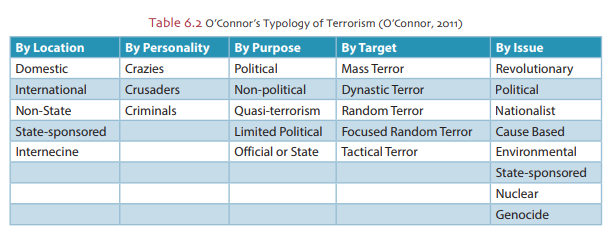
Soru 36
Which of the following is not one of the "Objective
Reasons" of terrorism?
Reasons" of terrorism?
Seçenekler
A
Loose Democracy
B
Poverty
C
Government
D
Ignorance
E
Intellectual Awakening
Açıklama:
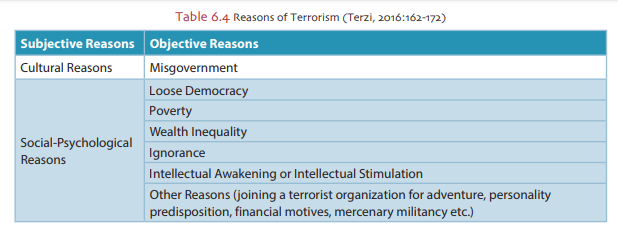
Soru 37
Which of the following is the explanation of the "intent" of the cyber terrorism according to Terzi's Approach?
Seçenekler
A
To create impact
B
The prevention of performance
C
The act itself
D
Politically motivated
E
Alerting crowds
Açıklama:
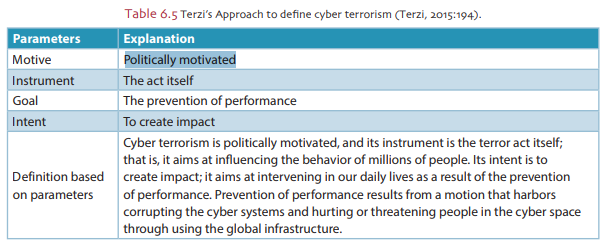
Soru 38
Which of the following is not one of the priorities of counter-terrorism?
Seçenekler
A
Minimizing the support for terrorist groups
B
Understand the motivation of the groups
C
Understanding the motivation of the recruitment factors
D
Developing similar tools for terrorist groups
E
Understanding the strategic importance of labeling of a group
Açıklama:
The other priorities of counter-terrorism include:
• Minimizing the support for terrorist groups,
• Understand the motivation of the groups and relevant recruitment factors,
• Understand the strategic importance of labeling of a group (terrorist, guerilla or revolutionaries etc.)
• Minimizing the support for terrorist groups,
• Understand the motivation of the groups and relevant recruitment factors,
• Understand the strategic importance of labeling of a group (terrorist, guerilla or revolutionaries etc.)
Soru 39
Which of the following is not one of the reasons why a large military may not prevent terrorist attacks?
Seçenekler
A
Terrorists are not traditional enemies that may be deterred by traditional military
force
force
B
Terrorists are the type of enemy that armed forces are designed and trained to fight
C
Terrorism is not a traditional warfare
D
Terrorists choose the time and the place of their attacks, and their targets are not on military battlefields
E
Terrorists do not wear uniforms to distinguish themselves from their enemies
Açıklama:
Military action is sometimes the appropriate response to terrorist acts. However, a large military may not be able to prevent terrorist attacks for the following basic reasons:
• terrorists are not traditional enemies that may be deterred by traditional military force;
• terrorism is not traditional warfare;
• terrorists choose the time and the place of their attacks, and their targets are not on military battlefields;
• terrorists do not wear uniforms to distinguish themselves from their enemies;
• terrorists are the antithesis of the type of enemy that armed forces are designed and trained to fight
• terrorists are not traditional enemies that may be deterred by traditional military force;
• terrorism is not traditional warfare;
• terrorists choose the time and the place of their attacks, and their targets are not on military battlefields;
• terrorists do not wear uniforms to distinguish themselves from their enemies;
• terrorists are the antithesis of the type of enemy that armed forces are designed and trained to fight
Soru 40
Which of the following is not one of the roles of an army in combating terrorism?
Seçenekler
A
Taking defense measures to reduce the vulnerability of populations
B
Taking offensive measures to prevent and deter terrorist activities.
C
Taking measures to limit the consequences of terrorist attacks
D
Producing policies to reduce vulnerability of infrastructure, information and
communication systems
communication systems
E
Taking measures to stabilize the situation following such attacks
Açıklama:
Finally, the army has three main roles in combating terrorism:
• anti-terrorism: defense measures to reduce vulnerability of populations, territories, and infrastructure, information and communication systems.
• counter-terrorism: offensive measures to track down, prevent, deter, and interdict terrorist activities.
• result management: measures to limit the consequences of terrorist attacks, and to stabilize the situation in the aftermath of such attacks with the support of civilian authorities.
• anti-terrorism: defense measures to reduce vulnerability of populations, territories, and infrastructure, information and communication systems.
• counter-terrorism: offensive measures to track down, prevent, deter, and interdict terrorist activities.
• result management: measures to limit the consequences of terrorist attacks, and to stabilize the situation in the aftermath of such attacks with the support of civilian authorities.
Soru 41
- Cimbri
- Zealots
- Sicarii
- Assassins
- Fatimids
Seçenekler
A
I-II-III
B
III-IV-V
C
I-II-III-IV
D
I-II-III-V
E
II-III-IV-V
Açıklama:
Cimbri killers, Zealots, Sicarii and Assassins are among the terrorist groups before Modernity (dating back to 17th century). The correct answer is C.
Soru 42
- Royalty
- Secularism
- Nationalism
- Industrialization
Seçenekler
A
I-III
B
II-IV
C
I-II-III
D
I-II-IV
E
II-III-IV
Açıklama:
Modernity is a period dating back to the 17th and 18th centuries and extending to the mid-20th century. It is a historical era that refers to concepts such as the nation state, nationalism, industrialization, proletariat, nuclear family, secularism, urbanization, democracy, bureaucracy, bourgeoisie, the rule of law. The correct answer is E.
Soru 43
- An institution
- A judicial procedure
- Established by the Protestants
- Included tortures against misbelievers
Seçenekler
A
I-II
B
III-IV
C
I-II-III
D
I-II-IV
E
II-III-IV
Açıklama:
Inquisition, a judicial procedure and later an institution that was established by the papacy and, sometimes, by secular governments to combat heresy. However, it even dates back to the11th century Through the inquisition, those who were believed to have acted contrary to the doctrines of the Catholic Church were condemned as misbelievers. Then, they were first excommunicated and later transferred to the courts to ‘leave the world’. The method for ‘leaving the world’ included various forms of torture such as auto-da-fe and drownings. The inquisition was revived and reinvented in the fight against the Protestants in the 16th century. The correct answer is D.
Soru 44
The concept of terrorism is a product of modernity. How long does the term modernity date back?
Seçenekler
A
9th and 10th centuries
B
11th and 12th centuries
C
13th and 14th centuries
D
15th and 16th centuries
E
17th and 18th centuries
Açıklama:
Modernity is a period dating back to the 17th and 18th centuries and extending to the mid-20th century.
Soru 45
Which group is established by Hassan-i Sabbah?
Seçenekler
A
Killers
B
Ninjas
C
Terrorists
D
Assassins
E
Murderers
Açıklama:
Another group, the Assassins, was established by Hassan-i Sabbah in 1090.
Soru 46
"A judicial procedure and later an institution that was established by the papacy and, sometimes, by secular governments to combat heresy."
Which organization is described above?
Which organization is described above?
Seçenekler
A
Fedayeen
B
Inquisition
C
Zealots
D
Assassins
E
Sicarii
Açıklama:
Inquisition, a judicial procedure and later an institution that was established by the papacy and, sometimes, by secular governments to combat heresy.
Soru 47
Where did the Reign of Terror happen?
Seçenekler
A
France
B
Italy
C
Germany
D
Russia
E
Romania
Açıklama:
In terms of etymology, terrorism was used for the first time in the dictionary of French Academy in 1789 to explain the Reign of Terror, the period of the French Revolution from September 5, 1793, to July 27, 1794.
Soru 48
Which of the following is a parameter of terrorism?
Seçenekler
A
Goal
B
Evil
C
Fear
D
Terror
E
Mediator
Açıklama:
For example, Başeren examines the definition of terrorism through such parameters as motive, instrument, goal, and intent.
Soru 49
Which of the following is a typology of terrorism by location?
Seçenekler
A
Political
B
Mass Terror
C
Official
D
Internecine
E
Crusaders
Açıklama:
This typology classifies terrorism and terrorists into five distinctive subgroups: by location (domestic, international, non-state, state-sponsored, internecine), by personality trait, by purpose, by target, and by issue.
Soru 50
Which of the following is a typology of terrorism by issue?
Seçenekler
A
Criminals
B
Non-state
C
Revolutionary
D
Random Terror
E
Quasi-terrorism
Açıklama:
This typology classifies terrorism and terrorists into five distinctive subgroups: by location, by personality trait, by purpose, by target, and by issue (revolutionary, political, etc.).
Soru 51
Which of the following can be a reason of terrorism?
Seçenekler
A
Wealth
B
Democracy
C
Ignorance
D
Education
E
Religion
Açıklama:
Subjective reasons include cultural and social-psychological reasons whereas objective reasons refer to misgovernment, loose democracy, poverty, wealth inequality, ignorance, intellectual awakening, and intellectual stimulation.
Soru 52
In which decade did the terrorist attacks peak the most?
Seçenekler
A
1980s
B
2010s
C
1960s
D
1990s
E
1970s
Açıklama:
The number of fatalities reached a peak in the mid 2010s with more than 40.000 people killed.
Soru 53
"Using some other states, groups or organizations instead of directly fighting with each other."
What is the correct term for above definition?
What is the correct term for above definition?
Seçenekler
A
Sneak Wars
B
Cold Wars
C
Cyber Wars
D
Terror Wars
E
Proxy Wars
Açıklama:
Today, groups or states employ yet another method to realize their political objectives: using some other states, groups or organizations instead of directly fighting with each other - which is called “proxy wars.”
Soru 54
Which of the following refers to the period of the French Revolution from September 5, 1793, to July 27, 1794?
Seçenekler
A
Reign of Terror
B
Revival of inquisition
C
Fedayeen
D
Zeoatry
E
Modernity
Açıklama:
In the secular context, terrorism dates back to the end of the 18th century and the early 19th century. In terms of etymology, terrorism was used for the first time in the dictionary of French Academy in 1789 to explain the Reign of Terror, the period of the French Revolution from September 5, 1793, to July 27, 1794. The correct answer is A.
Soru 55
Which of the following is not among the parameters used for defining terrorism?
Seçenekler
A
Goal
B
Money
C
Motive
D
Intent
E
Instrument
Açıklama:
In defining terrorism, it may be helpful to employ such parameters as motive, instrument, goal, and intent. The correct answer is B.
Soru 56
Which of the following refers to 'motive' in terrorism?
Seçenekler
A
The reason the doer has and operates from
B
A result such as death
C
The people involved
D
To create impact
E
The act itself
Açıklama:
Motive is the reason for the act that the perpetrator has, works to satsify, and operates from. The correct answer is A.
Soru 57
- Poverty
- Ignorance
- Misgovernment
- Cultural reasons
- Loose democracy
Seçenekler
A
I-II-III
B
II-IV-V
C
I-II-III-IV
D
I-II-III-V
E
II-III-IV-V
Açıklama:
The reasons (causes) for terrorism can be classified into two main categories: subjective reasons and objective reasons. Subjective reasons include cultural and social-psychological reasons, whereas objective reasons refer to misgovernment, loose democracy, poverty, wealth inequality, ignorance, intellectual awakening, and intellectual stimulation. The correct answer is D.
Soru 58
- Iran
- Russia
- Cuba
- North Korea
- South Africa
Seçenekler
A
I-II-III
B
I-III-IV
C
II-III-IV
D
II-IV-V
E
III-IV-V
Açıklama:
Iraq, Iran, Syria, Libya, Cuba, North Korea, and Sudan are the rouge states from the perspective of the American government as of 2003. (As of today, the rogue states are Cuba, Iran, Sudan, Syria, North Korea, Nicaragua and Venezuela - Maduro government). The correct answer is B.
Soru 59
Which of the following refers to using some other states, groups or organizations instead of directly fighting with each other?
Seçenekler
A
Intent detection
B
Intellectual wars
C
Proxy wars
D
Globalized terror
E
Cyber terrorism
Açıklama:
Today, groups or states employ yet another method to realize their political objectives: using some other states, groups or organizations instead of directly fighting with each other- which is called “proxy wars.” The correct answer is C.
Soru 60
- The International Monetary Fund
- The Financial Action Task Force
- The Global Counterterrorism Forum
- Inter-American Counter-Terrorism Committee
- The Counter-Terrorism Implementation Task Force
Seçenekler
A
I-II-III
B
III-IV-V
C
I-II-III-IV
D
I-II-III-V
E
II-III-IV-V
Açıklama:
The Financial Action Task Force, The Global Counterterrorism Forum, Inter-American Counter-Terrorism Committee and The Counter-Terrorism Implementation Task Force are some of the international efforts to fight against terrorism. The correct answer is E.
Soru 61
Which of the following is known as the first terrorist groups in history?
Seçenekler
A
The Zealots and its fanatic group the Sicarii
B
Conrad of Montferrat (the King of Jerusalem)
C
The Assassins which called its militants as Fedayeen
D
The inquisition of the Catholic Church
E
Christian converts
Açıklama:
In the first century A.D., the Zealots and its fanatic group the Sicarii, a Jewish sect, had undertaken terrorist acts- they are known as the first terrorist groups in history.
Their fighting movement Zelaotry, which means conservatism and bigotry, is used to define any member (Zealot) and the movement itself of an ancient Jewish sect which aimed to struggle for Jewish world of theocracy and resistance to the Romans until 70 A.D.
The Zealots and its fanatic group the Sicarii, a Jewish sect, had undertaken terrorist acts- they are known as the first terrorist groups in history. Therefore, the correct choice is A.
Their fighting movement Zelaotry, which means conservatism and bigotry, is used to define any member (Zealot) and the movement itself of an ancient Jewish sect which aimed to struggle for Jewish world of theocracy and resistance to the Romans until 70 A.D.
The Zealots and its fanatic group the Sicarii, a Jewish sect, had undertaken terrorist acts- they are known as the first terrorist groups in history. Therefore, the correct choice is A.
Soru 62
According to Başeren's parameters to define terrorism, which of the following states the instrument?
Seçenekler
A
The reason for the act that
B
The terror act itself
C
A result such as killing
D
Creating certain impact
E
Civil death and losses
Açıklama:
Başeren examines the definition of terrorism through such parameters as motive, instrument, goal, and intent. Motive is the reason for the act that the perpetrator has, works to satify, and operates from. Instrument is the terror act itself. The goal of terrorism refers to achieving a result such as killing and death. Intent refers to creating certain impact. Motive is something political and requires violent action. The threat of violence may suffice if perpetrators have already caused fear in the society through previous acts of violence.
Instrument is the terror act itself. Therefore, the correct choice is B.
Instrument is the terror act itself. Therefore, the correct choice is B.
Soru 63
According to O’Connor’s Typology of Terrorism, which of the following defines terror by issue?
Seçenekler
A
Criminals
B
International
C
State sponsored
D
Nationalist
E
Mass terror
Açıklama:
According to O’Connor; terrorism is the use of unlawful power or violence against persons or property to intimidate or force a government, civilian population, or any segment of the society for political or social purposes. O'Connor's typology classifies terrorism and terrorists into five distinctive subgroups; by location, by personality trait, by purpose, by target, and by issue.
Nationalist terror could be described with the issue parameter. Therefore, the correct choice is D.
Nationalist terror could be described with the issue parameter. Therefore, the correct choice is D.
Soru 64
According to the concepts in O’Connor’s Typology of Terrorism, which of the following can be defined as genocide?
Seçenekler
A
when a repressive regime forces its citizens into total obedience
B
when a government seeks to wipe out a minority group in its territory
C
by representatives of a country against another country
D
for ideological and political purposes
E
for private purposes or gain
Açıklama:
According to O’Connor terrorism is the use of unlawful power or violence against persons or property to intimidate or force a government, civilian population, or any segment of the society for political or social purposes.
If a state wipes out a minority group in its territory or shows intention to do so, it is called a genocide. Therefore, the correct choice is B.
If a state wipes out a minority group in its territory or shows intention to do so, it is called a genocide. Therefore, the correct choice is B.
Soru 65
Considering the concepts in O’Connor’s Typology of Terrorism, which of the following can be defined as a limited political one?
Seçenekler
A
for ideological and political purposes
B
for private purposes or gain
C
Ideological but not revolutionary
D
targets anybody in wrong place at wrong time
E
targets general population
Açıklama:
O’Connor states that terrorism is the use of unlawful power or violence against persons or property to intimidate or force a government, civilian population, or any segment of the society for political or social purposes.
According to O’Connor's Typology of Terrorism the limited political concept is ideological but not revolutionary. Therefore, the correct choice is C.
According to O’Connor's Typology of Terrorism the limited political concept is ideological but not revolutionary. Therefore, the correct choice is C.
Soru 66
Which of the following is the best option to complete the sentence below?
'Cultural and social psychological reasons constitute the __________ reasons.'
'Cultural and social psychological reasons constitute the __________ reasons.'
Seçenekler
A
nationalist
B
environmental
C
political
D
objective
E
subjective
Açıklama:
Cultural and social psychological reasons constitute the subjective reasons. Cultural reasons refer to the material practice and spiritual practice of a society. A culture that values violence or war may be given as an example for cultural reasons of terrorism.
'Cultural and social psychological reasons constitute the subjective reasons', is the whole sentence. Therefore, the correct choice is E.
'Cultural and social psychological reasons constitute the subjective reasons', is the whole sentence. Therefore, the correct choice is E.
Soru 67
Which of the following is the best option to complete the sentence below?
'The ___________ theory is the feeling of financial distress develops as a consequence of the consciousness of the gap between the expectations and possibilities of a person.'
'The ___________ theory is the feeling of financial distress develops as a consequence of the consciousness of the gap between the expectations and possibilities of a person.'
Seçenekler
A
Ignorance
B
Loose democracy
C
Relative deprivation
D
Misgovernment
E
Wealth inequality
Açıklama:
One of the main theoretical approaches to political violence is the relative deprivation theory. According to this theory, the feeling of deprivation develops as a consequence of the consciousness of the gap between the expectations and possibilities of a person. Expectations symbolize the idea that a person has the same right (with other persons) to acquire goods and become wealthy. However, the society may not provide he or she with the necessary means to achieve certain living standards. The dissatisfaction created by this deprivation is a universal warning for terrorist acts
The relative deprivation theory is the feeling of deprivation develops as a consequence of the consciousness of the gap between the expectations and possibilities of a person. Therefore, the correct choice is C.
The relative deprivation theory is the feeling of deprivation develops as a consequence of the consciousness of the gap between the expectations and possibilities of a person. Therefore, the correct choice is C.
Soru 68
Which of the following could be considered as a false statement when defining terrorism as a new means of war in the 21st century?
Seçenekler
A
In the 21st century, terrorism no longer continues to be a vital threat to national and global security.
B
International law covers different cases involving the use of force by states.
C
War and terrorism both involve extreme violent acts,
D
Terrrorism has also introduced new types of violence in terms of technology, victimization, threats, and responses.
E
War and terrorism both involve extreme violent acts.
Açıklama:
International law covers different cases involving the use of force by states. The use of force is regulated by the UN Charter and the decisions (resolutions) of the Security Council today. War and terrorism both involve extreme violent acts, both motivated by political, ideological or strategic goals, and both are inflicted by one group of individuals against another.
In the 21st century, terrorism continues to be a vital threat to national and global security. Modern terrorist attacks include kidnapping of businesspeople, assassination of political leaders, bombing of embassies, and hijacking of aircrafts. Terrrorism has also introduced new types of violence in terms of technology, victimization, threats, and responses.
In the 21st century, terrorism no longer continues to be a vital threat to national and global security is a false statement, because terrorism is still a global threat. Therefore, the correct choice is A.
In the 21st century, terrorism continues to be a vital threat to national and global security. Modern terrorist attacks include kidnapping of businesspeople, assassination of political leaders, bombing of embassies, and hijacking of aircrafts. Terrrorism has also introduced new types of violence in terms of technology, victimization, threats, and responses.
In the 21st century, terrorism no longer continues to be a vital threat to national and global security is a false statement, because terrorism is still a global threat. Therefore, the correct choice is A.
Soru 69
Which of the following terms defines the act of terrorism which aims to prevent the performance of computers and create a large impact?
Seçenekler
A
Nonpolitical terrorism
B
International terrorism
C
Global terrorism
D
National terrorism
E
Cyber terrorism
Açıklama:
Cyber terrorism is politically motivated, and its instrument is the terror act itself; that is, it aims at influencing the behavior of millions of people. Its intent is to create impact; it aims at intervening in our daily lives as a result of the prevention of performance. Prevention of performance results from a motion that harbors corrupting the cyber systems and hurting or threatening people in the cyber space through using the global infrastructure.
Corrupting the cyber systems and preventing their performance is called cyber terrorizm. Therefore, the correct choice is E.
Corrupting the cyber systems and preventing their performance is called cyber terrorizm. Therefore, the correct choice is E.
Soru 70
Which of the following is NOT one of the reasons why a large military may not be able to prevent terrorist attacks?
Seçenekler
A
Terrorists are not traditional enemies that may be deterred by traditional military force.
B
Terrorists are the antithesis of the type of the enemy that armed forces are designed and trained to fight.
C
Terrorists choose the time and the place of their attacks, and their targets are not on military battlefields.
D
Terrorists know that the clear distinction between terrorism and war is disappearing.
E
Terrorists do not wear uniforms to distinguish themselves from their enemies.
Açıklama:
Military action is sometimes the appropriate response to terrorist acts. However, a large military may not be able to prevent terrorist attacks for some reasons such as; terrorists are not traditional enemies that may be deterred by traditional military force, terrorism is not a traditional warfare, terrorists choose the time and the place of their attacks, and their targets are not on military battlefields, terrorists do not wear uniforms to distinguish themselves from their enemies, terrorists are the antithesis of the type of the enemy that armed forces are designed and trained to fight.
'Terrorists know that the clear distinction between terrorism and war is disappearing' is not one of the reasons why armies or military personnel can't fight against terrorism. Therefore, the correct choice is D.
'Terrorists know that the clear distinction between terrorism and war is disappearing' is not one of the reasons why armies or military personnel can't fight against terrorism. Therefore, the correct choice is D.
Ünite 7
Soru 1
Which one is NOT related to solve the security dilemma?
Seçenekler
A
Territorial integrity.
B
Arms control.
C
Disarmament.
D
Reduction or elimination of certain weapons.
E
Diplomatic efforts to reach a consensus on international security issues.
Açıklama:
Security dilemma refers to the situation where one nation’s efforts to enhance its security creates security concerns for another nation with any prior intention. For example, in the Cold War era, developing nuclear weapons cause a security dilemma, which had almost resulted in a new world war in the early 1960s. This dilemma has been further manifested in the international arena with increasing military technologies, arms races, and deterrent national policies. In an attempt to solve this dilemma, nations resorted to such policies as arms control, disarmament, reduction or elimination of certain weapons as well as diplomatic efforts to reach a consensus on international security issues
Soru 2
Competition on resources brings with it some risks and threats. Which one below is NOT one of them?
Seçenekler
A
Terrorism
B
Migration
C
Organized crime
D
Refugee problem
E
Energy extraction
Açıklama:
Competition on resources brings with it some risks and threats such as terrorism, organized crime, migration, and refugee problem.
Soru 3
Why are The Middle East, Latin America, the Arctic and the Pacific critical geographical areas?
Seçenekler
A
They control sky routes.
B
They deal with immigration problems.
C
They have almost four-fifths of fossil energy resources.
D
They cause environmental problems.
E
They cannot afford energy resources.
Açıklama:
The Middle East, Latin America, the Arctic and the Pacific are critical geographical areas not only because they have almost four-fifths of fossil energy resources but also control the flow of energy, world trade routes, strategic straits, and maritime routes. Therefore, all the developments in these geographical areas affect the energy policies of nation states and energy markets in the world.
Soru 4
What is sustainability?
Seçenekler
A
While a competitive energy market with an energy supply- demand equilibrium is significant, it is also critical to provide energy at low cost and affordable prices.
B
It is the presence of energy resources and sustaining the “demand and supply equilibrium” of the world energy resources.
C
It is the situation where one nation’s efforts to enhance its security creates security concerns for another nation with any prior intention.
D
It means that the requested energy can be supplied without any disruption as long as the energy is needed.
E
It refers to dominate the energy sources and transport routes has had to face the opposition of other states and this rivalry has resulted in political and economic instability in the region.
Açıklama:
Sustainability means that the requested energy can be supplied without any disruption as long as the energy is needed.
Soru 5
Which one is related to The Group of 20 (G-20)?
Seçenekler
A
It was formed in 1975 by France, Germany, Italy, Japan, the United States, and the United Kingdom.
B
It started out in 1999 as a meeting of finance ministers and central bank governors.
C
In 1998, the Russian Federation (RF) was accepted.
D
Its major role is to discuss and resolve global problems.
E
It has recognized the key role of the energy transition through the development of new markets for clean energy and through non-market- distortive support measures.
Açıklama:
Option A is about G-6, C, D and E is about G-7.
Soru 6
What is true about The Organization of the Petroleum Exporting Countries (OPEC)?
Seçenekler
A
It was formed at the Baghdad Conference.
B
It was formed in 1923.
C
The Council is the UN-accredited global energy body.
D
It is formed with more than 3000-member organizations.
E
It is located in over 90 countries.
Açıklama:
OPEC is a permanent intergovernmental organization that was formed at the Baghdad Conference, held on September 10-14, 1960, by Iran, Iraq, Kuwait, Saudi Arabia, and Venezuela. Today, with 14 Member Countries.
Soru 7
What is true about The International Energy Forum (IEF)?
Seçenekler
A
The history of it began with the 1973-1974 Middle East War crisis and its immediate aftermath.
B
It aims to foster greater mutual understanding and awareness of common energy interests among its members.
C
It is an “international organization which brings together the European Union and its neighbors to create an integratedpan-European energy market.
D
It is an “intergovernmental organization that supports countries in their transition to a sustainable energy future, and serves as the principal platform for international cooperation.
E
It is a “declaration of political intention aiming at strengthening energy cooperation between the signatory states.
Açıklama:
The IEF “aims to foster greater mutual understanding and awareness of common energy interests among its members. The 72 member countries of the Forum are signatories to the IEF Charter, which outlines the framework of the global energy dialogue through this inter- governmental arrangement.
Soru 8
Which one is about The Energy Community?
Seçenekler
A
It supports an energy security dialogue among its participating States and other international bodies that deal with energy issues.
B
It seeks to enhance its strategic awareness of energy developments with security implications; develop its competence in supporting the protection of critical energy infrastructure.
C
It encourages governments to adopt enabling policies for renewable energy investments, provides practical tools and policy advice to accelerate renewable energy deployment.
D
It maps out common principles for international cooperation in the field of energy.
E
It aims to create an integrated energy market allowing for cross-border energy trade and integration with the EU market.
Açıklama:
The Energy Community is an “international organization which brings together the European Union and its neighbors to create an integratedpan-European energy market. The key objective of the Energy Community is to extend the EU internal energy market rules and principles to countries in South East Europe, the Black Sea region and beyond on the basis of a legally binding framework. Specific goals of the Community include:
- creating an integrated energy marketallowing for cross-border energy trade and integration with the EU market;
- enhancing the security of supply to ensurestable and continuous energy supply that is essential for economic development and social stability;
- improving the environmental situation inrelation with energy supply in the region and foster the use of renewable energy and energy efficiency” (Energy Community, 2017).
Soru 9
Which one is a technology that converts sunlight (solar radiation) into direct current electricity by using semiconductors?
Seçenekler
A
Offshore wind energy
B
Hydropower
C
Solar Photovoltaic (PV)
D
Shale gas
E
Thermal production
Açıklama:
Solar Photovoltaic (PV) is a technology that converts sunlight (solar radiation) into direct current electricity by using semiconductors. When the sun hits the semiconductor within the PV cell, electrons are freed and form an electric current.
Soru 10
What is energy imperialism?
Seçenekler
A
It refers to the interaction among states and empires in a particular geographical setting that the geography of a state (its position in a geographical region and in the world as whole) presents opportunities to, and imposes limitations on, the state.
B
It stresses the importance of economic prosperity; in this case, the concern for power is overridden by economic considerations.
C
It emphasizes social behavior that is shaped by elite beliefs, collective norms, and social identities.
D
It is mostly used for the situations where the natural resources are used by a state as a leverage to attain its political and military objectives.
E
It analyzes the relationships and strategic interactions between two or more actors.
Açıklama:
Imperialism has always been at the center of debates in International Relations since the late 19th century. Imperialism signifies an asymmetrical relationship between the materially advanced societies and relatively “backward” societies. Energy imperialism, as a concept in IR, is mostly used for the situations where the natural resources are used by a state as a leverage to attain its political and military objectives (Harshe, 2005, 2071).
Soru 11
Which of the following countries is not a member of the Group of 7 (G7)?
Seçenekler
A
Italy
B
Germany
C
Russia
D
Canada
E
France
Açıklama:
The Group of Seven (G-7) is a forum of the world’s seven most industrialized economies. G-6 was formed in 1975 by France, Germany, Italy, Japan, the United States, and the United Kingdom. Canada was invited to join this group in 1976 that eventually cThe Group of Seven (G-7) is a forum of the world’s seven most industrialized economies. G-6 was formed in 1975 by France, Germany, Italy, Japan, the United States, and the United Kingdom. Canada was invited to join this group in 1976 that eventually created the Group of Seven. In 1998, the Russian Federation (RF) was accepted by the G-7 countries as a full member, transforming G-7 into the Group of Eight (G-8). However, in 2014, Russia was suspended from G-8 after it had annexed Crimea and created tensions with Ukraine. reated the Group of Seven. In 1998, the Russian Federation (RF) was accepted by the G-7 countries as a full member, transforming G-7 into the Group of Eight (G-8). However, in 2014, Russia was suspended from G-8 after it had annexed Crimea and created tensions with Ukraine. The correct answer is C.
Soru 12
What is the concept that refers to the situation where one nation’s efforts to enhance its security creates security concerns for another nation with any prior intention?
Seçenekler
A
security dilemma
B
second-order policy issues
C
low political issues
D
traditional approach
E
territorial integrity
Açıklama:
This brings us to the discussion of the concept of security dilemma. This concept refers to the situation where one nation’s efforts to enhance its security creates security concerns for another nation with any prior intention. The correct answer is A.
Soru 13
In terms of energy security, what is the term used to refer to supply of energy without any disruption as long as the energy is needed?
Seçenekler
A
affordability
B
sustainability
C
political instability
D
availability
E
acceptibility
Açıklama:
Sustainability means that the requested energy can be supplied without any disruption as long as the energy is needed (APERC, 2017). The correct answer is B.
Soru 14
In terms of energy security, what is the terms used to refer to the presence of energy resources and sustaining the “demand and supply equilibrium” of the world energy resources?
Seçenekler
A
sustainability
B
affordability
C
availablity
D
acceptability
E
political instability
Açıklama:
The concept of availability refers to the presence of energy resources and sustaining the “demand and supply equilibrium” of the world energy resources. Accessibility is important for ensuring the continuous flow of energy within the technological means. The correct answer is C.
Soru 15
Which of the following countries is not a member of OPEC?
Seçenekler
A
Iran
B
Turkey
C
Iraq
D
Kuwait
E
Saudi Arabia
Açıklama:
Members of OPEC (as of March 2019): Iran, Iraq, Kuwait, Saudi Arabia, Venezuela, Libya (1962), the United Arab Emirates (1967), Algeria (1969), Nigeria (1971), Ecuador (1973), Gabon (1975), Angola (2007), Equatorial Guinea (2017), Congo (2018). The correct answer is B.
Soru 16
When and where was NATO’s role in energy security first defined?
Seçenekler
A
in 1960 during Baghdad Conference
B
in 2005 at Paris Agreement
C
in 2018 at the Bucharest Summit
D
in 2010 during Copenhagen Summit
E
in 2015 during Kyoto Protocol
Açıklama:
“NATO’s role in energy security was first defined in 2008 at the Bucharest Summit, and since then this role has been strengthened. Energy security is a vital element of resilience and has become more important in the past years due to the new security context. Energy efficiency is important not only for logistics and cost-saving in threats of operation, but also for the environment” (NATO, 2016). The correct answer is C.
Soru 17
Which of the following countries helped found the Group of 7 (G7)?
Seçenekler
A
Canada
B
China
C
France
D
Russia
E
Norway
Açıklama:
The Group of Seven (G-7) is a forum of the world’s seven most industrialized economies. G-6 was formed in 1975 by France, Germany, Italy, Japan, the United States, and the United Kingdom. Canada was invited to join this group in 1976 that eventually created the Group of Seven. In 1998, the Russian Federation (RF) was accepted by the G-7 countries as a full member, transforming G-7 into the Group of Eight (G-8). However, in 2014, Russia was suspended from G-8 after it had annexed Crimea and created tensions with Ukraine. The correct answer is C.
Soru 18
When was OPEC formed?
Seçenekler
A
in 1955
B
1960
C
1965
D
1970
E
1975
Açıklama:
OPEC is a permanent intergovernmental organization that was formed at the Baghdad Conference, held on September 10-14, 1960, by Iran, Iraq, Kuwait, Saudi Arabia, and Venezuela. Today, with 14 Member Countries, “OPEC’s objective is to co-ordinate and unify petroleum policies among Member Countries, in order to secure fair and stable prices for petroleum producers; an efficient, economic and regular supply of petroleum to consuming nations; and a fair return on capital to those investing in the industry” (OPEC, 2018). The correct answer is B.
Soru 19
What is the term used to refer to the situations where the natural resources are used by a state as a leverage to attain its political and military objectives?
Seçenekler
A
Constructivism
B
Sustainability
C
Availability
D
Liberalism
E
Energy imperialism
Açıklama:
Imperialism has always been at the center of debates in International Relations since the late 19th century. Imperialism signifies an asymmetrical relationship between the materially advanced societies and relatively “backward” societies. Energy imperialism, as a concept in IR, is mostly used for the situations where the natural resources are used by a state as a leverage to attain its political and military objectives (Harshe, 2005, 2071). The correct answer is E.
Soru 20
Which of the following organizations aims to bring together the European Union and its neighbors to create an integrated pan-European energy market?
Seçenekler
A
The International Energy Charter
B
The International Renewable Energy Agency (IRENA
C
The Group of 20 (G-20)
D
The Energy Community
E
The Organization of the Petroleum Exporting Countries (OPEC)
Açıklama:
The Energy Community is an “international organization which brings together the European Union and its neighbors to create an integrated pan-European energy market. The key objective of the Energy Community is to extend the EU internal energy market rules and principles to countries in South East Europe, the Black Sea region and beyond on the basis of a legally binding framework. The correct answer is D.
Soru 21
Which of the followings refers to the situation where one nation’s efforts to enhance its security creates security concerns for another nation with any prior intention?
Seçenekler
A
Security dilemma.
B
Second-order policy.
C
Territorial integrity.
D
Security-oriented approach.
E
High politics.
Açıklama:
Page 191.
Security dilemma: This concept refers to the situation where one nation’s efforts to enhance its security creates security concerns for another nation with any prior intention. For example, in the Cold War era, developing nuclear weapons cause a security dilemma, which had almost resulted in a new world war in the early 1960s. This dilemma has been further manifested in the international arena with increasing military technologies, arms races, and deterrent national policies. In an attempt to solve this dilemma, nations resorted to such policies as arms control, disarmament, reduction or elimination of certain weapons as well as diplomatic efforts to reach a consensus on international security issues. Therefore, the correct option is A.
Security dilemma: This concept refers to the situation where one nation’s efforts to enhance its security creates security concerns for another nation with any prior intention. For example, in the Cold War era, developing nuclear weapons cause a security dilemma, which had almost resulted in a new world war in the early 1960s. This dilemma has been further manifested in the international arena with increasing military technologies, arms races, and deterrent national policies. In an attempt to solve this dilemma, nations resorted to such policies as arms control, disarmament, reduction or elimination of certain weapons as well as diplomatic efforts to reach a consensus on international security issues. Therefore, the correct option is A.
Soru 22
Which of the followings refers to the quality that means the requested energy can be supplied without any disruption as long as the energy is needed?
Seçenekler
A
Affordability.
B
Political instability.
C
Sustainability.
D
Stability.
E
Availability.
Açıklama:
Page 193.
Sustainability means that the requested energy can be supplied without any disruption as long as the energy is needed. Therefore, the correct option is C.
Sustainability means that the requested energy can be supplied without any disruption as long as the energy is needed. Therefore, the correct option is C.
Soru 23
Which of the followings was suspended from G-8 in 2014, thus turning it into G-7?
Seçenekler
A
Canada.
B
Turkish Republic.
C
Italy.
D
Russia.
E
Spain.
Açıklama:
Page 194.
The Group of Seven (G-7) is a forum of the world’s seven most industrialized economies. G-6 was formed in 1975 by France, Germany, Italy, Japan, the United States, and the United Kingdom. Canada was invited to join this group in 1976 that eventually created the Group of Seven. In 1998, the Russian Federation (RF) was accepted by the G-7 countries as a full member, transforming G-7 into the Group of Eight (G-8). However, in 2014, Russia was suspended from G-8 after it had annexed Crimea and created tensions with Ukraine. Therefore, the correct option is D.
The Group of Seven (G-7) is a forum of the world’s seven most industrialized economies. G-6 was formed in 1975 by France, Germany, Italy, Japan, the United States, and the United Kingdom. Canada was invited to join this group in 1976 that eventually created the Group of Seven. In 1998, the Russian Federation (RF) was accepted by the G-7 countries as a full member, transforming G-7 into the Group of Eight (G-8). However, in 2014, Russia was suspended from G-8 after it had annexed Crimea and created tensions with Ukraine. Therefore, the correct option is D.
Soru 24
In terms of energy transition, which of the followings does the G-7 aim to achieve?
Seçenekler
A
Solutions to energy disputes through dialogue.
B
Development of new markets for clean energy.
C
Research and development of innovative technologies.
D
Promoting the quality of energy infrastructure.
E
Underlining the strategic role of the existing transit routes for gas deliveries to Europe
Açıklama:
Page 194.
G-7 has recognized the key role of the energy transition through the development of new markets for clean energy and through non-marketdistortive support measures. The enhancement of research and development of innovative technologies are crucial for the future, recognizing that both economic growth and environmental protection could be achieved. Therefore, the correct option is B.
G-7 has recognized the key role of the energy transition through the development of new markets for clean energy and through non-marketdistortive support measures. The enhancement of research and development of innovative technologies are crucial for the future, recognizing that both economic growth and environmental protection could be achieved. Therefore, the correct option is B.
Soru 25
Acknowledging the crucial role of energy in shaping the future, which of the followings does G-20 emphasize to be of global importance along with the energy security?
Seçenekler
A
Renewable energy.
B
Energy networks.
C
Cybersecurity threats.
D
Market liquidity and diversity.
E
Climate change.
Açıklama:
Page 195.
G20 acknowledges “the crucial role of energy in shaping the future, within different national circumstances as well as the need for persistent actions to address global challenges, including climate change and energy security.” The Group also recognizes that energy transitions are essential for the development of long-term strategies that combine economic growth and the reduction of greenhouse gases. Therefore, the correct option is E.
G20 acknowledges “the crucial role of energy in shaping the future, within different national circumstances as well as the need for persistent actions to address global challenges, including climate change and energy security.” The Group also recognizes that energy transitions are essential for the development of long-term strategies that combine economic growth and the reduction of greenhouse gases. Therefore, the correct option is E.
Soru 26
I. Energy equity,
II. Environmental sustainability,
III. Affordability,
IV. Energy security.
Which of the ones listed above is the World Energy Council’s definition of energy sustainability based on?
II. Environmental sustainability,
III. Affordability,
IV. Energy security.
Which of the ones listed above is the World Energy Council’s definition of energy sustainability based on?
Seçenekler
A
I & II.
B
I, II & III.
C
I, II & IV.
D
II, III & IV.
E
I & III.
Açıklama:
Page 195.
“The World Energy Council’s definition of energy sustainability is based on three core dimensions: energy security, energy equity, and environmental sustainability. These three goals constitute a ‘trilemma’, entailing complex interwoven links between public and private actors, governments and regulators, economic and social factors, national resources, environmental concerns, and individual behaviors. Therefore, the correct option is C.
“The World Energy Council’s definition of energy sustainability is based on three core dimensions: energy security, energy equity, and environmental sustainability. These three goals constitute a ‘trilemma’, entailing complex interwoven links between public and private actors, governments and regulators, economic and social factors, national resources, environmental concerns, and individual behaviors. Therefore, the correct option is C.
Soru 27
Which of the followings is the permanent intergovernmental organization formed at the Baghdad Conference of 1960, aiming to co-ordinate and unify petroleum policies among Member Countries, in order to secure fair and stable prices for petroleum producers?
Seçenekler
A
OPEC.
B
Paris Agreement.
C
G-20.
D
World Energy Council.
E
G-7.
Açıklama:
Page 196.
OPEC is a permanent intergovernmental organization that was formed at the Baghdad Conference, held on September 10-14, 1960, by Iran, Iraq, Kuwait, Saudi Arabia, and Venezuela. Today, with 14 Member Countries, “OPEC’s objective is to co-ordinate and unify petroleum policies among Member Countries, in order to secure fair and stable prices for petroleum producers; an efficient, economic and regular supply of petroleum to consuming nations; and a fair return on capital to those investing in the industry”. Therefore, the correct option is A.
OPEC is a permanent intergovernmental organization that was formed at the Baghdad Conference, held on September 10-14, 1960, by Iran, Iraq, Kuwait, Saudi Arabia, and Venezuela. Today, with 14 Member Countries, “OPEC’s objective is to co-ordinate and unify petroleum policies among Member Countries, in order to secure fair and stable prices for petroleum producers; an efficient, economic and regular supply of petroleum to consuming nations; and a fair return on capital to those investing in the industry”. Therefore, the correct option is A.
Soru 28
Which of the followings is one of the members of OPEC?
Seçenekler
A
Cuba.
B
Egypt.
C
Nigeria.
D
Dubai.
E
Lebanon.
Açıklama:
Page 196.
Members of OPEC (as of March 2019): Iran, Iraq, Kuwait, Saudi Arabia, Venezuela, Libya (1962), the United Arab Emirates (1967), Algeria (1969), Nigeria (1971), Ecuador (1973), Gabon (1975), Angola (2007), Equatorial Guinea (2017), Congo (2018). Therefore, the correct option is C.
Members of OPEC (as of March 2019): Iran, Iraq, Kuwait, Saudi Arabia, Venezuela, Libya (1962), the United Arab Emirates (1967), Algeria (1969), Nigeria (1971), Ecuador (1973), Gabon (1975), Angola (2007), Equatorial Guinea (2017), Congo (2018). Therefore, the correct option is C.
Soru 29
Which of the followings is one of the goals of UNECE?
Seçenekler
A
Promotion of nuclear energy.
B
Promotion of renewable energy.
C
Increase in energy efficiency.
D
Reduction of greenhouse gas emissions.
E
Promotion of energy security dialogue.
Açıklama:
Page 200.
UNECE was set up in 1947 by ECOSOC. UNECE is “one of five regional commissions of the United Nations. UNECE’s major aim is to promote pan-European economic integration” (www.unece. org). UNECE’s work on sustainable energy is designed to improve access to affordable and clean energy for all and help reduce greenhouse gas emissions and the carbon footprint of the energy sector in the region. Therefore, the correct option is D.
UNECE was set up in 1947 by ECOSOC. UNECE is “one of five regional commissions of the United Nations. UNECE’s major aim is to promote pan-European economic integration” (www.unece. org). UNECE’s work on sustainable energy is designed to improve access to affordable and clean energy for all and help reduce greenhouse gas emissions and the carbon footprint of the energy sector in the region. Therefore, the correct option is D.
Soru 30
Which of the followings is not among the energy challenges of the 21st century which the International Energy Charter reflects?
Seçenekler
A
Role of enhanced energy trade for sustainable development.
B
Role of regional integration of energy markets.
C
Need to promote access to modern energy services.
D
Need for diversification of energy sources and routes.
E
Development of nuclear safety standards and agreements.
Açıklama:
Page 198.
The International Energy Charter is a “declaration of political intention aiming at strengthening energy cooperation between the signatory states;” however, the Charter “does not bear any legally binding obligation or financial commitment. It maps out common principles for international cooperation in the field of energy. The International Energy Charter reflects some of the most topical energy challenges of the 21st century, in particular: The International Energy Charter is a “declaration of political intention aiming at strengthening energy cooperation between the signatory states;” however, the Charter “does not bear any legally binding obligation or financial commitment. It maps out common principles for international cooperation in the field of energy. The International Energy Charter reflects some of the most topical energy challenges of the 21st century, in particular:
• “the growing weight of developing countries for global energy security,
• the “trilemma” between energy security, economic development and environmental protection,
• the role of enhanced energy trade for sustainable development,
• the need to promote access to modern energy services, energy poverty reduction, clean technology and capacity building,
• the need for diversification of energy sources and routes,
• the role of regional integration of energy markets” (International Energy Charter, 2016).
Therefore, the correct option is E.
The International Energy Charter is a “declaration of political intention aiming at strengthening energy cooperation between the signatory states;” however, the Charter “does not bear any legally binding obligation or financial commitment. It maps out common principles for international cooperation in the field of energy. The International Energy Charter reflects some of the most topical energy challenges of the 21st century, in particular: The International Energy Charter is a “declaration of political intention aiming at strengthening energy cooperation between the signatory states;” however, the Charter “does not bear any legally binding obligation or financial commitment. It maps out common principles for international cooperation in the field of energy. The International Energy Charter reflects some of the most topical energy challenges of the 21st century, in particular:
• “the growing weight of developing countries for global energy security,
• the “trilemma” between energy security, economic development and environmental protection,
• the role of enhanced energy trade for sustainable development,
• the need to promote access to modern energy services, energy poverty reduction, clean technology and capacity building,
• the need for diversification of energy sources and routes,
• the role of regional integration of energy markets” (International Energy Charter, 2016).
Therefore, the correct option is E.
Soru 31
Which one of the following is not true about energy and energy security?
Seçenekler
A
The issue of energy security has emerged in the 1970s when some nations’ access to oil was blocked.
B
Oil shocks emerged because of the Arab states’ policies for the nationalization of oil supplies and the Arab-Israeli wars.
C
If the states dominate the energy resources, they also dominate the world politics.
D
According to the APERC’s approach the components of energy security are energy efficiency, availability, accessibility, affordability, and sustainability.
E
During the Industrial Revolution coal maintained its importance after the invention of steam engines.
Açıklama:
Coal was the main source of energy in the process leading up to the Industrial Revolution. After the invention of steam engines, coal as the crucial source of energy was replaced by oil. The correct answer is E.
Soru 32
Which of the countries given below joined G-6 and created the Group of Seven?
Seçenekler
A
Japan
B
Canada
C
Germany
D
France
E
The United Kingdom
Açıklama:
G-6 was formed in 1975 by France, Germany, Italy, Japan, the United States, and the United Kingdom. Canada was invited to join this group in 1976 that eventually created the Group of Seven. The correct answer is B.
Soru 33
Which of the following countries was suspended from G-8 because of annexation of Crimea and some tensions with Ukraine?
Seçenekler
A
Germany
B
Italy
C
France
D
The Russian Federation
E
The United States
Açıklama:
In 1998, the Russian Federation (RF) was accepted by the G-7 countries as a full member, transforming G-7 into the Group of Eight (G-8). However, in 2014, Russia was suspended from G-8 after it had annexed Crimea and created tensions with Ukraine. D is the correct answer.
Soru 34
Which one of the following statements cannot be said for G20?
Seçenekler
A
The organization's current form is the same with the one in 1999.
B
The Group also encourages increased contributions from both public and private financial resources.
C
Together, the G20 members represent 85% of global GDP.
D
Energy efficiency has been prioritized by G20 members.
E
G20 acknowledges the crucial role of energy in shaping the future.
Açıklama:
G-20 “started out in 1999 as a meeting of finance ministers and central bank governors. In 2008, amidst the global financial crisis, it evolved into what it is today: a major forum for dialogue and decision-making attended by world leaders from vital economies. So the correct answer is A.
Soru 35
- It was formed in 1923.
- It is the UN-accredited global energy body.
- It has more than 3000-member organizations located in over 90 countries.
Seçenekler
A
The International Energy Agency
B
The Group of 20
C
The World Energy Council
D
The International Energy Forum
E
The Energy Community
Açıklama:
The given items are about The World Energy Council. The correct answer is C.
Soru 36
- It is a permanent intergovernmental organization that was formed at the Baghdad Conference.
- Its objective is to co-ordinate and unify petroleum policies among Member Countries.
- It has 14 member countries.
Seçenekler
A
IEF
B
IAEA
C
IEF
D
OPEC
E
The World Energy Council
Açıklama:
Given information is about OPEC. D is the correct option.
Soru 37
I. It works to ensure reliable, affordable and clean energy.
II. It has 60 member countries.
III. The IEA began with the 1973-1974 Middle East War crisis.
IV. Energy security, economic development, environmental awareness and engagement worldwide are four main areas of focus.
Which of the given items above can be true for the IEA?
II. It has 60 member countries.
III. The IEA began with the 1973-1974 Middle East War crisis.
IV. Energy security, economic development, environmental awareness and engagement worldwide are four main areas of focus.
Which of the given items above can be true for the IEA?
Seçenekler
A
I-II
B
III-IV
C
I-II-III
D
I-III-IV
E
II-III-IV
Açıklama:
The IEA has 30 member countries. The other statements are correct for it. Therefore, the correct answer is option D.
Soru 38
- It was set up in 1947 by ECOSOC.
- It is “one of five regional commissions of the United Nations.
- Its work on sustainable energy is designed to reduce greenhouse gas emissions and the carbon footprint of the energy sector.
Seçenekler
A
ESCAP
B
UNECE
C
IRENA
D
OSCE
E
IAEA
Açıklama:
The given information is about UNECE.
Soru 39
I. According to IEA 2016, China was the largest market for energy grid investment.
II. North America is the leader in the offshore wind energy investment.
III. The investment of China, Europe, and Brazil in the wind energy has decreased by about 15%.
IV. The investment in lithium mining has increased almost ten times since 2012.
Which of the items given above are correct?
II. North America is the leader in the offshore wind energy investment.
III. The investment of China, Europe, and Brazil in the wind energy has decreased by about 15%.
IV. The investment in lithium mining has increased almost ten times since 2012.
Which of the items given above are correct?
Seçenekler
A
I-II
B
III-IV
C
I-II-IV
D
I-III-IV
E
II-III-IV
Açıklama:
The offshore wind energy investment has also reached record levels with the introduction of approximately 4 gigawatts, mostly in Europe. So option D is correct.
Soru 40
I. Economic developments
II. Geopolitical changes
III. Environmental concerns
IV. Terrorism
Which of the items given above are important in terms of energy security discussion?
II. Geopolitical changes
III. Environmental concerns
IV. Terrorism
Which of the items given above are important in terms of energy security discussion?
Seçenekler
A
I-II
B
III-IV
C
I-III-IV
D
II-III-IV
E
I-II-III-IV
Açıklama:
While in the 1970s the concept of energy security included the security of supply in terms of accessibility, affordability and adequacy; today it is impossible to discuss energy security without considering economic developments, geopolitical changes, environmental concerns, terrorism as well as potential threats to the energy supply structures. The correct answer is E.
Soru 41
Which one of the following was not influential on the re-evaluation of the Realist school?
Seçenekler
A
Marxism
B
Liberalism
C
Constructivism
D
The Copenhagen school
E
Imperialism
Açıklama:
The analyses of the Realist school, however, were re-evaluated by several international theories such as Marxism, liberalism, constructivism and the Copenhagen school.
Soru 42
Which one of the following stands for the term that consists of events or phenomena that have the potential negative consequences for the existence of values of a state, society, or individual?
Seçenekler
A
Risk
B
Threat
C
Power
D
Hegemon
E
Se-curus
Açıklama:
The concept of threat consists of events or phenomena that have the
potential negative consequences for the existence of
values of a state, society, or individual.
potential negative consequences for the existence of
values of a state, society, or individual.
Soru 43
I. National security
II. International security
III. Political security
Which one(s) of these is/are among the critical dimensions of security?
II. International security
III. Political security
Which one(s) of these is/are among the critical dimensions of security?
Seçenekler
A
Only I
B
Only II
C
Only III
D
I-II
E
II-III
Açıklama:
While discussing security, we should mention
its two critical dimensions: national security
and international security.
its two critical dimensions: national security
and international security.
Soru 44
Which one of the following is not one of the critical geographical areas in the world in terms of energy?
Seçenekler
A
The Middle East
B
Latin America
C
the Arctic
D
the Pacific
E
The Europe
Açıklama:
The Middle East, Latin America, the Arctic
and the Pacific are critical geographical areas not
only because they have almost four-fifths of fossil
energy resources but also control the flow of
energy, world trade routes, strategic straits, and
maritime routes. Therefore, all the developments in
these geographical areas affect the energy policies
of nation states and energy markets in the world
and the Pacific are critical geographical areas not
only because they have almost four-fifths of fossil
energy resources but also control the flow of
energy, world trade routes, strategic straits, and
maritime routes. Therefore, all the developments in
these geographical areas affect the energy policies
of nation states and energy markets in the world
Soru 45
Which one of the following is not among the components of energy security determined by APERC?
Seçenekler
A
Instability
B
Availability
C
Energy efficiency
D
Accessibility
E
Affordability
Açıklama:
In a 2007 study, it listed these components as follows: energy
efficiency, availability, accessibility, affordability,
and sustainability. There has been some discussion
on these components; however, the APERC’s
approach has been widely accepted in academic
circles
efficiency, availability, accessibility, affordability,
and sustainability. There has been some discussion
on these components; however, the APERC’s
approach has been widely accepted in academic
circles
Soru 46
Which one of the following countries was invited to join G6 in 1976 and eventually created the Group of Seven (G7)?
Seçenekler
A
France
B
Germany
C
Canada
D
Italy
E
Japan
Açıklama:
The Group of Seven (G-7) is a forum of the
world’s seven most industrialized economies. G-6
was formed in 1975 by France, Germany, Italy,
Japan, the United States, and the United Kingdom.
Canada was invited to join this group in 1976 that
eventually created the Group of Seven.
world’s seven most industrialized economies. G-6
was formed in 1975 by France, Germany, Italy,
Japan, the United States, and the United Kingdom.
Canada was invited to join this group in 1976 that
eventually created the Group of Seven.
Soru 47
When did G20 start to work as a major forum for dialogue and decision-making attended by world leaders from vital economies?
Seçenekler
A
1999
B
2002
C
2006
D
2008
E
2009
Açıklama:
G-20 “started out in 1999 as a meeting of
finance ministers and central bank governors. In
2008, amidst the global financial crisis, it evolved
into what it is today: a major forum for dialogue
and decision-making attended by world leaders
from vital economies.
finance ministers and central bank governors. In
2008, amidst the global financial crisis, it evolved
into what it is today: a major forum for dialogue
and decision-making attended by world leaders
from vital economies.
Soru 48
I. Energy security
II. Environmental sustainability
III. Political stability
Which one(s) of these is/are among the core dimensions of energy security according to The World Energy Council’s definition?
II. Environmental sustainability
III. Political stability
Which one(s) of these is/are among the core dimensions of energy security according to The World Energy Council’s definition?
Seçenekler
A
Only I
B
Only II
C
Only III
D
I-II
E
II-III
Açıklama:
“The World Energy Council’s definition of
energy sustainability is based on three core
dimensions: energy security, energy equity,
and environmental sustainability.
energy sustainability is based on three core
dimensions: energy security, energy equity,
and environmental sustainability.
Soru 49
Today, how many members does OPEC have?
Seçenekler
A
11
B
12
C
13
D
14
E
15
Açıklama:
Today, with 14 Member Countries, “OPEC’s
objective is to co-ordinate and unify petroleum
policies among Member Countries, in order
to secure fair and stable prices for petroleum
producers; an efficient, economic and regular
supply of petroleum to consuming nations; and
a fair return on capital to those investing in the
industry” (OPEC, 2018).
objective is to co-ordinate and unify petroleum
policies among Member Countries, in order
to secure fair and stable prices for petroleum
producers; an efficient, economic and regular
supply of petroleum to consuming nations; and
a fair return on capital to those investing in the
industry” (OPEC, 2018).
Soru 50
Which one of the following is the world’s central intergovernmental forum for scientific and technical co-operation in the nuclear field?
Seçenekler
A
IAEA
B
OSCE
C
NATO
D
OPEC
E
IRENA
Açıklama:
IAEA is “the world’s central intergovernmental
forum for scientific and technical co-operation in
the nuclear field. It works for the safe, secure and
peaceful uses of nuclear science and technology,
contributing to international peace and security
and the United Nations’ Sustainable Development
Goals”
forum for scientific and technical co-operation in
the nuclear field. It works for the safe, secure and
peaceful uses of nuclear science and technology,
contributing to international peace and security
and the United Nations’ Sustainable Development
Goals”
Soru 51
Which of the following energy sources had been a strategic one until the beginning of the 20th century?
Seçenekler
A
Coal
B
Offshore wind energy
C
Oil
D
Natural gas
E
Hydropower
Açıklama:
Coal, which is an important energy source for industrial activities, has been effective in accelerating the industrialization process. Coal had been a strategic energy source until the beginning of the 20th century. Coal was the main source of energy in the process leading up to the Industrial Revolution. However, it lost its importance to oil and natural gas, the two energy sources widely used by both the industry and the military.
Coal had been a strategic energy source until the beginning of the 20th century. Therefore, the correct choice is A.
Coal had been a strategic energy source until the beginning of the 20th century. Therefore, the correct choice is A.
Soru 52
Which part of the world are two-thirds of the world’s oil and natural gas reserves located?
Seçenekler
A
South Pole
B
The Middle East
C
North America
D
Venezuela
E
Russia
Açıklama:
The energy resources, which strategically demonstrate the relative power of nations, are concentrated in certain regions of the world. Two-thirds of the world’s oil and natural gas reserves are located in the Middle East, a region located at the crossroads of key commercial maritime routes and straits. Therefore, the hegemon that aims to dominate the energy sources and transport routes has had to face the opposition of other states and this rivalry has resulted in political and economic instability in the region.
These instabilities and conflicts in the hydrocarbon-rich regions pose a risk for the access to the energy reserves and, as such, threatens the world energy security.
Therefore, the Middle East and Latin America (the proven oil reserves in Venezuela are recognized as the largest in the world) are the regions that we should highly take into consideration with regard to energy security issues.
Two-thirds of the world’s oil and natural gas reserves are located in the Middle East, a region located at the crossroads of key commercial maritime routes and straits. Therefore, the correct choice is B.
These instabilities and conflicts in the hydrocarbon-rich regions pose a risk for the access to the energy reserves and, as such, threatens the world energy security.
Therefore, the Middle East and Latin America (the proven oil reserves in Venezuela are recognized as the largest in the world) are the regions that we should highly take into consideration with regard to energy security issues.
Two-thirds of the world’s oil and natural gas reserves are located in the Middle East, a region located at the crossroads of key commercial maritime routes and straits. Therefore, the correct choice is B.
Soru 53
Which of the following can NOT be considered as one of the risks or threats competition on energy resources may bring?
Seçenekler
A
Terrorism
B
Migration
C
Organized crime
D
Overproduction
E
Refugee problem
Açıklama:
energy sources are concentrated in certain regions of the world. In the international system, states’ access to the energy resources has implications for both national and international security policies. Moreover, the energy use in economies, military complexes, and social areas is the most significant indicator for the development level of states. Therefore, there is overwhelming competition for energy resources and conflict about energy policies. However, competition on resources brings with it some risks and threats such as terrorism, organized crime, migration, and refugee problem.
Competition on resources brings with it some risks and threats such as terrorism, organized crime, migration, and refugee problem. Overproduction may bring pricing problems. Therefore, the correct choice is D.
Competition on resources brings with it some risks and threats such as terrorism, organized crime, migration, and refugee problem. Overproduction may bring pricing problems. Therefore, the correct choice is D.
Soru 54
Which of the following is considered to be the event that the world faced with the issue of energy security for the first time?
Seçenekler
A
World War I
B
The Arab oil embargo
C
Industrial Revolution
D
The Cold War era
E
World War II
Açıklama:
The issue of energy security has emerged in the 1970s when some nations’ access to oil was blocked. This was the era of oil shocks that emerged for two basic reasons: the Arab states’ policies for the nationalization of oil supplies and oil industry, and the Arab-Israeli wars that started with the UN decision on Palestine and occurred in 1948, 1956, 1967, and 1973.
As a result, the importance of energy resources has increased in the domestic and foreign policy formulation of states. Energy has become one of the primary indicators of national power
The issue of energy security has emerged in the 1970s when some nations’ access to oil was blocked by the Arab oil embargo in 1973. Therefore, the correct choice is B.
As a result, the importance of energy resources has increased in the domestic and foreign policy formulation of states. Energy has become one of the primary indicators of national power
The issue of energy security has emerged in the 1970s when some nations’ access to oil was blocked by the Arab oil embargo in 1973. Therefore, the correct choice is B.
Soru 55
According to the Asia Pacific Energy Research Center, which of the following components of energy security means that the requested energy can be supplied without any disruption as long as it is needed?
Seçenekler
A
Sustainability
B
Efficiency
C
Availability
D
Accessibility
E
Affordability
Açıklama:
Although the continuity of energy services falls in the scope of energy security, the Asia Pacific Energy Research Center (APERC) has made an effective attempt to determine the components of energy security. In a 2007 study, it listed these components as follows: energy efficiency, availability, accessibility, affordability, and sustainability.
Sustainability means that the requested energy can be supplied without any disruption as long as the energy is needed. Therefore, the correct choice is A.
Sustainability means that the requested energy can be supplied without any disruption as long as the energy is needed. Therefore, the correct choice is A.
Soru 56
Which of the following is the organization that provides the supply of oil to the consuming nations with its 12 members today?
Seçenekler
A
NATO
B
OECD
C
OPEC
D
UN
E
G7
Açıklama:
OPEC is a permanent intergovernmental organization that was formed at the Baghdad Conference, held on September 10-14, 1960, by Iran, Iraq, Kuwait, Saudi Arabia, and Venezuela.
Today, with 14 Member Countries, its objective is to co-ordinate and unify petroleum policies among Member Countries, in order to secure fair and stable prices for petroleum producers; an efficient, economic and regular supply of petroleum to consuming nations; and a fair return on capital to those investing in the industry.
In the last 60 years, the oil market has remained adequately supplied thanks to OPEC. Therefore, the correct choice is C.
Today, with 14 Member Countries, its objective is to co-ordinate and unify petroleum policies among Member Countries, in order to secure fair and stable prices for petroleum producers; an efficient, economic and regular supply of petroleum to consuming nations; and a fair return on capital to those investing in the industry.
In the last 60 years, the oil market has remained adequately supplied thanks to OPEC. Therefore, the correct choice is C.
Soru 57
Which of the following occasions sky rocketed the oil prices in 1979 after the Arab oil embargo?
Seçenekler
A
Cuban Missile Crisis
B
The Cold War era
C
The US embargo
D
Arab-Israel crisis
E
The Iranian Revolution
Açıklama:
OPEC rose to international prominence during the 1970s, as its Member Countries took control of their domestic petroleum industries and acquired a major say in the pricing of crude oil on world markets.
On two occasions, oil prices rose steeply in a volatile market, triggered by the Arab oil embargo in 1973 and the outbreak of the Iranian Revolution in 1979.
On two occasions, oil prices rose steeply in a volatile market, triggered by the Arab oil embargo in 1973 and the outbreak of the Iranian Revolution in 1979. Therefore, the correct choice is E.
On two occasions, oil prices rose steeply in a volatile market, triggered by the Arab oil embargo in 1973 and the outbreak of the Iranian Revolution in 1979.
On two occasions, oil prices rose steeply in a volatile market, triggered by the Arab oil embargo in 1973 and the outbreak of the Iranian Revolution in 1979. Therefore, the correct choice is E.
Soru 58
Which of the following is the organization that works for the safe, secure and peaceful uses of nuclear science and technology in the world?
Seçenekler
A
NATO
B
OPEC
C
OECD
D
IAEA
E
UN
Açıklama:
The International Atomic Energy Agency (IAEA) is the world’s central intergovernmental forum for scientific and technical co-operation in the nuclear field.
It works for the safe, secure and peaceful uses of nuclear science and technology, contributing to international peace and security and the United Nations’ Sustainable Development Goals.
The International Atomic Energy Agency (IAEA) works for the safe, secure and peaceful uses of nuclear science and technology, contributing to international peace and security. Therefore, the correct choice is D.
It works for the safe, secure and peaceful uses of nuclear science and technology, contributing to international peace and security and the United Nations’ Sustainable Development Goals.
The International Atomic Energy Agency (IAEA) works for the safe, secure and peaceful uses of nuclear science and technology, contributing to international peace and security. Therefore, the correct choice is D.
Soru 59
Which of the following terms is used to accuse the USA's approach to energy security from the view point of International Relations?
Seçenekler
A
Territorial Integrity
B
Global Energy Dialogue
C
Energy Imperialism
D
Game Theory
E
Constructivism
Açıklama:
The contemporary definition of energy security includes the notions of availability, accessibility, affordability, acceptability, accountability, sustainability, reliability, sufficiency, supplies and interruptions. Energy imperialism, as a concept in IR, is mostly used for the situations where the natural resources are used by a state as a leverage to attain its political and military objectives.
There are different approaches to energy security and it seems to be that where Russia is focusing on reviving the energy geopolitics, the USA prefers to concentrate on energy imperialism. Therefore, the correct choice is C.
There are different approaches to energy security and it seems to be that where Russia is focusing on reviving the energy geopolitics, the USA prefers to concentrate on energy imperialism. Therefore, the correct choice is C.
Soru 60
Which of the following introduced the subject of justifying the use of force toward ensuring the availability and security of energy resources?
Seçenekler
A
The Cold War era
B
The Industrial Revolution
C
The Iranian Revolution in 1979
D
The Arab oil embargo in 1973
E
The 1980 Carter Doctrine
Açıklama:
The issue of energy security emerged during and shortly after the oil crises in the 1970s. Since then, the concept of energy security has begun to gain more and more importance.
In fact, the 1980 Carter Doctrine has underlined the importance of oil for both national economic welfare and the global economy. Therefore, the Doctrine paved the way for justifying the use of force toward ensuring the availability and security of energy resources.
The 1980 Carter Doctrine has underlined the importance of oil for both national economic welfare and the global economy. Therefore, the correct choice is E.
In fact, the 1980 Carter Doctrine has underlined the importance of oil for both national economic welfare and the global economy. Therefore, the Doctrine paved the way for justifying the use of force toward ensuring the availability and security of energy resources.
The 1980 Carter Doctrine has underlined the importance of oil for both national economic welfare and the global economy. Therefore, the correct choice is E.
Ünite 8
Soru 1
Which conception of human security is based on protection of human beings from humans from serious violations such as genocide, crimes against humanity, and war crimes?
Seçenekler
A
Natural rights conception
B
Rule of law conception
C
Humanitarian conception
D
Broader view conception
E
Universal conception
Açıklama:
There are three conceptions of human security, natural rights-rule of law conception, humanitarian conception and broader view conception. Humanitarian conception is based on state’s and international community’s responsibility to protect human beings from human rights violations such as genocide, crimes against humanity, and crimes against peace. The correct option is C.
Soru 2
Which of the following is not one of the seven dimensions of human security?
Seçenekler
A
Economic security
B
Environmental security
C
Community security
D
Trade security
E
Health security
Açıklama:
The broader view was embraced in the 1994 Human Development Report under seven main domains: economic security, food security, health security, environmental security, personal security, community security, and political security. The correct option is D.
Soru 3
Which historical event changed the threat perception in international relations and so the the concept of human security?
Seçenekler
A
The Cold War
B
World War I
C
World War II
D
The Vietnam War
E
The Korean War
Açıklama:
The evolution of human security can be analyzed in two separate periods, during the Cold War and in the post-Cold War era. The end of the Cold War changed the threat perception in international relations. The threat perception now encompasses non-military threats. Thus, the referent object of security is now not the state, but human beings. One can provide different reasons for this transformation; however, almost all scholars agree that since the end of Cold War, the state-centered threats lost their relative importance in the international system. The correct option is A.
Soru 4
Which of the following is an organization created in Bandung/Indonesia in 1955 by 29 Asian and African former colonial countries striving to follow an independent foreign policy?
Seçenekler
A
Lysoen Declaration
B
The Human Security Network
C
The Non-Aligned Movement
D
Complex Interdependence
E
The Group of Seventy Seven
Açıklama:
The Non-Aligned Movement is an organization created by 29 Asian and African former colonial countries in Bandung/Indonesia in 1955. All these countries strived to follow an independent foreign policy from both NATO and the Warsaw Pact and supported the independence movements. They followed an agenda for economic development, disarmament, and economic inequality between countries. The correct option is C.
Soru 5
In which conference, the argument that environmental change was a security issue was pointed out for the first time?
Seçenekler
A
1970 Earth Day Conference
B
1992 Rio Earth Summit
C
2002 World Summit on Sustainable Development
D
2012 Rio+20 UN Conference on Sustainable Development
E
2016 UN Climate Change Conference
Açıklama:
The argument that environmental change was a security issue pointed out for the first time in 1992 UN Conference on Environment and Development, which became popularly known as the Rio Earth Summit. The Earth Summit as the largest conference brought together more than a hundred state leaders and established the Commission on Sustainable Development, which provided the political basis for the concept of sustainable development. During the 1992 Rio Earth Summit conference, world leaders highlighted a number of environmental problems including biodiversity, the growing ozone hole, pollution, desertification, and climate change. The correct option is B.
Soru 6
Which of the following nation has not yet signed or ratified the Kyoto Protocol?
Seçenekler
A
Australia
B
China
C
the USA
D
Turkey
E
Pakistan
Açıklama:
Kyoto Protocol (1997): is the main international treaty on global warming, which entered into effect in 2005 and mandates cuts in carbon emissions in 2008-2012. Almost all the world’s major countries, except the United States, are participants. The correct option is C.
Soru 7
Which of the following is not one of the current environmental issues?
Seçenekler
A
Loss of biodiversity
B
Emerging markets
C
Overpopulation
D
Water shortages
E
Global warming
Açıklama:
Emerging markets is one of the current economic issues. The correct option is B.
Soru 8
Which of the following is not included in the 2000 of the Millennium Development Goals?
Seçenekler
A
Eradicate extreme poverty and hunger
B
Reduce child mortality
C
Promote gender equality and empower women
D
Achieve universal primary education
E
Regulate the agricultural productivity
Açıklama:
The Millennium Development Goals (MDGs or MDG 8) are a long -and medium- term (to be achieved by 2015) development agenda approved by the UN General Assembly in December 2000. Their purpose was to inject renewed urgency into global development efforts by establishing challenging targets in each of the key human development areas.
- Goal 1 Eradicate extreme poverty and hunger
- Goal 2 Achieve universal primary education
- Goal 3 Promote gender equality and empower women
- Goal 4 Reduce child mortality
- Goal 5 Improve maternal health
- Goal 6 Combat HIV/AIDS, malaria and other diseases
- Goal 7 Ensure environmental sustainability
- Goal 8 Develop a global partnership for development
Soru 9
What is NOT about United Nations Development Program?
Seçenekler
A
It works in about 250 countries and territories.
B
It helps to achieve the eradication of poverty.
C
It helps to reduce inequalities and exclusion.
D
It aims at sustainable development.
E
One of its interest is climate and disaster resilience.
Açıklama:
The United Nations Development Program works in about 170 countries and territories, helping to achieve the eradication of poverty, and the reduction of inequalities and exclusion. The main three areas of UNDP are sustainable development, democratic governance and peace building and climate and disaster resilience.
Soru 10
What is 'a norm based on states responsibility to protect their own citizens and the international community’s obligation to protect humans from serious violations such as genocide, war crimes, and crimes against humanity'?
Seçenekler
A
The International Criminal Tribunal for Rwanda
B
Responsibility to Protect (R2P)
C
Ad hoc International Criminal Tribunals
D
Universal Declaration of Human Rights
E
The United Nations Development Program
Açıklama:
Responsibility to Protect (R2P) is a norm based on states responsibility to protect their own citizens and the international community’s obligation to protect humans from serious violations such as genocide, war crimes, and crimes against humanity.
Soru 11
Which security type are inter-ethnic, religious and other identity based tensions related to?
Seçenekler
A
Health security
B
Environmental security
C
Political security
D
Personal security
E
Community security
Açıklama:
| Type of Security | Examples of Main Threats |
| Economic security | Persistent poverty, unemployment |
| Food security | Hunger, famine |
| Health security | Deadly infectious diseases, unsafe food, malnutrition, lack of access to basic health care |
| Environmental security | Environmental degradation, resource depletion, natural disasters, pollution |
| Personal security | Physical violence, crime, terrorism, domestic violence, child labor |
| Community security | Inter-ethnic, religious and other identity based tensions |
| Political security | Political repression, human rights abuses |
Soru 12
Which is NOT true about Cold War?
Seçenekler
A
The Cold War was the rivalry between the United States of America and Soviet Union.
B
This rivalry was based on the ideological difference.
C
It was based on the use of political, economic, bureaucratic, and propaganda tools.
D
It escalated into an actual conflict.
E
The Cold War came to an end with the collapse of Communist bloc in 1989.
Açıklama:
The Cold War was the rivalry between the United States of America and the Soviet Union as well as between their respective allies from the end of the Second World War to 1989. This rivalry was based on the ideological difference between the two superpowers. It never escalated into an actual conflict; it was rather based on the use of political, economic, bureaucratic, and propaganda tools despite the existence of proxy wars such as the Korean War (1950-1953), the Vietnam War (1955-1975), and the Soviet- Afghan War (1979-1989). The Cold War came to an end with the collapse of Communist bloc in 1989 and the dissolution of the USSR in 1991(Dağ, 2005, 93).
Soru 13
What is the situation in which actions taken by a state to increase its own security cause reactions from other states, which in turn lead to a decrease rather than an increase in the original state’s security?
Seçenekler
A
Tragedy of the commons
B
Human Security
C
Security Dilemma
D
Complex Interdependence
E
The Non-Aligned Movement
Açıklama:
Security Dilemma is a situation in which actions taken by a state to increase its own security cause reactions from other states, which in turn lead to a decrease rather than an increase in the original state’s security.
Soru 14
What is related to the traditional security approach that is based on the absence of war between two states?
Seçenekler
A
Negative peace
B
Positive peace
C
Complex Interdependence
D
Security Dilemma
E
The Non-Aligned Movement
Açıklama:
While negative peace is related to the traditional security approach that is based on the absence of war between two states, positive peace refers to the establishment of a socially just system by taking into consideration all dimensions of human security.
Soru 15
The Commission on Human Security specified the priorities of human security. Which one is NOT one of them?
Seçenekler
A
Protecting people in violent conflict
B
Protecting people from the proliferation of arms
C
Supporting the human security of people on the move
D
Establishing human security transition funds for post-conflict situations
E
The range of actors is expanded beyond the state alone
Açıklama:
After the publication of this report, the UN requested a final report for human security fromthe Commission on Human Security. The Commission specified the priorities of human security as follows (Human Security Now, 2003:133):
• Establishing human security transition funds for post-conflict situations;
• Encouraging fair trade and markets to benefit the extreme poor;
• Providing minimum living standards everywhere;
• According high priority to universal access to basic health care;
• Developing an efficient and equitable global system for patent rights;
• Empowering all people with universal basic education, through much stronger global and national efforts;
• Clarifying the need for a global human identity while respecting the freedom of individuals to have diverse identities and affiliations.”
- Protecting people in violent conflict;
- Protecting people from the proliferation of arms;
• Establishing human security transition funds for post-conflict situations;
• Encouraging fair trade and markets to benefit the extreme poor;
• Providing minimum living standards everywhere;
• According high priority to universal access to basic health care;
• Developing an efficient and equitable global system for patent rights;
• Empowering all people with universal basic education, through much stronger global and national efforts;
• Clarifying the need for a global human identity while respecting the freedom of individuals to have diverse identities and affiliations.”
Soru 16
Which one is a possible threat to traditional security?
Seçenekler
A
Disease
B
Poverty
C
Nuclear Weapons
D
Food Security Natural Disaster
E
Violence
Açıklama:
Apart from C, other options are possible threats to human security.
Soru 17
Which one is about the overuse and depletion of shared resources by one or more groups in a bio-region?
Seçenekler
A
It causes pollution
B
It is exacerbated by class, ethnic, national, or other divisions
C
It impoverishes the living space
D
It undermines a society’s physical, economic, social, and spiritual quality of life
E
It causes deforestation
Açıklama:
The overuse and depletion of shared resources by one or more groups in a bio-region, affecting others who also depend on the resources (often exacerbated by class, ethnic, national, or other divisions)
Soru 18
What is the tremendous diversity of plant and animal species making up the earth’s (global, regional, and local) ecosystems?
Seçenekler
A
Population Growth
B
Climate change
C
Ecology
D
Biodiversity
E
Global warming
Açıklama:
Biodiversity refers to the tremendous diversity of plant and animal species making up the earth’s (global, regional, and local) ecosystems.
Soru 19
When was Food and Agriculture Organization (FAO) established?
Seçenekler
A
1941
B
1942
C
1943
D
1944
E
1945
Açıklama:
Food and Agriculture Organization (FAO): is the oldest permanent specialized agency of the United Nations, established in October 1945 with the objective of defeating hunger and improving nutrition and standards of living by increasing agricultural productivity. With over 194 member states, FAO works in over 130 countries. In agriculture, FAO is the lead agency. The correct option is E.
Soru 20
Which food security dimension refers to food quality and nutritional content?
Seçenekler
A
Productivity
B
Availability
C
Stability
D
Utilization
E
Accessibility
Açıklama:
There are four main components of food security. These are availability, accessibility, utilization, and stability. Availability refers to whether food is physically available. In other words, it is related to the question of whether enough food is produced to meet the needs. The second dimension of food security is accessibility, which is the key issue when discussing food security. Utilization refers to food quality and nutritional content. This relates to health, HIV/AIDS, access to water and clean energy sources. FAO considers the principle of stability as the fourth dimension of food security. This principle is mostly related to the consequences of sudden shocks. The correct option is D.
Soru 21
Depending on the right to intervene, which of the followings seems to be contradicting with the core principles of international relations?
Seçenekler
A
Human security.
B
Humanitarian conception.
C
Universal Declaration of Human Rights.
D
Rule of Law.
E
Political security.
Açıklama:
Page 222.
The humanitarian conception is an extension of the state responsibility approach to protect citizens based on the natural rights conception of human rights because it depends on “the right to intervene” or “duty to intervene” of the international community in countries with gross human rights violations. Even if this contradicts with the core principles of international relations (such as the state sovereignty, the prohibition of use of force against the territorial integrity, and non-interference in the domestic affairs of a sovereign country), the security of the state does not automatically mean the security of its citizens. Therefore, the correct option is B.
The humanitarian conception is an extension of the state responsibility approach to protect citizens based on the natural rights conception of human rights because it depends on “the right to intervene” or “duty to intervene” of the international community in countries with gross human rights violations. Even if this contradicts with the core principles of international relations (such as the state sovereignty, the prohibition of use of force against the territorial integrity, and non-interference in the domestic affairs of a sovereign country), the security of the state does not automatically mean the security of its citizens. Therefore, the correct option is B.
Soru 22
Which of the followings is considered to be among the main threats against personal security?
Seçenekler
A
Persistent poverty.
B
Human rights abuses.
C
Malnutrition.
D
Child labor.
E
Religious-based tensions.
Açıklama:
Page 223.
According to the Table 8.1, possible types of human security threats are as follows:
Economic security: Persistent poverty, unemployment
Food security: Hunger, famine
Health security: Deadly infectious diseases, unsafe food, malnutrition, lack of access to basic health care
Environmental security: Environmental degradation, resource depletion, natural disasters, pollution
Personal security: Physical violence, crime, terrorism, domestic violence, child labor
Community security: Inter-ethnic, religious and other identity based tensions
Political security: Political repression, human rights abuses.
Therefore, the correct option is D.
According to the Table 8.1, possible types of human security threats are as follows:
Economic security: Persistent poverty, unemployment
Food security: Hunger, famine
Health security: Deadly infectious diseases, unsafe food, malnutrition, lack of access to basic health care
Environmental security: Environmental degradation, resource depletion, natural disasters, pollution
Personal security: Physical violence, crime, terrorism, domestic violence, child labor
Community security: Inter-ethnic, religious and other identity based tensions
Political security: Political repression, human rights abuses.
Therefore, the correct option is D.
Soru 23
Which of the followings refers to the situation in which actions taken by a state to increase its own security cause reactions from other states, which in turn lead to a decrease rather than an increase in the original state’s security?
Seçenekler
A
Security dilemma.
B
Non-Aligned Movement.
C
Positive peace.
D
Negative peace.
E
Cold War.
Açıklama:
Page 225.
Security Dilemma is a situation in which actions taken by a state to increase its own security cause reactions from other states, which in turn lead to a decrease rather than an increase in the original state’s security. Therefore, the correct option is A.
Security Dilemma is a situation in which actions taken by a state to increase its own security cause reactions from other states, which in turn lead to a decrease rather than an increase in the original state’s security. Therefore, the correct option is A.
Soru 24
Which of the followings refers to the dependent relations between states in all dimension of security and underlines the importance of cooperation for international community under the international organizations and regimes?
Seçenekler
A
Complex interdependence.
B
Cold War.
C
Lysoen Declaration.
D
Security dilemma.
E
Sustainable development.
Açıklama:
Page 226.
Complex Interdependence is a theory developed by Keohane and Nye (1977) for explaining economic interdependence between states. The theory focuses on dependent relations between states in all dimension of security and underlines the importance of cooperation for international community under the international organizations and regimes. Furthermore, it assesses the high costs of military security in the face of institutionalization and cooperation for human security. Therefore, the correct option is A.
Complex Interdependence is a theory developed by Keohane and Nye (1977) for explaining economic interdependence between states. The theory focuses on dependent relations between states in all dimension of security and underlines the importance of cooperation for international community under the international organizations and regimes. Furthermore, it assesses the high costs of military security in the face of institutionalization and cooperation for human security. Therefore, the correct option is A.
Soru 25
I. Providing minimum living standards everywhere,
II. Universal access to basic health care,
III. Encouraging fair trade and markets to benefit the extreme poor,
IV. Protecting people in violent conflict.
Which fo the ones stated above is among the priorities of human security specified by the Commission on Human Security?
II. Universal access to basic health care,
III. Encouraging fair trade and markets to benefit the extreme poor,
IV. Protecting people in violent conflict.
Which fo the ones stated above is among the priorities of human security specified by the Commission on Human Security?
Seçenekler
A
I & II.
B
I & III.
C
I, II & III.
D
I, II, III & IV.
E
Only III.
Açıklama:
Page 227.
After the publication of this report, the UN requested a final report for human security from the Commission on Human Security. The Commission specified the priorities of human security as follows:
• Protecting people in violent conflict;
• Protecting people from the proliferation of arms;
• Supporting the human security of people on the move;
• Establishing human security transition funds for post-conflict situations;
• Encouraging fair trade and markets to benefit the extreme poor;
• Providing minimum living standards everywhere;
• According high priority to universal access to basic health care;
• Developing an efficient and equitable global system for patent rights;
• Empowering all people with universal basic education, through much stronger global and national efforts;
• Clarifying the need for a global human identity while respecting the freedom of individuals to have diverse identities and affiliations.
Therefore, the correct option is D.
After the publication of this report, the UN requested a final report for human security from the Commission on Human Security. The Commission specified the priorities of human security as follows:
• Protecting people in violent conflict;
• Protecting people from the proliferation of arms;
• Supporting the human security of people on the move;
• Establishing human security transition funds for post-conflict situations;
• Encouraging fair trade and markets to benefit the extreme poor;
• Providing minimum living standards everywhere;
• According high priority to universal access to basic health care;
• Developing an efficient and equitable global system for patent rights;
• Empowering all people with universal basic education, through much stronger global and national efforts;
• Clarifying the need for a global human identity while respecting the freedom of individuals to have diverse identities and affiliations.
Therefore, the correct option is D.
Soru 26
Which of the followings is considered to be among the non-traditional security threats?
Seçenekler
A
Political security.
B
Psychological manipulation.
C
Cyber attacks.
D
Weapons of mass destruction.
E
Climate change.
Açıklama:
Page 229.
The 21st century presents a new approach to security threats. Today scholars and politicians alike have been debating non-traditional security (NTS) threats, which are also known as nonmilitary threats, to better understand world politics and take the necessary measures to sustain and promote the international order. Among the critical NTS are environmental security, economic security, the security of food and water resources. Other NTS include migration, climate change, diseases and pandemics, social issues, human trafficking and drugs. Therefore, the correct option is E.
The 21st century presents a new approach to security threats. Today scholars and politicians alike have been debating non-traditional security (NTS) threats, which are also known as nonmilitary threats, to better understand world politics and take the necessary measures to sustain and promote the international order. Among the critical NTS are environmental security, economic security, the security of food and water resources. Other NTS include migration, climate change, diseases and pandemics, social issues, human trafficking and drugs. Therefore, the correct option is E.
Soru 27
I. Decreased availability of fresh water,
II. Food shortages,
III. Decreasing number of employment in mining industry,
IV. Disrupted access to energy supplies.
Which of the ones stated above is among the environmental changes that might lead to a conflict or to an international war?
II. Food shortages,
III. Decreasing number of employment in mining industry,
IV. Disrupted access to energy supplies.
Which of the ones stated above is among the environmental changes that might lead to a conflict or to an international war?
Seçenekler
A
II & III.
B
III & IV.
C
I, II & IV.
D
I, II & III.
E
II, III & IV.
Açıklama:
Page 230.
Environmental changes might lead to a conflict and possibly to an international war as a result of
1) Food shortages due to decreases in net global agricultural production;
2) Decreased availability and quality of fresh water in key regions due to shifted precipitation patterns, causing more frequent floods and droughts;
3) Disrupted access to energy supplies due to extensive sea ice and storminess.
Therefore, the correct option is C.
Environmental changes might lead to a conflict and possibly to an international war as a result of
1) Food shortages due to decreases in net global agricultural production;
2) Decreased availability and quality of fresh water in key regions due to shifted precipitation patterns, causing more frequent floods and droughts;
3) Disrupted access to energy supplies due to extensive sea ice and storminess.
Therefore, the correct option is C.
Soru 28
In which of the following conferences in 1992 was environmental change pointed out as a security issue for the first time?
Seçenekler
A
Rio Earth Summit.
B
Framework Convention on Climate Change.
C
Group of Seventy Seven.
D
Kyoto Protocol.
E
World Summit on Sustainable Development.
Açıklama:
Page 232.
The argument that environmental change was a security issue pointed out for the first time in 1992 UN Conference on Environment and Development, which became popularly known as the Rio Earth Summit. The Earth Summit as the largest conference brought together more than a hundred state leaders and established the Commission on Sustainable Development, which provided the political basis for the concept of sustainable development. During the 1992 Rio Earth Summit conference, world leaders highlighted a number of environmental problems including biodiversity, the growing ozone hole, pollution, desertification, and climate change. Therefore, the correct option is A.
The argument that environmental change was a security issue pointed out for the first time in 1992 UN Conference on Environment and Development, which became popularly known as the Rio Earth Summit. The Earth Summit as the largest conference brought together more than a hundred state leaders and established the Commission on Sustainable Development, which provided the political basis for the concept of sustainable development. During the 1992 Rio Earth Summit conference, world leaders highlighted a number of environmental problems including biodiversity, the growing ozone hole, pollution, desertification, and climate change. Therefore, the correct option is A.
Soru 29
Which of the followings is not among the participating countries that signed Kyoto Protocol (1997), the main international treaty on global warming?
Seçenekler
A
Turkish Republic.
B
Sudan.
C
United States of America.
D
Saudi Arabia.
E
China.
Açıklama:
Page 232.
Kyoto Protocol (1997): is the main international treaty on global warming, which entered into effect in 2005 and mandates cuts in carbon emissions in 2008-2012. Almost all the world’s major countries, except the United States, are participants. Therefore, the correct option is C.
Kyoto Protocol (1997): is the main international treaty on global warming, which entered into effect in 2005 and mandates cuts in carbon emissions in 2008-2012. Almost all the world’s major countries, except the United States, are participants. Therefore, the correct option is C.
Soru 30
Which of the followings is not among the Millennium Development Goals?
Seçenekler
A
Improving maternal health.
B
Eradicating extreme poverty and hunger.
C
Reducing child mortality.
D
Promoting gender equality and empower women.
E
Allocating natural resources among developed countries.
Açıklama:
Page 239.
THE MILLENNIUM DEVELOPMENT GOALS, 2000.
The Millennium Development Goals (MDGs or MDG 8) are a long -and medium- term (to be achieved by 2015) development agenda approved by the UN General Assembly in December 2000. Their purpose was to inject renewed urgency into global development efforts by establishing challenging targets in each of the key human development areas.
Goal 1 Eradicate extreme poverty and hunger Targets: Halve, between 1990 and 2015, the proportion of people whose income is less than one dollar a day; and halve, between 1990 and 2015, the proportion of people who suffer from hunger.
Goal 2 Achieve universal primary education Target: Ensure that by 2015, children everywhere - boys and girls - will be able to complete primary schooling.
Goal 3 Promote gender equality and empower women Target: Eliminate gender disparity in primary and secondary schools by 2005, and all levels of education by 2015.
Goal 4 Reduce child mortality Target: Reduce by two-thirds (1990-2015) the under-5 mortality rate.
Goal 5 Improve maternal health Target: Reduce by three-quarters (1990-2015) the maternal morbidity ratio.
Goal 6 Combat HIV/AIDS, malaria and other diseases Targets: Halt and begin to reverse spread of HIV/AIDS by 2015, and the incidence of malaria and other diseases.
Goal 7 Ensure environmental sustainability Targets: Integrate sustainable development principles; halve the proportion of people without sustainable access to safe drinking water; achieve a significant improvement in the lives of 100 million slum dwellers by 2020.
Goal 8 Develop a global partnership for development Targets: Further develop a rule-based non-discriminatory financial and trading system; address needs of least developed countries, small island and landlocked states; make debt sustainable; employment for youths; access to medicines; share benefits of new information and communications technologies.
Therefore, the correct option is E.
THE MILLENNIUM DEVELOPMENT GOALS, 2000.
The Millennium Development Goals (MDGs or MDG 8) are a long -and medium- term (to be achieved by 2015) development agenda approved by the UN General Assembly in December 2000. Their purpose was to inject renewed urgency into global development efforts by establishing challenging targets in each of the key human development areas.
Goal 1 Eradicate extreme poverty and hunger Targets: Halve, between 1990 and 2015, the proportion of people whose income is less than one dollar a day; and halve, between 1990 and 2015, the proportion of people who suffer from hunger.
Goal 2 Achieve universal primary education Target: Ensure that by 2015, children everywhere - boys and girls - will be able to complete primary schooling.
Goal 3 Promote gender equality and empower women Target: Eliminate gender disparity in primary and secondary schools by 2005, and all levels of education by 2015.
Goal 4 Reduce child mortality Target: Reduce by two-thirds (1990-2015) the under-5 mortality rate.
Goal 5 Improve maternal health Target: Reduce by three-quarters (1990-2015) the maternal morbidity ratio.
Goal 6 Combat HIV/AIDS, malaria and other diseases Targets: Halt and begin to reverse spread of HIV/AIDS by 2015, and the incidence of malaria and other diseases.
Goal 7 Ensure environmental sustainability Targets: Integrate sustainable development principles; halve the proportion of people without sustainable access to safe drinking water; achieve a significant improvement in the lives of 100 million slum dwellers by 2020.
Goal 8 Develop a global partnership for development Targets: Further develop a rule-based non-discriminatory financial and trading system; address needs of least developed countries, small island and landlocked states; make debt sustainable; employment for youths; access to medicines; share benefits of new information and communications technologies.
Therefore, the correct option is E.
Soru 31
Where was the concept of human security first used?
Seçenekler
A
1986 Human Development Report of the United Nations Development Program
B
1990 Human Development Report of the United Nations Development Program
C
1994 Human Development Report of the United Nations Development Program
D
1995 Human Development Report of the United Nations Development Program
E
1997 Human Development Report of the United Nations Development Program
Açıklama:
-
The concept of human security was first used in the 1994 Human Development Report of the United Nations Development Program (UNDP) as “safety from chronic threats such as hunger, disease and repression, and protection from sudden and harmful disruptions in the patterns of daily life whether in homes, in jobs, or in communities”
The concept of human security was first used in the 1994 Human Development Report of the United Nations Development Program (UNDP) as “safety from chronic threats such as hunger, disease and repression, and protection from sudden and harmful disruptions in the patterns of daily life whether in homes, in jobs, or in communities”
Soru 32
Which of the below is not listed as one of the security types in 1994 Human Development Report?
Seçenekler
A
Social security
B
Economic security
C
Personal security
D
Health security
E
Food security
Açıklama:
-
The 1994 Human Development Report reflects the multidimensional aspect of human security under seven main domains: economic security, food security, health security, environmental security, personal security, community security, and political security.
The 1994 Human Development Report reflects the multidimensional aspect of human security under seven main domains: economic security, food security, health security, environmental security, personal security, community security, and political security.
Soru 33
I. Human security is mostly specific to national concerns.
II. The human security approach attaches greater importance to early prevention than intervention.
III. The individual-centered approach of human security is undisputable.
Which of the above are true about human security?
II. The human security approach attaches greater importance to early prevention than intervention.
III. The individual-centered approach of human security is undisputable.
Which of the above are true about human security?
Seçenekler
A
Only I
B
Only II
C
I and III
D
II and III
E
I, II, and III
Açıklama:
There are some general characteristics of human security. First, human security has become a concern of everyone; thus, it is universal. Second, the interdependent character of human security threats necessitates the cooperation of states in security issues. Third, the human security approach attaches greater importance to early prevention than intervention because the cost of late intervention may be very high. Finally, the individual-centered approach of human security is undisputable
Soru 34
The Cold War refers to the rivalry between which countries given below?
Seçenekler
A
France and UK
B
USA and Russia
C
Russia and UK
D
Italy and Germany
E
Germany and USA
Açıklama:
-
The Cold War was the rivalry between the United States of America and the Soviet Union as well as between their respective allies from the end of the Second World War to 1989.
The Cold War was the rivalry between the United States of America and the Soviet Union as well as between their respective allies from the end of the Second World War to 1989.
Soru 35
Which of the possible threats given below belong to traditional security approach?
Seçenekler
A
Disease
B
Poverty
C
Violence
D
Natural disaster
E
Nuclear weapons
Açıklama:
-
Disease, Poverty, Food Security Natural Disaster, Violence are related to the human security approach whereas Interstate War, Nuclear Weapons are associated with the traditional security approach.
Disease, Poverty, Food Security Natural Disaster, Violence are related to the human security approach whereas Interstate War, Nuclear Weapons are associated with the traditional security approach.
Soru 36
Which report for the first time brought together the issues of environment and national/international economy?
Seçenekler
A
The Silent Spring
B
Our Synthetic Environment
C
Limits of Growth
D
Sustainable Development
E
Green Politics
Açıklama:
-
In 1972, the Club of Rome released a report, Limits of Growth, in which it was suggested that if the then economic patterns continued, the world would soon experience an ecological disaster. Limits of Growth was the first report that has warned that humanity is on the verge of a global economic and ecological destruction. Limits of Growth has also laid the foundations of the concept of sustainable development, a concept which is now acknowledged all over the world and which for the first time brings together the issues of environment and national/international economy.
In 1972, the Club of Rome released a report, Limits of Growth, in which it was suggested that if the then economic patterns continued, the world would soon experience an ecological disaster. Limits of Growth was the first report that has warned that humanity is on the verge of a global economic and ecological destruction. Limits of Growth has also laid the foundations of the concept of sustainable development, a concept which is now acknowledged all over the world and which for the first time brings together the issues of environment and national/international economy.
Soru 37
When did the first UN conference on the environment, which was accepted as the beginning of the international environmental policy, took place?
Seçenekler
A
1964
B
1972
C
1980
D
1982
E
1990
Açıklama:
-
The first UN conference on the environment, which was accepted as the beginning of the international environmental policy, took place in Stockholm, Sweden, in 1972.
The first UN conference on the environment, which was accepted as the beginning of the international environmental policy, took place in Stockholm, Sweden, in 1972.
Soru 38
Which of the countries below is not one of the participants of Kyoto Protocol?
Seçenekler
A
United States of America
B
Japan
C
China
D
Sweden
E
Russia
Açıklama:
Kyoto Protocol (1997) is the main international treaty on global warming, which entered into effect in 2005 and mandates cuts in carbon emissions in 2008-2012. Almost all the world’s major countries, except the United States, are participants.
Soru 39
As of 2017 how many people on Earth faced persistent hunger and chronic food deprivation?
Seçenekler
A
Around 20 million people
B
Around 100 million people
C
Around 500 million people
D
Around 800 million people
E
Around 1.2 billion people
Açıklama:
-
In 2017, an estimated of nearly 821 million people faced persistent hunger and chronic food deprivation
In 2017, an estimated of nearly 821 million people faced persistent hunger and chronic food deprivation
Soru 40
Which of the below is not one of the Millenium Development Goals?
Seçenekler
A
Achieve universal primary education
B
Promote gender equality and empower women
C
Reduce child mortality
D
Ensure environmental sustainability
E
Endorse technological advances
Açıklama:
The Millennium Development Goals (MDGs or MDG 8) are a long -and medium- term (to be achieved by 2015) development agenda approved by the UN General Assembly in December 2000. Their purpose was to inject renewed urgency into global development efforts by establishing challenging targets in each of the key human development areas.
Goal 1 Eradicate extreme poverty and hunger
Goal 2 Achieve universal primary education
Goal 3 Promote gender equality and empower women
Goal 4 Reduce child mortality
Goal 5 Improve maternal health
Goal 6 Combat HIV/AIDS, malaria and other diseases
Goal 7 Ensure environmental sustainability
Goal 8 Develop a global partnership for development
Goal 1 Eradicate extreme poverty and hunger
Goal 2 Achieve universal primary education
Goal 3 Promote gender equality and empower women
Goal 4 Reduce child mortality
Goal 5 Improve maternal health
Goal 6 Combat HIV/AIDS, malaria and other diseases
Goal 7 Ensure environmental sustainability
Goal 8 Develop a global partnership for development
Soru 41
What are the three basic freedoms that Kofi Annan proposed with the idea of "human security"?
Seçenekler
A
Survival, need, fear
B
Survival, want, fear
C
Speech, want, to live in dignity
D
Fear, need, to live in dignity
E
Need, want, to live in dignity
Açıklama:
In response to the new international order, non-traditional challenges at the turn of the millennium, United Nations (UN) Secretary-General Kofi Annan advanced the idea of ‘human security’ that includes three basic freedoms: “freedom from fear, freedom from want, freedom to live in dignity.”
Soru 42
What articulates “the rights and freedoms to which every human being is equally and inalienably entitled?
Seçenekler
A
Human Development Report
B
United Nations
C
The Universal Declaration of Human Rights
D
the International Criminal Tribunal
E
Ad hoc International Criminal Tribunals
Açıklama:
Universal Declaration of Human Rights: is an international document adopted by the United Nations General Assembly in 1948 that articulates “the rights and freedoms to which every human being is equally and inalienably entitled (The Universal Declaration of Human Rights, 1948: 6).
Soru 43
What is the norm of responsibility to protect (R2P)?
Seçenekler
A
States' responsibility to protect citizens
B
States' responsibility to protect the state
C
Citizen' responsibility to protect the state
D
Citizens' responsibility to protect citizens
E
Every individual's responsibility to protect the law
Açıklama:
Responsibility to Protect (R2P) is a norm based on states responsibility to protect their own citizens and the international community’s obligation to protect humans from serious violations such as genocide, war crimes, and crimes against humanity.
Soru 44
What are the judicial mechanisms that were established by the UN Security Council for the former Yugoslavia and Rwanda?
Seçenekler
A
The Inquisition
B
Ad hoc International Criminal Tribunals
C
The Security Council
D
The United Nations Intervention
E
The United Nations Tribunals
Açıklama:
Ad hoc International Criminal Tribunals: are the judicial mechanisms that were established by the UN Security Council in the framework of Resolution 827 for the former Yugoslavia and Resolution 955 for Rwanda. The International Criminal Tribunal for Rwanda (ICTR) was created in Arusha, Tanzania to “prosecute persons responsible for genocide and other serious violations of international humanitarian law committed in the territory of Rwanda and neighboring States, between 1 January 1994 and 31 December 1994”. The International Criminal Tribunal for the former Yugoslavia (ICTY) was created to “deal with war crimes that took place during the conflicts in the Balkans in the 1990s” The ICTR closed its doors in 2015.
Soru 45
Under what type of security are human right abuses categorized?
Seçenekler
A
Economic security
B
Health security
C
Personal security
D
Community security
E
Political security
Açıklama:
Political repression and human rights abuses are categorized under political security.
Economic security - Persistent poverty, unemployment
Food security - Hunger, famine
Health security - Deadly infectious diseases, unsafe food, malnutrition, lack of access to basic health care
Environmental security - Environmental degradation, resource depletion, natural disasters, pollution
Personal security - Physical violence, crime, terrorism, domestic violence, child labor
Community security - Inter-ethnic, religious and other identity based tensions
Economic security - Persistent poverty, unemployment
Food security - Hunger, famine
Health security - Deadly infectious diseases, unsafe food, malnutrition, lack of access to basic health care
Environmental security - Environmental degradation, resource depletion, natural disasters, pollution
Personal security - Physical violence, crime, terrorism, domestic violence, child labor
Community security - Inter-ethnic, religious and other identity based tensions
Soru 46
Which one is an example of proxy wars?
Seçenekler
A
World War I
B
World War II
C
the Vietnam War
D
Russian Civil War
E
Spanish Civil War
Açıklama:
The Cold War was the rivalry between the United States of America and the Soviet Union as well as between their respective allies from the end of the Second World War to 1989. This rivalry was based on the ideological difference between the two superpowers. It never escalated into an actual conflict; it was rather based on the use of political, economic, bureaucratic, and propaganda tools despite the existence of proxy wars such as the Korean War (1950-1953), the Vietnam War (1955-1975), and the SovietAfghan War (1979-1989). The Cold War came to an end with the collapse of Communist bloc in 1989 and the dissolution of the USSR in 1991(Dağ, 2005, 93).
Soru 47
What is the traditional security approach that is based on the absence of war between two states?
Seçenekler
A
Security Dilemma
B
Positive peace
C
Negative peace
D
Complex Interdependence
E
Human Security Network
Açıklama:
While negative peace is related to the traditional security approach that is based on the
absence of war between two states, positive peace refers to the establishment of a socially just system by taking into consideration all dimensions of human security.
absence of war between two states, positive peace refers to the establishment of a socially just system by taking into consideration all dimensions of human security.
Soru 48
Which one of the following is NOT a Post-Cold War development?
Seçenekler
A
Growing disparities in economic opportunities both within and between states
B
Diminishing non-renewable resources leading families and groups to become refugees
C
Rising anti-foreigner feelings and violence in reaction to migration pressures from the developing to the developed world
D
Proliferating intrastate conflicts increasing public interest in, and pressure for, humanitarian intervention
E
Enrichment of peoples in the developing world who found themselves on the margins of a globalizing world economy
Açıklama:
Dimensions of human security and lists PostCold War developments are as follows:
• growing disparities in economic opportunities both within and between states;
• increasing hardships faced by peoples in the developing world who found themselves on the margins of a globalizing world economy;
• diminishing non-renewable resources leading families and groups to become refugees;
• rising anti-foreigner feelings and violence in reaction to migration pressures from the developing to the developed world;
• proliferating intrastate conflicts increasing public interest in, and pressure for, humanitarian intervention.”
• growing disparities in economic opportunities both within and between states;
• increasing hardships faced by peoples in the developing world who found themselves on the margins of a globalizing world economy;
• diminishing non-renewable resources leading families and groups to become refugees;
• rising anti-foreigner feelings and violence in reaction to migration pressures from the developing to the developed world;
• proliferating intrastate conflicts increasing public interest in, and pressure for, humanitarian intervention.”
Soru 49
In what way does human security NOT complement the state-centered security approach?
Seçenekler
A
It transcends human law and is therefore universal
B
Its concern is the individual and the community rather than the state
C
The range of actors is expanded beyond the state alone
D
Achieving human security includes not just protecting people but also empowering people to fend for themselves
E
Menaces to people’s security includethreats and conditions that have not always been classified as threats to state security
Açıklama:
The priorities of human security cover not only the military threats but also issues of non-military security such as health and economic development. In other words, human security is not an alternative to the state-centered security approach; it rather complements traditional security approach in the following four different ways (Human Security Now, 2003:4):
• “Its concern is the individual and the community rather than the state;
• Menaces to people’s security includethreats and conditions that have not always been classified as threats to state security;
• The range of actors is expanded beyond the state alone;
• Achieving human security includes not just protecting people but also empowering people to fend for themselves.”
• “Its concern is the individual and the community rather than the state;
• Menaces to people’s security includethreats and conditions that have not always been classified as threats to state security;
• The range of actors is expanded beyond the state alone;
• Achieving human security includes not just protecting people but also empowering people to fend for themselves.”
Soru 50
What environmental problem contributes to skin cancer, weakened immune systems, reduced plant yield and more?
Seçenekler
A
The depletion of the ozone layer
B
Biodiversity
C
Water Disputes
D
Population Growth
E
Genetically Modified Organisms(GMOs)
Açıklama:
Two problems of the atmosphere, namely the global warming and the depletion of the ozone layer, had long been debated among scientists. The ozone layer has two basic functions for filtering the ultraviolet rays of the sun and dissipating the atmosphere. The depletion of the ozone layer allows more harmful rays to reach Earth, resulting in more skin cancer, weakened immune systems, reduced plant yields, damage to ocean ecosystems, and climate change.
Soru 51
Inter-ethnic tensions are an example of a main threat to which type of security?
Seçenekler
A
Economic security.
B
Health security.
C
Environmental security.
D
Political security.
E
Community security.
Açıklama:
Inter-ethnic, religious and other identity based tensions are examples of main threats to community security.
Soru 52
In the 1994 Human Development Report of the United Nations Development Program (UNDP), what was defined as “safety from chronic threats such as hunger, disease and repression, and protection from sudden and harmful disruptions in the patterns of daily life whether in homes, in jobs, or in communities”?
Seçenekler
A
Community security.
B
Human security.
C
Political security.
D
Personal security.
E
Economic security.
Açıklama:
The concept of human security was first used in the 1994 Human Development Report of the United Nations Development Program (UNDP) as “safety from chronic threats such as hunger, disease and repression, and protection from sudden and harmful disruptions in the patterns of daily life whether in homes, in jobs, or in communities” (UNDP Report 1994: 23). Despite the brief description of human security in the UNDP report, its full definition is still a controversial issue in International Relations
Soru 53
'Positive peace' refers to:
Seçenekler
A
A situation in which actions taken by a state to increase its own security cause reactions from other states, which in turn lead to a decrease rather than an increase in the original state’s security.
B
The traditional security approach that is based on the absence of war between two states.
C
The establishment of a socially just system by taking into consideration all dimensions of human security.
D
A common good dilemma that is created when common environmental assets are depleted or degraded through the failure of states to cooperate effectively.
E
A norm based on states responsibility to protect their own citizens and the international community’s obligation to protect humans from serious violations such as genocide, war crimes, and crimes against humanity.
Açıklama:
While negative peace is related to the traditional security approach that is based on the absence of war between two states, positive peace refers to the establishment of a socially just system by taking into consideration all dimensions of human security.
Soru 54
The 'Lysoen Declaration' pact led to the creation of:
Seçenekler
A
The Commission on Human Security.
B
Human Security Network.
C
UN Trust Fund for Human Security.
D
Advisory Board on Human Security.
E
The Club of Rome.
Açıklama:
Foreign Minister Lloyd Axworthy and Norwegian Foreign Minister Knut Vollebaek met on the island of Lysoen near Bergen, Norway, to craft an international agreement on advancing basic human security. The pact, known as the Lysoen Declaration, led to the creation of the Human Security Network by a coalition of governments and to greater global cooperation on a wide range of issues related to peace, conflict, and the protection of human lives.
Soru 55
When did green politics or ecology became a significant national and international issue for the first time?
Seçenekler
A
In the 1760s.
B
In the 1820s.
C
In the 1840s.
D
In the 1920s.
E
In the 1960s.
Açıklama:
Although in one way or another environmental politics has been with us for a long time now, the idea of systematically protecting the environment is the product of the 20th century. Green politics or ecology became a significant national and international issue in the 1960s. Starting from the 1960s, the environmentalist movements have been influential in world politics. One of the first calls for an ecological approach to world problems came with Rachel Carson’s (1962) book entitled The Silent Spring, which has sold more than two million copies as well as Murray Bookchin’s work Our Synthetic Environment.
Soru 56
Which of the following is false regarding the development of the concept of environmental security and the discourses about this topic?
Seçenekler
A
The Toronto Group advanced the thesis that when the scarcity of renewable resources interacts with harsh social effects, conflicts arise.
B
The 'Limits of Growth' has laid the foundations of the concept of sustainable development.
C
Green politics became a significant national and international issue in the 1960s.
D
'Redefining National Security' was the first report that warned that humanity is on the verge of a global economic and ecological destruction.
E
“Resource capture” is the idea that “environmental scarcity encourages powerful groups to capture valuable environmental resources and prompts marginal groups to migrate to ecologically sensitive areas.
Açıklama:
In 1972, the Club of Rome released a report, Limits of Growth, in which it was suggested that if the then economic patterns continued, the world would soon experience an ecological disaster. Limits of Growth was the first report that has warned that humanity is on the verge of a global economic and ecological destruction. Limits of Growth has also laid the foundations of the concept of sustainable development. Meanwhile, “Redefining National Security,” was an article written by Lester Brown claiming that new threats to security such as oil depletion, soil erosion, shrinking forests, and climate change should be addressed within the framework of national security
Soru 57
Which of the following is not one of the current environmental issues?
Seçenekler
A
Tragedy of the commons.
B
Global warming.
C
Water shortages.
D
Population increase.
E
Loss of biodiversity.
Açıklama:
Tragedy of the commons is a common good dilemma that is created when common environmental assets (such as the world’s sherries) are depleted or degraded through the failure of states to cooperate effectively.
Soru 58
'The entitlement of any individual to have a minimum regular income that comes from a lucrative activity or, as a last resort, from a social security trust fund' is the definition for:
Seçenekler
A
Political security.
B
Environmental security.
C
National security.
D
Economic security.
E
Individual security.
Açıklama:
Economic security refers to the entitlement of any individual to have a minimum regular income that comes from a lucrative activity or, as a last resort, from a social security trust fund. Taking such a view can only mean that only a quarter of the whole world’s population benefits from economic security. Even if the problems related to economic insecurity are greater in the developing countries, the developed states also show concern for these problems.
Soru 59
Which of the following was one of the quantitative targets set out in the Millennium Development Goals to be achieved in the 1990-2015 period?
Seçenekler
A
Decrease by 10 percent the proportion of people whose income is less than one dollar a day.
B
Reduce by two-thirds the proportion of people who suffer from hunger.
C
Halve the under-5 mortality rate.
D
Halve the maternal morbidity ratio.
E
Halve the proportion of people without sustainable access to safe drinking water.
Açıklama:
One of the quantitative targets set out in the Millennium Development Goals to be achieved in the 1990-2015 period was to halve the proportion of people without sustainable access to safe drinking water.
Soru 60
The dimension of food security which refers to food quality and nutritional content is:
Seçenekler
A
Availability
B
Accessibility
C
Utilization.
D
Stability.
E
Reliability.
Açıklama:
There are four main components of food security. These are availability, accessibility, utilization, and stability. Utilization refers to food quality and nutritional content. This relates to health, HIV/AIDS, access to water and clean energy sources.
Soru 61
In which of the following is the concept of human security first used?
Seçenekler
A
The 1994 Human Development Report of the United Nations Development Program
B
United Declaration of Human Rights
C
Ad hoc International Criminal Tribunals
D
The Non-Aligned Movement
E
Responsibility to Protect
Açıklama:
The concept of human security was first used in the 1994 Human Development Report of the United Nations Development Program (UNDP) as “safety from chronic threats such as hunger, disease and repression, and protection from sudden and harmful disruptions in the patterns of daily life whether in homes, in jobs, or in communities”. The correct answer is A.
Soru 62
- Food security
- Global security
- Political security
- Educational security
- Environmental security
Seçenekler
A
I-II-III
B
I-III-V
C
II-III-IV
D
II-IV-V
E
III-IV-V
Açıklama:
The multidimensional aspect of human security view encompasses all possible forms of threat to human security, including political, economic, environmental, and social threats. Moreover, this broader view was embraced in the 1994 Human Development Report under seven main domains: economic security, food security, health security, environmental security, personal security, community security, and political security. The correct answer is B.
Soru 63
- Human security is a local issue.
- The individual-centered approach of human security is indisputable.
- The interdependent character of human security threats necessitates the cooperation of states in security issues.
- The human security approach attaches greater importance to early prevention than intervention because the cost of late intervention may be very high.
Seçenekler
A
I-III
B
II-IV
C
I-II-III
D
I-III-IV
E
II-III-IV
Açıklama:
There are some general characteristics of human security. First, human security has become a concern of everyone; thus, it is universal - not local. Second, the interdependent character of human security threats necessitates the cooperation of states in security issues. Third, the human security approach attaches greater importance to early prevention than intervention because the cost of late intervention may be very high. Finally, the individual-centered approach of human security is indisputable. The correct answer is E.
Soru 64
- Lysoen Declaration
- The end of Cold War
- The end of World War II
- The Non-Aligned Movement
- The Group of Seventy Seven
Seçenekler
A
I-II-III
B
III-IV-V
C
I-II-III-IV
D
I-II-IV-V
E
II-III-IV-V
Açıklama:
(In historical order) the end of Cold War, the Non-Aligned, the Group of Seventy Seven and Lysoen Declaration all contributed to the evolution of human security. The correct answer is C.
Soru 65
- Protecting people from the proliferation of arms
- Supporting the human security of people on the move
- Discouraging fair trade and markets to benefit the extreme poor
- Developing an efficient and equitable global system for patent rights
- Establishing human security transition funds for post-conflict situations
Seçenekler
A
I-II-III
B
III-IV-V
C
I-II-III-IV
D
I-II-IV-V
E
II-III-IV-V
Açıklama:
The Commission on Human Security specified the priorities of human security as follows:
- Protecting people from the proliferation of arms,
- Supporting the human security of people on the move,
- Encouraging (not discouraging) fair trade and markets to benefit the extreme poor,
- Developing an efficient and equitable global system for patent rights
- Establishing human security transition funds for post-conflict situations,
- Providing minimum living standards everywhere,
- According high priority to universal access to basic health care,
- Developing an efficient and equitable global system for patent rights,
- Empowering all people with universal basic education, through much stronger global and national efforts,
- Clarifying the need for a global human identity while respecting the freedom of individuals to have diverse identities and affiliations.
Soru 66
Which of the following is not a non-traditional security threat?
Seçenekler
A
Migration
B
State security
C
Human trafficking
D
Water resources
E
Climate change
Açıklama:
The 21st century presents a new approach to security threats, which are called non-traditional security (NTS) threats, also known as non-military threats, to better understand world politics and take the necessary measures to sustain and promote the international order. Among the critical NTS are environmental security, economic security, the security of food and water resources. Other NTS include migration, climate change, diseases and pandemics, social issues, human trafficking and drugs. The correct answer is B.
Soru 67
Which of the following is the first report that has warned that humanity is on the verge of a global economic and ecological destruction?
Seçenekler
A
The Silent Spring
B
Toronto Group
C
Limits of Growth
D
Rio Earth Summit
E
Our Common Future
Açıklama:
In 1972, the Club of Rome released a report, Limits of Growth, in which it was suggested that if the then economic patterns continued, the world would soon experience an ecological disaster. Limits of Growth was the first report that has warned that humanity is on the verge of a global economic and ecological destruction. The correct answer is C.
Soru 68
Which of the following refers to the tremendous differences of plant and animal species making up the earth’s ecosystems?
Seçenekler
A
Ecology
B
Biodiversity
C
Greenhouse gases
D
Environmental dispute
E
Ecological security
Açıklama:
Biodiversity refers to the tremendous diversity of plant and animal species making up the earth’s (global, regional, and local) ecosystems. The correct answer is B.
Soru 69
Which of the following is not among the Millennium Development Goals?
Seçenekler
A
Reduce child birth
B
Ensure environmental sustainability
C
Promote gender equality and empower women
D
Eradicate extreme poverty and hunger
E
Develop a global partnership for development
Açıklama:
The Millennium Development Goals (MDGs or MDG 8) are a long-and medium-term development agenda approved by the UN General Assembly in December 2000. Their purpose was to inject renewed urgency into global development efforts by establishing challenging targets in each of the key human development areas:
- Goal 1: Eradicate extreme poverty and hunger.
- Goal 2: Achieve universal primary education.
- Goal 3: Promote gender equality and empower women.
- Goal 4: Reduce child mortality.
- Goal 5: Improve maternal health.
- Goal 6: Combat HIV/AIDS, malaria and other diseases.
- Goal 7: Ensure environmental sustainability.
- Goal 8: Develop a global partnership for development.
Soru 70
Which of the following aimed to halve the number of undernourished by 2015?
Seçenekler
A
2030 Agenda for Sustainable Development
B
Food and Agricultural Organization
C
Millenium Development Goals
D
The World Food Summit
E
Amartya Sen
Açıklama:
One of the purposes of The World Food Summit at 1996 was to halve the number of undernourished by 2015, while the Millennium Development Goals (MDGs), set in 2000, aspired to reduce by half the proportion of people suffering from hunger. The first MDG aimed to “eradicate extreme poverty and hunger” by 2015, however this target has not been achieved. The correct answer is D.
Soru 71
In which of the followings was the concept of human security first used?
Seçenekler
A
Human Development Report of the United Nations Development Program, 1994.
B
The Universal Declaration of Human Rights, 1948.
C
The International Criminal Tribunal for Rwanda, 1994.
D
The Palme Commission, 1982.
E
The Club of Rome report, 1972.
Açıklama:
Page 221.
The concept of human security was first used in the 1994 Human Development Report of the United Nations Development Program (UNDP) as “safety from chronic threats such as hunger, disease and repression, and protection from sudden and harmful disruptions in the patterns of daily life whether in homes, in jobs, or in communities.” Therefore, the correct option is A.
The concept of human security was first used in the 1994 Human Development Report of the United Nations Development Program (UNDP) as “safety from chronic threats such as hunger, disease and repression, and protection from sudden and harmful disruptions in the patterns of daily life whether in homes, in jobs, or in communities.” Therefore, the correct option is A.
Soru 72
Which of the followings refers to an extension of the state responsibility approach to protect citizens based on the natural rights conception of human rights because it depends on “the right to intervene” or “duty to intervene” of the international community in countries with gross human rights violations?
Seçenekler
A
Responsibility to Protect.
B
Human Development.
C
Rule of Law.
D
The Humanitarian Conception.
E
Human Security.
Açıklama:
Page 222.
The humanitarian conception is an extension of the state responsibility approach to protect citizens based on the natural rights conception of human rights because it depends on “the right to intervene” or “duty to intervene” of the international community in countries with gross human rights violations. Even if this contradicts with the core principles of international relations (such as the state sovereignty, the prohibition of use of force against the territorial integrity, and non-interference in the domestic affairs of a sovereign country), the security of the state does not automatically mean the security of its citizens. Therefore, the correct option is D.
The humanitarian conception is an extension of the state responsibility approach to protect citizens based on the natural rights conception of human rights because it depends on “the right to intervene” or “duty to intervene” of the international community in countries with gross human rights violations. Even if this contradicts with the core principles of international relations (such as the state sovereignty, the prohibition of use of force against the territorial integrity, and non-interference in the domestic affairs of a sovereign country), the security of the state does not automatically mean the security of its citizens. Therefore, the correct option is D.
Soru 73
Which of the followings is not among the general characteristics of human security?
Seçenekler
A
Human security approach attaches greater importance to early prevention.
B
Human security approach is mostly aims at intervention rather than preemtive solutions.
C
Human security threats necessitates the cooperation of states in security issues.
D
Individual-centered approach of human security is undisputable.
E
Human security is universal.
Açıklama:
Page 223.
There are some general characteristics of human security. First, human security has become a concern of everyone; thus, it is universal. Second, the interdependent character of human security threats necessitates the cooperation of states in security issues. Third, the human security approach attaches greater importance to early prevention than intervention because the cost of late intervention may be very high. Finally, the individual-centered approach of human security is undisputable. Therefore, the correct option is B.
There are some general characteristics of human security. First, human security has become a concern of everyone; thus, it is universal. Second, the interdependent character of human security threats necessitates the cooperation of states in security issues. Third, the human security approach attaches greater importance to early prevention than intervention because the cost of late intervention may be very high. Finally, the individual-centered approach of human security is undisputable. Therefore, the correct option is B.
Soru 74
"The Cold War was the rivalry between the United States of America and the Soviet Union as well as between their respective allies from the end of the Second World War to 1989."
Which of the followings can be considered to be among the proxy wars of the Cold War Era?
Which of the followings can be considered to be among the proxy wars of the Cold War Era?
Seçenekler
A
Bosnian War (1992-1995).
B
Korean War (1950-1953).
C
Gulf War (1990-1991).
D
Lebanon crisis (1958).
E
Kosovo War (1998-1999).
Açıklama:
Page 224.
The Cold War was the rivalry between the United States of America and the Soviet Union as well as between their respective allies from the end of the Second World War to 1989. This rivalry was based on the ideological difference between the two superpowers. It never escalated into an actual conflict; it was rather based on the use of political, economic, bureaucratic, and propaganda tools despite the existence of proxy wars such as the Korean War (1950-1953), the Vietnam War (1955-1975), and the SovietAfghan War (1979-1989). The Cold War came to an end with the collapse of Communist bloc in 1989 and the dissolution of the USSR in 1991. Therefore, the correct option is B.
The Cold War was the rivalry between the United States of America and the Soviet Union as well as between their respective allies from the end of the Second World War to 1989. This rivalry was based on the ideological difference between the two superpowers. It never escalated into an actual conflict; it was rather based on the use of political, economic, bureaucratic, and propaganda tools despite the existence of proxy wars such as the Korean War (1950-1953), the Vietnam War (1955-1975), and the SovietAfghan War (1979-1989). The Cold War came to an end with the collapse of Communist bloc in 1989 and the dissolution of the USSR in 1991. Therefore, the correct option is B.
Soru 75
Which of the followings refers to a situation in which actions taken by a state to increase its own security cause reactions from other states, which in turn lead to a decrease rather than an increase in the original state’s security?
Seçenekler
A
Positive Peace.
B
Proxy War.
C
Security Dilemma.
D
Complex Interdependence.
E
Negative Peace.
Açıklama:
Page 225.
Security Dilemma is a situation in which actions taken by a state to increase its own security cause reactions from other states, which in turn lead to a decrease rather than an increase in the original state’s security. Therefore, the correct option is C.
Security Dilemma is a situation in which actions taken by a state to increase its own security cause reactions from other states, which in turn lead to a decrease rather than an increase in the original state’s security. Therefore, the correct option is C.
Soru 76
Which of the followings is an organization created by 29 Asian and African former colonial countries in Bandung/Indonesia in 1955, following an independent foreign policy from both NATO and the Warsaw Pact and supported the independence movements?
Seçenekler
A
Peace Research Institute.
B
Group of Seventy Seven.
C
Human Security Network.
D
The Non-Aligned Movement.
E
Human Security Unit.
Açıklama:
Page 225.
The Non-Aligned Movement is an organization created by 29 Asian and African former colonial countries in Bandung/Indonesia in 1955. All these countries strived to follow an independent foreign policy from both NATO and the Warsaw Pact and supported the independence movements. They followed an agenda for economic development, disarmament, and economic inequality between countries. Therefore, the correct option is D.
The Non-Aligned Movement is an organization created by 29 Asian and African former colonial countries in Bandung/Indonesia in 1955. All these countries strived to follow an independent foreign policy from both NATO and the Warsaw Pact and supported the independence movements. They followed an agenda for economic development, disarmament, and economic inequality between countries. Therefore, the correct option is D.
Soru 77
According to the UN report on human security by the Commission on Human Security, which of the followings is among the priorities of human security?
Seçenekler
A
Developing an efficient and equitable global system for patent rights.
B
Establishing human security transition funds during conflicts.
C
Clarifying the need for a local human identity based on cultural differences.
D
Encouraging fair trade and markets to benefit the multi-national corporations.
E
Providing minimum living standards in first world countries.
Açıklama:
Page 228.
After the publication of this report, the UN requested a final report for human security from the Commission on Human Security. The Commission specified the priorities of human security as follows:
• Protecting people in violent conflict;
• Protecting people from the proliferation of arms;
• Supporting the human security of people on the move;
• Establishing human security transition funds for post-conflict situations;
• Encouraging fair trade and markets to benefit the extreme poor;
• Providing minimum living standards everywhere;
• According high priority to universal access to basic health care;
• Developing an efficient and equitable global system for patent rights;
• Empowering all people with universal basic education, through much stronger global and national efforts;
• Clarifying the need for a global human identity while respecting the freedom of individuals to have diverse identities and affiliations.
Therefore, the correct option is A.
After the publication of this report, the UN requested a final report for human security from the Commission on Human Security. The Commission specified the priorities of human security as follows:
• Protecting people in violent conflict;
• Protecting people from the proliferation of arms;
• Supporting the human security of people on the move;
• Establishing human security transition funds for post-conflict situations;
• Encouraging fair trade and markets to benefit the extreme poor;
• Providing minimum living standards everywhere;
• According high priority to universal access to basic health care;
• Developing an efficient and equitable global system for patent rights;
• Empowering all people with universal basic education, through much stronger global and national efforts;
• Clarifying the need for a global human identity while respecting the freedom of individuals to have diverse identities and affiliations.
Therefore, the correct option is A.
Soru 78
Which of the followings suggests that environmental scarcity encourages powerful groups to capture valuable environmental resources and prompts marginal groups to migrate to ecologically sensitive areas?
Seçenekler
A
Political ecology.
B
Green politics.
C
Sustainable development.
D
Resource capture.
E
Complex Interdependence.
Açıklama:
Page 230.
A key concept in Homer-Dixon’s work on scarcity-induced environmental conflict is the “resource capture,” the idea that “environmental scarcity encourages powerful groups to capture valuable environmental resources and prompts marginal groups to migrate to ecologically sensitive areas. These two processes in turn reinforce environmental scarcity and raise potential for social instability. Therefore, the correct option is D.
A key concept in Homer-Dixon’s work on scarcity-induced environmental conflict is the “resource capture,” the idea that “environmental scarcity encourages powerful groups to capture valuable environmental resources and prompts marginal groups to migrate to ecologically sensitive areas. These two processes in turn reinforce environmental scarcity and raise potential for social instability. Therefore, the correct option is D.
Soru 79
Whch of the followigns is the main international treaty on global warming, which entered into effect in 2005 and mandates cuts in carbon emissions in 2008-2012?
Seçenekler
A
Kyoto Protocol.
B
Paris Agreement.
C
Rio+20 UN Conference on Sustainable Development.
D
Rio Earth Summit.
E
Framework Convention on Climate Change.
Açıklama:
Page 232.
Kyoto Protocol (1997): is the main international treaty on global warming, which entered into effect in 2005 and mandates cuts in carbon emissions in 2008-2012. Almost all the world’s major countries, except the United States, are participants. Therefore, the correct option is A.
Kyoto Protocol (1997): is the main international treaty on global warming, which entered into effect in 2005 and mandates cuts in carbon emissions in 2008-2012. Almost all the world’s major countries, except the United States, are participants. Therefore, the correct option is A.
Soru 80
Which of the followings is not among the Millennium Development Goals (2000)?
Seçenekler
A
Reduce child mortality.
B
Combat HIV/AIDS, malaria and other diseases.
C
Eradicate extreme poverty and hunger.
D
Promote gender equality and empower women.
E
Stop arms trade in terriotories of extreme racial conflicts.
Açıklama:
Page 239.
THE MILLENNIUM DEVELOPMENT GOALS, 2000
The Millennium Development Goals (MDGs or MDG 8) are a long -and medium- term (to be achieved by 2015) development agenda approved by the UN General Assembly in December 2000. Their purpose was to inject renewed urgency into global development efforts by establishing challenging targets in each of the key human development areas.
Goal 1 Eradicate extreme poverty and hunger Targets: Halve, between 1990 and 2015, the proportion of people whose income is less than one dollar a day; and halve, between 1990 and 2015, the proportion of people who suffer from hunger.
Goal 2 Achieve universal primary education Target: Ensure that by 2015, children everywhere - boys and girls - will be able to complete primary schooling.
Goal 3 Promote gender equality and empower women Target: Eliminate gender disparity in primary and secondary schools by 2005, and all levels of education by 2015.
Goal 4 Reduce child mortality Target: Reduce by two-thirds (1990-2015) the under-5 mortality rate.
Goal 5 Improve maternal health Target: Reduce by three-quarters (1990-2015) the maternal morbidity ratio.
Goal 6 Combat HIV/AIDS, malaria and other diseases Targets: Halt and begin to reverse spread of HIV/AIDS by 2015, and the incidence of malaria and other diseases.
Goal 7 Ensure environmental sustainability Targets: Integrate sustainable development principles; halve the proportion of people without sustainable access to safe drinking water; achieve a significant improvement in the lives of 100 million slum dwellers by 2020.
Goal 8 Develop a global partnership for development Targets: Further develop a rule-based non-discriminatory financial and trading system; address needs of least developed countries, small island and landlocked states; make debt sustainable; employment for youths; access to medicines; share benefits of new information and communications technologies.
Therefore, the correct option is E.
THE MILLENNIUM DEVELOPMENT GOALS, 2000
The Millennium Development Goals (MDGs or MDG 8) are a long -and medium- term (to be achieved by 2015) development agenda approved by the UN General Assembly in December 2000. Their purpose was to inject renewed urgency into global development efforts by establishing challenging targets in each of the key human development areas.
Goal 1 Eradicate extreme poverty and hunger Targets: Halve, between 1990 and 2015, the proportion of people whose income is less than one dollar a day; and halve, between 1990 and 2015, the proportion of people who suffer from hunger.
Goal 2 Achieve universal primary education Target: Ensure that by 2015, children everywhere - boys and girls - will be able to complete primary schooling.
Goal 3 Promote gender equality and empower women Target: Eliminate gender disparity in primary and secondary schools by 2005, and all levels of education by 2015.
Goal 4 Reduce child mortality Target: Reduce by two-thirds (1990-2015) the under-5 mortality rate.
Goal 5 Improve maternal health Target: Reduce by three-quarters (1990-2015) the maternal morbidity ratio.
Goal 6 Combat HIV/AIDS, malaria and other diseases Targets: Halt and begin to reverse spread of HIV/AIDS by 2015, and the incidence of malaria and other diseases.
Goal 7 Ensure environmental sustainability Targets: Integrate sustainable development principles; halve the proportion of people without sustainable access to safe drinking water; achieve a significant improvement in the lives of 100 million slum dwellers by 2020.
Goal 8 Develop a global partnership for development Targets: Further develop a rule-based non-discriminatory financial and trading system; address needs of least developed countries, small island and landlocked states; make debt sustainable; employment for youths; access to medicines; share benefits of new information and communications technologies.
Therefore, the correct option is E.