Internatıonal Polıtıcs (ENG) - Tüm Sorular
Ünite 1
Soru 1
When did the Multicentric phase of globalization start?
Seçenekler
A
1100
B
1500
C
1800
D
1950
E
2000
Açıklama:
The phases of globalization and their starting dates are as follows:
Oriental globalization II 1100
Multicentric 1500
Euro-Atlantic 1800
20th Century globalization 1950
21st Century globalization 2000
The Multicentris phase of globalization started in 1500.
Oriental globalization II 1100
Multicentric 1500
Euro-Atlantic 1800
20th Century globalization 1950
21st Century globalization 2000
The Multicentris phase of globalization started in 1500.
Soru 2
Which of the following is not true about bourgeoisie?
Seçenekler
A
Bourgeoisie occurred before aristocracy.
B
It has challenged monarchies and dynasties.
C
It increased its political and economic influence gradually.
D
It moved as closely as possible with monarchies.
E
It contributed to eliminate the power of the Catholic Church.
Açıklama:
The bourgeoisie occurred after aristocracy and challenged monarchies and dynasties.
Bourgeoisie occurred before aristocracy.
Bourgeoisie occurred before aristocracy.
Soru 3
The Thirty Years’ War (1618-1648) started as a conflict between ____________ .
Seçenekler
A
Lutherans and Catholics
B
Bourgeoisie and Aristocracy
C
Protestants and Catholics
D
Romans and France
E
Romans and Habsburg
Açıklama:
The Thirty Years’ War started as a conflict between Protestant and Catholic principalities
Soru 4
When was The Treaty of Utrecht signed?
Seçenekler
A
1791
B
1789
C
1776
D
1713
E
1648
Açıklama:
The Treaty of Utrecht was signed in 1713. Treaties of Osnabrück and Münster were signed in 1648. Declaration of Independence was signed in 1776.The Freanch Revolution started in 1789 and the Bill of Rights was passed in 1791.
Soru 5
Which of the following can be said about the proletariat?
Seçenekler
A
It is a type of regime.
B
It was welcome by European powers.
C
They lived in good conditions.
D
It emerged with the French Revolution.
E
They worked with low wages.
Açıklama:
The proletariat is a kind of social class that emerged with the Industrial Revolution. This social class lived in poor conditions and worked for low wages. This class was not very welcome by European powers.
Soru 6
The Soviet Socialist Republics (USSR) was founded in ______.
Seçenekler
A
1914
B
1917
C
1919
D
1922
E
1932
Açıklama:
The Soviet Socialist Republics (USSR) was founded in 1922. WWI started in 1914. The Boshviks ook down the Czar in 1917. The National Fascist Party was founded in 1919. Adolf Hitler took the government in 1932.
Soru 7
The United Nations (UN) was founded in ______ .
Seçenekler
A
1945
B
1946
C
1947
D
1948
E
1949
Açıklama:
The United Nations (UN) was founded in 1945.
Soru 8
The North Atlantic Treaty Organization (NATO) was founded in _____ .
Seçenekler
A
1945
B
1946
C
1947
D
1948
E
1949
Açıklama:
The North Atlantic Treaty Organization (NATO) was founded in 1949.
Soru 9
Which of the following was hit by a terrorist attack on September 11, 2001?
Seçenekler
A
the World Trade Center
B
the Statue of Liberty
C
the Empire State Building
D
the White House
E
the Crysler Building
Açıklama:
The World Trade Center was hit by a terrorist attack on September 11, 2001.
Soru 10
Which of the following countries was listed as “the axis of evil states”?
Seçenekler
A
China
B
The UK
C
Venezuela
D
Germany
E
Japan
Açıklama:
Venezuela was listed as one of the “the axis of evil states”. Chine and the UK were among “the allied powers”. Germany and Japan were among the “axis powers”.
Soru 11
In which phase of globalization and when did Industrialization begin?
Seçenekler
A
Euro-Atlantic/1800
B
Afro-Eorusian/1000 BCE
C
20th century/1950
D
Multicentric/1500
E
Oriental globalization/500 CE
Açıklama:
It started in the 19th century in the Euro-Atlentic Phase
Soru 12
What might have led to emergence of states in the history the most?
Seçenekler
A
Trade routes
B
Agricultural revolution
C
Industrial revolution
D
Military bureaucracy
E
Communication technologies
Açıklama:
It's agricultural revolution which created need for and shaped states
Soru 13
What was the basic commercial commodity exported from Africa to America during the Age of Discovery?
Seçenekler
A
Textiles
B
Rum
C
Slaves
D
tobacco
E
cotton
Açıklama:
It was slaves
Soru 14
Which ended the secular power of the Catholic Church on the politics, economy, and society?
Seçenekler
A
The Age of Discovery
B
The Emergence of States
C
The Treaty of Utrecht
D
The Peace of Westphalia
E
The Founding of the US
Açıklama:
It's The Treaty of Westphalia. No official from Papacy was invited to negociations of this agreement, which was an indication of that elimination
Soru 15
What did the Age of Enlightment result from, and where did it first arise?
Seçenekler
A
The French Revolution/France
B
The Declaration of Independence/The Us
C
The Seven Years' War/Europe
D
The Thirty Years' War/Roman Territories
E
The Renaissance/Italy
Açıklama:
The Renaissance led to the Age of Enlightment, and it arose first in Italy
Soru 16
Which historical event may be associated closely with the end of the Ancient regimes and the rise of nation-states
Seçenekler
A
The French Revolution
B
The Renaissance
C
The Discovery of America
D
The Thirty Years' War
E
The Westpalian Treaty
Açıklama:
The French Revolution triggered the formation of nation states
Soru 17
Which is not a result of the Industrial Revolution?
Seçenekler
A
Emergence of proletariat
B
World domination of communism
C
Enrichment of European powers
D
Creation of citizen
E
Intensive armament race
Açıklama:
Communism never dominated the whole world
Soru 18
Which event led to the rise of the US as a hegemonic power in the World?
Seçenekler
A
Treaty of Versailles
B
World War I
C
World War II
D
Foundation of the US
E
Bolshevic Revolution
Açıklama:
The US arose as a hegenomic power as a result of the Second World War
Soru 19
Which UN organ is that that the Turkish President has been complaining about the most?
Seçenekler
A
General Assemly
B
Food and Agricultural Organization
C
UN Environment Proggramme
D
Security Council
E
International Labor Organization
Açıklama:
Turkish President has been complaining about the structure of the Security Council
Soru 20
Which poses an immediate threat for Turkey's stability?
Seçenekler
A
Lebanese Civil War
B
Iranian Revolution
C
Afghanistan's invasion
D
Dissolution of USSR
E
Syrian Civil War
Açıklama:
Syrian Civil War is an immediate threat
Soru 21
Which of the following is related to the concept of globalization?
I: connectedness among the nations
II: similarity among the countries
III: lessening differences among people
I: connectedness among the nations
II: similarity among the countries
III: lessening differences among people
Seçenekler
A
I, II, III
B
I, II
C
Only I
D
Only III
E
II, III
Açıklama:
The unit explains globalizationreferring to shrinking distances among the continents, and to a worldwide interconnectedness of important aspects of human life, and to the weakening of differences among countries.
Soru 22
Which of the following is the consequence of the economic and geo-political transformation of Europe?
Seçenekler
A
Common currency
B
Common laws
C
Philosophical transformation
D
Religious change
E
The Renaissance
Açıklama:
The economic and geo-political transformation of the world, specifically Europe, was also been accompanied by a mental/philosophical transformation.
Soru 23
Which of the below is/are the factor/factors that hold societies together?
I: religion
II: ethnic bonds
III: political decisions
IV: high population
I: religion
II: ethnic bonds
III: political decisions
IV: high population
Seçenekler
A
I, II, III
B
I, II
C
II, III, IV
D
III, IV
E
Only IV
Açıklama:
The book shows "Ancestor cult, religion, imperial/royal commitment, ethnic bonds, nation, and ideologies" as examples.
Soru 24
Which of the following is NOT the United Nation’s (UN) responsibilities?
Seçenekler
A
Political concerns
B
Cultural concerns
C
Social concerns
D
Military concerns
E
Economic concerns
Açıklama:
UN is still the most inclusive organization. It does not only regulate political sphere of the world, but also economic, social, and cultural fields with its funds, programmes and specialized agents
Soru 25
Which of the following implies the consequence of fall of the USSR?
Seçenekler
A
The syncronization of democratic reforms
B
Liberalization of Eastern bloc
C
Market privatization
D
Standardization of Western ideologies
E
Nationalist opposition movements
Açıklama:
Fall of USSR signified the standardization of ideologies and value sets all over the world, which was Western type of democracy, human rights, and liberalism.
Soru 26
Which of the following defines the main reason of the emergence of governance and global governance concepts.
Seçenekler
A
The existence of sovereign states
B
The existence of multinational concepts
C
The development of non-governmental organizations
D
Terrorism notion
E
The need for a supreme regulator
Açıklama:
Weakening belief of national developmental state drove alternative mechanism forward, just like MNCs, international non-governmental organizations (NGO), civil society, etc. These developments led to a new concept: governance and global governance
Soru 27
Global problems need ......
Seçenekler
A
global solutions.
B
development of Westphalian system.
C
emergence of global governance concepts.
D
nongovernmental organizations.
E
neoliberal transformation.
Açıklama:
Global problems need global solutions and that situation causes states to evolve into post-Westphalian style of politics.
Soru 28
Globalization .....................
Seçenekler
A
starts with the evolution of mankind.
B
is a dynamic situation.
C
is a static situation.
D
starts with the agricultural production.
E
starts with the global governance.
Açıklama:
Globalization is a dynamic situation, which changes from time to time and from place to place.
Soru 29
Which of following are the main consequence of The Age of Discovery?
I: The emergence of globalization
II:The emergence of foreign trade and colonialism.
III: highly populated cities
IV: A bourgeoisie class has arisen.
I: The emergence of globalization
II:The emergence of foreign trade and colonialism.
III: highly populated cities
IV: A bourgeoisie class has arisen.
Seçenekler
A
I, II, III, IV
B
II, III, IV
C
I, III, IV
D
I, III
E
III, IV
Açıklama:
The Age of Discovery led to a world in which foreign trade and colonialism became main dynamics. ...The European cities happened to be increasingly populated. ... A new social class, bourgeoisie, has arisen; as a powerful opponent and challenger of the aristocracy of the dynasties itself
Soru 30
What is the main impact of French revolution on world politics?
Seçenekler
A
Political change was considered exceptional.
B
Political, economical, cultural values were shaped.
C
Political values were ignored.
D
Monarchy became stronger than before.
E
The Ancient Regime was emphasized.
Açıklama:
French Revolution has made a great impact over world politics. Not only demolishing the Ancien Régime, but also the French Revolution has shaped the forthcoming centuries even decades by replacing value sets of politics, economics and culture.
Soru 31
Which one of the followings cannot be pointed out as a phase of the globalisation?
Seçenekler
A
Post-Industrial Globalisation Phase
B
Oriental Globalisation Phase
C
Euro-Atlantic Phase
D
Afro-Euroasian Globalisation Phase
E
20th Century Globalization Phase
Açıklama:
Globalization is used to describe transformations proliferating all kinds of communication among people living in many different regions of the world. In terms of its phases, globalization, with its central nodes and dynamics, can be pointed out in 8 Phases as follows: Eurasian Globalization phase, Afro-Euroasian Globalization phase, Oriental globalization phase 1, Oriental Globalisation phase 2, Multicentric globalisation phase, Euro-Atlantic Globalisation phase, 20th Century globalization phase, 21st Century globalisation phase.
Soru 32
Which one of the followings emerged with the expedition of the Christopher Columbus to India in 1492?
Seçenekler
A
Industrial Age
B
Age of Inventions
C
Post-Industrial Age
D
Agricultural Revolution
E
Age of Discovery
Açıklama:
Another important aspect of aforementioned transformation was the oceanic breakthrough of the newly emerging empires. In 1492, with the expedition of Christopher Columbus to India through western route practiced for the first time, sponsored by Isabella I of Castile, “The Age of Discovery” emerged.
Soru 33
Which one of the followings can be pointed out as a main dynamic of the world that was led by the Age of Discovery?
Seçenekler
A
Wars
B
Foreign Trade
C
Epidemic Diseases
D
Service Sector Production
E
Agricultural Production
Açıklama:
The Age of Discovery led to a world in which foreign trade and colonialism became main dynamics. Transferring easy gold in great volumes from America to Europe caused a continental inflation paving the path for the mercantilist era. The European cities happened to be increasingly populated. Although states were conservative when it comes to the customs and trade, the feudal order of Europe has slowly been transformed into more centralized type of government. Besides, a new social class, bourgeoisie, has arisen; as a powerful opponent and challenger of the aristocracy of the dynasties itself.
Soru 34
Which one of the followings can be stressed as a characteristic of the period of the Renaissance?
Seçenekler
A
A period of humanism
B
A period of fall of the European integration
C
A period of social upheavals
D
A period of rising independent states
E
A period of increasing over-production
Açıklama:
The Renaissance, roughly between 14th-17th centuries, was a period of humanism; art, music and self- awareness arose firstly in Florence/Italy, and then spread throughout the whole continent. The Renaissance precipitated the Age of Enlightenment (17th-18th centuries) in various countries of Europe such as France, Scotland, Germany, and also in America.
Soru 35
Which one of the followings led to negotiations to decide the future of Europe after the defeat of the Napoleonic France?
Seçenekler
A
Bill of Rights
B
The French Revolution
C
The Congress of Vienna
D
The Period of Renaissance
E
Declaration of Independence
Açıklama:
The General Napoléon Bonaparte became “First Consul” in 1799; first decade of post-revolutionary France was not politically stable in essence. Napoléon then changed his title and became the emperor of France in 1804. It took a decade to be overthrown. That decade was famous with the Napoléonic Wars. France waged wars against great powers of Europe, such as Austria, Prussia, Russia, and Britain. At the Congress of Vienna (November 1814 - June 1815), after the defeat of France, the future of Europe and the order of post-war period were negotiated.
Soru 36
When was the United Nations (UN) established?
Seçenekler
A
In 1935
B
In 1923
C
In 1918
D
In 1945
E
In 1929
Açıklama:
The United Nations (UN) was founded during 1945.
Soru 37
Which one of the following countries cannot be pointed out as the one of Big Four Allied Powers?
Seçenekler
A
USSR
B
Italy
C
USA
D
UK
E
China
Açıklama:
The Allied Powers: USA, USSR, UK, China (Big Four) and almost all of the countries including colonies of the Big Four and non- occupied countries by the Axis Powers that were Italy, Japan and Germany.
Soru 38
Which one of the following institutions cannot be pointed out as a programme or specialized agent through which the UN regulates economic, politic, social and cultural fields in the world?
Seçenekler
A
International Monetary Funds
B
The Warsaw Pact
C
Food and Agricultural Organization
D
International Labour Organization
E
International Maritime Organisation
Açıklama:
Each nation had a chair in UN General Assembly. Although Security Council, composed of fifteen members five of whom have permanent seats to generate a problematic issue about democracy of the Council; UN is still the most inclusive organization. It does not only regulate political sphere of the world, but also economic, social, and cultural fields with its funds, programmes and specialized agents: From United Nations Development Programme (UNDP) to International Monetary Fund (IMF), from United Nations Environment Programme (UNEP) to Food and Agriculture Organization (FAO), from International Labour Organization (ILO) to International Maritime Organization (IMO), UN system, called UN Family, is like a spider web, producing standards coherent with its value sets and functions as a supreme organization on global issues which are not possible to be dealt with by particular nations.
Soru 39
Which one of the followings announced the end of ideologies and the triumph of liberalism over communism?
Seçenekler
A
Francis Fukuyama
B
Mikhail Gorbachev
C
Boris Yeltsin
D
Samuel Huntington
E
Immanuel Wallerstein
Açıklama:
Mikhail Gorbachev, who took the USSR presidency in 1985, had a policy agenda to reform the country in a liberal way to overcome economic crises in the country. The reform was symbolized with four concepts: glasnost (openness), perestroika (restructuring), demokratizatsiya (democratization), and uskoreniye (acceleration of economic development). Then, synchronized with democratic reforms, ethnic and nationalist opposition movements and economic crises led the country into a dissolution. In December 1991, Gorbachev declared the end of USSR, and the Russian Federation was founded with the presidency of Boris Yeltsin. Russian Federation pursued market privatization and trade liberalization policies as well to get structurally ready to be a member of globalized world. Globalization and liberalization became the most popular concept during the fall of Eastern bloc. However, Fukuyama (1992) announced the end of ideologies and the triumph of liberalism over communism. Fall of USSR signified the standardization of ideologies and value sets all over the world, which was Western type of democracy, human rights, and liberalism.
Soru 40
Which one of the following countries is pointed out as a state among those that are considered as the "axis of evil"?
Seçenekler
A
Brazil
B
Libya
C
Germany
D
France
E
Russia
Açıklama:
When Fukuyama (1992) mentioned about the end of history, Huntington (1993) defended the opinion of new conflicts will built upon not ideologies but civilizations. That was true that USA had promoted democratic and liberal values over the world in 1990s. But, also 11 September 2001 was a date of chaos in USA. Terrorist attacks hit Pentagon and World Trade Centre. Al Qaeda undertook the attacks, and Afghanistan intervention of USA started a couple of days later. War against terrorism was the motto of the new era, and USA regarded itself responsible to fight against terrorist groups all over the world. Also, President G. W. Bush entitled states that support terrorism as “axis of evil”, and perceived them as enemies of the world order. Iraq intervention in 2003, alleged possession of mass destruction weapons, was another part of the war against terrorism. States like Libya, North Korea, Iran and Venezuela were listed among the axis of evil states by their anti-democratic behaviours.
Soru 41
What was the name of the sailor who reached the southern point of Africa called Cape of Good Hope in 1488?
Seçenekler
A
Louis Philippe
B
Napoléon Bonaparte
C
Descartes
D
Bartolomeu Dias
E
Christopher Columbus
Açıklama:
In 1488, Portuguese sailor Bartolomeu Dias
reached the southern point of Africa called Cape of
Good Hope (Cabo da Boa Esperança).
reached the southern point of Africa called Cape of
Good Hope (Cabo da Boa Esperança).
Soru 42
What is the name of the Intercontinental trade route which gave boost to
cultural exchange at the pre-modern world?
cultural exchange at the pre-modern world?
Seçenekler
A
Silk Road
B
Transatlantic Triangular Trade
C
Cape of Good Hope
D
Tratturo Pescasseroli-Candela
E
Via Maris
Açıklama:
Intercontinental trade routes, among which
Silk Road and Spice Route are the most renowned
ones of the pre-modern world, gave boost to
cultural exchange.
Silk Road and Spice Route are the most renowned
ones of the pre-modern world, gave boost to
cultural exchange.
Soru 43
When was the Treaties of Osnabrück and Münster signed?
Seçenekler
A
in 1774
B
in 1648
C
in 1618
D
in 1774
E
in 1789
Açıklama:
the Treaties of Osnabrück and Münster, signed in
1648 after Thirty Years’ War (1618-1648), widely
known as the Peace of Westphalia.
in 1648
1648 after Thirty Years’ War (1618-1648), widely
known as the Peace of Westphalia.
in 1648
Soru 44
Between which dates was the Thirty Years' War held?
Seçenekler
A
1815-1840
B
1789 - 1815
C
1683-1770
D
1771-1774
E
1618-1648
Açıklama:
The Thirty Years’ War (1618-1648) started
as a conflict between Protestant and Catholic
principalities in the former Holy Roman
Empire territories.
as a conflict between Protestant and Catholic
principalities in the former Holy Roman
Empire territories.
Soru 45
When the Treaty of Utrecht was signed?
Seçenekler
A
1702
B
1713
C
1714
D
1838
E
1664
Açıklama:
The Treaty of Utrecht (1713) signed during the last period of the War of the
Spanish Succession (1702-1714), was a cornerstone of this
determination of making the order permanent.
The Treaty of Utrecht was signed in 1713.
Spanish Succession (1702-1714), was a cornerstone of this
determination of making the order permanent.
The Treaty of Utrecht was signed in 1713.
Soru 46
Which of the following date - event matches is incorrect?
Seçenekler
A
The Ratification of the Treaty of Münster - 1648
B
The founding of the United States of America - 1776
C
French Revolution - 1789.
D
The General Napoléon Bonaparte becamı the Emperor of France - 1804
E
The outbreak of Seven Years’ War - 1763
Açıklama:
The rise of new intellectual values of the Enlightenment Age, the economic crisis and the concomitant heavy tax burden on the ordinary people after the Seven Years’ War (1756-1763), demand of participation in political decision making processes by newly emerged socio-economic classes all led France into turmoil
by objecting Old Regime (Ancien Régime).
by objecting Old Regime (Ancien Régime).
Soru 47
When Germany finalized its own national unity?
Seçenekler
A
in 1871
B
in 1865
C
in 1861
D
in 1840
E
in 1778
Açıklama:
The long-serving monarchies were negatively affected, and at the second half of the 19th century, Italy in 1870 and Germany in 1871 finalized their national unity following the United States of America in 1865.
Soru 48
Which of the following dates points to the "the inter-war period" ?
Seçenekler
A
1884-1885
B
1914 - 1918
C
1919-1939
D
1830-1848
E
1919-1922
Açıklama:
The period between 1919-1939 was named as “the inter-war period”.
Soru 49
What was the main characteristic development of the "inter-war period"?
Seçenekler
A
Social democratic parties coming to power
B
Rising of the welfare economy
C
Rising of democratic systems
D
Rising nationalism
E
increase in social uprisings
Açıklama:
The eminently rising nationalism was the main characteristic of the period especially for Germany, the most suffered nation of post-WWI regulations.
Soru 50
When the League of Nations was founded?
Seçenekler
A
1920
B
1919
C
1945
D
1932
E
1890
Açıklama:
League of Nations was another organization, founded in 1920, after WW1.
Soru 51
Which of the following is not included among the specialized agents of the United Nations?
Seçenekler
A
International Labour Organization
B
International Maritime Organization
C
International Civil Aviation Organization
D
World Health Organization
E
International Monetary Fund
Açıklama:
International Monetary Fund one of the programme of tne UN.
Soru 52
Which of the following is the definition of globalization made by Payne?
Seçenekler
A
Globalization refers to shrinking distances among the continents
B
Globalization has been variously conceived as action at a distance
C
Globalization concerns a field of inquiry defined more by the questions it asks
D
Globalization is essentially the historical transformation of the world especially visible in social, political, economic and cultural terms
E
Globalization represents a significant shift in the spatial reach of social relations and organization towards the interregional or intercontinental scale
Açıklama:
Globalization refers to shrinking distances among the continents, a wider geographic sense of vulnerability, and a worldwide interconnectedness of important aspects of human life, including religion, migration, war, finance, trade, diseases, drugs, and music. Globalization implies a significant and obvious blurring of distinctions between the internal and external affairs of countries and the weakening of differences among countries. (Payne, 2016).
B definition made by Held&McGrew
C and E definitions made by Mooney&Evans
D definition made by Pieterse
B definition made by Held&McGrew
C and E definitions made by Mooney&Evans
D definition made by Pieterse
Soru 53
Considering the phases of globalization by Pieterse, which of the following is the central node of the phase oriental globalization 1?
Seçenekler
A
West Asia
B
Middle East
C
East Africa
D
East and South Asia
E
East Africa
Açıklama:
see table 1.1 on page 3
A Afro-Eurasian
C Afro-Eurasian
D oriental globalization 2
E Afro-Eurasian
A Afro-Eurasian
C Afro-Eurasian
D oriental globalization 2
E Afro-Eurasian
Soru 54
Which of the following has always been an important element of legitimization among people?
Seçenekler
A
Social aspects
B
Cultural aspects
C
Religion
D
Silk Route
E
Spice Route
Açıklama:
Furthermore, historically religion has always been an important element of legitimization among people. So, hegemonic cultural motives were tailored as common value sets of the pre-modern empires in the name of legitimacy before their peoples as well.
Soru 55
Which of the following is a trade from Europe to Africa in Transatlantic Triangular Trade’s scheme?
Seçenekler
A
Slave trade
B
Sugar
C
Tobacco
D
Textiles
E
Cotton
Açıklama:
This inclusion of the American continent into the European network has brought enrichment to empires inspiring further expeditions. However, the arrival of European sailors on the African coast was also almost during the same period. In 1488, Portuguese sailor Bartolomeu Dias reached the southern point of Africa called Cape of Good Hope (Cabo da Boa Esperança). Then, other Portuguese sailors reached other coasts of East Africa. This oceanic breakthrough led a new network of relations among three continents, Europe, America, and Africa. Transatlantic Triangular Trade’s scheme was based on the slave trade from Africa to America; sugar, tobacco and cotton from America to Europe; textiles, rum and manufactured goods from Europe to Africa. (Curtin, 1969; Rodney, 1981; Thornton, 1992)
A from Africa to America
B from America to Europe
C from America to Europe
E from America to Europe
A from Africa to America
B from America to Europe
C from America to Europe
E from America to Europe
Soru 56
Which of the following is not a characteristics of the bourgeoisie, a new social class?
Seçenekler
A
They increased their economic and political influence gradually
B
They were the main figure of European politics throughout the Middle Age
C
They slowly became the carrier new form of wealth accumulation
D
They preferred to move as closely as possible with the monarchies
E
This class became a great supporter of monarchies
Açıklama:
Besides, a new social class, bourgeoisie, has arisen; as a powerful opponent and challenger of the aristocracy of the dynasties itself. The “bourgeoisie” derived from the word “bourg” (means citizen, or people of the city).
The bourgeoisie, as a new class, has slowly become the carrier of new form of wealth accumulation. This class has become the most important threat to challenge monarchies while increasing its economic and political influence gradually. However the bourgeoisie preferred to move as closely as possible with the monarchies till they reached a certain degree of influence. Thus, they jointly succeeded to eliminate the secular power of the Catholic Church on politics, economy, and society though it was the main figure of European politics throughout the Middle Age.
Except for the option E, the rest are characteristics of the bourgeoisie
The bourgeoisie, as a new class, has slowly become the carrier of new form of wealth accumulation. This class has become the most important threat to challenge monarchies while increasing its economic and political influence gradually. However the bourgeoisie preferred to move as closely as possible with the monarchies till they reached a certain degree of influence. Thus, they jointly succeeded to eliminate the secular power of the Catholic Church on politics, economy, and society though it was the main figure of European politics throughout the Middle Age.
Except for the option E, the rest are characteristics of the bourgeoisie
Soru 57
What is the most influential effect of the Age of Enlightenment?
Seçenekler
A
Discovery of America
B
Treaty of Münster
C
Treaty of Utrecht
D
The Renaissance
E
French Revolution
Açıklama:
The Renaissance precipitated the Age of Enlightenment (17th-18th centuries) in various countries of Europe such as France, Scotland, Germany, and also in America. The values like liberty, separation of church and state, tolerance and scientific research became the characteristics of this new age. The philosophers of the Enlightenment set the agendas for humanity through the aforementioned values. The rise of “ration” and secularism strengthened human to build orders and systems compatible with his/her secular needs. The founding of the United States of America (1776, 4th July) could be referred as a milestone in this context with such developments of the Declaration of Independence (1776), the Constitution (1787) and the Bill of Rights (1791). The most influential effect of this overall transformation was the French Revolution in 1789. The rise of new intellectual values of the Enlightenment Age, the economic crisis and the concomitant heavy tax burden on the ordinary people after the Seven Year
Soru 58
Which of the following is the congress at which the future of Europe and the order of post war were negotiated?
Seçenekler
A
The Congress of Vienne
B
Treaty of Münster
C
Treaty of Utrecht
D
Berlin Conference
E
Treaty of Osnabrück
Açıklama:
The General Napoléon Bonaparte became “First Consul” in 1799; first decade of post-revolutionary France was not politically stable in essence. Napoléon then changed his title and became the emperor of France in 1804. It took a decade to be overthrown. That decade was famous with the Napoléonic Wars. France waged wars against great powers of Europe, such as Austria, Prussia, Russia, and Britain. At the Congress of Vienna (November 1814 - June 1815), after the defeat of France, the future of Europe and the order of post-war period were negotiated. S 7
Soru 59
Which of the following had a direct impact on the end of Old Regime (Ancien Régime) throughout the European continent in the first half of 19th century?
Seçenekler
A
Communism
B
Bill of Rights
C
Nationalism
D
Declaration of Independence
E
The Constitution
Açıklama:
The nation-state was the last link in the chain of new mindset of the modern Western political order -still in charge although it has been questioned more and more in time. The earlier steps of industrialization caused the need for wider cooperation between cities in need of standardization in language and dialects as well as commercial elements. Thus, with the economic partnership of the nearby cities, the evolution of the peoples into a national identity developed simultaneously. However, nationalization became a source of legitimacy for political decision makers and rulers of the nation-states. In this regard, 1830 and 1848 can be accepted as symbolic dates of the end of Ancien Régime throughout the European continent. Rising liberalism and nationalism hand in hand have influenced Europe over time. S 8
Correct option is C. B,D and A are related to the foundation of USA.
Correct option is C. B,D and A are related to the foundation of USA.
Soru 60
Which of the following cannot be true about UN?
Seçenekler
A
UN Security Council is composed of 15 permanent members
B
It is a unifying platform to deal with international contemporary issues
C
It is an easy connecting platform to deal with international contemporary issues
D
It is a negotiating platform to deal with international contemporary issues
E
It adapts new nations to the international order
Açıklama:
UN is a unifying, easy connecting, and negotiating platform among governments with their permanent representatives that help nations to deal with international contemporary issues. Another aspect of UN system was adaptation of new nations to the international order. Some victor nations of the WW2 were given responsibility on colonial territories to fulfil their criteria to become independent under UN Trusteeship Council. S 13
Except for the option A, options B,C,D and E are all related to UN
Except for the option A, options B,C,D and E are all related to UN
Soru 61
Which of the following supported the opinion that new conflicts will be built upon not ideologies but civilization?
Seçenekler
A
Fukuyama
B
Huntington
C
Wallerstein
D
Waltz
E
Hobsbawm
Açıklama:
Huntington (1993) defended the opinion of new conflicts will built upon not ideologies but civilizations. S 13
Fukuyama mentioned about the end of history
Wallerstein states that the value set of liberal school of thought predicted a national and modern developmental state model to lead welfare economies also for the newly independent states
Hobsbawm mentions ‘age of extremes’ regarding fascism, Nazism, Marxism and communism
Fukuyama mentioned about the end of history
Wallerstein states that the value set of liberal school of thought predicted a national and modern developmental state model to lead welfare economies also for the newly independent states
Hobsbawm mentions ‘age of extremes’ regarding fascism, Nazism, Marxism and communism
Soru 62
The beginning of which age was marked by the expedition of Christopher Columbus in 1492?
Seçenekler
A
The Age of Discovery
B
The Age of Exploration
C
The Age of Information
D
The Age of Innovation
E
The Age of Trade
Açıklama:
In 1492, with the expedition of Christopher Columbus aiming to find a western route to India, which was sponsored by Isabella I of Castile, “The Age of Discovery” began.
Soru 63
Which oceanic breakthrough led a new network of relations among three continents, Europe, America, and Africa?
Seçenekler
A
Bartolomeu Dias reached the southern point of Africa called Cape of Good Hope
B
Christopher Columbus reached India through western route
C
European sailors reached the African coast
D
Amerigo Vespucci landed on th shores of the New World
E
Marco Polo arrived in China
Açıklama:
cc
In 1488, Portuguese sailor Bartolomeu Dias reached the southern point of Africa called Cape of
Good Hope (Cabo da Boa Esperança). Then, other Portuguese sailors reached other coasts of East Africa. This oceanic breakthrough led a new network of relations among three continents, Europe, America, and Africa.
In 1488, Portuguese sailor Bartolomeu Dias reached the southern point of Africa called Cape of
Good Hope (Cabo da Boa Esperança). Then, other Portuguese sailors reached other coasts of East Africa. This oceanic breakthrough led a new network of relations among three continents, Europe, America, and Africa.
Soru 64
What was sold from Africa to America as part of the Transatlantic Triangular Trade’s scheme?
Seçenekler
A
Cotton
B
Slaves
C
Sugar
D
Tobacco
E
Textiles
Açıklama:
Transatlantic Triangular Trade’s scheme was based on the slave trade from Africa to America; sugar, tobacco and cotton from America to Europe; textiles, rum and manufactured goods from Europe to Africa. (Curtin, 1969; Rodney, 1981; Thornton, 1992).
Soru 65
What were the goods sold from America to Europe as part of the Transatlantic Triangular Trade’s scheme?
Seçenekler
A
Sugar, tobacco and cotton
B
Textiles, linens and fabrics
C
Manufactured goods
D
Slaves and mercenaries
E
Swords, cannons and other weapons
Açıklama:
Transatlantic Triangular Trade’s scheme was based on the slave trade from Africa to America; sugar, tobacco and cotton from America to Europe; textiles, rum and manufactured goods from Europe to Africa. (Curtin, 1969; Rodney, 1981; Thornton, 1992).
Soru 66
What were the goods sold from Europe to Africa as part of the Transatlantic Triangular Trade’s scheme?
Seçenekler
A
Spices and exotic delicacies
B
Ammunition, guns, and other firearms
C
Sugar, tobacco and cotton
D
Slaves and mercenaries
E
Textiles, rum and manufactured goods
Açıklama:
Transatlantic Triangular Trade’s scheme was based on the slave trade from Africa to America; sugar, tobacco and cotton from America to Europe; textiles, rum and manufactured goods from Europe to Africa. (Curtin, 1969; Rodney, 1981; Thornton, 1992).
Soru 67
What were the two main dynamics of the Age of Discovery?
Seçenekler
A
Foreign trade and colonialism
B
Global exploration and discovery
C
Inventions and technological advances
D
Marketing and internationalisation
E
Independence and emancipation
Açıklama:
The Age of Discovery led to a world in which foreign trade and colonialism became the main dynamics.
Soru 68
Which principle created a European order?
Seçenekler
A
Territorial integrity
B
Confederate unity
C
Geographical conformity
D
Geographical uniformity
E
National solidarity
Açıklama:
Territorial integrity principle created a European order, a balance of power within the continent not allowing any kingdom to be more powerful through complex alliance systems.
Soru 69
Which treaty prevented the rising influence of the French Empire on Europe,with alliance of Britain, United Provinces (Netherlands), Portugal, and Sardinia?
Seçenekler
A
Treaty of Osnabrück
B
Treaty of Utrecht
C
Treaty of Münster
D
Peace of Westphalia
E
Treaty of Versailles
Açıklama:
With alliance of Britain, United Provinces (Netherlands), Portugal, and Sardinia, the Treaty of Utrecht (1713) signed during the last period of the War of the Spanish Succession (1702-1714) prevented the rising influence of the French Empire on Europe.
Soru 70
Which value is not a characteristic of the Age of Enlightenment?
Seçenekler
A
Liberty
B
Separation of church and state
C
Tolerance
D
Scientific research
E
Fidelity
Açıklama:
The Renaissance precipitated the Age of Enlightenment (17th-18th centuries) in various countries of Europe such as France, Scotland, Germany, and also in America. The values like liberty, separation of church and state, tolerance and scientific research became the characteristics of this new age.
Soru 71
Which one is not among the aspects of the "Ancien Régime" questioned by the newly emerged socio-economic classes of France during the Age of Enlightenment?
Seçenekler
A
Feudality
B
Nobility
C
Secularism
D
Patrimonialism
E
Monarchy
Açıklama:
The rise of new intellectual values of the Enlightenment Age, the economic crisis and the concomitant heavy tax burden on the ordinary people after the Seven Years’ War (1756-1763), and the demand of participation in political decision making processes by newly emerged socio-economic classes all led France into turmoil by objecting Old Regime (Ancien Régime). The earlier aspects of the Old Regime such as feudality, nobility, patrimonialism and monarchy started to be questioned (Furet, 1996, pp. 3-40).
Soru 72
Which of the following is a true statement about globalization?
Seçenekler
A
It was first discussed in the early 1950s
B
It was first discussed in the early 1960s
C
It was first discussed in the early 1970s
D
It was first discussed in the early 1980s
E
It was first discussed in the early 1990s
Açıklama:
Since having found a seat in dictionaries of the early 1960s, globalization is a relatively new concept.
Soru 73
In terms of approaches regarding the concept of globalization, which of the following is an explanation of the concept of shrinking world by Held and McGrew?
Seçenekler
A
the erosion of borders and geographical barriers to socio-economic activity
B
social agents in one locale can come to have significant consequences for ‘distant others’
C
electronic communication erodes the constraints of distance and time on social organization
D
the intensification of enmeshment among national economies and societies
E
the intensification of interregional interconnectedness
Açıklama:
Held & McGrew (2003), in their comprehensive book, mention about different approaches regarding the concept:
Globalization has been variously conceived as action at a distance (whereby the actions of social agents in one locale can come to have significant consequences for ‘distant others’); time-space compression (referring to the way in which instantaneous electronic communication erodes the constraints of distance and time on social organization and interaction); accelerating interdependence (understood as the intensification of enmeshment among national economies and societies such that events in one country impact directly on others); a shrinking world (the erosion of borders and geographical barriers to socio-economic activity) ; and, among other concepts, global integration, the reordering of interregional power relations, consciousness of the global condition and the intensification of interregional interconnectedness.
Globalization has been variously conceived as action at a distance (whereby the actions of social agents in one locale can come to have significant consequences for ‘distant others’); time-space compression (referring to the way in which instantaneous electronic communication erodes the constraints of distance and time on social organization and interaction); accelerating interdependence (understood as the intensification of enmeshment among national economies and societies such that events in one country impact directly on others); a shrinking world (the erosion of borders and geographical barriers to socio-economic activity) ; and, among other concepts, global integration, the reordering of interregional power relations, consciousness of the global condition and the intensification of interregional interconnectedness.
Soru 74
Mooney & Evans (2007) promote the ambiguous character of the concept and emphasize that “globalization concerns ____________”.
Seçenekler
A
a field of study
B
a field of discussion
C
a field of inquiry
D
a field of thinking
E
a field of rethinking
Açıklama:
Thus, Mooney & Evans (2007) promote the ambiguous character of the concept and emphasize that “ (…) globalization concerns a field of inquiry defined more by the questions it asks and its object of study: the world as a whole and parts of it in relation to this whole.”
Soru 75
Which of the following is the central node for the phase of Eurasian Globalization?
Seçenekler
A
East and South Asia
B
West Asia
C
Japan
D
Eurasia
E
East Asia
Açıklama:
Table 1.1 Phases Of Globalızatıon
Table 1.1 Phases Of Globalızatıon
PHASES | START TIME | CENTRAL NODES | DYNAMICS |
Eurasian Globalization | 3000 BCE | Eurasia | Agricultural and urban revolutions, migrations, trade, ancient empires |
Afro-Eurasian | 1000 BCE | Greco-Roman world, West Asia, East Africa | Commercial revolution |
Oriental globalization 1 | 500 CE | Middle East | Emergence of a world economy, caravan trade |
Oriental glo |
Table 1.1 Phases Of Globalızatıon
| PHASES | START TIME | CENTRAL NODES | DYNAMICS |
| Eurasian Globalization | 3000 BCE | Eurasia | Agricultural and urban revolutions, migrations, trade, ancient empires |
| Afro-Eurasian | 1000 BCE | Greco-Roman world, West Asia, East Africa | Commercial revolution |
| Oriental globalization 1 | 500 CE | Middle East | Emergence of a world economy, caravan trade |
| Oriental globalization 2 | 1100 | East and South Asia and multicentric | Productivity, technology urbanization; Silk Routes |
| Multicentric | 1500 | Atlantic expansion | Triangular trade, Americas |
| Euro-Atlantic | 1800 | Euro-Atlantic economy | Industrialization, colonial division of labour |
| 20th Century globalization | 1950 | US, Europe, Japan: Trilateral globalization | Multinational corporations, (end of ) Cold War, global value chains |
| 21st Century globalization | 2000 | East Asia, BRICS, emerging societies, petro-economies | New geography of trade, global rebalancing |
Soru 76
Which of the following is the central node for the phase of 21st Century Globalization?
Seçenekler
A
Euro-Atlantic economy
B
US
C
Europe
D
Eurasia
E
East Asia
Açıklama:
Table 1.1 Phases Of Globalızatıon
Table 1.1 Phases Of Globalızatıon
PHASES | START TIME | CENTRAL NODES | DYNAMICS |
Eurasian Globalization | 3000 BCE | Eurasia | Agricultural and urban revolutions, migrations, trade, ancient empires |
Afro-Eurasian | 1000 BCE | Greco-Roman world, West Asia, East Africa | Commercial revolution |
Oriental globalization 1 | 500 CE | Middle East | Emergence of a world economy, caravan trade |
Oriental glo |
Table 1.1 Phases Of Globalızatıon
| PHASES | START TIME | CENTRAL NODES | DYNAMICS |
| Eurasian Globalization | 3000 BCE | Eurasia | Agricultural and urban revolutions, migrations, trade, ancient empires |
| Afro-Eurasian | 1000 BCE | Greco-Roman world, West Asia, East Africa | Commercial revolution |
| Oriental globalization 1 | 500 CE | Middle East | Emergence of a world economy, caravan trade |
| Oriental globalization 2 | 1100 | East and South Asia and multicentric | Productivity, technology urbanization; Silk Routes |
| Multicentric | 1500 | Atlantic expansion | Triangular trade, Americas |
| Euro-Atlantic | 1800 | Euro-Atlantic economy | Industrialization, colonial division of labour |
| 20th Century globalization | 1950 | US, Europe, Japan: Trilateral globalization | Multinational corporations, (end of ) Cold War, global value chains |
| 21st Century globalization | 2000 | East Asia, BRICS, emerging societies, petro-economies | New geography of trade, global rebalancing |
Soru 77
Which of the following is true for the Transatlantic Triangular scheme?
Seçenekler
A
Cotton trade from America to Europe
B
Slave trade from Africa to Europe
C
Tobacco trade from America to Africa
D
Textile trade from Africa to Europe
E
Cotton trade from America to Africa
Açıklama:
Transatlantic Triangular Trade’s scheme was based on the slave trade from Africa to America; sugar, tobacco and cotton from America to Europe; textiles, rum and manufactured goods from Europe to Africa.
Soru 78
Which of the following is the symbol of elimination of the secular power of the Catholic Church on politics, economy, and society?
Seçenekler
A
The Age of Discovery
B
Peace of Westphalia
C
The bourgeoisie
D
The Treaty of Utrecht
E
The Renaissance
Açıklama:
Thus, they jointly succeeded to eliminate the secular power of the Catholic Church on politics, economy, and society though it was the main figure of European politics throughout the Middle Age. The symbol of that elimination was the Treaties of Osnabrück and Münster, signed in 1648 after Thirty Years’ War (1618-1648), widely known as the Peace of Westphalia. No official from the Papacy was invited to negotiations or signatures of the cited agreement. This event has been considered as an indication of the neglect of the Papacy in political decision-making of the new era.
Soru 79
Which of the following prevented rising influence of the French Empire on Europe?
Seçenekler
A
The Age of Discovery
B
Peace of Westphalia
C
The Treaty of Utrecht
D
The Age of Enlightenment
E
The French Revolution
Açıklama:
The Treaty of Utrecht (1713) signed during the last period of the War of the Spanish Succession (1702-1714), was a cornerstone of this determination of making the order permanent. The treaty prevented rising influence of the French Empire on Europe, with alliance of Britain, United Provinces (Netherlands), Portugal, and Sardinia.
Soru 80
Security Council is composed of _______ members five of whom have permanent seats to generate a problematic issue about democracy of the Council.
Seçenekler
A
Twelve
B
Thirteen
C
Fourteen
D
Fifteen
E
Sixteen
Açıklama:
The UN based on criteria of international assembly. Each nation had a chair in UN General Assembly. Although Security Council, composed of fifteen members five of whom have permanent seats to generate a problematic issue about democracy of the Council; UN is still the most inclusive organization. It does not only regulate political sphere of the world, but also economic, social, and cultural fields with its funds, programmes and specialized agents.
Soru 81
North Atlantic Treaty Organization was found in _________.
Seçenekler
A
1920
B
1945
C
1948
D
1949
E
1955
Açıklama:
Blocs have founded their own security and economic cooperation organizations, such North Atlantic Treaty Organization (NATO) (1949), and Warsaw Pact (1955), The Council for Mutual Economic Assistance (COMECON) (1949), Organisation for European Economic Cooperation (OEEC) (1948).
Soru 82
Which of the following terms is defined as the transformations proliferating all kinds of communication among people living in many different regions of the world?
Seçenekler
A
Border
B
State
C
Globalization
D
Liberalism
E
Sovereignty
Açıklama:
One can clearly underline that globalization is essentially the historical transformation of the world especially visible in social, political, economic and cultural terms. Globalization is thus used to describe transformations proliferating all kinds of communication among people living in many different regions of the world.
Soru 83
What is the start time of new geography trade and global rebalancing?
Seçenekler
A
1500
B
1800
C
1950
D
2000
E
2010
Açıklama:
21st Century globalization starts as 2000 in the central node of East Asia, BRICS, emerging societies, petro-economies. The dynamics are New geography of trade and global rebalancing.
Soru 84
Which one of the following improvements is not one of the primary phases of globalization?
Seçenekler
A
Social and cultural aspects of the earlier hegemonic powers of their age commonly held by local authorities and people through some variations.
B
Religions such as Christianity and Islam spread fast and were adopted by masses.
C
Historically religion has always been an important element of legitimization among people.
D
Hegemonic cultural motives were tailored as common value sets of the pre-modern empires in the name of legitimacy before their peoples as well.
E
The majority of communities started their livestock in a nomadic manner since their geographical conditions were favourable.
Açıklama:
Although some communities had started agriculture, the majority kept their livestock in a nomadic manner since their geographical conditions were not favourable. The antique empires such as Macedonian, Persian, Rome, Mongols and the Seljukians, through healthy designed and functioning civilian and military bureaucracy of their era, reached enormous capacity to spread across many different continents with their cultural influence as well. Social and cultural aspects of the earlier hegemonic powers of their age commonly held by local authorities and people through some variations. Especially, religions such as Christianity and Islam spread fast and were adopted by masses.
Soru 85
Which one of the following countries is not among the allied powers in World War I?
Seçenekler
A
Japan
B
United Kingdom
C
France
D
German Empire
E
Russia
Açıklama:
In World War I, the Allied Powers are France, United Kingdom, Russia, Serbia, Belgium, Italy, Japan, Portugal, Romania, China, United States, Greece, etc.; Central Powers: German Empire, Ottoman Empire, Austria-Hungary, Bulgaria.
Soru 86
What is the main reason behind the Industrial Revolution?
Seçenekler
A
Enrichment of Europe and technological improvements
B
Controversial issues among countries
C
Colonial activities
D
Expansion of military service
E
Cooperation among countries
Açıklama:
Enrichment of Europe and technological improvements led to the Industrial Revolution. This new type of production accelerated labour markets, augmented industrial city life, and also increased military expenditures with the newly emerging heavy military technology.
Soru 87
I. The UN based on criteria of international assembly.
II. Each nation had a chair in UN General Assembly.
III. UN is still the most inclusive organization.
IV. United Nations was founded during 1920.
Which of the above-mentioned statements is true about United Nations?
II. Each nation had a chair in UN General Assembly.
III. UN is still the most inclusive organization.
IV. United Nations was founded during 1920.
Which of the above-mentioned statements is true about United Nations?
Seçenekler
A
I and II
B
I, II, III
C
I, IV
D
III, IV
E
I, II, III, IV
Açıklama:
United Nations (UN) was founded during 1945. But during WW2, Allied Big Four (China, USA, USSR, UK) accepted the document of Declaration by United Nations in 1942.The UN based on criteria of international assembly. Each nation had a chair in UN General Assembly. Although Security Council, composed of fifteen members five of whom have permanent seats to generate a problematic issue about democracy of the Council; UN is still the most inclusive organization.
Soru 88
I. Cold War was a period with armed conflict happened between major power USA and USSR.
II. Various peripheral territories faced with proxy wars several times.
III. States that had lethal nuclear weapons, provoked military actions.
IV. Negative outputs of two world wars taught the importance
of interconnection and diplomacy among nations.
Which of the above-mentioned statements are true about globalization in the Cold War period?
II. Various peripheral territories faced with proxy wars several times.
III. States that had lethal nuclear weapons, provoked military actions.
IV. Negative outputs of two world wars taught the importance
of interconnection and diplomacy among nations.
Which of the above-mentioned statements are true about globalization in the Cold War period?
Seçenekler
A
II, IV
B
I, II, III
C
I, III, IV
D
II, III, IV
E
I, II, III, IV
Açıklama:
Cold War was a period interestingly with no armed conflict happened between major powers USA and USSR. Instead, various peripheral territories faced with proxy wars several times. Thus, states that had lethal nuclear weapons, managed to avoid such military actions. Negative outputs of two world wars taught the importance of interconnection and diplomacy among nations. UN is a unifying, easy connecting, and negotiating platform among governments with their permanent representatives that help nations to deal with international contemporary issues.
Soru 89
When was the Iranian Revolution, downfall of Sandinista government in Nicaragua, and Afghanistan invasion of USSR?
Seçenekler
A
1945
B
1960
C
1969
D
1979
E
1989
Açıklama:
1979 was a year of many critical developments in the world with Iranian Revolution, downfall of Sandinista government in Nicaragua, and Afghanistan invasion of USSR. Bloc politics and conflicts intensified. All these developments started the so called Second Cold War period since USA and USSR started another armament period, after the Détente lasted almost 15 years following the talks of limiting nuclear and conventional weapons of both nations.
Ünite 2
Soru 1
Many characteristics have been suggested for international organizations. Which of the following is not one of these characteristics?
Seçenekler
A
An international organization should be established to pursue common interests of the members.
B
Operations should be covered in at least 5 countries.
C
Officers should be from different nationalities.
D
There should be a substantial contribution to the budget from at least three states.
E
Evidence of current activities must be available.
Açıklama:
International organizations are suggested cover their operations in at least 2 or 3 countries.
Soru 2
What roles do international organizations play in international politics?
I. Instrument II. Arena III. Actor IV. Supplier
I. Instrument II. Arena III. Actor IV. Supplier
Seçenekler
A
I & II
B
I & IV
C
II & III
D
I, III & IV
E
I, II & III
Açıklama:
The three major roles played my interational organizaitons are: instrument, arena and actor.
International organizations generally play three major roles in international politics: instrument, arena and actor.
International organizations generally play three major roles in international politics: instrument, arena and actor.
Soru 3
Concerning roles of international organizations, which of the following role is related with organizations coming together for realizing their common interests and voce their demands at an international level?
Seçenekler
A
Interest articulation & aggregation
B
Rule making
C
Recruitment
D
Socialization
E
Operation
Açıklama:
The role of Interest articulation & aggregation is related with organizations coming together for realizing their common interests and voice their demands at an international level.
Most of international organizations’ rule making is based on traditional confederal principles.
International organizations can have an important function in the recruitment of participants in the international political system.
International organizations can act as agencies of socialization in international system.
International organizations undertake a number of operational functions, including resource allocation, provision of technical aid, force deployment, etc.
Most of international organizations’ rule making is based on traditional confederal principles.
International organizations can have an important function in the recruitment of participants in the international political system.
International organizations can act as agencies of socialization in international system.
International organizations undertake a number of operational functions, including resource allocation, provision of technical aid, force deployment, etc.
Soru 4
Concerning the functions of international organizations, which of the following role is related with resource allocation, provision of technical aid, force deployment, etc.?
Seçenekler
A
Operation
B
Recruitment
C
Socialization
D
Rule application
E
Information
Açıklama:
International organizations undertake a number of operational functions, including resource allocation, provision of technical aid, force deployment, etc.
International organizations can have an important function in the recruitment of participants in the international political system.
International organizations can act as agencies of socialization in international system.
International organizations monitor the application of rules and in case of a rule violation, they take necessary measures to enforce compliance.
International organizations carry out a significant function in the field of collecting, processing, analyzing and disseminating information.
International organizations can have an important function in the recruitment of participants in the international political system.
International organizations can act as agencies of socialization in international system.
International organizations monitor the application of rules and in case of a rule violation, they take necessary measures to enforce compliance.
International organizations carry out a significant function in the field of collecting, processing, analyzing and disseminating information.
Soru 5
Which of the following is one of traditional confederal principles of rule-making in international organizations?
Seçenekler
A
The ‘executive-bureaucratic’ structure of the organization has great power to formulate rules.
B
Delegates to the organizations’ rule-making bodies act as independent representatives.
C
The international organization has a direct relationship with private citizens of member states.
D
The rules are formulated by unanimous or near-unanimous consensus of members.
E
Members don’t have the right to leave an organization.
Açıklama:
The ‘executive-bureaucratic’ structure of the organization has little or no power to formulate (and implement) rules.
Delegates to the organizations’ rule-making bodies are instructed by their governments and do not act as independent representatives.
Members have the practical option of leaving an organization and ending their assent to the existing rules.
The rules are formulated by unanimous or near-unanimous consensus of members.
Delegates to the organizations’ rule-making bodies are instructed by their governments and do not act as independent representatives.
Members have the practical option of leaving an organization and ending their assent to the existing rules.
The rules are formulated by unanimous or near-unanimous consensus of members.
Soru 6
Which of the following organizations is an example of a genuine non-governmental organization?
Seçenekler
A
United Nations
B
World Trade Organization
C
International Olympic Committee
D
Green Peace
E
Amnesty International
Açıklama:
While International Olympic Committee is a genuine non-governmental organization, the United Nations and the World Trade Organization are interstate or intergovernmental organizations.
Green Peace and Amnesty International are international non-governmental organizations.
The International Olympic Committee is a genuine non-governmental organization.
Green Peace and Amnesty International are international non-governmental organizations.
The International Olympic Committee is a genuine non-governmental organization.
Soru 7
Which of the following statements is correct about the Concert of Europe?
Seçenekler
A
It was established before the Vienna Congress era.
B
It was designed to maintain peace and security around the World.
C
It took place regularly.
D
It is an international organization.
E
It ended with the Crimean War.
Açıklama:
The Concert of Europe was established in the post-Vienna congress era to maintain peace and security in Europe. It did not take place regularly and was not an international organization. It ended with the Crimean War.
Soru 8
The Hague Peace Conferences took place in ____ and ____ .
Seçenekler
A
1888 and 1907
B
1899 and 1907
C
1887 and 1906
D
1887 and 1906
E
1989 and 1907
Açıklama:
The Hague Peace Conferences took place in 1888 and 1907.
The Hague Peace Conferences took place in 1899 and 1907.
The Hague Peace Conferences took place in 1899 and 1907.
Soru 9
Which of the following was the first public international union?
Seçenekler
A
General Postal Union (GPU)
B
Universal Postal Union (UPU)
C
International Bureau of Weights and Measures
D
International Telegraph Union (ITU)
E
International Union for the Protection of Literary and Artistic Property
Açıklama:
The first public international union is the International Telegraph Union (ITU).
Soru 10
________ argue(s) that in order to establish peace and secure prosperity, there is a need to establish international functional organizations. International cooperation in non-political areas like economic, technical, scientific, social and cultural sectors, decreases likelihood of conflict among states and even makes inter-state wars almost impossible.
Seçenekler
A
Liberals
B
Realists
C
Functionalist Theory
D
Neofunctionalists
E
Transactionalists
Açıklama:
Realists grant a marginal role to the international organizations. For Realist thinkers, states are principal international actors, and international organizations (for them, it refers to intergovernmental organizations not international non-governmental organizations) only matters if they serve interests of states.
Liberals claim that international organizations play a significant role in international politics. They c argue that state’s main concern is to maximize its absolute gains through cooperation.
According to Functionalist theory, in order to establish peace and secure prosperity, there is a need to establish international functional organizations. International cooperation in non-political areas like economic, technical, scientific, social and cultural sectors, decreases likelihood of conflict among states and even makes inter-state wars almost impossible.
For Neofunctionalists, the main motivation that would lead ultimately to post-national political communities is actions
Liberals claim that international organizations play a significant role in international politics. They c argue that state’s main concern is to maximize its absolute gains through cooperation.
According to Functionalist theory, in order to establish peace and secure prosperity, there is a need to establish international functional organizations. International cooperation in non-political areas like economic, technical, scientific, social and cultural sectors, decreases likelihood of conflict among states and even makes inter-state wars almost impossible.
For Neofunctionalists, the main motivation that would lead ultimately to post-national political communities is actions
Soru 11
Which is considered one of the main characteristics of an entity to be identified as an international organization?
Seçenekler
A
Structure
B
Name
C
Location
D
Size
E
Ideology
Açıklama:
Aim, structure, and membership are main characteristics of international organizations.
Soru 12
What role of international organizations does the following statement indicate to?
"International organizations can be used by member states for gaining their foreign policy objectives."
"International organizations can be used by member states for gaining their foreign policy objectives."
Seçenekler
A
Arena
B
Instrument
C
Actor
D
Structure
E
Membership
Açıklama:
They are used as instruments toachieve their objectives
Soru 13
What function of international organizations does setting worldwide standard rules and values refer to?
Seçenekler
A
Interest articulation
B
Rule application
C
Normative
D
Socialization
E
Recruitment
Açıklama:
It refers to the function of creating norms, values etc.)
Soru 14
Which one can be regarded as a supranational organization?
Seçenekler
A
UN
B
NATO
C
WTO
D
EU
E
OIC
Açıklama:
EU is claassified as a partially supranational organization
Soru 15
What kind of international organization is the International Labor Organization?
Seçenekler
A
Regional organization
B
International non-governmental organization
C
Genuine international non-governmental organization
D
Interstate organization
E
Hybrid international non-governmental organization
Açıklama:
ILO is an example of hybrid international non-governmental organization
Soru 16
Which cannot be considered as a precondition for the emergence of international organization?
Seçenekler
A
Need for a power to unify sovereign states throughout the world
B
Existence of a number of states functioning as independent political units
C
Existence of a substantial measure of contact between these states
D
An awareness of problems that arise from states co-existence
E
Need for institutional devices and systematic methods to regulate interstate relations
Açıklama:
Option A is not a precondition
Soru 17
Which historical event is mainly associated with the emergence of sovereign states?
Seçenekler
A
Crimean War
B
Peace of Westphalia
C
Treaty of İstanbul
D
Congress of Vienna
E
Concert of Europe
Açıklama:
Sovereign states started to emerge with the Peace of Westphalia in 1648
Soru 18
Which event contributed to the emergence of arbitration and mediation as means of peaceful settlement of inernational disputes?
Seçenekler
A
League of Nations
B
Treaty of Paris
C
Hague Conference
D
Peace of Westphalia
E
Congress of Vienna
Açıklama:
Arbitration and mediation were two important devices contributed by Hague Conference
Soru 19
Which public international union was established first?
Seçenekler
A
Union for the Protection of International Property
B
International Bureau of Weights and Measures
C
General Postal Union
D
Central Commission for the Navigation of Rhine
E
International Telegraph Union
Açıklama:
The first public international union was international river commission, so the correct option is D
Soru 20
Which approach of international organizations holds the idea that international system is anarchic in nature; therefore, states cannot trust each other.
Seçenekler
A
Ttransactionalism
B
Functionalism
C
Liberalism
D
Revisionism
E
Realism
Açıklama:
Realists think that states are principal international actors, and international system is anarchic.
Soru 21
Which of the following defines the characteristics of an international organization correctly?
I: being a governmental organization
II: drawing membership from at least two sovereign states
III: aiming the interests of all members
IV: having governing body and officers
V: having permanent headquarters
I: being a governmental organization
II: drawing membership from at least two sovereign states
III: aiming the interests of all members
IV: having governing body and officers
V: having permanent headquarters
Seçenekler
A
I, II, III
B
I
C
II, III, IV
D
II, III, IV, V
E
I, II, III, IV, V
Açıklama:
International organization is defined as a formal, continuous structure established by agreement between members (governmental and/or nongovernmental) from two or more sovereign states with the aim of pursuing the common interest of the membership
an entity can be identified as an international organization if it carries three main characteristics classified under three headings: membership, aim and structure. Therefore, all 5 define international organizations.
an entity can be identified as an international organization if it carries three main characteristics classified under three headings: membership, aim and structure. Therefore, all 5 define international organizations.
Soru 22
Which of the following are among the major roles of international organizations in international politics?
Seçenekler
A
Budget, credit, instrument
B
instrument, arena, budget
C
agenda, headquarters, aim
D
instrument, arena, actor
E
arena, actor, members
Açıklama:
International organization generally plays three major roles in international politics: instrument, arena and actor.
Soru 23
How do international organizations fulfill the role of arena?
Seçenekler
A
They organize sports events.
B
They provide forums where member come together for a specific purpose.
C
They provide a place for sports events.
D
They constraint other institutions from acting independently.
E
They act as a medium across states.
Açıklama:
International organizations provide arenas or forums where members to come together to discuss, argue, co-operate or disagree.
Soru 24
What does being an actor mean for international organizations?
Seçenekler
A
To be an independent organization
B
To act independently from its member states
C
To act dependently from its member states
D
To articulate economic demands among the member states
E
To establish cooperation among the member states.
Açıklama:
Actorness refers to the capacity of an organization to act independently from its constituent member states and ability to affect the course of world events. The actorness of an organization necessitates having an existence separate from the states that make it up.
Soru 25
Which of the following are among the functions of international organizations?
I: socialization
II: rule making
III: inspecting whether the rules are obeyed
IV: rule application
V: interest articulation
I: socialization
II: rule making
III: inspecting whether the rules are obeyed
IV: rule application
V: interest articulation
Seçenekler
A
I, II, IV, V
B
I, II, III, IV
C
I, III, V
D
I, II
E
IV, V
Açıklama:
There are nine major functions that all international organizations carry out: interest articulation and aggregation, normative, recruitment, socialization, rule making, rule application, rule adjudication, information, operations.
Soru 26
Which of the following defines normative function of international organizations?
Seçenekler
A
Creating norms and values
B
Evaluation already created norms and values
C
Recruiting participants in the international political system
D
Establishing rules
E
Presenting interests in a range of intergovernmental organizations
Açıklama:
International organizations have made a considerable contribution to the normative activities of the international political system through creating norms, values and norms of behaviour and establishing them worldwide.
Soru 27
When international organizations act as agencies of socialization in international system, which function do they fulfill?
Seçenekler
A
Recruitment
B
Rule adjudication
C
Socialization
D
Information
E
Operation
Açıklama:
International organizations can act as agencies of socialization in international system. F
Soru 28
Which of the following theoretical approaches are Revisionist Approaches?
I: Realism
II: Liberalism
III: Functionalism
IV: Neo-functionalism
V: Transactionalism
I: Realism
II: Liberalism
III: Functionalism
IV: Neo-functionalism
V: Transactionalism
Seçenekler
A
I, II
B
I, III, V
C
III, IV, V
D
IV,V
E
II,IV,V
Açıklama:
Traditional approaches include Realism and Liberalism. Revisionist approaches, including Functionalism, Neo-functionalism and Transactionalism.
Soru 29
When international organizations deal with resource allocation, technical aid and force deployment, which function do they fulfill?
Seçenekler
A
Rule adjudication
B
Operation
C
Socialization
D
Rule application
E
Information
Açıklama:
International organizations undertake a number of operational functions, including resource allocation, provision of technical aid, force deployment,
Soru 30
How many international organizations are active according to The Yearbook of International Organizations' database?
Seçenekler
A
Between 60.000 - 70.000
B
Between 50.000 - 60.000
C
Between 40.000 - 50.000
D
Between 30.000 - 40.000
E
Between 20.000 - 30.000
Açıklama:
Although states maintain their position as the primary actors in international politics, starting from 19th century, the number, types and significance of international organizations as actors in international politics have gradually increased. The Yearbook of International Organizations database includes 69,000 international organizations, 37,000 of which are active and 32,000 are dormant. Every year 1,200 new organizations are added to Yearbook’s database.
Soru 31
Which one of the followings is a true statement about "international organizations" in Clive Archer's definition of those institutions?
Seçenekler
A
They have informal structures
B
They have non-continuous structures
C
Members of international organizations can be both governmental and non-governmental
D
They are established through the emergence of various disagreement
E
They do not aim to pursue common interests of the members
Açıklama:
Clive Archer defined international organization as “a formal, continuous structure established by agreement between members (governmental and/or nongovernmental) from two or more sovereign states with the aim of pursuing the common interest of the membership”. According to Clive Archer, an entity can be identified as an international organization if it carries three main characteristics classified under three headings: membership, aim and structure.
Soru 32
Which one of the followings is not involved among common constitutive characteristics of International Organizations?
Seçenekler
A
A temporary organization based on certain sets of functions
B
Voluntary membership of eligible parties
C
A basic instrument (a founding document or charter) stating goals, structure and methods of operation
D
A broadly representative consultative conference organ
E
A permanent secretariat to carry on continuous administrative, research and information functions
Açıklama:
LeRoy Bennett and James K. Oliver (2002: 2) identified common and constitutive characteristics of International Organizations as follows:
• A permanent organization to carry on a continuing set of functions;
• Voluntary membership of eligible parties;
• A basic instrument (a founding document or charter) stating goals, structure and methods of operation;
• A broadly representative consultative conference organ;
• A permanent secretariat to carry on continuous administrative, research and information functions.
• A permanent organization to carry on a continuing set of functions;
• Voluntary membership of eligible parties;
• A basic instrument (a founding document or charter) stating goals, structure and methods of operation;
• A broadly representative consultative conference organ;
• A permanent secretariat to carry on continuous administrative, research and information functions.
Soru 33
Which one of the followings can be pointed out as a major role played by international organizations in international politics?
Seçenekler
A
Arranging Power
B
Interest Beneficiary
C
Game Maker
D
Instrument
E
Informant
Açıklama:
International organization generally plays three major roles in international politics. These are instrument, arena and actor.
Instrument: International organizations are generally being used as an instrument by its members for particular ends
Arena: International organizations provide arenas or forums where members to come together to discuss, argue, co-operate or disagree
Actor: The third role attributed to international organizations in international politics is that of independent actor
Instrument: International organizations are generally being used as an instrument by its members for particular ends
Arena: International organizations provide arenas or forums where members to come together to discuss, argue, co-operate or disagree
Actor: The third role attributed to international organizations in international politics is that of independent actor
Soru 34
Which one of the followings was a dominant role played by the United Nations in late 1940s after the Second World War?
Seçenekler
A
Instrument
B
Arena
C
Forum
D
Peace Builder
E
Refree
Açıklama:
International organizations hold three major roles as instrument, arena, and actor. An international organization in different times and settings can play all three roles. For instance, the UN has played, and continues to play, each role in different times. However, the instrument role was dominant in the late 1940s and early 1950s.
Soru 35
Which one of the followings is not involved among major functions that all international organizations carry out?
Seçenekler
A
Recruitment
B
Socialisation
C
Rule Making
D
Pressure Making
E
Interest articulation
Açıklama:
There are nine major functions that all international organizations carry out: interest articulation and aggregation, normative, recruitment, socialization, rule making, rule application, rule adjudication, information, operations.
Soru 36
Which one of the followings can be pointed out as a main category under which international organizations can be classified?
Seçenekler
A
Instrument
B
Actor
C
Sovereignty
D
Arena
E
Forum
Açıklama:
International Organizations can be classified under three main categories defined by sovereignty, membership and aims.
Sovereignty: According to sovereignty criteria, international organizations are classified according to whether member states delegate all or some of their sovereign rights to an international organization or not
Membership: One of the most important distinctions between the types of international organization based on membership is those which are interstate or intergovernmental and those whose membership is non-governmental.
Aims and Activities: In terms of aims and activities, international organizations are classified according to what they are supposed to do and what they actually do.
Sovereignty: According to sovereignty criteria, international organizations are classified according to whether member states delegate all or some of their sovereign rights to an international organization or not
Membership: One of the most important distinctions between the types of international organization based on membership is those which are interstate or intergovernmental and those whose membership is non-governmental.
Aims and Activities: In terms of aims and activities, international organizations are classified according to what they are supposed to do and what they actually do.
Soru 37
Which one of the followings illustrated a security regime that was established to increase international cooperation on peace and security in the post-Vienna Congress?
Seçenekler
A
The General Postal Union
B
The Pacific Settlement of International Disputes
C
The Permanent Court of International Justice
D
The Permanent Court of Arbitration
E
The Concert of Europe
Açıklama:
In the post-Vienna Congress era, international cooperation on peace and security increased with the establishment of a security regime called the Concert of Europe. The Concert of Europe, which was established by the victorious powers at the Congress of Vienna, was designed to maintain peace and security in Europe. The Concert of Europe was a security regime, which was based on several norms, rules of behaviour and procedures.
Soru 38
Which one of the followings can be pointed out as a traditional theoretical approach to the international organizations?
Seçenekler
A
Functionalism
B
Realism
C
Neo-Functionalism
D
Revisionism
E
Transactionalism
Açıklama:
Theoretical approaches to international organizations are classified under two main categories: Traditional Approaches to International Organizations and Revisionist Approaches to International Organizations. Traditional approaches include Realism and Liberalism whilst Revisionist approaches includes Functionalism, Neo-functionalism and Transactionalism.
Soru 39
Which one of the following theoretical approaches to international organizations advocates that a sense of community among states is dependent on the level of communication between states?
Seçenekler
A
Transactionalism
B
Realism
C
Liberalism
D
Functionalism
E
Neo-Functionalism
Açıklama:
For transactionalist thinking, a sense of community among states is dependent on the level communication between states. The route to international community was the establishment of a network of mutual transactions. The increasing interactions between states result in an increase in reciprocal importance or mutual responsiveness. If the parties perceive mutual interaction as beneficial, this will increase feeling of mutual trust. Mutual trust brings about further interaction.
Soru 40
How did Clive Archer define the concept of " International Organization "?
Seçenekler
A
It is " a formal, continuous structure established by agreement between members from two or more sovereign states with the aim of pursuing the common interest of the membership ”.
B
It is " a permanent organization to carry on a continuing set of functions ".
C
It is " a broadly representative consultative conference organ ".
D
It is " Voluntary membership of eligible parties ".
E
It is " a permanent secretariat to carry on continuous administrative, research and information functions ".
Açıklama:
Clive Archer (2001: 33) defined international organization as “ a formal, continuous structure established by agreement between members(governmental and/or nongovernmental) from two or more sovereign states with the aim of pursuing the common interest of the membership ”. Doğru cevap " A " dır.
Soru 41
Which one of the followings is not one of the major roles of international organizations in international politics?
Seçenekler
A
Independent Actor,
B
Permanent Secretariat,
C
Actor,
D
Instrument,
E
Arena,
Açıklama:
International organization generally plays three major roles in international politics: instrument, arena and actor.
Instrument: International organizations are generally being used as an instrument by its members for particular ends.
Arena: International organizations provide arenas or forums where members to come together to discuss, argue, co-operate or disagree (Archer, 2001: 73).
Actor: The third role attributed to international organizations in international politics is that of independent actor. Doğru cevap " B " dir.
Instrument: International organizations are generally being used as an instrument by its members for particular ends.
Arena: International organizations provide arenas or forums where members to come together to discuss, argue, co-operate or disagree (Archer, 2001: 73).
Actor: The third role attributed to international organizations in international politics is that of independent actor. Doğru cevap " B " dir.
Soru 42
Which one of the followings is not one of the major functions that all international organizations carry out?
Seçenekler
A
interest articulation and aggregation,
B
recruitment,
C
interpretation,
D
socialization,
E
rule adjudication,
Açıklama:
There are nine major functions that all international organizations carry out: interest articulation and aggregation, normative, recruitment, socialization, rule making, rule application, rule adjudication, information, operations. Doğru cevap " C " dir.
Soru 43
" International organizations undertake a number of operational functions, including resource allocation, provision of technical aid, force deployment, etc. "
Which one of the followings is related to the sentence above?
Which one of the followings is related to the sentence above?
Seçenekler
A
Rule Application,
B
Recruitment,
C
Normative,
D
Operation,
E
Rule Making:
Açıklama:
Operation: International organizations undertake a number of operational functions, including resource allocation, provision of technical aid, force deployment, etc. For instance, the World Bank provides financial support to development projects, International Monetary Fund (IMF) offers technical assistance and loans to avoid crises in balance of payments, and the UN undertakes conflict prevention, peacemaking, peacekeeping and peace enforcement operations to maintain international peace and security throughout the world (Archer, 2001: 107-108). Doğru cevap " D " dir.
Soru 44
How many main categories can International Organizations be classified under?
Seçenekler
A
9
B
8
C
7
D
5
E
3
Açıklama:
International Organizations can be classified under three main categories defined by sovereignty, membership and aims.
Sovereignty: According to sovereignty criteria, international organizations are classified according to whether member states delegate all or some of their
sovereign rights to an international organization or not.
Membership: The first distinction between the types of international organization based on membership is those which are interstate or intergover- mental and those whose membership is non-governmental.
Aims and Activities: In terms of aims and activities, international organizations are classified according to what they are supposed to do and what they actually do. Doğru cevap " E " dir.
Sovereignty: According to sovereignty criteria, international organizations are classified according to whether member states delegate all or some of their
sovereign rights to an international organization or not.
Membership: The first distinction between the types of international organization based on membership is those which are interstate or intergover- mental and those whose membership is non-governmental.
Aims and Activities: In terms of aims and activities, international organizations are classified according to what they are supposed to do and what they actually do. Doğru cevap " E " dir.
Soru 45
Which one of the followings is not one of the historical roots of international organizations?
Seçenekler
A
The second distinction between the types of international organization based on membership is related with geographical origins of the member states;
B
The existence of a number of states functioning as independent political units;
C
The existence of a substantial measure of contact between these states;
D
An awareness of problems that arise from states’ co-existence;
E
State’s recognition of ‘the need for creation of institutional devices and systematic methods for regulating their relations with each other’;
Açıklama:
Although the foundation of international organizations was built in ancient times, the organizations themselves did not emerge until the 19th century, when four pre-conditions were met:
• the existence of a number of states functioning as independent political units;
• the existence of a substantial measure of contact between these states;
• an awareness of problems that arise from states’ co-existence;
• state’s recognition of ‘the need for creation of institutional devices and systematic methods for regulating their relations with each other’ (Archer, 2001: 4). Doğru cevap " A " dır.
• the existence of a number of states functioning as independent political units;
• the existence of a substantial measure of contact between these states;
• an awareness of problems that arise from states’ co-existence;
• state’s recognition of ‘the need for creation of institutional devices and systematic methods for regulating their relations with each other’ (Archer, 2001: 4). Doğru cevap " A " dır.
Soru 46
" In the post-Vienna Congress era, international cooperation on peace and security increased with the establishment of a security regime called ........... . "
Which of the following correctly completes the sentence above?
Which of the following correctly completes the sentence above?
Seçenekler
A
The Peace of Westphalia,
B
The Concert of Europe,
C
The Treaty of Utrecht,
D
The Congress of Vienna,
E
The Holy Roman Empire,
Açıklama:
In the post-Vienna Congress era, international cooperation on peace and security increased with the establishment of a security regime called the Concert of Europe. The Concert of Europe, which was established by the victorious powers at the Congress of Vienna, was designed to maintain peace and security in Europe. The Concert of Europe was a security regime, which was based on several norms, rules of behaviour and procedures. Doğru cevap " B " dir.
Soru 47
What is another international cooperation initiative on the issues of security and peace called?
Seçenekler
A
The League of Nations and the UN,
B
The members of the Concert,
C
The Hague Peace Conferences of 1899 and 1907,
D
The Repose of Europe in 1814- 1815,
E
The League Council and UN Security Council,
Açıklama:
Another international cooperation initiative on the issues of security and peace was Hague Peace Conferences of 1899 and 1907. They were originated from the proposal of Russian Tsar Nicolas II for a disarmament conference, which marked the high point of international arbitration (Armstrong et.al., 2004: 5). Doğru cevap " C " dir.
Soru 48
Which of the following is the correct definition of the concept " The General Postal Union "?
Seçenekler
A
It was another Central Commission for the Navigation of Rhine.
B
It was another important effort by sovereign states to cooperate administratively in a specific economic field.
C
It was the International Telegraph Union, which was established by an international agreement signed by twenty states.
D
It was another public international union, which was established to deal with the problems.
E
It was the creation of private international law which serves to free business intercourse.
Açıklama:
The General Postal Union (GPU) was another public international union, which was established to deal with the problems to which international postal traffic faced owing to the existence of different tariffs, national and local postal systems which were not geared to each other, and the lack of frequency of delivery. The GPU was established with the Convention establishing the General Postal Union, which was adopted by twenty-two states gathering at a conference in Bern. The Union was renamed as the Universal Postal Union in 1878. Doğru cevap " D " dir.
Soru 49
Which one of the followings is not one of Theoretical Approaches to International Organizations?
Seçenekler
A
Realism and Liberalism,
B
Functionalism,
C
Neo-functionalism,
D
Transactionalism,
E
Socialism,
Açıklama:
Theoretical approaches to international organizations are classified under two main categories: Traditional Approaches to International Organizations and Revisionist Approaches to International Organizations. Traditional approaches include Realism and Liberalism. They have a state-centric approach to the analysis of international organizations. For them, states are both principal actors of international system and also rational actors making cost-benefit analysis of every alternative and select the ones that maximize their benefits. Revisionist approaches, including Functionalism, Neo-functionalism and Transactionalism go beyond the state-centric approach and examine international organizations as significant actors beside states. These are mostly known as international integration theories. Doğru cevap " E " dir.
Soru 50
Which one of the below is Not one of the characteristics of International Organizations?
Seçenekler
A
It should have voluntary membership of eligible parties.
B
There should be some attempt to make profits for distribution to members.
C
Membership must be based on individual or collective participation.
D
Officers should not all be of the same nationality for more than a given period.
E
There should be a substantial contribution to the budget from at least three states.
Açıklama:
There should be no attempt to make profits for distribution to members.
Soru 51
International organization generally plays some major roles in international politics. Which one/s of the below belong/s to these?
I. Instrument
II. Arena
III. Actor
I. Instrument
II. Arena
III. Actor
Seçenekler
A
I
B
I, II
C
I, II, III
D
II, III
E
III
Açıklama:
International organization generally plays three major roles in international politics: instrument, arena and actor.
Soru 52
Which of the below is related to the instrumental role of International Organizations?
Seçenekler
A
International organizations are not superior authorities over its member states.
B
It necessitates having an existence separate from the states that make it up.
C
It acts independently from its constituent member states.
D
International organizations provide arenas or forums where members to come together to discuss, argue, co-operate or disagree.
E
International organizations provide their members with the opportunity of advancing their own viewpoints and suggestions.
Açıklama:
International organizations are not superior authorities over its member states, indeed they are just instruments used by member states for gaining their foreign policy objectives.
Soru 53
Which of the below is NOT one of the major functions that all international organizations carry out?
Seçenekler
A
rule making
B
rule application
C
operations
D
interest articulation and aggregation
E
arena
Açıklama:
There are nine major functions that all international organizations carry out: interest articulation and aggregation, normative, recruitment, socialization, rule making, rule application, rule adjudication, information, operations.
Soru 54
Which of the below is related to normative function of International Organizations?
Seçenekler
A
International organizations carry out a significant function in the field of collecting, processing, analyzing and disseminating information.
B
International organizations monitor the application of rules and in case of a rule violation, they take necessary measures to enforce compliance.
C
International organizations can act as agencies of socialization in international system.
D
It creates norms, values and norms of behaviour and establishing them worldwide.
E
It gives a further incentive for non-self- governing territories to achieve their independence.
Açıklama:
International organizations have made a considerable contribution to the normative activities of the international political system through creating norms, values and norms of behaviour and establishing them worldwide.
Soru 55
Most of international organizations’ rule making is based on traditional confederal principles. Which of the below is NOT true accordant this?
Seçenekler
A
The international organization ‘has no direct relationship with private citizens of the member states.
B
The ‘executive-bureaucratic’ structure of the organization has little or no power to formulate (and implement) rules.
C
Delegates to the organizations’ rule-making bodies act as independent representatives.
D
Members have the practical option of leaving an organization and ending their assent to the existing rules.
E
The rules are formulated by unanimous or near-unanimous consensus of members.
Açıklama:
Most of international organizations’ rule making is based on traditional confederal principles. They are listed as:
• The rules are formulated by unanimous or near-unanimous consensus of members
• Members have the practical option of leaving an organization and ending their assent to the existing rules
• Even within the bounds of membership, a state can assert the right to interpret unilaterally the rules to which it has consented.
• The ‘executive-bureaucratic’ structure of the organization has little or no power to formulate (and implement) rules.
• Delegates to the organizations’ rule- making bodies are instructed by their governments and do not act as independent representatives.
• The international organization ‘has no direct relationship with private citizens of the member states’ (Archer, 2001: 103).
• The rules are formulated by unanimous or near-unanimous consensus of members
• Members have the practical option of leaving an organization and ending their assent to the existing rules
• Even within the bounds of membership, a state can assert the right to interpret unilaterally the rules to which it has consented.
• The ‘executive-bureaucratic’ structure of the organization has little or no power to formulate (and implement) rules.
• Delegates to the organizations’ rule- making bodies are instructed by their governments and do not act as independent representatives.
• The international organization ‘has no direct relationship with private citizens of the member states’ (Archer, 2001: 103).
Soru 56
Which of the below is an example of an International Organization which has general aims and activities?
Seçenekler
A
NATO
B
IMF
C
OECD
D
WTO
E
UN
Açıklama:
In terms of aims and activities, international organizations are classified according to what they are supposed to do and what they actually do. If an organization has general aims and carries out a wide range of activities, they are considered as international organization with general aims and activities, such as the UN. If an organization is established with a specific aim and to carry out activities in a specific field such as politics, economics, trade, culture, security, etc., it is considered as an international organization having specific aims and activities, such as Council of Europe (political), WTO (trade), Organization for Economic Cooperation and Development (OECD) (economic), IMF (financial), NATO (security).
Soru 57
Which of the below is NOT one of the pre-conditions of international organizations to emerge?
Seçenekler
A
The existence of a number of states functioning as independent political units
B
An awareness of environmental problems all over the world
C
The existence of a substantial measure of contact between these states
D
An awareness of problems that arise from states’ co-existence
E
State’s recognition of ‘the need for creation of institutional devices and systematic methods for regulating their relations with each other
Açıklama:
Although the foundation of international organizations was built in ancient times, the organizations themselves did not emerge until the 19th century, when four pre-conditions were met:
• the existence of a number of states functioning as independent political units;
• the existence of a substantial measure of contact between these states;
• an awareness of problems that arise from states’ co-existence;
• state’s recognition of ‘the need for creation of institutional devices and systematic methods for regulating their relations with each other’ (Archer, 2001: 4).
• the existence of a number of states functioning as independent political units;
• the existence of a substantial measure of contact between these states;
• an awareness of problems that arise from states’ co-existence;
• state’s recognition of ‘the need for creation of institutional devices and systematic methods for regulating their relations with each other’ (Archer, 2001: 4).
Soru 58
Which of the below is one of the features of Revisionist approaches?
Seçenekler
A
They examine international organizations as significant actors beside states.
B
They include Realism and Liberalism.
C
They have a state-centric approach to the analysis of international organizations.
D
States are principal actors of international system.
E
States are rational actors making cost-benefit analysis of every alternative.
Açıklama:
Theoretical approaches to international organizations are classified under two main categories: Traditional Approaches to International Organizations and Revisionist Approaches to International Organizations. Traditional approaches include Realism and Liberalism. They have a state-centric approach to the analysis of international organizations. For them, states are both principal actors of international system and also rational actors making cost-benefit analysis of every alternative and select the ones that maximize their benefits. Revisionist approaches, including Functionalism, Neo-functionalism and Transactionalism go beyond the state-centric approach and examine international organizations as significant actors beside states. These are mostly known as international integration theories.
Soru 59
Which of the below is true about functionalism?
Seçenekler
A
It is a part of liberal tradition of International Relations.
B
It claims that international organizations play a significant role in international politics.
C
It emerged in order to explain newly emerging European integration process in the 1950s.
D
States are principal international actors.
E
International politics have an anarchic structure.
Açıklama:
Functionalism is a part of liberal tradition of International Relations, but it goes beyond the state-centric view of international politics and examines international organizations as a significant actor beside states.
Soru 60
Which of the following is not one of the functions of international
organizations?
organizations?
Seçenekler
A
Rule Making
B
Rule Application
C
Rule adjudication
D
Information
E
Sovereignty
Açıklama:
There are nine major functions that all international organizations carry out: interest articulation and aggregation, normative, recruitment, socialization, rule making, rule application, rule adjudication, information, operations.
Soru 61
International organizations can act as agencies ............... of in international system. For instance, the EU through its institutions such as the Commission, the Economic and Social Committee, the Committee of the Regions, the Parliament and the Court of Justice, can foster a ‘Community spirit’ among the various interest groups dealing with the Union and among the citizens of the member countries.
Which is the option that complete the above blank place correctly?
Which is the option that complete the above blank place correctly?
Seçenekler
A
socialization
B
operation
C
sovereignty
D
classification
E
recruitment
Açıklama:
International organizations can act as agencies of socialization in international system. For instance, the EU through its institutions such as the Commission, the Economic and Social Committee, the Committee of the Regions, the Parliament and the Court of Justice, can foste a ‘Community spirit’ among the various interest groups dealing with the Union and among the citizens of the member countries.
Soru 62
In terms of .........., international organizations are classified according to what they are supposed to do and what they actually do.
Which is the option that complete the above blank place correctly?
Which is the option that complete the above blank place correctly?
Seçenekler
A
aims and activities
B
membership
C
operation
D
normative
E
rule making
Açıklama:
In terms of aims and activities, international organizations are classified according to what they are supposed to do and what they actually do. If an organization has general aims and carries out a wide range of activities, they are considered as international organization with general aims and activities, such as the UN.
Soru 63
In the post-Vienna Congress era, international cooperation on peace and security increased with the establishment of a security regime called the ..................... .
Which is the option that complete the above blank place correctly?
Which is the option that complete the above blank place correctly?
Seçenekler
A
Eastern Question
B
Hague Peace Conferences
C
Concert of Europe
D
Thirty Years War
E
Quadruple Alliance
Açıklama:
In the post-Vienna Congress era, international cooperation on peace and security increased with the establishment of a security regime called the Concert of Europe. The Concert of Europe, which was established by the victorious powers at the Congress of Vienna, was designed to maintain peace and security in Europe.
Soru 64
...................... were huge steps towards the codification of international norms on peace and security and some of its features were adopted by other international organizations that were found later.
Which is the option that complete the above blank place correctly?
Which is the option that complete the above blank place correctly?
Seçenekler
A
Convention on the Pacific Settlement of International Disputes
B
The Convention Relative to the Opening of Hostilities
C
Convention of Octroi
D
The Hague Peace Conferences
E
European Danube Co mission
Açıklama:
The Hague Peace Conferences were huge steps towards the codification of international norms on peace and security and some of its features were adopted by other international organizations that were found later. For instance, the Permanent Court of Arbitration, which was established as an instrument for the pacific settlement of international disputes, has been an inspiration for the establishment of the Permanent Court of International Justice as a part of League of Nations system and then the International Court of Justice as a part of UN system.
Soru 65
Which of the following defined international organization as a formal, continuous structure established by agreement between members (governmental and/or nongovernmental) from two or more sovereign states with the aim of pursuing the common interest of the membership?
Seçenekler
A
Clive Archer
B
LeRoy Bennett
C
James Oliver
D
Michael Wallace
E
David Singer
Açıklama:
Clive Archer (2001: 33) defined international organization as “a formal, continuous structure established by agreement between members (governmental and/or nongovernmental) from two or more sovereign states with the aim of pursuing the common interest of the membership”. S 23
Soru 66
Which of the following is a common and constitutive characteristics of International Organizations identified by LeRoy Bennett and James K. Oliver?
Seçenekler
A
Membership must be based on individual or collective participation
B
Evidence of current activities must be available
C
A permanent organization to carry on a continuing set of functions
D
There should be a substantial contribution to the budget from at least 3 states
E
Officers should not all be of the same nationality for more than a given period
Açıklama:
LeRoy Bennett and James K. Oliver (2002: 2) identified common and constitutive characteristics
of International Organizations as:
Except for the option C, the rest are criteria listed by Judge
of International Organizations as:
- A permanent organization to carry on a continuing set of functions;
- Voluntary membership of eligible parties;
- A basic instrument (a founding document or charter) stating goals, structure and methods of operation;
- A broadly representative consultative conference organ;
- A permanent secretariat to carry on continuous administrative, research and information functions s 23
Except for the option C, the rest are criteria listed by Judge
Soru 67
In terms of major roles of international politics played by International organizations, which of the following is a characteristics of instrument as a role?
Seçenekler
A
They provide forums where members come together to discuss
B
They provide forums where members come together to argue
C
They provide forums where members come together to cooperate
D
They provide forums where members come together to disagree
E
They are used by its members for particular ends
Açıklama:
International organization generally plays three major roles in international politics: instrument, arena and actor.
Instrument: International organizations are generally being used as an instrument by its members for particular ends. This is particularly the case with intergovernmental organizations where sovereign states are members, because they have the power to constrain international organizations from acting
independently (Archer, 2001: 68).
Except for option E, the rest are related to the role of arena
Instrument: International organizations are generally being used as an instrument by its members for particular ends. This is particularly the case with intergovernmental organizations where sovereign states are members, because they have the power to constrain international organizations from acting
independently (Archer, 2001: 68).
Except for option E, the rest are related to the role of arena
Soru 68
Which of the following is not a characteristics of International organizations?
Seçenekler
A
International organizations are not superior authorities over its member states
B
International organizations are superior authorities over its member states
C
They are just instruments used by member states for gaining their foreign policy objectives
D
They provide arenas where members come together to co-operate
E
They generally play roles of instrument, arena and actor in international politics
Açıklama:
International organizations are not superior authorities over its member states, indeed they are just instruments used by member states for gaining their foreign policy objectives. As an example for this, the United Nations (UN) in its first eight years of existence was often used by the US for pursuing its foreign policy objectives thanks to favourable majority consisting of the West European, Old Commonwealth and Latin American states in the General Assembly (thirty four out of the original fifty-one members), on a majority in the Security Council only attenuated by the Soviet veto, and a Secretary-General with clear pro-Western sympathies (Archer, 2001: 69).
Soru 69
How many major functions do all international organizations carry out?
Seçenekler
A
6
B
7
C
8
D
9
E
10
Açıklama:
There are nine major functions that all international organizations carry out: interest articulation and aggregation, normative, recruitment, socialization, rule making, rule application, rule adjudication, information, operations. S 26
Soru 70
Which of the following is not a major function of international organizations?
Seçenekler
A
Socialization
B
Recruitment
C
Normative
D
Rule making
E
Actor
Açıklama:
There are nine major functions that all international organizations carry out: interest articulation and aggregation, normative, recruitment, socialization, rule making, rule application, rule adjudication, information, operations.
option E is (Actor) one of the major roles, not function, international organization generally plays
option E is (Actor) one of the major roles, not function, international organization generally plays
Soru 71
International Organizations can be classified under how many main categories?
Seçenekler
A
3
B
4
C
5
D
6
E
7
Açıklama:
International Organizations can be classified under three main categories defined by sovereignty,
membership and aims. S 28-29
membership and aims. S 28-29
Soru 72
Which of the following laid the ground for the establishment of a sovereign state system in Europe?
Seçenekler
A
The Congress of Vienne
B
Treaty of Münster
C
Treaty of Utrecht
D
Berlin Conference
E
Treaty of Osnabrück
Açıklama:
The weakening temporal power of the papacy and the Holy Roman Empire demonstrated the difficulties of unifying such a diverse geographical area as the continent of Europe, even when the continent was under the threat of the Ottoman Empire. Thirty Years War ended the idea of a unified Christian Europe. The Peace of Westphalia and then the Treaty of Utrecht in 1713, concluding the War of the Spanish Succession (1701-14), laid the ground for the establishment of a sovereign state system in Europe.
Soru 73
Which of the following is included in Traditional Approaches to International Organizations?
Seçenekler
A
Functionalism
B
Liberalism
C
Neo-functionalism
D
Transactionalism
E
Nationalism
Açıklama:
Theoretical approaches to international organizations are classified under two main categories: Traditional Approaches to International Organizations and Revisionist Approaches to International Organizations. Traditional approaches include Realism and Liberalism. They have a state-centric approach to the analysis of international organizations. For them, states are both principal actors of international system and also rational actors making cost-benefit analysis of every alternative and select the ones that maximize their benefits. Revisionist approaches, including Functionalism, Neo-functionalism and Transactionalism go beyond the state-centric approach and examine international organizations as significant actors beside states. These are mostly known as international integration theories.
Theoretical approaches to international organizations are classified under two main categories: Traditional Approaches to International Organizations and Revisionist Approaches to International Organizations. Traditional approaches include Realism and Liberalism. Revisionist approaches, including Functionalism, Neo-functionalism and Transactionalism go beyond the state-centric approach and examine international organizations as significant actors beside states. These are mostly known as international integration theories.
Theoretical approaches to international organizations are classified under two main categories: Traditional Approaches to International Organizations and Revisionist Approaches to International Organizations. Traditional approaches include Realism and Liberalism. Revisionist approaches, including Functionalism, Neo-functionalism and Transactionalism go beyond the state-centric approach and examine international organizations as significant actors beside states. These are mostly known as international integration theories.
Soru 74
Which of the following is related to the realism that is included in Traditional Approaches to International Organizations which is one of the main categories of Theoretical approaches to international organizations?
Seçenekler
A
They claim that international organizations play a significant role in international politics
B
They examine international organizations as a significant actor beside states
C
They emphasize the role of political agency in integration process
D
They grant a marginal role to the international organizations
E
They study the ways in which men might someday abolish war
Açıklama:
Realists grant a marginal role to the international organizations. For Realist thinkers, states are principal international actors, and international organizations (for them, it refers to intergovernmental organizations not international non-governmental organizations) only matters if they serve interests of states. According Realist thinkers, international politics have an anarchic structure in which there is no common authority over and above the sovereign state, or a lack of government at the international level.
option A liberalism
Option B functionalism
Option C neofunctionalism
Option E transactionalism
option A liberalism
Option B functionalism
Option C neofunctionalism
Option E transactionalism
Soru 75
According to the Yearbook of International Organizations database, how many new organizations are added to the Yearbook’s database every year?
Seçenekler
A
1,200
B
1,300
C
1,400
D
1,500
E
1,600
Açıklama:
The Yearbook of International Organizations database includes 69,000 international organizations, 37,000 of which are active and 32,000 are dormant. Every year 1,200 new organizations are added to Yearbook’s database (The Yearbook of International Organizations, n.d.).
Soru 76
What is the term defined by “a formal, continuous structure established by agreement between members (governmental and/or nongovernmental) from two or more sovereign states with the aim of pursuing the common interest of the membership”?
Seçenekler
A
International organization
B
Corporation
C
Institution
D
Regulatory body
E
Directorate
Açıklama:
Clive Archer (2001: 33) defined international organization as “a formal, continuous structure established by agreement between members (governmental and/or nongovernmental) from two or more sovereign states with the aim of pursuing the common interest of the membership”.
Soru 77
According to LeRoy Bennett and James K. Oliver (2002: 2), which of the following is not one of the common and constitutive characteristics of International Organizations?
Seçenekler
A
Voluntary membership of eligible parties
B
A basic instrument stating goals, structure and methods of operation
C
A broadly representative consultative conference organ
D
A permanent secretariat to carry on continuous administrative, research and information functions
E
A temporary organization to perform a set of functions
Açıklama:
LeRoy Bennett and James K. Oliver (2002: 2) identified common and constitutive characteristics of International Organizations as:
• A permanent organization to carry on a continuing set of functions;
• Voluntary membership of eligible parties;
• A basic instrument (a founding document or charter) stating goals, structure and methods of operation;
• A broadly representative consultative conference organ;
• A permanent secretariat to carry on continuous administrative, research and information functions.
• A permanent organization to carry on a continuing set of functions;
• Voluntary membership of eligible parties;
• A basic instrument (a founding document or charter) stating goals, structure and methods of operation;
• A broadly representative consultative conference organ;
• A permanent secretariat to carry on continuous administrative, research and information functions.
Soru 78
I. Instrument
II. Arena
III. Actor
IV. Network
Which of the roles stated above are the major roles generally played by an international organization in international politics?
II. Arena
III. Actor
IV. Network
Which of the roles stated above are the major roles generally played by an international organization in international politics?
Seçenekler
A
I and IV
B
II and IV
C
I, II and IV
D
I, III and IV
E
I, II and III
Açıklama:
International organization generally plays three major roles in international politics: instrument, arena and actor.
Soru 79
Which arena did the Third World countries use as a forum to articulate their trade and economic demands during the 1960s and 70s?
Seçenekler
A
The UN Conference on Trade and Development (UNCTAD)
B
The UN Conference on Trade (UNCTA)
C
The Third World Trade and Development (TTTAD)
D
The Developing Nations Conference on Trade and Development (DNCTAD)
E
The Developing Nations Conference on Trade and Advancement (DNCTAA)
Açıklama:
During 1960s and 70s, Third World countries utilized the UN Conference on Trade and Development (UNCTAD) as a forum at which they could articulate their trade and economic demands.
Soru 80
What year and by which treaty was the European Coal and Steel Community (ECSC) established?
Seçenekler
A
1952-the Treaty of Rome
B
1950-the Treaty of Venice
C
1951-the Treaty of Brussels
D
1952-the Treaty of London
E
1951-the Treaty of Paris
Açıklama:
The ECSC, which was established by the Treaty of Paris in 1951, established a High Authority having a supranational authority whose members, although appointed by the six ECSC states, were to act independently of national governments and in the interest of the Community as a whole could act independently of the member governments.
Soru 81
What is the dominant role played by the UN in the late 1940s and early 1950s?
Seçenekler
A
Instrument role
B
Actor capacity role
C
Forum role
D
Arena role
E
Regulatory role
Açıklama:
An international organization in different times and settings can play all three roles. For instance, the UN has played, and continues to play, each role in different times. While the instrument role was dominant in the late 1940s and early 1950s, the actor capacity was prominent during Dag Hammarskjold’s term as Secretary-General, and the role as a forum coming to the front since the 1960s with the increase in membership and the new demands of the Third World (Archer, 2001:91).
Soru 82
Which of the following can be given as an example for the organizations whose members are of about the same weight?
Seçenekler
A
EFTA between 1973 and 1995
B
EFTA between 1979 and 1999
C
EFTA between 1983 and 1995
D
Warsaw Pact before Mikhail Gorbachev
E
Warsaw Pact before Boris Yeltsin
Açıklama:
If an international organization has a membership dominated by one powerful member, that organization is susceptible to being used as a hegemonic instrument, like the utilization of the Warsaw Treaty Organization (Warsaw Pact) by the USSR before Mikhail Gorbachev. Organizations whose members are of about the same weight, like the EFTA between 1973 and 1995, will be more egalitarian by nature and thereby act as a meeting place for equals (Archer, 2001: 92).
Soru 83
Which one is not one of the major functions that all international organizations carry out?
Seçenekler
A
Rule making
B
Rule application
C
Rule adjudication
D
Information
E
Regulation
Açıklama:
There are nine major functions that all international organizations carry out: interest articulation and aggregation, normative, recruitment, socialization, rule making, rule application, rule adjudication, information, operations. "Regulation" is not one of these functions.
Soru 84
What are the two main organs of the Permanent Court of Arbitration in the Hague?
Seçenekler
A
Administrative Bureau and International Council
B
Federal Bureau and Administrative Council
C
Justice Bureau and Administrative Council
D
Inquiry Commission and Administrative Council
E
International Bureau and Administrative Council
Açıklama:
The two main organs of the Permanent Court of Arbitration in the Hague are International Bureau and Administrative Council.
Soru 85
Which of the following is a common and constitutive characteristics International Organizations identified by LeRoy Bennett and James K. Oliver?
Seçenekler
A
Voluntary membership of eligible parties
B
A temporary organization to carry on a continuing set of functions
C
A complex instrument stating goals and methods of operation
D
A narrowly representative consultative conference organ
E
A temporary secretariat to carry on continuous research and information functions
Açıklama:
LeRoy Bennett and James K. Oliver (2002: 2) identified common and constitutive characteristics of International Organizations as:
LeRoy Bennett and James K. Oliver (2002: 2) identified common and constitutive characteristics of International Organizations as:
- A permanent organization to carry on a continuing set of functions;
- Voluntary membership of eligible parties;
- A basic instrument (a founding document or charter) stating goals, structure and methods of operation;
- A broadly representative consultative conference organ;
- A permanent secretariat to carry on continuous administrative, research and information functions.
LeRoy Bennett and James K. Oliver (2002: 2) identified common and constitutive characteristics of International Organizations as:
- A permanent organization to carry on a continuing set of functions;
- Voluntary membership of eligible parties;
- A basic instrument (a founding document or charter) stating goals, structure and methods of operation;
- A broadly representative consultative conference organ;
- A permanent secretariat to carry on continuous administrative, research and information functions.
Soru 86
Which of the following is not one of the eight criteria listed by Anthony Judge?
Seçenekler
A
Membership
B
Capital
C
Officers
D
Structure
E
Relations with other organizations
Açıklama:
Anthony Judge lists eight criteria in terms of aims, membership, structure, officers, finance, relations with other organizations, activities and other criteria, for an entity to be qualified as an international organization.
Soru 87
For an entity to be qualified as an international organization, Michael Wallace and David Singer list how many main criteria?
Seçenekler
A
three main criteria
B
four main criteria
C
five main criteria
D
six main criteria
E
seven main criteria
Açıklama:
In addition to Judge, Michael Wallace and David Singer (1970, 245-246) list three main criteria for an entity to be qualified as an international organization:
In addition to Judge, Michael Wallace and David Singer (1970, 245-246) list three main criteria for an entity to be qualified as an international organization:
- The organization ‘must consist of at least two qualified members of the international system’.
- The organization must hold more or less regular plenary sessions at intervals not greater than once a decade.
- The organization should have a permanent secretariat with a permanent headquarter arrangement and which performs ongoing tasks.
In addition to Judge, Michael Wallace and David Singer (1970, 245-246) list three main criteria for an entity to be qualified as an international organization:
- The organization ‘must consist of at least two qualified members of the international system’.
- The organization must hold more or less regular plenary sessions at intervals not greater than once a decade.
- The organization should have a permanent secretariat with a permanent headquarter arrangement and which performs ongoing tasks.
Soru 88
Which of the following is a characteristics of International Organizations in terms of role they play as an instrument?
Seçenekler
A
They are superior authorities over its member states
B
They provide arenas or forums to discuss, argue or co-operate
C
They provide their members with the opportunity to advance their viewpoints
D
They are just instruments for gaining foreign policy objectives
E
They act independently from its constituent member states
Açıklama:
Roles of International Organizations in International Politics
International organization generally plays three major roles in international politics: instrument, arena and actor.
Instrument: International organizations are generally being used as an instrument by its members for particular ends. This is particularly the case with intergovernmental organizations where sovereign states are members, because they have the power to constrain international organizations from acting independently (Archer, 2001: 68). The depiction of international organizations as instruments of its members is close to Realist and Neo-realist conception of international organizations, which puts forward that international organizations are not more than sum of its constituent parts, which are states. International organizations are not superior authorities over its member states, indeed they are just instruments used by member states for gaining their foreign policy objectives. As an example for this, the United Nations (UN) in its first eight years of existence was often used by the US for pursuing its foreign policy objectives thanks to favourable majority consisting of the West European, Old Commonwealth and Latin American states in the General Assembly (thirty-four out of the original fifty-one members), on a majority in the Security Council only attenuated by the Soviet veto, and a Secretary-General with clear pro-Western sympathies (Archer, 2001: 69). As the number of UN members expanded and varied, the US lost such a control over the UN. In the same way, NATO has been used by the US as an instrument of pursuing its foreign policy thanks to its overwhelming military and political clout in the organization. Member states’ delegation of limited powers to international organizations makes them ‘nothing else and nothing more than a set of mutual promises of coordinated and synchronized national policy action’.
International organization generally plays three major roles in international politics: instrument, arena and actor.
Instrument: International organizations are generally being used as an instrument by its members for particular ends. This is particularly the case with intergovernmental organizations where sovereign states are members, because they have the power to constrain international organizations from acting independently (Archer, 2001: 68). The depiction of international organizations as instruments of its members is close to Realist and Neo-realist conception of international organizations, which puts forward that international organizations are not more than sum of its constituent parts, which are states. International organizations are not superior authorities over its member states, indeed they are just instruments used by member states for gaining their foreign policy objectives. As an example for this, the United Nations (UN) in its first eight years of existence was often used by the US for pursuing its foreign policy objectives thanks to favourable majority consisting of the West European, Old Commonwealth and Latin American states in the General Assembly (thirty-four out of the original fifty-one members), on a majority in the Security Council only attenuated by the Soviet veto, and a Secretary-General with clear pro-Western sympathies (Archer, 2001: 69). As the number of UN members expanded and varied, the US lost such a control over the UN. In the same way, NATO has been used by the US as an instrument of pursuing its foreign policy thanks to its overwhelming military and political clout in the organization. Member states’ delegation of limited powers to international organizations makes them ‘nothing else and nothing more than a set of mutual promises of coordinated and synchronized national policy action’.
Soru 89
Which of the following is an intergovernmental organization which is given a separate capacity to act on the international scene by the sovereign will of their founders?
Seçenekler
A
United Nations
B
NATO
C
INGOs
D
European Union
E
The International Court of Justice
Açıklama:
Although some intergovernmental organizations are established by an intergovernmental agreement, they are given a separate capacity to act on the international scene by the sovereign will of their founders. The International Court of Justice (ICJ) and the European Coal and Steel Community (ECSC) are two examples.
Soru 90
Which of the following is not a major function that all international organizations carry out?
Seçenekler
A
Rule making
B
Rule application
C
Dismissal
D
Socialization
E
Recruitment
Açıklama:
Functions of International Organizations
There are nine major functions that all international organizations carry out: interest articulation and aggregation, normative, recruitment, socialization, rule making, rule application, rule adjudication, information, operations.
There are nine major functions that all international organizations carry out: interest articulation and aggregation, normative, recruitment, socialization, rule making, rule application, rule adjudication, information, operations.
Soru 91
International Organizations can be classified under three main categories defined by sovereignty, membership and _________.
Seçenekler
A
Arena
B
Aims
C
Actor
D
Instrument
E
Information
Açıklama:
International Organizations can be classified under three main categories defined by sovereignty, membership and aims.
Soru 92
Although the foundation of international organizations was built in ancient times, the organizations themselves did not emerge _____________.
Seçenekler
A
Until the 17th century
B
Until the 18th century
C
Until the 19th century
D
Until the 20th century
E
Until the 21st century
Açıklama:
Although the foundation of international organizations was built in ancient times, the organizations themselves did not emerge until the 19th century, when four pre-conditions were met:
Although the foundation of international organizations was built in ancient times, the organizations themselves did not emerge until the 19th century, when four pre-conditions were met:
- the existence of a number of states functioning as independent political units;
- the existence of a substantial measure of contact between these states;
- an awareness of problems that arise from states’ co-existence;
- state’s recognition of ‘the need for creation of institutional devices and systematic methods for regulating their relations with each other’.
Although the foundation of international organizations was built in ancient times, the organizations themselves did not emerge until the 19th century, when four pre-conditions were met:
- the existence of a number of states functioning as independent political units;
- the existence of a substantial measure of contact between these states;
- an awareness of problems that arise from states’ co-existence;
- state’s recognition of ‘the need for creation of institutional devices and systematic methods for regulating their relations with each other’.
Soru 93
Traditional Approaches to international organizations include Realism and ___________.
Seçenekler
A
Functionalism
B
Neo-functionalism
C
Transactionalism
D
Liberalism
E
Nationalism
Açıklama:
Theoretical approaches to international organizations are classified under two main categories: Traditional Approaches to International Organizations and Revisionist Approaches to International Organizations. Traditional approaches include Realism and Liberalism. They have a state-centric approach to the analysis of international organizations. For them, states are both principal actors of international system and also rational actors making cost-benefit analysis of every alternative and select the ones that maximize their benefits. Revisionist approaches, including Functionalism, Neo-functionalism and Transactionalism go beyond the state-centric approach and examine international organizations as significant actors beside states. These are mostly known as international integration theories.
Soru 94
Which of the following is a characteristics of realism, a subcategory of Traditional Approach to international organizations?
Seçenekler
A
For Realist thinkers, international politics have an orderly structure
B
For them, international organizations play a significant role in international politics
C
Realist thinkers do not deny the concerns about relative gains
D
They emphasize the possibility of interstate cooperation with the help of international organizations
E
For Realist thinkers, states are principal international actors
Açıklama:
Realism: Realists grant a marginal role to the international organizations. For Realist thinkers, states are principal international actors, and international organizations (for them, it refers to intergovernmental organizations not international non-governmental organizations) only matters if they serve interests of states. According Realist thinkers, international politics have an anarchic structure in which there is no common authority over and above the sovereign state, or a lack of government at the international level. Realists claim that in anarchic international system, states cannot trust each other and they always fear of cheating and thus this makes interstate cooperation difficult to achieve. For Realists, main motivation of states in anarchic international system is survival, i.e. preserving the existence of the state, because of this, states cannot rely on other states or international organizations for their defence and must rely on its own resources for survival, which is called as self-help. Realists claim that international organizations are just instruments used by states in their quest for power and interest. Realists also believe that another factor which makes interstate cooperation difficult to achieve is that states are preoccupied with making relative gains (improvements in a state’s position relative to other states).
Soru 95
Which one of the following cannot be considered as a feature of an international organization based on the definition of Clive Archer (2001)?
Seçenekler
A
It is formal
B
It has a continuous structure
C
It is only established between governmental members
D
The members are from two or more sovereign states
E
It has the aim of pursuing the common interest
Açıklama:
Clive Archer (2001: 33) defined international organization as “a formal, continuous structure established by agreement between members (governmental and/or nongovernmental) from two or more sovereign states with the aim of pursuing the common interest of the membership”
Soru 96
I. The organization must consist of at least three qualified members of the international system. II. The organization must hold more or less regular plenary sessions at intervals not greater than once a decade III. The organization should have a permanent secretariat with a permanent headquarter Which one/ones of the statements above is/are among the criteria for an entity to be qualified as an international organization according to Michael Wallace and David Singer (1970)?
Seçenekler
A
Only I
B
Only II
C
Only III
D
I-III
E
II-III
Açıklama:
In addition to Judge, Michael Wallace andDavid Singer (1970, 245-246) list three main criteria for an entity to be qualified as an international organization:
• The organization ‘must consist of at least two qualified members of the international system’.
• The organization must hold more or less regular plenary sessions at intervals not greater than once a decade.
• The organization should have a permanent secretariat with a permanent headquarter arrangement and which performs ongoing tasks.
• The organization ‘must consist of at least two qualified members of the international system’.
• The organization must hold more or less regular plenary sessions at intervals not greater than once a decade.
• The organization should have a permanent secretariat with a permanent headquarter arrangement and which performs ongoing tasks.
Soru 97
I. Instrument
II. Leader
III. Actor
Which one/ones of the items above is/are among the roles of international organizations in international politics?
II. Leader
III. Actor
Which one/ones of the items above is/are among the roles of international organizations in international politics?
Seçenekler
A
Only I
B
Only II
C
Only III
D
I-III
E
II-III
Açıklama:
International organization generally plays three major roles in international politics: instrument, arena and actor
Soru 98
"International organizations have made a considerable contribution to the the international political system through creating norms, values and norms of behaviour and establishing them worldwide."
Which function of international organizations does the statement above refer to?
Which function of international organizations does the statement above refer to?
Seçenekler
A
Rule-making
B
Socialization
C
Normative
D
Operation
E
Information
Açıklama:
Normative: International organizations have made a considerable contribution to the normative activities of the international political system through creating norms, values and norms of behaviour and establishing them worldwide
Soru 99
"The European Union through its institutions such as the Commission, the Economic and Social Committee, the Committee of the Regions, the Parliament and the Court of Justice, can foster a ‘Community spirit’ among the various interest groups dealing with the Union and among the citizens of the member countries."
Which function of international organizations stands for the example above?
Which function of international organizations stands for the example above?
Seçenekler
A
Interest articulation and aggregation
B
Socialization
C
Information
D
Rule adjudication
E
Operation
Açıklama:
International organizations can act as agencies of socialization in international
system. For instance, the EU through its institutions such as the Commission, the Economic and Social Committee, the Committee of the Regions, the Parliament and the Court of Justice, can foster a ‘Community spirit’ among the various interest groups dealing with the Union and among the citizens of the member countries
system. For instance, the EU through its institutions such as the Commission, the Economic and Social Committee, the Committee of the Regions, the Parliament and the Court of Justice, can foster a ‘Community spirit’ among the various interest groups dealing with the Union and among the citizens of the member countries
Soru 100
I. Dominancy
II. Membership
III. Aims and activities
Which one/ones of the items above is/are among the main classification categories of international organizations?
II. Membership
III. Aims and activities
Which one/ones of the items above is/are among the main classification categories of international organizations?
Seçenekler
A
Only I
B
Only II
C
Only III
D
I-II
E
II-III
Açıklama:
International Organizations can be classified under three main categories defined by sovereignty, membership and aims
Soru 101
Which one of the following is not among the historical pre-conditions met before the emergence of international organizations?
Seçenekler
A
The political conflicts arising among certain leading states
B
The existence of a number of states functioning as independent political units
C
The existence of a substantial measure of contact between these states
D
An awareness of problems that arise from states’ co-existence
E
State’s recognition of ‘the need for creation of institutional devices and systematic methods for regulating their relations with each other
Açıklama:
Although the foundation of international organizations was built in ancient times, the organizations themselves did not emerge until the 19th century, when four pre-conditions were met:
• the existence of a number of states functioning as independent political units;
• the existence of a substantial measure of contact between these states;
• an awareness of problems that arise from states’ co-existence;
• state’s recognition of ‘the need for creation of institutional devices and systematic methods for regulating their relations with each other’ (Archer, 2001: 4).
• the existence of a number of states functioning as independent political units;
• the existence of a substantial measure of contact between these states;
• an awareness of problems that arise from states’ co-existence;
• state’s recognition of ‘the need for creation of institutional devices and systematic methods for regulating their relations with each other’ (Archer, 2001: 4).
Soru 102
When was the International Bureau of Weights and Measures established for achieving standardization in weights and measures?
Seçenekler
A
1974
B
1876
C
1875
D
1975
E
1874
Açıklama:
For achieving standardization in weights and measures, the International Bureau of Weights and Measures were established in Paris with the adoption of the Metre Convention at a conference convened in Paris in 1875
Soru 103
Which theoretical approach to international organization supports that states are principal international actors, and international organizations and only matters if they serve interests of states?
Seçenekler
A
Realism
B
Liberalism
C
Functionalism
D
Neo-functionalism
E
Transactionalism
Açıklama:
Realists grant a marginal role to the international organizations. For Realist thinkers, states are principal international actors, and international organizations (for them, it refers to intergovernmental organizations not international non-governmental organizations) only matters if they serve interests of states
Soru 104
Which one of the following theoretical approaches emerged in order to explain newly emerging European integration process in the 1950s
Seçenekler
A
Realism
B
Liberalism
C
Functionalism
D
Neofunctionalism
E
Transactionalism
Açıklama:
Neofunctionalism: Neofunctionalism emerged in order to explain newly emerging European integration process in the 1950s
Ünite 3
Soru 1
Which of the following statements is true for regionalization?
I. It can be defined as the formation of transactions and attitudes along regional lines.
II. It is in some way “a manifestation of globalization”.
III. It is a political demand to form a formal arrangement among states on a geographically restricted basis.
IV. It is driven, brokered, and carried out primarily by private individuals acting on their own.
I. It can be defined as the formation of transactions and attitudes along regional lines.
II. It is in some way “a manifestation of globalization”.
III. It is a political demand to form a formal arrangement among states on a geographically restricted basis.
IV. It is driven, brokered, and carried out primarily by private individuals acting on their own.
Seçenekler
A
I, II, III, IV
B
I, II, IV
C
I, II, III
D
II, III, IV
E
III, IV
Açıklama:
Regionalism is a political demand to form a formal arrangement among states on a geographically restricted basis.
Regionlization can be defined as the formation of transactions and attitudes along regional lines. It is in some way “a manifestation of globalization”. It is driven, brokered, and carried out primarily by private individuals acting on their own.
Regionlization can be defined as the formation of transactions and attitudes along regional lines. It is in some way “a manifestation of globalization”. It is driven, brokered, and carried out primarily by private individuals acting on their own.
Soru 2
________ requires legally binding arrangements, including commitment to national resource allocation.
Seçenekler
A
Economic Integration
B
Coordination
C
Collaboration
D
Harmonisation
E
Cooperation
Açıklama:
Economic integration requires legally binding arrangements, including commitment to national resource allocation.
Coordination requires voluntary consultations and agreements.
Collaboration requires voluntary agreement to modes of regional collaboration.
Harmonisation requires legally binding arrangements.
Cooperation requires voluntary agreement to modes of regional cooperation.
Coordination requires voluntary consultations and agreements.
Collaboration requires voluntary agreement to modes of regional collaboration.
Harmonisation requires legally binding arrangements.
Cooperation requires voluntary agreement to modes of regional cooperation.
Soru 3
Which of the following organizations has security as its only function?
Seçenekler
A
African Union
B
Caribbean Community
C
North Atlantic Treaty Organization
D
Organization of American States
E
European Union
Açıklama:
The single function of the North Atlantic Treaty Organization is security.
The other organizations have more than 1 function.
The other organizations have more than 1 function.
Soru 4
Which of the following organizations is a regional political organization?
Seçenekler
A
European Union
B
East African Community
C
South Asian Association for Regional Cooperation
D
Southern Common Market
E
North American Free Trade Agreement
Açıklama:
The European Union is not only a regional political but also an economic and security organization.
The European Union is a regional political organization.
The European Union is a regional political organization.
Soru 5
Which country is among the six founding countries of the European Union?
Seçenekler
A
Portugal
B
Belgium
C
Spain
D
Poland
E
Slovakia
Açıklama:
Belgium, along with France, Germany, Italy, Luxembourg and the Netherlands, is among the six founding countries of the European Union.
Soru 6
The Organisation of Islamic Cooperation was established in _____ .
Seçenekler
A
1958
B
1965
C
1969
D
1972
E
1978
Açıklama:
The Organisation of Islamic Cooperation was established in 1969.
Soru 7
Which of the following is true for the Council of Europe?
Seçenekler
A
It was established to end the wars between neighbors in Europe.
B
It aims to protect the interests of the Muslim world.
C
It aims to support sustainable economic growth and prosperity in the Asia-Pacific region.
D
It was founded to defend human rights.
E
It was established to help build a new, post-Cold War era in Central and Eastern Europe.
Açıklama:
The Council of Europe was founded to defend human rights, parliamentary democracy, and the rule of law, develop continent-wide agreements to standardise the social and legal practices of member countries, and promote awareness of a European identity that is based on shared values and cutting across different cultures.
Soru 8
The North American Free Trade Agreement is a formal agreement which establishes some clear rules for commercial activity between _____________ .
Seçenekler
A
The US and Canada
B
Canada and Mexico
C
The US, Canada and Cuba
D
Mexico, Cuba and Canada
E
The US, Canada and Mexico
Açıklama:
The North American Free Trade Agreement is a formal agreement which establishes some clear rules for commercial activity between the US, Canada and Mexico.
Soru 9
Among the main objectives of the Organisation of African Unity was to get rid of _____.
Seçenekler
A
Capitalism
B
Apartheid
C
Racism
D
Famine
E
Draught
Açıklama:
Among the main objectives of the Organisation of African Unity was to get rid of apartheid and colonialism.
Soru 10
_______ was among the founding countries of the Arab League.
Seçenekler
A
Iraq
B
Algeria
C
Kuweit
D
Somalia
E
United Arab Emirates
Açıklama:
Iraq was among the founding countries of the Arab League, along with Egypt, Jordan and Yemen.
Iraq was among the founding countries of the Arab League.
Iraq was among the founding countries of the Arab League.
Soru 11
Which "suggests a conscious set od related ideas or ideology that is capable of forming the basis of a political movement or intellectual trend?"
Seçenekler
A
Regionalism
B
Region
C
Regionalization
D
Integration
E
Corporation
Açıklama:
It's regionalism which is based upon some vision or set of ideas
Soru 12
Which can be regarded as a macro-region?
Seçenekler
A
Asia Minor
B
South America
C
Norway
D
Argentina
E
Brazil
Açıklama:
Macro-regions contain many national states, so the correct option is B
Soru 13
With which does regionalism show similarities?
Seçenekler
A
Capitalism
B
Communism
C
Federalism
D
Feodalism
E
Liberalism
Açıklama:
It's federalism which is intertwined with regionalism in both theory and practice
Soru 14
What is the first and last phases and priorities offered in the framework for Pacific Regionalism?
Seçenekler
A
Coordination/cooperation
B
Cooperation/harmonisation
C
Cooperation/economic integration
D
Coordination/administrative integration
E
Economic integration/administrative integration
Açıklama:
First phase is coordination and the last one is administrative integration
Soru 15
According to Crocombe, which element should be given more attention for regional integration to succeed in the long-termed process?
Seçenekler
A
Regional dialogue
B
Security
C
Environment
D
Transformation of states
E
Human mobility
Açıklama:
Crocmbe suggests amphasizing human mobility for regional integration
Soru 16
Which cannot be counted as a reason for "a more multidimensional process of regionalism in most policy areas and sectors?"
Seçenekler
A
Increase in dual citizinship
B
End of Cold War
C
Intensification of economic globalization
D
Economic liberalism
E
Transformation of nation states
Açıklama:
Except the first option, all the others have given rise to that
Soru 17
Which dimension of regionalism is "the divergent electoral behaviour of different regions" often associated with?
Seçenekler
A
Political
B
Social
C
Security
D
Economic
E
Environmental
Açıklama:
It refers to social regionalism
Soru 18
Which is functionally a political organization, not carrying out any economic or security functions?
Seçenekler
A
European Union
B
North Atlantic Treaty Organization
C
Council of Europe
D
African Union
E
Arab league
Açıklama:
Council of Europe is a political organization
Soru 19
Which organization was founded to defend especially human rights, democracy, and rule of law?
Seçenekler
A
Arab League
B
Organization of American States
C
Organization of Islamic Cooperation
D
Council of Europe
E
Asia-Pasific Economic Cooperation
Açıklama:
Council of Europe was founded to defend those values
Soru 20
Which organization is Turkey a member of, and what's the basic function of that organization?
Seçenekler
A
Arab League/Identity
B
Asia-Pasific Economic Cooperation/Security
C
European Union/Politic
D
African Union/Economic
E
North Atlantic Treaty Organization/Security
Açıklama:
Turkey is a member of NATO, and its basic function is security
Soru 21
Which of the following terms define/defines the difference between regionalization and regionalism?
I: nation-building
II: nationalism
III: identity construction
IV: idealism
I: nation-building
II: nationalism
III: identity construction
IV: idealism
Seçenekler
A
I, II, III, IV
B
I, III
C
Only I
D
Only III
E
III, IV
Açıklama:
regionalisation can be defined as akin to “nation-building”, and “regionalism” can be defined as a process of “identity” construction akin to “nationalism”. …“regionalism” as like many other “isms” (socialism, communism, fascism, etc.) is essentially ideational implying degrees of identity.
Soru 22
Which concept can lead to an increase in the flow of goods, capital and people?
Seçenekler
A
Nationalism
B
Internationalism
C
Regionalization
D
Regionalism
E
Region
Açıklama:
Hoshiro defines regionalization “as an increase in the cross-border flow of capital, goods, and people within a specific geographical area.
Soru 23
What kind of analogy is established between regionalization and integration?
Seçenekler
A
source and target
B
process and fruit
C
hand and palm
D
chicken and egg
E
lock and key
Açıklama:
regionalization is a process, and integration is its fruit.
Soru 24
What is a region which is defined a space between the national and the local within particular states called?
Seçenekler
A
Meso-regions
B
Macro-regions
C
Micro-regions
D
Surface-regions
E
Geographical regions
Açıklama:
It has been defined first and foremost historically as a space between the national and the local, primarily within particular states. These types of ‘regions’ are referred to as micro-regions and they can exist within a special state or be cross-border naturally.
Soru 25
…………. is defined as being regional rather than being central in the level of systematic, administrative, cultural and political affiliation.
Seçenekler
A
Regionalism
B
Region
C
Regionalization
D
macro-regions
E
Micro-regions
Açıklama:
Regionalism which can be defined as a theory or practice of being regional rather than being central in the level of system, administration or economic, cultural, or political affiliation is a prominent trend in the field of regional or systemic studies.
Soru 26
Which of the following are the distinct forms of regionalism?
I: financial
II: social
III: economic
IV: cultural
V: educational
VI: public
I: financial
II: social
III: economic
IV: cultural
V: educational
VI: public
Seçenekler
A
I, II, III
B
I, II, IV, VI
C
I, II, III, IV, V
D
III, IV, VI
E
II, III, IV
Açıklama:
From another point of view, there are three distinct forms of ‘regionalism’ as social, economic, and cultural.
Soru 27
Which of the following is/are form/forms of regionalism?
I: Coordination
II: Cooperation
III. Economic Integration
IV: Socialism
V: Nationalism
I: Coordination
II: Cooperation
III. Economic Integration
IV: Socialism
V: Nationalism
Seçenekler
A
I, II, III, IV, V
B
I, V
C
I, II, III
D
Only V
E
II, IV
Açıklama:
Table 3.1 shows the collective regional actions among which socialism and nationalism are not included.
Soru 28
What is the aim of coordination as a form of regional action?
Seçenekler
A
to enable access to information
B
to enable protection of the region
C
to enable equitable benefits
D
to enable greater economic prosperity
E
to enable a secure, well-governed region
Açıklama:
Coordination enables access to information and coordinated application of best practice norms and standards.
Soru 29
How is cooperation as a form of regional action achieved?
Seçenekler
A
By agreeing to common rules and standards
B
By delivering regional public goods and pooled services.
C
By lowering physical market barriers
D
By developing coordinated regional policies and strategies.
E
By agreeing to common policies and regulations.
Açıklama:
Cooperation is achieved by “developing and committing
Soru 30
Which concept can lead to an increase in the flow of goods, capital and people?
Seçenekler
A
Nationalism
B
Internationalism
C
Regionalization
D
Regionalism
E
Region
Açıklama:
Hoshiro defines regionalization “as an increase in the cross-border flow of capital, goods, and people within a specific geographical area.
Soru 31
Which one of the followings refers to a political movement based on awareness of and loyalty to a region?
Seçenekler
A
Regionalism
B
Nationalism
C
Regionalisation
D
Nationalisation
E
Integration
Açıklama:
Some concepts which explain a locally union or unity such as region, regionalism, regionalization, and integration are confused with each other. It can be showed some differences between these concepts despite small nuances. While region refers to a defined and clear area in one geographic space where boundries are lined, regionalism expresses a political movement which is based on awareness of and loyalty to a region, combined with dedication to a region-wide agenda of some kind in the second phase. The suffix in the word of regionalism suggests a conscious set of related ideas or ideology that is capable of forming the basis of a political movement or an intellectual trend. It implies a coordinated action on the part of governments based on some vision or set of ideas. Regionalization can be defined as the formation or realignment of transactions and attitudes along regional lines. It is in some way a manifestation of globalization.
Soru 32
Which of the following definitions of "region" means "they can exist within a special state or naturally transcend borders".
Seçenekler
A
Macro-region
B
Micro-region
C
Meso-region
D
Mid-range region
E
Non-state region
Açıklama:
The concept of region has generically occupied an important position in social sciences. It has been defined first and foremost historically as a space between the national and the local, primarily within particular states. These types of regions are referred to as micro-regions and they can exist within a special state or be cross-border naturally. The concept of region also shows macro-regions, which are larger territorial units or sub-systems, between the state and the level of global system. There are meso-regions: mid-range state or non-state arrangements and processes between the two levels.
Soru 33
Which one of the following types of region is described as region established by some legal acts for the implementation of certain functions with consideration of required resources and administration in Muravska's thought?
Seçenekler
A
Social Regions
B
Geographical Regions
C
Economic Regions
D
Analytical Regions
E
Normative Regions
Açıklama:
Muravska states that geography is characterized by internal homogeneity in terms of conditions of nature and mainly cultural, economic, and political processes. For him, normative regions are established by some legal acts for the implementation of certain functions with consideration of required resources and administration. The analytical regions are described as based on analytical requirements. They are classified according to geographical or socio- economic characteristics. Firstly, regional policy in this point is “a set of agreed and organized measures for ensuring development across certain territory”; traditionally, nation state. Regional economic policy or regional planning includes all forms of public interventions for geographical placement of economic activity. Secondly, regional policy attempts to make corrections in free market economy for attainment of two interrelated objectives: improved social distribution and economic growth.
Soru 34
Which one of the followings is not supported by European Union's regional policy?
Seçenekler
A
Job Competiteveness
B
Economic Growth
C
Improved quality of life
D
Ultimate National Sovereignty
E
Sustainable Development
Açıklama:
EU regional policy is an investment policy. It supports job competitiveness, creation, economic growth, improved quality of life, and sustainable development. These investments support the delivery of “the Europe 2020 Strategy”. Regional policy is also the expression of the European Union’s solidarity with the less developed countries and regions in concentrating funds on the areas and sectors where they can make the most difference. Regional policy, in the example of EU, aims to reduce the significant economic, social and territorial disparities that still exist between Europe’s regions.
Soru 35
Which one of the followings is defined as something akin to "nation-building" in Camroux's thought?
Seçenekler
A
Nationalism
B
Regionalism
C
Regionalisation
D
Identity Construction
E
Nationalisation
Açıklama:
For Camroux, regionalisation can be defined as akin to “nation-building”, and “regionalism” can be defined as a process of “identity” construction akin to “nationalism”. For Camroux, to define “regionalism” as like many other “isms” is essentially ideational implying degrees of identity. It can be said that the confusion in the expression of regionalization and regionalism springs from the particular disciplinary parameters of the researchers involved.
Soru 36
Which one of the following regional collective actions requires voluntary consultations and agreements?
Seçenekler
A
Harmonisation
B
Collaboration
C
Economic Integration
D
Coordination
E
Cooperation
Açıklama:
The regional collective action of coordination is a form of regionalization that requires voluntary consultations and agreements in addition to possible resource sharing. It aims to achieve open consultation and access to information, and coordinated application of shared, best-practice norms and standards.
Soru 37
Which one of the following forms of regionalism can be defined in relation to the divergent electoral behaviours of different regions?
Seçenekler
A
Economic Regionalism
B
Social Regionalism
C
Political Regionalism
D
Cultural Regionalism
E
Transnational regionalism
Açıklama:
There are three distinct forms of regionalism as social, economic, and cultural. When social regionalism refers to the fact that the divergent electoral behaviour of different regions is often simply a reflection of their different social composition, economic regionalism describes the fact that the geographical concentration of a particular industry may lead voters in a region to develop a distinct sense of shared economic interest. Finally, the third form of (political) regionalism, is cultural regionalism that could emerge if significant groups of voters come to question the legitimacy of the state as a provider of public goods. Additionally, it is possible to make clear that economic and cultural regionalism emerge from a process of social interaction and various processes.
Soru 38
Which one of the following regional organizations can be pointed out as the regional organization older than the other in terms of its establishment date?
Seçenekler
A
Euroasion Economic Union
B
Central American Integration System
C
Asia-Pacific Economic Cooperation
D
African Union
E
Arab League
Açıklama:
When looked at the establishment dates of the regional organizations, their establishment dates is as follows:
Euroasian Economic Union: 2001
Central American Integration System: 1993
Asia-Pasific Economic Cooperation: 1989
African Union: 2002
Arab League: 1945
Euroasian Economic Union: 2001
Central American Integration System: 1993
Asia-Pasific Economic Cooperation: 1989
African Union: 2002
Arab League: 1945
Soru 39
Which one of the followings can be pointed out as a regional political organization?
Seçenekler
A
Inter-American Development Bank
B
Collective Security Treaty Organization
C
European Union-Turkey Customs Union
D
The Organization of Islamic Cooperation
E
East African Community
Açıklama:
When looked at the different types of regional organisations, East African Community, European Union - Turkey Customs Union and Inter-American Development Bank appears as Regional Economic (Development) Organization, whilst Collective Security Treaty Organization appears among Regional Security Organizations. On the other hand, The Organization of Islamic Cooperations is pointed out as a regional political organization.
Soru 40
When did the North American Free Trade Agreement (NAFTA), one of the world's largest free trade zones, come into effect?
Seçenekler
A
1994
B
1969
C
1949
D
1999
E
2010
Açıklama:
The North American Free Trade Agreement (NAFTA) came into effect in 1994, creating one of the world’s largest free trade zones and laying the foundations for strong economic growth and rising prosperity for the United States, Canada, and Mexico. Since then, NAFTA has demonstrated how free trade increases wealth and competitiveness, delivering real benefits to workers, families, farmers, manufacturers, and consumers.
Soru 41
________ aims to achieve greater economic prosperity founded on regional economic integration and sustainability and the equitable distribution of benefits and costs.
Seçenekler
A
Economic Integration
B
Coordination
C
Collaboration
D
Harmonisation
E
Cooperation
Açıklama:
Economic integration aims to achieve greater economic prosperity founded on regional economic integration and sustainability and the equitable distribution of benefits and costs.
Soru 42
Which one of the following terms is defined as a part of the land surface of the earth and classified as uniform, functional and administrative areas?
Seçenekler
A
Region
B
Identity
C
Culture
D
Economy
E
Globalization
Açıklama:
A region is often defined as a group of countries located in the same geographically specified area. A region is basically “a part of the land surface of the earth”. In the geographical literature, regions can be defined in three ways as uniform, functional, and administrative areas, respectively.
Soru 43
Which one of the following factors had led the specialists and scientist to redefine and resurrect the term regionalism?
Seçenekler
A
Its previous narrow definitions
B
Its disciplinary variations
C
Its process of reconstruction
D
Its predominant role in the society
E
Its integration into the global economy
Açıklama:
While the term of region has been typically defined “as geographically proximate and interdependent states” and the term of regionalism “as attempts at formal cooperation between such states”, it is evident that for many scholars who study on the subject of region and regionalism “these definitions are today too narrow”. The resurrection and re-definition of ‘regionalism’ are among the prominent trends in the international studies of the present times. Regionalism has been brought back into the academic studies as well as the policy debates after some decades of neglect.
Soru 44
Which one of the following types of regionalism is formed by developing and committing to coordinated regional or sub-regional policies and strategies?
Seçenekler
A
Regional cooperation
B
Regional integration
C
Regional harmonisation
D
Regional coordination
E
Regional administration
Açıklama:
Regional cooperation is formed to achieve an effective and strengthened voice in protecting and sustainably harnessing the region’s physical, social and cultural assets for the benefit of all. It is formed by developing and committing to coordinated regional or sub-regional policies and strategies. It requires voluntary agreement to modes of regional cooperation; services are mainly funded and delivered nationally.
Soru 45
Which one of the following terms is defined as a process of interaction and integration among the people, companies, and governments of different nations, a process driven by international trade and investment and aided by information technology?
Seçenekler
A
Globalization
B
Region
C
Regionalism
D
Governance
E
Citizenship
Açıklama:
Regionalism is closely linked with the shifting nature of international politics and intensification of globalisation. Globalization is a process of interaction and integration among the people, companies, and governments of different nations, a process driven by international trade and investment and aided by information technology.
Soru 46
Which one of the following organizations is not among the regional security organizations?
Seçenekler
A
Council of Europe
B
European Union
C
African Union
D
League of Arab States
E
North Atlantic Treaty Organisation
Açıklama:
Regional Security Organizations are North Atlantic Treaty Organisation (NATO), European Union (EU), Collective Security Treaty Organization (CSTO), African Union (AU), League of Arab States (AL), The Association of Southeast Asian Nations (ASEAN). Council of Europe is among the regional political organizations.
Soru 47
Which one of the following organizations aims at guaranteeing the freedom and security of its members through political and military means?
Seçenekler
A
North Atlantic Treaty Organisation
B
North African Free Trade Agreement
C
European Bank for Reconstruction and Development
D
Asian-Pacific Economic Cooperation
E
The Organization of Islamic Cooperation
Açıklama:
NATO’s purpose is to guarantee the freedom and security of its members through political and military means, and in security. NATO politically promotes democratic values and enables members to consult and cooperate on defence and security-related issues to build trust, solve problems, and prevent conflict in the long run. NATO militarily is committed to a peaceful resolution of disputes in international relations.
Soru 48
Which one of the following purposes did European Union have in its foundation?
Seçenekler
A
The aim of ending frequent bloody wars
B
The aim of defending human rights
C
The aim of defending democracy and rule of law
D
The aim of protecting shared values
E
The aim of promoting awareness of identity
Açıklama:
European Union, as a political regional organization, is set up with the aim of ending the frequent and bloody wars between neighbours in Europe, which culminated in the Second World War. The six founding countries are Belgium, France, Germany, Italy, Luxembourg and the Netherlands. The EU is not only faced with the dilemma of how to take care of them, but also finds itself the target of several terrorist attacks work for the settlement of conflicts and disputes involving Member States.
Soru 49
Which one of the following regional organizations is the collective voice of the Muslim world?
Seçenekler
A
The Organization of Islamic Cooperation
B
Asia-Pacific Economic Cooperation
C
Council of Europe
D
North Atlantic Treaty Organisation
E
League of Arab States
Açıklama:
The Organisation of Islamic Cooperation (OIC), as a political regional organization, is the second largest inter-governmental organization after the United Nations with its membership of 57 states that spread over four continents. The OIC is the collective voice of the Muslim world. It endeavours to protect the interests of the Muslim world within the spirit of promoting international peace, welfare, and harmony among the peoples of the world.
Soru 50
What is the most distinguishing feature of the North American Free Trade Agreement (NAFTA)?
Seçenekler
A
It created one of the worlds’ largest free trade zones.
B
It promoted services to trading partner markets.
C
It accelerated regional economic integration.
D
It is one of the most important regional forums.
E
It is one of the most encouraging technical cooperation.
Açıklama:
The North American Free Trade Agreement (NAFTA) came into effect in 1994, creating one of the world’s largest free trade zones and laying the foundations for strong economic growth and rising prosperity for the United States, Canada, and Mexico. Since then, NAFTA has demonstrated how free trade increases wealth and competitiveness, delivering real benefits to workers, families, farmers, manufacturers, and consumers.
Soru 51
For Camroux, the concept of "regionalisation" can be defined as akin to which concept?
Seçenekler
A
Nation-building
B
Regionalism
C
Identity
D
Nationalism
E
Socialism
Açıklama:
For Camroux, regionalisation can be defined as akin to “nation-building”, and “regionalism” can be defined as a process of “identity” construction akin to “nationalism”.
Soru 52
For Camroux, the concept of "regionalism" can be defined as akin to which concept?
Seçenekler
A
Nationalisation
B
State-building
C
Nation-building
D
Regionalisation
E
Nationalism
Açıklama:
For Camroux, regionalisation can be defined as akin to “nation-building”, and “regionalism” can be defined as a process of “identity” construction akin to “nationalism”.
Soru 53
What was the focus of the early debate on regionalism in the 1960s and 1970s?
Seçenekler
A
The European integration process
B
The African integration process
C
Globalisation process
D
Internationalisation process
E
The Organization of African Unity
Açıklama:
The early debate on regionalism in the 1960s and 1970s was always focused on the European integration process.
Soru 54
Which scholar argues that "neofunctionalism came under critique by intergovermentalism."?
Seçenekler
A
Camroux
B
Lombaerde
C
Wendt
D
Taylor
E
Nye
Açıklama:
For Lombaerde, neofunctionalism came under critique by intergovermentalism.
Soru 55
Which school of thought puts a particular focus on the processes of identity formation and learning?
Seçenekler
A
The institutionalist school
B
The realist school
C
The post-structuralist school
D
The structuralist school
E
The constructivist school
Açıklama:
According to the regionalism perspective, some of the most fruitful writing in the discipline of International Relations comes from the constructivist school that puts a particular focus on the processes of identity formation and learning (Wendt, 1994: 384-396).
Soru 56
What does the definition "a system of government in which authority is constitutionally divided between central and regional governments" describe?
Seçenekler
A
Federalism
B
Confederate union
C
Sovereignity
D
Regionalism
E
Institutionalism
Açıklama:
According to this definition by Brown (2007), “federalism is a system of government in which authority is constitutionally divided between central and regional governments. Many experts who study federalism see regionalism expressed in direct, political, geographically-specific ways before it can potentially take on constitutional significance. This is true at subnational, supranational and trans-national levels alike (Brown, 2007: 13, 14).
Soru 57
According to Söderbaum and Granit, which of the following is not an important dimension of regionalism?
Seçenekler
A
Security
B
Economic
C
Social
D
Environmental
E
Psychological
Açıklama:
Some of the most important dimensions of regionalism can be stated as security, economic, social, and environmental (Söderbaum and Granit, 2014: 18-19).
Soru 58
According to Obydenkova, what is "new regionalism" an outcome of?
Seçenekler
A
Regional integration
B
National integration
C
Geographical integration
D
Global integration
E
Transnational integration
Açıklama:
Regional integration provides the environment for the development of new regionalism. In other words, new regionalism is an outcome of regional integration (Obydenkova, 2006: 2, 13).
Soru 59
According to Nishikimi, economic integration constitutes which two different forces on industrial
location?
location?
Seçenekler
A
Distribution and conglomeration forces
B
Diffusion and agglomeration forces
C
Aversion and agglomeration forces
D
Dispersion and conglomeration forces
E
Dispersion and agglomeration forces
Açıklama:
According to Nishikimi, economic integration constitutes two different forces on industrial location: dispersion and agglomeration forces.
Soru 60
Which country is not a founding member of the Asia-Pacific Economic Cooperation (APEC)?
Seçenekler
A
China
B
Indonesia
C
The Philippines
D
New Zealand
E
The United States
Açıklama:
The idea of APEC was firstly publicly broached by Bob Hawke -Former Prime Minister of Australia- during a speech in Korea on 31 January 1989. Ten months later, 12 Asia-Pacific economies met in Canberra (Australia) to establish APEC. The founding members were Australia, Brunei Darussalam, Canada, Indonesia, Japan, Korea, New Zealand, Malaysia, the Philippines, Thailand, Singapore, and the United States.
Soru 61
Region refers to a defined and _________ in one geographic space where boundaries are lined.
Seçenekler
A
Clear area
B
A political movement
C
Conscious set of related ideas
D
Attitudes along regional lines
E
Loyalty to a region
Açıklama:
First of all; while region refers to a defined and clear area in one geographic space where boundaries are lined; with reference to Frost, regionalism expresses a political movement which is based on awareness of and loyalty to a region, combined with dedication to a region-wide agenda of some kind in the second phase. The suffix (“-ism”) in the word of regionalism suggests a conscious set of related ideas or ideology that is capable of forming the basis of a political movement or an intellectual trend. It implies a coordinated action on the part of governments based on some vision or set of ideas (Frost, 2008: 15). Thirdly; regionalization can be defined as the formation or realignment of transactions and attitudes along regional lines. It is in some way “a manifestation of globalization”. According to Frost, “regionalization is driven, brokered, and carried out primarily by private individuals acting on their own. Real-life integration requires people-employees of multinational corporations, small-scale traders, representatives of civil society organizations, and many others”.
Soru 62
Regionalism expresses a political movement which is based on awareness of and __________.
Seçenekler
A
Formation of transactions
B
Loyalty to a region
C
A manifestation of globalization
D
A coordinated action
E
Clear area
Açıklama:
First of all; while region refers to a defined and clear area in one geographic space where boundaries are lined; with reference to Frost, regionalism expresses a political movement which is based on awareness of and loyalty to a region, combined with dedication to a region-wide agenda of some kind in the second phase. The suffix (“-ism”) in the word of regionalism suggests a conscious set of related ideas or ideology that is capable of forming the basis of a political movement or an intellectual trend. It implies a coordinated action on the part of governments based on some vision or set of ideas (Frost, 2008: 15). Thirdly; regionalization can be defined as the formation or realignment of transactions and attitudes along regional lines. It is in some way “a manifestation of globalization”. According to Frost, “regionalization is driven, brokered, and carried out primarily by private individuals acting on their own. Real-life integration requires people-employees of multinational corporations, small-scale traders, representatives of civil society organizations, and many others”.
Soru 63
Regionalization can be defined as the formation or realignment of transactions and attitudes ___________.
Seçenekler
A
clear area
B
loyalty to region
C
along regional lines
D
a coordinated action
E
a manifestation of globalization
Açıklama:
First of all; while region refers to a defined and clear area in one geographic space where boundaries are lined; with reference to Frost, regionalism expresses a political movement which is based on awareness of and loyalty to a region, combined with dedication to a region-wide agenda of some kind in the second phase. The suffix (“-ism”) in the word of regionalism suggests a conscious set of related ideas or ideology that is capable of forming the basis of a political movement or an intellectual trend. It implies a coordinated action on the part of governments based on some vision or set of ideas (Frost, 2008: 15). Thirdly; regionalization can be defined as the formation or realignment of transactions and attitudes along regional lines. It is in some way “a manifestation of globalization”. According to Frost, “regionalization is driven, brokered, and carried out primarily by private individuals acting on their own. Real-life integration requires people-employees of multinational corporations, small-scale traders, representatives of civil society organizations, and many others”.
Soru 64
Real-life integration requires people-employees of multinational corporations, ___________, representatives of civil society organizations, and many others.
Seçenekler
A
clear area
B
loyalty to region
C
a coordinated action
D
small-scale traders
E
a manifestation of globalization
Açıklama:
Real-life integration requires people-employees of multinational corporations, small-scale traders, representatives of civil society organizations, and many others”.
Integration is an act or process or an instance of integrating such as incorporation as equals into society or an organization of individuals of different groups such as races and coordination of mental processes into a normal effective personality.
Source: Merriam Webster Dictionary, https://www. merriam-webster.com/dictionary/integration.
Integration is an act or process or an instance of integrating such as incorporation as equals into society or an organization of individuals of different groups such as races and coordination of mental processes into a normal effective personality.
Source: Merriam Webster Dictionary, https://www. merriam-webster.com/dictionary/integration.
Soru 65
Considering forms of regionalism, coordination, which is a regional collective action, requires ..............
Which of the following completes the sentence correctly?
Which of the following completes the sentence correctly?
Seçenekler
A
modes of regional cooperation
B
legally binding arrangements
C
commitment to national resource allocation
D
regionally mandated requirements
E
voluntary consultations
Açıklama:
Table 3.1 Forms of Regionalism
voluntary consultations
Table 3.1 Forms of Regionalism
Regional Collective Action | To Achieve: | By: | Requiring: |
Coordination | Open consultation and access to information; and coordinated application of shared, best-practice norms and standards. | Establishing and managing agreed processes that facilitate regional dialogue and access to (and use of) information. | Voluntary consultations and agreements; possible resource sharing. |
Cooperation | An effective and strengthened voice in protecting and sustainably harnessing the region’s physical, social and cultural assets for the benefit of all. |
voluntary consultations
Table 3.1 Forms of Regionalism
Regional Collective Action | To Achieve: | By: | Requiring: |
Coordination | Open consultation and access to information; and coordinated application of shared, best-practice norms and standards. | Establishing and managing agreed processes that facilitate regional dialogue and access to (and use of) information. | Voluntary consultations and agreements; possible resource sharing. |
Cooperation | An effective and strengthened voice in protecting and sustainably harnessing the region’s physical, social and cultural assets for the benefit of all. | Developing and committing to coordinated regional or sub-regional policies and strategies. | Voluntary agreement to modes of regional cooperation; services are mainly funded and delivered nationally. |
Collaboration | Achievement of economies of scale and equitable benefits that cannot be achieved nationally. | Delivering regional public goods and pooled services. | Voluntary agreement to modes of regional collaboration; national governments are freed from daily management of these priorities. |
Harmonisation | Achievement of shared institutional and/or legal objectives. | Entering into specific regional or sub-regional commitments to common policies, regulations, standards and/or processes. | Legally binding arrangements, including commitment to national resource allocation; each country free to amend their internal laws/ requirements to meet the shared regional objectives. |
Economic Integration | Greater economic prosperity founded on regional economic integration and sustainability and the equitable distribution of benefits and costs. | Lowering physical and technical market barriers to enable freer movement of people and goods within and among countries. | Legally binding arrangements, including commitment to national resource allocation; each country commits to amending their internal laws / requirements to meet the shared regional objectives. |
Administrative / Legal / Institutional Integration | A secure and well governed Pacific region pledged to upholding regional values. | Agreeing to common rules, standards and institutions to foster and sustain integration. | Legally binding arrangements, including commitment to national resource allocation and to operating within regionally mandated requirements. |
Soru 66
Considering forms of regionalism, collaboration, which is a regional collective action, requires _______ to modes of regional cooperation.
Seçenekler
A
Voluntary agreements
B
Voluntary consultations
C
legally binding arrangements
D
commitment to national resource allocation
E
regionally mandated requirements
Açıklama:
Table 3.1 Forms of Regionalism
Table 3.1 Forms of Regionalism
Regional Collective Action | To Achieve: | By: | Requiring: |
Coordination | Open consultation and access to information; and coordinated application of shared, best-practice norms and standards. | Establishing and managing agreed processes that facilitate regional dialogue and access to (and use of) information. | Voluntary consultations and agreements; possible resource sharing. |
Cooperation | An effective and strengthened voice in protecting and sustainably harnessing the region’s physical, social and cultural assets for the benefit of all. |
Table 3.1 Forms of Regionalism
| Regional Collective Action | To Achieve: | By: | Requiring: |
| Coordination | Open consultation and access to information; and coordinated application of shared, best-practice norms and standards. | Establishing and managing agreed processes that facilitate regional dialogue and access to (and use of) information. | Voluntary consultations and agreements; possible resource sharing. |
| Cooperation | An effective and strengthened voice in protecting and sustainably harnessing the region’s physical, social and cultural assets for the benefit of all. | Developing and committing to coordinated regional or sub-regional policies and strategies. | Voluntary agreement to modes of regional cooperation; services are mainly funded and delivered nationally. |
| Collaboration | Achievement of economies of scale and equitable benefits that cannot be achieved nationally. | Delivering regional public goods and pooled services. | Voluntary agreement to modes of regional collaboration; national governments are freed from daily management of these priorities. |
| Harmonisation | Achievement of shared institutional and/or legal objectives. | Entering into specific regional or sub-regional commitments to common policies, regulations, standards and/or processes. | Legally binding arrangements, including commitment to national resource allocation; each country free to amend their internal laws/ requirements to meet the shared regional objectives. |
| Economic Integration | Greater economic prosperity founded on regional economic integration and sustainability and the equitable distribution of benefits and costs. | Lowering physical and technical market barriers to enable freer movement of people and goods within and among countries. | Legally binding arrangements, including commitment to national resource allocation; each country commits to amending their internal laws / requirements to meet the shared regional objectives. |
| Administrative / Legal / Institutional Integration | A secure and well governed Pacific region pledged to upholding regional values. | Agreeing to common rules, standards and institutions to foster and sustain integration. | Legally binding arrangements, including commitment to national resource allocation and to operating within regionally mandated requirements. |
Soru 67
Considering forms of regionalism, economic integration, which is a regional collective action, requires _______.
Seçenekler
A
Voluntary agreements
B
Legally binding arrangements
C
Voluntary consultations
D
Possible resource sharing
E
Funded services
Açıklama:
Table 3.1 Forms of Regionalism
Table 3.1 Forms of Regionalism
Regional Collective Action | To Achieve: | By: | Requiring: |
Coordination | Open consultation and access to information; and coordinated application of shared, best-practice norms and standards. | Establishing and managing agreed processes that facilitate regional dialogue and access to (and use of) information. | Voluntary consultations and agreements; possible resource sharing. |
Cooperation | An effective and strengthened voice in protecting and sustainably harnessing the region’s physical, social and cultural assets for the benefit of all. |
Table 3.1 Forms of Regionalism
| Regional Collective Action | To Achieve: | By: | Requiring: |
| Coordination | Open consultation and access to information; and coordinated application of shared, best-practice norms and standards. | Establishing and managing agreed processes that facilitate regional dialogue and access to (and use of) information. | Voluntary consultations and agreements; possible resource sharing. |
| Cooperation | An effective and strengthened voice in protecting and sustainably harnessing the region’s physical, social and cultural assets for the benefit of all. | Developing and committing to coordinated regional or sub-regional policies and strategies. | Voluntary agreement to modes of regional cooperation; services are mainly funded and delivered nationally. |
| Collaboration | Achievement of economies of scale and equitable benefits that cannot be achieved nationally. | Delivering regional public goods and pooled services. | Voluntary agreement to modes of regional collaboration; national governments are freed from daily management of these priorities. |
| Harmonisation | Achievement of shared institutional and/or legal objectives. | Entering into specific regional or sub-regional commitments to common policies, regulations, standards and/or processes. | Legally binding arrangements, including commitment to national resource allocation; each country free to amend their internal laws/ requirements to meet the shared regional objectives. |
| Economic Integration | Greater economic prosperity founded on regional economic integration and sustainability and the equitable distribution of benefits and costs. | Lowering physical and technical market barriers to enable freer movement of people and goods within and among countries. | Legally binding arrangements, including commitment to national resource allocation; each country commits to amending their internal laws / requirements to meet the shared regional objectives. |
| Administrative / Legal / Institutional Integration | A secure and well governed Pacific region pledged to upholding regional values. | Agreeing to common rules, standards and institutions to foster and sustain integration. | Legally binding arrangements, including commitment to national resource allocation and to operating within regionally mandated requirements. |
Soru 68
The term ‘regionalism’ has two connotations in the negative and positive meaning. In the negative sense, regionalism implies an “excessive attachment to one’s _______ to prefer to the country or the state.”
Seçenekler
A
culture
B
language
C
region
D
religion
E
brotherhood
Açıklama:
The term ‘regionalism’ has two connotations in the negative and positive meaning. In the negative sense, regionalism implies an “excessive attachment to one’s region to prefer to the country or the state”. When looked at its positive sense, it is “a political attribute associated with people’s love for their region, culture, language, etc.” by the view of maintaining the independent identity.
Soru 69
Which of the following is the date on which Asia pacific Economic Cooperation was formed?
Seçenekler
A
1945
B
1957
C
1989
D
1993
E
1994
Açıklama:
Table 3.2 List of Regional Organizations According to Population and Functions
Table 3.2 List of Regional Organizations According to Population and Functions
Names of Regional Organizations | Date Formed | Population (7,302,446,600) | Functions | Websites |
African Union (AU) | 2002 | 850,000,000 | Security, Economy, Identity, Cooperation | https://au.int |
Arab League / League of Arab States (AL) | 1945 | 404,034,810 | Security, Economy, Identity, Cooperation | http://www.lasportal.org/ Pages/We |
Table 3.2 List of Regional Organizations According to Population and Functions
| Names of Regional Organizations | Date Formed | Population (7,302,446,600) | Functions | Websites |
| African Union (AU) | 2002 | 850,000,000 | Security, Economy, Identity, Cooperation | https://au.int |
| Arab League / League of Arab States (AL) | 1945 | 404,034,810 | Security, Economy, Identity, Cooperation | http://www.lasportal.org/ Pages/Welcome.aspx |
| Asia-Pacific Economic Cooperation (APEC) | 1989 | 2,700,000,000 | Economy, Cooperation | https://www.apec.org/ |
| Association of Caribbean States (ACS/AEC) | 1994 | 237,000,000 | Economy, Consultation, Cooperation | http://www.acs-aec.org/ |
| Caribbean Community (CARICOM) | 1973 | 16,743,693 | Identity, Cooperation, Development, Cooperation | http://www.caricom.org/ |
| Central American Integration System (SICA) | 1993 | 51,152,936 | Identity, Cooperation, Development, Cooperation, Integration | http://www.sica.int/index_ en.aspx?Idm=2&IdmStyle=2 |
| Collective Security Treaty Organisation (CSTO) | 1994 | 210,000,000 | Security, Identity, Cooperation, Development, Economy | http://www.odkb.gov.ru/start/ index_aengl.htm |
| Commonwealth of Nations (CON) | 1931 | 1,921,974,000 | Identity, Cooperation, Development, Economy | http://www. commonwealthofnations.org/ |
| Economic Cooperation Organization (ECO) | 1985 | 405,139,000 | Economy, Development | http://www.eco.int/ |
| Eurasian Economic Union (EAEU) | 2001 | 205,693,649 | Economy, Development | http://www.eaeunion. org/?lang=en |
| European Economic Area (EEA/EFTA) | 1994 | 500,017,119 | Economy, Development | http://www.efta.int/eea |
| European Union (EU) | 1957 | 500,900,000 | Identity, Cooperation, Development, Economy | http://europa.eu/ |
Soru 70
Which one of the following terms can be defined as the formation or realignment of transactions and attitudes along regional lines?
Seçenekler
A
Region
B
Regional
C
Regionalism
D
Regionalization
E
Regionism
Açıklama:
Regionalization can be defined as the formation or realignment of transactions and attitudes along regional lines. It is in some way “a manifestation of globalization”.
Soru 71
Which type of region stands for the larger territorial (in contrast to non-territorial) units or sub-systems, between the state and the level of global system?
Seçenekler
A
Micro-regions
B
Macro-region
C
Meso-regions
D
Sub-national region
E
Single-region
Açıklama:
The concept of region also shows macro-regions (regions of the world), which are larger territorial (in contrast to non-territorial) units or sub-systems, between the state and the level of global system
Soru 72
Which one of the following cannot be mentioned as a type of regionalism?
Seçenekler
A
Participatory
B
Soft
C
Normative
D
Process-based
E
Sub-national
Açıklama:
The options is A,B,C,D can be regarded as the types of regionalism. However, sub-national is a type of region.
Soru 73
According to the Framework for Pacific Regionalism, how can coordination, as a regional collective action, be achieved?
Seçenekler
A
By establishing and managing agreed processes that facilitate regional dialogue and access to (and use of) information.
B
By developing and committing to coordinated regional or subregional policies and strategies
C
By delivering regional public goods and pooled services
D
By entering into specific regional or subregional commitments to common policies, regulations, standards and/or processes.
E
By lowering physical and technical market barriers to enable freer movement of people and goods within and among countries
Açıklama:
According to the Framework for Pacific Regionalism, coordination, as a regional collective action, be achieved by establishing and managing agreed processes that facilitate regional dialogue and access to (and use of) information.
Soru 74
According to the “Framework for Pacific Regionalism”, which one of the following is a requirement for ensuring harmonisation?
Seçenekler
A
Voluntary agreement to modes of regional cooperation; services are mainly funded and delivered nationally.
B
Voluntary agreement to modes of regional collaboration; national governments are freed from daily management of these priorities.
C
Legally binding arrangements, including commitment to national resource allocation; each country commits to amending their internal laws / requirements to meet the shared regional objectives.
D
Legally binding arrangements, including commitment to national resource allocation and to operating within regionally mandated requirements.
E
Legally binding arrangements, including commitment to national resource allocation; each country free to amend their internal laws/ requirements to meet the shared regional objectives.
Açıklama:
According to the “Framework for Pacific Regionalism”, for harmonisation, legally binding arrangements, including commitment to national resource allocation; each country free to amend their internal laws/ requirements to meet the shared regional objectives are all required.
Soru 75
Which one of the following terms is defined as the process of interaction and integration among the people, companies, and governments of different nations, a process driven by international trade and investment and aided by information technology?
Seçenekler
A
Regionalism
B
Globalization
C
National cooperation
D
Legitimacy
E
Integration
Açıklama:
Globalization is a process of interaction and integration among the people, companies, and governments of different nations, a process driven by international trade and investment and aided by information technology
Soru 76
Which one of the following is the date African Union was formed?
Seçenekler
A
1945
B
1989
C
2002
D
2001
E
1994
Açıklama:
The African Union was formed in 2002.
Soru 77
Which one of the following is not listed among the functions of the Commonwealth of Nations?
Seçenekler
A
Identity
B
Cooperation
C
Development
D
Economy
E
Security
Açıklama:
Security is not listed as a function in the formation of Commonwealth of
Nations as a regional organization.
Nations as a regional organization.
Soru 78
Which one of the following is not among the Regional Security Organizations?
Seçenekler
A
The Council of Europe (CE)
B
North Atlantic Treaty Organisation (NATO)
C
Collective Security Treaty Organization (CSTO)
D
African Union (AU)
E
Arab League / League of Arab States (AL)
Açıklama:
The Council of Europe (CE) is listed among the Regional Political Organizations
Soru 79
Which one of the following organizations , is the second largest inter-governmental organization after the United Nations with its membership of 57 states that spread over four continents?
Seçenekler
A
Asia-Pacific Economic Cooperation (APEC)
B
The Organisation of Islamic Cooperation (OIC)
C
North American Free Trade Agreement (NAFTA)
D
North Atlantic Treaty Organisation (NATO)
E
African Union (AU)
Açıklama:
The Organisation of Islamic Cooperation (OIC), as a political regional organization, is the second largest inter-governmental organization after the United Nations with its membership of 57 states that spread over four continents.
Ünite 4
Soru 1
Which of the following is related to negative status rights, one of the classification of rights which belongs to Georg Jellinek?
Seçenekler
A
They emphasize the restrictions of states
B
They emphasize the freedom of personal immunity
C
They emphasize the need for states to take on various responsibilities
D
They emphasize to strengthen social and economic conditions
E
They guarantee the extension of the rights to vote and to be elected
Açıklama:
Another issue pertaining to human rights is the classification of rights. One of the most important approaches to the classification of rights belongs to Georg Jellinek. This classification of negative status rights, positive status rights, and active status rights can be roughly described as follows: Negative status rights emphasize the restrictions of states and personal immunity. In other words, the conceptualization of negative rights, which point to a protected area in which states could not intervene in any way, constituted the basis for preventing the state’s tyranny.
They emphasize the freedom of personal immunity (the restrictions of personal immunity)
They emphasize the need for states to take on various responsibilities (positive status rights)
They emphasize to strengthen social and economic conditions (positive status rights)
They guarantee the extension of the rights to vote and to be elected (active status rights)
They emphasize the freedom of personal immunity (the restrictions of personal immunity)
They emphasize the need for states to take on various responsibilities (positive status rights)
They emphasize to strengthen social and economic conditions (positive status rights)
They guarantee the extension of the rights to vote and to be elected (active status rights)
Soru 2
Which of the following is not an outcome of the World Conference on Human Rights, held in Vienna in 1993?
Seçenekler
A
universal issue of human rights
B
the development of human rights is Western-centric
C
the indivisibility of rights
D
the indivisibility of women’s rights
E
first conference in the post-Cold War era
Açıklama:
The World Conference on Human Rights, held in Vienna in 1993, emphasized issues such as the universal issue of human rights, the indivisibility of rights and women’s rights, as well as being a first conference in the post-Cold War era.
Soru 3
Which of the following is the first revolution that helped human rights gain its present meaning?
Seçenekler
A
French Revolution
B
American Revolution
C
English Revolution
D
Revolution Era
E
Chinese Revolution
Açıklama:
However, human rights gain its present meaning throughout the modern times. It is the result of a nearly three centuries of struggle that started with the English Revolution and continued with the American and French Revolutions.
Soru 4
Which of the following is not one of the founding fathers who played an important role in establishing confederacy and forming a constitution in the United States?
Seçenekler
A
Alexander Hamilton
B
John Jay
C
John Adams
D
John Locke
E
James Madison
Açıklama:
Founding fathers played an important role in establishing confederacy and forming a constitution in the United States. Benjamin Franklin, Alexander Hamilton, John Jay, John Adams, James Madison, Thomas Jefferson, and George Washington are called as the founding fathers.
Soru 5
Which of the following have an undeniable value in terms of liberal human rights?
Seçenekler
A
Hugo Grotius
B
Benjamin Franklin
C
George Washington
D
Alexander Hamilton
E
John Locke
Açıklama:
In this context, it is important to mention the names ranging from Hugo Grotius to John Locke who are nourished from the teaching of natural rights. English Enlightenment and, especially, John Locke, have an undeniable value in terms of liberal human rights, which is worth to mention here.
Soru 6
Which of the following is includes regulations about human rights and to which Soviet and the US are involved as parties?
Seçenekler
A
Helsinki Final Act
B
Vienna Declaration on Human Rights
C
World Conference on Human Rights
D
The Hague Convention
E
Geneva Protocol
Açıklama:
In spite of all these steps, the geostrategic necessities of the bipolar world during the Cold War prevented international initiatives on human rights from being effectively put in place. In other words, the overriding of security in the security-freedom balance prevented to take steps in the name of liberties in these years. However, it is possible to talk about some exceptional initiatives as a product of the détente period during the Cold War. In this context, a move that needs to be underlined has been the Helsinki Final Act which includes regulations about human rights, and to which Soviet and the US are involved as parties.
Soru 7
Which of the following is the international organization which implements the principle of conditionality for the protection of human rights in the process of membership?
Seçenekler
A
United nations
B
European Union
C
Council of Human Rights
D
International Criminal Tribunal
E
Human Rights Watch
Açıklama:
For example, the European Union effectively implements this principle in the process of membership, while encouraging candidate members to take steps in line with democratization and human rights.
Soru 8
Which of the following is the international organization which ensures the protection of human rights universally?
Seçenekler
A
Human Rights Watch
B
Council of Europe
C
Universal Declaration of Human Rights
D
United Nations
E
European Union
Açıklama:
Indeed, the main reason to start with the UN as a significant international organization for the issue of human rights is the “Universal Declaration of Human Rights (UNDHR)”. As it is evident from its name, the Declaration ensures the protection of human rights universally, in other words, it includes common principles to be achieved universally by the humanity. These principles are generally indicated under the preamble of the UNDHR.
Soru 9
Which of the following is the international organization which aims to provide justice and international cooperation in terms of a closer unity to its member states?
Seçenekler
A
European Union
B
United Nations
C
The International Criminal Court
D
Council of Europe
E
Amnesty International
Açıklama:
Founded in 1949, the Council of Europe aims to provide justice and international cooperation in terms of a closer unity, to promote democracy through the protection of individual freedom, political liberty, and the rule of law, and also to facilitate economic and social progress of its member states.
Soru 10
Normative theory interacts with many different approaches. However, it can be argued that it has special ties with the theoretical approach known as ________________.
Seçenekler
A
Liberalism
B
Constructivism
C
Realism
D
Democracy
E
English School
Açıklama:
Human rights in international relations are generally evaluated under the heading of normative theories. Normative theories that incorporate valuable concepts such as justice and ethics, argue that theories must be the catalyst of change beyond simple descriptions There is no doubt that normative theory interacts with many different approaches. However, it can be argued that it has special ties with the theoretical approach known as English School.
Soru 11
According to Georg Jellinek, active status rights _______ .
Seçenekler
A
enable political participation
B
emphasize the restrictions of states
C
emphasizes the restrictions of personal immunity
D
constituted the basis for preventing the state’s tyranny
E
- state that states should strengthen economic conditions
Açıklama:
Georg Jellinek classifies rights as negative status rights, positive status rights, and active status rights . Negative status rights emphasize the restrictions of states and personal immunity. They constituted the basis for preventing the state’s tyranny. Positive status rights, on the other hand, emphasize the need for states to take on various responsibilities and to strengthen social and economic conditions. Active status rights, include both the guarantee and the extension of the rights to vote and to be elected. In other words, these are the rights that enable political participation.
Soru 12
Which of the following is/are true for the The World Conference on Human Rights?
I. It was the first conference in the post-Cold War era.
II. It emphasized issues such as the universal issue of human rights.
III. It argued the indivisibility of rights and women’s rights.
IV. It was held in Zurich in 1993.
I. It was the first conference in the post-Cold War era.
II. It emphasized issues such as the universal issue of human rights.
III. It argued the indivisibility of rights and women’s rights.
IV. It was held in Zurich in 1993.
Seçenekler
A
I
B
II
C
IV
D
I, II & III
E
II, III & IV
Açıklama:
The World Conference on Human Rights was held in Vienna in 1993 and emphasized issues such as the universal issue of human rights, the indivisibility of rights and women’s rights, as well as being a first conference in the post-Cold War era.
Soru 13
Who is not among the founding fathers of the United States?
Seçenekler
A
Benjamin Franklin
B
Alexander Hamilton
C
John Jay
D
James Madison
E
John Locke
Açıklama:
John Locke is a philosopher and one of the most important figures of English enlightenment. Benjamin Franklin, Alexander Hamilton, John Jay, John Adams, James Madison, Thomas Jefferson, and George Washington are called as the founding fathers.
Soru 14
The Universal Declaration of Human Rights was announced in _______ .
Seçenekler
A
1919
B
1945
C
1948
D
1949
E
1998
Açıklama:
The International Working Group was establishd in 1919.
The UN was established in 1945.
The Universal Declaration of Human Rights was announced in 1948.
The Council of Europe was founded in 1949.
The International Criminal Court was created in 1998.
The UN was established in 1945.
The Universal Declaration of Human Rights was announced in 1948.
The Council of Europe was founded in 1949.
The International Criminal Court was created in 1998.
Soru 15
Which of the following is among the charter based bodies that support OHCHR?
Seçenekler
A
Human Rights Committee
B
Human Right Council
C
Committee on the Rights of Persons with Disabilities
D
Committee on Enforced Disappearance
E
International Covenant on Economic
Açıklama:
The Human Right Council is among the charter-based bodies that support OHCHR.
The charter-based bodies that support the OHCHR are Human Right Council, Universal Periodic Review, Commission on Human Rights, Special Procedures of the Human Rights Council, and Human Rights Council Complaint Procedure.
The charter-based bodies that support the OHCHR are Human Right Council, Universal Periodic Review, Commission on Human Rights, Special Procedures of the Human Rights Council, and Human Rights Council Complaint Procedure.
Soru 16
Which of the following is among the treaty-based bodies that support OHCHR?
Seçenekler
A
Committee on the Elimination of Racial Discrimination
B
Universal Periodic Review
C
Commission on Human Rights
D
Special Procedures of the Human Rights Council
E
Human Rights Council Complaint Procedure
Açıklama:
Committee on the Elimination of Racial Discrimination is among the treaty-based bodies that support OHCHR.
The treaty based bodies that support the OHCHR are Human Right Council, Universal Periodic Review, Commission on Human Rights, Special Procedures of the Human Rights Council, and Human Rights Council Complaint Procedure.
The treaty based bodies that support the OHCHR are Human Right Council, Universal Periodic Review, Commission on Human Rights, Special Procedures of the Human Rights Council, and Human Rights Council Complaint Procedure.
Soru 17
The number of member countries of Amnesty International is _____ .
Seçenekler
A
185
B
200
C
216
D
284
E
301
Açıklama:
Amnesty International is a non-governmental organization with members from 216 countries.
Soru 18
When was the Human Rights Watch established?
Seçenekler
A
1970
B
1972
C
1975
D
1978
E
1979
Açıklama:
Human Rights Watch was established in 1978.
Soru 19
Human right issues do not hold an important place in ______ .
Seçenekler
A
Normative Theory
B
Liberalism
C
Constructivism
D
English School
E
Realism
Açıklama:
Human right issues do not hold an important place in Realism.
Normative Theory, Liberalism, Constructivism, and English School provide an account for human rights issues in international politics.
Normative Theory, Liberalism, Constructivism, and English School provide an account for human rights issues in international politics.
Soru 20
By whom was the English School primarily led?
I. Hedley Bull II. Martin Wight III. Adam Watson IV. R. J. Vincent
I. Hedley Bull II. Martin Wight III. Adam Watson IV. R. J. Vincent
Seçenekler
A
I, II & IV
B
I & IV
C
II & III
D
II, III & IV
E
I, II, III, & IV
Açıklama:
The English School was initially led by names such as Hedley Bull, Martin Wight Adam Watson and R. J. Vincent.
Soru 21
Which of the following figures classified rights into three categories as positive status right, negative status right and active status right?
Seçenekler
A
Georg Jellinek
B
Jeremy Bentham
C
David Hume
D
John Locke
E
Benjamin Franklin
Açıklama:
One of the most important approaches to the classification of rights belongs to Georg Jellinek. This classification includes negative status rights, positive status rights, and active status rights. The correct answer is A.
Soru 22
Which of the following refers to the restrictions of states and personal immunity?
Seçenekler
A
Positive status rights
B
Negative status rights
C
Neutral status rights
D
Active status rights
E
Passive status rights
Açıklama:
Negative status rights emphasize the restrictions of states and personal immunity. In other words, the conceptualization of negative rights, which point to a protected area in which states could not intervene in any way, constituted the basis for preventing the state’s tyranny. The correct answer is B.
Soru 23
Which of the following emphasized issues such as the universal issue of human rights, the indivisibility of rights and women’s rights?
Seçenekler
A
French Revolution
B
Declaration of Independence
C
The Vienna World Conference on Human Rights
D
Articles of Confederation
E
International Labor Organization
Açıklama:
The World Conference on Human Rights, held in Vienna in 1993, emphasized issues such as the universal issue of human rights, the indivisibility of rights and women’s rights, as well as being a first conference in the post-Cold War era. The correct answer is C.
Soru 24
Which of the following figures tried to limit the state by declaring life, liberty, and property as intangible rights?
Seçenekler
A
John Locke
B
David Hume
C
Benjamin Franklin
D
John Adams
E
Thomas Jefferson
Açıklama:
John Locke, one of the most important figures of English enlightenment, tried to limit the state by declaring life, liberty, and property as intangible rights. The correct answer is A.
Soru 25
- Benjamin Franklin
- John Adams
- Alexander Hamilton
- Thomas Jefferson
- Jeremy Bentham
Seçenekler
A
I-II-III
B
III-IV-V
C
I-II-III-IV
D
I-III-IV-V
E
II-III-IV-V
Açıklama:
Founding fathers played an important role in establishing confederacy and forming a constitution in the United States. Benjamin Franklin, Alexander Hamilton, John Jay, John Adams, James Madison, Thomas Jefferson, and George Washington are called as the founding fathers. The British philosopher and jurist Jeremy Bentham is not one of them. The correct answer is C.
Soru 26
In which of the following were regulations made to forbid trade of slaves for the first time?
Seçenekler
A
International Working Group
B
The League of Nations
C
The Slavery Convention
D
Congress of Vienna
E
Articles of Confederation
Açıklama:
Regulations were made to forbid trade of slaves in the Congress of Vienna of 1815 for the first time. The correct answer is D.
Soru 27
Which of the following is an important document on human rights signed under the Conference of Security and Cooperation in Europe?
Seçenekler
A
The Universal Declaration of Human Rights
B
The Charter of the United Nations
C
The Hague Convention
D
The Geneva Protocol
E
The Helsinki Final Act
Açıklama:
The Helsinki Final Act includes regulations about human rights, and Soviet and the US are involved as parties. The regulations on democracy and respect for human rights in the Helsinki Final Act was signed under the Conference of Security and Cooperation in Europe, which would later be the Organization for Security and Cooperation in Europe. The correct answer is E.
Soru 28
- Freedom House
- Doctors Without Borders
- Human Rights Watch
- Chartist Movement
- Amnesty International
Seçenekler
A
I-II-III
B
III-IV-V
C
I-II-III-IV
D
I-II-III-V
E
II-III-IV-V
Açıklama:
International non-governmental organizations such as Freedom House, Doctors Without Borders, Human Rights Watch and Amnesty International have an undeniable precaution in particular on the international disclosure of widespread human rights violations and the transfer of information, including human rights protection mechanisms, to local populations. The correct answer is D.
Soru 29
Which of the following ensures the protection of human rights universally, in other words, includes common principles to be achieved universally by the humanity?
Seçenekler
A
The Council of Europe
B
Universal Declaration of Human Rights
C
The Criminal Court of Justice
D
Helsinki Final Act
E
The Geneva Protocol
Açıklama:
As it is evident from its name, the Universal Declaration of Human Rights ensures the protection of human rights universally, in other words, it includes common principles to be achieved universally by the humanity. The correct answer is B.
Soru 30
Which of the following aims to understand the nature of relations between states with the help of the concept of International Society?
Seçenekler
A
Freedom House
B
Amnesty International
C
Human Rights Watch
D
Normative Theory
E
The English School
Açıklama:
Initially led by names such as Hedley Bull, Martin Wight Adam Watson and R. J. Vincent, the English School is trying to understand the nature of relations between states with the help of the concept of International Society. The correct answer is E.
Soru 31
The question of what the source of rights is has been discussed, in particular, in the literature of law, from past to present. According to this, which of the following option can not be said?
Seçenekler
A
It is often argued that a source of rights is the law of nature.
B
Bentham and Hume, have been advocates of positive law, maintain that human-beings rather than natural law create rights.
C
One of the most important approaches to the source of rights belongs to Georg Jellinek.
D
The acquisition of human rights together with the birth of man has had a broad philosophical support, especially by social contractors.
E
It is an important starting point to question what the concept of the right itself means
and whether is possible to have a common definition of a right on all humanity.
and whether is possible to have a common definition of a right on all humanity.
Açıklama:
First of all, it is an important starting point to
question what the concept of the right itself means
and whether is possible to have a common definition
of a right on all humanity. The sources of rights, how
to classify different rights, and to what extent rights
are universal stand as important questions that must
be discussed in human rights theory. In addition to
these, there is a wide debate about the conditions of
respect for human rights and the causes of human
rights violations in the literature.
The question of what the source of rights is has
been discussed, in particular, in the literature of
law, from past to present. In this context, it is often
argued that a source of rights is the law of nature.
The acquisition of human rights together with the
birth of man has had a broad philosophical support,
especially by social contractors. However, there are
other explanations with regard to the source of
rights. In this line, a number of names, especially
Bentham and Hume, have been advocates of
positive law, maintain that human-beings rather
than natural law create rights. (Cranston 1983,
3-4; Freeman 2012, 32-33; Vincent 2010, 78)
According to these information, the phrase given in option C is not an explanation about source of human rights. So, the correct answer is C.
question what the concept of the right itself means
and whether is possible to have a common definition
of a right on all humanity. The sources of rights, how
to classify different rights, and to what extent rights
are universal stand as important questions that must
be discussed in human rights theory. In addition to
these, there is a wide debate about the conditions of
respect for human rights and the causes of human
rights violations in the literature.
The question of what the source of rights is has
been discussed, in particular, in the literature of
law, from past to present. In this context, it is often
argued that a source of rights is the law of nature.
The acquisition of human rights together with the
birth of man has had a broad philosophical support,
especially by social contractors. However, there are
other explanations with regard to the source of
rights. In this line, a number of names, especially
Bentham and Hume, have been advocates of
positive law, maintain that human-beings rather
than natural law create rights. (Cranston 1983,
3-4; Freeman 2012, 32-33; Vincent 2010, 78)
According to these information, the phrase given in option C is not an explanation about source of human rights. So, the correct answer is C.
Soru 32
Which of the following options emphasized issues such as the universal issue of human rights, the indivisibility of rights and women’s rights, as well as being a first conference in the post-Cold War era?
Seçenekler
A
1977 National Women's Conference
B
The World Conference on Human Rights, 1993
C
Tehran Human Rights Conference, 1968
D
Habitat I, 1976
E
Helsinki Declaration, 1975
Açıklama:
The World Conference on Human Rights,
held in Vienna in 1993, emphasized issues
such as the universal issue of human rights,
the indivisibility of rights and women’s
rights, as well as being a first conference in
the post-Cold War era. Namely, the correct answer is given in option B.
held in Vienna in 1993, emphasized issues
such as the universal issue of human rights,
the indivisibility of rights and women’s
rights, as well as being a first conference in
the post-Cold War era. Namely, the correct answer is given in option B.
Soru 33
Human rights have been expressed in various circles from ancient Greece to Rome and from institutional belief systems to non-institutional belief systems. With reference to this, which of the following options can not be said about the history of human rights?
Seçenekler
A
Human rights have been thought as a common research subject to philosophy and theology.
B
Human rights gain its present meaning throughout the modern times. It is the result of a nearly three centuries of struggle that started with the English Revolution and continued with the American and French Revolutions.
C
Historical struggles have been aimed to restrict the monarchies with unlimited powers.
D
Although the first efforts to establish fundamental rights pointed to the 17th century, it was required to wait for the 19th century to build mass democracies through which political rights are guaranteed.
E
The development and expansion of positive status rights has been faster and less painful than others.
Açıklama:
Human rights have been expressed in various
circles from ancient Greece to Rome and from
institutional belief systems to non-institutional
belief systems. This is because human rights have
been thought as a common research subject to
philosophy and theology. Aristotle’s and Plato’s
emphasis on the concept of right, the Stoic’s
emphasis on the common values of humanity in
the framework of cosmopolitanism, or underlining
some moral values, especially compassion, in some
interpretations of beliefs such as Christianity,
Judaism and Islam, might be related to human
rights in one way or another. (Ishay 2004, 23-25;
James 2007, 7-10; Vincent 2010, 39). However,
human rights gain its present meaning throughout
the modern times. It is the result of a nearly three
centuries of struggle that started with the English Revolution and continued with the American and French Revolutions. All in all, these struggles
have been aimed to restrict the monarchies with
unlimited powers. Revolutionary developments towards
fundamental rights occurred in England in the
17th century. In this period, the existence of
some untouchable rights was vigorously spoken,
and these fundamental rights were defended
against the authorities of that time. The precise
establishment of the parliamentary to control
the British monarchy and the limitation of the
monarch’s authority undoubtedly constituted a
major break in the political history. Although the first efforts to establish
fundamental rights pointed to the 17th century, the
widening and deepening of the rights have spread
over many years. However, it was required to wait
for the 19th century to build mass democracies
through which political rights are guaranteed. However, the development and expansion of positive status rights have been more painful and
prolonged than others. Undoubtedly, the socialist
movement that became more widespread in the
1848 revolution, the Chartist movement, and the
aftermath, laid the groundwork for the emergence
of the Welfare state. According to these, the wrong phrase is given in option E.
circles from ancient Greece to Rome and from
institutional belief systems to non-institutional
belief systems. This is because human rights have
been thought as a common research subject to
philosophy and theology. Aristotle’s and Plato’s
emphasis on the concept of right, the Stoic’s
emphasis on the common values of humanity in
the framework of cosmopolitanism, or underlining
some moral values, especially compassion, in some
interpretations of beliefs such as Christianity,
Judaism and Islam, might be related to human
rights in one way or another. (Ishay 2004, 23-25;
James 2007, 7-10; Vincent 2010, 39). However,
human rights gain its present meaning throughout
the modern times. It is the result of a nearly three
centuries of struggle that started with the English Revolution and continued with the American and French Revolutions. All in all, these struggles
have been aimed to restrict the monarchies with
unlimited powers. Revolutionary developments towards
fundamental rights occurred in England in the
17th century. In this period, the existence of
some untouchable rights was vigorously spoken,
and these fundamental rights were defended
against the authorities of that time. The precise
establishment of the parliamentary to control
the British monarchy and the limitation of the
monarch’s authority undoubtedly constituted a
major break in the political history. Although the first efforts to establish
fundamental rights pointed to the 17th century, the
widening and deepening of the rights have spread
over many years. However, it was required to wait
for the 19th century to build mass democracies
through which political rights are guaranteed. However, the development and expansion of positive status rights have been more painful and
prolonged than others. Undoubtedly, the socialist
movement that became more widespread in the
1848 revolution, the Chartist movement, and the
aftermath, laid the groundwork for the emergence
of the Welfare state. According to these, the wrong phrase is given in option E.
Soru 34
Which of the following options can not be a common feature of The Hague Conventions and the Geneva Protocol?
Seçenekler
A
Containing some regulations related to war law.
B
Expressing some efforts to tackle intergovernmental relations
C
Having the jus in bello principle within the framework of the just war theory
D
Forbidding the trade of slaves and slavery itself
E
Helping the internationalization of human rights
Açıklama:
The internationalization of human rights is the
result of a long period of time. In this context, the
first transnational attempts are some regulations
concerning the law of war. Some efforts to tackle
intergovernmental relations through international
legal arrangements and organizations have been
shaped by The Hague Conventions and the Geneva
Protocol. Undoubtedly, all these arrangements
served as an important cornerstone in the formation
of the law of war. With these arrangements, it
was aimed to protect the civilians and rules to
be followed in the war based on the jus in bello
principle within the framework of just war theory
(Abele 2011; Brown 2006, 694; Nabulsi 1999, 25).
In addition to all these, for the first time, in the
Congress of Vienna of 1815 regulations were made
to forbid trade of slaves, and similarly, the Slavery
Convention of 1926, and afterwards the League of
Nations had strictly forbidden the trade of slaves
and slavery itself (Brown 2006, 694). So, the correct answer is given in option D.
result of a long period of time. In this context, the
first transnational attempts are some regulations
concerning the law of war. Some efforts to tackle
intergovernmental relations through international
legal arrangements and organizations have been
shaped by The Hague Conventions and the Geneva
Protocol. Undoubtedly, all these arrangements
served as an important cornerstone in the formation
of the law of war. With these arrangements, it
was aimed to protect the civilians and rules to
be followed in the war based on the jus in bello
principle within the framework of just war theory
(Abele 2011; Brown 2006, 694; Nabulsi 1999, 25).
In addition to all these, for the first time, in the
Congress of Vienna of 1815 regulations were made
to forbid trade of slaves, and similarly, the Slavery
Convention of 1926, and afterwards the League of
Nations had strictly forbidden the trade of slaves
and slavery itself (Brown 2006, 694). So, the correct answer is given in option D.
Soru 35
"The mention and appreciation of human rights in international texts are largely followed by _______ era." Fill in the gap with the correct answer.
Seçenekler
A
post-1929
B
pre-1945
C
post-1945
D
pre-1929
E
post-1968
Açıklama:
The mention and appreciation of human
rights in international texts are largely followed by
post-1945 era. In the post-World War II period,
the agony of societies, especially the genocide,
brought with it a number of measures to ensure
that similar conditions would not occur in the
future. Namely, the correct answer is C.
rights in international texts are largely followed by
post-1945 era. In the post-World War II period,
the agony of societies, especially the genocide,
brought with it a number of measures to ensure
that similar conditions would not occur in the
future. Namely, the correct answer is C.
Soru 36
Which of the following were set up to try war criminals and were an important step towards preventing genocide?
Seçenekler
A
The Nuremberg and Tokyo courts
B
United Nations
C
Universal Declaration of Human Rights of the United Nations
D
Helsinki Final Act
E
Congress of Vienna of 1815
Açıklama:
The mention and appreciation of human
rights in international texts are largely followed by
post-1945 era. In the post-World War II period,
the agony of societies, especially the genocide,
brought with it a number of measures to ensure
that similar conditions would not occur in the
future. Undoubtedly, international organizations,
especially the United Nations, played a key role in
this framework. Certain items mentioned in the
Charter of the United Nations and the Universal
Declaration of Human Rights of the United
Nations, as historical documents, can be considered
as crucial documents signed during this period.
The Nuremberg and Tokyo courts, which were also
set up to try war criminals, are an important step
towards preventing genocide in this period (Brown
2006, 696; Clapham 2007, 33-35). According to these, The Nuremberg and Tokyo courts were set up to try war criminals, are an important step towards preventing genocide. So, the correct answer is A.
rights in international texts are largely followed by
post-1945 era. In the post-World War II period,
the agony of societies, especially the genocide,
brought with it a number of measures to ensure
that similar conditions would not occur in the
future. Undoubtedly, international organizations,
especially the United Nations, played a key role in
this framework. Certain items mentioned in the
Charter of the United Nations and the Universal
Declaration of Human Rights of the United
Nations, as historical documents, can be considered
as crucial documents signed during this period.
The Nuremberg and Tokyo courts, which were also
set up to try war criminals, are an important step
towards preventing genocide in this period (Brown
2006, 696; Clapham 2007, 33-35). According to these, The Nuremberg and Tokyo courts were set up to try war criminals, are an important step towards preventing genocide. So, the correct answer is A.
Soru 37
Which of the following philosophers have arguments about absolute sovereignty?
Seçenekler
A
Locke and Rousseau
B
Bodin and Hobbes
C
Franklin and Hamilton
D
Marx and Hegel
E
Hegel and Kant
Açıklama:
The importance which human rights have
gained in the international arena is also the cause
and consequence of a new form of sovereignty.
In this framework, the absolute sovereignty,
which is attributed to Bodin and Hobbes, has
lost its relevancy today (Philpott 1995, 355-357). So, the correct answer is given in option A.
gained in the international arena is also the cause
and consequence of a new form of sovereignty.
In this framework, the absolute sovereignty,
which is attributed to Bodin and Hobbes, has
lost its relevancy today (Philpott 1995, 355-357). So, the correct answer is given in option A.
Soru 38
With which of the following concepts' growing impact, the borders of the state have become less visible?
Seçenekler
A
constitutionalism
B
republicanism
C
welfare state
D
feudalism
E
globalization
Açıklama:
With the growing impact of globalization, the
borders of the state have become less visible
which causes a decrease in the role of the
nation-states and which leads the emergence
of non-state actors as political actors. Namely, the correct answer is E.
borders of the state have become less visible
which causes a decrease in the role of the
nation-states and which leads the emergence
of non-state actors as political actors. Namely, the correct answer is E.
Soru 39
"______________________ are units of people who came together voluntarily toward a specified objective without a citizenship restriction."
Seçenekler
A
The International Criminal Court
B
Non-governmental organizations (NGOs)
C
Council of Europe
D
The United Nations
E
Humanitarian Interventions (HI)
Açıklama:
Non-governmental organizations (NGOs)
are units of people who came together
voluntarily toward a specified objective
without a citizenship restriction, which means
that NGOs’ members do not belong to a
particular country, and people can participate
in NGOs from anywhere in the world. According to this, the correct answer is B.
are units of people who came together
voluntarily toward a specified objective
without a citizenship restriction, which means
that NGOs’ members do not belong to a
particular country, and people can participate
in NGOs from anywhere in the world. According to this, the correct answer is B.
Soru 40
Which of the following can not be said about the Human Rights Watch?
Seçenekler
A
Human Rights Watch is a non-governmental human rights organization
B
Human Rights Watch is based on non-profit and voluntarily participants.
C
Human Rights Watch was established in 1978.
D
Human Rights Watch is well-known its impartial reporting, effective use of media, and cooperation with local human rights groups to protect and advance human rights all over the world.
E
Human Rights Watch especially acts within authoritarian regimes where the rights of the citizens are usually abused by their own government.
Açıklama:
Human Rights
Watch is also a non-governmental human rights
organizations, which is therefore based on nonprofit and voluntarily participants. Human Rights
Watch was established in 1978, it is well-known
its impartial reporting, effective use of media,
and cooperation with local human rights groups
to protect and advance human rights all over the
world (Human Rights Watch, https://www.hrw.
org/about, accessed 15 November 2017). The
organizations have approximately 400 staff members
from various part of the world acting voluntarily
toward the goals of Human Rights Watch which is
an active player in the field by publishing more than
100 reports and briefings each year to infer human
rights conditions in roughly 90 countries (Human
Rights Watch, https://www.hrw.org/about,
accessed 15 November 2017). Its achievements also
come from its effective use of media through which
Human Right Watch makes known human rights
violations as well as developments of one part the
world to the other, and thus gains popularity and
relatedly support from people. According to these information, the phrase given in option E can not be said about Human Right Watch.
Watch is also a non-governmental human rights
organizations, which is therefore based on nonprofit and voluntarily participants. Human Rights
Watch was established in 1978, it is well-known
its impartial reporting, effective use of media,
and cooperation with local human rights groups
to protect and advance human rights all over the
world (Human Rights Watch, https://www.hrw.
org/about, accessed 15 November 2017). The
organizations have approximately 400 staff members
from various part of the world acting voluntarily
toward the goals of Human Rights Watch which is
an active player in the field by publishing more than
100 reports and briefings each year to infer human
rights conditions in roughly 90 countries (Human
Rights Watch, https://www.hrw.org/about,
accessed 15 November 2017). Its achievements also
come from its effective use of media through which
Human Right Watch makes known human rights
violations as well as developments of one part the
world to the other, and thus gains popularity and
relatedly support from people. According to these information, the phrase given in option E can not be said about Human Right Watch.
Soru 41
Which of the following indicates the active status rights according to Georg Jellinek's classification of human rights?
Seçenekler
A
The restriction of states
B
The rights enabling political participaton
C
Preventing the state's tyranny
D
Strengthening social and economic conditions
E
Providing life conditions suitable to human dignity
Açıklama:
Rights to vote and be elected are active status rights
Soru 42
Which is a failed neighboring country where you can observe serious human rights violations the most?
Seçenekler
A
Romania
B
Greece
C
Syria
D
Bulgaria
E
Iran
Açıklama:
It's Syria where there is a civil war and the state cannot fulfill its basic functions
Soru 43
Where do you think we can trace back to see the beginning of human rights gaining its present meaning?
Seçenekler
A
French Revolution
B
Second World War
C
American Revolution
D
English Revolution
E
First World War
Açıklama:
It started to gain its present meaning with the English Revolution
Soru 44
What were the first transnational regulations done by the Hague Conventions and the Geneva Protocol about?
Seçenekler
A
Trade of slaves
B
Democracy building
C
Political rights
D
Welfare states
E
Interstate wars
Açıklama:
Arrangements done by the Hague Conventions and Geneva Protocol served as an important cornerstone in the formation of the Law of War
Soru 45
What prevented human rights from being effectively put into practice until 1990?
Seçenekler
A
The Cold War
B
The World War II
C
The World War I
D
The Nuremberg Court
E
The collapse of the Soviets
Açıklama:
During the Cold War period security was prioritized more than liberties
Soru 46
Which is a body of an international governmental organization responsible for human rights violations?
Seçenekler
A
Freedom house
B
Council of Human Rights
C
Doctors without Borders
D
Human Rights Watch
E
Amnesty International
Açıklama:
Council of Human Rights is a UN organization
Soru 47
Which is a UN body responsible for reporting about the behaviours of the countries on human rights?
Seçenekler
A
International Covenant on Economic, Social, and Cultural Rights
B
Human Rights Committee
C
Human Rights Council
D
Comittee on the Elimination of Discrimination against Women
E
Committee on Enforced Disappearance
Açıklama:
Except for the Human Rights Council, all others are responsible for promoting a way for individuals to complain about the violation of their rights
Soru 48
Which is an international non-governmental organization acting in the field of human rights?
Seçenekler
A
The United Nations
B
The European Union
C
The Criminal Court of Justice
D
The Amnesty International
E
The African Union
Açıklama:
The Amnesty International is a non-governmental organization
Soru 49
Which aproach or theory of International relations emphasizes identities and norms for the protection of human rights more than the others?
Seçenekler
A
Realism
B
Normative theory
C
English school
D
Liberalism
E
Constructivism
Açıklama:
It's Constructivism which emphasizes identities and norms
Soru 50
Which approach to international relations disregards human rights?
Seçenekler
A
Realism
B
Normative theory
C
Liberalism
D
English school
E
Constructivism
Açıklama:
Realists ignore human rights
Soru 51
" They emphasize the need for states to take on various responsibilities and to strengthen social and economic conditions. "
Which of the following is the definition of the sentence above?
Which of the following is the definition of the sentence above?
Seçenekler
A
Positive status rights,
B
The source of rights,
C
Active status rights,
D
The classification of rights,
E
Negative status rights,
Açıklama:
Another issue pertaing to human rights is the classification of rights. One of the most important approaches to the classification of rights belongs to Georg Jellinek. This classification of negative status rights, positive status rights, and active status rights can be roughly described as follows:
Positive status rights, on the other hand, emphasize the need for states to take on various responsibilities and to strengthen social and economic conditions. In short, the socalled positive rights entitle the state to create an environment in which individuals can live a life that suits human dignity and prevents them from
falling into poverty. Doğru cevap " A " dır.
Positive status rights, on the other hand, emphasize the need for states to take on various responsibilities and to strengthen social and economic conditions. In short, the socalled positive rights entitle the state to create an environment in which individuals can live a life that suits human dignity and prevents them from
falling into poverty. Doğru cevap " A " dır.
Soru 52
Where and when was The World Conference on Human Rights held?
Seçenekler
A
in Bratislava in 1993,
B
in Vienna in 1993,
C
in Paris in 1993,
D
in Lübliyana in 1993,
E
in Budapeşte in 1993,
Açıklama:
The World Conference on Human Rights, held in Vienna in 1993, emphasized issues such as the universal issue of human rights, the indivisibility of rights and women’s rights, as well as being a first conference in the post-Cold War era. Doğru cevap " B " dir.
Soru 53
Which of the following correctly defines John Locke?
Seçenekler
A
He is one of the best known musicians in Spain.
B
He is the strongest wrestler of Germany.
C
He is one of the most important figures of English enlightenment.
D
He is one of the most important authors in France.
E
He is the most famous politician in England.
Açıklama:
John Locke, one of the most important figures of English enlightenment, tried to limit the state by declaring life, liberty, and property as intangible rights. Doğru cevap " C " dir.
Soru 54
Which of the following is not the one who played an important role in establishing confederacy and forming a constitution in the United States?
Seçenekler
A
Benjamin Franklin,
B
John Jay,
C
John Adams,
D
John Locke,
E
Thomas Jefferson,
Açıklama:
Founding fathers played an important role in establishing confederacy and forming a constitution in the United States. Benjamin Franklin, Alexander Hamilton, John Jay, John Adams, James Madison, Thomas Jefferson, and George Washington are called as the founding fathers. Doğru cevap " D " dir.
Soru 55
Which of th following is not one of the humanitarian disasters in international politics that took place after the Cold War?
Seçenekler
A
civil wars,
B
genocides,
C
scarcities,
D
natural disasters,
E
new forms of sovereignty,
Açıklama:
Indeed, the period in which human rights were emphasized much more in international politics was after the Cold War. Contrary to the widespread optimism that had arisen, the post-Cold war environment led to new problems, such as civil wars, genocides, scarcities, natural disasters, which threaten human life (Kaplan 2000, 3-56; Donnelly 2007, 102-103). Doğru cevap " E " dir.
Soru 56
Which one of the following is not one of the actors in international relations that are not state(s)?
Seçenekler
A
non-transnational criminal organizations,
B
international organizations,
C
non-governmental organizations,
D
de facto regimes,
E
transnational corporations,
Açıklama:
According to Wagner, non-state actor is a concept that encompasses all those actors in international relations that are not state(s) such as “international organizations, corporations, non-governmental organizations, de facto regimes, trade associations, transnational corporations, terrorist groups and transnational
criminal organizations” (Wagner 2009). Doğru cevap " A " dır.
criminal organizations” (Wagner 2009). Doğru cevap " A " dır.
Soru 57
" The United Nation (UN) is an ..................... organization established on 24th October 1945.
Which of the following correctly completes the sentence above?
Which of the following correctly completes the sentence above?
Seçenekler
A
universal
B
international
C
social
D
political
E
environmental
Açıklama:
The United Nation (UN) is an international organization established on 24th October 1945. Following the Charter of the United Nations was ratified by 50 countries in San Francisco, the UN has started its activities in the international field. Doğru cevap " B " dir.
Soru 58
" They are units of people who came together voluntarily toward a specified objective without a citizenship restriction. "
Which of the following is the correct definition for the sentence above?
Which of the following is the correct definition for the sentence above?
Seçenekler
A
Human Rights Committees (CCPR),
B
International Covenant on Economic, Social and Cultural Rights (CESCR),
C
Non-governmental organizations (NGOs),
D
Committees on the Rights of the Child (CRC),
E
Universal Periodic Review Organisations (UPROs),
Açıklama:
Non-governmental organizations (NGOs) are units of people who came together
voluntarily toward a specified objective without a citizenship restriction, which means that NGOs’ members do not belong to a particular country, and people can participate in NGOs from anywhere in the world. Doğru cevap " C " dir.
voluntarily toward a specified objective without a citizenship restriction, which means that NGOs’ members do not belong to a particular country, and people can participate in NGOs from anywhere in the world. Doğru cevap " C " dir.
Soru 59
Which of the following correctly defines the concept of "Amnesty International" ?
Seçenekler
A
It promotes and protects human rights and acts against human rights’ violations in party countries.
B
It aims to provide justice and international cooperation in terms of a closer unity.
C
It provides civil society with a secure environment,which is generally suppressed by an authoritarian government.
D
It purposes of ensuring a world in which human rights are respected, promoting equality of the basic rights of human, preventing human rights violations.
E
It protects the human rights by means of humanitarian intervention operations becoming a frequent phenomenon in the post-1990 world.
Açıklama:
As being one of the well-known NGOs in the sphere of human rights, Amnesty International is a non-governmental organization through which members from 216 countries are gathered on the purpose of ensuring a world in which human rights are respected, promoting equality of the basic rights of human, preventing human rights violations (Amnesty International, https:// www.amnesty.org/ en/who-we-are/, accessed 15 November 2017). Doğru cevap " D " dir.
Soru 60
Which of the following is not one of the diverse theories approaching the relation of international relations and human rights?
Seçenekler
A
Normative Theory and Human Rights,
B
Liberalism, International Regimes and Democracy,
C
Constructivism, Norms and Human Rights,
D
English School and Humanitarian Intervention,
E
Authoritarian Governmental System,
Açıklama:
It is possible to talk about four diverse theories approaching the relation of international relations and human rights: Normative Theory, Liberalism, Constructivism, and English School. . Normative Theory emphasizes on change and what ought to be done to realize the intended change. While Liberalism emphasizes the institutions and regimes, Constructivism emphasizes the identities and norms, and English School emphasizes the order in which the international society is agreed. Four theories, each of which provides explanations within their own terminology, strive to frame the role of human rights in international politics. Doğru cevap " E " dir.
Soru 61
Which of the below are the types of rights?
I. Negative status rights
II. Positive status rights
III. Neutral status rights
IV. Active status rights
I. Negative status rights
II. Positive status rights
III. Neutral status rights
IV. Active status rights
Seçenekler
A
I, II, III, IV
B
I, III
C
I, II, III
D
I, II, IV
E
Only IV
Açıklama:
The classification of rights are described as negative status rights, positive status rights, and active status rights
Soru 62
Which of the below are the non-state actors against human rights violations?
I: nongovernmental organizations
II: international organizations
III: commerce chambers
IV: de facto regimes
V: transnational corporations
I: nongovernmental organizations
II: international organizations
III: commerce chambers
IV: de facto regimes
V: transnational corporations
Seçenekler
A
I, II, III
B
IV, V
C
I, II, IV, V
D
Only III
E
Only IV
Açıklama:
the explanation in the book is as follows:
non-state actor is a concept that encompasses all those actors in international relations that are not state(s) such as “international organizations, corporations, non-governmental organizations, de facto regimes, trade associations, transnational corporations, terrorist groups and transnational criminal organizations”
non-state actor is a concept that encompasses all those actors in international relations that are not state(s) such as “international organizations, corporations, non-governmental organizations, de facto regimes, trade associations, transnational corporations, terrorist groups and transnational criminal organizations”
Soru 63
Which function of the United Nations aims to protect human rights?
Seçenekler
A
Being an internal organization
B
Being a nongovernmental organization
C
protecting the world peace
D
promoting and encouraging human rights
E
promoting the classification of human rights
Açıklama:
The explanation in the book is:
its principles which could be listed as “promoting and encouraging human rights,” “assisting the realization of human rights and fundemental freedoms for all without distinction as to reace, sex, language or religion,” and “observing human rights” (Laqueur and Rubin 1990, 196-197; Charter of the United Nations, https://treaties.un.org/doc/publication/ ctc/uncharter.pdf, accessed 15 November 2017).
its principles which could be listed as “promoting and encouraging human rights,” “assisting the realization of human rights and fundemental freedoms for all without distinction as to reace, sex, language or religion,” and “observing human rights” (Laqueur and Rubin 1990, 196-197; Charter of the United Nations, https://treaties.un.org/doc/publication/ ctc/uncharter.pdf, accessed 15 November 2017).
Soru 64
Which principle of the Council of Europe covers the protection of human rights?
Seçenekler
A
To provide justice adn international cooperation
B
To promote democracy through the protection of individual freedom
C
To promote political liberty
D
To promote the rule of law
E
To facilitate economic and social progress
Açıklama:
According to the book, the Council of Europe aims to provide justice and international cooperation in terms of a closer unity, to promote democracy through the protection of individual freedom, political liberty, and the rule of law, and also to facilitate economic and social progress of its member states.
Soru 65
What is the basic function of the International Criminal Court?
Seçenekler
A
Protecting human rights
B
Having sanctions on countries
C
Having sanctions on individuals
D
Acting against human rights
E
Having a party with the member nations.
Açıklama:
The book explains that its functioning way is different from the United Nations and the European Union in terms of having sanctions on countries or individuals. The international Criminal Court (ICC) was firstly created by the Rome Statute in 1998 and then took effect in 2002, upon ratification by 60 States to promote and protect human rights and act against human rights’ violations in party countries.
Soru 66
Which of the following nongovernmental organizations can provide democratic changes?
I: Amnesty International
II: Freedom House
III: Human Rights Watch
I: Amnesty International
II: Freedom House
III: Human Rights Watch
Seçenekler
A
Only I
B
Only II
C
Only III
D
I, III
E
I, II
Açıklama:
84
Soru 67
Which of the following nongovernmental organizations is known with effective media use?
I: Amnesty International
II: Freedom House
III: Human Rights Watch
I: Amnesty International
II: Freedom House
III: Human Rights Watch
Seçenekler
A
Only I
B
Only II
C
Only III
D
I, III
E
I, II
Açıklama:
Human Rights Watch was established in 1978, it is well-known its impartial reporting, effective use of media, and cooperation with local human rights groups to protect and advance human rights all over the world
Soru 68
Which of the following are the theories related to the human rights?
- Normative Theory
- Liberalism
- Constructivism
- English School
- Traditionalist
- Structuralism
Seçenekler
A
I, II, III
B
I, V, VI
C
V, VI
D
I, III, IV
E
I, II, III, IV
Açıklama:
four diverse theories approaching the relation of international relations and human rights: Normative Theory, Liberalism, Constructivism, and English School.
Soru 69
Which theory/theories does English School share principles with?
I: Normative Theory
II: Liberalism
III. Constructivism
IV: Realism
I: Normative Theory
II: Liberalism
III. Constructivism
IV: Realism
Seçenekler
A
Only I
B
Only II
C
I, II
D
II, IV
E
III, IV
Açıklama:
The English School is located at a difficult point in many aspects. English School, which shares some principles with Realism from one side, and with Constructivist theory by from the other side,
Soru 70
Which theory/theories believe the importance of cooperation and dialogues in defending human rights?
Seçenekler
A
Normative Theory
B
Liberalism
C
Constructivism
D
English School
E
Realism
Açıklama:
Liberal theorists, also, emphasize that different entities, including international organizations and non-governmental organizations, are influential at certain levels in the decision-making process of governments.
Soru 71
Which of the following theories has not got a perspective which emphasizes the importance of human rights in international politics?
Seçenekler
A
realist theories
B
normative theories
C
English school theories
D
constructivist approach
E
liberal approach
Açıklama:
Different theorists of International Relations have analyzed human rights in different forms. In this context, for example, some theories, especially normative, liberal, English school and constructivist approaches to IR, emphasize the importance of human rights in international politics while realist theories ignore human rights. Thus, the correct answer is given in option A.
Soru 72
"When evaluated as a whole, it can be argued that policies of international organizations have played an important role in transforming the principle of _____________ in the face of human rights." Fill in the gap with correct answer.
Seçenekler
A
state power
B
national army
C
absolute sovereignty
D
territorial sovereignty
E
the community
Açıklama:
When evaluated as a whole, it can be argued that policies of international organizations have played an important role in transforming the principle of absolute sovereignty in the face of human rights. Hence, the correct answer is C.
Soru 73
Brysk (2009) states that some countries attach special importance to human rights in their foreign policies, and they have noteworthy activities in the protection and promotion of human rights. Which of the following options can be one of these countries?
Seçenekler
A
Costa Rica
B
USA
C
Britain
D
Italy
E
Swiss
Açıklama:
Brysk (2009) states that some
countries such as Sweden, Canada, Costa Rica,
the Netherlands, Japan and South Africa attach
special importance to human rights in their foreign
policies, and they have noteworthy activities in the
protection and promotion of human rights. Hence, the correct answer given in option A.
countries such as Sweden, Canada, Costa Rica,
the Netherlands, Japan and South Africa attach
special importance to human rights in their foreign
policies, and they have noteworthy activities in the
protection and promotion of human rights. Hence, the correct answer given in option A.
Soru 74
When was the United Nations established?
Seçenekler
A
24th April 1945
B
24th March 1945
C
24th December 1945
D
24th November 1945
E
24th October 1945
Açıklama:
The United Nation (UN) is an international
organization established on 24th October 1945. So, the correct answer is E.
organization established on 24th October 1945. So, the correct answer is E.
Soru 75
Despite being the milestone in the human rights history, UN’s steps toward this objective could not be restricted only to the Universal Declaration of Human Rights. In order to protect human rights, it is also useful to indicate that the UN has a successful mechanism to control and monitor the implementation of all nations which are members of the UN. Which of the following institution can be one of these mechanisms?
Seçenekler
A
European Court of Human Rights
B
Office of the United Nations High Commissioner for Human Rights
C
The International Criminal Court
D
Human Rights Watch
E
Freedom House
Açıklama:
In order to protect human rights, it is also useful to
indicate that the UN has a successful mechanism
to control and monitor the implementation of
all nations which are members of the UN. With
many of subsidiary bodies, the Office of the United
Nations High Commissioner for Human Rights
(OHCHR) is the most significant. OHCHR has
the right to promote and protect human rights
based on the principles of the UN. According to these information, the correct answer is given in option B.
indicate that the UN has a successful mechanism
to control and monitor the implementation of
all nations which are members of the UN. With
many of subsidiary bodies, the Office of the United
Nations High Commissioner for Human Rights
(OHCHR) is the most significant. OHCHR has
the right to promote and protect human rights
based on the principles of the UN. According to these information, the correct answer is given in option B.
Soru 76
In which year the Council of Europe founded?
Seçenekler
A
1945
B
1946
C
1947
D
1948
E
1949
Açıklama:
Founded in 1949, the Council of Europe aims
to provide justice and international cooperation
in terms of a closer unity, to promote democracy
through the protection of individual freedom,
political liberty, and the rule of law, and also to
facilitate economic and social progress of its
member states. Therefore, the correct answer is 1949, given in option E.
to provide justice and international cooperation
in terms of a closer unity, to promote democracy
through the protection of individual freedom,
political liberty, and the rule of law, and also to
facilitate economic and social progress of its
member states. Therefore, the correct answer is 1949, given in option E.
Soru 77
Which of the following is one of the points where The International Criminal Court's practice is separated from the UN and Council of Europe?
Seçenekler
A
strengthening international human rights mechanisms
B
enhancing equality and countering discrimination
C
widening the democratic space
D
having sanctions on countries or individuals
E
applying to the institutions about violations of human rights
Açıklama:
The International Criminal Court, which is responsible for the protection of human rights. Therefore, its functioning way is different from the United Nations and the European Union in terms of having sanctions on countries or individuals. Hence, the correct answer is given in option D.
Soru 78
"Human rights in international relations are generally evaluated under the heading of _________ theories." Fiil in the gap with the correct answer.
Seçenekler
A
Liberal
B
English School
C
Normative
D
Constructivist
E
Realist
Açıklama:
Human rights in international relations are
generally evaluated under the heading of normative
theories. Normative theories that incorporate
valuable concepts such as justice and ethics, argue
that theories must be the catalyst of change beyond
simple descriptions. According to this, the correct answer is C.
generally evaluated under the heading of normative
theories. Normative theories that incorporate
valuable concepts such as justice and ethics, argue
that theories must be the catalyst of change beyond
simple descriptions. According to this, the correct answer is C.
Soru 79
Which of the following is one of English School's leading theorists?
Seçenekler
A
Hedley Bull
B
Charles Beitz
C
Thomas Pogge
D
Michael Walzer
E
John Locke
Açıklama:
The English School is located at a difficult point
in many aspects. English School, which shares
some principles with Realism from one side, and
with Constructivist theory by from the other side,
has been interpreted in various forms by different
names (Bellamy 2007, 75). Initially led by names
such as Hedley Bull, Martin Wight Adam Watson
and R. J. Vincent, the English School is trying to
understand the nature of relations between states
with the help of the concept of International Society. In this context, the corect answer is given in option A.
in many aspects. English School, which shares
some principles with Realism from one side, and
with Constructivist theory by from the other side,
has been interpreted in various forms by different
names (Bellamy 2007, 75). Initially led by names
such as Hedley Bull, Martin Wight Adam Watson
and R. J. Vincent, the English School is trying to
understand the nature of relations between states
with the help of the concept of International Society. In this context, the corect answer is given in option A.
Soru 80
Which of the following options means the incremental spread of norms and its influence on the internal politics of countries?
Seçenekler
A
norm bridge
B
norm cycle
C
norm order
D
norm hierarchy
E
norm bond
Açıklama:
Human rights
have also been included in international politics as
a general and accepted norm in this context. The
incremental spread of norms and its influence on
the internal politics of countries is called the norm
cycle. Norms introduced by norm entrepreneurs are
spread by the help of socialization usually provided
by international mechanisms at the first stage, and
then internalized and institutionalized in the final
stage. Therefore, the correct answer is given in option B.
have also been included in international politics as
a general and accepted norm in this context. The
incremental spread of norms and its influence on
the internal politics of countries is called the norm
cycle. Norms introduced by norm entrepreneurs are
spread by the help of socialization usually provided
by international mechanisms at the first stage, and
then internalized and institutionalized in the final
stage. Therefore, the correct answer is given in option B.
Soru 81
Which one of the following topics has turned one of the most controversial topics in the post-1990 period in the field of international relations?
Seçenekler
A
The concept of human rights
B
The concept of cold war
C
The concept of security
D
The concept of national liberation
E
The concept of international politics
Açıklama:
In the post-1990 world, the concept of human rights has become one of the most controversial topics. The subjects such as the history, classification and universality of human rights have been intensively debated and serious times have been spent on these issues. The post-Cold War international order, initially, was embraced with great optimism, but, shaken by civil wars and genocides, it has become more controversial over time. Issues such as the responsibilities of the international community and how the boundaries between respect for sovereignty and the responsibility to protect should be drawn are just a few issues that are on the agenda today.
Soru 82
Which one of the followings is an unarguable necessity for the conceptualization of human rights?
Seçenekler
A
The concept of international order
B
Responsibilities of the international community
C
A philosophical interrogation
D
The concept of national sovereignty
E
A normative understanding of rights
Açıklama:
Undoubtedly, the conceptualization of human rights necessitates a philosophical interrogation. First of all, it is an important starting point to question what the concept of the right itself means and whether is possible to have a common definition of a right on all humanity. The sources of rights, how to classify different rights, and to what extent rights are universal stand as important questions that must be discussed in human rights theory. In addition to these, there is a wide debate about the conditions of respect for human rights and the causes of human rights violations in the literature.
Soru 83
Which one of the followings is known as a person who developed one of the most important approaches in the field of rights?
Seçenekler
A
Hugo Grotius
B
Jean Bodin
C
Amartya Sen
D
Georg Jellinek
E
Immanuel Wallerstein
Açıklama:
One of the most important approaches to the classification of rights belongs to Georg Jellinek. This classification of negative status rights, positive status rights, and active status rights can be roughly described as follows: Negative status rights emphasize the restrictions of states and personal immunity. In other words, the conceptualization of negative rights, which point to a protected area in which states could not intervene in any way, constituted the basis for preventing the state’s tyranny. Positive status rights, on the other hand, emphasize the need for states to take on various responsibilities and to strengthen social and economic conditions.
Soru 84
Where was the relativity-universality debate in the framework of human rights conducted first time in the history of humanity?
Seçenekler
A
Conference of Security and Cooperation in Europe
B
World Conference on Human Rights
C
Universal Declaration of Human Rights
D
Helsinki Final Act
E
International Covenant on Civil and Political Rights
Açıklama:
The Vienna Declaration on Human Rights realized at the World Conference on Human Rights (1993) is important because apart from the fact that the first comprehensive debate within the framework of relativity-universality debate was conducted here, the role of rights in the development of economy has been discussed as well
Soru 85
Which one of the followings cannot be pointed out as an issue discussed in the World Conference on Human Rights held in Vienna in 1993?
Seçenekler
A
Universality of human rights
B
Relativity of rights
C
Indivisibility of rights
D
Women's Rights
E
Security of Rights
Açıklama:
The World Conference on Human Rights, held in Vienna in 1993, emphasized issues such as the universality of human rights, relativity of rights, the indivisibility of rights and women’s rights, as well as being a first conference in the post-Cold War era.
Soru 86
Which one of the followings can be pointed out as an aspect through which John Locke tried to limit the state?
Seçenekler
A
Liberty
B
Equality
C
Justice
D
Labour
E
Money
Açıklama:
John Locke, one of the most important figures of English enlightenment, tried to limit the state by declaring life, liberty, and property as intangible rights.
Soru 87
When were the regulations forbidding the trade of slaves made first time?
Seçenekler
A
1793
B
1815
C
1991
D
1914
E
1945
Açıklama:
For the first time, in the Congress of Vienna of 1815 regulations were made to forbid trade of slaves, and similarly, the Slavery Convention of 1926, and afterwards the League of Nations had strictly forbidden the trade of slaves and slavery itself
Soru 88
Which one of the following countries attach a special importance to human rights in their foreign policies?
Seçenekler
A
Canada
B
United States of America
C
United Kingdom
D
Greece
E
Italy
Açıklama:
For instance, Brysk states that some countries such as Sweden, Canada, Costa Rica, the Netherlands, Japan and South Africa attach special importance to human rights in their foreign policies, and they have noteworthy activities in the protection and promotion of human rights. In this line, especially Japan and Canada’s contributions to promoting human security at the global level should be appreciated as well. Japan tends to be more prominent in humanitarian and development assistance, while Canada tends to respond to more instant and close threats such as genocide and civil war.
Soru 89
Which one of the following organizations is a non-governmental organization established in 1978 and since then has been working in the field of human rights?
Seçenekler
A
Council of Europe
B
The International Criminal Court
C
Amnesty International
D
Human Rights Watch
E
Freedom House
Açıklama:
Human Rights Watch is a non-governmental human rights organizations, which is therefore based on non-profit and voluntarily participants. Human Rights Watch was established in 1978, it is well-known its impartial reporting, effective use of media, and cooperation with local human rights groups to protect and advance human rights all over the world.
Soru 90
Which one of the followings can be pointed out as a school in the field of human rights and shares some principles of realism and constructivist theory?
Seçenekler
A
English School
B
French School
C
German School
D
Liberalism
E
Rawlsian Theory of Human Rights
Açıklama:
The English School is located at a difficult point in many aspects. English School, which shares some principles with Realism from one side, and with Constructivist theory by from the other side, has been interpreted in various forms by different names. Initially led by names such as Hedley Bull, Martin Wight Adam Watson and R. J. Vincent, the English School is trying to understand the nature of relations between states with the help of the concept of International Society.
Soru 91
Which of the following is the international human rights organization that started mainly for the reason of ‘Universal Declaration of Human Rights (UNDHR)’?
Seçenekler
A
The United Nations
B
The European Union
C
The Council of Europe
D
The Criminal Court of Justice
E
Amnesty International
Açıklama:
The United Nations is the international human rights organization that started mainly for the reason of ‘Universal Declaration of Human Rights (UNDHR)’. Thus, the correct answer is the option A.
Soru 92
Which of the following philosophers defends the idea that sovereign power of society must not violate humans’ inherent natural rights consisting of life, liberty and property?
Seçenekler
A
James Madison
B
John Locke
C
Hedley Bull
D
Jean Bodin
E
Thomas Hobbes
Açıklama:
John Locke defends the idea that sovereign power of society must not violate humans’ inherent natural rights consisting of life, liberty and property. Thus, the correct answer is given in the option B.
Soru 93
Which of the following is not correct about the Council of Europe?
Seçenekler
A
It was founded in 1949.
B
The European Convention of Human Rights was established.
C
It aims to provide justice and international cooperation and to promote democracy.
D
The European Court of Human Rights was established as an international court.
E
It started for the reason of the Universal Declaration of Human Rights.
Açıklama:
The council of Europe was founded in 1949. Within the frame of Council of Europe, The European Convention of Human Rights was established and The European Court of Human Rights was established as an international court. It aims to provide justice and international cooperation in terms of a closer unity and to promote democracy. All the options except E are correct about the Council of Europe. As for E, not the Council of Europe but The United Nation is an international organization and started for the reason of the Universal Declaration of Human Rights.
Soru 94
Which of the following is not one of the areas over which the founding Treaty grants the International Criminal Court jurisdiction?
Seçenekler
A
Genocide
B
Crimes against humanity
C
War crimes
D
Crime of aggression
E
Religious crimes
Açıklama:
Genocide, crimes against humanity, war crimes and crime of aggression are the four areas over which the founding Treaty grants the International Criminal Court jurisdiction. Religious crimes are not one of these areas.
Soru 95
Which of the following matchings is correct?
Seçenekler
A
Universal Declaration of Human Rights-1948
B
World Conference Vienna Declaration on Human Rights - 1980
C
International Covenant on Civil and Political Rights- 1972
D
The European Court of Human Rights - 1945
E
The Prevention and Punishment of Crime Genocide- 1978
Açıklama:
World Conference Vienna Declaration on Human Rights was held in not 1980 but 1993. International Covenant on Civil and Political Rights was declared in 1966 not in 1972. The European Court of Human Rights was established in 1959 not in 1945. The Prevention and Punishment of Crime Genocide was signed in 1948 not in 1978. So, all the options except A was incorrect. The Universal Declaration of Human Rights was announced by the United Nations General Assembly in Paris in 1948. Thus, the option A is correct.
Soru 96
____________ shares some principles with Realism and Constructivist Theory and seeks a position between the concepts of justice and order.
Seçenekler
A
The English School
B
The Liberal Theory
C
Normative Theory
D
Amnesty International
E
The Council of Europe
Açıklama:
The English School initially led by Bull, Watson, and Vincent shares some principles with Realism and Constructivist Theory and seeks a position between the concepts of justice and order. Thus, the correct answer is option A.
Soru 97
Which of the following is described as the consequence of contacts that lead to convergence among rational actors on certain issues?
Seçenekler
A
Regime
B
Non-state actor
C
Norm cycle
D
Amnesty
E
Charter-based body
Açıklama:
Regimes are defined by Keohane as the consequences of contacts that lead to convergence among rational actors on certain issues. Thus, the correct answer is A.
Soru 98
Which of the following centres on what ‘ought to be done’ and suggests a reading of values by the use of non-positivist and non-empirical approaches to international relations?
Seçenekler
A
Normative Theory
B
English School Approach
C
Liberal Theory
D
Humanitarian Approach
E
Constructivist Theory
Açıklama:
Normative Theory centres on what ‘ought to be done’ and suggests a reading of values by the use of non-positivist and non-empirical approaches to international relations. The correct option is A.
Soru 99
I. It is a non-governmental human rights organization.
II. It aims to provide civil society with a secure environment generally suppressed by an authoritarian government.
III.Through democratic changes, it promotes and defends the rights of people.
Which of the following organizations has the features indicated above?
II. It aims to provide civil society with a secure environment generally suppressed by an authoritarian government.
III.Through democratic changes, it promotes and defends the rights of people.
Which of the following organizations has the features indicated above?
Seçenekler
A
Amnesty International
B
Freedom House
C
The United Nations
D
Human Rights Watch
E
The Council of Europe
Açıklama:
The United Nations and The Council of Europe are international organizations. Freedom House, Amnesty International and The Human Rights Watch are the non-governmental organizations. Different from the other non-governmental organizations, it is the Freedom House that possesses all these features indicated above in the question. Thus, the correct answer is B.
Soru 100
Which of the following approaches ignores human rights?
Seçenekler
A
Normative approach
B
Liberal approach
C
English school
D
Constructivist approach
E
Realist approach
Açıklama:
Especially normative, liberal, English school and constructivist approaches to IR emphasize the importance of human rights in international politics while realist theories ignore human rights.
Soru 101
Which two scholars maintain that human-beings rather than natural law create rights?
Seçenekler
A
Bentham and Hume
B
Locke and Paine
C
Locke and Jefferson
D
Bentham and Locke
E
Hume and Locke
Açıklama:
The acquisition of human rights together with the birth of man has had a broad philosophical support, especially by social contractors. However, there are other explanations with regard to the source of rights. In this line, a number of names, especially Bentham and Hume, have been advocates of positive law, maintain that human-beings rather than natural law create rights. (Cranston 1983, 3-4; Freeman 2012, 32-33; Vincent 2010, 78)
Soru 102
I. Negative status rights
II. Positive status rights
III. Active status rights
IV. Passive status rights
Which of the above classifications of rights were proposed by Georg Jellinek?
II. Positive status rights
III. Active status rights
IV. Passive status rights
Which of the above classifications of rights were proposed by Georg Jellinek?
Seçenekler
A
I and II
B
I, II and IV
C
II and IV
D
III and IV
E
I, II, and III
Açıklama:
One of the most important approaches to the classification of rights belongs to Georg Jellinek. This classification of rights include negative status rights, positive status rights, and active status rights. "Passive status rights" is not mentioned in this classification of rights.
Soru 103
Which type of rights emphasizes the restrictions of states and personal immunity?
Seçenekler
A
Negative status rights
B
Positive status rights
C
Active status rights
D
Passive status rights
E
Neutral status rights
Açıklama:
One of the most important approaches to the classification of rights belongs to Georg Jellinek. This classification of negative status rights, positive status rights, and active status rights can be roughly described as follows: Negative status rights emphasize the restrictions of states and personal immunity. In other words, the conceptualization of negative rights, which point to a protected area in which states could not intervene in any way, constituted the basis for preventing the state’s tyranny. Positive status rights, on the other hand, emphasize the need for states to take on various responsibilities and to strengthen social and economic conditions. In short, the socalled positive rights entitle the state to create an environment in which individuals can live a life that suits human dignity and prevents them from falling into poverty. On the other hand, the third group of rights, active status rights, includes both the guarantee and the extension of the rights to vote and to be elected. In other words, these are the rights that enable political participation (Alexy 2010, 163-173; Gözler 2004, 149-150).
Soru 104
Which type of rights emphasizes the need for states to take on various responsibilities and to strengthen social and economic conditions?
Seçenekler
A
Negative status rights
B
Positive status rights
C
Active status rights
D
Passive status rights
E
Neutral status rights
Açıklama:
One of the most important approaches to the classification of rights belongs to Georg Jellinek. This classification of negative status rights, positive status rights, and active status rights can be roughly described as follows: Negative status rights emphasize the restrictions of states and personal immunity. In other words, the conceptualization of negative rights, which point to a protected area in which states could not intervene in any way, constituted the basis for preventing the state’s tyranny. Positive status rights, on the other hand, emphasize the need for states to take on various responsibilities and to strengthen social and economic conditions. In short, the socalled positive rights entitle the state to create an environment in which individuals can live a life that suits human dignity and prevents them from falling into poverty. On the other hand, the third group of rights, active status rights, includes both the guarantee and the extension of the rights to vote and to be elected. In other words, these are the rights that enable political participation (Alexy 2010, 163-173; Gözler 2004, 149-150).
Soru 105
Which type of rights emphasizes both the guarantee and the extension of the rights to vote and to be elected?
Seçenekler
A
Negative status rights
B
Positive status rights
C
Active status rights
D
Passive status rights
E
Neutral status rights
Açıklama:
One of the most important approaches to the classification of rights belongs to Georg Jellinek. This classification of negative status rights, positive status rights, and active status rights can be roughly described as follows: Negative status rights emphasize the restrictions of states and personal immunity. In other words, the conceptualization of negative rights, which point to a protected area in which states could not intervene in any way, constituted the basis for preventing the state’s tyranny. Positive status rights, on the other hand, emphasize the need for states to take on various responsibilities and to strengthen social and economic conditions. In short, the socalled positive rights entitle the state to create an environment in which individuals can live a life that suits human dignity and prevents them from falling into poverty. On the other hand, the third group of rights, active status rights, includes both the guarantee and the extension of the rights to vote and to be elected. In other words, these are the rights that enable political participation (Alexy 2010, 163-173; Gözler 2004, 149-150).
Soru 106
In which conference was the first comprehensive relativity-universality debate with a discussion of the role of rights in the development of economy held?
Seçenekler
A
World Conference on Human Rights
B
International Conference on People's Rights
C
International Conference on Democratic Rights
D
International Conference on Rights
E
World Conference on Human and Animal Rights
Açıklama:
The Vienna Declaration on Human Rights realized at the World Conference on Human Rights (1993) is important because apart from the fact that the first comprehensive debate within the framework of relativity-universality debate was conducted here, the role of rights in the development of economy has been discussed as well (Brown 2006, 700; Freeman 2012, 55; Patricia 1993, 218).
Soru 107
In which country and century did the revolutionary developments towards fundamental rights occur?
Seçenekler
A
England-17th century
B
England-18th century
C
France-17th century
D
France-18th century
E
Germany-17th century
Açıklama:
Revolutionary developments towards fundamental rights occurred in England in the 17th century.
Soru 108
According to which scholar people have inherent natural rights (life, liberty and property) that they acquire at their birth?
Seçenekler
A
John Locke
B
Jean Bodin
C
Thomas Hobbes
D
Karl Marx
E
Lee Henry
Açıklama:
English Enlightenment and, especially, John Locke, have an undeniable value in terms of liberal human rights, which is worth to mention here (Brown 2006, 693; Clapham 2007, 6-10; James 2007, 14-16; Vincent 2010, 44-45; Freeman 2012, 20-22). According to him, people have inherent natural rights that they acquire at their birth. These fundamental rights, which are also the core of the current liberal doctrine, are “life, liberty and property” (Heywood 2012, 44).
Soru 109
Which movement laid the groundwork for the emergence of the Welfare state?
Seçenekler
A
Chartist movement
B
Human Rights movement
C
Working Group movement
D
Labor movement
E
United Workers movement
Açıklama:
The socialist movement that became more widespread in the 1848 revolution, the Chartist movement, and the aftermath, laid the groundwork for the emergence of the Welfare state (Briggs 1961, 222; Ishay 2004, 124-126). Chartism was a working class movement, which emerged in 1836 and was most active between 1838 and 1848. The aim of the Chartists was to gain political rights and influence for the working classes. Chartism got its name from the formal petition, or People's Charter, that listed the six main aims of the movement.
Soru 110
The concept of human rights has become one of the most controversial topics world _________
Seçenekler
A
in the post-1950
B
in the post-1960
C
in the post-1970
D
in the post-1980
E
in the post-1990
Açıklama:
In the post-1990 world, the concept of human rights has become one of the most controversial topics.
Soru 111
Which of the following approaches to IR ignores human rights?
Seçenekler
A
Realist theories
B
Normative approach
C
Liberal approach
D
English school
E
Constructive approach
Açıklama:
Issues such as the responsibilities of the international community and how the boundaries between respect for sovereignty and the responsibility to protect should be drawn are just a few issues that are on the agenda today. In addition to this, different theorists of International Relations have analyzed human rights in different forms. In this context, for example, some theories, especially normative, liberal, English school and constructivist approaches to IR, emphasize the importance of human rights in international politics while realist theories ignore human rights.
Soru 112
Which of the following has been the advocates positive law which maintains that human-beings rather than natural law create rights?
Seçenekler
A
Georg Jellinek
B
Bentham and Hume
C
John Lock
D
Hugo Grotius
E
Bodin and Hobbes
Açıklama:
The question of what the source of rights is has been discussed, in particular, in the literature of law, from past to present. In this context, it is often argued that a source of rights is the law of nature. The acquisition of human rights together with the birth of man has had a broad philosophical support, especially by social contractors. However, there are other explanations with regard to the source of rights. In this line, a number of names, especially Bentham and Hume, have been advocates of positive law, maintain that human-beings rather than natural law create rights. (Cranston 1983, 3-4; Freeman 2012, 32-33; Vincent 2010, 78).
Soru 113
Where and when was Vienna Declaration on Human Rights realized?
Seçenekler
A
at the World Conference on Human Rights in 1990
B
at the World Conference on Human Rights in 1991
C
at the World Conference on Human Rights in 1992
D
at the World Conference on Human Rights in 1993
E
at the World Conference on Human Rights in 1994
Açıklama:
Another important point to be emphasized about human rights is the consideration that the development of human rights is largely Western-centric. In that regard, there is a large body of literature on the universality and locality of human rights (see Clapham 2007, 66; Donnelly 2007, 37-53; Freeman 2012, 126-132). In this sense, for example, the Vienna Declaration on Human Rights realized at the World Conference on Human Rights (1993) is important because apart from the fact that the first comprehensive debate within the framework of relativity-universality debate was conducted here, the role of rights in the development of economy has been discussed as well (Brown 2006, 700; Freeman 2012, 55; Patricia 1993, 218).
Soru 114
Which of the following is an issue emphasized in the World Conference on Human Rights in Vienna?
Seçenekler
A
Voting rights
B
Realist theories
C
Women’s rights
D
Normative approach
E
Liberal approach
Açıklama:
The World Conference on Human Rights, held in Vienna in 1993, emphasized issues such as the universal issue of human rights, the indivisibility of rights and women’s rights, as well as being a first conference in the post-Cold War era.
Soru 115
Which of the following is the most important figures of English enlightenment who tried to limit the state by declaring life, liberty, and property as intangible rights?
Seçenekler
A
John Locke
B
Bentham and Hume
C
Georg Jellinek
D
Hugo Grotius
E
Bodin and Hobbes
Açıklama:
John Locke, one of the most important figures of English enlightenment, tried to limit the state by declaring life, liberty, and property as intangible rights.
Soru 116
Which of the following shaped the intergovernmental relations through international legal arrangements and organizations?
Seçenekler
A
Congress of Vienna
B
The Hague Conventions
C
Vienna Declaration on Human Rights
D
Charter of the United Nations
E
Helsinki Final Act
Açıklama:
The internationalization of human rights is the result of a long period of time. In this context, the first transnational attempts are some regulations concerning the law of war. Some efforts to tackle intergovernmental relations through international legal arrangements and organizations have been shaped by The Hague Conventions and the Geneva Protocol. Undoubtedly, all these arrangements served as an important cornerstone in the formation of the law of war. With these arrangements, it was aimed to protect the civilians and rules to be followed in the war based on the jus in bello principle within the framework of just war theory (Abele 2011; Brown 2006, 694; Nabulsi 1999, 25).
Soru 117
Which of the following effectively implements the principle of conditionality for the protection of human rights?
Seçenekler
A
The United Nations
B
The United States
C
European Union
D
The League of nations
E
Asia Pacific Union
Açıklama:
When evaluated as a whole, it can be argued that policies of international organizations have played an important role in transforming the principle of absolute sovereignty in the face of human rights. In this context, numerous organizations that have introduced the principle of conditionality for the protection of human rights could be mentioned. For example, the European Union effectively implements this principle in the process of membership, while encouraging candidate members to take steps in line with democratization and human rights (Smith 2005; Schimmelfennig 2007; Usul 2011, 43-71).
Soru 118
Which of the following is not an aim of the Council of Europe?
Seçenekler
A
aims to promote democracy
B
aims the protection of individual freedom
C
aims the protection of political liberty
D
aims to protect world peace and security
E
aims the protection of the rule of law
Açıklama:
Council of Europe
Founded in 1949, the Council of Europe aims to provide justice and international cooperation in terms of a closer unity, to promote democracy through the protection of individual freedom, political liberty, and the rule of law, and also to facilitate economic and social progress of its member states.
Founded in 1949, the Council of Europe aims to provide justice and international cooperation in terms of a closer unity, to promote democracy through the protection of individual freedom, political liberty, and the rule of law, and also to facilitate economic and social progress of its member states.
Soru 119
Which of the following reads IR from a perspective of power and security?
Seçenekler
A
Liberals
B
English school
C
Normative Theory
D
Constructivism
E
Realists
Açıklama:
Unlike realists, who try to read international relations from a perspective of power and security, liberals question the possibilities of cooperation in international relations (Jackson and Sørensen 2010, 96). Liberal theorists, also, emphasize that different entities, including international organizations and non-governmental organizations, are influential at certain levels in the decision-making process of governments. In particular, the emphasis on international organizations is that they are dialogue spaces where misunderstandings are abolished in one way, and the other is that they are the mechanisms that enable the harmonization of interstate interests (Keohane and Martin 1995, 41-42). In this framework, it will be possible for human rights to meet at the level of the state community, largely through the efforts of international institutions. In general, regulations in international institutions result in the emergence of international regimes in the long run. As Keohane describes, regimes are the consequences of contacts that lead to convergence among rational actors on certain issues (Keohane, 2009). Human rights regimes, which are becoming widespread and have a common will to overcome human rights violations, should be considered in this context (Donnelly 1986; Moravcsik 1995; Moravcsik 2000). A more indirect relationship between liberalism and human rights can be established within the framework of democratic peace theology of liberal theory. As a matter of fact, the reluctance of democracies to use force in internal politics, as it is in international politics, is often emphasized. So much so that a broad empirical literature has been built on the sensitivity democracies have in protecting human rights (Davenport 1999; Davenport 2007).
Ünite 5
Soru 1
Which of the following events was followed by the end of the Cold War?
I. After WWI II. After WWII III. The fall of the Berlin Wall IV. The dissolution of the USSR
I. After WWI II. After WWII III. The fall of the Berlin Wall IV. The dissolution of the USSR
Seçenekler
A
I & II
B
I & IV
C
II & IV
D
I & III
E
III & IV
Açıklama:
The fall of the Berlin Wall and the dissolution of the USSR led to the end of the Cold War.
Soru 2
Which of the following is true about Third World States?
Seçenekler
A
They are strong and prosperous.
B
There is little displacement and refugees.
C
Most are an artificial design of colonial powers.
D
Ethnic compositions are in harmony.
E
They do not arm themselves.
Açıklama:
Most, if not all, Third World states are artificial designs of colonial powers in the past. Territorial, ethnic, as well as sectarian in many cases, compositions of the Third World states create domestic insecurities and result in interstate enmity in a specific region. Collusion of interests of intra- and extra- regional states, usually in the form of opposing regional balances, over a specific security issue creates war, displacement, refugees, poverty, and, in most cases, stalemate and prolongation of disagreement over the dispute. This makes that state or group of states in the Third World spend more to the armament.
Soru 3
Which of the following is among the global security threats that the World will face in the future, according to the UN?
Seçenekler
A
Earthquakes
B
Forest Fires
C
Draughts
D
Famines
E
Mass destruction
Açıklama:
The United Nations (UN) outlined, in its Report of the UN Secretary-General’s High-Level Panel on Threats, Challenges, and Change in 2004, six clusters of global security threats that the world has now faced and will face in years ahead. These are economic and social threats, inter-state conflicts,internal conflicts, weapons of mass destructions, terrorism, and transnational organized crimes.
Soru 4
Which of the following is false about realist thinking on security?
Seçenekler
A
The international system is not anarchic.
B
Power is the defining notion of state behaviors.
C
States are the most important actors in international politics.
D
States are unitary and rational actors.
E
States can only rely on themselves.
Açıklama:
Realism points out that the international system is anarchic. It means the absence or lack of a common international authority to regulate the relationships among constituents of international system.
Soru 5
Which of the following are characteristics in social sciences that positivism shows?
I. there is an objective truth that can be discovered
II. there is only one correct form of reasoning
III. the tool of reasoning is empiricism
IV. there can be a distinction between observer and observed
I. there is an objective truth that can be discovered
II. there is only one correct form of reasoning
III. the tool of reasoning is empiricism
IV. there can be a distinction between observer and observed
Seçenekler
A
I & II
B
II & IV
C
II, III, & IV
D
I, II, & II
E
I, II, III, & IV
Açıklama:
According to Terriff, Positivism shows four connected characteristics in social sciences (Ibid: 100). First, “there is an objective truth that can be discovered.” Second, “the means of discovering that truth is reason and there is only one correct form of reasoning”. Third, “the tool of reasoning is empiricism, which enables the analyst to test propositions”. Fourth, “there can be a distinction between observer and observed”.
Soru 6
____________ are the key concepts in the Constructivist readings that have brought new insights into the analyses of security in international politics.
Seçenekler
A
Democracy and independence
B
Identity, culture, and norms
C
Power, state, and society
D
State, society, and cooperation
E
Peace and community
Açıklama:
Identity, culture, and norms are the key concepts in the Constructivist readings that have brought new insights into the analyses of security in international politics.
Soru 7
Which of the following statements is not correct about securitisation?
Seçenekler
A
Securitisation is a framework for security analysis.
B
It was developed by the Copenhagen School.
C
It was developed at the Conflict and Peace Research Institute.
D
It was developed in Copenhagen in the 1980s.
E
It was be classified as a Constructivist approach.
Açıklama:
Securitisation is a framework for security analysis developed by the Copenhagen School at the Conflict and Peace Research Institute in Copenhagen in the 1990s and can be classified as a Constructivist approach since it deals with subjective matters.
Soru 8
The Non-proliferation Treaty was signed by the US and the USSR in ________.
Seçenekler
A
1968
B
1969
C
1970
D
1971
E
1972
Açıklama:
The US and the USSR signed the Non-proliferation Treaty in 1968 and it came into effect in 1970.
Soru 9
The democratisation of Eastern Europe took place in the late _____.
Seçenekler
A
1960s
B
1970s
C
1980s
D
1990s
E
2000s
Açıklama:
Democratisation of Eastern Europe took place in the late 1980s and the subsequent collapse of the USSR in 1991 closed down the window to where most of the conflicts had been rooted in the Cold War era.
Soru 10
When was the democratically elected government in Egypt overthrown by a military coup?
Seçenekler
A
2000
B
2005
C
2010
D
2013
E
2018
Açıklama:
They have also kept quite the overthrow of a democratically elected government by a military coup in Egypt in 2013.
Soru 11
When did the level of analysis in international security discussion gain prominence?
Seçenekler
A
World War I period
B
World War II period
C
The post-Cold War period
D
The Cold War period
E
The Industrial Revolution
Açıklama:
Level of analysis in international security discussion in the post-Cold War period gained prominence for two reasons. First was the end of the bipolar
international security system. Second was the rise of security problems around the world caused not essentially by great power rivalry, but by domestic state failures and regional inter-state disagreements.
international security system. Second was the rise of security problems around the world caused not essentially by great power rivalry, but by domestic state failures and regional inter-state disagreements.
Soru 12
The method of security complex provides a clear understanding to analyse regional security relations among states existing in the forms of well-established and stable in the developed _______ and of problematic and unstable in the developing ________ .
Which of the following options correctly completes the sentence above?
Which of the following options correctly completes the sentence above?
Seçenekler
A
North - South
B
East - West
C
Far - near
D
Poverty - wealth
E
Internal - external
Açıklama:
The method of security complex provides a clear understanding to analyse regional security relations among states existing in the forms of well-established and stable in the developed North and of problematic and unstable in the developing South.
Soru 13
Who is the founder of Neo-realist Theory?
Seçenekler
A
Max Weber
B
Karl Marx
C
Thomas Hobbes
D
Mohammed Ayoob
E
Kenneth N. Waltz
Açıklama:
Kenneth N. Waltz, the founder of Neo-realist Theory.
Soru 14
Which of the following assumptions about realist thinking on security is not correct?
Seçenekler
A
International system is anarchic
B
National system is anarchic
C
States are the most important units/ actors in international politics
D
States are unitary and rational actors
E
Power is the defining notion of state behaviors in the anarchic international environment. the Realism points out that international system is anarchic. Anarchy does not necessarily refer to chaos and disorder. It means the absence
or lack of a common international authority to regulate the relationships among constituents of international system. International and domestic political systems are different in that while the former functions without hierarchical order, the latter is regulated by state power imposing all sorts of rules on individuals in its realm.
or lack of a common international authority to regulate the relationships among constituents of international system. International and domestic political systems are different in that while the former functions without hierarchical order, the latter is regulated by state power imposing all sorts of rules on individuals in its realm.
Açıklama:
Realist paradigm share some common assumptions that are key in understanding security in international politics so
Soru 15
Which of the following theoretical perspectives to security supports the idea that states are similar to individuals in that they are essentially unspoiled,
unselfish, and conjunctive?
unselfish, and conjunctive?
Seçenekler
A
Modernism
B
Realism
C
Capitalism
D
Liberalism
E
Constructivism
Açıklama:
For the Liberals, states are similar to individuals in that they are essentially unspoiled, unselfish, and conjunctive.
Soru 16
________ democracies do not go to war against each other.
Which of the following options best completes the sentence above?
Which of the following options best completes the sentence above?
Seçenekler
A
Socialist
B
Realist
C
Modern
D
Liberal
E
Capitalist
Açıklama:
The Liberal notion is that liberal democracies do not go to war against each other.
Soru 17
Critical approaches on security is to divert attention from conventional securityunderstanding to the prioritisation of human ____________ .
Which of the following options correctly completes the sentence above?
Which of the following options correctly completes the sentence above?
Seçenekler
A
Character
B
Emancipation
C
Belief
D
Unity
E
Personality
Açıklama:
Critical approaches on security is to divert attention from conventional security
understanding to the prioritisation of human emancipation.
understanding to the prioritisation of human emancipation.
Soru 18
“A gun in the hands of a friend is a different thing from one in the hands of an enemy, and enmity is a social, not material, relation”
Which of the following security approaches supports the idea above?
Which of the following security approaches supports the idea above?
Seçenekler
A
The Constructivist approach
B
The Liberal approach
C
The Realist approach
D
Critical Theory
E
The Socialist approach
Açıklama:
As Alexander Wendt, a prominent Constructivist, points out “A gun in the hands of a friend is a different thing from one in the hands of an enemy, and enmity is a social, not material, relation”
Soru 19
Which of the following statements refers to the constructivist approach?
Seçenekler
A
International system is anarchic
B
States are unitary and rational actors
C
International institutions are other key entities in having and further boosting
international security
international security
D
There is not an objective truth because culture and specific values shape it
E
Normative and ideational structures are important
Açıklama:
The Constructivist approach puts forward three main ontological positions. First, normative and ideational structures are important and matter as much as those of material structures do.
Soru 20
The Cold War that had lasted between _______ and _______ .
Which of the following options correctly completes the sentence above?
Which of the following options correctly completes the sentence above?
Seçenekler
A
1914-1918
B
1940-1945
C
1945-1989
D
1960-1990
E
1980-1990
Açıklama:
The Cold War that had lasted between 1945 and 1989 ended peacefully.
Soru 21
Which is a basic matter of security that can be observed especially in the Third World countries?
Seçenekler
A
Treatable diseases
B
Individual freedom
C
Environment
D
Cyber crime
E
Economy
Açıklama:
Treatable disease is a basic mattert of security that can only be observed in underdeveloped countries
Soru 22
Which may be regarded as a main, real reson for insecurities in the Third World states?
Seçenekler
A
Poverty
B
Internal weakness
C
Displacement
D
Refugees
E
Regional balances
Açıklama:
Internal weakness of those countries cause insecurities which result in all the other options
Soru 23
Which theoretical perspective on security in international politics claims that international system is anarchic?
Seçenekler
A
Copenhagen School
B
Liberalism
C
Realist thinking
D
Constructivist security approach
E
Critical security approach
Açıklama:
Realist thinking on security points out that international system is anarchic.
Soru 24
What does anarchy offered by Realist thinking on security refers to?
Seçenekler
A
Chaos
B
Disorder
C
State power
D
Lack of international authority
E
States' security behaviors
Açıklama:
It refers to the lack o fan international authority regulating the relationship among constituents of international system
Soru 25
Which theoretical perspective on security in international politics claims that cooperation among international actors produces peace and security?
Seçenekler
A
Realism
B
Critical Security Approach
C
Constructivist Security Approach
D
Neo-realism
E
Liberalism
Açıklama:
Cooperation is emphasized by liberals
Soru 26
Which concept is the least emphasized by Liberal perspective on security?
Seçenekler
A
Military power
B
Cooperation
C
International interdependence
D
Non-governmental organizations
E
International Institutions
Açıklama:
Except military power, all others are regarded important by liberals
Soru 27
Which can be directly linked to the Critical Security Approach?
Seçenekler
A
State power
B
Human emancipation
C
Zero-Sum-Game
D
International actors' ccoperation
E
Non-governmental organizations
Açıklama:
Prioritisation of human emancipation is emphasized by Critical Security Approach
Soru 28
Which concepts are regarded important by Constructivist Security Approach?
Seçenekler
A
Power exercise and oppression
B
Social and political interaction
C
Identity, culture, and norms
D
Tamed anarchy
E
International institutions
Açıklama:
Identity, culture, and norms are key concepts in the Constructivist Readings
Soru 29
Which may be indicated as an example for peace and security established and maintained on the basis of democracy and economic interdependence?
Seçenekler
A
The US and China
B
The US and Russia
C
The NATO
D
The EU
E
The UK and İndia
Açıklama:
The EU is a classic example of economic interdependance and democracy for living in peace and security
Soru 30
Which can be observed in varying degrees in both the Northen and the Southern hemisphere countries?
Seçenekler
A
Lack clean water
B
Poverty, violance, and prosecution
C
Weak, failed, and collapsed states
D
Fragile state-society relations
E
Unequal distribution of wealth
Açıklama:
Unequal distribution of wealth can be seen everywhere.
Soru 31
Which of the following is a way of providing security?
Seçenekler
A
preventing a new war
B
provoking a war between some small states
C
being independent
D
seeking security among the nations
E
creating positive international relations
Açıklama:
The book says ...
"It was the carnage of World War I (WWI), between 1914 and 1918, that urged political leaders on the side of winners to provide security by preventing the occurrence of a new Great War. No-war situation was equal to obtaining security (state security) which.." Therefore preventing a new war is a way of providing security mentioned in the chapter.
"It was the carnage of World War I (WWI), between 1914 and 1918, that urged political leaders on the side of winners to provide security by preventing the occurrence of a new Great War. No-war situation was equal to obtaining security (state security) which.." Therefore preventing a new war is a way of providing security mentioned in the chapter.
Soru 32
Which of the following are the possible causes of security problems?
I: power issues
II: domestic failures
III: regional disagreements
IV: bad international relations
V: lack of security officers
I: power issues
II: domestic failures
III: regional disagreements
IV: bad international relations
V: lack of security officers
Seçenekler
A
I, II, III, IV, V
B
I, II, V
C
I, II, III
D
IV, V
E
Only V
Açıklama:
According to the book;
"the rise of security problems around the world caused not essentially by great power rivalry, but by domestic state failures and regional inter-state disagreements."
Therefore, not essentially ... but .... part gives three reasons, which are "power rivalry, domestic state failures, regional inter-state disagrements".
"the rise of security problems around the world caused not essentially by great power rivalry, but by domestic state failures and regional inter-state disagreements."
Therefore, not essentially ... but .... part gives three reasons, which are "power rivalry, domestic state failures, regional inter-state disagrements".
Soru 33
What does anarchy refer to within the Realism framework?
Seçenekler
A
Chaos
B
Reality
C
Authority
D
Lack of authority
E
Disorder
Açıklama:
The book says;
the Realism points out that international system is anarchic. Anarchy does not necessarily refer to chaos and disorder. It means the absence or lack of a common international authority to regulate the relationships among constituents of international system.
the Realism points out that international system is anarchic. Anarchy does not necessarily refer to chaos and disorder. It means the absence or lack of a common international authority to regulate the relationships among constituents of international system.
Soru 34
What is the difference between international and domestic political systems?
Seçenekler
A
International system is anarchic while the domestic system is not.
B
International system is dominated by states while the domestic system is dominated by individuals.
C
International system has a nonhierarchical order while domestic system is hierarchical.
D
International system is hierarchical while domestic system is nonhierarchical.
E
International system is regulated by nongovernmental organizations while domestic system is regulated by governmental power.
Açıklama:
The book says:
International and domestic political systems are different in that while the former functions without hierarchical order, the latter is regulated by state power imposing all sorts of rules on individuals in its realm.
The former is the international system and the lattere is the domestic political system. Therefore, international system functions without hierarchical order (nonhierarchical) and the domestic political system is imposed on individuals; therefore hierarcical.
International and domestic political systems are different in that while the former functions without hierarchical order, the latter is regulated by state power imposing all sorts of rules on individuals in its realm.
The former is the international system and the lattere is the domestic political system. Therefore, international system functions without hierarchical order (nonhierarchical) and the domestic political system is imposed on individuals; therefore hierarcical.
Soru 35
………… is the international order in which there is no international authority, nor the use of force.
Seçenekler
A
International system
B
Domestic system
C
Realism
D
Independence
E
Anarchy
Açıklama:
The book says "Therefore, anarchy refers to an international order in which there is not any international authority that can impose any regulations on autonomous units (states) and forestalls the use of force."
Soru 36
How is power and security viewed in the Neo-realist perspective?
Seçenekler
A
Power and security are similar issues.
B
Power is required to achieve security.
C
Security is needed to obtain power.
D
Power is secured by political capability.
E
Power is an element of nonmilitary force.
Açıklama:
The book says "power for states is a means to achieving security in international arena (Waltz, 1979)." That means, power brings security.
Soru 37
Which view supports the view that a state can be democratic, authoritarian, and semi-authoritarian at the same time?
I: Realism
II: Neo-realism
III: Liberalism
I: Realism
II: Neo-realism
III: Liberalism
Seçenekler
A
I, II, III
B
Only I
C
Only II
D
Only III
E
I, III
Açıklama:
The book says "Expansion of liberal democracy is another premise of the Liberal thinking in getting a more secure international order . States having a mixture of political systems including liberal democratic, authoritarian, and semi-authoritarian models can build interdependence via intensive trade and share the same international organisations with equal rights.". Therefore, liberalism claims that a state can have these three characteristics.
Soru 38
Which approach favors the existence of truth?
Seçenekler
A
Realism
B
Neo-realism
C
Liberalism
D
Positivism
E
Critical theory
Açıklama:
According to the book,
"Positivism shows four connected characteristics in social sciences (Ibid: 100). First, “there is an objective truth that can be discovered…In Critical Theory, there is not an objective truth because culture and specific values shape it, ..."
"Positivism shows four connected characteristics in social sciences (Ibid: 100). First, “there is an objective truth that can be discovered…In Critical Theory, there is not an objective truth because culture and specific values shape it, ..."
Soru 39
What is the common point of all Critical perspectives?
Seçenekler
A
They challenge truth claiming that truth is far from the states' reach.
B
They all deny all the traditional perspectives claiming that they danger the security.
C
They all challenge existing social and political relations claiming that they should be radically changed.
D
They all believe that security cannot be constructed.
E
They all claim that all the existing theories on security should be demolished.
Açıklama:
The book shows the common characteristic of the Critical perspectives regarding securityas "they challenge given social and political relations, and identify “ways in which they might be radically changed” (Dannreuther, 2007: 49; Mutimer, 2013: 76). The Critical Theory seeks to explain both how security is constructed and how existing theories on security can be transformed (Dannreuther, 2007: 49-50)."
Soru 40
Which arguments cannot be tested empirically?
Seçenekler
A
Realist
B
Neo-realist
C
Liberal
D
Positivist
E
Constructivist
Açıklama:
,The book explicitly states that "Such rationalist approaches as Neo-realism and Neo-liberalism stress out that the Constructivist arguments could not be tested empirically."
Soru 41
When did the advocates of security fail in the first half of the 20th Century?
Seçenekler
A
During the interwar period
B
During the first world war
C
Between 1905 and 1909
D
Between 1901 and 1905
E
Between 1910 and 1914
Açıklama:
Advocates of security failed during the interwar period between 1919 and 1939, similar to that of previous centuries for their own time. World War II (WWII) from 1939 to 1945 and subsequent Cold War system brought new political and military measures, and ideas about the question of how to overcome insecurity of sovereign states. Destructive impact of the WWII and following Cold War international system, largely based on bipolar division of militarily powerful states, limited security practices and discussions among state officials and academics to having produced policies and ideas about protecting state sovereignty.
Soru 42
Who is the author of the work titled "People, State & Fear: An Agenda for International Security Studies in the Post-Cold War Era" in which causes of old and new security challenges is tried to be captured?
Seçenekler
A
Barry Buzan
B
Mohammed Ayoob
C
Hans J. Morgenthau
D
Kenneth N. Waltz
E
Samuel Huntington
Açıklama:
Barry Buzan recognises nature of security as the main factor in the failure to provide a specific and common definition for it. In order to display this challenge, Buzan cites thirteen different definitions of security threats emanating from external and internal military and non-military sources. At the end, Buzan makes an attempt to define a kind of security with its multiple and complex face and characteristics. In his work, People, State & Fear: An Agenda for International Security Studies in the post- Cold War Era, published just at the end of the Cold War, Buzan tries to capture causes of old and new security challenges by broadening and deepening the scope of security.
Soru 43
Which one of the following scholars identifies the international security complexities by concentreting on a specific region, namely the Third World?
Seçenekler
A
Robert Cox
B
Hans J. Morgenthau
C
Mohammed Ayoob
D
Samuel Hungtinton
E
Barry Buzan
Açıklama:
Mohammed Ayoob identifies international security complexities by concentrating on a specific region, the Third World. In his work, titled "The Third World Security Predicament: State Making, Regional Conflict, and the International System", Ayoob focuses on the Third World security impasses composed of interactions produced by the domestic failures of developing states, regional impacts, and the responses and interests of the developed states.
Soru 44
Which one of the following perspectives in the literature of security advocates that "power is the defining notion of state behaviours in the anarchic international enviroinment?
Seçenekler
A
Critical security approach
B
Constructivist security approach
C
Realist approach
D
Liberal approach
E
Securitisation approach
Açıklama:
According to realist approach in security literature, power is the defining notion of state behaviors in the anarchic international environment. States always seek power in order to feel safe against the power increase efforts of other states. Thirst for power of states is a never-ending situation because power increase of one state is read by other state or states, especially in a neighbouring state, as a threat against itself. Counter action naturally produces a never-ending state of power maximisation among states.
Soru 45
Which one of the following approaches or theoretical frameworks in the literature of security challenges given social and political relations, and identifies ways in which they might be radically changed?
Seçenekler
A
Securitisation framework
B
Realist approach
C
Constructivist security approach
D
Critical security approach
E
Liberal approach
Açıklama:
Common characteristic of the Critical perspectives regarding security is that they challenge given social and political relations, and identify “ways in which they might be radically changed”. The Critical Theory seeks to explain both how security is constructed and how existing theories on security can be transformed. The Critical theorists use views of Antonio Gramsci and Michael Foucault in understanding the ideological context of conventional political discourses. By doing so, they describe the conventional approaches as being unjust power exercise and oppression. Having explained constructed position of existing traditional theories, the Critical approaches engage approaches engage in the effort of deconstruction of conventional discourses and propose a new opening for freedom, ‘emancipation’.
Soru 46
Which one of the following approaches or theoretical frameworks in the literature of security is developed by the Copenhagen School at the Conflict and Peace Research Institute?
Seçenekler
A
Critical security approach
B
Constructivist security approach
C
Liberal approach
D
Realist approach
E
Securitisation framework
Açıklama:
Securitisation is a framework for security analysis developed by the Copenhagen School at the Conflict and Peace Research Institute in Copenhagen in the 1990s. The concept of the Securitisation, formulated in the works of Ole Waever, Barry Buzan and Jaap de Wilde, broadens content of security by including military and non-military fields into the security studies. Most importantly, it introduces the view that a specific matter or security problem is actually engendered and constructed through multiple and complex internal processes as being an existential security threat. In other words, the concept of the Securitisation identifies how, why, and by whom a particular issue becomes securitised (securitisation) and de-securitized (de-securitisation). The concept of the Securitisation can, thus, be classified as a Constructivist approach since it deals with subjective matters.
Soru 47
Which one of the following school of thoughts or approaches involves the idea of economic interdependence as its basic argument?
Seçenekler
A
Liberal School of Thought
B
Idealist School of Thought
C
Constructivist Approach
D
Marksist School of Thought
E
Critical Approach
Açıklama:
Economic interdependence is one of the basic arguments of the Liberal school of thought. States having adopted free trade and worked for economic integration, are in a position of win-win with the states they interact in an interdependent manner. Economic interdependence is believed to produce not only financial benefits but also
bilateral/multilateral political gains. The EU is a classic example of economic interdependence that is thought to have changed old militaristic habits with new peaceful ones. There are, however, counter arguments.
bilateral/multilateral political gains. The EU is a classic example of economic interdependence that is thought to have changed old militaristic habits with new peaceful ones. There are, however, counter arguments.
Soru 48
Which one of the following countries cannot be pointed out among those who have developed their own nuclear capacity in varying degree of destrucitve capacity?
Seçenekler
A
Chile
B
China
C
United Kingdom
D
France
E
Pakistan
Açıklama:
Having seen the strategic values of nuclear weapons as an ultimate instrument of military defence, the UK, France, China, Israel, Pakistan, India, and North Korea have all developed their own nuclear military capacity in varying degree of destructive capacity, number and delivery systems. All of these states in their endeavour of obtaining nuclear weapons have adopted the examples of the Cold War nuclear deterrence between the US and the USSR. For instance, Pakistan sought to balance India as the latter has had an army which is far more powerful than that of Pakistan regarding conventional weapons. Rest of the nuclear weapon states of China, France, Israel and North Korea have all done so by bearing in mind and the fact that they could repel any large scale military attacks to be initiated by their military rivals.
Soru 49
Which one of the followings can be pointed out as a place that gives less migration, or flux of people, to the north in comparision to others?
Seçenekler
A
Egypt
B
Sub-Saharan African Communities
C
Uzbekhistan
D
Brazil
E
Kazakhistan
Açıklama:
Migrant workers and refugees are not new phenomena for the developed North and the developing South. Most of the cases of the flow of people as migrant workers and refugees towards the developed Northern countries have been occurring not from people experiencing absolute poverty but from relatively well-off groups in the neighbourhood of the developed world. Such cases of the flux of people are not mostly from poor communities of sub-Saharan African, but mainly from natural resource rich countries in the Middle East, Latin America, and Central Central Asia to Europe, the US, and Russia, respectively.
Soru 50
Who is the author of one of the most cited works in the international relations literature that is titled as "the Clash of Civilisation"?
Seçenekler
A
Joseph Nye
B
Alexander Wendt
C
Ken Booth
D
Robert Cox
E
Samuel Huntington
Açıklama:
The famous work that is frequently cited in various research in the field of international relations and known as "the Clash of Civilisation" is written by Samual Huntington.
Soru 51
The aftermath of which event urged political leaders on the side of winners to ensure security by preventing the occurrence of a new Great War?
Seçenekler
A
World War I (WWI)
B
World War II (WWII)
C
Hundred Years' War
D
American Civil War
E
The Cold War
Açıklama:
It was the carnage of World War I (WWI), between 1914 and 1918, that urged political leaders on the side of winners to provide security by preventing the occurrence of a new Great War.
Soru 52
Which two events together mark the end of the Cold War?
Seçenekler
A
The fall of Berlin Wall and the dissolution of the Union of Soviet Socialist Republics (USSR)
B
The fall of Berlin Wall and the Great Depression
C
The fall of Berlin Wall and WWII
D
The dissolution of the Union of Soviet Socialist Republics (USSR) and the Korean War
E
The dissolution of the Union of Soviet Socialist Republics (USSR) and WWII
Açıklama:
Cold War ended with the fall of Berlin Wall in November 1989 and the dissolution of the Union of Soviet Socialist Republics (USSR) in December 1991. This meant the plethora of views, actions, and debates on security in international politics from the stance points of both intellectuals and officials in the post-Cold War era.
Soru 53
According to Buzan (1991), which concept does "a group of states whose primary security concerns link together sufficiently closely that their national securities cannot realistically be considered apart from one another” describe?
Seçenekler
A
Security complex
B
Interstate security
C
Region
D
Regional complex
E
Federation
Açıklama:
According to Buzan, a security complex refers to “a group of states whose primary security concerns link together sufficiently closely that their national securities cannot realistically be considered apart from one another.” The method of security complex provides a clear understanding to analyse regional security relations among states existing in the forms of well-established and stable in the developed North and of problematic and unstable in the developing South.
Soru 54
According to the "Report of the UN Secretary-General’s High-Level Panel on Threats, Challenges, and Change" published in 2004, which of the following is not listed as a global security threat?
Seçenekler
A
Inter-state conflicts
B
Internal conflicts
C
Terrorism
D
Transnational organized crimes
E
Biological weapons
Açıklama:
In the United Nations (UN) report titled "Report of the UN Secretary-General’s High-Level Panel on Threats, Challenges, and Change" in 2004, six clusters of global security threats that the world has now faced and will face in years ahead are listed as economic and social threats, inter-state conflicts, internal conflicts, weapons of mass destructions, terrorism, and transnational organized crimes (The United Nations, 2004, 23). "Biological weapons" are not listed as a threat in this report.
Soru 55
What are the two versions of Realism?
Seçenekler
A
Classical Realism and Neorealism
B
Classical Realism and Neoclassical Realism
C
Neorealism and Romanticism
D
Neoliberalism and Neo-Marxism
E
Postmodernism and Neoliberalism
Açıklama:
Realism provides a wide range of theoretical tools on security including its both Classical and Neorealist versions. Despite some differences, Classical Realism and Neo-realism as a whole body of Realist paradigm share some common assumptions that are key in understanding security in international politics.
Soru 56
Which of the following is not among the common assumptions of Classical Realism and Neo-realism that are key in understanding security in international politics?
Seçenekler
A
International corporations are the most important units/actors in international politics.
B
International system is anarchic.
C
Power is the defining notion of state behaviors in the anarchic international environment.
D
States are the most important units/actors in international politics.
E
States are unitary and rational actors.
Açıklama:
Classical Realism and Neo-realism as a whole body of Realist paradigm share some common assumptions that are key in understanding security in international politics. These common assumptions are: 1) International system is anarchic; 2) Power is the defining notion of state behaviors in the anarchic international environment; 3) States are the most important units/actors in international politics; and 4) States are unitary and rational actors. Choice A "International corporations are the most important units/actors in international politics." is not a common assumption of Classical Realism and Neo-realism. So the correct answer is A.
Soru 57
Which scholar implies a “war of all against all”?
Seçenekler
A
Thomas Hobbes
B
Hans J. Morgenthau
C
Kenneth N. Waltz
D
Terry Terriff
E
Barry Buzan
Açıklama:
As war is always a possibility among states, the anarchic international system, as Realists cite from Thomas Hobbes, implies a “war of all against all”. Mistrust is the common attitude of states towards each other in an anarchic international system and states cannot rely on any promises of other states or international institutions, but only on themselves, self-help (Terriff et al., 1999: 31-32).
Soru 58
Which critical realist defined politics among nations as “struggle for power and peace”?
Seçenekler
A
Barry Buzan
B
Terry Terriff
C
Kenneth N. Waltz
D
Thomas Hobbes
E
Hans J. Morgenthau
Açıklama:
Classical Realist Hans J. Morgenthau defined politics among states (nations) as “struggle for power and peace” (Morgenthau, 1948).
Soru 59
According to Terriff, Positivism shows four connected characteristics in social sciences. Which of the following is not of these characteristics?
Seçenekler
A
There is an objective truth that can be discovered.
B
The means of discovering that truth is reason and there is only one correct form of reasoning.
C
The tool of reasoning is empiricism, which enables the analyst to test propositions.
D
There can be a distinction between observer and observed.
E
There is no distinction between observer and observed.
Açıklama:
According to Terriff, Positivism shows four connected characteristics in social sciences. First, “there is an objective truth that can be discovered.” Second, “the means of discovering that truth is reason and there is only one correct form of reasoning”. Third, “the tool of reasoning is empiricism, which enables the analyst to test propositions”. Fourth, “there can be a distinction between observer and observed”. The post-positivists argue that there is no distinction between observer and observed.
Soru 60
Which scholar suggests that security must be considered with a holistic sense?
Seçenekler
A
Antonio Gramsci
B
Michael Foucault
C
Ken Booth
D
Alexander Wendt
E
Ole Weaver
Açıklama:
Ole Weaver suggests that security must be considered with a holistic sense.
Soru 61
Which one of the following events led the end of the Cold War?
Seçenekler
A
The fall of Berlin Wall
B
Clash of Civilisations
C
Emergence of European Union
D
Democratic Peace
E
Zero-Sum-Game
Açıklama:
Cold War ended with the fall of Berlin Wall in November 1989 and the dissolution of the Union of Soviet Socialist Republics (USSR) in December 1991. This meant the plethora of views, actions, and debates on security in international politics from the stance points of both intellectuals and officials in the post-Cold War era.
Soru 62
Which scholar supplies ten different definition of security that contains national, individual, and group security in terms of material and non-material threats against their core values?
Seçenekler
A
Robert Cox
B
Barry Buzan
C
Alan Collins
D
Alexander Wendt
E
John Berger
Açıklama:
Alan Collins supplies ten different definition of security that contains national, individual, and group security in terms of material and non-material threats against their core values (Collins, 2013: 1-9). Collins touches upon wide range of security issues in the context of security studies. He deepens and broadens the subject of security by including topics of military, regime, societal, environmental, and economic security.
Soru 63
Which perspective accepts that international system is not as influential and determinant factor on states’ behavior as the power and choices of national actors and internal political systems?
Seçenekler
A
Balance of Power
B
Liberal Perspective
C
Critical Security
D
Emancipation
E
Constructive Perspective
Açıklama:
The Liberal views do not deny the importance and influence of international system on the behavior of states. Having said that the Liberal perspectives argue that international system is not as influential and determinant factor on states’ behavior as the power and choices of national actors and internal political systems.
Soru 64
- There is an objective truth that can be discovered.
- The means of discovering that truth is reason and there is only one correct form of reasoning.
- The tool of reasoning is empiricism, which enables the analyst to test propositions
- There can be a distinction between observer and observed.
Seçenekler
A
Positivizm
B
Post-positivism
C
Secularism
D
Constructivism
E
Libaralism
Açıklama:
According to Terriff, Positivism shows four connected characteristics in social sciences: First, “there is an objective truth that can be discovered.” Second, “the means of discovering that truth is reason and there is only one correct form of reasoning”. Third, “the tool of reasoning is empiricism, which enables the analyst to test propositions”. Fourth, “there can be a distinction between observer and observed”.
Soru 65
Which one of the following approaches pays great attention to view that ideas, identity, and interaction are of great importance in international system?
Seçenekler
A
The Positivist Approach
B
The Post-Positivist Approach
C
The Modernist Approach
D
The Constructivist Approach
E
The Critical Security Approach
Açıklama:
The Constructivist approach pays great attention to view that ideas, identity, and interaction are of great importance in international system. For the Constructivist security, as international system is itself a constructed ‘reality’, so is the concept of security in international politics.
Soru 66
Where did one of the best examples of the desecuritisation appear?
Seçenekler
A
South America
B
Russia
C
Central Europe
D
South Africa
E
North Africa
Açıklama:
One of the best examples of the desecuritisation appeared in South Africa after the end of the Apartheid regime. The race issue in South African society was de-securitised in the sense that it was taken out of security realm and put back into the realm of politics.
Soru 67
What did create a bipolar international system and a Cold War?
Seçenekler
A
Military and ideological difference between the US and USSR
B
Military and ideological difference between the US and Europe
C
Military and ideological difference between the USSR and Korea
D
Military and ideological difference between the US and Turkey
E
Military and ideological difference between the Europe and USSR
Açıklama:
Wars in previous centuries that shaped the known international systems were all fought among two or more most powerful states of the time. Military and ideological difference between the US and USSR created a bipolar international system and a Cold War, which disallowed the two super powers to engage in a direct large-scale military conflict one against another.
Soru 68
Which one of the following views is the basic argument of the Liberal school of thought?
Seçenekler
A
Global independence
B
Geographic interaction
C
Economic interdependence
D
National security
E
Militaristic gains
Açıklama:
Economic interdependence is one of the basic arguments of the Liberal school of thought. States having adopted free trade and worked for economic integration, are in a position of win-win with the states they interact in an interdependent manner. Economic interdependence is believed to produce not only financial benefits but also bilateral/multilateral political gains.
Soru 69
Which one of the followings give priority to the collusion of different cultural and civilizational identities of the warring sides in conflicts?
Seçenekler
A
the Clash of Civilisations
B
Copenhagen School
C
Balance of Power
D
De-Securitisation
E
Zero-Sum-Game
Açıklama:
Academic impassion to provide a systemic analysis for the conflicts around the world led to production of the theory of ‘the Clash of Civilisations’ by giving priority to the collusion of different cultural and civilizational identities of the warring sides in conflicts, such as in the former Yugoslavia among Catholic Croatians, Orthodox Serbians, and Muslim Bosnians.
Soru 70
Which of the following situations suggest power gain of a state means, or seen as, absolute loss of other state(s) in the opposite side?
Seçenekler
A
Emancipation
B
Critical Security
C
Democratic Peace
D
Zero-Sum-Game
E
Speech Act
Açıklama:
This is a state of zero-sum-game situation in which power gain of a state means, or seen as, absolute loss of other state(s) in the opposite side.
Soru 71
Which one of the following cannot be considered as a security subject?
Seçenekler
A
State
B
Gender
C
Ethnicity
D
Sect
E
Occupation
Açıklama:
State, individual, and group of individuals belonging to a specific nation, ethnicity, sect, or gender are considered as security subjects that varied opinions among politicians, academics, and experts put one or some or all as their priority to protect or concentrate on
Soru 72
Which one of the following is not an example of the form of opposing regional balances, over a specific security issue among Third World states?
Seçenekler
A
Spain and Catalonia over Barcelona
B
Arab states and Israeli over Palestine
C
Pakistan and India over Kashmir
D
Ethiopia and Somalia over Ogaden
E
Morocco and Algeria over Western Sahara
Açıklama:
Disputes between Arab states and Israeli over Palestine, Pakistan and India over Kashmir, Ethiopia and Somalia over Ogaden, Morocco and Algeria over Western Sahara are just few of numerous such examples in the Third World
Soru 73
Which one of the following theoretical perspectives supports that international system is anarchic and power is the defining notion of state
behaviors in the anarchic international environment?
behaviors in the anarchic international environment?
Seçenekler
A
Realist Thinking on Security
B
Liberalism on Security
C
Critical Security Approach
D
Constructivist Security Approach
E
Securitisation
Açıklama:
First, the Realism points out that international system is anarchic. Second, power is the defining notion of state behaviors in the anarchic international environment according to the Realist Thinking on Security.
Soru 74
I. It is a state-centric approach
II. It concentrates international security
III. International system is anarchic
Which one/ones of the statement(s) above belong(s) to the realist thinking on security?
II. It concentrates international security
III. International system is anarchic
Which one/ones of the statement(s) above belong(s) to the realist thinking on security?
Seçenekler
A
Only I
B
Only II
C
Only III
D
I-II
E
I-III
Açıklama:
Realism points out that international system is anarchic. Realism is a state-centric approach in international politics. Therefore, security in Realist thinking concentrates on state security with respect to its relations with other states in external arena.
Soru 75
In which theoretical perspective on security, cooperation plays an important role?
Seçenekler
A
Realist Thinking
B
Liberalism on Security
C
Critical Security Approach
D
Constructivist Security Approach
E
Securitisation
Açıklama:
Liberal views agree on the key characteristics of international politics with those of the Realists. Liberalism sees security in international politics actually the way the Realism does. Liberal perspectives, however, challenge the Realist security assumptions in particular, and their views on functioning of international relations in general, by putting cooperative examples of international affairs forward, including in the area of security
Soru 76
The new international order after the Cold War is, often, described as ________because there is not as clear-cut division in international political system as it was during the previous era.
Seçenekler
A
disorder
B
peace
C
order
D
stability
E
calm
Açıklama:
The new international order after the Cold War is, often, described as disorder because there is not as clear-cut division in international political system as it was during the previous era. For academics in international politics, this has created numerous new empirical data and new interpretations to the old, but still existing, arguments regarding the analyses of security in international politics. Neither have states in their behaviors limited themselves with the sharp division of old international security thinking. These do not, however, suggest that intellectuals and statesmen have all given up old way of security thinking and practices. They exist and are very much alive today in international politics. The end of the Cold War with the increasing globalisation has brought about changes and processes in international relations, all of which together have given additional new meanings to, and produced implications for, security in international politics.
Soru 77
Security is a contested concept not because it is difficult to define as a word, but because it refers to a situation in which there are numerous referent objects and _______ being in a constant interaction.
Seçenekler
A
intellectuals
B
actors
C
academics
D
implications
E
politics
Açıklama:
Security is a contested concept not because it is difficult to define as a word, but because it refers to a situation in which there are numerous referent objects and actors being in a constant interaction. Security as a word refers to being relatively safe or free from harm and danger. Actors of international politics pay utmost attention and devote huge resources to a condition in which they feel safe or free from danger and harm.
Soru 78
Which of the following is not considered as security subjects?
Seçenekler
A
State
B
Ethnicity
C
Politicians
D
Sect
E
gender
Açıklama:
Constituent elements of security have yet multiplied since the end of the Cold War in terms of who or what should be protected and who or what pose threat to security. State, individual, and group of individuals belonging to a specific nation, ethnicity, sect, or gender are considered as security subjects that varied opinions among politicians, academics, and experts put one or some or all as their priority to protect or concentrate on.
Soru 79
The Realism points out that anarchy does not necessarily refer to chaos and ______. It means the absence or lack of a common international authority to regulate the relationships among constituents of international system.
Seçenekler
A
order
B
stability
C
authority
D
disorder
E
hierarchy
Açıklama:
The Realism points out that anarchy does not necessarily refer to chaos and disorder. It means the absence or lack of a common international authority to regulate the relationships among constituents of international system.
Soru 80
Which of the following is the leading Classical Realist on security?
Seçenekler
A
Kenneth N. Waltz
B
Ken Booth
C
Antonio Gramsci
D
Michael Foucault
E
Hans J. Morgenthau
Açıklama:
Indeed, leading Classical Realist Hans J. Morgenthau defined politics among states (nations) as “struggle for power and peace” (Morgenthau, 1948). For him, power for states is a tool and an objective at the same time in order to protect and project their interests. As interests can be subject to change and increase, then foremost interests of states always are to seek more power. Actually, for Morgenthau, international politics is all about power politics.
Soru 81
Which of the following is not a common assumption in understanding security in international politics by Classical Realism and Neo-realism?
Seçenekler
A
They declare that cooperation, and security is possible under anarchy
B
They both point out that international system is anarchic
C
Power is the defining notion of state behaviors in the anarchic international environment
D
They think that States are the most important units/ actors in international politics
E
They think that states are unitary and rational actors
Açıklama:
liberalism on security declares that cooperation, and security is possible under anarchy
Despite some differences, Classical Realism and Neo-realism as a whole body of Realist paradigm share some common assumptions that are key in understanding security in international politics. First, the Realism points out that international system is anarchic. Second, power is the defining notion of state behaviors in the anarchic international environment (Ibid: 33-34). Third, states are the most important units/ actors in international politics. Fourth, states are unitary and rational actors.
Despite some differences, Classical Realism and Neo-realism as a whole body of Realist paradigm share some common assumptions that are key in understanding security in international politics. First, the Realism points out that international system is anarchic. Second, power is the defining notion of state behaviors in the anarchic international environment (Ibid: 33-34). Third, states are the most important units/ actors in international politics. Fourth, states are unitary and rational actors.
Soru 82
Which of the following is a view shared by Liberals on international non-governmental organisations (INGOs) and multinational corporations?
Seçenekler
A
They are more than agents of states in their search for power
B
Liberals think that they are independent actors
C
They are more than agents of states in their search for promotion of national interests
D
They are more than agents of states in their search for seeking security
E
Liberals think that they are dependent actors
Açıklama:
They are more than agents of states in their search for power (IGOs)
They are more than agents of states in their search for promotion of national interests (IGOs)
They are more than agents of states in their search for seeking security (IGOs)
For the Liberals, international governmental organisations (IGOs) and international regimes are more than agents of states in their search for power, promotion of national interests, and seeking security. As for international non-governmental organisations (INGOs) and multinational corporations, the Liberals see them as not dependent but independent actors pursuing their autonomous agendas which greatly influence state choices and decisions in international politics (Nye and Keohane, 1971a: 337). As Keohane and Nye assert, transnational and sub-national actors which are involved in intensive communication, information, transportation, and finance across state borders play a significant role in many international interactions (Ibid: 332).
They are more than agents of states in their search for promotion of national interests (IGOs)
They are more than agents of states in their search for seeking security (IGOs)
For the Liberals, international governmental organisations (IGOs) and international regimes are more than agents of states in their search for power, promotion of national interests, and seeking security. As for international non-governmental organisations (INGOs) and multinational corporations, the Liberals see them as not dependent but independent actors pursuing their autonomous agendas which greatly influence state choices and decisions in international politics (Nye and Keohane, 1971a: 337). As Keohane and Nye assert, transnational and sub-national actors which are involved in intensive communication, information, transportation, and finance across state borders play a significant role in many international interactions (Ibid: 332).
Soru 83
Common characteristics of this approach regarding security is that they challenge given social and political relations and identify “ways in which they might be radically changed.”
Which of the following security approach is the above mentioned statement related to?
Which of the following security approach is the above mentioned statement related to?
Seçenekler
A
Liberalism on security
B
Realist thinking on security
C
Critical security approach
D
Constructivist security approach
E
Securitisation
Açıklama:
Common characteristic of the Critical perspectives regarding security is that they challenge given social and political relations, and identify “ways in which they might be radically changed” (Dannreuther, 2007: 49; Mutimer, 2013: 76).
Soru 84
Which of the following is a framework for security analysis developed by the Copenhagen School at the Conflict and Peace Research Institute in Copenhagen in the 1990s?
Seçenekler
A
Critical security approach
B
Liberalism on security
C
Neo Realist thinking
D
Securitisation
E
Classical Realist thinking
Açıklama:
Securitisation is a framework for security analysis developed by the Copenhagen School at the Conflict and Peace Research Institute in Copenhagen in the 1990s. The concept of the Securitisation, formulated in the works of Ole Waever, Barry Buzan and Jaap de Wilde, broadens content of security by including military and non-military fields into the security studies.
Soru 85
The Cold War that had lasted between ___________ ended peacefully.
Seçenekler
A
1945 and 1988
B
1945 and 1989
C
1945 and 1990
D
1945 and 1991
E
1945 and 1992
Açıklama:
The Cold War that had lasted between 1945 and 1989 ended peacefully. Peaceful end of it in the sense of the absence of a world war between superpowers, however, does not guarantee that there will not be any in the future. Nevertheless, currently, there has been a great power peace, which has been producing its own security implications.
Soru 86
Which one of the following theoretical perspectives has a more heterogeneous nature in terms of the elements it supports?
Seçenekler
A
Realist Thinking on Security
B
Liberalism on Security
C
Critical Security Approach
D
Constructivist Security Approach
E
Securitisation
Açıklama:
There are various Critical theories or Critical approaches commonly used in the theoretical analyses in international relations, international politics and security studies. This makes the Critical approach heterogeneous reflecting various elements from the Critical security studies to Feminist and Postmodernist ones
Soru 87
"Ideas, identity, and interaction are of great importance in international system. As international system is itself a constructed ‘reality’, so is the concept of security in international politics."
Which one of the following theoretical perspectives supports the idea in the statement above?
Which one of the following theoretical perspectives supports the idea in the statement above?
Seçenekler
A
Realist thinking on security
B
Constructivist Security Approach
C
Liberalism on security
D
Securitisation
E
Critical security approach
Açıklama:
The Constructivist approach pays great attention to view that ideas, identity, and interaction are of great importance in international system. For the Constructivist security, as international system is itself a constructed ‘reality’, so is the concept of security in international politics.
Soru 88
Which one of the following perspectives was developed by Copenhagen School in the 1990s?
Seçenekler
A
Securitisation
B
Constructivist Security Approach
C
Critical Security Approach
D
Liberalism on Security
E
Realist Thinking on Security
Açıklama:
Securitisation is a framework for security analysis developed by the Copenhagen School at the Conflict and Peace Research Institute in Copenhagen in the 1990s.
Soru 89
Which one of the following dates refer to the period of the Cold War?
Seçenekler
A
1950-1975
B
1945-1989
C
1950-1990
D
1965-1985
E
1975-1990
Açıklama:
The Cold War that had lasted between 1945 and 1989 ended peacefully. Peaceful end of it in the sense of the absence of a world war between superpowers, however, does not guarantee that there will not be any in the future.
Soru 90
Whom does the theory of the Clash of Civilisation belong to?
Seçenekler
A
Samuel Huntington
B
Karl Marx
C
Winston Churchill
D
Robert Cox
E
Ken Booth
Açıklama:
Most noted reference to this way of looking and analysing conflicts around the world and international security is the citation to the article of the Clash of Civilisation of Samuel
Huntington.
Huntington.
Ünite 6
Soru 1
Which of the following is one of the structural motives in radicalization?
Seçenekler
A
corruption
B
adventure
C
belonging
D
status
E
purpose
Açıklama:
Corruption is one of the structural motives and adventure, belonging, status, and purpose are among individual incentives.
Soru 2
Which of the following is one of the individual incentives in radicalization?
Seçenekler
A
inequality
B
status
C
corruption
D
repression
E
unemployment
Açıklama:
Status is one of the individual incentives in radicalization and inequality, corruption, repression, and unemployment are among structural motivators
Soru 3
Which of the following is regarded as the first terrorist organization in history?
Seçenekler
A
ASALA
B
Al-Hashashin
C
Jacobins
D
Zealots
E
IRA
Açıklama:
The Zealots are regarded as the first terrorist organization in history.
Soru 4
In which area were the Assassins active?
Seçenekler
A
the Roman Empire
B
France
C
Syria
D
Israel
E
Russia
Açıklama:
The Assassins were active in a wide area from Iran to Syria and Egypt.
Soru 5
The Jacobins were supported by ____________ .
Seçenekler
A
rightists
B
leftists
C
aristocrats
D
army members
E
poor urban workers
Açıklama:
The Jacobins were supported by poor urban workers.
Soru 6
In which year did the “September decree” take place?
Seçenekler
A
1700
B
1739
C
1745
D
1789
E
1793
Açıklama:
The “September decree” took place in 1793.
Soru 7
Which of the following did the anarchists from Russia use effectively?
Seçenekler
A
gun powder
B
dynamite
C
knives and swords
D
missiles
E
martial arts
Açıklama:
The anarchists from Russia used dynamite effectively.
Soru 8
Which of the following is an ideologically motivated terrorist organization?
Seçenekler
A
ASALA
B
IRA
C
Baader Mainhof
D
ETA
E
PKK
Açıklama:
Baader Meinhof in Germany is an ideologically motivated terrorist organization.
Soru 9
How many years did the Crusades last?
Seçenekler
A
50
B
80
C
100
D
170
E
200
Açıklama:
The Crusades lasted for 200 years.
Soru 10
Which of the following is a Japanese terrorist organization?
Seçenekler
A
Anders Behring
B
Ma Ba Tha
C
DHKP-C
D
Aleph
E
Red Brigades
Açıklama:
Anders Behring Breivik is an individual who carried out terror attacks in Oslo. Ma Ba Tha is an ultranationalist Buddhist group. DHKP-C is a terror organizaiton in Turkey. Red Brigades are a terror organization in Italy.
Aleph is a Japanese terrorist organization.
Aleph is a Japanese terrorist organization.
Soru 11
Which one below is a push factor for an individual to the journey of radicalism?
Seçenekler
A
unemployment
B
Sense of purpose
C
belonging
D
adventure
E
need for acceptance
Açıklama:
Structural Motivators/Push Factors: Repression, corruption, unemployment, inequality, discrimination, a history of hostility between identity groups, external state interventions in the affairs of other nations.
Soru 12
What is defined as "a broad range of non-coercive and preventative activities that are united by the objective of counteracting the drivers of violent extremism specific to the locations in which these initiatives occur."?
Seçenekler
A
VE
B
P/CVE
C
CVE
D
Terrorism
E
Extremism
Açıklama:
Preventing and Countering Violent Extremism (P/CVE)
Preventing and countering violent extremism (P/CVE) is defined as “a broad range of non-coercive and preventative activities that are united by the objective of counteracting the drivers of violent extremism specific to the locations in which these initiatives occur. P/CVE includes activities that target individuals specifically identified as ‘at risk’ of being drawn into violence to the extent that this is feasible in each location.”
Preventing and countering violent extremism (P/CVE) is defined as “a broad range of non-coercive and preventative activities that are united by the objective of counteracting the drivers of violent extremism specific to the locations in which these initiatives occur. P/CVE includes activities that target individuals specifically identified as ‘at risk’ of being drawn into violence to the extent that this is feasible in each location.”
Soru 13
What is considered to be the first terrorist organization?
Seçenekler
A
Al-Hashashin
B
Jacobins
C
Zealots
D
Anarcho-terrorists
E
ISIS
Açıklama:
The Jewish Zealot movement is regarded as the first terrorist organization and thus, the predecessor of all the terror groups. It emerged as a reaction to the Roman Empire’s rule in Palestine during its Imperial period, and its increasingly oppressive measures against the Jews and gradual loss of their autonomy within the Empire.
Soru 14
In which type of terrorism, terror has become a tool to prevent the republic and the achievements of the revolution?
Seçenekler
A
Al-hashashin
B
Jacobins
C
Zealots
D
Reign of terror
E
Anarcho-terrorism
Açıklama:
The Reign of Terror was a response to the rise of oppositional groups especially in Vandée resulting in a civil war and rising threat of being surrounded by enemies. The famous “September decree” of 1793 officially declared that the Reign of Terror is “the order of the day” and thus the republic would use terror against its “enemies” in order to preserve the republic and the achievements of the revolution.
Soru 15
Which group used dynamites for the assassinations?
Seçenekler
A
Zealots
B
The Reign of Terror
C
Hashashins
D
Jacobins
E
Anarcho-terrorists
Açıklama:
The anarcho-terrorism in Russia in the 19th century is widely regarded as the predecessor of many modern terrorist organizations. Their “success” in assassinating quite high level officials, even including a tsar himself, namely Alexander II, and even more importantly their use of dynamites which opened up a new page within the context of the methods of terrorism made them a very important case in the history of terrorism.
Soru 16
Which of the below is an example of religious terrorist groups?
Seçenekler
A
ISIS
B
PKK
C
ASALA
D
DHKP-C
E
KU Klux Klan
Açıklama:
On that ground, a decade later, we witnessed the rise of an exceptional and highly influential group, al-Qaeda, the group behind the 9/11. Aside from militant Salafi-Wahhabi takfiri interpretations represented most speactacularly by al-Qaeda and ISIS/ISIL/DAESH, different religious motivations, throughout the history, attracted people who carry out terror attacks and kill innocent people in the name of their beliefs.
Soru 17
What is the new generation using technology for terror called?
Seçenekler
A
Generation Z
B
Generation D
C
Generation Y
D
Generation X
E
Generation T
Açıklama:
Since more than half of the social media users are below the age of 25, we witness the rise of a “digital generation” or “Generation D” which increasingly use information and communication technologies more intensively and effectively whereas its attitude towards violence, radicalization, human rights, aid, conflict, and human life also shapes and is shaped by the very social networks and the Internet itself.
Soru 18
Which of the below cannot be used for cyberterrorism?
Seçenekler
A
WhattsApp
B
Telegram
C
Word Processor
D
Facebook
E
Instagram
Açıklama:
As part of the use of information and communication technologies (ICT) by criminals as well as radicals and terrorists, Telegram, WhatsApp, Facebook, Twitter, and encrypted messaging applications help not only ordinary people but also cybercriminals to communicate much cheaper and much faster. In seconds, people can convey their audio, video, and text-messages to hundreds, thousands and even millions of people either to raise awareness on a humanitarian crisis, or for example, to show their criminal groups’ ruthlessness or simply, its capabilities.
Soru 19
Which UNSC resolution emphasizes the important roles that women can play against violent extremism, it directly refers to violent extremism for the first time, calls for more active participation of women into both struggle against it and for preventing the negative effects of terrorism on women?
Seçenekler
A
1325
B
2122
C
2255
D
2242
E
2354
Açıklama:
UNSC Resolution 2242 emphasizes the important roles that women can play against violent extremism, it directly refers to violent extremism for the first time, calls for more active participation of women into both struggle against it and for preventing the negative effects of terrorism on women.
Soru 20
What refers to the process of making the individual abandon the active organization in which he/she either took part in violent acts or not?
Seçenekler
A
De-radicalization
B
Rehabilitation
C
Extremism
D
Radicalization
E
Disengagement
Açıklama:
Disengagement refers to the process of making the individual abandon the active organization in which he/she either took part in violent acts or not. Therefore, it should be noted that de-radicalization refers to a cognitive process whereas disengagement refers to a behavioural change.
Soru 21
Which one below is one of the "push factors" of radicalization?
Seçenekler
A
status
B
belonging
C
adventure
D
sense of purpose
E
unemployment
Açıklama:
It would be valid to argue that structural factors (push factors) and individual ones (pull factors) can accompany each other in an individual’s journey to radicalization. The table below summarizes these factors:
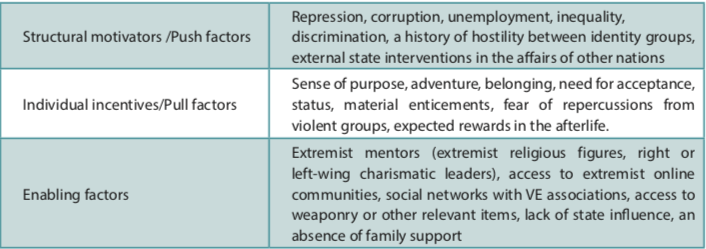
Soru 22
Which one below is one of the factors that enables radicalization of an individual ?
Seçenekler
A
Corruption
B
Unemployment
C
Absence of family support
D
Repression
E
a history of hostility between identity groups
Açıklama:
Enabling factors:
Extremist mentors (extremist religious figures, right or left-wing charismatic leaders), access to extremist online communities, social networks with VE associations, access to weaponry or other relevant items, lack of state influence, an absence of family support.
Extremist mentors (extremist religious figures, right or left-wing charismatic leaders), access to extremist online communities, social networks with VE associations, access to weaponry or other relevant items, lack of state influence, an absence of family support.
Soru 23
Once radical actors engage in violent acts, the ideational transformation is already completed and these acts fall under the heading of .....................
Seçenekler
A
radicalization
B
violent extremism
C
anarchism
D
negation
E
violence
Açıklama:
The line between radicalization and violent extremism, and terrorism needs to be drawn in order to avoid interchangeable use of the terms. Once radical actors engage in violent acts, the ideational transformation is already completed and these acts fall under the heading of “violent extremism”.
Soru 24
Which one below is regarded as the first terrorist organization and predecessor of all the terror groups?
Seçenekler
A
The Assassins
B
Guerrillas
C
Al-Hashashin
D
Zealots
E
Hasan-i Sabbah
Açıklama:
The Jewish movement is regarded as the first terrorist organization and thus, predecessor of all the terror groups. It emerged as a reaction to the Roman Empire’s rule in Palestine during its Imperial period, and its increasingly oppressive measures against the Jews and gradual loss of their autonomy within the Empire. The movement is also known as the Sicarii -due to their use of daggers or sicae in Roman in assassinations- whereas some other accounts argue that Sicarii is a splinter group previously part of the broader Zealots which had limited political goals and a more decentralized organizational structure, more of an “angry mob” movement.
Soru 25
Which one below was a response to the rise of oppositional groups especially in Vandée resulting in a civil war and rising threat of being surrounded by enemies?
Seçenekler
A
The Reign of Terror
B
The anarcho-terrorism
C
The Assassins
D
The Bandits
E
Sicarii
Açıklama:
The Reign of Terror
The Reign of Terror was a response to the rise of oppositional groups especially in Vandée resulting in a civil war and rising threat of being surrounded by enemies. The famous “September decree” of 1793 officially declared that the Reign of Terror is “the order of the day” and thus the republic would use terror against its “enemies” in order to preserve the republic and the achievements of the revolution.
The Reign of Terror was a response to the rise of oppositional groups especially in Vandée resulting in a civil war and rising threat of being surrounded by enemies. The famous “September decree” of 1793 officially declared that the Reign of Terror is “the order of the day” and thus the republic would use terror against its “enemies” in order to preserve the republic and the achievements of the revolution.
Soru 26
Whose use of use of dynamites which opened up a new page within the context of the methods of terrorism made them a very important case in the history of terrorism?
Seçenekler
A
ASALA
B
The anarcho-terrorism
C
IRA
D
Girondins
E
The Reign of Terror
Açıklama:
The anarcho-terrorism in Russia in the 19th century is widely regarded as the predecessor of many modern terrorist organizations. Their “success” in assassinating quite high level officials, even including a tsar himself, namely Alexander II, and even more importantly their use of dynamites which opened up a new page within the context of the methods of terrorism made them a very important case in the history of terrorism.
Soru 27
Which one below can be mentioned as one of the international extreme-right terror groups?
Seçenekler
A
Ku Klux Klan
B
Zealots
C
Red Brigades
D
Baader Meinhof
E
Greek Cypriot
Açıklama:
As stated before, radicalization, and terrorism cannot be attributed to a particular religion, ideology, nationality, sect, or any other sort of identity and/ or mindset. Both rightist and leftist ideologies, at their extremes, can lead to radicalization and even terrorism. Several groups, such as DHKP-C in Turkey, Baader Meinhof in Germany, and Red Brigades in Italy can be mentioned under this category.
However, it should be noted that neither primarily ideologically-motivated terror groups can be limited to these groups, nor the groups which are not clearly designated as terrorist groups internationally, such as Ku Klux Klan and neo-Nazi movements that can be identified as extreme-right groups occasionally resorting to violence (and thus can be classified as violent extremists, too, if not full-fledged terrorist organizations) do not carry out ruthless terror attacks against people coming from different ideological, ethnic, and religious backgrounds, including assaults, murders, burning homes and refugee camps etc.
However, it should be noted that neither primarily ideologically-motivated terror groups can be limited to these groups, nor the groups which are not clearly designated as terrorist groups internationally, such as Ku Klux Klan and neo-Nazi movements that can be identified as extreme-right groups occasionally resorting to violence (and thus can be classified as violent extremists, too, if not full-fledged terrorist organizations) do not carry out ruthless terror attacks against people coming from different ideological, ethnic, and religious backgrounds, including assaults, murders, burning homes and refugee camps etc.
Soru 28
Which one below is not one of the terrorist groups with religious motivations?
Seçenekler
A
Al-Qaeda
B
ISIS
C
ISIL
D
DAESH
E
ETA
Açıklama:
Terrorism with religious motivations, sometimes mixed with ethnic feelings, too, is a form of terrorism which can be regarded as the oldest form of the phenomenon. As mentioned earlier, the Zealots had a political goal (destroying the Roman rule in the Palestine), had an organization, and committed violent acts, thus, complying with all classical three components of a terrorist organization. The Assassins also had a strong religious motivation derived from the Shi’a’s Ismailiyya interpretation. Putting aside these religiously motivated terror groups in the history which were already covered, other terror groups and terrorist tactics adopted by states with religious motivations will be discussed in this section. The link argued to be exist between terrorism with religious motivations and Islam and Muslims will also be challenged after having a brief overview of different terror groups with different religious motivations sometimes attacking their co-religionists due to sectarian differences, bombing people with chemicals in order to “bring the apocalypse earlier” or “purify the world”, and killing people just because of their different religious identity.
The tragic incident of the 9/11 attacks carried out by Al-Qaeda and subsequent declaration of a “Global War on Terror” by the then US President George W. Bush resulted in a higher attention to the subject more than ever. Even though Al-Qaeda and ISIS/ISIL/DAESH are the two most “famous” examples of this category, various groups with different religious motivations resorted to terrorism over centuries.
The tragic incident of the 9/11 attacks carried out by Al-Qaeda and subsequent declaration of a “Global War on Terror” by the then US President George W. Bush resulted in a higher attention to the subject more than ever. Even though Al-Qaeda and ISIS/ISIL/DAESH are the two most “famous” examples of this category, various groups with different religious motivations resorted to terrorism over centuries.
Soru 29
Which part of the world has the least increase in social network use between 2011 and 2017?
Seçenekler
A
Latin America
B
Asia
C
North America
D
Africa
E
Middle East
Açıklama:
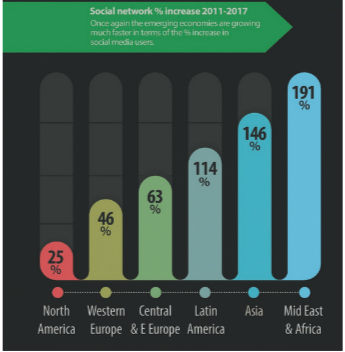
Soru 30
Which one below emphasizes the important roles that women can play against violent extremism, and it directly refers to violent extremism for the first time?
Seçenekler
A
UNSC Resolution 2252
B
UNSC Resolution 2242
C
UNSC Resolution 2122
D
UNSC Resolution 1325
E
UNSC Resolution 1350
Açıklama:
UNSC Resolution 2242 emphasizes the important roles that women can play against violent extremism, it directly refers to violent extremism for the first time, calls for more active participation of women into both struggle against it and for preventing the negative effects of terrorism on women. Thus, with UNSC Resolution 2242 women have not been only regarded as the victim of radicalization and violent extremism, it also attributed such an active role for the first time as an important actor within the context of radicalization and violent extremism.
Soru 31
Which of the following factors are valid while an individual is radicalized?
I: structural factors
II: international factors
III: political factors
IV: individual factors
I: structural factors
II: international factors
III: political factors
IV: individual factors
Seçenekler
A
I, II, III
B
I, II, III, IV
C
Only II
D
I, III
E
I, IV
Açıklama:
The book states that radicalization is affected by both structural factors and individual factors.
Soru 32
What is violent extremism?
Seçenekler
A
Attacking other nations with military force.
B
Invading dependent nations using military force.
C
Using and supporting violent acts in pursuit of different goals.
D
Imposing sanctions on dependent or independent nations.
E
Invading dependent nations without using military force.
Açıklama:
According to the book, violent extremism is defined as “The use of and support for violence in pursuit of ideological, religious or political goals.”
Soru 33
Which of the following are considered as components of violent extremism?
I: advocating an act of violence
II: supporting an act of violence
III: planning an act of violence
IV: financing an act of violence
V: organizing an act of violence
I: advocating an act of violence
II: supporting an act of violence
III: planning an act of violence
IV: financing an act of violence
V: organizing an act of violence
Seçenekler
A
I, II, III, IV, V
B
I, II, III, V
C
I, III, V
D
Only V
E
Only III
Açıklama:
The concept of VE is not limited to be part of a violent act. Supporting, advocating, planning, organizing etc. such kinds of attacks are also regarded as components of VE. In line with this inclusive approach, the United States Agency for International Development (USAID) defines violent extremism as “advocating, engaging in, preparing, or otherwise supporting ideologically motivated or justified violence to further social, economic or political objectives”.
Soru 34
Which of the following are among the motivating factors for terrorism?
I: Religion
II: Ethnicity
III: Politics
IV: Economic
V: Violence
I: Religion
II: Ethnicity
III: Politics
IV: Economic
V: Violence
Seçenekler
A
I, II, V
B
II, IV
C
Only V
D
Only II
E
I, II, III
Açıklama:
"Terrorism with religious motivations, sometimes mixed with ethnic feelings, too, is a form of terrorism which can be regarded as the oldest form of the phenomenon. As mentioned earlier, the Zealots had a political goal." These lines tell us that religion, ethnicity and politics are the motivating factors of terrorism.
Soru 35
Which of the following are the factors that serve terrorism?
I: Internet
II: Social media
III: Text messages
IV: Video applications
I: Internet
II: Social media
III: Text messages
IV: Video applications
Seçenekler
A
I, II, IV
B
I, II, III, IV
C
II, IV
D
Only I
E
Only II
Açıklama:
The book states that "Within the context of radicalization, violent extremism, and terrorism, the Internet, social media, messaging and video apps are used for several key purposes".
Soru 36
What are the advantages of the cyber world to radicalism and terrorism?
I: Speed
II: Anonymity
III: Support with different mediums
IV: Ability to reach a great number of people
V: Being untraceable
I: Speed
II: Anonymity
III: Support with different mediums
IV: Ability to reach a great number of people
V: Being untraceable
Seçenekler
A
I, III, V
B
Only v
C
Only IV
D
I, II, III, IV
E
III, IV, V
Açıklama:
The cyber world provides anonymity, speed, cheap ways to convey their message, reinforce their message with audio and visual content, ability to reach vast amount of public and their supporters at once.
Soru 37
Which of the following define the roles a woman can play in radicalization process?
I: They can diagnose the process earlier.
II: They can prevent radicalization.
III: They can help through the rehabilitation process.
I: They can diagnose the process earlier.
II: They can prevent radicalization.
III: They can help through the rehabilitation process.
Seçenekler
A
Only I
B
Only II
C
I, II, III
D
I, III
E
II, III
Açıklama:
The book summarizes the function of women in the radicalization process as follows:
Women can diagnose the process of radicalization much earlier compared to other parts of the society thanks to their close relations with their sons, husbands, relatives, and students. (this takes us to I.
Such a privileged position also dons women with the capability to play an important preventive role through personal communication as well as to offer effective psychological help. (this takes us to II)
As another positive role women can play, regarding the “formers” or “returnees”, women’s privileged role can help rehabilitation process. (this takes us to III)
Women can diagnose the process of radicalization much earlier compared to other parts of the society thanks to their close relations with their sons, husbands, relatives, and students. (this takes us to I.
Such a privileged position also dons women with the capability to play an important preventive role through personal communication as well as to offer effective psychological help. (this takes us to II)
As another positive role women can play, regarding the “formers” or “returnees”, women’s privileged role can help rehabilitation process. (this takes us to III)
Soru 38
Why do the youth constitute an important part in the radicalization process?
Seçenekler
A
The youth are more sensitive to both the individual and structural factors.
B
The youth need more money than anyone else in the society.
C
The youth seek for adventure.
D
The youth are bored.
E
The youth are more interested in the internet and the social media.
Açıklama:
The push and pull factors (structural and individual factors) are felt more deeply by the youth most of the time
Soru 39
Which of the following is related to the process of making an individual leave the active organization?
Seçenekler
A
De-radicalization
B
Disengagement
C
Re-integration
D
Segregation
E
Rehabilitation
Açıklama:
In the book, Disengagement is defined as the process of making the individual abandon the active organization in which he/she either took part in violent acts or not.
Soru 40
Which may be regarded as an individual factor that can trigger and reinforce radicalization?
Seçenekler
A
Need for acceptance
B
Extremist mentors
C
External state intervention
D
Access to weaponry
E
Extremist religious leaders
Açıklama:
Need for acceptance is an individual factor that can drive one to radicalization
Soru 41
Which is wrong in relation to radicalization, violent extremism, and terrorism?
Seçenekler
A
Reppression, corruption, and inequality are structural motivations for radicalization
B
Radicalization are attributable to certain religious communities
C
Structural and individual factors can accompany each other in one's journey to radicalization
D
Socio-economic and socio-politic factors can trigger and reinforce radicalization
E
Radicalization pose great challenges at the national, regional and international levels
Açıklama:
Radicalization cannot be attributed to a certain ethnic, religious or secterian community
Soru 42
Which can contribute the most to violent extremism and terrorism?
Seçenekler
A
Absence of family support
B
Communities with different ideologies
C
A weak or failed state mechanism
D
Different identity groups
E
Social and economic development
Açıklama:
A weak or failed state mechanism will definitely contribute the most
Soru 43
Who are most likely to play the role of "gatekeepers" in preventing individuals from radicalization?
Seçenekler
A
States
B
NGOs
C
Extremist leaders
D
Parents
E
Marginal peers
Açıklama:
It's parents who can both push to and prevent from radicalization
Soru 44
Which is the first organized terror group known in the history of humanity?
Seçenekler
A
Assassins
B
Jacobins
C
Red brigades
D
Shias
E
Zealots
Açıklama:
The Jewish zealot movement is regarded as the first terrorist organization active between 50 AD and 90 AD
Soru 45
Where did Reign of Terror, the first state terror carried out by Jacobins in the modern era, take place?
Seçenekler
A
France
B
Germany
C
Russia
D
Iran
E
Great Britain
Açıklama:
Following French Revolution, Reign of Terror, referring to the peak point of state terror carried out by Jacobins, took place in France
Soru 46
Which is an ideologically motivated terrorist group?
Seçenekler
A
ASALA
B
DHKP-C
C
PKK
D
IRA
E
ISIS
Açıklama:
DHKP-C is an ideologically motivated terroriet group, the others have ethnic or religious motivations
Soru 47
Which counry has been obviously carrying out state terror for the last 50-60 years?
Seçenekler
A
France
B
The USA
C
Israel
D
The UK
E
Egypt
Açıklama:
Israeli tactics against Palestinians for over five decades represent a crystal-clear case of state terrorism
Soru 48
Which does not refer to an act of cyber crime?
Seçenekler
A
Trafficking
B
Fishing
C
Piracy
D
Software
E
Malware
Açıklama:
Software doesn't have anything to do with crime
Soru 49
What is "the process of making the individual abandon the active terrorist organization in which he/she either took part in violent acts or not"?
Seçenekler
A
Rehabilitation
B
Counter-messaging
C
Counter- narratives
D
De-radicalization
E
Disengagement
Açıklama:
It refers to the process of disengagement
Soru 50
Which of the following is a push factor in terms of radicalization, violent extremism, and terrorism?
Seçenekler
A
Curruption
B
Belonging
C
Status
D
Extremist mentors
E
Lack of state influence
Açıklama:
Table 6.1
Table 6.1
Structural motivators /Push factors | Repression, corruption, unemployment, inequality, discrimination, a history of hostility between identity groups, external state interventions in the affairs of other nations |
Individual incentives/Pull factors | Sense of purpose, adventure, belonging, need for acceptance, status, material enticements, fear of repercussions from violent groups, expected rewards in the afterlife. |
Enabling factors | Extremist mentors (extremist religious figures, right or left-wing charismatic leaders), access to extremist online communities, social networks with VE associations, access to weaponry or other relevant items, lack of state influence, an absence of family support |
Table 6.1
| Structural motivators /Push factors | Repression, corruption, unemployment, inequality, discrimination, a history of hostility between identity groups, external state interventions in the affairs of other nations |
| Individual incentives/Pull factors | Sense of purpose, adventure, belonging, need for acceptance, status, material enticements, fear of repercussions from violent groups, expected rewards in the afterlife. |
| Enabling factors | Extremist mentors (extremist religious figures, right or left-wing charismatic leaders), access to extremist online communities, social networks with VE associations, access to weaponry or other relevant items, lack of state influence, an absence of family support |
Soru 51
Which of the following is a pull factor in terms of radicalization, violent extremism, and terrorism?
Seçenekler
A
Unemployment
B
Sense of purpose
C
Discrimination
D
Access to weaponry items
E
An absence of family support
Açıklama:
Table 6.1
Table 6.1
Structural motivators /Push factors | Repression, corruption, unemployment, inequality, discrimination, a history of hostility between identity groups, external state interventions in the affairs of other nations |
Individual incentives/Pull factors | Sense of purpose, adventure, belonging, need for acceptance, status, material enticements, fear of repercussions from violent groups, expected rewards in the afterlife. |
Enabling factors | Extremist mentors (extremist religious figures, right or left-wing charismatic leaders), access to extremist online communities, social networks with VE associations, access to weaponry or other relevant items, lack of state influence, an absence of family support S 128 |
Table 6.1
| Structural motivators /Push factors | Repression, corruption, unemployment, inequality, discrimination, a history of hostility between identity groups, external state interventions in the affairs of other nations |
| Individual incentives/Pull factors | Sense of purpose, adventure, belonging, need for acceptance, status, material enticements, fear of repercussions from violent groups, expected rewards in the afterlife. |
| Enabling factors | Extremist mentors (extremist religious figures, right or left-wing charismatic leaders), access to extremist online communities, social networks with VE associations, access to weaponry or other relevant items, lack of state influence, an absence of family support |
Soru 52
Which of the following is an enabling factor in terms of radicalization, violent extremism, and terrorism?
Seçenekler
A
Repression
B
Inequality
C
Extremist mentors
D
Adventure
E
Sense of purpose
Açıklama:
Table 6.1
Table 6.1
Structural motivators /Push factors | Repression, corruption, unemployment, inequality, discrimination, a history of hostility between identity groups, external state interventions in the affairs of other nations |
Individual incentives/Pull factors | Sense of purpose, adventure, belonging, need for acceptance, status, material enticements, fear of repercussions from violent groups, expected rewards in the afterlife. |
Enabling factors | Extremist mentors (extremist religious figures, right or left-wing charismatic leaders), access to extremist online communities, social networks with VE associations, access to weaponry or other relevant items, lack of state influence, an absence of family support |
Table 6.1
| Structural motivators /Push factors | Repression, corruption, unemployment, inequality, discrimination, a history of hostility between identity groups, external state interventions in the affairs of other nations |
| Individual incentives/Pull factors | Sense of purpose, adventure, belonging, need for acceptance, status, material enticements, fear of repercussions from violent groups, expected rewards in the afterlife. |
| Enabling factors | Extremist mentors (extremist religious figures, right or left-wing charismatic leaders), access to extremist online communities, social networks with VE associations, access to weaponry or other relevant items, lack of state influence, an absence of family support |
Soru 53
Which of the following is a common motivation shared by both Zealots and Assassins?
Seçenekler
A
using religious motivations
B
using ethnic motivations
C
acting with a sectarian extremism
D
using people’s vulnerabilities
E
capable of influencing
Açıklama:
The Zealots had both religious and ethnic motivations whereas the Assassins primarily acted with a sectarian extremism. However, some of the mentioned methods used by both are the same. Their focus on symbolic assassinations and using people’s vulnerabilities and/or utilising vulnerable people are still two quite common tactics used by many terror groups. The Assassin’s transboundary character is also a predecessor for contemporary transnational terrorist networks. The Assassins were thus, quite organized, able to control strategic strongholds, capable of influencing, manipulating and assassinating key figures, successful in defying several sieges by quite powerful states of their time, and proved to have a quite a sustainable modus operandi considering their several centuries of presence which is quite uncommon for terror groups. Thus, they are widely regarded as early experts of terror and guerrilla tactics and a key predecessor of contemporary terror groups (Daftary, 2016; Gray, 2010; McCarthy, 1973; Lockhart, 1930).
Soru 54
Which of the following is the first well-documented record of state terror in the modern era?
Seçenekler
A
Zealots
B
Assassins
C
Ethnic terrorism
D
The Anarcho-terrorism
E
Jacobins
Açıklama:
It was not only the first well-documented record of state terror in the modern era, but also inspired many other regimes in the future by its methods, discourse, and demonization of political rivals. Therefore, the Reign of Terror, can be regarded as the predecessor of the Soviet and Nazi applications of state terror directed at internal political rivals and external enemies at the same time, accompanied by brutal repression of oppositional figures and parts of the society, a rigid indoctrination, frequent use of accusations of being “agents”, “enemies of the state”, etc. The Reign of Terror was a response to the rise of oppositional groups especially in Vandée resulting in a civil war and rising threat of being surrounded by enemies. The famous “September decree” of 1793 officially declared that the Reign of Terror is “the order of the day” and thus the republic would use terror against its “enemies” in order to preserve the republic and the achievements of the revolution.
Soru 55
Which of the following is the key mastermind of Jacobins and “Reign of Terror” in France?
Seçenekler
A
Maximillen Robespierre
B
Lenin
C
Hitler
D
Mao
E
Stalin
Açıklama:
The Committee of Public Safety, where Maximilien Robespierre, who was one of the key masterminds of the era, had a critical position, enjoyed a dictatorship over the republic, making thousands of executions possible and making “terror” part of everyday life for the critics of the new regime.
Soru 56
Which of the following is regarded as the predecessor of many modern terrorist organizations?
Seçenekler
A
Jacobins
B
The anarcho-terrorism
C
Zealots
D
Assassins
E
Asala
Açıklama:
The anarcho-terrorism in Russia in the 19th century is widely regarded as the predecessor of many modern terrorist organizations.
Soru 57
Which of the following is not an ethnically motivated terrorist group?
Seçenekler
A
Zealots
B
Asala
C
Red Brigades
D
Ira
E
Eta
Açıklama:
Ethnic Terrorism
Among various motivations and ideological backgrounds of radical and terrorist groups, ethnically-motivated discourse occupies an important place. Nevertheless, from the Zealots to ASALA and from IRA and ETA to PKK, it should also be noted that religious, ideological, sectarian etc. motivations were also sometimes used at the same time by terrorist groups as well as the use of different motivations over decades to varying degrees.
Among various motivations and ideological backgrounds of radical and terrorist groups, ethnically-motivated discourse occupies an important place. Nevertheless, from the Zealots to ASALA and from IRA and ETA to PKK, it should also be noted that religious, ideological, sectarian etc. motivations were also sometimes used at the same time by terrorist groups as well as the use of different motivations over decades to varying degrees.
Soru 58
Which of the following is not an ideologically motivated terrorist group?
Seçenekler
A
Ku Klux Klan
B
Neo-Nazi movements
C
Baader Meinhof in Germany
D
Eta
E
Red Brigades in Italy
Açıklama:
Ideologically Motivated Terrorism
As stated before, radicalization, and terrorism cannot be attributed to a particular religion, ideology, nationality, sect, or any other sort of identity and/ or mindset. Both rightist and leftist ideologies, at their extremes, can lead to radicalization and even terrorism. Several groups, such as DHKP-C in Turkey, Baader Meinhof in Germany, and Red Brigades in Italy can be mentioned under this category. However, it should be noted that neither primarily ideologically-motivated terror groups can be limited to these groups, nor the groups which are not clearly designated as terrorist groups internationally, such as Ku Klux Klan and neo-Nazi movements that can be identified as extreme-right groups occasionally resorting to violence (and thus can be classified as violent extremists, too, if not full-fledged terrorist organizations) do not carry out ruthless terror attacks against people coming from different ideological, ethnic, and religious backgrounds, including assaults, murders, burning homes and refugee camps etc. s
As stated before, radicalization, and terrorism cannot be attributed to a particular religion, ideology, nationality, sect, or any other sort of identity and/ or mindset. Both rightist and leftist ideologies, at their extremes, can lead to radicalization and even terrorism. Several groups, such as DHKP-C in Turkey, Baader Meinhof in Germany, and Red Brigades in Italy can be mentioned under this category. However, it should be noted that neither primarily ideologically-motivated terror groups can be limited to these groups, nor the groups which are not clearly designated as terrorist groups internationally, such as Ku Klux Klan and neo-Nazi movements that can be identified as extreme-right groups occasionally resorting to violence (and thus can be classified as violent extremists, too, if not full-fledged terrorist organizations) do not carry out ruthless terror attacks against people coming from different ideological, ethnic, and religious backgrounds, including assaults, murders, burning homes and refugee camps etc. s
Soru 59
Which of the following is not a key purpose used within the context of radicalization, violent extremism and cyber crime and terrorism?
Seçenekler
A
Propaganda
B
Recruitment
C
Planning attacks
D
Training
E
Sharing financial resources
Açıklama:
The Internet, Social Media, Cyber Crime and Terrorism
Within the context of radicalization, violent extremism, and terrorism, the Internet, social media, messaging and video apps are used for several key purposes, such as propaganda, recruitment, planning attacks, training, and collecting financial resources for attacks.
Within the context of radicalization, violent extremism, and terrorism, the Internet, social media, messaging and video apps are used for several key purposes, such as propaganda, recruitment, planning attacks, training, and collecting financial resources for attacks.
Soru 60
- sense of purpose
- adventure
- need for acceptance
- Inequality
Seçenekler
A
I-II-III
B
II-III-IV
C
I-III-IV
D
I-IV
E
III-IV
Açıklama:
The answer is A
Soru 61
- repression
- corruption
- unemployment
- access to weaponary
Seçenekler
A
I-II-III
B
I-III-IV
C
I-III-IV
D
I-IV
E
II-IV
Açıklama:
The answer is A.
Soru 62
Many young people from Europe, bored from their routine lifes, joint some terrorist groups in Syria. Which factor can be mentioned in this example?
Seçenekler
A
Adevnture-Pull factors
B
Inequality-Push factors
C
Belonging-Pull Factors
D
Sense or purpose-Push factors
E
Corruption-Push factors
Açıklama:
The answer is A.
Soru 63
- weak or failed state mechanisms
- lack of trust to politics and politicians,
- corruption
- legal minority rights
Seçenekler
A
I-II-III
B
II-III-IV
C
I-III-IV
D
I-IV
E
III-IV
Açıklama:
The answer is A.
Soru 64
"Weak or failed state mechanisms, lack of trust to politics and politicians, and corruption significantly contribute to radicalization processes.tion?
Which of the following cannot be considered as an example for the above definition?
Which of the following cannot be considered as an example for the above definition?
Seçenekler
A
Iraq
B
Syria
C
Afghanistan
D
Libya
E
Palestine
Açıklama:
The answer is E.
Soru 65
Lacking basic knowledge about:
- a particular ideology,
- religion,
- historical enmity,
- science
Seçenekler
A
I-II-III
B
II-III-IV
C
I-III-IV
D
I-IV
E
II-IV
Açıklama:
The answer is A.
Soru 66
"_______refers to the process of making the individual abandon the active organization in which he/she either took part in violent acts or not."
Which of the following completes the sentence above the best?
Which of the following completes the sentence above the best?
Seçenekler
A
Deradicalization
B
Disengagement
C
Rehabilitation
D
Reintegration
E
Corruption
Açıklama:
The answer is B.
Soru 67
Which of the following can be considered as a turning point of advancement in the history of terrorist groups?
Seçenekler
A
chemistry
B
medicine
C
education
D
politics
E
economics
Açıklama:
The answer is A.
Soru 68
Which of the following is considered the first terrorist group in history?
Seçenekler
A
Zealots
B
The Assassins
C
Reign of Terror
D
Anarcho-terrorism
E
ISIS
Açıklama:
The answer is A.
Soru 69
Which of the following is one of the branches The Assassins spread to?
Seçenekler
A
Syria
B
Iraq
C
France
D
Spain
E
Lebanon
Açıklama:
The answer is A.
Soru 70
Which one of the following concepts is defined as the use of and support for violence in pursuit of ideological, religious or political goals?
Seçenekler
A
Violent extremism
B
Radicalization
C
Terrorism
D
Reintegration
E
Rehabilitation
Açıklama:
The European Commission defines violent extremism (VE) as “The use of and support for violence in pursuit of ideological, religious or political goals.” The concept of VE is not limited to be part of a violent act. Supporting, advocating, planning, organizing etc. such kinds of attacks are also regarded as components of VE.
Soru 71
Which one of the followings is the first terrorist organization and thus, predecessor of all the terror groups?
Seçenekler
A
The Assassins
B
PKK
C
The Zealots
D
ASALA
E
IRA
Açıklama:
The Jewish Zealot movement is regarded as the first terrorist organization and thus, predecessor of all the terror groups. It emerged as a reaction to the Roman Empire’s rule in Palestine during its Imperial period, and its increasingly oppressive measures against the Jews and gradual loss of their autonomy within the Empire.
Soru 72
Which one of the following terrorist groups was led by Hasan-i Sabbah?
Seçenekler
A
Salafi-Wahhabi
B
Ku Klux Klan
C
Aum Shinrikyo
D
Hasan-i Sabbah
E
Ulrike Meinhoff
Açıklama:
The word assassin is widely believed to be originated from the terror group active in a wide area from Iran to Syria and Egypt, led by Hasan-i Sabbah, acting with an ideological motivation derived from İsmailiyya branch of Shi’ism. Hasan-i Sabbah was widely regarded as both the propagandist of its strict sectarian stance, a military and ideological leader of its organisation, and a strategic mastermind behind selection of critical targets and capturing almost unconquerable castles and cities in order to hide its militants.
Soru 73
Which one of the followings is a response to the rise of oppositional groups especially in Vandée resulting in a civil war and rising threat of being surrounded by enemies?
Seçenekler
A
The Reign of Terror
B
Contemporary transnational terrorist networks
C
Guerrilla tactics
D
Ethnic motivations
E
Counter-revolutionary actor
Açıklama:
The Reign of Terror was a response to the rise of oppositional groups especially in Vandée resulting in a civil war and rising threat of being surrounded by enemies.
Soru 74
Which one of the following events is regarded as the predecessor of many modern terrorist organizations?
Seçenekler
A
Radicalization process
B
The Jewish Zealot movement
C
The anarcho-terrorism in Russia
D
Industrial Revolution
E
The French Revolution
Açıklama:
The anarcho-terrorism in Russia in the 19th century is widely regarded as the predecessor of many modern terrorist organizations. Their “success” in assassinating quite high level officials, even including a tsar himself, namely Alexander II, and even more importantly their use of dynamites which opened up a new page within the context of the methods of terrorism made them a very important case in the history of terrorism.
Soru 75
Which of the following events did not ensue violent acts on the rise once again especially in Europe and the United States?
Seçenekler
A
rising Islamophobia
B
xenophobia
C
anti-refugee discourse
D
extreme-right radical ideas
E
globalization
Açıklama:
Whereas extreme left terrorism reached its peak point in Europe during the Cold War years, Marxist extreme-left wing terror groups are still active in many countries and regions from the Latin America to the Middle East and Southeast Asia. On the other hand, coupled with rising Islamophobia, xenophobia, and anti-refugee discourse, extreme-right radical ideas and ensued violent acts are on the rise once again especially in Europe and the United States.
Soru 76
Which of the following terrorist groups carried out the tragic incident of the 9/11 attacks carried and caused subsequent declaration of a “Global War on Terror” ?
Seçenekler
A
Al-Qaeda
B
DAESH
C
The Assassins
D
Salafi-Wahhabi
E
ASALA
Açıklama:
The tragic incident of the 9/11 attacks carried out by Al-Qaeda and subsequent declaration of a “Global War on Terror” by the then US President George W. Bush resulted in a higher attention to the subject more than ever. Even though Al-Qaeda and ISIS/ISIL/DAESH are the two most “famous” examples of this category, various groups with different religious motivations resorted to terrorism over centuries.
Soru 77
Which year was a key turning point after which studies about religion’s increasing significance to international politics became a hot topic?
Seçenekler
A
1945
B
1979
C
1985
D
1990
E
2000
Açıklama:
The year 1979 was a key turning point after which studies about religion’s increasing significance to international politics became a hot topic. That year witnessed not only the Revolution in Iran but also the beginning of the Soviet efforts to invade Afghanistan.
Soru 78
When did Sri Lanka and Birmanya, Buddhist monks encourage people to attack Muslims and even take part in the attacks killing dozens of Muslims?
Seçenekler
A
1980
B
1993
C
1997
D
2001
E
2003
Açıklama:
In 2003, in Sri Lanka and Birmanya, Buddhist monks encouraged people to attack Muslims and even took part in the attacks killing dozens of Muslims. Similarly, in 2017 only, an ultranationalist Buddhist group called Ma Ba Tha, led by Ashin Wirathu, ignited violence against Muslims in Rohingya.
Soru 79
Which of the followings is a cognitive process with the goal of cutting the link between its target audience with radical ideas?
Seçenekler
A
Disengagement
B
De-radicalization
C
Reintegration
D
Rehabilitation
E
Civilization
Açıklama:
De-radicalization is a cognitive process with the goal of cutting the link between its target audience with radical ideas.
Ünite 7
Soru 1
I. Kenneth Waltz was the first scholar to use this analysis. II. The three levels are the system, the state and the individual. III. The system refers to the structure and the interaction of the states. IV. The state refers to the external affairs of the states. Which information above is true about "three levels of analysis in foreign policy"?
Seçenekler
A
I and II
B
I, II and III
C
I and III
D
II, III and IV
E
I, II, III and IV
Açıklama:
Three levels of analysis in foreign policy: Kenneth Waltz was the first scholar to use the three-level analysis methodology in foreign policy analysis. He has defined the three levels as images. According to his classification, foreign policy can be analyzed at three levels: the system referring to the structure and the interaction of the states, the state referring to the internal affairs of the states
and the individual referring to the foreign policy decison makers (Waltz, 1959).
and the individual referring to the foreign policy decison makers (Waltz, 1959).
Soru 2
I. Culture II Civilization III. Religion Which factor(s) above contribute(s) to the formation of identity?
Seçenekler
A
I
B
II
C
I and II
D
II and III
E
I, II and III
Açıklama:
Culture, civilization and religion are among the factors that contribute to the formation of identity.
Soru 3
.......... refers to the manifold ways in which the cultures of groups and societies find expression. Which term is defined above?
Seçenekler
A
Cultural diversity
B
Ideology
C
Communal identity
D
Worldview
E
Religion
Açıklama:
Cultural Diversity: “Cultural diversity” refers to the manifold ways in which the cultures of groups and societies find expression.
Soru 4
Which information below is not true about "the cold war period"?
Seçenekler
A
There was a harsh rivalry between the US and the USSR.
B
Following the World War II, the world was theoretically seperated into two ideological camps.
C
The horizontal division line between the North and South symbolized the ideological defferences.
D
There were many examples of repressive identity politics in Cold War.
E
In terms of their economic development, the countries are classified as First World, Second World and Third World.
Açıklama:
Following the World War II, the world was theoretically seperated into two ideological camps named as the Western Bloc led by the United States of America (US) and the Eastern Bloc led by the Union of Soviet Socialist Republics (USSR). However, another classification in terms of their economic development divided the countries in the world into three groups: First World (Developed Western countries), Second World (Communist countries), Third World.
Within this context and under the shade of the harsh rivalry between the US and the USSR, it had become extremely important that which ideological camp the Third World countries would choose to be associated with.
While the vertical division line of the iron curtain symbolized the ideological differences between the West and the East, the horizontal division line
between the North and the South symbolized the differences in the level of development.
Within this context and under the shade of the harsh rivalry between the US and the USSR, it had become extremely important that which ideological camp the Third World countries would choose to be associated with.
While the vertical division line of the iron curtain symbolized the ideological differences between the West and the East, the horizontal division line
between the North and the South symbolized the differences in the level of development.
Soru 5
ı. The USSR under the presidency of Stalin II. Turkish identity in Bulgaria III. China under the name of Cultural Revolution Which one/s is/are the example(s) of repressive identity politics?
Seçenekler
A
I and II
B
I and III
C
II and III
D
I, II and III
E
III
Açıklama:
-Numerous examples of repressive identity politics can be given as they were implied in the Second World during the Cold War such as the USSR under the presidency of Stalin.
-Specific projects to construct a national culture based on repressive policies were implemented in China, under the name of Cultural Revolution, and in Cambodia.
-Another specific example of the repression of the religious and ethnic identities from the 20th century involves the repression of the Turkish identity in Bulgaria during the 1980s.
-Specific projects to construct a national culture based on repressive policies were implemented in China, under the name of Cultural Revolution, and in Cambodia.
-Another specific example of the repression of the religious and ethnic identities from the 20th century involves the repression of the Turkish identity in Bulgaria during the 1980s.
Soru 6
I. The armed conflict was between Orthodox Serbs, Catholic Croats and Muslim Bosnians. II. It was between 1990 and 1997. III. It came to an end with the signing of Dayton Agreement. IV. Croats employed systematic genocidal actions against the Muslim and Serbs. Which information above is true about the identity war that emerged following the dissolution of Yugoslovia?
Seçenekler
A
I and II
B
I and III
C
I and IV
D
II and III
E
II and IV
Açıklama:
A striking example of such an identity war based on strong religious, sectarian and cultural differences was the armed conflicts that emerged following the dissolution of Yugoslavia. The armed conflict between the Orthodox Serbs, Catholic Croats and Muslim Bosnians started in 1992 and came to an end in 1995 with the signing of the Dayton Agreement. During the period of conflict, Serbian forces employed systematic genocidal actions against the Muslim and Croat population including mass killings, rape and siege in order to clear the future independent state of Bosnia mainly from its Muslim population and gain authority on a larger territory.
Soru 7
I. IR has emerged as a discipline in social sciences mainly in the early 20th century. II. Liberalism and Realism are the mainstream IR theories. III. IR itself is based on religious assumptions. Which information above is true about IR Theory?
Seçenekler
A
Only I
B
Only III
C
I and III
D
II and III
E
I and II
Açıklama:
-The main unit of analysis in the discipline of IR is the nation state which first emerged in Europe during the 17th century and was disseminated to the other parts of the world as a role model since then. IR has emerged as a discipline in social sciences mainly in the early 20th century.
-The mainstream IR theories, namely Liberalism and Realism, have regarded the religion as a private issue that should be dealt at the individual level.
- IR itself is based on “areligous” assumptions and (the issue of) ethics might not be relevant to it (Laustsen, Wæver, 2003, p. 170).
-The mainstream IR theories, namely Liberalism and Realism, have regarded the religion as a private issue that should be dealt at the individual level.
- IR itself is based on “areligous” assumptions and (the issue of) ethics might not be relevant to it (Laustsen, Wæver, 2003, p. 170).
Soru 8
I. It is a governmental organization. II. It is not established or coordinated by any public institutions. III. It is expected not to be attached to any interest groups in the society. Which information above is true about Civil Society Organizations?
Seçenekler
A
Only III
B
Only II
C
I, II and III
D
II and III
E
I and III
Açıklama:
Civil Society Organizations: As a non-governmental organization (NGO) refers to the organizations which are not established or coordinated by a government or any public institution, a civil society organization (CSO) is also an NGO. However, a CSO is also expected not to be attached to interest groups in the society which gather to secure or promote financial interests, e.g., business organizations. Consequently, NGOs with religious and cultural orientations or philanthrophic activites belong to the category of CSOs (Stivachtis, 2007, p. 15).
Soru 9
Huntington claims that the history has not ended with a triumph of a particularcivilization; and indeed the future conflicts are expected to occur between civilizations and would be the last chain of conflicts in modern history. Huntington categorizes the civilizations of the world into eight . Which option is not one of these civilizations?
Seçenekler
A
Sinic
B
Chinese
C
Latin-American
D
Japanese
E
African
Açıklama:
A second and widely discussed thesis belongs to Huntington, who claims that the history has not ended with a triumph of a particular civilization; and indeed the future conflicts are expected to occur between civilizations and would be the last chain of conflicts in modern history. Huntington categorizes the civilizations of the world into eight as Western, Sinic, Japanese, Hindu, Islam, Orthodox, Latin-American and African civilizations.
Soru 10
............ can be described, in its narrow definition, in terms of economics as “an increasing internationalisation of markets for goods and services, the means of production, financial systems, competition, corporations, technology and industries”. Which term is defined above?
Seçenekler
A
culture
B
secularism
C
globalization
D
identity
E
modernity
Açıklama:
Globalization can be described, in its narrow definition, in terms of economics as “an increasing internationalisation of markets for goods and services, the means of production, financial systems, competition, corporations, technology and industries” (UNSTATS, 2002, p. 170).
Soru 11
During the French Revolution, ideology used to mean “science of ___________ .”
Seçenekler
A
ideas
B
beliefs
C
traditions
D
customs
E
conflicts
Açıklama:
During the French Revolution used to mean “science of ideas” and was used by the French philosopher Destutt de Tracy.
Soru 12
_______________ is a particular philosophy or view of life; a concept of the world held by an individual or a group”.
Seçenekler
A
ideology
B
worldview
C
barbarian
D
culture
E
diversity
Açıklama:
Worldview is a particular philosophy or view of life; a concept of the world held by an individual or a group”
Soru 13
Which of the following is correct about the “White Man’s Burden”?
Seçenekler
A
It sees the white race inferior over other races.
B
It sees the black race superior to the white race.
C
It was rejected by intellectuals such as Rupyard Kipling.
D
It served as a justification for segregation in the US.
E
It was influential during the 18th century.
Açıklama:
The expression of “White Man’s Burden” is based on the idea of the supremacy of the white race over other races. This puts a burden on the superior white race, the Europeans, to civilize other races which were colonized by European; and it was promoted by a range of prominent European politicians, soldiers and intellectuals such as Arthur de Gobineau and Rudyard Kipling. The idea of white supremacy was quite influential during the 19th and 20th centuries in both Europe and the United States; and it served as a justification not only for the assertions of European imperialism but also for the racial segregation in the United States and the fascist ideologies
in Europe (Jenkins, 2016).
in Europe (Jenkins, 2016).
Soru 14
Where did the industrial revolution start?
Seçenekler
A
Italy
B
Germany
C
Norway
D
Britain
E
Austria
Açıklama:
The industrial revolution started in Britain in the 18th century.
Soru 15
Which of the following has/have contributed to the emergence of the modern nation state?
I. Fascism II. Industrial Revolution III. Secularism
I. Fascism II. Industrial Revolution III. Secularism
Seçenekler
A
I.
B
II.
C
III.
D
I & II
E
I, II & III
Açıklama:
Along with enlightenment, fascism, the Industrial Revolution and secularism have contributed to the emergence of the modern nation state.
Soru 16
The armed conflict between the Orthodox Serbs, Catholic Croats and Muslim Bosnians took place from _____ to _____ .
Seçenekler
A
1985 - 1988
B
1987 - 1993
C
1989 - 1996
D
1990 - 1994
E
1992 - 1995
Açıklama:
The armed conflict between the Orthodox Serbs, Catholic Croats and Muslim Bosnians took place from 1992 to 1995 .
Soru 17
Which of the following is correct about the third wave of the dissolution in the modern international system?
Seçenekler
A
It resulted in the aftermath of WWI.
B
Nation states emerged in a wide geography.
C
It occurred due to decolonization.
D
It contributed to the emergence of the global south.
E
It was the result of the Cold War.
Açıklama:
The first wave of dissolution in the modern international system occured in the aftermath of the World War I and it resulted in the emergence of nation states in a wide geography. The second wave occured due to the process of decolonization. This process started in the aftermath of the World War II and lasted until the 1970s. The third and the last wave, as mentioned above, was the result of the dissolution of the bipolar world system of the Cold War during the 1990s.
Soru 18
Which of the following is one of Huntington’s categories of the world’s civilizations?
Seçenekler
A
Nothern
B
Chinese
C
Latin-American
D
Inuit
E
Arabic
Açıklama:
Huntington categorizes the civilizations of the world into eight as Western, Sinic, Japanese, Hindu, Islam, Orthodox, Latin-American and African civilizations.
Soru 19
The Alliance of Civilizations Initiative is a joint project of ______ and _____ .
Seçenekler
A
Portugal - Sweden
B
Turkey - Spain
C
Portugal - Spain
D
Germany - Poland
E
Italy - Finland
Açıklama:
The Alliance of Civilizations Initiative is a joint project of Turkey and Spain.
Soru 20
Where did the first civilization emerge?
Seçenekler
A
Africa
B
Latin-America
C
Scotland
D
China
E
Mesopotamia
Açıklama:
The first civilization emerged in Mesopotamia.
Soru 21
I. They are components of individual and permanent interactions.
II. They refer to each other and overlap with each other.
III. They contribute to the formation of the identity at individual and state level.
Which of the above is correct regarding the interaction of culture, religion and civilization?
II. They refer to each other and overlap with each other.
III. They contribute to the formation of the identity at individual and state level.
Which of the above is correct regarding the interaction of culture, religion and civilization?
Seçenekler
A
Only I
B
Only II
C
I and II
D
I and III
E
I, II and III
Açıklama:
Each has more than one definition and each can be regarded as components of both individual and communal identities. These concepts are in permanent interaction; and
defining any of them may necessitate reference to the other two. However, they do not automatically refer to each other and the division lines among cultures, civilizations and religions on the world map do not always overlap. Besides their interaction; culture, religion and civilization contribute to the formation of the identity both at the individual level and at the state level.
defining any of them may necessitate reference to the other two. However, they do not automatically refer to each other and the division lines among cultures, civilizations and religions on the world map do not always overlap. Besides their interaction; culture, religion and civilization contribute to the formation of the identity both at the individual level and at the state level.
Soru 22
What term refers to the manifold ways in which the cultures of groups and
societies find expression?
societies find expression?
Seçenekler
A
Ideology
B
Cultural Diversity
C
Worldview
D
Religion
E
Industrial Revolution
Açıklama:
“Cultural diversity” refers to the manifold ways in which the cultures of groups and societies find expression. These expressions are passed on within and among groups and societies. Cultural diversity is made manifest not only through the varied ways in which the cultural heritage of humanity is expressed, augmented and transmitted through the variety of cultural expressions.
Soru 23
I. It comprises a variety of factors including language and traditions.
II. There are features that shape the group identity within the community.
III. Human agency is a critical factor in the inheritance of a culture.
Which of the above is correct related to culture?
II. There are features that shape the group identity within the community.
III. Human agency is a critical factor in the inheritance of a culture.
Which of the above is correct related to culture?
Seçenekler
A
Only I
B
Only II
C
I and II
D
II and III
E
I, II and III
Açıklama:
Culture comprises a variety of factors associated with a community such as shared language, shared belief systems, ethical codes, worldview, lifestyle and traditions. These factors shape the group identity and they mark a resemblance within the thoughts and behaviours of the members of a community. Human agency is a critical factor in the inheritance and adoption of a culture.
Soru 24
I. It was first used to define the Pagan belief system.
II. With the appearance of Christianity, the word became associated with Christianity.
III. After the 15th century, the word began to be related to any sacred belief.
Which of the above is correct related to the origins of the word "religion"?
II. With the appearance of Christianity, the word became associated with Christianity.
III. After the 15th century, the word began to be related to any sacred belief.
Which of the above is correct related to the origins of the word "religion"?
Seçenekler
A
Only I
B
Only II
C
I and II
D
II and III
E
I, II and III
Açıklama:
The word "religion" was first used to define the Pagan belief system of the Roman Empire. Following the adoption of Christianity as the state religion, the term “religion” started to become associated with Christianity;During the 15th century, the concept religion acquired a modern interpretation with an implicit acceptance of the possibility of different religions and belief systems.
Soru 25
I. It is based on the idea of supremacy of the white race over other races.
II. It expects the Europeans to civilize other races which were colonized by them.
III. The idea was influential among intellectuals during the 19th and 20th centuries.
Which of the above is correct regarding the "White Man's Burden"?
II. It expects the Europeans to civilize other races which were colonized by them.
III. The idea was influential among intellectuals during the 19th and 20th centuries.
Which of the above is correct regarding the "White Man's Burden"?
Seçenekler
A
Only I
B
Only II
C
I and II
D
II and III
E
I, II and III
Açıklama:
“White Man’s Burden” the expression of “White Man’s Burden” is based on the idea of the supremacy of the white race over other races. This perception puts a burden on the superior white race, namely the Europeans, to civilize other races which were colonized by European powers since the 15th century; and it was promoted by a range of prominent European politicians, soldiers and intellectuals such as Arthur de Gobineau and Rudyard Kipling. The idea of white supremacy was quite influential during the 19th and 20th centuries in both Europe.
Soru 26
I. The idea stemmed from the cultural and scientific developments in the 16th century.
II. Colonialism, Industrial Revolution and the struggle for power between the Church and state played in an important role.
III. The power struggle between the Catholics and the Protestants played a role.
Which of the above is correct regarding the emergence of secularism in Europe?
II. Colonialism, Industrial Revolution and the struggle for power between the Church and state played in an important role.
III. The power struggle between the Catholics and the Protestants played a role.
Which of the above is correct regarding the emergence of secularism in Europe?
Seçenekler
A
Only I
B
Only II
C
I and II
D
II and III
E
I, II and III
Açıklama:
The emergence of the idea of secularism in Europe and its spread to the other regions of the world is a consequence of the political, economic, religious, cultural and scientific developments that occurred in Europe beginning from the 16th century. These included colonialism, the emergence of bourgeoisie as a strong social class with demands, the struggle for power between the Church and the state authorities and the Industrial Revolution. The emergence of Protestant sects and their struggle with Catholicism caused enduring violence and wars for decades and resulted in the sectarian homogenization of the people living under the same ruler.
Soru 27
I. The world was divided into blocs behind two nations.
II. Various communist countries tried to overcome their social problems by establishing repressive regimes.
III. Third World Countries were labelled as developing countries including the former European colonies.
Which of the above is correct regarding the Cold War Period?
II. Various communist countries tried to overcome their social problems by establishing repressive regimes.
III. Third World Countries were labelled as developing countries including the former European colonies.
Which of the above is correct regarding the Cold War Period?
Seçenekler
A
Only I
B
Only II
C
I and II
D
II and III
E
I, II and III
Açıklama:
Following the World War II, the world was theoretically separated into two ideological camps named as the Western Bloc led by the United States of America (US) and the Eastern Bloc led by the Union of Soviet Socialist Republics (USSR). Third World (Developing countries included the former European colonies). During the second half of the 20th century, various communist or developing countries tried to overcome their social, political and economic problems by establishing repressive regimes under single party governments, dictatorships or military governments.
Soru 28
I. It first appeared with the nation state in Europe in the 17th century.
II. It focused on the interaction of nation states with an emphases on secular nations.
III. It focused on the state as a geographically defined territory.
Which of the above is correct related to the IR Theory?
II. It focused on the interaction of nation states with an emphases on secular nations.
III. It focused on the state as a geographically defined territory.
Which of the above is correct related to the IR Theory?
Seçenekler
A
Only I
B
Only II
C
I and II
D
II and III
E
I, II and III
Açıklama:
The main unit of analysis in the discipline of IR is the nation state which first emerged in Europe during the 17th century and was disseminated to the other parts of the world as a role model since then. IR has emerged as a discipline in social sciences mainly in the early 20th century and focused on the interaction of nation states with a strong emphasis on the pervasiveness of the secular nation state model as a basis of the modern international system. However, the IR discipline focused on the “state” as a geographically defined territory with a population; and thus nation, as a group of people bonded by cultural, religious and geographical affinities, was not included in the analyses.
Soru 29
What term refers to an increasing internationalisation of markets for goods and services, the means of production, financial systems, competition, corporations, technology and industries?
Seçenekler
A
Globalisation
B
Culture
C
Civil Society Organisation
D
Non-governmental Organisation
E
Global Resurgence
Açıklama:
Globalization can be described, in its narrow definition, in terms of economics as “an increasing internationalisation of markets for goods and services, the means of production, financial systems, competition, corporations, technology and industries.”
Soru 30
I. Socio-economic problems and territorial claims might the reason of conflict.
II. Religion tends to be politicized over internal and external conflicts.
III. Religious differences among the communities living in the same geographical area may trigger conflicts.
Which of the above is correct regarding the place of religion in today's world?
II. Religion tends to be politicized over internal and external conflicts.
III. Religious differences among the communities living in the same geographical area may trigger conflicts.
Which of the above is correct regarding the place of religion in today's world?
Seçenekler
A
Only I
B
Only II
C
I and II
D
II and III
E
I, II and III
Açıklama:
According to Jurgensmeyer, although religious differences among the communities living in the same geographical area may trigger conflicts, it is not always the case. Indeed, he has reached the conclusion that socio-economic problems and territorial claims might be the reasons of conflict; and a mutual interaction arises between religion and politics. Thus, religion becomes politicized; and coversely, politics are religionized. Despite the practicality of the goals the “rhetoric of their activism” might be religious.
Soru 31
Who was the first scholar to use the three-level analysis methodology in foreign policy analysis?
Seçenekler
A
Arthur de Gobineau
B
Rudyard Kipling
C
Fukuyama
D
Kenneth Waltz
E
Zabala
Açıklama:
Three levels of analysis in foreign policy: Kenneth Waltz was the first scholar to use the three-level analysis methodology in foreign policy analysis. He has defined the three levels as images. According to his classification, foreign policy can be analyzed at three levels: the system referring to the structure and the interaction of the states, the state referring to the internal affairs of the states and the individual referring to the foreign policy decision makers.
Soru 32
Which factor below is not one of the factors that comprise culture associated with a community?
Seçenekler
A
lifesytle
B
shared belief systems
C
ethical codes
D
ideology
E
worldview
Açıklama:
Culture comprises a variety of factors associated with a community such as shared language, shared belief systems, ethical codes, worldview, lifesytle and traditions. These factors shape the group identity and they mark a resemblance within the thoughts and behaviours of the members of a community and differentiate them from non- members.
Soru 33
Who used the term "worldview" first?
Seçenekler
A
Fernand Braudel
B
Immanuel Kant
C
Arthur de Gobineau
D
Kenneth Waltz
E
Destutt de Tracy
Açıklama:
The word worldview in English is a translation of the German word Weltanschauung. The term was first used by Immanuel Kant in his Critique of Judgement (1790) and has been widely discussed by German intellectuals since the 19th century. Worldview is closely associated with perception and is briefly defined as “a particular philosophy or view of life; a concept of the world held by an individual or a group”
Soru 34
........ is “the stage of human social development and organization which is considered most advanced”.
Seçenekler
A
Community
B
Civilization
C
Modernization
D
Intellectual
E
Supremacy
Açıklama:
Civilization, in its general definition, is “the stage of human social development and organization which is considered most advanced”
Soru 35
During the second half of the 20th century, various communist or developing countries tried to overcome their social, political and economic problems by establishing ----------under single party governments, dictatorships or military governments.
Seçenekler
A
repressive regimes
B
civilized societies
C
modernized societies
D
nation state
E
secular regimes
Açıklama:
During the second half of the 20th century, various communist or developing countries tried to overcome their social, political and economic problems by establishing repressive regimes under single party governments, dictatorships or military governments. These repressive regimes combined the ambitious goals of development with repressive politics on social and political life. Their developmental planning policies resulted in implementations of forced labour, internal displacement, expropriation and nationalization of foreign investments. In close connection with the developmental goals, these countries tried to construct their populations as members of a single communal identity adopted by the state authorities. Certainly, this approach resulted in violent repression against parts of the populations from various ethnic groups, religious communities or ideological affinities.
Numerous examples of repressive identity politics can be given as they were implied in the Second World during the Cold War such as the USSR under the presidency of Stalin.
Numerous examples of repressive identity politics can be given as they were implied in the Second World during the Cold War such as the USSR under the presidency of Stalin.
Soru 36
Which wave below was the result of the dissolution of the bipolar world system of the Cold War during the 1990s?
Seçenekler
A
The first wave
B
The second wave
C
The third wave
D
The fourth wave
E
The fifth wave
Açıklama:
The third and the last wave, as mentioned above, was the result of the dissolution of the bipolar world system of the Cold War during the 1990s.
Soru 37
When did the armed conflict between the Orthodox Serbs, Catholic Croats and Muslim Bosnians came to an end?
Seçenekler
A
1980
B
1982
C
1992
D
1995
E
2000
Açıklama:
A striking example of such an identity war based on strong religious, sectarian and cultural differences was the armed conflicts that emerged following the dissolution of Yugoslavia. The armed conflict between the Orthodox Serbs, Catholic Croats and Muslim Bosnians started in 1992 and came to an end in 1995 with the signing of the Dayton Agreement.
Soru 38
Which one below emerged as a discipline in social sciences that focused on the interaction of nation states with a strong emphasis on the pervasiveness of the secular nation state model as a basis of the modern international system?
Seçenekler
A
State Theory
B
IR Theory
C
Liberalism Theory
D
Mimetic Theory
E
Response theory
Açıklama:
The main unit of analysis in the discipline of IR is the nation state which first emerged in Europe during the 17th century and was disseminated to the other parts of the world as a role model since then. IR has emerged as a discipline in social sciences mainly in the early 20th century and focused on the interaction of nation states with a strong emphasis on the pervasiveness of the secular nation state model as a basis of the modern international system.
Soru 39
What type of organizations does NGO refer to?
Seçenekler
A
not established or coordinated by a government or any public institution
B
established or coordinated by a government or any public institution
C
financial organizations supported by government
D
culturally orientated civil society organizations
E
Religiously motivated
Açıklama:
As a non-governmental organization (NGO) refers to the organizations which are not established or coordinated by a government or any public institution, a civil society organization (CSO) is also an NGO. However, a CSO is also expected not to be attached to interest groups in the society which gather to secure or promote financial interests, e.g., business organizations. Consequently, NGOs with religious and cultural orientations or philanthrophic activites belong to the category of CSOs.
Soru 40
Who categorizes the civilizations of the world into eight as Western, Sinic, Japanese, Hindu, Islam, Orthodox, Latin-American and African civilizations?
Seçenekler
A
Zabala
B
Marx
C
Toynbee
D
Fukuyama
E
Huntington
Açıklama:
A second and widely discussed thesis belongs to Huntington, who claims that the history has not ended with a triumph of a particular civilization; and indeed the future conflicts are expected to occur between civilizations and would be the last chain of conflicts in modern history. Huntington categorizes the civilizations of the world into eight as Western, Sinic, Japanese, Hindu, Islam, Orthodox, Latin-American and African civilizations.
Soru 41
Which one of the followings is the first scholars who uses the three-level analysis methodology in foreign policy analysis?
Seçenekler
A
Kenneth Waltz
B
Johan Galtung
C
Fernand Braudel
D
Samuel Hungtinton
E
Francis Fukuyama
Açıklama:
Kenneth Waltz was the first scholar to use the three-level analysis methodology in foreign policy analysis. He has defined the three levels as images. According to his classification, foreign policy can be analyzed at three levels: the system referring to the structure and the interaction of the states, the state referring to the internal affairs of the states and the individual referring to the foreign policy decision makers.
Soru 42
Which one of the followings can be pointed out as a meaning of culture at the communal level?
Seçenekler
A
Culture is used to mark common high-class consumption habits of upper classes
B
Culture is used to mark the common features of the communal life
C
Culture is used to mark dominant practices of members of a community in economic field
D
Culture is used to mark prevalent everyday norms among those who are capable of influence others' thoughts in a society
E
Culture is used to mark actions of those who has led the society to produce common sets of meanings
Açıklama:
At the communal level, the term “culture” has three meanings sometimes overlapping each other. Firstly, culture refers to the endeavours of both people and communities in the artistic and scientific fields such as fine arts, literature, civil engineering, etc. towards reaching a point of perfection. Secondly, the term culture is used to mark the products of these endeavours. Thirdly, culture is used to mark the common features of the communal life, and consequently highlights its distinctive features. The existence of a community within a given culture represents a form of life based on tradition. However, when this traditional order is threatened, political aims based on ideology may emerge in order to protect the “traditional” which is marked by culture
Soru 43
Which one of the followings is the author of the famous book titled "Grammar of Civilizations"?
Seçenekler
A
Samuel Huntington
B
Francis Fukuyama
C
Fernand Braudel
D
Johan Galtung
E
Anthony Giddens
Açıklama:
The famous work titled Grammar of Civilizations was written by Fernand Braudel. In this book, Fernand Braudel defines civilizations as “extraordinary creatures, whose longevity passes all understanding. Fabulously ancient, they live on in each of us; and they will still live on after we have passed away”. In the course of history, religions have played an important role in the foundation of civilizations by bringing together people from different cultural backgrounds or ethnic origins. However, it should not be forgotten that civilizations came into existence under certain political units and thus it should not be disregarded that their political dimension differentiates them from culture and religion
Soru 44
Which one of the followings is the main unit of analysis in the discipline of International Relations (IR)?
Seçenekler
A
Distinctive Cultural Units
B
Local Companies
C
Global Companies
D
Nation State
E
Global Military Organizations
Açıklama:
The main unit of analysis in the discipline of IR is the nation state which first emerged in Europe during the 17th century and was disseminated to the other parts of the world as a role model since then. IR has emerged as a discipline in social sciences mainly in the early 20th century and focused on the interaction of nation states with a strong emphasis on the pervasiveness of the secular nation state model as a basis of the modern international system. However, the IR discipline focused on the “state” as a geographically defined territory with a population; and thus nation, as a group of people bonded by cultural, religious and geographical affinities, was not included in the analyses.
Soru 45
Which one of the following scholars argued that "the history has not ended with a triumph of a particular civilization; and indeed the future conflicts are expected to occur between civilizations and would be the last chain of conflicts in modern history"?
Seçenekler
A
Kenneth Waltz
B
Johan Galtung
C
Fernand Braudel
D
Anthony Giddens
E
Samuel Hungtinton
Açıklama:
Huntington claims that the history has not ended with a triumph of a particular civilization. According to him, the future conflicts are expected to occur between civilizations and would be the last chain of conflicts in modern history. Huntington categorizes the civilizations of the world into eight as Western, Sinic, Japanese, Hindu, Islam, Orthodox, Latin-American and African civilizations. He also leaves space for the possibility of sub-divisions within these categories. The clash of civilizations thesis, implicitly mentioning religious identities as the main division line between communities, is based on the assumption that cultural differences between the countries from different civilizations will be the main source of conflict in the international system in the forthcoming years.
Soru 46
What is being defined below?
"Manifold ways in which the cultures of groups and societies find expression"
"Manifold ways in which the cultures of groups and societies find expression"
Seçenekler
A
Cultural diversity
B
Ideology
C
High culture
D
Worldview
E
Artistic field
Açıklama:
It defines cultural diversity
Soru 47
From which civilization has the idea "White supremacy" resulted?
Seçenekler
A
Latin
B
Western
C
Greek
D
Turkish
E
Mesopotamian
Açıklama:
It resulted from Western Civilization,which led to the burden civilizing other inferior races over shoulder of White men!
Soru 48
Which may be regarded as a peaceful identity construction method?
Seçenekler
A
İnternal displacement
B
Exile
C
Resettlement of refugees
D
Forced birth control
E
A coommon past
Açıklama:
Resettlement of refugees is a peaceful method
Soru 49
Which country witnessed a striking identity war based on strong religious, sectarian and cultural differences after the Cold War?
Seçenekler
A
Greece
B
Germany
C
France
D
Yugoslavia
E
Turkey
Açıklama:
Yugoslavia experienced an identity war after its dissolution
Soru 50
Who put forward 'the clash of civilization thesis
Seçenekler
A
Jurgenmeyer
B
Toynbee
C
Fukuyama
D
Sandler
E
Huntington
Açıklama:
It's Huntington, WHO claimed that future conflicts would ocur between civilizations
Soru 51
Which are the components of culture?
I. shared language
II. shared hobbies
III. shared belief systems
IV. different belief systems
V. shared worldview
VI. different traditions
I. shared language
II. shared hobbies
III. shared belief systems
IV. different belief systems
V. shared worldview
VI. different traditions
Seçenekler
A
I, III, V
B
III, V, VI
C
II, IV, VI
D
Only I
E
Only V
Açıklama:
The book says that "a variety of factors associated with a community such as shared language, shared belief systems, ethical codes, worldview, lifestyle and traditions.
Soru 52
Which of the below defines cultural diversity?
Seçenekler
A
manyfold ways in which the cultures of groups and societies find expression
B
unique, single way in which cultures of groups find expression
C
similarities between different cultures of groups find expression
D
the cultural heritage of a particular culture
E
transmission of cultural elements
Açıklama:
Cultural diversity is explained as the manifold ways in which the cultures of groups and societies find expressions.
Soru 53
Which of the below defines civilizations?
Seçenekler
A
The way cultures express themselves.
B
The way people from different cultural background are brought together.
C
The stage of human social development and organization which is considered most advanced.
D
Cultural groups that come into existence under certain political units.
E
the history of a cultural group
Açıklama:
OED 2017 definition of civilations is "the stage of human social development and organization which is considered most advanced."
Soru 54
Which of the below themes are useful to discuss the place of religion in international politics?
I. religion
II culture
III. revival
IV. resurgence
V. convergence
I. religion
II culture
III. revival
IV. resurgence
V. convergence
Seçenekler
A
I, II
B
II, III
C
III, IV
D
IV, V
E
Only V
Açıklama:
the place of religion in international politics is mainly discussed under the themes of revival or resurgence of religion.
Soru 55
What did the World War I signal in terms of identity politics?
Seçenekler
A
The start of identity politics
B
The abolishment of identity politics
C
The first wave of identity politics
D
The second wave of the identity politics
E
The third wave of the identity politics
Açıklama:
The book says "The first wave occurred in the aftermath of the world war due to the dissolution of Habsburg and Ottoman Empires."
Soru 56
- interaction
- culture
- religion
- urbanization
Seçenekler
A
I-II-III
B
I-III-IV
C
II-III-IV
D
I-IV
E
III-IV
Açıklama:
The answer is A.
Soru 57
- the system referring to the structure and the interaction of the states
- the state referring to the internal affairs of the states
- the individual referring to the foreign policy decison makers
- the belief of ideology, a system of ideas that aspires explain the world
Seçenekler
A
I-II-III
B
II-III-IV
C
I-III-IV
D
I-IV
E
III-IV
Açıklama:
The answer is A.
Soru 58
Which of the following does culture not include?
Seçenekler
A
Language
B
Lifestyle
C
Etical codes
D
traditions
E
economy
Açıklama:
The answer is E
Soru 59
Which of the following can be an eample for cultural diversity?
Seçenekler
A
Ahmet visits the USA and meets Spainish, Korean, German, Indian and many more people and gets astonished the way all these cultures live together.
B
In the USA, Latins usually prefer to live as communities and do not leave their districts.
C
In Germany, there are many Turkish districts.
D
China Towns increase in numbers in the USA.
E
The new generation of Tatarian people are not very good at speaking Tatarian.
Açıklama:
The answer is A.
Soru 60
"_______closely associated with perception and is defined as a particular philosophy or view of life."
Which of the following completes the sentence above the best?
Which of the following completes the sentence above the best?
Seçenekler
A
Worldview
B
Cultural diversity
C
Culture
D
Identity
E
Religion
Açıklama:
The answer is A.
Soru 61
The history of the word "barbarian" (in Ancient Greek) can be an example of______
Seçenekler
A
how languages represent the cultures
B
how modernism effects the culture
C
how religion effects the language
D
how advancement effects the language
E
how politics effect the language
Açıklama:
The answer is A.
Soru 62
- the belief which helps comprises specific creeds and doctrines of a particular religion or sect.
- the way in which rituals are conducted -i.e., prayers.
- the idea of transcendality depending on spiritual experiences of being connected to a higher power.
- the attempt to define what a religion is or is not either inclusively or exclusively.
Seçenekler
A
I-II-III
B
II-III-IV
C
I-III-IV
D
I-IV
E
II-IV
Açıklama:
The answer is A.
Soru 63
- The Stalin regime
- The cultural revolution in China
- The cultural revolution in Cambodia
- The intervention of USA to Middle East
Seçenekler
A
I-II-III
B
II-III-IV
C
I-III-IV
D
I-IV
E
II-IV
Açıklama:
The answer is A.
Soru 64
Which of the following can be an example for identity war?
Seçenekler
A
World War I
B
World War II
C
Korean
D
Yugoslavia
E
Bulgaria
Açıklama:
The answer is D.
Soru 65
Which of the following can be considered as the mainstreams of the IR theory?
Seçenekler
A
Liberalism and Realism
B
Realism and Constructivisim
C
Liberalism and Contrcutivism
D
Contsructivism and Globalization
E
Realism and Poststructuralism
Açıklama:
The answer is A.
Soru 66
Which one of the following concepts serves as promoting force for the emergence or revival of identity oriented non-state actors and on the international system as a facilitator of building ties?
Seçenekler
A
Culture
B
Civilization
C
Globalization
D
Identity
E
Ideology
Açıklama:
Globalization serves as promoting force for the emergence or revival of identity oriented non-state actors and on the international system as a facilitator of building ties among nations or among the groups, with shared civilizational and/ or religious identities, from different nation states.
Soru 67
Which one of the following factors contribute to the formation of identity?
Seçenekler
A
Civilization
B
Globalization
C
Modernity
D
Soft power
E
Post modernizm
Açıklama:
Culture, civilization and religion are among the factors that contribute to the formation of identity. Each has more than one definition and each can be regarded as components of both individual and communal identities.
Soru 68
Who is the first scholar to use the three-level analysis methodology in foreign policy analysis?
Seçenekler
A
Galtung
B
Giddens
C
Heywood
D
Waltz
E
Hutchinson
Açıklama:
Kenneth Waltz was the first scholar to use the three-level analysis methodology in foreign policy analysis. He has defined the three levels as images. According to his classification, foreign policy can be analyzed at three levels: the system referring to the structure and the interaction of the states, the state referring to the internal affairs of the states and the individual referring to the foreign policy decision makers (Waltz, 1959).
Soru 69
Which one of the following factors is not one of the components of culture?
Seçenekler
A
Shared language
B
Shared belief systems
C
Ethical codes
D
Traditions
E
Economic fluctuations
Açıklama:
Culture comprises a variety of factors associated with a community such as shared language, shared belief systems, ethical codes, worldview, lifestyle and traditions. These factors shape the group identity and they mark a resemblance within the thoughts and behaviours of the members of a community and differentiate them from nonmembers (Heywood, 2014, 235).
Soru 70
Which of the following concept is the correct reference for the definition of “a system of ideas that aspires both to explain the world and to change it” ?
Seçenekler
A
Civilization
B
Ideology
C
Cultural diversity
D
Soft power
E
Globalization
Açıklama:
Ideology is a modern concept and its first use dates back to the French Revolution when it was used to mean “science of ideas” by the French philosopher Destutt de Tracy. Since then, there has been a wide discussion on the definition of ideology. Ideology, in its general definition, is “a system of ideas that aspires both to explain the world and to change it”. The discussion on ideology stems from the emergence of distinctive ideologies such as communism, socialism, fascism and some forms of nationalism since the second half of the 18th century
Soru 71
Where did the Industrial Revolution begin in the 18th century?
Seçenekler
A
France
B
Germany
C
Russia
D
Britain
E
Spain
Açıklama:
In modern history, industrial revolution is the process of change from an agrarian and handicraft economy to one dominated by industry and machine manufacturing. This process began in Britain in the 18th century and from there spread to other parts of the world.
Soru 72
What accompanied the ending of the Cold War and the triumph of liberalism as a political and economic ideology over communism?
Seçenekler
A
Economic globalization
B
Colonialism
C
Soft power
D
Enlightenment
E
Postmodernism
Açıklama:
The process of economic globalization was accompanied by the ending of the Cold War and the triumph of liberalism as a political and economic ideology over communism in 1990s. Both of these two developments, more specifically, the rising interconnectedness of economic activities supported by the advancements in technology and the transformation of the international system, have caused an ongoing transformation not only on the economic activites but also on almost every aspect of the human life.
Soru 73
Which one of the following statements is not true about the global resurgence?
Seçenekler
A
Religious activism as a component of conflict and opponency to the state mechanism reveals itself in two ways.
B
The secular nation state is criticized from the religious point of view by the adherents of different religions.
C
The relationship of the nation state, religion and nationalism as an ideology is quite complex.
D
The underlying cause of the global resurgence of religion is the secularization of the sacred.
E
Religion becomes depoliticized; and coversely, politics are dereligionized.
Açıklama:
In contemporary politics, religious activism as a component of conflict and opponency to the state mechanism reveals itself in two ways. Religion becomes politicized; and coversely, politics are religionized. The contradiction and asserts that the underlying cause of the global resurgence of religion in the last decades is “the secularization of the sacred that has been at the center of the process by which the civilization of the western world developed” (2005, p. 2). Within this context, the secular nation state is criticized from the religious point of view by the adherents of different religions. Nevertheless, the relationship of the nation state, religion and nationalism as an ideology is quite complex.
Soru 74
What are the organizations which are not established or coordinated by a government or any public institution?
Seçenekler
A
Non-profit organization
B
Non-governmental organization
C
Civil society organization
D
Financial organization
E
Postmodernist organization
Açıklama:
As a non-governmental organization (NGO) refers to the organizations which are not established or coordinated by a government or any public institution, a civil society organization (CSO) is also an NGO. However, a CSO is also expected not to be attached to interest groups in the society which gather to secure or promote financial interests, e.g., business organizations.
Soru 75
Which one of the followings is an important source of conflict during the Cold War period?
Seçenekler
A
The ideological rivalry
B
Emergence of cultural diversity
C
Emergence of soft powers
D
Conflict among global economies
E
Conflict among communist countries
Açıklama:
The ideological rivalry was an important source of conflict during the Cold War period. In the aftermath, divisions based on cultural and religious
differences immediately took the place of the ideological rivalry.
differences immediately took the place of the ideological rivalry.