Internatıonal Organızatıon and Global Governance (ENG) - Tüm Sorular
Ünite 1
Soru 1
Which of the following statements is best describes the relationship between globalization and interdependence?
Seçenekler
A
Globalization promotes interdependence.
B
Globalization is the main handicap against interdependence.
C
International relations limit interdependence.
D
They both direct the world economy.
E
Globalization is promoted systematically by UN.
Açıklama:
Globalization has enabled nonstate to involve in the international and created opportunities for them to play a greater role in decision-making processes. Thus, it is a factor that promotes interdependence.
Soru 2
Which of the following is the main aim of International Labour Organization (ILO)?
Seçenekler
A
To prevent child labor especially in difficult sectors
B
To seek for skillful workers for newly developing industries
C
To set justice among the workers working for international companies
D
To create new employment areas to stop unemployment
E
To secure the permanent peace of the world by creating better conditions for workers
Açıklama:
International Labour Organization (ILO)
was established in 1919 as part of the Treaty
of Versailles. However, the preparation for an
IO in the field of labor had already begun at
the beginning of the 20th century with the
International Association for Labour Legislation.
The main aim of the ILO was to “secure the
permanent peace of the world” by creating
better conditions for workers at the universal
level. The ILO focuses on a variety of labor issues
including social justice, maximum working days
and weeks, adequate living wage, protection
against sickness, and protection of children,
young persons, and women (ILO, 2018).
was established in 1919 as part of the Treaty
of Versailles. However, the preparation for an
IO in the field of labor had already begun at
the beginning of the 20th century with the
International Association for Labour Legislation.
The main aim of the ILO was to “secure the
permanent peace of the world” by creating
better conditions for workers at the universal
level. The ILO focuses on a variety of labor issues
including social justice, maximum working days
and weeks, adequate living wage, protection
against sickness, and protection of children,
young persons, and women (ILO, 2018).
Soru 3
Which of the following initiated establishment and development of non-governmental organizations?
Seçenekler
A
Multinational corporations
B
Concert System
C
Intergovernmental organizations
D
Transnational companies
E
International Labour Organization
Açıklama:
Growing trade relations among states have increased the activities
of multinational corporations (MNCs). This process has also encouraged societies to establish non-governmental organizations (NGOs) to push their governments. Eventually, international NGOs have emerged to deal with transnational issues and challenges.
of multinational corporations (MNCs). This process has also encouraged societies to establish non-governmental organizations (NGOs) to push their governments. Eventually, international NGOs have emerged to deal with transnational issues and challenges.
Soru 4
Which of the following is among the primary activities of transnational companies in modern world?
Seçenekler
A
Increasing competition
B
Lobbying
C
Buying local companies
D
Training local people
E
Helping NGO's
Açıklama:
Legitimate transnational actors from a country
can be transnational companies, political parties,
or NGOs. Legitimate actors usually engage with
IOs in the management of international relations.
As a legitimate type of transnational actors,
transnational companies (TNCs) play a relatively
greater role in international politics today. They
primarily lobby foreign governments in several
ways; they can indirectly ask their own government
to put pressure on a foreign government, try to
affect the target government through IOs, or
directly reach its diplomatic missions or ministries
can be transnational companies, political parties,
or NGOs. Legitimate actors usually engage with
IOs in the management of international relations.
As a legitimate type of transnational actors,
transnational companies (TNCs) play a relatively
greater role in international politics today. They
primarily lobby foreign governments in several
ways; they can indirectly ask their own government
to put pressure on a foreign government, try to
affect the target government through IOs, or
directly reach its diplomatic missions or ministries
Soru 5
Which of the following is not among the legitimate and non-legitimate transnational actors in today's world?
Seçenekler
A
Criminals
B
Guerrillas and liberation movements
C
Transnational companies
D
Political parties
E
Labor organizations
Açıklama:
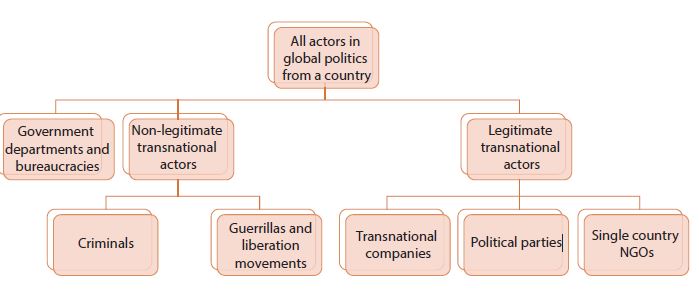
As it can be seen above in the table, there are various actors affecting global policies.
Soru 6
Which of the following is among the characteristics of Global Governance?
Seçenekler
A
It mainly focuses on economy.
B
It aims at cooperative actions on conflicting issues.
C
It empowers local administrations for public peace.
D
It consists of totally formal processes and procedures.
E
It tries to prevent some harmful regimes or leaders.
Açıklama:
The Commission on Global Governance defines governance as “the sum of the many individuals and institutions, public and private, manage their common affairs. It is a continuing process through which conflicting or diverse interests may be accommodated and co-operative action may be taken. It includes
formal institutions and regimes empowered to enforce compliance, as well as informal arrangements that people and institutions either have agreed to or perceive to be in their interest”
formal institutions and regimes empowered to enforce compliance, as well as informal arrangements that people and institutions either have agreed to or perceive to be in their interest”
Soru 7
What type of activities does a private governance actor handle at national level?
Seçenekler
A
TNCs
B
NGOs
C
Local
D
Firms
E
Nonprofits
Açıklama:
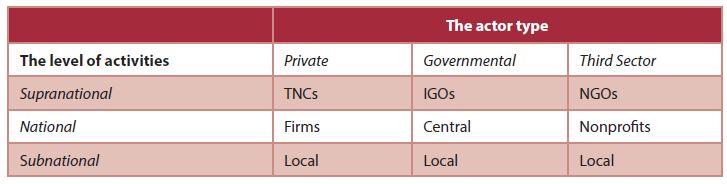
There is a two-way relationship between globalization and global governance, and the state is the crucial actor of global politics, whereas other actors supplement the role of the state. As seen in Table below governance activities based on both the levels where these activities take place and the type of the actor are categorized.
Soru 8
Which of the following is not among the functions of International Organizations?
Seçenekler
A
Socialization
B
Recruitment
C
Membership
D
Norm-setting
E
Articulation and aggregation
Açıklama:
IOs mainly provide a common platform for members to meet, deliberate, find solutions to their common problems, resolve their disputes, and widen their collaboration. States and other international actors have some demands and aims. They interact with other actors, create alliances, and organize meetings or conferences to meet these demands and achieve these aims. In this regard,
IOs are helpful by fulfilling significant functions. These are: articulation and aggregation, norm-setting, recruitment, socialization, rulemaking, rule
application, rule adjudication, information, and operation
IOs are helpful by fulfilling significant functions. These are: articulation and aggregation, norm-setting, recruitment, socialization, rulemaking, rule
application, rule adjudication, information, and operation
Soru 9
Which of the following statememnts is true about the differing aspects between liberalism and realism in terms of International organizations?
Seçenekler
A
Liberalism focuses on importance of cooperation between states whereas realism focuses on power.
B
Liberalism stays utopic and unachievable compared to realism.
C
Realism considers international organizations as the early institutions
of world government whereas liberalism does vice versa.
of world government whereas liberalism does vice versa.
D
Realists build their arguments on the effective role that international organizations play in world politics.
E
Realism and liberalism complete each other in many aspects.
Açıklama:
Although liberalism does not assume that war is illusory, at least it defines the
nature of international relations as a sequence of cooperation and conflict, not only as a conflictual process as Realists do. As such, in contrast to the realist perspective, liberalism takes a different stance on the role of IOs in world affairs. Since liberalism underlines the importance of cooperation between states, naturally this approach attributes a greater prominence to international organizations and considers them as essential actors of International Relations. In that respect, IOs are regarded as the “early institutions of world government.” IOs serve as a platform for states to cooperate and they provide with states and other non-state actors a formal set of rules that are necessary for managing international affairs. In this regard, IOs serve to the common good of all participating states rather than to the interests of a single most powerful state. It is believed that states choose to cooperate through international organizations, because they help to reduce the costs of managing international affairs for nation states. Therefore, states most of the time prefer to act in
line with the institutional structure of international organizations.
nature of international relations as a sequence of cooperation and conflict, not only as a conflictual process as Realists do. As such, in contrast to the realist perspective, liberalism takes a different stance on the role of IOs in world affairs. Since liberalism underlines the importance of cooperation between states, naturally this approach attributes a greater prominence to international organizations and considers them as essential actors of International Relations. In that respect, IOs are regarded as the “early institutions of world government.” IOs serve as a platform for states to cooperate and they provide with states and other non-state actors a formal set of rules that are necessary for managing international affairs. In this regard, IOs serve to the common good of all participating states rather than to the interests of a single most powerful state. It is believed that states choose to cooperate through international organizations, because they help to reduce the costs of managing international affairs for nation states. Therefore, states most of the time prefer to act in
line with the institutional structure of international organizations.
Soru 10
Which of the following theories of integration is defined as "a particular way of bringing together previously separate, autonomous, or independent territorial units to constitute a new form of union"?
Seçenekler
A
Multilateralism
B
Universalism
C
Federalism
D
Intergovernmentalism
E
Functionalism
Açıklama:
Federalism has been associated with the conventional processes of state-building
and national integration. It has been construed as a particular way of bringing together previously separate, autonomous, or independent territorial units to constitute a new form of union based upon principles that, broadly speaking, can be summarized in the dictum ‘unity in diversity’”
and national integration. It has been construed as a particular way of bringing together previously separate, autonomous, or independent territorial units to constitute a new form of union based upon principles that, broadly speaking, can be summarized in the dictum ‘unity in diversity’”
Soru 11
Which of the following made global governance possible and necessary in the 20th and 21st centuries?
Seçenekler
A
Globalization and economic interdependence
B
International and multinational corporations
C
Ideologies such as liberalism and Marxism
D
International public unions and trade unions
E
Political coalitions and military alliances
Açıklama:
The increase and diversification of international organizations (IO) in international politics is closely related to globalization which emerged as a result of the rapid changes of the 20th century. Diez and his colleagues describe globalization as a “catch-all” concept that refers to “the widespread perception of the world as merging into a shared global economic and social space, a process caused by information technologies and an increased degree of interdependency”. Globalization and interdependence are the key factors that have paved the way for global governance.
Soru 12
According to Clive Archer, which of the following development that occurred in the 20th century is considered to have been the starting point of contemporary international organizations?
Seçenekler
A
The Congress of Vienna
B
The Paris Peace Conference
C
The Peace of Westphalia
D
The Atlantic Union Declaration
E
The Yalta Conference
Açıklama:
It was only after the First World War that modern IOs started to emerge. Archer considers the Paris Peace Conference of 1919 as the starting point of contemporary IOs. After the Conference, the League of Nations and International Labour Organization (ILO) were established as the leading modern IOs.
Soru 13
Which of the following is true about guerrillas as political actors?
Seçenekler
A
They are part of government departments.
B
They are part of government bureaucracies.
C
They are non-legitimate transnational actors.
D
They always form political parties.
E
They are considered as single-country NGOs.
Açıklama:
They are non-legitimate transnational actors like criminals.
Soru 14
Which of the following thinkers developed the term “complex interdependence,” which refers to a new structure of relations where all actors have close ties that do not allow either of them to follow individual policies in critical issue areas of international politics such as trade and economics.
Seçenekler
A
Griffiths and O’Callaghan
B
Evans and Newnham
C
Archer and Rosenau
D
Keohane and Nye
E
Haas and Wendt
Açıklama:
Robert O. Keohane and Joseph S. Nye have developed the term “complex interdependence".
Soru 15
Which of the following is not one of the main criteria that are used to classify or categorize international organizations?
Seçenekler
A
Membership
B
Activities
C
Aims
D
Structure
E
Wealth
Açıklama:
In the literature, IOs are categorized according to three criteria: membership, aims and activities, and structure.
Soru 16
Which of the following is an excellent example of an interstate organ in the United Nations?
Seçenekler
A
The Security Council
B
The International Court of Justice
C
The Trusteeship Council
D
The General Assembly
E
The Economic and Social Council
Açıklama:
"The UN General Assembly is an excellent example of an interstate organ where each member state has one vote".
Soru 17
Which of the following refers to the ability of International Organizations to bring together unions or institutions that focus on similar issues?
Seçenekler
A
Articulation and aggregation
B
Norm-setting
C
Socialization
D
Recruitment
E
Rule-making
Açıklama:
The first main function of IOs is articulation and aggregation. This refers to the ability of IOs to bring together unions or organizations that focus on similar issues.
Soru 18
Which of the following IR theories holds the assumptions that states should consolidate their power to secure and guarantee their self-preservation and that they may intentionally use power to suppress the motives of other states and create a constant power struggle and hostility in international affairs.
Seçenekler
A
Liberalism
B
Realism
C
Marxism
D
Constructivism
E
Feminism
Açıklama:
" The realistic notion of power embodies proficiencies not only in political and economic terms but also in military terms. In that respect, realists argue that states consolidate their power to secure and guarantee their selfpreservation, which is their primary concern...For this reason, the state may intentionally use power to suppress the motives of other states and, thus, create a constant power struggle and hostility in international affairs."
Soru 19
Which of the following theories critically assesses realism and liberalism by shifting the focus on the role of economic power in international affairs?
Seçenekler
A
Feminism
B
Constructivism
C
Marxism
D
Green Theory
E
Federalism
Açıklama:
"The Marxist approach contributes to the understanding of international relations and the role of IOs by critically assessing realism and liberalism, which are the dominant theoretical approaches to international relations. Marxism primarily focuses on the role of economic power in international affairs."
Soru 20
Which of the following describes the theory or practice of the integration process that coordinates social, economic, and political activities within a specific geographical location embodying a number of states?
Seçenekler
A
Universalism
B
Intergovernmentalism
C
Neofunctionalism
D
Regionalism
E
Federalism
Açıklama:
"Regionalism is a theory or practice of the integration process, which coordinates social, economic, and political activities within a specific geographical location embodying a number of states ".
Soru 21
Which of the following organizations is the first permanent international organization that was established for the maintenance of international peace and security?
Seçenekler
A
United Nations
B
The League of Nations
C
International Labour Organizations
D
North Atlantic Treaty Organizations
E
The Universal Postal Union
Açıklama:
The League of Nations (1919) is the first permanent IO that was established for the
maintenance of international peace and security.
maintenance of international peace and security.
Soru 22
- The international organization is an umbrella term that covers both intergovernmental organizations (IGOs) and international nongovernmental organizations (INGOs).
- IGOs refer to formal institutions whose members are predominantly states.
- INGOs have a different composition of membership from IGOs as their members are mainly individuals or groups of individuals rather than states.
- As a legitimate type of transnational actors, transnational companies (TNCs) play a relatively greater role in international politics today.
- Non-legitimate transnational actors can also produce an impact on international politics.
Which of the statements above regarding international organizations are correct?
Seçenekler
A
I and II
B
I, II and III
C
I, II, III and IV
D
II, III, IV and V
E
I, II, III, IV and V
Açıklama:
The international organization is an umbrella term that covers both intergovernmental organizations (IGOs) and international nongovernmental organizations (INGOs). IGOs refer to formal institutions whose members are predominantly states. INGOs, on the other hand, have a different composition of membership from IGOs as their members are mainly individuals or groups of individuals rather than states.
Legitimate transnational actors from a country can be transnational companies, political parties, or NGOs. Legitimate actors usually engage with IOs in the management of international relations. As a legitimate type of transnational actors, transnational companies (TNCs) play a relatively greater role in international politics today. They primarily lobby foreign governments in several ways; they can indirectly ask their own government to put pressure on a foreign government, try to affect the target government through IOs, or directly reach its diplomatic missions or ministries.
Non-legitimate transnational actors can also produce an impact on international politics. They generate serious problems for states such as criminal financial flows, criminal trade, or illegal trafficking. Because of this, states nowadays individually or collectively are trying to find legal solutions toward blocking the illegal activities of these groups.
As is also understood from the information given, the correct answer is E. All statements regarding international organizations in the options are correct.
Legitimate transnational actors from a country can be transnational companies, political parties, or NGOs. Legitimate actors usually engage with IOs in the management of international relations. As a legitimate type of transnational actors, transnational companies (TNCs) play a relatively greater role in international politics today. They primarily lobby foreign governments in several ways; they can indirectly ask their own government to put pressure on a foreign government, try to affect the target government through IOs, or directly reach its diplomatic missions or ministries.
Non-legitimate transnational actors can also produce an impact on international politics. They generate serious problems for states such as criminal financial flows, criminal trade, or illegal trafficking. Because of this, states nowadays individually or collectively are trying to find legal solutions toward blocking the illegal activities of these groups.
As is also understood from the information given, the correct answer is E. All statements regarding international organizations in the options are correct.
Soru 23
which of the following implies a singular or unitary authority that, according to Evans and Newham, should not be confused with global governance?
Seçenekler
A
Alliances
B
Multinational Corporations (MNCs)
C
Governmental Organizations (IGOs)
D
Non-governmental Organizations (NGOs)
E
World Government
Açıklama:
"Evans and Newham identify the scope of global governance as follows: “Global governance should not be confused with World government, which implies a singular or unitary authority."
Soru 24
Which of the following holds a critical stance toward the concept of "global governance" because it may be wrongly associated with the absence of anarchy in the international system?
Seçenekler
A
Realists
B
Liberals
C
Marxist scholars
D
Functionalists
E
Cosmopolitanists
Açıklama:
"IR theories discuss global governance mostly in relation to state and power. Realists hold a critical stance toward global governance, because its existence would refer to the absence of anarchy in the international system. Yet anarchy is the defining characteristic of the international system."
Soru 25
Which of the following is considered to be a trans-governmental organization?
Seçenekler
A
The United Nations
B
NATO
C
The Interpol
D
The World Meteorological Organization
E
The UN Economic and Social Council
Açıklama:
"Trans-governmental organizations, on the other hand, refer to the networks of cooperation between governmental actors that are not part of central foreign policy organs. The International Union of Local Authorities (IULA), the Interpol, or the Inter-Parliamentary Union are some examples of TGOs. "
Soru 26
- International Organizations (IOs) that encourage cooperation among their members, who are not in conflict with one another
- IOs that aim at reducing the intensity of a conflict among their members through the methods of conflict management and conflict prevention
- IOs that aim at producing confrontation between their members or between its members and non-members
- IOs that focus on high politics are mostly concerned with international order and security
- IOs that focus on low politics that are concerned with technical, economic, and cultural issues
Which of the above are among the types of international organizations identified by Archer, based on the relationship that these organizations aim to promote among their members?
Seçenekler
A
I and II
B
IV and V
C
I, II and III
D
III, IV and V
E
II, III, IV and V
Açıklama:
Having studied the aims and activities of IOs, Archer has identified three types of organizations based on the relationship that these organizations aim to promote among their members. The first are those organizations that encourage cooperation among its members, who are not in conflict with one another. The second is those organizations that aim at reducing the intensity of a conflict among its members through the methods of conflict management and conflict prevention. The third is those organizations that aim at producing confrontation between its members or between its members and non-members. The functions of the UN Security Council defined under Chapter VII of the Charter exemplify this third type of organization and of the nature of relationship. As is also understood from the information given, the correct answer is C. “International Organizations (IOs) that encourage cooperation among its members, who are not in conflict with one another”, “IOs that aim at reducing the intensity of a conflict among its members through the methods of conflict management and conflict prevention” and “IOs that aim at producing confrontation between its members or between its members and non-members”.
“IOs that focus on high politics are mostly concerned with international order and security” and “IOs that focus on low politics that are concerned with technical, economic, and cultural issues” are the group of organizations identified by Petland regarding their focus.
“IOs that focus on high politics are mostly concerned with international order and security” and “IOs that focus on low politics that are concerned with technical, economic, and cultural issues” are the group of organizations identified by Petland regarding their focus.
Soru 27
Which international organization can be given as an example in order to support the argument “The institutional structure of an international organization may also change over time.”?
Seçenekler
A
Nordic Council
B
The UN General Assembly
C
The Parliamentary Assembly of the Council of Europe
D
The International Court of Justice
E
The European Court of Human Rights
Açıklama:
The institutional structure of an international organization may also change over time. For example, the Nordic Council was established in 1952 with the aim of fostering cooperation between Denmark, Iceland, Norway, and Sweden (Nordic Council, 2018a). As is also understood from the information given, the correct answer is A. In order to deepen the cooperation, the Nordic Council of Ministers was created in 1971 to complement the Council as well as a Secretariat was set up. Moreover, the organization enlarged: in 1955 Finland, in 1970 the Faroe Islands and Åland, and in 1984 Greenland joined the organization. The Council of Ministers consists of sub-groups focusing on different issue areas, including labor, sustainable growth, equality, culture, and environment.
The UN General Assembly is an excellent example of an interstate organ where each member state has one vote. The Parliamentary Assembly of the Council of Europe illustrates a parliamentary organ, which is composed of 324 parliamentarians from 47 member states.
Moreover, some IOs have judicial bodies in order to settle the disputes between the members such as the International Court of Justice, the principal judicial organ of the UN, or to act as the ‘court of last resort’ such as the European Court of Human Rights.
The UN General Assembly is an excellent example of an interstate organ where each member state has one vote. The Parliamentary Assembly of the Council of Europe illustrates a parliamentary organ, which is composed of 324 parliamentarians from 47 member states.
Moreover, some IOs have judicial bodies in order to settle the disputes between the members such as the International Court of Justice, the principal judicial organ of the UN, or to act as the ‘court of last resort’ such as the European Court of Human Rights.
Soru 28
I-Articulation and Aggregation
II-Rule-making
III- Norm-setting
IV- Recruitment
V-Socialization
Which of the above are among the functions of international organizations?
II-Rule-making
III- Norm-setting
IV- Recruitment
V-Socialization
Which of the above are among the functions of international organizations?
Seçenekler
A
I and II
B
II and V
C
I, II and III
D
II, III, IV and V
E
I, II, III, IV and V
Açıklama:
International Organizations (IOs) mainly provide a common platform for members to meet, deliberate, find solutions to their common problems, resolve their disputes, and widen their collaboration.
These are: articulation and aggregation, norm-setting, recruitment, socialization, rulemaking, rule application, rule adjudication, information, and operation.
The first main function of IOs is articulation and aggregation. This refers to the ability of IOs to bring together unions or organizations that focus on similar issues.
The second significant function of IOs is norm-setting. International organizations greatly contribute to the creation of new norms. They also encourage states to involve in norm-setting processes. Throughout the 20th century, IOs played key roles in the development of new international norms especially on human rights, slavery, global economy, and environment.
The third function of IOs is recruitment. This refers to their organizational capacity to allow new members to become a member of the international community with full rights.
The fourth main function of IOs is socialization. In general, socialization can be considered as a learning process of states about values. INGOs can enable people who share the same beliefs to get socialized at the international level.
Other three significant functions of IOs are rule-making, rule application, and rule adjudication. Although these kind of functions are more associated with states, IOs also fulfil such roles in the international system. These functions of IOs are particularly important because the absence of a central authority makes it difficult to produce common rules in international politics.
Another main function of international organizations is concerned with information and operation. IOs provide mechanisms for the exchange of information among states. Through new information technologies and regular meetings, they help different actors discuss common problems, and as such they not onlyfoster information but also decrease the transaction costs. IOs also fulfil operational roles especially in the international banking system and aid mechanisms for the developing countries. As they are established mostly in issue-specific areas, NGOs provide expertise and technical assistance thanks to their organizational structure.
As is also understood from the information given, the correct answer is E. “Articulation and Aggregation”, “Norm-setting”, “Recruitment” and “Socialization” are among the functions of international organizations. The other functions of international organizations which do not take place in the options are “Rule Application” and “Rule Adjudication”.
These are: articulation and aggregation, norm-setting, recruitment, socialization, rulemaking, rule application, rule adjudication, information, and operation.
The first main function of IOs is articulation and aggregation. This refers to the ability of IOs to bring together unions or organizations that focus on similar issues.
The second significant function of IOs is norm-setting. International organizations greatly contribute to the creation of new norms. They also encourage states to involve in norm-setting processes. Throughout the 20th century, IOs played key roles in the development of new international norms especially on human rights, slavery, global economy, and environment.
The third function of IOs is recruitment. This refers to their organizational capacity to allow new members to become a member of the international community with full rights.
The fourth main function of IOs is socialization. In general, socialization can be considered as a learning process of states about values. INGOs can enable people who share the same beliefs to get socialized at the international level.
Other three significant functions of IOs are rule-making, rule application, and rule adjudication. Although these kind of functions are more associated with states, IOs also fulfil such roles in the international system. These functions of IOs are particularly important because the absence of a central authority makes it difficult to produce common rules in international politics.
Another main function of international organizations is concerned with information and operation. IOs provide mechanisms for the exchange of information among states. Through new information technologies and regular meetings, they help different actors discuss common problems, and as such they not onlyfoster information but also decrease the transaction costs. IOs also fulfil operational roles especially in the international banking system and aid mechanisms for the developing countries. As they are established mostly in issue-specific areas, NGOs provide expertise and technical assistance thanks to their organizational structure.
As is also understood from the information given, the correct answer is E. “Articulation and Aggregation”, “Norm-setting”, “Recruitment” and “Socialization” are among the functions of international organizations. The other functions of international organizations which do not take place in the options are “Rule Application” and “Rule Adjudication”.
Soru 29
- Constructivism
- Green Theory
- Functionalism
- Marxism
- Liberalism
Seçenekler
A
III
B
I and III
C
II, III and IV
D
I, II, IV and V
E
II, III, IV and V
Açıklama:
The main theoretical classification on the role of international relations is structured around: traditional realism, liberalism, Marxism along with constructivism, feminism, the green theory, and other integration theories.
Integration is a process “whereby political actors in several, distinct national settings are persuaded to shift their loyalties, expectations and political activities toward new center, whose institutions possess or demand jurisdiction over pre-existing national states”. The theoretical approaches dealing with integration focus on the development of certain policies as well as institutional and governance structures that exist above and/or beyond the nation-state level.
Functionalism is an integration theory concerning the development, role, and functioning of IOs. David Mitrany, the founding father of the functionalist theory, justifies the establishment of IOs based on their social, economic, political, and other related functions that are deemed essential for promoting the interests of nation states. The functions of IOs provide the basis for the development of common interests and cooperation among nation-states. As is also understood from the information given, the correct answer is A.
Other integration theories are federalism, neofunctionalism, intergovernmentalism / liberal-intergovernmentalism.
Federalism as an integration theory gained prominence in the post-Second World War period. Following the War, the idea of establishing a supranational political union in Europe dominated the agenda of West European nations. The rationale behind this initiative was to prevent any future wars and establish a lasting peace in Europe.
Neofunctionalism, a theory of regional integration, was developed in the 1960s and 1970s as a “moderate conceptual tool” for assessing the European integration process. Neofunctionalism expands the notions of functionalism by combining the “functionalist mechanisms” with “federalist goals,” devoting extensive self-sufficiency to “supranational” institutions.
During the political stalemate in the 1960s, neofunctionalism was highly criticized by the intergovernmentalist approach. In contrast to neofunctionalists’ stress on the role of supranational decision-making bodies in the institutional structure of IOs, prominent scholars of intergovernmentalism such as Stanley Hoffmann point to the decisive role of national/domestic politics for the integration process (Hoffmann, 1966). Intergovernmentalism and liberal intergovernmentalism consider the formation of IOs as a process of inter-state bargaining process wherein socioeconomic interests, the positions of political elite, and ideology matter to a great extent.
The definitions of the other international theories are as follows:
Realism is one of the major theories of international relations. The state-centric approach of realism is accepted as its distinctive trait, since the state is theoretically acknowledged as the main actor in international relations who follows its own interests and compete for power in the international system. Realism considers the concept of power as the ability to change and adjust the behavior of others in an anticipated way. Presuming that the state behavior is mainly shaped by the dynamics of power and security in international relations, it is hypothesized that states can maximize their self-interests by providing their own security and preserving (and even increasing) their own power.
In its debate on international affairs, liberalism focuses on the individual rather than on the state and draws its basic ethical tenets from the value of the human being. Based on the works of Adam Smith such as The Wealth of Nations and of John Locke such as The Essay Concerning Human Understanding, the liberal approach acknowledges the possibility of establishing cooperative relations between not only individuals but also nation states. Accordingly, nation states can build peaceful interstate relations especially through such issue areas as economics and trade. Although liberalism does not assume that war is illusory, at least it defines the nature of international relations as a sequence of cooperation and conflict, not only as a conflictual process as Realists do.
Marxism along with constructivism, feminism, the green theory are critical IR theories.
The Marxist approach contributes to the understanding of international relations and the role of IOs by critically assessing realism and liberalism, which are the dominant theoretical approaches to international relations. Marxism primarily focuses on the role of economic power in international affairs. Marxism criticizes capitalism as the main mode of production on the grounds that it causes inequalities among nation states and thus destabilizes the world order and increases the possibility of a conflict among states. Marxism regards IOs as tools and/or influence mechanisms of capitalism that widen the gap between the developed nations and the developing/ underdeveloped nations.
Constructivism is one of the recent prominent theories of International Relations. The constructivist approach focuses on the epistemology and sociology of knowledge as well as the agentstructure debate. The approach perceives the current world structure through the lens of “social construction of power politics”. Constructivism argues that IOs contribute to bilateral and multilateral cooperation among nation states, despite the fact that their material interests and political power may not be maximized through this cooperation.
As one of the critical theories of international relations, feminism focuses on the role of gender and gender politics in international affairs. Feminism discusses women’s possible role in, and contribution to, the decision-making and policy-making processes within IOs with regard to important issues of international affairs and global governance.
Green Theory: Today’s world is facing a rapid process of globalization that has produced complex and interdependent structures. These complex structures include economic, political, social as well as ecological issue areas where a good global governance has become a necessity. The environmental issues are no longer considered within the scope of nation states. Rather, these issues expanded and many new actors participated in managing them, including “networks of experts, environmentalist organizations and multinational corporations as well as new agencies set up by governments”. This theoretical approach suggests that today IOs play a significant role in the decision-making mechanisms that deal with environmental issues and develop “legally binding” policies negotiated and agreed upon by nation states and non-state entities. In fact, IOs help to strengthen the idea of global governance on environmental issues by reconciling processes of rule-making and rule implementation that takes place at different levels of governance, i.e. sub-national, national, supranational, and international.
Integration is a process “whereby political actors in several, distinct national settings are persuaded to shift their loyalties, expectations and political activities toward new center, whose institutions possess or demand jurisdiction over pre-existing national states”. The theoretical approaches dealing with integration focus on the development of certain policies as well as institutional and governance structures that exist above and/or beyond the nation-state level.
Functionalism is an integration theory concerning the development, role, and functioning of IOs. David Mitrany, the founding father of the functionalist theory, justifies the establishment of IOs based on their social, economic, political, and other related functions that are deemed essential for promoting the interests of nation states. The functions of IOs provide the basis for the development of common interests and cooperation among nation-states. As is also understood from the information given, the correct answer is A.
Other integration theories are federalism, neofunctionalism, intergovernmentalism / liberal-intergovernmentalism.
Federalism as an integration theory gained prominence in the post-Second World War period. Following the War, the idea of establishing a supranational political union in Europe dominated the agenda of West European nations. The rationale behind this initiative was to prevent any future wars and establish a lasting peace in Europe.
Neofunctionalism, a theory of regional integration, was developed in the 1960s and 1970s as a “moderate conceptual tool” for assessing the European integration process. Neofunctionalism expands the notions of functionalism by combining the “functionalist mechanisms” with “federalist goals,” devoting extensive self-sufficiency to “supranational” institutions.
During the political stalemate in the 1960s, neofunctionalism was highly criticized by the intergovernmentalist approach. In contrast to neofunctionalists’ stress on the role of supranational decision-making bodies in the institutional structure of IOs, prominent scholars of intergovernmentalism such as Stanley Hoffmann point to the decisive role of national/domestic politics for the integration process (Hoffmann, 1966). Intergovernmentalism and liberal intergovernmentalism consider the formation of IOs as a process of inter-state bargaining process wherein socioeconomic interests, the positions of political elite, and ideology matter to a great extent.
The definitions of the other international theories are as follows:
Realism is one of the major theories of international relations. The state-centric approach of realism is accepted as its distinctive trait, since the state is theoretically acknowledged as the main actor in international relations who follows its own interests and compete for power in the international system. Realism considers the concept of power as the ability to change and adjust the behavior of others in an anticipated way. Presuming that the state behavior is mainly shaped by the dynamics of power and security in international relations, it is hypothesized that states can maximize their self-interests by providing their own security and preserving (and even increasing) their own power.
In its debate on international affairs, liberalism focuses on the individual rather than on the state and draws its basic ethical tenets from the value of the human being. Based on the works of Adam Smith such as The Wealth of Nations and of John Locke such as The Essay Concerning Human Understanding, the liberal approach acknowledges the possibility of establishing cooperative relations between not only individuals but also nation states. Accordingly, nation states can build peaceful interstate relations especially through such issue areas as economics and trade. Although liberalism does not assume that war is illusory, at least it defines the nature of international relations as a sequence of cooperation and conflict, not only as a conflictual process as Realists do.
Marxism along with constructivism, feminism, the green theory are critical IR theories.
The Marxist approach contributes to the understanding of international relations and the role of IOs by critically assessing realism and liberalism, which are the dominant theoretical approaches to international relations. Marxism primarily focuses on the role of economic power in international affairs. Marxism criticizes capitalism as the main mode of production on the grounds that it causes inequalities among nation states and thus destabilizes the world order and increases the possibility of a conflict among states. Marxism regards IOs as tools and/or influence mechanisms of capitalism that widen the gap between the developed nations and the developing/ underdeveloped nations.
Constructivism is one of the recent prominent theories of International Relations. The constructivist approach focuses on the epistemology and sociology of knowledge as well as the agentstructure debate. The approach perceives the current world structure through the lens of “social construction of power politics”. Constructivism argues that IOs contribute to bilateral and multilateral cooperation among nation states, despite the fact that their material interests and political power may not be maximized through this cooperation.
As one of the critical theories of international relations, feminism focuses on the role of gender and gender politics in international affairs. Feminism discusses women’s possible role in, and contribution to, the decision-making and policy-making processes within IOs with regard to important issues of international affairs and global governance.
Green Theory: Today’s world is facing a rapid process of globalization that has produced complex and interdependent structures. These complex structures include economic, political, social as well as ecological issue areas where a good global governance has become a necessity. The environmental issues are no longer considered within the scope of nation states. Rather, these issues expanded and many new actors participated in managing them, including “networks of experts, environmentalist organizations and multinational corporations as well as new agencies set up by governments”. This theoretical approach suggests that today IOs play a significant role in the decision-making mechanisms that deal with environmental issues and develop “legally binding” policies negotiated and agreed upon by nation states and non-state entities. In fact, IOs help to strengthen the idea of global governance on environmental issues by reconciling processes of rule-making and rule implementation that takes place at different levels of governance, i.e. sub-national, national, supranational, and international.
Soru 30
- The United Nations (UN)
- The League of Nations
- The North Atlantic Treaty Organization (NATO)
- Warsaw Pact
- The European Union
Seçenekler
A
I and II
B
III and IV
C
II, III and IV
D
I, IV and V
E
III, IV and V
Açıklama:
The idea of global governance is based on the formation of an international society, which consists of nation states that aim at forming global institutions and following global practices. The process of globalization of an international society includes reflective universalism that embodies state-society relations around the world. These interactions involve not only the formation of universal values and norms, but also common practices aiming at creating a peaceful world order. Universalism is a theme prominently associated with the modern world-system. It is in many ways one of its boasts. Universalism means in general the priority to general rules applying equally to all persons, and therefore the rejection of particularistic preferences in most spheres. The League of Nations was the first attempt at putting the idea of universalism into action with regard to peace and international security. The United Nations is the second international organizations with universal values. For several reasons, the UN is considered a more effective organization than its predecessor, the League of Nations. The idea of universalism embedded in the UN’s structure and autonomy is reflected in many ways. As is also understood from the information given, the correct answer is A.
“The North Atlantic Treaty Organization (NATO)”, “Warsaw Pact” and “The European Union” are regional cooperations. There is a growing trend of regional groupings and formal institutional structures in today’s world affairs. The initial regionalist developments as a formal institutional cooperation in international relations came into existence in peace and security issues. The North Atlantic Treaty Organization (NATO) and the Warsaw Pact as alliances exemplify the establishment of a permanent organizational structure to deal with regional security challenges. Besides, we observe the establishment of regional economic, social, and political organizations, especially in Europe, following the end of the Second World War. The European Coal and Steel Community, which subsequently evolved into the European Economic Community, and the European Union are the most representative initiatives in regionalization.
“The North Atlantic Treaty Organization (NATO)”, “Warsaw Pact” and “The European Union” are regional cooperations. There is a growing trend of regional groupings and formal institutional structures in today’s world affairs. The initial regionalist developments as a formal institutional cooperation in international relations came into existence in peace and security issues. The North Atlantic Treaty Organization (NATO) and the Warsaw Pact as alliances exemplify the establishment of a permanent organizational structure to deal with regional security challenges. Besides, we observe the establishment of regional economic, social, and political organizations, especially in Europe, following the end of the Second World War. The European Coal and Steel Community, which subsequently evolved into the European Economic Community, and the European Union are the most representative initiatives in regionalization.
Soru 31
Which of the following is the reason why IOs have gained more importance in the 21st century?
Seçenekler
A
The spread of the Internet
B
The after effects of the fall of Berlin wall
C
Rapid development of interdependent structures in the world order as a result of globalization process
D
Easy and fast control of information among the states of the world
E
New world order that has been imposed by the United States of America since early 90s.
Açıklama:
Despite their relatively late emergence, IOs have rapidly become essential components of international relations. Particularly in the 21st century, the importance of IOs has remarkably increased due to the rapid development of interdependent structures in the world order as a result of the globalization process. It is in this context where IOs emerge as vital actors that involve in any type of political, economic, and social challenges that this century faces
Soru 32
Which of the following is true about the emergence of IOs?
Seçenekler
A
The roots of IOs can be traced back to the emergence of the modern international system after the end of World War II (1945).
B
Because the early international system had been mainly dominated by the Asia-Pacific kingdoms, first IOs emerged in the 17th century in India.
C
The role and place of the state in the system did not change as a result of the development of communication systems.
D
The exclusion of different types of actors made international system more secure and safe.
E
The Congress of Vienna (1815) created a more convenient atmosphere for the development of IOs
Açıklama:
The roots of IOs can be traced back to the emergence of the modern international system after the Peace of Westphalia in 1648. Because the early international system had been mainly dominated by European nation states, first IOs emerged in the 19th century in Europe. The Congress of Vienna (1815) created a more convenient atmosphere for the development of IOs. The role and place of the state in the system also changed as a result of the development of communication systems. Therefore, it became necessary to define the changing nature of the international system and the role of power and states in international affairs. With the involvement of the different types of actors, the international system has become more complicated and interdependent.
Soru 33
Which of the following is considered as the first permanent IO established for the maintenance of peace and security?
Seçenekler
A
Leage of Nations
B
United Nations
C
NATO
D
The Paris Conference
E
The Berlin Conference
Açıklama:
For example, The Paris Conference (1856), the Berlin Conference (1878), and The Hague Conferences (1899 and 1907) can be considered as mechanisms of early forms of IOs. However, the League of Nations is the first permanent IO that was established for the maintenance of international peace and security.
Soru 34
Which of the following historical events marked the beginning of governance studies?
Seçenekler
A
The end of WWI
B
The end of WW II
C
The French Revolution
D
The end of Cold War
E
Renaissance
Açıklama:
The growing roles of IOs and the increasing interdependence among states showed the importance of the concept of governance for understanding complex international affairs. Particularly, the end of the Cold War marked the beginning of the governance studies.
Soru 35
Which of the following reflects what Marxists scholars think about global governance?
Seçenekler
A
The existence of global governance would refer to the absence of anarchy in the international system.
B
Global governance is a capitalist project that enables the imposition of the capitalist reproduction of social relations and disciplines.
C
Global governance is a product of the capitalist world where those in power can easily impose their rules onto the other countries through international relations.
D
Global governance is a means of governing world affairs in the absence of a global central authority.
E
Global governance leads to loss of power and autonomy for those countries that do not have much to say due to their weak and poor economic conditions.
Açıklama:
Realists hold a critical stance toward global governance, because its existence would refer to the absence of anarchy in the international system. Yet anarchy is the defining characteristic of the international system. Liberals, on the other hand, consider global governance as a means of governing world affairs in the absence of a global central authority and emphasize its problem-solving potential. Focusing on the role of international economic organizations such as the World Bank and the International Monetary Fund (IMF), Marxist scholars consider global governance as a capitalist project that enables the imposition of the capitalist reproduction of social relations and disciplines (Diez et al., 2011: 75-76).
Soru 36
“The traditional/realist approach to intergovernmental organizations considers that IGOs are based on the principle of _____________ _____________ .”
Which of the following best completes the sentence above?
Which of the following best completes the sentence above?
Seçenekler
A
Economic welfare
B
Human rights
C
Interdependent existence
D
International Relations
E
State sovereignty
Açıklama:
The traditional/realist approach to intergovernmental organizations considers that IGOs are based on the principle of state sovereignty. As such, IGOs are built on the idea that states are the only subjects of international law and they are legally equal.
Soru 37
Which of the following is NOT an example of regional organizations?
Seçenekler
A
International Olympic Committee
B
The African Union
C
The European Union
D
Euroasian Economic Union
E
Arab League
Açıklama:
TNOs are divided into three types: genuine INGOs, hybrid NGOs, and trans-governmental organizations (TGOs). INGOs are organizations that only consist of non-governmental actors. The International Olympic Committee is a telling example of INGOs. If the members of an organization belong to a specific geographical region, this kind of organization is classified as a regional organization. The most notable examples of regional organizations are the European Union (EU), the African Union (AU, The Euroasian Economic Union, and the Arab League.
Soru 38
“IOs enable the actors who share similar objectives to work together for better conditions and help them make their voice heard. Trade unions, youth movements, employers’ associations generally illustrate this function of IOs.”
Which of the following functions of IOs is exemplified in the sentence above?
Which of the following functions of IOs is exemplified in the sentence above?
Seçenekler
A
Norm setting
B
Recruitment
C
Socialization
D
Articulation and aggregation
E
Rule adjudication
Açıklama:
The first main function of IOs is articulation and aggregation. This refers to the ability of IOs to bring together unions or organizations that focus on similar issues. IOs enable the actors who share similar objectives to work together for better conditions and help them make their voice heard. In case of disagreement, members may leave the umbrella organization and establish a new international organization. Trade unions, youth movements, employers’ associations generally illustrate this function of IOs
Soru 39
Which of the following International Relations theories has a state-centric approach and sees states as the main actor in international relations?
Seçenekler
A
Realism
B
Constructivism
C
Marxism
D
The Green Theory
E
Liberalism
Açıklama:
Realism is one of the major theories of international relations. The state-centric approach of realism is accepted as its distinctive trait, since the state is theoretically acknowledged as the main actor in international relations who follows its own interests and compete for power in the international system. Realism considers the concept of power as the ability to change and adjust the behavior of others in an anticipated way.
Soru 40
Which of the following International Relations theories underpins that “IOs are the ‘early institutions of world government’ serving as a platform for states to cooperate, and they provide with states and other non-state actors a formal set of rules that are necessary for managing international affairs?
Seçenekler
A
Realism
B
Constructivism
C
Marxism
D
The Green Theory
E
Liberalism
Açıklama:
As such, in contrast to the realist perspective, liberalism takes a different stance on the role of IOs in world affairs. Since liberalism underlines the importance of cooperation between states, naturally this approach attributes a greater prominence to international organizations and considers them as essential actors of International Relations. In that respect, IOs are regarded as the “early institutions of world government.” IOs serve as a platform for states to cooperate and they provide with states and other non-state actors a formal set of rules that are necessary for managing international affairs. In this regard, IOs serve to the common good of all participating states rather than to the interests of a single most powerful state.
Soru 41
What kind of topics do the study of international organizations (IOs) and global governance embody?
Seçenekler
A
electronical
B
historical
C
mathematical
D
artistic
E
sportive
Açıklama:
The study of international organizations (IOs) and global governance embodies a wide range of topics that have conceptual, historical, and theoretical dimensions.
Soru 42
Which statement is wrong about the structure of international organizations?
Seçenekler
A
International organizations act as effective influence mechanisms to shape and direct the actions of nation states and their policies for common goals and objectives.
B
They act as independent actors with their own set of rules and behavioral patterns in the international system.
C
International Organizations have less contributed to the notion of global governance.
D
The roots of international organizations can be traced back to the emergence of the modern international system after the Peace of Westphalian in 1648.
E
The evolution of international organizations is closely associated with the process of globalization and global governance.
Açıklama:
IOs have significantly contributed to the notion of global governance.
Soru 43
Which concept do the increase and diversification of International Organizations in international politics is closely related to?
Seçenekler
A
capitalism
B
interdependence
C
regional organizations
D
globalization
E
non-governmental organizations
Açıklama:
The increase and diversification of IOs in international politics is closely related to globalization which emerged as a result of the rapid changes of the 20th century. Diez and his colleagues describe globalization as a “catch-all” concept that refers to “the widespread perception of the world as merging into a shared global economic and social space, a process caused by information technologies and an increased degree of interdependency”.
Soru 44
What is the first permanent IO that was established for the maintenance of international peace and security?
Seçenekler
A
the Concert System
B
the League of Nations
C
the International Labour Organization
D
European Union
E
The Peace of Westphalian
Açıklama:
The League of Nations is the first permanent IO that was established for the maintenance of international peace and security.
Soru 45
What is the word which refers to a new structure of relations where all actors have close ties that do not allow either of them to follow individual policies in critical issue areas of international politics such as trade and economics?
Seçenekler
A
intergovernmental organizations
B
the governance studies
C
complex interdependence
D
transnational companies
E
international public unions
Açıklama:
The liberal school of IR describes the increasing interaction among international actors as the growing interdependence in international politics. In this context, Robert O. Keohane and Joseph S. Nye have developed the term “complex interdependence”.
Soru 46
What is the type of international organization whose members are governments or official representatives of governments?
Seçenekler
A
intergovernmental organizations
B
international non-governmental organizations
C
global governance
D
complex interdependence
E
transnational companies
Açıklama:
If the members of an organization are governments or official representatives of governments, this type of IOs is called intergovernmental organizations (IGOs).
Soru 47
What is the type of international organization whose members generally consist national NGOs representing their respective fellow countrymen?
Seçenekler
A
intergovernmental organizations
B
international non-governmental organizations
C
global governance
D
complex interdependence
E
transnational companies
Açıklama:
International non-governmental organizations (INGOs) consist of members that are generally national NGOs representing their respective fellow countrymen. The goals of NGOs are determined by individuals, and they can operate at both national and international levels.
Soru 48
What is the type of international organization which refers to the institutionalization of global interactions under a formal and permanent structure through an agreement among more than two participants of which at least one is a non-state actor?
Seçenekler
A
intergovernmental organizations
B
international non-governmental organizations
C
global governance
D
complex interdependence
E
transnational organizations
Açıklama:
TNOs are divided into three types: genuine INGOs, hybrid NGOs, and trans-governmental organizations (TGOs).
Soru 49
What is the kind of an organization whose members belong to a specific geographical region?
Seçenekler
A
transnational organizations
B
international non-governmental organizations
C
intergovernmental organizations
D
regional organization
E
universal organization
Açıklama:
If the members of an organization belong to a specific geographical region, this kind of organization is classified as a regional organization. The most notable examples of regional organizations are the European Union (EU), the African Union (AU) and the Organization of American States (OAS).
Soru 50
What is the kind of an organization whose membership is not confined to a particular region and open to all states?
Seçenekler
A
transnational organizations
B
international non-governmental organizations
C
intergovernmental organizations
D
regional organization
E
universal organization
Açıklama:
If its membership is not confined to a particular region and open to all states, this kind of organization is classified as a universal organization such as the UN. Nevertheless, this typology is contested.
Soru 51
Which of the followings led the emergence of the Concert System in Europe?
Seçenekler
A
The First World War (1914-1918).
B
The Berlin Conference (1878).
C
The Congress of Vienna (1815).
D
The Paris Conference (1856).
E
The Peace of Westphalian (1648).
Açıklama:
Page 4.
The emergence of the Concert System in Europe following the Congress of Vienna heralded the establishment of international organizations. The European “concert was not a full-fledged IGO (intergovernmental organization) but rather an informal mechanism for consultation that helped states cooperate while retaining their autonomy”. Therefore, the correct option is C.
The emergence of the Concert System in Europe following the Congress of Vienna heralded the establishment of international organizations. The European “concert was not a full-fledged IGO (intergovernmental organization) but rather an informal mechanism for consultation that helped states cooperate while retaining their autonomy”. Therefore, the correct option is C.
Soru 52
Which of the followings led to the emergence of the modern international organizations?
Seçenekler
A
The First World War (1914-1918).
B
The Berlin Conference (1878).
C
The Congress of Vienna (1815).
D
The Paris Conference (1856).
E
The Peace of Westphalian (1648).
Açıklama:
Page 4.
It was only after the First World War that modern international organizations started to emerge. Archer considers the Paris Peace Conference of 1919 as the starting point of contemporary international organizations. After the Conference, the League of Nations and International Labour Organization (ILO) were established as the leading modern international organizations. Therefore, the correct option is A.
It was only after the First World War that modern international organizations started to emerge. Archer considers the Paris Peace Conference of 1919 as the starting point of contemporary international organizations. After the Conference, the League of Nations and International Labour Organization (ILO) were established as the leading modern international organizations. Therefore, the correct option is A.
Soru 53
Which of the followings is an actor in international relations that primarily lobby foreign governments?
Seçenekler
A
International nongovernmental organizations.
B
Transnational companies.
C
International Labour Organization.
D
Non-legitimate transnational actors.
E
Intergovernmental organizations.
Açıklama:
Page 5.
Legitimate transnational actors from a country can be transnational companies, political parties, or NGOs. Legitimate actors usually engage with IOs in the management of international relations. As a legitimate type of transnational actors, transnational companies (TNCs) play a relatively greater role in international politics today. They primarily lobby foreign governments in several ways; they can indirectly ask their own government to put pressure on a foreign government, try to affect the target government through IOs, or directly reach its diplomatic missions or ministries. Therefore, the correct option is B.
Legitimate transnational actors from a country can be transnational companies, political parties, or NGOs. Legitimate actors usually engage with IOs in the management of international relations. As a legitimate type of transnational actors, transnational companies (TNCs) play a relatively greater role in international politics today. They primarily lobby foreign governments in several ways; they can indirectly ask their own government to put pressure on a foreign government, try to affect the target government through IOs, or directly reach its diplomatic missions or ministries. Therefore, the correct option is B.
Soru 54
Which of the followings may be considered to be among the non-legitimate transnational actors?
Seçenekler
A
EU.
B
ISIS.
C
CIA.
D
INTERPOL.
E
KGB.
Açıklama:
Page 5.
Non-legitimate transnational actors can also produce an impact on international politics. They generate serious problems for states such as criminal financial flows, criminal trade, or illegal trafficking. Because of this, states nowadays individually or collectively are trying to find legal solutions toward blocking the illegal activities of these groups. Therefore, the correct option is B.
Non-legitimate transnational actors can also produce an impact on international politics. They generate serious problems for states such as criminal financial flows, criminal trade, or illegal trafficking. Because of this, states nowadays individually or collectively are trying to find legal solutions toward blocking the illegal activities of these groups. Therefore, the correct option is B.
Soru 55
Which of the followings refers to a new structure of relations where all actors have close ties that do not allow either of them to follow individual policies in critical issue areas of international politics such as trade and economics?
Seçenekler
A
Governance studies.
B
Legitimate transnational actors.
C
Intergovernmental organizations.
D
Trans-governmental organizations.
E
Complex interdependence.
Açıklama:
Page 7.
The liberal school of IR describes the increasing interaction among international actors as the growing interdependence in international politics. In this context, Robert O. Keohane and Joseph S. Nye have developed the term “complex interdependence,” which refers to a new structure of relations where all actors have close ties that do not allow either of them to follow individual policies in critical issue areas of international politics such as trade and economics. Therefore, the correct option is E.
The liberal school of IR describes the increasing interaction among international actors as the growing interdependence in international politics. In this context, Robert O. Keohane and Joseph S. Nye have developed the term “complex interdependence,” which refers to a new structure of relations where all actors have close ties that do not allow either of them to follow individual policies in critical issue areas of international politics such as trade and economics. Therefore, the correct option is E.
Soru 56
I. Semi-autonomous IGOs,
II. Autonomous IGOs,
III. Territorial non-legitimate IGOs,
IV. IGOs under the total control of the leading member states.
Which of the ones listed above is among the categories of intergovernmental organizations?
II. Autonomous IGOs,
III. Territorial non-legitimate IGOs,
IV. IGOs under the total control of the leading member states.
Which of the ones listed above is among the categories of intergovernmental organizations?
Seçenekler
A
I, II & III.
B
II, III & IV.
C
I & II.
D
I, II & IV.
E
III & IV.
Açıklama:
Page 9.
Intergovernmental organizations are divided into three categories:
• IGOs under the total control of the leading member states
• Semi-autonomous IGOs
• Autonomous IGOs
This typology is based on member states’ influence in the organization. Therefore, the correct option is D.
Intergovernmental organizations are divided into three categories:
• IGOs under the total control of the leading member states
• Semi-autonomous IGOs
• Autonomous IGOs
This typology is based on member states’ influence in the organization. Therefore, the correct option is D.
Soru 57
Which of the followings refers to the international non-governmental organizations that consist of both governmental members and non-governmental members?
Seçenekler
A
Genuine INGOs.
B
Trans-governmental organizations.
C
Multinational corporations.
D
Hybrid INGOs.
E
Universal organizations.
Açıklama:
Page 10.
TNOs are divided into three types: genuine INGOs, hybrid NGOs, and trans-governmental organizations (TGOs). INGOs are organizations that only consist of non-governmental actors. The International Olympic Committee is a telling example of INGOs. International non-governmental organizations that consist of both governmental members and non-governmental members are characterized as hybrid INGOs. Therefore, the correct option is D.
TNOs are divided into three types: genuine INGOs, hybrid NGOs, and trans-governmental organizations (TGOs). INGOs are organizations that only consist of non-governmental actors. The International Olympic Committee is a telling example of INGOs. International non-governmental organizations that consist of both governmental members and non-governmental members are characterized as hybrid INGOs. Therefore, the correct option is D.
Soru 58
Which of the followings refers to the type of transnational organizations whose membership is not confined to a particular region and open to all states?
Seçenekler
A
Genuine INGOs.
B
Trans-governmental organizations.
C
Multinational corporations.
D
Hybrid INGOs.
E
Universal organizations.
Açıklama:
Page 10.
Another typology of organizations based on the membership criterion is related to the geographical representation. If the members of an organization belong to a specific geographical region, this kind of organization is classified as a regional organization. The most notable examples of regional organizations are the European Union (EU), the African Union (AU) and the Organization of American States (OAS). If its membership is not confined to a particular region and open to all states, this kind of organization is classified as a universal organization such as the UN. Therefore, the correct option is E.
Another typology of organizations based on the membership criterion is related to the geographical representation. If the members of an organization belong to a specific geographical region, this kind of organization is classified as a regional organization. The most notable examples of regional organizations are the European Union (EU), the African Union (AU) and the Organization of American States (OAS). If its membership is not confined to a particular region and open to all states, this kind of organization is classified as a universal organization such as the UN. Therefore, the correct option is E.
Soru 59
Which of the followings refers to the ability of IOs to bring together unions or organizations that focus on similar issues?
Seçenekler
A
Norm-setting.
B
Rule adjudication.
C
Articulation and aggregation.
D
Socialization.
E
Recruitment.
Açıklama:
Page 12.
Articulation and aggregation: This refers to the ability of IOs to bring together unions or organizations that focus on similar issues. IOs enable the actors who share similar objectives to work together for better conditions and help them make their voice heard. In case of disagreement, members may leave the umbrella organization and establish a new international organization. Trade unions, youth movements, employers’ associations generally illustrate this function of IOs.
Articulation and aggregation: This refers to the ability of IOs to bring together unions or organizations that focus on similar issues. IOs enable the actors who share similar objectives to work together for better conditions and help them make their voice heard. In case of disagreement, members may leave the umbrella organization and establish a new international organization. Trade unions, youth movements, employers’ associations generally illustrate this function of IOs.
Soru 60
Which of the followings refers to the organizational capacity of IOs to allow new members to become a member of the international community with full rights?
Seçenekler
A
Norm-setting.
B
Rule adjudication.
C
Articulation and aggregation.
D
Socialization.
E
Recruitment.
Açıklama:
Page 12.
Recruitment: This refers to their organizational capacity to allow new members to become a member of the international community with full rights. IGOs, for instance, accept non-self-governing territories into membership in a way to improve their political power and help them learn how to follow their interests in the international arena. INGOs, on the other hand, enable new members to raise new issues in the international system.
Recruitment: This refers to their organizational capacity to allow new members to become a member of the international community with full rights. IGOs, for instance, accept non-self-governing territories into membership in a way to improve their political power and help them learn how to follow their interests in the international arena. INGOs, on the other hand, enable new members to raise new issues in the international system.
Soru 61
When did the evolution of international organizations start?
Seçenekler
A
14th century
B
15th century
C
16th century
D
17th century
E
18th century
Açıklama:
The evolution of international organizations is closely associated with the process of globalization and global governance. Nevertheless, their roots can be traced back to the emergence of the modern international system after the Peace of Westphalian in 1648.
Soru 62
"_____________ and _____________ are the key factors that have paved the way for global governance."
Which of the following options fills in the gap correctly?
Which of the following options fills in the gap correctly?
Seçenekler
A
Globalisation and capitalism
B
Liberalism and interdependence
C
Globalisation and interdependence
D
Interdependence and capitalism
E
Liberalism and globalisation
Açıklama:
Globalization and interdependence are the key factors that have paved the way for global governance.
Soru 63
Which of the following is the first permanent IO that was established for the maintenance of international peace and security?
Seçenekler
A
International Telecommunication Union
B
The League of Nations
C
The Berlin Conference
D
The Paris Conference
E
International Labour Organization
Açıklama:
The Paris Conference (1856), the Berlin Conference (1878), and The Hague Conferences (1899 and 1907) can be considered as mechanisms of early forms of IOs. However, the League of Nations is the first permanent IO that was established for the maintenance of international peace and security.
Soru 64
"International Labour Organization (ILO) was established in 1919 as part of __________________."
Which of the following fills the gap correctly?
Which of the following fills the gap correctly?
Seçenekler
A
The Treaty of Versailles
B
The Hague Conferences
C
The United Nations
D
The League of Nations
E
The North Atlantic Treaty Organization
Açıklama:
International Labour Organization (ILO) was established in 1919 as part of the Treaty of Versailles.
Soru 65
“The sum of the many individuals and institutions, public and private, manage their common affairs. It is a continuing process through which conflicting or diverse interests may be accommodated and co-operative action may be taken. It includes formal institutions and regimes empowered to enforce compliance, as well as informal arrangements that people and institutions either have agreed to or perceive to be in their interest.”
Which concept is defined above?
Which concept is defined above?
Seçenekler
A
Empowerement
B
Labour
C
Sovereignty
D
Interdependence
E
Governance
Açıklama:
The Commission on Global Governance defines governance as “the sum of the many individuals and institutions, public and private, manage their common affairs. It is a continuing process through which conflicting or diverse interests may be accommodated and co-operative action may be taken. It includes formal institutions and regimes empowered to enforce compliance, as well as informal arrangements that people and institutions either have agreed to or perceive to be in their interest”.
Soru 66
Which of the following is NOT among the criteria to categorise international organizations?
Seçenekler
A
Structure
B
Membership
C
Culture
D
Activities
E
Aims
Açıklama:
In the literature, IOs are categorized according to three criteria: membership, aims and activities, and structure.
Soru 67
Which of the following is NOT one of the main functions of IO?
Seçenekler
A
Articulation and aggregation
B
Collaboration
C
Rulemaking
D
Rule adjudication
E
Norm-setting,
Açıklama:
Archer identifies nine main functions of IO. These are: articulation and aggregation, norm-setting, recruitment, socialization, rulemaking, rule application, rule adjudication, information, and operation (Archer, 2001).
Soru 68
When did the Universal Declaration of Human Rights take place?
Seçenekler
A
1948
B
1949
C
1950
D
1951
E
1952
Açıklama:
The 1948 Universal Declaration of Human Rights provided the groundwork for the adoption of key international human rights covenants in the 1960s and 1970s.
Soru 69
Which paradigm argues that IOs contribute to bilateral and multilateral cooperation among nation states, despite the fact that their material interests and political power may not be maximized through this cooperation?
Seçenekler
A
Liberalism
B
Marxism
C
Feminism
D
Constructivism
E
Capitalism
Açıklama:
Constructivism argues that IOs contribute to bilateral and multilateral cooperation among nation states, despite the fact that their material interests and political power may not be maximized through this cooperation.
Soru 70
Who is the founding father of the functionalist theory?
Seçenekler
A
Hans Morgenthau
B
Ernst B. Haas
C
Leon Lindberg
D
Samuel Huntington
E
David Mitrany
Açıklama:
David Mitrany, the founding father of the functionalist theory, justifies the establishment of IOs.
Soru 71
Which of the following is an example of non-legitimate transactional actor in global politics from a country?
Seçenekler
A
government departments
B
transactional companies
C
liberation movements
D
single country non-governmental organizations
E
political parties
Açıklama:
Non-legitimate transactional actors are criminals, guerrillas and liberation movements. The correct answer is C
Soru 72
Which of the following refers to the systems of rules to have a transnational control that emcompasses all levels of human activity?
Seçenekler
A
global governance
B
transactional companies
C
complex interdependence
D
multinational companies
E
international nongovernmental organizations
Açıklama:
Global governance refers to the systems of rules to have a transnational control that emcompasses all levels of human activity. The correct answer is A.
Soru 73
What is the term used for international non-governmental organizations that consists of both governmental members and non-governmental members?
Seçenekler
A
trans-governmental
B
transnational
C
business international
D
universal
E
hybrid
Açıklama:
The concept of transnational organization refers to the institutionalization of global interactions under a formal and permanent structure through an agreement among more than two participants of which at least one is a non-state actor. TNOs are divided into three types: genuine INGOs, hybrid NGOs, and trans-governmental organizations (TGOs). International non-governmental organizations that consist of both governmental members and non-governmental members are characterized as hybrid INGOs. The correct answer is E.
Soru 74
Which of the following is an example of trans-governmental organization?
Seçenekler
A
International Olympic Committee
B
Inter-parliamentary Union
C
The Organization of American States
D
The United Nations
E
Samsung Electronics
Açıklama:
Trans-governmental organizations, on the other hand, refer to the networks of cooperation
between governmental actors that are not part of central foreign policy organs. The International Union of Local Authorities (IULA), the Interpol, or the Inter-Parliamentary Union are some examples of TGOs. The correct answer is B.
between governmental actors that are not part of central foreign policy organs. The International Union of Local Authorities (IULA), the Interpol, or the Inter-Parliamentary Union are some examples of TGOs. The correct answer is B.
Soru 75
Which of the following is NOT one of the functions of international organizations?
Seçenekler
A
articulation and aggregation
B
norm-setting
C
recruitment
D
decentralization
E
rule adjudication
Açıklama:
International organizations are helpful by fulfilling significant functions. Archer identifies nine main functions of IO. These are: articulation and aggregation, norm-setting, recruitment, socialization, rulemaking, rule application, rule adjudication, information, and operation (Archer, 2001). The correct answer is D.
Soru 76
Which of the following functions of international organizations refers to the ability of IOs to bring together unions or organisations that focus on similar issues?
Seçenekler
A
norm-setting
B
articulation
C
socialization
D
information and operation
E
rule application
Açıklama:
International organizations are helpful by fulfilling significant functions. Among their nine different functions, articulation and aggregation refers to the ability of IOs to bring together unions or organizations that focus on similar issues. The correct answer is B.
Soru 77
Which of the following approaches to international organization regards IOs as beneficial actors for nation states to build cooperative relations based on their willful stance rather than rational behavior?
Seçenekler
A
Realism
B
Marxism
C
Constructivism
D
Feminism
E
The Green theory
Açıklama:
Realism sees IOs as an important means for states in reaching their goals of benefit and power maximization. By attributing greater importance to the role of IOs in international affairs, liberalism stresses the importance of global governance through which individual nation states become subject to a formal set of rules that help them to resolve various contemporary challenges and further strengthen cooperation. Marxism regards IOs as tools of powerful developed states to protect
their own benefits at the expense of underdeveloped or developing states. For constructivism, IOs are beneficial actors for nation states to build cooperative relations based on their willful stance rather than rational behavior. Feminism focuses on the role of IOs through the lens of gender and gender politics in international affairs. The Green theory attributes a great importance to IOs since they form and protect international norms and rules on environmental issues by creating close networks of organizations, environmentalist experts, and multinational corporations as well as agencies. Federalism as an integration theory sees the IOs as central decision-making bodies that have control over the ways in which means of power are used for common political problems of nation states. Functionalism and neofunctionalism underline the functional value of IOs for nation-states. In that respect, this approach finds a ground for IOs in international affairs since they help to develop common interests and cooperative relations among individual member states. Intergovernmentalism and liberal intergovernmentalism, on the other hand, assume that states are the ultimate autonomous actors in international relations. Even if they decide to integrate under the umbrella of an IO, they are still the autonomous actors that decide upon the extent of common policies. The correct answer is C.
their own benefits at the expense of underdeveloped or developing states. For constructivism, IOs are beneficial actors for nation states to build cooperative relations based on their willful stance rather than rational behavior. Feminism focuses on the role of IOs through the lens of gender and gender politics in international affairs. The Green theory attributes a great importance to IOs since they form and protect international norms and rules on environmental issues by creating close networks of organizations, environmentalist experts, and multinational corporations as well as agencies. Federalism as an integration theory sees the IOs as central decision-making bodies that have control over the ways in which means of power are used for common political problems of nation states. Functionalism and neofunctionalism underline the functional value of IOs for nation-states. In that respect, this approach finds a ground for IOs in international affairs since they help to develop common interests and cooperative relations among individual member states. Intergovernmentalism and liberal intergovernmentalism, on the other hand, assume that states are the ultimate autonomous actors in international relations. Even if they decide to integrate under the umbrella of an IO, they are still the autonomous actors that decide upon the extent of common policies. The correct answer is C.
Soru 78
Which of the following approaches to international organization stresses the importance of global governance?
Seçenekler
A
liberalism
B
functionalism
C
federalism
D
marxism
E
feminism
Açıklama:
Realism sees IOs as an important means for states in reaching their goals of benefit and power maximization. Liberalism stresses the importance of global governance through which individual nation states become subject to a formal set of rules that help them to resolve various contemporary challenges and further strengthen cooperation. Marxism regards IOs as tools of powerful developed states to protect their own benefits at the expense of underdeveloped or developing states. For constructivism, IOs are beneficial actors for nation states to build cooperative relations based on their willful stance rather than rational behavior. Feminism focuses on the role of IOs through the lens of gender and gender politics in international affairs. The Green theory attributes a great importance to IOs since they form and protect international norms and rules on environmental issues by creating close networks of organizations, environmentalist experts, and multinational corporations as well as agencies. Federalism sees the IOs as central decision-making bodies that have control over the ways in which means of power are used for common political problems of nation states. Functionalism and neofunctionalism underline the functional value of IOs for nation-states. Intergovernmentalism and liberal intergovernmentalism, on the other hand, assume that states are the ultimate autonomous actors in international relations. Even if they decide to integrate under the umbrella of an IO, they are still the autonomous actors that decide upon the extent of common policies. The correct answer is A.
Soru 79
Which of the following is a theory or practice of the integration process, which coordinates social, economic, and political activities within a specific geographical location embodying a number of states?
Seçenekler
A
functional integration
B
universalism
C
regionalism
D
neofunctionalism
E
green theory
Açıklama:
Regionalism is a theory or practice of the integration process, which coordinates social, economic, and political activities within a specific geographical location embodying a number of states. The correct answer is C.
Soru 80
Which of the following refers to the rejection of particularistic preferences and prioritizing general rules applying to all persons?
Seçenekler
A
regionalism
B
multilateralism
C
globalization
D
universalism
E
federalism
Açıklama:
Universalism means in general the priority to general rules applying equally to all persons, and therefore the rejection of particularistic preferences in most spheres. The correct answer is D.
Ünite 2
Soru 1
World government is an old idea in political theory that one authority can and should sustain order at the global level. In accordance with the statement above, which of the followings can be considered to have been a world government?
Seçenekler
A
Luxemburg
B
Prusia
C
Ottoman Empire
D
India
E
Kingdom of Netherlands
Açıklama:
It is an old idea in political theory that one authority can and should sustain order at the global level. Pax Romana and Pax Britannica, for example, are known as eras of relative peace and order in world history that was provided by a single power- the hegemon. Having ruled the most of the middle east, Europe and near eastand Africa, Ottoman Empire can be considered to have been a world government. Therefore, the correct option is C.
Soru 2
The idea of a world government especially reemerged after the Second World War. In accordance with the statement above, which of the followings can be considered to be the world government in the late 20th century and on?
Seçenekler
A
The United States of America
B
The Great Britain
C
Germany
D
The Holy Roman Empire
E
Saudi Arabia
Açıklama:
World government is an old idea in political theory that one authority can and should sustain order at the global level. Pax Romana and Pax Britannica, for example, are known as eras of relative peace and order in world history that was provided by a single power- the hegemon. We see the reemergence of this idea especially after the Second World War in the theory of world government. In post-WWII world, the United States of America is considered to be the world government with military bases all around the world. Therefore, the correct option is A.
Soru 3
"There is no shirking the conclusion that in no period of modern history was civilization more in need of permanent peace and hence, of a world state." Which of the following theorists argued the statement above?
Seçenekler
A
Morgenthau
B
Meyer
C
Reves
D
Suganami
E
Schwarzenberger
Açıklama:
In Politics Among Nations, Morgenthau wrote as follows: “There is no shirking the conclusion that in no period of modern history was civilization more in need of permanent peace and hence, of a world state” (Morgenthau, 1978: 503). Therefore, the correct option is A.
Soru 4
I. Utopian characteristic, II. Monopoly of power, III. Enforcement of law on individuals. Which ones of the above are among the points of criticism against the world government approach?
Seçenekler
A
Only I
B
II and III
C
Only III
D
I, II and III
E
Only II
Açıklama:
From a liberal perspective, however, world government may not be a sound proposal to world order. The question of “how we will get there from here” has not been deeply thought by the world governmentalists; and as this question has been answered so far, it has a utopian character either by the consent, by conquest, or by the people’s initiative.
The second flaw in world governmentalists’ domestic analogy has been the derivative of their first assumption. They not only have thought that government sustains order but also that it is the government’s having the monopoly of power which basically sustains order in domestic politics. For one thing, government does not in the first place have a monopoly of power.
Finally, another flaw in world governmentalists’ analogy may be the idea that domestic order has been sustained by governments through the enforcement of law on individuals and so world order could be sustained by the imposing of global laws on citizens of the new world. This was, in fact, the logical conclusion of world governmentalists’ plan of dismantling the state as the main political institution.
Therefore, the correct option is D.
The second flaw in world governmentalists’ domestic analogy has been the derivative of their first assumption. They not only have thought that government sustains order but also that it is the government’s having the monopoly of power which basically sustains order in domestic politics. For one thing, government does not in the first place have a monopoly of power.
Finally, another flaw in world governmentalists’ analogy may be the idea that domestic order has been sustained by governments through the enforcement of law on individuals and so world order could be sustained by the imposing of global laws on citizens of the new world. This was, in fact, the logical conclusion of world governmentalists’ plan of dismantling the state as the main political institution.
Therefore, the correct option is D.
Soru 5
Which of the following approaches refers to a world-order approach that considers international law as the exclusive means to sustaining and promoting world order?
Seçenekler
A
Pragmatism
B
Functionalism
C
Legalism
D
Meliorism
E
Neofunctionalism
Açıklama:
The concept of legalism refers to a world-order approach that considers international law as the exclusive means to sustaining and promoting world order. Therefore, the correct option is C.
Soru 6
Which of the folowing approaches stresses cooperative nature of world politics rather than international conflicts and, as such, addresses the problem of war and peace indirectly?
Seçenekler
A
Pragmatism
B
Functionalism
C
Legalism
D
Meliorism
E
Liberalism
Açıklama:
Functionalism, as another Idealist proposal for world order, argues for the organization of international cooperation not along the line of territoriality but of specific social and economic activities. It stresses cooperative nature of world politics rather than international conflicts and, as such, addresses the problem of war and peace indirectly. Therefore, the correct option is B.
Soru 7
"Environmental conditions pose a threat to order. As a result, the state has become obsolete as a political organization and it should be modified and preferably transformed in the long run." Which of the following approaches supporters argued the statement above?
Seçenekler
A
Pragmatism
B
Legalism
C
Functionalism
D
Meliorism
E
Cosmopolitanism
Açıklama:
Starting with the early 1970s some worldorder scholars have come to be known as cosmopolitanists. These scholars have had such common views on international relations: (1) Environmental conditions pose a threat to order. As a result, the state has become obsolete as a political organization and it should be modified and preferably transformed in the long run; (2) a specific understanding of justice, “distributive justice,” should be achieved at the global level; (3) a global community is on the rise and that community would help achieve distributive justice; (4) in this process many new institutions both above and below the state level would be necessary to establish. Therefore, the correct option is E.
Soru 8
Which of the following is not among The World Order-Models-Project (WOMP) scholars?
Seçenekler
A
Rajni Kothari
B
Ali Mazrui
C
Gustavo Lagos
D
Richard Falk
E
Ernst B. Haas
Açıklama:
A specific group of scholars known as WorldOrder-Models-Project (WOMP) scholars (such as Richard Falk, Rajni Kothari, Ali Mazrui, and Gustavo Lagos) have both elaborated on this morality and given specific cosmopolitan proposals for a more orderly world. Therefore, the correct option is E.
Soru 9
I. Wishful thinking, II. Notion of distributive justice III. Top-down method. Which ones of the above are among the points of criticism against cosmopolitanism?
Seçenekler
A
Only I
B
II and II
C
Only III
D
I, II and III
E
Only II
Açıklama:
One of the criticism leveled against the cosmopolitan approach is the cosmopolitanists’ notion of distributive justice. A social order undoubtedly requires an understanding of distributive justice. However, it may be wrong to think that this understanding can be easily applied to the global level.
Wishful thinking is one of the criticism leveled against the functionalist approach, and is one of the criticism leveled against the legalist approach.
Therefore, the correct option is E.
Wishful thinking is one of the criticism leveled against the functionalist approach, and is one of the criticism leveled against the legalist approach.
Therefore, the correct option is E.
Soru 10
Which of the following is not one of the Idealists, who used collective security as an alternative system to the balance of power, following World War I?
Seçenekler
A
James T. Shotwell
B
Alfred Zimmern
C
Gilbert Murray
D
Charles Beitz
E
Nicholas M. Butler
Açıklama:
Charles Beitz criticized the Hobbesian or Realist morality that he calls “international skepticism” as well as the legalists’ understanding of morality, that is, “the morality of state.”
The other thoerists are the ones who used collective security as an alternative system to the balance of power.
Therefore, the correct option is D.
The other thoerists are the ones who used collective security as an alternative system to the balance of power.
Therefore, the correct option is D.
Soru 11
Which of the following concepts is associated with a governable system where relations among the constituent units are managed through peaceful means?
Seçenekler
A
Global community
B
World order
C
Bipolarization
D
World government
E
Functionalism
Açıklama:
"Through the domestic analogy reasoning one can conclude that world order is associated with a governable system where relations among the constituent units are managed through peaceful means. "
Soru 12
Which of the following world governmentalists has argued that the world as divided into nation states would inevitably be disorderly and that war would be the ultimate means to solve differences among the nation states?
Seçenekler
A
Cord Meyer
B
Hans Kelsen
C
Emery Reves
D
David Mitrany
E
Charles Beitz
Açıklama:
"Emery Reves, a prominent world governmentalist, has argued that the world as divided into nation states would inevitably be disorderly and war would be the ultimate means to solve differences among the nation states."
Soru 13
Which of the following world governmentalists has argued that peace-through-power reasoning is wrong and that the internationalist approach, which fails to transform this reasoning, should be discarded?
Seçenekler
A
Cord Meyer
B
Hans Kelsen
C
Albert Einstein
D
David Mitrany
E
Charles Beitz
Açıklama:
"Meyer urged that peace-through-power reasoning is wrong and that the internationalist approach, which fails to transform this reasoning, should be discarded. Meyer’s “plan for survival” was turning the UN system into a world government."
Soru 14
The concept of ___________ refers to a world-order approach that considers international law as the exclusive means to sustaining and promoting world order.
Which of the following options correctly completes the sentence above?
Which of the following options correctly completes the sentence above?
Seçenekler
A
Cosmopolitanism
B
Collective security
C
Functionalism
D
Legalism
E
Neofunctionalism
Açıklama:
"The concept of legalism refers to a world-order approach that considers international law as the exclusive means to sustaining and promoting world order."
Soru 15
Which of the following terms may be associated with the neofunctionalist approach to world order?
Seçenekler
A
Fallback system
B
Peace through power
C
World government
D
A common global law
E
Peace in parts
Açıklama:
Neofunctionalism has been introduced as the idea of “peace in parts” by following the idea if each region in the world were peaceful, then, we would have perpetual peace at the global level. The correct answer is E.
Soru 16
Which of the following scholars has been known as the founding father of neofunctionalism?
Seçenekler
A
Charles Beitz
B
Ernst B. Haas
C
Cord Meyer
D
Hans Kelsen
E
Emery Reves
Açıklama:
"More than any other scholar, Ernst B. Haas deserves to be known as the founding father of neofunctionalism".
Soru 17
Which of the following isnot one of the World-Order-Models-Project (WOMP) scholars?
Seçenekler
A
Richard Falk
B
David Mitrany
C
Rajni Kothari
D
Ali Mazrui
E
Gustavo Lagos
Açıklama:
"A specific group of scholars known as WorldOrder-Models-Project (WOMP) scholars (such as Richard Falk, Rajni Kothari, Ali Mazrui, and Gustavo Lagos) have both elaborated on this morality and given specific cosmopolitan proposals for a more orderly world. "
Soru 18
Which of the following concepts refers to the endeavor to make it unnecessary and less likely to resort to military power or to use force in the international system?
Seçenekler
A
Collective security
B
A universal alliance
C
Management of power
D
Preponderance of power
E
Subjective requirements
Açıklama:
Order in narrow sense refers to the absence of war in the system, and the concept on which scholars have elaborated for achieving that kind of order is the management of power. The correct answer is C.
Soru 19
Which of the following is not among Idealist scholars who regard collective security as a possible or potentially applicable alternative system to the balance of power?
Seçenekler
A
Inis L. Claude, Jr.
B
James T. Shotwell
C
Gilbert Murray
D
Nicholas M. Butler
E
Alfred Zimmern
Açıklama:
Inis L. Claude, Jr. was not among Idealist scholars who regarded collective security as an alternative system to the balance of power. He argued that the idea of collective security is “almost universally and quite definitively rejected”. This is why the correct answer is A.
Soru 20
Which of the following concepts may not be associated with the Collective Security approach to world order?
Seçenekler
A
Universal alliance
B
Partially-centralized system
C
Hard approach
D
One for all, all for one scheme
E
Fallback system
Açıklama:
"There are two ideas on the balance of power as a system that deserve attention. First, the balance of power is a “fallback system” of international relations; in a multistate system, unless an alternate system is established for the management of power, it is natural for states to take care of their own security".
Soru 21
Which of the following is not among the ideas that Emery Reves, a prominent world governmentalist, has argued?
Seçenekler
A
War would be the ultimate means to solve differences among the nation states.
B
There can be no freedom under the system of sovereign nation-states.
C
War has occurred whenever political units of equal sovereignty have faced each other.
D
The deprivation of individual autonomy for the sake of national power should be maintained.
E
The internationalist approach to order should be rejected and the UN should be criticized.
Açıklama:
" Whereas historical forces such as international economic interdependence require global cooperation, the humanity has been trying to solve economic and social problems in a system of states divided by clear boundaries. The result is being the human misery and the deprivation of individual autonomy for the sake of national power. Therefore, Reves rejected the internationalist approach to order".
Soru 22
Which of the following is not one of the criticisms that have been levelled against the world government approach to world order?
Seçenekler
A
The argument that individuals will enjoy freedom under a world government is dubious.
B
The world will be free from armed conflict and interstate wars under a world government.
C
The question of “how we will get there from here” has not been deeply thought.
D
It has a utopian character either by the consent, by conquest, or by the people’s initiative.
E
A single government is hardly conducive to the promotion of community values.
Açıklama:
From a liberal perspective, world government may not be a sound proposal to world order. Its argument that the individual will enjoy freedom under a world government is dubious. A single government at the international level can hardly be conducive to the enjoyment of individual freedom, nor is it conducive to the promotion of community values. It is also in direct confrontation with a liberal pragmatic way of establishing the desired order through pluralistic means by a slow process. The question of “how we will get there from here” has not been deeply thought by the world governmentalists; and as this question has been answered so far, it has a utopian character either by the consent, by conquest, or by the people’s initiative.
Soru 23
Which of the following refers to a world-order approach that considers international law as the exclusive means to sustaining and promoting world order?
Seçenekler
A
Functionalism
B
Cosmopolitanism
C
World Government
D
Legalism
E
Realism
Açıklama:
"The concept of legalism refers to a world-order approach that considers international law as the exclusive means to sustaining and promoting world order."
Soru 24
Which of the following is not a criticism that has been levelled agaist the legalist approach to world order by liberal and pragmatic scholars?
Seçenekler
A
It perpetuates a dogmatic and static world order.
B
It supports the method of authority for settling opinions.
C
It conflicts with notions such as evolution and change.
D
The endproduct of legalism may be a world government.
E
It supports resorting to the ICJ for solving international problems.
Açıklama:
The domestic analogy of legalists may be flawed, because, especially from a liberal perspective, order refers to the political management of group relations rather than either law making or enforcing the law on individuals or nations. Legalists’ starting point has been the domestic analogy, but they too have somewhat mistaken the role of the government in domestic politics.
From a pragmatic perspective, one should ask the question what this world order, if realized at all, would mean for the individual’s life and for the nations’ future. Pragmatism looks at the consequences (to the “fruits”) of a certain rule for action. Imagine a world where individuals and other entities in the world would act only according to the rules established by an authority. This would not be an order at all for peoples who would like to live in a world where they feel free so as to pursue their own truths, beliefs, and dreams. There may be a certain disbelief in the potentiality of human beings in this legalistic proposal- a certain fear from the future, so that everything should be managed by the threat of punishment. This is a liberal way of approaching to neither human relations nor to political government.
From a pragmatic perspective, one should ask the question what this world order, if realized at all, would mean for the individual’s life and for the nations’ future. Pragmatism looks at the consequences (to the “fruits”) of a certain rule for action. Imagine a world where individuals and other entities in the world would act only according to the rules established by an authority. This would not be an order at all for peoples who would like to live in a world where they feel free so as to pursue their own truths, beliefs, and dreams. There may be a certain disbelief in the potentiality of human beings in this legalistic proposal- a certain fear from the future, so that everything should be managed by the threat of punishment. This is a liberal way of approaching to neither human relations nor to political government.
Soru 25
Which of the following approaches to world order has been mainly applied to the European integration process?
Seçenekler
A
Legalism
B
Neofunctionalism
C
Realism
D
World government
E
Cosmopolitanism
Açıklama:
"Neofunctionalism, one version of functionalism, has been mainly applied to the European integration process."
Soru 26
Which of the following is NOT among the criticism that functionalist approach has received?
Seçenekler
A
It assumes that war is the result of economic and social backwardness.
B
It holds the separability assumption - the assumption that we can separate political issues from nonpolitical issues.
C
They have adopted the pluralistic, eclectic approach of pragmatism to solving problems at any level of social life.
D
It may be argued that the functionalist approach is biased against the state.
E
Functionalists may have disregarded the role of power in international life.
Açıklama:
Even if we may be able to both separate political from nonpolitical issues and give priority to the latter, this does not mean, however, that we can solve political problems in this way- that we can achieve world order through a functional cooperation among states. This is, in fact, where scholars criticize functionalists’ means to sustain and promote world order. Functionalists have advocated that the functional approach is pragmatic; however, one may argue that by believing in a single formula, that cooperation in economic and social issues will lead to world peace, functionalists have not adopted the pluralistic, eclectic approach of pragmatism to solving problems at any level of social life.
Soru 27
* Environmental conditions pose a threat to order. As a result, the state has become obsolete as a political organization and it should be modified and preferably transformed in the long run.
* A specific understanding of justice, “distributive justice,” should be achieved at the global level.
* A global community is on the rise and that community would help achieve distributive justice.
* In this process many new institutions both above and below the state level would be necessary to establish.
Which of the following approaches holds the above-mentioned views on international relations?
* A specific understanding of justice, “distributive justice,” should be achieved at the global level.
* A global community is on the rise and that community would help achieve distributive justice.
* In this process many new institutions both above and below the state level would be necessary to establish.
Which of the following approaches holds the above-mentioned views on international relations?
Seçenekler
A
Cosmopolitanism
B
Legalism
C
Functionalism
D
World Government
E
Neofunctionalism
Açıklama:
Starting with the early 1970s some world order scholars have come to be known as cosmopolitanists. They hold the views mentioned in the question.
Soru 28
Which of the following explains the idea that "collective security is a 'one for all, all for one' scheme"?
Seçenekler
A
Collective security rejects a partially centralized system for the management of power.
B
Collective security opposes the alliance-building policy, but prescribes a universal alliance.
C
The credibility of collective security as a deterrent relies ultimately on military sanction.
D
States are committed to deter and punish the aggressor, regardless of their own identities and the aggressor’s identity.
E
For collective security, aggression would be deterred by an equilibrium of power, not by a preponderance.
Açıklama:
Collective security is a “one for all, all for one” scheme in that states are believed to be committed to deter and punish the aggressor, regardless of their own identities and the aggressor’s identity. Put differently, states are supposed not to discriminate between friends and foes. Related to this, collective security opposes the alliance-building policy, and it rather prescribes a universal alliance.
Collective security prescribes a partially centralized system for the management of power. Although, states still possess the means of power, resort to force is regulated by a central agency, which is a general international organization such as the League of Nations or the United Nations. Also, in this agenda, aggression would be deterred not by an equilibrium of power but by a preponderance. As such, collective security holds that most, if not all, states must remain committed to the system to deter the potential aggressor, and, when needed, participate in collective actions to punish the aggressor. In addition, although collective security prescribes imposing on the aggressor moral, diplomatic, and economic sanctions, its credibility as a deterrent relies ultimately on military sanction. Therefore, collective security is a hard approach to world order. Because it requires willingness to support the words with deeds and a determination to frustrate and, if necessary, defeat the aggressor with military sanction
Collective security prescribes a partially centralized system for the management of power. Although, states still possess the means of power, resort to force is regulated by a central agency, which is a general international organization such as the League of Nations or the United Nations. Also, in this agenda, aggression would be deterred not by an equilibrium of power but by a preponderance. As such, collective security holds that most, if not all, states must remain committed to the system to deter the potential aggressor, and, when needed, participate in collective actions to punish the aggressor. In addition, although collective security prescribes imposing on the aggressor moral, diplomatic, and economic sanctions, its credibility as a deterrent relies ultimately on military sanction. Therefore, collective security is a hard approach to world order. Because it requires willingness to support the words with deeds and a determination to frustrate and, if necessary, defeat the aggressor with military sanction
Soru 29
Which of the following is the first and foremost objective of the balance of power system?
Seçenekler
A
To use armaments and alliances to maintain power of balance in international relations
B
To achieve statesmen's objectives in the system by means of preponderance of power
C
To establish an alternate system for the management of power
D
To provide a commonly agreed definition of the concept "the balance of power"
E
To create and preserve an approximate equilibrium of power among states.
Açıklama:
The first and foremost objective of the system is creating and preserving an approximate equilibrium of power among states; only within such a power configuration can we expect to have order and stability in the system and to ensure the survival of states and the multistate system. Considering an equilibrium of power, the primary objective of the system helps us to reconcile the arguments of balance of power theorists. From this perspective, for example, there is not a major difference of view between scholars who hold that the system’s objective is not to prevent war and those who do so.
Soru 30
Which of the following is related to the scheme "all against one"?
Seçenekler
A
Collective security
B
Functionalism
C
Legalism
D
World Government Approach
E
Cosmopolitanism
Açıklama:
Objective requirements refer to the specific security environment that the theory of collective security envisages. According to the collective security scheme, an attack in the system against any state will trigger the combined resistance of all other states. It is, in other words, a scheme of ‘all against one;’ a scheme for creating a preponderance of power against the aggressor. Nevertheless, the existing security environment may not be conducive to follow such a principle in the international system at least for two reasons: the thermonuclear revolution and the grouping of states along ideological lines.
Soru 31
Which of the following explains 'meliorism'?
Seçenekler
A
Being overly optimistic about the world’s future
B
Believing the world can be made better by human effort gradually
C
Being overly pessimistic about the world’s future
D
Creating “the successful state” at the international level
E
Lacking repression and coercion at both the national and international levels
Açıklama:
The successful state is far from being completed at the domestic level; failed states, civil wars as well as other types of violence such as terrorism around the world have convinced both politicians and students of International Relations that we are far from this liberal order. Nevertheless, this is where meliorism comes in; rather than being overly optimistic or pessimistic about the world’s future, one can hope that it is possible to gradually create such a social world order. The correct option is B.
Soru 32
Which of the following refers to the idea of all humankind united under one common political authority?
Seçenekler
A
World government
B
Hegemon
C
Social order
D
World order
E
International analogy
Açıklama:
World government is an old idea in political theory that one authority can and should sustain order at the global level. Pax Romana and Pax Britannica, for example, are known as eras of relative peace and order in world history that was provided by a single power- the hegemon. We see the reemergence of this idea especially after the Second World War in the theory of world government. The correct option is A.
Soru 33
Which of the following statements does not reflect Cord Meyer's ideas on world government?
Seçenekler
A
The power to legislate should be given to the UN General Assembly.
B
Peace-through-power reasoning is wrong.
C
The individual will enjoy freedom under a world government.
D
The world was disorderly because of international economic interdependence.
E
The nation state was responsible for two world wars within a generation.
Açıklama:
Cord Meyer, another prominent world governmentalist, has argued that the nationstate was responsible for two world wars within a generation. “As long as the inhabitants of the earth prefer to live as members of sovereign states,” he wrote, “the catastrophe of war will remain the ultimate means of settling their disputes and of protecting their rights and very existence”. Meyer urged that peace-through-power reasoning is wrong and that the internationalist approach, which fails to transform this reasoning, should be discarded. Meyer’s “plan for survival” was turning the UN system into a world government. In this new system he suggested that “the power to legislate should be given to the General Assembly. Meyer argued that only in such a system will individuals “find for the first time the freedom from fear.” The correct option is D.
Soru 34
Which of the following refers to a world-order approach that considers international law as the exclusive means to sustaining and promoting world order?
Seçenekler
A
Legalism
B
Functionalism
C
Neofunctionalism
D
Cosmopolitanism
E
Idealism
Açıklama:
The concept of legalism refers to a world-order approach that considers international law as the exclusive means to sustaining and promoting world order. Although the endproduct of its proponents has been a world government or world federalism, they however, acknowledging the difficulty involved in this process, have generally entertained the idea that world government may be created by first establishing a world confederal structure. Federalism and Confederalism, so the argument goes, would and should be achieved by uniting the world around a common global law. The correct option is A.
Soru 35
Which of the following books did Hans Kelsen publish toward the end of the Second World War?
Seçenekler
A
A Working Peace System
B
Einstein on Peace
C
Peace Through Law
D
World Peace Through World Law
E
Politics Among Nations
Açıklama:
One proponent of legalism has been Hans Kelsen. In Peace Through Law, which was published toward the end of the Second World War, Kelsen argued that if the big powers were satisfied in their territorial claims, then following the war they could agree on a legalistic scheme for order. The correct option is C.
Soru 36
Which of the following approaches has been introduced as the idea of “peace in parts”?
Seçenekler
A
Realism
B
Legalism
C
Cosmopolitanism
D
Constructivism
E
Neofunctionalism
Açıklama:
Neofunctionalism, one version of functionalism, has been mainly applied to the European integration process. Since the mid-1950s, scholars looking at the European example have argued that in fact the application of functional theory at the regional level may eventually create a peaceful world. If each region in the world were peaceful, then, we would have perpetual peace at the global level. Neofunctionalism as such has been introduced as the idea of “peace in parts.” The correct option is E.
Soru 37
Which of the following global values haveWorld-Order-Models-Project (WOMP) scholars not shared?
Seçenekler
A
Individual autonomy
B
Social justice
C
Democratic participation
D
International skepticism
E
Cultural integration
Açıklama:
A specific group of scholars known as WorldOrder-Models-Project (WOMP) scholars (such as Richard Falk, Rajni Kothari, Ali Mazrui, and Gustavo Lagos) have both elaborated on this morality and given specific cosmopolitan proposals for a more orderly world. Though they come from different backgrounds (Falk is North American, Kothari Indian, Mazrui Arabic-African, and Lagos Latin American), they have shared some specific global values such as individual autonomy, nonviolence, democratic participation, economic welfare, cultural integration, social justice, ecological balance, and peace. Moreover, Charles Beitz, a cosmopolitanist, criticized the Hobbesian or Realist morality that he calls “international skepticism” as well as the legalists’ understanding of morality, that is, “the morality of state.” The correct option is D.
Soru 38
Which of the following statements cannot be said about collective security?
Seçenekler
A
It is a “one for all, all for one” scheme for managing power relations.
B
It is a hard approach to world order.
C
It opposes the alliance-building policy, but prescribes a universal alliance.
D
Aggression would be deterred by a preponderance.
E
It prescribes a decentralized system for the management of power
Açıklama:
Collective security prescribes a partially centralized system for the management of power. Although, states still possess the means of power, resort to force is regulated by a central agency, which is a general international organization such as the League of Nations or the United Nations. Second, in this agenda, aggression would be deterred not by an equilibrium of power but by a preponderance. As such, collective security holds that most, if not all, states must remain committed to the system to deter the potential aggressor, and, when needed, participate in collective actions to punish the aggressor. Third, although collective security prescribes imposing on the aggressor moral, diplomatic, and economic sanctions, its credibility as a deterrent relies ultimately on military sanction. Fourth, collective security is a “one for all, all for one” scheme in that states are believed to be committed to deter and punish the aggressor, regardless of their own identities and the aggressor’s identity; put differently, states are supposed not to discriminate between friends and foes. Finally, related to the fourth point, collective security opposes the alliance-building policy, and it rather prescribes a universal alliance. The correct option is E.
Soru 39
Which of the following is called “fallback system” of international relations?
Seçenekler
A
World order model project
B
Collective security
C
Neofunctionalism
D
The balance of power
E
Regionalism
Açıklama:
The balance of power is a decentralized system for managing of power relationships. Two ideas on the balance of power as a system merit attention. First, the balance of power is a “fallback system” of international relations; in a multistate system, unless an alternate system is established for the management of power, it is natural for states to take care of their own security. Second, the classical balance system of the earlier centuries has been modified by two major developments in this century; the establishment of general international organizations, and the creation of institutionalized alliances such as NATO. The correct option is D.
Soru 40
Which of the following scholars is known as the founding father of neofunctionalism?
Seçenekler
A
Charles Beitz
B
Ernst B. Haas
C
Gilbert Murray
D
James T. Shotwell
E
Alfred Zimmern
Açıklama:
More than any other scholar, Ernst B. Haas deserves to be known as the founding father of neofunctionalism. Haas has developed the idea of regional integration through functional cooperation on ‘nonpolitical’ issues, which would in fact lead to further integration in the geographical area concerned. However, even Haas himself had second thoughts right from the beginning of his studies about both the soundness of this “spill over” theory and neofunctionalism as a promising way to world peace. The correct option is B.
Soru 41
What is TRUE about Emery Reves?
Seçenekler
A
He adopted the internationalist approach.
B
He has argued that the world as divided into nation states would create its own order.
C
He embraced the systems of both the League of Nations and the United Nations (UN).
D
He thought that war has occurred wherever and whenever political units of equal sovereignty have faced each other
E
He believed that world government proves impossible to be created by consent, conquest should be eliminated.
Açıklama:
In fact, looking from a broader historical perspective, Reves thought that war has occurred wherever and whenever political units of equal sovereignty have faced each other. The solution to the problem of war, then, would be “integrating the warring units into a higher sovereignty.” This higher sovereignty, or world government, would be provided with legislative, judicial, and executive powers, as the result being “a legal order within which all peoples may enjoy equal security, equal obligation and equal rights under law.” Reves believed that if such a higher authority proves impossible to be created by the consent of nation states, conquest would be permissible. “If we cannot attain to universalism and create union by common consent and democratic methods as a result of rational thinking,” he concluded, “then rather than retard the process, let us precipitate unification by conquest” (Reves, 1945: 122, 125, 269).
Soru 42
What is TRUE about the liberal perspective towards world government?
Seçenekler
A
It enhances the promotion of community values.
B
It is in line with a liberal pragmatic way.
C
It ensures individual freedom.
D
The question of “how we will get there from here” has not been thought throughly.
E
It is an enhancing and valid proposal.
Açıklama:
From a liberal perspective, however, world government may not be a sound proposal to world order. Its argument that the individual will enjoy freedom under a world government is dubious. A single government at the international level can hardly be conducive to the enjoyment of individual freedom, nor is it conducive to the promotion of community values. It is also in direct confrontation with a liberal pragmatic way of establishing the desired order through pluralistic means by a slow process. The question of “how we will get there from here” has not been deeply thought by the world governmentalists; and as this question has been answered so far, it has a utopian character either by the consent, by conquest, or by the people’s initiative.
Soru 43
Legalism ...
Which of the following correctly completes the sentence above?
Which of the following correctly completes the sentence above?
Seçenekler
A
argues for the organization of international cooperation along the line of specific social and economic activities.
B
was founded by Ernst B. Haas.
C
refers to a world-order approach that considers international law as the exclusive means to sustaining and promoting world order.
D
argues that a specific understanding of justice, “distributive justice,” should be achieved at the global level.
E
argues that a global community is on the rise and that community would help achieve distributive justice.
Açıklama:
The concept of legalism refers to a world-order approach that considers international law as the exclusive means to sustaining and promoting world order. Although the endproduct of its proponents has been a world government or world federalism, they however, acknowledging the difficulty involved in this process, have generally entertained the idea that world government may be created by first establishing a world confederal structure. Federalism and Confederalism, so the argument goes, would and should be achieved by uniting the world around a common global law. A general international organization, more specifically the UN, would be given the right and the capability to enforce international rules on the states and to bring any international discussion to the World Court.
Soru 44
Which of the following is a supporter of functionalism?
Seçenekler
A
Hans Morgenthau
B
David Mitrany
C
Charles Beitz
D
Hans Kelsen
E
James T. Shotwell
Açıklama:
One ardent supporter of functionalism has been David Mitrany. In his authoritative work, A Working Peace System, Mitrany argues that the world has become so “closely interrelated,” that one issue in one part of the world has been affecting other peoples living in other parts of the world. This suggests in fact that human beings have become “one indivisible community” (Mitrany, 1966: 13 and 37). Meeting the needs of this community, according to Mitrany, requires a different approach than we have now- the territorial organization of the world by nation-states. However, nation-states, so the argument goes, are reluctant to give up their sovereignty.
Soru 45
Which of the following can be a feature of peacefully managed international relations?
Seçenekler
A
Chaos
B
Cosmos
C
Unpredictability
D
Forced decision
E
Unconfirmed decision
Açıklama:
Stated positively, world order is a condition of the system, marked by the high probability that international relations will be peacefully managed. It suggests cosmos rather than chaos, settled patterns of behavior rather than unpredictability, and agreed rather than forced decisions.
Soru 46
Which of the following can be a proposal suggested by the Realist school?
Seçenekler
A
Collective security
B
Balance of power theory
C
Cosmopolitanism
D
World Government approach
E
Legalism
Açıklama:
World-order proposals can be classified under the two grand theories of international relations. Under the Realist school, the most prominent proposal has been the classical balance of power theory. Idealist school, undoubtedly, has been more productive relative to the Realist school and produced proposals such as collective security, world government, legalism, functionalism, and cosmopolitanism. The correct answer is B.
Soru 47
Which of the following is an idea supported by Emery Reves?
Seçenekler
A
Internationalist approach
B
The League of Nations
C
The United Nations
D
Sovereign nation-states
E
A world government
Açıklama:
In fact, looking from a broader historical perspective, Reves thought that war has occurred wherever and whenever political units of equal sovereignty have faced each other. The solution to the problem of war, then, would be integrating the warring units into a higher sovereignty.
Soru 48
Which of the following is supported by Emery Reves as the ultimate solution to create a world government?
Seçenekler
A
common consent
B
democratic methods
C
rational thinking
D
conquest
E
universalism
Açıklama:
Reves believed that if such a higher authority proves impossible to be created by the consent of nation states, conquest would be permissible.
Soru 49
Which of the following governmentalist has argued that the nation- state was responsible for two world wars?
Seçenekler
A
Emery Reves
B
Cord Meyer
C
Hans Morgenthau
D
Hans Kelsen
E
Lois Sohn
Açıklama:
Cord Meyer, another prominent world governmentalist, has argued that the nation- state was responsible for two world wars within a generation. “As long as the inhabitants of the earth prefer to live as members of sovereign states,” he wrote, “the catastrophe of war will remain the ultimate means of settling their disputes and of protecting their rights and very existence.
Soru 50
Which of the following scholar is a proponent of Legalism?
Seçenekler
A
Emery Reves
B
Charles Beitz
C
Hans Kelsen
D
David Mitrany
E
Ernst B. Haas
Açıklama:
One proponent of legalism has been Hans Kelsen. In Peace Through Law, which was published toward the end of the Second World War, Kelsen argued that if the big powers were satisfied in their territorial claims, then following the war they could agree on a legalistic scheme for order.
Soru 51
Which of the following is a criticism against the Legalist Approach?
Seçenekler
A
Its domestic analogy
B
Its utopian perspective
C
Its seperability assumption
D
Its normative relevance
E
Its collective reaction
Açıklama:
Some scholars, however, argued against the legalist approach. First, the domestic analogy of legalists may be flawed, because, especially from a liberal perspective, order refers to the political management of group relations rather than either law making or enforcing the law on individuals or nations. Legalists’ starting point has been the domestic analogy, but they too have somewhat mistaken the role of the government in domestic politics.
Soru 52
Which of the following proposals underlines the importance of cooperative nature of world politics?
Seçenekler
A
collective security
B
world government
C
legalism
D
functionalism
E
cosmopolitanism
Açıklama:
Functionalism, as another Idealist proposal for world order, argues for the organization of international cooperation not along the line of territoriality but of specific social and economic activities. It stresses cooperative nature of world politics rather than international conflicts and, as such, addresses the problem of war and peace indirectly. The assumption here is that cooperation in economic and social activities would gradually help states to achieve mutual understanding and solve their differences, that is, cooperation in nonpolitical issues would “spill over” to political issues.
Soru 53
Which of the following statement is supported by Functionalist Approach?
Seçenekler
A
War is the result of economic and social backwardness.
B
Power is one of the critical means to solve problems at any level.
C
The state is still the major actor in international politics.
D
Priority should be given to cooperation in political issues.
E
Governmental functions cannot be separated.
Açıklama:
Functionalism has been criticized because it assumes that war is the result of economic and social backwardness.
Soru 54
Which of the following is not supported by Cosmopolitanists?
Seçenekler
A
Environmental conditions
B
Distrubutive justice
C
Global community
D
New institutions
E
State system order
Açıklama:
Cosmopolitanists have argued that the state and the state-centric political view have lost their “normative relevance” because of economic, social, technological, and environmental changes taking place in the world, and so a new system of world order, other than a state-system, should be established.
Soru 55
I.A specific understanding of justice, “distributive justice,” should be achieved at the global level.
II. It may be wrong to think that this understanding can be easily applied to the global level.
III. It is wrong to assume then that it is distributive justice that makes the domestic realm orderly.
Which of the above are adopted by cosmopolitanists?
II. It may be wrong to think that this understanding can be easily applied to the global level.
III. It is wrong to assume then that it is distributive justice that makes the domestic realm orderly.
Which of the above are adopted by cosmopolitanists?
Seçenekler
A
I and II
B
Only I
C
II and III
D
I and III
E
Only III
Açıklama:
"I" is adopted by cosmopolitanists wheras II and III are criticism against cosmopolitanists.
Soru 56
Which scholar below have NOT both elaborated on the morality and given specific cosmopolitan proposals for a more orderly world?
Seçenekler
A
Richard Falk
B
Rajni Kothari
C
Ali Mazrui
D
Gustavo Lagos
E
David Mitrany
Açıklama:
A specific group of scholars known as WorldOrder-Models-Project (WOMP) scholars (such as Richard Falk, Rajni Kothari, Ali Mazrui, and Gustavo Lagos) have both elaborated on the morality and given specific cosmopolitan proposals for a more orderly world.
Soru 57
What is TRUE about collective security?
Seçenekler
A
It is a partially centralized system.
B
The possession of power remains central among states.
C
The use of force in the system is regulated at state level.
D
It is the name given by the planners of a new world order after World War II.
E
It was rejected by Woodrow Wilson.
Açıklama:
Collective security is a partially centralized system in that the possession of power remains diffused among states, but at the same time the use of force in the system is regulated by a central agency such as an international organization with a universal membership. In fact, “collective security is the name given by the planners of a new world order after World War I to the system for maintenance of international peace that they intended as a replacement for the system commonly known as the balance of power” (Claude, 1971: 247).
Soru 58
Who defined collective security as “the safety of all by all” system?
Seçenekler
A
Nicholas M. Butler
B
Gilbert Murray
C
Richard Falk
D
Alfred Zimmern
E
Woodrow Wilson
Açıklama:
For Alfred Zimmern, collective security was a new system for managing power, a system that he defined as “the safety of all by all” (Zimmern, 1936: 4).
Soru 59
What is TRUE about the different views on balance of power?
Seçenekler
A
The precise objectives of balance of power system have been agreed on by different scholars.
B
The classical balance system of the earlier centuries has been modified by the foundation of international organizations and alliances.
C
The balance system is the artifcial international system in the sense that it has to be created.
D
it is natural for states to take care of their own security regardless of the need for an alternate system.
E
Scholars have agreed on approximate equilibrium of power would achieve statesmen’s objectives in the system.
Açıklama:
There are two ideas on the balance of power as a system that deserve attention. First, the balance
of power is a “fallback system” of international relations; in a multistate system, unless analternate system is established for the management of power, it is natural for states to take care of their own security. Put differently, “the balance system is the natural international system in the sense that it does not have to be contrived. In the absence of a different system, states fall back on this one” (Claude, 1990: 35). Secondly, “the contemporary balance of power system is by no means a mere duplicate of systems which have existed in the past” (Claude, 1962: 281). The classical balance system of the earlier centuries has been modified by two major developments in this century; first, the establishment of general international organizations and, second, by institutionalized alliances such as NATO. Then, the system that we have had for the management of power since the establishment of the League of Nations may be called a “modified balance of power system.”
The precise objectives of balance of power system have been a controversy among the scholars of international relations. Objectives of (or benefits of, or the results to be expected from) a successfully operating balance of power system have been argued to be either peace, order, stability, moderation, preserving the independence of states, preserving the integrity of the multistate system, or some combination of these.
Some scholars, however, have thought that not an equilibrium but a preponderance of power would achieve statesmen’s objectives in the system.
of power is a “fallback system” of international relations; in a multistate system, unless analternate system is established for the management of power, it is natural for states to take care of their own security. Put differently, “the balance system is the natural international system in the sense that it does not have to be contrived. In the absence of a different system, states fall back on this one” (Claude, 1990: 35). Secondly, “the contemporary balance of power system is by no means a mere duplicate of systems which have existed in the past” (Claude, 1962: 281). The classical balance system of the earlier centuries has been modified by two major developments in this century; first, the establishment of general international organizations and, second, by institutionalized alliances such as NATO. Then, the system that we have had for the management of power since the establishment of the League of Nations may be called a “modified balance of power system.”
The precise objectives of balance of power system have been a controversy among the scholars of international relations. Objectives of (or benefits of, or the results to be expected from) a successfully operating balance of power system have been argued to be either peace, order, stability, moderation, preserving the independence of states, preserving the integrity of the multistate system, or some combination of these.
Some scholars, however, have thought that not an equilibrium but a preponderance of power would achieve statesmen’s objectives in the system.
Soru 60
I. Objective requirements refer to the specific security environment that the theory of collective security envisages.
II.Objective conditions are more critical than subjective ones.
III. Subjective requirements for the rejection of collective security refer to political and moral conditions that are necessary for the working of a collective security system.
Which of the above statements is TRUE?
II.Objective conditions are more critical than subjective ones.
III. Subjective requirements for the rejection of collective security refer to political and moral conditions that are necessary for the working of a collective security system.
Which of the above statements is TRUE?
Seçenekler
A
I, II, III
B
Only I
C
I and II
D
I and III
E
Only III
Açıklama:
Subjective conditions are more critical than objective conditions for establishing a collective security system; without the willingness to pay the costs that collective security envisages, a change in the security environment itself would not create a change in the existing system for the management of power. This is, in fact, the main reason why the end of the Cold War did not engender a collective security system.
Soru 61
............ is associated with a governable system where relations among the constituent units are managed through peaceful means.
Which of the following options best completes the sentence above?
Which of the following options best completes the sentence above?
Seçenekler
A
Legalism
B
Balance of power
C
Functionalism
D
Cosmopolitanism
E
World order
Açıklama:
World order is associated with a governable system where relations among the constituent units are managed through peaceful means.
Soru 62
The concept of legalism refers to ........?
Seçenekler
A
Social order
B
Realism
C
Regionalism
D
Cosmopolitanism
E
World order
Açıklama:
The concept of legalism refers to a world-order approach that considers international law as the exclusive means to sustaining and promoting world order.
Soru 63
"......... argues for the organization of international cooperation not along the line of territoriality but of specific social and economic activities."
Which of the following completes the sentence above?
Which of the following completes the sentence above?
Seçenekler
A
Legalism
B
Functionalism
C
Cosmopolitanism
D
World governmentalism
E
Realism
Açıklama:
Functionalism, as another Idealist proposal for world order, argues for the organization of international cooperation not along the line of territoriality but of specific social and economic activities.
Soru 64
Which of the following scholars is the supporter of functionalism?
Seçenekler
A
David Mitrany
B
Emery Reves
C
Greenville Clark
D
Louis Sohn
E
Hans Kelsen
Açıklama:
One ardent supporter of functionalism is David Mitrany.
Soru 65
Peace in a positive sense refers to --- .
Which of the following options best completes the sentence above?
Which of the following options best completes the sentence above?
Seçenekler
A
The absence of coercion
B
Peace in negative sense
C
Social order
D
The absence of war
E
World order
Açıklama:
Peace in a positive sense refers to social order.
Soru 66
Which of the following is not one of the common views of the cosmopolitanists on international relations in the 1970s?
Seçenekler
A
Social conditions pose a threat to order.
B
A specific understanding of justice, “distributive justice,” should be achieved at the global level
C
A global community is on the rise and that community would help achieve distributive justice
D
In this process many new institutions both above and below the state level would be
necessary to establish.
necessary to establish.
E
Environmental conditions pose a threat to order.
Açıklama:
Environmental conditions pose a threat to order.
Soru 67
"The most-often-used concept in the field of international relations is arguably the.......".
Which of the following best completes the sentence above?
Which of the following best completes the sentence above?
Seçenekler
A
Balance of power
B
Peace
C
Preponderance
D
Decentralized
E
Centralized
Açıklama:
The most-often-used concept in the field of international relations is arguably the balance of power.
Soru 68
Which of the following refer to the specific security environment that the theory of collective security envisages?
Seçenekler
A
Subjective requirements
B
Bipolarization
C
Equilibrium of power
D
Objective requirements
E
Modified balance of power system
Açıklama:
Objective requirements refer to the specific security environment that the theory of collective security envisages.
Soru 69
Which of the following has Cosmopolitanism defended?
Seçenekler
A
The balance of power
B
Realist morality
C
Hobbesian morality
D
A global community
E
Equal sovereignty
Açıklama:
A global community
Soru 70
Which of the following is not one of the World-Order-Models-Project (WOMP) scholars?
Seçenekler
A
Richard Falk
B
Charles Beitz
C
Rajni Kothari
D
Ali Mazrui
E
Gustavo Lagos
Açıklama:
A specific group of scholars known as World- Order-Models-Project (WOMP) scholars are Richard Falk, Rajni Kothari, Ali Mazrui, and Gustavo Lagos.
Soru 71
Which of the following defines the peaceful management of the relations among the units at the international level, where the claims to specific rights and privileges are solved through peaceful and objective procedures, and where repression and coercion are absent at both the national and international levels?
Seçenekler
A
World governance
B
meliorism
C
social order
D
collective security
E
domestic analogy
Açıklama:
Social order is the peaceful management of relations among the units at the international level, where the claims to specific rights and privileges are solved through peaceful and objective procedures, and where repression and coercion are absent at both the national and international levels. The correct answer is C.
Soru 72
Which of the following is NOT one of the world-order proposals of the idealist school?
Seçenekler
A
collective security
B
world government
C
legalism
D
cosmopolitanism
E
balance of power
Açıklama:
World-order proposals can be classified under the two grand theories of international relations. Under the Realist school, the most prominent proposal has been the classical balance of power theory. Idealist school, undoubtedly, has been more productive relative to the Realist school and produced proposals such as collective security, world government, legalism, functionalism, and cosmopolitanism. The correct answer is E.
Soru 73
Which of the following concepts refers to a world-order approach that considers international law as the exclusive means to sustaining and promoting world order?
Seçenekler
A
legalism
B
world government
C
functionalism
D
cosmopolitanism
E
collective security
Açıklama:
The concept of legalism refers to a world-order approach that considers international law as the exclusive means to sustaining and promoting world order. The correct answer is A.
Soru 74
Which of the following argues for the organisation of international cooperation not along the line of territoriality but of specific social and economic activities?
Seçenekler
A
legalism
B
world government
C
functionalism
D
cosmopolitanism
E
balance of power
Açıklama:
Functionalism, as another Idealist proposal for world order, argues for the organization of international cooperation not along the line of territoriality but of specific social and economic activities. It stresses cooperative nature of world politics rather than international conflicts and, as such, addresses the problem of war and peace indirectly. The correct answer is C.
Soru 75
Which of the following is one of the criticisms addressed to legalist approach to world-order?
Seçenekler
A
War is not always the result of economic and social backwardness.
B
It does not take into account the pluralistic nature of the world and the freedom of both the individual and nations to define and pursue what order should be at every level of social life.
C
It is not feasible to seperate political issues from non-political issues.
D
Being anti-state does not solve the question of what kind of problems particular states may create and how these problems will be solved by other states.
E
It disregards the value and significance of power in international life and rely too much on addressing economic and social issues as a means to promote peace and prevent war.
Açıklama:
Legalism has been criticized on the grounds of the nature of its world order and the means to creating and promoting that order. Instead of relatively flexible means that would take into account the pluralistic nature of the world and the freedom of both the individual and nations to define and pursue what order should be at every level of social life, legalism is criticized to have a dogmatic and static understanding of means. It is, in other words, a top-down method for managing world affairs rather than something created by consensus, compromise, and adjustment through political processes. The correct answer is B.
Soru 76
Which of the following approaches of world order argues that the state has become obsolete as a political organization and it should be modified and preferably transformed in the long run?
Seçenekler
A
legalism
B
functionalism
C
world governance
D
cosmopolitanism
E
collective security
Açıklama:
Starting with the early 1970s some worldorder scholars have come to be known as cosmopolitanists. These scholars have had such common views on international relations:
- Environmental conditions pose a threat to order. As a result, the state has become obsolete as a political organization and it should be modified and preferably transformed in the long run;
- A specific understanding of justice, “distributive justice,” should be achieved at the global level;
- A global community is on the rise and that community would help achieve distributive justice;
- In this process many new institutions both above and below the state level would be necessary to establish.
Soru 77
Which of the following approaches to world order prescribes a partially centralized system for the management of power?
Seçenekler
A
legalism
B
world government
C
functionalism
D
cosmopolitarism
E
collective security
Açıklama:
Collective security is a partially centralized system in that the possession of power remains diffused among states, but at the same time the use of force in the system is regulated by a central agency such as an international organization with a universal membership. The correct answer is E.
Soru 78
- Placing the Council at the center of the organization
- Its founding fathers
- Giving too much power to Britain and France
Seçenekler
A
Only I
B
I and II
C
I and III
D
II and III
E
I, II and III
Açıklama:
Kelsen related the failure of the League of Nations to its founders’ placing the Council at the center of the organization rather than the Permanent Court of International Justice. The correct answer is A.
Soru 79
- The balance of power is a fallback system of international relations.
- The establishment of the League of Nations may be called a modified balance of power system.
- Equilibrium / disequlibrium, power and policy distribution are different understandings and meanings of balance of power.
Seçenekler
A
Only I
B
I and II
C
II and III
D
I and III
E
I, II, and III
Açıklama:
The most-often-used concept in the field of international relations is arguably the balance of power. Yet scholars have not agreed on a single definition of the concept, nor have they been consistent in using their own definitions. The balance of power have been used by scholars in various meanings such as equilibrium, disequilibrium, distribution of power, policy and, in fact, as a symbol of the Realist school of international relations. There are two ideas on the balance of power as a system that deserve attention. First, the balance of power is a “fallback system” of international relations; in a multistate system, unless an alternate system is established for the management of power, it is natural for states to take care of their own security. Secondly, “the contemporary balance of power system is by no means a mere duplicate of systems which have existed in the past”. The new system that we have had for the management of power since the establishment of the League of Nations may be called a “modified balance of power system". The correct answer is D.
Soru 80
Which of the following holds that only a militarily and economically powerful state can provide and sustain order in the system?
Seçenekler
A
approximate equilibrium of power
B
preponderance of power
C
hegemonic stability
D
internal balancing
E
external balancing
Açıklama:
Some scholars have developed the theory of hegemonic stability, which holds that only a militarily and economically powerful state can provide and sustain order in the system and so the existence of a hegemon and the effort to become a hegemon in the system do not necessarily provoke a war. The identity of the preponderant power may be a significant determinant of the attitudes of states in the international system and that preponderance, not equilibrium, may serve the stability and peace in the system if a benign power acts as the hegemon. However, given the two world wars, there are many good reasons to be skeptical of the utility of preponderance and of the role of hegemons in the system. The correct answer is C.
Ünite 3
Soru 1
Which of the following statements is not true about liberal regimes?
Seçenekler
A
They don't mirror the interests of only one elite group.
B
The domestic political power is shared among several non-sovereign institutions.
C
A “checks and balances system” does not exist.
D
They strive to manage differing interests in the society.
E
They strive to create a democratic society.
Açıklama:
A “checks and balances system” does not exist in an authoritarian regime. The correct option is C.
Soru 2
Which of the followings does not offer assumptions and hypotheses that help us better understand how the world is organized?
Seçenekler
A
Nationalism
B
Functionalism
C
Neofunctionalism
D
Cosmopolitanism
E
Constructivism
Açıklama:
Nationalism does not have a direct influence in the world organization and international order. The correct option is A.
Soru 3
Which of the following statements is not one of the basic assumptions of the liberal approach?
Seçenekler
A
International cooperation is possible.
B
Rational state pursues its own interests.
C
Humans can affect changes in international relations.
D
Good governance requires democracy.
E
They emphasize the importance of relative gains.
Açıklama:
Neorealists emphasize the importance of relative gains. The correct option is E.
Soru 4
Which of the followings is a similar point of view between neorealist and neoliberalist approaches?
Seçenekler
A
The factors that shape international relations
B
The primary objective of states
C
The importance of relative gains
D
The general role anarchy has on the international system
E
On what the international cooperation depends on
Açıklama:
While both approaches assume that international system is “anarchic”, neorealists claim that foreign policy is constrained by anarchy. However, neoliberals argue that international regimes, globalization, and international interdependence are important tools for managing the relations between international actors. The correct option is D.
Soru 5
A situation in which actors involved can all benefit or gain at the same time is called _____. Which of the following options correctly completes the sentence above?
Seçenekler
A
zero-sum game
B
non-zero sum game
C
interdependence
D
low-politics
E
soft power
Açıklama:
This situation is called a non-zero sum game or a positive game.
Soru 6
Which of the followings is a value of the Global Governance?
Seçenekler
A
focus on international cooperation
B
emphasis on orderly markets
C
interdependence of states
D
hard law
E
globalized competition
Açıklama:
Globalized competition is a value of the Global Governance. The correct option is E.
Soru 7
Which of the following is the key term for "standards of behavior"?
Seçenekler
A
Decision-making procedures
B
Low-politics
C
Principles
D
Norms
E
Rules
Açıklama:
Norms are standards of behavior, and they are defined in terms of rights and obligations. The correct option is D.
Soru 8
Which of the following belongs to the Interest-based School?
Seçenekler
A
Hegemonic stability theory
B
Power-oriented research
C
Modern realist perspective
D
History-dialectical approach
E
Institutional bargaining
Açıklama:
Options A, B and C belong to the school of Power-based (Structural) theories, option D belongs to the school of Knowledge-based (Cognitive) theories. The correct option is E.
Soru 9
Which of the followings does not belong to the Knowledge-based (Cognitive) School?
Seçenekler
A
Knowledge-oriented research program
B
International society approach
C
Problem-structural approach
D
Communicative action approach
E
History-dialectical approach
Açıklama:
Problem-structural approach belongs to the Interest-based (Institutional) School. The correct option is C.
Soru 10
Which of the following models defined as "regulatory decisions about the Internet are made through legal regulations by national governments."
Seçenekler
A
The spontaneous cyberspace model
B
The transnational institutions and organization model
C
The national government and law model
D
The internet architecture and code model
E
The market regulation and economics model
Açıklama:
The national government and law model is referenced by the definition in the question. The correct option is C.
Soru 11
Liberal institutionalism _____ .
Which of the following options correctly completes the sentence above?
Which of the following options correctly completes the sentence above?
Seçenekler
A
claims that international system is anarchic.
B
holds that international institutions do not affect state behavior.
C
appreciates the primacy of great powers to ensure world order.
D
encourages the balance of power system to ensure peace.
E
emphasizes the positive role of international institutions.
Açıklama:
Liberal institutionalism is a version of liberalism that emphasizes the positive role of international institutions and global governance in promoting peace and cooperation. It holds that both domestic and international institutions are instrumental in ending wars, rivalry, and conflict between nation states. It rejects the idea that world politics is destined to be dominated by powerful states whereas international institutions and global governance are without any power that may effect change in the system. Realists and neorealists appreciate the primacy of great powers and the balance of power system in managing world order. However, for liberals, international institutions play (and should play) a key role in world politics. Choice (e) is the correct answer.
Soru 12
Which of the following may not be associated with the main functions of international organizations?
Seçenekler
A
Decreasing uncertainty in the system
B
Perpetuating rivalry, suspicion, and war
C
Supporting the process of information sharing
D
Building mutual trust among the nations
E
Fostering economic cooperation and foreign trade
Açıklama:
"grandchildren and greatgrandchildren of World War II generation no longer live in a perpetual state of war, suspicion, and rivalry. The EU has been instrumental for European states in realizing that they share common interests in every issue area even if they live in an “anarchical” international system".
Soru 13
Liberal regimes _____ .
Which of the following options correctly completes the sentence above?
Which of the following options correctly completes the sentence above?
Seçenekler
A
create a democratic and pluralistic society.
B
have little respect for human rights.
C
lack a checks and balances system.
D
avoid the interests of pressure groups.
E
mirror only the interests of the elite.
Açıklama:
Authoritarian or tyrannical regimes have little respect for human rights. In such a regime, a “checks and balances system” does not exist that may limit and control the power of the government. Liberal regimes, however, strive to create a democratic, open, and pluralistic society and to manage differing interests in the society like a neutral arbiter. In a liberal regime, the domestic political power is shared among several non-sovereign institutions. For most liberals, the state reflects the concerns and interests of various interest groups (pressure groups) such as the bureaucracy, the military, political parties, and other powerful elites that attempt to improve their own interests in the society. In other words, the liberal state does not mirror the interests of only one elite group or the dominant social class; it rather acts as the fair and impartial mediator between different interest groups. As such, political power is diffused among a range of institutions and a variety of actors in the society. Choice (a) is the correct answer.
Soru 14
According to Krasner, there are four defining components of international regimes. As one of these components, norms refer to - - -.
Which of the following options correctly completes the sentence above?
Which of the following options correctly completes the sentence above?
Seçenekler
A
beliefs of causation, fact, and rectitude.
B
standards of behavior.
C
specific prescriptions or proscriptions for action.
D
practices for making collective choice.
E
practices for implementing collective choice.
Açıklama:
According to Krasner, there are four defining components of international regimes: Principles are beliefs of causation, fact, and rectitude; norms are standards of behavior, and they are defined in terms of rights and obligations; rules are specific prescriptions or proscriptions for action; decision-making procedures are prevailing practices for making and implementing collective choice. Choice (b) is the correct answer.
Soru 15
Which of the following is not a knowledge-based (cognitive) approach or theory to international regimes?
Seçenekler
A
International society
B
Communicative action
C
Constructivist
D
Contractualist (functional)
E
History-dialectical
Açıklama:
Choices (a), (b), (c), and (e) are listed among knowledge-based (cognitive) theories. Choice (d) is the correct answer.
Soru 16
Which of the following is a key concept that is associated with the power-based (structural) approach to international regimes?
Seçenekler
A
Interest
B
Institutional bargaining
C
Hegemony
D
Consensual knowledge
E
Epistemic community
Açıklama:
Choices (a) and (b) are the key concepts in the interest-based (institutional) approach, (d) and (are) are the key concepts in knowledge-based (cognitive) approach. Choice (c) is the correct answer.
Soru 17
Which of the following may not be associated with multilateralism and multilateral approach to global governance?
Seçenekler
A
State-centric models of analysis.
B
Integration of national governments and international bodies.
C
Issues such as climate change and global financial crisis.
D
Multi-sector and multi-level governance.
E
Multi-actor and multi-polar governance.
Açıklama:
One of the issues that the New global governance and new multilateralism should address is the following: The first trend is the integration between national governments and international bodies. Different types of actors such as domestic constituencies, IGOs, and global civil society have cooperated on governance issues. A wide range of issues from climate change to the global financial crisis, from intellectual property rights to global trade have become a part of the agenda at all political levels. Thanks to substantial innovation and change, a variety of institutional arrangements produces different forms of multi-sector, multi-level, multi-actor and multi-polar governance. Hence, contemporary world issues may not be understood and solved by state-centric models of analysis. Choice (a) is the correct answer.
Soru 18
In the - - - many regulatory decisions are made by communication protocols and other software about how the Internet operates.
Which of the following options correctly completes the sentence above?
Which of the following options correctly completes the sentence above?
Seçenekler
A
spontaneous cyberspace model
B
transnational institutions and organization model
C
internet architecture and code model
D
national government and law model
E
market regulation and economics model
Açıklama:
"The internet architecture and code model: Many regulatory decisions are made by communication protocols and other software about how the Internet operates."
Soru 19
_____ is a set of nonhierarchical, stable, and interdependent relationships that connect a variety of actors.
Which of the following options correctly completes the sentence above?
Which of the following options correctly completes the sentence above?
Seçenekler
A
Global commons
B
Common goods
C
Epistemic communities
D
Policy network
E
The Bretton Woods System
Açıklama:
An important concept about policymaking is policy network. A policy network is a set of nonhierarchical, stable, and interdependent relationships that connect a variety of actors. Choice (d) is the correct answer.
Soru 20
Antarctica, the oceans, the atmosphere, and the space refer to ____ that are resource domains to which all nations have legal access.
Which of the following options correctly completes the sentence above?
Which of the following options correctly completes the sentence above?
Seçenekler
A
Global commons
B
Common goods
C
Epistemic communities
D
Policy network
E
International regimes
Açıklama:
Global commons are defined as natural resources and areas that are outside the national jurisdiction. They are resource domains to which all nations have legal access. International law identifies four global commons, namely: Antarctica, the oceans, the atmosphere, and space. Choice (a) is the correct answer.
Soru 21
Which of the following is not one of the basic assumptions of the liberal approach to International Relations?
Seçenekler
A
Because a human being is inherently good and rational, states behave rationally as well.
B
States, humans, and other actors have the ability to effect changes in international relations.
C
International cooperation is possible, and, in fact, is the main feature of international relations.
D
Military power matters more than economic, social,cultural, and intellectual power.
E
Multiple sets of relationships between international actors transcend national borders.
Açıklama:
"Power should not only be considered as “military power”; economic, social, cultural, and intellectual power also matter."
Soru 22
Which of the following statements is false about neoliberal approach to International Relations?
Seçenekler
A
International cooperation can be achieved in issue areas where states have mutual interests.
B
International regimes are important tools for managing the relations between international actors.
C
Neoliberals attach greater importance to economic welfare, and non-security issue areas.
D
Neoliberals argue that international institutions facilitate cooperation among states.
E
Neoliberalism emphasizes the importance of relative gains in international politics.
Açıklama:
"Neorealists emphasize the importance of relative gains (zero-sum game) in international politics. Neoliberals, however, consider that international actors have common interests so that they can cooperate in a given issue area and maximize their absolute gains ".
Soru 23
"For neoliberal institutionalism, international institutions refer to completely developed systems of governance for shared habits and practices of cooperation. They have rules for monitoring international actors’ behaviors."
According to the description given above, which of the following may NOT be given as an example?
According to the description given above, which of the following may NOT be given as an example?
Seçenekler
A
The United Nations
B
International Monetary Fund
C
The World Trade Organization
D
Central Bank
E
Organization for Economic Cooperation and Development
Açıklama:
For neoliberal institutionalism, international institutions refer to completely developed systems of governance for shared habits and practices of cooperation. They have rules for monitoring international actors’ behaviors. For instance, formal conflict resolution mechanisms of the United Nations (UN) such as the good offices of the UN Secretary-General and the Security Council or voluntary dispute resolution mechanisms of the World Trade Organization (WTO) illustrate this point.
Central Bank is a national organization of Turkey, which does not have a role to rule international actors' behaviours.
Central Bank is a national organization of Turkey, which does not have a role to rule international actors' behaviours.
Soru 24
Which of the following principles may be associated with the concept and approach of global governance rather than liberal institutionalism?
Seçenekler
A
Coherence between institutions.
B
Hiearchical decisions.
C
Soft power, soft rules and partnership.
D
Separation of political and economic areas.
E
Internationalism and Interdependence.
Açıklama:
See Table 3.1., Page No. 67;
Global Governance is assciated with "Soft Power / Soft Rules and Partnership".
Global Governance is assciated with "Soft Power / Soft Rules and Partnership".
Soru 25
Which of the following concepts refer to specific institutions in International Relations that, according to Stephen Krasner, act as intervening variables standing between basic causal factors and actors’ behaviors.
Seçenekler
A
International regime
B
Liberal institutionalism
C
Global governance
D
Non-zero sum game
E
Globalization
Açıklama:
"International regimes have been conceptualized as intervening variables standing between basic causal factors and actors’ behaviors. According to Krasner, there are four defining components of international regimes..."
Soru 26
Which of the following is a knowledge based theory?
Seçenekler
A
Contractualist (Functional) theory
B
Communicative action approach
C
Situation-structural approach
D
Institutional bargaining
E
Problem-structural approach
Açıklama:
Communicative action approach is a knowledge-based (cognitive) theories. The others are interest based (institutional) theories.
Soru 27
Which of the following is about spontaneous regimes?
Seçenekler
A
They are purposely constructed by a dominant actor.
B
They merge out of common behaviors of actors.
C
They are characterized by conscious efforts to agree on their major provisions.
D
They are planned after being negotiated by partners.
E
They stem from explicit consent on the part of individual participants.
an
an
Açıklama:
There are three types of international regimes: spontaneous, imposed, and negotiated.
Spontaneous regimes are unplanned; they emerge out of common behaviors of actors.
Imposed regimes are purposely constructed by a dominant actor.
Negotiated regimes are those regimes “characterized by conscious efforts to agree on their major provisions, explicit consent on the part of individual participants, and formal expression of the results… It is important to differentiate among several types of negotiated orders that occur in the international system. Such orders will take the form either of ‘constitutional’ contracts or of legislative bargains”
Spontaneous regimes are unplanned; they emerge out of common behaviors of actors.
Imposed regimes are purposely constructed by a dominant actor.
Negotiated regimes are those regimes “characterized by conscious efforts to agree on their major provisions, explicit consent on the part of individual participants, and formal expression of the results… It is important to differentiate among several types of negotiated orders that occur in the international system. Such orders will take the form either of ‘constitutional’ contracts or of legislative bargains”
Soru 28
Which of the following scholar(s) outline(s) four approaches (i.e. structural, game-theoretic, functional and cognitive) explaining regime formation and maintenance?
Seçenekler
A
Haggard and Simmons
B
Young
C
S. Strange
D
Haas and Young
E
Osherenko
Açıklama:
Haggard and Simmons outline four approaches that explain regime formation and maintenance: structural, game-theoretic, functional, and cognitive
Soru 29
Which of the following is about Climate Change Regime?
Seçenekler
A
Kyoto-Protocol
B
Antarctic Treaty
C
Principles of Cooperation
D
Convention of Biological Diverstiy
E
Basel Convention
Açıklama:
The following are about climate change regime:
United Nations Framework Convention on Climate Change [UNFCCC] (1992-1997) (1997-1998)
UNFCCC Financial Mechanism (1992-1997) (1997-1998)
Kyoto-Protocol
United Nations Framework Convention on Climate Change [UNFCCC] (1992-1997) (1997-1998)
UNFCCC Financial Mechanism (1992-1997) (1997-1998)
Kyoto-Protocol
Soru 30
Which of the following is NOT among the five models of internet governance?
Seçenekler
A
The spontaneous cyberspace model
B
The internet architecture and code model
C
The national government and law model
D
The privacy protection model
E
The market regulation and economics model
Açıklama:
There are five models of internet governance:
• The spontaneous cyberspace model: The Internet is beyond the reach of government control, and it is a self-governing realm of individual liberty.
• The transnational institutions and organization model: It inherently transcends national borders. As a result, most suitable institutions are transnational and quasiprivate cooperatives or international organizations with treaty arrangements.
• The internet architecture and code model: Many regulatory decisions are made by communication protocols and other software about how the Internet operates.
• The national government and law model: Regulatory decisions about the Internet are made through legal regulations by national governments.
• The market regulation and economics model: Market forces are driving forces in shaping the nature of the Internet.
• The spontaneous cyberspace model: The Internet is beyond the reach of government control, and it is a self-governing realm of individual liberty.
• The transnational institutions and organization model: It inherently transcends national borders. As a result, most suitable institutions are transnational and quasiprivate cooperatives or international organizations with treaty arrangements.
• The internet architecture and code model: Many regulatory decisions are made by communication protocols and other software about how the Internet operates.
• The national government and law model: Regulatory decisions about the Internet are made through legal regulations by national governments.
• The market regulation and economics model: Market forces are driving forces in shaping the nature of the Internet.
Soru 31
Which of the following is not true according to the basic assumptions of the liberal approach?
Seçenekler
A
International cooperation can lead to positive changes in the system.
B
Rational state pursues its own interests, embodies moral principles, and follows the rules of international law.
C
Power should not only be considered as military power; economic, social, cultural, and intellectual power also matter.
D
Liberals emphasize the importance of concepts such as world society, global governance, international institutions, and interdependence.
E
In a social system where power centralizes, we also observe strong governance.
Açıklama:
For liberal approach; in a social system where power centralizes, we also observe poor governance. Good governance, however, requires democracy and political pluralism.
Soru 32
I) They argue that international regimes, globalization, and international interdependence are important tools for managing the relations between international actors.
II) They believe that international cooperation depends on the will and power of nation states.
III) They hold that if states have mutual interests in a given issue area of international relations, international cooperation can be achieved in that issue area.
IV) They emphasize the importance of relative gains (zero-sum game) in international politics.
Which of the numbered expressions belong to neorealism?
II) They believe that international cooperation depends on the will and power of nation states.
III) They hold that if states have mutual interests in a given issue area of international relations, international cooperation can be achieved in that issue area.
IV) They emphasize the importance of relative gains (zero-sum game) in international politics.
Which of the numbered expressions belong to neorealism?
Seçenekler
A
I and II
B
I and III
C
II and III
D
II and IV
E
III and IV
Açıklama:
II) Neorealists believe that international cooperation depends on the will and power of nation states.
IV) Neorealists emphasize the importance of relative gains (zero-sum game) in international politics.
IV) Neorealists emphasize the importance of relative gains (zero-sum game) in international politics.
Soru 33
I) They argue that international regimes, globalization, and international interdependence are important tools for managing the relations between international actors.
II) They believe that international cooperation depends on the will and power of nation states.
III) They hold that if states have mutual interests in a given issue area of international relations, international cooperation can be achieved in that issue area.
IV) They consider that international actors can cooperate in a given issue area and maximize their absolute gains.
Which of the numbered expressions are emphasized by neoliberals?
II) They believe that international cooperation depends on the will and power of nation states.
III) They hold that if states have mutual interests in a given issue area of international relations, international cooperation can be achieved in that issue area.
IV) They consider that international actors can cooperate in a given issue area and maximize their absolute gains.
Which of the numbered expressions are emphasized by neoliberals?
Seçenekler
A
I and II
B
II and III
C
II and IV
D
I, II and III
E
I, III and IV
Açıklama:
Expressions with numbered as I, III and IV are expressions are emphasized by neoliberals.
Soru 34
Which of the following is an opinion expressed by neoliberals?
Seçenekler
A
They claim that foreign policy is constrained by anarchy.
B
They believe that it is difficult to achieve and maintain international cooperation because states strive to achieve their own interests.
C
They emphasize the importance of relative gains (zero-sum game) in international politics.
D
They claim that the primary objective of states is survival in the “anarchical international system”.
E
They attach greater importance to sustainable development, economic welfare, and non-security issue areas.
Açıklama:
Neoliberals attach greater importance to sustainable development, economic welfare, and non-security issue areas such as international environmental problems. The other four expresssions are belong to neorealists.
Soru 35
According to Krasner, there are some defining components of international regimes. One of them is: ... are beliefs of causation, fact, and rectitude.
Which of the following is the correct term to complete the statement?
Which of the following is the correct term to complete the statement?
Seçenekler
A
Decision-making procedures
B
Norms
C
Principles
D
Prohibitions
E
Rules
Açıklama:
Principles are beliefs of causation, fact, and rectitude.
Soru 36
Which type of international regime is evaluated as a different from other types of international regimes?
Seçenekler
A
International environmental regime
B
International human rights regime
C
International trade regime
D
International security regime
E
International migration regimes
Açıklama:
International regimes are mostly seen in issue areas related to the environment, trade, human rights, arms control, and international security. International security regimes differ from other types of international regimes for four reasons:
- First, security issues have a higher degree of competitiveness between states than other issues. Conflicts and wars are inherently a zero-sum game.
- Second, the costs of benefits and errors are much higher in the security realm. States are almost impossible to get a second chance to fix their false policy choices. If states delay their responses, results may also be devastating.
- Third, since it is difficult to separate defensive and offensive motives in security policy choices, both status-quo and nonstatus quo states may engage in a similar behavior to change or maintain the balance of power.
- Finally, international actors are forced to behave under a high degree of uncertainty to detect and interpret the behavior of other actors in the security arena (Jervis, 1983).
Soru 37
Which of the following is not one of the main trends of the process of increasing economic integration?
Seçenekler
A
the internationalization of production, trade and financial activities
B
the increase of foreign trade and economic openness
C
the reduced role of the state
D
the growing role of multinational corporations
E
the increase of domestic trade
Açıklama:
The main trends of the process of increasing economic integration are as follows: the internationalization of production, trade and financial activities, the increase of foreign trade and economic openness, the reduced role of the state, and the growing role of multinational corporations.
Soru 38
Which of the following is true for realists and neorealists?
Seçenekler
A
the concepts of “self-help” and “relative capability” in international politics are emphasised
B
international cooperation is possible, and it is the main feature of international relations.
C
the distinction between domestic politics and international politics is not that clear
D
power should not only be considered as “military power”;economic, social, cultural, and intellectual power also matter
E
the importance of concepts such as world society, global governance, international institutions, and interdependence in the contemporary world are emphasised
Açıklama:
Unlike realists and neorealists who emphasize the concepts of “self-help” and “relative capability” in international politics, liberals focus on common interests where states can cooperate with one another and collaborate toward setting a framework for an institutionalized cooperation.
Soru 39
Which of the following is true for neoliberals?
Seçenekler
A
they claim that the primary objective of states is survival in the “anarchical international system,” where they are preoccupied with matters related to national security and relative power gains
B
they believe that international cooperation depends on the will and power of nation states; from this perspective, it is difficult to achieve and maintain international cooperation mainly because states strive to achieve their own interests
C
they emphasise the importance of relative gains (zero-sum game) in international politics
D
they argue that international regimes, globalization, and international interdependence are important tools for managing the relations between international actors
E
they claim that foreign policy is constrained by anarchy
Açıklama:
While neorealists claim that foreign policy is constrained by anarchy, neoliberals argue that international regimes, globalization, and international interdependence are important tools for managing the relations between international actors.
Soru 40
Which of the following term is defined as "a situation in which one actor’s gain means another actor’s loss"?
Seçenekler
A
a win win game
B
absolute gains
C
a positive-sum game
D
a non-zero-sum game
E
a zero-sum game
Açıklama:
A zero-sum game is a situation in which one actor’s gain means another actor’s loss.
Soru 41
Which of the following is correct?
Seçenekler
A
Norms are specific prescriptions or proscriptions for action.
B
Principles are beliefs of causation, fact, and rectitude
C
Decision-making procedures are standards of behavior, and they are defined in terms of rights and obligations.
D
Rules are prevailing practices for making and implementing collective choice
E
Principles are specific prescriptions or proscriptions for action
Açıklama:
Krasner, there are four defining components of international regimes: • Principles are beliefs of causation, fact, and rectitude. • Norms are standards of behavior, and they are defined in terms of rights and obligations. • Rules are specific prescriptions or proscriptions for action. • Decision-making procedures are prevailing practices for making and implementing collective choice (Krasner, 1983: 2).
Soru 42
Which of the following is one of the power based theories?
Seçenekler
A
Contractualist (Functional) theory
B
Hegemonic stability theory
C
Situation-structural approach
D
Problem-structural approach
E
Institutional bargaining
Açıklama:
Power-based (Structural) theories;
1. Hegemonic stability theory (Keohane, 1984)
2. Power-oriented research (Krasner, 1983)
3. Modern realist perspective (Grieco, 1988)
1. Hegemonic stability theory (Keohane, 1984)
2. Power-oriented research (Krasner, 1983)
3. Modern realist perspective (Grieco, 1988)
Soru 43
Which of the following is one of the interest based theories?
Seçenekler
A
International society approach (legitimacy)
B
Communicative action approach (arguments)
C
Situation-structural approach
D
Constructivism (identity)
E
History-dialectical approach
Açıklama:
Interest-based (Institutional) theories;
1. Contractualist (Functional) theory (Keohane, 1984)
2. Situation-structural approach (Stein, 1990, Snidal, 1985,Oye, 1986)
3. Problem-structural approach (Enger et al., 1993, Rittberger, 1993)
4. Institutional bargaining (Young, 1989)
1. Contractualist (Functional) theory (Keohane, 1984)
2. Situation-structural approach (Stein, 1990, Snidal, 1985,Oye, 1986)
3. Problem-structural approach (Enger et al., 1993, Rittberger, 1993)
4. Institutional bargaining (Young, 1989)
Soru 44
Which of the term and definition pairs is correct?
Seçenekler
A
The transnational institutions and organization model:Market forces are driving forces in shaping the nature of the Internet
B
The internet architecture and code model:Regulatory decisions about the Internet are made through legal regulations by national governments.
C
The spontaneous cyberspace model: The Internet is beyond the reach of government control, and it is a self-governing realm of individual liberty
D
The national government and law model:Many regulatory decisions are made by communication protocols and other software about how the Internet operates.
E
The market regulation and economics model:It inherently transcends national borders. As a result, most suitable institutions are transnational and quasiprivate cooperatives or international organizations with treaty arrangements.
Açıklama:
There are five models of internet governance:
• The spontaneous cyberspace model: The Internet is beyond the reach of government control, and it is a self-governing realm of individual liberty.
• The transnational institutions and organization model: It inherently transcends national borders. As a result, most suitable institutions are transnational and quasiprivate cooperatives or international organizations with treaty arrangements.
• The internet architecture and code model: Many regulatory decisions are made by communication protocols and other software about how the Internet operates.
• The national government and law model: Regulatory decisions about the Internet are made through legal regulations by national governments.
• The market regulation and economics model: Market forces are driving forces in shaping the nature of the Internet (Solum, 2009: 56-57).
• The spontaneous cyberspace model: The Internet is beyond the reach of government control, and it is a self-governing realm of individual liberty.
• The transnational institutions and organization model: It inherently transcends national borders. As a result, most suitable institutions are transnational and quasiprivate cooperatives or international organizations with treaty arrangements.
• The internet architecture and code model: Many regulatory decisions are made by communication protocols and other software about how the Internet operates.
• The national government and law model: Regulatory decisions about the Internet are made through legal regulations by national governments.
• The market regulation and economics model: Market forces are driving forces in shaping the nature of the Internet (Solum, 2009: 56-57).
Soru 45
Which of the following is one of the features of global governance?
Seçenekler
A
Being international
B
Separation of political and economic areas
C
Hierarchical decisions
D
Binding rules
E
Bottom-up approach
Açıklama:
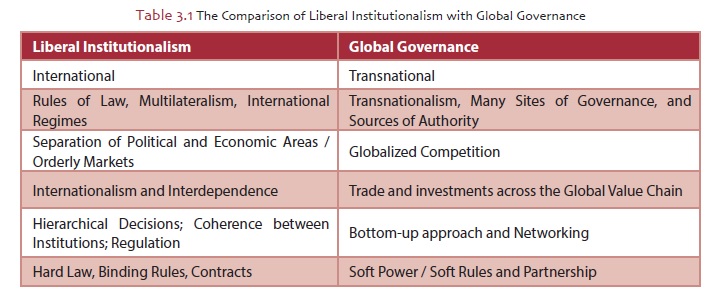
Soru 46
Which of the following is a characteristic of the policy networks?
Seçenekler
A
they reflect the same degree of coherence
B
they are clusters and have larger groups
C
they are more stable
D
they consist of a smaller number of members
E
their members share same values
Açıklama:
There are several differences between policy networks and epistemic communities. The policy networks do not reflect the same degree of coherence as epistemic communities do. Policy networks are clusters and have larger groups, while epistemic communities are a subset of policy networks. Policy networks’ membership fluctuates. Although they have different values, they are tied together by their interdependency. Power and resources are distributed unequally in policy networks. However, epistemic communities are more stable, and they consist of a smaller number of members who share same values (Carayannis, et.al., 2012: 132-133).
Soru 47
Which of the following is the definition of global commons?
Seçenekler
A
natural resources and areas that are outside the national jurisdiction
B
a set of nonhierarchical, stable, and interdependent relationshipsthatconnect a variety of actors.
C
networks of knowledge-based experts or groups with recognized expertise in a particular domain
D
the development and application by governments, the private sector, and civil society, in their respective roles, of shared principles, norms, rules, decision-making procedures and programmes, that shape the evolution and utilization of the Internet
E
an international rules-based framework through which international actors aim to collectively resolve common problems and promote cross-border cooperation and coordination in a given issue area of world politics
Açıklama:
Global commons are defined as natural resources and areas that are outside the national jurisdiction (Vogler, 2012: 61).
Soru 48
I) ... are unplanned; they emerge out of common behaviors of actors.
II) ... are purposely constructed by a dominant actor.
III) ... are those regimes “characterized by conscious efforts to agree on their major provisions, explicit consent on the part of individual participants, and formal expression of the results.
Which of the following is true for completing the expressions above?
II) ... are purposely constructed by a dominant actor.
III) ... are those regimes “characterized by conscious efforts to agree on their major provisions, explicit consent on the part of individual participants, and formal expression of the results.
Which of the following is true for completing the expressions above?
Seçenekler
A
I) Spontaneous regimes
II) Imposed regimes
III) Negotiated regimes
II) Imposed regimes
III) Negotiated regimes
B
I) Imposed regimes
II) Negotiated regimes
III) Spontaneous regimes
II) Negotiated regimes
III) Spontaneous regimes
C
I) Negotiated regimes
II) Spontaneous regimes
III) Imposed regimes
II) Spontaneous regimes
III) Imposed regimes
D
I) Spontaneous regimes
II) Negotiated regimes
III) Imposed regimes
II) Negotiated regimes
III) Imposed regimes
E
I) Imposed regimes
II) Spontaneous regimes
III) Negotiated regimes
II) Spontaneous regimes
III) Negotiated regimes
Açıklama:
There are three types of international regimes: spontaneous, imposed, and negotiated. Spontaneous regimes are unplanned; they emerge out of common behaviors of actors. Imposed regimes are purposely constructed by a dominant actor. Negotiated regimes are those regimes “characterized by conscious efforts to agree on their major provisions, explicit consent on the part of individual participants, and formal expression of the results.
Soru 49
The internet is beyond the reach of government control, and it is a self-governing realm of individual liberty.
Which of the following model is defined in the sentence above?
Which of the following model is defined in the sentence above?
Seçenekler
A
The spontaneous cyberspace model
B
The transnational institutions and organization model
C
The internet architecture and code model
D
The national government and law model
E
The market regulation and economics model
Açıklama:
The spontaneous cyberspace model: The internet is beyond the reach of government control, and it is a self-governing realm of individual liberty.
Soru 50
According to Haas, epistemic communities have four defining characteristics.
Which of the following expression is not one of these defining characteristics for epistemic communities?
Which of the following expression is not one of these defining characteristics for epistemic communities?
Seçenekler
A
Epistemic communities share a common set of principled and normative values and beliefs.
B
Epistemic communities share common professional judgments or causal beliefs. These beliefs come from analytical reasoning.
C
Epistemic communities share notions of validity, that is, intersubjective, internally defined criteria for validating knowledge in their expertise area.
D
Epistemic communities pursue the same policy enterprise: a set of mutual practices related to a set of problems that have to be solved.
E
Epistemic communities have different values, power and resources are distributed unequally.
Açıklama:
There are several differences between policy networks and epistemic communities. The policy networks do not reflect the same degree of coherence as epistemic communities do. Policy networks are clusters and have larger groups, while epistemic communities are a subset of policy networks. Policy networks’ membership fluctuates. Although they have different values, they are tied together by their interdependency. Power and resources are distributed unequally in policy networks. However, epistemic communities are more stable, and they consist of a smaller number of members who share same values.
Soru 51
- International institutions and global governance have a positive role in promoting peace and cooperation.
- World politics is destined to be dominated by powerful states.
- Domestic and international institutions are instrumental in ending wars, rivalry, and conflict among nation states.
Seçenekler
A
Only I
B
I and II
C
I and III
D
II and III
E
I, II, III
Açıklama:
Liberal institutionalism is a version of liberalism that emphasizes the positive role of international institutions and global governance in promoting peace and cooperation. It holds that both domestic and international institutions are instrumental in ending wars, rivalry, and conflict between nation states. It rejects the idea that world politics is destined to be dominated by powerful states whereas international institutions and global governance are without any power that may effect change in the system. The correct answer is C.
Soru 52
Which of the following assumptions about international relations is related to neoliberal institutionalism?
Seçenekler
A
International cooperation depends on the will and power of nation states.
B
International regimes, globalization, and international interdependence are important tools for managing the relations between international actors.
C
Relative gains (zero-sum game) of international actors are more important in international relations.
D
The primary objective of states is survival in the anarchical international system.
E
International institutions and regimes do not have a constraining impact
Açıklama:
The so-called ‘neo-neo’ debate between neorealism and neoliberalism forms one of the core discussions in the study of International Relations. Although they share some assumptions, neorealism and neoliberalism differ in several respects. First, both approaches assume that international system is “anarchic.” However, while neorealists claim that foreign policy is constrained by anarchy, neoliberals argue that international regimes, globalization, and international interdependence are important tools for managing the relations between international actors. Second, neorealists believe that international cooperation depends on the will and power of nation states; from this perspective, it is difficult to achieve and maintain international cooperation mainly because states strive to achieve their own interests. On the other hand, neoliberals hold that if states have mutual interests in a given issue area of international relations, international cooperation can be achieved in that issue area. Third, neorealists emphasize the importance of relative gains (zero-sum game) in international politics. Neoliberals, however, consider that international actors have common interests so that they can cooperate in a given issue area and maximize their absolute gains (non-zero-sum). Eventually all states can benefit from this cooperation. Fourth, neorealists claim that the primary objective of states is survival in the “anarchical international system,” where they are preoccupied with matters related to national security and relative power gains. On the other hand, neoliberals attach greater importance to sustainable development, economic welfare, and non-security issue areas such as international environmental problems. Fifth, neorealists argue that international institutions and regimes do not affect the state behavior. In a similar vein, regimes do not have a constraining impact on the anarchical nature of the system. Neoliberals, on the other hand, argue that international institutions and regimes are influential in shaping and structuring international relations, because they facilitate cooperation among states. The correct answer is B.
Soru 53
Which of the following terms of international relations is defined as sets of implicit or explicit principles, norms, rules, and decision-making procedures around which actors’ expectations converge in a given area of international relations?
Seçenekler
A
Global governance
B
Neoliberal institutionalism
C
Zero-sum game
D
International regimes
E
Non-zere sum game
Açıklama:
International regimes is defined as “sets of implicit or explicit principles, norms, rules, and decision-making procedures around which actors’ expectations converge in a given area of international relations”. The correct answer is D.
Soru 54
- Institutional factors are important for cooperative behaviours.
- Symmetrical conditions are more helpful for the regime formation.
- The existence of consensual knowledge and the epistemic community is conducive for the regime formation.
Seçenekler
A
Only I
B
I and II
C
I and III
D
II and III
E
I, II, III
Açıklama:
Interest-based approaches to international relations give importance to institutional factors. Power-based approaches assert that symmetrical conditions are more helpful for the regime formation than asymmetric conditions and the knowledge-based approaches claim the existence of consensual knowledge and the epistemic community is conducive for the regime formation. The correct answer is A.
Soru 55
Which of the following is classified under power-based theories of international regime theories?
Seçenekler
A
Contractualist theory
B
International society approach
C
History-dialectical approach
D
Situation-structural approach
E
Hegemonic stability theory
Açıklama:
International regime theories are classified under power, interest and knowledge-based theories.
Power-based (Structural) theories are:
1. Hegemonic stability theory, 2. Power-oriented research, 3. Modern realist perspective.
Interest-based (Institutional) theories are:
1. Contractualist (Functional) theory 2. Situation-structural approach 3. Problem-structural approach 4. Institutional bargaining
Knowledge-based (Cognitive) theories
1. Knowledge-oriented research program 2. Consensual knowledge and Epistemic communities, 3. International society approach (legitimacy) 4. Communicative action approach (arguments) (Kratochwil, 1989) 5. Constructivism 6. History-dialectical approach (history)
The correct answer is E.
Power-based (Structural) theories are:
1. Hegemonic stability theory, 2. Power-oriented research, 3. Modern realist perspective.
Interest-based (Institutional) theories are:
1. Contractualist (Functional) theory 2. Situation-structural approach 3. Problem-structural approach 4. Institutional bargaining
Knowledge-based (Cognitive) theories
1. Knowledge-oriented research program 2. Consensual knowledge and Epistemic communities, 3. International society approach (legitimacy) 4. Communicative action approach (arguments) (Kratochwil, 1989) 5. Constructivism 6. History-dialectical approach (history)
The correct answer is E.
Soru 56
Which of the following approaches to the study of regime effectiveness assesses the degree to which contractual obligations are met?
Seçenekler
A
Problem solving
B
Legal approach
C
Economic approach
D
Normative approach
E
Political approach
Açıklama:
In the literature, there are five approaches to the study of regime effectiveness. The first is the problem-solving approach that defines effectiveness as the degree of regime contribution to the solutions of problem(s) in an issue area. Second, the legal approach assesses the degree to which contractual obligations are met. Third, the economic approach evaluates the cost efficiency of policies and regimes. Fourth, the normative approach examines whether normative principles such as justice and participation are promoted by a regime. Fifth, the political approach investigates whether regimes can contribute to the management of the targeted global problem by creating changes in the behavior of actors, altering the interests of actors, or launching changes in regime-related policies. It identifies the evaluation problem as “functions of specific constellations of actors, interests, and institutions”. The correct answer is B.
Soru 57
Which of the following mostly consists of networks of knowledge-based experts or groups with recognized expertise in a particular domain ?
Seçenekler
A
epistemic communities
B
transnational networks
C
international non-governmental organizations
D
policy networks
E
multi-national companies
Açıklama:
The term, epistemic community, was first introduced by Holzner as “knowledge-oriented communities in which cultural standards and social arrangements interpenetrate around a primary commitment to epistemic criteria in knowledge production and application” (1969:108). However, Peter M. Haas applied the concept to international policy-making processes. In this sense, epistemic communities are defined as networks of knowledge-based experts or groups with recognized expertise in a particular domain and “an authoritative claim to policy-relevant knowledge within the domain of their expertise” (Haas, 1992: 3; 2016: 5). The correct answer is A.
Soru 58
- International regime theories emphasize the role of non-state actors such as IGOs, NGOs, and epistemic communities.
- International regime theories focus on specific issue areas from climate change to peacekeeping, but it excludes complex international organizations.
- International regime theories provide an analytical framework for examining how international regimes are formed, how they continue (or change), and how they restrain state behaviors
Seçenekler
A
Only I
B
I and II
C
I and II
D
II and III
E
I, II, and III
Açıklama:
Theories of international regimes offer a better understanding of international institutions in world politics. First, international regime theories are based on the realist assumption that the international system is state-centric and anarchical. Therefore, international cooperation can arise from the self-interests of states. International institutions are necessary to reduce uncertainty about how other actors behave. Second, international regime theories focus on specific issue areas from climate change to peacekeeping, but it excludes complex international organizations. For example, the UN performs important functions in issue areas such as environmental regimes. However, the UN is less influential in security regimes. Therefore, international regimes do not look for links between unrelated issue areas in international politics. Third, international regime theories provide an analytical framework for examining how international regimes are formed, how they continue (or change), and how they restrain state behaviors (Dombroski, 2007: 13). The answer is D.
Soru 59
Which of the below is one of the characteristics of Liberal Institutionalism?
Seçenekler
A
Transnational Rules of Law
B
Soft Rules and Partnership
C
Coherence between Institutions
D
Globalized Competition
E
Trade and investments across the Global Value Chain
Açıklama:
The characteristics of Liberal Institutionalism are:
- International
- Rules of Law, Multilateralism, International Regimes
- Separation of Political and Economic Areas / Orderly Markets
- Internationalism and Interdependence
- Hierarchical Decisions; Coherence between Institutions; Regulation
- Hard Law, Binding Rules, Contracts
Soru 60
- International regimes are socially-constructed entities in the world.
- Identities, beliefs, discourses, values, and hegemons are necessary and sufficient conditions for regime formation.
- Consensual knowledge, epistemic communities, ideas and learning are categorized under strong cognitivism.
Seçenekler
A
Only I
B
I and II
C
I and III
D
II and III
E
I, II, and III
Açıklama:
The knowledge-based (cognitive) school is divided into two main categories: (1) weak cognitivism: ideas, learning, consensual knowledge, epistemic community and (2) strong cognitivism: international society approach, communicative action approach (Kratochwil and Ruggie, 1986), constructivism (the power of identity) (Wendt, 1987), and the historicaldialectical approach (the power of history) (Cox, 1986, 1992). Cognitivists argue that international regimes are basically social entities. Discourses, identities, beliefs, and values are crucial factors in their formation. In return, discourses, identities, beliefs, and values themselves are also influenced by international regimes. Weak cognitivists are more concerned with the impact of new knowledge on decision-makers’ perceptions of their interests. Ideas, learning, and epistemic communities play significant roles in agenda-setting and regime formation. They contribute to the mainstream regime analysis by supplying a theory of interest change. Strong cognitivists criticize the rationalist assumptions of realism and neoliberalism. For example, Wendt points out the “agent-structure problem” (Wendt, 1987) that refers to the question of how institutions shape the identities of their
members and define actors’ interests. Other strong cognitivists such as Kratochwil and Ruggie stress the importance of “intersubjective meanings and shared understandings” in the regime analysis (Krathocwil and Ruggie, 1986: 765). A rulegoverned international society leads to specific norms and rules that produce regimes. Robert Cox, on the other hand, states that historical and hegemonic structure shapes the formation of international regimes (1986). Finally, regimes are socially-constructed conceptual creations that can be analyzed through inter-subjectivity, discourses, and interpretative techniques rather than empirical methods (Young, 1998). The correct answer is A.
members and define actors’ interests. Other strong cognitivists such as Kratochwil and Ruggie stress the importance of “intersubjective meanings and shared understandings” in the regime analysis (Krathocwil and Ruggie, 1986: 765). A rulegoverned international society leads to specific norms and rules that produce regimes. Robert Cox, on the other hand, states that historical and hegemonic structure shapes the formation of international regimes (1986). Finally, regimes are socially-constructed conceptual creations that can be analyzed through inter-subjectivity, discourses, and interpretative techniques rather than empirical methods (Young, 1998). The correct answer is A.
Ünite 4
Soru 1
Which of the following statements is false about Hugo Grotious?
Seçenekler
A
He is a Dutch philosopher and statesman.
B
He lived in the eighteenth century.
C
He made important contributions to the development of international law.
D
His works include De Jure Praedae , Mare Liberum , and De Jure Belli ac Pacis.
E
To modern scholars, Grotius’ insights into a number of questions which continue to occupy a central place in contemporary thought about international relations are striking.
Açıklama:
The correct answer is B.Hugo Grotious is a Dutch philosopher and statesman who lived between 1583 and 1645. His main importance in the theory and practice of international relations is his contributions to the development of international law. His works include De Jure Praedae (written c. 1604-6, but published only in 1868), Mare Liberum (first published 1609), and De Jure Belli ac Pacis (1625). To modern scholars, Grotius’ insights into a number of questions which continue to occupy a central place in contemporary thought about international relations are striking (Bull, Kingsbury and Roberts, 1992).
Soru 2
I- The peace treaties were negotiated and signed by the states dominated by the rules that were commonly accepted as sovereigns of their realms. II- The physical bordersof each state were recognized and commonly accepted. Therefore, each of these units represented a political entity. III- Each sovereign who represented a state was accepted as equal, regardless of the size of lands they ruled or the nobility o which they belonged. IV- The Congress System that would help institutionalize the international environment in the following centuries led to the Peace of Westphalia. Which ones of the above are true among The Peace of Westphalia?
Seçenekler
A
I, II and III
B
II, III and IV
C
I, III ad IV
D
I, II and IV
E
I, II, III and IV
Açıklama:
The correct answer is A.Consequences of the Peace of Westphalia may be summarized as follows:
• First, the peace treaties were negotiated and signed by the states dominated by the rulers that were commonly accepted as sovereigns of their realms.
• Second, the physical borders of each state were recognized and commonly accepted. Therefore, each of these units represented a political entity.
• Third, each sovereign who represented a state was accepted as equal, regardless of the size of lands they ruled or the nobility o which they belonged.
• Fourth, though no international organization emerged as a body until the late 19th century, the way in which these peace accords were made initialized a method that enabled states to communicate collectively through diplomatic instruments. Thus, it is possible to assert that the Peace of Westphalia laid the foundations of collective diplomacy and established the basis of the Congress System that would help institutionalize the international environment in the following centuries.
• First, the peace treaties were negotiated and signed by the states dominated by the rulers that were commonly accepted as sovereigns of their realms.
• Second, the physical borders of each state were recognized and commonly accepted. Therefore, each of these units represented a political entity.
• Third, each sovereign who represented a state was accepted as equal, regardless of the size of lands they ruled or the nobility o which they belonged.
• Fourth, though no international organization emerged as a body until the late 19th century, the way in which these peace accords were made initialized a method that enabled states to communicate collectively through diplomatic instruments. Thus, it is possible to assert that the Peace of Westphalia laid the foundations of collective diplomacy and established the basis of the Congress System that would help institutionalize the international environment in the following centuries.
Soru 3
Which of the following statements is not a main characteristics of 18th century?
Seçenekler
A
The European political system in the 18th century was a royal court in which no monarch could dominate on his own.
B
Almost all the major conflicts that broke out in Europe were related to royal issues and unsettled dynastic successions.
C
The financial means of the European monarchs allowed them to wage unlimited wars.
D
All the major conflicts which involved almost all the actors in the European political system were settled and resolved by major conferences.
E
Congresses that were held in the 18th century were all “peace” congresses. In that sense, these were “ad hoc” meetings.
Açıklama:
The correct answer is C. Almost all the major conflicts that broke out in Europe were related to royal issues and unsettled dynastic successions, as in the cases of the Wars of the Spanish Succession, the Wars of the Austrian Succession and the Seven Years War. However, war-making was costly and the financial means of the European monarchs only allowed them to wage limited wars with restricted aims.
Soru 4
I- The Congress convened in November 1814 in Vienna.
II- The decision-making process was carried out by the four major powers, namely England, Russia, Prussia, and Austria.
III- Throughout the Congress of Vienna, these powers singlehandedly drew the new European map.
IV- The fact that Napoleon came to power in France again for a short period of time hindered the functioning of the Congress.
Which ones of the above are correct about the Congress of Vienna?
II- The decision-making process was carried out by the four major powers, namely England, Russia, Prussia, and Austria.
III- Throughout the Congress of Vienna, these powers singlehandedly drew the new European map.
IV- The fact that Napoleon came to power in France again for a short period of time hindered the functioning of the Congress.
Which ones of the above are correct about the Congress of Vienna?
Seçenekler
A
I, II and III
B
II and IV
C
III and IV
D
II and III
E
I, II, III and IV
Açıklama:
The correct answer is D.
All the European states that had taken part in the Napoleonic Wars replied positively to the invitation. The Congress convened in November 1814 in Vienna. Nevertheless, the decision-making process was carried out by the four major powers that were the signatories of the Treaty of Chaumont. They were namely England, Russia, Prussia, and Austria. Throughout the Congress of Vienna, these powers singlehandedly drew the new European map, dissolved Napoleonic states, restored the old monarchies that Napoleon dismissed and made extensive border changes through annexations (Mowat, 1922: 7-8).
A brief period in which Napoleon came to power in France once again caused some nuisance. However, this short reign did not upset the functioning of the Congress, and the decisive defeat of Napoleon at the Battle of Waterloo sealed his fate.
All the European states that had taken part in the Napoleonic Wars replied positively to the invitation. The Congress convened in November 1814 in Vienna. Nevertheless, the decision-making process was carried out by the four major powers that were the signatories of the Treaty of Chaumont. They were namely England, Russia, Prussia, and Austria. Throughout the Congress of Vienna, these powers singlehandedly drew the new European map, dissolved Napoleonic states, restored the old monarchies that Napoleon dismissed and made extensive border changes through annexations (Mowat, 1922: 7-8).
A brief period in which Napoleon came to power in France once again caused some nuisance. However, this short reign did not upset the functioning of the Congress, and the decisive defeat of Napoleon at the Battle of Waterloo sealed his fate.
Soru 5
I- It aimed to preserve the proven method of the Congress System exactly as it was. II- The Concert of Europe should be considered as the birth of a new era in both diplomacy and international institutionalization. III- Despite the absence of an international organization, Concert necessitated extensive communication among European powers. IV- Contrary to its name, The Concert system geographically included many countries around the world. Which ones of the above are true about the Concert of Europe?
Seçenekler
A
I and II
B
II and III
C
I and III
D
I, II and III
E
I, II, III and IV
Açıklama:
The correct answer is B.The Concert of Europe aimed to preserve the proven method of the Congress System, though with a significant change, which is that the major powers now would periodically get together and discuss the issues regarding order and peace in Europe.
The Concert system was geographically limited to Europe. Its mechanisms only applied to the European political community. In other words, nonEuropean states were excluded from the collective diplomacy of the 19th century. The Concert, therefore, failed to be based on a universal legitimacy.
The Concert system was geographically limited to Europe. Its mechanisms only applied to the European political community. In other words, nonEuropean states were excluded from the collective diplomacy of the 19th century. The Concert, therefore, failed to be based on a universal legitimacy.
Soru 6
I- They are collection points clearing houses for information. II- They are centers for collective decisions on the solution of common problems. III- They are tools for the coordination of national policy and practices. IV- They are agencies for promoting uniform standards in their fields. -- Which ones of the above are among early public international unions functions according to Schechter?
Seçenekler
A
I and II
B
I and III
C
II ve III
D
I, II ve III
E
I, II, III and IV
Açıklama:
The correct answer is E.According to Schechter, these early public international unions had numerous functions. They served as the:
• Collection point and clearinghouses for information,
• Centers for collective decisions on the solution of common problems,
• Tools for the coordination of national policy and practices,
• Agencies for promoting uniform standards in their fields.
Particular river commissions also fulfilled regulatory, administrative, supervisory, and adjudicatory functions (Schechter, 2010: lxvii).
• Collection point and clearinghouses for information,
• Centers for collective decisions on the solution of common problems,
• Tools for the coordination of national policy and practices,
• Agencies for promoting uniform standards in their fields.
Particular river commissions also fulfilled regulatory, administrative, supervisory, and adjudicatory functions (Schechter, 2010: lxvii).
Soru 7
When was The First Hague Conference held?
Seçenekler
A
1699
B
1759
C
1799
D
1859
E
1899
Açıklama:
The First Hague Conference was held in May 1899 with the attendance of 26 states.
Soru 8
Which of the following countries was not a permanent member in the Council of the League of Nations?
Seçenekler
A
England
B
France
C
Germany
D
Japan
E
Italy
Açıklama:
The correct answer is C.The Council had four permanent members- namely, England, France, Japan, and Italy- and three non-permanent members who were selected by the Assembly for a three-year term.
Soru 9
I- It was built upon the ideology of peace. II- The League was considered a platform where multilateral diplomacy could function. III- Due to the absence of the US as well as the reluctance of Japan and Italy, the Council was dominated by Britain and France. IV- The League of Nations was considered a revolutionary attempt in terms of “civilization” of international relations. V- The League did not fairly represent the political and geographical structure of the world. Which ones of the above are true for The League of Nations?
Seçenekler
A
I and III
B
III and V
C
I, III and V
D
II, III and IV
E
I, II, III, IV and V
Açıklama:
The correct answer is E.
Soru 10
Which of the following is not an objective of The League of Nations?
Seçenekler
A
to prevent future wars
B
to enforce disarmament
C
to promote the international law
D
to provide with people better conditions of living
E
to cancel the treaties signed in Paris, primarily the Treaty of Versailles
Açıklama:
The correct answer is E.The League had five major objectives:
• to prevent future wars,
• to enforce disarmament,
• to promote the international law,
• to provide with people better conditions of living,
• to enforce the peace treaties signed in Paris, primarily the Treaty of Versailles.
• to prevent future wars,
• to enforce disarmament,
• to promote the international law,
• to provide with people better conditions of living,
• to enforce the peace treaties signed in Paris, primarily the Treaty of Versailles.
Soru 11
Who is the father of neorealism?
Seçenekler
A
Thomas Hobbes
B
Niccolo Machiavelli
C
Hugo Grotius
D
Immanuel Kant
E
Kenneth Waltz
Açıklama:
Kenneth Waltz, the father of neorealism, sees anarchy as a constant state of or the threat of war in the international system (Waltz, 1979: 102-103).
Soru 12
Which concept is described by "the anarchical international structure and self-centered actors (states), who seek after their interests in a race of survival and therefore follow power politics"?
Seçenekler
A
Power system
B
Self-centered system
C
International system
D
World society
E
International society
Açıklama:
Rooted in the writings of Thomas Hobbes and Niccolo Machiavelli, the international system refers to the anarchical international structure and self-centered actors (states), who seek after their interests in a race of survival and therefore follow power politics.
Soru 13
Which concept is described by "the trend of institutionalism of shared interests among states through the creation of regulations, norms, and rules that will be commonly agreed"?
Seçenekler
A
International society
B
International system
C
World society
D
Power society
E
Institutional society
Açıklama:
Based on Hugo Grotius’ reflections, the international society refers to the trend of institutionalism of shared interests among states through the creation of regulations, norms, and rules that will be commonly agreed.
Soru 14
Which term refers to the individuals, non-state organizations, and other actors that make up an idealistic international civil society?
Seçenekler
A
Power society
B
Institutional society
C
International society
D
World society
E
International system
Açıklama:
Embedded in Immanuel Kant’s reflections, the world society indicates individuals, non-state organizations, and other actors that make up an idealistic international civil society (Wight, 1992: 37-40).
Soru 15
In which year did the Utrecht Congress convene to end the War of the Spanish
Succession?
Succession?
Seçenekler
A
1711
B
1712
C
1713
D
1714
E
1715
Açıklama:
The perfect example of the 18th century Congress System is the Utrecht Congress, which convened in 1713 to end the War of the Spanish
Succession. Regardless of their size or strength, all the European sovereign states were represented at the Congress.
Succession. Regardless of their size or strength, all the European sovereign states were represented at the Congress.
Soru 16
Which two events utterly ended the European balance of power mechanism by destroying the dynastic kinship?
Seçenekler
A
The French Revolution and the French Revolutionary Wars
B
The Wars of the Austrian Succession and the Peace of Westphalia
C
The Utrecht Congress and the Congress of Vienna
D
The Ratification of the Treaty of Münster and the Peace of Westphalia
E
The Wars of the Spanish Succession and the Seven Years War
Açıklama:
The French Revolution and the French Revolutionary Wars utterly ended the European balance of power mechanism by destroying the dynastic kinship.
Soru 17
In which year was the Treaty of Chaumont signed by England, Russia, Prussia, and Austria?
Seçenekler
A
1814
B
1815
C
1816
D
1817
E
1818
Açıklama:
In March 1814, four major powers of Europe, namely England, Russia, Prussia, and Austria came to an agreement and signed the Treaty of Chaumont to form the coalition that would eventually defeat Napoleon.
Soru 18
Signed on 18 September 1815, which alliance treaty was a proclamation of the three royal houses of Habsburg, Hohenzollern, and Romanov?
Seçenekler
A
The Quadruple Alliance
B
The Holy Alliance
C
The Quintuple Alliance
D
Treaty of Chaumont
E
The Treaty of Münster
Açıklama:
Following the Battle of Waterloo, the major powers signed two separate alliance treaties consecutively, the Holy Alliance and the Quadruple Alliance. The former, signed on 18 September 1815, was a proclamation of the three East European monarchies, that is, the royal houses of Habsburg, Hohenzollern, and Romanov.
Soru 19
What is the name of the new diplomatic and political system in Europe, created as the most significant outcome of the Congress of Vienna?
Seçenekler
A
The Concert of Vienna
B
The Congress of Vienna
C
The Congress of Europe
D
The Concert of Europe
E
The Utrecht Congress
Açıklama:
The most significant outcome of the Congress of Vienna was the creation of a new diplomatic and political system in Europe, which is referred to as the Concert of Europe. The Concert mainly rested on a hierarchy that was constructed by the two treaties of the Holy and Quadruple Alliances and also considered the major powers of Europe as the guardians of the European order.
Soru 20
The establishment of what was the first initiative in forming an international body for the governance of a particular international issue?
Seçenekler
A
International Danube Commission
B
International Committee for Relief to Wounded
C
The International Telegraphic Union
D
The International Union of Railway Transportation
E
The International Copyright Union
Açıklama:
Article 15 of the Final Act of the Paris Congress was a remarkable improvement in international institutionalization since it established an international commission for the supervision of the Danube River. The establishment of the International Danube Commission for the regulation of free navigation in the river was the first initiative in forming an international body for the governance of a particular international issue.
Soru 21
Which of the following are true about the Peace of Westphalia?
I. It ended the 30 Years' War.
II. It was signed in 1658.
III. It ended the feudal system.
IV. It led to the emergence of sovereign states.
V. It paved the way to the establishment of international institutions.
I. It ended the 30 Years' War.
II. It was signed in 1658.
III. It ended the feudal system.
IV. It led to the emergence of sovereign states.
V. It paved the way to the establishment of international institutions.
Seçenekler
A
I, II, III, IV
B
II, III, IV, V
C
I, III, IV, V
D
III, IV, V
E
II, III, V
Açıklama:
The discipline of International Relations refers to the Peace of Westphalia that ended the 30 Years’ War in 1648 as “the dawn of the modern international system.” The treaties signed in Münster and Osnabrück in 1648 indicate the political and diplomatic development that paved the way to the establishment of international institutions. The Peace of Westphalia ended the feudal system based on the primacy of thePapacy and the Holy Roman Empire and led to the emergence of new political entities called “sovereign states.” Thus, it indeed marked the beginning of an international milieu that would facilitate the emergence of nation-states.
The correct choice is C.
The correct choice is C.
Soru 22
Which of the following is NOT a consequence of the Peace of Westphalia?
Seçenekler
A
The physical borders of each statewere recognized and commonly accepted.
B
The peace treaties were negotiated and signed by the states dominated by the rulers that were commonly accepted as sovereigns of their realms.
C
It laid the foundations of collective diplomacy and established the basis of the Congress System.
D
The first international organization emerged in the same century.
E
Each sovereign who represented a state was accepted as equal.
Açıklama:
Though no international organization emerged as a body until the late 19th century, the way in which these peace accords were made initialized a method that enabled states to communicate collectively through diplomatic instruments. The peace of Westphalia was in the 17th century.
The correct choice is D.
The correct choice is D.
Soru 23
When did the Congress of Vienna convene?
Seçenekler
A
1648
B
1713
C
1814
D
1815
E
1818
Açıklama:
The Congress convened in November 1814 in Vienna.
The correct choice is C.
The correct choice is C.
Soru 24
Which of the following is NOT one of the major powers of Europe signing the Treaty of Chaumont?
Seçenekler
A
Austria
B
England
C
Prussia
D
Russia
E
Spain
Açıklama:
In March 1814, four major powers of Europe, namely England, Russia, Prussia, and Austria came to an agreement and signed the Treaty of Chaumont to form the coalition that would eventually defeat Napoleon.
Soru 25
Which of the following are true about the Quadruple Alliance?
I. It was signed on 20 November 1815.
II. It was formed by Britain's joining the Holy Alliance.
III. All parties embraced the values of the absolute monarchies.
IV. It saw France as a threat to their regimes.
I. It was signed on 20 November 1815.
II. It was formed by Britain's joining the Holy Alliance.
III. All parties embraced the values of the absolute monarchies.
IV. It saw France as a threat to their regimes.
Seçenekler
A
I, II, III
B
I, II, IV
C
II, III, IV
D
I, III, IV
E
II, IV
Açıklama:
Britain decided to join the Holy Alliance. As a result, the treaty establishing the Quadruple Alliance was signed on 20 November 1815. However, this does not mean that Britain embraced the values of the absolute monarchies, nor did Britain and other members of the Quadruple Alliance stop seeing France and the effects of the French Revolution as a threat to their regimes.
The correct choice is B.
The correct choice is B.
Soru 26
What was the most significant outcome of the Congress of Vienna?
Seçenekler
A
It led to the birth of international organizations.
B
It created a new diplomatic and political system in Europe.
C
It created new powers in Europe.
D
It continued its effect in diplomacy until the mid-20th century.
E
It reinstituted the status of the European powers.
Açıklama:
It is true that the Congress of Vienna reinstituted the status of the European powers (E), but the most significant outcome of the Congress of Vienna was the creation of a new diplomatic and political system in Europe, which is referred to as the Concert of Europe.
The correct choice is B.
The correct choice is B.
Soru 27
Which of the following is the first international meeting where previously-formed committees examined all issues ahead of the congress?
Seçenekler
A
The Congress of Vienna
B
The Paris Congress
C
Congress of Aix-la-Chapelle
D
The Berlin Congress
E
The First Hague Conference
Açıklama:
The Berlin Congress was the first international meeting where previously-formed committees examined all issues ahead of the Congress. As such, the success of the Berlin Congress was attributed to the preparatory meetings of these committees. Following the Berlin Conference, these organizational procedures became common practice in future conferences.
The correct choice is D.
The correct choice is D.
Soru 28
Which of the following was accepted as the first real "World Congress" in the history of modern international relations?
Seçenekler
A
The Congress of Vienna
B
The Berlin Congress
C
The First Hague Conference
D
The Second Hague Conference
E
The Paris Peace Conference
Açıklama:
After the end of the Russo-Japanese War, the Russians also called for a second conference. The US insisted on the participation of the Latin Americans in the conference; as a result, a total of 44 countries attended The Second Hague Conference. Because of this, the Second Conference was accepted as the first real “World Congress” in the history of modern international relations.
The correct choice is D.
The correct choice is D.
Soru 29
Which of the following was NOT one of the strengths of the League of Nations?
Seçenekler
A
The ideology of peace upon which it was built
B
The right to activate sanctions against a Covenant-breaking state
C
The equality among its members
D
Being the first permanent international organization with complex organizational structure
E
Its interest in global and trans-national issues such as labor, health, and refugees
Açıklama:
The primary problem of the League was the assumed equality among its members. As it was a design of the victorious states of World War I, the US, Britain, France, Japan, and Italy were given permanent membership in the Council. After the US rejection of the League of Nations, the Council was dominated by European powers. Although it was one of the permanent members, Japan became quickly disillusioned when the principle of racial equality was not accepted.
The correct choice is C.
The correct choice is C.
Soru 30
When did the League of Nations officially cease to exist?
Seçenekler
A
1935
B
1936
C
1939
D
1946
E
1948
Açıklama:
The Assembly of the League held a final meeting in Geneva and declared that all its technical missions and properties were transferred to the recently-established UN. With this declaration, the League officially ceased to exist on 16 April 1946.
The correct choice is D.
The correct choice is D.
Soru 31
What ended the 30 Years’ War in 1648?
Seçenekler
A
Treaty of Chaumont
B
Peace of Westphalia
C
Utrecht Congress
D
Paris Peace Conference
E
Congress of Aix-la-Chapelle
Açıklama:
-
The discipline of International Relations refers to the Peace of Westphalia that ended the 30 Years’ War in 1648 as “the dawn of the modern international system.”
The discipline of International Relations refers to the Peace of Westphalia that ended the 30 Years’ War in 1648 as “the dawn of the modern international system.”
Soru 32
Which of the below is regarded to be the perfect example of the 18th century Congress System?
Seçenekler
A
Utrecht Congress
B
Paris Congress
C
Berlin Congress
D
Congress of Vienna
E
Congress of Aix-la-Chapelle
Açıklama:
-
The perfect example of the 18th century Congress System is the Utrecht Congress, which convened in 1713 to end the War of the Spanish Succession. Regardless of their size or strength, all the European sovereign states were represented at the Congress. They negotiated for the finest “peace” that they could get at the table. The congress aimed to optimize the European political map and the political system to satisfy the interests of every state represented.
The perfect example of the 18th century Congress System is the Utrecht Congress, which convened in 1713 to end the War of the Spanish Succession. Regardless of their size or strength, all the European sovereign states were represented at the Congress. They negotiated for the finest “peace” that they could get at the table. The congress aimed to optimize the European political map and the political system to satisfy the interests of every state represented.
Soru 33
Which of the below was not among the countries that signed the Treaty of Chaumont to form the coalition that would eventually defeat Napoleon?
Seçenekler
A
England
B
Russia
C
Prussia
D
Austria
E
Italy
Açıklama:
-
In March 1814, four major powers of Europe, namely England, Russia, Prussia, and Austria came to an agreement and signed the Treaty of Chaumont to form the coalition that would eventually defeat Napoleon.
In March 1814, four major powers of Europe, namely England, Russia, Prussia, and Austria came to an agreement and signed the Treaty of Chaumont to form the coalition that would eventually defeat Napoleon.
Soru 34
Which congress was the first international meeting where previously-formed committees examined all issues ahead of the Congress?
Seçenekler
A
Berlin
B
Paris
C
Vienna
D
Aix-la-Chapelle
E
Hague
Açıklama:
The Berlin Congress was the first international meeting where previously-formed committees examined all issues ahead of the Congress. As such, the success of the Berlin Congress was attributed to the preparatory meetings of these committees
Soru 35
Which of the below is not one of the characteristics of Concert of Europe?
Seçenekler
A
It necessitated extensive communication among European powers.
B
The congress system introduced by the Concert of Europe provided a common understanding with European states to develop a security community within the continent.
C
The Concert system was geographically limited to Europe.
D
Power shifted to public decision-makers within states, but the role of the royals did not end.
E
The Concert failed to be based on a universal legitimacy.
Açıklama:
Despite the rise of liberalism and nationalism in the 19th century and the dissolution of absolute monarchies, dynastic kinship still acted as a network in diplomacy. Royal family ties were still functional; international problems were regularly negotiated in royal gatherings. Monarchs were credible mediators for settling international conflicts. However, power shifted to public decision-makers within states, and the role of the royals ended.
Soru 36
Which of the below was the first initiative in forming an international body for the governance of a particular international issue?
Seçenekler
A
First Hague Convention
B
International Committee of the Red Cross
C
International Danube Commission
D
Lord Phillimore Commission
E
Permanent Mandates Commission
Açıklama:
-
The establishment of the International Danube Commission for the regulation of free navigation in the river was the first initiative in forming an international body for the governance of a particular international issue.
The establishment of the International Danube Commission for the regulation of free navigation in the river was the first initiative in forming an international body for the governance of a particular international issue.
Soru 37
Which of the below is true about the Concert of Europe and its congress diplomacy?
Seçenekler
A
The congress system proved to be a failure for mediation and arbitration among European powers.
B
It produced permanent international bodies for resolving the disputes.
C
It contributed to the institutionalization of international regulations and norms by way of codifying them into international law.
D
The Concert encouraged its members to create further organizations.
E
It failed to prevent the confrontations of Europeans with non-European powers
Açıklama:
The Concert of Europe and its congress diplomacy had both positive and negative outcomes by the end of the 19th century:
• The congress system proved to be the best mechanism for mediation and arbitration among European powers. Besides, meeting periodically at the congresses contributed to the construction of a collective identity among Europeans, because the common diplomatic language and codes created shared understandings among states. However, the system was confined to Europe. NonEuropeans were neither familiar with the congress diplomacy nor shared a common understanding of diplomacy and customs.
• The Concert contributed to the cooperation among European states for maintaining peace as well as the governance of the system. However, it did not produce permanent international bodies for resolving the disputes. Nor did it contribute to the institutionalization of international regulations and norms by way of codifying them into international law. The Concert never encouraged its members to create further organizations. As such, it was only an instrument of collective diplomacy, not an organizational body to regulate the international system. Its structure was determined by the great powers which produced rival blocks by the end of the century.
• In European politics the congress system served as a tool of peacebuilding after the armed conflicts. However, it failed to prevent the confrontations of Europeans with non-European powers as the cases of US-Spanish War of 1898 and the Russo-Japanese War of 1905 illustrated.
• Although the congress system was the primary tool of great power diplomacy, the outcome of the congresses never surpassed the will and interests of their organizers. In other words, the Concert was designed to favor the great powers and contribute to their common interests. Probably, this is the most negative legacy of the Concert for future international organizations, because it undermined the principle of sovereign equality.
• The congress system proved to be the best mechanism for mediation and arbitration among European powers. Besides, meeting periodically at the congresses contributed to the construction of a collective identity among Europeans, because the common diplomatic language and codes created shared understandings among states. However, the system was confined to Europe. NonEuropeans were neither familiar with the congress diplomacy nor shared a common understanding of diplomacy and customs.
• The Concert contributed to the cooperation among European states for maintaining peace as well as the governance of the system. However, it did not produce permanent international bodies for resolving the disputes. Nor did it contribute to the institutionalization of international regulations and norms by way of codifying them into international law. The Concert never encouraged its members to create further organizations. As such, it was only an instrument of collective diplomacy, not an organizational body to regulate the international system. Its structure was determined by the great powers which produced rival blocks by the end of the century.
• In European politics the congress system served as a tool of peacebuilding after the armed conflicts. However, it failed to prevent the confrontations of Europeans with non-European powers as the cases of US-Spanish War of 1898 and the Russo-Japanese War of 1905 illustrated.
• Although the congress system was the primary tool of great power diplomacy, the outcome of the congresses never surpassed the will and interests of their organizers. In other words, the Concert was designed to favor the great powers and contribute to their common interests. Probably, this is the most negative legacy of the Concert for future international organizations, because it undermined the principle of sovereign equality.
Soru 38
Where did a civil initiative successfully create the first international regulatory organization for war?
Seçenekler
A
England
B
Switzerland
C
Germany
D
France
E
Italy
Açıklama:
-
A civil initiative in Switzerland successfully created the first international regulatory organization for war: the International Committee for Relief to Wounded in 1863 that was later renamed as the International Committee of the Red Cross. Subsequently, twelve countries signed the First Geneva Convention for the Amelioration of the Condition of the Wounded in Armies in the Field in August 1864.
A civil initiative in Switzerland successfully created the first international regulatory organization for war: the International Committee for Relief to Wounded in 1863 that was later renamed as the International Committee of the Red Cross. Subsequently, twelve countries signed the First Geneva Convention for the Amelioration of the Condition of the Wounded in Armies in the Field in August 1864.
Soru 39
Which of the below was the major outcome of The Hague Conference?
Seçenekler
A
Calling for the collective management and resolution of particular international crises.
B
Inviting all 59 sovereign states to the conference from every corner of the world.
C
Creating the International Court of Arbitration.
D
Forming independent committees to work on the issues of armament, arbitration, and the rules and customs of war.
E
Resolving specific international crises.
Açıklama:
-
The major outcome of The Hague Conference was the creation of the International Court of Arbitration, which was designed as a permanent international body for states to settle international disputes by judicial means. This showed the will of the participant states to reinforce the role of international law in international relations.
The major outcome of The Hague Conference was the creation of the International Court of Arbitration, which was designed as a permanent international body for states to settle international disputes by judicial means. This showed the will of the participant states to reinforce the role of international law in international relations.
Soru 40
Which of the below was not one of the major objectives of League of Nations?
Seçenekler
A
To provide with people better conditions of living
B
To promote the international law
C
To enforce disarmament
D
To abrogate the peace treaties signed in Paris
E
To prevent future wars
Açıklama:
-
The League of Nations had five major objectives:
• to prevent future wars,
• to enforce disarmament,
• to promote the international law,
• to provide with people better conditions of living,
• to enforce the peace treaties signed in Paris, primarily the Treaty of Versailles.
The League of Nations had five major objectives:
• to prevent future wars,
• to enforce disarmament,
• to promote the international law,
• to provide with people better conditions of living,
• to enforce the peace treaties signed in Paris, primarily the Treaty of Versailles.
Soru 41
- the peace treaties were negotiated and signed by the states dominated by the rulers that were commonly accepted as sovereigns of their realms.
- the physical borders of each state were recognized and commonly accepted. Therefore, each of these units represented a political entity.
- each sovereign who represented a state was accepted as equal, regardless of the size of lands they ruled or the nobility o which they belonged.
- thoughno international organization emerged as a body until the late 19th century, the way in which these peace accords were made initialized a method that enabled states to communicate collectively through diplomatic instruments.
Seçenekler
A
I - II - III - IV
B
I - II - III
C
I - II - IV
D
II - III - IV
E
I - III - IV
Açıklama:
Consequences of the Peace of Westphalia may be summarized as follows: • First, the peace treaties were negotiated and signed by the states dominated by the rulers that were commonly accepted as sovereigns of their realms. • Second, the physical borders of each state were recognized and commonly accepted. Therefore, each of these units represented a political entity. • Third, each sovereign who represented a state was accepted as equal, regardless of the size of lands they ruled or the nobility o which they belonged. • Fourth,thoughno international organization emerged as a body until the late 19th century, the way in which these peace accords were made initialized a method that enabled states to communicate collectively through diplomatic instruments. Thus, it is possible to assert that the Peace of Westphalia laid the foundations of collective diplomacy and established the basis of the Congress System that would help institutionalize the international environment in the following centuries.
Soru 42
Which of the following counties is not one of the countries that came to an agreement and signed the Treaty of Chaumont to form the coalition that would eventually defeat Napoleon?
Seçenekler
A
England
B
Germany
C
Russia
D
Austria
E
Prussia
Açıklama:
In March 1814, four major powers of Europe, namely England, Russia, Prussia, and Austria came to an agreement and signed the Treaty of Chaumont to form the coalition that would eventually defeat Napoleon.
Soru 43
When was the Holy Alliance signed?
Seçenekler
A
1800
B
1805
C
1815
D
1817
E
1820
Açıklama:
Following the Battle of Waterloo, the major powers signed two separate alliance treaties consecutively, the Holy Alliance and the Quadruple Alliance. The former, signed on 18 September 1815, was a proclamation of the three East European monarchies, that is, the royal houses of Habsburg, Hohenzollern, and Romanov
Soru 44
- The Quadruple Alliance (later Quintuple) that was extended to the peacetime and formed the great power ensemble.
- The periodical congress system that served as an institutional consultation mechanism among great powers to maintain the status quo.
- The diffusion of “promulgation of norms and rules of European public law” that gave “the institutional, territorial, and great-power arrangements in Europe a certain sense of legal-based legitimacy and authority” .
Seçenekler
A
I - II - III
B
I - II
C
I - III
D
II - III
E
I
Açıklama:
According to John Ikenberry, the Concert of Europe had three major mechanisms: • The Quadruple Alliance (later Quintuple) that was extended to the peacetime and formed the great power ensemble. • The periodical congress system that served as an institutional consultation mechanism among great powers to maintain the status quo. • The diffusion of “promulgation of norms and rules of European public law” that gave “the institutional, territorial, and great-power arrangements in Europe a certain sense of legal-based legitimacy and authority” (Ikenberry, 2001: 98).
Soru 45
- Collection point and clearinghouses for information,
- Centers for collective decisions on the solution of common problems,
- Tools for the coordination of national policy and practices,
- Agencies for promoting uniform standards in their fields.
Seçenekler
A
I - II
B
II - III
C
I - IV
D
I - II - III
E
I - II - III - IV
Açıklama:
According to Schechter, these early public international unions had numerous functions. They served as the: • Collection point and clearinghouses for information, • Centers for collective decisions on the solution of common problems, • Tools for the coordination of national policy and practices, • Agencies for promoting uniform standards in their fields.
Soru 46
When was the First Hague Conference held?
Seçenekler
A
1890
B
1893
C
1895
D
1899
E
1900
Açıklama:
The First Hague Conference was held in May 1899 with the attendance of 26 states.
Soru 47
How many states attended the First Hague Conference?
Seçenekler
A
19
B
22
C
23
D
26
E
30
Açıklama:
The First Hague Conference was held in May 1899 with the attendance of 26 states.
Soru 48
- arbitration
- regulations on war
- regulations on land
- naval warfare
Seçenekler
A
I - II - III - IV
B
I - II - III
C
I - II -
D
III - IV
E
II - III - IV
Açıklama:
At The Second Hague Conference, thirteen conventions and one declaration were signed. They were mostly related to arbitration, regulations on war as well as land and naval warfare.
Soru 49
When was the Paris Peace Conference convened?
Seçenekler
A
1905
B
1910
C
1915
D
1919
E
1924
Açıklama:
the Paris Peace Conference convened in January 1919 to negotiate the terms of peace.
Soru 50
Which of the following is one of the weaknesses of the League of Nations?
Seçenekler
A
The assumed equality among its members.
B
The ideology of peace upon which it was built.
C
The League showed great interest in global and trans-national issues such as labor, health, and refugees.
D
It was believed that the League would both offer and promote other political and diplomatic choices for states such as mediation and arbitration.
E
The post-war wave of republicanism and democratization gave the League a great impulse, as both governments and civil societies demanded visible institutions that would guarantee the maintenance of peace.
Açıklama:
The weaknesses of the League of Nations may be summarized as follows: • The primary problem of the League was the assumed equality among its members. As it was a design of the victorious states of World War I, the US, Britain, France, Japan, and Italy were given permanent membership in the Council. After the US rejection of the League of Nations, the Council was dominated by European powers. Although it was one of the permanent members, Japan became quickly disillusioned when the principle of racial equality was not accepted (Burkman, 2008: 80-86).
Soru 51
Which of the following is the century when the first centralized territorial sovereign state appeared?
Seçenekler
A
15th century
B
16th century
C
17th century
D
18th century
E
19th century
Açıklama:
It is generally agreed that the notion of a centralized territorial sovereign state came to light in the late 17th century as European monarchs gained power as supreme sovereigns over their realms.
Soru 52
Which of the following statesman is thought to have contributed to the development of international law?
Seçenekler
A
Hugo Grotious
B
Thomas Hobbes
C
Niccolo Machiavelli
D
Immanuel Kant
E
Otto von Bismarck
Açıklama:
Hugo Grotious is a Dutch philosopher and statesman who lived between 1538 and 1645. His main importance in the theory and practice of international relations is his contributions to the development of international law.
Soru 53
Which of the following facilitated the emergence of sovereign states?
Seçenekler
A
The Congress of Vienna
B
The Holy Alliance
C
The Utrecht Congress
D
The French Revolution
E
The Peace of Westphalia
Açıklama:
The Peace of Westphalia ended the feudal system based on the primacy of the Papacy and the Holy Roman Empire and led to the emergence of new political entities called “sovereign states.” Thus, it indeed marked the beginning of an international milieu that would facilitate the emergence of nation-states.
Soru 54
Which of the following was not a signatory of the Treaty of Chaumont?
Seçenekler
A
Austria
B
England
C
Prussia
D
Poland
E
Russia
Açıklama:
In March 1814, four major powers of Europe, namely England, Russia, Prussia, and Austria came to an agreement and signed the Treaty of Chaumont to form the coalition that would eventually defeat Napoleon.
Soru 55
Which of the following was the most significant outcome of the Congress of Vienna?
Seçenekler
A
The Congress of Aix-la-Chapelle
B
The Concert of Europe
C
The Paris Congress
D
The Berlin Congress
E
The First Hague Conference
Açıklama:
The most significant outcome of the Congress of Vienna was the creation of a new diplomatic and political system in Europe, which is referred to as the Concert of Europe.
Soru 56
Which of the following was the first initiative in forming an international body for the governance of a particular international issue in Europe?
Seçenekler
A
The International Danube Commission
B
The Concert of Europe
C
The International Committee of the Red Cross
D
The First Hague Conference
E
The International Court of Arbitration
Açıklama:
The establishment of the International Danube Commission for the regulation of free navigation in the river was the first initiative in forming an international body for the governance of a particular international issue.
Soru 57
Which of the following is a negative aspect of the Concert of Europe?
Seçenekler
A
Arbitration
B
Identity
C
Diplomatic language
D
Cooperation
E
Institutionalization
Açıklama:
The Concert contributed to the cooperation among European states for maintaining peace as well as the governance of the system. However, it did not produce permanent international bodies for resolving the disputes. Nor did it contribute to the institutionalization of international regulations and norms by way of codifying them into international law.
Soru 58
Which of the following was the first international regulatory organization for war?
Seçenekler
A
The International Committee of the Red Cross
B
The International Copyright Union
C
The International Telegraphic Union
D
The International Committee of the Red Cross
E
The International Union of Railway Transportation
Açıklama:
A civil initiative in Switzerland successfully created the first international regulatory organization for war: the International Committee for Relief to Wounded in 1863 that was later renamed as the International Committee of the Red Cross.
Soru 59
Which of the following can be considered as the first global conference in the history of the international relations?
Seçenekler
A
The Quadruple Alliance
B
Berlin Congress
C
The Hague Conference
D
The Concert of Europe.
E
The International Danube Commission
Açıklama:
The Hague Conference can be considered as the first global conference in the history of the international relations.
Soru 60
Which of the following area is considered to have been a weakness of the League of Nations?
Seçenekler
A
The civilization of international relations
B
The representation of the world states
C
The multilateral diplomacy
D
The interest in global issues
E
The ideology of peace
Açıklama:
The League did not fairly represent the political and geographical structure of the world. Apart from the US absence, the defeated countries and the Soviet Union were not invited to the membership.
Soru 61
Which is NOT a consequence of the Peace of Westphalia?
Seçenekler
A
Peace treaties were signed by the states dominated by the rulers that were commonly accepted as sovereigns of their realms.
B
The physical borders of each state were recognized and commonly accepted.
C
Each sovereign who represented a state was accepted as equal based on its size.
D
It is possible to assert that the Peace of Westphalia laid the foundations of collective diplomacy.
E
It established the basis of the Congress System that would help institutionalize the international environment in the following centuries.
Açıklama:
According to the the Peace of Westphalia, each sovereign who represented a state was accepted as equal, regardless of the size of lands they ruled or the nobility to which they belonged.
Soru 62
Which of the following was born as the second successful formation of the restoration following the Napoleonic Wars?
Seçenekler
A
Quadruple Alliance
B
Holy Alliance
C
The Treaty of Chaumont
D
The Congress of Vienna
E
The Concert of Europe
Açıklama:
The content of the Holy Alliance was an explicit manifesto for the legitimacy of the absolute monarchy’s sovereignty over the people who had recently experienced wthe French Revolution and the Napoleonic Wars.
Soru 63
Which of the following is TRUE about the Congress of Vienna?
I.All the European states that had taken part in the Napoleonic Wars convened.
II. Throughout the Congress of Vienna, the major powers restored Napoleonic states.
III. The decision-making process was carried out by the four major powers that were the signatories of the Treaty of Chaumont.
IV. It Followed the Battle of Waterloo.
I.All the European states that had taken part in the Napoleonic Wars convened.
II. Throughout the Congress of Vienna, the major powers restored Napoleonic states.
III. The decision-making process was carried out by the four major powers that were the signatories of the Treaty of Chaumont.
IV. It Followed the Battle of Waterloo.
Seçenekler
A
I, II, III
B
II and IV
C
I and III
D
I, III, IV
E
III and IV
Açıklama:
Throughout the Congress of Vienna, these powers singlehandedly drew the new European map, dissolved Napoleonic states, restored the old monarchies that Napoleon dismissed and made extensive border changes through annexations (Mowat, 1922: 7-8).
Soru 64
Which of the following is TRUE about the Quadruple Alliance?
I. Britain decided to stay out of the alliance.
II. The members stopped seeing France and the effects of the French Revolution as a threat to their regimes.
III. It brought peace to Europe.
I. Britain decided to stay out of the alliance.
II. The members stopped seeing France and the effects of the French Revolution as a threat to their regimes.
III. It brought peace to Europe.
Seçenekler
A
I and II
B
Only I
C
II and III
D
I, II, III
E
Only III
Açıklama:
The treaty establishing the Quadruple Alliance was signed on 20 November 1815. However, this does not mean that Britain embraced the values of the absolute monarchies, nor did Britain and other members of the Quadruple Alliance stop seeing France and the effects of the French Revolution as a threat to their regimes. Yet, despite all these, once again, peace came to Europe.
Soru 65
Which of the following is NOT among the institutional characteristics of the Concert of Europe?
Seçenekler
A
The Concert necessitated extensive communication among European powers.
B
The congress system introduced by the Concert of Europe was different from the older system.
C
The congress system provided a common understanding with European states to develop a security community within the continent.
D
Dynastic kinship still acted as a network in diplomacy.
E
Its mechanisms only applied to the European political community
Açıklama:
Power shifted to public decision-makers within states, and the role of the royals ended.
Soru 66
Which of the following is TRUE?
I. Protocol 23 impose mandatory measures on states.
II.International Danube Commission for the regulation of free navigation in the river was the first initiative in forming an international body for the governance of a particular international issue.
III. The Paris Congress was the codification of principles conducting the naval warfare.
IV. Otto von Bismarck was the organizer and chair of the Berlin Congress.
I. Protocol 23 impose mandatory measures on states.
II.International Danube Commission for the regulation of free navigation in the river was the first initiative in forming an international body for the governance of a particular international issue.
III. The Paris Congress was the codification of principles conducting the naval warfare.
IV. Otto von Bismarck was the organizer and chair of the Berlin Congress.
Seçenekler
A
II and IV
B
I and II
C
III and IV
D
II and III
E
I, II, IV
Açıklama:
For example, Protocol 23 signed at the Paris Congress provided a reference to a third-partymediation for the resolution of international disputes, although it did not impose mandatory measures on states.
Soru 67
Which of the following was created after the First Hague Conference?
Seçenekler
A
The International Labor Organization
B
The League of Nations
C
International Court of Arbitration
D
International Health Organization
E
The Red Cross
Açıklama:
The major outcome of The Hague Conference was the creation of the International Court of Arbitration, which was designed as a permanent international body for states to settle international disputes by judicial means.
Soru 68
Which of the organizations below are represented within the structure of the League of Nations?
Seçenekler
A
The International Committee of the Red Cross
B
The International Copyright Union
C
The International Telegraphic Union
D
The International Court of Arbitration
E
The Permanent Mandates Commission
Açıklama:
The Permanent Court of International Justice (it was independent from the League but acted as an advisory board), the Permanent Mandates Commission, the Minorities Commission, and several other commissions were under the first category.
Soru 69
Which of the following dominated the League of Nations?
Seçenekler
A
Japan
B
Italy
C
The USA
D
Britain
E
China
Açıklama:
Due to the absence of the US as well as the reluctance of Japan and Italy, the Council was dominated by Britain and France.
Soru 70
Which of the following did the League of Nations manage to ensure?
Seçenekler
A
Strong cohesion among the great powers
B
Equality among the members
C
A platform where multilateral diplomacy could function
D
The fair representation of the political and geographical structure of the world
E
The possession of credible instruments to enforce its own decisions
Açıklama:
Despite the fact that war was still an option, it was believed that the League would both offer and promote other political and diplomatic choices for states such as mediation and arbitration. After the four-year fighting, it was thought that states would prefer diplomatic rather than military options. In this regard, the League was considered a platform where multilateral diplomacy could function.
The primary problem of the League was the assumed equality among its members. As it was a design of the victorious states of World War I, the US, Britain, France, Japan, and Italy were given permanent membership in the Council.
The weak cohesion among the great powers was one of The League's major weaknesses.
The League did not fairly represent the political and geographical structure of the world.
Probably the most significant weakness of the League was the lack of credible instruments at its disposal to enforce its own decisions.
The primary problem of the League was the assumed equality among its members. As it was a design of the victorious states of World War I, the US, Britain, France, Japan, and Italy were given permanent membership in the Council.
The weak cohesion among the great powers was one of The League's major weaknesses.
The League did not fairly represent the political and geographical structure of the world.
Probably the most significant weakness of the League was the lack of credible instruments at its disposal to enforce its own decisions.
Soru 71
- Dynastic kinship and monarchies lost its importance.
- Physical borders of each state were recognized.
- Each sovereign state was accepted as equal.
Seçenekler
A
Only I
B
I and II
C
I and III
D
II and III
E
I, II and III
Açıklama:
The Peace of Westphalia had several important consequences for future international organizations:
first, the peace treaties were negotiated and signed by the states dominated by the rulers that were
commonly accepted as sovereigns of their realms. Second, physical borders of each state were
recognized and commonly accepted; therefore, each of these units represented a political entity. Third, each sovereign who represented a state was accepted as equal regardless of the size of lands they ruled or the nobility they belonged. The correct answer is D.
first, the peace treaties were negotiated and signed by the states dominated by the rulers that were
commonly accepted as sovereigns of their realms. Second, physical borders of each state were
recognized and commonly accepted; therefore, each of these units represented a political entity. Third, each sovereign who represented a state was accepted as equal regardless of the size of lands they ruled or the nobility they belonged. The correct answer is D.
Soru 72
Which of the following is the most significant outcome of Congress of Vienna?
Seçenekler
A
The Concert of Europe, which is defined as a new diplomatic and political system in Europe, was created.
B
The War of the Spanish Succession was brought to an end and the European political map was optimized.
C
The 30 Years' War was brought to an end and feudal system was demolished in Europe.
D
It was a meeting to end an all-out war and construct a collective rapprochement for peace.
E
The Congress system was established in Europe to find the basis of conflict resolution on mutual acceptance of all sides.
Açıklama:
The most significant outcome of the Congress of Vienna was the creation of a new diplomatic
and political system in Europe, which is referred to as the Concert of Europe. The correct answer is A.
and political system in Europe, which is referred to as the Concert of Europe. The correct answer is A.
Soru 73
- The Metric Union
- the International Copyright Union
- the International Sugar Union
- the International Telegraphic Union
- the International Union of Railway Transportation
Seçenekler
A
IV, V, II, I, III
B
III, II, I, IV, V
C
I, V, II, IV, III
D
V, I, IV, II, III
E
IV, I, II, V, III
Açıklama:
Growing demands for faster and more quality services worldwide required the creation of international organizations to manage economic relations. The Metric Union (1875), the International Copyright Union (1886), and the International Sugar Union (1902) were the most telling examples of international organizations that were established for regulating the international market. Furthermore, the International Telegraphic Union (1865), the Universal Postal Union (1874), and the International Union of Railway Transportation (1890) emerged as the key international organizations in coordinating international communication and cross-border transportation. The correct answer is E
Soru 74
- The International Court of Arbitration was created.
- A total of 26 nations attended the Conference.
- The International Danube Commission was established
Seçenekler
A
Only II
B
I and II
C
I and III
D
II and III
E
I, II and III.
Açıklama:
The Hague Conference, on the other hand, was the first international meeting that was based on a higher sense of equality among states, regardless of their power status, and more universal representation. All 59 sovereign states were invited to the conference from every corner of the world. Out of its 26 participants, 20 states were from Europe, four from Asia, and two from the Americas. As such, The Hague Conference can be considered as the first global conference in the history of the international relations. The major outcome of The Hague Conference was the creation of the International Court of Arbitration, which was designed as a permanent international body for states to settle international disputes by judicial means. The International Danube Commission was established earlier with the Berlin Congress. The correct answer is B.
Soru 75
Which of the following countries is NOT among the four permanent members of the council of League of Nations?
Seçenekler
A
The USA
B
Japan
C
Britain
D
France
E
Italy
Açıklama:
After WW1, five defeating countries of Japan, Italy, France, the USA and France were expected to found and become the five permanent states of League of Nations. However, the USA never joined the league. So, the correct answer is A.
Soru 76
Which of the following is TRUE about the main organs of the League of Nations?
Seçenekler
A
The Assembly had four permenant members and three non-permenant members.
B
The Soviet Union and Germany became permenant members of the Council upon their acceptance to the League of Nations.
C
The first Secretary-General of the League was Sir Eric James Drummond.
D
The admission and expulsion of members to the League of Nations were determined by the Council.
E
The USA was one of the founding states of the League of Nations.
Açıklama:
Including the victorious allies and neutral countries, 44 states initially became the original members of the League. The number of the League’s member states rapidly increased, and 63 countries became member states of the League by 1939. Although the idea of a permanent international organization for maintaining peace was championed by US President Wilson, the US officially never joined the organization, because the US Senate rejected the Treaty of Versailles and the League of Nations. The states that were later admitted to the League included Bulgaria and Austria in 1920, Hungary and Romania in 1922, Germany in 1926, Turkey in 1932, and the USSR in 1934. However, some states withdrew from the League’s membership such as Brazil in 1926, Japan in 1933, Germany in 1933, and Italy in 1937. The main organs of the League of Nations were the Assembly, the Council, and the Secretariat. The Assembly was one of the principal bodies of the League. It was composed of one to three representatives from each member state, and therefore reflected the universal characteristic of the League. The Council was designed to be the other central body of the League of Nations. It was primarily responsible for the maintenance of peace. The agenda of the Council covered various topics from frontier adjustments or border disputes that emanated from the inconsistent peace treaties to the governments’ unfair treatment of refugees and minorities, from the administration of specific areas and settlements given to the League to the mediation of disputes among states. The Council held regular meetings every three months and, if necessary, could hold extraordinary sessions. The Council had four permanent members- namely, England, France, Japan, and Italy- and three non-permanent members who were selected by the Assembly for a three-year term. The initial organization of the Council showed that the great powers hoped to protect their privileged positions over other states. Although the Council appeared to be the principal organ to deal with urgent international problems, the Assembly had important powers too. It was the sole authority over the budget of the League. It had authority to decide on the admission and expulsion of a member as well as the revision of treaties. The Secretariat consisted of a Secretary-General and staff who were responsible for the administrative affairs of the organization. This body represented the organizational structure of the League and contributed to the cooperation and collaboration among its various departments. The staff included members from all parts of the world. The staff members of the Secretariat were responsible to the SecretaryGeneral and to the organization as a whole. They were expected to serve independently of their own governments (Bennett, 2010: 33). As such, the Secretariat represented also the universal identity of the League. Throughout its history, the League had three Secretaries-General: Sir Eric James Drummond from Britain (1919-1933), Joseph Avenol from France (1933-1940), and Séan Lester from Ireland (1940-1946). The correct answer is C.
Soru 77
- The Manchuria Crisis
- The Corfu Crisis
- The Ethiopian Crisis
Seçenekler
A
Only I
B
Only II
C
Only III
D
I and III
E
I, II, and III
Açıklama:
During the early 1920s, the League proved its potential with regard to preventing wars. The League’s Council was instrumental in the settlement of the border dispute between Germany and Poland in Upper Silesia in 1922, the Corfu incident between Italy and Greece in 1923, the border clashes between Greece-Bulgaria in 1925, and the Mosul question between Great Britain and Turkey. However, from the early 1930s on, the League began to face significant challenges that actually tested its capacity for maintaining the peace of the Versailles Treaty. The first major crisis was the Japanese occupation of the Chinese territory of Manchuria in September 1931. The Manchuria crisis showed all weaknesses of the League’s Covenant. Another challenge that the League faced during the 1930s was the Italian invasion of Ethiopia (Abyssinia) in 1935. Italy had expansionist ambitions in Somali and Eritrea in the early 1930s. After a series of border clashes, Ethiopian King Haile Selassie wanted to submit the issue to arbitration, but it was refused by Italy. The Ethiopian government brought the issue before the Council. However, the British and French noninterference in the Italian plans in East Africa further helped Mussolini delay the Council’s decision. After the refusal of a final British and French reconciliation effort, Italy began a full-scale invasion of Ethiopia in October 1935. The correct answer is B.
Soru 78
- Britain was the last state to join the Quadruple Alliance.
- The Quadraple Alliance was formed against the German threat in Europe.
- The Holy Alliance united the three seperate sects of Christianity together.
Seçenekler
A
Only I
B
Only II
C
Only III
D
I and III
E
I, II and III
Açıklama:
Following the Battle of Waterloo, the major powers signed two separate alliance treaties consecutively, the Holy Alliance and the Quadruple Alliance. The former, signed on 18 September 1815, was a proclamation of the three East European monarchies, that is, the royal houses of Habsburg, Hohenzollern, and Romanov. The alliance was proposed as a spiritual formation of the three sects of Christianity. The three monarchs would remain united by the bonds of a true fraternity. With the Alliance, all three monarchs accepted each other as equals and brothers. The monarchs promised to rule their subjects based on Christian values such as charity, justice, and peace as well as to stay united in helping each other to fulfill the role given to them by their God. Under such an agreement, the parties accepted to employ any effective measure toward helping one another. The content of the Holy Alliance was an explicit manifesto for the legitimacy of the absolute monarchy’s sovereignty over the people who had recently experienced wthe French Revolution and the Napoleonic Wars. Almost all European powers were forced to muster huge armies to fight against the citizen army of the French Republic and then Napoleon’s French Empire. Napoleonic Wars. As such, the rules of the Holy Alliance provided the basis on which the new peace in Europe would be established. However, Britain also decided to join the alliance. As a result, the treaty establishing the Quadruple Alliance was signed on 20 November 1815. The correct answer is E.
Soru 79
Which of the following states is not among the states that withdrew from League's membership?
Seçenekler
A
Brazil
B
Japan
C
The Soviet Union
D
Germany
E
Italy
Açıklama:
Some states withdrew from the League’s membership such as Brazil in 1926, Japan in 1933, Germany in 1933, and Italy in 1937. However, the Soviet Union was expelled from the League following their invasion of Finland in 1939. The correct answer is C.
Soru 80
- It rested on regular meetings of the great powers.
- It had a universal characteristic and global representation.
- Arbitration was its main instrument for conflict management.
Seçenekler
A
Only I
B
I and II
C
I and III
D
II and III
E
I, II and III.
Açıklama:
The era in which the Concert of Europe prevailed was a subsequent move toward the further institutionalization in the international environment for maintaining peace. However, the scope of the Concert was regional, and its structure which depended on great power politics was excessively weak to establish permanent bodies which would act as dispute-solving instruments. The answer is A.
Ünite 5
Soru 1
I- The Concert of Europe II- The Cold War III- The Hague Conferences IV- International public unions V- The League of Nations -- Which ones of the above are among the key events that had an impact on the creation of the United Nations?
Seçenekler
A
I and II
B
II and III
C
I, II and III
D
I, III, IV and V
E
I, II, III, IV and V
Açıklama:
The key events that had impact on the creation of the UN are the Concert of Europe, The Hague Conferences, international public unions, and the League of Nations. The correct answer is D.
Soru 2
Which of the following was the first concrete step towards establishing the United Nations?
Seçenekler
A
Atlantic Charter
B
Declaration by United Nations
C
Dumbarton Oaks Conversations
D
Dumbarton Oaks Proposals
E
San Francisco Conference
Açıklama:
The first concrete step toward establishing the UN was taken when U.S. President Roosevelt and British Prime Minister Winston Churchill signed a joint declaration called the Atlantic Charter in August 1941. The correct answer is A.
Soru 3
Which of the following UN organs can authorize military action?
Seçenekler
A
The General Assembly
B
The Security Council
C
The Secretariat
D
The Economic and Social Council
E
The Trusteeship Council
Açıklama:
The Security Council has also powers to take diplomatic or economic measures against an aggressor state. Most importantly, it can authorize military action. The correct answer is B.
Soru 4
Who assumed the office as the UN Secretary-General in January 2017?
Seçenekler
A
Trygve Lie
B
Dag Hammarskjöld
C
António Guterres
D
Ban Ki-Moon
E
Kofi Annan
Açıklama:
António Guterres, who assumed the office in January 2017, is the current UN
Secretary-General. The correct answer is C.
Secretary-General. The correct answer is C.
Soru 5
Article 51 of the UN Charter establishes ------- of a state against armed attack. Which of the following options correctly completes the sentence above?
Seçenekler
A
the sovereign equality of its members
B
the peaceful settlement of international disputes
C
the non-interference in internal affairs
D
the right to self-defense
E
the prohibition of the threat or use of force
Açıklama:
Article 51 of the UN Charter establishes the right to self-defense of a state against armed attack.
Soru 6
Which of the following is defined as the diplomatic instrument of the UN that aims to help conflicting parties solve their disputes through peaceful and non-coercive means?
Seçenekler
A
Humanitarian intervention
B
Responsibility to protect
C
Peacekeeping missions
D
Peace enforcement
E
The pacific settlement of disputes
Açıklama:
The pacific settlement of disputes is defined as the ‘diplomatic’ instrument of the UN that aims to help conflicting parties solve their disputes through peaceful and non-coercive means. The correct answer is E.
Soru 7
Which of the following is a temporary, nonjudicial body that investigates past human rights violation committed over a period of time?
Seçenekler
A
Truth commissions
B
Hybrid courts
C
International Criminal Court
D
International Criminal Tribunal
E
Ad hoc tribunals
Açıklama:
A truth commission is a temporary, nonjudicial body that investigates past human rights violation committed over a period of time. Truth commissions engage with victims, survivors, and perpetrators and aim to produce a final report on the patterns of human rights abuses. They are often authorized by a state. The correct answer is A.
Soru 8
I- Norm creation II- Institutionalisation III- Monitoring IV- Reporting -- Which ones of the above are among the ways in which the UN bodies contribute to the governance of the international human rights regime?
Seçenekler
A
Only I
B
I and II
C
II and III
D
I, II and III
E
I, II, III and IV
Açıklama:
The UN bodies contribute to the governance of the international human rights regime in three main ways: (1) norm creation, (2) institutionalization, (3) monitoring and reporting. The correct answer is E.
Soru 9
Which of the following is not one of the criticisms levelled against the UN Security Council?
Seçenekler
A
It privileges the five permanent members.
B
It is regarded as an undemocratic body.
C
It has no coercive or binding authority.
D
It fails to represent the majority of UN member states.
E
It fails in terms of geographical representation of the world.
Açıklama:
The UN Security Council has been subject to many criticisms except that it has no coercive or binding authority. The UN General Assembly has been criticised due to its lack of coercive or binding authority. The correct answer is C.
Soru 10
Which of the following is not one of the permanent members (P5) of the UN Security Council?
Seçenekler
A
Turkey
B
Britain
C
China
D
France
E
Russia
Açıklama:
Turkey is not one of the permanent members (P5) of the UN Security Council. The correct answer is A.
Soru 11
When was the League of Nations founded?
Seçenekler
A
Before World War I
B
At the end of World War I
C
At the end of World War II
D
During the Cold War
E
During World War II
Açıklama:
The League of Nations, established after the end of World War I, had a huge impact on the creation of the UN.
Soru 12
What was the the first concrete step toward establishing the United Nations?
Seçenekler
A
The Atlantic Charter
B
The League of Nations
C
Industrial Revolution
D
Great Depression
E
Congress of Vienna
Açıklama:
The first concrete step toward establishing the UN was taken when U.S. President Roosevelt and British Prime Minister Winston Churchill signed
a joint declaration called the Atlantic Charter in August 1941
a joint declaration called the Atlantic Charter in August 1941
Soru 13
Which one of the following is not among the six principal organs of the UN?
Seçenekler
A
The General Assembly
B
Security Council (UNSC)
C
Economic and Social Council (ECOSOC)
D
Trusteeship Council
E
The United Nations Educational, Scientific and Cultural Organization (UNESCO)
Açıklama:
The six principal organs of the UN: the General Assembly, Security Council (UNSC), Secretariat, Economic and Social Council (ECOSOC), Trusteeship Council, and the International Court of Justice (ICJ)
Soru 14
Which one of the following refers to the the main deliberative body of the UN where all members of the organization can make their voice heard?
Seçenekler
A
Security Council
B
Secretariat
C
The General Assembly
D
Economic and Social Council
E
The International Court of Justice
Açıklama:
The General Assembly is the main deliberative body where all members of the organization can make their voice heard (Hanhimaki, 2008:33).
Soru 15
Which one of the following committee-function matchings in the UN is wrong?
Seçenekler
A
First Committee - disarmament and international security
B
Second Committee - economic and financial matters
C
Third Committee - social, humanitarian and cultural matters
D
Fourth Committee - legal matters
E
Fifth Committee - administrative and budgetary questions
Açıklama:
First Committee deals with disarmament and international security; the Second Committee with economic and financial matters; the Third Committee with social, humanitarian and cultural matters; the Fourth Committee with
special political and decolonization matters, the Fifth Committee with administrative and budgetary questions; and the Sixth Committee with legal matters
special political and decolonization matters, the Fifth Committee with administrative and budgetary questions; and the Sixth Committee with legal matters
Soru 16
Who was the UN Secretary-General between 2007 and 2016?
Seçenekler
A
António Guterres
B
Ban Ki-Moon
C
Kofi Annan
D
Boutros Boutros-Ghali
E
Javier Pérez de Cuéllar
Açıklama:
The UN Secretary-General between 2007 and 2016 was Ban Ki-Moon
Soru 17
Which one of the following is not included among the functional commissions of ECOSOC?
Seçenekler
A
Crime Prevention and Criminal Justice
B
Narcotic Drugs
C
Population and Development
D
Status of Women
E
Economic Commission for Europe
Açıklama:
Functional Commissions:
• Crime Prevention and Criminal Justice
• Narcotic Drugs
• Population and Development
• Science and Technology for Development
• Social Development
• Statistics
• Status of Women
• United Nations Forum on Forests
• Crime Prevention and Criminal Justice
• Narcotic Drugs
• Population and Development
• Science and Technology for Development
• Social Development
• Statistics
• Status of Women
• United Nations Forum on Forests
Soru 18
When was the Universal Declaration of Human Rights adopted by the General Assembly?
Seçenekler
A
1946
B
1947
C
1948
D
1949
E
1950
Açıklama:
The first significant contribution of the UN to the global governance of human rights is its function of establishing human rights norms and standards, of which the most notable example is the adoption of the 1948 Universal Declaration of Human Rights by the General Assembly
Soru 19
Which one of the following organs of the UN is the judicial arm of the organization?
Seçenekler
A
The General Assembly
B
Security Council
C
Secretariat
D
Trusteeship Council
E
International Court of Justice
Açıklama:
The ICJ is one of the principal organs of the UN. Located in The Hague (La Haye), the ICJ is the judicial arm of the organization.
Soru 20
Which one of the following abbreviations refers to the United Nations' educational and cultural agency?
Seçenekler
A
UNESCO
B
UNIDO
C
WMO
D
ICAO
E
IMF
Açıklama:
UNESCO refers to United Nations Educational, Scientific and Cultural Organization.
Soru 21
The United States of America China Spain Russia GermanyWhich of these countries are permanent members of the United Nations Security Council?
Seçenekler
A
I, III and V
B
I, II and IV
C
II, III and IV
D
I, IV and V
E
I, II, III, IV and V
Açıklama:
The Security Council was designed to be relatively small in order to act swiftly and efficiently (Mingst and Karns, 2012: 31-32). It initially had eleven members, but this number increased to fifteen in 1965. The status of membership is divided into two: permanent and non-permanent members. The United States, Britain, China, France, and Russia are the five permanent members (P5) of the Security Council.
Soru 22
- The UN derived organizational features such as the Secretariat and Assembly from it.
- The UN can be defined as "a child" of this organization.
- Established after the end of World War I, it had a huge impact on the creation of the UN.
Seçenekler
A
The Hague Conferences
B
The League of Nations
C
International Public Unions
D
Universal Declaration of Human Rights
E
Concert of Europe
Açıklama:
The League of Nations, established after the end of World War I, had a huge impact on the creation of the UN. In fact, the UN can be defined as “a child of the League of Nations” (Alger, 1995:4). The League provided a model for the normative and institutional structure of the UN. It is a fact that the UN derived important organizational features from the League such as the Secretariat and Assembly.
Soru 23
- To maintain international peace and security.
- To develop friendly relations among nations based on respect for the principle of equal rights and self-determination of peoples.
- To encourage respect for human rights and for fundamental freedoms for all without distinction as to race, sex, language, or religion.
- To be a center for harmonizing the actions of nations.
Seçenekler
A
I, II and IV
B
I, II and III
C
I, III and IV
D
II, III and IV
E
I, II, III and IV
Açıklama:
Chapter I of the Charter outlines the basic principles and main purposes of the UN. They are:
- To maintain international peace and security,
- To develop friendly relations among nations based on respect for the principle of equal rights and self-determination of peoples,
- To encourage respect for human rights and for fundamental freedoms for all without distinction as to race, sex, language, or religion
- To be a center for harmonizing the actions of nations.
Soru 24
Which of the following is not a principal organ of the UN?
Seçenekler
A
The General Assembly
B
Security Council
C
Secretariat
D
Economic and Social Council
E
Council of Europe
Açıklama:
This section examines the six principal organs of the UN: the General Assembly, Security Council (UNSC), Secretariat, Economic and Social Council (ECOSOC), Trusteeship Council, and the International Court of Justice (ICJ).
Soru 25
Which of these is an acceptable reason for use of force according to the UN charter?
Seçenekler
A
National interests
B
Encouraging regional arrangements
C
Political independence
D
Self-defense of a state against an armed attack
E
Interference in internal affairs
Açıklama:
The only exception to the prohibition of the use of force is provided in Article 51 of the Charter. Article 51 establishes the right to self-defense of a state against armed attack. In case of armed attack, member states have the inherent right of individual or collective self-defense until the UNSC takes necessary measures.
Soru 26
- Sovereign equality
- The prohibition of the threat or use of force
- The peaceful settlement of international disputes
- Non-interference in internal affairs
Seçenekler
A
I and II
B
II and IV
C
I and IV
D
II and III
E
I, II, III and IV
Açıklama:
First and foremost, the UN Charter establishes the sovereign equality of its members as the most fundamental principle upon which the UN is founded.
The key principles of the UN underline the maintenance of international peace and security as the primary goal. Toward this goal, two principles gain prominence. The first is the prohibition of the threat or use of force.
The second principle related to international peace and security is the peaceful settlement of international disputes.
The non-interference in internal affairs of member states is another core principle of the UN.
The key principles of the UN underline the maintenance of international peace and security as the primary goal. Toward this goal, two principles gain prominence. The first is the prohibition of the threat or use of force.
The second principle related to international peace and security is the peaceful settlement of international disputes.
The non-interference in internal affairs of member states is another core principle of the UN.
Soru 27
- The ICJ does not have compulsory jurisdiction, a state cannot be forced to appear before court.
- The ICJ can hear and decide a case only if all contending parties agree to submit it to the court.
- If states accept to appear before the ICJ, judgments delivered by the court are binding upon them.
- 73 states have recognized the compulsory jurisdiction of the ICJ so far.
Seçenekler
A
I, II and III
B
I, II and IV
C
II, III and IV
D
I, III and IV
E
I, II, III and IV
Açıklama:
The jurisdiction of the ICJ is different from that of national courts. Given that the ICJ does not have compulsory jurisdiction, a state cannot be forced to appear before court. The ICJ can hear and decide a case only if all contending parties agree to submit it to the court. However, if states accept to appear before the ICJ, judgments delivered by the court are binding upon them (Karns, Mingst, and Stiles, 2015: 141) As of June 2018, 73 states have recognized the compulsory jurisdiction of the ICJ
Soru 28
Which of these countries are not a permanent member of the UN Security Council?
Seçenekler
A
China
B
Germany
C
Britain
D
France
E
Russia
Açıklama:
The United States, Britain, China, France, and Russia are the five permanent members (P5) of the Security Council.
Soru 29
- International Public Unions
- The League of Nations
- The Hague conferences
- Concert of Europe
Seçenekler
A
I and II
B
II and III
C
II and IV
D
I and IV
E
I, II, III and IV
Açıklama:
The UN System was built on developments from the 16th century onward. These are European traditions and experience in international law and organizations; the Concert of Europe; codified procedures for the prevention of war and the pacific settlement of conflicts in the Hague conferences; international public unions such as the Rhine Commission (1815) and the Danube Commission (1848), as well as that of the International Telegraphic Union (1865) and the Universal Postal Union (1874); and finally, the League of Nations. The first concrete step towards the establishment of the UN was taken when US President Roosevelt and British Prime Minister Churchill signed a joint declaration called the Atlantic Charter in August 1941. The Declaration by the United Nations was signed in January 1942 by twenty-six nations fighting against the Axis powers. Representatives from China, the Soviet Union, the United Kingdom and the United States gathered at Dumbarton Oaks in Washington D.C. to draft the charter and main principles of the new international organization. They produced Dumbarton Oaks Proposals on the basic structure of the organization in 1944. The United Nations Conference on the International Organization convened in San Francisco, and the UN Charter was unanimously accepted on June 26, 1945. It officially came into existence on October 24, 1945.
Soru 30
Which of the principal organs of the UN has helped global governance through the judicial settlement of territorial issues?
Seçenekler
A
Secretariat
B
Economic and Social Council
C
General Assembly
D
International Court of Justice
E
Trusteeship Council
Açıklama:
170 cases were brought before the court between May 1947 and January 2018 (ICJA). It has ruled on a wide range of legal disputes including territorial disputes, delimitation of the continental shelf, the legality of nuclear tests, rights of asylum, the use of force, and environmental protection.
Soru 31
Which below can be said to sum up the reason for the foundation of United Nations?
Seçenekler
A
Promotion of wealth for member nations
B
Prevention of economic crises in the world
C
Maintenance of peace and stability in the world
D
Equal treatment of all regardless of race, religion, language etc.
E
Control of resources for a better future for all states
Açıklama:
It can be said that nations learnt from past mistakes such as two World Wars and they did not want to repeat them, which led to the foundation of United Nations.
At the end of World War II, a major effort to “develop ways of maintaining peace and stability” led to the formation of the United Nations (Bennett, 1995:43).
At the end of World War II, a major effort to “develop ways of maintaining peace and stability” led to the formation of the United Nations (Bennett, 1995:43).
Soru 32
Which below is not one of the key areas identified by founders of the UN?
Seçenekler
A
Promotion of democracy worldwide
B
Military security
C
Economic and social development
D
Human rights
E
International justice
Açıklama:
In order to prevent another devastating war, the founders of the UN defined international security in a broader sense and sought to enable the UN to become active in international politics.
They identified key areas of the UN as military security, economic and social development, human rights, and international justice (Hanhimaki, 2008: 15- 16).
They identified key areas of the UN as military security, economic and social development, human rights, and international justice (Hanhimaki, 2008: 15- 16).
Soru 33
It can be seen that certain international public unions were created in the 19th century following the Industrial Revolution. Which below is not one of them?
Seçenekler
A
Rhine Commission
B
Danube Commission
C
International Telegraphic Union
D
League of Nations
E
Universal Postal Union
Açıklama:
The UN can be defined as “a child of the League of Nations” (Alger, 1995:4).
The League of Nations was established after WWI.
The League of Nations was established after WWI.
Soru 34
What was the reason for the UN to put more emphasis on the economic and social progress of nations than the League of Nations?
Seçenekler
A
Sustaining capitalism as the governing economic system
B
Intention to eradicate colonialism
C
Promotion of equal rights for men and women
D
Establishment of a social democratic understanding worldwide
E
Prevention of another catastrophe such as WWII
Açıklama:
In the UN system the economic and social progress of societies has been appreciated for sustaining international security.
The UN has put more emphasis on the economic and social progress of nations than the League, because the Great Depression of the late 1920s was considered the root cause of World War II.
The UN has put more emphasis on the economic and social progress of nations than the League, because the Great Depression of the late 1920s was considered the root cause of World War II.
Soru 35
Which country below is the only other European country that the United Kingdom with permanent membership in the Security Council of the UN?
Seçenekler
A
Italy
B
Germany
C
France
D
Spain
E
Norway
Açıklama:
It was decided at Dumbarton Oaks Conversations that a Security Council with five permanent members (consisted of four major powers and France) would become the central organ of the new organization. Nevertheless, several critical points including the voting formula in the Security Council were left undecided.
Five permanent members of the Security Council are the US, the UK, Russia, China and France.
Five permanent members of the Security Council are the US, the UK, Russia, China and France.
Soru 36
Which below is not one of the six principle organs of the UN?
Seçenekler
A
The General Assembly
B
Security Council
C
Economic and Social Council
D
International Labour Committee
E
International Court of Justice
Açıklama:
It should be noted that the UN system is complex; besides main organs, it contains many specialized agencies, programs, and funds.
International Labour Organization is a specialized agency, not a principle organ of the UN.
International Labour Organization is a specialized agency, not a principle organ of the UN.
Soru 37
The General Assembly has subsidiary organs such as boards, commissions, committees, councils,
panels, and working groups. The majority of its work takes place in six main committees, each of which is responsible for a specific topic. Which commission below deals with social, humanitarian and cultural matters?
panels, and working groups. The majority of its work takes place in six main committees, each of which is responsible for a specific topic. Which commission below deals with social, humanitarian and cultural matters?
Seçenekler
A
The First Committee
B
The Second Committee
C
The Third Committee
D
The Fourth Committee
E
The Fifth Committee
Açıklama:
The First Committee deals with disarmament andinternational security; the Second Committee with economic and financial matters; the ThirdCommittee with social, humanitarian andcultural matters; the Fourth Committee withspecial political and decolonization matters,the Fifth Committee with administrative andbudgetary questions; and the Sixth Committeewith legal matters.
The Third Committee deals with social, humanitarian and cultural matters.
The Third Committee deals with social, humanitarian and cultural matters.
Soru 38
Which below is the principal UN organ responsible for addressing international economic and social
programs?
programs?
Seçenekler
A
UNSC
B
ECOSOC
C
ICJ
D
The Trusteeship Council
E
Secretariat
Açıklama:
The Charter mandates ECOSOC to initiate studies and reports on economic, social, cultural, educational, health, and related topics, and make recommendations regarding such issues to the General Assembly. It can also recommend measures for promoting respect for human rights and fundamental freedoms.
The Economic and Social Council (ECOSOC) is considered the most complex body of the UN system, the council aims to promote the welfare of the individuals, find solutions to global economic, social and health problems, and support human rights (Karns, Mingst, and Stiles, 2015: 129).
The Economic and Social Council (ECOSOC) is considered the most complex body of the UN system, the council aims to promote the welfare of the individuals, find solutions to global economic, social and health problems, and support human rights (Karns, Mingst, and Stiles, 2015: 129).
Soru 39
Which below is not one of the key principles of the UN?
Seçenekler
A
To maintain international peace and security
B
To develop friendly relations among nations
C
To encourage respect for human rights and for fundamental freedoms for all
D
To be a center for harmonizing the actions of nations
E
To promote co-operation for a sustainable global economy
Açıklama:
The key principles of the UN underline the maintenance of international peace and security as the primary goal.
The basic principles and main purposes of the UN are:
• To maintain international peace and security,
• To develop friendly relations among
nations based on respect for the principle
of equal rights and self-determination of
peoples,
• To encourage respect for human rights and
for fundamental freedoms for all without
distinction as to race, sex, language, or
religion
• To be a center for harmonizing the actions
of nations.
The basic principles and main purposes of the UN are:
• To maintain international peace and security,
• To develop friendly relations among
nations based on respect for the principle
of equal rights and self-determination of
peoples,
• To encourage respect for human rights and
for fundamental freedoms for all without
distinction as to race, sex, language, or
religion
• To be a center for harmonizing the actions
of nations.
Soru 40
Which monitoring body in the UN is responsible for the Protection of the rights of all migrant workers and members of their families?
Seçenekler
A
CERD
B
CCPR
C
CAT
D
CRC
E
CMW
Açıklama:
International Convention on the Protection of the Rightsof All Migrant Workers and Members of Their Families was held in 1990.
CMW is short for Committee on Migrant Workers.
CMW is short for Committee on Migrant Workers.
Soru 41
Which of the following did not have a key impact on the creation of the United Nations (UN)?
Seçenekler
A
European traditions and experience in international law and organization
B
Great Depression
C
Concert of Europe
D
The Hague Conferences
E
The League of Nations
Açıklama:
Mingst and Karns identify five key events that had an important impact on the creation of the UN (2012:19-21). First, European traditions and experience in international law and organization since the 16th century had a significant impact on the creation of an international organization in the 20th century. Second, the UN also evolved out of the Concert of Europe that was created by the Congress of Vienna in 1815. On the one hand, the Concert of Europe was dominated by the great powers, which acted as the guardians of the modern state system (Alger, 1995: 4). On the other hand, meeting more than 30 times between 1815 and 1878 to settle common issues and coordinate their actions, these same powers had also set practices and principles such as multilateral consultation, collective security, and special status for powerful countries that are still influential in the UN system today (Mingst and Karns, 2012:19). Third, the origins of the UN system can be also traced to The Hague Conferences, a pair of international meetings that were held in 1899 and 1907. Finally, the League of Nations, established after the end of World War I, had a huge impact on the creation of the UN.
Soru 42
Which of the following cannot be counted among the principle organs of the UN?
Seçenekler
A
General Assemply
B
Security council
C
Secreteriat
D
World Bank
E
International Court of Justice
Açıklama:
The principle organs of the UN are General Assemply, Security Council, Economic and Social Council, Secreteriat,Informational Court of Justice and Trusteeship Council.
Soru 43
Which of the following is not one of the subsidiary organs of the General Assembly?
Seçenekler
A
Boards
B
Commissions
C
Committees
D
Councils
E
Founder members
Açıklama:
The General Assembly has subsidiary organs such as boards, commissions, committees, councils, panels, and working groups. The majority of its work takes place in six main committees, each of which is responsible for a specific topic
Soru 44
Which of the following is the responsibility of the "international civil servants" in the UN Secreteriat?
Seçenekler
A
Keeping financial record of the offices around the world
B
Day-to-day activities of the organization
C
Organizing social events in the offices around the world
D
Monitoring the activities of the UN delegates
E
Corresponding with the member states
Açıklama:
Secretariat, which consists of a Secretary-General and thousands of international civil servants responsible for the day-to-day activities of the organization at the UN headquarters in New York as well as its regional offices around the world. Unlike the General Assembly, the UNSC or ECOSOC, the Secretariat is not constituted of delegates that represent member states.
Soru 45
Which of the following is not among the tasks that the Secretary-General must fulfill?
Seçenekler
A
Acting as the chief administrative officer of the organization
B
Acting as the secretary in all meetings of the other principal organs of the UN
C
Performing other functions tasked by these UN bodies
D
Making an annual report to the General Assembly on the work of the UN
E
Coordinating communication among the countries with the right of veto
Açıklama:
Chapter XV of the UN Charter clearly identifies the main tasks that the Secretary-General must fulfill:
• To act as the chief administrative officer of the organization,
• To act as the secretary in all meetings of the other principal organs of the UN,
• To perform other functions tasked by these UN bodies,
• To make an annual report to the General Assembly on the work of the UN,
• To bring to the attention of the Security Council matters that may threaten international peace and security,
• To appoint the UN staff under regulations established by the General Assembly
• To act as the chief administrative officer of the organization,
• To act as the secretary in all meetings of the other principal organs of the UN,
• To perform other functions tasked by these UN bodies,
• To make an annual report to the General Assembly on the work of the UN,
• To bring to the attention of the Security Council matters that may threaten international peace and security,
• To appoint the UN staff under regulations established by the General Assembly
Soru 46
Which of the following is not true about "International Court of Justice (ICJ)"
Seçenekler
A
It is one of the principal organs of the UN.
B
It consists of fifteen judges.
C
Its judges are co-elected by the General Assembly and Security Council
D
Its judges are elected for a nine-year term
E
One-third of the judges are elected every year
Açıklama:
The ICJ is one of the principal organs of the UN. Located in The Hague (La Haye), the ICJ is the judicial arm of the organization. The previous Permanent Court of International Justice (PCIJ) formed the institutional foundations of the ICJ. Nevertheless, there are significant differences between the two courts. First, even though their statutes are identical, unlike the PCIJ, the Statute of the ICJ is integral to the UN Charter. Second, whereas the PCIJ and its membership were independent of the League, all UN members are automatically parties to the Statute of the ICJ. The ICJ consists of fifteen judges co-elected bythe General Assembly and Security Council for a nine-year term. One-third of the judges are elected every three years, and they may be reelected.Judges must possess the qualifications required for appointment to the highest judicial institutions in their home country or must show competence in international law. Each judge must have a different nationality; together they represent the major legal systems of the world.
Soru 47
Which of the following cannot be considered among the basic principles and main purposes of the UN?
Seçenekler
A
To maintain international peace and security
B
To develop friendly relations among nations based on equal rights
C
Financially supporting the member countries for their economic development
D
To encourage respect for human rights and for fundamental freedoms for all
E
To be a center for harmonizing the actions of nations
Açıklama:
The basic principles and main purposes of the UN are:
• To maintain international peace and security,
• To develop friendly relations among nations based on respect for the principle
of equal rights and self-determination of peoples,
• To encourage respect for human rights and for fundamental freedoms for all without distinction as to race, sex, language, or religion
• To be a center for harmonizing the actions of nations.
• To maintain international peace and security,
• To develop friendly relations among nations based on respect for the principle
of equal rights and self-determination of peoples,
• To encourage respect for human rights and for fundamental freedoms for all without distinction as to race, sex, language, or religion
• To be a center for harmonizing the actions of nations.
Soru 48
Which of the following is a true definition of "The pacific settlement of disputes "?
Seçenekler
A
It is a method used to prevent conflicts from escalating into wars and
preventing their spread
preventing their spread
B
It is an approach that was originally developed to prevent any conflict before they emerge
C
It is defined as UN's sending a special envoys and missions to peacefully settle disputes among parties
D
It is the ‘diplomatic’ instrument of the UN that aims to help conflicting parties solve their disputes through peaceful and non-coercive means.
E
It is defined as employing different techniques, including mediation, good offices, special envoys and missions as well as preventive diplomacy.
Açıklama:
The pacific settlement of disputes is defined as the ‘diplomatic’ instrument of the UN that aims to help conflicting parties solve their disputes through peaceful and non-coercive means. The UN employs different techniques, including mediation, good offices, special envoys and missions as well as preventive diplomacy. For instance, a UN-mediated truce ended the war between India and Pakistan in 1947. The UN also sent special envoys and missions to peacefully settle disputes. For example, the Secretary-General appointed Staffan de Mistura as the “Special Envoy for Syria” in July 2014 (UN-B). Preventive diplomacy is an approach that was originally developed by Secretary-General Dag Hammarskjöld to “prevent disputes from arising between parties, prevent existing disputes from escalating into conflicts and to limit the spread of the latter when they occur”.
Soru 49
Which of the following is not one of the "Core International Human Rights Treaties"?
Seçenekler
A
Convention on the Rights of the Child
B
Convention on the Rights of Persons with Disabilities
C
Committee on Economic, Social and Cultural Rights (CESCR)
D
International Covenant on Economic, Social and Cultural Rights
E
International Convention for the Protection of All Persons from Enforced Disappearance
Açıklama:
Core International Human Rights Treaties are below;
International Convention on the Elimination of All Forms of Racial Discrimination
International Covenant on Civil and Political Rights
International Covenant on Economic, Social and Cultural Rights
Convention on the Elimination of All Forms of Discrimination against Women
Convention against Torture and Other Cruel, Inhuman or Degrading Treatment or Punishment
Convention on the Rights of the Child
International Convention on the Protection of the Rights of All Migrant Workers and Members of Their Families
International Convention for the Protection of All Persons from Enforced Disappearance
Convention on the Rights of Persons with Disabilities
International Convention on the Elimination of All Forms of Racial Discrimination
International Covenant on Civil and Political Rights
International Covenant on Economic, Social and Cultural Rights
Convention on the Elimination of All Forms of Discrimination against Women
Convention against Torture and Other Cruel, Inhuman or Degrading Treatment or Punishment
Convention on the Rights of the Child
International Convention on the Protection of the Rights of All Migrant Workers and Members of Their Families
International Convention for the Protection of All Persons from Enforced Disappearance
Convention on the Rights of Persons with Disabilities
Soru 50
Which of the following is not one of the "Regional Commissions" of the UN?
Seçenekler
A
Economic Commission for Middle East
B
Economic Commission for Europe
C
Economic Commission for Latin America and the Caribbean
D
Economic and Social Commission for Asia and the Pacific
E
Economic and Social Commission for Western Asia
Açıklama:
Regional Commissions of the UN are below;
There is no regional commission for Middle East. Therefore the aswer is the option "A".
- ECA Economic Commission for Africa
- ECE Economic Commission for Europe
- ECLAC Economic Commission for Latin America and the Caribbean
- ESCAP Economic and Social Commission for Asia and the Pacific
- ESCWA Economic and Social Commission for Western Asia
There is no regional commission for Middle East. Therefore the aswer is the option "A".
Soru 51
Which of the following is the best option to complete the sentence below?
'____________ includes formal and informal arrangements to regulate human activity and interactions at different levels from the local to the international.'
'____________ includes formal and informal arrangements to regulate human activity and interactions at different levels from the local to the international.'
Seçenekler
A
Global governance
B
Security Council
C
The International Court of Justice
D
The General Assembly
E
Trusteeship Council
Açıklama:
Global governance is defined as 'the sum of laws, norms, policies, and institutions that define, constitute, and mediate relations among citizens, society, markets, and the state in the international arena'.
'Global governance includes formal and informal arrangements to regulate human activity and interactions at different levels from the local to the international' is the whole sentence. Therefore, the correct choice is A.
'Global governance includes formal and informal arrangements to regulate human activity and interactions at different levels from the local to the international' is the whole sentence. Therefore, the correct choice is A.
Soru 52
Which of the following was NOT one of the significant stages in the establishment of the UN?
Seçenekler
A
UN evolved out of the Concert of Europe that was created by the Congress of Vienna in 1815.
B
The establishment of human rights norms and standards and the adoption of the Universal Declaration of Human Rights.
C
The Hague Conferences, a pair of international meetings that were held in 1899 and 1907.
D
The international bodies or international public unions such as health, commerce, railroads, and agriculture which were already established in the 19th century.
E
The League of Nations which was established after the end of World War I.
Açıklama:
European traditions and experience in international law and organization since the 16th century had a significant impact on the creation of the UN. The Concert of Europe that was created by the Congress of Vienna in 1815, the Hague Conferences which codified procedures for the prevention of war and the pacific settlement of conflicts also influenced the UN. The international bodies or international public unions such as health, commerce, railroads, and agriculture; the League of Nations, established after the end of World War I also were the milestones.
The first significant contribution of the UN to the global governance of human rights is its function of establishing human rights norms and standards, of which the most notable example is the adoption of the 1948 Universal Declaration of Human Rights by the General Assembly. Since the adoption of the Universal Declaration of Human Rights dates after the establishment of the UN, the correct choice is B.
The first significant contribution of the UN to the global governance of human rights is its function of establishing human rights norms and standards, of which the most notable example is the adoption of the 1948 Universal Declaration of Human Rights by the General Assembly. Since the adoption of the Universal Declaration of Human Rights dates after the establishment of the UN, the correct choice is B.
Soru 53
Which of the following is the best option to complete the sentence below?
'The first concrete step toward establishing the UN was taken when U.S. President Roosevelt and British Prime Minister Winston Churchill signed a joint declaration called ____________ in August 1941.'
'The first concrete step toward establishing the UN was taken when U.S. President Roosevelt and British Prime Minister Winston Churchill signed a joint declaration called ____________ in August 1941.'
Seçenekler
A
The Atlantic Charter
B
The San Francisco Conference
C
The Yalta Conference
D
The Dumbarton Oaks Proposals
E
The Permanent Court of Arbitration
Açıklama:
The Atlantic Charter paved the way for the Declaration by United Nations that was signed in January 1942 by twenty-six nations fighting against the Axis powers. The declaration was not only the first official document that included the term ‘United Nations’ but also reaffirmed the commitment of these states to the principles of the Atlantic Charter.
'The first concrete step toward establishing the UN was taken when U.S. President Roosevelt and British Prime Minister Winston Churchill signed a joint declaration called the Atlantic Charter in August 1941' is the full sentence. Therefore, the correct choice is A.
'The first concrete step toward establishing the UN was taken when U.S. President Roosevelt and British Prime Minister Winston Churchill signed a joint declaration called the Atlantic Charter in August 1941' is the full sentence. Therefore, the correct choice is A.
Soru 54
In which of the following meetings did Roosevelt, Stalin, and Churchill agree on a veto right for the permanent members in the Security Council?
Seçenekler
A
The Dumbarton Oaks Proposals
B
The San Francisco Conference
C
The Permanent Court of Arbitration
D
The League of Nations
E
The Yalta Conference
Açıklama:
Roosevelt, Stalin, and Churchill agreed at the Yalta Conference, held in February 1945, that the permanent members would have a veto right in the Security Council, particularly on substantive issues such as enforcement actions in case of threats to peace and acts of aggression. At the Yalta Conference, the US and Britain accepted that, besides the Soviet Union, two Soviet republics, namely Ukraine and Belarus, would also become full members of the UN. Moreover, the Big Three called for an international conference in San Francisco in April 1945 to draw up the formal charter of the new organization.
Roosevelt, Stalin, and Churchill agreed at the Yalta Conference, held in February 1945, that the permanent members would have a veto right in the Security Council, particularly on substantive issues such as enforcement actions in case of threats to peace and acts of aggression. Therefore, the correct choice is E.
Roosevelt, Stalin, and Churchill agreed at the Yalta Conference, held in February 1945, that the permanent members would have a veto right in the Security Council, particularly on substantive issues such as enforcement actions in case of threats to peace and acts of aggression. Therefore, the correct choice is E.
Soru 55
Which of the following is NOT one of the six principal organs of the UN?
Seçenekler
A
The General Assembly
B
Security Council
C
Economic and Social Council
D
The League of Nations
E
Secretariat
Açıklama:
There are six principal organs of the UN: the General Assembly, Security Council (UNSC), Secretariat, Economic and Social Council (ECOSOC), Trusteeship Council, and the International Court of Justice (ICJ).
The League of Nations is not one of the six principal organs of the UN. Therefore, the correct choice is D.
The League of Nations is not one of the six principal organs of the UN. Therefore, the correct choice is D.
Soru 56
Which of the following is a democratic UN organ because of its 'one state & one vote' formula and the majority rule in its decision-making process?
Seçenekler
A
The International Court of Justice
B
Security Council
C
Trusteeship Counci
D
The General Assembly
E
Secretariat
Açıklama:
Similar to the League system, the General Assembly is the only UN body where all member states are equally represented. No matter how big their size or power are, each member state has only one vote.
Compared to the Security Council, where the P5 states have veto rights, the General Assembly is considered to be relatively a democratic UN organ due to its “one state- one vote” formula and the majority rule in its decision-making process.
As such, the General Assembly is based on the principle of the sovereign equality of states. Nevertheless, this does not mean that all states are equal in terms of their economic, political, or military power.
The General Assembly is the main deliberative body where all members of the organization can make their voice heard. Therefore, the correct choice is D.
Compared to the Security Council, where the P5 states have veto rights, the General Assembly is considered to be relatively a democratic UN organ due to its “one state- one vote” formula and the majority rule in its decision-making process.
As such, the General Assembly is based on the principle of the sovereign equality of states. Nevertheless, this does not mean that all states are equal in terms of their economic, political, or military power.
The General Assembly is the main deliberative body where all members of the organization can make their voice heard. Therefore, the correct choice is D.
Soru 57
Which of the following is the central organ in the UN system with the primary responsibility of maintaining international peace and security?
Seçenekler
A
The General Assembly
B
Trusteeship Council
C
Security Council
D
Secretariat
E
The International Court of Justice
Açıklama:
The United Nations Security Council (UNSC) is the central organ in the UN system. The primary responsibility of the UNSC is the maintenance of international peace and security.
The primary responsibility of the UNSC is the maintenance of international peace and security. Therefore, the correct choice is C.
The primary responsibility of the UNSC is the maintenance of international peace and security. Therefore, the correct choice is C.
Soru 58
Which of the following is NOT one of the main tasks that the Secretary-General of the United Nations must fulfil?
Seçenekler
A
To act as the chief administrative officer of the organization.
B
To make an annual report to the General Assembly on the work of the UN.
C
To use power to take diplomatic or economic measures against an aggressor state.
D
To the attention of the Security Council matters that may threaten international peace and security.
E
To appoint the UN staff under regulations established by the General Assembly.
Açıklama:
Chapter XV of the UN Charter clearly identifies the main tasks that the Secretary-General must attain: To act as the chief administrative officer of the organization, to act as the secretary in all meetings of the other principal organs of the UN, to perform other functions tasked by these UN bodies, to make an annual report to the General Assembly on the work of the UN, to bring to the attention of the Security Council matters that may threaten international peace and security and to appoint the UN staff under regulations established by the General Assembly.
To use power to take diplomatic or economic measures against an aggressor state is not one of the major functions of the UN Secretary-General. Therefore, the correct choice is C.
To use power to take diplomatic or economic measures against an aggressor state is not one of the major functions of the UN Secretary-General. Therefore, the correct choice is C.
Soru 59
Which of the following best explains UN's global governance activities?
Seçenekler
A
Monitoring and reporting state practices regarding human rights.
B
Shaping the global development paradigm and setting development goals.
C
Taking leading role in the promotion of the rule of law and justice in post-conflict situations.
D
The creation and promotion of new security norms and frameworks
E
All of the above
Açıklama:
One of the most significant functions of the UN with regard to global governance has been promoting international law and justice. The UN plays a leading role in the creation of international conventions, treaties, and legal and normative standards that regulate political, economic, social, cultural and security aspects of global politics.
Creation of international conventions, treaties, and legal and normative standards that regulate political, economic, social, cultural and security aspects of global politics are all included in UN's agenda. Therefore, the correct choice is E.
Creation of international conventions, treaties, and legal and normative standards that regulate political, economic, social, cultural and security aspects of global politics are all included in UN's agenda. Therefore, the correct choice is E.
Soru 60
Which of the following is the best option to complete the sentence below?
'Amending the UN Charter is a difficult and complex process, because Charter amendments must be adopted by ___________ majority of the General Assembly.'
'Amending the UN Charter is a difficult and complex process, because Charter amendments must be adopted by ___________ majority of the General Assembly.'
Seçenekler
A
one over five
B
two-thirds
C
%50
D
three over four
E
%51
Açıklama:
The UN has long been subject to substantial reform proposals. However, there are several obstacles to a comprehensive reform. The first obstacle is procedural. Amending the UN Charter is a difficult and complex process, because Charter amendments must be adopted by two-thirds majority of the General Assembly. These come into force when at least two thirds of member states, including all permanent members of the Security Council, ratify them in accordance with their own constitutional procedures. Second and more importantly, there are political obstacles stemming from the power politics of the international system. For instance, power politics as well as the North- South divide create further complications.
Charter amendments must be adopted by two-thirds majority of the General Assembly. Therefore, the correct choice is B.
Charter amendments must be adopted by two-thirds majority of the General Assembly. Therefore, the correct choice is B.
Soru 61
Which of the following did NOT have any function in the establishment of the United Nations?
Seçenekler
A
The Security Council which has powers to take diplomatic or economic measures.
B
European traditions and experience in international law and organization
C
The Concert of Europe
D
The Hague Conferences
E
The League of Nations
Açıklama:
At the end of World War II, a major effort to develop ways of maintaining peace and stability led to the formation of the United Nations.
However, the UN did not come out of blue. It was built on existing experience in international politics. In other words, the path-dependent effects of former institutional and political practices as well as principles can be observed in the creation and the main structure of the UN.
The Security Council was formed after the establishment of the UN. Therefore, the correct choice is A.
However, the UN did not come out of blue. It was built on existing experience in international politics. In other words, the path-dependent effects of former institutional and political practices as well as principles can be observed in the creation and the main structure of the UN.
The Security Council was formed after the establishment of the UN. Therefore, the correct choice is A.
Soru 62
Which of the following provided a model for the normative and institutional structure of the UN such as the Secretariat and Assembly?
Seçenekler
A
Convention for the Pacific Settlement of International Disputes
B
The League of Nations
C
Permanent Court of Arbitration
D
The Hague Conferences
E
The Concert of Europe
Açıklama:
The League of Nations, established after the end of World War I, had a huge impact on the creation of the UN. In fact, the UN can be defined as 'a child of the League of Nations'.
The League provided a model for the normative and institutional structure of the UN. It is a fact that the UN derived important organizational features from the League such as the Secretariat and Assembly. Therefore, the correct choice is B.
The League provided a model for the normative and institutional structure of the UN. It is a fact that the UN derived important organizational features from the League such as the Secretariat and Assembly. Therefore, the correct choice is B.
Soru 63
Which of the following U.S. Presidents was instrumental in the creation of a universal organization, the UN?
Seçenekler
A
Herbert C. Hoover
B
Harry S. Truman
C
John F. Kenedy
D
Franklin D. Roosevelt
E
Richard M. Nixon
Açıklama:
Particularly after its active involvement in the war, the US concentrated its efforts on creating a new international organization in the final years of the war. Just like the League of Nations, then, the UN was also an initiative led by a US president; and this time Franklin D. Roosevelt was instrumental in the creation of a universal organization. The first concrete step toward establishing the UN was taken when U.S. President Roosevelt and British Prime Minister Winston Churchill signed a joint declaration called the Atlantic Charter in August 1941.
Franklin D. Roosevelt was instrumental in the creation of a universal organization. Therefore, the correct choice is D.
Franklin D. Roosevelt was instrumental in the creation of a universal organization. Therefore, the correct choice is D.
Soru 64
In which of the following conferences/talks did Roosevelt, Stalin, and Churchill agree at that the permanent members would have a veto right in the Security Council?
Seçenekler
A
The Dumbarton Oaks Proposals
B
The Atlantic Charter
C
The San Francisco Conference
D
The Congress of Vienna
E
The Yalta Conference
Açıklama:
At the Yalta Conference, the US and Britain accepted that, besides the Soviet Union, two Soviet republics, namely Ukraine and Belarus, would also become full members of the UN. Moreover, the Big Three called for an international conference in San Francisco in April 1945 to draw up the formal charter of the new organization. They also decided that governments that had not joined the United Nations’ war against the Axis powers by March 1, 1945, would not be invited to the San Francisco Conference.
Roosevelt, Stalin, and Churchill agreed at the Yalta Conference, held in February 1945, that the permanent members would have a veto right in the Security Council, particularly on substantive issues such as enforcement actions in case of threats to peace and acts of aggression. Therefore, the correct choice is E.
Roosevelt, Stalin, and Churchill agreed at the Yalta Conference, held in February 1945, that the permanent members would have a veto right in the Security Council, particularly on substantive issues such as enforcement actions in case of threats to peace and acts of aggression. Therefore, the correct choice is E.
Soru 65
Which of the following is NOT one of the six principal organs of the UN?
Seçenekler
A
The Security Council
B
The Secretariat
C
The League of Nations
D
The Trusteeship Council
E
The General Assembly
Açıklama:
The six principal organs of the UN are the General Assembly, Security Council (UNSC), Secretariat, Economic and Social Council (ECOSOC), Trusteeship Council, and the International Court of Justice (ICJ).
The League of Nations is not one of the six principal organs of the UN. Therefore, the correct choice is C.
The League of Nations is not one of the six principal organs of the UN. Therefore, the correct choice is C.
Soru 66
Which of the following UN organs is more democratic and has 'one state one vote' formula and the majority rule in its decision-making process?
Seçenekler
A
UNICEF
B
Security Council
C
The General Assembly
D
WEOG
E
Secretariat
Açıklama:
Compared to the Security Council, where the P5 states have veto rights, the General Assembly is considered to be relatively a democratic UN organ due to its 'one state one vote' formula and the majority rule in its decision-making process. As such, the General Assembly is based on the principle of the sovereign equality of states.
Since UNICEF is a fund and Security Council has only 5 members and other options are not related to the question, the correct choice is C.
Since UNICEF is a fund and Security Council has only 5 members and other options are not related to the question, the correct choice is C.
Soru 67
Which of the following is NOT one of the six main committees of the General Assembly?
Seçenekler
A
The Committee which deals with disarmament and international security
B
The Committee which deals with administrative and budgetary questions
C
The Committee which deals with enlargement
D
The Sixth Committee which deals with legal matters
E
The Committee which deals with special political and decolonization matters
Açıklama:
The General Assembly has subsidiary organs such as boards, commissions, committees, councils, panels, and working groups. The majority of its work takes place in six main committees, each of which is responsible for a specific topic. The First Committee deals with disarmament and international security; the Second Committee with economic and financial matters; the Third Committee with social, humanitarian and cultural matters; the Fourth Committee with special political and decolonization matters, the Fifth Committee with administrative and budgetary questions; and the Sixth Committee with legal matters.
The General Assembly doesn't have a Committee which deals with enlargement between its six main committees. Therefore, the correct choice is C.
The General Assembly doesn't have a Committee which deals with enlargement between its six main committees. Therefore, the correct choice is C.
Soru 68
Which of the following UN organs has powers to take diplomatic or economic measures against an aggressor state and authorize military action?
Seçenekler
A
Security Council
B
The General Assembly
C
The Secretariat
D
The Economic and Social Council
E
The Trusteeship Council
Açıklama:
The UN Security Council is the central organ in the UN system. The primary responsibility of the UNSC is the maintenance of international peace and security. The UNSC therefore has broad powers. It can investigate disputes that may pose a threat to international peace and security, and make recommendations toward resolving disputes peacefully. The Security Council has also powers to take diplomatic or economic measures against an aggressor state. Most importantly, it can authorize military action.
According to Article 24 of the Charter, the Security Council is mandated to act on behalf of all UN members. While Chapter VI includes the peaceful settlement of disputes with a range of non-coercive techniques, Chapter VII authorizes the Security Council to 'identify aggressors and to commit all UN members to take enforcement measures, such as economic sanctions, or provide military forces for joint action'. Therefore, the correct choice is A.
According to Article 24 of the Charter, the Security Council is mandated to act on behalf of all UN members. While Chapter VI includes the peaceful settlement of disputes with a range of non-coercive techniques, Chapter VII authorizes the Security Council to 'identify aggressors and to commit all UN members to take enforcement measures, such as economic sanctions, or provide military forces for joint action'. Therefore, the correct choice is A.
Soru 69
Considering its role in global governance, what is the main objective of the UN?
Seçenekler
A
Providing development aid to less developed countries
B
Maintaining international peace and security
C
The protection of human rights
D
To be a center for harmonizing the actions of nations
E
Promoting international law and justice
Açıklama:
Maintaining international peace and security is the primary objective of the UN. Despite some legal and political limits, the organization has decisive authority over states on matters concerning international security.
In other words, global security governance constitutes a significant aspect of the UN’s responsibility and activities.
Global security governance consists of a wide range of activities and issues, from controlling the flow of small arms and inspecting weapons of mass destruction to peacekeeping and peace-enforcement missions.
Maintaining international peace and security is the primary objective of the UN. Therefore, the correct choice is B.
In other words, global security governance constitutes a significant aspect of the UN’s responsibility and activities.
Global security governance consists of a wide range of activities and issues, from controlling the flow of small arms and inspecting weapons of mass destruction to peacekeeping and peace-enforcement missions.
Maintaining international peace and security is the primary objective of the UN. Therefore, the correct choice is B.
Soru 70
Considering the advance of globalization and the concept of human development becoming a multidimensional concept and issue, which of the following is NOT one of the expected human development tools besides economic growth?
Seçenekler
A
Life expectancy
B
Health
C
Nutrition
D
Gender discrimination
E
Organic farming
Açıklama:
The UN has been instrumental in shaping the global development paradigm and setting development goals. With the advance of globalization, the concept of human development has become a multidimensional concept and issue. Besides economic growth, the indicators of human development include life expectancy, education, health, nutrition, and gender discrimination.
Life expectancy, education, health, nutrition, and gender discrimination are the indicators of human development. Organic farming is an indicator of agricultural development. Therefore, the correct choice is E.
Life expectancy, education, health, nutrition, and gender discrimination are the indicators of human development. Organic farming is an indicator of agricultural development. Therefore, the correct choice is E.
Soru 71
Which of the following statements is true about the origins and emergence of the United Nations?
Seçenekler
A
US President Roosevelt and the British prime minister Churchill signed a joint declaration called Pacific Charter in August 1941.
B
The United Nations Conference on the International Organization convened in San Francisco hosted delegates from about 30 states.
C
Declaration by the United Nations was signed in January 1942 by sixteen nations fighting against the Axis
D
The UN Charter was unanimously accepted on June 26, 1945 and came into force on October 24th, 1945.
E
In 1941, representatives from France, the United Kingdom, and the United States gathered at Dumbarton Oaks in Washington D.C. to draft the charter and main principles of the new international organization.
Açıklama:
The first concrete step towards the establishment of the UN was taken when US President Roosevelt and British Prime Minister Churchill signed a joint declaration called the Atlantic Charter in August 1941. The Declaration by the United Nations was signed in January 1942 by twenty-six nations fighting against the Axis powers. Representatives from China, the Soviet Union, the United Kingdom and the United States gathered at Dumbarton Oaks in Washington D.C. to draft the charter and main principles of the new international organization. They produced Dumbarton Oaks Proposals on the basic structure of the organization in 1944. The United Nations Conference on the International Organization convened in San Francisco, and the UN Charter was unanimously accepted on June 26, 1945. It officially came into existence on October 24, 1945. The correct answer is B.
Soru 72
- The Hague Conference
- International Public Unions
- Congress of Vienna
Seçenekler
A
Only I
B
I and II
C
II and III
D
I and III
E
I, II and III
Açıklama:
Mingst and Karns identify five key events that had an important impact on the creation of the UN. These are:
- European traditions and experience in international law and organization since the 16th century.
- the Concert of Europe that was created by the Congress of Vienna.
- the Hague Conference.
- the international bodies or international public unions
- the League of Nations
Soru 73
- It has powers to take diplomatic or economic measures against an aggressor state.
- It fulfills important elective functions, such as electing the non-permanent members of the Security Council
- It has a mandate to consider and approve the budget of the UN and apportion the expenses among member states.
Seçenekler
A
Only I
B
I and II
C
I and III
D
II and III
E
I, II and III
Açıklama:
The General Assembly is the main deliberative body of the UN. Each member state has one vote. Its major functions are to consider and make recommendations on any subject; operate as a central coordinating body among other UN bodies and agencies; consider and approve the budget of the UN; and elect the non-permanent members of the Security Council, all members of the ECOSOC, and non-administering members of the Trusteeship Council. The correct answer is D.
Soru 74
- It comprises a series of offices and departments.
- It is constituted of delegates that represent member states.
- The Secretary-General is appointed by the UN Security council.
Seçenekler
A
Only I
B
I and II
C
I and III
D
II and III
E
I, II and III
Açıklama:
Another principal organ of the UN is the Secretariat, which consists of a Secretary-General and thousands of international civil servants responsible for the day-to-day activities of the organization. Unlike the General Assembly, the UNSC or ECOSOC, the Secretariat is not constituted of delegates that represent member states. The UN Secretariat comprises a series of offices and departments, each of which is headed by an undersecretary-general. Their work involves the implementation of the economic, humanitarian, and social programs that aim to fulfill the Charter’s promises. The Secretary-General is the chief administrative officer of the UN. The SecretaryGeneral is elected by the General Assembly upon the recommendation of the UNSC for a five-year renewable term. The appointment process of the Secretary-General is highly sensitive because any permanent member of the UNSC may use its veto power. The correct answer is A.
Soru 75
Which of the following is an example of pacific settlement of disputes?
Seçenekler
A
economic sanctions
B
military intervention
C
collective legitimization
D
special envoys and missions
E
arms embargos
Açıklama:
The pacific settlement of disputes is defined as the ‘diplomatic’ instrument of the UN that aims to help conflicting parties solve their disputes through peaceful and non-coercive means (Dogan,
2012: 131). The UN employs different techniques, including mediation, good offices, special envoys
and missions as well as preventive diplomacy. The correct answer is D.
2012: 131). The UN employs different techniques, including mediation, good offices, special envoys
and missions as well as preventive diplomacy. The correct answer is D.
Soru 76
Which of the following is an example of normative contribution of United Nations to global governance of international peace?
Seçenekler
A
pacific settlement of disputes
B
collective legitimization
C
peace building
D
peace keeping
E
peace enforcement
Açıklama:
The UN has contributed to global governance with regard to international peace and security in
two main ways, both of which are intertwined: operational and normative. First, the operational
contribution of the UN involves concrete activities in preventing, settling, managing, and resolving
conflicts. In this regard, the organization has developed several instruments throughout its
history such as the pacific settlement of disputes, peacekeeping and peacebuilding, and peace enforcement. Another major contribution of UN to global security governance is normative in character. This refers to the creation and promotion of new security norms and frameworks. It is directly related to the UN’s function of collective legitimization, which strengthens particular policies, positions of particular states, and particular values in international politics. The correct answer is B.
two main ways, both of which are intertwined: operational and normative. First, the operational
contribution of the UN involves concrete activities in preventing, settling, managing, and resolving
conflicts. In this regard, the organization has developed several instruments throughout its
history such as the pacific settlement of disputes, peacekeeping and peacebuilding, and peace enforcement. Another major contribution of UN to global security governance is normative in character. This refers to the creation and promotion of new security norms and frameworks. It is directly related to the UN’s function of collective legitimization, which strengthens particular policies, positions of particular states, and particular values in international politics. The correct answer is B.
Soru 77
Which of the following terms is defined as the diplomatic instrument of the UN aiming to help conflicting parties solve their conflicts through peaceful and non-coercive means?
Seçenekler
A
pacific settlement of disputes
B
peace making
C
peace enforcement
D
peace making
E
peace keeping
Açıklama:
The pacific settlement of disputes is defined as the ‘diplomatic’ instrument of the UN that aims to help conflicting parties solve their disputes through peaceful and non-coercive means. The correct answer is A.
Soru 78
Which of the following terms is defined as a temporary, nonjudicial body that investigates past human rights violation committed over a period of time?
Seçenekler
A
transitional justice
B
the Sixth Committee
C
truth commission
D
peace enforcement
E
collective legitimization.
Açıklama:
A truth commission is a temporary, nonjudicial body that investigates past human rights violation committed over a period of time. The correct answer is C.
Soru 79
- It has no coercive or binding authority.
- It doesn't fairly represent the majority of UN member areas.
- Its agenda items and decisions lack focus.
- It fails in terms of geographical representation of the world.
Seçenekler
A
I and II
B
I and III
C
II and IV
D
II, III and IV
E
I, II, II and IV
Açıklama:
Most of the criticisms and reform calls are directed at two of the principal organs: the General
Assembly and the UNSC. Critics of the Assembly underline that:
Assembly and the UNSC. Critics of the Assembly underline that:
- The General Assembly has no coercive or binding authority.
- Its agenda items and decisions lack focus.
- The importance of the General Assembly has declined after the Cold War period.
Soru 80
- It has no coercive or binding authority.
- It doesn't fairly represent the majority of UN member areas.
- It is regarded as an undemocratic body.
- It fails in terms of geographical representation of the world.
Seçenekler
A
I and II
B
II and III
C
II and IV
D
II, III and IV
E
I, II, III and IV
Açıklama:
The composition of the Security Council is the most controversial aspect of the UN and has been
criticized for several reasons:
criticized for several reasons:
- One of the harsh criticisms leveled against the Council is that it privileges the five permanent members (which reflects the balance of power at the end of World War II) and so fails to represent the changing nature of the international system, particularly in the post-Cold War era.
- Due to the veto power of the five permanent members, the UNSC is regarded as an undemocratic body (Teixeira, 2003: 12).
- The UNSC does not fairly represent the majority of UN member states, especially since the organizational membership increased from 51 to 193. Indeed, the UNSC’s 15 members form only 7.7 percent of all UN members.
- The UNSC also fails in terms of geographical representation of the world. Northern and European countries have been overrepresented in the Council while those from Africa, Asia, and Latin America have been underrepresented. What is worse, there is not any African or Latin American state among the P5.
Ünite 6
Soru 1
I. The United Nations Office for the Coordination of Humanitarian Affairs (OCHA),
II. The United Nations Office of the United Nations High Commissioner for Human Rights (OHCHR),
III. The United Nations High Commissioner for Refugees (UNHCR),
IV. The United Nations Office on Drugs and Crime (ODC),
V. The United Nations Office of the High Representative for the Least Developed Countries, Landlocked Developing Countries and Small Island Developing States (OHRLLS),
VI. The United Nations Department of Economic and Social Affairs (DESA)
Which of the units above are under the Secreterait and directly responsible for global economic and social affairs?
II. The United Nations Office of the United Nations High Commissioner for Human Rights (OHCHR),
III. The United Nations High Commissioner for Refugees (UNHCR),
IV. The United Nations Office on Drugs and Crime (ODC),
V. The United Nations Office of the High Representative for the Least Developed Countries, Landlocked Developing Countries and Small Island Developing States (OHRLLS),
VI. The United Nations Department of Economic and Social Affairs (DESA)
Which of the units above are under the Secreterait and directly responsible for global economic and social affairs?
Seçenekler
A
I, II and III
B
II, III and IV
C
II, III, IV, V
D
I, II, III and IV
E
I, II, III, IV, V and VI
Açıklama:
The Secretariat is divided into various offices and departments. The following units under the Secreterait are directly responsible for global economic and social affairs:
• The United Nations Office for the Coordination of Humanitarian Affairs (OCHA),
• The United Nations Office of the United Nations High Commissioner for Human Rights (OHCHR),
• The United Nations High Commissioner for Refugees (UNHCR),
• The United Nations Office on Drugs and Crime (ODC),
• The United Nations Office of the High Representative for the Least Developed Countries, Landlocked Developing Countries and Small Island Developing States (OHRLLS),
• The United Nations Department of Economic and Social Affairs (DESA)
The correct answer is E.
• The United Nations Office for the Coordination of Humanitarian Affairs (OCHA),
• The United Nations Office of the United Nations High Commissioner for Human Rights (OHCHR),
• The United Nations High Commissioner for Refugees (UNHCR),
• The United Nations Office on Drugs and Crime (ODC),
• The United Nations Office of the High Representative for the Least Developed Countries, Landlocked Developing Countries and Small Island Developing States (OHRLLS),
• The United Nations Department of Economic and Social Affairs (DESA)
The correct answer is E.
Soru 2
Which information is true about ECOSOC?
Seçenekler
A
The members of ECOSOC are elected by the General Assembly for five-year terms.
B
ECOSOC holds one three-week session each year alternately in New York and Geneva.
C
Its year-round work is carried out by its subsidiary commissions and committees.
D
ECOSOC initially had fifteen members
E
Its current number of members is fifty.
Açıklama:
The members of ECOSOC are elected by the General Assembly for three-year terms. ECOSOC holds one five-week session each year alternately in New York and Geneva. Its year-round work is carried out by its subsidiary commissions and committees.ECOSOC initially had eighteen members. However, especially with the decolonization movement, new members from the developing world joined ECOSOC. As a result, the number of its members first increased to twenty-seven in 1965 and then to its current number of fifty-four in 1973. Each member has an equal voting right and, unlike the Security Council, no member has veto power.Although the Charter established ECOSOC as one of the six main organs of the UN, ECOSOC operates under the General Assembly. The UN and its bodies, including ECOSOC, have been frequently criticized for their inefficiency, duplication, and fragmentation that caused inefficient use of resources and ultimately a clear lack of organizational goals. Therefore, some critics have called for the elimination of ECOSOC; however, most of its members, and especially the developing countries, do not agree.
The correct answer is C.
The correct answer is C.
Soru 3
Which information below is false about NGOs accredited with ECOSOC ?
Seçenekler
A
They can only participate in regular sessions of ECOSOC.
B
They can make oral statements
C
They can meet official government delegations, UN officers and other NGO representatives
D
They can organize and attend parallel events that take place during the session
E
They can submit written statements prior to sessions
Açıklama:
“NGOs that are accredited with ECOSOC can participate in many events, including, but not limited to regular sessions of ECOSOC, its functional commissions and its other subsidiary bodies. They may:
• Attend official meetings;
• Submit written statements prior to sessions;
• Make oral statements;
• Meet official government delegations, UN officers and other NGO representatives;
• Organize and attend parallel events that take place during the session;
• Participate in debates, interactive dialogues and panel discussions” (www.un.org).
The correct answer is A.
• Attend official meetings;
• Submit written statements prior to sessions;
• Make oral statements;
• Meet official government delegations, UN officers and other NGO representatives;
• Organize and attend parallel events that take place during the session;
• Participate in debates, interactive dialogues and panel discussions” (www.un.org).
The correct answer is A.
Soru 4
I. Peace and Security
II. Human Rights
III. The Rule of Law
IV. Development
Which ones above can be called the fundamental parts of the UN?
II. Human Rights
III. The Rule of Law
IV. Development
Which ones above can be called the fundamental parts of the UN?
Seçenekler
A
I and II
B
I and III
C
I, II and III
D
II, III and IV
E
I, II, III and IV
Açıklama:
The UN Charter describes the four pillars of the UN as floows:
• Peace and Security
• Human Rights
• The Rule of Law
• Development
All these four pillars are interconnected. None of them can be fully achieved without addressing the other three.
The correct answer is E.
• Peace and Security
• Human Rights
• The Rule of Law
• Development
All these four pillars are interconnected. None of them can be fully achieved without addressing the other three.
The correct answer is E.
Soru 5
When did the General Assembly adopt the Universal Declaration of Human Rights?
Seçenekler
A
1945
B
1948
C
1966
D
1970
E
1976
Açıklama:
On December 10, 1948, only three years after the establishment of the United Nations, the General Assembly adopted the Universal Declaration of Human Rights, which explicates basic civil, cultural, economic, political, and social rights that all persons in every country should enjoy. This declaration with the UN Charter constitutes the foundations of the human rights law.
The correct answer is B.
The correct answer is B.
Soru 6
Which information below is false about UNESCO?
Seçenekler
A
UNESCO is the United Nations Educational, Scientific and Cultural Organization. It seeks to build peace through international cooperation in Education, the Sciences and Culture.
B
UNESCO’s programmes contribute to the achievement of the Sustainable Development Goals defined in Agenda 2030, adopted by the UN General Assembly in 2015
C
UNESCO was established in 1966.
D
The organization has taken major roles in standard and norm setting, especially through its involvement in human rights education, research and awareness-raising within its fields of competence.
E
UNESCO is one of the largest UN agencies that was created to increase “dialogue among civilizations, cultures, and peoples,” based on mutual respect, and to contribute toward peace and the eradication of poverty.
Açıklama:
UNESCO is another successful case for the UN involvement in the governance of global social issues. UNESCO is one of the largest UN agencies that was created to increase “dialogue among civilizations, cultures, and peoples,” based on mutual respect, and to contribute toward peace and the eradication of poverty. Article I of its Constitution commits UNESCO to furthering through education, science and culture “universal respect for justice, for the rule of law, and for the human rights and fundamental freedoms.” (www.unesco.org) Following its establishment in 1945, the organization has taken major roles in standard and norm setting, especially through its involvement in human rights education, research and awareness-raising within its fields of competence. In 2003 intensified efforts to mainstream human rights across the UN system led UNESCO to reaffirm and contextualize its human rights mandate. A significant innovation was the delineation of specific human rights responsibilities as opposed to a previously loosely defined mandate.
“UNESCO is the United Nations Educational, Scientific and Cultural Organization. It seeks to build peace through international cooperation in Education, the Sciences and Culture. UNESCO’s programmes contribute to the achievement of the Sustainable Development Goals defined in Agenda 2030, adopted by the UN General Assembly in 2015,” (//en.unesco.org/)
The correct answer is C.
“UNESCO is the United Nations Educational, Scientific and Cultural Organization. It seeks to build peace through international cooperation in Education, the Sciences and Culture. UNESCO’s programmes contribute to the achievement of the Sustainable Development Goals defined in Agenda 2030, adopted by the UN General Assembly in 2015,” (//en.unesco.org/)
The correct answer is C.
Soru 7
Which event below was the first time an international instrument provided clear guidelines for the integration of economic and social action toward improving the social environment and the well-being of the individual?
Seçenekler
A
the Paris Agreement
B
the Kyoto Protocol
C
The Intergovernmental Panel on Climate Change (IPCC)
D
Declaration on Social Progress and Development
E
the First Earth Summit
Açıklama:
Environmental issues, and particularly climate change, were not at the top of the UN agenda during the 1950s and 1960s. In fact, it was not until late 1960s that environmental issues received serious attention by any major UN organ. In 1969, deliberations about acquiring a balance on all elements of social and economic development, particularly in developing countries, were held in ECOSOC and in the General Assembly. Subsequently, the Commission for Social Development submitted a draft Declaration on Social Progress and Development, which was adopted by the General Assembly in 1969. This was the first time an international instrument provided clear guidelines for not only social policies but also the integration of economic and social action toward improving the social environment and the well-being of the individual.
The correct answer is D.
The correct answer is D.
Soru 8
I. the Constitution of the World Health Organization (WHO) came into force on April 7, 1972.
II. All members of the UN are also members of WHO.
III. WHO is located in Paris, France.
IV. Its primary purpose is to promote global health.
V. WHO has been very successful in controlling malaria and other diseases of the poorer countries.
VI. WHO works closely with other UN bodies such as UNICEF, the Refugee Agency, (OCHA), and (WFP) to coordinate their activities.
Which information above is correct about WHO?
II. All members of the UN are also members of WHO.
III. WHO is located in Paris, France.
IV. Its primary purpose is to promote global health.
V. WHO has been very successful in controlling malaria and other diseases of the poorer countries.
VI. WHO works closely with other UN bodies such as UNICEF, the Refugee Agency, (OCHA), and (WFP) to coordinate their activities.
Which information above is correct about WHO?
Seçenekler
A
I, II, III and IV
B
II, IV, V and VI
C
I, III, V and VI
D
III, IV, V and VI
E
I, II, III, IV, V and VI
Açıklama:
Health is another major area of global governance. When nations came together to form the UN in 1945, one of the proposals on the agenda was setting up a global health organization. Thus, the Constitution of the World Health Organization (WHO) came into force on April 7, 1948. Therefore, we now celebrate April 7 as the world health day. All members of the UN are also members of WHO, which is located in Geneva/ Switzerland. Its primary purpose is to promote global health. WHO is mandated to direct and coordinate authority on international health within the UN system in several ways, including to:
• provide leadership on matters critical to health and engage in partnerships where joint action is needed,
• shape the research agenda and stimulate the generation, translation, and dissemination of valuable knowledge,
• set norms and standards and promote and monitore their implementation,
• articulate ethical and evidence-based policy options,
• provide technical support, catalyze change, and build sustainable institutional capacity,
• monitore the health situation and assess health trends (http://www.who.int).
WHO has been very successful in controlling malaria and other diseases of the poorer countries. While WHO has undertaken some specific health issue campaigns, its central strategy is based on primary healthcare, including health education, food supply and nutrition, safe water, sanitation, immunization, disease prevention, and the provision of essential drugs. Because of overlapping goals, WHO works closely with other UN bodies such as UNICEF, the Refugee Agency, the Office for the Coordination of Humanitarian Affairs (OCHA), and the World Food Programme (WFP) to coordinate their activities.
The correct answer is B.
• provide leadership on matters critical to health and engage in partnerships where joint action is needed,
• shape the research agenda and stimulate the generation, translation, and dissemination of valuable knowledge,
• set norms and standards and promote and monitore their implementation,
• articulate ethical and evidence-based policy options,
• provide technical support, catalyze change, and build sustainable institutional capacity,
• monitore the health situation and assess health trends (http://www.who.int).
WHO has been very successful in controlling malaria and other diseases of the poorer countries. While WHO has undertaken some specific health issue campaigns, its central strategy is based on primary healthcare, including health education, food supply and nutrition, safe water, sanitation, immunization, disease prevention, and the provision of essential drugs. Because of overlapping goals, WHO works closely with other UN bodies such as UNICEF, the Refugee Agency, the Office for the Coordination of Humanitarian Affairs (OCHA), and the World Food Programme (WFP) to coordinate their activities.
The correct answer is B.
Soru 9
I. The World Bank and the IMF are designed as part of the UN system.
II. These institutions are specialized agencies under the UN system.
III. The IMF and the World Bank Group (including IBRD, International Development Association, and International Finance Corporation) remain among eighteen specialized agencies.
IV. the World Bank and the IMF are funded and governed independently of the UN system.
V. The UN has no direct discretionary authority over the World Bank or the IMF that are governed by representatives of their member states.
Which statements above are true about IMF and the World Bank?
II. These institutions are specialized agencies under the UN system.
III. The IMF and the World Bank Group (including IBRD, International Development Association, and International Finance Corporation) remain among eighteen specialized agencies.
IV. the World Bank and the IMF are funded and governed independently of the UN system.
V. The UN has no direct discretionary authority over the World Bank or the IMF that are governed by representatives of their member states.
Which statements above are true about IMF and the World Bank?
Seçenekler
A
I, II and III
B
II, III and IV
C
III, IV and V
D
I, II, III and V
E
I, II, III, IV and V
Açıklama:
The World Bank and the IMF are designed as part of the UN system. These institutions are specialized agencies under the UN system. The IMF and the World Bank Group (including IBRD, International Development Association, and International Finance Corporation) remain among eighteen specialized agencies. However, the World Bank and the IMF are funded and governed independently of the UN system. The UN has no direct discretionary authority over the World Bank or the IMF that are governed by representatives of their member states. The policies of the two loaning institutions have often come under severe criticism on the grounds that these policies conflict with the humanitarian goals of the broader UN system.
The correct answer is E.
The correct answer is E.
Soru 10
Which country below is not a member of G-20?
Seçenekler
A
Turkey
B
India
C
Malaysia
D
South Korea
E
Indonesia
Açıklama:
Members of G-20;
Argentina, France, Japan, South Korea, Australia, Germany, Mexico, Turkey, Brazil, India, Russia, United Kingdom, Canada, Indonesia, Saudi Arabia, United States, China, Italy, South Africa, and European Union.
The correct answer is C.
Argentina, France, Japan, South Korea, Australia, Germany, Mexico, Turkey, Brazil, India, Russia, United Kingdom, Canada, Indonesia, Saudi Arabia, United States, China, Italy, South Africa, and European Union.
The correct answer is C.
Soru 11
When did the Concert System emerge?
Seçenekler
A
1814
B
1815
C
1816
D
1817
E
1818
Açıklama:
The Concert Sytem emerged in 1815 that created several intergovernmental mechanisms for international cooperation and collaboration
Soru 12
Which one of the following terms refers to entities created with sufficient organizational structure and autonomy to provide formal, ongoing, multilateral processes of decision making between states, along with the capacity to execute the collective will of their member states?
Seçenekler
A
Intergovernmental Organizations
B
League of Nations
C
Great Depression
D
The United Nations
E
Pax Britanica
Açıklama:
Intergovernmental Organizations are defined as “entities created with sufficient organizational structure and autonomy to provide formal, ongoing, multilateral processes of decision making between states, along with the capacity to execute the collective will of their member states” (Volgy et al., 2008: 851).
Soru 13
I. The UN General Assembly and the Economic and Social Council (ECOSOC) play crucial roles in global social and economic governance
II. The General Assembly and ECOSOC are based on the dominancy of five developed countries
III. ECOSOC is the principal UN body that is mainly responsible for the
UN’s economic and social programs
Which one(s) of the statement(s) above is/are among the features of the United Nations system?
II. The General Assembly and ECOSOC are based on the dominancy of five developed countries
III. ECOSOC is the principal UN body that is mainly responsible for the
UN’s economic and social programs
Which one(s) of the statement(s) above is/are among the features of the United Nations system?
Seçenekler
A
Only I
B
Only II
C
Only III
D
I-II
E
I-III
Açıklama:
The UN General Assembly and the Economic and Social Council (ECOSOC) play crucial roles in global social and economic governance. Both UN bodies contribute to standard-setting, norm entrepreneurship, interstate and state-civil society cooperation, and the codification of international law with regard to political, economic, humanitarian, social, and legal issues. The General Assembly and ECOSOC are based on the one state/one vote principle. While ECOSOC is the principal UN body that is mainly responsible for the UN’s economic and social programs.
Soru 14
Which one of the following is not among the units that are not under the Secreterait and are directly responsible for global economic and social affairs?
Seçenekler
A
The United Nations Office for the Coordination of Humanitarian Affairs (OCHA
B
The United Nations Office of the United Nations High Commissioner for Human Rights (OHCHR)
C
The United Nations High Commissioner for Refugees (UNHCR)
D
The United Nations Office on Drugs and Crime (ODC)
E
Economic and Social Commission for Asia and the Pacific (ESCAP)
Açıklama:
Economic and Social Commission for Asia and the Pacific (ESCAP) functions as a regional office under ECOSOC.
Soru 15
I. High-Level Political Forum
II. Annual Ministerial Review
III. Poverty Prevention Forum
Which one(s) of the heading(s) above is/are among the categories of ECOSOC issue-based meetings?
II. Annual Ministerial Review
III. Poverty Prevention Forum
Which one(s) of the heading(s) above is/are among the categories of ECOSOC issue-based meetings?
Seçenekler
A
Only I
B
Only II
C
Only III
D
I-II
E
I-III
Açıklama:
ECOSOC holds issue-based meetings under three main categories:
• High-Level Political Forum (HLPF)
• Annual Ministerial Review (AMR),
• Development Cooperation Forum (DCF).
• High-Level Political Forum (HLPF)
• Annual Ministerial Review (AMR),
• Development Cooperation Forum (DCF).
Soru 16
Which one of the following refers to the approach to assist member states in identifying and addressing widespread and cross-cutting challenges to the survival, livelihood and dignity of their people?
Seçenekler
A
Human security
B
Mixed-actor mode
C
International society
D
Human rights
E
Multilateral diplomacy
Açıklama:
Human security is defined by the UN General Assembly (Resolution 66/290) as “an approach to assist member states in identifying and addressing widespread and cross-cutting challenges to the survival, livelihood and dignity of their people” (www.un.org)
Soru 17
Which one of the following is not among the the four pillars of the UN described by The UN Charter?
Seçenekler
A
Peace and Security
B
Human Rights
C
Poverty Prevention
D
The Rule of Law
E
Development
Açıklama:
The UN Charter describes the four pillars of the UN as floows:
• Peace and Security
• Human Rights
• The Rule of Law
• Development
• Peace and Security
• Human Rights
• The Rule of Law
• Development
Soru 18
What is the theme of the report published by the UN in 2016?
Seçenekler
A
The Real Wealth of Nations: Pathways to Human Development
B
Sustainability and Equity: A Better Future for All
C
Human Development for everyone
D
Work for Human Development
E
Sustaining Human Progress: Reducing Vulnerabilities and Building Resilience
Açıklama:
the theme of the report published by the UN in 2016 is Human Development for everyone
Soru 19
Which one of the following abbreviations stands for the United Nations Educational, Scientific and Cultural Organization?
Seçenekler
A
UNICEF
B
UNESCO
C
WHO
D
IPCC
E
ECOSOC
Açıklama:
UNESCO is the United Nations Educational, Scientific and Cultural Organization. It seeks to build peace through international cooperation in Education, the Sciences and Culture. UNESCO’s programmes contribute to the achievement of the Sustainable Development Goals defined in Agenda 2030, adopted by the UN General Assembly in 2015,” (//en.unesco.org/)
Soru 20
Which one of the following countries has the highest voting weight in IMF’s decision making process?
Seçenekler
A
China
B
Russia
C
Japan
D
USA
E
Germany
Açıklama:
The USA has the highest voting weight in IMF’s decision making process
Soru 21
Which of the following is false about ECOSOC?
Seçenekler
A
It has 54 members.
B
It has regional commissions.
C
It is responsible for UN's economic and social programs.
D
Some members of ECOSOC have veto power.
E
It is based on one state/one vote principle.
Açıklama:
Each member has an equal voting right and, unlike the Security Council, no member has veto power.
The correct choice is D.
The correct choice is D.
Soru 22
“An approach to assist member states in identifying and addressing widespread and cross-cutting challenges to the survival, livelihood and dignity of their people” (UN General Assembly)
What does the definition above refer to?
What does the definition above refer to?
Seçenekler
A
human security
B
international society
C
financial support
D
mixed-actor model
E
positive peace theory
Açıklama:
The United Nations Development Program (UNDP) introduced the concept ‘human security’ in its 1994 Human Development Report. Before 1994, the concept of security had been interpreted in a narrow sense that defined state security from the perspective of external aggression and national interests.
The correct choice is A.
The correct choice is A.
Soru 23
According to the UN Charter, which of the following is NOT one of the four pillars of the UN?
Seçenekler
A
Peace and Security
B
Disarmament
C
Development
D
Human Rights
E
The Rule of Law
Açıklama:
The UN Charter describes the four pillars of the UN as floows:
- Peace and Security
- Human Rights
- The Rule of Law
- Development
Soru 24
When did the UN General Assembly adopt the Universal Declaration of Human Rights?
Seçenekler
A
1946
B
1948
C
1952
D
1954
E
1956
Açıklama:
On December 10, 1948, only three years after the establishment of the United Nations, the General Assembly adopted the Universal Declaration of Human Rights, which explicates basic civil, cultural, economic, political, and social rights that all persons in every country should enjoy.
The correct choice is B.
The correct choice is B.
Soru 25
Which of the following is the UN agency that was created to increase dialogue among civilizations, cultures and peoples?
Seçenekler
A
UNICEF
B
QCPR
C
OECD
D
ILO
E
UNESCO
Açıklama:
UNESCO is one of the largest UN agencies that was created to increase “dialogue among civilizations, cultures, and peoples,” based on mutual respect, and to contribute toward peace and the eradication of poverty.
Soru 26
Which of the following aimed the pot-war recovery and economic development?
Seçenekler
A
IMF
B
ITO
C
IBRD
D
GATT
E
WTO
Açıklama:
The IBRD aimed the post-war recovery and economic development.
The correct choice is C.
The correct choice is C.
Soru 27
Which of the following is NOT something that the Washington Consensus recommends governments to do in broad terms?
Seçenekler
A
reform their policies
B
pursue macroeconomic stability
C
open their economies to the rest of the world
D
abolish tariffs
E
liberalize domestic product
Açıklama:
In broad terms, the Washington Consensus recommends that governments should:
- reform their policies,
- pursue macroeconomic stability by
controlling inflation and reducing fiscal
deficits, - open their economies to the rest of the
world through trade and capital account
liberalization, - liberalize domestic product and factor
markets through privatization and
deregulation.
Soru 28
Which of the following became a turning point in that it had a profound affect on future international cooperation among “Southern” countries?
Seçenekler
A
Development Cooperation Forum
B
Washington Consensus
C
Bandung Conference
D
Non-Aligned Movement
E
Copenhagen Social Summit
Açıklama:
The Bandung Conference became a turning point in history; it had a profound influence on future international cooperation among “Southern” countries.
The correct choice is C.
The correct choice is C.
Soru 29
Which of the following is a member of G-20?
Seçenekler
A
Indonesia
B
Spain
C
Ukraine
D
Iran
E
Austria
Açıklama:
Indonesia is a member of G-20.
The correct choice is A.
The correct choice is A.
Soru 30
Which of the following refers to the possibility of catastrophic wars that can erupt if an established power becomes too fearful of a rising power?
Seçenekler
A
Kindleberger Trap
B
Marrakech Framework
C
Zapatista movement
D
Doha Declaration
E
Thucydides Trap
Açıklama:
“Thucydides Trap” refers to the possibility of catastrophic wars that can erupt if an established power becomes too fearful of a rising power.
The correct choice is E.
The correct choice is E.
Soru 31
Which of the following is the principal UN body that is mainly responsible for the UN’s economic and social programs?
Seçenekler
A
Economic and Social Council
B
Security Council
C
Secretariat
D
Trusteeship Council
E
International Court of Justice
Açıklama:
Economic and Social Council (ECOSOC) is the principal UN body that is mainly responsible for the UN’s economic and social programs. The correct answer is A.
Soru 32
Which of the following refers to an approach to assist UN member states in identifying and addressing widespread and cross-cutting challenges to the survival, livelihood and dignity of their people?
Seçenekler
A
International society
B
Human security
C
Sustainable development
D
State security
E
Rule of law
Açıklama:
Human security refers to an approach to assist UN member states in identifying and addressing widespread and cross-cutting challenges to the survival, livelihood, and dignity of their people. The correct answer is B.
Soru 33
- Peace and Security
- Human Rights
- Rule of Law
- Development
Seçenekler
A
Only I
B
Only II
C
I and II
D
I, II and III
E
I, II, III and IV
Açıklama:
The UN Charter describes the four pillars of the UN as follows:
- Peace and Security
- Human Rights
- Rule of Law
- Development
Soru 34
Which of the following simply refers to the absence of direct violence?
Seçenekler
A
structural violence
B
human security
C
negative peace
D
positive peace
E
development
Açıklama:
Negative peace simply refers to the absence of direct violence. The correct answer is C.
Soru 35
Which of the following organization's primary purpose is to ensure the stability of the international monetary system?
Seçenekler
A
World Bank
B
World Health Organization
C
World Trade Organization
D
International Monetary Fund (IMF)
E
International Labor Organization
Açıklama:
International Monetary Fund's (IMF) primary purpose is to ensure the stability of the international monetary system. The correct answer is D.
Soru 36
Which of the following aims to promote social justice and labor rights around the world?
Seçenekler
A
International Labor Organization
B
World Health Organization
C
World Bank
D
IMF
E
World Trade Organization
Açıklama:
International Labor Organization aims to promote social justice and labor rights around the world. The correct answer is A.
Soru 37
Which of the following was the international meeting held in 1955 where the newly independent nations recognized the importance of promoting economic cooperation as a bloc?
Seçenekler
A
Bandung Conference
B
Rio Earth Summit
C
Cairo Conference on Population and Development
D
Copenhagen Social Summit
E
South Summit in Hava
Açıklama:
The Bandung Conference took place between 18 and 24 April 1955 in Indonesia where the newly independent nations recognized the importance of promoting economic cooperation as a bloc. The correct answer is A.
Soru 38
Which of the following is a development strategy focusing on promoting domestic production of previously imported goods to foster industrialization?
Seçenekler
A
Dependency theory
B
World-systems theory
C
Import substitution industrialization
D
Millennium Development Goals
E
Non-Aligned Movement
Açıklama:
Import substitution industrialization is a development strategy focusing on promoting domestic production of previously imported goods to foster industrialization. The correct is C.
Soru 39
Which of the following is a social movement that aims to help producers in developing countries achieve better trading conditions?
Seçenekler
A
World Trade Organization
B
World Bank
C
Non-Aligned Movement
D
Group of 77
E
Fair trade movement
Açıklama:
Fair trade movement is a social movement that aims to help producers in developing countries achieve better trading conditions. The correct answer is E.
Soru 40
Which of the following is not one of the BRICS countries?
Seçenekler
A
Brazil
B
Russia
C
India
D
China
E
Turkey
Açıklama:
BRICS countries are Brazil, Russia, India, China, and South Africa. Turkey is not one of them. The correct answer is E.
Soru 41
Which of the following was one of the reasons why The League of Nations failed to prevent the outbreak of World War II?
Seçenekler
A
The Great Depression of 1929
B
The increase in militarism
C
Mutual defense alliances
D
Nationalists movements
E
Assassination of Archduke Franz Ferdinand in 1914
Açıklama:
At the end of World War I, a new global order was established on the premises of liberal internationalism. The League of Nations was one of the most ambitious initiatives to construct a peaceful world order. The League of Nations was considered to be the chief international organization where member states would be able to solve their disputes through negotiation and diplomacy. However, the Great Depression of 1929 and the rise of fascist regimes severely affected the League’s efforts and failed to prevent the outbreak of another systemic war.
The Great Depression of 1929 and the rise of fascist regimes severely affected the League’s efforts and failed to prevent the outbreak of another systemic war, World War II. Therefore, the correct answer is A.
The Great Depression of 1929 and the rise of fascist regimes severely affected the League’s efforts and failed to prevent the outbreak of another systemic war, World War II. Therefore, the correct answer is A.
Soru 42
Which of the following was not oneof the purposes of the UN according to the UN Charter?
Seçenekler
A
To restore peace
B
To have strong armed forces
C
To maintain security
D
To address social problems
E
To promote respect for universal human rights
Açıklama:
The architects of the United Nations therefore aimed to create a more effective international organization at the end of World War II. The UN was so planned as to become the center of multilateral diplomacy in the postwar international system. According to the UN Charter, the organization was to restore peace and maintain security, to establish friendly relations among nations, to address economic, social, cultural and humanitarian problems, and to promote respect for universal human rights
UN aimed at restoring peace and maintain security, establishing friendly relations among nations, addressing economic, social, cultural and humanitarian problems.It also aimed to promote respect for universal human rights. Therefore, the correct answer is B.
UN aimed at restoring peace and maintain security, establishing friendly relations among nations, addressing economic, social, cultural and humanitarian problems.It also aimed to promote respect for universal human rights. Therefore, the correct answer is B.
Soru 43
Which of the following is one of the most important organs of the UN and play crucial role in global social and economic governance?
Seçenekler
A
The UN Office on Drugs and Crime
B
The UN Department of Economic and Social Affairs
C
The UN Office for the Coordination of Humanitarian Affairs
D
The UN General Assembly
E
The UN High Commissioner for Refugees
Açıklama:
The UN General Assembly and the Economic and Social Council (ECOSOC) play crucial roles in global social and economic governance. Both UN bodies contribute to standard-setting, norm entrepreneurship, interstate and state-civil society cooperation, and the codification of international law with regard to political, economic, humanitarian, social, and legal issues. The General Assembly and ECOSOC are based on the one state/one vote principle. While ECOSOC is the principal UN body that is mainly responsible for the UN’s economic and social programs.
The UN General Assembly and the Economic and Social Council (ECOSOC) play crucial roles in global social and economic governance. Therefore, the correct answer is D.
The UN General Assembly and the Economic and Social Council (ECOSOC) play crucial roles in global social and economic governance. Therefore, the correct answer is D.
Soru 44
Which of the following organisations has close relations with the UN at the executive level to focus on economic and social issues such as reducing poverty, promoting sustainable development, and investing in human capital?
Seçenekler
A
The United Nations High Commissioner for Refugees
B
The World Bank
C
World Health Organization
D
World Trade Organization
E
International Labour Organization
Açıklama:
A close connection and cooperation exists between the World Bank and the UN since their creation. Both organizations focus on economic and social issues of mutual concern such as reducing poverty, promoting sustainable development, and investing in human capital. The World Bank has developed close links with the UN General Assembly and ECOSOC at the policymaking level. The World Bank actively participates in almost all UN global conferences. The two organizations also have close relations at the executive level; the World Bank President and the UN Secretary-General along with all heads of UN programs, specialized agencies, and commissions engage in an ongoing dialogue on many issues.
A close connection and cooperation exists between the World Bank and the UN since their creation. Therefore, the correct answer is B.
A close connection and cooperation exists between the World Bank and the UN since their creation. Therefore, the correct answer is B.
Soru 45
Which of the following is not one of the four pillars of the UN described in the UN Charter?
Seçenekler
A
Human Rights
B
The Rule of Law
C
International Transportation
D
Peace and Security
E
Development
Açıklama:
The UN Charter describes the four pillars of the UN as: Peace and Security, Human Rights, The Rule of Law and Development.
All these four pillars are interconnected. None of them can be fully achieved without addressing the other three.
Peace and Security, Human Rights, The Rule of Law and Development are the four pillars described in the UN charter. Therefore, the correct answer is C.
All these four pillars are interconnected. None of them can be fully achieved without addressing the other three.
Peace and Security, Human Rights, The Rule of Law and Development are the four pillars described in the UN charter. Therefore, the correct answer is C.
Soru 46
Which of the following is a UN organisation working to protect the rights of children around the world?
Seçenekler
A
UNESCO
B
UNCTAD
C
IMF
D
WHO
E
UNICEF
Açıklama:
Another good example for UN activities in addressing social problems is the United Nations Children’s Fund (UNICEF), which has been working to protect the rights of children around the world for more than 70 years. One of its most significant contributions is the improvement in the child labor issues. UNICEF was created in 1946 by the UN General Assembly, to serve children all over the world. Because it is a “Fund,” UNICEF is supported by voluntary contributions from governmental and nongovernmental sources and its own fundraising activities.
United Nations Children’s Fund (UNICEF) is an example for UN activities in addressing social problems. It simply aims helping children. Therefore, the correct answer is E.
United Nations Children’s Fund (UNICEF) is an example for UN activities in addressing social problems. It simply aims helping children. Therefore, the correct answer is E.
Soru 47
Which of the following is the best option to explain the Bretton Woods System?
Seçenekler
A
It is a monetary regime based on the US dollar as the reserve currency to regulate the global exchange rates.
B
It is a UN fund supported by the World Bank working to protect the rights of children around the world.
C
It is built to safeguard the rights and wellbeing and to care for the needs of refugees around the world.
D
It is a health policy in controlling malaria and other diseases of the poorer countries.
E
A system which is specified as promoting social justice and labour rights.
Açıklama:
After the Second World War, the US and its allies laid the foundations of a new international monetary and financial structure. In July 1944, representatives of 44 countries came together at Bretton Woods in New Hampshire under the American leadership. The Allied powers were aware that there was a close association between the global trade structure and the international monetary policy. There was a need for a more stable system of exchange rates.
The Bretton Woods System is created for a monetary regime based on the US dollar as the reserve currency to regulate the global exchange rates. Therefore, the correct answer is A.
The Bretton Woods System is created for a monetary regime based on the US dollar as the reserve currency to regulate the global exchange rates. Therefore, the correct answer is A.
Soru 48
Which of the following people/organizatios played the leading role in the foundation of the G-77 by an analysispointed to the systemic disadvantages of Southern countries’ economies and their deteriorating terms of trade?
Seçenekler
A
Johan Galtung
B
The Group of 20
C
Willy Brandt
D
Raul Prebisch
E
The Shanghai Cooperation
Açıklama:
The analysis by the prominent Argentinian economist Raul Prebisch pointed to the systemic disadvantages of Southern countries’ economies and their deteriorating terms of trade. Prebisch played the leading role in the foundation of the G-77. The Singer-Prebisch thesis, which is associated with the dependency theory and later world systems theory, provided the underlying rationale for the model of import substitution industrialization (ISI). Under Prebisch’s leadership in the 1960s, UNCTAD became a prime site for socialist ideas and the promotion of the NIEO’s claims.
The Argentinian economist Raul Prebisch played the leading role in the foundation of the G-77. Therefore, the correct answer is D.
The Argentinian economist Raul Prebisch played the leading role in the foundation of the G-77. Therefore, the correct answer is D.
Soru 49
Which of the following countries is in the group of the BRICS countries?
Seçenekler
A
Argentina
B
The United States of America
C
Brazil
D
Britain
E
Japan
Açıklama:
In a changing global order, there are increasing voices of dissatisfaction with global governance, particularly with the UN institutions. The creation of new institutions by the BRICS countries (Brazil, Russia, India, China, and South Africa) reflects the growing dissatisfaction with the existing global multilateral financial frameworks where many emerging countries are underrepresented.
The BRICS countries are Brazil, Russia, India, China, and South Africa. Therefore, the correct answer is C.
The BRICS countries are Brazil, Russia, India, China, and South Africa. Therefore, the correct answer is C.
Soru 50
Which of the following countries is in the G-20?
Seçenekler
A
Honduras
B
Peru
C
Uruguay
D
Colombia
E
Mexico
Açıklama:
The Group of 20, also called the G-20, is a new informal global governance body. The G-20 forum replaced the Group of 8 (G-8) as the main global forum for international economic cooperation. The G-20 is composed of members of the former Group of 7 (G-7) and 12 other nations as well as the European Union. The G-20 was formed in the late 1990s in response to the financial crises. It was designed to serve as a forum for major countries to discuss global economic problems.
The G-20 includes the leading economies in the world. These countries together constitute approximately 80 % of the world trade, 85 % of the gross world product, and approximately half of total land area around the world. Members are from all continents, and they make up the two-thirds of the total world population.
The Group of 20, also called the G-20, is formed by Argentina, Australia, Brazil, Canada, China, France, Germany, India, Indonesia, Italy, Japan, Mexico, Russia, Saudi Arabia, South Africa, South Korea, Turkey, United Kingdom, The United States of America and The European Union. Therefore, The correct answer is E.
The G-20 includes the leading economies in the world. These countries together constitute approximately 80 % of the world trade, 85 % of the gross world product, and approximately half of total land area around the world. Members are from all continents, and they make up the two-thirds of the total world population.
The Group of 20, also called the G-20, is formed by Argentina, Australia, Brazil, Canada, China, France, Germany, India, Indonesia, Italy, Japan, Mexico, Russia, Saudi Arabia, South Africa, South Korea, Turkey, United Kingdom, The United States of America and The European Union. Therefore, The correct answer is E.
Soru 51
Which of the following came out in 1815 and created several intergovernmental mechanisms for international cooperation and collaboration in Europe?
Seçenekler
A
The Concert System of Europe
B
United Nations
C
The League of Nations
D
ECOSOC
E
The European Coal and Steel Community
Açıklama:
Following the Congress of Vienna, the Concert System emerged in 1815 that created several intergovernmental mechanisms for international cooperation and collaboration. The “long peace” of the 19th century, also known as the Pax Britanica, relied on the principles of the freedom of navigation, the end of the slave trade, and the fight against piracy and slavery.
Following the Congress of Vienna, the Concert System emerged in 1815 that created several intergovernmental mechanisms for international cooperation and collaboration. Therefore, the correct choice is A.
Following the Congress of Vienna, the Concert System emerged in 1815 that created several intergovernmental mechanisms for international cooperation and collaboration. Therefore, the correct choice is A.
Soru 52
Under which of the following organs does the Economic and Social Council (ECOSOC) operate?
Seçenekler
A
Economic and Social Commission for Asia and the Pacific
B
The Security Council
C
The General Assembly
D
The United Nations High Commissioner for Refugees
E
The International Monetary Fund
Açıklama:
The UN General Assembly and the Economic and Social Council (ECOSOC) play crucial roles in global social and economic governance. Both UN bodies contribute to standard-setting, norm entrepreneurship, interstate and state-civil society cooperation, and the codification of international law with regard to political, economic, humanitarian, social, and legal issues. The General Assembly and ECOSOC are based on the one state/one vote principle. While ECOSOC is the principal UN body that is mainly responsible for the UN’s economic and social programs.
Although the Charter established ECOSOC as one of the six main organs of the UN, ECOSOC operates under the General Assembly. Therefore, the correct choice is C.
Although the Charter established ECOSOC as one of the six main organs of the UN, ECOSOC operates under the General Assembly. Therefore, the correct choice is C.
Soru 53
Which of the following institutions was established with the Bretton Woods System?
Seçenekler
A
The United Nations Children’s Fund (UNICEF)
B
The Security Council
C
Economic and Social Commission for Asia and the Pacific (ESCAP)
D
The United Nations Office for the Coordination of Humanitarian Affairs (OCHA)
E
The International Monetary Fund (IMF)
Açıklama:
The Bretton Woods institutions, namely the International Monetary Fund (IMF) and the World Bank, and other affiliated organizations such as the World Health Organization, cooperate with other UN bodies on a wide range of global issues in economic, social, cultural, humanitarian, environmental, and related fields.
The International Monetary Fund (IMF) was established with the emergence of the Bretton Woods System. Therefore, the correct choice is E.
The International Monetary Fund (IMF) was established with the emergence of the Bretton Woods System. Therefore, the correct choice is E.
Soru 54
Which of the following is NOT one of the four pillars of the UN?
Seçenekler
A
The Rule of Law
B
Peace and Security
C
Human Rights
D
Poverty
E
Development
Açıklama:
The UN Charter describes the four pillars of the UN as: Peace and Security, Human Rights, The Rule of Law and Development. All these four pillars are interconnected. None of them can be fully achieved without addressing the other three.
Poverty is not UN's pillars, however poverty reduction might be considered as one of its aims and it could be obtained under the pillar of development. Therefore, the correct choice is D.
Poverty is not UN's pillars, however poverty reduction might be considered as one of its aims and it could be obtained under the pillar of development. Therefore, the correct choice is D.
Soru 55
Considering the 'Major International Treaties and UN Committees', which of the following treaties is related with the Minority Rights Committee?
Seçenekler
A
International Covenant on Economic, Social and Cultural Rights (ICESCR)
B
International Convention on the Elimination of All Forms of Racial Discrimination (ICERD)
C
International Covenant on Civil and Political Rights (ICCPR)
D
The Human Rights Council (HRC)
E
International Convention on the Elimination of All Forms of Discrimination against Women (ICEDAW)
Açıklama:
Throughout its history, the UN has engendered mainly three sets of human rights: Civil and political rights (the right to life, liberty, property), Economic, social and cultural rights (the right to social security, education, healthcare), Solidarity rights (self-determination, environmental protection).
International Convention on the Elimination of All Forms of Racial Discrimination is about keeping the rights of minorities from any race and it is related with the Minority Rights Committee. Therefore, the correct choice is B.
International Convention on the Elimination of All Forms of Racial Discrimination is about keeping the rights of minorities from any race and it is related with the Minority Rights Committee. Therefore, the correct choice is B.
Soru 56
Which of the following UN organs has been working to protect the rights of children around the world for more than seven decades?
Seçenekler
A
UNESCO
B
UNICEF
C
UNCTAD
D
ECOSOC
E
UNEP
Açıklama:
UNICEF was created in 1946 by the UN General Assembly, to serve children all over the world. UNICEF is supported by voluntary contributions from governmental and nongovernmental sources and its own fundraising activities.
UNICEF, which was awarded the Nobel Peace Prize in 1965, provides healthcare and nutrition for children. Emergency relief for children during crises caused by civil wars or natural disasters also takes about 20 percent of the budget. UNICEF also played a major role in the creation of the UN Convention on the Rights of the Child.
UNICEF was created in 1946 by the UN General Assembly, to serve children all over the world. Therefore, the correct choice is B.
UNICEF, which was awarded the Nobel Peace Prize in 1965, provides healthcare and nutrition for children. Emergency relief for children during crises caused by civil wars or natural disasters also takes about 20 percent of the budget. UNICEF also played a major role in the creation of the UN Convention on the Rights of the Child.
UNICEF was created in 1946 by the UN General Assembly, to serve children all over the world. Therefore, the correct choice is B.
Soru 57
Which of the following countries has the highest voting weight by 17.46 per cent in IMF’s decision-making process?
Seçenekler
A
Russia
B
The USA
C
Japan
D
China
E
Germany
Açıklama:
The International Monetary Fund (IMF) was established in 1945 toward adopting and sustaining a set of policies that would provide monetary stability at the global level.
Currently the IMF’s primary purpose is to ensure the stability of the international monetary system-the system of exchange rates and international payments that enables countries to transact with each other. The Fund’s mandate was updated in 2012 to include all macroeconomic and financial sector issues that bear on global stability.
It seeks to promote full employment and price stability and to assist member states in restoring economic stability.
The USA has the highest voting weight by 17.46 per cent in IMF’s decision-making process. Japan by 6.48 and China by 6.41 are the second and the third, where Turkey has only 0.98 as a percentage. Therefore, the correct choice is B.
Currently the IMF’s primary purpose is to ensure the stability of the international monetary system-the system of exchange rates and international payments that enables countries to transact with each other. The Fund’s mandate was updated in 2012 to include all macroeconomic and financial sector issues that bear on global stability.
It seeks to promote full employment and price stability and to assist member states in restoring economic stability.
The USA has the highest voting weight by 17.46 per cent in IMF’s decision-making process. Japan by 6.48 and China by 6.41 are the second and the third, where Turkey has only 0.98 as a percentage. Therefore, the correct choice is B.
Soru 58
Which of the following organisations replaced the General Agreement on Tariffs and Trade (GATT) system?
Seçenekler
A
WTO
B
UNESCO
C
WHO
D
UNICEF
E
UNCTAD
Açıklama:
Between 1944 and 1995, international trade relations were governed under the General Agreement on Tariffs and Trade (GATT) system. The World Trade Organization (WTO), a relatively new organization, was established in 1995. The WTO replaced the GATT system and it now works as a permanent body to oversee international trade. The WTO is not considered a UN agency but undertakes cooperative arrangements and practices with the UN.
The WTO replaced the GATT system and it now works as a permanent body to oversee international trade. Therefore, the correct choice is A.
The WTO replaced the GATT system and it now works as a permanent body to oversee international trade. Therefore, the correct choice is A.
Soru 59
What was the purpose behind the foundation of the Non-Aligned Movement (NAM) by some developing countries in 1961?
Seçenekler
A
Countries, which were allied to superpowers, tried to get more economic help from the USA and the USSR.
B
Military help and national security were the concerns of the countries.
C
Developing countries wanted to be a part of Europe economically although they didn't have a land in Europe.
D
Developing countries tried to solve their military issues by forming the NAM.
E
Developing countries came to a general understanding that they would gain more if they act together rather than being allied to a superpower.
Açıklama:
The newly independent countries were neither industrialized nor socialist, and they were struggling to overcome the colonial heritage and weak institutions along with the state incapacities.
There was heavy pressure on newly independent countries to take side either with the Western capitalist world or with the socialist camp during the heydays of the Cold War.
Many developing countries, especially those emerging from the colonial rule, were also questioning both the international capitalist system and its economic structure.
Developing countries came to a general understanding that they would gain more if they act together rather than being allied to a superpower. The pace continued with the foundation of the Non-Aligned Movement (NAM) in 1961 and the Group of 77 (G-77) in 1964.
Developing countries came to a general understanding that they would gain more if they act together rather than being allied to a superpower. Therefore, the correct choice is E.
There was heavy pressure on newly independent countries to take side either with the Western capitalist world or with the socialist camp during the heydays of the Cold War.
Many developing countries, especially those emerging from the colonial rule, were also questioning both the international capitalist system and its economic structure.
Developing countries came to a general understanding that they would gain more if they act together rather than being allied to a superpower. The pace continued with the foundation of the Non-Aligned Movement (NAM) in 1961 and the Group of 77 (G-77) in 1964.
Developing countries came to a general understanding that they would gain more if they act together rather than being allied to a superpower. Therefore, the correct choice is E.
Soru 60
Which of the following economists played the leading role in the foundation of the G-77 and analysed the systemic disadvantages of Southern countries’ economies and their deteriorating terms of trade?
Seçenekler
A
Willy Brandt
B
Johan Galtung
C
Amartya Sen
D
Raul Prebisch
E
Mahbub ul Haq
Açıklama:
The analysis by the prominent Argentinian economist Raul Prebisch pointed to the systemic disadvantages of Southern countries’ economies and their deteriorating terms of trade. Prebisch played the leading role in the foundation of the G-77. The Singer-Prebisch thesis, which is associated with the dependency theory and later world systems theory, provided the underlying rationale for the model of import substitution industrialization (ISI). Under Prebisch’s leadership in the 1960s, UNCTAD became a prime site for socialist ideas and the promotion of the NIEO’s claims.
Argentinian economist Raul Prebisch pointed to the systemic disadvantages of Southern countries’ economies and their deteriorating terms of trade. Prebisch played the leading role in the foundation of the G-77. Therefore, the correct choice is D.
Argentinian economist Raul Prebisch pointed to the systemic disadvantages of Southern countries’ economies and their deteriorating terms of trade. Prebisch played the leading role in the foundation of the G-77. Therefore, the correct choice is D.
Soru 61
- The members of ECOSOC are elected by the General Assembly for three-year terms.
- ECOSOC operates under the General Assembly.
- The permanent members of the Security Council has veto power.
Seçenekler
A
Only I
B
I and II
C
I and III
D
II and III
E
I, II and III
Açıklama:
The members of ECOSOC are elected by the General Assembly for three-year terms. ECOSOC initially had eighteen members. However, especially with the decolonization movement, new members from the developing world joined ECOSOC. As a result, the number of its members first increased to twenty-seven in 1965 and then to its current number of fifty-four in 1973. Each member has an equal voting right and, unlike the Security Council, no member has veto power. Although the Charter established ECOSOC as one of the six main organs of the UN, ECOSOC
operates under the General Assembly. The correct answer is B.
operates under the General Assembly. The correct answer is B.
Soru 62
- identify global economic, social, and health problems
- promote human rights and fundemental freedoms
- facialite international cooperation on social, developmental and educational domains
Seçenekler
A
Only I
B
I and II
C
I and III
D
II and III
E
I, II, and III
Açıklama:
The work of ECOSOC is essential for identifying global economic, social, and health problems; for facilitating international cooperation on social, economic, developmental, cultural and educational domains; and for promoting human rights and fundamental freedoms. The correct answer is E.
Soru 63
Which of the following bodies of United Nations is responsible for dealing with economic and
sustainable development issues with a focus on trade, finance, investment, and technology?
sustainable development issues with a focus on trade, finance, investment, and technology?
Seçenekler
A
UNDP
B
UNESCO
C
UNCTAD
D
The Human Rights Council
E
ECOSOC
Açıklama:
The United Nations Conference on Trade and Development (UNCTAD) is the United Nations body responsible for dealing with economic and sustainable development issues with a focus on trade, finance, investment, and technology. It helps developing countries to participate equitably in the global economy. The correct answer is C.
Soru 64
- Britain
- Russia
- India
- Canada
- Singapore
Seçenekler
A
I, II and IV
B
II and V
C
II, II and V
D
II and III
E
II, IV, and V
Açıklama:
BRICS is the group composed by the five major emerging countries - Brazil, Russia, India, China and South Africa. The correct answer is D.
Soru 65
- It is governed under the discretionary aothority of the UN.
- Its current purpose is to ensure the stability of the international monetary system.
- It seeks to help producers in developing countries achieve better trading conditions.
Seçenekler
A
Only I
B
Only II
C
I and II
D
II and III
E
I, II and III
Açıklama:
The International Monetary Fund (IMF) was established in 1945 toward adopting and sustaining
a set of policies that would provide monetary stability at the global level. Currently “the IMF’s
primary purpose is to ensure the stability of the international monetary system-the system of
exchange rates and international payments that enables countries (and their citizens) to transact
with each other. It seeks to promote full employment and price stability and to assist member states in restoring economic stability. The IMF is funded and governed independently of the UN system. The UN has no direct discretionary authority over the IMF. The correct answer is B.
a set of policies that would provide monetary stability at the global level. Currently “the IMF’s
primary purpose is to ensure the stability of the international monetary system-the system of
exchange rates and international payments that enables countries (and their citizens) to transact
with each other. It seeks to promote full employment and price stability and to assist member states in restoring economic stability. The IMF is funded and governed independently of the UN system. The UN has no direct discretionary authority over the IMF. The correct answer is B.
Soru 66
- Thirty-nine countries sent delegates to the Conference.
- It took place between 18 and 24 April 1955 in Indonesia.
- The Final Communiqué laid out the desire for economic cooperation and growth among developing nations.
Seçenekler
A
Only II
B
II and III
C
I and II
D
Only III
E
I, II and III
Açıklama:
The Bandung Conference took place between 18 and 24 April 1955 in Indonesia where the newly independent nations recognized the importance of promoting economic cooperation as a bloc. Twenty-nine countries representing more than half of the world’s population at the time, sent delegates to the Bandung Conference. The Final Communiqué of the Bandung Conference laid out the desire for economic cooperation and growth among developing nations, along with an agreement to provide technical assistance to one another, thus facilitating the exchange of ideas, experts, and specific training. The correct answer is B.
Soru 67
- There are two countries from Africa.
- All BRICS countries are members of G20.
- Turkey hosted the G20 summit in 2015.
Seçenekler
A
Only I
B
Only II
C
I and II
D
II and III
E
Only 3
Açıklama:
The Group of 20, also called the G-20, is a new informal global governance body. The G-20 forum
replaced the Group of 8 (G-8) as the main global forum for international economic cooperation. The G-20 is composed of members of the former Group of 7 (G-7) and 12 other nations (Argentina, France, Japan, South Korea, Australia, Germany, Mexico, Turkey, Brazil, India, Russia, United Kingdom, Canada, Indonesia, Saudi Arabia, United States, China, Italy, South Africa), as well as the European Union. Its first meeting was held in Berlin in December 1999. In the aftermath of the 2008-2009 global financial crisis, the G-20 group started to hold annual summits in which state representatives discuss ongoing economic issues. Turkey hosted the annual summit in 2015 in Antalya. The correct answer is D.
replaced the Group of 8 (G-8) as the main global forum for international economic cooperation. The G-20 is composed of members of the former Group of 7 (G-7) and 12 other nations (Argentina, France, Japan, South Korea, Australia, Germany, Mexico, Turkey, Brazil, India, Russia, United Kingdom, Canada, Indonesia, Saudi Arabia, United States, China, Italy, South Africa), as well as the European Union. Its first meeting was held in Berlin in December 1999. In the aftermath of the 2008-2009 global financial crisis, the G-20 group started to hold annual summits in which state representatives discuss ongoing economic issues. Turkey hosted the annual summit in 2015 in Antalya. The correct answer is D.
Soru 68
Which of the below statements is true about the World Trade Organization (WTO)?
Seçenekler
A
The World Trade Organization (WTO) was established in 1945.
B
WTO operates under the UN, just like the other agencies do.
C
WTO works as a permanent body to oversee international trade.
D
WTO is an informal organization, so its treaties are non-binding.
E
As of 2018, the WTO has 110 members and 23 observer governments.
Açıklama:
The World Trade Organization (WTO), a relatively new organization, was established in 1995. The WTO replaced the GATT system and it now works as a permanent body to oversee international
trade. The WTO is not considered a UN agency but undertakes cooperative arrangements and
practices with the UN. As of 2018, the WTO has 164 members and 23 observer governments.
Afghanistan became the 164th member of the organization in July 2016. Apart from states, the
European Union is also a member of the WTO. The WTO is among one of the most effective international institution. Its treaties are binding on all WTO members, backed by an adjudication mechanism and enforcement arrangements. The correct answer is C.
trade. The WTO is not considered a UN agency but undertakes cooperative arrangements and
practices with the UN. As of 2018, the WTO has 164 members and 23 observer governments.
Afghanistan became the 164th member of the organization in July 2016. Apart from states, the
European Union is also a member of the WTO. The WTO is among one of the most effective international institution. Its treaties are binding on all WTO members, backed by an adjudication mechanism and enforcement arrangements. The correct answer is C.
Soru 69
In which of the following events did the UN open United Nations Framework Convention on Climate Change for signature?
Seçenekler
A
The United Nations Conferences on Environment and Development convened in Rio de Janeiro
B
The International Panel on Climate Change
C
The Helsinki Declaration on the Protection of the Ozone Layer
D
UN Conference on Human Environment convened in Stockholm
E
The Kyoto Protocol of 1997
Açıklama:
The UN General Assembly decided to convene in 1992 in Rio de Janeiro, Brazil, the United
Nations Conference on Environment and Development. This landmark event is also known
as the Second Earth Summit. In terms of UN system dynamics, the Rio Summit and the “Agenda
21” that it produced marked a turning point. The most significant event during the Conference
was the opening for signature of the United Nations Framework Convention on Climate Change
(UNFCCC). By the end of 1992, 158 States had signed the UNFCCC, which entered into force
in 1994. As the most important international action thus far on climate change, the Convention
aimed to stabilize atmospheric concentrations of “greenhouse gases. The correct answer is A.
Nations Conference on Environment and Development. This landmark event is also known
as the Second Earth Summit. In terms of UN system dynamics, the Rio Summit and the “Agenda
21” that it produced marked a turning point. The most significant event during the Conference
was the opening for signature of the United Nations Framework Convention on Climate Change
(UNFCCC). By the end of 1992, 158 States had signed the UNFCCC, which entered into force
in 1994. As the most important international action thus far on climate change, the Convention
aimed to stabilize atmospheric concentrations of “greenhouse gases. The correct answer is A.
Soru 70
Which of the following organizations aimed the post-war recovery and economic development?
Seçenekler
A
International Monetary Fund
B
The World Bank
C
International Trade Organization
D
World Health Organization
E
Organization for Economic Cooperation and Development
Açıklama:
At the end of the Second World War, the designers of the new world order envisioned a comprehensive institutional structure that would deal with international economic governance and cooperation. This institutional structure was projected to include four main organizations, namely the UN, IMF, the International Bank for Reconstruction and Development (the World Bank), and the
International Trade Organization (ITO). Each organization was intended to perform specific functions. The UN was planned to be a political organization that would ensure the peaceful coexistence of nations. The IMF was created for a monetary regime based on the US dollar as the reserve currency. The IBRD aimed the post-war recovery and economic development. Finally, the ITO was envisaged to regulate inter-state trade relations. The correct answer is B.
International Trade Organization (ITO). Each organization was intended to perform specific functions. The UN was planned to be a political organization that would ensure the peaceful coexistence of nations. The IMF was created for a monetary regime based on the US dollar as the reserve currency. The IBRD aimed the post-war recovery and economic development. Finally, the ITO was envisaged to regulate inter-state trade relations. The correct answer is B.
Ünite 7
Soru 1
Which of the following is the ability to obtain preferred outcomes through attraction?
Seçenekler
A
Soft power
B
Hard power
C
Smart power
D
Military power
E
Economic power
Açıklama:
Soft power is the ability to obtain preferred outcomes through attraction. The correct answer is A.
Soru 2
I- The first rank of military prowess
II- Economically powerful states
III- Having global spheres of interests
IV- Adopting forward foreign policy and an actual impact on international affairs
Which of the above can be among the main criteria for being a great power?
II- Economically powerful states
III- Having global spheres of interests
IV- Adopting forward foreign policy and an actual impact on international affairs
Which of the above can be among the main criteria for being a great power?
Seçenekler
A
Only I
B
I and II
C
II and III
D
I, II and III
E
I, II, III and IV
Açıklama:
Four criteria for being a great power are : First, great powers are in the first rank of military
prowess, having the capacity to maintain their own security and, potentially, to influence other powers. Second, they are economically powerful states; although this is a necessary but not a sufficient condition for great power status. Third, they have global, and not merely regional, spheres of interests. Fourth, they adopt a ‘forward’ foreign policy and have actual, and not merely potential, impact on international affairs. The correct answer is E.
prowess, having the capacity to maintain their own security and, potentially, to influence other powers. Second, they are economically powerful states; although this is a necessary but not a sufficient condition for great power status. Third, they have global, and not merely regional, spheres of interests. Fourth, they adopt a ‘forward’ foreign policy and have actual, and not merely potential, impact on international affairs. The correct answer is E.
Soru 3
I- preserving the general balance of power, II- seeking to avoid or control crises in their relations with one another, III- seeking to limit or contain wars among one another IV- agreeing to respect one another’s spheres of influence, V- joint action, Which of the above are among the tools of great power management?
Seçenekler
A
Only I
B
I and II
C
I, II and III
D
I, II, III and IV
E
I, II, III, IV and V
Açıklama:
Great powers manage their relations with one another in the interest of international order through: (i) preserving the general balance of power, (ii) seeking to avoid or control crises in their relations with one another, and (iii) seeking to limit or contain wars among one another. They exploit their preponderance in relation to the rest of international society by (iv) unilaterally exploiting their local preponderance, (v) agreeing to respect one another’s spheres of influence, and (vi) joint action, as is implied by the idea of a great power concert or condominium. The correct answer is E.
Soru 4
In which of the following does the hegemon provide international public goods but forces subordinate states to share the burden of providing the public goods and sustaining the international order?
Seçenekler
A
Unipolarity
B
Multipolarity
C
Benevolent Hegemony
D
Coercive Hegemony
E
Bipolarity
Açıklama:
In coercive hegemony, the hegemon provides international public goods but forces subordinate states to share the burden of providing the public goods and sustaining the international order.
Soru 5
Which of the establishes a theoretical link between hegemony and systemic stability?
Seçenekler
A
Balance of power
B
Coercive hegemony
C
Benevolent hegemony
D
International society
E
Hegemonic Stability Theory
Açıklama:
The hegemonic stability theory establishes a theoretical link between hegemony
and systemic stability. The correct answer is E.
and systemic stability. The correct answer is E.
Soru 6
Which of the following is not one of the BRICS countries?
Seçenekler
A
Turkey
B
Brazil
C
Russia
D
China
E
India
Açıklama:
The BRICS countries are Brazil, Russia, India, China, and South Africa. The correct answer is A.
Soru 7
Which of the following states are in a better position to determine the rules of global governance?
Seçenekler
A
Great powers
B
Middle powers
C
Small powers
D
Vulnerable countries
E
Failed states
Açıklama:
Great powers are in a better position to determine the rules of global governance. The correct answer is A.
Soru 8
Who is the author of the prominent book, Rise and Fall of Great Powers: Economic Change and Military Conflict from 1500 to 2000?
Seçenekler
A
Jack Levy
B
Leopold von Ranke
C
Paul Kennedy
D
Hedley Bull
E
Robert Gilpin
Açıklama:
Paul Kennedy is the author of the prominent book, Rise and Fall of Great Powers: Economic Change and Military Conflict from 1500 to 2000.
Soru 9
Which of the following concepts refers to a system in which states' foremost concern must be with survival?
Seçenekler
A
Hegemony
B
International society
C
Collective security
D
Balance of powers
E
Self-help system
Açıklama:
The concept of self-help system refers to a system in which states' foremost concern must be with survival. The correct answer is E.
Soru 10
Which of the following is not one of the pieces of global governance?
Seçenekler
A
Rules
B
Norms
C
International regimes
D
Interstate wars
E
International law
Açıklama:
The pieces of global governance consist of the interacting rules, norms, international law,
international regimes, ad hoc arrangements, global conferences and structures such as intergovernmental and non-governmental organizations. Interstate wars are not part of it. The correct answer is D.
international regimes, ad hoc arrangements, global conferences and structures such as intergovernmental and non-governmental organizations. Interstate wars are not part of it. The correct answer is D.
Soru 11
Which of the followings refers to the lack of an overarching authority above states in the international system?
Seçenekler
A
Anarchy.
B
Hegemon.
C
Hard power.
D
Soft power.
E
Superpower.
Açıklama:
Page 194.
Anarchy means the lack of an overarching authority above states in the international system. Scholars also refer to anarchy as one of the significant characteristics underlying international relations. Therefore, the correct option is A.
Anarchy means the lack of an overarching authority above states in the international system. Scholars also refer to anarchy as one of the significant characteristics underlying international relations. Therefore, the correct option is A.
Soru 12
According to the classification of power in international politics by Joseph Nye, which of the followings refers to the ability to obtain preferred outcomes through attraction?
Seçenekler
A
Smart power.
B
Hegemon.
C
Hard power.
D
Soft power.
E
Superpower.
Açıklama:
Page 194.
Joseph Nye has classified power as “soft power,” “hard power,” and “smart power.” Hard power is the use of coercion and payment; soft power is the ability to obtain preferred outcomes through attraction; smart power is the combination of the tools of both hard power and soft power. Therefore, the correct option is D.
Joseph Nye has classified power as “soft power,” “hard power,” and “smart power.” Hard power is the use of coercion and payment; soft power is the ability to obtain preferred outcomes through attraction; smart power is the combination of the tools of both hard power and soft power. Therefore, the correct option is D.
Soru 13
According to Welch and Nye, which of the followings refers to the strongest country within a unipolar system?
Seçenekler
A
Smart power.
B
Hegemon.
C
Hard power.
D
Soft power.
E
Superpower.
Açıklama:
Page 194.
It may be helpful to reflect on whether the concept of ‘great power’ can be used interchangebly with concepts such as ‘superpower’ and ‘hegemon’. The concept of great power may refer to superpower, as was the case during the Cold War. However, great power also refers to hegemon, if there is only one great power dominating the international system. Looking at the polarity in the system, Welch and Nye conclude that “we usually call the strongest country within a unipolar system a hegemon (from the Greek meaning “leader”); we call the strongest countries in a modern bipolar system superpowers; and we call the strongest countries within multipolar systems great powers”. Therefore, the correct option is B.
It may be helpful to reflect on whether the concept of ‘great power’ can be used interchangebly with concepts such as ‘superpower’ and ‘hegemon’. The concept of great power may refer to superpower, as was the case during the Cold War. However, great power also refers to hegemon, if there is only one great power dominating the international system. Looking at the polarity in the system, Welch and Nye conclude that “we usually call the strongest country within a unipolar system a hegemon (from the Greek meaning “leader”); we call the strongest countries in a modern bipolar system superpowers; and we call the strongest countries within multipolar systems great powers”. Therefore, the correct option is B.
Soru 14
According to Heywood, which of the followings is among the characteristics for a great power to be deemed to rank amongst the most powerful in a hierarchical state-system?
Seçenekler
A
Adopting a forward foreign policy.
B
Having regional spheres of interests.
C
Being an economically developing state.
D
Having potential impact on international affairs.
E
Having the capacity to maintain their own security in collaboration with other countries in the region.
Açıklama:
Page 195.
Heywood notes that a great power is “deemed to rank amongst the most powerful in a hierarchical state-system” and identifies four criteria for being a member of this so-called “great power club”:
• “Great powers are in the first rank of military prowess, having the capacity to maintain their own security and, potentially, to influence other powers.
• They are economically powerful states; although (as Japan shows) this is a necessary but not a sufficient condition for great power status.
• They have global, and not merely regional, spheres of interests.
• They adopt a ‘forward’ foreign policy and have actual, and not merely potential, impact on international affairs”
Therefore, the correct option is A.
Heywood notes that a great power is “deemed to rank amongst the most powerful in a hierarchical state-system” and identifies four criteria for being a member of this so-called “great power club”:
• “Great powers are in the first rank of military prowess, having the capacity to maintain their own security and, potentially, to influence other powers.
• They are economically powerful states; although (as Japan shows) this is a necessary but not a sufficient condition for great power status.
• They have global, and not merely regional, spheres of interests.
• They adopt a ‘forward’ foreign policy and have actual, and not merely potential, impact on international affairs”
Therefore, the correct option is A.
Soru 15
According to Hedley Bull, which of the followings is not among the ways which great powers manage their relations with one another in the interest of international order?
Seçenekler
A
Creating conflicts among other the countries in the region.
B
Agreeing to respect one another’s spheres of influence.
C
Seeking to avoid or control crises in their relations with one another.
D
Unilaterally exploiting their local preponderance.
E
Preserving the general balance of power.
Açıklama:
Page 196.
According to Hedley Bull, great powers “manage their relations with one another in the interest of international order” through:
(i) preserving the general balance of power,
(ii) seeking to avoid or control crises in their relations with one another, and
(iii) seeking to limit or contain wars among one another. They exploit their preponderance in relation to the rest of international society by
(iv) unilaterally exploiting their local preponderance,
(v) agreeing to respect one another’s spheres of influence, and
(vi) joint action, as is implied by the idea of a great power concert or condominium”.
Therefore, the correct option is A.
According to Hedley Bull, great powers “manage their relations with one another in the interest of international order” through:
(i) preserving the general balance of power,
(ii) seeking to avoid or control crises in their relations with one another, and
(iii) seeking to limit or contain wars among one another. They exploit their preponderance in relation to the rest of international society by
(iv) unilaterally exploiting their local preponderance,
(v) agreeing to respect one another’s spheres of influence, and
(vi) joint action, as is implied by the idea of a great power concert or condominium”.
Therefore, the correct option is A.
Soru 16
"The Congress of Vienna consolidated the great-power status of some states. Following the Congress, the powers of the time were remembered as great powers for the next hundred years, and the concert of these powers ruled the world.
Which of the followings is among those states?
Which of the followings is among those states?
Seçenekler
A
The United States of America.
B
Japan.
C
Prussia.
D
Belgium.
E
Italy.
Açıklama:
Page 197.
The Concert of Europe is often provided as a prominent example of great power management. The Congress of Vienna consolidated the great-power status of some states. Following the Congress, the powers of the time, namely Britain, Russia, Austria, Prussia and France, were remembered as great powers for the next hundred years, and the concert of these powers ruled the world. These great powers restored the European state system, in which many independent and sovereign states acted without any fear of conquest. This concert has been appreciated because it also prevented a general war in Europe from 1815 to 1914. Therefore, the correct option is C.
The Concert of Europe is often provided as a prominent example of great power management. The Congress of Vienna consolidated the great-power status of some states. Following the Congress, the powers of the time, namely Britain, Russia, Austria, Prussia and France, were remembered as great powers for the next hundred years, and the concert of these powers ruled the world. These great powers restored the European state system, in which many independent and sovereign states acted without any fear of conquest. This concert has been appreciated because it also prevented a general war in Europe from 1815 to 1914. Therefore, the correct option is C.
Soru 17
According to hegemonic stability theory, which of the followings constitutes the theoretical link with hegemony?
Seçenekler
A
Compliance.
B
Willingness.
C
Systemic stability.
D
Distribution of power.
E
Unipolarity.
Açıklama:
Page 201.
According to most scholars, a system with a clearly preponderant state (a hegemon) would be both politically and economically stable. Because such a hegemonic state, also with an interest in cooperating with other actors, can solve collective action problems through providing public goods and facilitating international cooperation. This theory, in fact, is known as the hegemonic stability theory (HST). It establishes a theoretical link between hegemony and systemic stability and attracts a great deal of attention from IR scholars. Therefore, the correct option is C.
According to most scholars, a system with a clearly preponderant state (a hegemon) would be both politically and economically stable. Because such a hegemonic state, also with an interest in cooperating with other actors, can solve collective action problems through providing public goods and facilitating international cooperation. This theory, in fact, is known as the hegemonic stability theory (HST). It establishes a theoretical link between hegemony and systemic stability and attracts a great deal of attention from IR scholars. Therefore, the correct option is C.
Soru 18
According to Paul Samuelson, which of the followings refers to the notion which all enjoy in common in the sense that each individual’s consumption of such a good leads to no subtraction from any other individual’s consumption of that good?
Seçenekler
A
Balance of power.
B
Polarity.
C
Public goods.
D
Anarchy.
E
Stability.
Açıklama:
Page 201.
Public goods: Paul Samuelson defines a public good as one “which all enjoy in common in the sense that each individual’s consumption of such a good leads to no subtraction from any other individual’s consumption of that good". Therefore, the correct option is C.
Public goods: Paul Samuelson defines a public good as one “which all enjoy in common in the sense that each individual’s consumption of such a good leads to no subtraction from any other individual’s consumption of that good". Therefore, the correct option is C.
Soru 19
According to Snidal, which of the followings among the negative sanctions taht the coercive hegemonic order is about?
Seçenekler
A
Cooperation.
B
Treaties.
C
Rewards.
D
Solidarity.
E
Threats.
Açıklama:
Page 202.
The benevolent hegemonic order, Snidal argues, involves a higher level of cooperation as well as positive sanctions (rewards), while the coercive hegemonic order is more about a high level of enforcement and negative sanctions (threats). Therefore, the correct option is E.
The benevolent hegemonic order, Snidal argues, involves a higher level of cooperation as well as positive sanctions (rewards), while the coercive hegemonic order is more about a high level of enforcement and negative sanctions (threats). Therefore, the correct option is E.
Soru 20
Which of the followings is not among the pieces of global governance?
Seçenekler
A
Ad hoc arrangements.
B
National constitutions.
C
International law.
D
Interacting rules.
E
Norms.
Açıklama:
Page 205.
The pieces of global governance consist of the interacting rules, norms, international law, international regimes, ad hoc arrangements, global conferences and structures such as intergovernmental and non-governmental organizations. Therefore, the correct option is B.
The pieces of global governance consist of the interacting rules, norms, international law, international regimes, ad hoc arrangements, global conferences and structures such as intergovernmental and non-governmental organizations. Therefore, the correct option is B.
Soru 21
- Great powers are in the first rank of military.
- They are economically powerful states.
- They have global, and not merely regional, spheres of interests.
- They adopt a ‘forward’ foreign policy and have actual, and not merely potential, impact on international affairs.
Seçenekler
A
I and II
B
III and IV
C
I and III
D
II and IV
E
I, II, III and IV
Açıklama:
Heywood notes that a great power is “deemed to rank amongst the most powerful in a hierarchical state-system” and identifies four criteria for being a member of this so-called “great power club”:
• “Great powers are in the first rank of military prowess, having the capacity to maintain their own security and, potentially, to influence other powers.
• They are economically powerful states; although (as Japan shows) this is a necessary but not a sufficient condition for great power status.
• They have global, and not merely regional, spheres of interests.
• They adopt a ‘forward’ foreign policy and have actual, and not merely potential, impact on international affairs”
• “Great powers are in the first rank of military prowess, having the capacity to maintain their own security and, potentially, to influence other powers.
• They are economically powerful states; although (as Japan shows) this is a necessary but not a sufficient condition for great power status.
• They have global, and not merely regional, spheres of interests.
• They adopt a ‘forward’ foreign policy and have actual, and not merely potential, impact on international affairs”
Soru 22
According to Joseph Nye, which concept refers to the use of coercion and payment in international politics?
Seçenekler
A
Hard power
B
Soft power
C
Smart power
D
Superpower
E
Hegemon
Açıklama:
Joseph Nye has classified power as “soft power,” “hard power,” and “smart power.” Hard power is the use of coercion and payment; soft power is the ability to obtain preferred outcomes through attraction; smart power is the combination of the tools of both hard power and soft power.
Soru 23
According to Joseph Nye, which concept refers to the ability to obtain preferred outcomes through attraction in international politics?
Seçenekler
A
Hard power
B
Soft power
C
Super power
D
Smart power
E
Hegemon
Açıklama:
Joseph Nye has classified power as “soft power,” “hard power,” and “smart power.” Hard power is the use of coercion and payment; soft power is the ability to obtain preferred outcomes through attraction; smart power is the combination of the tools of both hard power and soft power.
Soru 24
- Coercion
- Resource
- Payment
- Population
- Attraction
Seçenekler
A
I, II and IV
B
II, III and V
C
I, III and V
D
II, III and IV
E
I, II, III, IV and V
Açıklama:
Can we mention various types of power in international politics? Joseph Nye, for example, has classified power as “soft power,” “hard power,” and “smart power.” Hard power is the use of coercion and payment; soft power is the ability to obtain preferred outcomes through attraction; smart power is the combination of the tools of both hard power and soft power (2009: 160). Accordingly, for Joseph Nye, there are three ways for an actor to affect the behavior of others to get what it wants: coercion, payment, and attraction.
Soru 25
According to Hedley Bull, which of the following is not one of the ways great powers manage their relations with one another for the international order?
Seçenekler
A
Great powers preserve the general balance of power.
B
Great powers seek to avoid or control crises in their relations with one another.
C
Great powers seek for allies in the wars among one another.
D
Great powers agree to respect one another’s spheres of influence.
E
Great powers exploit their preponderance in relation to the rest of international society.
Açıklama:
According to Hedley Bull, great powers “manage their relations with one another in the interest of international order” through: “(i) preserving the general balance of power, (ii) seeking to avoid or control crises in their relations with one another, and (iii) seeking to limit or contain wars among one another. They exploit their preponderance in relation to the rest of international society by (iv) unilaterally exploiting their local preponderance, (v) agreeing to respect one another’s spheres of influence, and (vi) joint action, as is implied by the idea of a great power concert or condominium” (Bull, 2012: 200).
Soru 26
Which concept refers to a hegemonic state also with an interest in cooperating with other actors that can solve collective action problems through providing public goods and facilitating international cooperation?
Seçenekler
A
Hegemonic stability theory
B
Coercive hegemony
C
Benevolent hegemon
D
Self-help system
E
Global governance
Açıklama:
According to most scholars, a system with a clearly preponderant state (a hegemon) would be both politically and economically stable. Because such a hegemonic state, also with an interest in cooperating with other actors, can solve collective action problems through providing public goods and facilitating international cooperation (Kindleberger, 1981: 243-244; Krasner, 1976: 321; Gilpin, 1987: 74-75). This theory, in fact, is known as the hegemonic stability theory (HST). It establishes a theoretical link between hegemony and systemic stability and attracts a great deal of attention from IR scholars.
Soru 27
- Mongolia
- Turkey
- France
- Costa Rica
- Sudan
Seçenekler
A
I, II and III
B
II, III and IV
C
III, IV and V
D
I, IV and V
E
II, IV and V
Açıklama:
The members of the V-20 group in Paris Climate Agreement negotiations: “Afghanistan, Bangladesh, Barbados, Bhutan, Burkina Faso, Cambodia, Colombia, Comoros, Costa Rica, Democratic Republic of the Congo, Dominican Republic, Ethiopia, Fiji, The Gambia, Ghana, Grenada, Guatemala, Haiti, Honduras, Kenya, Kiribati, Lebanon, Madagascar, Malawi, Maldives, Marshall Islands, Mongolia, Morocco, Nepal, Niger, Palau, Palestine, Papua New Guinea, Philippines, Rwanda, Saint Lucia, Samoa, Senegal, South Sudan, Sri Lanka, Sudan, Tanzania, Timor-Leste, Tunisia, Tuvalu, Vanuatu, Viet Nam and Yemen”
Soru 28
- Mediator
- Coalition-builder
- Decision maker
- Public diplomacy builder
Seçenekler
A
I and II
B
I, II and IV
C
II and III
D
II, III and IV
E
I, II, III and IV
Açıklama:
A middle-range state in the international system may be defined as “one that is neither great nor small in terms of its power, capacity, and influence; and exhibits the capability to create cohesion and obstruction toward global order and governance” (Karim, 2018: 3). The middle-range states have an important role especially within international organizations. Although such states do not individually have a leadership role in international organizations, they are able to follow an effective policy when they act collectively. In addition, the middle-range states have some individual roles in the international system in foreign-policy issues such as coalition-builder, mediator, public diplomacy promoter, perception manager, and bridge-builder.
Soru 29
- It is the sum of many ways individuals and institutions, public and private, manage their common affairs.
- It is a continuing process through which conflicting or diverse interests may be accommodated and co-operative action may be taken.
- It includes formal institutions and regimes empowered to enforce compliance, as well as informal arrangements that people and institutions either have agreed to or perceive to be in their interest.
Seçenekler
A
Governance
B
Bipolarity
C
Self-help system
D
Benevolent hegemon
E
Hegemonic stability theory
Açıklama:
The Commission on Global Governance has also given a specific definition of governance. Accordingly, “governance is the sum of many ways individuals and institutions, public and private, manage their common affairs. It is a continuing process through which conflicting or diverse interests may be accommodated and co-operative action may be taken. It includes formal institutions and regimes empowered to enforce compliance, as well as informal arrangements that people and institutions either have agreed to or perceive to be in their interest”
Soru 30
Which of the following is not among BRICS states?
Seçenekler
A
Russia
B
India
C
Brazil
D
China
E
Israel
Açıklama:
The role and effectiveness of the middle-range powers in global governance can be evaluated by looking at the policies of the BRICS countries, namely Brazil, Russia, India, China, and South Africa. Kolesnichenko, Razanov, and Debin, in their joint article titled “The Role of BRICS in Global Politics,” focus on the effectiveness of the BRICS countries in global governance.
Soru 31
What does the lack of an overarchingauthority above states in the international system mean?
Seçenekler
A
Anarchy
B
Hegemon
C
Super power
D
Smart power
E
Legitimacy
Açıklama:
Anarchy means the lack of an overarching authority above states in the international system.
Soru 32
Which power is the use of coercion and payment?
Seçenekler
A
Soft power
B
Smart power
C
Hard power
D
Super power
E
Great power
Açıklama:
Hard power is the use of coercion and payment; soft power is the ability to obtain
preferred outcomes through attraction; smart power is the combination of the tools of both hard
power and soft power (2009: 160). Accordingly, for Joseph Nye, there are three ways for an actor to
affect the behavior of others to get what it wants: coercion, payment, and attraction.
preferred outcomes through attraction; smart power is the combination of the tools of both hard
power and soft power (2009: 160). Accordingly, for Joseph Nye, there are three ways for an actor to
affect the behavior of others to get what it wants: coercion, payment, and attraction.
Soru 33
Which one is not a characteristic of great powers?
Seçenekler
A
They adopt a ‘forward’ foreign policy and have actual, and not merely potential, impact on international affair.
B
They have the ability to obtain preferred outcomes through attraction.
C
They have global, and not merely regional, spheres of interests.
D
They are economically powerful states.
E
They have the capacity to maintain their own security and, potentially, to influence other powers.
Açıklama:
Heywood notes that a great power is “deemed to rank amongst the most powerful in a hierarchical state-system” and
identifies four criteria for being a member of this so-called “great power club”:
• “Great powers are in thefirstrank ofmilitary prowess, having the capacity to maintain
their own security and, potentially, to influence other powers.
• They are economically powerful states; although (as Japan shows) this is a necessary
but not a sufficient condition for great power status.
• They have global, and not merely regional, spheres of interests.
• They adopt a ‘forward’ foreign policy and have actual, and not merely potential, impact on international affairs”
identifies four criteria for being a member of this so-called “great power club”:
• “Great powers are in thefirstrank ofmilitary prowess, having the capacity to maintain
their own security and, potentially, to influence other powers.
• They are economically powerful states; although (as Japan shows) this is a necessary
but not a sufficient condition for great power status.
• They have global, and not merely regional, spheres of interests.
• They adopt a ‘forward’ foreign policy and have actual, and not merely potential, impact on international affairs”
Soru 34
Great powers “manage their relations with one another in the interest of international order” through some concerns. Which ones belong to those?
“(I) preserving the general balance of power, (II) seeking to avoid or control crises in their relations with one another,
(III) seeking to limit or contain wars among one another. (IV) unilaterally exploiting their local preponderance,
(V) agreeing to respect one another’s spheres of influence, (VI) joint action, as is implied by the idea of a great power concert or condominium
“(I) preserving the general balance of power, (II) seeking to avoid or control crises in their relations with one another,
(III) seeking to limit or contain wars among one another. (IV) unilaterally exploiting their local preponderance,
(V) agreeing to respect one another’s spheres of influence, (VI) joint action, as is implied by the idea of a great power concert or condominium
Seçenekler
A
I, V, VI
B
II, IV, V
C
I, III, V
D
III, V, VI
E
I, II, III
Açıklama:
According to Hedley Bull, great powers “manage their relations with one another in the interest of international order” through:
“(i) preserving the general balance of power, (ii) seeking to avoid or control crises in their relations with one another, and (iii)
seeking to limit or contain wars among one another. They exploit their preponderance in relation to the rest of international
society by (iv) unilaterally exploiting their local preponderance, (v) agreeing to respect one another’s spheres of influence, and (vi) joint action, as is implied by the idea of a great power concert or condominium”.
“(i) preserving the general balance of power, (ii) seeking to avoid or control crises in their relations with one another, and (iii)
seeking to limit or contain wars among one another. They exploit their preponderance in relation to the rest of international
society by (iv) unilaterally exploiting their local preponderance, (v) agreeing to respect one another’s spheres of influence, and (vi) joint action, as is implied by the idea of a great power concert or condominium”.
Soru 35
Which countries does Triple Entente consist of?
Seçenekler
A
USA, Great Britain and France
B
Great Britain, Russia and Austria
C
Austria, Prussia and France
D
Great Britain, France and Russia
E
Germany, Austria-Hungary and Italy
Açıklama:
Triple Entente (Great Britain, France, and Russia)
Soru 36
Why is the postCold War international system is referred to as a unipolar system?
Seçenekler
A
Because, at the end of the Cold War, France became the only super power.
B
Because upon the fall of the Soviet Union and the end of the Cold War, the United States emerged as the only superpower.
C
Because the Soviet Union ended the Cold War and emerged as the only super power.
D
Because Great Britain ended the Cold War and became the only super power.
E
Because, Japan became the only super power at the end of the Cold War.
Açıklama:
Upon the fall of the Soviet Union and the end of the Cold War, the United States emerged as the only superpower. Therefore, the postCold War international system is referred to as a unipolar system.
Soru 37
Which one is NOT the characteristics of Anarchical International Structures?
Seçenekler
A
It refers to a specific distribution of power.
B
It refers to an international order without a centralized political authority that is capable of imposing international rules and restraining the use of force by states.
C
It is a self-help system that consists of states who seek to maximize their relative power and secure their sovereignty through either increasing their own material capabilities.
D
It is difficult to achieve cooperation among states and severe power differentials among them may lead to a major war.
E
States need to ensure that there does not exist a single state (a hegemon), which would dominate the international system and determine the rules of the system.
Açıklama:
The anarchical international system refers to an
international order without a centralized political
authority that is capable of imposing international
rules and restraining the use of force by states (Waltz,
1979; Wendt, 1992). As such, wars occur in the
system “because there is nothing to prevent them”
(Waltz, 1959: 232). The anarchical international
system is, in fact, a self-help system that consists
of states who seek to maximize their relative
power and secure their sovereignty through either
increasing their own material capabilities (internal
balancing) or aligning with other states (external
balancing). In the absence of a central authority and
of collective security, each state is responsible for
its own survival in the system. According to Waltz,
under anarchy, states need to ensure that there does
not exist a single state (a hegemon), which would
dominate the international system and determine
the rules of the system. In such an anarchical
system, t is difficult to achieve cooperation among
states and severe power differentials among them
may lead to a major war.
international order without a centralized political
authority that is capable of imposing international
rules and restraining the use of force by states (Waltz,
1979; Wendt, 1992). As such, wars occur in the
system “because there is nothing to prevent them”
(Waltz, 1959: 232). The anarchical international
system is, in fact, a self-help system that consists
of states who seek to maximize their relative
power and secure their sovereignty through either
increasing their own material capabilities (internal
balancing) or aligning with other states (external
balancing). In the absence of a central authority and
of collective security, each state is responsible for
its own survival in the system. According to Waltz,
under anarchy, states need to ensure that there does
not exist a single state (a hegemon), which would
dominate the international system and determine
the rules of the system. In such an anarchical
system, t is difficult to achieve cooperation among
states and severe power differentials among them
may lead to a major war.
Soru 38
Which one is about middle powers?
Seçenekler
A
The V-20 group (Vulnerable-20 group) in the international climate change negotiations within the framework of the UN can be cited as an example.
B
They need the support of a big power that has the capacity to steer international affairs.
C
They have the opportunity to influence the international system with their cooperative efforts in international organizations as well as through their individual roles.
D
The only way they can be effective in international organizations and global governance is to act as a coordinated group.
E
They are much more active in international politics, and they are in a better position to determine the rules of global governance.
Açıklama:
A, B, D is about small powers. E is about great powers.
Soru 39
Which one is NOT true about hegemony?
Seçenekler
A
The concept derives from the Greek term “hegemonia".
B
It means the lack of an overarching authority above states in the international system.
C
It is a situation in which one state is powerful enough to maintain the essential rules governing interstate relations, and willing to do so”.
D
It is “the leadership of one state over other states in the system”.
E
It is “preponderance of economic and military capabilities”.
Açıklama:
B is about anarchy.
Soru 40
Which one is NOT one of the actors of global governance?
Seçenekler
A
Hegemons
B
States
C
Experts
D
Multinational Corporations
E
Intergovernmental Organizations
Açıklama:
Global governance takes place through interacting rules, norms, international law, international regimes, ad hoc arrangements, global conferences and structures such as intergovernmental and non- governmental organizations. Each of these means is a critical factor in managing global issues (Karns and Mingst, 2004: 4). Apart from these means or pieces of global governance, there are interacting and linked actors in global governance toward sustaining international order and managing trans- national issues in the international system. Among others, states, intergovernmental organizations, non-governmental organizations, experts, and multinational corporations should be singled out in this process of global governance.
Soru 41
Which of the following means the lack of an overarching authority above states in the international system?
Seçenekler
A
Anarchy
B
Governance
C
Power
D
Hegemony
E
Legitimacy
Açıklama:
Anarchy means the lack of an overarching authority above states in the international system. Correct answer is A.
Soru 42
- preserving the general balance of power,
- seeking to avoid or control crises in their relations with one another,
- seeking to limit or contain wars among one another,
- unilaterally exploiting their local preponderance,
- agreeing to respect one another’s spheres of influence,
Seçenekler
A
Only I
B
I and II
C
I, II and III
D
I, II, III and IV
E
I, II, III, IV and V
Açıklama:
Great powers manage international affairs through:
- preserving the general balance of power,
- seeking to avoid or control crises in their relations with one another,
- seeking to limit or contain wars among one another,
- unilaterally exploiting their local preponderance,
- agreeing to respect one another’s spheres of influence.
Soru 43
Which of the following was a member of the Triple Entente established before the outbreak of the First World War?
Seçenekler
A
Germany
B
Austria-Hungary
C
Great Britain
D
Italy
E
Ottoman Empire
Açıklama:
The Triple Entente consists of Great Britain, France and Russia. The correct answer is C.
Soru 44
Which of the following has been defined as the “the leadership of one state over other states in the system”?
Seçenekler
A
Anarchy
B
Legitimacy
C
Power
D
Hegemony
E
Interdependence
Açıklama:
Hegemony has been defined as “the leadership of one state over other states in the system”. The correct answer is C.
Soru 45
Which of the following scholars defines a hegemon as a state that is “politically the most powerful and economically the most efficient”?
Seçenekler
A
Robert Keohane
B
John Mearsheimer
C
Hans Morgenthau
D
Kenneth Waltz
E
Robert Gilpin
Açıklama:
Robert Gilpin defines a hegemon as a state that is “politically the most powerful and economically the most efficient”. The correct answer is E.
Soru 46
Which of the following approach establishes a theoretical link between hegemony and systemic stability?
Seçenekler
A
Hegemonic stability theory
B
Basic force model
C
Force activation model
D
English school
E
Offensive realism
Açıklama:
Hegemonic stability theory establishes a theoretical link between hegemony and systemic stability. The correct answer is A.
Soru 47
The hegemonic stability theory describes the state system as ...
Which of the following options correctly completes the sentence above?
Which of the following options correctly completes the sentence above?
Seçenekler
A
anarchical
B
hierarchical
C
self-help
D
cooperative
E
peaceful
Açıklama:
The hegemonic stability theory describes the state system as hierarchical. The correct answer is B.
Soru 48
In which of the following models does the hegemon not only provide international public goods but also force subordinate states to share the burden of providing the public goods and sustaining the international order?
Seçenekler
A
benevolent leadership model
B
basic force model
C
coercive leadership model
D
force activation model
E
self-help system
Açıklama:
In coercive leadership model, the hegemon not only provides international public goods but also forces subordinate
states to share the burden of providing the public goods and sustaining the international order. The correct answer is C.
states to share the burden of providing the public goods and sustaining the international order. The correct answer is C.
Soru 49
Global governance consists of several pieces except for ...
Which of the following options correctly completes the sentence above?
Which of the following options correctly completes the sentence above?
Seçenekler
A
Rules
B
Norms
C
International law
D
Military arm
E
International regimes
Açıklama:
Global governance consists of several pieces except for military arm. The pieces of global governance consist of the interacting rules, norms, international law, international regimes, ad hoc arrangements, global conferences and structures such as intergovernmental and non-governmental organizations. The correct answer is D.
Soru 50
Which of the following is a member of the BRICS countries?
Seçenekler
A
Belgium
B
Rwanda
C
Ireland
D
Czechia
E
South Africa
Açıklama:
The BRICS countries are Brazil, Russia, India, China and South Africa. The correct answer is E.
Soru 51
According to Welch and Nye, which of the following is the term used for strongest countries within multipolar systems?
Seçenekler
A
superpower
B
great power
C
hard power
D
smart power
E
hegemon
Açıklama:
Looking at the polarity in the system, Welch and Nye conclude that "we usually call the strongest country within a unipolar system a hegemon; we call the strongest countries in a modern bipolar system superpowers; and we call the strongest countries within multipolar systems great powers (Welch and Nye, 2013). The correct answer is B.
Soru 52
- military prowess
- regional spheres of interests
- forward foreign policy
Seçenekler
A
Only I
B
I and II
C
I and III
D
II and III
E
I, II, III
Açıklama:
Heywood identified four criteria for becoming a great power. These are:
- first rank of military prowess
- economical power
- global spheres of interest
- forward foreign policy
Soru 53
Ad hoc Arrangements Multinational Corporations Experts Which of the above are among the pieces (means) of global governance”?
Seçenekler
A
Only I
B
I and II
C
I and III
D
II and III
E
I, II, and III
Açıklama:
The pieces of global governance consist of the interacting rules, norms, international law, international regimes, ad hoc arrangements, global conferences and structures such as intergovernmental and non-governmental organizations. The correct answer is A
Soru 54
- International security is enhanced when there is an equal distribution of power among states.
- International system is stable when there is a preponderant power in the international system.
- A bipolar power configuration is a relatively more stable and peaceful situation than a multipolar power configuration.
Seçenekler
A
Only I
B
Only II
C
Only III
D
I and II
E
I and III
Açıklama:
The hegemonic stability theory is a theoretical framework that emphasizes the relationship between the existence of a global hegemonic state and the stability in the international system. The HST proposes that a global order dominated by a hegemon is the most stable. Accordingly, a hegemon with an interest of cooperation with other actors provides them with the public (collective) goods
and creates stable international regimes. The correct answer is B.
and creates stable international regimes. The correct answer is B.
Soru 55
- decision maker
- public diplomacy promoter
- perception manager
Seçenekler
A
Only I
B
I and II
C
I and III
D
II and III
E
I, II, III
Açıklama:
The middle-range states have an important role especially within international organizations. Although such states do not individually have a leadership role in
international organizations, they are able to follow an effective policy when they act collectively. In addition, the middle-range states have some individual roles in the international system inforeign-policy issues such as coalition-builder, mediator, public diplomacy promoter, perception manager, and bridge-builder. The correct answer is D.
international organizations, they are able to follow an effective policy when they act collectively. In addition, the middle-range states have some individual roles in the international system inforeign-policy issues such as coalition-builder, mediator, public diplomacy promoter, perception manager, and bridge-builder. The correct answer is D.
Ünite 8
Soru 1
I. They have governmental affiliation
II. They are transnational in character
III. They conduct operations in a non-violent manner
Which one(s) of these is/are among the features of non-state actors?
II. They are transnational in character
III. They conduct operations in a non-violent manner
Which one(s) of these is/are among the features of non-state actors?
Seçenekler
A
Only I
B
Only II
C
Only III
D
I-II
E
II-III
Açıklama:
Non-state actors are those actors that have no governmental affiliation and that conduct transnational operations toward influencing national and international public policies in a non-violent manner. Non-state actors are generally transnational in character.
Soru 2
The concept of governance refers to sustaining coordination and coherence among a wide range of actors with different aims and objectives.
Which one of the following is not included among the actors maintained by Pierre (2000)?
Which one of the following is not included among the actors maintained by Pierre (2000)?
Seçenekler
A
non-governmental organizations
B
pressure groups
C
marginal groups
D
interest groups
E
media
Açıklama:
The concept of governance refers to sustaining coordination and coherence among a wide range of actors with different aims and objectives. These actors include political actors, non-governmental organizations (NGOs), pressure groups, interest groups, individuals, and media (Pierre, 2000: 3-4).
Soru 3
Which one of the following elements is not included in Rod Rhodes (1996)'s concept of governance?
Seçenekler
A
Collective governance
B
New public managemen
C
Independency
D
Socio-cybernetic systems
E
New political economy
Açıklama:
According to Rod Rhodes (1996: 653), the concept of governance refers to:
• Collective governance,
• New public management,
• Good governance,
• Interdependency,
• Socio-cybernetic systems,
• New political economy,
• Networks
• Collective governance,
• New public management,
• Good governance,
• Interdependency,
• Socio-cybernetic systems,
• New political economy,
• Networks
Soru 4
Which one of the following refers to the domain where transnational non governmental organizations and other transnational actors interact?
Seçenekler
A
Civil society
B
Transnational networks
C
Global civil society
D
Global governance
E
Foreign policy
Açıklama:
Global civil society refers to a domain where transnational non-governmental organizations and other transnational actors interact.
Soru 5
Which one of the following is an example for an inter-governmental organization?
Seçenekler
A
Arab League
B
Amnesty International
C
Save the Children
D
Exxon-Mobil
E
Wal-Mart
Açıklama:
Arab League is an inter-governmental organization
Soru 6
I. They are not founded by states or intergovernmental organizations
II. They do not engage in a partisan behavior
III. They do not possess legal personality
Which one(s) of these is/are among the basic characteristics of international nongovernmental organizations?
II. They do not engage in a partisan behavior
III. They do not possess legal personality
Which one(s) of these is/are among the basic characteristics of international nongovernmental organizations?
Seçenekler
A
Only I
B
Only II
C
Only III
D
I-II
E
II-III
Açıklama:
Başlar (2005: 32-33) has developed the most comprehensive definition of international nongovernmental organizations and identified their basic characteristics. Among them; they are not founded by states or intergovernmental organizations, They do not engage in a partisan behavior and they possess legal personality.
Soru 7
Which one of the following international non-governmental organizations deals with problems related to climate change and the environment?
Seçenekler
A
Care International
B
Greenpeace
C
Amnesty International
D
Save the Children
E
Red Crescent Societies
Açıklama:
Greenpeace deals with problems related to the climate change and environment.
Soru 8
Which one of the following is not among the prominent international human rights Non-Governmental Organizations?
Seçenekler
A
Amnesty International
B
Human Rights Watch
C
International League for Human Rights
D
Lawyers’ Committee for Human Rights
E
Care International
Açıklama:
The prominent international human rights NGOs include the Amnesty International, the Human Rights Watch, the International League for Human Rights, and the Lawyers’ Committee for Human Rights.
Soru 9
Which one of the following refers to organizations that promote new ideas, conduct research, and lobby governments about various topics including politics, foreign policy, military and defense issues, social and cultural problems, and the economy?
Seçenekler
A
Civil society
B
International Governmental Organizations
C
Non-Governmental Organizations
D
Think tanks
E
Global civil society
Açıklama:
Think tanks are organizations that promote new ideas, conduct research, and lobby governments about various topics including politics, foreign policy, military and defense issues, social and cultural problems, and the economy
Soru 10
When was The European Trade Union Confederation founded?
Seçenekler
A
1971
B
1972
C
1973
D
1974
E
1975
Açıklama:
The European Trade Union Confederation (ETUC) was established in 1973 to represent and promote workers’ interests at the European level
Soru 11
I. New political economy,
II. Socio-cybernetic systems,
III. Interdependency,
IV. Networks.
According to Rod Rhodes, which of the ones listed above is within the concept of governance?
II. Socio-cybernetic systems,
III. Interdependency,
IV. Networks.
According to Rod Rhodes, which of the ones listed above is within the concept of governance?
Seçenekler
A
I, II, III & IV.
B
I, II & III.
C
II, III & IV.
D
I, II & IV.
E
I, III & IV.
Açıklama:
Page 219.
According to Rod Rhodes, the concept of governance refers to:
• Collective governance,
• New public management,
• Good governance,
• Interdependency,
• Socio-cybernetic systems,
• New political economy,
• Networks.
According to Rod Rhodes, the concept of governance refers to:
• Collective governance,
• New public management,
• Good governance,
• Interdependency,
• Socio-cybernetic systems,
• New political economy,
• Networks.
Soru 12
Which of the following refers to a domain where transnational non-governmental organizations interact?
Seçenekler
A
Transnational actors.
B
Think tanks.
C
Sustainable cooperation.
D
Transnational networks.
E
Global civil society.
Açıklama:
Page 220.
Civil society is a public space in which autonomous groups and associations operate independently from governments. Global civil society refers to a domain where transnational non-governmental organizations and other transnational actors interact.
Civil society is a public space in which autonomous groups and associations operate independently from governments. Global civil society refers to a domain where transnational non-governmental organizations and other transnational actors interact.
Soru 13
Which of the followings refers to the relevant actors working internationally on an issue who are bound together by shared values, a common discourse, and dense exchanges of information and services?
Seçenekler
A
Global civil society.
B
Transnational actors.
C
Think tanks.
D
Transnational advocacy networks.
E
Global public sphere.
Açıklama:
Page 221.
Transnational advocacy networks: “A transnational advocacy network includes those relevant actors working internationally on an issue who are bound together by shared values, a common discourse, and dense exchanges of information and services”.Therefore, the correct option is D.
Transnational advocacy networks: “A transnational advocacy network includes those relevant actors working internationally on an issue who are bound together by shared values, a common discourse, and dense exchanges of information and services”.Therefore, the correct option is D.
Soru 14
I. Organizational structures in within one country,
II. Constituted by natural or legal persons with voluntary membership,
III. Social institutions that possess legal personality,
IV. Having a democratically accepted charter.
Which of the ones listed above is among the basic characteristics of international non-governmental organizations?
II. Constituted by natural or legal persons with voluntary membership,
III. Social institutions that possess legal personality,
IV. Having a democratically accepted charter.
Which of the ones listed above is among the basic characteristics of international non-governmental organizations?
Seçenekler
A
I, II, III & IV.
B
I, II & III.
C
II, III & IV.
D
I, III & IV.
E
I, II & IV.
Açıklama:
Page 222.
Başlar has developed the most comprehensive definition of international nongovernmental organizations and identified their basic characteristics as follows:
• International NGOs emerged as a result of carrying individual and group interests beyond the state borders.
• International NGOs are not founded by states or intergovernmental organizations.
• International NGOs are constituted by natural or legal persons with voluntary membership.
• Through their activities, international NGOs are able to play roles in international relations. Their members have independent voting rights.
• International NGOs have a permanent and institutionalized administrative structure with full-time personnel, an organization scheme, and a headquarter in a specific location.
• International NGOs have a democratically accepted charter that is prepared by a representative body, an autonomous decision-making mechanism independent from government policies, and financial resources that are totally or largely independent from central governments.
• International NGOs do not engage in a partisan behavior.
• International NGOs have organizational structures in more than two countries.
• International NGOs adopt the objective of the United Nations as their own principles, and they aim to realize policies that will improve people’s quality of life, serve for the common good of humanity, and help disadvantageous people.
• International NGOs do not use violence.
• The primary aim of International NGOs is not to obtain profits.
• International NGOs are social institutions that possess legal personality.
• International NGOs respect the principle of non-interference in domestic affairs of states.
Therefore, the correct option is C.
Başlar has developed the most comprehensive definition of international nongovernmental organizations and identified their basic characteristics as follows:
• International NGOs emerged as a result of carrying individual and group interests beyond the state borders.
• International NGOs are not founded by states or intergovernmental organizations.
• International NGOs are constituted by natural or legal persons with voluntary membership.
• Through their activities, international NGOs are able to play roles in international relations. Their members have independent voting rights.
• International NGOs have a permanent and institutionalized administrative structure with full-time personnel, an organization scheme, and a headquarter in a specific location.
• International NGOs have a democratically accepted charter that is prepared by a representative body, an autonomous decision-making mechanism independent from government policies, and financial resources that are totally or largely independent from central governments.
• International NGOs do not engage in a partisan behavior.
• International NGOs have organizational structures in more than two countries.
• International NGOs adopt the objective of the United Nations as their own principles, and they aim to realize policies that will improve people’s quality of life, serve for the common good of humanity, and help disadvantageous people.
• International NGOs do not use violence.
• The primary aim of International NGOs is not to obtain profits.
• International NGOs are social institutions that possess legal personality.
• International NGOs respect the principle of non-interference in domestic affairs of states.
Therefore, the correct option is C.
Soru 15
Which of the followings is among the prominent international non-governmental organizations?
Seçenekler
A
Friends of the Earth International.
B
Worldwatch Institute.
C
World Wide Fund for Nature.
D
Amnesty International.
E
Greenpeace.
Açıklama:
Page 224.
The type of the roles and activities that international NGOs undertake is based on the nature of the field or governance problem that they focus. A number of international non-governmental organizations are interested in educational and defensive activities, particularly in the fields of human rights and environment. The prominent international human rights NGOs include the Amnesty International, the Human Rights Watch, the International League for Human Rights, and the Lawyers’ Committee for Human Rights. Therefore, the correct option is D.
The type of the roles and activities that international NGOs undertake is based on the nature of the field or governance problem that they focus. A number of international non-governmental organizations are interested in educational and defensive activities, particularly in the fields of human rights and environment. The prominent international human rights NGOs include the Amnesty International, the Human Rights Watch, the International League for Human Rights, and the Lawyers’ Committee for Human Rights. Therefore, the correct option is D.
Soru 16
I. Providing information and documents for international organizations,
II. Enforcing the agenda of international corporations in third world countries,
III. Determining sanctions based on international agreements,
IV. Tools for shaping public opinion.
Which of the ones listed above is among the roles and impact of international non-governmental organizations?
II. Enforcing the agenda of international corporations in third world countries,
III. Determining sanctions based on international agreements,
IV. Tools for shaping public opinion.
Which of the ones listed above is among the roles and impact of international non-governmental organizations?
Seçenekler
A
I & II.
B
II & III.
C
I & IV.
D
III & IV.
E
II & IV.
Açıklama:
Page 226.
International non-governmental organizations undertake a wide range of roles and tasks in global governance, including giving feedback, shaping public opinion, providing services, networking, education, norms setting, agenda setting, monitoring, and auditing. These roles increase their effectiveness, providing a perspective that differs from the official discourses of governments. Since they are considered objective, NGOs can engage with local people. International NGOs employ experts in their issue areas and operate relatively at low costs as they are based on the voluntary work of their members. The roles and impact of non-governmental organizations can be examined in three categories: shaping public opinion, contributing to international law, and providing information and documents for international organizations. Therefore, the correct option is C.
International non-governmental organizations undertake a wide range of roles and tasks in global governance, including giving feedback, shaping public opinion, providing services, networking, education, norms setting, agenda setting, monitoring, and auditing. These roles increase their effectiveness, providing a perspective that differs from the official discourses of governments. Since they are considered objective, NGOs can engage with local people. International NGOs employ experts in their issue areas and operate relatively at low costs as they are based on the voluntary work of their members. The roles and impact of non-governmental organizations can be examined in three categories: shaping public opinion, contributing to international law, and providing information and documents for international organizations. Therefore, the correct option is C.
Soru 17
Which of the followings refers to the organizations that promote new ideas, conduct research, and lobby governments about various topics including politics, foreign policy, military and defense issues, social and cultural problems, and the economy?
Seçenekler
A
Transnational actors.
B
Think Tanks.
C
Transnational networks.
D
Global civil society.
E
Global public sphere.
Açıklama:
Page 228.
Think tanks are organizations that promote new ideas, conduct research, and lobby governments about various topics including politics, foreign policy, military and defense issues, social and cultural problems, and the economy. Therefore, the correct option is B.
Think tanks are organizations that promote new ideas, conduct research, and lobby governments about various topics including politics, foreign policy, military and defense issues, social and cultural problems, and the economy. Therefore, the correct option is B.
Soru 18
Which of the followings is among the second generation think tanks?
Seçenekler
A
American Enterprise Institute for Public Policy Research.
B
The Hoover Institution.
C
RAND Corporation.
D
Carnegie Endowment for International Peace.
E
The Chicago Civic Federation.
Açıklama:
Page 230.
The most important second generation think tank is the RAND Corporation, which was established in May 1948. Largely financed by the US Air Force, the RAND Corporation was intended to “think through the unthinkable” and to defend and promote American security interests. During this period the Hudson Institute in 1961 and the Urban Institute in 1968 were established as the second generation think tanks.
In the beginning of the 1900s, significant think tanks were established for informing governments not only about domestic politics but also about foreign policy. These include the Russel Sage Foundation established in 1907, the Carnegie Endowment for International Peace established in 1910 by Andrew Carnegie, the Hoover Institution in 1919 by former US President Herbert Hoover, the Council on Foreign Relations in 1921, the Brookings Institution established in 1927, and the American Enterprise Institute for Public Policy Research founded in 1943.
Therefore, the correct option is C.
The most important second generation think tank is the RAND Corporation, which was established in May 1948. Largely financed by the US Air Force, the RAND Corporation was intended to “think through the unthinkable” and to defend and promote American security interests. During this period the Hudson Institute in 1961 and the Urban Institute in 1968 were established as the second generation think tanks.
In the beginning of the 1900s, significant think tanks were established for informing governments not only about domestic politics but also about foreign policy. These include the Russel Sage Foundation established in 1907, the Carnegie Endowment for International Peace established in 1910 by Andrew Carnegie, the Hoover Institution in 1919 by former US President Herbert Hoover, the Council on Foreign Relations in 1921, the Brookings Institution established in 1927, and the American Enterprise Institute for Public Policy Research founded in 1943.
Therefore, the correct option is C.
Soru 19
Which of the followings is the main goal of the Carter Center?
Seçenekler
A
Providing strategic insights and realistic policy solutions for global issues.
B
Promoting public understanding of U.S. foreign policy.
C
The principles of peaceful international relations, individual liberty, and the free market economy.
D
Representing and promote workers’ interests at the European level.
E
Human rights and the alleviation of human suffering.
Açıklama:
Page 231.
Founded in 1982, the Carter Center is another prominent example of the fourth generation think tanks. The Center is guided by a fundamental commitment to human rights and the alleviation of human suffering. In this framework, the Carter Center has helped to improve life of people in more than 65 countries. It has worked to strengthen democracy in Asia, Africa, and Latin America. Therefore, the correct option is E.
Founded in 1982, the Carter Center is another prominent example of the fourth generation think tanks. The Center is guided by a fundamental commitment to human rights and the alleviation of human suffering. In this framework, the Carter Center has helped to improve life of people in more than 65 countries. It has worked to strengthen democracy in Asia, Africa, and Latin America. Therefore, the correct option is E.
Soru 20
Which of the followings is not among the characteristic of the Elders?
Seçenekler
A
They are the social revolutionaries who transformed their own countries.
B
They are the peace makers, with decades of experience mediating and resolving conflicts around the world.
C
They are the representatives of multi-national corporations shaping the world economy.
D
They are the pioneering women who have governed their countries.
E
They are the peace builders who have helped postconflict societies to heal wounds and rebuild.
Açıklama:
Page 235.
The Elders share a common commitment to peace and universal human rights. They also bring with them a wealth of diverse expertise and experience because they are:
• the peace makers, with decades of experience mediating and resolving conflicts around the world.
• the peace builders who have helped postconflict societies to heal wounds and rebuild.
• the social revolutionaries who transformed their own countries - whether by reducing poverty, improving the status of women, or championing nonviolent struggle.
• the pioneering women who have governed their countries, led international institutions and spearheaded movements to empower women.
Therefore, the correct option is C.
The Elders share a common commitment to peace and universal human rights. They also bring with them a wealth of diverse expertise and experience because they are:
• the peace makers, with decades of experience mediating and resolving conflicts around the world.
• the peace builders who have helped postconflict societies to heal wounds and rebuild.
• the social revolutionaries who transformed their own countries - whether by reducing poverty, improving the status of women, or championing nonviolent struggle.
• the pioneering women who have governed their countries, led international institutions and spearheaded movements to empower women.
Therefore, the correct option is C.
Soru 21
Which concept refers to sustaining coordination and coherence among a wide range of actors which includeinclude political actors, non-governmental organizations, pressure groups, interest groups, individuals, and media with different aims and objectives?
Seçenekler
A
Governance
B
Public sphere
C
Civil society
D
Transnational networks
E
Sustainable cooperation
Açıklama:
The concept of governance refers to sustaining coordination and coherence among a wide range of actors with different aims and objectives. These actors include political actors, non-governmental organizations (NGOs), pressure groups, interest groups, individuals, and media.
Soru 22
According to Rod Rhodes, which one of the below is not a feature of governance?
Seçenekler
A
Interdependency
B
New political economy
C
Socio-cybernetic systems
D
New public management
E
Transnational networks
Açıklama:
According to Rod Rhodes (1996: 653), the concept of governance refers to: • Collective governance, • New public management, • Good governance, • Interdependency, • Socio-cybernetic systems, • New political economy, • Networks.
Soru 23
Which of the following includes those relevant actors working internationally on an issue who are bound together by shared values, a common discourse, and dense exchanges of information and services?
Seçenekler
A
Global civil society
B
Non-govermental organizations
C
Global public sphere
D
Sustainable cooperation
E
Transnational advocacy networks
Açıklama:
Transnational advocacy networks: “A transnational advocacy network includes those relevant actors working internationally on an issue who are bound together by shared values, a common discourse, and dense exchanges of information and services”
Soru 24
Which one is not a basic characteristic of international non-governmental organizations?
Seçenekler
A
International NGOs are social institutions that possess legal personality.
B
International NGOs have organizational structures in more than two countries.
C
International NGOs engage in a partisan behavior.
D
International NGOs respect the principle of non-interference in domestic affairs of states.
E
International NGOs are not founded by states or intergovernmental organizations.
Açıklama:
Başlar (2005: 32-33) has developed the most comprehensive definition of international nongovernmental organizations and identified their basic characteristics as follows: • International NGOs emerged as a result of carrying individual and group interests beyond the state borders. • International NGOs are not founded by states or intergovernmental organizations. • International NGOs are constituted by natural or legal persons with voluntary membership.• Through their activities, international NGOs are able to play roles in international relations. Their members have independent voting rights. • International NGOs have a permanent and institutionalized administrative structure with full-time personnel, an organization scheme, and a headquarter in a specific location. • International NGOs have a democratically accepted charter that is prepared by a representative body, an autonomous decision-making mechanism independent from government policies, and financial resources that are totally or largely independent from central governments. • International NGOs do not engage in a partisan behavior. • International NGOs have organizational structures in more than two countries. • International NGOs adopt the objective of the United Nations as their own principles, and they aim to realize policies that will improve people’s quality of life, serve for the common good of humanity, and help disadvantageous people. • International NGOs do not use violence. • The primary aim of International NGOs is not to obtain profits. • International NGOs are social institutions that possess legal personality. • International NGOs respect the principle of non-interference in domestic affairs of states.
Soru 25
Which of the following refers to those activities of international NGOs to develop new policies and agendas, usually in the face of changing conditions?
Seçenekler
A
Defensive activities
B
Operational activities
C
Educational activities
D
Recreational activities
E
Conservation activities
Açıklama:
Defensive activities refer to those activities of international NGOs to develop new policies and agendas, usually in the face of changing conditions.
Soru 26
Which one refers to those activities through which NGOs provide services around the world?
Seçenekler
A
Defensive activities
B
Educational activities
C
Leisure activities
D
Operational activities
E
Conservation activities
Açıklama:
Operational activities refer to those activities through which NGOs provide services around the world.
Soru 27
Which concept refers to organizations that promote new ideas, conduct research, and lobby governments about various topics including politics, foreign policy, military and defense issues, social and cultural problems, and the economy?
Seçenekler
A
Transnational advocacy networks
B
International organizations
C
Governmental organizations
D
Non-governmental organizations
E
Think tanks
Açıklama:
Think tanks are organizations that promote new ideas, conduct research, and lobby governments about various topics including politics, foreign policy, military and defense issues, social and cultural problems, and the economy.
Soru 28
Which one the following was not among the members of the Elders, an initiative launched by Nelson Mandela in 2007 for peace and human rights?
Seçenekler
A
Kofi Annan
B
Martti Ahtisaari
C
Ban Ki-moon
D
Jimmy Carter
E
Angela Merkel
Açıklama:
The Elders represent a group of global leaders as an independent voice who are not bound by the interests of any nation, government or institution. They are committed to promoting the shared interests of humanity and human rights. The Elders consist of individuals who no longer hold public office; they are independent of any national government or other vested interest. They should have earned international trust, demonstrated integrity and built a reputation for inclusive, progressive leadership. The group has comprised Nelson Mandela, Martti Ahtisaari, Kofi Annan, Ban Ki-moon, Ela Bhatt, Lakhdar Brahimi, Gro Harlem Brundtland, Fernando H Cardoso, Jimmy Carter, Hina Jilani, Ricardo Lagos, Graça Machel, Mary Robinson, Desmond Tutu, and Ernesto Zedillo.
Soru 29
When did the UN officially recognize the status of international non-governmental organizations?
Seçenekler
A
1972
B
1965
C
1948
D
2001
E
1942
Açıklama:
The United Nations officially acknowledged international non-governmental organizations. “The Economic and Social Council (ECOSOC) has been the main entry point into the UN system for NGOs. ECOSOC remains the only main UN body with a formal framework for NGO participation. In 1946, 41 NGOs were granted consultative status by the council; by 1992 more than 700 NGOs had attained consultative status and the number has been steadily increasing ever since to more than 3,400 organizations today” (United Nations, 2011: 2).
Soru 30
- It is a non-profit international organization that was established on February 28, 1958.
- It plays important roles in commercial relationships between Turkey and the EU. It has been the most influential organization in the Turkey-EU negotiation process and guides EU decision makers.
- It plays an effective role in EU-related economic issues in order to strengthen the position and voice of the business community in EU decision-making processes.
Seçenekler
A
The Association of European Chambers of Commerce and Industry
B
The World Confederation of Labor
C
The European Trade Union Confederation
D
Care International
E
Médecins Sans Frontières
Açıklama:
The Association of European Chambers of Commerce and Industry (EUROCHAMBRES) is a non-profit international organization that was established in the Conference of Chambers on February 28, 1958. EUROCHAMBRES supports theEuropeanChambers ofCommerce and Industry and plays an effective role in EU-related economic issues in order to strengthen the position and voice of the business community in EU decision-making processes. EUROCHAMBRES carries out projects to increase its effectiveness, offer better services to members and establish a European network for entrepreneurs. As an umbrella organization of the European Chambers of Commerce and Industry, EUROCHAMBRES represents over 20 million member enterprises in Europe through 46 associations of the Chambers of Commerce and Industry. 93% of its members are small and medium enterprises, and they employ over 120 million employees. Rifat Hisarcıklıoğlu, the President of the Union of Chambers and Commodity Exchanges of Turkey (TOBB), is the Vice Chairman of the Council on the EUROCHAMBRES during the 2018-2019 term. EUROCHAMBERS plays important roles in commercial relationships between Turkey and the EU. It has been the most influential organization in the Turkey-EU negotiation process and guides EU decision makers.
Soru 31
Which one of the following terms refers to sustaining coordination and coherence among a wide range of actors with different aims and objectives?
Seçenekler
A
Network
B
Governance
C
Interdependency
D
Non-state actor
E
Management
Açıklama:
The concept of governance refers to sustaining coordination and coherence among a wide range of actors with different aims and objectives.
Soru 32
I. Interdependency
II. New political economy
III. Non-state actors
Which one(s) of the term(s) above is/are referred by the concept of governance by Rod Rhodes (1996)?
II. New political economy
III. Non-state actors
Which one(s) of the term(s) above is/are referred by the concept of governance by Rod Rhodes (1996)?
Seçenekler
A
Only I
B
Only II
C
Only III
D
I-II
E
II-III
Açıklama:
According to Rod Rhodes (1996: 653), the concept of governance refers to:
• Collective governance,
• New public management,
• Good governance,
• Interdependency,
• Socio-cybernetic systems,
• New political economy,
• Networks.
• Collective governance,
• New public management,
• Good governance,
• Interdependency,
• Socio-cybernetic systems,
• New political economy,
• Networks.
Soru 33
I. Arab League
II. Amnesty International
III. Wal-Mart
Which one(s) of the none-state actor(s) above has/have nation states as members?
II. Amnesty International
III. Wal-Mart
Which one(s) of the none-state actor(s) above has/have nation states as members?
Seçenekler
A
Only I
B
Only II
C
Only III
D
I-II
E
II-III
Açıklama:
Arab League is an Inter-governmental Organization and it has nation states as members.
Soru 34
Which one of the following terms refers to the public space in which autonomous groups and associations operate independently from government?
Seçenekler
A
Non-governmental organization
B
Think tank
C
Civil society
D
Transnational network
E
Sustainable cooperation
Açıklama:
Civil society is a public space in which autonomous groups and associations operate independently from governments
Soru 35
Which one of the following is not an example of transnational networks?
Seçenekler
A
International Council for Local Environmental Initiatives
B
Center for Individual Rights
C
International Women’s Tribune Center
D
North Atlantic Trade Organization
E
Earth Rights International
Açıklama:
These global civil society organizations are called transnational networks (such as International Council for Local Environmental Initiatives, Center for Individual
Rights, International Women’s Tribune Center, Earth Rights International) or transnational nonstate actors, since they mobilize international movements and establish civil structures that are independent from governments.
Rights, International Women’s Tribune Center, Earth Rights International) or transnational nonstate actors, since they mobilize international movements and establish civil structures that are independent from governments.
Soru 36
I. They are financially dependent
II. They are private
III. They are non-commercial
Which one(s) of the statement(s) above is/are among the characteristics of international nongovernmental organizations?
II. They are private
III. They are non-commercial
Which one(s) of the statement(s) above is/are among the characteristics of international nongovernmental organizations?
Seçenekler
A
Only I
B
Only II
C
Only III
D
I-II
E
II-III
Açıklama:
As non-state actors, international nongovernmental organizations are private, financially independent, and non-commercial groups that carry out their objectives through non-violent means.
Soru 37
Which one of the following non-governmental organization has played an influential role in migrant construction workers building stadiums for the 2022 World Cup in Qatar and in identifying the bodies in mass graves left by the ISIS in Syria?
Seçenekler
A
Human Rights Watch
B
Greenpeace
C
Save the Children
D
Amnesty International
E
UNICEF
Açıklama:
Human Rights Watch is one of the influential NGOs in shaping international public opinion, particularly with regard to human rights violations around the word. For instance, the NGO has issued a report on the life-threatening conditions of migrant construction workers building stadiums for the 2022 World Cup in Qatar. Human Rights Watch also work for promoting accountability for gross human rights violations during conflicts. In Syria, the organization has been calling on the international community to identify the bodies in mass graves left by the ISIS
Soru 38
Which one of the following is one of the fourth generation think tanks in US?
Seçenekler
A
The Center for the National Interest
B
Center for Strategic and International Studies
C
The CATO Institute
D
The RAND Corporation
E
The Chicago Civic Federation
Açıklama:
The fourth generation think tanks were mostly created by former US presidents who wanted to leave a lasting legacy in foreign and domestic politics. The Center for the National Interest is one of the most influential fourth generation think tanks in the US, which was established by former US President Richard Nixon in 1994 “to serve as a voice for strategic realism in U.S.foreign policy.”
Soru 39
When was The European Trade Union Confederation (ETUC) established?
Seçenekler
A
1970
B
1971
C
1972
D
1973
E
1974
Açıklama:
The European Trade Union Confederation (ETUC) was established in 1973 to represent and promote workers’ interests at the European level.
Soru 40
Which one of the following refers to organizations that promote new ideas, conduct research, and lobby governments about various topics including politics, foreign policy, military and defense issues, social and cultural problems, and the economy?
Seçenekler
A
Transnational advocacy networks
B
Non-governmental organizations
C
Think tanks
D
Governmental organizations
E
Nation states
Açıklama:
Think tanks are organizations that promote new ideas, conduct research, and lobby governments about various topics including politics, foreign policy, military and defense issues, social and cultural problems, and the economy.
Soru 41
Which below is not one of the characteristics of non-state actors?
Seçenekler
A
They have no governmental affiliation.
B
They operate transnationally.
C
They aim to influence public opinion.
D
They act non-violently.
E
They have as much authority as governments in problem solution.
Açıklama:
Although the state is considered the primary actor in international relations; its policies are strongly influenced by various non-state actors.
Non-state actors are those actors that have no governmental affiliation and that conduct transnational operations toward influencing national and international public policies in a non-violent manner.
Non-state actors are those actors that have no governmental affiliation and that conduct transnational operations toward influencing national and international public policies in a non-violent manner.
Soru 42
Which below is an example for a non-governmental organization?
Seçenekler
A
Arab League
B
Al-Qaeda
C
Toyota
D
Amnesty International
E
NATO
Açıklama:
States need to cooperate with other international actors that can be characterized as international networks. International networks include non-governmental organizations, international pressure and interest groups, individuals, media, and think tanks.
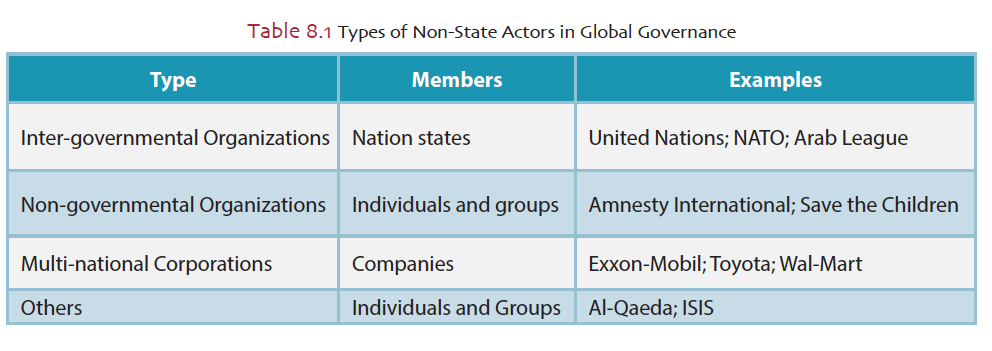
Soru 43
Young (1994) suggests non-state actors and networks have important tasks in defending and promoting the interests of the international society as well as making decisions in an attempt to find solutions to global problems. Which below cannot be said about non-state actors and networks according to the statement?
Seçenekler
A
Their operations are not limited to any one region in the world.
B
Their work aims to produce a global benefit.
C
They are very much interested in solving transnational problems.
D
They are the main actors in global governance.
E
They don't work for the interests of a state or a group of states.
Açıklama:
The international system must involve multiple actors and allow their voices to be heard. This means that decisions on global issues should be based on the common interests of the international society rather than on the self-interest of a state or a group of states.
States are the main actors in global governance. Options A, B, C, and E can all be inferred from the statement given.
States are the main actors in global governance. Options A, B, C, and E can all be inferred from the statement given.
Soru 44
What is the main difference in characteristics of global civil society from multi-national corporations?
Seçenekler
A
It consists of individuals.
B
Members can interact with states.
C
It doesn't do work for financial profit.
D
It consists of non-governmental organizations.
E
Members interact with international organizations.
Açıklama:
Global civil society has emerged as a result of new ideas, approaches, and processes in dealing with economic, political and social problems caused by globalization.
Unlike multi-national corporations, these individuals and nongovernmental organizations usually consist of non-profit and voluntary organizations (Heywood, 2011:152).
Unlike multi-national corporations, these individuals and nongovernmental organizations usually consist of non-profit and voluntary organizations (Heywood, 2011:152).
Soru 45
Which below is not a characteristic of transnational advocacy networks?
Seçenekler
A
They use information creatively.
B
They obey states' decisions in solving problems.
C
They believe in the power of individuals.
D
They employ sophisticated political strategies.
E
They develop new ideas and norms.
Açıklama:
The similar characteristics of transnational advocacy networks are “the centrality of values or principled ideas, the belief that individuals can make a difference, the creative use of information, and the employment by nongovernmental actors of sophisticated political strategies in targeting their campaigns.”
The main goal of transnational networks is to influence and change the behavior of states and international organizations in their issue areas.
The main goal of transnational networks is to influence and change the behavior of states and international organizations in their issue areas.
Soru 46
Which below is not one of the goals of non-governmental organizations according to World Banka?
Seçenekler
A
To encourage economic growth
B
To relieve suffering
C
To promote the interests of the poor
D
To protect the environment
E
To provide basic social services
Açıklama:
As non-state actors, international non-governmental organizations are private, financially independent, and non-commercial groups that carry out their objectives through non-violent means.
The World Bank defines international non-governmental organizations as “private organizations that pursue activities to relieve suffering, promote the interests of the poor, protect the environment, provide basic social services or undertake community development.”
The World Bank defines international non-governmental organizations as “private organizations that pursue activities to relieve suffering, promote the interests of the poor, protect the environment, provide basic social services or undertake community development.”
Soru 47
Which international NGO below was founded earlier than the others?
Seçenekler
A
International Association of Geodesy
B
The International Workingmen’s Association
C
Inter-Parliamentary Union
D
International Peace Bureau
E
Society for Effecting the Abolition of the Slave Trade
Açıklama:
Although international non-governmental organizations became influential actors in international relations with the rise of globalization at the beginning of the 1990s, these organizations have existed since the late eighteenth and early nineteenth centuries.
Society for Effecting the Abolition of the Slave Trade was founded in 1787 and its foundation predates that of others.
Society for Effecting the Abolition of the Slave Trade was founded in 1787 and its foundation predates that of others.
Soru 48
Which UN organ is the main entry point for NGOs into the UN system?
Seçenekler
A
The Security Council
B
The Economic and Social Council
C
Secretariat
D
The General Assembly
E
Trusteeship Council
Açıklama:
In 1946, 41 NGOs were granted consultative status by the council; by 1992 more than 700 NGOs had attained consultative status and the number has been steadily increasing ever since to more than 3,400 organizations today” (United Nations, 2011: 2).
The Economic and Social Council (ECOSOC) has been the main entry point into the UN system for NGOs. ECOSOC remains the only main UN body with a formal framework for NGO participation.
The Economic and Social Council (ECOSOC) has been the main entry point into the UN system for NGOs. ECOSOC remains the only main UN body with a formal framework for NGO participation.
Soru 49
Think tanks and lobbies both aim to influence government policies. How do think tanks differ from lobbies?
Seçenekler
A
They offer political advice.
B
They provide education.
C
They seek more public visibility.
D
They bring together politically like-minded individuals, corporations and parties.
E
They conduct research.
Açıklama:
Think tanks are organizations that promote new ideas, conduct research, and lobby governments about various topics including politics, foreign policy, military and defense issues, social and cultural problems, and the economy.
Think tanks differ from lobbies because they seek more public visibility in the media than lobbies.
Think tanks differ from lobbies because they seek more public visibility in the media than lobbies.
Soru 50
Which below is a third generation think tank established in the US?
Seçenekler
A
Center for Strategic and International Studies
B
The Center for the National Interest
C
RAND Corporation
D
American Enterprise Institute for Public Policy Research
E
Hudson Institute
Açıklama:
The CSIS tries to provide strategic insights and realistic policy solutions for global issues.
Founded in 1962, the Center for Strategic and International Studies (CSIS) is one of the important third generation think tanks in the United States.
Founded in 1962, the Center for Strategic and International Studies (CSIS) is one of the important third generation think tanks in the United States.