Internatıonal Busıness (ENG) - Tüm Sorular
Ünite 1
Soru 1
What refers to the shift toward a more integrated and interdependent world economy?
Seçenekler
A
Globalization
B
Localization
C
Glocalization
D
Deregulation
E
Liberalization
Açıklama:
Globalization refers to the shift toward a more integrated and interdependent world economy. The correct answer is "A".
Soru 2
Which of the following is not included in technological change?
Seçenekler
A
Communication
B
Information processing
C
Transportation
D
Trade barriers/tariffs
E
The net
Açıklama:
Declining barriers made globalization a reality in theory, but realization took place with advancements in technology, including communication, information processing, transportation, and the net. The correct answer is "D".
Soru 3
Which of the following is the negative side of globalization?
Seçenekler
A
It creates jobs.
B
It makes companies more competitive.
C
It makes the rich richer.
D
It reduces prices for consumers.
E
It enables cultural intermingling.
Açıklama:
The general problem with globalization is that it has made the rich richer while making the non-rich poorer. The correct answer is "C".
Soru 4
Which of the followings are true according to the CAGE framework?
Cultural differences matter the most when
I. Products have high linguistic content.
II. Products matter to cultural or national identity.
III. Product features vary in terms of size and standards.
IV. Products carry country-specific quality associations.
V. Products are fragile or perishable.
Cultural differences matter the most when
I. Products have high linguistic content.
II. Products matter to cultural or national identity.
III. Product features vary in terms of size and standards.
IV. Products carry country-specific quality associations.
V. Products are fragile or perishable.
Seçenekler
A
I, II, III, IV
B
II, III, IV, V
C
I, III, IV, V
D
I, II, IV, V
E
I, II, III, V
Açıklama:
Cultural differences matter the most when
I. Products have high linguistic content.
II. Products matter to cultural or national identity.
III. Product features vary in terms of size and standards.
IV. Products carry country-specific quality associations.
The correct answer is "A".
I. Products have high linguistic content.
II. Products matter to cultural or national identity.
III. Product features vary in terms of size and standards.
IV. Products carry country-specific quality associations.
The correct answer is "A".
Soru 5
Which country is in the Best Countries Origin Index in 2020 global rankings?
Seçenekler
A
Turkey
B
Switzerland
C
Greece
D
Belgium
E
Mexico
Açıklama:
The 2020 Global Ranking’ s Top 10 countries are Switzerland, Canada, Japan, Germany, Australia, United Kingdom, United States, Sweden, Netherlands, Norway. The correct answer is "B".
Soru 6
What do we call the process of applying management concepts and techniques in a multinational environment and adapting management practices to different economic, political, and cultural contexts?
Seçenekler
A
International business
B
Internationalization
C
International management
D
Multinational enterprise
E
Mini-multinationals
Açıklama:
International management is the process of using management concepts and techniques in a multinational environment and adapting management practices to different economic, political, and cultural contexts. The correct answer is "C".
Soru 7
What is defined as a company that adopts a global perspective and engages in international business from or near its inception?
Seçenekler
A
A Multinational Enterprise
B
Global corporation
C
Multidomestic corporation
D
Transnational corporation
E
A Born-global firm
Açıklama:
A born-global firm is generally defined as a company that adopts a global perspective, sells and uses resources on a worldwide scale, and engages in international business from or near its inception.The correct answer is "E".
Soru 8
____________ is a political system in which the government is controlled by the citizens either directly or through elections.
Which word can best complete the blank in the sentence?
Which word can best complete the blank in the sentence?
Seçenekler
A
Democracy
B
Totalitarianism
C
Individualism
D
Collectivism
E
Socialism
Açıklama:
Democracy, which has European roots, is a system of government controlled by its citizens either directly or through elections. It is participative in a way that every citizen should be involved in the decision-making process. The correct answer is "A".
Soru 9
Which of the following promotes international financial stability and monetary cooperation along with sustainable economic growth to facilitate international trade?
Seçenekler
A
The World Trade Organization
B
The World Bank
C
The United Nations
D
The International Monetary Fund
E
The General Agreement on Tariffs and Trade
Açıklama:
The IMF promotes international financial stability and monetary cooperation along with sustainable economic growth to facilitate international trade.The correct answer is "D".
Soru 10
What do we call a narrow focus in which people see things only through their own eyes and from their own perspective?
Seçenekler
A
Culture
B
Paracholism
C
Cross-cultural literacy
D
Stereotype
E
Universalism
Açıklama:
Paracholism is defined as a narrow focus in which people see things only through their own eyes and from their own perspective. The correct answer is "B".
Soru 11
Which of the following statements about globalization is not correct?
Seçenekler
A
Globalization is a multifaceted phenomenon
B
Distinct national markets have merged into one huge global marketplace as a consequence of globalization
C
Consumers’ preferences gradually became relatively similar because of globalization
D
Globalization facilitates independence of domestic economies
E
Globalization has changed the business models
Açıklama:
Today globalization refers to the shift toward a more integrated and interdependent world economy. That is why, domestic economies can not be indepedent.
Soru 12
I. Declining barriers
II. Intense foreign rivalry
III.Technological change
Which of the following are drivers of globalizaton?
II. Intense foreign rivalry
III.Technological change
Which of the following are drivers of globalizaton?
Seçenekler
A
Only III
B
I and II
C
I and III
D
II and III
E
I, II, and III
Açıklama:
Hill and Hult (2019: 11) summarized drivers of globalization into two macro factors. One of them is declining trade and investment barriers, and the other one is technological change. Intense rivalry from foreign competitors is a firm level consequence of globalization.
Soru 13
Which of the following is the process of applying management concepts and techniques in a multinational environment?
Seçenekler
A
International management
B
International business
C
Internationalization
D
Globalization
E
Denationalization
Açıklama:
International management is the process of applying management concepts and techniques in a multinational environment whereas International business (activity) is a commercial transaction that crosses the borders of two or more nations. Internationalization is “the process by which a firm gradually changes in response to the
imperatives of international competition, domestic market saturation, desire for expansion, new markets, and diversification. Globalization refers to the shift toward a more integrated and interdependent
world economy. Denationalization is the process of removing from ownership or control by the national government.
imperatives of international competition, domestic market saturation, desire for expansion, new markets, and diversification. Globalization refers to the shift toward a more integrated and interdependent
world economy. Denationalization is the process of removing from ownership or control by the national government.
Soru 14
Which of the following statements about globalization best explains the rapid spread of coronavirus all over the world?
Seçenekler
A
It is becoming irrelevant to talk about the nationality of products.
B
Events occurring in one place affect other parts of the world almost in real-time.
C
Whether or not the MNCs are friends or foes for the developing countries is still a mystery.
D
Emerging countries are now predicted to occupy increasingly dominant roles in the global economic system.
E
Some MNCs have earned more annual revenue in the international arena than they have earned in their home countries.
Açıklama:
Globalization means shrinking time and shrinking space. The lives of all individuals are more connected, and events occurring in one place
affect other parts of the world almost in real-time (Wall, Minocha and Rees, 2015: 17). As an example, coronavirus has emerged in China and spreaded rapidly all over the world.
affect other parts of the world almost in real-time (Wall, Minocha and Rees, 2015: 17). As an example, coronavirus has emerged in China and spreaded rapidly all over the world.
Soru 15
Which of the following is an E7 country?
Seçenekler
A
Canada
B
Japan
C
United Kingdom
D
United States of America
E
Turkey
Açıklama:
Brazil, China, India, Indonesia, Mexico, Russia, and Turkey are today
labeled as E7 countries.
labeled as E7 countries.
Soru 16
Which of the following is closely associated with individualism?
Seçenekler
A
Command economy
B
Mixed economy
C
Market economy
D
Totalitarianism
E
Socialism
Açıklama:
As a philosophy, individualism is based on the belief that people should be free to pursue economic and political endeavors without restrictions. This is very much related to the capitalist economic system and market economy. As its name suggests, the market economy prioritizes individuals. Factors of production are privately owned and managed. In
a pure market economy, the law of supply and demand determines the price and the control of the market. Since supply and demand determine the level of production, consumers become sovereign.
a pure market economy, the law of supply and demand determines the price and the control of the market. Since supply and demand determine the level of production, consumers become sovereign.
Soru 17
Which of the following is an international institute to share knowledge and develop voluntary, consensus-based, market-relevant International Standards?
Seçenekler
A
The General Agreement on Tariffs and Trade
B
World Trade Organization
C
International Monetary Fund
D
World Bank
E
International Organization for Standardization
Açıklama:
The “ISO is an independent, non-governmental international organization with a membership of 164 national standards bodies. Through its members, it brings together experts to share knowledge and develop voluntary, consensus-based, market-relevant International Standards that support innovation and provide solutions to global challenges.” For example, different carbon dioxide (CO2) emission standards have been adopted worldwide. So, to resolve this or any similar issue, an international standard is required. The ISO provides standards, through which companies across the globe evaluate their quality standards.
Soru 18
Which of the following is not a characteristics of culture?
Seçenekler
A
Irrelevant in terms of managerial attitudes and ideologies
B
Composed of shared meanings within a group of people
C
Acquired knowledge that people use to act accordingly
D
Taken-for-granted as reality
E
A relative concept, there is no right or wrong culture
Açıklama:
Cultural values affect technology transfer, managerial attitudes, managerial ideologies, and business-government relations. That is why, it is not correct to say that culture is irrelevant in terms of managerial attitudes and ideologies.
Soru 19
Which of the following is among the cultural dimensions developed by Fons Trompenaars?
Seçenekler
A
Power distance
B
Universalism/particularism
C
Uncertainty avoidance
D
Masculinity/femininity
E
Indulgence/restraint
Açıklama:
Trompenaars’s dimensions are as in the following:
• Universalism vs. Particularism
• Individualism vs. Communitarianism
• Neutral vs. Affective
• Specific vs. Diffuse
• Achievement vs. Ascription
• Attitudes toward Time
• Attitudes toward the Environment
• Universalism vs. Particularism
• Individualism vs. Communitarianism
• Neutral vs. Affective
• Specific vs. Diffuse
• Achievement vs. Ascription
• Attitudes toward Time
• Attitudes toward the Environment
Soru 20
Which of the following defines humane orientation, which is a dimension in GLOBE project?
Seçenekler
A
The degree to which members of an organization or society expect and agree that power should be unequally shared
B
The degree to which individuals express pride, loyalty, and cohesiveness in their organizations or families
C
The degree to which individuals in organizations or societies engage in future-oriented behaviors such as planning, investing in the future, and delaying gratification
D
The degree to which individuals in organizations or societies encourage and reward individuals for being fair, altruistic, friendly, generous, caring, and kind to others
E
The degree to which an organization or society encourages and rewards group members for performance improvement and excellence
Açıklama:
Here are the dimensions and their definitions in the GLOBE project:
Power distance: The degree to which members of an organization or society expect and agree that power should be unequally shared.
Collectivism II: The degree to which individuals express pride, loyalty, and cohesiveness in their organizations or families.
Future orientation: The degree to which individuals in organizations or societies engage in future-oriented behaviors such as planning, investing in the future, and delaying gratification.
Humane orientation: The degree to which individuals in organizations or societies encourage and reward individuals for being fair, altruistic, friendly, generous, caring, and kind to others.
Performance orientation: The degree to which an organization or society encourages and rewards group members for performance improvement and excellence.
Power distance: The degree to which members of an organization or society expect and agree that power should be unequally shared.
Collectivism II: The degree to which individuals express pride, loyalty, and cohesiveness in their organizations or families.
Future orientation: The degree to which individuals in organizations or societies engage in future-oriented behaviors such as planning, investing in the future, and delaying gratification.
Humane orientation: The degree to which individuals in organizations or societies encourage and reward individuals for being fair, altruistic, friendly, generous, caring, and kind to others.
Performance orientation: The degree to which an organization or society encourages and rewards group members for performance improvement and excellence.
Soru 21
Which term refers to the shift toward a more integrated and interdependent world economy?
Seçenekler
A
Offshoring
B
Outsourcing
C
Globalization
D
Reshoring
E
A free trade agreement
Açıklama:
Globalization refers to the shift toward a more integrated and interdependent world economy.
Soru 22
What is the name of the pact between a group of countries that have reduced trade barriers/tariffs to exports and imports among them to increase the trade of goods and services?
Seçenekler
A
A free trade agreement (FTA)
B
Offshoring
C
Outsourcing
D
Reshoring
E
International management
Açıklama:
A free trade agreement (FTA) a pact between a group of countries that have reduced trade barriers/tariffs to exports and imports among them to increase the trade of goods and services.
Soru 23
What is the name of the process of subcontracting or contracting out of activities to endogenous organizations that had previously been performed by the firm?
Seçenekler
A
Offshoring
B
Outsourcing
C
Reshoring
D
International management
E
Internationalization
Açıklama:
Outsourcing is the subcontracting or contracting out of activities to endogenous organizations that had previously been performed by the firm.
Soru 24
What is the name of the process of bringing production back to the developed nations?
Seçenekler
A
A free trade agreement
B
Offshoring
C
Outsourcing
D
Reshoring
E
Internationalization
Açıklama:
Reshoring is the process of bringing production back to the developed nations.
Soru 25
What is the name of the term described as the process by which a firm gradually changes in response to the imperatives of international competition, domestic market saturation, desire for expansion, new markets, and diversification?
Seçenekler
A
International management
B
Offshoring
C
Outsourcing
D
Reshoring
E
Internationalization
Açıklama:
Internationalization is described as the process by which a firm gradually changes in response to the imperatives of international competition, domestic market saturation, desire for expansion, new markets, and diversification.
Soru 26
What is any business that has productive activities in two or more countries called?
Seçenekler
A
Transnational corporations
B
Multidomestic corporations
C
Global corporations
D
An MNC (Multinational Corporation)
E
A Multinational Enterprise (MNE)
Açıklama:
A Multinational Enterprise (MNE) is any business that has productive activities in two or more countries.
Soru 27
What is the name of the firm that has operations and international sales in more than one country and a mix of nationalities among managers and owners?
Seçenekler
A
A Born-global firm
B
Transnational corporations
C
Multidomestic corporations
D
An MNC (Multinational Corporation)
E
Global corporations
Açıklama:
An MNC (Multinational Corporation) is a firm that has operations and international sales in more than one country and a mix of nationalities among managers and owners.
Soru 28
What is a company that adopts a global perspective and engages in international business from or near its inception called?
Seçenekler
A
Global corporations
B
A Multinational Enterprise (MNE)
C
A Born-global firm
D
Transnational corporations
E
Multidomestic corporations
Açıklama:
A Born-global firm is a company that adopts a global perspective and engages in international business from or near its inception.
Soru 29
What is the name of the political philosophy that people should be free to pursue economic and political endeavors without constraint?
Seçenekler
A
Collectivism
B
Individualism
C
Democracy
D
Totalitarianism
E
Paracholism
Açıklama:
Individualism is the political philosophy that people should be free to pursue economic and political endeavors without constraint.
Soru 30
Which ideology views the whole society as more important than its parts?
Seçenekler
A
Collectivism
B
Totalitarianism
C
Democracy
D
Individualism
E
Paracholism
Açıklama:
Collectivism as an ideology views the whole society as more important than its parts.
Soru 31
Which of the following phrase(s) is/are true about "globalization"?
I. The process of social, political, economic, cultural, and technological integration among countries around the world
II. The exchange of goods and services across the border between two or more nations
III. The shift toward a more integrated and interdependent world economy
I. The process of social, political, economic, cultural, and technological integration among countries around the world
II. The exchange of goods and services across the border between two or more nations
III. The shift toward a more integrated and interdependent world economy
Seçenekler
A
Only I
B
Only II
C
Only III
D
II and III
E
I and III
Açıklama:
Today globalization refers to the shift toward a more integrated and interdependent world economy (Hill and Hult, 2019: 6). From a broader perspective, globalization can also be defined as the process of social, political, economic, cultural, and technological integration among countries around the world (Luthans and Doh, 2018: 5). It is characterized by denationalization, and it is different from internationalization (Wild and Wild, 2016: 35). However, International Business refers to the exchange of goods and services across the border between two or more nations. Thus, E is the correct answer.
Soru 32
..................... is a pact between a group of countries that have reduced trade barriers/tariffs to imports and exports among them to increase the trade of goods and services.
Seçenekler
A
Globalization
B
International business
C
Free trade agreement
D
Offshoring
E
Outsourcing
Açıklama:
A free trade agreement (FTA)is a pact between a group of countries that have reduced trade barriers/tariffs to imports and exports among them to increase the trade of goods and services. Thus, the correct answer is C.
Soru 33
Which of the following is one of the disadvantages of globalization?
Seçenekler
A
It has made the rich richer while making the non-rich poorer.
B
It has the potential to make this world a better place to live in.
C
It helps to solve some of the long-lasting structural problems such as unemployment and poverty.
D
Free trade is supposed to reduce barriers between nations such as tariffs, value- added taxes, and subsidies.
E
It helps countries, which do not have anything in common, to exchange information including cultural aspects.
Açıklama:
Some of the advantages of globalization are as follows:
They argue that globalization has the potential to make this world a better place to live in and to solve some of the long- lasting structural problems such as unemployment and poverty.
As being an important driver of globalization, free trade is supposed to reduce barriers between nations such as tariffs, value- added taxes, and subsidies.
Competitionbetweencountriesis supposed to drive prices down.
It allows more influx of information between any two countries that do not have anything in common. It enables cultural intermingling, and countries involved in this learn more about other cultures.
Yet, the riches' becoming richer while the non-riches' becoming poorer is a downside of globalization. Therefore, A is the correct answer.
They argue that globalization has the potential to make this world a better place to live in and to solve some of the long- lasting structural problems such as unemployment and poverty.
As being an important driver of globalization, free trade is supposed to reduce barriers between nations such as tariffs, value- added taxes, and subsidies.
Competitionbetweencountriesis supposed to drive prices down.
It allows more influx of information between any two countries that do not have anything in common. It enables cultural intermingling, and countries involved in this learn more about other cultures.
Yet, the riches' becoming richer while the non-riches' becoming poorer is a downside of globalization. Therefore, A is the correct answer.
Soru 34
What is "the subcontracting or contracting out of activities to endogenous organizations that had previously been performed by the firm" called?
Seçenekler
A
Offshoring
B
Outsourcing
C
Reshoring
D
Totalitarianism
E
Internationalization
Açıklama:
Offshoring is the process by which companies undertake some activities at offshore locations instead of in their countries of origin.
Outsourcing is the subcontracting or contracting out of activities to endogenous organizations that had previously been performed by the firm.
Reshoring is the process of bringing production back to the developed nations.
Internationalization is “the process by which a firm gradually changes in response to the imperatives of international competition, domestic market saturation, desire for expansion, new markets, and diversification.
Totalitarianism is a political system in which only one representative party is/or forcefully gets authorized to control over every facet of political and social life.
Thus, B is the correct answer.
Outsourcing is the subcontracting or contracting out of activities to endogenous organizations that had previously been performed by the firm.
Reshoring is the process of bringing production back to the developed nations.
Internationalization is “the process by which a firm gradually changes in response to the imperatives of international competition, domestic market saturation, desire for expansion, new markets, and diversification.
Totalitarianism is a political system in which only one representative party is/or forcefully gets authorized to control over every facet of political and social life.
Thus, B is the correct answer.
Soru 35
According to he CAGE framework at the industry level, which one is more related to geographic distance?
Seçenekler
A
Products have high linguistic content.
B
Large suppliers to government.
C
The nature of demand varies with income level.
D
Products are fragile or perishable.
E
Companies need to be responsive and agile.
Açıklama:
According to he CAGE framework at the industry level, geography plays a more important role when:
- Products have a low value-weight or value-to-bulk ratio.
- Products are fragile or perishable.
- Local supervision and operational requirements are high.
Soru 36
Which one is not one of the differences between managing an international business from conducting business activities domestically?
Seçenekler
A
International business involves different countries.
B
Managers of international businesses require to speak other languages.
C
International businesses managers experience more comprehensive and sophisticated difficulties than their domestic counterparts.
D
It is inevitable for governments to be involved in international transactions.
E
International business requires companies to work with different currencies
Açıklama:
Managing an international business is different from conducting business activities domestically at least for four reasons. First of all, international business encompasses different countries. Secondly, managers of international businesses face more comprehensive and sophisticated challenges than their domestic counterparts. Thirdly, government intervention is inevitable in international transactions. Lastly, international business requires companies to work with different currencies (Hill and Hult, 2019: 32). Thus, B is the correct answer.
Soru 37
What type of company adopts a global perspective and engages in international business from or near its inception?
Seçenekler
A
Multinational Enterprise (MNE)
B
Multinational Corporation (MNC)
C
Global corporation
D
Born-global firm
E
Transnational corporation
Açıklama:
A Multinational Enterprise (MNE) is any business that has productive activities in two or more countries.
An MNC (Multinational Corporation) is a firm that has operations and international sales in more than one country and a mix of nationalities among managers and owners.
Global corporations view the world as one marketplace and produce standardized goods and services to serve this market.
Transnational corporations integrate a geographically dispersed set of specialized activities into a single production process.
A Born-global firm is a company that adopts a global perspective and engages in international business from or near its inception.
Hence, D is the correct answer.
An MNC (Multinational Corporation) is a firm that has operations and international sales in more than one country and a mix of nationalities among managers and owners.
Global corporations view the world as one marketplace and produce standardized goods and services to serve this market.
Transnational corporations integrate a geographically dispersed set of specialized activities into a single production process.
A Born-global firm is a company that adopts a global perspective and engages in international business from or near its inception.
Hence, D is the correct answer.
Soru 38
.................... is the political philosophy that people should be free to pursue economic and political endeavors without constraint.
Seçenekler
A
Democracy
B
Totalitarianism
C
Individualism
D
Collectivism
E
Socialism
Açıklama:
Democracy is a political system in which the government is controlled by the citizens either directly or through elections.
Totalitarianism is a political system in which there is only one representative party which exhibits control over every facet of political and social life.
Collectivism as an ideology views the whole society as more important than its parts.
Individualism is the political philosophy that people should be free to pursue economic and political endeavors without constraint.
Therefore, the right answer is C.
Totalitarianism is a political system in which there is only one representative party which exhibits control over every facet of political and social life.
Collectivism as an ideology views the whole society as more important than its parts.
Individualism is the political philosophy that people should be free to pursue economic and political endeavors without constraint.
Therefore, the right answer is C.
Soru 39
Which of the following institutions' main aim is to promote secure and safe trade across the globe and protect the best interest of producers and consumers?
Seçenekler
A
The General Agreement on Tariffs and Trade (GATT)
B
The World Bank
C
The International Monetary Fund (IMF)
D
The United Nations (UN)
E
The World Trade Organization (WTO)
Açıklama:
The main aim of the WTO is to promote secure and safe trade across the globe and protect the best interest of producers and consumers. Its primary responsibility is to police the world trade system and to make nation-states adhere to the rules laid down in treaties signed by member states. As of 2017, it has 164 members conducting 98% of the world trade, thereby providing enormous influential power for developing a more open global business system (Hill and Hult, 2019: 10). Thus, E is the correct answer.
Soru 40
Which one is not one of the cultural dimensions of Dutch social psychologist Hofstede?
Seçenekler
A
Liberty
B
Power distance
C
Uncertainty avoidance
D
Individualism
E
Masculinity
Açıklama:
The four dimensions identified in the study were power distance, uncertainty avoidance, individualism, and masculinity. Hofstede further added to the framework the time orientation dimension in 1988 and the indulgence versus restraint dimension in 2010. Hence, A is the correct answer.
Soru 41
Which term refers to the shift toward a more integrated and interdependent world economy?
Seçenekler
A
Globalization
B
Intensity
C
Barriers
D
Offshoring
E
Outsourcing
Açıklama:
Globalization refers to the shift toward a more integrated and interdependent world economy.
Soru 42
What is the name of the pact between a group of countries that have reduced trade barriers/tariffs to exports and imports among them to increase the trade of goods and services?
Seçenekler
A
International management
B
A free trade agreement (FTA)
C
Offshoring
D
Outsourcing
E
Reshoring
Açıklama:
A free trade agreement (FTA) a pact between a group of countries that have reduced trade barriers/tariffs to exports and imports among them to increase the trade of goods and services.
Soru 43
What is the name of the process by which companies undertake some activities at offshore locations instead of in their countries of origin?
Seçenekler
A
Internationalization
B
Globalization
C
Offshoring
D
Reshoring
E
Outsourcing
Açıklama:
Offshoring is the process by which companies undertake some activities at offshore locations instead of in their countries of origin.
Soru 44
What is the name of the term of subcontracting or contracting out of activities to endogenous organizations that had previously been performed by the firm?
Seçenekler
A
A free trade agreement
B
Globalization
C
Offshoring
D
Outsourcing
E
Reshoring
Açıklama:
Outsourcing is the subcontracting or contracting out of activities to endogenous organizations that had previously been performed by the firm.
Soru 45
What is the name of the process of bringing production back to the developed nations?
Seçenekler
A
International management
B
International business
C
Offshoring
D
Outsourcing
E
Reshoring
Açıklama:
Reshoring is the process of bringing production back to the developed nations.
Soru 46
What is the name of any business that has productive activities in two or more countries?
Seçenekler
A
A Multinational Enterprise (MNE)
B
A Born-global firm
C
Transnational corporations
D
Multidomestic corporations
E
Global corporations
Açıklama:
A Multinational Enterprise (MNE) is any business that has productive activities in two or more countries.
Soru 47
What is the name of a firm that has operations and international sales in more than one country and a mix of nationalities among managers and owners?
Seçenekler
A
A Multinational Enterprise (MNE)
B
MNC (Multinational Corporation)
C
Multidomestic corporations
D
Transnational corporations
E
A Born-global firm
Açıklama:
An MNC (Multinational Corporation) is a firm that has operations and international sales in more than one country and a mix of nationalities among managers and owners.
Soru 48
Which of the below view the world as one marketplace and produce standardized goods and services to serve this market?
Seçenekler
A
A Multinational Enterprise (MNE)
B
Multidomestic corporations
C
Global corporations
D
Transnational corporations
E
A Born-global firm
Açıklama:
Global corporations view the world as one marketplace and produce standardized goods and services to serve this market.
Soru 49
What is the name of the political system in which there is only one representative party which exhibits control over every facet of political and social life?
Seçenekler
A
Paracholism
B
Collectivism
C
Individualism
D
Totalitarianism
E
Democracy
Açıklama:
Totalitarianism is a political system in which there is only one representative party which exhibits control over every facet of political and social life.
Soru 50
What is the name of the political philosophy that people should be free to pursue economic and political endeavors without constraint?
Seçenekler
A
Paracholism
B
Collectivism
C
Totalitarianism
D
Democracy
E
Individualism
Açıklama:
Individualism is the political philosophy that people should be free to pursue economic and political endeavors without constraint.
Soru 51
______________ is the political philosophy that people should be free to pursue economic and political endeavors without constraint.Collectivism
Seçenekler
A
Collectivism
B
Individualism
C
Totalitarianism
D
Democracy
E
Globalization
Açıklama:
Individualism is the political philosophy that people should be free to pursue economic and political endeavors without constraint.
Soru 52
______________ as an ideology views the whole society as more important than its parts.
Seçenekler
A
Collectivism
B
Individualism
C
Totalitarianism
D
Democracy
E
Globalization
Açıklama:
Collectivism as an ideology views the whole society as more important than its parts.
Soru 53
Which of the components below are included in CAGE framework?
- Cultural distance
- Administrative distance
- Geographic distance
- Economic distance
Seçenekler
A
i, ii, iii, iv
B
i, ii, iii
C
i, ii
D
ii, iii, iv
E
iii, iv
Açıklama:
Table 1.1 on pg 8 shows the kinds of industries that are sensitive to each component of distance.
Soru 54
"It is a political system in which there is only one representative party which exhibits control over every facet of political and social life." What is defined here?
Seçenekler
A
Individualism
B
Democracy
C
Collectivism
D
Totalitarianism
E
Globalization
Açıklama:
Totalitarianism is a political system in which there is only one representative party which exhibits control over every facet of political and social life.
Soru 55
When was the World Bank founded?
Seçenekler
A
1922
B
1931
C
1944
D
1955
E
1962
Açıklama:
The World Bank is less controversial than the IMF. Its primary responsibility is promoting economic development. It was founded in 1944.
Soru 56
Which of the following options is not affected from cultural values on international business?
Seçenekler
A
technology transfer
B
managerial attitudes
C
managerial ideologies
D
business-government relations
E
politics
Açıklama:
Cultural values affect technology transfer, managerial attitudes, managerial ideologies, and business-government relations (Luthans and Doh, 2018: 124-125).
Soru 57
Which countries and regions below are regarded as high context cultures?
- China
- the Middle East
- South America
- Southern Europe
- Japan
Seçenekler
A
i, ii, ii
B
i, ii, iii, iv, v
C
i, ii
D
iii, iv, v
E
i, iii, iv,
Açıklama:
Countries and regions such as Japan, China, the Middle East, South America, and southern Europe are said to be high context cultures
Soru 58
The degree to which members of an organization or society expect and agree that power should be unequally shared. What is defined in this statement?
Seçenekler
A
Uncertainty avoidance
B
Power distance
C
Assertiveness
D
Humane orientation
E
Future orientation
Açıklama:
Power distance is the degree to which members of an organization or society expect and agree that power should be unequally shared.
Soru 59
The degree to which individuals in organizations or societies encourage and reward individuals for being fair, altruistic, friendly, generous, caring, and kind to others. What is defined here?
Seçenekler
A
Uncertainty avoidance
B
Gender egalitarianism
C
Performance orientation
D
Future orientation
E
Humane orientation
Açıklama:
Humane orientation is the degree to which individuals in organizations or societies encourage and reward individuals for being fair, altruistic, friendly, generous, caring, and kind to others.
Soru 60
It is a pervasive concept used to characterize the current state of the world economy but differently understood by those who describe it as a phenomenon. What is defined in this statement?
Seçenekler
A
International business
B
Globalization
C
Glocalization
D
Denationalization
E
Internationalization
Açıklama:
Globalization is a pervasive concept used to characterize the current state of the world economy but differently understood by those who describe it as a phenomenon.
Soru 61
____________ refers to the exchange of goods and services across the border between two or more nations.
Seçenekler
A
globalization
B
domestic trade
C
international business
D
regionalization
E
denationalization
Açıklama:
International Business, on the other hand, refers to the exchange of goods and services across the border between two or more nations.
Soru 62
On what aspect of globalization do the sociologists focus?
Seçenekler
A
international trade
B
dominance of multinational enterprises
C
new forms of governance
D
rising of global culture
E
global conflicts
Açıklama:
Sociologists approach globalization in terms of the rising of global culture and global companies’ dominance in creating and sustaining it.
Soru 63
Johnson and Turner developed three dimensions to address whether globalization is a reality. What are these dimensions?
Seçenekler
A
scope-sensitivty-integration
B
scope-intensity-integration
C
intensity-integration-innovation
D
scope-innovation-integrity
E
scope-intensity-sensitivity
Açıklama:
Johnson and Turner (2003: 12-25) developed three dimensions to address this question: scope, intensity, and sensitivity.
Soru 64
___________ refers to “the extent to which international economic integration is genuinely global rather than confined to the “triad” of North America, Europe, and Japan/East Asia.”
Which of the following completes the statement?
Which of the following completes the statement?
Seçenekler
A
scope
B
intensity
C
integrity
D
sensitivity
E
innovation
Açıklama:
Scope refers to “the extent to which international economic integration is genuinely global rather than confined to the “triad” of North America, Europe, and Japan/East Asia.”
Soru 65
__________ refers to “the depth, embeddedness, and extensiveness of the integration that has taken place, both between countries and within firms.”
Which of the following terms completes the statement?
Which of the following terms completes the statement?
Seçenekler
A
integrity
B
sensitivity
C
scope
D
intensity
E
innovation
Açıklama:
Intensity refers to “the depth, embeddedness, and extensiveness of the integration that has taken place, both between countries and within firms.”
Soru 66
_________ refers to “the degree to which events in one part of the global system transmit themselves to other parts of the system.”
Which of the following terms completes the statement?
Which of the following terms completes the statement?
Seçenekler
A
sensitivity
B
sensation
C
integrity
D
scope
E
intensity
Açıklama:
Sensitivity refers to “the degree to which events in one part of the global system transmit themselves to other parts of the system.”
Soru 67
After which event did experienced Western nations decrease the tariffs and facilitate the free flow of goods?
Seçenekler
A
World War I
B
Great Depression
C
Cold War
D
World War II
E
the foundation of the US
Açıklama:
After World War II, experienced Western nations decreased the tariffs and facilitated the free flow of goods, services, and capital among nations. Lowering the barriers accelerated the economic growth rates globally.
Soru 68
When was the World Trade Organization (WTO) founded?
Seçenekler
A
1992
B
1993
C
1994
D
1995
E
1996
Açıklama:
The General Agreement on Tariffs and Trade (GATT) negotiation rounds which were kickedoff in 1986 in Punta del Este, Uruguay was finalized in 1994 and resulted in the foundation of the WTO.
Soru 69
____________ is the process of bringing production back to the developed nations.
Which of the following completes the statement?
Which of the following completes the statement?
Seçenekler
A
offshoring
B
reshoring
C
outsourcing
D
exporting
E
importing
Açıklama:
Reshoring is the process of bringing production back to the developed nations.
Soru 70
When was The International Monetary Fund (IMF) formed?
Seçenekler
A
1942
B
1943
C
1944
D
1945
E
1946
Açıklama:
The IMF promotes international financial stability and monetary cooperation along with sustainable economic growth to facilitate international trade. It was formed in July 1944.
Ünite 2
Soru 1
What is the meaning of ICT?
Seçenekler
A
ICT includes all devices, networking components, information systems and applications, and other digital systems.
B
The fourth industrial revolution.
C
Promotes learning by doing approach.
D
Enables self-paced learning.
E
ITC is applying a range of computer programmes and customer relationship.
Açıklama:
ICT includes all devices, networking components, information systems and applications, and other digital systems that are combined to allow people and companies to interact, learn, live and work.
Soru 2
What an ERP system does?
Seçenekler
A
ERP is individual software designed for specific business processes.
B
ERP system can be used to integrate key business processes in manufacturing, finance and accounting, sales and marketing, and human resources.
C
ERP provides a solution for manufacturing.
D
ERP provides a solution for distribution industries.
E
ERP leds to the creation of software
Açıklama:
An application such as an ERP system can be used to integrate key business processes in manufacturing, finance and accounting, sales and marketing, and human resources into one software system for more efficient operations and better management especially for firms that operate in several locations internationally with different local requirements and needs.
Soru 3
What does it mean by m-commerce?
Seçenekler
A
M Commerce is known as electronic commerce.
B
M Commerce is provided quick delivery of goods with very little effort on part of the customer.
C
Smartphones and tablets are called m-commerce.
D
M Commerce is known Business-to-Business relationship
E
M Commerce is known Business-to-Administration.
Açıklama:
E-commerce activities which are conducted through wireless handheld devices like smartphones and tablets are called mobile commerce or m-commerce.
Soru 4
What do you mean by cloud computing?
Seçenekler
A
Cloud computing means for web-based applications.
B
Cloud computing means storing and accessing data and programs in your computer's hard drive.
C
When you store data on the hard drive, that's called cloud computing.
D
Cloud computing is the delivery of on-demand self- service computing resources and accessing data and programs over the Internet.
E
Cloud computing means financial services to manage the different demands in the banking-world.
Açıklama:
Cloud computing is the delivery of on-demand self- service computing resources over the Internet on a pay-for-use basis from any connected devices and locations.
Soru 5
What data is big data?
Seçenekler
A
In computing, big data is information that has been translated into a form that is efficient for movement or processing.
B
Big data is to be used as a singular subject or a plural subject.
C
Big data is to help organizations harness their data and use it to identify new opportunities.
D
Big data is unstructured data.
E
Big data is information about their customers, suppliers and other external data. These large pools of different data types.
Açıklama:
Firms also capture information about their customers, suppliers and other external data. These large pools of different data types - big data - can be captured, communicated, aggregated, stored, analyzed, and used as a firm’s important assets where information can then be used for its innovation capabilities, competitive advantage and productivity.
Soru 6
What is a definition of velocity?
Seçenekler
A
Velocity - data in motion: Velocity concerns the speed with which data is created, processed, and analyzed.
B
Velocity - data uncertainty: Velocity refers to the reliability of certain types of data.
C
Velocity -different types of data: Velocity of structured, semi-structured, and unstructured data and data sources (traditional and non-traditional sources from within and outside an organization).
D
Velocity refers to the mass quantities of data that continue to increase though vary by industry and geographic locations.
E
Velocity is habitual observance of truth in speech or statement.
Açıklama:
Velocity - data in motion: Velocity concerns the speed with which data is created, processed, and analyzed. It continues to accelerate with data created real-time. This enables decision making to be made instantly such as real-time fraud detection instead of detecting fraud after it takes place.
Soru 7
What is Internet of things in simple words?
Seçenekler
A
The Internet of Things is simply "a network of Internet connected object.
B
IoT is so important because it find a solution to every problem.
C
Internet of Things (IoT) is a sensor network of physical objects that are connected to the Internet so they can collect and share data among people, systems, and other applications.
D
The Internet of Things is monitoring
E
The Internet of Things are the breach of privacy, over-reliance on technology,
Açıklama:
Internet of Things, which is a sensor network of physical objects that are connected to the Internet so they can collect and share data among people, systems, and other applications.
Soru 8
How would you describe Artificial Intelligence (AI).
Seçenekler
A
AI is iterative processing.
B
AI is generally defined as the ability of machines to perform cognitive functions associated with human minds.
C
Artificial Intelligence (AI)is Sensing capability - using of sensors.
D
Artificial Intelligence (AI) includes communicating capability - its ability to exchange information between devices.
E
Artificial Intelligence (AI) is consisted of Computing capability - its ability to process instructions, often using the cloud.
Açıklama:
AI is generally defined as the ability of machines to perform cognitive functions associated with human minds.
Soru 9
How does a block chain work?
Seçenekler
A
Blockchain is decentralized currencies that enable two parties (peer-to-peer) to transact business without a central authority such as a bank or a government.
B
Blockchain is translation services have enabled digital platforms to be the drivers of international trade.
C
Algorithms of Blockchain can be used to segment customers into groups by distinct customer characteristics like age and by less-distinct characteristics such as product preferences.
D
Blockchain is a distributed, decentralized public ledger that facilitates the process of recording transactions and tracking tangible assets and intangible assets in a business network.
E
The blockchain is an corruptible digital ledger of economic transactions.
Açıklama:
Blockchain, which is the technology underlying cryptocurrencies such as bitcoin, is recent digital technology that can be used to create business value. It is a distributed, decentralized public ledger that facilitates the process of recording transactions and tracking tangible assets (e.g. house, land, cash) and intangible assets in a business network.
Soru 10
What is 3D printing or additive manufacturing?
Seçenekler
A
3D printing or additive manufacturing is 3D printing is used to manufacture method for making jewelry
B
3D printing or additive manufacturing is larger, complex, high-quality object with high infill can take hours to several days.
C
3D printing or additive manufacturing is Improvements in the performance of robotic systems and declining costs.
D
3D printing or additive manufacturing is a decentralized intelligent system that allows devices and equipment to make decisions and take actions autonomously without human intervention.
E
3D printing or additive manufacturing is a process of making three-dimensional objects from a digital file or model.
Açıklama:
3D printing is a process of making three-dimensional objects from a digital file or model. It is also called additive manufacturing because the process builds up successive layers of material until the object is created.
Soru 11
What are the business ethical philosophies?
Seçenekler
A
Business ethics examines moral issues in a business environment such as ethical or unethical behaviors of the employees in the workplace.
B
Business ethics is a discipline concerned with what is morally good and bad, right and wrong.
C
Business ethics are based on personal moral principles and beliefs within business social context that guide decision makings.
D
Business ethics involve a manager’s moral principles and behaviors in an organization which are influenced by personal ethics.
E
Business ethics is a formal written document that organizations use to guide employees in their actions and decision makings in order to conduct business fairly and honestly.
Açıklama:
Business ethics examines moral issues in a business environment such as ethical or unethical behaviors of the employees in the workplace.
Soru 12
What is the definition of corruption?
Seçenekler
A
Corruption is seen as an illegal offering or receiving anything of value such as payments, gifts, and favors.
B
A definition of corruption is the abuse of entrusted power for private gain.
C
The definition of Corruption is offering something desirable or something of value in exchange for getting something in return.
D
Corruption is a payment such as money or a favor given to someone to induce him to act dishonestly.
E
The social arguments against corruption are compelling.
Açıklama:
A broad definition of corruption is the abuse of entrusted power for private gain.
Soru 13
Which of the following is an informational component of technology?
Seçenekler
A
know-how
B
tools
C
equipment
D
computers
E
blueprints
Açıklama:
In our textbook, technology is concerned with two primary components. One involves the physical components such as products, tools, equipment, computers, blueprints, techniques, and processes. The other one is the informational component such as the knowledge in management, production, marketing and other functional areas including the related know-how such as quality control and reliability.
Soru 14
Which of the following refers to a suite of computer software that allows an organization to use a system of integrated applications to manage core business processes and activities?
Seçenekler
A
Information and Communication Technology
B
Enterprise Resource Planning System
C
E-commerce
D
M-Commerce
E
Cloud Computing
Açıklama:
ERP refers to a suite of computer software that allows an organization to use a system of integrated applications to manage core business processes and activities such as marketing, risk management, and supply chain operations. ERP systems combine fragmented information from key functional areas (Sales, Finance, etc.) and many different information systems (Supply Chain Management System, Customer
Relationship Management Systems, etc.). Information is stored in a single comprehensive data repository (a database) where it can be used by those who need it regardless of where they are located.
Relationship Management Systems, etc.). Information is stored in a single comprehensive data repository (a database) where it can be used by those who need it regardless of where they are located.
Soru 15
Which of the following activities can not be conducted through m-commerce?
Seçenekler
A
Buying and selling of digital products
B
Bill payments
C
Mobile banking
D
Location-based services
E
Infrastructure as a service
Açıklama:
E-commerce activities which are conducted through wireless handheld devices like smartphones and tablets are called mobile commerce or m-commerce. It is the fastest-growing form of e-commerce because of the global high adoption rate, the increase in devices computing power, and the availability of m-commerce applications or apps. Popular apps include the buying and selling of digital products and services such as music and movies, physical products, bill payments, and Mobile banking. Location-based services such as Uber and Airbnb provide services based on users’ current or intended locations. On the other hand, IaaS or Infrastructure as a service is an activity of Cloud computing.
Soru 16
I. By using the applications anywhere with Internet access
II. By improving a firm’s core operations
III. By launching entirely new business models
How can big data and business analytics change the basis of competition?
II. By improving a firm’s core operations
III. By launching entirely new business models
How can big data and business analytics change the basis of competition?
Seçenekler
A
Only I
B
I and II
C
I and III
D
II and III
E
I, II, and III
Açıklama:
Both big data and business analytics can change the basis of competition by improving a firm’s core operations (like ways to streamline internal processes) or by launching entirely new business models such as radical personalization by micro-segmenting a population based on the characteristics of individuals. Using the applications anywhere with Internet access is irrelevant in terms of big data and business analytics; however it is about cloud computing.
Soru 17
Which of the following is not akey business benefit of blockchain?
Seçenekler
A
Cost savings
B
Time savings
C
Loosened security
D
Enhanced privacy
E
Improved auditability
Açıklama:
Blockchain is a distributed, decentralized public ledger that facilitates the process of recording transactions and tracking tangible assets and intangible assets in a business network. Blockchain allows digital records and information to be shared in a secure, transparent, and immutable manner without centralized, trusted third parties such as a bank or a government agency. Global businesses can enable transactions to take place more efficiently, economically, and quickly with a high level of security. So, the security is not loosened, it is tight.
Soru 18
Which of the following concepts about ethics relates to organizational level ethics?
Seçenekler
A
Moral philosophy
B
Personal ethics
C
Managerial ethics
D
Code of ethics
E
Ethical normativism
Açıklama:
Code of ethics is a formal written document that organizations use to guide employees in their actions and decision makings in order to conduct business fairly and honestly. So, code of ethics is an organizational level concept.
Soru 19
Which of the following is a SA8000 certification standard for socially acceptable business practices?
Seçenekler
A
The right to collective bargaining
B
Freedom of opinion
C
Freedom of belief and religion
D
The right to privacy
E
The right to life, liberty and personel security
Açıklama:
SA8000 certification standard for socially acceptable business practices are as in the following:
• Child Labor - any work performed by a child under 15 years of age.
• Forced or Compulsory Labor - all work that a person has not voluntarily offered.
• Health and Safety - a safe and healthy workplace environment.
• Freedom of Association and Right to Collective Bargaining - the right to from and join trade unions.
• Discrimination - based on race, national origin, religion, gender, disability, political affiliation or age.
• Disciplinary Practices - no permission of corporal punishment, mental or physical abuse.
• Working Hours - comply with the applicable laws and industry standards.
• Remuneration - compensation of a living wage, meet at least legal or industry minimum standards.
• Management System - integrate the standards into policies, procedures, training, etc.
• Child Labor - any work performed by a child under 15 years of age.
• Forced or Compulsory Labor - all work that a person has not voluntarily offered.
• Health and Safety - a safe and healthy workplace environment.
• Freedom of Association and Right to Collective Bargaining - the right to from and join trade unions.
• Discrimination - based on race, national origin, religion, gender, disability, political affiliation or age.
• Disciplinary Practices - no permission of corporal punishment, mental or physical abuse.
• Working Hours - comply with the applicable laws and industry standards.
• Remuneration - compensation of a living wage, meet at least legal or industry minimum standards.
• Management System - integrate the standards into policies, procedures, training, etc.
Soru 20
Which of the following is a primary stakeholder for corporate social responsibility?
Seçenekler
A
Media
B
Academics
C
Suppliers
D
Trade bodies
E
Competitors
Açıklama:
Primary stakeholders for corporate social responsibility are as in the following:
Shareholders or stockholders and investors
Boards of directors
Employees and managers
Customers
Local communities
Suppliers
Business partners
Shareholders or stockholders and investors
Boards of directors
Employees and managers
Customers
Local communities
Suppliers
Business partners
Soru 21
Which of the following best defines the process of ensuring that products or services are obtained through responsible and sustainable methods?
Seçenekler
A
Social entrepreneurship
B
Ethical sourcing
C
Fairtrade
D
Sustainability
E
Ethical consumption
Açıklama:
Ethical sourcing is the process of ensuring that products or services are obtained through responsible and sustainable methods. For example,
ingredients and raw materials that are used in a firm’s products should meet safety standards and source from suppliers who also meet social and environmental standards.
ingredients and raw materials that are used in a firm’s products should meet safety standards and source from suppliers who also meet social and environmental standards.
Soru 22
Which of the following statements is a suggestion about economic sustainability?
Seçenekler
A
Businesses should use renewable energy in their operations.
B
Business operations should stop polluting people’s land where they live and earn their livelihoods.
C
MNC involvement in poverty reduction is crucial.
D
Managers have moral obligations to act ethically while supporting
Corporate Social Responsibility.
Corporate Social Responsibility.
E
Businesses can focus on limiting their use of natural resources in
terms of water, land and air.
terms of water, land and air.
Açıklama:
Economic sustainability recognizes the importance of providing secure employment while creating a healthy natural environment as the basis for a dynamic economy. Businesses can focus on limiting their use of natural resources in terms of water, land and air. They can adopt new
production processes to limit water usage (water conservations) or to limit the discharge of polluted waste into water, land, and air.
production processes to limit water usage (water conservations) or to limit the discharge of polluted waste into water, land, and air.
Soru 23
Which of the following refers to buying and selling of goods and services conducted over the Internet?
Seçenekler
A
ERP
B
ICT
C
E-business
D
E-commerce
E
EDI
Açıklama:
E-commerce includes activities supporting online transactions such as marketing, advertising and customer services. It refers to the buying and selling
of goods and services conducted over the Internet. Thus, the aswer is D.
of goods and services conducted over the Internet. Thus, the aswer is D.
Soru 24
Which of the following is provided by Electronic Data Interchange (EDI)?
Seçenekler
A
Allowing computer-to-computer exchange of transactions such as invoices, purchase
orders and shipping schedules in a standard format.
orders and shipping schedules in a standard format.
B
Managing companies to coordinate transactions between a large number of their global suppliers and distributors.
C
Bringing many buyers and sellers together to carry out transactions which can be owned by independent intermediaries or by industry-owned platforms.
D
Allowing companies to coordinate transactions in all aspects and all divisions which enable collaboration and efficiencies for global operations.
E
Supplying chain management and activities for coordination and payments with suppliers.
Açıklama:
EDI or electronic data interchange enables computer-to-computer exchange of
documents and transactions in a standard format. Therefore, the answer is A.
documents and transactions in a standard format. Therefore, the answer is A.
Soru 25
Which of the following best describes 'Cloud computing'?
Seçenekler
A
Activities which are conducted through wireless handheld devices like smartphones
and tablets.
and tablets.
B
Delivery of on-demand self-service computing resources over the Internet on a
pay-for-use basis from any connected devices and locations.
pay-for-use basis from any connected devices and locations.
C
Managing companies to coordinate transactions between a large number of their global suppliers and distributors.
D
An operation in several locations internationally with different local requirements and need.
E
An organization to use a system of integrated applications to manage core business processes and activities.
Açıklama:
Option A refers to 'E-commerce', option C is an act of large international companies such as Microsoft, Coca-Cola, VW, and Nike, options D and E refer to 'ERP'. Cloud computing is the delivery of on-demand selfservice computing resources over the Internet on a pay-for-use basis from any connected devices and locations. Thus, the answer is B.
Soru 26
Which of the following is not among the benefits of cloud computing for firms in general and for international firms in particular?
Seçenekler
A
Cost efficiency
B
Flexibility and Elasticity
C
Speed
D
Audit and Compliance
E
Safety
Açıklama:
The benefits include cost-efficiency (as customers pay only for actual usage),
speed, flexibility, and elasticity (e.g. usage on-demand asneeded basis) as well as Audit and Compliance. Safety is not among the benefits. Therefore, the answer is E.
speed, flexibility, and elasticity (e.g. usage on-demand asneeded basis) as well as Audit and Compliance. Safety is not among the benefits. Therefore, the answer is E.
Soru 27
Which of the following describes the dimension "Veracity"?
Seçenekler
A
The speed with which data is created, processed, and analyzed.
B
Variety of structured, semi-structured, and unstructured data and data sources.
C
The reliability of certain types of data. For example, weather and customers’ sentiments are inherently unpredictable.
D
The mass quantities of data that continue to increase though vary by industry and
geographic locations.
geographic locations.
E
Traditional and non-traditional sources from within and outside an organization.
Açıklama:
Options B and E are about 'variety', option A defines 'velocity', and option D refers to 'volume'. Veracity refers to data uncertainty. Thus the answer is C.
Soru 28
Which of the following is not one of the potential impacts of Industry 4.0 on business firms?
Seçenekler
A
Maximizing asset utilization.
B
Mitigating data, vendor, and geographic risks.
C
Deepening customer understanding, insights, and integration.
D
Maximizing downtime.
E
Creating new products and services.
Açıklama:
Maximizing downtime is not an impact of Industry 4.0 on business firms. On the contrary, it minimizes downtime. Thus, the answer is D.
Soru 29
In which of the following the steps of identifying an ethical course of action was given in the right order?
Seçenekler
A
Recognize an ethical issue - Examine the facts - Create and evaluate alternative actions - Make a decision and implement the course of action - Evaluate the outcome
B
Examine the facts - Recognize an ethical issue - Create and evaluate alternative actions - Make a decision and implement the course of action - Evaluate the outcome
C
Recognize an ethical issue - Create and evaluate alternative actions - Examine the facts - Make a decision and implement the course of action - Evaluate the outcome
D
Recognize an ethical issue - Examine the facts -Make a decision and implement the course of action - Create and evaluate alternative actions - Evaluate the outcome
E
Recognize an ethical issue - Examine the facts - Evaluate the outcome - Create and evaluate alternative actions - Make a decision and implement the course of action
Açıklama:
First, an ethical issue must be recognized which is followed by examining the facts, creating and evaluating alternative actions, making a decision and implementing the
course of action, and evaluating the outcome, respectively. Thus, the answer is A.
course of action, and evaluating the outcome, respectively. Thus, the answer is A.
Soru 30
Which of the following match is true regarding approaches to ethical decision making?
Seçenekler
A
The Utilitarian Approach - Justice or fairness when the benefits and burdens are distributed equally
B
The Dights Approach - The greatest balance of goods that can be proced by
an action over harms
an action over harms
C
The Fairness Appoach - The action should produce the best outcome for everyone affected while maximizing good and minimizing harm
D
The Common Good Approach - Decisions should be made with considerations to the common welfare which includes the social systems, institutions, and natural and technologial environments
E
The Utilitarian Approach - The decision is made by recpecting human rights elements and that people affected by the decision are able to make their own choices
Açıklama:
The Common Good Approach refers to a certain general conditions that are equally to everyone’s advantage. Decisions should be made with considerations to the common good which includes the social systems, institutions, and natural and technologial environments. Thus, the answer is D.
Soru 31
Which of the following belongs to the primary stakeholders for CSR?
Seçenekler
A
Social activits
B
Media
C
Competitors
D
Academics
E
Boards of directors
Açıklama:
The options A, B, C, and D belong to secondary stakeholders for CSR while option E is a primary stakeholder. Thus, the answer is E.
Soru 32
Which of the following is not one of the types of social responsibilities according to Carroll (1991)?
Seçenekler
A
Philanthropic responsibilities
B
Environmental responsibilites
C
Ethical responsibilities
D
Legal responsibilities
E
Economic responsibilities
Açıklama:
According to Carroll, there are four types of social responsibilities; philanthropic, ethical, legal, and economic responsibilities. Thus, the answer is B.
Soru 33
What is "the use of the Internet and other digital technologies to execute a firm’s business processes and activities and for the internal management of the firm" called?
Seçenekler
A
Information and Communication Technology (ICT)
B
Enterprise Resource Planning (ERP)
C
E-business
D
E-commerce
E
Net marketplaces
Açıklama:
ICT includes all devices, networking components, information systems and applications, and other digital systems that are combined to allow people and companies to interact, learn, live and work.
ERP refers to a suite of computer software that allows an organization to use a system of integrated applications to manage core business processes and activities such as marketing, risk management, and supply chain operations.
E-commerce refers to the buying and selling of goods and services conducted over the Internet.
E-business refers to the use of the Internet and other digital technologies to execute a firm’s business processes and activities and for the internal management of the firm.
Thus, C is the correct answer.
ERP refers to a suite of computer software that allows an organization to use a system of integrated applications to manage core business processes and activities such as marketing, risk management, and supply chain operations.
E-commerce refers to the buying and selling of goods and services conducted over the Internet.
E-business refers to the use of the Internet and other digital technologies to execute a firm’s business processes and activities and for the internal management of the firm.
Thus, C is the correct answer.
Soru 34
Which of the following enables computer-to-computer exchange of documents and transactions in a standard format?
Seçenekler
A
B2B e-commerce
B
B2C e-commerce
C
Private industrial networks
D
Net marketplaces
E
Electronic data interchange (EDI)
Açıklama:
B2B or business-to-business e-commerce is the exchange of products, services or information between firms.
B2C or business-to-consumer e-commerce is the exchange of products, services or information between firms and end customers.
Private industrial networks or private exchange allow companies to coordinate transactions in all aspects and all divisions which enable collaboration and efficiencies for global operations.
Net marketplaces bring many buyers and sellers together to carry out transactions.
EDI or electronic data interchange enables computer-to-computer exchange of documents and transactions in a standard format.
Hence, E is the right answer.
B2C or business-to-consumer e-commerce is the exchange of products, services or information between firms and end customers.
Private industrial networks or private exchange allow companies to coordinate transactions in all aspects and all divisions which enable collaboration and efficiencies for global operations.
Net marketplaces bring many buyers and sellers together to carry out transactions.
EDI or electronic data interchange enables computer-to-computer exchange of documents and transactions in a standard format.
Hence, E is the right answer.
Soru 35
Which of the following cannot an example to m-commerce?
Seçenekler
A
Booking a house via Airbnb
B
Withdrawing money from an ATM
C
Downloading music from Apple store
D
Selling unused goods through LetGo
E
Paying bills using mobile banking
Açıklama:
E-commerce activities which are conducted through wireless handheld devices like smartphones and tablets are called mobile commerce or m-commerce. It is the fastest-growing form of e-commerce because of the global high adoption rate, the increase in devices computing power, and the availability of m-commerce applications or apps. Popular apps include the buying and selling of digital products and services such as music and movies, physical products, bill payments, and Mobile banking. Location-based services such as Uber and Airbnb (and a hundred others) provide services based on users’ current or intended locations. Therefore, withdrawing money from an ATM does not require to use any devices such as smartphones or tablets. Hence, B is the correct answer.
Soru 36
Which one is not one of the four important dimensions to define and distinguish big data?
Seçenekler
A
Volume
B
Variety
C
Volatility
D
Velocity
E
Veracity
Açıklama:
The four important dimensions to define and distinguish big data are:
1. Volume - the amount of data: Volume refers to the mass quantities of data that continue to increase though vary by industry and geographic locations.
2. Variety - different types of data: Varietyof structured, semi-structured, and unstructured data and data sources (traditional and non-traditional sources from within and outside an organization). They include texts, web data, tweets, sensor data, audios, videos, click streams, log files, etc.
3. Velocity - data in motion: Velocityconcerns the speed with which data is created, processed, and analyzed. It continues to accelerate with data created real-time. This enables decision making to be made instantly such as real-time fraud detection instead of detecting fraud after it takes place.
4. Veracity - data uncertainty: Veracity refers to the reliability of certain types of data. For example, weather and customers’ sentiments are inherently unpredictable.
Hence, C is the correct answer.
1. Volume - the amount of data: Volume refers to the mass quantities of data that continue to increase though vary by industry and geographic locations.
2. Variety - different types of data: Varietyof structured, semi-structured, and unstructured data and data sources (traditional and non-traditional sources from within and outside an organization). They include texts, web data, tweets, sensor data, audios, videos, click streams, log files, etc.
3. Velocity - data in motion: Velocityconcerns the speed with which data is created, processed, and analyzed. It continues to accelerate with data created real-time. This enables decision making to be made instantly such as real-time fraud detection instead of detecting fraud after it takes place.
4. Veracity - data uncertainty: Veracity refers to the reliability of certain types of data. For example, weather and customers’ sentiments are inherently unpredictable.
Hence, C is the correct answer.
Soru 37
Which of the following is not one of the four capabilities of Internet of Things (IOT) to deliver value to businesses?
Seçenekler
A
Analyzing capability
B
Identifying capability
C
Sensing capability
D
Communicating capability
E
Computing capability
Açıklama:
IoT devices need four capabilities to deliver value to businesses:
- Identifying capability - each device must be uniquely identifiable, such as the electronic productcodes that are used in supply chain and manufacturing.
- Sensing capability - use of sensors.
- Communicating capability - ability to exchange information between devices.
- Computing capability - ability to process instructions, often using the cloud.
Soru 38
"Blockchain connects all actors instantaneously."
What benefit about blockchain is mentioned above?
What benefit about blockchain is mentioned above?
Seçenekler
A
Cost saving
B
Time saving
C
Tighter security
D
Enhanced privacy
E
Increased operational efficiency
Açıklama:
Blockchain's connecting all actors instantaneously is about time saving. That is; it substantially reduce the time to complete complex, multi-party interactions without a central authority. Thus, B is the right answer.
Soru 39
What is it called when a new technology is adopted widely for general use over time?
Seçenekler
A
Technology transfer
B
Technology development
C
Technology integration
D
Technology management
E
Technology diffusion
Açıklama:
Technology diffusion happens when a new technology is adopted widely for general use over time. Thus, E is the correct answer.
Soru 40
What type of ethical business level is taken into consideration when ethical or unethical behaviors in firms are due to the behavior of individuals, managers, and employees?
Seçenekler
A
The individual-level
B
The organizational level
C
The regional-level
D
The national-level
E
The international level
Açıklama:
Ethical issues in global business occur on many levels (Werhane, 2015):
• The individual-level - ethical or unethical behaviors in firms are due to the behavior of individuals, managers, and employees.
• The individual-level - ethical or unethical behaviors in firms are due to the behavior of individuals, managers, and employees.
- The organizational level - individuals and managers operate within an organization under its organizational culture and policies that influence their actions.
- The national-level - businesses operate under the rule of law of each country that impacts the ethical behavior of individuals and organizations.
- The international level - global businesses need to acknowledge and work through the various levels of ethical issues in question.
Soru 41
What is the formal written document that organizations use to guide employees in their actions and decision makings in order to conduct business fairly and honestly?
Seçenekler
A
Ethical relativism
B
Ethical normativism
C
Human rights
D
Code of ethics
E
Business ethics
Açıklama:
Ethical organizational culture needs to be created and sustained through communication about those ethical values, e.g., the use of the code of ethics. It is a formal written document that organizations use to guide employees in their actions and decision makings in order to conduct business fairly and honestly. Therefore, the correct answer is D.
Soru 42
Which of the following is about philanthropic responsibilities?
Seçenekler
A
Obligations to do what is right, just, and fair while avoiding harm to stakeholders
B
Obey the law of the society
C
Provide products and services while maximizing profits
D
Contribution to the resources such as money, facilities, and employees’ time to the community and improve its quality of life
E
Guidance on how businesses can operate in socially responsible ways.
Açıklama:
There are four types of social responsibilities according to Carroll (Carroll, 1991):
- Philanthropic responsibilities - contribute resources such as money, facilities, and employees’ time to the community and improve its quality of life.
- Ethical responsibilities - obligations to do what is right, just, and fair while avoiding harm to stakeholders
- Legal responsibilities - obey the law of the society.
- Economic responsibilities - provide products and services while maximizing profits.
Soru 43
Which of the following terms refers to the buying and selling of goods and services conducted over the Internet?
Seçenekler
A
E-commerce
B
E-business
C
ERP
D
B2P
E
EDI
Açıklama:
E-commerce refers to the buying and selling of goods and services conducted over the Internet. E-commerce also includes activities supporting online transactions such as marketing, advertising and customer services.
Soru 44
I. Infrastructure as a service
II. Software as a service
III. Hardware as a service
IV. Platform as a service
Which of the services above are major types of cloud computing services?
II. Software as a service
III. Hardware as a service
IV. Platform as a service
Which of the services above are major types of cloud computing services?
Seçenekler
A
I and II
B
II and III
C
III and IV
D
I, II, IV
E
I, II, III and IV
Açıklama:
The following are the three major types of services (Laudon and Laudon, 2017, p.215):
• IaaS or Infrastructure as a service
• PaaS or Platform as a service
• SaaS or Software as a service
• IaaS or Infrastructure as a service
• PaaS or Platform as a service
• SaaS or Software as a service
Soru 45
Which of the following is NOT one of the benefits of cloud computing?
Seçenekler
A
Flexibility
B
Elasticity
C
Speed
D
Complexity
E
Integration
Açıklama:
Benefits of cloud computing:
- Cost eficiency
- Choice
- Scale: Flexibility and
Elasticity - Speed
- İntegration
- Audit and Compliance
- Business Continuity
Planning
Soru 46
Which question below falls into the 'descriptive analytics' type of business analytics?
Seçenekler
A
How should we respond to those potential future events?
B
What could happen in the future?
C
What happened?
D
What is the best outcome for a given situation?
E
What are forecasts, behavior, and trends?
Açıklama:
Descriptive analytics provide a summary of data to yield useful information, so the question 'what happened' is asked.
Soru 47
Which of the following AI technology allows a computer to see or the ability to capture and analyze visual information such as signature and photo identification?
Seçenekler
A
Automation
B
Machine vision
C
Machine learning
D
Deep learning
E
Robotics
Açıklama:
Machine vision allows a computer to see or the ability to capture and analyze visual information such as signature and photo identification.
Soru 48
Which of the following terms refers to a distributed, decentralized public ledger that facilitates the process of recording transactions and tracking tangible and intangible assets in a business network?
Seçenekler
A
Cryptocurrencies
B
Automation
C
Deepfake
D
Cybersecurity
E
Blockchain
Açıklama:
Blockchain is a distributed, decentralized public ledger that facilitates the process of recording transactions and tracking tangible assets and intangible assets in a business network. It is the technology underlying cryptocurrencies such as bitcoin, is recent digital technology that can be used to create business value.
Soru 49
Which of the following impacts of Industry 4.0 is related to incremental revenue growth?
Seçenekler
A
Ensuring raw material price and availability.
B
Deepening customer understanding, insights, and integration.
C
Mitigating data, vendor, and geographic risks.
D
Maximizing asset utilization.
E
Minimizing downtime.
Açıklama:
Potential impacts in incremental revenue growth area are:
- Deepening customer understanding, insights, and integration.
- Finding sources of growth and new efficiencies in the core business
Soru 50
Which of the following refers to the belief that ethical standards are universal, cutting across cultures and countries?
Seçenekler
A
Code of ethics
B
Ethical relativism
C
Ethical normativism
D
Personal ethics
E
Managerial ethics
Açıklama:
Ethical normativism is the belief that ethical standards are universal, cutting across cultures and countries. Therefore, there is a set of moral rules that
everyone should follow with a wide acceptance of some basic principles for doing business (McFarlin and Sweeney, 2011, p.86).
everyone should follow with a wide acceptance of some basic principles for doing business (McFarlin and Sweeney, 2011, p.86).
Soru 51
Which of the following information is FALSE about SA8000 standard for socially acceptable business practices?
Seçenekler
A
It certifies the company's dedication to the fair treatment of workers in European countries only.
B
All work that a person has not voluntarily offered is regarded as forced or compulsory labor.
C
One of the aspects SA8000 focuses on is working hours.
D
Any work performed by a child under 15 years of age is considered as child labor.
E
SA8000 certified businesses ensure a safe and healthy workplace environment.
Açıklama:
See Table 2.8 for further information
SA8000 is a social certification standard that can be used as a framework by businesses to help certify their dedication to the fair treatment of workers across industries in any country.
SA8000 is a social certification standard that can be used as a framework by businesses to help certify their dedication to the fair treatment of workers across industries in any country.
Soru 52
Which is one of the secondary stakeholders for corporate social responsibility (CSR)?
Seçenekler
A
Business partners
B
Local communities
C
Boards of directors
D
Employees and managers
E
Governments and agencies
Açıklama:
Secondary stakeholders for CSR are:
- Governments and agencies
- Non-governmental organizations (NGO)
- Media
- Academics
- Trade bodies
- Competitors
- Social activits and other special interest groups
Soru 53
Which of the below is an example for the informational component of technology?
Seçenekler
A
Marketing
B
Computers
C
Blueprints
D
Equipment
E
Tools
Açıklama:
Although there are various definitions of technology from different perspectives, we are concerned here with two primary components (Wahab, Rose, and Osman, 2012, p.62). One involves the physical components such as products, tools, equipment, computers, blueprints, techniques, and processes. The other is the informational component such as the knowledge in management, production, marketing and other functional areas including the related know-how such as quality control and reliability.
Soru 54
- sales
- finance
- production
- human resources
Seçenekler
A
I,III
B
I,II,III,IV
C
I,II,III
D
II,IV
E
Only III
Açıklama:
An application such as an ERP system can be used to integrate key business processes in manufacturing, finance and accounting, sales and marketing, and human resources into one software system for more efficient operations and better management especially for firms that operate in several locations internationally with different local requirements and needs. ERP systems combine fragmented information from key functional areas (Sales, Finance, etc.) and many different information systems (Supply Chain Management System, Customer Relationship Management Systems, etc).
Soru 55
Which one is the abbreviation for the e-commerce including the exchange of products, services and information between the firms and consumers?
Seçenekler
A
EDI
B
B2C
C
B2B
D
AI
E
ICT
Açıklama:
E-business and e-commerce have been growing worldwide which have brought changes to how organizations design, manufacture, and deliver their products and services. They permit global reach in a very convenient and cost-effective way than traditional commerce (which is more local or regional). The technology used is based on universal standards such that all countries around the world can adopt them regardless of the technology infrastructure each is using. It is worthwhile to note that e-commerce transactions between business firms (business-to-business or B2B) as opposed to between business and consumers (business-to-consumer or B2C) represent a very large marketplace and exceed B2C transactions in terms of monetary value.
Soru 56
- Infrastructure
- Platform
- Software
Seçenekler
A
Only III
B
Only II
C
I,II,III
D
I,II
E
I,III
Açıklama:
The following are the three major types of Cloud Computing services (Laudon and Laudon, 2017, p.215):• IaaS or Infrastructure as a service where customers use processing power, data storage, networking, and other computing resources from cloud service providers to run their information systems and applications. For example, a company can buy data storage or computing power as needed from Amazon’s AWS and get charged for actual usage. It does not have to buy specialized and expensive equipment for itself.• PaaS or Platform as a service where customers use ICT infrastructure and software programming tools supported by cloud service providers to develop their own applications. For example, IBM offers a service for companies to develop and test their own software applications on the IBM cloud infrastructure for a fee.• SaaS or Software as a service where customers use software hosted by and is resided on the vendor’s cloud infrastructure and delivered as a service over the Internet. For example, companies can use Google Apps (such as Google doc) where Google maintains the data and software on its computing facilities and customers can use the applications anywhere with Internet access.
Soru 57
- Choice
- Speed
- Cost-efficiency
- Flexibility
Seçenekler
A
II,IV
B
Only I
C
I,III,IV
D
I,II,III
E
I,II,III,IV
Açıklama:
Cost efficiency, Choice, Scale: Flexibility and Elasticity, Speed, Integration, Audit and Compliance, Business Continuity, Planning are among the benefits of Cloud Computing.
Soru 58
Which of the below is related to the reliability of the certain type of data?
Seçenekler
A
Volume
B
Variety
C
Velocity
D
Veracity
E
Volatility
Açıklama:
Volume - the amount of data: Volume refers to the mass quantities of data that continue to increase though vary by industry and geographic locations.Variety - different types of data: Variety of structured, semi-structured, and unstructured data and data sources (traditional and non-traditional sources from within and outside an organization). They include texts, web data, tweets, sensor data, audios, videos, click streams, log files, etc. Velocity - data in motion: Velocity concerns the speed with which data is created, processed, and analyzed. It continues to accelerate with data created real-time. This enables decision making to be made instantly such as real-time fraud detection instead of detecting fraud after it takes place.Veracity - data uncertainty: Veracity refers to the reliability of certain types of data. For example, weather and customers’ sentiments are inherently unpredictable.
Soru 59
Which of the below is used to produce or alter video content and may cause potential problems or unintended harms of AI?
Seçenekler
A
Deepfake
B
Automation
C
Machine vision
D
Machine learning
E
Deep learning
Açıklama:
Deepfake is an AI-based technology used to produce or alter video content and present something that didn’t actually occur. It is extremely difficult for a person to detect deepfakes. Unfortunately, the consequences can be global.
Soru 60
Which of the key business benefits of blockchain is related to specifying details that you want others to see?
Seçenekler
A
enhanced privacy
B
improved audibility
C
cost savings
D
time savings
E
operational efficiency
Açıklama:
Key business benefits of blockchain which have resulted from two major needs are listed. Firstly, for record keeping as a storage of static information. For example, smart contracts are used for record keeping which are triggered automatically when predefined conditions are met. Secondly, to address the transactions or as a registry of trade-able information, for example, as a dynamic distributed database that updates as payments in cash or cryptocurrencies are made among participants. In short, blockchain allows digital records and information to be shared in a secure, transparent, and immutable manner without centralized, trusted third parties such as a bank or a government agency (Gupta, 2018,p. 110 - 111).
Soru 61
Which of the following is a formal written document that organizations use to guide employees to create consistent ethical standards?
Seçenekler
A
managerial ethics
B
ethical relativism
C
code of ethics
D
ethical normativism
E
personal ethics
Açıklama:
Ethical organizational culture needs to be created and sustained through communication about those ethical values, e.g., the use of the code of ethics. It is a formal written document that organizations use to guide employees in their actions and decision makings in order to conduct business fairly and honestly. A code of ethics creates consistent ethical standards and awareness for all employees including those working in foreign locations in global firms.
Soru 62
Which of the approaches to Corporate Social Responsibility (CSR) focuses on legal compliance and nothing more?
Seçenekler
A
Reactive approach
B
Defensive approach
C
Accomodative approach
D
Proactive approach
E
Fairness approach
Açıklama:
Defensive approach. This approach indicates that managers focus on legal compliance but nothing more. In this case, a manager’s attitude is that CSR initiatives add costs for the firm. Since firms may face pressures from the media and activist groups, managers may admit some responsibility in case of wrongdoing but will fight the situation. Global firms may act and operate differently in different locations depending on the rule of law and other pressures from various stakeholders.
Soru 63
".............. is defined broadly to include not only physical components such as computers and machines but also human knowledge, work methods, and techniques used in business."
Which of the following fills in the blank correctly?
Which of the following fills in the blank correctly?
Seçenekler
A
Technology
B
ERP
C
E-commerce
D
E-business
E
EDI
Açıklama:
The term technology is defined broadly to include not only physical components such as computers and machines but also human knowledge, work methods, and techniques used in business.
Soru 64
Which of the following defines "ERP"?
Seçenekler
A
It refers to a suite of computer software that allows an organization to use a system of integrated applications to manage core business processes and activities such as marketing, risk management, and supply chain operations.
B
It refers to the use of the Internet and other digital technologies to execute a firm’s business processes and activities and for the internal management of the firm.
C
It refers to the buying and selling of goods and services conducted over the Internet.
D
It is the exchange of products, services or information between firms.
E
It is the exchange of products, services or information between firms and end customers.
Açıklama:
ERP refers to a suite of computer software that allows an organization to use a system of integrated applications to manage core business processes and activities such as marketing, risk management, and supply chain operations.
Soru 65
- EDI or electronic data interchange
- Private industrial networks or private exchange
- Net marketplaces
- enables computer-to-computer exchange of documents and transactions in a standard format.
- allow companies to coordinate transactions in all aspects and all divisions which enable collaboration and efficiencies for global operations.
- bring many buyers and sellers together to carry out transactions.
Seçenekler
A
- C
- A
- B
B
- A
- B
- C
C
- A
- C
- B
D
- B
- A
- C
E
- B
- C
- A
Açıklama:
EDI or electronic data interchange enables computer-to-computer exchange of documents and transactions in a standard format. Private industrial networks or private exchange allow companies to coordinate transactions in all aspects and all divisions which enable collaboration and efficiencies for global operations. Net marketplaces bring many buyers and sellers together to carry out transactions.
Soru 66
- Cost efficiency
- Choice
- Scale: Flexibility and Elasticity
- Speed
- Integration
- Audit and Compliance
- Business Continuity Planning
Seçenekler
A
II-III-IV-V-VI
B
I-II-V-VI-VII
C
III-IV-V-VI-VII
D
I-II-III-IV-V
E
I-II-III-IV-V-VI-VII
Açıklama:
• Cost effciency • Choice • Scale: Flexibility and Elasticity • Speed • Integration • Audit and Compliance • Business Continuity Planning
Soru 67
- Volume - the amount of data
- Variety - different types of data
- Velocity - data in motion
- Veracity - data uncertainty
Seçenekler
A
II-III-IV
B
I-III-IV
C
I-II-IV
D
I-II-III-IV
E
I-II-III
Açıklama:
We can look at four important dimensions (also shown in Figure 2.4) to define and distinguish big data (Miele and Shockley, 2013): 1. Volume - the amount of data: Volume refers to the mass quantities of data that continue to increase though vary by industry and geographic locations. 2. Variety - different types of data: Variety of structured, semi-structured, and unstructured data and data sources (traditional and non-traditional sources from within and outside an organization). They include texts, web data, tweets, sensor data, audios, videos, click streams, log files, etc. 3. Velocity - data in motion: Velocity concerns the speed with which data is created, processed, and analyzed. It continues to accelerate with data created real-time. This enables decision making to be made instantly such as real-time fraud detection instead of detecting fraud after it takes place. 4. Veracity - data uncertainty: Veracity refers to the reliability of certain types of data. For example, weather and customers’ sentiments are inherently unpredictable.
Soru 68
- AI can radically change the way we live and work.
- In the near future, the presence of AI is expected to be pervasive.
- AI is one of the most powerful technologies that is often poorly understood even though it has been around for over 60 years.
- AI is generally defined as the ability of machines to perform cognitive functions associated with human minds such as perceiving, reasoning, learning, and problem solving, i.e., machines that could think autonomously.
Seçenekler
A
II-III-IV
B
I-III-IV
C
I-II-III-IV
D
I-II-IV
E
I-II-III
Açıklama:
- AI can radically change the way we live and work.
- In the near future, the presence of AI is expected to be pervasive.
- AI is one of the most powerful technologies that is often poorly understood even though it has been around for over 60 years.
- AI is generally defined as the ability of machines to perform cognitive functions associated with human minds such as perceiving, reasoning, learning, and problem solving, i.e., machines that could think autonomously.
Soru 69
"............ refers to the protection of internet-connected systems from cyberattacks."
Which term is defined above?
Which term is defined above?
Seçenekler
A
Advanced robotics
B
Cybersecurity
C
Cryptocurrencies
D
Blockchain
E
Deepfake
Açıklama:
Cybersecurity refers to the protection of internet-connected systems from cyberattacks.
Soru 70
- The individual-level
- The organizational level
- The national-level
- The international level
Seçenekler
A
I-II-III
B
I-II-IV
C
I-III-IV
D
II-III-IV
E
I-II-III-IV
Açıklama:
The individual-level - ethical or unethical behaviors in firms are due to the behavior of individuals, managers, and employees. • The organizational level - individuals and managers operate within an organization under its organizational culture and policies that influence their actions. • The national-level - businesses operate under the rule of law of each country that impacts the ethical behavior of individuals and organizations. • The international level - global businesses need to acknowledge and work through the various levels of ethical issues in question. • In the following sections, we analyze the ethical issues presented at different levels.
Soru 71
- CSR can be viewed as the relationship between organizations and the societies including all stakeholder groups as well as the responsibilities from both sides of the relationship.
- CSR refers to a view of corporations that assume a responsibility to pursue social goals in addition to profit maximization and a responsibility among their stakeholders to hold them accountable for their actions.
- There are large numbers of stakeholder groups for CSR issues as they have the potential to affect many people around the world.
- Typical stakeholders for business firms: primary stakeholders have a direct stake in an organization while secondary stakeholders have an indirect stake in a firm though they may still be influential especially in terms of a firm’s reputation and public standing.
Seçenekler
A
I-II-III
B
I-II-III-IV
C
I-II-IV
D
I-III-IV
E
II-III-IV
Açıklama:
- CSR can be viewed as the relationship between organizations and the societies including all stakeholder groups as well as the responsibilities from both sides of the relationship.
- CSR refers to a view of corporations that assume a responsibility to pursue social goals in addition to profit maximization and a responsibility among their stakeholders to hold them accountable for their actions.
- There are large numbers of stakeholder groups for CSR issues as they have the potential to affect many people around the world.
- Typical stakeholders for business firms: primary stakeholders have a direct stake in an organization while secondary stakeholders have an indirect stake in a firm though they may still be influential especially in terms of a firm’s reputation and public standing.
Soru 72
- Reactive approach.
- Defensive approach.
- Accommodative approach.
- Proactive approach.
- This approach indicates that firms often do as little as possible to address CSR and ethical issues. In some cases, managers cross acceptable ethical or legal compliance and try to hide or deny those actions. In the absence of regulations, they do not see the need to act ethically or to offer CSR as the standard business practice.
- This approach indicates that managers focus on legal compliance but nothing more. In this case, a manager’s attitude is that CSR initiatives add costs for the firm. Since firms may face pressures from the media and activist groups, managers may admit some responsibility in case of wrongdoing but will fight the situation. Global firms may act and operate differently in different locations depending on the rule of law and other pressures from various stakeholders.
- This approach indicates that managers accept social responsibilities, meet all legal requirements, and often act beyond those requirements. Adopting a universal code of conduct would indicate to stakeholders that the firm is willing to accept CSR and make ethical decisions regardless of their location. Firms will try to do the right things (CSR) and to do things right (ethics).
- This indicates that managers will follow the highest degree of ethical standards and of socially responsible practices. Firms not only do all that is required but at the same time anticipate, actively participate, and seek the opportunity to contribute to CSR initiatives globally (even in places they have no operations).
Seçenekler
A
- I
- II
- III
- IV
B
- II
- III
- IV
- I
C
- III
- IV
- I
- II
D
- IV
- I
- II
- III
E
- I
- III
- II
- IV
Açıklama:
Reactive approach. This approach indicates that firms often do as little as possible to address CSR and ethical issues. In some cases, managers cross acceptable ethical or legal compliance and try to hide or deny those actions. In the absence of regulations, they do not see the need to act ethically or to offer CSR as the standard business practice.
Defensive approach. This approach indicates that managers focus on legal compliance but nothing more. In this case, a manager’s attitude is that CSR initiatives add costs for the firm. Since firms may face pressures from the media and activist groups, managers may admit some responsibility in case of wrongdoing but will fight the situation. Global firms may act and operate differently in different locations depending on the rule of law and other pressures from various stakeholders.
Accommodative approach. This approach indicates that managers accept social responsibilities, meet all legal requirements, and often act beyond those requirements. Adopting a universal code of conduct would indicate to stakeholders that the firm is willing to accept CSR and make ethical decisions regardless of their location. Firms will try to do the right things (CSR) and to do things right (ethics).
Proactive approach. This indicates that managers will follow the highest degree of ethical standards and of socially responsible practices. Firms not only do all that is required but at the same time anticipate, actively participate, and seek the opportunity to contribute to CSR initiatives globally (even in places they have no operations).
Defensive approach. This approach indicates that managers focus on legal compliance but nothing more. In this case, a manager’s attitude is that CSR initiatives add costs for the firm. Since firms may face pressures from the media and activist groups, managers may admit some responsibility in case of wrongdoing but will fight the situation. Global firms may act and operate differently in different locations depending on the rule of law and other pressures from various stakeholders.
Accommodative approach. This approach indicates that managers accept social responsibilities, meet all legal requirements, and often act beyond those requirements. Adopting a universal code of conduct would indicate to stakeholders that the firm is willing to accept CSR and make ethical decisions regardless of their location. Firms will try to do the right things (CSR) and to do things right (ethics).
Proactive approach. This indicates that managers will follow the highest degree of ethical standards and of socially responsible practices. Firms not only do all that is required but at the same time anticipate, actively participate, and seek the opportunity to contribute to CSR initiatives globally (even in places they have no operations).
Ünite 3
Soru 1
Which information is not true for the internationalization process (IP) model?
Seçenekler
A
In the IP model, there are two types of variables: state and change.
B
The change variables are the crucial ones since these processes change the characteristics of the focal firm.
C
The state variables involve knowledge development processes, including learning, creating and trust-building.
D
The state variables include both operational and dynamic capabilities.
E
The IP model portrays internationalization as a cyclical process.
Açıklama:
In the IP model, there are two types of variables: state and change. The change variables are the crucial ones since these processes change the characteristics of the focal firm and its environment and then trigger further changes. They involve knowledge development processes, including learning, creating and trust-building; and commitment processes, including reconfiguring resources and coordinating. The state variables include both operational (resources, skills, relationships, and organizational culture) and dynamic (integrating, building and reconfiguring competencies) capabilities, commitments (the distribution of resources over the firm’s functions, its product lines, the countries where it is active, and the networks in which it has invested), and the performance of the firm. The IP model portrays internationalization as a cyclical process: state variables affect change variables and vice versa (Vahlne & Johanson, 2017).
Soru 2
.......... refers to connecting and making business with resource-rich companiesor companies already active in the target market, and can be affected through strategic alliances. Which term is defined above?
Seçenekler
A
Linkage
B
Leverage
C
Learning
D
The change variable
E
The state variable
Açıklama:
The LLL framework has three pillars: linkage, leverage, and learning. Linkage refers to connecting and making business with resource-rich companies or companies already active in the target market. The linkage can be affected through strategic alliances.
Soru 3
Which is not one of the first-mover advantages?
Seçenekler
A
catching learning effects which are essential for increasing the market share
B
achieving the economies of scale which accrue from opportunities for capturing that more significant share
C
forging the alliance with the most attractive (or in some cases the only) local partner
D
avoiding considerable technological and market related uncertainties
E
allowing entrants to displace competition
Açıklama:
-In particular industries and economic environments, significant economies are associated with first-mover or early-entry positioning- being the first or one of the first to enter a market. These include catching learning effects, which are essential for increasing the market share, achieving the economies of scale which accrue from opportunities for capturing that more significant share, and forging the alliance with the most attractive (or in some cases the only) local partner. In the developing economies that are undergoing rapid changes such as privatization and market liberalization, there may be a narrow window of time within which these opportunities can be best exploited. In these conditions, first-mover advantages allow entrants to displace competition and influence the evolving competitive environment in a manner conducive to their longterm interests and market position (Luthans & Doh, 2018: 212).
-Late-mover advantages comprise free-riding on first movers’ pioneering investments, avoiding considerable technological and market related uncertainties, and evading being locked into a set of fixed assets or cannibalizing the existing product lines in favor of the new ones.
-Late-mover advantages comprise free-riding on first movers’ pioneering investments, avoiding considerable technological and market related uncertainties, and evading being locked into a set of fixed assets or cannibalizing the existing product lines in favor of the new ones.
Soru 4
Which information is true for the born-global firm? I. It is a new type of small-and medium-sized enterprise. II. It emerged as a result of rapid globalzation. III. It moves quickly into international markets.
Seçenekler
A
Only II
B
Only III
C
I and III
D
II and III
E
I, II and III
Açıklama:
-As a result of rapid globalization between the 1990s and the 2010s, we have witnessed the emergence of a new type of small-andmedium-sized enterprise: the born-global firm, a young entrepreneurial company that initiates international business activity very early in its evolution, rushing into foreign markets.
-The born-global firm refers to a young entrepreneurial company that initiates international business activity very early in its evolution, moving quickly
into international markets.
-The born-global firm refers to a young entrepreneurial company that initiates international business activity very early in its evolution, moving quickly
into international markets.
Soru 5
Which information is not true for exporting?
Seçenekler
A
Indirect exporting refers to the sale of products made by firms in their home country to customers in other countries
B
Exporting diversifies the customer base, reducing dependence on home markets.
C
Export intermediaries perform an essential middleman function by linking domestic sellers and overseas customers.
D
In indirect exporting, intermediaries often carry the products of competing firms and so have divided loyalties.
E
Tariff barriers can make exporting costly.
Açıklama:
-There are two types of exporting: direct and indirect exporting. Direct exporting refers to the sale of products made by firms in their home country to customers in other countries. This strategy is attractive because firms can reach foreign customers directly. When domestic markets experience some downturns, sales abroad may compensate for such drops. Indirect exporting involves selling
through domestic-based intermediaries (such as foreign distributors, sales representatives, and local agents).
-Export intermediaries perform an essential middleman function by linking domestic sellers and overseas customers who otherwise would not have been connected (Peng, 2014: 299-300).
-Exporting has many advantages (Çavuşgil et al., 2017: 377-378):
1. It increases overall sales volume, improves market share, and generates profit margins that are often more favorable than in the domestic market.
2. It increases economies of scale, reducing per-unit costs of manufacturing.
3. It diversifies the customer base, reducing dependence on home markets.
-There are some disadvantages of exporting (Hill & Hult, 2019: 439):
1. Especially for bulk products, high transport costs can make exporting expensive.
2. Tariff barriers can make exporting costly. Similarly, the threat of tariff barriers by the host-country government can make it very risky.
3. In indirect exporting, intermediaries often carry the products of competing firms and so have divided loyalties. In such cases, the intermediary may not do as good a job as the firm would if it managed its marketing itself.
through domestic-based intermediaries (such as foreign distributors, sales representatives, and local agents).
-Export intermediaries perform an essential middleman function by linking domestic sellers and overseas customers who otherwise would not have been connected (Peng, 2014: 299-300).
-Exporting has many advantages (Çavuşgil et al., 2017: 377-378):
1. It increases overall sales volume, improves market share, and generates profit margins that are often more favorable than in the domestic market.
2. It increases economies of scale, reducing per-unit costs of manufacturing.
3. It diversifies the customer base, reducing dependence on home markets.
-There are some disadvantages of exporting (Hill & Hult, 2019: 439):
1. Especially for bulk products, high transport costs can make exporting expensive.
2. Tariff barriers can make exporting costly. Similarly, the threat of tariff barriers by the host-country government can make it very risky.
3. In indirect exporting, intermediaries often carry the products of competing firms and so have divided loyalties. In such cases, the intermediary may not do as good a job as the firm would if it managed its marketing itself.
Soru 6
Which information is true for some significant motivations for firms to enter strategic alliances (Clegg, Kornberger & Pitsis, 2016: 568)? I. Transferring technology across borders more easily. II. Accessing new markets by using the complementary resources of local firms,including distribution channels and product range extensions. III. Leveraging specific capabilities of partners and saving costs of duplication, such as fixed costs. IV. Sharing risks among the alliance partners.
Seçenekler
A
Only I and II
B
Only II, III and IV
C
Only I and IV
D
Only I, II and III
E
I, II,III and IV
Açıklama:
There are four significant motivations for firms to enter strategic alliances (Clegg, Kornberger & Pitsis, 2016: 568):
1. Transferring technology across borders more easily,
2. Accessing new markets by using the complementary resources of local firms,
including distribution channels and product range extensions,
3. Leveraging specific capabilities of partners and saving costs of duplication, such as fixed costs,
4. Sharing risks among the alliance partners
1. Transferring technology across borders more easily,
2. Accessing new markets by using the complementary resources of local firms,
including distribution channels and product range extensions,
3. Leveraging specific capabilities of partners and saving costs of duplication, such as fixed costs,
4. Sharing risks among the alliance partners
Soru 7
Contractual alliances are based on contractual provisions. Which option is not one of them?
Seçenekler
A
joint marketing
B
knowledge-sharing routines
C
consortia
D
turnkey projects
E
build-operate-transfer arrangements
Açıklama:
Contractual alliances are based on contractual provisions. They include contract manufacturing, licensing, franchising, research and development contracts, joint marketing, consortia, turnkey projects, build-operate-transfer arrangements, and management contracts.
Soru 8
........... is an agreement between two or more partners based in different countries that focuses on international market expansion through access to capabilities and resources in international markets. Which term is defined above?
Seçenekler
A
A turnkey project
B
Licensing
C
Joint marketing
D
Franchising
E
Contract manufacturing
Açıklama:
Joint marketing is an agreement between two or more partners based in different countries that focuses on international market expansion through access to capabilities and resources in international markets.
Soru 9
............ refers to an entry mode through which a firm invests directly in another country by establishing a new wholly-owned subsidiary. Which term is defined above?
Seçenekler
A
A merger
B
An acquisition
C
A management contract
D
A greenfield investment
E
A joint venture
Açıklama:
A greenfield investment refers to an entry mode through which a firm invests directly in another country by establishing a new wholly-owned subsidiary.
Soru 10
Which information below is not true?
Seçenekler
A
A merger refers to the joining of two independent companies to form a combined entity.
B
In a minority equity alliance, at least one partner takes partial ownership of the other partner.
C
A greenfield investment is an entry mode through which a firm invests directly in another country by establishing a new wholly-owned subsidiary.
D
A wholly-owned subsidiary is an overseas operation that is wholly owned and controlled by an international firm.
E
An acquisition is a separate organization formed by two or more firms that have
equity ownership in the new entity.
equity ownership in the new entity.
Açıklama:
A joint venture is a separate organization formed by two or more firms that have
equity ownership in the new entity.
equity ownership in the new entity.
Soru 11
Which of the following is an example of location-specific advantages?
Seçenekler
A
Intellectual properties
B
Lower costs of production
C
Managerial skills
D
Marketing skills
E
Capital
Açıklama:
According to the Eclectic Paradigm, the capacity and desire of firms to go abroad depends on having or being able to acquire assets not
available to another country’s firms. Such assets refer to ownership-specific advantages because they are assumed to be unique to firms of a particular nationality of ownership. Assets include tangible resources, such as natural resources, equipment, and capital; and intangible resources, such as intellectual properties (e.g., patents, copyrights, and trademarks) and managerial or marketing skills. Alternatively, assets might be specific to a particular location (location-specific advantages)
in their origin and use, such as lower costs of production, strict protection of property rights, and broader markets.
available to another country’s firms. Such assets refer to ownership-specific advantages because they are assumed to be unique to firms of a particular nationality of ownership. Assets include tangible resources, such as natural resources, equipment, and capital; and intangible resources, such as intellectual properties (e.g., patents, copyrights, and trademarks) and managerial or marketing skills. Alternatively, assets might be specific to a particular location (location-specific advantages)
in their origin and use, such as lower costs of production, strict protection of property rights, and broader markets.
Soru 12
Which of the following is not an example of leverage, which is a pillar of LLL framework?
Seçenekler
A
Concentrating resources around strategic goals
B
Accumulating resources more efficiently
C
Complementing one kind of resource with another
D
Conserving resources whenever possible
E
Utilizing the resources of foreign partners
Açıklama:
Linkage-leverage-learning framework argues that internationalization process includes connecting and making business with resource-rich companies or companies already active in the target market, gaining
access to resources which are outside the firm and which can be incorporated through specific tactics and the repeated application of the previous two steps. For example, some Chinese firms have entered strategic alliances with Western companies that have reputable trademarks (linkage). The managers of these firms have frequently visited their partners’ marketing departments to understand their marketing processes (leverage). The firms have repeatedly connected with new Western companies and consequently they utilize the resources of their partners (learning). In the question, utilizing the resources of foreign partners is about the pillar of learning.
access to resources which are outside the firm and which can be incorporated through specific tactics and the repeated application of the previous two steps. For example, some Chinese firms have entered strategic alliances with Western companies that have reputable trademarks (linkage). The managers of these firms have frequently visited their partners’ marketing departments to understand their marketing processes (leverage). The firms have repeatedly connected with new Western companies and consequently they utilize the resources of their partners (learning). In the question, utilizing the resources of foreign partners is about the pillar of learning.
Soru 13
Which of the following is one of the late-mover advantages?
Seçenekler
A
Catching learning effects
B
Achieving economies of scale
C
Forming alliances with the most attractive local partner
D
Avoiding considerable technological and market related uncertainties
E
Setting the standards and rules
Açıklama:
The potential advantages of first movers may be counterbalanced by various disadvantages, which result in late-mover advantages. Specifically, late-mover advantages are revealed in three ways: Firstly, late movers can free-ride on first movers’ pioneering investments. Secondly, first movers face more considerable technological and market
uncertainties. Finally, as incumbents, first movers may be locked into a set of fixed assets or reluctant to cannibalize the existing product lines in favor of the new ones.
uncertainties. Finally, as incumbents, first movers may be locked into a set of fixed assets or reluctant to cannibalize the existing product lines in favor of the new ones.
Soru 14
Which of the following refers to a young entrepreneurial company that initiates international business activity very early in its evolution?
Seçenekler
A
Multinational Enterprise
B
Global corporation
C
Born-global firm
D
Multidomestic corporation
E
Transnational corporation
Açıklama:
A Multinational Enterprise (MNE) is any business that has productive activities in two or more countries.
Global corporations view the world as one marketplace and produce standardized goods and services to serve this market.
The born-global firm refers to a young entrepreneurial company that initiates international business activity very early in its evolution, moving quickly into international markets.
Multidomestic corporations are made up of relatively independent subsidiaries each of which produces customized goods and services for the local market being served.
Transnational corporations integrate a geographically dispersed set of specialized activities into a single production process.
Global corporations view the world as one marketplace and produce standardized goods and services to serve this market.
The born-global firm refers to a young entrepreneurial company that initiates international business activity very early in its evolution, moving quickly into international markets.
Multidomestic corporations are made up of relatively independent subsidiaries each of which produces customized goods and services for the local market being served.
Transnational corporations integrate a geographically dispersed set of specialized activities into a single production process.
Soru 15
Which of the following entry modes is common as a first step to internationalize?
Seçenekler
A
Strategic alliances
B
Exporting
C
Greenfield investments
D
Mergers and acquisitions
E
Wholly owned subsidiaries
Açıklama:
Exporting, an entry mode through which products produced in one country are sold to customers in the other country or countries, is the most common and understandable entry mode in international business. Many firms start to internationalize through exporting then shift to different entry modes.
Soru 16
I. Partner selection
II. Alliance governance
III.Home country subsidization
IV. Alliance management
Which of the following factors are required for the success of an alliance?
II. Alliance governance
III.Home country subsidization
IV. Alliance management
Which of the following factors are required for the success of an alliance?
Seçenekler
A
I and II
B
III and IV
C
I, II, and IV
D
II, III, and IV
E
I, II, III, and IV
Açıklama:
The success of an alliance is based on three main factors: partner
selection, alliance governance, and alliance management.
selection, alliance governance, and alliance management.
Soru 17
Which of the following is an equity alliance?
Seçenekler
A
Joint venture
B
Franchising
C
Build-operate-transfer arrangements
D
Turnkey projects
E
Joint marketing
Açıklama:
Equity alliances are built based on equity ownership. Minority equity alliances and joint ventures are the most common types of equity
alliances in international business. The joint venture is a popular entry mode that occurs when two or more firms form a separate organization and have equity ownership in the new entity. On the other hand, contractual alliances are based on contractual provisions. They include contract manufacturing, licensing, franchising, research and development contracts, joint marketing, consortia, turnkey projects, build-operate-transfer arrangements, and management contracts.
alliances in international business. The joint venture is a popular entry mode that occurs when two or more firms form a separate organization and have equity ownership in the new entity. On the other hand, contractual alliances are based on contractual provisions. They include contract manufacturing, licensing, franchising, research and development contracts, joint marketing, consortia, turnkey projects, build-operate-transfer arrangements, and management contracts.
Soru 18
Which of the following about mergers and acquisitions is not correct?
Seçenekler
A
A merger refers to the joining of two independent companies to form a combined entity.
B
An acquisition describes the purchase or takeover of one company by another.
C
When a target firm does not want to be acquired, the acquisition is considered a hostile takeover.
D
The distinction between a merger and an acquisition is vague, thus these two terms are used interchangeably all the time.
E
The combining of two firms of comparable size is often described as a merger, although it might be an acquisition.
Açıklama:
The distinction between a merger and an acquisition is precise. A merger refers to the joining of two independent companies to form a combined entity. An acquisition describes the purchase or takeover of one company by another. Despite the distinction between
mergers and acquisitions, many people use the umbrella term mergers and acquisitions.
mergers and acquisitions, many people use the umbrella term mergers and acquisitions.
Soru 19
Which of the following is a type of foreign direct investment in which foreign operations of the firm in a given country start from scratch?
Seçenekler
A
Wholly owned subsidiaries
B
Equity alliance
C
Contractual alliance
D
Joint marketing
E
Greenfield investment
Açıklama:
Greenfield investment is a type of foreign direct investment (FDI) in which foreign operations of the firm in a given country start from scratch. A wholly-owned subsidiary is an overseas operation that is wholly owned and controlled by an international firm. There are two ways of establishing wholly-owned subsidiaries: merger and acquisitions and greenfield investments. Equity alliances are built based on equity
ownership. Minority equity alliances and joint ventures are the most common types of equity alliances in international business. Contractual alliances are based on contractual provisions. They include contract manufacturing,licensing, franchising, research and development contracts, joint marketing, consortia, turnkey projects, build-operate-transfer arrangements, and management contracts. Joint marketing refers to an arrangement among two or more partners based in different countries that focuses on international market expansion
through access to capabilities and resources in international markets.
ownership. Minority equity alliances and joint ventures are the most common types of equity alliances in international business. Contractual alliances are based on contractual provisions. They include contract manufacturing,licensing, franchising, research and development contracts, joint marketing, consortia, turnkey projects, build-operate-transfer arrangements, and management contracts. Joint marketing refers to an arrangement among two or more partners based in different countries that focuses on international market expansion
through access to capabilities and resources in international markets.
Soru 20
Which of the following contractual alliances allow for a long-term presence after the key is delivered to clients?
Seçenekler
A
Build-operate-transfer arrangement
B
Turnkey project
C
Franchising
D
Contract manufacturing
E
Consortia
Açıklama:
Build-operate-transfer agreements are now often used, instead of the
traditional build-transfer type of turnkey projects, in order to obtain a longer-term presence.
traditional build-transfer type of turnkey projects, in order to obtain a longer-term presence.
Soru 21
Which one of the following proposes a general framework for determining the extent and pattern of internationalization of the firm?
Seçenekler
A
The eclectic paradigm
B
The internationalization process model
C
Linkage-leverage-learning framework
D
First-mover advantages
E
Late-mover advantages
Açıklama:
The Eclectic Paradigm proposes a general
framework for determining the extent and pattern
of internationalization of the firm. The Paradigm
embraces various explanations of the activities
of firms engaging in cross-border value-adding
activities.
framework for determining the extent and pattern
of internationalization of the firm. The Paradigm
embraces various explanations of the activities
of firms engaging in cross-border value-adding
activities.
Soru 22
I. The Eclectic Paradigm
II. The internationalization process (IP) model
III. The linkage-leverage-learning (LLL) framework
Which one(s) of these frameworks respond(s) to the question of "How does the firm internationalize?"?
II. The internationalization process (IP) model
III. The linkage-leverage-learning (LLL) framework
Which one(s) of these frameworks respond(s) to the question of "How does the firm internationalize?"?
Seçenekler
A
Only I
B
Only II
C
Only III
D
I-II
E
II-III
Açıklama:
If a firm decides to enter foreign markets,
a new question emerges: How does the firm
internationalize? The internationalization process
(IP) model (Johanson & Vahlne, 1977; Vahlne
& Johanson, 2017) and linkage-leverage-learning
(LLL) framework (Mathews, 2006; 2017) are the
dominant views on this subject
a new question emerges: How does the firm
internationalize? The internationalization process
(IP) model (Johanson & Vahlne, 1977; Vahlne
& Johanson, 2017) and linkage-leverage-learning
(LLL) framework (Mathews, 2006; 2017) are the
dominant views on this subject
Soru 23
Which one of the following is not among the the state variables according to the IP model?
Seçenekler
A
resources
B
skills
C
learning
D
relationships
E
organizational culture
Açıklama:
In the IP model, there are two types of variables:
state and change. The change variables are the crucial
ones since these processes change the characteristics
of the focal firm and its environment and then
trigger further changes. They involve knowledge
development processes, including learning,
creating and trust-building; and commitment
processes, including reconfiguring resources and
coordinating. The state variables include both
operational (resources, skills, relationships, and
organizational culture) and dynamic (integrating,
building and reconfiguring competencies)
capabilities, commitments (the distribution of
resources over the firm’s functions, its product lines,
the countries where it is active, and the networks in
which it has invested), and the performance of the
firm.
state and change. The change variables are the crucial
ones since these processes change the characteristics
of the focal firm and its environment and then
trigger further changes. They involve knowledge
development processes, including learning,
creating and trust-building; and commitment
processes, including reconfiguring resources and
coordinating. The state variables include both
operational (resources, skills, relationships, and
organizational culture) and dynamic (integrating,
building and reconfiguring competencies)
capabilities, commitments (the distribution of
resources over the firm’s functions, its product lines,
the countries where it is active, and the networks in
which it has invested), and the performance of the
firm.
Soru 24
I. Layout
II. Linkage
III. Learning
Which one(s) of them is/are among the three pillars of the LLL framework?
II. Linkage
III. Learning
Which one(s) of them is/are among the three pillars of the LLL framework?
Seçenekler
A
Only I
B
Only II
C
Only III
D
I-II
E
II-III
Açıklama:
The LLL framework has three pillars: linkage,
leverage, and learning
leverage, and learning
Soru 25
Which one of the following terms refers to connecting and making business with resource-rich companies or companies already active in the target market?
Seçenekler
A
Linkage
B
Learning
C
Leverage
D
Organization
E
Resources
Açıklama:
The LLL framework has three pillars: linkage,
leverage, and learning. Linkage refers to connecting
and making business with resource-rich companies
or companies already active in the target market.
The linkage can be affected through strategic
alliances
leverage, and learning. Linkage refers to connecting
and making business with resource-rich companies
or companies already active in the target market.
The linkage can be affected through strategic
alliances
Soru 26
Which one of the following can be included among late-mover advantages?
Seçenekler
A
catching learning effects
B
achieving economies of scale
C
avoiding considerable technological and market related uncertainties
D
forging alliances with the most attractive local partner
E
setting the standards and rules
Açıklama:
First-mover advantages include catching
learning effects, achieving economies of scale,
and forging alliances with the most attractive
local partner, and setting the standards and
rules. Late-mover advantages comprise free-riding
on first movers’ pioneering investments,
avoiding considerable technological and
market related uncertainties, and evading
being locked into a set of fixed assets or
cannibalizing the existing product lines in
favor of the new ones.
learning effects, achieving economies of scale,
and forging alliances with the most attractive
local partner, and setting the standards and
rules. Late-mover advantages comprise free-riding
on first movers’ pioneering investments,
avoiding considerable technological and
market related uncertainties, and evading
being locked into a set of fixed assets or
cannibalizing the existing product lines in
favor of the new ones.
Soru 27
Which one of the following refers to selling products which have been produced in one country to customers in the other country or countries?
Seçenekler
A
Exporting
B
The born-global firm
C
First-mover advantages
D
Late-mover advantages
E
The internationalization process model
Açıklama:
Exporting refers to selling products which
have been produced in one country
to customers in the other country or
countries.
have been produced in one country
to customers in the other country or
countries.
Soru 28
Which one of the following is not one of the advantages of exporting?
Seçenekler
A
It increases economies of scale, reducing per-unit costs of manufacturing
B
It diversifies the customer base, reducing dependence on home markets
C
It stabilizes fluctuations in sales associated with economic cycles or seasonality of demand
D
Especially for bulk products, high transport costs can make exporting expensive
E
It minimizes risk and maximizes flexibility compared to different entry modes
Açıklama:
There are some disadvantages of exporting (Hill
& Hult, 2019: 439):
1. Especially for bulk products, high transport
costs can make exporting expensive.
2. Tariff barriers can make exporting costly.
Similarly, the threat of tariff barriers by the
host-country government can make it very
risky.
3. In indirect exporting, intermediaries often
carry the products of competing firms and
so have divided loyalties. In such cases, the
intermediary may not do as good a job as
the firm would if it managed its marketing
itself.
& Hult, 2019: 439):
1. Especially for bulk products, high transport
costs can make exporting expensive.
2. Tariff barriers can make exporting costly.
Similarly, the threat of tariff barriers by the
host-country government can make it very
risky.
3. In indirect exporting, intermediaries often
carry the products of competing firms and
so have divided loyalties. In such cases, the
intermediary may not do as good a job as
the firm would if it managed its marketing
itself.
Soru 29
Which one of the following terms refers to the extent to which the partner has capabilities that the company lacks and that it values?
Seçenekler
A
Partner complementarity
B
Partner commitment
C
Partner fit
D
Strategic alliance
E
Relation-specific investment
Açıklama:
In partner selection, the following partner traits
have a positive influence on alliance performance:
partner complementarity, partner commitment,
and partner fit. Partner complementarity is the
extent to which the partner has capabilities that
the company lacks and that it values. Partner
commitment refers to making necessary sacrifices
for the success of the alliance and not exploiting
the alliance opportunistically for the partner’s ends.
Partner fit is the congruence between the partners’
visions
have a positive influence on alliance performance:
partner complementarity, partner commitment,
and partner fit. Partner complementarity is the
extent to which the partner has capabilities that
the company lacks and that it values. Partner
commitment refers to making necessary sacrifices
for the success of the alliance and not exploiting
the alliance opportunistically for the partner’s ends.
Partner fit is the congruence between the partners’
visions
Soru 30
Which one of the following is a disadvantage of contract manufacturing?
Seçenekler
A
It enables companies to concentrate on what they do best
B
It also enables an existing fixed-cost structure to be turned into a variable one
C
It rids companies of operational headaches and bottlenecks
D
It avoids problematic labor relations situations and managerial deficiencies
E
As firms employ contract manufacturers for production, they may nurture potential rivals, and they may help build an industrywide resource that lowers the barriers to entry in that industry
Açıklama:
There are three main disadvantages of contract
manufacturing (Hill et al., 2015: 311-312):
1. If the company becomes too dependent
upon the specialist provider of the
contracting activity, the specialist can
use this fact to raise prices beyond some
previously agreed-upon rate.
2. As firms employ contract manufacturers
for production, they may nurture potential
rivals, and they may help build an industrywide resource that lowers the barriers to
entry in that industry.
3. A company that is not careful can lose
important competitive information when
it adopts contract manufacturing. The firm
that gives up developing its manufacturing
knowledge could unintentionally give up
opportunities to improve its capabilities in
product design.
manufacturing (Hill et al., 2015: 311-312):
1. If the company becomes too dependent
upon the specialist provider of the
contracting activity, the specialist can
use this fact to raise prices beyond some
previously agreed-upon rate.
2. As firms employ contract manufacturers
for production, they may nurture potential
rivals, and they may help build an industrywide resource that lowers the barriers to
entry in that industry.
3. A company that is not careful can lose
important competitive information when
it adopts contract manufacturing. The firm
that gives up developing its manufacturing
knowledge could unintentionally give up
opportunities to improve its capabilities in
product design.
Soru 31
"According to the ________________, the capacity and desire of firms to go abroad depends on having or being able to acquire assets not available to another country’s firms."
Which of the following options can fill in the gap correctly?
Which of the following options can fill in the gap correctly?
Seçenekler
A
Tangible resources
B
Location-specific advantages
C
Ownership-specific advantages
D
Eclectic Paradigm
E
Intangible resources
Açıklama:
According to the Eclectic Paradigm, the capacity and desire of firms to go abroad depends on having or being able to acquire assets not available to another country’s firms.
Such assets refer to ownership-specific advantages because they are assumed to be unique to firms of a particular nationality of ownership. Assets include tangible resources, such as natural resources, equipment, and capital; and intangible resources, such as intellectual properties (e.g., patents, copyrights, and trademarks) and managerial or marketing skills.
Alternatively, assets might be specific to a particular location (location-specific advantages) in their origin and use, such as lower costs of production, strict protection of property rights, and broader markets (Dunning & Lundan, 2008: 96).
Such assets refer to ownership-specific advantages because they are assumed to be unique to firms of a particular nationality of ownership. Assets include tangible resources, such as natural resources, equipment, and capital; and intangible resources, such as intellectual properties (e.g., patents, copyrights, and trademarks) and managerial or marketing skills.
Alternatively, assets might be specific to a particular location (location-specific advantages) in their origin and use, such as lower costs of production, strict protection of property rights, and broader markets (Dunning & Lundan, 2008: 96).
Soru 32
Which of the following is one of the tangible resources?
Seçenekler
A
Copyright
B
Marketing skills
C
Capital
D
Trademark
E
Patent
Açıklama:
Assets include tangible resources, such as natural resources, equipment, and capital; and intangible resources, such as intellectual properties (e.g., patents, copyrights, and trademarks) and managerial or marketing skills.
Soru 33
Which of the following are the change variables in the IP model?
Seçenekler
A
Operational capabilities
B
Knowledge development processes
C
Dynamic capabilities
D
Commitments
E
Performance of the firm
Açıklama:
In the IP model, there are two types of variables: state and change. The change variables are the crucial ones since these processes change the characteristics of the focal firm and its environment and then trigger further changes. They involve knowledge development processes, including learning, creating and trust-building; and commitment processes, including reconfiguring resources and coordinating. The state variables include both operational (resources, skills, relationships, and organizational culture) and dynamic (integrating, building and reconfiguring competencies) capabilities, commitments (the distribution of resources over the firm’s functions, its product lines, the countries where it is active, and the networks in which it has invested), and the performance of the firm.
Soru 34
"The internationalization process model sees internalization as a ____________ process between state and change variables." Which of the following can fill in the gap correctly?
Seçenekler
A
Cyclical
B
Mutual
C
Linear
D
Profitable
E
Compulsory
Açıklama:
The internationalization process model sees internalization as a cyclical process between state and change variables.
Soru 35
I. Legitimation
II. Linkage
III. Locating
IV. Leverage
V. Learning
Which of the following gives three pillars of the LLL framework correctly?
II. Linkage
III. Locating
IV. Leverage
V. Learning
Which of the following gives three pillars of the LLL framework correctly?
Seçenekler
A
I, II, III
B
II, III, IV
C
I, III, V
D
II, IV, V
E
III, IV, V
Açıklama:
The LLL framework has three pillars: linkage, leverage, and learning.
Soru 36
Which of the following is a late mover advantage?
Seçenekler
A
Cannibalizing the existing product lines in favor of the new ones
B
Catching learning effects
C
Achieving economies of scale
D
Forging alliances with the most attractive local partner
E
Setting the standards and rules.
Açıklama:
First-mover advantages include catching learning effects, achieving economies of scale, and forging alliances with the most attractive local partner, and setting the standards and rules.
Late-mover advantages comprise free-riding on first movers’ pioneering investments, avoiding considerable technological and market related uncertainties, and evading being locked into a set of fixed assets or cannibalizing the existing product lines in favor of the new ones.
Late-mover advantages comprise free-riding on first movers’ pioneering investments, avoiding considerable technological and market related uncertainties, and evading being locked into a set of fixed assets or cannibalizing the existing product lines in favor of the new ones.
Soru 37
Which of the following is a young entrepreneurial company that initiates international business activity very early in its evolution, rushing into foreign markets?
Seçenekler
A
The young international firm
B
The young entrepreneuring firm
C
The late-moving firm
D
The first-moving firm
E
The born-global firm
Açıklama:
The born-global firm, a young entrepreneurial company that initiates international business activity very early in its evolution, rushing into foreign markets.
Soru 38
Which of the following is NOT an advantage of exporting?
Seçenekler
A
It minimizes risk and maximizes flexibility compared to different entry modes.
B
It stabilizes fluctuations in sales associated with economic cycles or seasonality of demand.
C
It diversifies the customer base, reducing dependence on home markets.
D
It increases economies of scale, reducing per-unit costs of manufacturing.
E
Especially for bulk products, high transport costs can make exporting expensive.
Açıklama:
Exporting has many advantages;
- It increases overall sales volume, improves market share, and generates profit margins that are often more favorable than in the domestic market.
- It increases economies of scale, reducing per-unit costs of manufacturing.
- It diversifies the customer base, reducing dependence on home markets.
- It stabilizes fluctuations in sales associated with economic cycles or seasonality of demand.
- It reduces the cost of foreign market entry; the firm can use exporting to test new markets before committing to more considerable resources through other entry modes.
- It minimizes risk and maximizes flexibility compared to different entry modes.
- It leverages the capabilities of foreign distributors and other business partners located abroad.
Soru 39
Why are strategic alliances formed?
Seçenekler
A
To support partners to achieve their strategic objectives through cooperation
B
To making necessary sacrifices for the success of the alliance
C
To reach foreign customers directly
D
To make significant, unilateral commitments to demonstrate that the firm trusts its partner
E
To avoid problematic labor relations situations and managerial deficiencies
Açıklama:
Strategic alliances, a medium to a long-term relationship between firms, are formed to support partners to achieve their strategic objectives through cooperation.
Soru 40
Which of the following is CANNOT be a motivation for firms to enter strategic alliances?
Seçenekler
A
Transferring technology across borders more easily
B
Decreasing the rate of failure in international strategic alliances
C
Leveraging specific capabilities of partners and saving costs of duplication
D
Accessing new markets
E
Sharing risks among the alliance partners.
Açıklama:
There are four significant motivations for firms to enter strategic alliances:
- Transferring technology across borders more easily,
- Accessing new markets by using the complementary resources of local firms, including distribution channels and product range extensions,
- Leveraging specific capabilities of partners and saving costs of duplication, such as fixed costs,
- Sharing risks among the alliance partners.
However, the rate of failure in international strategic alliances is quite high.
Soru 41
According to IP model, which of the following is a state variable?
Seçenekler
A
Knowledge development processes
B
Trust-building
C
Reconfiguring resources
D
Coordination
E
Operational capabilities
Açıklama:
In the IP model, there are two types of variables: state and change. The change variables are the crucial ones since these processes change the characteristics of the focal firm and its environment and then trigger further changes. They involve knowledge development processes, including learning, creating and trust-building; and commitment processes, including reconfiguring resources and coordinating. The state variables include both operational (resources, skills, relationships, and organizational culture) and dynamic (integrating, building and reconfiguring competencies) capabilities, commitments (the distribution of resources over the firm’s functions, its product lines, the countries where it is active, and the networks in which it has invested), and the performance of the firm. The correct answer is E.
Soru 42
According to IP model, which of the following is not change variable?
Seçenekler
A
Learning
B
Creating
C
Trust-building
D
Coordinating
E
Performance
Açıklama:
In the IP model, there are two types of variables: state and change. The change variables are the crucial ones since these processes change the characteristics of the focal firm and its environment and then trigger further changes. They involve knowledge development processes, including learning, creating and trust-building; and commitment processes, including reconfiguring resources and coordinating. The state variables include both operational (resources, skills, relationships, and organizational culture) and dynamic (integrating, building and reconfiguring competencies) capabilities, commitments (the distribution of resources over the firm’s functions, its product lines, the countries where it is active, and the networks in which it has invested), and the performance of the firm. The correct answer is E.
Soru 43
Which of the following refers to selling products which have been produced in one country to customers in the other country or countries?
Seçenekler
A
Strategic Alliances
B
Exporting
C
Contractual alliances
D
Consortia
E
Joint venture
Açıklama:
Exporting refers to selling products which have been produced in one country to customers in the other country or countries. The correct answer is B.
Soru 44
Which of the following is not a contractual alliance?
Seçenekler
A
Licensing
B
Joint ventures
C
Franchising
D
Research and development contracts
E
Turnkey projects
Açıklama:
Contractual alliances are based on contractual provisions. They include contract manufacturing, licensing, franchising, research and development contracts, joint marketing, consortia, turnkey projects, build-operate-transfer arrangements, and management contracts. The correct answer is B.
Soru 45
Which of the following is an example for equity alliances?
Seçenekler
A
Licensing
B
Turnkey porjects
C
Consortia
D
Joint ventures
E
Franchising
Açıklama:
Equity alliances are built based on equity ownership. Minority equity alliances and joint ventures are the most common types of equity alliances in international business. The correct answer is D.
Soru 46
Which of the following refers to a particular form of contract manufacturing that allows firms to commercialize intellectual property, such as patents, copyrights, and trade secrets?
Seçenekler
A
Consortia
B
Joint marketing
C
Licensing
D
Minority equity alliance
E
Build-operate-transfer arrangements
Açıklama:
Licensing is a particular form of contract manufacturing that allows firms to commercialize intellectual property, such as patents, copyrights, and trade secrets (Rothaermel, 2017: 262). The correct answer is C.
Soru 47
Which of the following refers to the export of technology, management expertise, and, in some cases, capital equipment?
Seçenekler
A
Joint marketing
B
Joint ventures
C
Franchising
D
Turnkey project
E
Licensing
Açıklama:
A turnkey project refers to the export of technology, management expertise, and, in some cases, capital equipment. The correct answer is D.
Soru 48
Which of the following is not an advantage of mergers and acquisitions (M&As)?
Seçenekler
A
M&Ass eliminate the problems associated with joint ventures.
B
M&As enable faster entry speed.
C
Firms often overestimate the potential economic benefits of M&As.
D
M&As allow for centrally coordinated global actions.
E
Full control leads to a better protection of the proprietary technology.
Açıklama:
There are many advantages of M&As (Peng, 2014:325-326): 1. M&As give a firm complete equity and management control, thus eliminating the problems associated with joint ventures. 2. This full control leads to better protection of proprietary technology. 3. M&As allow for centrally coordinated global actions. 4. M&As do not add new capacity. 5. M&As enable faster entry speed. The correct answer is C.
Soru 49
Which of the following refers to the undertaking of the production of finished goods or parts?
Seçenekler
A
Contract manufacturing
B
Consortia
C
Joint marketing
D
Minority equity alliance
E
Joint venture
Açıklama:
Contract manufacturing involves contracting for the production of finished goods or parts. These goods or components are then imported to the home country or other countries for assembly or sale. The correct answer is A.
Soru 50
Which of the following refers to an entry mode through which a firm invests directly in another country by establishing a new wholly-owned subsidiary?
Seçenekler
A
Greenfield investment
B
Franchising
C
Joint marketing
D
Joint venture
E
Consortia
Açıklama:
A greenfield investment refers to an entry mode through which a firm invests directly in another country by establishing a new wholly-owned subsidiary. The correct answer is A.
Soru 51
According to the .............., the capacity and desire of firms to go abroad depends on having or being able to acquire assets not available to another country’s firms.
Seçenekler
A
Internationalization Process Model
B
Eclectic Paradigm
C
Strategic Alliance Model
D
Linkage, Leverage, and Learning Framework
E
The Uppsala Model
Açıklama:
The Eclectic Paradigm proposes a general framework for determining the extent and pattern of internationalization of the firm. The Paradigm embraces various explanations of the activities of firms engaging in cross-border value-adding activities. According to the Eclectic Paradigm, the capacity and desire of firms to go abroad depends on having or being able to acquire assets not available to another country’s firms.
Soru 52
Which of them below is NOT one of the ownership-specific advantages of a firm which determines its going abroad?
Seçenekler
A
Natural resources
B
Equipment and capital
C
Intellectual properties
D
Lower costs of production
E
Managerial or marketing skills
Açıklama:
According to the Eclectic Paradigm, the capacity and desire of firms to go abroad depends on ownership-specific and location-specific advantages. Ownership-specific advantages include having or being able to acquire assets not available to another country’s firms. Such assets refer to ownership-specific advantages because they are assumed to be unique to firms of a particular nationality of ownership. Location-specific advantages include assets that are peculiar to a specific location in their origin and use.
Assets refer to ownership-specific advantages because they are assumed to be unique to firms of a particular nationality of ownership. Assets include tangible resources, such as natural resources, equipment, and capital; and intangible resources, such as intellectual properties (e.g., patents, copyrights, and trademarks) and managerial or marketing skills. Alternatively, assets might be specific to a particular location (location-specific advantages) in their origin and use, such as lower costs of production, strict protection of property rights, and broader markets (Dunning & Lundan, 2008: 96). Many high-tech Western companies have manufacturing facilities located outside home countries. These facilities offer cheaper but also high-quality labor. Firms choose to internationalize either they have ownership-specific advantages or they seek for location-specific advantages.
Assets refer to ownership-specific advantages because they are assumed to be unique to firms of a particular nationality of ownership. Assets include tangible resources, such as natural resources, equipment, and capital; and intangible resources, such as intellectual properties (e.g., patents, copyrights, and trademarks) and managerial or marketing skills. Alternatively, assets might be specific to a particular location (location-specific advantages) in their origin and use, such as lower costs of production, strict protection of property rights, and broader markets (Dunning & Lundan, 2008: 96). Many high-tech Western companies have manufacturing facilities located outside home countries. These facilities offer cheaper but also high-quality labor. Firms choose to internationalize either they have ownership-specific advantages or they seek for location-specific advantages.
Soru 53
Which one of them below is one of the location-specific advantages of a firm determining its capacity to go abroad?
Seçenekler
A
Trademarks
B
Copyrights
C
Equipments
D
Natural resources
E
Strict protection of property rights
Açıklama:
Assets refer to ownership-specific advantages because they are assumed to be unique to firms of a particular nationality of ownership. Assets include tangible resources, such as natural resources, equipment, and capital; and intangible resources, such as intellectual properties (e.g., patents, copyrights, and trademarks) and managerial or marketing skills. Alternatively, assets might be specific to a particular location (location-specific advantages) in their origin and use, such as lower costs of production, strict protection of property rights, and broader markets (Dunning & Lundan, 2008: 96). Many high-tech Western companies have manufacturing facilities located outside home countries. These facilities offer cheaper but also high-quality labor. Firms choose to internationalize either they have ownership-specific advantages or they seek for location-specific advantages.
Soru 54
Which one below is one of the "change" variables that impact the internationalization process of a firm according to the International Process Model?
Seçenekler
A
Knowledge development processes
B
Networks
C
Distribution of resources over the firm’s functions
D
Organizational culture
E
Operational variables
Açıklama:
In the IP model, there are two types of variables: state and change. The change variables are the crucial ones since these processes change the characteristics of the focal firm and its environment and then trigger further changes. They involve knowledge development processes, including learning, creating and trust-building; and commitment processes, including reconfiguring resources and coordinating. The state variables include both operational (resources, skills, relationships, and organizational culture) and dynamic (integrating, building and reconfiguring competencies) capabilities, commitments (the distribution of resources over the firm’s functions, its product lines, the countries where it is active, and the networks in which it has invested), and the performance of the firm.
Soru 55
The internationalization process model sees internalization as a cyclical process between ........... and change variables.
Seçenekler
A
resource
B
asset
C
state
D
performance
E
knowledge
Açıklama:
The internationalization process model sees internalization as a cyclical process between state (assets, capabilities, commitments, and performance) and change variables (knowledge development and commitment processes).
Soru 56
What does "leverage" refer to in LLL framework?
Seçenekler
A
repeated practices of linkage, leverage, and learning
B
repeated application of linkage and leverage
C
gaining access to resources which are outside the firm
D
connecting with companies already active in the target market
E
making business with resource-rich companies
Açıklama:
The LLL framework has three pillars: linkage, leverage, and learning. Linkage refers to connecting and making business with resource-rich companies or companies already active in the target market. The linkage can be affected through strategic alliances. Leverage refers to gaining access to resources which are outside the firm and which can be incorporated through specific tactics (Mathews, 2017: 771) including concentrating resources around strategic goals, accumulating resources more efficiently, complementing one kind of resource with another, conserving resources whenever possible, and recovering resources from the market-place as quickly as possible (Hamel & Prahalad, 1993). Learning refers to the repeated application of linkage and leverage. Firms from developing countries can gain advantages through repeated practices of linkage, leverage, and learning, which may be built up cumulatively through such processes (Mathews, 2006: 20).
Soru 57
Which country below adopted an aggressive multi pronged strategy to push its standards globally?
Seçenekler
A
The United States
B
France
C
Japan
D
Germany
E
China
Açıklama:
In modern trade, first-mover advantage in setting the standards and rules can give a potent edge to companies and businesses. With its company executives working in close alliance with the government, China has adopted an aggressive multi pronged strategy to push its standards globally. An aggressive export drive helps to establish its technologies abroad.
Soru 58
Which one below is one of the late-mover advantages?
Seçenekler
A
free-riding on pioneering investments
B
setting the standards and rules
C
forging alliances with the most attractive local partner
D
achieving economies of scale
E
catching learning effects
Açıklama:
First-mover advantages include catching learning effects, achieving economies of scale, and forging alliances with the most attractive local partner, and setting the standards and rules.
Late-mover advantages comprise free-riding on first movers’ pioneering investments, avoiding considerable technological and market related uncertainties, and evading being locked into a set of fixed assets or cannibalizing the existing product lines in favor of the new ones.
Late-mover advantages comprise free-riding on first movers’ pioneering investments, avoiding considerable technological and market related uncertainties, and evading being locked into a set of fixed assets or cannibalizing the existing product lines in favor of the new ones.
Soru 59
Which choice below includes all the significant motivations for firms to enter strategic alliances?
I Transferring technology across borders easily
II Accessing new markets by using the complementary resources of local firms
III Leveraging specific capabilities of partners and saving costs of duplication
IV Sharing risks among partners
V Lowering high transport costs
VI Decreasing longer supply lines
I Transferring technology across borders easily
II Accessing new markets by using the complementary resources of local firms
III Leveraging specific capabilities of partners and saving costs of duplication
IV Sharing risks among partners
V Lowering high transport costs
VI Decreasing longer supply lines
Seçenekler
A
I, II, III, IV
B
II, III, IV, V
C
III, IV, VI, V
D
II, III, IV, V, VI
E
I, III, IV, V, VI
Açıklama:
There are four significant motivations for firms to enter strategic alliances (Clegg, Kornberger & Pitsis, 2016: 568):
1. Transferring technology across borders more easily, 2. Accessing new markets by using the complementary resources of local firms, including distribution channels and product range extensions, 3. Leveraging specific capabilities of partners and saving costs of duplication, such as fixed costs, 4. Sharing risks among the alliance partners.
1. Transferring technology across borders more easily, 2. Accessing new markets by using the complementary resources of local firms, including distribution channels and product range extensions, 3. Leveraging specific capabilities of partners and saving costs of duplication, such as fixed costs, 4. Sharing risks among the alliance partners.
Soru 60
Which one below refers to i a firm or a consortium of firms contracting to complete a significant infrastructure project abroad, operates it for a specified period, and then transfers ownership to the project sponsor?
Seçenekler
A
Turnkey project
B
build-operate-transfer arrangement
C
joint venture
D
minority equity alliance
E
wholly-owned subsidiary
Açıklama:
A build-operate-transfer (BOT) arrangement includes a firm or a consortium of firms contracting to complete a significant infrastructure project abroad, operates it for a specified period, and then transfers ownership to the project sponsor.
Soru 61
Which of the following presents a general framework for determining the extent and pattern of the internationalization of the firm?
Seçenekler
A
The IP model
B
The eclectic paradigm
C
The LLL framework
D
Direct exporting
E
R & D contracts
Açıklama:
The Eclectic Paradigm presents a general framework for determining the extent and pattern of the internationalization of the firm. The correct answer is B.
Soru 62
- Patents
- Country's low production costs
- Strict protection of property rights
Which of the above assets refer to ownership-specific advantages?
Seçenekler
A
I
B
II
C
I and II
D
I and III
E
I, II and III
Açıklama:
Assets not available to another country’s firms refer to ownership-specific advantages because they are assumed to be unique to firms of a particular nationality of ownership. These assets include tangible resources, such as natural resources, equipment, and capital; and intangible resources, such as intellectual properties (e.g., patents, copyrights, and trademarks) and managerial or marketing skills. Alternatively, assets might be specific to a particular location (location-specific advantages) in their origin and use, such as lower costs of production, strict protection of property rights, and broader markets. The correct answer is A.
Soru 63
Which of the following is one of the change variables in the internationalization process model?
Seçenekler
A
Skills
B
Resources
C
Trust-building
D
Relationships
E
Integrating
Açıklama:
In the IP model, there are two types of variables: state and change. The change variables are the crucial ones since these processes change the characteristics of the focal firm and its environment and then trigger further changes. They involve knowledge development processes, including learning, creating and trust-building; and commitment processes, including reconfiguring resources and coordinating. The correct answer is C.
Soru 64
Which of the following refers to gaining access to resources which are outside the firm and which can be incorporated through specific tactics?
Seçenekler
A
Linkage
B
Licensing
C
Learning
D
Leverage
E
Consortia
Açıklama:
The LLL framework has three pillars: linkage, leverage, and learning. Leverage refers to gaining access to resources which are outside the firm and which can be incorporated through specific tactics, including concentrating resources around strategic goals, accumulating resources more efficiently, complementing one kind of resource with another, conserving resources whenever possible, and recovering resources from the market-place as quickly as possible. The correct answer is D.
Soru 65
- Forging alliances with the most attractive local partner
- Avoiding considerable technological uncertainties
- Free-riding on pioneering investments
- Setting the standards and rules
- Catching learning effects
Seçenekler
A
I-II-III
B
I-IV-V
C
II-III-IV
D
II-IV-V
E
III-IV-V
Açıklama:
First-mover advantages include catching learning effects, achieving economies of scale, and forging alliances with the most attractive local partner, and setting the standards and rules. The correct answer is B.
Soru 66
Which of the following refers to a young entrepreneurial company that initiates international business activity very early in its evolution, moving quickly into international markets?
Seçenekler
A
A first-mover company
B
A late-mover company
C
A contractual alliance
D
A strategic alliance
E
A born-global firm
Açıklama:
The born-global firm refers to a young entrepreneurial company that initiates international business activity very early in its evolution, moving quickly into international markets. The correct answer is E.
Soru 67
- Tariff barriers
- Profit margins
- Stabilizing fluctuations
- Diversifying the customer base
- Transportation of bulk products
Seçenekler
A
I-II-III
B
I-IV-V
C
II-III-IV
D
II-III-V
E
III-IV-V
Açıklama:
Exporting has many advantages:
- It increases overall sales volume, improves market share, and generates profit margins that are often more favorable than in the domestic market.
- It increases economies of scale, reducing per-unit costs of manufacturing.
- It diversifies the customer base, reducing dependence on home markets.
- It stabilizes fluctuations in sales associated with economic cycles or seasonality of demand.
- It reduces the cost of foreign market entry; the firm can use exporting to test new markets before committing to more considerable resources through other entry modes.
- It minimizes risk and maximizes flexibility compared to different entry modes.
- It leverages the capabilities of foreign distributors and other business partners located abroad.
- Especially for bulk products, high transport costs can make exporting expensive.
- Tariff barriers can make exporting costly. Similarly, the threat of tariff barriers by the host-country government can make it very risky.
- In indirect exporting, intermediaries often carry the products of competing firms and so have divided loyalties. In such cases, the intermediary may not do as good a job as the firm would if it managed its marketing itself.
Soru 68
Which of the following refers to the congruence between the partners’ visions?
Seçenekler
A
Partner fit
B
Joint venture
C
Contractual alliance
D
Partner commitment
E
Partner complementarity
Açıklama:
Partner fit is the congruence between the partners’ visions. The correct answer is A.
Soru 69
Which of the following is not one of the contractual alliances?
Seçenekler
A
Consortia
B
Franchising
C
Turnkey projects
D
Direct exporting
E
Joint marketing
Açıklama:
Contractual alliances are based on contractual provisions. They include contract manufacturing, licensing, franchising, research and development contracts, joint marketing, consortia, turnkey projects, build-operate-transfer arrangements, and management contracts. The correct answer is D.
Soru 70
Which of the following are project-based ventures initiated by multiple partners to fulfill large-scale projects?
Seçenekler
A
R&D contracts
B
Joint marketing
C
Turnkey projects
D
Franchising
E
Consortia
Açıklama:
Consortia are project-based ventures initiated by multiple partners to fulfill large-scale projects. They are usually formed with a contract that delineates the rights and obligations of each member. The correct answer is E.
Soru 71
Which of the following is an example of tangible resources?
Seçenekler
A
inventions
B
copyrights
C
trademarks
D
natural resources
E
symbols
Açıklama:
Assets include tangible resources, such as natural resources, equipment, and capital; and intangible resources, such as intellectual properties (e.g., patents, copyrights, and trademarks) and managerial or marketing skills.
Soru 72
What is the basic reason for firms to have manufacturing facilities abroad?
Seçenekler
A
lack of raw materials
B
culture
C
cheap labor
D
geographical advantage
E
political reasons
Açıklama:
Many high-tech Western companies have manufacturing facilities located outside home countries. These facilities offer cheaper but also high-quality labor. Firms choose to internationalize either they have ownership-specific advantages or they seek for location-specific advantages.
Soru 73
What are the two type of variables in the Internationalization Process (IP) Model?
Seçenekler
A
state-change
B
state-improvement
C
improvement-development
D
development-change
E
improvement-change
Açıklama:
In the IP model, there are two types of variables: state and change.
Soru 74
Which of the following can be categorized under change variables?
Seçenekler
A
resources
B
skills
C
relationships
D
commitment processes
E
organizational culture
Açıklama:
In the IP model, there are two types of variables: state and change. The change variables are the crucial ones since these processes change the characteristics of the focal firm and its environment and then trigger further changes. They involve knowledge development processes, including learning,creating and trust-building; and commitment processes, including reconfiguring resources and coordinating.
Soru 75
Which one of the following can be categorized under state variables?
Seçenekler
A
learning
B
creating
C
relationships
D
trust-building
E
reconfiguring resources
Açıklama:
The state variables include both operational (resources, skills, relationships, and organizational culture) and dynamic (integrating, building and reconfiguring competencies) capabilities, commitments (the distribution of resources over the firm’s functions, its product lines, the countries where it is active, and the networks in which it has invested), and the performance of the firm.
Soru 76
What are the 3 pillars of LLL framework?
Seçenekler
A
linkage-labor-learning
B
linkage-leverage-labor
C
labor-leverage-learning
D
linkage-leverage-learning
E
linkage-levelling-labor
Açıklama:
The LLL framework has three pillars: linkage, leverage, and learning.
Soru 77
___________ refers to gaining access to resources which are outside the firm and which can be incorporated through specific tactics.
Which of the following terms completes the sentence?
Which of the following terms completes the sentence?
Seçenekler
A
labor
B
levelling
C
leverage
D
learning
E
linkage
Açıklama:
Leverage refers to gaining access to resources which are outside the firm and which can be incorporated through specific tactics.
Soru 78
__________ refers to connecting and making business with resource-rich companies or companies already active in the target market.
Which of the following terms completes the statement?
Which of the following terms completes the statement?
Seçenekler
A
linkage
B
leverage
C
labor
D
levelling
E
learning
Açıklama:
Linkage refers to connecting and making business with resource-rich companies or companies already active in the target market.
Soru 79
Learning refers to the repeated application of ________ and ________.
Which of the following pairs completes the statement?
Which of the following pairs completes the statement?
Seçenekler
A
labor-levelling
B
labor-linkage
C
labor-leverage
D
leverage-linkage
E
leverage-levelling
Açıklama:
Learning refers to the repeated application of linkage and leverage.
Soru 80
_________ is an entry mode through which products produced in one country are sold to customers in the other country or countries.
Which of the following terms completes the statement?
Which of the following terms completes the statement?
Seçenekler
A
importing
B
exporting
C
marketing
D
pioneering
E
leverage
Açıklama:
Exporting is an entry mode through which products produced in one country are sold to customers in the other country or countries.
Ünite 4
Soru 1
How can you identify if a company is using resources properly.
Seçenekler
A
Efficiency
B
Flexibility
C
Effectively
D
Business strategy
E
Vision of company
Açıklama:
Efficiency refers to how an organization utilizes its resources while achieving its goals. If organizational resources are wasted or kept idle, then it could be said that efficiency is low.
Soru 2
What are the resources of a business?
Seçenekler
A
The resources of a company are raw material and finished goods.
B
The resources of a company are human resources, monetary resources, and capital resources.
C
The resources of a company are brand, patents, copyrights, partnerships, and customer databases.
D
The resources of a company are talented engineer or marketing experts.
E
The resources of a company are buildings, vehicles, transportation and storage facility.
Açıklama:
It is important to note that organizational resources do not only refer to the resources related to production. Other resources, such as human resources, monetary resources, and capital resources.
Soru 3
Flexibility is an essential factor for all businesses regardless of their size and field of operations. What do you mean by flexibility?
Seçenekler
A
Flexibility is a personality trait.
B
Flexibility is the ability to make changes to the time.
C
Flexibility is strategic priorities, along with costs, quality, and innovation of a company.
D
Flexibility is up to stressors or unexpected events occur of a company.
E
Flexibility is to think about problems and tasks in a creative ways.
Açıklama:
Flexibility is an essential factor for all businesses regardless of their size and field of operations. It could be argued that it is among the strategic priorities, along with cost, quality, and innovation. It helps organizations achieve competitive advantage.
Soru 4
What do you mean by strategic flexibility?
Seçenekler
A
Strategic flexibility can be an unremarkable asset to a firm because of its ability to react to changes effectively.
B
Strategic flexibility is offense and defense mechanism.
C
Strategic flexibility is up to stressors or unexpected events occur of a company.
D
Strategic flexibility refers to an organization’s ability to respond to uncertainties by adjusting its objectives with the support of its superior knowledge and capabilities.
E
Strategic flexibility is to think about problems and tasks in a some way.
Açıklama:
Strategic flexibility refers to an organization’s ability to respond to uncertainties by adjusting its objectives with the support of its superior knowledge and capabilities.
Soru 5
What are strategic goals of an organization?
Seçenekler
A
Strategic goals include efficiency, flexibility, and learning, are among the primary goals of a business when achieving and maintaining a competitive advantage.
B
Strategic goals are the planned objectives that an organization.
C
Strategic goals are to consider all “perspectives” when creating strategic objectives.
D
Strategic goals are to create “strategic objective statements” that clarify intent.
E
Strategic goals are a tool that is useful for guiding day-to-day decisions.
Açıklama:
Strategic goals, including efficiency, flexibility, and learning, are among the primary goals of a business when achieving and maintaining a competitive advantage. Thus, their critical role must be considered in all managerial activities.
Soru 6
What does the market penetration strategy mean?
Seçenekler
A
Businesses can increase their market penetration by increased promotion.
B
Businesses aim to increase their sales without leaving their existing product-market strategies.
C
Market penetration is focused on new products and new markets in order to keep market share.
D
Market penetration is an expensive price policy.
E
Market penetration strategy is to grow market share of company.
Açıklama:
According to the market penetration strategy, businesses aim to increase their sales without abandoning their existing product-market strategies. Among these strategies are increasing the sales to the existing customer base or finding new customers for the existing products and services.
Soru 7
What is diversification strategy?
Seçenekler
A
Diversification strategy is the strategy that an organization don’t wants to adopts for the development of its business.
B
Diversification strategy is to enter into an old market with new price.
C
Businesses wants to change both their product mix and their markets.
D
This strategy is to enter into a new market with high price.
E
Diversification strategy is a strategy employed by a company to increase profitability.
Açıklama:
The diversification strategy is generally known as the riskiest strategy in the matrix. This is because, according to diversification strategy, businesses change both their product mix and their markets. Simultaneous changes in the market and product mix cause this strategy to be known as risky. One of the main factors that determine the level of risk is how far the business departs from the existing products and markets. In other words, when pursuing the diversification strategy, if the business does not entirely leave its products and markets, the risk level would be lower.
Soru 8
What is cost leadership strategy?
Seçenekler
A
It is impossible to reduce the cost of the business while maintaining quality.
B
Cost leadership can be defined as the absolute lowest cost and lowest quality of manufacturing in an industry.
C
A pricing strategy in which a company offers a relatively best price to stimulate demand and gain market share.
D
The cost leadership strategy is to reduce the costs of the business while maintaining quality.
E
The lower price is to draw customers to the market.
Açıklama:
The focus of the cost leadership strategy is to reduce the costs of the business while maintaining quality. This strategy requires the business to achieve costs lower than its competitors. By doing so, businesses aim to achieve a competitive advantage by seizing the opportunities introduced by the low costs. Maintaining quality while lowering the costs is an essential issue in cost leadership strategy, which requires increased efficiency, tight cost control, and cost minimization in different functional areas.
Soru 9
What is global area structure?
Seçenekler
A
Companies operate in different geographical areas with same specifications.
B
Global product structure is organized around specific products or product groups.
C
Global product structure is functional, divisional, matrix and flat.
D
Global product structure is shell structures, frame structures and solid structures.
E
Businesses operate in different geographical areas with different specifications.
Açıklama:
Global area structure is a commonly preferred organizational structure by international businesses. When businesses operate in different geographical areas with different specifications, the global area structure offers a few advantages for international businesses. In this structure, businesses are organized around countries or country groups.
Soru 10
Which of the following is not one of the determinants of enterprise value?
Seçenekler
A
Add Value and Raise Prices
B
Reduce Costs
C
Avoid New Markets
D
Sell More in Existing Markets
E
Enter New Markets
Açıklama:
Figure 4.1 Determinants of enterprise value
Avoid New Markets
Avoid New Markets
Soru 11
Which of the following is one of the components of SWOT analysis?
Seçenekler
A
Strategies
B
Weaknesses
C
Options
D
Operations
E
Differentiation
Açıklama:
The international strategy development process starts with the analysis of the strengths, weaknesses, opportunities, and threats that affect the organization. Such an analysis that aims to determine the internal and external variables of the organization is known as a SWOT analysis.
Soru 12
What does efficiency refer to?
Seçenekler
A
It refers to the determination of the internal and external variables of the organization.
B
It refers to how an organization utilizes its resources while achieving its goals.
C
It refers to strategies that focus on more than one country, and are implemented in more than one countries.
D
It refers to formulating strategies in order to perform activities that create value at a global scale.
E
It refers to responding efficiently to attacks by competitors.
Açıklama:
Efficiency refers to how an organization utilizes its resources while achieving its goals. If organizational resources are wasted or kept idle, then it could be said that efficiency is low.
It refers to how an organization utilizes its resources while achieving its goals.
It refers to how an organization utilizes its resources while achieving its goals.
Soru 13
Which of the following terms defines an organization’s ability to respond to uncertainties by adjusting its objectives with the support of its superior knowledge and capabilities?
Seçenekler
A
Strategic priorities
B
Strategic options
C
Strategic decisions
D
Strategic opportunities
E
Strategic flexibility
Açıklama:
Strategic flexibility refers to an organization’s ability to respond to uncertainties by adjusting its objectives with the support of its superior knowledge and capabilities (Lau, 1996: 11).
Soru 14
Who among the following introduced the Product-market strategies matrix in 1957?
Seçenekler
A
Igor Ansoff
B
John R. Risenberger
C
S. Tamer Cavusgil
D
Michael Porter
E
C. K. Prahalad
Açıklama:
Igor Ansoff introduced the Product-market strategies matrix in 1957.
Soru 15
Which of the following defines the diversification strategy, generally known as the riskiest strategy in the matrix?
Seçenekler
A
Businesses aim to increase their sales without abandoning their existing product-market strategies.
B
Businesses modify the characteristics of their products and services.
C
Businesses keep operating in their existing markets while developing new products and services.
D
Businesses change both their product mix and their markets.
E
Businesses are required to achieve costs lower than their competitors.
Açıklama:
The diversification strategy is generally known as the riskiest strategy in the matrix. This is because according to diversification strategy, businesses change both their product mix and their markets.
Soru 16
Which of the following is a competitive strategy in the strategy literature developed by Michael Porter?
Seçenekler
A
Market Development Strategy
B
Market Penetration Strategy
C
Differentiation Strategy
D
Product Development Strategy
E
Diversification Strategy
Açıklama:
Michael Porter (1980), in his pioneering book Competitive Advantage, identifies three generic strategies for businesses. These three strategies are cost leadership, differentiation, and focus.
Soru 17
Which of the following can be said about both focused cost leadership and focused differentiation strategies?
Seçenekler
A
Businesses sell their usual products and services at a relatively higher price level in a specific market.
B
Businesses do not strive to achieve a competitive advantage.
C
Businesses offer unique and inimitable products and services to a specific market.
D
Businesses sell their products and services at a relatively lower price level in a specific market.
E
Businesses select a particular buyer group or niche market for competition rather than the whole market or industry.
Açıklama:
There are two sub-strategies of the focusing strategy, namely focused cost leadership strategy and focused differentiation strategy. Although both sub-strategies focus on a specific market, their approaches are entirely different.
Businesses select a particular buyer group or niche market for competition rather than the whole market or industry.
Businesses select a particular buyer group or niche market for competition rather than the whole market or industry.
Soru 18
Which of the following is a traditional view on strategy?
Seçenekler
A
Strategy as stretch and leverage
B
Strategy as fit with resources
C
Strategy as creating new industry space
D
Strategy as total organizational process
E
Strategy as creating the future
Açıklama:
Table 4.1 Traditional and Emerging Views on Strategy
Strategy as fit with resources
Strategy as fit with resources
Soru 19
Which of the following is one of the disadvantages of global functional structure?
Seçenekler
A
It is a complicated and challenging structure.
B
It provides a relatively less effective career planning for the employees.
C
It does not support specialization within the organization.
D
When departments act independently, functional barriers appear.
E
It is inconvenient to establish a robust coordination mechanism.
Açıklama:
There are a few disadvantages of the global functional structure. First, when departments act independently, there appear functional barriers which, in turn, reduce the coordination within the organization.
When departments act independently, functional barriers appear.
When departments act independently, functional barriers appear.
Soru 20
I. Efficiency
II. Flexibility
III. Leadership
IV. Learning
Which of the following includes the primary strategic goals of international businesses?
II. Flexibility
III. Leadership
IV. Learning
Which of the following includes the primary strategic goals of international businesses?
Seçenekler
A
Only I
B
I and II
C
III and IV
D
I, II and III
E
I, II and IV
Açıklama:
The strategic goals of international businesses are efficiency, flexibility, and learning. Leadership is not necessarily a strategic goal of international businesses.
Soru 21
Which of the following is not a significant difference between the strategies of international businesses and the strategies of local businesses?
Seçenekler
A
Using organizational resources effectively and efficiently
B
Focusing on more than one country
C
Performing activities that create value at a global scale
D
Operating in globally important markets
E
Establishing value-adding international partnerships
Açıklama:
Although strategies of international businesses and strategies of domestic businesses might be very similar, variables that must be taken into consideration in the strategy formulation process are much more
complicated for international businesses. The strategies of international businesses focus on more than one country, and they are implemented in more than one country. International business managers formulate strategies to perform activities that create value at a global scale,
operate in important markets, and establish value-adding international partnerships. On the other hand, both international and domestic businesses must formulate strategies to use their organizational resources effectively and efficiently,
complicated for international businesses. The strategies of international businesses focus on more than one country, and they are implemented in more than one country. International business managers formulate strategies to perform activities that create value at a global scale,
operate in important markets, and establish value-adding international partnerships. On the other hand, both international and domestic businesses must formulate strategies to use their organizational resources effectively and efficiently,
Soru 22
Which of the following best explains flexibility as a strategic goal of an international business?
Seçenekler
A
Flexibility refers to how an organization utilizes its resources while achieving its goals.
B
Flexibility refers to responding to uncertainties by adjusting its objectives with the support of its superior knowledge and capabilities.
C
Flexibility refers to human resources, monetary resources, and capital resources, that should not be wasted or kept idle.
D
Flexibility refers to product and process development skills that are entirely new to the current experiences of the firm.
E
Flexibility refers to the knowledge and skills that are familiar with the
organizations’ current experiences.
organizations’ current experiences.
Açıklama:
Flexibility refers to an organization’s ability to respond to uncertainties by adjusting its objectives with the support of its superior knowledge and capabilities. While uncertainties cause threats for many businesses, for those who have a high level of strategic flexibility, such uncertainties
could be turned into opportunities. On the other hand, efficiency refers to how an organization utilizes its resources while achieving its goals. These resources include human resources, monetary resources, and capital resources, that should not be wasted or kept idle. Learning refers to product and process development skills that are entirely new to the current experiences of the firm as well as to the knowledge and skills that are familiar with the organizations’ current experiences..
could be turned into opportunities. On the other hand, efficiency refers to how an organization utilizes its resources while achieving its goals. These resources include human resources, monetary resources, and capital resources, that should not be wasted or kept idle. Learning refers to product and process development skills that are entirely new to the current experiences of the firm as well as to the knowledge and skills that are familiar with the organizations’ current experiences..
Soru 23
Which of the following is a competitive strategy?
Seçenekler
A
Market penetration strategy
B
Market development strategy
C
Product development strategy
D
Differentiation strategy
E
Diversification strategy
Açıklama:
Although there are different approaches, this chapter in our textbook focuses on two main strategy preferences, namely product-market
strategies and competitive strategies.Competitive strategies in the strategy literature is the one developed by Michael Porter. According to Porter, strategic decisions made by the managers have essential effects on the competitive position of the business. Such competitive advantages were often expressed in terms of the additional added value which the more successful firms in an industry were able to generate compared to its market rivals in that industry. Differentiation strategy is one of the these three generic strategies for businesses, each of which aims to help organizations achieve a competitive advantage. Market penetration, market development, product development, and diversification strategies are product-market strategies introduced by Igor Ansoff in 1957.
strategies and competitive strategies.Competitive strategies in the strategy literature is the one developed by Michael Porter. According to Porter, strategic decisions made by the managers have essential effects on the competitive position of the business. Such competitive advantages were often expressed in terms of the additional added value which the more successful firms in an industry were able to generate compared to its market rivals in that industry. Differentiation strategy is one of the these three generic strategies for businesses, each of which aims to help organizations achieve a competitive advantage. Market penetration, market development, product development, and diversification strategies are product-market strategies introduced by Igor Ansoff in 1957.
Soru 24
Which of the following reflects the traditional view of strategy?
Seçenekler
A
Strategy is creating new industry space.
B
Strategy is a total organizational process.
C
Strategy is a top management activity.
D
Strategy is an organizational exercise.
E
Strategy is creating the future.
Açıklama:
The notion of strategy has evolved from a more internal perspective into a more complicated perspective that takes products, markets, and customers into consideration. In the traditional view, strategy development was considered to be a top management activity. However, the current view suggests that all levels of the organization should have a role in the strategy development process.
Soru 25
Which of the following does not signify that the business is at the initial stage of internationalization?
Seçenekler
A
Establishing an import/export department
B
Having a foreign trade department within the firm
C
Establishing an international sales department
D
Establishing a global area structure
E
Having an international division
Açıklama:
At the initial stage, the organization would be most likely to build a department to handle international activities. There are several options for the business at this stage such as establishing an import / export department, a foreign trade department, an international sales department, or an international division. However, as the scope of global activities expands further, businesses seek further and more advanced alternatives and solutions for organizational design decisions. From this standpoint, there are several organizational design options for international businesses: Global product structure, global area structure, global functional structure, and matrix structure are commonly used by international businesses.
Soru 26
Which of the following is a characteristic of international division structure?
Seçenekler
A
Centralizing all international operations
B
Responding to the complex international conditions
C
A better understanding of customer needs
D
Responding quickly to diversified regional needs
E
Creating higher costs
Açıklama:
All information, authority, and decision making related to foreign efforts are channeled to international division, so there is one central clearing point for international activities.
Soru 27
Which organizational structure do firms with diverse products and services most prefer?
Seçenekler
A
International Division
B
Global Product Structure
C
Global Area Structure
D
Global Functional Structure
E
Matrix Structure
Açıklama:
Organizations with diverse products and services prefer product structure. Products and product groups are central to this organizational structure. All international operations are also organized around these products and product groups. Organizations that adopted a global product structure may also have regional experts. Thus, they can determine the region-specific needs more accurately and respond to these needs faster. Feedback obtained from different countries would
be channeled into the process of determining better product strategies.
be channeled into the process of determining better product strategies.
Soru 28
Which organizational structure supports and enhances specialization within the international organization?
Seçenekler
A
International division structure
B
Global area structure
C
Global functional structure
D
Matrix structure
E
Global product structure
Açıklama:
According to global functional structure, businesses are organized
around the main functions such as marketing, finance, production, and R&D. So, this organizational structure supports and enhances specialization within the international organization.
around the main functions such as marketing, finance, production, and R&D. So, this organizational structure supports and enhances specialization within the international organization.
Soru 29
If the environmental conditions call for meeting regional needs, which of the following organizational design options of the matrix structure would be more likely?
Seçenekler
A
Global functional structure and global area structure
B
Global functional structure and global product structure
C
Global product structure and international division structure
D
Global area structure and international division structure
E
Global area structure and global product structure
Açıklama:
A matrix structure is a hybrid organizational design option that blends two organizational responsibilities, such as functional structure and product structure or regional structure and product structure. If the environmental conditions call for meeting regional needs, a combination of regional and product structures for the matrix structure would be more likely. Because, market and customer needs are better understood
since global product structure focuses on products and customer groups. Similarly, businesses can quickly respond to diversified regional needs and expectations in global area structure.
since global product structure focuses on products and customer groups. Similarly, businesses can quickly respond to diversified regional needs and expectations in global area structure.
Soru 30
Which of the following refers to how an organization utilizes its resources while achieving its goals?
Seçenekler
A
Strategy
B
Efficiency
C
Flexibility
D
Learning
E
Profitability
Açıklama:
Efficiency refers to how an organization utilizes its resources while achieving its goals. If organizational resources are wasted or kept idle, then it could be said that efficiency is low. It is important to note that organizational resources do not only refer to the resources related to production. Other resources, such as human resources, monetary resources, and capital resources, are among other resources that should not be wasted or kept idle in order to achieve organizational and managerial efficiency.
Soru 31
Which of the following defines strategic flexibility correctly?
Seçenekler
A
It refers to the learning of product and process development skills that are entirely new.
B
It refers to a plan for interacting with the competitive environment to achieve organizational goals.
C
It refers to an organization’s ability to respond to uncertainties by adjusting its objectives with the support of its superior knowledge and capabilities.
D
It refers to learning from the knowledge and skills that are familiar with the organizations’ current experiences.
E
It is generally referrred as the riskiest strategy in the matrix.
Açıklama:
Option C defines strategic flexibility.
Soru 32
According to which of the following below businesses aim to increase their sales without abandoning their existing product-market strategies?
Seçenekler
A
Market Development Strategy
B
Diversification Strategy
C
Product Development Strategy
D
Cost Leadership Strategy
E
Market Penetration Strategy
Açıklama:
According to the market penetration strategy, businesses aim to increase their sales without abandoning their existing product-market strategies. Among these strategies are increasing the sales to the existing customer base or finding new customers for the existing products and services.
Soru 33
Which of the following is a strategy very different from the cost leadership strategy because it focuses on innovation and superior value creation instead of cost control?
Seçenekler
A
Focusing Strategy
B
Differentiation Strategy
C
Cost Leadership Strategy
D
Diversification Strategy
E
Market Development Strategy
Açıklama:
Differentiation strategy is a strategy very different from the cost leadership strategy because it focuses on innovation and superior value creation instead of cost control. Businesses pursuing a differentiation strategy strive to achieve a competitive advantage in the market by offering unique and superior products and services.
Soru 34
Which of the following is CORRECT about cost leadership strategy?
Seçenekler
A
Businesses aim to achieve a competitive advantage by seizing the opportunities introduced by the low costs.
B
It is generally known as the riskiest strategy in the matrix.
C
Businesses modify the characteristics of their products and services.
D
Modified products and services enable the organization to enter new markets.
E
It refers to selecting a particular buyer group or niche market as the basis for competition rather than the whole market or industry.
Açıklama:
The focus of the cost leadership strategy is to reduce the costs of the business while maintaining quality. This strategy requires the business to achieve costs lower than its competitors. By doing so, businesses aim to achieve a competitive advantage by seizing the opportunities introduced by the low costs.
Soru 35
Which of the following is an emerging view on strategy?
Seçenekler
A
Strategy as total organizational process
B
Strategy as extrapolating the past
C
Strategy as fit with resources
D
Strategy as positioning in existing industry space
E
Strategy as top management activity
Açıklama:
Strategy as total organizational process is an emerging view while the others are traditional.
Soru 36
Which of the following is CORRECT about the international division structure?
I. The international division structure centralizes all international operations.
II. It increases the CEO’s burden of the direct operation of overseas subsidiaries and domestic operations.
III. It creates a management team that prioritizes overseas operations.
I. The international division structure centralizes all international operations.
II. It increases the CEO’s burden of the direct operation of overseas subsidiaries and domestic operations.
III. It creates a management team that prioritizes overseas operations.
Seçenekler
A
I and II
B
II and III
C
I and III
D
I, II, III
E
Only II
Açıklama:
The international division structure reduces the CEO’s burden of the direct operation of overseas subsidiaries and domestic operations.
Soru 37
Which of the following is CORRECT about global product structure?
I. Products and product groups are central to global product structure.
II. Organizations that adopted a global product structure may also have regional experts.
III. Each product group lack their own operational decisions.
IV. Organizations with diverse products and services avoid using a product structure.
I. Products and product groups are central to global product structure.
II. Organizations that adopted a global product structure may also have regional experts.
III. Each product group lack their own operational decisions.
IV. Organizations with diverse products and services avoid using a product structure.
Seçenekler
A
III and IV
B
II and III
C
I and II
D
I, II, IV
E
I and IV
Açıklama:
Organizations with diverse products and services prefer product structure. Many international businesses use global product structure. Products and product groups are central to this organizational structure. All international operations are also organized around these products and product groups. Organizations that adopted a global product structure may also have regional experts. Thus, they can determine the region-specific needs more accurately and respond to these needs faster. Following the global product structure, each product group can make their own operational decisions, evaluate investment opportunities, and market-relevant products and services.Organizations with diverse products and services preferm to use a product structure.
Soru 38
Which of the following is NOT CORRECT about global area structure?
Seçenekler
A
It is a commonly preferred organizational structure by international businesses.
B
When businesses operate in different geographical areas with different specifications, the global area structure offers a few advantages for international businesses.
C
In this structure, businesses are organized around countries or country groups.
D
The departments and divisions are responsible for the whole functions and products in all off the areas the business is functioning.
E
This structure enables an organization to seize opportunities offered by different geographical areas.
Açıklama:
Global area structure is a commonly preferred organizational structure by international businesses. When businesses operate in different geographical areas with different specifications, the global area structure offers a few advantages for international businesses. In this structure, businesses are organized around countries or country groups. The departments and divisions are responsible for the whole functions and products in a given geographical area.
Soru 39
Which of the following is a hybrid organizational design option that blends two organizational responsibilities?
Seçenekler
A
Global Functional Structure
B
Global Area Structure
C
Global Product Structure
D
Matrix Structure
E
A Global Multi-functional structure
Açıklama:
A matrix structure is a hybrid organizational design option that blends two organizational responsibilities, such as functional structure and product structure or regional structure and product structure .
Soru 40
Which of the following refers to how an organization utilizes its resources while achieving its goals?
Seçenekler
A
Flexibility
B
Efficiency
C
Diversification strategy
D
Learning
E
Competitive advantage
Açıklama:
Efficiency refers to how an organization utilizes its resources while achieving its goals. If organizational resources are wasted or kept idle, then it could be said that efficiency is low. The correct answer is B.
Soru 41
Which of the following strategies refers to the learning of product and process development skills that are entirely new to the current experiences of the firm?
Seçenekler
A
Effectiveness
B
Exploratory learning
C
Exploitative learning
D
Efficiency
E
Flexibility
Açıklama:
Exploratory learning refers to the learning of product and process development skills that are entirely new to the current experiences of the firm. Search, variation, risk-taking, experimentation, play, flexibility, discovery, and innovation are among the keywords in exploratory learning activities. The correct answer is B.
Soru 42
Which of the following refers to learning from the knowledge and skills that are familiar with the organizations’ current experiences?
Seçenekler
A
Exploratory learning
B
Effectiveness
C
Efficiency
D
Exploitative learning
E
Flexibility
Açıklama:
Exploitative learning refers to learning from the knowledge and skills that are familiar with the organizations’ current experiences. The correct answer is D.
Soru 43
An aircraft manufacturer that manufactures passenger aircrafts modifies its aircraft to carry air cargo that, in return, enables the manufacturer to sell its aircraft to logistics companies. Which of the following market-product strategy can we say the firm uses?
Seçenekler
A
Cost Leadership Strategy
B
Market Penetration Strategy
C
Market Development Strategy
D
Product Development
E
Diversification Strategy
Açıklama:
In market development strategies, businesses modify the characteristics of their products and services. By doing so, modified products and services enable the organization to enter new markets. For example, an aircraft manufacturer that manufactures passenger aircrafts modifies its aircraft to carry air cargo that, in return, enables the manufacturer to sell its aircraft to logistics companies. The correct answer is C.
Soru 44
Which of the following strategies can a firm be said to be using if it is changing both its product mix and its markets?
Seçenekler
A
Market Penetration Strategy
B
Market Development Strategy
C
Product Development Strategy
D
Diversification Strategy
E
Cost Leadership Strategy
Açıklama:
The diversification strategy is generally known as the riskiest strategy in the matrix. This is because, according to diversification strategy, businesses change both their product mix and their markets (Ansoff, 1957: 114). Simultaneous changes in the market and product mix cause this strategy to be known as risky. The correct answer is D.
Soru 45
Which of the following is among the competitive strategies?
Seçenekler
A
Market Penetration Strategy
B
Diversification Strategy
C
Differentiation Strategy
D
Product Development Strategy
E
Market Development Strategy
Açıklama:
Porter (1980), in his pioneering book Competitive Advantage, identifies three generic strategies for businesses. Each of these strategies aims to help organizations achieve a competitive advantage. These three strategies are cost leadership, differentiation, and focus. The correct answer is C.
Soru 46
In which organization design model, are businesses organized around countries or country groups?
Seçenekler
A
Global Area Structure
B
Global Functional Structure
C
Global Product Structure
D
Matrix Structure
E
International Division
Açıklama:
Global area structure is a commonly preferred organizational structure by international businesses. When businesses operate in different geographical areas with different specifications, the global area structure offers a few advantages for international businesses. In this structure, businesses are organized around countries or country groups (Figure 4.9). The departments and divisions are responsible for the whole functions and products in a given geographical area. The correct answer is A.
Soru 47
Which of the following is not true about the matrix structure?
Seçenekler
A
It is a hybrid organizational design option.
B
It blends two organizational responsibilities.
C
It may make use of functional, product, or regional structures.
D
It leads to efficient use of organizational resources.
E
It has a line of responsibility that is drawn only vertically.
Açıklama:
A matrix structure is a hybrid organizational design option that blends two organizational responsibilities, such as functional structure and product structure or regional structure and product structure . For example, if the structure is a combination of regional and functional structures, then the structure is developed to combine the geographic support for - global integration and the one for local responsiveness; also it can be used to utilize personnel skills and experience shared across functional and divisional structures (Deresky, 2014: 267). In the matrix structure, the lines of responsibility are drawn both vertically and horizontally. The correct answer is E.
Soru 48
Which of the following is not among the disadvantages of the matrix structure?
Seçenekler
A
It may lead to problems in authority.
B
The dual authority that is inherent in the matrix structure.
C
The matrix structure is prone to communication problems.
D
The matrix structure is a costly structure.
E
It blends different organizational responsibilities.
Açıklama:
The matrix structure enables an organization to focus on its capabilities and experiences and share its resources between its divisions, which, in turn, leads to efficient use of organizational resources. Especially when the environmental conditions call for specialization, innovation, and meeting regional needs, the matrix structure could be an excellent organizational design option. On the other hand, there are a few disadvantages of the matrix structure. First, it may lead to problems in authority. The dual authority that is inherent in the matrix structure may cause problems for both employees and supervisors since subordinates report to two supervisors in the structure. When not appropriately managed, the matrix structure is prone to communication problems. Finally, the matrix structure is a costly structure. Offering constant training to the employees and supervisors, and establishing an effective communication system are the essential for a strong structure. The correct answer is E.
Soru 49
Which competitive strategy focuses on reducing the costs of the business while maintaining quality and requires the business to achieve costs lower than its competitors?
Seçenekler
A
Cost Leadership Strategy
B
Market Penetration Strategy
C
Market Development Strategy
D
Product Development Strategy
E
Diversification Strategy
Açıklama:
Cost Leadership Strategy The focus of the cost leadership strategy is to reduce the costs of the business while maintaining quality. This strategy requires the business to achieve costs lower than its competitors. The correct answer is A.
Soru 50
Which one below is not one of the determinants of enterprise value?
Seçenekler
A
Rising prices
B
Reducing costs
C
Entering new markets
D
Profitability
E
Company efficiency
Açıklama:
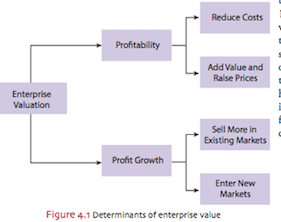
Soru 51
............ refers to an organization’s ability to respond to uncertainties by adjusting its objectives with the support of its superior knowledge and capabilities
Seçenekler
A
Efficiency
B
Exploratory learning
C
Strategic flexibility
D
Implementation
E
Diversity
Açıklama:
Strategic flexibility refers to an organization’s ability to respond to uncertainties by adjusting its objectives with the support of its superior knowledge and capabilities.
Soru 52
Which one below is generally known as the riskiest strategy among the Product-market strategies?
Seçenekler
A
diversification
B
market penetration
C
market development
D
product development
E
cost leadership
Açıklama:
The diversification strategy is generally known as the riskiest strategy in the matrix. This is because, according to diversification strategy, businesses change both their product mix and their markets (Ansoff, 1957: 114). Simultaneous changes in the market and product mix cause this strategy to be known as risky. One of the main factors that determine the level of risk is how far the business departs from the existing products and markets. In other words, when pursuing the diversification strategy, if the business does not entirely leave its products and markets, the risk level would be lower. However, businesses encounter a higher level of risks when they radically diversify their products and markets.
Soru 53
Which strategy below is a strategy that focuses on innovation and superior value creation instead of cost control?
Seçenekler
A
Low-cost
B
Uniqueness
C
Focus
D
Differentiation
E
Cost leadership
Açıklama:
Differentiation strategy is a strategy very different from the cost leadership strategy because it focuses on innovation and superior value creation instead of cost control.
Soru 54
Who lists four significant trends that must be considered in the current discussions about strategy, which are recognizing the changes in the field of strategy, the effects of globalization, the importance of timely response, the importance of innovation?
Seçenekler
A
Porter
B
Taylor
C
Prahalad
D
Ansof
E
Fayol
Açıklama:
Prahalad (1999) lists four significant trends that must be considered in the current discussions about strategy. 1. Recognizing the changes in the field of strategy: The deregulation and privatization of government-controlled industries, the rapidly changing technological environment, and access to new market opportunities in developing countries such as China, India, and Brazil and in transitioning economies such as those in Central and Eastern Europe offer businesses completely new strategic options and opportunities. Such an expansion provides businesses with new opportunities in the modern global economy. 2. Recognizing the effects of globalization: The globalization of business activities introduces new strategic opportunities and threats. Furthermore, although debatable, the distinction between domestic and international businesses has become obsolete. This is because , in today’s business environment, domestic businesses have to respond to the actions of global businesses in their local markets. Mass customization and quick-response strategies require international businesses to be responsive to local demands. 3. Recognizing the importance of timely response: Today’s competitive environment is so complex that even the validity of annual plans is in question. This is because organizations’ capability to deal with opportunities and threats mainly depends on how fast they take action for these opportunities and threats. 4. Recognizing the importance of innovation: Although innovation has been considered as one of the critical success factors of businesses, it has become increasingly important in today’s dynamic business environment. Successful businesses still have to innovate their products, services, and processes. Furthermore, current innovations are expected to provide businesses with timely, reliable, and quick information about their customers.
Soru 55
Which structure below centralizes all international operations and reduces the CEO’s burden of the direct operation of overseas subsidiaries and domestic operations?
Seçenekler
A
Matrix
B
International division
C
Global functional
D
Global area
E
Global product
Açıklama:
The international division structure centralizes all international operations. There are advantages and disadvantages of this structure. First, it reduces the CEO’s burden of the direct operation of overseas subsidiaries and domestic operations. Second, it creates a management team that prioritizes overseas operations. All information, authority, and decision making related to foreign efforts are channeled to this division, so there is one central clearing point for international activities.
Soru 56
Which structure is the one that is less commonly used by international businesses?
Seçenekler
A
global area
B
global functional
C
global product
D
matrix
E
hybrid
Açıklama:
Compared to the structure explained above, the global functional structure is less commonly used by international businesses. According to this structure, businesses are organized around the main functions performed by the business (Figure 4.10). For example, such an organizational structure may have departments such as marketing, finance, production, and R&D. It is important to note that these departments and functions vary from one organization to another.
Soru 57
Which organizational structure preferred by international businesses is depicted in the chart below?
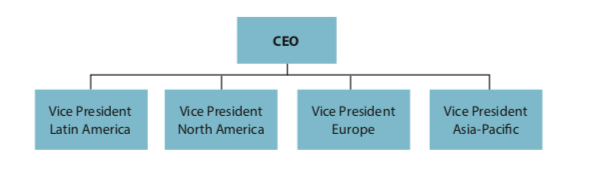
Seçenekler
A
International division
B
Global product
C
Global functional
D
Global area
E
Matrix
Açıklama:
Global area structure is a commonly preferred organizational structure by international businesses. When businesses operate in different geographical areas with different specifications, the global area structure offers a few advantages for international businesses. In this structure, businesses are organized around countries or country groups (Figure 4.9). The departments and divisions are responsible for the whole functions and products in a given geographical area.
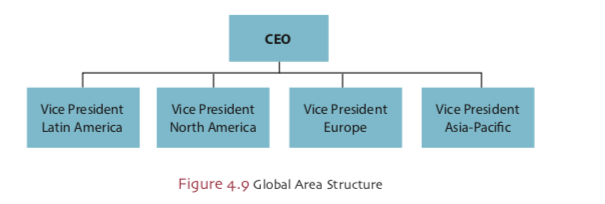
Soru 58
Which one below is one of the advantages of global functional structure?
Seçenekler
A
It is easier to establish a robust coordination mechanism.
B
The lines of responsibility are drawn both vertically and horizontally.
C
It enables an organization to focus on its capabilities and experiences.
D
Businesses can quickly respond to diversified regional needs and expectations.
E
It creates a management team that prioritizes overseas operations.
Açıklama:
There are advantages and disadvantages of global functional structure. The most important advantage of this structure is that it is a simple and lean structure. Thus, it is much easier to establish a robust coordination mechanism in global functional structures. It also supports and enhances specialization within the organization. It allows an easier and more effective career planning for the employees.
Soru 59
Which one below is not one of the disadvantages of matrix structure?
Seçenekler
A
The dual authority may cause problems for both employees and supervisors.
B
It is prone to communication problems.
C
It is a costly structure.
D
It may lead to problems in authority.
E
It is hard to achieve organizational goals.
Açıklama:
The matrix structure enables an organization to focus on its capabilities and experiences and share its resources between its divisions, which, in turn, leads to efficient use of organizational resources. Especially when the environmental conditions call for specialization, innovation, and meeting regional needs, the matrix structure could be an excellent organizational design option. On the other hand, there are a few disadvantages of the matrix structure. First, it may lead to problems in authority. The dual authority that is inherent in the matrix structure may cause problems for both employees and supervisors since subordinates report to two supervisors in the structure. When not appropriately managed, the matrix structure is prone to communication problems. Finally, the matrix structure is a costly structure. Offering constant training to the employees and supervisors, and establishing an effective communication system are the essential for a strong structure.
Ünite 5
Soru 1
Which factors affect the human resources management at the international level?
Seçenekler
A
The cultural, economic and political conditions in different countries, which affect human resources management at the international level.
B
International human resources management affects international relations.
C
United Nations decides on international human resources management.
D
Allocation and effective use are at the forefront of international human resources management.
E
Each country makes its own decision.
Açıklama:
There are many factors, including the cultural, economic and political conditions in different countries, which affect human resources management at the international level. Therefore, it is necessary to understand international human resources management in terms of its differences from domestic human resources management.
Soru 2
What does it mean to be an expat?
Seçenekler
A
An expat is an expert who is living in a foreign country
B
An expat is a person residing in a country other than their native country.
C
An expat is a person who spies in the favor of another country.
D
An expat is a person who was exiled to another country.
E
An expat is the one who strengthens the relations between the two countries.
Açıklama:
There are many professional employees, who are called expatriates (shortened as expats), working in a country other than their own.
Soru 3
What is the duty fulfilled by International Human Resource Management (HRM)
Seçenekler
A
The duty of International Human Resource Management (HRM) is to strengthen relationships.
B
Arranging the relationship and compliance with Laws and Regulation.
C
His duty includes the planning, recruiting and selecting, training and developing, evaluating, and retaining employees for the international operations of international companies.
D
The role of the International human resources management defends the rights of expats who are working abroad.
E
International human resources management is to organize relations between companies by strengthening their relations with countries.
Açıklama:
International human resources management (IHRM) refers to the planning, recruiting and selecting, training and developing, evaluating, and retaining employees for the international operations of international companies.
Soru 4
What is the first dimensions of International human resources management?
Seçenekler
A
The first dimensions of IHRM are employee group dimension as home- country, host-country, or other countries.
B
The first dimensions of IHRM are third country national and host country national.
C
The first dimensions of IHRM is to find a job their members at the international level.
D
The first dimensions of IHRM are recruitment and selection, training and development, performance appraisal and compensation, labor relations, leadership.
E
The first dimensions of IHRM is to achieve competitive advantage over competitors at national and international level.
Açıklama:
HRM is usually more complicated than domestic human resources management. In order to understand the complexity of IHRM, we need to understand its three dimensions. The different activities (i.e., recruitment and selection, training and development, performance appraisal and compensation, labor relations, leadership) which form the first dimension.
Soru 5
Why does HRM managers are greater risk exposure.
Seçenekler
A
They are lack of social security and universal health care?
B
They are lack of success.
C
They are lack of confidence.
D
They are lock of sanitary conditions.
E
Exposure to political risk and terrorism are major concerns for IHRM
Açıklama:
Greater risk exposure. Exposure to political risk and terrorism are major concerns for IHRM professionals and may require higher compensation and security arrangements for employees and their families.
Soru 6
What is an Ethnocentric approach?
Seçenekler
A
An ethnocentric approach when strategic decisions are made at the headquarters; and critical positions in both the domestic and foreign operations of an MNE are filled by personnel from the parent country.
B
Ethnocentric approach is an approach adopted by a firm wherein it adopts a marketing strategy across a group of countries.
C
Ethnocentrism lead to negative judgments of the behaviors of groups or host land.
D
Ehnocentrism lead to discrimination against people who are different.
E
Ethnocentric approach is the idea that a person's beliefs, values, and practices.
Açıklama:
An MNE is said to be following an ethnocentric approach when strategic decisions are made at the headquarters; and critical positions in both the domestic and foreign operations of an MNE are filled by personnel from the parent country (PCNs) with no or minimal autonomy delegated to the foreign subsidiaries.
Soru 7
In managing human resources at an international level, from which sources a company provides human resources?
Seçenekler
A
Employees can come from trade union.
B
Employees can come from three sources, from a parent (home) country, a host country, and a third country.
C
Employees can come from employment agency.
D
Employees can come from job search in international publishing.
E
Employees can come from employees of competitors.
Açıklama:
Employees can come from three sources, from a parent (home) country, a host country, and a third country.
Soru 8
What is the main reason for the companies use of ethnocentric staffing?
Seçenekler
A
The main reason for the companies is the cost of employees.
B
The main reason for ethnocentric staffing is the ability to adapt.
C
There is a shortage of brainpower in a particular country, preferably a shortage of people with the ideal mix of technical skills, experience with particular business methods.
D
The main reason for ethnocentric staffing is the limitations of the law.
E
The main reason for the companies uses of ethnocentric staffing in their experience.
Açıklama:
There is a shortage of brainpower in a particular country, preferably a shortage of people with the ideal mix of technical skills, experience with particular business methods.
Soru 9
What is the major drawback of polycentric staffing for MNEs?
Seçenekler
A
The major drawback of polycentric staffing is the limitations of the law.
B
The major drawback of polycentric staffing is the ability to adapt of the employe.
C
The major drawback of polycentric staffing is unwilling to use the employees experience.
D
To lose the control of the host country operation.
E
The major drawback of polycentric staffing for companies has difficulty in deciding.
Açıklama:
The major drawback of polycentric staffing is the potential for losing control of the host-country operation. When a company employs the natives of each country to manage local operations, it runs the risk of becoming a collection of loosely connected, largely autonomous national operations
Soru 10
What is the meaning of cultural assimilation?
Seçenekler
A
Cultural assimilation is an influx of many immigrants from a country.
B
Cultural assimilation takes affect over the host country on new social and economic characteristics.
C
Cultural assimilation is cross-cultural contact.
D
Cultural assimilation is employees with language fluency and in-depth experience in other countries.
E
Cultural assimilation teaches the culture’s values, attitudes, manners, and customs.
Açıklama:
Cultural assimilation teaches the culture’s values, attitudes, manners, and customs. The So-called guerrilla linguistics, which involves learning some phrases in the local language, is often used at this stage. It also typically includes role-play exercises. In a role-play exercise the trainee responds to a specific situation and is evaluated by a team of judges.
Soru 11
What is expatriation and repatriation?
Seçenekler
A
Expatriation and repatriation are to help them make the transition back to their home country.
B
Expatriation and repatriation are to refuse expatriate come back to home country
C
Expatriation and repatriation are not to eager expatriate come back to home country.
D
Expatriation and repatriation are due to high tax burden come back to home country.
E
Expatriation and repatriation are to develop conceptual skill of host country employees.
Açıklama:
A largely overlooked but critically important issue in the training and development of expatriate managers is to help them make the transition back to their home country.
Soru 12
What is the meaning of reverse culture shock.
Seçenekler
A
Reverse culture shock is an extreme homesickness.
B
Many employees experience the reverse culture shock upon returning home.
C
Reverse culture shock is an adaptation process.
D
Reverse culture shock is a training process.
E
Reverse culture shock is disorientation and isolation.
Açıklama:
Many employees experience what is called the reverse culture shock upon returning home. One reason for this to happen is that the expatriate and his/her family assume that things have stayed the same at home, while in fact, friends may have changed, moved; or new managers may have been hired along with new employees.
Soru 13
Which of the following is true regarding international human resources management (IHRM)?
Seçenekler
A
IHRM is usually less complicated than domestic human resources management.
B
Its dimensions are recruitment and selection dimension, training and development dimension, performance appraisal and compensation dimension.
C
IHRM professionals are less exposed to political risk and terrorism.
D
IHRM professionals are less involved in employees’ personal lives.
E
The mix of foreigners versus local employees drives the complexity of IHRM.
Açıklama:
Dowling, Festing, and Engle (2013) discussed six factors that drive the complexity of IHRM: new HR responsibilities, need for a broader perspective in compensation, greater involvement in personal lives of employees, the mix of foreigners versus locals, greater risk exposure, external influences of the government and national culture.
Soru 14
When strategic decisions are made at the headquarters and critical positions in both the domestic and foreign operations of an multinational enterprise (MNE) are filled by personnel from the parent country, the MNE is said to be following:
Seçenekler
A
A polycentric approach.
B
An ethnocentric approach.
C
A geocentric approach.
D
A multidomestic approach.
E
A regiocentric approach.
Açıklama:
A MNE is said to be following an ethnocentric approach when strategic decisions are made at the headquarters; and critical positions in both the domestic and foreign operations of an MNE are filled by personnel from the parent country (PCNs) with no or minimal autonomy delegated to the foreign subsidiaries. (Patel and Budhwar, 2017: 120). If it is difficult for an MNE to articulate, specify, or standardize its core competency, it becomes invaluable to post a home-country manager with direct experience in developing, applying, and protecting that core competency. Firms may pursue this policy because locally qualified people are not always available, especially in developing and newly industrialized countries.
Soru 15
One of the disadvantages of geocentric approach is that:
Seçenekler
A
Host governments can be discontent about HCNs not being employed in influential positions.
B
It only strives for optimal local solutions.
C
The headquarter managers are regarded to as more important and have more authority than the subsidiary managers.
D
It has a potential for losing control of the host-country operation.
E
A more centralized control of the staffing process has a longer lead time.
Açıklama:
Implementing a geocentric policy successfully requires more centralized control of the staffing process, which has a longer lead time than a short term solution. The subsidiary autonomy is lost, which may be resisted by the subsidiary (Patel and Budhwar, 2017: 122).
Soru 16
Which of these preparation methods that companies use to prepare their employees for an international assignment reflect an employee's highest level of international involvement?
Seçenekler
A
Language training.
B
Field experience.
C
Environmental briefing.
D
Cultural orientation.
E
Cultural assimilation.
Açıklama:
Companies use many methods to prepare their employees for an international assignment. These methods tend to reflect an employee’s level of international involvement, of which environmental briefings reflect the lowest and field experience the highest. Field experience means visiting the culture, walking the streets of its cities and villages, and becoming absorbed by it for a short time. This can also be thought of as practical training, which is aimed at helping the expatriate and his/her family ease themselves into daily life in the host country (Hill, 2013). If the family is not included in the training and the international assignment, the alternatives will be a commuter marriage or an expatriate failure which are psychologically and financially expensive options.
Soru 17
The training and development of expat managers to help them make the transition back to their home country is called:
Seçenekler
A
Sensitivity training.
B
Environmental briefing.
C
Repatriation.
D
Cultural orientation.
E
Compensation.
Açıklama:
A largely overlooked but critically important issue in the training and development of expatriate managers is to help them make the transition back to their home country. This training and development are called repatriation.
Soru 18
Hard criteria, which are used for international performance appraisal:
Seçenekler
A
Include expatriate’s leadership style.
B
Include expatriate’s teamwork performance.
C
Include factors that result from the situation in which performance occurs.
D
Include quantifiable factors which can be directly measured based on tangible outcomes.
E
Include judgments and consider factors which are based on traits or relationships.
Açıklama:
The criteria for performance appraisal are identified by Gregersen, Hite, and Black (1996) as: objective criteria, subjective criteria, and contextual criteria. Objective criteria (also defined as hard criteria) are about the quantifiable factors which can be directly measured based on tangible outcomes, such as market share, total revenues and return on investment.
Soru 19
“The provision of monetary and nonmonetary rewards, including base salary, benefits, perquisites, long and short-term incentives, valued by employees based on their relative contributions to MNE performance" is the definition for:
Seçenekler
A
International compensation.
B
Indirect financial payment.
C
Allowance.
D
Rater competence.
E
Rater bias.
Açıklama:
Employee compensation is defined as all forms of pay going to employees that arise from their employment. Compensation has two main components: direct financial payments and indirect financial payments. Direct financial payments include wages, salaries, incentives, commissions, and bonuses; whereas indirect financial payments include financial benefits like employer-paid insurance (Dessler, 2017: 346). International compensation is defined as “the provision of monetary and nonmonetary rewards, including base salary, benefits, perquisites, long and short-term incentives, valued by employees based on their relative contributions to MNE performance” (Fenwick, 2004: 308).
Soru 20
Which of the following is true regarding the 'going rate approach' that MNEs use to compensate their employes?
Seçenekler
A
Its basis is maintaining relativities with parent country national colleagues and preserving parity of purchasing power.
B
Four groups of expenses are covered: income taxes, housing, goods and services, and discretionary expenses.
C
The base salary of the international assignee is linked to the salary structure in the host country.
D
It has the advantage of facilitation of expatriate reentry.
E
It may result in vast disparities between expatriates and local nationals.
Açıklama:
With the going-rate approach, the base salary of the international assignee is linked to the salary structure in the host country, and MNEs usually supplement the base pay with additional payments and benefits in case the location is in a low-pay country. The advantages of this approach include equality with local nationals, simplicity, identification with host country and equity among different nationalities. There are also disadvantages of the approach. They include variation between assignments for the same employee, variation between expatriates of the same nationality in different countries, and potential reentry problems
Soru 21
Which of the following is not one of the objectives of international compensation policies of MNEs?
Seçenekler
A
Attraction and retention of the best qualified talent to staff the MNE in all of its locations.
B
Facilitation of transfers between the various employment locations within the MNE.
C
Maintenance of compensation that is reasonable concerning the practices of competitors yet minimizing costs to the extent possible.
D
Attraction and retention of employees who are qualified for international assignments.
E
Variation between expatriates of the same nationality in different countries and equality with local nationals.
Açıklama:
There are also several objectives of international compensation policies of MNEs, which are stated below (Briscoe, Schuler, and Tarique, 2012): Attraction and retention of the bestqualified talent to staff the MNE in all of its locations; attraction and retention of employees who are qualified for international assignments; facilitation of transfers between the various employment locations within the MNE; establishment and maintenance of a consistent and reasonable relationship between the compensation of employees at home and abroad; maintenance of compensation that is reasonable concerning the practices of competitors yet minimizing costs to the extent possible.
Soru 22
Which of the following is not one of the four basic components that national industrial relations system consists of according to Dunlop (1958: 16)?
Seçenekler
A
Actors.
B
Rules.
C
Ideology.
D
Performance appraisal.
E
Environmental context.
Açıklama:
According to Dunlop (1958: 16), a national industrial relations system consists of four basic components, which are actors or parties (employees, employers, government), rules (both substantive and procedural resulting from mutual cooperation and oppositions between actors), an ideology (which binds separate actors one another) and the environmental context .
Soru 23
- It is not easy to manage human resources because employees come into companies with different educational backgrounds, occupations, motivation, gender identities, ages, and other various demographic and occupational features.
- As firms go global, finding, managing, and retaining human resources become especially challenging because all of those activities become more complicated within the actual reality of different national cultures and ways of doing business in those cultures.
- International human resources management (IHRM) refers to the planning, recruiting and selecting, training and developing, evaluating, and retaining employees for the international operations of international companies.
- A multinational enterprise (MNE), also called a multinational corporation (MNC), is “a company that produces goods or delivers services in more than one country.”
- A multinational enterprise has its management headquarters in one (or rarely more than one) country, namely the home country (parent country), while also operating in other countries, namely the host countries.
- International human resources managers, usually located at corporate or regional headquarters at the home country, support subsidiary (host country) managers by providing IHRM guidelines and by finding, training, and evaluating employees for international operations.
Seçenekler
A
I and II
B
III, IV and V
C
II, III, IV and VI
D
I, II, III, IV and VI
E
I, II, III, IV, V and VI
Açıklama:
It is not easy to manage human resources because employees come into companies with different educational backgrounds, occupations, motivation, gender identities, ages, and other various demographic and occupational features. On top of these, as firms go global, finding, managing, and retaining human resources become especially challenging because all of those activities become more complicated within the actual reality of different national cultures and ways of doing business in those cultures. Therefore, we need to define and understand international human resources management if we are to understand the business done on an international level.
International human resources management (IHRM) refers to the planning, recruiting and selecting, training and developing, evaluating, and retaining employees for the international operations of international companies. In this chapter, international companies will be referred to as multinational enterprises. A multinational enterprise (MNE), also called a multinational corporation (MNC), is “a company that produces goods or delivers services in more than one country.” A multinational enterprise has its management headquarters in one (or rarely more than one) country, namely the home country (parent country), while also operating in other countries, namely the host countries (Eurostat, 2019). International human resources managers, usually located at corporate or regional headquarters at the home country, support subsidiary (host country) managers by providing IHRM guidelines and by finding, training, and evaluating employees for international operations.
As also understood from the information given, the answer is E. All of the statements above related to international human resources management are correct.
International human resources management (IHRM) refers to the planning, recruiting and selecting, training and developing, evaluating, and retaining employees for the international operations of international companies. In this chapter, international companies will be referred to as multinational enterprises. A multinational enterprise (MNE), also called a multinational corporation (MNC), is “a company that produces goods or delivers services in more than one country.” A multinational enterprise has its management headquarters in one (or rarely more than one) country, namely the home country (parent country), while also operating in other countries, namely the host countries (Eurostat, 2019). International human resources managers, usually located at corporate or regional headquarters at the home country, support subsidiary (host country) managers by providing IHRM guidelines and by finding, training, and evaluating employees for international operations.
As also understood from the information given, the answer is E. All of the statements above related to international human resources management are correct.
Soru 24
- Awareness of cultural differences is essential for international human resources managers.
- IHRM is usually more complicated than domestic human resources management.
- In order to understand the complexity of IHRM, we need to understand its three dimensions: activity dimension, regional dimension, and employee-group dimension.
- IHRM consists of different activities (i.e., recruitment and selection, training and development, performance appraisal and compensation, labor relations, leadership) which form the first dimension.
- The second dimension is related to the regional aspect which includes whether HRM is carried out in the homecountry, host-country, or other countries.
- The third dimension is concerned with different employee groups, i.e., whether they are homecountry nationals, host-country nationals, or from other countries (third-country nationals)
Seçenekler
A
I and II
B
I, III and IV
C
IV, V and VI
D
I, II, III, V and VI
E
I, II, III, IV, V and VI
Açıklama:
Awareness of cultural differences is essential for international human resources managers.
IHRM is usually more complicated than domestic human resources management. In order to understand the complexity of IHRM, we need to understand its three dimensions. The dimensions of IHRM are activity dimension, regional dimension, and employee-group dimension. IHRM consists of different activities (i.e., recruitment and selection, training and development, performance appraisal and compensation, labor relations, leadership) which form the first dimension. The second dimension is related to the regional aspect which includes whether HRM is carried out in the homecountry, host-country, or other countries; and the third dimension is concerned with different employee groups, i.e., whether they are homecountry nationals, host-country nationals, or from other countries (third-country nationals) (Morgan, 1986; Morschett, Schramm-Klein, and Zentes, 2015).
As also understood from the information given, the answer is E. All of the statements related to international human resources management in the options are correct.
IHRM is usually more complicated than domestic human resources management. In order to understand the complexity of IHRM, we need to understand its three dimensions. The dimensions of IHRM are activity dimension, regional dimension, and employee-group dimension. IHRM consists of different activities (i.e., recruitment and selection, training and development, performance appraisal and compensation, labor relations, leadership) which form the first dimension. The second dimension is related to the regional aspect which includes whether HRM is carried out in the homecountry, host-country, or other countries; and the third dimension is concerned with different employee groups, i.e., whether they are homecountry nationals, host-country nationals, or from other countries (third-country nationals) (Morgan, 1986; Morschett, Schramm-Klein, and Zentes, 2015).
As also understood from the information given, the answer is E. All of the statements related to international human resources management in the options are correct.
Soru 25
- Recruitment and Selection
- Training and Development
- Performance appraisal and compensation
- Labor relations
- Leadership
Seçenekler
A
I and II
B
I and III
C
II, III and IV
D
I, III, IV and V
E
I, II, III, IV and V
Açıklama:
Awareness of cultural differences is essential for international human resources managers.
IHRM is usually more complicated than domestic human resources management. In order to understand the complexity of IHRM, we need to understand its three dimensions. The dimensions of IHRM are activity dimension, regional dimension, and employee-group dimension. IHRM consists of different activities (i.e., recruitment and selection, training and development, performance appraisal and compensation, labor relations, leadership) which form the first dimension. The second dimension is related to the regional aspect which includes whether HRM is carried out in the homecountry, host-country, or other countries; and the third dimension is concerned with different employee groups, i.e., whether they are homecountry nationals, host-country nationals, or from other countries (third-country nationals) (Morgan, 1986; Morschett, Schramm-Klein, and Zentes, 2015).
As also understood from the information given, the answer is E. All of them are related to activity dimension of international human resources management.
IHRM is usually more complicated than domestic human resources management. In order to understand the complexity of IHRM, we need to understand its three dimensions. The dimensions of IHRM are activity dimension, regional dimension, and employee-group dimension. IHRM consists of different activities (i.e., recruitment and selection, training and development, performance appraisal and compensation, labor relations, leadership) which form the first dimension. The second dimension is related to the regional aspect which includes whether HRM is carried out in the homecountry, host-country, or other countries; and the third dimension is concerned with different employee groups, i.e., whether they are homecountry nationals, host-country nationals, or from other countries (third-country nationals) (Morgan, 1986; Morschett, Schramm-Klein, and Zentes, 2015).
As also understood from the information given, the answer is E. All of them are related to activity dimension of international human resources management.
Soru 26
- New HR responsibilities
- The need for an international perspective in compensation policy
- Greater involvement in employees’ personal lives
- The mix of foreigners versus locals
- Greater risk exposure
- External influences of the government and national culture
Seçenekler
A
I and II
B
II, III and IV
C
III, IV, V and VI
D
I, II, IV, V and VI
E
I, II, III, IV, V and VI
Açıklama:
Based on these dimensions, Dowling, Festing, and Engle (2013) discussed six factors that drive the complexity of IHRM; these factors are as follows:
- New HR responsibilities
- The need for an international perspective in compensation policy
- Greater involvement in employees’ personal lives
- The mix of foreigners versus locals
- Greater risk exposure
- External influences of the government and national culture
Soru 27
- In managing human resources at an international level, the first decision will be about where the employees for various positions should come from.
- Employees can come from three sources: a parent (home) country, a host country, and a third country.
- A parent country is a country in which the company’s corporate headquarters is located. For example, Turkey is the parent country of TAV Construction.
- A host country is a country in which the parent country organization seeks to - or has already located - a facility.
- A third country is a country other than the host country or the parent country; and the company in question may or may not have a facility there.
Seçenekler
A
I and II
B
II, III and IV
C
III, IV and V
D
I, II, IV and V
E
I, II, III, IV and V
Açıklama:
In managing human resources at an international level, the first decision will be about where the employees for various positions should come from. Employees can come from three sources: (1) a parent (home) country, (2) a host country, and (3) a third country. A parent country is a country in which the company’s corporate headquarters is located. For example, Turkey is the parent country of TAV Construction. A host country is a country in which the parent country organization seeks to - or has already located - a facility. A third country is a country other than the host country or the parent country; and the company in question may or may not have a facility there (Noe, Hollenbeck, Gerhart and Wright, 2019: 658).
As also understood from the information given, the answer is E. All of the statements in the options related to staffing at international level are correct.
As also understood from the information given, the answer is E. All of the statements in the options related to staffing at international level are correct.
Soru 28
- Employees can come from three sources: a parent (home) country, a host country, and a third country.
- Parent-country nationals (PCNs) are employees who were born and live in the parent (home) country.
- Host-country nationals (HCNs) are those employees who were born and raised in the host country.
- Third-country nationals (TCNs) are employees who were born in a country other than the parent and host countries but work in the host country.
- For instance, a Turkish employee working for a French MNE in Germany can be considered a TCN.
Seçenekler
A
I and II
B
I and V
C
I, II and III
D
I, II, III and IV
E
I, II, III, IV and V
Açıklama:
In managing human resources at an international level, the first decision will be about where the employees for various positions should come from. Employees can come from three sources: (1) a parent (home) country, (2) a host country, and (3) a third country. A parent country is a country in which the company’s corporate headquarters is located. For example, Turkey is the parent country of TAV Construction. A host country is a country in which the parent country organization seeks to - or has already located - a facility. A third country is a country other than the host country or the parent country; and the company in question may or may not have a facility there (Noe, Hollenbeck, Gerhart and Wright, 2019: 658).
Then, based on the above classification, employees are categorized as: (a) parent-country (home-country) nationals, (b) host-country nationals, and (c) third-country nationals. Parent-country nationals (PCNs) are employees who were born and live in the parent (home) country. Host-country nationals (HCNs) are those employees who were born and raised in the host country. Third-country nationals (TCNs) are employees who were born in a country other than the parent and host countries but work in the host country. For instance, a Turkish employee working for a French MNE in Germany can be considered a TCN.
As also understood from the information given, the answer is E. All of the statements above related to staffing at international level are correct.
Then, based on the above classification, employees are categorized as: (a) parent-country (home-country) nationals, (b) host-country nationals, and (c) third-country nationals. Parent-country nationals (PCNs) are employees who were born and live in the parent (home) country. Host-country nationals (HCNs) are those employees who were born and raised in the host country. Third-country nationals (TCNs) are employees who were born in a country other than the parent and host countries but work in the host country. For instance, a Turkish employee working for a French MNE in Germany can be considered a TCN.
As also understood from the information given, the answer is E. All of the statements above related to staffing at international level are correct.
Soru 29
- The ethnocentric approach
- The polycentric approach
- The geocentric approach
- The regiocentric approach
Seçenekler
A
I and II
B
I and III
C
II and III
D
I, II and III
E
I, II, III and IV
Açıklama:
In filling the positions at MNEs, each category of employees has its advantages and disadvantages. The preference of one category over the others is determined by the approach to human resources management in the MNE. Following the footsteps of Chakravarthy and Perlmutter (1985), four global strategies of MNEs are described next, together with the approaches they bring to staffing. These include ethnocentric, polycentric, geocentric, and regiocentric approaches. (Daniels, Radebaugh and Sullivan, 2015; Deresky, 2017; Geringer, McNett, Minor and Ball, 2016; Hill, 2013; Patel and Budhwar, 2017; Peng, 2011; Wild and Wild, 2016).
The Ethnocentric Approach: An MNE is said to be following an ethnocentric approach when strategic decisions are made at the headquarters; and critical positions in both the domestic and foreign operations of an MNE are filled by personnel from the parent country (PCNs) with no or minimal autonomy delegated to the foreign subsidiaries. (Patel and Budhwar, 2017: 120).
The Polycentric Approach: When an MNE treats each subsidiary as a distinct national entity, it is said to be adopting a polycentric approach. Acknowledging that the business environment and business practices in another country are different from those at the home country, the host country operation will be allowed more decision-making autonomy and will be staffed primarily by HCNs. This approach overcomes some of the shortcomings of the ethnocentric approach. Some MNEs use this approach in East Asia, Australia, and other markets that are deemed too expensive to staff with expatriates (Luthans and Doh, 2018).
The Geocentric Approach: While the polycentric attitude strives for optimal local solutions, this might be sub-optimal for the whole organization. MNEs which think more globally in terms of their operations, recognizing that each part (subsidiaries and headquarters) makes a unique contribution with its unique competence are said to pursue a geocentric approach to staffing (Patel and Budhwar, 2017: 121). Here, all the subsidiary managers are regarded as equal to those at the headquarters. IBM is an excellent example of an MNE attempting to use such an approach (Luthans and Doh, 2018).
The Regiocentric Approach: The regiocentric approach is a mix between the polycentric and the geocentric approaches. With the assumption that adaptation within regions is more comfortable than between regions (Morschett, Schramm-Klein, and Zentes, 2015: 512), the MNE divides its operations into geographic regions and moves staff within particular regions, e.g., Europe, America, Asia, rather than between regions. For example, countries from the Middle East are staffed with managers from the Middle East but not necessarily from the same country. Here, reliance on the regional group cooperation of the local managers takes precedence, and the regions operate relatively independently from one another. It will not be easy for the regional managers to be promoted to headquarters positions, but they can enjoy a certain degree of regional autonomy in decision making (Luthans and Doh, 2018; Patel and Budhwar, 2017).
As also understood from the information given, the answer is E. All of them are the global strategies and the approaches of multinational enterprises (MNEs) they bring to staffing.
The Ethnocentric Approach: An MNE is said to be following an ethnocentric approach when strategic decisions are made at the headquarters; and critical positions in both the domestic and foreign operations of an MNE are filled by personnel from the parent country (PCNs) with no or minimal autonomy delegated to the foreign subsidiaries. (Patel and Budhwar, 2017: 120).
The Polycentric Approach: When an MNE treats each subsidiary as a distinct national entity, it is said to be adopting a polycentric approach. Acknowledging that the business environment and business practices in another country are different from those at the home country, the host country operation will be allowed more decision-making autonomy and will be staffed primarily by HCNs. This approach overcomes some of the shortcomings of the ethnocentric approach. Some MNEs use this approach in East Asia, Australia, and other markets that are deemed too expensive to staff with expatriates (Luthans and Doh, 2018).
The Geocentric Approach: While the polycentric attitude strives for optimal local solutions, this might be sub-optimal for the whole organization. MNEs which think more globally in terms of their operations, recognizing that each part (subsidiaries and headquarters) makes a unique contribution with its unique competence are said to pursue a geocentric approach to staffing (Patel and Budhwar, 2017: 121). Here, all the subsidiary managers are regarded as equal to those at the headquarters. IBM is an excellent example of an MNE attempting to use such an approach (Luthans and Doh, 2018).
The Regiocentric Approach: The regiocentric approach is a mix between the polycentric and the geocentric approaches. With the assumption that adaptation within regions is more comfortable than between regions (Morschett, Schramm-Klein, and Zentes, 2015: 512), the MNE divides its operations into geographic regions and moves staff within particular regions, e.g., Europe, America, Asia, rather than between regions. For example, countries from the Middle East are staffed with managers from the Middle East but not necessarily from the same country. Here, reliance on the regional group cooperation of the local managers takes precedence, and the regions operate relatively independently from one another. It will not be easy for the regional managers to be promoted to headquarters positions, but they can enjoy a certain degree of regional autonomy in decision making (Luthans and Doh, 2018; Patel and Budhwar, 2017).
As also understood from the information given, the answer is E. All of them are the global strategies and the approaches of multinational enterprises (MNEs) they bring to staffing.
Soru 30
- Relocating managers from the home country is usually expensive.
- Being away from friends and relatives can be a severe source of stress for the parent countries (PCNs).
- The more the host country’s culture is different from the home country’s culture, the more it puts pressure on the parent country (PCN).
- Host governments can be discontent about this practice if they expect the MNE to employ locals in positions at any level.
Seçenekler
A
I and II
B
I and III
C
II and IV
D
I, III and IV
E
I, II, III and IV
Açıklama:
Despite its advantages, ethnocentric staffing has its negative aspects too. Firstly, relocating managers from the home country is usually expensive. The bonuses that managers often demand and/or receive for relocating, plus relocation expenses for entire families, can increase the cost of a manager several times over. These high compensation packages can also lead to resentment among the HCNs with whom they are working. Secondly, being away from friends and relatives can be a severe source of stress for the PCNs. Thirdly, the more the host country’s culture is different from the home country’s culture, the more it puts pressure on the PCN. On the way to adapting to a new culture, poor decisions can be made because of not understanding the local customers and the needs of lower-level employees who are typically HCNs. Lastly, host governments can be discontent about this practice if they expect the MNE to employ locals in positions at any level. This disappointment may lead those governments to impose specific immigration laws and workplace regulations to force the MNE to hire locals.
As also understood from the information given, the answer is E. All of them are the negative aspects of ethnocentric staffing.
As also understood from the information given, the answer is E. All of them are the negative aspects of ethnocentric staffing.
Soru 31
- Field Experience
- Language Training
- Sensitivity Training
- Cultural Assimilations
- Cultural Orientations
- Environmental Briefings
Seçenekler
A
I and II
B
III, IV and V
C
II, III, IV and V
D
I, II, III, V and VI
E
I, II, III, IV, V and VI
Açıklama:
Companies whose activities are highly international need employees with language fluency and in-depth experience in other countries. Meanwhile, small companies or those new to international business can begin with some basic cultural training. As a company increases its international involvement and cross-cultural contact, employees’ cultural knowledge must keep pace. Companies use many methods to prepare their employees for an international assignment. International assignment preparation methods are as follows:
- Field Experience
- Language Training
- Sensitivity Training
- Cultural Assimilations
- Cultural Orientations
- Environmental Briefings
- Environmental Briefings and Cultural Orientations: Environmental (area) briefings constitute the most basic level of training-often the starting point for studying other cultures. Briefings include information on local housing, health care, transportation, schools, and climate. Such knowledge is generally obtained from books, films, and lectures. Cultural orientations offer insight into social (i.e., history, religion, etiquette, food, and arts) (open textbook on HRM, 2016), political, legal, and economic institutions. Their purpose is to add depth and substance to environmental briefings.
- Cultural Assimilation and Sensitivity Training: Cultural assimilation teaches the culture’s values, attitudes, manners, and customs. The So-called guerrilla linguistics, which involves learning some phrases in the local language, is often used at this stage. It also typically includes role-play exercises. In a role-play exercise the trainee responds to a specific situation and is evaluated by a team of judges. This method is often used when someone is given little notice of a short stay abroad and wishes to take a crash course in social and business etiquette and communication. Sensitivity training teaches people to be considerate and understanding of other people’s feelings and emotions. It gets the trainee under the skin of the local people.
- Language Training: English is the language of world business, and it is quite possible to conduct business all over the world by using only English. Notwithstanding the prevalence of English, however, exclusive reliance on English diminishes an expatriate manager’s ability to interact with hostcountry nationals. A willingness to communicate in the language of the host country, even if the expatriate is far from fluent, can help build rapport with local employees and improve the manager’s effectiveness. The level of language training entails more than memorizing phrases for ordering dinner or asking directions. It gets the trainee into the mind of the local people. The trainee learns more about why the local people behave as they do. This is perhaps the most critical part of the cultural training for long-term assignments. Firms that offer foreign language training for expatriates believe that it improves their employees’ effectiveness and enables them to relate more quickly to a foreign culture, which fosters a better image of the firm in the host country (Hill, 2013).
- Field Experience: Field experience means visiting the culture, walking the streets of its cities and villages, and becoming absorbed by it for a short time. This can also be thought of as practical training, which is aimed at helping the expatriate and his/her family ease themselves into daily life in the host country (Hill, 2013). If the family is not included in the training and the international assignment, the alternatives will be a commuter marriage or an expatriate failure which are psychologically and financially expensive options (Wild and Wild, 2016). The sooner the expatriate and his/her family establish a routine, the better the chances are that they will adapt successfully. One critical need is - a support network of friends for the expatriate. Where an expatriate community exists, firms often devote considerable effort to ensuring that the new expatriate family is quickly integrated into that group. The expatriate community can be a useful source of support and information, which can be invaluable in helping the family adapt to a foreign culture (Hill, 2013).
Soru 32
- Provide feedback to employees, so they will know where they stand.
- Develop valid data for pay, promotion, and job assignment decisions, and provide a means of communicating these decisions.
- Identify high-potential employees and manage their talent for optimal performance and retention.
- Help management in making discharge and retention decisions and provide a means of warning employees about unsatisfactory performance.
Seçenekler
A
I and II
B
I and III
C
III and IV
D
I, III and IV
E
I, II, III and IV
Açıklama:
Due to the effect of international performance management on organizational performance, it is evident that an effective and systematic performance appraisal is required for expatriates and foreign managers besides local employees. For that, MNEs pay attention to the purposes of performance management and typically to purposes of performance appraisal. According to Briscoe et al. (2012: 345), two broad purposes of performance appraisal consist of evaluation goals and development goals:
Evaluation Goals
Evaluation Goals
- Provide feedback to employees, so they will know where they stand.
- Develop valid data for pay, promotion, and job assignment decisions, and provide a means of communicating these decisions.
- Identify high-potential employees and manage their talent for optimal performance and retention.
- Help management in making discharge and retention decisions and provide a means of warning employees about unsatisfactory performance.
- Help managers improve their performance and develop future potential.
- Develop a commitment to the company through a discussion of career opportunities and career planning with the manager.
- Motivate employees via recognition of their efforts.
- Diagnose individual and organizational
- Identify individual training and development needs.
Soru 33
- Parent nationality
- Labour market characteristics
- Local culture
- Home & host country governments’ roles
- Industry type
- Competitors’ strategies
Seçenekler
A
I, II and III
B
III, IV and V
C
II, III, IV and V
D
I, II, III, V and VI
E
I, II, III, IV, V and VI
Açıklama:
Fenwick (2004: 311) classified the internal and external factors that influence the international compensation policy of MNEs:
MNC internal environment
According to the author, the identified internal and external environments of MNEs would largely determine their adopted staffing orientations (either, ethnocentric, geocentric or polycentric); and the nature of the international compensation will vary in accordance with MNEs staffing orientations.
MNC internal environment
- Goal orientation
- Capacity to pay
- Competitive strategy
- Organizational culture
- Internal workforce composition
- Labour relations
- Subsidiary role
- Parent nationality
- Labour market characteristics
- Local culture
- Home & host country governments’ roles
- Industry type
- Competitors’ strategies
According to the author, the identified internal and external environments of MNEs would largely determine their adopted staffing orientations (either, ethnocentric, geocentric or polycentric); and the nature of the international compensation will vary in accordance with MNEs staffing orientations.
Soru 34
- Industrial relations cover all aspects of employment relationships with particular attention to labor and management relations.
- Industrial relations is a broad concept encompassing many relations regarding the workplace.
- Kaufman classifies industrial relations under two distinct paradigms; the Original Paradigm and the Modern Paradigm.
- The Original Paradigm focuses on employment relations.
- The Modern Paradigm focuses on unions and labor management relations.
Seçenekler
A
I and II
B
I, IV and V
C
II, III and IV
D
I, III, IV and V
E
I, II, III, IV and V
Açıklama:
Industrial relations cover all aspects of employment relationships with particular attention to labor and management relations (Katz, 1988). Industrial relations is a broad concept encompassing many relations regarding the workplace. Kaufman (2008) classifies industrial relations under two distinct paradigms; the Original Paradigm and the Modern Paradigm. The Original Paradigm focuses on employment relations, and the Modern Paradigm focuses on unions and labor management relations. According to Dunlop (1958: 16), a national industrial relations system consists of four basic components (Figure 5.6), which are actors or parties (employees, employers, government), rules (both substantive and procedural resulting from mutual cooperation and oppositions between actors), an ideology (which binds separate actors one another), and the environmental context (as cited by Rahim, 2011: 66).
As also understood from the information given, the answer is E. All of the statements related to international industrial relations in the options are correct.
As also understood from the information given, the answer is E. All of the statements related to international industrial relations in the options are correct.
Soru 35
I. Activity dimension II. Market dimension III.Regional dimension Which of the following includes international human resources management (IHRM) dimensions?
Seçenekler
A
Only I
B
Only II
C
I and II
D
I and III
E
I, II, and III
Açıklama:
IHRM is usually more complicated than domestic human resources management. In order to understand the complexity of IHRM, we need to understand its three dimensions. The dimensions of IHRM are activity dimension, regional dimension, and employee-group dimension. IHRM consists of different activities (i.e., recruitment and selection, training and development, performance appraisal and compensation, labor relations, leadership) which form the first dimension. The second dimension is related to the regional aspect which includes whether HRM is carried out in the home country, host-country, or other countries; and the third dimension is concerned with different employee groups, i.e., whether they are homecountry nationals, host-country nationals, or from other countries (third-country nationals) (Morgan, 1986;Morschett, Schramm-Klein, and Zentes, 2015)
Soru 36
Which of the following is not a factor that drives the complexity of international human resources management?
Seçenekler
A
External influences of the government
B
External influences of national culture
C
The need for defining the positioning of the products
D
The mix of foreigners versus locals
E
The need for an international compensation policy
Açıklama:
External influences of the government and national culture: Employees must be hired, evaluated, and compensated in ways consistent with the country and regional customs and regulations. Laws govern work hours, the firm’s ability to dismiss or lay off employees, and severance compensation. These regional customs and regulations are frequent challenges in large MNEs.
The mix of foreigners versus locals: Foreign subsidiaries are frequently staffed from the home country, the host country, and/or
third countries. The mix of staff depends on several factors, including the international experience of the firm, the cost of living in a foreign location, and the availability of qualified local staff. As a result, the mix of foreigners and locals complicate IHRM.
The need for an international compensation policy: Proper
compensation packages become an issue, especially when there are higher costs of living in the host countries. Compensation packages may need to include allowances for housing, education, and other facilities
that are not readily available in the host country. Establishing a fair and comparable compensation scale, regardless of nationality, is a frequent challenge in large MNEs.
The need for defining the positioning of the product: Defining the positioning of the product is not within the scope of IHRM function. It is an issue within the scope of the marketing function.
The mix of foreigners versus locals: Foreign subsidiaries are frequently staffed from the home country, the host country, and/or
third countries. The mix of staff depends on several factors, including the international experience of the firm, the cost of living in a foreign location, and the availability of qualified local staff. As a result, the mix of foreigners and locals complicate IHRM.
The need for an international compensation policy: Proper
compensation packages become an issue, especially when there are higher costs of living in the host countries. Compensation packages may need to include allowances for housing, education, and other facilities
that are not readily available in the host country. Establishing a fair and comparable compensation scale, regardless of nationality, is a frequent challenge in large MNEs.
The need for defining the positioning of the product: Defining the positioning of the product is not within the scope of IHRM function. It is an issue within the scope of the marketing function.
Soru 37
I. Parent-country nationals
II. Host-country nationals
III.Third-country nationals
Which category of employees are hired according to ethnocentric approach?
II. Host-country nationals
III.Third-country nationals
Which category of employees are hired according to ethnocentric approach?
Seçenekler
A
Only I
B
Only II
C
Only III
D
I and II
E
I and III
Açıklama:
An MNE is said to be following an ethnocentric approach when strategic decisions are made at the headquarters; and critical positions in both
the domestic and foreign operations of an MNE are filled by personnel from the parent country (PCNs) with no or minimal autonomy delegated
to the foreign subsidiaries. (Patel and Budhwar, 2017: 120).
the domestic and foreign operations of an MNE are filled by personnel from the parent country (PCNs) with no or minimal autonomy delegated
to the foreign subsidiaries. (Patel and Budhwar, 2017: 120).
Soru 38
Which approach emphasizes interdependencies and strives for a collaborative approach between the headquarters and subsidiaries in terms of staffing?
Seçenekler
A
Ethnocentric approach
B
Market rate approach
C
Polycentric approach
D
Geocentric approach
E
Regiocentric approach
Açıklama:
Aiming for an optimal allocation and synergy effects, the geocentric approach emphasizes interdependencies and strives for a collaborative
approach between the headquarters and subsidiaries as well as among subsidiaries. With a geocentric staffing policy, the HRM strategy tends
to be consistent across all subsidiaries, utilizing the best people for all the critical jobs throughout the organization, whatever their nationality is or whatever the geographical location of the post to be filled is. In other words, the local operation may choose PCNs, HCNs, or TCNs depending on the operation’s specific needs according to geocentric approach.
approach between the headquarters and subsidiaries as well as among subsidiaries. With a geocentric staffing policy, the HRM strategy tends
to be consistent across all subsidiaries, utilizing the best people for all the critical jobs throughout the organization, whatever their nationality is or whatever the geographical location of the post to be filled is. In other words, the local operation may choose PCNs, HCNs, or TCNs depending on the operation’s specific needs according to geocentric approach.
Soru 39
What type of training and development will international employees undergo to avoid reverse culture shock?
Seçenekler
A
Cultural training
B
Repatriation of expatriates
C
Management development
D
Training and developing the host-country nationals
E
Training and developing the third-country nationals
Açıklama:
Many international employees experience what is called the reverse culture shock upon returning home. One reason for this to happen is that the expatriate and his/her family assume that things have stayed the same at home, while in fact, friends may have changed, moved; or new managers may have been hired along with new employees. Thus, a training and development called repatriation is undertaken to help expatriate managers make the transition back to their home country.
Soru 40
Which of the following is a development goal of international performance appraisal?
Seçenekler
A
Provide feedback to employees, so they will know where they stand
B
Identify high-potential employees
C
Help management in making discharge and retention decisions
D
Provide a means of warning employees about unsatisfactory
performance
performance
E
Diagnose individual and organizational problems
Açıklama:
Two broad purposes of international performance appraisal consist of evaluation goals and development goals: Diagnosing individual and organizational problems is a development goal. On the other hand, evaluation goals include providing feedback to employees, so they will know where they stand; identifying high-potential employees; helping management in making discharge and retention decisions; and providing a means of warning employees about unsatisfactory
performance.
performance.
Soru 41
Which of the following is not a contextual factor in determining international compensation policy?
Seçenekler
A
Home and host country governments‘ roles
B
Different standards of living
C
Internal workforce composition
D
Labour market characteristics
E
Competitors‘ strategies
Açıklama:
Internal workforce composition is an organizational or an MNC internal
environment factor in determining international compensation policy.
environment factor in determining international compensation policy.
Soru 42
I. Compensation is related to how much home-country expatriates should be paid in ethnocentric companies. II. The pay can and should be kept country-specific in polycentric companies. III. There is a need for a cadre of international managers that may include many different nationalities in geocentric companies. Which of the following is correct about international compensation management?
Seçenekler
A
Only I
B
Only II
C
I and II
D
I and III
E
I, II, and III
Açıklama:
For ethnocentric companies, compensation is related to how much home-country expatriates should be paid; and for polycentric companies, the pay can and should be kept country-specific. For
companies with geocentric staffing policies, there is a need for a cadre of international managers that may include many different nationalities. If all the members of the same cadre are paid the same salary and incentives, it would be expensive for MNEs. For example, foreign nationals should be paid at the U.S. compensation levels if the company is based in the U.S.A.
companies with geocentric staffing policies, there is a need for a cadre of international managers that may include many different nationalities. If all the members of the same cadre are paid the same salary and incentives, it would be expensive for MNEs. For example, foreign nationals should be paid at the U.S. compensation levels if the company is based in the U.S.A.
Soru 43
Which of the following is not an actor in industrial relations of international business?
Seçenekler
A
International product market
B
Multinational enterprise management
C
Workers in the international company
D
Local government
E
Local trade unions
Açıklama:
International product market may be a factor which influences industrial relations, but it is not actor of industrial relations.
Soru 44
Which of the following best describes industrial relations?
Seçenekler
A
Process of the planning, recruiting and selecting, training and developing, evaluating, and retaining employees
B
A broad concept covering all aspects of employment relationships with particular attention to labor and management relations
C
An approach when strategic decisions are made at the headquarters; and critical positions in both the domestic and foreign operations of an MNE are filled by personnel from the parent country
D
Professional employees working in a country other than their own
E
All forms of pay going to employees that arise from their employment
Açıklama:
First of all, process of the planning, recruiting and selecting, training and developing, evaluating, and retaining employees is called human resource management. Secondly, an approach is ethnocentric when strategic decisions are made at the headquarters; and critical positions in both the domestic and foreign operations of an MNE are filled by personnel from the parent country. Thirdly, professional employees working in a country other than their own are called expatriates. Last but not least, compensation is defined as all forms of pay going to employees that arise from their employment. In conclusion, industrial relations is a broad concept covering all aspects of employment relationships with particular attention to labor and management relations.
Soru 45
Which of the following is CORRECT about human resources?
I.It is easy to manage human resources.
II. Employees come into companies with different educational backgrounds, occupations, motivation, gender identities, ages, and other various demographic and occupational features.
III.As firms go global, finding, managing, and retaining human resources become less challenging.
IV.International human resources management need to be defined and understood if we are to understand the business done on an international level.
I.It is easy to manage human resources.
II. Employees come into companies with different educational backgrounds, occupations, motivation, gender identities, ages, and other various demographic and occupational features.
III.As firms go global, finding, managing, and retaining human resources become less challenging.
IV.International human resources management need to be defined and understood if we are to understand the business done on an international level.
Seçenekler
A
II and IV
B
I and II
C
II and III
D
III and IV
E
I and III
Açıklama:
It is not easy to manage human resources because employees come into companies with different educational backgrounds, occupations, motivation, gender identities, ages, and other various demographic and occupational features. On top of these, as firms go global, finding, managing, and retaining human resources become especially challenging because all of those activities become more complicated within the actual reality of different national cultures and ways of doing business in those cultures. Therefore, we need to define and understand international human resources management if we are to understand the business done on an international level.
Soru 46
Which of the below refers to the planning, recruiting and selecting, training and developing, evaluating, and retaining employees for the international operations of international companies?
Seçenekler
A
Multinational enterprise
B
Host countries
C
Home countries
D
International human resources management
E
Performance Appraisal & Compensation
Açıklama:
International human resources management (IHRM) refers to the planning, recruiting and selecting, training and developing, evaluating, and retaining employees for the international operations of international companies. In this chapter, international companies will be referred to as multinational enterprises.
Soru 47
Which of the following is CORRECT about IHRM?
I. Activities like recruitment and selection, training and development, performance appraisal and compensation, labor relations, leadership form the first dimension.
II.The second dimension is related to the regional aspect.
III. IHRM is usually more complicated than domestic human resources management.
IV. IHRM has also employee-group dimension.
I. Activities like recruitment and selection, training and development, performance appraisal and compensation, labor relations, leadership form the first dimension.
II.The second dimension is related to the regional aspect.
III. IHRM is usually more complicated than domestic human resources management.
IV. IHRM has also employee-group dimension.
Seçenekler
A
I and II
B
I and III
C
I, II, III
D
I, II, III, IV
E
I, III, IV
Açıklama:
All of the items are correct about IHRM.
Soru 48
Which of the following is NOT one of factors that drive the complexity of IHRM?
Seçenekler
A
New HR responsibilities
B
Need for a narrower perspective in compensation
C
External influences of governments and cultures
D
Greater involvement in personal lives of employees
E
Managing the foreigner-local mix
Açıklama:
Option B should be "need for a narrower perspective in compensation."
Soru 49
When an MNE treats each subsidiary as a distinct national entity, which approach is it said to be adopting?
Seçenekler
A
Etnocentric
B
Geocentric
C
Regiocentric
D
Monocentric
E
Polycentric
Açıklama:
When an MNE treats each subsidiary as a distinct national entity, it is said to be adopting a polycentric approach. Acknowledging that the business environment and business practices in another country are different from those at the home country, the host country operation will be allowed more decision-making autonomy and will be staffed primarily by HCNs.
Soru 50
Which of the following approaches does The Video Game Company Nintendo employ?
Seçenekler
A
Polycentric
B
Geocentric
C
Bicentric
D
Regiocentric
E
Ethnocentric
Açıklama:
The Video Game Company Nintendo is one of the Japanese companies which employs an ethnocentric approach. Since its foundation, the company has been managed by Japanese nationals in its home country of Japan.
Soru 51
Which of the following is CORRECT about regiocentric approach?
I. It allows interaction between executives who are transferred to regional headquarters from sub-units in the region and PCNs posted to the regional headquarters.
II. It can constrain the MNE from taking a global stance by creating a sort of federalism at the regional rather than the national level.
III. It may not stand in the MNE for long; depending on its experiences, it can be a way for the MNE to gradually move toward a purely ethnocentric or geocentric approach
I. It allows interaction between executives who are transferred to regional headquarters from sub-units in the region and PCNs posted to the regional headquarters.
II. It can constrain the MNE from taking a global stance by creating a sort of federalism at the regional rather than the national level.
III. It may not stand in the MNE for long; depending on its experiences, it can be a way for the MNE to gradually move toward a purely ethnocentric or geocentric approach
Seçenekler
A
Only I
B
I and III
C
II and III
D
I, II, III
E
I and II
Açıklama:
All of the items are correct.
Soru 52
Which of the following helps expatriates make the transition back to their home country?
Seçenekler
A
Field experience
B
Cultural assimilation and sensitivity training
C
Repatriation of expatriates
D
Language training
E
Environmental briefings and cultural orientations
Açıklama:
A largely overlooked but critically important issue in the training and development of expatriate managers is to help them make the transition back to their home country. This training and development are called repatriation. Many employees experience what is called the reverse culture shock upon returning home.
Soru 53
Which of the following is one of the evaluation goals?
Seçenekler
A
To identify high-potential employees and manage their talent for optimal performance and retention.
B
To help managers improve their performance and develop future potential.
C
To diagnose individual and organizational problems.
D
to identify individual training and development needs.
E
To motivate employees via recognition of their efforts.
Açıklama:
To "identify high-potential employees and manage their talent for optimal performance and retention" is one of the evaluation goals.
Soru 54
Which of the following is CORRECT about international compensation management?
I.For ethnocentric companies, compensation is related to how much home-country expatriates should be paid.
II.For polycentric companies, the pay can and should be kept country-specific.
III. For companies with geocentric staffing policies, there is a need for a cadre of managers only from one nationality.
I.For ethnocentric companies, compensation is related to how much home-country expatriates should be paid.
II.For polycentric companies, the pay can and should be kept country-specific.
III. For companies with geocentric staffing policies, there is a need for a cadre of managers only from one nationality.
Seçenekler
A
I and III
B
I and II
C
I, II, III
D
II and III
E
Only III
Açıklama:
For ethnocentric companies, compensation is related to how much home-country expatriates should be paid; and for polycentric companies, the pay can and should be kept country-specific. For companies with geocentric staffing policies, there is a need for a cadre of international managers that may include many different nationalities.
Soru 55
What is the proportion of people working abroad in world's population?
Seçenekler
A
5
B
4
C
3
D
2
E
1
Açıklama:
These statistics mean that the number of people working abroad roughly accounts for 1% of the world’s population.
Soru 56
..................... refers to the planning, recruiting and selecting, training and developing, evaluating, and retaining employees for the international operations of international companies. Which of the following completes the definition the best?
Seçenekler
A
International human resources management
B
International natural resources management
C
International industrial resources management
D
International cultural resources management
E
International toorism resources management
Açıklama:
International human resources management (IHRM) refers to the planning, recruiting and selecting, training and developing, evaluating, and retaining employees for the international operations of international companies.
Soru 57
Which terms is used for the country where the international company opreates?
Seçenekler
A
host country
B
home country
C
guest country
D
parent country
E
multinational country
Açıklama:
A multinational enterprise has its management headquarters in one (or rarely more than one) country, namely the home country (parent country), while also operating in other countries, namely the host countries.
Soru 58
Which of the following can be categorized under the "regional" dimension of IHRM?
Seçenekler
A
Third-Country Nationals
B
Host-Country Nationals
C
Home-Country Nationals
D
Labour Relations
E
Home Country
Açıklama:
Figure 5.1 demonstrates that home-country is categorized under the regional dimension.
Soru 59
Which of the following can be categorized under the "activity" dimension of IHRM?
Seçenekler
A
home country
B
host country
C
other countries
D
leadership
E
home-country nationals
Açıklama:
Figure 5.1 demonstrates that leadership can be categorized under the activity dimension.
Soru 60
Which of the following can be categorized under the "employee group" dimension of the IHRM?
Seçenekler
A
leadership
B
labour relations
C
recruitment & selection
D
home country
E
third country nationals
Açıklama:
Figure 5.1 depicts that third country country nationals can be cetagorized under the employee group dimesnion.
Soru 61
Exposure to political risk and terrorism are major concerns for IHRM professionals and may require higher compensation and security arrangements for employees and their families.
There are six factors responsible for the complexity of IHRM. Which factor is related with the situation described?
There are six factors responsible for the complexity of IHRM. Which factor is related with the situation described?
Seçenekler
A
New HR responsibilities
B
Greater risk exposure
C
The mix of foreigners versus locals
D
External influences of the government and national culture
E
Greater involvement in employees’ personal lives
Açıklama:
Greater risk exposure: Exposure to political risk and terrorism are major concerns for IHRM professionals and may require higher compensation and security arrangements for employees and their families.
Soru 62
The mix of staff depends on several factors, including the international experience of the firm, the cost of living in a foreign location, and the availability of qualified local staff.
Among the six factors bringing complexity to IHRM, which one of the following is related with the situation described?
Among the six factors bringing complexity to IHRM, which one of the following is related with the situation described?
Seçenekler
A
The mix of foreigners versus locals
B
Greater risk exposure
C
New HR responsibilities
D
The need for an international perspective in compensation policy
E
Greater involvement in employees’ personal lives
Açıklama:
The mix of foreigners versus locals: Foreign subsidiaries are frequently staffed from the home country, the host country, and/or third countries. The mix of staff depends on several factors, including the international experience of the firm, the cost of living in a foreign location, and the availability of qualified local staff.
Soru 63
An MNE is said to be following a/an _______________ approach when strategic decisions are made at the headquarters; and critical positions in both the domestic and foreign operations of an MNE are filled by personnel from the parent country (PCNs) with no or minimal autonomy delegated to the foreign subsidiaries.
Which of the following approaches completes the sentence above?
Which of the following approaches completes the sentence above?
Seçenekler
A
Multicentric
B
Regiocentric
C
Ethnocentric
D
Geocentric
E
Polycentric
Açıklama:
An MNE is said to be following an ethnocentric approach when strategic decisions are made at the headquarters; and critical positions in both the domestic and foreign operations of an MNE are filled by personnel from the parent country (PCNs) with no or minimal autonomy delegated to the foreign subsidiaries.
Soru 64
When an MNE treats each subsidiary as a distinct national entity, it is said to be adopting a ____________ approach.
Which one of the following completes the sentence above?
Which one of the following completes the sentence above?
Seçenekler
A
Regiocentric
B
Geocentric
C
Multicentric
D
Polycentric
E
Ethnocentric
Açıklama:
When an MNE treats each subsidiary as a distinct national entity, it is said to be adopting a polycentric approach. Acknowledging that the business environment and business practices in another country are different from those at the home country, the host country operation will be allowed more decision-making autonomy and will be staffed primarily by HCNs.
Soru 65
The regiocentric approach is a mix between the _____________ and ______________ approaches.
Which one of the following pairs completes the sentence?
Which one of the following pairs completes the sentence?
Seçenekler
A
multicentric-polycentric
B
polycentric-geocentric
C
geocentric-ethnocentric
D
geocentric-multicentric
E
ethnocentric-multicentric
Açıklama:
The regiocentric approach is a mix between the polycentric and the geocentric approaches.
Soru 66
What is the primary strategic orientation of ethnocentric approach?
Seçenekler
A
multidomestic
B
transnational
C
regional
D
home replication
E
polydomestic
Açıklama:
Table 5.1 shows that the primary orientation of ethnocentric approach is home replication.
Soru 67
what is the primary strategic orientation of polycentric approach to staffing?
Seçenekler
A
Home replication
B
Multidomestic
C
Transnational
D
Regional
E
Multiregional
Açıklama:
Tale 5.1 shows that the primary orientation of polycentric approach is multidomestic.
Soru 68
Which of the following approaches follows the regional orientation?
Seçenekler
A
Ethnocentric
B
Polycentric
C
Regiocentric
D
Geocentric
E
Multicentric
Açıklama:
Table 5.1 demonstrates that regioncentric approach involves regional orientation to staffing.
Soru 69
Which primary strategic orientation is followed by the geoncentric approach to staffing?
Seçenekler
A
Regiocentric
B
Home replication
C
Multidomestic
D
Polydomestic
E
Transnational
Açıklama:
Table 5.1 shows that the primary strategic orientation observed in the geocentric approach is transnational.
Soru 70
In which of the following international assignment preparation methods the level of international involvement is the highest?
Seçenekler
A
Field Experience
B
Language Training
C
Sensitivity Training
D
Cultural Assimilations
E
Environmental Briefings
Açıklama:
Figure 5.3 demonstrates the hirerarchical order of international involvement with field experience exerting the hihest international involvement.
Soru 71
In which of the following international assignment preparation methods the level of international involvement is the lowest?
Seçenekler
A
Field Experience
B
Language Training
C
Sensitivity Training
D
Environmental Briefings
E
Cultural Orientations
Açıklama:
According to Figure 5.3, the lowest level of international involvement is observed in environmental briefings.
Soru 72
____________means visiting the culture, walking the streets of its cities and villages, and becoming absorbed by it for a short time.
Which one of the following preparation methods completes the sentence?
Which one of the following preparation methods completes the sentence?
Seçenekler
A
Language training
B
Cultural assimilations
C
Field experience
D
Sensitivity training
E
Language training
Açıklama:
Field Experience: Field experience means visiting the culture, walking the streets of its cities and villages, and becoming absorbed by it for a short time. This can also be thought of as practical training, which is aimed at helping the expatriate and his/her family ease themselves into daily life in the host country
Soru 73
___________ constitutes the most basic level of training-often the starting point for studying other cultures.
Which one of the following assignment preparations completes the sentence?
Which one of the following assignment preparations completes the sentence?
Seçenekler
A
Cultural assimilation
B
Environmental briefing
C
Cultural orientation
D
Sensitivity training
E
Language training
Açıklama:
Environmental Briefings and Cultural Orientations: Environmental (area) briefings constitute the most basic level of training-often the starting point for studying other cultures. Briefings include information on local housing, health care, transportation, schools, and climate.
Soru 74
A largely overlooked but critically important issue in the training and development of expatriate managers is to help them make the transition back to their home country. This training and development are called __________.
Which of the following terms completes the statement?
Which of the following terms completes the statement?
Seçenekler
A
repatriation
B
reversal
C
expat
D
culture shock
E
assimilation
Açıklama:
A largely overlooked but critically important issue in the training and development of expatriate managers is to help them make the transition back to their home country. This training and development are called repatriation. Many employees experience what is called the reverse culture shock upon returning home.
Soru 75
Which abbreviation below refers to the planning, recruiting and selecting, training and developing, evaluating, and retaining employees for the international operations of international companies?
Seçenekler
A
HCNs
B
PCNs
C
MNC
D
MNE
E
IHRM
Açıklama:
International human resources management (IHRM) refers to the planning, recruiting and selecting, training and developing, evaluating, and retaining employees for the international operations of international companies. In this chapter, international companies will be referred to as multinational enterprises. A multinational enterprise (MNE), also called a multinational corporation (MNC), is “a company that produces goods or delivers services in more than one country.” A multinational enterprise has its management headquarters in one (or rarely more than one) country, namely the home country (parent country), while also operating in other countries, namely the host countries.
Soru 76
Which one below is one of the three dimensions of International human resources management?
Seçenekler
A
activity
B
planning
C
recruiting
D
culture
E
manager
Açıklama:
Awareness of cultural differences is essential for international human resources managers. IHRM is usually more complicated than domestic human resources management. In order to understand the complexity of IHRM, we need to understand its three dimensions. As demonstrated in Figure 5.1, the dimensions of IHRM are activity dimension, regional dimension, and employee-group dimension. IHRM consists of different activities (i.e., recruitment and selection, training and development, performance appraisal and compensation, labor relations, leadership) which form the first dimension. The second dimension is related to the regional aspect which includes whether HRM is carried out in the homecountry, host-country, or other countries; and the third dimension is concerned with different employee groups, i.e., whether they are homecountry nationals, host-country nationals, or from other countries (third-country nationals).
Soru 77
Which one below is not one of the activities of the first dimension (activity dimension) of International human resources management?
Seçenekler
A
Recruitment & selection
B
Training & development
C
Performance appraisal and compensation
D
The nationality of the employee groups
E
Labour relations
Açıklama:
IHRM is usually more complicated than domestic human resources management. In order to understand the complexity of IHRM, we need to understand its three dimensions. the dimensions of IHRM are activity dimension, regional dimension, and employee-group dimension. IHRM consists of different activities (i.e., recruitment and selection, training and development, performance appraisal and compensation, labor relations, leadership) which form the first dimension. The second dimension is related to the regional aspect which includes whether HRM is carried out in the home-country, host-country, or other countries; and the third dimension is concerned with different employee groups, i.e., whether they are home-country nationals, host-country nationals, or from other countries (third-country nationals)
Soru 78
Which one below is not one of the factors that drive the complexity of IHRM?
Seçenekler
A
External influences of governments and cultures
B
Managing the foreigner-local mix
C
Greater involvement in personal lives of employees
D
Greater risk of export
E
Need for a broader perspective in compensation
Açıklama:
Based on these dimensions, Dowling, Festing, and Engle (2013) discussed six factors that drive the complexity of IHRM; these factors are illustrated in Figure below.
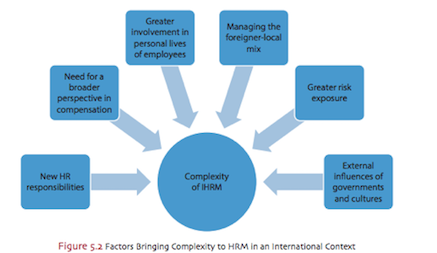
Soru 79
According to “Expat Explorer,” the Global Report of the HSBC Company, Turkey ranks ........... among the top destinations for expatriates.
Seçenekler
A
3rd
B
4th
C
5th
D
6th
E
7th
Açıklama:
According to “Expat Explorer,” the Global Report of the HSBC Company, Turkey ranks 7th among the top destinations for expatriates, the first five of which are Switzerland, Singapore, Canada, Spain, and New Zealand.
Soru 80
Which approach below MNE is said to be following when strategic decisions are made at the headquarters; and critical positions in both the domestic and foreign operations of an MNE are filled by personnel from the parent country (PCNs) with no or minimal autonomy delegated to the foreign subsidiaries?
Seçenekler
A
ethnocentric
B
polycentric
C
geocentric
D
regiocentric
E
eclectic
Açıklama:
An MNE is said to be following an ethnocentric approach when strategic decisions are made at the headquarters; and critical positions in both the domestic and foreign operations of an MNE are filled by personnel from the parent country (PCNs) with no or minimal autonomy delegated to the foreign subsidiaries.
Soru 81
............. is a psychological phenomenon that can lead to feelings of fear, helplessness, irritability, and disorientation.
Seçenekler
A
culture shock
B
reversible culture shock
C
irreversible cultures hock
D
reverse culture shock
E
opposite culture shock
Açıklama:
Reverse culture shock is a psychological phenomenon that can lead to feelings of fear, helplessness, irritability, and disorientation.
Soru 82
Which one below is defined as an employee’s current and/or past performance relative to the predetermined performance standards?
Seçenekler
A
International performance management
B
Expatriate performance
C
Desired performance
D
Performance management
E
Performance appraisal
Açıklama:
Performance appraisal is defined as an employee’s current and/or past performance relative to the predetermined performance standards (Dessler, 2017: 274). Performance management is an extension of performance appraisal (Lindholm, 2000: 45), which is “a process that enables the MNE to evaluate and continuously improve individual, subsidiary unit and corporate performance, against clearly defined, pre-set goals and targets” (Dowling, Festing, and Engle, 2013: 151). In a similar vein, international performance management is defined as, “a designed, implemented and evaluated intervention of an MNE for the purpose of managing the performance of its global workforce so that performance at the individual, team, or organizational level contributes to the attainment of strategic global objectives and results in overall MNE desired performance” (Briscoe et al., 2012: 344). The essential components of international performance management include job analysis, goals which are defined at the individual, subsidiary, and global levels, and performance appraisal (Dowling and Welch, 2004). Based on job analysis, employees’ job goals and standards are defined, and their performance related to these goals is assessed. Goals at individual level lead to the achievement of subsidiary goals which is linked to the goals of a multinational organization.
Soru 83
Which criteria below are about the quantifiable factors which can be directly measured based on tangible outcomes, such as market share, total revenues, and return on investment?
Seçenekler
A
Subjective
B
Objective
C
Soft
D
Contextual
E
Regional
Açıklama:
The criteria for performance appraisal are identified by Gregersen, Hite, and Black (1996) as, objective criteria, subjective criteria, and contextual criteria. Objective criteria (also defined as hard criteria) are about the quantifiable factors which can be directly measured based on tangible outcomes, such as market share, total revenues, and return on investment.
Soru 84
Which paradigm below focuses on employment relations considering industrial relations?
Seçenekler
A
Modern
B
Original
C
Eclectic
D
Ideological
E
Ideal
Açıklama:
Industrial relations cover all aspects of employment relationships with particular attention to labor and management relations (Katz, 1988). Industrial relations is a broad concept encompassing many relations regarding the workplace. Kaufman (2008) classifies industrial relations under two distinct paradigms; the Original Paradigm and the Modern Paradigm. The Original Paradigm focuses on employment relations, and the Modern Paradigm focuses on unions and labor management relations. According to Dunlop (1958: 16), a national industrial relations system consists of four basic components (Figure 5.6), which are actors or parties (employees, employers, government), rules (both substantive and procedural resulting from mutual cooperation and oppositions between actors), an ideology (which binds separate actors one another), and the environmental context (as cited by Rahim, 2011: 66).
Ünite 6
Soru 1
Which one of the following is not among the terms used to identify main tendencies in international marketing strategy?
Seçenekler
A
standardization
B
adaptation
C
global integration
D
global responsiveness
E
glocalization
Açıklama:
There are two main tendencies in international
marketing strategy identified by similar terms:
standardization versus adaptation, or globalization versus localization, or global integration versus
global responsiveness
marketing strategy identified by similar terms:
standardization versus adaptation, or globalization versus localization, or global integration versus
global responsiveness
Soru 2
I. Russia
II. India
III. Canada
Which one(s) of these countries is/are among the BRIC countries?
II. India
III. Canada
Which one(s) of these countries is/are among the BRIC countries?
Seçenekler
A
Only I
B
Only II
C
Only III
D
I-II
E
II-III
Açıklama:
The BRIC countries (Brazil,
Russia, India, and China) were identified as the
future major players in the world economy in the
early 2000s.
Russia, India, and China) were identified as the
future major players in the world economy in the
early 2000s.
Soru 3
Within Appadurai (1990)'s framework, which one of the following stands for the intricate movements of global capital in the form of currency markets, national stock exchanges, and speculations?
Seçenekler
A
ethnoscapes
B
technoscapes
C
financescapes
D
mediascapes
E
ideoscapes
Açıklama:
Ethnoscapes are the people mobile
throughout the globe, such as immigrants, tourists,
guest workers. So, these mobile people always get
in contact with the stable ones. Their mobility
influences the politics of and between nations.
Technoscapes are the sorts of technology (high or
low, mechanical or informational) spread amidst
“complex relationships between money flows,
political possibilities, and the availability of both
low and highly-skilled labor” (Appadurai, 1990:
298). Financescapes are the intricate movements
of global capital in the form of currency markets,
national stock exchanges, and speculations.
Interactions of ethnoscapes, technoscapes, and
financescapes are unpredictable because each
of these scapes is subject to different incentives
or constraints that are political, informational,
and technoenvironmental. Mediascapes and
Ideoscapes have an image and narrative-based
nature. Mediascapes are about the production and
dissemination of information through different
types of media where the boundaries between the
real and the fictional blur. Mediascapes create and
introduce imagined lives, places, and lifestyles.
Ideoscapes are political, and they indicate mainly
the spread of the Enlightenment worldview,
which consists of notions like democracy, welfare,
freedom, rights, and sovereignty.
throughout the globe, such as immigrants, tourists,
guest workers. So, these mobile people always get
in contact with the stable ones. Their mobility
influences the politics of and between nations.
Technoscapes are the sorts of technology (high or
low, mechanical or informational) spread amidst
“complex relationships between money flows,
political possibilities, and the availability of both
low and highly-skilled labor” (Appadurai, 1990:
298). Financescapes are the intricate movements
of global capital in the form of currency markets,
national stock exchanges, and speculations.
Interactions of ethnoscapes, technoscapes, and
financescapes are unpredictable because each
of these scapes is subject to different incentives
or constraints that are political, informational,
and technoenvironmental. Mediascapes and
Ideoscapes have an image and narrative-based
nature. Mediascapes are about the production and
dissemination of information through different
types of media where the boundaries between the
real and the fictional blur. Mediascapes create and
introduce imagined lives, places, and lifestyles.
Ideoscapes are political, and they indicate mainly
the spread of the Enlightenment worldview,
which consists of notions like democracy, welfare,
freedom, rights, and sovereignty.
Soru 4
I. Culture is learnt individually after a certain age and no interaction is needed to acquire it.
II. Culture is interrelated within. Different parts of culture are connected, e.g., religion and marriage.
III. Culture is shared. Values are passed from one member to another.
Which one(s) of them is/are among the basic characteristics of culture?
II. Culture is interrelated within. Different parts of culture are connected, e.g., religion and marriage.
III. Culture is shared. Values are passed from one member to another.
Which one(s) of them is/are among the basic characteristics of culture?
Seçenekler
A
Only I
B
Only II
C
Only III
D
I-II
E
II-III
Açıklama:
The basic characteristics of culture are as follows
(Hollensen, 2017):
• Culture is learned throughout childhood.
Cultural values are internalized by
interacting with the members of one’s
family, getting rewards or punishments,
negotiating what one wants, and causing
and avoiding conflict.
• Culture is interrelated within. Different
parts of culture are connected, e.g., religion
and marriage.
• Culture is shared. Values are passed from
one member to another.
(Hollensen, 2017):
• Culture is learned throughout childhood.
Cultural values are internalized by
interacting with the members of one’s
family, getting rewards or punishments,
negotiating what one wants, and causing
and avoiding conflict.
• Culture is interrelated within. Different
parts of culture are connected, e.g., religion
and marriage.
• Culture is shared. Values are passed from
one member to another.
Soru 5
Which one of the following terms demonstrates the degree of tolerance toward the unequal distribution of power in a society?
Seçenekler
A
power distance
B
individualism
C
feminine society
D
uncertainty avoidance
E
long-term orientation
Açıklama:
Power distance demonstrates the
degree of tolerance toward the unequal distribution
of power in a society (Usunier and Lee, 2005).
degree of tolerance toward the unequal distribution
of power in a society (Usunier and Lee, 2005).
Soru 6
Which one of the following is not among the the four traditionally defined economic systems?
Seçenekler
A
market capitalism
B
long-term orientation
C
centrally-planned socialism
D
centrally-planned capitalism
E
market socialism
Açıklama:
Market capitalism, centrally-planned
socialism, centrally-planned capitalism, and
market socialism are the four traditionally
defined economic systems.
socialism, centrally-planned capitalism, and
market socialism are the four traditionally
defined economic systems.
Soru 7
Which one of the following is not a component of the political environment?
Seçenekler
A
governmental institutions
B
political parties
C
pressure groups
D
organizations through which power is exercised over various organizations
E
relationship with neighbouring countries
Açıklama:
A Political environment consists of
governmental institutions, political parties,
pressure groups, and organizations through
which power is exercised over various
organizations and people in a society
governmental institutions, political parties,
pressure groups, and organizations through
which power is exercised over various
organizations and people in a society
Soru 8
"Romania and Turkey might be different in many aspects, but marketers might perceive them as two very similar countries"
Which one of the following terms describes the situation best?
Which one of the following terms describes the situation best?
Seçenekler
A
low psychic distance
B
low cultural distance
C
low geographic distance
D
local-content
E
centrally-planned capitalism
Açıklama:
Low cultural distance means
perceptions of the home, and the host countries
are similar. For example, Romania and Turkey
might be different in many aspects, but marketers
might perceive them as two very similar countries.
perceptions of the home, and the host countries
are similar. For example, Romania and Turkey
might be different in many aspects, but marketers
might perceive them as two very similar countries.
Soru 9
Which one of the following terms refers to the measure that combines the size of the market and the competitive advantage used to compare markets?
Seçenekler
A
Cost advantage
B
Marketing advantage
C
Market acces
D
Differential advantage
E
Market potential
Açıklama:
Market potential is a measure that combines
the size of the market and the competitive
advantage used to compare markets.
the size of the market and the competitive
advantage used to compare markets.
Soru 10
Which one of the following is defined as anything that can be offered to a market for attention, acquisition, use or consumption that might satisfy a want or need?
Seçenekler
A
Product
B
Price
C
Distribution
D
Communication
E
Marketing
Açıklama:
Product is defined as anything that can be
offered to a market for attention, acquisition,
use or consumption that might satisfy a want
or need.
offered to a market for attention, acquisition,
use or consumption that might satisfy a want
or need.
Soru 11
I. Standardization II. Localization III.Adaptation IV. Globalization Which of the following terms emphasize convergence of international marketing strategy?
Seçenekler
A
I and II
B
I and III
C
I and IV
D
II and III
E
II and IV
Açıklama:
Standardization and globalization are the two terms which emphasize the convergence of international marketing strategy and the tendency toward globalization.
Soru 12
Based on Appadurai’s framework, what do we call the condition of the spread of the enlightenment world view, which consists of notions like democracy, welfare, freedom, rights, and sovereignty?
Seçenekler
A
Ethnoscapes
B
Technoscapes
C
Financescapes
D
Mediascapes
E
Ideoscapes
Açıklama:
Ethnoscapes are the people mobile throughout the globe, such as immigrants, tourists, guest workers. So, these mobile people always get
in contact with the stable ones. Their mobility influences the politics of and between nations. Technoscapes are the sorts of technology (high or low, mechanical or informational) spread amidst “complex relationships between money flows, political possibilities, and the availability of both low and highly-skilled labor” (Appadurai, 1990:
298). Financescapes are the intricate movements of global capital in the form of currency markets, national stock exchanges, and speculations. Mediascapes are about the production and dissemination of information through different types of media where the boundaries between the real and the fictional blur. Mediascapes create and
introduce imagined lives, places, and lifestyles. Ideoscapes are political, and they indicate mainly the spread of the Enlightenment worldview, which consists of notions like democracy, welfare, freedom, rights, and sovereignty.
in contact with the stable ones. Their mobility influences the politics of and between nations. Technoscapes are the sorts of technology (high or low, mechanical or informational) spread amidst “complex relationships between money flows, political possibilities, and the availability of both low and highly-skilled labor” (Appadurai, 1990:
298). Financescapes are the intricate movements of global capital in the form of currency markets, national stock exchanges, and speculations. Mediascapes are about the production and dissemination of information through different types of media where the boundaries between the real and the fictional blur. Mediascapes create and
introduce imagined lives, places, and lifestyles. Ideoscapes are political, and they indicate mainly the spread of the Enlightenment worldview, which consists of notions like democracy, welfare, freedom, rights, and sovereignty.
Soru 13
Which of the following is not a significant element of culture?
Seçenekler
A
Ethnoscape
B
Language
C
Institutions
D
Material productions
E
Symbolic productions
Açıklama:
Usunier and Lee (2005) identify four significant elements of culture: language, institutions, material productions, and symbolic productions. Language helps the members of a culture to share and transmit
information. It also shapes our thought patterns, our worldviews, and our behavior. Institutions group people and ask them to conform
to the rules in return for some rewards. Family, political institutions, and
gender are examples of social institutions defining social norms and roles. Material productions can be in various forms, e.g., artwork, intellectual productions, physical productions like tools, machines, or service productions like hospitals or media. Finally, symbolic productions determine the relationship between the physical and the
metaphysical. For example, some religions ban certain food items. While the Hindu do not eat cow meat since the animal is considered sacred,
Muslims have halal rules to obey.
information. It also shapes our thought patterns, our worldviews, and our behavior. Institutions group people and ask them to conform
to the rules in return for some rewards. Family, political institutions, and
gender are examples of social institutions defining social norms and roles. Material productions can be in various forms, e.g., artwork, intellectual productions, physical productions like tools, machines, or service productions like hospitals or media. Finally, symbolic productions determine the relationship between the physical and the
metaphysical. For example, some religions ban certain food items. While the Hindu do not eat cow meat since the animal is considered sacred,
Muslims have halal rules to obey.
Soru 14
Which of the following best describes a political environment?
Seçenekler
A
Securing the national interests and the wellbeing of the society and promoting the political philosophy of the country
B
Governmental institutions, political parties, pressure groups, and organizations through which power is exercised over various organizations and people in a society
C
Laws protecting companies from unfair competition and consumers from
unequal business activities, and the interests of the society against unrestrained corporate interests
unequal business activities, and the interests of the society against unrestrained corporate interests
D
Laws that favor local businesses against foreign ones
E
Fundamental cultural assumptions such as religion, ethnic culture, or national identity
Açıklama:
Government policies and attitudes toward business are to secure the national interests and the wellbeing of the society and to promote the political philosophy of the country. Business legislations are the laws protecting companies from unfair competition and consumers from
unequal business activities, and the interests of the society against unrestrained corporate interests. Trade barriers are the laws that favor local businesses against foreign ones. Values and morals are fundamental cultural assumptions such as religion, ethnic culture, or national identity. Thus, a political environment involves governmental institutions, political parties, pressure groups, and organizations through which power is exercised over various organizations and people in a society.
unequal business activities, and the interests of the society against unrestrained corporate interests. Trade barriers are the laws that favor local businesses against foreign ones. Values and morals are fundamental cultural assumptions such as religion, ethnic culture, or national identity. Thus, a political environment involves governmental institutions, political parties, pressure groups, and organizations through which power is exercised over various organizations and people in a society.
Soru 15
Which of the following is not relevant to industry structure?
Seçenekler
A
Entry barriers
B
Threats of substitutes
C
Power of the customer
D
Market similarity
E
Power of the suppliers
Açıklama:
Industry structure refers to market competition and the profitability of the industry. Industry structure can be identified by analyzing entry barriers, threats of substitutes that perform the same function, power of the customer, power of the suppliers, and the rivalry among competitors.
Soru 16
Which of the following terms best describes the measure that combines the size of the market and the competitive advantage used to compare markets?
Seçenekler
A
Market potential
B
Market access
C
Growth potential
D
Niche marketing
E
Differentiation
Açıklama:
Market potential is a measure that combines the size of the market and the competitive advantage used to compare markets.
Soru 17
Which of the following is related to the positioning strategy of an international company?
Seçenekler
A
Standardization
B
Differentiated marketing
C
Foreign consumer culture
D
Concentrated marketing
E
Degree of internationalization
Açıklama:
Targeting strategies can be grouped into three at the global level: standardization, differentiation, and niche or concentrated marketing. The degree of internationalization shows the number and the size of the competitors who are not domestic and operating in the market in segmentation strategy. Foreign consumer culture positioning, where the company associates the brand with a specific
foreign country or culture is positioning startegy.
foreign country or culture is positioning startegy.
Soru 18
Which of the following is not a component the actual product?
Seçenekler
A
Quality level
B
Benefit
C
Features
D
Design
E
Packaging
Açıklama:
The core customer value of a product refers to the benefit of the product to the customers. On the other hand, the actual product
consists of quality level, features, design, packaging, and brand name.
consists of quality level, features, design, packaging, and brand name.
Soru 19
Which of the following is correct about international marketing communications?
Seçenekler
A
The possibility of a semantic noise is lower in international marketing situations.
B
Regulations or legislations are irrelevant for the choice of a channel in foreign contexts.
C
The foreign audience would comprehend the meaning of the message correctly in spite of language differences
D
In a global environment, the sender and the receiver would share the common meaning systems.
E
International marketing communications model is more complicated due to two contexts belonging to home and foreign countries.
Açıklama:
- The possibility of a semantic noise is higher in international marketing situations.
- Regulations or legislations influence the choice of a channel in foreign contexts.
- The foreign audience may misunderstand the meaning of the message because of language differences.
- In a global environment, the sender and the receiver do not share the common meaning systems.
Soru 20
Which of the following is the only element of the marketing mix that creates revenues?
Seçenekler
A
Product
B
Distribution channel
C
Marketing communications
D
Pricing
E
Positioning
Açıklama:
Because other marketing mix elements (product, distribution channel, marketing communications) incur costs.
Soru 21
Which of the followings is about the production and dissemination of information through different types of media where the boundaries between the real and the fictional blur?
Seçenekler
A
Mediascapes
B
Ideoscapes
C
Ethnoscapes
D
Technoscapes
E
Financescapes
Açıklama:
INTERNATIONAL MARKETING ENVIRONMENT
Mediascapes are about the production and dissemination of information through different types of media where the boundaries between the real and the fictional blur.
Mediascapes are about the production and dissemination of information through different types of media where the boundaries between the real and the fictional blur.
Soru 22
Which of the followings indicates mainly the spread of the Enlightenment worldview, which consists of notions like democracy, welfare, freedom, rights, and sovereignty.
Seçenekler
A
Mediascapes
B
Ideoscapes
C
Financescapes
D
Technoscapes
E
Ethnoscapes
Açıklama:
INTERNATIONAL MARKETING ENVIRONMENT
Ideoscapes are political, and they indicate mainly the spread of the Enlightenment worldview, which consists of notions like democracy, welfare, freedom, rights, and sovereignty.
Ideoscapes are political, and they indicate mainly the spread of the Enlightenment worldview, which consists of notions like democracy, welfare, freedom, rights, and sovereignty.
Soru 23
Which of the following statements is not true regarding culture?
Seçenekler
A
Culture is learned throughout childhood.
B
Cultural values are internalized by interacting with the members of one’s family.
C
Cultural values are internalized by getting rewards or punishments.
D
Culture is interrelated within.
E
Culture is static.
Açıklama:
The Sociocultural Environment
Culture is not static but dynamic.
Culture is not static but dynamic.
Soru 24
Which of the followings demonstrates the degree of tolerance toward the unequal distribution of power in a society?
Seçenekler
A
Individualism
B
Power distance
C
Feminine society
D
Orientation
E
Uncertainty avoidance
Açıklama:
Methodologies to Understand Cultures
Power distance demonstrates the degree of tolerance toward the unequal distribution of power in a society (Usunier and Lee, 2005).
Power distance demonstrates the degree of tolerance toward the unequal distribution of power in a society (Usunier and Lee, 2005).
Soru 25
In which of the following models resources are owned privately, but the state conducts resource allocation?
Seçenekler
A
Feminine society
B
Indulgence society
C
Restraint society
D
Centrally-planned socialism
E
Centrally-planned capitalism
Açıklama:
Economic Environment
In centrally-planned capitalism, resources are owned privately, but the state conducts resource allocation.
In centrally-planned capitalism, resources are owned privately, but the state conducts resource allocation.
Soru 26
Which of the followings are restrictions on the amount of a product imported to or exported from the country within a specified period.
Seçenekler
A
Embargoes
B
Tariffs
C
Quotas
D
Segmentations
E
Suppliers
Açıklama:
Political and Legal Environment
Quotas are restrictions on the amount of a product imported to or exported from the country within a specified period.
Quotas are restrictions on the amount of a product imported to or exported from the country within a specified period.
Soru 27
Which of the followings is a factor that influences the firm’s ability to serve the market?
Seçenekler
A
Competitive advantage index
B
Marketing advantage
C
Cost advantage
D
Market access
E
Differential advantage
Açıklama:
Targeting Strategy
Market access is a factor that influences the firm’s ability to serve the market.
Market access is a factor that influences the firm’s ability to serve the market.
Soru 28
Which of the followings means that the brand identifies a specific segment of the global consumer culture?
Seçenekler
A
Foreign consumer culture positioning
B
Global consumer culture positioning
C
Concentrated positioning
D
National consumer culture positioning
E
Local consumer culture positioning
Açıklama:
Positioning Strategy
Global consumer culture positioning means that the brand identifies a specific segment of the global consumer culture.
Global consumer culture positioning means that the brand identifies a specific segment of the global consumer culture.
Soru 29
Which of the followings is a strategy which aims to differentiate the brand in the consumer’s mind from the competitor’s brand in terms of the attributes and benefits offered by that brand?
Seçenekler
A
Segmentation Strategy
B
Targeting Strategy
C
Positioning Strategy
D
Industrial Strategy
E
Competitive Strategy
Açıklama:
Positioning Strategy
Positioning is a strategy which aims to differentiate the brand in the consumer’s mind from the competitor’s brand in terms of the attributes and benefits offered by that brand.
Positioning is a strategy which aims to differentiate the brand in the consumer’s mind from the competitor’s brand in terms of the attributes and benefits offered by that brand.
Soru 30
Which of the followings refers to the benefit of the product to the customers?
Seçenekler
A
The core customer value
B
Penetration pricing
C
Necessary capital
D
Competition
E
Coverage
Açıklama:
Product Decisions
The core customer value refers to the benefit of the product to the customers
The core customer value refers to the benefit of the product to the customers
Soru 31
Which of the following refers to the intricate movements of global capital in the form of currency markets, national stock exchanges, and speculations?
Seçenekler
A
Technoscapes
B
Mediascapes
C
Ideoscapes
D
Financescapes
E
Ethnoscapes
Açıklama:
Financescapes are the intricate movements of global capital in the form of currency markets, national stock exchanges, and speculations.
Soru 32
Who put forward "national culture framework"?
Seçenekler
A
Meamber
B
Venkatesh
C
Hofstede
D
Boroditsky
E
Usunier
Açıklama:
Two different perspectives used in understanding cultures are discussed. The first perspective is Hofstede’s (2001) national culture framework, and the second one is Meamber and Venkatesh’s (2000) ethnoconsumerist methodology.
Hofstede (2001) is a social psychologist who introduced cultural dimensions that are extensively used by international marketers to compare consumer behavior in different nations.
Hofstede (2001) is a social psychologist who introduced cultural dimensions that are extensively used by international marketers to compare consumer behavior in different nations.
Soru 33
Which of the following measures how threatened people feel in particular situations?
Seçenekler
A
Uncertainty avoidance
B
Power distance
C
Long-term orientation
D
Individualism
E
Indulgence
Açıklama:
The notion of uncertainty avoidance measures how threatened people feel in certain situations. If uncertainty is high in a society, the level of anxiety and aggressiveness is high, and procedures and rules are encouraged.
Soru 34
Which of the following is NOT one of the traditionally defined economic systems?
Seçenekler
A
Market capitalism
B
Global market
C
Market socialism
D
Centrally-planned capitalism
E
Centrally-planned socialism
Açıklama:
International marketers need to recognize what type of economic system dominates the potential market to enter. Market capitalism, centrally-planned socialism, centrally-planned capitalism, and market socialism are the four traditionally defined economic systems (Keegan and Green, 2017).
Soru 35
I. Does the firm have experience in internationalization?
II. Is the aim of the firm internationalization?
III. Are there any existing networks that constitute a strength for the company?
IV. Does the firm have experience on the type of industry?
Which questions above does a marketer have to ask to gather information about the firm during international market segmentation?
II. Is the aim of the firm internationalization?
III. Are there any existing networks that constitute a strength for the company?
IV. Does the firm have experience on the type of industry?
Which questions above does a marketer have to ask to gather information about the firm during international market segmentation?
Seçenekler
A
Only I
B
Only IV
C
II and III
D
I, II and IV
E
I, II, III and IV
Açıklama:
International market segmentation is informed from an analysis of two groups of knowledge: the firm and the environment. The marketer checks:
- if the firm’s resources are available for sustaining marketing activities abroad,
- if the firm has experience in internationalization,
- if the firm has experience on the type of industry,
- if the aim of the firm is internationalization, and
- if there are any existing networks that constitute a strength for the company.
Soru 36
Which of the following terms refers to a measure that combines the size of the market and the competitive advantage used to compare markets?
Seçenekler
A
Market access
B
Cost advantage
C
Market potential
D
Differantial advantage
E
Standardization
Açıklama:
Market potential is a measure that combines the size of the market and the competitive advantage used to compare markets.
Soru 37
Which of the following information is FALSE about positioning strategy?
Seçenekler
A
It aims to differentiate the brand in the consumer’s mind from the competitor’s brand in terms of the attributes and benefits offered by that brand.
B
UGG boots becoming popular among the upper-middle-class global youth female subculture is an example of global consumer culture positioning.
C
An example for foreign consumer culture positioning is that Volkswagen associates itself with German Engineering by Das Auto slogan.
D
McTurko in Turkey or McFalafel in Egypt are examples of foreign consumer culture positioning.
E
Foreign consumer culture positioning is less common than global and local consumer culture positioning strategies.
Açıklama:
Positioning is a strategy which aims to differentiate the brand in the consumer’s mind from the competitor’s brand in terms of the attributes and benefits offered by that brand. There can be three alternative scales: global consumer culture, foreign consumer culture, and local consumer culture (Keegan et al., 2017). Global consumer culture positioning means that the brand identifies a specific segment of the global consumer culture. For example, in the early 2000s, UGG boots became popular among the upper-middle-class global youth female subculture. An alternative positioning strategy is foreign consumer culture positioning, where the company associates the brand with a specific foreign country or culture. For example, Levi’s Jeans symbolically associates itself with America or the Wild West, Volkswagen associates itself with German Engineering by Das Auto slogan. Alden et al. (1999) argue that foreign consumer culture positioning is less common than global and local consumer culture positioning strategies. The final positioning strategy aims to associate the brand with the local consumer culture. McTurko in Turkey or McFalafel in Egypt are examples of local consumer culture positioning.
Soru 38
Which of the following terms refers to a strategy designed to offer a product at a low price to increase sales?
Seçenekler
A
Skimming price
B
Penetration pricing
C
Market pricing
D
Price escalation
E
Distribution
Açıklama:
Penetration pricing a strategy designed to offer a product at a low price to increase sales. Penetration pricing is used when unit costs decrease as a result of economies of scale, when there is a mass market, and when the customers are price-sensitive. Penetration pricing can be successful if the manager keeps an eye on the competitors’ pricing strategies because if they decrease their prices to a certain level and catch customers, the firm may not generate profit through mass marketing.
Soru 39
Which of the following is NOT one of the criteria that an international marketer needs to consider while deciding on the foreign distribution channels?
Seçenekler
A
Firm's expectations
B
Consumers and their characteristics
C
Necessary capital
D
Competition
E
Continuity
Açıklama:
While deciding on the foreign distribution channels, an international marketer needs to consider nine criteria: consumers and their characteristics, culture, the character of the channel, necessary capital, cost, competition, coverage, continuity, and control.
Soru 40
Which of the following terms refers to a price policy which assigns market-specific prices to the product?
Seçenekler
A
Geocentric pricing
B
Extension pricing
C
Captive pricing
D
Competitive pricing
E
Polycentric pricing
Açıklama:
Polycentric pricing is a price policy which assigns market-specific prices to the product. If the company uses independent distributors in channeling the product, then the pricing decision is dominated by the independent distributors. Sometimes the price differences between countries can be higher than the costs incurred from the distribution costs. Then, customers may prefer to go to a foreign land to purchase the product cheaper.
Soru 41
Which of the following is NOT a BRIC country?
Seçenekler
A
Brazil
B
Russia
C
Iran
D
India
E
China
Açıklama:
Iran is not one of those countries.
Soru 42
Which of the following indicate mainly the spread of the Enlightenment worldview?
Seçenekler
A
Mediascapes
B
Ideoscapes
C
Technoscapes
D
Ethnoscape
E
Financescapes
Açıklama:
Ideoscapes are political, and they indicate mainly the spread of the Enlightenment worldview, which consists of notions like democracy, welfare, freedom, rights, and sovereignty.
Soru 43
Which of the following is CORRECT about convergence perspective?
I. It assumes the center-periphery model for the global economy
II. The developed countries produce and market goods to the developing markets.
III. Traditionally, it was assumed that in the future, a modern and developed market would emerge at the global level.
I. It assumes the center-periphery model for the global economy
II. The developed countries produce and market goods to the developing markets.
III. Traditionally, it was assumed that in the future, a modern and developed market would emerge at the global level.
Seçenekler
A
I and II
B
I and III
C
II and III
D
I, II, III
E
Only I
Açıklama:
All of the items are correct .
Soru 44
............. are the people mobile throughout the globe, such as immigrants, tourists, guest workers.
Which of the following completes the statement above correctly?
Which of the following completes the statement above correctly?
Seçenekler
A
Ideoscapes
B
Technoscapes
C
Financescapes
D
Mediascapes
E
Ethnoscapes
Açıklama:
The statement refers to the option E.
Soru 45
Which of the following demonstrates the degree of tolerance toward the unequal distribution of power in a society?
Seçenekler
A
Ethnoconsumerist methodology
B
National culture framework
C
Power distance
D
Long-term orientation
E
Uncertainty avoidance
Açıklama:
The option C demonstrates the degree of tolerance toward the unequal distribution of power in a society. A society is identified as masculine when assertiveness, earning money, showing off, and lower levels of care for others are the dominant values. A feminine society is supposed to value nurturing roles, interdependence, and caring for others. For example, people in collectivist cultures share buying decisions rather than making individual decisions
Soru 46
Which of the countries below are examples of low cultural distance?
Seçenekler
A
Romania-Turkey
B
The United States-Iran
C
Germany-India
D
Brazil-Egypt
E
Russia-South Africa
Açıklama:
Low cultural distance means perceptions of the home, and the host countries are similar. For example, Romania and Turkey might be different in many aspects, but marketers might perceive them as two very similar countries.
Soru 47
Which of the following refers to market competition and the profitability of the industry?
Seçenekler
A
Low cultural distance
B
Low psychic distance
C
Low geographic distance
D
Industry structure
E
Differential advantage
Açıklama:
Industry structure refers to market competition and the profitability of the industry (Porter, 2007). Industry structure can be identified by analyzing entry barriers, threats of substitutes that perform the same function, power of the customer, power of the suppliers, and the rivalry among competitors.
Soru 48
Which of the following refers to charging the same price across the world?
Seçenekler
A
Skimming
B
Market pricing
C
Penetration pricing
D
Captive pricing
E
Extension pricing
Açıklama:
Extension pricing refers to charging the same price across the world. This straightforward policy is risky because it does not take into consideration factors such as market and competition.
Soru 49
Which of the following refers to the extent to which the distribution channel covers the markets that the producers want to have access?
Seçenekler
A
Continuity
B
Coverage
C
Competition
D
Necessary capital
E
Culture
Açıklama:
Coverage refers to the extent to which the distribution channel covers the markets that the producers want to have access. If the markets are very concentrated, channels cover them, but the competition is expected to be high.
Soru 50
Which of the following represents the financial resources necessary to start and sustain the channel?
Seçenekler
A
Necessary capital
B
Coverage
C
Continuity
D
Culture
E
Competition
Açıklama:
Necessary capital is another essential criterion to check before entering into a foreign market. It represents the financial resources necessary to start and sustain the channel (Usunier and Lee,
2005).
2005).
Soru 51
Which of the following is not one of the BRIC countries?
Seçenekler
A
China
B
Russia
C
Belgium
D
Brazilia
E
India
Açıklama:
The BRIC countries (Brazil, Russia, India, and China) were identified as the future major players in the world economy in the early 2000s.
Soru 52
.....................are the people mobile throughout the globe, such as immigrants, tourists, guest workers.
Which of the following best completes the sentence above?
Which of the following best completes the sentence above?
Seçenekler
A
Financescapes
B
Technoscapes
C
Mediascapes
D
Ethnoscapes
E
Ideoscapes
Açıklama:
Ethnoscapes are the people mobile throughout the globe, such as immigrants, tourists, guest workers.
Soru 53
Which of the following is not one of the cultural dimensions of Hofstede?
Seçenekler
A
Individualism/Collectivism
B
Positivity/Negativity
C
Masculinity/Femininity
D
Long/short-term orientation
E
Indulgence/Restraint
Açıklama:
Hofstede’s cultural dimensions include the following: individualism/collectivism, power distance, masculinity/femininity, uncertainty avoidance, long/short-term orientation, and indulgence/restraint.
Soru 54
In which economic system does the state decide on what to produce and how much to produce?
Seçenekler
A
Centrally-planned socialism
B
Market capitalism
C
Market socialism
D
Centrally-planned capitalism
E
Entrepreneurial capitalism
Açıklama:
The opposite of market capitalism is centrally-planned socialism, where the state decides on what to produce and how much to produce.
Soru 55
...................refers to the ability to provide better market offerings than the competitor’s offerings.
Which of the following best completes the sentence above?
Which of the following best completes the sentence above?
Seçenekler
A
Cost advantage
B
Differential advantage
C
Market size
D
Marketing advantage
E
Competitive advantage
Açıklama:
Differential advantage refers to the ability to provide better market offerings than the competitor’s offerings.
Soru 56
Which of the following is not one of the marketing mix elements?
Seçenekler
A
Price
B
Customer
C
Distribution
D
Communication
E
Product
Açıklama:
Marketing mix elements, namely product, price, distribution, and communication (placement), are the tools used to implement the strategies to create value for the global or international markets and capture value from them in return.
Soru 57
In .................. the marketer sets a very high price for the product at first and then gradually decreases the price.
Which of the following best completes the sentence above?
Which of the following best completes the sentence above?
Seçenekler
A
Skimming price
B
Value-based pricing
C
Market pricing
D
Competitive pricing
E
Geocentric pricing
Açıklama:
In skimming price, the marketer sets a very high price for the product at first and then gradually decreases the price.165
Soru 58
................is a strategy which aims to differentiate the brand in the consumer’s mind from the competitor’s brand in terms of the attributes and benefits offered by that brand.
Which of the following best completes the sentence above?
Which of the following best completes the sentence above?
Seçenekler
A
Standardization
B
Differentiation
C
Niche marketing
D
Concentrated marketing
E
Positioning
Açıklama:
Positioning is a strategy which aims to differentiate the brand in the consumer’s mind from the competitor’s brand in terms of the attributes and benefits offered by that brand.
Soru 59
...........is a price policy which assigns market-specific prices to the product.
Which of the following best completes the sentence above?
Which of the following best completes the sentence above?
Seçenekler
A
Geocentric pricing
B
Extension pricing
C
Polycentric pricing
D
Captive pricing
E
Market pricing
Açıklama:
Polycentric pricing is a price policy which assigns market-specific prices to the product.
Soru 60
Which of the following companies used the traditional promotional technique of marching through the streets on camels to enter into the Ottoman market?
Seçenekler
A
McDonald's
B
Benetton
C
BP
D
Nestlé
E
Maybelline
Açıklama:
When entered into the Ottoman market, Nestlé preferred to use the traditional promotional technique of marching through the streets on camels while music was being played.
Soru 61
"In conducting marketing planning and implementation, international marketers need to consider the uncontrollable elements of the marketing environment both in their home countries and foreign countries that they operate."
Which of the below is an example of these uncontrollable elements?
Which of the below is an example of these uncontrollable elements?
Seçenekler
A
Management
B
Production
C
Employees
D
Departments
E
Legal forces
Açıklama:
Examples of these uncontrollable elements for the international markets include the political and legal forces, economic forces, cultural forces, competitive structures, geography and infrastructure, the structure of distribution, and the level of technology. The increase in uncontrollable elements complicates the decisionmaking processes and the implementation of marketing strategies for international marketers.
Soru 62
"Although Coca-Cola markets the same product range across the global markets, its advertising campaigns are tailored according to the food culture and rituals of the local markets. The Ramadan and Christmas ad campaigns tailored explicitly for Islamic and Western countries respectively exemplify this process."
What kind of strategy does Coca-Cola seem to be utilizing through this?
What kind of strategy does Coca-Cola seem to be utilizing through this?
Seçenekler
A
Monopolization
B
Standardization
C
Visualization
D
Adaptation
E
Unification
Açıklama:
There are two main tendencies in international marketing strategy identified by similar terms: standardization versus adaptation, or globalization versus localization, or global integration versus global responsiveness (Cateora et al., 2016). Companies prefer to standardize their market offerings across different international markets in order to achieve economies of scale (Levitt, 1983). This perspective assumes that societies and markets converge in terms of their characteristics, such as similar values, tastes, lifestyles, and behavior as a result of globally operating multinational firms and the media. However, well-known global brands tailor their marketing activities to satisfy the local markets, which are shaped better by their local cultures than by those of the competitors’. For example, although Coca-Cola markets the same product range across the global markets, its advertising campaigns are tailored according to the food culture and rituals of the local markets. The Ramadan and Christmas ad campaigns tailored explicitly for Islamic and Western countries respectively exemplify this adaptation process.
Soru 63
Which one of the following terms is defined correctly?
Seçenekler
A
Technoscapes are the people mobile throughout the globe, such as immigrants, tourists, guest workers.
B
Mediascapes are the sorts of technology spread amidst “complex relationships between money flows, political possibilities, and the availability of both low and highly-skilled labor”.
C
Financescapes are the intricate movements of global capital in the form of currency markets, national stock exchanges, and speculations.
D
Ideoscapes are about the production and dissemination of information through different types of media where the boundaries between the real and the fictional blur.
E
Ethnoscapes are political, and they indicate mainly the spread of the Enlightenment worldview, which consists of notions like democracy, welfare, freedom, rights, and sovereignty.
Açıklama:
Ethnoscapes are the people mobile throughout the globe, such as immigrants, tourists, guest workers. So, these mobile people always get in contact with the stable ones. Their mobility influences the politics of and between nations.
Technoscapes are the sorts of technology (high or low, mechanical or informational) spread amidst “complex relationships between money flows, political possibilities, and the availability of both low and highly-skilled labor” (Appadurai, 1990: 298).
Financescapes are the intricate movements of global capital in the form of currency markets, national stock exchanges, and speculations. Interactions of ethnoscapes, technoscapes, and financescapes are unpredictable because each of these scapes is subject to different incentives or constraints that are political, informational, and technoenvironmental.
Mediascapes and Ideoscapes have an image and narrative-based nature. Mediascapes are about the production and dissemination of information through different types of media where the boundaries between the real and the fictional blur. Mediascapes create and introduce imagined lives, places, and lifestyles.
Ideoscapes are political, and they indicate mainly the spread of the Enlightenment worldview, which consists of notions like democracy, welfare, freedom, rights, and sovereignty. The complexity introduced through global interactions eliminates the formation of a single global market.
Technoscapes are the sorts of technology (high or low, mechanical or informational) spread amidst “complex relationships between money flows, political possibilities, and the availability of both low and highly-skilled labor” (Appadurai, 1990: 298).
Financescapes are the intricate movements of global capital in the form of currency markets, national stock exchanges, and speculations. Interactions of ethnoscapes, technoscapes, and financescapes are unpredictable because each of these scapes is subject to different incentives or constraints that are political, informational, and technoenvironmental.
Mediascapes and Ideoscapes have an image and narrative-based nature. Mediascapes are about the production and dissemination of information through different types of media where the boundaries between the real and the fictional blur. Mediascapes create and introduce imagined lives, places, and lifestyles.
Ideoscapes are political, and they indicate mainly the spread of the Enlightenment worldview, which consists of notions like democracy, welfare, freedom, rights, and sovereignty. The complexity introduced through global interactions eliminates the formation of a single global market.
Soru 64
Which of the following is true about the basic characteristics of culture, according to Hollensen?
Seçenekler
A
Culture is personal.
B
Culture can only be learned in adulthood.
C
Different parts of culture have no connection with one another.
D
Culture is reproduced through recurrent social relationships.
E
Culture is a static concept which never changes.
Açıklama:
Culture is reproduced through recurrent social relationships; it forms patterns and normalizes them; and it is internalized by the members of the cultural group. That is, culture is a dynamic concept which changes slowly as a result of the recurring social relationships. The basic characteristics of culture are as follows (Hollensen, 2017):
• Culture is learned throughout childhood. Cultural values are internalized by interacting with the members of one’s family, getting rewards or punishments, negotiating what one wants, and causing and avoiding conflict.
• Culture is interrelated within. Different parts of culture are connected, e.g., religion and marriage.
• Culture is shared. Values are passed from one member to another.
• Culture is learned throughout childhood. Cultural values are internalized by interacting with the members of one’s family, getting rewards or punishments, negotiating what one wants, and causing and avoiding conflict.
• Culture is interrelated within. Different parts of culture are connected, e.g., religion and marriage.
• Culture is shared. Values are passed from one member to another.
Soru 65
Which of the following is NOT one of the four significant elements of culture, as identified by Usunier and Lee?
Seçenekler
A
Language
B
Individuals
C
Institutions
D
Material productions
E
Symbolic productions
Açıklama:
Usunier and Lee (2005) identify four significant elements of culture: language, institutions, material productions, and symbolic productions. Language helps the members of a culture to share and transmit information. It also shapes our thought patterns, our worldviews, and our behavior. Boroditsky (2011), a cognitive scientist, argues that Australian Aboriginals do not have the words for left or right in their language, and therefore their understanding of space is different from ours (Boroditsky, 2011). Institutions group people and ask them to conform to the rules in return for some rewards (Usunier and Lee, 2005). Family, political institutions, and gender are examples of social institutions defining social norms and roles. Material productions can be in various forms, e.g., artwork, intellectual productions, physical productions like tools, machines, or service productions like hospitals or media. Finally, symbolic productions determine the relationship between the physical and the metaphysical. For example, some religions ban certain food items. While the Hindu do not eat cow meat since the animal is considered sacred, Muslims have halal rules to obey.
Soru 66
According to Hofstede's cultural dimensions, how is a society identified when assertiveness, earning money, showing off, and lower levels of care for others are the dominant values?
Seçenekler
A
Individualistic
B
Collectivistic
C
Masculine
D
Uncertain
E
Long-term oriented
Açıklama:
Hofstede’s cultural dimensions are individualism/collectivism, power distance, masculinity/femininity, uncertainty avoidance, long/short-term orientation, and indulgence/restraint.
The individualism and collectivism dimension is related to the boundaries between people and groups that they belong to. In individualistic cultures, the independence of the individual is essential. In collectivist cultures group coherence and cultural harmony are more important than individual freedom. For example, in individualistic cultures, people prefer living in detached houses.
Power distance demonstrates the degree of tolerance toward the unequal distribution of power in a society (Usunier and Lee, 2005).
A society is identified as masculine when assertiveness, earning money, showing off, and lower levels of care for others are the dominant values. A feminine society is supposed to value nurturing roles, interdependence, and caring for others. For example, people in collectivist cultures share buying decisions rather than making individual decisions.
The notion of uncertainty avoidance measures how threatened people feel in certain situations. If uncertainty is high in a society, the level of anxiety and aggressiveness is high, and procedures and rules are encouraged. For example, consumers of low uncertainty avoidance prefer short payment for bills.
People of the countries with long-term orientation are more pragmatic, modest, and thrifty. Unlike these, people with short-term orientation put emphasis on consistency, and truth, religious and, nationalistic ideals are prioritized.
A great indulgence society values the gratification of human desires, pleasures, and joy unlike a high restraint society that controls the gratification of needs through social norms.
The individualism and collectivism dimension is related to the boundaries between people and groups that they belong to. In individualistic cultures, the independence of the individual is essential. In collectivist cultures group coherence and cultural harmony are more important than individual freedom. For example, in individualistic cultures, people prefer living in detached houses.
Power distance demonstrates the degree of tolerance toward the unequal distribution of power in a society (Usunier and Lee, 2005).
A society is identified as masculine when assertiveness, earning money, showing off, and lower levels of care for others are the dominant values. A feminine society is supposed to value nurturing roles, interdependence, and caring for others. For example, people in collectivist cultures share buying decisions rather than making individual decisions.
The notion of uncertainty avoidance measures how threatened people feel in certain situations. If uncertainty is high in a society, the level of anxiety and aggressiveness is high, and procedures and rules are encouraged. For example, consumers of low uncertainty avoidance prefer short payment for bills.
People of the countries with long-term orientation are more pragmatic, modest, and thrifty. Unlike these, people with short-term orientation put emphasis on consistency, and truth, religious and, nationalistic ideals are prioritized.
A great indulgence society values the gratification of human desires, pleasures, and joy unlike a high restraint society that controls the gratification of needs through social norms.
Soru 67
According to Hofstede’s cultural dimensions, what would be a characteristic for people in long-term orientation societies?
Seçenekler
A
Thrift
B
Interdependence
C
Group coherence
D
Anxious
E
Consistent
Açıklama:
Hofstede’s cultural dimensions are individualism/collectivism, power distance, masculinity/femininity, uncertainty avoidance, long/short-term orientation, and indulgence/restraint.
The individualism and collectivism dimension is related to the boundaries between people and groups that they belong to. In individualistic cultures, the independence of the individual is essential. In collectivist cultures group coherence and cultural harmony are more important than individual freedom. For example, in individualistic cultures, people prefer living in detached houses.
Power distance demonstrates the degree of tolerance toward the unequal distribution of power in a society (Usunier and Lee, 2005).
A society is identified as masculine when assertiveness, earning money, showing off, and lower levels of care for others are the dominant values. A feminine society is supposed to value nurturing roles, interdependence, and caring for others. For example, people in collectivist cultures share buying decisions rather than making individual decisions.
The notion of uncertainty avoidance measures how threatened people feel in certain situations. If uncertainty is high in a society, the level of anxiety and aggressiveness is high, and procedures and rules are encouraged. For example, consumers of low uncertainty avoidance prefer short payment for bills.
People of the countries with long-term orientation are more pragmatic, modest, and thrifty. Unlike these, people with short-term orientation put emphasis on consistency, and truth, religious and, nationalistic ideals are prioritized.
A great indulgence society values the gratification of human desires, pleasures, and joy unlike a high restraint society that controls the gratification of needs through social norms.
The individualism and collectivism dimension is related to the boundaries between people and groups that they belong to. In individualistic cultures, the independence of the individual is essential. In collectivist cultures group coherence and cultural harmony are more important than individual freedom. For example, in individualistic cultures, people prefer living in detached houses.
Power distance demonstrates the degree of tolerance toward the unequal distribution of power in a society (Usunier and Lee, 2005).
A society is identified as masculine when assertiveness, earning money, showing off, and lower levels of care for others are the dominant values. A feminine society is supposed to value nurturing roles, interdependence, and caring for others. For example, people in collectivist cultures share buying decisions rather than making individual decisions.
The notion of uncertainty avoidance measures how threatened people feel in certain situations. If uncertainty is high in a society, the level of anxiety and aggressiveness is high, and procedures and rules are encouraged. For example, consumers of low uncertainty avoidance prefer short payment for bills.
People of the countries with long-term orientation are more pragmatic, modest, and thrifty. Unlike these, people with short-term orientation put emphasis on consistency, and truth, religious and, nationalistic ideals are prioritized.
A great indulgence society values the gratification of human desires, pleasures, and joy unlike a high restraint society that controls the gratification of needs through social norms.
Soru 68
"In this kind of system, means of production is owned by the state or the labor, but production is not centrally planned; it is market mediated."
What kind of economic system is defined above?
What kind of economic system is defined above?
Seçenekler
A
Centrally-planned socialism
B
Centrally-planned capitalism
C
Market capitalism
D
Market socialism
E
Hybrid(Mixed)
Açıklama:
Market capitalism, centrally-planned socialism, centrally-planned capitalism, and market socialism are the four traditionally defined economic systems (Keegan and Green, 2017). It is hard to identify and categorize any economic system in one of these ideals because economies transformed into hybrid forms as a result of globalization. In market capitalism, the role of the state is limited to establish competition between firms and warrant consumer protection. Production resources are privately owned. The opposite of market capitalism is centrally-planned socialism, where the state decides on what to produce and how much to produce. Consumers in this system can have access to what is available in the state-controlled market. In centrally-planned capitalism, resources are owned privately, but the state conducts resource allocation. Sweden has a centrally-planned capitalist economic system where two-thirds of all expenditures are state-controlled, and resource allocation is voteroriented. In market socialism, means of production is owned by the state or the labor, but production is not centrally planned; it is market mediated.
Soru 69
Countries that have GNI per capita between $ 1,046 - $ 4,125 are identified as which of the below?
Seçenekler
A
Low-Income Countries
B
Lower Middle-Income Countries
C
Middle-Income Countries
D
Higher Middle-Income Countries
E
High-Income Countries
Açıklama:
Levels of market development are measured according to per capita gross national income (GNI) (Keegan and Green, 2017). Low-Income Countries (LIC) have GNI per capita of $ 1,045 or less. The level of industrialization is low, and most of the population deals with agriculture or subsistence farming. Birth rates are higher than the others, but life expectancy levels are short. Literacy rates are low. Instability and unrest dominate the political environment. LICs generally have social, economic, and political problems, and international marketers generally regard them as having minimal opportunities to invest to enter and operate.
Lower Middle-Income Countries (LMIC) are the ones with per capita GNI is between $ 1,046 - $ 4,125. They have growing consumer markets, which make these countries attractive for international marketers.
Upper Middle-Income Countries (UMIC) or developing countries have per capita GNI between $ 4,126 - 12,745. Since urbanization is increasing in these countries, the number of people working in the industrial sector is also increasing, while that of those involved in agriculture is decreasing. Education systems of UMICs are reliable, and literacy rates are high. They have export-driven economies, and international marketers can face competition from local businesses.
High-Income Countries (HIC) are the ones with per capita GNI is above $12,476. Most of the time, they are conceptualized as post-industrial societies.
Lower Middle-Income Countries (LMIC) are the ones with per capita GNI is between $ 1,046 - $ 4,125. They have growing consumer markets, which make these countries attractive for international marketers.
Upper Middle-Income Countries (UMIC) or developing countries have per capita GNI between $ 4,126 - 12,745. Since urbanization is increasing in these countries, the number of people working in the industrial sector is also increasing, while that of those involved in agriculture is decreasing. Education systems of UMICs are reliable, and literacy rates are high. They have export-driven economies, and international marketers can face competition from local businesses.
High-Income Countries (HIC) are the ones with per capita GNI is above $12,476. Most of the time, they are conceptualized as post-industrial societies.
Soru 70
In which kind of marketing do marketers serve a narrowly defined market within an international market or at the global level?
Seçenekler
A
E-commerce
B
Differentiated marketing
C
International marketing
D
Aggressive marketing
E
Niche marketing
Açıklama:
In sum, differentiated marketing, which refers to serving multiple market segments with different marketing mix offerings, seems to be a better alternative when serving in contemporary global markets. For example, L’Oréal is a global cosmetics company that uses a differentiation strategy very effectively. It has the L’Oréal Luxe brand line, which carries various luxury skincare, makeup, and perfume brands for millennials, whose desires and aspirations are shaped in contemporary social networks. So, these people have enough disposable incomes to spend on premium cosmetics; they belong to upper-middle and upper classes; they are young; they enjoy social networking, exclusive products, and personalized experiences. These brands that belong to the L’Oréal Luxe line are distributed through department stores, cosmetics stores, travel retails, own-brand boutiques, and dedicated e-commerce websites.
The second brand line, Consumer Products Division, offers its brands like Maybelline, Garnier, and L’Oréal Paris through retail channels like supermarkets or grocery stores.
The third type of targeting strategy is a niche or concentrated marketing. Niche marketers serve a narrowly defined market within an international market or at the global level. For example, due to the advancement of digital photography, people lost interest in analog film photography. Recently, a niche market of young consumers who prefer alternative photography techniques, tools, processes, and nostalgic aesthetics and experiences has emerged. Lomography, a brand of analog photo camera, serves for this particular and narrowly defined global market (http-2).
The second brand line, Consumer Products Division, offers its brands like Maybelline, Garnier, and L’Oréal Paris through retail channels like supermarkets or grocery stores.
The third type of targeting strategy is a niche or concentrated marketing. Niche marketers serve a narrowly defined market within an international market or at the global level. For example, due to the advancement of digital photography, people lost interest in analog film photography. Recently, a niche market of young consumers who prefer alternative photography techniques, tools, processes, and nostalgic aesthetics and experiences has emerged. Lomography, a brand of analog photo camera, serves for this particular and narrowly defined global market (http-2).
Soru 71
- Standardization versus adaptation
- Globalization versus localization
- Global integration versus global responsiveness
- Individualization versus generalization
Seçenekler
A
I-II
B
III-IV
C
I-II-III
D
I-II-IV
E
II-III-IV
Açıklama:
There are two main tendencies in international marketing strategy identified by similar terms: standardization versus adaptation, or globalization versus localization, or global integration versus global responsiveness. The correct answer is C.
Soru 72
- Ethnoscapes
- Technoscapes
- Financescapes
- Rulerscapes
- Ideoscapes
Seçenekler
A
I-II-III
B
III-IV-V
C
I-II-III-IV
D
I-II-III-V
E
II-III-IV-V
Açıklama:
Appadurai presents a framework consisting of five conditions under which global flows occur, and he explains the complex nature of the global cultural economy, which develops amidst the disjunctures between economy, culture, and politics. These five conditions are ethnoscapes, technoscapes, financescapes, mediascapes, and ideoscapes. The correct answer is D.
Soru 73
Which of the following refers to notions like democracy, welfare, freedom, rights, and sovereignty?
Seçenekler
A
Ideoscapes
B
Ethnoscapes
C
Technoscapes
D
Financescapes
E
Mediascapes
Açıklama:
Ideoscapes are political, and they indicate mainly the spread of the Enlightenment worldview, which consists of notions like democracy, welfare, freedom, rights, and sovereignty. The correct answer is A.
Soru 74
Which of the following is not one of the characteristics of culture?
Seçenekler
A
It is shared.
B
It is stable.
C
It is interrelated within.
D
It subsumes the whole society.
E
It is learned throughout childhood
Açıklama:
The basic characteristics of culture are as follows:
- Culture is learned throughout childhood. Cultural values are internalized by interacting with the members of one’s family, getting rewards or punishments, negotiating what one wants, and causing and avoiding conflict.
- Culture is interrelated within. Different parts of culture are connected, e.g., religion and marriage.
- Culture is shared. Values are passed from one member to another.
- Culture is a dynamic (not stable) concept which changes slowly as a result of the recurring social relationships.
Soru 75
- Purpose
- Language
- Institutions
- Material productions
- Symbolic productions
Seçenekler
A
I-II-III
B
III-IV-V
C
I-II-III-IV
D
I-II-IV-V
E
II-III-IV-V
Açıklama:
Usunier and Lee identify four significant elements of culture: language, institutions, material productions, and symbolic productions. The correct answer is E.
Soru 76
- Positioning
- Differentiation
- Standardization
- Niche marketing
Seçenekler
A
I-II
B
III-IV
C
I-II-III
D
I-III-IV
E
II-III-IV
Açıklama:
Targeting strategies can be grouped into three at the global level: standardization, differentiation, and niche marketing. Positioning is a strategy which aims to differentiate the brand in the consumer’s mind from the competitor’s brand in terms of the attributes and benefits offered by that brand. The correct answer is E.
Soru 77
- Price
- Product
- Provision
- Distribution
- Communication
Seçenekler
A
I-II-III
B
III-IV-V
C
I-II-III-IV
D
I-II-IV-V
E
II-III-IV-V
Açıklama:
Marketing mix elements, namely product, price, distribution, and communication, are the tools used to implement the strategies to create value for the global or international markets and capture value from them in return. The correct answer is D.
Soru 78
Which of the following is not one of the pricing strategies for international markets?
Seçenekler
A
Scanning
B
Skimming
C
Market pricing
D
Captive pricing
E
Penetration pricing
Açıklama:
The pricing strategies for international markets are skimming, market pricing, penetration pricing, captive pricing, and global pricing strategies. The correct answer is A.
Soru 79
- Control
- Capital
- Coverage
- Campaign
Seçenekler
A
I-III
B
II-IV
C
I-II-III
D
I-III-IV
E
II-III-IV
Açıklama:
While deciding on the foreign distribution channels, an international marketer needs to consider these nine criteria: consumers and their characteristics, culture, the character of the channel, necessary capital, cost, competition, coverage, continuity, and control. The correct answer is C.
Soru 80
A famous telecommunications company, Orange, entered into Northern Ireland with the slogan “The future’s bright...the future’s Orange." The responses of the Irish market to the message were low due to a sociocultural factor; the color orange represents the Orange Order, the Protestant fraternal organization in Ireland. Catholic Irish decoded the message as “the future is Protestant loyalists” and developed a negative attitude towards the message and the brand.
In which of the following decisions did the company, Orange, make a mistake?
In which of the following decisions did the company, Orange, make a mistake?
Seçenekler
A
Consumer characteristics
B
Marketing communications
C
Distribution channel
D
Product
E
Pricing
Açıklama:
A famous telecommunications company, Orange, entered into Northern Ireland with the slogan “The future’s bright...the future’s Orange." The responses of the Irish market to the message were low due to a sociocultural factor; the color orange represents the Orange Order, the Protestant fraternal organization in Ireland. Catholic Irish decoded the message as “the future is Protestant loyalists” and developed a negative attitude towards the message and the brand. The company made a mistake in marketing communications decisions, ignoring the fact that the dimensions of culture, such as religion, attitudes, social conditions, education, shape individuals’ perceptions, and interpretations. The correct answer is B.