Geopolıtıcs and Strategy (ENG) - Tüm Sorular
Ünite 1
Soru 1
In ancient Greece, who stands out his contemporaries regarding geopolitical thinking?
Seçenekler
A
Aristoteles
B
Confucius
C
Sun-Tzu
D
Jean Bodin
E
Montesquieu
Açıklama:
In the Western tradition, ancient Greek and Roman philosophers are the first sources regarding geopolitical thinking. In this manner, Aristoteles (BC 384 -322) stands out among his contemporaries. He discussed many topics that can be now classified as geopolitics, more than twenty centuries before the term was coined. Aristoteles analyzed the relationship between climate and human nature, the impact of geography on states' economic and military preferences. The correct answer is A.
Soru 2
Which of the following scholars explains the difference of legislative structures of states by relating it to geography, namely the climate in his book “The Spirit of the Laws”?
Seçenekler
A
Montesquieu
B
Friedrich Ratzsel
C
Jean Bodin
D
Aristoteles
E
Thayer Mahan
Açıklama:
Montesquieu in the 18th century explained in his book “The Spirit of the Laws” the difference of legislative structures of states by relating it to geography, namely the climate. The answer is A.
Soru 3
Which of the following is developed by Thayer Mahan?
Seçenekler
A
lebensraum
B
sea power theory
C
heartland theory
D
Rimland theory
E
living-space
Açıklama:
Sea power theory is developed by Thayer Mahan.
Soru 4
Which of the following represents the birth of political geography?
Seçenekler
A
The Spirit of the Laws
B
The Geographical Pivot of History
C
The Influence of the Seapower upon History
D
Democratic Ideals and Realities
E
The Orgins and Evolution of Geopolitics
Açıklama:
In 1904 Halford Mackinder published his article “The Geographical Pivot of History” which represents the birth of political geography. He introduced a number of key elements and concepts within his theory, one of which is the “heartland”. The correct answer is B.
Soru 5
- The main political unit is the state, and states are treated as living organisms.
- The life of the state as a living organism is dependent upon its geographical area.
- States are inclined to expand.
- Interactions between states are based on rivalry and hence war is a normal and expected result of state relations.
- Economic self-sufficiency is vital for states and this self-sufficiency is contingent to geography.
Seçenekler
A
Only I
B
I and II
C
I, II and III
D
I, II, III and IV
E
I, II, III, IV and V
Açıklama:
German geopolitics encompasses different viewpoints of different geopolitical thinkers, but they share some common views. These common viewpoints can be summarized as follows;
- The main political unit is the state, and states are treated as living organisms.
- The life of the state as a living organism is dependent upon its geographical area.
- States are inclined to expand.
- Interactions between states are based on rivalry and hence war is a normal and expected result of state relations.
- Economic self-sufficiency is vital for states and this self-sufficiency is contingent to geography.
Soru 6
Which of the following is the core of the US geopolitical strategy against Soviet activities after the Second World War?
Seçenekler
A
Isolationism
B
Appeasement
C
Neutrality
D
Containment
E
Peaceful coexistence
Açıklama:
Containment was the core of the US geopolitical strategy against Soviet activities after the Second World War. The correct answer is D.
Soru 7
Which of the following refers to the foreign policy of a state based on geopolitics?
Seçenekler
A
Geostrategy
B
Geography
C
Geoeconomics
D
Geoculture
E
Geology
Açıklama:
Geostrategy refers to the foreign policy of a state based on geopolitics. The correct answer is A.
Soru 8
Which of the following concepts refers to the use of economic instruments to produce beneficial geopolitical results?
Seçenekler
A
Geostrategy
B
Geoeconomics
C
Geoculture
D
Geosociology
E
Geography
Açıklama:
Geoeconomics refers to the use of economic instruments to produce beneficial geopolitical results. The correct answer is B.
Soru 9
Who coined the term of geoculture?
Seçenekler
A
Halford Mackinder
B
George Kennan
C
Zbigniew Brzezinski
D
Samuel Huntington
E
Immanuel Wallerstein
Açıklama:
Geo-culture was coined by Immanuel Wallerstein to refer to the cultural framework of the modern world system. The correct answer is E.
Soru 10
The determining factor for struggle in Samuel Huntington’s theory is ... .
Which the following options correctly completes the sentence above?
Which the following options correctly completes the sentence above?
Seçenekler
A
geography
B
economy
C
politics
D
civilization
E
population
Açıklama:
The determining factor for struggle in Samuel Huntington’s theory is civilization. The correct answer is D.
Soru 11
Who stated for the first time that geography should be analyzed politically as a scientific discipline and paved the way for the establishment of geopolitics as a distinct discipline?
Seçenekler
A
Montesquieu.
B
Halford Mackinder.
C
Karl Haushofer.
D
Rudolf Kjellén.
E
Friedrich Ratzel.
Açıklama:
It was Halford Mackinder who for the first time stated that geography should be analyzed politically as a scientific discipline and thus he was the person who paved the way for the establishment of geopolitics as a distinct discipline. In this manner, geopolitics as a research area emerged out of Mackinder’s paper titled “The Geographical Pivot of History” that he submitted to the Royal Geographical Society in 1904.
Soru 12
How did Karl Haushofer define geopolitics?
Seçenekler
A
"The theory of the state as a geographical organism or phenomenon in space."
B
“A term coined by analogy with geo-economics, not because it is supra-national but because it represents the cultural framework within which the world-system operates.”
C
“A method for the analysis of the world through explaining and understanding the impact of geography on national and international politics”
D
“The planning of a country’s security policy according to geography."
E
"A doctrine on the spatial determinism of all political processes, based on the broad foundations of geography, especially of political geography."
Açıklama:
Geopolitics does not have a single definition. It is differently defined according to different approaches or world views on the one hand, but on the other the definition has changed throughout the concept’s historical evolution. For Karl Haushofer, the founder of German geopolitics, it was a doctrine that determines all political processes of the state spatially. In Haushofer words, “geopolitics is the new national science of the state, … a doctrine on the spatial determinism of all political processes, based on the broad foundations of geography, especially of political geography.”
Soru 13
Who was the author of this statement: “Who rules Eastern Europe commands the Heartland. Who rules the Heartland commands the World Island. Who rules the World Island commands the world”?
Seçenekler
A
Karl Haushofer.
B
Alfred Thayer Mahan.
C
Rudolf Kjellen.
D
Halford Mackinder.
E
Nicholas Spykman.
Açıklama:
In 1919 Mackinder re-examined his argument and concluded that his thesis was still valid and applicable. In his new book “Democratic Ideals and Realities” he replaced the term pivot with heartland and expanded its boundaries as to encompass also Eastern and Central Europe. In this work, he also postulated that “Who rules Eastern Europe commands the Heartland. Who rules the Heartland commands the World Island. Who rules the World Island commands the world” (Mackinder, 1942: 106).
Soru 14
Which of the following is not one of the common views that different thinkers in German geopolitics share?
Seçenekler
A
The main political unit is the state.
B
The life of the state as a living organism is dependent upon its geographical area.
C
States are inclined to shrink.
D
Interactions between states are based on rivalry and hence war is a normal and expected result of state relations.
E
Economic self-sufficiency is vital for states and this self-sufficiency is contingent to geography.
Açıklama:
German geopolitics encompasses different viewpoints of different geopolitical thinkers, but they share some common views. These common viewpoints can be summarized as follows: the main political unit is the state and states are treated as living organisms, the life of the state as a living organism is dependent upon its geographical area, states are inclined to expand, interactions between states are based on rivalry and hence war is a normal and expected result of state relations, economic self-sufficiency is vital for states and this self-sufficiency is contingent to geography.
Soru 15
The theory of geopolitics that Friedrich Ratzel introduced was:
Seçenekler
A
Lebensraum Theory.
B
Social Darwinism.
C
Heartland theory.
D
Sea power theory.
E
Rimland theory.
Açıklama:
Ratzel is the first theorist who introduced and used space and location as a means of analyzing the state. For a state, to grow a sufficient life-space (lebensraum) is imperative, therefore in order to grow, states have to expand by changing existing borders. Lebensraum was defined by Ratzel as the geographical surface area required to support a living species at its current population size and as population grew it had to expand. In this sense Lebensraum seemed to place Darwinian natural selection in the spatial and environmental dimensions (Smith, 1980: 53) in the shape of social Darwinism. This theory provided the base for expansionism in foreign policies of states, especially the German state.
Soru 16
Which theory suggested that the key for world domination was passing beyond controlling the coastal lands of Europe, the Middle East, Southeast Asia and China?
Seçenekler
A
Lebensraum theory.
B
Heartland theory.
C
Sea power theory.
D
Domino theory.
E
Rimland theory.
Açıklama:
By Rimland theory, Spykman suggested that the key for world domination was passing beyond controlling the coastal lands of Europe, the Middle East, Southeast Asia and China, which he defined as rimland and the rimland includes the heartland as well. In this vein, his formulation like Mackinder’s, came as “who controls the rimland rules Eurasia; who rules Eurasia controls the world.”. The difference of Spykman’s theory from Mackinder’s is that while Mackinder suggested an expansion from the core to the outer area, Spykman claimed that development should extend from the outer area to the inner.
Soru 17
George Kennan refers to "application of counter-force at a series of constantly shifting geographical and political points, corresponding to the shifts and maneuvers of Soviet policy" as:
Seçenekler
A
Rimland.
B
Containment.
C
Lebensraum.
D
Domino effect.
E
The grand chessboard.
Açıklama:
Since Kennan was a member of the US Department of State during the Truman administration, he could promote the idea of containment. Containment, according to Kennan, is the “application of counter-force at a series of constantly shifting geographical and political points, corresponding to the shifts and maneuvers of Soviet policy” (X/Kennan, 1947: 7). The underlying idea here was to prevent the Soviet Union from imposing its ideology on other countries and thus providing economic and military assistance to developing countries could be the main part of the containment policy.
Soru 18
Which of the following was one of the linchpin states according to Zbigniew Brzezinski?
Seçenekler
A
Germany.
B
England.
C
Turkey.
D
Soviet Union.
E
China.
Açıklama:
In line with containment, Zbigniew Brzezinski, the former national security advisor of Jimmy Carter, is another name who approached containment through the lenses of geopolitics. According to Brzezinski, for containing the Soviet Union it was imperative to gain control over ‘linchpin’ states, which were key states owing to their geopolitical location. The linchpin states according to Brzezinski at that time were, Germany, Poland, Iran, Afghanistan-Pakistan, South Korea and the Philippines.
Soru 19
Which of the following is not a tool included in the sphere of geo-economics?
Seçenekler
A
Taxes on foreign products.
B
Humanitarian aid to a country in need.
C
Applying economic sanctions.
D
Bombing a factory.
E
Economic blockades.
Açıklama:
Geo-economics makes use of economic tools for gaining influence in geostrategic competition and for the global powers in shaping the institutional framework of the international economic order. These tools are all economic techniques of statecraft, ranging from trade policy to investment policy and from sanctions to foreign aid. However, at this point, some questions arise which blurs the line between military and economic tools. Bombing a factory for example is not geo-economics since bombs are not economic means. But when it comes, for example, to the economic blockades, the case gets confusing. Although blockades are part of military power, they still are economic tools because they should not be engaged only in hot military conflicts. For this reason, blockades can be included within the sphere of geo-ecomics as a means.
Soru 20
The term 'geo-culture' was coined by:
Seçenekler
A
Karl Haushofer.
B
Nicholas Spykman.
C
Zbigniew Brzezinski.
D
George Kennan.
E
Immanuel Wallerstein.
Açıklama:
Geo-culture was coined by Immanuel Wallerstein to refer to the cultural framework of the modern world system. Geo-culture in his conception is representing the cultural framework within which the world-system operates. For Wallerstein, the world system is global capitalism and the geo-culture of the system has been formed by liberalism beginning from the French revolution which has been underlined by the nation state as a form of political entity. The world economy that is capitalism in Wallerstein’s understanding and liberalism as its ideological premise formed the geo-culture of the world system.
Soru 21
Which concept refers to the analysis of the geographic influences on power relationships in international relations?
Seçenekler
A
Geoeconomy
B
Geopolitics
C
Geostrategy
D
Geoculture
E
Politics
Açıklama:
Geopolitics, in its broader definition, is the analysis of the geographic influences on power relationships in international relations. Etymologically consisting of the words “geo” meaning earth, land and “politics”; geopolitics is a discipline emerged out of political geography
Soru 22
- It is the use of economic instruments to produce beneficial geopolitical results. It appears as a concept related to statecraft.
- It determines the term as the effects of other states’ economic actions on a state’s existing geopolitical goals. It means a method of analysis.
Seçenekler
A
Geoculture
B
Geopolitics
C
Geostrategy
D
Geoeconomics
E
Social Darwinism
Açıklama:
Another related concept of geopolitics is geoeconomics. Basically, geo-economics is the use of economic instruments to produce beneficial geopolitical results. In this sense, it appears as a concept related to statecraft. But on the other side, there is another aspect of geo-economics that determines the term as the effects of other states’ economic actions on a state’sexisting geopolitical goals. In this regard geo-economics means a method of analysis (Blackwill and Harris, 2016: 19). The two concepts are not only closely linked but they also overlap and are mutually reinforcing.
Soru 23
Which Western philosopher stands out among the other because he discussed many topics which can be now classified as geopolitics, more than twenty centuries before the term was coined?
Seçenekler
A
Aristoteles
B
Montesquieu
C
Sun Tzu
D
Confucius
E
Jean Bodin
Açıklama:
In the Western tradition, ancient Greek and Roman philosophers are the first sources regarding geopolitical thinking. In this manner, Aristoteles (BC 384 -322) stands out among his contemporaries. He discussed many topics which can be now classified as geopolitics, more than twenty centuries before the term was coined. Aristoteles analyzed the relationship between climate and human nature, the impact of geography on states economic and military preferences.
Soru 24
- Discoveries of new geographies
- The emergence of capitalism
- The invention of fire
- The development of colonialism
Seçenekler
A
I, II and III
B
I, II and IV
C
I, III and IV
D
II, III and IV
E
I, II, III and IV
Açıklama:
The Medieval era had contributed to the geopolitical understanding of subsequent ages, primarily through the geographical discoveries of the 15th and 16th centuries. With the discovery of new geographies, oceans, peoples, and states, European thinkers became aware of the importance of geography for the strategic and economic benefits of states. The emergence of capitalism in the 16th century, on the other hand, was the main driver for new geopolitical works along with the development of colonialism. In this line, the writings of Jean Bodin (1530 - 1596) are worth mentioning. Bodin followed the ancient idea that the natural environment is a determining factor of human character and he suggested that for establishing the structure and laws of the state, environmental conditions should be taken seriously into account
Soru 25
Which of the political thinkers claimed that warm climates weaken people, and they become more prone to be enslaved, while people living in colder climates are braver and thus prone to be free?
Seçenekler
A
Aristoteles
B
Confucius
C
Sun Tzu
D
Jean Bodin
E
Montesquieu
Açıklama:
Montesquieu in the 18th century explained in his book “The Spirit of the Laws” the difference of legislative structures of states by relating it to geography, namely the climate. For example, according to Montesquieu, warm climates weaken people, and they become more prone to be enslaved, while people living in colder climates are braver and thus prone to be free. The geographical determinism in Montesquieu’s writing has beena phenomenon lasting since Aristoteles in geopolitical or geographical thought and this phenomenon is the main point where geopolitical thinking splits into premodern and modern categories. The pre-modern geopolitical thinking assumes the man as a part of the nature and therefore is not geopolitics in the sense of the word. In other words, what separates modern geopolitical thinking from the premodern one is the assumption that man and nature are distinct and geopolitics as a science aims to reveal and analyse the relationship between them
Soru 26
- Friedrich Ratzsel’s “lebensraum” or “living-space”
- Alfred Thayer Mahan’s “sea power theory”
- Halford Mackinder’s “heartland theory”
- Nicholas Spykman’s “Rimland theory”
Which of the above are among the main geopolitical approaches of the classical era in geopolitical thinking?
Seçenekler
A
I, II and III
B
I, II and IV
C
I, III and IV
D
II, III and IV
E
I, II, III and IV
Açıklama:
Classical geopolitics refers to the period from the beginning of the 20th century, when the transition from political geography had actualized until the end of the Second World War. The main geopolitical approaches of this period are, Friedrich Ratzsel’s “lebensraum” or “living-space”, Alfred Thayer Mahan’s “sea power theory”, Halford Mackinder’s “heartland theory”, Rudolph Kjellen and Karl Haushofer’s perspectives and Nicholas Spykman’s “Rimland theory”.
Soru 27
Which of the below is not among the main geopolitical approaches of the classical era in geopolitical thinking?
Seçenekler
A
Friedrich Ratzsel’s “lebensraum” or “living-space”
B
Alfred Thayer Mahan’s “sea power theory”
C
Halford Mackinder’s “heartland theory”
D
William Bullit's “domino theory”
E
Nicholas Spykman’s “Rimland theory”
Açıklama:
Classical geopolitics refers to the period from the beginning of the 20th century, when the transition from political geography had actualized until the end of the Second World War. The main geopolitical approaches of this period are, Friedrich Ratzsel’s “lebensraum” or “living-space”, Alfred Thayer Mahan’s “sea power theory”, Halford Mackinder’s “heartland theory”, Rudolph Kjellen and Karl Haushofer’s perspectives and Nicholas Spykman’s “Rimland theory”.
Soru 28
Which theory suggested individuals, groups, and peoples are subject to the same laws of natural selection as plants and animals and was popular in late 19th and early 20th centuries and was used to justify racism and thus is no longer acceptable?
Seçenekler
A
Mackinder's law
B
Social Darwinism
C
Nicholas Spykman’s “Rimland theory”
D
Friedrich Ratzsel’s “lebensraum” or “living-space”,
E
Alfred Thayer Mahan’s “sea power theory”
Açıklama:
Social Darwinism: The theory that individuals, groups, and peoples are subject to the same Darwinian laws of natural selection as plants and animals. Social Darwinism was popular in late 19th and early 20th centuries and was used to justify racism and thus is no longer acceptable.
Soru 29
Which geopolitical thinking states that who controls Eastern Europe controls Heartland, who controls the Heartland rules the World?
Seçenekler
A
Nicholas Spykman’s “Rimland theory”
B
Alfred Thayer Mahan’s “sea power theory”
C
Mackinder’s “heartland theory”
D
Friedrich Ratzsel’s “lebensraum” or “living-space”
E
Nicholas Spykman’s “Rimland theory”
Açıklama:
Mackinder’s Law Who controls Eastern Europe controls Heartland, who controls the Heartland rules the World.
n 1904 Halford Mackinder published his article “The Geographical Pivot of History” (Mackinder, 1904) which represents the birth of political geography. He introduced a number of key elements and concepts within his theory, one of which is the “heartland”. Mackinder’s writings were mainly concerned with the grand strategy of the British empire and at this juncture geography was the pivot for a clear understanding of world politics. Writing in early 20th century, Mackinder was aware that with the end of the 19th century the imperialist expansionism of Europe had reached its boundaries and thus was trying to reveal the pivot region for world dominance. He described Eurasia, which is inaccessible by sea power, as the geographical pivot of world politics. This pivot region in this sense is the key to dominate world politics and thus the main root that the imperial grand strategy should be directed. Including Siberian forests in the north and the steppes in the south and bordered by Turkestan deserts, this pivotal region was ruled by the Russian Empire at that time, but the other potential dominant could be Germany allied with Russia or China. In 1919 Mackinder re-examined his argument and concluded that his thesis was still valid and applicable. In his new book “Democratic Ideals and Realities” he replaced the term pivot with heartland and expanded its boundaries as to encompass also Eastern and Central Europe. In this work, he also postulated that “Who rules Eastern Europe commands the Heartland. Who rules the Heartland commands the World Island. Who rules the World Island commands the world” (Mackinder, 1942: 106).
n 1904 Halford Mackinder published his article “The Geographical Pivot of History” (Mackinder, 1904) which represents the birth of political geography. He introduced a number of key elements and concepts within his theory, one of which is the “heartland”. Mackinder’s writings were mainly concerned with the grand strategy of the British empire and at this juncture geography was the pivot for a clear understanding of world politics. Writing in early 20th century, Mackinder was aware that with the end of the 19th century the imperialist expansionism of Europe had reached its boundaries and thus was trying to reveal the pivot region for world dominance. He described Eurasia, which is inaccessible by sea power, as the geographical pivot of world politics. This pivot region in this sense is the key to dominate world politics and thus the main root that the imperial grand strategy should be directed. Including Siberian forests in the north and the steppes in the south and bordered by Turkestan deserts, this pivotal region was ruled by the Russian Empire at that time, but the other potential dominant could be Germany allied with Russia or China. In 1919 Mackinder re-examined his argument and concluded that his thesis was still valid and applicable. In his new book “Democratic Ideals and Realities” he replaced the term pivot with heartland and expanded its boundaries as to encompass also Eastern and Central Europe. In this work, he also postulated that “Who rules Eastern Europe commands the Heartland. Who rules the Heartland commands the World Island. Who rules the World Island commands the world” (Mackinder, 1942: 106).
Soru 30
Who coined the term geopolitics?
Seçenekler
A
Rudolf Kjellen
B
Alfred Thayer Mahan
C
Halford Mackinder
D
Friedrich Ratzsel
E
Karl Haushofer
Açıklama:
Another prominent figure of this period is Rudolf Kjellen who coined the term geopolitics. He not only coined the term, but also defined its essence with his emphasis on the physical character, size and relative location of the territory of the state as central to its power position in the international system (Holdar, 1992: 319). According to Kjellen, geopolitics is one of the main disciplines to understand and analyze the state. Other disciplines were ekopolitik for the analysis of the economic structure of the state, demopolitik (etno) which is for population analyses, Sociopolitiks for analyzing the state-society relations and finally kratopolitiks for governmental constitutional politics.
Soru 31
What were the subjects of ancient Chinese and Indian writings?
Seçenekler
A
Relationship between climate and human nature
B
The impact of geography on states economic
C
Geographical circumstances for the benefit of the state
D
War strategies and statecraft
E
Uniting nations under one political administration
Açıklama:
In ancient Chinese and Indian writings, geopolitical ideas were set forth in relation to war strategies and statecraft. In the writings of Confucius (Confucius, The Analects) and Sun-Tzu (Sun-Tzu, 2002) the focal point is geostrategy through which the two thinkers aimed to guide their state for political and military success. Control of resources, topographical access routes, building alliances, inhabiting empty lands after occupation weresome of the subjects they had considered in their analyses.
Soru 32
Which philosophers had the idea of uniting nations under one political administration?
Seçenekler
A
Chinese
B
Indian
C
Roman
D
Greek
E
French
Açıklama:
Roman philosophers are another source of geopolitical thought of ancient and early middle ages. In fact, it is not surprising when the effect of Roman Empire’s extensive expansion is considered. Roman philosophers focused mainly on the relationship between nature and human beings as in ancient Greece, using geographical circumstances for the benefit of the state, and in some sense geostrategic considerations in relation to occupying lands and even uniting nations under one political administration.
Soru 33
What was the main part of the containment policy?
Seçenekler
A
To prevent Germany from providing economic assistance to developing countries
B
To prevent Germany from providing military assistance to developing countries
C
to prevent the Soviet Union from providing economic assistance to developing countries
D
To prevent the Soviet Union from imposing its ideology on other countries
E
To prevent Germany from imposing its ideology on other countries
Açıklama:
The un derlying idea here was to prevent the Soviet Union from imposing its ideology on other countries and thus providing economic and military assistance to developing countries could be the main part of the containment policy.
Soru 34
Which of the followings does not belong to Huntington’s major civilizations?
Seçenekler
A
Islamic
B
American
C
Hindu
D
Latin American
E
Japanese
Açıklama:
Huntington draws a new world map populated by eight major civilizations, which include Western, Confucian, Japanese, Islamic, Hindu, SlavicOrthodox, Latin American and possibly African civilization.
Soru 35
Which of the followings is one of spatial elements of geostrategy?
Seçenekler
A
Sea
B
Demography
C
Resources
D
Socio-political
E
Democracy
Açıklama:
In this respect, geostrategy consists both political and geographical elements. Elements of geostrategy can be divided into two categories as spatial and conjunctural elements. The space includes land and sea and the conjunctural elements include demography, resources and socio-political elements.
Soru 36
What was the first sign of the US's Eurasian geostrategy?
Seçenekler
A
Intervention in Afghanistan
B
Intervention in Iraq
C
NATO’s enlargement process
D
9/11 in 2001
E
The disintegration of the Soviet Union
Açıklama:
The first sign of the US’s Eurasian geostrategy can be found in NATO’s enlargement process.
Soru 37
How did Brzezinski define Turkey?
Seçenekler
A
Great power
B
Geopolitical pivot
C
Middle power
D
Weak power
E
Regional power
Açıklama:
In this sense, Brzezinski defined Turkey as a geopolitical pivot, which means “a state whose importance is derived not from its power but rather from its sensitive location and from the consequences of its potentially vulnerable condition for the behavior of geostrategic players”.
Soru 38
Who used the term of goe-economics for the first time?
Seçenekler
A
Huntington
B
Mackinder
C
Brzezinski
D
Luttwak
E
Clinton
Açıklama:
The end of the Cold War opened up a new phase in geo-economic thinking. In 1990, in a seminal article, Luttwak who used the term for the first time, asserted that in the post-Cold War world the main arena for rivalry amongst states would be economic rather than military.
Soru 39
Which of the followings is not a part of geo-economics?
Seçenekler
A
Humanitarian aid
B
Economic assistance
C
Investmen policy
D
Blockades
E
Bombing a factory
Açıklama:
Bombing a factory for example is not geo-economics since bombs are not economic means.
Soru 40
Which of the following about geo-culture is true?
Seçenekler
A
The geo-culture of the system has been formed by liberalism
B
Globalization as a phenomenon becomes the globalization of the world-system together with its economic and political factors
C
There are no individual geo-cultures of individual states of the system
D
Geo-culture is not a tool for foreign policies of states
E
The world economy is comunism
Açıklama:
The world economy that is capitalism in Wallerstein’s understanding and liberalism as its ideological premise formed the geo-culture of the world system.
Soru 41
Which of the following first considered unity of nations under one political administration as a way of geostrategy?
Seçenekler
A
Confucius
B
Sun Tzu
C
Aristoteles
D
Indian philosophers
E
Roman philosophers
Açıklama:
Roman philosophers focused mainly on the relationship between nature and human beings as in ancient Greece, using geographical circumstances for the benefit of the state, and in some sense geostrategic considerations in relation to occupying lands and even uniting nations under one political administration.
Soru 42
Which of the following philosopher thought land expansion is essential to the survival of a people?
Seçenekler
A
Friedrich Ratzsel
B
Alfred Thayer Mahan
C
Halford Mackinder
D
Rudolph Kjellen
E
Nicholas Spykman
Açıklama:
Ratzel is the first theorist who introduced and used space and location as a means of analyzing the state. His theory of state was based on the organic state idea that accordingly suggests that states are living organisms which are born and have to grow. For a state, to grow a sufficient life-space (lebensraum) is imperative, therefore in order to grow, states have to expand by changing existing borders. Lebensraum was defined by Ratzel as the geographical surface area required to support a living species at its current population size and as population grew it had to expand.
Soru 43
Which of the following theory was supported by Halford Mackinder?
Seçenekler
A
living-space theory
B
sea power theory
C
heartland theory
D
rimland theory
E
climate theory
Açıklama:
In 1904 Halford Mackinder published his article “The Geographical Pivot of History” (Mackinder, 1904) which represents the birth of political geography. He introduced a number of key elements and concepts within his theory, one of which is the “heartland”.
Soru 44
Which of the following discipline is used for governmental constitutional politics according to Kjellen?
Seçenekler
A
Geopolitics
B
ekopolitik
C
Demopolitik
D
Kratopolitiks
E
Sociopolitiks
Açıklama:
According to Kjellen, geopolitics is one of the main disciplines to understand and analyze the state. Other disciplines were ekopolitik for the analysis of the economic structure of the state, demopolitik (etno) which is for population analyses, Sociopolitiks for analyzing the state-society relations and finally kratopolitiks for governmental constitutional politics.
Soru 45
Which of the following country was regarded as one of the great powers according to Kjellen?
Seçenekler
A
England
B
France
C
U. S. A
D
Russia
E
Germany
Açıklama:
Kjellen made a classification of states and divided great powers into two categories as world powers and great powers. Accordingly, England, the United States, Russia and Germany were counted as world powers; France, Japan, Austria- Hungary and Italy on the other side as great powers.
Soru 46
Which of the following theory was promoted as a reaction against communist expansion?
Seçenekler
A
Rimland
B
Heartland
C
Lebensraum
D
Containment
E
Self sufficiency
Açıklama:
Containment, according to Kennan, is the “application of counter-force at a series of constantly shifting geographical and political points, corresponding to the shifts and maneuvers of Soviet policy”
Soru 47
Which of the following initiative depended on the domino theory?
Seçenekler
A
Kennedy administration
B
Bush administration
C
Western liberalism
D
Truman Doctrine
E
Marshall plan
Açıklama:
The domino theory essentially was based on the idea that if one country in a region came under the influence of communism, then the surrounding countries would follow it in a domino effect. It was first suggested in 1947 by William Bullit (Cohen, 2015: 29) and was adapted in policies of the Kennedy and Nixon administrations.
Soru 48
Which of the following war was waged as a result of domino theory?
Seçenekler
A
First World War
B
Second world war
C
Vietnam war
D
Persian Gulf war
E
Iraq war
Açıklama:
Vietnam War (1963-1973) is one of the best examples that reflect the implementation of domino theory. The reason of the involvement of the US into the Vietnam War was explained as a measure to save other parts of Southeast Asia from the spread of communism, or in other words to prevent the domino effect which would stem from the war in Vietnam.
Soru 49
Which of the following participant is the focal point in formal direction of geopolitics?
Seçenekler
A
political institutions
B
academicians
C
bureaucracy
D
leaders
E
media
Açıklama:
As Dodds suggests, a threefold division can help understand the working of critical geopolitics by showing the different directions they take as their focal point (Dodds, 2007: 45). The threefold division encompasses; the formal, practical and popular sub-categories. The formal is about revealing how academics and commentators lead to an intellectual tradition of geopolitics, the practical, on the other hand, is policy-oriented and focuses on geographical templates used by leaders, bureaucracy and other political institutions, and finally the popular one includes the role of the media and other forms of popular culture which people use to make sense of their own world.
Soru 50
Which of the following is not one of the components of geoculture?
Seçenekler
A
Religion
B
History
C
Language
D
Ethnicity
E
Military
Açıklama:
Within the area of geopolitics, it is more com- mon to study geo-culture through the lenses of states foreign policies. In this sense, geo-culture is concerned with how a state might utilize its cultural bonds with other countries in the pursuit of geopolitical interests. These cultural bonds are factors such as religious, historical, linguistic or ethnic ties.
Soru 51
What is the analysis of the geographic influences on power relationships in international relations?
Seçenekler
A
Geostrategy
B
Geopolitics
C
Geo-culture
D
Geo-economics
E
World Order
Açıklama:
Geopolitics, in its broader definition, is the analysis of the geographic influences on power relationships in international relations. Etymologically consisting of the words “geo” meaning earth, land and “politics”; geopolitics is a discipline emerged out of political geography. The answer is B.
Soru 52
What was geopolitical ideas were set forth in relation to in ancient Chinese and Indian writings?
Seçenekler
A
To statemen and public
B
To statecraft and human nature
C
To war strategies and philosophy
D
To war strategies and statecraft
E
To land politics and sea politics
Açıklama:
In ancient Chinese and Indian writings, geopolitical ideas were set forth in relation to war strategies and statecraft. In the writings of Confucius (Confucius, The Analects) and Sun-Tzu (Sun-Tzu, 2002) the focal point is geostrategy through which the two thinkers aimed to guide their state for political and military success. Control of resources, topographical access routes, building alliances, inhabiting empty lands after occupation weresome of the subjects they had considered in their analyses. The answer is D.
Soru 53
What separates modern geopolitical thinking from the premodern one?
Seçenekler
A
The assumption that man and nature are distinct.
B
The assumption that the world is round.
C
The assumption that man and nature are the same.
D
The assumption that geopolitics is not a science.
E
The assumption that geopolitics can exist without the man.
Açıklama:
The pre-modern geopolitical thinking assumes the man as a part of the nature and therefore is not geopolitics in the sense of the word. In other words, what separates modern geopolitical thinking from the premodern one is the assumption that man and nature are distinct and geopolitics as a science aims to reveal and analyse the relationship between them. The answer is A.
Soru 54
Which of the following states that "Who controls Eastern Europe controls Heartland, who controls the Heartland rules the World"?
Seçenekler
A
The Domino Theory
B
Truman Doctrine
C
The Idea of Rimland
D
Karl Haushofer’s Geopolitics
E
Mackinder’s Law
Açıklama:
In 1904 Halford Mackinder published his article “The Geographical Pivot of History” which represents the birth of political geography. He introduced a number of key elements and concepts within his theory, one of which is the “heartland”. Mackinder’s writings were mainly concerned with the grand strategy of the British empire and at this juncture geography was the pivot for a clear understanding of world politics. Writing in early 20th century, Mackinder was aware that with the end of the 19th century the imperialist expansionism of Europe had reached its boundaries and thus was trying to reveal the pivot region for world dominance. He described Eurasia, which is inaccessible by sea power, as the geographical pivot of world politics. This pivot region in this sense is the key to dominate world politics and thus the main root that the imperial grand strategy should be directed. Including Siberian forests in the north and the steppes in the south and bordered by Turkestan deserts, this pivotal region was ruled by the Russian Empire at that time, but the other potential dominant could be Germany allied with Russia or China. In 1919 Mackinder re-examined his argument and concluded that his thesis was still valid and applicable. In his new book “Democratic Ideals and Realities” he replaced the term pivot with heartland and expanded its boundaries as to encompass also Eastern and Central Europe. In this work, he also postulated that “Who rules Eastern Europe commands the Heartland. Who rules the Heartland commands the World Island. Who rules the World Island commands the world”. The answer is E.
Soru 55
What is the “application of counter-force at a series of constantly shifting geographical and political
points, corresponding to the shifts and maneuvers of Soviet policy” called?
points, corresponding to the shifts and maneuvers of Soviet policy” called?
Seçenekler
A
Geostrategy
B
Geo-economy
C
Containment
D
Realism
E
Domino Theory
Açıklama:
George Kennan was the figure who suggested containment as the core of US geopolitical strategy against Soviet activities after the Second World War. The main source for his containment theory is an article Kennan published in 1947, in Foreign Affairs, but under the pseudonym “Mr. X”. Since Kennan was a member of the US Department of State during the Truman administration, he could promote the idea of containment. Containment, according to Kennan, is the “application of counter-force at a series of constantly shifting geographical and political points, corresponding to the shifts and maneuvers
of Soviet policy”. The answer is C.
of Soviet policy”. The answer is C.
Soru 56
Which of the following cannot be said about geopolitics?
Seçenekler
A
Geopolitics is not an area limited to the works of a small academic group, but a political act of
political actors.
political actors.
B
Traditional geopolitical reasoning produces spatial representation of world which is determinant
in shaping and founding political perceptions.
in shaping and founding political perceptions.
C
Core states or hegemonic powers have the privilege to form geopolitical perceptions of the rest of
the world.
the world.
D
Geopolitics as an area of research doesn't have much connection with critical geopolitics.
E
Emphasizing geopolitical differences gives geopolitics a salient role in identity politics.
Açıklama:
The outcomes of the re-conceptualization of geopolitics as a discursive practice are diverse and significant which can be summarized as follows;
• Geopolitics is not an area limited to the works of a small academic group, but a political act of political actors.
• Traditional geopolitical reasoning produces spatial representation of world which is determinant in shaping and founding political perceptions. For example, the representation of the Soviet and communist regions as the axis of evil during the Cold War.
• Core states or hegemonic powers have the privilege to form geopolitical perceptions of the rest of the world.
• Emphasizing geopolitical differences gives geopolitics a salient role in identity politics.
Geopolitics as an area of research then owes much to critical geopolitics since it opened a new way of thinking and revealed the underlying assumptions of mainstream geopolitics. However, this does not mean that mainstream geopolitics stopped to produce its traditional analyses in the post-Cold War period. Rather, they became more popular and attractive than they were in the Cold War. The answer is D.
• Geopolitics is not an area limited to the works of a small academic group, but a political act of political actors.
• Traditional geopolitical reasoning produces spatial representation of world which is determinant in shaping and founding political perceptions. For example, the representation of the Soviet and communist regions as the axis of evil during the Cold War.
• Core states or hegemonic powers have the privilege to form geopolitical perceptions of the rest of the world.
• Emphasizing geopolitical differences gives geopolitics a salient role in identity politics.
Geopolitics as an area of research then owes much to critical geopolitics since it opened a new way of thinking and revealed the underlying assumptions of mainstream geopolitics. However, this does not mean that mainstream geopolitics stopped to produce its traditional analyses in the post-Cold War period. Rather, they became more popular and attractive than they were in the Cold War. The answer is D.
Soru 57
Whose approach is the "Clash of Civilizations" in which the determining factor for struggle in is not geography but civilization?
Seçenekler
A
Nicholas Spykman
B
Samuel Huntington
C
George Kennan
D
Gerald Ó Tuathail
E
Zbigniew Brzezinski
Açıklama:
Another geopolitical approach which made a great impact is Samuel Huntington’s Clash of Civilizations. Huntington’s approach is not based on the struggle for gaining control over geographical areas, or in other words the determining factor for struggle in Huntington’s theory is not geography but civilization. In Huntington’s words, “the fundamental source of conflict in this new world will not be primarily ideological or economic. [But instead] the great divisions among humankind and the dominating source of conflict will be cultural”. The answer is B.
Soru 58
What is the field which transforms geopolitical visions into strategic plans?
Seçenekler
A
Geopolitics
B
Geo-economics
C
Geostrategy
D
Geo-culture
E
Geology
Açıklama:
What is common in all different definitions is that geostrategy links geography with strategy, and it is the intersection between them. In this manner, geostrategy is the field which transforms geopolitical visions into strategic plans. Then in a more precise and simple manner, geostrategy can be defined as the implementation of geopolitical visions. The answer is C.
Soru 59
Geo-culture is concerned with how a state might utilize its cultural bonds with other countries in the pursuit of geopolitical interests. Which of the following cannot be listed as cultural bond factors?
Seçenekler
A
Religious ties
B
Historical ties
C
Linguistic ties
D
Economic ties
E
Ethnic ties
Açıklama:
Within the area of geopolitics, it is more common to study geo-culture through the lenses of states foreign policies. In this sense, geo-culture is concerned with how a state might utilize its cultural bonds with other countries in the pursuit of geopolitical interests. These cultural bonds are factors such as religious, historical, linguistic or ethnic ties. The answer is D.
Soru 60
Russia, the main actor of US and European energy geostrategies, is therefore a good example of
the materialization of which concept?
the materialization of which concept?
Seçenekler
A
Geopolitics
B
Geoecomics
C
Geo-culture
D
Geology
E
Geostrategy
Açıklama:
Russia, the main actor of US and European energy geostrategies, is therefore a good example of the materialization of geoecomics. Russia uses its energy endowment to advance strategic objectives, which can best be seen in the Russian-Ukrainian gas crisis of 2008. In December 2008, Russia cut off the gas supply to Ukraine on due to the disagreement of the two on prices and tariffs. When Russian exports to Ukraine were cut off, exports to 16 EU member states and Moldova were first drastically reduced and cut completely from 7 January. This has affected all European countries, but mostly Balkan countries which turned about to be a humanitarian problem. Russia’s use of its economic advantage in this way exposed the power of economic tools in gaining geopolitical benefits and thus intensified the efforts of Europe to diversify away from Russian gas. The answer is B.
Soru 61
By which of the followings was the term "geo-culture" originally coined in his book “World Systems Analysis”?
Seçenekler
A
Halford Mackinder.
B
Immanuel Wallerstein.
C
Nicholas Spykman.
D
Karl Haushofer.
E
Montesquieu.
Açıklama:
Page 4.
The last concept linked with geopolitics and thus with both geo-economics and geostrategy is geo-culture. Geo-culture is generally placed under the umbrella of geopolitics. Geo-culture as a term was originally coined by Immanuel Wallerstein in his book “World Systems Analysis” to refer to the cultural framework of the modern world system. Therefore, the correct option is B.
The last concept linked with geopolitics and thus with both geo-economics and geostrategy is geo-culture. Geo-culture is generally placed under the umbrella of geopolitics. Geo-culture as a term was originally coined by Immanuel Wallerstein in his book “World Systems Analysis” to refer to the cultural framework of the modern world system. Therefore, the correct option is B.
Soru 62
Which of the following is correct according to Wallerstein’s conception of geo-culture?
Seçenekler
A
It is a systemic phenomenon.
B
It aims to explain the historical ideology of the world system.
C
It applies only geographically connected regions.
D
It is a tool for internal policies of states.
E
It refers to geo-cultures of states collectively.
Açıklama:
Page 4.
Geo-culture in Wallerstein’s conception is a systemic phenomenon, but it has also been used to refer to the geo-cultures of states individually. While Wallerstein aims to explain the legitimizing ideology of the world system, the second usage of the term encompasses the geographical landscape where a certain culture is dominant even if geographically unconnected. In this line, geo-culture becomes a tool for foreign policies of states. Therefore, the correct option is A.
Geo-culture in Wallerstein’s conception is a systemic phenomenon, but it has also been used to refer to the geo-cultures of states individually. While Wallerstein aims to explain the legitimizing ideology of the world system, the second usage of the term encompasses the geographical landscape where a certain culture is dominant even if geographically unconnected. In this line, geo-culture becomes a tool for foreign policies of states. Therefore, the correct option is A.
Soru 63
Which of the followings refers to the pre-modern period of geo-politics?
Seçenekler
A
Before the 19th century.
B
the 19th century.
C
Before World War I.
D
Post World War I.
E
Cold War.
Açıklama:
Page 4.
In the survey of geopolitics’ historical evolution, we encounter different periods where geopolitical ideas were produced. The pre-modern period is the period before geopolitics was founded as a scientific research area in the 19th century. The historical journey of geopolitical thought and theory passed through the classical era, the Cold War era and entered the current geopolitics of the postCold War era. Therefore, the correct option is A.
In the survey of geopolitics’ historical evolution, we encounter different periods where geopolitical ideas were produced. The pre-modern period is the period before geopolitics was founded as a scientific research area in the 19th century. The historical journey of geopolitical thought and theory passed through the classical era, the Cold War era and entered the current geopolitics of the postCold War era. Therefore, the correct option is A.
Soru 64
Which of the followings is among the thinkers of Eastern political traditions in Pre-Modern Geopolitical Thinking?
Seçenekler
A
Aristoteles.
B
Attalus.
C
Confucius.
D
Montesquieu.
E
Themistius.
Açıklama:
Page 4.
In ancient Chinese and Indian writings, geopolitical ideas were set forth in relation to war strategies and statecraft. In the writings of Confucius (Confucius, The Analects) and Sun-Tzu (Sun-Tzu, 2002) the focal point is geostrategy through which the two thinkers aimed to guide their state for political and military success. Control of resources, topographical access routes, building alliances, inhabiting empty lands after occupation weresome of the subjects they had considered in their analyses. Therefore, the correct option is C.
In ancient Chinese and Indian writings, geopolitical ideas were set forth in relation to war strategies and statecraft. In the writings of Confucius (Confucius, The Analects) and Sun-Tzu (Sun-Tzu, 2002) the focal point is geostrategy through which the two thinkers aimed to guide their state for political and military success. Control of resources, topographical access routes, building alliances, inhabiting empty lands after occupation weresome of the subjects they had considered in their analyses. Therefore, the correct option is C.
Soru 65
I. Building alliances,
II. Control of resources,
III. Control access routes,
IV. Invading empty lands.
Which of the ones listed above is among the focal points of geostrategy in the writings of Confucius and Sun-Tzu?
II. Control of resources,
III. Control access routes,
IV. Invading empty lands.
Which of the ones listed above is among the focal points of geostrategy in the writings of Confucius and Sun-Tzu?
Seçenekler
A
I, II, III & IV.
B
II, III & IV.
C
III & IV.
D
I, II & III.
E
I, II & IV.
Açıklama:
Page 4.
In ancient Chinese and Indian writings, geopolitical ideas were set forth in relation to war strategies and statecraft. In the writings of Confucius (Confucius, The Analects) and Sun-Tzu (Sun-Tzu, 2002) the focal point is geostrategy through which the two thinkers aimed to guide their state for political and military success. Control of resources, topographical access routes, building alliances, inhabiting empty lands after occupation weresome of the subjects they had considered in their analyses. Therefore, the correct option is D.
In ancient Chinese and Indian writings, geopolitical ideas were set forth in relation to war strategies and statecraft. In the writings of Confucius (Confucius, The Analects) and Sun-Tzu (Sun-Tzu, 2002) the focal point is geostrategy through which the two thinkers aimed to guide their state for political and military success. Control of resources, topographical access routes, building alliances, inhabiting empty lands after occupation weresome of the subjects they had considered in their analyses. Therefore, the correct option is D.
Soru 66
Which of the followings is the dominant concept in Montesquieu's “The Spirit of the Laws” in the 18th century?
Seçenekler
A
Lebensraum.
B
Geographical Determinism.
C
Rimland Theory.
D
Sea Power Theory.
E
Heartland Theory.
Açıklama:
Page 5.
Montesquieu in the 18th century explained in his book “The Spirit of the Laws” the difference of legislative structures of states by relating it to geography, namely the climate. For example, according to Montesquieu, warm climates weaken people, and they become more prone to be enslaved, while people living in colder climates are braver and thus prone to be free. The geographical determinism in Montesquieu’s writing has beena phenomenon lasting since Aristoteles in geopolitical or geographical thought and this phenomenon is the main point where geopolitical thinking splits into premodern and modern categories. The pre-modern geopolitical thinking assumes the man as a part of the nature and therefore is not geopolitics in the sense of the word. In other words, what separates modern geopolitical thinking from the premodern one is the assumption that man and nature are distinct and geopolitics as a science aims to reveal and analyse the relationship between them.Therefore, the correct option is B.
Montesquieu in the 18th century explained in his book “The Spirit of the Laws” the difference of legislative structures of states by relating it to geography, namely the climate. For example, according to Montesquieu, warm climates weaken people, and they become more prone to be enslaved, while people living in colder climates are braver and thus prone to be free. The geographical determinism in Montesquieu’s writing has beena phenomenon lasting since Aristoteles in geopolitical or geographical thought and this phenomenon is the main point where geopolitical thinking splits into premodern and modern categories. The pre-modern geopolitical thinking assumes the man as a part of the nature and therefore is not geopolitics in the sense of the word. In other words, what separates modern geopolitical thinking from the premodern one is the assumption that man and nature are distinct and geopolitics as a science aims to reveal and analyse the relationship between them.Therefore, the correct option is B.
Soru 67
Which of the following theories argues that individuals, groups, and peoples are subject to the same laws of natural selection as plants and animals?
Seçenekler
A
Mackinder’s Law.
B
Lebensraum.
C
Rimland Theory.
D
Social Darwinism.
E
Geographical determinism.
Açıklama:
Page 6.
Social Darwinism: The theory that individuals, groups, and peoples are subject to the same Darwinian laws of natural selection as plants and animals. Social Darwinism was popular in late 19th and early 20th centuries and was used to justify racism and thus is no longer acceptable. Therefore, the correct option is D.
Social Darwinism: The theory that individuals, groups, and peoples are subject to the same Darwinian laws of natural selection as plants and animals. Social Darwinism was popular in late 19th and early 20th centuries and was used to justify racism and thus is no longer acceptable. Therefore, the correct option is D.
Soru 68
Which of the following theories argues that who controls Eastern Europe controls Heartland, who controls the Heartland rules the World?
Seçenekler
A
Mackinder’s Law.
B
Lebensraum.
C
Rimland Theory.
D
Social Darwinism.
E
Geographical Determinism.
Açıklama:
Page 6.
In 1919 Mackinder re-examined his argument and concluded that his thesis was still valid and applicable. In his new book “Democratic Ideals and Realities” he replaced the term pivot with heartland and expanded its boundaries as to encompass also Eastern and Central Europe. In this work, he also postulated that “Who rules Eastern Europe commands the Heartland. Who rules the Heartland commands the World Island. Who rules the World Island commands the world”. Therefore, the correct option is A.
In 1919 Mackinder re-examined his argument and concluded that his thesis was still valid and applicable. In his new book “Democratic Ideals and Realities” he replaced the term pivot with heartland and expanded its boundaries as to encompass also Eastern and Central Europe. In this work, he also postulated that “Who rules Eastern Europe commands the Heartland. Who rules the Heartland commands the World Island. Who rules the World Island commands the world”. Therefore, the correct option is A.
Soru 69
Which of the following theories argues that if one country in a region came under the influence of communism, then the surrounding countries would follow it?
Seçenekler
A
Kratopolitiks.
B
Rimland Theory.
C
Containment.
D
Domino Theory.
E
Demopolitik.
Açıklama:
Page 9.
This is the domino theory which essentially was based on the idea that if one country in a region came under the influence of communism, then the surrounding countries would follow it in a domino effect. It was first suggested in 1947 by William Bullit and was adapted in policies of the Kennedy and Nixon administrations. Therefore, the correct option is D.
This is the domino theory which essentially was based on the idea that if one country in a region came under the influence of communism, then the surrounding countries would follow it in a domino effect. It was first suggested in 1947 by William Bullit and was adapted in policies of the Kennedy and Nixon administrations. Therefore, the correct option is D.
Soru 70
According to Brzezinski, which of the followings needs to be the focal point of a geostrategy that the U.S. need to develop for maintaining its superpower position in world politics?
Seçenekler
A
Eastern Europe.
B
Central Europe.
C
Africa.
D
Middle East.
E
Eurasia.
Açıklama:
Page 12.
In this sense, as an example, the US can be categorized as a global power which has a global geostrategy. The post-Cold War US geostrategy can be seen as a reflection of Brzezinski’s geostrategy which he has drawn in his “The Grand Chessboard” in 1997. The geostrategy suggested by Brzezinski is based on the idea of the global primacy of the US which in turn was linked to primacy in Eurasia. Brzezinski defined Eurasia as the grand chessboard where the struggle for global supremacy takes place and suggested that for maintaining its superpower position in world politics the US needs to develop a geostrategy focusing on Eurasia because “a power that dominates Eurasia would control two of the world’s three most advanced and economically productive regions”. The post-Cold War geostrategy of the US seems to have followed the path Brzezinski had formulated. This can be seen in US foreign policy pursued since 1990s until present which seems to enter a phase for change since the first quarter of the 2000’s. Therefore, the correct option is E.
In this sense, as an example, the US can be categorized as a global power which has a global geostrategy. The post-Cold War US geostrategy can be seen as a reflection of Brzezinski’s geostrategy which he has drawn in his “The Grand Chessboard” in 1997. The geostrategy suggested by Brzezinski is based on the idea of the global primacy of the US which in turn was linked to primacy in Eurasia. Brzezinski defined Eurasia as the grand chessboard where the struggle for global supremacy takes place and suggested that for maintaining its superpower position in world politics the US needs to develop a geostrategy focusing on Eurasia because “a power that dominates Eurasia would control two of the world’s three most advanced and economically productive regions”. The post-Cold War geostrategy of the US seems to have followed the path Brzezinski had formulated. This can be seen in US foreign policy pursued since 1990s until present which seems to enter a phase for change since the first quarter of the 2000’s. Therefore, the correct option is E.
Soru 71
What is Wallerstein's World Systems theory?
Seçenekler
A
He referred to the cultural framework of the modern world system.
B
He referred to a geopolitical concept which analyzes the political and economic success of the world's regions by geography
C
Wallerstein is the creator of the theory, claims that the Rimland contains the Heartland.
D
Political entities seek nourishment by gaining territories to survive the same way a living organism seeks nourishment from food to survive.
E
He believed that the state was organic because he believed that political bodies, such as countries.
Açıklama:
Geoculture as a term was originally coined by Immanuel Wallerstein in his book “World Systems Analysis” to refer to the cultural framework of the modern world system.
Soru 72
What are the principles of geopolitics?
Seçenekler
A
Geography have appeared in western political thought since at least the ancient Greek era.
B
These include area studies, climate, topography, demography, natural resources, and applied science of the region being evaluated, influences on power relationships in international relations.
C
Its principles are to produce beneficial geo-political results.
D
Its principles are with strategies of diplomacy and war.
E
It appears as a concept related to statecraft.
Açıklama:
Geopolitics, in its broader definition, is the analysis of the geographic influences on power relationships in international relations. Etymologically consisting of the words “geo” meaning earth, land and “politics”; geopolitics is a discipline emerged out of political geography.
Soru 73
What was asserted by Montesquieu who wrote the spirit of the laws?
Seçenekler
A
It was the main driver for new geopolitical works along with the development of colonialism.
B
Montesquieu thoughts that was classified under the label of geopolitical thoughts can be found both in the Western and Eastern political traditions, lasting from antiquity to the medieval era until the 19th century.
C
According to Montesquieu, warm climates weaken people, and they become more prone to be enslaved, while people living in colder climates are braver and thus prone to be free.
D
According to Montesquieu, geopolitical thinking assumes the man as a part of the nature and therefore is not geopolitics in the sense of the word.
E
He conceived the idea of separating government authority into the three major branches: executive, legislative and judicial.
Açıklama:
According to Montesquieu, warm climates weaken people, and they become more prone to be enslaved, while people living in colder climates are braver and thus prone to be free.
Soru 74
What is Halford Mackinder known for?
Seçenekler
A
Take a look at the Soviet Union.
B
The Heartland theory is a geopolitical concept
C
He has pioneered the founding of political geography as an area of research and hence contributed to the formation of geopolitics.
D
He introduced a number of key elements and concepts within his theory, one of which is the “heartland”.
E
For a state, to grow a sufficient life-space (lebensraum) is imperative.
Açıklama:
He introduced a number of key elements and concepts within his theory, one of which is the “heartland”. Mackinder’s writings were mainly concerned with the grand strategy of the British empire and at this juncture geography was the pivot for a clear understanding of world politics.
Soru 75
Who put forward the idea of Lebensraum?
Seçenekler
A
Karl Haushofer
B
Keizer Wilhelm
C
Rudolf Kjellen
D
Jean Bodin
E
Friedrich Ratzel
Açıklama:
Ratzel is the first theorist who introduced and used space and location as a means of analyzing the state. His theory of state was based on the organic state idea that accordingly suggests that states are living organisms which are born and have to grow. For a state, to grow a sufficient life-space (lebensraum) is imperative, therefore in order to grow, states have to expand by changing existing borders. Lebensraum was defined by Ratzel as the geographical surface area required to support a living species at its current population size and as population grew it had to expand.
Soru 76
What has Haushofer came up with geopolitically?
Seçenekler
A
Karl Haushofer proposed a common aspects of Germany’s policies regarding the World Wars.
B
Karl Haushofer is the founder of German geopolitics.
C
Haushofer was Hitler’s intellectual godfather.
D
He suggested that the key for world domination was passing beyond controlling the coastal lands of Europe, the Middle East.
E
He suggested an expansion from the core to the outer area.
Açıklama:
Karl Haushofer’s geopolitics is based on these common aspects of German geopolitics, but he had also been influenced by Mackinder’s heartland theory.
Soru 77
What did George Kennan mean by containment?
Seçenekler
A
According to Kennan the main objective of a state’s foreign policy is to gain and maintain power, as much like as a realist theorist.
B
To be self-sufficient, a state should produce every product it needed by it- self which is, according to Kennan.
C
According to Kennan, is the application of counter-force at a series of constantly shifting geographical and political points, corresponding to the shifts and maneuvers of Soviet policy .
D
In 1946, U.S. diplomat George F. Kennan argued that to stop the expansion of Soviet economy.
E
United States would help any nation resist closes racism in order to prevent its spread.
Açıklama:
In this manner, a leading figure was George Ken- nan, an American diplomat and historian. Kennan was the figure who suggested containment as the core of US geopolitical strategy against Soviet activities after the Second World War. The main source for his containment theory is an article Kennan published in 1947, in Foreign Affairs, but under the pseudonym “Mr. X”. Since Kennan was a member of the US Department of State during the Truman administration, he could promote the idea of containment. Containment, according to Kennan, is the “application of counter-force at a series of constantly shifting geographical and political points, corresponding to the shifts and maneuvers of Soviet policy”.
Soru 78
Who did the domino theory put forward first?
Seçenekler
A
Domino theory was first suggested in 1955 by J.F. Kennedy.
B
Domino theory was first suggested in 1947 by William Bullit.
C
Domino theory was first suggested in 1975 by Brzezinski.
D
Domino theory was first suggested in 1955 by Nixon administration.
E
Domino theory was first suggested in 1955 by Truman.
Açıklama:
At this point, it is worth mentioning another theory which provided the base for the containment to be actualized. This is the domino theory which essentially was based on the idea that if one country in a region came under the influence of communism, then the surrounding countries would follow it in a domino effect. It was first suggested in 1947 by William Bullit and was adapted in policies of the Kennedy and Nixon administrations.
Soru 79
How was the geopolitical position of Turkey defined by Brzezinski?
Seçenekler
A
Turkey has a variety of geostrategic choices for Europa.
B
The Economic Cooperation Organization (ECO) has formed an alliance of trade between Turkey and the Central Asian states.
C
Turkey is even working on developing solid relations with the other nations of the region.
D
Brzezinski defined Turkey as a geopolitical pivot.
E
Turkey and Russia are considered "torn countries" that are either already part of the West.
Açıklama:
Brzezinski defined Turkey as a geopolitical pivot, which means “a state whose importance is derived not from its power but rather from its sensitive location and from the consequences of its potentially vulnerable condition for the behavior of geostrategic players”. Thanks to its geostrategic location, Turkey has a variety of geostrategic choices; the Western perspective, the Northern or Caucasus perspective and the Mediterranean perspective.
Soru 80
Why Russia was the main actor of US and European geo-strategies for energy?
Seçenekler
A
It was important the main difference between geo-economics and geo-politics for Russia.
B
Geopolitics of Russia can be about gaining economic benefits for a country by using military.
C
Due to the Russian-Ukrainian crisis is resulting in the annexation of Crimea by Russia.
D
Balkan countries which turned about to be a humanitarian problem.
E
Russia uses its energy endowment to advance strategic objectives, which can best be seen in the Russian-Ukrainian gas crisis of 2008.
Açıklama:
Russia, the main actor of US and European energy geo strategies, is therefore a good example of the materialization of geo-economics. Russia uses its energy endowment to advance strategic objectives, which can best be seen in the Russian-Ukrainian gas crisis of 2008.
Ünite 2
Soru 1
Who is considered to be the first important geopolitical thinker?
Seçenekler
A
Mackinder
B
Alfred Mahan
C
Friedrich Ratzel
D
Karl Haushofer
E
Fukuyama
Açıklama:
Mackinder, a geographer in the United Kingdom, is considered to be the first important geopolitical thinker. His heartland theory assumes that the particular power that controls the Eurasian landmass would eventually control the global politics and master the universe. In his characterization, land powers are more likely to lay claim to regional and global hegemony than maritime powers.
Soru 2
Which of the following countries is the first generation of geopolitical studies is mainly associated with?
Seçenekler
A
Turkey
B
USA
C
UK
D
Russi
E
Germany
Açıklama:
Geopolitics in its early stages was closely associated with Germany’s foreign policy practices, a latecomer in the struggle for building colonial empires across the globe (Dodds, 2007). Friedrich Ratzel and Karl Haushofer are the most notable German geopolitical thinkers and their thoughts on geopolitics profoundly shaped foreign policies of Nazi Germany during the interwar years and Second World War. The impact of their thought on Nazi Germany’s policies was so decisive and pernicious that geopolitics had been for a long time associated with Hitler’s Germany and considered to be an intellectual exercise serving Hitler’s goals to institute German hegemony across the globe. Rather than geopolitics being recognized as a respectable field of academic study, even the word of geopolitics was avoided in writings on international relations. Hitler’s policies gave a bad reputation to geopolitics. It took some time to recognize geopolitics as a distinct academic discipline.
Soru 3
Which political thinkers state that states are like living organisms that require lebensraum, viz. living spaces, to survive in the anarchical international environment?
Seçenekler
A
Ratzel and Houshofer
B
Mahan
C
Hamilton
D
Mackinder
E
Hitler
Açıklama:
To Ratzel and Houshofer, states are like living organisms that require lebensraum, viz. living spaces, to survive in the anarchical international environment.
Soru 4
Which of the assumptions below belong to the imperial geopolitics?
Seçenekler
A
States act like living organisms in need of suitable environments to survive and expand.
B
States pay too much emphasis on the international cooperation.
C
States are quite satisfied with the existing international structure in which they live.
D
States act in their foreign policy mainly from an ideological perspective.
E
States employ predominantly soft power capabilities in their foreign relations.
Açıklama:
To Ratzel and Houshofer, states are like living organisms that require lebensraum, viz. living spaces, to survive in the anarchical international environment. Just as individuals require a healthy body and mental condition, states are also in need. In the first stage of geopolitical thinking, geopolitics was understood as an objective scientific exercise whose primary reason was to offer ironclad statements on the impact of geographical location and physical terrain on the ability of states to maximize their power in international politics. To this view, states like living organisms that require living spaces to survive in the anarchical international environment. Just as individuals require a healthy body and mental condition, states are also in need of fertile and defensible physical terrain as well as robust and uncontaminated people to survive in international politics. The second generation of geopolitical studies came to the fore following the end of the Second World War. It was mainly an ideological competition between liberal capitalist countries of the western bloc and the communist countries of the eastern bloc. Third generation geopolitics began with the end of the Cold War rivalry between two opposing power blocks adopting diverging political ideologies. The fall of the Berlin Wall in 1989, the unification of Germany in 1990 and the dissolution of the Soviet Union in 1991 epitomized the end of ideological geopolitics.
Soru 5
Which countries had a ideological geopolitical competition during the Cold War era?
Seçenekler
A
The Soviet Union and the United Kingdom
B
The United States and France
C
The Soviet Union and China
D
The United States and the Soviet Union
E
China and Germany
Açıklama:
The second generation of geopolitical studies came to the fore following the end of the Second World War. Throughout the long Cold war years, the US-led Western camp was in bitter ideological competition with the Soviet Union-led eastern camp. The major faultiness between the two opposing power blocks was ideological. The parties competed with each other as to whose political economic model would triumph across the globe. Ideology and identity were the main signifiers of their geopolitical competition. This era in geopolitical studies is also called ideological geopolitics (Gray and Sloan, 2013).
Soru 6
Which of the following thinkers is related to the new world order geopolitics under American primacy?
Seçenekler
A
Henry Kissinger
B
Francis Fukuyama
C
Harfold J. Mackinder
D
Karl Haushofer
E
Alfred Mahan
Açıklama:
Until 2008, the rise of China was not central to American strategic considerations and the European Union was at the apex of its power. The security concepts of Americans and Europeans alike demonstrated optimism and self-confidence in western capitals. Neither the national security strategies adopted by the George W. Bush and Obama administrations in the US nor the firstever security strategy document of the EU adopted in 2003 mentioned great power competition and ideological polarization as potential threats to liberal international world order. Many circles in the West took comfort in Fukuyama’s thesis that the history came to an end with the dissolution of the Soviet Union and with the growing appeal of liberal-capitalist democracy as the only game in town. Fukuyama was basically saying that from the dissolution of the Soviet Union onwards the erstwhile non-capitalist societies would gradually become part of the US-led liberal capitalist world order because the end of the Cold War left them only with this option. The Cold War was decisively won by the liberal capitalist camp and the years ahead would not witness any ideology-driven geopolitical competition among great powers.
Soru 7
Which countries have the geopolitical rivalry mainly related to the fourth generation of geopolitics?
Seçenekler
A
The Far East and The Middle East
B
China and Russia
C
The established western powers and rising nonwestern powers such as Russia and China
D
The USA and the rest of the world
E
The European Union and The NATO
Açıklama:
Even though the 9/11 attacks on the US homeland dented the image of the United States as the omnipotent global hegemon and criticisms of the American approach to the global war on terror intensified following the US occupation of Iraq, it was primarily following the financial crisis of the late 2000s that a sense of decline began to percolate down to the western elites in the United States and EU members.
The gradual shift from uni-polarity to multi-polarity has set the scene for fourth generation of geopolitical competitions among great powers. Since 2008, there have been disputes all over the world over the values of multiculturalism, openness, tolerance, and universal human rights. The morality of universal cosmopolitanism has gradually given way to the morality of relative communitarianism as rising nonwestern powers, primarily China and Russia, have increasingly offered non-western conceptualizations of international political order.
The gradual shift from uni-polarity to multi-polarity has set the scene for fourth generation of geopolitical competitions among great powers. Since 2008, there have been disputes all over the world over the values of multiculturalism, openness, tolerance, and universal human rights. The morality of universal cosmopolitanism has gradually given way to the morality of relative communitarianism as rising nonwestern powers, primarily China and Russia, have increasingly offered non-western conceptualizations of international political order.
Soru 8
What kind of environment does the fourth generation of geopolitical competition increasingly take place in?
Seçenekler
A
Multipolar
B
Bipolar
C
Non-polar
D
Regional
E
Unipolar
Açıklama:
Geopolitical understandings of different time periods tend to demonstrate diverging conceptualizations of power. Power is closely related to geopolitics. For example, while first and fourth generation of geopolitical competitions underline the primacy of hard power calculations and behaviors in relational relations, second and third generation of geopolitics tend to put more emphasis on soft power. Critical geopolitics would on the other hand say that it is not easy to separate hard power from soft power and states employ a mix of all power capabilities and relations in their efforts to justify their geopolitical view and claims. That said, a brief discussion on the concept of power would be meaningful in this context.
Soru 9
Which of the below relies on the tangible power capabilities at their disposal would enable them to influence the behaviors, interests and values of other states?
Seçenekler
A
Coercive hard powers
B
Soft powers
C
Hard powers
D
Persuasive soft powers
E
Attractive soft powers
Açıklama:
This dimension of power prioritizes capabilities of actors in a non-relational fashion. In this sense, some states are defined as hard powers, meaning that the tangible power capabilities at their disposal would enable them to influence the behaviors, interests and values of other states. Hard power capabilities can be of both military and non-military in nature. Therefore, a more apt categorization would be how these military and non-military capabilities would be employed to have an impact on others. Which particular logic would shape the actions of power-holder?
Soru 10
Which one of the below thinks they need to invest some capital in order to help create legitimacy and attraction in the eyes of others?
Seçenekler
A
Soft powers
B
Persuasive soft powers
C
Attractive soft powers
D
Coercive hard powers
E
Coaxing hard powers
Açıklama:
Persuasive soft powers are those that think they need to invest some capital in order to help create legitimacy and attraction in the eyes of others. They develop specific strategies not only to brandish their achievements but also persuade others that their behaviors and policies are legitimate and other-regarding. In this regard, persuasive soft powers take great pains in helping manufacture attraction in the eyes of targeted countries through the employment of diplomatic means of conflict resolution, public diplomacy efforts, development aids and multilateral and facilitative diplomacy at interstate and intrastate disputes.
Soru 11
Which country below is related to One-Road-One-Belt Initiative?
Seçenekler
A
China
B
The US
C
Russia
D
Turkey
E
Tailand
Açıklama:
Another close relationship exists between geopolitics and geo-economics. Differentiating between the use of geography for political goals and economic goals is not an easy exercise to do because political and economic motivations of states are very much intermingled with each other. The best example to offer in this regard is China’s One-Road-One-Belt Initiative.
Soru 12
Which one below can be said about geopolitics?
Seçenekler
A
The meanings of geopolitics have not changed across time.
B
Geopolitics can best be analyzed through the techniques of critical epistemology and methodology.
C
Geopolitics cannot be considered as an academic field.
D
The impact of physical characteristics of geography on politics is generally interpreted through their objective approaches.
E
The impact of geography on politics can be solely studied in a positivist fashion.
Açıklama:
What lies at the roots of geopolitical thinking is the never-ending process of attributing an overarching meaning to physical geography (O Tauthail and Dalby, 2002). The way how physical geography is defined requires at the outset a discursive effort. The impact of geography on politics cannot be solely studied in a positivist fashion because statesmen and people who are interested in geopolitics tend to interpret the impact of physical characteristics of geography on politics through their subjective understandings. This suggests that geopolitics as an academic field can best be analyzed through the techniques of critical epistemology and methodology. The meaning of geopolitics at times when geographical location and physical terrain were too important in the quest of states to maximize their political and economic power was quite different than the meaning of geopolitics at times when technological developments in
Soru 13
Who is is considered to be the first important geopolitical thinker?
Seçenekler
A
Bush
B
Haushofer
C
Ratzel
D
Mahan
E
Mackinder
Açıklama:
Since the second half of the nineteenth century till the onset of the Cold War era, geopolitics was mainly an imperial exercise undertaken by great powers. Mackinder, a geographer in the United Kingdom, is considered to be the first important geopolitical thinker.
Soru 14
Which one below is ture about the views of Alfred Mahan?
Seçenekler
A
The particular power that controls the Eurasian landmass would eventually control the global politics and master the universe.
B
Land powers are more likely to lay claim to regional and global hegemony than maritime powers.
C
The road to global primacy in international politics would go through mastering oceans and other sea lines
D
All great powers of the time were in a geopolitical competition to ensure that their rivals do not possess full control of the Eurasian landmass.
E
His thoughts seem to have had great impact on Anglo-Saxon geopolitical tradition in that both the British empire during the age of Pax-Britanica and the United States.
Açıklama:
Mackinder, a geographer in the United Kingdom, is considered to be the first important geopolitical thinker. His heartland theory assumes that the particular power that controls the Eurasian landmass would eventually control the global politics and master the universe. In his characterization, land powers are more likely to lay claim to regional and global hegemony than maritime powers. From this perspective all great powers of the time were in a geopolitical competition to ensure that their rivals do not possess full control of the Eurasian landmass. His thoughts seem to have had great impact on Anglo-Saxon geopolitical tradition in that both the British empire during the age of Pax-Britanica and the United States during the age of Pax-Americana spent a good deal of effort to prevent any particular European or Asian country from dominating the Eurasian heartland.
Unlike Mackinder, Alfred Mahan, a military historian in the United States, argued that the road to global primacy in international politics would go through mastering oceans and other sea lines. He recommended that the leaders of the United States follow in the footsteps of the British Empire to build up a massive naval force if they want to become the most powerful country on earth. Controlling international trade routes at sea would require huge investments in bluewater navy as well as the United States establishing military bases in vital choke points. In Mahan’s thinking, controlling sea traffic through a powerful navy would absolve the United States of taking direct control of other countries. To him, the United States should avoid transforming other nations in the image of American values and stay away from nation-building exercises in far distant places. The United States is already safe because of its territorial location.
Unlike Mackinder, Alfred Mahan, a military historian in the United States, argued that the road to global primacy in international politics would go through mastering oceans and other sea lines. He recommended that the leaders of the United States follow in the footsteps of the British Empire to build up a massive naval force if they want to become the most powerful country on earth. Controlling international trade routes at sea would require huge investments in bluewater navy as well as the United States establishing military bases in vital choke points. In Mahan’s thinking, controlling sea traffic through a powerful navy would absolve the United States of taking direct control of other countries. To him, the United States should avoid transforming other nations in the image of American values and stay away from nation-building exercises in far distant places. The United States is already safe because of its territorial location.
Soru 15
Which country below is NOT one of the Quad members?
Seçenekler
A
the United States
B
Japan
C
India
D
Russia
E
Australia
Açıklama:
Both the Free and Open Indo-Pacific Imitative and the so-called Quad Initiative aim at bringing into existence a counter-Chinese power block by pushing the traditional American allies in the region to gear up their military expenditures and improve security cooperation among them. Quad members are the United States, Japan, India and Australia. The United States strongly disputes China’s sovereignty claims in the East and South China Seas and it has noticeably increased the frequency of its naval operations there.
Soru 16
Which policy below is used to describe the US-led western camp's policies to prevent the Soviet Union from physically dominating particular geographical locations?
Seçenekler
A
communist
B
authoritarian
C
containment
D
capitalist
E
liberal-democratic
Açıklama:
For example, the containment policy that was initially put into existence by the US-led western camp in order to prevent the Soviet Union from physically dominating particular geographical locations reflected ideational motivations in the background. At stake was not only containing the physicalSoviet penetration into some geographical locations but also ensuring that Soviet ideology did not enlarge to those locations.
Soru 17
Which approach below to geopolitics suggested that there was only one super power all over the world and all other states would gain influence in international politics in relation to the status of their relationship with the global hegemon?
Seçenekler
A
Cold War era geopolitics
B
Ideological geopolitics
C
New world order geopolitics
D
Liberal geopolitics
E
Normative geopolitics
Açıklama:
New world order geopolitics suggested that there was only one super power all over the world and all other states would gain influence in international politics in relation to the status of their relationship with the global hegemon. That sole superpower happened to be the United States. There was a huge power gap between the United States and all other countries and it was nearly impossible for any country, acting alone or in cooperation with others, to counterbalance the American hegemony. Hence, bandwagoning appears to have replaced balancing in the age American primacy in global politics.
Soru 18
Which ones below are among the events related to fourth generation geopolitics?
I The fall of the Berlin Wall
II The dissolution of the Soviet Union
III The United States' being sole superpower
IV Rise of non-western powers
V 9/11 attacks on the US homeland
I The fall of the Berlin Wall
II The dissolution of the Soviet Union
III The United States' being sole superpower
IV Rise of non-western powers
V 9/11 attacks on the US homeland
Seçenekler
A
I, II
B
I, III
C
II, III
D
III, IV
E
IV, V
Açıklama:
Third generation geopolitics began with the end of the Cold War rivalry between two opposing power blocks adopting diverging political ideologies. The fall of the Berlin Wall in 1989, the unification of Germany in 1990 and the dissolution of the Soviet Union in 1991 epitomized the end of ideological geopolitics. (Page 32)
FOURTH GENERATION OF GEOPOLITICS
Even though the 9/11 attacks on the US homeland dented the image of the United States as the omnipotent global hegemon and criticisms of the American approach to the global war on terror intensified following the US occupation of Iraq, it was primarily following the financial crisis of the late 2000s that a sense of decline began to percolate down to the western elites in the United States and EU members.
FOURTH GENERATION OF GEOPOLITICS
Even though the 9/11 attacks on the US homeland dented the image of the United States as the omnipotent global hegemon and criticisms of the American approach to the global war on terror intensified following the US occupation of Iraq, it was primarily following the financial crisis of the late 2000s that a sense of decline began to percolate down to the western elites in the United States and EU members.
Soru 19
Which one below has been a force posing fundamental challenges to the normative fabric of the liberal world order especially with increasing material power capability?
Seçenekler
A
Russia's policies
B
China’s spectacular rise
C
US-led international organizations
D
Trump administrations
E
Obama administration
Açıklama:
The liberal world order, which has come into being following the end of World War II under American leadership, has been going through a radical transformation in recent years mostly owing to China’s spectacular rise. In parallel to its increasing material power capability, China is also posing fundamental challenges to the normative fabric of the liberal world order.
Soru 20
Which power type below believes that they need to invest some capital in order to help create legitimacy and attraction in the eyes of others?
Seçenekler
A
inducing hard powers
B
enticing hard powers
C
coercive soft powers
D
coercive hard powers
E
persuasive soft powers
Açıklama:
Persuasive soft powers are those that think they need to invest some capital in order to help create legitimacy and attraction in the eyes of others. They develop specific strategies not only to brandish their achievements but also persuade others that their behaviors and policies are legitimate and other-regarding. In this regard, persuasive soft powers take great pains in helping manufacture attraction in the eyes of targeted countries through the employment of diplomatic means of conflict resolution, public diplomacy efforts, development aids and multilateral and facilitative diplomacy at interstate and intrastate disputes.
Soru 21
Whihc of the followings argued that the road to global primacy in international politics would go through mastering oceans and other sea lines?
Seçenekler
A
Dalby.
B
Mahan.
C
Mackinder.
D
Haushofer.
E
Ratzel.
Açıklama:
Page 26.
Unlike Mackinder, Alfred Mahan, a military historian in the United States, argued that the road to global primacy in international politics would go through mastering oceans and other sea lines. He recommended that the leaders of the United States follow in the footsteps of the British Empire to build up a massive naval force if they want to become the most powerful country on earth. Controlling international trade routes at sea would require huge investments in bluewater navy as well as the United States establishing military bases in vital choke points. In Mahan’s thinking, controlling sea traffic through a powerful navy would absolve the United States of taking direct control of other countries. Therefore, the correct option is B.
Unlike Mackinder, Alfred Mahan, a military historian in the United States, argued that the road to global primacy in international politics would go through mastering oceans and other sea lines. He recommended that the leaders of the United States follow in the footsteps of the British Empire to build up a massive naval force if they want to become the most powerful country on earth. Controlling international trade routes at sea would require huge investments in bluewater navy as well as the United States establishing military bases in vital choke points. In Mahan’s thinking, controlling sea traffic through a powerful navy would absolve the United States of taking direct control of other countries. Therefore, the correct option is B.
Soru 22
Which of the followings prevented geopolitics from being recognized as a distinct academic discipline for a considerable time?
Seçenekler
A
Hitler’s goals to institute German hegemony.
B
United States' establishing military bases in vital choke points.
C
Cold War era.
D
China’s One-Road-One-Belt Initiative.
E
The age of Pax-Britanica.
Açıklama:
Page 27.
Geopolitics in its early stages was closely associated with Germany’s foreign policy practices, a latecomer in the struggle for building colonial empires across the globe. Friedrich Ratzel and Karl Haushofer are the most notable German geopolitical thinkers and their thoughts on geopolitics profoundly shaped foreign policies of Nazi Germany during the interwar years and Second World War. The impact of their thought on Nazi Germany’s policies was so decisive and pernicious that geopolitics had been for a long time associated with Hitler’s Germany and considered to be an intellectual exercise serving Hitler’s goals to institute German hegemony across the globe. Rather than geopolitics being recognized as a respectable field of academic study, even the word of geopolitics was avoided in writings on international relations. Hitler’s policies gave a bad reputation to geopolitics. It took some time to recognize geopolitics as a distinct academic discipline. Therefore, the correct option is A.
Geopolitics in its early stages was closely associated with Germany’s foreign policy practices, a latecomer in the struggle for building colonial empires across the globe. Friedrich Ratzel and Karl Haushofer are the most notable German geopolitical thinkers and their thoughts on geopolitics profoundly shaped foreign policies of Nazi Germany during the interwar years and Second World War. The impact of their thought on Nazi Germany’s policies was so decisive and pernicious that geopolitics had been for a long time associated with Hitler’s Germany and considered to be an intellectual exercise serving Hitler’s goals to institute German hegemony across the globe. Rather than geopolitics being recognized as a respectable field of academic study, even the word of geopolitics was avoided in writings on international relations. Hitler’s policies gave a bad reputation to geopolitics. It took some time to recognize geopolitics as a distinct academic discipline. Therefore, the correct option is A.
Soru 23
Over which of the followings did first generation geopolitical thinkers have influence the most?
Seçenekler
A
The struggle for building colonial empires across the globe.
B
The idea that geography is destiny.
C
Darwin’s survival of the fittest characterization of interpersonal relations.
D
Pax-Americana.
E
Pax-Britanica.
Açıklama:
Page 27.
The idea that countries’ geographical location is their destiny is very much informed by such imperial/first-age geopolitical thinking. Geography serves either as a power multiplier or constraint on maneuvering capability. First generation geopolitical thinkers were quite influential in the dissemination of the idea that geography is destiny. Therefore, the correct option is B.
The idea that countries’ geographical location is their destiny is very much informed by such imperial/first-age geopolitical thinking. Geography serves either as a power multiplier or constraint on maneuvering capability. First generation geopolitical thinkers were quite influential in the dissemination of the idea that geography is destiny. Therefore, the correct option is B.
Soru 24
Which of the followings is among the classical examples of land powers?
Seçenekler
A
The United States of America.
B
Uganda.
C
Portugal.
D
Germany.
E
The United Kingdom.
Açıklama:
Page 29.
The idea that geography is destiny manifests itself in security culture and practices of other countries as well. For example while the United States is mainly a sea power trying to project power across the world through its blue water navy and marine forces, Russia, China and Germany are textbook examples of land powers. Land powers tend to invest a lot in their armies and defensive military capabilities mainly because they feel themselves surrounded by numerous neighboring countries. Therefore, the correct option is D.
The idea that geography is destiny manifests itself in security culture and practices of other countries as well. For example while the United States is mainly a sea power trying to project power across the world through its blue water navy and marine forces, Russia, China and Germany are textbook examples of land powers. Land powers tend to invest a lot in their armies and defensive military capabilities mainly because they feel themselves surrounded by numerous neighboring countries. Therefore, the correct option is D.
Soru 25
Which of the followings caused the second generation of geopolitical studies to come to the foreground?
Seçenekler
A
The First World War
B
The Second World War
C
Cold War
D
Demolition of Berlin Wall
E
Collapse of USSR
Açıklama:
Page 30.
The second generation of geopolitical studies came to the fore following the end of the Second World War. Throughout the long Cold war years, the US-led Western camp was in bitter ideological competition with the Soviet Union-led eastern camp. Therefore, the correct option is B.
The second generation of geopolitical studies came to the fore following the end of the Second World War. Throughout the long Cold war years, the US-led Western camp was in bitter ideological competition with the Soviet Union-led eastern camp. Therefore, the correct option is B.
Soru 26
Which of the followings is the other name given to the second generation of geopolitical studies?
Seçenekler
A
Illiberal democracy.
B
Area-denial.
C
One-Road-One-Belt Initiative.
D
New World Order.
E
Ideological geopolitics.
Açıklama:
Page 31.
The second generation of geopolitical studies came to the fore following the end of the Second World War. Throughout the long Cold war years, the US-led Western camp was in bitter ideological competition with the Soviet Union-led eastern camp. The major faultiness between the two opposing power blocks was ideological. The parties competed with each other as to whose politicaleconomic model would triumph across the globe. Ideology and identity were the main signifiers of their geopolitical competition. This era in geopolitical studies is also called ideological geopolitics. Therefore, the correct option is E.
The second generation of geopolitical studies came to the fore following the end of the Second World War. Throughout the long Cold war years, the US-led Western camp was in bitter ideological competition with the Soviet Union-led eastern camp. The major faultiness between the two opposing power blocks was ideological. The parties competed with each other as to whose politicaleconomic model would triumph across the globe. Ideology and identity were the main signifiers of their geopolitical competition. This era in geopolitical studies is also called ideological geopolitics. Therefore, the correct option is E.
Soru 27
With which of the followings did the third generation geopolitics begin?
Seçenekler
A
The end of the Cold War.
B
The First Gulf War.
C
The beginning of the First World War.
D
The end of the Second World War.
E
The beginning of Vietnam War.
Açıklama:
Page 32.
Third generation geopolitics began with the end of the Cold War rivalry between two opposing power blocks adopting diverging political ideologies. The fall of the Berlin Wall in 1989, the unification of Germany in 1990 and the dissolution of the Soviet Union in 1991 epitomized the end of ideological geopolitics. Since the early 1990s till the end of the first decade of the twenty first century, analysts observed the rise of a new geopolitical understanding being defined by many as a new world order. Therefore, the correct option is A.
Third generation geopolitics began with the end of the Cold War rivalry between two opposing power blocks adopting diverging political ideologies. The fall of the Berlin Wall in 1989, the unification of Germany in 1990 and the dissolution of the Soviet Union in 1991 epitomized the end of ideological geopolitics. Since the early 1990s till the end of the first decade of the twenty first century, analysts observed the rise of a new geopolitical understanding being defined by many as a new world order. Therefore, the correct option is A.
Soru 28
Which of the followings is another name given to the third generation geopolitics?
Seçenekler
A
Imperial Geopolitics.
B
Identity Geopolitics.
C
New world order geopolitics.
D
Ideological geopolitics.
E
Critical Geopolitics.
Açıklama:
Page 32.
Third generation geopolitics began with the end of the Cold War rivalry between two opposing power blocks adopting diverging political ideologies. The fall of the Berlin Wall in 1989, the unification of Germany in 1990 and the dissolution of the Soviet Union in 1991 epitomized the end of ideological geopolitics. Since the early 1990s till the end of the first decade of the twenty first century, analysts observed the rise of a new geopolitical understanding being defined by many as a new world order. New world order geopolitics suggested that there was only one super power all over the world and all other states would gain influence in international politics in relation to the status of their relationship with the global hegemon. That sole superpower happened to be the United States. Therefore, the correct option is C.
Third generation geopolitics began with the end of the Cold War rivalry between two opposing power blocks adopting diverging political ideologies. The fall of the Berlin Wall in 1989, the unification of Germany in 1990 and the dissolution of the Soviet Union in 1991 epitomized the end of ideological geopolitics. Since the early 1990s till the end of the first decade of the twenty first century, analysts observed the rise of a new geopolitical understanding being defined by many as a new world order. New world order geopolitics suggested that there was only one super power all over the world and all other states would gain influence in international politics in relation to the status of their relationship with the global hegemon. That sole superpower happened to be the United States. Therefore, the correct option is C.
Soru 29
"The Brexit decision in the United Kingdom and the election of Donald Trump to presidency in the United States demonstrate that certain new movements have gained ground in key western countries."
Which of the followings is not among those movements that have gained ground in western countries?
Which of the followings is not among those movements that have gained ground in western countries?
Seçenekler
A
Protectionism.
B
Xenophobia.
C
Populism.
D
Illiberalism.
E
Multiculturalism.
Açıklama:
Page 35.
China’s gains from the liberal-capitalist global order have mainly emanated from western sponsorship, rather than from China acting as a convicted disciple. So long as the western powers, particularly the United States, assumed that China would turn out to become a responsible stakeholder and gradually transform into a liberal democratic polity, they tolerated China’s rise and its inappropriate trade practices and non-democratic political values. The West was able to endure some economic losses relative to emerging powers, so long as it had self-confidence. The western powers have not been immune to such currents either. The last decade has witnessed the rise of populist and illiberal political movements in key western countries. The internal criticism of liberal democratic practices has severely affected the attractiveness of a liberal world order. As the Brexit decision in the United Kingdom and the election of Donald Trump to presidency in the United States demonstrate, the forces of illiberalism, populism, protectionism, and xenophobia have gained ground in key western countries. Therefore, the correct option is E.
China’s gains from the liberal-capitalist global order have mainly emanated from western sponsorship, rather than from China acting as a convicted disciple. So long as the western powers, particularly the United States, assumed that China would turn out to become a responsible stakeholder and gradually transform into a liberal democratic polity, they tolerated China’s rise and its inappropriate trade practices and non-democratic political values. The West was able to endure some economic losses relative to emerging powers, so long as it had self-confidence. The western powers have not been immune to such currents either. The last decade has witnessed the rise of populist and illiberal political movements in key western countries. The internal criticism of liberal democratic practices has severely affected the attractiveness of a liberal world order. As the Brexit decision in the United Kingdom and the election of Donald Trump to presidency in the United States demonstrate, the forces of illiberalism, populism, protectionism, and xenophobia have gained ground in key western countries. Therefore, the correct option is E.
Soru 30
Which of the followings fundamentally claims that all kinds of geopolitical understandings are subjective and reflect particular values and previously conceived national interests?
Seçenekler
A
Critical Geopolitics.
B
Liberal World Order.
C
New World Order.
D
Ideological Geopolitics.
E
Imperial Geopolitics.
Açıklama:
Page 36.
The fundamental claim of critical geopolitical studies is that all kinds of geopolitical understandings are subjective and reflect particular values and previously conceived national interests. There is not an objective scientific understanding of geopolitics as claimed by first generation geopolitical writers. Naming particular physical locations as they are and attributing meanings to geographical locations are all political exercises in the background. There is not a bird-view of geopolitics which is claimed to be timeless and ahistorical. Therefore, the correct option is A.
The fundamental claim of critical geopolitical studies is that all kinds of geopolitical understandings are subjective and reflect particular values and previously conceived national interests. There is not an objective scientific understanding of geopolitics as claimed by first generation geopolitical writers. Naming particular physical locations as they are and attributing meanings to geographical locations are all political exercises in the background. There is not a bird-view of geopolitics which is claimed to be timeless and ahistorical. Therefore, the correct option is A.
Soru 31
Which of the following is TRUE about the first stage of geopolitical thinking?
Seçenekler
A
Its primary reason was to offer ironclad statements on the impact of geographical location.
B
Geopolitics was understood as an subjective scientific exercise.
C
Geopolitics in its early stages was detached from Germany’s foreign policy practices.
D
Alfred Mahan is considered to be the first important geopolitical thinker.
E
According to Mackinder, the particular power that controls the Eurasian landmass would eventually lose its impact.
Açıklama:
In the first stage of geopolitical thinking, geopolitics was understood as an objective scientific exercise whose primary reason was to offer ironclad statements on the impact of geographical location and physical terrain on the ability of states to maximize their power in international politics.
Soru 32
Which of the following is TRUE?
I.Russia is the main gas and oil provider in Europe.
II.The United States is already safe because of its territorial location.
III.First generation geopolitical thinkers were quite influential in the dissemination of the idea that geography is destiny.
I.Russia is the main gas and oil provider in Europe.
II.The United States is already safe because of its territorial location.
III.First generation geopolitical thinkers were quite influential in the dissemination of the idea that geography is destiny.
Seçenekler
A
I and II
B
II and III
C
Only III
D
I, II, III
E
I and III
Açıklama:
All of the items are correct.
Soru 33
Which of the following is NOT CORRECT about Russian foreign policy?
Seçenekler
A
It is quite adept in using its geographical location.
B
It is the main gas and oil provider to many countries in Europe
C
It is attempting to stabilize the price of oil and gas.
D
It pushes further for the construction of alternative pipelines tying Russia to individual European countries.
E
It believes that having gas and oil provides itself with a huge leverage on the countries that import such resources.
Açıklama:
By periodically increasing the price of oil and gas and by pushing further for the construction of alternative pipelines tying Russia to individual European countries, such as the Nord Stream II pipeline, Russia has been forcing the countries lying in its neighborhood to toe its line in foreign policy.
Soru 34
Which of the following is TRUE about the Cold War era?
I.There was an a bipolar international system.
II.The camps were the liberal-democratic capitalist western countries and authoritarian communist eastern countries.
III.Turkey was in the eastern bloc.
IV.The Soviet Union and Peoples’ Republic of China colloborated during this era.
I.There was an a bipolar international system.
II.The camps were the liberal-democratic capitalist western countries and authoritarian communist eastern countries.
III.Turkey was in the eastern bloc.
IV.The Soviet Union and Peoples’ Republic of China colloborated during this era.
Seçenekler
A
I and III
B
I and IV
C
II and III
D
III and IV
E
I and II
Açıklama:
The kind of rivalry between the Soviet Union and Peoples’ Republic of China during the Cold War era also evinces strong doses of ideological geopolitics.
Turkey asked western security protection against the Soviet Union in the second half of the 1940.
Turkey asked western security protection against the Soviet Union in the second half of the 1940.
Soru 35
Which of the following started third generation geopolitics?
Seçenekler
A
When Turkey asked western security protection against the Soviet Union
B
At the end of the First World War
C
At the end of the Second World War
D
With the end of the Cold War rivalry between two opposing power
E
During the Cold War Era
Açıklama:
Third generation geopolitics began with the end of the Cold War rivalry between two opposing power blocks adopting diverging political ideologies. The fall of the Berlin Wall
in 1989, the unification of Germany in 1990 and the dissolution of the Soviet Union in 1991 epitomized the end of ideological geopolitics.
in 1989, the unification of Germany in 1990 and the dissolution of the Soviet Union in 1991 epitomized the end of ideological geopolitics.
Soru 36
Which of the following is TRUE about the United States?
I.Since the early 1990s until 2008, it dictated international politics.
II.Until 2008, the rise of China was not central to American strategic considerations.
III.It occupied Iraq in 2003.
IV. During the wars in the Balkans and the Caucasus during the 1990s, it decreased its military spending.
I.Since the early 1990s until 2008, it dictated international politics.
II.Until 2008, the rise of China was not central to American strategic considerations.
III.It occupied Iraq in 2003.
IV. During the wars in the Balkans and the Caucasus during the 1990s, it decreased its military spending.
Seçenekler
A
I and II
B
I, II, III
C
III and IV
D
II, III, IV
E
I and IV
Açıklama:
The wars in the Balkans and the Caucasus during the 1990s demonstrated that the major threats to regional and global security would stem from internal conflicts rather than interstate power competitions. During this time period many states across the globe, saving the United States, decreased their military spending in proportion to their Cold War era spending and armies went through a transformation process thereby their peacekeeping and peacemaking capabilities improved.
Soru 37
In the era after the 9/11 attacks, which country was believed to gradually transform into a liberal democratic polity?
Seçenekler
A
Iran
B
China
C
Germany
D
Japan
E
France
Açıklama:
China’s gains from the liberalcapitalist global order have mainly emanated from western sponsorship, rather than from China acting as a convicted disciple. So long as the western powers, particularly the United States, assumed that China would turn out to become a responsible stakeholder and gradually transform into a liberal democratic polity, they tolerated China’s rise and its inappropriate trade practices and non democratic political values. The West was able to endure some economic losses relative to emerging powers, so long as it had self-confidence.
Soru 38
Which of the following is TRUE about today's international order?
I. The ideological polarization of opposing power blocks is very rigid.
II.The interconnectedness between liberal western powers and illiberal authoritarian powers is much higher than the Cold War era.
III. In today's world, multiplex world order exists.
I. The ideological polarization of opposing power blocks is very rigid.
II.The interconnectedness between liberal western powers and illiberal authoritarian powers is much higher than the Cold War era.
III. In today's world, multiplex world order exists.
Seçenekler
A
I and II
B
I and III
C
II and III
D
Only II
E
Only I
Açıklama:
In today’s international order, the ideological polarization of opposing power blocks is not as sharp and rigid as it was during the Cold War era.
Soru 39
The fundamental claim of critical geopolitical studies is that all kinds of geopolitical understandings are subjective and reflect particular values and previously conceived ______________interests.
Which of the following completes the blank above correctly?
Which of the following completes the blank above correctly?
Seçenekler
A
International
B
Global
C
Local
D
National
E
Supranational
Açıklama:
The correct answer is "national."
Soru 40
Which of the following is NOT TRUE about China?
Seçenekler
A
China owes its meteoric rise in global politics to its efforts to become a part of the capitalist world economy.
B
China’s challenge to the liberal world order closely varies with its civilizational state identity and core values of the Chinese society.
C
Chinese leaders are willing to take global responsibilities as maintaining global stability and providing global commons is cost-effective.
D
An important characteristic of China’s rise also relates to its continental size and huge population.
E
Every small increase in Chinese per capita income will both lift many Chinese people out of poverty and increase China’s share in global economy.
Açıklama:
Chinese leaders also avoid taking global responsibilities. This is a challenge mainly because the costs of maintaining global stability and providing global commons will dramatically increase absent the Chinese contribution. On the other hand such a reluctant approach to global governance might suggest that China is not resolved to replace the United States as the global hegemon.
Soru 41
Who is Mackinder?
Seçenekler
A
A geographer,
B
A philosopher,
C
A poet,
D
A historian
E
A physicist,
Açıklama:
Since the second half of the nineteenth century till the onset of the Cold War era, geopolitics was mainly an imperial exercise undertaken by great powers. Mackinder, a geographer in the United Kingdom, is considered to be the first important geopolitical thinker. Doğru cevap " A " dır.
Soru 42
Whom does Turkey try to leverage its transit country role in its relations with?
Seçenekler
A
Russia,
B
The European Union,
C
China,
D
Italy,
E
The United Kingdom,
Açıklama:
Similarly Turkey feels itself exposed to myriad security challenges emanating from the wider Middle East due to its proximity to the region. Turkey also tries to leverage its transit country role in its relations with the European Union. One of the core arguments of those who think the European Union would do well to admit Turkey to membership is that Turkey would help lessen EU’s excessive reliance on Russian gas and oil resources. Turkey would simply connect the energy thirsty European Union members to energy abundant countries in the Caucasus, Central Asia and Middle East. Doğru cevap " B " dir.
Soru 43
Which of the following is correct?
Seçenekler
A
The United States is surrounded by two vast oceans to the north and south.
B
The United States is located in close proximity to many conflict-riven places in the world.
C
The United States is surrounded by two vast oceans to the west and east.
D
The United States is surrounded by two weak neighbors to the west and east.
E
The United States doesn't have relatively a weak neighbor to the north and south.
Açıklama:
The United States is surrounded by two vast oceans to the west and east and it has relatively twoweak neighbors to the north and south. It is not located in close proximity to many conflict-riven places in the world and developments
in far distant places tend to have minor impact on core American security and economic interests. doğru cevap " C " dir.
in far distant places tend to have minor impact on core American security and economic interests. doğru cevap " C " dir.
Soru 44
When did Turkey ask western security protection against the Soviet Union?
Seçenekler
A
in the early of the 1940.
B
in the first half of the 1940.
C
in 1940.
D
in the second half of the 1940.
E
in the middle of the 1940.
Açıklama:
When Turkey asked western security protection against the Soviet Union in the
second half of the 1940, the American statesmen approached Turkey from an ideological perspective and legitimized the issue of Turkey’s membership in NATO mainly on the basis of identity related concerns. It was for sure that Turkey’s contribution to NATO alliance would emanate from its geographical location and military power capability and Turkey would play a key role in containing the Soviet penetration into the wider Middle East. Doğru cevap " D " dir.
second half of the 1940, the American statesmen approached Turkey from an ideological perspective and legitimized the issue of Turkey’s membership in NATO mainly on the basis of identity related concerns. It was for sure that Turkey’s contribution to NATO alliance would emanate from its geographical location and military power capability and Turkey would play a key role in containing the Soviet penetration into the wider Middle East. Doğru cevap " D " dir.
Soru 45
Which period was the heyday of the ‘liberal international order’?
Seçenekler
A
Since the early 1900s until 1980,
B
Since the early 1900s until 2000,
C
Since the early 1900s until 1910,
D
Since the early 1910s until 2010,
E
Since the early 1990s until 2008,
Açıklama:
Since the early 1990s until 2008, the United States, in partnership with its European allies within NATO and the European Union, dictated international politics. This period was the heyday of the ‘liberal international order’. Not only did it gradually expand to include former communist countries in Central and Eastern Europe, but also the immense material power capabilities of the United States allowed her to pursue primacist strategies all around the world. Doğru cevap " E " dir.
Soru 46
Who offered the idea that a new panEuropean security organization should be founded replacing western-dominated ones?
Seçenekler
A
Russian leadership,
B
American leadership,
C
Chinese leadership,
D
French leadership,
E
European leadership,
Açıklama:
The extreme self-confidence on the part of the American statesmen led them to argue that the United States is the indispensable nation and there is no need to help bring into existence new regional or global security organizations that would potentially replace NATO. It was in accordance with such thinking that whenever the Russian leadership offered the idea that a new panEuropean security organization should be founded replacing western-dominated ones, the Americans simply ignored them. Doğru cevap " A " dır.
Soru 47
Which decade has witnessed the rise of populist and illiberal political movements
in key western countries?
in key western countries?
Seçenekler
A
The last two decades,
B
The last decade,
C
The first decade,
D
The early decade,
E
The second decade,
Açıklama:
The western powers have not been immune to such currents either. The last decade has witnessed the rise of populist and illiberal political movements in key western countries. The internal criticism of liberal democratic practices has severely affected the attractiveness of a liberal world order. Doğru cevap " B " dir.
Soru 48
What has come into being following the end of World War II under American leadership?
Seçenekler
A
The Middle Kingdom,
B
The existential Soviet,
C
The liberal world order,
D
The place Middle East,
E
The liberal international order,
Açıklama:
The liberal world order, which has come into being following the end of World War II under American leadership, has been going through a radical transformation in recent years mostly owing to China’s spectacular rise. In parallel to its increasing material power capability, China is also posing fundamental challenges to the normative fabric of the liberal world order. Doğru cevap " C " dir.
Soru 49
What does China want to see about " Today’s Liberal World Order and Geopolitics "? Which of the following is not correct?
Seçenekler
A
China is also posing fundamental challenges to the normative fabric of the liberal world order.
B
China, the latter will not hesitate to help establish alternative institutional platforms under its guidance.
C
China wants to see that its growing ascendance in global politics be accommodated institutionally and peacefully.
D
China wants to question the established western liberal order by either forming anti-western coalitions of states or doing its best.
E
China’s challenge to the liberal world order closely varies with its civilizational state identity and core values of the Chinese society.
Açıklama:
China is not openly questioning the established western liberal order by either forming antiwestern coalitions of states or doing its best to make sure that western-led international organizations do not operate smoothly. It is for sure that China, along with many other rising powers, wants to see that its growing ascendance in global politics be accommodated institutionally and peacefully. However, should western powers decline to accommodate China, the latter will not hesitate to help establish alternative institutional platforms under its guidance, such as the Asia Infrastructure and Investment Bank and the Regional Comprehensive Economic Partnership. China values external democratization of global politics rather than internal democratization of national politics. Doğru cevap " D " dir.
Soru 50
Which of the following is not one of the tangible sources?
Seçenekler
A
geographical location,
B
human development,
C
technological prowess,
D
environmental factors,
E
societal cohesion,
Açıklama:
Tangible sources are those that can be quantified, measured, observed and categorized. Such sources are military capability, economic might, geographical location, population number, human development, technological prowess, environmental factors, and etc. Doğru cevap " E " dir.
Soru 51
- Geopolitics tries to examine the relationship between geography and politics.
- Geopolitics ascertains the impact of geographical location and characteristics of states on the interplay of international political competition among them.
- Geopolitics as a unique academic discipline has close links to International Relations, Security Studies and Strategic Studies.
- There is close relationship between geopolitics and geo-economics.
Seçenekler
A
I and II
B
I and III
C
II and III
D
I, II and IV
E
I, II, III and IV
Açıklama:
Geopolitics tries to examine the relationship between geography and politics and ascertains the impact of geographical location and characteristics of states on the interplay of international political competition among them. Throughout history there have occurred different understandings of geopolitics and it is not easy to agree on a common definition of geopolitical thought in the literature (O Tauthail, Dalby, Routledge, 2003). Geopolitics as a unique academic discipline has also close links to International Relations, Security Studies and Strategic Studies. All these academic disciplines share the view that international politics is first and foremost a struggle for power among sovereign nation states. Another close relationship exists between geopolitics and geo-economics. Differentiating between the use of geography for political goals and economic goals is not an easy exercise to do because political and economic motivations of states are very much intermingled with each other. The best example to offer in this regard is China’s One-Road-One-Belt Initiative. The goals of power and wealth maximizations closely relate to each other and most of the time the road to further political power goes through economic power.
What lies at the roots of geopolitical thinking is the never-ending process of attributing an overarching meaning to physical geography (O Tauthail and Dalby, 2002). The way how physical geography is defined requires at the outset a discursive effort. The impact of geography on politics cannot be solely studied in a positivist fashion because statesmen and people who are interested in geopolitics tend to interpret the impact of physical characteristics of geography on politics through their subjective understandings. This suggests that geopolitics as an academic field can best be analyzed through the techniques of critical epistemology and methodology. The meaning of geopolitics at times when geographical location and physical terrain were too important in the quest of states to maximize their political and economic power was quite different than the meaning of geopolitics at times when technological developments inthe realms of military industry, communication, transportation and information have gradually rendered the mere physical location meaningless in international politics. Since the second half of the nineteenth century till now, the meaning of geopolitics, particularly in regards to what kind of a relationship exists between geography and politics, has varied tremendously.
As also understood from the information given, the answer is E. All of the statements in the options related to geopolitics are correct.
What lies at the roots of geopolitical thinking is the never-ending process of attributing an overarching meaning to physical geography (O Tauthail and Dalby, 2002). The way how physical geography is defined requires at the outset a discursive effort. The impact of geography on politics cannot be solely studied in a positivist fashion because statesmen and people who are interested in geopolitics tend to interpret the impact of physical characteristics of geography on politics through their subjective understandings. This suggests that geopolitics as an academic field can best be analyzed through the techniques of critical epistemology and methodology. The meaning of geopolitics at times when geographical location and physical terrain were too important in the quest of states to maximize their political and economic power was quite different than the meaning of geopolitics at times when technological developments inthe realms of military industry, communication, transportation and information have gradually rendered the mere physical location meaningless in international politics. Since the second half of the nineteenth century till now, the meaning of geopolitics, particularly in regards to what kind of a relationship exists between geography and politics, has varied tremendously.
As also understood from the information given, the answer is E. All of the statements in the options related to geopolitics are correct.
Soru 52
- Since the second half of the nineteenth century till the onset of the Cold War era, geopolitics was mainly an imperial exercise undertaken by great powers.
- Mackinder, a geographer in the United Kingdom, is considered to be the first important geopolitical thinker.
- Mackinder’s heartland theory assumes that the particular power that controls the Eurasian landmass would eventually control the global politics and master the universe.
- In Mackinder’s characterization, land powers are more likely to lay claim to regional and global hegemony than maritime powers.
- From this perspective all great powers of the time were in a geopolitical competition to ensure that their rivals do not possess full control of the Eurasian landmass.
Seçenekler
A
I and II
B
I and IV
C
II, III and IV
D
I, II, III and IV
E
I, II, III, IV and V
Açıklama:
Since the second half of the nineteenth century till the onset of the Cold War era, geopolitics was mainly an imperial exercise undertaken by great powers. Mackinder, a geographer in the United Kingdom, is considered to be the first important geopolitical thinker. His heartland theory assumes that the particular power that controls the Eurasian landmass would eventually control the global politics and master the universe. In his characterization, land powers are more likely to lay claim to regional and global hegemony than maritime powers. From this perspective all great powers of the time were in a geopolitical competition to ensure that their rivals do not possess full control of the Eurasian landmass. His thoughts seem to have had great impact on Anglo-Saxon geopolitical tradition in that both the British empire during the age of Pax-Britanica and the United States during the age of Pax-Americana spent a good deal of effort to prevent any particular European or Asian country from dominating the Eurasian heartland.
As also understood from the information given, the answer is E. All of the statements in the options related to geopolitics in early stages.
As also understood from the information given, the answer is E. All of the statements in the options related to geopolitics in early stages.
Soru 53
- Unlike Mackinder, Alfred Mahan, a military historian in the United States, argued that the road to global primacy in international politics would go through mastering oceans and other sea lines.
- He recommended that the leaders of the United States follow in the footsteps of the British Empire to build up a massive naval force if they want to become the most powerful country on earth.
- In Mahan’s thinking, controlling sea traffic through a powerful navy would absolve the United States of taking direct control of other countries.
- To Mahan, the United States should avoid transforming other nations in the image of American values and stay away from nation-building exercises in far distant places.
- Mahan was of the view that Hamiltonianism would serve American global interests better than other strategies.
Seçenekler
A
I and II
B
I and III
C
II, III and IV
D
II, III, IV and V
E
I, II, III, IV and V
Açıklama:
Unlike Mackinder, Alfred Mahan, a military historian in the United States, argued that the road to global primacy in international politics would go through mastering oceans and other sea lines. He recommended that the leaders of the United States follow in the footsteps of the British Empire to build up a massive naval force if they want to become the most powerful country on earth. Controlling international trade routes at sea would require huge investments in bluewater navy as well as the United States establishing military bases in vital choke points. In Mahan’s thinking, controlling sea traffic through a powerful navy would absolve the United States of taking direct control of other countries. To him, the United States should avoid transforming other nations in the image of American values and stay away from nation-building exercises in far distant places. The United States is already safe because of its territorial location. The two oceans to its east and west and two weak neighbors to its north and south provide Americans with a high degree of security compared to the nationals of many other countries. Therefore, the American decision makers would do well to invest in navy rather than army. Mahan was of the view that Hamiltonianism would serve American global interests better than other strategies. The best the US should do was to become a role model for others and engage in international trade. If push comes to shove the powerful American navy would protect the American populace and American trade interests across the globe.
As also understood from the information given, the answer is E. All of the statements in the options related to Alfred Mahan are correct.
As also understood from the information given, the answer is E. All of the statements in the options related to Alfred Mahan are correct.
Soru 54
- Geopolitics in its early stages was closely associated with Germany’s foreign policy practices, a latecomer in the struggle for building colonial empires across the globe.
- Friedrich Ratzel and Karl Haushofer are the most notable German geopolitical thinkers and their thoughts on geopolitics profoundly shaped foreign policies of Nazi Germany during the interwar years and Second World War.
- The impact of Friedrich Ratzel and Karl Haushofer’s thought on Nazi Germany’s policies was so decisive and pernicious that geopolitics had been for a long time associated with Hitler’s Germany and considered to be an intellectual exercise serving Hitler’s goals to institute German hegemony across the globe.
- Rather than geopolitics being recognized as a respectable field of academic study, even the word of geopolitics was avoided in writings on international relations.
- Hitler’s policies gave a bad reputation to geopolitics.
- It took some time to recognize geopolitics as a distinct academic discipline.
Seçenekler
A
I and II
B
I, III and IV
C
II, III, IV and VI
D
I, II, III, IV and V
E
I, II, III, IV, V and VI
Açıklama:
Geopolitics in its early stages was closely associated with Germany’s foreign policy practices, a latecomer in the struggle for building colonial empires across the globe (Dodds, 2007). Friedrich Ratzel and Karl Haushofer are the most notable German geopolitical thinkers and their thoughts on geopolitics profoundly shaped foreign policies of Nazi Germany during the interwar years and Second World War. The impact of their thought on Nazi Germany’s policies was so decisive and pernicious that geopolitics had been for a long time associated with Hitler’s Germany and considered to be an intellectual exercise serving Hitler’s goals to institute German hegemony across the globe. Rather than geopolitics being recognized as a respectable field of academic study, even the word of geopolitics was avoided in writings on international relations. Hitler’s policies gave a bad reputation to geopolitics. It took some time to recognize geopolitics as a distinct academic discipline.
To Ratzel and Houshofer, states are like living organisms that require lebensraum, viz. living spaces, to survive in the anarchical international environment. Just as individuals require a healthy body and mental condition, states are also in need of fertile and defensible physical terrain as well as robust and uncontaminated people to survive in international politics. Darwin’s survival of the fittest characterization of interpersonal relations would apply to interstate relations quite well. Hitler carried such thoughts one step further in arguing that the German/Arian race is superior to all other races and its purity needs to be ensured through the elimination of Jews, transsexuals and gypsies from the German nation. Hitler’s geopolitical thinking was also informed by the idea that all ethnic Germans should be brought together under the rule of German state. Such thinking on the part of Hitler’s Nazi government pushed Germany to invade neighboring countries one by one and then organize a massive attack against the Soviet Union during the Second World War. The concentration camps constructed by Nazi Germany across Europe were used to undertake a massive genocide against Jews.
As also understood from the information given, the answer is E. All of the statements in the options related to geopolitics in early stages are correct.
To Ratzel and Houshofer, states are like living organisms that require lebensraum, viz. living spaces, to survive in the anarchical international environment. Just as individuals require a healthy body and mental condition, states are also in need of fertile and defensible physical terrain as well as robust and uncontaminated people to survive in international politics. Darwin’s survival of the fittest characterization of interpersonal relations would apply to interstate relations quite well. Hitler carried such thoughts one step further in arguing that the German/Arian race is superior to all other races and its purity needs to be ensured through the elimination of Jews, transsexuals and gypsies from the German nation. Hitler’s geopolitical thinking was also informed by the idea that all ethnic Germans should be brought together under the rule of German state. Such thinking on the part of Hitler’s Nazi government pushed Germany to invade neighboring countries one by one and then organize a massive attack against the Soviet Union during the Second World War. The concentration camps constructed by Nazi Germany across Europe were used to undertake a massive genocide against Jews.
As also understood from the information given, the answer is E. All of the statements in the options related to geopolitics in early stages are correct.
Soru 55
- The second generation of geopolitical studies came to the fore following the end of the Second World War.
- Throughout the long Cold war years, the US-led Western camp was in bitter ideological competition with the Soviet Union-led eastern camp.
- The major faultiness between the two opposing power blocks was ideological.
- The parties competed with each other as to whose political-economic model would triumph across the globe.
- Ideology and identity were the main signifiers of their geopolitical competition.
- This era in geopolitical studies is also called ideological geopolitics.
Seçenekler
A
I and II
B
II, III and IV
C
III, IV, V and VI
D
II, III, IV, V and VI
E
I, II, III, IV, V and VI
Açıklama:
The second generation of geopolitical studies came to the fore following the end of the Second World War. Throughout the long Cold war years, the US-led Western camp was in bitter ideological competition with the Soviet Union-led eastern camp. The major faultiness between the two opposing power blocks was ideological. The parties competed with each other as to whose political-economic model would triumph across the globe. Ideology and identity were the main signifiers of their geopolitical competition. This era in geopolitical studies is also called ideological geopolitics (Gray and Sloan, 2013).
As also understood from the information given, the answer is E. All of the statements in the options related to second generation of geopolitical studies are correct.
As also understood from the information given, the answer is E. All of the statements in the options related to second generation of geopolitical studies are correct.
Soru 56
- The camps in this competition in the ideological geopolitics era were the liberal-democratic capitalist western countries and authoritarian communist eastern countries.
- In the middle were the so-called Third World countries.
- The way how each camp approached the issues of armament, development, industrialization, human rights and security was profoundly influenced by their ideological positions.
- The containment policy that was initially put into existence by the US-led western camp in order to prevent the Soviet Union from physically dominating particular geographical locations reflected ideational motivations in the background.
- At stake was not only containing the physical Soviet penetration into some geographical locations but also ensuring that Soviet ideology did not enlarge to those locations. Geographical regions were attributed identity related ideological meanings.
- To be a part of the west meant not only having military cooperation with the United States multilaterally or bilaterally but also subscribing to the constitutive norms of the western international society.
Seçenekler
A
I and II
B
II, III and IV
C
I, IV, V and VI
D
I, II, III, V and VI
E
I, II, III, IV, V and VI
Açıklama:
There was a rivalry between the two camps over the so-called Third World. At stake was to ensure the countries that were considered to be part of the Third World should not join the opposing side. Third world countries also constituted the playing ground between the two camps. Rather than facing off each other directly, they both preferred to score goals against each other through their proxies in the Third World countries. In many of the internal power struggles in Third World countries the United States and the Soviet Union supported different fractions. Critical decisions on offering military aid, assisting economic development and providing territorial security were usually taken with ideological considerations in the background.
The second generation of geopolitical studies came to the fore following the end of the Second World War. Throughout the long Cold war years, the US-led Western camp was in bitter ideological competition with the Soviet Union-led eastern camp. The major faultiness between the two opposing power blocks was ideological. The parties competed with each other as to whose political-economic model would triumph across the globe. Ideology and identity were the main signifiers of their geopolitical competition. This era in geopolitical studies is also called ideological geopolitics
The camps in this competition in the ideological geopolitics era were the liberal-democratic capitalist western countries and authoritarian communist eastern countries. In the middle were the so-called Third World countries. The way how each camp approached the issues of armament, development, industrialization, human rights and security was profoundly influenced by their ideological positions. For example, the containment policy that was initially put into existence by the US-led western camp in order to prevent the Soviet Union from physically dominating particular geographical locations reflected ideational motivations in the background. At stake was not only containing the physicalSoviet penetration into some geographical locations but also ensuring that Soviet ideology did not enlarge to those locations. Geographical regions were attributed identity related ideological meanings. To be a part of the west meant not only having military cooperation with the United States multilaterally or bilaterally but also subscribing to the constitutive norms of the western international society. Ideological lenses dominated how statesmen in both camps approached geopolitics. There was a rivalry between the two camps over the so-called Third World. At stake was to ensure the countries that were considered to be part of the Third World should not join the opposing side. Third world countries also constituted the playing ground between the two camps. Rather than facing off each other directly, they both preferred to score goals against each other through their proxies in the Third World countries. In many of the internal power struggles in Third World countries the United States and the Soviet Union supported different fractions. Critical decisions on offering military aid, assisting economic development and providing territorial security were usually taken with ideological considerations in the background.
As also understood from the information given, the answer is E. All of the statements in the options related to ideological geopolitcs are correct.
The second generation of geopolitical studies came to the fore following the end of the Second World War. Throughout the long Cold war years, the US-led Western camp was in bitter ideological competition with the Soviet Union-led eastern camp. The major faultiness between the two opposing power blocks was ideological. The parties competed with each other as to whose political-economic model would triumph across the globe. Ideology and identity were the main signifiers of their geopolitical competition. This era in geopolitical studies is also called ideological geopolitics
The camps in this competition in the ideological geopolitics era were the liberal-democratic capitalist western countries and authoritarian communist eastern countries. In the middle were the so-called Third World countries. The way how each camp approached the issues of armament, development, industrialization, human rights and security was profoundly influenced by their ideological positions. For example, the containment policy that was initially put into existence by the US-led western camp in order to prevent the Soviet Union from physically dominating particular geographical locations reflected ideational motivations in the background. At stake was not only containing the physicalSoviet penetration into some geographical locations but also ensuring that Soviet ideology did not enlarge to those locations. Geographical regions were attributed identity related ideological meanings. To be a part of the west meant not only having military cooperation with the United States multilaterally or bilaterally but also subscribing to the constitutive norms of the western international society. Ideological lenses dominated how statesmen in both camps approached geopolitics. There was a rivalry between the two camps over the so-called Third World. At stake was to ensure the countries that were considered to be part of the Third World should not join the opposing side. Third world countries also constituted the playing ground between the two camps. Rather than facing off each other directly, they both preferred to score goals against each other through their proxies in the Third World countries. In many of the internal power struggles in Third World countries the United States and the Soviet Union supported different fractions. Critical decisions on offering military aid, assisting economic development and providing territorial security were usually taken with ideological considerations in the background.
As also understood from the information given, the answer is E. All of the statements in the options related to ideological geopolitcs are correct.
Soru 57
- During the Cold War era, both the United States and the Soviet Union did their best to increase the number of countries adopting their political ideologies.
- The United States and the Soviet Union’s goal was to help enlarge their ideological sphere of influence.
- A more recent example of ideological geopolitics has taken place over the last decade when the illiberal authoritarian model of China and Russia appears to have dented the image of liberal democracy in the West.
- The emerging geopolitical rivalry between today’s United States and China can in no way be compared to the ideological rivalry between the United States and Soviet Union during the Cold War era.
- It would not be wrong to argue that the emerging geopolitical competition between Beijing and Washington does also demonstrate diverging normative understandings of political and economic values.
- Even though Trump’s America is fast moving in the direction of illiberal democracy, it would not be wrong to argue that the escalating geopolitical competition between the United States on the one hand and China and Russia on the other demonstrates strong ideological characteristics.
Seçenekler
A
I and II
B
III, IV and V
C
II, III, V and VI
D
I, II, III, IV and V
E
I, II, III, IV, V and VI
Açıklama:
During the Cold War era, both the United States and the Soviet Union did their best to increase the number of countries adopting their political ideologies. Their goal was to help enlarge their ideological sphere of influence. A more recent example of ideological geopolitics has taken place over the last decade when the illiberal authoritarian model of China and Russia appears to have dented the image of liberal democracy in the West. Even though the emerging geopolitical rivalry between today’s United States and China can in no way be compared to the ideological rivalry between the United States and Soviet Union during the Cold War era, it would not be wrong to argue that the emerging geopolitical competition between Beijing and Washington does also demonstrate diverging normative understandings of political and economic values. A growing number of analysts and observers point out that the United States would do well to help bring into existence a league of liberal democracies if she wanted to contain the rise of China in global politics. It is not a coincidence that all the major powers in Asia that feel themselves threatened by China’s rise are democracies. The members of Quad are all democracies in different shades.
From a similar perspective, China and Russia have been supporting particular political parties and movements across the world that all appear to hold extremely critical views on multiculturalism, immigration, multilateralism and liberal democracy. Today’s Russia and China appear to excel in authoritarianism and state-led capitalism. Even though Trump’s America is fast moving in the direction of illiberal democracy, it would not be wrong to argue that the escalating geopolitical competition between the United States on the one hand and China and Russia on the other demonstrates strong ideological characteristics. After all what is at stake in this emerging rivalry is whether the liberal-democratic capitalist model will defeat the illiberal authoritarian model in the quest for economic development and political maturation.
As also understood from the information given, the answer is E. All of the statements in the options related to geopolitics during the Cold War era are correct.
From a similar perspective, China and Russia have been supporting particular political parties and movements across the world that all appear to hold extremely critical views on multiculturalism, immigration, multilateralism and liberal democracy. Today’s Russia and China appear to excel in authoritarianism and state-led capitalism. Even though Trump’s America is fast moving in the direction of illiberal democracy, it would not be wrong to argue that the escalating geopolitical competition between the United States on the one hand and China and Russia on the other demonstrates strong ideological characteristics. After all what is at stake in this emerging rivalry is whether the liberal-democratic capitalist model will defeat the illiberal authoritarian model in the quest for economic development and political maturation.
As also understood from the information given, the answer is E. All of the statements in the options related to geopolitics during the Cold War era are correct.
Soru 58
- Third generation geopolitics began with the end of the Cold War rivalry between two opposing power blocks adopting diverging political ideologies.
- The fall of the Berlin Wall in 1989, the unification of Germany in 1990 and the dissolution of the Soviet Union in 1991 epitomized the end of ideological geopolitics.
- Since the early 1990s till the end of the first decade of the twenty first century, analysts observed the rise of a new geopolitical understanding being defined by many as a new world order.
- New world order geopolitics suggested that there was only one super power all over the world and all other states would gain influence in international politics in relation to the status of their relationship with the global hegemon.
- That sole superpower happened to be the United States.
- There was a huge power gap between the United States and all other countries and it was nearly impossible for any country, acting alone or in cooperation with others, to counterbalance the American hegemony.
- Hence, bandwagoning appears to have replaced balancing in the age American primacy in global politics.
Seçenekler
A
I and II
B
III, IV, V and VI
C
I, II, III, IV and VII
D
I, II, IV, V, VI and VII
E
I, II, III, IV, V, VI and VII
Açıklama:
Third generation geopolitics began with the end of the Cold War rivalry between two opposing power blocks adopting diverging political ideologies. The fall of the Berlin Wall in 1989, the unification of Germany in 1990 and the dissolution of the Soviet Union in 1991 epitomized the end of ideological geopolitics. Since the early 1990s till the end of the first decade of the twenty first century, analysts observed the rise of a new geopolitical understanding being defined by many as a new world order. New world order geopolitics suggested that there was only one super power all over the world and all other states would gain influence in international politics in relation to the status of their relationship with the global hegemon. That sole superpower happened to be the United States. There was a huge power gap between the United States and all other countries and it was nearly impossible for any country, acting alone or in cooperation with others, to counterbalance the American hegemony. Hence, bandwagoning appears to have replaced balancing in the age American primacy in global politics.
As also understood from the informaation given, the answer is E. All of the statements in the options related to third generation geopoltics are correct.
As also understood from the informaation given, the answer is E. All of the statements in the options related to third generation geopoltics are correct.
Soru 59
- The extreme self-confidence on the part of the American statesmen led them to argue that the United States is the indispensable nation and there is no need to help bring into existence new regional or global security organizations that would potentially replace NATO.
- It was in accordance with such thinking that whenever the Russian leadership offered the idea that a new pan-European security organization should be founded replacing western-dominated ones, the Americans simply ignored them.
- A cardinal characteristic of the third generation geopolitics was that the possibility of any great power war would be almost zero because it was assumed that all great powers would pay an utmost care to get along with the United States well.
- During this time period many states across the globe, saving the United States, decreased their military spending in proportion to their Cold War era spending and armies went through a transformation process thereby their peacekeeping and peacemaking capabilities improved.
Seçenekler
A
I and II
B
I and IV
C
II and IV
D
I, III and IV
E
I, II, III and IV
Açıklama:
The extreme self-confidence on the part of the American statesmen led them to argue that the United States is the indispensable nation and there is no need to help bring into existence new regional or global security organizations that would potentially replace NATO. It was in accordance with such thinking that whenever the Russian leadership offered the idea that a new pan-European security organization should be founded replacing western-dominated ones, the Americans simply ignored them.
A cardinal characteristic of the third generation geopolitics was that the possibility of any great power war would be almost zero because it was assumed that all great powers would pay an utmost care to get along with the United States well. Just because none of the great powers was in a position to challenge the American preeminence and lay claim to hegemony in its own region, the best thing to do on their side would be bandwagoning with the sole superpower.
Looking from this perspective, armed conflicts would rather take place within states. Intrastate wars, viz. civil wars, would replace interstate wars. The wars in the Balkans and the Caucasus during the 1990s demonstrated that the major threats to regional and global security would stem from internal conflicts rather than interstate power competitions. During this time period many states across the globe, saving the United States, decreased their military spending in proportion to their Cold War era spending and armies went through a transformation process thereby their peacekeeping and peacemaking capabilities improved.
This time period also attested to the heyday of the European Union integration process. The EU both enlarged horizontally and deepened vertically. Many countries around the globe looked to the European Union integration process as the ideal example to emulate. EU appeared to be a successful role model for other countries across the globe. New world order geopolitics suggested that American hegemony would keep the peace in the world and other countries would be able to devote much more energy and capital to their economic development and political maturation in line with liberal democratic capitalist values.
As also understood from the information given, the answer is E. All of the statements above related to third generation of geopolitics are correct.
A cardinal characteristic of the third generation geopolitics was that the possibility of any great power war would be almost zero because it was assumed that all great powers would pay an utmost care to get along with the United States well. Just because none of the great powers was in a position to challenge the American preeminence and lay claim to hegemony in its own region, the best thing to do on their side would be bandwagoning with the sole superpower.
Looking from this perspective, armed conflicts would rather take place within states. Intrastate wars, viz. civil wars, would replace interstate wars. The wars in the Balkans and the Caucasus during the 1990s demonstrated that the major threats to regional and global security would stem from internal conflicts rather than interstate power competitions. During this time period many states across the globe, saving the United States, decreased their military spending in proportion to their Cold War era spending and armies went through a transformation process thereby their peacekeeping and peacemaking capabilities improved.
This time period also attested to the heyday of the European Union integration process. The EU both enlarged horizontally and deepened vertically. Many countries around the globe looked to the European Union integration process as the ideal example to emulate. EU appeared to be a successful role model for other countries across the globe. New world order geopolitics suggested that American hegemony would keep the peace in the world and other countries would be able to devote much more energy and capital to their economic development and political maturation in line with liberal democratic capitalist values.
As also understood from the information given, the answer is E. All of the statements above related to third generation of geopolitics are correct.
Soru 60
- As geo-economic and geopolitical motivations have become more decisive in states’ foreign policies, the dynamics of alliance relationships have also gone through a radical transformation.
- The practice of forming interest-oriented cooperation initiatives within multilateral and bilateral frameworks has gained ground in recent years.
- In today’s world, countries of different value orientations, geographical locations, power capabilities, and threat perceptions are no longer bound to define each other categorically as enemies or friends.
- The notion of ‘frenemy’ has already become an identity signifier in interstate relations.
- The practice of coalitions defining missions has gradually given way to the practice of missions defining coalitions.
- As opposed to Cold War bipolarity and the unipolar order during the first two decades of the post-Cold War era, the practice of illiberal authoritarian states engaging in pragmatic outcome-oriented cooperation with liberal-minded states is now conceivable.
Seçenekler
A
I and II
B
III, IV and VI
C
II, IV, V and VI
D
I, II, IV, V and VI
E
I, II, III, IV, V and VI
Açıklama:
Fourth Generation of Geopolitcs
Even though the 9/11 attacks on the US homeland dented the image of the United States as the omnipotent global hegemon and criticisms of the American approach to the global war on terror intensified following the US occupation of Iraq, it was primarily following the financial crisis of the late 2000s that a sense of decline began to percolate down to the western elites in the United States and EU members.
After the 9/11 Attacks
Not only has the feeling of optimism eroded but also the specter of non-western powers challenging the primacy of western powers has begun to haunt many westerners. As the Russian resurgence and Chinese revival took root, the calls for accommodating rising non-western powers in the institutional structure of the liberal international order began to be heard more loudly (Guzzini, 2012). The revised security strategy of the European Union (issued in the summer of the 2016), and the first national security strategy of the Trump administration (issued in December 2017) demonstrate that western powers feel threatened by the rise of non-western powers. Both documents suggest some ways to deal with the resurgence of traditional security concerns as well as the worldwide emergence of illiberal authoritarianism. Since 2008 there have been disputes all over the world over the values of multiculturalism, openness, tolerance, and universal human rights. The morality of universal cosmopolitanism has gradually given way to the morality of relative communitarianism as rising non-western powers, primarily China and Russia, have increasingly offered non-western conceptualizations of international political order. Non-interference in states’ internal affairs, primacy of state sovereignty, authoritarian leadership, the strengthening of national identities, state-led capitalism, spheres of influence mentality, multi-polarism in global governance, primacy of great powers in international relations, mercantilist trade practices, investment in military power capabilities, an increased use of economic power instruments in the name of securing geopolitical gains, and the questioning of the principle ‘responsibility to protect’ are some of the points that Russian and Chinese leaderships have been vehemently prioritizing over the last decade. This does not, however, suggest that countries like China have not benefited from the liberal international order, particularly in the field of economics. Yet, China’s gains from the liberal-capitalist global order have mainly emanated from western sponsorship, rather than from China acting as a convicted disciple. So long as the western powers, particularly the United States, assumed that China would turn out to become a responsible stakeholder and gradually transform into a liberal democratic polity, they tolerated China’s rise and its inappropriate trade practices and non-democratic political values. The West was able to endure some economic losses relative to emerging powers, so long as it had self-confidence. The western powers have not been immune to such currents either. The last decade has witnessed the rise of populist and illiberal political movements in key western countries. The internal criticism of liberal democratic practices has severely affected the attractiveness of a liberal world order. As the Brexit decision in the United Kingdom and the election of Donald Trump to presidency in the United States demonstrate, the forces of illiberalism, populism, protectionism, and xenophobia have gained ground in key western countries. Parallel to the shift in material power capabilities across the globe and the growing challenges posed to the normative foundation of the liberal international order, realpolitik foreign policy practices and pragmatic concerns in defining national interests have become more pronounced than moralpolitik practices and normative concerns (Nye, 2015). Power politics and ‘sphere of influence’ mentality have experienced a revival over the last decade. As geo-economic and geopolitical motivations have become more decisive in states’ foreign policies, the dynamics of alliance relationships have also gone through a radical transformation. During the last decade, long-term identity based alliance relationships have been replaced with short-term, pragmatic, and issueoriented strategic partnerships. The practice of forming interest-oriented cooperation initiatives within multilateral and bilateral frameworks has gained ground in recent years. In today’s world, countries of different value orientations, geographical locations, power capabilities, and threat perceptions are no longer bound to define each other categorically as enemies or friends. The notion of ‘frenemy’ has already become an identity signifier in interstate relations. The practice of coalitions defining missions has gradually given way to the practice of missions defining coalitions. As opposed to Cold War bipolarity and the unipolar order during the first two decades of the post-Cold War era, the practice of illiberal authoritarian states engaging in pragmatic outcome-oriented cooperation with liberal-minded states is now conceivable.
As also understood from the information given, the answer is E. All of the statements in the options related to fourth generation of geopolitics are correct.
Even though the 9/11 attacks on the US homeland dented the image of the United States as the omnipotent global hegemon and criticisms of the American approach to the global war on terror intensified following the US occupation of Iraq, it was primarily following the financial crisis of the late 2000s that a sense of decline began to percolate down to the western elites in the United States and EU members.
After the 9/11 Attacks
Not only has the feeling of optimism eroded but also the specter of non-western powers challenging the primacy of western powers has begun to haunt many westerners. As the Russian resurgence and Chinese revival took root, the calls for accommodating rising non-western powers in the institutional structure of the liberal international order began to be heard more loudly (Guzzini, 2012). The revised security strategy of the European Union (issued in the summer of the 2016), and the first national security strategy of the Trump administration (issued in December 2017) demonstrate that western powers feel threatened by the rise of non-western powers. Both documents suggest some ways to deal with the resurgence of traditional security concerns as well as the worldwide emergence of illiberal authoritarianism. Since 2008 there have been disputes all over the world over the values of multiculturalism, openness, tolerance, and universal human rights. The morality of universal cosmopolitanism has gradually given way to the morality of relative communitarianism as rising non-western powers, primarily China and Russia, have increasingly offered non-western conceptualizations of international political order. Non-interference in states’ internal affairs, primacy of state sovereignty, authoritarian leadership, the strengthening of national identities, state-led capitalism, spheres of influence mentality, multi-polarism in global governance, primacy of great powers in international relations, mercantilist trade practices, investment in military power capabilities, an increased use of economic power instruments in the name of securing geopolitical gains, and the questioning of the principle ‘responsibility to protect’ are some of the points that Russian and Chinese leaderships have been vehemently prioritizing over the last decade. This does not, however, suggest that countries like China have not benefited from the liberal international order, particularly in the field of economics. Yet, China’s gains from the liberal-capitalist global order have mainly emanated from western sponsorship, rather than from China acting as a convicted disciple. So long as the western powers, particularly the United States, assumed that China would turn out to become a responsible stakeholder and gradually transform into a liberal democratic polity, they tolerated China’s rise and its inappropriate trade practices and non-democratic political values. The West was able to endure some economic losses relative to emerging powers, so long as it had self-confidence. The western powers have not been immune to such currents either. The last decade has witnessed the rise of populist and illiberal political movements in key western countries. The internal criticism of liberal democratic practices has severely affected the attractiveness of a liberal world order. As the Brexit decision in the United Kingdom and the election of Donald Trump to presidency in the United States demonstrate, the forces of illiberalism, populism, protectionism, and xenophobia have gained ground in key western countries. Parallel to the shift in material power capabilities across the globe and the growing challenges posed to the normative foundation of the liberal international order, realpolitik foreign policy practices and pragmatic concerns in defining national interests have become more pronounced than moralpolitik practices and normative concerns (Nye, 2015). Power politics and ‘sphere of influence’ mentality have experienced a revival over the last decade. As geo-economic and geopolitical motivations have become more decisive in states’ foreign policies, the dynamics of alliance relationships have also gone through a radical transformation. During the last decade, long-term identity based alliance relationships have been replaced with short-term, pragmatic, and issueoriented strategic partnerships. The practice of forming interest-oriented cooperation initiatives within multilateral and bilateral frameworks has gained ground in recent years. In today’s world, countries of different value orientations, geographical locations, power capabilities, and threat perceptions are no longer bound to define each other categorically as enemies or friends. The notion of ‘frenemy’ has already become an identity signifier in interstate relations. The practice of coalitions defining missions has gradually given way to the practice of missions defining coalitions. As opposed to Cold War bipolarity and the unipolar order during the first two decades of the post-Cold War era, the practice of illiberal authoritarian states engaging in pragmatic outcome-oriented cooperation with liberal-minded states is now conceivable.
As also understood from the information given, the answer is E. All of the statements in the options related to fourth generation of geopolitics are correct.
Soru 61
- In today’s international order, the ideological polarization of opposing power blocks is not as sharp and rigid as it was during the Cold War era.
- The interconnectedness between liberal western powers and illiberal authoritarian powers is much higher now than it was between western capitalist and eastern communist countries during the Cold war era.
- Not only are there more actors in international relations but also issues have become so complex that dealing with them increasingly requires global perspectives.
- This world order leads states with various power capabilities to adopt multidimensional and multidirectional foreign policy strategies.
- Even though the debate on the decline of the West still lingers and many question the idea of declinizm in the United States, it is now clear that the United States under Trump’s presidency no longer wants to play the leader of the liberal international order.
- This creates enough room for non-western rising powers to act more assertively and become more visible across the globe.
Seçenekler
A
I and II
B
II, III and VI
C
II, III, IV and V
D
I, II, III, IV and VI
E
I, II, III, IV, V and VI
Açıklama:
In today’s international order, the ideological polarization of opposing power blocks is not as sharp and rigid as it was during the Cold War era. The interconnectedness between liberal western powers and illiberal authoritarian powers is much higher now than it was between western capitalist and eastern communist countries during the Cold war era. This suggests that we now live in a multiplex world order. Not only are there more actors in international relations but also issues have become so complex that dealing with them increasingly requires global perspectives. This world order leads states with various power capabilities to adopt multidimensional and multidirectional foreign policy strategies.
Even though the debate on the decline of the West still lingers and many question the idea of declinizm in the United States, it is now clear that the United States under Trump’s presidency no longer wants to play the leader of the liberal international order. This creates enough room for non-western rising powers to act more assertively and become more visible across the globe.
As also understood from the information given, the answer is E. All of the statements in the options related to fourth generation geopolitics are correct.
Even though the debate on the decline of the West still lingers and many question the idea of declinizm in the United States, it is now clear that the United States under Trump’s presidency no longer wants to play the leader of the liberal international order. This creates enough room for non-western rising powers to act more assertively and become more visible across the globe.
As also understood from the information given, the answer is E. All of the statements in the options related to fourth generation geopolitics are correct.
Soru 62
- The fundamental claim of critical geopolitical studies is that all kinds of geopolitical understandings are subjective and reflect particular values and previously conceived national interests.
- From the perspective of critical geopolitics, meanings attributed to particular geographical locations emanate from deeply held political interests and subjective understandings of identity
- The question to be asked, from the perspective of critical geopolitics, should be which political interests are cloaked under particular geopolitical conceptualizations at different times.
- The question of whose geopolitical imagination will prevail in the final analysis will be profoundly determined by the distribution of power capabilities within the international system.
- All claims to objective geopolitical analyses in fact mask particular political motivations and interests
- Critical geopolitics as a subfield of geopolitics tries to uncover hidden political purposes and motivations lying behind allegedly objective and neutral geopolitical observations.
- From the perspective of critical geopolitics, there are no objective geopolitical claims.
Seçenekler
A
I, II and III
B
II, IV, V and VII
C
I, II, V, VI and VII
D
I, II, III, IV, VI and VII
E
I, II, III, IV, V, VI and VII
Açıklama:
Critical Geopolitics
The word ‘geopolitics’ consists of two different words. ‘Geo’ is the abbreviation of geography. Politics means deciding who gets what, how and when. Geography consists of two words, geo and graphy. Geo means earth and graphy means writing. Geopolitics means the politics of writing the earth. The fundamental claim of critical geopolitical studies is that all kinds of geopolitical understandings are subjective and reflect particular values and previously conceived national interests. There is not an objective scientific understanding of geopolitics as claimed by first generation geopolitical writers. Naming particular physical locations as they are and attributing meanings to geographical locations are all political exercises in the background. There is not a bird-view of geopolitics which is claimed to be timeless and ahistorical.
Geopolitics and Power Relations
From the perspective of critical geopolitics, meanings attributed to particular geographical locations emanate from deeply held political interests and subjective understandings of identity (O Tuathail, 1996). Power relations determine purchasing value of geopolitical understandings. Throughout history different meanings have been attributed to geographical sites. The question to be asked, from the perspective of critical geopolitics, should be which political interests are cloaked under particular geopolitical conceptualizations at different times. Identifying a physical place on earth with particular national interests, identities, ideologies or civilizations is in fact a political exercise. The question of whose geopolitical imagination will prevail in the final analysis will be profoundly determined by the distribution of power capabilities within the international system. All claims to objective geopolitical analyses in fact mask particular political motivations and interests (Ingram and Dodds, 2009). To give an example, one can underline the fact that many people in the world today call the place Middle East as Middle East without thinking any moment why this region is called Middle East. Which actors first depicted this region as such and for which particular purposes? Critical geopolitics as a subfield of geopolitics tries to uncover hidden political purposes and motivations lying behind allegedly objective and neutral geopolitical observations. From the perspective of critical geopolitics, there are no objective geopolitical claims. All such claims are for someone and for some purposes.
As also understood from the information given, the answer is E. All of the statements in the options related to critical geopolitics are correct.
The word ‘geopolitics’ consists of two different words. ‘Geo’ is the abbreviation of geography. Politics means deciding who gets what, how and when. Geography consists of two words, geo and graphy. Geo means earth and graphy means writing. Geopolitics means the politics of writing the earth. The fundamental claim of critical geopolitical studies is that all kinds of geopolitical understandings are subjective and reflect particular values and previously conceived national interests. There is not an objective scientific understanding of geopolitics as claimed by first generation geopolitical writers. Naming particular physical locations as they are and attributing meanings to geographical locations are all political exercises in the background. There is not a bird-view of geopolitics which is claimed to be timeless and ahistorical.
Geopolitics and Power Relations
From the perspective of critical geopolitics, meanings attributed to particular geographical locations emanate from deeply held political interests and subjective understandings of identity (O Tuathail, 1996). Power relations determine purchasing value of geopolitical understandings. Throughout history different meanings have been attributed to geographical sites. The question to be asked, from the perspective of critical geopolitics, should be which political interests are cloaked under particular geopolitical conceptualizations at different times. Identifying a physical place on earth with particular national interests, identities, ideologies or civilizations is in fact a political exercise. The question of whose geopolitical imagination will prevail in the final analysis will be profoundly determined by the distribution of power capabilities within the international system. All claims to objective geopolitical analyses in fact mask particular political motivations and interests (Ingram and Dodds, 2009). To give an example, one can underline the fact that many people in the world today call the place Middle East as Middle East without thinking any moment why this region is called Middle East. Which actors first depicted this region as such and for which particular purposes? Critical geopolitics as a subfield of geopolitics tries to uncover hidden political purposes and motivations lying behind allegedly objective and neutral geopolitical observations. From the perspective of critical geopolitics, there are no objective geopolitical claims. All such claims are for someone and for some purposes.
As also understood from the information given, the answer is E. All of the statements in the options related to critical geopolitics are correct.
Soru 63
- The word ‘geopolitics’ consists of two different words,
- ‘Geo’ is the abbreviation of geography.
- Politics means deciding who gets what, how and when.
- Geography consists of two words, geo and graphy.
- Geo means earth and graphy means writing.
- Geopolitics means the politics of writing the earth.
Seçenekler
A
I and II
B
II, III and IV
C
I, II, III and VI
D
I, III, IV, V and VI
E
I, II, III, IV, V and VI
Açıklama:
The word ‘geopolitics’ consists of two different words. ‘Geo’ is the abbreviation of geography. Politics means deciding who gets what, how and when. Geography consists of two words, geo and graphy. Geo means earth and graphy means writing. Geopolitics means the politics of writing the earth.
As also understood from the information given, the answer is E. All of the statements in the options related to the meaning of geopolitics are correct.
The fundamental claim of critical geopolitical studies is that all kinds of geopolitical understandings are subjective and reflect particular values and previously conceived national interests. There is not an objective scientific understanding of geopolitics as claimed by first generation geopolitical writers. Naming particular physical locations as they are and attributing meanings to geographical locations are all political exercises in the background. There is not a bird-view of geopolitics which is claimed to be timeless and ahistorical.
As also understood from the information given, the answer is E. All of the statements in the options related to the meaning of geopolitics are correct.
The fundamental claim of critical geopolitical studies is that all kinds of geopolitical understandings are subjective and reflect particular values and previously conceived national interests. There is not an objective scientific understanding of geopolitics as claimed by first generation geopolitical writers. Naming particular physical locations as they are and attributing meanings to geographical locations are all political exercises in the background. There is not a bird-view of geopolitics which is claimed to be timeless and ahistorical.
Soru 64
- While first and fourth generation of geopolitical competitions underline the primacy of hard power calculations and behaviors in relational relations, second and third generation of geopolitics tend to put more emphasis on soft power.
- Critical geopolitics would on the other hand say that it is not easy to separate hard power from soft power and states employ a mix of all power capabilities and relations in their efforts to justify their geopolitical view and claims.
- The concept of power is one of the most popular and elusive concepts in the academic discipline of International Relations.
- Power is relational because for power to exist there needs to be at least two actors interacting with each other.
Seçenekler
A
I and II
B
II and III
C
III and IV
D
II, III and IV
E
I, II, III and IV
Açıklama:
Geopolitical understandings of different time periods tend to demonstrate diverging conceptualizations of power. Power is closely related to geopolitics. For example, while first and fourth generation of geopolitical competitions underline the primacy of hard power calculations and behaviors in relational relations, second and third generation of geopolitics tend to put more emphasis on soft power. Critical geopolitics would on the other hand say that it is not easy to separate hard power from soft power and states employ a mix of all power capabilities and relations in their efforts to justify their geopolitical view and claims. That said, a brief discussion on the concept of power would be meaningful in this context.
The concept of power is one of the most popular and elusive concepts in the academic discipline of International Relations (Nye, 2011). To many, power is the ability of one actor to influence the behavior, interests and identity of other actors in the image of its own priorities, preferences and values. Put differently, power is the ability of one actor to get what it wants from others. The crux of the issue here is to define from where this ability comes and whether one can measure it. This suggests that power has both residual and relational aspects. Power is residual because being powerful requires a particular state to possess both some capabilities, of both tangible and intangible sorts, and the will to use them in order to have an impact on others. Without those capabilities at the first instance and the will in the background, it is nearly impossible to influence others. Tangible sources are those that can be quantified, measured, observed and categorized. Such sources are military capability, economic might, geographical location, population number, human development, technological prowess, environmental factors, and etc. Intangible sources of power are those that cannot be easily observed, tested or measured. Values, norms, societal cohesion, culture, image and identity are typical examples of intangible power capabilities.
Power is also relational because for power to exist there needs to be at least two actors interacting with each other. For example, if the state B does not meet the demands of the state A or change its behaviors along the expectations of the State A, the state A does not have power over the state B. Possessing mere power capabilities and the will to use them does not automatically translate into being powerful. Being powerful requires the compliance of others with the demands of the state that tries to have an impact on their choices.
As also understood from the information given, the answer is E. All of the statements in the options related to power and geopolitics are correct.
The concept of power is one of the most popular and elusive concepts in the academic discipline of International Relations (Nye, 2011). To many, power is the ability of one actor to influence the behavior, interests and identity of other actors in the image of its own priorities, preferences and values. Put differently, power is the ability of one actor to get what it wants from others. The crux of the issue here is to define from where this ability comes and whether one can measure it. This suggests that power has both residual and relational aspects. Power is residual because being powerful requires a particular state to possess both some capabilities, of both tangible and intangible sorts, and the will to use them in order to have an impact on others. Without those capabilities at the first instance and the will in the background, it is nearly impossible to influence others. Tangible sources are those that can be quantified, measured, observed and categorized. Such sources are military capability, economic might, geographical location, population number, human development, technological prowess, environmental factors, and etc. Intangible sources of power are those that cannot be easily observed, tested or measured. Values, norms, societal cohesion, culture, image and identity are typical examples of intangible power capabilities.
Power is also relational because for power to exist there needs to be at least two actors interacting with each other. For example, if the state B does not meet the demands of the state A or change its behaviors along the expectations of the State A, the state A does not have power over the state B. Possessing mere power capabilities and the will to use them does not automatically translate into being powerful. Being powerful requires the compliance of others with the demands of the state that tries to have an impact on their choices.
As also understood from the information given, the answer is E. All of the statements in the options related to power and geopolitics are correct.
Soru 65
- Status-quo oriented states are those that are content with the current power configuration in the system and they do not aspire to change it.
- They are merely concerned with their existing status within the system and want to make sure that it continues.
- Their foreign policies most of the time begin and end at their national borders.
- They are generally risk-averse states.
- Rather than act, they react to external developments.
- They are not concerned with how other states are ruled internally and act externally.
Seçenekler
A
I and II
B
III, IV and V
C
II, III, IV and V
D
I, II, III, IV and VI
E
I, II, III, IV, V and VI
Açıklama:
Not all states are willing to have an influence on the choices of others. Some states are defined as status-quo oriented powers whereas some others are considered to be as status-seekers or status-quo changers. Status-quo oriented states are those that are content with the current power configuration in the system and they do not aspire to change it. They are merely concerned with their existing status within the system and want to make sure that it continues. Their foreign policies most of the time begin and end at their national borders. They are generally risk-averse states. Rather than act, they react to external developments. They are not concerned with how other states are ruled internally and act externally. In their imaginations the number one foreign policy interest/priority is to make sure that external developments do not affect their internal order and current position within the system negatively. Even though many of such states can be found at fringes of international politics, it is extremely difficult to put a particular state into this category because even the status-quo oriented states have to play by the rules of power politics and engage others instrumentally to protect what they possess at a given time.
As also understood from the information given, the answer is E. All of the statements in the options related to status-quo oriented states are correct.
As also understood from the information given, the answer is E. All of the statements in the options related to status-quo oriented states are correct.
Soru 66
- The status-quo changer states prioritizing foreign policy behaviors of others would primarily focus on increasing their material power capabilities vis-a-vis others.
- At stake for them is the material distribution of power capabilities within the system at a given time.
- The status-quo changer states trying to project their values and norms onto others would on the other hand be profoundly concerned with the normative foundations of the system.
- They would hold that their power over others would positively vary with their ability to help transform them in the image of their values and norms.
- Status-quo changer states of this kind are all normative powers in that they try to achieve their goals by projecting and expanding their norms onto others.
Seçenekler
A
I and II
B
III and IV
C
I, IV and V
D
I, II, III and IV
E
I, II, III, IV and V
Açıklama:
Not all states are willing to have an influence on the choices of others. Some states are defined as status-quo oriented powers whereas some others are considered to be as status-seekers or status-quo changers. Status-quo oriented states are those that are content with the current power configuration in the system and they do not aspire to change it. They are merely concerned with their existing status within the system and want to make sure that it continues. Their foreign policies most of the time begin and end at their national borders. They are generally risk-averse states. Rather than act, they react to external developments. They are not concerned with how other states are ruled internally and act externally. In their imaginations the number one foreign policy interest/priority is to make sure that external developments do not affect their internal order and current position within the system negatively. Even though many of such states can be found at fringes of international politics, it is extremely difficult to put a particular state into this category because even the status-quo oriented states have to play by the rules of power politics and engage others instrumentally to protect what they possess at a given time.
On the other hand, some states have a much broader definition of national interests. Such states tend to have aspirations transcending their national orders. They are risk-takers in that they try to help bring into existence a new power configuration within the existing system so that they find themselves in a much better and prestigious position than before. Whereas some status-quo changer states are only concerned with having an impact on foreign policy behaviors of other states, some others would be very much preoccupied with the projection and promotion of their values and norms onto others. The status-quo changer states prioritizing foreign policy behaviors of others would primarily focus on increasing their material power capabilities vis-a-vis others. At stake for them is the material distribution of power capabilities within the system at a given time. The status-quo changer states trying to project their values and norms onto others would on the other hand be profoundly concerned with the normative foundations of the system. They would hold that their power over others would positively vary with their ability to help transform them in the image of their values and norms. In this sense, status-quo changer states of this kind are all normative powers in that they try to achieve their goals by projecting and expanding their norms onto others.
As also understood from the information given, the answer is E. All of the statements in the options related to status-quo changer states are correct. All great powers, such as the United States, China, Russia and the European Union, are normative powers. The countries that wish to have regional spheres of influence are also within this camp. For example, following its ascendance to the top position of international power hierarchy, the United States has put the transformation of international politics in line with American values and standards at the center of its foreign policy. Similarly, the ongoing discussions on rising powers make it explicitly clear that those states are status-quo changer states because they put a strong challenge to the privileged position of western actors within the existing global order, both materially and normatively.
On the other hand, some states have a much broader definition of national interests. Such states tend to have aspirations transcending their national orders. They are risk-takers in that they try to help bring into existence a new power configuration within the existing system so that they find themselves in a much better and prestigious position than before. Whereas some status-quo changer states are only concerned with having an impact on foreign policy behaviors of other states, some others would be very much preoccupied with the projection and promotion of their values and norms onto others. The status-quo changer states prioritizing foreign policy behaviors of others would primarily focus on increasing their material power capabilities vis-a-vis others. At stake for them is the material distribution of power capabilities within the system at a given time. The status-quo changer states trying to project their values and norms onto others would on the other hand be profoundly concerned with the normative foundations of the system. They would hold that their power over others would positively vary with their ability to help transform them in the image of their values and norms. In this sense, status-quo changer states of this kind are all normative powers in that they try to achieve their goals by projecting and expanding their norms onto others.
As also understood from the information given, the answer is E. All of the statements in the options related to status-quo changer states are correct. All great powers, such as the United States, China, Russia and the European Union, are normative powers. The countries that wish to have regional spheres of influence are also within this camp. For example, following its ascendance to the top position of international power hierarchy, the United States has put the transformation of international politics in line with American values and standards at the center of its foreign policy. Similarly, the ongoing discussions on rising powers make it explicitly clear that those states are status-quo changer states because they put a strong challenge to the privileged position of western actors within the existing global order, both materially and normatively.
Soru 67
Which of the following disciplines is closely related to geopolitics?
Seçenekler
A
Educational studies
B
Communication studies
C
Security studies
D
Theological studies
E
Cultural studies
Açıklama:
Geopolitics as a unique academic discipline has also close links to International Relations, Security Studies, and Strategic Studies. The correct answer is C
Soru 68
Who is the first known major geopolitician in world history?
Seçenekler
A
Edmund Burke
B
Halford Mackinder
C
James Cook
D
Clements Markham
E
Jhon Barrow
Açıklama:
Mackinder, a geographer in the United Kingdom, is considered to be the first important geopolitical thinker. The correct answer is B
Soru 69
What major event did second-generation geopolitics emerge in the years that followed?
Seçenekler
A
End of the Second World War
B
Beginning of the First World War
C
Beginning of the Second World War
D
End of the First World War
E
End of the Cold War
Açıklama:
The second generation of geopolitical studies came to the fore following the end of the Second World War. The correct answer is A.
Soru 70
What major event did third-generation geopolitics emerge in the years that followed?
Seçenekler
A
End of the Second World War
B
Beginning of the Second World War
C
End of the Cold War
D
Beginning of the Cold War
E
After the collapse of the Soviet Union
Açıklama:
Third generation geopolitics began with the end of the Cold War rivalry between two opposing power blocks adopting diverging political ideologies. The correct answer is C
Soru 71
Which of the following statements regarding the features of the third generation geopolitical period is not true?
Seçenekler
A
Third generation geopolitics began with the end of the Cold War rivalry between two opposing power blocks adopting diverging political ideologies
B
New geopolitical understanding being defined by many as a new world order
C
New world order geopolitics suggested that there was only one superpower all over the world
D
All other states would gain influence in international politics in relation to the status of their relationship with the global hegemon
E
Ideology and identity were the main signifiers of third era's geopolitical soul
Açıklama:
Ideology and identity were the main signifiers of second era's geopolitical soul. The correct answer is E.
Soru 72
Which of the following is the correct timeframe for the so-called" Liberal international order"?
Seçenekler
A
Since the early 2000s until today
B
Since the early 1980s until 1990
C
Since the early 1990s until 2008
D
Since the mid-1990s until 2000
E
Since the end 1990s until today
Açıklama:
Since the early 1990s until 2008, the United States, in partnership with its European allies within NATO and the European Union, dictated international politics. This period was the heyday of the liberal international order. The correct answer is C.
Soru 73
The event that started the so-called fourth generation period in geopolitics was given the right in which of the following options?
Seçenekler
A
Invasion of Iraq
B
Gulf War
C
Invasion of Afghanistan
D
9/11 attacks
E
Iranian Iraqi War
Açıklama:
The 9/11 attacks on the US homeland dented the image of the United States as the omnipotent global hegemon and criticisms of the American approach to the global war on terror intensified following the US occupation of Iraq. The correct answer is D
Soru 74
Which of the following is the geopolitical approach that raises the question of the study of geopolitics on an objective and scientific level?
Seçenekler
A
Imperial geopolitics
B
Critical geopolitics
C
Ideological geopolitics
D
Traditional geopolitics
E
Second- Generation Geopolitics
Açıklama:
The fundamental claim of critical geopolitical studies is that all kinds of geopolitical understandings are subjective and reflect particular values and
previously conceived national interests. The correct answer is B
previously conceived national interests. The correct answer is B
Soru 75
Which two countries did the geopolitical race last during the Cold War years?
Seçenekler
A
USA and the Soviet Union
B
England and Turkey
C
England and France
D
Germany and France
E
China and Soviet Union
Açıklama:
The correct answer is A
Soru 76
- International relations
- Strategic studies
- Security studies
Seçenekler
A
I,II,III
B
I,II
C
Only I
D
I,III
E
II,III
Açıklama:
Geopolitics as a unique academic discipline has also close links to International Relations, Security Studies and Strategic Studies. All these academic disciplines share the view that international politics is first and foremost a struggle for power among sovereign nation states.
Soru 77
Which of the following is considered to be the first important geopolitical thinkers who owned the heartland theory?
Seçenekler
A
Mahan
B
Mackinder
C
Hitler
D
Ratzel
E
Haushofer
Açıklama:
Mackinder, a geographer in the United Kingdom, is considered to be the first important geopolitical thinker. His heartland theory assumes that the particular power that controls the Eurasian landmass would eventually control the global politics and master the universe. In his characterization, land powers are more likely to lay claim to regional and global hegemony than maritime powers.
Soru 78
Which generation below argues that countries' geographical location is their destiny?
Seçenekler
A
Third generation
B
Second generation
C
First generation
D
Fourth generation
E
Critical generation
Açıklama:
The idea that countries’ geographical location is their destiny is very much informed by such imperial/first-age geopolitical thinking. Geography serves either as a power multiplier or constraint on maneuvering capability. First generation geopolitical thinkers were quite influential in the dissemination of the idea that geography is destiny.
Soru 79
Which of the following is not one of the Quad members?
Seçenekler
A
Australia
B
India
C
The US
D
China
E
Japan
Açıklama:
To make sure that the United States maintains its hegemonic role in global politics and China does not ascend to regional hegemony status in Asia, Trump administration is now pursuing a containment policy. Not only the scope of American military deployment to the region widened but also the United States is now doing its best to ensure the emergence of an anti-Chinese block. Both the Free and Open Indo-Pacific Imitative and the so-called Quad Initiative aim at bringing into existence a counter-Chinese power block by pushing the traditional American allies in the region to gear up their military expenditures and improve security cooperation among them. Quad members are the United States, Japan, India and Australia. The United States strongly disputes China’s sovereignty claims in the East and South China Seas and it has noticeably increased the frequency of its naval operations there.
Soru 80
- This era is also called as ideological geopolitics.
- Ideological geopolitical competition was between the US and China.
- Ideological competition was between the capitalist and communist blocks.
Seçenekler
A
I,II
B
II,III
C
I,II,III
D
Only II
E
I,III
Açıklama:
The second generation of geopolitical studies came to the fore following the end of the Second World War. Throughout the long Cold war years, the US-led Western camp was in bitter ideological competition with the Soviet Union-led eastern camp.The major faultiness between the two opposing power blocks was ideological. The parties competed with each other as to whose political-economic model would triumph across the globe. Ideology and identity were the main signifiers of their geopolitical competition. This era in geopolitical studies is also called ideological geopolitics.
Soru 81
Which of the following signals the beginning of the third generation of geopolitics?
Seçenekler
A
The end of Cold War
B
The end of Second World War
C
After the 9/11 attacks
D
The late 2000s
E
Second half of the 19th century
Açıklama:
Third generation geopolitics began with the end of the Cold War rivalry between two opposing power blocks adopting diverging political ideologies. The fall of the Berlin Wall in 1989, the unification of Germany in 1990 and the dissolution of the Soviet Union in 1991 epitomized the end of ideological geopolitics.
Soru 82
Which of the below indicates the new world order geopolitics suggesting that the sole superpower all over the world is the US?
Seçenekler
A
Imperial geopolitics
B
Third generation of geopolitics
C
Ideological geopolitics
D
Fourth generation of geopolitics
E
First-aged geopolitics
Açıklama:
Third generation geopolitics began with the end of the Cold War rivalry between two opposing power blocks adopting diverging political ideologies.Since the early 1990s till the end of the first decade of the twenty first century, analysts observed the rise of a new geopolitical understanding being defined by many as a new world order. New world order geopolitics suggested that there was only one super power all over the world and all other states would gain influence in international politics in relation to the status of their relationship with the global hegemony. That sole superpower happened to be the United States. There was a huge power gap between the United States and all other countries and it was nearly impossible for any country, acting alone or in cooperation with others, to counterbalance the American hegemony. Hence, bandwagon appears to have replaced balancing in the age American primacy in global politics.
Soru 83
- The western powers felt threatened by non-western powers.
- The forces of populism and xenophobia have gained grounds in western countries.
- The notion of "frenemy" became an identity signifier in interstate relations.
Seçenekler
A
I,II
B
Only I
C
I,II,III
D
II,III
E
Only III
Açıklama:
The revised security strategy of the European Union (issued in the summer of the 2016), and the first national security strategy of the Trump administration (issued in December 2017) demonstrate that western powers feel threatened by the rise of non-western powers.The last decade has witnessed the rise of populist and illiberal political movements in key western countries. The internal criticism of liberal democratic practices has severely affected the attractiveness of a liberal world order. As the Brexit decision in the United Kingdom and the election of Donald Trump to presidency in the United States demonstrate, the forces of illiberalism, populism, protectionism, and xenophobia have gained ground in key western countries. During the last decade, long-term identity based alliance relationships have been replaced with short-term, pragmatic, and issue-oriented strategic partnerships. In today’s world, countries of different value orientations, geographical locations, power capabilities, and threat perceptions are no longer bound to define each other categorically as enemies or friends. The notion of ‘frenemy’ has already become an identity signifier in interstate relations.
Soru 84
- its continental size and huge population
- its assertive and aggressive foreign policy over the last decade
- its pursuing strategy of global hegemony in recent years
Seçenekler
A
Only II
B
I,III
C
Only I
D
I,II
E
I,II,III
Açıklama:
One important characteristic of China’s rise relates to its continental size and huge population.Another key characteristic of China’s rise is that despite all counter allegations that Chinese foreign policy has turned out to become more assertive and aggressive over the last decade Chinese leaders seem to have been following a low key foreign policy orientation by avoiding rigid positions on global issues unless core national interests are at stake, such as the status of Taiwan, Tibet, Uighur region, South China Sea and East China Sea. However, today’s China is not pursuing a strategy of global hegemony. Defining their empire-state as the Middle Kingdom, Chinese rulers have never adopted an imperial mission whose essential logic was to help transform others in China’s image.
Soru 85
Which of the below is an example of intangible sources of power?
Seçenekler
A
human development
B
geographical location
C
population size
D
military forces
E
norms and values
Açıklama:
Power is residual because being powerful requires a particular state to possess both some capabilities, of both tangible and intangible sorts, and the will to use them in order to have an impact on others. Without those capabilities at the first instance and the will in the background, it is nearly impossible to influence others. Tangible sources are those that can be quantified, measured, observed and categorized. Such sources are military capability, economic might, geographical location, population number, human development, technological prowess, environmental factors, and etc. Intangible sources of power are those that cannot be easily observed, tested or measured. Values, norms, societal cohesion, culture, image and identity are typical examples of intangible power capabilities.
Soru 86
Which of the following considered to be the first important geopolitical thinker?
Seçenekler
A
Francis Fukuyama
B
Karl Haushofer
C
Henry Kissinger
D
Harfold J. Mackinder
E
Alfred Mahan
Açıklama:
Harfold J. Mackinder, a geographer in the United Kingdom, is considered to be the first important geopolitical thinker.
Soru 87
Who argued that the road to global primacy in international politics would go through mastering oceans and other sea lines?
Seçenekler
A
Alfred Mahan
B
Karl Haushofer
C
Henry Kissinger
D
Francis Fukuyama
E
Harfold J. Mackinder
Açıklama:
Unlike Mackinder, Alfred Mahan, a military historian in the United States, argued that the road to global primacy in international politics would go through mastering oceans and other sea lines.
Soru 88
In Alfred Mahan’s thinking, controlling ............... through a powerful navy would absolve the United States of taking direct control of other countries.
Which of the following is correct for the blank in the sentence above?
Which of the following is correct for the blank in the sentence above?
Seçenekler
A
oil fields
B
canals
C
land traffic
D
Silk Road
E
sea traffic
Açıklama:
In Mahan’s thinking, controlling sea traffic through a powerful navy would absolve the United States of taking direct control of other countries.
Soru 89
.............. would simply connect the energy thirsty European Union members to energy abundant countries in the Caucasus, Central Asia and Middle East.
Which of the following is correct for the blank in the sentence above?
Which of the following is correct for the blank in the sentence above?
Seçenekler
A
China
B
Russia
C
Turkey
D
Germany
E
Ukraine
Açıklama:
Turkey would simply connect the energy thirsty European Union members to energy abundant countries in the Caucasus, Central Asia and Middle East.
Soru 90
President Trump has defined the rise of ........... as the number one geopolitical challenge levelled against American primacy in global politics.
Which of the following is correct for the blank in the sentence above?
Which of the following is correct for the blank in the sentence above?
Seçenekler
A
Russia
B
China
C
India
D
Japan
E
Brazil
Açıklama:
President Trump has defined the rise of China as the number one geopolitical challenge levelled against American primacy in
global politics.
global politics.
Soru 91
Which of the following is considered as the beggining of the Third generation geopolitics?
Seçenekler
A
End of the Cold War.
B
End of the World War I
C
End of the World War II
D
Foundation of NATO.
E
Foundation of European Union.
Açıklama:
Third generation geopolitics began with the end of the Cold War rivalry between two opposing power blocks adopting diverging political ideologies. The fall of the Berlin Wall in 1989, the unification of Germany in 1990 and the dissolution of the Soviet Union in 1991 epitomized the end of ideological geopolitics.
Soru 92
From the dissolution of the Soviet Union onwards the erstwhile non-capitalist societies would gradually become part of the US-led liberal capitalist world order because the end of the Cold War left them only with this option.
Which of the following is the owner of the above opinion?
Which of the following is the owner of the above opinion?
Seçenekler
A
Karl Haushofer
B
Francis Fukuyama
C
Alfred Mahan
D
Henry Kissinger
E
Harfold J. Mackinder
Açıklama:
Fukuyama was basically saying that from the dissolution of the Soviet Union onwards the erstwhile non-capitalist societies would gradually become part of the US-led liberal capitalist world order because the end of the Cold War left them only with this option.
Soru 93
.................... determine purchasing value of geopolitical understandings.
Which of the following is correct for the blank in the sentence above?
Which of the following is correct for the blank in the sentence above?
Seçenekler
A
Power relations
B
Sea traffics
C
Trading capacities
D
Geographical locations
E
Cultural relations
Açıklama:
Power relations determine purchasing value of geopolitical understandings.
Soru 94
Which of the following type of powers try to instill fear on their targets and wish them to respond out of necessity?
Seçenekler
A
Attractive soft powers
B
Inducing hard powers
C
Persuasive soft powers
D
Enticing hard powers
E
Coercive hard powers
Açıklama:
Coercive powers try to instill fear on their targets and wish them to respond out of necessity.
Soru 95
Which of the following type of powers think they need to invest some capital in order to help create legitimacy and attraction in the eyes of others?
Seçenekler
A
Coercive hard powers
B
Inducing hard powers
C
Attractive soft powers
D
Persuasive soft powers
E
Enticing hard powers
Açıklama:
Persuasive soft powers are those that think they need to invest some capital in order to help create legitimacy and attraction in the eyes of others.
Ünite 3
Soru 1
According to the Montevideo Convention, which of the following is not one of the parameters for a political entity to be properly called a state?
Seçenekler
A
banking system
B
defined territory
C
permanent people
D
centralized authority
E
sovereignty
Açıklama:
According to Montevideo Convention which sets out the parameters of a state spells out four aspects for a political entity to be properly called a state: defined territory, permanent people, centralized authority and sovereignty. The correct answer is A.
Soru 2
Which of the following refers to links tying nations of the world together?
Seçenekler
A
Nation-state
B
Globalization
C
Nationalism
D
Isolation
E
Protectionism
Açıklama:
Globalization refers to links tying nations of the world together. The correct answer is B.
Soru 3
Who argued that a potential clash between major civilizations replaced the ideological rivalry during the Cold War?
Seçenekler
A
Henry Kissenger
B
George W. Bush
C
Samuel Huntington
D
Francis Fukuyama
E
Bill Clinton
Açıklama:
Samuel Huntington (1996) argued that a potential clash between major civilizations replaced the ideological rivalry during the Cold War. Huntington’s famous clash of civilizations argument suggests that ideology is no longer the source of conflicts and disputes in interstate politics which would be from now on characterized by the disagreements associated with desires for domination by different civilizations. The correct answer is C.
Soru 4
Which of the following holds that the battle between major ideologies ended with the obvious victory of liberal democracy, suggesting that the liberal values are the ultimate achievement of mankind?
Seçenekler
A
Clash of civilizations
B
Peaceful coexistence
C
Economic globalization
D
The End of History thesis
E
The New World Order
Açıklama:
The End of History thesis offered by Francis Fukuyama holds that the battle between major ideologies ended with the obvious victory of liberal democracy, suggesting that the liberal values are the ultimate achievement of mankind. The answer is D.
Soru 5
- Oil
- Religion
- Water
- Propaganda
- The Internet
Seçenekler
A
Only I
B
I and II
C
I, II and III
D
I, II, III and IV
E
I, II, III, IV and V
Açıklama:
Particular strands of geopolitics are the geopolitics of oil, the geopolitics of religion, the geopolitics of water, the geopolitics of propaganda and the geopolitics of the internet. The answer is E.
Soru 6
Which of the following terms stresses that human beings have become a geopolitical concern?
Seçenekler
A
Human security
B
Military security
C
Cyber security
D
National security
E
Economic security
Açıklama:
The term human security holds a political connotation and reference to human beings which should be taken into consideration as subjects of a political framework. In other words, the term human security itself stresses that human beings have become a geopolitical concern and that the community of states has taken measures to address this concern by offering strong protections for the individuals in cases where their survival is threatened just because the states have been recognized as sovereign entities in world politics. The answer is A.
Soru 7
In an anarchic environment, states will have to rely on their own resources to survive, often referred to in the IR literature as ... .
Which of the following options correctly completes the sentence above?
Which of the following options correctly completes the sentence above?
Seçenekler
A
globalization
B
self-help
C
interdependence
D
cooperation
E
integration
Açıklama:
In an anarchic environment, states will have to rely on their own resources to survive, often referred to in the IR literature as self-help. The answer is B.
Soru 8
Which of the following suggests that international cooperation is a must and a wise move for the overall betterment of all states and of the international system due to the inevitable engagement between states in political, military and economic realms?
Seçenekler
A
Interdependence theory
B
Realist theory
C
Hegemonic stability theory
D
Constructivist theory
E
Feminist theory
Açıklama:
The theory of interdependence suggests that international cooperation is a must and a wise move for the overall betterment of all states and of the international system due to the inevitable engagement between states in political, military and economic realms. The answer is A.
Soru 9
Which of the following countries has been using energy as a tool of political leverage in its foreign policy after solidifying its geopolitical and military might?
Seçenekler
A
Ukraine
B
Georgia
C
Moldova
D
Russia
E
Bulgaria
Açıklama:
Russia has been using energy as a tool of political leverage in its foreign policy after solidifying its geopolitical and military might. The answer is D.
Soru 10
Who recalls that the globalization system requires a firm and activist American foreign policy?
Seçenekler
A
Thomas Friedman
B
Francis Fukuyama
C
Samuel Huntington
D
Henry Kissenger
E
George W. Bush
Açıklama:
Thomas Friedman recalls that the globalization system requires a firm and activist American foreign policy. The answer is A.
Soru 11
Which one below is a term that refers to the political significance of geography in the analysis of international relations?
Seçenekler
A
Interstate affair
B
Geopolitics
C
Geopolitical connotation
D
Political construct
E
Geographical expression
Açıklama:
The term geopolitics basically refers to the political significance of geography in the analysis of international relations and thus takes geographical expression of the world as a political construct. A fairly recent phenomenon, international relations (or International RelationsIR as a scholarly discipline and field of study) has been understood mainly through the lens of geopolitics and the geopolitical connotations of the international events and developments for decades. In other words, it is fair to argue that geopolitics has served as the basis and foundation that helped IR scholars better understand and explain the political aspects of the world and conceptualize the interstate affairs.
Soru 12
As a general rule, a state with a large territory may become a candidate of big power in case it fulfills other requirements as well. A country is not one of the big powers in international politics if it does not have political control over large territories although it might have cited as a major power in history because of its influence in international trade Which country is an example of this?
Seçenekler
A
China
B
Japan
C
The Netherlands
D
India
E
Russia
Açıklama:
As a general rule, a state with a large territory may become a candidate of big power in case it fulfills other requirements as well. In other words, a large territory is an attribute of a big power, a mid-size territory is of a middle power. This is why, say, The Netherlands, a prosperous and wealthy state with a relatively tiny territory, is unable to move to the ranks of big powers. It should be recalled that the Dutch Empire, predecessor of The Netherlands, is cited as a major power in history because of its influence in international trade which was made possible thanks to its colonies. Thus, the reason today The Netherlands is not one of the big powers in international politics is because it does not have political control over large territories. On the other hand, Russia which, as opposed to The Netherlands, is relatively unstable in economic terms is considered a big power because of its military influence, and its vast geography. India is even a more illustrative case. Often associated with poverty and social instability, India is often regarded as a rising power which, probably for this reason, seeks permanent membership in the United Nations Security Council. The reason India is categorized as a rising power is its large territory and population.
Soru 13
Which one below is NOT one of four aspects for a political entity to be properly called a state according to Montevideo Convention?
Seçenekler
A
Sovereignty
B
Centralized authority
C
Permanent people
D
Political entity
E
Defined territory
Açıklama:
According to Montevideo Convention which sets out the parameters of a state spells out four aspects for a political entity to be properly called a state: defined territory, permanent people, centralized authority and sovereignty.
Soru 14
Which one is a concept which is epicenter of political debates and analyses on world politics throughout the 1990s?
Seçenekler
A
Globalization
B
Geopolitics
C
Superpowers
D
Bipolar world
E
Cold War
Açıklama:
No longer a very popular concept, globalization has been the epicenter of political debates and analyses on world politics throughout the 1990s. The rise of globalization as a very popular notion and analytical tool to explain the nature and dynamics of international relations in this particular period could be attributed to the end of Cold War where two so-called superpowers, the United States and the Soviet Union, dominated the stage of international politics as leaders of two power poles (this is why that era is called bipolar world). Globalization has been promoted as a sweeping explanation to describe the new state of affairs in the interstate relations.
Soru 15
From a more comprehensive approach, geopolitics has evolved a free-standing discipline focusing on different aspects of global politics. Which ones below is ture about this new approach?
I we can run predictions on the future course and trajectory of the international political system
II we can develop strong and firm strategic simulations for the potential actions of the individual states and alliances.
III While assessing the political value and impact of the geography, technology, capital accumulation and economic development appears as variables.
IV Geography is no longer relevant as a point of reference.
V Geopolitics has become less relevant in this age of information and mobilization.
I we can run predictions on the future course and trajectory of the international political system
II we can develop strong and firm strategic simulations for the potential actions of the individual states and alliances.
III While assessing the political value and impact of the geography, technology, capital accumulation and economic development appears as variables.
IV Geography is no longer relevant as a point of reference.
V Geopolitics has become less relevant in this age of information and mobilization.
Seçenekler
A
I, II, III
B
I, III, IV
C
II, III, IV
D
III, IV, V
E
I, IV, V
Açıklama:
But the study of geopolitics has to deal with further details, particularly the features and components of power and the influence that a state might have in the conduct of interstate affairs. With the advance of technological innovations, not only military and political influence of a state remains a must-included element in the analysis, but also the humane and economic geography is taken into consideration.
Because this requires a comprehensive approach, geopolitics has evolved a free-standing discipline focusing on different aspects of global politics. As an autonomous field, geopolitics now relies on different aspects and components of political geography and also pay attention to the debates and outcomes in other fields for a coherent analysis. In its new form, geopolitics help students, scholars and practitioners run predictions on the future course and trajectory of the international political system and develop strong and firm strategic simulations for the potential actions of the individual states and alliances. The potential successful performance attached to geopolitics is relevant to the growing number of elements, interacting with each other, it takes into calculation when assessing the political value and impact of the geography. These variables and elements include, among other things, technology, capital accumulation and economic development.
Because this requires a comprehensive approach, geopolitics has evolved a free-standing discipline focusing on different aspects of global politics. As an autonomous field, geopolitics now relies on different aspects and components of political geography and also pay attention to the debates and outcomes in other fields for a coherent analysis. In its new form, geopolitics help students, scholars and practitioners run predictions on the future course and trajectory of the international political system and develop strong and firm strategic simulations for the potential actions of the individual states and alliances. The potential successful performance attached to geopolitics is relevant to the growing number of elements, interacting with each other, it takes into calculation when assessing the political value and impact of the geography. These variables and elements include, among other things, technology, capital accumulation and economic development.
Soru 16
Who claimed the idea of clash of civilizations argument suggesting that ideology is no longer the source of conflicts and disputes in interstate politics which would be from now on characterized by the disagreements associated with desires for domination by different civilizations?
Seçenekler
A
Keohane
B
Fukuyama
C
Huntington
D
Nye
E
Kissinger
Açıklama:
A similar postulate has been offered by Samuel Huntington (1996) who argued that a potential clash between major civilizations replaced the ideological rivalry during the Cold War. Huntington’s famous clash of civilizations argument suggests that ideology is no longer the source of conflicts and disputes in interstate politics which would be from now on characterized by the disagreements associated with desires for domination by different civilizations. Like Fukuyama, Huntington also agrees that the Cold War ended with the indisputable victory of the Western liberal democracy but further recalls that rivalry will not be replaced by permanent and lasting peace just because of that victory. In other words, the clash of civilizations approach underlines that there might be even a fiercer rivalry which, however, will now take place due to intercivilizational disputes and ambitions.
Soru 17
Which country below recognizes geopolitics as ... the political concept, that uses natural-geographical data (configuration and the size of the territory and aquatory, climate, material and natural resources, racial and ethnical composition of the population for explanation of national interests of the states and coalition interests of military-political alliances?
Seçenekler
A
Canada
B
The US
C
China
D
Russia
E
India
Açıklama:
Russia, no longer relying on ideology as the driving force of foreign policy, recognizes geopolitics as ... the political concept, that uses natural-geographical data (configuration and the size of the territory and aquatory, climate, material and natural resources, racial and ethnical composition of the population for explanation of national interests of the states and coalition interests of military-political alliances.
Soru 18
Which one below is NOT one of the factors that shape the national security issues of each nation state and significantly impact upon the formulation and realization of its national interests?
Seçenekler
A
Historical territory
B
Nationalities
C
The structure of the state
D
The ability to use natural, material and human resources
E
Language diversity
Açıklama:
Within the study of geopolitics, national security, particularly the military security of the state, could be evaluated from the perspective of several major factors including historical territory, nationalities, the structure of the state, the possession of and ability to use natural, material and human resources as effectively as possible (Logunov, 1993, 20-22). In other words, these factors shape the national security issues of each nation state and significantly impact upon the formulation and realization of its national interests. Without taking geopolitics into consideration, a definition of national interest will be missing some core components.
Soru 19
Which theory below is theory that basically suggests that due to the inevitable engagement between states in political, military and economic realms, international cooperation is a must and a wise move for the overall betterment of all states and of the international system?
Seçenekler
A
Interdependence
B
Independence
C
International relations
D
Absolute sovereignty
E
International community
Açıklama:
Interdependence is a term referring to the intricate ties and bonds between the states and intergovernmental organizations that cannot be possibly ignored in the analysis of world politics. The theory of interdependence basically suggests that due to the inevitable engagement between states in political, military and economic realms, international cooperation is a must and a wise move for the overall betterment of all states and of the international system.
Soru 20
Which country comes to mind when the term "energy card" is heard?
Seçenekler
A
Belarus
B
Armenia
C
The US
D
Russia
E
Ukraine
Açıklama:
It appears that Russia has been using energy as a tool of political leverage in its foreign policy after solidifying its geopolitical and military might. It is now possible to argue that energy serves as leverage in the Russian foreign policy which has been defined in aggressive terms under Putin. The Russian political elite has relied on different methods when using the energy as a trump card.
Soru 21
The term geopolitics basically refers to the political significance of geography in the analysis of international relations and thus takes geographical expression of the world as a political construct.
A fairly recent phenomenon, international relations has been understood mainly through the lens of geopolitics and the geopolitical connotations of the international events and developments for decades.
It is fair to argue that geopolitics has served as the basis and foundation that helped IR scholars better understand and explain the political aspects of the world and conceptualize the interstate affairs.
Geopolitical references in the study of international relations have been the norm in many scholarly accounts.
Early theoretical premises seeking to offer a generalizable framework for international politics have heavily relied on assumptions of geopolitics and geopolitical considerations as a whole.
Which of the statements above related to the dynamics of geopolitics in a changing environment of global politics and its relevance to the premises of globalization are correct?
A fairly recent phenomenon, international relations has been understood mainly through the lens of geopolitics and the geopolitical connotations of the international events and developments for decades.
It is fair to argue that geopolitics has served as the basis and foundation that helped IR scholars better understand and explain the political aspects of the world and conceptualize the interstate affairs.
Geopolitical references in the study of international relations have been the norm in many scholarly accounts.
Early theoretical premises seeking to offer a generalizable framework for international politics have heavily relied on assumptions of geopolitics and geopolitical considerations as a whole.
Which of the statements above related to the dynamics of geopolitics in a changing environment of global politics and its relevance to the premises of globalization are correct?
Seçenekler
A
I and II
B
I, II and III
C
III, IV and V
D
I, II, III and IV
E
I, II, III, IV and V
Açıklama:
The term geopolitics basically refers to the political significance of geography in the analysis of international relations and thus takes geographical expression of the world as a political construct. A fairly recent phenomenon, international relations (or International RelationsIR as a scholarly discipline and field of study) has been understood mainly through the lens of geopolitics and the geopolitical connotations of the international events and developments for decades. In other words, it is fair to argue that geopolitics has served as the basis and foundation that helped IR scholars better understand and explain the political aspects of the world and conceptualize the interstate affairs. Geopolitical references in the study of international relations have been the norm in many scholarly accounts; more importantly, early theoretical premises seeking to offer a generalizable framework for international politics have heavily relied on assumptions of geopolitics and geopolitical considerations as a whole. For instance, Realism, considered the theory of the IR for a long time, places a great emphasis upon, among other concepts, the term geopolitics which, according to the Realist scholars, holds the potential of properly explaining the root causes of perpetual conflicts between states. For sure, it is no surprise that early IR scholars and theories make much use of geopolitics in their analyses and approaches given that international relations have long been defined in terms of power struggle which eventually makes sense only if territorial gains are examined. Relevance and significance of geopolitics in early stages of the IR as a discipline become more visible when the fact that the IR has evolved out of considerations to put an end to the state of constant warfare is underlined more in stronger terms. In other words, the IR emerged as a response to the challenges posed by the interstate struggle for power which is best reflected in territorial interventions including most notably invasion and conquests which obviously bear relevance only when they are associated with the understanding of geopolitics.
As also understood from the information given, the answer is E. All of the statements related to the dynamics of geopolitics in a changing environment of global politics and its relevance to the premises of globalization in the options are correct.
As also understood from the information given, the answer is E. All of the statements related to the dynamics of geopolitics in a changing environment of global politics and its relevance to the premises of globalization in the options are correct.
Soru 22
- Defined territory
- Permanent people
- Centralized authority
- Sovereignty
Seçenekler
A
I and II
B
II and III
C
I, II and III
D
II, III and IV
E
I, II, III and IV
Açıklama:
Geography, territory as a political construct, is also relevant from the perspective of international law as well. According to Montevideo Convention which sets out the parameters of a state spells out four aspects for a political entity to be properly called a state: defined territory, permanent people, centralized authority and sovereignty. As also understood from the information given, the answer is E. All these aspects and characteristics are basic criteria to define the modern nation state and to distinguish it from other political entities.
Soru 23
- "Territory" is not an ordinary type of land and that it is a qualified and political component.
- As a physical space, "territory" is an integral element of the state which cannot possibly be separated from it.
- “Defined” complements the nature of protection and certainty ascribed to the territory under international law.
- “Defined territory” implies that the borders of a state are properly identified and ascertained and that their inviolability is stressed and protected by the community of states.
Seçenekler
A
I and II
B
I and III
C
II and III
D
I, III and IV
E
I, II, III and IV
Açıklama:
Geography, territory as a political construct, is also relevant from the perspective of international law as well. According to Montevideo Convention which sets out the parameters of a state spells out four aspects for a political entity to be properly called a state: defined territory, permanent people, centralized authority and sovereignty. All these aspects and characteristics are basic criteria to define the modern nation state and to distinguish it from other political entities. Both “defined” and “territory” in the term defined territory deserve close attention as they bear significance for a proper definition. Territory refers to a physical space, mostly to land. But it should be noted that territory is not an ordinary type of land and that it is a qualified and political component. As a physical space, territory is an integral element of the state which cannot possibly be separated from it.
Because it is different from an ordinary type of land, territory appears to be a significant criterion to define the state. For this reason, to make distinction between the modern nation state and the states before the arrival of nation state, the first is also referred to as territorial state. The difference is that in the definition of modern nation state, physical space is attributed to the state as an integral and indispensable element. In other words, only a state has territory which holds a political connotation and implies a monopolistic political control. In other words, a state, by definition and out of legal necessity, has to have a territory; and it is not possible to speak of a state without a defined territory.
Additionally, only one state has monopoly and control over a territory; therefore, there is connection between territory and the exclusive jurisdiction of a state. This jurisdiction and monopolistic authority by a state over a certain territory is assured under international law which, by the cardinal principle of non-intervention, protects the territorial integrity of all sovereign states. This means that territory, associated with the state and considered an inseparable part of it, is legally protected and that violations directed against its integrity lead to legal responsibility. Thus, it is fair to argue that territory holds a political, as well as legal meaning. “Defined” complements the nature of protection and certainty ascribed to the territory under international law. “Defined territory” implies that the borders of a state are properly identified and ascertained and that their inviolability is stressed and protected by the community of states. The borders of nation states are specified with utmost certainty, often by imagined lines that exist as constructions. Ideally, natural sites are taken as points of references; but legally speaking, they are not the borders. So, it is reasonable to take a mountain that separates two states as point of reference in identifying the borders.
As also understood from the information given, the answer is E. All of the statements above related to the concept of defined territory are correct.
Because it is different from an ordinary type of land, territory appears to be a significant criterion to define the state. For this reason, to make distinction between the modern nation state and the states before the arrival of nation state, the first is also referred to as territorial state. The difference is that in the definition of modern nation state, physical space is attributed to the state as an integral and indispensable element. In other words, only a state has territory which holds a political connotation and implies a monopolistic political control. In other words, a state, by definition and out of legal necessity, has to have a territory; and it is not possible to speak of a state without a defined territory.
Additionally, only one state has monopoly and control over a territory; therefore, there is connection between territory and the exclusive jurisdiction of a state. This jurisdiction and monopolistic authority by a state over a certain territory is assured under international law which, by the cardinal principle of non-intervention, protects the territorial integrity of all sovereign states. This means that territory, associated with the state and considered an inseparable part of it, is legally protected and that violations directed against its integrity lead to legal responsibility. Thus, it is fair to argue that territory holds a political, as well as legal meaning. “Defined” complements the nature of protection and certainty ascribed to the territory under international law. “Defined territory” implies that the borders of a state are properly identified and ascertained and that their inviolability is stressed and protected by the community of states. The borders of nation states are specified with utmost certainty, often by imagined lines that exist as constructions. Ideally, natural sites are taken as points of references; but legally speaking, they are not the borders. So, it is reasonable to take a mountain that separates two states as point of reference in identifying the borders.
As also understood from the information given, the answer is E. All of the statements above related to the concept of defined territory are correct.
Soru 24
- Even though international law prescribes territory as a major component of statehood without adding any certain elements or attributes, the nature of the territory often determines the quality of geopolitical advantage associated with the geography.
- Among other things, the natural resources, proximity or remoteness to conflict areas, the climatic characteristics, neighborhood with prosperous or politically stable (or unstable) nations are all factors that contribute to the geopolitical inventory.
- Some of these factors might be controllable or changeable through implementation of certain policies, especially by use of innovative tools in this age of information and globalization whereas some others remain as constant and unchangeable.
- Innovative strategies, for instance, might be devised to make better use of natural resources which could be made an integral part of a coherent policy of industrialization and development.
- Geopolitical disadvantages associated with being located in a fairly precarious area might be addressed by a constructive policy vis-à-vis the neighboring states.
Seçenekler
A
I and II
B
I and III
C
I, III and IV
D
II, III, IV and V
E
I, II, III, IV and V
Açıklama:
Even though international law prescribes territory as a major component of statehood without adding any certain elements or attributes, the nature of the territory often determines the quality of geopolitical advantage associated with the geography. Among other things, the natural resources, proximity or remoteness to conflict areas, the climatic characteristics, neighborhood with prosperous or politically stable (or unstable) nations are all factors that contribute to the geopolitical inventory. Some of these factors might be controllable or changeable through implementation of certain policies, especially by use of innovative tools in this age of information and globalization whereas some others remain as constant and unchangeable. Innovative strategies, for instance, might be devised to make better use of natural resources which could be made an integral part of a coherent policy of industrialization and development. On the other hand, geopolitical disadvantages associated with being located in a fairly precarious area might be addressed by a constructive policy vis-à-vis the neighboring states.
As also understood from the information given, the answer is E. All of the statements related to dynamics of geopolitics and its relevance in a changing global world in the options are correct.
As also understood from the information given, the answer is E. All of the statements related to dynamics of geopolitics and its relevance in a changing global world in the options are correct.
Soru 25
- The natural resources
- Proximity or remoteness to conflict areas
- The climatic characteristics
- Neighborhood with prosperous or politically stable (or unstable) nations
Seçenekler
A
I and II
B
I and III
C
II and IV
D
I, II and III
E
I, II, III and IV
Açıklama:
Hence, it is fair to argue that in a changing world and in an era of complex interdependence, the geopolitical assets and accumulation of the state will not remain constant and unchanged. Political actors have to be creative in order to improve their geopolitical status and advantages. This tells us that geopolitics is not all about territory per se. Even though international law prescribes territory as a major component of statehood without adding any certain elements or attributes, the nature of the territory often determines the quality of geopolitical advantage associated with the geography. Among other things, the natural resources, proximity or remoteness to conflict areas, the climatic characteristics, neighborhood with prosperous or politically stable (or unstable) nations are all factors that contribute to the geopolitical inventory.
As also understood from the information given, the answer is E. All of the factors in the options are among the factors that contribute to the geopolitical inventory. Some of these factors might be controllable or changeable through implementation of certain policies, especially by use of innovative tools in this age of information and globalization whereas some others remain as constant and unchangeable. Innovative strategies, for instance, might be devised to make better use of natural resources which could be made an integral part of a coherent policy of industrialization and development. On the other hand, geopolitical disadvantages associated with being located in a fairly precarious area might be addressed by a constructive policy vis-à-vis the neighboring states.
As also understood from the information given, the answer is E. All of the factors in the options are among the factors that contribute to the geopolitical inventory. Some of these factors might be controllable or changeable through implementation of certain policies, especially by use of innovative tools in this age of information and globalization whereas some others remain as constant and unchangeable. Innovative strategies, for instance, might be devised to make better use of natural resources which could be made an integral part of a coherent policy of industrialization and development. On the other hand, geopolitical disadvantages associated with being located in a fairly precarious area might be addressed by a constructive policy vis-à-vis the neighboring states.
Soru 26
- The geopolitics of oil
- The geopolitics of religion
- The geopolitics of water
- The geopolitics of propaganda
- The geopolitics of internet
Seçenekler
A
I and II
B
I and III
C
II, III and IV
D
II, III, IV and V
E
I, II, III, IV and V
Açıklama:
Diversification and complexity in the international affairs further led to specialization and compartmentalization in the definitions and the contents of other relevant areas and disciplines, including geopolitics. By nature, geopolitics is already associated with a number of relevant fields; but this connection and association became stronger in the era of globalization. While this could be an asset for the discipline itself, divisions have also emerged among analysts studying different aspects of geopolitics. For instance, who study the classical geopolitics, placing emphasis upon the deterministic nature of geography, are of the view that the field focuses on space, land, water and outer space because these are the vital elements for the political supremacy in the world (Cohen, 1964). For others, geopolitics is a research field that pays particular attention to not only geography but also dynamics leading up to clashes and rivalries between great powers. In fact, this is how particular strands of geopolitics came into life: the geopolitics of oil (Klare, 2009), the geopolitics of religion (Dijkink, 2006), the geopolitics of water (Selby, 2005), the geopolitics of propaganda and the geopolitics of internet (Hlihor, 2014).
As also understood from the information given, the answer is E. All of them are strands of geopolitics led by specialization and compartmentalization in the definitions and the contents of geopolitics.
As also understood from the information given, the answer is E. All of them are strands of geopolitics led by specialization and compartmentalization in the definitions and the contents of geopolitics.
Soru 27
- In case the community of states has developed common agreements and strong norms, sovereignty is transformed into a source of responsibility.
- The term responsible sovereignty refers to this novel advancement in the understanding of international politics.
- Responsible sovereignty is based on a prior idea of sovereignty as responsibility which deals with the notion of sovereignty from a normative perspective rather than a free pass for the independent states in the conduct of their foreign policies.
- Sovereignty as responsibility led to the emergence of the concept of human security which is based on the recognition of freedom from fear, freedom from want and human dignity.
Seçenekler
A
I and II
B
I and III
C
I, II and III
D
II, III and IV
E
I, II, III and IV
Açıklama:
In case the community of states has developed common agreements and strong norms, sovereignty is transformed into a source of responsibility. The term responsible sovereignty refers to this novel advancement in the understanding of international politics (KiMoon, 2008). Responsible sovereignty is based on a prior idea of sovereignty as responsibility which deals with the notion of sovereignty from a normative perspective rather than a free pass for the independent states in the conduct of their foreign policies (Deng et al., 1996). This approach suggests that a state is responsible vis-à-vis its people in terms of honoring the universal human rights rules in all practices and actions and complying with its international legal and moral obligations. More concretely, the minimum requirement of fulfilling this responsibility is to comply with the humanitarian norms for legitimacy, to build capacity in an effort to protect the people against severe threats and to offer proper conditions for their survival and betterment (Falk, 2000: 60-65). Sovereignty as responsibility led to the emergence of the concept of human security which is based on the recognition of freedom from fear, freedom from want and human dignity (Gasper and Gomez, 2015).
As also udnerstood from the information given, the answer is E. All of the statements in the options related to responsible soverieignty are correct.
As also udnerstood from the information given, the answer is E. All of the statements in the options related to responsible soverieignty are correct.
Soru 28
- Association between geopolitics and globalization can be maintained in three different levels in the era of globalization.
- The first is the geopolitics of globalization and there is a need to focus on globalization as a term that can be analyzed from a geopolitical perspective.
- The second takes place at the national level where geopolitics develops with reference to the difference between states and can be called geopolitics of development.
- The third is an increasingly complex system governed by globalization which can be called “low geopolitics.” and this is the type of geopolitics without consideration of military strategies but with real impacts on everyday life of the people.
Seçenekler
A
I and II
B
I and III
C
II and IV
D
I, III and IV
E
I, II, III and IV
Açıklama:
Association between geopolitics and globalization can be maintained in three different levels in the era of globalization. The first is the geopolitics of globalization. There is a need to focus on globalization as a term that can be analyzed from a geopolitical perspective. The second takes place at the national level where geopolitics develops with reference to the difference between states and can be called geopolitics of development. The third is an increasingly complex system governed by globalization which can be called “low geopolitics.” This is the type of geopolitics without consideration of military strategies but with real impacts on everyday life of the people.
As aslo understood from the information given, the answer is E. All of the statements above related to the association between geopolitics and globalization are correct.
As aslo understood from the information given, the answer is E. All of the statements above related to the association between geopolitics and globalization are correct.
Soru 29
- Historical territory
- Nationalities
- The structure of the state
- The possession of and ability to use natural, material and human resources as effectively as possible
Seçenekler
A
I and II
B
II and III
C
III and IV
D
I, III and IV
E
I, II, III and IV
Açıklama:
Within the study of geopolitics, national security, particularly the military security of the state, could be evaluated from the perspective of several major factors including historical territory, nationalities, the structure of the state, the possession of and ability to use natural, material and human resources as effectively as possible (Logunov, 1993, 20-22). In other words, these factors shape the national security issues of each nation state and significantly impact upon the formulation and realization of its national interests. Without taking geopolitics into consideration, a definition of national interest will be missing some core components.
As also understood from the information given, the answer is E. All of them are several major factors from which national security, particularly the military security of the state, could be evaluated within the study of geopolitics.
As also understood from the information given, the answer is E. All of them are several major factors from which national security, particularly the military security of the state, could be evaluated within the study of geopolitics.
Soru 30
- One general premise of the scholarship of international relations underlines that the international system is anarchic as there is no centralized authority to make and enforce the rules that would apply to the actions of the states.
- A corollary of this premise is that in such an anarchic environment, states will have to rely on their own resources to survive, often referred to in the IR literature as “self-help.”
- For a very long time, nation states have counted on nothing but themselves.
- Because every state had similar motivations and considerations, the domain of international relations has been depicted as a venue of constant warfare or power struggle.
Seçenekler
A
I and II
B
I and III
C
II and III
D
I, III and IV
E
I, II, III and IV
Açıklama:
One general premise of the scholarship of international relations underlines that the international system is anarchic as there is no centralized authority to make and enforce the rules that would apply to the actions of the states. A corollary of this premise is that in such an anarchic environment, states will have to rely on their own resources to survive, often referred to in the IR literature as “self-help.” For a very long time, nation states have counted on nothing but themselves. Because every state had similar motivations and considerations, the domain of international relations has been depicted as a venue of constant warfare or power struggle.
As also understood from the information given, the answer is E. All of the statements above related to interplay between geopolitics and interests of nation states are correct.
As also understood from the information given, the answer is E. All of the statements above related to interplay between geopolitics and interests of nation states are correct.
Soru 31
In today's world, which one of the following countries is considered to be relatively unstable in economic terms and a big power because of its military influence, and its vast geography?
Seçenekler
A
Turkey
B
France
C
Russia
D
Netherlands
E
Japan
Açıklama:
On the other hand, Russia which, as opposed to The Netherlands, is relatively unstable in economic terms is considered a big power because of its
military influence, and its vast geography. India
is even a more illustrative case
military influence, and its vast geography. India
is even a more illustrative case
Soru 32
I. Profile of the population
II. The natural resources
III. Remoteness to conflict areas
Which one(s) of these is/are among the actors that contribute to the geopolitical inventory?
II. The natural resources
III. Remoteness to conflict areas
Which one(s) of these is/are among the actors that contribute to the geopolitical inventory?
Seçenekler
A
Only I
B
Only II
C
Only III
D
I-II
E
II-III
Açıklama:
This tells us that geopolitics is not all about territory per se. Even though international law prescribes
territory as a major component of statehood without adding any certain elements or attributes, the nature
of the territory often determines the quality of geopolitical advantage associated with the geography. Among
other things, the natural resources, proximity or remoteness to conflict areas, the climatic characteristics,
neighborhood with prosperous or politically stable (or unstable) nations are all factors that contribute to the geopolitical inventory
territory as a major component of statehood without adding any certain elements or attributes, the nature
of the territory often determines the quality of geopolitical advantage associated with the geography. Among
other things, the natural resources, proximity or remoteness to conflict areas, the climatic characteristics,
neighborhood with prosperous or politically stable (or unstable) nations are all factors that contribute to the geopolitical inventory
Soru 33
Which one of the following periods is marked with growing interest in the study and understanding of geopolitics?
Seçenekler
A
After the first world war
B
Before the second world war
C
Just after the second world war
D
Just before the cold war
E
Just after the cold war
Açıklama:
The post-Cold War period, particularly the
1990s, is marked with growing interest in the
study and understanding of geopolitics. Geography
has been made a part of political discussions and
analyses. The reason for enthusiasm and interest
is the uncertain direction of world politics after
the collapse of the Soviet Union and end of the
bipolar world and the rush to identify the possible
trajectory of global developments under the new
circumstances.
1990s, is marked with growing interest in the
study and understanding of geopolitics. Geography
has been made a part of political discussions and
analyses. The reason for enthusiasm and interest
is the uncertain direction of world politics after
the collapse of the Soviet Union and end of the
bipolar world and the rush to identify the possible
trajectory of global developments under the new
circumstances.
Soru 34
Which one of the following is not regarded as a particular strand of geopolitics?
Seçenekler
A
geopolitics of population
B
geopolitics of oil
C
geopolitics of religion
D
geopolitics of water
E
geopolitics of propaganda
Açıklama:
For others, geopolitics is a research field that
pays particular attention to not only geography but also dynamics leading up to clashes and rivalries
between great powers. In fact, this is how particular strands of geopolitics came into life: the geopolitics
of oil (Klare, 2009), the geopolitics of religion (Dijkink, 2006), the geopolitics of water (Selby, 2005), the
geopolitics of propaganda and the geopolitics of internet (Hlihor, 2014).
pays particular attention to not only geography but also dynamics leading up to clashes and rivalries
between great powers. In fact, this is how particular strands of geopolitics came into life: the geopolitics
of oil (Klare, 2009), the geopolitics of religion (Dijkink, 2006), the geopolitics of water (Selby, 2005), the
geopolitics of propaganda and the geopolitics of internet (Hlihor, 2014).
Soru 35
What does the abbreviation "MENA" stand for?
Seçenekler
A
South European countries
B
North Asian countries
C
Middle East and North African countries
D
North American countries
E
South Asian countries
Açıklama:
This argument can be confirmed by the recent popular
uprisings in the Middle East and North Africa
(MENA) region where unconnected masses were
organized through social media and initiated a
process called the Arab Spring (Khondker, 2011).
uprisings in the Middle East and North Africa
(MENA) region where unconnected masses were
organized through social media and initiated a
process called the Arab Spring (Khondker, 2011).
Soru 36
I. Fukuyama (1992)
II. Huntington (1996)
III. Firedmann (2000)
Which one(s) of these scholars has/have a similar point of view arguing that a potential clash between major civilizations replaced the ideological rivalry during the Cold War?
II. Huntington (1996)
III. Firedmann (2000)
Which one(s) of these scholars has/have a similar point of view arguing that a potential clash between major civilizations replaced the ideological rivalry during the Cold War?
Seçenekler
A
Only I
B
Only II
C
Only III
D
I-II
E
II-III
Açıklama:
Fukuyama’s seminal book The End of History (1992) argued that the battle between major ideologies ended with the obvious victory of liberal democracy, suggesting that the liberal values are the ultimate achievement of mankind. A similar postulate has been offered by Samuel Huntington (1996) who argued that a potential clash between major civilizations replaced the ideological rivalry during the Cold War. Huntington’s famous clash of civilizations argument suggests that ideology is no longer the source of conflicts and disputes in interstate politics which would be from now on characterized by the disagreements associated with desires for domination by different civilizations.
Soru 37
Which one of the following terms is based on a prior idea of sovereignty as responsibility which deals with the notion of sovereignty from a normative perspective rather than a free pass for the independent states in the conduct of their foreign policies?
Seçenekler
A
responsible sovereignty
B
geopolitics
C
global politics
D
international relations
E
globalization
Açıklama:
The term responsible
sovereignty refers to this novel advancement in
the understanding of international politics (KiMoon, 2008). Responsible sovereignty is based
on a prior idea of sovereignty as responsibility
which deals with the notion of sovereignty from
a normative perspective rather than a free pass
for the independent states in the conduct of their
foreign policies (Deng et al., 1996). This approach
suggests that a state is responsible vis-à-vis its people
in terms of honoring the universal human rights
rules in all practices and actions and complying
with its international legal and moral obligations.
sovereignty refers to this novel advancement in
the understanding of international politics (KiMoon, 2008). Responsible sovereignty is based
on a prior idea of sovereignty as responsibility
which deals with the notion of sovereignty from
a normative perspective rather than a free pass
for the independent states in the conduct of their
foreign policies (Deng et al., 1996). This approach
suggests that a state is responsible vis-à-vis its people
in terms of honoring the universal human rights
rules in all practices and actions and complying
with its international legal and moral obligations.
Soru 38
Which one of the following terms refers to a shift from emphasis upon state’s own national security concerns to the protection of the security of the individuals in international politics?
Seçenekler
A
international relations
B
human security
C
international security
D
human rights
E
globalization
Açıklama:
Human security refers to a shift from emphasis
upon state’s own national security concerns to
the protection of the security of the individuals
in international politics. In other words,
individuals have, to a certain degree, become a
subject of interstate relations and international
law particularly when their survival as groups of
people is at stake.
upon state’s own national security concerns to
the protection of the security of the individuals
in international politics. In other words,
individuals have, to a certain degree, become a
subject of interstate relations and international
law particularly when their survival as groups of
people is at stake.
Soru 39
"...the political concept, that uses natural-geographical data (configuration and the size of the territory and aquatory, climate, material and natural resources, racial and ethnical composition of the population for explanation of national interests of the states and coalition interests of military-political alliances" (Sinayskiy, 1992, 2).
Which one of the following countries embraces the definiton of geopolitics above?
Which one of the following countries embraces the definiton of geopolitics above?
Seçenekler
A
Germany
B
The USA
C
Russia
D
France
E
China
Açıklama:
Russia, no longer relying on ideology as the driving force of foreign policy, recognizes geopolitics as
... the political concept, that uses natural-geographical data (configuration and the size of the territory and
aquatory, climate, material and natural resources, racial and ethnical composition of the population for
explanation of national interests of the states and coalition interests of military-political alliances (Sinayskiy,
1992, 2).
... the political concept, that uses natural-geographical data (configuration and the size of the territory and
aquatory, climate, material and natural resources, racial and ethnical composition of the population for
explanation of national interests of the states and coalition interests of military-political alliances (Sinayskiy,
1992, 2).
Soru 40
Which one of the following terms refers to the intricate ties and bonds between the states and intergovernmental organizations that cannot be possibly ignored in the analysis of world politics?
Seçenekler
A
Interdependence
B
Internationalization
C
Geopolitics
D
International security
E
International relations
Açıklama:
Interdependence is a term referring to the
intricate ties and bonds between the states and
intergovernmental organizations that cannot be
possibly ignored in the analysis of world politics.
The theory of interdependence basically suggests
that due to the inevitable engagement between
states in political, military and economic realms, international cooperation is a must and a wise move for the overall betterment of all states and
of the international system.
intricate ties and bonds between the states and
intergovernmental organizations that cannot be
possibly ignored in the analysis of world politics.
The theory of interdependence basically suggests
that due to the inevitable engagement between
states in political, military and economic realms, international cooperation is a must and a wise move for the overall betterment of all states and
of the international system.
Soru 41
Which of the following is a prerequisite to be properly called a state according to Montevideo Convention?
Seçenekler
A
Geography
B
Political entity
C
Centralized authority
D
Use of force
E
Robust diplomacy
Açıklama:
According to Montevideo Convention which sets out the parameters of a state spells out four aspects for a political entity to be properly called a state: defined territory, permanent people, centralized authority and sovereignty.
Soru 42
Which of the following is a controllable factor of the geopolitical inventory?
Seçenekler
A
natural resources
B
proximity to conflict areas
C
remoteness to conflict areas
D
climatic characteristics
E
neighboring nations
Açıklama:
Among other things, the natural resources, proximity or remoteness to conflict areas, the climatic characteristics, neighborhood with prosperous or politically stable (or unstable) nations are all factors that contribute to the geopolitical inventory. Some of these factors might be controllable or changeable through implementation of certain policies, especially by use of innovative tools in this age of information and globalization whereas some others remain as constant and unchangeable. Innovative strategies, for instance, might be devised to make better use of natural resources which could be made an integral part of a coherent policy of industrialization and development. On the other hand, geopolitical disadvantages associated with being located in a fairly precarious area might be addressed by a constructive policy vis-à-vis the neighboring states.
Soru 43
Which of the following factor had an important role in international politics throughout 19th and 20th centuries?
Seçenekler
A
Multinational enterprises
B
Information technology
C
Market economy
D
International politics
E
Nation states
Açıklama:
The nation state played a central role in international politics throughout the 19th and 20th centuries.
Soru 44
Which of the following is the main objective of the strategic policies during the Cold War period?
Seçenekler
A
Multilateral cooperations
B
Geopolitical opportunities
C
Diversified relations
D
Military strategies
E
Global interactions
Açıklama:
During the Cold War period, the term has been associated with the military strategies and redefined in reference to military objectives which had to bear significance in terms of geopolitical significance.
Soru 45
Which of the following is the main component of traditional interpretation of geopolitics?
Seçenekler
A
Cultural elements
B
Religious elements
C
Economic elements
D
Social elements
E
Geopolitical elements
Açıklama:
The traditional definitions and interpretations of geopolitics have been replaced by more comprehensive and integrated approaches which included cultural, religious, economic and social elements as tools of geopolitical discussions. In a sense, such approaches meant distancing from the geography as an analytical tool.
Soru 46
In which of the following area did transformations remain unchanged aftermath of the Cold War?
Seçenekler
A
International cooperation
B
Political geography
C
Efficiency of power circles
D
International agreements
E
Regional power relations
Açıklama:
There has been no change in the physical geography of the states in the aftermath of the Cold War which brings about a wave of transformations in many areas. Political geography remained unchanged whereas significant alterations have been observed in modes of international cooperation, agreements and power relations that have great impact upon the geographical status and geopolitical position. In other words, the efficiency of power circles and regional powers changed.
Soru 47
Which of the following concept has lost its significance due to the New World Order in the early 1990s?
Seçenekler
A
Liberal democracy
B
Ideological rivalry
C
Global governance
D
Capital accumulation
E
Economic development
Açıklama:
Geopolitics as a discipline has enriched the debates in this new era. Attention has been diverted to discussions on the usefulness of the ideologies simply because the Cold War era was seen as a clear outcome of ideological clashes. In this environment and climate, geopolitics has a lot to offer since ideology is considered irrelevant in most cases.
Soru 48
Which of the following is a dynamic of classical geopolitics?
Seçenekler
A
oil
B
religion
C
outer space
D
propaganda
E
internet
Açıklama:
The classical geopolitics places emphasis upon the deterministic nature of geography and supports that the field focuses on space, land, water and outer space because these are the vital elements for the political supremacy in the world.
Soru 49
Which of the following term explains the geographical concern for the protection of individuals?
Seçenekler
A
Defined territory
B
Responsible sovereignty
C
Interdependence
D
Human security
E
Self help
Açıklama:
The term human security holds a political connotation and reference to human beings which should be taken into consideration as subjects of a political framework. In other words, the term itself stresses that human beings have become a geopolitical concern and that the community of states have taken measures to address this concern by offering strong protections for the individuals in cases where their survival is threatened just because the states have been recognized as sovereign entities in world politics.
Soru 50
Which of the following country has been supported by Russia in terms of subsidized price for energy?
Seçenekler
A
Belarus
B
Georgia
C
Moldova
D
Estonia
E
Latvia
Açıklama:
Russia pursued a policy in reference to infrastructure from the Soviet era for some countries and under this policy, some countries have been supported and favored whereas some others have been punished. Russia sold natural gas to Armenia, Belarus and Ukraine under Kuchma administration at a subsidized price whereas attempted to use the energy as a means of punishment against Georgia, Moldova, Baltic states and Ukraine under Yuschenko administration.
Soru 51
What is modern nation state is also called to make distinction between the modern nation state and the states before the arrival of nation state?
Seçenekler
A
Territorial state
B
New state
C
Limited state
D
Regional state
E
Contemporary state
Açıklama:
Because it is different from an ordinary type of land, territory appears to be a significant criterion to define the state. For this reason, to make distinction between the modern nation state and the states before the arrival of nation state, the first is also referred to as territorial state. The difference is that in the definition of modern nation state, physical space is attributed to the state as an integral and indispensable element. In other words, only a state has territory which holds a political connotation and implies a monopolistic political control. In other words, a state, by definition and out of legal necessity, has to have a territory; and it is not possible to speak of a state without a defined territory. The answer is A.
Soru 52
Which term refers to links tying nations of the world together?
Seçenekler
A
Glopolitics
B
Globalization
C
Geostrategy
D
Geopolitics
E
Glocalization
Açıklama:
The literature spells out different aspects and dimensions of globalization. A substantial number of scholarly accounts are focused on economic globalization. First used in 1986, it is fairly difficult to define the term globalization. In defining this term, some scholars place emphasis upon multinational enterprises and information technology as driving forces of the process, as well as their global impacts. Market economy plays a determinative role in economic globalization: “[t]he market economy has conquered all over the world. Ten years ago, less than 1 billion people were living in market economies. Now that number is 5 billion. This is the phenomenon called globalization.”. This definition focuses on the economic dimension of globalization only. However, in another definition, “globalization refers to links tying nations of the world together”. The answer is B.
Soru 53
There is a strong linkage between the study of political geography and the IR discipline as an attempt at understanding interstate politics and the practices of the political stage. Which of the following cannot be listed among these issues?
Seçenekler
A
Warfare
B
Conflict
C
Power struggle
D
Development
E
Education
Açıklama:
There is a strong linkage between the study of political geography and the IR discipline as an attempt at understanding interstate politics and the practices of the political stage including warfare, conflict, power struggle, development and cooperation. Thus, it is no surprise to observe the development of geopolitics
as a concept and as a discipline in tandem with the study of international relations. Students of the IR and of geopolitics have produced significant accounts in the interwar period during which pursuit of lasting peace among nations has been the main engagement. The answer is E.
as a concept and as a discipline in tandem with the study of international relations. Students of the IR and of geopolitics have produced significant accounts in the interwar period during which pursuit of lasting peace among nations has been the main engagement. The answer is E.
Soru 54
Geopolitics has become even more relevant in this age of information and mobilization. Which of the following can be an example of this?
Seçenekler
A
The Arab Spring
B
Cold War
C
The post-Cold War period
D
Invasion of Kuwait
E
The New World Order
Açıklama:
In response to the criticisms that globalization process undermined the significance of geography in the study of world politics, proponents suggested that the advances in technology helped people and relevant actors to rely on premises of culture to mobilize like-minded people in different parts of the world. In other words, geopolitics has become even more relevant in this age of information and mobilization. This argument can be confirmed by the recent popular uprisings in the Middle East and North Africa (MENA) region where unconnected masses were organized through social media and initiated a process called the Arab Spring. The answer is A.
Soru 55
What strictly prohibits the unilateral use of force as well as territorial acquisitions by coercion?
Seçenekler
A
Mutual understanding
B
Religious codes
C
International law
D
Globalization
E
Technology and innovation
Açıklama:
Unilateral use of force as well as territorial acquisitions by coercion is strictly prohibited in international law; and as such, states no longer attempt to change their legally recognized borders. Any action that violates this cardinal rule is often sanctioned and punished through collective measures. The international action taken against Saddam Hussein who invaded Kuwait is a prime illustrative example. The answer is C.
Soru 56
Whose famous clash of civilizations argument suggests that ideology is no longer the source of conflicts and disputes in interstate politics which would be from now on characterized by the disagreements associated with desires for domination by different civilizations?
Seçenekler
A
Immanuel Kant
B
Samuel Huntington
C
Joseph Nye
D
Francis Fukuyama
E
Thomas Friedman
Açıklama:
Samuel Huntington (1996) argued that a potential clash between major civilizations replaced the ideological rivalry during the Cold War. Huntington’s famous clash of civilizations argument suggests that ideology is no longer the source of conflicts and disputes in interstate politics which would be from now on characterized by the disagreements associated with desires for domination by different civilizations. Like Fukuyama, Huntington also agrees that the Cold War ended with the indisputable victory of the Western liberal democracy but further recalls that rivalry will not be replaced by permanent and lasting peace just because of that victory. In other words, the clash of civilizations approach underlines that there might be even a fiercer rivalry which, however, will now take place due to intercivilizational disputes and ambitions. The answer is B.
Soru 57
What is a research field that pays particular attention to not only geography but also dynamics leading up to clashes and rivalries between great powers?
Seçenekler
A
Geoeconomics
B
Geostrategy
C
Geography
D
Geology
E
Geopolitics
Açıklama:
Diversification and complexity in the international affairs further led to specialization and compartmentalization in the definitions and the contents of other relevant areas and disciplines, including geopolitics. By nature, geopolitics is already associated with a number of relevant fields; but this connection and association became stronger in the era of globalization. While this could be an asset for the discipline itself, divisions have also emerged among analysts studying different aspects of geopolitics. For instance, who study the classical geopolitics, placing emphasis upon the deterministic nature of geography, are of the view that the field focuses on space, land, water and outer space because these are the vital elements for the political supremacy in the world (Cohen, 1964). For others, geopolitics is a research field that pays particular attention to not only geography but also dynamics leading up to clashes and rivalries between great powers. In fact, this is how particular strands of geopolitics came into life: the geopolitics of oil (Klare, 2009), the geopolitics of religion (Dijkink, 2006), the geopolitics of water (Selby, 2005), the geopolitics of propaganda and the geopolitics of internet (Hlihor, 2014). The answer is E.
Soru 58
What is the term referring to the intricate ties and bonds between the states and intergovernmental organizations that cannot be possibly ignored in the analysis of world politics?
Seçenekler
A
Relationship
B
Interdependence
C
Conflict
D
Power struggle
E
Containment
Açıklama:
Interdependence is a term referring to the intricate ties and bonds between the states and intergovernmental organizations that cannot be possibly ignored in the analysis of world politics. The theory of interdependence basically suggests that due to the inevitable engagement between states in political, military and economic realms, international cooperation is a must and a wise
move for the overall betterment of all states and of the international system. The answer is B.
move for the overall betterment of all states and of the international system. The answer is B.
Soru 59
What is the type of geopolitics without consideration of military strategies but with real impacts on everyday life of the people?
Seçenekler
A
Low geopolitics
B
Prior geopolitics
C
Critical geopolitics
D
National geopolitics
E
Local geopolitics
Açıklama:
Association between geopolitics and globalization can be maintained in three different levels in the era of globalization. The first is the geopolitics of globalization. There is a need to focus on globalization as a term that can be analyzed from a geopolitical perspective. The second takes place at the national level where geopolitics develops with reference to the difference between states and can be called geopolitics of development. The third is an increasingly complex system governed by globalization which can be called “low geopolitics.” This is the type of geopolitics without consideration of military strategies but with real impacts on everyday life of the people. The answer is A.
Soru 60
Who recalls that the globalization system requires a firm and activist American foreign policy?
Seçenekler
A
Francis Fukuyama
B
Hans Morgenthau
C
Barack Obama
D
Thomas Friedman
E
Samuel Huntington
Açıklama:
Globalization has its own unique geopolitics because without geopolitical backing, the system it has created is doomed to fail. This is particularly the case for the leading actors that seek to use the globalization process as a governing framework of international politics. This is why Thomas Friedman recalls that the globalization system requires a firm and activist American foreign policy. The geopolitics of development is focused on the efforts and acts of the states. Because globalization better works through governmental institutions, it is only a myth that globalization leads to the end of the nation-state. The answer is D.
Soru 61
Which of the below is not one of the aspects of a state according to Montevideo Convention?
Seçenekler
A
Strong economy
B
Defined territory
C
Permanent people
D
Centralized authority
E
Sovereignty
Açıklama:
All these aspects and characteristics are basic criteria to define the modern nation state and to distinguish it from other political entities.
According to Montevideo Convention which sets out the parameters of a state spells out four aspects for a political entity to be properly called a state: defined territory, permanent people, centralized authority and sovereignty.
According to Montevideo Convention which sets out the parameters of a state spells out four aspects for a political entity to be properly called a state: defined territory, permanent people, centralized authority and sovereignty.
Soru 62
I. Natural resources
II. Climatic characteristics
III. Proximity to conflict areas
IV. Neighbourhood with prosperous nations
Which of the above can be regarded as factors that contribute to the geopolitical inventory?
II. Climatic characteristics
III. Proximity to conflict areas
IV. Neighbourhood with prosperous nations
Which of the above can be regarded as factors that contribute to the geopolitical inventory?
Seçenekler
A
III, IV
B
I, II
C
I, III, IV
D
I, II, III
E
I, II, III, IV
Açıklama:
Some of these factors might be controllable or changeable through implementation of certain policies, especially by use of innovative tools in this age of information and globalization whereas some others remain as constant and unchangeable.
Among other things, the natural resources, proximity or remoteness to conflict areas, the climatic characteristics, neighborhood with prosperous or politically stable (or unstable) nations are all factors that contribute to the geopolitical inventory.
Among other things, the natural resources, proximity or remoteness to conflict areas, the climatic characteristics, neighborhood with prosperous or politically stable (or unstable) nations are all factors that contribute to the geopolitical inventory.
Soru 63
Which of the below cannot be said about globalization?
Seçenekler
A
Multinational enterprises and information technology contribute a lot to globalization.
B
Globalization brings about a decline of the nation state in economic and political terms.
C
Globalization has made itself apparent in the movement of money, goods and services.
D
Some believe that market economy plays a determinative role in economic globalization.
E
The nation state is now a more important point of reference than it was a century ago due to globalization.
Açıklama:
Even though they still exist and some of them still continue to assume some major roles, the dominance of the nation state in the conduct of international affairs has become debatable (Strange, 1996; Ohmae, 1995).
The nation state, having played a central role in international politics throughout the 19th and 20th centuries, is not a point of reference anymore because of globalization.
The nation state, having played a central role in international politics throughout the 19th and 20th centuries, is not a point of reference anymore because of globalization.
Soru 64
Which of the below can be said regarding the era in interstate politics after the Cold War?
Seçenekler
A
States have been more likely to have idealogical clashes since the end of the Cold war.
B
States are now less sensitive about cultural differences in international relations.
C
Economic rivalry has gained more importance as a factor that shapes interstate affairs.
D
Liberal democracy has been losing significance in the new world order since the end of the Cold War.
E
States have tended less to cooperate with each other on a global level since the end of the Cold War.
Açıklama:
Like Fukuyama, Huntington also agrees that the Cold War ended with the indisputable victory of the Western liberal democracy but further recalls that rivalry will not be replaced by permanent and lasting peace just because of that victory.
The End of History thesis by Fukuyama stressed that ideology was no longer a determinative tool in interstate politics and that economic rivalry would become the main dynamic in international affairs. Also, Huntington’s famous clash of civilizations argument suggests that disputes in interstate politics which would be from now on characterized by the disagreements associated with desires for domination by different civilizations. Both these arguments show that economic rivalry has gained more importance as a factor that shapes interstate affairs.
The End of History thesis by Fukuyama stressed that ideology was no longer a determinative tool in interstate politics and that economic rivalry would become the main dynamic in international affairs. Also, Huntington’s famous clash of civilizations argument suggests that disputes in interstate politics which would be from now on characterized by the disagreements associated with desires for domination by different civilizations. Both these arguments show that economic rivalry has gained more importance as a factor that shapes interstate affairs.
Soru 65
Which of the below is not one of the new strands of geopolitics that are discussed today?
Seçenekler
A
The geopolitics of oil
B
The geopolitics of religion
C
The geopolitics of propoganda
D
The geopolitics of society
E
The geopolitics of water
Açıklama:
Diversification and complexity in the international affairs further led to specialization and compartmentalization in the definitions and the contents of other relevant areas and disciplines, including geopolitics.
The geopolitics of oil (Klare, 2009), the geopolitics of religion (Dijkink, 2006), the geopolitics of water (Selby, 2005), the geopolitics of propaganda and the geopolitics of internet (Hlihor, 2014) have emerged as particular strands of geopolitics.
The geopolitics of oil (Klare, 2009), the geopolitics of religion (Dijkink, 2006), the geopolitics of water (Selby, 2005), the geopolitics of propaganda and the geopolitics of internet (Hlihor, 2014) have emerged as particular strands of geopolitics.
Soru 66
I. Global health issues
II. Humanitarian catastrophes
III. Poverty
IV. Human security
V. Global economic crises
Which of the above can be examples to geopolitical challenges and threats that may most likely invoke the responsibility of the states?
II. Humanitarian catastrophes
III. Poverty
IV. Human security
V. Global economic crises
Which of the above can be examples to geopolitical challenges and threats that may most likely invoke the responsibility of the states?
Seçenekler
A
I, II, III, IV, V
B
I, II, III, IV
C
II, III, IV, V
D
III, IV, V
E
I, III, IV, V
Açıklama:
It should be noted that such challenges do not have to necessarily involve a direct reference to geography or national security of the individual states.
It is possible to cite a number of geopolitical challenges and threats that may most likely invoke the responsibility of the states, including global health issues, humanitarian catastrophes, poverty, human security and global economic crises.
It is possible to cite a number of geopolitical challenges and threats that may most likely invoke the responsibility of the states, including global health issues, humanitarian catastrophes, poverty, human security and global economic crises.
Soru 67
Which of the below can states that act with responsible sovereignty not be expected to do?
Seçenekler
A
To seize opportunities to expand territories for the good of their people
B
To comply with international law
C
To offer proper conditions for survival of their people
D
To better living conditions for those who live within their borders
E
To honour universal human rights rules
Açıklama:
More concretely, the minimum requirement of fulfilling this responsibility is to comply with the humanitarian norms for legitimacy, to build capacity in an effort to protect the people against severe threats and to offer proper conditions for their survival and betterment (Falk, 2000: 60-65).
Responsible sovereignty is based on a prior idea of sovereignty as responsibility which deals with the notion of sovereignty from a normative perspective rather than a free pass for the independent states in the conduct of their foreign policies (Deng et al., 1996). Thus states cannot be expected to seek and use opportunities to expand their territories if they act with responsible sovereignty.
Responsible sovereignty is based on a prior idea of sovereignty as responsibility which deals with the notion of sovereignty from a normative perspective rather than a free pass for the independent states in the conduct of their foreign policies (Deng et al., 1996). Thus states cannot be expected to seek and use opportunities to expand their territories if they act with responsible sovereignty.
Soru 68
With the advent of globalization and the emergence of so-called new world order, the nature of international politics began to change. In this respect, which of the statements below can be considered true?
Seçenekler
A
States are more inclined to act aggressively in pursuit of their goals.
B
States have to consider the complex nature of international relations.
C
Global impacts of geopolitical threats and opportunities are deemed as less important by states.
D
Potential moves by others need not be calculated carefully in international policy making.
E
It is unnecessary for states to be aware of the global geopolitics.
Açıklama:
Additionally, every state now has to be aware of the global geopolitics which may include both global threats and opportunities towards conflict or cooperation in a number of fields.
In such a complex political environment of changes and continuities, individual states tend to define their foreign policies and national interests in consideration of their own geopolitical package as well as the potential moves by others towards making use of their own advantages in the geopolitical arena. Thus they have to consider the complex nature of international relations.
In such a complex political environment of changes and continuities, individual states tend to define their foreign policies and national interests in consideration of their own geopolitical package as well as the potential moves by others towards making use of their own advantages in the geopolitical arena. Thus they have to consider the complex nature of international relations.
Soru 69
I. Historical territory II. Nationalities III. The structure of the state
IV. The possession of natural resources V. The ability to use human resources
Which of the above significantly impact the formulation and realization of a state's national interests?
IV. The possession of natural resources V. The ability to use human resources
Which of the above significantly impact the formulation and realization of a state's national interests?
Seçenekler
A
I, II, III
B
III, IV
C
II, V
D
I, II, III, IV
E
I, II, III, IV, V
Açıklama:
Without taking geopolitics into consideration, a definition of national interest will be missing some core components.
Within the study of geopolitics, national security, particularly the military security of the state, could be evaluated from the perspective of several major factors including historical territory, nationalities, the structure of the state, the possession of and ability to use natural, material and human resources as effectively as possible (Logunov, 1993, 20-22).
Within the study of geopolitics, national security, particularly the military security of the state, could be evaluated from the perspective of several major factors including historical territory, nationalities, the structure of the state, the possession of and ability to use natural, material and human resources as effectively as possible (Logunov, 1993, 20-22).
Soru 70
Interdependence is a term referring to the intricate ties and bonds between the states and intergovernmental organizations that cannot be possibly ignored in the analysis of world politics. In this respect, which of the statements below is true?
Seçenekler
A
Every state is free to act as it desires in the international area.
B
Geography of a state is a major factor in determining it international influence.
C
States need to work in cooperation with others to achieve foreign policy goals.
D
No state can be held responsible for its actions.
E
Interdependence can be ignored in the analysis of world politics.
Açıklama:
The literature on the idea and discussion of the term and theory of interdependence is mostly centered around works by Keohane and Nye (1977, 1987, 1998).
The theory of interdependence basically suggests that due to the inevitable engagement between states in political, military and economic realms, international cooperation is a must and a wise move for the overall betterment of all states and of the international system.
The theory of interdependence basically suggests that due to the inevitable engagement between states in political, military and economic realms, international cooperation is a must and a wise move for the overall betterment of all states and of the international system.
Soru 71
Which of the followings refers to the physical space as an integral element of the state which cannot possibly be separated from it?
Seçenekler
A
Land.
B
Authority.
C
Sovereignty.
D
Borders.
E
Territory.
Açıklama:
Page 52.
Territory refers to a physical space, mostly to land. But it should be noted that territory is not an ordinary type of land and that it is a qualified and political component. As a physical space, territory is an integral element of the state which cannot possibly be separated from it. Therefore, the correct option is E.
Territory refers to a physical space, mostly to land. But it should be noted that territory is not an ordinary type of land and that it is a qualified and political component. As a physical space, territory is an integral element of the state which cannot possibly be separated from it. Therefore, the correct option is E.
Soru 72
Which of the following refers to the authority, monopoly and control over a territory by a state?
Seçenekler
A
Legal Necessity
B
Exclusive Jurisdiction
C
Unilateral Use of Force
D
Defined territory
E
Social Stability
Açıklama:
Page 52.
Only one state has monopoly and control over a territory; therefore, there is connection between territory and the exclusive jurisdiction of a state. This jurisdiction and monopolistic authority by a state over a certain territory is assured under international law which, by the cardinal principle of non-intervention, protects the territorial integrity of all sovereign states. This means that territory, associated with the state and considered an inseparable part of it, is legally protected and that violations directed against its integrity lead to legal responsibility. Thus, it is fair to argue that territory holds a political, as well as legal meaning. Therefore, the correct option is B.
Only one state has monopoly and control over a territory; therefore, there is connection between territory and the exclusive jurisdiction of a state. This jurisdiction and monopolistic authority by a state over a certain territory is assured under international law which, by the cardinal principle of non-intervention, protects the territorial integrity of all sovereign states. This means that territory, associated with the state and considered an inseparable part of it, is legally protected and that violations directed against its integrity lead to legal responsibility. Thus, it is fair to argue that territory holds a political, as well as legal meaning. Therefore, the correct option is B.
Soru 73
Which of the followings was the epicenter of political debates and analyses on world politics throughout the 1990s in terms of geopolitics?
Seçenekler
A
Cold War.
B
Exclusive Jurisdiction.
C
Capitalism.
D
Clash of Civilizations.
E
Globalization.
Açıklama:
Page 54.
Globalization had been the epicenter of political debates and analyses on world politics throughout the 1990s. The rise of globalization as a very popular notion and analytical tool to explain the nature and dynamics of international relations in this particular period could be attributed to the end of Cold War where two so-called superpowers, the United States and the Soviet Union, dominated the stage of international politics as leaders of two power poles (this is why that era is called bipolar world). Globalization was promoted as a sweeping explanation to describe the new state of affairs in the interstate relations. Therefore, the correct option is E.
Globalization had been the epicenter of political debates and analyses on world politics throughout the 1990s. The rise of globalization as a very popular notion and analytical tool to explain the nature and dynamics of international relations in this particular period could be attributed to the end of Cold War where two so-called superpowers, the United States and the Soviet Union, dominated the stage of international politics as leaders of two power poles (this is why that era is called bipolar world). Globalization was promoted as a sweeping explanation to describe the new state of affairs in the interstate relations. Therefore, the correct option is E.
Soru 74
"The process of globalization also had visible impacts in the domain of international politics."
Which of the followings is the outcome of globalization process on which the scholarly debates mainly focus?
Which of the followings is the outcome of globalization process on which the scholarly debates mainly focus?
Seçenekler
A
Conflict between world's superpowers.
B
Erosion of the significance of nation-states.
C
Reinstating the classical world order.
D
Post-colonial emergence of fascist regimes.
E
Reduction of regional conflicts.
Açıklama:
Page 54.
The process of globalization also had visible impacts in the domain of international politics. The scholarly debates particularly focus on whether or not this process has eroded the significance of nation-states. Nation-state which, in technical terms, refers to a political entity that exercises absolute sovereignty over a defined territory and a certain group of people in that territory has been viewed as the main determinant actor of the international political system, particularly since the 20th century. Therefore, the correct option is B.
The process of globalization also had visible impacts in the domain of international politics. The scholarly debates particularly focus on whether or not this process has eroded the significance of nation-states. Nation-state which, in technical terms, refers to a political entity that exercises absolute sovereignty over a defined territory and a certain group of people in that territory has been viewed as the main determinant actor of the international political system, particularly since the 20th century. Therefore, the correct option is B.
Soru 75
Which of the followings is argued to be the most important (if not the only) actor of the international political system among internatonal relations scholars?
Seçenekler
A
Nation-States.
B
Regional Unions.
C
Trade Unions.
D
Autonomous regions.
E
Post-colonial conflicts.
Açıklama:
Page 54.
General conviction among IR scholars suggests that the nation-state is the most important (if not the only) actor of the international political system. Featuring a centralized authority of government and exclusive jurisdiction, the nation state is considered the most effective and prevalent mode of political organization. However, whether the state will remain the main actor of the global system is one of the most controversial debates of the IR discipline. Therefore, the correct option is A.
General conviction among IR scholars suggests that the nation-state is the most important (if not the only) actor of the international political system. Featuring a centralized authority of government and exclusive jurisdiction, the nation state is considered the most effective and prevalent mode of political organization. However, whether the state will remain the main actor of the global system is one of the most controversial debates of the IR discipline. Therefore, the correct option is A.
Soru 76
Which of the followings referred to the US foreign policy he drafted in the 1970s as an approach that considered the geopolitical requirements and dictations in his memoirs, The White House Years?
Seçenekler
A
Lyndon B. Johnson.
B
Henry Kissinger.
C
Dwight D. Eisenhower.
D
Gerald Ford.
E
Richard Nixon.
Açıklama:
Page 56.
Particularly subsequent to the 1970s when the impacts of Cold War visibly started to erode in international politics, the term regained relevance and relative independence from the debates on strategy and military studies. The then-State Secretary of the US, Henry Kissinger, made significant contributions to the revival of the concept in this era. In his memoirs, The White House Years, Kissinger referred to the US foreign policy he drafted in the 1970s as an approach that considered the geopolitical requirements and dictations. Therefore, the correct option is B.
Particularly subsequent to the 1970s when the impacts of Cold War visibly started to erode in international politics, the term regained relevance and relative independence from the debates on strategy and military studies. The then-State Secretary of the US, Henry Kissinger, made significant contributions to the revival of the concept in this era. In his memoirs, The White House Years, Kissinger referred to the US foreign policy he drafted in the 1970s as an approach that considered the geopolitical requirements and dictations. Therefore, the correct option is B.
Soru 77
Which of the followings argued that the battle between major ideologies ended with the obvious victory of liberal democracy?
Seçenekler
A
Global Governance.
B
The New World Order.
C
The Clash of Civilizations.
D
The End of History.
E
Era of Complex İnterdependence.
Açıklama:
Page 58.
Although it was not at the epicenter of the debates, geopolitics complemented the theoretical and practical explanations offered in this new era in a number of aspects. Fukuyama’s seminal book The End of History (1992) argued that the battle between major ideologies ended with the obvious victory of liberal democracy, suggesting that the liberal values are the ultimate achievement of mankind. The End of History thesis further suggested that the world politics is entering a new era where most states will adopt similar values and construct identical identities. This approach further stressed that ideology was no longer a determinative tool in interstate politics and that economic rivalry would become the main dynamic in international affairs. Liberal economy and liberal democracy would reshape the world and nations would show a tendency towards establishing some sort of world government performing roles of global governance in an era of complexity. Therefore, the correct option is D.
Although it was not at the epicenter of the debates, geopolitics complemented the theoretical and practical explanations offered in this new era in a number of aspects. Fukuyama’s seminal book The End of History (1992) argued that the battle between major ideologies ended with the obvious victory of liberal democracy, suggesting that the liberal values are the ultimate achievement of mankind. The End of History thesis further suggested that the world politics is entering a new era where most states will adopt similar values and construct identical identities. This approach further stressed that ideology was no longer a determinative tool in interstate politics and that economic rivalry would become the main dynamic in international affairs. Liberal economy and liberal democracy would reshape the world and nations would show a tendency towards establishing some sort of world government performing roles of global governance in an era of complexity. Therefore, the correct option is D.
Soru 78
I. Moral responsibilities
II. Historical privileges
III. Legal responsibilities
IV. Sovereign privileges
Which of the elements related to states listed above is among of the correlations created by the current understanding of the international relations?
II. Historical privileges
III. Legal responsibilities
IV. Sovereign privileges
Which of the elements related to states listed above is among of the correlations created by the current understanding of the international relations?
Seçenekler
A
I, II, III & IV.
B
I & III.
C
I, III & IV.
D
Only IV.
E
I, II & III.
Açıklama:
Page 60.
The current understanding of the international relations creates correlations between sovereign privileges of the states, and their moral and legal responsibilities by virtue of being recognized as states. This is to suggest that even though it serves as the basis of state acts and autonomy, sovereignty has also been transformed into the source of state responsibility in certain instances where the members of international community have established a shared code of morality or normativity. Therefore, the correct option is C.
The current understanding of the international relations creates correlations between sovereign privileges of the states, and their moral and legal responsibilities by virtue of being recognized as states. This is to suggest that even though it serves as the basis of state acts and autonomy, sovereignty has also been transformed into the source of state responsibility in certain instances where the members of international community have established a shared code of morality or normativity. Therefore, the correct option is C.
Soru 79
In terms of geopolitics, which of the followings refers to a shift from emphasis upon state’s own national security concerns to the protection of the security of the individuals in international politics
Seçenekler
A
Responsible sovereignty.
B
Complex Interdependence.
C
Human security.
D
Power struggle.
E
Global governance.
Açıklama:
Page 60.
Human security refers to a shift from emphasis upon state’s own national security concerns to the protection of the security of the individuals in international politics. In other words, individuals have, to a certain degree, become a subject of interstate relations and international law particularly when their survival as groups of people is at stake. Therefore, the correct option is C.
Human security refers to a shift from emphasis upon state’s own national security concerns to the protection of the security of the individuals in international politics. In other words, individuals have, to a certain degree, become a subject of interstate relations and international law particularly when their survival as groups of people is at stake. Therefore, the correct option is C.
Soru 80
Which of the followings can be considered a part of "low geopolitics"?
Seçenekler
A
State regulations.
B
Military strategies.
C
Globalization.
D
Sanctions.
E
Interdependence.
Açıklama:
Page 66.
Geopolitics also plays a role within the state itself in the form of regulations. Thus, this instate geopolitical activities can be properly called geopolitics of regulation which is mostly performed by private actors that make the private/public distinction a blurred category. Regulatory activities can also take place at the transnational level as observed in the presence of a number of such organizations in a number of fields where states are unable or reluctant to make investments. The regulatory activities of these institutions encompass a myriad of areas and transcend the borders of the nation states. Because they do not have direct reference to geography or territorial security, they can be regarded as part of “low geopolitics,” as opposed to “high geopolitics.” Therefore, it is fair to argue that geopolitics and globalization have always gone and moved together rather than being antithetical to each other. Therefore, the correct option is A.
Geopolitics also plays a role within the state itself in the form of regulations. Thus, this instate geopolitical activities can be properly called geopolitics of regulation which is mostly performed by private actors that make the private/public distinction a blurred category. Regulatory activities can also take place at the transnational level as observed in the presence of a number of such organizations in a number of fields where states are unable or reluctant to make investments. The regulatory activities of these institutions encompass a myriad of areas and transcend the borders of the nation states. Because they do not have direct reference to geography or territorial security, they can be regarded as part of “low geopolitics,” as opposed to “high geopolitics.” Therefore, it is fair to argue that geopolitics and globalization have always gone and moved together rather than being antithetical to each other. Therefore, the correct option is A.
Ünite 4
Soru 1
In the revised version of the definition of Heartland, which of the following is NOT included?
Seçenekler
A
The Black Sea rim
B
Baltic Sea Basin
C
The Caucasus
D
Avustralia
E
Central Asia
Açıklama:
Although later definitions came to include a much wider area, Mackinder’s original concept of “pivot” primarily included the Caucasus and Central Asia. A revised version postulated that whoever controls the “Heartland”, controls the “world island”, and whoever controls the World Island, will soon rule the world. This version included the Black Sea rim and Baltic Sea Basin and parts of modern day Russia in addition to the Caucasus and Central Asia in the definition of Heartland.
Soru 2
Which of the following is defined as a vast region, stretching from eastern Europe in the West to the Wall of China in the East?
Seçenekler
A
Rimland
B
Eurasia
C
Pivot
D
Heartland
E
World Island
Açıklama:
Eurasia is a vast region, stretching from eastern Europe in the West to the Wall of China in the East. Its western parts has had a specific role in the development of geopolitical analysis. What Alfred Mackinder called struggle to control over the “pivot” in 1904 in a paper submitted to Royal Geographical Society, later came to dominate the geopolitical understanding of the great powers of the time and much later the superpowers of the Cold War era. Simply put, according to Mackinder, whoever controls the Eastern Europe controls the Heartland, moving ahead in the quest to achieve world dominance.
Although later definitions came to include a much wider area, Mackinder’s original concept of “pivot” primarily included the Caucasus and Central Asia. A revised version postulated that whoever controls the “Heartland”, controls the “world island”, and whoever controls the World Island, will soon rule the world. This version included the Black Sea rim and Baltic Sea Basin and parts of modern day Russia in addition to the Caucasus and Central Asia in the definition of Heartland.
Although later definitions came to include a much wider area, Mackinder’s original concept of “pivot” primarily included the Caucasus and Central Asia. A revised version postulated that whoever controls the “Heartland”, controls the “world island”, and whoever controls the World Island, will soon rule the world. This version included the Black Sea rim and Baltic Sea Basin and parts of modern day Russia in addition to the Caucasus and Central Asia in the definition of Heartland.
Soru 3
When was Black Sea Economic Cooperation Organization (BSEC) established?
Seçenekler
A
1980
B
1982
C
1990
D
1992
E
1998
Açıklama:
Black Sea Economic Cooperation Organization (BSEC) Established in June 1992, BSEC officially became a ‘regional economic organization’ with an international legal identity in May 1, 1999 upon entry into force of its Charter, signed in June 1998.
Soru 4
Which one is is the region comprised of Georgia, Azerbaijan, and Armenia, though the parts of Russia, Turkey and Iran ?
Seçenekler
A
The Black Sea
B
The Caspian Sea
C
Asia
D
Eurasia
E
the Caucasus
Açıklama:
From a contemporary geopolitical perspective, the Caucasus is the region between the Black Sea and the Caspian Sea and comprised of Georgia, Azerbaijan, and Armenia, though the parts of Russia, Turkey and Iran could be included from a geographic standpoint.
Soru 5
Which ones are correct about the Black Sea Region?
I It has in the past played a major role in shaping history of the regions around it.
II The diversity of people living in the region has been both a source of conflict and of cultural enrichment.
III It saw the dominance of the Byzantine, Ottoman, and finally Russian Empires.
IV Supremacy over the Black Sea was the main reason behind the Second World War.
V During the Cold War, Turkey surrounded the Black Sea closing it to outside influence and interaction.
I It has in the past played a major role in shaping history of the regions around it.
II The diversity of people living in the region has been both a source of conflict and of cultural enrichment.
III It saw the dominance of the Byzantine, Ottoman, and finally Russian Empires.
IV Supremacy over the Black Sea was the main reason behind the Second World War.
V During the Cold War, Turkey surrounded the Black Sea closing it to outside influence and interaction.
Seçenekler
A
I, II
B
I, II, III
C
II, III, IV
D
II, III, V
E
I, II, VI
Açıklama:
Black Sea region has in the past played a major role in shaping history of the regions around it. For centuries, the diversity of people living in the region has been both a source of conflict and of cultural enrichment. Since Antiquity, when Jason and Argonauts went to its shores to search for Golden Fleece, it attracted wider European attention. It had been, from Antiquity to the end of the 20th century, a backyard of one power or the other; otherwise witnessed their competition to dominate it. It saw the dominance of the Byzantine, Ottoman, and finally Russian Empires that successfully closed it to the outside world for a number of years. During the most of the 18th and 19th centuries, the Black Sea saw a struggle for supremacy over the sea between the Ottoman Empire and Czarist Russia. In fact, the control over the Turkish Straits, which links the Black Sea to the open seas, was one of the most influential determining factors shaping the alliances in world politics. Supremacy over the Black Sea was the main reason behind the Crimean War of 1856 and struggle to control the Straits created one of the most memorable battles of the First World War. Similar situation existed during the Second World War and after that during the Cold War. Russian maneuvering to gain control over the Straits, or at least to share their responsibility, during the Second World War had induced Turkey to seek membership in the NATO, thus bringing the latter to the region.
Soru 6
Which ones are the results of the disintegration of the Soviet Union?
I Eight diverse republics emerged in Central Asia and the Caucasus.
II National minorities rediscovered long suppressed identities and demanded new rights throughout the region.
III Political leaders in all the countries plunged into a prolonged period of nation and state building process.
VI The Caucasian countries had experiences of statehood before finally subjugated to the Russian/Soviet rule
V Ukraine had already experienced with a modern state system in history before the disintegration.
I Eight diverse republics emerged in Central Asia and the Caucasus.
II National minorities rediscovered long suppressed identities and demanded new rights throughout the region.
III Political leaders in all the countries plunged into a prolonged period of nation and state building process.
VI The Caucasian countries had experiences of statehood before finally subjugated to the Russian/Soviet rule
V Ukraine had already experienced with a modern state system in history before the disintegration.
Seçenekler
A
I, II
B
I, V
C
II, III, VI
D
I, II, III, V
E
I, II, III, VI
Açıklama:
As a result of the disintegration of the Soviet Union in December 1991, eight diverse republics emerged in Central Asia and the Caucasus, in addition to two more in the Black Sea region apart from Russian Federation, facing similar problems. While national minorities rediscovered long suppressed identities and demanded new rights throughout the region, political leaders in all the countries plunged into what could best be described as a prolonged period of nation and state building process. While the Caucasian countries had experiences of statehood before finally subjugated to the Russian/Soviet rule in the early 20th century and Moldova had a very brief independence in 1918, Central Asian countries as well as Ukraine had never in history experienced with a modern state system and did not exist in the forms that they gained their independence at the end of the 20th century. Most of the borders emerged after their independence did not have much meaning for the nomadic people of the pre-Russian Eurasia. As people of these regions started to realize their ethnic, religious, and historical roots, the emerging diversity created domestic and regional rivalries as well as international influences and pressures
Soru 7
Which one below is NOT correct?
Seçenekler
A
The majority in Central Asia is Sunni Moslem.
B
Armenians and Georgians are believers of two branches of the Eastern Orthodox Church.
C
The majority of the Azerbaijanis are Sunni Moslems.
D
The Azerbaijanis belong to the Turkic race.
E
South Caucasus has a complex diversification in terms of religious faiths.
Açıklama:
The North and South Caucasus have especially complicated ethnic mixtures. Even though each of the newly independent Caucasian states has its own dominant titular nation, each state also has a significant number of minorities. Moreover, while the majority in Central Asia is Sunni Moslem, the South Caucasus also has a complex diversification in terms of religious faiths that are closely related to separate nationalethnic identities. The Azerbaijanis belong to the Turkic race and the majority of them are Shi’ite Moslems. However, a majority of Armenians and Georgians are believers of two branches of the Eastern Orthodox Church. There are Armenians living in Azerbaijan and Georgia. The Nagorno-Karabakh Autonomous Region is located within the borders of Azerbaijan while 76,4 percent of its indigenous population is Armenians. In contrast, Nakhichevan Autonomous Republic, which is part of Azerbaijan but located between Armenia and Iran, is formed mostly of Azerbaijanis.
Soru 8
Which one best describes the term Dutch Disease?
Seçenekler
A
It is a term that describes that Dutch guilder became stronger.
B
It is a term coined by the Economist to describe the problems of the Dutch economy related to its one-product economy.
C
It is an epidemic disease that destroyed the Dutch economy.
D
It is a term that refers to the economic situation that the Dutch oil exports increased on a vast scale.
E
It is a term that describes the situation when the Dutch unemployment rates increased.
Açıklama:
Dutch Disease: It is a term coined by the Economist in 1977 to describe the problems of the Dutch economy related to its one-product economy. In 1960s, after the large oil reserves are discovered in the North Sea, the Dutch oil exports increased on a vast scale. Despite the positive development, there were serious consequences on important segments of the Dutch economy as the Dutch guilder (former currency of the Netherlands) became stronger. Non-oil exports became more expensive and therefore less competitive. Moreover, between 1970 and 1977, the unemployment rates increased from 1,1% to 5,1%. Since the oil and gas extraction are capital-intense businesses, they generate few jobs. This situation occurred in many countries across the world. The Dutch disease is generally linked to a natural resource discovery but it can be related to the any sector in which there is an unexpected high increase that causes a decline in other sectors.
Soru 9
Which one is a term that was politically first used to refer to the conflicts that emerged in the Caucasus during the early 1990s?
Seçenekler
A
De jure
B
Frozen conflict
C
Near Abroad Policy
D
Great Game
E
Dual Containment
Açıklama:
The term “frozen conflict” indicates to a condition in which active fighting has ended or subsided but there is no peace agreement beyond a tenuous cease-fire. It was politically first used to refer to the conflicts that emerged in the Caucasus during the early 1990s, and continued without a solution since then, but there is no active fighting anymore along the ceasefire lines. Since then the terminology expanded to include Trnasnistrea conflict in Moldova as well.
Soru 10
Which two below are the ones experienced an official hostility that ceased in August 1996 and the instability and volatility of the situation continued in the North Caucasus for some time because of political kidnappings and hostage taking, as well as the non-implementation of agreements?
Seçenekler
A
Russia and the Chechens
B
Soviet Union and Turkey
C
Tajiks and Uzbeks living in Tajikistan
D
Abkhazia and South Ossetia
E
North Caucasus and South Caucasus
Açıklama:
Despite the fact that the official hostility between Russia and the Chechens ceased in August 1996, the instability and volatility of the situation continued in the North Caucasus for some time because of political kidnappings and hostage taking, as well as the non-implementation of agreements. One of the most important consequences of the Chechen conflict was the gradual failure of law and order in Dagestan, which was significant for Russia as it was clear that the complete control of the North Caucasus by the Russian authorities could provide the continuation of Russian influence in the South Caucasus.
Soru 11
Which of the following is not one of the Central Asian countries?
Seçenekler
A
Turkey
B
Kazakhstan
C
Uzbekistan
D
Tajikistan
E
Kyrgyzstan
Açıklama:
The former Soviet republics of Kazakhstan, Uzbekistan, Tajikistan, Kyrgyzstan, and Turkmenistan are the Central Asian countries. The answer is A.
Soru 12
Starting from the 17th century, which of the following began to encroach upon Central Asia?
Seçenekler
A
Ottoman Empire
B
Russia
C
the Mongols
D
Iran
E
The Uighurs
Açıklama:
Starting from the 17th century, Russia began to encroach upon Central Asia. The answer is B.
Soru 13
Which of the following is a term coined by the Economist in 1977 to describe the problems of the Dutch economy related to its one-product economy?
Seçenekler
A
The Caspian Basin
B
Dual Containment Policy
C
Minsk Group
D
Dutch Disease
E
Frozen Conflicts
Açıklama:
The Dutch Disease is a term coined by the Economist in 1977 to describe the problems of the Dutch economy related to its one-product economy
Soru 14
Which of the following refers to an official US policy during the 1980s and 1990s that aimed at surrounding Iran and Iraq, the two most strategic adversaries of the U.S. and Israel in the Middle East?
Seçenekler
A
Dutch Disease
B
Frozen Conflicts
C
Dual Containment policy
D
Interdependence theory
E
Peaceful Coexistence
Açıklama:
Dual Containment Policy refers to an official U.S. policy during the 1980s and 1990s that aimed at surrounding Iran and Iraq, the two most strategic adversaries of the U.S. and Israel in the Middle East. The answer is C.
Soru 15
Which of the following terms means a condition in which active fighting has ended or subsided but there is no peace agreement beyond a tenuous cease-fire?
Seçenekler
A
Dual containment policy
B
Dutch disease
C
Near abroad policy
D
Great game
E
Frozen conflict
Açıklama:
Frozen conflict means a condition in which active fighting has ended or subsided but there is no peace agreement beyond a tenuous cease-fire.
Soru 16
Which of the following was established in 1992 to encourage a peaceful resolution to the conflict between Azerbaijan and Armenia over Nagorno-Karabakh?
Seçenekler
A
Minsk Group
B
Trans-Anatolian Gas Pipeline
C
State Oil Company of Azerbaijan
D
Commonwealth of Independent States
E
The Organization of Black Sea Economic Cooperation
Açıklama:
The Organization for Security and Cooperation in Europe (OSCE) Minsk Group was established in 1992 by the Conference on Security and Cooperation in Europe (CSCE, now OSCE) to encourage a peaceful resolution to the conflict between Azerbaijan and Armenia over Nagorno- Karabakh. The answer is A.
Soru 17
Which of the following was the policy developed by Russia to watch over the situation of the ethnic Russians living in the newly independent states in the 1990s?
Seçenekler
A
Near Abroad Policy
B
Dual containment policy
C
Peaceful coexistence policy
D
Enlargement policy
E
Expansionist policy
Açıklama:
Near Abroad Policy was the policy developed by Russia to watch over the situation of the ethnic Russians living in the newly independent states in the 1990s. The answer is A.
Soru 18
Which of the following was the only inclusive multilateral cooperation program in Eurasia spearheaded by Turkey?
Seçenekler
A
European Union
B
Commonwealth of Independent States
C
Euroasian Union
D
Black Sea Economic Cooperation Organization
E
Organization for Security and Cooperation in Europe
Açıklama:
Turkey spearheaded the only inclusive multilateral cooperation program in Eurasia, i.e. the Black Sea Economic Cooperation Organization, which brought together various countries in the western part of Eurasia. The answer is D.
Soru 19
Which of the following was annexed by Russia in 2012?
Seçenekler
A
Crimea
B
Transnistria
C
Nagorno-Karabakh
D
Chechnya
E
South Ossetia
Açıklama:
Crimea was annexed by Russia in 2012. The answer is A.
Soru 20
Which of the following is not one of the countries that signed the Convention on the Legal Status of the Caspian Sea on August 12, 2018?
Seçenekler
A
Turkey
B
Russia
C
Iran
D
Turkmenistan
E
Kazakhstan
Açıklama:
Russia, Iran, Kazakhstan, Azerbaijan, and Turkmenistan signed the Convention on the Legal Status of the Caspian Sea on August 12, 2018.
Soru 21
Which of the following is NOT TRUE about Eurasia?
Seçenekler
A
It refers roughly to the area between the Black Sea in the West and Chinese Wall in the East.
B
Its borders in the North and South are more fluid.
C
In the West, some analysts only include three independent Caucasian countries south of the Caucasus Mountains.
D
The Black Sea region has clearly been agreed on.
E
Some analysts include all the members of the Black Sea Economic Cooperation Organization in the Black Sea region.
Açıklama:
The Black Sea region provides even more confusion as some analysts include all the members of the Black Sea Economic Cooperation Organization into their analysis, thus covering Bulgaria, Greece, and Romenia, all members of the European Union, as well as Albania and Serbia in central Europe and Moldova, Ukraine, and parts of southern Russia on the Black Sea cost.
Soru 22
Which of the following is TRUE about the Caucasus?
Seçenekler
A
It is the region between the Mediterranean Sea and the Caspian Sea.
B
It excludes Iran, Russia and Turkey.
C
The Caucasus Mountain range is actually made up of three ranges of mountains.
D
Caucasus in general is a mountainous region and include imposing mountain ranges.
E
It is comprised of Georgia, Azerbaijan, and Greece.
Açıklama:
Although the Caucasus in general is a mountainous region and include imposing mountain ranges, it also has flatlands in the north and south with temperate and mild weather, sometimes exhibiting microclimate characteristics.
Soru 23
Which of the following is TRUE about Central Asia?
I.Central Asia covers the area extending from the Caspian Sea in the west to the border of western China in the east.
II.The former Soviet republics of Kazakhstan, Uzbekistan, Tajikistan, Kyrgyzstan, and Turkmenistan form the region.
III.There was a brief discussion after the independence of the regional countries in 1991 about how to refer to the former Soviet republics of Kazakhstan, Uzbekistan, Tajikistan, Kyrgyzstan, and Turkmenistan.
I.Central Asia covers the area extending from the Caspian Sea in the west to the border of western China in the east.
II.The former Soviet republics of Kazakhstan, Uzbekistan, Tajikistan, Kyrgyzstan, and Turkmenistan form the region.
III.There was a brief discussion after the independence of the regional countries in 1991 about how to refer to the former Soviet republics of Kazakhstan, Uzbekistan, Tajikistan, Kyrgyzstan, and Turkmenistan.
Seçenekler
A
I, II
B
I, III
C
II, III
D
Only III
E
I,II,III
Açıklama:
All of the items are true.
Soru 24
Which of the following is NOT TRUE?
Seçenekler
A
The Central Asia and the Caucasus regions had traditionally been divided among the nomadic people.
B
Most of the Central Asia had experienced modern state systems before the end of the Soviet Union.
C
The Black Sea had been made up of small settlements before the Roman times.
D
The number of local kingdoms and khanates were established in the region as far back as the 10th century.
E
Caucasus witnessed a struggle for control between three traditional empires during the 18th and 19th centuries.
Açıklama:
The Central Asia and the Caucasus regions had traditionally been divided among the nomadic people with extensive conflicts between them during the most of the known history. As both regions came under Russian tutelage and later control from the 18th century onwards, most of the Central Asia did not experience modern state systems until the end of the Soviet Union, while the Caucasus witnessed a struggle for control between three traditional empires, i.e. the Czarist Russia, Ottoman Empire, Safavid Iran, during the 18th and 19th centuries, though the number of local kingdoms and khanates were established in the region as far back as the 10th century. The Black Sea, on the other hand, was controlled by various empires since the Roman times, though it had been made up of small settlements before than.
Soru 25
When did the direct control of the South Caucasus by Russia come to an end?
Seçenekler
A
With the collapse of the Soviet Union
B
After the First World War
C
After the Second World War
D
After the Battle of Stalingrad
E
Following the 1917 Revolution
Açıklama:
While the direct control of the South Caucasus by Russia came to an end with the collapse of the Soviet Union, finally allowing the independence of Azerbaijan, Armenia, and Georgia, the North Caucasus remains part of the Russian Federation, and various territorial disputes emerged since then creating opportunities to Russia to prolong its interference in and influence over the entire region.
Soru 26
Which of the following is TRUE about the disintegration of the Soviet Union in December 1991?
Seçenekler
A
As a result of the disintegration of the Soviet Union, three diverse republics emerged in Central Asia and the Caucasus.
B
National minorities rediscovered long-suppressed identities and demanded new rights throughout the region.
C
The Caucasian countries had never experienced of statehood before finally subjugated to the Russian/Soviet rule.
D
Central Asian countries had experience with a modern state system.
E
The emerging diversity created domestic and regional harmony and integration.
Açıklama:
As a result of the disintegration of the Soviet Union in December 1991, eight diverse republics emerged in Central Asia and the Caucasus, in addition to two more in the Black Sea region apart from Russian Federation, facing similar problems. While national minorities rediscovered longsuppressed identities and demanded new rights throughout the region, political leaders in all the countries plunged into what could best be described as a prolonged period of nation and state building process. While the Caucasian countries had experiences of statehood before finally subjugated to the Russian/Soviet rule in the early 20th century and Moldova had a very brief independence in 1918, Central Asian countries as well as Ukraine had never in history experienced with a modern state system and did not exist in the forms that they gained their independence at the end of the 20th century. Most of the borders emerged after their independence did not have much meaning for the nomadic people of the pre-Russian Eurasia. As people of these regions started to realize their ethnic, religious, and historical roots, the emerging diversity created domestic and regional rivalries as well as international influences and pressures.
Soru 27
How did the post-Soviet leaders act in the Caucasus and northern Black Sea?
Seçenekler
A
They embraced the Soviet political tradition.
B
They continued the legacy of the old regime.
C
They challenged the previous political order.
D
They maintained stability.
E
They avoided new powerbases and institutions.
Açıklama:
On the contrary, the post-Soviet leaders in the Caucasus and northern Black Sea discarded the Soviet political tradition and the legacy of the old regime, and tried instead to replace the old system with the new power bases and institutions. Their challenges to the previous political order resulted in a number of violent clashes, uprisings and, in some cases, civil war. Even in cases where violent conflicts were avoided, number of dynamics, including ethnic differences, religious diversities, economic problems, environmental issues and external influences have caused confrontation and instability in these regions.
Soru 28
Which of the following is TRUE about the Northern Caucasus?
I.It has nineteen native national groups according to the last Soviet census recognized
in 1989 and with a significant ethnic Russian Diaspora.
II.The North Caucasus is one of the most ethnically and linguistically diverse regions of the world.
III.It has the non-titular populations of Cossacks, Nogai and a number of others.
I.It has nineteen native national groups according to the last Soviet census recognized
in 1989 and with a significant ethnic Russian Diaspora.
II.The North Caucasus is one of the most ethnically and linguistically diverse regions of the world.
III.It has the non-titular populations of Cossacks, Nogai and a number of others.
Seçenekler
A
I ,II, III
B
I and II
C
I and III
D
II and III
E
Only I
Açıklama:
All of the items are true.
Soru 29
Which of the following was claimed by the Russians as the birthplace of the Russian identity, state and the Orthodox Church?
Seçenekler
A
Kazakhstan
B
Azerbaijan
C
Tajikistan
D
Uzbekistan
E
Ukraine
Açıklama:
Ukraine was claimed by the Russians as the birthplace of the Russian identity, state and the Orthodox Church.
Soru 30
Which of the following is TRUE about the Caspian Basin?
I. During the Soviet era, the majority of gas and oil reserves remained unexplored in it.
II.Iran is the most interested in the current developments of Caspian oil deposits.
III. Iran had no interest in the distribution and transportation of the Caspian energy resources.
IV. Turkmenistan is not currently interested in developing its potential Caspian oil reserves.
I. During the Soviet era, the majority of gas and oil reserves remained unexplored in it.
II.Iran is the most interested in the current developments of Caspian oil deposits.
III. Iran had no interest in the distribution and transportation of the Caspian energy resources.
IV. Turkmenistan is not currently interested in developing its potential Caspian oil reserves.
Seçenekler
A
I and III
B
I and II
C
II and III
D
I and IV
E
III and IV
Açıklama:
Among the coastal countries of the Caspian Sea, Iran is the least interested in the current developments of Caspian oil deposits because of its other oil reserves. Further, due to the American embargo, Iran cannot utilise the full potential of its reserves. On the other hand, Iran had high interests in the distribution and transportation of the Caspian energy resources. Because of the fluctuation of its income from oil exports over the years as a result of the American embargo, Iran has been stressed about the development of new commercial rivals, though it also aimed to benefit from the transportation of those resources that finally made to production stage.
Soru 31
"Whoever controls the “Heartland”, controls the “world island”, and whoever controls the World Island, will soon rule the world."
Which of the followings is considered to have been caused by the Heartland Thesis in 20th century?
Which of the followings is considered to have been caused by the Heartland Thesis in 20th century?
Seçenekler
A
World War I.
B
Rise of Nazi Party in Germany.
C
Cold War.
D
September 11 terrorist attacks.
E
World War II.
Açıklama:
Page 79.
in 1942, Nichols Spyman turned Mackinder’s approach around and argued that Eurasia’s “rimland” was the key to controlling the World Island. Thus, whoever controls the rimland, would control the World Island (and Heartland), and eventually the world. Whatever the scientific merits of these theories, during most of the 20th century and especially during the Cold War, the greater powers seem to embrace them in their policy sketches. Thus, the world has witnessed a struggle between the USA and the Soviet Union to control the vast area which might be properly called Eurasia. In the context of the Cold War, it was the scene of East-West strategic competition. Therefore, the correct option is C.
in 1942, Nichols Spyman turned Mackinder’s approach around and argued that Eurasia’s “rimland” was the key to controlling the World Island. Thus, whoever controls the rimland, would control the World Island (and Heartland), and eventually the world. Whatever the scientific merits of these theories, during most of the 20th century and especially during the Cold War, the greater powers seem to embrace them in their policy sketches. Thus, the world has witnessed a struggle between the USA and the Soviet Union to control the vast area which might be properly called Eurasia. In the context of the Cold War, it was the scene of East-West strategic competition. Therefore, the correct option is C.
Soru 32
"Black Sea Economic Cooperation Organization (BSEC) was established in June 1992, and it includes all six countries on the Black Sea as well as six neighbouring countries."
Which of the followings is one of the six neighbouring countries included in BESC?
Which of the followings is one of the six neighbouring countries included in BESC?
Seçenekler
A
Belarus.
B
Moldova.
C
Hungary.
D
Kosovo.
E
Macedonia.
Açıklama:
Page 81.
Established in June 1992, BSEC officially became a ‘regional economic organization’ with an international legal identity in May 1, 1999 upon entry into force of its Charter, signed in June 1998. It is the only organization that includes all six countries on the Black Sea (Bulgaria, Georgia, Romania, Russia, Turkey, and Ukraine) as well as six neighbouring countries (Albania, Armenia, Azerbaijan, Greece, Moldova, and Serbia). Therefore, the correct option is B.
Established in June 1992, BSEC officially became a ‘regional economic organization’ with an international legal identity in May 1, 1999 upon entry into force of its Charter, signed in June 1998. It is the only organization that includes all six countries on the Black Sea (Bulgaria, Georgia, Romania, Russia, Turkey, and Ukraine) as well as six neighbouring countries (Albania, Armenia, Azerbaijan, Greece, Moldova, and Serbia). Therefore, the correct option is B.
Soru 33
"Central Asia covers the area extending from the Caspian Sea in the west to the border of western China in the east. There was a brief discussion after the independence of the regional countries in 1991 about how to refer to them.
Prior to the independence of the countries in the region, which of the followings was one of the terms used by Czarist Russia to identify the region?
Prior to the independence of the countries in the region, which of the followings was one of the terms used by Czarist Russia to identify the region?
Seçenekler
A
Turkestan.
B
Central Asia.
C
Middle Asia.
D
The Caucasus.
E
Inner Asia.
Açıklama:
Page 83.
Central Asia covers the area extending from the Caspian Sea in the west to the border of western China in the east. Russia is in the north and Iran, Afghanistan, and China are in the south. The former Soviet republics of Kazakhstan, Uzbekistan, Tajikistan, Kyrgyzstan, and Turkmenistan form the region. There was a brief discussion after the independence of the regional countries in 1991 about how to refer to them. Historically, the region was referred by Czarist Russia as Turkestan first, and then Turkestan and Kazakhstan for a time. After the end of the Cold War, the region was variously referred as Inner Asia, Middle Asia, Central Asia, etc. Finally, leaders of the regional countries came together in 1991 and decided that they should collectively be referred as Central Asian Countries. Therefore, the correct option is A.
Central Asia covers the area extending from the Caspian Sea in the west to the border of western China in the east. Russia is in the north and Iran, Afghanistan, and China are in the south. The former Soviet republics of Kazakhstan, Uzbekistan, Tajikistan, Kyrgyzstan, and Turkmenistan form the region. There was a brief discussion after the independence of the regional countries in 1991 about how to refer to them. Historically, the region was referred by Czarist Russia as Turkestan first, and then Turkestan and Kazakhstan for a time. After the end of the Cold War, the region was variously referred as Inner Asia, Middle Asia, Central Asia, etc. Finally, leaders of the regional countries came together in 1991 and decided that they should collectively be referred as Central Asian Countries. Therefore, the correct option is A.
Soru 34
Which of the following pairs is the one that struggled for supremacy over the Black Sea during the most of the 18th and 19th centuries?
Seçenekler
A
Byzantine - Ottoman Empire.
B
England - Czarist Russia.
C
England - Ottoman Empire.
D
Ottoman Empire - Czarist Russia.
E
England - France.
Açıklama:
Page 84.
Black Sea region has in the past played a major role in shaping history of the regions around it. For centuries, the diversity of people living in the region has been both a source of conflict and of cultural enrichment. Since Antiquity, when Jason and Argonauts went to its shores to search for Golden Fleece, it attracted wider European attention. It had been, from Antiquity to the end of the 20th century, a backyard of one power or the other; otherwise witnessed their competition to dominate it. It saw the dominance of the Byzantine, Ottoman, and finally Russian Empires that successfully closed it to the outside world for a number of years. During the most of the 18th and 19th centuries, the Black Sea saw a struggle for supremacy over the sea between the Ottoman Empire and Czarist Russia. In fact, the control over the Turkish Straits, which links the Black Sea to the open seas, was one of the most influential determining factors shaping the alliances in world politics. Supremacy over the Black Sea was the main reason behind the Crimean War of 1856 and struggle to control the Straits created one of the most memorable battles of the First World War. Therefore, the correct option is D.
Black Sea region has in the past played a major role in shaping history of the regions around it. For centuries, the diversity of people living in the region has been both a source of conflict and of cultural enrichment. Since Antiquity, when Jason and Argonauts went to its shores to search for Golden Fleece, it attracted wider European attention. It had been, from Antiquity to the end of the 20th century, a backyard of one power or the other; otherwise witnessed their competition to dominate it. It saw the dominance of the Byzantine, Ottoman, and finally Russian Empires that successfully closed it to the outside world for a number of years. During the most of the 18th and 19th centuries, the Black Sea saw a struggle for supremacy over the sea between the Ottoman Empire and Czarist Russia. In fact, the control over the Turkish Straits, which links the Black Sea to the open seas, was one of the most influential determining factors shaping the alliances in world politics. Supremacy over the Black Sea was the main reason behind the Crimean War of 1856 and struggle to control the Straits created one of the most memorable battles of the First World War. Therefore, the correct option is D.
Soru 35
Which of the followings is not one of the countries/epires that invaded the Caucasus throughout history?
Seçenekler
A
Czarist Russia.
B
Nazi Germany.
C
Ottoman Empire.
D
Persian Empire.
E
The USA
Açıklama:
Page 85.
The history of the Caucasus is a history of constant movements across the region as it has been located geo-strategically for centuries along the roads connecting the north to south and east to west. Leaving aside the earlier history of the region, the northern part of the Caucasus has been defined by its resistance against the Russian attacks and attempts to subdue its peoples since the early 19th century. The southern part also witnessed foreign invasions and power struggles among the Russian, Ottoman, and Persian states until the end of the First World War, when finally the Soviet Union was able to consolidate its control both in the north and south of the Caucasus Mountains. Along the way, however, following the 1917 Revolution and the withdrawal of the Russian forces from the region, the South Caucasian people were able to unify into a single political entity as the Transcaucasian Democratic Federative Republic between 9 April 1918 to 26 May 1918 and later as the Transcaucasian Socialist Federative Soviet Republic from 12 March 1922 to 5 December 1936. Later, however, they were incorporated into the Soviet Union.
During the Second World War, the Northern Caucasus witnessed intense conflicts between Nazi Germany and the Soviet Union and significant parts of the Northern Caucasus were occupied by German forces. Though they had to withdraw after the Battle of Stalingrad (1942-1943), cooperation of some of the local peoples with German forces led to forceful removal of various ethnic groups from the region by the Stalinist Russia after the war. Therefore, the correct option is E.
The history of the Caucasus is a history of constant movements across the region as it has been located geo-strategically for centuries along the roads connecting the north to south and east to west. Leaving aside the earlier history of the region, the northern part of the Caucasus has been defined by its resistance against the Russian attacks and attempts to subdue its peoples since the early 19th century. The southern part also witnessed foreign invasions and power struggles among the Russian, Ottoman, and Persian states until the end of the First World War, when finally the Soviet Union was able to consolidate its control both in the north and south of the Caucasus Mountains. Along the way, however, following the 1917 Revolution and the withdrawal of the Russian forces from the region, the South Caucasian people were able to unify into a single political entity as the Transcaucasian Democratic Federative Republic between 9 April 1918 to 26 May 1918 and later as the Transcaucasian Socialist Federative Soviet Republic from 12 March 1922 to 5 December 1936. Later, however, they were incorporated into the Soviet Union.
During the Second World War, the Northern Caucasus witnessed intense conflicts between Nazi Germany and the Soviet Union and significant parts of the Northern Caucasus were occupied by German forces. Though they had to withdraw after the Battle of Stalingrad (1942-1943), cooperation of some of the local peoples with German forces led to forceful removal of various ethnic groups from the region by the Stalinist Russia after the war. Therefore, the correct option is E.
Soru 36
Which of the followings is the main element in developing a sense of national identity among the newly-independent states after the collapse of the Soviet Union?
Seçenekler
A
National education.
B
Local governments.
C
Religion.
D
Nationalized banks.
E
Language.
Açıklama:
Page 87.
As there was a continuity of leadership in Central Asia after independence, this meant continuation of former Moscow policy of suppressing political/ ethnic disputes. However, the Moslem peoples of Central Asia who had difficulties to preserve their traditional cultures under Soviet rule started to demand certain improvements in their status and culture. These demands created tensions over language policy with titular groups requesting their language declared as the state language. Naturally, this gives a preferential status in domains such as education and civil service hiring to the titular groups instead of ethnic Russians who usually do not speak these languages. Thus, disputes over language policies and state symbols became sources of tension in multi-ethnic states of Central Asia. Therefore, the correct option is E.
As there was a continuity of leadership in Central Asia after independence, this meant continuation of former Moscow policy of suppressing political/ ethnic disputes. However, the Moslem peoples of Central Asia who had difficulties to preserve their traditional cultures under Soviet rule started to demand certain improvements in their status and culture. These demands created tensions over language policy with titular groups requesting their language declared as the state language. Naturally, this gives a preferential status in domains such as education and civil service hiring to the titular groups instead of ethnic Russians who usually do not speak these languages. Thus, disputes over language policies and state symbols became sources of tension in multi-ethnic states of Central Asia. Therefore, the correct option is E.
Soru 37
Which of the followings is the place where historically modern Russia emerged into the historical stage?
Seçenekler
A
Ukraine.
B
Moscow.
C
Kazakhstan.
D
the Caucasus.
E
Baku.
Açıklama:
Page 89.
Ukraine in the northern Black Sea has been an interesting case in that it was claimed by the Russians as the birthplace of the Russian identity, state and the Orthodox Church. As such, the fact that historically modern Russia emerged into the historical stage in what is today Ukraine and later expanded into its current territories, and also that there live significant Russian minority in the country, as well as a significant politically pro-Russian group created more complications in the post-Cold War era. Therefore, the correct option is A.
Ukraine in the northern Black Sea has been an interesting case in that it was claimed by the Russians as the birthplace of the Russian identity, state and the Orthodox Church. As such, the fact that historically modern Russia emerged into the historical stage in what is today Ukraine and later expanded into its current territories, and also that there live significant Russian minority in the country, as well as a significant politically pro-Russian group created more complications in the post-Cold War era. Therefore, the correct option is A.
Soru 38
Which of thefollowings is the Turkish minority living in into Moldova as an autonomous region since the new constitution of 1994?
Seçenekler
A
Transnistria.
B
Crimea.
C
Gagauiza.
D
Sevastopol.
E
Nogai.
Açıklama:
Page 90.
While Moldova also has Gagauz Turkish minority, they have not nurtured any separatist feelings and Gagauiza has been incorporated into Moldova as an autonomous region since the new constitution was adopted in 1994. Though some groups harbours feelings for union with Romania, majority of the Moldovians seem to be settled at the moment with their independent existence except in Transnistria where separatist movement remains strong. Therefore, the correct option is C.
While Moldova also has Gagauz Turkish minority, they have not nurtured any separatist feelings and Gagauiza has been incorporated into Moldova as an autonomous region since the new constitution was adopted in 1994. Though some groups harbours feelings for union with Romania, majority of the Moldovians seem to be settled at the moment with their independent existence except in Transnistria where separatist movement remains strong. Therefore, the correct option is C.
Soru 39
Which of the follwoings is the country on the coast of Caspian Sea that is the least interested in the current developments of Caspian oil deposits due to its own oil reserves?
Seçenekler
A
Turkmenistan.
B
Kazakhstan.
C
Ukraine.
D
Iran.
E
Azerbaijan.
Açıklama:
Page 94.
Among the coastal countries of the Caspian Sea, Iran is the least interested in the current developments of Caspian oil deposits because of its other oil reserves. Further, due to the American embargo, Iran cannot utilise the full potential of its reserves. On the other hand, Iran had high interests in the distribution and transportation of the Caspian energy resources. Because of the fluctuation of its income from oil exports over the years as a result of the American embargo, Iran has been stressed about the development of new commercial rivals, though it also aimed to benefit from the transportation of those resources that finally made to production stage. Therefore, the correct option is D.
Among the coastal countries of the Caspian Sea, Iran is the least interested in the current developments of Caspian oil deposits because of its other oil reserves. Further, due to the American embargo, Iran cannot utilise the full potential of its reserves. On the other hand, Iran had high interests in the distribution and transportation of the Caspian energy resources. Because of the fluctuation of its income from oil exports over the years as a result of the American embargo, Iran has been stressed about the development of new commercial rivals, though it also aimed to benefit from the transportation of those resources that finally made to production stage. Therefore, the correct option is D.
Soru 40
Which of the following countries did the United States of America aim to surround via Dual Containment Policy during the 1980s and 1990s?
Seçenekler
A
Russia.
B
Iran and Iraq.
C
Afghanistan and Pakistan.
D
Syria.
E
Turkish Republic.
Açıklama:
Page 98.
Dual containment was an official U.S. policy during the 1980s and 1990s that aimed at surrounding Iran and Iraq, the two most strategic adversaries of the U.S. and Israel in the Middle East. Despite the fact that it was started during the Carter period, the term was officially used for the first time by Martin Indyk, the Special Assistant to the President and National Security Council, during the Clinton administration in 1994. The implementation of the policy was different for Iran and Iraq since their characteristics were different. However, the common idea was to isolate both countries regionally and to exclude them from the world economic and trading system. The case of Iraq was multilateral that included the economic and military sanctions against Iraq by the UN. In addition to the sanctions, the overthrowing of the Saddam regime was the extension of this policy. On the other hand, the U.S. had unilateral containment regime in Iran that was not supported by UN resolution. Therefore, the correct option is B.
Dual containment was an official U.S. policy during the 1980s and 1990s that aimed at surrounding Iran and Iraq, the two most strategic adversaries of the U.S. and Israel in the Middle East. Despite the fact that it was started during the Carter period, the term was officially used for the first time by Martin Indyk, the Special Assistant to the President and National Security Council, during the Clinton administration in 1994. The implementation of the policy was different for Iran and Iraq since their characteristics were different. However, the common idea was to isolate both countries regionally and to exclude them from the world economic and trading system. The case of Iraq was multilateral that included the economic and military sanctions against Iraq by the UN. In addition to the sanctions, the overthrowing of the Saddam regime was the extension of this policy. On the other hand, the U.S. had unilateral containment regime in Iran that was not supported by UN resolution. Therefore, the correct option is B.
Soru 41
Which is a vast region, stretching from eastern Europe in the West to the Wall of China in the East?
Seçenekler
A
Eastern Europe
B
Eurasia
C
Caucasus
D
Central Asia
E
Caspian Basin
Açıklama:
Eurasia is a vast region, stretching from eastern Europe in the West to the Wall of China in the East. Its western parts has had a specific role in the development of geopolitical analysis. What Alfred Mackinder called struggle to control over the “pivot” in 1904 in a paper submitted to Royal Geographical Society, later came to dominate the geopolitical understanding of the great powers of the time and much later the superpowers of the Cold War era. Simply put, according to Mackinder, whoever controls the Eastern Europe controls the Heartland, moving ahead in the quest to achieve world dominance. The answer is B.
Soru 42
What is the region between the Black Sea and the Caspian Sea and comprised of Georgia, Azerbaijan, and Armenia, though the parts of Russia, Turkey and Iran could be included from a geographic standpoint?
Seçenekler
A
Eurasia
B
Caucasus
C
Central Asia
D
Caspian Basin
E
Eastern Europe
Açıklama:
From a contemporary geopolitical perspective, the Caucasus is the region between the Black Sea and the Caspian Sea and comprised of Georgia, Azerbaijan, and Armenia, though the parts of Russia, Turkey and Iran could be included from a geographic standpoint. The Caucasus Mountains, where Europe and Asia converge, separates the North Caucasus, which is made up of Krasnodar Krai, Stavropol Krai and autonomous republics of Adygea, Karachi-Cherkassy, Kabardino-Balkaria, North Ossetia-Alania, Ingushetia, Chechnya and Dagestan within the Russian Federation, and the South Caucasus of three independent Caucasian countries. The latter was called Trans-Caucasus (Zakavkáz’je in Russian) in history from a Russian perspective, meaning the region “beyond the Caucasus Mountains”. The Caucasus Mountain range is actually made up of two ranges of mountains; the Greater Caucasus in the north and the Lesser Caucasus in the south. The watershed of the Greater Caucasus has traditionally accepted as dividing point between Europe and Asia. Consequently, while some analysts put the western portion of the Caucasus region in Europe and the eastern part (the majority of Azerbaijan and small parts of Armenia, Georgia, and Russia’s Caspian Sea coast) in Asia, some others identify the Aras River on the border of Turkey as the continental demarcation line that presents Armenia, Azerbaijan, and Georgia in Europe. The answer is B.
Soru 43
During the Second World War, the Northern Caucasus witnessed intense conflicts between Nazi
Germany and the Soviet Union. And which of the following occupied significant parts of the Northern Caucasus?
Germany and the Soviet Union. And which of the following occupied significant parts of the Northern Caucasus?
Seçenekler
A
British forces
B
Russian forces
C
French forces
D
German forces
E
Italian forces
Açıklama:
During the Second World War, the Northern Caucasus witnessed intense conflicts between Nazi Germany and the Soviet Union and significant parts of the Northern Caucasus were occupied by German forces. Though they had to withdraw after the Battle of Stalingrad (1942-1943), cooperation of some of the local peoples with German forces led to forceful removal of various ethnic groups from the region by the Stalinist Russia after the war. The answer is D.
Soru 44
What is th term coined by the Economist in 1977 to describe the problems of the Dutch economy related
to its one-product economy?
to its one-product economy?
Seçenekler
A
Dutch Product Problem
B
Dutch Trip
C
Dutch Dilemma
D
Dutch Disease
E
Dutch Crisis
Açıklama:
Dutch Disease: It is a term coined by the Economist in 1977 to describe the problems of the Dutch economy related to its one-product economy. In 1960s, after the large oil reserves are discovered in the North Sea, the Dutch oil exports increased on a vast scale. Despite the positive development, there were serious consequences on important segments of the Dutch economy as the Dutch guilder (former currency of the Netherlands) became stronger. Non-oil exports became more expensive and therefore less competitive. Moreover, between 1970 and 1977, the unemployment rates increased from 1,1% to 5,1%. Since the oil and gas extraction are capital-intense businesses, they generate few jobs. This situation occurred in many countries across the world. The Dutch disease is generally linked to a natural resource discovery but it can be related to the any sector in which there is an unexpected high increase that causes a decline in other sectors. The answer is D.
Soru 45
Which of the following is among the environmental problems of Caspian Basin?
Seçenekler
A
Continuing destruction of the Lake Aral
B
Glacial melting
C
Continuing desert winds
D
Lack of water resources
E
Avalanche storms
Açıklama:
The devastation of the Caspian Basin’s ecosystem and irreversible environmental catastrophe indicates to another precarious situation for the region. Due to the long-term destruction of environmental norms and lack of control over oil explorations, the environmental problems have aggravated since the collapse of the Soviet Union. Together with the rising sea level and the flooding of coastal areas, there are problems related to increasing saturation and greasiness of the soil that depleted fisheries in the Caspian Sea. Another long term environmental disaster in the region is the continuing destruction of the Lake Aral. It was the gigantic diversion projects of the various rivers that flew to the Lake Aral during the Soviet period to support cotton production in Uzbekistan that cut the natural flow of water into the Lake and started desertification of its shorelands. In addition, the industrial waste that was carried to the Lake with rivers thoroughly polluted water reservoir of the Lake. Today, almost %80 percent of the Lake Aral’s body of water have disappeared and the Lake is essentially divided into three smaller dirty water reservoirs. The answer is A.
Soru 46
The energy exploration in and around the Caspian Basin created a source of tension and a strong competition among international actors. Which of the following cannot be listed among these actors?
Seçenekler
A
The U.S.
B
the Russian Federation
C
Turkey
D
Iran
E
China
Açıklama:
The energy exploration in and around the Caspian Basin created a source of tension and a strong competition among international actors, mainly the U.S., the Russian Federation, Turkey, and Iran during much of the 1990s. While Turkey and the Russian Federation have each obtained an outlet to transport region’s energy reaches to west (Tengiz-Novorossiysk pipeline for Russia to transport Kazakhstani oil, Baku-Tbilisi-Ceyhan pipeline for Turkey to transfer Azerbaijani oil, and Baku-Tbilisi-Erzurum gas pipeline, as well as Trans Anatolian Natural Gas Pipeline (TANAP) pipeline for Turkey to transfer Azerbaijani natural gas), China was able to tap Turkmenistan, Uzbekistan and Kazakhstan for its own oil and gas needs. The answer is E.
Soru 47
According to.............., whoever controls Eastern Europe controls the Heartland, moving ahead in the quest to achieve world dominance
Which of the following should be brought into space above?
Which of the following should be brought into space above?
Seçenekler
A
Spyman
B
Brand
C
Mackinder
D
Gareyev
E
Radzinsky
Açıklama:
According to Mackinder, whoever controls Eastern Europe controls the Heartland, moving ahead in the quest to achieve world dominance. The correct answer is C.
Soru 48
Which of the following statement is not correct?
Seçenekler
A
Cold War was the scene of East-West strategic competition
B
As most of the region was controlled by the Soviet Union during the Cold War
C
In the post-Cold War era, the political situation has become more complicated and difficult to manage
D
The fundamental geopolitical changes since the end of the Cold War led to a completely new geometry in Eurasia
E
After World War II, West moving into the former Soviet-controlled areas through new partnerships and cooperation programs
Açıklama:
West controlling did not occur after World War II, ıt occurred after the post soviet era. The correct answer is E
Soru 49
According to most strategist and geopolitics experts, in what century was the eurosia region seen as the backyard of the Soviet Union?
Seçenekler
A
Eighteenth-century
B
Ninetieth century
C
Twentieth-century
D
Twenty-first century
E
Seventeenth-century
Açıklama:
During most of the twentieth century, the strategists and geopolitical experts considered these lands as the Soviet Union’s hinterland. The correct answer is C.
Soru 50
Where is the name of that linked Caucasus and Central Asia together?
Seçenekler
A
Black Sea
B
North Caucasus
C
South Caucasus
D
Caspian Basin
E
Central Asia
Açıklama:
The Caucasus that could also be divided into the North Caucasus and the South The Caucasus, and Central Asia and one geopolitically invented region, which is name Caspian Basin that linked them together. The correct answer is D
Soru 51
What was the official U.S. policy during the 1980s and 1990s that aimed at surrounding
Iran and Iraq, the two most strategic adversaries of the U.S. and Israel in the Middle East?
Iran and Iraq, the two most strategic adversaries of the U.S. and Israel in the Middle East?
Seçenekler
A
Frozen Conflicts
B
Dual Containment Policy
C
Containment Policy
D
Dangerous Cargo
E
Dutch Disease
Açıklama:
Dual containment was an official U.S. policy during the 1980s and 1990s that aimed at surrounding Iran and Iraq, the two most strategic adversaries of the U.S. and Israel in the Middle East. Despite the fact that it was started during the Carter period, the term was officially used for the first time by Martin Indyk, the Special Assistant to the President and National Security Council, during the Clinton administration in 1994. The implementation of the policy was different for Iran and Iraq since their characteristics were different. However, the common idea was to isolate both countries regionally and to exclude them from the world economic and trading system. The case of Iraq was multilateral that included the economic and military sanctions against Iraq by the UN. In addition to the sanctions, the overthrowing of the Saddam regime was the extension of this policy. On the other hand, the U.S. had unilateral containment regime in Iran that was not supported by UN resolution. The answer is B.
Soru 52
Which of the following terms indicates to a condition in which active fighting has ended or subsided
but there is no peace agreement beyond a tenuous cease-fire?
but there is no peace agreement beyond a tenuous cease-fire?
Seçenekler
A
Frozen Conflicts
B
Dual Containment
C
Flagstation
D
Containment
E
Cold War
Açıklama:
The term “frozen conflict” indicates to a condition in which active fighting has ended or subsided but there is no peace agreement beyond a tenuous cease-fire. It was politically first used to refer to the conflicts that emerged in the Caucasus during the early 1990s, and continued without a solution since then, but there is no active fighting anymore along the ceasefire lines. Since then the terminology expanded to include Trnasnistrea conflict in Moldova as well. The answer is A.
Soru 53
Minsk Group was established to encourage a peaceful resolution to the conflict between which of the following countries?
Seçenekler
A
Russia and the USA
B
Iran and Syria
C
Azerbaijan and Armenia
D
Greece and Armenia
E
China and the USA
Açıklama:
The Organization for Security and Cooperation in Europe (OSCE) Minsk Group was established in 1992 by the Conference on Security and Cooperation in Europe (CSCE, now OSCE) to encourage a peaceful resolution to the conflict between Azerbaijan and Armenia over NagornoKarabakh. While the Minsk Group is leaded by a co-chairmanship consisting of France, Russia, and the U.S., it also includes Belarus, Germany, Italy, Portugal, the Netherlands, Sweden, Finland, Turkey, as well as Armenia and Azerbaijan. It has not so far succeeded in finding a solution to the conflict. The answer is C.
Soru 54
I. Azerbaijan
II. Chechnya
III. Armenia
IV. Georgia
Which of the following countries is not one of the South Caucasus regions that declared its independence after the dissolution of the Soviet Union?
II. Chechnya
III. Armenia
IV. Georgia
Which of the following countries is not one of the South Caucasus regions that declared its independence after the dissolution of the Soviet Union?
Seçenekler
A
I,II
B
II,III
C
Only III
D
Only II
E
I,IV
Açıklama:
While the direct control of the South Caucasus by Russia came to an end with the collapse of The Soviet Union, finally allowing the independence of Azerbaijan, Armenia, and Georgia. The correct answer is D.
Soru 55
To which country did the Near Abroad Policy belong?
Seçenekler
A
Georgia
B
Armenia
C
Kazakhstan
D
Belarus
E
The Russian Federation
Açıklama:
Near Abroad Policy: After the disintegration of the USSR 1991, fifteen new countries became independent: Armenia, Azerbaijan, Belarus, Estonia, Georgia, Kazakhstan, Kyrgyzstan, Latvia, Lithuania, Moldova, Russia, Tajikistan, Turkmenistan, Ukraine, Uzbekistan. Near abroad was a term used by the Russian Federation to refer to the other fourteen newly independent states. The uncertainty caused by the economic, social and political crisis limited most of the Russian objectives toward these countries in the early 1990s. Therefore, Russia developed “new abroad” policy mainly to watch over the situation of the ethnic Russians living in the newly independent states in 1990s. Originally, the main concern of Russia was about the level of influence it would obtain in these countries through ethnic Russian populations living in these countries. After 1994, it came to denote wider Russian political, economic, and other attempts to recover its earlier (i.e. Soviet era) influential position in these countries. The answer is E.
Soru 56
Before the Soviet Union, How did people define themselves culturally?
Seçenekler
A
With written language
B
With economy
C
With clan
D
With literature
E
With spoken language
Açıklama:
Before the Soviet Union, people in the region mainly identified themselves with their family, clan, tribe, locality, and sometimes religion. The correct answer is C
Soru 57
............. has been incorporated into Moldova as an autonomous region since the new constitution was adopted in 1994
Seçenekler
A
Nogai
B
Gagauiza
C
Cossacks
D
The Nagorno-Karabakh
E
Nakhichevan
Açıklama:
While Moldova also has Gagauz Turkish minority, they have not nurtured any separatist feelings and Gagauiza has been incorporated into Moldova as an autonomous region since the new constitution was adopted in 1994. The correct answer is B
Soru 58
Which of the following is one of the reasons for the concealing of oil and natural gas reserves in the Caspian Sea during the Soviet Union?
Seçenekler
A
From the opposition of Azerbaijan
B
From the disagreement, the Union members had regarding the share
C
The Soviet Union did not have sufficient technology to develop its offshore oil and gas reserves
D
Due to the Soviet Embargo
E
From the environmental policies of the Union
Açıklama:
During the Soviet era, the majority of gas and oil reserves remained unexplored in the Caspian Basin. There were two main reasons: the Soviet Union did not have sufficient technology to develop its offshore oil and gas reserves, and the leaders preferred to keep them as a strategic reserve. The correct answer is C.
Soru 59
According to Russia, the agreement regulating the regime of the legal use of the Caspian Sea has been given the right in which of the following options?
Seçenekler
A
Alma-Ata Declaration
B
Moscow Declaration
C
Tehran Treaty
D
Caspian Declaration
E
Minsk Group
Açıklama:
Russia claimed that the legal regime of the Caspian, based on both the 1921 and 1940 treaties and the Alma-Ata Declaration of 21 December 1991. The correct answer is A
Soru 60
Which of the following countries is not a member of the Minsk Group?
Seçenekler
A
France
B
Russia
C
Denmark
D
Belarus
E
Sweden
Açıklama:
Minsk Group is led by a co-chairmanship consisting of France, Russia, and the U.S., it also includes Belarus, Germany, Italy, Portugal, the Netherlands, Sweden, Finland, Turkey, as well as Armenia and Azerbaijan. The correct answer is C.
Soru 61
Which of the following is a geopolitically invented region?
Seçenekler
A
Caspian Basin
B
Central Asia
C
Black Sea
D
North Caucasus
E
South Caucasus
Açıklama:
The Central Asia and the Caucasus region of the post-Cold War era comprises in fact three distinct geographic regions (i.e., the Black Sea, which touches upon the Caucasus that could also be divided into the North Caucasus and the South Caucasus, and Central Asia) and one geopolitically invented region (i.e., the Caspian Basin). The answer is A.
Soru 62
Which of the following was established in 1992 as a regional economic organization in the Black Sea region?
Seçenekler
A
Commonwealth of Independent States
B
Shangai Cooperation
C
Eurasian Economic Union
D
Black Sea Economic Cooperation Organization
E
Organization for Security and Cooperation in Europe
Açıklama:
The Black Sea Economic Cooperation Organization was established in 1992 as a regional economic organization in the Black Sea region. The answer is D.
Soru 63
Which of the following is one of the independent Caucasian countries?
Seçenekler
A
Adygea
B
Karachi-Cherkassy
C
Azerbaijan
D
Kabardino-Balkaria
E
Dagestan
Açıklama:
The three independent Caucasian countries are Armenia, Azerbaijan, and Georgia. The correct answer is C.
Soru 64
Which Black Sea country joined the EU in 2007?
Seçenekler
A
Turkey
B
Russia
C
Ukraine
D
Romania
E
Georgia
Açıklama:
Romania joined the EU in 2007. The answer is D.
Soru 65
Which of the following is not one of the former Soviet republics in Central Asia that declared independence in 1991?
Seçenekler
A
Kazakhstan
B
Uzbekistan
C
Kyrgyzstan
D
Tajikistan
E
Afghanistan
Açıklama:
With the collapse of the Soviet Union, all five Central Asian soviet socialist republics declared their independence in 1991 and became independent nations of Kazakhstan, Uzbekistan, Kyrgyzstan, Tajikistan, and Turkmenistan. The answer is E.
Soru 66
Which of the following is a Russian policy mainly to watch over the situation of the ethnic Russians living in the newly independent states in the 1990s?
Seçenekler
A
Near Abroad Policy
B
Containment Policy
C
Dual Containment Policy
D
Enlargement Policy
E
Partnership for Peace
Açıklama:
Near Abroad Policy is a Russian policy mainly to watch over the situation of the ethnic Russians living in the newly independent states in the 1990s. The answer is A.
Soru 67
Which of the following was established in order to resolve the conflict between Azerbaijan and Armenia over Nagorno-Karabakh?
Seçenekler
A
Black Sea Trade and Development Bank
B
International Center for Black Sea Studies
C
Minsk Group
D
Black Sea Economic Cooperation Organization
E
Eurasian Economic Union
Açıklama:
The Minsk Group was established in order to resolve the conflict between Azerbaijan and Armenia over Nagorno-Karabakh. The answer is C.
Soru 68
Which of the following country was subject to the Russian military intervention due to the existence of a civil war in the 1990s?
Seçenekler
A
Uzbekistan
B
Turkmenistan
C
Tajikistan
D
Kyrgyzstan
E
Kazakhstan
Açıklama:
Russia’s most notable activity in post-Soviet Central Asia was military intervention on behalf of the government in Tajikistan. The intervention was also supported by Uzbekistan and contributed to regional stability by preventing the spread of destabilizing effects of a civil war. While Russia pressured the Tajik government to negotiate with opposition groups, leading to the peace deal signed in June 1997, the intervention also created tension between Tajiks and Uzbeks living in Tajikistan. The answer is C.
Soru 69
Which of the following is not one of the countries that signed the Convention on the Legal Status of the Caspian Sea on August 12, 2018?
Seçenekler
A
Russia
B
Iran
C
Azerbaijan
D
China
E
Turkmenistan
Açıklama:
Russia, Iran, Kazakhstan, Azerbaijan, and Turkmenistan signed the Convention on the Legal Status of the Caspian Sea on August 12, 2018. The answer is D.
Soru 70
Which country is supported by Russia in the Nagorno-Karabakh conflict?
Seçenekler
A
Azerbaijan
B
Georgia
C
Turkey
D
Iran
E
Armenia
Açıklama:
Russia supported Armenia in the Nagorno- Karabakh conflict as a lever against Azerbaijan. The answer is E.
Ünite 5
Soru 1
Which one of the following is considered to be the beginning of contemporary geopolitics?
Seçenekler
A
"Political Geography” published by Friedrich Ratzel in 1897
B
“Sea Power Theory” developed by A. Thayyer Mayan
C
the “Heartland Theory” created by Halford John Mackinder
D
the “Rimland Theory" by Nicolas Spykman based on Mahan’s and Mackinder’s theory
E
The theory called the Great Chessboard developed by Zbigniew Brzezinski
Açıklama:
"Political Geography” published by Friedrich Ratzel in 1897 is considered the beginning of contemporary geopolitics. Later, “Sea Power Theory” developed by Alfren Thayyer Mayan and the “Heartland Theory” created by Halford JohnMackinder emerged. Nicolas Spykman worked on Mahan’s and Mackinder’s theory and put forward the “Rimland Theory”. Also Zbigniew Brzezinski developed a theory called the Great Chessboard
Soru 2
What is the most important characteristic of the Middle East region?
Seçenekler
A
It is a center where monotheistic religions emerged: Judaism, Christianity, and Islam
B
It is the place where the earliest civilizations appeared.
C
It is the location where the Sues Canal was built. The Canal connects the Mediterranean to the Red Sea.
D
the Middle East geopolitics remained in the background in these years when
the Ottoman Empire was strong against Europe.
the Ottoman Empire was strong against Europe.
E
It is the center of the World, between Europe nad Asia.
Açıklama:
It is the place where the three religions were born
It is the center where the tree religions were born.
It is the center where the tree religions were born.
Soru 3
Which one of the following is not a factor that determines the geopolitics of the Middle East?
Seçenekler
A
energy security
B
terrorism
C
strategic straits and canals
D
axis of religion and sects
E
tourism industry
Açıklama:
Today, there are many factors determining the geopolitics of the Middle East. Among these, energy security, terrorism, strategic straits and canals, axis of religion and sects are the main elements.
Soru 4
What is the main idea behind the geopolitical Theory of maritime sovereignty developed by Alfred Thayer Mahan?
Seçenekler
A
A state’s way to world domination is to dominate the sea.
B
A state can control the World if it has a strong economy.
C
A state's way to world domination is to be a leader in scientific and technological developments.
D
A state's way to world domination is to dominate the railroads.
E
way to world domination is due to religious influences.
Açıklama:
The Theory of maritime sovereignty developed by Alfred Thayer Mahan in 1890 and one of the most important geopolitical theories has been a development that increases the geopolitical and geostrategic importance of the Suez canal. According to this geopolitical theory, a state’s way to world domination is to dominate the sea.
Soru 5
Why is the Middle East important in terms of World Energy Security?
Seçenekler
A
Because it contributes to peace in the World.
B
Because of the number of reserves it has and its power over price determination,
C
Because of the tourism capacity in the region
D
Because of the environmental concerns.
E
Because of the strategic determination in the World.
Açıklama:
Due to both the number of reserves it has and its power over price determination, the Middle East has come to mind at once when it is stated World Energy Security.
Soru 6
How did the conflicts of interest and sectarian expression among Islamic sects in the Middle East emerge?
Seçenekler
A
It emerged with the birth of Judaism.
B
It emerged with wahabism.
C
It emerged with the birth of Shiism.
D
It emerged with salafism
E
It emerged with terrorist organizations.
Açıklama:
The emergence of conflicts of interest and sectarian expression among Islamic sects in the Middle East emerged with the birth of Shiism.
Soru 7
What are the three factors that made African geopolitics more important in global politics at the beginning of the 2000s,?
Seçenekler
A
Tourism, climate change, energy sources
B
Valuable metal mines, productive agriculture, human work power
C
Diamond mines, energy sources, tourist attractions
D
great coastal cities, the potential for technology firms, anti-terrorist movement
E
Energy resources, Anti-terrorism strategy, and International politics
Açıklama:
There are three reasons for that:
Energy resources, Anti-terrorism strategy, International politics:
Energy resources, Anti-terrorism strategy, International politics:
Soru 8
Why are some African countries important for France?
Seçenekler
A
It is because France derives 80 percent of its electricity production from nuclear energy supplied by “French Africa” and it uses raw materials such as magnesium, phosphate, and chromium in the African countries.
B
It is because France has founded automobile plants in Africa countries and has used rich gemstone sources, such as diamonds.
C
It is because France has many colonies in the African countries and spreads its language and culture.
D
It is because France uses nuclear energy supplied by “French Africa” and the natural gas and oil found in the African countries.
E
It is because France has many tourist drawing hotel chains in the African countries.
Açıklama:
France derives 80 percent of its electricity production from nuclear energy, in which a large part of its uranium needs is supplied by “French Africa” countries such as Niger, Mali, Gabon, and the Central African Republic. In addition, raw materials such as magnesium, phosphate, and chromium found in the African countries in question are also important for production in the French arms industry and other industries.
Soru 9
Where is the Babulmendep Strait?
Seçenekler
A
The Babulmendep Strait approaches the African Continent 18 km from South of Spain.
B
The Babulmendep Strait approaches the African Continent 18 km from the Arabian Peninsula.
C
The Babulmendep Strait is in Yemen.
D
The Babulmendep Strait approaches the African Continent 18 km from the Iberian Peninsula.
E
The Babulmendep Strait approaches the European Continent 18 km from the Black Sea.
Açıklama:
B is the correct answer.
Soru 10
In the 19th Century, almost all African continent was shared, the geopolitical importance of the continent in terms of global actors stemmed from four different dimensions. Which one of the following is NOT among these four dimensions?
Seçenekler
A
As being vacant land
B
Hosting strategic waterways
C
Perception of the power symbol
D
Regarded as discharge area
E
Being a center of tropic agriculture
Açıklama:
The African continent was not considered as a center of agriculture. The correct answer is (E).
Soru 11
Which of the following is not considered a key figure in the study of geopolitics?
Seçenekler
A
Mahan
B
Mackinder
C
Ratzel
D
Brzezinski
E
Bush
Açıklama:
Bush is not one of the key figures in the study of geopolitics
Soru 12
Why is Jerusalem regarded a very important place in geostrategic terms?
Seçenekler
A
It hosts rich mining sites
B
It is a global financial center
C
It is home to leading international institutions
D
It is one of the most crowded cities in the world
E
It is a sacred place for major monotheist religions
Açıklama:
Jerusalem is revered in major monotheist religions
Soru 13
Which country hosts the Suez Canal?
Seçenekler
A
Egypt
B
Israel
C
Syria
D
Palestine
E
Lebanon
Açıklama:
Suez Canal is in Egypt
Soru 14
The Middle East is rich in terms of oil resources. Energy dependency raises the geostrategic importance of the region as also proven by the oil crisis in recent history. When was this crisis experienced?
Seçenekler
A
1967-68
B
1973-74
C
1981-82
D
1992-93
E
2001-2002
Açıklama:
Global oil crisis erupted in late 1973 and made a peak in early 1974
Soru 15
For what reason is the Hormuz Strait considered an important and strategic waterway?
Seçenekler
A
It is critical for human security
B
It is critical for environmental security
C
It is critical for energy security
D
It is critical for military security
E
It is critical for geographical security
Açıklama:
Hormuz Strait is important for transportation of energy resources, particularly oil
Soru 16
What element has played a determinative role in the Iranian strategy and interpretation of geopolitics after the Islamic revolution?
Seçenekler
A
Iraq conflict
B
Relations with Turkey
C
Engagement with the United States
D
Sectarian considerations
E
Confronting Saudi Arabia
Açıklama:
Shiism and sectarian priorities have played a crucial role in the Iranian foreign policy and regional strategy after the revolution.
Soru 17
Which of the following is not a factor in the shaping of the US strategic considerations in the Middle East?
Seçenekler
A
Security of Israel
B
Security of strategic straits
C
Containing Iran
D
Security of oil
E
Security of local tribes
Açıklama:
Security of local people is not a priority for the US foreign policy and strategic outlook
Soru 18
What is the major reason and incentive for the colonialization of Africa by European states from the 18th century onwards?
Seçenekler
A
Industrial revolution
B
Slavery
C
Technological discoveries
D
The emergence of new states
E
Exploration of new routes
Açıklama:
Industrial revolution is the main reason for colonialism in Africa
Soru 19
I- Energy resources
II- Terrorism and anti-terrorism activities
III- International power struggle
Which of the above are to be considered as reasons for the growing strategic importance of Africa in international politics in 2000s?
II- Terrorism and anti-terrorism activities
III- International power struggle
Which of the above are to be considered as reasons for the growing strategic importance of Africa in international politics in 2000s?
Seçenekler
A
I and II
B
Only I
C
II and III
D
I and III
E
I, II, and III
Açıklama:
All these elements are important in the consideration of Africa in strategic plans in 2000s.
Soru 20
Why are the “French Africa” countries such as Niger, Mali, Gabon, and the Central African Republic important for France?
Seçenekler
A
They are rich in uranium used for electricity production
B
They are important nuclear countries
C
They are allies of the United States
D
They are supported by the European Union
E
They are tempted by China
Açıklama:
France used uranium in 80 pct of its electricity production and these countries are rich in uranium.
Soru 21
What is The energy security problem in a policy area?
Seçenekler
A
A result of the proliferation of oil use
B
A result of the problem of tax
C
A result of the problem of external dept
D
A result of the problem of monetary policy
E
A result of the problem of unemployment
Açıklama:
To take look to the title of Energy Security
The energy security problem is a policy area that emerged as a result of the proliferation of oil use and the expansion of security understanding. After the rapid development of technology, the transformation of energy sources into an important element of defence, economy and social functioning has shown the importance of the energy element in ensuring the security of a state.
The energy security problem is a policy area that emerged as a result of the proliferation of oil use and the expansion of security understanding. After the rapid development of technology, the transformation of energy sources into an important element of defence, economy and social functioning has shown the importance of the energy element in ensuring the security of a state.
Soru 22
What is the main strategic importance of Suez Canal?
Seçenekler
A
Energy security
B
Waterways security
C
International trade security
D
Middle East security
E
Europa security
Açıklama:
To take a look to the title of Strategic Straits and Canals
As a result, it is seen that strategic importance both of Babül Mendap Strait with Suez Canal and Basra Gulf with Hormuz Strait have increased with energy security concerns. This situation caused these waterways and canals to take an important place in the Middle East geopolitics.
As a result, it is seen that strategic importance both of Babül Mendap Strait with Suez Canal and Basra Gulf with Hormuz Strait have increased with energy security concerns. This situation caused these waterways and canals to take an important place in the Middle East geopolitics.
Soru 23
What is main core of the Issue of Terrorism?
Seçenekler
A
radical movements
B
basic human right movements
C
international human rights law movements
D
preventive actions
E
basic human right actions
Açıklama:
To take a look to the Issue of Terrorism
As a result of developing technology, communication and transportation opportunities, the perception of threats of states cannot only be achieved by protecting the national borders with changed national security and a widely accepted security concept that is more effective in solving problems at its source are becoming widespread. The radical movements that apply to terrorist acts have also been one of the threats in this context
As a result of developing technology, communication and transportation opportunities, the perception of threats of states cannot only be achieved by protecting the national borders with changed national security and a widely accepted security concept that is more effective in solving problems at its source are becoming widespread. The radical movements that apply to terrorist acts have also been one of the threats in this context
Soru 24
Which one is not the gateway to the oceans of Persian gulf?
Seçenekler
A
Afghanistan
B
Iran
C
UAE
D
Oman
E
Saudi Arabia
Açıklama:
To take a look to the title of Plans or Practices of Iran In Terms of Geostrategy and Geopolitics
Another geostrategic implementation of Iran is planned through energy security. The basis of this geostrategy is the Strait of Hormuz, which is the gateway to the oceans of Persian gulf among Iran, UAE and Oman. Saudi Arabia, Iran, Iraq, Kuwait, Bahrain, Qatar and UAE export petroleum products through the Persian Gulf, namely the Strait of Hormuz.
Another geostrategic implementation of Iran is planned through energy security. The basis of this geostrategy is the Strait of Hormuz, which is the gateway to the oceans of Persian gulf among Iran, UAE and Oman. Saudi Arabia, Iran, Iraq, Kuwait, Bahrain, Qatar and UAE export petroleum products through the Persian Gulf, namely the Strait of Hormuz.
Soru 25
What is Russia’s geostrategy in the Middle East ?
Seçenekler
A
to protect Iran-Syria pipeline
B
to protect Iran-UAE pipeline
C
to protect Iran-Iraq pipeline
D
to protect Iraq-Syria pipeline
E
to protect Iraq-UAE pipeline
Açıklama:
To take a look to the title of Plans or Practices of The Russia In Terms of Geostrategy and Geopolitics
Russia’s geostrategy in the Middle East has been established to protect Iran-Syria pipeline and to prevent the Kurdish Corridor project supported by the EU and USA. In this context, the greatest support for the Assad regime in the Syrian Civil War came from Russia. The Assad regime was supported by Russia in the political, economic and military arena.
Russia’s geostrategy in the Middle East has been established to protect Iran-Syria pipeline and to prevent the Kurdish Corridor project supported by the EU and USA. In this context, the greatest support for the Assad regime in the Syrian Civil War came from Russia. The Assad regime was supported by Russia in the political, economic and military arena.
Soru 26
What was one of the factors that gave importance to African geopolitics in the 21st Century?
Seçenekler
A
fight against terrorism
B
fight against economic stability
C
fight against unemployment
D
fight against mining strategy
E
fight against fiscal issues
Açıklama:
To take a look to the title of Terrorism And Anti-terrorism Strategy
One of the factors that gave importance to African geopolitics in the 21st Century was the factor of the fight against terrorism. Africa is a continent that has been subjected to the harshest and merciless practices of colonialism since the 16th century.
One of the factors that gave importance to African geopolitics in the 21st Century was the factor of the fight against terrorism. Africa is a continent that has been subjected to the harshest and merciless practices of colonialism since the 16th century.
Soru 27
After recognizing the independence of the former colonies, which country has maintained a deep bond?
Seçenekler
A
France
B
Russia
C
Turkey
D
UEA
E
Iraq
Açıklama:
To take a look to the title of Plans or Practices of France In Terms of Geostrategy and Geopolitics
After recognizing the independence of the former colonies, France has maintained a deep bond with them called French Africa today, in political, social, cultural and economic dimensions. In this context, France has effectively used this organization to reach the natural resources and markets of the African countries in its interests
After recognizing the independence of the former colonies, France has maintained a deep bond with them called French Africa today, in political, social, cultural and economic dimensions. In this context, France has effectively used this organization to reach the natural resources and markets of the African countries in its interests
Soru 28
What is the Bush Doctrine?
Seçenekler
A
the concept of anti-terrorism
B
the concept of anti-Islam
C
the concept of anti-Muslim
D
the concept of economy
E
the concept of int. human rights
Açıklama:
To take a look to the title of Plans or Practices of The USA In Terms of Geostrategy and Geopolitics
After the attack on 9/11 in 2002, the United States formed the United Allied Task Force Horn of Africa (CJTF-HOA) in line with the Bush Doctrine and the concept of anti-terrorism in its foreign policy. The Union was established to combat the Al-Qaeda’s Maghreb.
After the attack on 9/11 in 2002, the United States formed the United Allied Task Force Horn of Africa (CJTF-HOA) in line with the Bush Doctrine and the concept of anti-terrorism in its foreign policy. The Union was established to combat the Al-Qaeda’s Maghreb.
Soru 29
What is Al-Qaeda?
Seçenekler
A
radical terrorist organizations
B
radical human rights organizations
C
int. economic organizations
D
radical terrorist organizations
E
radical drug organizations
Açıklama:
To take a look to the title of Plans or Practices of The USA In Terms of Geostrategy and Geopolitics
When we look at the activities of the initiative, we see an effort to redesign the region by clearing the region under its responsibility from the Al-Qaeda’s alien version and other radical terrorist organizations. The most important benefit of the initiative is its gains in establishing regional cooperation and coordination in the fight against terrorism and other issues
When we look at the activities of the initiative, we see an effort to redesign the region by clearing the region under its responsibility from the Al-Qaeda’s alien version and other radical terrorist organizations. The most important benefit of the initiative is its gains in establishing regional cooperation and coordination in the fight against terrorism and other issues
Soru 30
When was The Trans-Sahara Counterterrorism Partnership established ?
Seçenekler
A
in 2005
B
in 2007
C
in 2008
D
in 2001
E
in 2011
Açıklama:
To take a look to the title of Plans or Practices of The USA In Terms of Geostrategy and Geopolitics
The Trans-Sahara Counterterrorism Partnership TS was established in 2005, which can be regarded as the continuation of the Pan Sahel Initiative. Since 2005, TSCTP has carried out a series of operations called “Operation Enduring Freedom-Trans Sahara”.
The Trans-Sahara Counterterrorism Partnership TS was established in 2005, which can be regarded as the continuation of the Pan Sahel Initiative. Since 2005, TSCTP has carried out a series of operations called “Operation Enduring Freedom-Trans Sahara”.
Soru 31
Which of the following is the first to use the term Middle East?
Seçenekler
A
Robert Keohane
B
Henry Kissinger
C
Winston Churchill
D
Zbigniew Brzezinski
E
Alfred Mahan
Açıklama:
Alfred Mahan first used the term Middle East in 1902
Soru 32
Which of the following may not be included in the description of the Middle East in its narrowest form?
Seçenekler
A
Iran
B
Iraq
C
Saudi Arabia
D
Yemen
E
Morocco
Açıklama:
Morocco is in Africa and is considered part of the Middle East only when the term is used in its broader sense
Soru 33
Which of the following Middle Eastern country hosts the Suez Canal?
Seçenekler
A
Egypt
B
Jordan
C
Israel
D
Iran
E
Sudan
Açıklama:
Egypt hosts the Suez Canal
Soru 34
Today energy security is based on four key elements. Which of the following is not of these four elements?
Seçenekler
A
Supply security
B
Source and supplier diversity
C
Security of transport routes
D
Price stability
E
Border security
Açıklama:
Border security is not one of these four elements
Soru 35
When did the Arab states decide to use oil as a weapon against the West?
Seçenekler
A
Independence of Iraq in 1956
B
Iran-Iraq War in 1981
C
Arab-Israeli War in 1973
D
Collapse of Soviet Union in 1990
E
Bosnian Civil War in 1993
Açıklama:
Arab states decided to use oil as political leverage after the Arab-Israeli war in 1973
Soru 36
Which areas does The Hormuz Strait connect?
Seçenekler
A
Mediterranean Sea and Indian Ocean
B
Persian Gul and oceans
C
Red Sea and Mediterranean Sea
D
Indian Ocean and Pacific Ocean
E
Aegean Sea and Mediterranean Sea
Açıklama:
The Hormuz Strait connects Persian Gulf to the oceans
Soru 37
Which of the following is not a sub-group of Sunni Islamic belief?
Seçenekler
A
Wahhabism
B
Salafism
C
Ehlisunnet
D
Hanafism
E
Zaidiyyah
Açıklama:
Zaidiyyah is a sub-group of Shiite Islamic belief
Soru 38
Which group does Iran support in Yemen?
Seçenekler
A
Houthis
B
Sunnis
C
Wahhabis
D
Hanafis
E
Leftists
Açıklama:
Iran supports the Shiite Houthis in Yemen
Soru 39
In which Middle East country does Russia have a military base?
Seçenekler
A
Saudi Arabia
B
Jordan
C
Iraq
D
Syria
E
Lebanon
Açıklama:
Russia has a military base in Syria
Soru 40
France derives 80 percent of its electricity production from nuclear energy, in which a large part of its uranium needs is supplied by “French Africa” countries. Which of the following is not one of these 'French Africa' countries?
Seçenekler
A
Niger
B
Mali
C
Gabon
D
Central African Republic
E
Nigeria
Açıklama:
Nigeria is not one of these so-called French Africa countries.
Ünite 6
Soru 1
- Colonialism
- Soft power
- Imperialism
- Fascism
Seçenekler
A
I, II and III
B
I, II and IV
C
I, III and IV
D
II, III and IV
E
I, II, III and IV
Açıklama:
Despite the unfavorable perception of geopolitics by European states and peoples because of its past links with imperialism, nationalism and fascism, geography has always played a central role in determining the internal and external borders of Europe, as well as the design and conduct of European integration.
Geopolitics is not a popular term in Europe despite the fact that earlier geopolitical theories originated there during the second half of 19th century and onwards. Specifically, these theories have been associated with militarism, nationalism and fascism in the early 20th century and then linked theoretically with the Realist school of international relations. Thus the concept of geopolitics has been largely unpopular in Europe, while the arrival of European integration has only consolidated this unfavorable view, since the idea of a supranational union was conceived as an antidote to geopolitical thinking, and hence the EU gained a reputation as an anti-geopolitical entity. With its characteristics of normative and civilian power, the EU experience in foreign policy is not coherent with classical geopolitical thought, either. On the other hand, such breaking points in recent political history as the end of the Cold War, the 9/11 terrorist attacks and the Ukraine Crisis, has led to the resurgence of geopolitics and geopolitical thinking in European politics, and have posed a great and disturbing challenge for the EU’s normative and civilian power qualities.
Geopolitics is not a popular term in Europe despite the fact that earlier geopolitical theories originated there during the second half of 19th century and onwards. Specifically, these theories have been associated with militarism, nationalism and fascism in the early 20th century and then linked theoretically with the Realist school of international relations. Thus the concept of geopolitics has been largely unpopular in Europe, while the arrival of European integration has only consolidated this unfavorable view, since the idea of a supranational union was conceived as an antidote to geopolitical thinking, and hence the EU gained a reputation as an anti-geopolitical entity. With its characteristics of normative and civilian power, the EU experience in foreign policy is not coherent with classical geopolitical thought, either. On the other hand, such breaking points in recent political history as the end of the Cold War, the 9/11 terrorist attacks and the Ukraine Crisis, has led to the resurgence of geopolitics and geopolitical thinking in European politics, and have posed a great and disturbing challenge for the EU’s normative and civilian power qualities.
Soru 2
Which is the theory drawing borders on the basis of drainage divides of mountains?
Seçenekler
A
territoriality
B
hydrofrontiers
C
linearity
D
natural borders
E
artifical borders
Açıklama:
The boundaries between the nations in Europe has been drawn up based upon two different principles: (1) the natural border theory based on the drainage divides of mountains on the borderlines and (2) the principle of linearity and hydrofrontiers such as river or lakes located on the inter-state borders.
Soru 3
Which of the following draws borders based on rivers and lakes?
Seçenekler
A
linearity and hydrofrontiers
B
artificial borders
C
natural borders
D
territoriality
E
neighborhood
Açıklama:
The boundaries between the nations in Europe has been drawn up based upon two different principles: (1) the natural border theory based on the drainage divides of mountains on the borderlines and (2) the principle of linearity and hydrofrontiers such as river or lakes located on the inter-state borders.
Soru 4
Franco - Spanish Swedish - Norwegian Polish - Czech Polish - Slovakian Which of these international borders are drawn using natural formations such as mountains?
Seçenekler
A
I, II and III
B
I, II and IV
C
I, III and IV
D
II, III and IV
E
I, II, III and IV
Açıklama:
Drainage divides or water courses play a central role as the basis of the natural border theory. Following physical geography logic, international borders are drawn using these natural formations, while they provide a useful means in mountainous areas of separating one nation from another, as exemplified in southern, northern and central Europe by the FrancoSpanish, Swedish-Norwegian and Polish-Czech and Polish-Slovakian borders in the Pyrenees, the Scandinavian and the Carpathian Mountains respectively.
Soru 5
- Finnish - Swedish
- Kaliningrad - Lithuania
- Turkish - Greek
- Croatia - Serbia
Seçenekler
A
I, II and III
B
I, II and IV
C
I, III and IV
D
II, III and IV
E
I, II, III and IV
Açıklama:
The second principle relates to linearity which is founded on water courses such as rivers or lakes. This principle is applied in many parts of Europe where there are lots of rivers flowing towards the seas or oceans, and a few lakes forming hydrofrontiers. In the north, the long Finnish-Swedish border is marked by rivers such as Könkämäeno, Muonio and Torne, while the border between Russia’s Kaliningrad and Lithuania follows the Neman River. In southeastern Europe, parts of the Maritsa River constitute the Turkish-Greek border, just as the Danube River, Europe’s second longest, marks the borders between Slovakia-Austria, SlovakiaHungary, Croatia-Serbia and Bulgaria-Romania along its course towards the Black Sea. Lastly, the principle of linearity is also applied in western Europe and is mostly to do with economic and to a greater extent military considerations that force neighboring countries to form linear and thus easy-to-defend borderlines as exemplified by the Franco-Belgian border.
Soru 6
- European Union
- Brazil
- India
- Turkey
Seçenekler
A
I, II and III
B
I, II and IV
C
I, III and IV
D
II, III and IV
E
I, II, III and IV
Açıklama:
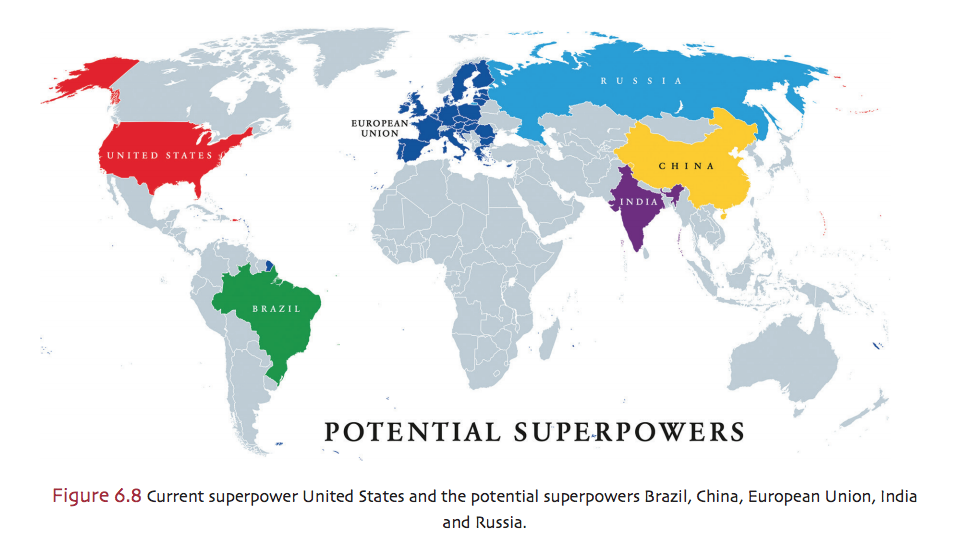
Soru 7
- promoting European values and norms
- encouraging domestic reforms in neighboring countries
- dictating the terms of partnership on the recipient countries
- transforming neighboring countries in economic and political terms
Seçenekler
A
I, II and III
B
I, II and IV
C
I, III and IV
D
II, III and IV
E
I, II, III and IV
Açıklama:
The European Neighborhood Policy (ENP) was first introduced in 2003 “Wider Europe” communication by the European Commission and then launched in 2004 as a response to the eastward and southward enlargements of 2004 and 2007. “The Policy was set as a framework to govern the EU’s relations with 16 of the EU’s Eastern and Southern Neighbours in order to achieve the closest possible political association and the greatest possible degree of economic integration” (EU External Action Service, 2016). In other words, the purpose of this policy was to bring these countries closer together as part of EU integration through further cooperation in areas of economics, commerce, diplomacy and politics. In May 2009, the Eastern Partnership (EaP) was launched in terms of the eastern flank of the ENP, and it was meant to be complementary to the ENP goals. Eastern European EU members such as Poland and the Czech Republic are the most prominent proponents of the EaP, since their approach is geopolitically motivated in the face of the Russian threat with regard to Eastern Europe. Poland emerges here as the “main shaper behind the EaP initiative” and “geopolitical thinking has been central to Poland’s investment in EU Eastern policies…” (Cadier, 2019: 81). In Poland’s opinion, the Eastern neighborhood under the influence of the EU is considered a bulwark against Russian aggression and its imperialistic ambitions. As for the Czech Republic, notwithstanding that geopolitical motivations are not as dominant as in Poland’s case, there are some hawkish Atlanticist circles who think that EaP should be a policy seeking to contain or even roll-back Russia.
Soru 8
- promoting democratisation and political reforms
- encouraging domestic reforms in neighboring countries
- promoting European values and norms
- transforming neighboring countries in economic and political terms
Seçenekler
A
I, II and III
B
I, II and IV
C
I, III and IV
D
II, III and IV
E
I, II, III and IV
Açıklama:
The European Neighborhood Policy (ENP) was first introduced in 2003 “Wider Europe” communication by the European Commission and then launched in 2004 as a response to the eastward and southward enlargements of 2004 and 2007. “The Policy was set as a framework to govern the EU’s relations with 16 of the EU’s Eastern and Southern Neighbours in order to achieve the closest possible political association and the greatest possible degree of economic integration” (EU External Action Service, 2016). In other words, the purpose of this policy was to bring these countries closer together as part of EU integration through further cooperation in areas of economics, commerce, diplomacy and politics. In May 2009, the Eastern Partnership (EaP) was launched in terms of the eastern flank of the ENP, and it was meant to be complementary to the ENP goals. Eastern European EU members such as Poland and the Czech Republic are the most prominent proponents of the EaP, since their approach is geopolitically motivated in the face of the Russian threat with regard to Eastern Europe. Poland emerges here as the “main shaper behind the EaP initiative” and “geopolitical thinking has been central to Poland’s investment in EU Eastern policies…” (Cadier, 2019: 81). In Poland’s opinion, the Eastern neighborhood under the influence of the EU is considered a bulwark against Russian aggression and its imperialistic ambitions. As for the Czech Republic, notwithstanding that geopolitical motivations are not as dominant as in Poland’s case, there are some hawkish Atlanticist circles who think that EaP should be a policy seeking to contain or even roll-back Russia.
Soru 9
- Russia
- Germany
- Turkey
- Italy
Seçenekler
A
I and II
B
I and III
C
II and IV
D
I and IV
E
III and IV
Açıklama:
Indeed both the major powers of Europe such as Russia, France and Italy, and smaller states experienced this unprecedented return of geopolitics in their foreign affairs thinking and practice. Many books and other studies on geopolitics have been published in a wide range of European languages, while the term has widely appeared in newspapers and periodicals across Europe
Soru 10
- Homogenisation of partners from different regions
- Euro-centricism
- The EU’s “one size fits all” approach to all partner countries
- The lack of membership perspective to recipient countries
Seçenekler
A
I, II and IV
B
I, II and III
C
I, III and IV
D
II, III and IV
E
I, II, III and IV
Açıklama:
Another highly criticized aspect of the ENP is the lack of political will on the part of EU member states to cope with authoritarian regimes in neighboring areas for the sake of both stability and the prevention of irregular migration towards Europe. In other words, the EU has remained too soft on the issue of democratization in its vicinity, and this in return has caused a serious backlash for the EU in the form of the return of security threats such as terrorism which it is not ready to fight, given its emphasis on soft-power tools. During the Arab Spring revolts, then, the EU lost its relevance as a democratizing force for the Arab protestors because of its weak commitment to the wave of democratization in the Arab world. Finally, the economic crisis hit the EU severely, and dealt a severe blow in terms of its reliability and credibility for neighboring regions. In addition to the Middle East, the EU has also softened its rigid conditionality in Eastern Europe, as proven by its attempt to convince Ukraine under the Yanukovych government to sign the Association Agreement, which was dubbed as a “bulwark against Russian aggression”, while lifting sanctions on Belarus in 2016, which were imposed because of its poor democracy and human rights record.
Soru 11
Which one below describes the term used to describe the area that stretches from the Atlantic shores of Portugal in the West to the western parts of Eurasian-wide Russia in the East?
Seçenekler
A
Asia
B
Eurasia
C
World Island
D
Rimland
E
New Land
Açıklama:
Europe sits in the westernmost part of a vast Asian landmass (or World Island as defined by the US geopolitical theorist Nicolas Spykman as it stretches from the Atlantic shores of Portugal in the West to the western parts of Eurasian-wide Russia in the East, i.e. from the Atlantic Ocean to the Ural Mountains).
Soru 12
According to the second principle related to linearity, which of the followings is of internal geopolitics of Europe?
Seçenekler
A
Caspian Sea.
B
Black Sea.
C
Könkämäeno.
D
The Nile.
E
Seine.
Açıklama:
Page 152.
The second principle relates to linearity which is founded on water courses such as rivers or lakes. This principle is applied in many parts of Europe where there are lots of rivers flowing towards the seas or oceans, and a few lakes forming hydrofrontiers. In the north, the long Finnish-Swedish border is marked by rivers such as Könkämäeno, Muonio and Torne, while the border between Russia’s Kaliningrad and Lithuania follows the Neman River. In southeastern Europe, parts of the Maritsa River constitute the Turkish-Greek border, just as the Danube River, Europe’s second longest, marks the borders between Slovakia-Austria, SlovakiaHungary, Croatia-Serbia and Bulgaria-Romania along its course towards the Black Sea. Lastly, the principle of linearity is also applied in western Europe and is mostly to do with economic and to a greater extent military considerations that force neighboring countries to form linear and thus easy-to-defend borderlines as exemplified by the Franco-Belgian border. Therefore, the correct option is C.
The second principle relates to linearity which is founded on water courses such as rivers or lakes. This principle is applied in many parts of Europe where there are lots of rivers flowing towards the seas or oceans, and a few lakes forming hydrofrontiers. In the north, the long Finnish-Swedish border is marked by rivers such as Könkämäeno, Muonio and Torne, while the border between Russia’s Kaliningrad and Lithuania follows the Neman River. In southeastern Europe, parts of the Maritsa River constitute the Turkish-Greek border, just as the Danube River, Europe’s second longest, marks the borders between Slovakia-Austria, SlovakiaHungary, Croatia-Serbia and Bulgaria-Romania along its course towards the Black Sea. Lastly, the principle of linearity is also applied in western Europe and is mostly to do with economic and to a greater extent military considerations that force neighboring countries to form linear and thus easy-to-defend borderlines as exemplified by the Franco-Belgian border. Therefore, the correct option is C.
Soru 13
Which of the followings makes up external geopolitics of Europe?
Seçenekler
A
Caspian Sea.
B
Bosphorus.
C
Polish-Slovakian borders in the Pyrenees.
D
Mountain Range of Alps.
E
Mediterranean Sea.
Açıklama:
Page 153.
The geopolitics of Europe also has an external component in the sense of dominating proximate and distant maritime areas to which European influence may extend. While Europeans concentrated on maritime areas surrounding Europe such as the Mediterranean Sea and the Baltic from the era of the Roman Empire to 13th Century due to the lack of technical progress in the naval domain, at a later date they were able to sail overseas by crossing huge oceans with the arrival of technical advancements and thus reach undiscovered territories more easily. Therefore, the correct option is E.
The geopolitics of Europe also has an external component in the sense of dominating proximate and distant maritime areas to which European influence may extend. While Europeans concentrated on maritime areas surrounding Europe such as the Mediterranean Sea and the Baltic from the era of the Roman Empire to 13th Century due to the lack of technical progress in the naval domain, at a later date they were able to sail overseas by crossing huge oceans with the arrival of technical advancements and thus reach undiscovered territories more easily. Therefore, the correct option is E.
Soru 14
The boundaries between the nations in Europe has been drawn up based upon two different principles: (1) the natural border theory based on the drainage divides of mountains on the borderlines and (2) the principle of linearity and hydrofrontiers such as river or lakes located on the inter-state borders. Which border below is the one that is an example of the first principle?
Seçenekler
A
Turkey and Greece
B
Poland and Slovakia
C
Croatia and Serbia
D
Kaliningrad and Lithuania
E
Finland and Sweden
Açıklama:
Drainage divides or water courses play a central role as the basis of the natural border theory. Following physical geography logic, international borders are drawn using these natural formations, while they provide a useful means in mountainous areas of separating one nation from another, as exemplified in southern, northern and central Europe by the FrancoSpanish, Swedish-Norwegian and Polish-Czech and Polish-Slovakian borders in the Pyrenees, the Scandinavian and the Carpathian Mountains respectively. This principle of natural limits goes back to the 17th Century, when France and Spain agreed on the border dividing them in the Treaty of Pyrenees. “In 1792, in France, the theory of natural frontiers was invoked for geopolitical ends to justify external conquests in the Hainaut region of Belgium, and, in the south-east, the County of Nice and Savoy.” (Dumont and Verluise, 2016). It survived the subsequent centuries and still applies in many border cases in Europe such as the 1947 Paris Treaty between France and Italy over the borderline on the upper valleys of Tinée and Vésubie rivers, which was drawn on the basis of drainage lines. In northern Europe, the Swedish-Norwegian border is also based on the same natural border principle as it passes through the drainage line of the Scandinavian mountains. Lastly, Poland’s southern borders with the Czech Republic and with Slovakia are other prominent cases of the implementation of natural border theory as both the Carpathians and Sudetes Mountain ranges constitute the natural borderline.
Soru 15
"For some European countries, the end of the Cold War meant a decreasing strategic importance in the Western security architecture."
Which of the followings is among those countries?
Which of the followings is among those countries?
Seçenekler
A
Turkish Republic.
B
Finland.
C
Austria.
D
Sweden.
E
Spain.
Açıklama:
Page 156.
For some European countries such as Italy and Turkey, the end of the Cold War meant a decreasing strategic importance in the Western security architecture, while for others such as the neutral states of Europe including Finland, Austria and Sweden, the post-Cold War era made their neutrality mostly irrelevant in the absence of the opposing camp. Therefore, the correct option is A.
For some European countries such as Italy and Turkey, the end of the Cold War meant a decreasing strategic importance in the Western security architecture, while for others such as the neutral states of Europe including Finland, Austria and Sweden, the post-Cold War era made their neutrality mostly irrelevant in the absence of the opposing camp. Therefore, the correct option is A.
Soru 16
Which of the followings was an ambitious response to the new geopolitical environment in the post-Cold War era in Europe?
Seçenekler
A
European Union.
B
NATO.
C
Warsaw Pact.
D
Euro-Mediterranean Partnership.
E
Brexit.
Açıklama:
Page 157.
Beyond the national revival of geopolitics, the EU’s launch of the Euro-Mediterranean Partnership (EMP), also called the Barcelona Process, in 1995 was an ambitious response to the new geopolitical environment in the post-Cold War era. Therefore, the correct option is D.
Beyond the national revival of geopolitics, the EU’s launch of the Euro-Mediterranean Partnership (EMP), also called the Barcelona Process, in 1995 was an ambitious response to the new geopolitical environment in the post-Cold War era. Therefore, the correct option is D.
Soru 17
Which of the followings is among the political criteria of the Copenhagen Criteria?
Seçenekler
A
Religious unity.
B
The rule of law.
C
Capacity to cope with competitive pressure.
D
Functioning market economy.
E
The ability to take on the obligations of membership.
Açıklama:
Page 158.
The Copenhagen Criteria:
Political criteria: democracy, the rule of law, human rights and respect for and protection of minorities;
Economic criteria: the existence of a functioning market economy as well as the capacity to cope with competitive pressure and market forces within the Union;
The adoption of the EU acquis: the ability to take on the obligations of membership.
Therefore, the correct option is B.
The Copenhagen Criteria:
Political criteria: democracy, the rule of law, human rights and respect for and protection of minorities;
Economic criteria: the existence of a functioning market economy as well as the capacity to cope with competitive pressure and market forces within the Union;
The adoption of the EU acquis: the ability to take on the obligations of membership.
Therefore, the correct option is B.
Soru 18
Which ones below is NOT one of the situation that caused the internal borders of the EU have become fuzzier and individual countries are easily accessible?
Seçenekler
A
Border checks and controls have been removed.
B
Cross-border interactions have increased steadily.
C
Schengen Treaty in 1985 was enforced.
D
EU’s single market was completed in 1992.
E
The Berlin Wall was built.
Açıklama:
In the past several decades, both the deepening and enlargement of the EU has affected the meaning of the internal borders and the dynamics of bordering across Europe. With the entry into force of Schengen Treaty in 1985, and the completion of the EU’s single market in 1992, the internal borders of the EU have become fuzzier and individual countries are easily accessible, since border checks and controls have been removed and cross-border interactions have increased steadily. This has led to a change in the meaning of borders across the EU, and external borders have gained a new relevance and importance in the face of security concerns following the 9/11 terrorist attacks and the growing tide of illegal immigrants in the 2000s. Thus, the protection of external borders has become a pressing necessity. “Within twenty years of the demolition of the Berlin Wall, Western Europe, once the main critic of the closed borders of Eastern European communist regimes, has closed its southern and eastern borders, built fences and established an EU agency, Frontex, to help border states guard its long maritime border” (Mamadouh, 2015: 58). These controversial measures, accompanied by the outsourcing and offshoring of external border protection, have been criticized for being exclusionary and otherising.
Soru 19
I. To strengthen relations with the countries involved,
II. To ensure theological unity of the union,
III. To guarantee the security and stability of the Union,
IV. To avoid the emergence of new dividing lines.
Which of the ones listed above is among the main challenges that European Union (EU) had to deal with durng The eastward enlargement?
II. To ensure theological unity of the union,
III. To guarantee the security and stability of the Union,
IV. To avoid the emergence of new dividing lines.
Which of the ones listed above is among the main challenges that European Union (EU) had to deal with durng The eastward enlargement?
Seçenekler
A
I, II & III.
B
II, III & IV.
C
I, III & IV.
D
I, II & IV.
E
I, II, III & IV.
Açıklama:
Page 158.
The eastward enlargement was a strategic decision by the EU. With this decision, Celata and Coletti (2015: 1) argue “The European Union (EU) had to deal with three main challenges: first, to guarantee the security and stability of the Union along its new external border; second, to avoid the emergence of new “dividing lines” between the enlarged EU and its neighbouring countries; and third, to strengthen relations with those countries who, although not EU members nor candidates for accession, are of strategic relevance for the geopolitical and geoeconomic reconfiguration of ‘EU’rope as a global actor.” In other words, this was not only a large-scale enlargement in every sense of the word, but also an ambitious geopolitical undertaking on the part of the EU at the dawn of the 21st Century. Therefore, the correct option is C.
The eastward enlargement was a strategic decision by the EU. With this decision, Celata and Coletti (2015: 1) argue “The European Union (EU) had to deal with three main challenges: first, to guarantee the security and stability of the Union along its new external border; second, to avoid the emergence of new “dividing lines” between the enlarged EU and its neighbouring countries; and third, to strengthen relations with those countries who, although not EU members nor candidates for accession, are of strategic relevance for the geopolitical and geoeconomic reconfiguration of ‘EU’rope as a global actor.” In other words, this was not only a large-scale enlargement in every sense of the word, but also an ambitious geopolitical undertaking on the part of the EU at the dawn of the 21st Century. Therefore, the correct option is C.
Soru 20
Which choice below is the one that includes all the correct information about the Cold War Era?
I Europe was geopolitically divided into two bitterly hostile parts in the form of Eastern Europe and Western Europe
II The ideological and political enmity between the two competing blocs, the Socialist bloc and the Capitalist bloc.
III Geopolitics was not so popular in Europe because of its past association with the fascist regimes in the 1930s.
IV Geopolitics has been labeled as a highly militarist and determinist form of Realist International Relations School in the face of the tense Cold War rivalry.
I Europe was geopolitically divided into two bitterly hostile parts in the form of Eastern Europe and Western Europe
II The ideological and political enmity between the two competing blocs, the Socialist bloc and the Capitalist bloc.
III Geopolitics was not so popular in Europe because of its past association with the fascist regimes in the 1930s.
IV Geopolitics has been labeled as a highly militarist and determinist form of Realist International Relations School in the face of the tense Cold War rivalry.
Seçenekler
A
Only I
B
Only II
C
Only II and III
D
Only III and IV
E
I, II, III, IV
Açıklama:
During the heightened Cold War era, Europe was geopolitically divided into two bitterly hostile parts in the form of Eastern Europe (the Socialist bloc) and Western Europe (the Capitalist bloc), signifying the ideological and political enmity between the two competing blocs (Berentsen,1993). At that time, nevertheless, geopolitics was not so popular in Europe because of its past association with the fascist regimes in the 1930s, and has been labeled as a highly militarist and determinist form of Realist International Relations School in the face of the tense Cold War rivalry. In the words of one analyst (Techau, 2013), “The intellectual concept of geopolitics originated in Europe, yet it is here that it is most unpopular today. It smacks of the ugly realism that many Europeans find so difficult to embrace. And it is too disquieting a reminder that history has not ended, and that the current peaceful state of the continent may not last forever.” Indeed the European integration project launched in the 1950s was devised and regarded as an antidote to the geopolitical thinking by nature (Guzzini, 2012: 62): “…the EU has staked its reputation on being an anti-geopolitical unit. In the memorable phrase of Ole Wæver, ‘Europe’s other is Europe’s past’, the EU being a peace organization, a ‘civilian’ or ‘normative’ power, aimed precisely at overcoming the militarism and nationalism, historically associated with classical geopolitical thought, that had plagued Europe’s early twentieth century.” The restoration of peace in Europe after long centuries of conflict between European nations was the main success of the 70 year-long European integration, and due to this success, the EU was awarded the Nobel Peace Prize in 2012.
Soru 21
I. Respect for human rights,
II. Sustainable development,
III. Principles of market economy,
IV. Commitment to the rule of law.
Which of the followings listed above is among the principles on which EU’s privileged relationship with its neighbors under the European Neighborhood Policy (ENP) will build?
II. Sustainable development,
III. Principles of market economy,
IV. Commitment to the rule of law.
Which of the followings listed above is among the principles on which EU’s privileged relationship with its neighbors under the European Neighborhood Policy (ENP) will build?
Seçenekler
A
I, II & III.
B
I, III & IV.
C
I, II & IV.
D
II, III & IV.
E
I, II, III & IV.
Açıklama:
Page 160.
EU’s privileged relationship with its neighbors under the ENP “…will build on mutual commitment to common values principally within the fields of the rule of law, good governance, the respect for human rights, including minority rights, the promotion of good neighbourly relations, and the principles of market economy and sustainable development”. Therefore, the correct option is E.
EU’s privileged relationship with its neighbors under the ENP “…will build on mutual commitment to common values principally within the fields of the rule of law, good governance, the respect for human rights, including minority rights, the promotion of good neighbourly relations, and the principles of market economy and sustainable development”. Therefore, the correct option is E.
Soru 22
For which country below the end of the Cold War meant a decreasing strategic importance in the Western security architecture?
Seçenekler
A
Russia
B
Turkey
C
Sweden
D
Austria
E
Finland
Açıklama:
For some European countries such as Italy and Turkey, the end of the Cold War meant a decreasing strategic importance in the Western security architecture, while for others such as the neutral states of Europe including Finland, Austria and Sweden, the post-Cold War era made their neutrality mostly irrelevant in the absence of the opposing camp.
Soru 23
Which of the followings is among the partners in EU’s Neighborhood Policy?
Seçenekler
A
Qatar.
B
Israel.
C
Iran.
D
Russia.
E
Turkish Republic.
Açıklama:
Page 163.
Partners in EU’s Neighborhood Policy: ten Mediterranean countries (Algeria, Egypt, Jordan, Israel, Lebanon, Libya, Morocco, Palestinian Authority, Syria and Tunisia) and six Eastern countries (Armenia, Azerbaijan, Georgia, Belarus, Moldova and Ukraine). Therefore, the correct option is B.
Partners in EU’s Neighborhood Policy: ten Mediterranean countries (Algeria, Egypt, Jordan, Israel, Lebanon, Libya, Morocco, Palestinian Authority, Syria and Tunisia) and six Eastern countries (Armenia, Azerbaijan, Georgia, Belarus, Moldova and Ukraine). Therefore, the correct option is B.
Soru 24
Which of the followings is not among the challenges that EU has faced in its neighborhood policy since 2010's?
Seçenekler
A
Close relations between Turkish Republic and other Turkic countries in Central Asia.
B
Irregular migration due to inner conflicts in Syria.
C
Russia did not view Brussels as a partner but a geopolitical competitor.
D
ISIS terrorism in the Middle East.
E
Arab Spring dealt a severe blow to EU efforts to export its values and norms to the Middle East and North Africa.
Açıklama:
Page 164.
The main goal of the EU neighborhood policy, creating “a ring of friendly states”, has become “a ring of fire” in the second half of 2010s. While other states, most notably Russia, did not view Brussels as a partner but a geopolitical competitor, the Arab Spring dealt a severe blow to EU efforts to export its values and norms to the Middle East and North Africa. These unfavorable events and developments in Eastern and Southern neighborhoods “… arguably altered the Union’s strategic environment significantly” (Pänke, 2019: 111). As Europe turns inwards, and is busy with putting its own house in order in the wake of the simultaneous crises it has faced recently, it is claimed that it is seriously threatened by its eastern neighbor (Russia) and its southern and southeastern neighborhood (ISIS terrorism and irregular migration). Therefore the EU has to take “traditional aspects of geopolitics and strategic thinking” (Nitoiu and Sus, 2019: 1) into consideration in its dealings with these challenges and threats. During the second half of the 2010s, in fact, traditional geopolitics seems to have influenced the EU policymakers’ foreign policy thinking despite the denials of any geopolitical interest by the EU itself as a normative and civilian power in its external relations. Therefore, the correct option is A.
The main goal of the EU neighborhood policy, creating “a ring of friendly states”, has become “a ring of fire” in the second half of 2010s. While other states, most notably Russia, did not view Brussels as a partner but a geopolitical competitor, the Arab Spring dealt a severe blow to EU efforts to export its values and norms to the Middle East and North Africa. These unfavorable events and developments in Eastern and Southern neighborhoods “… arguably altered the Union’s strategic environment significantly” (Pänke, 2019: 111). As Europe turns inwards, and is busy with putting its own house in order in the wake of the simultaneous crises it has faced recently, it is claimed that it is seriously threatened by its eastern neighbor (Russia) and its southern and southeastern neighborhood (ISIS terrorism and irregular migration). Therefore the EU has to take “traditional aspects of geopolitics and strategic thinking” (Nitoiu and Sus, 2019: 1) into consideration in its dealings with these challenges and threats. During the second half of the 2010s, in fact, traditional geopolitics seems to have influenced the EU policymakers’ foreign policy thinking despite the denials of any geopolitical interest by the EU itself as a normative and civilian power in its external relations. Therefore, the correct option is A.
Soru 25
According to Belin and Reinert, which of the followings is among the factors that the European experiment in shared sovereignty is unprepared for?
Seçenekler
A
Fluctuations in Euro currency.
B
Extremes in common market.
C
Rapid expansion of free market.
D
Rising nationalism.
E
Decline of socialism.
Açıklama:
Page 166.
The European experiment in shared sovereignty is unprepared for a global era characterized by rising nationalism, great power competition, and a weakened transatlantic link” (Belin and Reinert, 2019: PAGE?). Therefore there is a stark difference between the past conditions under which the EU was supposed to be a key geostrategic actor on the world scene, and the current picture in which the Union seems much weaker, unassertive and disunited, let alone a significant global player.
The European experiment in shared sovereignty is unprepared for a global era characterized by rising nationalism, great power competition, and a weakened transatlantic link” (Belin and Reinert, 2019: PAGE?). Therefore there is a stark difference between the past conditions under which the EU was supposed to be a key geostrategic actor on the world scene, and the current picture in which the Union seems much weaker, unassertive and disunited, let alone a significant global player.
Soru 26
The EU has developed two comprehensive and inter-linked policy frameworks in order to shape subregional spaces. Which one is one of these two policy frameworks?
Seçenekler
A
enlargement
B
commercial approach
C
common constitution
D
stabilization
E
international relations
Açıklama:
The EU was founded in the 1950’s by the original six member states which jointly constitute the “core” of Europe. Since then, the geopolitical space surrounding this core region (or the EU’s near abroad) has been extended by successive rings such as the new Central and Eastern European member states, the remaining EFTA members joining the European Economic Area which integrates them in the single market, future prospective members from Southeastern Europe, the ENP partners and peripheral non-ENP states or “neighbors of EU neighbors” that are mostly an arc of crisis and unsuited for EU accession. Thus “The Union establishes a hierarchical order via geopolitical modelling of different layers of influence and power” (Pänke, 2019: 107). To this end, the EU has developed two comprehensive and inter-linked policy frameworks entitled “enlargement” and “neighborhood” in order to shape subregional spaces.
Soru 27
"The Policy was set as a framework to govern the EU’s relations with 16 of the EU’s Eastern and Southern Neighbours in order to achieve the closest possible political association and the greatest possible degree of economic integration” which of the following policies is the one described here?
Seçenekler
A
Eastern Partnership Policy
B
European Enlargement Policy
C
European Neighborhood Policy
D
Western Partnership Policy
E
Wider Europe Policy
Açıklama:
The European Neighborhood Policy (ENP) was first introduced in 2003 “Wider Europe” communication by the European Commission and then launched in 2004 as a response to the eastward and southward enlargements of 2004 and 2007. “The Policy was set as a framework to govern the EU’s relations with 16 of the EU’s Eastern and Southern Neighbours in order to achieve the closest possible political association and the greatest possible degree of economic integration”
Soru 28
Which of the countries below is NOT one of the Partners in EU’s Neighborhood Policy?
Seçenekler
A
Georgia
B
Azerbaijan
C
Egypt
D
Turkey
E
Algeria
Açıklama:
Partners in EU’s Neighborhood Policy: ten Mediterranean countries (Algeria, Egypt, Jordan, Israel, Lebanon, Libya, Morocco, Palestinian Authority, Syria and Tunisia) and six Eastern countries (Armenia, Azerbaijan, Georgia, Belarus, Moldova and Ukraine).
Soru 29
Belt and Road Initiative, which was launched in 2013, aims to build new trade corridors reaching to Africa and Europe, crossing Central Asia and the Indian Ocean, thereby establishing a Belt and Road circle of friends. Which country started this initiative?
Seçenekler
A
Belarus
B
China
C
The US
D
France
E
Russia
Açıklama:
China’s massive Belt and Road Initiative, which was launched in 2013 under the new Chinese President Xi Jinping, is a geopolitically motivated endeavor to expand its influence and clout westward, and this policy is expected to have a strong impact on the EU and its neighborhood. It aims to build new trade corridors reaching to Africa and Europe, crossing Central Asia and the Indian Ocean, thereby establishing a Belt and Road circle of friends.
Soru 30
Which country unilaterally withdrawn from the Joint Comprehensive Plan of Action (JCPOA) in May 2018, which is not welcomed by the EU and its signatory members?
Seçenekler
A
Germany
B
France
C
The USA
D
Austria
E
Italy
Açıklama:
The unilateral withdrawal of the US from the Joint Comprehensive Plan of Action (JCPOA) in May 2018, also called the Iranian nuclear deal, is not welcomed by the EU and its signatory members, who wish to remain committed to the deal.
Soru 31
I. Turkey
II. Belarus
III. Ukraine
Which one(s) of these countries appear to be the objects of geopolitical rivalry between the EU and Russia today?
II. Belarus
III. Ukraine
Which one(s) of these countries appear to be the objects of geopolitical rivalry between the EU and Russia today?
Seçenekler
A
Only I
B
Only II
C
Only II
D
I-II
E
II-III
Açıklama:
Today, whileCentral and Eastern European countries are both
EU and NATO members, and the Balkan states
are either EU and NATO members or on their way
to join both organizations, the remaining nations -
Ukraine, Moldova and Belarus - appear the objects
of geopolitical rivalry between the EU and Russia.
EU and NATO members, and the Balkan states
are either EU and NATO members or on their way
to join both organizations, the remaining nations -
Ukraine, Moldova and Belarus - appear the objects
of geopolitical rivalry between the EU and Russia.
Soru 32
How many memberships does European Union cover?
Seçenekler
A
28
B
29
C
30
D
31
E
32
Açıklama:
Indeed the EU membership covers 28
of more than 40 European nations, while it still
continues to expand its influence well beyond the
European core, “…surrounded by a buffer zone
of a so-called ‘ring of friends’, beyond which lies
a threatening world” (Browning, 2018: 127).
of more than 40 European nations, while it still
continues to expand its influence well beyond the
European core, “…surrounded by a buffer zone
of a so-called ‘ring of friends’, beyond which lies
a threatening world” (Browning, 2018: 127).
Soru 33
When was the European Union awarded the Nobel Peace Prize?
Seçenekler
A
2010
B
2011
C
2012
D
2013
E
2014
Açıklama:
The restoration of peace in Europe after long centuries
of conflict between European nations was the main
success of the 70 year-long European integration,
and due to this success, the EU was awarded the
Nobel Peace Prize in 2012.
of conflict between European nations was the main
success of the 70 year-long European integration,
and due to this success, the EU was awarded the
Nobel Peace Prize in 2012.
Soru 34
Which one of the following is not related with the political criteria of The Copenhagen Criteria?
Seçenekler
A
democracy
B
the rule of law
C
human rights
D
respect for and protection of minorities
E
the ability to take on the obligations of membership
Açıklama:
The Copenhagen Criteria:
Political criteria: democracy, the rule of law,
human rights and respect for and protection
of minorities;
Economic criteria: the existence of a
functioning market economy as well as the
capacity to cope with competitive pressure
and market forces within the Union;
The adoption of the EU acquis: the ability
to take on the obligations of membership.
Political criteria: democracy, the rule of law,
human rights and respect for and protection
of minorities;
Economic criteria: the existence of a
functioning market economy as well as the
capacity to cope with competitive pressure
and market forces within the Union;
The adoption of the EU acquis: the ability
to take on the obligations of membership.
Soru 35
Which one of the following countries is in the phase of accession negotiations with the Union with a prospect of accession around 2025?
Seçenekler
A
Serbia
B
Bosnia
C
Albania
D
Turkey
E
Macedonia
Açıklama:
In the meantime, the Western
Balkan countries - Serbia, Montenegro, Albania
and Bosnia - joined the membership queue starting
from 2009 by officially applying for membership
successively. Of these, Serbia and Montenegro are in
the phase of accession negotiations with the Union
with a prospect of accession around 2025
Balkan countries - Serbia, Montenegro, Albania
and Bosnia - joined the membership queue starting
from 2009 by officially applying for membership
successively. Of these, Serbia and Montenegro are in
the phase of accession negotiations with the Union
with a prospect of accession around 2025
Soru 36
Which one of the following countries is not included in the Partners in EU’s Neighborhood Policy?
Seçenekler
A
Algeria
B
Armenia
C
Azerbaijan
D
Turkey
E
Moldova
Açıklama:
Partners in EU’s Neighborhood Policy:
ten Mediterranean countries (Algeria, Egypt,
Jordan, Israel, Lebanon, Libya, Morocco,
Palestinian Authority, Syria and Tunisia) and
six Eastern countries (Armenia, Azerbaijan,
Georgia, Belarus, Moldova and Ukraine).
ten Mediterranean countries (Algeria, Egypt,
Jordan, Israel, Lebanon, Libya, Morocco,
Palestinian Authority, Syria and Tunisia) and
six Eastern countries (Armenia, Azerbaijan,
Georgia, Belarus, Moldova and Ukraine).
Soru 37
Which one of the following countries has been the first G-7 country and the only EU member to officially participate in the Belt and Road project of China?
Seçenekler
A
France
B
Italy
C
Germany
D
Spain
E
Poland
Açıklama:
For example, Central and Eastern European EU
members are desperate to receive further Chinese
investment, while has Italy become the first G-7
country and the only EU member to officially
participate in the Belt and Road project.
members are desperate to receive further Chinese
investment, while has Italy become the first G-7
country and the only EU member to officially
participate in the Belt and Road project.
Soru 38
When did the US withdraw from the Joint Comprehensive Plan of Action (JCPOA)?
Seçenekler
A
2016
B
2017
C
2018
D
2019
E
2020
Açıklama:
The unilateral withdrawal
of the US from the Joint Comprehensive Plan
of Action (JCPOA) in May 2018, also called the
Iranian nuclear deal, is not welcomed by the EU
and its signatory members, who wish to remain
committed to the deal.
of the US from the Joint Comprehensive Plan
of Action (JCPOA) in May 2018, also called the
Iranian nuclear deal, is not welcomed by the EU
and its signatory members, who wish to remain
committed to the deal.
Soru 39
Which one of the following countries launched Belt and Road Initiative in 2013?
Seçenekler
A
Japan
B
South Korea
C
India
D
China
E
Singapore
Açıklama:
China’s massive Belt and Road Initiative,
which was launched in 2013 under the new
Chinese President Xi Jinping, is a geopoliticallymotivated endeavor to expand its influence and clout westward, and this policy is expected to have
a strong impact on the EU and its neighborhood
which was launched in 2013 under the new
Chinese President Xi Jinping, is a geopoliticallymotivated endeavor to expand its influence and clout westward, and this policy is expected to have
a strong impact on the EU and its neighborhood
Soru 40
I. Invading Georgia in 2008
II. Partnership with Turkey
III. Annexing Crimea
Which one(s) of these is/are Russian responses to both NATO enlargement and EU neighborhood policies?
II. Partnership with Turkey
III. Annexing Crimea
Which one(s) of these is/are Russian responses to both NATO enlargement and EU neighborhood policies?
Seçenekler
A
Only I
B
Only II
C
Only III
D
I-II
E
I-III
Açıklama:
Against this background, Europe is at the heart
of geopolitical power competition again in the face
of Russia’s assertive foreign policy under President
Putin. As one analyst (Grygiel, 2015: 505) put
it, “While Russia has returned to the European
chessboard with violent determination, Europe
is confused politically and incapable of a unified
response.” Both NATO enlargement and EU
neighborhood policies have dismayed the Russians,
and they responded to these developments by first
invading Georgia in 2008 and then annexing
Crimea and engaging in hybrid warfare against
Kiev in eastern Ukraine since 2014.
of geopolitical power competition again in the face
of Russia’s assertive foreign policy under President
Putin. As one analyst (Grygiel, 2015: 505) put
it, “While Russia has returned to the European
chessboard with violent determination, Europe
is confused politically and incapable of a unified
response.” Both NATO enlargement and EU
neighborhood policies have dismayed the Russians,
and they responded to these developments by first
invading Georgia in 2008 and then annexing
Crimea and engaging in hybrid warfare against
Kiev in eastern Ukraine since 2014.
Soru 41
I.It has identifiable boundaries in the north, the west and the south.
II.It is separated from the North Pole, America and Africa by mountains.
III.It is also surrounded by various peninsulas from north to south.
Which one/ones is/are correct about Peninsular Europe?
II.It is separated from the North Pole, America and Africa by mountains.
III.It is also surrounded by various peninsulas from north to south.
Which one/ones is/are correct about Peninsular Europe?
Seçenekler
A
Only I
B
I-II
C
I-III
D
II-III
E
I-II-III
Açıklama:
THE GEOPOLITICAL IDENTITY OF EUROPE
Peninsular Europe has identifiable boundaries in the north (The Arctic Ocean), the west (The Atlantic Ocean) and the south (The Mediterranean Sea). Thus it is separated from the North Pole, America and Africa by the sea or ocean. Europe
itself is also surrounded by various peninsulas from north to south such as the Scandinavian and the Italian (the Apennine), and from east to west such
as the Balkanic and the Iberian as well as islands (Great Britain, Ireland in the northern Atlantic and Cyprus, Sicily, Sardinia and others in the Mediterranean Sea).
Peninsular Europe has identifiable boundaries in the north (The Arctic Ocean), the west (The Atlantic Ocean) and the south (The Mediterranean Sea). Thus it is separated from the North Pole, America and Africa by the sea or ocean. Europe
itself is also surrounded by various peninsulas from north to south such as the Scandinavian and the Italian (the Apennine), and from east to west such
as the Balkanic and the Iberian as well as islands (Great Britain, Ireland in the northern Atlantic and Cyprus, Sicily, Sardinia and others in the Mediterranean Sea).
Soru 42
Which countries do not have borders separated by natural formations?
Seçenekler
A
Sweden-Norway
B
Poland-Czech Republic
C
America-Mexico
D
Poland-Slovakia
E
France-Spain
Açıklama:
Internal Geopolitics of Europe
Following physical geography logic, international borders are drawn using these
natural formations, while they provide a useful means in mountainous areas of separating one nation from another, as exemplified in southern, northern and central Europe by the Franco-Spanish, Swedish-Norwegian and Polish-Czech
and Polish-Slovakian borders in the Pyrenees, the Scandinavian and the Carpathian Mountains respectively.
Following physical geography logic, international borders are drawn using these
natural formations, while they provide a useful means in mountainous areas of separating one nation from another, as exemplified in southern, northern and central Europe by the Franco-Spanish, Swedish-Norwegian and Polish-Czech
and Polish-Slovakian borders in the Pyrenees, the Scandinavian and the Carpathian Mountains respectively.
Soru 43
Which river constitutes Turkish-Greek border?
Seçenekler
A
Könkämäeno
B
Muonio
C
Neman
D
Maritsa
E
Danube
Açıklama:
Internal Geopolitics of Europe
In southeastern Europe, parts of the Maritsa River constitute the Turkish-Greek border.
In southeastern Europe, parts of the Maritsa River constitute the Turkish-Greek border.
Soru 44
Which river marks the borders between Slovakia-Austria, SlovakiaHungary, Croatia-Serbia and Bulgaria-Romania?
Seçenekler
A
Torne
B
Danube
C
Maritsa
D
Neman
E
Muonio
Açıklama:
Internal Geopolitics of Europe
The Danube River, Europe’s second longest, marks the borders between Slovakia-Austria, Slovakia-Hungary, Croatia-Serbia and Bulgaria-Romania along its course towards the Black Sea.
The Danube River, Europe’s second longest, marks the borders between Slovakia-Austria, Slovakia-Hungary, Croatia-Serbia and Bulgaria-Romania along its course towards the Black Sea.
Soru 45
Which river serves as the frontier on Switzerland’s borders with
Austria, Lichtenstein and Germany?
Austria, Lichtenstein and Germany?
Seçenekler
A
The Neman River
B
The Maritsa River
C
The Danube River
D
The Bidassoa River
E
The Rhine River
Açıklama:
Internal Geopolitics of Europe
The Rhine River serves as the frontier on Switzerland’s borders with
Austria, Lichtenstein and Germany.
The Rhine River serves as the frontier on Switzerland’s borders with
Austria, Lichtenstein and Germany.
Soru 46
I.It was founded in the 1950. II.The EU was founded by the original six member states. III.The EU has grown from 6 to 28 members in successive enlargements . Which one/ones is/are correct about the enlargement and neighborhood policies as geopolitical investments on the part of the EU?
Seçenekler
A
Only I
B
I-II
C
I-III
D
II-III
E
I-II-III
Açıklama:
Enlargement of the European Union
The EU was founded in the 1950’s by the original six member states which jointly constitute
the “core” of Europe. Since its foundation, the EU has grown from 6 to 28 members in successive enlargements and, as the legal basis of enlargement, the founding treaties stipulate that any European state can apply for membership.
The EU was founded in the 1950’s by the original six member states which jointly constitute
the “core” of Europe. Since its foundation, the EU has grown from 6 to 28 members in successive enlargements and, as the legal basis of enlargement, the founding treaties stipulate that any European state can apply for membership.
Soru 47
Since 2007, which country has been able to become a member of the EU?
Seçenekler
A
Serbia
B
Montenegro
C
Albania
D
Croatia
E
Bosnia
Açıklama:
Enlargement of the European Union
The pace of EU enlargement has been slowed down since the accession of Bulgaria and Romania in 2007 because of enlargement fatigue. Indeed, only Croatia has been able to join the Union since then.
The pace of EU enlargement has been slowed down since the accession of Bulgaria and Romania in 2007 because of enlargement fatigue. Indeed, only Croatia has been able to join the Union since then.
Soru 48
Which country is not a partner in EU’s Neighborhood Policy?
Seçenekler
A
Algeria
B
Jordan
C
Ukraine
D
Morocco
E
Bosnia
Açıklama:
The European Neighborhood Policy
Partners in EU’s Neighborhood Policy: ten Mediterranean countries (Algeria, Egypt,
Jordan, Israel, Lebanon, Libya, Morocco, Palestinian Authority, Syria and Tunisia) and six Eastern countries (Armenia, Azerbaijan, Georgia, Belarus, Moldova and Ukraine).
Partners in EU’s Neighborhood Policy: ten Mediterranean countries (Algeria, Egypt,
Jordan, Israel, Lebanon, Libya, Morocco, Palestinian Authority, Syria and Tunisia) and six Eastern countries (Armenia, Azerbaijan, Georgia, Belarus, Moldova and Ukraine).
Soru 49
I.The decreasing leverage of the EU in shaping the course of events because
of the divergent and sometimes even opposing geopolitical interests of member states.
II.It remains disunited in dealing with the waves of irregular migration from its southern and southeastern neighbors and sea borders.
III.Its relationship with America is stronger than the other countries.
Which one/ones is/are correct about the challenges of the EU.
of the divergent and sometimes even opposing geopolitical interests of member states.
II.It remains disunited in dealing with the waves of irregular migration from its southern and southeastern neighbors and sea borders.
III.Its relationship with America is stronger than the other countries.
Which one/ones is/are correct about the challenges of the EU.
Seçenekler
A
Only I
B
I-II
C
I-III
D
II-III
E
I-II-III
Açıklama:
The EU’s Challenges in a Turbulent Era of Geopolitics and Great Power Competition
Currently it appears that the EU’s relations with President Donald Trump’s United States have been increasingly uneasy despite the fact that the United States is referred as the EU’s core partner in its 2016 Global Strategy document.
Currently it appears that the EU’s relations with President Donald Trump’s United States have been increasingly uneasy despite the fact that the United States is referred as the EU’s core partner in its 2016 Global Strategy document.
Soru 50
When was the Belt and Road Initiative launched?
Seçenekler
A
1992
B
1994
C
2000
D
2003
E
2006
Açıklama:
The EU’s Challenges in a Turbulent Era of Geopolitics and Great Power Competition
China’s massive Belt and Road Initiative, which was launched in 2013 under the new Chinese President Xi Jinping.
China’s massive Belt and Road Initiative, which was launched in 2013 under the new Chinese President Xi Jinping.
Soru 51
Which of the followings the major aim of the EU for developing relations with neighbors?
Seçenekler
A
To legitimize its own existence in world politics and to create a distinct identity.
B
To develop a zone of prosperity and a friendly neighbourhood.
C
To invade from both west and east, and to control its historical ambitions.
D
To distinguish Europe from other surrounding territories in the East.
E
To form linear and thus easy-to-defend borderlines.
Açıklama:
THE GEOPOLITICAL IDENTITY OF EUROPE
The major aim of the EU for developing relations with neighbors is stated in the Wider Europe Communication of the European Commission: “...to develop a zone of prosperity and a friendly neighbourhood - a ‘ring of friends’ - with whom the EU enjoys close, peaceful, and cooperative relations” (The European Commission, 2003: 4).
The major aim of the EU for developing relations with neighbors is stated in the Wider Europe Communication of the European Commission: “...to develop a zone of prosperity and a friendly neighbourhood - a ‘ring of friends’ - with whom the EU enjoys close, peaceful, and cooperative relations” (The European Commission, 2003: 4).
Soru 52
Which of the following statements is not true regarding European geography?
Seçenekler
A
It is unique in the sense that whether it is a true continent and where it ends in the east remain open questions.
B
it is part of a vast Eurasian landmass rather than a separate continent.
C
Its eastern borderline is artificially constituted and thus disputed.
D
Its subregions differ geographically from each other and this has had serious geopolitical implications for the continent throughout history.
E
Its internal borders have been drawn based on various principles and theories such as imperial domination and competition.
Açıklama:
Define the geopolitical identity of Europe with regard to its internal and external geopolitics
Its internal borders have been drawn based on various principles and theories such as natural borders or linearity and hydrofrontiers.
Its internal borders have been drawn based on various principles and theories such as natural borders or linearity and hydrofrontiers.
Soru 53
Which of the followings has had serious geopolitical implications for European geography throughout history?
Seçenekler
A
Its external border areas have been the subject of imperial domination and competition since the days of the Roman Empire to the 20th Century.
B
Its internal borders have been drawn based on various principles.
C
Its subregions differ geographically from each other.
D
European core consisted of the original six member states.
E
The differing geopolitical interests of the member states have been a setback for EU unity in the face of international crises.
Açıklama:
Define the geopolitical identity of Europe with regard to its internal and external geopolitics
Its subregions differ geographically from each other and this has had serious geopolitical implications for the continent throughout history.
Its subregions differ geographically from each other and this has had serious geopolitical implications for the continent throughout history.
Soru 54
Which of the followings is related to European geography's internal borders?
Seçenekler
A
Neighborhood policy
B
Linearity
C
Enlargement
D
Imperial domination
E
Competition
Açıklama:
Define the geopolitical identity of Europe with regard to its internal and external geopolitics.
Its internal borders have been drawn based on various principles and theories such as natural borders or linearity and hydrofrontiers, while its external border areas have been the subject of imperial domination and competition since the days of the Roman Empire to the 20th Century. Despite its unique geography, Europe has rarely been a unified geopolitical actor. Today, the EU is expected to become such an actor on a regional and global scale, and it has developed policy tools such as enlargement and neighborhood to achieve this goal
Its internal borders have been drawn based on various principles and theories such as natural borders or linearity and hydrofrontiers, while its external border areas have been the subject of imperial domination and competition since the days of the Roman Empire to the 20th Century. Despite its unique geography, Europe has rarely been a unified geopolitical actor. Today, the EU is expected to become such an actor on a regional and global scale, and it has developed policy tools such as enlargement and neighborhood to achieve this goal
Soru 55
Which of the followings was the main purpose of Euro-Mediterranean Partnership policy?
Seçenekler
A
To respond to the new geopolitical environment, while it decided to proceed with eastward enlargement in the face of successive accession applications by Central and Eastern European countries.
B
To become such an actor on a regional and global scale, and it has developed policy tools such as enlargement and neighborhood to achieve this goal.
C
To shape and integrate the geopolitical space surrounding the European core which consisted of the original six member states.
D
To integrate the neighboring areas with the EU.
E
To make the EU a geopolitical battleground in its current form which is both divided and considerably weakened.
Açıklama:
Examine the return of geopolitics in post-Cold War Europe
In the post-Cold War era, the EU launched a new policy called the Euro-Mediterranean Partnership also referred to as the Barcelona Process, in an attempt to respond to the new geopolitical environment, while it decided to proceed with eastward enlargement in the face of successive accession applications by Central and Eastern European countries.
In the post-Cold War era, the EU launched a new policy called the Euro-Mediterranean Partnership also referred to as the Barcelona Process, in an attempt to respond to the new geopolitical environment, while it decided to proceed with eastward enlargement in the face of successive accession applications by Central and Eastern European countries.
Soru 56
Which of the following countries was oppose to revival of geopolitics in the European context causing the foreign policy identity crisis?
Seçenekler
A
Russia
B
Italy
C
Turkey
D
France
E
Germany
Açıklama:
Examine the return of geopolitics in post-Cold War Europe
After the Cold War years when Europe was divided into two hostile parts, this geopolitical division ended and the geopolitical rivalry within and upon Europe seemed to disappear. Despite this however, it is possible to speak of a revival of geopolitics in the European context. This revival was not expected by many scholars, but was not surprising for Realist thinkers and political geographers. Actually the return of geopolitics was a response to the foreign policy identity crisis in many European countries. In some countries such as Russia, Italy, Turkey and France, this revival was quite obvious in many respects, but in others such as Germany, Sweden and the Czech Republic, this was not the case.
After the Cold War years when Europe was divided into two hostile parts, this geopolitical division ended and the geopolitical rivalry within and upon Europe seemed to disappear. Despite this however, it is possible to speak of a revival of geopolitics in the European context. This revival was not expected by many scholars, but was not surprising for Realist thinkers and political geographers. Actually the return of geopolitics was a response to the foreign policy identity crisis in many European countries. In some countries such as Russia, Italy, Turkey and France, this revival was quite obvious in many respects, but in others such as Germany, Sweden and the Czech Republic, this was not the case.
Soru 57
Which of the followings was the main purpose of enlargement and neighborhood policies of the European integration project?
Seçenekler
A
To proceed with eastward enlargement in the face of successive accession applications by Central and Eastern European countries.
B
To shape and integrate the geopolitical space surrounding the European core which consisted of the original six member states.
C
To become such an actor on a regional and global scale, and it has developed policy tools such as enlargement and neighborhood to achieve this goal.
D
To respond to the new geopolitical environment, while it decided to proceed with eastward enlargement in the face of successive accession applications by Central and Eastern European countries.
E
To make the EU a geopolitical battleground in its current form which is both divided and considerably weakened.
Açıklama:
Analyze and compare the enlargement and neighborhood policies of the EU in the form of geopolitical investments
Enlargement and neighborhood policies were not part of the European integration project initially, but subsequently they have become the most important foreign policy tools of the EU. These tools have been developed in an effort to shape and integrate the geopolitical space surrounding the European core which consisted of the original six member states.
Enlargement and neighborhood policies were not part of the European integration project initially, but subsequently they have become the most important foreign policy tools of the EU. These tools have been developed in an effort to shape and integrate the geopolitical space surrounding the European core which consisted of the original six member states.
Soru 58
Which of the following statements is not true regarding the enlargement and neighborhood policies of the EU in the form of geopolitical investments?
Seçenekler
A
Enlargement and neighborhood policies have always been the part of the European integration project.
B
The tools for integration project have been developed in an effort to shape and integrate the geopolitical space surrounding the European core.
C
Eastern and southern enlargements in the 2000s have had significant geopolitical impacts on the EU.
D
The European Neighborhood Policy was initiated in response to this largest tide of enlargement, and aimed at integrating the neighboring areas with the EU.
E
Current enlargement proposals encompass southeastern European countries with a prospect of membership around 2025.
Açıklama:
Analyze and compare the enlargement and neighborhood policies of the EU in the form of geopolitical investments
Enlargement and neighborhood policies were not part of the European integration project initially.
Enlargement and neighborhood policies were not part of the European integration project initially.
Soru 59
Which of the following issues is not of the barriers of EU integration?
Seçenekler
A
The rise of individualism
B
Great power competition
C
A lack of transatlantic solidarity
D
ISIS terrorism
E
Illegal immigration
Açıklama:
Explain the EU as a geopolitical actor in a turbulent era of geopolitics and great power competition
EU integration is currently encountering a great deal of state-based difficulties and challenges arising from the rise of nationalism, great power competition, and a lack of transatlantic solidarity, as well as non-state challenges including ISIS terrorism and illegal immigration.
EU integration is currently encountering a great deal of state-based difficulties and challenges arising from the rise of nationalism, great power competition, and a lack of transatlantic solidarity, as well as non-state challenges including ISIS terrorism and illegal immigration.
Soru 60
Which of the followings will probably be a tough test for the EU’s foreign policy actorness in the near future?
Seçenekler
A
The rise of nationalism
B
Non-state challenges including ISIS terrorism and illegal immigration
C
A lack of transatlantic solidarity
D
The Trump administration’s hostile America First attitude towards the EU
E
Russia's geopolitical ambitions under President Putin
Açıklama:
Explain the EU as a geopolitical actor in a turbulent era of geopolitics and great power competition
Both China’s geopolitical ambitions under President Xi Jinping, and his Belt and Road initiative, and the Trump administration’s hostile America First attitude towards the EU will probably be a tough test for the EU’s foreign policy actorness in the near future.
Both China’s geopolitical ambitions under President Xi Jinping, and his Belt and Road initiative, and the Trump administration’s hostile America First attitude towards the EU will probably be a tough test for the EU’s foreign policy actorness in the near future.
Soru 61
The official geographer of Tsar Peter the Great, Tatichtchtev aimed Moscow to be considered a European city. Which of the followings is a part of this goal?
Seçenekler
A
To claim the land on the northern coast of the Black Sea.
B
To annex the lands inhabited by Slavic nations in the Balkans.
C
To support and expand the Tsarist policies over Anatolia and the Balkans.
D
To prevent the European countries from spreading Catholicity in Tsarist Russia.
E
To legitimate a series of military victories against the Turks and the Tatars.
Açıklama:
Page 150.
The Ural range cannot be considered a natural dividing line separating these two adjacent regions despite the fact that it has been widely used for this purpose, and thus well established as a geopolitical boundary as exemplified in the common usage of “from the Atlantic to the Urals” in reference to Europe’s geographical identity. “The status, ascribed to the Urals, of a conventional frontier between Europe and Asia, is a human contrivance. We owe it to Tatichtchtev, the official geographer of Tsar Peter the Great, who hit on it at the start of the 18th Century for strictly political purposes. His goal at the time was for Moscow to be considered as a European city, for two reasons: firstly, to legitimate the strategy of alliance with resourcerich Western powers - notably military - liable to modernise the Empire; secondly, to legitimate a series of military victories against the Turks and the Tatars”. Therefore, the correct option is E.
The Ural range cannot be considered a natural dividing line separating these two adjacent regions despite the fact that it has been widely used for this purpose, and thus well established as a geopolitical boundary as exemplified in the common usage of “from the Atlantic to the Urals” in reference to Europe’s geographical identity. “The status, ascribed to the Urals, of a conventional frontier between Europe and Asia, is a human contrivance. We owe it to Tatichtchtev, the official geographer of Tsar Peter the Great, who hit on it at the start of the 18th Century for strictly political purposes. His goal at the time was for Moscow to be considered as a European city, for two reasons: firstly, to legitimate the strategy of alliance with resourcerich Western powers - notably military - liable to modernise the Empire; secondly, to legitimate a series of military victories against the Turks and the Tatars”. Therefore, the correct option is E.
Soru 62
I. 9/11 terrorist attacks,
II. Schengen Treaty,
III. EU single market,
IV. EU enlargement.
Which of the ones listed above is among the reasons that affected the meaning of the internal borders and the dynamics of bordering across Europe?
II. Schengen Treaty,
III. EU single market,
IV. EU enlargement.
Which of the ones listed above is among the reasons that affected the meaning of the internal borders and the dynamics of bordering across Europe?
Seçenekler
A
I, II, III & IV.
B
I, II & III.
C
II, III & IV.
D
III & IV.
E
I & II.
Açıklama:
Page 152.
In the past several decades, both the deepening and enlargement of the EU has affected the meaning of the internal borders and the dynamics of bordering across Europe. With the entry into force of Schengen Treaty in 1985, and the completion of the EU’s single market in 1992, the internal borders of the EU have become fuzzier and individual countries are easily accessible, since border checks and controls have been removed and cross-border interactions have increased steadily. This has led to a change in the meaning of borders across the EU, and external borders have gained a new relevance and importance in the face of security concerns following the 9/11 terrorist attacks and the growing tide of illegal immigrants in the 2000s. Therefore, the correct option is A.
In the past several decades, both the deepening and enlargement of the EU has affected the meaning of the internal borders and the dynamics of bordering across Europe. With the entry into force of Schengen Treaty in 1985, and the completion of the EU’s single market in 1992, the internal borders of the EU have become fuzzier and individual countries are easily accessible, since border checks and controls have been removed and cross-border interactions have increased steadily. This has led to a change in the meaning of borders across the EU, and external borders have gained a new relevance and importance in the face of security concerns following the 9/11 terrorist attacks and the growing tide of illegal immigrants in the 2000s. Therefore, the correct option is A.
Soru 63
Which of the followings is the alliance set up by Hamburg and Lubeck in the Baltic Sea, from the 13th Century onwards, to achieve both autonomy and safety for their commercial network reaching to the Atlantic through the English Channel?
Seçenekler
A
Mare nostrum.
B
Hanseatic League.
C
Pax-Augusta.
D
Nord Stream.
E
Pax-Romana.
Açıklama:
Page 153.
Similarly to the Romans, the northern Europeans also tried to use maritime trade for the purpose of geopolitical domination. In the Baltic Sea, from the 13th Century onwards, two key ports, Hamburg and Lubeck, managed to set up the Hanseatic League in order to achieve both autonomy for their respective cities and safety for their commercial network reaching to the Atlantic through the English Channel. Therefore, the correct option is B.
Similarly to the Romans, the northern Europeans also tried to use maritime trade for the purpose of geopolitical domination. In the Baltic Sea, from the 13th Century onwards, two key ports, Hamburg and Lubeck, managed to set up the Hanseatic League in order to achieve both autonomy for their respective cities and safety for their commercial network reaching to the Atlantic through the English Channel. Therefore, the correct option is B.
Soru 64
Which of the followings brought European colonial domination to an end due to the fall of major colonial powers?
Seçenekler
A
First World War.
B
Second World War.
C
The Fall of Berlin Wall.
D
The Fall of Tsarist Russia.
E
Hundred Years' War.
Açıklama:
Page 153.
With the increasing rivalry of other major European powers with these two Iberian naval powers, it was possible to speak of recurrent overseas conflicts between them which led to a process of colonization across the world with dire consequences for the colonized peoples at the hand of the colonizing Europeans. Before the outbreak of the First World War, most of the world was under the rule of European colonial powers. However, this colonial domination came to an end in the post-Second World War period, facilitated by the post-war fall of major colonial powers, most notably Britain and France, which led to the independence of European colonies in Africa and Asia from the 1950s to the 1970s. Therefore, the correct option is B.
With the increasing rivalry of other major European powers with these two Iberian naval powers, it was possible to speak of recurrent overseas conflicts between them which led to a process of colonization across the world with dire consequences for the colonized peoples at the hand of the colonizing Europeans. Before the outbreak of the First World War, most of the world was under the rule of European colonial powers. However, this colonial domination came to an end in the post-Second World War period, facilitated by the post-war fall of major colonial powers, most notably Britain and France, which led to the independence of European colonies in Africa and Asia from the 1950s to the 1970s. Therefore, the correct option is B.
Soru 65
Which of the followings uttered the phrase "Europe’s other is Europe’s past" stating that EU is a peace organization, a ‘civilian’ or ‘normative’ power?
Seçenekler
A
David Cadier.
B
Pierre Verluise.
C
Ole Wæver.
D
Gérard-François Dumont.
E
William H. Berentsen.
Açıklama:
Page 155.
European integration project launched in the 1950s was devised and regarded as an antidote to the geopolitical thinking by nature: “…the EU has staked its reputation on being an anti-geopolitical unit. In the memorable phrase of Ole Wæver, ‘Europe’s other is Europe’s past’, the EU being a peace organization, a ‘civilian’ or ‘normative’ power, aimed precisely at overcoming the militarism and nationalism, historically associated with classical geopolitical thought, that had plagued Europe’s early twentieth century.” The restoration of peace in Europe after long centuries of conflict between European nations was the main success of the 70 year-long European integration, and due to this success, the EU was awarded the Nobel Peace Prize in 2012. Therefore, the correct option is C.
European integration project launched in the 1950s was devised and regarded as an antidote to the geopolitical thinking by nature: “…the EU has staked its reputation on being an anti-geopolitical unit. In the memorable phrase of Ole Wæver, ‘Europe’s other is Europe’s past’, the EU being a peace organization, a ‘civilian’ or ‘normative’ power, aimed precisely at overcoming the militarism and nationalism, historically associated with classical geopolitical thought, that had plagued Europe’s early twentieth century.” The restoration of peace in Europe after long centuries of conflict between European nations was the main success of the 70 year-long European integration, and due to this success, the EU was awarded the Nobel Peace Prize in 2012. Therefore, the correct option is C.
Soru 66
According to Guzzini “the post-Cold War era was a dangerous peace, resurrecting a host of factors that almost required a revival in geopolitics.”
Which of the followings is the term used to identify this revival?
Which of the followings is the term used to identify this revival?
Seçenekler
A
Rimland thesis.
B
Geopolitik.
C
Geo-determinism.
D
Neoclassical geopolitics.
E
Classical geopolitics.
Açıklama:
Page 156.
Given that the Realist school in IR was not able to predict the end of the Cold War, and thus looked to be losing ground to non-Realist approaches, the revival of geopolitics in European politics was unexpected for many scholars, but not so surprising for the Realists and political geographers. According to Guzzini: “For them, the post-Cold War era was a dangerous peace, resurrecting a host of factors that almost required a revival in geopolitics.” This revival was identified as “neoclassical geopolitics”, since it is no longer an evil political way of thought often associated with Hitler’s German Geopolitik and his expansionist foreign policies, while still representing the environmentally deterministic posture of the old (classical) school of geopolitics in the post-Cold War era. Therefore, this rise of the neoclassical school in Europe was justified on these grounds, and relevant for explaining the foreign policy behaviors of European powers. Therefore, the correct option is D.
Given that the Realist school in IR was not able to predict the end of the Cold War, and thus looked to be losing ground to non-Realist approaches, the revival of geopolitics in European politics was unexpected for many scholars, but not so surprising for the Realists and political geographers. According to Guzzini: “For them, the post-Cold War era was a dangerous peace, resurrecting a host of factors that almost required a revival in geopolitics.” This revival was identified as “neoclassical geopolitics”, since it is no longer an evil political way of thought often associated with Hitler’s German Geopolitik and his expansionist foreign policies, while still representing the environmentally deterministic posture of the old (classical) school of geopolitics in the post-Cold War era. Therefore, this rise of the neoclassical school in Europe was justified on these grounds, and relevant for explaining the foreign policy behaviors of European powers. Therefore, the correct option is D.
Soru 67
"Beyond geography, there are other sets of conditions called the Copenhagen Criteria which are applied to the acceding countries in terms of whether or not they conform to the political, economic and legal norms and standards of the EU."
Which of the followings is among the economic conditions of the Copenhagen Criteria?
Which of the followings is among the economic conditions of the Copenhagen Criteria?
Seçenekler
A
The rule of law.
B
Protection of minorities.
C
A functioning market economy.
D
Democracy.
E
The adoption of the EU acquis.
Açıklama:
Page 158.
Despite the fact that it was never clarified by the EU, the adjective ‘European’ was thought to be a geographical concept which identifies the boundary of Europeanness or European identity, which also has historical and cultural elements. Thus non-European states such as Morocco were unable to become a member of the EU, as Rabat’s membership application already being rejected on a geographical basis by the EC in 1987, showed clearly. However, beyond geography, there are other sets of conditions called the Copenhagen Criteria which are applied to the acceding countries in terms of whether or not they conform to the political, economic and legal norms and standards of the EU. On this basis, some European political leaders claim that even Israel can be a prospective EU member despite not being in Europe geographically.
The Copenhagen Criteria:
Political criteria: democracy, the rule of law, human rights and respect for and protection of minorities;
Economic criteria: the existence of a functioning market economy as well as the capacity to cope with competitive pressure and market forces within the Union;
The adoption of the EU acquis: the ability to take on the obligations of membership.
Therefore, the correct option is C.
Despite the fact that it was never clarified by the EU, the adjective ‘European’ was thought to be a geographical concept which identifies the boundary of Europeanness or European identity, which also has historical and cultural elements. Thus non-European states such as Morocco were unable to become a member of the EU, as Rabat’s membership application already being rejected on a geographical basis by the EC in 1987, showed clearly. However, beyond geography, there are other sets of conditions called the Copenhagen Criteria which are applied to the acceding countries in terms of whether or not they conform to the political, economic and legal norms and standards of the EU. On this basis, some European political leaders claim that even Israel can be a prospective EU member despite not being in Europe geographically.
The Copenhagen Criteria:
Political criteria: democracy, the rule of law, human rights and respect for and protection of minorities;
Economic criteria: the existence of a functioning market economy as well as the capacity to cope with competitive pressure and market forces within the Union;
The adoption of the EU acquis: the ability to take on the obligations of membership.
Therefore, the correct option is C.
Soru 68
I. Preventing the emergence of new dividing issues between the enlarged Union and its neighbours,
II. Ensuring the political and military stability of NATO vis-à-vis communist regimes,
III. Establishing EU domination in Middle Eastern markets,
IV. Strengthening the well-being for EU member states.
Which of the ones listed above is among the aims of the European Neighbourhood Policy (ENP)?
II. Ensuring the political and military stability of NATO vis-à-vis communist regimes,
III. Establishing EU domination in Middle Eastern markets,
IV. Strengthening the well-being for EU member states.
Which of the ones listed above is among the aims of the European Neighbourhood Policy (ENP)?
Seçenekler
A
I & IV.
B
II & III.
C
Only IV.
D
III & IV.
E
II & IV.
Açıklama:
Page 159.
The aim of the European Neighbourhood Policy (ENP): “…strengthening stability, security and well-being for European Union member states and neighbouring countries, and preventing the emergence of new dividing lines between the enlarged Union and its neighbours”. Therefore, the correct option is
The aim of the European Neighbourhood Policy (ENP): “…strengthening stability, security and well-being for European Union member states and neighbouring countries, and preventing the emergence of new dividing lines between the enlarged Union and its neighbours”. Therefore, the correct option is
Soru 69
Which of the ollowings is not among EU’s privileged relationship with its neighbors under the European Neighborhood Policy?
Seçenekler
A
Respect for minority rights.
B
Commitment to the rule of law.
C
Enforcing tariffs via Customs Union.
D
Promotion of good neighbourly relations.
E
Mutual commitment to good governance.
Açıklama:
Page 159.
EU’s privileged relationship with its neighbors under the ENP “…will build on mutual commitment to common values principally within the fields of the rule of law, good governance, the respect for human rights, including minority rights, the promotion of good neighbourly relations, and the principles of market economy and sustainable development”.
EU’s privileged relationship with its neighbors under the ENP “…will build on mutual commitment to common values principally within the fields of the rule of law, good governance, the respect for human rights, including minority rights, the promotion of good neighbourly relations, and the principles of market economy and sustainable development”.
Soru 70
Which of the followings is among the Eastern countries that are partners in EU’s Neighborhood Policy?
Seçenekler
A
Egypt.
B
Jordan.
C
Lebanon.
D
Azerbaijan.
E
Israel.
Açıklama:
Page 163.
Partners in EU’s Neighborhood Policy: ten Mediterranean countries (Algeria, Egypt, Jordan, Israel, Lebanon, Libya, Morocco, Palestinian Authority, Syria and Tunisia) and six Eastern countries (Armenia, Azerbaijan, Georgia, Belarus, Moldova and Ukraine). Therefore, the correct option is D.
Partners in EU’s Neighborhood Policy: ten Mediterranean countries (Algeria, Egypt, Jordan, Israel, Lebanon, Libya, Morocco, Palestinian Authority, Syria and Tunisia) and six Eastern countries (Armenia, Azerbaijan, Georgia, Belarus, Moldova and Ukraine). Therefore, the correct option is D.
Ünite 7
Soru 1
What was the reaction of Brazil to the creation of Pacific Alliance?
Seçenekler
A
Join the ALBA
B
.Join the Pacific Alliance
C
Initiate the IIRSA project
D
Build closer ties with the US
E
Suspend Chile`s UNASUR membership
Açıklama:
Brazil’s response to the Pacific Alliance was the launch of the Integration of Regional Infrastructures project, which also reflected Brasília’s recognition of the significance of the Pacific region and its quest to connect the Atlantic and Pacific (Nolte and Wehner, 2015: 38; Lowenthal and Baron, 2014: 32). The growing trans-Pacific trade ushered in an enhanced prominence of the Panama Canal, the proposals for the creation of the Nicaragua Canal as well as the rising strategic importance of Pacific-facing countries, such as Peru and Chile, to Brazil.
Soru 2
- Chile
- Colombia
- Venezuela
- Peru
- Mexico
Seçenekler
A
I, II, III and IV
B
I, II, III and V
C
I, II, IV and V
D
I, III, IV and V
E
II, III, IV and V
Açıklama:
In 2012, Chile, Colombia, Mexico and Peru launched the Pacific Alliance, which primarily seeks to expand free trade between these countries. Except for the Pacific Alliance, all of these regional integration schemes sought to isolate the US and Canada from participating in the new regional institutions.
Soru 3
Which of these countries were not among the creators of MERCOSUR in 1991?
Seçenekler
A
Argentina
B
Brazil
C
Paraguay
D
Uruguay
E
Venezuela
Açıklama:
The Southern Common Market (MERCOSUR) was created through the signing of the Treaty of Asuncion in 1991 between Argentina, Brazil, Paraguay and Uruguay to design a South American common market.
Soru 4
- Argentina
- Brazil
- Chile
- Paraguay
- Uruguay
Seçenekler
A
I, II, III and IV
B
I, II, III and V
C
I, II, IV and V
D
I, III, IV and V
E
II, III, IV and V
Açıklama:
The Southern Common Market (MERCOSUR) was created through the signing of the Treaty of Asuncion in 1991 between Argentina, Brazil, Paraguay and Uruguay to design a South American common market.
Soru 5
- Declining of the US power in the Americas
- China’s rise and global multipolarity
- Latin American governments’ enhanced autonomy in regional and global affairs
- The resurgence of the left and post-hegemonic regionalism
Seçenekler
A
I, II and III
B
I, II and IV
C
I, III and IV
D
II, III and IV
E
I, II, III and IV
Açıklama:
It is crucial to highlight five defining processes that have been shaping the new geopolitical scenario in the Western Hemisphere:
• Declining of the US power in the Americas
• Latin American governments’ enhanced autonomy in regional and global affairs
• The resurgence of the left and post-hegemonic regionalism
• Emergence of regional leaders to fill the void left by the US (Brazil and Venezuela)
• China’s rise and global multipolarity
• Commodity boom
• Declining of the US power in the Americas
• Latin American governments’ enhanced autonomy in regional and global affairs
• The resurgence of the left and post-hegemonic regionalism
• Emergence of regional leaders to fill the void left by the US (Brazil and Venezuela)
• China’s rise and global multipolarity
• Commodity boom
Soru 6
What is the name of the free trade agreement created in 1994 by Canada, Mexico and the United States?
Seçenekler
A
NAFTA
B
MERCOSUR
C
ALBA
D
Pacific Alliance
E
FTAA
Açıklama:
The North American Free Trade Agreement (NAFTA) is a free trade agreement created in 1994 by Canada, Mexico and the United States.
Soru 7
Which country was not among the creators of the Andean Community trade block in 1996?
Seçenekler
A
Colombia
B
Ecuador
C
Peru
D
Bolivia
E
Chile
Açıklama:
The Andean Community is a trade bloc created by Bolivia, Colombia, Ecuador, Peru and Venezuela in 1996.
Soru 8
- Mediating political crises
- Creating a hemispheric free trade agreement
- Uniting South America with the Andean region
- Creating common defence policy
Seçenekler
A
I, II and III
B
I, II and IV
C
I, III and IV
D
II, III and IV
E
I, II, III and IV
Açıklama:
UNASUR and the SDC sought to enhance regional security cooperation and produce public security goods as well as designing and implementing policies such as conflict mediation. Brazil’s regional security policy also reflected the principles of consensual hegemony. Rather than providing material security goods through military spending, Brazil’s regional leadership in the security realm had a robust ideational dimension. Geopolitically, Brasília aimed to reinforce a regional security identity to prevent external interference from Europe and North America (Burges, 2017: 175). On many occasions, Brazil expressed in words its support for the protection of norms such as democracy and sovereignty in the region, which constituted the main foundations of the security concept that it advocated. Brazil’s direct interventions in the Ecuadorian-Peruvian War in 1995 and the Haitian crisis in 2004 constituted exceptional cases. Brazil only intervened when it perceived that the arbitration was necessary to maintain its stature as a regional power and an important global actor (Burges, 2008: 79). As the regional integration process deepened, UNASUR appeared as the major conflict mediator and crisis manager under the leadership of Brazil, thereby replacing the role of the OAS. The South American region witnessed UNASUR’s successful efforts in managing the Bolivian crisis (2008) and mediating the dispute between Colombia and Venezuela (2010) (Nolte and Wehner, 2012: 10-11; Sanahuja, 2017). UNASUR and the SDC thus reflected autonomist strategies aimed at counterbalancing the US’s power in the Western Hemisphere. Similarly, these institutions constituted an alternative to the OAS, which was primarily driven by US preferences, and thus challenged the US’s primacy in shaping the region’s security agenda (Nolte and Wehner, 2012).
Soru 9
- Providing pluralism
- Providing loans for oil production
- Importing raw materials
- Defending non-interventionism
Seçenekler
A
I, II and III
B
I, II and IV
C
I, III and IV
D
II, III and IV
E
I, II, III and IV
Açıklama:
As the second-largest economy in the world, China’s engagement with the Latin American region over the last two decades has had important implications for the region and its relations with the US. China recently expanded its trade, military and investment ties with the region, fuelled by its commodity demand, in order to expand its own industrialisation (Ellis, 2016: 291). China’s trade volume with Latin America increased from 12 billion USD in 2000 to 260 billion USD in 2013. Chinese loans reached 37 billion USD in 2010 and decreased to 29 billion in 2015, whereas they had remained under 1 billion USD until 2008 (Piccone, 2016: 3). China displaced the US as the main trade partner of Brazil, Chile and Peru. The share of Latin American imports from the US out of its total imports saw a decline from 50 percent in 2000 to 33 percent in 2016. China’s share in Latin American imports increased from 3 percent to 18 percent in this period (Oppenheimer, 2017). From 2000 onward, Chinese presidents Jiang Zemin, Hu Jintao and Xi Jinping made several visits to Latin American countries, including Argentina, Brazil, Chile, Colombia, Cuba, Mexico and Venezuela. In these visits, China’s aim was to enhance cooperation with the region in various areas, such as energy, trade, infrastructure, finance, technology and the military, based on South-South Cooperation and mutual respect for national sovereignty (Ellis, 2016: 296; Piccone, 2016).
Soru 10
Which concept refers to the leadership of Brazil in South America?
Seçenekler
A
Democratic instutitions
B
Cooperative hegemony
C
Consensual hegemony
D
Oil diplomacy
E
Socialism revolution
Açıklama:
From the mid-1990s onward, Brazil started to view South America as part of its sphere of influence, and also sought to enhance its role in the Caribbean region (Serbin, 2014:71; Flemes, 2009). In Central America, Brazil did not exert much power where it faced substantial competition from Mexico (Burges, 2017: 198-199). In contrast to the Latin American identity, the idea of a distinct South America was a recent creation. During the mid-1990s, Brazilian president F. H. Cardoso (1995-2002) promoted a South American regional identity with its separate geopolitical agenda. Later president Luiz Inácio Lula da Silva (2003-2011) prioritised the achievement of prosperity and stability in the sub-region as a primary foreign policy goal. Brazil views Argentina as its main partner in deepening the South American integration project (Flemes, 2009: 167; Burges, 2017: 199-200). Labelled by Burges (2008; 2015), the idea of “consensual hegemony” (later “cooperative hegemony”) was the result of Brazil’s search for a new position in a changing global order: a unipolar world order after the Cold War, globalisation and US detachment from the region. In the past, Brazil had followed different strategies to insert itself into the international system, such as Third-Worldism or siding with the US. In the new scenario, Brazil’s response was to recast its identity as a sub-regional consensual hegemony by forging the construction of an autonomous, integrated South America (Burges, 2008: 74). The Lula da Silva and Dilma Rousseff (2011-2016) governments also focused on Africa and the Global South, expanding Cardoso’s geopolitical imagination beyond the Americas (Burges, 2017). These leaders crafted regional institutions (MERCOSUR and UNASUR) and participated actively in extra-regional alliances (BRICS - Brazil, Russia, India, China and South Africa; IBSA - with India and South Africa; and the G20 for trade) in an effort to enhance regional autonomy, reform global governance and counterbalance the US hegemony (Serbin, 2014; Williams, 2012).
Soru 11
Which of the followings refers to a leading country in a region which is able to project its power through the provision of public goods?
Seçenekler
A
Dominance.
B
Regional power.
C
Consensual hegemony.
D
Hegemony.
E
Geopolitics.
Açıklama:
Page 181.
A regional power is a leading country in a region which is able to project its power through the provision of public goods. A regional power should be able to garner support through consent. A regional power is also capable of representing regional interests at the global level. Therefore, the correct option is B.
A regional power is a leading country in a region which is able to project its power through the provision of public goods. A regional power should be able to garner support through consent. A regional power is also capable of representing regional interests at the global level. Therefore, the correct option is B.
Soru 12
Which of the followings is the economic aid programme initiated by the Kennedy administration in response to the Cuban Revolution of 1959, led by Marxist-Leninist Fidel Castro?
Seçenekler
A
Alliance for Progress.
B
Good Neighbour Policy.
C
Truman Doctrine.
D
Monroe Doctrine.
E
Third-Worldism.
Açıklama:
Page 182.
The Cuban Revolution of 1959, led by Marxist-Leninist Fidel Castro, ignited the US’s fears of an expansion of communist regimes in the region. In response, the John F. Kennedy administration initiated a generous economic aid programme, the Alliance for Progress, which was underpinned by the idea that economic development would gradually lead to democracy. The programme would thus contribute to a process of evolutionary change, referred to as “peaceful revolution”, in contrary to the communist idea of revolution. Therefore, the correct option is A.
The Cuban Revolution of 1959, led by Marxist-Leninist Fidel Castro, ignited the US’s fears of an expansion of communist regimes in the region. In response, the John F. Kennedy administration initiated a generous economic aid programme, the Alliance for Progress, which was underpinned by the idea that economic development would gradually lead to democracy. The programme would thus contribute to a process of evolutionary change, referred to as “peaceful revolution”, in contrary to the communist idea of revolution. Therefore, the correct option is A.
Soru 13
Which of the followings is the main reason that the Andean-Amazon region gained importance in the US’s strategic thinking in the early 1990s?
Seçenekler
A
Increasing influence of USSR.
B
Proximity to natural resources.
C
Anti-American tendencies.
D
Undesired unification of the region.
E
Emergence of Drug trafficking.
Açıklama:
Page 185.
In the early 1990s, the Andean-Amazon region gained importance in the US’s strategic thinking, thanks to the emergent drug trafficking problem in these areas.
In the early 1990s, the Andean-Amazon region gained importance in the US’s strategic thinking, thanks to the emergent drug trafficking problem in these areas.
Soru 14
Which of the followings had comprised more than half of the trade between the USA and the Latin American region by the mid-1990s?
Seçenekler
A
Peru.
B
Colombia.
C
Venezuela.
D
Mexico.
E
Brazil.
Açıklama:
Page 185.
With regard to oil, Mexico and Venezuela were of vital importance to US interests. In the 1990s, Mexico became the fourth oil supplier to the US, while Canada and Venezuela both replaced Saudi Arabia, as the largest oil supplier. This period also saw an enhanced focus on economic issues in inter-American relations. Mexico stood out as the US’s second-most important trade partner, surpassing Japan in 1997. By the mid-1990s, trade with Mexico comprised more than half of the trade with the Latin American region. Therefore, the correct option is D.
With regard to oil, Mexico and Venezuela were of vital importance to US interests. In the 1990s, Mexico became the fourth oil supplier to the US, while Canada and Venezuela both replaced Saudi Arabia, as the largest oil supplier. This period also saw an enhanced focus on economic issues in inter-American relations. Mexico stood out as the US’s second-most important trade partner, surpassing Japan in 1997. By the mid-1990s, trade with Mexico comprised more than half of the trade with the Latin American region. Therefore, the correct option is D.
Soru 15
"Washington modified the US’s strategic priorities in the Latin American region and adopted policies promoting the expansion of markets and democracy across the South America"
In accordance with this policy, which of the followings initiated the Free Trade Area of the Americas (FTAA) and the Cooperation for Hemispheric Security?
In accordance with this policy, which of the followings initiated the Free Trade Area of the Americas (FTAA) and the Cooperation for Hemispheric Security?
Seçenekler
A
The Bill Clinton administration.
B
The George W. Bush administration.
C
The Barrack Obama administration.
D
The George H. W. Bush administration.
E
The Donald J. Trump administration.
Açıklama:
Page 185.
Washington modified the US’s strategic priorities in the region and adopted policies promoting the expansion of markets and democracy across the continent. The Bill Clinton (1993-2001) administration initiated two schemes that aimed to create a single-hemispheric economic and security agenda under the aegis of US leadership: the Free Trade Area of the Americas (FTAA) in December 1994 and the Cooperation for Hemispheric Security in July 1995. In terms of protecting democracy, Washington created various initiatives through the OAS (for instance, the Unit for the Promotion of Democracy). Therefore, the correct option is A.
Washington modified the US’s strategic priorities in the region and adopted policies promoting the expansion of markets and democracy across the continent. The Bill Clinton (1993-2001) administration initiated two schemes that aimed to create a single-hemispheric economic and security agenda under the aegis of US leadership: the Free Trade Area of the Americas (FTAA) in December 1994 and the Cooperation for Hemispheric Security in July 1995. In terms of protecting democracy, Washington created various initiatives through the OAS (for instance, the Unit for the Promotion of Democracy). Therefore, the correct option is A.
Soru 16
Which of the followings was among the countries that signed the Treaty of Asuncion in 1991, thus creating The Southern Common Market (MERCOSUR)?
Seçenekler
A
Panama.
B
Mexico.
C
Uruguay.
D
Chile.
E
Peru.
Açıklama:
Page 186.
The Southern Common Market (MERCOSUR) was created through the signing of the Treaty of Asuncion in 1991 between Argentina, Brazil, Paraguay and Uruguay to design a South American common market. Therefore, the correct option is C.
The Southern Common Market (MERCOSUR) was created through the signing of the Treaty of Asuncion in 1991 between Argentina, Brazil, Paraguay and Uruguay to design a South American common market. Therefore, the correct option is C.
Soru 17
Which of the followings is one of the countries in the Latin-American Region that have increased their prominence as emergent regional powers, partly filling the vacuum created by the decline of US influence in the Western Hemisphere for the last two decades?
Seçenekler
A
Paraguay.
B
Chile.
C
Uruguay.
D
Peru.
E
Venezuela.
Açıklama:
Page 191.
Over the last two decades, Brazil and Venezuela have increased their prominence as emergent regional powers, partly filling the vacuum created by the decline of US influence in the Western Hemisphere. Brazil’s regional leadership has especially attracted a great deal of attention in the scholarly debates. Although there is still uncertainty about the effects of Brazil’s regional hegemony, an analysis of Brazil’s increasing influence as a regional leader is essential for comprehending the new power dynamics in the Americas. Brazil is the eighth-largest economy in the world. It has managed to achieve high levels of industrialisation, modernise its agriculture and become a leading exporter of both agricultural and manufacturing goods. Therefore, the correct option is E.
Over the last two decades, Brazil and Venezuela have increased their prominence as emergent regional powers, partly filling the vacuum created by the decline of US influence in the Western Hemisphere. Brazil’s regional leadership has especially attracted a great deal of attention in the scholarly debates. Although there is still uncertainty about the effects of Brazil’s regional hegemony, an analysis of Brazil’s increasing influence as a regional leader is essential for comprehending the new power dynamics in the Americas. Brazil is the eighth-largest economy in the world. It has managed to achieve high levels of industrialisation, modernise its agriculture and become a leading exporter of both agricultural and manufacturing goods. Therefore, the correct option is E.
Soru 18
Which of the followings is not among the countries that created the Andean Community?
Seçenekler
A
Bolivia.
B
Brazil.
C
Colombia.
D
Ecuador.
E
Peru.
Açıklama:
Page 193.
The Andean Community is a trade bloc created by Bolivia, Colombia, Ecuador, Peru and Venezuela in 1996. Therefore, the correct option is B.
The Andean Community is a trade bloc created by Bolivia, Colombia, Ecuador, Peru and Venezuela in 1996. Therefore, the correct option is B.
Soru 19
Despite maintaining cordial relations with Brazil, which of the members of the Pacific Alliance signed bilateral free trade agreements with Washington?
Seçenekler
A
Argentina.
B
Bolivia.
C
Chile.
D
Dominic Republic.
E
Ecuador.
Açıklama:
Page 196.
Although the members of the Pacific Alliance, Chile, Colombia and Peru, maintained cordial relations with Brazil, they signed bilateral free trade agreements with Washington. As Briceño -Ruiz (2018) put it, the Pacific Alliance emerged during the post-hegemonic era in the region, but it did not pursue post-liberal regionalist strategies. Since its launch, the member countries formulated the Alliance in ideological opposition to the post-liberal regional integration models. Therefore, the correct option is C.
Although the members of the Pacific Alliance, Chile, Colombia and Peru, maintained cordial relations with Brazil, they signed bilateral free trade agreements with Washington. As Briceño -Ruiz (2018) put it, the Pacific Alliance emerged during the post-hegemonic era in the region, but it did not pursue post-liberal regionalist strategies. Since its launch, the member countries formulated the Alliance in ideological opposition to the post-liberal regional integration models. Therefore, the correct option is C.
Soru 20
Which of the followings refers to an increasing participation of agrarian and mining products in exports?
Seçenekler
A
Multipolarity
B
Hegemonic competition.
C
Good neighbour policy.
D
Reprimarisation.
E
Hegemonic challenge.
Açıklama:
Page 201.
Reprimarisation refers to an increasing participation of agrarian and mining products in exports. Therefore, the correct option is D.
Reprimarisation refers to an increasing participation of agrarian and mining products in exports. Therefore, the correct option is D.
Soru 21
What is the main reason of the US to intervene in the domestic affairs of Mexico and Venezuela?
Seçenekler
A
To seize control of the Panama Canal
B
To collect debts
C
To prevent interference of European powers
D
To be dominant over oil-rich countries
E
To dominate these regions' foreign politics
Açıklama:
Starting from Roosevelt’s presidency, oil politics gradually shaped the contours of US foreign policy toward oil-rich countries in the region, such as Mexico and Venezuela. Aside from defending the interests of US oil firms, the Roosevelt administration affirmed that it would not hesitate to intervene in the domestic affairs of those countries in order to secure the supply of oil. Thus, the correct answer is D.
Soru 22
Why did the US invade the Dominican Republic in 1965?
Seçenekler
A
To prevent the country from becoming a second Cuba
B
To help them adapt democracy
C
To fight against the communist threat in the region
D
To minimize their power in the continent
E
To become allies
Açıklama:
Beside economic aid, in April 1961, the Central Intelligence Agency supported a failed attempt by a rebel group to in- vade Cuba, and in 1965, the US Army invaded the Dominican Republic to prevent the country from becoming a second Cuba. Therefore, A is the correct answer.
Soru 23
Which country enhanced its ties with Japan and Western Europe after adopting an active, autonomist foreign policy in the 1970s?
Seçenekler
A
Cuba
B
Venezuela
C
Mexico
D
Bolivia
E
Brazil
Açıklama:
Cuba pursued an active policy in the Non-Aligned Movement, assuming the presidency for a four-year period. Individual countries, such as Brazil, Mexico and Venezuela, also adopted an active, autonomist foreign policy in the 1970s. Brazil enhanced its ties with Japan and Western Europe; Mexico pursued solidarity with the Arab countries; and Venezuela cooperated with the Organization of the Petroleum Exporting Countries (OPEC). Thus, E is the correct answer.
Soru 24
- The fall of the Berlin Wall
- The collapse of the Soviet Union
- The liberation of Eastern Europe
Seçenekler
A
The rise of communism
B
The end of Cold War
C
The power shift from unipolarity to bipolarity
D
The changes in the oil policy
E
The fall of liberalism
Açıklama:
In the late 1980s and the early 1990s, global politics witnessed a series of dramatic changes. The fall of the Berlin Wall, the collapse of the Soviet Union and the liberation of Eastern Europe all marked an end to the Cold War, ushering in a power shift in the international arena from bipolarity to a “unipolar moment”. By the mid-1990s, the US found itself to be a single hegemon in the Western Hemisphere as well as on a global scale. According to Francis Fukuyama, the “battle of ideas” brought an end to the Cold War and resulted in the triumph of Western political and
economic liberalism over communism. Therefore, B is the correct answer.
economic liberalism over communism. Therefore, B is the correct answer.
Soru 25
Which of the following countries is not a member of MERCOSUR?
Seçenekler
A
Argentina
B
Brazil
C
Chile
D
Paraguay
E
Uruguay
Açıklama:
The Southern Common Market (MERCOSUR) was created through the signing of the Treaty of Asuncion in 1991 between Argentina, Brazil, Paraguay and Uruguay to design a South American common market. So, C is the correct answer.
Soru 26
When did the US’s capacity to exert hegemony in the Latin America significantly decrease?
Seçenekler
A
During the late 1990s
B
During the early twenty-first century
C
By the late 2000s
D
In the early 1990s
E
By the mid-2000s
Açıklama:
By the mid-2000s, polarisation dominated inter-American relations, and the US’s capacity to exert hegemony in the region significantly decreased. Thus, E is the correct answer.
Soru 27
Which of the following countries built friendly relations with the US and embraced free trade in the early 2000s?
Seçenekler
A
Chile
B
Bolivia
C
Argentina
D
Venezuela
E
Colombia
Açıklama:
Chile built friendly relations with the US and embraced free trade, whereas Bolivia, Ecuador and Venezu- ela were fierce opponents of the US and its free trade policies. Argentina was a heterodox case that pursued developmentalist strategies and a regional autonomist discourse, but it did not confront the US openly. Brazil also made use of a mixed strategy that combined elements of liberalism and developmentalism, and it maintained strained but cordial relations with the US. Right-leaning Colombia was the regional country that adhered the most to the US’s leadership. Hence, A is the correct answer.
Soru 28
Which country created The Bolivarian Alliance for the Peoples of Our America (ALBA) project?
Seçenekler
A
Peru
B
Mexico
C
Venezuela
D
Colombia
E
Brazil
Açıklama:
The Bolivarian Alliance for the Peoples of Our America (ALBA) is a regional integration project created by Venezuela in 2005 which aims at promoting South- South Cooperation through non-market mechanisms. The correct answer is C.
Soru 29
Which of the two countries have filled the void created by the decline of US influence in the Western Hemisphere over the last two decades?
Seçenekler
A
Uruguay and Paraguay
B
Colombia and Venezuela
C
Chile and Argentina
D
Brazil and Venezuela
E
Peru and Brazil
Açıklama:
Over the last two decades, Brazil and Venezuela have increased their prominence as emergent regional powers, partly filling the vacuum created by the decline of US influence in the Western Hemisphere. Thus, D is the right answer.
Soru 30
Which of the following statement(s) about the the rise of China in The Latin America is/are true?
1. The anti-US, anti-neoliberal leaders, such as Rafael Correa in Ecuador, Evo Morales in Bolivia and Hugo Chávez in Venezuela, have viewed China’s interest in the region as an opportunity to strengthen their national and regional autonomist visions.
2. Chinese loans, investments and commodity purchases have provided these anti-US governments with plenty of earnings.
3. For Venezuela, China became an important partner in enhancing South-South Cooperation.
4. In 2009, China replaced the US as Brazil’s major trade partner, importing primarily Brazilian soy meal and iron ore.
1. The anti-US, anti-neoliberal leaders, such as Rafael Correa in Ecuador, Evo Morales in Bolivia and Hugo Chávez in Venezuela, have viewed China’s interest in the region as an opportunity to strengthen their national and regional autonomist visions.
2. Chinese loans, investments and commodity purchases have provided these anti-US governments with plenty of earnings.
3. For Venezuela, China became an important partner in enhancing South-South Cooperation.
4. In 2009, China replaced the US as Brazil’s major trade partner, importing primarily Brazilian soy meal and iron ore.
Seçenekler
A
1, 2 and 3
B
1, 2 and 4
C
2 and 4
D
Only 3
E
Only 4
Açıklama:
The anti-US, anti-neoliberal leaders, such as Rafael Correa in Ecuador, Evo Morales in Bolivia and Hugo Chávez in Venezuela, have viewed China’s interest in the region as an opportunity to strengthen their national and regional autonomist visions. Also, for Brazil, due to the growing multipolarity in the global economy and BRICSs’ emergence as a strategic alliance of rising powers, China became an important partner in enhancing South-South Cooperation in multilateral institutions such as the WTO as well as relating South America with the Asia-Pacific region. Besides, in 2009, China replaced the US as Brazil’s major trade partner, importing primarily Brazilian soy meal and iron ore. Hence, B is the correct answer.
Soru 31
Which of the followings refers to a leading country in a region which is able to project its power through the provision of public goods?
Seçenekler
A
Developed country.
B
Reprimarisation.
C
Regional power.
D
Consensual hegemony.
E
Developing country.
Açıklama:
Page 181.
A regional power is a leading country in a region which is able to project its power through the provision of public goods. Therefore, the correct option is C.
A regional power is a leading country in a region which is able to project its power through the provision of public goods. Therefore, the correct option is C.
Soru 32
Which of the followings was intended to strengthen the US’s predominance throughout the Americas while emphasising the principles of non-intervention on the surface?
Seçenekler
A
Good Neighbour Policy.
B
Consensual hegemony.
C
Alliance for Progress.
D
Reprimarisation.
E
Monroe Doctrine.
Açıklama:
Page 181.
Franklin D. Roosevelt’s Good Neighbour Policy, adopted in 1933, was intended to strengthen the US’s predominance in the region while emphasising the principles of non-intervention on the surface. The declining influence of European powers in the region required a less forceful US foreign policy. Therefore, the correct option is A.
Franklin D. Roosevelt’s Good Neighbour Policy, adopted in 1933, was intended to strengthen the US’s predominance in the region while emphasising the principles of non-intervention on the surface. The declining influence of European powers in the region required a less forceful US foreign policy. Therefore, the correct option is A.
Soru 33
I. Building guerrilla movements,
II. Seeking revolution,
III. Reducing taxes for U.S. companies,
IV. Establishing socialist parties.
Which of the ones listed above is among the actions that Latin American states took to pursue Third-Worldism during Cold War?
II. Seeking revolution,
III. Reducing taxes for U.S. companies,
IV. Establishing socialist parties.
Which of the ones listed above is among the actions that Latin American states took to pursue Third-Worldism during Cold War?
Seçenekler
A
I, II & III.
B
I, II & IV.
C
II, III & IV.
D
I & II.
E
II & IV.
Açıklama:
Page 183.
Although the US’s aggressive foreign policies and the Cold War put a constraint on policy options available to Latin American states, it did not prevent them from developing substantial strategies to seek autonomy from the US. Aside from establishing socialist parties, building guerrilla movements (like the The Revolutionary Armed Forces of Colombia (FARC) or Che Guevara’s guerrilla movement in Bolivia) or seeking revolution (as exemplified in Cuba and Nicaragua), Latin American states pursued Third-Worldism, which emerged as an alternative to allying with the communist East or liberal West. Therefore, the correct option is B.
Although the US’s aggressive foreign policies and the Cold War put a constraint on policy options available to Latin American states, it did not prevent them from developing substantial strategies to seek autonomy from the US. Aside from establishing socialist parties, building guerrilla movements (like the The Revolutionary Armed Forces of Colombia (FARC) or Che Guevara’s guerrilla movement in Bolivia) or seeking revolution (as exemplified in Cuba and Nicaragua), Latin American states pursued Third-Worldism, which emerged as an alternative to allying with the communist East or liberal West. Therefore, the correct option is B.
Soru 34
I. Central America and the Caribbean,
II. Andean-Amazon region,
III. South America.
Which of the above-listed regions defined by the US’s strategy constitutes threats (such as drug trafficking, organised crime and illegal migration) to U.S. national security?
II. Andean-Amazon region,
III. South America.
Which of the above-listed regions defined by the US’s strategy constitutes threats (such as drug trafficking, organised crime and illegal migration) to U.S. national security?
Seçenekler
A
Only I.
B
I & II.
C
Only II.
D
I & III.
E
Only III.
Açıklama:
Page 184.
The US’s strategy divided the continent into three subregions, which varied in their degree of importance to US interests: Central America and the Caribbean, the Andean-Amazon region and South America. The US’s strategies in the neighbouring Central America and the Caribbean region conformed to the classical dominance approach. As new security threats, such as drug trafficking, organised crime and illegal migration emerged, Mexico, Central America and the Caribbean region constituted the main strategic areas for the US’s national strategy. Therefore, the correct option is A.
The US’s strategy divided the continent into three subregions, which varied in their degree of importance to US interests: Central America and the Caribbean, the Andean-Amazon region and South America. The US’s strategies in the neighbouring Central America and the Caribbean region conformed to the classical dominance approach. As new security threats, such as drug trafficking, organised crime and illegal migration emerged, Mexico, Central America and the Caribbean region constituted the main strategic areas for the US’s national strategy. Therefore, the correct option is A.
Soru 35
Which of the following countries is not among those that established MERCOSUR (the Southern Common Market) designing a South American common market?
Seçenekler
A
Argentina.
B
Bolivia.
C
Brazil.
D
Paraguay.
E
Uruguay.
Açıklama:
Page 186.
The Southern Common Market (MERCOSUR) was created through the signing of the Treaty of Asuncion in 1991 between Argentina, Brazil, Paraguay and Uruguay to design a South American common market. Therefore, the correct option is B.
The Southern Common Market (MERCOSUR) was created through the signing of the Treaty of Asuncion in 1991 between Argentina, Brazil, Paraguay and Uruguay to design a South American common market. Therefore, the correct option is B.
Soru 36
Which of the followings is the regional integration project created by Venezuela in 2005 which aims at promoting South- South Cooperation through non-market mechanisms?
Seçenekler
A
Free Trade Area of the Americas (FTAA).
B
Union of South American Nations (UNASUR).
C
Organization of American States (OAS).
D
Bolivarian Alliance for the Peoples of Our America (ALBA).
E
Southern Common Market (MERCOSUR).
Açıklama:
Page 189.
The Bolivarian Alliance for the Peoples of Our America (ALBA) is a regional integration project created by Venezuela in 2005 which aims at promoting South- South Cooperation through non-market mechanisms. Therefore, the correct option is D.
The Bolivarian Alliance for the Peoples of Our America (ALBA) is a regional integration project created by Venezuela in 2005 which aims at promoting South- South Cooperation through non-market mechanisms. Therefore, the correct option is D.
Soru 37
I. Argentina,
II. Bolivia,
III. Brazil,
IV. Colombia,
V. Paraguay.
Which of the ones listed above is among the Triple Frontier zone in the Americas?
II. Bolivia,
III. Brazil,
IV. Colombia,
V. Paraguay.
Which of the ones listed above is among the Triple Frontier zone in the Americas?
Seçenekler
A
I, II & III.
B
II, III & IV.
C
III, IV & V.
D
II, IV & V.
E
I, III & V.
Açıklama:
Page 190.
After September 11, Washington viewed Colombia and the Triple Frontier zone (the point where Argentina, Brazil and Paraguay intersect) as a threat to its national security in the Americas, thereby linking the war on drugs with the war on terror. Therefore, the correct option is E.
After September 11, Washington viewed Colombia and the Triple Frontier zone (the point where Argentina, Brazil and Paraguay intersect) as a threat to its national security in the Americas, thereby linking the war on drugs with the war on terror. Therefore, the correct option is E.
Soru 38
Which of the followings is the trade bloc created by Bolivia, Colombia, Ecuador, Peru and Venezuela in 1996?
Seçenekler
A
NAFTA.
B
BRICS countries.
C
Andean Community.
D
MERCOSUR.
E
UNASUR.
Açıklama:
Page 193.
The Andean Community is a trade bloc created by Bolivia, Colombia, Ecuador, Peru and Venezuela in 1996. Therefore, the correct option is C.
The Andean Community is a trade bloc created by Bolivia, Colombia, Ecuador, Peru and Venezuela in 1996. Therefore, the correct option is C.
Soru 39
Which of the following country's regional hegemony was challenged by Venezuela, under the Chávez presidency?
Seçenekler
A
Argentine.
B
Bolivia.
C
Brazil.
D
Colombia.
E
Paraguay.
Açıklama:
Page 198.
Scholars have pointed out that Venezuela, under the Chávez presidency, emerged as the strongest candidate to challenge Brazil’s regional hegemony, leading to the emergence of a new rivalry in South America. Venezuela’s active foreign policy caused both cooperation and conflict with Brazil. Venezuela’s Petróleos de Venezuela and Brazil’s Petrobras oil companies participated in a joint investment in the strategic energy sector, whereas the two countries confronted each other regarding the energy sector in Bolivia. Therefore, the correct option is C.
Scholars have pointed out that Venezuela, under the Chávez presidency, emerged as the strongest candidate to challenge Brazil’s regional hegemony, leading to the emergence of a new rivalry in South America. Venezuela’s active foreign policy caused both cooperation and conflict with Brazil. Venezuela’s Petróleos de Venezuela and Brazil’s Petrobras oil companies participated in a joint investment in the strategic energy sector, whereas the two countries confronted each other regarding the energy sector in Bolivia. Therefore, the correct option is C.
Soru 40
Which of the followings refers to an increasing participation of agrarian and mining products in exports?
Seçenekler
A
Consensual hegemony.
B
Regional power.
C
Hegemony.
D
Dominance.
E
Reprimarisation.
Açıklama:
Page 201.
Reprimarisation refers to an increasing participation of agrarian and mining products in exports. Therefore, the correct option is E.
Reprimarisation refers to an increasing participation of agrarian and mining products in exports. Therefore, the correct option is E.
Soru 41
Which of the below was the rationale for the Monroe Doctrine?
Seçenekler
A
The U.S. wanted a strict borders check policy with neighbouring states.
B
The U.S. sought to welcome European intervention in affairs with neighbours when needed.
C
The U.S. intended to create a free trade zone for global powers of the time.
D
The U.S. showed that it desired the Western Hemisphere to be a zone of U.S influence.
E
The U.S. aimed to ease the political tension in the country for civil rights.
Açıklama:
In this effort, the US supported Spanish-American colonies’ struggles for independence, acquired territory from Mexico (1836-1853) and created protectorates in Central America.
In the late nineteenth century, the newly independent US entered into a rivalry with the colonial powers from Europe in an effort to minimise their power in the continent and establish its own influence in the region.
In the late nineteenth century, the newly independent US entered into a rivalry with the colonial powers from Europe in an effort to minimise their power in the continent and establish its own influence in the region.
Soru 42
When did oil politics start to shape U.S. foreign policy?
Seçenekler
A
By the adoption of the Monroe Doctrine
B
During the presidency of Roosevelt
C
During the presidency of Roosevelt
D
Following the Cuban Revolution
E
During the presidency of Truman
Açıklama:
Aside from defending the interests of US oil firms, the Roosevelt administration affirmed that it would not hesitate to intervene in the domestic affairs of those countries in order to secure the supply of oil (Smith, 2000: 72).
Starting from Roosevelt’s pre sidency, oil politics gradually shaped the contours of US foreign policy toward oil-rich countries in the region, such as Mexico and Venezuela.
Starting from Roosevelt’s pre sidency, oil politics gradually shaped the contours of US foreign policy toward oil-rich countries in the region, such as Mexico and Venezuela.
Soru 43
I. Supporting military coups in South America
II. Using economic aids to combat the Soviet threat
III. Military intervention in Latin American countries
IV. Establishment of close ties with authoritarian regime
Which of the actions above did the U.S. take against communism?
II. Using economic aids to combat the Soviet threat
III. Military intervention in Latin American countries
IV. Establishment of close ties with authoritarian regime
Which of the actions above did the U.S. take against communism?
Seçenekler
A
I, III
B
III, IV
C
II, IV
D
II, III, IV
E
I, II, III, IV
Açıklama:
While US officials saw fascism as the main threat to the country’s security in the region immediately after the Second World War, communism became the principal enemy to be fought as the Cold War between the US and the Soviet Union unfolded.
The U.S took all the actions listed against communism.
The U.S took all the actions listed against communism.
Soru 44
Which of the below refers to Third Worldism, a strategy pursued by Latin American States?
Seçenekler
A
Seeking cooperation with newly independent states in Africa, Asia and the Middle East
B
Forming alliances with Soviet Union
C
Establishing close ties with the West
D
Supporting movements of independence in Africa, Asia and the Middle East
E
Containment of guerilla movements in South America
Açıklama:
The international division of labour in which the countries in the Third World export low-value-added raw materials and import high-value-added manufacturing goods creates unequal economic relations; in other words, the South`s dependency on the North.
Latin American states pursued Third-Worldism, which emerged as an alternative to allying with the communist East or liberal West. The Latin American regions increasingly sought cooperation with those states in the realm of economic development and foreign policy based on the concept of South-South Cooperation.
Latin American states pursued Third-Worldism, which emerged as an alternative to allying with the communist East or liberal West. The Latin American regions increasingly sought cooperation with those states in the realm of economic development and foreign policy based on the concept of South-South Cooperation.
Soru 45
I. Drug trafficking II. Organized crime III. Illegal immigration
Which of the above can be considered a reason/reasons for the U.S foreign policy to be centered on Mexico, Central America and the Caribbean Region?
Which of the above can be considered a reason/reasons for the U.S foreign policy to be centered on Mexico, Central America and the Caribbean Region?
Seçenekler
A
I
B
II, III
C
I, III
D
I, II, III
E
III
Açıklama:
In the early 1990s, the Andean-Amazon region gained importance in the US’s strategic thinking, thanks to the emergent drug trafficking problem in these areas (Manero, 2007:36-38).
As new security threats, such as drug trafficking, organised crime and illegal migration emerged, Mexico, Central America and the Caribbean region constituted the main strategic areas for the US’s national strategy (Manero, 2007: 36-38).
As new security threats, such as drug trafficking, organised crime and illegal migration emerged, Mexico, Central America and the Caribbean region constituted the main strategic areas for the US’s national strategy (Manero, 2007: 36-38).
Soru 46
Which of the below was an important part of U.S's security strategy in 1990s which both democrats and republicans agreed upon?
Seçenekler
A
Limiting immigration
B
Promotion of the free market model
C
War on drug-trafficking
D
Military intervention in communist countries
E
Prevention of organized crime
Açıklama:
For instance, both the Andean Initiative (George H. W. Bush) and Plan Colombia (Bill Clinton) covered both military assistance and trade agreements, linking the war on drugs in the Andean region with the promotion of free trade (Manero, 2007: 36-38).
Beyond the ideological differences between the Republicans and the Democrats, the US administrations saw the promotion of the free market model and liberal democracy as part of the main components of the US’s security strategy.
Beyond the ideological differences between the Republicans and the Democrats, the US administrations saw the promotion of the free market model and liberal democracy as part of the main components of the US’s security strategy.
Soru 47
I. Argentina II. Brazil III. Paraguay IV. Uruguay V. Panama
Which of the countries above founded MERCOSUR?
Which of the countries above founded MERCOSUR?
Seçenekler
A
I, II, III
B
II, III, IV
C
I, II, III, IV
D
II, III, IV, V
E
I, II, III, IV, V
Açıklama:
The Southern Common Market (MERCOSUR) was created through the signing of the Treaty of Asuncion in 1991 between Argentina, Brazil, Paraguay and Uruguay to design a South American common market.
The Southern Common Market (MERCOSUR) was created in 1991 by Argentina, Brazil, Paraguay and Uruguay.
The Southern Common Market (MERCOSUR) was created in 1991 by Argentina, Brazil, Paraguay and Uruguay.
Soru 48
Starting in mid 2000s Latin American governments increasingly made use of soft-balancing strategies to decrease U.S influence in the region. Which of the below is not one of them?
Seçenekler
A
Building commercial ties with Asia-Pacific countries
B
Cooperating with Russia in military and energy issues
C
Developing relations with Middle Eastern and African Nations
D
Pursuing a reformist, dynamic stance in global government mechanisms
E
Forming stronger alliances with Western Europe
Açıklama:
During the late 1990s and the early twenty-first century, a series of events led to a strong backlash to the US-led hemispheric integration agenda, which implied a sea change in the geopolitical thinking and practice of the Americas.
They diversified their foreign relations beyond their traditional alliances with North America and Western Europe.
They diversified their foreign relations beyond their traditional alliances with North America and Western Europe.
Soru 49
Which of the countries below maintained good relations and free trade with U.S despite growing unrest with neoliberal vision in 2000s?
Seçenekler
A
Chile
B
Bolivia
C
Ecuador
D
Venezuela
E
Peru
Açıklama:
Despite their differences, perhaps with the exception of Colombia, Latin American countries increasingly diversified their foreign relations and sought to enhance their political and economic autonomy vis-à-vis the US.
Chile built friendly relations with the US and embraced free trade, whereas Bolivia, Ecuador and Venezuela were fierce opponents of the US and its free trade policies.
Chile built friendly relations with the US and embraced free trade, whereas Bolivia, Ecuador and Venezuela were fierce opponents of the US and its free trade policies.
Soru 50
I. Venezuela II. Cuba III. Brazil IV. Chile
Which of the countries above were among the founders of ALBA?
Which of the countries above were among the founders of ALBA?
Seçenekler
A
I, II
B
I, III
C
II, III
D
III, IV
E
I, IV
Açıklama:
By the mid-2000s, sub-regionalist projects also became important tools for deploying soft-balancing strategies against the US. The period saw a revitalisation of the existing regional integration schemes, such as MERCOSUR, and a proliferation of new regional institutions, such as the Union of South American Nations (UNASUR) and the Bolivarian Alliance for the Peoples of Our America (ALBA), as a reflection of the decline of US influence in the region.
In 2004, Venezuela and Cuba initiated ALBA.
In 2004, Venezuela and Cuba initiated ALBA.
Soru 51
Which of the following connects the Atlantic and Pacific Oceans?
Seçenekler
A
Panama Canal
B
Suez Canal
C
Corinth Canal
D
Kiel Canal
E
Houston Ship Canal
Açıklama:
The Panama Canal, which connects the Atlantic and Pacific Oceans, and established a protectorate in Panama.
Soru 52
In which year Franklin D. Roosevelt’s Good Neighbour Policy was adopted?
Seçenekler
A
1925
B
1928
C
1931
D
1933
E
1935
Açıklama:
Franklin D. Roosevelt’s Good Neighbour Policy, adopted in 1933, was intended to strengthen the US’s predominance in the region while emphasising the principles of non-intervention on the surface.
Soru 53
Which of the following was designed to prevent the Soviet Union from exerting influence in the alleged “backyard” of the United States?
Seçenekler
A
Rio Pact
B
Truman Doctrine
C
Good Neighbour Policy
D
Mann Doctrine
E
Marshall Plan
Açıklama:
The Truman administration initiated the policy of containment of the Soviet Union and its communist ideology (enshrined in the Truman Doctrine in 1947), which served two purposes: it was designed to prevent the SU from exerting influence in the alleged “backyard” of the US, and it also became the main instrument to solidify the US’s power in the Americas.
Soru 54
Which of the following administration initiated a generous economic aid programme, the Alliance for Progress, which was underpinned by the idea that economic development would gradually lead to democracy in response to the Cuban Revolution?
Seçenekler
A
Johnson administration.
B
Carter administration.
C
Roosevelt administration.
D
Truman administration.
E
John F. Kennedy administration.
Açıklama:
The Cuban Revolution of 1959, led by Marxist- Leninist Fidel Castro, ignited the US’s fears of an expansion of communist regimes in the region. In response, the John F. Kennedy administration initiated a generous economic aid programme, the Alliance for Progress, which was underpinned by the idea that economic development would gradually lead to democracy.
Soru 55
Which of the following administration invaded Panama in 1989?
Seçenekler
A
George H. W. Bush administration.
B
Truman administration.
C
Carter administration.
D
Roosevelt administration.
E
John F. Kennedy administration.
Açıklama:
The US government continued to intervene militarily in the region throughout the 1980s (for instance, the George H. W. Bush (1989-1993) administration’s invasion of Panama in 1989).
Soru 56
Which of the following declared the Mann Doctrine?
Seçenekler
A
Carter administration.
B
Johnson administration.
C
John F. Kennedy administration.
D
Truman administration.
E
Roosevelt administration.
Açıklama:
In 1964, the Johnson administration (1963-1969) declared the Mann Doctrine, which averted the Kennedy administration’s emphasis on political democracy whilst fighting against communism.
Soru 57
The United Nations Economic Commission for Latin America’s structuralist thesis posed a critique of the asymmetrical nature of the international division of ................. between the advanced, industrialised countries of the North (centre) and the developing countries of the South (periphery).
Which of the following correctly fills the blank in the sentence above?
Which of the following correctly fills the blank in the sentence above?
Seçenekler
A
Culture
B
Technology
C
Countries
D
Labour
E
Petrol
Açıklama:
On the economic front, Latin America’s contribution to Third-Worldism was the United Nations Economic Commission for Latin America’s structuralist thesis. Inspired by the Argentinian economist Raúl Prebisch, this thesis posed a critique of the asymmetrical nature of the international division of labour between the advanced, industrialised countries of the North (centre) and the developing countries of the South (periphery).
Soru 58
Individual countries, such as Brazil, Mexico and Venezuela, also adopted an active, autonomist foreign policy in the 1970s. Brazil enhanced its ties with Japan and Western Europe; Mexico pursued solidarity with the Arab countries; and Venezuela cooperated with .............
Which of the following is correct to complete the sentence above?
Which of the following is correct to complete the sentence above?
Seçenekler
A
OPEC
B
FTAA
C
OAS
D
MERCOSUR
E
WTO
Açıklama:
Individual countries, such as Brazil, Mexico and Venezuela, also adopted an active, autonomist foreign policy in the 1970s. Brazil enhanced its ties with Japan and Western Europe; Mexico pursued solidarity with the Arab countries; and Venezuela cooperated with the Organization of thePetroleum Exporting Countries (OPEC).
Soru 59
Which of the following is one of the schemes that Bill Clinton (1993-2001) administration aims to create a single hemispheric economic and security agenda under the aegis of the US leadership?
Seçenekler
A
OAS
B
OPEC
C
FTAA
D
MERCOSUR
E
WTO
Açıklama:
The Bill Clinton (1993-2001) administration initiated two schemes that aimed to create a single-hemispheric economic and security agenda under the aegis of US leadership: the Free Trade Area of the Americas (FTAA) in December 1994 and the Cooperation for Hemispheric Security in July 1995.
Soru 60
Which of the following was initiated by Venezuela and Cuba in 2004?
Seçenekler
A
MERCOSUR
B
ALBA
C
UNASUR
D
Pacific Alliance
E
OAS
Açıklama:
In 2004, Venezuela and Cuba initiated ALBA
Ünite 8
Soru 1
What is geopolitics concept?
Seçenekler
A
Geopolitics is actually about how geography affects policies and political behaviours.
B
Geopolitics is an urban policy
C
Geopolitics is an agriculture policy.
D
Geopolitics is the attempt by and individual or group to affect, influence, or control people,
E
term of geopolitics has led to the general approach of affiliating strategy with military means.
Açıklama:
Geopolitics is about the opportunities brought by geography and the limitations imposed by it at the same time. Therefore, it is actually about how geography affects policies and political behaviors.
Soru 2
How did Brzezinski bdefine geostrategy?
Seçenekler
A
Brzezinski defines geostrategy could be limited to war and military dynamics.
B
Brzezinski defines geostrategy is the strategic management of geopolitical interests.
C
It means the importance of a country or a region as by virtue of its geographical location according to Brzezinski
D
The word geopolitics was originally coined by the Swedish political scientist Brzezinski about the turn of the 20th century, and its use spread throughout Europe in the period between World Wars I and II.
E
Brzezinski defines the Geopolitics that can be a discipline that studies the relations and interactions between Spaces (Territories)
Açıklama:
Brzezinski defines geostrategy is the strategic management of geopolitical interests. It is, thus, about designating interests and the policies to realize them.
Soru 3
Why are the Turkish Straits important?
Seçenekler
A
Specifically, the straits allow maritime connections from the Black Sea all the way to the Aegean and Mediterranean Seas.
B
According to one of the articles of the convention, Turkey can simply deny Russian ships passage through the Bosporus strait. that's why it's important.
C
The Straits have enormous strategic importance, which gives Turkey the possibility to influence global developments.
D
The Bosporus Strait connects it to the Sea of Marmara, and the Strait of the Dardanelles connects that sea to the Aegean Sea region of the Mediterranean.
E
Turkey had remained officially neutral throughout most of the second WWII
Açıklama:
Turkey’s possession of the straits raises its importance form a regional to a global level. Despite the development of nuclear weapons, the Straits have enormous strategic importance, which gives Turkey the possibility to influence global developments
Soru 4
What was Turkey's priority in even before the Republic and in the republic years?
Seçenekler
A
Turkey’s priority was combating terrorism.
B
Turkey’s priority was combating illegal migration.
C
Turkey’s priority was humanitarian assistance.
D
Turkey’s priority, was to be a part of Europe and the West.
E
Turkey’s priority was more effective conflict prevention and peacekeeping.
Açıklama:
Turkey’s priority, even before the Republic, has been Europe and the West; to define itself as European/Western, to be a part of Europe and the West and adopting both domestic and foreign policies that serve this aim.
Soru 5
Why Turkey was an indispensable country for America and the NATO alliance?
Seçenekler
A
Because its army was more strong turkey than the other western countries.
B
Because Turkey was rich in natural resources comparing to other countries.
C
Because the Soviet Union was the neighbors with Turkey.
D
Because Turkey wanted to join NATO alliance.
E
Because Turkey was a its geopolitical, geostrategic and geo-cultural position.
Açıklama:
For the United States and the NATO alliance, Turkey is an indispensable country, mainly because of its geopolitical, geostrategic and geocultural position again. This was especially the case in the Cold War years. Turkey, as a member of the Western bloc, had land and sea borders with the leader of the other bloc.
Soru 6
What is the concept of Eurasianism?
Seçenekler
A
This approach is the connection of the two continents like Turkey or Russia.
B
Eurasianism is an approach that covers all European countries.
C
Eurasianism is part of Europeanization policies
D
Eurasianism comprise of five former Soviet Republics.
E
Eurasianism is a political movement between Russia and china
Açıklama:
Eurasianism is a common approach in countries that stand on the connection of the two continents like Turkey. One typical example is Russia, which is also the birthplace of Eurasianism as a geopolitical concept. In Russia, Eurasianism has been and still is a strong current in self-identification and international politics.
Soru 7
Central Asia refers to the five former Soviet Republics, what are the 5 countries of Central Asia?
Seçenekler
A
Central Asia is generally a safe part of the world to visit such as Kyrgyzstan, Pakistan, Afghanistan, Turkmenistan and part of Iran.
B
Central Asia today consist of five independent republics, Kazakhstan, Kyrgyzstan, Uzbekistan, Turkmenistan and Tajikistan.
C
Central Asia today consist of Japan, China, Nord Korea, South Korea and Taiwan.
D
Central Asia consist of Part of Azerbaijan, Pakistan, Bangladesh, Turkmenistan and Afghanistan.
E
Central Asia consist of Part of Mongolian, Turkmenistan, Kazakhstan, Kyrgyzstan, Uzbekistan.
Açıklama:
Like the other regions Central Asia does not have clear-cut borders. In the narrow and the most common-sense Central Asia refers to the five former Soviet Republics; Kazakhstan, Uzbekistan, Turkmenistan, Kyrgyzstan and Tajikistan. In the broader sense on the other hand, the region includes Afghanistan, Mongolia, Pakistan, parts of India, China and Iran.
Soru 8
Azerbaijan and Armenia got into conflicts. Why is there conflict between Armenia and Azerbaijan?
Seçenekler
A
Armenia and Azerbaijan were annexed by the Soviet Union.
B
Disputes over Nagorno- Karabakh and Iran.
C
Both Armenia and Azerbaijan laid claim to territory which they saw as historically and ethnically theirs.
D
Disputes over Iran and Nakhichevan
E
Disputes over Armenian and Iran
Açıklama:
The conflicts that both countries had with Armenia also became a dynamic that brought Azerbaijan and Turkey together. Azerbaijan and Armenia got into a war shortly after their independence over Nagorno-Karabakh, which is still an unsaved issue with twenty percent of Azerbaijani territories going under Armenian control even though the arm conflict seems to have ceased.
Soru 9
Why Euphrates and Tigris rivers are very important for Turkey?
Seçenekler
A
The two dams were build on the Euphrates and Tigris were for the purpose of increasing energy.
B
The two dams were build on the Euphrates and the Tigris were to solve the water problem of Iraq and Syria.
C
The two dams was build on the Euphrates and the Tigris were to solve the water problem of Iraq and Syria.
D
Turkey wanted to control over another critical natural source such as water for this region.
E
They were an irrigation project between Iraq and Turkey.
Açıklama:
Tigris and Euphrates, Turkey has been able to control the amount of water the downstream countries - Syria and Iraq.
Soru 10
When was black sea economic cooperation agreement signed with black sea countries?
Seçenekler
A
Black Sea Economic Cooperation was established after WWII.
B
Black Sea Economic Cooperation was established in 1950.
C
Black Sea Economic Cooperation was established in 1960.
D
Black Sea Economic Cooperation was established in 1970.
E
Black Sea Economic Cooperation was established in 1992.
Açıklama:
As it historically was, it is still one of the most important interregional trade routes. That is why the states which make up Wider Black Sea, have come together in the Black Sea Economic Cooperation which was established in 1992.
Soru 11
Which of the followings refers to the analysis and evaluation of geographical factors in order to define goals to be adopted in certain cases?
Seçenekler
A
Geostrategy.
B
Hegemony.
C
Geoculture.
D
Pivot.
E
Geopolitics.
Açıklama:
Page 213.
Geopolitics and geostrategy are two very closely related concepts that are difficult to differentiate. In
many cases, the concepts are used interchangeably, which leads to confusion. Geostrategy defines the relation between strategy and geography. Geostrategy then is the analysis and evaluation of geographical factors in order to define goals and strategies that will be adopted in certain cases. Therefore, the correct option is A.
Geopolitics and geostrategy are two very closely related concepts that are difficult to differentiate. In
many cases, the concepts are used interchangeably, which leads to confusion. Geostrategy defines the relation between strategy and geography. Geostrategy then is the analysis and evaluation of geographical factors in order to define goals and strategies that will be adopted in certain cases. Therefore, the correct option is A.
Soru 12
Which of the followings refers to the relation between cultural elements and foreign policy goals?
Seçenekler
A
Geostrategy.
B
Hegemony.
C
Geoculture.
D
Pivot.
E
Geopolitics.
Açıklama:
Page 213.
Geoculture on the other hand is about the relation between cultural elements and foreign policy goals. These goals vary from global hegemony to be a more influential actor in international politics, become a regional leader or develop good bilateral relations. The cultural elements in question also vary. Although it generally refers to historical, linguistic, religious, and ethnic bonds, ideological bonds are also considered as a geocultural element. Therefore, the correct option is C.
Geoculture on the other hand is about the relation between cultural elements and foreign policy goals. These goals vary from global hegemony to be a more influential actor in international politics, become a regional leader or develop good bilateral relations. The cultural elements in question also vary. Although it generally refers to historical, linguistic, religious, and ethnic bonds, ideological bonds are also considered as a geocultural element. Therefore, the correct option is C.
Soru 13
Which of the followings is not considered to be one of the bonds that constitute geoculture?
Seçenekler
A
Religion.
B
Ideology.
C
History.
D
Ethnicity.
E
Economy.
Açıklama:
Page 213.
Geoculture on the other hand is about the relation between cultural elements and foreign policy goals. These goals vary from global hegemony to be a more influential actor in international politics, become a regional leader or develop good bilateral relations. The cultural elements in question also vary. Although it generally refers to historical, linguistic, religious, and ethnic bonds, ideological bonds are also considered as a geocultural element. Therefore, the correct option is E.
Geoculture on the other hand is about the relation between cultural elements and foreign policy goals. These goals vary from global hegemony to be a more influential actor in international politics, become a regional leader or develop good bilateral relations. The cultural elements in question also vary. Although it generally refers to historical, linguistic, religious, and ethnic bonds, ideological bonds are also considered as a geocultural element. Therefore, the correct option is E.
Soru 14
"Turkish Republic is a post-imperial state still in the process of redefining its identity."
In the statement above, which of the following characterics of Turkish Republic does "post-imperial" refer to?
In the statement above, which of the following characterics of Turkish Republic does "post-imperial" refer to?
Seçenekler
A
Its proximity to former Tsarist Russia.
B
Its lands overlapping the former borders of Ottoman Empire.
C
Its past relations with Byzantine Empire.
D
Its current pro-active policies in the region consisting of Eurasia countries.
E
Its close relations with British and Greek Empires.
Açıklama:
Page 216.
Turkey tends to see itself as part of Europe and has furthered this tendency with the westernization policies it has been following since the late periods of the Ottoman Empire. As for the Turkish Republic westernization has been one of the main lines of continuity. It has positioned itself with Europe and the West from the beginning. But this has never been an easy relation for Turkey since not all groups in Turkey see Turkey as part of Europe or the West and are in favor of this inclination. Therefore, the correct option is B.
Turkey tends to see itself as part of Europe and has furthered this tendency with the westernization policies it has been following since the late periods of the Ottoman Empire. As for the Turkish Republic westernization has been one of the main lines of continuity. It has positioned itself with Europe and the West from the beginning. But this has never been an easy relation for Turkey since not all groups in Turkey see Turkey as part of Europe or the West and are in favor of this inclination. Therefore, the correct option is B.
Soru 15
Which of the followings is the way in which Brzezinski defines Turkish Republic?
Seçenekler
A
A global power.
B
An ideological leader.
C
A regional super power.
D
A geopolitical pivot.
E
A religious pioneer.
Açıklama:
Page 216.
Turkish Republic neither feels the need nor has the capacity to influence the whole world and thus does not develop strategies in this scope. Its interests mostly lie with its neighboring regions and thus its strategies concern these regions as well. In that sense, Turkey is not a global actor, but a regional one, or as Brzezinski defines it a geopolitical pivot. It is also not a great power, but a medium one. Its status is defined by its geographical position and historical and cultural ties that are attached to this position. These are the dynamics that give Turkey a chance to influence its neighborhood. Thus, its capabilities do not allow Turkey to pursue a global policy. Therefore, the correct option is D.
Turkish Republic neither feels the need nor has the capacity to influence the whole world and thus does not develop strategies in this scope. Its interests mostly lie with its neighboring regions and thus its strategies concern these regions as well. In that sense, Turkey is not a global actor, but a regional one, or as Brzezinski defines it a geopolitical pivot. It is also not a great power, but a medium one. Its status is defined by its geographical position and historical and cultural ties that are attached to this position. These are the dynamics that give Turkey a chance to influence its neighborhood. Thus, its capabilities do not allow Turkey to pursue a global policy. Therefore, the correct option is D.
Soru 16
According to Brzezinski, which of the followings is among the characteristics of a sustainable geostrategy?
Seçenekler
A
Focusing only on the short-run perspective.
B
Viewing different phases of different timeframe as parts of a continuum
C
Considering short, middle and long term goals to be fundamentally separate.
D
Focusing only middle term strategies.
E
Different phases have to retro-active as well as interchangeable.
Açıklama:
Page 217.
A sustainable geostrategy must distinguish between the short-run perspective (the next five or so years), the middle term (up to twenty or so years), and the long run (beyond twenty years). Moreover, these phases must be viewed not as watertight compartments but as part of a continuum. The first phase must gradually and consistently lead into the second-indeed, be deliberately pointed toward it-and the second must then lead subsequently into the third.
A sustainable geostrategy must distinguish between the short-run perspective (the next five or so years), the middle term (up to twenty or so years), and the long run (beyond twenty years). Moreover, these phases must be viewed not as watertight compartments but as part of a continuum. The first phase must gradually and consistently lead into the second-indeed, be deliberately pointed toward it-and the second must then lead subsequently into the third.
Soru 17
Which of the followings is the main characteristic of Geopolitical pivots?
Seçenekler
A
Its ideology.
B
Its cultural stance.
C
Its freedom.
D
Its location.
E
Its language.
Açıklama:
Page 218.
Geopolitical pivots are the states whose importance is derived not from their power and motivation but rather from their sensitive location and from the consequences of their potentially vulnerable condition for the behavior of geostrategic players. Most often, geopolitical pivots are determined by their geography, which in some cases gives them a special role either in denning access to important areas or in denying resources to a significant player. In some cases, a geopolitical pivot may act as a defensive shield for a vital state or even a region. Sometimes, the very existence of a geopolitical pivot can be said to have very significant political and cultural consequences for a more active neighboring geostrategic player. Therefore, the correct option is D.
Geopolitical pivots are the states whose importance is derived not from their power and motivation but rather from their sensitive location and from the consequences of their potentially vulnerable condition for the behavior of geostrategic players. Most often, geopolitical pivots are determined by their geography, which in some cases gives them a special role either in denning access to important areas or in denying resources to a significant player. In some cases, a geopolitical pivot may act as a defensive shield for a vital state or even a region. Sometimes, the very existence of a geopolitical pivot can be said to have very significant political and cultural consequences for a more active neighboring geostrategic player. Therefore, the correct option is D.
Soru 18
According to the U.S. policy, for which of the followings is Turkey an indispensable country?
Seçenekler
A
WTO.
B
EC.
C
EU.
D
NATO.
E
UN.
Açıklama:
Page 221.
for the United States and the NATO alliance, Turkey is an indispensable country, mainly because of its geopolitical, geostrategic and geocultural position again. This was especially the case in the Cold War years. Turkey, as a member of the Western bloc, had land and sea borders with the leader of the other bloc. At a time when intercontinental missiles or satellites had not appeared on the scene, this was a great opportunity for the Western alliance and a great threat for the Eastern Bloc. Therefore, the correct option is D.
for the United States and the NATO alliance, Turkey is an indispensable country, mainly because of its geopolitical, geostrategic and geocultural position again. This was especially the case in the Cold War years. Turkey, as a member of the Western bloc, had land and sea borders with the leader of the other bloc. At a time when intercontinental missiles or satellites had not appeared on the scene, this was a great opportunity for the Western alliance and a great threat for the Eastern Bloc. Therefore, the correct option is D.
Soru 19
According to Brzezinski, which of the followings is the world’s axial supercontinent?
Seçenekler
A
Eurasia.
B
Mesopotamia.
C
North America.
D
Europe.
E
North and South Americas.
Açıklama:
Page 222.
One of the most famous analyses in this context is made by Zbigniew Brzezinski, who defines Eurasia as the world’s axial supercontinent. Brzezinski’s widely discussed The Grand Chessboard, has placed Eurasia at the center of his geopolitical analysis, which seeks American hegemony in the new world order. The “chessboard” Brzezinski refers to in his analysis, is Eurasia itself. Therefore, the correct option is A.
One of the most famous analyses in this context is made by Zbigniew Brzezinski, who defines Eurasia as the world’s axial supercontinent. Brzezinski’s widely discussed The Grand Chessboard, has placed Eurasia at the center of his geopolitical analysis, which seeks American hegemony in the new world order. The “chessboard” Brzezinski refers to in his analysis, is Eurasia itself. Therefore, the correct option is A.
Soru 20
I. Heartland,
II. Outer crescent,
III. Pivot area,
IV. World island.
According to Mackinder, which of the ones listed above is among the certain geographic “realities” dominating influence on the course of world politics?
II. Outer crescent,
III. Pivot area,
IV. World island.
According to Mackinder, which of the ones listed above is among the certain geographic “realities” dominating influence on the course of world politics?
Seçenekler
A
I, II & IV.
B
I, II, III & IV.
C
II, III & IV.
D
I, III & IV.
E
I, II & III.
Açıklama:
Page 223.
The theory that the state could control the human and physical resources of the Eurasion landmass between Germany and central Siberia would be in a position to rule the world. The Heartland Theory was developed by British geographer Sir Halford J. Mackinder in his paper “The Geographical Pivot of History” (1904) and his best known work Democratic Ideals and Reality: A Study in the Politics of Reconstruction (1919). The heartland theory emerged from Mackinder’s detailed study of the global relationship between land and sea power.
Mackinder postulated the dominating influence of certain geographic “realities” on the course of world politics. His realities included (1) “world island” (Europe, Asia and Africa) surrounding the Eurasian “heartland” or “pivot area,” which is inaccessible from the sea; (2) its coastlands, called the “inner” or “marginal crescent,” made up of maritime powers; and (3) insular power bases composed of North and South America and Australia, called the “insular” or “outer crescent”. Based on his assumptions of the growing ascendancy of land power over sea power, Mackinder warned that “who rules East Europe commands the Heartland; who rules the Heartland commands the World Island; who rules the World Island command the World. Mackinder advocated policies aimed at creating an equilibrium of power between the land and sea powers so that no single country would be in a position to dominate the pivot area. Therefore, the correct option is B.
The theory that the state could control the human and physical resources of the Eurasion landmass between Germany and central Siberia would be in a position to rule the world. The Heartland Theory was developed by British geographer Sir Halford J. Mackinder in his paper “The Geographical Pivot of History” (1904) and his best known work Democratic Ideals and Reality: A Study in the Politics of Reconstruction (1919). The heartland theory emerged from Mackinder’s detailed study of the global relationship between land and sea power.
Mackinder postulated the dominating influence of certain geographic “realities” on the course of world politics. His realities included (1) “world island” (Europe, Asia and Africa) surrounding the Eurasian “heartland” or “pivot area,” which is inaccessible from the sea; (2) its coastlands, called the “inner” or “marginal crescent,” made up of maritime powers; and (3) insular power bases composed of North and South America and Australia, called the “insular” or “outer crescent”. Based on his assumptions of the growing ascendancy of land power over sea power, Mackinder warned that “who rules East Europe commands the Heartland; who rules the Heartland commands the World Island; who rules the World Island command the World. Mackinder advocated policies aimed at creating an equilibrium of power between the land and sea powers so that no single country would be in a position to dominate the pivot area. Therefore, the correct option is B.
Soru 21
I. Africa
II. Caucasus
III. Balkans
Which one(s) of these is/are among the three neighbour regions of Turkey?
II. Caucasus
III. Balkans
Which one(s) of these is/are among the three neighbour regions of Turkey?
Seçenekler
A
Only I
B
Only II
C
Only III
D
I-II
E
II-III
Açıklama:
Turkey
has territories on two continents; Europe and Asia,
which makes it possible to approach Turkey from the
Eurasian perspective. It stands on the intersection
of three continents; Europe, Asia and Africa. It
neighbors three regions; Middle East, Balkans,
Caucasus.
has territories on two continents; Europe and Asia,
which makes it possible to approach Turkey from the
Eurasian perspective. It stands on the intersection
of three continents; Europe, Asia and Africa. It
neighbors three regions; Middle East, Balkans,
Caucasus.
Soru 22
I. Modernists
II. Nationalists
III. Kemalists
Which one(s) of them is/are among the three directions that pull in Turket as a post-imperial state still in the process of redefining its identity?
II. Nationalists
III. Kemalists
Which one(s) of them is/are among the three directions that pull in Turket as a post-imperial state still in the process of redefining its identity?
Seçenekler
A
Only I
B
Only II
C
Only III
D
I-II
E
II-III
Açıklama:
“Turkey, a post-imperial state still in the
process of redefining its identity, is pulled in
three directions: the modernists would like to
see it become a European state and thus look
to the west; the Islamists lean in the direction
of the Middle East and a Muslim community
and thus look to the south; and the historically
minded nationalists see in the Turkic peoples of
the Caspian Sea basin and Central Asia a new
mission for a regionally dominant Turkey and
thus look eastward. Each of these perspectives
posits a different strategic axis, and the clash
between them introduces for the first time
since the Kemalist revolution a measure of
uncertainty regarding Turkey’s regional role.
Moreover, Turkey itself could become at least a
partial victim of the region’s
process of redefining its identity, is pulled in
three directions: the modernists would like to
see it become a European state and thus look
to the west; the Islamists lean in the direction
of the Middle East and a Muslim community
and thus look to the south; and the historically
minded nationalists see in the Turkic peoples of
the Caspian Sea basin and Central Asia a new
mission for a regionally dominant Turkey and
thus look eastward. Each of these perspectives
posits a different strategic axis, and the clash
between them introduces for the first time
since the Kemalist revolution a measure of
uncertainty regarding Turkey’s regional role.
Moreover, Turkey itself could become at least a
partial victim of the region’s
Soru 23
I. Its geographical position II. historical and cultural ties III. Its role as a global actor Which one(s) of these define(s) Turkey's status?
Seçenekler
A
Only I
B
Only II
C
Only III
D
I-II
E
II-III
Açıklama:
In that sense,
Turkey is not a global actor, but a regional one, or
as Brzezinski defines it a geopolitical pivot. It is also
not a great power, but a medium one. Its status is
defined by its geographical position and historical
and cultural ties that are attached to this position.
Turkey is not a global actor, but a regional one, or
as Brzezinski defines it a geopolitical pivot. It is also
not a great power, but a medium one. Its status is
defined by its geographical position and historical
and cultural ties that are attached to this position.
Soru 24
Which one of the following is not among the features of a strategic/medium power?
Seçenekler
A
It serves as a global actor
B
It can be described as a regional power
C
Its ability to influence events does not allow them to resist major powers successfully
D
It can find itself reduced to being a satellite of the major power
E
In a rigid bipolar system an SMPis very likely to be forced to adhere a camp
Açıklama:
Such Strategic Medium Powers (SMP) can
also be described as regional powers. Their
ability to influence events does not allow
them to resist major powers successfully or to
engage in armed conflicts with them. SMPs
under threat from a major power either
resort to the balance of power
by playing one major power against another
or seek protection within an alliance. This
choice is not always easy. The balance of
power can shift. or, after joining an alliance,
the SMP can find itself reduced to being a
satellite of the major power of that alliance.
Sometimes it is not within an SMPs ability to
exercise these choices because of the nature
of the international system at that particular
time or because of the circumstances of that
SMP within the international system. In
a rigid bipolar system an SMPis very likely
to be forced to adhere to one of the two
camps, especially it its geostrategic location
is considered
also be described as regional powers. Their
ability to influence events does not allow
them to resist major powers successfully or to
engage in armed conflicts with them. SMPs
under threat from a major power either
resort to the balance of power
by playing one major power against another
or seek protection within an alliance. This
choice is not always easy. The balance of
power can shift. or, after joining an alliance,
the SMP can find itself reduced to being a
satellite of the major power of that alliance.
Sometimes it is not within an SMPs ability to
exercise these choices because of the nature
of the international system at that particular
time or because of the circumstances of that
SMP within the international system. In
a rigid bipolar system an SMPis very likely
to be forced to adhere to one of the two
camps, especially it its geostrategic location
is considered
Soru 25
Which one of them is not among the functions of Turkey as a geopolitical pivot?
Seçenekler
A
It stabilizes the Black Sea region
B
It controls access to the Mediterranean
C
It saves the borders of the EU
D
It balances Russia in the Caucasus
E
It offers an antidote to Muslim fundamentalism
Açıklama:
Turkey stabilizes the Black Sea region,
controls access from it to the Mediterranean
Sea, balances Russia in the Caucasus,
still offers an antidote to Muslim
fundamentalism, and serves as the southern
anchor for NATO. A destabilized Turkey
would be likely to unleash more violence in
the southern Balkans, while facilitating the
reimposition of Russian control over the
newly independent states of the Caucasus
(Brzezinski, 1997b: 41
controls access from it to the Mediterranean
Sea, balances Russia in the Caucasus,
still offers an antidote to Muslim
fundamentalism, and serves as the southern
anchor for NATO. A destabilized Turkey
would be likely to unleash more violence in
the southern Balkans, while facilitating the
reimposition of Russian control over the
newly independent states of the Caucasus
(Brzezinski, 1997b: 41
Soru 26
Which one of the following institutions in Turkey was founded with the puporse of "implementing intermediary of Turkish foreign policy, particularly in the countries with whom we have shared values, as well as in many other areas and countries"?
Seçenekler
A
Turkish Cooperation and Coordination Agency
B
Development Bank of Turkey
C
Turkish National Agency
D
Islamic Development Bank
E
Delegation of the European Union to Turkey
Açıklama:
The most
remarkable geocultural initiative of Turkey in the postCold War period was the establishment of Turkish
Cooperation and Coordination Agency (TIKA) in
1992 as “an implementing intermediary of Turkish
foreign policy, particularly in the countries with
whom we have shared values, as well as in many other
areas and countries.”
remarkable geocultural initiative of Turkey in the postCold War period was the establishment of Turkish
Cooperation and Coordination Agency (TIKA) in
1992 as “an implementing intermediary of Turkish
foreign policy, particularly in the countries with
whom we have shared values, as well as in many other
areas and countries.”
Soru 27
Which one of the following countries is not among the ones TIKA has a coordination office?
Seçenekler
A
Albania
B
Egypt
C
Moldova
D
Tanzania
E
Luxembourg
Açıklama:
List of TIKA Coordination Offices
Afghanistan (3), Albania, Algeria, Azerbaijan,
Bangladesh, Bosnia and Herzegovina,
Cameroon, Chad, Colombia, Comoros,
Croatia, Djibouti, Egypt, Ethiopia, Georgia,
Guinea, Hungary, Iraq, Jordan, Kazakhstan,
Kenya, Kosovo, Kyrgyzstan, Lebanon,
Libya, Macedonia , Mexico , Moldova ,
Mongolia , Montenegro, Mozambique,
Myanmar, Namibia, Niger, Pakistan (2)
,Palestine Philippines, Romania, Senegal,
Serbia, Somalia, South Africa, South Sudan
,Sudan, Tajikistan, Tanzania, Tunisia, Turkish
Republic of Northern Cyprus, Turkmenistan,
Uganda, Ukraine (2), Uzbekistan, Yemen
Afghanistan (3), Albania, Algeria, Azerbaijan,
Bangladesh, Bosnia and Herzegovina,
Cameroon, Chad, Colombia, Comoros,
Croatia, Djibouti, Egypt, Ethiopia, Georgia,
Guinea, Hungary, Iraq, Jordan, Kazakhstan,
Kenya, Kosovo, Kyrgyzstan, Lebanon,
Libya, Macedonia , Mexico , Moldova ,
Mongolia , Montenegro, Mozambique,
Myanmar, Namibia, Niger, Pakistan (2)
,Palestine Philippines, Romania, Senegal,
Serbia, Somalia, South Africa, South Sudan
,Sudan, Tajikistan, Tanzania, Tunisia, Turkish
Republic of Northern Cyprus, Turkmenistan,
Uganda, Ukraine (2), Uzbekistan, Yemen
Soru 28
Which one of the following metaphors is used by Brzezinski to refers to Eurasia?
Seçenekler
A
The melting pot
B
The chessboard
C
The golden road
D
Iron Curtain
E
The Cold War
Açıklama:
The “chessboard” Brzezinski refers to in his analysis, is Eurasia itself. According to Brzezinski, Eurasia is “the chessboard on which the struggle for global primacy continues to be played” and
“a power that dominates Eurasia would control two of the world’s three most advanced and economically
productive regions. […] control over Eurasia would almost automatically entail Africa’s subordination,
rendering the Western Hemisphere and Oceania geopolitically peripheral to the world’s central continent.”
(Brzezinski, 1997b: 31)
“a power that dominates Eurasia would control two of the world’s three most advanced and economically
productive regions. […] control over Eurasia would almost automatically entail Africa’s subordination,
rendering the Western Hemisphere and Oceania geopolitically peripheral to the world’s central continent.”
(Brzezinski, 1997b: 31)
Soru 29
Which one of the following is maintained by the Heartland Theory?
Seçenekler
A
The state that could control the human and physical resources of the Eurasion landmass between Germany and central Siberia would be in a position to rule the world
B
The state that could control the human and physical resources of the Asia landmass between Azerbaijan and China would be in a position to rule the world
C
The state that could control the human and physical resources of the America landmass between Canada and Mexico would be in a position to rule the world
D
The state that could control the human and physical resources of the Africa landmass between Algeria and South Africa would be in a position to rule the world
E
The state that could control the human and physical resources of the British landmass between Scotland and Wales would be in a position to rule the world
Açıklama:
The theory that the state could control the human and physical resources of the Eurasion landmass
between Germany and central Siberia would be in a position to rule the world. The Heartland Theory
was developed by British geographer Sir Halford J. Mackinder in his paper “The Geographical Pivot
of History” (1904) and his best known work Democratic Ideals and Reality: A Study in the Politics of
Reconstruction (1919). The heartland theory emerged from Mackinder’s detailed study of the global
relationship between land and sea power
between Germany and central Siberia would be in a position to rule the world. The Heartland Theory
was developed by British geographer Sir Halford J. Mackinder in his paper “The Geographical Pivot
of History” (1904) and his best known work Democratic Ideals and Reality: A Study in the Politics of
Reconstruction (1919). The heartland theory emerged from Mackinder’s detailed study of the global
relationship between land and sea power
Soru 30
Which one of the following countries is not included in the narrow and the most common sense of Central Asia?
Seçenekler
A
Kazakhstan
B
Uzbekistan
C
Azerbaijan
D
Turkmenistan
E
Tajikistan
Açıklama:
Like the other regions Central Asia does not have clear-cut borders. In the narrow and the most
common sense Central Asia refers to the five former Soviet Republics; Kazakhstan, Uzbekistan,
Turkmenistan, Kyrgyzstan and Tajikistan
common sense Central Asia refers to the five former Soviet Republics; Kazakhstan, Uzbekistan,
Turkmenistan, Kyrgyzstan and Tajikistan
Soru 31
As a result of Turkey's not possessing strategic depth in its European territories, which of the following is TRUE?
Seçenekler
A
Turkey has formed alliances with the Balkan countries.
B
A bridge is being built over the Dardanelles.
C
There is a consensus that Turkey is a Middle Eastern country.
D
The 1st Army is deployed in the European region.
E
It is being used as an excuse for not being accepted to the EU.
Açıklama:
The correct choice is D.
Soru 32
Which of the following s the top geostrategic priority of Turkey?
Seçenekler
A
Becoming a global actor
B
Making peace and ensuring security
C
Becoming a great power
D
Pursuing a global policy
E
Ensuring a powerful economy
Açıklama:
The correct choice is B.
Soru 33
Which of the following refers to "a state whose importance is derived not from their power and motivation but from their sensitive location"?
Seçenekler
A
Geopolitical pivot
B
Strategic medium power
C
Global power
D
Regional power
E
Global actor
Açıklama:
The correct choice is A.
Soru 34
Which of the following is more likely to hamper the development of good relations and affect the geopolitical dynamics in Turkey's region?
Seçenekler
A
Religion
B
Economy
C
History
D
Language
E
Society
Açıklama:
The correct choice is C.
Soru 35
Which of the following is the reason why it is difficult for Turkey to ignore the conflicts that Muslim and Turkic countries are involved in?
Seçenekler
A
Contradiction with its geopolitical interests
B
Pressure from the great powers of the world
C
Expectations of the majority of the population
D
Decisions taken during the establishment of the republic
E
Membership to different International organizations
Açıklama:
The correct choice is C.
Soru 36
When was Turkish Cooperation and Coordination Agency (TIKA) established?
Seçenekler
A
In 1952
B
In 1975
C
In 1992
D
In 1995
E
In 2001
Açıklama:
The correct choice is C.
Soru 37
Which of the following defines Eurasia as "the world's axial supercontinent"?
Seçenekler
A
Alfred Thayer Mahan
B
Zbigniew Brzezinski
C
Nicholas Spykman
D
Karl Haushofer
E
Halford J. Mackinder
Açıklama:
The correct choice is B.
Soru 38
Which of the following developed the Heartland Theory?
Seçenekler
A
Nicholas Spykman
B
Karl Haushofer
C
Alfred Thayer Mahan
D
Zbigniew Brzezinski
E
Halford J. Mackinder
Açıklama:
The correct choice is E.
Soru 39
In the narrow and most common sense which of the following countries is NOT considered in Central Asia?
Seçenekler
A
Kazakhstan
B
Uzbekistan
C
Kyrgyzstan
D
Tajikistan
E
Azerbaijan
Açıklama:
The correct choice is E.
Soru 40
The Black Sea Economic Cooperation was established in the year ______?
Seçenekler
A
1989
B
1992
C
1993
D
1998
E
2004
Açıklama:
The correct choice is B.
Soru 41
Which country does not have TIKA coordination office?
Seçenekler
A
Colombia
B
Tanzania
C
Ukraine
D
Moldova
E
Dubai
Açıklama:
List of TIKA Coordination Offices Afghanistan (3), Albania, Algeria, Azerbaijan, Bangladesh, Bosnia and Herzegovina, Cameroon, Chad, Colombia, Comoros, Croatia, Djibouti, Egypt, Ethiopia, Georgia, Guinea, Hungary, Iraq, Jordan, Kazakhstan, Kenya, Kosovo, Kyrgyzstan, Lebanon, Libya, Macedonia , Mexico , Moldova , Mongolia , Montenegro, Mozambique, Myanmar, Namibia, Niger, Pakistan (2) ,Palestine Philippines, Romania, Senegal, Serbia, Somalia, South Africa, South Sudan ,Sudan, Tajikistan, Tanzania, Tunisia, Turkish Republic of Northern Cyprus, Turkmenistan, Uganda, Ukraine (2), Uzbekistan, Yemen
Soru 42
When was Turkish Cooperation and Coordination Agency (TIKA) established?
Seçenekler
A
1990
B
1991
C
1992
D
1993
E
1994
Açıklama:
The most remarkable geocultural initiative of Turkey in the postCold War period was the establishment of Turkish Cooperation and Coordination Agency (TIKA) in 1992 as “an implementing intermediary of Turkish foreign policy, particularly in the countries with whom we have shared values, as well as in many other areas and countries.”
Soru 43
Who called Eurasia as the heartland?
Seçenekler
A
Halford J. Mackinder
B
Alfred Thayer Mahan
C
Nicholas Spykman
D
Karl Haushofer
E
Samuel Huntington
Açıklama:
One of the founding fathers of geopolitics Halford J. Mackinder’s focus was Eurasia, which he called the heartland.
Soru 44
Whose theory is the Seapower Theory?
Seçenekler
A
Thomas P. M. Barnett
B
Benedict Anderson
C
Halford J. Mackinder
D
Alfred Thayer Mahan
E
Nicholas Spykman
Açıklama:
Following Mackinder, other classical theories of geopolitics put a special emphasis on this region. Alfred Thayer Mahan’s Seapower Theory, Nicholas Spykman’s Rimland Theory and Karl Haushofer’s Lebensraum Theory are among these theories.
Soru 45
Who defines Eurasia as the world’s axial supercontinent?
Seçenekler
A
Karl Haushofer
B
Zbigniew Brzezinski
C
Scott Althaus
D
Samuel Huntington
E
Nicholas Spykman
Açıklama:
One of the most famous analyses in this context is made by Zbigniew Brzezinski, who defines Eurasia as the world’s axial supercontinent.
Soru 46
In which century did Central Asia also become the scene of geopolitical rivalry known as the Great Game between the Russian and British Empires?
Seçenekler
A
16th
B
17th
C
18th
D
19th
E
20th
Açıklama:
In the 19th century Central Asia also became the scene of geopolitical rivalry known as the Great Game between the Russian and British Empires.
Soru 47
South Caucasus is divided into three republics that became independent after the collapse of the Soviet Union, which of the following is one of them?
Seçenekler
A
Moldova
B
Uzbekistan
C
Georgia
D
Lebanon
E
Kyrgyzstan
Açıklama:
South Caucasus on the other hand is divided into three republics that became independent after the collapse of the Soviet Union; Azerbaijan, Armenia and Georgia.
Soru 48
When was the Baku-Tiblisi-Ceyhan Pipeline Treat signed?
Seçenekler
A
1996
B
1997
C
1998
D
1999
E
2000
Açıklama:
In 1999 the Baku-Tiblisi-Ceyhan Pipeline Treaty that was signed under US supervision, had strengthened the impression that Turkey was geopolitically acting with the West against Russia.
Soru 49
Which of the following countries is not among Wider Black Sea countries?
Seçenekler
A
Albania
B
Armenia
C
Moldova
D
Serbia
E
Bulgaria
Açıklama:
Black Sea as a geopolitical region usually refers to the countries that surround this sea, which are Turkey, Ukraine, Romania, Bulgaria, Georgia, and Russia. But the region is also defined in a broader aspect which includes Albania, Armenia, Azerbaijan, Greece, Moldova, and Serbia and is called the Wider Black Sea.
Soru 50
Which of the following is not one of the Balkan Countries?
Seçenekler
A
North Macedonia
B
Tunisia
C
Serbia
D
Croatia
E
Slovenia
Açıklama:
The countries that make up the region - Albania, Bosnia and Herzegovina, Bulgaria, Croatia, Greece, Kosovo, Montenegro, North Macedonia, Romania, Serbia and Slovenia - and their peoples have been under the rule of different states.
Soru 51
Within the context of geopolitics, geography may refer to which of the following?
Seçenekler
A
Demography
B
Religion
C
Government
D
Ethnic race
E
Laws
Açıklama:
Geopolitics is about the opportunities brought by geography and the limitations imposed by it at the same time. Therefore, it is actually about how geography affects policies and political behaviours. Within the context of geopolitics, geography does not merely refer to a state’s place on earth but includes dynamics such as its neighbors, its hinterland, the region or regions it is a part of, the natural characteristics and sources, demography and the interplay between these dynamics in a historical perspective.
Soru 52
"........ is about the relation between cultural elements and foreign policy goals. These goals vary from global hegemony to be a more influential actor in international politics, become a regional leader or develop good bilateral relations."
What is defined above?
What is defined above?
Seçenekler
A
Politics
B
Culture
C
Geostrategy
D
Geopolitics
E
Geoculture
Açıklama:
Geoculture on the other hand is about the relation between cultural elements and foreign policy goals. These goals vary from global hegemony to be a more influential actor in international politics, become a regional leader or develop good bilateral relations. The cultural elements in question also vary. Although it generally refers to historical, linguistic, religious, and ethnic bonds, ideological bonds are also considered as a geocultural element.
Soru 53
Which is true about the geopolitical location of Turkey?
Seçenekler
A
It has territories on three continents.
B
It stands on the intersection of two continents.
C
It has ties to Central Asia region.
D
It is surrounded by four major seas.
E
There are three straits which are also on the territories of Turkey.
Açıklama:
Turkey has territories on two continents; Europe and Asia, which makes it possible to approach Turkey from the Eurasian perspective. It stands on the intersection of three continents; Europe, Asia and Africa. It neighbors three regions; Middle East, Balkans, Caucasus. Apart from these regions even though it is not a neighbor Turkey has ties to Central Asia region. It is also surrounded by two major seas and the regions in their hinterland; Mediterranean and the Black Sea. The connection between these two seas is through the two straits which are also on the territories of Turkey; Bosphorus and Dardanelles. The fact that Europe and Asia is connected through bridges that are built over the Bosphorus only contributed to the analogy.
Soru 54
Which of the following is true for the significance of Turkey's serving as a bridge between Europe and Asia?
Seçenekler
A
It has become a crossroad in the last few centuries.
B
It has become important for military actions over the last several decades.
C
Its multi-cultural structure brings richness to the region.
D
It has recently allowed movement of goods between countries.
E
The Straits are an effective defensive measure against possible attacks.
Açıklama:
Turkey has historically been a crossroad. That is, its peoples and goods have been crossing from one region to the other through not only the land but also the seaways Turkey today borders. The mobility of peoples came along with wars, invasions and conquests only to be followed by tensions, conflict and more wars. The region therefore has always been important in military terms as well. Even though the mass mobility of the people was considered to have lessened in modern times, the events of the recent years have proven this consideration wrong in the most dramatical ways. Besides, the centuries old movement of peoples has created a multi-cultural structure which brings richness to the region but at the same time bears seeds of conflict. The movement of the goods on the other hand has never stopped. On the contrary, it has increased. Today the transfer of oil and gas from their producers to consumers - both of whom are neighboring regions of Turkey - is one of the top issues on the global agenda along with energy security. It is therefore considered that Turkey’s geopolitical position brings it certain advantages along with some vulnerabilities.
Furthermore, the defense of the region of the Straits poses many problems. In addition to being exposed to attacks by sea and air, Turkey does not posses strategic depth in its European territories.
Furthermore, the defense of the region of the Straits poses many problems. In addition to being exposed to attacks by sea and air, Turkey does not posses strategic depth in its European territories.
Soru 55
What is one of the reasons why Turkey cannot be a member of the European Community?
Seçenekler
A
Turkey is mainly Christian.
B
Turkey did not ally with the NATO in the Gulf War.
C
Turkey never applied for membership in the European Community.
D
Turkish society has supported an Islamic revival.
E
The late twentieth century leaders of Turkey did not follow in the Ataturk tradition.
Açıklama:
The late twentieth century leaders of Turkey have followed in the Ataturk tradition and defined Turkey as a modern, secular, Western nation state. They allied Turkey with the West in NATO and in the Gulf War; they applied for membership in the European Community. At the same time, however, elements in Turkish society have supported an Islamic revival and have argued that Turkey is basically a Middle Eastern Muslim society. In addition, while the elite of Turkey has defined Turkey as a Western society, the elite of the West refuses to accept Turkey as such. Turkey will not become a member of the European Community, and the real reason, as President Ozal said, “is that we are Muslim and they are Christian and they don’t say that.” Having rejected Mecca, and then being rejected by Brussels, where does Turkey look?
Soru 56
How many years at least is "the long run" in terms of sustainable geostrategy?
Seçenekler
A
6 years
B
11 years
C
16 years
D
21 years
E
26 years
Açıklama:
A sustainable geostrategy must distinguish between the short-run perspective (the next five or so years), the middle term (up to twenty years), and the long run (beyond twenty years). Moreover, these phases must be viewed not as watertight compartments but as part of a continuum. The first phase must gradually and consistently lead into the second-indeed, be deliberately pointed toward it-and the second must then lead subsequently into the third
Soru 57
"For Turkey, being located at the intersection of different continents and regions also means being at the intersection of different societies, languages, religions and cultures. It shares either common languages, or common religions or a common ethnicity or common values with all of these regions. "
Which of the following similarities is stated correctly?
Which of the following similarities is stated correctly?
Seçenekler
A
Turkey shares a cultural identity with the Caucasus.
B
Turkey shares both Islam and Turkic identity in Central Asia
C
Turkey shares the Islam religion with the majority of the Europe
D
Turkey shares a set of norms with the Middle east.
E
Turkey shares a set of values and culture with the Middle East.
Açıklama:
For Turkey, being located at the intersection of different continents and regions also means being at the intersection of different societies, languages, religions and cultures. What is more is that Turkey shares either common languages, or common religions or a common ethnicity or common values with all of these regions. Turkey shares the Islam religion with the majority of the Middle East, in the Balkans also Islam is a shared identity with Bosnia-Herzegovina and Albania, in Central Asia both Islam and Turkic identity is shared, likewise in the Caucasus Turkey shares an ethnic and religious identity. With Europe on the other hand Turkey shares a set of norms, values and culture that it has been adopting since the late Ottoman period through Westernization/ Europeanization policies. This side of Turkish geoculture presents it as a role model to the other countries that shares other elements of identity with Turkey.
Soru 58
"The most remarkable geocultural initiative of Turkey in the postCold War period was the establishment of Turkish Cooperation and Coordination Agency (TIKA) in 1992 as “an implementing intermediary of Turkish foreign policy, particularly in the countries with whom we have shared values, as well as in many other areas and countries."
Which of the following has a Turkish Cooperation and Coordination Agency (TIKA) Coordination Office?
Which of the following has a Turkish Cooperation and Coordination Agency (TIKA) Coordination Office?
Seçenekler
A
Iran
B
Mexico
C
Qatar
D
Syria
E
United Arab Emirates
Açıklama:
List of TIKA Coordination Offices;
Afghanistan (3), Albania, Algeria, Azerbaijan, Bangladesh, Bosnia and Herzegovina, Cameroon, Chad, Colombia, Comoros, Croatia, Djibouti, Egypt, Ethiopia, Georgia, Guinea, Hungary, Iraq, Jordan, Kazakhstan, Kenya, Kosovo, Kyrgyzstan, Lebanon, Libya, Macedonia , Mexico , Moldova , Mongolia , Montenegro, Mozambique, Myanmar, Namibia, Niger, Pakistan (2) ,Palestine Philippines, Romania, Senegal, Serbia, Somalia, South Africa, South Sudan ,Sudan, Tajikistan, Tanzania, Tunisia, Turkish Republic of Northern Cyprus, Turkmenistan, Uganda, Ukraine (2), Uzbekistan, Yemen
Afghanistan (3), Albania, Algeria, Azerbaijan, Bangladesh, Bosnia and Herzegovina, Cameroon, Chad, Colombia, Comoros, Croatia, Djibouti, Egypt, Ethiopia, Georgia, Guinea, Hungary, Iraq, Jordan, Kazakhstan, Kenya, Kosovo, Kyrgyzstan, Lebanon, Libya, Macedonia , Mexico , Moldova , Mongolia , Montenegro, Mozambique, Myanmar, Namibia, Niger, Pakistan (2) ,Palestine Philippines, Romania, Senegal, Serbia, Somalia, South Africa, South Sudan ,Sudan, Tajikistan, Tanzania, Tunisia, Turkish Republic of Northern Cyprus, Turkmenistan, Uganda, Ukraine (2), Uzbekistan, Yemen
Soru 59
Which of the following about Turkey is true?
Seçenekler
A
Turkey has always defined itself as Arabic.
B
Turkey’s priority, even before the Republic, has been the Middle East.
C
Turkey has always adopted domestic policies to be a part of the Islamic union.
D
Turkey has always adopted foreing policies to be a part of the Islamic union.
E
European Union has always been more than an economic union for Turkey.
Açıklama:
Turkey’s priority, even before the Republic, has been Europe and the West; to define itself as European/Western, to be a part of Europe and the West and adopting both domestic and foreign policies that serve this aim. Even though for a certain period they coincide, the West and Europe in Turkish geopolitics do not always mean the same thing. Till the post-World War II era, the terms west and Europe or westernization and Europeanization were used interchangeably. But after the Second World War “West” came to mean more than Europe and in fact surpassed Europe. It came to mean the Western Bloc but mostly its leader United States. Still Turkey filed its application for the membership of then European Economic Community. Even though European Union had started as an economic union at first, for Turkey it was always more than that. It was about ideals, principles and culture as well as progress and prosperity. It was a route that was decided and drawn and confirmed by the founding founders and their predecessors. Therefore even though Turkey would still be a part of the West through the NATO alliance, it still wanted to be a part of Europe as an idea.
Soru 60
According to the Heartland Theory put forward by Sir Halford J. Mackinder, what region would be the "world island"?
Seçenekler
A
Europe, Asia and Africa
B
Eurasia
C
The Middle East
D
South America
E
Australia
Açıklama:
The Heartland Theory was developed by British geographer Sir Halford J. Mackinder in his paper “The Geographical Pivot of History” (1904) and his best known work Democratic Ideals and Reality: A Study in the Politics of Reconstruction (1919). The heartland theory emerged from Mackinder’s detailed study of the global relationship between land and sea power. Mackinder postulated the dominating influence of certain geographic “realities” on the course of world politics.
His realities included (1) “world island” (Europe, Asia and Africa) surrounding the Eurasian “heartland” or “pivot area,” which is inaccessible from the sea; (2) its coastlands, called the “inner” or “marginal crescent,” made up of maritime powers; and (3) insular power bases composed of North and South America and Australia, called the “insular” or “outer crescent”.
Based on his assumptions of the growing ascendancy of land power over sea power, Mackinder warned that “who rules East Europe commands the Heartland; who rules the Heartland commands the World Island; who rules the World Island command the World.
His realities included (1) “world island” (Europe, Asia and Africa) surrounding the Eurasian “heartland” or “pivot area,” which is inaccessible from the sea; (2) its coastlands, called the “inner” or “marginal crescent,” made up of maritime powers; and (3) insular power bases composed of North and South America and Australia, called the “insular” or “outer crescent”.
Based on his assumptions of the growing ascendancy of land power over sea power, Mackinder warned that “who rules East Europe commands the Heartland; who rules the Heartland commands the World Island; who rules the World Island command the World.