Foreıgn Trade (ENG) - Tüm Sorular
Ünite 1
Soru 1
What does the real side of international economics refer to?
Seçenekler
A
International trade
B
International money
C
Barter
D
Investment flow
E
Balance of trade
Açıklama:
The discipline of international economics is composed of two main parts: International trade and international money. International trade refers to the real side of international economics while international money refers to the monetary side of international economics. The correct answer is "A".
Soru 2
Which of the following is not one of the subjects that the international money part deals with?
Seçenekler
A
Financial transactions
B
Foreign exchange markets
C
Physical movement of goods or services
D
Foreign exchange rate systems
E
Payments among the nations
Açıklama:
The international money part deals with the financial transactions like foreign exchange, foreign exchange markets, foreign exchange rate systems, payments among the nations, investment flows, and balance of payments.The correct answer is "C".
Soru 3
What is it called if total imports are more than the total exports within an economy?
Seçenekler
A
Balance of trade
B
Trade deficit
C
Trade surplus
D
Volume of trade
E
Terms of trade
Açıklama:
Volume of trade gives the total amount of imports and exports. Balance of trade gives the difference between total imports and total exports. If total imports are more than the total exports within an economy, then there is a trade deficit. On the other hand, when total exports exceed total imports, it means that there is a trade surplus.The correct answer is "B".
Soru 4
Which of the following refers to exported and imported commodities of each nation?
Seçenekler
A
Volume of trade
B
Terms of trade
C
Pattern of trade
D
Foreign exchange rate
E
Deterioration
Açıklama:
Pattern of trade or in other words the composition of trade, is another key term used in international trade analysis. Pattern of trade refers to exported and imported commodities of each nation. In conjunction with the growth of world economy, pattern of trade has also changed, reflecting the ongoing structural transformation. The correct answer is "C".
Soru 5
Which of the following is not one of the participants of foreign exchange market?
Seçenekler
A
Traders
B
Investors
C
Speculators
D
Barter
E
Arbitrators
Açıklama:
Participants of the Foreign Exchange Market are Individuals, Firms,Traders Investors, Commercial banks, Speculators, Arbitrators and Central Bank.The correct answer is "D".
Soru 6
What is currency depreciation?
Seçenekler
A
Lowering the value of the national currency
B
Raising the value of the national currency
C
Increasing the value of the national currency compared to a foreign currency
D
Decreasing the value of the national currency compared to a foreign currency
E
The price at which a currency is exchanged for the other currency
Açıklama:
Due to free floating of foreign exchange rate at foreign exchange rate market, a decrease in the value of the national currency compared to a foreign currency refers to currency depreciation. The correct answer is "D".
Soru 7
"It provides information to the parties who are concerned with the international transactions of the economy".
Which term is described above?
Which term is described above?
Seçenekler
A
Balance of payments
B
Credit accounts
C
Debit accounts
D
Foreign exchange rate
E
Terms of trade
Açıklama:
Balance of payments is a summary statement of an economy in which all the international transactions of its residents are recorded during a calendar year. Essentially, balance of payments displays the foreign currency inflows and outflows of an economy at a particular period of time. Balance of payments gives fundamental information on the foreign exchange status of an economy for the government, investors and the foreign traders.The correct answer is "A".
Soru 8
Which country is one of the top trading countries in merchandise trade in 2017?
Seçenekler
A
India
B
Japan
C
South Korea
D
United Kingdom
E
China
Açıklama:
In 2017, the top trading countries in merchandise trade are China, the US, and Germany. In total exports, China is the leader but in total imports it is the US while the position of Germany is the same in both rankings, the third. The correct answer is "E".
Soru 9
What is the field of study that seeks to explain intelligent behavior via computer science?
Seçenekler
A
Internet of Things
B
Artificial Intelligence
C
3D Printing
D
Blockchain
E
Additive Manufacturing
Açıklama:
Artificial Intelligence (AI) is the design, implementation and use of the programs, machines and systems that expose human intelligence. In other words, the AI is the field of study that seeks to explain intelligent behavior via computer science. The correct answer is "B".
Soru 10
Which trade cost includes collecting information about the demand preferences of the consumers, searching for new trade partners and regulations about new trading countries?
Seçenekler
A
Transports costs
B
Logistic costs
C
Border crossing costs
D
Information and transaction costs
E
Trade restriction costs
Açıklama:
Information and transaction costs include collecting information about the demand preferences of the consumers, searching for new trade partners and regulations about new trading countries. It also includes the contracting cost. The correct answer is "D".
Soru 11
The decisions on international transactions affect ___________.
Which of the followings does not correctly fill in the blank?
Which of the followings does not correctly fill in the blank?
Seçenekler
A
employment
B
income distribution
C
human history
D
economic development
E
welfare of the national economy
Açıklama:
The discipline of international economics deals with the decisions of nations that act as individuals. The decisions on international transactions not only affect employment, income distribution, prices, economic development, growth, and welfare of the national economy but also the world economy as a whole. This interaction between a national economy and world economy justifies the importance of the discipline of international economics on its own. Doğru yanıt " C " dir.
Soru 12
How many main parts is international economics composed of?
Seçenekler
A
3
B
2
C
4
D
5
E
6
Açıklama:
International economics is composed of two main parts, namely international trade and international money. Doğru yanıt " B " dir.
Soru 13
Which one defines the concept of volume of trade correctly?
Seçenekler
A
It gives the total amount of imports and exports.
B
It gives the difference between total imports and total exports.
C
There is a trade deficit.
D
It means that there is a trade surplus.
E
None of them defines it correctly.
Açıklama:
Defining the key terms and concepts has to start with the term volume of trade. Volume of trade gives the total amount of imports and exports. Doğru yanıt " A " dır.
Soru 14
" .............. in the terms of trade refers to a deterioration in the terms of trade."
Which choice completes the blank correctly in this sentence?
Which choice completes the blank correctly in this sentence?
Seçenekler
A
Increase
B
The lowest
C
Decrease
D
The change
E
The ratio
Açıklama:
Decrease in the terms of trade refers to a deterioration in the terms of trade. Doğru yanıt " C " dir.
Soru 15
Which choice is as important as the commodity terms of trade for a developing nation?
Seçenekler
A
Volume of trade
B
Balance of trade
C
Terms of trade
D
Income terms of trade
E
National trade
Açıklama:
Income terms of trade are as important as the commodity terms of trade for a developing nation. Doğru yanıt " D " dir.
Soru 16
When does negative economies of scale exist?
Seçenekler
A
They exist when the cost of producing a unit of commodity increases as its output rate increases.
B
They exist when transportation costs comprise of freight charges, warehousing costs, costs of loading and unloading, etc.
C
They exist when the cost of producing a unit of commodity decreases as its output rate increases.
D
They exist when demand for raw materials has been declining on all over the world.
E
They exist when trade restrictions are part of the trade policy of all countries.
Açıklama:
Negative economies of scale exist when the cost of producing a unit of commodity increases as its output rate increases. Doğru yanıt " A " dır.
Soru 17
" The national currency of a country is exchanged for the currency of another in the foreign exchange market. " Which choice is the definition of this sentence?
Seçenekler
A
Trade restrictions
B
The change in consumer preferences
C
Non-tariff restrictions
D
Tariffs
E
Foreign exchange market
Açıklama:
Foreign exchange market: The national currency of a country is exchanged for the currency of another in the foreign exchange market. Doğru yanıt " E " dir.
Soru 18
Which choice describes " Foreign exchange rate "?
Seçenekler
A
The price at which a currency is exchanged for the other currency refers to it.
B
Lowering the value of the national currency by the decision of the Central Bank is called devaluation.
C
Raising the value of the national currency by the decision of the Central Bank is referred to revaluation.
D
They are the accounts that give rise to the inflow of the international payments to the country.
E
International transactions are recorded into the balance of payments by the double-entry bookkeeping principle.
Açıklama:
Foreign exchange rate: The price at which a currency is exchanged for the other currency refers to foreign exchange rate. Doğru yanıt " A " dır.
Soru 19
What does " Business-to-business (B2B) e-commerce " include?
Seçenekler
A
The phrase of B2B refers to the substitution of computers and internet facilities for labor services in economic transactions.
B
It refers to shopping of the consumers from a range of businesses via internet resources.
C
Exports of manufactured goods constituted the biggest share within the total merchandise exports in 2017 with a percentage of 70.
D
It includes a broad range of intercompany transactions like purchases of services.
E
It illustrates that volume of the world merchandise trade increased almost 5 percent.
Açıklama:
Business-to-business (B2B) e-commerce: It includes a broad range of intercompany transactions like purchases of services, manufactured parts and components, capital equipment and technology (Rucking-Reiley and Spulber, 2001, 55). Doğru yanıt " D " dir.
Soru 20
" It is a term that incorporates all the economic processes, transactions and
activities on digital technologies. "
Which choice is the correct definition of this sentence?
activities on digital technologies. "
Which choice is the correct definition of this sentence?
Seçenekler
A
Additive Manufacturing
B
Artificial Intelligence
C
Internet of Things (IoT)
D
Printing Manufacturing Network
E
Digital economy
Açıklama:
Digital economy: It is a term that incorporates all the economic processes, transactions and activities on digital technologies. Digital economy has a broader scope than the internet economy since it embraces many digital tools including the internet and its facilities while the internet economy refers only to the internet connectivity. Doğru yanıt " E " dir.
Soru 21
I. International trade refers to the real side of international economics
II. International monetary part of international economics deals with financial transactions
III. Barter refers to the relationship between international trade and international monetary
Which one(s) of these statement(s) regarding the scope of international economics are true?
II. International monetary part of international economics deals with financial transactions
III. Barter refers to the relationship between international trade and international monetary
Which one(s) of these statement(s) regarding the scope of international economics are true?
Seçenekler
A
Only I
B
Only II
C
Only III
D
I-II
E
II-III
Açıklama:
The discipline of international economics is composed of two main parts: International trade and international money. International trade refers to the real side of international economics while international money refers to the monetary side of international economics. Barter, on the other hand, refers to an exchange of a commodity for another.
Soru 22
Which one of the following terms is used if total imports are more than the total exports within an economy?
Seçenekler
A
trade deficit
B
trade surplus
C
balance of trade
D
volume of trade
E
barter
Açıklama:
Volume of trade gives the total amount of imports and exports. Imports are the goods or services that are bought from a foreign country while exports refer to the goods or services that are sold to a foreign country. Thus, balance of trade gives the difference between total imports and total exports. If total imports are more than the total exports within an economy, then there is a trade deficit.
Soru 23
Which one of the following statements on international trade is wrong?
Seçenekler
A
International monetary part of international economics deals with financial transactions
B
Decrease in the terms of trade refers to an improvement in the terms of trade
C
Increase in the terms of trade is referred to an improvement in the terms of trade
D
If total imports are more than the total exports within an economy, then there is a trade deficit
E
When total exports exceed total imports, it means that there is a trade surplus
Açıklama:
Increase in the terms of trade is referred to an improvement in the terms of trade.
Soru 24
Which one of the key concepts of international trade below is related with the currency of the foreign country which is dealt with?
Seçenekler
A
Foreign exchange rate
B
Trade Restrictions
C
Pattern of trade
D
Terms of trade
E
Volume of trade
Açıklama:
Foreign exchange rate: International trade as well as international investments entail currency of the foreign country which is dealt with. The exchange of national currency with foreign currencies is done at the foreign exchange market
Soru 25
Which one of the following terms refers to raising the value of the national currency by the decision of the Central Bank?
Seçenekler
A
Foreign exchange rate
B
Devaluation
C
Currency depreciation
D
Revaluation
E
Currency appreciation
Açıklama:
Revaluation: Raising the value of the national currency by the decision of the Central Bank is referred to revaluation.
Soru 26
Which one of the following is used when a decrease in the value of the national currency compared to a foreign currency occurs due to free floating of foreign exchange rate at foreign exchange rate market?
Seçenekler
A
Currency depreciation
B
Currency appreciation
C
Revaluation
D
Devaluation
E
Foreign exchange rate
Açıklama:
Currency depreciation: Due to free floating of foreign exchange rate at foreign exchange rate market, a decrease in the value of the national currency compared to a foreign currency refers to currency depreciation.
Soru 27
Which one of the following goods constituted the biggest share within the total merchandise exports in 2017?
Seçenekler
A
Manufactures
B
Fuels and mining products
C
Agricultural products
D
Chemicals
E
Others
Açıklama:
According to the Figure 1.2, exports of manufactured goods constituted the biggest share within the total merchandise exports in 2017 with a percentage of 70.
Soru 28
Which one of the following is not among the main instruments of digital economy?
Seçenekler
A
Internet of Things
B
Artificial Intelligence
C
Exchange rates
D
Blockchain
E
3D Printing
Açıklama:
Digital economy affects the international trade via new instruments. These new instruments have the potential of altering not only the way of trading and the profile of traders but also the commodities being traded. Main instruments of the digital economy which have started to affect the international trade are the Internet of Things, Artificial Intelligence, 3D Printing and Blockchain.
Soru 29
Which one of the following terms refers to technologies that build 3D objects by adding layer-upon-layer materials of different kinds like plastics and metals?
Seçenekler
A
Additive Manufacturing
B
Digital economy
C
Business-to-business e-commerce
D
Business-to-consumer e-commerce
E
Merchandise trade
Açıklama:
Additive Manufacturing (AD): It refers to technologies that build 3D objects by adding layer-upon-layer materials of different kinds like plastics and metals.
Soru 30
I. Transport costs
II. Logistic costs
III. Trade restriction costs
Which one(s) of these costs is/are related with the delivering the goods from producers to consumers?
II. Logistic costs
III. Trade restriction costs
Which one(s) of these costs is/are related with the delivering the goods from producers to consumers?
Seçenekler
A
Only I
B
Only II
C
Only III
D
I-II
E
II-III
Açıklama:
Transports costs, logistic costs and border crossing costs are the costs of delivering the goods from producers to consumers.
Soru 31
Which of the following statement is correct for international trade?
Seçenekler
A
It refers to the real side of international economics based on the physical movement of goods or services.
B
It is part of international economics deals with financial transactions.
C
It is part of international economics deals with services transactions.
D
It is part of international economics deals with only monetary transactions.
E
It is a system that involves exchanges of commodities for others.
Açıklama:
Real and Monetary Side of International Economics
The discipline of international economics is composed of two main parts: International trade and international money. International trade refers to the real side of international economics while international money refers to the monetary side of international economics. The analysis on international trade part takes the real transactions into consideration , leaving the money aside. In other words, international trade analysis is based on the physical movement of goods or services. In this respect, we can conjure up a simple system of barter. On the other hand, the international money part deals with the financial transactions like foreign exchange, foreign exchange markets, foreign exchange rate systems, payments among the nations, investment flows, and balance of payments.
The discipline of international economics is composed of two main parts: International trade and international money. International trade refers to the real side of international economics while international money refers to the monetary side of international economics. The analysis on international trade part takes the real transactions into consideration , leaving the money aside. In other words, international trade analysis is based on the physical movement of goods or services. In this respect, we can conjure up a simple system of barter. On the other hand, the international money part deals with the financial transactions like foreign exchange, foreign exchange markets, foreign exchange rate systems, payments among the nations, investment flows, and balance of payments.
Soru 32
Suppose that the foreign exchange rate increases (a depreciation of domestic currency) within an economy. Which of the following statement is correct about the effect of this change on exports and imports of the nation?
Seçenekler
A
It can lead to an increase in the volume of exports and no change in the volume of imports of this nation.
B
It can lead no change in the volume of exports and a decrease in the volume of imports of this nation.
C
It can lead to an increase in the volume of exports and a decrease in the volume of imports of this nation.
D
It can lead to a decrease in the volume of exports and an increase in the volume of imports of this nation.
E
It does not cause any change in trade volume.
Açıklama:
Real and Monetary Side of International Economics
When we buy an imported commodity, say a famous brand automobile, we pay the amount in a foreign currency which refers to foreign exchange. When the domestic producer exports its products, he/she will be paid in foreign exchange. In these basic examples, we see monetary transactions as an integral part of international trade. Suppose that the foreign exchange rate increases within an economy. This increase in the foreign exchange rate can lead to an increase in the volume of exports and a decrease in the volume of imports of this nation. This simple example justifies how international monetary transactions affect international trade.
When we buy an imported commodity, say a famous brand automobile, we pay the amount in a foreign currency which refers to foreign exchange. When the domestic producer exports its products, he/she will be paid in foreign exchange. In these basic examples, we see monetary transactions as an integral part of international trade. Suppose that the foreign exchange rate increases within an economy. This increase in the foreign exchange rate can lead to an increase in the volume of exports and a decrease in the volume of imports of this nation. This simple example justifies how international monetary transactions affect international trade.
Soru 33
Which of the following statement correctly defines the concept of volume of trade?
Seçenekler
A
the difference between total imports and total exports,
B
when total imports and total exports are equal to eachother,
C
If total imports are more than the total exports within an economy,
D
when total exports exceed total imports,
E
the total amount of imports and exports.
Açıklama:
KEY TERMS AND CONCEPTS OF INTERNATIONAL TRADE
International trade which constitutes one of the two main parts of international economics has its own key words and concepts. Although they are mostly well-known, it’d be useful to give their precise meanings so as to provide conformity and consistency throughout the chapters. (1) Volume of trade: Defining the key terms and concepts has to start with the term volume of trade. Volume of trade gives the total amount of imports and exports. Imports are the goods or services that are bought from a foreign country while exports refer to the goods or services that are sold to a foreign country. Thus, balance of trade gives the difference between total imports and total exports. If total imports are more than the total exports within an economy, then there is a trade deficit. On the other hand, when total exports exceed total imports, it means that there is a trade surplus.
International trade which constitutes one of the two main parts of international economics has its own key words and concepts. Although they are mostly well-known, it’d be useful to give their precise meanings so as to provide conformity and consistency throughout the chapters. (1) Volume of trade: Defining the key terms and concepts has to start with the term volume of trade. Volume of trade gives the total amount of imports and exports. Imports are the goods or services that are bought from a foreign country while exports refer to the goods or services that are sold to a foreign country. Thus, balance of trade gives the difference between total imports and total exports. If total imports are more than the total exports within an economy, then there is a trade deficit. On the other hand, when total exports exceed total imports, it means that there is a trade surplus.
Soru 34
Which of the following statement correctly defines the concept of balance of trade?
Seçenekler
A
the difference between total imports and total exports,
B
when total imports and total exports are equal to eachother,
C
If total imports are more than the total exports within an economy,
D
when total exports exceed total imports,
E
gives the total amount of imports and exports.
Açıklama:
KEY TERMS AND CONCEPTS OF INTERNATIONAL TRADE
International trade which constitutes one of the two main parts of international economics has its own key words and concepts. Although they are mostly well-known, it’d be useful to give their precise meanings so as to provide conformity and consistency throughout the chapters. (1) Volume of trade: Defining the key terms and concepts has to start with the term volume of trade. Volume of trade gives the total amount of imports and exports. Imports are the goods or services that are bought from a foreign country while exports refer to the goods or services that are sold to a foreign country. Thus, balance of trade gives the difference between total imports and total exports. If total imports are more than the total exports within an economy, then there is a trade deficit. On the other hand, when total exports exceed total imports, it means that there is a trade surplus.
International trade which constitutes one of the two main parts of international economics has its own key words and concepts. Although they are mostly well-known, it’d be useful to give their precise meanings so as to provide conformity and consistency throughout the chapters. (1) Volume of trade: Defining the key terms and concepts has to start with the term volume of trade. Volume of trade gives the total amount of imports and exports. Imports are the goods or services that are bought from a foreign country while exports refer to the goods or services that are sold to a foreign country. Thus, balance of trade gives the difference between total imports and total exports. If total imports are more than the total exports within an economy, then there is a trade deficit. On the other hand, when total exports exceed total imports, it means that there is a trade surplus.
Soru 35
A trade deficit in international tarde refers which of the situation below?
Seçenekler
A
the difference between total imports and total exports,
B
when total imports and total exports are equal to eachother,
C
If total imports are more than the total exports within an economy,
D
when total exports exceed total imports,
E
gives the total amount of imports and exports.
Açıklama:
KEY TERMS AND CONCEPTS OF INTERNATIONAL TRADE
International trade which constitutes one of the two main parts of international economics has its own key words and concepts. Although they are mostly well-known, it’d be useful to give their precise meanings so as to provide conformity and consistency throughout the chapters. (1) Volume of trade: Defining the key terms and concepts has to start with the term volume of trade. Volume of trade gives the total amount of imports and exports. Imports are the goods or services that are bought from a foreign country while exports refer to the goods or services that are sold to a foreign country. Thus, balance of trade gives the difference between total imports and total exports. If total imports are more than the total exports within an economy, then there is a trade deficit. On the other hand, when total exports exceed total imports, it means that there is a trade surplus.
International trade which constitutes one of the two main parts of international economics has its own key words and concepts. Although they are mostly well-known, it’d be useful to give their precise meanings so as to provide conformity and consistency throughout the chapters. (1) Volume of trade: Defining the key terms and concepts has to start with the term volume of trade. Volume of trade gives the total amount of imports and exports. Imports are the goods or services that are bought from a foreign country while exports refer to the goods or services that are sold to a foreign country. Thus, balance of trade gives the difference between total imports and total exports. If total imports are more than the total exports within an economy, then there is a trade deficit. On the other hand, when total exports exceed total imports, it means that there is a trade surplus.
Soru 36
Which of the following statement correctly defines terms of trade?
Seçenekler
A
the ratio of exports to imports.
B
the ratio of the price index of its exports to imports.
C
the ratio of exports to the price index of imports.
D
the ratio of the price index of its exports to the price index of its imports.
E
the ratio of commodity trade to barter trade.
Açıklama:
KEY TERMS AND CONCEPTS OF INTERNATIONAL TRADE-Terms of trade
Another key term which is used within the scope of international trade is terms of trade. Terms of trade of a nation are found by the ratio of the price index of its exports to the price index of its imports. If this ratio is to be expressed in percentage, it is multiplied by hundred. These terms of trade can also refer to commodity terms of trade or net barter terms of trade.
Another key term which is used within the scope of international trade is terms of trade. Terms of trade of a nation are found by the ratio of the price index of its exports to the price index of its imports. If this ratio is to be expressed in percentage, it is multiplied by hundred. These terms of trade can also refer to commodity terms of trade or net barter terms of trade.
Soru 37
Which of the following statement correct about the income terms of trade?
Seçenekler
A
It gives the nation’s export-based capacity to import and an increase in it is a negative sign with respect to its economic development,
B
It gives the nation’s export-based capacity to import and an increase in it is a positive sign with respect to its economic development,
C
It gives the nation’s import-based capacity to export and an increase in it is a positive sign with respect to its economic development,
D
It gives the nation’s import-based capacity to export and an increase in it is a negative sign with respect to its economic
E
It gives the nation’s productive capacity and an increase in it is a positive sign with respect to its economic development,
Açıklama:
KEY TERMS AND CONCEPTS OF INTERNATIONAL TRADE-Income terms of trade
Apart from the commodity or net barter terms of trade which is examined above, there are income terms of trade that are mostly used in studies related with economic development. Income terms of trade gives the nation’s export-based capacity to import. In spite of a deterioration in the commodity terms of trade of the nation, an increase in its income terms of trade is a positive sign with respect to its economic development.
Apart from the commodity or net barter terms of trade which is examined above, there are income terms of trade that are mostly used in studies related with economic development. Income terms of trade gives the nation’s export-based capacity to import. In spite of a deterioration in the commodity terms of trade of the nation, an increase in its income terms of trade is a positive sign with respect to its economic development.
Soru 38
When in production the positive economies of scale occurs?
Seçenekler
A
when the cost of producing a unit of commodity decreases as its output rate increases.
B
when the cost of producing a unit of commodity increases as its output rate increases.
C
when the average cost of producing a additional unit of commodity decreases as its output rate increases.
D
when the marginal cost of producing extra unit decreases as its output rate decreases.
E
when the total cost of production decreases as its output rate increases.
Açıklama:
KEY TERMS AND CONCEPTS OF INTERNATIONAL TRADE
Positive economies of scale exist when the cost of producing a unit of commodity decreases as its output rate increases.
Positive economies of scale exist when the cost of producing a unit of commodity decreases as its output rate increases.
Soru 39
Lowering the value of the national currency by the decision of the Central Bank is called ………?
Seçenekler
A
Appreciation,
B
Depreciation,
C
Revaluation,
D
Devaluation,
E
Revoluation.
Açıklama:
KEY TERMS AND CONCEPTS OF INTERNATIONAL TRADE-Exchange market
Lowering the value of the national currency by the decision of the Central Bank is called devaluation.
Lowering the value of the national currency by the decision of the Central Bank is called devaluation.
Soru 40
According to which trade theory, both of the trading countries can gain if each of them produces the commodity in which they are more efficient?
Seçenekler
A
The theory of Comparative Advantage
B
The theory of Competitive Advantage
C
The theory of Terms of Trade
D
The theory of Dynamic Industries
E
The theory of Absolute Advantage
Açıklama:
Theory of Absolute Advantage
It is the theory of Adam Smith who has been accepted as the father of the Classical Trade Theory. According to the Theory of Absolute Advantage, both of the trading countries can gain if each of them produces the commodity in which they are more efficient.
It is the theory of Adam Smith who has been accepted as the father of the Classical Trade Theory. According to the Theory of Absolute Advantage, both of the trading countries can gain if each of them produces the commodity in which they are more efficient.
Soru 41
Which of the followings refers to the real side of international economics based on the physical movement of goods or services?
Seçenekler
A
International trade.
B
Barter.
C
Balance of trade.
D
Trade deficit.
E
International money.
Açıklama:
Page 4.
International trade refers to the real side of international economics based on the physical movement of goods or services. Therefore, the correct option is A.
International trade refers to the real side of international economics based on the physical movement of goods or services. Therefore, the correct option is A.
Soru 42
Which of the followings refers to an exchange of a commodity for another?
Seçenekler
A
International trade.
B
Barter.
C
Balance of trade.
D
Trade deficit.
E
International money.
Açıklama:
Page 4.
Barter: An exchange of a commodity for another. Therefore, the correct option is B.
Barter: An exchange of a commodity for another. Therefore, the correct option is B.
Soru 43
Which of the followings refers to the goods or services that are bought from a foreign country?
Seçenekler
A
Trade surplus.
B
Exports.
C
Imports.
D
Balance of trade.
E
Trade deficit.
Açıklama:
Page 4.
Defining the key terms and concepts has to start with the term volume of trade. Volume of trade gives the total amount of imports and exports. Imports are the goods or services that are bought from a foreign country while exports refer to the goods or services that are sold to a foreign country. Therefore, the correct option is C.
Defining the key terms and concepts has to start with the term volume of trade. Volume of trade gives the total amount of imports and exports. Imports are the goods or services that are bought from a foreign country while exports refer to the goods or services that are sold to a foreign country. Therefore, the correct option is C.
Soru 44
Which of the followings refers to the situation when total exports exceed total imports?
Seçenekler
A
Trade surplus.
B
Exports.
C
Imports.
D
Balance of trade.
E
Trade deficit.
Açıklama:
Page 4.
Defining the key terms and concepts has to start with the term volume of trade. Volume of trade gives the total amount of imports and exports. Imports are the goods or services that are bought from a foreign country while exports refer to the goods or services that are sold to a foreign country. Thus, balance of trade gives the difference between total imports and total exports. If total imports are more than the total exports within an economy, then there is a trade deficit. On the other hand, when total exports exceed total imports, it means that there is a trade surplus. Therefore, the correct option is A.
Defining the key terms and concepts has to start with the term volume of trade. Volume of trade gives the total amount of imports and exports. Imports are the goods or services that are bought from a foreign country while exports refer to the goods or services that are sold to a foreign country. Thus, balance of trade gives the difference between total imports and total exports. If total imports are more than the total exports within an economy, then there is a trade deficit. On the other hand, when total exports exceed total imports, it means that there is a trade surplus. Therefore, the correct option is A.
Soru 45
Which of the followings refers to the notion that is found by the ratio of the price index of its exports to the price index of its imports?
Seçenekler
A
Volume of trade.
B
Balance of trade.
C
Trade surplus.
D
Trade deficit.
E
Terms of trade.
Açıklama:
Page 5.
Terms of trade: Another key term which is used within the scope of international trade is terms of trade. Terms of trade of a nation are found by the ratio of the price index of its exports to the price index of its imports. Therefore, the correct option is E.
Terms of trade: Another key term which is used within the scope of international trade is terms of trade. Terms of trade of a nation are found by the ratio of the price index of its exports to the price index of its imports. Therefore, the correct option is E.
Soru 46
Considering the terms of trade, which of the followings refers to a deterioration in the terms of trade?
Seçenekler
A
Trade surplus.
B
Increase.
C
Income.
D
Decrease.
E
Commodity.
Açıklama:
Page 5.
The decrease in the terms of trade often refers to a deterioration in the terms of trade. Therefore, the correct option is D.
The decrease in the terms of trade often refers to a deterioration in the terms of trade. Therefore, the correct option is D.
Soru 47
Which of the followings refers to the situtaion when the cost of producing a unit of commodity decreases as its output rate increases?
Seçenekler
A
Positive economies of scale.
B
Non-tariff restrictions.
C
Pattern of trade.
D
Foreign exchange market.
E
Negative economies of scale.
Açıklama:
Page 7.
Positive economies of scale exist when the cost of producing a unit of commodity decreases as its output rate increases. Therefore, the correct option is A.
Positive economies of scale exist when the cost of producing a unit of commodity decreases as its output rate increases. Therefore, the correct option is A.
Soru 48
Which of the followings refers to the medium where the national currency of a country is converted into - bought and sold - for the currency of another?
Seçenekler
A
Central Bank.
B
Commercial banks.
C
Firms.
D
Foreign exchange market.
E
Individuals.
Açıklama:
Page 8.
Foreign exchange market: The national currency of a country is exchanged for the currency of another in the foreign exchange market. Therefore, the correct option is D.
Foreign exchange market: The national currency of a country is exchanged for the currency of another in the foreign exchange market. Therefore, the correct option is D.
Soru 49
I. Central Bank,
II. Arbitrators,
III. Speculators,
IV. Traders.
Which of the ones listed above is among the participants of foreign exchange market?
II. Arbitrators,
III. Speculators,
IV. Traders.
Which of the ones listed above is among the participants of foreign exchange market?
Seçenekler
A
I, II, III & IV.
B
I, II & III.
C
I, II & IV.
D
II, III & IV.
E
I & IV.
Açıklama:
Page 8.
The foreign exchange market is not a marketplace where the suppliers and the consumers meet. Thus, a foreign exchange market is different from a commodity market in this respect. The participants of tshe foreign exchange market are individuals, firms, traders, investors, commercial banks, speculators, arbitrators, and the Central Bank of countries, which can be thousands in numbers. Therefore, the correct option is A.
The foreign exchange market is not a marketplace where the suppliers and the consumers meet. Thus, a foreign exchange market is different from a commodity market in this respect. The participants of tshe foreign exchange market are individuals, firms, traders, investors, commercial banks, speculators, arbitrators, and the Central Bank of countries, which can be thousands in numbers. Therefore, the correct option is A.
Soru 50
Which of the followings refers to the lowering the value of the national currency by the decision of the Central Bank?
Seçenekler
A
Currency depreciation.
B
Debit accounts.
C
Devaluation.
D
Currency appreciation.
E
Revaluation.
Açıklama:
Page 9.
Devaluation: Lowering the value of the national currency by the decision of the Central Bank is called devaluation. Therefore, the correct option is C.
Devaluation: Lowering the value of the national currency by the decision of the Central Bank is called devaluation. Therefore, the correct option is C.
Soru 51
What refers to the real side of international economics based on the physical movement of goods or services?
Seçenekler
A
International economics
B
International trade
C
International money
D
Barter
E
Trade
Açıklama:
International trade refers to the real side of international economics while international money refers to the monetary side of international economics. The analysis on international trade part takes the real transactions into consideration , leaving the money aside. In other words, international trade analysis is based on the physical movement of goods or services. The correct answer is "B".
Soru 52
What does it mean when total exports exceed total imports?
Seçenekler
A
Volume of trade
B
Balance of trade
C
Trade deficit
D
Trade surplus
E
Pattern of trade
Açıklama:
Volume of trade gives the total amount of imports and exports. Imports are the goods or services that are bought from a foreign country while exports refer to the goods or services that are sold to a foreign country. Thus, balance of trade gives the difference between total imports and total exports. If total imports are more than the total exports within an economy, then there is a trade deficit. On the other hand, when total exports exceed total imports, it means that there is a trade surplus. The correct answer is "D".
Soru 53
What is a tax or a duty that is levied on a traded commodity while it gets through a national border?
Seçenekler
A
Trade restriction
B
Tariff
C
Non-tariff
D
Foreign exchange market
E
Pattern of trade
Açıklama:
A tariff is a tax or a duty that is levied on a traded commodity while it gets through a national border. The correct answer is "B".
Soru 54
Which one is not the participants of foreign exchange market?
Seçenekler
A
Individuals
B
Firms
C
Employees
D
Traders
E
Investors
Açıklama:
The participants of foreign exchange market are individuals, firms, traders, investors, commercial banks, speculators, arbitrators and central banks.The correct answer is "C".
Soru 55
What is lowering the value of the national currency by the decision of the Central Bank called?
Seçenekler
A
Devaluation
B
Revaluation
C
Foreign exchange rate
D
Currency depreciation
E
Currency appreciation
Açıklama:
Devaluation means lowering of the value of the national currency by the decision of the Central Bank. The correct answer is "A".
Soru 56
What provides information to the parties who are concerned with the international transactions of the economy?
Seçenekler
A
Foreign exchange rate
B
Foreign exchange market
C
Balance of payments
D
Credit accounts
E
Debit accounts
Açıklama:
Balance of payments displays the foreign currency inflows and outflows of an economy at a particular period of time. Balance of payments gives fundamental information on the foreign exchange status of an economy for the government, investors and the foreign traders. The correct answer is "C".
Soru 57
What refers to the substitution of computers and internet facilities for labor services in economic transactions?
Seçenekler
A
Merchandise trade
B
Volume of trade
C
Protectionist trade policy
D
Business-to-consumer (B2C) e-commerce
E
Business-to-business (B2B) e-commerce
Açıklama:
The phrase of B2B refers to the substitution of computers and internet facilities for labor
services in economic transactions. The correct answer is "E".
services in economic transactions. The correct answer is "E".
Soru 58
..................... is the field of study that seeks to explain intelligent behavior via computer science.
What term can be used in the blank?
What term can be used in the blank?
Seçenekler
A
Artificial Intelligence
B
Internet of Things
C
3D Printing
D
Blockchain
E
Additive Manufacturing
Açıklama:
Artificial Intelligence (AI): It is the design, implementation and use of the programs, machines and systems that expose human intelligence. In other words, the AI is the field of study that seeks to explain intelligent behavior via computer science.The correct answer is "A".
Soru 59
..................... is a distributed database of records or public ledger of all transactions or digital events that have been implemented and shared among participants.
What term can be written in the blank?
What term can be written in the blank?
Seçenekler
A
Additive Manufacturing
B
Artificial Intelligence
C
Bitcoin
D
Blockchain
E
Supply chain
Açıklama:
A blockchain is a distributed database of records or public ledger of all transactions or digital events that have been implemented and shared among participants. Each transaction within the public ledger is collected and confirmed by consensus of the majority of the participants of the blockchain system. The correct answer is "D".
Soru 60
Which of the trade costs are the costs of delivering the goods from producers to consumers?
Seçenekler
A
Transports costs
B
Information costs
C
Transaction costs
D
Trade restriction costs
E
Contracting costs
Açıklama:
Transports costs, logistic costs and border crossing costs are the costs of delivering the goods from producers to consumers. The correct answer is "A".
Ünite 2
Soru 1
Which one of the following is not among the basic reasons why trade may take place?
Seçenekler
A
Differences in Technology
B
Differences in Resource Endowments
C
Differences in Demand
D
Existence of Economies of Scale in Production
E
Differences in the stream of migration
Açıklama:
It is important to understand why trade takes place between countries. The five basic reasons why trade may take place are summarized as Differences in Technology, Differences in Resource Endowments, Differences in Demand, Existence of Economies of Scale in Production, Existence of Government Policies
Soru 2
"Government tax and subsidy programs alter the prices charged for goods and services. These changes can be sufficient to generate advantages in production of certain products. In these circumstances, advantageous trade may arise solely due to differences in government policies across countries."
Which one of the basic reasons below is directly related with the statement above?
Which one of the basic reasons below is directly related with the statement above?
Seçenekler
A
Differences in Technology
B
Differences in Resource Endowments
C
Existence of Government Policies
D
Existence of Economies of Scale in Production
E
Differences in Demand
Açıklama:
Existence of Government Policies: Government tax and subsidy programs alter the prices charged for goods and services. These changes can be sufficient to generate advantages in production of certain products. In these circumstances, advantageous trade may arise solely due to differences in government policies across countries.
Soru 3
I. Mercantilism can be said to be a recent theory of international trade.
II. According to the mercantilist doctrine, countries should export more than they import.
III. For Mercantilism, the prosperity of a nation is dependent upon its supply of capital.
Which one(s) of these statements is/are true about Mercantilism?
II. According to the mercantilist doctrine, countries should export more than they import.
III. For Mercantilism, the prosperity of a nation is dependent upon its supply of capital.
Which one(s) of these statements is/are true about Mercantilism?
Seçenekler
A
Only I
B
Only II
C
Only III
D
I-II
E
II-III
Açıklama:
Mercantilism can be said to be the first theory of international trade (Shenkar, Luo, Chi, 2004, p. 17). According to the mercantilist doctrine, countries should export more than they import. World wealth (gold or silver stock) is constant and cannot be increased. Therefore, there is always a contradiction among the foreign trade countries. Mercantilism is
an economic theory that holds that the prosperity of a nation is dependent upon its supply of capital, and that the global volume of international trade is “unchangeable”
an economic theory that holds that the prosperity of a nation is dependent upon its supply of capital, and that the global volume of international trade is “unchangeable”
Soru 4
Which one of the following scholars constructed the specie-flow theory of the movement of money and goods between nations?
Seçenekler
A
David Hume
B
Adam Smith
C
Thomas Mun
D
David Ricardo
E
Eli Heckscher
Açıklama:
David Hume constructed what has become known as the specie-flow theory of the movement of money and goods between nations to assure equilibrium among international prices and the distribution of specie (or commodity) money among countries that are trading with each other.
Soru 5
Which one of the following terms describes the economic policy of a government that stresses non-interference in business?
Seçenekler
A
Homogeneous
B
Laissez-faire
C
Neomercantilist
D
Zero-sum game
E
Autarky
Açıklama:
Laissez-faire means “leave it alone.” Usually it describes the economic policy of a government that stresses non-interference in business. The phrase laissez faire comes from the French phrase laissez faire et laissez passer, “Let be and let pass.”
Soru 6
Which one of the following is an example of acquired advantage within the theory of absolute advantage?
Seçenekler
A
Brazilian coffee
B
Saudi Arabian Petroleum
C
Turkish hazelnut
D
Danish silver-cutlery sets
E
Dutch tulips
Açıklama:
Absolute advantage occurs in two ways: Natural Advantage and Acquired Advantage (Daniels, 2004, p. 145).
a. Natural Advantage; A country’s advantage to other countries due to its climate, natural resources and labor ability. Ex.; Brazil-Coffee, Saudi Arabia-Petroleum, Turkey-Hazelnut
b. Acquired Advantage; A country’s advantage in terms of products. The advantage gained in product technology is that a country produces unique products that can be easily distinguished from its competitors. Ex.; Danish silver-cutlery sets, Kütahya ceramics and porcelain
a. Natural Advantage; A country’s advantage to other countries due to its climate, natural resources and labor ability. Ex.; Brazil-Coffee, Saudi Arabia-Petroleum, Turkey-Hazelnut
b. Acquired Advantage; A country’s advantage in terms of products. The advantage gained in product technology is that a country produces unique products that can be easily distinguished from its competitors. Ex.; Danish silver-cutlery sets, Kütahya ceramics and porcelain
Soru 7
Which one of the following refers to the quantity of a good that can be produced per unit of labor input?
Seçenekler
A
Absolute advantage
B
Natural Advantage
C
Labor productivity
D
Autarky
E
Acquired Advantage
Açıklama:
Labor productivity: The quantity of a good that can be produced per unit of labor input. It is the reciprocal of the unit labour requirement.
Soru 8
"In the context of national production, the nation has opportunities to produce lemonade and yoghurt. If the nation wants to produce more yoghurt, because of labour resources are scarce and fully employed, in order to increase yoghurt production, it is necessary to remove the worker from the production of lemonade. The loss of lemonade production, which is necessary to produce more yoghurt is called...."
Which one of the following terms describes this situation best?
Which one of the following terms describes this situation best?
Seçenekler
A
Opportunity cost
B
Production possibility
C
Comparative advantage
D
Labor productivity
E
Natural advantage
Açıklama:
Opportunity cost is usually defined as the value of the next best opportunity. In the context of national production, the nation has opportunities to produce lemonade and yoghurt. If the nation wants to produce more yoghurt, because of labour resources are scarce and fully employed, in order to increase yoghurt production, it is necessary to remove the worker from the production of lemonade. The loss of lemonade production, which is necessary to produce more yoghurt, represents the opportunity cost for the economy.
Soru 9
Which one of the following gives the nation’s offer of quantity of exports and import?
Seçenekler
A
Reciprocal demand curve
B
Opportunity cost
C
Offer curve
D
Constant opportunity cost
E
Trade-off
Açıklama:
Offer curve: An offer curve gives the nation’s offer of quantity of exports and imports. In this respect, it demonstrates the nation’s supply (exports) and demand (imports) offers.
Soru 10
Which one of the following scholars is regarded as one of the first mercantilists believing that a nation’s holdings of gold are the main measure of its wealth?
Seçenekler
A
Thomas Mun
B
David Hume
C
Adam Smith
D
David Ricardo
E
Gottfried Haberler
Açıklama:
Thomas Mun: He was one of the first mercantilists. In other words, he believed that a nation’s holdings of gold are the main measure of its wealth and that governments should regulate trade to produce an excess of exports over imports in order to gain more gold for the country. Later economists, from Adam Smith on, showed that trade is self regulating and that governments seeking to hoard gold or other hard currencies will make their countries worse off.
Soru 11
Who does the scientific study of international trade begin with?
Seçenekler
A
Adam Smith
B
David Ricardo
C
John Stuart Mill
D
Alfred Marshall
E
Eli Heckscher
Açıklama:
The first scientific study of international trade begins with Adam Smith’s famous book, The Wealth of Nations, published in 1776. Later on, David Ricardo, John Stuart Mill, Alfred Marshall, Eli Heckscher, Bertil Ohlin, John Maynard Keynes, Jacob Viner and Paul Samuelson made significant contributions to this theory.
Soru 12
"Advantageous trade can occur between countries if the countries differ in their __________ to produce goods and services."
Which term completes the above sentence?
Which term completes the above sentence?
Seçenekler
A
resource endowments
B
technological abilities
C
demand
D
economies of scale
E
government policies
Açıklama:
Differences in Technology: Advantageous trade can occur between countries if the countries differ in their technological abilities to produce goods and services. Technology refers to the techniques used to turn resources- labour, capital, land into outputs -goods and services.
Soru 13
Before the mercantilist period, it was difficult to talk about a common foreign trade in the world. What was the only exception to this?
Seçenekler
A
industrial revolution
B
production boom
C
silk road
D
foreign trade policy
E
use of steam power
Açıklama:
Mercantilism represented the dominant attitude toward international trade in the 17th and 18th centuries. Before the mercantilist period, it was difficult to talk about a common foreign trade in the world. The only exception to this situation silk road, whichmade Turkey a bridge between Europe and the Far East.
Soru 14
Who constructed the specie-flow theory?
Seçenekler
A
Adam Smith
B
Bertil Ohlin
C
Jacob Viner
D
David Hume
E
John Maynard Keynes
Açıklama:
David Hume constructed what has become known as the specie-flow theory of the movement of money and goods between nations to assure equilibrium among international prices and the distribution of specie (or commodity) money among countries that are trading with each other.
Soru 15
What does Laissez-faire mean?
Seçenekler
A
Let it pass
B
Leave it there
C
Let it stay
D
Leave it to the government
E
Leave it alone
Açıklama:
Laissez-faire means “leave it alone.” Usually it describes the economic policy of a government that stresses non-interference in business. The phrase laissez faire comes from the French phrase laissez faire et laissez passer, “Let be and let pass.”
Soru 16
Which one below is an example of acquired advantage?
Seçenekler
A
Ceramics of Kütahya
B
Coffee of Brasil
C
Petroleum of Saudi Arabia
D
Hazelnut of Turkey
E
Corn of the USA
Açıklama:
Acquired Advantage; A country’s advantage in terms of products. The advantage gained in product technology is that a country produces unique products that can be easily distinguished from its competitors. Ex.; Danish silver-cutlery sets, Kütahya ceramics and porcelain.
Soru 17
Who wrote “The Principles of Taxation and Political Economy”?
Seçenekler
A
Robert Torrens
B
David Ricardo
C
Adam Smith
D
David Hume
E
Gottfried Haberler
Açıklama:
The term is usually attributed to David Ricardo who explained it in his 1817 book “The Principles of Taxation and Political Economy”.
Soru 18
"The situation in which a country does not trade with the rest of the world" is called _______________.
Seçenekler
A
opportunity cost
B
labor productivity
C
autarky
D
international tarde
E
sum-game
Açıklama:
Autarky: The situation in which a country does not trade with the rest of the world. Each nation must produce whatever its consumers want to consume. There is no other way to obtain goods.
Soru 19
Which one below is the first International Trade Theory?
Seçenekler
A
Absolute Advantage
B
New Trade Theory
C
National Competitive Advantage
D
Mercantilism
E
International Product Life Cycle
Açıklama:
Mercantilism is the first international trade theory suggested in the middle of 1500s.
Soru 20
What is the name of the curve that tastes or demand preferences in a nation presented in?
Seçenekler
A
Production possibility frontier curve
B
Offer curve
C
Reciprocal demand curve
D
Gains from trade curve
E
Community indifference curve
Açıklama:
We are now introducing tastes or demand preferences in a nation. These are given by community indifference curves. A community indifference curve shows the various combinations of the two commodities that provide equal satisfaction or happiness to the community. The higher the curves the more satisfaction, the lower the curves the less satisfaction is expressed.
Soru 21
Who is the writer of The Wealth of Nations?
Seçenekler
A
David Ricardo
B
Adam Smith
C
John Stuart Mill
D
Alfred Marshall
E
Paul Samuelson
Açıklama:
The first scientific study of international trade begins with Adam Smith’s famous book, The Wealth of Nations, published in 1776.
Soru 22
Which of the following is not one of the reasons of mercantalism?
Seçenekler
A
Production boom
B
Industrial revolution
C
New market searches
D
High import prices
E
Widespread use of liberalism in free trade or trade
Açıklama:
Industrial revolution → Production boom → New market searches → Widespread use of liberalism in free trade or trade → Mercantilism
Soru 23
Who is “the principle of comparative advantage” attributed to?
Seçenekler
A
Adam Smith
B
David Hume
C
David Ricardo
D
Thomas Mun
E
Jacob Viner
Açıklama:
The idea of absolute advantage is generally attributed to Adam Smith, while “the principle of comparative advantage”, is generally attributed to David Ricardo in his 1817 “Principles of Political Economy and Taxation”.
Soru 24
Which of the following is an example of acquired advantage?
Seçenekler
A
Saudi Arabia-Petroleum
B
Brazil-Coffee
C
Turkey-Hazelnut
D
Norway-Fish
E
Kütahya ceramics and porcelain
Açıklama:
Acquired Advantage; A country’s advantage in terms of products. The advantage gained in product technology is that a country produces unique products that can be easily distinguished from its competitors. Ex.; Danish silver-cutlery sets, Kütahya ceramics and porcelain.
Soru 25
"The quantity of a good that can be produced per unit of labor input"
Which term does the sentence above define?
Which term does the sentence above define?
Seçenekler
A
Comparative advantage
B
Homogeneous
C
Heterogeneous
D
Large scale production
E
Labor productivity
Açıklama:
Labor productivity: The quantity of a good that can be produced per unit of labor input. It is the reciprocal of the unit labour requirement.
Soru 26
Who supported David Ricardo in terms of comparative advantage law?
Seçenekler
A
Robert Torrens
B
Gottfried Haberler
C
Adam Smith
D
Eli Heckscher
E
Bertil Ohlin
Açıklama:
Ricardo based his explanation of the comparative advantage law on the labour value theory, which was later rejected. In the first part of the twentieth century, Gottfried Haberler came to save Ricardo, explaining the comparative advantage law in terms of opportunity cost theory, as reflected in the possibilities of production possibilities or in the transformation curves.
Soru 27
Which theory was constructed between the years of 1800-1900?
Seçenekler
A
Absolute Advantage Theory
B
Factor Proportions Theory
C
New Trade Theory
D
National Competitive Advantage
E
Competitive Advantage Theory
Açıklama:
Merchantalism- 1500-1600
Absolute Advantage- 1700-1800
Competitive Advantage-1800-1900
Factor Proportions Theory- 1900-2000
New Trade Theory-1900-2000
National Competitive Advantage-1900-2000 (Figure 2.5)
Absolute Advantage- 1700-1800
Competitive Advantage-1800-1900
Factor Proportions Theory- 1900-2000
New Trade Theory-1900-2000
National Competitive Advantage-1900-2000 (Figure 2.5)
Soru 28
"A curve that shows the alternative combinations of the two commodities that an economy can produce by fully utilizing all of its resources."
Which term does the sentence above define?
Which term does the sentence above define?
Seçenekler
A
Constant opportunity cost
B
Production possibility frontier
C
Labour theory of value
D
Labour productivity
E
Absolute disadvantage
Açıklama:
Production Possibility Frontier-PPF is a curve that shows the alternative combinations of the two commodities that an economy can produce by fully utilizing all of its resources.
Soru 29
Which of the following is a capital intensive product?
Seçenekler
A
Textile
B
Vanilla
C
Automobiles
D
Foot wear
E
Furniture
Açıklama:
Suppose that France has a relative abundance of capital and Bangladesh has a relative abundance of labour. Automobiles are capital-intensive to produce, while the textile is labour intensive.
Soru 30
Who presented the notion of reciprocal demand?
Seçenekler
A
Adam Smith
B
Eli Heckscher
C
John Maynard Keynes
D
John Stuart Mill
E
David Ricardo
Açıklama:
The notion of reciprocal demand was presented by John Stuart Mill, but the first
complete treatment is to be found in Marshall.
complete treatment is to be found in Marshall.
Soru 31
Which of the following is not among the five basic reasons that why trade may take place between countries?
Seçenekler
A
Differences in Technology
B
Differences in Resource Endowments
C
Differences in Currency Used in Trade
D
Existence of Economies of Scale in Production
E
Existence of Government Policies
Açıklama:
INTRODUCTION
It is important to understand why trade takes place between countries. The five basic reasons why trade may take place are summarized below:
INTRODUCTION
It is important to understand why trade takes place between countries. The five basic reasons why trade may take place are summarized below:
It is important to understand why trade takes place between countries. The five basic reasons why trade may take place are summarized below:
- Differences in Technology: Advantageous trade can occur between countries if the countries differ in their technological abilities to produce goods and services. Technology refers to the techniques used to turn resources- labour, capital, land into outputs -goods and services.
- Differences in Resource Endowments: Advantageous trade can occur between countries if the countries differ in their endowments of resources. Resource endowments refer to the skills and abilities of a country’s workforce, the natural resources available within its borders-minerals, farmland, etc., and the sophistication of its capital stock (machinery, infrastructure, communications systems).
- Differences in Demand: Advantageous trade can occur between countries if demands or preferences differ between countries. Individuals in different countries
INTRODUCTION
It is important to understand why trade takes place between countries. The five basic reasons why trade may take place are summarized below:
- Differences in Technology: Advantageous trade can occur between countries if the countries differ in their technological abilities to produce goods and services. Technology refers to the techniques used to turn resources- labour, capital, land into outputs -goods and services.
- Differences in Resource Endowments: Advantageous trade can occur between countries if the countries differ in their endowments of resources. Resource endowments refer to the skills and abilities of a country’s workforce, the natural resources available within its borders-minerals, farmland, etc., and the sophistication of its capital stock (machinery, infrastructure, communications systems).
- Differences in Demand: Advantageous trade can occur between countries if demands or preferences differ between countries. Individuals in different countries may have different preferences or demands for various products. For example, the Indonesians are likely to demand more rice than Europeans, even if consumers face the same price. Turkish people may demand more yoghurt, the Dutch more beer, and the Japanese more seaweed than Indians would, even if they all faced the same prices.
- Existence of Economies of Scale in Production: The existence of economies of scale in production is sufficient to generate advantageous trade between two countries. Economies of scale refer to a production process in which production costs fall as the scale of production rises.
Soru 32
What is the reason that Countries engage in international trade?
Seçenekler
A
Because trade creates winners and losers,
B
Because trade is a zero sum game,
C
One’s gain certainly will be greater than that,
D
because they benefit from doing so,
E
Because trade occurs as barter
Açıklama:
INTRODUCTION
Countries engage in international trade because they benefit from doing so. Because it allows countries to specialize production so that resources are allocated most efficiently. Trade frees each country’s residents from having to consume goods in the same combination in which the local economy can produce them. Countries benefit from product specialization. Individuals may produce one good (e.g., bakery) and exchange that for other goods to consume (e.g., fruits).
Countries engage in international trade because they benefit from doing so. Because it allows countries to specialize production so that resources are allocated most efficiently. Trade frees each country’s residents from having to consume goods in the same combination in which the local economy can produce them. Countries benefit from product specialization. Individuals may produce one good (e.g., bakery) and exchange that for other goods to consume (e.g., fruits).
Soru 33
According to mercantilism, what was the main objective of foreign trade policy?
Seçenekler
A
to increase the gold stock,
B
to increase the terms of trade,
C
to have absolute advantage in trade
D
to increase marginal labor productivity
E
to have Current Account (CA) supluss
Açıklama:
THE RISE OF INTERNATIONAL TRADE THEORY AND MERCANTILISM
During the mercantilist period, nation states were established instead of feudalism. The official economic doctrine of the newly established nation-states was mercantilism. According to mercantilism, the main objective of foreign trade policy is to increase the gold stock (Krugman, Obstfeld, Melitz, 2017, p. 26). It was the interventionist system that focused on export in order to increase the gold and silver reserves. They gave importance to increase export, thus foreign trade surplus. On the other hand, they prohibited the import of products. Imports of raw materials were free. Traders also attached great importance to the development of the trade fleet to increase gold inflow.
According to the mercantilist doctrine, countries should export more than they import. World wealth (gold or silver stock) is constant and cannot be increased. Therefore, there is always a contradiction among the foreign trade countries. While one side of trade is profitable, the other party suffers equally. Mercantilists assumed trade was a zero-sum game that it could not be mutually beneficial to all parties. Mercantilism is an economic theory that holds that the prosperity of a nation is dependent upon its supply of capital, and that the global volume of international trade is “unchangeable”.
During the mercantilist period, nation states were established instead of feudalism. The official economic doctrine of the newly established nation-states was mercantilism. According to mercantilism, the main objective of foreign trade policy is to increase the gold stock (Krugman, Obstfeld, Melitz, 2017, p. 26). It was the interventionist system that focused on export in order to increase the gold and silver reserves. They gave importance to increase export, thus foreign trade surplus. On the other hand, they prohibited the import of products. Imports of raw materials were free. Traders also attached great importance to the development of the trade fleet to increase gold inflow.
According to the mercantilist doctrine, countries should export more than they import. World wealth (gold or silver stock) is constant and cannot be increased. Therefore, there is always a contradiction among the foreign trade countries. While one side of trade is profitable, the other party suffers equally. Mercantilists assumed trade was a zero-sum game that it could not be mutually beneficial to all parties. Mercantilism is an economic theory that holds that the prosperity of a nation is dependent upon its supply of capital, and that the global volume of international trade is “unchangeable”.
Soru 34
According to David Hume’s “the specie-flow theory” what happens to the prices of goods in that country if a country’s net exports increased and more gold flowed into a country?
Seçenekler
A
the prices of goods in that country would do not change,
B
the prices of goods in that country would rise,
C
the prices of goods in that country would decrease,
D
the prices of goods in that country would rise one year and decrease in following year,
E
the prices of goods in that country do not depend on trade,
Açıklama:
THE RISE OF INTERNATIONAL TRADE THEORY AND MERCANTILISM
David Hume constructed what has become known as the specie-flow theory of the movement of money and goods between nations to assure equilibrium among international prices and the distribution of specie (or commodity) money among countries that are trading with each other. Hume explained that as net exports increased and more gold flowed into a country to pay for them, the prices of goods in that country would rise. Thus, an increased flow of gold into England would not necessarily increase England’s wealth substantially.
David Hume constructed what has become known as the specie-flow theory of the movement of money and goods between nations to assure equilibrium among international prices and the distribution of specie (or commodity) money among countries that are trading with each other. Hume explained that as net exports increased and more gold flowed into a country to pay for them, the prices of goods in that country would rise. Thus, an increased flow of gold into England would not necessarily increase England’s wealth substantially.
Soru 35
According to the Theory of Absolute Advantage, A country has an absolute advantage in the production of a good relative to another country if…………………………….?
Seçenekler
A
it can produce the good at a lower cost or with a higher productivity,
B
it can produce the good at alot or with a higher efficiency,
C
it can produce the good at a lower opportunity cost,
D
it can produce the good with a capital intensive production,
E
it can produce the good with a labor intensive production,
Açıklama:
Theory of Absolute Advantage
The theory was introduced in Adam Smith’s “Wealth of Nations”, published in 1776. By assuming that each country could produce some commodities using less labour than its trading partners, he showed that all parties could benefit from international trade. Trade improved the allocation of labour, ensuring that each good would be produced in the country where the good’s production required the least labour. Result would be a larger total quantity of goods produced in the world. Trade would be a positive-sum game. A country has an absolute advantage in the production of a good relative to another country if it can produce the good at a lower cost or with a higher productivity. If the input prices are the same in both countries, the country with an absolute advantage will have lower unit production cost for that good. A country should produce and export products in which it has an absolute advantage, and a country should import products in which it has a disadvantage.
The theory was introduced in Adam Smith’s “Wealth of Nations”, published in 1776. By assuming that each country could produce some commodities using less labour than its trading partners, he showed that all parties could benefit from international trade. Trade improved the allocation of labour, ensuring that each good would be produced in the country where the good’s production required the least labour. Result would be a larger total quantity of goods produced in the world. Trade would be a positive-sum game. A country has an absolute advantage in the production of a good relative to another country if it can produce the good at a lower cost or with a higher productivity. If the input prices are the same in both countries, the country with an absolute advantage will have lower unit production cost for that good. A country should produce and export products in which it has an absolute advantage, and a country should import products in which it has a disadvantage.
Soru 36
According to the Theory of Absolute Advantage, how a country should produce and export and import?
Seçenekler
A
should produce and export products in which it has competitive advantage, and a country should import products in which it has a disadvantage,
B
should produce and export products in which it has comparative advantage, and a country should import products in which it has a disadvantage,
C
should produce and export products in which it has an absolute advantage, and a country should import products in which it has a disadvantage,
D
should produce and export products in which it has positive advantage, and a country should import products in which it has a disadvantage,
E
should produce and export products in which it has input advantage, and a country should import products in which it has a disadvantage.
Açıklama:
Theory of Absolute Advantage
The theory was introduced in Adam Smith’s “Wealth of Nations”, published in 1776. By assuming that each country could produce some commodities using less labour than its trading partners, he showed that all parties could benefit from international trade. Trade improved the allocation of labour, ensuring that each good would be produced in the country where the good’s production required the least labour. Result would be a larger total quantity of goods produced in the world. Trade would be a positive-sum game. A country has an absolute advantage in the production of a good relative to another country if it can produce the good at a lower cost or with a higher productivity. If the input prices are the same in both countries, the country with an absolute advantage will have lower unit production cost for that good. A country should produce and export products in which it has an absolute advantage, and a country should import products in which it has a disadvantage.
The theory was introduced in Adam Smith’s “Wealth of Nations”, published in 1776. By assuming that each country could produce some commodities using less labour than its trading partners, he showed that all parties could benefit from international trade. Trade improved the allocation of labour, ensuring that each good would be produced in the country where the good’s production required the least labour. Result would be a larger total quantity of goods produced in the world. Trade would be a positive-sum game. A country has an absolute advantage in the production of a good relative to another country if it can produce the good at a lower cost or with a higher productivity. If the input prices are the same in both countries, the country with an absolute advantage will have lower unit production cost for that good. A country should produce and export products in which it has an absolute advantage, and a country should import products in which it has a disadvantage.
Soru 37
A country has a comparative advantage when………………..?
Seçenekler
A
it can produce a good at a lower average cost than another country,
B
it can produce a good at a lower opportunity cost than another country,
C
it can produce a good at a lower marginal cost than another country,
D
it can produce a good at a lower fixed cost than another country,
E
it can produce a good at a lower sunk cost than another country.
Açıklama:
Theory of Comparative Advantage
The comparative advantage law is one of the most important laws of economy, as it is useful for individuals as well as for nations, as well as for revealing many serious fallacies. Comparative advantage is the cornerstone of international trade theory. Origins of the theory Comparative advantage was first described by Robert Torrens in 1815 in an essay on the “Corn Laws”. He concluded it was England’s advantage to trade with Poland in return for grain, even though it might be possible to produce that grain at a lower cost in England than Poland. However the term is usually attributed to David Ricardo who explained it in his 1817 book “The Principles of Taxation and Political Economy”. To be simple, assumptions will initially refer to only two countries and two commodities like in absolute advantage theory. Trade can also rely on other causes, such as large-scale production and product differentiation. The theory of comparative advantage is an economic theory about the potential gains from trade for individuals, firms, or nations that arise from differences in their factor endowments. Moreover, the comparative advantage of nations may change over time as a result of technological change.
A question may arise here. If a country has absolute advantage in all products and the other country is absolutely less productive, then wouldn’t international trade occur? According to David Ricardo, there is no need to rely international trade on absolute advantages. The key word here is comparative, meaning ‘relative’ and ‘not necessarily absolute’. They both can gain by trading with each other as long as their relative disadvantages in making different goods are different. A country has a comparative advantage when it can produce a good at a lower opportunity cost than another country; alternatively, when the relative productivity between goods is the highest compared with another country.
The comparative advantage law is one of the most important laws of economy, as it is useful for individuals as well as for nations, as well as for revealing many serious fallacies. Comparative advantage is the cornerstone of international trade theory. Origins of the theory Comparative advantage was first described by Robert Torrens in 1815 in an essay on the “Corn Laws”. He concluded it was England’s advantage to trade with Poland in return for grain, even though it might be possible to produce that grain at a lower cost in England than Poland. However the term is usually attributed to David Ricardo who explained it in his 1817 book “The Principles of Taxation and Political Economy”. To be simple, assumptions will initially refer to only two countries and two commodities like in absolute advantage theory. Trade can also rely on other causes, such as large-scale production and product differentiation. The theory of comparative advantage is an economic theory about the potential gains from trade for individuals, firms, or nations that arise from differences in their factor endowments. Moreover, the comparative advantage of nations may change over time as a result of technological change.
A question may arise here. If a country has absolute advantage in all products and the other country is absolutely less productive, then wouldn’t international trade occur? According to David Ricardo, there is no need to rely international trade on absolute advantages. The key word here is comparative, meaning ‘relative’ and ‘not necessarily absolute’. They both can gain by trading with each other as long as their relative disadvantages in making different goods are different. A country has a comparative advantage when it can produce a good at a lower opportunity cost than another country; alternatively, when the relative productivity between goods is the highest compared with another country.
Soru 38
If a country has absolute advantage in all products and the other country is absolutely less productive, then what happens to trade?
Seçenekler
A
international trade would occur certainly,
B
international trade would occur but the trade is zero sum game,
C
international trade would occur only in limited goods,
D
international trade wouldn’t occur,
E
international trade would ocur among the similar countries.
Açıklama:
Theory of Comparative Advantage
The theory of comparative advantage is an economic theory about the potential gains from trade for individuals, firms, or nations that arise from differences in their factor endowments. Moreover, the comparative advantage of nations may change over time as a result of technological change.
A question may arise here. If a country has absolute advantage in all products and the other country is absolutely less productive, then wouldn’t international trade occur? According to David Ricardo, there is no need to rely international trade on absolute advantages. The key word here is comparative, meaning ‘relative’ and ‘not necessarily absolute’. They both can gain by trading with each other as long as their relative disadvantages in making different goods are different. A country has a comparative advantage when it can produce a good at a lower opportunity cost than another country; alternatively, when the relative productivity between goods is the highest compared with another country.
The theory of comparative advantage is an economic theory about the potential gains from trade for individuals, firms, or nations that arise from differences in their factor endowments. Moreover, the comparative advantage of nations may change over time as a result of technological change.
A question may arise here. If a country has absolute advantage in all products and the other country is absolutely less productive, then wouldn’t international trade occur? According to David Ricardo, there is no need to rely international trade on absolute advantages. The key word here is comparative, meaning ‘relative’ and ‘not necessarily absolute’. They both can gain by trading with each other as long as their relative disadvantages in making different goods are different. A country has a comparative advantage when it can produce a good at a lower opportunity cost than another country; alternatively, when the relative productivity between goods is the highest compared with another country.
Soru 39
A country’s gains more from trade depend on what?
Seçenekler
A
the country’s international terms of trade,
B
the country’s absolute advantage,
C
the country’s international reserves,
D
the country’s currency appreciation,
E
the country’s market structure,
Açıklama:
The Gains from Trade
The earnings from each country’s trade depends on the international price level in the ongoing international trade balance. As individuals, we benefit from receiving high prices for the products we sell and paying low prices for the products we buy. A similar principle applies to countries. A country gains more from trade if it receives a higher price for its exports compared to the price that it pays for its imports. For each country, trade gains depend on the country’s international terms of trade, which are the price the country receives from foreign buyers for its export products, relative to the price that the country pays foreign sellers for its import products (Pugel, 2015, p. 59).
The earnings from each country’s trade depends on the international price level in the ongoing international trade balance. As individuals, we benefit from receiving high prices for the products we sell and paying low prices for the products we buy. A similar principle applies to countries. A country gains more from trade if it receives a higher price for its exports compared to the price that it pays for its imports. For each country, trade gains depend on the country’s international terms of trade, which are the price the country receives from foreign buyers for its export products, relative to the price that the country pays foreign sellers for its import products (Pugel, 2015, p. 59).
Soru 40
Which of the following statement correctly defines offer cuve?
Seçenekler
A
the nation’s offer of quantity of exports,
B
the nation’s offer of quantity of imports,
C
the nation’s offer of quantity of exports and imports,
D
the nation’s offer of total quantity of exports and imports,
E
the nation’s offer of total trade quantity (volume).
Açıklama:
Community Indifference Curves
Offer curve: An offer curve gives the nation’s offer of quantity of exports and imports. In this respect, it demonstrates the nation’s supply (exports) and demand (imports) offers.
Offer curve: An offer curve gives the nation’s offer of quantity of exports and imports. In this respect, it demonstrates the nation’s supply (exports) and demand (imports) offers.
Soru 41
What is the name of the term that in economic theory, represents the situation in which one part gains in the expense of the other part?
Seçenekler
A
Neomercantilist
B
Zero-sum game
C
Mercantilism
D
Laissez-faire
E
Homogeneous
Açıklama:
In economic theory, zerosum game represents the situation in which one part gains in the expense of the other part.
Soru 42
What are the countries trying to give foreign trade surplus for social and political purposes called?
Seçenekler
A
Zero-sum game
B
Laissez-faire
C
Neomercantilist
D
Homogeneous
E
Absolute advantage
Açıklama:
Today, the countries trying to give foreign trade surplus for social and political purposes are called Neomercantilist.
Soru 43
Which term describes the economic policy of a government that stresses non-interference in business?
Seçenekler
A
Classical liberalism
B
Homogeneous
C
Laissez-faire
D
Absolute advantage
E
Labor productivity
Açıklama:
Laissez-faire means “leave it alone.” Usually it describes the economic policy of a government that stresses non-interference in business.
Soru 44
What is a country’s advantage to other countries due to its climate, natural resources and labor ability called?
Seçenekler
A
Natural advantage
B
Acquired advantage
C
Labor productivity
D
Autarky
E
Opportunity costs
Açıklama:
Natural Advantage; A country’s advantage to other countries due to its climate, natural resources and labor ability. Ex.; Brazil-Coffee, Saudi Arabia-Petroleum, Turkey-Hazelnut
Soru 45
What is a country’s advantage in terms of products called?
Seçenekler
A
Natural advantage
B
Acquired advantage
C
Labor productivity
D
Autarky
E
Opportunity costs
Açıklama:
Acquired Advantage; A country’s advantage in terms of products.
Soru 46
What is the quantity of a good that can be produced per unit of labor input called?
Seçenekler
A
Opportunity costs
B
Autarky
C
Acquired advantage
D
Labor productivity
E
Natural advantage
Açıklama:
Labor productivity: The quantity of a good that can be produced per unit of labor input. It is the reciprocal of the unit labour requirement.
Soru 47
What is the name of the situation in which a country does not trade with the rest of the world?
Seçenekler
A
Autarky
B
Opportunity costs
C
Offer curve
D
Neomercantilist
E
Homogeneous
Açıklama:
Autarky: The situation in which a country does not trade with the rest of the world.
Soru 48
Which term represents the benefits an individual, investor or business misses out on when choosing one alternative over another?
Seçenekler
A
Natural advantage
B
Labor productivity
C
Comparative advantage
D
Autarky
E
Opportunity costs
Açıklama:
Opportunity costs represent the benefits an individual, investor or business misses out on when choosing one alternative over another.
Soru 49
What is the name of the curve that shows the alternative combinations of the two commodities that an economy can produce by fully utilizing all of its resources?
Seçenekler
A
Constant opportunity cost
B
Production Possibility Frontier-PPF
C
Offer curve
D
Autarky
E
Opportunity costs
Açıklama:
Production Possibility Frontier-PPF is a curve that shows the alternative combinations of the two commodities that an economy can produce by fully utilizing all of its resources.
Soru 50
What is the name of the way to show a nation’s offer to export and import?
Seçenekler
A
Natural Advantage
B
Labor productivity
C
Autarky
D
Opportunity cost
E
Offer curve
Açıklama:
An offer curve is a way to show a nation’s offer to export and import.
Soru 51
- Similarities in demand
- Similarities in technology
- Differences in resource endowments
- Existence of government policies
- Existence of economies of scale in production
Seçenekler
A
I, II, III
B
I, IV, V
C
II, III, IV
D
II, IV, V
E
III, IV, V
Açıklama:
The five basic reasons why trade may take place are summarized below:
- Differences in Technology: Advantageous trade can occur between countries if the countries differ in their technological abilities to produce goods and services. Technology refers to the techniques used to turn resources- labour, capital, land into outputs -goods and services.
- Differences in Resource Endowments: Advantageous trade can occur between countries if the countries differ in their endowments of resources. Resource endowments refer to the skills and abilities of a country’s workforce, the natural resources available within its borders-minerals, farmland, etc., and the sophistication of its capital stock (machinery, infrastructure, communications systems).
- Differences in Demand: Advantageous trade can occur between countries if demands or preferences differ between countries. Individuals in different countries may have different preferences or demands for various products. For example, the Indonesians are likely to demand more rice than Europeans, even if consumers face the same price. Turkish people may demand more yoghurt, the Dutch more beer, and the Japanese more seaweed than Indians would, even if they all faced the same prices.
- Existence of Economies of Scale in Production: The existence of economies of scale in production is sufficient to generate advantageous trade between two countries. Economies of scale refer to a production process in which production costs fall as the scale of production rises.
- Existence of Government Policies: Government tax and subsidy programs alter the prices charged for goods and services. These changes can be sufficient to generate advantages in production of certain products. In these circumstances, advantageous trade may arise solely due to differences in government policies across countries.
Soru 52
- Mercantilism can be said to be the first theory of international trade.
- While one side of trade is profitable, the other party suffers equally.
- Traders attached great importance to the development of the trade fleet.
- The main objective of foreign trade policy is to increase the import of products.
Seçenekler
A
I and II
B
III and IV
C
I, II, III
D
I, III, IV
E
II, III, IV
Açıklama:
Mercantilism can be said to be the first theory of international trade. Traders attached great importance to the development of the trade fleet. While one side of trade is profitable, the other party suffers equally. However, the main objective of foreign trade policy is to increase the gold stock, not the import of products. They prohibited the import of products. The correct answer is C.
Soru 53
Which of the following represents the situation in which one part gains in the expense of the other part?
Seçenekler
A
Zero-sum game
B
Foreign trade surplus
C
Absolute advantage
D
Neomercantilism
E
Laissez-faire
Açıklama:
In economic theory, zero-sum game represents the situation in which one part gains in the expense of the other part. The correct answer is A.
Soru 54
Which of the following refers to the ability to produce more of a given product using a given amount of resources?
Seçenekler
A
Laissez-faire
B
Absolute advantage
C
Comparative advantage
D
Labor productivity
E
Opportunity cost
Açıklama:
The ability to produce more of a given product using a given amount of resources is called absolute advantage. It refers to the ability of a particular person or a country to produce a particular good with less resources than another person or country. The correct answer is B.
Soru 55
What are the views of classical economists on Adam Smith and David Ricardo known as?
Seçenekler
A
Theory of absolute advantage
B
Theory of comparative advantage
C
Classical liberalism
D
Labour theory of value
E
International trade theory
Açıklama:
The views of classical economists on Adam Smith and David Ricardo are known as the labour theory of value. According to this approach, the cost of a good (the price of that good in the absence of demand conditions) is measured by the amount of labour spent for its production. On the other hand, labour is accepted as a homogeneous production factor. The cost of the goods which have relatively more labour in production is higher. The correct answer is D.
Soru 56
- Absolute advantage occurs in two ways:natural and acquired.
- A country should import products in which it has a disadvantage.
- A country should export products in which it has an absolute advantage.
- If the input prices are the same in two countries, the country with an absolute advantage will have higher unit production cost for that good.
Seçenekler
A
I and III
B
II and IV
C
I, II, III
D
I, III, IV
E
II, III, IV
Açıklama:
A country has an absolute advantage in the production of a good relative to another country if it can produce the good at a lower cost or with a higher productivity. A country should produce and export products in which it has an absolute advantage, and a country should import products in which it has a disadvantage. Absolute advantage occurs in two ways:natural and acquired. However, if the input prices are the same in both countries, the country with an absolute advantage will have lower, not higher, unit production cost for that good. The correct answer is C.
Soru 57
Which of the following is the key point that the theory of comparative advantage states?
Seçenekler
A
Countries should specialise in producing goods where they have a lower opportunity cost.
B
Countries should specialise in producing goods where they have an absolute advantage.
C
Countries should trade with countries for goods which they have a higher opportunity cost.
D
Countries should trade with countries which have certain goods that do not exist in themselves.
E
Countries should import goods where they have a lower opportunity cost.
Açıklama:
A country has a comparative advantage when it can produce a good at a lower opportunity cost than another country; alternatively, when the relative productivity between goods is the highest compared with another country. The theory of comparative advantage states that countries should specialise in producing goods where they have a lower opportunity cost. Even if one country has an absolute advantage in producing all goods, different countries could still have different comparative advantages. The correct answer is A.
Soru 58
- Being fixed
- Full employment
- Competitive market
- Identical workers
Seçenekler
A
I and II
B
III and IV
C
I, II, III
D
I, II, IV
E
II, III, IV
Açıklama:
Labour productivity is assumed to be fixed when in actuality it changes over time, perhaps based on past production levels. Full employment is assumed when clearly workers cannot immediately and costlessly move to other industries. Also, all workers are assumed to be identical. This means that when a worker is moved from one industry to another, he or she becomes immediately as productive as every other worker who was previously employed there. Finally, the model assumes that technology differences are the only differences that exist between the countries. However, the Ricardian model assumes each market is assumed to be perfectly competitive when in reality there are many industries in which firms have market power. The correct answer is D.
Soru 59
France has a relative abundance of capital and Bangladesh has a relative abundance of labour. Automobiles are capital-intensive to produce, while the textile is labour intensive. France will have a comparative advantage in automobiles construction and Bangladesh will have a comparative advantage in textile sector.
Which of the following summaries explains the situation above?
Which of the following summaries explains the situation above?
Seçenekler
A
A country will have an absolute advantage in the production of a good that uses the abundant factor.
B
A country will have a comparative advantage in the production of a good that uses the abundant factor.
C
A country will have an absolute advantage in the production of a good that requires minimum labor.
D
A country will have an absolute disadvantage with respect to the other nation in the production of two goods.
E
A country will have a comparative advantage in the production of a good that has higher opportunity cost.
Açıklama:
The modern version of the comparative advantage (developed by the Swedish economists Eli Heckscher and Bertil Ohlin at the beginning of the twentieth century) attributes these differences in productivity to the differences in the factor endowments of nations. A country will have a comparative advantage in the production of a good that uses the abundant factor. Suppose that France has a relative abundance of capital and Bangladesh has a relative abundance of labour. Automobiles are capital-intensive to produce, while the textile is labour intensive. At that time France will have a comparative advantage in automobiles construction and Bangladesh will have a comparative advantage in textile sector. If there is an international factor mobility, this may change the relative abundance of nations. The correct answer is B.
Soru 60
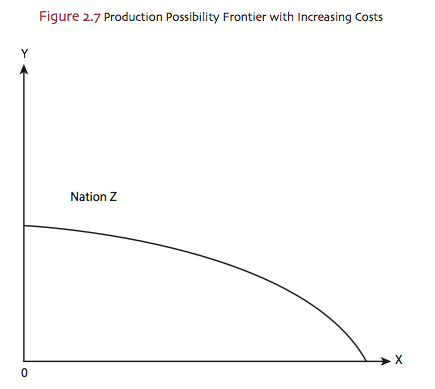 Which of the following reflects the figure above?
- Nation Z must give up more of X for each additional Y it produces
- Increased opportunity costs result in a concave PPF from the origin instead of a straight line.
- Concave production frontier reflect increasing opportunity costs in the nation and in the production of the two goods.
Seçenekler
A
I
B
II
C
III
D
I and II
E
II and III
Açıklama:
The figure shows:
- Increased opportunity costs result in a concave PPF from the origin instead of a straight line.
- Concave production frontier reflect increasing opportunity costs in the nation and in the production of the two goods.
Ünite 3
Soru 1
................... which is constructed upon both the Theory of Absolute Advantage and the Theory of Comparative Advantage postulates that the basis of the comparative advantage is the labor theory of value.
Which choice correctly completes this sentence?
Which choice correctly completes this sentence?
Seçenekler
A
Classical Trade Theory
B
Monetary Model
C
Neo-Classical Trade Theory
D
Linder Model
E
Product Cycle Model
Açıklama:
Classical Trade Theory which is constructed upon both the Theory of Absolute Advantage and the Theory of Comparative Advantage postulates that the basis of the comparative advantage is the labor theory of value. The correct answer is " A " .
Soru 2
Who is/are the first economist/economists who developed a more detailed analysis on the differences in productivity?
Seçenekler
A
Adam Smith
B
David Ricardo
C
Eli Heckscher and Bertil Ohlin
D
Eli Heckscher and David Ricardo
E
Bertil Ohlin and Adam Smith
Açıklama:
The first economists who developed a more detailed analysis on the differences in productivity are Eli Heckscher and Bertil Ohlin. The correct answer is " C ".
Soru 3
How would you define the term "indifference curve"?
Seçenekler
A
It gives the total supply of a country.
B
It displays the production possibilities frontier of a country.
C
It refers to an exchange, giving up a thing to get something else.
D
It produces at any point inside the production possibilities frontier.
E
It represents the total demand of a country.
Açıklama:
Indifference curve (I)
It represents the total demand of a country. The correct answer is " E ".
It represents the total demand of a country. The correct answer is " E ".
Soru 4
How many simplifying assumptions does The Heckscher-Ohlin Theory stand on?
Seçenekler
A
3
B
5
C
8
D
10
E
12
Açıklama:
The Factor Endowments and the HeckscherOhlin Theory, or simply the Heckscher Ohlin Theory, developed upon the weaknesses of the previous theories has some simplifying assumptions. Instead of examining them at the stage where the analysis stands, it’d be more effective to give them before starting to analyze the theory as a whole. The Heckscher-Ohlin Theory stands on twelve simplifying assumptions. The correct answer is " E ".
Soru 5
Which of the following choices is false related to the " Characteristics of a Perfectly Competitive Market "?
Seçenekler
A
There are many firms producing a homogenous commodity.
B
There are many consumers.
C
Demand preferences are the same in both countries.
D
It’s easy to enter in and exit out.
E
Firms and consumers are well-informed.
Açıklama:
In a perfectly competitive market or simply in perfect competition, there are many firms that are producing a homogeneous commodity. Thus, the commodit-ies within the market are identical in every respect. There are many consumers who are ready to buy the commodities that are produced identically. As there are no restrictions imposed, it’s easy for the new firms to enter into the market and for the existing firms to exit out from the market. The participants of the market, the firms and the consumers are well-informed about the prices and
the facts related with the market. The correct answer is " C ".
the facts related with the market. The correct answer is " C ".
Soru 6
How many types of the market types do the economists identify?
Seçenekler
A
2
B
4
C
6
D
7
E
8
Açıklama:
Perfect competition is one of the four types of the market types that the economists identify. The other market types are monopolistic competition, oligopoly and monopoly. Monopolistic competition is a market type in which many firms produce similar but differentiated commodities and compete with each other. The correct answer is " B ".
Soru 7
" Almost all the international trade models assume that international trade is ................ ".
Which of the following choices completes the blank correctly?
Which of the following choices completes the blank correctly?
Seçenekler
A
a perfectly competitive market
B
a different market type
C
lower earning
D
free
E
a production type
Açıklama:
There is free trade between the trading countries: This assumption postulates that there are no obstacles on the free movement of commodities such as tariffs or non-tariff restrictions. Moreover, there are no transportation costs that can constitute a restriction on the free trade. The correct answer is " D ".
Soru 8
How is the concept of " general equilibrium of an economy " determined?
Seçenekler
A
It is determined by the intersection of the production possibilities frontier, the autarky relative price line, and the indifferent curve.
B
The price of one commodity is expressed in terms of the price of the other commodity.
C
It displays the autarky equilibrium in our hypothetical countries, Sunland and Lakeland.
D
The autarky equilibrium is determined at point A for Sunland where the production possibilities frontier,
E
It is impossible for both Sunland and Lakeland to reach to this further level of utility.
Açıklama:
General equilibrium of an economy is determined by the intersection of the production possibilities frontier, the autarky relative price line, and the indifferent curve. The correct answer is " A ".
Soru 9
Who was Paul Samuelson ?
Seçenekler
A
He translated, edited and introduced Heckscher-Ohlin Trade Theory.
B
He was known as an American economist who wrote the largest-selling economics textbook ever in 1948, namely Economics: An Introductory Analysis.
C
He developed the distribution of income effects of international trade.
D
He distributed of income effects of international trade within a trading country.
E
He lead to a balanced international trade, reminding the last simplifying assumption of the HeckscherOhlin Theory.
Açıklama:
Paul Samuelson (1915-2009) was an American economist who wrote the largest-selling economics textbook ever in 1948, namely Economics: An Introductory
Analysis. He explained the principles of Keynesian economics and the way of economics thinking in his widelyreferred book. This book of his has done its nineteenth edition and has been sold in almost forty languages. Apart from this book, he has various studies devoted to economics. He was the first American economist who won the Nobel prize in economics (MIT Economics). The correct answer is " B ".
Analysis. He explained the principles of Keynesian economics and the way of economics thinking in his widelyreferred book. This book of his has done its nineteenth edition and has been sold in almost forty languages. Apart from this book, he has various studies devoted to economics. He was the first American economist who won the Nobel prize in economics (MIT Economics). The correct answer is " B ".
Soru 10
Which of the following choices " explains the situation in which a commodity is the labor-intensive commodity in the labor-abundant country and the capital-intensive commodity in the capital-abundant country "?
Seçenekler
A
Factor-Intensity Reversal
B
Specific Factors Model
C
Leontief Paradox
D
Hecskcher-Ohlin Theory
E
Human Capital
Açıklama:
Factor-Intensity Reversal explains the situation in which a commodity is the labor-intensive commodity in the labor-abundant country and the capital intensive commodity in the capitalabundant country. The Factor-Intensity Reversal rests on the elasticity of substitution of factors of production. Elasticity of substitution of factors of production measures the ease with which one factor of production can be substituted for another within the production as the relative price of the factor declines. The correct answer is " A ".
Soru 11
In the international trade analysis, the total supply of the trading country is represented by:
Seçenekler
A
Indifference curve.
B
Cost curve.
C
Production possibilities frontier.
D
Opportunity cost.
E
Trade triangles.
Açıklama:
In the international trade analysis, production possibilities frontier (PPF) represents the total supply of the trading country while total demand is exhibited by the indifference curve (I).
Soru 12
The highest valued alternative that is given up when making a choice is called:
Seçenekler
A
Tradeoff.
B
Production possibilities frontier.
C
Marginal rate of substitution.
D
Opportunity cost.
E
Trade triangle.
Açıklama:
Opportunity cost of a choice is the highest valued alternative that is given up. It is the quantity ratio of the production decrease in the commodity to the production increase in the other commodity as the production moves along the production possibilities frontier.
Soru 13
Which of the following is one of the assumptions of the Heckscher-Ohlin theory?
Seçenekler
A
There is perfect competition in the commodities and the factor markets in both countries.
B
There are two countries, two commodities, and one factor of production all over the world.
C
There is complete specialization in the production in both countries.
D
There is increasing returns to scale in the production of all commodities.
E
There is free movement of factors of production within each country and free movement of factors of production between countries.
Açıklama:
One of the assumptions is that there is perfect competition in the commodities and the factor markets in both countries. In a perfectly competitive market, there are many firms that are producing a homogeneous commodity. Thus, the commodities within the market are identical in every respect. There are many consumers who are ready to buy the commodities that are produced identically.
Soru 14
The production possibilities frontier of a capital-abundant country is:
Seçenekler
A
Skewed toward the axis that measures the labor-intensive commodity.
B
Skewed toward the axis that measures the capital-intensive commodity.
C
Skewed toward the axis that measures labor.
D
Skewed toward the axis that measures capital.
E
Not skewed towards any of the axis.
Açıklama:
The production possibilities frontier of a labor-abundant country is skewed toward the axis that measures the labor-intensive commodity. The production possibilities frontier of a capital-abundant country is skewed toward the axis that measures the capital-intensive commodity.
Soru 15
A country’s willingness to export and import in terms of relative quantities is given by:
Seçenekler
A
Trade triangle.
B
Indifference curve.
C
Relative price.
D
Comparative advantage.
E
Offer curve.
Açıklama:
The quantities of the commodities that a country would like to export and import are perfectly represented by an offer curve. Offer curve of a country gives the country’s willingness to export and import in terms of relative quantities.
Soru 16
Which of the following statements is true regarding Heckscher-Ohlin theory?
Seçenekler
A
It assumes that comparative advantage of the countries solely depends on the relative differences in the productivity of labor.
B
It does not clarify the basis of the comparative advantage.
C
It states that comparative advantage of the trading countries are explained exclusively by differences in technology advancements.
D
Trade triangles are drawn different due to the simplifying assumption of the Heckscher-Ohlin Theory, which refers to an imbalanced international trade between the trading countries.
E
It was developed so as to respond the question "How does international trade affect the earnings of the factors of production within the trading countries?"
Açıklama:
The Classical Trade Theory or simply the Ricardian Model assumes that comparative advantage of the countries solely depends on the relative differences in the productivity of labor. Nevertheless, it does not explain the reason of these productivity differences. In other words, the Ricardian Model does not clarify the basis of the comparative advantage. Heckscher-Ohlin Theory was developed so as to respond to two questions that had not been answered by the Classical Trade Theory: (1) What is the determinant of the comparative advantage of the countries? (2) How does international trade affect the earnings of the factors of production within the trading countries?
Soru 17
Which of the following is not a characteristic of a perfectly competitive market?
Seçenekler
A
There are many buyers and sellers.
B
The firms sell differentiated commodities.
C
There are no barriers to entry and exit.
D
There is no price control.
E
There is perfect information in the market.
Açıklama:
In a perfectly competitive market or simply in perfect competition, there are many firms that are producing a homogeneous commodity. Thus, the commodities within the market are identical in every respect. There are many consumers who are ready to buy the commodities that are produced identically. As there are no restrictions imposed, it’s easy for the new firms to enter into the market and for the existing firms to exit out from the market. The participants of the market, the firms and the consumers are well-informed about the prices and the facts related with the market.
Soru 18
The Stolper Samuelson Theorem:
Seçenekler
A
explains the distribution of income effects of international trade within a trading country.
B
explains the international distribution of income effects of international trade.
C
explains the situation in which a commodity is the labor-intensive commodity in the labor-abundant country and the capital-intensive commodity in the capital abundant country.
D
implies that the mobility of the factors of production within a country cannot be attained if one of the factors is a specific factor.
E
postulates that some of the factors of production can be immobile or can only be used in the production of a commodity.
Açıklama:
Stolper-Samuelson Theorem depends on the International Factor Price Equalization Theorem. In spite of the similarities between them, Stolper Samuelson Theorem explains the distribution of income effects of international trade within a trading country while International Factor Price Equalization Theorem deals with the international distribution of income effects of international trade.
Soru 19
Magnification effect implies that:
Seçenekler
A
A change in the wage leads to a relatively more change on the demand for labor in the same direction.
B
A change in the demand for a labor-intensive commodity leads to a relatively more change on the price of the commodity in the same direction.
C
A change in the price of a commodity leads to a relatively more change on the income of the factor used intensively in its production in the same direction.
D
A change in the demand for a capital-intensive commodity leads to relatively more change on demand for capital in the same direction.
E
The amount of output increase will be relatively higher than the increase in the factors of production.
Açıklama:
Although the assumptions of the Stolper Samuelson Theorem seem logical, it constitutes the initial stage in explaining the distribution of income effects of international trade. The Theorem can be extended by taking into consideration the magnification effect. According to the magnification effect, an increase or a decrease in the price of a commodity has a greater effect in the same direction on the income of the factor used intensively in its production.
Soru 20
The situation in which a commodity is the labor-intensive commodity in the labor-abundant country and the capital-intensive commodity in the capital abundant country is called:
Seçenekler
A
Magnification effect.
B
Constant returns to scale.
C
Leontief paradox.
D
Factor-intensity reversal.
E
Elasticity of substitution of factors of production.
Açıklama:
Factor-Intensity Reversal explains the situation in which a commodity is the labor-intensive commodity in the labor-abundant country and the capital-intensive commodity in the capital abundant country.The Factor-Intensity Reversal rests on the elasticity of substitution of factors of production.
Soru 21
Which of the following economists developed a more detailed analysis on the differences in productivity?
Seçenekler
A
Eli Heckscher and Bertil Ohlin
B
Eli Heckscher and David Ricardo
C
David Ricardo and Bertil Ohlin
D
Adam Smith and David Ricardo
E
Adam Smith and Bertil Ohlin
Açıklama:
Smith, Ricardo and the following early international trade economists assumed that each trading country would have its own production conditions, its own climate, its own geography and these differences between countries would lead to the differences in productivity. However, the economists of the twentieth century have extended the scope of the differences in productivity. The first studies in this respect are the models of the two Swedish economists, namely Eli Heckscher and Bertil Ohlin.
Soru 22
Which of the following describes the term ‘tradeoff’?
Seçenekler
A
It is the highest cost of the preferred alternative.
B
It refers to an exchange, giving up a thing to get something else.
C
It gives the total supply of a country.
D
It represents the total demand of a country.
E
Production at any point outer than the production possibilities frontier.
Açıklama:
Every choice or option on the production possibilities frontier involves a tradeoff. In other words, some amounts of a commodity must be given up in order to get some more amounts of the other commodity. Due to the limited resources, every decision either about economics or about daily routines has a tradeoff. Thus, all tradeoffs involve a cost, referred as opportunity cost. Opportunity cost is the highest cost of the preferred alternative. Production possibilities frontier (PPF) gives the total supply of a country. Indifference curve (I) represents the total demand of a country.
Soru 23
Which of the following refers to the same amount of output increase with the increase within the factors of production?
Seçenekler
A
Labor-abundant country
B
Capital-abundant country
C
Labor-intensive commodity
D
Capital-intensive commodity
E
Constant returns to scale
Açıklama:
Constant returns to scale refers to the same amount of output increase with the increase within the factors of production. Labor-abundant country means that the ratio of the total amount of labor to the total amount of capital available in the country is greater than the other country. On the other hand, capital-abundant country means that the ratio of the total amount of capital to the total amount of labor available in the country is greater than the other country. Labor-intensive commodity is produced with a higher (L/K) ratio than the other commodity in both countries. Capital-intensive commodity is produced with a higher (K/L) ratio than the other commodity in both countries.
Soru 24
Which of the simplifying assumptions of the Heckscher-Ohlin Theory is the assumption that both countries are continuing to produce both commodities?
Seçenekler
A
Demand preferences are the same in both countries.
B
There is perfect competition in the commodities and the factor markets in both countries.
C
There is full employment in all resources in both of the trading countries.
D
There is incomplete specialization in the production in both countries.
E
There is free trade between the trading countries.
Açıklama:
The assumption that ‘There is incomplete specialization in the production in both countries.’ postulates that both countries are continuing to produce both commodities. Countries trade with each other with respect to the comparative advantage under free trade. Each country specializes in the production of the commodity in which it has comparative advantage but does not end up to produce the other commodity in which it has a comparative disadvantage.
Soru 25
- Production possibilities frontier
- The offer curve
- The autarky relative price line
- The indifferent curve
- The opportunity cost
The intersection of which of the above determine the general equilibrium of an economy?
Seçenekler
A
I-II-III
B
II-III-IV
C
I-III-IV
D
I-II-V
E
II-III-V
Açıklama:
General equilibrium of an economy is determined by the intersection of the production possibilities frontier, the autarky relative price line, and the indifferent curve.
Soru 26
Which of the following represents the quantities of the commodities that a country would like to export and import?
Seçenekler
A
Production possibilities frontier
B
The offer curve
C
The autarky relative price line
D
The indifferent curve
E
A welfare increase
Açıklama:
The quantities of the commodities that a country would like to export and import are perfectly represented by an offer curve.
Soru 27
Which of the following deals with the international distribution of income?
Seçenekler
A
Stolper-Samuelson Theorem
B
Heckscher- Ohlin Theory
C
Classical Trade Theory
D
The international trade theory
E
International Factor Price Equalization Theorem
Açıklama:
International Factor Price Equalization Theorem deals with the international distribution of income. Stolper-Samuelson Theorem deals with the distribution of income effects of international trade within a trading country. Heckscher-Ohlin Theory states that comparative advantage of the trading countries is explained exclusively by differences in relative supply conditions. Classical Trade Theory which has been accepted as the primer of the international trade theory assumes that the country whose labor is more productive in producing the commodity that is subject to international trade has a comparative advantage in this commodity. Briefly, the basis of international trade solely depends on the differences of labor productivity.
Soru 28
- It deals with the distribution of income effects of international trade within a trading country.
- It deals with the international distribution of income effects of international trade.
- International trade increases only the income of the factor that is intensively used in the production of the exported commodity.
- At the general equilibrium point both the relative factor prices and relative commodity prices are equalized.
Seçenekler
A
I-III
B
I-II
C
III-IV
D
II-IV
E
II-III
Açıklama:
Stolper-Samuelson Theorem depends on the International Factor Price Equalization Theorem. In spite of the similarities between them, Stolper Samuelson Theorem explains the distribution of income effects of international trade within a trading country while International Factor Price Equalization Theorem deals with the international distribution of income effects of international trade. According to the Stolper-Samuelson Theorem, international trade does not increase the income of all the factors of production but only the income of the factor that is intensively used in the production of the exported commodity. At the general equilibrium point of the International Factor Price Equalization Theorem, both the relative factor prices and relative commodity prices are equalized.
Soru 29
Which of the following measures the ease with which one factor of production can be substituted for another within the production as the relative price of the factor declines?
Seçenekler
A
Factor-Intensity Reversal
B
Elasticity of substitution of factors of production.
C
The Specific Factors Model
D
Leontief Paradox
E
Hecskcher-Ohlin Theory
Açıklama:
Elasticity of substitution of factors of production measures the ease with which one factor of production can be substituted for another within the production as the relative price of the factor declines. For example; suppose that the elasticity of substitution of labor for capital is much greater in the production of corn than in the production of wheel. Thus, it is much easier to substitute labor for capital in the production of corn than in the production of wheel.
Soru 30
Which of the following is true for Factor-Intensity Reversal?
Seçenekler
A
It explains how international trade is realized under the short run factor immobility within the Heckscher-Ohlin Theory context.
B
According to it, the factor mobility that is assumed by the Heckscher-Ohlin Theory can only be attained in the long run.
C
It postulates that some of the factors of production can be immobile or can only be used in the production of a commodity.
D
According to it, the mobility of the factors of production within a country cannot be attained if one of the factors is a specific factor.
E
It explains the situation in which a commodity is the labor-intensive commodity in the labor-abundant country and the capital-intensive commodity in the capital- abundant country.
Açıklama:
Factor-Intensity Reversal explains the situation in which a commodity is the labor-intensive commodity in the labor-abundant country and the capital-intensive commodity in the capital- abundant country. All the other items are related to Specific Factors Model.
Soru 31
Which of the following trade theories assumes that the country whose labor is more productive in producing the commodity that is subject to international trade has a comparative advantage in this commodity?
Seçenekler
A
Classical trade theory
B
Theory of absolute advantage
C
Theory of comparative advantage
D
Neo-classical trade theory
E
Heckscher-Ohlin theory
Açıklama:
Classical Trade Theory which has been accepted as the primer of the international trade theory assumes that the country whose labor is more productive in producing the commodity that is subject to international trade has a comparative advantage in this commodity. The correct answer is A.
Soru 32
In the international trade analysis, which of the following represents the total supply of the trading country?
Seçenekler
A
Tradeoff
B
Opportunity cost
C
Indifference curve
D
Marginal rate of subsititution
E
Production possibilities frontier
Açıklama:
In the international trade analysis, production possibilities frontier (PPF) represents the total supply of the trading country while total demand is exhibited by the indifference curve (I). The correct answer is E.
Soru 33
- Opportunity cost is a ratio.
- All tradeoffs involve an opportunity cost.
- It is the highest cost of the preferred alternative.
- It is the lowest-valued alternative that is given up.
Seçenekler
A
I and III
B
II and IV
C
I, II, III
D
I, III, IV
E
II, III, IV
Açıklama:
Opportunity cost is the highest cost of the preferred alternative. It is a ratio. All tradeoffs involve an opportunity cost. Similarly, opportunity cost is the highest-valued (not the lowest-valued) alternative that is given up. The correct answer is C.
Soru 34
Which of the following is the rate at which a person or a country will give up the commodity measured at the Y axis to get an additional unit of commodity measured at the X axis?
Seçenekler
A
Indifference curve
B
Constant returns to scale
C
Marginal rate of substitution
D
Factor price equalization
E
Incomplete specialization in production
Açıklama:
The rate at which a person or a country will give up the commodity measured
at the Y axis to get an additional unit of commodity measured at the X axis is called marginal rate of substitution (MRT). MRT is an important determinant in preference analysis. The correct answer is C.
at the Y axis to get an additional unit of commodity measured at the X axis is called marginal rate of substitution (MRT). MRT is an important determinant in preference analysis. The correct answer is C.
Soru 35
- Both of the countries are labor-abundant.
- There is constant returns to scale in the production of both commodities.
- There is incomplete specialization in the production in both countries.
- There is perfect competition in the commodities and the factor markets in both countries.
Seçenekler
A
I and II
B
III and IV
C
I, II, III
D
I, III, IV
E
II, III, IV
Açıklama:
The Heckscher-Ohlin Theory stands on twelve simplifying assumptions. The following are among these assumptions:
- There is constant returns to scale in the production of both commodities.
- There is incomplete specialization in the production in both countries.
- There is perfect competition in the commodities and the factor markets in both countries.
- Not both of the countries but one of the countries is labor-abundant and the other one is capital-abundant.
Soru 36
Which of the following is not among the assumptions the Heckscher-Ohlin Theory stands on?
Seçenekler
A
Technology is the same in both countries.
B
Demand preferences are different in both countries.
C
There is free trade between the trading countries.
D
International trade between the trading countries is balanced.
E
Two countries, two commodities and two factors of production.
Açıklama:
According to the Heckscher-Ohlin Theory, demand preferences are the same (not different) in both countries: According to this assumption, tastes are equal in both of the trading countries. As explained before, demand preference of a country is examined by community indifference curves. Since demand preferences are the same in both countries, a single indifference curve is used in order to represent both the countries’ identical tastes. The correct answer is B.
Soru 37
Which of the following refers to the same amount of output increase with the increase within the factors of production?
Seçenekler
A
Constant returns to scale
B
Labor-intensive commodity
C
Capital-intensive commodity
D
Labor-abundant country
E
Incomplete specialization in production
Açıklama:
Constant returns to scale refers to the same amount of output increase with the increase within the factors of production. The correct answer is A.
Soru 38
- What is the determinant of the absolute advantage of the countries?
- What is the determinant of the comparative advantage of the countries?
- How does international trade affect the earnings of the factors of production within the trading countries?
Seçenekler
A
I
B
II
C
III
D
I and III
E
II and III
Açıklama:
The Classical Trade Theory or simply the Ricardian Model assumes that comparative advantage of the countries solely depends on the relative differences in the productivity of labor. Nevertheless, it does not explain the reason of these productivity differences. Heckscher-Ohlin Theory was developed to respond to two questions that had not been answered by the Classical Trade Theory: (1) What is the determinant of the comparative advantage of the countries? (2) How does international trade affect the earnings of the factors of production within the trading countries? The correct answer is E.
Soru 39
- The indifferent curve
- The autarky price line
- The opportunity cost
- The production possibilities frontier
Which of the above must intersect for the general equilibrium of an economy?
Seçenekler
A
I and III
B
II and IV
C
I, II, III
D
I, II, IV
E
II, III, IV
Açıklama:
General equilibrium of an economy is determined by the intersection of the production possibilities frontier, the autarky relative price line, and the indifferent curve. The correct answer is D.
Soru 40
Which of the following postulates that a change in the price of a commodity leads to a relatively more change on the income of the factor used intensively in its production in the same direction?
Seçenekler
A
Leontief paradox
B
Magnification effect
C
Specific factors model
D
Elasticity of substitution
E
Factor price equalization
Açıklama:
Magnification effect postulates that a change in the price of a commodity leads to a relatively more change on the income of the factor used intensively in its production in the same direction. The correct answer is B.
Soru 41
Which one of the following assumes that the price of a commodity is determined by the amount of labor going into the production of the commodity?
Seçenekler
A
Classical Trade Theory
B
Theory of Absolute Advantage
C
Theory of Comparative Advantage
D
Neo-Classical Trade Theory
E
Labor Theory of Value
Açıklama:
Labor theory of value The theory assumes that the price of a commodity is determined by the amount of labor going into the production of the commodity.
Soru 42
Which one of the following postulates that as long as the relative commodity prices are different, there is always an incentive for beneficial trade?
Seçenekler
A
The Neo-Classical Trade Theory
B
Classical Trade Theory
C
Theory of Absolute Advantage
D
Theory of Comparative Advantage
E
Labor theory of value
Açıklama:
The Neo-Classical Trade Theory postulates that as long as the relative commodity prices are different, there is always an incentive for beneficial trade. In other words, the differences in relative commodity prices induce international trade between countries
Soru 43
Which one of the following represents the boundary between the combination of two commodities that can be produced and those that cannot?
Seçenekler
A
Production possibilities frontier
B
Indifference curve
C
Opportunity cost
D
Tradeoff
E
Productivity
Açıklama:
In the international trade analysis, production possibilities frontier (PPF) represents the total supply of the trading country. It is the boundary between the combination of two commodities that can be produced and those that cannot
Soru 44
Which one of the following stands for the rate at which a person or a country will give up the commodity measured at the Y axis to get an additional unit of commodity measured at the X axis?
Seçenekler
A
Opportunity cost
B
Tradeoff
C
Production possibilities frontier
D
Indifference curve
E
Marginal rate of substitution
Açıklama:
Marginal rate of substitution (MRT): It is the rate at which a person or a country
will give up the commodity measured at the Y axis to get an additional unit of commodity measured at the X axis.
will give up the commodity measured at the Y axis to get an additional unit of commodity measured at the X axis.
Soru 45
I. Labor intensive
II. Capital intensive
III. Productivity
Which one(s) of these is/are among the commodities of The Heckscher-Ohlin Theory?
II. Capital intensive
III. Productivity
Which one(s) of these is/are among the commodities of The Heckscher-Ohlin Theory?
Seçenekler
A
Only I
B
Only II
C
Only III
D
I-II
E
II-III
Açıklama:
One of the commodities is labor-intensive and the other one is capital-intensive in both countries
Soru 46
The Heckscher-Ohlin Theory stands on twelve simplifying assumptions. Which of the following options is not one of them?
Seçenekler
A
Technology is the same in both countries.
B
One of the countries is labor-abundant and the other one is capital-abundant.
C
Demand preferences are different in both countries.
D
There is incomplete specialization in the production in both countries.
E
There is perfect competition in the commodities and the factor markets in both countries.
Açıklama:
The Heckscher-Ohlin Theory stands on twelve simplifying assumptions:
1. Two countries, two commodities and two factors of production.
2. One of the commodities is labor-intensive and the other one is capital-intensive in both countries.
3. One of the countries is labor-abundant and the other one is capital-abundant.
4. Technology is the same in both countries.
5. There is constant returns to scale in the production of both commodities.
6. There is incomplete specialization in the production in both countries.
7. Demand preferences are the same in both countries.
8. There is perfect competition in the commodities and the factor markets in both countries.
9. There is free movement of factors of production within each country but no free movement of factors of production between countries.
10. There is free trade between the trading countries.
11. There is full employment in all resources in both of the trading countries.
12. International trade between the trading countries is balanced.
1. Two countries, two commodities and two factors of production.
2. One of the commodities is labor-intensive and the other one is capital-intensive in both countries.
3. One of the countries is labor-abundant and the other one is capital-abundant.
4. Technology is the same in both countries.
5. There is constant returns to scale in the production of both commodities.
6. There is incomplete specialization in the production in both countries.
7. Demand preferences are the same in both countries.
8. There is perfect competition in the commodities and the factor markets in both countries.
9. There is free movement of factors of production within each country but no free movement of factors of production between countries.
10. There is free trade between the trading countries.
11. There is full employment in all resources in both of the trading countries.
12. International trade between the trading countries is balanced.
Soru 47
............... refers to the same amount of output increase with the increase within the factors of production. Which term is defined above?
Seçenekler
A
Incomplete specialization in the production
B
Constant returns to scale
C
Labor-abundant country
D
Capital-intensive commodity
E
Intensity
Açıklama:
Constant returns to scale refers to the same amount of output increase with the increase within the factors of production.
Soru 48
Which information is true for the characteristics of a perfectly competitive market?
I.There are many firms producing a homogenous commodity.
II.Firms and consumers are well-informed.
III.It’s easy to enter in and exit out.
I.There are many firms producing a homogenous commodity.
II.Firms and consumers are well-informed.
III.It’s easy to enter in and exit out.
Seçenekler
A
Only II
B
Only III
C
I and II
D
II and III
E
I, II and III
Açıklama:
Characteristics of a Perfectly Competitive Market:
-There are many firms producing a homogenous commodity.
-There are many consumers.
-It’s easy to enter in and exit out.
-Firms and consumers are well-informed.
-There are many firms producing a homogenous commodity.
-There are many consumers.
-It’s easy to enter in and exit out.
-Firms and consumers are well-informed.
Soru 49
Which one of the following terms postulates that a change in the price of a commodity leads to a relatively more change on the income of the factor used intensively in its production in the same direction?
Seçenekler
A
Magnification effect
B
Specific factors model
C
Elasticity of substitution
D
Human capital
E
Derived demand
Açıklama:
Magnification effect :It postulates that a change in the price of a commodity leads to a relatively more change on the income of the factor used intensively in its production in the same direction.
Soru 50
Which one of the following assumptions denotes that there are no unemployed resources or factors of production within the trading countries?
Seçenekler
A
There is free trade between the trading countries
B
There is full employment in all resources in both of the trading countries
C
There is incomplete specialization in the production in both countries
D
Demand preferences are the same in both countries
E
There is constant returns to scale in the production of both commodities
Açıklama:
There is full employment in all resources in both of the trading countries: This assumption denotes that there are no unemployed resources or factors of production within the trading countries. Thus, taking the international factor immobility assumption into consideration with this assumption together, the production of a commodity can only be increased in the expense of a decrease in the production of the other commodity.
Soru 51
When did Bertil Ohlin win the Nobel prize in economics?
Seçenekler
A
1977
B
1978
C
1979
D
1980
E
1981
Açıklama:
Bertil Ohlin won the Nobel prize in economics in 1977. Correct answer is A.
Soru 52
Which of the following represents the total demand of a country?
Seçenekler
A
Production possibilities frontier
B
Indifference curve
C
Price line
D
Budget curve
E
Total production line
Açıklama:
Indifference curve (I) represents the total demand of a country. Correct answer is B.
Soru 53
Which of the following is the highest cost of the preferred alternative?
Seçenekler
A
Total cost
B
Average cost
C
Opportunity cost
D
Fixed cost
E
Variable cost
Açıklama:
Opportunity cost is the highest cost of the preferred alternative. Correct answer is C.
Soru 54
What is the number of simplifying assumptions that The Heckscher-Ohlin Theory stand on?
Seçenekler
A
9
B
10
C
11
D
12
E
13
Açıklama:
The Heckscher-Ohlin Theory stands on twelve simplifying assumptions. Correct answer is D.
Soru 55
Which of the following is not a simplifying assumtion of The Heckscher-Ohlin Theory?
Seçenekler
A
Technology is the same in both countries
B
There is constant returns to scale in the production of both commodities
C
There is incomplete specialization in the production in both countries
D
Demand preferences are the same in both countries
E
There is two countries, two commodities and one factors of production
Açıklama:
The Heckscher-Ohlin Theory assumes that there are only two countries, two commodities, and two factors of production on all over the world. The assumption is sometimes referred to 2+2+2 or 2 by 2 by 2. Correct answer is E.
Soru 56
Which of the following is not a characteristic of a perfect competitive market?
Seçenekler
A
There are one or two firms producing same commodity
B
There are many firms producing a homogeneous commodity
C
There are many consumers
D
It's easy to enter in and exit out
E
Firms and consumers are well-informed
Açıklama:
In a perfectly competitive market or simply in perfect competition, there are many firms that are producing a homogeneous commodity. Thus, the commodities within the market are identical in every respect. There are many consumers who are ready to buy the commodities that are produced identically. As there are no restrictions imposed, it’s easy for the new firms to enter into the market and for the existing firms to exit out from the market. The participants of the market, the firms and the consumers are well-informed about the prices and the facts related with the market. Correct answer is A.
Soru 57
Which of the following is a market type in which many firms produce similar but differentiated commodities and compete with each other?
Seçenekler
A
Perfect competition
B
Monopolistic competition
C
Oligopoly
D
Monopoly
E
Dumped competition
Açıklama:
Monopolistic competition is a market type in which many firms produce similar but differentiated commodities and compete with each other. Producing a slightly different commodity than the commodity of a competing firm is called product differentiation. Correct answer is B.
Soru 58
Which of following is a market type in which small numbers compete with each other?
Seçenekler
A
Perfect competition
B
Monopolistic competition
C
Oligopoly
D
Monopoly
E
Dumped competition
Açıklama:
Oligopoly is a market type in which small numbers compete with each other. The firms within an oligopolistic market can either produce almost identical commodities or differentiated ones. Correct answer is C.
Soru 59
Which of the following gives the pattern of trade between trading countries under the international relative prices?
Seçenekler
A
Price line
B
Budget line
C
Indifference curve
D
Trade triangle
E
Production possibilities frontier
Açıklama:
Trade triangle gives the pattern of trade between trading countries under the international relative prices. Correct answer is D.
Soru 60
Which of the following deals with the distribution of income effects of international trade within a trading country?
Seçenekler
A
Theory of Absolute Advantage
B
Theory of Comparative Advantage
C
Specific Factors Model
D
Leontief Paradox
E
Stolper-Samuelson Theorem
Açıklama:
Stolper-Samuelson Theorem deals with the distribution of income effects of international trade within a trading country. Correct answer is E.
Ünite 4
Soru 1
- Rejecting the Heckscher-Ohlin Theory
- Being referred as Post-Heckscher-Ohlin Theories
- Trying to overcome the weaknesses of the Heckscher-Ohlin Theory
Seçenekler
A
I
B
II
C
III
D
I and II
E
II and III
Açıklama:
New international trade theories are mostly referred as Post-Heckscher-Ohlin Theories because they were developed after the Heckscher-Ohlin Theory. They do not reject the Heckscher-Ohlin Theory; they improve it as of complementary trade theories. In other words, they try to overcome the weaknesses via relaxing the most inadequate assumptions of the Heckscher-Ohlin Theory. The correct answer is E.
Soru 2
- Two countries, two commodities and two factors of production
- Technology is the same in both countries.
- Both of the countries are labor-abundant.
- One of the commodities is labor-intensive and the other one is capital-intensive in both countries.
Seçenekler
A
I and III
B
II and IV
C
I, II and III
D
I, II and IV
E
II, III and IV
Açıklama:
The following assumptions indicate the weaknesses of the Heckscher- Ohlin Theory:
- Two countries, two commodities and two factors of production
- Technology is the same in both countries.
- One of the commodities is labor-intensive and the other one is capital-intensive in both countries.
- One of the countries is labor-abundant and the other one is capital-abundant (not both of the countries are labor-abundant).
Soru 3
Which of the following assumptions does not indicate one of the weaknesses of the Heckscher-Ohlin Theory?
Seçenekler
A
There is free trade between the trading countries.
B
Demand preferences are different in both countries.
C
There is incomplete specialization in the production in both countries.
D
There is constant returns to scale in the production of both commodities.
E
There is perfect competition in the commodities and the factor markets in both countries.
Açıklama:
The following assumptions indicate the weaknesses of the Heckscher-Ohlin Theory:
- There is free trade between the trading countries.
- There is incomplete specialization in the production in both countries.
- There is constant returns to scale in the production of both commodities.
- There is perfect competition in the commodities and the factor markets in both countries.
Soru 4
Which of the following refers to a condition of decreasing cost of a unit of commodity while its output rate is increasing?
Seçenekler
A
Increasing returns to scale
B
Factor-intensity reversal
C
Factor price index
D
Unemployment rate
E
Aims of trade restrictions
Açıklama:
In our world today, most of the countries have been seeking to enjoy increasing returns to scale in international trade. It refers to a condition of decreasing cost of a unit of commodity while its output rate increasing. The correct answer is A.
Soru 5
- Protect foreign producers
- Ignore infant-industry argument
- Collect revenue to the Treasury
- Adjust balance of payments
- Serve the diplomatic relations
Seçenekler
A
I, II and III
B
II, III and IV
C
III, IV and V
D
I, II, III and IV
E
II, III, IV and V
Açıklama:
The main aims of trade restrictions are:
- Protect domestic (not foreign) producers,
- Collect revenue to the Treasury,
- Adjust balance of payments,
- Implement (not ignore) infant-industry argument,
- Serve the diplomatic relations.
Soru 6
- The model was developed by Swedish economist Staffan Linder.
- Demand conditions constitute a big importance in explaining international trade patterns.
- The main determinant of the demand preferences of the domestic consumers is their income levels.
- Firms within a country produce commodities for the domestic market are motivated to produce less when the market is enlarged.
Seçenekler
A
I and II
B
III and IV
C
I, II and III
D
I, II and IV
E
II, III and IV
Açıklama:
The most referred demand oriented model of international trade is the Overlapping Demands Model. The Model was developed by the Swedish economist Staffan Linder in 1961 (I). According to Linder, much of the current international trade involves trade in manufactured commodities,and demand conditions constitute a big importance in explaining international trade patterns (II); the main determinant of the demand preferences of the domestic consumers is their income levels (III), and firms within a country produce commodities for the domestic market, and they are motivated to produce more (not less) when the market is enlarged (IV). The correct answer is C.
Soru 7
In which of the following conditions do potatoes and rice become inferior goods?
Seçenekler
A
When the demand for a certain commodity decreases while the income increases.
B
When the demand for a certain commodity increases while the income increases.
C
When the demand for a certain commodity decreases while the income decreases.
D
When the increase in the demand for a certain commodity is smaller than the increase in income.
E
When the increase in the demand for a certain commodity is greater than the increase in income.
Açıklama:
One of the ranges of income elasticity of demand, inferior goods refers to the circumstance when the demand for a certain commodity decreases while the income increases. Potatoes and rice can be taken as examples for inferior goods. The correct answer is A.
Soru 8
- Product-decline stage
- New-product stage
- Product-maturity stage
- Product-growth stage
- Product standardization stage
Seçenekler
A
II-III-IV-V-I
B
II-IV-III-V-I
C
II-IV-I-V-III
D
II-III-IV-I-V
E
II-IV-V-III-I
Açıklama:
Product Cycle Model divides the life cycle of a new product into five stages: new-product stage, product-growth stage, product-maturity stage, product-standardization stage and product-decline stage (II-IV-III-V-I). The correct answer is B.
Soru 9
I. Hereditary skill
II.Downsizing of subsidiaries
III. Local market for skill
IV. Introduction to new ideas
V. Use of specialized machinery
Which of the above are among the advantages that an industrial district can create for the firms that operate within the same industry?
II.Downsizing of subsidiaries
III. Local market for skill
IV. Introduction to new ideas
V. Use of specialized machinery
Which of the above are among the advantages that an industrial district can create for the firms that operate within the same industry?
Seçenekler
A
I, II and III
B
III, IV and V
C
I, II, IV and V
D
I, III, IV and V
E
II, III, IV and V
Açıklama:
Hereditary skill, local market for skill, introduction to new ideas and use of specialized machinery are among the advantages that an industrial district can create for the firms that operate within the same industry. Rather than downsizing of subsidiaries, an industrial district can create growth of subsidiaries in that when firms are concentrated within a particular area, there will probably be new establishments in the form of subsidiaries; they will be the firms that supply materials or inputs to the industry. The correct answer is D.
Soru 10
Which of the following is not one of the main reasons for intra-industry trade?
Seçenekler
A
Transportation costs
B
Product differentiation
C
Internal economies of scale
D
Scope of commodity classification
E
Similarities in distribution of income
Açıklama:
The main reasons for intra-industry trade are: internal economies of scale, product differentiation, transportation costs, scope of commodity classification and differences (not similarities) in distribution of income. The correct answer is E.
Soru 11
Which of the following choices gives an opinion about " new international trade theories "?
Seçenekler
A
They do not reject the Heckscher-Ohlin Theory.
B
There are dynamic technological differences between trading countries.
C
They use different levels of technology.
D
They decrease the cost of a unit of commodity while its output rate increasing.
E
They take the dynamic technological differences and their effects on internatio-nal trade into consideration.
Açıklama:
New international trade theories,in other words post- Heckscher-Ohlin theories, do not reject the Heckscher-Ohlin Theory. They improve it as of complementary trade theories. The correct answer is " A ".
Soru 12
" ................. is the number of unemployed people expressed as a percentage of all the people ".
Which of the following choices completes the blank in this sentence?
Which of the following choices completes the blank in this sentence?
Seçenekler
A
Factor price index
B
Unemployment rate
C
Increasing returns to scale
D
Factor-intensity reversal
E
Traditional aims of trade restrictions
Açıklama:
Unemployment rate: It is the number of unemployed people expressed as a percentage of all the people who have jobs or are looking for one (Parkin, 2005, p. 467). The correct answer is " B ".
Soru 13
Which of the following choices is not one of the main aims of trade restrictions?
Seçenekler
A
Protect domestic producers
B
Collect revenue to the Treasury
C
Adjust balance of payments
D
Seem possible to extend
E
Serve for diplomatic relations
Açıklama:
One of the main aims of trade restrictions is to protect domestic producers. Actually, this aim is known as traditional aim of trade restrictions. Another
traditional aim of trade restrictions is to collect revenue to the Treasury. Adjust balance of payments: Trade restrictions are effective instruments to adjust the balance of payments. Serve for diplomatic relations: Countries can use trade restrictions as an instrument of diplomatic relations. The ccorrect answer is " D ".
traditional aim of trade restrictions is to collect revenue to the Treasury. Adjust balance of payments: Trade restrictions are effective instruments to adjust the balance of payments. Serve for diplomatic relations: Countries can use trade restrictions as an instrument of diplomatic relations. The ccorrect answer is " D ".
Soru 14
Who is Staffan Linder?
Seçenekler
A
An American author
B
An Italian administrator
C
A Swedish economist
D
A French director
E
A German scientist
Açıklama:
The most referred demand oriented model of international trade is the Overlap-ping Demands Model. The Model was developed by the Swedish economist Staffan Linder in 1961 (Linder, 1961). Representing the name of the economist, the Overlapping Demands Model usually entitled as Linder Model. The correct answer is " C ".
Soru 15
Which of the following choices correctly defines the concept of " income inelastic demand "?
Seçenekler
A
It refers to the situation when the increase in the demand for a certain commodity is smaller than the increase in income.
B
It explains the condition that the increase in the demand for a certain commodity is greater than the increase in income.
C
It displays that income elasticity of demand can appear in three forms.
D
It refers to the circumstance when the demand for a certain commodity decreases while the income increases.
E
It postulates that countries with similar income levels have more or less identical demand preferences.
Açıklama:
Income inelastic demand: It refers to the situation when the increase in the demand for a certain commodity is smaller than the increase in income. Food and clothing are the main examples of income inelastic demand. Normal goods have income inelastic demand. The correct answer is " A ".
Soru 16
Which definition is correct for the concept of " product differentiation "?
Seçenekler
A
lt is good at predicting the pattern of international trade.
B
It explains demand oriented model of international trade.
C
It determines the comparative advantage of the trading countries.
D
Producing a commodity slightly different from the commodity produced by the
competitor is called product differentiation.
competitor is called product differentiation.
E
It helps you to find out the pattern of trade.
Açıklama:
Product differentiation: Producing a commodity slightly different from the commodity produced by the competitor is called product differentiation. The correct answer is " D ".
Soru 17
What is " Product Cycle Model "?
Seçenekler
A
It rests on the recognition of dynamic changes that affect the manufactured commodities.
B
It is constant in trading countries.
C
It doesn't analyze the life and trade cycle of a new product manufactured by the innovating country.
D
It tells the other main weaknesses of the Linder Model.
E
It doesn't explain the effects of technological differences on international trade.
Açıklama:
Product Cycle Model rests on the recognition of dynamic changes that affect the manufactured commodities. The correct answer is " A ".
Soru 18
Which of the following choices best completes the definition of " Patent rights "?
Seçenekler
A
They are types of competitiveness that equips a commodity.
B
They are a type of intellectual property rights.
C
They depend on the kind of the production increase.
D
They decline due to the price competitiveness of the imitating country.
E
They don't meet the domestic demand by domestic production.
Açıklama:
Patent rights: They are a type of intellectual property rights. Intellectual property is a general term referring to creations of the mind. Intellectual property rights designate creators with the right to protect themselves from the imitators for a limited period of time. Intellectual property rights have many types. For example; books, paintings and films are protected by copyrights while eligible inventions are protected by patents and brand names and product logos
are registered as trademarks (WTO, 2019). The correct answer is " B ".
are registered as trademarks (WTO, 2019). The correct answer is " B ".
Soru 19
" ................. exist when the increase in the output is proportionally more than the increase in the input ".
Which of the following choices best completes the blank in the sentence?
Which of the following choices best completes the blank in the sentence?
Seçenekler
A
Constant returns to scale
B
Internal economies of scale
C
Price competitiveness
D
Brand competitiveness
E
Economies of scale
Açıklama:
Economies of scale: Economies of scale exist when the increase in the output is proportionally more than the increase in the input. The correct answer is " E ".
Soru 20
What is " imperfect competition "?
Seçenekler
A
Country A supplies for the world market as a whole, leaving country B aside.
B
The reason of this demand increase is the total demand that constitutes the demand of country.
C
It is a market structure in which the conditions of perfect competition do not prevail.
D
It leaves the reason for relatively lower cost/price incountry.
E
There are many firms producing homogeneous commodities.
Açıklama:
Imperfect competition: It is a market structure in which the conditions of perfect competition do not prevail. Imperfect competition can either be in the type of monopoly, oligopoly, monopolistic competition or monopsony, oligopsony, monopsonistic competition. The correct answer is " C ".
Soru 21
Which one of the following assumptions of Heckscher-Ohlin Theory acknowledges that there is no factor-intensity reversal?
Seçenekler
A
Two countries, two commodities and two factors of production
B
One of the commodities is labor-intensive and the other one is capital-intensive in both countries
C
One of the countries is labor-abundant and the other one is capital-abundant
D
Technology is the same in both countries
E
There is constant returns to scale in the production of both commodities
Açıklama:
One of the commodities is labor-intensive and the other one is capital-intensive in both countries: This assumption acknowledges that there is no factor-intensity reversal. However, as we have already discussed in the previous chapter, factorintensity reversal is a factor that makes the Heckscher-Ohlin Theory invalid. Even though the studies show that the factor-intensity reversal rarely occurs, it is still an element that might impede the Heckscher-Ohlin Theory.
Soru 22
Which one of the following should be known so as to determine factor endowments of the trading countries in the real world?
Seçenekler
A
New international trade theories
B
Factor-intensity reversal
C
Factor price index
D
Aims of trade restrictions
E
Unemployment rate
Açıklama:
Since countries use more than two factors of production, it is impossible to find out the relative factor prices that are the determinants of the factor endowments without using factor price index. We need to know the factor price index so as to determine factor endowments of the trading countries in the real world of many countries, many commodities and many factors of production.
Soru 23
Which one of the following statements is wrong considering the assumptions of Heckscher-Ohlin Theory?
Seçenekler
A
Demand preferences might differ in both countries
B
There is perfect competition in the commodities and the factor markets in both countries
C
There is free movement of factors of production within each country but no free movement of factors of production between countries
D
There is free trade between the trading countries
E
There is full employment in all resources in both trading countries
Açıklama:
Demand preferences are the same in both countries: Along with rapid globalization, demand preferences are more or less the same across countries. Thus, this assumption of the HeckscherOhlin Theory is probably the one that best fits today’s international trade environment.
Soru 24
I. Protect international companies II. Collect revenue to the Treasury III. Serve for diplomatic relations Countries usually resort to
trade restrictions with various aims. Which one(s) of these is/are among the main aims of trade restrictions?
trade restrictions with various aims. Which one(s) of these is/are among the main aims of trade restrictions?
Seçenekler
A
Only I
B
Only II
C
Only III
D
I-II
E
II-III
Açıklama:
(Pages 93-94). Countries usually resort to
trade restrictions with various aims. Among them,
most referred aims are to protect the domestic
consumers, to collect revenue to the treasury, to
adjust balance of payments, to implement infantindustry argument and to serve for diplomatic
relations. The first two aims, namely to protect the
domestic consumers and to collect revenue to the
treasury, are referred as traditional aims of trade
restrictions.
trade restrictions with various aims. Among them,
most referred aims are to protect the domestic
consumers, to collect revenue to the treasury, to
adjust balance of payments, to implement infantindustry argument and to serve for diplomatic
relations. The first two aims, namely to protect the
domestic consumers and to collect revenue to the
treasury, are referred as traditional aims of trade
restrictions.
Soru 25
Which one of the following refers to the degree of responsiveness of demand for a commodity or a service against a change in income, provided that all other things remain the same?
Seçenekler
A
Factor price index
B
Income elasticity of demand
C
Increasing returns to scale
D
Factor-intensity reversal
E
Unemployment rate
Açıklama:
Income elasticity of demand: It is the degree of responsiveness of demand for a commodity or a service against a change in income, provided that all other things remain the same
Soru 26
Which one of the following terms is used for the circumstance when the demand for a certain commodity decreases while the income increases?
Seçenekler
A
Income inelastic demand
B
Income elastic demand
C
Inferior goods
D
Product differentiation
E
Product cycle
Açıklama:
Inferior goods: It refers to the circumstance when the demand for a certain commodity decreases while the income increases. Potatoes and rice can be taken as examples for inferior goods. Inferior goods are the commodities that low-income consumers demand (Parkin, 2005, p. 90)
Soru 27
I. Heckscher-Ohlin Theory
II. Product Cycle Model
III. Neo-Classical Trade Theory
Which one(s) of these assume(s) that technology is constant in trading countries?
II. Product Cycle Model
III. Neo-Classical Trade Theory
Which one(s) of these assume(s) that technology is constant in trading countries?
Seçenekler
A
Only I
B
Only II
C
Only III
D
I-II
E
I-III
Açıklama:
As we all know, Classical Trade Theory, Neo-Classical Trade Theory and the Heckscher-Ohlin Theory assumed that technology level is constant in trading countries. According to these theories, the basis of the comparative advantage depends either on the differences in labor productivity or factor endowments, leaving technological differences aside.
Soru 28
Which one of the following is not among the five stages of the life cycle of a new product according to Product Cycle Model?
Seçenekler
A
new-product
B
product-patent
C
product-maturity
D
product-standardization
E
product-decline
Açıklama:
The Model divides the life cycle of a new product into five stages; new-product stage, product-growth stage, product-maturity stage, product-standardization, product-decline
stage
stage
Soru 29
According to The Product Cycle Model, in which stage does the production of the new product within the innovating country decrease rapidly since the imitating country undersells it in its domestic market?
Seçenekler
A
new-product stage
B
product-growth stage
C
product-maturity stage
D
product-standardization
E
product-decline stage
Açıklama:
The fifth and the last stage is the product-decline stage, which refers to the time frame starting with Z. In the fifth stage, the production of the new product within the innovating country decreases rapidly since the imitating country undersells it in its domestic market. In other words, it becomes impossible for the innovating country to compete with the imitating country both in the domestic and international market.
Soru 30
Which one of the following refers to a reduction in the average cost of a firm in conjunction with the increase within the size of the industry?
Seçenekler
A
External economies of scale
B
Internal economies of scale
C
Constant returns to scale
D
Price competitiveness
E
Brand competitiveness
Açıklama:
External economies of scale exist when the cost per unit of production depends on the size of the industry. In other words, average cost of production decreases as the scale of the industry increases. It refers to a reduction in the average cost of a firm in conjunction with the increase within the size of the industry.
Soru 31
What refers to a condition of decreasing cost of a unit of commodity while its output rate increasing?
Seçenekler
A
Increasing returns to scale
B
New international trade theories
C
Factor-intensity reversal
D
Factor price index
E
Unemployment rate
Açıklama:
Increasing returns to scale:
It refers to a condition of decreasing cost of a unit of commodity while its output rate increasing.
It refers to a condition of decreasing cost of a unit of commodity while its output rate increasing.
Soru 32
Which of the below is NOT one of the aims of trade restrictions?
Seçenekler
A
Protect domestic producers
B
Collect revenue to the companies
C
Adjust balance of payments
D
Implement infant-industry argument
E
Serve for diplomatic relations
Açıklama:
Collect revenue to the Treasury: Another traditional aim of trade restrictions is to collect revenue to the Treasury. An import tariff serves as a customs tax on each imported commodity, and this tax collected from the imports goes to the Treasury to be used for public expenditure.
Soru 33
What is overlapping Demands Model referred as?
Seçenekler
A
Hechsner Model
B
Ohlin Model
C
Linder Model
D
Restrictions Model
E
Unemployment model
Açıklama:
Overlapping Demands Model is usually referred as Linder Model.
Soru 34
What refers to the circumstance when the demand for a certain commodity decreases while the income increases?
Seçenekler
A
Income elastic demand
B
Income inelastic demand
C
Linder model
D
Inferior goods
E
Hechsner theory
Açıklama:
Inferior goods: It refers to the circumstance when the demand for a certain commodity decreases while the income increases. Potatoes and rice can be taken as examples for inferior goods. Inferior goods are the commodities that low-income consumers demand.
Soru 35
What is Linder Model good at?
Seçenekler
A
Determining the comparative advantage
B
Determining the colloborative advantage
C
predicting the comparative advantage
D
Predicting the pattern of advantage
E
Predicting the patternof international trade
Açıklama:
We cannot definitely determine the comparative advantage of the trading countries by the Linder Model but instead, we can find out the pattern of trade. Linder Model is good at predicting the pattern of international trade.
Soru 36
which model is the effects of technological dfferences on international trade best explained?
Seçenekler
A
product cycle model
B
Classical trade theory
C
Neo classical trade theory
D
Linder model
E
Hecksner-Ohlin theory
Açıklama:
Effects of technological differences on international trade are best explained by the Product Cycle Model. This model regards technological innovation as the key determinant of the pattern of trade within the manufactured commodities trade.
Soru 37
In terms of patent rights which one below is protected by patents?
Seçenekler
A
Books
B
drawings of a new machine
C
paintings
D
films
E
brand names
Açıklama:
They are a type of intellectual property rights. Intellectual property is a general term referring to creations of the mind. Intellectual property rights designate creators with the right to protect themselves from the imitators for a limited period of time. Intellectual property rights have many types. For example; books, paintings and films are protected by copyrights while eligible inventions are protected by patents and brand names and product logos are registered as trademarks
Soru 38
I- new-product stage
II-product-decline stage
III-product-standardization stage
IV- product-maturity stage
V- product-growth stage
Which of the below options shows the correct order of the life cycle of a new product?
II-product-decline stage
III-product-standardization stage
IV- product-maturity stage
V- product-growth stage
Which of the below options shows the correct order of the life cycle of a new product?
Seçenekler
A
I-II-III-IV-V
B
II-III-I-V-IV
C
I-V-IV-III-II
D
I-IV-III-II-V
E
V-IV-III-II-I
Açıklama:
The first stage is called new-product stage in which the product is produced and consumed only in the innovating country with skilled labor and high technology. The second stage is the product-growth stage, which is at the XV time frame. The third stage is product-maturity stage, which falls in the VY time frame. The fourth stage is product-standardization stage, which coincides with the YZ time frame. The fifth and the last stage is the product-decline stage, which refers to the time frame starting with Z.
Soru 39
"Special skills for production can be transferred from one generation to another and thus prolong for decades."
What does the above description define?
What does the above description define?
Seçenekler
A
Introduction to new ideas
B
Local market for skill
C
Use of specialized machinery
D
Hereditary Skill
E
Growth of subsidiaries
Açıklama:
Hereditary skill: Special skills for production can be transferred from one generation to another and thus prolong for decades.
Soru 40
What are the firms in the imperfect competition?
Seçenekler
A
Price takers
B
price owners
C
price movers
D
price doers
E
price setters
Açıklama:
Firms in the imperfect competition can be price setters.
Soru 41
Which of the following is a weakness of the simplifying assumption of Heckscher-Ohlin Theory that states ‘one of the countries is labor-abundant and the other one is capital-abundant’?
Seçenekler
A
In the real world, we deal with a number of countries and a variety of commodities produced with more than two commodities.
B
In the real world, it is not that easy to identify factor endowments of the countries.
C
In our world today, countries use different levels of technology and this difference itself constitutes the basis of their comparative advantage.
D
In our world today, most of the countries have been seeking to enjoy increasing returns to scale in international trade.
E
In the real world, it is really very hard to assume that international trade is free.
Açıklama:
The simplifying assumption of Heckscher-Ohlin Theory that states ‘one of the countries is labor-abundant and the other one is capital-abundant’ has a weakness because in the real world, it is not that easy to identify factor endowments of the countries. Since countries use more than two factors of production, it is impossible to find out the relative factor prices that are the determinants of the factor endowments without using factor price index.
Soru 42
Which of the following simplifying assumptions of Heckscher-Ohlin Theory is the one that best fits today’s international trade environment?
Seçenekler
A
Demand preferences are the same in both countries.
B
There is perfect competition in the commodities and the factor markets in both countries.
C
There is free trade between the trading countries.
D
There is free movement of factors of production within each country but no free movement of factors of production between countries.
E
International trade between the trading countries is balanced.
Açıklama:
Along with rapid globalization, demand preferences are more or less the same across countries. Thus, the ‘Demand preferences are the same in both countries’ assumption of the Heckscher- Ohlin Theory is probably the one that best fits today’s international trade environment.
Soru 43
- Protect domestic producers
- Implement infant-industry argument
- Serve for diplomatic relations
- Collect revenue to the Treasury
Seçenekler
A
I-IV
B
I-III
C
II-III
D
II-IV
E
III-IV
Açıklama:
Countries usually resort to trade restrictions with various aims. Among them, most referred aims are to protect the domestic consumers, to collect revenue to the treasury, to adjust balance of payments, to implement infant- industry argument and to serve for diplomatic relations. The first two aims, namely to protect the domestic consumers and to collect revenue to the treasury, are referred as traditional aims of trade restrictions.
Soru 44
Which of the following according to Linder Model is a determinant of the commodities in which the country specializes?
Seçenekler
A
Income levels
B
Demand preferences
C
Inferior goods
D
Commodities
E
Domestic market
Açıklama:
According to Linder, firms within a country produce commodities for the domestic market, and they are motivated to produce more when the market is enlarged. Thus, it is the domestic market that determines the commodities in which the country specializes.
Soru 45
- Product-standardization stage
- New-product stage
- Product-maturity stage
- Product-growth stage
- Product-decline stage
Seçenekler
A
I-III-II-IV-V
B
II-III-I-V-IV
C
II-IV-III-I-V
D
III-IV-V-I-II
E
III-V-II-I-IV
Açıklama:
The first stage is called new-product stage in which the product is produced and consumed only in the innovating country with skilled labor and high technology. The second stage is the product-growth stage. In this stage, production is increased in order to meet the rapidly increasing demand. In the product-growth stage, imitating country starts to demand the new product. The third stage is product-maturity stage. In this stage, the new product is standardized and the innovating country may give license to the imitating country to produce the product introduced by itself. The fourth stage is product-standardization stage. In this stage, the new product is standardized. It is produced with lower costs of production in the imitating country and does no longer requires high technology within the production. The fifth and the last stage is the product-decline stage. In the fifth stage, the production of the new product within the innovating country decreases rapidly since the imitating country undersells it in its domestic market.
Soru 46
In which of the following stages of the Product Cycle Model does the innovating country protect itself from imitators by the use of patent rights?
Seçenekler
A
Product-standardization stage
B
New-product stage
C
Product-maturity stage
D
Product-growth stage
E
Product-decline stage
Açıklama:
In the product-growth stage, production is performed only in the innovating country. Thus, the innovating country has a temporary monopoly power both in domestic and foreign market. This temporary monopoly power is enjoyed by the patent rights.
Soru 47
Which of the following is an explanation for ‘economies of scale’?
Seçenekler
A
It is producing a commodity slightly different from the commodity produced by the competitor.
B
It refers to the same amount of output increase with the increase within the factors of production.
C
It exists when the increase in the output is proportionally more than the increase in the input.
D
It refers to a reduction in the average cost of a firm in conjunction with the increase within the size of the industry.
E
It refers to a reduction in the average cost of a firm that is peculiar to the increase within the scale of the firm itself.
Açıklama:
Economies of scale exist when the increase in the output is proportionally more than the increase in the input. Producing a commodity slightly different from the commodity produced by the competitor is called product differentiation. Constant returns to scale refers to the same amount of output increase with the increase within the factors of production. External economies of scale refers to a reduction in the average cost of a firm in conjunction with the increase within the size of the industry. Internal economies of scale refers to a reduction in the average cost of a firm that is peculiar to the increase within the scale of the firm itself.
Soru 48
Which of the following advantages of industrial district indicates that there will be new establishments that supply materials or inputs to the industry?
Seçenekler
A
Hereditary skill
B
Growth of subsidiaries
C
Use of specialized machinery
D
Local market for skill
E
Introduction to new ideas
Açıklama:
Growth of subsidiaries indicates that there will be new establishments that supply materials or inputs to the industry. The other advantages are: Hereditary skill: Special skills for production can be transferred from one generation to another and thus prolong for decades. Use of specialized machinery: Since there is large scale production within the industrial district, the demand for specialized machinery and for skilled labor would be high. Local market for skill: Industrial district is a stable and constant market for skilled labor. Thus, the firms can easily find and employ skilled labor. On the contrary, it might be hard for a firm that is out of the industrial district to find skilled labor. Introduction to new ideas: Firms that operate with the industrial district can pool their ideas and generate new common ideas on production.
Soru 49
Which of the following refers to 'monopolistic competition'?
Seçenekler
A
Firms can influence the prices of the commodity which they produce.
B
A market type in which many firms produce differentiated commodities.
C
There is one producer that does not face a competition and thus is the price setter itself.
D
The firms are just price takers.
E
A country exports and imports with the same commodity category or industry as a whole.
Açıklama:
Monopolistic competition is a market type in which there are many firms competing with each other. Each firm produces a differentiated commodity. Firms compete on the basis of commodity quality, price, and marketing. It’s easy to enter in and exit out from the market. In imperfect competition, firms can influence the prices of the commodity which they produce. Thus, they are not just price takers as in the perfect competition. Conversely, they can be price setters. The basic type of imperfect competition is monopoly in which there is only one producer. In monopoly, the firm does not face a competition and thus is the price setter itself. Intra-industry trade occurs when a country exports and imports with the same commodity category or industry as a whole.
Soru 50
Which of the following reasons of Intra-Industry Trade belongs to Grubel?
Seçenekler
A
Internal economies of scale
B
Product differentiation
C
Transportation costs
D
Scope of commodity classification
E
Differences in distribution of income
Açıklama:
Intra- industry trade may arise between similar per capita income countries if the distribution of total income differs. This postulation belongs to Grubel, who has significant contributions on the theory of intra-industry trade.
Ünite 5
Soru 1
Tariffs that are measured on the value of the goods and are levied as a percentage of that value are called:
Seçenekler
A
Specific tariffs.
B
Protective tariffs.
C
Revenue tariffs.
D
Ad valorem tariffs.
E
Compound tariffs.
Açıklama:
There are three types of tariffs: specific, advalorem, and compound. Specific tariffs are measured in accordance with a physical unit of measurement, such as on a per-ton, per-bushel, or per-meter rate, and are specified at a particular monetary value. Ad-valorem tariffs are measured on the value of the goods and are levied as a percentage of that value. Finally, Compound tariffs are a combination of ad-valorem and specific.
Soru 2
Why are governments protective?
Seçenekler
A
to protect local industries
B
To have more export
C
To protect international interests
D
To protect local people
E
To protect their industry
Açıklama:
Protectionism simply denotes the defensive measures of a government in order to protect its local industries from overseas competition.
Soru 3
"__________ is a tariff rate charged as a percentage of the price. Under a system of these tariffs, for example, an individual importing a $20,000 Volkswagen would have to pay a higher duty than a person importing a $19,900 Opel."
What completes the sentence above?
What completes the sentence above?
Seçenekler
A
Revenue tariff
B
Ad-Valorem tariff
C
Specific tariff
D
Compound tariff
E
Protective tariff
Açıklama:
Ad-valorem tariff is a tariff rate charged as a percentage of the price. Under a system of ad-valorem tariffs, for example, an individual importing a $20,000 Volkswagen would have to pay a higher duty than a person importing a $19,900 Opel.
Soru 4
Which of the below is a disadvantage of tariffs?
Seçenekler
A
it provides revenue to government based on imported products.
B
surges the price of the imported products, sometimes uplifting its status to that of a luxury product.
C
Import tariffs hurt consumers who would like to buy products made in abroad.
D
used to raise the price of an exported product.
E
used to regulate the advancement of rival industries in different countries.
Açıklama:
Import tariffs hurt consumers who would like to buy products made in abroad. The consumers may want to save money over domestically produced products, or they may comprehend a degree of quality that is missing in domestically produced products.
Soru 5
What does GATT stand for?
Seçenekler
A
General Agreement on Trade and and Trail
B
General Agreement on Tariffs and trails
C
General Agreement on Trails and Truth
D
General Agreement on Tariffs and Trade
E
General Agreement on Tunes and Trade
Açıklama:
General Agreement on Tariffs and Trade (GATT).
Soru 6
What does WTO stand for?
Seçenekler
A
Worst Trade Obedience
B
World Trade Obedience
C
World Trail Obey
D
World Trails Organization
E
World Trade Organization
Açıklama:
World Trade Organization (WTO).
Soru 7
How it is decided that a country is small?
Seçenekler
A
cannot affect the global market
B
have less than 1000000 residents.
C
can affect global markets
D
have smaller land
E
do not want to trade with other countries
Açıklama:
Small country
It is a nation which cannot affect the global market by trade restrictions. In other words, small nation cannot affect the world commodity prices.
It is a nation which cannot affect the global market by trade restrictions. In other words, small nation cannot affect the world commodity prices.
Soru 8
What is the group name for Valuation systems, anti-dumping practices, tariff classifications, documentation requirements, fees?
Seçenekler
A
Specific limitations on Trade
B
Customs and Administrative Entry Procedures
C
Standards
D
Government Participation in Trade
E
Charges on Imports
Açıklama:
See the Chart 5.1 Groups of Non-Tariff Restrictions.
Soru 9
What allows the import of a certain amount of a commodity duty-free or at a lower duty rate while amounts exceeding the quota are subject to a higher duty rate?
Seçenekler
A
Import Quotas
B
Export quotas
C
Tariff quotas
D
Foreign exchange control
E
Multiple exchange rate system
Açıklama:
Tariff Quotas: A tariff quota allows the import of a certain amount of a commodity duty-free or at a lower duty rate while amounts exceeding the quota are subject to a higher duty rate
Soru 10
What is a sale of goods abroad at low a price, below their cost and price in the home market called?
Seçenekler
A
Domestic production subsidies
B
Export subsidies
C
Anti-dumping duty
D
Dumping
E
International cartels
Açıklama:
Dumping: Dumping is a sale of goods abroad at low a price, below their cost and price in the home market.
Soru 11
What is an arrangement to avoid some or all forms of competition, the parties to which are business enterprise domiciled under more than one government and trading across national frontiers?
Seçenekler
A
Voluntary export restraints
B
Domestic production subsidies
C
Export subsidies
D
Dumping
E
International cartels
Açıklama:
International Cartels: An international cartel is an arrangement to avoid some or all forms of competition, the parties to which are business enterprise domiciled under more than one government and trading across national frontiers.
Soru 12
Which of the following statements is true regarding tariffs?
Seçenekler
A
The only purpose of imposing tariffs is to generate revenues.
B
Setting a tariff rate on an imported product is beneficial to all parties.
C
Tariffs can be used to uplift the status of an imported product to that of a luxury product.
D
Tariffs are used to raise the price of imported products only.
E
World Trade Organization bans using tariffs as a method of saving home industries.
Açıklama:
A tariff surges the price of the imported products, sometimes uplifting its status to that of a luxury product. Therefore, a tariff could be imposed on certain imported products to make sure that only a few people have an enough supply for those imports. The more expensive an imported product becomes, the fewer people can afford to buy it. Thus, a tariff may be used to ensure or maintain the status of a luxury product.
Soru 13
Whiat is one of the disadvantages of tariffs?
Seçenekler
A
It is difficult for governments to generate cash using tariffs.
B
A tariff can only be used to raise the price of imported products, not of exported ones.
C
Export tariffs may be used to encourage the export of products which are deemed as critical assets.
D
A tariff can decrease the price of the imported products.
E
Import tariffs hurt consumers who would like to buy products made in abroad.
Açıklama:
Import tariffs hurt consumers who would like to buy products made in abroad. The consumers may want to save money over domestically produced products, or they may comprehend a degree of quality that is missing in domestically produced products.
Soru 14
The maximum rate of duty (tariff) that can be imposed by the importing country on an imported commodity is called:
Seçenekler
A
Bound rate.
B
Tariff code.
C
Optimal tariff.
D
Restriction rate.
E
Specific tariff.
Açıklama:
GATT Article II obligates members to impose tariff rates that are no higher than their bound rates. According to WTO, “Bound rate is the maximum rate of duty (tariff) that can be imposed by the importing country on an imported commodity. Here, each country commits itself to a ceiling on customs duties (tariff) on a certain number of products. These rates vary from country to country and commodity to commodity. But no country can raise duties above the bound rate it has committed, and the rate of customs duty actually applied may be lower than the bound rate.
Soru 15
What is one of the economic effects of tariffs?
Seçenekler
A
Domestic manufacturers competing in opposition to imports will always be hurt from a tariff.
B
The effects of a tariff on the well-being of consumers and producers exhausts its effects on the importing country.
C
If a government places a tax on imports of a product, the domestic price of the imported product will decrease.
D
Imposing a tariff with an optimal basis on exporting countries brings revenue to the country’s government.
E
Imports tariffs make imports more competitive in the domestic marketplace.
Açıklama:
Generally, domestic manufacturers competing in opposition to imports will get advantage from a tariff. If a government places a tax on imports of a product, the domestic price of the imported product will increase.One of the important benefits of tariffs is that they act as the revenue of government. The effects of a tariff on the well-being of consumers and producers do not exhaust its effects on the importing country. Imposing a tariff with an optimal basis on exporting countries brings revenue to the country’s government.
Soru 16
"The tariff justified by the terms of trade argument" is called:
Seçenekler
A
Optimal tariff.
B
Specific tariff.
C
Compound tariff.
D
Protective tariff.
E
Revenue tariff.
Açıklama:
When a country can gain by imposing a tariff, we might ask what the best possible tariff level is. This is known as the optimal tariff issue. Conventionally, the term “optimal tariff” refers to the tariff justified by the terms of trade argument. The terms of trade argument for tariffs is based on the assumption that countries are large enough to influence the world relative prices of their imports and exports.
Soru 17
The temporary sale of a commodity at below cost or at a lower price abroad as a way to drive overseas producers out of enterprise is called:
Seçenekler
A
Sporadic dumping.
B
Predatory dumping.
C
Optimal dumping.
D
Persistent dumping.
E
Temporary dumping.
Açıklama:
Predatory dumping is the temporary sale of a commodity at below cost or at a lower price abroad as a way to drive overseas producers out of enterprise, and then prices are raised to take advantage of the newly obtained monopoly energy overseas.
Soru 18
"An arrangement to avoid some or all forms of competition, the parties to which are business enterprise domiciled under more than one government and trading across national frontiers" is the definition for:
Seçenekler
A
Anti dumping duty.
B
International Cartel.
C
Ordinary restrictive agreement among businessmen.
D
Embargo.
E
Voluntary export restraint.
Açıklama:
An international cartel is an arrangement to avoid some or all forms of competition, the parties to which are business enterprise domiciled under more than one government and trading across national frontiers. Such a cartel may include the major enterprises which operate in a given industrial field throughout the world.
Soru 19
Anti-dumping duty is:
Seçenekler
A
The non-stop tendency of a domestic monopolist to maximize total profits via selling the commodity at a higher price within the domestic market.
B
The occasional sale of a commodity at under cost or at a lower price overseas than domestically in order to unload an unforeseen and transient surplus of the commodity without having to reduce domestic prices.
C
The temporary sale of a commodity at below cost or at a lower price abroad as a way to drive overseas producers out of enterprise.
D
A payment made by a government to a particular industry based on the output or production.
E
A tariff imposed on imports manufactured in overseas countries and priced below the fair market value of similar goods in the domestic market.
Açıklama:
Anti-dumping duty is a tariff imposed on imports manufactured in overseas countries and priced below the fair market value of similar goods in the domestic market. The government imposes anti-dumping duty on foreign imports when it believes that the goods are being dumped in the domestic market. Anti-dumping duty is imposed to protect local businesses and markets from unfair competition by foreign imports.
Soru 20
Which of the following restrictions allow the import of a certain amount of a commodity duty-free or at a lower duty rate while amounts exceeding the quota being subject to a higher duty rate?
Seçenekler
A
Tariff quotas.
B
Voluntary import restraints.
C
Domestic production subsidies.
D
Dumping.
E
Import quotas.
Açıklama:
A tariff quota allows the import of a certain amount of a commodity duty-free or at a lower duty rate while amounts exceeding the quota are subject to a higher duty rate. On the other hand, an import quota limits import absolutely. If the quantity imported under a quota is less than what would be imported in the absence of a quota, the question about local price of the product may come up.
Soru 21
Which of the following tariffs refers to decreasing the quantity of imports entering a country, thus shielding import-competing producers from foreign competition?
Seçenekler
A
Protective tariff
B
Specific tariff
C
Revenue tariff
D
Compound tariff
E
Ad-valorem tariff
Açıklama:
A protective tariff refers to decreasing the quantity of imports entering a country, thus shielding import-competing producers from foreign competition. A revenue tariff is imposed for the motive of generating tax revenues and may be placed on either exports or imports. A specific tariff is a tariff rate charged as a fixed amount per quantity. Ad-valorem tariff is a tariff rate charged as a percentage of the price. The combination of both specific and ad-valorem tariff is called Compound tariff. It is frequently applied to manufactured goods embodying raw materials which are subject to tariffs.
Soru 22
Which of the following is a disadvantage of tariff?
Seçenekler
A
A tariff provides revenue to government based on imported products.
B
A tariff can be levied to shield domestic companies.
C
A tariffs impedes with the concept of ‘free trade’ because it mainly focuses on the protection local industries.
D
A tariff may be used to raise the price of an exported product.
E
A tariff surges the price of the imported products, sometimes uplifting its status to that of a luxury product.
Açıklama:
The disadvantage of tariff is that it impedes with the concept of ‘free trade’ because it mainly focuses on the protection local industries. Free trade permits the market to set prices on the basis of supply, demand, productivity, and logistics, simply put, market determines the price. The remaining items are the advantages of a tariff.
Soru 23
- Serving as a source of revenue
- Decreasing the quantity of imports
- Shielding domestic industries
- Importing foreign goods
- Remediation of trade distortions
Seçenekler
A
I-II-III
B
II-III-IV
C
I-III-V
D
I-III-IV
E
III-IV-V
Açıklama:
The basic functions of tariffs are to serve as a source of revenue, shield domestic industries, and to remedy trade distortions (as a sanction).
Soru 24
Which of the GATT Articles below specifies that once members desire to increase their bound rates or to withdraw tariff concessions, they must negotiate and reach agreements with the members with whom they had initially negotiated?
Seçenekler
A
GATT Article XXVIII
B
GATT Article XVIII
C
GATT Article XI
D
GATT Article II
E
GATT Article XXVII
Açıklama:
GATT Article XXVIII specifies that once members desire to increase their bound rates or to withdraw tariff concessions, they must negotiate and reach agreements with the members with whom they had initially negotiated. In addition, they must enter into consultations with major supplying members that have a substantial interest in any change within the bound rate.
Soru 25
Which of the following can be determined by combining the effects of the tariff on consumers, producers, and the government.
Seçenekler
A
The tariff effect on the revenue of government.
B
The tariff effect on a small country
C
The tariff effect on a large country
D
The net effect of the tariff on the importing nation
E
The optimal tariff
Açıklama:
Despite significant benefits of tariff, a nation can experience losses from it. The net effect of the tariff on the importing nation as a whole can be determined by combining the effects of the tariff on consumers, producers, and the government. The first key step is to impose a social value judgement.
Soru 26
Which of the groups of non-tariff restrictions is described by the measures like quotas, import licensing requirements, proportion restrictions of foreign to domestic goods, minimum import price limits, embargoes?
Seçenekler
A
Customs and Administrative Entry Procedures
B
Standards
C
Charges on imports
D
Specific Limitations on Trade
E
Government Participation in Trade
Açıklama:
Specific Limitations on Trade is described by the measures like quotas, import licensing requirements, proportion restrictions of foreign to domestic goods, minimum import price limits, embargoes. Customs and Administrative Entry Procedures is described by the measures like Valuation systems, anti-dumping practices, tariff classifications, documentation requirements, fees. Standards is described by the measures like Standard disparities, intergovernmental acceptances of testing methods and standards, packaging, labelling, and marking. Government Participation in Trade is described by the measures like Government procurement policies, export subsidies, countervailing duties, domestic assistance programs. Charges on imports is described by the measures like Prior import deposit subsidies, administrative fees, special supplementary duties, import credit discrimination, variable levies, border taxes.
Soru 27
Which of the following non-tariff restrictions is the strictest kind of restrictions preferred for political reasons?
Seçenekler
A
Import prohibitions
B
Embargoes
C
Import quotas
D
Tariff quotas
E
Foreign exchange restrictions
Açıklama:
Embargoes are one of the strictest kinds of restriction among all non-tariff restrictions. In the embargo, trade is restricted in two ways: entry of products from a country and the sale of products to that country. The embargo may be implemented only for the trade of certain products, or for any trade relations with a country. This practice is sometimes preferred for non- economic reasons, in other words, political reasons.
Soru 28
Which of the following is an example for foreign exchange restriction?
Seçenekler
A
Import quotas
B
Tariff quotas
C
Foreign exchange control
D
Embargoes
E
Export subsidies
Açıklama:
One tool of foreign exchange restriction is foreign exchange control, which is used in quantity restrictions. It is intended to restrict foreign exchange transactions. Thus, the exchange can only be understood with the condition of being filled. Normally, governments instruct central banks about buying and selling of foreign exchange transactions.
Soru 29
Which of the following is an definition of ‘Dumping’?
Seçenekler
A
A restriction set by a government on the volume of products that can be exported to other countries during a specified period of time.
B
A payment made by a government to a particular industry based on the output or production.
C
Payments made by a government in order to inspire the export of specified goods.
D
A sale of goods abroad at low a price, below their cost and price in the home market.
E
An arrangement to avoid some or all forms of competition, the parties to which are business enterprise domiciled under more than one government and trading across national frontiers.
Açıklama:
Dumping is a sale of goods abroad at low a price, below their cost and price in the home market. Voluntary export restraint is a restriction set by a government on the volume of products that can be exported to other countries during a specified period of time. A domestic production subsidy is a payment made by a government to a particular industry based on the output or production. Export subsidies are also payments made by a government in order to inspire the export of specified goods. An international cartel is an arrangement to avoid some or all forms of competition, the parties to which are business enterprise domiciled under more than one government and trading across national frontiers.
Soru 30
- A simple contract to fix prices or allocate sales
- Reciprocal exchange of stock between large concerns
- Private stockholdings which establish a community of control among nominally independent enterprises
- An international trade association which maintains an incorporated joint sales agency for its members
Seçenekler
A
I-II
B
II-III
C
III-IV
D
I-IV
E
II-IV
Açıklama:
Interlocking ownership, may take the form of reciprocal exchange of stock between large concerns, private stockholdings which establish a community of control among nominally independent enterprises, jointly owned subsidiaries, or the monopolization of an industry’s international trade by a combination of concerns governed by a single holding company. Ordinary restrictive agreement among businessmen, takes the forms from a simple contract to fix prices or allocate sales to an international trade association which maintains an incorporated joint sales agency for its members.
Soru 31
"Protectionism ..................." Which of the following best completes the sentence above?
Seçenekler
A
is imposed for the purpose of generating tax revenues and may be placed on either exports or imports.
B
simply denotes the defensive measures of a government to protect its
local industries
local industries
C
refers to decreasing the quantity of imports entering a country to shield import-competing producers
D
is the growth in the output of import-competing manufacturers that would not have been viable without protection.
E
is the taxe levied on the importation of foreign goods without any pay.
Açıklama:
Protectionism simply denotes the defensive measures of a government in order to protect its local industries from overseas competition. From an economic point of view, it supports to decrease the level of imports. This protection interest of local industries comes from special-interest groups within different sectors of the economy who plead their case for protecting domestic capacity and production facilities. A significant number of people believe that calls for protectionism should be comprehended as a need for the country to make structural changes in its industrial base in order to increase its competitiveness in foreign markets
rather than having government intervention support for inefficient industries.
rather than having government intervention support for inefficient industries.
Soru 32
Which of the following is not an advantage of tariffs?
Seçenekler
A
Tariffs provide revenue to the government based on imported products
B
Tariffs can be levied to shield domestic companies
C
Tariffs surge the price of the imported products
D
Tariffs may be used to raise the price of an exported product
E
Tariffs have been used as a tool to hurt countries
Açıklama:
Advantages:
One of the advantages of tariff is revenue function, it provides revenue to government based on imported products.
A tariff can be levied to shield domestic companies. In fact, that is the most cited reason for levying a tariff.
A tariff surges the price of the imported products, sometimes uplifting its status to that of a luxury product.
By the same token, a tariff may be used to raise the price of an exported product.
Export tariffs can also be used to regulate the advancement of rival industries in
different countries.
Export tariffs may also be used to discourage the export of products that are deemed as critical assets.
Another benefit of tariff is that a government can also impose an export tariff to lessen the consumption of an extraordinary resource or good.
One of the advantages of tariff is revenue function, it provides revenue to government based on imported products.
A tariff can be levied to shield domestic companies. In fact, that is the most cited reason for levying a tariff.
A tariff surges the price of the imported products, sometimes uplifting its status to that of a luxury product.
By the same token, a tariff may be used to raise the price of an exported product.
Export tariffs can also be used to regulate the advancement of rival industries in
different countries.
Export tariffs may also be used to discourage the export of products that are deemed as critical assets.
Another benefit of tariff is that a government can also impose an export tariff to lessen the consumption of an extraordinary resource or good.
Soru 33
Which of the following is not true about "tariff code"?
Seçenekler
A
Tariff codes exist for nearly each and every product involved in international commerce.
B
A tariff code is a product-specific code as documented in the Harmonized System maintained by the World Customs Organization
C
Tariff codes are rarely used for taxation, customs, and statistical purposes by using WCO member countries.
D
A tariff code makes sure the uniformity of product categories worldwide.
E
A tariff code is a number assigned to every kind of product sold across the world.
Açıklama:
A tariff code is a product-specific code as documented in the Harmonized System (HS) maintained by the World Customs Organization (WCO). Tariff codes exist for nearly each and every product involved in international commerce. Required on official shipping files for tax assessment functions, a tariff code makes sure the uniformity of product category worldwide. A tariff code is a number assigned to every kind of product sold across the world. The Harmonized system features 21 sections and 97 chapters of product codes that must be utilized by WCO members to stay compliant with trade policies. Tariff codes are used for taxation, customs, and statistical purposes by using WCO member countries.
Soru 34
"One of the important benefits of tariffs is that....................."
Seçenekler
A
they could become extra income for greedy government officials
B
they act as the revenue of the government
C
they can be utilized in different projects of a country
D
they rarely bring revenue to the country’s government.
E
they exhaust their effects on the importing country
Açıklama:
One of the important benefits of tariffs is that they act as the revenue of the government. The effects of a tariff on the well-being of consumers and producers do not exhaust its effects on the importing country. Imposing a tariff with an optimal basis on exporting countries brings revenue to the country’s government. In order to receive this revenue from the tariff, the government could follow various ways. This revenue can be utilized in different projects of a country. For instance, it could be used to pay for extra government spending on socially worthwhile projects, matched by an equal cut in some other tax, such as the income tax. Or it could just become extra income for greedy government officials.
Soru 35
"Offer curves ................." Which of the following best completes the sentence above?
Seçenekler
A
express an opinion on whether a tariff is good or bad
B
can affect the global market by trade restrictions
C
cannot affect the world commodity prices
D
is a nation that cannot affect the global market by trade restrictions.
E
give the nation’s offer of the quantity of exports and imports.
Açıklama:
Offer curves give the nation’s offer of quantity of exports and imports. In this respect, it demonstrates the nation’s supply (exports) and demand (imports) offers. Large country is a nation that can affect the global market by trade restrictions. In other words, large nation affects the world commodity prices. Small country is a nation that cannot affect the global market by trade restrictions. In other words, a small nation cannot affect the world commodity prices.
Soru 36
Which of the following is not in the group of "Specific Limitations on Trade"?
Seçenekler
A
Quotas
B
Anti-dumping practices
C
Import licensing requirements
D
Proportion restrictions of foreign to domestic goods
E
Minimum import price limits
Açıklama:
Groups of Non-Tariff Restrictions
Specific Limitations on Trade:
Quotas import licensing requirements, proportion restrictions of foreign to
domestic goods, minimum import price limits, embargoes.
Customs and Administrative Entry Procedures:
Valuation systems, anti-dumping practices, tariff classifications, documentation requirements, fees.
Standards:
Standard disparities, intergovernmental acceptances of testing methods
and standards, packaging, labeling, and marking.
Government Participation in Trade:
Government procurement policies, export subsidies, countervailing duties,
domestic assistance programs.
Charges on imports:
Prior import deposit subsidies, administrative fees, special supplementary
duties, import credit discrimination, variable levies, border taxes.
Others:
Voluntary export restraints, orderly marketing agreements
Specific Limitations on Trade:
Quotas import licensing requirements, proportion restrictions of foreign to
domestic goods, minimum import price limits, embargoes.
Customs and Administrative Entry Procedures:
Valuation systems, anti-dumping practices, tariff classifications, documentation requirements, fees.
Standards:
Standard disparities, intergovernmental acceptances of testing methods
and standards, packaging, labeling, and marking.
Government Participation in Trade:
Government procurement policies, export subsidies, countervailing duties,
domestic assistance programs.
Charges on imports:
Prior import deposit subsidies, administrative fees, special supplementary
duties, import credit discrimination, variable levies, border taxes.
Others:
Voluntary export restraints, orderly marketing agreements
Soru 37
Which of the following is an example of "Foreign Exchange Restrictions"?
Seçenekler
A
Multiple Exchange Rate System
B
Import Quotas
C
Tariff Quotas
D
Voluntary Export Restraints
E
Export Subsidies
Açıklama:
Foreign Exchange Restrictions
(1) Multiple Exchange Rate System: Nations implement various exchange rates in the flow of goods and services in the multiple exchange rate system. Thus, if nations want to prevent the import of a product, they apply the multi-exchange rate policy and achieve their objective with a high exchange rate. On the other hand, imports of products enhance the low exchange rate.
(2) Foreign Exchange Control: Another tool of foreign exchange restriction is foreign exchange control, which is used in quantity restrictions. It is intended to restrict foreign exchange transactions. Thus, the exchange can only be understood with the condition of being filled. Normally, governments instruct central banks about buying and selling of foreign exchange transactions.
(1) Multiple Exchange Rate System: Nations implement various exchange rates in the flow of goods and services in the multiple exchange rate system. Thus, if nations want to prevent the import of a product, they apply the multi-exchange rate policy and achieve their objective with a high exchange rate. On the other hand, imports of products enhance the low exchange rate.
(2) Foreign Exchange Control: Another tool of foreign exchange restriction is foreign exchange control, which is used in quantity restrictions. It is intended to restrict foreign exchange transactions. Thus, the exchange can only be understood with the condition of being filled. Normally, governments instruct central banks about buying and selling of foreign exchange transactions.
Soru 38
"Anti-Dumping Duty................."
Which of the following meaningfully completes the sentence above?
Which of the following meaningfully completes the sentence above?
Seçenekler
A
is an arrangement to avoid some or all forms of competition which domiciles under more than one government
B
is the non-stop tendency of a domestic monopolist to maximize total profits via selling the commodity at a higher price
C
is the temporary sale of a commodity at below cost or at a lower price abroad as a way to drive overseas producers out of enterprise
D
is a tariff imposed on imports manufactured in overseas countries and priced below the fair market value of similar goods in the domestic market.
E
is the occasional sale of a commodity at under cost or at a lower price overseas than domestically
Açıklama:
Anti-Dumping Duty: Anti-dumping duty is a tariff imposed on imports manufactured in overseas countries and priced below the fair market value of similar goods in the domestic market. The government imposes anti-dumping duty on foreign imports when it believes that the goods are being dumped in the domestic market. Anti-dumping duty is imposed to protect local businesses and markets from unfair competition by foreign imports.
Soru 39
"Export subsidies......................"
Which of the following meaningfully completes the sentence above?
Which of the following meaningfully completes the sentence above?
Seçenekler
A
are not such as tax rebates, direct premium payment, cheap credit and cheap input to export-oriented industries.
B
is not applied to the exported part of goods, and to the whole of its local
production.
production.
C
are payments made by a government in order to inspire the export of specified goods.
D
cannot be imposed on the basis of specific or ad-valorem
E
are the least common product groups where export subsidies are implemented.
Açıklama:
Export subsidies are also payments made by a government in order to inspire the export of specified goods. As with taxes, subsidies can also be imposed on the basis of specific or ad-valorem. Agricultural and dairy products are the most common product groups where export subsidies are implemented. It is important to know that the subsidy is applied to the exported part of goods, not to the whole of its local production. In this way, the manufacturers or producers will turn to foreign sales more than their domestic sales. The subsidies for this purpose are varied such as tax rebate, direct premium payment, cheap credit and cheap input to export-oriented industries. Export subsidies can be regarded as a form of dumping. Although export subsidies are not legal by international accord, many countries provide them in disguised and not so-disguised forms
Soru 40
"Voluntary export restraint........................."
Which of the following best completes the sentence above?
Which of the following best completes the sentence above?
Seçenekler
A
does not apply on a bilateral basis-i.e., on exports from one exporter to one importing country.
B
satisfy the importing country and avoid the impact of possible trade restraints
on part of the importer.
on part of the importer.
C
is never implemented upon the insistence of the importing nations.
D
is a restriction set by a government on the volume of products that can be exported to other countries during a specified period of time
E
one of the least important nontariff trade barriers among other nontariff restrictions.
Açıklama:
Voluntary export restraint is a restriction set by a government on the volume of products that can be exported to other countries during a specified period of time. This barrier is one of the most important nontariff trade barriers among other nontariff restrictions. Sometimes, the word voluntary is considered in quotes because it is implemented upon the insistence of the importing nations. Typically, VERs arise when the import-competing industries seek protection from an augmentation of imports by particular exporting countries. Then, the exporter offers VERs in order to satisfy the importing country and to avoid the impact of possible trade restraints on part of the importer. Thus, VERs are seldom completely voluntary.
Soru 41
.......................It refers to a defensive instrument of a government to protect its domestic industries from foreign competition.
Which of the following should be the dotted line?
Which of the following should be the dotted line?
Seçenekler
A
Protectionism
B
Tariffs
C
protective tarif
D
Revenue tarif
E
embargoe
Açıklama:
ıt should be Protectionism
Soru 42
........................they are the taxes levied on the importation of foreign goods.
Which of the following should be the dotted line?
Which of the following should be the dotted line?
Seçenekler
A
tariff
B
Protectionism
C
Offer curve
D
non-tariff restrictions
E
embargoe
Açıklama:
ıt should be tariff
Soru 43
.................................It refers to decreasing the quantity of imports
entering a country, thus shielding import-competing producers from foreign competition.
Which of the following should be the dotted line?
entering a country, thus shielding import-competing producers from foreign competition.
Which of the following should be the dotted line?
Seçenekler
A
Revenue tariff
B
Protective tariff
C
Protectionism
D
Optimal Tariff
E
embargoe
Açıklama:
ıt should be protective tariff
Soru 44
.............................It is imposed for the purpose of generating tax revenues
and may be placed on either exports or imports.
Which of the following should be the dotted line?
and may be placed on either exports or imports.
Which of the following should be the dotted line?
Seçenekler
A
Protective tarif
B
Revenue tarif
C
Protectionism
D
Non-Tariff Restrictions
E
embargoe
Açıklama:
ıt should be revenue tariff
Soru 45
Which of the following is not one of the advantages of the tariff?
Seçenekler
A
it provides revenue to government based on imported products
B
A tariff can be levied to shield domestic companies. In fact, that is the most cited
reason for levying a tariff. It is a method to make sure that domestic providers preserve, if not a monopoly then, at least a profitable benefit over non-domestic manufacturers of products
reason for levying a tariff. It is a method to make sure that domestic providers preserve, if not a monopoly then, at least a profitable benefit over non-domestic manufacturers of products
C
A tariff surges the price of the imported products, sometimes uplifting its status to
that of a luxury product. Therefore, a tariff could be imposed on certain imported products to make sure that only a few people have an enough supply for those imports
that of a luxury product. Therefore, a tariff could be imposed on certain imported products to make sure that only a few people have an enough supply for those imports
D
Export tariffs can't be used to regulate the advancement of rival industries in
different countries
different countries
E
By the same token, a tariff may be used to raise the price of an exported product.
Açıklama:
Export tariffs can also be used to regulate the advancement of rival industries in
different countries
different countries
Soru 46
Which of the following sentences is not an advantages of tariff?
Seçenekler
A
Export tariffs may also be used to discourage the export of products which
are deemed as critical assets
are deemed as critical assets
B
Another benefit of tariff is that a government can also impose an export tariff to lessen the consumption of an extraordinary resource or good
C
Export tariffs may be used to make sure that domestic supplies of uncommon resources are not bought up by foreign countries or corporations
D
A tariff surges the price of the imported products, sometimes uplifting its status to
that of a luxury product.
that of a luxury product.
E
A tariff can't be levied to shield domestic companies. In fact, that is the most cited
reason for levying a tariff
reason for levying a tariff
Açıklama:
A tariff can be levied to shield domestic companies. In fact, that is the most cited
reason for levying a tarif
reason for levying a tarif
Soru 47
which of the following sentences is not one of the disadvantages of the tariff?
Seçenekler
A
Tariff simpede with the concept of free trade’ because it mainly focuses on the protection local industries
B
Governments may levy tariffs on imported products that compete with established
local industries to defend jobs and investments.
local industries to defend jobs and investments.
C
Import tariffs hurt consumers who would like to buy products made in abroad
D
In order to take diplomatic measurements, tariffs have been used as a tool to hurt
countries
countries
E
Export tariffs can also be used to regulate the advancement of rival industries in
different countries
different countries
Açıklama:
Export tariffs can also be used to regulate the advancement of rival industries in
different countries,is an advantage
different countries,is an advantage
Soru 48
..................................give the nation’s offer of the quantity of exports and imports. In this respect, it demonstrates the nation’s supply (exports) and demand (imports) offers.
Which of the following should be the dotted line?
Which of the following should be the dotted line?
Seçenekler
A
Offer curves
B
Optimal Tariff
C
Protective tarif
D
Protective tarif
E
embargoe
Açıklama:
ıt should be offer curve
Soru 49
................................ They are various kinds of restrictions except for the
tariffs imposed on the international trade.
Which of the following should be the dotted line?
tariffs imposed on the international trade.
Which of the following should be the dotted line?
Seçenekler
A
Non-tariff restrictions
B
Optimal Tariff
C
Revenue tarif
D
Protective tarif
E
embargoe
Açıklama:
ıt should be Non-tariff restrictions
Soru 50
Which of the following are not one of Non-Tariff Restrictions and
New Protectionism method?
New Protectionism method?
Seçenekler
A
Govermental voluntary Export Restraints
B
Export Subsidies
C
Domestic Production Subsidies
D
Dumping
E
International Cartels
Açıklama:
Govermental voluntary Export Restraints is not one of them
Soru 51
I. Imposing restriction on trade by government is commonly known as trade barriers.
II. The trade barriers mainly apply on the imported goods from other countries.
III. The use of trade barriers to restrict imports is frequently referred as protectionism.
Which of the information above is/are correct?
II. The trade barriers mainly apply on the imported goods from other countries.
III. The use of trade barriers to restrict imports is frequently referred as protectionism.
Which of the information above is/are correct?
Seçenekler
A
Only I
B
I and II
C
II and III
D
I and III
E
I, II and III
Açıklama:
Imposing restriction on trade by government is commonly known as trade barriers. These trade barriers mainly apply on the imported goods from other countries. The main types of trade barriers are tariffs and import quotas, however, there are also other trade barriers. The use of trade barriers to restrict imports is frequently referred as protectionism.
Soru 52
I. It refers to a defensive instrument of a government to protect its domestic industries from foreign competition.
II. It is more accurately based in emotionalism than in pure economic arguments.
III. protectionism may increase opportunity costs through improper allocation of the resources of a country.
Which of the information about protectionism above is/are correct?
II. It is more accurately based in emotionalism than in pure economic arguments.
III. protectionism may increase opportunity costs through improper allocation of the resources of a country.
Which of the information about protectionism above is/are correct?
Seçenekler
A
Only I
B
I and II
C
II and III
D
I and III
E
I, II and III
Açıklama:
Protectionism refers to a defensive instrument of a government to protect its domestic industries from foreign competition. Verily, the concept of protectionism, from a rationale point of view, is more accurately based in emotionalism than in pure economic arguments. One of the reasons that bolsters this idea is its high cost. Simply put, protectionism ensures the price of imported products and components high for
consumers. It may lead to retaliation by importing countries, which may reduce the home country’s exports abroad and employment in local markets. In addition, protectionism may increase opportunity costs through improper allocation of the resources of a country.
consumers. It may lead to retaliation by importing countries, which may reduce the home country’s exports abroad and employment in local markets. In addition, protectionism may increase opportunity costs through improper allocation of the resources of a country.
Soru 53
I. It is the most general way to protect a country’s economy from import competition.
II. Tariff or customs duty is a tax levied by governments on the value of imported goods.
III. It is measured at the time of importation along with any other applicable taxes/fees.
Which of the information regarding the concept of tariff above is/are correct?
II. Tariff or customs duty is a tax levied by governments on the value of imported goods.
III. It is measured at the time of importation along with any other applicable taxes/fees.
Which of the information regarding the concept of tariff above is/are correct?
Seçenekler
A
Only I
B
I and II
C
II and III
D
I and III
E
I, II and III
Açıklama:
The most general way to protect a country’s economy from import competition is to apply a tariff. Tariff or customs duty is a tax levied by governments on the value of imported goods. It is measured at the time of importation along with any other applicable taxes/fees. It increases the prices of imported products in order to make them less competitive in the market of the importing country.
Soru 54
Which tariff refers to decreasing the quantity of imports entering a country, thus shielding import-competing producers from foreign competition?
Seçenekler
A
Specific tariff
B
Ad-valorem tariff
C
Compound tariff
D
Optimal tariff
E
Protective tariff
Açıklama:
Protective tariff refers to decreasing the quantity of imports entering a country, thus shielding import-competing producers from foreign competition.
Soru 55
"........... is imposed for the purpose of generating tax revenues and may be placed on either exports or imports."
Which type of tariff is defined above?
Which type of tariff is defined above?
Seçenekler
A
Specific tariff
B
Ad-valorem tariff
C
Revenue tariff
D
Optimal tariff
E
Protective tariff
Açıklama:
Revenue tariff is imposed for the purpose of generating tax revenues and may be placed on either exports or imports.
Soru 56
"............. tariff is a tariff rate charged as a fixed amount per quantity."
Which type of tariff is defined above?
Which type of tariff is defined above?
Seçenekler
A
Specific tariff
B
Ad-valorem tariff
C
Compound tariff
D
Optimal tariff
E
Protective tariff
Açıklama:
A specific tariff is a tariff rate charged as a fixed amount per quantity. In other words, it is comparatively easy to apply and administer (as a fixed monetary duty per unit of the imported product), specifically for standardized commodities and staple goods where the value of the dutiable products cannot be easily found.
Soru 57
"A ................ tariff of $1,000 on vehicles will discourage imports priced at $20,000 per vehicle to an extra degree than those priced at $25,000."
Which type of tariff is exemplified above?
Which type of tariff is exemplified above?
Seçenekler
A
Specific tariff
B
Ad-valorem tariff
C
Compound tariff
D
Optimal tariff
E
Protective tariff
Açıklama:
A major downside of a specific tariff is that the degree of protection it provides
home manufacturers varies inversely with adjustments in import prices. For instance,
a specific tariff of $1,000 on vehicles will discourage imports priced at $20,000 per vehicle to an extra degree than those priced at $25,000.
home manufacturers varies inversely with adjustments in import prices. For instance,
a specific tariff of $1,000 on vehicles will discourage imports priced at $20,000 per vehicle to an extra degree than those priced at $25,000.
Soru 58
"................ is a tariff rate charged as a percentage of the price."
Which type of tariff is defined above?
Which type of tariff is defined above?
Seçenekler
A
Specific tariff
B
Ad-valorem tariff
C
Compound tariff
D
Optimal tariff
E
Protective tariff
Açıklama:
Ad-valorem tariff is a tariff rate charged as a percentage of the price. Under a system of ad-valorem tariffs, for example, an individual importing a $20,000 Volkswagen would have to pay a higher duty than a person importing a $19,900 Opel.
Soru 59
I. Serving as a source of revenue
II. Shielding domestic industries
III. Remediation of trade distortions (as a sanction)
Which of the elements above is/are among the functions of a tariff?
II. Shielding domestic industries
III. Remediation of trade distortions (as a sanction)
Which of the elements above is/are among the functions of a tariff?
Seçenekler
A
Only I
B
I and II
C
II and III
D
I and III
E
I, II and III
Açıklama:
There are three basic functions of tariffs: (1) serving as a source of revenue, (2) shielding domestic industries, (3) remediation of trade distortions (as a sanction).
Soru 60
I. It provides revenue to government based on imported products.
II. A tariff can be levied to shield domestic companies.
III. A tariff could be imposed on certain imported products to make sure that only a few people have an enough supply for those imports.
Which of the elements above are among the advantages of a tariff?
II. A tariff can be levied to shield domestic companies.
III. A tariff could be imposed on certain imported products to make sure that only a few people have an enough supply for those imports.
Which of the elements above are among the advantages of a tariff?
Seçenekler
A
Only I
B
I and II
C
II and III
D
I and III
E
I, II and III
Açıklama:
A tariff provides revenue to government based on imported products. It can be levied to shield domestic companies. A tariff could also be imposed on certain imported products to make sure that only a few people have an enough supply for those imports. It surges the price of the imported products, sometimes uplifting its status to
that of a luxury product.
that of a luxury product.
Ünite 6
Soru 1
- The General Agreement on Tariffs and Trade (Gatt)
- The World Trade Organization (WTO)
- The World Bank
- International Monetary Fund (IMF)
- International Trade Organization (ITO)
Seçenekler
A
I and II
B
II and V
C
I, II and III
D
III, IV and V
E
I, II, IV and V
Açıklama:
Recommended Revision
Page 150
Apart from those early steps, II. World War constitutes a landmark on the realization of GATT, which is the predecessor of the World Trade Organization (WTO).
Apart from those early steps, World War II constitutes a landmark on the realization of GATT, which is the predecessor of the World Trade Organization (WTO).
Page 150
Certainly, it is adequate to state that the end of the II. World War gave…
Certainly, it is adequate to state that the end of the World War II gave…
Economic cooperation has been playing a substantial role in tailoring the diplomatic relations among countries since the ancient times. In this respect, China’s foreign policy constituted on the grounds of military power to protect the Silk Road in the third century BC is a substantial example. International trade has played a very dominant role during both the war and peace times and constituted the hub of economic cooperation among countries. Each of these early developments has helped to the signing of the General Agreement on Tariffs and Trade (GATT) in 1947, which is accepted as the first solid base of today’s multilateral trading system.
Apart from those early steps, II. World War constitutes a landmark on the realization of GATT, which is the predecessor of the World Trade Organization (WTO). It’d be sufficient to have a look at the daring meeting of Churchill and Roosevelt in 1941 to remember how economic cooperation nominates peace and security. This meeting of Churchill and Roosevelt in 1941 paved the way for the famous Atlantic Charter, which was a policy statement of the allies. Certainly, the examination of the Atlantic Charter is out of our scope but mentioning the 5th Clause would be useful to remind the importance of economic cooperation in constructing peace and democracy. The 5th Clause of the Atlantic Charter foresaw fullest cooperation between all countries within the economic matters (United Nations, 1941). Certainly, it is adequate to state that the end of the II. World War gave the opportunity to the Allies to re-shape the international legal, political and economic environment. Post-war international legal and political environment have been designed upon the rules and legislation of the United Nations and International Court of Justice. On the other hand, economic environment was proposed to be constructed upon the World Bank, International Monetary Fund (IMF) and International Trade Organization (ITO).
Since the legal and political re-shaping during the post-war period is out of our scope, we are content with giving brief information on the international economic environment and its main organizations. In this respect, we have to remind the Bretton Woods Conference held in July 1944 so as to discuss postwar international economic order. Bretton Woods Conference ended with the conclusion of establishing the World Bank, the IMF and the ITO, which correspond to a three-pillared structure for the post-war international economic order. These new-proposed institutions were referred to Bretton Woods Institutions.
As also understood from the information given, the correct answer is D. The World Bank, International Monetary Fund (IMF) and International Trade Organization (ITO), which were referred to Bretton Woods Institutions correspond to a three-pillared structure for the post-war international economic order. The information about the other options:
The General Agreement on Tariffs and Trade (GATT) signed in 1947 is accepted as the first solid base of today’s multilateral trading system. The GATT is neither an international organization nor an institution. It is simply an international agreement. GATT is the predecessor of the World Trade Organization.
Page 150
Apart from those early steps, II. World War constitutes a landmark on the realization of GATT, which is the predecessor of the World Trade Organization (WTO).
Apart from those early steps, World War II constitutes a landmark on the realization of GATT, which is the predecessor of the World Trade Organization (WTO).
Page 150
Certainly, it is adequate to state that the end of the II. World War gave…
Certainly, it is adequate to state that the end of the World War II gave…
Economic cooperation has been playing a substantial role in tailoring the diplomatic relations among countries since the ancient times. In this respect, China’s foreign policy constituted on the grounds of military power to protect the Silk Road in the third century BC is a substantial example. International trade has played a very dominant role during both the war and peace times and constituted the hub of economic cooperation among countries. Each of these early developments has helped to the signing of the General Agreement on Tariffs and Trade (GATT) in 1947, which is accepted as the first solid base of today’s multilateral trading system.
Apart from those early steps, II. World War constitutes a landmark on the realization of GATT, which is the predecessor of the World Trade Organization (WTO). It’d be sufficient to have a look at the daring meeting of Churchill and Roosevelt in 1941 to remember how economic cooperation nominates peace and security. This meeting of Churchill and Roosevelt in 1941 paved the way for the famous Atlantic Charter, which was a policy statement of the allies. Certainly, the examination of the Atlantic Charter is out of our scope but mentioning the 5th Clause would be useful to remind the importance of economic cooperation in constructing peace and democracy. The 5th Clause of the Atlantic Charter foresaw fullest cooperation between all countries within the economic matters (United Nations, 1941). Certainly, it is adequate to state that the end of the II. World War gave the opportunity to the Allies to re-shape the international legal, political and economic environment. Post-war international legal and political environment have been designed upon the rules and legislation of the United Nations and International Court of Justice. On the other hand, economic environment was proposed to be constructed upon the World Bank, International Monetary Fund (IMF) and International Trade Organization (ITO).
Since the legal and political re-shaping during the post-war period is out of our scope, we are content with giving brief information on the international economic environment and its main organizations. In this respect, we have to remind the Bretton Woods Conference held in July 1944 so as to discuss postwar international economic order. Bretton Woods Conference ended with the conclusion of establishing the World Bank, the IMF and the ITO, which correspond to a three-pillared structure for the post-war international economic order. These new-proposed institutions were referred to Bretton Woods Institutions.
As also understood from the information given, the correct answer is D. The World Bank, International Monetary Fund (IMF) and International Trade Organization (ITO), which were referred to Bretton Woods Institutions correspond to a three-pillared structure for the post-war international economic order. The information about the other options:
The General Agreement on Tariffs and Trade (GATT) signed in 1947 is accepted as the first solid base of today’s multilateral trading system. The GATT is neither an international organization nor an institution. It is simply an international agreement. GATT is the predecessor of the World Trade Organization.
Soru 2
- The International Bank for Reconstruction and Development
- The International Development Association
- The International Finance Cooperation
- The Multilateral Investment Guarantee Agency
- The International Center for Settlement of Investment Disputes
Which of the above institutions comprise the World Bank?
Seçenekler
A
I and II
B
III and IV
C
II, III and IV
D
I, III, IV and V
E
I, II, III, IV and V
Açıklama:
World Bank is a group composed of five associated institutions: The International Bank for Reconstruction and Development, The International Development Association, The International Finance Cooperation, The Multilateral Investment Guarantee Agency and The International Center for Settlement of Investment Disputes. As also understood from the information given, the correct answer is E.
Soru 3
- The GATT was agreed on by the signatory member countries in 1947.
- Upon the failure of the ITO initiative, the GATT 1947 constituted the main nominator of establishing a strong and responsive multilateral trading system.
- The GATT has paved the way for the WTO.
- The GATT is not terminated upon the establishment of the WTO.
- The GATT is still functioning as the main agreement on the multinational commodity trade under the auspices of the WTO and referred as GATT 1994.
Which of the above statements relating with the Gatt are correct?
Seçenekler
A
I and II
B
III and IV
C
I, III and IV
D
II, III, IV and V
E
I, II, III, IV and V
Açıklama:
Today’s multilateral trading system is constructed upon the GATT. The GATT was agreed on by the signatory member countries in 1947 and has paved the way for the WTO. However, the GATT has been maintaining its entity under the WTO. It is still the main agreement on multinational commodity trade with its widened scope. During the Uruguay Round in which the member countries decided to establish the WTO, they also renewed the GATT. Thus, the GATT improved along with the addition of new articles is referred as the GATT 1994 while the initial one signed in 1947 is referred as the GATT 1947. Upon the failure of the ITO initiative, the GATT 1947 constituted the main nominator of establishing a strong and responsive multilateral trading system. It took concrete steps on making the multilateral trade freer via numerous negotiation rounds.
The GATT is not terminated upon the establishment of the WTO. It is still functioning as the main agreement on the multinational commodity trade under the auspices of the WTO and referred as GATT 1994.
As also understood from the information given, all of the statements in the options about The Gatt are correct, so the correct answer is E.
The GATT is not terminated upon the establishment of the WTO. It is still functioning as the main agreement on the multinational commodity trade under the auspices of the WTO and referred as GATT 1994.
As also understood from the information given, all of the statements in the options about The Gatt are correct, so the correct answer is E.
Soru 4
- Free Trade without Discrimination Principle
- Free Trade Principle
- Predictability Principle
- Promoting Fair Competition Principle
- Encouraging Economic Develeopment and Reform Principle
Seçenekler
A
I and II
B
II and III
C
I, III and IV
D
IIİ III, IV and V
E
I, II, III, IV and V
Açıklama:
Multilateral trading system conducted by the WTO might be persumed as a quite confusing system dealing with pages long legal texts, numerous trade deals, tough negotiations with one hundred sixty-four member countries which are not similar in economic terms. Essentially, the multilateral trading system is run by five basic principles. It should be mentioned that these principles of the multilateral trading system have been the main guidelines since the GATT 1947. In other words, these principles are the main principles of both the GATT and the WTO:
- Free Trade without Discrimination Principle: Free trade without discrimination principle is composed of two sub-principles: Most-Favored Nation Principle (MFN) and National Treatment Principle.
- Freer Trade Principle: Obviously, the best way of encouraging international trade is to lower the trade restrictions. The GATT/WTO have been trying to abolish trade restrictions in order to achieve freer multilateral trading system via negotiations. In other words, the GATT/ WTO negotiation rounds have been the unique platform to reduce the existing trade restrictions and make the world trade freer. In spite of the benefits and positive welfare effects, reduction within the trade restrictions or in other words, trade liberalization, can be painful. Due to the adjustment requirements, abolishment of the trade restrictions might be time demanding. Thus, the GATT/WTO allows member countries to implement the required trade liberalization gradually, leading to a progressive trade liberalization. In this respect, least developed and developing countries are given longer periods to implement their necessary progressive trade liberalization.
- Predictability Principle: This principle is about not to raise a trade restriction that is decreased or abolished before. The countries that decide to open up their markets bind their commitments. These commitments take the form of import tariff ceilings on commodities trade. In this case, the bound commitment refers to bound tariff. Countries can change their bindings if they take the assent of all the other GATT/WTO member countries. It means that they have to persuade them via companseting their probable losses. Although there is a probability to alter the bindings, it is not that easy to put it into practice.
- Promoting Fair Competition Principle: Multilateral trading system is not just a free trade system but also a system of fair competition. Fair competition can be distorted by dumping and subsidies. The additional duties charged by the countries that are exposed to dumping and subsidized exports can be very unfair, as well. Promoting Fair Competition Principle helps in avoiding unfair anti-dumping duties and countervailing duties.
- Encouraging Economic Development and Reform Principle: The multilateral trading system has various goals, rules and implementations. Nevertheless, the countries within the multilateral trading system are not homogeneous in economic terms. Thus, they should not be treated equally in adopting the rules and implementing the decisions of the system. Thus, least developed and developing countries are subject to a time flexibility in adopting and implementing the requirements of the multilateral trading system.
Soru 5
- Bound tariff represents the tariff ceiling that is committed.
- Dumping happens when a commodity is sold at a price less than its normal value at the foreign market.
- Subsidies are usually classified under two groups: Export subsidies and domestic subsidies.
- A country exposed to dumping can charge an countervailing duty from the exporter country in order to compensate its loss.
- A country that is exposed to an export subsidy can charge a anti-dumping duty from the exporter country in order to compensate its loss.
Seçenekler
A
I and II
B
IV and V
C
I, II and III
D
I, IV and V
E
II, III, IV and V
Açıklama:
Bound tariff: It represents the tariff ceiling that is committed. Once a tariff is bound, it cannot be increased over its ceiling.
Dumping: Dumping happens when a commodity is sold at a price less than its normal value at the foreign market. In other words, there is dumping when a commodity is exported with a price that is lower than its production cost.
Subsidies: Subsidies are usually classified under two groups: Export subsidies and domestic subsidies. Export subsidies are subsidies that are given to an exporting firm by the government. Domestic subsidies do not require a contingency on exportation.
Anti-dumping duty: A country exposed to dumping can charge an anti-dumping duty from the exporter country in order to compensate its loss.
Countervailing duty: A country that is exposed to an export subsidy can charge a countervailing duty from the exporter country in order to compensate its loss.
As also understood from the information given, the definitions in the options I, II and III are correct, so the correct answer is C. The definitions in the options IV and V are not correct because of the fact that a country exposed to dumping can charge an anti-dumping duty from the exporter country in order to compensate its loss and a country that is exposed to an export subsidy can charge a countervailing duty from the exporter country in order to compensate its loss.
Dumping: Dumping happens when a commodity is sold at a price less than its normal value at the foreign market. In other words, there is dumping when a commodity is exported with a price that is lower than its production cost.
Subsidies: Subsidies are usually classified under two groups: Export subsidies and domestic subsidies. Export subsidies are subsidies that are given to an exporting firm by the government. Domestic subsidies do not require a contingency on exportation.
Anti-dumping duty: A country exposed to dumping can charge an anti-dumping duty from the exporter country in order to compensate its loss.
Countervailing duty: A country that is exposed to an export subsidy can charge a countervailing duty from the exporter country in order to compensate its loss.
As also understood from the information given, the definitions in the options I, II and III are correct, so the correct answer is C. The definitions in the options IV and V are not correct because of the fact that a country exposed to dumping can charge an anti-dumping duty from the exporter country in order to compensate its loss and a country that is exposed to an export subsidy can charge a countervailing duty from the exporter country in order to compensate its loss.
Soru 6
- The WTO was established on 1 January 2005 upon the decisions taken at the Uruguay Round.
- The WTO is an international organization that deals with the multilateral trading system and its rules.
- The WTO operates as the successor of the GATT without terminating its existence.
- The GATT or as it is usually referred as, the GATT 1994, has still been the most comprehensive agreement with the WTO structure.
Seçenekler
A
Only I
B
I and II
C
III and IV
D
I, III and IV
E
I, II, III and IV
Açıklama:
The WTO was established on 1 January 2005 upon the decisions taken at the Uruguay Round. The WTO is an international organization that deals with the multilateral trading system and its rules. The WTO operates as the successor of the GATT without terminating its existence. The GATT or as it is usually referred as, the GATT 1994, has still been the most comprehensive agreement with the WTO structure.
As also understood from the information given, all of the statements in the options about the World Trade Organization (WTO) are correct, so the correct answer is E.
As also understood from the information given, all of the statements in the options about the World Trade Organization (WTO) are correct, so the correct answer is E.
Soru 7
- Setting multilateral trading rules
- Trade negotiations
- WTO agreements
- Building trade capacity
Seçenekler
A
Only III
B
I and II
C
I and IV
D
II, III and IV
E
I, II, III and IV
Açıklama:
Although the WTO is the perpetuation of the GATT aiming to reach common multilateral goals, it has its own fundamentals that are mostly the improved versions of the GATT system. The fundamentals of the WTO can briefly be examined under four subtitles:
- Setting multilateral trading rules: There is no doubt that multilateral trading rules ensure assurance, transparency and economic stability. Consumers as well as producers enjoy the confidency of supplies and the vast variety of manufactured commodities, inputs and raw materials. The traders know that the markets are open to them with uniform trading implementations. Such a system that functions on the grounds of multilateral trading rules conceives a more accountable world economy. Multilateral trading rules are taken by consensus among all the WTO member countries and ratified by their parliaments. Thus, a multilateral trading rule cannot be implemented if a member country does not give assent. The driving forces of the multilateral trading system are the agreements negotiated and signed by the WTO member countries and ratified by their national parliaments. These agreements constitute the legal basis of the multilateral trading system.
- Trade negotiations: In setting the multilateral trading rules, trade negotiations have been the main instrument of the system since the signing of the GATT in 1947. The basis of today’s multilateral trading system has been laid down by a series of trade negotiations, or as sometimes referred as, trade rounds.
- WTO agreements: The multilateral trading system that is represented by the WTO is based on the agreements. In other words, multilateral trading rules get their binding from the WTO agreements. In this respect, the WTO agreements constitute the structure of the WTO. Since they require an explicit explanation, they are examined under the following title of the Structure of the WTO.
- Building trade capacity: Among the total 164 WTO member countries, over threequarters are developing or least developed countries. The WTO agreements entail special provisions for developing or least developed countries by taking into consideration their economic structures and needs. These special provisions mostly offer longer time frames in implementing the WTO commitments, facilitating their trading opportunities, assisting and giving them support in building trade infrastructure in order to take more part within the world trade.
Soru 8
- Trade in Commodities
- Trade in Services
- Trade Related Aspects of Intellectual Property Rights (TRIPS)
- Trade Related Dispute Settlement
- Trade Monitoring
Seçenekler
A
I and III
B
II and IV
C
I, III and IV
D
II, III, IV and V
E
I, II, III, IV and V
Açıklama:
The multilateral trading system that is represented by the WTO is based on agreements. The WTO agreements are the outcomes of negotiations. Today’s WTO agreements are largely depend on the conclusions of the Uruguay Round.
The structure of the WTO is based on five pillars:
The structure of the WTO is based on five pillars:
- The first pillar, trade in commodities, has been the founding framework of the multilateral trading system. As explained before, the GATT signed in 1947 has been the fundamental basis of the multilateral trading system in commodities. Then, the GATT 1947 was revisited at the Uruguay Round and referred as the GATT 1994. However, some commodities require specific regulations. Thus, they are configurated by separate agreements and annexes under the GATT 1994.
- Trade in services, which is the second pillar of the structure of the WTO, was not a subject of the GATT 1947. It is regulated by the GATS (General Agreement on Services Trade) within the structure of the WTO. The agreements and annexes under the auspices of the GATS are on movement of natural persons, shipping, telecommonication, air transport and financial services. Like in the GATT 1994, they constitute the integral part of the GATS.
- Third pillar of the structure of the WTO is the TRIPS (Trade Related Aspects of Intellectual Property Rights). It is the most comprehensive agreement on intellectual property rights. TRIPS covers: (1) copyright and related rights such as performers’ rights, producers of recordings and broadcasting set ups, (2) trademarks, (3) geographical indications, (4) industrial designs, (5) patents, (6) layoutdesigns of integrated circuits, (7) undisclosed information (WTO, 2019c). Intellectual property rights had not been dealt with the GATT 1947. It is the TRIPS that has regulated the intellectual property rights for the first time at the multilateral level.
- Fourth pillar of the structure of the WTO is the Trade Related Dispute Settlement. It usually refers to one of the most important innovations of the Uruguay Round. However, we should avoid a misunderstanding: Stating the Trade Related Dispute Settlement as one of the most important innovations of the Uruguay Round, we do not mean that it is a newly starting system. Conversely, there was a dispute settlement mechanism with the GATT 1947, based on Article XXII and Article XXIII of the GATT 1947. Nevertheless, the structural weaknesses due to the inherent circumstances led to an increased number of unresolved trade problems among the GATT 1947 countries. Thus, the GATT 1947 countries had to improve the dispute settlement mechanism at the Uruguay Round.
- The fifth and the last pillar of the structure of the WTO is the Trade Monitoring. Trade Monitoring is achieved by the Trade Policy Review Mechanism. The aim of the Trade Policy Review Mechanism is to assist efficient adherence of all the WTO member countries to the rules and procedures of the WTO as a whole. The main function of the Trade Policy Review Mechanism is to evaluate the effects of the trade policy implementations of the WTO member countries on the multilateral trading system. It also leads to a greater transparency within the trade policies of the WTO member countries.
Soru 9
- Economic and Monetary Union
- Common Market
- Customs Union
- Free Trade Area
- Preferential Trade Agreement
Seçenekler
A
I-II-III-IV-V
B
I-IV-III-II-V
C
I-V-II-III-IV
D
III-IV-II-I-III
E
V-IV-III-II-I
Açıklama:
When countries come together and form economic collaborations, they may decide to go beyond a simple economic cooperation and pool their economic resources to get the benefits of an integrated economy. Nevertheless, the more the countries get integrated, the more they lose their domestic control over the economic decisions. Decisions to integrate the economies of countries are often taken in stages. Thus, the economic integration initiatives are examined by stages mostly referred as types of economic integration. Theory of economic integration examines the economic effects of each economic integration type.
- At the bottom of the economic integrations pyramid, there is the preferential trade agreement, referring to the first stage of economic integration. Preferential trade agreement is the loosest type of economic integration in which the areas that require common decisions and implementation of the participant countries are minimum. In this type of economic integration, the basic aim is to foster the international trade among the participant countries in some certain industries.
- The next stage within the economic integration is the free trade area. In a free trade area, member countries abolish all trade restrictions on each other’s commodities but continue to implement their own trade policies to the countries that are outside the free trade area.
- The third stage/type of economic integration is customs union. Member countries of a customs union abolish all trade restrictions among themselves and implement a common external trade policy toward the third countries. Moreover, the customs union member countries act together as a single entity during the negotiation and conclusion of trade agreements with other countries (third countries). The implementation of common external tariff avoids the possibility of trade deflection or transshipment. Certainly, it is one step further through a deeper integration. Member countries leave their independence in deciding and implementing their own tariff rates.
- The fourth stage/type of economic integration is common market. All trade restrictions are abolished among member countries. In addition to the free movement of goods, free movement of services, labor and capital are also achieved. In other words, there are four freedoms within a common market. There is no doubt that common market is a higher level of economic integration. Member countries give up their sovereignty in most of the economic policies related with the four freedoms. Common market also requires additional common economic policies that help well-functioning of the economic integration, such as common competition policy, common indirect taxation policy, common consumer policy, common environmental policy, common e-commerce policy, etc.
- The last stage/type of economic integration process is the economic and monetary union. Certainly, it is the most comprehensive type of economic integration. Economic and monetary union encompasses all the features of the common market and goes further to unify of all the economic institutions.
Soru 10
- Increased competition
- Higher level of technology
- Economies of scale
- Induce to foreign direct investments
- Better allocation of economic resources
Seçenekler
A
I and II
B
III and IV
C
I, IV and V
D
II, III, IV and V
E
I, II, III, IV and V
Açıklama:
Theory of economic integration analyzes the economic effects of economic integrations. Theory of economic integration is developed upon the welfare effects of customs union. The welfare effects of customs union are introduced by Jacop Viner in 1950. In his book The Customs Union Issue, Viner examines the static effects of customs union. Static effects are the effects that occur at the time of establishment of the customs union. Static effects of customs union are called trade creation and trade diversion. Static effects of customs union They emanate at the formation of the customs union. Thus, they represent very short run effects. The static effects of customs union take into consideration only the welfare within the highest cost country. The static effects of customs union are sometimes referred as Vinerian customs union theory. Next to the static effects, there are also dynamic effects of customs union. Dynamic effects are long run effects. They arise due to increased competition within the customs union, higher level of technology, economies of scale, induce to foreign direct investments and better allocation of economic resources. Let’s give brief information about these dynamic effects:
- Increased competition: Before the establishment of customs union, producers may enjoy the protection behind trade restrictions. Along with the establishment of customs union, trade restrictions among the member countries are abolished. Thus, producers have to be more efficient so as to compete with the identical commodities of the other member countries. Due to the increased competition, costs of production will be decreased, leading to a decrease in prices. Consumers will enjoy the lower prices that were the outcomes of increased competition.
- Higher level of technology: Increased competition will lead to seeking higher level of technology. Since producers would like to rise efficiency in order to meet the increased competition, they would demand higher level of technology within their production. Thus, customs union would stimulate the improvement and utilization of new technologies. At the end, consumers will be better off with decreased prices.
- Economies of scale: It may result from the enlarged market effect of customs union. A country entering a customs union will begin to produce for the customs union market that is larger than its domestic market. Increased amount of production will lead to economies of scale that will lower the costs and also prices. Like in the previous dynamic effects, consumers will be better off from the economies of scale.
- Induce to foreign direct investments: Enlarged market that is formed along with the customs union may attract the attention of potential investors. Investors who would like to meet the advantages of increased competition and economies of scale will invest within the customs union member countries. Increased foreign direct investments will also help the adjustment of balance of payments deficits of the member countries, if any.
- Better allocation of economic resources: In a customs union, member countries produce the commodities or services in which they have a comparative advantage. Specialization that arises from comparative advantage will lead to better allocation of economic resources. Not only the member countries but also the world will be better off with adequate allocation of limited economic resources.
Soru 11
Considering the key historical events that paved the way for the establishment of the Multilateral Trading System, which of the following is the first essential initiative to construct a system of peace that is based upon international law and organization?
Seçenekler
A
Treaty of Westphalia
B
Vienna Congress
C
Atlantic Charter
D
Bretton Woods Conference
E
Churchill and Roosevelt meeting
Açıklama:
Vienna Congress, which was held between the years 1814 and 1815, is the first essential initiative to construct a system of peace that is based upon international law and organization.
Vienna Congress was the first initiative to construct a system of peace. Therefore, the correct choice is B.
Vienna Congress was the first initiative to construct a system of peace. Therefore, the correct choice is B.
Soru 12
Which of the following is NOT an organisation established in the post II. World War period?
Seçenekler
A
The League of Nations
B
International Monetary Fund
C
United Nations
D
The World Bank
E
International Court of Justice
Açıklama:
The II. World War gave the opportunity to the Allies to re-shape the international legal, political and economic environment. Post-war international legal and political environment have been designed upon the rules and legislation of the United Nations and International Court of Justice. On the other hand, economic environment was proposed to be constructed upon the World Bank, International Monetary Fund (IMF) and International Trade Organization (ITO).
The League of Nations and the International Labor Organization are established in Geneva in 1919. This dates before the II. Wold War, therefore the correct choice is A.
The League of Nations and the International Labor Organization are established in Geneva in 1919. This dates before the II. Wold War, therefore the correct choice is A.
Soru 13
Which of the following institutions was a new-proposed institution, during the Bretton Woods Conference held in July 1944, to reshape the post-war international economic order?
Seçenekler
A
The League of Nations
B
The World Trade Organization
C
The World Bank
D
The United Nations
E
The International Court of Justice
Açıklama:
The Bretton Woods Conference was held in July 1944 as to discuss post-war international economic order. Bretton Woods Conference ended with the conclusion of establishing the World Bank, the IMF and the ITO, which correspond to a three-pillared structure for the post-war international economic order. These new-proposed institutions were referred to Bretton Woods Institutions.
One of the pillars of the Bretton Woods Conference was a development bank that would aid the re-construction of the economies wounded by the war. In this respect, World Bank was founded in 1944. Therefore, the correct choice is C.
One of the pillars of the Bretton Woods Conference was a development bank that would aid the re-construction of the economies wounded by the war. In this respect, World Bank was founded in 1944. Therefore, the correct choice is C.
Soru 14
Which of the following institutions is NOT associated with World Bank?
Seçenekler
A
The International Bank for Reconstruction and Development
B
The International Development Association
C
The International Center for Settlement of Investment Disputes
D
The General Agreement on Tariffs and Trade
E
The International Finance Cooperation
Açıklama:
World Bank was founded in 1944, and it expanded to a group of five associated institutions in time. During the first years of its foundation, loans of the World Bank helped countries that were devastated by II. World War. World Bank is a group composed of five associated institutions: The International Bank for Reconstruction and Development, The International Development Association, The International Finance Cooperation, The Multilateral Investment Guarantee Agency and The International Center for Settlement of Investment Disputes.
World Bank is a group composed of five associated institutions. These are; The International Bank for Reconstruction and Development, The International Development Association, The International Finance Cooperation, The Multilateral Investment Guarantee Agency and The International Center for Settlement of Investment Disputes. Therefore, the correct choice is D.
World Bank is a group composed of five associated institutions. These are; The International Bank for Reconstruction and Development, The International Development Association, The International Finance Cooperation, The Multilateral Investment Guarantee Agency and The International Center for Settlement of Investment Disputes. Therefore, the correct choice is D.
Soru 15
When was the tariff concessions deal signed following the failure of International Trade Organization initiative?
Seçenekler
A
30 January 1942
B
30 October 1944
C
30 May 1945
D
30 January 1946
E
30 October 1947
Açıklama:
The last pillar of the Bretton Woods Institutions proposed at the Bretton Woods Conference was ITO (International Trade Organization). The proposed ITO was intended to act as an international trade ministry aiming to promote free trade by reducing existing trade restrictions in time.
However, because of the sovereignty tensions of the member countries ITO initiative was left on a shelf upon rejection by the US Congress of the Havana Charter that laid down its establishment, countries began to tariff concessions immediately and took generous steps.
The tariff concessions deal was signed on 30 October 1947 by twenty-three countries and it came into effect by 30 June 1948 via the Protocol of Provisional Application. The deal on the tariff concessions and the Protocol of Provisional Application constituted the basis for the GATT.
The tariff concessions deal was signed on 30 October 1947 by twenty-three countries and it came into effect by 30 June 1948 via the Protocol of Provisional Application. Therefore, the correct choice is E.
However, because of the sovereignty tensions of the member countries ITO initiative was left on a shelf upon rejection by the US Congress of the Havana Charter that laid down its establishment, countries began to tariff concessions immediately and took generous steps.
The tariff concessions deal was signed on 30 October 1947 by twenty-three countries and it came into effect by 30 June 1948 via the Protocol of Provisional Application. The deal on the tariff concessions and the Protocol of Provisional Application constituted the basis for the GATT.
The tariff concessions deal was signed on 30 October 1947 by twenty-three countries and it came into effect by 30 June 1948 via the Protocol of Provisional Application. Therefore, the correct choice is E.
Soru 16
Which of the following is one of the main instruments of the Financial Assistance mission of the IMF?
Seçenekler
A
Standby arrangement
B
Countervailing duty
C
Bretton Woods monetary system
D
Protocol of provisional application
E
Country partnership framework
Açıklama:
Countries usually need financial and technical support at the times of economic crises to overcome balance of payments problems. In these circumstances, the IMF provides support upon a Standby Arrangement subject to the policies of the IMF. Standby Arrangements are mostly used for the middle income or advanced countries since lower income countries can be supported by the concessional instruments that are designed upon their special needs
Standby Arrangements are one of the main instruments of the Financial Assistance mission of the IMF. Therefore, the correct choice is A.
Standby Arrangements are one of the main instruments of the Financial Assistance mission of the IMF. Therefore, the correct choice is A.
Soru 17
In which of the following rounds did the member countries decide to establish the WTO and also renewed the GATT?
Seçenekler
A
Geneva-Dillion Round
B
Geneva-Kennedy Round
C
Geneva-Uruguay Round
D
Geneva-Tokyo Round
E
Geneva-Torquay Round
Açıklama:
The GATT is not terminated upon the establishment of the WTO. It is still functioning as the main agreement on the multinational commodity trade under the auspices of the WTO and referred as GATT 1994. During the Uruguay Round in which the member countries decided to establish the WTO, they also renewed the GATT. Thus, the GATT improved along with the addition of new articles is referred as the GATT 1994 while the initial one signed in 1947 is referred as the GATT 1947.
During the Uruguay Round in which the member countries decided to establish the WTO, they also renewed the GATT. Therefore, the correct choice is C.
During the Uruguay Round in which the member countries decided to establish the WTO, they also renewed the GATT. Therefore, the correct choice is C.
Soru 18
Which of the following is NOT one of the five basic principles of multilateral trading system?
Seçenekler
A
Free Trade without Discrimination Principle
B
Zero Hunger Goal Principle
C
Predictability Principle
D
Freer Trade Principle
E
Promoting Fair Competition Principle
Açıklama:
Multilateral trading system conducted by the WTO might be presumed as a quite confusing system dealing with pages long legal texts, numerous trade deals, tough negotiations with one hundred sixty-four member countries which are not similar in economic terms. Essentially, the multilateral trading system is run by five basic principles. It should be mentioned that these principles of the multilateral trading system have been the main guidelines since the GATT 1947. In other words, these principles are the main principles of both the GATT and the WTO
The multilateral trading system is run by five basic principles. These are: Free Trade without Discrimination Principle, Predictability Principle, Promoting Fair Competition Principle, Freer Trade Principle and Encouraging Economic Development and Reform Principle. Therefore, the correct choice is B.
The multilateral trading system is run by five basic principles. These are: Free Trade without Discrimination Principle, Predictability Principle, Promoting Fair Competition Principle, Freer Trade Principle and Encouraging Economic Development and Reform Principle. Therefore, the correct choice is B.
Soru 19
Which of the following agreements has been the fundamental basis of the multilateral trading system in commodities and act like an umbrella agreement?
Seçenekler
A
The GATT 1947
B
Article XXII
C
TRIPS
D
The GATT 1994
E
Doha Development Agenda
Açıklama:
The GATT signed in 1947 has been the fundamental basis of the multilateral trading system in commodities. Then, the GATT 1947 was revisited at the Uruguay Round and referred as the GATT 1994. However, some commodities require specific regulations. Thus, they are configurated by separate agreements and annexes under the GATT 1994.
The GATT 1994 represents an umbrella agreement for the trade in commodities. The agreements and annexes under the auspices of the GATT 1994 are on agriculture, health regulations for farm products, pre-shipment inspection, textiles and clothing, rules of origin, safeguards, customs valuation methods, product standards, investment measures, import licensing, subsidies and counter measures and antidumping measures. Therefore, the correct choice is D.
The GATT 1994 represents an umbrella agreement for the trade in commodities. The agreements and annexes under the auspices of the GATT 1994 are on agriculture, health regulations for farm products, pre-shipment inspection, textiles and clothing, rules of origin, safeguards, customs valuation methods, product standards, investment measures, import licensing, subsidies and counter measures and antidumping measures. Therefore, the correct choice is D.
Soru 20
Which of the following is the best option to complete the sentence below?
'__________ occurs when traded commodity is shifted from the lowest cost country that is out of the customs union (third country) to the relatively higher cost customs union member country.'
'__________ occurs when traded commodity is shifted from the lowest cost country that is out of the customs union (third country) to the relatively higher cost customs union member country.'
Seçenekler
A
Trade deflection
B
Dynamic effects of customs union
C
Static effects of customs union
D
Trade creation
E
Trade diversion
Açıklama:
Trade diversion takes place when customs union leads to a shift in commodity from the lowest cost third country to the relatively higher cost customs union member country.
'Trade diversion occurs when traded commodity is shifted from the lowest cost country that is out of the customs union (third country) to the relatively higher cost customs union member country' is the complete sentence. Therefore, the correct choice is E.
'Trade diversion occurs when traded commodity is shifted from the lowest cost country that is out of the customs union (third country) to the relatively higher cost customs union member country' is the complete sentence. Therefore, the correct choice is E.
Soru 21
Which of the "the year - the book" pairs is not correctly given?
Seçenekler
A
1532 Book of Machiavelli, titled The Prince
B
1625 Book of Grotius, titled On the Law of War and Peace
C
1749 Book of Montesquieu, titled The Spirit of Laws
D
1758 Book of Vattel, titled The Law of Nations
E
1776 Book of Adam Smith, titled Inquiry into the Nature and Causes of the Wealth of Nations,
Açıklama:
1748 Book of Montesquieu, titled The Spirit of Laws
Soru 22
Which of the "the book - the content" pairs is not correctly given?
Seçenekler
A
Study of Hamilton, titled Report on Manufactures, is the first criticism on the free trade from the point of view of developing countries.
B
Essay of Kant, titled On Perpetual Peace, is the first invitation for the establishment of international organizations.
C
Book of David Ricardo, titled On the Principles of Political Economy and Taxation, introduces the Theory of Comparative Advantage that is the extended and improved version of the Theory of Absolute Advantage.
D
Book of Grotius, titled On the Law of War and Peace, is the first book on international law.
E
Book of Machiavelli, titled The Prince, is the first book on international law.
Açıklama:
Book of Machiavelli, titled The Prince, is the classical statement of the real politic.
Soru 23
- The International Bank for Reconstruction and Development
- The International Development Association
- The International Finance Cooperation
- The Multilateral Investment Guarantee Agency
- The International Center for Settlement of Investment Disputes
Seçenekler
A
I, II, III, IV and V
B
II, III, IV and V
C
I, III, IV and V
D
I, II, IV and V
E
I, II, III and V
Açıklama:
World Bank is a group composed of five associated institutions: The International Bank for Reconstruction and Development, The International Development Association, The International Finance Cooperation, The Multilateral Investment Guarantee Agency and The International Center for Settlement of Investment Disputes.
Soru 24
- Surveillance
- Financial assistance
- Capacity development
Seçenekler
A
I
B
I and II
C
II and III
D
I and III
E
I, II and III
Açıklama:
The mission and functions of the IMF have been widened in time. The IMF’s new mission and functions can be classified under three groups: (1) Surveillance: The IMF monitors the economic policies of the member countries so as to maintain stability and avoid crises within the international monetary system. The IMF also gives policy assistance to member countries and promotes economic policies that would enhance economic stability, strengthen the economy for the negative effects of economic and financial crises and increase standard of living. (2) Financial assistance: One of the main responsibilities of the IMF is to give financial assistance to the member countries facing balance of payments problems. Member countries that have balance of payment deficits or surpluses prepare adjustment programs through close cooperation with the IMF. The IMF provides financial assistance upon the implementation of the adjustment program. In other words, financial assistance is subject to the implementation of the adjustment program designed in collaboration with the IMF. (3) Capacity development: The other main mission of the IMF is to assure technical assistance and training to support member countries to construct stronger and more efficient economic institutions and human capacity. Establishing more vigorous policies for taxation, monetary and exchange rate policies, supervision and regulation of banking and financial institutions, legislative systems, statistics and reporting (IMF, 2019a).
Soru 25
What is GATT?
Seçenekler
A
an international company
B
an international agreement
C
an international institution
D
an international organization
E
an international association
Açıklama:
The GATT is neither an international organization nor an institution. It is simply an international agreement.
Soru 26
Which of the given The GATT Trade Negotiation Rounds information is correctly given?
Seçenekler
A
Year:1942
Place:Geneva
Negotiated subject:Tariffs
Participant country:23
Place:Geneva
Negotiated subject:Tariffs
Participant country:23
B
Year:1949
Place:Geneva
Negotiated subject:Tariffs
Participant country:13
Place:Geneva
Negotiated subject:Tariffs
Participant country:13
C
Year:1951
Place:Torguay
Negotiated subject:Tariffs
Participant country:140
Place:Torguay
Negotiated subject:Tariffs
Participant country:140
D
Year:1956
Place:Geneva
Negotiated subject:Tariffs, non-tariff restrictions, framework agreements
Participant country:26
Place:Geneva
Negotiated subject:Tariffs, non-tariff restrictions, framework agreements
Participant country:26
E
Year:1986-1994
Place:Geneva-Uruguay
Negotiated subject:Tariffs, non-tariff restrictions, services, intellectual property rights, dispute settlement, textiles and establishment of the WTO.
Participant country:123
Place:Geneva-Uruguay
Negotiated subject:Tariffs, non-tariff restrictions, services, intellectual property rights, dispute settlement, textiles and establishment of the WTO.
Participant country:123
Açıklama:
Year:1986-1994
Place:Geneva-Uruguay
Negotiated subject:Tariffs, non-tariff restrictions, services, intellectual property rights, dispute settlement, textiles and establishment of the WTO.
Participant country:123
Place:Geneva-Uruguay
Negotiated subject:Tariffs, non-tariff restrictions, services, intellectual property rights, dispute settlement, textiles and establishment of the WTO.
Participant country:123
Soru 27
Which of the following has given the GSP countries correctly?
Seçenekler
A
Germany, Canada, Iceland, Japan, Kazakhistan, New Zealand, Norway, Russia, Switzerland, Turkey and the US.
B
Australia, Canada, Spain, Kazakhistan, New Zealand, Norway, Russia, Switzerland, Turkey and the US.
C
France, Australia, Belarus, Canada, Iceland, Japan, Kazakhistan, New Zealand, Norway, Russia, Switzerland, and Turkey.
D
Australia, Belarus, Canada, European Union, Iceland, Japan, Kazakhistan, New Zealand, Norway, Russia, Switzerland, Turkey and the US.
E
Australia, Belarus, Canada, Iceland, Japan, Kazakhistan, New Zealand, Norway, Russia, Switzerland, Turkey and the US.
Açıklama:
Today, there are thirteen countries that grant preferential access to their markets via implementing the GSP. These countries are Australia, Belarus, Canada, European Union, Iceland, Japan, Kazakhistan, New Zealand, Norway, Russia, Switzerland, Turkey and the US.
Soru 28
"It represents the tariff ceiling that is committed. It cannot be increased over its ceiling."
Which of the following is defined above?
Which of the following is defined above?
Seçenekler
A
Bound tariff
B
Dumping
C
Subsidies
D
Anti-dumping duty
E
Countervailing duty
Açıklama:
Bound tariff It represents the tariff ceiling that is committed. Once a tariff is bound, it cannot be increased over its ceiling.
Soru 29
When was the WTO established?
Seçenekler
A
2001
B
2002
C
2004
D
2005
E
2007
Açıklama:
The WTO was established on 1 January 2005 upon the decisions taken at the Uruguay Round.
Soru 30
Which is the correct bottom-up order for Stages/Types of Economic Integration?
Seçenekler
A
Economic and Monetary Union - Common Market - Customs Union - Free Trade Area - Preferential Trade Agreement
B
Common Market - Customs Union - Free Trade Area - Preferential Trade Agreement - Economic and Monetary Union
C
Customs Union - Free Trade Area - Preferential Trade Agreement - Economic and Monetary Union - Common Market
D
Free Trade Area - Preferential Trade Agreement - Economic and Monetary Union - Common Market - Customs Union
E
Preferential Trade Agreement - Free Trade Area - Customs Union - Common Market - Economic and Monetary Union
Açıklama:
Preferential Trade Agreement - Free Trade Area - Customs Union - Common Market - Economic and Monetary Union
Soru 31
Which one of the below is the first book on international law?
Seçenekler
A
On the Law of War and Peace
B
On Perpetual Peace
C
Inquiry into the Nature and Causes of the Wealth of Nations
D
The Law of Nations
E
The Prince
Açıklama:
Book of Grotius, titled On the Law of War and Peace, is the first book on international law. (in 1625).
Soru 32
The aim of World Bank has altered _____________?
Seçenekler
A
from initiative to multilateral
B
from national to international
C
from development to reconstruction
D
from reconstruction to development
E
from reconstruction to cooperation
Açıklama:
The aim of World Bank has altered from reconstruction to development.
Soru 33
I. Surveillance II. Financial assistance. III. Capacity development
Which of the above are the IMF’s new mission and functions?
Which of the above are the IMF’s new mission and functions?
Seçenekler
A
I and II
B
II and III
C
I and III
D
I, II and III
E
only III
Açıklama:
The IMF’s new mission and functions can be classified under three groups: I. Surveillance II. Financial assistance. III. Capacity development
Soru 34
Which of the below is true about GATT?
Seçenekler
A
It is an international organization.
B
It is an institution.
C
It is an international agreement.
D
It is one of the main instruments of the Financial Assistance mission of the IMF.
E
It is the framework that defines the main engagement areas of the World Bank Group in Turkey.
Açıklama:
The GATT is neither an international organization nor an institution. It is simply an international agreement.
Soru 35
______ happens when a commodity is sold at a price less than its normal value at the foreign market.
Seçenekler
A
Anti-dumping duty
B
Countervailing duty
C
Subsidies
D
Bound tariff
E
Dumping
Açıklama:
Dumping happens when a commodity is sold at a price less than its normal value at the foreign market. In other words, there is dumping when a commodity is exported with a price that is lower than its production cost.
Soru 36
Which one of the below is false about WTO?
Seçenekler
A
It was established on 1 January 2005.
B
The WTO operates as the successor of the GATT terminating its existence.
C
It was established upon the decisions taken at the Uruguay Round.
D
It deals with the multilateral trading system and its rules.
E
GATT 1994, has still been the most comprehensive agreement with the WTO structure.
Açıklama:
The WTO operates as the successor of the GATT without terminating its existence.
Soru 37
What is the term that refers to the excessive bureaucratic requirements and implementations of the countries?
Seçenekler
A
Red tape
B
Zero hunger goal
C
Subsidies
D
Dumping
E
Trade deflection
Açıklama:
Red tape is a term that refers to the excessive bureaucratic requirements and implementations of the countries
Soru 38
Which one of the below is NOT one the structures of WTO?
Seçenekler
A
Trade in commodities
B
Countervailing duty
C
Trade in services
D
Trade monitoring
E
Trade-related dispute settlement
Açıklama:
The other structure of WTO is Trade-related aspects of intellectual property rights.
Soru 39
Which of the below is NOT covered the TRIPS (Trade Related Aspects of Intellectual Property Rights)?
Seçenekler
A
trademarks
B
geographical indications
C
industrial designs
D
patents
E
disclosed information
Açıklama:
TRIPS covers: (1) copyright and related rights such as performers’ rights, producers of recordings and broadcasting set ups, (2) trademarks, (3) geographical indications, (4) industrial designs, (5) patents, (6) layout-
designs of integrated circuits, (7) undisclosed information
designs of integrated circuits, (7) undisclosed information
Soru 40
What occurs when traded commodity is shifted from the lowest cost country that is out of the customs union (third country) to the relatively higher cost customs union member country?
Seçenekler
A
Trade creation
B
Dynamic effects of customs union
C
Trade diversion
D
Red tape
E
Dumping
Açıklama:
Trade diversion
It occurs when traded commodity is shifted from the lowest cost country that is out of the customs union (third country) to the relatively higher cost customs union member country.
It occurs when traded commodity is shifted from the lowest cost country that is out of the customs union (third country) to the relatively higher cost customs union member country.
Soru 41
Which of the historical events below came before the others in terms of date?
Seçenekler
A
Book of Grotius
B
Book of Machiavelli
C
Book of Westphalia
D
Book of Vattel
E
Book of Adam Smith
Açıklama:
1532 Book of Machiavelli, titled The Prince, is the classical statement of the real politic.
1625 Book of Grotius, titled On the Law of War and Peace, is the first book on international law.
1648 Treaty of Westphalia ends the Thirty Years’ War and installs the fundamental principle of sovereignty and equality of the nations.
1758 Book of Vattel, titled The Law of Nations, constitutes the basis of positive international law.
1776 Book of Adam Smith, titled Inquiry into the Nature and Causes of the Wealth of Nations, is the first comprehensive study on the economic benefits and welfare effects of free trade on the basis of Theory of Absolute Advantage.
1625 Book of Grotius, titled On the Law of War and Peace, is the first book on international law.
1648 Treaty of Westphalia ends the Thirty Years’ War and installs the fundamental principle of sovereignty and equality of the nations.
1758 Book of Vattel, titled The Law of Nations, constitutes the basis of positive international law.
1776 Book of Adam Smith, titled Inquiry into the Nature and Causes of the Wealth of Nations, is the first comprehensive study on the economic benefits and welfare effects of free trade on the basis of Theory of Absolute Advantage.
Soru 42
I. It's composed of five associated institutions.
II. It's aim has altered from reconstruction to development.
III. The loans from the World Bank helped countries that were devastated by World War II when it was first founded.
Which of the above is correct regarding World Bank?
II. It's aim has altered from reconstruction to development.
III. The loans from the World Bank helped countries that were devastated by World War II when it was first founded.
Which of the above is correct regarding World Bank?
Seçenekler
A
Only I
B
Only II
C
I and II
D
II and III
E
I, II and III
Açıklama:
World Bank is a group composed of five associated institutions: The International Bank for Reconstruction and Development, The International Development Association, The International Finance Cooperation, The Multilateral Investment Guarantee Agency and The International Center for Settlement of Investment Disputes. In this respect, World Bank was founded in 1944, and it expanded to a group of five associated institutions in time. During the first years of its foundation, loans of the World Bank helped countries that were devastated by II. World War. But later, the aim of World Bank has altered from reconstruction to development.
Soru 43
I. The IMF monitors the economic policies of the member countries so as to maintain stability and avoid crises within the international monetary system.
II. The IMF also gives policy assistance to member countries and promotes economic policies.
III. Member countries that have balance of payment deficits or surpluses prepare adjustment programs through close cooperation with the IMF.
Which of the above aligns correctly with the IMF's surveillance function?
II. The IMF also gives policy assistance to member countries and promotes economic policies.
III. Member countries that have balance of payment deficits or surpluses prepare adjustment programs through close cooperation with the IMF.
Which of the above aligns correctly with the IMF's surveillance function?
Seçenekler
A
Only I
B
Only II
C
Only II
D
I and II
E
I, II and III
Açıklama:
Surveillance: The IMF monitors the economic policies of the member countries so as to maintain stability and avoid crises within the international monetary system. The IMF also gives policy assistance to member countries and promotes economic policies that would enhance economic stability, strengthen the economy for the negative effects of economic and financial crises and increase standard of living. The fact that member countries that have balance of payment deficits or surpluses prepare adjustment programs through close cooperation with the IMF aligns with financial assistance function.
Soru 44
I. It is the framework that defines the main engagement areas of the World Bank Group
in Turkey.
II. The first one dates back to 1 January 1961.
III. Standby Arrangements are one of the main instruments of the Financial Assistance mission of the IMF.
Which of the above is correct related to Standby Agreements?
in Turkey.
II. The first one dates back to 1 January 1961.
III. Standby Arrangements are one of the main instruments of the Financial Assistance mission of the IMF.
Which of the above is correct related to Standby Agreements?
Seçenekler
A
Only I
B
Only II
C
I and II
D
II and III
E
I, II and III
Açıklama:
Standby Arrangements are one of the main instruments of the Financial Assistance mission of the IMF. Countries usually need financial and technical support at the times of economic crises to overcome balance of payments problems. In these circumstances, the IMF provides support upon a Standby Arrangement subject to the policies of the IMF. Standby Arrangements are mostly used for the middle income or advanced countries since lower income countries can be supported by the concessional instruments that are designed upon their special needs. Country partnership framework is the framework that defines the main engagement areas of World Bank Group in Turkey.
Soru 45
I. It was held in Geneva.
II. In the round, anti-dumping measures were negotiated.
III. There were 23 participant countries.
Which of the above is correct related to 1956 GATT Trade Negotiation round?
II. In the round, anti-dumping measures were negotiated.
III. There were 23 participant countries.
Which of the above is correct related to 1956 GATT Trade Negotiation round?
Seçenekler
A
Only I
B
Only II
C
I and II
D
II and III
E
I, II and III
Açıklama:
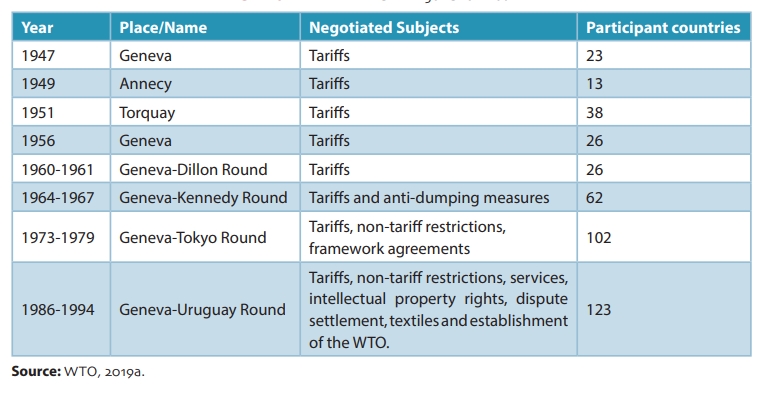
Soru 46
I. It was instituted under the auspices of the United Nations Conference on Trade and Development.
II. Today, there are thirteen countries that grant preferential access to their markets via implementing the GSP.
III. The GSP has been contributing to create a facilitating and encouraging trading environment for the least developed and developing countries for years.
Which of the above is correct about the Generalised System of Preferences?
II. Today, there are thirteen countries that grant preferential access to their markets via implementing the GSP.
III. The GSP has been contributing to create a facilitating and encouraging trading environment for the least developed and developing countries for years.
Which of the above is correct about the Generalised System of Preferences?
Seçenekler
A
Only I
B
Only II
C
I and II
D
II and III
E
I, II and III
Açıklama:
The Generalized System of Preferences (GSP): It was instituted under the auspices of the United Nations Conference on Trade and Development (UNCTAD) in 1971. The GSP has been contributing to create a facilitating and encouraging trading environment for the least developed and developing countries for years. Today, there are thirteen countries that grant preferential access to their markets via implementing the GSP. These countries are Australia, Belarus, Canada, European Union, Iceland, Japan, Kazakhstan, New Zealand, Norway, Russia, Switzerland, Turkey and the US.
Soru 47
That is the name of the term that happens when a commodity is sold at a price less than its normal value at the foreign market?
Seçenekler
A
Bound tariff
B
Dumping
C
Subsidies
D
Anti-dumping duty
E
Countervailing duty
Açıklama:
Dumping: Dumping happens when a commodity is sold at a price less than its normal value at the foreign market. In other words, there is dumping when a commodity is exported with a price that is lower than its production cost.
Soru 48
I. Trade in Commodities has been the founding framework of the multilateral trading system.
II. GATS and other services were signed to help the founding framework.
III. The GATT that was signed in 1947 has been the base of the multilateral trading system.
Which of the above is correct about the structure of WTO?
II. GATS and other services were signed to help the founding framework.
III. The GATT that was signed in 1947 has been the base of the multilateral trading system.
Which of the above is correct about the structure of WTO?
Seçenekler
A
Only I
B
Only II
C
I and II
D
I and III
E
I, II and III
Açıklama:
The structure of the WTO is based on five pillars. The first pillar, trade in commodities, has been the founding framework of the multilateral trading system. As explained before, the GATT signed in 1947 has been the fundamental basis of the multilateral trading system in commodities. Then, the GATT 1947 was revisited at the Uruguay Round and referred as the GATT 1994.
Soru 49
Which of the stages is at the bottom of the economic integration?
Seçenekler
A
Economic and Monetary Union
B
Customs Union
C
Preferential Trade Agreement
D
Free Trade Area
E
Common Market
Açıklama:
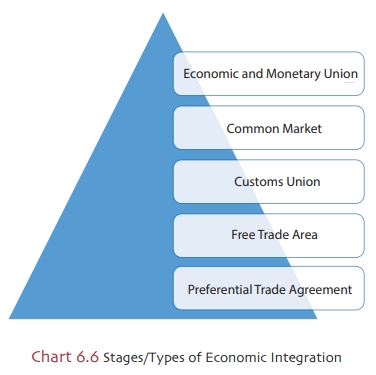
Soru 50
What is the name of the term that occurs when traded commodity is shifted from the highest cost domestic producer to the lowest cost customs union member country?
Seçenekler
A
Static effects of customs union
B
Trade creation
C
Trade diversion
D
Rules of origin
E
Trade deflection
Açıklama:
Trade creation: It occurs when traded commodity is shifted from the highest cost domestic producer to the lowest cost customs union member country.
Soru 51
Which of the following is the correct definition of this sentence?
" It is the first essential initiative to construct a system of peace that is based upon international law and organization. "
" It is the first essential initiative to construct a system of peace that is based upon international law and organization. "
Seçenekler
A
Vienna Congress,
B
The League of Nations,
C
The International Labor Organization,
D
Treaty of Westphalia,
E
The Theory of Comparative Advantage,
Açıklama:
1814-1815: Vienna Congress is the first essential initiative to construct a system of peace that is based upon international law and organization. Doğru yanıt " A " dır.
Soru 52
When is the International Telegraph Union established?
Seçenekler
A
1758
B
1865
C
1899
D
1910
E
1919
Açıklama:
1865: International Telegraph Union is established as the first modern international organization. Doğru yanıt " B " dir.
Soru 53
Which of the following is not the one of five associated institutions of World Bank?
Seçenekler
A
The International Bank for Reconstruction and Development,
B
The International Development Association,
C
The General Agreement on Tariffs and Trade,
D
The International Finance Cooperation,
E
The International Center for Settlement of Investment Disputes,
Açıklama:
World Bank is a group composed of five associated institutions: The International Bank for Reconstruction and Development, The International Development Association, The International Finance Cooperation, The Multilateral Investment Guarantee Agency and The International Center for Settlement of Investment Disputes. Doğru yanıt " C " dir.
Soru 54
Which of the following correctly defines the sentence below?
" It is the framework that defines the main engagement areas of the World Bank Group in Turkey. "
" It is the framework that defines the main engagement areas of the World Bank Group in Turkey. "
Seçenekler
A
Bretton Woods Structure,
B
General Agreement on Tariffs and Trade,
C
International Monetary Fund,
D
Country Partnership Framework,
E
International Trade Organization,
Açıklama:
Country Partnership Framework: It is the framework that defines the main engagement areas of the World Bank Group in Turkey. Doğru yanıt " D " dir.
Soru 55
Which of the following is the definition of this sentence?
" Countries settled their international balances in US dollars and the US dollar was convertible to gold at a fixed exchange rate, referring to 35 US dollars to 1 ounce gold. "
" Countries settled their international balances in US dollars and the US dollar was convertible to gold at a fixed exchange rate, referring to 35 US dollars to 1 ounce gold. "
Seçenekler
A
Multilateral Trading System,
B
The Financial Assistance mission,
C
International Trade Organization,
D
The multinational commodity trade,
E
Bretton Woods monetary system,
Açıklama:
Bretton Woods monetary system
In the Bretton Woods monetary system, countries settled their international balances in US dollars and the US dollar was convertible to gold at a fixed exchange rate, referring to 35 US dollars to 1 ounce gold. Doğru yanıt " E " dir.
In the Bretton Woods monetary system, countries settled their international balances in US dollars and the US dollar was convertible to gold at a fixed exchange rate, referring to 35 US dollars to 1 ounce gold. Doğru yanıt " E " dir.
Soru 56
Which of the following is the definition of the sentence below?
" It happens when a commodity is sold at a price less than its normal value at the foreign market. "
" It happens when a commodity is sold at a price less than its normal value at the foreign market. "
Seçenekler
A
Dumping,
B
Bound tariff,
C
Anti-dumping duty,
D
Countervailing duty,
E
Subsidies,
Açıklama:
Dumping
Dumping happens when a commodity is sold at a price less than its normal value at the foreign market. In other words, there is dumping when a commodity is exported with a price that is lower than its production cost. Doğru yanıt " A " dır.
Dumping happens when a commodity is sold at a price less than its normal value at the foreign market. In other words, there is dumping when a commodity is exported with a price that is lower than its production cost. Doğru yanıt " A " dır.
Soru 57
Which of the following is the definition of this sentence?
" It is a term that refers to the excessive bureaucratic requirements and implementations of the countries. "
" It is a term that refers to the excessive bureaucratic requirements and implementations of the countries. "
Seçenekler
A
Trade negotiation,
B
Red Tape,
C
Zero hunger goal,
D
Doha Development Agenda,
E
Trade Facilitation,
Açıklama:
Red tape
It is a term that refers to the excessive bureaucratic requirements and implementations of the countries. Doğru yanıt " B " dir.
It is a term that refers to the excessive bureaucratic requirements and implementations of the countries. Doğru yanıt " B " dir.
Soru 58
Which of the following is not the one of The Structure of the WTO?
Seçenekler
A
Trade in Commodities,
B
Trade in Services,
C
Trade and Development,
D
Trade-Related Dispute Settlement,
E
Trade Monitoring,
Açıklama:
The structure of the WTO is based on five pillars.
Strtucture of the WTO (WTO Agreements)
1. Trade in Commodities,
2. Trade inServices,
3. Trade-Related Aspects of Intellectual Property Rights,
4. Trade-Related Dispute Settlement,
5. Trade Monitoring,
Doğru yanıt " C " dir.
Strtucture of the WTO (WTO Agreements)
1. Trade in Commodities,
2. Trade inServices,
3. Trade-Related Aspects of Intellectual Property Rights,
4. Trade-Related Dispute Settlement,
5. Trade Monitoring,
Doğru yanıt " C " dir.
Soru 59
Which of the following correctly defines the sentence below?
" They are the rights that are given to people for the creations or innovations of their minds. "
" They are the rights that are given to people for the creations or innovations of their minds. "
Seçenekler
A
Movement of Natural Persons,
B
Telecommonications,
C
Financial Services,
D
Intellectual property rights,
E
Agreements and Annexes,
Açıklama:
Intellectual property rights
They are the rights that are given to people for the creations or innovations of their minds. Doğru yanıt " D " dir.
They are the rights that are given to people for the creations or innovations of their minds. Doğru yanıt " D " dir.
Soru 60
Which of the following is related to the sentence below?
"They are the criteria required to determine the natural source of a commodity. "
"They are the criteria required to determine the natural source of a commodity. "
Seçenekler
A
Third countries,
B
Trade deflection,
C
Trade creation,
D
Trade diversion,
E
Rules of origin,
Açıklama:
Rules of origin
They are the criteria required to determine the natural source of a commodity. In order to avoid trade deflection, the rules of origin have to be taken into consideration. Doğru yanıt " E " dir.
They are the criteria required to determine the natural source of a commodity. In order to avoid trade deflection, the rules of origin have to be taken into consideration. Doğru yanıt " E " dir.
Soru 61
When was Bretton Wood conference held?
Seçenekler
A
1944
B
1945
C
1946
D
1947
E
1948
Açıklama:
Bretton Woods Conference held in July 1944 so as to discuss postwar international economic order. Correct answer is A.
Soru 62
Which of the following is aimed of reconstruction to development?
Seçenekler
A
International Monetary Fund
B
World Bank
C
International Trade Organization
D
United Nations
E
European Union
Açıklama:
The aim of World Bank has altered from reconstruction to development. Correct answer is B.
Soru 63
Which of the following was founded to ensure and sustain the stability of the international monetary system?
Seçenekler
A
World Bank
B
International Trade Organization
C
International Monetary Fund
D
European Union
E
United Nations
Açıklama:
International Monetary Fund (IMF) was founded to ensure and sustain the stability of the international monetary system. Correct answer is C.
Soru 64
Since when Turkey has been a member of the World Bank?
Seçenekler
A
1944
B
1945
C
1946
D
1947
E
1948
Açıklama:
Regarding Turkey’s status within the Bretton Woods structure, Turkey has been a member of the World Bank since 11 March 1947. Correct answer is D.
Soru 65
How many Standby Arrangements has Turkey concluded with the IMF?
Seçenekler
A
15
B
16
C
17
D
18
E
19
Açıklama:
The first Standby Arrangement with the IMF dates back to 1 January 1961. Since then, Turkey has concluded nineteen Standby Arrangements and the latest one was agreed on 11 May 2005 and expired on 10 May 2008. Correct answer is E.
Soru 66
How many member countries does the WTO have?
Seçenekler
A
164
B
165
C
166
D
167
E
168
Açıklama:
As of 2019, the number of the WTO member countries increased to one hundred sixty-four. Correct answer is A.
Soru 67
Which of the following is not a main principle both the GATT and the WTO?
Seçenekler
A
Free trade without discrimination principle
B
Intervention trade principle
C
Predictability principle
D
Encouraging economic development and reform principle
E
Promoting fair competition principle
Açıklama:
Both the GATT and the WTO defend freer trade not intervention trade. Correct answer is B.
Soru 68
Which of the following is more related to increase export?
Seçenekler
A
Bound tariff
B
Dumping
C
Subsidy
D
Anti-dumping duty
E
Countervailing duty
Açıklama:
Export subsidies are subsidies that are given to an exporting firm by the government. Correct answer is C.
Soru 69
What is a term that refers to the excessive bureaucratic requirements and implementations of the countries?
Seçenekler
A
Green tape
B
Yellow tape
C
Black tape
D
Red tape
E
White tape
Açıklama:
Red tape is a term that refers to the excessive bureaucratic requirements and implementations of the countries. Correct answer is D.
Soru 70
Which of the following is not a dynamic effect of customs union?
Seçenekler
A
Higher level of technology
B
Economies of scale
C
Induce to foreign direct investments
D
Better allocation of economic resources
E
Decreased competition
Açıklama:
One of the most important dynamic effects of customs union is increased competition. Correct answer is E.
Ünite 7
Soru 1
In order to buy a unit of currency, what is the amount that must be foregone in the other currency?
Seçenekler
A
the foreign exchange rate
B
the determination of an asset’s price
C
the ratio of foreign trade
D
the level of this price
E
the framework of international transactions
Açıklama:
Foreign exchange rate: In order to buy a unit of currency, the amount that must be foregone in the other currency is the foreign exchange rate. In other words, the foreign exchange rate is the price of one unit of currency in terms of the other. The correct answer is " A ".
Soru 2
How is the rate of change in the nominal exchange rate explained? What are they?
Seçenekler
A
It is explained by two factors: the rate of change in the real exchange rate and the inflation differential between two countries.
B
It is explained by four factors: the real exchange rate is constant, the domestic
inflation is lower, the domestic currency won't change, and the change in the nominal exchange rate will be positive.
inflation is lower, the domestic currency won't change, and the change in the nominal exchange rate will be positive.
C
It is explained by one factor: the real foreign exchange rate between countries is calculated.
D
It is explained by three factors: it does not measure the purchasing power of the domestic currency, it is known as the nominal foreign exchange rate and it causes depreciation or appreciation of a currency against other currencies.
E
It is almost explained by being not rational to calculate the real foreign exchange rate by using just one good.
Açıklama:
The rate of change in the nominal exchange rate is explained by two factors: the rate of change in the real exchange rate and the inflation differential between two countries. If we accept that the real exchange rate is constant, the difference between inflation rates of domestic and foreign countries is the basic factor that determines the rate of change in the nominal foreign exchange rate. Provided that the domestic inflation is higher than the foreign inflation, the change in the nominal exchange rate will be positive indicating an increase. The correct answer is " A ".
Soru 3
How would you define the term " speculation "?
Seçenekler
A
It represents an appreciation in the domestic currency.
B
It is the exchange rate settled today for a payment or delivery.
C
It is an activity related to gain extra return benefiting from price differences.
D
It is a spot foreign exchange transaction.
E
It arranges the capital flows among countries.
Açıklama:
After shortly reviewing the conceptual issues about the foreign exchange rates, we want to express two important activities taking place in these markets: Speculation and arbitrage. Both of these activities are related to gain extra return benefiting from price differences. A speculation activity does this on the time dimension while an arbitrage activity does it on the place dimension. The correct answer is " C ".
Soru 4
What is spot exchange rate?
Seçenekler
A
It is the value of foreign currency units in terms of each other.
B
It is the price of one unit of currency in terms of the other.
C
It is the value of foreign currency units in terms of each other.
D
It is the value of a domestic currency against foreign currencies.
E
It is the current exchange rate today for immediate delivery.
Açıklama:
In the foreign exchange market, there is another differentiation on the exchange rates: Spot and forward exchange rates. Spot exchange rate, a.k.a benchmark rate or outright rate, is the current exchange rate today for immediate delivery. The corect answer is " E ".
Soru 5
Is the determination of the equilibrium level of $/T exchange rate in the long run different from the price determination process?
Seçenekler
A
Yes, it is.
B
No, it isn not.
C
It is not known.
D
It hasn't been examined yet.
E
It is being studied on.
Açıklama:
Determination of the equilibrium level of $/T exchange rate in the long run is not different from the price determination process. The correct answer is " B ".
Soru 6
What are the factors that cause a change in the equilibrium exchange rate?
Seçenekler
A
They are the factors which are accepted as constant other than the current exchange rate.
B
They are the factors which affect the supply of and demand for dollar.
C
They are the factors which represent the traditional supply and demand analysis with the vertical axis indicating price of dollar in terms of Turkish lira.
D
They are the factors which demand curve shifts to the right.
E
They are the factors which investigate them totally stable.
Açıklama:
Factors that cause a change in the equilibrium exchange rate are the factors which are accepted as constant other than the current exchange rate (the variable on the vertical axis of the figure). The correct answer is " A ".
Soru 7
Which of the followings is not among the factors that cause a change in the equilibrium exchange rate?
Seçenekler
A
relative productivity
B
relative price level
C
exchange rate in the short run
D
barriers for international trade
E
preferences between imported and domestically produced goods
Açıklama:
Factors that cause a change in the equilibrium exchange rate are the factors which are accepted as constant other than the current exchange rate (the variable on the vertical axis of the Figure 7.5). In macroeconomics, these factors include the real GDP, relative productivity, relative price level, barriers for international trade (like tariffs and quotas) and preferences between imported and domestically produced goods. The correct answer is " C ".
Soru 8
What is Purchasing Power Parity (PPP) Theory is based on?
Seçenekler
A
a process internationally the result will be the same.
B
a principle known as “law of one price”.
C
not the law of one price investigates the relationship between the prices of not only the identical goods but also the prices of all goods among countries.
D
a long period of time among the markets.
E
a deviation in the exchange rate.
Açıklama:
Purchasing Power Parity (PPP) Theory is based on a principle known as “law of one price”. This law claims that the entirely homogeneous (identical) goods should be sold with the same price even in different markets. The correct answer is " B ".
Soru 9
__________ states that the domestic interest rate is equal to the total of foreign interest rate and to the expected rate of change in the foreign exchange rate.
Which of the followings correctly fills in the blank?
Which of the followings correctly fills in the blank?
Seçenekler
A
Purchasing power parity condition
B
Relative price level condition
C
General equilibrium condition
D
Partial equilibrium condition
E
Interest parity condition
Açıklama:
The last equation we obtained is known as the interest parity condition and states that the domestic interest rate is equal to the total of foreign interest rate and to the expected rate of change in the foreign exchange rate. The correct answer is " E ".
Soru 10
What is the last factor changing the equilibrium exchange rate in the interest rate parity approach?
Seçenekler
A
It is the changes in domestic interest rate (iT) paid for Turkish lira assets.
B
It shouldn't be the interest rate paid for dollar deposits (i $) and the expected foreign exchange rate (Eet+1).
C
It is not the current exchange rate that this point indicates (1$ = 1.00T) is the equilibrium foreign exchange rate.
D
The increase of the US interest rate in international markets doesn't cause depreciation of the domestic currency ( Turkish lira).
E
An increase in i$ also doesn't mean an increase in the expected return of dollar nominated deposits.
Açıklama:
The last factor changing the equilibrium exchange rate in the interest rate parity approach is the changes in domestic interest rate (iT) paid for Turkish lira assets. The correct answer is " A ".
Soru 11
Which one of the following terms refers to The value of a domestic currency against foreign currencies corrected for the purchasing power?
Seçenekler
A
Real foreign exchange rate
B
Cross foreign exchange rate
C
Foreign exchange rate
D
Domestic price
E
Foreign price
Açıklama:
Real foreign exchange rate: The value of a domestic currency against foreign currencies corrected for the purchasing power is called the real foreign exchange rate
Soru 12
I. Cross foreign exchange rate
II. Nominal foreign exchange rate
III. Foreign price
Which one(s) of them is/are used in the calculation of real foreign exchange rate?
II. Nominal foreign exchange rate
III. Foreign price
Which one(s) of them is/are used in the calculation of real foreign exchange rate?
Seçenekler
A
Only I
B
Only II
C
Only III
D
I-II
E
II-III
Açıklama:
Real Fx Rate = Nominal FX Rate x ForeignPrice
DomesticPrice
DomesticPrice
Soru 13
Which one of the following is used when the exchange rate is settled today for a payment or delivery that will be consummated in a future date?
Seçenekler
A
Spot exchange rate
B
Forward exchange rate
C
Real foreign exchange rate
D
Nominal foreign exchange rate
E
Cross foreign exchange rate
Açıklama:
forward exchange rate is the exchange rate settled today for a payment or delivery that will be consummated in a future date.
Soru 14
Which one of the following does not directly affect the demand and supply of foreign exchange and cause a change in the equilibrium level of foreign exchange rate?
Seçenekler
A
price increases in two countries
B
barriers to free trade
C
preferences between imported and domestically produced goods
D
relative productivity
E
nominal exchange rate
Açıklama:
price increases in two countries, barriers to free trade, preferences between imported and domestically produced goods and relative productivity affect the demand and supply of foreign exchange and cause a change in the equilibrium level of foreign exchange rate
Soru 15
Which one of the following statements about the Purchasing Power Parity (PPP) Theory is wrong?
Seçenekler
A
It claims that the foreign exchange rate will solely be determined by the price level changes in both countries
B
It is based on a principle known as law of one price
C
According the PPP Theory, domestic price level will be equal to the product of the exchange rate and the level of foreign price level
D
The PPP Theory points out that if the prices in the home country increase more
than the prices in the foreign country, domestic currency must appreciate
than the prices in the foreign country, domestic currency must appreciate
E
It investigates the relationship between the prices of not only the identical goods but also the prices of all goods among countries
Açıklama:
The PPP Theory points out an important fact: If the prices in the home country increase more than the prices in the foreign country, domestic currency must depreciate. On the contrary, if the prices in the foreign country increase more than the prices in the home country, domestic currency must appreciate.
Soru 16
Which one of the following terms states that entirely homogeneous (identical) goods should be sold with the same price even in different markets?
Seçenekler
A
Forward exchange rate
B
The law of one price
C
Spot exchange rate
D
The interest parity condition
E
Demand for import
Açıklama:
The law of one price: It states that entirely homogeneous (identical) goods should be sold with the same price even in different markets.
Soru 17
Which one of the following states that the domestic interest rate is equal to the total of foreign interest rate and to the expected rate of change in the foreign exchange rate?
Seçenekler
A
The interest parity condition
B
The law of one price
C
Relative productivity
D
Relative price level
E
Domestic real GDP
Açıklama:
The interest parity condition states that the domestic interest rate is equal to the
total of foreign interest rate and to the expected rate of change in the foreign exchange rate
total of foreign interest rate and to the expected rate of change in the foreign exchange rate
Soru 18
When was the The Big Mac index invented?
Seçenekler
A
1982
B
1983
C
1986
D
1992
E
1996
Açıklama:
The Big Mac index was invented by The Economist in 1986 as a lighthearted guide to whether currencies are at their “correct” level.
Soru 19
Which institution in Turkey monthly publishes the real effective exchange rate?
Seçenekler
A
The Ministry of Treasury and Finance
B
The Ministry of Trade
C
The Central Bank of the Republic of Turkey (CBRT
D
The Presidency Office
E
The public banks
Açıklama:
The Central Bank of the Republic of Turkey (CBRT) monthly publishes the real effective exchange rate on its internet site via Electronic Data Delivery System
Soru 20
Which one of the following terms refers to the current exchange rate today for immediate delivery?
Seçenekler
A
Spot exchange rate
B
Forward exchange rate
C
Real foreign exchange rate
D
Nominal exchange rate
E
The interest parity condition
Açıklama:
Spot exchange rate: It is the current exchange rate today for immediate delivery.
Soru 21
Which of the exchange rates below is an example for direct foreign exchange?
Seçenekler
A
1$ = 0.89€
B
1₺= 0.18$
C
1€ = 6,32₺
D
1₺ = 0.16€
E
1€ = 1.12$
Açıklama:
If we explain the value of one unit of foreign currency in terms of domestic currency (like 1$ = 5.65₺ or 1€ = 6,32₺), it is the direct foreign exchange rate and shown as $/₺ or €/₺. On the contrary, if we explain the value of one unit of domestic currency in terms foreign currency (like 1₺= 0.18$ or 1₺= 0.16€), it is the indirect foreign exchange rate and shown as ₺/$ or ₺/€. The value of foreign currency units in terms of each other is called as the cross foreign exchange rate (sometimes shortly cross rate) like 1$ = 0.89€ or 1€ = 1.12$.
Soru 22
Suppose that the current exchange rate is $/₺ = 5.53 and you used dollar to buy a T-shirt which cost 12$. How much would it cost you in terms of Turkish lira?
Seçenekler
A
55.30₺
B
66.36₺
C
60.50₺
D
58.80₺
E
62.30₺
Açıklama:
Since the current exchange rate is $/₺= 5.53 and you used 12$ to buy, this T-shirt costs you in terms of Turkish lira:
12$ x 5.53$/₺ = 66.36₺
12$ x 5.53$/₺ = 66.36₺
Soru 23
- domestic currency gains value= the appreciation of domestic currency
- domestic currency loses value= appreciation of domestic currency
- domestic currency gains value= depreciation of domestic currency
- domestic currency loses value= depreciation of domestic currency
Seçenekler
A
I-II
B
I-III
C
II-III
D
II-IV
E
I-IV
Açıklama:
When the amount of Turkish lira decreases to buy 1 US dollar, the total amount you should pay also decreases and foreign goods are cheaper. In other words, domestic currency gains value and it is known as the appreciation of the domestic currency. Under the assumption, however, when the amount of Turkish lira increases to buy 1 US dollar, the total amount you should pay also increases and foreign goods are expensive. In other words, domestic currency loses its value against the dollar and it is known as the depreciation of domestic currency.
Soru 24
Which of the followings refers to the amount that must be foregone in the other currency in order to buy a unit of currency?
Seçenekler
A
Benchmark rate.
B
Foreign exchange rate.
C
Cross foreign exchange rate.
D
Real foreign exchange rate.
E
Long Run Equilibrium Exchange Rate.
Açıklama:
Page 179.
In order to buy a unit of currency, the amount that must be foregone in the other currency is the foreign exchange rate. In other words, the foreign exchange rate is the price of one unit of currency in terms of the other. Therefore, the correct option is B.
In order to buy a unit of currency, the amount that must be foregone in the other currency is the foreign exchange rate. In other words, the foreign exchange rate is the price of one unit of currency in terms of the other. Therefore, the correct option is B.
Soru 25
Which of the followings refers to the value of foreign currency units in terms of each other?
Seçenekler
A
Cross foreign exchange rate.
B
Foreign exchange rate.
C
Real foreign exchange rate.
D
Spot exchange rate.
E
Long run equilibrium exchange rate.
Açıklama:
Page 180.
The value of foreign currency units in terms of each other is called as the cross foreign exchange rate (sometimes shortly cross rate). Therefore, the correct option is A.
The value of foreign currency units in terms of each other is called as the cross foreign exchange rate (sometimes shortly cross rate). Therefore, the correct option is A.
Soru 26
Which of the followings refers to the value of a domestic currency against foreign currencies corrected for the purchasing power.
Seçenekler
A
Cross foreign exchange rate.
B
Foreign exchange rate.
C
Real foreign exchange rate.
D
Spot exchange rate.
E
Long run equilibrium exchange rate.
Açıklama:
Page 182.
The value of a domestic currency against foreign currencies corrected for the purchasing power is called the real foreign exchange rate. Therefore, the correct option is C.
The value of a domestic currency against foreign currencies corrected for the purchasing power is called the real foreign exchange rate. Therefore, the correct option is C.
Soru 27
Which of the followings refers to the current exchange rate today for immediate delivery?
Seçenekler
A
Cross foreign exchange rate.
B
Foreign exchange rate.
C
Real foreign exchange rate.
D
Spot exchange rate.
E
Long run equilibrium exchange rate.
Açıklama:
Page 183.
Spot exchange rate: It is the current exchange rate today for immediate delivery. However, forward exchange rate is the exchange rate settled today for a payment or delivery that will be consummated in a future date. Therefore, the correct option is D.
Spot exchange rate: It is the current exchange rate today for immediate delivery. However, forward exchange rate is the exchange rate settled today for a payment or delivery that will be consummated in a future date. Therefore, the correct option is D.
Soru 28
I. Barriers to trade,
II. Demand for export,
III. Purchasing Power Parity,
IV. Demand for import.
Which of the ones listed above is among the factors affecting the long run exchange rate?
II. Demand for export,
III. Purchasing Power Parity,
IV. Demand for import.
Which of the ones listed above is among the factors affecting the long run exchange rate?
Seçenekler
A
I, II, III & IV.
B
I, II & III.
C
I, II & IV.
D
II, III & IV.
E
II & IV.
Açıklama:
Page 187.
Price increases in two countries, barriers to free trade, preferences between imported and domestically produced goods and relative productivity affect the demand and supply of foreign exchange and cause a change in the equilibrium level of foreign exchange rate. Therefore, the correct option is C.
Price increases in two countries, barriers to free trade, preferences between imported and domestically produced goods and relative productivity affect the demand and supply of foreign exchange and cause a change in the equilibrium level of foreign exchange rate. Therefore, the correct option is C.
Soru 29
Which of the followings is the principle on which Purchasing Power Parity (PPP) Theory is based?
Seçenekler
A
Equilibrium level of exchange rate.
B
Ceteris paribus.
C
The real output (GDP) level of a country.
D
Relative price level.
E
The law of one price.
Açıklama:
Page 187.
Purchasing Power Parity (PPP) Theory is based on a principle known as “law of one price”. This law claims that the entirely homogeneous (identical) goods should be sold with the same price even in different markets. Therefore, the correct option is E.
Purchasing Power Parity (PPP) Theory is based on a principle known as “law of one price”. This law claims that the entirely homogeneous (identical) goods should be sold with the same price even in different markets. Therefore, the correct option is E.
Soru 30
Which of the followings states that the domestic interest rate is equal to the total of foreign interest rate and to the expected rate of change in the foreign exchange rate?
Seçenekler
A
High mobility.
B
The interest parity condition.
C
The portfolio preference theory.
D
Interest rate parity approach.
E
Real GDP.
Açıklama:
Page 191.
The interest parity condition states that the domestic interest rate is equal to the total of foreign interest rate and to the expected rate of change in the foreign exchange rate. If the domestic interest rate is higher than the foreign interest rate, this indicates an expected depreciation in the domestic currency. Therefore, the correct option is B.
The interest parity condition states that the domestic interest rate is equal to the total of foreign interest rate and to the expected rate of change in the foreign exchange rate. If the domestic interest rate is higher than the foreign interest rate, this indicates an expected depreciation in the domestic currency. Therefore, the correct option is B.
Soru 31
Which of the followings refers to the price offer of a bank related to a financial asset?
Seçenekler
A
Quotation.
B
Interest parity condition.
C
Forward exchange rate.
D
Domestic interest rate.
E
Equilibrium exchange rate.
Açıklama:
Page 194.
To calculate the forward exchange rate for $/ Tparity, we need spot rates that can be obtained from the banks’ quotations. Quotation is the price offer of a bank related to a financial asset. Therefore, the correct option is A.
To calculate the forward exchange rate for $/ Tparity, we need spot rates that can be obtained from the banks’ quotations. Quotation is the price offer of a bank related to a financial asset. Therefore, the correct option is A.
Soru 32
Which of the followings states that the nominal interest rate in an economy is equal to the sum of the real interest rate and the expected inflation?
Seçenekler
A
Domestic interest rate.
B
Interest parity condition.
C
Fisher Equation.
D
Forward exchange rate.
E
Quotations.
Açıklama:
Page 193.
According to Fisher Equation, the nominal interest rate in an economy is equal to the sum of the real interest rate and the expected inflation. Therefore, the correct option is C.
According to Fisher Equation, the nominal interest rate in an economy is equal to the sum of the real interest rate and the expected inflation. Therefore, the correct option is C.
Soru 33
Which of the followings is considered a way to determine the correct level of currencies, based on the theory of purchasing-power parity (PPP)?
Seçenekler
A
Interest parity condition.
B
Spot quotations.
C
The inflationary expectations.
D
The Fisher Equation.
E
The Big Mac index.
Açıklama:
Page 196.
The Big Mac index was invented by The Economist in 1986 as a lighthearted guide to whether currencies are at their “correct” level. It is based on the theory of purchasing-power parity (PPP), the notion that in the long run exchange rates should move towards the rate that would equalize the prices of an identical basket of goods and services (in this case, a burger) in any two countries. Therefore, the correct option is E.
The Big Mac index was invented by The Economist in 1986 as a lighthearted guide to whether currencies are at their “correct” level. It is based on the theory of purchasing-power parity (PPP), the notion that in the long run exchange rates should move towards the rate that would equalize the prices of an identical basket of goods and services (in this case, a burger) in any two countries. Therefore, the correct option is E.
Soru 34
Which of the following is the definition for ‘real foreign exchange rate’?
Seçenekler
A
The value of foreign currency units in terms of each other.
B
The price of a foreign currency in terms of the domestic currency.
C
The current exchange rate today for immediate delivery.
D
The value of a domestic currency against foreign currencies corrected for the purchasing power.
E
The exchange rate settled today for a payment or delivery that will be consummated in a future date.
Açıklama:
Real foreign exchange rate is the value of a domestic currency against foreign currencies corrected for the purchasing power. Cross foreign exchange rate is the value of foreign currency units in terms of each other. Foreign exchange rate is the price of a foreign currency in terms of the domestic currency. Spot exchange rate is the current exchange rate today for immediate delivery. Forward exchange rate is the exchange rate settled today for a payment or delivery that will be consummated in a future date.
Soru 35
- Price levels
- Real outputs
- Long term equilibrium
- Price determination
Seçenekler
A
I-II
B
I-III
C
I-IV
D
II-III
E
III-IV
Açıklama:
Fundamental economic variables (like general price levels and real outputs) of two countries are the basic factors affecting the level of an exchange rate.
Soru 36
Which of the following is not one of the factors that cause a change in the equilibrium exchange rate?
Seçenekler
A
The real GDP
B
Relative productivity
C
Relative price level
D
Barriers for international trade (like tariffs and quotas)
E
Purchasing power parity
Açıklama:
Factors that cause a change in the equilibrium exchange rate are the factors which are accepted as constant other than the current exchange rate. In macroeconomics, these factors include the real GDP, relative productivity, relative price level, barriers for international trade (like tariffs and quotas) and preferences between imported and domestically produced goods. However, the theory, known as purchasing power parity, however, claims that the foreign exchange rate will solely be determined by the price level changes in both countries.
Soru 37
Which of the following best states the claim of the principle known as ‘law of one price’?
Seçenekler
A
It states that different goods should be sold with the same price even in different markets.
B
It states that entirely homogeneous (identical) goods should be sold with different prices even in different markets.
C
It states that different goods should be sold with different prices even in different markets.
D
It states that entirely homogeneous (identical) goods should be sold with the same price even in different markets.
E
It states that entirely homogeneous (identical) goods should be sold with the same price even in the domestic markets.
Açıklama:
Purchasing Power Parity (PPP) Theory is based on a principle known as “law of one price”. This law claims that the entirely homogeneous (identical) goods should be sold with the same price even in different markets.
Soru 38
According the PPP Theory, domestic price level will be equal to the product of the exchange rate and the level of foreign price level. Taking this into consideration, which of the following formulas is correct?
Seçenekler
A
PTR=E$+PUS
B
PTR=E$×PUS
C
PUS =E$× PTR
D
E$ = PTR ×PUS
E
PTR=E$- PUS
Açıklama:
PPP Theory, domestic price level will be equal to the product of the exchange rate and the level of foreign price level. If we accept that the domestic country is Turkey and the foreign country is the USA, the general price level in Turkey (PTR) equals to the product of $/₺ (E$) and foreign price level (PUS):
PTR=E $×PUS
PTR=E $×PUS
Soru 39
Which of the following states that the domestic interest rate is equal to the total of foreign interest rate and to the expected rate of change in the foreign exchange rate?
Seçenekler
A
The interest parity condition
B
The law on one price
C
Purchasing power parity
D
Spot exchange rate
E
Real foreign exchange rate
Açıklama:
The interest parity condition states that the domestic interest rate is equal to the total of foreign interest rate and to the expected rate of change in the foreign exchange rate.
Soru 40
Which of the following is possible to calculate if we know the spot market values of interest rate for both currencies and exchange rate?
Seçenekler
A
Domestic interest rate
B
Current exchange rate
C
Foreign interest rate
D
Expected exchange rate
E
Price level
Açıklama:
If we know the spot market values of interest rate for both currencies and exchange rate, it is possible to calculate the expected exchange rate or, more accurately, the forward exchange rate.
Soru 41
Which one of the following is the price of one unit of currency in terms of the other?
Seçenekler
A
Real foreign exchange rate
B
Cross foreign exchange rate
C
Foreign exchange rate
D
Law of one price
E
Spot exchange rate
Açıklama:
The foreign exchange rate is the price of one unit of currency in terms of the other.
Soru 42
Which one of the following is the value of foreign currency units in terms of each other?
Seçenekler
A
Foreign exchange rate
B
Cross foreign exchange rate
C
Law of one price
D
Spot exchange rate
E
Real foreign exchange rate
Açıklama:
The value of foreign currency units in terms of each other is called as the cross foreign exchange rate.
Soru 43
Which one of the following currencies Turkish Lira saved its value against between 2015-2018?
Seçenekler
A
Japanese Yen (JPY)
B
United States Dollar (USD)
C
British Pound (GBP)
D
Euro (Eur)
E
Chinese Yuan (CNY)
Açıklama:
For 2015-2018 period against some basic foreign currencies in international markets like USD (US Dollar), EUR (Euro), GBP (British Pound), JPY (Japanese Yen) and CNY (Chinese Yuan). Turkish
lira depreciated against some of these foreign currencies especially after 2017 while it saved its value against CNY in general terms.
lira depreciated against some of these foreign currencies especially after 2017 while it saved its value against CNY in general terms.
Soru 44
Which one of the following is the value of a domestic currency against foreign currencies corrected for the purchasing power?
Seçenekler
A
Foreign exchange rate
B
Cross foreign exchange rate
C
Domestic price
D
Real foreign exchange rate
E
Spot exchange rate
Açıklama:
The value of a domestic currency against foreign currencies corrected for the purchasing power is called the real foreign exchange rate.
Soru 45
If Nominal FX Rate is 6,47; Foreign Price is 3,58 and Domestic Price is 9,21 what should be the Real FX rate?
Seçenekler
A
2,51
B
2,28
C
3,47
D
3,76
E
4,12
Açıklama:
Real Fx Rate = (Nominal FX Rate x Foreign Price) / Domestic Price
Soru 46
Which one of the following states that entirely homogeneous (identical) goods should be sold with the same price even in different markets?
Seçenekler
A
Foreign exchange rate
B
Interest rate parity
C
The interest parity condition
D
The law of one price
E
Cross foreign exchange rate
Açıklama:
The law of one price: It states that entirely homogeneous (identical) goods should be sold with the same price even in different markets.
Soru 47
Which one of the following is the level of a country is an indicator reflecting the productivity of resources she has?
Seçenekler
A
The law of one price
B
Spot exchange rate
C
Real output (GDP-gross domestic product)
D
Foreign exchange rate
E
The interest parity condition
Açıklama:
The real output (GDP) level of a country is an indicator reflecting the productivity of resources she has.
Soru 48
Which one of the following states that the domestic interest rate is equal to the total of foreign interest rate and to the expected rate of change in the foreign exchange rate?
Seçenekler
A
The interest parity condition
B
The law of one price
C
Spot exchange rate
D
Foreign exchange rate
E
Cross foreign exchange rate
Açıklama:
The interest parity condition states that the domestic interest rate is equal to the total of foreign interest rate and to the expected rate of change in the foreign exchange rate.
Soru 49
Which one of the following based on the law of one price investigates the relationship between the prices of not only the identical goods but also the prices of all goods among countries, which are measured by the general price levels?
Seçenekler
A
The law of one price
B
The Purchasing Power Theory
C
Interest rate parity
D
The interest parity condition
E
Foreign exchange rate
Açıklama:
The Purchasing Power Theory based on the law of one price investigates the relationship between the prices of not only the identical goods but also the prices of all goods among countries, which are measured by the general price levels.
Soru 50
Which one of the following is the current exchange rate today for immediate delivery?
Seçenekler
A
Nominal exchange rate
B
Real exchange rate
C
Foreign exchange rate
D
Cross foreign exchange rate
E
Spot exchange rate
Açıklama:
Spot exchange rate is the current exchange rate today for immediate delivery.
Soru 51
_________ states that the domestic interest rate is equal to the total of foreign interest rate and to the expected rate of change in the foreign exchange rate.
Which of the followings correctly fills in the blank?
Which of the followings correctly fills in the blank?
Seçenekler
A
Purchasing power condition
B
Relative price level condition
C
General equilibrium condition
D
Partial equilibrium condition
E
Interest parity condition
Açıklama:
The last equation we obtained is known as the interest parity condition and states that the
domestic interest rate is equal to the total of foreign interest rate and to the expected rate of change in the foreign exchange rate.
domestic interest rate is equal to the total of foreign interest rate and to the expected rate of change in the foreign exchange rate.
Ünite 8
Soru 1
- Deficit account
- Capital account
- Financial account
- Reserve assets
Seçenekler
A
I and III
B
II and IV
C
I, II and III
D
I, II and IV
E
II, III and IV
Açıklama:
There are four basic groups (accounts) summarizing a nation’s balance of payments: current account, capital account, financial account and reserve assets. There is an additional balancing item known as statistical discrepancy. The correct answer is E.
Soru 2
Which of the following involves all credit and debit items arising from export and import transactions of all goods and services, income receipt, and payment transactions in the country?
Seçenekler
A
Current account
B
Capital account
C
Financial account
D
Reserve assets
E
Statistical discrepancy
Açıklama:
The account that involves all credit and debit items arising from export and import transactions of all goods and services, income receipt, and payment transactions in the country is the current account. The correct answer is A.
Soru 3
Which of the following refers to the financial flows that stem from ownership transferring of a foreign company or lending to a foreign company that is widely controlled by the investor?
Seçenekler
A
Indirect investments
B
Foreign direct investments
C
Financial assets export
D
Financial assets import
E
International portfolio investment
Açıklama:
Direct investments (or its widely used name, Foreign Direct Investments - FDI) are the financial flows that stem from ownership transferring of a foreign company or lending to a foreign company that is widely controlled by the investor. The correct answer is B.
Soru 4
- Current account balance
- Net foreign investments
- Domestic capital accumulation
Seçenekler
A
I
B
II
C
III
D
I and II
E
II and III
Açıklama:
Net foreign investments in a country are measured by subtracting the increase in financial liabilities from the increase in financial assets. This value is also equal to current account balance. The correct answer is D.
Soru 5
Which of the following refers to flows of financial resources from one country to others to eliminate the disequilibrium in the balance of payments or to improve the country’s production possibilities?
Seçenekler
A
Net foreign investments
B
International portfolio investments
C
International capital movements
D
Foreign direct investments
E
Volatility of foreign capital flows
Açıklama:
The international capital movements or flows are defined as movements or flows of financial resources from one country to others to eliminate the disequilibrium in the balance of payments or to improve the country’s production possibilities. The correct answer is C.
Soru 6
- A slowdown in industrialization process
- Growth of multinational companies
- Expansion of intergovernmental loans
- Increase of the efficiency of international organizations
Seçenekler
A
I and II
B
III and IV
C
I, II and III
D
I, III and IV
E
II, III and IV
Açıklama:
In the post-World War II period, capital flows from developed countries to developing countries have increased significantly. Behind this increase, it is accepted that there are factors such as the growth of multinational companies, expansion of intergovernmental loans and the increase of the efficiency of international organizations (like the IMF, the World Bank and the International Finance Corporation). The correct answer is E.
Soru 7
Which of the following refers to flows that generally come to a country to benefit the high return possibilities in financial assets and to obtain extra profit by using interest rate-foreign exchange rate arbitrage?
Seçenekler
A
Short term capital flows
B
Long term capital flows
C
Government capital flows
D
Direct investments
E
Portfolio investments
Açıklama:
Short term capital flows generally do not come to a country to utilize its economic development potential; they generally move into a country to benefit the high return possibilities in financial assets and to obtain extra profit by using interest rate-foreign exchange rate arbitrage. Therefore, it is possible to say that this type of capital flows is largely speculative. The correct answer is A.
Soru 8
Which of the following is not among the benefits of foreign direct investments?
Seçenekler
A
Foreign direct investments create new business lines in the receiving country.
B
Foreign direct investments cause some important changes in the market structure of the receiving country through evolving competition culture.
C
Investing country gets the possibility of investing over her domestic savings to sustain economic growth without increasing indebtedness.
D
Advanced production technology improves the quality of labor force overtime and this will help to increase wage and to reduce other production costs.
E
In case of an economic turbulence in the receiving country, it is not easy for foreign direct investments to leave the country compared to portfolio investments.
Açıklama:
If we prepare a list that compiles the importance of foreign direct investments, it should contain the followings:
- In case of an economic turbulence in the receiving country, it is not easy for foreign direct investments to leave the country compared to portfolio investments.
- Receiving country (not the investing country) gets the possibility of investing over her domestic savings to sustain economic growth without increasing indebtedness.
- Foreign direct investments create new business lines in the receiving country.
- High technologies with direct investments promote the research and development activities in the receiving country so that she becomes a technology producing country instead of importing one.
- Advanced production technology improves the quality of labor force overtime and this will help to increase wage and to reduce other production costs.
- Foreign direct investments cause some important changes in the market structure of the receiving country through evolving competition culture. This will help to increase new types of products, to reduce product prices and, in the end, to increase consumer welfare overtime.
Soru 9
- The balance of payments
- Capital accumulations
- Trade regulations
- Economic growth
- Employment
Seçenekler
A
I, II and III
B
III, IV and IV
C
I, II, III and IV
D
I, II, IV and V
E
II, III, IV and V
Açıklama:
Most of the countries promote to attract direct investments since they have some important positive effects on the balance of payments, capital accumulation, economic growth, and employment. The correct answer is D.
Soru 10
Which of the following refers to a crisis that occurs when there is an unexpected and sudden collapse of domestic currency unit?
Seçenekler
A
A banking crisis
B
A foreign exchange crisis
C
A debt crisis
D
A foreign investment crisis
E
A subprime mortgage crisis
Açıklama:
A foreign exchange (or a foreign exchange rate) crisis occurs when there is an unexpected and sudden collapse of domestic currency unit (high level of depreciation in the flexible exchange rate regime or high level of devaluation in the fixed exchange rate regime). The correct answer is B.
Soru 11
Which one below is not a financial asset?
Seçenekler
A
buildings
B
bonds
C
equities
D
deposits
E
loans
Açıklama:
we all know that a large part of international transactions consists of financial assets (like bonds, equities, deposits and loans), trade and currency exchange in a modern world.
Soru 12
Which one below is the additional balancing item to a nation's balance of payments?
Seçenekler
A
Current account
B
statistical discrepancy
C
capital account
D
financial account
E
reserve assets
Açıklama:
There are four basic groups (accounts) summarizing a nation’s balance of payments: Current account, capital account, financial account and reserve assets. There is an additional balancing item known as statistical discrepancy.
Soru 13
This account fundamentally consists of unilateral transfers occurred in the country with the rest of the world.
What does the above description define?
What does the above description define?
Seçenekler
A
Current account
B
Financial account
C
Capital account
D
Reserve assets
E
International portfolio assessment
Açıklama:
Capital Account: This account fundamentally consists of unilateral transfers occurred in the country with the rest of the world. Since unilateral transfers express unrequited payments among nations, in this account, generally donations a country makes and receives are recorded.
Soru 14
The one-hundred-year period before the First World War is generally known as __________ of private investments.
Which of the below completes the sentence.
Which of the below completes the sentence.
Seçenekler
A
the silver age
B
the chrome age
C
the metal age
D
the golden age
E
the bronze age
Açıklama:
countries like Britain, United States, Canada and Australia has been realized on a large scale by the advantages of international capital. The one hundred-year period before the First World War is generally known as the golden age of private investments.
Soru 15
When did the United States experience Great Depression?
Seçenekler
A
1880
B
1910
C
1925
D
1938
E
1929
Açıklama:
The most important development between the two world wars is that the United States has turned into a net international creditor country from the net international debtor position. Great Depression of 1929 caused a sharp decline in foreign trade and international capital movements because of the chaos in international payments, tariffs and restrictions on international trade and foreign exchange.
Soru 16
What are Funds used for investments made by a country’s own citizens in a foreign country called?
Seçenekler
A
Domestic capital
B
Foreign capital
C
Government capital
D
Private capital
E
Short term capital
Açıklama:
Funds used for investments made by a country’s own citizens in a foreign country are called as domestic capital while the funds used for foreign investments in a country are foreign capital.
Soru 17
What does FPI stand for?
Seçenekler
A
Foreign Direct Investment
B
Foreign Portfolio Investment
C
For Direct Investment
D
For Portfolio Investment
E
Failure Direct Investment
Açıklama:
As we already noted long term capital movements may be classified as direct investments (also called as foreign direct investments and known by the abbreviation FDI) and portfolio investments (also called as foreign portfolio investments and known by the abbreviation FPI).
Soru 18
Which year were worldwide direct investments reached the top in terms of net inflow and net outflow?
Seçenekler
A
2005
B
2006
C
2007
D
2008
E
2009
Açıklama:
See figure 8.3 Worldwide Foreign Direct Investments (% of World GDP) on page 213
Soru 19
What was the financial crisis in 2007 in the USA called as?
Seçenekler
A
Pound Crisis
B
Tequila Crisis
C
Asian Tigers Crisis
D
subprime mortgage crisis
E
Panda Crisis
Açıklama:
the worldwide economic recession of 2008 was induced by the financial crisis of 2007 (also known as subprime mortgage crisis) in the USA and it is generally accepted by the researchers that it is the deepest economic recession in the world after the Great Depression of 30s.
Soru 20
In which country did Panda crisis occur?
Seçenekler
A
The USA
B
China
C
Japan
D
Thailand
E
Russia
Açıklama:
Pound Crisis in European Union member countries in 1993, Tequila Crisis in Mexico and other Latin American countries in 1994, Asian Tigers Crisis in East Asian countries in 1997, Panda Crisis in Russia and other emerging market economies in 1998.
Soru 21
Which of the followings involves all credit and debit items arising from export and import transactions of all goods and services, income receipt, and payment transactions in the country?
Seçenekler
A
Reserve Assets.
B
Financial Account.
C
Current Account.
D
Capital Account.
E
Statistical Discrepancy.
Açıklama:
Page 205.
Current Account: This account involves all credit and debit items arising from export and import transactions of all goods and services, income receipt, and payment transactions in the country. If we add up all items related to goods and services export and import, we obtain the trade balance which is an important component of current account. Therefore, the correct option is C.
Current Account: This account involves all credit and debit items arising from export and import transactions of all goods and services, income receipt, and payment transactions in the country. If we add up all items related to goods and services export and import, we obtain the trade balance which is an important component of current account. Therefore, the correct option is C.
Soru 22
Which of the followings consists mainly of the changes in official reserves of the country?
Seçenekler
A
Reserve Assets.
B
Financial Account.
C
Current Account.
D
Capital Account.
E
Statistical Discrepancy.
Açıklama:
Page 206.
Reserve Assets: As long as the credit usage from the International Monetary Fund (IMF) is zero, international reserve assets consists mainly of the changes in official reserves of the country. Therefore, the correct option is A.
Reserve Assets: As long as the credit usage from the International Monetary Fund (IMF) is zero, international reserve assets consists mainly of the changes in official reserves of the country. Therefore, the correct option is A.
Soru 23
Which of the followings consists of unilateral transfers occurred in the country with the rest of the world?
Seçenekler
A
Reserve Assets.
B
Financial Account.
C
Current Account.
D
Capital Account.
E
Statistical Discrepancy.
Açıklama:
Page 206.
Capital Account: This account fundamentally consists of unilateral transfers occurred in the country with the rest of the world. Since unilateral transfers express unrequited payments among nations, in this account, generally donations a country makes and receives are recorded. Since it usually has a small balance relative to current account, it is sometimes included in the current account balance instead of being considered as a separate account. Therefore, the correct option is D.
Capital Account: This account fundamentally consists of unilateral transfers occurred in the country with the rest of the world. Since unilateral transfers express unrequited payments among nations, in this account, generally donations a country makes and receives are recorded. Since it usually has a small balance relative to current account, it is sometimes included in the current account balance instead of being considered as a separate account. Therefore, the correct option is D.
Soru 24
Which of the followings refers to the net value of financial assets and similar claims that a country bought and sold (except the official international reserve changes) with the rest of the world?
Seçenekler
A
Reserve Assets.
B
Financial Account.
C
Current Account.
D
Capital Account.
E
Statistical Discrepancy.
Açıklama:
Page 206.
Financial Account: The net value of financial assets and similar claims that a country bought and sold (except the official international reserve changes) with the rest of the world states the private finance account balance in the balance of payments. The values recorded in the financial account are the principal values of the financial assets bought and sold; revenues obtained or paid to the holders of these types of assets are recorded in the capital account. Therefore, the correct option is B.
Financial Account: The net value of financial assets and similar claims that a country bought and sold (except the official international reserve changes) with the rest of the world states the private finance account balance in the balance of payments. The values recorded in the financial account are the principal values of the financial assets bought and sold; revenues obtained or paid to the holders of these types of assets are recorded in the capital account. Therefore, the correct option is B.
Soru 25
Which of the followings is also called as net errors and omissions?
Seçenekler
A
Reserve Assets.
B
Financial Account.
C
Current Account.
D
Capital Account.
E
Statistical Discrepancy.
Açıklama:
Page 207.
Statistical Discrepancy: This balancing item is also called as net errors and omissions in the balance of payments literature and it is the most skeptical (or more accurately the cause of polemic) item among the balance of payments entries. If the double sides of flows caused by the international transactions are accurately recorded, there will be no statistical discrepancy at all. Therefore, the correct option is E.
Statistical Discrepancy: This balancing item is also called as net errors and omissions in the balance of payments literature and it is the most skeptical (or more accurately the cause of polemic) item among the balance of payments entries. If the double sides of flows caused by the international transactions are accurately recorded, there will be no statistical discrepancy at all. Therefore, the correct option is E.
Soru 26
Which of the followings refers to the funds used for investments made by a country’s own citizens in a foreign country?
Seçenekler
A
Private Capital Movements.
B
Government Capital Movements.
C
Short Term Capital Movements.
D
Foreign Capital Movements.
E
Domestic Capital Movements.
Açıklama:
Page 211.
Funds used for investments made by a country’s own citizens in a foreign country are called as domestic capital while the funds used for foreign investments in a country are foreign capital. In the first case, there is a capital outflow from country to abroad while there is an inflow of capital from abroad to the country in the latter case. Therefore, the correct option is E.
Funds used for investments made by a country’s own citizens in a foreign country are called as domestic capital while the funds used for foreign investments in a country are foreign capital. In the first case, there is a capital outflow from country to abroad while there is an inflow of capital from abroad to the country in the latter case. Therefore, the correct option is E.
Soru 27
Which of the followings refers to the capital flows based on debt instruments with a maturity less than one year?
Seçenekler
A
Private Capital Movements.
B
Government Capital Movements.
C
Short Term Capital Movements.
D
Domestic Capital Movements.
E
Foreign Capital Movements.
Açıklama:
Page 211.
Short term capital movements are capital flows based on debt instruments with a maturity less than one year. Frequently this type of capital flows is realized by using currency, demand deposits and treasury bills. Therefore, the correct option is C.
Short term capital movements are capital flows based on debt instruments with a maturity less than one year. Frequently this type of capital flows is realized by using currency, demand deposits and treasury bills. Therefore, the correct option is C.
Soru 28
I. Speculative attacks,
II. General price level,
III. Quantity of money,
IV. Interest rate.
In a country, which of the ones listed above is affected by short term capital flows?
II. General price level,
III. Quantity of money,
IV. Interest rate.
In a country, which of the ones listed above is affected by short term capital flows?
Seçenekler
A
I, II, III & IV.
B
I, II & III.
C
II, III & IV.
D
I, III & IV.
E
II & IV.
Açıklama:
Page 212.
Where do above mentioned effects of the short term capital flows come from? These effects vary with some characteristics of the country to which short term capital flows move: exchange rate regime in the country, interest rate differential between the country and foreign countries, size of the balance of payments deficit. Since the size of these effects depends on the monetary policy followed in the country (the degree of sterilization), without technical details, we can conclude that short term capital flows affect the quantity of money, interest rate (therefore foreign exchange rate) and general price level in the country. Therefore, the correct option is C.
Where do above mentioned effects of the short term capital flows come from? These effects vary with some characteristics of the country to which short term capital flows move: exchange rate regime in the country, interest rate differential between the country and foreign countries, size of the balance of payments deficit. Since the size of these effects depends on the monetary policy followed in the country (the degree of sterilization), without technical details, we can conclude that short term capital flows affect the quantity of money, interest rate (therefore foreign exchange rate) and general price level in the country. Therefore, the correct option is C.
Soru 29
Which of the followingsrefers to the investments made by individuals or firms through buying a firm, providing the establishment capital for a new company or increasing the capital of an existing company in other countries?
Seçenekler
A
Foreign portfolio investments.
B
A banking crisis.
C
Vulnerability.
D
A debt crisis.
E
Foreign direct investments.
Açıklama:
Page 212.
Foreign direct investments are the investments made by individuals or firms through buying a firm, providing the establishment capital for a new company or increasing the capital of an existing company in other countries. Such investments also involve transferring the technology, bringing the business knowledge and undertaking the investor to control over the company. Therefore, the correct option is E.
Foreign direct investments are the investments made by individuals or firms through buying a firm, providing the establishment capital for a new company or increasing the capital of an existing company in other countries. Such investments also involve transferring the technology, bringing the business knowledge and undertaking the investor to control over the company. Therefore, the correct option is E.
Soru 30
Which of the followings is among the examples of banking crisis?
Seçenekler
A
Asian Tigers Crisis, 1997.
B
Tequila Crisis.
C
Pound Crisis.
D
Subprime mortgage crisis, 2007.
E
Panda Crisis.
Açıklama:
Page 217.
The recession of 2008 in the USA is partly a result of banking crisis which started in 2007 including banking firms and other financial institutions like insurance companies. Banking sector in an economy carries out the primary function by transferring funds from savers who want to spend less than their income to debtors who want to spend more than their income. Therefore, the correct option is D.
The recession of 2008 in the USA is partly a result of banking crisis which started in 2007 including banking firms and other financial institutions like insurance companies. Banking sector in an economy carries out the primary function by transferring funds from savers who want to spend less than their income to debtors who want to spend more than their income. Therefore, the correct option is D.
Soru 31
"involves all credit and debit items arising from export and import transactions of all goods and services, income receipt, and payment transactions in the country. " Which of the following terms is defined above?
Seçenekler
A
Capital Account
B
Current Account
C
Financial Account
D
Reserve Assets
E
International portfolio investment
Açıklama:
Current Account: This account involves all credit and debit items arising from export and import transactions of all goods and services, income receipt, and payment transactions in the country.
Soru 32
Which of the "the term - the definition" pairs is correct?
Seçenekler
A
Reserve Assets - An indirect foreign investment consisting of purchasing or selling of an equity or a bond
B
Financial Account - This account fundamentally consists of unilateral transfers occurred in the country with the rest of the world.
C
Capital Account - This account involves all credit and debit items arising from export and import transactions of all goods and services, income receipt, and payment transactions in the country
D
International portfolio investment: An indirect foreign investment consisting of purchasing or selling of an equity or a bond
E
Current Account - This account fundamentally consists of unilateral transfers occurred in the country with the rest of the world.
Açıklama:
International portfolio investment: An indirect foreign investment consisting of purchasing or selling of an equity or a bond
Soru 33
During the golden age of private investments, which of the following countries did not experience a rapid industrialization process through large-scale foreign investments?
Seçenekler
A
Spain
B
Britain
C
United States
D
Germany
E
France
Açıklama:
The one hundred-year period before the First World War is generally known as the golden age of private investments. During this period, countries such as Britain, United States, Germany and France experienced a rapid industrialization process through large-scale foreign investments.
Soru 34
When have direct investments been shifted to East Asian countries?
Seçenekler
A
1980 - 1983
B
1980 - 1995
C
1983 - 1990
D
1985 - 1995
E
1985 - 1990
Açıklama:
Direct investments, which account for more than half of the capital movements in the period 1983-1990, have been shifted to East Asian countries.
Soru 35
Which of the "the term - the definition" pairs is correctly given?
Seçenekler
A
long term capital flows - are capital flows based on debt instruments with a maturity less than one year
B
government capital movements - refer to capital movements arising from lending and borrowing transactions among governments.
C
domestic capital - the funds used for foreign investments in a country
D
foreign capital - funds used for investments made by a country’s own citizens in a foreign country
E
short term capital movements - depend on debt instruments with a maturity more than one year.
Açıklama:
Government and Private Capital Movements: Government capital movements refer to capital movements arising from lending and borrowing transactions among governments. Transactions like lending to foreigners or borrowing from foreigners by private individuals and institutions in a country create private international capital movements. In some cases, capital transfer from one country to another can be guaranteed by the government or central bank of the borrowing country.
Soru 36
I. They are the purchase of securities such as bonds and stocks for financial purposes by foreign investors.
II. They do not aim managerial control over the company whose securities are bought by the foreign investor.
III. They only aim to obtain a financial return.
IV. They are realized by international investment funds.
V. They are generally carried out by multinational corporations.
Which of the above statements is not correct for portfolio investments?
II. They do not aim managerial control over the company whose securities are bought by the foreign investor.
III. They only aim to obtain a financial return.
IV. They are realized by international investment funds.
V. They are generally carried out by multinational corporations.
Which of the above statements is not correct for portfolio investments?
Seçenekler
A
I
B
II
C
III
D
IV
E
V
Açıklama:
Portfolio investments are the purchase of securities such as bonds and stocks for financial purposes by foreign investors. Note that portfolio investments do not aim managerial control over the company whose securities are bought by the foreign investor; they only aim to obtain a financial return. Considering these definitions, foreign direct investments are generally carried out by multinational corporations while portfolio investments are realized by international investment funds.
Soru 37
- In case of an economic turbulence in the receiving country, it is not easy for foreign direct investments to leave the country compared to portfolio investments.
- Receiving country gets the possibility of investing over her domestic savings to sustain economic growthwithout increasing indebtedness.
- Foreign direct investments create new business lines in the receiving country.
- High technologies with direct investments promote the research and development activities in the receiving country so that she becomes a technology producing country instead of importing one.
- Advanced production technology improves the quality of labor force overtime and this will help to increase wage and to reduce other production costs.
- Foreign direct investments cause some important changes in the market structure of the receiving country through evolving competition culture. This will help to increase new types of products, to reduce product prices and, in the end, to increase consumer welfare overtime.
Seçenekler
A
I, II, III, IV, V and VI
B
III, IV, V and VI
C
I, II, V and VI
D
I, II, III, IV and V
E
II, III, IV and VI
Açıklama:
If we prepare a list that compiles the importance of foreign direct investments, it should contain the followings: • In case of an economic turbulence in the receiving country, it is not easy for foreign direct investments to leave the country compared to portfolio investments. • Receiving country gets the possibility of investing over her domestic savings to sustain economic growthwithout increasing indebtedness. • Foreign direct investments create new business lines in the receiving country. • High technologies with direct investments promote the research and development activities in the receiving country so that she becomes a technology producing country instead of importing one. • Advanced production technology improves the quality of labor force overtime and this will help to increase wage and to reduce other production costs. • Foreign direct investments cause some important changes in the market structure of the receiving country through evolving competition culture. This will help to increase new types of products, to reduce product prices and, in the end, to increase consumer welfare overtime.
Soru 38
an investment crisis a banking crisis, a foreign exchange crisis, a debt crisis a combination of a banking, a foreign exchange and a debt crisis Which of the given is not a type of financial crisis?
Seçenekler
A
I
B
II
C
III
D
IV
E
V
Açıklama:
Although they have a variety of features, financial crises are often experienced as a banking crisis, a foreign exchange crisis, a debt crisis or a combination of these three.
Soru 39
Which of the following "the term - the definition" pair is correct?
Seçenekler
A
A banking crisis - occurs when there is an unexpected and sudden collapse of domestic currency unit.
B
A foreign exchange crisis - arises when the banking sector in a country is unable to fulfill its lending function and confronts with the risk of insolvency.
C
A debt crisis - occurs when the debtor cannot fulfill his/her obligations on time and a need shows up to restructure the debt.
D
A debt crisis - occurs when there is an unexpected and sudden collapse of domestic currency unit.
E
A banking crisis - occurs when the debtor cannot fulfill his/her obligations on time and a need shows up to restructure the debt.
Açıklama:
A debt crisis occurs when the debtor cannot fulfill his/her obligations (interest and principal payment) on time and a need shows up to restructure the debt.
Soru 40
- inconsistent monetary and fiscal policies followed by the government
- unsustainable monetary and fiscal policies followed by the government
- volatility of foreign capital flows that the country receives
Seçenekler
A
I
B
II
C
III
D
I and III
E
I, II and III
Açıklama:
The vulnerability of a country may arise from two different sources: (1) Inconsistent and unsustainable monetary and fiscal policies followed by the government and (2) volatility of foreign capital flows that the country receives.