Contemporary World Cıvılızatıons (ENG) - Tüm Sorular
Ünite 1
Soru 1
Which of the following is not one of the reasons why African Civilization is less articulated in a sense of pride and confidence?
Seçenekler
A
There is no worthwhile contribution of African Civilizations to humanity that merits research.
B
A singular historical perspective representing singular African Civilization has not been institutionalized.
C
Whatever civilization might be visible in Africa such as Egyptian and Maghreb civilizations were dissociated as non-African.
D
Slavery and colonialism hindered the sober analysis and articulation of the value of African Civilization.
E
African civilization is analysed by scholars from the point of view of material and structural perspectives.
Açıklama:
Bu soruda Afrika Medeniyetlerini değerli gösteren araştırmaların azlığının nedenlerinin anlaşıldığının gösterilmesi istenmektedir.
There is no worthwhile contribution of African Civilizations to humanity that merits research.
There is no worthwhile contribution of African Civilizations to humanity that merits research.
Soru 2
Africa's exposure to slavery and colonialism resulted in ................ .
Seçenekler
A
reducing Africa as a region of no civilization worthy of scholarly research.
B
better understanding of African civilization by the Europeans
C
the development of a hybrid civilization imported from christian and local civilizations.
D
the development of a unique African Civilization
E
the spreading of Islam as a major religion to all over Africa.
Açıklama:
Soru Avrupalılar tarafından getirilen kölelik ve sömürgecilik sisteminin Afrika Medeniyetinin algılanışına etkisinin irdelenmesini istemektedir.
reducing Africa as a region of no civilization worthy of scholarly research.
reducing Africa as a region of no civilization worthy of scholarly research.
Soru 3
The region of northwest Africa comprising coastlands and the Atlas mountains of Morocco, Algeria and Tunisia were named as........... by the Arab invaders.
Seçenekler
A
Maghreb
B
Fezzan
C
Timbuktu
D
Abyssinia
E
Carthage
Açıklama:
Kuzey Afrika'nın Araplar tarafından istilası ve Araplaştırılmasından sonra Araplar tarafından nasıl adlandırıldığının bilinmesi
Maghreb
Maghreb
Soru 4
Africa was often referred to as the "Dark Continent", since........... .
Seçenekler
A
the interior of Africa was shrouded behind thick forests and jungles making outside contact with Europe difficult.
B
there were many wars and coup d'etats that violated human rights.
C
the majority of the inhabitants belonged to the black race.
D
Europeans did not know much about Africa until the 19th century.
E
colonialism and slavery inflicted gross injustices upon native people.
Açıklama:
the interior of Africa was shrouded behind thick forests and jungles making outside contact with Europe difficult.
Soru 5
Which of the following is not one of the key terminal ports used by the Berber traders in the pre-Islamic era?
Seçenekler
A
Timbuktu
B
Leptis
C
Sabratha
D
Dougga
E
Thubrba
Açıklama:
İslamiyetten önce Kuzey Afrika Berber kabilelerinin oluşturduğu ticaret rotaları hakkında bilgi sahibi olma.
Timbuktu
Timbuktu
Soru 6
European colonization of Africa .......... .
Seçenekler
A
introduced the practice of slavery and explotation of the natural resources of Africa.
B
introduced democratization and political stability in Africa.
C
allowed Africans to have equal citizenship rights with the European colonizers.
D
intoduced Christianity and abolished the practice of slave trade.
E
prevented Africa to be overrun my communist ideology
Açıklama:
Avrupa sömürgeciliğinin Afrika medeniyetleri üzerindeki etkisini kavrayabilme
introduced the practice of slavery and explotation of the natural resources of Africa.
introduced the practice of slavery and explotation of the natural resources of Africa.
Soru 7
From the point of view of contemporary research African civilization can be described as..... .
Seçenekler
A
an autonomous civilization that can be clearly articulated as being specifically African.
B
a modified version of European civilization introduced by Christian missionaries.
C
a hybrid civilization influenced from the ancient Middle Eastern civilizations.
D
an underdeveloped and unarticulated primitive civilization.
E
a dependent civilization with its values borrowed from Islamic civilization.
Açıklama:
Afrika medeniyetini bütüncül bir yaklaşımla tanımlayabilme
an autonomous civilization that can be clearly articulated as being specifically African.
an autonomous civilization that can be clearly articulated as being specifically African.
Soru 8
Which of the following is one of the important muslim empires in West Africa that dominated the trade routes to Nort Africa and Europe?
Seçenekler
A
Ghanaian Empire
B
Axumite Empire
C
Zimbabwe
D
Carthage
E
Benin Empire
Açıklama:
Ghanaian Empire
Soru 9
From the aspect of 'unity and essence of African Civilization', it can be said that.....
Seçenekler
A
African civilization embodies uniting sociological, historical, anthropological and ethno-linguistic characteristics in its own right.
B
Africa is the source of all languages and cultures in the world.
C
African civilization is a hybrid civilization imported from the Middle East.
D
African civilization is still underdeveloped and unarticulated and do not deserve to be studied.
E
African societies use their cultural resources to contribute to the establishment of global peace.
Açıklama:
African civilization embodies uniting sociological, historical, anthropological and ethno-linguistic characteristics in its own right.
Soru 10
The policy that governed relations between South Africa's white minority and non-white majority and sanctioned racial segragation and political and economic discrimination is known as ......... .
Seçenekler
A
apartheid
B
colonialism
C
nazism
D
pluralism
E
tyranny
Açıklama:
Güney Afrikada uzunca yıllar uygulanan Apartheid sitemini tanımlayabilmek
Soru 11
Africa can be considered as the origin of following options.
Seçenekler
A
Humans
B
Knowledge
C
Science
D
Technology
E
Architecture
Açıklama:
African Civilization is as old as Africa. It is scientifically proven that Africa is the origin of humans. For this reason, African Civilization germinated in the indigenous African soil with its own civilizational features that expressed purely African thoughts and actions.
Soru 12
What was the total number of populations that is used as a threshold in David Wilkinson’s categorization?
Seçenekler
A
100
B
500
C
1000
D
5000
E
10000
Açıklama:
Using the population size of cities as an indicator of a well-formed civilization, David Wilkinson identified regional civilizations in Africa. Wilkinson was meticulous in focusing the defining characteristics of civilization into states with cities of over 10,000 population, possessing oral or written legal traditions, defended by established defence forces, and governed by ruling elites whose authority is rooted in legitimately constructed legislative and judicial foundations
Soru 13
Which one of options express the monotheistic faiths that influenced the civilizations that originated in the Rift and the Nile Valleys?
I) Judaism
II) Christianity
III) Islam
I) Judaism
II) Christianity
III) Islam
Seçenekler
A
Only I
B
I-II
C
I-III
D
II-III
E
All of the above
Açıklama:
This region can be singled out as the origin of man, the origin of the Nile, and the origin of the three monotheistic faiths, Judaism, Christianity, and Islam. The civilizations that originated in the Rift and the Nile Valleys were heavily influenced by
two things: the ancient Egyptian Civilization and the three monotheistic faiths mentioned above.
two things: the ancient Egyptian Civilization and the three monotheistic faiths mentioned above.
Soru 14
Which one of the monotheistic religions used historical Africa as a shelter?
I) Judaism
II) Christianity
III) Islam
I) Judaism
II) Christianity
III) Islam
Seçenekler
A
I
B
I-II
C
I-III
D
II-III
E
I-II-III
Açıklama:
It has been seen that historical Africa serving as a source of the Nile Valley Civilizations and as a shelter and protector of the three monotheistic religions. These important contributions to the survival of the human faith, cultures, and civilizations are integral parts of African Civilization.
Soru 15
Where can the seeds of all civilizations, including Western civilization, be found?
Seçenekler
A
Dictionaries
B
Digital records
C
Cultural manifestations
D
Forgotten narratives
E
Libraries
Açıklama:
The seeds of all civilizations, including Western civilization, are to be found in their cultural manifestations.
Soru 16
Because the interior of Africa was shrouded behind thick forests and jungles, how the Africa continent was referred by Europeans?
Seçenekler
A
Light Continent
B
Dark Continent
C
Grey Continent
D
Blue Continent
E
White Continent
Açıklama:
The interior of Africa was shrouded behind thick forests and jungles, making it not so easy for outside contact with Europe. For this reason, Africa was often referred to as the “Dark Continent,” indicating the ignorance of Europeans regarding Africa.
Soru 17
Which kind of identity do anthropological and sociological contexts reflect?
Seçenekler
A
Historical
B
Religious
C
Economic
D
Indigenous
E
Futurist
Açıklama:
The anthropological and sociological contexts reflect societies’ indigenous identities.
Soru 18
Linguistic characteristics of ancient Egypt do not stem from the following origins.
Seçenekler
A
Greek
B
Latin
C
French
D
Nubian
E
Yoruba
Açıklama:
The extent to which linguistic characteristics of ancient Egypt are cognate to Greek, Latin, Nubian, Yoruba or Ethiopic languages tell us the anthropological relationship of the ancient Egyptians and their neighbours.
Soru 19
Who makes cogent observation of how ecological fallacy can beguile scholars into making conclusions fraught with inaccuracies?
Seçenekler
A
Merrick Posnansky
B
Edward Gibbon
C
George Murdock
D
Basil Davidson
E
Michael Brett
Açıklama:
George Murdock makes cogent observation of how ecological fallacy can beguile scholars into making conclusions fraught with inaccuracies. European botanists visiting India discovered “the origin of many cultivated plants” and declared that they were of Indian origin.
Soru 20
Around when did the Egyptian Civilization emerged interacting with its geographical orientations?
Seçenekler
A
1400 BCE
B
3100 BCE
C
4500 BCE
D
6000 BCE
E
8900 BCE
Açıklama:
The Egyptian Civilization emerged around 3100 BCE, interacting with its geographical orientations.
Soru 21
How many sovereign states are there in Africa?
Seçenekler
A
37
B
49
C
54
D
62
E
69
Açıklama:
There are 54 sovereign states whose peoples are inheritors of a tapestry of mosaic cultural heritages, having direct claim to ancient civilizations. The correct answer is C.
Soru 22
In which part of Africa is the Maghreb civilization located?
Seçenekler
A
North
B
South
C
East
D
Mid-west
E
Central
Açıklama:
In the northern regions of Africa, the Egyptian civilization and Maghreb civilization represent the region. The first phase of the Islamization of Africa began after North Africa was Islamized, beginning with the conquest of Egypt by Arab forces around 639-641 CE. These historical developments were an aspect of the eruption of the global Islamic revolution, when Islam was on a march of conquest. Thus, new concepts of faith and politics rooted in the Quranic declarations that were promulgated in Medina and Mecca, declared by the Prophet, were embraced and enthusiastically implemented by the First Rashidun, successors of the Prophet, who swept over Arabia, the Middle East, and North Africa. Subsequent years saw the complete integration of the entire North African region into the Islamic world. The region became called the “Maghreb” by the Arabs. The correct answer is A.
Soru 23
Which of the following states rose up in northern Ethiopia and the highlands of Eritrea controlling the southern part of the Red Sea until it was defeated by the Persians after 533 CE?
Seçenekler
A
The First Rashidun
B
The Ghanaian Empire
C
The Berber
D
The Axumite Empire
E
The Songhai Empire
Açıklama:
The Axumite Empire, at the height of its global power, dominated the northeastern part of Africa up to the southern borders of Upper Egypt on the north and as far as Southern Arabia. The Axumite Empire rose up in the highlands of northern Ethiopia and the highlands of the State of Eritrea. Its capital was the village of Axum where ancient landmark and monuments are still standing, and its seaport was the port of Adulis at the Red Sea. Axum controlled the southern part of the Red Sea. The rise of the Persian Empire in the 4th century CE introduced a big threat to the Roman Empire. In 533 CE, Emperor Justinian, sensing the need for alliance, sent a letter to the Axumite Emperor urging him to block Persian silk trade through the Red Sea. The Persian Empire’s formidable power defeated the Axumite forces in Southern Arabia. The Axumite Empire that ruled over northeast Africa and Arabia did not recover from this defeat. The correct answer is D.
Soru 24
Which of the following is not a reason for the persistence of poverty in Africa?
Seçenekler
A
Colonialism
B
Slavery
C
Dictatorial institutions
D
Postcolonial monopoly capitalism
E
Cultural diversity
Açıklama:
Africa was stripped of its precious resources, and the indignity of being dominated does not enable its victims to confidently extol or glory in their civilizations. The mental image embedded in Europeans adventurers, explorers, and colonialists was formed by the purpose and objective of slavery, colonialism, and postcolonial monopoly capitalism. African civilization is not to be faulted for the persistence of African poverty without accounting for the crippling effects of the slave trade, colonialism and post-colonial tyranny, most of which can be traced directly to the global entanglement of the African economy and its dictatorial institutions. The correct answer is E.
Soru 25
Which one of the following commodities was not caravanned up to North African ports from the interior cities in West Africa before the arrival of colonialism?
Seçenekler
A
Gunpowder
B
Gold
C
Ivory
D
Animal skin
E
Cotton
Açıklama:
The interior cities in West Africa, such as Kumbi Salaaeh, Awdaghost, Timbuktu, Tidjikja and Ghadames, served as hub markets from where goods, such as gold, ivory, gums, animal skin, and cotton, were caravanned up North African ports. The correct answer is A.
Soru 26
A new way of governance and newer society that aimed for the oneness of human beings under one faith in the Islamic Civilization was called _____.
Seçenekler
A
Zoroastrianism
B
the Ummah
C
the holistic approach
D
the Benin
E
the Kush
Açıklama:
Çözüm: The Islamic revolution declared all other civilizational inspirations null and void. Hereafter, a new faith combining religious inspiration and military strategy was bound to spread a new Islamic Civilization. This civilization was to bring new ways of governance, and newer society, the Ummah, inspired by Islam and aiming for the oneness of human beings under one faith and this new Islamic Civilization. The correct answer is B.
Soru 27
Which of the following religions were nurtured in Africa?
- I- Buddhism
- II- Judaism
- III- Christianity
- IV- Shinto
- V- Hinduism
- VI- Islam
Seçenekler
A
I - II - V
B
I - III - IV
C
III - V - VI
D
II - IV - V
E
II - III - VI
Açıklama:
The Rift Valley region in Africa can be singled out as the origin of man, the origin of the Nile, and the origin of the three monotheistic faiths, Judaism, Christianity, and Islam. The civilizations that originated in the Rift and the Nile Valleys were heavily influenced by two things: the ancient Egyptian Civilization and the three monotheistic faiths mentioned above. The correct answer is E.
Soru 28
Where was human life first appeared?
Seçenekler
A
South Africa
B
African Rift Valley
C
North Africa
D
West Africa
E
The Kalahari Desert
Açıklama:
African Civilization is as old as Africa. It is scientifically proven that Africa is the origin
of humans. Africa is the oldest continent to have inspired human activity, starting around 3.7 million years ago when human life arose in the African Rift Valley, in north eastern Ethiopia. Looking from above, Africa in its totality is a complex homeland to the oldest civilization, that of Egypt and Nubia. The correct answer is B.
of humans. Africa is the oldest continent to have inspired human activity, starting around 3.7 million years ago when human life arose in the African Rift Valley, in north eastern Ethiopia. Looking from above, Africa in its totality is a complex homeland to the oldest civilization, that of Egypt and Nubia. The correct answer is B.
Soru 29
The system of earlier South Africa, where democratic pluralism was good for selected citizens while perpetrating savage cruelties against most South African, was called _______.
Seçenekler
A
superior-inferior dichotomy
B
ruling elites
C
Apartheid
D
Central Civilization
E
Dark Continent
Açıklama:
The Apartheid system of earlier South Africa, where democratic pluralism was good for selected citizens while perpetrating savage cruelties against most South African citizens, reveals that the “civilized” democratic system of the West falls short of becoming wholesome, because it has not matured to the highest of civilized culture as it tolerates gross injustice within its societies and outside its own societies. The correct answer is C.
Soru 30
When the Prophet Mohammed was faced with persecution by the Meccans, where did he send some of his most faithful followers to seek shelter?
Seçenekler
A
Axum
B
Adulis
C
Carthage
D
Abyssinia
E
Mali
Açıklama:
When the Prophet Mohammed started preaching the faith of Islam in Arabia, he was faced with persecution by the Meccans. As he battled his adversaries, he sent some of his most faithful followers, including his daughter, to seek shelter in Abyssinia. He told them they would face hospitality and security there. He also instructed them to preserve the faith, advance its teachings if he and his followers were exterminated by those who were persecuting them. The correct answer is D.
Soru 31
- Slavery and colonialism
- Scholars' material and structural perspectives
- Being a neglected field of study in comparison with others
Seçenekler
A
I,II,III
B
I,II
C
I,III
D
Only I
E
Only III
Açıklama:
Several reasons can be presented for not emphasizing African Civilization as a holistic and robust civilization.
First, a singular historical perspective, representing tangible historical records that can stand out as clearer markers of a singular African Civilization, has not been institutionalized.
Second, African Civilization is analyzed by scholars from the point of view of material and structural perspectives. Material and structural ways of articulating civilizations underemphasize the essential roles of historical and cultural traditions.
Third, Africa, over the centuries, was exposed first to slavery, then to colonialism. Both slavery and colonialism are negative interrelationships of humans.
These critical historical evolutions, slavery and colonialism, hindered the sober analysis and articulation of African Civilization.
First, a singular historical perspective, representing tangible historical records that can stand out as clearer markers of a singular African Civilization, has not been institutionalized.
Second, African Civilization is analyzed by scholars from the point of view of material and structural perspectives. Material and structural ways of articulating civilizations underemphasize the essential roles of historical and cultural traditions.
Third, Africa, over the centuries, was exposed first to slavery, then to colonialism. Both slavery and colonialism are negative interrelationships of humans.
These critical historical evolutions, slavery and colonialism, hindered the sober analysis and articulation of African Civilization.
Soru 32
Which one is false about Africa?
Seçenekler
A
Africa is the second largest continent.
B
The level of acknowledgement of African Civilization is strong.
C
It is a home to thousands of different languages.
D
Africa is indigenous home to thousands of wildlife animals.
E
There are millions of tribes and ethnicity in Africa.
Açıklama:
Africa is the second largest continent in the world. It is a home to thousands of different languages, millions of tribes and ethnicity, hundreds of traditional and deistic religions, the location for the largest deserts in the world, indigenous home to thousands of wildlife animals, the longest river in the world, and home and origin to the family of man. There are 54 sovereign states whose peoples are inheritors of a tapestry of mosaic cultural heritages, having direct claim to ancient civilizations. In the annals of history, Africa is an ancient continent, but its history has not been told on its own merit, that is, aside from the colonial perspectives.
In the case of Africa, the level of articulation and acknowledgement of African Civilization is weak and less articulated in a sense of pride and confidence.
In the case of Africa, the level of articulation and acknowledgement of African Civilization is weak and less articulated in a sense of pride and confidence.
Soru 33
Africa was often referred to as the _________ indicating the ignorance of Europeans regarding Africa.
Which of the below best completes the blank in the sentence above?
Which of the below best completes the blank in the sentence above?
Seçenekler
A
distant continent
B
vast continent
C
dark continent
D
golden continent
E
old continent
Açıklama:
The interior of Africa was shrouded behind thick forests and jungles, making it not so easy for outside contact with Europe. For this reason, Africa was often referred to as the “Dark Continent,” indicating the ignorance of Europeans regarding Africa. More knowledgeable and effective carriers of knowledge, trade, and inter-African and North African relations thrived before the capture of Egypt by the Ptolemies in 332 BCE.
Soru 34
Which of the following was the empire that mixed African traditional foundations with Islam?
Seçenekler
A
Nubia
B
Kush
C
Ghana
D
Ethiopia
E
Zimbabwe
Açıklama:
As early as 800 CE, Islam became the dominant faith in West Africa, as well. Muslim traders and religious ambassadors of the faith charted the trade paths of West Africa, where the Ghanaian, the Mali, and the Songhai empires were mighty powers. They embraced Islam and became suppliers of African goods to North Africa and Europe. Ghana was the golden empire that mixed African traditional cultural and anthropological foundations with the strictures of Islam.
Soru 35
- accepting humiliation as a normal way of life
- bringing enormous human misery
- causing ultimate level of destruction
- providing unmerited superiority to the traders
- placing wealth on human life
Seçenekler
A
I,II,IV
B
II,III,V
C
I,IV,V
D
I,III,III
E
I,II,III,IV,V
Açıklama:
Slavery inflicted enormous human misery on Africa and Africans. The selling of human beings for profit caused the ultimate level of destruction. Over time, it also created a state of mind that accepted humiliation as a normal way of life for the slave and it accorded unmerited superiority to the slave trader. Slavery is an abnormal enterprise; it was practiced due to greed and economic profit. This places wealth on human life. Africa was a victim of this pathological enterprise.
Soru 36
- the environment
- the animal kingdom
- the topography
- the plants
Seçenekler
A
I,II,III,IV
B
I,III
C
II,III,IV
D
Only V
E
Only I
Açıklama:
Civilizations are inseparable from the geographical location in which they are born and from where they progressed. The environment of their geographical location, the topography, the air, the waters, the plants, and the animal kingdom in their surroundings formulate their components, images, and artistic and aesthetic features. These factors give the anthropological characteristics of civilizations.
Soru 37
Which of the below is not among the uniting features of African Civilization?
Seçenekler
A
The Egyptian Civilization emerged around 3100 BCE.
B
There were no trade relations in West African Civilization.
C
Nubia, Libya and Kush exchanged leadership among each other.
D
The Ghanaian, the Mali and the Songhai Empires were the other civilizations.
E
The rise of Islam provided uniting foundation of belief as well.
Açıklama:
West Africa, from ancient times to today, possesses massive natural riches in the form of gold, diamonds, ivory, animal skins, grains, incense, palm oil, dates, and hard wood. During the Fourth Dynasty, West Africa and Egypt had trade relations.
Soru 38
- gold
- ivory
- animal skin
- cotton
Seçenekler
A
II, IV
B
I,II
C
I,III
D
I,II,III,IV
E
II,III,IV
Açıklama:
The trade networks that connected ancient cities and localities give evidence of trade exchanges as well as cultural interactions. Before the arrival of colonialism, the direction of African trade followed north-south caravan paths using camels, horses, mules, donkeys, and human portage.
The interior cities in West Africa, such as Kumbi Salaaeh, Awdaghost, Timbuktu, Tidjikja and Ghadames, served as hub markets from where goods, such as gold, ivory, gums, animal skin, and cotton, were caravanned up North African port.
The interior cities in West Africa, such as Kumbi Salaaeh, Awdaghost, Timbuktu, Tidjikja and Ghadames, served as hub markets from where goods, such as gold, ivory, gums, animal skin, and cotton, were caravanned up North African port.
Soru 39
Which of the following refers to the broad, clear cut patterns of commonality that the study of African Civilizations shows among the Africans?
Seçenekler
A
Modified version of African Civilization
B
Autonomy of African Civilization
C
Unity and Essence of African Civilization
D
Hybrid civilization imported from Africa
E
Dependent civilization of Africa
Açıklama:
The unity and essence of the African Civilization is the macrocosm of those civilizations that emerged in the Continent of Africa. Even though they may be explained in regional terms, their unity to a common Continent displaying uniquely African heritages a binding thread to the broad African Civilization.
The phrase “the essence and unity of African Civilization” refers to the broad, but clear-cut patterns unity, oneness, and commonality that the study of African Civilization shows among the African peoples. Looking at African civilization, there is no denying that Africa has a unique civilization. That civilization is the sum of the people of Africa in the east, west, north and south of this great continent.
The phrase “the essence and unity of African Civilization” refers to the broad, but clear-cut patterns unity, oneness, and commonality that the study of African Civilization shows among the African peoples. Looking at African civilization, there is no denying that Africa has a unique civilization. That civilization is the sum of the people of Africa in the east, west, north and south of this great continent.
Soru 40
- religion
- language
- tribal patterns
- ethnicity
Seçenekler
A
I,III
B
II,III,IV
C
I,IV
D
I,II
E
I,II,III,IV
Açıklama:
The articulation of African Civilization is an endeavor aimed at establishing rational grounds, and substantiating historical, cultural, anthropological, and sociological facts. These variables have elements in them that need further clarification. These elements include religion, ethnicity, language, and tribal patterns. They assist us in articulating civilizations. In the case of African Civilization, we noticed how the Maghreb, the Egyptians, the Nubians, the West Africans and the Ethiopians displayed these variables to present African Civilization in its various elements.
From the macrocosm of the broad features of African Civilization, it becomes possible to give a generalized unity and pointed articulation of African Civilization. The historical, cultural, sociological and anthropological factors described above, each in their own field of discipline, give benchmarks that describe the totality and unity of African Civilization.
From the macrocosm of the broad features of African Civilization, it becomes possible to give a generalized unity and pointed articulation of African Civilization. The historical, cultural, sociological and anthropological factors described above, each in their own field of discipline, give benchmarks that describe the totality and unity of African Civilization.
Soru 41
I. Africa is the origin of humans.
II. African Civilisation was autonomous and segmented into regional civilisations.
III. Early African cities had oral and written legal traditions.
Which of the above is correct regarding the early African Civilisation?
II. African Civilisation was autonomous and segmented into regional civilisations.
III. Early African cities had oral and written legal traditions.
Which of the above is correct regarding the early African Civilisation?
Seçenekler
A
Only I
B
Only II
C
I and II
D
II and III
E
I, II and III
Açıklama:
African Civilization is as old as Africa. It is scientifically proven that Africa is the origin of humans. Before other civilizations interacted and interchanged ideas and means of socio-economic, political, and religious values and ideas, African Civilization was autonomous and segmented into regional civilizations. There are also characteristics of civilization into states with cities of over 10,000 population, possessing oral or written legal traditions, defended by established defense forces.
Soru 42
I. Egyptian Civilization is an aspect of African Civilization.
II. Judaism and Christianity first appeared in Egypt.
III. Africa became a source for the Nile Valley Civilizations.
Which of the above is correct regarding the geographical features of the African continent?
II. Judaism and Christianity first appeared in Egypt.
III. Africa became a source for the Nile Valley Civilizations.
Which of the above is correct regarding the geographical features of the African continent?
Seçenekler
A
Only I
B
Only II
C
I and II
D
II and III
E
I, II and III
Açıklama:
It can be said that Egyptian Civilization is an aspect of African Civilization to which the countries in the Middle East and southern Europe can affirm that they were partakers. The foundations of Judaism and Christianity, in chronological order, were first laid down in Egypt, Africa. Historical Africa serving as a source of the Nile Valley Civilizations and as a shelter and protector of the three monotheistic religions.
Soru 43
I. Egyptian Civilisation expanded into North Africa and opened to seas.
II. The interaction between two civilizations was carried out through a port built by Ptolemies.
III. Egyptian Civilization influenced Greeks in mathematical and architectural legacies.
Which of the above is correct regarding the interaction between Egyptian and Greek Civilizations?
II. The interaction between two civilizations was carried out through a port built by Ptolemies.
III. Egyptian Civilization influenced Greeks in mathematical and architectural legacies.
Which of the above is correct regarding the interaction between Egyptian and Greek Civilizations?
Seçenekler
A
Only I
B
Only II
C
I and II
D
II and III
E
I, II and III
Açıklama:
At the formative level, Greek Civilization was heavily influenced by Egyptian mathematical, and architectural legacies. It expanded into North Africa and along the shores of the Red Sea up to and beyond the port of Adulis, an ancient Egyptian port build by the Ptolemies, later to become the primary port of the Axumite Empire.
Soru 44
I. It rose up in the highlands of northern Ethiopia and the highlands of the State of Eritrea.
II. Its capital was the village of Axum.
III. Its seaport was the port of Adulis at the Red Sea.
Which of the above is correct regarding the Axumite Empire?
II. Its capital was the village of Axum.
III. Its seaport was the port of Adulis at the Red Sea.
Which of the above is correct regarding the Axumite Empire?
Seçenekler
A
Only I
B
Only II
C
I and II
D
II and III
E
I, II and III
Açıklama:
The Axumite Empire rose up in the highlands of northern Ethiopia and the highlands of the State of Eritrea. Its capital was the village of Axum where ancient landmark and monuments are still standing, and its seaport was the port of Adulis at the Red Sea.
Soru 45
I. The kingdoms of Maghreb, Fezzan and Libya were important powers.
II. The dominant national group with the proven warrior powers were the Berber.
III. Syphax, king of Mauritania and Massinissa, the King of Numidia were important figures of the time.
Which of the above is correct regarding the early African Civilization?
II. The dominant national group with the proven warrior powers were the Berber.
III. Syphax, king of Mauritania and Massinissa, the King of Numidia were important figures of the time.
Which of the above is correct regarding the early African Civilization?
Seçenekler
A
Only I
B
Only II
C
I and II
D
II and III
E
I, II and III
Açıklama:
The kingdoms of Maghreb, Fezzan, and Libya were important powers, commanding trade and military presence extending to southwest and central Africa. The dominant national group with proven warrior attributes were the Berber. Prominent kings of the Berber who ruled around 135 BCE were Syphax, king of Mauritania, and Massinissa who ruled over the Kingdom of Numidia.
Soru 46
I. Islam became the dominant faith in West Africa by 800 CE.
II. The Ghanaian, the Mali and the Songhai empire were mighty powers.
III. West African countries became the suppliers of African goods to North Africa and Europe.
Which of the above is correct regarding the Islamic influence on the African continent?
II. The Ghanaian, the Mali and the Songhai empire were mighty powers.
III. West African countries became the suppliers of African goods to North Africa and Europe.
Which of the above is correct regarding the Islamic influence on the African continent?
Seçenekler
A
Only I
B
Only II
C
I and II
D
II and III
E
I, II and III
Açıklama:
As early as 800 CE, Islam became the dominant faith in West Africa, as well. Muslim traders and religious ambassadors of the faith charted the trade paths of West Africa, where the Ghanaian, the Mali, and the Songhai empires were mighty powers. They embraced Islam and became suppliers of African goods to North Africa and Europe.
Soru 47
I. New ways of governance and newer society were brought into being.
II. The Ummah was deeply inspired by Islam.
III. It aimed for the oneness of human beings under one faith.
Which of the above is correct regarding the Ummah?
II. The Ummah was deeply inspired by Islam.
III. It aimed for the oneness of human beings under one faith.
Which of the above is correct regarding the Ummah?
Seçenekler
A
Only I
B
Only II
C
I and II
D
II and III
E
I, II and III
Açıklama:
The inspiration was the Islamic revolution that declared all other civilizational inspirations null and void. Hereafter, a new faith combining religious inspiration and military strategy was bound to spread a new Islamic Civilization. This civilization was to bring new ways of governance, and newer society, the Ummah, inspired by Islam and aiming for the oneness of human beings under one faith and this new Islamic Civilization.
Soru 48
I. Nubia, Libya and Kush exchanged leadership and custodial authorities.
II. The river valleys planted the seeds of stellar civilizations.
III. The Egyptian Civilization emerged around 3100 BCE, interacting with its geographical orientations.
Which of the above is correct regarding the uniting features of African civilization?
II. The river valleys planted the seeds of stellar civilizations.
III. The Egyptian Civilization emerged around 3100 BCE, interacting with its geographical orientations.
Which of the above is correct regarding the uniting features of African civilization?
Seçenekler
A
Only I
B
Only II
C
I and II
D
II and III
E
I, II and III
Açıklama:
The uniting featues of African civilization can be summarized as follows:
• The river valleys where small communities thrived, inspired by their geographical environment to plant the seeds of stellar civilizations.
• The Egyptian Civilization emerged around 3100 BCE, interacting with its geographical orientations.
• Nubia, Libya, and Kush exchanged leadership and custodial authorities over each of these civilizations.
• The river valleys where small communities thrived, inspired by their geographical environment to plant the seeds of stellar civilizations.
• The Egyptian Civilization emerged around 3100 BCE, interacting with its geographical orientations.
• Nubia, Libya, and Kush exchanged leadership and custodial authorities over each of these civilizations.
Soru 49
I. The interior cities in West Africa served as markets for gold, ivory, gums and animal skins.
II. The terminal ports were reaching as north as Spain and Portugal.
III. West Africa did not favor slave or slave trades.
Which of the above is correct regarding the characteristics of the West Africa?
II. The terminal ports were reaching as north as Spain and Portugal.
III. West Africa did not favor slave or slave trades.
Which of the above is correct regarding the characteristics of the West Africa?
Seçenekler
A
Only I
B
Only III
C
I and II
D
I and III
E
I, II and III
Açıklama:
The interior cities in West Africa, such as Kumbi Salaaeh, Awdaghost, Timbuktu, Tidjikja and Ghadames, served as hub markets from where goods, such as gold, ivory, gums, animal skin, and cotton, were caravanned up North African ports. The terminal ports were Carthage, Alexandria, Marrakesh, Tripoli, Leptis Magna, and reaching as far north as Spain and Portugal.
If there is anything that had brought endless pain and incalculable travails, it is the capitalization of man by man in the form of slavery. Slavery itself is illogical; it is not rational.
If there is anything that had brought endless pain and incalculable travails, it is the capitalization of man by man in the form of slavery. Slavery itself is illogical; it is not rational.
Soru 50
What is the name of the region that is the connecting bridge between the northern and southern regions of the continent?
Seçenekler
A
The Kalahari Desert
B
Savanah
C
Kush
D
Carthage
E
Marrakesh
Açıklama:
The region above tropical Africa is the Savanah; it is the connecting bridge between the northern and southern regions of the continent.
Soru 51
____________ covered the entire east and central African region and areas across the Red Sea to southern Arabia.
Which of the following best completes the sentence above?
Which of the following best completes the sentence above?
Seçenekler
A
African Civilization
B
Egyptian Civilization
C
Maghreb Civilization
D
Nile Valley Civilization
E
Central Civilization
Açıklama:
The direction and orientation of the Nile Valley civilization covered the entire east and central African region and areas across the Red Sea to southern Arabia.
The correct choice is D.
The correct choice is D.
Soru 52
The port of Adulis, an ancient Egyptian port built by the Ptolemies, later became the primary port of which of the following?
Seçenekler
A
The Persian Empire
B
The Axumite Empire
C
The Roman Empire
D
Libya
E
The Byzantines
Açıklama:
Greek Civilization was heavily influenced by Egyptian mathematical, and architectural legacies. It expanded into North Africa and along the shores of the Red Sea up to and beyond the port of Adulis, an ancient Egyptian port build by the Ptolemies, later to become the primary port of the Axumite Empire. The Axumite Empire, at the height of its global power, dominated the northeastern part of Africa up to the southern borders of Upper Egypt on the north and as far as Southern Arabia.
The correct choice is B.
The correct choice is B.
Soru 53
When did Islam first reach to North Africa?
Seçenekler
A
In 641
B
In 653
C
In 664
D
In 678
E
In 710
Açıklama:
In 641 CE, Islam reached North Africa when Alexandria fell under the mighty arm of Islamic warriors.
The correct choice is A.
The correct choice is A.
Soru 54
What was the North African region called by the Arabs?
Seçenekler
A
Fezzan
B
Libya
C
Maghreb
D
Timbuktu
E
Mauritania
Açıklama:
The correct choice is C.
Soru 55
Which of the following was the golden empire in Africa around 800 CE?
Seçenekler
A
Mali
B
Songhai
C
Sudan
D
Numidia
E
Ghana
Açıklama:
The correct choice is E.
Soru 56
Which of the following dominated Egypt first?
Seçenekler
A
Grrece
B
Persia
C
Auximite
D
Rome
E
Ethiopia
Açıklama:
The correct choice is B.
Soru 57
According to the myth that Egyptologists adapted which of the following separated the southern from the northern region of Africa?
Seçenekler
A
The Nile River
B
The Kalahari Desert
C
The Savanah
D
The Sahara Desert
E
Timbuktu
Açıklama:
Egyptologists adapted a myth stating that the Sahara Desert was an insurmountable gap separating the southern from the northern region of Africa.
The correct choice is D.
The correct choice is D.
Soru 58
Which of the following is the connecting bridge between the northern and southern regions of Africa?
Seçenekler
A
The Sahara Desert
B
The Savanah
C
The Kalahari Desert
D
The Nile River
E
The Maghreb Berbers
Açıklama:
The region above tropical Africa is the Savanah; it is the connecting bridge between the northern and southern regions of the continent.
The correct choice is B.
The correct choice is B.
Soru 59
During the Twelfth Dynasty of Egypt which of the following was the dominant ruler?
Seçenekler
A
Libya
B
Maghreb
C
Nubia
D
Kush
E
Songhai
Açıklama:
Libya, during the Twelfth Dynasty, was the dominant ruler of Egypt, its authority reached as far as Palestine on the northeast and the entire Maghreb expanse of and West Africa.
The correct choice is A.
The correct choice is A.
Soru 60
When did the Egyptian Civilization emerge?
Seçenekler
A
Around 6200 BCE
B
Around 5300 BCE
C
Around 3100 BCE
D
Around 1700 BCE
E
Around 1100 BCE
Açıklama:
The Egyptian Civilization emerged around 3100 BCE, interacting with its geographical orientations.
The correct choice is C.
The correct choice is C.
Soru 61
Which of the followings is correct regarding the Rift and the Nile Valleys?
Seçenekler
A
Birth place of Abrahamic religions.
B
Covered with vast deserts.
C
Totally isolated from the rest of the continent.
D
Culturally insignificant.
E
Remained undiscovered by the early 20th century.
Açıklama:
Page 4.
This region can be singled out as the origin of man, the origin of the Nile, and the origin of the three monotheistic faiths, Judaism, Christianity, and Islam. The civilizations that originated in the Rift and the Nile Valleys were heavily influenced by two things: the ancient Egyptian Civilization and the three monotheistic faiths mentioned above. Therefore, the correct option is A.
This region can be singled out as the origin of man, the origin of the Nile, and the origin of the three monotheistic faiths, Judaism, Christianity, and Islam. The civilizations that originated in the Rift and the Nile Valleys were heavily influenced by two things: the ancient Egyptian Civilization and the three monotheistic faiths mentioned above. Therefore, the correct option is A.
Soru 62
Which of the followings makes Abyssinia historically significant?
Seçenekler
A
It is the birth place of Jesus Christ.
B
Prophet Mohammed sent there some of his most faithful followers to seek shelter.
C
Ancient Hebrews laid the foundations of Judaism in that region.
D
It is the place where Jesus Christ made his first journey with his family.
E
It was the central point for many trade routes in the region.
Açıklama:
Page 5.
when the Prophet Mohammed started preaching the faith of Islam in Arabia, he was faced with persecution by the Meccans. As he battled his adversaries, he sent some of his most faithful followers, including his daughter, to seek shelter in Abyssinia. He told them they would face hospitality and security there. He also instructed them to preserve the faith, advance its teachings if he and his followers were exterminated by those who were persecuting them. Therefore, the correct option is B.
when the Prophet Mohammed started preaching the faith of Islam in Arabia, he was faced with persecution by the Meccans. As he battled his adversaries, he sent some of his most faithful followers, including his daughter, to seek shelter in Abyssinia. He told them they would face hospitality and security there. He also instructed them to preserve the faith, advance its teachings if he and his followers were exterminated by those who were persecuting them. Therefore, the correct option is B.
Soru 63
Which of the followings dominated the northeastern part of Africa up to the southern borders of Upper Egypt on the north and as far as Southern Arabia at the height of its global power?
Seçenekler
A
Nubian.
B
Kush.
C
Axumite.
D
Ethiopia.
E
Zimbabwe.
Açıklama:
Page 6.
At the formative level, Greek Civilization was heavily influenced by Egyptian mathematical, and architectural legacies. It expanded into North Africa and along the shores of the Red Sea up to and beyond the port of Adulis, an ancient Egyptian port build by the Ptolemies, later to become the primary port of the Axumite Empire. The Axumite Empire, at the height of its global power, dominated the northeastern part of Africa up to the southern borders of Upper Egypt on the north and as far as Southern Arabia. Therefore, the correct option is C.
At the formative level, Greek Civilization was heavily influenced by Egyptian mathematical, and architectural legacies. It expanded into North Africa and along the shores of the Red Sea up to and beyond the port of Adulis, an ancient Egyptian port build by the Ptolemies, later to become the primary port of the Axumite Empire. The Axumite Empire, at the height of its global power, dominated the northeastern part of Africa up to the southern borders of Upper Egypt on the north and as far as Southern Arabia. Therefore, the correct option is C.
Soru 64
During the spread the faith of Islam, which of the followings is among the Islamic centers of Islamic learning?
Seçenekler
A
Leptis.
B
Dougga.
C
Timbuktu.
D
Sabratha.
E
Thubrba.
Açıklama:
Page 9.
In 641 CE, Islam reached North Africa when Alexandria fell under the mighty arm of Islamic warriors. North Africa began to experience new religious activity with irresistible secular and sacred commitments to spread the faith of Islam. Great Islamic centers of Islamic learning, such as Timbuktu, thrived in uniting the central and western parts of Africa. The traditional contact with interior Africa continued to flourish in trade, this time with Islam as the driving force for intensified trade in African goods. Therefore, the correct option is C.
In 641 CE, Islam reached North Africa when Alexandria fell under the mighty arm of Islamic warriors. North Africa began to experience new religious activity with irresistible secular and sacred commitments to spread the faith of Islam. Great Islamic centers of Islamic learning, such as Timbuktu, thrived in uniting the central and western parts of Africa. The traditional contact with interior Africa continued to flourish in trade, this time with Islam as the driving force for intensified trade in African goods. Therefore, the correct option is C.
Soru 65
I. Colonialism,
II. Capitalism,
III. Crusades,
IV. Slavery.
Which of the ones listed above is among the objectives of the Europeans at the time to invade Africa in accordance with the term Europeanism?
II. Capitalism,
III. Crusades,
IV. Slavery.
Which of the ones listed above is among the objectives of the Europeans at the time to invade Africa in accordance with the term Europeanism?
Seçenekler
A
I, II, III & IV.
B
I, III & IV.
C
II, III & IV.
D
I, II & III.
E
I, II & IV.
Açıklama:
Page 10.
The term “Europeanism” is used here to explain the analytical framework of Europeans in their study, description, and conclusions of Africa, its people, and its cultural values. Africa, its people, and its cultural values are the bedrock of African Civilization. The mental image embedded in Europeans adventurers, explorers, and colonialists was formed by the purpose and objective of slavery, colonialism, and postcolonial monopoly capitalism. Africa was stripped of its precious resources, and the indignity of being dominated does not enable its victims to confidently extol or glory in their civilizations. The objective study of civilizations, irrespective of their current political or economic status, reveals societies of celebrated histories and civilizations. Therefore, the correct option is E.
The term “Europeanism” is used here to explain the analytical framework of Europeans in their study, description, and conclusions of Africa, its people, and its cultural values. Africa, its people, and its cultural values are the bedrock of African Civilization. The mental image embedded in Europeans adventurers, explorers, and colonialists was formed by the purpose and objective of slavery, colonialism, and postcolonial monopoly capitalism. Africa was stripped of its precious resources, and the indignity of being dominated does not enable its victims to confidently extol or glory in their civilizations. The objective study of civilizations, irrespective of their current political or economic status, reveals societies of celebrated histories and civilizations. Therefore, the correct option is E.
Soru 66
"The concept of liberalism is regarded as an ultimate value of civilized societies. However, exclusion, disfranchisement, and grievous violations of human rights remain prevalent in liberal systems."
In accoradance with the statement above, which of the followings proves that western civilization cannot be universal when Africa is considered?
In accoradance with the statement above, which of the followings proves that western civilization cannot be universal when Africa is considered?
Seçenekler
A
Apartheid.
B
Zoroastrianism.
C
Colonialism.
D
Christianity.
E
Europeanism.
Açıklama:
Page 11.
the concept of liberalism is regarded as an ultimate value of civilized societies. However, exclusion, disfranchisement, and grievous violations of human rights remain prevalent in liberal systems in measures like those regarded as illiberal and uncivilized. The Apartheid system of earlier South Africa, where democratic pluralism was good for selected citizens while perpetrating savage cruelties against most South African citizens, reveals that the “civilized” democratic system of the West falls short of becoming wholesome, because it has not matured to the highest of civilized culture as it tolerates gross injustice within its societies and outside its own societies. Therefore, the correct option is A.
the concept of liberalism is regarded as an ultimate value of civilized societies. However, exclusion, disfranchisement, and grievous violations of human rights remain prevalent in liberal systems in measures like those regarded as illiberal and uncivilized. The Apartheid system of earlier South Africa, where democratic pluralism was good for selected citizens while perpetrating savage cruelties against most South African citizens, reveals that the “civilized” democratic system of the West falls short of becoming wholesome, because it has not matured to the highest of civilized culture as it tolerates gross injustice within its societies and outside its own societies. Therefore, the correct option is A.
Soru 67
What is the region above tropical Africa called?
Seçenekler
A
Nubia.
B
Maghreb.
C
Sinai.
D
Savanah.
E
Axum.
Açıklama:
Page 16.
The region above tropical Africa is the Savanah; it is the connecting bridge between the northern and southern regions of the continent. Therefore, the correct option is D.
The region above tropical Africa is the Savanah; it is the connecting bridge between the northern and southern regions of the continent. Therefore, the correct option is D.
Soru 68
According to Merrick Posnansky, which of the following origins is among the origins, which African civilization is adapted from?
Seçenekler
A
Savanah origins.
B
Benin origins.
C
Pharaonic origins.
D
Nilotic origins.
E
Abrahamic origins.
Açıklama:
Page 16.
Merrick Posnansky argues that African civilization is expressed in its regional settings as an adaptation of Hamitic and Nilotic origins. He also details African civilization as a focal point for scholarly analysis, yet a moving target without a conclusive and uniting theoretical tool rooted in scientific postulations. Therefore, the correct option is D.
Merrick Posnansky argues that African civilization is expressed in its regional settings as an adaptation of Hamitic and Nilotic origins. He also details African civilization as a focal point for scholarly analysis, yet a moving target without a conclusive and uniting theoretical tool rooted in scientific postulations. Therefore, the correct option is D.
Soru 69
I. Language,
II. Religion,
III. Art and aesthetics,
IV. Culture.
Although Africa is not considered to be holistic, which of the ones listed above is undisputably the same or similar throughout Africa?
II. Religion,
III. Art and aesthetics,
IV. Culture.
Although Africa is not considered to be holistic, which of the ones listed above is undisputably the same or similar throughout Africa?
Seçenekler
A
I, II & III.
B
I, II, III & IV.
C
I & III.
D
II & IV.
E
II, III & IV.
Açıklama:
Page 20.
In evaluating African civilization and its historical relation to the Egyptian civilization, we cannot claim that all Africans are the creators of Egyptian Civilization. While we do not credit Africans in general for creating the phenomenal Egyptian Civilization of ancient days, it cannot be said with convincing intellectual and scientific ascertainment that the Egyptian Civilization was created by non-Africans, such as Europeans or Asians. There are no traces of linguistic, anthropological, religious, or socio-political habits and modes of thinking and acting that are even remotely, let alone closely connected to Pre-dynastic or Dynastic Egypt that can easily be identified in Europe, the Middle East, or the Asian societies.
Rather, we find many commonalities with the Egyptian Civilization expressed in the Maghreb, in West Africa, in East Africa and in Central Africa. What is scientifically indisputable is the fact that there are linguistic, religious, and socio-cultural patterns of worship, communication, artistic, and aesthetic expressions in Africa, such as in Nubia, Kush/Ethiopia, Mali, and farther in southwestern Africa, whose affinity to Egyptian civilization can be categorized as identical or similar. Therefore, the correct option is B.
In evaluating African civilization and its historical relation to the Egyptian civilization, we cannot claim that all Africans are the creators of Egyptian Civilization. While we do not credit Africans in general for creating the phenomenal Egyptian Civilization of ancient days, it cannot be said with convincing intellectual and scientific ascertainment that the Egyptian Civilization was created by non-Africans, such as Europeans or Asians. There are no traces of linguistic, anthropological, religious, or socio-political habits and modes of thinking and acting that are even remotely, let alone closely connected to Pre-dynastic or Dynastic Egypt that can easily be identified in Europe, the Middle East, or the Asian societies.
Rather, we find many commonalities with the Egyptian Civilization expressed in the Maghreb, in West Africa, in East Africa and in Central Africa. What is scientifically indisputable is the fact that there are linguistic, religious, and socio-cultural patterns of worship, communication, artistic, and aesthetic expressions in Africa, such as in Nubia, Kush/Ethiopia, Mali, and farther in southwestern Africa, whose affinity to Egyptian civilization can be categorized as identical or similar. Therefore, the correct option is B.
Soru 70
"A sense of childhood - and the love of children - is seen as a modern invention, ascribed variously to religions, capitalism, and the Enlightenment."
Which of the followings disproves the statement above?
Which of the followings disproves the statement above?
Seçenekler
A
Songhai Empire.
B
Nubian civilization.
C
Benin civilization.
D
Zoroastrianism.
E
San of the Kalahari Desert.
Açıklama:
Page 19.
A sense of childhood - and the love of children - is seen as a modern invention, ascribed variously to religions, capitalism, and the Enlightenment. It is odd that this view should have had so large an impact, since we already knew from studies of contemporary primitive societies, such as the San of the Kalahari Desert, that children are not only loved but indulged without the benefit of modern science, enlightened teaching or capitalist requirements. Therefore, the correct option is E.
A sense of childhood - and the love of children - is seen as a modern invention, ascribed variously to religions, capitalism, and the Enlightenment. It is odd that this view should have had so large an impact, since we already knew from studies of contemporary primitive societies, such as the San of the Kalahari Desert, that children are not only loved but indulged without the benefit of modern science, enlightened teaching or capitalist requirements. Therefore, the correct option is E.
Soru 71
Which of the following best explains the historical trade dynamics of West Africa?
Seçenekler
A
West African interior cities mainly traded agricultural products with local markets.
B
Terminal ports in West Africa were limited to internal African routes and did not connect to Europe.
C
West African cities were major centers for valuable goods like gold, ivory, gums, and animal skins, with trade networks extending into Europe.
D
West Africa opposed all forms of trade, including the exchange of slaves.
E
Trade in West Africa remained isolated and did not influence Mediterranean economies.
Açıklama:
ARTICULATING AFRICAN
CIVILIZATION
West African interior cities were vibrant trading hubs, known especially for commodities like gold, ivory, animal skins, and gums. Their trade routes were extensive and connected to Europe, with terminal ports reaching as far north as Spain and Portugal. Therefore, choice C accurately summarizes the trade dynamics of the region.
CIVILIZATION
West African interior cities were vibrant trading hubs, known especially for commodities like gold, ivory, animal skins, and gums. Their trade routes were extensive and connected to Europe, with terminal ports reaching as far north as Spain and Portugal. Therefore, choice C accurately summarizes the trade dynamics of the region.
Ünite 2
Soru 1
Which of the following countries cannot be included in the Sinic Sphere?
Seçenekler
A
Indonesia
B
Taiwan
C
Cambodia
D
Singapore
E
Vietnam
Açıklama:
Öğrencilerin Çin Medeniyetinin etkilediği Sinic Sphere i oluşturan ülkeleri bilmeleri istenmektedir.
Indonesia
Indonesia
Soru 2
As defined by the constitution of the People's Republic of China (PRC) ................. has the highest political authority in the country.
Seçenekler
A
the Communist Party
B
the State Council
C
the Supreme People's Procuratorate
D
the National People's Congress
E
the Central Military Commission
Açıklama:
Öğrencilerden Çin Anayasasına göre Hükümet sistemindeki en güçlü yönetim organını ve yükümlülükleri bilmesi istenmektedir.
the Communist Party
the Communist Party
Soru 3
.................. was the most significant infuluence on the introduction of Chinese writing system to Japan.
Seçenekler
A
Buddhism
B
Confucianism
C
Daosim
D
Shinto
E
Syncretism
Açıklama:
Öğrencilerden Çin Kültürünün Japon kültürünü hangi açılardan etkilediğini
bilmeleri istenmektedir.
Buddhism
bilmeleri istenmektedir.
Buddhism
Soru 4
Which of the following statements about Japanese education system is false?
Seçenekler
A
Education in elementary , secondary and high schools is free. The students pay only for university education.
B
There are no janitors in Japanese schools.
C
Japanese students spend four years in primary, four years in secondary, four years in high school, and at least four years in college education.
D
Kindergarten education is compulsory.
E
Every school has its unique uniform.
Açıklama:
Öğrencilerden Japon eğitim sisteminin kendine özgü özelliklerini anlaması beklenmektedir.
Japanese students spend six years in
primary, three years in secondary, three
years in high school, and at least four years
in college education.
Japanese students spend six years in
primary, three years in secondary, three
years in high school, and at least four years
in college education.
Soru 5
Which of the following statements about Japanese economy is incorrect?
Seçenekler
A
Japan is the second largest economy in the whole world, behind only the United
States.
States.
B
Rice is the main agricultural crop of Japan and it is highly subsidized.
C
Japan has become very successful in producing and exporting a variety of consumer electronics,optical equipments and cars.
D
Japan imports meat and wheat from the United States and China.
E
Raw materials are Japan’s largest import for manufacturing.
Açıklama:
Öğrenciden Japon ekonomisinin en belirgin özelliklerini tanımlayabilmesi beklenmektedir.
"Japan is the second largest economy in the whole world, behind only the United States" This option in the question is the wrong one. All other options are correct.
"Japan is the second largest economy in the whole world, behind only the United States" This option in the question is the wrong one. All other options are correct.
Soru 6
Which colonial power controlled a large part of China to obtain its enormous material and natural assets from1937 to 1945?
Seçenekler
A
Japan
B
The USA
C
Russia
D
Britain
E
Korea
Açıklama:
Japan
Soru 7
Which of the following incidents change the semi-colony status of China?
Seçenekler
A
May 4th Movement of 1919.
B
Emperor Hongi's (the Ming Dynasty) destruction of the Chinese fleet.
C
Long march of 1934.
D
Cultural Revolution (1966 to 1976)
E
The rise to power of the Eight Elders 1978.
Açıklama:
Öğrenciden Çin politik tarihinin önemli dönüm noktalarını bilmesi istenmektedir.
May 4th Movement of 1919.
May 4th Movement of 1919.
Soru 8
Which of the following is not one of the contribution of Japan to the popular culture of 21st century?
Seçenekler
A
Ball room dancing
B
Manga
C
Anime movies
D
Computer games
E
Japanese style fast food
Açıklama:
Öğrenciden 21.yüzyıl Japon kültürünün dünya popüler kültürüne katkısı hakkında bilgi sahibi olması beklenmektedir.
Ball room dancing
Ball room dancing
Soru 9
Which one of the following Asian countries is known as 'the World's Factory'?
Seçenekler
A
China
B
Japan
C
Korea
D
Vietnam
E
Cambodia
Açıklama:
Öğrenciden Çin ekonomisini geliştiren önemli dönüm noktalarını bilmesi istenmektedir.
China
China
Soru 10
Which of the following statements about major trends of the Far East civilizations is/are correct?
I. The rapid development of science, technology, and education is impressive in the 21st century, as the Far East civilization is catching up with the Western civilization.
II.The Chinese civilization does not support the development of the Globalization Wave, since it does not want to be the World’s Factory.
III.The Far East civilization is developing the mass production of consumer and industrial goods for the world market successfully.
IV.Chinese civilization is modernizing while refusing to Westernize, but there is one large exception:the younger generation.
V.Most young people in Japan find urban life annoying and are anxious to get out and move to rural areas when they can find a good job.
I. The rapid development of science, technology, and education is impressive in the 21st century, as the Far East civilization is catching up with the Western civilization.
II.The Chinese civilization does not support the development of the Globalization Wave, since it does not want to be the World’s Factory.
III.The Far East civilization is developing the mass production of consumer and industrial goods for the world market successfully.
IV.Chinese civilization is modernizing while refusing to Westernize, but there is one large exception:the younger generation.
V.Most young people in Japan find urban life annoying and are anxious to get out and move to rural areas when they can find a good job.
Seçenekler
A
I, III, IV
B
I, II, V
C
II, IV, V
D
I,III, V,
E
II, III, V
Açıklama:
Öğrenciden genel hatları ile Çin ve Japon medeniyetlerinin belirgin ana hatlarını irdelemesi beklenmektedir.
I, III, IV
I, III, IV
Soru 11
Which of the following countries did not rule and invade China?
Seçenekler
A
Mongolia
B
Manchuria
C
Britain
D
Russia
E
Japan
Açıklama:
China became subordinate to foreign rulers and invaders -- Mongolians, Manchurians, British, and Japanese.
Soru 12
Which of the following civilizations has become the primary debt collector of Western Civilization?
Seçenekler
A
Korean
B
Chinese
C
Japanese
D
Indonesian
E
Indian
Açıklama:
China in recent decades has risen to become the World Factory, and second, it is the primary debt collector of Western Civilization.
Soru 13
Which of the following civilizations had the primary influences on Japan’s early culture?
Seçenekler
A
Mongolian
B
Korean
C
Chinese
D
Russian
E
Singaporean
Açıklama:
The primary influences on Japan’s early culture were Mongolian?
Soru 14
Which of the following elements about the period of Yayoi culture in Japan is not correct?
Seçenekler
A
Weaving
B
Iron and bronze technology
C
Rice farming
D
Matriarchal
E
Patriarchal
Açıklama:
From about 250 BCE to 300 CE, a culture migrating from Asia and known as
Yayoi prevailed, introducing rice farming, iron and bronze technology, and weaving. Yayoi society was matriarchal, with women having significant spots
as priestesses or shamans.
Yayoi prevailed, introducing rice farming, iron and bronze technology, and weaving. Yayoi society was matriarchal, with women having significant spots
as priestesses or shamans.
Soru 15
Which of the following religions focuses on ritual purification to remove any impurity caused by contact with physical dirtiness, sex, childbirth, wounds, and death?
Seçenekler
A
Shamanism
B
Buddhism
C
Shinto
D
Confucianism
E
Hinduism
Açıklama:
Shinto mostly focuses on ritual purification to remove any impurity caused by
contact with physical dirtiness, sex, childbirth, wounds, and death.
contact with physical dirtiness, sex, childbirth, wounds, and death.
Soru 16
When did Japan’s government shift from imperial and military rule to a parliamentary democracy?
Seçenekler
A
After the American-led occupation
B
After World War I
C
After the attack on Pearl Harbor
D
After the Great Depression
E
After the Meiji Restoration movement
Açıklama:
The American-led occupation ended in 1951, Japan’s government shifted from imperial and military rule to a parliamentary democracy and became Westernized, with an eventually booming economy and social peace.
Soru 17
What age do Chinese children start their formal education?
Seçenekler
A
Six
B
Five
C
Four
D
Three
E
Two
Açıklama:
Chinese children typically start their formal education at age two.
Soru 18
Which of the followings about Japanese society is correct?
Seçenekler
A
One alphabet
B
One party
C
One culture
D
One religion
E
One character
Açıklama:
Japan is a country of “one race, one civilization, one language and one culture.” I
Soru 19
To read and write in Japanese, youngsters have to learn nearly ........ symbols.
Which of the following options correctly completes the sentence above?
Which of the following options correctly completes the sentence above?
Seçenekler
A
1000
B
1500
C
2000
D
2500
E
3000
Açıklama:
To read and write in Japanese, youngsters have to learn nearly 2500 symbols.
Soru 20
................... was reflected in the moral codes and social concepts of the Chinese people through centuries.
Which of the following options best completes the sentence above?
Which of the following options best completes the sentence above?
Seçenekler
A
Buddhism
B
Confucianism
C
Hinduism
D
Shamanism
E
Socialism
Açıklama:
The Chinese knew that traditional humanism presented by Confucianism advocated the establishment of a well-disciplined, stable, multi-level society with high moral values. Confucianism was reflected in the moral codes and social concepts of the Chinese people through centuries.
Soru 21
Which one below was the first civilization among the contemporary civilizations of the world?
Seçenekler
A
Japanese
B
Chinese
C
Korean
D
Russian
E
Tibetan
Açıklama:
Chinese civilization originated about 5000 or more years ago. It is the oldest civilization among the contemporary civilizations of the world. The answer is B.
Soru 22
Which country below is the pioneer of the bullet trains?
Seçenekler
A
China
B
South Korea
C
Japan
D
Singapore
E
Vietnam
Açıklama:
Both Chinese and Japanese civilizations are intensively modernizing their highways and railroad systems, even exceeding the scope and intensity of Western civilizations in infrastructure. Japan was the world leader in developing the bullet trains which connect all parts of this country, with travel taking only a few hours. The answer is C.
Soru 23
Which country below is the second strongest economic power in the world?
Seçenekler
A
Russia
B
China
C
Japan
D
South Korea
E
the USA
Açıklama:
As of 1978, China began to transform itself once again, moving from rigid communism into market “socialism” with a Chinese character. Today China is the second strongest economic power in the world. The answer is B.
Soru 24
In which area is Japan below the OECD average?
Seçenekler
A
Income and wealth
B
Education and skills
C
Personal security
D
Jobs and earnings
E
Work-life balance
Açıklama:
Japan scores above average in the rankings of the Organization for Economic Cooperation and Development (35 countries) for income and wealth, education and skills, jobs and earnings, personal security, and social connections. However, it falls below the average in the available scope of housing, civic engagement, subjective well-being, work-life balance, and health status. The answer is E.
Soru 25
When did China start "one child per couple" policy to control the population rate?
Seçenekler
A
1975
B
1977
C
1979
D
1981
E
1983
Açıklama:
To control the rapid population growth rate and to ensure the quality of life, Family Planning has been a core state policy since 1978. The strategy to sidestep over-population, late marriage and postponement of childbearing, lead to fewer but healthier babies. In 1979, China became the first country to launch a ‘one child per couple’ policy, although today that policy has been relaxed somewhat. The answer is C:
The answer is C.
The answer is C.
Soru 26
Which Japanese word below means "spirit"?
Seçenekler
A
Kami
B
Torii
C
Shogun
D
Amaterasu
E
İkebana
Açıklama:
Shinto includes the worship of kami, or spirits. Some kami are local, and the spirit is of a particular place - like Amaterasu, the Sun goddess, or Mount Fuji. The answer is A.
Soru 27
Which country below is known as the primary debt collector of Western Civilization?
Seçenekler
A
Japan
B
China
C
Korea
D
Russia
E
Singapore
Açıklama:
First, China in recent decades has risen to become the World Factory, and second, it is the primary debt collector of Western Civilization. The answer is B.
Soru 28
Which city below was the capital of Japan before Tokyo?
Seçenekler
A
Kyoto
B
Osaka
C
Nagoya
D
Yokohama
E
Kobe
Açıklama:
In 1867, the long-lasting Tokugawa Shogunate malformed and gave way to the Meiji Restoration movement. The city of Tokyo became the imperial capital of Japan after Kyoto. The answer is A.
Soru 29
According to the OECD PISA rankings, which country outperformed the others?
Seçenekler
A
Japan
B
Singapore
C
China
D
Hong Kong
E
South Korea
Açıklama:
Students from Shanghai’s schools outperformed those from 65 countries/regions, according to a report by the Organization for Economic Cooperation and Development (OECD), which has tested high-school students since 2000. Table 1.1 illustrates the ranking of educational performance by 15-year-olds. The answer is C.
Soru 30
How long does the compulsory education in China last for an individual?
Seçenekler
A
9 years
B
10 years
C
11 years
D
12 years
E
13 years
Açıklama:
Chinese citizens must attend school for at least nine years. Under China’s “Law on Nine-Year Compulsory Education,” primary school is tuition-free. However, students must pay a small tuition fee after the compulsory nine years of education, during middle and high school. The answer is A.
Soru 31
- Singaporean civilization
- Taiwanese civilization
- Korean civilization
Seçenekler
A
I,II,III
B
I,II
C
I,III
D
Only I
E
Only III
Açıklama:
Chinese civilization (Buddhism-oriented) with some strong impact on the following ones:
- - Taiwanese sub-civilization (de facto Chinese civilization with Capitalism)
- - Hong Kong sub-civilization (de facto Chinese civilization with Capitalism)
- - Singaporean civilization (Chinese- Hindu civilization with Capitalism)
Buddhist civilization
- - Korean civilization (with Chinese
influence) - - Vietnamese civilization (with some
Chinese and French influence) - - Cambodian civilization (with
Chinese and some French influence) - - Laotian civilization (with some Chinese and French influence) Tibetan civilization (with some Hindu and Chinese influence
- Burman or Myanmar Civilization (with some Chinese and British influence)
Japanese civilization (Buddhism- oriented, with some Chinese and some Western influence since the 19th century)
Soru 32
Which of the following is a uniquely Japanese religion that reflects the way of the Gods?
Seçenekler
A
Buddhism
B
Shinto
C
Hinduism
D
Confucianism
E
Christianity
Açıklama:
Shinto is a uniquely Japanese religion which reflects the “Way of the Gods” and is still common in Japan, emphasized the role of the forces of nature which affect Japan so profoundly (earthquakes, tsunamis, and so forth). Shinto mostly focuses on ritual purification to remove any impurity caused by contact with physical dirtiness, sex, childbirth, wounds, and death. The current Japanese insistence on baths and cleanliness probably derives from this aspect of Shinto. The most famous Shinto shrine at Ise is consecrated to the sun goddess, helping to reinforce the loyalty to the imperial family associated with that deity.
Soru 33
Which of the following is true about faiths in Japan?
Seçenekler
A
No one accept Christianity or other faiths in Japan.
B
Shinto has a sacred book to be followed.
C
The Zen form of Buddhism highlights daily meditation.
D
Shinto has a well-defined customary prayers.
E
Many Japanese practices have no source in Shinto principles.
Açıklama:
The Zen form of Buddhism highlights life experience and daily meditation rather than theoretical knowledge or learning from religious transcripts. The essential seated meditation recollects both the posture in which the Buddha is said to have attained enlightenment and the mindfulness and concentration which are fragments of the Eight fold Path as the Buddha cultivated it. Shinto has no established dogma or unique book, no holiest place, no person or kami viewed as the most sacred, and no well-defined customary prayers. As an alternative, Shinto offers worshippers an assortment of rituals and methods intended to control the relations between living people and the spirits.Many Japanese customs, such as using wooden chopsticks, and getting rid of shoes before coming into a building, have their source in Shinto principles and practices.
Soru 34
Which of the following is false about Chinese society?
Seçenekler
A
The Chinese are productive and hardworking.
B
China is a multiracial state consisting of 56 ethnic groups.
C
China is the most populous nation in the world.
D
The Communist Party has no legal power in the country.
E
Chinese people must attend schools for at least 9 years.
Açıklama:
The Communist Party has legal power in the country. This is defined by the PRC constitution and is the highest political authority in the PRC through its leadership of state, military, and media.
Soru 35
- China's market economy is the world's biggest economy in terms of PPP.
- China is the chief exporter of goods in the world.
- China is the world's fastest rising domestic consumer market.
Seçenekler
A
Only I
B
II,III
C
I,III
D
I,II
E
I,II,III
Açıklama:
China’s “socialist” market economy is the world’s second-largest economy by nominal GDP after the United States. However, according to the IMF, it is the world’s biggest economy in terms of PPP, purchasing power parity (basket of goods for daily local living). Until 2015 China was the world’s fastest-growing economy, with annual growth rates close to 10% in the last thirty years. China is a global manufacturing hub(due toWestern civilization’s outsourcing for cheap labor), and therefore it is the prime manufacturing economy in the world and the chief exporter of goods in the world. China is simultaneously the world’s fastest rising domestic consumer market and it is second in the world as an importer of goods for its huge population. Regarding service products, China is a net importer.
Soru 36
Which of the below is one of the goods Japan is importing?
Seçenekler
A
meat and wheat
B
robots
C
cars
D
visual media
E
Optical fibers
Açıklama:
In spite of its small size, Japan is the third largest economy in the whole world, behind only the United States and China. Japan has little land suitable for agriculture, but it delivers high yield nonetheless, and local markets consume most of its products. Rice is the main agricultural crop and it is highly subsidized. Those desiring to import rice must pay high tariffs. Regarding food, Japan imports meat and wheat from the United States and China. Raw materials are Japan’s largest import for manufacturing.Since World War II, Japan has become very successful in producing and exporting a variety of the following goods:
- Consumer electronics (Televisions, Mp3 players, DVD players)
- Cars
- Semiconductors
- Optical equipment
- Visual media
- Copy machines, and
- Robots
Soru 37
Which of the following is true about Japanese school education?
Seçenekler
A
Kindergarten is not compulsory in Japan.
B
Japanese students should learn to write in 3 different styles.
C
No exam is required to attend for college education in Japan.
D
Japanese students pay for education in elementary schools.
E
Extracurricular activities like art and sports are discouraged in Japan.
Açıklama:
- Kindergarten is compulsory. At the age of 3, every child in Japan goes to kindergarten, where the subjects include basic Math, reading, and writing.
- Japanese students spend six years in primary, three years in secondary, three years in high school, and at least four years in college education.
- To enter a school, every student has to pass the exams. That is compulsory and it reveals the level of knowledge they possess even at such early ages.
- Education in elementary and secondary schools is free. The students pay for education in high schools and universities.
- Every school has its unique uniform.
- To read and write in Japanese, youngsters
have to learn nearly 2500 symbols. - Japanese children should learn to write in three different styles: proper Japanese hieroglyphic symbols, the Japanese version of Chinese hieroglyphic symbols, and Latin symbols.
- The major subjects in Japanese schools are Math, Language, Social Science, Craftsmanship, Music and Physical Education.
- Additionally, youngsters in Japan study the Healthy Way of Life, IT, Culture, Housekeeping, Haiku, and Calligraphy.
- There are no janitors in Japanese schools. As a rule, the pupils themselves clean up in small groups.
- Extracurricular activities are widely encouraged. These include the following, at a minimum: sports, culture, arts, and Information Technology - pupils have plenty of room for choice.
Soru 38
Which of the following is the term signifying serialized entertaining Japanese fiction in comics?
Seçenekler
A
Anime
B
Computer games
C
Manga
D
Kimono
E
Hanfu
Açıklama:
Since the beginning of the 21st century, manga has gained global renown to such an extent that its name is now surfacing in various discourses far beyond Japanese shores. Since the late 1990s, Japanese comics have been proliferating to such an extent that their name, manga, is now circulating as a neologism in many languages. Manga has also become an easy-to-grasp label, deplorable for a wide range of purposes. Japanese government institutions, for example, use manga as an umbrella term when addressing soft power and the global dissemination of Japanese media products.
Soru 39
Which of the following is the largest Japanese city with the highest population?
Seçenekler
A
Yokohama
B
Nagoya
C
Osaka
D
Tokyo
E
Kyoto
Açıklama:
Tokyo, with nearly nine million inhabitants, is by far the largest Japanese city. The Greater Tokyo region is estimated to have a population exceeding some 13 million individuals. In fact, the number of residents in the Japanese capital is greater than the united population of the next three largest cities of the country: Yokohama, Osaka, and Nagoya.
Soru 40
Which of the events below indicates a withdrawal from foreign affairs and a turn inward by China?
Seçenekler
A
Buddhism entering China
B
Mongol invasions of China commence
C
Cultural Revolution between 1966 and 1976
D
Ruling of Britain in China
E
Destruction of Chinese fleet
Açıklama:
First, although the Great Wall of China had been originally built in 220-206 BCE, it was rebuilt between 1368-1644 CE to protect the country from invasions along the northern border. Second, the Chinese fleet, on adventures overseas, was turned around and brought back to China in 1433 CE. And the fleet never sailed again. Together, these acts removed China from much of world affairs for a long time.
Soru 41
I. Taiwanese sub-civilisation
II. Hong Kong sub-civilisation
III. Korean civilisation
Which of the above is included in the Chinese civilisation?
II. Hong Kong sub-civilisation
III. Korean civilisation
Which of the above is included in the Chinese civilisation?
Seçenekler
A
Only I
B
Only II
C
I and II
D
II and III
E
I, II and III
Açıklama:
Chinese civilization (Buddhism-oriented) withsomestrong impact on thefollowing ones:
- Taiwanese sub-civilization (de facto Chinese civilization with Capitalism)
- Hong Kong sub-civilization (de facto Chinese civilization with Capitalism)
- Singaporean civilization (ChineseHindu civilization with Capitalism
However, Korean civilisation is included in Buddhist civilisation.
- Taiwanese sub-civilization (de facto Chinese civilization with Capitalism)
- Hong Kong sub-civilization (de facto Chinese civilization with Capitalism)
- Singaporean civilization (ChineseHindu civilization with Capitalism
However, Korean civilisation is included in Buddhist civilisation.
Soru 42
I. It is estimated to begin in Neolithic Times.
II. The culture was established around the Yellow River.
III. The civilisation began with the Yangshao Culture.
Which of the above is correct regarding the Chinese Civilisation?
II. The culture was established around the Yellow River.
III. The civilisation began with the Yangshao Culture.
Which of the above is correct regarding the Chinese Civilisation?
Seçenekler
A
Only I
B
Only II
C
I and II
D
II and III
E
I, II and III
Açıklama:
Chinese civilization is one of the oldest civilizations in the world. It has existed for 5,000 years, thus for 83 percent of recorded history, which arose with the civilization established about 6,000 years ago in Mesopotamia. We assume that Chinese culture began in Neolithic Times (5000 BCE) with the Yangshao Culture, which was established around the Yellow River valley and lasted until 3000 BCE.
Soru 43
I. The primary influences on Japans' early culture were Mongolian.
II. The main power from 250 BCE to 300 CE was the Yavoi culture.
III. Later in Japanese history, women were reduced to a more subservient role in society.
Which of the above is correct regarding the Japanese Civilisation?
II. The main power from 250 BCE to 300 CE was the Yavoi culture.
III. Later in Japanese history, women were reduced to a more subservient role in society.
Which of the above is correct regarding the Japanese Civilisation?
Seçenekler
A
Only I
B
Only II
C
I and II
D
II and III
E
I, II and III
Açıklama:
The primary influences on Japan’s early culture were Mongolian. From about 250 BCE to 300 CE, a culture migrating from Asia and known as Yayoi prevailed, introducing rice farming, iron and bronze technology, and weaving. Yayoi society was matriarchal, with women having significant spots as priestesses or shamans. Later in Japanese history, women were reduced to a more subservient role in society.
Soru 44
I. Confucianism stressed a strict hierarchy of relationship.
II. Confucianism reinforced the cooperative nature of Japanese society.
III. Confucianism helped assure the role of the strict social and political order.
Which of the above is correct regarding how Confucianism helped shape the Japanese Civilisation?
II. Confucianism reinforced the cooperative nature of Japanese society.
III. Confucianism helped assure the role of the strict social and political order.
Which of the above is correct regarding how Confucianism helped shape the Japanese Civilisation?
Seçenekler
A
Only I
B
Only II
C
I and II
D
II and III
E
I, II and III
Açıklama:
Confucianism brought two important elements to Japanese civilization. It stressed a strict hierarchy of relationships. It also reinforced the already cooperative nature of Japanese society as well as assured the role of the strict social and political order that would emerge.Also, Confucianism’s emphasis on merit and education as the tools of advancing in government were absorbed by the Japanese.
Soru 45
I. Buddhism was important from India to China.
II. Buddhism offers the prospect of salvation and grants an opportunity of entering the eternal joyful realm.
III. Buddhist monasteries serve as the centres of Chinese spirituality.
Which of the above is correct regarding Buddhism in China?
II. Buddhism offers the prospect of salvation and grants an opportunity of entering the eternal joyful realm.
III. Buddhist monasteries serve as the centres of Chinese spirituality.
Which of the above is correct regarding Buddhism in China?
Seçenekler
A
Only I
B
Only II
C
I and II
D
II and III
E
I, II and III
Açıklama:
Buddhism was imported from India, but it has been a widely accepted religion in China for many centuries. Buddhism offers the prospect of salvation and grants an opportunity of entering the eternal joyful realm [Nirvana]. Buddhist monasteries can be found in almost all provinces in China and serve as the centers of Chinese spirituality.
Soru 46
I. Shinto is the natural religion of Japan.
II. Shinto includes the worship of kami (spirits).
III. Shinto has no established dogma or unique book.
Which of the above is correct regarding Shinto and Japan?
II. Shinto includes the worship of kami (spirits).
III. Shinto has no established dogma or unique book.
Which of the above is correct regarding Shinto and Japan?
Seçenekler
A
Only I
B
Only II
C
I and II
D
II and III
E
I, II and III
Açıklama:
Shinto: It is the natural religion of Japan and was once its national religion. It includes the worship of kami or spirits. Some kami arelocal, and the spirit is of a particular place - like Amaterasu, the Sun goddess, or Mount Fuji. This religion has no established dogma or unique book, no holiest place, no person or kami viewed as the most sacred, and no well-defined customary prayers.
Soru 47
I. "One child" policy led to low birth rate and an aging society.
II. China is a multiracial state consisting of 56 ethnic groups.
III. Yunnan Province is the most multi-national province.
Which of the above is correct regarding the Chinese Society?
II. China is a multiracial state consisting of 56 ethnic groups.
III. Yunnan Province is the most multi-national province.
Which of the above is correct regarding the Chinese Society?
Seçenekler
A
Only I
B
Only II
C
I and II
D
II and III
E
I, II and III
Açıklama:
Statistics from the census of 2010 disclose that China’s population context has changed and it has been found that the “one child” policy led to low birth rate, an aging society, and broadening gender inequity. China is a multiracial state consisting of 56 ethnic groups. Yunnan Province is the most multinational province; there are 25 ethnic minorities settled in that province.
Soru 48
I. Chinese citizens must attend school for at least nine years.
II. Chinese children typically start their formal education at the age of two.
III. Students need to pay a tuition fee after compulsory education.
Which of the above is correct regarding the educational system in China?
II. Chinese children typically start their formal education at the age of two.
III. Students need to pay a tuition fee after compulsory education.
Which of the above is correct regarding the educational system in China?
Seçenekler
A
Only I
B
Only II
C
I and II
D
II and III
E
I, II and III
Açıklama:
Chinese children typically start their formal education at age two.
Chinese citizens must attend school for at least nine years.
Under China’s “Law on Nine-Year Compulsory Education,” primary school is tuition-free. However, students must pay a small tuition fee after the compulsory nine years of education, during middle and high school.
Chinese citizens must attend school for at least nine years.
Under China’s “Law on Nine-Year Compulsory Education,” primary school is tuition-free. However, students must pay a small tuition fee after the compulsory nine years of education, during middle and high school.
Soru 49
I. Kindergarten is compulsory at the age of three.
II. To enter a school, every student has to pass the exams.
III. Education in elementary and secondary schools is free.
Which of the above is correct regarding the education in Japan?
II. To enter a school, every student has to pass the exams.
III. Education in elementary and secondary schools is free.
Which of the above is correct regarding the education in Japan?
Seçenekler
A
Only I
B
Only II
C
I and II
D
II and III
E
I, II and III
Açıklama:
Japan’s national goal for its education program is to nurture creative, unorthodox, hardworking, high-spirited and cultured members of the Japanese society. Some facts about its implementation of these goals are as follows:
- Kindergarten is compulsory. At the age of 3, every child in Japan goes to kindergarten, where the subjects include basic Math, reading, and writing.
- To enter a school, every student has to pass the exams. That is compulsory and it reveals the level of knowledge they possess even at such early ages.
- Education in elementary and secondary schools is free. The students pay for education in high schools and universities.
Soru 50
I. Families of shop owners often live above their shops.
II. The less advanced side of Japan is often referred as the "backside of Japan".
III. Most young people find small-tower life annoying and are anxious to get out to travel to urban areas.
Which of the above is correct regarding the life in Japan?
II. The less advanced side of Japan is often referred as the "backside of Japan".
III. Most young people find small-tower life annoying and are anxious to get out to travel to urban areas.
Which of the above is correct regarding the life in Japan?
Seçenekler
A
Only I
B
Only II
C
I and II
D
II and III
E
I, II and III
Açıklama:
Life in the country is very different from life in urban Japan: some characteristics are as follows:
- Families of shop owners often live above their shops.
- The less advanced side of Japan is often referred as the “backside of Japan” as opposed to more developed “front side” that looks at the Pacific.
- Most young people find small-town life annoying and are anxious to get out and travel to urban areas when they can find a better, more successful career.
Soru 51
Which of the following completes the statement?
Buddhism-oriented Chinese civilization has less impact on _________________.
Buddhism-oriented Chinese civilization has less impact on _________________.
Seçenekler
A
Hindu civilization
B
Korean civilization
C
Vietnamese civilization
D
Cambodian civilization
E
Singaporean civilization
Açıklama:
Buddhism-oriented Chinese civilization has less impact on Hindu civilization. The correct option is A.
Soru 52
What was the fourth Emperor Hongi in the Ming Dynasty’s mistake that put China in a disadvantageous position among the strongest countries of the World?
Seçenekler
A
Using Japanese currency.
B
Destroying the Chinese fleet.
C
Abolishing tax on tobacco.
D
Accepting Mongolian rule.
E
Giving up rice cultivation.
Açıklama:
At one point in the first half of the Second Millennium (CE), China was roughly at the same level with Europe in scientific knowledge and far ahead in the technologies of printing, naval navigation, and ammunition (dynamite). However, the worst political mistake in the history of world civilization was almost certainly a decision made by the fourth Emperor Hongi in the Ming Dynasty to destroy the Chinese fleet; the last long voyage overseas was ended in 1433. It was a suicidal move that put China in a disadvantageous position among the strongest countries of the world. The correct option is B.
Soru 53
Which of the following hasn’t invaded or ruled China in History?
Seçenekler
A
British
B
Mongolians
C
Japanese
D
Manchurians
E
Americans
Açıklama:
China became subordinate to foreign rulers and invaders -- Mongolians, Manchurians, British, and Japanese. The correct option is E.
Soru 54
Where did China import Buddhism?
Seçenekler
A
India
B
Korea
C
Japan
D
Taiwan
E
Malesia
Açıklama:
Buddhism was imported from India. The correct option is A.
Soru 55
Which of the following includes the concept of ‘Nirvana’?
Seçenekler
A
Shinto
B
Daoism
C
Buddhism
D
Shamanism
E
Confucianism
Açıklama:
Buddhism offers the prospect of salvation and grants an opportunity of entering the eternal joyful realm, which is ‘Nirvana’. The correct option is C.
Soru 56
Which of the following has its implications on sumo wrestling?
Seçenekler
A
Shinto
B
Buddhism
C
Daoism
D
Confucianism
E
Shamanism
Açıklama:
Explicit relations to Shinto are seen in sumo wrestling like many Shinto-inspired ceremonies such as cleansing the wrestling arena by scattering it with salt before a competition. The correct option is A.
Soru 57
When did China launch ‘one child per couple’ policy?
Seçenekler
A
1975
B
1979
C
1981
D
1987
E
1994
Açıklama:
In 1979, China became the first country to launch a ‘one child per couple’ policy. The correct option is B.
Soru 58
Which of the following completes the statement?
Chinese citizens must attend school for at least ______ years.
Chinese citizens must attend school for at least ______ years.
Seçenekler
A
Six
B
Four
C
Nine
D
Eleven
E
Twelve
Açıklama:
Chinese citizens must attend school for at least nine years. The correct option is C.
Soru 59
Which one of the following statement is false about Japan’s Educational System?
Seçenekler
A
Kindergarten is compulsory.
B
Every school has its unique uniform.
C
Every student has to pass the exams to enter a school.
D
Education in elementary and secondary schools is free.
E
Youngsters have to learn nearly 500 symbols to read and write in Japanese.
Açıklama:
To read and write in Japanese, youngsters have to learn nearly 2500 symbols. The correct option is E.
Soru 60
Which of the following country is famous for anime movies?
Seçenekler
A
India
B
Japan
C
Korea
D
China
E
Taiwan
Açıklama:
The initial and very profitable Japanese animation dates back a century, to 1917, and Japanese anime production has since sustained steady growth. The distinctive anime art style appeared in the 1960s with the contributions of Osamu Tezuka. Due to his creative artistry, it spread internationally in the late 20th century, creating a large domestic and international audience. The correct option is B.
Ünite 3
Soru 1
The Vedic Scriptures which are holy texts for Hindus are written in....... .
Seçenekler
A
Sanksrit
B
Hindi
C
Tamil
D
Dravidian
E
Gujarati
Açıklama:
Öğrencilerden Sanksrit dilinin Hinduizm ve Hindu kültüründeki önemini anlaması beklenmektedir.
Soru 2
According to the Indian caste system................ belong to the Kshatriya caste.
Seçenekler
A
soldiers
B
peasants
C
priests
D
scholars
E
untouchables
Açıklama:
Öğrencilerden Hindu caste sisteminin nnasıl şekillendiğini bilmesi istenmektedir.
soldiers
soldiers
Soru 3
The red dot placed in the middle of the forehead or between the eyes by the observant Hindus is known as...... .
Seçenekler
A
bindu
B
dhoti kurta
C
tilak
D
puja
E
chunni
Açıklama:
Öğrencilerden Hindu kültüründe giyim kuşam ile ilgili detayları öğrenmesi istenmektedir.
bindu
bindu
Soru 4
Which of the following statements about Hindu culture is correct?
I. The Indian social structure is often considered rigid because the caste system still exists even if it is outlawed by the Indian Constitution.
II. The lower castes are not allowed to eat food called Tamasic, such as meat and fermented alcohol.
III.Hinduism is a messianic (recruits through missionaries) religion.
IV. Hinduism tends to be more polytheistic (belief in many gods), but it maintains belief in one universal force.
V. The birthplace location of Hinduism is the Indus River Valley, which encompasses both Punjab and Sind.
I. The Indian social structure is often considered rigid because the caste system still exists even if it is outlawed by the Indian Constitution.
II. The lower castes are not allowed to eat food called Tamasic, such as meat and fermented alcohol.
III.Hinduism is a messianic (recruits through missionaries) religion.
IV. Hinduism tends to be more polytheistic (belief in many gods), but it maintains belief in one universal force.
V. The birthplace location of Hinduism is the Indus River Valley, which encompasses both Punjab and Sind.
Seçenekler
A
I, IV and V
B
Only I
C
I and IV
D
I,II,III and V
E
III and V
Açıklama:
Öğrencilerden Hindu kültürünü oluşturan inanç sistemi hakkında bildi sahibi olmaları istenmektedir.
I, IV and V
I, IV and V
Soru 5
Which of the following statements about Indian Politics is false?
I.Gandhi used Hindu symbols and slogans in his political work towards Indian independence.
II. The identification of Hinduism with the Indian polity arose after independence, when the concept of Hindutva, implying that the true citizens of India were Hindus, was developed.
III. The Indian National Congress, equated modernity with secularism.
IV. The Indian National Congress promoted the caste system as Hindu feeling has made a political comeback.
V. The Bharatiya Janata Party, which came to complete power in India in 2014 ,has aimed to develop secularism with continued efforts in modernization.
I.Gandhi used Hindu symbols and slogans in his political work towards Indian independence.
II. The identification of Hinduism with the Indian polity arose after independence, when the concept of Hindutva, implying that the true citizens of India were Hindus, was developed.
III. The Indian National Congress, equated modernity with secularism.
IV. The Indian National Congress promoted the caste system as Hindu feeling has made a political comeback.
V. The Bharatiya Janata Party, which came to complete power in India in 2014 ,has aimed to develop secularism with continued efforts in modernization.
Seçenekler
A
II,IV and V
B
Only V
C
III,IV and V
D
II and IV
E
II and V
Açıklama:
Öğrencilerden Hinduismin Hindistan politikasındaki önemini anlaması ve irdelemesi beklenmektedir.
II,IV and V
II,IV and V
Soru 6
Buddhism was originally started as a religion by .............. with the aim to correct abuses by the Brahmins within Hinduism.
Seçenekler
A
Siddhartha Gautama
B
Mohandas Gandhi
C
Dalai Lama
D
Hare Krishna
E
Emporar Ashoka
Açıklama:
Öğrencilerden Budizmin ortaya çıkışı ve gelişmesi hakkında bilgi sahibi olması istenmektedir.
Siddhartha Gautama
Siddhartha Gautama
Soru 7
Theravada Buddhism maintains that only a relatively few people can reach the final
stage of release from the cycle of birth or rebirth which is also known as.............. .
stage of release from the cycle of birth or rebirth which is also known as.............. .
Seçenekler
A
nirvana
B
dharma
C
karma
D
samsara
E
moksha
Açıklama:
Öğrencilerden budizm ve hinduizm inacları arasındaki farkı anlamaları önemli terimleri bilmeleri beklenmektedir.
nirvana
nirvana
Soru 8
Which of the following statements about Buddhism is false?
I.Buddhism's main spread was through trade.
II.Buddhism has survived because it has amalgamated with local customs in a successful manner.
III.Buddhism resembles Hinduism as it believes that life on earth is an illusion.
IV. Buddhism as Hinduism advocates that only a few can achieve ultimate enlightenment.
V.There are no distinctions between Taoism, Confucianism and Buddhism.
I.Buddhism's main spread was through trade.
II.Buddhism has survived because it has amalgamated with local customs in a successful manner.
III.Buddhism resembles Hinduism as it believes that life on earth is an illusion.
IV. Buddhism as Hinduism advocates that only a few can achieve ultimate enlightenment.
V.There are no distinctions between Taoism, Confucianism and Buddhism.
Seçenekler
A
I,IV and V
B
Only V
C
II and V
D
II,III and IV
E
Only I
Açıklama:
Öğrencilerden Budizm inacının temel ilkelerini bilmesi beklenmektedir.
I,IV and V
I,IV and V
Soru 9
Buddhist shrines made of brick or stone that are built around burial mounds are known as........ .
Seçenekler
A
Stupa
B
Ashram
C
Temple
D
Buddhist cave
E
Monastery
Açıklama:
Öğrencilerden Budhist ibadet şekli ve yerleri hakkında bilgi sahibi olması beklenmektedir.
Stupa
Stupa
Soru 10
Which of the following statements about Zen Buddhism is correct?
I.It can be observed only by Buddhists.
II. It does not require specialized knowledge or study, simply meditation.
III. It is meant to reduce stress and so is attractive to people with high-powered positions.
IV. Zen Buddhism focuses on the achievement of awareness through clearing the mind of any distractions.
V. Zen Buddhism has had the most global impact and entered global civilization as a permanent fixture.
VI Zen Buddhism has evolved to such an extent that it has little in common with Buddha's fundamental teachings.
I.It can be observed only by Buddhists.
II. It does not require specialized knowledge or study, simply meditation.
III. It is meant to reduce stress and so is attractive to people with high-powered positions.
IV. Zen Buddhism focuses on the achievement of awareness through clearing the mind of any distractions.
V. Zen Buddhism has had the most global impact and entered global civilization as a permanent fixture.
VI Zen Buddhism has evolved to such an extent that it has little in common with Buddha's fundamental teachings.
Seçenekler
A
II, III , IV and V
B
All of them
C
IV and V
D
Only V
E
II,III, IV and VI
Açıklama:
Öğrencilerden dünyada yaygın takipçisi buluna Zen Budism hakkında bilgi sahibi lması beklenmektedir.
II, III , IV and V
II, III , IV and V
Soru 11
Which country below is known for adopting Shintoism along with Buddhism?
Seçenekler
A
India
B
Sri Lanka
C
Thailand
D
Myanmar
E
Japan
Açıklama:
Japan is nominally Buddhist but simultaneously professes Shintoism and emperor worship. The answer is E.
Soru 12
Which belief system below is older than the others?
Seçenekler
A
Buddhism
B
Hinduism
C
Judaism
D
Christianity
E
Jainism
Açıklama:
Hinduism is the oldest major religion. Hinduism and Buddhism are the longest existing systems among significant faiths. Hinduism is believed to have formed around 1500 BCE, while Buddhism appeared soon after 500 BCE. The answer is B.
Soru 13
Which cast level represents politicians, soldiers, and administrators?
Seçenekler
A
Brahmin
B
Sudra
C
Vaisya
D
Kshatriya
E
Untouchables
Açıklama:
Originally, the Brahmins were composed of those with knowledge of the sacred texts and who were, therefore, the priests and scholars. The second group was the Kshatriya who represented defenders of society and were politicians, soldiers, and administrators. There was not yet a separate Sudra group or peasants, but all were of the Vaisya grouping, occupied with worldly matters. Finally, there were already people - mostly non-Aryans - who were excluded from the system. These later became known as members of the Scheduled Castes or Untouchables. The answer is D.
Soru 14
According to the traditional Vedas, which one below is tamasic, a type of food for lower classes?
Seçenekler
A
Fresh fruit
B
Fresh vegetables
C
Whole grains
D
Meat
E
Rice
Açıklama:
Traditionally, according to the Vedas, meals could be divided into three groups: Sattvic or ascending meals, meant for those of higher castes equivalent to their stage of spiritual development. These consisted of fruits, vegetables, and grains, and they were thought to promote transcendence associated with Brahmins.
Next was the food of the middle castes. They were to consume onion, garlic, mushrooms, fish, and eggs, considered to be less spiritual and to encourage intellect and passion at the expense of meditation.
Finally, there were foods for the lower castes, called Tamasic, such as meat and fermented alcohol, supposed to be linked to dullness and inertia. The answer is D.
Next was the food of the middle castes. They were to consume onion, garlic, mushrooms, fish, and eggs, considered to be less spiritual and to encourage intellect and passion at the expense of meditation.
Finally, there were foods for the lower castes, called Tamasic, such as meat and fermented alcohol, supposed to be linked to dullness and inertia. The answer is D.
Soru 15
What is the name of the dot, usually red, placed in the middle of the forehead or between the eyes in the Hindu culture?
Seçenekler
A
Sari
B
Bindi
C
Dhoti
D
Chunni
E
Tilak
Açıklama:
Dhoti is a long piece of material that ties around the waist and spreads down to cover most of the legs. Many Hindu women wear a sari, a word of classical Sanskrit origin meaning “cloth.” Women who cover their heads might wear a chunni. The dot, usually red, placed in the middle of the forehead or between the eyes is called bindi in the Hindi language, bindu in Sanskrit. A follower of Vishnu might wear a V-shaped mark on the forehead called a tilak. The answer is B.
Soru 16
Which term below refers to "the cycle of existence"?
Seçenekler
A
Dharma
B
Karma
C
Moksha
D
Samsara
E
Atman
Açıklama:
Karma: past deeds can determine future destiny.
Moksha: release from the cycle of existence
Samsara: the cycle of existence.
Dharma: duty; the path to dharma conveys the right way of living, righteousness.
Atman: individual soul.
The answer is D.
Moksha: release from the cycle of existence
Samsara: the cycle of existence.
Dharma: duty; the path to dharma conveys the right way of living, righteousness.
Atman: individual soul.
The answer is D.
Soru 17
Which text below indicates how an individual soul or “Atman” could be united with the “Brahman,” the universal soul?
Seçenekler
A
Brahmanas
B
Vedas
C
Upanishads
D
Sutras
E
Puranas
Açıklama:
The Sutras are huge volumes, extensive collections of sayings and considerations of human actions. The Puranas at the end of the classical period were designed for the common people and were comprised of stories about the gods and their activities.
Vedic Scriptures, dating back to before 1000 BCE, are four in number and constitute hymns to various aspects of the deity. They were accompanied by the Brahmanas, which are commentaries on the Vedas. Between 700 and 300 came the Upanishads. These were philosophical tomes - often called the most ethereal writing ever, anywhere -- that indicated how an individual soul or “Atman” could be united with the “Brahman,” the universal soul. The answer is C.
Vedic Scriptures, dating back to before 1000 BCE, are four in number and constitute hymns to various aspects of the deity. They were accompanied by the Brahmanas, which are commentaries on the Vedas. Between 700 and 300 came the Upanishads. These were philosophical tomes - often called the most ethereal writing ever, anywhere -- that indicated how an individual soul or “Atman” could be united with the “Brahman,” the universal soul. The answer is C.
Soru 18
Which country below is essentially Islamic despite having a Hindu leader?
Seçenekler
A
Brunei
B
Cambodia
C
Singapore
D
The Philippines
E
Vietnam
Açıklama:
The independent sultanate of Brunei, although Islamic, has a Hindu title for the ruler. Sarawak, incorporated into Malaysia in 1957, is called Lakshmi after Rama’s brother. Its capital city has a name based partly on Sanskrit. The answer is A.
Soru 19
What is the main argument that separates Buddhism from Hinduism?
Seçenekler
A
Life on earth is an illusion.
B
Human suffering is caused by desire.
C
One must seek nirvana to escape from the illusion.
D
Ultimate salvation and enlightenment could be worked out by everyone.
E
Materialism creates pursuit which leads to frustration, then suffering and unhappiness.
Açıklama:
In contrast to the tenets of religions such as Hinduism, which hold that only a few can only achieve ultimate enlightenment, Buddhism is open to all. It was not and is not the monopoly of upper castes. It was not based on the revelations of one person such as the founder. Ultimate salvation and enlightenment could be worked out by everyone in society regardless of social status. It gave hope that no matter what a person’s station in life was, he or she had the same opportunity as an individual from an upper caste or class. The answer is D.
Soru 20
Which one below is the largest branch of Buddhism?
Seçenekler
A
Mahayana
B
Theravada
C
Vijarama
D
Pure Land
E
Tantrick
Açıklama:
The original version of Buddhism, known as Theravada Buddhism (sometimes also called the Lesser Vehicle), prevails in Sri Lanka, Myanmar (Burma), Laos, and Cambodia. It was most popular in southern Asia, as these societies did not have a fully developed indigenous spiritual system. The answer is B.
The answer is A. Mahayana Buddhism, the “Greater
Vehicle” and the largest of the three major
branches, has awarded divine status to Buddha
himself, who has his own incarnations; these, by no
coincidence, often happen to be gods in the Hindu
pantheon.
The answer is A. Mahayana Buddhism, the “Greater
Vehicle” and the largest of the three major
branches, has awarded divine status to Buddha
himself, who has his own incarnations; these, by no
coincidence, often happen to be gods in the Hindu
pantheon.
Soru 21
What is the oldest major religion?
Seçenekler
A
Buddhism
B
Islam
C
Cristianity
D
Hinduism
E
Judaism
Açıklama:
Hinduism is the oldest major religion.
Soru 22
Which of the following deals with the socio-economic status in the Indian culture?
Seçenekler
A
Varna
B
Caste
C
Buddha
D
Hindu
E
Brahmin
Açıklama:
The terms Varna and caste are different. The former has a ritual and ideological rationale while the other deals with socio-economic status.
Soru 23
What is varna?
Seçenekler
A
Socio-economic Status
B
Technical Improvements
C
A Ritual
D
A Social Group
E
A War
Açıklama:
The terms Varna and caste are different. The former has a ritual and ideological rationale while the other deals with socio-economic status.
Soru 24
Which of the following is the food of the lower castes?
Seçenekler
A
Sattvic
B
Asceding Meals
C
Tamasic
D
Descending Meals
E
Namassic
Açıklama:
Finally, there were foods for the lower castes, called Tamasic.
Soru 25
What are saris made of?
Seçenekler
A
Cashmere
B
Linen
C
Hay
D
Wool
E
Silk
Açıklama:
Wealthy or upper caste women favoring saris made of silk imported from China and other women using cotton.
Soru 26
When was the great Hindu expansion?
Seçenekler
A
Between 1000 CE and 1200 CE
B
Between 1200 CE and 1400 CE
C
Between 1400 CE and 1600 CE
D
Between 1600 CE and 1800 CE
E
Between 1800 CE and 2000 CE
Açıklama:
Hinduism thrives in the world today. Although the great age of Hindu expansion between 1000 CE and 1200 CE is over, the world has seen, since that time, the Cholos of South India rule Sri Lanka and the Maldives and control much of the maritime provinces of South Asia from the Bay of Bengal to New Guinea.
Soru 27
Where was the capital of Khmer Empire?
Seçenekler
A
Great Pyramids
B
Machu Picchu
C
Collesseum
D
Stonehenge
E
Angkor Wat
Açıklama:
The Khmer Empire centered in Cambodia was initially Hindu. At its height, this empire ruled over Cambodia as well as parts of Vietnam, Laos, and Thailand. Its capital at Angkor Wat, although now partly Buddhist, is considered the site of one of the greatest examples of Hindu architecture in the world.
Soru 28
Who is Siddhartha Gautama?
Seçenekler
A
A prophet
B
A doctor
C
Dalai Lama
D
Buddha
E
Confucius
Açıklama:
Buddhism is the religion named after Siddhartha Gautama.
Soru 29
Which of the following is one of the three truths about life according to Buddha?
Seçenekler
A
Joy
B
Happiness
C
Sickness
D
Poverty
E
God
Açıklama:
The Buddha initially maintained that there were three truths about life in this world: sickness, old age, and death.
Soru 30
What is the most ubiquitous item in popular culture of Buddhist origin?
Seçenekler
A
A Crying Buddha Figurine
B
A Laughing Buddha Figurine
C
A Thinking Buddha Figurine
D
A Sleeping Buddha Figurine
E
A Reading Buddha Figurine
Açıklama:
The most ubiquitous item in popular culture of Buddhist origin is the Laughing Buddha figurine.
Soru 31
What is the language of the classical language of Indian and the liturgical language of Hinduism?
Seçenekler
A
Kashmiri
B
Bengali
C
Sanskrit
D
Hindi
E
Urdu
Açıklama:
Sanskrit is the language of sacred texts or Vedas, the Epics of the Mahabharata and the Ramayana, the Puranas, and the Upanishads. The modern descendant, Hindi, is the most widely spoken language in India today. The Islamic version is called Urdu. The correct option is C.
Soru 32
What is the group consisting of the priests and scholars called in the caste system?
Seçenekler
A
The Untouchables
B
The Vaishya
C
The Dravidians
D
The Brahmins
E
The Kshatriya
Açıklama:
There was originally a simple three-caste structure.
- The Brahmins symbolized the head of an organism. This group was composed of those with knowledge of the sacred texts and who were, therefore, the priests and scholars.
- The second group was the Kshatriya who represented the heart. They symbolized defenders of society and were politicians, soldiers, and administrators.
- There was not yet a separate Sudra group or peasants, but all were of the Vaisya grouping, occupied with worldly matters.
- Finally, there were already people -- mostly non-Aryans -- who were excluded from the system. These later became known as members of the Scheduled Castes or Untouchables.
Soru 33
According to the caste system, which of the following can not be a Kshatriya?
Seçenekler
A
Merchants
B
Warriors
C
Politicians
D
Administrators
E
Soldiers
Açıklama:
The second group was the Kshatriya who represented the heart. They symbolized defenders of society and were politicians, soldiers, and administrators. The Vaishya or individuals engaged in world pursuit of business and commerce. The correct option is A.
Soru 34
According to the Vedas, the oldest Hindu scriptures, which of the following food groups is the food of the lower castes?
Seçenekler
A
Meat and fermented alcohol
B
Grains and fish
C
Fish and eggs
D
Fruit and vegetables
E
Mushrooms and meat
Açıklama:
Traditionally, according to the Vedas, meals could be divided into three groups:
The correct option is A.
- Sattvic or ascending meals, meant for those of higher castes equivalent to their stage of spiritual development. These consisted of fruits, vegetables, and grains, and they werev thought to promote transcendence associated with Brahmins.
- Next was the food of the middle castes. They were to consume onion, garlic, mushrooms, fish, and eggs, considered to be less spiritual and to encourage intellect and passion at the expense of meditation.
- Finally, there were foods for the lower castes, called Tamasic, such as meat and fermented alcohol, supposed to be linked to dullness and inertia.
The correct option is A.
Soru 35
What is the name of the outfit that is often worn by married Hindu men?
Seçenekler
A
Chunni
B
Dhoti kurta
C
Salwar kameez
D
Puja
E
Sari
Açıklama:
Clothing follows a similar pattern. A dhoti kurta is an outfit that is often worn by married Hindu men. It is composed of a generously cut cotton shirt called a kurta covered by the dhoti. The latter is a long piece of material that ties around the waist and spreads down to cover most of the legs. Many Hindu women wear a sari, a word of classical Sanskrit origin meaning “cloth.” Those who do not and have not adopted western-style clothes sometimes will wear a pair of loose-fitting trousers and a long tunic. This outfit is called a salwar kameez. Women who cover their heads might wear a chunni or a shawl. The correct option is B.
Soru 36
Which is one of the two great literary epics of the classical period of Hinduism?
Seçenekler
A
Brahmanas
B
Vedas
C
Puranas
D
Ramayana
E
Upanishad
Açıklama:
The earliest of these works are the Vedic Scriptures, dating back to before 1000 BCE. They are four in number and constitute hymns to various aspects of the deity. They were accompanied by the Brahmanas, which are commentaries on the Vedas. Between 700 and 300 came the Upanishads. These were philosophical tomes - often called the most ethereal writing ever, anywhere - that indicated how an individual soul or “Atman” could be united with the “Brahman,” the universal soul. The classical period of Hinduism begins by 400 BCE and ends about 500 CE and is characterized by two great literary epics: the Mahabharata and the Ramayana. The Ramayana, recounts the life of Rama, a legendary prince who, among other tasks, sets out to rescue his wife Sita from a demon king. This epic is centered on the various aspects of bhakti-devotion, faithfulness, determination, and loyalty. The correct option is D.
Soru 37
Which of the following is called the era of the Hindu Renaissance?
Seçenekler
A
1000-300 BCE
B
600-500 BCE
C
400 BCE-800 CE
D
1400-1700 CE
E
400-500 CE
Açıklama:
400-500 CE Hinduism returns as the dominant religion of India. Temples and monuments are built to honor Hindu ideas, gods and beliefs. This is the era of the Hindu Renaissance. The correct option is E.
Soru 38
In what way, are Hinduism and Buddhism similar?
Seçenekler
A
They both have a caste system.
B
In both, only a few can only achieve ultimate enlightenment.
C
They both believe that life on earth is an illusion.
D
They both are monotheist.
E
They both spread through military means.
Açıklama:
Hinduism has a caste system attached; Buddhism does not. Neither spread through military means. Hinduism tends to be more polytheistic (belief in many gods), but it maintains belief in one universal force, absolute monism, which however appears in three major forms - Brahma, the creator deity; Vishnu, the Preserver; and Shiva, the Destroyer (meant to be ridding the old for the new). Buddhism was initially quite simple, with its precepts embodied in the Four Noble Truths. It assisted the believer to a self-realization beyond the material world. But when it arrived in East Asia, it became more polytheistic. Moreover, in contrast to the tenets of religions such as Hinduism, which hold that only a few can only achieve ultimate enlightenment, Buddhism is open to all. However, the Buddha initially maintained that there were three truths about life in this world: sickness, old age, and death. After years of reflection, he developed a philosophy that is followed and practiced today. It does resemble Hinduism as it believes that life on earth is an illusion. The correct option is C.
Soru 39
Which of the following is not one of the eight-fold path that an individual must follow to reach nirvana in Buddhism?
Seçenekler
A
Right speech
B
Right suffering
C
Right mindfulness
D
Right concentration
E
Right intentions
Açıklama:
In Buddhism, it is believed that life on earth is an illusion. To escape from this illusion, one must seek nirvana (nothingness). Human suffering is caused by desire which, in turn, is caused by materialism. Materialism creates pursuit which leads to frustration, then suffering and unhappiness. To eliminate this suffering and achieve nirvana, an individual must follow an eight-fold path: right activities, right concentration, right effort, right intentions, right livelihood, right mindfulness, right speech, and right views. In this way, one can escape the cycle of birth and re-birth. By this eight-fold path, one can avoid materialism and its attendant problems. The correct option is B.
Soru 40
Which of the following is known as the original version of Buddhism?
Seçenekler
A
Tendai Buddhism
B
Vajrayana Buddhism
C
Zen Buddhism
D
Theravada Buddhism
E
Mahayana Buddhism
Açıklama:
The original version of Buddhism, known as Theravada Buddhism (sometimes also called the Lesser Vehicle), prevails in Sri Lanka, Myanmar (Burma), Laos, and Cambodia. It tends to be more philosophical and monastic. It places emphasis on attaining nirvana in a later life via a monastic life in the interval. It is a “council of elders” which places the focus on the first Buddhist or Pali Canon as the accepted scripture. Hence, the sobriquet of the lesser vehicle is given. As recounted, this type of Buddhism is practiced throughout southeast Asia. The correct option is D.
Soru 41
Around when is Hinduism believed to have formed?
Seçenekler
A
5000 BCE
B
4000 BCE
C
1500 BCE
D
200 BCE
E
300 CE
Açıklama:
Hinduism and Buddhism are the longest existing systems among significant faiths. Hinduism is believed to have formed around 1500 BCE. Hinduism was probably born following the arrival of the Aryans before 1500 BCE, maybe even centuries earlier. Between 2500-1500 BCE the Indus River Valley civilization developed and flourished. Evidence of early Hindu practice dates archaeologically to this vanished culture. The correct answer is C.
Soru 42
Which of the following is related to 'duty,' or 'performance of duty'?
Seçenekler
A
Karma
B
Dharma
C
Nirvana
D
Moksha
E
Samsara
Açıklama:
Caste was based on a number of factors-for example, lighter-skinned Aryans were more prominent in the upper castes than were the Dravidians. The idea of Dharma (or duty to one’s caste, occupation, bias) developed. The Mahabharata was built around the notions of karma (past deeds can determine future destiny), moksha (release from the cycle of existence), and samsara (the cycle of existence). However, its main theme is Dharma, duty; the path to dharma conveys the right way of living, righteousness. The Buddhist highlighting of dharma, or performance of duty in whatever sphere an individual was placed, has been extremely compatible with Confucianism, too. The correct answer is B.
Soru 43
According to Hinduism, who is the creator deity?
Seçenekler
A
Brahma
B
Vishnu
C
Shiva
D
Saraswati
E
Ganesh
Açıklama:
Hinduism tends to be polytheistic (belief in many gods), but it maintains belief in one universal force, absolute monism, which however appears in three major forms - Brahma, the creator deity; Vishnu, the Preserver; and Shiva, the Destroyer (meant to be ridding the old for the new). These also exist in other forms called avatars (different aspects of the deities). Vishnu and Shiva have more avatars as Brahma, as the Creator, has completed his role. The correct answer is A.
Soru 44
What is the Hindu equivalent of Nirvana in Buddhism - the primary goal of release from the cycle of existence?
Seçenekler
A
Krishna
B
Sutra
C
Purana
D
Shankara
E
Moksha
Açıklama:
Both religions disdain the material world in favor of the attainment of complete spirituality. Both have the primary goal of release from the cycle of existence (Moksha in Hinduism and Nirvana in Buddhism). The highest level for of the latter is to achieve oneness with the universal spirit and thus be released from the earthly desires of existence. The correct answer is E.
Soru 45
What does the yoga chant “om” mean?
Seçenekler
A
World peace
B
Health
C
‘Forgive me’
D
‘I am’
E
Relaxation
Açıklama:
Hindus believe that music is central to worship; it facilitates feelings of spirituality. Chanting repetitively is also a link to spirituality and may include the word “om” as used in yoga meditation; this is “I am” and constitutes part of the link to mankind. Followers of yoga chant “om” -- I am -- as a symbol of one divinity. The correct answer is D.
Soru 46
Which of the castes is socially the lowest in rank?
Seçenekler
A
Brahmins
B
Kshatriya
C
Sudra
D
Vaisya
E
Untouchables
Açıklama:
Theoretically, Varna had its origin in the sacred texts of the Vedic Period and the Epic Period, dated from before 1000 BCE to 200 BCE. During this long era, the ritualistic aspect was formulated. Since at that time, people lived a relatively simple agrarian existence, and there was originally a simple three-caste structure:
By the time of the Gupta period (ca. 320-550 CE), Brahmanism and the caste system returned in full force. Sudras received punishment for insulting Brahmins; reportedly, this included the pouring of hot oil into ears and the cutting out of the tongue. There were still examples of caste intermarriage, but they were rare. Untouchability now reached full bloom as Untouchables were forced to live apart and make their living in “unclean” occupations such as butchering. Occasionally, a Sudra might become an artisan or trader, and thus move up the caste ladder. However, primary social mobility was within the caste. The Vaisya caste has had dozens of occupations under the jati or sub-caste system so that success in business might lead to improved economic, if not social, status.
The correct answer is E.
- The Brahmins symbolized the head of an organism. This group was composed of those with knowledge of the sacred texts and who were, therefore, the priests and scholars.
- The second group was the Kshatriya who represented the heart. They symbolized defenders of society and were politicians, soldiers, and administrators.
- There was not yet a separate Sudra group or peasants, but all were of the Vaisya grouping, occupied with worldly matters.
- Finally, there were already people -- mostly non-Aryans -- who were excluded from the system. These later became known as members of the Scheduled Castes or Untouchables.
By the time of the Gupta period (ca. 320-550 CE), Brahmanism and the caste system returned in full force. Sudras received punishment for insulting Brahmins; reportedly, this included the pouring of hot oil into ears and the cutting out of the tongue. There were still examples of caste intermarriage, but they were rare. Untouchability now reached full bloom as Untouchables were forced to live apart and make their living in “unclean” occupations such as butchering. Occasionally, a Sudra might become an artisan or trader, and thus move up the caste ladder. However, primary social mobility was within the caste. The Vaisya caste has had dozens of occupations under the jati or sub-caste system so that success in business might lead to improved economic, if not social, status.
The correct answer is E.
Soru 47
Which of the following is among the Sattvic meals that are meant for the higher castes?
Seçenekler
A
Mushrooms
B
Onion
C
Fruits
D
Meat
E
Alchohol
Açıklama:
Sattvic or ascending meals, meant for those of higher castes equivalent to their stage of spiritual development. These consisted of fruits, vegetables, and grains, and they werev thought to promote transcendence associated with Brahmins. Next was the food of the middle castes. They were to consume onion, garlic, mushrooms, fish, and eggs, considered to be less spiritual and to encourage intellect and passion at the expense of meditation. Finally, there were foods for the lower castes, called Tamasic, such as meat and fermented alcohol, supposed to be linked to dullness and inertia. The correct answer is C.
Soru 48
What is the name of red dot placed between the eyes or in the middle of the forehead in Hindi?
Seçenekler
A
Bindi
B
Sari
C
Chunni
D
Dhoti kurta
E
Salwar kameez
Açıklama:
There is a visible sign of Hindu influence still present among observant Hindus. This is the dot, usually red, placed in the middle of the forehead or between the eyes. It is called bindi in the Hindi language, bindu in Sanskrit. However, in the largest language of the Dravidian south, Tamil, it is called pottu. The dot is a religious symbol and is meant to signify the world beyond the physical. It implies spiritual wisdom that goes beyond the world around us and encourages the individual to understand the forces beyond the immediate environment. All the other choices are pieces of clothing. The correct answer is A.
Soru 49
Which of the following is among the initial three truths of the Buddha?
Seçenekler
A
Birth
B
Sickness
C
Happiness
D
Power
E
Youth
Açıklama:
The Buddha initially maintained that there were three truths about life in this world: sickness, old age, and death. The correct answer is B.
Soru 50
Which version of Buddhism tends to be more philosophical, more monastic and allows only specialists who lead holy lives to ascend to the monastic stage?
Seçenekler
A
Mahayana Buddhism
B
Greater Vehicle Buddhism
C
Brahmanism
D
Theravada Buddhism
E
Arya Samaj
Açıklama:
Theravada Buddhism corresponds to the original version of Buddhism. It places emphasis on attaining nirvana in a later life via a monastic life in the interval. It is a “council of elders” which places the focus on the first Buddhist or Pali Canon as the accepted scripture. Hence, the sobriquet of the lesser vehicle is given. As recounted, this type of Buddhism is practiced throughout southeast Asia.
The original version of Buddhism, known as Theravada Buddhism (sometimes also called the Lesser Vehicle), prevails in Sri Lanka, Myanmar (Burma), Laos, and Cambodia. It tends to be more philosophical and monastic. This school maintains that only a relatively few people can reach the final stage of nirvana or release from the cycle of birth or rebirth. These individuals are known as arhats, or perfected saints, and they come from the class of monks or nuns. It is not open to non-specialists who if they lead holy lives can only ascend to the monastic stage. The correct answer is D.
The original version of Buddhism, known as Theravada Buddhism (sometimes also called the Lesser Vehicle), prevails in Sri Lanka, Myanmar (Burma), Laos, and Cambodia. It tends to be more philosophical and monastic. This school maintains that only a relatively few people can reach the final stage of nirvana or release from the cycle of birth or rebirth. These individuals are known as arhats, or perfected saints, and they come from the class of monks or nuns. It is not open to non-specialists who if they lead holy lives can only ascend to the monastic stage. The correct answer is D.
Soru 51
Wealthy or upper caste women favoring saris made of ---------------- imported from China and other women using cotton.
Please fill in the blank with the correct option.
Please fill in the blank with the correct option.
Seçenekler
A
Cashmere
B
Silk
C
Linen
D
Polyester
E
Wool
Açıklama:
Clothing
Cotton was worn from earliest times, India being the first civilization that produced it. By 600 BCE, saris had become common and the material that composed saris began to reflect class differences. During the Gupta period, women wrapped themselves in different ways, wealthy or upper caste women favoring saris made of silk imported frombChina and other women using cotton.
Cotton was worn from earliest times, India being the first civilization that produced it. By 600 BCE, saris had become common and the material that composed saris began to reflect class differences. During the Gupta period, women wrapped themselves in different ways, wealthy or upper caste women favoring saris made of silk imported frombChina and other women using cotton.
Ünite 4
Soru 1
Which one of the following countries is not one of the founders of the European Coal and Steel Community?
Seçenekler
A
Denmark
B
France
C
Italy
D
Holland
E
Belgium
Açıklama:
Students are expected to know the founder members of the European Coal and Steel Community.
Denmark
Denmark
Soru 2
Which one of the following statements about Protestant Reformation is false?
Seçenekler
A
Pope Clement VII`s refusal to allow King Henry VIII to divorce his wife started the Protestant Reformation.
B
The Protestant Reformation began in Wittenberg Germany in 1517.
C
Augustinian monk Martin Luther started the Protestant Reformation.
D
Several German states, Switzerland, Scandinavia and Scotland adapted Protestantism after Martin Luther's protest against Roman Catholic Church.
E
The Protestant Churches have many different theology-oriented branches such as Anglican, Evangelical and Methodist.
Açıklama:
Students are expected to know the origins of Reformation Movement.
Pope Clement VII`s refusal to allow King Henry VIII to divorce his wife started the Protestant Reformation.
Pope Clement VII`s refusal to allow King Henry VIII to divorce his wife started the Protestant Reformation.
Soru 3
When did the Berlin Wall fall, leading to the end of the Cold War?
Seçenekler
A
1989
B
1991
C
1945
D
1957
E
1993
Açıklama:
Students are expected to know the important dates leading to the end of Cold War and unification of East and West Germany.
1989
1989
Soru 4
Which of the following statements about the Cold War is false?
Seçenekler
A
The North Atlantic Treaty Organization (NATO) was formed in 1955 in response to the Warsaw Pact.
B
As an unanticipated consequence of developments in military aviation, high volume civilian air travel and mass tourism have been developed.
C
A space race, triggered by the American and Russian efforts to expand arsenals of long-range nuclear missiles, concluded with the Americans transporting a man to the moon in 1969.
D
Cold War led to the placement of many satellites in orbit around the globe, laying the foundations for historic progress in civilian communications and navigation.
E
Military enmity also resulted in astonishing developments in electronics and computing, laying the foundations for a revolution in automation in the workplace in the 1980s.
Açıklama:
Students are expected to know the reasons and impact of the Cold War Period on Western Civilization.
The North Atlantic Treaty Organization (NATO) was formed in 1955 in response to the Warsaw Pact.
The North Atlantic Treaty Organization (NATO) was formed in 1955 in response to the Warsaw Pact.
Soru 5
................ is a judicial institution that was organized in the 13th century by the papacy and sometimes by secular governments, officially to contest heresy.
Seçenekler
A
Inquisition
B
Crusades
C
Reformation
D
Schism
E
Counter-Reformation
Açıklama:
Students are expected to know the circumstances and the results of the Inquisition.
Soru 6
Which of the following incidents lead to the growth of secularism and made it possible to examine religion, society, government and the material world in an innovative way?
Seçenekler
A
the Age of Enlightenment
B
Pax Romana
C
The Battle of Waterloo
D
Foundation of Holy Roman Empire
E
The Inquisition
Açıklama:
Students are expected to know the impact of the Age of Enlightenment on the formation of Western civilizations.
Soru 7
Which of the following is the Legacy of Liberal European(English, French) culture?
Seçenekler
A
liberty and equality
B
state religion
C
absolute monarchy
D
traditional conservatism
E
hereditary privilege
Açıklama:
Students are expected to differentiate between various legacies of Western Culture.
liberty and equality
liberty and equality
Soru 8
Which of the following is not one of the legacies of the Industrial Revolution?
Seçenekler
A
State communism
B
Urbanization
C
Factory system and bureaucracy
D
Railroads
E
Financial system
Açıklama:
Students are expected to now the impact of Industrial revolution on Western civilization.
State communism
State communism
Soru 9
When did the European Union was created, with a common currency , law, and a restructured European Parliament, European Commission, European Council, and Court of Justice?
Seçenekler
A
1993
B
1957
C
1951
D
1986
E
1973
Açıklama:
Students are expected to know the date when EU accepted common currency Euro.
1993
1993
Soru 10
Which of the following cannot be considered as the competencies needed for the 21st century's global education?
Seçenekler
A
commitment to the idealized national values, culture, and religion.
B
commitment to lifelong and global learning.
C
awareness of diversity, commonalities, and interdependence.
D
acceptance of responsibility for global citizenship.
E
recognition of the geopolitical and economic interdependence of the world.
Açıklama:
Students are expected to know the impact of globalization on educational systems of the 21st century.
commitment to the idealized national values, culture, and religion.
commitment to the idealized national values, culture, and religion.
Soru 11
It can be said that Western Civilization, despite its achievements, has eagerly sacrificed liberty for security or national grandeur. Which of the below is a reflection of it?
Seçenekler
A
Strong recognition of the value of the individual
B
Rise of capitalism
C
Development of transportation systems
D
Emergence of populist regimes
E
Understanding of physical nature
Açıklama:
These regimes brought on world war in the 20th century and resulted in the death of about 150 million people plus millions more wounded and displaced, in addition to the destroyed infrastructure.
Western Civilization has been less successful at finding mechanisms to avoid the development of totalitarian (Nazism), semi-totalitarian (Fascism), and populist regimes which have trampled on individual freedoms and human dignity, practicing brutal racism.
Western Civilization has been less successful at finding mechanisms to avoid the development of totalitarian (Nazism), semi-totalitarian (Fascism), and populist regimes which have trampled on individual freedoms and human dignity, practicing brutal racism.
Soru 12
Which of the events below can be considered to have marked the start of the Dark Ages in Europe?
Seçenekler
A
Conquest of the Hellenistic states by Romans
B
The emergence of Pax Romana
C
The rise of Christianity
D
The fall of Roman Empire
E
The end of the Byzantine Civilization by Ottomans
Açıklama:
In the third century CE the ordered civilization of the Pax Romana ended. The Roman Empire was plunged into military anarchy. German tribesmen from Vistula river broke through the deteriorating border defenses to raid, loot, and destroy.
In 476 the Roman Empire ended - although part of it continued and evolved as the Byzantine Civilization - and the Dark Ages in Europe began, lasting almost to the Italian Renaissance of the 15th century.
In 476 the Roman Empire ended - although part of it continued and evolved as the Byzantine Civilization - and the Dark Ages in Europe began, lasting almost to the Italian Renaissance of the 15th century.
Soru 13
Which of the below cannot be said to have happened after the fall of Roman Empire?
Seçenekler
A
Crowning of Charlemagne asthe “Emperor of the West”
B
Emergence of universities
C
Decline in social an intellectual life
D
Spread of Christianity in Europe
E
Emergence of the idea of political freedom
Açıklama:
With the fall of Rome in 476, social and intellectual life declined. Trade, city life, central authority, and learning deteriorated or disappeared altogether.
Greek Civilization first developed the idea of political freedom and the possibility of democratic and other political institutions.
Greek Civilization first developed the idea of political freedom and the possibility of democratic and other political institutions.
Soru 14
Which of the below were not among the colonizers of North America?
Seçenekler
A
The British
B
The Spanish
C
The Portuguese
D
The French
E
The Dutch
Açıklama:
Great voyages of exploration and significant mechanical inventions both began in the 15th century, enabling Western (European) civilization to emerge from its narrow corner and spread throughout much of the world.
North America was principally colonized by the British, French, Spanish, and Dutch. The Portuguese colonized South America along with the Spanish.
North America was principally colonized by the British, French, Spanish, and Dutch. The Portuguese colonized South America along with the Spanish.
Soru 15
Which of the below can be considered to have paved the way for centralized, absolute, and well-managed monarchies in Europe since the 15th century?
Seçenekler
A
Growth in trade
B
Armies with gunpowder
C
Invention of printing
D
Spread of information
E
Construction of towns
Açıklama:
The roots of Western civilization are in Europe, where since the 15th century, a series of revolutionary changes shaped society.
Knowledge and gunpowder-equipped armies prompted local feudal supremacy structures to give way to centralized, absolute, well-managed monarchies.
Knowledge and gunpowder-equipped armies prompted local feudal supremacy structures to give way to centralized, absolute, well-managed monarchies.
Soru 16
Which of the below was the reason for attention to be directed to new scholarship and increase in curiosity for beauty and innovations in Europe?
Seçenekler
A
The Renaissance
B
The French Revolution
C
Voyages of exploration
D
Emergence of Protestantism
E
The English Revolution
Açıklama:
During this period, a rigorous way of seeing at the world, which today we label “science,” rose. This drove unmatched technological development, and with it, economic progress.
The Italian Renaissance (14th century- 17th century) directed attention to new scholarship and increased curiosity for beauty and innovations.
The Italian Renaissance (14th century- 17th century) directed attention to new scholarship and increased curiosity for beauty and innovations.
Soru 17
Which of the below can be said to have yielded the rise of the contemporary Western secular society?
Seçenekler
A
Age of Enlightenment
B
The Reformation
C
The French Revolution
D
The Renaissance
E
Colonization of America
Açıklama:
The growth of secularism produced enormous improvement in reasoning, first via the intellectuals of the Age of Enlightenment in the 18th century.
Protestants advocated a new, simpler style of Christianity, based on an individual relationship with the divine, and its emphasis on individual spirituality unlocked the way to more personal choice in other aspects of life. This became a crucial feature of Western civilization, and among other effects it yielded the rise of the contemporary Western secular society.
Protestants advocated a new, simpler style of Christianity, based on an individual relationship with the divine, and its emphasis on individual spirituality unlocked the way to more personal choice in other aspects of life. This became a crucial feature of Western civilization, and among other effects it yielded the rise of the contemporary Western secular society.
Soru 18
How could the ideals of the French revolution spread to Europe in general?
Seçenekler
A
Through books printed and taught at universities
B
By movement of people across Europe
C
By voluntary adoption of ideas
D
By wars led by France
E
Through cooperation between France and other countries.
Açıklama:
In the end, the English beat Napoleon’s forces at the battle of Waterloo, in 1815; but Europeans had in the process perceived a new form of government, and it became a model for rule throughout Western civilization.
The rise of Napoleon Bonaparte (1769-1821), one of the all-time most dazzling generals, guaranteed that Revolutionary France conquered much of Europe, diffusing as it went not only the ideals of the French Revolution, such as the rights of man, but also more efficient and equalitarian governments and societies across the continent.
The rise of Napoleon Bonaparte (1769-1821), one of the all-time most dazzling generals, guaranteed that Revolutionary France conquered much of Europe, diffusing as it went not only the ideals of the French Revolution, such as the rights of man, but also more efficient and equalitarian governments and societies across the continent.
Soru 19
Which of the below was not one of the six original countries that took the first step toward the foundation of the European Union by forming the European Coal and Steel Community in 1951?
Seçenekler
A
England
B
France
C
Belgium
D
Luxemburg
E
Holland
Açıklama:
In 1973 the original six were joined by Great Britain, Ireland, and Denmark.
Its members were France, West Germany, Luxemburg, Belgium, Holland, and Italy.
Its members were France, West Germany, Luxemburg, Belgium, Holland, and Italy.
Soru 20
Which of the below cannot be said about the Legacy of Liberal European culture?
Seçenekler
A
It was against hereditary privilege.
B
It rejected the idea of state religion.
C
It embraced absolute monarchy.
D
It favoured representative democracy.
E
'Laissez-faire' was a motto for them.
Açıklama:
Adam Smith’s The Wealth of Nations, published in 1776, provided many of the ideas of economics, at least until the publication of J. S. Mill’s Principles in 1848, where he argued for laissez-faire. Jeremy Bentham thought that public policy should provide “the greatest happiness of the greatest number.”
Liberals opposed traditional conservatism and sought to replace absolutism in government with representative democracy and the rule of law.
Liberals opposed traditional conservatism and sought to replace absolutism in government with representative democracy and the rule of law.
Soru 21
Which one below can be categorized as part of the Western-Jewish Civilization?
Seçenekler
A
Greek culture
B
Western-Slavic culture
C
Ashkenazi culture
D
Baltic culture
E
Aboriginal culture
Açıklama:
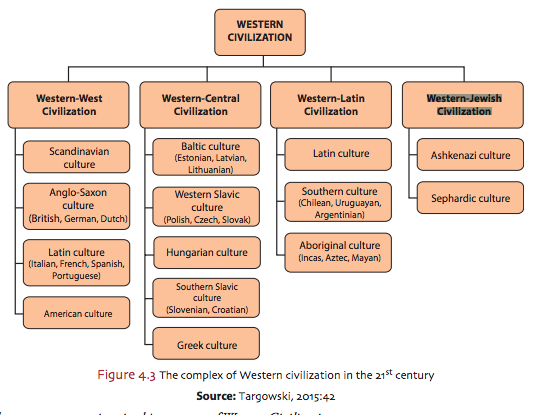
Therefore, the answer is C.
Soru 22
According to the Bible, who led the Hebrew slaves during the Exodus from Egypt?
Seçenekler
A
Abraham
B
Moses
C
Isaac
D
Jacob
E
Joseph
Açıklama:
From the Bible, one ascertains that the progenitor of the Jewish people was a migrant named Abraham, who moved from Ur of the Chaldees to Canaan, and who began the Hebrew people via his sons Isaac and Jacob, and their progeny. Others might date the Jewish nation from the Exodus of the Hebrew slaves from Egypt, led by the lawgiver Moses, in roughly 1280 BCE. The answer is B.
Soru 23
Who argues that the Jews do not compose a long-lasting civilization but rather a “fossilized relic” of the Syriac society now extinct?
Seçenekler
A
Max Weber
B
Rabbi Kaplan
C
Gobineau
D
Benjamin Nelson
E
Arnold Toynbee
Açıklama:
Among the many scholarly opponents of the Jews stands Arnold Toynbee, a founder of the discipline of the comparative study of civilizations. To him, the Jews do not compose a long-lasting civilization but rather a “fossilized relic” of the Syriac society now extinct, people still far from complete in terms of moral emancipation (Toynbee, 1947:8). The answer is E.
Soru 24
When did the political struggle for domination between the Latin Pope and the Greek Patriarch end in Schism?
Seçenekler
A
1050
B
1054
C
1060
D
1064
E
1071
Açıklama:
There was a political struggle for domination between the Latin Pope and the Greek Patriarch, and there were also certain doctrinal differences. The latter including disagreement over the unity of the Trinity - Father, Son and the Holy Spirit in the western church and minimization of the role of the Holy Spirit in the eastern church, as well as the fact that priestly celibacy was observed by Rome and rejected by Byzantium. In 1054, the quarrel gained so much intensity that a great Schism took place. The answer is B.
Soru 25
Where did the inquisition first take place?
Seçenekler
A
France
B
Spain
C
Portugal
D
Hungary
E
England
Açıklama:
The Inquisition is a judicial institution that was organized in the 13th century by the papacy and sometimes by secular governments, officially to contest heresy. It took place first in France (12th century), but later in Spain, Portugal and in their colonies in Africa, Asia, and the Americas (exemplified by the Peruvian and Mexican inquisitions). The answer is A.
Soru 26
When was the European Coal and Steel Community founded?
Seçenekler
A
1950
B
1951
C
1954
D
1957
E
1960
Açıklama:
A French diplomat, Jean Monnet, and Józef Retinger, a Polish émigré-diplomat and founder of the Bilderberg Group in 1954, a club of very influential active and former politicians, inspired the formation of the European Coal and Steel Community in 1951. The answer is B.
Soru 27
Which term below refers to the uncertainty about today and tomorrow?
Seçenekler
A
Internetization
B
Virtuality
C
Super-consumerism
D
Liquid times
E
High culture
Açıklama:
High Culture: good taste, the aspirational levels in music, paintings, and theatre.
Internetization: free flow of ideas, capital, products world-wide.
Virtuality: unlimited freedom and social chaos, losing skills as a result.
Super-consumerism: “more is better” implies a necessary depletion of strategic resources.
Liquid times: uncertainty about today and tomorrow.
The answer is D.
Internetization: free flow of ideas, capital, products world-wide.
Virtuality: unlimited freedom and social chaos, losing skills as a result.
Super-consumerism: “more is better” implies a necessary depletion of strategic resources.
Liquid times: uncertainty about today and tomorrow.
The answer is D.
Soru 28
Who is the author of The Wealth of Nations?
Seçenekler
A
Adam Smith
B
J. S. Mill
C
Jeremy Bentham
D
David Hume
E
J. M. Keynes
Açıklama:
The primary intellectual influences on 19th-century liberal trends were those of Adam Smith and the classical economists; and Jeremy Bentham (1748- 1832) and John Stuart Mill (1806-1873). Adam Smith’s The Wealth of Nations, published in 1776, provided many of the ideas of economics, at least until the publication of J. S. Mill’s Principles in 1848, where he argued for laissez-faire. The answer is A.
Soru 29
According to the Academic Ranking of World Universities in 2017, which one below is the only eastern country that has a university on the top-20 list?
Seçenekler
A
Russia
B
Japan
C
Turkey
D
Singapore
E
China
Açıklama:
Of the top universities in the world, according to this list, 19 belong to Western civilization and one to the Japanese civilization. The answer is B.
Soru 30
Which year marks the end of the Cold War period?
Seçenekler
A
1988
B
1989
C
1990
D
1991
E
1992
Açıklama:
The Cold War period lasted from the end of the WW2 in 1945 until the fall of the Soviet Union in 1991. The answer is D.
Soru 31
I. Western Civilization evolved with Christianity at the center.
II. Rome was the spiritual capital,
III.Greek was the language of spiritual life
IV. The German tradition was included into the rising new civilization, as well.
What can be said about the early Middle Ages(500 to 1050CE)?
II. Rome was the spiritual capital,
III.Greek was the language of spiritual life
IV. The German tradition was included into the rising new civilization, as well.
What can be said about the early Middle Ages(500 to 1050CE)?
Seçenekler
A
I and II
B
I and III
C
I, II and IV
D
I, III and IV
E
I, II, III and IV
Açıklama:
During the early MiddleAges(500 to 1050CE), Western Civilization evolved with Christianity at the center, Rome as the spiritual capital, and Latin as the language of spiritual life; nonetheless, the German tradition was included into the rising new civilization, as well.
The correct answer is C.
The correct answer is C.
Soru 32
I. By the 13th century, as a separate and practical entity, Western (European) civilization began to advance.
II. Many of basic institutions and ideas, such as universities, and representative assemblies, were worked out in the 12th and 13th centuries.
III. This Western (European) civilization was restricted to a very small area, the center of which was in the South in Italy.
IV. Great voyages of exploration and significant mechanical inventions both began in the 15th century.
Which statements are correct about the development of Western Civilization?
II. Many of basic institutions and ideas, such as universities, and representative assemblies, were worked out in the 12th and 13th centuries.
III. This Western (European) civilization was restricted to a very small area, the center of which was in the South in Italy.
IV. Great voyages of exploration and significant mechanical inventions both began in the 15th century.
Which statements are correct about the development of Western Civilization?
Seçenekler
A
I and II
B
II and III
C
I, II and III
D
I, II and IV
E
I, II, III and IV
Açıklama:
By the 13th century, as a separate and practical entity, Western (European) civilization began to advance, arising from the worst excesses of the Dark Ages. Many of basic institutions and ideas, such as universities, and representative assemblies, were worked out in the 12th and 13th centuries. But this Western (European) civilization was restricted to a very small area. Its center was in the North, in a triangle between Paris, Cologne, and London. The exterior countries such as Spain, Ireland, Norway, Sweden, Poland, Bohemia (Czech Republic), and Italy - did not share in all the manifestations of this civilization; nevertheless, they accepted its basic ideas as Christianity. Furthermore, beyond these countries the impact of this new civilization dropped off sharply. It had little effect on the Moslem world or on the peoples of Africa and Asia who lived beyond the Moslem areas. It had some influence on Byzantium, but not enough to erase the variances that separated Byzantium from the West. The Mongol conquest of the 13th century weakened the ties that the Russians had with the West and forced them to face the East for two centuries. Great voyages of exploration and significant mechanical inventions both began in the 15th century,enabling Western (European) civilization to emerge from its narrow corner and spread throughout much of the world. Eastern Europe gradually accepted much of the civilization of the West. Three new continents - North America (principally colonized by the British, French, Spanish, and Dutch), South America (principally colonized the Portuguese and the Spanish), and Australia (with New Zealand) - were occupied by Europeans, and a fourth continent, Africa, was dominated by them (later to be colonized by European countries). Asia was profoundly influenced, mostly by the British, Portuguese, and Dutch.
The correct answer is D.
The correct answer is D.
Soru 33
Which statement below is NOT correct about The Inquisition?
Seçenekler
A
it's a judicial institution that was organized in the 13th century by the papacy and sometimes by secular governments, officially to contest heresy.
B
It took place first in Spain (12th century), but later in their colonies in Africa, Asia, and the Americas (exemplified by the Peruvian and Mexican inquisitions).
C
The Spanish and Portuguese inquisitions sought both the conversion of Jews and Muslims to Catholicism, and their murder, due to the supposition that they had clandestinely returned to their prior religions.
D
Many Jews and Muslims were forced to flee Iberia and elsewhere.
E
The Inquisition was ended at the beginning of the 19th century, after the Napoleonic Wars in Europe and after the wars of independence in the Americas.
Açıklama:
The Inquisition - a judicial institution that was organized in the 13th century by the papacy and sometimes by secular governments, officially to contest heresy. It took place first in France (12th century), but later in Spain, Portugal and in their colonies in Africa, Asia, and the Americas (exemplified by the Peruvian and Mexican inquisitions). The Spanish and Portuguese inquisitions sought both the conversion of Jews and Muslims to Catholicism, and their murder, due to the supposition that they had clandestinely returned to their prior religions. Many Jews and Muslims were forced to flee Iberia and elsewhere. The Inquisition was ended at the beginning of the 19th century, after the Napoleonic Wars in Europe and after the wars of independence in the Americas.
Soru 34
I. It is the revival of learning from the 14th to the 17th century is known as the Renaissance.
II. The Protestant Reformation began in England in 1517.
III. Switzerland, Scandinavia, Scotland, and several German states soon adapted the new religion, called Protestantism
IV. The Roman Catholic Church replied to the Reformation with its own Counter-Reformation, which began in 1560 and introduced reforms.
Which statements above is true about Reformation?
II. The Protestant Reformation began in England in 1517.
III. Switzerland, Scandinavia, Scotland, and several German states soon adapted the new religion, called Protestantism
IV. The Roman Catholic Church replied to the Reformation with its own Counter-Reformation, which began in 1560 and introduced reforms.
Which statements above is true about Reformation?
Seçenekler
A
I and III
B
I, III and IV
C
I, II and IV
D
II, III and IV
E
I, II, III and IV
Açıklama:
Reformation - The revival of learning from the 14th to the 17th century is known as the Renaissance. It is viewed as the cultural link between the Middle Ages and modernity. Scholars who had studied philosophy began to question the Roman Catholic Church’s teaching and the administration of the Church by its leaders. Intellectually, there was an appeal for more reliance on Bible teachings - now increasingly available because of the printing press - and simplicity of worship. As a result, the Protestant Reformation began in Germany in 1517, when an Augustinian monk, Martin Luther, nailed his famous “95 Theses” -- a protest of the sale of indulgences (pardons for sins) -- to the door of a church in Wittenberg. Then, Switzerland, Scandinavia, Scotland, and several German states soon adapted the new religion, called Protestantism. In England, the break with Rome came when Pope Clement VII refused to allow King Henry VIII to divorce his wife, and this led to the organization of the Anglican Church. The Roman Catholic Church replied to the Reformation with its own Counter-Reformation, which began in 1560 and introduced reforms.
The correct answer is B.
The correct answer is B.
Soru 35
When was the European Union created?
Seçenekler
A
1957
B
1973
C
1986
D
1993
E
2005
Açıklama:
In 1993 the European Union was created, with a common currency (among 17 nations only), law, and a restructured European Parliament, European Commission, European Council, and Court of Justice.
The correct answer is D.
The correct answer is D.
Soru 36
I. In 1949 the North Atlantic Treaty Organization (NATO) was formed.
II. It was to be an alliance of national military forces spearheaded by such democratic Western allies as the United States, the United Kingdom, France and Canada.
III. In response, the Warsaw Pact was signed in 1955; it was to be a Soviet-led alliance of Eastern Europe’s military forces.
IV. The target of the Warsaw Pact was Western Europe during the period of the Cold War between the West and East.
Which statements above are true about the developments in military in Europe?
II. It was to be an alliance of national military forces spearheaded by such democratic Western allies as the United States, the United Kingdom, France and Canada.
III. In response, the Warsaw Pact was signed in 1955; it was to be a Soviet-led alliance of Eastern Europe’s military forces.
IV. The target of the Warsaw Pact was Western Europe during the period of the Cold War between the West and East.
Which statements above are true about the developments in military in Europe?
Seçenekler
A
I and II
B
II and III
C
I, II and III
D
II, III and IV
E
I, II, III and IV
Açıklama:
In 1949 the North Atlantic Treaty Organization (NATO) was formed. It was to be an alliance of national military forces spearheaded by such democratic Western allies as the United States, the United Kingdom, France and Canada. In response, the Warsaw Pact was signed in 1955; it was to be a Soviet-led alliance of Eastern Europe’s military forces and its target was Western Europe during the period of the Cold War between the West and East.
The correct answer is E.
The correct answer is E.
Soru 37
I. The intellectuals of the Age of Enlightenment in the 18th century created enormous improvement in reasoning II. Everything (religion, society, government, the material world) was examined in an innovative way. III. Causes and consequences engrained in the material world were pursued. IV. Conventionally acknowledged notions of divine wisdom were downgraded to the margins. V. As a result, scientific knowledge developed extensively. Which statements above are true about the Age of Enlightenment?
Seçenekler
A
I, II and IIII
B
II, III and IV
C
I and III
D
I, II, III and IV
E
I, II, III, IV and V
Açıklama:
The growth of secularism produced enormous improvement in reasoning, first via the intellectuals of the Age of Enlightenment in the 18th century. Everything (religion, society, government, the material world) was examined in an innovative way: causes and consequences engrained in the material world were pursued, and conventionally acknowledged notions of divine wisdom were downgraded to the margins. A result was the extensive development of scientific knowledge.
Soru 38
I. In Israel, the Jewish population today exceeds 6.2 million.
II. In the United States, it is estimated that there are roughly 5.7 million Jews.
III. In the decades since 1945, the Jewish population in Europe has fallen.
IV. Overall, 83% of all Jews in the world live in one of two countries, either Israel or the United States.
Which statements above are true for Jewish Society Today?
II. In the United States, it is estimated that there are roughly 5.7 million Jews.
III. In the decades since 1945, the Jewish population in Europe has fallen.
IV. Overall, 83% of all Jews in the world live in one of two countries, either Israel or the United States.
Which statements above are true for Jewish Society Today?
Seçenekler
A
I and II
B
II and III
C
I and III
D
I, II and III
E
I, II, III and IV
Açıklama:
Overall, it is estimated that there were roughly 14.3 million Jews in the world as of 2015. In Israel, the Jewish population today exceeds 6.2 million. In the United States, it is estimated that there are roughly 5.7 million Jews. In the decades since 1945, the Jewish population in Europe has fallen. Today, there are about 1.4 million European Jews: just 10% of the world’s Jewish population, and 0.2% of Europe’s total population. Overall, 83% of all Jews in the world live in one of two countries, either Israel or the United States. The presidents and prime ministers of Israel have all been Jewish. In recent years roughly one tenth of the United States Senate has consisted of Jews, as has a slightly smaller percentage of members of the U.S. House of Representatives.
The correct answer is E.
The correct answer is E.
Soru 39
Which one below is NOT a legacy of Greek culture?
Seçenekler
A
A shift from aristocratic governance to democracy
B
The power of reasoning in daily life and abstract problem solving
C
Imperialist expansion as far as possible beyond its own borders
D
The importance of ideas and perfecting one’s own personality
E
The first stages of science and medicine
Açıklama:
The Legacy of Classical (GrecoRoman) culture (5th B.C.E. - 5th C.E.)
- Greek culture:
1. A shift from aristocratic governance to democracy
2. The power of reasoning in daily life and abstract problem solving
3. The importance of ideas and perfecting one’s own personality
4. The first stages of science and medicine
5. The importance to see beauty in life, which led to high art, particularly sculpture and poetry
6. A spreading out of monetary based trade among distance parties
7. The accumulation of wealth at upper strata of the society
8. The development of colonial cities
- Roman culture:
1. A centralized state of a multiethnic complex of territories
2. A “check and balance” driven government of 3 branches: executive, legislative and judicial, supported by hierarchy of assemblies, magistrates and census
3. Law defining civility of habitants and government
4. Imperialist expansion as far as possible beyond its own borders
5. A large and disciplined army ready to fight and grab
6. Industrial, commercial and trade policies
7. Expansion of the road network for effective transportation
8. Elite luxury, corruption, and decadence (which led to the fall of Western Roman Empire)
The correct answer is C.
- Greek culture:
1. A shift from aristocratic governance to democracy
2. The power of reasoning in daily life and abstract problem solving
3. The importance of ideas and perfecting one’s own personality
4. The first stages of science and medicine
5. The importance to see beauty in life, which led to high art, particularly sculpture and poetry
6. A spreading out of monetary based trade among distance parties
7. The accumulation of wealth at upper strata of the society
8. The development of colonial cities
- Roman culture:
1. A centralized state of a multiethnic complex of territories
2. A “check and balance” driven government of 3 branches: executive, legislative and judicial, supported by hierarchy of assemblies, magistrates and census
3. Law defining civility of habitants and government
4. Imperialist expansion as far as possible beyond its own borders
5. A large and disciplined army ready to fight and grab
6. Industrial, commercial and trade policies
7. Expansion of the road network for effective transportation
8. Elite luxury, corruption, and decadence (which led to the fall of Western Roman Empire)
The correct answer is C.
Soru 40
I. The Reformation of Christianity begins, led by Martin Luther
II. Roman Emperor Theodosius-I makes Christianity a state religion
III. The French Revolution: “Liberty, Equality and Fraternity”
IV. Industrial Revolution well underway in England
V.Johannes Gutenberg perfects printing from movable characters
What is the right chronological order for the events above?
II. Roman Emperor Theodosius-I makes Christianity a state religion
III. The French Revolution: “Liberty, Equality and Fraternity”
IV. Industrial Revolution well underway in England
V.Johannes Gutenberg perfects printing from movable characters
What is the right chronological order for the events above?
Seçenekler
A
II, V, I, III and IV
B
V, I, III, IV and II
C
V, IV, III, II and I
D
II, I, V, III and IV
E
I, II, III, IV and V
Açıklama:
392- Roman Emperor Theodosius-I makes Christianity a state religion
1440- Johannes Gutenberg perfects printing from movable characters
1517- The Reformation of Christianity begins, led by Martin Luther
1789 to 1799 -The French Revolution: “Liberty, Equality and Fraternity”
1830 - Industrial Revolution well underway in England
The correct answer is A.
1440- Johannes Gutenberg perfects printing from movable characters
1517- The Reformation of Christianity begins, led by Martin Luther
1789 to 1799 -The French Revolution: “Liberty, Equality and Fraternity”
1830 - Industrial Revolution well underway in England
The correct answer is A.
Soru 41
I. Good understanding of physical nature and human culture.
II. Lasting and balanced solutions to social conflict among nations.
III. Successful implementation of the idea of political freedom and democracy.
Which of the above is among the successes that the Western civilization achieved?
II. Lasting and balanced solutions to social conflict among nations.
III. Successful implementation of the idea of political freedom and democracy.
Which of the above is among the successes that the Western civilization achieved?
Seçenekler
A
Only I
B
Only II
C
I and III
D
II and III
E
I, II and III
Açıklama:
The West has developed instruments of reason
(independent thinking based on the quest for truth)
that allows for:
(independent thinking based on the quest for truth)
that allows for:
- Good understanding of physical nature and human culture through scientific knowledge and advanced practices, including sending humans to the Moon,
- Successful implementation of the idea of political freedom and democracy (free elections, free press, human and civil rights) practiced by about one billion people or 13% of the world population.
Soru 42
I. They developed an awareness of the self or I.
II. They created the idea of moral freedom.
III. They deduced that the community problems were caused by human beings.
Which of the above is correct related to the Hebrews?
II. They created the idea of moral freedom.
III. They deduced that the community problems were caused by human beings.
Which of the above is correct related to the Hebrews?
Seçenekler
A
Only I
B
Only II
C
I and II
D
II and III
E
I, II and III
Açıklama:
The Hebrews: In agreeing to a contractual relationship with God, the Hebrews developed an awareness of the self, or I. The individual became aware of his or her moral independence and personal value. Hence, the Hebrews created the idea of moral freedom, that everyone is responsible for his or her own actions.
However it was the Greeks who thought that these individuals understood that community problems were caused by human beings and required human solution.
However it was the Greeks who thought that these individuals understood that community problems were caused by human beings and required human solution.
Soru 43
I. They acquired knowledge of scientific thought and logic from Greece.
II. They built networks of good roads and aqueducts for supplying water.
III. The whole empire was plunged into military anarchy.
Which of the above is correct related to the events during Pax Romana?
II. They built networks of good roads and aqueducts for supplying water.
III. The whole empire was plunged into military anarchy.
Which of the above is correct related to the events during Pax Romana?
Seçenekler
A
Only I
B
Only II
C
I and II
D
II and III
E
I, II and III
Açıklama:
Gradually the Romans acquired knowledge of scientific thought, philosophy, and logic from Greece. During Augutus' reign years of peace called Pax Romana commenced. The Romans built networks of good roads and aqueducts for supplying water. Unfortunately, in the third century CE the ordered civilization of the Pax Romana ended.
Soru 44
I. The Roman Empire was in decline when the Christianity began to rise.
II. The establishment of Germanic kingdoms was based on Christianity.
III. The heart of the medieval civilization shifted to the north.
Which of the above is correct related to the Early Christianity period?
II. The establishment of Germanic kingdoms was based on Christianity.
III. The heart of the medieval civilization shifted to the north.
Which of the above is correct related to the Early Christianity period?
Seçenekler
A
Only I
B
Only II
C
I and II
D
II and III
E
I, II and III
Açıklama:
Early Christianity. When the Roman Empire was in decline, a new religion, Christianity, began to reach out across the Mediterranean world. Soon, Christianity triumphed throughout Europe and the establishment of Germanic kingdoms. The heartland of medieval civilization shifted to the north, to regions of Europe that the classical Greco-Roman civilization had scarcely infiltrated.
Soru 45
Which of the following can be listed under the Western-Central Civilisation?
Seçenekler
A
Scandinavian Culture
B
Baltic Culture
C
Latin Culture
D
American Culture
E
Anglo-Saxon Culture
Açıklama:
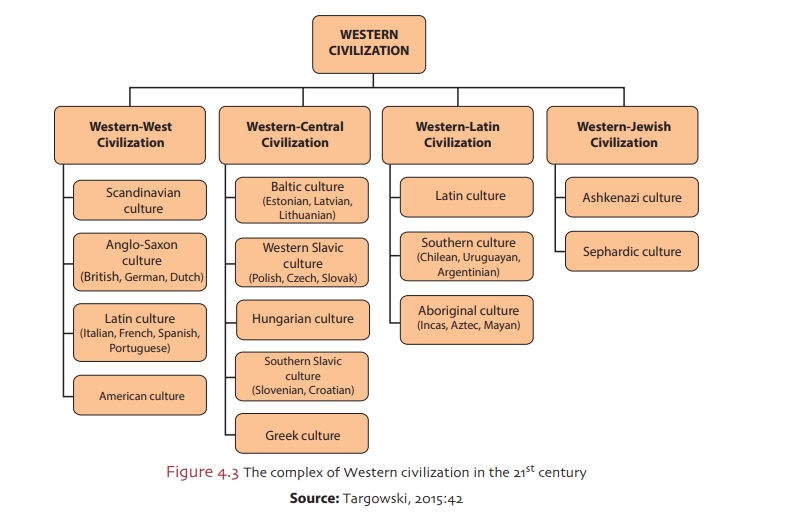
Soru 46
I. The goal was to capture the Eastern Mediterranean.
II. They had a deep influence on Western civilization.
III. The motives ranged from defeating paganism to fixing conflicts.
Which of the above is correct related to the Crusades?
II. They had a deep influence on Western civilization.
III. The motives ranged from defeating paganism to fixing conflicts.
Which of the above is correct related to the Crusades?
Seçenekler
A
Only I
B
Only II
C
I and III
D
II and III
E
I, II and III
Açıklama:
The Crusades - a sequence of religious wars authorized by the Roman Catholic Church in the period of 11th - 18th centuries. The major goal was to capture the Eastern Mediterranean and other regions from Islamic rule. The wars were conducted for a variation of motives including defeating paganism and heresy, fixing conflicts among rival Roman Catholic clusters, and for political and land gain.TheCrusades had a deep influence on Western civilization.
Soru 47
I. The Roman Catholic Church is ruled by Popes and clergy.
II. The Protestant Churches have many different theology-oriented branches.
III. The Protestant Churches follow a simpler liturgy than the Roman Catholic Churches.
Which of the above is correct related to the differences between the Roman Catholic and the Protestant Churches?
II. The Protestant Churches have many different theology-oriented branches.
III. The Protestant Churches follow a simpler liturgy than the Roman Catholic Churches.
Which of the above is correct related to the differences between the Roman Catholic and the Protestant Churches?
Seçenekler
A
Only I
B
Only II
C
I and II
D
II and III
E
I, II and III
Açıklama:
The Roman Catholic Church is ruled by semi-divine Popes and clergy composed of the hierarchy of cardinals, bishops, priests, and deacons. The Protestant Churches, by contrast, have many different, theology-oriented branches. The Protestant churches generally follow a simpler liturgy than does the Catholic Church.
Soru 48
Which of the options below correctly represents the growth of secularism that produced enormous improvement in reasoning through intellectuals?
Seçenekler
A
The French Revolution
B
The Age of Enlightenment
C
The Battle of Waterloo
D
The American Revolution
E
Renaissance
Açıklama:
The growth of secularism produced enormous improvement in reasoning, first via the intellectuals of the Age of Enlightenment in the 18th century. Everything (religion, society, government, the material world) was examined in an innovative way.
Soru 49
I. A shift from aristocratic governance to democracy.
II. The power of reasoning in daily life.
III. The first stages of science and medicine.
Which of the above is correct related to the legacies of Greek culture on the modern society?
II. The power of reasoning in daily life.
III. The first stages of science and medicine.
Which of the above is correct related to the legacies of Greek culture on the modern society?
Seçenekler
A
Only I
B
Only II
C
I and II
D
II and III
E
I, II and III
Açıklama:
- Greek culture:
1. A shift from aristocratic governance to democracy.
2. The power of reasoning in daily life and abstract problem solving.
3. The importance of ideas and perfecting one’s own personality.
4. The first stages of science and medicine.
1. A shift from aristocratic governance to democracy.
2. The power of reasoning in daily life and abstract problem solving.
3. The importance of ideas and perfecting one’s own personality.
4. The first stages of science and medicine.
Soru 50
Which culture's legacy includes advanced science and technology as well as national food?
Seçenekler
A
German Culture
B
North American Culture
C
Latin American Culture
D
Slavic Culture
E
Scandinavian Culture
Açıklama:
The Legacy of North American culture includes advanced science and technology and, also, American food. Tasty fast-food offerings such as hamburgers and French fries are unhealthy but have conquered the world’s palate, apparently.
Soru 51
Which of the following best describes the effects of European overseas expansion between the Renaissance and the 18th century?
Seçenekler
A
It weakened Europe's economy due to costly exploration failures.
B
It led to the isolation of European societies from the rest of the world.
C
It brought significant wealth to Europe through trade, colonization, and the exploitation of resources.
D
It caused Europe to abandon scientific development in favor of religious conservatism.
E
It resulted in immediate and lasting peace among European nations.
Açıklama:
People
At the same time, pioneer sailors from Portugal, Spain, Holland, and Italy began discovering the coasts of the oceans and invading lands previously mysterious to Europeans. Where voyagers went, traders, military and settlers followed. Globe-oriented trade paths took huge wealth (gold, silver, and slave trade) back to Europe, positively shifting its economy and society.
At the same time, pioneer sailors from Portugal, Spain, Holland, and Italy began discovering the coasts of the oceans and invading lands previously mysterious to Europeans. Where voyagers went, traders, military and settlers followed. Globe-oriented trade paths took huge wealth (gold, silver, and slave trade) back to Europe, positively shifting its economy and society.
Ünite 5
Soru 1
I. It was a powerful East Slavic state. II. It thrived under the reign of the Ruriks. III. The forces of the nomadic Mongol Empire overran Kievan Rus. Which information above is true for Kievan Rus?
Seçenekler
A
Only I
B
Only III
C
I and II
D
II and III
E
I, II and III
Açıklama:
Kievan Rus: This was a powerful and prosperous East Slavic state which thrived under the reign of the Ruriks from the 9th to the 13th century. forces of the nomadic Mongol Empire overran Kievan Rus in the 13th century, devastating many cities, including Kiev itself.
Soru 2
Which is not true for "Bloody Sunday"?
Seçenekler
A
It was in 1905.
B
It was the massacre of a peaceful demonstration.
C
It paralyzed the economy.
D
It took place in Radical Phase.
E
It triggered nationwide strikes.
Açıklama:
Moderate Phase: 1905-1917: The 1905 “Bloody Sunday” massacre of a peaceful demonstration in Saint-Petersburg triggered nationwide strikes, which paralyzed the economy.
Radical Phase: 1917-1921
Radical Phase: 1917-1921
Soru 3
Which period began with the seizure of power by the Bolsheviks?
Seçenekler
A
the Old Regime
B
Moderate Phase
C
Radical Phase
D
Thermidor
E
Stalin's Phase
Açıklama:
Radical Phase: 1917-1921: This period, which coincided with the whole duration of the Civil War in Russia, began with the seizure of power by the Bolsheviks, and it involved an armed power struggle between the Bolsheviks and several rival groups.
Soru 4
Which information below is not true for the Soviet Union?
Seçenekler
A
The Soviet Union existed from 1915 to 1998.
B
After Lenin's death, dictatorial powers were assumed by Stalin.
C
Stalin introduced his own crude version of Marxism-Leninism.
D
The nation underwent a period of rapid industralization.
E
There was brutal collectivization of peasants.
Açıklama:
The Soviet Union existed from 1922 to 1991. After Lenin’s death in 1924, dictatorial powers were assumed by his successor Joseph Stalin. The ruthless and calculating dictator suppressed his political opponents, introduced his own crude version of Marxism-Leninism.
-The nation underwent a period of rapid industrialization which was accompanied by the brutal collectivization of peasants into factory-like communes called kolkhozy and sovkhozy between 1928 and 1940.
-The nation underwent a period of rapid industrialization which was accompanied by the brutal collectivization of peasants into factory-like communes called kolkhozy and sovkhozy between 1928 and 1940.
Soru 5
Which information below is not true?
Seçenekler
A
In 1921, most of what is now Ukraine was annexed by the Soviet Union.
B
The Euromaiden protests turned bloody in 2017.
C
In 1991, the Act of Declaration of Independence of Ukraine was adopted by Ukrainian Parliament.
D
In 2013, the Euromaiden burst into existence.
E
The Orange Revolution erupted between 2004 and 2005.
Açıklama:
-In 1921 most of what is now Ukraine was annexed by the Soviet Union.
-On 24 August 1991, the Act of the Declaration of Independence of Ukraine was adopted by the Verkhovna Rada (Ukrainian Parliament).
-The “Orange Revolution” erupted between late November 2004 and January 2005.
-On the night of 21 November 2013, the “Euromaidan” burst into existence.
-The “Euromaidan” protests turn bloody with over 100 protesters sacrificing their lives in February of 2014.
-On 24 August 1991, the Act of the Declaration of Independence of Ukraine was adopted by the Verkhovna Rada (Ukrainian Parliament).
-The “Orange Revolution” erupted between late November 2004 and January 2005.
-On the night of 21 November 2013, the “Euromaidan” burst into existence.
-The “Euromaidan” protests turn bloody with over 100 protesters sacrificing their lives in February of 2014.
Soru 6
Alvin Toffler, the American philosopher of historical and societal development, describes three types of societies, based on the concept of Civilizational Waves. According to Toffler, which information is not true for The Second Wave (Industrial)?
Seçenekler
A
The Second Wave (Industrial) brought with the Industrial Revolution.
B
It lasted from late 17th century through the mid-20th century.
C
The Second Wave society was based on industrial-scale production.
D
It was the society after the Agrarian Revolution.
E
There was bureaucracy.
Açıklama:
He depicts the First Wave (Agrarian) as the society after the Agrarian Revolution, which gradually replaced nomadic tribes.
The Second Wave (Industrial) brought with it the Industrial Revolution, and it lasted from late 17th century through the mid-20th century. The Second Wave society was based on industrial-scale production, distribution, consumption, education, media, recreation, entertainment, and weaponry. These features were combined with standardization, centralization, concentration, and synchronization, and they were in a style of organization called bureaucracy
The Second Wave (Industrial) brought with it the Industrial Revolution, and it lasted from late 17th century through the mid-20th century. The Second Wave society was based on industrial-scale production, distribution, consumption, education, media, recreation, entertainment, and weaponry. These features were combined with standardization, centralization, concentration, and synchronization, and they were in a style of organization called bureaucracy
Soru 7
Which information is not true for the Agricultural Period?
Seçenekler
A
The evolution of Kievan Rus ended with the Mongol invasion.
B
It coincides with life-careers of Kievan Rus and its sucessors.
C
Kievan Rus was flourished under the reign of Rurik dynasty.
D
Kievan Rus was a loose federation of the East Slavic principalities.
E
Kievan Rus was flourished from the 7th to the 10th century CE.
Açıklama:
The Agricultural Period coincides with lifecareers of Kievan Rus and its successors - the Grand Principality of Moscow, and the Czardom of Russia. Kievan Rus was a loose federation of the East Slavic principalities, which flourished under the reign of the Rurik dynasty from the late 9th to the
mid-13th century CE. The evolution of Kievan Rus ended with the Mongol invasion.
mid-13th century CE. The evolution of Kievan Rus ended with the Mongol invasion.
Soru 8
Which information is not true for Vladimir's son, Yaroslav the Wise?
Seçenekler
A
Having good relationships with African countries was crucial for him.
B
He waged frequent military campaigns.
C
He perceived dynastic marriages to maintain good relationships.
D
He died in 1054.
E
After his death, Kiev lost its preeminence.
Açıklama:
Although Vladimir’s son, Yaroslav the Wise (978-1054), waged frequent military campaigns, he also perceived dynastic marriages as a preferred way to maintain good relationships with other European countries. Three of his daughters became queens of Western European states (France, Norway, and Hungary). Of his sons, three married German princesses and the other one a Byzantine princess, while he himself was the son-in-law of the King of Sweden, and brother-in-law to the King of Poland. The UK historian Ronald Hingley dryly notes that for equally intricate Russian dynastic involvements with western Europe, one has to wait for the nineteenth century Romanov emperors. Upon Yaroslav’s death in 1054, however, his sons divided the state into warring factions, and the city of Kiev lost its preeminence.
Soru 9
I. The principalities of Rus became part of the Golden Horde. II. The remaining vestiges of Kievan Rus were absorbed by Poland and Lithuania. III. The only region that retained autonomy was the Republic of Novgorod. Which is true for the Mongol Invasion?
Seçenekler
A
I, II and III
B
I and II
C
I and III
D
II and III
E
Only III
Açıklama:
The principalities of Rus had to submit to the Mongol Empire and to become part of what was called the Golden Horde. The remaining vestiges of Kievan Rus in the west were absorbed by Poland and Lithuania. The only region that retained autonomy was the Republic of Novgorod. The indigenous aristocracy continued to exist while intensely intermarrying, this time with the elites of the nomads.
Soru 10
I. It is the successor state to Kievan Rus. II. Novgorod was a successful port. III. It was governed by the veche-an early democratic institution of East Slavs. Which information is true for Novgorod Republic?
Seçenekler
A
Only II
B
Only III
C
II and III
D
I, II and III
E
I and III
Açıklama:
Novgorod Republic: Among the successor states to Kievan Rus has been the Novgorod Republic as well as the Principality of Vladimir-Suzdal.
Novgorod was a successful port on the eastern side of the Hanseatic League trade network.
Until Novgorod was subsumed by the Grand Principality of Moscow in 1478, it was governed by the veche - an early democratic institution of East Slavs.
Novgorod was a successful port on the eastern side of the Hanseatic League trade network.
Until Novgorod was subsumed by the Grand Principality of Moscow in 1478, it was governed by the veche - an early democratic institution of East Slavs.
Soru 11
The Grand Principality of Moscow originated within:
Seçenekler
A
Principality of Vladimir-Suzdal.
B
Principality of Tver.
C
Novgorod Republic.
D
The Kievan principality.
E
Principality of Viking Rurik.
Açıklama:
The Grand Principality of Moscow originated within the Principality of Vladimir-Suzdal when Prince Daniel I inherited a tiny timber citadel called Moscow in the mid-13th century. After eclipsing its parent state by the 1320s, it then absorbed the Novgorod Republic in 1478, and the Grand Principality of Tver in 1485.
Soru 12
Until Novgorod was subsumed by the Grand Principality of Moscow in 1478, it was governed by:
Seçenekler
A
Prince Dmitry Pozharsky.
B
The duma.
C
The decembrists.
D
The veche.
E
The Bolsheviks.
Açıklama:
Until Novgorod was subsumed by the Grand Principality of Moscow in 1478, it was governed by the veche - an early democratic institution of East Slavs. e veche had been an ancient instrument of self-governance originating from the tribal gatherings in the region.
Soru 13
The Russian Empire was established by:
Seçenekler
A
Czar Ivan IV.
B
Prince Dmitry Pozharsky.
C
Peter I.
D
Czar Alexander I.
E
Catherine II.
Açıklama:
The Russian Empire was established by Peter I in 1721.As a result of several mostly successful wars, he expanded the Czardom into a much larger empire, the rise of which occurred simultaneously with the descent of the competing neighbors: the Swedish Empire, the Polish- Lithuanian Commonwealth, the Ottoman Empire, and Persia.
Soru 14
The Patriotic War of 1812, was fought between:
Seçenekler
A
Russia and France.
B
Ukraine and Russia.
C
Mongolians and Ukraine.
D
Mongolians and Russia.
E
Russia and England.
Açıklama:
A significant challenge to the Romanov dynasty and their empire also came in the form of the French invasion, known in Russia as the Patriotic War of 1812. Napoleon hoped to compel Czar Alexander I to cease trading with Britain. Another contentious issue for both leaders was domination over Europe as well as Poland since each wanted a semi-independent Poland.
Soru 15
Until the Revolution of 1905, the political system operating in Russia was:
Seçenekler
A
Semi-direct democratic republic.
B
Federal Republic.
C
Constitutional monarchy.
D
Parliamentary democracy.
E
Absolute monarchy.
Açıklama:
Politically, the empire operated as an absolute monarchy until the Revolution of 1905, when for a brief period it finally assumed trappings of a constitutional monarchy.
Soru 16
Which of the following is not true regarding the Soviet Union.
Seçenekler
A
Joseph Stalin introduced his own crude version of Marxism-Leninism.
B
The Soviet Union was established in 1922.
C
The Soviet state featured equality in the lifestyles of the elite and those of ordinary citizens.
D
The economy was centrally planned and forcefully executed.
E
The nation underwent rapid industrialization which was accompanied by the collectivization of peasants into factory-like communes.
Açıklama:
From its very beginning, the Soviet state featured wide disparities between the lifestyles of the elite and those of ordinary citizens. While the political and cultural upper-classes resided in palatial quarters, most of the Soviet urban population huddled in low-cost, concrete- paneled or brick buildings three- to five-stories high, known as khrushchyovkas.
Soru 17
The series of protests and political events that took place in the aftermath of the run-off vote of the 2004 Ukrainian presidential election was called:
Seçenekler
A
Euromaidan.
B
The Orange Revolution.
C
The October Revolution.
D
The February Revolution.
E
The Great Patriotic War
Açıklama:
The “Orange Revolution” erupted between late November 2004 and January 2005. It was a series of protests and political events that took place in the aftermath of the run-off vote of the 2004 Ukrainian presidential election, which had been marred by corruption, intimidation, and fraud. The results of the “Orange Revolution,” however, were largely canceled by a subsequent ten years of infighting between the moderates of various political brands.
Soru 18
Which of these was not one of the reasons for Russia's expansion?
Seçenekler
A
The nation needed access to the sea.
B
There existed the ideology that Russia was destined by God to expand its territory.
C
The ruling class of Russia was a land-rich aristocracy, which profited from territorial expansion.
D
The expansion has had ideological underpinnings like the idea of Pan-Slavism or Communism.
E
The empire continued to expand almost accidentally - by the need to bridge already conquered territories.
Açıklama:
There were several reasons for Russia’s expansion. First of all, the landlocked nation needed access to the sea. Secondly, the ruling class of Russia was a land-rich aristocracy, which profits from territorial expansion. Sometimes, the expansion may have had ideological underpinnings, for example, the idea of third Rome, Pan-Slavism, or later, Communism.And finally, the empire may have continued to expand almost accidentally - by the need to bridge already conquered territories
Soru 19
The dominant ideological doctrine of the Russian empire formulated during the reign of Czar Nicholas I, also known as “Official Nationality” was expressed in a triad:
Seçenekler
A
Liberty, Autocracy, and Nationality.
B
Orthodoxy, Democracy, and Liberty.
C
Slavophilia, Autocracy, and Nationality.
D
Orthodoxy, Democracy, and Nationality.
E
Orthodoxy, Autocracy, and Nationality.
Açıklama:
The dominant ideological doctrine of the Russian empire was formulated during the reign of Czar Nicholas I in the first half of the 19th century. It was known as “Official Nationality” and expressed in a triad: Orthodoxy, Autocracy, and Nationality.
Soru 20
Saint Petersburg University and the Academy of Sciences in Russia were established by:
Seçenekler
A
Catherine the Great.
B
Peter the Great.
C
The Great Prince Vladimir I.
D
Czar Ivan IV.
E
Kuzma Minin.
Açıklama:
Peter the Great dreamed about a westernized Russia, the land of order, progress, and power and an empire inspired by and inextricably connected to Europe. The Czar-reformer also gave a powerful impetus to the evolution of science, scholarship, and innovation by establishing Saint Petersburg University and the Academy of Sciences.
Soru 21
The implosion of the Soviet Union commenced with the peaceful demonstration of trade unions in......... .
Seçenekler
A
Poland
B
Romania
C
Czechoslovakia
D
Hungary
E
German Democratic Republic
Açıklama:
Öğrencilerden Sovyetler Birliğinin çöküşünü hazırlayan gelişmeleri bilmeleri beklenmektedir.
Poland
Poland
Soru 22
Which of the following statements about Kievan Rus is false?
Seçenekler
A
Prince Vladimir’s son, Yaroslav the Wise converted his subjects into the Orthodox Christian faith in 988.
B
The contemporary nations of Russia, Ukraine and Belarus perceive Kievan Rus as their cultural forerunner.
C
This powerful East Slavic state thrived under the reign of the Ruriks from the 9th to the 13th century.
D
The Mongol invasion in the first half of the 13th century devastated Kiev.
E
The Kievan principality declined due to succession disputes and conflicts between regional princes along with the collapse of commercial ties between Byzantium and Europe.
Açıklama:
Öğrencilerden Rusların atası sayılan Kievan Rusların ortaya çıkışı ve yıkılışları hakkında bilgi sahibi olmaları beklenmektedir.
Prince Vladimir’s son, Yaroslav the Wise converted his subjects into the Orthodox Christian faith in 988.
Prince Vladimir’s son, Yaroslav the Wise converted his subjects into the Orthodox Christian faith in 988.
Soru 23
Which czar abolished serfdom in Russia?
Seçenekler
A
Alexander II
B
Nicholas I
C
Catherine II
D
Peter the Great
E
Alexander I
Açıklama:
Öğrencilerden Çarlık Rusya'sında önemli bir yeri olan serf sistemini (toprak ağasına bağlı köle işçi) ve bu sistemin kaldırılması hakkında bilgisi olması beklenmektedir.
Alexander II
Alexander II
Soru 24
Which East Slav state was governed by the veche until 1478?
Seçenekler
A
Novgorod Republic
B
Moscovy
C
Czardom of Russia
D
Russian Empire
E
Polish-Lithuanian Commonwealth
Açıklama:
Öğrenciden Kievan Rus döneminden sonra kurulan Novgorod Republic dönemi hakkında bilgi sahibi olması beklenmektedir.
Soru 25
Which one of the following was the capital of the Russian Empire during the reign of Peter the Great?
Seçenekler
A
Saint Petersburg
B
Kiev
C
Moscow
D
Novgorod
E
Minsk
Açıklama:
Öğrencilerden 17.yüzyıl Rus İmporatorluğunun kurucusu Peter the Great'in yarattığı kültürel gelişmeyi ve kurduğu başkenti bilmeleri istenmektedir.
Saint Petersburg
Saint Petersburg
Soru 26
Which of the following novelists during the era of Czar Alexander II, which is regarded as the Golden Age of the Russian literature, wrote about the initial stages of capitalism through the eyes of lower- and middle-class city dwellers?
Seçenekler
A
Fyodor Dostoyevsky
B
Lev Tolstoy
C
Ivan Turgenev
D
Ivan Goncharov
E
Nikolai Leskov
Açıklama:
Öğrencilerden Çar Alexander II döneminde gelişen Rus Edebiyatındaki ünlü roman yazarları hakkında bilgi sahibi olmaları beklenmektedir.
Fyodor Dostoyevsky
Fyodor Dostoyevsky
Soru 27
Which of the following statements about the Time of Troubles is false?
Seçenekler
A
The king of Poland Prince Dmitry Pozharsky started the nationwide movement of liberation, thus terminating the Time of Troubles in 1612.
B
The period between the demise of Feodor, the last Czar of the Rurik
dynasty, in 1598 and the accession to the throne of Michael Romanov in 1613 is known as the Time of Troubles.
dynasty, in 1598 and the accession to the throne of Michael Romanov in 1613 is known as the Time of Troubles.
C
During this period famine claimed about two million people,almost one-third of
the total population.
the total population.
D
The Russian exploration of Siberia started during this period.
E
Russia suffered from civil uprisings, usurpers, and impostors under the occupation of the Polish-Lithuanian Commonwealth.
Açıklama:
Öğrencilerden Rus tarihinde önemli bir zaman dilimi olan ve çarlığın Rurik hanedanında Romanov hanedanına geçtiği 1598-1613 yılları arasındaki gelişmeleri bilmesi beklenmektedir.
The king of Poland Prince Dmitry Pozharsky started the nationwide movement of liberation, thus terminating the Time of Troubles in 1612.
The king of Poland Prince Dmitry Pozharsky started the nationwide movement of liberation, thus terminating the Time of Troubles in 1612.
Soru 28
Which of the following cannot be counted as the reasons of the Patriotic War of 1812?
Seçenekler
A
Napoleon wanted to end serfdom in Russia and introduce modern constitutional form of government .
B
Napoleon wanted to capture Moscow and gain control over Russia.
C
Napoleon wanted to compel Czar Alexander I to cease trading with Britain.
D
Another important issue for both Napoleon and Czar Alexander was domination over Europe as well as Poland.
E
Napoleon wanted a semi-independent Poland.
Açıklama:
Öğrencilerden Napolyon-Rus Savaşlarının çıkış nedeni ve sonuçları hakkında bilgi sahibi olması beklenmektedir.
Napoleon wanted to end serfdom in Russia and introduce modern constitutional form of government .
Napoleon wanted to end serfdom in Russia and introduce modern constitutional form of government .
Soru 29
When was the first Ukrainian attempt to gain the status of an
independent state?
independent state?
Seçenekler
A
June 1917
B
August 1991
C
November 2004
D
January 2005
E
November 2013
Açıklama:
Öğrencilerden Ukrayna Devletinin bağımsızlık çabalarının değişik evrelerini bilmesi beklenmektedir.
June 1917
June 1917
Soru 30
Which of the following statements about Nikita Khrushchev's leadership in Soviet Union is correct ?
Seçenekler
A
Under the guidance of Nikita Khrushchev a half-century period of relative
liberalization and stabilization occurred in the Soviet Empire which consisted of 15 Soviet republics and 16 countries outside of the USSR proper.
liberalization and stabilization occurred in the Soviet Empire which consisted of 15 Soviet republics and 16 countries outside of the USSR proper.
B
The nation underwent a period of rapid industrialization which was accompanied by the brutal collectivization of peasants into factory-like communes.
C
The ruthless dictator suppressed his political opponents, introduced his own crude version of Marxism-Leninism, and launched a centrally planned, dubiously financed, and forcefully executed command economy.
D
Khrushchev initiated the Great Purge and thousands of people were sentenced to hard labor in “correctional” labor camps (gulags).
E
The Russian economy was disrupted and the Russian people faced a massive famine.
Açıklama:
Öğrencilerden Bolşevik devriminden sonra kurulan Sovyetler Birliğinin değişik dönemlerinde görev alan liderleri tanımaları ve bu dönemlerde ortaya çıkan politik ve tarihi olguları anlamaları beklenmektedir.
Under the guidance of Nikita Khrushchev a half-century period of relative
liberalization and stabilization occurred in the Soviet Empire which consisted of 15 Soviet republics and 16 countries outside of the USSR proper.
Under the guidance of Nikita Khrushchev a half-century period of relative
liberalization and stabilization occurred in the Soviet Empire which consisted of 15 Soviet republics and 16 countries outside of the USSR proper.
Soru 31
Which of the following refers to the industrial period?
Seçenekler
A
It is depicted as the society during the Agrarian Revolution.
B
It is distinguished by the high-tech, individualized modes of production.
C
It began in the late 1950s.
D
It lasted from late 17th century through the mid-20th century.
E
They replaced nomadic tribes.
Açıklama:
D) It lasted from late 17th century through the mid-20th century.
Soru 32
Which of the following put an end to the evolution of the Kievan Rus?
Seçenekler
A
Scandinavian warrior-traders
B
Mongol invasion
C
Alliance with the Vikings
D
Scythians
E
East Slavs
Açıklama:
B) Mongol invasion
The forces of the nomadic Mongol Empire overran Kievan Rus in the 13th century, devastating many cities, including Kiev itself.
The forces of the nomadic Mongol Empire overran Kievan Rus in the 13th century, devastating many cities, including Kiev itself.
Soru 33
- Novgorod Republic
- Russian Federation
- Ukraine
- Principality of Vladimir-Suzdal
Seçenekler
A
I and II
B
II and III
C
I, II and III
D
I, II, III and IV
E
I and IV
Açıklama:
E) I and IV
- Novgorod Republic
- Principality of Vladimir-Suzdal
Soru 34
When was the Russian Empire established?
Seçenekler
A
1412
B
1547
C
1612
D
1721
E
1801
Açıklama:
D) 1721
The Russian Empire was established by Peter I in 1721.
The Russian Empire was established by Peter I in 1721.
Soru 35
- The expansion may have had ideological underpinnings
- It did not have any other chance because of the attacks
- The landlocked nation needed access to the sea.
- It may have needed to bridge already conquered territories
Seçenekler
A
I and II
B
I, II and III
C
I, III and IV
D
II, III and IV
E
III and IV
Açıklama:
C) I, III and IV
- The expansion may have had ideological underpinnings
- The landlocked nation needed access to the sea.
- It may have needed to bridge already conquered territories
Soru 36
What was the vehicle for the expansion of Russia?
Seçenekler
A
Industrialization
B
Underwater warfare
C
Frontal assault
D
Airborne operations
E
Use of firearms
Açıklama:
A)
The vehicle for the expansion was industrialization.
The vehicle for the expansion was industrialization.
Soru 37
In which country did the wave of the Revolutions of 1989 start, causing the removal of the Soviet Union in 1991?
Seçenekler
A
Sweden
B
Poland
C
Romania
D
Moldova
E
France
Açıklama:
B) Poland
Soru 38
Which of the following was the second highest rank in Russian social pyramid circa 1900?
Seçenekler
A
Russian Orthodox Church
B
Czarist military officers
C
Czar's family
D
Aristocrats
E
Middle class
Açıklama:
A) Russian Orthodox Church
Soru 39
- Design flaws
- Low quality of equipment
- Personnel incompetence
- Employment of foreign personnel
Seçenekler
A
I and II
B
II and III
C
I, II and III
D
II, III and IV
E
I, II, III and IV
Açıklama:
C)
- Design flaws
- Low quality of equipment
- Personnel incompetence
Soru 40
Whose era is considered the Golden Age of the Russian literature?
Seçenekler
A
Peter I
B
Nicholas I
C
Nicholas II
D
Alexander II
E
Alexander III
Açıklama:
D) Alexander II
The era of Czar-reformer Alexander II is the Golden Age of the Russian literature.
In a short span of twenty years Lev Tolstoy, Fyodor Dostoyevsky, Ivan Turgenev, and Ivan Goncharov created the genre of a Russian novel, Alexander Ostrovsky - Russian drama, Nikolay Nekrasov - folk poems, and Nikolai Leskov - folk stories.
The era of Czar-reformer Alexander II is the Golden Age of the Russian literature.
In a short span of twenty years Lev Tolstoy, Fyodor Dostoyevsky, Ivan Turgenev, and Ivan Goncharov created the genre of a Russian novel, Alexander Ostrovsky - Russian drama, Nikolay Nekrasov - folk poems, and Nikolai Leskov - folk stories.
Soru 41
In which of the following are the Civilizational Waves given in the correct order?
Seçenekler
A
Agrarian - Industrial - Informational
B
Agrarian - Informational - Industrial
C
Informational - Industrial - Agrarian
D
Informational - Agrarian - Industrial
E
Industrial - Informational - Agrarian
Açıklama:
The Civilizational Waves of the Eastern Civilization is in order Agrarian - Industrial - Informational. The correct answer is A.
Soru 42
- The East Slavs appeared in European history between the 3rd and 8th centuries CE.
- Their initial habitats could have been in the area between the Vistula and Dnieper rivers.
- Their successive waves had followed one another across the steppes of what is now southern Russia and Ukraine.
- After allying with the East Slavs, the Turkic newcomers had founded a state, called Kievan Rus, in the 9th century with its center at Kiev.
Seçenekler
A
I and II
B
III and IV
C
I-II-III
D
I-III-IV
E
II-III-IV
Açıklama:
- The East Slavs appeared in European history between the 3rd and 8th centuries CE.
- Their initial habitats could have been in the area between the Vistula and Dnieper rivers.
- Their successive waves had followed one another across the steppes of what is now southern Russia and Ukraine.
- After allying with the East Slavs, the Scandinavian (not the Turkic) newcomers had founded a state, called Kievan Rus, in the 9th century with its center at Kiev.
Soru 43
- The founder of the ruling family was the Viking Rurik of Scandinavia.
- This was a powerful and prosperous East Slavic state which thrived under the reign of the Ruriks from the 9th to the 15th century.
- One of the Rurik’s descendants - Prince Vladimir - converted his subjects into the Orthodox Christian faith.
- Upon Yaroslav’s death in 1054, however, his sons divided the state into warring factions, and the city of Kiev lost its preeminence.
Seçenekler
A
I and III
B
II and IV
C
I-II-III
D
I-III-IV
E
II-III-IV
Açıklama:
The founder of the ruling family of Kievan Rus was the Viking Rurik of Scandinavia. One of the Rurik’s descendants - Prince Vladimir - converted his subjects into the Orthodox Christian faith. Upon Yaroslav’s death in 1054, however, his sons divided the state into warring factions, and the city of Kiev lost its preeminence. This was a powerful and prosperous East Slavic state which thrived under the reign of the Ruriks from the 9th to the 13th (not 15th) century. The correct answer is D.
Soru 44
Which of the following is the founder of Russian Empire in 1721?
Seçenekler
A
Ivan III
B
Peter I
C
Prince Vladimir
D
Catherine II
E
Romanov
Açıklama:
Russian Empire was established by Peter I (Peter the Great) in 1721. The correct answer is B.
Soru 45
Against which of the following did Czar Alexander I win the Patriotic War of 1812?
Seçenekler
A
Germanic tribes
B
Vikings
C
French
D
Ottoman Empire
E
Persians
Açıklama:
A significant challenge to the Romanov dynasty and their empire also came in the form of the French invasion, known in Russia as the Patriotic War of 1812. After a ferocious but indecisive battle at Borodino on September 7, Napoleon entered Moscow, which the retreating Russians famously set ablaze. However, Alexander I rejected the offer to negotiate, and Napoleon was forced to begin his infamous retreat. In the process, his army was virtually annihilated by the combined effects of the heroism of the Russian people and the severe winter conditions. Napoleon barely escaped with his life, and his domination of Europe was effectively at an end. The correct answer is C.
Soru 46
- Thermidor
- Moderate phase
- The old regime
- Radical phase
Seçenekler
A
I-II-III-IV
B
II-IV-III-I
C
III-II-IV-I
D
III-IV-I-II
E
I-III-II-IV
Açıklama:
The order of the periods of the Russian Revolution is the Old Regime, a Moderate Phase, a Radical Phase, and a reactionary time called Thermidor. The correct answer is C.
Soru 47
Which of the following is the period of The Soviet Union?
Seçenekler
A
1917-1982
B
1918-1988
C
1921-1990
D
1922-1991
E
1924-1991
Açıklama:
The Soviet Union existed from 1922 to 1991. The correct answer is D.
Soru 48
When was the Act of the Declaration of Independence of Ukraine adopted by the Ukrainian Parliament?
Seçenekler
A
1988
B
1991
C
1994
D
1996
E
1997
Açıklama:
On 24 August 1991, the Act of the Declaration of Independence of Ukraine was adopted by the Verkhovna Rada (Ukrainian Parliament). It re- established Ukraine as an independent state. The correct answer is B.
Soru 49
What faith did the Soviet Union attempt?
Seçenekler
A
Atheism
B
Catholic Christianity
C
Protestant Christianity
D
Orthodox Christianity
E
Judaism
Açıklama:
The USSR was the first state which attempted a complete switch to atheism, and churches were not built during the seventy years of the atheistic Soviet era. The correct answer is A.
Soru 50
Which of the following refers to an intellectual movement originating in the 19 century that sought the development of values and institutions in Russian society derived from its early history?
Seçenekler
A
Russian Versailles
B
Westernization
C
Nationality
D
Autocracy
E
Slavophilia
Açıklama:
A great conflict in Russian culture was between the Westernizers and the Slavophils. Slavophilia was an intellectual movement originating in the 19th century; it sought the development of values and institutions in Russian society derived from its early history. The correct answer is E.
Soru 51
When did East Slavs first appear in European history?
Seçenekler
A
In the 3rd century CE
B
In the 4th century CE
C
In the 5th century CE
D
In the second century CE
E
In the 1st century CE
Açıklama:
Their initial habitats could have been in the area between the Vistula and Dnieper rivers.
The East Slavs appeared in European history between the 3rd and 8th centuries CE.
The East Slavs appeared in European history between the 3rd and 8th centuries CE.
Soru 52
Which below was not one of the reasons for the decline of Kievan Rus?
Seçenekler
A
Succession disputes
B
Collapse of commercial ties
C
Conflicts between regional princes
D
Invasions from Asia
E
Wars with Vikings
Açıklama:
The decisive blow to this first stage of the Eastern Civilization was the Mongol invasion in the first half of the 13th century.
After the 12th century, the Kievan principality declined even further due to succession disputes, conflicts between regional princes, invasions from Asia along with the collapse of commercial ties between Byzantium and Europe via the Dnieper.
After the 12th century, the Kievan principality declined even further due to succession disputes, conflicts between regional princes, invasions from Asia along with the collapse of commercial ties between Byzantium and Europe via the Dnieper.
Soru 53
What Czar in Russian history symbolically established Muscovy as the successor state of the Byzantine Empire - the “Third Rome”?
Seçenekler
A
Peter I
B
Vasily III
C
Ivan III
D
Ivan IV
E
Feodor
Açıklama:
With this vision in mind, the new Russian caesar (Czar) charged the finest Italian architects with raising monuments to God’s glory (cathedrals) and the rising Moscow’s power (Kremlin).
By way of marrying the niece of the last Byzantine emperor, Ivan III symbolically established Muscovy as the successor state of the Byzantine Empire - the “Third Rome.”
By way of marrying the niece of the last Byzantine emperor, Ivan III symbolically established Muscovy as the successor state of the Byzantine Empire - the “Third Rome.”
Soru 54
I. Civil war II. Famine III. Epidemics
Which of the above was/were the calamity/calamities faced by the Czardom of Russia in the Time of Troubles?
Which of the above was/were the calamity/calamities faced by the Czardom of Russia in the Time of Troubles?
Seçenekler
A
II, III
B
I, II, III
C
I
D
I,III
E
III
Açıklama:
Just between the years 1601 and 1603, famine claimed about two million people, one-third of the population.
The sons of Czar Ivan IV died one after the other, thus ending the Rurik dynasty. This crisis led to civil war, famine, epidemics, and other calamities.
The sons of Czar Ivan IV died one after the other, thus ending the Rurik dynasty. This crisis led to civil war, famine, epidemics, and other calamities.
Soru 55
Which of the below was a decisive factor in the Russian colonization of the immense expanses of Eurasia during the industrial period?
Seçenekler
A
Trade links
B
Religious claims
C
Firearms technology
D
Geographical advantage
E
Social demographics
Açıklama:
The vehicle for the expansion was industrialization.
Industrially produced firearms proved to be a decisive factor in the Russian colonization of the immense expanses of Eurasia.
Industrially produced firearms proved to be a decisive factor in the Russian colonization of the immense expanses of Eurasia.
Soru 56
Which of the below cannot be said about Peter I (Peter the Great)?
Seçenekler
A
He embraced the idea of a parliamentary system for the state.
B
He started to deal with the xenophobia and religiosity of the old Moscovy.
C
He thought Russia had to become just like the West in all ways.
D
He transformed a landlocked kingdom into a modern, global power of its time.
E
He expanded the Czardom into a much larger empire.
Açıklama:
In a single generation, Peter the Great forcefully and at times ruthlessly transformed his ancient land from an isolated, landlocked kingdom into a modern, global power of its time.
He thought Russia had to become just like the West in all ways, even looks, however with one major exception - no parliamentary rule.
He thought Russia had to become just like the West in all ways, even looks, however with one major exception - no parliamentary rule.
Soru 57
I. Dependence on the existence of serfdom II. Heavy-handed demands of the state
III. Private landlords
Which of the above can be considered to have had an impact on a number of insurrections, including the massive Pugachev Rebellion in Russia during the industrial period?
III. Private landlords
Which of the above can be considered to have had an impact on a number of insurrections, including the massive Pugachev Rebellion in Russia during the industrial period?
Seçenekler
A
I
B
II
C
I, II
D
II, III
E
I, II, III
Açıklama:
Serfs were unfree peasants who had been reduced to various degrees of servitude since the times of the Kievan Rus.
Army draft and the state economy continued to depend on the existence of serfdom, and the heavy-handed demands of the state and private landlords led to a number of insurrections, including the massive Pugachev Rebellion.
Army draft and the state economy continued to depend on the existence of serfdom, and the heavy-handed demands of the state and private landlords led to a number of insurrections, including the massive Pugachev Rebellion.
Soru 58
Czar Alexander II embraced the challenge of changing things in Russia after the Crimean War. Which of the below was not one of the things he did?
Seçenekler
A
He abolished corporal punishment.
B
He instituted trial by jury.
C
He commissioned a railway to the Black Sea.
D
He sent the Decembrists into exile.
E
He authorized the emancipation of 23 million serfs in 1861.
Açıklama:
In the meantime, the enlargement of the empire continued unabated, mainly into Siberia and Central Asia.
He pardoned the Decembrists.
He pardoned the Decembrists.
Soru 59
Which of the below could have been main reason for the end of Romanov Dynasty in Russia?
Seçenekler
A
Lack of industrialisation
B
Demand for political change
C
The Czar's intention for democracy
D
Treaty of Brest-Litovsk
E
The Bolshevik Revolution
Açıklama:
This explosive combination ensures that driven by the irresistible forces of modernization, the cumbersome juggernaut of the empire is now hurtling toward self-destruction.
In February 1917, Nicholas II abdicated, ,30ending the 300-year rule of the Romanov dynasty. In April, Lenin armed a radical faction of the Social Democratic Party, the Bolsheviks, with a consistent plan of action to which they adhered unremittingly. The effort by the Provisional Government to continue the war effort steadily eroded its support. Using this vacuum of power, the Bolsheviks carried out a successful revolt in November, 1917. Following the coup, they consolidated their control over the Soviets, and, since the Bolsheviks were in the minority in the newly elected Constituent Assembly, the Red Guard dissolved it by force. .
In February 1917, Nicholas II abdicated, ,30ending the 300-year rule of the Romanov dynasty. In April, Lenin armed a radical faction of the Social Democratic Party, the Bolsheviks, with a consistent plan of action to which they adhered unremittingly. The effort by the Provisional Government to continue the war effort steadily eroded its support. Using this vacuum of power, the Bolsheviks carried out a successful revolt in November, 1917. Following the coup, they consolidated their control over the Soviets, and, since the Bolsheviks were in the minority in the newly elected Constituent Assembly, the Red Guard dissolved it by force. .
Soru 60
Which of the below can be said to be true about Stalin?
Seçenekler
A
He assumed power after Lenin's death.
B
He suppressed his political opponents.
C
He created a command economy.
D
He sentenced hundreds of thousands to hard labor in “correctional” labor camps or to death.
E
All of the above
Açıklama:
Despite being bled dry by the turmoil of the Revolution, the Civil War, and the Great Purge, the Russian people and other ethnic groups of the empire showed a great deal of heroism and ingenuity during World War II.
He was a ruthless and calculating dictator and did all those mentioned in the options.
He was a ruthless and calculating dictator and did all those mentioned in the options.
Soru 61
After allying with the East Slavs, the Scandinavian newcomers had founded a state, called ...................., in the 9th century with its center at Kiev.
Fill in the blank with the correct answer.
Fill in the blank with the correct answer.
Seçenekler
A
Kievan Rus
B
Vikings
C
Byzantine Empire
D
Mongol Empire
E
Poland
Açıklama:
After allying with the East Slavs, the Scandinavian newcomers had founded a state, called Kievan Rus, in the 9th century with its center at Kiev. The correct answer is A.
Soru 62
The principalities of Rus had to submit to the Mongol Empire and to become part of what was called the Golden Horde. The remaining vestiges of Kievan Rus in the west were absorbed by Poland and Lithuania.
According to the paragraph, which one of the following regions was the only one that retained autonomy?
According to the paragraph, which one of the following regions was the only one that retained autonomy?
Seçenekler
A
Grand Principality of Moscow
B
Republic of Novgorod
C
Mongol Empire
D
Vikings
E
Kievan Rus
Açıklama:
The principalities of Rus had to submit to the Mongol Empire and to become part of what was called the Golden Horde. The remaining vestiges of Kievan Rus in the west were absorbed by Poland and Lithuania. The only region that retained autonomy was the Republic of Novgorod. The correct answer is B.
Soru 63
What is the nickname of the city Kiev?
Seçenekler
A
the father of cities
B
the grandmother of cities
C
the cousin of cities
D
the mother of cities
E
the son of cities
Açıklama:
If Kiev is called “the mother of Russian cities,” the city of Veliky Novgorod certainly deserves the name of “the father.” The correct answer is D.
Soru 64
Which one of the following wars of Russia was aiming to control the territorial and spiritual domains of Ottoman Empire?
Seçenekler
A
Napoleonic War
B
Patriotic War of 1812
C
Crimean War
D
World War I
E
World War II
Açıklama:
In the years that followed, Russia fell behind again, as its humiliating defeat in the Crimean War (1853- 56) made abundantly clear. It was a war between an alliance of European powers, such as Great Britain, France and others on one side and Russia on the other, for the control of the territorial and spiritual domains of the Ottoman Empire. The correct answer is C.
Soru 65
Which one of the following social classes is on the top of the Russian Social Pyramid in 1900?
Seçenekler
A
Aristocrats
B
Church
C
Bourgeoisie
D
Peasants
E
Workers
Açıklama:
The aristocracy class is on the top of the Russian Social Pyramid in 1900.
Soru 66
The 1905 “Bloody Sunday” massacre of a peaceful demonstration in Saint-Petersburg triggered nationwide strikes, which paralyzed the economy.
According to the paragraph, in which of the following phases did this event take place?
According to the paragraph, in which of the following phases did this event take place?
Seçenekler
A
The Old Regime
B
Moderate Phase
C
Radical Phase
D
Thermidor
E
World War I
Açıklama:
The 1905 “Bloody Sunday” massacre of a peaceful demonstration in Saint-Petersburg triggered nationwide strikes, which paralyzed the economy. This happened in the Moderate Phase. The correct answer is B.
Soru 67
In which years did the Soviet Union exist?
Seçenekler
A
1900-1950
B
1905-1980
C
1930-1990
D
1925-1987
E
1922-1991
Açıklama:
The Soviet Union existed from 1922 to 1991.
Soru 68
When did Ukraine gain its status as an independent state?
Seçenekler
A
1967
B
1987
C
1988
D
1991
E
1995
Açıklama:
On 24 August 1991, the Act of the Declaration of Independence of Ukraine was adopted by the Verkhovna Rada (Ukrainian Parliament). It re- established Ukraine as an independent state. The correct answer is D.
Soru 69
............ was the first state which attempted a complete switch to atheism, and churches were not built during the seventy years of the atheistic Soviet era.
According to the paragraph, fill in the blank with the correct answer.
According to the paragraph, fill in the blank with the correct answer.
Seçenekler
A
USSR
B
Ottoman Empire
C
Mongol Empire
D
Ukraine
E
Russia
Açıklama:
The USSR was the first state which attempted a complete switch to atheism, and churches were not built during the seventy years of the atheistic Soviet era. The correct answer is A.
Soru 70
Which of the followings did not contribute to the rise of the Russian novel in the Golden Age of Russian Literature?
Seçenekler
A
Lev Tolstoy
B
Fyodor Dostoyevsky
C
Ivan Turgenev
D
Alexander Ostrovsky
E
Ivan Goncharov
Açıklama:
The era of Czar-reformer Alexander II is the Golden Age of the Russian literature. In a short span of twenty years Lev Tolstoy, Fyodor Dostoyevsky, Ivan Turgenev, and Ivan Goncharov created the genre of a Russian novel, Alexander Ostrovsky - Russian drama, Nikolay Nekrasov - folk poems, and Nikolai Leskov - folk stories. The correct answer is D.
Soru 71
Which of the following events caused the demise of the Kievan Rus?
Seçenekler
A
Crusades
B
Black death
C
Mongol invasion
D
Fall of Constantinople
E
Foundation of the Ottoman Empire
Açıklama:
The forces of the nomadic Mongol Empire overran Kievan Rus in the 13th century, devastating many cities, including Kiev itself. Excellent organization, mobility, numerical superiority, and fighting innovations such as the use of stirrups made the Mongol army the greatest war machine of its time.
Soru 72
When was the period of Russian history known as the Time of Troubles?
Seçenekler
A
1547-1721
B
1598-1613
C
1503-1512
D
1658-1678
E
1625-1638
Açıklama:
The period between the demise of Feodor, the last Czar of the Rurik dynasty, in 1598 and the accession to the throne of Michael Romanov in 1613 even receives a special name - the Time of Troubles.
Soru 73
Which of the following is among the the ideological underpinnings behind the expansion of Russia?
- Third Rome
- Capitalism
- Communism
Seçenekler
A
Only I
B
Only II
C
I and II
D
I and III
E
II and III
Açıklama:
There were several reasons for Russia’s expansion. First of all, the landlocked nation needed access to the sea. Secondly, the ruling class of Russia was a land-rich aristocracy, which profits from territorial expansion. Sometimes, the expansion may have had ideological underpinnings, for example, the idea of Third Rome, Pan-Slavism, or later, Communism.
Soru 74
Which of the following was not adopted from the West during the process of Russian westernization?
Seçenekler
A
Parliamentary rule
B
Clothing
C
Secularization
D
Culture
E
Weapons
Açıklama:
Peter understood that the alternative to Westernization for Russia was to be run over by its European neighbors. The six-feet eight-inch (203 cm) tall Czar energetically started to deal with the xenophobia and religiosity of the old Moscovy by trimming long beards and coats of his boyars. Russia had to become just like the West in all ways, even looks, however with one major exception - no parliamentary rule.
Soru 75
Until when Russian Empire remained an absolute monarchy?
Seçenekler
A
The Revolution of 1905
B
The Crimean War
C
The Revolution of 1917
D
World War I
E
World War II
Açıklama:
Politically, the empire operated as an absolute monarchy until the Revolution of 1905, when for a brief period it finally assumed trappings of a constitutional monarchy
Soru 76
When was the Soviet Union founded?
Seçenekler
A
1921
B
1922
C
1925
D
1928
E
1935
Açıklama:
The Soviet Union existed from 1922 to 1991.
Soru 77
Which of the following is not one of the incompetencies of the Soviet command economy shown by the Chernobyl Disaster?
Seçenekler
A
Low quality of equipment
B
Design flaws
C
Personnel incompetence
D
Negligence of safety and security
E
Overload of information
Açıklama:
Among other seminal events and processes that eventually led to the fall of the Soviet Union certainly was the Chernobyl nuclear meltdown. The episode embodies in itself a number of the systemic shortcomings of the Soviet “command economy” such as design flaws, low quality of equipment, personnel incompetence, “storming” to meet unwarranted deadlines, negligence of safety and security, as well as the state’s misinforming the public and unwillingness to admit the truth.
Soru 78
Where was the Orthodox branch of Christianity born?
Seçenekler
A
Novgorod Republic
B
The Czardom of Russia
C
The Soviet Union
D
Byzantine Empire
E
Kievan Rus
Açıklama:
The evolution of religious beliefs within the Eastern Civilization has been gradual and has passed through several periods. As we already know, the East Slavic old religious beliefs were animistic. Animism perceives all things, for example, animals, plants, rocks, and rivers, as animated and alive. Gradually, however, the Eastern Civilization formed its identity around a mystical faith called Orthodox Christianity, which arrived from the Byzantine Empire. Other religions such as Islam, Buddhism, and Judaism proved essential in Russian history as well.
Soru 79
Which of the following cities was made capital by Peter the Great?
Seçenekler
A
Moscow
B
Saint Petersburg
C
Yekaterinburg
D
Novosibirsk
E
Samara
Açıklama:
In the 17th century, Russia and its culture were still backward and medieval. The nation had not experienced the Renaissance and the Scientific Revolution of the 17th century as European countries did. Peter the Great dreamed about a westernized Russia, the land of order, progress, and power and an empire inspired by and inextricably connected to Europe. His new capital, the city of Saint Petersburg, was now not only the center of the new Russian Empire but also a foundation of a new, modern society. To visually dramatize the transformation of his realm, Peter erected a gilded showcase just outside of the city - the summer retreat Peterhof, now affectionately known as the “Russian Versailles.”
Soru 80
Which of the following words are contained in the dominant ideological doctrine of the Russian Empire known as "Official Nationality"?
Seçenekler
A
Heterodoxy, Oligarchy, and Spirituality
B
Monarchy, Democracy, and Nationality
C
Monarchy, Autocracy, and Solidarity
D
Orthodoxy, Democracy, and Solidarity
E
Orthodoxy, Autocracy, and Nationality
Açıklama:
The dominant ideological doctrine of the Russian empire was formulated during the reign of Czar Nicholas I in the first half of the 19th century. It was known as “Official Nationality” and expressed in a triad: Orthodoxy, Autocracy, and Nationality. Obviously, the key word here is Autocracy, since the triad is inherently unbalanced in favor of centralized autocracy.
Ünite 6
Soru 1
What changed Hz. Mohammed from a leader into a direct messenger of Allah?
Seçenekler
A
His visits to Hira
B
His worries about social injustice
C
His concern about discrimination
D
His skills in diplomacy
E
His skills in settling disputes
Açıklama:
Hz. Mohammed saw the need for social rules to promise women the right of inheritance, and rights within marriage including the ability to start a divorce action. He believed that women were citizens and should have the right to have businesses and to own property. These were the issues that Hz. Mohammed wanted to work on in his community. So he began to travel to a nearby cave at Hira to meditate on these challenges. The cave was close enough to Mecca that he could see the Ka’aba from the cave while he was praying. On more than one occasion the Angel Gabriel (Cebrail) visited Hz. Mohammed at the cave. The Prophet’s experience in the cave at Hira began a miraculous journey. Because at Hira, the words of Allah were delivered to the Prophet by Gabriel (Jibrail / Cebrail). These is called the divine Revelations (Wahy-Vahiy). The visits to Hira, which often lasted several days, changed Hz. Mohammed from a hard working, trusted leader who was often looked to by his community to help settle disputes, into a teacher of spirituality who was the direct messenger of Allah. His reputation, and now his inspiration, enabled him to step into the role he was born to play, political and moral leader of a civilization that would spread across the entire planet. A is the correct answer.
Soru 2
Which of the following is one of the five pillars of Islam?
I. Shahadah
II. Salah
III. Zakah
IV. Hajj
V. Sawm
I. Shahadah
II. Salah
III. Zakah
IV. Hajj
V. Sawm
Seçenekler
A
Only I, II
B
Only II, V
C
Only III, IV, V
D
Only IV
E
I, II, III, IV, V
Açıklama:
Five Pillars of Islam: Islam has five basic-duties which Muslims must perform. They are known as the five Pillars of Islam (Arkân al-Islam). These pillars are mentioned in the following Hadith (a saying of Prophet Mohammed): “Islam is based on five things; declaring that there is no god but Allah and that Mohammed is the Messenger of Allah, performance of Salah, payment of Zakah, Hajj (Pilgrimage), Savm in the month of Ramadan.” The Five Pillars as mentioned in the Hadith are; a) Shahadah: (Declaration of faith) b) Salah : (Five compulsory daily prayers) c) Zakah : (Welfare-contribution) d) Hajj : (Pilgrimage to Mecca) e) Sawm : (Fasting during Ramadan). E is the correct answer.
Soru 3
Prayer gained a _____ function with the introduction of mosques and ezan.
Seçenekler
A
personal
B
dual
C
social
D
individual
E
symbolic
Açıklama:
Before the mosques prayer had been a personal experience. With the introduction of mosques prayer became a social function, where worshippers no longer had to hide. The call to prayer (ezan) became an important symbol of the freedom to assemble and worship. The mosque also served as a school, a function in Islamic society that would be central to the success of Islam. The mosque also served as a shared meeting place and as an office for the administration of the local society. All of these functions are the foundational aspects of a civilization, and Hz. Mohammed was able to bring them to life through the construction of the mosques. C is the correct answer.
Soru 4
Which of the following distinguishes Islamic civilization from other civilizations?
Seçenekler
A
It is polytheistic.
B
It is regional.
C
It is closed civilization.
D
It permits no extremism.
E
It is partial.
Açıklama:
Four of the five main characteristics that distinguish Islamic civilization from other civilizations are listed below:
- Islamic Civilization is based on the monotheistic Islamic faith that believes in the oneness of the Almighty Allah, the Creator of this universe. It is characterized by submission to the will of Allah and service to humankind. It is a socio-moral and metaphysical view of the world. Therefore, choice A is wrong.
- It is a civilization with a universal dimension. It is not associated with a particular geographic region, race or historical era. It is based on the idea that man comes before the rest of the creatures of Allah. All human activities should lead to the happiness and welfare of man. Any action intended to serve this goal is a blessed action indeed. Therefore, choices B and E are wrong.
- It is an open civilization. Islamic Civilization has happily incorporated good parts of other civilizations, as long as they are not against the spirit of Islam. Islam is the most pluralist religion; it coexists with other religions, allowing full religious autonomy. Therefore, choice C is wrong.
- It is a well-balanced civilization. It insists on a balance between the material and the spiritual life. This moderation is the essence of Islamic thought and civilization. It permits no excess, no neglect, no extremism and no recklessness. Therefore, choice D is correct.
Soru 5
Which of the following led to a setback in the Islamic civilization?
I. the rise of industrial age
II. the religious minorities
III. Persians’ converting to Islam
IV. The revival of the Renaissance
V. Colonialism
I. the rise of industrial age
II. the religious minorities
III. Persians’ converting to Islam
IV. The revival of the Renaissance
V. Colonialism
Seçenekler
A
Only I
B
Only II
C
Only III
D
Only I and V
E
Only II and IV
Açıklama:
Islamic civilization dominated much of the southern and western hemisphere between 10th and 16th centuries. With the rise of industrial age and the beginnings of colonialism, Islamic civilization suffered a serious setback. Muslims were influenced by Western culture and civilization. Choice D is the correct answer.
Soru 6
What made Islam a medium of social engineering?
Seçenekler
A
the iqta system
B
feudalism
C
the non-racist system
D
tolerance toward non-Muslims
E
the tax system
Açıklama:
While Europe was struggling with the Dark Ages, and a feudal system that failed to develop wealth for any but the most privileged families regardless of merit, the Abbasid Khalifate expanded the iqta system of reward for military leaders in a way that dramatically increased agricultural production, while encouraging innovation, rewarding effort, and requiring respectful treatment of those who would spend their lives working the land. The iqta system encouraged these soldier/ landowners to maximize the productivity of their land. The Empire owned the land but it was granted to soldiers who had been successful. It could be taken back if these soldiers did a bad job of working the land, or even if they were unfair or cruel to their workers. Very importantly, these grants of land were not hereditary, although they could be bought and sold. All of this meant that the existing land of the Islamic world would be used more efficiently, yielding larger harvests, all while ensuring that citizens working the land were treated with respect. This was a feat of social engineering that has never been equaled, even today. Choice A is the correct answer.
Soru 7
When was Hz Mohammed born?
Seçenekler
A
570
B
571
C
572
D
573
E
574
Açıklama:
Hz. Mohammed was born in 571. B is the correct choice.
Soru 8
Who ended the Golden Age of Islam?
Seçenekler
A
The Umayyad Caliphate
B
The Abbasids
C
The Mongols
D
The Seljuks
E
The Sharifids
Açıklama:
The Mongols conquered the eastern lands of Islam and ruled from the Sinai Desert to India for a century. In 1258 CE the Mongols destroyed Baghdad. This is the date that many historians say was the end of the Golden Age of Islam. Choice C is the correct answer.
Soru 9
Who wrote the medical book which was the most influential in Europe in the middle ages?
Seçenekler
A
Ibn Sina
B
Jabir
C
Ibn Battuta
D
Al-Kashi
E
Stevin
Açıklama:
The greatest of the medical books was by Ibn Sina (Avicenna in Europe: 980-1037 CE). One of the world’s great intellects, Ibn Sina had a photographic memory. By the age of twenty-one he had read and absorbed all of the books in the Royal Library of the Sultan of Bukhara. Ibn Sina’s book was eventually translated into Latin in the 12th century and became the most important medical book of the middle-ages in all of Europe. From the 12th to 17th centuries, it was the main medical book in the West and it is still in occasional use in the Muslim East. Choice A is the correct answer.
Soru 10
Which of the following was a Muslim addition to the diet of Europe?
Seçenekler
A
Cabbage
B
Bread
C
Garlic
D
Lentils
E
Onions
Açıklama:
The diet of medieval Europe was poor. It was mostly meat and bread, leeks, garlic, onions, cabbage and a few root vegetables. The Crusaders were impressed by the variety: rice cooked in many ways, lamb or chicken; lentils and other vegetables cooked in olive oil, and delicious sweetmeats and fruit. Rice was an important addition to the European diet. The Islamic Civilization also taught the growing techniques for cherries, peaches, apricots, and gooseberries. Choice D is the correct answer.
Soru 11
Which of the following is one of the early Muslim caliphates?
Seçenekler
A
The Arabs
B
The Indonesians
C
The Malaysians
D
The Bangladeshis
E
The Pakistanis
Açıklama:
The early Muslim caliphates (empires), first the Arabs, then the Persians and later the Turks set about to create classical Islamic civilization. In the 13th century, both Africa and India became great centers of Islamic civilization. Soon after, Muslim kingdoms were established in the Malay-Indonesian world, while Muslims flourished equally in China.
The early Muslim caliphates (empires), first the Arabs, then the Persians and later the Turks set about to create classical Islamic civilization. Therefore, the correct answer is A.
The early Muslim caliphates (empires), first the Arabs, then the Persians and later the Turks set about to create classical Islamic civilization. Therefore, the correct answer is A.
Soru 12
How was the Arabian Peninsula populated before the Prophet Mohammed?
Seçenekler
A
Christians Arabs were the majority.
B
It was populated with polytheistic Semitic people.
C
It was populated with Jewish Arabs.
D
The people living in the territory were mostly Buddhists.
E
It was populated with Atheist and Deist Arabs.
Açıklama:
In the time just before the Prophet Mohammed, the Arabian Peninsula was populated with polytheistic Semitic people. The Arabs of the region believed in the same stories of Adam and Eve, Abraham, Moses, but they had become interested in others’ gods over the years. People were living mostly in towns by now, but many were still nomadic, taking goods from the coast across the deserts to exchange.
The Arabian Peninsula was populated with polytheistic Semitic people at that time, therefore the correct answer is B.
The Arabian Peninsula was populated with polytheistic Semitic people at that time, therefore the correct answer is B.
Soru 13
When was the Prophet Mohammed born?
Seçenekler
A
Hz. Mohammed (s.a.v.) was born in 450.
B
Hz. Mohammed (s.a.v.) was born in 550.
C
Hz. Mohammed (s.a.v.) was born in 471.
D
Hz. Mohammed (s.a.v.) was born in 551.
E
Hz. Mohammed (s.a.v.) was born in 571.
Açıklama:
Hz. Mohammed was born in 571. His clan, or family, was Hashim, which was one of the less influential families in the powerful Quraysh tribe.
Hz. Mohammed (s.a.v.) was born in 571. Therefore, the correct answer is E.
Hz. Mohammed (s.a.v.) was born in 571. Therefore, the correct answer is E.
Soru 14
Which of the following countries did Hz. Mohammed tell his followers to take refuge in because of the hostility in Mecca in the year 614?
Seçenekler
A
India
B
Persia
C
Ethiopia
D
Lebanon
E
Egypt
Açıklama:
Open hostility toward the followers of Islam in Mecca led Hz. Mohammed to instruct his followers to take refuge in Ethiopia. Around 80 people were able to travel to what was then Abyssinia in 614. This successful exodus was an insult to the leaders who were unhappy with Hz. Mohammed. The Meccan leaders sent a message to the Abyssinian king demanding that the Muslims be sent back to Mecca. The Prophet Mohammed and his followers discussed their religion with the king who then agreed to shelter them.
Hz. Mohammed instruct his followers to take refuge in Ethiopia in the year 614. Therefore, the correct answer is C.
Hz. Mohammed instruct his followers to take refuge in Ethiopia in the year 614. Therefore, the correct answer is C.
Soru 15
Which of the following is NOT one of the five main characteristics that distinguish Islamic civilization from other civilizations?
Seçenekler
A
Islamic Civilization is based on the monotheistic Islamic faith that believes in the oneness of the Allah.
B
It is a civilization with a universal dimension. It is not associated with a particular geographic region, race or historical era.
C
It is an open civilization. Islamic Civilization has happily incorporated good parts of other civilizations, as long as they are not against the spirit of Islam.
D
It is a well-balanced civilization, it insists on the supremacy of the material not the spiritual life.
E
It will last as long as Islam exists. So long as it embodies the principles of Islam, the Almighty Allah will preserve it.
Açıklama:
There are five main characteristics that distinguish Islamic civilization from other civilizations:
Islamic Civilization is based on the monotheistic Islamic faith that believes in the oneness of the Almighty Allah, the Creator of this universe.
It is a civilization with a universal dimension. It is not associated with a particular geographic region, race or historical era.
It is an open civilization. Islamic Civilization has happily incorporated good parts of other civilizations, as long as they are not against the spirit of Islam. Islam is the most pluralist religion; it coexists with other religions, allowing full religious autonomy.
It is a well-balanced civilization. It insists on a balance between the material and the spiritual life.
Islam does not insist on the supremacy of the material, it is a well-balanced civilization and it determined by a balance between the material and the spiritual life. Therefore, the correct answer is D.
Islamic Civilization is based on the monotheistic Islamic faith that believes in the oneness of the Almighty Allah, the Creator of this universe.
It is a civilization with a universal dimension. It is not associated with a particular geographic region, race or historical era.
It is an open civilization. Islamic Civilization has happily incorporated good parts of other civilizations, as long as they are not against the spirit of Islam. Islam is the most pluralist religion; it coexists with other religions, allowing full religious autonomy.
It is a well-balanced civilization. It insists on a balance between the material and the spiritual life.
Islam does not insist on the supremacy of the material, it is a well-balanced civilization and it determined by a balance between the material and the spiritual life. Therefore, the correct answer is D.
Soru 16
Which of the following is NOT one of the first four leaders known as the Rightly Guided Caliphs who followed Hz. Mohammed?
Seçenekler
A
Hz. Ali
B
Hz. Uthman
C
Hz. Omar
D
Hz. Quraysh
E
Hz. Abu Bakr
Açıklama:
The first four leaders who followed Hz. Mohammed are known as the Rightly Guided Caliphs. They were Abu Bakr, Omar, Uthman and Ali.
Quraysh is the name of a tribe in Mecca. It is not one of the Rightly Guided Caliphs, therefore the correct answer is D.
Quraysh is the name of a tribe in Mecca. It is not one of the Rightly Guided Caliphs, therefore the correct answer is D.
Soru 17
Which of the following came after Umayyad and moved the capital to Baghdad and turned the city into the center of arts and sciences for the entire world?
Seçenekler
A
The Abbasids
B
The Seljuks
C
The Mongols
D
The Sharifids
E
The Ottomans
Açıklama:
The Abbasids, who followed the Umayyads, moved the capital to Baghdad. The seat of the powerful Abbasid dynasty, Baghdad was also the center of arts and sciences for the entire world. It contained two of the world’s oldest and greatest universities, the Nizamiyah and the Mustansiriyah, which enriched Muslim civilization, and benefited the whole world.
During the Abbasids Dynasty between 750 CE and 1517 CE Baghdad became the center of arts and sciences for the entire world. Therefore, the correct answer is A.
During the Abbasids Dynasty between 750 CE and 1517 CE Baghdad became the center of arts and sciences for the entire world. Therefore, the correct answer is A.
Soru 18
What was the main purpose of the Crusades?
Seçenekler
A
To learn art and science
B
To recapture Jerusalem for Christianity
C
To destroy the cities including the valuable libraries
D
To show how strong their armies were
E
To kill everybody in the region
Açıklama:
The Crusades were very important for Islamic Civilization’s relationship with the West. The purpose of these Crusades was to recapture the region, especially Jerusalem, for Christianity. These battles went on for centuries. They began with groups of peasants and even children but quickly became more professional. After initial success, European military towns were set up in parts of Syria and Palestine, but the Muslims finally prevailed. In 1187 CE, Saladin [Salahuddin] Ayubi, the great Muslim leader, recaptured Jerusalem and defeated the Crusaders.
The purpose of these Crusades was to recapture the region, especially Jerusalem, for Christianity. Therefore, the correct answer is B.
The purpose of these Crusades was to recapture the region, especially Jerusalem, for Christianity. Therefore, the correct answer is B.
Soru 19
Which of the following Muslim intellects' book was translated into Latin in the 12th century and became the most important medical book of the middle-ages in all of Europe?
Seçenekler
A
Ibn Battuta
B
Ibn Muqaffa
C
Hunayn ibn Ishaq
D
Al Razi
E
Ibn Sina
Açıklama:
One of the world’s great intellects, Ibn Sina was the writer of medical books. By the age of twenty-one he had read and absorbed all of the books in the Royal Library of the Sultan of Bukhara. Ibn Sina’s book was eventually translated into Latin in the 12th century and became the most important medical book of the middle-ages in all of Europe. From the 12th to 17th centuries, it was the main medical book in the West and it is still in occasional use in the Muslim East.
The greatest of the medical books was by Ibn Sina. Therefore, the correct answer is E.
The greatest of the medical books was by Ibn Sina. Therefore, the correct answer is E.
Soru 20
Which one of the following products is NOT a Muslim addition to the diet of Europe?
Seçenekler
A
Coffee
B
Rice
C
Sugar
D
Olives
E
Cabbage
Açıklama:
The diet of medieval Europe was poor. It was mostly meat and bread, leeks, garlic, onions, cabbage and a few root vegetables.The Crusaders were impressed by the variety: rice cooked in many ways, lamb or chicken; lentils and other vegetables cooked in olive oil. Rice was an important addition to the European diet. Coffee is another Muslim addition to the diet of Europe. Sugar, which originated in India early in the first millennium CE, was so popular that it soon spread to China and Persia. Learning sugar production from the Persians in the 10th century CE, the Muslims then made it in Syria, Spain, and Sicily.
The diet of medieval Europe was poor. It was mostly meat and bread, leeks, garlic, onions, cabbage and a few root vegetables. Rice, sugar, coffee and olives did not exist in their diet, therefore the correct answer is E.
The diet of medieval Europe was poor. It was mostly meat and bread, leeks, garlic, onions, cabbage and a few root vegetables. Rice, sugar, coffee and olives did not exist in their diet, therefore the correct answer is E.
Soru 21
Which of the following cannot be said about the Arab World before Islam?
Seçenekler
A
Hz. Mohammed ‘s clan, was the Abd Shams which was one of the influential families in the nomadic Quraysh tribe.
B
By the time Hz. Mohammed was born, Mecca was a popular tourist destination for pilgrimage.
C
Two main empires controlled the world to the east and the west of Mecca, namely the Byzantine Empire,and the Sasanian Empire.
D
There were a lot of fighting among tribes, social injustice, and discrimination against women.
E
There were 360 idols in the Ka’aba, each representing a different deity.
Açıklama:
Öğrencilerden Hz. muhammmed öncesi Mekke toplumu hakkında bilgi sahibi olması istenmektedir.
Hz. Mohammed ‘s clan, was the Abd Shams which was one of the influential families in the nomadic Quraysh tribe.
Hz. Mohammed ‘s clan, was the Abd Shams which was one of the influential families in the nomadic Quraysh tribe.
Soru 22
Which caliph ordered the compilation of the Qur'an in one volume after the death of Hz.Mohammed ?
Seçenekler
A
Abu Bakr
B
Uthman
C
Ali
D
Omar
E Rashidun
Açıklama:
Kuranın indirilme sürecini ve toplanıp tek bir kitap haline gelme aşamasının bilinmesi istenilmekte.
Abu Bakr
Abu Bakr
Soru 23
Which city served as the capital of the first Islamic State?
Seçenekler
A
Medina
B
Mecca
C
Abyssinia
D
Qubaa
E
Aqaba
Açıklama:
İlk İslam devletinin kuruluşunu ,başkentini ve ilk anayasasının nasıl oluşturulduğunun bilinmesi beklenmektedir.
Medina
Medina
Soru 24
Which of the following statements about Islamic Civilization is correct?
Seçenekler
A
Islamic Civilization is based on the monotheistic faith that believes in the oneness of the Allah, the Creator of this universe.
B
Islamic religion and civilization cannot coexists with other religions.
C
Islamic Civilization is associated with a particular geographic region and race.
D
All human activities should serve the goal of Islamic state and lead to the welfare Islam.
E
Islamic Civilization insists on the importance of the spiritual life leading to the religious extremism.
Açıklama:
Öğrencilerden İslam medeniyetini oluşturan temel ilkeleri anlaması beklenmektedir
Islamic Civilization is based on the monotheistic faith that believes in the oneness of the Allah, the Creator of this universe.
Islamic Civilization is based on the monotheistic faith that believes in the oneness of the Allah, the Creator of this universe.
Soru 25
Which of the following statements are correct about the period of righteous caliphs?
I. They assumed office only with the consent of the people and never imposed themselves through force and fraud.
II. They were committed to the rule of law and constitutional order.
III. They acknowledged the judiciary and laws.
IV. They respected the treasury but when needed used it for themselves without asking the consent of the shura.
V.They governed the people through ‘shura’ but from time to time they were inclined toward tyranny and oppression.
I. They assumed office only with the consent of the people and never imposed themselves through force and fraud.
II. They were committed to the rule of law and constitutional order.
III. They acknowledged the judiciary and laws.
IV. They respected the treasury but when needed used it for themselves without asking the consent of the shura.
V.They governed the people through ‘shura’ but from time to time they were inclined toward tyranny and oppression.
Seçenekler
A
I,II,III
B
II,IV,V
C
I,III, V
D
II,III,IV, V
E
II,III,V
Açıklama:
Dört halife döneminin yönetim anlayışının İslam Medeniyetine katkısının irdelenmesi beklenmektedir.
I,II,III
I,II,III
Soru 26
The iqta sysytem of reward for military leaders was first established by the....... .
Seçenekler
A
Abbasids Dynasty
B
Umayyad Dynasty
C
Ottoman Empire
D
Seljuk Empire
E
Safavid Dynasty
Açıklama:
İslam medeniyetinde ekonominin gelişmesinde önemli olan iqta sistemini ve tarihsel gelişiminin anlaşılması beklenmektedir.
Abbasids Dynasty
Abbasids Dynasty
Soru 27
Who was the greatest Muslim explorer and traveller?
Seçenekler
A
Ibn Battuta
B
Al Razi
C
Al Kashi
D
Jabir
E
Avicenna
Açıklama:
İslam medeniyetinin astronomi,coğrafya ve navigasyon alanında katkılarını anlamaları beklenmekte.
Ibn Battuta
Ibn Battuta
Soru 28
Which of the following is the oldest existing university in the world?
Seçenekler
A
The University of al-Qarawiyyin
B
Al-Azhar University
C
The University of Cordova
D
The University of Toledo
E
The Nizamiyah
Açıklama:
İslam medeniyetinin oluşturduğu araştırma ve üniversite merkezlerinin gelişimini bilmeleri beklenmekte.
The University of al-Qarawiyyin
The University of al-Qarawiyyin
Soru 29
Which muslim leader defeated Crusaders?
Seçenekler
A
Saladin Ayubi
B
Hulagu
C
Mehmed the Conqueror
D
Nadir Shah
E
Babur
Açıklama:
Haçlı Seferleri ve İslam medeniyetinin batı medeniyeti ile etkileşimini anlamış olması beklenmekte.
Saladin Ayubi
Saladin Ayubi
Soru 30
Which of the following was the result of Battle of Katwan?
Seçenekler
A
The Seljuks lost control of their Empire.
B
The Byzantine Empire was defeated.
C
Muslims conquered Central Asia.
D
The Oghuz Turks captured the Anatolia.
E
Seljuk leaders were granted the title of Sultan by the Abbasid Khalifa.
Açıklama:
Selçukluların kuvvetlenip gelişmesi ve yıkılmaları hakkında bilgi sahibi olmaları beklenmekte.
The Seljuks lost control of their Empire.
The Seljuks lost control of their Empire.
Soru 31
Which statement is false about the Islam Civilization?
Seçenekler
A
The early Muslim caliphates (empires), first the Arabs, then the Persians and later the Turks set about to create classical Islamic civilization.
B
The Islamic Civilization was able to quickly become an empire that stretches between a wide area in less than 100 years.
C
In the 10th century, both Africa and India became great centers of Islamic civilization.
D
Islamic civilization is committed to two basic principles: oneness of Allah and oneness of humanity.
E
Islam does not allow any racial, linguistic or ethnic discrimination; it stands for universal humanism.
Açıklama:
Islam was destined to be a world religion and a civilization, stretched from one end of the globe to the other. The early Muslim caliphates (empires), first the Arabs, then the Persians and later the Turks set about to create classical Islamic civilization. In the 13th century, both Africa and India became great centers of Islamic civilization. Soon after, Muslim kingdoms were established in the Malay-Indonesian world, while Muslims flourished equally in China. Islamic civilization is committed to two basic principles: oneness of Allah and oneness of humanity. Islam does not allow any racial, linguistic or ethnic discrimination; it stands for universal humanism. Besides, Islam has some peculiar features that distinguish it from other cotemporary civilizations.The Islamic Civilization was able to quickly become an empire that stretched from the Atlantic Ocean to just east of China, and from the Persian and Indian Oceans to north of the Black Sea in less than 100 years.
The correct answer is C.
The correct answer is C.
Soru 32
When was Hz. Mohammed born?
Seçenekler
A
471
B
571
C
671
D
771
E
871
Açıklama:
Hz. Mohammed was born in 571.The correct answer is B
Soru 33
I. Each and every word of the Qur’an was recorded as soon as it was revealed by Allah to the Prophet through Angel Gabriel. II. The Prophet’s secretary Zaid bin Thabit and others used to record them exactly as the Prophet told them. III. Shortly after the death of the Prophet in 632 (CE) Omar (May Allah be pleased with him) suggested to caliph Abu Bakr (may Allah be pleased with him) that the Qur’an should be compiled in one volume. IV. A Committee was formed underAbu Bakr to gather the scattered material of the Qur’an into one volume. V. Zaid bin Thabit ordered the compilation of the Qur’an Which statements above are true about the compilation of the Qur’an?
Seçenekler
A
I and V
B
II and III
C
I, II and III
D
I, II and IV
E
I, II, III, IV and V
Açıklama:
Each and every word of the Qur’an was recorded as soon as it was revealed by Allah to the Prophet through Angel Gabriel . The Prophet’s secretary Zaid bin Thabit and others used to record them exactly as the Prophet told them. He continued reading it back to the Prophet until 632 (CE). Shortly after the death of the Prophet in 632 (CE) Omar (May Allah be pleased with him) suggested to caliph Abu Bakr (may Allah be pleased with him) that the Qur’an should be compiled in one volume. Up to then, the Qur’an was written down in pieces in order as they were revealed. A Committee was formed under Zaid bin Thabit to gather the scattered material of the Qur’an into one volume. And Abu Bakr ordered the compilation of the Qur’an (Düzgün and Sağlık, 2005: 29).
The correct answer is C.
The correct answer is C.
Soru 34
Which statement below is false about the The Hijrah (Hicret)?
Seçenekler
A
The Hijrah (Hicret), took place in 722
B
it was the second exodus of the Muslim community from Mecca
C
the community moved to Medina.
D
This event strengthened Hz. Mohammed’s transition from preacher to leader.
E
This was a bigger mission for HZ. Mohammed than past experiences of leadership.
Açıklama:
The Hijrah (Hicret), took place in 622 and was the second exodus of the Muslim community from Mecca. This time it was to Medina. This event strengthened Hz. Mohammed’s transition from preacher to leader. He had practice when he led his people to Abyssinia, but this was a much bigger mission.
The correct answer is A.
The correct answer is A.
Soru 35
Which nation maintained the caliphate after the Arabs?
Seçenekler
A
Turks
B
Persians
C
Egyptians
D
Syrians
E
Kurds
Açıklama:
Islam was destined to be a world religion and a civilization, stretched from one end of the globe to the other. The early Muslim caliphates (empires), first the Arabs, then the Persians and later the Turks set about to create classical Islamic civilization.
Soru 36
Which Pillar of Islam below means "fasting during Ramadan"?
Seçenekler
A
Shahadah
B
Salah
C
Zakah
D
Hajj
E
Sawm
Açıklama:
Five Pillars of Islam: Islam has five basic-duties which Muslims must perform. They are known as the five Pillars of Islam (Arkân al-Islam). These pillars are mentioned in the following Hadith (a saying of Prophet Mohammed): “Islam is based on five things; declaring that there is no god but Allah and that Mohammed is the Messenger of Allah, performance of Salah, payment of Zakah, Hajj (Pilgrimage), Savm in the month of Ramadan.” The Five Pillars as mentioned in the Hadith are; a) Shahadah: (Declaration of faith) b) Salah : (Five compulsory daily prayers) c) Zakah : (Welfare-contribution) d) Hajj : (Pilgrimage to Mecca) e) Sawm : (Fasting during Ramadan) (Düzgün and Sağlık, 2005: 41).
The correct answer is E.
The correct answer is E.
Soru 37
Which city did Prophet Muhammed (p.b.u.h) migrate to after his life was threatened in Mecca?
Seçenekler
A
Medina
B
Dammam
C
Jeddah
D
Riyadh
E
Taif
Açıklama:
The Prophet Mohammed was a member of a modest clan, the Hashim, which was part of a successful tribe, the Quraysh, in Mecca. He received a message from Allah, through the Angel Gabriel (Cebrail). As he told the message to others in Mecca he found many followers. However, before long, the Prophet Mohammed was fighting with the power structure in Mecca, and his life was threatened. Luckily he was able to migrate to nearby Yathrib, soon to be renamed Medina, and start a new life there.
Soru 38
How many idols were in Ka'aba by the time of Hz. Mohammed’s birth?
Seçenekler
A
250
B
280
C
300
D
320
E
360
Açıklama:
By the time of Hz. Mohammed’s birth there were 360 idols in the Ka’aba, each representing a different deity. This made Mecca a popular tourist destination, attracting people from all over the region.
Soru 39
Which year is the beginning date for the Muslim calendar?
Seçenekler
A
571
B
622
C
632
D
671
E
690
Açıklama:
Now that the Hijrah was completed it was decided that September 23rd, 622 would be the beginning date for the Muslim calendar.
The correct answer is B.
The correct answer is B.
Soru 40
Who is not among the first four leaders who followed Hz. Mohammed?
Seçenekler
A
Zaid bin Thabit
B
Abu Bakr
C
Omar
D
Uthman
E
Ali
Açıklama:
The first four leaders who followed Hz. Mohammed are known as the Rightly Guided Caliphs. They were Abu Bakr, Omar, Uthman and Ali.
The correct answer is A.
The correct answer is A.
Soru 41
How long did the two empires to the east and west of Mecca, the Sasanian Empire and the Byzantine Empire, reign?
Seçenekler
A
The Sasanian Empire (200 CE - 651 CE)
The Byzantine Empire (300 CE - 1453 CE)
The Byzantine Empire (300 CE - 1453 CE)
B
The Sasanian Empire (124 CE - 751 CE)
The Byzantine Empire (230 CE - 1453 CE)
The Byzantine Empire (230 CE - 1453 CE)
C
The Sasanian Empire (424 CE - 651 CE)
The Byzantine Empire (390 CE - 1453 CE)
The Byzantine Empire (390 CE - 1453 CE)
D
The Sasanian Empire (224 CE - 651 CE)
The Byzantine Empire (330 CE - 1453 CE)
The Byzantine Empire (330 CE - 1453 CE)
E
The Sasanian Empire (224 CE - 621 CE)
The Byzantine Empire (130 CE - 1453 CE)
The Byzantine Empire (130 CE - 1453 CE)
Açıklama:
Two main empires controlled the world to the east and the west of Mecca. In the west the Byzantine Empire, (330 CE - 1453 CE) was based in Constantinople and was the final version of the mighty Roman Empire. Until fairly recently this empire was actually referred to as the Roman Empire, and would have called itself the same.
The empire to the east of Mecca was the Sasanian Empire, or Persian Empire. There were actually a series of Persian Empires, stretching back to before the time of Rome. The first Persian Empire, or Achaemenid Empire, ended in 330 BCE, when Alexander the Great defeated Darius III. Several leaders of the Achaemenid Empire were not only King of Persia, but also Pharaoh of Egypt. Darius the Great was the most notable leader who was both King and Pharaoh.
After the Greek conquest of the Achaemenid Empire, there was a brief period of chaos followed by the Parthian Empire. The Parthian Empire lasted from 247 BCE to 224 CE. Greek culture, installed in Persia after Alexander’s conquest, continued to play an important role in politics and commerce. This influence was passed on from the Parthian Empire to the Sasanian Empire, which ruled Persia from 224 CE to 651 CE.
The empire to the east of Mecca was the Sasanian Empire, or Persian Empire. There were actually a series of Persian Empires, stretching back to before the time of Rome. The first Persian Empire, or Achaemenid Empire, ended in 330 BCE, when Alexander the Great defeated Darius III. Several leaders of the Achaemenid Empire were not only King of Persia, but also Pharaoh of Egypt. Darius the Great was the most notable leader who was both King and Pharaoh.
After the Greek conquest of the Achaemenid Empire, there was a brief period of chaos followed by the Parthian Empire. The Parthian Empire lasted from 247 BCE to 224 CE. Greek culture, installed in Persia after Alexander’s conquest, continued to play an important role in politics and commerce. This influence was passed on from the Parthian Empire to the Sasanian Empire, which ruled Persia from 224 CE to 651 CE.
Soru 42
Which tribe's descendants would lead the Omayyad Caliphate, for several hundred years, ensuring the success of the initial expansion of the Islamic Empire after the death of the Prophet?
Seçenekler
A
The Barra
B
The Abd Shams
C
The Hala
D
The Hashim
E
The Salma Bint Amr
Açıklama:
Hz. Mohammed was born in 571. His clan, or family, was Hashim, which was one of the less influential families in the powerful Quraysh tribe. A different clan of the same tribe, the Abd Shams, became important a few decades after the Prophet’s death. Their descendants would lead the Omayyad Caliphate in one form or another, for several hundred years, ensuring the success of the initial expansion of the Islamic Empire after the death of the Prophet.
Soru 43
I. Arabian scientists made progress in the art of healing, especially in the use of curative drugs.
II. They established hospitals and even provided advanced medical care to prisoners.
III. They made careful studies of diseases and did creative work in the optics, or eye care.
IV. Al Razi and Ibn Sina wrote very important medical books.
Which statements above are true for the medicine in the Islam Civilization?
II. They established hospitals and even provided advanced medical care to prisoners.
III. They made careful studies of diseases and did creative work in the optics, or eye care.
IV. Al Razi and Ibn Sina wrote very important medical books.
Which statements above are true for the medicine in the Islam Civilization?
Seçenekler
A
I and II
B
II and III
C
I and III
D
I, II and III
E
I, II, III and IV
Açıklama:
The science of medicine was close to the study of philosophy, which was a very popular subject. Arabian scientists made progress in the art of healing, especially in the use of curative drugs. They established hospitals and even provided advanced medical care to prisoners. They made careful studies of diseases and did creative work in the optics, or eye care. Possibly the greatest contribution of Islamic Civilization to the medical world of the Middle Ages was in the writing of medical text books. Al Razi (865-925 CE.), from Persia, wrote one of these books. It contains all of the medical knowledge of the Arabs in the 10th century. It was translated and published in Sicily, Italy, in 1279 CE The greatest of the medical books was by Ibn Sina (Avicenna in Europe: 980-1037 CE). One of the world’s great intellects, Ibn Sina had a photographic memory.
The correct answer is E.
The correct answer is E.
Soru 44
To enable Hz. Mohammed’s Hijrah, who pretended to be Mohammed in his bed?
Seçenekler
A
Abu Bakr
B
Umar İbn al-Khattab
C
Uthman İbn-Affan
D
Ali İbn Abi Talib
E
Hasan İbn Ali
Açıklama:
To enable his Hijrah, Hz. Mohammed’s cousin Ali pretended to be Mohammed in his bed. He was disguised and wearing protection to save him from an attack. While Hz. Mohammed escaped, the assassins were fooled and Ali was protected.
Soru 45
After his arrival in Medina, Hz. Mohammed invited the elders of various religious groups and tribes and suggested establishment of a city-state. All Muslims, Christians, Arabs, and Jews then ratified the Constitution of Medina. Which of the below is wrong about the Constitution?
Seçenekler
A
It transformed Medina into a small but the first ever Muslim State in the world’s history.
B
All religious communities were free to follow their own law and traditions.
C
Hz. Mohammed was the only official leader of the newly founded group.
D
Defense of Medina became the shared responsibility of the community.
E
Tribal chiefs had no say in their intra-tribal disputes.
Açıklama:
After his arrival in Medina, Hz. Mohammed invited the elders of various religious groups and tribes and suggested establishment of a city-state. All Muslims, Christians, Arabs, and Jews then ratified the Constitution of Medina. The pact transformed Medina into a small but the first ever Muslim State in the world’s history. A common governance system was that crossed cultural boundaries. All religious communities were free to follow their own law and traditions. Using religion to force people to change their way of life ended. Hz. Mohammed was the only official leader of the newly founded group. Defense of Medina became the shared responsibility of the community.
The Constitution of Medina is the first written civil and political law spelling out the religious autonomy and freedom. Tribal chiefs were allowed to settle their intra-tribal disputes. The Prophet, however, was to be the judge for disputes. The new constitution explained the responsibilities and rights of both the citizens and local leaders.
Briefly, the Constitution laid down the principles of defense and foreign policy; organized a system of social insurance (called ‘Ma’aqil’); recognized Hz. Mohammad as the judge; and complete religious freedom was allowed.
The Constitution of Medina is the first written civil and political law spelling out the religious autonomy and freedom. Tribal chiefs were allowed to settle their intra-tribal disputes. The Prophet, however, was to be the judge for disputes. The new constitution explained the responsibilities and rights of both the citizens and local leaders.
Briefly, the Constitution laid down the principles of defense and foreign policy; organized a system of social insurance (called ‘Ma’aqil’); recognized Hz. Mohammad as the judge; and complete religious freedom was allowed.
Soru 46
Where did the Islamic scholars bring the idea of a number zero?
Seçenekler
A
Ottoman Empire
B
Persia
C
India
D
Africa
E
Roma
Açıklama:
The Islamic scholars brought the idea of a number zero from the India and used it in the decimal system, which has helped progress in science. Indian philosophers first conceived the idea that nothing, represented by zero, could have any mathematical value. They said that the value of less than nothing could be indicated algebraically as negative quantities. Arab numerals are an adaptation of the ten Hindu digits, which gradually displaced the clumsy Greek symbols and Roman numerals.
The correct answer is C.
The correct answer is C.
Soru 47
Which one is NOT one of five main characteristics that distinguish Islamic civilization from other civilizations?
Seçenekler
A
Islamic Civilization is based on the monotheistic Islamic faith that believes in the oneness of the Almighty Allah.
B
It is a civilization with a universal dimension.
C
It is a well-balanced civilization.
D
It will last as long as Islam exists.
E
It is a closed civilization, not accepting any parts of other civilizations.
Açıklama:
There are five main characteristics that distinguish Islamic civilization from other civilizations:
- Islamic Civilization is based on the monotheistic Islamic faith that believes in the oneness of the Almighty Allah, the Creator of this universe. It is characterized by submission to the will of Allah and service to humankind. It is a socio-moral and metaphysical view of the world.
- It is a civilization with a universal dimension. It is not associated with a particular geographic region, race or historical era. It is based on the idea that man comes before the rest of the creatures of Allah. All human activities should lead to the happiness and welfare of man. Any action intended to serve this goal is a blessed action indeed.
- It is an open civilization. Islamic Civilization has happily incorporated good parts of other civilizations, as long as they are not against the spirit of Islam (Iqbal, 2003: 10). Islam is the most pluralist religion; it coexists with other religions, allowing full religious autonomy.
- It is a well-balanced civilization. It insists on a balance between the material and the spiritual life. This moderation is the essence of Islamic thought and civilization. It permits no excess, no neglect, no extremism and no recklessness.
- It will last as long as Islam exists. So long as it embodies the principles of
Islam, the Almighty Allah will preserve it. This unique civilization will never wither away because it is not a national or a racial civilization, nor does it run counter to human nature. Islam should not be identified with Muslims. Individual Muslims may become weak or strong, but Islam would remain an everlasting guidance to humankind.
Soru 48
I. The Islamic Civilization started to build universities in the 9th century.
II. They built them in Baghdad, Cairo, Fez, Cordova and other cities.
III. The first medical schools of Europe were the result of Islamic influence.
Which statement(s) above is/are true?
II. They built them in Baghdad, Cairo, Fez, Cordova and other cities.
III. The first medical schools of Europe were the result of Islamic influence.
Which statement(s) above is/are true?
Seçenekler
A
I
B
II
C
III
D
I and III
E
I, II and III
Açıklama:
The Islamic Civilization started to build universities in the 9th century. They built them in Baghdad, Cairo, Fez, Cordova and other cities. The University of al-Qarawiyyin in Morocco founded in 859 CE boasts of being the oldest existing university in the world. Al-Azhar University in Cairo was founded in 972 CE. The University of Cordova and the University of Toledo were well known to Europeans, and their hospitals were the best at the time. The first medical schools of Europe were the result of Islamic influence.
The correct answer is E.
The correct answer is E.
Soru 49
Which one is NOT one of the Rightly Guided Caliphs?
Seçenekler
A
Abu Bakr
B
Omar
C
Uthman
D
Ali
E
Mu'awiyah
Açıklama:
The first four leaders who followed Hz. Mohammed are known as the Rightly Guided Caliphs. They were Abu Bakr, Omar, Uthman and Ali. Some important facts about the Rightly Guided Caliphs are:
• They assumed office only with the consent of the people and never imposed themselves through force and fraud;
• They governed the people through ‘shura’ (consultation) and were not inclined toward tyranny, oppression, and dictatorship;
• The state and its functionaries were committed to the establishment of a just moral order.
• They were committed to the rule of law and constitutional order. They called on the people to help them in with the running of the government.
• They made it clear that the people were individually responsible and that if they somehow departed from the Qur’an and the Sunnah, they would be judged and punished by the community.
• They acknowledged the judiciary, or judges and laws, and even took their own cases to the courts.
• They respected the treasury and never used it for themselves.
• The dignity and divinity of man was the basis of the socio-political and moral order.
• They assumed office only with the consent of the people and never imposed themselves through force and fraud;
• They governed the people through ‘shura’ (consultation) and were not inclined toward tyranny, oppression, and dictatorship;
• The state and its functionaries were committed to the establishment of a just moral order.
• They were committed to the rule of law and constitutional order. They called on the people to help them in with the running of the government.
• They made it clear that the people were individually responsible and that if they somehow departed from the Qur’an and the Sunnah, they would be judged and punished by the community.
• They acknowledged the judiciary, or judges and laws, and even took their own cases to the courts.
• They respected the treasury and never used it for themselves.
• The dignity and divinity of man was the basis of the socio-political and moral order.
Soru 50
Which Muslim scholar's book was translated into Latin in the 12th century and became the most important medical book of the middle-ages in all of Europe?
Seçenekler
A
Ibn Sina
B
Ibn Battuta
C
Al-Kashi
D
Abdul Haq Azmi
E
Al-Qifti
Açıklama:
The greatest of the medical books was by Ibn Sina (Avicenna in Europe: 980-1037 CE). One of the world’s great intellects, Ibn Sina had a photographic memory. By the age of twenty-one he had read and absorbed all of the books in the Royal Library of the Sultan of Bukhara. Ibn Sina’s book was eventually translated into Latin in the 12th century and became the most important medical book of the middle-ages in all of Europe. From the 12th to 17th centuries, it was the main medical book in the West and it is still in occasional use in the Muslim East.
Soru 51
Which of the following was the empire to the east of Mecca before the Greek conquest?
Seçenekler
A
Byzantine Empire
B
Sasanian Empire
C
Achaemenid Empire
D
Roman Empire
E
Persian Empire
Açıklama:
Two main empires controlled the world to the east and the west of Mecca. In the west the Byzantine Empire, (330 CE - 1453 CE) was based in Constantinople and was the final version of the mighty Roman Empire. Until fairly recently this empire was actually referred to as the Roman Empire, and would have called itself the same. The empire to the east of Mecca was the Sasanian Empire, or Persian Empire.
Soru 52
Which of the following was Hz. Mohammed’s clan?
Seçenekler
A
Hashim
B
Quraysh
C
Abbasid
D
Abd Shams
E
Omayyad
Açıklama:
Hz. Mohammed was born in 571. His clan, or family, was Hashim, which was one of the less influential families in the powerful Quraysh tribe. A different clan of the same tribe, the Abd Shams, became important a few decades after the Prophet’s death. Their descendants would lead the Omayyad Caliphate in one form or another, for several hundred years, ensuring the success of the initial expansion of the Islamic Empire after the death of the Prophet.
Soru 53
Which of the following empire reigned after the Greek conquest in Persia?
Seçenekler
A
Sassanian Empire
B
Achaemenid Empire
C
Roman Empire
D
The Parthian Empire
E
Byzantine Empire
Açıklama:
After the Greek conquest of the Achaemenid Empire, there was a brief period of chaos followed by the Parthian Empire. The Parthian Empire lasted from 247 BCE to 224 CE. Greek culture, installed in Persia after Alexander’s conquest, continued to play an important role in politics and commerce.
Soru 54
Which of the following meanings cannot be derived from the Word “Islam”?
Seçenekler
A
Peace
B
Surrender
C
Commitment
D
Submission
E
Inquisition
Açıklama:
The term Islam derives from the three-letter Arabic root s-l-m, which generates words with interrelated meanings, including “surrender”, “submission”, “commitment” and “peace.”
Soru 55
Who of the following ordered the first compilation of Qur’an?
Seçenekler
A
Zaid bin Thabit
B
Omar
C
Abu Bakr
D
Ali
E
Uthman
Açıklama:
The Qur’an was written down in pieces in order as they were revealed. A Committee was formed under Zaid bin Thabit to gather the scattered material of the Qur’an into one volume. And Abu Bakr ordered the compilation of the Qur’an.
Soru 56
I The Hijrah
II Sawm
III Shahadah
IV Zakah
V Salah
Which of the pillars mentioned above are among the five basic-duties which Muslims must perform?
II Sawm
III Shahadah
IV Zakah
V Salah
Which of the pillars mentioned above are among the five basic-duties which Muslims must perform?
Seçenekler
A
I, II, IV and V
B
II, III, IV and V
C
I, III and V
D
III and IV
E
I, III and V
Açıklama:
Five Pillars of Islam: Islam has five basic-duties which Muslims must perform. They are known as the five Pillars of Islam (Arkân al-Islam): a) Shahadah: (Declaration of faith) b) Salah : (Five compulsory daily prayers) c) Zakah : (Welfare-contribution) d) Hajj : (Pilgrimage to Mecca) e) Sawm : (Fasting during Ramadan).
Soru 57
Choose the best option to complete the sentence below.
______________ , written in 622, listed the shared responsibilities of the tribes of Medina to maintain peace. It allowed anyone to practice any religion without persecution.
______________ , written in 622, listed the shared responsibilities of the tribes of Medina to maintain peace. It allowed anyone to practice any religion without persecution.
Seçenekler
A
Madinat-un-Nabi
B
The Muhājirūn
C
Truce of Hudaybiyyah
D
First Pledge of Aqaba
E
The Constitution of Medina
Açıklama:
The Constitution of Medina, written in 622, listed the shared responsibilities of the tribes of Medina to maintain peace. It allowed anyone to practice any religion without persecution. It also detailed how negotiations were to be handled, including who needed to be present to ensure fairness.
Soru 58
Which of the following is the fastest growing religion today that is dominant in Asia, Africa and Middle east?
Seçenekler
A
Christianity
B
Buddhism
C
Hinduism
D
Islam
E
Sikhism
Açıklama:
Islam as a religion remained an important global force. It is the second largest religion in the world, is currently the fastest growing religion in the world, and it is dominant in Asia, Africa, and the Middle East.
Soru 59
What is the correct order of the Rightly Guided Caliphs?
Seçenekler
A
Abu Bakr-Omar-Uthman-Ali
B
Omar-Abu Bakr-Ali-Uthman
C
Uthman-Ali-Omar-Abu Bakr
D
Abu Bakr-Uthman-Omar-Ali
E
Omar-Abu Bakr-Uthman-Ali
Açıklama:
The first four leaders who followed Hz. Mohammed are known as the Rightly Guided Caliphs. They were Abu Bakr, Omar, Uthman and Ali.
Soru 60
Whose book was translated into Latin in the 12th century and became the most important medical book of the middle-ages in all of Europe?
Seçenekler
A
Al Razi
B
Jabir
C
Hunayn ibn Ishaq
D
Ibn Muqaffa
E
Ibn Sina
Açıklama:
The greatest of the medical books was by Ibn Sina. One of the world’s great intellects, Ibn Sina had a photographic memory. By the age of twenty-one he had read and absorbed all of the books in the Royal Library of the Sultan of Bukhara. Ibn Sina’s book was eventually translated into Latin in the 12th century and became the most important medical book of the middle-ages in all of Europe.
Soru 61
Which of the following words cannot be generated from the three-letter Arabic root s-l-m besides Islam?
Seçenekler
A
Surrender
B
Peace
C
Human
D
Submission
E
Commitment
Açıklama:
The term Islam derives from the three-letter Arabic root s-l-m, which generates words with interrelated meanings, including “surrender”, “submission”, “commitment” and “peace.” The correct answer is C.
Soru 62
When was Hz. Mohemmed born?
Seçenekler
A
571
B
589
C
603
D
622
E
632
Açıklama:
Hz. Mohammed was born in 571. The correct answer is A.
Soru 63
Who was the first child to embrace Islam?
Seçenekler
A
Abu Bakr
B
Abu Talip
C
Omar
D
Ali
E
Khadija
Açıklama:
At first, Hz. Mohammed preached the Revelations to his family and friends. His cousin Ali, who would later become his son-in-law and one of the most important leaders in the history of Islam, was the first child to embrace Islam. The correct answer is D.
Soru 64
Which one of the five pillars of Islam refers to ‘five compulsory daily prayers’?
Seçenekler
A
Shahadah
B
Savm
C
Hajj
D
Zakah
E
Salah
Açıklama:
Islam has five basic-duties which Muslims must perform. They are known as the five Pillars of Islam (Arkân al-Islam). These pillars are mentioned in the following Hadith (a saying of Prophet Mohammed): “Islam is based on five things; declaring that there is no god but Allah and that Mohammed is the Messenger of Allah, performance of Salah, payment of Zakah, Hajj (Pilgrimage), Savm in the month of Ramadan.” The Five Pillars as mentioned in the Hadith are; a) Shahadah: (Declaration of faith) b) Salah : (Five compulsory daily prayers) c) Zakah : (Welfare-contribution) d) Hajj : (Pilgrimage to Mecca) e) Sawm : (Fasting during Ramadan). The correct answer is E.
Soru 65
Where was the first mosque built?
Seçenekler
A
Mecca
B
Qubaa
C
Medina
D
Aqaba
E
Alexandria
Açıklama:
While Hz. Mohammed and the others were travelling to Medina, they stopped at Qubaa, a small town near Medina, where Hz. Mohammed built the first mosque. When he arrived at Medina, he began work on the second mosque immediately. The correct answer is B.
Soru 66
In which year did the Hijrah (Hicret) take place?
Seçenekler
A
593
B
611
C
618
D
622
E
632
Açıklama:
The Hijrah (Hicret), took place in 622 and was the second exodus of the Muslim community from Mecca. This time it was to Medina. The correct answer is D.
Soru 67
How was the Truce of Hudaybiyyah broken?
Seçenekler
A
Abu Sufyan did not want to renew the truce for another 10 years.
B
People from Medina attempted to assasinate Abu Sufyan in Mecca.
C
Bedoin tribes were beginning to show allegiance to Hz. Mohammed.
D
The number of Muslims after two years signing the truce more than doubled.
E
The Quraysh attacked and killed a tribe that was in alliance with the Prophet.
Açıklama:
The Truce of Hudaybiyyah was between Mecca and Medina. This treaty proclaimed that there would be no fighting between Mecca and Medina for 10 years. It also said that Hz. Mohammed could visit Mecca immediately, and that in the following year he would be allowed to bring his people on pilgrimage to the Ka’aba. Conflict had driven the faithful Muslims and the rest of their society apart, but now, with peace established, everyone was free to interact, and Islam spread rapidly. In the two years after the signing of the truce the number of Muslims more than doubled. The Quraysh broke the truce by attacking a tribe that was in alliance with the Prophet and killing them all in the sanctuary at Mecca. The correct answer is E.
Soru 68
Which of the following did not happen during the trip and preach of Hz. Mohammed in his Pilgrimage of Farewell?
Seçenekler
A
He reminded the listeners of the duties of a good Muslim.
B
Most of the people listening to his preach had already become Muslims long ago.
C
He said one day Allah would judge everyone based on how they lived their lives.
D
He asked the crowd if he had succeeded in his efforts to convey the words of Allah.
E
This was the last trip of the Prophet and he set off of with tens of thousands of people.
Açıklama:
In the tenth year of the Muslim calendar the Prophet Mohammed set off from Medina with tens of thousands of Muslims to perform the pilgrimage. This trip was his last and is referred to as the “Pilgrimage of Farewell.” Near Mecca Hz. Mohammed preached to a huge gathering of pilgrims. He reminded them of the duties of a good Muslim. He also reminded them that one day they would meet Allah, who would judge each of them based on how they had lived their lives. The Prophet Mohammed asked them if he had succeeded in his efforts to convey the word of Allah and the crowd that only a few months earlier had been mostly nonMuslims replied that he had. The correct answer is B.
Soru 69
Which of the following was not one of the first four leaders known as the Rightly Guided Caliphs?
Seçenekler
A
Abu Bakr
B
Omar
C
Abu Talip
D
Uthman
E
Ali
Açıklama:
The first four leaders who followed Hz. Mohammed are known as the Rightly Guided Caliphs. They were Abu Bakr, Omar, Uthman and Ali. Abu Talip was the uncle of the Prophet. The correct answer is C.
Soru 70
Which city was the capital during the Umayyad dynasty?
Seçenekler
A
Mecca
B
Baghdad
C
Katwan
D
Damascus
E
Cordoba
Açıklama:
The Umayyad Caliphate was established in 661 CE and lasted for about one hundred years. The capital moved from Mecca to Damascus. The correct answer is D.
Soru 71
What is the title given to sacred people in Islam?
Seçenekler
A
Cc.
B
Hz.
C
Sav.
D
Peygamber
E
Mübarek
Açıklama:
Hazret (Hz.): is a title given to sacred persons in Islam.
Soru 72
The Ka'aba is in Mecca from the time of?
Seçenekler
A
Mohammed
B
Noah
C
Adam
D
Isaac
E
Abraham
Açıklama:
The Ka’aba, and its Black Stone, was in Mecca, according to the teachings of Islam, from the time of Abraham.
Soru 73
Where is the Ka'aba?
Seçenekler
A
Madina
B
Mecca
C
Qureysh
D
Palestine
E
Gaza
Açıklama:
The Ka’aba, and its Black Stone, was in Mecca, according to the teachings of Islam, from the time of Abraham.
Soru 74
Which of the following is one of the meanings generated by s-l-m root?
Seçenekler
A
Surrender
B
Rebel
C
Think
D
Read
E
Fight
Açıklama:
The term Islam derives from the three-letter Arabic root s-l-m, which generates words with interrelated meanings, including “surrender”, “submission”, “commitment” and “peace.”
Soru 75
Who adopted Mohammed after his grandfather died?
Seçenekler
A
Abu Leheb
B
Abu Kerim
C
Abu Talib
D
Abu Bekir
E
Abu Selim
Açıklama:
Finally, his uncle, Abu Talib, adopted Hz. Mohammed.
Soru 76
What does Mohammed's title al-Amin means?
Seçenekler
A
Rich one
B
Wise One
C
Good One
D
Sensible One
E
Trusted One
Açıklama:
Over time, thanks to his hard work and honest nature, Hz. Mohammed earned the title al-Amin, or “trusted one.”
Soru 77
How many Surahs are there in Qur'an?
Seçenekler
A
110
B
111
C
112
D
113
E
114
Açıklama:
The 114 chapters (Surahs) of the Qur’an contain more than six thousand verses.
Soru 78
Who suggested the compilation of the Qur'an?
Seçenekler
A
Abu Bakr
B
Abu Talib
C
Omar
D
Zaid Bin Thabd
E
Gabriel
Açıklama:
Shortly after the death of the Prophet in 632 (CE) Omar (May Allah be pleased with him) suggested to caliph Abu Bakr (may Allah be pleased with him) that the Qur’an should be compiled in one volume.
Soru 79
Who was Mohammed's first wife?
Seçenekler
A
Zeyneb
B
Meymune
C
Safiyye
D
Khadija
E
Habibe
Açıklama:
His wife Khadija (Hatice) was the...
Soru 80
Who was the first woman ever to embrace Islam?
Seçenekler
A
Meymune
B
Khadija
C
Cüveyriye
D
Habibe
E
Zeyneb
Açıklama:
At first, Hz. Mohammed preached the Revelations to his family and friends. His wife Khadija (Hatice) was the first woman to embrace Islam.
Ünite 7
Soru 1
Which language has had influenced Turkish language the heaviest?
Seçenekler
A
Ottoman Language
B
Persian
C
Arabic
D
Greek
E
Chinese
Açıklama:
Persian has had the heaviest influence on Turkish, since Central Asia for the longest time was a dual-language realm. Turks as nomads in vast north Central Asia may have spoken only Turkish, but once they settled in cities, speaking Persian as well became almost a necessity.
Soru 2
I. The construction of the Great Wall of China intensifies
II. Kok Turk Empire is formed
III. Foundation of the first Muslim Turkic Empire: The Qarakhanids
IV. Ottomans cross into Europe
V. Ottomans defeat Mamluks and gain control of Egypt and Islamic holy cities
What is the correct order of the events above?
II. Kok Turk Empire is formed
III. Foundation of the first Muslim Turkic Empire: The Qarakhanids
IV. Ottomans cross into Europe
V. Ottomans defeat Mamluks and gain control of Egypt and Islamic holy cities
What is the correct order of the events above?
Seçenekler
A
I, II, III, IV and V
B
II, I, III, IV and V
C
I, III, II, IV and V
D
I, II, III, V and IV
E
III, II, I, V, IV
Açıklama:
215 BCE The construction of the Great Wall of China intensifies
552 Kok Turk Empire is formed
992 Foundation of the first Muslim Turkic Empire: The Qarakhanids
1354 Ottomans cross into Europe
1517 Ottomans defeat Mamluks and gain control of Egypt and Islamic holy cities
The correct answer is A.
552 Kok Turk Empire is formed
992 Foundation of the first Muslim Turkic Empire: The Qarakhanids
1354 Ottomans cross into Europe
1517 Ottomans defeat Mamluks and gain control of Egypt and Islamic holy cities
The correct answer is A.
Soru 3
When did Turkish women get the right to vote?
Seçenekler
A
1920
B
1923
C
1928
D
1934
E
1960
Açıklama:
Turkish women get the right to vote in 1934.The correct answer is D.
Soru 4
Which alphabet did Uighurs use?
Seçenekler
A
Orkhon script
B
Aramaeo-Syriac script
C
Arabic alphabet
D
Latin alphabet
E
Cyrillic script
Açıklama:
Starting with the Kok Turks, the Orkhon script was used by many Turks until around the tenth century. Uighurs used the Aramaeo-Syriac script (related to the Hebrew and Arabic alphabets) that they had learned from the Sogdians (Golden, 2011: 47). This script was later borrowed by the Mongolians, who still use it in Inner Mongolia, China. After becoming Muslims, Turks started using the Arabic alphabet. In modern Turkey, Azerbaijan, Turkmenistan and Uzbekistan variations of the Latin script are used, whereas Kazakhs and Kyrgyz still use variations of the Cyrillic script that the Russians imposed on them during the Stalinist era.The correct answer is B.
Soru 5
Which poet below wrote poems in Divan style?
Seçenekler
A
Karacaoglan
B
Gevheri
C
Fuzuli
D
Kaygusuz Abdal
E
Aşık Veysel
Açıklama:
Ottomans had a rich literary tradition called the Divan style. Prominent examples include Leyla and Majnun of Fuzuli, and Husn-u Ask of Sheyh Galib. On the other hand, Turkish folk literature included the following poets from the fourteenth century through the twentieth century: Haci Bayram Veli, Kaygusuz Abdal, Pir Sultan Abdal, Koroglu, Karacaoglan, Gevheri, Dertli, Dadaloglu, and Asik Veysel.The correct answer is C.
Soru 6
Who wrote the book Türk Medeniyeti Tarihi?
Seçenekler
A
Namık Kemal
B
Tevfik Fikret
C
Mehmet Rauf
D
Ömer Seyfettin
E
Ziya Gökalp
Açıklama:
There are unmistakable signs of Romanticism, Symbolism and Naturalism. Some examples are:
• Intibah by Namik Kemal
• Vatan Yahut Silistre by Namik Kemal,
• Sair Evlenmesi by Ibrahim Sinasi,
• Hasan Mellah- by Ahmet Mithat Efendi, and
• Araba Sevdasi by Recaizade Mahmut Ekrem.
Other important literary pieces of the Ottoman era include:
• Rubab-i Sikeste by Tevfik Fikret,
• Ask-i Memnu by Halit Ziya Usakligil,
• Eylul by Mehmet Rauf,
• Safahat by Mehmet Akif Ersoy,
• Kuyruklu Yildiz Altinda Bir Izdivac by Huseyin Rahmi Gurpinar,
• Ilk Dusen Ak by Omer Seyfettin,
• Turk Medeniyeti Tarihi by Ziya Gokalp,
• Vurun Kahpeye by Halide Edip Adivar,
• Calikusu by Resat Nuri Guntekin, and
• Kiralik Konak by Yakup Kadri Karaosmanoglu
The correct answer is E.
• Intibah by Namik Kemal
• Vatan Yahut Silistre by Namik Kemal,
• Sair Evlenmesi by Ibrahim Sinasi,
• Hasan Mellah- by Ahmet Mithat Efendi, and
• Araba Sevdasi by Recaizade Mahmut Ekrem.
Other important literary pieces of the Ottoman era include:
• Rubab-i Sikeste by Tevfik Fikret,
• Ask-i Memnu by Halit Ziya Usakligil,
• Eylul by Mehmet Rauf,
• Safahat by Mehmet Akif Ersoy,
• Kuyruklu Yildiz Altinda Bir Izdivac by Huseyin Rahmi Gurpinar,
• Ilk Dusen Ak by Omer Seyfettin,
• Turk Medeniyeti Tarihi by Ziya Gokalp,
• Vurun Kahpeye by Halide Edip Adivar,
• Calikusu by Resat Nuri Guntekin, and
• Kiralik Konak by Yakup Kadri Karaosmanoglu
The correct answer is E.
Soru 7
I. Turks, starting with the Kok Turk Empire, administered their state by dividing it into two parts: East and West.
II. West would be ruled by the more senior khagan.
III. To prevent succession wars, Turks came up with a system whereby brothers would serve in age order.
IV. At the end of the day, any member of the ruling clan had the right to claim the heavenly mandate (kut) to govern.
V. Turks viewed the state as belonging to the ruling clan or tribe
Which statements above are true about Turkish state and administration?
II. West would be ruled by the more senior khagan.
III. To prevent succession wars, Turks came up with a system whereby brothers would serve in age order.
IV. At the end of the day, any member of the ruling clan had the right to claim the heavenly mandate (kut) to govern.
V. Turks viewed the state as belonging to the ruling clan or tribe
Which statements above are true about Turkish state and administration?
Seçenekler
A
I, II and III
B
II, III and IV
C
II, III, IV and V
D
I, III, IV and V
E
I, II, III, IV and V
Açıklama:
Turkish state structure has been complex, to say the least. Turks, starting with the Kok Turk Empire, administered their state by dividing it into two parts: East and West. East would be ruled by the more senior khagan. To prevent succession wars, which resulted in the weakening and destruction of so many Central Asian states of nomadic origin, Turks came up with a system whereby brothers would serve in age order. When the youngest of the brothers died, it would be the turn of the sons of the oldest brother. However, this system was never successful in totally preventing struggles for accession to the throne, given the abundance of princes who were just too impatient. At the end of the day, any member of the ruling clan had the right to claim the heavenly mandate (kut) to govern. Turks viewed the state as belonging to the ruling clan or tribe. Other than the main east / west division, there were territorial grants to nobles called ikta as payment for serving the state. Later, in the Ottoman Empire a similar timar system was introduced, which was also influenced by the Byzantine system. The correct answer is D.
Soru 8
What is the first religion that Turks practiced?
Seçenekler
A
Manichaeism
B
Zoroastrianism
C
Buddhism
D
Shamanism
E
Islam
Açıklama:
In the beginning, Turks practiced shamanism in Inner Asia. Their practice had cultic elements and emphasized Tengri (God), Umay (Fertility Goddess), Yer (Earth), and Su (Water). They believed in heaven and hell. During the first millennium CE, some small groups of Turks converted to Buddhism, Christianity, Judaism, or Zoroastrianism. Some Uighurs also converted to Manichaeism. However, as their westward movement accelerated in the tenth century CE, Turks became Muslims in large numbers and today Islam is the predominant religion in the Turkic world.The correct answer is D.
Soru 9
I. Starting with the Xiongnu, Turks organized their armies in decimal units of 10, 100, and 1000.
II. According to Chinese resources, the Uighur Empire’s army had women warriors on horseback who were very skillful at archery.
III. The Ottoman army corps included the Janissaries, the Cavalry, the Mehteran and the Akinci.
IV. Blaming the Janissaries for military losses and lack of commitment, Mahmud II abolished and replaced them with the Nizam-i Cedid in 1826.
What can be said about Turkish military system?
II. According to Chinese resources, the Uighur Empire’s army had women warriors on horseback who were very skillful at archery.
III. The Ottoman army corps included the Janissaries, the Cavalry, the Mehteran and the Akinci.
IV. Blaming the Janissaries for military losses and lack of commitment, Mahmud II abolished and replaced them with the Nizam-i Cedid in 1826.
What can be said about Turkish military system?
Seçenekler
A
I and II
B
I and III
C
II and III
D
II, III and IV
E
I, II, III and IV
Açıklama:
Starting with the Xiongnu, Turks organized their armies in decimal units of 10, 100, and 1000. Each of these units was commanded by officers titled, respectively, “onbasi”, “yuzbasi”, and “binbasi”. A unit of 10,000 was called “tumen”. Chinese sources also mention that the Uighur Empire’s army had women warriors on horseback who were very skillful at archery. The Ottoman army corps included the Janissaries, the Cavalry, the Mehteran and the Akinci. Possessing one of the most powerful armies of its time, the Ottomans were ahead of most other countries in utilizing muskets and cannons while in military campaigns. Blaming the Janissaries for military losses and lack of commitment, Mahmud II abolished and replaced them with the Nizam-i Cedid in 1826
Soru 10
I. Laws of the Turkic states before Islam had nomadic origins arising from the steppes of Central Asia.
II. Some clear Turko-Mongol words relevant to law are ulus (nation), yasa (law) and tore (tradition).
III. In the Ottoman society, non-Muslims utilized their own religious courts, and Muslims the Islamic courts.
IV. There were no secular courts or separate trade courts in Ottoman Empire.
What can be said about Turkish law system?
II. Some clear Turko-Mongol words relevant to law are ulus (nation), yasa (law) and tore (tradition).
III. In the Ottoman society, non-Muslims utilized their own religious courts, and Muslims the Islamic courts.
IV. There were no secular courts or separate trade courts in Ottoman Empire.
What can be said about Turkish law system?
Seçenekler
A
I and II
B
I and III
C
II and III
D
I, II and III
E
I, II, III and IV
Açıklama:
Laws of the Turkic states before Islam had nomadic origins arising from the steppes of Central Asia. With the Mongolian influence a powerful one, especially during the reign of Genghis Khan, his sons and grandsons, a Turko-Mongol code of governance and laws emerged. Turks merged these with Islamic elements as they observed the Persian bureaucracy and applied such a legal system in their future governance practices in the Great Seljuk Empire, the Ottoman Empire, the Safavid Empire, and the Moghul Empire. Some clear Turko-Mongol words relevant to this discussion are ulus (nation), yasa (law) and tore (tradition). In the Ottoman society, non-Muslims utilized their own religious courts, and Muslims the Islamic courts. There were also secular courts run by Qanun and separate trade courts. The correct answer is D.
Soru 11
Which of the following statements about Turkic language family is/are correct?
I.Azeri Turkish, Kazakh and Kyrgyz belong to the Kipchak Turkic family.
II.The Turkic languages spoken in Uzbekistan and by Uighurs in
Xinjiang are in the Karluk Turkic family.
III. Kipchak and Karluk Turkic families have been influenced by Mongolian.
IV. The language spoken in Azerbaijan ,Turkmenistan and Turkey belong to the Oghuz Turkic family.
V. All Turkic languages have also been influenced by Russian.
I.Azeri Turkish, Kazakh and Kyrgyz belong to the Kipchak Turkic family.
II.The Turkic languages spoken in Uzbekistan and by Uighurs in
Xinjiang are in the Karluk Turkic family.
III. Kipchak and Karluk Turkic families have been influenced by Mongolian.
IV. The language spoken in Azerbaijan ,Turkmenistan and Turkey belong to the Oghuz Turkic family.
V. All Turkic languages have also been influenced by Russian.
Seçenekler
A
II,III,IV
B
I,II,III
C
I,III,V
D
I,II,V
E
I,IV,V
Açıklama:
Öğrencilerden Türk Dil ailelerini ve birbiriyle ilişkilerini bilmesi beklenmektedir
II,III,IV
II,III,IV
Soru 12
Who was the first notable leader of the Xiongnu (Old Turkic Qun) ?
Seçenekler
A
Touman
B
Chengli
C
Shanyu
D
Modun
E
Mundzuk
Açıklama:
Öğrencilerden Hunların tarih sahnesine çıkıp Çin İmparatorluğuna tehdit oluşturmaya başladıklarında ilk önemli liderleri olan Teomanı bilmeleri beklenmektedir.
Touman
Touman
Soru 13
By 441, Mundzuk’s son ............. assumed power and declared war on the Eastern Roman Empire, the Byzantines, conquering major cities south of the Danube River.
Seçenekler
A
Attila
B
Bleda
C
Ruas
D
Oktar
E
Touman
Açıklama:
Öğrencilerden Hunların önemli lideri Atilla'nın Avrupa'da ilerlemesini bilmeleri istenmektedir.
Attila
Attila
Soru 14
Which of the following is not an achievement of Seljuks under Alp Arslan?
Seçenekler
A
Seljuks defeated the Byzantines at the Battle of Myriokephalon , ending any Byzantine contest for the control of Anatolia for good.
B
In the fateful Battle of Manzikert , Seljuks defeated the Byzantines and took Emperor Romanus Diogenes as prisoner.
C
Alp Arslan left the Arabo-Persian bureaucracy intact and obtained great help administering the vast empire from Nizam al-Mulk, his chief minister.
D
Seljuks subjugated the Mirdasids in Aleppo in 1070.
E
The Byzantine Empire had lost control of most of Anatolia for good and there was no obstacle left to prevent the conquest and settlement of Anatolia by the Turks.
Açıklama:
Öğrencilerin Selçukluları ve Alp Arslan ve ondan sonra gelen imparatorların başarılarını bilmeleri beklenmektedir.
Seljuks defeated the Byzantines at the Battle of Myriokephalon , ending any Byzantine contest for the control of Anatolia for good.
Seljuks defeated the Byzantines at the Battle of Myriokephalon , ending any Byzantine contest for the control of Anatolia for good.
Soru 15
Which of the following is not an achievement of Ottomans under Mehmet II?
Seçenekler
A
The Ottoman Navy was very successful in the Mediterranean and controlled the entire North African shore all the way to Morocco.
B
Ottomans subdued both the Serbs and the Bosnians.
C
Ottomans defeated the Akkoyunlu leader Uzun Hasan at the Battle of Otlukbeli in 1473.
D
Ottomans conquered Constantinapole in 1453.
E
The Ottoman state gain legitimacy in Europe and the Turks gained a permanent foothold in the continent.
Açıklama:
Öğrencilerden Osmanlı devletinin kurulması ve genişlemesi sırasında gerçekleşen önemli olayları bilmesi beklenmektedir.
The Ottoman Navy was very successful in the Mediterranean and controlled the entire North African shore all the way to Morocco.
The Ottoman Navy was very successful in the Mediterranean and controlled the entire North African shore all the way to Morocco.
Soru 16
Which of the following is not one of the reasons why Ottomans started loosing their supremacy in the 16th and 17th centuries?
Seçenekler
A
The influence of the Grand Viziers of the Koprulu family in the Ottoman Empire
by re-establishing authority in Transylvania.
by re-establishing authority in Transylvania.
B
The military failures such as the two failed Sieges of Vienna and the lost sea battle at Lepanto shattered the image of the invincible Turk in the European eyes.
C
Britain, France and Spain started establishing empires by colonizing the Americas.
D
Russia grew stronger, threatening the Ottoman vassal state, the Crimean Khanate, and other Ottoman territories in the Balkans.
E
Portugal started colonizing India and fighting the Ottomans for the control of the Red Sea, the Persian Gulf, and the Indian Ocean.
Açıklama:
The influence of the Grand Viziers of the Koprulu family in the Ottoman Empire
by re-establishing authority in Transylvania.
by re-establishing authority in Transylvania.
Soru 17
Which one of the following international organisations Turkey is not a member?
Seçenekler
A
European Union (EU)
B
North Atlantic Treaty Organization (NATO)
C
The World Bank
D
United Nations (UN)
E
Organization for Economic Co-operation and Development (OECD)
Açıklama:
European Union (EU)
Soru 18
............... still use variations of the Cyrillic alphabet that the Russians imposed on them during the Stalinist era.
Seçenekler
A
Kazakhstan and Kyrgyzstan
B
Uzbekistan and Kyrgyzstan
C
Azerbaijan and Kazakhstan
D
Turkmenistan and Kazakhstan
E
Kazakhstan and Uzbekistan
Açıklama:
Kazakhstan and Kyrgyzstan
Soru 19
As a result of Treaty of .......... the Ottomans had to give Russians the authority to interfere in their internal affairs with the Christian Orthodox subjects of the empire.
Seçenekler
A
Kucuk Kaynarca
B
Karlowitz
C
Passarowitz
D
Bucharest
E
Jassy
Açıklama:
Kucuk Kaynarca
Soru 20
The first published Turkish novel was entitled........... , and it was written by ........ with ......... script in 1851.
Seçenekler
A
Akabi Hikayesi, Vartan Pasha , Armenian
B
Akabi Hikayesi, Namik Kemal, Armenian
C
Hasan Mellah ,Ahmet Mithat Efendi ,Armenian
D
Hasan Mellah ,Ahmet Mithat Efendi,Arabic
E
Akabi Hikayesi, Namik Kemal, Arabic
Açıklama:
Akabi Hikayesi, Vartan Pasha , Armenian
Soru 21
Where did people referred as Turks originate?
Seçenekler
A
Central Asia
B
Eastern Asia
C
Western Asia
D
Northern Asia
E
Southern Asia
Açıklama:
Turk refers to a people that originated in the harsh north Central Asian steppes and moved mainly to the south and west for various reasons over the centuries. Like other nomads, Turks were comprised of various tribes with similar customs, traditions, and beliefs.
Soru 22
Once Turks settled in cities, which language became almost a necessity to learn and speak besides Turkish?
Seçenekler
A
Arabic
B
Persian
C
Latin
D
Greek
E
Russian
Açıklama:
Arabic has had a significant influence, as the Turks borrowed many words since they were introduced to Islam and became adherents. However, Persian has had the heaviest influence on Turkish, since Central Asia for the longest time was a dual-language realm. Turks as nomads in vast north Central Asia may have spoken only Turkish, but once they settled in cities, speaking Persian as well became almost a necessity.
Soru 23
According to historians, who was the precursor of the Turks?
Seçenekler
A
Xiongnu
B
Chinese
C
Mongols
D
Arabs
E
Persians
Açıklama:
Historians believe that the Xiongnu, identified by the Chinese in third century BCE, is the precursor of the Turks:
“The Xiongnu (Hongnu in Old Chinese, Xwn in Soghdian, probably Old Turkic Qun), also known as the Asiatic Huns, were one of the nomadic peoples of Ancient Central Asia. They are thought to have descended from various Turkic peoples known as Xianyun, Xunyu and Hongyu, yet all the knowledge we have come from Chinese sources written centuries later”.
“The Xiongnu (Hongnu in Old Chinese, Xwn in Soghdian, probably Old Turkic Qun), also known as the Asiatic Huns, were one of the nomadic peoples of Ancient Central Asia. They are thought to have descended from various Turkic peoples known as Xianyun, Xunyu and Hongyu, yet all the knowledge we have come from Chinese sources written centuries later”.
Soru 24
Who was the first notable leader of the Xiongnu?
Seçenekler
A
Modun Chanyu
B
Laoshang
C
Touman
D
Junchen
E
Yizhixie Chanyu
Açıklama:
The first notable leader of the Xiongnu was Touman (Teoman). He fought not only the Chinese to the south, but also the Yuezhi people to the west. Around 215 BCE, China started unifying and it completed the Great Wall to keep territory recently conquered and to advance further north and west. Touman’s son Modun became the leader in 209 BCE. He was successful in subduing many other nomadic peoples to the north including the Tung-nu and Dingling, and Donghu to the east in Manchuria. He then invaded China and laid siege to the capital Taiyuan.
Soru 25
Which Hun clan started the first Turkish Empire with the Turkish name in it?
Seçenekler
A
Kutrigurs
B
Onogurs
C
Bulgars
D
Hungarians
E
Utrigurs
Açıklama:
After Attila’s death, the Huns were defeated by the Ostrogoths and the Gepidae. Under the leadership of Attila’s son Dengizich, the Huns had to withdraw to the northeast of the Black Sea. So, the European Huns regrouped one last time. They crossed the Danube River and attacked the Eastern Roman Empire, only to be defeated decisively. As a result, the Huns left the Balkans for good. Two remaining Hun clans, the Kutrigurs and the Utrigurs, lived near the Sea of Azov until the end of the sixth century when they were overrun by Avar Turks, who had been running from other Turks. This latter group were starting the first Turkish Empire with the Turkish name in it: The Kok Turk (Göktürk) Empire.
Soru 26
When were the Turks introduced to Islam?
Seçenekler
A
Around the seventh century
B
Around the eighth century
C
Around the ninth century
D
Around the tenth century
E
Around the eleventh century
Açıklama:
Turks were introduced to Islam around the eighth century and became Muslims at an increasing rate by the eleventh century. Using their nomadic warrior skills and aptitude in state formation, the Turks established control over Islamic lands, in some cases by the invitation and encouragement of local peoples. The rise of the Mongolians shook and dispersed the Turks a bit, but that was short-lived and the Turks re-established authority in Muslim lands and expanded their authority into Christian lands, ultimately reaching Central Europe by the sixteenth century.
Soru 27
To which nation did eastern and western Kok Turk Empires fall?
Seçenekler
A
Romans
B
Arabs
C
Persians
D
Chinese
E
Russians
Açıklama:
Severe snowstorms and frosts resulted in widespread famine in the 620s. The new and strong Tang Dynasty in China took advantage of this by conspiring to stir the affairs of the Ashina clan to bring on an era of feuding. The Eastern Kok Turk Empire could not last longer and it fell in 630. At the same time, the Western Kok Turk Empire continued its expansion south, all the way to southern Afghanistan. However, internal fighting escalated, and the Western Kok Turk Empire also fell to the Chinese in 659.
Soru 28
Which Ottoman Sultan brought the collapse of Mamluk Empire?
Seçenekler
A
Selim I
B
Bayezid II
C
Suleiman I
D
Selim II
E
Murad III
Açıklama:
Selim I turned his attention to the East and South. In swift succession, he defeated the Safavids at the Battle of Chaldiran (1512) and then the Mamluks at the Battles of Marj Dabiq (1516) and Ridaniya (1517). Safavids were pushed back and the Mamluk Empire collapsed.
Soru 29
Which one does NOT belong to the northwest Turkic languages?
Seçenekler
A
Tatar
B
Azeri
C
Kazakh
D
Kirghiz
E
Karakalpak
Açıklama:
Turkic languages are divided into three main groups: Turkish, Turkmen, and Azeri in the southwest; Tatar, Kazakh, Kirghiz, Karakalpak in the northwest; and Uighur and Uzbek in the east.
Soru 30
Which Ottoman Sultan was the first one to exercise as the undisputed caliph?
Seçenekler
A
Murad I
B
Selim I
C
Mehmed III
D
Ahmed I
E
Mustafa I
Açıklama:
Starting with Murad I, the Ottoman Sultans exercised the claim to be the caliph, i.e., being designated as the Leader of Islam. With the success of Selim I against the Safavids and his conquest of the Holy Islamic cities of Mecca and Medina, these claims came to fruition. Selim I was the undisputed Caliph of the Islamic world after defeating the Mamluks and conquering Syria, Arabia, and Northeast Africa in 1517.
Soru 31
Which Turkic country below is ethnically and linguistically more associated with Persian culture?
Seçenekler
A
Kyrgyzstan
B
Uzbekistan
C
Tajikistan
D
Kazakhstan
E
Turkmenistan
Açıklama:
Turkic is generally used to characterize the five Central Asian countries that were formed following the collapse of the Soviet Union, namely Kazakhstan, Turkmenistan, Uzbekistan, Kyrgyzstan, and Azerbaijan. Tajikistan is sometimes also grouped together with these Turkic countries; however, Tajiks are descendants of the Persian-speaking peoples of Transoxiana and hence are ethnically and linguistically more Persian than Turkic. So the answer is C.
The correct answer is C.
The correct answer is C.
Soru 32
Which Turkic country's language belongs to Kipchak family?
Seçenekler
A
Azerbaijan
B
Kazakhstan
C
Turkey
D
Uzbekistan
E
Turkmenistan
Açıklama:
The language spoken in Azerbaijan is called Azeri Turkish as it is very similar to the Turkish spoken in Turkey. The same can be argued about the language in Turkmenistan. These three languages belong to the Oghuz Turkic family. The Turkic languages spoken in Uzbekistan and by Uighurs in Xinjiang are in the Karluk Turkic family. Finally, Kazakh and Kyrgyz fall into the Kipchak Turkic family. The latter two Turkic families have been influenced by Mongolian. The answer is B.
Soru 33
Which historic event given below took place later than the others?
Seçenekler
A
Kok Turk Empire is formed
B
Battle of Talas between the Arabs and the Chinese
C
Modun becomes the leader of Xiongnu
D
Foundation of the first Muslim Turkic Empire: The Qarakhanids
E
Xiongnu Empire divides into two
Açıklama:
209 BCE - Touman’s son Modun becomes the leader of Xiongnu
59 BCE - Xiongnu Empire divides into two
552 - Kok Turk Empire is formed
744 - The beginning of the Uighur Empire
751 - Battle of Talas between the Arabs and the Chinese
992 - Foundation of the first Muslim Turkic Empire: The Qarakhanids
The timeline above shows that the answer is D.
59 BCE - Xiongnu Empire divides into two
552 - Kok Turk Empire is formed
744 - The beginning of the Uighur Empire
751 - Battle of Talas between the Arabs and the Chinese
992 - Foundation of the first Muslim Turkic Empire: The Qarakhanids
The timeline above shows that the answer is D.
Soru 34
Which one below is the first novel that was published in Turkish?
Seçenekler
A
Şair Evlenmesi
B
Araba Sevdası
C
İntibah
D
Akabi Hikayesi
E
Eylül
Açıklama:
The first published novel was entitled Akabi Hikayesi, written by Vartan Pasha. He wrote it in Turkish with Armenian script and it was published in 1851.
The answer is D.
The answer is D.
Soru 35
Which Turkic literary work below consists of old heroic Oghuz stories?
Seçenekler
A
Muhakemat al-Lughateyn
B
Kutadgu Bilig
C
Book of Dede Korkut
D
Divan-i Lughat al-Turk
E
Baburname
Açıklama:
Kutadgu Bilig, written by Yusuf Has Hajib in 1069 in Turkic, is full of advice for aspiring rulers. Divan-i Lughat al-Turk, written by Mahmud Al-Kashghari a couple of years later, is a dictionary of the different Turkic dialects of the time and acts as a guide to the Turkic culture. Once Turks took control of Anatolia, the Book of Dede Korkut assumed its final form, re-telling old heroic Oghuz stories.
In Central Asia, the Chaghatay Turkic literature started with Ali Shir Nava’i towards the end of the fifteenth century. He compared Turkic with Persian in his book Muhakemat al-Lughateyn and concluded that Turkic was the superior language. He criticized his contemporaries for writing in Persian and encouraged them to write in Chaghatay Turkic. The founder of the Mughal Empire in India, Babur, seems to have taken heed of this advice as he wrote his autobiography, Baburname, in Chaghatay Turkic.
The answer is C.
In Central Asia, the Chaghatay Turkic literature started with Ali Shir Nava’i towards the end of the fifteenth century. He compared Turkic with Persian in his book Muhakemat al-Lughateyn and concluded that Turkic was the superior language. He criticized his contemporaries for writing in Persian and encouraged them to write in Chaghatay Turkic. The founder of the Mughal Empire in India, Babur, seems to have taken heed of this advice as he wrote his autobiography, Baburname, in Chaghatay Turkic.
The answer is C.
Soru 36
Which Turkic empire had a capital named Ordu Baliq?
Seçenekler
A
Uighur Empire
B
Kok Turk Empire
C
Kyrgyz Empire
D
Khazar Khanate
E
The Hun / Xiongu Empire
Açıklama:
Ancient Turkic tribes were nomadic. However, Uighurs established a large empire centered in Xinjiang and Mongolia and extending into Siberia, China, and Transoxiana. The Uighurs were different from the Kok Turks in that they built cities, including their capital Ordu Baliq in 757. Bezeklik in present-day Xinjiang and Kok Ordung in present-day Mongolia are two of the other cities built by the Uighurs. They built some of these cities before they became an empire.
The answer is A.
The answer is A.
Soru 37
Which one below is the first Muslim Turkic empire?
Seçenekler
A
The Kyrgyz Empire
B
The Qarakhanids
C
The Ghaznavids
D
The Samanids
E
The Seljuks
Açıklama:
Qarakhanids, who appeared in the late tenth century, defeated the Samanids and ruled the area from the Caspian Sea to Xinjiang for more than two centuries. Saltuq Bughra Khan was also the first Turkic leader to convert to Islam and a majority of the population in his realm followed his decision. This led to the first Muslim Turkic empire. There also commenced a Turko-Islamic culture. Thus, Kutadgu Bilig and Divan-i Lughat al-Turk were written during the Qarakhanid era.
The answer is B.
The answer is B.
Soru 38
Which battle paved the way for an Arab-Islam influence among Turks in the Central Asia?
Seçenekler
A
Battle of Manzikert
B
Battle of Dandanaqan
C
Battle of Ankara
D
Battle of Kosedag
E
Battle of Talas
Açıklama:
Around the time the Uighur Empire replaced the Eastern Kok Turk Empire on the eastern side of Central Asia, the Qarluqs declared independence from the Uighurs, moved west, and assumed rulership over the former Western Kok Turk Empire lands. In the inevitable clash between the Chinese on the East and the Arabs on the West, the Qarluqs first allied with the Chinese. However, at a dramatic turning point for Islam in Central Asia -- and among Turks - the Qarluqs switched sides during the Battle of Talas in 751. This propelled the Arabs to a decisive victory over the Chinese.
The answer is E.
The answer is E.
Soru 39
Which alphabet's variations do the Kazakhs and Kyrgyz use today?
Seçenekler
A
Aramaeo-Syriac script
B
Latin script
C
Arabic script
D
Cyrillic script
E
Hebrew script
Açıklama:
Starting with the Kok Turks, the Orkhon script was used by many Turks until around the tenth century. Uighurs used the Aramaeo-Syriac script (related to the Hebrew and Arabic alphabets) that they had learned from the Sogdians (Golden, 2011: 47). This script was later borrowed by the Mongolians, who still use it in Inner Mongolia, China. After becoming Muslims, Turks started using the Arabic alphabet. In modern Turkey, Azerbaijan, Turkmenistan and Uzbekistan variations of the Latin script are used, whereas Kazakhs and Kyrgyz still use variations of the Cyrillic script that the Russians imposed on them during the Stalinist era.
The answer is D.
The answer is D.
Soru 40
Which poet below belongs to the literary tradition called the Divan style?
Seçenekler
A
Pir Sultan Abdal
B
Sheyh Galib
C
Haci Bayram Veli
D
Ziya Pasa
E
Gevheri
Açıklama:
Ottomans had a rich literary tradition called the Divan style. Prominent examples include Leyla and Majnun of Fuzuli, and Husn-u Ask of Sheyh Galib. On the other hand, Turkish folk literature included the following poets from the fourteenth century through the twentieth century: Haci Bayram Veli, Kaygusuz Abdal, Pir Sultan Abdal, Koroglu, Karacaoglan, Gevheri, Dertli, Dadaloglu, and Asik Veysel. Ziya Pasa, on the other hand, belongs to the Tanzimat Period.
The answer is B.
The answer is B.
Soru 41
............... refers to a people that originated in the harsh north Central Asian steppes and moved mainly to the south and west for various reasons over the centuries.
Which of the following can complete the above sentence?
Which of the following can complete the above sentence?
Seçenekler
A
Xinjiang
B
Kyrgyz
C
Kazakh
D
Uzbek
E
Turk
Açıklama:
Turk refers to a people that originated in the harsh north Central Asian steppes and moved mainly to the south and west for various reasons over the centuries.
Turk.
Bkz: Sorunun doğru cevabı kaynak kitapta 7. ünite 171. sayfanın 2. paragrafında verildiği üzere doğrudur.
Turk.
Bkz: Sorunun doğru cevabı kaynak kitapta 7. ünite 171. sayfanın 2. paragrafında verildiği üzere doğrudur.
Soru 42
Which countries are characterized with the word "Turkic"?
Seçenekler
A
Turkey, Turkmenistan and Azerbaijan
B
Kazakhstan, Turkmenistan, Uzbekistan, Kyrgyzstan and Azerbaijan
C
Uzbekistan, Kyrgyzstan, Azerbaijan and Turkey
D
Turkey, Turkmenistan, Uzbekistan, Kyrgyzstan and Azerbaijan
E
Turkey, Turkmenistan, Uzbekistan and Azerbaijan
Açıklama:
Turkic is generally used to characterize the five Central Asian countries that were formed following the collapse of the Soviet Union, namely Kazakhstan, Turkmenistan, Uzbekistan, Kyrgyzstan, and Azerbaijan.
Kazakhstan, Turkmenistan, Uzbekistan, Kyrgyzstan and Azerbaijan
Kazakhstan, Turkmenistan, Uzbekistan, Kyrgyzstan and Azerbaijan
Soru 43
Which of following countries is not characterized as Turkic?
Seçenekler
A
Kazakhstan
B
Turkmenistan
C
Uzbekistan
D
Mongolia
E
Kyrgyzstan
Açıklama:
Turkic is generally used to characterize the five Central Asian countries that were formed following the collapse of the Soviet Union, namely Kazakhstan, Turkmenistan, Uzbekistan, Kyrgyzstan, and Azerbaijan.
Soru 44
Which of the following leaders of the Xiongnu invaded China?
Seçenekler
A
Attila
B
Modun
C
Touman
D
Uldin
E
Balamber
Açıklama:
The first notable leader of the Xiongnu was Touman (Teoman). He fought not only the Chinese to the south, but also the Yuezhi people to the west. Around 215 BCE, China started unifying and it completed the Great Wall to keep territory recently conquered and to advance further north and west.
Touman’s son Modun became the leader in 209 BCE. He was successful in subduing many other nomadic peoples to the north including the Tung-nu and Dingling, and Donghu to the east in Manchuria. He then invaded China and laid siege to the capital Taiyuan.
Touman’s son Modun became the leader in 209 BCE. He was successful in subduing many other nomadic peoples to the north including the Tung-nu and Dingling, and Donghu to the east in Manchuria. He then invaded China and laid siege to the capital Taiyuan.
Soru 45
The northern Xiongnu tribes would later be called the ..............
Which of the following option correctly completes the sentence above?
Which of the following option correctly completes the sentence above?
Seçenekler
A
Huns
B
Turkic
C
Tabgash
D
Visigoths
E
Ostrogoths
Açıklama:
The northern Xiongnu tribes would later be called the Huns.
Soru 46
Which of the following statements about Attila is not correct?
Seçenekler
A
Allied with some Germanic peoples
B
Attacked the Roman Gaul
C
Conquered Northern Italy
D
Took a Roman princess as bride
E
Decided to sack Rome
Açıklama:
Attila allied with some Germanic peoples and attacked the Roman Gaul in June of 451. The Romans were able to convince the Visigoths to fight on their side
and Attila lost, but not without fighting very hard. Next year, his army regrouped, and he conquered Northern Italy and started going south for the
ultimate target: Rome.
The fall of the Western Roman Empire was imminent. For some reason, still puzzling to historians, Attila decided not to sack Rome at the request of the Bishop of Rome, Saint Leo the Great. Rome had to pay a large tribute and Attila took a Roman princess, Honoria, as bride.
and Attila lost, but not without fighting very hard. Next year, his army regrouped, and he conquered Northern Italy and started going south for the
ultimate target: Rome.
The fall of the Western Roman Empire was imminent. For some reason, still puzzling to historians, Attila decided not to sack Rome at the request of the Bishop of Rome, Saint Leo the Great. Rome had to pay a large tribute and Attila took a Roman princess, Honoria, as bride.
Soru 47
Which of the following Turkic Empires collapsed the second Eastern Kok Turk Empire?
Seçenekler
A
The Avars
B
The Sasanids
C
The Uighurs
D
The Tibetans
E
The Turgesh
Açıklama:
It took the Turks five decades of struggle to revive the Eastern Kok Turk Empire under Ilterish Kutlugh Khagan with his chief advisor Tonyukuk in 682. His sons Bilge Khagan and Kul Tegin, and their uncle Qapaghan Khagan, worked successfully to bring back the old days of glory.
The second Eastern Kok Turk Empire lasted until 744 when it collapsed due to infighting and by the emergence of another Turkic Empire, the Uighurs.
The second Eastern Kok Turk Empire lasted until 744 when it collapsed due to infighting and by the emergence of another Turkic Empire, the Uighurs.
Soru 48
Which of the following Mongolian leaders defeated and took prisoner the Ottoman Sultan Bayezid I at the Battle of Ankara in 1402?
Seçenekler
A
Kilij Arslan
B
Qutalmish
C
Tutush
D
Malikshah
E
Tamerlane
Açıklama:
Tamerlane was born into such a tribe, one called the Barlas. Once he established his authority in his native Transoxiana region, he set out to conquer cities as geographically diverse as Saray in the north, Baghdad in the southwest, and Delhi in the south. He defeated and took prisoner the Ottoman Sultan Bayezid I at the Battle of Ankara in 1402.
Soru 49
When did women in Turkey get the right to vote?
Seçenekler
A
1920
B
1925
C
1930
D
1935
E
1940
Açıklama:
Atatürk instituted reforms to modernize Turkey. the Swiss civil code and the Italian penal code were adopted. This included giving men and women equal rights in all circumstances apart from voting, which was given to women in 1930.
Soru 50
Which of the following instrument used to be played by shamans during healing ceremonies?
Seçenekler
A
The kopuz
B
The bullroarer
C
The trumpets
D
The flutes
E
The lithophones
Açıklama:
Turks, like other Central Asian nomads, have a rich tradition of oral poetry, songs, and music. Oneinstrument that Kazakh and Kirghiz still play today, the kopuz, is said by some researchers to be the ancestor of the violin and other stringed instruments.
This instrument used to be played by shamans during healing ceremonies.
This instrument used to be played by shamans during healing ceremonies.
Soru 51
Which of the following is a dictionary of the different Turkic dialects of the time and acts as a guide to the Turkic culture?
Seçenekler
A
Baburname
B
Muhakemat al-Lughateyn
C
Tales of Dede Korkut
D
Divan-i Lughat al-Turk
E
Kutadgu Bilig
Açıklama:
Divan-i Lughat al-Turk, written by Mahmud Al-Kashghari is a dictionary of the different Turkic dialects of the time and acts as a guide to the Turkic culture.
Soru 52
Which of the following scientists was a legendary Ottoman aviator?
Seçenekler
A
Ali Kuscu
B
Hezarfen Ahmet Celebi
C
Ibrahim Efendi
D
Piri Reis
E
Serafeddin Sabuncuoglu
Açıklama:
Hezarfen Ahmet Celebi was a legendary Ottoman aviator, he flew from Galata Tower to Uskudar over bosphorous.
Soru 53
Which of the following language is belong to "Oghuz Turkic family"?
Seçenekler
A
Turkish
B
Kazakh
C
Kyrgyz
D
Uighurs
E
Uzbek
Açıklama:
Turkish language spoken in Turkey is belong to Oghuz Turkic family.
Soru 54
Which culture is the precursor of our written knowledge of Turkic people in historical studies?
Seçenekler
A
Chinese
B
Japanese
C
Persian
D
Russians
E
Mongols
Açıklama:
Chinese people has an important role in history for illustrating written sources in terms of Turkic culture history.
Soru 55
Which Turkic people has an impact regarding history of Europe by spreading and marching into capital city of Western Roman Empire?
Seçenekler
A
Kazakhs
B
Kyrgyz
C
Huns
D
Uzbeks
E
Uighurs
Açıklama:
Huns extended their lands up to Western Roman Empire with the leadership of Attila.
Soru 56
Who is the author of Turkic book of Divan-i Lughat al-Turk?
Seçenekler
A
Yusuf Has Hajib
B
Babur Shah
C
Yusuf Has Hajib
D
Mahmud Al-Kashghari
E
Oghuz Khagan
Açıklama:
Mahmud Al-Kashghari wrote the Turkic book Divan-i Lughat al-Turk.
Soru 57
The Ottomans had a real setback when Tamerlane defeated Bayezid I. Which of the following battle refers to this defeat?
Seçenekler
A
Kosovo
B
Ankara
C
Nicopolis
D
Otlukbeli
E
Varna
Açıklama:
Battle of Ankara occurred between Ottomans and Temarlane. Other battles were the struggles of European countries to stop the advange of Turks.
Soru 58
Which of the following is a Turkish folk poet?
Seçenekler
A
Ibrahim Muteferrika
B
Takiyuddin
C
Suleyman Celebi
D
Ahmet Celebi
E
Asik Veysel
Açıklama:
Ottomans had a rich literary tradition called the Divan style. Prominent examples include Leyla and Majnun of Fuzuli, and Husn-u Ask of Sheyh Galib. On the other hand, Turkish folk literature included the following poets from the fourteenth century through the twentieth century: Haci Bayram Veli, Kaygusuz Abdal, Pir Sultan Abdal, Koroglu, Karacaoglan, Gevheri, Dertli, Dadaloglu, and Asik Veysel.
Soru 59
Who is the founder of Republic of Turkey by winning the War of Independence after the collapse of Ottoman Empire?
Seçenekler
A
Modun
B
Yakub Shevki Pasha
C
Attila
D
Ismet Inonu
E
Mustafa Kemal Atatürk
Açıklama:
Atatürk was a Turkish field marshal, revolutionary statesman, author, and founder of the Republic of Turkey, serving as its first President from 1923 until his death in 1938.
Soru 60
Law and order in the Ottoman Empire would bear the least resemblance to which code of governance?
Seçenekler
A
Persian
B
Mongolian
C
Islamic
D
Chinese
E
Byzantine
Açıklama:
Chinese
Soru 61
Which of the below is not true about the Xiongnu?
Seçenekler
A
They slept on furs and camped in felt tents.
B
They formed a strong, united nation.
C
They had impeccable archery skills.
D
The first notable leader of the Xiongnu was Touman.
E
They, under the command of Modun, took control of China after a long siege.
Açıklama:
To preserve peace, China had to send many royal princesses and gifts such as silk and other textiles over the years.
Touman’s son Modun invaded China and laid siege to the capital Taiyuan, but The Chinese Emperor had a deal with them, and Modun was recognized as having equal status with the Chinese emperor. They did not take control of China.
Touman’s son Modun invaded China and laid siege to the capital Taiyuan, but The Chinese Emperor had a deal with them, and Modun was recognized as having equal status with the Chinese emperor. They did not take control of China.
Soru 62
Which of the below is not true about Huns?
Seçenekler
A
They had been a group of Northern Xiongnu tribes before they were called Huns.
B
They fought against the Eastern Roman Empire successfully.
C
They managed to conquer Rome allied with Germanic tribes.
D
The European Hun Empire extended from north of the Caspian Sea to the Adriatic Sea.
E
After Attila’s death, the Huns were defeated by the Ostrogoths and the Gepidae.
Açıklama:
Despite having stopped Attila, the Western Roman Empire was able to survive only for another 23 years before the last emperor was deposed in 476.
For some reason, still puzzling to historians, Attila decided not to sack Rome at the request of the Bishop of Rome, Saint Leo the Great. Rome had to pay a large tribute and Attila took a Roman princess, Honoria, as bride.
For some reason, still puzzling to historians, Attila decided not to sack Rome at the request of the Bishop of Rome, Saint Leo the Great. Rome had to pay a large tribute and Attila took a Roman princess, Honoria, as bride.
Soru 63
I. The Huns were defeated by the Ostrogoths and the Gepidae.
II. The Huns had to withdraw to the northeast of the Black Sea.
III. The Huns crossed the Danube River and attacked the Eastern Roman Empire.
IV. The Huns left the Balkans for good.
What is the chronological order of the events stated above?
II. The Huns had to withdraw to the northeast of the Black Sea.
III. The Huns crossed the Danube River and attacked the Eastern Roman Empire.
IV. The Huns left the Balkans for good.
What is the chronological order of the events stated above?
Seçenekler
A
I, II, III, IV
B
II, I, III, IV
C
I, III, II, IV
D
II, III, I, IV
E
III, I, II, IV
Açıklama:
Two remaining Hun clans, the Kutrigurs and the Utrigurs, lived near the Sea of Azov until the end of the sixth century when they were overrun by Avar Turks, who had been running from other Turks.
The correct chronological order of the events is given in option A. They all happened after Attila's death..
The correct chronological order of the events is given in option A. They all happened after Attila's death..
Soru 64
Which of the below remains out of Turkish rule despite Turks controlling a large land mass throughout history?
Seçenekler
A
Hungary
B
Algeria
C
Morocco
D
Yemen
E
India
Açıklama:
As Renee Grousset puts it at the end of the introduction of his book, The Empire of the Steppes, “Governing races, imperial nations, are few. Turko-Mongols, like the Romans, are of their number.”
Turks have established many states and empires over the centuries, ruling at different times over a large land mass extending from Hungary in the northwest, to Algeria in the southwest, to Yemen in the south, to India in the southeast, to Xinjiang in the east, and to Siberia in the north.
Turks have established many states and empires over the centuries, ruling at different times over a large land mass extending from Hungary in the northwest, to Algeria in the southwest, to Yemen in the south, to India in the southeast, to Xinjiang in the east, and to Siberia in the north.
Soru 65
I. Kok Turks destroyed the Avar Empire and established a strong state in 552 CE.
II. Kok Turks formed alliances with the Sasanids and the Byzantine Empire.
III. The Eastern Kok Turk Empire fell in 659 CE.
IV. The Western Kok Turk Empire fell in 630 CE.
Which of the events above are correct about Kok Turks?
II. Kok Turks formed alliances with the Sasanids and the Byzantine Empire.
III. The Eastern Kok Turk Empire fell in 659 CE.
IV. The Western Kok Turk Empire fell in 630 CE.
Which of the events above are correct about Kok Turks?
Seçenekler
A
I, III
B
III, IV
C
II, III, IV
D
I, II, III, IV
E
I, II
Açıklama:
It took the Turks five decades of struggle to revive the Eastern Kok Turk Empire under Ilterish Kutlugh Khagan with his chief advisor Tonyukuk in 682.
The Eastern Kok Turk Empire fell in 630 CE, and the Western Kok Turk Empire fell in 659 CE.
The Eastern Kok Turk Empire fell in 630 CE, and the Western Kok Turk Empire fell in 659 CE.
Soru 66
Which of the below helped Arabs to win a decisive victory against the Chinese in the Battle of Talas in 751?
Seçenekler
A
Uighurs
B
Kok Turks
C
Qarluqs
D
Huns
E
The Kyrgyz
Açıklama:
The Qarluqs declared independence from the Uighurs, moved west, and assumed rulership over the former Western Kok Turk Empire lands.
At a dramatic turning point for Islam in Central Asia -- and among Turks - the Qarluqs switched sides during the Battle of Talas in 751. This propelled the Arabs to a decisive victory over the Chinese.
At a dramatic turning point for Islam in Central Asia -- and among Turks - the Qarluqs switched sides during the Battle of Talas in 751. This propelled the Arabs to a decisive victory over the Chinese.
Soru 67
There is some evidence that Bulgars, who formed the present-day Bulgarians by mixing with the native Slavs, were of Turkic descent. Which of the below defeated the Bulgars in the Ukraine steppes and pushed them into the Balkans around 680?
Seçenekler
A
The Pechenegs
B
The Qarluqs
C
The Kyrgyz
D
The Khazars
E
the Qarakhanids
Açıklama:
Around the beginning of the ninth century, the Khazar Khanate and its ruling tribes converted to Judaism. However, there was no state religion, as many others chose to stay as shamanists or become Christians or Muslims.
The Khazars defeated the Bulgars in the Ukraine steppes and pushed them into the Balkans around 680.
The Khazars defeated the Bulgars in the Ukraine steppes and pushed them into the Balkans around 680.
Soru 68
Which of the below managed to defeat Mongolians for the first time when they had already established the largest land empire in history?
Seçenekler
A
The Qipchaqs
B
The Mamluks
C
The Seljuks
D
The Kwarazmshahs
E
The Ghaznavids
Açıklama:
Mamluks were another Turkic state with mostly Qipchaq soldiers ruling in Egypt and Syria.
Mongolians tasted defeat for the first the time in Ain Jalud at the hands of the Mamluks in 1260, saving the Arabian Peninsula and Egypt.
Mongolians tasted defeat for the first the time in Ain Jalud at the hands of the Mamluks in 1260, saving the Arabian Peninsula and Egypt.
Soru 69
Which of the below was the outcome of the Battle of Myriokephalon?
Seçenekler
A
It opened access for Turks to enter Anatolia.
B
It saved the Arabian peninsula from Mongolian invasion.
C
It ended the Byzantine control in Anatolia.
D
It marked the end of the Anatolian Seljuk Sultanate.
E
It was the reason for the fall of the Great Seljuk Empire.
Açıklama:
It was in 1176.
Kilij Arslan II defeated the Byzantines at the Battle of Myriokephalon ending any Byzantine contest for the control of Anatolia for good.
Kilij Arslan II defeated the Byzantines at the Battle of Myriokephalon ending any Byzantine contest for the control of Anatolia for good.
Soru 70
I. Southeast Europe II. Central Europe III. Eastern Europe IV. Western Asia V. North Africa
In which of the above was the Ottoman Empire present at the end of the 17th century?
In which of the above was the Ottoman Empire present at the end of the 17th century?
Seçenekler
A
II, III, V
B
II, III, IV
C
I, II, III, V
D
I, II, III, IV, V
E
I, II, III, IV, V
Açıklama:
Historians no longer characterize the seventeenth century as a period of stagnation for the Ottoman Empire. The Ottomans continued to win victories, but the expansion of the territories under the control of the empire slowed down.
Ottoman territory at the end of the 17th century included most of Southeast Europe; parts of Central Europe and Eastern Europe including the Caucasus; Western Asia including most of the Middle East; North Africa other than Morocco, and the Horn of Africa.
Ottoman territory at the end of the 17th century included most of Southeast Europe; parts of Central Europe and Eastern Europe including the Caucasus; Western Asia including most of the Middle East; North Africa other than Morocco, and the Horn of Africa.
Soru 71
Which language below had the biggest influence on Turkish?
Seçenekler
A
Arabic
B
Persian
C
Mongolian
D
Russian
E
Greek
Açıklama:
Turkish has been influenced by the languages of all peoples mentioned in the options. Arabic has had a significant influence, as the Turks borrowed many words since they were introduced to Islam and became adherents. However, Persian has had the heaviest influence on Turkish, since Central Asia for the longest time was a dual-language realm. Therefore, the answer is B.
The correct answer is B.
The correct answer is B.
Soru 72
Turkic is generally used to characterize the five Central Asian countries that were formed following the collapse of the Soviet Union. Which one below is NOT one of them?
Seçenekler
A
Azerbaijan
B
Kazakhstan
C
Uzbekistan
D
Tajikistan
E
Turkmenistan
Açıklama:
Turkic is generally used to characterize the five Central Asian countries that were formed following the collapse of the Soviet Union, namely Kazakhstan, Turkmenistan, Uzbekistan, Kyrgyzstan, and Azerbaijan. However, it also refers to the language, culture, and traditions of all people of Turkish origin. The area that roughly covers these five countries has been historically called Western Turkistan whereas Xinjiang, a province of China with a predominant Uighur population, has been referred to as Eastern Turkistan. Tajikistan is sometimes also grouped together with these Turkic countries; however, Tajiks are descendants of the Persian-speaking peoples of Transoxiana and hence are ethnically and linguistically more Persian than Turkic. The answer is D.
Soru 73
The language of which country below belongs to the Karluk Turkic family?
Seçenekler
A
Kyrgyzstan
B
Kazakhstan
C
Azerbaijan
D
Uzbekistan
E
Turkmenistan
Açıklama:
The language spoken in Azerbaijan is called Azeri Turkish as it is very similar to the Turkish spoken in Turkey. The same can be argued about the language in Turkmenistan. These three languages belong to the Oghuz Turkic family. The Turkic languages spoken in Uzbekistan and by Uighurs in Xinjiang are in the Karluk Turkic family. Finally, Kazakh and Kyrgyz fall into the Kipchak Turkic family. The answer is D.
Soru 74
In which century did the Turks adopt Islam?
Seçenekler
A
Around 5th century
B
Around 6th century
C
Around 7th century
D
Around 8th century
E
Around 9th century
Açıklama:
Turks were introduced to Islam around the eighth century and became Muslims at an increasing rate by the eleventh century.
The answer is D.
The answer is D.
Soru 75
Who built the city Ordu Baliq?
Seçenekler
A
The Western Kok Turks
B
The Uighurs
C
The Khazar Khanate
D
The Eastern Kok Turks
E
The Xiongnu Empire
Açıklama:
The Uighurs were different from the Kok Turks in that they built cities, including their capital Ordu Baliq in 757. Bezeklik in present-day Xinjiang and Kok Ordung in present-day Mongolia are two of the other cities built by the Uighurs. The answer is B.
Soru 76
Who was the first Turkic leader to convert to Islam?
Seçenekler
A
Saltuq Bughra Khan
B
Qutlugh Bilge Kul Khagan
C
Bumin Khagan
D
Attila
E
Istemi Khagan
Açıklama:
Saltuq Bughra Khan was the first Turkic leader to convert to Islam and a majority of the population in his realm followed his decision. This led to the first Muslim Turkic empire. There also commenced a Turko-Islamic culture. Thus, Kutadgu Bilig and Divan-i Lughat al-Turk were written during the Qarakhanid era. The answer is A.
Soru 77
Which state did the Mongolian empire defeat in the Battle of Kosedag?
Seçenekler
A
The Abbasids
B
The Anatolian Seljuks
C
The Mamluks
D
The Qarakhanids
E
The Uighurs
Açıklama:
Mongol conquests continued during the reigns of Genghis’s sons and grandsons. The result was the largest land empire in history. The Anatolian Seljuk Sultanate fell victim to the Mongol Army in Kosedag in 1243. The answer is B.
Soru 78
Which event below is a defeat for the Ottomans?
Seçenekler
A
Battle of Chaldiran
B
Battle of Marj Dabiq
C
Battle of Ridaniya
D
Siege of Malta
E
Battle of Otlukbeli
Açıklama:
Mehmed II eliminated a threat on the East by defeating the Akkoyunlu leader Uzun Hasan at the Battle of Otlukbeli in 1473. Selim I defeated the Safavids at the Battle of Chaldiran (1512) and then the Mamluks at the Battles of Marj Dabiq (1516) and Ridaniya (1517). Safavids were pushed back and the Mamluk Empire collapsed.
But then, there were some intermittent military failures that shattered the image of the invincible Turk in the European eyes, including the two failed Sieges of Vienna (1533, 1683), the failed Siege of Malta (1565) and the lost sea battle at Lepanto (1571). The answer is D.
But then, there were some intermittent military failures that shattered the image of the invincible Turk in the European eyes, including the two failed Sieges of Vienna (1533, 1683), the failed Siege of Malta (1565) and the lost sea battle at Lepanto (1571). The answer is D.
Soru 79
Which literary work below compared Turkic with Persian and concluded that Turkic was the superior language?
Seçenekler
A
The Book of Dede Korkut
B
Kutadgu Bilig
C
Muhakemat al-Lughateyn
D
Divan-i Lughat al-Turk
E
Baburname
Açıklama:
Kutadgu Bilig, written by Yusuf Has Hajib in 1069 in Turkic, is full of advice for aspiring rulers. Divan-i Lughat al-Turk, written by Mahmud Al-Kashghari a couple of years later, is a dictionary of the different Turkic dialects of the time and acts as a guide to the Turkic culture. The Book of Dede Korkut re-tells old heroic Oghuz stories. Baburname, on the other hand, is an autobiography of Babur, the founder of the Mughal Empire in India. The answer is C.
Soru 80
Which book-author matching is incorrect?
Seçenekler
A
Rubab-i Sikeste - Tevfik Fikret
B
Sair Evlenmesi - Ibrahim Sinasi
C
Kiralik Konak - Namik Kemal
D
Araba Sevdasi - Recaizade Mahmut Ekrem
E
Eylul - Mehmet Rauf
Açıklama:
Kiralik Konak was written by Yakup Kadri Karaosmanoglu. The answer is C.
Ünite 8
Soru 1
Which one of the following is not among the extreme challenges the world encounters today?
Seçenekler
A
The transformation from Western Civilization to Global Civilization
B
The development of Virtual Civilization
C
A new great crisis, especially seen in the Western and the Eastern Civilizations
D
The possible Clash of Civilizations
E
The climate change and its effect on food
Açıklama:
The world today encounters four extreme challenges:
• The transformation from Western Civilization to Global Civilization
• The development of Virtual Civilization
• A new great crisis, especially seen in the Western and the Eastern Civilizations
• The possible Clash of Civilizations
• The transformation from Western Civilization to Global Civilization
• The development of Virtual Civilization
• A new great crisis, especially seen in the Western and the Eastern Civilizations
• The possible Clash of Civilizations
Soru 2
"The great financial success of the 1% elite, as well as the new power of Internet companies set up by young people, considerably affects imagination, particularly when political leaders claim that “the sky is the limit.” However, the real world sees high unemployment, reaching 10 per cent, with as many as every third young individual jobless." Which one of the major crises is mentioned in the statements above?
Seçenekler
A
Over-communication Crisi
B
Super-capacity Crisis
C
Global Business Crisis
D
Crisis of Religion
E
Population Crisis
Açıklama:
Super-capacity Crisis - The great financial success of the 1% elite, as well as the new power of Internet companies set up by young people, considerably affects imagination, particularly when political leaders claim that “the sky is the limit.” However, the real world sees high unemployment, reaching 10 per cent, with as many as every third young individual jobless (half of all potential workers in Spain). Engineers are advised to seek qualifications as nurses, and college graduates are offered unpaid internships, even in wealthy firms on Wall Street which could easily afford to pay these young university graduates.
Soru 3
Which one of the following is not among the major causes of food crisis?
Seçenekler
A
The unexpected impact of climate change on agriculture and food harvesting
B
The production of biofuels takes over land for growing corn and sugar cane.
C
The increasing consumption of meat in the developed countries
D
Deregulating foreign food trade (towards the end of the 20th century) meant the
destabilization of production, reserves, and the consumption of food in most countries.
destabilization of production, reserves, and the consumption of food in most countries.
E
The monopolization of food production is practiced by American companies
Açıklama:
Food Crisis - Such a crisis stems from four main causes:
• The production of biofuels takes over land for growing corn and sugar cane.
• The increasing consumption of meat in the developed countries, as well as in China and India, requires an increased output of feed (seven or eight kilos of high-quality feed is needed per each kilo of meat) such as corn and soybeans.
• Deregulating foreign food trade (towards the end of the 20th century) meant the destabilization of production, reserves, and the consumption of food in most countries.
• The monopolization of food production is practiced by American companies, with four corporations dominating most farming business and bringing local farmers to bankruptcies; small farms produce healthy and tasty produce whereas those giants offer unhealthy and tasteless food.
• The production of biofuels takes over land for growing corn and sugar cane.
• The increasing consumption of meat in the developed countries, as well as in China and India, requires an increased output of feed (seven or eight kilos of high-quality feed is needed per each kilo of meat) such as corn and soybeans.
• Deregulating foreign food trade (towards the end of the 20th century) meant the destabilization of production, reserves, and the consumption of food in most countries.
• The monopolization of food production is practiced by American companies, with four corporations dominating most farming business and bringing local farmers to bankruptcies; small farms produce healthy and tasty produce whereas those giants offer unhealthy and tasteless food.
Soru 4
Which one of the following is not among the tenets of the virtuality doctrine?
Seçenekler
A
The elimination of governmental regulations is necessarily beneficial since that encourages freedom of speech.
B
Intellectual property is an old concept which should be eliminated
C
Printed books, journals, gazettes, and magazines should be replaced by e-publications to increase readership and decrease costs
D
Face-to-face communication should be ensured more
E
Most of the extant face-to-face meetings, particularly international conferences, should be replaced by virtual conferences
Açıklama:
In the early decades of the current century, the tenets of this doctrine have become clear. They are based on the following rules:
- Rule 1:Theelimination of governmental regulations is necessarily beneficial since that encourages freedom of speech.
- Rule 2: Intellectual property is an old concept which should be eliminated.
- Rule 3: Most of the extant face-to-face meetings, particularly international
conferences, should be replaced by virtual conferences to lower costs and broaden participation.
- Rule 4: Printed books, journals, gazettes, and magazines should be replaced by e-publications to increase readership and decrease costs.
- Rule 5: Face-to-face communication is too personal.
- Rule 1:Theelimination of governmental regulations is necessarily beneficial since that encourages freedom of speech.
- Rule 2: Intellectual property is an old concept which should be eliminated.
- Rule 3: Most of the extant face-to-face meetings, particularly international
conferences, should be replaced by virtual conferences to lower costs and broaden participation.
- Rule 4: Printed books, journals, gazettes, and magazines should be replaced by e-publications to increase readership and decrease costs.
- Rule 5: Face-to-face communication is too personal.
Soru 5
Which one of the following terms refers to the electronization of the emerging information culture in computer network storage sites (in what is today called “the cloud” - rented cyberspace) which has been rapidly developing in the 21st
century?
century?
Seçenekler
A
Virtual culture
B
Virtual reality
C
Vitual doctrine
D
Cyber security
E
Virtual life
Açıklama:
The term “virtual culture” means the electronization of the emerging information
culture in computer network storage sites (in what is today called “the cloud” - rented cyberspace) which has been rapidly developing in the 21st century.
culture in computer network storage sites (in what is today called “the cloud” - rented cyberspace) which has been rapidly developing in the 21st century.
Soru 6
Which one of the following is the most important global infrastructure?
Seçenekler
A
Internet of Things
B
Internet of People
C
Private GAN
D
Online Colleges
E
Global Shipping Network
Açıklama:
The most important global infrastructure is the Internet of People since it coordinates all other global infrastructures
Soru 7
Which one of the following triggered the quest for a new world order, one which led to a Clash of Civilizations?
Seçenekler
A
The invention of the Internet
B
The birth of Global Civilization
C
A structural crisis in North America
D
The Wave of Globalization
E
The end of the Cold War
Açıklama:
The end of the Cold War (1945-1991) triggered the quest for a new world order,
one which led to a Clash of Civilizations. It resulted in a long war against terrorists in Afghanistan, Iraq, Syria, and Europe as well as it prompted a wave of migration wave from these countries and others, especially in Africa, to Europe, destabilizing these countries and putting in question the value of globalization
one which led to a Clash of Civilizations. It resulted in a long war against terrorists in Afghanistan, Iraq, Syria, and Europe as well as it prompted a wave of migration wave from these countries and others, especially in Africa, to Europe, destabilizing these countries and putting in question the value of globalization
Soru 8
Which one of the following has the highest number of users throughout the world?
Seçenekler
A
Twitter
B
Pinterest
C
Facebook
D
Linkedln
E
Tubmlr
Açıklama:
Facebook has the highest number of users, as 1.31 billion.
Soru 9
When was the first online community started?
Seçenekler
A
1983
B
1984
C
1985
D
1986
E
1987
Açıklama:
1985-WELL (Whole Earth Lectronic Link) started by Stewart Brand and Larry Brilliant was the first online community
Soru 10
When did Youtube, a video-sharing website, go live?
Seçenekler
A
2001
B
2002
C
2003
D
2004
E
2005
Açıklama:
2005 - YouTube, a video-sharing website, went live.
Soru 11
What is the human-machine that is predicted to come to life in 2015 called?
Seçenekler
A
Homo cyborg
B
Homo sapiens
C
Homo erectus
D
Human machine
E
Homo hybrid
Açıklama:
This may bring on singularity, a Big Bang for humanity, as hybrid organisms replace our human one and we evolve into Homo cyborg, human machines.
Soru 12
In which year did Tim Berners-Lee invent the World Wide Web (www) while working at CERN in Geneva, marking a turning point in the history of the internet?
Seçenekler
A
1987
B
1989
C
1990
D
1991
E
1998
Açıklama:
1989 Tim Berner Lee (knighted by Queen Elizabeth), an English computer scientist working at
CERN in Geneva, invented the world wide web (www). This allowed the development of
user-friendly web sites worldwide.
CERN in Geneva, invented the world wide web (www). This allowed the development of
user-friendly web sites worldwide.
Soru 13
Which of the below is an example of virtual communication?
Seçenekler
A
telephoning
B
Taking pictures
C
sharing videos
D
shooting videos
E
talking to someone
Açıklama:
When the word “virtual” was first introduced in information technology, it applied to memory simulated by computer; that is, memory not actually built into a processor’s main memory but, rather, located in online magnetic disks. More recently, the term has been applied to entities such as things, organizations, processes, and people that exist but are simulated using information technology. For example, virtual conversations are conversations that take place over computer networks, and virtual communities are some social groups that assemble around the use of e-mail, web pages, and other networked, digital resources.
Soru 14
What is the paradox of -so called- second great crisis of civilization?
Seçenekler
A
wealth
B
invasion
C
war
D
invisibility
E
climate catastrophy
Açıklama:
The paradox of this second great crisis of civilization is that it is invisible at first sight.
Soru 15
which crises does the phrase "distance dead" related to?
Seçenekler
A
crisis of religion
B
population crisis
C
global business crisis
D
super-capacity crisis
E
over-communication crisis
Açıklama:
Over-communication Crisis - The development of the Internet has made “distance dead” (Cairncross, 1997). Communication is instant, no respecter of distance as it spreads with the speed of the electromagnetic wave, used by computer networks and smartphones.
Soru 16
where does cyber warfare take place?
Seçenekler
A
on the internet
B
on a battle field
C
in the war room
D
on a race track
E
in the minds of people
Açıklama:
cyber warfare. This modality of fighting makes use of computers and the Internet as well as other means of storing and disseminating information for the sake of making assaults against enemy information systems.
Soru 17
"Endless business meetings and conferences and is covered by the media, all of which feature information convenient for the Business Doctrine" is the definition of ___________ .
Seçenekler
A
Beliefs in business
B
Business liturgy
C
Business faith
D
business knowledge
E
Business ideology
Açıklama:
Business Liturgy involvesendless business meetings and conferences and is covered by the media, all of which feature information convenient for the Business Doctrine.
Soru 18
What keeps virtuality as a religion?
Seçenekler
A
virtuality itself
B
virtuality knowledge
C
virtuality doctrine
D
virtuality liturgy
E
virtuality business
Açıklama:
A Virtuality Doctrine is what keeps Virtuality as a religion.
Soru 19
Which of the below has the greatest number of users?
Seçenekler
A
twitter
B
pinterest
C
youtube
D
facebook
E
instagram
Açıklama:
With 1.31 billion users Facebook has the greatest number of users.
Soru 20
When was the Dot Com crisis?
Seçenekler
A
2013
B
2004
C
2006
D
2008
E
2000
Açıklama:
Dot Com crisis happened in 2000.
Soru 21
Which of the following cannot be counted as one of the challanges that the world encounters in the 21st century?
Seçenekler
A
BREXIT (The British people voted to leave the European Union)
B
The development of Virtual Civilization.
C
The danger of the clash of civilizations.
D
The collapse of the Internet resulting in the collapse of the global economy.
E
The transformation from Western Civilization to Global Civilization.
Açıklama:
Öğrencilerden 21.yüzyılda küreselleşmeyle birlikte ortaya çıkan sorunları anlayıp irdelemesi beklenmektedir.
BREXIT (The British people voted to leave the European Union)
BREXIT (The British people voted to leave the European Union)
Soru 22
Which of the following cannot be counted as one of the reasons of the Food Crisis that the World faces in the 21st century?
Seçenekler
A
The development of Internet resulting in the development of a new method of shipping goods across the oceans.
B
The production of biofuels taking over land for growing corn and sugar cane.
C
The increasing consumption of meat in the developed countries requiring an increased output of feed.
D
Deregulating foreign food trade leading to the destabilization of production, reserves, and the consumption of food in most countries.
E
The monopolization of food production by big American corporations dominating most farming business and bringing local farmers to bankruptcies.
Açıklama:
Öğrencilerden 21. yüzyılda dünya nüfusunu tehdit eden açlık krizinin nedenlerini irdelemesi beklenmektedir.
The development of Internet resulting in the development of a new method of shipping goods across the oceans.
The development of Internet resulting in the development of a new method of shipping goods across the oceans.
Soru 23
Which of the following tenets about the virtuality doctrine is/are correct?
I.The governmental regulations are beneficial for the development of the virtual civilization.
II.Intellectual property is an old concept which should be eliminated.
III. Most of the extant face-to-face meetings, particularly international conferences, should be replaced by virtual conferences to lower costs and broaden participation.
IV.Printed books, journals, gazettes, and magazines should be replaced by e-publications to increase readership and decrease costs.
V.Face-to-face communication is very important for the wellbeing of the society.
I.The governmental regulations are beneficial for the development of the virtual civilization.
II.Intellectual property is an old concept which should be eliminated.
III. Most of the extant face-to-face meetings, particularly international conferences, should be replaced by virtual conferences to lower costs and broaden participation.
IV.Printed books, journals, gazettes, and magazines should be replaced by e-publications to increase readership and decrease costs.
V.Face-to-face communication is very important for the wellbeing of the society.
Seçenekler
A
II,III,IV
B
I,II,III
C
I,IV,V
D
I,III,IV
E
II,III,V
Açıklama:
Öğrencilerden virtuality doctrine (sanallık öğretisini) oluşturan ilkeleri anlamış olmaları beklenmektedir.
II,III,IV
II,III,IV
Soru 24
Which of the following cannot be counted as one of the characteristics of Virtual culture?
Seçenekler
A
Face to face interaction
B
Addiction to smart phones
C
Orientation to technology
D
Lack of patience
E
Instant feedback
Açıklama:
Öğrencilerden küresel ve sanal kültürlerin özelliklerini anlamaları beklenmektedir.
Face to face interaction
Face to face interaction
Soru 25
Which of the following group/s form the Global Society?
I. prominent intellectuals
II. central bankers
III. successful entrepreneurs in the emerging markets
IV. globalization oriented workers
V. refuges
VI. the jet set society
I. prominent intellectuals
II. central bankers
III. successful entrepreneurs in the emerging markets
IV. globalization oriented workers
V. refuges
VI. the jet set society
Seçenekler
A
II,III, VI
B
I,II,III
C
II,III,IV
D
I,IV,V
E
III,IV,V
Açıklama:
Öğrencilerden Küresel Toplumu oluşturan Küresel Elit ve Küresel Vatandaşlık kavramlarını anlamış olmaları beklenmektedir
II,III, VI
II,III, VI
Soru 26
Which of the following factors challanges Global Civilization?
I.The disappearance of the middle classes and a rise of poverty in the developed world.
II.The growing media dependence on business and commercials.
III.Cyber warfare enabling weaker countries to wage wars on stronger enemies, and that leads to new forms of warfare based on cyber terror.
IV.The rapidly rising Chinese economy.
V.The resistance to Westernization by other civilizations.
VI.The growing role of business lobbyists in politics.
I.The disappearance of the middle classes and a rise of poverty in the developed world.
II.The growing media dependence on business and commercials.
III.Cyber warfare enabling weaker countries to wage wars on stronger enemies, and that leads to new forms of warfare based on cyber terror.
IV.The rapidly rising Chinese economy.
V.The resistance to Westernization by other civilizations.
VI.The growing role of business lobbyists in politics.
Seçenekler
A
I,II,III
B
IV,V,VI
C
I,V,VI
D
II,III, V
E
II,IV,VI
Açıklama:
Öğrencilerden küresel medeniyete karşı oluşan tehditleri irdelemesi beklenmektedir.
I,II,III
I,II,III
Soru 27
Which of the following conributes towards the foundation of the Virtual Society?
Seçenekler
A
Social networking
B
The Internet of Things
C
Global mind
D
Web-based media
E
Labour-free economy
Açıklama:
Öğrencilerden sanal toplumun oluşmasında sosyal ağların rolünü hatırlamaları beklenmektedir.
Social networking
Social networking
Soru 28
The term............. means the electronization of the emerging information
culture in computer network storage sites that is today called “the cloud”.
culture in computer network storage sites that is today called “the cloud”.
Seçenekler
A
virtual culture
B
virtual society
C
global culture
D
the internet of things
E
social networks
Açıklama:
Öğrencilerden sanal kültür tanımını bilmeleri beklenmektedir.
virtual culture
virtual culture
Soru 29
Which of the following cannot be listed under the Global Information Infrastructure?
I.Digital Libraries
II.Internet of People
III.Internet of Things
IV. Online Colleges
V.BBC
VI. Private GAN
I.Digital Libraries
II.Internet of People
III.Internet of Things
IV. Online Colleges
V.BBC
VI. Private GAN
Seçenekler
A
I,IV,V
B
I,IV,VI
C
II,III,VI
D
I,III,V
E
IV,V,VI
Açıklama:
Öğrencilerden Küresel Altyapıyı oluşturan ögelerin sınıflandırılmasını anlamış olmaları beklenmektedir.
I,IV,V
I,IV,V
Soru 30
Which of the following trends cannot be regarded as a major threat to today’s World civilization?
I.the rise of the Virtual Common Mind
II.the growth of storage “in the cloud”
III.the rise of underground crime networks
IV. the massive wave of immigration
V.the rise of xenophobia and bigotry
VI.the invention of the Internet
VII.the addiction of young people to smartphones
I.the rise of the Virtual Common Mind
II.the growth of storage “in the cloud”
III.the rise of underground crime networks
IV. the massive wave of immigration
V.the rise of xenophobia and bigotry
VI.the invention of the Internet
VII.the addiction of young people to smartphones
Seçenekler
A
I,VI
B
I,II
C
V,VI,VII
D
I,II,III
E
I,VI,VII
Açıklama:
Öğrencilerden küresel ve sanal medeniyetlerin gelişmesi sonucu günümüz dünya medeniyetine oluşan tehditleri anlayıp yorumlaması beklenmektedir.
I,VI
I,VI
Soru 31
Which of the below was higher in ranking by its citizenship/membership in 2016?
Seçenekler
A
United States
B
Instagram
C
Brazil
D
Russia
E
Pinterest
Açıklama:
-
The Ranking of the Largest Nations by its Citizenships/Memberships in 2016
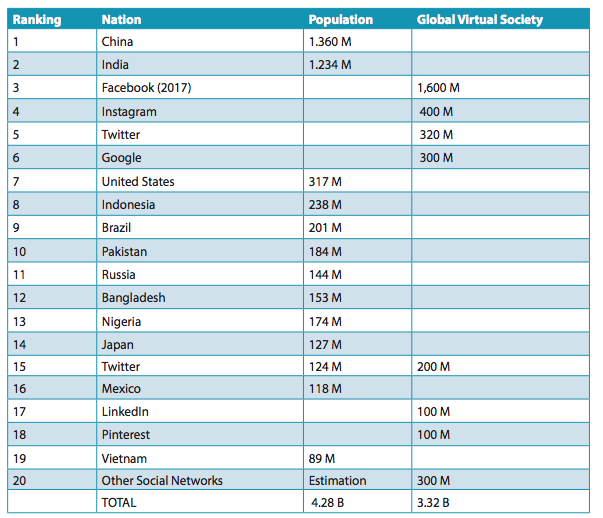
The Ranking of the Largest Nations by its Citizenships/Memberships in 2016
Soru 32
Which of the crises below could be associated with the motto “the sky is the limit"?
Seçenekler
A
Over-communication crisis
B
Global business crisis
C
Super-capacity crisis
D
Population crisis
E
Crisis of technology
Açıklama:
Super-capacity Crisis: The great financial success of the 1% elite, as well as the new power of Internet companies set up by young people, considerably affects imagination, particularly when political leaders claim that “the sky is the limit.” However, the real world sees high unemployment, reaching 10 per cent, with as many as every third young individual jobless (half of all potential workers in Spain). Engineers are advised to seek qualifications as nurses, and college graduates are offered unpaid internships, even in wealthy firms on Wall Street which could easily afford to pay these young university graduates.
Soru 33
Which of the countries has installed policies designed to limit their populations to tackle population crisis?
Seçenekler
A
Japan
B
India
C
United States
D
Egypt
E
Mexico
Açıklama:
-
In 2016, the global population was at 7.4 billion. If the present trend of population growth is maintained, by 2050 there will be between nine and eleven billion people. But our ecosystem can sustain only up to eight billion human lives at one time. Only China and Japan have installed policies designed to limit their populations. Many of the remaining countries see their population growth out of control, and many churches in the West oppose any population control.
In 2016, the global population was at 7.4 billion. If the present trend of population growth is maintained, by 2050 there will be between nine and eleven billion people. But our ecosystem can sustain only up to eight billion human lives at one time. Only China and Japan have installed policies designed to limit their populations. Many of the remaining countries see their population growth out of control, and many churches in the West oppose any population control.
Soru 34
Which of the below is not considered to be one of the Mafia states?
Seçenekler
A
Montenegro
B
Bulgaria
C
Ukraine
D
Myanmar
E
Thailand
Açıklama:
We have witnessed the development of Mafia states, where criminal circles not only bribe politicians but also are appointed to positions in the administration. These states include Bulgaria, Guinea-Bissau, Montenegro, Myanmar (Burma), Ukraine and Venezuela. In Mexico, the federal government is tough on drug cartels, but locally, at the level of states and towns, various types of Mafia rule and secure the loyalty of the police.
Soru 35
I. The elimination of governmental regulations is necessarily beneficial since it encourages growth.
II. Lowering the taxation of wealthy taxpayers creates new jobs.
III. The offshore outsourcing of manufacturing products raises costs and therefore is not good for consumers.
IV. Unemployed workers do not have the right skills, so it is their obligation to seek the appropriate job training to find employment elsewhere.
Which of the above is among the Business Rules as Dogma in the 2010s?
II. Lowering the taxation of wealthy taxpayers creates new jobs.
III. The offshore outsourcing of manufacturing products raises costs and therefore is not good for consumers.
IV. Unemployed workers do not have the right skills, so it is their obligation to seek the appropriate job training to find employment elsewhere.
Which of the above is among the Business Rules as Dogma in the 2010s?
Seçenekler
A
Only I
B
Only IV
C
II and IV
D
I, II and III
E
I, II and IV
Açıklama:
-
Business Rules as Dogma are what keeps business as faith. It is demanded by Chief Executive Officers of Big Business who act as Business Clerics. For example, in the 2010s there are the following rules:
Rule 1:The elimination of governmental regulations is necessarily beneficial since it encourages growth.
Rule 2: Lowering the taxation of wealthy taxpayers creates new jobs.
Rule 3: The removal of safety nets for displaced workers is justified because it minimizes business costs, enabling companies to be more competitive globally.
Rule 4: The offshore outsourcing of manufacturing products saves costs and therefore is good for consumers.
Rule 5: Unemployed workers do not have the right skills, so it is their obligation to seek the appropriate job training to find employment elsewhere.
Rule 6: As much as possible, loyal employees need to avoid taking these and other such issues into consideration. They should concentrate on their jobs without concerning themselves with supposedly irrelevant matters.
Business Rules as Dogma are what keeps business as faith. It is demanded by Chief Executive Officers of Big Business who act as Business Clerics. For example, in the 2010s there are the following rules:
Rule 1:The elimination of governmental regulations is necessarily beneficial since it encourages growth.
Rule 2: Lowering the taxation of wealthy taxpayers creates new jobs.
Rule 3: The removal of safety nets for displaced workers is justified because it minimizes business costs, enabling companies to be more competitive globally.
Rule 4: The offshore outsourcing of manufacturing products saves costs and therefore is good for consumers.
Rule 5: Unemployed workers do not have the right skills, so it is their obligation to seek the appropriate job training to find employment elsewhere.
Rule 6: As much as possible, loyal employees need to avoid taking these and other such issues into consideration. They should concentrate on their jobs without concerning themselves with supposedly irrelevant matters.
Soru 36
"Amazon.com waged war against publishers of paper-based books since it would like to be a sole distributor of e-books and e-book readers."
What rule of virtuality doctrine does the above example refer to?
What rule of virtuality doctrine does the above example refer to?
Seçenekler
A
The elimination of governmental regulations is necessarily beneficial since that encourages freedom of speech.
B
Intellectual property is an old concept which should be eliminated.
C
Most of the extant face-to-face meetings, particularly international conferences, should be replaced by virtual conferences to lower costs and broaden participation.
D
Printed books, journals, gazettes, and magazines should be replaced by e-publications to increase readership and decrease costs.
E
Face-to-face communication is too personal.
Açıklama:
Rule 4 is promoted by Big Business to secure higher income. For example, Amazon.com waged war against publishers of paper-based books since it would like to be a sole distributor of e-books and e-book readers. Similarly, Google would like to possess all books in a digital form to sell access to them. After long negotiations, Google agreed to pay some minimal royalties to authors.
Soru 37
I. The global elite stands in opposition to pluralism and often implies that democracy is a utopian ideal.
II. Members of the single global society may hold a globalist perspective and not contribute to the economic growth of their country of origin.
III. The global elite favours state autonomy and expects the state serve all people.
Which of the above is true about the global elite?
II. Members of the single global society may hold a globalist perspective and not contribute to the economic growth of their country of origin.
III. The global elite favours state autonomy and expects the state serve all people.
Which of the above is true about the global elite?
Seçenekler
A
Only II
B
Only III
C
I and II
D
I and III
E
I, II, and III
Açıklama:
The global elite stands in opposition to pluralism and often implies that democracy is a utopian ideal. It also stands in opposition to state autonomy. Therefore, it expects that the state should serve the single global society, the elite, because it alone can work successfully and provide jobs for the poor.
The emerging global society of super-rich business people are practically becoming a nation composed of stateless citizens, buying houses outside their country of primary residence, for example. Members of the single global society may hold a globalist perspective and not contribute to the economic growth of their country of origin. The global elite may hide trillions of pounds, dollars or Swiss francs inside off-shore havens like the Cayman Islands and Switzerland through the help of privately owned banks and unique financial services.
The emerging global society of super-rich business people are practically becoming a nation composed of stateless citizens, buying houses outside their country of primary residence, for example. Members of the single global society may hold a globalist perspective and not contribute to the economic growth of their country of origin. The global elite may hide trillions of pounds, dollars or Swiss francs inside off-shore havens like the Cayman Islands and Switzerland through the help of privately owned banks and unique financial services.
Soru 38
In which of the below diversity is established well?
Seçenekler
A
Eastern civilization
B
Hindu civilization
C
Japanese civilization
D
Western civilization
E
Buddhist civilization
Açıklama:
-
Diversity is established well only in the Western and Global Civilizations (the latter is a derivative of the former). Other civilizations may practice low or moderate social complexity and enjoy it but eventually they give up the quest for progress in economic and technological innovations, leaving it to Western Civilization.
Diversity is established well only in the Western and Global Civilizations (the latter is a derivative of the former). Other civilizations may practice low or moderate social complexity and enjoy it but eventually they give up the quest for progress in economic and technological innovations, leaving it to Western Civilization.
Soru 39
Which of the below belongs to Global Authority Infrastructure?
Seçenekler
A
UNESCO
B
CNN
C
Global Shipping Network
D
Online Colleges
E
Digital Libraries
Açıklama:
-
Global infrastructure platforms and services:
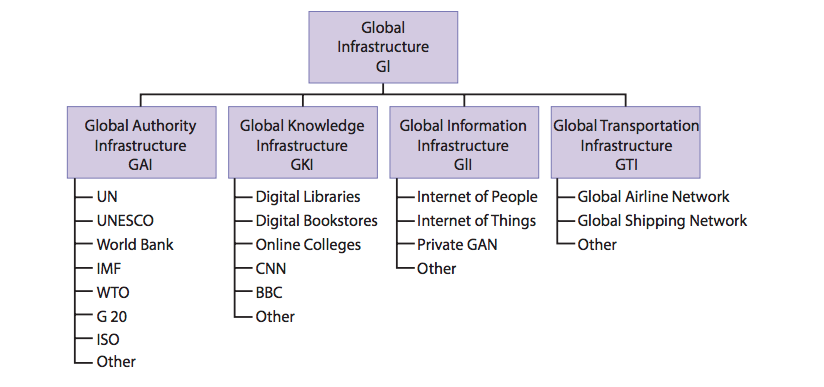
Global infrastructure platforms and services:
Soru 40
When did Internet browsers such as Netscape, Explorer, Firefox, and Chrome begin to tremendously facilitate the use of the Internet worldwide?
Seçenekler
A
2000
B
1998
C
1995
D
1991
E
1988
Açıklama:
-
Internet browsers such as Netscape, Explorer, Firefox, and Chrome began to tremendously facilitate the use of the Internet worldwide in 1998.
Internet browsers such as Netscape, Explorer, Firefox, and Chrome began to tremendously facilitate the use of the Internet worldwide in 1998.
Soru 41
- The transformation from Western Civilization to Eastern Civilization
- The development of Virtual Civilizatione
- The possible Clash of Civilizations
Seçenekler
A
I
B
II
C
III
D
I-II
E
II-III
Açıklama:
The world today encounters four extreme challenges:
- The transformation from Western Civilization to Global Civilization
- The development of Virtual Civilization
- A new great crisis, especially seen in the Western and the Eastern Civilizations
- The possible Clash of Civilizations
Soru 42
- It is going to occur because of the transformation of the Western Civilization into Eastern Civilization.
- It is expected to generate internal crises in almost all dimensions of society.
- It will be quite visible at first sight.
Which of the statement(s) above is/are true about the expected second great crisis of civilization?
Seçenekler
A
I
B
II
C
III
D
I-II
E
I-III
Açıklama:
The present, second crisis of civilization is going to occur beause of the transformation of the Western Civilization into a Global Civilization, and this will generate internal crises in almost all dimensions of society. The paradox of this second great crisis of civilization is that it is invisible at first sight. There is no global war, no major epidemics or a grand planetary climate catastrophe. Yet, there is the fantastic development of the Internet, which had led to a fast and vast information flow between masses of people representing all possible tribes, nations, and societies. The correct answer is Choice B.
Soru 43
Which of the following is/are the most prominent cause of the crisis in education?
Seçenekler
A
Business and public administration crisis
B
Media crisis
C
War crisis
D
Crisis of science and technology
E
Population crisis
Açıklama:
The most prominent cause of the crisis in education is the crisis of business and public administration. e former gave rise to high unemployment, which in turn meant that government gets less money from taxpayers and is forced to reduce budgets of schools and state universities. In consequence, the numbers of teachers and academics employed are reduced and so are programs in education. is has a significant worsening impact on the quality of education. Further consequences of the crisis in business are no jobs for graduates; they thus feel anxiety about leaving college for fear of becoming unemployed. is fear worsens the motivation to learn, with learning becoming too expensive for the not-so-well-to-do or the children of the unemployed. The correct answer is Choice A.
Soru 44
- Without the common threat of communism, civilizations now tend to perceive each other as enemies.
- Increased communication and interaction between civilizations has reduced the perceived cultural differences.
- After the fall of the Soviet Empire in 1991 the world order switched to the Cold War. Which of the statements above are true about the clash of civilizations?
Seçenekler
A
I
B
II
C
III
D
I-II
E
II-III
Açıklama:
After the fall of the Soviet Empire in 1991 the world order switched from the Cold War (between the political West and East) to the clash of civilizations and to the war carried on at the level of radicalism/terrorism and cyber conflict. is has involved aspects of the Western Civilization and of the Islamic Civilization. Huntington (1996: 211) has argued that:
- without the common threat of communism, civilizations now tend to perceive each other as enemies, and
- increased communication and interaction between civilizations has actually exaggerated perceived differences.
Soru 45
Which of the following can be stated as the ultimate reason for administrative crisis?
Seçenekler
A
Media crisis
B
War crisis
C
Over-communication crisis
D
Structural economic crisis
E
Population crisis
Açıklama:
Given the ideological issues involved, there is a worldwide clash taking place between the concepts of big and small government. is discussion is found in the United States, the United Kingdom, and the rest of the G8 (Japan, Germany, Canada, Italy, France and Russia). Regarding the budget deficit, we find that ultimately it results from the structural economic crisis that started in 2008, which means that revenue from business is going down as business is in recession. The correct answer is Choice D.
Soru 46
Which of the following emphasises markets know best, “the sky is the limit,” with permanent growth and expanding market share?
Seçenekler
A
Business clerics
B
Business rules as dogma
C
Business liturgy
D
Business knowledge
E
Business faith
Açıklama:
One such faith within Global Civilization is found in spiritual commitment to the tenets of its secular business regime. is can be characterized as follows:
Beliefs in Business - While the belief in gods and goddesses was once important, today the most successful mortals--inclusive of America’s 400 mega-billionaires--take on this role to a certain extent. A business doctrine is composed of the following:
The correct answer is Choice E.
Beliefs in Business - While the belief in gods and goddesses was once important, today the most successful mortals--inclusive of America’s 400 mega-billionaires--take on this role to a certain extent. A business doctrine is composed of the following:
- Business Faith emphasizes markets know best, “the sky is the limit,” with permanent growth and expanding market share.
- Business Knowledge is taught at business colleges. These institutions serve as for-pro t seminaries at which the business faith is taught by business faculty who act as business priests and monks/nuns.
- Business Liturgy involves endless business meetings and conferences and is covered by the media, all of which feature information convenient for the Business Doctrine.
The correct answer is Choice E.
Soru 47
- Face-to-face communication is too personal.
- Governmental regulations are are beneficial.
- Intellectual property is an important concept which should be taken foregrounded.
Seçenekler
A
I
B
II
C
III
D
I-II
E
II-III
Açıklama:
In the early decades of the current century, the tenets of this doctrine have become clear. They are based on the following rules:
- Rule 1: e elimination of governmental regulations is necessarily beneficial since that encourages freedom of speech.
- Rule 2: Intellectual property is an old concept which should be eliminated.
- Rule 3: Most of the extant face-to-face meetings, particularly international conferences, should be replaced by virtual conferences to lower costs and broaden participation.
- Rule 4: Printed books, journals, gazettes, and magazines should be replaced by e-publications to increase readership and decrease costs.
- Rule 5: Face-to-face communication is too personal.
Soru 48
- It supports pluralism.
- It advocates that democracy is a must.
- It stands in opposition to state autonomy.
Seçenekler
A
I
B
II
C
III
D
I-II
E
II-III
Açıklama:
The global elite stands in opposition to pluralism and often implies that democracy is a utopian ideal. It also stands in opposition to state autonomy. Therefore, it expects that the state should serve the single global society, the elite, because it alone can work successfully and provide jobs for the poor. The correct answer is Choice C.
Soru 49
Which of the following is true about the civilizations and global culture?
Seçenekler
A
Buddhist civilization has negative (isolating from others) impact over the world civilization.
B
Japanese civilization has a positive (easy assimilation/ cooperation with/within other nations) impact over the world civilization.
C
Eastern civilization does not have much impact over the world civilization.
D
Diversity is established well only in Chinese civilization.
E
Western civilization has a positive (right tendency in general) impact over the world civilization.
Açıklama:
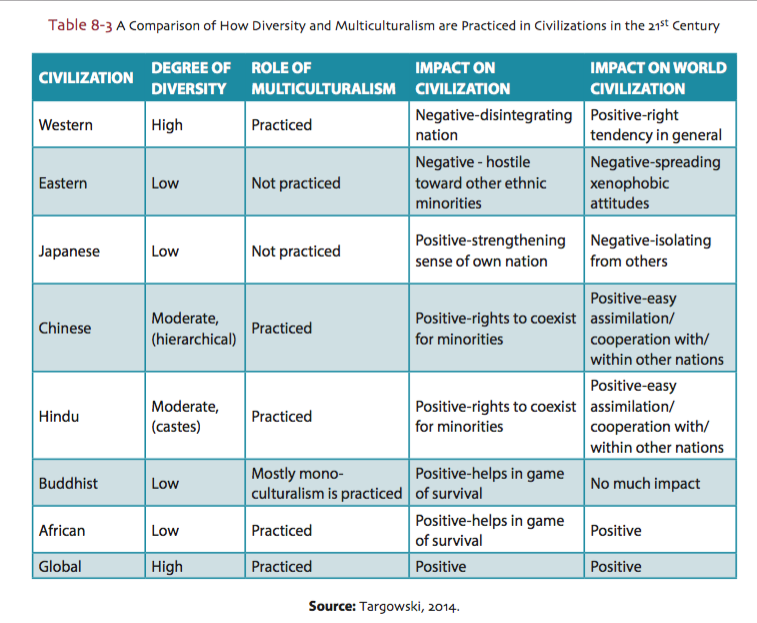 What might lessons of diversity and multiculturalism be learned from their state in the 21st century?
Here are some examples:
- Diversity is established well only in the Western and Global Civilizations (the latter is a derivative of the former). Other civilizations may practice low or moderate social complexity and enjoy it but eventually they give up the quest for progress in economic and technological innovations, leaving it to Western Civilization.
- Multiculturalism is practiced in Western Civilization but ultimately it leads to the development of a backlash among those elements of the population unable or unwilling to see the transition of a nation to a new stage of development. It is also practiced in the Hindu Civilization.
Soru 50
Which of the following can be given as an example for global authority infrastructure?
Seçenekler
A
World Bank
B
Digital libraries
C
Online colleges
D
CNN
E
Private GAN
Açıklama:
The rising global infrastructure is changing the world civilization significantly in the 21st century. First, it now provides digital services which are in fact on-line. These services aid commerce and governments with e-documents, e-news, and e-books for worldwide dissemination. Furthermore, some regulatory agencies are active like the World Trade Organization or the G20, composed of the political leaders of the 20 top countries in the world.
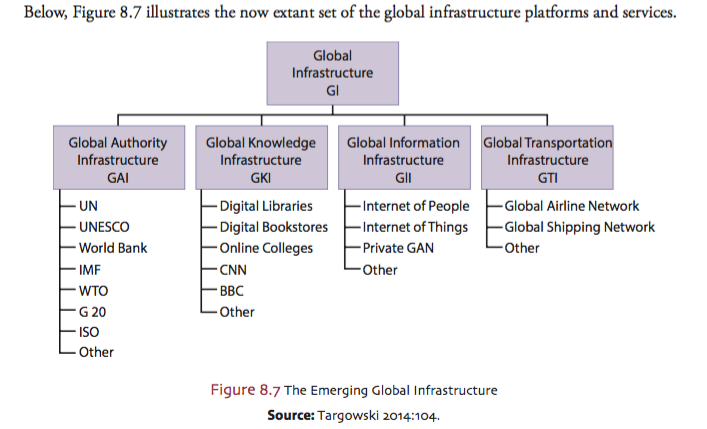 The correct answer is Choice A.
The correct answer is Choice A.Soru 51
What will the human race evolve into by about 2045?
Seçenekler
A
Homo Sapiens
B
Homo Erectus
C
Homo Habilis
D
Homo Cyborg
E
Homo Ludens
Açıklama:
By about 2045, artificial intelligence or machine intelligence probably will equal or exceed human intelligence. This may bring on singularity, a Big Bang for humanity, as hybrid organisms replace our human one and we evolve into Homo cyborg, human machines. The correct answer is D.
Soru 52
Which one of the followings is not an extreme challenge the world encounters today?
Seçenekler
A
The transformation from Western Civilization to Global Civilization
B
The development of Virtual Civilization
C
A new great crisis, especially seen in the Western and the Eastern Civilizations
D
The possible Clash of Civilizations
E
The class struggle
Açıklama:
The world today encounters four extreme challenges:
- The transformation from Western Civilization to Global Civilization
- The development of Virtual Civilization
- A new great crisis, especially seen in the
Western and the Eastern Civilizations - The possible Clash of Civilizations
Soru 53
.............. are some social groups that assemble around the use of e-mail, web pages, and other networked, digital resources.
What is the term that is defined above?
What is the term that is defined above?
Seçenekler
A
Virtual communities
B
Digital societies
C
Virtual communications
D
Digital communications
E
Social Media
Açıklama:
Virtual communities are some social groups that assemble around the use of e-mail, web pages, and other networked, digital resources. The correct answer is A.
Soru 54
According to the Table 8.1 in 2016 which social media site has the highest number of membership?
Seçenekler
A
Twitter
B
LinkedIn
C
Facebook
D
Instagram
E
Pinterest
Açıklama:
With 1600 million members, Facebook has the highest number of membership in 2016 according to the table in 2016. The correct answer is C.
Soru 55
"But our ecosystem can sustain only up to eight billion human lives at one time. Only China and Japan have installed policies designed to limit their populations."
Which one of the following major crisis is defined above?
Which one of the following major crisis is defined above?
Seçenekler
A
Ecological Crisis
B
Crisis of Religion
C
Population Crisis
D
Over-communication Crisis
E
Global Business Crisis
Açıklama:
In 2016, the global population was at 7.4 billion. If the present trend of population growth is maintained, by 2050 there will be between nine and eleven billion people. But our ecosystem can sustain only up to eight billion human lives at one time. Only China and Japan have installed policies designed to limit their populations. Many of the remaining countries see their population growth out of control, and many churches in the West oppose any population control. The correct answer is C.
Soru 56
"Deregulating foreign food trade (towards the end of the 20th century) meant the destabilization of production, reserves, and the consumption of food in most countries."
Above, one reason of one major crisis is mentioned. Which of the followings is the major crisis?
Above, one reason of one major crisis is mentioned. Which of the followings is the major crisis?
Seçenekler
A
Crisis of Technology
B
Food Crisis
C
Crisis of Science
D
Over-communication crisis
E
War Crisis
Açıklama:
Food Crisis stems partially from the reason mentioned in the question. The correct answer is B.
Soru 57
"After the fall of the Soviet Empire in 1991 the world order switched from the Cold War (between the political West and East) to ...................... ."
Which of the following major crisis fits the blank above?
Which of the following major crisis fits the blank above?
Seçenekler
A
Clash of Civilizations
B
Migration Crisis
C
Media Crisis
D
Education Crisis
E
Political Crisis
Açıklama:
After the fall of the Soviet Empire in 1991 the world order switched from the Cold War (between the political West and East) to the clash of civilizations and to the war carried on at the level of radicalism/terrorism and cyber conflict. The correct answer is A.
Soru 58
"Recently, millions of refugees from war-active states such as Syria, Iraq and from ethnic-conflict countries such as Myanmar and the Sudan have migrated to Turkey, the European Union members, and other receptor states. This may destabilize existing social balances in the host lands. This presents a complex challenge for contemporary societies and their leaders."
Which of the following major crisis is defined above?
Which of the following major crisis is defined above?
Seçenekler
A
War crisis
B
Technology crisis
C
Migration Crisis
D
Education Crisis
E
Clash of civilizations
Açıklama:
Migration Crisis:Recently, millions of refugees from war-active states such as Syria, Iraq and from ethnic-conflict countries such as Myanmar and the Sudan have migrated to Turkey, the European Union members, and other receptor states. This may destabilize existing social balances in the host lands. This presents a complex challenge for contemporary societies and their leaders. The correct answer is C.
Soru 59
Which one of the followings is not a rule of the tenets of the virtuality doctrine?
Seçenekler
A
The elimination of governmental regulations is necessarily beneficial since that encourages freedom of speech.
B
Intellectual property is an old concept which should be eliminated.
C
Most of the extant face-to-face meetings, particularly international conferences, should be replaced by virtual conferences to lower costs and broaden participation.
D
Printed books, journals, gazettes, and magazines should not be replaced by e-publications to increase readership and decrease costs.
E
Face to face communication is too personal.
Açıklama:
Printed books, journals, gazettes, and magazines should be replaced by e-publications to increase readership and decrease costs. So the correct answer is D.
Soru 60
"................. is guided by the principle “think globally, act locally.” In practice, the power of global corporations defeats local effort, which is too weak to face the challenges posed by global capital."
Which of the following terms is defined above?
Which of the following terms is defined above?
Seçenekler
A
Global Mind
B
Virtual Reality
C
Virtual communication
D
Virtual society
E
Social Networking
Açıklama:
The Global Mind is guided by the principle “think globally, act locally.” In practice, the power of global corporations defeats local effort, which is too weak to face the challenges posed by global capital. To a degree, this previously dominating principle works well only in France, where the petit bourgeoisie defends its small businesses against the invasion of global chains such as Walmart. The Global Mind operates in cyberspace and reaches all the places which function on the Internet. The paradox of this mind is that its neighborhood bonds diminish in favor of acquaintances with people who are thousands of miles away.
Thus, the Global Mind is still developing, and its development continuously fails to arrive at a saturation point; it never stops expanding and becomes ever more in-depth, ever greater regarding being informed and widening its knowledge and wisdom. The correct answer is A.
Thus, the Global Mind is still developing, and its development continuously fails to arrive at a saturation point; it never stops expanding and becomes ever more in-depth, ever greater regarding being informed and widening its knowledge and wisdom. The correct answer is A.
Soru 61
What is the meaning of Homo cyborg?
Seçenekler
A
Human creatures
B
Human machines
C
Human organisms
D
Human intelligence
E
Human robots
Açıklama:
The speed of computing is accelerating. By about 2045, artificial intelligence or machine intelligence probably will equal or exceed human intelligence. This may bring on singularity, a Big Bang for humanity, as hybrid organisms replace our human one and we evolve into Homo cyborg, human machines.
Soru 62
Which of the following is not among the extreme challenges that the world faces today?
Seçenekler
A
The transition to global civilization
B
The development of virtual civilization
C
A new great crisis in the West and the East
D
The possible clash of Civilizations
E
Betterment in the global warming
Açıklama:
The world today encounters four extreme challenges: • The transformation from Western Civilization to Global Civilization • The development of Virtual Civilization • A new great crisis, especially seen in the Western and the Eastern Civilizations • The possible Clash of Civilizations
Soru 63
Which of the following is not among the most populous five countries of the world?
Seçenekler
A
China
B
India
C
United States
D
Russia
E
Indonesia
Açıklama:
The most populous five countries of the world are China, India, United States, Indonesia and Brazil.
Soru 64
Which of the following is not among the main causes of food crisis facing the world today?
Seçenekler
A
The production of biofuels takes over land for growing corn and sugar cane
B
The increasing consumption of meat in the developed countries
C
Organic food production threatens the soil quality
D
Deregulating foreign food trade harms food sector
E
The monopolization of food production is practiced by American companies
Açıklama:
Food Crisis - Such a crisis stems from four main causes: • The production of biofuels takes over land for growing corn and sugar cane. • The increasing consumption of meat in the developed countries, as well as in China and India, requires an increased output of feed (seven or eight kilos of high-quality feed is needed per each kilo of meat) such as corn and soybeans. • Deregulating foreign food trade (towards the end of the 20th century) meant the destabilization of production, reserves, and the consumption of food in most countries. • The monopolization of food production is practiced by American companies, with four corporations dominating most farming business and bringing local farmers to bankruptcies; small farms produce healthy and tasty produce whereas those giants offer unhealthy and tasteless food.
Soru 65
Who coined the term Clash of Civilizations?
Seçenekler
A
Francis Fukuyama
B
Samuel Huntington
C
Bernard Lewis
D
Edward Said
E
Joseph Nye
Açıklama:
The term Clash of Civilizations has been coined by Samuel Huntington. He argued that • without the common threat of communism, civilizations now tend to perceive each other as enemies, and • increased communication and interaction between civilizations has actually exaggerated perceived differences.
Soru 66
Which of the following is not among the rules of the faith of the emerging Virtual Civilization?
Seçenekler
A
The elimination of governmental regulations is beneficial
B
Intellectual property is an old concept that should be eliminated
C
Virtual conferences should replace face-to-face meetings
D
Face-to-face communication is too personal
E
Printed media cannot be replaced by e-publications
Açıklama:
In the early decades of the current century, the tenets of this doctrine have become clear. They are based on the following rules: - Rule 1:The elimination of governmental regulations is necessarily beneficial since that encourages freedom of speech. - Rule 2: Intellectual property is an old concept which should be eliminated. - Rule 3: Most of the extant face-to-face meetings, particularly international conferences, should be replaced by virtual conferences to lower costs and broaden participation. - Rule 4: Printed books, journals, gazettes, and magazines should be replaced by e-publications to increase readership and decrease costs. - Rule 5: Face-to-face communication is too personal.
Soru 67
Which of the following is not a social networking site?
Seçenekler
A
Todoist
B
Facebook
C
LinkedIn
D
Pinterest
E
Youtube
Açıklama:
Unlike others, Todoist is a productivity tool and has no social networking feature.
Soru 68
Which of the following cannot be considered the members of the global elite?
Seçenekler
A
Central bankers
B
Politicians
C
CEOs of global corporations
D
Heads of international organizations
E
Executives of local NGOs
Açıklama:
The founders of Global Civilization belong to the single global society; it is composed of an international elite group of the richest and most powerful people in the world. Among them are politicians, central bankers, chief executives of global corporations and those who gather at the annual World Economic Forum in Davos, Switzerland, traditionally held near the end of January.
Soru 69
Which of the following would be the motto of a global citizen?
Seçenekler
A
Think globally, act locally
B
Think smartly, act smartly
C
Think locally, act globally
D
Think rapidly, act slowly
E
Think slowly, act rapidly
Açıklama:
The Global Mind is guided by the principle “think globally, act locally.”
Soru 70
Which of the following can be defined as the electronization of the emerging information culture in computer network storage sites which has been rapidly developing in the 21st century?
Seçenekler
A
Virtual media
B
Virtual society
C
Virtual culture
D
Virtual systems
E
Virtual civilization
Açıklama:
The term “virtual culture” means the electronization of the emerging information culture in computer network storage sites (in what is today called “the cloud” - rented cyberspace) which has been rapidly developing in the 21st century. In the last 500 years, information culture was developed by such media as print, telegraph, telephone, telecommunications, recorded sound (records and CDs), movies, radio, television, and so forth. In the last 50 years new media such as computers (software) and the Internet electronized and virtualized information culture.