Conflıct Resolutıon (ENG) - Tüm Sorular
Ünite 1
Soru 1
Which of the following questions is not addressed by Peace and Conflict Studies?
Seçenekler
A
Why and how do violent conflicts arise?
B
How can violent conflicts be managed?
C
What roles do international and local actors play in building peace?
D
What is required to combat not just physical violence but also structural violence?
E
How can military victory be achieved in conflicts to the satisfaction of one or more, but not all, parties involved?
Açıklama:
Please revisit " İntroduction" and "The Basics of Peace and Conflict Studies" sections of your book.
Peace and conflict studies has historically emerged as a challenge to military studies which relies on victory in conflicts through violent means to the satisfaction of one or more, but not all, parties involved.
Peace and conflict studies has historically emerged as a challenge to military studies which relies on victory in conflicts through violent means to the satisfaction of one or more, but not all, parties involved.
Soru 2
Which of the following statements is not one of the characteristic of Peace and Conflict Studies?
Seçenekler
A
Peace and Conflict Studies adopts an interdiciplinary approach.
B
Peace and Conflict Studies explores conditions of peace at the international level.
C
Peace and Conflict Studies explores conditions of peace at the societal and individual level.
D
Peace and Conflict Studies has many sub-diciplines such as military studies.
E
Peace and Conflict Studies aims to harmonize different cultures and tries to learn from them.
Açıklama:
Please read "The Basics od Peace and Conflict Studies" section of your book again.
Peace and Conflict Studies has historically emerged as a challenge to military studies.
Peace and Conflict Studies has historically emerged as a challenge to military studies.
Soru 3
Fill in the blank
........ is a Norwegian sociologist and one of the principle founders of the field who identified three main forms of violence called 'conflict triangle.'
........ is a Norwegian sociologist and one of the principle founders of the field who identified three main forms of violence called 'conflict triangle.'
Seçenekler
A
Johan Galtung
B
Hugo Grotius
C
John Burton
D
Walter Isard
E
Anatol Rapoport
Açıklama:
Re-read the Basics of Peace and Conflict Studies section of your book.
Johan Galtung is a Norwegian sociologist and one of the principle founders of the field who identified three main forms of violence called 'conflict triangle.'
Johan Galtung is a Norwegian sociologist and one of the principle founders of the field who identified three main forms of violence called 'conflict triangle.'
Soru 4
Which of the following peace term refers both the absence of oppression and violence as a means to solve problems and to the existence of the habit of cooperation, dialogue and collaborative problem-solving to promote social justice?
Seçenekler
A
Perpetual peace
B
Sustainable peace
C
Positive peace
D
Negative peace
E
Collaborative peace
Açıklama:
Re-read "The Basics of Peace and Conflict Studies" section of your book
Sustainable peace
Sustainable peace
Soru 5
In 1963, in which country was the Peace Research Society established which became the Peace Science Society a decade later?
Seçenekler
A
United States of America
B
Norway
C
Sweden
D
France
E
Germany
Açıklama:
Re-study "The Emergence and Development of Peace and Conflict Studies" section of your book
Sweden
Sweden
Soru 6
In considering the five stages of Peace and Conflict Studies, what years does the Precursors stage cover?
Seçenekler
A
2005-2020
B
1970-1980
C
1950-1960
D
1918-1945
E
1990-2000
Açıklama:
Re-study the "Five Stages in the Historical Development of Peace and Conflict Studies" section of your book
1918-1945
1918-1945
Soru 7
In considering the five stages of Peace and Conflict Studies, what years does the Constructions stage cover?
Seçenekler
A
1950-1960
B
1918-1945
C
2005-2020
D
1990-2000
E
1970-1980
Açıklama:
Re-study the "Five Stages in the Historical development of Peace and Conflict Studies" section of your book
1970-1980
1970-1980
Soru 8
In considering the five stages of Peace and Conflict Studies, what years does the Reconstructions stage cover?
Seçenekler
A
1990-2005
B
2005-2020
C
1918-1945
D
1950-1960
E
1970-1980
Açıklama:
Re-read "The five stages in the Historical Development of Peace and Conflict Studies" section of your book
1990-2005
1990-2005
Soru 9
In considering the five stages of Peace and Conflict Studies what years does the Cosmopolitan Conflict Resolution stage cover?
Seçenekler
A
1990-2005
B
2005-2020
C
1970-1980
D
1918-1945
E
1950-1960
Açıklama:
Re-read the "Five Stages in the Historical Development of Peace and Conflict Studies" section of your book.
2005-2020
2005-2020
Soru 10
Which of the following is not one of the approaches included in the Traditional/Legal Approaches category of peace and conflict resolution?
Seçenekler
A
Negotiation
B
Arbitration
C
Mediation
D
Democratization
E
Peacekeeping
Açıklama:
Re-study the "Main Approaches to Peace and Conflict Resolution" section of your book
Democratization
Democratization
Soru 11
Which of the following does not fall under the term "violent conflict"?
Seçenekler
A
International conflicts
B
Inter-group conflicts
C
Inter-individual conflicts
D
Absence of physical conflicts
E
Regional conflicts
Açıklama:
The term "Absence of physical conflicts" refers to "peace" not "violent conflict". Others refer to violent conflict. pg. 3
Soru 12
Which one is not one of the value-related assumptions on which Peace and Conflict Studies are based?
Seçenekler
A
Human nature is good. Thus, peace is a prime force for human behavior.
B
Wars are inevitable.
C
Violence is not natural. It is a learned and ‘sinful’ behavior.
D
Since violence is learned, peace can be learned too.
E
Durable peace can only be achieved through peaceful means.
Açıklama:
"Wars are not inevitable" is one of the value-related assumptions.
Soru 13
Galtung's (1969) conflict triangle identifies three main forms of violence. Which of the following is the example of cultural violence?
Seçenekler
A
Torture
B
Genocide
C
Physical violence
D
Economic violence
E
Racist attitudes
Açıklama:
Racist attitudes count as cultural violence.
Soru 14
.............. may mark the end of a war, or it may be achieved by suppressing a group of expressing its complaints. Which of the following should come in the blank?
Seçenekler
A
Positive peace
B
Perpetual peace
C
Negative peace
D
Absence of physical violence
E
Structural violence
Açıklama:
Negative peace may mark the end of a war, or it may be achieved by suppressing a group of expressing its complaints. written in the page 4.
Soru 15
Perpetual Peace (1795), is one of the most important texts of political philosophy and political science. Who is the writer of this work?
Seçenekler
A
Friedrich Schlegel
B
Christian Wolff
C
Georg Wilhelm Friedrich Hegel
D
Immanuel Kant
E
Jean-Jacques Rousseau
Açıklama:
Perpetual Peace: The work of Immanuel Kant, Perpetual Peace (1795), is one of the most important texts of political philosophy and political science. written in the page 5
Soru 16
When and where is the first Peace Studies program was established?
Seçenekler
A
In the US and the post-First World War period
B
In Europe and before the Second World War
C
In the US and late 60's
D
In the US at the beginning of the Cold War in 1948
E
In the US and following the American Civil War
Açıklama:
Then the first Peace Studies program was established at Indiana’s Manchester College, run by the pacifist Church of the Brethren, "in the US at the beginning of the Cold War in 1948."
Soru 17
Which of the following is not one of the content of the first category of the peace and conflict resolution?
Seçenekler
A
Negotiation
B
Democratization
C
Arbitration
D
Mediation
E
Peacekeeping
Açıklama:
The main approaches to peace and conflict resolution can be divided into two main categories: The second category includes extra-traditional/extralegal approaches, such as democratization, confidence building, and nonviolence.
Soru 18
"In most liberal democracies, minority rights are strictly protected by law, different ethnic groups have a space to exercise their own group identities, and social problems can find democratic channels to express themselves." According to the example, what is often vital for creating peaceful societies and peaceful international relations?
Seçenekler
A
Non-violence
B
Confidence-building
C
Negotiation
D
Arbitration
E
Democratization
Açıklama:
Democratization is often vital for creating peaceful societies and peaceful international relations. pg.14
Soru 19
............. involves a person or a group committing acts or abstaining from acts so that an opponent is forced to behave in a desired manner. Which of the following should come in the blank?
Seçenekler
A
Nonviolence
B
Negotiation
C
Arbitration
D
Mediation
E
Peacekeeping
Açıklama:
Nonviolence involves a person or a group committing acts or abstaining from acts so that an opponent is forced to behave in a desired manner.
Soru 20
When does Peace and Conflict Studies fail?
Seçenekler
A
When there is a big power asymmetry between conflicting sides.
B
When there is no asymmetry between conflicting sides.
C
When there is a peace between conflicting sides.
D
When there is an economic balance between conflicting sides.
E
When there is a trade balance between conflicting sides.
Açıklama:
Peace and Conflict Studies especially fail, it is argued, in situations of international conflicts when there is a big power asymmetry between conflicting sides.
Soru 21
Which of the following is a central question addressed in Peace and Conflict Studies?
Seçenekler
A
How can conflicts be resolved through peaceful means?
B
How is weather change affecting armed forces globally?
C
Why do countries engage in international trade wars?
D
What are the effects of fiction on public perceptions?
E
How can tourism help preserve cultural traditions?
Açıklama:
Peace and Conflict Studies tries to address the following questions:
- Why and how do violent conflicts arise?
- How can violent conflicts be managed, and how can conflicts be resolved and transformed through peaceful means?
- What roles do international and local actors play in building peace?
- What is required to combat not just physical violence but also structural violence, which may be in the form of political oppression, economic distress, unjust distribution of national wealth, human rights violations, or similar other undesired conditions?
Soru 22
Which of the following is one of the core assumptions of Peace and Conflict Studies?
Seçenekler
A
Peace is only possible through economic strength
B
Violence is a learned and changeable behavior
C
Wars are a necessary part of human evolution
D
Migration leads to stronger civil societies
E
Conflict is mainly caused by natural disasters
Açıklama:
Peace and Conflict Studies is based on several value-related assumptions as follows:
- Human nature is good. Thus, peace is a prime force for human behavior.
- Violence is not natural. It is a learned and ‘sinful’ behavior.
- Since violence is learned, peace can be learned too. In this respect, everyone can be transformable.
- Durable peace can only be achieved through peaceful means.
- Wars have enormous direct and indirect costs. Direct costs involve human deaths, expenditure, and destruction of land and physical infrastructure. Indirect costs, on the other hand, have negative impacts on society, such as migration, humiliation, growth of extremism, and weakening of civil society.
- Wars are not inevitable. They can be permanently eliminated by altering political and socio-economic conditions giving rise to them and by sincerely believing in peace and peaceful coexistence.
Soru 23
Which of the following thinkers is associated with the origins of Peace and Conflict Studies?
Seçenekler
A
Jean-Jacques Rousseau
B
Adam Smith
C
Sigmund Freud
D
Galileo Galilei
E
Thomas Hobbes
Açıklama:
The origins of Peace and Conflict Studies can be traced back to the works of Plato, Thucydides, Hugo Grotius, Thomas Hobbes, and Immanuel Kant. All these philosophers, and perhaps many others, tried to explore the peaceful ways of resolving human conflicts and recognized the importance of peace in human relations.
Soru 24
Which of the following is one of the five stages in the development of Peace and Conflict Studies according to Ramsbotham, Woodhouse, and Miall?
Seçenekler
A
Industrialisation
B
Modernisation
C
Construction
D
Globalisation
E
Colonisation
Açıklama:
Oliver Ramsbotham, Tom Woodhouse and Hugh Miall (2016: 46-77) divide the development of Peace and Conflict Studies into five stages. These five stages are precursors, foundations, constructions, reconstruction, and cosmopolitan conflict resolution.
Soru 25
“During this period, the failure of the variety of internationalist liberal movements to prevent the outbreak of the First World War motivated many people to study war and peace as a new “science”.
Which stage best corresponds to the definition described above in the development of Peace and Conflict Studies?
Which stage best corresponds to the definition described above in the development of Peace and Conflict Studies?
Seçenekler
A
Precursors
B
Foundations
C
Constructions
D
Reconstructions
E
Cosmopolitan conflict resolution
Açıklama:
Precursors: 1918-1945
During this period, the failure of the variety of internationalist liberal movements to prevent the outbreak of the First World War motivated many people to study war and peace as a new “science”. Some attempts were made, in this respect, in France, Germany, Holland, Czechoslovakia, Switzerland, as well as in the United States. Yet most proposals were isolated and individualistic.
During this period, the failure of the variety of internationalist liberal movements to prevent the outbreak of the First World War motivated many people to study war and peace as a new “science”. Some attempts were made, in this respect, in France, Germany, Holland, Czechoslovakia, Switzerland, as well as in the United States. Yet most proposals were isolated and individualistic.
Soru 26
Which of the following best describes the concept of cosmopolitanism in international relations?
Seçenekler
A
It supports cultural isolation and local traditions
B
It prioritizes the sovereignty of individual nation-states
C
It emphasizes global social bonds over national attachments
D
It focuses on economic competition between countries
E
It encourages exclusive loyalty to one’s homeland
Açıklama:
Cosmopolitanism in international relations is a school of thought in which the essence of international society is defined in terms of social bonds that link people, communities, and societies. More broadly, it presents a political-moral philosophy that posits people as citizens of the world rather than of a particular nation-state. In this regard, cosmopolitanism represents a spirited challenge to more traditional views that focus on age-old attachments of people to a place, customs, and culture. Cosmopolitan emphasis on social bonds rather than nation-states lays the foundation for its view of society ultimately evolving toward harmony and away from conflict
Soru 27
Which of the following is one of the significant areas of peace research identified by the Peace Research Institute Oslo (PRIO)?
Seçenekler
A
Ancient historical civilizations
B
Space exploration and technology
C
Global financial markets
D
Linguistic diversity in societies
E
Conflict patterns and violence
Açıklama:
As categorized by the Peace Research Institute Oslo (PRIO), some significant areas of peace research currently include the following sections: security, Violent organizations, conflict patterns, civilians in conflict, regions and power, religion, migration, gender, peacebuilding, business and peacebuilding, governance, urbanization and environment.
Soru 28
Which of the following best describes the focus of research on governance in peace studies?
Seçenekler
A
The study of language evolution in societies during a conflict
B
The impact of climate change on economic growth of nations in conflict
C
The development of new technologies for war
D
The history of ancient political systems and their response to conflict
E
The relationship between governance and peace at multiple levels
Açıklama:
The research on governance looks at the interplay between governance and peace at the domestic and international level. Governance is defined very broadly to include the formal institutions that regulate recruitment to, and execution of, political power, as well as less formal structures and processes, including informal power structures. The research also focuses on the types of governments that are likely to encourage conflict and political violence.
Soru 29
Which of the following best describes mediation as a form of third-party intervention in conflict?
Seçenekler
A
A direct use of force to resolve conflict
B
A judicial procedure with binding verdicts
C
A voluntary political process without forced decisions
D
An informal chat with no structure or goals
E
A process that excludes negotiation between parties
Açıklama:
If negotiations are hard to initiate because of strong emotions the parties have or because negotiations have started but reached an impasse for any reason, the parties may need some assistance from an external party, a third party, in other words. The most common and well-known type of third-party intervention in situations of conflict is mediation. International and social conflicts alike are often the subject of mediation. Mediation differs from other types of third-party intervention in that it is not based on the direct use of force. It aims to bring the conflict to a settlement acceptable to both sides voluntarily. Mediation is also a political process with no advance commitment from the parties to accept the mediator’s ideas of formulas. In this regard, it differs from arbitration that employs judicial procedure and issues a verdict that the parties have committed themselves beforehand to accept. Mediation can be best thought of as a dialogue or negotiation with the involvement of a third-party. Mediation, therefore, is an extension of the negotiation process, extending the bargaining into a new format, and using a mediator who can contribute new variables and dynamics to the interaction of disputants.
Soru 30
Which of the following best explains why democratization supports peaceful societies?
Seçenekler
A
It promotes military solutions to social issues
B
It restricts minority rights to maintain order
C
It centralizes power in a single governing body
D
It limits political participation to elites only
E
It provides legal protections and democratic channels
Açıklama:
Democratization is often vital for creating peaceful societies and peaceful international relations. It is usually the case that liberal democracies provide many structural mechanisms for preventing and resolving conflicts. For example, in most liberal democracies, minority rights are strictly protected by law, different ethnic groups have a space to exercise their own group identities, and social problems can find democratic channels to express themselves. Equally or more important, the distribution of political power can be (re-) shaped through political elections. Thus, issues concerning social and international relations can be peacefully dealt with before they escalate to large-scale conflicts.
Ünite 2
Soru 1
Which of the following is central to both international security studies and peace studies because peace can be promoted only when the dynamics of the emergence and development of violent conflicts are understood.
Seçenekler
A
Conflict analysis
B
Resolution analysis
C
Greed
D
Grievances
E
World economy
Açıklama:
Conflict analysis is central to both international security studies and peace studies .
Conflit analysis
Conflit analysis
Soru 2
Choose the best option to complete the following statement. "It is safe to say that in the contemporary world almost all armed conflicts are ..... wars in their nature."
Seçenekler
A
inter-state
B
intra-state or civil
C
drug-related
D
water-related
E
crime-based
Açıklama:
In today's world most armed conflicts are intra-state or civil wars.
Soru 3
Which of the following is the world’s main provider of data on organized violence and the oldest ongoing data collection project for civil war, with a history of almost 40 years.
Seçenekler
A
Greek Armed Conflicts Program
B
Advanced Conflict Data Program
C
War Crimes Data Program
D
Uppsala Conflict Data Program
E
Armed Conflicts Tracking Program
Açıklama:
The Uppsala Conflict Data Program is provider of data on organized violence in the world.
Soru 4
Which of the following is among the three main characteristics of a war?
Seçenekler
A
soldiers
B
geography
C
size
D
history
E
crime
Açıklama:
Size, preparation,and legitimation are the three main characteristics of war.
Soru 5
Which of the following is among the three main characteristics of a war?
Seçenekler
A
soldiers
B
crime
C
arms
D
geography
E
preparation
Açıklama:
Size, preparation, and legitimation are among the three main characteristics of a war.
Soru 6
Which of the following is among the three main characteristics of a war?
Seçenekler
A
crimes
B
data
C
arms
D
legitimation
E
geography
Açıklama:
Size, preparation, and legitimation are the three main characteristics of a war.
Soru 7
Which of the following is among the cultural factors related to contemporary armed conflicts?
Seçenekler
A
religion
B
poverty
C
water
D
economy
E
nuclear power
Açıklama:
Religion is a cultural factor related to contemporaray armed conflicts.
Soru 8
Which of the following is among the social/economic factors related to contemporary armed conflicts?
Seçenekler
A
religion
B
nuclear power
C
war crimes
D
poverty
E
history
Açıklama:
Poverty is among the social/economic fastors related to armed conflicts. The other options are not among the socail/economic factors.
Soru 9
Choose the best option to complete the following sentence. "..... refers to violence that harms the human body or physical objects."
Seçenekler
A
Psychological violence
B
Nuclear violence
C
War crime
D
Physical violence
E
Conflict
Açıklama:
Incomplete sentence gives the definition of physical violence.
Soru 10
Which of the following can be given as an example of psychological violence?
Seçenekler
A
war crime
B
armed conflict
C
brainwashing
D
nuclear war head
E
conflict map
Açıklama:
Brainwashing is an example of psychological violence.
Soru 11
Considering the three main characteristics used to define war, what is the minimum battle death toll excluding indirect victims for an armed conflict to be considered a war?
Seçenekler
A
100.
B
500.
C
1000.
D
2000.
E
5000.
Açıklama:
There are many definitions of war, but it would be possible to identify three main characteristics that are used to define it:
- its size - it results in at least 1,000 battle deaths and this does not include the indirect victims because of displacement, famine or disease.
- preparation - it involves large scale mobilisation and preparation.
- legitimation - it is legitimised by a government or quasi-government structure, so it is a duty but not a crime (Singer and Small, 1972).
Soru 12
Which of the following statements about civil wars is correct?
Seçenekler
A
They are closed wars involving only a specific region or group of people.
B
They are when the two peoples of separate nations declare war on each other.
C
They have mostly disappeared after the Cold War and the rise of globalisation.
D
They occur when resource-poor sides attack resource-rich sides for those resources.
E
They often occur in resource-rich countries due to the easy exploitation of these resources.
Açıklama:
One of the most typical contemporary civil wars is coined as resource wars, and they result from the power dynamics over the control, use and exploitation of natural resources such as oil, timber, minerals, and water. Such resource wars have shown an increasing trend so far and this trajectory will likely be the case in the future since the demand for natural resources have been getting greater than before in considerable proportions. There are many communities across the world that are affected by the scarcity of critical natural resources. For example, the lack of water is likely to be one of the most common civil war causes in the future. However, it is not only the lack of resources that cause conflicts, but also their abundance, which is known as ‘resource curse’. There are many countries in the world that have been torn apart by armed conflict because they have plenty of natural resources such as mines, oil, gas, and timber. This may seem to be paradoxical but the legal and illegal resource exploitation help trigger civil wars and exacerbate them because they provide easily accessible financial resources for the continuation of civil wars (Renner, 2002; Le Billion, 2008; Zambonis, 2004). In relation to the close correlation between natural resources and armed conflict, the following main trends have been observed: Civil wars depend on natural resource export and/or exploitation rather than the abundance of natural resources itself as a factor that is connected to civil war.
Soru 13
Which of the following would be an example of a "grievance" struggle in the greed vs. grievance argument?
Seçenekler
A
The abundance of resources in African nations such as timber and diamonds financing separatist movements.
B
The land ownership of European colonialists in South Africa leading to civil unrest and the abolishment of Apartheid.
C
The long-lasting grip of Colombian narcotic groups over civilians and their political economy of local security.
D
The ideological revolution of democracy started by Cameroon president Paul Biya devolving into a 45-year rule of oppression.
E
The rapid privatization of the public sector and resources in many South American nations leading to corruption and bribery.
Açıklama:
The ‘greed’ dimension locates individual and group motivations in the realm of desire for material gain, profit-making and inter-group competition over natural resources. Grievance based motivations emphasise deprivation with respect to material resources, socio-economic status, and political participation (Gurr, 2000). The South African land ownership dispute and resulting abolition of Apartheid stems from the grievance of locals being deprived ownership of the land they lived on.
Soru 14
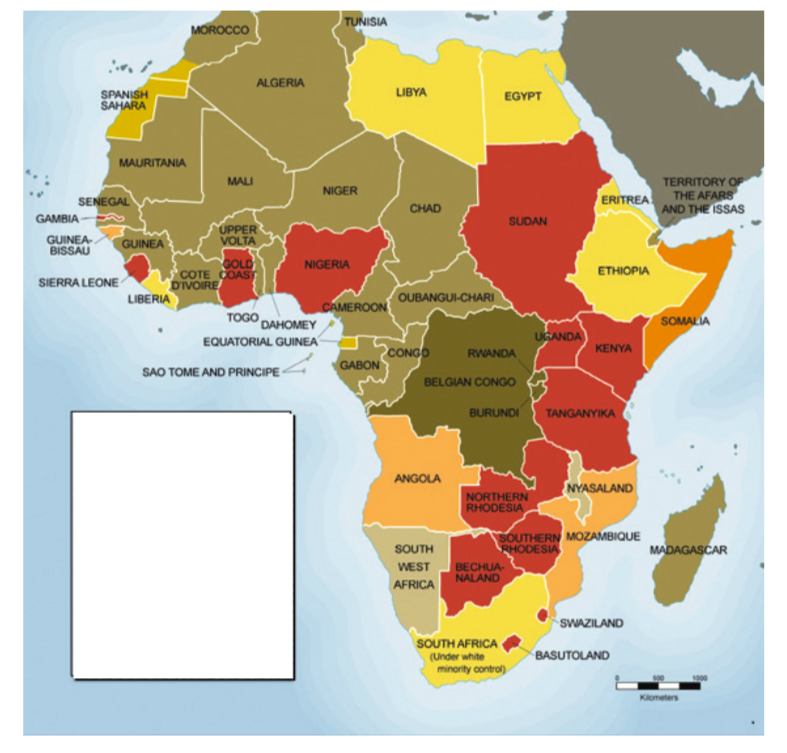 This map of Africa from 1945 shows distinct straight lines between various countries that have historically been part of protracted armed conflicts. What may be considered the source of these acts of violence?
Seçenekler
A
Religion.
B
Colonialism.
C
Poverty.
D
Inequality.
E
Environmental degradation.
Açıklama:
Although many cultural identities are inherited, they are sometimes created, modified, or reconstructed. A representative example of this is the influence of colonialism on the development of cultural identities in Africa, Latin America, Asia, and elsewhere. For instance, the arbitrary boundaries drawn by Europeans in their quest to establish states in Africa and Asia divided once cohesive communities, and in some cases brought together groups who had long been in competition or conflict. Moreover, colonial administrations in many countries utilised the policy of ‘divide and rule’, which led to fierce intertribal rivalries. As the colonial masters withdrew after independence, the struggle for power that ensued transformed these inter-tribal rivalries into bitter and protracted armed conflicts in some regions. This was particularly the case in Africa, where a number of groups are still engaged in armed conflicts over political and economic resources (Rupesinghe, 1998).
Soru 15
Which of the following is a socioeconomic factor that may be a source for violent conflict?
Seçenekler
A
Ethnicity.
B
Religion.
C
Political system.
D
The global arms trade.
E
Environmental degradation.
Açıklama:
There has been extensive research on the causality or correlation between a number of social and economic issues and military conflicts. If cultural factors draw clear distinctions between social groups, socio-economic factors serve to promote the tensions and competition between them. More specifically, such research focuses on the political and economic interests of the actors who engage in conflict. The type of political system in a country can strongly affect both the possibility of war breaking out and its progress. Thus, the political system is a socioeconomic factor influencing violent conflict.
Soru 16
Which of the following is an example of psychological violence?
Seçenekler
A
The suppression of the Arab Spring uprising and movement in the middle east by state police and military forces.
B
The displacement of millions of citizens from their homes during the Syrian civil war, resulting in millions of refugees fleeing their country.
C
The 2016 coup d'état attempt in Turkey carried out by armed forces against the Turkish government citing an erosion of secularism and democracy.
D
The arson attack on the Madımak hotel in Sivas, Turkey, in 1993 and the subsequent massacre of Alevi intellectuals gathered at the hotel.
E
The threat of sanctions, lawsuits and fines against media individuals and organizations critical of the government.
Açıklama:
Physical violence refers to violence that harms the human body or physical objects. By contrast, psychological violence includes the types of action that might affect human psychology, including “lies, brainwashing, indoctrination of various kinds, threats, etc” (Galtung, 1969: 19), and the impact of psychological violence is not always easily identifiable. However, an increasing number of studies apply systematic analysis on psychological violence (Krippner and McIntyre, 2003; Martz, 2010). In this case, the oppression and suppression of critical views in the media by the state is a form of psychological violence.
Soru 17
In February 2019, the government of Hong Kong proposed a controversial new bill that granted mainland China and Taiwan sweeping new powers over Hong Kong citizens regarding their policing and extradition. This sparked massive outrage and protests in Hong Kong that have lasted over a year as of December 2020. Following the protests, the Hong Kong police were augmented with police and military forces from mainland China to suppress the demonstrations, resulting in the Hong Kong police transforming into a governmental paramilitary rather than public servants. Which of the following best describes the violence that occurred in this situation?
Seçenekler
A
Psychological violence.
B
Structural violence.
C
Latent violence.
D
Cultural violence.
E
Latent violence.
Açıklama:
Structural violence concerns the manipulation of the structures and institutions that exist in society by people/groups in order to suppress others. Although these structures and institutions generally support the functioning of society for the benefit of all, they can be exploited to engender structural violence. Suppression of human rights, gender/age discrimination, institutional violence (as within the police or military), and exclusion of some religious groups are examples of structural violence.
Soru 18
The indigenous people of northern Scandinavia and Lapland are the Sami people, whom have been systematically discriminated against by Norway, Sweden, and Finland through assimilation programs. That being said, the Sami people have retained their native language despite being denied many aboriginal rights by the governments of the lands they live in. As such, speakers of Sami are frequently ridiculed or ostracized in Scandinavian societies and systems. Which form of violence does this constitute?
Seçenekler
A
Direct violence.
B
Structural violence.
C
Latent violence.
D
Unintended violence.
E
Cultural violence.
Açıklama:
Cultural violence has strong links with the day-to-day activities and perceptions of a social group. Various aspects of culture (e.g. religion, ideology, language, etc.) can be used to justify violence against certain sectors of society, thus preventing people from meeting their basic needs and reaching their full potentials. For instance, while the common language shared by a particular social group serves to promote effective communication and social cohesion within that group, it can become a focal point for cleavage between that group and others.
Soru 19
Which aspect of conflict analysis aims to better understand the physical, social, economic, political etc. influences of the conflict?
Seçenekler
A
Background.
B
Main actors.
C
Root causes.
D
Conflict dynamics.
E
Impact of the conflict.
Açıklama:
In its widest sense, the conflict analysis is undertaken to have an understanding of:
- the background and history of the conflict and violence and related circumstances;
- who are the main actors in terms of individuals, communities, organisations, armed groups - internal, regional and international;
- why they claim to take part in this conflict in terms of their justifications and how these actors relate to each other;
- root causes of the conflict and how they have changed over the time, and what kind of conflict dynamics they have produced;
- the impact of the conflict - physical, social, economic, political, etc.
- what responses to halt and resolve that conflict have been undertaken, and what their successes and failures have been to date.
Soru 20
Which conflict analysis tool aims to show the relationships between parties in the conflict?
Seçenekler
A
Timelines.
B
Conflict mapping.
C
The ABC triangle.
D
The onion.
E
The conflict tree.
Açıklama:
Conflict mapping is probably one of the most widely used conflict analysis tools and it aims to show the relationships between parties in the conflict. To start with, the size of circles for each party would indicate their power with regard to the conflict. Second, there are different ways of visualising relationship types such as straight lines for close relationships, while dotted lines are used for informal or intermittent links.
Soru 21
Which of the following is the world’s main provider of data on organized violence which is also the oldest ongoing data collection project for civil war?
Seçenekler
A
ELN
B
UNESCO
C
UCDP
D
LTTE
E
RENAMO
Açıklama:
The Uppsala Conflict Data Program (UCDP) is the world’s main provider of data on organized violence and the oldest ongoing data collection project for civil war...
Yanıt C'dir.
Yanıt C'dir.
Soru 22
What are the major elements of conflict analysis that are particularly relevant to peacebuilding?
Seçenekler
A
Legal system of the countries
B
Physical and psychological violence
C
Military expenses
D
Sources and forms of the conflicts
E
Free elections
Açıklama:
Therefore, in this chapter two main elements of conflict analysis that are particularly relevant to peacebuilding are introduced: sources and forms of conflicts...P.31
Yanıt D'dir.
Yanıt D'dir.
Soru 23
Why should the end of the Cold War be considered as the critical turning point in terms of the origin of civil wars?
Seçenekler
A
Globalization process in the late 1980s and early 1990s led to a decentralized system feeding dynamics of New Wars.
B
Former Soviet Union states run into internal turmoil due to the lack of central authority.
C
Global temperatures have increased after the Cold war, leading to global warming.
D
At the end of the Cold War, U.S. armed forces became available for other tasks since the Soviet Union is not a threat any more.
E
Ethnic and/or religious clashes became the only reason of civil wars at the end of the Cold war.
Açıklama:
In terms of the origin of civil wars, the end of the Cold War is considered as the critical turning point because of the nexus between the collapse of the bipolar world order and the rising of the globalisation process in the late 1980s and early 1990s.
Yanıt A'dır.
Yanıt A'dır.
Soru 24
Which of the following is irrelevant regarding to the “resource curse”?
Seçenekler
A
Increased natural resources intensify the propensity for civil war
B
Lootable resources are more likely to extend non-separatist conflicts
C
Non-lootable resources are likely to reduce the incidence of nonseparatist conflicts
D
Resource exploitation help to exacerbate civil wars by providing financial resources
E
Ethnic and/or religious differences cause disagreements on use of natural resources
Açıklama:
...regarding to the “resource curse”? kavramına ilişkin olarak tanımlar sayfa 33-34'te verilmiştir. E şıkkı bu tanımlar içerisinde yer almaz, bu bölümde verilen bilgilere dayanarak, etnik ve dini farkların, kaynakların ne şekilde kullanılacağına dair anlaşmazlığa yol açtığını söylemek, mümkün değildir.
Yanıt E'dir.
Yanıt E'dir.
Soru 25
Which of the following is not among the reasons of contemporary armed conflicts?
Seçenekler
A
Cultural factors: Religion, ethnicity and legacies of colonialism
B
Political issues: Colonialism, mercantilism, policy of countries to extending control over weaker countries
C
Socio-economic factors: Poverty, inequlity, political system
D
Contemporary issues: Proliferation of small arms and light weapons, environmental degradation
E
Resource curse: Natural resource export and/or exploitation influencing the extent of civil war rather than its inception
Açıklama:
Answer B is not showing the reason of the sources of violent conflicts. (The other sources can be seen between the pages 35-39)
Yanıt B'dir.
Yanıt B'dir.
Soru 26
Which of following is not an example of “communitarian motivation” explaining the long-term social unrest?
Seçenekler
A
Conflicts for cross-border mercenary activity In the Mano River conflicts of Sierra Leone and Liberia
B
Ethno-nationalist and religious conflicts with the Liberation Tigers of Tamil Eelam (LTTE) in Sri Lanka
C
Revolutionary guerrilla struggles in Argentina, Colombia, Nepal
D
Politically motivated ethnic conflicts and nationalist struggles such as in Chechnya, the Former Yugoslavia, and Kashmir
E
Ethno-nationalist and religious conflicts with the Moro Islamic Liberation Front (MILF) in Mindanao, the Philippines
Açıklama:
Answer A is not an example of “communitarian motivation.
Conflicts for cross-border mercenary activity in the Mano River conflicts of Sierra Leone and Liberia are profit-maximising or materially focused rather than being purely ideological.
Yanıt A'dır.
Conflicts for cross-border mercenary activity in the Mano River conflicts of Sierra Leone and Liberia are profit-maximising or materially focused rather than being purely ideological.
Yanıt A'dır.
Soru 27
Which form of violence has been applied in the following example, based on the classification of Galtung (1969)?
“Although the colonialist British and French powers targeted a relatively small number of people, the fear of African populations of potential violence enabled the UK and France to control the countries.”
“Although the colonialist British and French powers targeted a relatively small number of people, the fear of African populations of potential violence enabled the UK and France to control the countries.”
Seçenekler
A
Potential violence
B
Unintended violence
C
Direct violence
D
Latent violence
E
Cultural violence
Açıklama:
...latent violence denotes potential violence that may not yet be apparent. For instance, regarding the British and French colonialism in Sub-Saharan Africa, although manifest violence of the colonialist powers targeted a relatively small number of people, the fear of African populations of potential violence enabled the UK and France to control the countries. P.40
Example given in the question is located with in the section "Manifest Violence and Latent Violence"
Yanıt D'dir.
Example given in the question is located with in the section "Manifest Violence and Latent Violence"
Yanıt D'dir.
Soru 28
Which of the following is not a dimension that is undertaken by the conflict analysis in general?
Seçenekler
A
Background and history of conflict and violence
B
Main actors such as individuals, communities, organisations and armed groups
C
The righteous side on the conflict
D
The changes in root causes of conflict, producing conflict dynamics
E
The impact of the conflict - physical, social, economic, political, etc
Açıklama:
The answer C is not releavent to the definitions given regarding to conflict analysis.
The other options are taken from the page 41.
Yanıt C'dir.
The other options are taken from the page 41.
Yanıt C'dir.
Soru 29
Which of the following tools of conflict analysis require indicating different phases of a conflict as pre-conflict, confrontation, crisis, outcome, and post-conflict?
Seçenekler
A
Stages of Conflict
B
The Onion
C
Pyramid
D
Conflict Tree
E
Force-Field Analysis
Açıklama:
Given definition is taken from the "Stages of Conflict" section which is a conflict analysis tool.
Yanıt A'dır.
Yanıt A'dır.
Soru 30
Which of the following tools of conflict analysis is based on the premise of Needs, Interests and Positions for each party to the conflict, layered as identification each parties needs in the core exclaimed ad “What we must have”, interests as “What we really need” and, positions as “what we say we want?
Seçenekler
A
Stages of Conflict
B
The Onion
C
Pyramid
D
Conflict Tree
E
Force-Field Analysis
Açıklama:
Given definition is taken from "The Onion" section which is a conflict analysis tool.
Yanıt B'dir.
Yanıt B'dir.
Soru 31
Which of the following is one of the main characteristics of war?
Seçenekler
A
Economic loss
B
Cultural damage
C
Humanitarian aid
D
Civilian displacement
E
1,000 battle deaths
Açıklama:
There are many definitions of war, but it would be possible to identify three main characteristics that are used to define it:
• its size - it results in at least 1,000 battle deaths and this does not include the indirect victims because of displacement, famine or disease.
• preparation - it involves large scale mobilisation and preparation.
• legitimation - it is legitimised by a government or quasi-government structure, so it is a duty but not a crime
• its size - it results in at least 1,000 battle deaths and this does not include the indirect victims because of displacement, famine or disease.
• preparation - it involves large scale mobilisation and preparation.
• legitimation - it is legitimised by a government or quasi-government structure, so it is a duty but not a crime
Soru 32
Which of the following is a key trend observed about natural resources and civil wars?
Seçenekler
A
Resource export supports the start of war
B
Abundant resources always cause conflict
C
Export links matter more than abundance
D
All wars begin due to natural resources
E
Scarce resources stop wars quickly
Açıklama:
In relation to the close correlation between natural resources and armed conflict, the following main trends have been observed:
• Civil wars depend on natural resource export and/or exploitation rather than the abundance of natural resources itself as a factor that is connected to civil war.
• Natural resource wealth influences the extent of civil war rather than its inception.
• Natural resources which are geographically located and easily controllable, tend to prolong civil wars (Collier and Hoeffler, 1998).
• Civil wars depend on natural resource export and/or exploitation rather than the abundance of natural resources itself as a factor that is connected to civil war.
• Natural resource wealth influences the extent of civil war rather than its inception.
• Natural resources which are geographically located and easily controllable, tend to prolong civil wars (Collier and Hoeffler, 1998).
Soru 33
Which of the following is identified as a major cultural factor in the emergence of violent conflict?
Seçenekler
A
Economic policies of governments
B
Ethnicity as part of cultural identity
C
Industrial growth in conflict zones
D
Migration due to climate change
E
Access to international markets
Açıklama:
Cultural heritage, such as language, religion, ethnicity and nationality, can be an important source of the conflict between individuals and groups. Some scholars have posited that cultural factors are more likely to cause violent conflict than other factors since actors are less likely to compromise on such issues (Huntington, 1993). Many previous examples of violent conflict demonstrate that people fight to maintain their own cultural identity
or remove others, and various discussions in peace studies point to the significant roles played by the following three factors - namely ethnicity, religion, and legacies of colonialism- in the emergence and development of a violent conflict. In particular, ethnicity and religion have been argued to be the two most outstanding sources of contemporary armed conflicts.
or remove others, and various discussions in peace studies point to the significant roles played by the following three factors - namely ethnicity, religion, and legacies of colonialism- in the emergence and development of a violent conflict. In particular, ethnicity and religion have been argued to be the two most outstanding sources of contemporary armed conflicts.
Soru 34
Which of the following is one reason why poor economic conditions may lead to violent conflict?
Seçenekler
A
They increase competition over resources
B
They reduce political participation rates
C
They promote foreign investments rapidly
D
They create equal wealth distribution
E
They eliminate the need for social reforms
Açıklama:
The academic community is largely in agreement on the role that poor economic conditions play as a long-term source of violent conflicts. If a society does not offer adequate opportunities for the fulfilment of people’s needs, the possibility of violence increases. Moreover, the competition between social groups becomes more intense in cases where resources are limited, and violent conflict is therefore more likely to erupt. Socio-economic inequality sometimes plays a bigger role than poverty per se in initiating violent conflicts. Inequalities in economic wealth or political power usually produce an exclusive social hierarchy that heightens social tensions. Economic growth is normally uneven, increasing the interests of some groups while subjecting others to new forms of poverty. If the disadvantaged groups’ attempts to redress the social disparity continually fail, their anger and resentment is likely to increase tensions and raise the likelihood of violence. The dominant groups are also tempted to use violence to maintain their privilege against “the challenges posed by endemic economic crises, foreign competition, and workers’ demands”. The type of political system in a country can strongly affect both the possibility of war breaking out and its progress. Societies in which people are free to express their grievances and seek their redress through peaceful means (e.g. via dialogue or political deliberation) are less likely to experience violent conflict than other types of societies. The academic discourse on the role of the political system in preventing violent conflicts in increased with the emergence of Democratic Peace Theory, which argues that “democratic states almost never go to war with each other”
Soru 35
Which of the following is a factor contributing to the rise or continuation of violent conflicts?
Seçenekler
A
Equal access to forest resources
B
Global reduction in weapon trade
C
Scarcity of water and fertile soil
D
Successful control of small arms
E
Balance in climate conditions
Açıklama:
In addition to the cultural and socioeconomic sources of conflict, there are two contemporary issues that have attracted particular academic attention in recent times: the proliferation of small arms and environmental degradation.
Proliferation of Small Arms and Light Weapons
The growth in the global arms trade has made small arms and light weapons readily available to those factions able to afford them. It is estimated that there are half a billion small arms currently in circulation worldwide, causing the death of approximately half a million people annually. Unlike nuclear, chemical or biological weapons, nation states and the international community have encountered serious challenges in controlling and preventing the proliferation of small arms and light weapons. The widespread availability of small arms continues to pose a major threat to human security and has been implicated as a factor in starting and prolonging a large number of violent conflicts since “war is possible as soon as weapons are available with which to fight it” (Smith, 2004: 5). 39
Environmental Degradation
Environmental degradation in many cases causes a rapid reduction in three types of renewable resources - water, forests and fertile soil - and the scarcity of these resources initiates or propels military conflicts. For instance, the lack of water due to chronic drought frequently causes serious inter-clan conflicts in sub-Saharan Africa. When the problem of scarcity is combined with the issue of uneven distribution, the risk of violence becomes much higher. Thus, as global climate change has increased the frequency and intensity of such formidable natural disasters, the conflicts caused/catalysed by environmental degradation are becoming a central issue in peace and conflict studies.
Proliferation of Small Arms and Light Weapons
The growth in the global arms trade has made small arms and light weapons readily available to those factions able to afford them. It is estimated that there are half a billion small arms currently in circulation worldwide, causing the death of approximately half a million people annually. Unlike nuclear, chemical or biological weapons, nation states and the international community have encountered serious challenges in controlling and preventing the proliferation of small arms and light weapons. The widespread availability of small arms continues to pose a major threat to human security and has been implicated as a factor in starting and prolonging a large number of violent conflicts since “war is possible as soon as weapons are available with which to fight it” (Smith, 2004: 5). 39
Environmental Degradation
Environmental degradation in many cases causes a rapid reduction in three types of renewable resources - water, forests and fertile soil - and the scarcity of these resources initiates or propels military conflicts. For instance, the lack of water due to chronic drought frequently causes serious inter-clan conflicts in sub-Saharan Africa. When the problem of scarcity is combined with the issue of uneven distribution, the risk of violence becomes much higher. Thus, as global climate change has increased the frequency and intensity of such formidable natural disasters, the conflicts caused/catalysed by environmental degradation are becoming a central issue in peace and conflict studies.
Soru 36
A) Physical violence
B) Psychological violence
C) Intended violence
D) Unintended violence
E) Latent violence
Which of the following options presents the correct match between the term and its definition?
B) Psychological violence
C) Intended violence
D) Unintended violence
E) Latent violence
- Results from harmful outcomes without clear intent
- Includes harm to the body or physical objects
- Form of violence that is not observable
- Involves actions like brainwashing and threats
- Reflects deliberate effort to cause harm
Which of the following options presents the correct match between the term and its definition?
Seçenekler
A
A-4, B-2, C-1, D-3, E-5
B
A-3, B-1, C-2, D-5, E-4
C
A-1, B-3, C-4, D-2, E-1
D
A-2, B-4, C-5, D-1, E-3
E
A-5, B-4, C-3, D-2, E-1
Açıklama:
Physical and Psychological Violence
Whether a form of violence affects the body or mind is a fundamental criterion for categorising the type of violence. Physical violence refers to violence that harms the human body or physical objects. Galtung (1969: 169) suggests that physical violence can be categorised into two groups: biological violence and physical violence that constrains human movements (e.g. imprisonment). The effects of physical violence on human behaviour are clearly evident and have been well explored in previous peace studies (in fact, most previous academic discussion on the impact of warfare focus on this aspect). By contrast, psychological violence includes the types of action that might affect human psychology, including “lies, brainwashing, indoctrination of various kinds, threats, etc” (Galtung, 1969: 19), and the impact of psychological violence is not always easily identifiable. However, an increasing number of studies apply systematic analysis on psychological violence (Krippner and McIntyre, 2003; Martz, 2010).
Intended Violence and Unintended Violence
In traditional models of moral judgement, including Judaeo-Christian ethics and Roman jurisprudence, the ‘intention’ or ‘purpose’ of a person’s behaviour is considered more important than the consequences of their behaviour. As a result, many previous studies have tended to neglect the impact of unintended violence, even though unintended violence in human society may have devastating effects on human well-being. One example is structural violence, which has a serious effect on people’s lives but may not reflect the intention of a certain person or a group to harm the people. Another is environmental pollution, in which case, although the effects may be unintentional, careless policies and practices may have serious consequences.
Manifest Violence and Latent Violence
While manifest violence refers to forms of violence that are observable, latent violence denotes potential violence that may not yet be apparent. For instance, regarding the British and French colonialism in Sub-Saharan Africa, although manifest violence of the colonialist powers targeted a relatively small number of people, the fear of African populations of potential violence enabled the UK and France to control the countries. As with unintended violence, some academic studies have failed to recognise the potential impact of latent violence. As Galtung argues, it is important to include this form of violence in an analytical framework because as the level of potential violence increases, social tension and instability intensify (Galtung, 1969: 173). In fact, the inclusion of latent violence in the equation significantly expands the scope of peacebuilding operations to include efforts to address the ‘invisible’ dimensions of war-affected societies.
Whether a form of violence affects the body or mind is a fundamental criterion for categorising the type of violence. Physical violence refers to violence that harms the human body or physical objects. Galtung (1969: 169) suggests that physical violence can be categorised into two groups: biological violence and physical violence that constrains human movements (e.g. imprisonment). The effects of physical violence on human behaviour are clearly evident and have been well explored in previous peace studies (in fact, most previous academic discussion on the impact of warfare focus on this aspect). By contrast, psychological violence includes the types of action that might affect human psychology, including “lies, brainwashing, indoctrination of various kinds, threats, etc” (Galtung, 1969: 19), and the impact of psychological violence is not always easily identifiable. However, an increasing number of studies apply systematic analysis on psychological violence (Krippner and McIntyre, 2003; Martz, 2010).
Intended Violence and Unintended Violence
In traditional models of moral judgement, including Judaeo-Christian ethics and Roman jurisprudence, the ‘intention’ or ‘purpose’ of a person’s behaviour is considered more important than the consequences of their behaviour. As a result, many previous studies have tended to neglect the impact of unintended violence, even though unintended violence in human society may have devastating effects on human well-being. One example is structural violence, which has a serious effect on people’s lives but may not reflect the intention of a certain person or a group to harm the people. Another is environmental pollution, in which case, although the effects may be unintentional, careless policies and practices may have serious consequences.
Manifest Violence and Latent Violence
While manifest violence refers to forms of violence that are observable, latent violence denotes potential violence that may not yet be apparent. For instance, regarding the British and French colonialism in Sub-Saharan Africa, although manifest violence of the colonialist powers targeted a relatively small number of people, the fear of African populations of potential violence enabled the UK and France to control the countries. As with unintended violence, some academic studies have failed to recognise the potential impact of latent violence. As Galtung argues, it is important to include this form of violence in an analytical framework because as the level of potential violence increases, social tension and instability intensify (Galtung, 1969: 173). In fact, the inclusion of latent violence in the equation significantly expands the scope of peacebuilding operations to include efforts to address the ‘invisible’ dimensions of war-affected societies.
Soru 37
Which of the following is a key element examined in conflict analysis?
Seçenekler
A
Identification of key actors and their relationships
B
Evaluation of daily routines in peaceful societies
C
Analysis of climate change effects on trade routes
D
Comparison of global cultural celebrations
E
Discussion of artistic trends in ancient civilizations
Açıklama:
In its widest sense, the conflict analysis is undertaken to have an understanding of:
- the background and history of the conflict and violence and related circumstances;
- who are the main actors in terms of individuals, communities, organisations, armed groups - internal, regional and international;
- why they claim to take part in this conflict in terms of their justifications and how these actors relate to each other;
- root causes of the conflict and how they have changed over the time, and what kind of conflict dynamics they have produced;
- the impact of the conflict - physical, social, economic, political, etc.
- what responses to halt and resolve that conflict have been undertaken, and what their successes and failures have been to date.
Soru 38
Which of the following is one of the commonly used tools in conflict analysis?
Seçenekler
A
The ABC Triangle
B
The Justice Scale
C
The Harmony Wheel
D
The Peace Circle
E
The Ethics Ladder
Açıklama:
Some of the most commonly used conflict analysis tools are:
- Stages of conflict
- Timelines
- Conflict mapping
- The ABC (Attitude, Behaviour, Context) Triangle
- The Onion
- The Conflict Tree
- Force-Field Analysis
- Pillars
- The Pyramid
Soru 39
Which of the following best describes a key feature of the Onion tool in conflict analysis?
Seçenekler
A
It lists chronological stages of peace treaties
B
It evaluates military power in violent conflicts
C
It identifies financial losses during a conflict
D
It maps territorial boundaries of conflict zones
E
It explores each party's needs, interests, and positions
Açıklama:
Based on the analogy of an onion with different layers, this tool is based on the premise of Needs, Interests and Positions for each party to the conflict. In the core of the onion, the tool aims to identify what each party identifies its needs in terms of ‘What we must have’, then as interests, ‘What we really want’, and then finally in the outer layer, as positions, ‘What we say we want’. As indicated with these three layers of questions, the tool aims to analyse what different parties to a conflict are ‘saying’. In this way, it would be possible to move beyond the parties’ public position which could be quite different than each party’s real interests and needs. Having done such an analysis, the expectation would be to find the common ground between the parties in order to explore opportunities for further discussions and dialogue. This tool would be particularly useful in the planning stages of dialogue sessions between the parties to a conflict as well as mediation and negotiation interventions.
Soru 40
Which of the following reflects a key purpose of the Pillars tool in conflict analysis?
Seçenekler
A
To measure the number of actors in a conflict
B
To identify factors sustaining an unstable situation
C
To classify violence by type and intensity
D
To rank peacebuilding tools by effectiveness
E
To list all historical stages of a given conflict
Açıklama:
In this analysis, ‘pillars’ represent a range of factors that hold up the unstable situation in the way it is. Therefore, the tool aims to identify what these pillars are so that they could be removed or their effects would be minimised. Subsequently, a negative situation could be transformed into a positive one. Having identified the unstable situation such as a particular conflict and placed in the middle of an inverted triangle standing on one point. The next stage of the exercise would involve the identification of ‘supporting pillars’ on both sides of the triangle. For example, the conflict between the parties might be supported by such pillars as prejudices, corruption, unjust laws, regional interferences, historical grievances, etc. Next, the exercise would consider how each pillar could be weakened or completely removed, and what actions and interventions this would require. It would also be possible to explore how these forces could be turned into positive ones with an outlook of what roles that the parties could play in such a process.
Ünite 3
Soru 1
Which of the following is correct for conflict?
Seçenekler
A
Conflict can happen only within national boundaries.
B
Conflict can happen only between states.
C
If a conflict is not managed, it can lead to a war.
D
It is possible that 2000 people die annually as a result of a continuous conflict.
E
Conflict is not an important issue between countries.
Açıklama:
Before positing a definition of conflict, we first need to clarify when to name a dispute a war and when to name it a conflict. Succinctly put it, the main difference between
war and conflict is the number of casualties: if the annual battle-related death toll is 1000 or more; then it is called a war, and if less, that is a conflict. So we can safely stress that if a conflict is not managed, it can lead to a war, making the conflict management a crucial stage in the cycle between war and peace. Conflicts can happen between inter-states or intra-states.
Correct answer is C
war and conflict is the number of casualties: if the annual battle-related death toll is 1000 or more; then it is called a war, and if less, that is a conflict. So we can safely stress that if a conflict is not managed, it can lead to a war, making the conflict management a crucial stage in the cycle between war and peace. Conflicts can happen between inter-states or intra-states.
Correct answer is C
Soru 2
Which of the following options cannot be said for conflict?
Seçenekler
A
Conflicts can cause devastating effects interstates.
B
Conflicts can cause devastating effects intra-states.
C
Internal conflicts increased and even became the common practice, particularly in 1990's.
D
During the cold-war period, shifting the international borders by force is a common practice.
E
If conflict is not solved, it can lead to war.
Açıklama:
As the devastating consequences of the two World Wars and the maintenance of nuclear deterrence during the Cold War proved an inter-state war highly costly, the number and intensity of internal or intra-state conflicts have culminated from the late-1980s. Additionally, compared to the earlier practices in international relations, shifting international borders by force became almost unattainable during the Cold War, which proved the era more stable in terms of inter-state wars.
However, for that very same reason, internal conflicts increased and even became the common practice, particularly in the 1990s.
Your answer must be D option
However, for that very same reason, internal conflicts increased and even became the common practice, particularly in the 1990s.
Your answer must be D option
Soru 3
The efforts to reach an agreement between the adverse parties are called ____________.
For the statement above which option below is suitable to fill in the blank?
For the statement above which option below is suitable to fill in the blank?
Seçenekler
A
Conflict Settlement
B
Conflict Resolution
C
Conflict Regulation
D
Conflict Management
E
Conflict Prevention
Açıklama:
The efforts to reach an agreement between the adverse parties are called conflict settlement, during which elites of the opposing sides take part in a negotiation process, probably through the mediation of a third .party
Correct answer is given in A option.
Correct answer is given in A option.
Soru 4
Peacekeeping is a conflict _______________ strategy.
For the statement above which option below is suitable to fill in the blank?
For the statement above which option below is suitable to fill in the blank?
Seçenekler
A
Transformation
B
Resolution
C
Settlement
D
Management
E
Prevention
Açıklama:
Peacekeeping is a conflict resolution strategy that aims to contain violence and prevent it from turning to war; to limit the intensity, geographical spread and duration of the conflict if it started; and to consolidate a ceasefire and create an environment for reconciliation in the post-war period
The correct answer is given in the B option.
The correct answer is given in the B option.
Soru 5
What is the last phase of Conflict Resolution?
Seçenekler
A
Conflict Transformation
B
Crises Management
C
Conflict Prevention
D
Conflict Management
E
Conflict Resolution
Açıklama:
The final phase of the conflict resolution is the transformation. The success and ending of conflicts do not necessarily imply a stable and enduring peace. With these in mind, it is conflict transformation that builds peace in the cultural and structural spheres, with transforming both institutions and discourses of the conflicting parties.
You have to select A option
You have to select A option
Soru 6
Which of the following statements describes the Realpolitik reasons related to one of the reasons of interstate conflict?
Seçenekler
A
Seeking control over certain territories can give rise to interstate wars.
B
Seeking to maximize power and power capabilities can lead to wars among states.
C
Economic issues, such as oil prices, pipelines, transportation routes, and relations between wealthy and poor countries, can play central roles in the emergence of interstate armed conflicts.
D
Ideological and legitimacy issues can cause a conflict between two states.
E
Ethical and economical degradation can cause a conflict between states.
Açıklama:
The statement given in A is Geopolitic reason, C is Kapitalpolitic and D is Idealpolitic reasons. The statement E is not related to interstate reasons.
Correct answer is B
Correct answer is B
Soru 7
Which of the following statements is correct?
Seçenekler
A
Negative Regulation Methods are considerd to solve intra-state conflicts.
B
Assimilation is a positive regulation method.
C
Consociational democracy is a negative regulation method.
D
Secession/partition is a positive regulation method.
E
Population transfer is a positive regulation method.
Açıklama:
Assimilation, population transfer, secession/partition are negative regulation methods and Consociational democracy is positive regulation method.
A is the correct answer
A is the correct answer
Soru 8
Which one of the following has a close similarity of secession between Czech Republic and Slovakia?
Seçenekler
A
Northern Iraq and Iraq
B
Quebec and Canada,
C
Catalonia and Spain
D
Basque Country and Spain
E
South Sudan and Sudan
Açıklama:
Secession between Czech Republic and Slovakia is a successful example. Similarly, South Sudan and Sudan is another successful example, The other options are unsuccessful examples of secession.
One occasional illustrative example is the case of Czechoslovakia, which was dubbed as
a velvet separation for the peaceful partition of two independent states, the Czech Republic and Slovakia, in 1993. Another pattern is that of Yugoslavia, in which the international community was involved by forming a judicial commission to decide on the perils of the break-up. As a result, the commission decided that only official federal
entities could be recognized as independent states, reflecting the underlying logic of today’s states-system. India-Pakistan, Pakistan-Bangladesh, Ethiopia-Eritrea, and Sudan-South Sudan might be considered as other successful examples.
On the other hand, Northern Iraq, Basque country and Catalonia of Spain, Northern Cyprus, Quebec in Canada, and Scotland in th
Correct answer is E
One occasional illustrative example is the case of Czechoslovakia, which was dubbed as
a velvet separation for the peaceful partition of two independent states, the Czech Republic and Slovakia, in 1993. Another pattern is that of Yugoslavia, in which the international community was involved by forming a judicial commission to decide on the perils of the break-up. As a result, the commission decided that only official federal
entities could be recognized as independent states, reflecting the underlying logic of today’s states-system. India-Pakistan, Pakistan-Bangladesh, Ethiopia-Eritrea, and Sudan-South Sudan might be considered as other successful examples.
On the other hand, Northern Iraq, Basque country and Catalonia of Spain, Northern Cyprus, Quebec in Canada, and Scotland in th
Correct answer is E
Soru 9
Which one of the following policies describes the apartheid regime?
Seçenekler
A
Consociational democracy
B
Federalism
C
Autonomy
D
Control
E
Proportionality
Açıklama:
Control policy is on the most negative side of the accommodation methods. It recognizes the differences among groups and the identities of the minorities; however, that does not bring forward democratic and egalitarian approaches towards those groups. Control method is somewhat based on the hegemonic control of the dominant group over minority groups. The former restricts the political opportunities and activities of the other groups, controlling them, restricting their actions and freedoms.
The stability is the primary concern of the state applying this method. Any restriction on the life of minority groups is legitimized via stability discourse. The apartheid regime (1948-1994) in South Africa and the status of Palestinian Arabs in Israel are clear examples of this implementation. T
Correct answer is D
The stability is the primary concern of the state applying this method. Any restriction on the life of minority groups is legitimized via stability discourse. The apartheid regime (1948-1994) in South Africa and the status of Palestinian Arabs in Israel are clear examples of this implementation. T
Correct answer is D
Soru 10
What is the main aim for control policy?
Seçenekler
A
Resource sharing.
B
Stability.
C
Equal representation.
D
Balance between ethnic groups.
E
Inter-state conflict resolution.
Açıklama:
Control policy is on the most negative side of the accommodation methods. It recognizes the differences among groups and the identities of the minorities; however, that does not bring forward democratic and egalitarian approaches towards those groups. Control method is somewhat based on the hegemonic control of the dominant group over minority groups. The former restricts the political opportunities and activities of the other groups, controlling them, restricting their actions and freedoms.
The stability is the primary concern of the state applying this method. Any restriction on the life of minority groups is legitimized via stability discourse. The apartheid regime (1948-1994) in South Africa and the status of Palestinian Arabs in Israel are clear examples of this implementation.
Correct answer is B
The stability is the primary concern of the state applying this method. Any restriction on the life of minority groups is legitimized via stability discourse. The apartheid regime (1948-1994) in South Africa and the status of Palestinian Arabs in Israel are clear examples of this implementation.
Correct answer is B
Soru 11
Galtung defines ................... as “the efforts to maintain the
costs of conflicts below a maximum level become a necessity for a system”.
Which of the following phrase most appropriately fits for the blank ?
costs of conflicts below a maximum level become a necessity for a system”.
Which of the following phrase most appropriately fits for the blank ?
Seçenekler
A
Cost Analysis
B
System Resolution
C
Cumulative Actions
D
Conflict Management
E
Distinctive Actions
Açıklama:
A similar understanding can thoroughly be applied to the inter-system conflict, given the intra-system is a sub-system of the inter-system. After laying probable motivations for violence, Galtung defines “conflict management” as “the efforts to maintain the costs of conflicts below a maximum level become a necessity for a system” (Galtung, 1965: 350).
Soru 12
When is the first enforcement of the UN peacekeeping mission ?
Seçenekler
A
After Great War
B
After Second World War
C
After Suez Crisis
D
After French Revolution
E
After Gulf War
Açıklama:
The initial UN peacekeeping mission was enforced after the 1956 Suez Crisis (Sobotka, 2011: 199).
After Suez Crisis
After Suez Crisis
Soru 13
What is the final phase of conflict resolution?
Seçenekler
A
Conflict Prevention
B
Conflict Management
C
Conflict Settlement
D
Conflict Transformation
E
Conflict Definition
Açıklama:
The final phase of the conflict resolution is the transformation.
Conflict Transformation
Conflict Transformation
Soru 14
Which of the following/s is/are described as the national or international organization that take responsibility and roles in the resolution of conflicts?
I - European Union (EU)
II - North Atlantic Treaty Organization (NATO)
III- United Nations (UN)
I - European Union (EU)
II - North Atlantic Treaty Organization (NATO)
III- United Nations (UN)
Seçenekler
A
I and II
B
I and III
C
II and III
D
I, II, and III
E
Only III
Açıklama:
Therefore, international and regional organizations, including the European Union (EU), North Atlantic Treaty Organization (NATO) and the UN, inevitably undertook more responsibility and roles in the resolution of conflicts.
I,II, and III
I,II, and III
Soru 15
According to Wallensteen, which of the following can not be defined as the reasons for interstate conflicts?
Seçenekler
A
Geopolitik
B
Realpolitik
C
Metapolitik
D
Kapitalpolitik
E
Idealpolitik
Açıklama:
Since the end of the Cold War, the inter-state conflicts have been few in comparison to intra tate conflicts. According to Wallensteen (2002: 95-96), the reasons for interstate conflicts can be divided into four categories as the following:
Metapolitik
- The first category includes Geopolitik reasons. That is, seeking control over certain territories can give rise to interstate wars.
- Thesecond is Realpolitik reasons. Seeking to maximize power and power capabilities-for example becoming regionally dominant can lead to wars among states.
- The third is Kapitalpolitik reasons. Economic issues, such oil prices, pipelines, transportation routes, and relations between wealthy and poor countries, can play central roles in the emergence of interstate armed conflicts.
- The fourth category is Idealpolitik reasons. Ideological and legitimacy issues can cause a conflict between two states.
Metapolitik
Soru 16
Which of the followings are negative methods to resolve the intra-state conflicts?
I - Assimilation
II - Consociational democracy
III - Federalism
IV - Population transfer
I - Assimilation
II - Consociational democracy
III - Federalism
IV - Population transfer
Seçenekler
A
I and II
B
I, II, and III
C
I and IV
D
II and IV
E
I, II, III, and IV
Açıklama:
The negative methods to resolve the intra-state conflicts include:
• assimilation,
• secession/partition,
• population transfer.
I and IV
• assimilation,
• secession/partition,
• population transfer.
I and IV
Soru 17
Which of the following is not considered as one of the prerequisite of a consociational democracy?
Seçenekler
A
Integration
B
Grand Coalition
C
Autonomy
D
Veto Right
E
Proportionality
Açıklama:
The prerequisites of a consociational democracy are: grand coalition, autonomy, veto right (minority veto), and proportionality (Lijphart, 1977: 4).
Integration
Integration
Soru 18
Which of the following(s) are defined as the main principles of power sharing?
I - Grand coalition governments
II - Protection of minority rights
III - Decision-making by consensus.
I - Grand coalition governments
II - Protection of minority rights
III - Decision-making by consensus.
Seçenekler
A
Only I
B
I and II
C
II and III
D
Only III
E
I, II, and III
Açıklama:
The main principles of power sharing includes the following: grand coalition governments in which nearly all political parties have appointments; protection of minority rights for groups; decentralization of power; and decision making by consensus.
I, II, and III
I, II, and III
Soru 19
Which of the following statement is not correct?
Seçenekler
A
The efforts to reach an agreement between the adverse parties are called conflict settlement, during which elites of the opposing sides take part in a negotiation process, probably through the mediation of a third party.
B
The conflict resolution phase refers to the endeavors to resolve the conflict by changing the underlying structural reasons of the conflict and to end the conflict terminally
C
During the post-Cold War era, the remaining and victorious superpower, the US, played a crucial role in the resolution of inter-state armed conflicts as the hegemonic power of the world system.
D
“The new world order” emerged in the 1970s prioritized resolving conflicts with strategies realized under an international organization or a coalition.
E
Major human rights violations, including using chemical weapons against civilians, forceful change of borders, or developing nuclear weapons, have been condemned and confronted by the international community.
Açıklama:
“The new world order” emerged in the 1990s prioritized resolving conflicts with strategies realized under an international organization or a coalition.
The new world order” emerged in the 1990s prioritized resolving conflicts with strategies realized under an international organization or a coalition.
The new world order” emerged in the 1990s prioritized resolving conflicts with strategies realized under an international organization or a coalition.
Soru 20
Which century is the Cold War?
Seçenekler
A
20th
B
19th
C
18th
D
21th
E
17th
Açıklama:
You can read at "Introduction".
20th is the correct answer.
20th is the correct answer.
Soru 21
Which year Journal of Conflict Resolution was founded?
Seçenekler
A
1957
B
1961
C
1964
D
1967
E
1971
Açıklama:
You can read at "Introduction".
1957 is the correct answer.
1957 is the correct answer.
Soru 22
What is "an adversarial social action, involving two or more actors who show hostilities towards each other and have incompatibilities over sources and/or values"?
Seçenekler
A
Conflict
B
Aggression
C
Peace
D
Understanding
E
Transformation
Açıklama:
You can read at "The Concept of Conflict".
Conflict is the correct answer.
Conflict is the correct answer.
Soru 23
What kind of an approach does the peace sign represent?
Seçenekler
A
Holistic
B
Methodological
C
Common
D
Stakeholders
E
Common ground
Açıklama:
You can read at "The Concept of Conflict".
Holistic is the correct answer.
Holistic is the correct answer.
Soru 24
Who labels "action-systems"?
Seçenekler
A
Johan Galtung
B
Noam Chomsky
C
Martin Luther King
D
Malcolm X
E
Gandhi
Açıklama:
You can read at "The Concept of Peace".
Johan Galtung is the correct answer.
Johan Galtung is the correct answer.
Soru 25
What does refer to those might occur in the “smallest sub-units of the system, down to the individual actor”, inter-system conflicts split in “the system in parts, each subsystem standing for its own goal-state”?
Seçenekler
A
Intra-system conflict
B
Inter-related conflicts
C
Common conflicts
D
Inter sectional conflicts
E
International and their sub groups conflicts
Açıklama:
You can read at "The Concept of Peace".
Intra-system conflict is the correct answer.
Intra-system conflict is the correct answer.
Soru 26
What does Galtung define as “the efforts to maintain the costs of conflicts below a maximum level become a necessity for a system”?
Seçenekler
A
Conflict management
B
Conflict initiation
C
Conflict awareness
D
Peace building
E
Peace negotiation
Açıklama:
You can read at "The Concept of Peace".
Conflict management is the correct answer.
Conflict management is the correct answer.
Soru 27
Which of the following refers to the "absence of direct violence"?
Seçenekler
A
Negative peace
B
Positive peace
C
Peacemaking
D
Conflict transformation
E
Peacebuilding
Açıklama:
You can read at "The Concept of Peace".
Negative peace is the correct answer.
Negative peace is the correct answer.
Soru 28
Which of the following aims to avert the emergence of violent conflict?
Seçenekler
A
Conflict prevention
B
Conflict management
C
Conflict resolution
D
Conflict transformation
E
Conflict finalizing
Açıklama:
You can read at "Conflict Prevention".
Conflict prevention is the correct answer.
Conflict prevention is the correct answer.
Soru 29
Which of the following is a primary aim of conflict prevention?
Seçenekler
A
Encouraging one side to dominate the other
B
Strengthening military power to resolve disputes
C
Averting violent conflict by promoting compromise
D
Delaying negotiations until conflict becomes visible
E
Limiting interaction between conflicting parties
Açıklama:
Conflict prevention aims to avert the emergence of violent conflict. In this phase, conflict is aimed to be prevented by endeavoring to reach a compromise or minimize the differences and/or incompatibilities between the confronting sides. It is achieved through developing structural and interactive tools or strengthening the capacities for a peaceful resolution and decreasing the causes of the conflict.
Soru 30
I. Negotiation
II. Arbitration
III. Escalation
IV. Mitigation
V. Violence intensification
Which of the above are methods included in conflict management aimed at creating an environment for peace agreements?
II. Arbitration
III. Escalation
IV. Mitigation
V. Violence intensification
Which of the above are methods included in conflict management aimed at creating an environment for peace agreements?
Seçenekler
A
Only III
B
I, II, and IV
C
II and V
D
I, III, and V
E
I, II, IV, and V
Açıklama:
Conflict management (and conflict regulation) is a generic term that covers a whole process. The concept can encompass constraining the conflict, mitigation, limitation, and decreasing of violence through negotiation, arbitration, or other methods and processes in order to create an environment in which reaching a peace agreement is attainable.
Soru 31
Which of the following best describes the aim of conflict settlement according to Ramsbotham et al. (2015)?
Seçenekler
A
To delay the negotiation process until both parties are fully prepared
B
To impose a peace solution through international military intervention
C
To separate conflicting groups through unilateral disengagement plans
D
To end violent conflict by encouraging dialogue and mutual agreement
E
To reduce external involvement and focus on internal political reforms
Açıklama:
The efforts to reach an agreement between the adverse parties are called conflict settlement, during which elites of the opposing sides take part in a negotiation process, probably through the mediation of a third party. Had the parties agreed to settle the conflict, to make an agreement to stop it, the process is considered
successful (Ramsbotham et al., 2015: 31). However, it does not mean that the conflict is entirely over since the parties can easily pose excuses to abandon or violate the agreement and resort to violent means, as the negotiation process in the Colombian conflict reveals. The central government conducted peace talks
to reach an agreement for decades; nevertheless, each time an agreement was reached, one of the sides found an excuse and broke the process. In a nutshell, conflict settlement aims to end violent conflict and direct the parties towards peace by settling a dialogue between them and along with providing a suitable
environment.
successful (Ramsbotham et al., 2015: 31). However, it does not mean that the conflict is entirely over since the parties can easily pose excuses to abandon or violate the agreement and resort to violent means, as the negotiation process in the Colombian conflict reveals. The central government conducted peace talks
to reach an agreement for decades; nevertheless, each time an agreement was reached, one of the sides found an excuse and broke the process. In a nutshell, conflict settlement aims to end violent conflict and direct the parties towards peace by settling a dialogue between them and along with providing a suitable
environment.
Soru 32
Which of the following best describes the main purpose of peacekeeping in conflict resolution?
Seçenekler
A
To provide conditions for future reconciliation
B
To change political ideologies through formal agreements
C
To deploy heavily armed forces to achieve victory
D
To replace local governments with international administrations
E
To promote cultural exchange between opposing communities
Açıklama:
Peacekeeping is a conflict resolution strategy that aims to contain violence and prevent it from turning to war; to limit the intensity, geographical spread and duration of the conflict if it started; and to consolidate a ceasefire and create an environment for reconciliation in the post-war period (Ramsbotham et al., 2015:
147). Peacekeeping traditionally refers to the deployment of lightly-armed military forces between the armed forces of belligerents in order to monitor a ceasefire or patrol a buffer zone. Peacemaking aims to change the attitudes of conflicting parties to reach a settlement while peacebuilding addresses structural causes
which lie at the root of the conflict in order to create a lasting peace.
147). Peacekeeping traditionally refers to the deployment of lightly-armed military forces between the armed forces of belligerents in order to monitor a ceasefire or patrol a buffer zone. Peacemaking aims to change the attitudes of conflicting parties to reach a settlement while peacebuilding addresses structural causes
which lie at the root of the conflict in order to create a lasting peace.
Soru 33
Which of the following best describes the aim of conflict transformation?
Seçenekler
A
To strengthen international law through military cooperation programs
B
To transform institutions and discourses for restoring sustainable peace
C
To enhance diplomatic ties between regional and global organizations
D
To promote short-term negotiations for rapid ceasefire agreements
E
To organize cultural exchanges between communities in conflict zones
Açıklama:
It is conflict transformation that builds peace in the cultural and structural spheres, with transforming both institutions and discourses of the conflicting parties so that the profound causesof the conflict are transformed, and sustainable peace is restored (Ramsbotham et al., 2015: 31). The restoration of peace could be achieved through the transformation of the context in which the conflict takes place, particularly through regional or systemic changes. As a result, the new and changed environment makes the conflict less meaningful and easy to transform to a peaceful coexistence. In this respect, conflict transformation could be attained through the conversion of opposing actors. For instance, an alteration in the number of actors carries the conflict from a zero-sum game to a distinct nature. Additionally, an explicit shift from extremism to more moderate in the perspectives of actors and leaders of the confronting sides also might render transformation.
Soru 34
According to Wallensteen (2002), which of the following is identified as a reason for interstate conflict?
Seçenekler
A
Disagreements over cultural heritage and local traditions
B
Conflicts over environmental protection and sustainability
C
Mistrust arising from diplomatic ceremonies and visits
D
Disputes about language policies and public education
E
Competition for regional dominance and military strength
Açıklama:
According to Wallensteen (2002: 95-96), the reasons for interstate conflicts can be divided into four categories as the following:
- The first category includes Geopolitik reasons. That is, seeking control over certain territories can give rise to interstate
- The second is Realpolitik reasons. Seeking to maximize power and power capabilities-for example becoming regionally dominant can lead to wars among states.
- The third is Kapitalpolitik reasons. Economic issues, such oil prices, pipelines, transportation routes, and relations between wealthy and poor countries, can play central roles in the emergence of interstate armed conflicts.
- The fourth category is Idealpolitik reasons. Ideological and legitimacy issues can cause a conflict between two states.
Soru 35
Which of the following correctly matches the type of interstate conflict with its main cause according to Wallensteen (2002)?
Seçenekler
A
Geopolitik - Competition over trade policies and market access
B
Realpolitik - Struggles over power and regional dominance
C
Kapitalpolitik - Disputes based on cultural identity and religion
D
Idealpolitik - Conflicts over natural borders and land control
E
Econopolitik - Tensions caused by poverty and development gaps
Açıklama:
According to Wallensteen (2002: 95-96), the reasons for interstate conflicts can be divided into four categories as the following:
-The first category includes Geopolitik reasons. That is, seeking control over
certain territories can give rise to interstate
-The second is Realpolitik reasons. Seeking to maximize power and power capabilities-for example becoming regionally dominant can lead to wars among states.
-The third is Kapitalpolitik reasons. Economic issues, such oil prices, pipelines, transportation routes, and relations between wealthy and poor countries, can play central roles in the emergence of interstate armed conflicts.
-The fourth category is Idealpolitik reasons. Ideological and legitimacy issues can cause a conflict between two states.
-The first category includes Geopolitik reasons. That is, seeking control over
certain territories can give rise to interstate
-The second is Realpolitik reasons. Seeking to maximize power and power capabilities-for example becoming regionally dominant can lead to wars among states.
-The third is Kapitalpolitik reasons. Economic issues, such oil prices, pipelines, transportation routes, and relations between wealthy and poor countries, can play central roles in the emergence of interstate armed conflicts.
-The fourth category is Idealpolitik reasons. Ideological and legitimacy issues can cause a conflict between two states.
Soru 36
Which of the following statements best describes the main goal of assimilation as a conflict regulation method?
Seçenekler
A
To create a homogenous national identity by eliminating cultural differences
B
To promote equal rights for all cultural and linguistic groups in society
C
To ensure political representation for all ethnic communities in government
D
To support multicultural education policies in both public and private life
E
To encourage cooperation between minority and majority groups through dialogue
Açıklama:
Assimilation policy expects the extermination of minority identities, melting their members into the accepted state identity. Aiming to enforce the acceptance of the preferred identity, the assimilationist state deploys coercive means when
there is resistance to the hegemonic policies. A softer version of assimilation policy is integration which tolerates different identities but allows them only in the private lives of individuals, however, expecting every citizen to act in accordance
with the state identity in public life. With this policy, ethnic or native tongue speakers are allowed to practice these languages in the private space. Nonetheless, the education system is built upon the official language of the state, which is also expected to be used in public life. This policy, ideally, facilitates the assimilation of minorities in the long-run and voluntarily, where harsher assimilation policy aims short-term outcomes and does it through force
(Erkem Gulboy, 2015: 60). In the cases in which strong minority identities persist, assimilation policies are challenging to succeed; they will typically result in conflict or prompts the minority to leave the country for a more liberal state where they may enjoy their culture, venturing to be diasporas away from their home.
there is resistance to the hegemonic policies. A softer version of assimilation policy is integration which tolerates different identities but allows them only in the private lives of individuals, however, expecting every citizen to act in accordance
with the state identity in public life. With this policy, ethnic or native tongue speakers are allowed to practice these languages in the private space. Nonetheless, the education system is built upon the official language of the state, which is also expected to be used in public life. This policy, ideally, facilitates the assimilation of minorities in the long-run and voluntarily, where harsher assimilation policy aims short-term outcomes and does it through force
(Erkem Gulboy, 2015: 60). In the cases in which strong minority identities persist, assimilation policies are challenging to succeed; they will typically result in conflict or prompts the minority to leave the country for a more liberal state where they may enjoy their culture, venturing to be diasporas away from their home.
Soru 37
Which of the following best describes the core feature of consociational democracy?
Seçenekler
A
Decisions are made by majority rule without minority input
B
Governance is centralized through a dominant national identity
C
Major social groups are represented through elite cooperation
D
Political parties compete independently without power-sharing
E
Cultural diversity is addressed through forced integration policies
Açıklama:
The most democratic and representative method of accommodation is consociational democracy. In this form, all major groups of the society are ideally
recognized and provided with representation at the state level. It is achieved through the compromise of the elites of different groups. Since the sustainability of the accommodation rests on the elites’ compromise and cooperation
regarding the governance of the state together, any conflict among the groups is strictly avoided. In a nutshell, the goodwill of the elites is mandatory
to sustain such system work. The prerequisites of a consociational democracy are: grand coalition, autonomy, veto right (minority veto), and proportionality.
recognized and provided with representation at the state level. It is achieved through the compromise of the elites of different groups. Since the sustainability of the accommodation rests on the elites’ compromise and cooperation
regarding the governance of the state together, any conflict among the groups is strictly avoided. In a nutshell, the goodwill of the elites is mandatory
to sustain such system work. The prerequisites of a consociational democracy are: grand coalition, autonomy, veto right (minority veto), and proportionality.
Soru 38
Which of the following is one of the main principles of power sharing?
Seçenekler
A
Establishing a rotating leadership between political coalitions
B
Centralizing authority under a single-party government
C
Assigning power based on majority control without compromise
D
Encouraging opposition groups to abstain from elections
E
Forming coalition governments with broad political inclusion
Açıklama:
Power sharing “is a term used to describe a system of governance in which all major segments of society are provided a permanent share of power; this system is often contrasted with government vs. opposition systems in which ruling coalitions rotate among various social groups over time” (Sisk, 2003) The main principles of power sharing includes the following: grand coalition governments
in which nearly all political parties have appointments; protection of minority rights for groups; decentralization of power; and decision making by consensus.
in which nearly all political parties have appointments; protection of minority rights for groups; decentralization of power; and decision making by consensus.
Ünite 4
Soru 1
According to Saunders' definition, which of the following groups are not among the actors of a peace process?
Seçenekler
A
Official actors
B
Public actors
C
Civil society actors
D
Actors from outside of the conflict
E
Actors from the media
Açıklama:
Saunders (1999:26) identifies actors in five arenas who may contribute to the peace process:
1. Official actors: Governments and international organizations using official diplomatic methods for conflict resolution.
2. Quasi-official actors: Actors working outside of the government, but have a close relationship with it.
3. Public actors: Citizens outside of government. They don’t have to use official methods but can provide a bridge between officials and civil society.
4. Civil society actors: Civil society from different areas that work closely to bring divided societies together.
5. Actors from outside of the conflict: They show the intervention capacity of the national, regional, and international context.
Saunders does not specifically mention actors from the media as a group that plays a role in the peace process. Thus, the correct answer is E.
1. Official actors: Governments and international organizations using official diplomatic methods for conflict resolution.
2. Quasi-official actors: Actors working outside of the government, but have a close relationship with it.
3. Public actors: Citizens outside of government. They don’t have to use official methods but can provide a bridge between officials and civil society.
4. Civil society actors: Civil society from different areas that work closely to bring divided societies together.
5. Actors from outside of the conflict: They show the intervention capacity of the national, regional, and international context.
Saunders does not specifically mention actors from the media as a group that plays a role in the peace process. Thus, the correct answer is E.
Soru 2
Which of the following terms focuses on forgiveness, memory work, memorialization, remembering, public apologies, truth, and reconciliation procedures in the peace process?
Seçenekler
A
Political peace process
B
Social peace process
C
Security peace
D
Peace dialogue
E
Peace agreement
Açıklama:
The social peace process refers to the reconciliation phase of the peace process. It involves social transformation, which goes beyond the political peace process and conflict transformation. This period focuses on forgiveness, memory work, memorialization, remembering, public apologies, truth, and reconciliation procedures. Cultural symbols (national flags, anthems, etc.) and identity are reevaluated during this period.
The correct answer is B.
The correct answer is B.
Soru 3
Which of the following is one of the confidence-building methods used in pre-negotiations?
Seçenekler
A
Release of prisoners
B
Secret talks
C
Economic agreements
D
Declaration of readiness
E
Circular reassurance process
Açıklama:
In pre-negotiations, to overcome confidence problems, the parties use confidence-building methods such as public statements, the release of prisoners, and the declaration of ceasefires.
The correct answer is A.
The correct answer is A.
Soru 4
I. Working trust
II. Lowered aspirations
III. A perceived light at the end of the tunnel
IV. Projections of future change
Which of the above element(s) affect(s) the emergence of optimism according to the readiness theory?
II. Lowered aspirations
III. A perceived light at the end of the tunnel
IV. Projections of future change
Which of the above element(s) affect(s) the emergence of optimism according to the readiness theory?
Seçenekler
A
Only I
B
I and II
C
II and III
D
III and IV
E
I, II and III
Açıklama:
One of the psychological variables of readiness theory is optimism. Optimism refers to a sense of the possibility of moving to a mutually acceptable agreement. Pruitt (2007:1529) says that motivation by itself is not enough to involve a negotiation; parties need optimism about the results of the peace talks. Three elements, or states of mind, affect the emergence of optimism:
- Working trust
- Lowered aspirations
- A perceived light at the end of the tunnel
Soru 5
------------------------- is secret communication between the leadership of opposing groups (including organizations and nations) that is designed to foster settlement of a conflict between them.
Which of the following terms can be used to fill in the blank in the above sentence?
Which of the following terms can be used to fill in the blank in the above sentence?
Seçenekler
A
Front-channel communication
B
Back-channel communication
C
Mediation
D
Peace talk
E
Positional bargaining
Açıklama:
Back-channel communication is secret communication between the leadership of opposing groups (including organizations and nations) that is designed to foster settlement of a conflict between them.
The correct answer is B.
The correct answer is B.
Soru 6
During the struggle for India’s independence, Gandhi separated the people from the solution by sending the later Queen of England a beautiful teacloth that he himself had woven.
Which bargaining strategy did Gandhi use by doing so?
Which bargaining strategy did Gandhi use by doing so?
Seçenekler
A
Back-channel communication
B
Front-channel communication
C
Positional bargaining
D
Integrative bargaining
E
Principled bargaining
Açıklama:
In principled bargaining, in which the people are separated from the solution, participants are problem solvers. The parties are soft on the people, hard on the problem.
The correct answer is E.
The correct answer is E.
Soru 7
Which of the following refers to an interim agreement as a step towards a more comprehensive settlement?
Seçenekler
A
Pre-negotiation agreement
B
Implementation agreement
C
Framework agreement
D
Positional bargaining
E
Integrative bargaining
Açıklama:
Framework or substantive agreements are the second type of peace agreement and have similarities with pre-negotiation agreements. However, these agreements are designed with more detailed and comprehensive issues. Parties want to move forward by signing a framework agreement, but do not need to come to a final agreement. They may confirm the desire for a resumption of peace talks and organize peace panels, schedules, and venues. Instead of a sine qua non, parties can produce an interim agreement as a step towards a more comprehensive settlement.
The correct answer is C.
The correct answer is C.
Soru 8
Which of the following is not one of the criteria that Wallensteen defined to manage security issues?
Seçenekler
A
Demilitarisation
B
Guarantees for leaders
C
Amnesty to leaders, officers, and soldiers
D
Scaling back of emergency legislation
E
International involvement of peacekeeping forces
Açıklama:
Security has always been one of the priorities for conflicting parties to bring about peace both after civil or interstate wars. Parties may give a guarantee to the other side not to be restrained, arrested, searched, or harassed by the agreement. In this regard, Wallensteen (2002:149) defines five criteria to manage security issues:
- Demilitarisation and a unified army
- Giving guarantees for leaders
- International involvement, such as peacekeeping forces
- Power-sharing
- Amnesty to leaders, officers, and soldiers.
Soru 9
Which of the following actors must balance the conditions of a peace agreement and limited resources?
Seçenekler
A
Mediators
B
Implementers
C
Human rights actors
D
Public officials
E
NGOs
Açıklama:
According to Putnam (2002:259-260), parties should find a balance between demand and tensions to success peace and human rights. In this process, implementers must balance the conditions of the agreement and limited resources.
The correct answer is B.
The correct answer is B.
Soru 10
Which of the following was the first comprehensive agreement between the government of the Philippines and Moro Islamic Liberation Front?
Seçenekler
A
Framework Peace Agreement
B
Interim Cessation of Hostilities in Buldon
C
Final Peace Agreement
D
Tripoli Agreement on Peace
E
Memorandum of Agreement on the Ancestral Domain Aspect of GRP-MILF Tripoli Agreement on Peace
Açıklama:
The peace process between the government and MILF returned to negotiations after President Gloria Macapagal-Arroyo took office in 2001. This time, the MILF insisted on inviting a third party from the OIC to monitor the ceasefire. Malaysia, a member of the OIC and neighbor of the Philippines, got involved, and Kuala Lumpur, its capital, became the venue for negotiations. Three rounds of peace negotiations were held. After the first, they signed the Tripoli Agreement on Peace in 2001, the first comprehensive agreement between the MILF and government.
The correct answer is D.
The correct answer is D.
Soru 11
I. Political representatives
II. Negotiation
III. A Series of actions
IV. Resolution of conflict
V. Implementation of a peace accord
Which of the above part(s) is/are involved in the more comprehensive definition of the concept of peace process?
II. Negotiation
III. A Series of actions
IV. Resolution of conflict
V. Implementation of a peace accord
Which of the above part(s) is/are involved in the more comprehensive definition of the concept of peace process?
Seçenekler
A
I, II, III, IV, V
B
II, III, IV, V
C
I, III, IV, V
D
I, II, IV, V
E
I, II, III
Açıklama:
The definiton does not make distinction between social and political sides of the peace process.
II, III, IV, V
II, III, IV, V
Soru 12
Which of the below actors do have a role to provide a bridge between officials and civil society in the peace process?
Seçenekler
A
Actors from outside of the conflict
B
Civil society actors
C
Governments and international organizations
D
Public actors
E
Quasi-official actors
Açıklama:
Public actors do have a role to provide a bridge in the peace process.
Soru 13
There are conditions advantageous and disadvantageous to the pre-negotiation phase of the peace process. Which of the below is among the advantageous conditions?
Seçenekler
A
Peace talks start while violence continues
B
The parties risk their reputation and support
C
The sides can have a meeting with exploratory talks
D
Confidence is disrupted by armed conflict
E
Internal conflict may break up social relationships
Açıklama:
It is unofficial and the parties can communicate without binding decisions and official commitments.
The sides can have a meeting with exploratory talks
The sides can have a meeting with exploratory talks
Soru 14
The most essential element of ripeness theory is a mutually hurting stalemate. Which of the following is appropriate to say about this element?
Seçenekler
A
Both parties may not do cost-benefit analysis
B
It is easy for parties to identify the ripe moment
C
Both parties may not recognize the ripe moment
D
The parties may perceive the way out differently
E
Both parties should perceive the cost as a catastrophe
Açıklama:
Both partiies should do cost and benefit analysis and perceive the cost much more than the benefit.
Both parties should perceive the cost as a catastrophe
Both parties should perceive the cost as a catastrophe
Soru 15
The ripeness theory has some limitations, although it offers explanations to the negotiations. Which of the following is one of its limitations?
Seçenekler
A
Both parties are required to realize ripeness of the moment
B
Both parties are required to do cost-benefit analysis
C
Both parties are required to have a valid spokesman
D
Both parties are required to reach mutually hurting stalemate
E
Both parties are required to identify a way out
Açıklama:
It is diffucult for parties to realize or peceive the ripeness of the moment at the same time.
Both parties are required to realize ripeness of the moment
Both parties are required to realize ripeness of the moment
Soru 16
Readiness theory offers two psychological variables, which lead parties to the negotiation process. Which of the followings is not appropriate to say about these variables?
Seçenekler
A
Motivation refers to a desire parties have to escape the conflict
B
Optimism increases with lower aspirations parties have
C
Optimism requires parties to develop a trust for each other
D
Optimism requires parties to see light at the end of the tunnel
E
Motivation leads parties to have much more ambitious goals
Açıklama:
According to this theory, Motivation is not expected to lead parties to have much more ambitious goals. İt is just about the desire to end the conflict.
Motivation leads parties to have much more ambitious goals
Motivation leads parties to have much more ambitious goals
Soru 17
Which of the followings does constitute the second phase of the peace process?
Seçenekler
A
Signing a peace agreement
B
Implementing a peace agreement
C
Pre-negotiations
D
Negotiations
E
Reframing the position
Açıklama:
Negotiations take place at the second phase fllowing the Pre-negotiations.
Soru 18
Conflicting parties may apply different bargaining strategies during the negotaiton process. Which of the followings is among the characteristics of the positional bargaining?
Seçenekler
A
It focuses on mutual gains
B
It is a competitive strategy
C
It focuses on interests
D
It requires to trust others
E
Its goal is agreement
Açıklama:
It is a competitive or zero-sum or win-lose strategy.
It is a competitive strategy
It is a competitive strategy
Soru 19
There are types of peace agreements. Which of the followings is among the purposes of pre-negotiation agreements?
Seçenekler
A
To build trust for further talks and agreements to temporarily stop war
B
To formulate terms about various parts of conflict resolutions
C
To regulate wealth-sharing, security arrangements, and power-sharing
D
To move forward with more detailed and comprehensive issues
E
To organize peace panels, schedules, and venues for a resumption of peace
Açıklama:
To build trust for further talks and agreements to temporarily stop war is among the purposes of pre-negotiation agreements.
Soru 20
I. Timetable
II. Wording
III. Content of peace agreements
IV. Third parties
V. Monitoring teams
Which of the above are/is among the procedural features of peace agreements which have a crucial role in the implementation period?
II. Wording
III. Content of peace agreements
IV. Third parties
V. Monitoring teams
Which of the above are/is among the procedural features of peace agreements which have a crucial role in the implementation period?
Seçenekler
A
I, II, III, IV, V
B
I, II, III, IV
C
I, II, III
D
I, II, IV
E
III, IV, V
Açıklama:
Timetable, Wordingand Content of peace agreements are the procedural features of peace agreements which have a crucial role in the implementation period.
I, II, III
I, II, III
Soru 21
What is the first phase of peace process?
Seçenekler
A
Pre-negotiation
B
Negotiation
C
Pre-understanding
D
Mutual understanding
E
Implementation
Açıklama:
You can read in "Introduction" section.
The choice A is the right answer.
The choice A is the right answer.
Soru 22
Where did the conflict resolution field emerge in?
Seçenekler
A
Arab-Israel agreement
B
Russia-Ukraine agreement
C
Mexico-USA agreement
D
Honduras-El Salvador agreements
E
Iran-Iraq agreements
Açıklama:
You can read in "Peace as Process" section.
The choice A is the right answer.
The choice A is the right answer.
Soru 23
What does "the peace settlements negotiated by political representatives and third parties" refer to?
Seçenekler
A
Political peace process
B
Military peace process
C
Economic peace process
D
Civil peace process
E
Necessary peace process
Açıklama:
You can read in "Peace as Process" section.
The choice A is the right answer.
The choice A is the right answer.
Soru 24
What is "actors working outside of the government, but have a close relationship with it"?
Seçenekler
A
Quasi-official actors
B
Public actors
C
Stakeholders
D
Civil society actors
E
Official actors
Açıklama:
You can read in "Peace as Process" section.
The choice A is the right answer.
The choice A is the right answer.
Soru 25
What does "the reconciliation phase of the peace process" refer to?
Seçenekler
A
Social peace process
B
Political peace process
C
Mutual peace process
D
Semi-grounded peace process
E
Peace process in question
Açıklama:
You can read in "Peace as Process" section.
The choice A is the right answer.
The choice A is the right answer.
Soru 26
What does "the conflicting parties can communicate without binding decisions and official commitments" refer to?
Seçenekler
A
Exploratory talks
B
Agreement talks
C
Win-win talks
D
Conclusion talks
E
Positional talks
Açıklama:
You can read in "Conditions for Peace Negotiations".
The choice A is the right answer.
The choice A is the right answer.
Soru 27
What does "parties resolve conflicts only when they are ready to do so" refer to?
Seçenekler
A
The Ripeness Theory
B
The Abraham Theory
C
The Mandela Theory
D
The Choice Theory
E
The Gain Theory
Açıklama:
You can read in "The Ripeness Theory" section.
The choice A is the right answer.
The choice A is the right answer.
Soru 28
What is "the first and most essential element of ripeness theory"?
Seçenekler
A
Mutually hurting stalemate
B
Common misunderstanding period
C
Status quo
D
Checks and balances process
E
Mandela theory building
Açıklama:
You can read in "The Ripeness Theory".
The choice A is the right answer.
The choice A is the right answer.
Soru 29
What is the "first psychological variable of readiness theory"?
Seçenekler
A
Motivation
B
Agreement
C
Questioning
D
Mutual understanding
E
Awareness
Açıklama:
You can read in "The Readiness Theory".
The choice A is the right answer.
The choice A is the right answer.
Soru 30
What is "secret communication between the leadership of opposing groups (including organizations and nations) that is designed to foster settlement of a conflict between them”?
Seçenekler
A
Back-channel communication
B
Front-channel communication
C
Common ground communication
D
Process building communication
E
Settlement communication
Açıklama:
You can read in "Negotiations" section.
The choice A is the right answer.
The choice A is the right answer.
Soru 31
Which of the following best describes the modern understanding of the peace process?
Seçenekler
A
A short-term ceasefire agreement between two opposing parties
B
Only the official negotiations and mediation between governments
C
A set of informal talks held at the local level without formal documentation
D
A multi-level, inclusive process involving various actions and actors in conflict resolution
E
A historical term used exclusively for the Arab-Israel conflict of the 1970s
Açıklama:
While this concept referred mostly to the negotiation and mediation stages of conflict resolution at the official level, it has expanded to include a broader framework, actors, phases, and attempts of conflict resolution
today. Darby and Mac Ginty (2003:2) define the peace process as “peace initiatives involving the main antagonists in a protracted conflict."
today. Darby and Mac Ginty (2003:2) define the peace process as “peace initiatives involving the main antagonists in a protracted conflict."
Soru 32
According to Brewer (2015), what does the peace process involve?
Seçenekler
A
Only the signing of a peace accord by official leaders
B
Actions leading to conflict resolution and the implementation of a peace agreement
C
Military actions that support a ceasefire agreement
D
Temporary solutions for prolonged conflicts without long-term plans
E
Economic negotiations between rival political groups
Açıklama:
According to Brewer (2015) peace process is "the series of actions that lead up to the resolution of conflict and the negotiation and signing of a peace accord, as well as the series of actions that implement and consolidate the agreement afterward"
Soru 33
Which of the following best characterizes the social side of the peace process?
Seçenekler
A
The negotiation of peace agreements by political representatives
B
The establishment of new institutions and voting systems
C
The implementation of peace monitoring mechanisms by third parties
D
The development of policies related to human rights and state-building
E
The focus on reconciliation through memory work, forgiveness, and cultural reevaluation
Açıklama:
The social peace process refers to the reconciliation phase of the peace process. It involves social transformation, which goes beyond the political peace process and conflict transformation. This period focuses on forgiveness, memory work, memorialization, remembering, public apologies, truth, and reconciliation procedures. Cultural symbols (national flags, anthems, etc.) and identity are reevaluated during this period.
Soru 34
According to the ripeness theory developed by William I. Zartman, which of the following is considered the most essential element for initiating negotiations in a conflict?
Seçenekler
A
A mutually hurting stalemate that prompts conflicting parties to seek a way out
B
The international community's direct intervention in the conflict
C
The economic superiority of one party over the other
D
A clearly defined peace agreement accepted by all parties
E
The presence of neutral observers during the negotiation process
Açıklama:
The first and most essential element of ripeness theory is a mutually hurting stalemate. It is mostly based on cost-benefit analysis. When conflicting parties calculate the cost and benefit of a conflict, the cost should be perceived as a catastrophe. The cost of war increases while the benefit of victory is reduced. That means the benefits of negotiations outweigh the losses of further fighting. The cost could be perceived as a loss of human lives, economic or military resources, or time. On the contrary, when one party finds continuing conflict more profitable than the cost of concession, negotiations may turn to a failed negotiation.
Soru 35
According to Dean Pruitt’s readiness theory, which combination of factors is essential for a party to be ready for negotiations?
Seçenekler
A
Military strength and economic stability
B
Motivation to escape conflict and optimism about a peaceful solution
C
External pressure and formal mediation
D
Previous experience in conflict resolution and international support
E
Cultural similarity and shared political goals
Açıklama:
As the first psychological variable of readiness theory, motivation refers to the motivation to end
a conflict. It emerges from a perception that the conflict is dysfunctional or when pressure is applied by a third party.In this regard, Pruitt (2005a:7) highlights the role of third parties in motivating actors to stop fighting.The second psychological variable of readiness theory is optimism. Optimism refers to a sense of the possibility of moving to a mutually acceptable
agreement. Pruitt (2007:1529) says that motivation by itself is not enough to involve a negotiation; parties need optimism about the results of the peace talks.According to Pruitt (2007), parties have to lower their aspirations to increase optimism. Thus, parties will be more optimistic and have less ambitious goals before entering negotiations.
a conflict. It emerges from a perception that the conflict is dysfunctional or when pressure is applied by a third party.In this regard, Pruitt (2005a:7) highlights the role of third parties in motivating actors to stop fighting.The second psychological variable of readiness theory is optimism. Optimism refers to a sense of the possibility of moving to a mutually acceptable
agreement. Pruitt (2007:1529) says that motivation by itself is not enough to involve a negotiation; parties need optimism about the results of the peace talks.According to Pruitt (2007), parties have to lower their aspirations to increase optimism. Thus, parties will be more optimistic and have less ambitious goals before entering negotiations.
Soru 36
Which of the following statements reflects a key principle of negotiation in conflict resolution?
Seçenekler
A
Each party should insist on meeting all of its demands without compromise.
B
Negotiations are only effective in large-scale international conflicts.
C
Negotiation outcomes are predetermined by power dynamics rather than dialogue.
D
Parties must resolve their issues independently before entering negotiations.
E
A successful negotiation requires seeing interdependent goals and being open to give-and-take.
Açıklama:
Negotiation is “an interaction in which people try to meet their needs or accomplish their goals by reaching an agreement with others who are trying to get their own needs met”. When opposing parties want to find solutions, they have to accept that this process includes trade-offs with a lot of give-and-take. It is important to remember that it is not realistic to expect to be satisfied with all demands and resolve the problem without discussion.
Soru 37
What is the primary purpose of back-channel communication in conflict resolution?
Seçenekler
A
To secretly facilitate settlement negotiations
B
To maintain open dialogue with the general public
C
To publicly announce peace agreements
D
To broadcast official statements to the media
E
To organize formal peace conferences
Açıklama:
Back-channel communication is secret communication between the leadership of opposing groups (including organizations and nations) that is designed to foster settlement of a conflict between them.
Soru 38
Which of the following is one of the four essential principles of principled negotiation according to Fisher et al. (2016)?
Seçenekler
A
Prioritize winning over mutual agreement
B
Separate the people from the problem
C
Focus exclusively on fixed positions
D
Limit negotiations to a single solution
E
Base agreements solely on the strongest party’s demands
Açıklama:
Fisher et al. (2016) offer a third way of negotiation that involves positional and integrative bargaining strategies and can be adapted to all negotiation processes. It has four essential points:
• People: “Separate the people from the problem.” Negotiating parties should separate the people from the problem. People should see each other as people working to solve the same problem.
• Interests: “Focus on interests, not positions.” Position limits to reach the benefit of negotiation. In this regard, participants should focus on interests while ignoring positions.
• Options: “Generate a variety of possibilities before deciding what to do.” It is challenging to create new ideas and solutions under pressure. Focusing on a single solution prevents the emergence of
alternative thought. Parties should look for mutually alternative solutions before an agreement.
• Criteria: “Insist the result be based on some objective standard.” In the traditional method, while one side accepts compromise, the other may get everything it wants. However, it is possible to create a fair agreement for each party. In this sense, law, experts, and custom will help to develop objective criteria.
• People: “Separate the people from the problem.” Negotiating parties should separate the people from the problem. People should see each other as people working to solve the same problem.
• Interests: “Focus on interests, not positions.” Position limits to reach the benefit of negotiation. In this regard, participants should focus on interests while ignoring positions.
• Options: “Generate a variety of possibilities before deciding what to do.” It is challenging to create new ideas and solutions under pressure. Focusing on a single solution prevents the emergence of
alternative thought. Parties should look for mutually alternative solutions before an agreement.
• Criteria: “Insist the result be based on some objective standard.” In the traditional method, while one side accepts compromise, the other may get everything it wants. However, it is possible to create a fair agreement for each party. In this sense, law, experts, and custom will help to develop objective criteria.
Soru 39
Which of the following factors contributes to the failure or deadlock of negotiations according to the studies cited?
Seçenekler
A
Parties showing willingness to compromise on their aims
B
Clear and complete information shared between parties
C
High certainty and mutual understanding of interests
D
Political leaders fearing loss of power and maintaining rigid positions
E
Starting negotiations when all parties feel fully prepared
Açıklama:
Scholars defined the main components which affect the success or failure of the peace agreement. The following reasons may cause the collapse of peace agreements:
Failure to establish a human rights
mechanism,
• Political spoilers,
• To benefit militarily from changing conditions,
• Failure of military confidence-building measures,
• Reducing the pressure of third parties to implement the settlement,
• A high number of soldiers,
• More than two warring parties,
• Absence of a peace agreement signed by all warring parties,
• A failed state,
• The presence of disposable natural resources,
• The presence of hostile neighboring states or networks,
• Demands for secession.
Failure to establish a human rights
mechanism,
• Political spoilers,
• To benefit militarily from changing conditions,
• Failure of military confidence-building measures,
• Reducing the pressure of third parties to implement the settlement,
• A high number of soldiers,
• More than two warring parties,
• Absence of a peace agreement signed by all warring parties,
• A failed state,
• The presence of disposable natural resources,
• The presence of hostile neighboring states or networks,
• Demands for secession.
Soru 40
Which of the following is one of the essential components of the post-settlement peacebuilding process?
Seçenekler
A
Exclusive decision-making by external actors
B
Limiting dialogue to national governments
C
Promoting human rights, cultural dialogue, and democratic participation
D
Relying solely on military institutions for stability
E
Avoiding the involvement of international guarantors and civil society
Açıklama:
Peacebuilding is a multi-level and interwoven process. Although peace agreements provide a roadmap for implementation mechanisms, during the transition period, new institutions and
mechanisms may be needed in order to address the needs and expectations of the parties or people. Therefore, the post-settlement period requires additional components, such as respecting human rights, creating a dialogue between diverse cultures, democratic participation, economic development, and equality. In this vein, it needs stakeholders from national to international levels for peacebuilding. International guarantors, civil society, and local actors contribute to this complex period.
mechanisms may be needed in order to address the needs and expectations of the parties or people. Therefore, the post-settlement period requires additional components, such as respecting human rights, creating a dialogue between diverse cultures, democratic participation, economic development, and equality. In this vein, it needs stakeholders from national to international levels for peacebuilding. International guarantors, civil society, and local actors contribute to this complex period.
Ünite 5
Soru 1
When was the term "peacebuilding" first coined?
Seçenekler
A
1891
B
1913
C
1918
D
1930
E
1976
Açıklama:
The Term was first coined by Norwegian sociologist Johan Galtung in 1976.
Soru 2
Who introduced the concept of post-conflict peacebuilding as an important
step in the sequence of preventive diplomacy, peacemaking, and peacekeeping?
step in the sequence of preventive diplomacy, peacemaking, and peacekeeping?
Seçenekler
A
Hillary Clinton
B
George W. Bush
C
Kofi Annan
D
Johan Galtung
E
Boutros Boutros-Ghali
Açıklama:
According to our textbook, "UN Secretary General Boutros Boutros-Ghali who, in his Agenda for Peace, introduced the concept of post-conflict peacebuilding as an important step in the sequence of preventive diplomacy, peacemaking, and peacekeeping."
Soru 3
How many phases is "post-conflict reconstruction" mainly composed of?
Seçenekler
A
3
B
4
C
5
D
6
E
7
Açıklama:
According to our book, "Post-conflict reconstruction is mainly composed of four phases- namely emergency relief, rehabilitation, reform and modernization, and
peace consolidation."
4
peace consolidation."
4
Soru 4
Which of the following lists the main phases of Post-conflict reconstruction correctly?
Seçenekler
A
Emergency relief, reconstruction, reform and modernization, peace consolidation
B
Emergency relief, rehabilitation, reform and restoration, peace consolidation
C
Lock down, rehabilitation, reform and modernization, peace consolidation
D
Emergency relief, rehabilitation, reform and modernization, peace consolidation
E
Emergency relief, election, reform and modernization, peace consolidation
Açıklama:
According to our text book, "Post-conflict reconstruction is mainly composed of four phases- namely emergency relief, rehabilitation, reform and modernization, and peace consolidation.
Emergency relief, rehabilitation, reform and modernization, peace consolidation
Emergency relief, rehabilitation, reform and modernization, peace consolidation
Soru 5
Which phase of post-conflict reconstruction includes the physical reconstruction of social infrastructures such as schools, roads, health care facilities, and the restoration of basic public services such as governmental administration, policing, and restructuring of other security apparatuses?
Seçenekler
A
The emergency relief
B
Reform and modernization
C
Rehabilitation
D
Peace consolidation
E
Ensuring sustainability
Açıklama:
According to our text book, "Rehabilitation phase includes the physical reconstruction of social infrastructures such as schools, roads, health care facilities, and the restoration of basic public services such as governmental administration, policing, and restructuring of other security apparatuses.
Soru 6
How many significant dimensions are there in the process of conflict transformation?
Seçenekler
A
2
B
3
C
4
D
5
E
6
Açıklama:
According to our textbook, "it is possible to identify four dimensions that are significant in the process of conflict transformation."
4
4
Soru 7
................ stage includes long-term efforts to provide demilitarized excombatants with sustainable livelihoods and to help them to become a stakeholder in the process.
Which of the following words fills the blank best?
Which of the following words fills the blank best?
Seçenekler
A
Disarmament
B
Negotiation
C
Demobilization
D
Reintegration
E
Expansion
Açıklama:
Our textbook points out that "Reintegration stage includes long-term efforts to provide demilitarized ex-combatants with sustainable livelihoods and to help them to become a stakeholder in the process."
Soru 8
The UN High Commissioner for Refugees has proposed an integrated approach for the return of refugees known as the “4Rs”. What does "4Rs" stand for?
Seçenekler
A
Rescuing, reintegration, rehabilitation, and reconstruction
B
Repatriation, rebuilding, rehabilitation, and reconstruction
C
Repatriation, rebuilding, revitalizing, and reconstruction
D
Repatriation, reintegration, rehabilitation, and reconstruction
E
Repatriation, rebuilding, rehabilitation, and recharging
Açıklama:
Our textbook explains that "the UN High Commissioner for Refugees has proposed an integrated approach for the return of refugees known as the “4R’s” (repatriation, reintegration, rehabilitation, and reconstruction)."
Soru 9
Among a large number of actors,........................ stands as one of the most ambitious actors in the peacebuilding process with its broadening repertoire of tools and partnerships with other organizations.
Which of the following words fills the blank best?
Which of the following words fills the blank best?
Seçenekler
A
The US
B
The United Nations
C
UNESCO
D
NAFTA
E
The Davos Summit
Açıklama:
According to our textbook, "the United Nations stands as one of the most ambitious actors in the peacebuilding process with its broadening repertoire of tools and partnerships with other organizations."
Soru 10
With its large-scale interventions in Bosnia, Kosovo, and Afghanistan,.......... has proved its technical capability as an advanced regional organization in the area of military crisis management.
Which of the following words fills the blank best?
Which of the following words fills the blank best?
Seçenekler
A
EU
B
USA
C
IRA
D
NATO
E
WHO
Açıklama:
Our book reports that "With its large-scale interventions in Bosnia, Kosovo, and Afghanistan, NATO has proved its technical capability as an advanced regional organization in the area of military crisis management."
Soru 11
What is the name of the Norwegian sociologist who first coined the term "peacebuilding"?
Seçenekler
A
Boutros Ghali
B
Thomas Meryl
C
Johan Galtung
D
Michael Fund
E
Stephen Galtung
Açıklama:
Johan Galtung is the name of the Norwegian sociologist who first coined the term peacebuilding.
Soru 12
".............. involves a range of measures targeted to reduce the risk of lapsing or relapsing into conflict by strengthening national capacities at all levels for conflict management."
Which of the following options fills the blank best?
Which of the following options fills the blank best?
Seçenekler
A
National security
B
Peacebuilding
C
Foreign affairs
D
Hard power
E
Violent conflict
Açıklama:
Peacebuilding involves a range of measures targeted to reduce the risk of lapsing or relapsing into conflict by strengthening national capacities at all levels for conflict management.
Soru 13
"The Report of the Panel on United Nations Peace Operations is also known as the ................"
Which of the following options fills the blank best?
Which of the following options fills the blank best?
Seçenekler
A
Annan Plan
B
Peacebuilding Commission
C
Liberal Peace Report
D
World Summit Outcome
E
Brahimi Report
Açıklama:
The Report of the Panel on United Nations Peace Operations is also known as the Brahimi Report.
Soru 14
"The .............. is tasked with marshaling the resources at the disposal of the international community and advise on and propose integrated strategies for peacebuilding and recovery."
Which of the following options fills the blank best?
Which of the following options fills the blank best?
Seçenekler
A
UN Peacebuilding Commission
B
Brahimi Report
C
World Bank
D
NATO
E
Larger Freedom Movement
Açıklama:
The UN Peacebuilding Commission is tasked with marshaling the resources at the disposal of the international community and advise on and propose integrated strategies for peacebuilding and recovery.
Soru 15
What does the term 'negative peace' mean?
Seçenekler
A
Declaration of war
B
Liberal peace
C
Aftermath of conflict
D
Absence of war
E
Post-Cold War
Açıklama:
The term 'negative peace' means absence of war.
Soru 16
Post-conflict reconstruction is mainly composed of how many phases?
Seçenekler
A
two
B
three
C
four
D
five
E
six
Açıklama:
Post-conflict reconstruction is mainly composed of four phases- namely emergency relief, rehabilitation, reform and modernization, and peace consolidation.
Soru 17
Choose the option that completes the following sentence correctly. "In post-conflict reconstruction, the .......... phase focuses on the most urgent issues in terms of the provision of basic security conditions and public needs such as food, water, shelter, medical services, and clothing for the survival of people."
Seçenekler
A
peace consolidation
B
negative peace
C
reform and modernization
D
emergency relief
E
rehabilitation
Açıklama:
In post-conflict reconstruction, the emergency relief phase focuses on the most urgent issues in terms of the provision of basic security conditions and public needs such as food, water, shelter, medical services, and clothing for the survival of people.
Soru 18
Choose the option that completes the following sentence correctly. "In post-conflict reconstruction, .......... phase includes the physical reconstruction of social infrastructures such as schools, roads, and health care facilities."
Seçenekler
A
rehabilitation
B
emergency relief
C
reform
D
modernization
E
peace consolidation
Açıklama:
In post-conflict reconstruction, rehabilitation phase includes the physical reconstruction of social infrastructures such as schools, roads, and health care facilities.
Soru 19
Choose the option that completes the following sentence correctly. "In post-conflict reconstruction, .......... efforts focus on strengthening local people’s capability to rebuild their society and reforming governance institutions."
Seçenekler
A
emergency relief
B
reform and modernization
C
rehabilitation
D
peace consolidation
E
liberal peace
Açıklama:
In post-conflict reconstruction, reform and modernization efforts focus on strengthening local people’s capability to rebuild their society and reforming governance institutions.
Soru 20
Choose the option that completes the following sentence correctly. ".......... is the collection, documentation, control, and disposal of small arms, ammunition, explosives, and light and heavy weapons of the combatants and the civilian population."
Seçenekler
A
Demobilization
B
Reintegration
C
Reinsertion
D
Disarmament
E
Assistance
Açıklama:
Disarmament is the collection, documentation, control, and disposal of small arms, ammunition, explosives, and light and heavy weapons of the combatants and the civilian population.
Soru 21
Who was the first person that coined the term "peace building"?
Seçenekler
A
Johan Galtung
B
Gandhi
C
Malcolm X
D
Abraham Lincoln
E
Rosa Parks
Açıklama:
You can refer to "The Concept of Post-Conflict Peacebuilding and Reconstruction" section.
Johan Galtun is the right answer.
Johan Galtun is the right answer.
Soru 22
What is "an evolving, multidimensional and fairly elastic concept and practice that encompasses multiple perspectives and goals"?
Seçenekler
A
Peace building
B
Conflict sensitive
C
Process analysis
D
Stakeholder analysis
E
Peaceful mind
Açıklama:
You can read "THE CONCEPT OF POSTCONFLICT PEACEBUILDING AND RECONSTRUCTION" section.
Choice A is right.
Choice A is right.
Soru 23
What is "The UN Peacebuilding Commission"?
Seçenekler
A
An intergovernmental advisory body
B
Process analysis body
C
Stakeholder empowerment body
D
Conflict resolution unit
E
Cause and effect analysis body
Açıklama:
You can read "THE CONCEPT OF POSTCONFLICT PEACEBUILDING AND RECONSTRUCTION" section.
Choice A is right.
Choice A is right.
Soru 24
Since when has peace building evolved as a concept and practice?
Seçenekler
A
1992
B
1982
C
2002
D
1986
E
1996
Açıklama:
You can read in "THE CONCEPT OF POSTCONFLICT PEACEBUILDING AND RECONSTRUCTION" section.
Choice A is the right answer.
Choice A is the right answer.
Soru 25
What is "absence of war"?
Seçenekler
A
Negative peace
B
Constructive peace
C
Status quo
D
Conflict resolution
E
Re-settlement
Açıklama:
You can read in "THE MAIN GOALS OF POSTCONFLICT PEACEBUILDING AND RECONSTRUCTION" section.
Choice A is the right answer.
Choice A is the right answer.
Soru 26
Where is "the concept of peacebuilding grounded in"?
Seçenekler
A
Liberal peace understanding
B
Liberal resolution understanding
C
Win-win case building
D
Cold war understanding
E
Process building understanding
Açıklama:
You can read in "THE MAIN GOALS OF POSTCONFLICT PEACEBUILDING AND RECONSTRUCTION" section.
Choice A is the right answer.
Choice A is the right answer.
Soru 27
What is "focused on the most urgent issues in terms of the provision of basic security conditions and public needs such as food, water, shelter, medical services, and clothing for the survival of people"?
Seçenekler
A
The emergency relief
B
Consolidation
C
Post-process relief
D
Reassurance
E
Reform and modernization
Açıklama:
You can read in "THE MAIN GOALS OF POSTCONFLICT PEACEBUILDING AND RECONSTRUCTION" section.
The choice A is the right answer.
The choice A is the right answer.
Soru 28
What does "include the physical reconstruction of social infrastructures such as schools, roads, health care facilities, and the restoration of basic public services such as governmental administration, policing, and restructuring of other security apparatuses"?
Seçenekler
A
Rehabilitation
B
Reform and modernization
C
Reassurance
D
Readmittance
E
Relocation
Açıklama:
You can read in "THE MAIN GOALS OF POSTCONFLICT PEACEBUILDING AND RECONSTRUCTION" section.
The choice A is the right answer.
The choice A is the right answer.
Soru 29
What is "is a process of engaging with and transforming the relationships, interests, and discourses of society"?
Seçenekler
A
Conflict transformation
B
Social understanding
C
Mutual understanding
D
Cognitive transformation
E
Political reconstruction
Açıklama:
You can read in "THE MAIN GOALS OF POSTCONFLICT PEACEBUILDING AND RECONSTRUCTION" section.
The choice A is the right answer.
The choice A is the right answer.
Soru 30
What is "changes in communication, interaction, and interdependence of parties in conflict"?
Seçenekler
A
Relational transformation
B
Actor-related transformation
C
Structural transformation
D
Cultural transformation
E
Conflict transformation
Açıklama:
You can read in "THE MAIN GOALS OF POSTCONFLICT PEACEBUILDING AND RECONSTRUCTION" section.
The choice A is the right answer.
The choice A is the right answer.
Soru 31
Why did the concept gain popularity in the post-Cold War security landscape?
Seçenekler
A
Because it focused only on military victory over enemies
B
Because it was promoted mainly for economic development
C
Because it served both moral and strategic security purposes
D
Because it ignored international political cooperation
E
Because it reduced the need for diplomatic negotiations
Açıklama:
The concept has been popularized in transforming the security landscape of the post-Cold War era since it was not only for moral reasons but more so for strategic and security reasons, that required a shift in the form of engagement with the peace process.
The passage(on the page 125) explains that the concept became popular not only for moral reasons but especially for strategic and security-related purposes in the post-Cold War era.
The passage(on the page 125) explains that the concept became popular not only for moral reasons but especially for strategic and security-related purposes in the post-Cold War era.
Soru 32
Who defined post-conflict peacebuilding as efforts to consolidate peace and avoid renewed conflict?
Seçenekler
A
Kofi Annan
B
António Guterres
C
Johan Galtung
D
Miall
E
Augsburger
Açıklama:
Kofi Annan, Boutros-Ghali’s successor, has defined post-conflict peacebuilding as the actions undertaken at the end of a conflict to consolidate peace and prevent a recurrence of armed confrontation
Kofi Annan, who succeeded Boutros-Ghali, described post-conflict peacebuilding as actions to secure peace and prevent future violence.
Kofi Annan, who succeeded Boutros-Ghali, described post-conflict peacebuilding as actions to secure peace and prevent future violence.
Soru 33
What can be inferred about Boutros-Ghali’s view on the relationship between conflict prevention and post-conflict peacebuilding?
Seçenekler
A
He believed that military intervention was the only effective solution.
B
He emphasized that short-term humanitarian aid should take priority
C
He saw peacebuilding as separate from conflict prevention strategies
D
He highlighted structural reforms as essential for lasting peace
E
He discouraged involvement in political or judicial restructuring
Açıklama:
In his 1995 Supplement to an Agenda for Peace document, Boutros-Ghali (1995) underlined the linkages between conflict prevention and postconflict peacebuilding. Thus, demilitarization, the control of small arms, institutional reform, improved police and judicial systems, the monitoring of human rights, electoral reform,and social and economic development .
The passage(on the page 126) mentions that Boutros-Ghali emphasized institutional reform, demilitarization, human rights monitoring, and development-all indicators of his belief in long-term structural changes to support peace.
The passage(on the page 126) mentions that Boutros-Ghali emphasized institutional reform, demilitarization, human rights monitoring, and development-all indicators of his belief in long-term structural changes to support peace.
Soru 34
What was one of the key contributions of the Brahimi Report to the UN’s post-conflict peacebuilding strategy?
Seçenekler
A
It limited UN operations to short-term military responses only
B
It proposed the reduction of civilian involvement in peace missions.
C
It introduced new tools like QIPs, DDR funding, and rule of law teams
D
It recommended ending financial support for electoral divisions
E
It called for transferring peacebuilding responsibilities to local NGOs
Açıklama:
In the first decade of the 21st century, the UN has further expanded its integrated approach and strengthened its post-conflict peacebuilding architecture. The Report of the Panel on United Nations Peace Operations (UN, 2000:6-8), known as the “Brahimi Report”, recommended various peacebuilding tools and strategies, including:
• the adoption of quick impact projects (QIPs),
• the creation of a fund for disarmament, demobilization and reintegration (DDR),
• the adoption of a “doctrinal shift” away from international civilian policing to “rule of law teams” in complex peace operations,
• regularized funding for the Electoral Affairs Division.
The Brahimi Report recommended practical peacebuilding tools such as quick impact projects, a DDR fund, and a shift toward rule of law teams, marking a significant evolution in the UN’s integrated approach.
• the adoption of quick impact projects (QIPs),
• the creation of a fund for disarmament, demobilization and reintegration (DDR),
• the adoption of a “doctrinal shift” away from international civilian policing to “rule of law teams” in complex peace operations,
• regularized funding for the Electoral Affairs Division.
The Brahimi Report recommended practical peacebuilding tools such as quick impact projects, a DDR fund, and a shift toward rule of law teams, marking a significant evolution in the UN’s integrated approach.
Soru 35
Which of the following best synthesizes the challenges faced by peacebuilding efforts in the post-Cold War era?
Seçenekler
A
The Cold War strategies proved sufficient for new types of conflicts
B
Peacebuilding remained focused solely on military interventions
C
International institutions quickly adapted to post-Cold War dynamics
D
The liberal peace model was replaced entirely with realist approaches
E
New conflicts exposed the limitations of Cold War-era peace doctrines
Açıklama:
The concept of peacebuilding is grounded in liberal peace understanding. The violent conflicts of the post-Cold War era have demonstrated the inadequacy of the elaborate doctrines, strategies, and institutions of the Cold War to deal with the emerging issues of international peace and security.
The passage(on the page 128) explains that post-Cold War conflicts revealed the insufficiency of Cold War doctrines, leading to the rise of peacebuilding rooted in liberal peace understanding-making E the best synthesis of the idea.
The passage(on the page 128) explains that post-Cold War conflicts revealed the insufficiency of Cold War doctrines, leading to the rise of peacebuilding rooted in liberal peace understanding-making E the best synthesis of the idea.
Soru 36
What conclusion can be drawn about the nature of effective peacebuilding in post-conflict settings?
Seçenekler
A
It relies mostly on temporary security measures to maintain order
B
It is limited to rebuilding infrastructure and economic recovery
C
It focuses more on foreign-led intervention than local participation
D
It succeeds when short-term goals are prioritized over long-term change
E
It requires both structural transformation and personal-level change to be sustainable
Açıklama:
The complexities of post-conflict reconstruction have highlighted the significance of structural issues and essential measures that aim to promote consolidated peace and sustainable development in war-torn countries. Despite its shortcomings, postconflict peacebuilding and reconstruction have continued to develop in an expanding context, which included the efforts at micro and macro levels such as altering structural contradictions, improving relations of conflicting parties, and transforming individual attitudes and behavior (Schmelzle and Fischer, 2009). Peacebuilding encompasses processes ranging from microlevel changes in the perception and behavior of individuals affected by conflict to macro-level institutional changes that address the structural causes of conflict (Chimni, 2003; Lilly, 2004).
The question invites students to synthesize key ideas from the passage(on the page,129): peacebuilding is most effective when it includes both individual-level (micro) and structural-level (macro) approaches.
The question invites students to synthesize key ideas from the passage(on the page,129): peacebuilding is most effective when it includes both individual-level (micro) and structural-level (macro) approaches.
Soru 37
Which of the following best completes the sentence below?
Political reconstruction in post-conflict settings focuses on __________.
Political reconstruction in post-conflict settings focuses on __________.
Seçenekler
A
rebuilding physical infrastructure and developing the market economy
B
enhancing civil society and limiting state authority through cultural reform
C
providing general security to ensure safety before reconstruction
D
improving the legitimacy and capacity of the state through institution-building
E
encouraging short-term economic gains over long-term social development
Açıklama:
It is possible to categorize the main themes that are emphasized under the phases of the post-conflict reconstruction as the provision of general security, economic reconstruction, social reconstruction, and political reconstruction. While the provision of general security constitutes the precondition of a successful large scale reconstruction, economic reconstruction encompasses efforts to rebuild a country’s physical infrastructure and creation of rules and institutions that enable a market economy (Diamond, 2006: 176). Social reconstruction incorporates the efforts to enhance a vibrant civil society as well as the promotion of a political culture that fosters voluntary cooperation and limitations on state power (Jabareen, 2013: 119-120). Lastly, political reconstruction includes efforts to build a legitimate and capable state. In this respect, capacity-building concentrates on the issues of strengthening local institutions, transferring technical skills, and promoting appropriate policies.
The passage( on the page, 130) explains that political reconstruction involves building a legitimate and capable state, which includes strengthening institutions, transferring technical skills, and promoting policies.
The passage( on the page, 130) explains that political reconstruction involves building a legitimate and capable state, which includes strengthening institutions, transferring technical skills, and promoting policies.
Soru 38
Which of the following is NOT one of the four key dimensions of conflict transformation mentioned in the text?
Seçenekler
A
Actor-related transformation, which focuses on individual emotional and psychological healing
B
Relational transformation, involving communication and interdependence between parties
C
Political transformation, aimed at strengthening national election systems and campaigns
D
Structural transformation, which deals with power structures and resource distribution
E
Cultural transformation, addressing conflict-justifying norms rooted in tradition
Açıklama:
Conflict transformation is a long-term goal aimed at changing people’s attitudes and building the capacity of local institutions to manage resources for the benefit of all while minimizing those factors that lead to incompatibilities (Lederach, 2003). The efforts aim to enable a liberating transformation out of structural contradictions and mitigate the devastating effects of conflict. Conflict transformation addresses the underlying structures, cultures, and institutions that encourage and condition violent political and social conflict (Berghof Foundation, 2012: 23). Among the host of different conceptual interpretations, it is possible to identify four dimensions that are significant in the process of conflict transformation: • Actor-related transformation refers to individual changes in the emotional, perceptual, and spiritual aspects of the conflict. Psychological healing and redevelopment of community networks are developed to alleviate the destructive effects of conflicts at physical, emotional, and sp
The text(on the page,131) describes actor-related, relational, structural, and cultural transformations-but does not mention political transformation as a core category related to election systems or campaigns.
The text(on the page,131) describes actor-related, relational, structural, and cultural transformations-but does not mention political transformation as a core category related to election systems or campaigns.
Soru 39
Which of the following best evaluates the UN's approach to sustainable peacebuilding?
Seçenekler
A
It suggests that peacebuilding is successful when national capacities function independently
B
It relies heavily on long-term external military presence to maintain order
C
It emphasizes short-term humanitarian aid over national development
D
It views international aid as a permanent solution for conflict-affected states
E
It prioritizes regional cooperation over domestic capacity-building
Açıklama:
According to the UN, the core objective of peacebuilding is to reach the point when external assistance is no longer required by ensuring that all initiatives support the development of national peacebuilding capacities. Therefore, to achieve sustainable peace, the efforts should focus proactively on rebuilding national capacity. A common strategy that embraces diverse stakeholders and identifies national priorities is required to form the basis for the allocation of resources and to make an assessment of a country’s situation through a Post-Conflict Needs Assessment or Strategic Assessment (UN-PBSO, 2010: 5-6). As a significant feature of post-conflict peacebuilding, a common strategy should be comprised of an analysis of the main dynamics of conflicts and risks and consult diverse stakeholders in the planning stage.
The UN's approach stresses that peacebuilding should build national capacity to the point that external assistance is no longer necessary.
The UN's approach stresses that peacebuilding should build national capacity to the point that external assistance is no longer necessary.
Soru 40
Which of the following is considered one of the UN’s key focus areas for achieving sustainable peace?
Seçenekler
A
Increasing military forces to control all of the conflict zones
B
Strengthening legal systems and protecting human rights
C
Supporting local media to promote national ideologies
D
Encouraging public silence on controversial social issues
E
Limiting national governments to reduce internal tensions
Açıklama:
According to the UN, the achievement of sustainable peace requires progress at least in four critical areas (DPKO/ DFS, 2008:25). These areas are:
• Restoring the State’s ability to provide security and maintain public order;
• Strengthening the rule of law and respect for human rights;
• Supporting the emergence of legitimate political institutions and participatory processes;
• Promoting social and economic recovery and development, including the safe return or resettlement of internally displaced persons (IDPs) and refugees uprooted by conflict
The UN emphasizes the rule of law and respect for human rights as one of the four key areas to build lasting peace.
• Restoring the State’s ability to provide security and maintain public order;
• Strengthening the rule of law and respect for human rights;
• Supporting the emergence of legitimate political institutions and participatory processes;
• Promoting social and economic recovery and development, including the safe return or resettlement of internally displaced persons (IDPs) and refugees uprooted by conflict
The UN emphasizes the rule of law and respect for human rights as one of the four key areas to build lasting peace.
Ünite 6
Soru 1
Which of the following refers to the intervention of states, international organizations, or local leaders, into an ongoing conflict in which they are not directly involved, to manage and resolve it?
Seçenekler
A
Conflict Resolution
B
Third-party intervention
C
Conflict Management
D
Peace-Making Process
E
Power Enforcement
Açıklama:
Third-party intervention refers to the involvement of a third-party, which may be states, international organizations, or local leaders, into an ongoing conflict to manage and resolve it. B is the correct answer.
Soru 2
Which type of third-parties can hold the world public interests above national interests more than any other can do?
Seçenekler
A
Non-governmental Organizations
B
Intergovernmental Organizations
C
United Nations
D
States
E
Local Actors
Açıklama:
Non-governmental organizations, generally act more freely than states and other types of intermediaries can. Because of their transnational identities, they can hold the world public interests above national interests in ways that neither the nation-states nor even the UN itself can do. A is the correct answer.
Soru 3
In a generic sense, ....... in international conflicts is an activity that involves the interposition of military and police forces between conflicting groups, either to stop the violence or to prevent it.
Which of the following completes the above sentence correctly?
Which of the following completes the above sentence correctly?
Seçenekler
A
negotiation
B
cease-fire
C
peacekeeping
D
conflict resolution
E
third-party intervention
Açıklama:
In a generic sense, peacekeeping in international conflicts is an activity that involves the interposition of military and police forces between conflicting groups, either to stop the violence or to prevent it. C is the correct answer.
Soru 4
......... is an alternative out-of jurisdiction conflict resolution instrument. It is a process whereby the conflicting parties use a conciliator that meets with the parties both separately and together in an attempt to resolve their differences.
Which of the following completes the above sentence correctly?
Which of the following completes the above sentence correctly?
Seçenekler
A
Military Operation
B
Consultation
C
Arbitration
D
Conciliation
E
Mediation.
Açıklama:
Conciliation is an alternative out-ofjurisdiction conflict resolution instrument. It
is a process whereby the conflicting parties use a conciliator that meets with the parties both separately and together in an attempt to resolve their differences. D is the correct answer.
is a process whereby the conflicting parties use a conciliator that meets with the parties both separately and together in an attempt to resolve their differences. D is the correct answer.
Soru 5
Which of the following is not true for conciliation?
Seçenekler
A
The parties usually agree on confidentiality. Thus, disputes can be settled discreetly, and secrets remain confidential in conciliation.
B
Due to the informal and flexible nature of it, conciliation is time and cost-efficient.
C
The parties are free to select their conciliator.
D
Conciliation may ensure party autonomy.
E
The conciliator has nothing to do to provide the parties with a non-binding settlement proposal.
Açıklama:
difference between conciliation and mediation is that at some point during the conciliation, the conciliator is asked by the parties to provide them with a non-binding settlement proposal. A mediator, by contrast, in most cases and as a matter of principle, avoids making such a proposal. E is the correct answer.
Soru 6
Which of the following refers to the way of legally binding conflict resolution outside the courts or legal procedures in which the conflict is decided by one or more impartial and independent persons?
Seçenekler
A
Reconciliation
B
Mediation
C
Consultation
D
Conciliation
E
Arbitration
Açıklama:
Arbitration is a binding way of conflict resolution outside the courts or legal procedures. The conflict is decided by one or more persons, the arbitrator(s), and is legally binding on both sides. E is the correct answer.
Soru 7
Which of the following is the most common and well-known type of third-party intervention, that basically aims to bring the conflict to a settlement acceptable to both sides voluntarily?
Seçenekler
A
Mediation
B
Conciliation
C
Reconciliation
D
Arbitration
E
Consultation
Açıklama:
Perhaps the most common and well-known type of third-party intervention in terms of making peace in conflict settings is mediation, and that is why mediation calls for special attention. Mediation differs from other types of third-party intervention in that it is not based on the direct use of force. It aims to bring the conflict to a settlement acceptable to both sides voluntarily. A is the correct answer.
Soru 8
Which of the following is correct?
Seçenekler
A
A mediator should have a high level of direct interest in the eventual outcome of the conflict.
B
Mainly nation-states frequently use mediation as a foreign policy instrument.
C
Usually, the only motive of the mediators is the desire to prevent conflict and make peace.
D
UN was a very active mediator in Cold War clashes.
E
The parties in conflict are not interested in resolution, it is the job of the mediator.
Açıklama:
A mediator should have a low level of direct interest in the eventual outcome of the conflict. In other words, the aim of the mediator should not clash or directly clash with the aim of the parties. The intervention of mediators is often legitimized by the goal of conflict resolution. In reality, however, the desire to prevent conflict and make peace as the only motive is hardly the case. Mainly nation-states frequently use mediation as a foreign policy instrument. B is the correct answer.
Soru 9
I. Substantive problems, such as miscommunication,
II. Procedural problems, such as too few favorable options,
III. Relational problems, such as stereotypical labeling.
According to Christopher W. Moore's classification of the problem areas that often deadlock negotiations, which of the above examples to the assigned problem area are assigned to the correct area?
II. Procedural problems, such as too few favorable options,
III. Relational problems, such as stereotypical labeling.
According to Christopher W. Moore's classification of the problem areas that often deadlock negotiations, which of the above examples to the assigned problem area are assigned to the correct area?
Seçenekler
A
Only III
B
I and II
C
I and III
D
II and III
E
I, II, and III
Açıklama:
An internationallyrecognized expert on mediation, Christopher W. Moore identifies several problem areas that often deadlock negotiations as follows:
1. substantive problems, such as too few or too many favorable options,
2. procedural problems, such as an absence of process or the wrong process, and
3. relational problems, such as strong emotions, stereotypical labeling, or miscommunication.
Thus, A is the correct answer.
1. substantive problems, such as too few or too many favorable options,
2. procedural problems, such as an absence of process or the wrong process, and
3. relational problems, such as strong emotions, stereotypical labeling, or miscommunication.
Thus, A is the correct answer.
Soru 10
In h/is classical study, The Nature of Prejudice, which of the following sets out several ways that prejudice can be reduced at the community level; such as contact and acquaintance programs, positive action by the mass media, and exhortation by local community leaders or opinion makers?
Seçenekler
A
Herbert C. Kelman
B
Gordon W. Allport
C
Muzafer Sherif
D
Edward E. Azar
E
Christopher W. Moore
Açıklama:
The mentioned writer is Gordon W. Allport. B is the correct answer.
Soru 11
Which of the following cannot be considered among the third parties in conflict
resolution?
resolution?
Seçenekler
A
States
B
Intergovernmental organizations
C
Large cooperations
D
Non-governmental organizations
E
Local actors.
Açıklama:
The most common types of third parties in conflict resolution are states, intergovernmental organizations, non-governmental organizations (NGOs), and local actors.
Soru 12
Which of the following can be considered as the most visible form of third-party intervention, especially in violent international conflicts?
Seçenekler
A
Intervention of states
B
Installation of peacekeeping forces
C
Involvement of intergovernmental organizations
D
Intervention of non-governmental organizations (NGOs)
E
Involvement of local actors
Açıklama:
At the international level, the most visible form of third-party intervention, especially in violent international conflicts, involves the installation of
peacekeeping forces.
peacekeeping forces.
Soru 13
Which of the following is a binding way of conflict resolution outside the courts or legal procedures?
Seçenekler
A
Consultation
B
Arbitration
C
Mediation
D
Conciliation
E
Negotiation
Açıklama:
Arbitration, on the other hand, is a binding way of conflict resolution outside the courts or legal procedures. The conflict is decided by one or more persons, the arbitrator(s), and is legally binding on both sides.
Soru 14
Which of the following is among the benefits of conciliation?
Seçenekler
A
The parties have no control over the structure and content of proceedings.
B
A conciliator has to have a specific professional background.
C
Conciliation requires an extended amount of time and resources.
D
In conciliation disputes can be settled discreetly, and secrets remain confidential.
E
Conciliation prohibits the provision a non-binding settlement proposal.
Açıklama:
Some of the significant benefits of conciliation
can be summarized as follows:
:::::::First, conciliation may ensure party
autonomy. That is, the parties can choose
the timing, language, place, structure, and
content of the conciliation proceedings.
:::::::::Second, the parties are free to select their
conciliator. A conciliator does not have to
have a specific professional background.
The parties may base their selection on
criteria such as experience, professional
and/or personal expertise, availability,
language, and cultural skills. A conciliator
should be impartial and independent.
::::::.:Third, conciliation is time and cost-efficient.
Due to the informal and flexible nature of
conciliation, it can be conducted in a time
and cost-efficient manner.
:::::::Last, conciliation ensures confidentiality.
The parties usually agree on confidentiality.
Thus, disputes can be settled discreetly,
and secrets remain confidential (Dispute
Resolution Hamburg.com, n.d.).
can be summarized as follows:
:::::::First, conciliation may ensure party
autonomy. That is, the parties can choose
the timing, language, place, structure, and
content of the conciliation proceedings.
:::::::::Second, the parties are free to select their
conciliator. A conciliator does not have to
have a specific professional background.
The parties may base their selection on
criteria such as experience, professional
and/or personal expertise, availability,
language, and cultural skills. A conciliator
should be impartial and independent.
::::::.:Third, conciliation is time and cost-efficient.
Due to the informal and flexible nature of
conciliation, it can be conducted in a time
and cost-efficient manner.
:::::::Last, conciliation ensures confidentiality.
The parties usually agree on confidentiality.
Thus, disputes can be settled discreetly,
and secrets remain confidential (Dispute
Resolution Hamburg.com, n.d.).
Soru 15
Which of the roles of a mediator involves helping the parties to
recognize the rights and interests of others to be involved in negotiations.
recognize the rights and interests of others to be involved in negotiations.
Seçenekler
A
The opener of communication channels
B
The legitimizer
C
The trainer
D
The resource expander
E
The leader
Açıklama:
The legitimizer, helping the parties to recognize the rights and interests of others to be involved in negotiations.
Soru 16
Which of the mediation skills of a mediator refers to taking the initiative to move
the negotiations forward by procedural or substantive suggestions
the negotiations forward by procedural or substantive suggestions
Seçenekler
A
The problem explorer
B
The legitimizer
C
The leader
D
The trainer
E
The resource expander
Açıklama:
The leader, taking the initiative to move the negotiations forward by procedural
or substantive suggestions
or substantive suggestions
Soru 17
Which of the following cannot be considered among developments needing to occur for third-party interventions to achieve even broader utilization?
Seçenekler
A
Politicians and the public need to be informed about third-party interventions and their benefits.
B
More research should be conducted on third-party interventions for them to become a more effective tool of international conflict
C
Politicians and the public need to learn more ways to create international conflicts
D
International mediation must become more institutionalized.
E
Funding must be developed to promote the growth of third-party
interventions at the international level.
interventions at the international level.
Açıklama:
That aside, while it is a welcoming development that the use of third-party interventions has grown tremendously in the post-Cold War era, several developments still need to occur for third-party interventions to achieve even broader utilization:
• First, politicians and the public need to be informed about third-party interventions and their benefits. Despite their increasing use, third-party interventions are still underutilized, not because of their lack of applicability, but because those involved in a conflict are often not aware of their benefits.
• Second, third-party interventions themselves require more research to become a more effective tool of international conflict resolution. Research is especially needed on how third-party interventions enable parties to manage intense emotional multi-party conflicts, imbalances of power, and cultural variations in the intervention process.
• Third, international mediation must become more institutionalized. Mediation, at the international level, has long been conducted basically on an ad-hoc basis. For
tremendous success, professional mediation services should be readily available.
• Finally, funding must be developed to promote the growth of third-party interventions at the international level. Obviously, the stronger the budget, the
more likely the third-party interventions can be successful, as interventions, especially multitrack interventions, mostly require high amounts of expense.
• First, politicians and the public need to be informed about third-party interventions and their benefits. Despite their increasing use, third-party interventions are still underutilized, not because of their lack of applicability, but because those involved in a conflict are often not aware of their benefits.
• Second, third-party interventions themselves require more research to become a more effective tool of international conflict resolution. Research is especially needed on how third-party interventions enable parties to manage intense emotional multi-party conflicts, imbalances of power, and cultural variations in the intervention process.
• Third, international mediation must become more institutionalized. Mediation, at the international level, has long been conducted basically on an ad-hoc basis. For
tremendous success, professional mediation services should be readily available.
• Finally, funding must be developed to promote the growth of third-party interventions at the international level. Obviously, the stronger the budget, the
more likely the third-party interventions can be successful, as interventions, especially multitrack interventions, mostly require high amounts of expense.
Soru 18
Which of the following cannot be considered among the features of NGO's in international conflict resolution?
Seçenekler
A
NGOs generally act more freely than states and other types of intermediaries.
B
NGOs can hold the world public interests above national interest.
C
NGOs usually have a better historical memory for issues.
D
It is harder for NGOs to operate independently of power politics.
E
NGOs are more likely to be trusted by the parties in conflict.
Açıklama:
Non-governmental organizations, on the other hand, generally act more freely than states and other types of intermediaries can. Because of their transnational identities, they can hold the world public interests above national interests in ways that neither the nation-states nor even the UN itself can
do. They can operate with longer-term time horizons than states and usually have a better historical memory for issues. Thus, many peacebuilding
activities that require time, effort, and patience can be better dealt with by NGOs. Besides, while states and even most intergovernmental organizations are mostly motivated by the desire to extend their influence, NGOs tend to operate independently of power politics. Hence, they are likely to be trusted by the parties in conflict. What is more, an explicit moral message of NGOs against international conflicts may enable local people to articulate their opposition. This possibility may particularly offer new opportunities for NGOs to ensure that their
interventions have a positive impact on conflicts
(Yılmaz, 2008: 130-131).
do. They can operate with longer-term time horizons than states and usually have a better historical memory for issues. Thus, many peacebuilding
activities that require time, effort, and patience can be better dealt with by NGOs. Besides, while states and even most intergovernmental organizations are mostly motivated by the desire to extend their influence, NGOs tend to operate independently of power politics. Hence, they are likely to be trusted by the parties in conflict. What is more, an explicit moral message of NGOs against international conflicts may enable local people to articulate their opposition. This possibility may particularly offer new opportunities for NGOs to ensure that their
interventions have a positive impact on conflicts
(Yılmaz, 2008: 130-131).
Soru 19
Which of the following describes an activity that involves the interposition
of military and police forces between conflicting groups, either to stop the violence or to prevent it in international conflicts?
of military and police forces between conflicting groups, either to stop the violence or to prevent it in international conflicts?
Seçenekler
A
Gatekeeping
B
Mediation
C
Consultation
D
Peacekeeping
E
Paramilitaries
Açıklama:
In a generic sense, peacekeeping in international conflicts is an activity that involves the interposition of military and police forces between conflicting groups, either to stop the violence or to prevent it. The groups to be kept apart could be state agents, paramilitaries, militia, guerrilla groups, or even mobs. What they share is a desire to use violence against the other side as a way of conducting their conflict.
Soru 20
Which of the following cannot be considered among the roles assumed by third parties in the process of peacebuilding?
Seçenekler
A
The provision of humanitarian relief to people in emergencies
B
Rehabilitation functions
C
Peacemaking activities
D
Claiming a piece of territory in the parties that are in conflict
E
Sustaining peace through multitrack interventions
Açıklama:
Third parties can assume especially four types
of roles in this process of peacebuilding. These
include:
• the provision of humanitarian relief to
people in emergencies,
• rehabilitation functions,
• peacemaking activities,
• sustaining peace through multitrack
interventions.
of roles in this process of peacebuilding. These
include:
• the provision of humanitarian relief to
people in emergencies,
• rehabilitation functions,
• peacemaking activities,
• sustaining peace through multitrack
interventions.
Soru 21
Many peacebuilding activities that require time, effort, and patience can be better dealt with which of the following?
Seçenekler
A
Local leaders
B
States
C
Governmental organization
D
Nongovernmental organizations
E
International organizations
Açıklama:
The right answer is D.
Soru 22
I. Stability
II. Earn the gratitude of one or both parties
III. Enable the parties to continue to have a role in future relations
IV. Peace
V. Maximize policies and interests in exercising intervention activities
Which of the above are the aims of intergovernmental organizations?
II. Earn the gratitude of one or both parties
III. Enable the parties to continue to have a role in future relations
IV. Peace
V. Maximize policies and interests in exercising intervention activities
Which of the above are the aims of intergovernmental organizations?
Seçenekler
A
I, II, III
B
I, II, III and IV
C
I, III and IV
D
I and IV
E
IV and V
Açıklama:
The right answer is E) I, II and III are the aims of state intervention IV. and V. are the aims of intergovernmental organizations.
Soru 23
I. Too many or too few favorable options
II. Strong emotions
III. Stereotypical labeling
IV. Miscommunication
V. Wrong process
Which of the above belong/s to Christopher W. Moore’s definition of relational problem areas that deadlock negotiations?
II. Strong emotions
III. Stereotypical labeling
IV. Miscommunication
V. Wrong process
Which of the above belong/s to Christopher W. Moore’s definition of relational problem areas that deadlock negotiations?
Seçenekler
A
I, II and III
B
I and II
C
II, III and V
D
II, III and IV
E
Only V
Açıklama:
Christopher W. Moore identifies several problem areas that often deadlock negotiations:
- substantive problems, such as too few or too many favorable options,
- procedural problems, such as an absence of process or the wrong process, and
- relational problems, such as strong emotions, stereotypical labeling, or miscommunication (Moore, 2003: 160).
Soru 24
Who identifies the basic characteristics of strong agreements as follows, “strong agreements are those which include a mutually acceptable solution, which include all the details in their final form, and which provide for the termination of the dispute without the requirement of future conditional performance” ?
Seçenekler
A
Christopher W. Moore
B
Roger Fisher
C
William Zartman
D
Edward E. Azar
E
Herbert C. Kelman
Açıklama:
In option A) Christopher W. Moore defines several problem areas related to negotaitions while mediating; C) is about William Zartman who coined the word ripeness.; D) is about Edward E. Azar, who organized several workshop exercises around the Lebanese and Sri Lankan conflicts; and option E) is about Herbert C. Kelman, who conducted a significant number of problem-solving workshops between the Israelis and Palestinians before the historic Oslo Accords in 1993. Therefore the right answer is Roger Fisher (B).
Soru 25
I. provide a setting in which brainstorming and idea-exchanges can occur
II. may help participants arrest the dehumanization process
III. overcome psychological barrier
IV. feelings ,rather than reason, would become the dynamic factor of their future interaction
V. Informal discussions create an opportunity for participants to examine the root causes of conflict (identify needs and obstacles)
Which of the above can be said about the role of problem-solving workshops?
II. may help participants arrest the dehumanization process
III. overcome psychological barrier
IV. feelings ,rather than reason, would become the dynamic factor of their future interaction
V. Informal discussions create an opportunity for participants to examine the root causes of conflict (identify needs and obstacles)
Which of the above can be said about the role of problem-solving workshops?
Seçenekler
A
I and II
B
I,II, III
C
I and IV
D
I,II,III and IV
E
I,II,III and V
Açıklama:
IV. should be , reason, rather than emotion, would become the dynamic factor of their future interaction and cannot be included to the role of problem-solving activities, thereforev the right answer is E) I,II,III and V, which are the aspects of problem-solving activities.
Soru 26
Which of the following refers to an alternative out-of-jurisdiction conflict resolution instrument, which is a process in which conflicting parties use a conciliator that meets with the parties both separately and together in an attempt to resolve their difference?
Seçenekler
A
Consultation
B
Conciliation
C
Arbitration
D
Mediation
E
Negotiation
Açıklama:
Option B) Conciliation is an alternative out-of-jurisdiction conflict resolution instrument. It is a process whereby the conflicting parties use a conciliator that meets with the parties both separately and together in an attempt to resolve their differences
Option C) Arbitration is a binding way of conflict resolution outside
the courts or legal procedures. The conflict is decided by one or more persons, the arbitrator(s), and is legally binding on both sides. Mediation, on the other hand, is a process in which a neutral third party helps conflicting parties to find a mutually acceptable solution to their conflict. Third parties can also play a significant role in sustaining peace. Option D)Mediation, on the other hand, is a process in which a neutral third party helps conflicting parties to find a mutually acceptable solution to their conflict. Third parties can also play a significant role in sustaining peace. Sustaining peace, in a generic sense, refers to multitrack intervention strategies aimed at terminating conflict and building durable peace. Such strategies involve developing symmetric interdependence, revising formal education, as well as building inter-communal
confidence. The term Negotiation in E) is a general term that is not used specifically in relation to conflict resolution. Therefore the right answer is A) consultation.
Option C) Arbitration is a binding way of conflict resolution outside
the courts or legal procedures. The conflict is decided by one or more persons, the arbitrator(s), and is legally binding on both sides. Mediation, on the other hand, is a process in which a neutral third party helps conflicting parties to find a mutually acceptable solution to their conflict. Third parties can also play a significant role in sustaining peace. Option D)Mediation, on the other hand, is a process in which a neutral third party helps conflicting parties to find a mutually acceptable solution to their conflict. Third parties can also play a significant role in sustaining peace. Sustaining peace, in a generic sense, refers to multitrack intervention strategies aimed at terminating conflict and building durable peace. Such strategies involve developing symmetric interdependence, revising formal education, as well as building inter-communal
confidence. The term Negotiation in E) is a general term that is not used specifically in relation to conflict resolution. Therefore the right answer is A) consultation.
Soru 27
I. May ensure party autonomy
II. The parties are not free to select their conciliator
III. Conciliation is time and cost-efficient
IV. It ensures confidentiality
V. Initiates mutual positive motivation for problem-solving
Which of the above are the benefits of conciliation?
II. The parties are not free to select their conciliator
III. Conciliation is time and cost-efficient
IV. It ensures confidentiality
V. Initiates mutual positive motivation for problem-solving
Which of the above are the benefits of conciliation?
Seçenekler
A
I, II and III
B
I, II, III and IV
C
I, III and IV
D
II and V
E
III and IV
Açıklama:
I. May ensure party autonomy
II. The parties are not free to select their conciliator ( they are free to select)
III. Conciliation is time and cost-efficient
IV. It ensures confidentiality
V. Initiates mutual positive motivation for problem-solving ( feature of consultation)
Right answer C) I, III and IV
II. The parties are not free to select their conciliator ( they are free to select)
III. Conciliation is time and cost-efficient
IV. It ensures confidentiality
V. Initiates mutual positive motivation for problem-solving ( feature of consultation)
Right answer C) I, III and IV
Soru 28
Which of the following is legally binding on both sides and employs judicial procedure and issues a verdict that the parties have committed themselves?
Seçenekler
A
Arbitrator
B
Mediator
C
Consultant
D
Conciliator
E
Formulator
Açıklama:
Option B) Mediation is also a political process with no advance commitment from the parties to accept the mediator’s ideas of formulas. In this regard, it differs from arbitration that employs judicial procedure and issues a verdict that the parties have committed themselves beforehand to accept. Mediation can be best thought of as a dialogue or negotiation with the involvement of a third-party. C) Third-party consultation is a small-group problem-solving method for the study and resolution of a conflict, whereby a consultant or consultants give information, opinion, and advice to conflicting parties to direct them to reach a mutually acceptable solution. D) Conciliation is an alternative out-of-jurisdiction conflict resolution instrument. It is a process whereby the conflicting parties use a conciliator that meets with the parties both separately and together in an attempt to resolve their differences E) The second mode of mediation requires the mediator to enter into the substance of the negotiation. Since a conflict may not only impede communications between parties but be so encompassing that it prevents them from conceiving ways out of the dispute, the parties need a mediator as a formulator. It is the role of A) Arbitrator therefore the right option is A) Arbitration, on the other hand, is a binding way of conflict resolution outside the courts or legal procedures. The conflict is decided by one or more persons, the arbitrator(s), and is legally binding on both sides. The arbitrator is required to be impartial and independent. Both standards are interrelated, and they aim to ensure that the conflic is decided objectively based on the arguments and evidence submitted.
Soru 29
Which of the following should be utilized to transform hostile relationships harming the parties at large?
Seçenekler
A
Ripening process
B
Multitrack intervention strategies
C
Track-two diplomacy
D
Public diplomacy
E
Arbitration
Açıklama:
In option A) ripeness was coined in conflict resolution literature by I. William Zartman, and it refers to the condition of a “mutually hurting stalemate.” Option C) the term as “an unofficial, informal interaction between members of adversary groups or nations aiming to develop strategies, influence public opinion, and organize human and material resources in ways that might help resolve their conflict.” Option E) Arbitration is a binding way of conflict resolution outside the courts or legal procedures. The conflict is decided by one or more persons, the arbitrator(s), and is legally binding on both sides.The right answer is B)
Soru 30
Joseph V. Montville defines ---------- as “an unofficial, informal interaction between members of adversary groups or nations aiming to develop strategies, influence public opinion, and organize human and material resources in ways that might help resolve their conflict.” Which of the following options correctly completes the sentence above?
Seçenekler
A
Ripeness
B
Multitrack intervention strategies
C
Public diplomacy
D
Arbitration
E
Track-two diplomacy
Açıklama:
Option A) ripeness was coined in conflict resolution literature by I. William Zartman, and it refers to the condition of a “mutually hurting stalemate.” Option B) should be utilized to transform hostile relationships harming the parties at large. Sustaining peace, in a generic sense, refers to multitrack intervention strategies aimed at terminating conflict and building durable peace. Option C) is a broad concept that is not used in this context.Option D ) Arbitration is a binding way of conflict resolution outside the courts or legal procedures. The conflict is decided by one or more persons, the arbitrator(s), and is legally binding on both sides. The right answer is E)
Soru 31
- Conciliation may ensure party autonomy.
- The parties are free to select their conciliator.
- Conciliation is time and cost-efficient.
- Conciliation ensures confidentiality.
Seçenekler
A
Only I
B
I and II
C
II and III
D
I, II and III
E
I, II,III and IV
Açıklama:
Some of the significant benefits of conciliation
can be summarized as follows:
can be summarized as follows:
- Conciliation may ensure party autonomy.
- The parties are free to select their conciliator.
- Conciliation is time and cost-efficient.
- Conciliation ensures confidentiality.
Soru 32
How can third-party intervention help a state protect its own interests in a regional conflict?
Seçenekler
A
By staying neutral and allowing both sides to resolve the issue privately
B
By encouraging economic sanctions against all involved actors equally
C
By acting early to prevent escalation that may affect its own stability
D
By focusing only on humanitarian aid without political involvement
E
By withdrawing completely to avoid taking responsibility for outcomes
Açıklama:
States can intervene in conflicts as a third-party for several reasons. They may increase the prospects of stability, deny their rivals’ opportunities for intervention, earn the gratitude of one or both parties, or enable them to continue to have a role in future relations. States can promote both defensive and offensive goals through third-party interventions. States often combine defensive and offensive goals. They act defensively when a continuing conflict threatens the state’s interests. For example, in some situations, a conflict may threaten to escalate and draw in other parties. States fearing such escalation and expansion may seek to reduce the conflict to avoid becoming involved in hostilities. A conflict between two states may also upset a regional balance or provide opportunities for a rival power to increase its influence by intervening on one side of the conflict.
The passage(on the page,164) explains that states may act defensively in a third-party role to prevent a conflict from escalating and affecting their own national or regional interests.
The passage(on the page,164) explains that states may act defensively in a third-party role to prevent a conflict from escalating and affecting their own national or regional interests.
Soru 33
Why do local actors often choose to intervene in conflicts as third parties?
Seçenekler
A
Because they are always officially appointed by international coalitions
B
Because they seek to escape responsibilities imposed by external powers
C
Because they aim to replace both conflicting sides with their own forces
D
Because they want to enhance their role, reputation, and perceived value
E
Because they lack any belief in the value of peace or social stability
Açıklama:
Interventions by local actors share the motives of self-interest, although their interests are not as apparent as the primary players of power politics. At the very least, local actors have a role and a reputation for establishing or defending, as successful interveners. Yet often this role extends beyond intervention to become ready for other functions or duties. Concern for peace may be valuable in and of itself for many local leaders, too, as they believe in inherent desirability. Yet, most actors have an interest in enhancing their positions as useful third parties. They also feel valuable, believing that they have something to offer in the name of humanity and peace.
The passage (on the page,164)states that local actors intervene partly out of self-interest, often to build their reputation, demonstrate usefulness, and contribute to peace from a position they believe has value.
The passage (on the page,164)states that local actors intervene partly out of self-interest, often to build their reputation, demonstrate usefulness, and contribute to peace from a position they believe has value.
Soru 34
How does peacekeeping function in managing international conflicts?
Seçenekler
A
By positioning military and police forces to separate hostile parties
B
By actively engaging in combat alongside one of the conflicting groups
C
By removing all military forces from the conflict zones entirely
D
By supporting one side’s use of violence to end the conflict quickly
E
By ignoring the motives and structures of the conflicting groups
Açıklama:
In a generic sense, peacekeeping in international conflicts is an activity that involves the interposition of military and police forces between conflicting groups, either to stop the violence or to prevent it. The groups to be kept apart could be state agents, paramilitaries, militia, guerrilla groups, or even mobs. What they share is a desire to use violence against the other side as a way of conducting their conflict.
Peacekeeping is described as the deployment of military and police forces to separate conflicting groups to stop or prevent violence.
Peacekeeping is described as the deployment of military and police forces to separate conflicting groups to stop or prevent violence.
Soru 35
During which period did the United Nations see the most significant increase in the number of peacekeeping missions?
Seçenekler
A
Between 1948 and 1978, with 13 missions established
B
Between May 1988 and October 1993, with 20 new missions created
C
Between 1978 and 1988, when no new missions were deployed
D
Between 1950 and 1960, when the first peacekeeping operations began
E
Between 1995 and 2000, with a moderate increase in missions
Açıklama:
As they evolved from the 1950s to the 1980s, the traditional tasks of UN peacekeeping operations included interposing between conflicting parties and monitoring ceasefires. These tasks were usually carried out based on three key principles: consent of the parties, impartiality, and non-use of force (Roberts, 1996: 298). From 1948 to 1978, only 13 peacekeeping missions were set up while there were no new missions deployed in the following ten years between 1978 and 1988. However, since mid-1988, the number of peacekeeping missions has been dramatically expanded. Only in five years between May 1988 and October 1993, a further 20 forces were created.
The number of peacekeeping missions dramatically expanded between May 1988 and October 1993, with 20 new missions established.
The number of peacekeeping missions dramatically expanded between May 1988 and October 1993, with 20 new missions established.
Soru 36
What is the main problem identified with the expanded roles of UN peacekeeping missions?
Seçenekler
A
They always receive complete cooperation from local communities in conflict areas
B
Their impartiality is never questioned when establishing safe zones in war zones
C
Delivering humanitarian aid consistently addresses the root causes of conflicts
D
The line between peacekeeping efforts and coercive actions has become unclear
E
Peacekeeping forces never resort to using force in conflict-affected regions
Açıklama:
Yet many of the expanded tasks of UN peacekeeping operations proved to be problematic in practice. For example, assisting democracy or certain governmental functions in states that have experienced civil wars depends upon local cooperation, and when this cooperation is denied, serious problems begin. Likewise, the establishment of safe zones in war-torn societies threatened the impartiality of the UN, as peacekeeping units utilized force to establish such areas and to protect them from external attacks. Even in the case of humanitarian relief, the delivery of aid often produced a failure of the UN personnel to think deeper about the root causes of conflicts. Above all, the central problem in the expansion of UN peacekeeping tasks is the blurring of the distinction between peacekeeping and coercive action.
The passage (on the page,167)highlights the blurring of distinction between peacekeeping and coercive action as the central challenge.
The passage (on the page,167)highlights the blurring of distinction between peacekeeping and coercive action as the central challenge.
Soru 37
Which of the following is NOT true about countries experiencing or emerging from large-scale international conflicts?
Seçenekler
A
The state is often the dominant actor across many sectors
B
They typically share common features like civilian institutions and local economies
C
They always have abundant physical and human resources for recovery
D
Large-scale conflicts affect multiple aspects of society and governance
E
Similarities exist despite differences in resource endowments
Açıklama:
Rehabilitation Functions Although international conflicts occur in countries with varying physical and human resource endowments, at the same time, they produce significant similarities like civilian institutions and the local economy. For instance, it is typical that in countries experiencing or emerging from a largescale conflict, the state tends to be the dominant actor in virtually all sectors.
The passage (on the page,168)notes that while such countries vary in resources, it does not say they always have abundant resources
The passage (on the page,168)notes that while such countries vary in resources, it does not say they always have abundant resources
Soru 38
Which of the following best reflects the role of peacemaking in conflict resolution?
Seçenekler
A
Using military force to control borders between opposing parties
B
Rebuilding institutions through long-term peacekeeping missions
C
Organizing economic programs to support post-conflict recovery
D
Enforcing legal decisions without the need for mutual agreement
E
Engaging hostile sides in dialogue through third-party assistance
Açıklama:
Peacemaking refers to actions by third parties to bring hostile parties to an agreement. Third parties can perform this role in four basic ways: conciliation, consultation, arbitration, and mediation.
The passage (on the page,169) defines peacemaking as efforts by third parties-such as mediation or arbitration-to help hostile parties reach an agreement.
The passage (on the page,169) defines peacemaking as efforts by third parties-such as mediation or arbitration-to help hostile parties reach an agreement.
Soru 39
Third-party consultation is a conflict resolution method in which a neutral consultant helps conflicting sides by providing advice and facilitating discussions. To be effective, the consultant must have __________.
Seçenekler
A
high authority over parties and full control of final decisions
B
high control over the process but limited influence over the parties
C
strong personal opinions and in-depth knowledge of the conflict
D
direct involvement in the conflict and ability to impose solutions
E
limited neutrality and strong preference for one of the parties
Açıklama:
Third-party consultation is a small-group problem-solving method for the study and resolution of a conflict, whereby a consultant or consultants give information, opinion, and advice to conflicting parties to direct them to reach a mutually acceptable solution. The third-party identity here requires that the consultant be a skilled scholar or practitioner whose background, attitudes, and behavior engender impartiality and whose professional knowledge and expertise enable the facilitation of productive confrontation. Furthermore, the consultant should have moderate knowledge of the parties, low power over them, and high control over the consultation situation. Thus, the consultant will not have predefined perceptions based on a high degree of knowledge of the parties; the parties will feel free to explore their relationship, and the consultant can manage the discussions toward productive confrontation.
An ideal third-party consultant has high control over the consultation but low power over the parties, ensuring neutrality and open dialogue.
An ideal third-party consultant has high control over the consultation but low power over the parties, ensuring neutrality and open dialogue.
Soru 40
Arbitration is a conflict resolution method in which the decision is legally binding and made by an impartial third party. To ensure fairness, the arbitrator must maintain both __________.
Seçenekler
A
independence from the parties and impartial judgment
B
strict loyalty to one party and control over the case
C
financial ties and detailed knowledge of one side
D
legal experience and a strong personal opinion
E
power to enforce law and freedom from procedures
Açıklama:
Arbitration, on the other hand, is a binding way of conflict resolution outside the courts or legal procedures. The conflict is decided by one or more persons, the arbitrator(s), and is legally binding on both sides. The arbitrator is required to be impartial and independent. Both standards are interrelated, and they aim to ensure that the conflict is decided objectively based on the arguments and evidence submitted. Independence means that the arbitrator has no relationship with a party, financial or otherwise, that might influence his or her assessment of the issue. Impartiality requires the absence of bias in favor of or against any of the parties, or concerning the issues in dispute.
Arbitrators must have both independence (no relationships that could influence them) and impartiality (no bias toward either party or the issue).
Arbitrators must have both independence (no relationships that could influence them) and impartiality (no bias toward either party or the issue).
Soru 41
Mediation is a form of third-party intervention that avoids the use of force and aims to resolve conflicts through voluntary agreement. Unlike arbitration, mediation __________.
Seçenekler
A
is based on verdicts that both parties must legally accept
B
relies on political authority to enforce final decisions
C
requires both sides to accept the mediator’s ruling
D
functions as an open dialogue without binding outcomes
E
uses judicial procedures to resolve the conflict fairly
Açıklama:
Perhaps the most common and well-known type of third-party intervention in terms of making peace in conflict settings is mediation, and that is why mediation calls for special attention. Mediation differs from other types of third-party intervention in that it is not based on the direct use of force. It aims to bring the conflict to a settlement acceptable to both sides voluntarily. Mediation is also a political process with no advance commitment from the parties to accept the mediator’s ideas of formulas. In this regard, it differs from arbitration that employs judicial procedure and issues a verdict that the parties have committed themselves beforehand to accept. Mediation can be best thought of as a dialogue or negotiation with the involvement of a third-party. Mediation, therefore, is an extension of the negotiation process, extending the bargaining into a new format, and using a mediator who can contribute new variables and dynamics to the interaction of disputants.
Mediation is a political process, not legally binding, and differs from arbitration, which involves a binding verdict.
Mediation is a political process, not legally binding, and differs from arbitration, which involves a binding verdict.
Ünite 7
Soru 1
Which of the following statements about the top-down peacebuilding strategy is false?
Seçenekler
A
Top-down peacebuilding practices may be based upon coercion or force.
B
Top-down peacebuilding practices may lack legitimacy and the consent of local population.
C
Top-down peacebuilding strategy may be perceived as a postcolonial praxis of intervention.
D
Top-down peacebuilding refers to an approach where peace depends on international actors.
E
Top-down peacebuilding means that peace is derived from individuals and civil society actors.
Açıklama:
"Bottom-up peacebuilding strategies, or peace from below, mean that peace is derived from individual and civil society actors".
Soru 2
Which of the following statements is false about "local ownership," an important principle related to post-conflict peacebuilding?
Seçenekler
A
It acts as a principle directed against any domination by external partners.
B
It aims at shifting the balance of power in favor of local actors.
C
It grants local actors the final decision authority on a peacebuilding process.
D
It implies full control by local actors over all aspects of a peacebuilding process.
E
Ir refers to self-reliance of local actors that would assure peace through good governance.
Açıklama:
Öğrenciden "Top-down peacebuilding" stratejisi ile "Bottom-up peacebuilding" stratejisi arasındaki farkları bilmesini ve bu yaklaşımların araçlarını ve uygulandığında sonuçlarını özümsemiş olmasını beklemesi açısından bu soru bir "analiz" sorusu olarak görülebilir.
"neither explicitly vague conceptual meaning nor practical implementation of local ownership implies full control over all aspects or possession of the process by local actors during the peacebuilding process."
"neither explicitly vague conceptual meaning nor practical implementation of local ownership implies full control over all aspects or possession of the process by local actors during the peacebuilding process."
Soru 3
Which of the following is not a wise strategy that should be applied by international actors toward building local capacity and ensuring local actors' involvement in a post-conflict peacebuilding process?
Seçenekler
A
Providing financial aid or donation.
B
Strengthening the judicial bodies.
C
Returning to ethnic politics at the municipal level.
D
Rebuilding the physical infrastructure.
E
Training and equipping the security and medical personnel.
Açıklama:
Yerel düzeyde "etnik politikalara" başvurmak, taraflar arasındaki gerginliği artıracaktır. Oysaki şıklarda belirtilen diğer yöntemler, barış sürecinde yerel aktörlerin kapasitesini artırmaya yöneliktir. Bu yöntemler için bkz. sayfa 199 son paragraf.
"even though the ultimate aim of the local building is the transfer of power from international staff to local actors, premature power shift might lead to catastrophic consequences. For instance, this was the case in Bosnia in 2003, when political development showed the signs of returning to ethnic politics at the municipal level ".
"even though the ultimate aim of the local building is the transfer of power from international staff to local actors, premature power shift might lead to catastrophic consequences. For instance, this was the case in Bosnia in 2003, when political development showed the signs of returning to ethnic politics at the municipal level ".
Soru 4
With regard to peacebuilding processes, which of the following concepts refers to "the situation as it existed before the conflict or war"?
Seçenekler
A
Participation
B
Status quo ante
C
Cultural sensitivity
D
Empowerment
E
Equity
Açıklama:
"...this kind of a strategy jeopardizes the sustainability of peace given that it ultimately undergoes local elites’ dictation and foreigners’ imposition and further bears the risk of re-construction of the status quo ante that triggered the conflict".
Soru 5
The primary role of - - - is to take responsibility for homegrown solutions and produce grass-roots peace projects toward contributing to post-conflict peacebuilding processes.
Which of the following correctly completes the sentence above?
Which of the following correctly completes the sentence above?
Seçenekler
A
civil society
B
foreign actors
C
international institutions
D
state
E
leaders
Açıklama:
" Civil society’s primary roles are taking responsibility for homegrown solutions and producing grass-roots peace projects to contribute during conflict resolution and post-conflict peacebuilding. "
Soru 6
The inclusion of civil society to conflict resolution and peacebuilding processes can be measured most tangibly through the involvement of - - - with specific objectives. They are, in most cases, are the organized bodies of civil society.
Which of the following options correctly completes the sentence above?
Which of the following options correctly completes the sentence above?
Seçenekler
A
states
B
peacekeeping forces
C
the United Nations
D
inter-governmental institutions
E
non-governmental organizations
Açıklama:
"the inclusion of civil society to conflict resolution and peacebuilding processes can be measured most tangibly through the establishments and involvement of NGOs with specific objectives and media since these, in most cases, are the organized bodies of civil society".
Soru 7
Truth commissions were created and they proved successful in all following occasions except - - -
Which of the following options correctly completes the sentence above?
Which of the following options correctly completes the sentence above?
Seçenekler
A
East Timor
B
Cyprus
C
Peru
D
Cambodia
E
Rwanda
Açıklama:
See the last paragraph of page 205: "In East Timor..." Also note that "the establishment of independence in Cyprus with these treaties is an explicit example of third-party arbitration as a conflict resolution method (page 208).
Soru 8
The role and vulnarability of which group of people has been specifically acknowledged by UN Security Council Resolution 1325 concerning conflict resolution and peacebuilding processes?
Seçenekler
A
Women
B
Child combatants
C
Minorities
D
Refugees
E
Peacekeepers
Açıklama:
"The position of women in conflict regulation and peacebuilding processes was most explicitly defined in 2000 by UN Security Council Resolution 1325 on Women, Peace, and Security".
Soru 9
Which of the following actors rejected the Annan Plan, concerning the future status of Cyprus, in 2004?
Seçenekler
A
The Greek Cypriot side
B
The Turkish Cypriot side
C
The United Kingdom
D
The UN Security Council
E
The UN Peacekeeping Force in Cyprus (UNFICYP)
Açıklama:
"...the result was disappointing for conflict resolution: while the Turkish Cypriot side approved the Annan plan with 65%, the Greek Cypriot side rejected it with 76%."
Soru 10
Which of the following issues has proved to be an example of recent inter-communal civil society cooperation in Cyprus?
Seçenekler
A
Compensation payments
B
Displaced persons
C
Constitutional framework
D
Territorial adjustments
E
Cultural heritage
Açıklama:
"An example of inter-communal civil society cooperation in Cyprus could be seen in the archaeological sphere. A bi-communal organization called “the Technical Committee on Cultural Heritage” undertakes the restoration of archeological and historical buildings in Cyprus."
Soru 11
Which one refers to bringing and deciding who to elect as stakeholders for the most effective negotiation and decision-making processes for active engagement?
Seçenekler
A
Participation and inclusion
B
Modelling
C
Parliamentary approach
D
Decision making
E
Mutual agreement
Açıklama:
You can analyze in INTRODUCTION section.
Participation and inclusion is the correct answer.
Participation and inclusion is the correct answer.
Soru 12
Which one indicates the balancing of the conflicting sides and eradicating asymmetries among them by contributing to their technical capacity and facilitating their access to resources to maximize the effectiveness of all parties and the proceeding of negotiations?
Seçenekler
A
Empowerment
B
Diversity
C
Mutual agreement
D
Decision making
E
Ethical approach
Açıklama:
You can analyze in INTRODUCTION section.
Empowerment is the correct answer.
Empowerment is the correct answer.
Soru 13
Which one refers to showing respect to existing local methods since culturally familiar and appropriate practices and solutions will more likely guarantee sustainable peace?
Seçenekler
A
Cultural sensitivity
B
Participation
C
Empowerment
D
Mutual agreement
E
Localization
Açıklama:
You can analyze in INTRODUCTION section.
Cultural sensitivity is the correct answer.
Cultural sensitivity is the correct answer.
Soru 14
Which one signifies the equal and just treatment to all parties with respect, time and attention regardless of their capacities?
Seçenekler
A
Equity
B
Cultural awareness
C
Empowerment
D
Inclusion
E
Equality
Açıklama:
You can analyze in INTRODUCTION section.
Equity is the correct answer.
Equity is the correct answer.
Soru 15
Which onenemerges as a key feature of post-conflict reconstruction and peace building processes?
Seçenekler
A
Local ownership
B
Authority
C
Democracy
D
Mutual agreement
E
Globalization
Açıklama:
You can analyze in INTRODUCTION section.
Local ownership is the correct answer.
Local ownership is the correct answer.
Soru 16
What is the approach in which the construction of peace depends on international and state-level official actors?
Seçenekler
A
Peace from above
B
Horizontal peace
C
Triangle peace
D
Shared peace
E
Constructed peace
Açıklama:
You can analyze in LOCAL OWNERSHIP OF PEACEBUILDING section.
Peace from above is the correct answer.
Peace from above is the correct answer.
Soru 17
Which one is derived from individual and civil society actors?
Seçenekler
A
Peace from below
B
Horizontal peace
C
Shared peace
D
Direct peace
E
Peace by nature
Açıklama:
You can analyze in LOCAL OWNERSHIP OF PEACEBUILDING section.
Peace from below is the correct answer.
Peace from below is the correct answer.
Soru 18
Which one refers to “participant democracy, the rule of a law, a respect for human rights, and free market capitalism” demonstrating that they “welcome the inclusion of actors throughout society, regardless of their technical capacities, as long as they remain aligned with the international community’s normative priorities”?
Seçenekler
A
Liberal peace
B
Authoritarian peace
C
Shared peace
D
Peace by leader
E
Social peace
Açıklama:
You can analyze in What Is Local Ownership? section.
Liberal peace is the correct answer
Liberal peace is the correct answer
Soru 19
What makes the effectiveness of sustainable peace?
Seçenekler
A
Participation and inclusion
B
Management and delegation
C
Majority and rule
D
Diversity and authority
E
Management and leadership
Açıklama:
You can analyze in LOCAL OWNERSHIP OF PEACEBUILDING section.
Participation and inclusion is the correct answer.
Participation and inclusion is the correct answer.
Soru 20
Which one is important about foreign actors' presence?
Seçenekler
A
Legitimacy
B
Position
C
Vulnerability
D
Conflict
E
Purpose
Açıklama:
You can analyze in LOCAL OWNERSHIP OF PEACEBUILDING section.
Legitimacy is the correct answer.
Legitimacy is the correct answer.
Soru 21
“……………… indicates the balancing of the conflicting sides and eradicating asymmetries among them by contributing to their technical capacity and facilitating their access to resources to maximize the effectiveness of all parties and the proceeding of negotiations.”
Which one of the following should fill in the blank in the above?
Which one of the following should fill in the blank in the above?
Seçenekler
A
Participation
B
Inclusion
C
Empowerment
D
Cultural Sensitivity
E
Equity
Açıklama:
“Empowerment indicates the balancing of the conflicting sides and eradicating asymmetries among them by contributing to their technical capacity and facilitating their access to resources to maximize the effectiveness of all parties and the proceeding of negotiations.“ Bu nedenle doğru yanıt C seçeneğidir.
Soru 22
“Peacebuilding cannot be externally imposed and must be homegrown to be successful.”
When the sentence presented above is taken into account, which one of the following options is correct?
When the sentence presented above is taken into account, which one of the following options is correct?
Seçenekler
A
Local actors ultimately establish a sustainable peace.
B
Sustainable peace is a result of UN involvement.
C
World Trade Organization’s involvement is necessary for peace.
D
World Bank’s involvement will be sufficient to keep the peace process alive.
E
NATO missions are quite important to keep peace sustainable.
Açıklama:
The effectiveness of external forces and aids, including “donor states and international organizations, such as the United Nations [UN] and its agencies, the World Trade Organization, and the World Bank’’ (Richmond, 2007: 461), will always be limited to and determined by the participation, inclusion, and empowerment of local actors. Succinctly put, “peacebuilding cannot be externally imposed and must be homegrown to be successful”. Bu nedenle doğru seçenek A seçeneğidir.
Soru 23
Which one of the following options is primarily required for the effectiveness of sustainable peace?
Seçenekler
A
Redistribution
B
Empowerment
C
Participation and inclusion
D
Cultural sensitivity
E
Discourses and practices
Açıklama:
"At this juncture, the effectiveness of sustainable peace depends, first and foremost, on
the participation and inclusion of various actors, both domestic and transnational." Bu nedenle doğru seçenek C seçeneğidir.
the participation and inclusion of various actors, both domestic and transnational." Bu nedenle doğru seçenek C seçeneğidir.
Soru 24
I. The number of actors with conflicting interests and policies is higher during the postconflict peacebuilding process.
II. The disintegration of states and their institutions may elicit threats to post-conflict peacebuilding.
III. The conflict might weaken not only the capacity of the state structures but also local communities.
IV.Some beneficiary groups with specific interests might impede the delivery of post-conflict reconstruction implementations and favor political deadlocks that would buttress their interests during post-conflict processes.
V. The legitimacy of foreign actors’ presence in post-conflict countries is always perceived skeptically and questioned by local actors.
Which one of the following options refers to the empowerment of all sides to Grant them the capacity to follow their interests for a just redistribution based on the principles for the local ownership of peacebuilding process?
II. The disintegration of states and their institutions may elicit threats to post-conflict peacebuilding.
III. The conflict might weaken not only the capacity of the state structures but also local communities.
IV.Some beneficiary groups with specific interests might impede the delivery of post-conflict reconstruction implementations and favor political deadlocks that would buttress their interests during post-conflict processes.
V. The legitimacy of foreign actors’ presence in post-conflict countries is always perceived skeptically and questioned by local actors.
Which one of the following options refers to the empowerment of all sides to Grant them the capacity to follow their interests for a just redistribution based on the principles for the local ownership of peacebuilding process?
Seçenekler
A
I
B
II
C
III
D
IV
E
V
Açıklama:
Fourth, some beneficiary groups with specific interests, including subnational and transnational non-governmental communities and institutions that have access and control over the local and international resources, might impede the delivery of post-conflict reconstruction implementations and favor political deadlocks that would buttress their interests during post-conflict processes…. What should be aimed in this case is the empowerment of all sides to grant them the capacity to follow their interests for a just redistribution. Bu nedenle doğru seçenek D seçeneğidir.
Soru 25
Which one of the following is not the role of NGOs in peacebuilding process?
Seçenekler
A
They demonstrate civil society involvement in post-conflict reconstruction and peace building.
B
Their legitimacy among local & international actors by their politics free interests.
C
Their efficiency since they are better at reaching and advocating the more marginalized groups.
D
They have greater local validity to post-conflict peacebuilding.
E
They provide security professionally since they have a high number of human resources.
Açıklama:
The role of NGOs are: “1. NGOs are the most evident demonstration of civil society’s involvement in post-conflict reconstruction and peace building. NGOs’ activities are perceived unquestionably legitimate by local actors and the international community for their politics-free interests in comparison to the states. 3. NGOs have proved efficient in post-conflict reconstruction and peacebuilding policies and their implementation, given that they are better at reaching and advocating the more indigent and marginalized groups of the society. 4. Considering the efficiency of NGOs, the international community and the states more increasingly cooperate with these organizations to gain access to civil society and attribute greater local validity to post-conflict peacebuilding.” However, they do not provide security and do not have a high number of human resources. Bu nedenle doğru seçenek E seçeneğidir.
Soru 26
“With all these features, power-sharing, autonomy, proportionality, and veto right, the system was a …………….. ……………………… All in all, it is worth noting that a distinctive conflict regulation method was applied in Cyprus to resolve the conflict.”
To complete the sentence presented above, which one of the following options should fill in the blanks?
To complete the sentence presented above, which one of the following options should fill in the blanks?
Seçenekler
A
Third-party arbitration
B
Consociational democracy
C
Legitimate authority
D
Truth commission
E
Adat
Açıklama:
“With all these features, power-sharing, autonomy, proportionality, and veto right, the system was a consociational democracy (Erkem Gulboy 2015: 252-259). All in all, it is worth noting that a distinctive conflict regulation method was applied in Cyprus to resolve the conflict.” Bu nedenle doğru seçenek B seçeneğidir.
Soru 27
“The role and participation of youth also constitute a key aspect of conflict resolution and post-conflict peacebuilding.”
As a result of this, which one of the following constitutes a key aspect of conflict resolution and peacebuilding?
As a result of this, which one of the following constitutes a key aspect of conflict resolution and peacebuilding?
Seçenekler
A
Education and pedagogy
B
Child Labor
C
Gender equity
D
Power sharing
E
Othering
Açıklama:
“The role and participation of youth also constitute a key aspect of conflict resolution and post-conflict peacebuilding. Education and pedagogy have become one of the most primary focuses of the international community and the states since post-conflict peacebuilding processes reveal the importance of youth participation and interaction.” Bu nedenle doğru seçenek A seçeneğidir.
Soru 28
Which one of the following options best describes the conflict resolution in Cyprus in 1960?
Seçenekler
A
Protracted conflict
B
Bottom -up
C
Majortarian
D
Status quo ante
E
Elite-based
Açıklama:
Cypriot communities proved to be unsuccessful as they could not reach a compromise for more than 50 years now. Therefore, for the resolution of protracted conflicts like Cyprus, a more comprehensive approach is required, rather than an elite-based approach. Multi-track diplomacy, which incorporates not only political elites but also grassroots and civil society, can work better for a comprehensive solution. Bu nedenle doğru seçenek E seçeneğidir.
Soru 29
What was the purpose of the UN Security Council passing Resolution 1325 on Women, Peace, and Security in 2000?
Seçenekler
A
Women’s role in schools
B
Women’s role in caring
C
Women’s role in nursing
D
Women’s role in providing food.
E
Women’s role in peace process
Açıklama:
The position of women in conflict regulation and peacebuilding processes was most explicitly defined in 2000 by UN Security Council Resolution 1325 on Women, Peace, and Security. The Resolution recognizes women’s role as agents in peacebuilding and sustaining security in all “levels of decision-making and implementation in development activities and peace processes” that pre-existing gender-equality efforts bring forward.. Bu nedenle doğru seçenek E seçeneğidir.
Soru 30
Which one of the following is the role of the media as one of the most decisive factors in both conflict resolution and post-conflict peacebuilding?
Seçenekler
A
Obeying the pressure and censorship
B
Pursuing sensational reporting
C
Accepting threats by confronting parties
D
Expecting to serve as an unbiased source of information
E
Transmitting news and coverage partially
Açıklama:
The role of the media is one of the most decisive factors in both conflict resolution and postconflict peacebuilding phases. In general terms, the media is expected to serve as an unbiased source of information and transmitter of untold stories from conflict zones that calls for international attention to the conflicts (Tom, 2017: 43; Parra and Iacono, 2019: 2-3). Additionally, media is one of the entrenched conduits to reach into indigenous communities and needy groups. However, the pressure and censorship on local media by the state authorities and threats by confronting parties during conflict times are well-known facts. Taken all together, the media is expected to stay neutral to the ideologist and propagandist lenses of the states and conflicting actors and open to transmit news and coverage concerning the effects of conflicts and demands of local actors rather than pursuing sensational reporting. Bu nedenle doğru seçenek seçeneğidir.
Soru 31
Why is local ownership considered more than just a practical strategy in peacebuilding?
Seçenekler
A
It ensures that external donors maintain full control
B
It helps local actors gain authority over key decisions
C
It focuses mainly on military-led interventions
D
It excludes local communities from the process
E
It avoids involving locals in early planning stages
Açıklama:
While some assumptions take local ownership as a mere “practical strategy for action”, it can also be deemed as a principle “directed against domination by external partners in foreign-funded development cooperation and peacebuilding activities, in an attempt to shift the balance of power in favor of local actors” (Reich, 2006: 8-9). As discussed below, through the lenses of international politics, local ownership should be seen as a power transferring to the local actors which would grant them the final decision concerning peacebuilding processes, including planning, management, and implementation, rather than bestowing a participatory role or consulting them. This power shift does not also mean a complete abandoning of outsider actors during post-conflict reconstruction and peacebuilding processes.
Local ownership is framed as a shift of decision-making power to local actors, not merely a symbolic or consultative role.
Local ownership is framed as a shift of decision-making power to local actors, not merely a symbolic or consultative role.
Soru 32
How should local ownership be understood in the context of international peacebuilding?
Seçenekler
A
As a way to limit the role of national governments
B
As a transfer of planning and control to outsiders
C
As a shift granting real power to local stakeholders
D
As a method to delay peacebuilding implementation
E
As a requirement for foreign-led project success
Açıklama:
While some assumptions take local ownership as a mere “practical strategy for action”, it can also be deemed as a principle “directed against domination by external partners in foreign-funded development cooperation and peacebuilding activities, in an attempt to shift the balance of power in favor of local actors” (Reich, 2006: 8-9). As discussed below, through the lenses of international politics, local ownership should be seen as a power transferring to the local actors which would grant them the final decision concerning peacebuilding processes, including planning, management, and implementation, rather than bestowing a participatory role or consulting them. This power shift does not also mean a complete abandoning of outsider actors during post-conflict reconstruction and peacebuilding processes.
The concept promotes giving local actors real authority in planning, managing, and implementing peace processes-not just participation or consultation.
The concept promotes giving local actors real authority in planning, managing, and implementing peace processes-not just participation or consultation.
Soru 33
What is considered the most important role of peace operations in supporting transitional justice?
Seçenekler
A
Facilitating inclusive national dialogue and planning
B
Enforcing justice directly through military tribunals
C
Replacing local actors in decision-making processes
D
Creating justice systems without local involvement
E
Imposing international laws without adjustments
Açıklama:
Thus, peace operations must better assist national stakeholders to develop their own reform vision, their own agenda, their own approaches to transitional justice and their own national plans and projects. The most important role we can play is to facilitate the processes through which various stakeholders debate and outline the elements of their country’s plan to address the injustices of the past and to secure sustainable justice for the future, in accordance with international standards, domestic legal traditions and national aspirations.
According to the unit, peace operations should focus on supporting national stakeholders in creating their own reform agendas and justice plans through inclusive debate and planning, not by taking control or imposing solutions.
According to the unit, peace operations should focus on supporting national stakeholders in creating their own reform agendas and justice plans through inclusive debate and planning, not by taking control or imposing solutions.
Soru 34
How can the tension between international goals and domestic sovereignty be most effectively balanced in peacebuilding?
Seçenekler
A
By limiting peacebuilding to military operations only
B
By excluding local voices from political decision-making
C
By allowing international donors full control over reforms
D
By focusing solely on economic recovery after conflict
E
By involving a broad range of local actors and their interests
Açıklama:
As this brief passage lucidly elaborates, which local actors to be involved, empowered, and collaborate with are selected by the international community. Accordingly, the agenda for peacebuilding is determined and framed by the outsiders as well. As mentioned earlier, local actors’ involvement in conflict resolution and postconflict reconstruction is a search for an acceptable juncture which would balance the tension between outsiders’ normative and operational goals and intrusion into the domestic affairs of the host country with minimum imposition. In this respect, the ideally acceptable threshold can be reached with the involvement of a vast majority of local actors and regarding their interests.
It is suggested that balancing external influence and domestic autonomy requires the meaningful involvement of diverse local actors whose interests are considered in peacebuilding efforts.
It is suggested that balancing external influence and domestic autonomy requires the meaningful involvement of diverse local actors whose interests are considered in peacebuilding efforts.
Soru 35
Which of the following best completes the sentence below?
To avoid unrealistic expectations in post-conflict settings, priorities should mainly be determined by local actors, while __________ must assess their capacities before engaging in peacebuilding efforts.Seçenekler
A
educational institutions planning national reforms
B
donors and external actors reviewing their abilities
C
international actors managing military resources
D
humanitarian groups focusing on refugee camps
E
community leaders working with regional farmers
Açıklama:
Designation of capacities, priorities, and expectations: One of the main lessons taken from post-conflict processes and practices is the right management of expectations (Chesterman, 2007: 20). In some cases, both local and international actors are likely to inflate capacities of the others and themselves, which end up in unrealistic goals and expectations that cannot be fulfilled with the existing resources and capacities. To prevent this kind of situation, priorities must be designated mostly by the local actors, and the transfer of resources and funds should be regulated by the donors and international organizations accordingly. For instance, the decision of “choosing, for instance, whether girls’ education should have a bigger budget priority than clean water” (Malloch Brown, 2003 [quoted in Chesterman, 2007: 9]) should be made by the local actors. By the same token, outsider actors should evaluate their operational and technical capacities and probable contribution before acting and engaging in conflict
The passage,on the page 201, emphasizes that while locals set the priorities, external actors (such as donors) must evaluate their real capacity before getting involved in post-conflict recovery. This makes option C the most appropriate.
The passage,on the page 201, emphasizes that while locals set the priorities, external actors (such as donors) must evaluate their real capacity before getting involved in post-conflict recovery. This makes option C the most appropriate.
Soru 36
Which of the following is NOT mentioned as a challenge in post-conflict peacebuilding?
Seçenekler
A
Creating peace agreements in theory only
B
Managing justice and applying legal systems
C
Enforcing laws after violent conflict ends
D
Implementing settlements in real situations
E
Engaging in conflicts at national and global levels
Açıklama:
Administration of justice and implementation of the law: Apart from the justification of the international community’s engagement in intrastate and interstate conflicts and their aftermath, implementation of settlements and resolutions pose a great challenge to the peacebuilder actors in the field.
The passage (on the page ,201) discusses legal administration, international involvement, and difficulties in implementation, but does not mention problems limited to "creating peace agreements in theory only."
The passage (on the page ,201) discusses legal administration, international involvement, and difficulties in implementation, but does not mention problems limited to "creating peace agreements in theory only."
Soru 37
Why can over-reliance on local elites pose a risk to peacebuilding processes?
Seçenekler
A
It prevents international organizations from accessing the country
B
It may restore past inequalities and ignore broader society
C
It limits legal reform and post-war justice efforts
D
It slows down financial aid from global institutions
E
It encourages full independence from global cooperation
Açıklama:
. Reaching local actors and transmitting information: Securing participation and inclusion of local actors is another difficult task to implement. In most cases, limited time and ambitious goals of international community during post-conflict reconstruction and peacebuilding result in the exclusion of wider communities and also their immediate needs and wishes in the post-conflict countries, “giving priority” and “turning over leverage” to local elites (von Billerbeck, 2015: 309). This selection is understandable since elites have greater technical and material capacity. However, this kind of a strategy jeopardizes the sustainability of peace given that it ultimately undergoes local elites’ dictation and foreigners’ imposition and further bears the risk of re-construction of the status quo ante that triggered the conflict. In this situation, cultural sensitivity and equity emerge as essential pillars of sustainable peace.
The passage(on the page 202) explains that focusing too heavily on elites risks repeating the same structures that caused the conflict, as it excludes the broader public and reinforces top-down control.
The passage(on the page 202) explains that focusing too heavily on elites risks repeating the same structures that caused the conflict, as it excludes the broader public and reinforces top-down control.
Soru 38
Which of the following best completes the sentence below?
Sustainable peace is more likely to be achieved when conflict regulation is supported by __________.
Sustainable peace is more likely to be achieved when conflict regulation is supported by __________.
Seçenekler
A
increased control of external military forces
B
limited public access to peace negotiations
C
stronger reliance on political elites only
D
avoidance of civil society participation
E
active civil society engagement and cooperation
Açıklama:
Grassroots level involvement and civil society inclusion are sorely needed in the conflict transformation stage. However, without positive contributions to civil society, the possibility of success diminishes in the conflict regulation phase, and the actors could never achieve the transformation of conflict. Therefore, more sustainable peace can be established when structural and cultural peacebuilding phases are incorporated into the conflict regulation process with the involvement of civil society into the processes to overcome ‘othering’ and ‘exclusion’ and also to strengthen cross-group cooperation.
The passage8 on the page 203) highlights that involving civil society and grassroots actors in the peace process helps overcome exclusion and promotes cross-group cooperation, which is key to sustainable peace.
The passage8 on the page 203) highlights that involving civil society and grassroots actors in the peace process helps overcome exclusion and promotes cross-group cooperation, which is key to sustainable peace.
Soru 39
Which statement best reflects the essential role of civil society in peacebuilding?
Seçenekler
A
Civil society mainly observes and reports on government actions
B
Its primary role is to replace official peacebuilding institutions
C
It must be institutionalized and actively involved in local peace efforts
D
Civil society reacts only after formal peace agreements are signed
E
Its participation depends solely on government consent
Açıklama:
The role of civil society in peacebuilding processes can be summarised as the following:
1. Civil society should be understood, in a broader sense, as a sphere that every individual member, whether state or nonstate, with shared values, interests, and purposes of the society is a free group and organized together.
2. Civil society’s primary roles are taking responsibility for homegrown solutions and producing grass-roots peace projects to contribute during conflict resolution and post-conflict peacebuilding.
3. Institutionalization of grassroots is a primary goal for the inclusion of civil society to conflict resolution and peacebuilding processes.
4. Inclusion of civil society to conflict regulation and peacebuilding is not only a mere expectation but rather a requirement since these processes directly affect people who suffer from the conflict.
Civil society is a vital, proactive agent that develops grassroots peace projects and must be institutionally included to effectively contribute to conflict resolution and peacebuilding.
1. Civil society should be understood, in a broader sense, as a sphere that every individual member, whether state or nonstate, with shared values, interests, and purposes of the society is a free group and organized together.
2. Civil society’s primary roles are taking responsibility for homegrown solutions and producing grass-roots peace projects to contribute during conflict resolution and post-conflict peacebuilding.
3. Institutionalization of grassroots is a primary goal for the inclusion of civil society to conflict resolution and peacebuilding processes.
4. Inclusion of civil society to conflict regulation and peacebuilding is not only a mere expectation but rather a requirement since these processes directly affect people who suffer from the conflict.
Civil society is a vital, proactive agent that develops grassroots peace projects and must be institutionally included to effectively contribute to conflict resolution and peacebuilding.
Soru 40
What is a major criticism of how international and domestic policymakers approach post-conflict societies?
Seçenekler
A
They overemphasize local and excessive diversity and ignore common goals
B
They focus solely on economic growth while neglecting peacebuilding
C
They treat societies as uniform, overlooking local dynamics
D
They prioritize bottom-up strategies over institutional reforms
E
They exclude international actors from reconstruction efforts
Açıklama:
Not only local ownership and local actors’ involvement in post-conflict reconstruction and peacebuilding but also bottom-up strategies and mechanisms constitute a key component of sustainable peace. Both international and domestic policy makers usually tend to treat societies as uniform and homogeneous structures and ignore local dynamics that potentially strengthen or transform the political, economic, and social relations that determine peoples’ lives.
The passage(on the page 205) critiques policymakers for seeing societies as homogeneous, thereby neglecting the local political, social, and economic dynamics essential for sustainable peace.
The passage(on the page 205) critiques policymakers for seeing societies as homogeneous, thereby neglecting the local political, social, and economic dynamics essential for sustainable peace.
Ünite 8
Soru 1
Which of the following is not a characteristic of transitional justice?
Seçenekler
A
Being a process of confronting past human rights violations committed by former repressive regimes
B
Being a tool of addressing gross human right abuses and crimes committed during armed conflicts
C
Being a part of major political and social transformations and aiming at creating a democratic and peaceful polity
D
Providing societies with a combination of judicial and nonjudicial mechanisms to prevent future abuses
E
Enabling societies in transition from war or authoritarianism to prosper economically and achieve commercial success
Açıklama:
The options A,B,C, abd D are all characteristics of transitional justice except for "E" Enabling societies in transition from war or authoritarianism to prosper economically and achieve commercial success.
Soru 2
Which of the following is not one of the criticisms directed at Teitel?
Seçenekler
A
Confining the scope of transitional justice only to post-authoritarian or post-communist regimes, but neglects war-torn, post-conflict societies
B
Conceptualizing the ultimate aim of transitional justice measures as bringing liberal democracy to illiberal regimes
C
Assuming ‘transition’ as a defined period ignores the fact that political transitions may last many decades
D
Underestimating the role of extra-legal mechanisms, such as education and culture in dealing with the past
E
Overestimating the role of extra-legal mechanisms, such as education and culture in dealing with the past
Açıklama:
Teitel underestimates the role of extra-legal mechanisms, such as education and culture in dealing with the past, so option E is wrong.
Soru 3
Which of the following represents a narrow view of transitional justice?
Seçenekler
A
Criminal prosecutions
B
Changes in criminal laws and school textbooks
C
Creation of memorials and museums
D
Judicial institution reforms
E
Developing distributive justice programs
Açıklama:
While in its broadest sense, transitional justice encompasses a wide range of measures in dealing with past abuses, including changes in criminal laws and school textbooks, the creation of memorial and museums, security force and judicial institution reform, and developing distributive justice programs, in a narrower view it only involves particular mechanisms-namely criminal prosecutions, truth commissions, vetting, and reparation programs.
Soru 4
Which of the following represents a view of transitional justice in its broadest sense?
Seçenekler
A
Criminal prosecutions
B
Truth commissions
C
Developing distributive justice programs
D
Vetting
E
Reparation programs
Açıklama:
While in its broadest sense, transitional justice encompasses a wide range of measures in dealing with past abuses, including changes in criminal laws and school textbooks, the creation of memorial and museums, security force and judicial institution reform, and developing distributive justice programs, in a narrower view it only involves particular mechanisms-namely criminal prosecutions, truth commissions, vetting, and reparation programs.
Soru 5
Which scholar thinks that peace without justice will be incomplete since “injustice is not just a consequence of conflict, but is also often a symptom and cause of conflict”?
Seçenekler
A
Teitel
B
Roth-Arriaza
C
Nagy
D
Mani
E
Neil J. Kritz
Açıklama:
Mani (2007) focuses on the question of restoring justice in low-income, conflict-torn countries. For Mani, peace without justice will be incomplete since “[i]njustice is not [just] a consequence of conflict, but is also often a symptom and cause of conflict,” (Mani, 2007:5).
Soru 6
Which three dimensions form the integrated approach to justice suggested by Mani (2007)?
Seçenekler
A
Legal-Rectificatory-Distributive
B
Legal-Rectificatory-Pedagogical
C
Financial-Rectificatory-Distributive
D
Legal-Rectificatory-Political
E
Legal-Rectificatory-International
Açıklama:
In order to address injustices related to conflicts, Mani (2007) suggests an integrated approach to justice that includes three dimensions:
• Legal justice, which refers to restoring the rule of law by reforming the entire apparatus of the justice system that has been formerly delegitimized or destroyed during or before the conflict.
• Rectificatory justice, which entails dealing with gross human rights abuses committed during the conflict, including crimes against humanity and war crimes, through trials and prosecutions, truth commissions, lustration or removal from office (vetting), reparations, and memorials.
• Distributive justice, which aims at redressing socio-economic, political, or cultural injustices that underlie the conflict (Mani, 2007:5-9).
• Legal justice, which refers to restoring the rule of law by reforming the entire apparatus of the justice system that has been formerly delegitimized or destroyed during or before the conflict.
• Rectificatory justice, which entails dealing with gross human rights abuses committed during the conflict, including crimes against humanity and war crimes, through trials and prosecutions, truth commissions, lustration or removal from office (vetting), reparations, and memorials.
• Distributive justice, which aims at redressing socio-economic, political, or cultural injustices that underlie the conflict (Mani, 2007:5-9).
Soru 7
What is the starting point of transitional justice according to John Elster?
Seçenekler
A
The imprisonment of Napoleon Bonaparte after the defeat of France
B
The granting of amnesty and pardon by President Andrew Johnson following the American
Civil War in 1865
Civil War in 1865
C
the trials in fifth century BC Athens
D
The Nuremberg trials for Nazi war crimes
E
The International Military Tribunal for the Far East
Açıklama:
John Elster (2004) identifies purges and trials in fifth century BC Athens as the starting point of transitional justice.
Soru 8
According to Teitel, when did the Phase I of transitional justice begin?
Seçenekler
A
1814
B
1815
C
1865
D
1945
E
1950
Açıklama:
Teitel (2003:70) notes that the modern origins of transitional justice can be traced to after World War I. In her study on the genealogy of transitional justice, however, she identifies three phases in the 20th century, starting with the end of World War II. According to her account, Phase I of transitional justice began in 1945 with the Allied-run Nuremberg and Tokyo trials.
Soru 9
According to Teitel, when did the Phase I of transitional justice end?
Seçenekler
A
With the American Civil War in 1865
B
With the Nuremberg and Tokyo trials in 1945
C
With the emergence of the Cold War
D
With dissolution of the Soviet Union in 1988
E
With the World Trade Center attack on September 11, 2001
Açıklama:
Although Phase I of transitional justice ended with the emergence of the Cold War, it set a precedent for holding state agents accountable for their crimes.
Soru 10
Which of the following is not one of the complementary aims of transitional justice, as defined by ICTJ?
Seçenekler
A
Building accountable institutions and restoring confidence in them
B
Making access to justice a reality for the most vulnerable in society in the aftermath of violations
C
Ensuring that women and marginalized groups play an effective role in the pursuit of a just society
D
Facilitating peace processes and fostering durable resolution of conflicts
E
Ensuring that men play an effective role in the pursuit of a just society
Açıklama:
The ICTJ defines the complementary aims of transitional justice as the following:
• “Building accountable institutions and restoring confidence in them
• Making access to justice a reality for the most vulnerable in society in the aftermath of violations
• Ensuring that women and marginalized groups play an effective role in the pursuit of a just society
• Respect for the rule of law
• Facilitating peace processes and fostering durable resolution of conflicts
• Establishing a basis to address the underlying causes of conflict and marginalization
• Advancing the cause of reconciliation” (ICTJ, n.y.). Thus, option E is wrong.
• “Building accountable institutions and restoring confidence in them
• Making access to justice a reality for the most vulnerable in society in the aftermath of violations
• Ensuring that women and marginalized groups play an effective role in the pursuit of a just society
• Respect for the rule of law
• Facilitating peace processes and fostering durable resolution of conflicts
• Establishing a basis to address the underlying causes of conflict and marginalization
• Advancing the cause of reconciliation” (ICTJ, n.y.). Thus, option E is wrong.
Soru 11
Which of the following is consired as one of the practices of narrower view of transtional justice?
Seçenekler
A
criminal prosecutions
B
changes in criminal law
C
changes in school textbooks
D
creation of memorials and museums
E
judicial institution reform
Açıklama:
Broadest sense, transitional justice encompasses a wide range of measures in dealing with past abuses, including changes in criminal laws and school textbooks, the creation of memorial and museums, security force
and judicial institution reform, and developing distributive justice programs. Four incorrect given options are transitional justice practices in broadest sense.
Narrower view of transitional justice only involves particular mechanisms-namely criminal prosecutions, truth commissions, vetting, and reparation programs. Therefor correct answer is given in option A.
and judicial institution reform, and developing distributive justice programs. Four incorrect given options are transitional justice practices in broadest sense.
Narrower view of transitional justice only involves particular mechanisms-namely criminal prosecutions, truth commissions, vetting, and reparation programs. Therefor correct answer is given in option A.
Soru 12
Which view of the transitional justice practices can be criticized for ignoring root causes and privileging civil and political rights over economic, social and cultural rights?
Seçenekler
A
broader view
B
narrower view
C
educational view
D
cultural view
E
transitional view
Açıklama:
Narrower view of the transitional justice practices can be criticized for ignoring root causes and privileging civil and political rights over economic, social and cultural rights.
Narrower view of transitional justice only involves particular mechanisms-namely criminal prosecutions, truth commissions, vetting, and reparation programs.
Narrower view of transitional justice only involves particular mechanisms-namely criminal prosecutions, truth commissions, vetting, and reparation programs.
Soru 13
Which of the following transitional justice practices involved only in the broadest sense of transitional justice?
Seçenekler
A
truth commissions
B
vetting
C
reparation programs
D
changes in criminal laws and school textbooks
E
criminal prosecutions
Açıklama:
Broadest sense, transitional justice encompasses a wide range of measures in dealing with past abuses, including changes in criminal laws and school textbooks, the creation of memorial and museums, security force
and judicial institution reform, and developing distributive justice programs.
Narrower view of transitional justice only involves particular mechanisms-namely criminal prosecutions, truth commissions, vetting, and reparation programs.
Changes in criminal laws and school textbooks is a only a practice in broadest sense of transitional justice practice.
and judicial institution reform, and developing distributive justice programs.
Narrower view of transitional justice only involves particular mechanisms-namely criminal prosecutions, truth commissions, vetting, and reparation programs.
Changes in criminal laws and school textbooks is a only a practice in broadest sense of transitional justice practice.
Soru 14
Which of the following is not one of the transitional justice mechanisms based on the restorative understanding of justice?
Seçenekler
A
Truth commissions
B
Reparation programs
C
Institutional reforms
D
Criminal prosecutions
E
Memorials
Açıklama:
Retributive justice focuses on perpetrators and seeks to ensure criminal justice for their past abuses mainly through prosecution and punishment. Transitional justice mechanisms based on the retributive conception of justice, therefore, include criminal prosecutions such as trials or tribunals and vetting policies.
Soru 15
Which of the following approaches to justice advocates that rather than trials, political bargains, particularly amnesties, are better in bringing reconciliation after armed conflict due to the need to contain spoilers?
Seçenekler
A
Minimalist Approach
B
Moderate Approach
C
Holistic Approach
D
Maximalist Approach
E
Ecological Approach
Açıklama:
The minimalist approach advocates that rather than trials, political bargains, particularly amnesties, are better in bringing reconciliation after armed conflict due to the need to contain spoilers.
Soru 16
Which of the following refers to a temporary and non-judicial official body established to investigate past human rights violations?
Seçenekler
A
Hybrid Courts
B
International Criminal Court
C
Truth Commission
D
Ad Hoc International Criminal Tribunals
E
Vetting Programs
Açıklama:
Based on the understanding of restorative justice, truth commissions form one of the most predominant and widely applied mechanisms of transitional justice. A truth commission refers to a temporary and non-judicial official body established to investigate past human rights violations. A truth commission is mandated to produce a final report based on the statements of victims and witnesses and serves as an official acknowledgement of past human rights abuses that were often denied or distorted by former regimes.
Soru 17
Which of the following is not a characterstic of truth commissions?
Seçenekler
A
Truth commissions focuses on both past and ongoing events.
B
Truth commissions investigate a pattern of events that occurred over a period of time.
C
Truth commissions engage directly and broadly with the affected population and gather information about their experiences.
D
Truth commissions are temporary bodies that aim to conclude their work with a final report.
E
Truth commissions are officially authorized or empowered by the state under review.
Açıklama:
Truth commissions only focus on past events rather than ongoing ones.
Soru 18
Which of the following is an example of material reparations in the context of transitional justice?
Seçenekler
A
Apologies
B
Memorials
C
Monuments
D
Commemorations
E
Healthcare
Açıklama:
Healthcare is an example of material reparations in the context of transitional justice.
Soru 19
Which of the following is an example of symbolic reparations in the context of transitional justice?
Seçenekler
A
Housing
B
Education
C
Monuments
D
The restoration of civil and political rights
E
Physical or psychological rehabilitation
Açıklama:
Monuments is an example of symbolic reparations in the context of transitional justice.
Soru 20
Which of the following is not a way of transitional justice's contribution to peacebuilding?
Seçenekler
A
Transitional justice measures can greatly contribute to the examination of the root causes
of the conflict as well as its nature and effects and thus help to develop an efficient post-conflict peacebuilding strategy.
of the conflict as well as its nature and effects and thus help to develop an efficient post-conflict peacebuilding strategy.
B
Transitional justice measures can contribute to the rebuilding of state institutions damaged by conflicts.
C
Transitional justice can foster trust among individuals and restore the trust of citizens in state institutions.
D
Transitional justice measures increases the sense of anger and grievances among victims.
E
The promotion of the rule of law is one of the key elements of post-conflict peacebuilding. Transitional justice and the rule of law are considered as mutually reinforcing each other.
Açıklama:
Transitional justice measures can decrease the sense of anger and grievances among victims.
Transitional justice measures does not increase the sense of anger and grievances among victims. On the contrary, transitional justice measures can help address and reduce the sense of anger and grievances among victims that might otherwise cause a return to conflict. Accountability for past human rights abuses prevents the desire for revenge or retaliation from surfacing.
Transitional justice measures does not increase the sense of anger and grievances among victims. On the contrary, transitional justice measures can help address and reduce the sense of anger and grievances among victims that might otherwise cause a return to conflict. Accountability for past human rights abuses prevents the desire for revenge or retaliation from surfacing.
Soru 21
Which of the following was the primary concern of the initial/early phase of transitional justice?
Seçenekler
A
The question of justice in democratic transitions
B
Institutional reforms
C
Post-conflict peacebuilding
D
Human rights abuses and crimes
E
Judicial and non-judicial mechanisms
Açıklama:
In its early phase, the notion of transitional justice was associated with
the question of justice in democratic transitions.
The early phase of transitional justice focused on problems witnessed in countries which converted to democracy following totalitarian or authoritarian regimes.
the question of justice in democratic transitions.
The early phase of transitional justice focused on problems witnessed in countries which converted to democracy following totalitarian or authoritarian regimes.
Soru 22
"___________________ justice entails dealing with gross human rights abuses committed
during the conflict, including crimes against humanity and war crimes, through
trials and prosecutions, truth commissions, lustration or removal from office (vetting),
reparations, and memorials."
Which of the following could best fill in the blank in the above sentence?
during the conflict, including crimes against humanity and war crimes, through
trials and prosecutions, truth commissions, lustration or removal from office (vetting),
reparations, and memorials."
Which of the following could best fill in the blank in the above sentence?
Seçenekler
A
Legal
B
Rectificatory
C
Distributive
D
Transitional
E
Criminal
Açıklama:
Rectificatory justice entails dealing with gross human rights abuses committed
during the conflict, including crimes against humanity and war crimes, through
trials and prosecutions, truth commissions, lustration or removal from office (vetting),
reparations, and memorials.
Rectificatory justice deals with post war crimes and human rights abuses during the conflict or the authoritarian regime.
during the conflict, including crimes against humanity and war crimes, through
trials and prosecutions, truth commissions, lustration or removal from office (vetting),
reparations, and memorials.
Rectificatory justice deals with post war crimes and human rights abuses during the conflict or the authoritarian regime.
Soru 23
Which dimension of transitional justice deals with addressing socio-economic, political, or cultural injustices that underlie the conflict?
Seçenekler
A
Criminal justice
B
Rectificatory justice
C
Distributive justice
D
Legal justice
E
Post-conflict justice
Açıklama:
Distributive justice aims at redressing socio-economic, political, or cultural injustices that underlie the conflict.
Distributive justice is the dimension of transitional justice which deals with socio-economic inequalities.
Distributive justice is the dimension of transitional justice which deals with socio-economic inequalities.
Soru 24
Why is the Nuremberg Trials held in Phase 1 of transitional justice significant in terms of human rights law?
Seçenekler
A
It criminalized state wrongdoings as crimes against universal human rights.
B
It held the state agents individually responsible for crimes against humanity.
C
it is considered as the basis of modern international criminal law.
D
it was the first high level criminal tribunal to prosecute political and military officials.
E
it gave prominence to international justice over national justice.
Açıklama:
The Nuremberg trials criminalized state wrongdoings as crimes against universal
human rights, thus forming the foundation for human rights law.
The Nuremberg Trials was very significant in terms of human rights because it was the first to criminalize the actions of the state against humanity and human rights.
human rights, thus forming the foundation for human rights law.
The Nuremberg Trials was very significant in terms of human rights because it was the first to criminalize the actions of the state against humanity and human rights.
Soru 25
Which of the fundamental goals of transitional justice deals with the establishment of authority and the rule of law in order to prevent private vengeance by victims and to combat the culture of impunity?
Seçenekler
A
Establishing the truth
B
Fostering reconciliation
C
Providing a forum for victims
D
Developing reparation programs
E
Ensuring accountability
Açıklama:
For a democracy, holding perpetrators accountable
is essential to providing some form of justice
to the victims. It is also necessary for the
establishment of authority and the rule of
law in order to prevent private vengeance by
victims and to combat the culture of impunity.
Ensuring accountability is a fundamental goal because there is a need for perpetrators to be held responsible for their acts of crime against humanity.
is essential to providing some form of justice
to the victims. It is also necessary for the
establishment of authority and the rule of
law in order to prevent private vengeance by
victims and to combat the culture of impunity.
Ensuring accountability is a fundamental goal because there is a need for perpetrators to be held responsible for their acts of crime against humanity.
Soru 26
Which of the following is not one of the approaches to transitional justice arising from the peace and justice dilemma?
Seçenekler
A
Maximalist
B
Minimalist
C
Moderate
D
Pragmatic
E
Holistic
Açıklama:
Arising from this tension between
peace and justice, there are various approaches to the question of justice in peacebuilding. First, the
maximalist approach to justice advocates the legal and criminal form of accountability for past human
rights abuses. Second, the minimalist approach doubts that criminal justice, particularly trials, can lead
to more violence and instability and jeopardize fragile peacebuilding processes. It considers amnesty as
the best way to achieve peace because post-conflict and transitional societies involve vulnerabilities. Third,
the moderate approach offers a middle ground between the maximalist focus on retributive justice and
the minimalist focus on full impunity and endorses primarily truth commissions as an alternative way of
accountability. Fourth, the holistic approach aims to overcome primarily the tension between retributive
justice and restorative justice, more specifically between truth commissions and trials. According to t
Pragmatic justice is not approach.
peace and justice, there are various approaches to the question of justice in peacebuilding. First, the
maximalist approach to justice advocates the legal and criminal form of accountability for past human
rights abuses. Second, the minimalist approach doubts that criminal justice, particularly trials, can lead
to more violence and instability and jeopardize fragile peacebuilding processes. It considers amnesty as
the best way to achieve peace because post-conflict and transitional societies involve vulnerabilities. Third,
the moderate approach offers a middle ground between the maximalist focus on retributive justice and
the minimalist focus on full impunity and endorses primarily truth commissions as an alternative way of
accountability. Fourth, the holistic approach aims to overcome primarily the tension between retributive
justice and restorative justice, more specifically between truth commissions and trials. According to t
Pragmatic justice is not approach.
Soru 27
Which of the following is not true for criminal prosecution as a transitional justice mechanism?
Seçenekler
A
It is a restorative justice mechanism aiming at the dignity of victims.
B
It deals legally with the legacy of an armed conflict or state repression
C
It imposes a moral and legal obligation on states.
D
It is considered the most effective insurance against future violence.
E
It provides a sense of justice to victims and other citizens.
Açıklama:
Transitional justice mechanisms based
on the retributive conception of justice include
criminal prosecutions such as trials or tribunals
and vetting policies. Restorative justice, on the
other hand, is victim-centered and seeks to restore
the dignity of victims, reestablish relations between
victims and perpetrators, and reintegrate the latter
into the society. Transitional justice mechanisms
based on the restorative understanding of justice
are truth commissions, reparation programs,
institutional reforms, and memorials.
Criminal justice is not restorative but retributive. thus, A is wrong.
on the retributive conception of justice include
criminal prosecutions such as trials or tribunals
and vetting policies. Restorative justice, on the
other hand, is victim-centered and seeks to restore
the dignity of victims, reestablish relations between
victims and perpetrators, and reintegrate the latter
into the society. Transitional justice mechanisms
based on the restorative understanding of justice
are truth commissions, reparation programs,
institutional reforms, and memorials.
Criminal justice is not restorative but retributive. thus, A is wrong.
Soru 28
Which of the following is the form of trial of criminal prosecution that is held in national courts?
Seçenekler
A
Hybrid courts
B
International courts
C
Domestic courts
D
Criminal courts
E
Tribunal courts
Açıklama:
Criminal prosecutions for serious human rights
abuses such as genocide, war crimes, and crimes
against humanity can be held through domestic
courts without any involvement of international
actors. For example, in Argentina, Chile, and Peru,
national courts turned to international human
rights treaties, invalidated amnesty arrangements,
and ordered investigations into crimes committed
under military rule.
National courts as considered domestic courts in terms of criminal prosecution of perpetrators of conflict crimes.
abuses such as genocide, war crimes, and crimes
against humanity can be held through domestic
courts without any involvement of international
actors. For example, in Argentina, Chile, and Peru,
national courts turned to international human
rights treaties, invalidated amnesty arrangements,
and ordered investigations into crimes committed
under military rule.
National courts as considered domestic courts in terms of criminal prosecution of perpetrators of conflict crimes.
Soru 29
Which of the following courts was the type which Slobodan Milošević, the president of Yugoslavia, was indicted for war crimes?
Seçenekler
A
Ad hoc international criminal tribunal
B
Domestic court
C
Hybrid court
D
National court
E
permanent International Criminal Court
Açıklama:
The International Criminal Tribunal for the former
Yugoslavia (ICTY) is the first ad hoc international
court established by the UN in The Hague in 1993.
The ICTY was authorized to prosecute individuals
responsible for serious violations of international
humanitarian law committed during the conflicts
in the territory of former Yugoslavia since 1991.
Milosevic was prosecuted by an ad hoc international criminal tribunal.
Yugoslavia (ICTY) is the first ad hoc international
court established by the UN in The Hague in 1993.
The ICTY was authorized to prosecute individuals
responsible for serious violations of international
humanitarian law committed during the conflicts
in the territory of former Yugoslavia since 1991.
Milosevic was prosecuted by an ad hoc international criminal tribunal.
Soru 30
The Special Court of Sierra Leone is an example of __________________.
Which of the following could best complete the blank in the sentence above?
Which of the following could best complete the blank in the sentence above?
Seçenekler
A
Domestic court
B
Ad hoc international tribunal
C
International Criminal Court
D
Hybrid Court
E
National Court
Açıklama:
Hybrid courts
were established in many post-conflict countries
including Bosnia, Kosovo, Sierra Leone, East
Timor, Cambodia, Iraq, and Lebanon with
differing degrees of international involvement
(Kora, 2010). One of the most notable examples
is the Special Court for Sierra Leone (SCSL), which
was established by an agreement between the
UN and the government of Sierra Leone in 2002
to prosecute individuals responsible for crimes
committed during the Sierra Leone civil war.
The Special Court for Sierra Leone (SCSL) is a hybrid court.
were established in many post-conflict countries
including Bosnia, Kosovo, Sierra Leone, East
Timor, Cambodia, Iraq, and Lebanon with
differing degrees of international involvement
(Kora, 2010). One of the most notable examples
is the Special Court for Sierra Leone (SCSL), which
was established by an agreement between the
UN and the government of Sierra Leone in 2002
to prosecute individuals responsible for crimes
committed during the Sierra Leone civil war.
The Special Court for Sierra Leone (SCSL) is a hybrid court.
Soru 31
What global political development contributed most to the emergence of the concept of transitional justice?
Seçenekler
A
The rise of military alliances during the Cold War
B
The expansion of colonial empires in the 19th century
C
The third wave of democratization
D
The implementation of economic reforms by authoritarian regimes
E
The growth of international trade organizations
Açıklama:
The concept of transitional justice first appeared in the course of the ‘third wave of democratization’. The term ‘transitional justice’ was coined by Ruti G. Teitel in 1991 when the world witnessed a dramatic surge of countries transitioning from dictatorial or authoritarian regimes to democracy in Latin America during the 1980s and Eastern Europe after the collapse of the Soviet Union in the early 1990s.
Transitional justice emerged as many countries shifted from authoritarianism to democracy during the third wave of democratization.
Transitional justice emerged as many countries shifted from authoritarianism to democracy during the third wave of democratization.
Soru 32
Which of the following is one of the criticisms of Teitel’s approach to transitional justice?
Seçenekler
A
It focuses too broadly on all types of societies, including peaceful ones.
B
It limits transitional justice to only post-authoritarian or post-communist contexts.
C
It ignores legal responses and emphasizes cultural mechanisms too much.
D
It views political transitions as processes that last indefinitely.
E
It considers transitional justice irrelevant to democracy-building.
Açıklama:
Teitel, however, provides a narrower and more legalistic understanding of transitional justice, which has led her approach to be criticized for a number of reasons. First, her definition confines the scope of transitional justice only to post-authoritarian or post-communist regimes, but neglects war-torn, post-conflict societies. Second, she conceptualizes the ultimate aim of transitional justice measures as bringing liberal democracy to illiberal regimes (Nagy, 2008:277). Third, assuming ‘transition’ as a defined period ignores the fact that political transitions may last many decades. Fourth, by privileging legal responses to past human rights abuses, Teitel’s approach underestimates the role of extra-legal mechanisms, such as education and culture in dealing with the past (Roth-Arriaza, 2006:1).
Teitel’s definition restricts transitional justice mainly to post-authoritarian or post-communist regimes and overlooks war-torn, post-conflict societies.
Teitel’s definition restricts transitional justice mainly to post-authoritarian or post-communist regimes and overlooks war-torn, post-conflict societies.
Soru 33
What characterizes Mani’s approach to justice in post-conflict situations?
Seçenekler
A
It relies only on military enforcement and legal courts.
B
It emphasizes international organizations as the sole actors in peacebuilding.
C
It ignores local culture in favor of global standards.
D
It highlights the use of legal instruments alongside local knowledge and culture for sustainable peace.
E
It focuses exclusively on economic reconstruction.
Açıklama:
Mani develops a comprehensive and holistic approach to the question of justice in postconflict situations. As such, she includes not only legal instruments but also a wide scope of other instruments, emphasizing the importance of local knowledge and culture for creating a sustainable peace.
Mani’s approach is comprehensive, combining legal tools with local knowledge and cultural factors to build lasting peace.
Mani’s approach is comprehensive, combining legal tools with local knowledge and cultural factors to build lasting peace.
Soru 34
What was a significant feature of the truth commissions established by South American countries in the 1980s?
Seçenekler
A
They focused solely on punishing individuals responsible for past crimes.
B
They were initiated by military regimes to maintain order.
C
They avoided any investigation of human rights violations.
D
They were modeled strictly on European legal systems.
E
They aimed not only for accountability but also prioritized peace, reconciliation, and social healing.
Açıklama:
Most notably, a new institutional approach to justice that was developed in South American countries in the 1980s was the creation of truth commissions to investigate past abuses. Nascent democratic governments in Argentina, Uruguay, and Chile established the first major truth commissions. Rather than simply holding former regimes accountable, new governments pragmatically prioritized other goals, such as peace, reconciliation, and healing of the entire society, that had been formerly external to transitional justice discourse.
The truth commissions in countries like Argentina, Uruguay, and Chile went beyond just accountability. The new democratic governments used them as tools for promoting broader societal goals such as peace and healing, marking a shift in the transitional justice discourse.
The truth commissions in countries like Argentina, Uruguay, and Chile went beyond just accountability. The new democratic governments used them as tools for promoting broader societal goals such as peace and healing, marking a shift in the transitional justice discourse.
Soru 35
What is the main function of truth commissions in transitional justice?
Seçenekler
A
To investigate and acknowledge past abuses
B
To prosecute leaders in criminal courts
C
To restore damaged national economies
D
To support military-led political changes
E
To collect data for academic research
Açıklama:
Based on the understanding of restorative justice, truth commissions form one of the most predominant and widely applied mechanisms of transitional justice. A truth commission refers to a temporary and non-judicial official body established to investigate past human rights violations. A truth commission is mandated to produce a final report based on the statements of victims and witnesses and serves as an official acknowledgement of past human rights abuses that were often denied or distorted by former regimes.
Truth commissions are non-judicial bodies that document past human rights violations and provide official recognition of what happened, helping societies heal from denied or distorted truths.
Truth commissions are non-judicial bodies that document past human rights violations and provide official recognition of what happened, helping societies heal from denied or distorted truths.
Soru 36
Which of the following best illustrates international efforts to address war crimes?
Seçenekler
A
The work of local courts in civil disputes
B
The trial of Charles Taylor by the SCSL
C
The actions of peacekeeping troops abroad
D
The help of aid groups for war victims
E
The use of media in conflict reporting
Açıklama:
The SCSL completed its work in 2013 and convicted nine people, including former Liberian President Charles Taylor, the first head of state to be convicted of war crimes. Another significant example was the creation of the Special Panels of the Dili District Court that operated between 2000 and 2006 to investigate and prosecute crimes committed in East Timor in 1999.
The Special Court for Sierra Leone (SCSL) is notable for convicting Charles Taylor, making him the first former head of state found guilty of war crimes. This is a key example of international justice in action.
The Special Court for Sierra Leone (SCSL) is notable for convicting Charles Taylor, making him the first former head of state found guilty of war crimes. This is a key example of international justice in action.
Soru 37
What was a key reason for the creation of early truth commissions in Latin America?
Seçenekler
A
To replace local courts with military tribunals
B
To support economic development programs
C
To investigate abuses under military dictatorships
D
To promote foreign investment and trade
E
To monitor voting during national elections
Açıklama:
Truth commissions have been created under various names. Although the first was established in Uganda in 1974, early truth commissions were largely associated with the political transitions in Latin America from the late 1980s to the early 1990s. These early ones were created to investigate specific types of human rights abuses, particularly forced disappearances, committed during military dictatorships. The creation of early commissions was shaped by the political constraints of democratic transitions, and truth commissions emerged as political compromises between former regimes and new governments.
Early truth commissions in Latin America were created to investigate human rights violations-especially forced disappearances-committed under military regimes. Their formation reflected political compromises during democratic transitions.
Early truth commissions in Latin America were created to investigate human rights violations-especially forced disappearances-committed under military regimes. Their formation reflected political compromises during democratic transitions.
Soru 38
Which of the following best reflects the concept of reparations in transitional justice?
Seçenekler
A
Support for military-led government reforms
B
Public debates on legal system efficiency
C
Criminal trials of former regime leaders
D
Measures offering symbolic or material help
E
International trade deals for conflict zones
Açıklama:
In the context of transitional justice, reparations are defined on the basis of two elements: The first refers to the types of reparations provided to victims, which can take two basic types-material or symbolic reparations. Material reparations not only refer to financial compensation but also include access to land, healthcare, housing, or education, physical or psychological rehabilitation, the restoration of civil and political rights, and erasing unfair conviction records. Symbolic reparations, on the other hand, include apologies, memorials, monuments, and commemorations. The second element that defines reparations is the form of distribution-namely individual and collective reparations.
Reparations in transitional justice may include financial aid, access to services, or symbolic actions like public apologies or memorials, provided to individuals or communities affected by human rights violations.
Reparations in transitional justice may include financial aid, access to services, or symbolic actions like public apologies or memorials, provided to individuals or communities affected by human rights violations.
Soru 39
Identify the option that is NOT considered a measure of institutional reform according to the ICTJ:
Seçenekler
A
Vetting public officials
B
Structural changes in organizations
C
Establishing oversight bodies
D
Expanding international trade agreements
E
Education and reintegration programs
Açıklama:
According to the ICTJ, institutional reform includes the following measures, some of which are also the main components of post-conflict peacebuilding:
• Vetting
• Structural reform
• Creating oversight bodies
• Transforming legal frameworks
• Disarmament, demobilization, and reintegration (DDR)
• Education
ICTJ lists vetting, structural reform, oversight creation, legal framework transformation, DDR, and education as part of institutional reform. Expanding trade agreements is unrelated.
• Vetting
• Structural reform
• Creating oversight bodies
• Transforming legal frameworks
• Disarmament, demobilization, and reintegration (DDR)
• Education
ICTJ lists vetting, structural reform, oversight creation, legal framework transformation, DDR, and education as part of institutional reform. Expanding trade agreements is unrelated.
Soru 40
How can transitional justice measures contribute to post-conflict peacebuilding?
Seçenekler
A
By examining root causes and effects of the conflict to inform strategies
B
By ignoring past conflicts to focus on future development
C
By supporting only economic recovery without addressing social issues
D
By limiting international involvement in peace processes
E
By emphasizing military solutions over legal measures
Açıklama:
Transitional justice and peacebuilding intersect in a number of ways. More importantly, it is suggested that transitional justice measures can contribute to peacebuilding efforts in several ways: First, transitional justice measures can greatly contribute to the examination of the root causes of the conflict as well as its nature and effects and thus help to develop an efficient post-conflict peacebuilding strategy.
Transitional justice helps analyze the conflict’s root causes and consequences, which is essential for creating effective peacebuilding strategies after conflict.
Transitional justice helps analyze the conflict’s root causes and consequences, which is essential for creating effective peacebuilding strategies after conflict.