Amerıcan Foreıgn Polıcy (ENG) - Tüm Sorular
Ünite 1
Soru 1
- Isolationism
- Containment
- Deterrence
Seçenekler
A
Only I
B
Only II
C
I and II
D
II and III
E
I, II and III
Açıklama:
Since the 19th century, three particular ways of thinking became significant in U.S. foreign policy. Specifically, the policies of isolationism, containment, and deterrence guided U.S. actions around the world, especially during the Cold War era.
Soru 2
Whereas ............ showed great interest in military and foreign strategy the American Civil War (1861-1865), ............. did not really show any interest in foreign affairs until when the important end-of-war treaties were being signed following World War I.
Fill in the blanks.
Fill in the blanks.
Seçenekler
A
Abraham Lincoln - Woodrow Wilson
B
Woodrow Wilson - Abraham Lincoln
C
Franklin D. Roosevelt - Lyndon B. Johnson
D
Lyndon B. Johnson - Franklin D. Roosevelt
E
Franklin D. Roosevelt - Abraham Lincoln
Açıklama:
The president’s personality and personal interest in foreign policy are important factors in determining how much control s/he would like to have in America’s relations with other entities around the world. For example, whereas Abraham Lincoln showed great interest in military and foreign strategy the American Civil War (1861- 1865), Woodrow Wilson did not really show any interest in foreign affairs until when the important end-of-war treaties were being signed following World War I. Similarly, whereas some presidents such as Franklin D. Roosevelt worked closely with his advisors and generals during World War II, Lyndon B. Johnson managed a lot of the details about the Vietnam War to himself and had a very tight personal control over the military operations.
Soru 3
When The War Powers Resolution was enacted?
Seçenekler
A
1893
B
1914
C
1947
D
1973
E
2001
Açıklama:
That the presidents are using different tactics to bypass Congress is a significant change in U.S. foreign policy making process because the presidential decisions mentioned above allegedly violate the War Powers Resolution. The War Powers Resolution (also known as the War Powers Act) is a federal law that was enacted in 1973 with the intention to check the president’s power to commit the United States to an armed conflict without the consent of the U.S. Congress.
Soru 4
The U.S. Congress is a bicameral legislative
institution with ... senators serving in the
Senate and ... state representatives serving in
the House of Representatives.
Fill in the blanks.
institution with ... senators serving in the
Senate and ... state representatives serving in
the House of Representatives.
Fill in the blanks.
Seçenekler
A
105 - 450
B
100 - 435
C
150 - 500
D
120 - 385
E
165 - 555
Açıklama:
The U.S. Congress is a bicameral legislative institution with 100 senators serving in the Senate and 435 state representatives serving in the House of Representatives. These two bodies of Congress share full legislative power. Whereas the Senate has exclusive authority to approve- or reject-presidential nominations to executive and judicial offices the House possesses the sole authority to impeach federal officials and, in the case of indecisive Electoral College results, to elect a president.
Soru 5
Which Department has a large corps of diplomats known for their specialized expertise, and “leads America’s foreign policy through diplomacy, advocacy, and assistance by advancing the interests of the American people, their safety and economic prosperity?
Seçenekler
A
The Department of State
B
The Department of Defense
C
The National Security Council
D
The Department of Treasury
E
The Central Intelligence Agency
Açıklama:
Today, the State Department has a large corps of diplomats known for their specialized expertise, and “leads America’s foreign policy through diplomacy, advocacy, and assistance by advancing the interests of the American people, their safety and economic prosperity (The U.S. Department of State).” The department’s primary responsibility is to staff diplomatic missions abroad and carry out the directives of the president in diplomacy. Civil servants hired and trained by the Department of State mostly handle day-to-day relations with other countries; they help maintain contacts with foreign countries and monitor other governments on a regular basis.
Soru 6
Which deparment has three subordinate military departments - the Department of the Army, the Department of the Navy, and the Department of the Air Force?
Seçenekler
A
The Department of State
B
The Department of Defense
C
The National Security Council (NSC)
D
The Department of Treasury
E
The Central Intelligence Agency
(CIA)
(CIA)
Açıklama:
The Department of Defense, which has three subordinate military departments - the Department of the Army, the Department of the Navy, and the Department of the Air Force - is charged with coordinating and supervising all agencies and functions of the government directly related to national security and the United States Armed Forces. In short, the Defense Department provides “the military forces needed to deter war and ensure American’s national security (The U.S. Department of Defense).”
Soru 7
Which department was created under President Truman in 1947?
Seçenekler
A
The Department of State
B
The Department of Defense
C
The National Security Council (NSC)
D
The Department of Treasury
E
The Office of Presidency
Açıklama:
The National Security Council (NSC) is the president’s principal forum for considering national security and foreign policy matters with his senior national security advisors and cabinet officials. The NSC was created under President Truman in 1947, and since then, the Council’s two main functions have been to advise and assist the President on national security and foreign policies and to serve as the president’s main arm for coordinating these policies among various government agencies.
Soru 8
Which is the only agency authorized by law to carry out and oversee covert action at the behest of the President?
Seçenekler
A
The Department of State
B
The Department of Defense
C
The National Security Council (NSC)
D
The Department of Treasury
E
The Central Intelligence Agency (CIA)
Açıklama:
The Central Intelligence Agency (CIA), created in 1947, is tasked with gathering, processing, and analyzing national security information from around the world, primarily through the use of human intelligence. The CIA is the only agency authorized by law to carry out and oversee covert action at the behest of the President.
Soru 9
- NSC
- CIA
- Interest Groups
- Think Tanks
Seçenekler
A
I, II
B
III, IV
C
II, III, IV
D
I, IV
E
I, II, III, IV
Açıklama:
In addition to the president, Congress, and certain bureaucracies, interest groups, think tanks, the press, and public opinion affect U.S. foreign policy making. As time becomes less restricted, the environment for different actors to participate in the decision making process becomes more pluralistic, paving the way for secondary actors in U.S. foreign policy making to become more influential. Therefore, a good understanding of which interest groups become more important and when in U.S. foreign policy and how public opinion shapes U.S. leaders’ decision making process is crucial for understanding the main forces behind current policies of the United States in the world.
Soru 10
Which Doctrine was the last presidential doctrine of the Cold War period?
Seçenekler
A
Nixon Doctrine
B
Carter Doctrine
C
Reagan Doctrine
D
Bush Doctrine
E
Eisenhower Doctrine
Açıklama:
The foreign policy of the Reagan administration from 1981 to 1989 was characterized by a strategy of “peace through strength.” In his State of the Union address in 1985, President Reagan defined some of the key concepts of this foreign policy, establishing what came to be known as the Reagan Doctrine. The doctrine served as the foundation for the Reagan administration’s support of those who were fighting against the Soviet-supported aggression. Based on this doctrine, the Reagan administration not only offered financial and logistical support to the anti-communist opposition in different parts of the world but it also followed a hard line policy against socialist and communist governments in Afghanistan, Angola, and Nicaragua. Indeed, the United States provided covert support to the Contras and the mujahideen in their fight against the leftist left-leaning governments in Nicaragua and Afghanistan, respectively.
The Reagan Doctrine was the last presidential doctrine of the Cold War period, and it is widely considered to be at least partially responsible for the collapse of the Soviet Union and the end of the Cold War.
The Reagan Doctrine was the last presidential doctrine of the Cold War period, and it is widely considered to be at least partially responsible for the collapse of the Soviet Union and the end of the Cold War.
Soru 11
Which of the following refers to a policy of the U.S. remaining apart from the affairs or interests of other groups, especially the political affairs of other countries?
Seçenekler
A
Isolationism
B
Containment
C
Deterrence
D
Preemption
E
Liberalism
Açıklama:
Isolationism refers to a policy of the U.S. remaining apart from the affairs or interests of other groups, especially the political affairs of other countries.
Soru 12
Which doctrine became the cornerstone of isolationanism policy?
Seçenekler
A
Monroe Doctrine
B
Marshall Doctrine
C
Truman Doctrine
D
Roosevelt Doctrine
E
Kennedy Doctrine
Açıklama:
The Monroe Doctrine, enunciated in 1823 by President James Monroe, became the cornerstone of this policy.
Soru 13
Which of the following policy is specifically designed against the Soviet Union and operated on the principle that communist governments would eventually fall apart as long as they were prevented from expanding their influence?
Seçenekler
A
Isolationism
B
Containment
C
Deterrence
D
Preemption
E
Liberalism
Açıklama:
The policy of containment, implemented as a part of the 1947 Truman Doctrine, was a policy specifically designed against the Soviet Union and operated on the principle that communist governments would eventually fall apart as long as they were prevented from expanding their influence.
Soru 14
Which doctrine is implemented as a part of the policy of containment?
Seçenekler
A
Monroe Doctrine
B
Truman Doctrine
C
Eisenhower Doctrine
D
Kennedy Doctrine
E
Johnson Doctrine
Açıklama:
The policy of containment, implemented as a part of the 1947 Truman Doctrine, was a policy specifically designed against the Soviet Union and operated on the principle that communist governments would eventually fall apart as long as they were prevented from expanding their influence.
Soru 15
Which of the following refers to the policy of deterrence refers to the development and maintenance of military strength as a means of discouraging attack from hostile powers?
Seçenekler
A
Isolationism
B
Containment
C
Deterrence
D
Preemption
E
Liberalism
Açıklama:
The policy of deterrence refers to the development and maintenance of military strength as a means of discouraging attack from hostile powers.
Soru 16
Which of the following policy refers to the anticipatory use of force in the face of an imminent attack?
Seçenekler
A
Isolationism
B
Containment
C
Deterrence
D
Preemption
E
Deregulation
Açıklama:
The policy of preemption, which was first discussed in President Bush’s West Point speech in June of 2002 but then became codified in the 2002 National Security Strategy, is based defined as the anticipatory use of force in the face of an imminent attack.
Soru 17
Which president of U.S. discussed the policy of preemption first?
Seçenekler
A
Harry S. Truman
B
Dwight D. Eisenhower
C
Ronald Reagan
D
William J. Clinton
E
George W. Bush
Açıklama:
The policy of preemption, which was first discussed in President Bush’s West Point speech in June of 2002 but then became codified in the 2002 National Security Strategy.
Soru 18
Which of the following nominates and appoints ambassadors and other public ministers in the U.S.?
Seçenekler
A
The president
B
Congress
C
Political parties
D
House of Representatives
E
Supreme Court of the U.S.
Açıklama:
The president is the Commander-in-Chief of the military and nominates and appoints ambassadors and other public ministers.
Soru 19
Which president of U.S. managed a lot of the details about the Vietnam War to himself and had a very tight personal control over the military operations?
Seçenekler
A
Abraham Lincoln
B
Woodrow Wilson
C
Franklin D. Roosevelt
D
Lyndon B. Johnson
E
John F. Kennedy
Açıklama:
Lyndon B. Johnson managed a lot of the details about the Vietnam War to himself and had a very tight personal control over the military operations.
Soru 20
Which U.S. president ordered American troops into Iraq and Afghanistan following the 9/11 attacks?
Seçenekler
A
Ronald Reagan
B
George H. W. Bush
C
William J. Clinton
D
George W. Bush
E
Barack Obama
Açıklama:
Following the 9/11 attacks, President George W. Bush ordered American troops into Iraq and Afghanistan
Soru 21
Which one is NOT one of the domestic actors that shape any state's foreign policy?
Seçenekler
A
The president
B
The prime minister
C
The cabinet
D
Congress
E
The common people
Açıklama:
Any state’s foreign policy is shaped by domestic actors - including the president, the prime minister, the bureaucracy, the Cabinet, Congress, and interest groups - and through strategic interactions with foreign actors.
Soru 22
What is the term that refers to a policy of the U.S. remaining apart from the affairs or interests of other groups, especially the political affairs of other countries?
Seçenekler
A
Isolationism
B
Containment
C
Deterrence
D
Preemption
E
Segmentation
Açıklama:
Isolationism refers to a policy of the U.S. remaining apart from the affairs or interests of other groups, especially the political affairs of other countries. In a sense, this policy aimed at ensuring U.S. aloofness when it comes to international power struggles. The Monroe Doctrine, enunciated in 1823 by President James Monroe, became the cornerstone of this policy. With the end of World War I, but especially World War II, the twin policies of containment and deterrence provided the guiding principles of the foreign policy of U. S..
Soru 23
Which Article of the U.S. Constitution states that the president exercises substantial control over U.S.’s diplomatic and military institutions, and therefore, is the most important voice determining with whom, when, and how the U.S. will engage in the international arena?
Seçenekler
A
Article I
B
Article II
C
Article III
D
Article IV
E
Article V
Açıklama:
Based on the Article II of the U.S. Constitution, the president exercises substantial control over U.S.’s diplomatic and military institutions, and therefore, is the most important voice determining with whom, when, and how the U.S. will engage in the international arena.
Soru 24
Which federal law do presidential decisions such as Barack Obama's ordering the attach on Osama Bin Ladin or George Bush's ordering troops into Afghanistan allegedly violate?
Seçenekler
A
The War Powers Resolution
B
Neutrality Acts
C
Spot Resolutions
D
Hughes-Ryan Amendment
E
Clark Amendment
Açıklama:
That the presidents are using different tactics to bypass Congress is a significant change in U.S. foreign policy making process because such presidential decisions allegedly violate the War Powers Resolution. The War Powers Resolution (also known as the War Powers Act) is a federal law that was enacted in 1973 with the intention to check the president’s power to commit the United States to an armed conflict without the consent of the U.S. Congress. According to this resolution, a president can send U.S. military forces into action abroad only by declaration of war by Congress. The declaration of war provides a “statutory authorization” for the U.S. to be able to use its military force in cases of “a national emergency created by attack upon the United States, its territories or possessions, or its armed forces.”
Soru 25
How many senators serve in the US Senate?
Seçenekler
A
80
B
90
C
100
D
110
E
120
Açıklama:
The U.S. Congress is a bicameral legislative institution with 100 senators serving in the Senate and 435 state representatives serving in the House of Representatives. These two bodies of Congress share full legislative power.
Soru 26
Which agency of the U.S. is charged with coordinating and supervising all agencies and functions of the government directly related to national security?
Seçenekler
A
The Department of State
B
The Department of Defense
C
The National Security Council
D
The Department of Treasury
E
The Central Intelligence Agency
Açıklama:
The Department of Defense, which has three subordinate military departments - the Department of the Army, the Department of the Navy, and the Department of the Air Force - is charged with coordinating and supervising all agencies and functions of the government directly related to national security and the United States Armed Forces.
Soru 27
Which agency was created under President Truman in 1947, and since then, has assisted the President on foreign policies?
Seçenekler
A
The National Security Council
B
The Department of State
C
The Department of Defense
D
The Department of Treasury
E
The CIA
Açıklama:
The National Security Council (NSC) is the president’s principal forum for considering national security and foreign policy matters with his senior national security advisors and cabinet officials. The NSC was created under President Truman in 1947, and since then, the Council’s two main functions have been to advise and assist the President on national security and foreign policies and to serve as the president’s main arm for coordinating these policies among various government agencies.
Soru 28
What is the most important and influential ethnic- or national origin interest group that affects the U.S. foreign policy?
Seçenekler
A
Armenian Assembly of America
B
Center for Global Food Issues
C
London Center for Policy Research
D
Middle East Forum
E
American Israel Public Affairs Committee
Açıklama:
The most important and influential ethnic- or national origin interest group affecting U.S. foreign policy has traditionally been the American Israel Public Affairs Committee (AIPAC). AIPAC is a bipartisan organization of U.S. citizens committed solely to strengthening, protecting and promoting the U.S.-Israel relationship in ways that enhance the security of the United States and Israel.
Soru 29
Which US doctrine warned European powers not to attempt further colonization or otherwise interfere in the Western Hemisphere, stating that the United States would view any such interference as a potentially hostile act?
Seçenekler
A
The Truman Doctrine
B
The Eisenhower Doctrine
C
The Nixon Doctrine
D
The Monroe Doctrine
E
The Carter Doctrine
Açıklama:
The Monroe Doctrine, which became a cornerstone of U.S. diplomacy for generations and guided US’s relations with other countries until the end of World War II, warned European powers not to attempt further colonization or otherwise interfere in the Western Hemisphere, stating that the United States would view any such interference as a potentially hostile act.
Soru 30
Which doctrine stated that any country could request economic and military assistance from the United States in the case of a real or perceived threat emanating from the Soviet Union?
Seçenekler
A
The Reagan Doctrine
B
The Bush Doctrine
C
The Eisenhower Doctrine
D
The Truman Doctrine
E
The Nixon Doctrine
Açıklama:
The Truman Doctrine was further augmented by the Eisenhower Doctrine in 1957 when President Dwight D. Eisenhower declared that any country could request economic and military assistance from the United States in the case of a real or perceived threat emanating from the Soviet Union. In addition, this doctrine clarified the American commitment to use military force in order to secure and protect the territorial integrity and political independence of these states.
Soru 31
Which of the following operated on the principle that communist governments would eventually fall apart as long as they were printed from expanding their influence?
Seçenekler
A
Containment
B
Deterrence
C
Isolationism
D
Preemption
E
Diplomacy
Açıklama:
The policy of containment, implemented as a part of the 1947 Truman Doctrine, was a policy specifically designed against the Soviet Union and operated on the principle that communist governments would eventually fall apart as long as they were prevented from expanding their influence.
The correct choice is A.
The correct choice is A.
Soru 32
Which of the following is the principle architect of the United States foreign policy?
Seçenekler
A
The Congress
B
The National Security Council
C
The Pentagon
D
The President (and his/her advisers)
E
The House of Representatives
Açıklama:
The president and his/her chief advisers are the principal architects of U.S. foreign policy. In fact, the president is the Commander-in-Chief of the military and nominates and appoints ambassadors and other public ministers.
The correct choice is D.
The correct choice is D.
Soru 33
Which of the following aims to check the president's power to commit the U.S. to an armed conflict without the consent of the Congress?
Seçenekler
A
Executive agreement
B
War Powers Resolution
C
National Security Act
D
National Security Council
E
Foreign Relations Committee of the Senate
Açıklama:
The War Powers Resolution (also known as the War Powers Act) is a federal law that was enacted in 1973 with the intention to check the president’s power to commit the United States to an armed conflict without the consent of the U.S. Congress.
The correct choice is B.
The correct choice is B.
Soru 34
When did the U.S. Congress create the Department of Homeland Security?
Seçenekler
A
During the Spanish-American War
B
Just after World War I
C
During World War II
D
Just before the Iraqi War
E
After 9/11 attacks
Açıklama:
Following the 9/11 attacks, Congress created the Department of Homeland Security.
The correct choice is E.
The correct choice is E.
Soru 35
Which of the following was the highest ranking Cabinet department managing U.S. foreign affairs until Word War II?
Seçenekler
A
Department of Defense
B
National Security Council
C
Department of State
D
National Security Agency
E
Joint Chiefs of Staff
Açıklama:
From its establishment in 1789 until World War II, the Department of State was the highest- ranking Cabinet department that managed U.S. foreign affairs.
The correct choice is C.
The correct choice is C.
Soru 36
When was the National Security Council created?
Seçenekler
A
In 1911
B
In 1915
C
In 1938
D
In 1947
E
In 1952
Açıklama:
The NSC was created under President Truman in 1947.
The correct choice is D.
The correct choice is D.
Soru 37
Which of the following is NOT one f the four national intelligence services that the Defense Department houses?
Seçenekler
A
The Defense Intelligence Agency (DIA)
B
The National Security Agency (NSA)
C
The Central Intelligence Agency (CIA)
D
The National Reconnaissance Office (NRO)
E
The National Geospatial-Intelligence Agency (NGA)
Açıklama:
Currently, the Defense Department houses four national intelligence services - the Defense Intelligence Agency (DIA), the National Security Agency (NSA), the National Geospatial-Intelligence Agency (NGA), and the National Reconnaissance Office (NRO), which work under its supervision.
The correct choice is C.
The correct choice is C.
Soru 38
Which of the following warned European powers not to attempt further colonization or otherwise the United States would view such interference as a potential hostile act?
Seçenekler
A
Eisenhower Doctrine
B
Truman Doctrine
C
Bush Doctrine
D
Nixon Doctrine
E
Monroe Doctrine
Açıklama:
The Monroe Doctrine, which became a cornerstone of U.S. diplomacy for generations and guided US’s relations with other countries until the end of World War II, warned European powers not to attempt further colonization or otherwise interfere in the Western Hemisphere, stating that the United States would view any such interference as a potentially hostile act.
The correct choice is E.
The correct choice is E.
Soru 39
Under which of the following the United States provided monetary and military support to countries that were threatened by the Soviet Union?
Seçenekler
A
Carter Doctrine
B
Reagan Doctrine
C
Truman Doctrine
D
Monroe Doctrine
E
Eisenhower Doctrine
Açıklama:
Under the Truman Doctrine, and through the policy of containment, the United States provided monetary and military support to countries that were threatened by the Soviet Union. More specifically, President Truman asked Congress to support the Greek Government against the Communists and to provide assistance for Turkey.
The correct choice is C.
The correct choice is C.
Soru 40
Which of the following was an augmentation of the Truman Doctrine?
Seçenekler
A
Carter Doctrine
B
Eisenhower Doctrine
C
Reagan Doctrine
D
Monroe Doctrine
E
Nixon Doctrine
Açıklama:
The Truman Doctrine was further augmented by the Eisenhower Doctrine in 1957 when President Dwight D. Eisenhower declared that any country could request economic and military assistance from the United States in the case of a real or perceived threat emanating from the Soviet Union.
The correct choice is B.
The correct choice is B.
Soru 41
Which of the following doctrines became the cornerstone of isolationism?
Seçenekler
A
The Truman Doctrine
B
The Monroe Doctrine
C
The Bush Doctrine
D
The Nixon Doctrine
E
The Carter Doctrine
Açıklama:
Isolationism refers to a policy of the U.S. remaining apart from the affairs or interests of other groups, especially the political affairs of other countries. In a sense, this policy aimed at ensuring U.S. aloofness when it comes to international power struggles. The Monroe Doctrine, enunciated in 1823 by President James Monroe, became the cornerstone of this policy.
Soru 42
Which of the following U.S. foreign policies is defined as the anticipatory use of force in the face of an imminent attack?
Seçenekler
A
The policy of containment
B
The policy of deterrence
C
The policy of isolationism
D
The policy of patriotism
E
The policy of preemption
Açıklama:
The policy of preemption, which was first discussed in President Bush’s West Point speech in June of 2002 but then became codified in the 2002 National Security Strategy, is based defined as the anticipatory use of force in the face of an imminent attack. The main target of this policy have been terrorist organization and the so-called rogue states.
Soru 43
Which of the following presidents of the U.S. managed a lot of details about the Vietnam War to himself and had a very tight personal control over the military operations?
Seçenekler
A
Abraham Lincoln
B
Woodrow Wilson
C
Lyndon B. Johnson
D
Franklin D. Roosevelt
E
Bill Clinton
Açıklama:
Lyndon B. Johnson managed a lot of the details about the Vietnam War to himself and had a very tight personal control over the military operations.
Soru 44
Which of the following national intelligence services does not work under the Department of Defence?
Seçenekler
A
The Defense Intelligence Agency (DIA)
B
The National Security Agency (NSA)
C
The Central Intelligence Agency (CIA)
D
The National Geospatial-Intelligence Agency (NGA)
E
The National Reconnaissance Office (NRO)
Açıklama:
Currently, the Defense Department houses four national intelligence services - the Defense Intelligence Agency (DIA), the National Security Agency (NSA), the National Geospatial-Intelligence Agency (NGA), and the National Reconnaissance Office (NRO), which work under its supervision.
The Central Intelligence Agency (CIA), created in 1947, is tasked with gathering, processing, and analyzing national security information from around the world, primarily through the use of human intelligence. The CIA is the only agency authorized by law to carry out and oversee covert action at the behest of the President (The Central Intelligence Agency).
The Central Intelligence Agency (CIA), created in 1947, is tasked with gathering, processing, and analyzing national security information from around the world, primarily through the use of human intelligence. The CIA is the only agency authorized by law to carry out and oversee covert action at the behest of the President (The Central Intelligence Agency).
Soru 45
Which of the following bureaucratic agencies has the responsibility of setting the rules that govern the taxation of foreign income earned by U.S. corporations and negotiates international tax treaties and international tax information exchange agreements with the aim of helping clean up the international financial system?
Seçenekler
A
The Central Intelligence Agency (CIA)
B
The Department of Defense
C
The Department of State
D
Department of Treasury
E
The National Security Council (NSC)
Açıklama:
Together with Congress, the Department of Treasury has “the responsibility of setting the rules that govern the taxation of foreign income earned by U.S. corporations and negotiates international tax treaties and international tax information exchange agreements with the aim of helping clean up the international financial system (The U.S. Department of Treasury)."
Soru 46
__________ , which are independent policy research institution, have helped shape U.S. global engagement.
Which of the following options correctly completes the sentence above?
Which of the following options correctly completes the sentence above?
Seçenekler
A
Think tanks
B
The Senate
C
Interest groups
D
Corporations
E
Public opinion
Açıklama:
Think tanks, which are independent policy research institution, have helped shape U.S. global engagement. The main function of think tanks in U.S. foreign policy is to “think” and to produce ideas and advice for foreign policy decision makers specifically based on research and informed judgment.
Soru 47
Which of the following policy making actors not only serves as a source of information for policy makers but it also provides a forum for debate on foreign policy issues?
Seçenekler
A
Interest groups
B
Think tanks
C
CIA
D
The Senate
E
The press
Açıklama:
In issues related to foreign policy, the press not only serves as a source of information for policy makers but it also provides a forum for debate on foreign
policy issues. By focusing on certain foreign policy issues instead of others, the press also functions as an agenda-setter.
policy issues. By focusing on certain foreign policy issues instead of others, the press also functions as an agenda-setter.
Soru 48
Which of the following doctrines was one of the main pillars of the U.S’s response to the increasing power of the Soviet Union, not only in Europe but also in the Middle East?
Seçenekler
A
The Truman Doctrine
B
The Eisenhower Doctrine
C
The Monroe Doctrine
D
The Reagan Doctrine
E
The Nixon Doctrine
Açıklama:
The 1947 Truman Doctrine was one of the main pillars of the U.S’s response to the increasing power of the Soviet Union, not only in Europe but also in the Middle East. Under the Truman Doctrine, and through the policy of containment, the United States provided monetary and military support to countries that were threatened by the Soviet Union. More specifically, President Truman asked Congress to support the Greek Government against the Communists and to provide assistance for Turkey.
Soru 49
___________ is believed to be the art or practice of conducting international relations.
Which of the following options correctly completes the sentence above?
Which of the following options correctly completes the sentence above?
Seçenekler
A
Economic aid
B
Military force
C
Partnership
D
Diplomacy
E
Peace program
Açıklama:
Diplomacy is believed to be the art or practice of conducting international relations. In the context of U.S. foreign policy, diplomacy intends to promote
national values or interests by peaceful means.
national values or interests by peaceful means.
Soru 50
Which of the following doctrines was based on the principle that the United States would use military force if necessary to defend its national interests in the Gulf region of the Middle East?
Seçenekler
A
The Nixon Doctrine.
B
The Carter Doctrine
C
The Reagan Doctrine
D
The Bush Doctrine
E
The Trump Doctrine
Açıklama:
The Carter Doctrine, which came following the Soviet invasion of Afghanistan in 1979, was based on the principle that the United States would use military force if necessary to defend its national interests in the Gulf region of the Middle East.
Soru 51
Which of the followings refers to the development and maintenance of military strength as a means of discouraging attack from hostile powers?
Seçenekler
A
Isolationism
B
Deterrence
C
Containment
D
Preemption
E
Think Tank
Açıklama:
INTRODUCTION
The policy of deterrence refers to the development and maintenance of military strength as a means of discouraging attack from hostile powers.
The policy of deterrence refers to the development and maintenance of military strength as a means of discouraging attack from hostile powers.
Soru 52
Which of the followings was a policy specifically designed against the Soviet Union and operated on the principle that communist governments would eventually fall apart as long as they were prevented from expanding their influence?
Seçenekler
A
Isolationism
B
Deterrence
C
Containment
D
Preemption
E
Think Tank
Açıklama:
INTRODUCTION
The policy of containment, implemented as a part of the 1947 Truman Doctrine, was a policy specifically designed against the Soviet Union and operated on the principle that communist governments would eventually fall apart as long as they were prevented from expanding their influence.
The policy of containment, implemented as a part of the 1947 Truman Doctrine, was a policy specifically designed against the Soviet Union and operated on the principle that communist governments would eventually fall apart as long as they were prevented from expanding their influence.
Soru 53
Which of the followings did not really show any interest in foreign affairs until when the important end-of-war treaties were being signed following World War I?
Seçenekler
A
Abraham Lincoln
B
Woodrow Wilson
C
Franklin D. Roosevelt
D
Lyndon B. Johnson
E
Dwight D. Eisenhower
Açıklama:
PRIMARY ACTORS AND INSTITUTIONS IN U.S. FOREIGN POLICY MAKING
Woodrow Wilson did not really show any interest in foreign affairs until when the important end-of-war treaties were being signed following World War I.
Woodrow Wilson did not really show any interest in foreign affairs until when the important end-of-war treaties were being signed following World War I.
Soru 54
Which of the following statements is not true regarding The U.S. Congress?
Seçenekler
A
The U.S. Congress is a bicameral legislative institution with 100 senators serving in the Senate.
B
In foreign policy matters, Congress has no power to declare war.
C
In the Senate, there are the Foreign Relations Committee, the Armed Services Committee, and the Homeland Security and Governmental Affairs Committee.
D
The Congress has the power to create, eliminate, or restructure executive branch agencies and to approve and disapprove all treaties between the United States and foreign countries.
E
Congress has broad authority to conduct investigations into particular foreign policy or national security concerns.
Açıklama:
The U.S. Congress
In foreign policy matters, among the most important functions of Congress is the power to declare war.
In foreign policy matters, among the most important functions of Congress is the power to declare war.
Soru 55
Which of the followings is a feature of The Department of State?
Seçenekler
A
It has three subordinate military departments - the Department of the Army, the Department of the Navy, and the Department of the Air Force.
B
It is the president’s principal forum for considering national security and foreign policy matters with his senior national security advisors and cabinet officials.
C
It guides U.S. participation in major international financial institutions, including the World Bank, the International Monetary Fund.
D
Its primary responsibility is to staff diplomatic missions abroad and carry out the directives of the president in diplomacy.
E
It plays an important role in protecting U.S. national interests and extending American power around the globe.
Açıklama:
THE BUREAUCRACY
The department’s primary responsibility is to staff diplomatic missions abroad and carry out the directives of the president in diplomacy.
The department’s primary responsibility is to staff diplomatic missions abroad and carry out the directives of the president in diplomacy.
Soru 56
Which of the following statements is not true about The National Security Council (NSC)?
Seçenekler
A
It is the president’s principal forum for considering national security and foreign policy matters with his senior national security advisors and cabinet officials.
B
It was created under President Truman in 1947.
C
It plays an important role in protecting U.S. national interests and extending American power around the globe.
D
It is chaired by the president, and its regular attendees (both statutory and non-statutory).
E
When appropriate, its members can also invite the Chief of Staff to the President, Counsel to the President, and the Assistant to the President for Economic Policy, and heads of other executive departments and agencies to their meetings.
Açıklama:
The National Security Council (NSC)
The Department of Treasury plays an important role in protecting U.S. national interests and extending American power around the globe.
The Department of Treasury plays an important role in protecting U.S. national interests and extending American power around the globe.
Soru 57
Which of the followings is the main function of think tanks in U.S. foreign policy?
Seçenekler
A
To influence political agenda.
B
To seek to directly or indirectly influence their government’s foreign policy about an issue or toward different states.
C
To carry out and oversee covert action at the behest of the President.
D
To produce ideas and advice for foreign policy decision makers specifically based on research and informed judgment
E
To help designate terrorist- related entities and the blocking of their assets.
Açıklama:
SECONDARY ACTORS AND INSTITUTIONS IN U.S. FOREIGN POLICY MAKING
Think tanks, which are independent policy research institution, have helped shape U.S. global engagement. The main function of think tanks in U.S. foreign policy is to “think” and to produce ideas and advice for foreign policy decision makers specifically based on research and informed judgment (Little 2016)
Think tanks, which are independent policy research institution, have helped shape U.S. global engagement. The main function of think tanks in U.S. foreign policy is to “think” and to produce ideas and advice for foreign policy decision makers specifically based on research and informed judgment (Little 2016)
Soru 58
Which of the followings was one of the main pillars of the U.S’s response to the increasing power of the Soviet Union, not only in Europe but also in the Middle East?
Seçenekler
A
Truman Doctrine
B
Eisenhower Doctrine
C
Monroe Doctrine
D
Nixon Doctrine
E
Reagan Doctrine
Açıklama:
U.S. FOREIGN POLICY DOCTRINES AND INSTRUMENTS
The 1947 Truman Doctrine was one of the main pillars of the U.S’s response to the increasing power of the Soviet Union, not only in Europe but also in the Middle East.
The 1947 Truman Doctrine was one of the main pillars of the U.S’s response to the increasing power of the Soviet Union, not only in Europe but also in the Middle East.
Soru 59
Which of the followings advocated preventing terrorism through active intervention in foreign countries, including pressuring or even invading foreign countries and using military force against terrorists where they live and train?
Seçenekler
A
Monroe Doctrine
B
Carter Doctrine
C
Reagan Doctrine
D
Bush Doctrine
E
Truman Doctrine
Açıklama:
U.S. FOREIGN POLICY DOCTRINES AND INSTRUMENTS
The Bush Doctrine advocated preventing terrorism through active intervention in foreign countries, including pressuring or even invading foreign countries and using military force against terrorists where they live and train. The doctrine also advocated maintaining an omnipotent military.
The Bush Doctrine advocated preventing terrorism through active intervention in foreign countries, including pressuring or even invading foreign countries and using military force against terrorists where they live and train. The doctrine also advocated maintaining an omnipotent military.
Soru 60
Which of the followings is not one of the foreign policy instruments that the United States use?
Seçenekler
A
Diplomacy
B
Alliances and international organizations
C
Economic aid and sanctions
D
Military force
E
Conspiracy theories
Açıklama:
US Foreign Policy Instruments
There are four important foreign policy instruments that the United States use. These are diplomacy, alliances and international organizations, economic aid and sanctions, and military force.
There are four important foreign policy instruments that the United States use. These are diplomacy, alliances and international organizations, economic aid and sanctions, and military force.
Soru 61
Which of the following is the best option to complete the sentence below?
' ____________ refers to a policy of the U.S. remaining apart from the affairs or interests of other groups, especially the political affairs of other countries.'
' ____________ refers to a policy of the U.S. remaining apart from the affairs or interests of other groups, especially the political affairs of other countries.'
Seçenekler
A
Isolationism
B
Containment
C
Preemption
D
Intelligence
E
Security
Açıklama:
Since the 19th century, three particular ways of thinking became significant in U.S. foreign policy. Specifically, the policies of isolationism, containment, and deterrence guided U.S. actions around the world, especially during the Cold War era. Isolationism refers to a policy of the U.S. remaining apart from the affairs or interests of other groups, especially the political affairs of other countries. In a sense, this policy aimed at ensuring U.S. aloofness when it comes to international power struggles. The Monroe Doctrine, enunciated in 1823 by President James Monroe, became the cornerstone of this policy. With the end of World War I, but especially World War II, the twin policies of containment and deterrence provided the guiding principles of the foreign policy of the U.S.A.
'Isolationism refers to a policy of the U.S. remaining apart from the affairs or interests of other groups, especially the political affairs of other countries' is the whole sentence. Therefore, the correct choice is A.
'Isolationism refers to a policy of the U.S. remaining apart from the affairs or interests of other groups, especially the political affairs of other countries' is the whole sentence. Therefore, the correct choice is A.
Soru 62
Which of the following foreign policy instruments explains Donald Trump's aims to encourage consumers to buy American products by making imported goods more expensive raising the tariffs?
Seçenekler
A
Intelligence gathering
B
Trade
C
Sanctions
D
Foreign aid
E
Multilateral diplomacy
Açıklama:
In addition to the policies of isolationism, containment, and deterrence which guided U.S. actions around the world over the past two centuries, successive U.S. administrations have used the basic tools of foreign policy, including bilateral and multilateral diplomacy, intelligence gathering, trade, sanctions, and foreign aid.
The basic tools of foreign policy are bilateral and multilateral diplomacy, intelligence gathering, trade, sanctions, and foreign aid. Tariffs are related to trade policy. Therefore, the correct choice is B.
The basic tools of foreign policy are bilateral and multilateral diplomacy, intelligence gathering, trade, sanctions, and foreign aid. Tariffs are related to trade policy. Therefore, the correct choice is B.
Soru 63
Within how much time is the President required to notify the U.S. Congress of committing armed forces to military action under the War Powers Resolution?
Seçenekler
A
12 Hours
B
24 Hours
C
36 Hours
D
48 Hours
E
A week
Açıklama:
Under the War Powers Resolution, the president is required to notify Congress within 48 hours of committing armed forces to military action. Thus the president can, under certain circumstances, gain congressional authorization after the fact. An example of this would be when President Ronald Reagan received the necessary approval from Congress after he sent U.S. military forces to invade Grenada in 1983.
Under the War Powers Resolution, the president is required to notify Congress within 48 hours of committing armed forces to military action. Therefore, the correct choice is D.
Under the War Powers Resolution, the president is required to notify Congress within 48 hours of committing armed forces to military action. Therefore, the correct choice is D.
Soru 64
Which of the following is the practical way preferred by the President, when making agreements with other states, rather than having the difficulty of achieving 'supermajority' (a two-thirds vote) at the Senate?
Seçenekler
A
Think tanks
B
An executive agreement
C
A congressional authorization
D
Military force
E
Sanctions
Açıklama:
According to Article II of the U.S. Constitution any international treaty negotiated with foreign states must be submitted by the president to the Senate and approved by a 2/3 vote. However, due to the difficulty of achieving this “supermajority,” presidents sometimes prefer a different type of agreement with other nations - an executive agreement.
An executive agreement is similar to a treaty in the sense that it has the force of law, but it requires only a majority vote (50 percent plus 1) in both the Senate and the House. Therefore, the correct choice is B.
An executive agreement is similar to a treaty in the sense that it has the force of law, but it requires only a majority vote (50 percent plus 1) in both the Senate and the House. Therefore, the correct choice is B.
Soru 65
Which of the following was the active organ of the U.S. Congress in the passage of the Truman Doctrine in 1947 and the Marshall Plan in 1948?
Seçenekler
A
The Foreign Relations Committee
B
The Homeland Security and Governmental Affairs Committee
C
The Armed Services Committee
D
Central Intelligence Agency
E
National Security Council
Açıklama:
Congress also approves of basic budget for defense and other foreign policy programs and partakes in important foreign policy decisions. In the Senate, there are the Foreign Relations Committee, the Armed Services Committee, and the Homeland Security and Governmental Affairs Committee. In the House, there are the Foreign Affairs and Homeland Security Committee and the Armed Services Committee.
Throughout its history, the Foreign Relations Committee of the Senate has considered, debated, and reported on important treaties and legislation, ranging from the purchase of Alaska in 1867 to the establishment of the United Nations in 1945.
The Foreign Relations Committee of the Senate was instrumental in the rejection of the Treaty of Versailles in 1919 and 1920, and in the passage of the Truman Doctrine in 1947 and the Marshall Plan in 1948. Therefore, the correct choice is A.
Throughout its history, the Foreign Relations Committee of the Senate has considered, debated, and reported on important treaties and legislation, ranging from the purchase of Alaska in 1867 to the establishment of the United Nations in 1945.
The Foreign Relations Committee of the Senate was instrumental in the rejection of the Treaty of Versailles in 1919 and 1920, and in the passage of the Truman Doctrine in 1947 and the Marshall Plan in 1948. Therefore, the correct choice is A.
Soru 66
Which of the following was created by the Congress right after the terrorist attacks of September 11, 2001?
Seçenekler
A
The Foreign Relations Committee
B
The Central Intelligence Agency
C
The National Security Act
D
The Department of Homeland Security
E
National Security Council
Açıklama:
In addition to 'regulating commerce with foreign nations,' 'declaring war,' 'raising and support armies,' 'providing and maintaining a navy,' and 'making rules for the government and regulation of the land and naval forces' (the U.S. Constitution), the Congress has the power to create, eliminate, or restructure executive branch agencies and to approve and disapprove all treaties between the United States and foreign countries.
Congress passed the National Security Act of 1947, which established the Central Intelligence Agency (CIA) and National Security Council. Most recently, following the 9/11 attacks, Congress created the Department of Homeland Security.
Most recently, following the 9/11 attacks, Congress created the Department of Homeland Security. Therefore, the correct choice is D.
Congress passed the National Security Act of 1947, which established the Central Intelligence Agency (CIA) and National Security Council. Most recently, following the 9/11 attacks, Congress created the Department of Homeland Security.
Most recently, following the 9/11 attacks, Congress created the Department of Homeland Security. Therefore, the correct choice is D.
Soru 67
Which of the following was included between the regular attendees of the National Security Council after 9/11 attacks?
Seçenekler
A
Secretary of Treasury
B
Secretary of Defense
C
The Chairman of the Joint Chiefs of Staff
D
Secretary of State
E
Secretary of the Department of Homeland Security
Açıklama:
The National Security Council (NSC) is the president’s principal forum for considering national security and foreign policy matters with his senior national security advisors and cabinet officials. The NSC was created under President Truman in 1947, and since then, the Council’s two main functions have been to advise and assist the President on national security and foreign policies and to serve as the president’s main arm for coordinating these policies among various government agencies.
The NSC is chaired by the president, and its regular attendees (both statutory and non-statutory) include the vice president, the secretaries of State, Treasury and Defense, and the Assistant to the President for National Security Affairs. Since 9/11, secretary of the new Department of Homeland Security and the director of national intelligence are also added to the list of NSC members.
Since 9/11, secretary of the new Department of Homeland Security and the director of national intelligence are also added to the list of NSC members. Therefore, the correct choice is E.
The NSC is chaired by the president, and its regular attendees (both statutory and non-statutory) include the vice president, the secretaries of State, Treasury and Defense, and the Assistant to the President for National Security Affairs. Since 9/11, secretary of the new Department of Homeland Security and the director of national intelligence are also added to the list of NSC members.
Since 9/11, secretary of the new Department of Homeland Security and the director of national intelligence are also added to the list of NSC members. Therefore, the correct choice is E.
Soru 68
Which of the following is authorized by law to carry out and oversee covert action at the behest of the President?
Seçenekler
A
The National Security Council
B
The Department of Defense
C
The Central Intelligence Agency
D
The Department of Homeland Security
E
The House of Representatives
Açıklama:
The Central Intelligence Agency (CIA), created in 1947, is tasked with gathering, processing, and analyzing national security information from around the world, primarily through the use of human intelligence. The CIA is the only agency authorized by law to carry out and oversee covert action at the behest of the President. The agency’s main goals are; to preempt threats and further US national security objectives by collecting intelligence that matters, producing objective all-source analysis, conducting effective covert action as directed by the President, and safeguarding the secrets that help keep the United States safe.
The Agency reports to the Director of National Intelligence, who is responsible not only for evaluating intelligence related to the national security and for providing appropriate dissemination of such intelligence but also for creating a vision for the overall direction for and coordination of the collection of national<
The CIA is the only agency authorized by law to carry out and oversee covert action whenever the President asks. Therefore, the correct choice is C.
The Agency reports to the Director of National Intelligence, who is responsible not only for evaluating intelligence related to the national security and for providing appropriate dissemination of such intelligence but also for creating a vision for the overall direction for and coordination of the collection of national<
The CIA is the only agency authorized by law to carry out and oversee covert action whenever the President asks. Therefore, the correct choice is C.
Soru 69
Which of the following Think Tanks is well known by hawkish foreign policy orientation that is based on Conservative views?
Seçenekler
A
The Brookings Institution
B
The Center for American Progress
C
The RAND Corporation
D
The Center for Strategic and International Studies.
E
The Heritage Foundation
Açıklama:
Think tanks, which are independent policy research institution, have helped shape U.S. global engagement. The main function of think tanks in U.S. foreign policy is to “think” and to produce ideas and advice for foreign policy decision makers specifically based on research and informed judgment. Think tanks also provide policy advocacy. In performing this function, think tanks advance specific policies that are usually based on their policy disposition, political convictions or material interests. Among the most significant U.S. think tanks who supply experts are the Brookings Institution, the RAND Corporation, and the Center for Strategic and International Studies. For example, whereas the Heritage Foundation advocates a hawkish foreign policy orientation that is based on Conservative views, the Center for American Progress favors diplomacy and multilateralism, which are the foreign policy instruments the Democratic Party prefers to utilize in conduction U.S. foreign policy.
The Heritage Foundation advocates a hawkish foreign policy orientation that is based on Conservative views. Therefore, the correct choice is E.
The Heritage Foundation advocates a hawkish foreign policy orientation that is based on Conservative views. Therefore, the correct choice is E.
Soru 70
Which of the following doctrines proclaimed that any country could request economic and military assistance from the United States in the case of a real or perceived threat emanating from the Soviet Union?
Seçenekler
A
The Monroe Doctrine
B
The Bush Doctrine
C
The Eisenhower Doctrine
D
The Nixon Doctrine
E
The Carter Doctrine
Açıklama:
President Dwight D. Eisenhower declared that any country could request economic and military assistance from the United States in the case of a real or perceived threat emanating from the Soviet Union. In addition, this doctrine clarified the American commitment to use military force in order to secure and protect the territorial integrity and political independence of these states.
The Eisenhower Doctrine in 1957 includes the idea that any country could request economic and military assistance from the United States in the case of a threat from the Soviet Union. Therefore, the correct choice is C.
The Eisenhower Doctrine in 1957 includes the idea that any country could request economic and military assistance from the United States in the case of a threat from the Soviet Union. Therefore, the correct choice is C.
Ünite 2
Soru 1
Who is called "the empire of liberty"?
Seçenekler
A
Thomas Jefferson
B
George Washington
C
Alexander Hamilton
D
Woodrow Wilson
E
Andrew Jackson
Açıklama:
The notion of manifest destiny is that it is the destiny of the United States and a God-given right to spread across the North American continent and create what Thomas
Jefferson called “the empire of liberty.” The basis of this “empire of liberty” (Wood 2009), according to Jefferson, is republicanism and democracy. The United States, Jefferson believed, is in a unique position having been “trusted with the destinies of this solitary republic of the world, the only monument of human rights, and the sole depository of the sacred fire of freedom and selfgovernment, from hence it is to be lighted up in other regions of the earth, if other areas of the earth shall ever become susceptible of its benign influence” (Jefferson 1809).
Jefferson called “the empire of liberty.” The basis of this “empire of liberty” (Wood 2009), according to Jefferson, is republicanism and democracy. The United States, Jefferson believed, is in a unique position having been “trusted with the destinies of this solitary republic of the world, the only monument of human rights, and the sole depository of the sacred fire of freedom and selfgovernment, from hence it is to be lighted up in other regions of the earth, if other areas of the earth shall ever become susceptible of its benign influence” (Jefferson 1809).
Soru 2
- Hamiltonian
- Jeffersonian
- Jacksonian
- Wilsonian
Seçenekler
A
I, II
B
III, IV
C
I, II, III
D
I, II, IV
E
I, II, III, IV
Açıklama:
The four American foreign policy traditions (Hamiltonian, Jeffersonian, Jacksonian, and Wilsonian) identified by Mead (2013) are the patterns of behavior and ideas that are not limited to the presidencies of the presidents that they are named after.
Soru 3
Liberal internationalism is best encapsulated in whose famous phrase, “the world must be made safe for democracy”?
Seçenekler
A
Thomas Jefferson
B
George Washington
C
Alexander Hamilton
D
Woodrow Wilson
E
Andrew Jackson
Açıklama:
Wilsonianism’s core feature is the belief of its proponents in the benevolent nature of American power. They argue that the American military, political, and economic power can and should be used to promote democracy and liberal values abroad. They argue that the best way to ensure American security and prosperity is to create an international system that is populated by states that share similar values and institutions like the United States. This liberal internationalism is best encapsulated in Woodrow Wilson’s famous phrase, “the world must be made safe for democracy” when he declared war on Germany in 1917 (Wilson 1917). Wilsonianism and internationalism in their different variations have been the dominant foreign policy traditions since the end of the Second World War.
Soru 4
Unlike Wilsonians, they also oppose the use of American military power to promote democracy and liberal values abroad.
Who are they?
Who are they?
Seçenekler
A
Jacksonians
B
Hamiltonians
C
Jeffersonians
D
Wilsonians
E
Exceptionalists
Açıklama:
The second is named after President Andrew Jackson. The Jacksonians are populist nationalists who argue in favor of a muscular foreign policy and strong military to defend American interests. However, unlike Hamiltonians who are in favor of strong relations between business and the federal government, Jacksonians are distrustful of business elites and are only willing to use American military might to defend the homeland rather than pursue commercial interests abroad. Unlike Wilsonians, they also oppose the use of American military power to promote democracy and liberal values abroad.
Soru 5
- No more colonization in the Western Hemisphere by European powers, and therefore there should be no re-conquest of the Latin American republics that declared independence.
- Non-intervention by European powers in the Western Hemisphere in internal affairs of the newly-established republics.
- In return, the US promises not to interfere in European relations.
Seçenekler
A
Only I
B
Only II
C
I, II
D
II, III
E
I, II, III
Açıklama:
The Monroe Doctrine was a response to fear of re-conquest of Latin America by European powers. The major principles of the Monroe Doctrine are as follows:
- First, no more colonization in the Western Hemisphere by European powers, and therefore there should be no re-conquest of the Latin American republics that declared independence.
- Second, non-intervention by European powers in the Western Hemisphere in internal affairs of the newly established republics.
- Third, in return, the US promises not to interfere in European relations.
- Lastly, the principle of non-transference between European powers of colonies in the Western Hemisphere. In other words, no more trading colonies between the European powers.
Soru 6
Which land deals that expanded the United States is true?
Seçenekler
A
The Florida Purchase in 1819 from France
B
The annexation of Texas in 1845 prior to the Mexican-American War in 1846
C
The Oregon Treaty in 1846 with Spain in which present-day states of Oregon, Washington, Idaho, and portions of Montana and Wyoming are ceded to the United States
D
The purchase of Alaska in 1995 from Russia
E
The Annexation of Cuba in 1898
Açıklama:
The Louisiana Purchase was the first of several important land acquisitions that the United States carried out throughout the nineteenth century and into the twentieth. The other notable land deals that expanded the United States are:
- the Florida Purchase in 1819 from Spain,
- the annexation ofTexas in 1845 prior to the Mexican-American War in 1846,
- the Oregon Treaty in 1846 with Britain in which present-day states of Oregon, Washington, Idaho, and portions of Montana and Wyoming are ceded to the United States,
- Mexican cession in 1848 to the United States that includes all of the present-day states of California, Nevada, and Utah, as well as portions of Arizona, Colorado, New Mexico, and Wyoming,
- the purchase of Alaska in 1867 from Russia,
- the Annexation of Hawaii in 1898.
Soru 7
The .......-American War from 1846 to 1848 that resulted in the annexation of California should be seen in this particular frame.
Fill in the blank.
Fill in the blank.
Seçenekler
A
Mexican
B
Spanish
C
Irish
D
British
E
Korean
Açıklama:
The Mexican-American War from 1846 to 1848 that resulted in the annexation of California should be seen in this particular frame. The causes of the Mexican-American War are three-fold. First, President James Knox Polk embraced the idea of “manifest destiny” and offered the Mexican government to sell its large swathes of the southwest land in 1845, but Polk’s offer met with unequivocal refusal of the Mexican leadership (Bauer 1992). Second, Guardino (2017) avers that an increasingly large number of Americans marched towards the southwest of the country in search of fertile land and natural resources including coal, oil, and gold. Mass migration towards today’s California and the Mexican government’s refusal to sell southwestern lands to the US engendered tensions between the two nations. Last, Bauer (1992) argues that the Mexican-American War became inevitable in the wake of the Texas War of Independence, which began in 1835 as an uprising against the Mexican government in the south.
Soru 8
- The causes of the 1898 war were the uprising in Cuba against the Spanish suzerainty and the sinking of the American battleship USS Maine
- The Cuban bid for independence from Spain began in February 1895
- The public support for waging a war with Spain over Cuba skyrocketed when the American battleship USS Maine
Seçenekler
A
Only I
B
Only II
C
I, II
D
I, III
E
I, II, III
Açıklama:
The causes of the 1898 Spanish-American War were the uprising in Cuba against the Spanish suzerainty and the sinking of the American battleship USS Maine (Chaves 2007). First, the Cuban bid for independence from Spain began in February 1895, which met with fierce clampdown by the Spanish forces on the island. Due to its proximity to the US, the Cuban struggle and Spain’s repressive measures to stifle the rebellion grabbed the headlines in American newspapers and engendered public sympathy for the Cuban rebellion. Furthermore, in accordance with the Monroe Doctrine, the US administrations had long intended to stave off any foreign interference in the continent’s backyard and the Cuban rebellion provided the US leadership with an expedient cause for a new war. Second, the public support for waging a war with Spain over Cuba skyrocketed when the American battleship USS Maine, which was sent to American property and citizens in Cuba in the aftermath of anti-Spanish insurrection in Havana, came under attack and sank (Quesada 2007). While the cause and culprits for the sinking of the USS Maine have remained a mystery to this day, such a provocative incident galvanized the public into support for war as warmongering and flexing American muscle in the Western Hemisphere became a popular chorus in the country.
Soru 9
- In the wake of the 1898 Spanish-American war, the US became an imperial power and supplanted its isolationist and regional foreign policy vision with a global one, and the open door policy was the first port of call for the newfound informal empire
- The open door policy pronounced the US recognition of China’s ascension to a major power status and of China’s territorial integrity as well as its sovereignty.
- Since the Congress of Vienna, the open door policy has been the first multilateral attempt to bring stability into international system by delineating each major power’s sphere of economic and political influence in the world including those of the new major powers, i.e., the US, Japan, and China
Seçenekler
A
Only I
B
Only III
C
I, III
D
II, III
E
I, II, III
Açıklama:
There are three important implications of the US-led open door policy (Bucknall 1990:55-56). First, in the wake of the 1898 Spanish-American war, the US became an imperial power and supplanted its isolationist and regional foreign policy vision with a global one, and the open door policy was the first port of call for the newfound informal empire. Second, the open door policy pronounced the US recognition of China’s ascension to a major power status and of China’s territorial integrity as well as its sovereignty. Third, since the Congress of Vienna, the open door policy has been the first multilateral attempt to bring stability into international system by delineating each major power’s sphere of economic and political influence in the world including those of the new major powers, i.e., the US, Japan, and China.
Soru 10
Whose policy is the Big Stick Diplomacy?
Seçenekler
A
Theodore Roosevelt
B
Andrew Jackson
C
Woodrow Wilson
D
Thomas Jefferson
E
George Washington
Açıklama:
Theodore Roosevelt’s Big Stick diplomacy is also known as the “Roosevelt Corollary to the Monroe Doctrine”. While the Monroe Doctrine was a passive US policy toward foreign powers in the Western hemisphere based only on rhetoric, President Roosevelt’s big stick policy signaled the US willingness to become a policeman of the region and its resolve to go to war with the imperial powers overseas. Although it was viewed as a diplomatic document couched in political and military jargon, the Roosevelt Corollary had Hamiltonian economic rationale, too. The Roosevelt Corollary of 1904 stated that the US would intervene as a last resort to ensure that other nations in the Western Hemisphere fulfilled their obligations to international creditors and did not violate commercial rights of the United States. That said, in the long term, the Roosevelt Corollary played lesser role in regulating the relations between the Western Hemisphere and Europe, yet the corollary did serve as a policy instrument for American intervention in Latin America and the Caribbean.
Soru 11
Who advocated that a strong federal government at home that focused on industrial development in alliance with England is required?
Seçenekler
A
Alexander Hamilton
B
Thomas Jefferson
C
George Washington
D
Woodrow Wilson
E
Andrew Jackson
Açıklama:
Hamilton believed that the US was destined to be the dominant power in the Western Hemisphere, but it was weak for the moment and therefore this weakness should necessitate the US to stay out of European wars and focus on domestic development. Hamilton argued that this required a strong federal government at home that focused on industrial development in alliance with England.
Soru 12
Which of the following president of U.S. pursued a pro-French foreign policy?
Seçenekler
A
George Washington
B
John Adams
C
Thomas Jefferson
D
James Madison
E
James Monroe
Açıklama:
Thomas Jefferson also was suspicious of the alliance between commerce and industry. He was an idealist and pursued a pro-French foreign policy.
Soru 13
Which of the following president of U.S. argued that the United States should have no permanent alliances but develop commercial ties with all?
Seçenekler
A
George Washington
B
Thomas Jefferson
C
James Monroe
D
Andrew Jackson
E
William Henry Harrison
Açıklama:
Washington argued that the United States should have no permanent alliances but develop commercial ties with all.
Soru 14
Which of the following president of U.S. saw the U.S. as the center of liberty in the world and equated American interests with the interests of the world?
Seçenekler
A
George Washington
B
Thomas Jefferson
C
James Monroe
D
Andrew Jackson
E
William Henry Harrison
Açıklama:
The presidency of Thomas Jefferson was different. He was seen as a universalist American nationalist, that is, he saw the US as the center of liberty in the world and equated American interests with the interests of the world.
Soru 15
Which of the following refers to the idea of land expansion across the North American continent?
Seçenekler
A
The empire of liberty
B
Shining city upon a hill
C
American exceptionalism
D
Isolationism
E
Preemption
Açıklama:
Jefferson was a very strong proponent of land expansion across the North American continent, which he termed “the empire of liberty".
Soru 16
Which of the following tradition argues that the American military, political, and economic power can and should be used to promote democracy and liberal values abroad?
Seçenekler
A
Hamiltonian tradition
B
Jeffersonian tradition
C
Wilsonianism
D
Washingtonianism
E
Jacksonianism
Açıklama:
Wilsonianism’s core feature is the belief of its proponents in the benevolent nature of American power. They argue that the American military, political, and economic power can and should be used to promote democracy and liberal values abroad.
Soru 17
Who said the famous phrase of "the world must be made safe for democracy”?
Seçenekler
A
Thomas Jefferson
B
Abraham Lincoln
C
James Garfield
D
Theodore Roosevelt
E
Woodrow Wilson
Açıklama:
Liberal internationalism is best encapsulated in Woodrow Wilson’s famous phrase, “the world must be made safe for democracy”.
Soru 18
Which of the following refers to populist nationalists who argue in favor of a muscular foreign policy and strong military to defend American interests?
Seçenekler
A
Jacksonianism
B
Wilsonianism
C
Jeffersonianism
D
Hamiltonianism
E
Washingtonianism
Açıklama:
The Jacksonians are populist nationalists who argue in favor of a muscular foreign policy and strong military to defend American interests.
Soru 19
The Louisiana territory is purchased from ... in 1803.
Seçenekler
A
Germany
B
Russia Federation
C
England
D
France
E
Spain
Açıklama:
Jefferson engaged in one of the most important land deals in the US history when he purchased the Louisiana territory in 1803 from France, which effectively doubled the size of the United States.
Soru 20
The Florida territory is purchased from ... in 1819.
Seçenekler
A
England
B
France
C
Spain
D
Portugal
E
Germany
Açıklama:
The Florida territory is purchased from Spain in 1819.
Soru 21
I. America forms a distinct society from the European society at the time of its independence.
II. America has the right to get involved with European wars.
III. The United States should be a beacon of hope for the rest of the world.
IV. It is the destiny of the United States and a God-given right to spread across the North American continent and create “the empire of liberty.”
Which ones above is among the four founding beliefs of American Foreign Policy?
II. America has the right to get involved with European wars.
III. The United States should be a beacon of hope for the rest of the world.
IV. It is the destiny of the United States and a God-given right to spread across the North American continent and create “the empire of liberty.”
Which ones above is among the four founding beliefs of American Foreign Policy?
Seçenekler
A
I and II
B
II and III
C
I, III and IV
D
I, II and III
E
I, II, III and IV
Açıklama:
The founding beliefs of American foreign policy can be summarized as follows. First, America forms a distinct society from the European society at the time of its independence. Second, America should not get involved with European wars, but trade with all. In the literature, this is generally identified as isolationism. However, as Joyce Kaufman (2017) convincingly argued in her book, it is better to describe this attitude as unilateralism rather than isolationism. This policy does not lead to complete political, economic, and military isolation of the United States, but is led by the United States to choose where and when and to what degree to get involved in the affairs of other countries. Third, the United States should be a beacon of hope for the rest of the world. This idea of “shining city on a hill” is very important for the founding fathers and has shaped the way that the United States perceived itself for its first century and beyond. Lastly, the manifest destiny: The notion of manifest destiny is that it is the destiny of the United States and a God-given right to spread across the North American continent and create what Thomas Jefferson called “the empire of liberty.” The basis of this “empire of liberty” (Wood 2009), according to Jefferson, is republicanism and democracy.
The correct answer is C.
The correct answer is C.
Soru 22
I. He was seen as a universalist American nationalist.
II. he saw the US as the center of liberty in the world and equated American interests with the interests of the world.
III. He pursued an ideological foreign policy and tried to bring his vision of the United States to life.
IV. He was a very strong proponent of land expansion across the North American continent.
V. He opposed the idea of the creation of an agrarian republic.
Which statements above are true about Thomas Jefferson?
II. he saw the US as the center of liberty in the world and equated American interests with the interests of the world.
III. He pursued an ideological foreign policy and tried to bring his vision of the United States to life.
IV. He was a very strong proponent of land expansion across the North American continent.
V. He opposed the idea of the creation of an agrarian republic.
Which statements above are true about Thomas Jefferson?
Seçenekler
A
I and II
B
II and III
C
I, II and III
D
I, II, III and IV
E
I, II, III, IV and V
Açıklama:
The presidency of Thomas Jefferson was different. He was seen as a universalist American nationalist, that is, he saw the US as the center of liberty in the world and equated American interests with the interests of the world. He pursued an ideological foreign policy and tried to bring his vision of the United States to life. He was a very strong proponent of land expansion across the North American continent, which he termed “the empire of liberty” and he argued that this was necessary to maintain independence from Europe and maintain the agrarian nature of the nation.
The correct answer is D.
The correct answer is D.
Soru 23
I. It is named after President Woodrow Wilson
II. Wilsonianism’s core feature is the belief of its proponents in the benevolent nature of American power.
III. They argue that the American military, political, and economic power can and should be used to promote democracy and liberal values abroad.
IV. They argue that the best way to ensure American security and prosperity is to create an international system that is populated by states that share similar values and institutions like the United States.
Which statements above are true about the foreign policy tradition " Wilsonianism"?
II. Wilsonianism’s core feature is the belief of its proponents in the benevolent nature of American power.
III. They argue that the American military, political, and economic power can and should be used to promote democracy and liberal values abroad.
IV. They argue that the best way to ensure American security and prosperity is to create an international system that is populated by states that share similar values and institutions like the United States.
Which statements above are true about the foreign policy tradition " Wilsonianism"?
Seçenekler
A
I and II
B
I and III
C
I and IV
D
I, II and III
E
I, II, III. and IV
Açıklama:
It is named after President Woodrow Wilson. Wilsonianism’s core feature is the belief of its proponents in the benevolent nature of American power. They argue that the American military, political, and economic power can and should be used to promote democracy and liberal values abroad. They argue that the best way to ensure American security and prosperity is to create an international system that is populated by states that share similar values and institutions like the United States. This liberal internationalism is best encapsulated in Woodrow Wilson’s famous phrase, “the world must be made safe for democracy” when he declared war on Germany in 1917 (Wilson 1917). Wilsonianism and internationalism in their different variations have been the dominant foreign policy traditions since the end of the Second World War (Porter 2018).
The correct answer is E.
The correct answer is E.
Soru 24
I. Jefferson he purchased the Louisiana territory in 1803 from Spain.
II. It effectively doubled the size of the United States.
III. It also ensured that no rival power would emerge on the North American continent unlike in Europe
IV. The Louisiana Purchase created the industrial and commercial giant that we call the United States.
Which statements above are true about the Louisiana Purchase?
II. It effectively doubled the size of the United States.
III. It also ensured that no rival power would emerge on the North American continent unlike in Europe
IV. The Louisiana Purchase created the industrial and commercial giant that we call the United States.
Which statements above are true about the Louisiana Purchase?
Seçenekler
A
I and II
B
II and III
C
II, III and IV
D
I, II and III
E
I, II, III and IV
Açıklama:
Jefferson engaged in one of the most important land deals in the US history when he purchased the Louisiana territory in 1803 from France, which effectively doubled the size of the United States. It also ensured that no rival power would emerge on the North American continent unlike in Europe. The Louisiana Purchase made both Jefferson’s and Hamilton’s dream come true. It made Jefferson’s dream come true because it enabled the United States to be free from European interference and ensure that no rival power would emerge on the North American continent. However, it also made Hamilton’s dream of the United States as the primary power in the Western Hemisphere come true because of the resources that this purchase made available to the United States. The Louisiana Purchase created the industrial and commercial giant that we call the United States.
The correct answer is C.
The correct answer is C.
Soru 25
I. No more colonization in the Western Hemisphere by European powers, and therefore there should be no re-conquest of the Latin American republics that declared independence.
II. Non-intervention by European powers in the Western Hemisphere in internal affairs of the newly-established republics
III. Third, in return, the US promises not to interfere in European relations.
IV. Lastly, the principle of non-transference between European powers of colonies in the Western Hemisphere. In other words, no more trading colonies between the European powers.
Which ones above are among the major principles of the Monroe Doctrine?
II. Non-intervention by European powers in the Western Hemisphere in internal affairs of the newly-established republics
III. Third, in return, the US promises not to interfere in European relations.
IV. Lastly, the principle of non-transference between European powers of colonies in the Western Hemisphere. In other words, no more trading colonies between the European powers.
Which ones above are among the major principles of the Monroe Doctrine?
Seçenekler
A
I and II
B
II and III
C
I and III
D
I, II and III
E
I, II, III and IV
Açıklama:
The Monroe Doctrine was a response to fear of re-conquest of Latin America by European powers. The major principles of the Monroe Doctrine are as follows:
- First, no more colonization in the Western Hemisphere by European powers, and therefore there should be no re-conquest of the Latin American republics that declared independence.
- Second, non-intervention by European powers in the Western Hemisphere in internal affairs of the newly-established republics.
- Third, in return, the US promises not to interfere in European relations.
- Lastly, the principle of non-transference between European powers of colonies in the Western Hemisphere. In other words, no more trading colonies between the European powers.
Soru 26
Which one below is NOT a result of the Spanish-American War of 1898?
Seçenekler
A
It led to the establishment of a formal colonial empire with the purchase of the Philippines,Guam, and Puerto Rico from Spain
B
It led to the annexation of Texas.
C
It also led to the creation of protectorates in the Caribbean, most importantly in Cuba
D
It led to the annexation of Hawaii.
E
The Spanish-American War also led the way for the informal empire of Theodore Roosevelt, which was based on trade and American economic might particularly in Central America and in the Caribbean.
Açıklama:
The Spanish-American War of 1898 is crucial and it is a turning point in American foreign policy. First, it led to the establishment of a formal colonial empire with the purchase of the Philippines,Guam, and Puerto Rico from Spain. It led to the annexation of Hawaii. It also led to the creation of protectorates in the Caribbean, most importantly in Cuba. The Spanish-American War also led the way for the informal empire of Theodore Roosevelt. This informal empire was based on trade and American economic might particularly in Central America and in the Caribbean. Both the formal and informal empire enabled the United States to have military bases in the Pacific to be able to play a significant role in opening up the Chinese market, which led to the open door policy of 1899, and argue against the creation of exclusive spheres of influence in Asia.
The correct answer is B.
The correct answer is B.
Soru 27
I. In the wake of the 1898 Spanish-American war, the US became an imperial power and supplanted its isolationist and regional foreign policy vision with a global one.
II. The open door policy pronounced the US recognition of China’s ascension to a major power status and of China’s territorial integrity as well as its sovereignty.
III. Since the Congress of Vienna, the open door policy has been the first multilateral attempt to bring stability into international system by delineating each major power’s sphere of economic and political influence in the world including those of the new major powers, i.e., the US, Japan, and China.
Which statements above are among the three important implications of the US-led open door policy?
II. The open door policy pronounced the US recognition of China’s ascension to a major power status and of China’s territorial integrity as well as its sovereignty.
III. Since the Congress of Vienna, the open door policy has been the first multilateral attempt to bring stability into international system by delineating each major power’s sphere of economic and political influence in the world including those of the new major powers, i.e., the US, Japan, and China.
Which statements above are among the three important implications of the US-led open door policy?
Seçenekler
A
I
B
II
C
III
D
I and III
E
I, II and III
Açıklama:
There are three important implications of the US-led open door policy (Bucknall 1990:55-56). First, in the wake of the 1898 Spanish-American war, the US became an imperial power and supplanted its isolationist and regional foreign policy vision with a global one, and the open door policy was the first port of call for the newfound informal empire. Second, the open door policy pronounced the US recognition of China’s ascension to a major power status and of China’s territorial integrity as well as its sovereignty. Third, since the Congress of Vienna, the open door policy has been the first multilateral attempt to bring stability into international system by delineating each major power’s sphere of economic and political influence in the world including those of the new major powers, i.e., the US, Japan, and China.
The correct answer is E.
The correct answer is E.
Soru 28
The assertive foreign policy approach to Latin America and the Caribbean has often been characterized as the “Big Stick diplomacy,” which is derived from his famous statement on dealing with adversaries: “Speak softly and carry a big stick; you will go far.”
To which US President does the "Big Stick Diplomacy" belong to?
To which US President does the "Big Stick Diplomacy" belong to?
Seçenekler
A
Theodor Roosevelt
B
Thomas Jefferson
C
George Washington
D
Woodrow Wilson
E
Alexander Hamilton
Açıklama:
President Roosevelt’s assertive foreign policy approach to Latin America and the Caribbean has often been characterized as the “Big Stick diplomacy,” which is derived from his famous statement on dealing with adversaries: “Speak softly and carry a big stick; you will go far.”
The correct answer is A.
The correct answer is A.
Soru 29
How can the American foreign policy from the Spanish-American War of 1898 and the 1899 open door initiative towards China to the inception of the First World War in 1914 be defined?
Seçenekler
A
anti-Washington
B
anti-Hamilton
C
anti-Jefferson
D
anti-Wilson
E
anti-Roosewelt
Açıklama:
The American foreign policy from the Spanish-American War of 1898 and the 1899 open door initiative towards China to the inception of the First World War in 1914 can be defined as the anti-Washington foreign policy.
The correct answer is A.
The correct answer is A.
Soru 30
I. He took over the presidency in 1913, he promised a less expansionist approach to American foreign policy than his predecessors had pursued.
II. American foreign policy under him changed its course, as he differed from his predecessors in many ways.
III. He found out after he became president that it was more challenging to avoid American interventionism in practice than in rhetoric.
IV. The United States went to the First World War against his wishes.
Which President of the United States is referred to in the statements above?
II. American foreign policy under him changed its course, as he differed from his predecessors in many ways.
III. He found out after he became president that it was more challenging to avoid American interventionism in practice than in rhetoric.
IV. The United States went to the First World War against his wishes.
Which President of the United States is referred to in the statements above?
Seçenekler
A
Roosevelt
B
Wilson
C
Jefferson
D
Washington
E
Hamilton
Açıklama:
When Woodrow Wilson took over the presidency in 1913, he promised a less expansionist approach to American foreign policy than his predecessors Roosevelt and Taft had pursued. American foreign policy under Wilson changed its course, as he differed from his predecessors in many ways. While the Wilsonian tradition in American foreign policy was based on morality and restraint, Wilson found out after he became president that it was more challenging to avoid American interventionism in practice than in rhetoric. Wilson’s reluctance to enter the First World War was reflected in the Congress, where 56 congressmen cast their votes against the war resolution. Nevertheless, the resolution for war still passed, and the United States went to war against the wishes of President Wilson and proponents of the Wilsonian tradition in American foreign policy. Woodrow Wilson would emerge as the chief proponent of a new kind of international order that is based not on balance of power and secret alliances but one that is based on collective security, open diplomacy, national self-determination, and democracy.
The correct answer is B.
The correct answer is B.
Soru 31
America’s Founding Fathers shared four main ideas. Which one is not among the ideas that evolved and transformed over time shaping the four American foreign policy traditions?
Seçenekler
A
Hamiltonian
B
Jeffersonian
C
Jacksonian
D
Wilsonian
E
Washingtonian
Açıklama:
America’s Founding Fathers shared four main ideas, which they envisioned should guide American foreign policy for the long haul. First, although American society was mostly made up of European settlers, it was also distinct from Europe, a new nation in the New World. Second, given its distinctiveness and unique geographic advantage of being far away from Europe, the United States should pursue a policy of non-involvement in European affairs and should not be entangled in European alliances. Third, the United States should be a “shining city upon a hill”, a beacon of hope for the rest of the world to look up and emulate. Lastly, the United States has a God-given mission, a “manifest destiny” to expand across the North American continent and establish an exemplary republic. These ideas evolved and transformed over time shaping the four American foreign policy traditions (Hamiltonian, Jeffersonian, Jacksonian, and Wilsonian), with the notion of American exceptionalism always in the background, providing the ideological framework and justification.
Soru 32
Which US President believed that it is the destiny of the United States and a God-given right to spread across the North American continent and create “the empire of liberty.”?
Seçenekler
A
Thomas Jefferson
B
John Adams
C
James Madison
D
James Monroe
E
Andrew Jackson
Açıklama:
The notion of manifest destiny is that it is the destiny of the United States and a God-given right to spread across the North American continent and create what Thomas Jefferson called “the empire of liberty.”
Soru 33
For how long did the four founding beliefs shaped how the United States pursued its foreign policy?
Seçenekler
A
In the first 50 years of its existence.
B
In the first 70 years of its existence.
C
In the first 90 years of its existence.
D
In the first 100 years of its existence.
E
In the first 120 years of its existence.
Açıklama:
These four founding beliefs shaped how the United States pursued its foreign policy in the first hundred years of its existence. They operated within a broad social-political ideology that is generally referred to as “American exceptionalism”.
Soru 34
Which European country was a big help to the USA in its war of independence causing it to violate its four founding beliefs?
Seçenekler
A
Germany
B
Italy
C
The Netherlands
D
Sweden
E
France
Açıklama:
Fighting against England required a set of allies to help the fledgling republic to achieve independence. This means particularly alliance with France, the biggest rival of England on the continent. Therefore, from the very beginning, the United States pursued a political alliance with a European power.
Soru 35
Which US President purchased the Louisiana territory from France doubling the size of the US?
Seçenekler
A
John Adams
B
Thomas Jefferson
C
James Madison
D
Andrew Jackson
E
Martin Van Buren
Açıklama:
Jefferson was very suspicious and skeptical of an alliance of industry and commerce and an alliance with England to support that. Such alliances, Jefferson believed, riskedtheidealisticnatureoftheAmericanproject. Jefferson engaged in one of the most important land deals in the US history when he purchased the Louisiana territory in 1803 from France, which effectively doubled the size of the United States. It also ensured that no rival power would emerge on the North American continent unlike in Europe.
Soru 36
Which of the options below is NOT true about 'The war of 1812'?
Seçenekler
A
It was militarily a draw.
B
It created many advantages for the US
C
No territories changed hand after the war
D
The Treaty of Ghent in 1815 ratified the border before the war.
E
The relations between Britain and the US remained hostile for a long time after it.
Açıklama:
The war of 1812 was militarily a draw and Washington D.C. was burned down in 1814, but politically it created many advantages for the United States. In other words, the US did not win the war, but it won the peace. No territories changed hands. The Treaty of Ghent in 1815 ratified the border before the war. The relations between Britain and the United States remained peaceful afterwards, with the exception of occasional tensions and minor border disputes. As a result of the peace agreement after the War of 1812, Native American threat from the north and west was eliminated as Britain stopped supporting Native Americans against the United States.
Soru 37
During the Civil War, which European country sided with the South and embarked on providing the Confederacy forces with military and economic aid?
Seçenekler
A
Britain
B
France
C
Italy
D
Germany
E
Spain
Açıklama:
The Civil War was not confined to the American territories as the Great Britain sided with the South and embarked on providing the Confederacy forces with military and economic aid. Also, the crises over the British-flagged warships (e.g., the Trent, the Alabama, and the Florida) complicated Unionists’ diplomatic efforts, which could lead to a British- Union war as well as to Britain’s swift recognition of the Confederacy government in the south.
Soru 38
Which of the below is WRONG about the Spanish-American War of 1898?
Seçenekler
A
Before the war, American battleship USS Maine was sunk.
B
Spain declared war on US on April 24.
C
The war ended with the surrender of the Spanish forces in Cuba.
D
Signed on December 10, 1989, the Treaty of Paris officially terminated the Spanish- American War.
E
It led to the detachment of Hawaii from the US.
Açıklama:
The Spanish-American War of 1898 is crucial and it is a turning point in American foreign policy. First, it led to the establishment of a formal colonial empire with the purchase of the Philippines, Guam, and Puerto Rico from Spain. It led to the annexation of Hawaii. It also led to the creation of protectorates in the Caribbean, most importantly in Cuba. The Spanish-American War also led the way for the informal empire of Theodore Roosevelt. This informal empire was based on trade and American economic might particularly in Central America and in the Caribbean. Both the formal and informal empire enabled the United States to have military bases in the Pacific to be able to play a significant role in opening up the Chinese market, which led to the open door policy of 1899, and argue against the creation of exclusive spheres of influence in Asia.
Soru 39
Following the assassination of President McKinley, who assumed the highest office in the United States?
Seçenekler
A
William McKinley
B
William Howard Taft
C
Woodrow Wilson
D
Theodore Roosevelt
E
Warren Harding
Açıklama:
Following the assassination of President McKinley, Theodore Roosevelt assumed the highest office in the United States. Distinct from most of his predecessors, Roosevelt had imperialist tendencies. Historian Severine Antigone Marin (2012:122) compares President Roosevelt to Germany’s Kaiser Wilhelm because both leaders had domineering personalities and were obsessed with big armies and believed in strong state both at home and abroad.
Soru 40
What made Roosevelt the recipient of the 1906 Nobel Peace Prize?
Seçenekler
A
His personal efforts to mediate the end of the Russo-Japanese War.
B
His imperial desires.
C
His dominating personality.
D
His similarity to Kaiser Wilhelm.
E
His interests in the Pacific expansion.
Açıklama:
Mowry (1946) argues that President Roosevelt led the mediation masterfully and did an “excellent job of balancing Russian and Japanese power in the Orient, where the supremacy of either constituted a threat to growing America.” His personal efforts to mediate the end of the Russo-Japanese War made Roosevelt the recipient of the 1906 Nobel Peace Prize. Roosevelt furthered his arbitration efforts when he played a key role in ending the war between France and Germany in 1906 by convening the Algeciras Conference following the First Moroccan Crisis. Given his famous “big stick diplomacy” and avowed imperial ambitions towards Latin America, President Roosevelt’s late mediation efforts and his reception of the Nobel Peace Prize present an irony of American foreign policy under the Roosevelt administration.
Soru 41
Which of the following is not one of the four basic ideas shared by America's founding fathers?
Seçenekler
A
American society was mostly made up of European settlers, it was also distinct from Europe
B
USA has unique geographic advantage of being far away from Europe so ıt should pursue a policy of non-involvement in European affairs
C
USA should be a "shining city upon a hill", a beacon of hope for the rest of the world to look up and emulate
D
The United States has not a God-given mission, a "manifest destiny" to expand across the North American continent
E
It establishes an exemplary republic
Açıklama:
United States has a God-given mission, ıt is not to say that has not GOd-given mission ! That's way correct answer is D
Soru 42
According to Jefferson, What two values are the foundation of the Empire Of Liberty?
Seçenekler
A
Republicanism-Democracy
B
Liberty-Democracy
C
Liberty-Republicanism
D
Democracy-Independent
E
Liberty-Federalization
Açıklama:
The basis of this "empire of liberty" (Wood 2009), according to Jefferson, is republicanism and democracy. The correct answer is A.
Soru 43
Who is the founding figure who advocates a strong federal government by staying away from wars in Europe and focusing on domestic issues?
Seçenekler
A
Thomas Jefferson
B
Alexander Hamilton
C
George Washington
D
Woodrow Wilson
E
Andrew Jackson
Açıklama:
Hamilton believed that the US was destined to be the dominant power in the Western Hemisphere, but it was weak for the moment and therefore this weakness should necessitate the US to stay out of European wars and focus on domestic development. The correct answer is B.
Soru 44
1. He was seen as a universalist American nationalist
2. He saw the US as the center of liberty in the world and equated American interests with the interests of the world
3. He pursued an ideological foreign policy and tried to bring his vision of the United States to life
Which of the following is the American president given some of his prominent views above?
2. He saw the US as the center of liberty in the world and equated American interests with the interests of the world
3. He pursued an ideological foreign policy and tried to bring his vision of the United States to life
Which of the following is the American president given some of his prominent views above?
Seçenekler
A
Woodrow Wilson
B
Andrew Jakson
C
Thomas Jefferson
D
George Washington
E
Abraham Lincoln
Açıklama:
As a giving to some thought, The presidency of Thomas Jefferson was different. He was seen as a universalist American nationalist, that is, he saw the US as the center of liberty in the world and equated American interests with the interests of the world. He pursued an ideological foreign policy and tried to bring his vision of the United States to life. The correct answer is C.
Soru 45
Jefferson engaged in one of the most important land deals in the US history when he purchased.............. territory in 1803 from France
Which of the following is the answer to the above gap?
Which of the following is the answer to the above gap?
Seçenekler
A
Maryland
B
Virginia
C
Pennsylvania
D
Louisiana
E
Texas
Açıklama:
Jefferson engaged in one of the most important land deals in US history when he purchased the Louisiana territory in 1803 from France. Correct answer is D.
Soru 46
Which of the following information about John Quincy Adams is not correct?
Seçenekler
A
He was very influential and a major actor in the continental expansion of the United States
B
He negotiated the purchase of Florida from Spain in 1819
C
He was the negotiator for the Treaty of 1818 with Britain that set the US Canadian border at the 49th parallel
D
He was author of the famous Monroe Doctrine
E
He was the purchase of Alaska in 1867 from Russia
Açıklama:
He did not purchase Alaska. The correct answer is E.
Soru 47
Who is the statesman who led the Confederate forces in the American Civil War?
Seçenekler
A
Abraham Lincoln
B
Jefferson Davis
C
Alexander Hamilton
D
Andrew Jackson
E
Benjamin Franklin
Açıklama:
The Confederacy forces led by President Jefferson Davis. The correct answer is B
Soru 48
What incident occurred as a result of the sinking of the American warship USS Maine?
Seçenekler
A
The Civil War
B
Treaty of Guadalupe Hidalgo
C
Spanish-American War
D
Monroe Doctrine
E
Mexican-American War
Açıklama:
The causes of the 1898 Spanish-American War were the uprising in Cuba against the Spanish suzerainty and the sinking of the American battleship USS Maine. The correct answer is C
Soru 49
Which of the following countries is one of the countries that the United States took from Spain after the 1898 American-Spanish War?
Seçenekler
A
Dominique Republic
B
Puerto Rico
C
Texas
D
Haiti
E
Alaska
Açıklama:
The Spanish-American War of 1898 is crucial and it is a turning point in American foreign policy. First, it led to the establishment of a formal colonial
empire with the purchase of the Philippines. The correct answer is B.
empire with the purchase of the Philippines. The correct answer is B.
Soru 50
Wilsonian tradition in American foreign policy was based on......... and..........
Which of the policies specified in the following options should be included in the spaces above?
Which of the policies specified in the following options should be included in the spaces above?
Seçenekler
A
Fraternity- Democracy
B
Independent-Peace
C
Morality-Restraint
D
Morality-Liberty
E
Peace-Liberty
Açıklama:
Wilsonian tradition in American foreign policy was based on morality and
restraint. The correct answer is C.
restraint. The correct answer is C.
Soru 51
Which of the following Presidents anticipated that the destiny of the United States as a God-given right was to spread across the North American continent and create 'the empire of liberty'?
Seçenekler
A
Thomas Jefferson
B
Abraham Lincoln
C
John Adams
D
John Quincy Adams
E
Theodore Roosevelt
Açıklama:
The basis of 'empire of liberty', according to Jefferson, is republicanism and democracy. The United States, Jefferson believed, is in a unique position having been “trusted with the destinies of this solitary republic of the world, the only monument of human rights, and the sole depository of the sacred fire of freedom and self-government, from hence it is to be lighted up in other regions of the earth, if other areas of the earth shall ever become susceptible of its benign influence” (Jefferson 1809).
The notion of manifest destiny is that it is the destiny of the United States and a God-given right to spread across the North American continent and create what Thomas Jefferson called 'the empire of liberty'. Therefore, the correct choice is A.
The notion of manifest destiny is that it is the destiny of the United States and a God-given right to spread across the North American continent and create what Thomas Jefferson called 'the empire of liberty'. Therefore, the correct choice is A.
Soru 52
Which of the following is NOT one of the four main ideas America’s Founding Fathers shared that guided American foreign policy throughout the century?
Seçenekler
A
The United States should be a 'shining city upon a hill', a sign of hope for the rest of the world to look up and imitate.
B
The United States should promote the revolutionary acts in Europe, intertwine with the new governments and should have permanent alliances with them.
C
As the United States was far away from Europe it should follow a policy of non-involvement in European affairs and should not be entangled in European alliances.
D
The United States has a God-given mission, a 'manifest destiny' to expand across the North American continent and establish an exemplary republic.
E
American society was mostly made up of European settlers, however it was also distinct from Europe, a new nation in the New World.
Açıklama:
America’s Founding Fathers shared four main ideas, which they envisioned should guide American foreign policy for the long haul. First, although American society was mostly made up of European settlers, it was also distinct from Europe, a new nation in the New World. Second, given its distinctiveness and unique geographic advantage of being far away from Europe, the United States should pursue a policy of non-involvement in European affairs and should not be entangled in European alliances. Third, the United States should be a “shining city upon a hill”, a beacon of hope for the rest of the world to look up and emulate. Lastly, the United States has a God-given mission, a “manifest destiny” to expand across the North American continent and establish an exemplary republic.
Promoting the revolutionary acts in Europe was not one of the four main ideas of America’s Founding Fathers shared. Therefore, the correct choice is B.
Promoting the revolutionary acts in Europe was not one of the four main ideas of America’s Founding Fathers shared. Therefore, the correct choice is B.
Soru 53
In the early years, which of the following politicians believed that the US should have a strong federal government at home, focus on industrial expansion and develop a strong navy to protect American interests abroad?
Seçenekler
A
Woodrow Wilson
B
George Washington
C
Theodore Roosevelt
D
Alexander Hamilton
E
Thomas Jefferson
Açıklama:
In the early years, two rival factions dominated the United States foreign policy and the kind of foreign policy the United States should pursue. These factions were gathered around Thomas Jefferson, on one hand, and Alexander Hamilton, on the other hand.
Hamilton believed that the US was destined to be the dominant power in the Western Hemisphere, but it was weak for the moment and therefore this weakness should necessitate the US to stay out of European wars and focus on domestic development.
Hamilton argued that this required a strong federal government at home that focused on industrial development in alliance with England in order to support American commerce abroad and the development of a strong navy to protect American interests.
Alexander Hamilton believed the necessity of a strong federal government, industrial development and a strong navy to protect the rights of the US abroad. Therefore, the correct choice is D.
Hamilton believed that the US was destined to be the dominant power in the Western Hemisphere, but it was weak for the moment and therefore this weakness should necessitate the US to stay out of European wars and focus on domestic development.
Hamilton argued that this required a strong federal government at home that focused on industrial development in alliance with England in order to support American commerce abroad and the development of a strong navy to protect American interests.
Alexander Hamilton believed the necessity of a strong federal government, industrial development and a strong navy to protect the rights of the US abroad. Therefore, the correct choice is D.
Soru 54
Which of the following Presidents strongly believed that American military, political, and economic power should be used to promote democracy and liberal values abroad and said 'the world must be made safe for democracy' when he declared war on Germany in 1917?
Seçenekler
A
George Washington
B
Woodrow Wilson
C
John Quincy Adams
D
Theodore Roosevelt
E
Thomas Jefferson
Açıklama:
Wilsonianism’s (President Woodrow Wilson's) core feature is the belief of its proponents in the benevolent nature of American power. They argue that the American military, political, and economic power can and should be used to promote democracy and liberal values abroad.
This liberal internationalism is best encapsulated in Woodrow Wilson’s famous phrase, “the world must be made safe for democracy” when he declared war on Germany in 1917. Wilsonianism and internationalism in their different variations have been the dominant foreign policy traditions since the end of the Second World War.
President Woodrow Wilson believed that the best way to ensure American security and prosperity was to create an international system that is populated by states that share similar values and institutions like the United States. Therefore, the correct choice is B.
This liberal internationalism is best encapsulated in Woodrow Wilson’s famous phrase, “the world must be made safe for democracy” when he declared war on Germany in 1917. Wilsonianism and internationalism in their different variations have been the dominant foreign policy traditions since the end of the Second World War.
President Woodrow Wilson believed that the best way to ensure American security and prosperity was to create an international system that is populated by states that share similar values and institutions like the United States. Therefore, the correct choice is B.
Soru 55
Which of the following is the best option to complete the sentence below?
'The ____________ are populist nationalists who argue in favor of a muscular foreign policy and strong military to defend American interests.'
'The ____________ are populist nationalists who argue in favor of a muscular foreign policy and strong military to defend American interests.'
Seçenekler
A
Jacksonians
B
Wilsonians
C
Adamsonians
D
Jeffersonians
E
Hamiltonians
Açıklama:
The Jacksonians are populist nationalists who argue in favor of a muscular foreign policy and strong military to defend American interests. However, unlike Hamiltonians who are in favor of strong relations between business and the federal government, Jacksonians are distrustful of business elites and are only willing to use American military might to defend the homeland rather than pursue commercial interests abroad. Unlike Wilsonians, they also oppose the use of American military power to promote democracy and liberal values abroad.
'The Jacksonians are populist nationalists who argue in favor of a muscular foreign policy and strong military to defend American interests' is the whole sentence. Therefore, the correct choice is A.
'The Jacksonians are populist nationalists who argue in favor of a muscular foreign policy and strong military to defend American interests' is the whole sentence. Therefore, the correct choice is A.
Soru 56
Which of the following is the best option to complete the sentence below?
'America First' policy, which is suspicious of alliances and foreign interventions, represented in the populist-nationalism of President Donald Trump has its origin in the ___________ tradition.'
'America First' policy, which is suspicious of alliances and foreign interventions, represented in the populist-nationalism of President Donald Trump has its origin in the ___________ tradition.'
Seçenekler
A
Hamiltonian
B
Jeffersonian
C
Jacksonian
D
Wilsonian
E
Adamsonian
Açıklama:
The Jacksonian tradition is best thought of as an expression of strong American nationalism that does not shy away from using military power to advance American interests. This “America First” policy that is suspicious of alliances and foreign interventions is now represented in the populist-nationalism of President Donald Trump.
The populist-nationalism which is represented in President Donald Trump's 'America First' policy has its origins in the Jacksonian tradition. Therefore, the correct choice is C.
The populist-nationalism which is represented in President Donald Trump's 'America First' policy has its origins in the Jacksonian tradition. Therefore, the correct choice is C.
Soru 57
Which of the following land acquisitions doubled the size of the United States and made both Jefferson’s and Hamilton’s dream come true because of its rich resources and ensuring that no rival power would emerge on the North American continent?
Seçenekler
A
The Oregon Treaty
B
The Florida Purchase
C
The Louisiana Purchase
D
The annexation of Texas
E
The purchase of Alaska
Açıklama:
Jefferson engaged in one of the most important land deals in the US history when he purchased the Louisiana territory in 1803 from France, which effectively doubled the size of the United States.
The Louisiana Purchase made both Jefferson’s and Hamilton’s dream come true. It made Jefferson’s dream come true because it enabled the United States to be free from European interference and ensure that no rival power would emerge on the North American continent. However, it also made Hamilton’s dream of the United States as the primary power in the Western Hemisphere come true because of the resources that this purchase made available to the United States.
The Louisiana Purchase in 1803 from France doubled the size of the United States. Therefore, the correct choice is C.
The Louisiana Purchase made both Jefferson’s and Hamilton’s dream come true. It made Jefferson’s dream come true because it enabled the United States to be free from European interference and ensure that no rival power would emerge on the North American continent. However, it also made Hamilton’s dream of the United States as the primary power in the Western Hemisphere come true because of the resources that this purchase made available to the United States.
The Louisiana Purchase in 1803 from France doubled the size of the United States. Therefore, the correct choice is C.
Soru 58
Which of the following is one of the consequences of the War of 1812 between The US and Britain?
Seçenekler
A
The Treaty of Ghent in 1815 changed the borders and Britain gained more land in the North American continent.
B
The US won the war and Britain had to withdraw many of its troops from the North American continent.
C
Many territories changed hands after the War of 1812 and the westward expansion plans failed since Native Americans gained large amount of land.
D
The relations between Britain and the United States had never been the same and there were great major border disputes.
E
Native American threat from the north and west was eliminated as Britain stopped supporting Native Americans against the United States.
Açıklama:
The war of 1812 was militarily a draw and Washington D.C. was burned down in 1814, but politically it created many advantages for the United States. In other words, the US did not win the war, but it won the peace. No territories changed hands. The Treaty of Ghent in 1815 ratified the border before the war. The relations between Britain and the United States remained peaceful afterwards, with the exception of occasional tensions and minor border disputes. As a result of the peace agreement after the War of 1812, Native American threat from the north and west was eliminated as Britain stopped supporting Native Americans against the United States. The United States gained the respect of the British and other European powers by demonstrating that it can protect its interests on the battlefield and it was recognized as a major power in the Americas by the European powers. Referred
Britain didn't support Native Americans against the United States after the War of 1812. Therefore, the correct choice is E.
Britain didn't support Native Americans against the United States after the War of 1812. Therefore, the correct choice is E.
Soru 59
Which of the following events led the way for the informal empire of Theodore Roosevelt that was based on trade and American economic power particularly in Central America and in the Caribbean?
Seçenekler
A
Treaty of Portsmouth
B
The Florida Purchase in 1819 from Spain
C
The Civil War 1861-1865
D
The Mexican-American War 1846-1848
E
The Spanish-American War of 1898
Açıklama:
The Spanish-American War of 1898 is crucial and it is a turning point in American foreign policy. First, it led to the establishment of a formal colonial empire with the purchase of the Philippines, Guam, and Puerto Rico from Spain. It led to the annexation of Hawaii. It also led to the creation of protectorates in the Caribbean, most importantly in Cuba. The Spanish-American War also led the way for the informal empire of Theodore Roosevelt. This informal empire was based on trade and American economic might particularly in Central America and in the Caribbean. Both the formal and informal empire enabled the United States to have military bases in the Pacific to be able to play a significant role in opening up the Chinese market, which led to the open door policy of 1899, and argue against the creation of exclusive spheres of influence in Asia.
The Spanish-American War led the way for the informal empire of Theodore Roosevelt. Therefore the correct choice is E.
The Spanish-American War led the way for the informal empire of Theodore Roosevelt. Therefore the correct choice is E.
Soru 60
Despite his reelection campaign promises on ethical foreign policy, which of the following Presidents couldn't prevent American involvement in the First World War?
Seçenekler
A
Thomas Jefferson
B
George Washington
C
James Monroe
D
Woodrow Wilson
E
Theodore Roosevelt
Açıklama:
Germany’s military tactics in the First World War struck Wilson and Americans as morally reprehensible, which also put American free trade with the rest of the world at risk.
Despite his reelection campaign promises on ethical foreign policy, President Wilson could only postpone American involvement in the war. In fact, Wilson’s reluctance to enter the First World War was reflected in Congress, where 56 congressmen cast their votes against the war resolution.
Nevertheless, the resolution for war still passed, and the United States went to war against the wishes of President Wilson and proponents of the Wilsonian tradition in American foreign policy.
Woodrow Wilson’s reluctance to enter the First World War was not enough. Therefore, the correct choice is D.
Despite his reelection campaign promises on ethical foreign policy, President Wilson could only postpone American involvement in the war. In fact, Wilson’s reluctance to enter the First World War was reflected in Congress, where 56 congressmen cast their votes against the war resolution.
Nevertheless, the resolution for war still passed, and the United States went to war against the wishes of President Wilson and proponents of the Wilsonian tradition in American foreign policy.
Woodrow Wilson’s reluctance to enter the First World War was not enough. Therefore, the correct choice is D.
Soru 61
Which of the following is not one of the American foreign policy traditions?
Seçenekler
A
Hamiltonian
B
Jeffersonian
C
Jacksonian
D
Wilsonian
E
Monroenian
Açıklama:
America’s Founding Fathers shared four main ideas, which they envisioned should guide American foreign policy for the long haul.
These ideas evolved and transformed over time shaping the four American foreign policy traditions (Hamiltonian, Jeffersonian, Jacksonian, and Wilsonian), with the notion of American exceptionalism always in the background, providing the ideological framework and justification.
These ideas evolved and transformed over time shaping the four American foreign policy traditions (Hamiltonian, Jeffersonian, Jacksonian, and Wilsonian), with the notion of American exceptionalism always in the background, providing the ideological framework and justification.
Soru 62
Which of the following presidents called the United States as “the empire of liberty?”
Seçenekler
A
Abraham Lincoln
B
James Monroe
C
Thomas Jefferson
D
Theodore Roosevelt
E
George Washington
Açıklama:
The notion of manifest destiny is that it is the destiny of the United States and
a God-given right to spread across the North American continent and create what Thomas Jefferson called “the empire of liberty.” The basis of this “empire of liberty” (Wood 2009), according to Jefferson, is republicanism and democracy.
a God-given right to spread across the North American continent and create what Thomas Jefferson called “the empire of liberty.” The basis of this “empire of liberty” (Wood 2009), according to Jefferson, is republicanism and democracy.
Soru 63
Which of the following documents was published by George Washington
Seçenekler
A
The Farewell Address
B
The Truman Doctrine
C
The Federalist Papers
D
The Open Door Note
E
The Declaration of Independence
Açıklama:
George Washington in his famous farewell address brings these two opposing visions of the United States together and tries to achieve a synthesis.
Washington, in his farewell address, warned against political polarization and factions at home. The farewell address, which is actually a short piece written for a newspaper, was mostly about domestic politics, but it is generally today
remembered as a blueprint of how the United States should proceed with foreign policy.
Washington, in his farewell address, warned against political polarization and factions at home. The farewell address, which is actually a short piece written for a newspaper, was mostly about domestic politics, but it is generally today
remembered as a blueprint of how the United States should proceed with foreign policy.
Soru 64
Which of the following American foreign policy traditions is best thought of as an expression of strong American nationalism that does not shy away from using military power to advance American interests?
Seçenekler
A
Hamiltonian
B
Wilsonian
C
Lincolniasm
D
Jacksonian
E
Jeffersonian
Açıklama:
The Jacksonian tradition is best thought of as an expression of strong American
nationalism that does not shy away from using military power to advance American interests. This “America First” policy that is suspicious of alliances
and foreign interventions is now represented in the populist-nationalism of President Donald Trump.
nationalism that does not shy away from using military power to advance American interests. This “America First” policy that is suspicious of alliances
and foreign interventions is now represented in the populist-nationalism of President Donald Trump.
Soru 65
Which of the following American foreign policy traditions refers to the Wilsonian tradition?
Seçenekler
A
Isolationism
B
Liberal internationalism
C
Unilateralism
D
Republicanism
E
Patriotism
Açıklama:
The Wilsonian tradition or liberal internationalism, as it is also sometimes called, in its different forms is perhaps the most prominent of them all since the early twentieth century.
Soru 66
_____________ created the industrial and commercial giant that we call the United States.
Which of the following options correctly completes the sentence above?
Which of the following options correctly completes the sentence above?
Seçenekler
A
The Louisiana Purchase
B
Open Door Policy
C
Patriotism
D
Manifest Destiny
E
American exceptionalism
Açıklama:
The Louisiana Purchase created the industrial and commercial giant that we call the United States.
Soru 67
Which of the following notable land deals of the United States was with Russia?
Seçenekler
A
The purchase of India
B
The Oregon Treaty
C
The Annexation of Hawaii
D
The purchase of Alaska
E
The Florida Purchase
Açıklama:
The Louisiana Purchase was the first of several important land acquisitions that the United States carried out throughout the nineteenth century and into the twentieth. The other notable land deals that expanded the United States is the purchase of Alaska in 1867 from Russia.
Soru 68
__________ was the main provider of cotton destined to European capitals until the onset of the Civil War.
Which of the following options correctly completes the sentence above?
Which of the following options correctly completes the sentence above?
Seçenekler
A
The North
B
The East
C
The Middle
D
The West
E
The South
Açıklama:
The South was the main provider of cotton destined to European capitals until the onset of the Civil War so that President Davis employed “King Cotton Diplomacy” to influence the Anglo-French reaction to the civil war by offering them economic incentives.
Soru 69
The uprising in Cuba against the Spanish suzeraint was the cause of _________ ?
Which of the following options best completes the sentence above?
Which of the following options best completes the sentence above?
Seçenekler
A
The American Civil War (1861-1865)
B
The Spanish-American War of 1898
C
The Mexican-American War of 1846-1848
D
The Latin-American War of 1846-1848
E
The Louisiana Purchase of 1803
Açıklama:
The causes of the 1898 Spanish-American War were the uprising in Cuba against the Spanish suzerainty and the sinking of the American
battleship USS Maine (Chaves 2007).
battleship USS Maine (Chaves 2007).
Soru 70
Which of the following presidents of the US received the 1906 Nobel Peace?
Seçenekler
A
Woodrow Wilson
B
George Washington
C
Theodore Roosevelt
D
James Monroe
E
Abraham Lincoln
Açıklama:
His personal efforts to mediate the end of the Russo-Japanese War made Roosevelt the recipient of the 1906 Nobel Peace Prize. Theodore Roosevelt furthered his arbitration efforts when he played a key role in ending the war between France and Germany in 1906 by convening the Algeciras Conference following the First Moroccan Crisis.
Soru 71
Which U.S. President had a liberal world view that eventually led the U.S. to give up on its policy of non-interference in European affairs?
Seçenekler
A
Hamilton
B
Jefferson
C
Jackson
D
Wilson
E
Roosevelt
Açıklama:
It is possible to talk about four American foreign policy traditions which are Hamiltonian, Jeffersonian, Jacksonian, and Wilsonian in the first hundred years of its existence.
Influenced by the liberal Wilsonian tradition, American foreign policy abandoned one of the founding ideas of noninterference in European wars and decided to enter the First World War following a short-lived period of neutrality.
Influenced by the liberal Wilsonian tradition, American foreign policy abandoned one of the founding ideas of noninterference in European wars and decided to enter the First World War following a short-lived period of neutrality.
Soru 72
Which of the statements below is a reflection of President Washington's approach to American foreign policy?
Seçenekler
A
United States should have no permanent alliances but develop commercial ties with all.
B
A strong federal government at home was a necessity for United States.
C
United States should be an agrarian republic.
D
The pursuit of stronger navy to protect American interests abroad is a must.
E
French revolutionary ideas should be adopted for United States.
Açıklama:
This argument goes against partisanship and ideological attachments in foreign policy and suggests a pragmatic way for the United States to pursue.
Washington argued that United States should have no permanent alliances but develop commercial ties with all.
Washington argued that United States should have no permanent alliances but develop commercial ties with all.
Soru 73
The Wilsonian tradition or liberal internationalism in its different forms is perhaps the most prominent foreign policy views of United States since the early twentieth century. Which of the statements below cannot be attributed to the Wilsonian tradition?
Seçenekler
A
It favors engagement over unilateralism and isolationism as the grand strategy.
B
It can be seen as an expression of strong American nationalism that does not shy away from using
military power to advance American interests.
military power to advance American interests.
C
It sees manifest destiny as a God-given right.
D
It suggests that United States are responsible for spreading American values and ideals beyond its borders.
E
It considers United States to be a super power with a divine mission.
Açıklama:
This “America First” policy that is suspicious of alliances and foreign interventions is now represented in the populist-nationalism of President Donald Trump.
The Jacksonian tradition is best thought of as an expression of strong American nationalism that does not shy away from using military power to advance American interests.
The Jacksonian tradition is best thought of as an expression of strong American nationalism that does not shy away from using military power to advance American interests.
Soru 74
Which of the events below in the 19th century effectively doubled the size of the United States?
Seçenekler
A
The Florida Purchase
B
The Oregon Treaty
C
The Louisiana Purchase
D
The Annexation of Hawaii
E
The Purchase of Alaska
Açıklama:
It also ensured that no rival power would emerge on the North American continent unlike in Europe.
Jefferson engaged in one of the most important land deals in the US history when he purchased the Louisiana territory in 1803 from France, which effectively doubled the size of the United States.
Jefferson engaged in one of the most important land deals in the US history when he purchased the Louisiana territory in 1803 from France, which effectively doubled the size of the United States.
Soru 75
I. The U.S. emerged as the primary power in the Western Hemisphere.
II. The U.S. began to control an area of rich resources.
III. The U.S. grew to be an industrial and a commercial giant.
IV. The U.S. ended The Mexican-American War with the purchase.
Which of the above can be seen as a result/results of The Louisiana Purchase?
II. The U.S. began to control an area of rich resources.
III. The U.S. grew to be an industrial and a commercial giant.
IV. The U.S. ended The Mexican-American War with the purchase.
Which of the above can be seen as a result/results of The Louisiana Purchase?
Seçenekler
A
I, II
B
II, III
C
I, III, IV
D
I, II, IV
E
I, II, III
Açıklama:
The Louisiana Purchase was the first of several important land acquisitions that the United States carried out throughout the nineteenth century and into the twentieth.
The Mexicn-American War was ended with the advent of the Treaty of Guadalupe Hidalgo, which led Mexico to cede 1.36 million square kilometers of its territory to the US.
The Mexicn-American War was ended with the advent of the Treaty of Guadalupe Hidalgo, which led Mexico to cede 1.36 million square kilometers of its territory to the US.
Soru 76
Which of the below is true about The war of 1812?
Seçenekler
A
The U.S. won the war.
B
It was fought against France.
C
The U.S. had to cede some territories to Europeans.
D
The peace agreement eliminated Native American threat from the north and west.
E
The U.S. lost the respect of Britain and other European powers.
Açıklama:
The United States gained the respect of the British and other European powers by demonstrating that it can protect its interests on the battlefield and it was recognized as a major power in the Americas by the European powers.
As a result of the peace agreement after the War of 1812, Native American threat from the north and west was eliminated as Britain stopped supporting Native Americans against the United States.
As a result of the peace agreement after the War of 1812, Native American threat from the north and west was eliminated as Britain stopped supporting Native Americans against the United States.
Soru 77
Which of the below cannot be said about the U.S. foreign policy during the American Civil War?
Seçenekler
A
Lincoln adopted an escalatory tone in his foreign policy.
B
The Confederacy relied mostly on softer means in its diplomacy.
C
President Davis offered Britain and France economic incentives.
D
Britain and France were warned by Lincoln against a diplomatic recognition of the Confederacy.
E
The Confederacy forces were on the side of French intervention in the Civil War.
Açıklama:
Unlike Great Britain, however, France pursued ambivalent diplomacy towards the American civil war and remained officially neutral throughout the civil war.
Both the Confederacy and Union forces considered a threat of intervention from France that would tip the scale on the ground as France’s Napoleon III had his own imperial designs envisaging Mexico as a bridgehead for reestablishing French dominion in the continent.
Both the Confederacy and Union forces considered a threat of intervention from France that would tip the scale on the ground as France’s Napoleon III had his own imperial designs envisaging Mexico as a bridgehead for reestablishing French dominion in the continent.
Soru 78
I. Purchase of Philippines, Guam, and Puerto Rico from Spain
II. The annexation of Hawaii
III. The creation of protectorates in the Caribbean
IV. Emergence of the U.S as an informal empire based on trade and ecenomic might.
Which of the above can be seen as results of the Spanish-American War?
II. The annexation of Hawaii
III. The creation of protectorates in the Caribbean
IV. Emergence of the U.S as an informal empire based on trade and ecenomic might.
Which of the above can be seen as results of the Spanish-American War?
Seçenekler
A
I, III, IV
B
I, II, III
C
II, IV
D
III, IV
E
I, II, III, IV
Açıklama:
The United States were enabled to have military bases in the Pacific to be able to play a significant role in opening up the Chinese market, which led to the open door policy of 1899, and argue against the creation of exclusive spheres of influence in Asia.
All of the developments are results of the Spanish-American War.
All of the developments are results of the Spanish-American War.
Soru 79
Which of the statements below is not true about Roosevelt?
Seçenekler
A
He favored an expansionist foreign policy.
B
He mediated the end of Russo-Japanese War.
C
He played a key role in ending the war between France and Germany in 1906.
D
His approach to foreign politics was called "big stick diplomacy".
E
He believed in an idealistic foreign policy based on morality, rather than sheer national interests.
Açıklama:
Wilson asserted that the US involvement in other nations’ affairs should happen if only the circumstances escalated to the level of a moral imperative.
Wilson believed in an idealistic foreign policy based on morality, rather than sheer national interests.
Wilson believed in an idealistic foreign policy based on morality, rather than sheer national interests.
Soru 80
I. Balance of power
II. Collective security
III. Open diplomacy
IV. National self-determination
V. Democracy
Which of the above can be seen as elements of a new international order Wilson favoured?
II. Collective security
III. Open diplomacy
IV. National self-determination
V. Democracy
Which of the above can be seen as elements of a new international order Wilson favoured?
Seçenekler
A
I, II, III
B
I, III, IV, V
C
I, II, III, IV
D
II, III, IV, V
E
I, II, III, IV, V
Açıklama:
He would push for the creation of a new international organization, the League of Nations, at the Paris Peace Conference in 1919 to enshrine these new principles into international law.
Woodrow Wilson would emerge as the chief proponent of a new kind of international order that is based not on balance of power and secret alliances but one that is based on collective security, open diplomacy, national self-determination, and democracy.
Woodrow Wilson would emerge as the chief proponent of a new kind of international order that is based not on balance of power and secret alliances but one that is based on collective security, open diplomacy, national self-determination, and democracy.
Soru 81
Which of the following is CORRECT about the founding beliefs of American foreign policy?
I. America forms a similar society to that of Europe at the time of its independence.
II.America should not get involved with European wars, but trade with all.
III.America believes a complete political, economic, and military isolation of the United States.
IV. it is the destiny of the United States and a God-given right to spread across the North American continent and create what Thomas Jefferson called “the empire of liberty.”
I. America forms a similar society to that of Europe at the time of its independence.
II.America should not get involved with European wars, but trade with all.
III.America believes a complete political, economic, and military isolation of the United States.
IV. it is the destiny of the United States and a God-given right to spread across the North American continent and create what Thomas Jefferson called “the empire of liberty.”
Seçenekler
A
I and II
B
II and III
C
I and IV
D
II and IV
E
III and IV
Açıklama:
The founding beliefs of American foreign policy can be summarized as follows. First, America forms a distinct society from the European society at the time of its independence. Second, America should not get involved with European wars, but trade with all. In the literature, this is generally identified as isolationism. However, as Joyce Kaufman (2017) convincingly argued in her book, it is better to describe this attitude as unilateralism rather than isolationism. This policy does not lead to complete political, economic, and military isolation of the United States, but is led by the United States to choose where and when and to what degree to get involved in the affairs of other countries. Third, the United States should be a beacon of hope for the rest of the world. This idea of “shining city on a hill” is very important for the founding fathers and has shaped the way that the United States perceived itself for its first century and beyond. Lastly, the manifest destiny: The notion of manifest destiny is that it is the destiny of the United States and a God-given right to spread across the North American continent and create what Thomas Jefferson called “the empire of liberty.”
Soru 82
Which of the following is CORRECT about American exceptionalism?
I. The four founding beliefs operated within a broad social-political ideology that is generally referred to as “American exceptionalism."
II. America is an exceptional nation only due to its unique geography.
III.What the role of the United States' unique position in the world is open to different interpretations and evolution over time.
I. The four founding beliefs operated within a broad social-political ideology that is generally referred to as “American exceptionalism."
II. America is an exceptional nation only due to its unique geography.
III.What the role of the United States' unique position in the world is open to different interpretations and evolution over time.
Seçenekler
A
I and III
B
I, II, III
C
I and II
D
II and III
E
Only I
Açıklama:
These four founding beliefs shaped how the United States pursued its foreign policy in the first hundred years of its existence. They operated within a broad social-political ideology that is generally referred to as “American exceptionalism” (Lipset 1997). This ideology is a foundational myth of American political culture. Its basic premises are as follows: America is an exceptional nation due to its unique geography, abundant natural resources, lack of aristocracy, civic basis of its nationalism, republican form of government, and its belief in liberty, individualism, and free enterprise. These give the United States a unique position in the world, the proponents of American exceptionalism would argue. What that role entails, however, is open to different interpretations and evolution over time.
Soru 83
Which of the following is CORRECT?
Seçenekler
A
Jefforson argued for the creation of a central power.
B
Jefferson opposed the French revolutionary ideas.
C
Hamilton argued for a strong federal government.
D
Hamilton urged that the US get involved in European wars.
E
Hamilton argued for an idealized the American way of life.
Açıklama:
Jefforson did not argue for the creation of a central power. He opposed the idea of a central power and argued for the creation of an agrarian republic. Thomas Jefferson also was suspicious of the alliance between commerce and industry. He was an idealist and pursued a pro-French foreign policy. This is partly because Thomas Jefferson was aligned with the French revolutionary ideas, and this idea led him to pursue a pro-French orientation.
Soru 84
Which of the following is CORRECT about the principles of Wilsonianism?
I. Its core feature is the belief of its proponents in the benevolent nature of American
power.
II.The American military, political, and economic power can and should be used to promote democracy and liberal values abroad.
III.The best way to ensure American security and prosperity is to create an international system that is populated by states that share similar values and institutions like the United States.
I. Its core feature is the belief of its proponents in the benevolent nature of American
power.
II.The American military, political, and economic power can and should be used to promote democracy and liberal values abroad.
III.The best way to ensure American security and prosperity is to create an international system that is populated by states that share similar values and institutions like the United States.
Seçenekler
A
I, II, III
B
Only II
C
I and II
D
II and III
E
I and III
Açıklama:
All of the items are correct.
Soru 85
Which of the following ensured that no rival power would emerge on the North American continent?
Seçenekler
A
War of 1812
B
The Louisiana Purchase
C
The Treaty of Ghent
D
The Florida Purchase
E
The annexation of Texas
Açıklama:
The Louisiana Purchase effectively doubled the size of the United States. It also ensured that no rival power would emerge on the North American continent unlike in Europe.
Soru 86
Who wrote Monroe Doctrine?
Seçenekler
A
Woodrow Wilson
B
Thomas Jefforson
C
John Quincy Adams
D
Alexander Hamilton
E
George Washington
Açıklama:
John Quincy Adams, the secretary of state for President James Monroe, played an important role in the development of American foreign policy after the War of 1812, including being the author of the famous Monroe Doctrine
Soru 87
Which of the following led Mexico to cede 1.36 million square kilometers of its territory to the US in 1848?
Seçenekler
A
The Treaty of Ghent
B
Treaty of Guadalupe Hidalgo
C
The purchase of Alaska
D
The Oregon Treaty
E
The Annexation of Hawaii
Açıklama:
In 1848, the war came to an end with the advent of the Treaty of Guadalupe Hidalgo, which led Mexico to cede 1.36 million square kilometers of its territory to the US including today’s Colorado, Arizona, California, Utah, Nevada, New Mexico, and Wyoming, in return for $15 million US dollars and the handover of $3.25 million dollars’ worth debt from Mexico owed to American citizens.
Soru 88
Which of the following did the uprising in Cuba against the Spanish suzerainty and the sinking of the American battleship USS Maine cause?
Seçenekler
A
Mexican cession in 1848
B
Texas War of Independence
C
Opium Wars
D
The Civil War
E
1898 Spanish-American War
Açıklama:
The causes of the 1898 Spanish-American War were the uprising in Cuba against the Spanish suzerainty and the sinking of the American battleship USS Maine.
Soru 89
Who adopted Big Stick diplomacy?
Seçenekler
A
Thomas Jefferson
B
Theodore Roosevelt
C
Alexander Hamilton
D
George Washington
E
Franklin Delano Roosevelt
Açıklama:
Theodore Roosevelt’s Big Stick diplomacy is also known as the “Roosevelt Corollary to
the Monroe Doctrine” (see Box 5). While the Monroe Doctrine was a passive US policy toward foreign powers in the Western hemisphere based only on rhetoric, President Roosevelt’s big stick policy signaled the US willingness to become a policeman of the region and its resolve to go to war with the imperial powers overseas
the Monroe Doctrine” (see Box 5). While the Monroe Doctrine was a passive US policy toward foreign powers in the Western hemisphere based only on rhetoric, President Roosevelt’s big stick policy signaled the US willingness to become a policeman of the region and its resolve to go to war with the imperial powers overseas
Soru 90
Which of the following is NOT CORRECT about Woodrow Wilson's policy?
Seçenekler
A
Wilson promised a less expansionist approach to American foreign policy than his predecessors.
B
Wilson believed in an idealistic foreign policy based on morality, rather than sheer national interests.
C
After he became president, Wilson found out that it was more challenging to avoid American interventionism in practice.
D
Woodrow Wilson proposed a new kind of international order based on balance of power.
E
American foreign policy under Wilson changed its course.
Açıklama:
Woodrow Wilson would emerge as the chief proponent of a new kind of international order that is based not on balance of power and secret alliances but one that is based on collective security, open diplomacy, national self-determination, and democracy.
Ünite 3
Soru 1
Between .............., when many Latin American nations declared their independence from Spain, they looked up to the US as a model for basic political institutions.
Fill in the blank.
Fill in the blank.
Seçenekler
A
1770 and 1780
B
1810 and 1820
C
1880 and 1890
D
1920 and 1930
E
1970 and 1980
Açıklama:
In the early 1800s, Latin America was still colonized by the Spanish and the Portuguese empires. The independence of the United States from Great Britain, and subsequent political regime created in the north appealed to the nationalists in Latin America. Between 1810 and 1820, when many Latin American nations declared their independence from Spain, they looked up to the US as a model for basic political institutions. Instead of adopting the Continental model of parliamentary regimes, many Latin American nations opted for the US model of presidential system, with a bicameral Congress and a Supreme Court.
Soru 2
How much did Napoleon Bonaparte decide to sell Louisiana to United States?
Seçenekler
A
5 million $
B
15 million $
C
25 million $
D
50 million $
E
100 million $
Açıklama:
Fighting among the European powers also offered significant advantage to the newly founded United States. The Spanish had lost the Louisiana to the French, but the Napoleonic Wars were costly adventures. In order to finance his ambitions in Europe, Napoleon Bonaparte decided to sell this far away land to the United States for $15 million cash. This price corresponded to around 3 cents for an acre, which is about 4046 square meters. The map of U.S. expansion illustrates the expansive amount of land gained, through Louisiana purchase from the French. This area consists of nearly onethird of the modern day United States.
Soru 3
Which doctrine could be classified as the first official foreign policy doctrine of the United States?
Seçenekler
A
Monroe Doctrine
B
Truman Doctrine
C
Kennedy Doctrine
D
Reagen Doctrine
E
Carter Doctrine
Açıklama:
Monroe Doctrine of 1823 could be classified as the first official foreign policy doctrine of the United States. It was articulated by President James Monroe during the 7th State of the Union address to the Senate and the House. In his long speech, the president carefully makes the case that the U.S. does pay attention to the conflicts in Europe, because they share the same origins, but does not pick sides.
Soru 4
Which of the following is one of states that emerged from the territory the US took from Mexico?
Seçenekler
A
Cuba
B
Guatemala
C
New York
D
Texas
E
Toronto
Açıklama:
President James Polk (1845-49) ran on a platform of territorial expansion and won. Initially, he tried to convince the Mexicans to sell their massive northern territory, but the Mexican leadership did not agree to a sale. The Mexican American War of 1846 to 1848 eventually cost the Mexicans nearly half of their national territory. They even faced the occupation of their capital, Mexico City, by U.S. troops. Eventually, 10 new states emerged from the territory the U.S. took from Mexico: Texas, New Mexico, Arizona, California, Utah, Nevada, Kansas, parts of Colorado, Oklahoma and Wyoming.
Soru 5
Which President did serve for two terms from 1901 to 1909, was a strong advocate of US expansionism?
Seçenekler
A
James Madison
B
Andrew Jackson
C
Theodore Roosevelt
D
Harry Truman
E
John Kennedy
Açıklama:
President Theodore Roosevelt, who served for two terms from 1901 to 1909, was a strong advocate of US expansionism. He was a naval commander before his presidency. When he got elected to the White House, he made sure the U.S. military presence was felt across the world. Around this period, there were negotiations with Colombia to build a canal that would connect Pacific and Atlantic Oceans. However, the Colombians were reluctant to grant exclusive privileges to the Americans. President Roosevelt was instrumental in supporting the secessionist elites in Colombia, who eventually led to the formation of a small but independent Panama in 1903. The newly independent Panama immediately signed a treaty with the U.S. for building the Panama Canal, and granted the U.S. exclusive rights for five miles (8 km) on either side of the canal, (the Canal Zone) until 1979. This meant the U.S. had a permanent base in the Canal Zone, and full control of the Canal until 1979. After 1979, the jurisdiction switched to a joint commission. Panama could not reclaim total jurisdiction over the Canal Zone until 1999.
Soru 6
- Open diplomacy among nations, no secret treaties.
- Freedom of the seas, except territorial waters
- Free trade; removal of all trade barriers
Seçenekler
A
Only I
B
Only II
C
I, II
D
II, III
E
I, II, III
Açıklama:
Summary of Wilson’s Fourteen Points
1. Open diplomacy among nations, no secret treaties.
2. Freedom of the seas, except territorial waters
3. Free trade; removal of all trade barriers
4. Disarmament: reducing military build up
5. Anti-colonialism
6. End the invasion of Russia.
7. End the invasion of Belgium.
8. End the Prussian invasion of France.
9. Italy’s national borders must be respected.
10. People of Austria-Hungarian Empire should have “the freest opportunity of autonomous development.”
11. End the invasion of Balkans, respect territorial integrity of Balkan nations.
12. Restore the sovereignty of Turkish portions of the Ottoman Empire, autonomy to others, free passage from Dardanelles.
13. A free and independent Poland with access to the sea.
14. Establish an association of all nations, big and small, respecting the sovereignty of each.
1. Open diplomacy among nations, no secret treaties.
2. Freedom of the seas, except territorial waters
3. Free trade; removal of all trade barriers
4. Disarmament: reducing military build up
5. Anti-colonialism
6. End the invasion of Russia.
7. End the invasion of Belgium.
8. End the Prussian invasion of France.
9. Italy’s national borders must be respected.
10. People of Austria-Hungarian Empire should have “the freest opportunity of autonomous development.”
11. End the invasion of Balkans, respect territorial integrity of Balkan nations.
12. Restore the sovereignty of Turkish portions of the Ottoman Empire, autonomy to others, free passage from Dardanelles.
13. A free and independent Poland with access to the sea.
14. Establish an association of all nations, big and small, respecting the sovereignty of each.
Soru 7
- More government involvement in economy and less goods, services, utilities, etc. provided by the private sector
- Privatization of previously government owned industries
- Deregulations of the markets, banking and finance sectors
Seçenekler
A
Only II
B
Only III
C
II, III
D
I, III
E
I, II, III
Açıklama:
The Reagan Presidency also coincided with massive economic crisis in the developing world. Hyperinflation, foreign currency shortages and capital flight were common across the Global South. The Reagan administration and the international financial institutions such as the World Bank and the International Monetary Fund (IMF) pushed the countries struggling with economic crisis to make structural changes. These countries had to abandon their prior economic development models (import substation industrialization -ISI) and switch to the free market model. Also referred as neoliberalism, the new development model required:
- Less government involvement in economy and more goods, services, utilities, etc. provided by the private sector
- Privatization of previously government owned industries
- Deregulations of the markets, banking and finance sectors
- Floating exchange rates, convertibility
- Elimination of capital controls, welcoming foreign investment
Soru 8
When did President George W. Bush come to power?
Seçenekler
A
1998
B
2000
C
2002
D
2004
E
2006
Açıklama:
The 43rd President of the United States won a disputed victory against the Democratic candidate Al Gore in 2000 presidential elections. While Al Gore won the popular vote, George W. Bush won the Electoral College vote. This result was due to a very slim (less than 700 votes) margin in the state of Florida, which came after multiple rounds of recount.
Soru 9
Which president's slogan is that "Make America Great Again"?
Seçenekler
A
George H. W. Bush
B
Bill Clinton
C
George W. Bush
D
Barack Obama
E
Donald Trump
Açıklama:
The “tariff wars” triggered by President Trump resemble a protectionist and isolationist doctrine. His election slogan “Make America Great Again” can also be interpreted as a protectionist and isolationist motto. However, it is difficult to gauge his legacy when he is still in power and is willing to make drastic changes in his own foreign policy initiatives.
Soru 10
The term, used in political psychology, refers to the processes of reasoning in decision making. Instead of finding the optimum or the best solution to a problem, settling for the “good enough” option.
What is the concept mentioned above?
What is the concept mentioned above?
Seçenekler
A
Sanctions
B
Satisficing
C
Deterrence
D
Containment
E
Primary
Açıklama:
Containment: US foreign policy adopted in late 1940s against the rising powers of the Soviet Union. It tried to curb the expansion of the Soviet influence and socialism at military, political, economic and ideological levels.
Deterrence: Having a credible threat to punish a potential aggressor if they take a negative action.
Primary: Elections within the party to select the nominees for the upcoming elections. Candidates need to run against the candidates from their own party and win the primaries first, in order to compete for political office.
Sanctions: A tool of statecraft, frequently involving economic measures such as asset freezes and trade restrictions, or visa and travel restrictions. Used to exact a certain behavior or outcome from another party. The U.S. and EU sanctions against Russian companies and individuals that aim to encourage Russia to end its interference in Ukraine are an example.
Satisficing: The term, used in political psychology, refers to the processes of reasoning in decision making. Instead of finding the optimum or the best solution to a problem, settling for the “good enough” option.
Deterrence: Having a credible threat to punish a potential aggressor if they take a negative action.
Primary: Elections within the party to select the nominees for the upcoming elections. Candidates need to run against the candidates from their own party and win the primaries first, in order to compete for political office.
Sanctions: A tool of statecraft, frequently involving economic measures such as asset freezes and trade restrictions, or visa and travel restrictions. Used to exact a certain behavior or outcome from another party. The U.S. and EU sanctions against Russian companies and individuals that aim to encourage Russia to end its interference in Ukraine are an example.
Satisficing: The term, used in political psychology, refers to the processes of reasoning in decision making. Instead of finding the optimum or the best solution to a problem, settling for the “good enough” option.
Soru 11
Which president of U.S. suggested that temporary alliances were fine but in the long run, permanent alliances were not in the interests of the new nation?
Seçenekler
A
George Washington
B
Thomas Jefferson
C
Andrew Jackson
D
Abraham Lincoln
E
Theodore Roosevelt
Açıklama:
For President Washington, temporary alliances were fine but in the long run, permanent alliances were not in the interests of the new nation.
Soru 12
Which of the following president of U.S. was a naval commander before his presidency and he was astrong advocate of US expansionism?
Seçenekler
A
George Washington
B
Abraham Lincoln
C
Theodore Roosevelt
D
Woodrow Wilson
E
Franklin D. Roosevelt
Açıklama:
President Theodore Roosevelt, who served for two terms from 1901 to 1909, was a strong advocate of US expansionism. He was a naval commander before his presidency.
Soru 13
Which president of U.S. conducts negotiations with Colombia to build a canal that would connect Pacific and Atlantic Oceans?
Seçenekler
A
Abraham Lincoln
B
James Garfield
C
Grover Cleveland
D
Theodore Roosevelt
E
Woodrow Wilson
Açıklama:
President Theodore Roosevelt, who served for two terms from 1901 to 1909, was a strong advocate of US expansionism. He was a naval commander before his presidency. When he got elected to the White House, he made sure the U.S. military presence was felt across the world. Around this period, there were negotiations with Colombia to build a canal that would connect Pacific and Atlantic Oceans.
Soru 14
Which country established to build a canal that would connect Pacific and Atlantic Oceans?
Seçenekler
A
Panama
B
Ekvador
C
Costa Rica
D
Nicaragua
E
Honduras
Açıklama:
President Roosevelt was instrumental in supporting the secessionist elites in Colombia, who eventually led to the formation of a small but independent Panama in 1903.
Soru 15
Who is the architect of the Good Neighbor Policy in the Americas?
Seçenekler
A
Franklin D. Roosevelt
B
Theodore Roosevelt
C
Grover Cleveland
D
Harry S. Truman
E
Dwight D. Eisenhower
Açıklama:
President Franklin D. Roosevelt during the 1930s, who became the architect of the Good Neighbor Policy in the Americas.
Soru 16
Which of the following president expressed that U.S. was now ready to serve as the “international police power" in his annual address to the Congress in 1904?
Seçenekler
A
Dwight D. Eisenhower
B
John F. Kennedy
C
Richard M. Nixon
D
Abraham Lincoln
E
Theodore Roosevelt
Açıklama:
In his annual address to the Congress in 1904, President Roosevelt expressed a globally assertive and interventionist doctrine. Commonly referred as the Corollary to the Monroe Doctrine, the sections of his speech made it explicit that the U.S. was now ready to serve as the “international police power.”
Soru 17
- right to national self-determination
- making the world safe for democracy
- a just and lasting peace
Seçenekler
A
Abraham Lincoln
B
Grover Cleveland
C
Theodore Roosevelt
D
Woodrow Wilson
E
Herbert Hoover
Açıklama:
He provided the lexicon of international relations with numerous famous expressions, such as “right to national self-determination, “making the world safe for democracy”, and “a just and lasting peace.”
Soru 18
Establishing a League of Nations was among the top priorities of President ... .
Seçenekler
A
Herbert Hoover
B
Woodrow Wilson
C
Theodore Roosevelt
D
Abraham Lincoln
E
John F. Kennedy
Açıklama:
Wilson is considered an idealist president, for having his moral values direct his foreign policy agenda. He valued peace, prosperity and democracy in the world. He wanted to promote international law and institutions to facilitate these goals. Among his top priorities was establishing a League of Nations.
Soru 19
Which of the following is one of the Wilson’s Fourteen Points?
Seçenekler
A
Colonialism
B
No diplomacy among nations, secret treaties.
C
Increase military build up
D
Alliance with Russia
E
Freedom of the seas, except territorial waters
Açıklama:
1. Open diplomacy among nations, no secret treaties. 2. Freedom of the seas, except territorial waters 3. Free trade; removal of all trade barriers 4. Disarmament: reducing military build up 5. Anti-colonialism 6. End the invasion of Russia. 7. End the invasion of Belgium. 8. End the Prussian invasion of France. 9. Italy’s national borders must be respected. 10. People of Austria-Hungarian Empire should have “the freest opportunity of autonomous development.” 11. End the invasion of Balkans, respect territorial integrity of Balkan nations. 12. Restore the sovereignty of Turkish portions of the Ottoman Empire, autonomy to others, free passage from Dardanelles. 13. A free and independent Poland with access to the sea. 14. Establish an association of all nations, big and small, respecting the sovereignty of each.
Soru 20
- United States
- Costa Rica
- Mexico
- Canada
- Brazil
Seçenekler
A
I, II and III
B
II, III and IV
C
III, IV and V
D
II, IV and V
E
I, III and IV
Açıklama:
NAFTA is North Atlantic Free Trade Agreement between the U.S., Canada and Mexico in 1994.
Soru 21
......................could be classified as the first official foreign policy doctrine of the United States
Which of the following options should be placed in the empty space above?
Which of the following options should be placed in the empty space above?
Seçenekler
A
The Fourteen Points
B
Monroe Doctrine
C
Marshall Plan
D
Truman Doctrine
E
Eisenhoover Doctrine
Açıklama:
Monroe Doctrine of 1823 could be classified as the first official foreign policy doctrine of the United State. The correct answer is B
Soru 22
Between what dates did the American Mexican War take place?
Seçenekler
A
From 1846 to 1848
B
From 1921 to 1923
C
From 1776 to 1778
D
From 1798 to 1800
E
From 1882 to 1884
Açıklama:
In the Mexican American War of 1846 to 1848, the US effectively claimed half of the Mexican territory as its own. The correct answer is A
Soru 23
Which of the following U.S. presidents advocated the "preventive war doctrine" that significantly undermined the "just war” principle of International Law?
Seçenekler
A
Lyndon B. Johnson
B
George W. Bush
C
Donald J. Trump
D
John F. Kennedy
E
Barack Obama
Açıklama:
The correct answer is B
Soru 24
After which of the following incidents was the "rallying around the flag syndrome" observed?
Seçenekler
A
September 11 terrorist attacks and wars in Afghanistan and Iraq
B
Renegotiation of NAFTA
C
Hurricane Katrina
D
Louisiana Purchase and the purchase of Florida from Spain
E
Trade wars with China
Açıklama:
The correct answer is A
Soru 25
Which of the following Latin American country below lost nearly half of its territory to the United States?
Seçenekler
A
Brazil
B
Mexico
C
Chile
D
Cuba
E
Argentina
Açıklama:
The correct answer is C
Soru 26
With the George W. Bush government, critical and dissenting voices such as Colin Powell were quickly marginalized and excluded?
Seçenekler
A
Deterrence
B
Groupthink
C
Offshore balancing
D
Realism
E
Liberal interventionism
Açıklama:
The correct answer is B
Soru 27
Which of the following politicians achieved a surprise victory during the primaries and became the Presidential candidate of the Republican Party?
Seçenekler
A
Donald Trump
B
Condoleezza Rice
C
Madeleine Albright
D
Hillary Clinton
E
Bill Clinton
Açıklama:
The correct answer is A
Soru 28
Which of the following options correctly gives the names of two presidents- the one who passed the NAFTA Agreement and the other who ended NAFTA?
Seçenekler
A
Kennedy and Obama
B
Johnson and George Bush
C
Clinton and Trump
D
Kennedy and Obama
E
Johnson and Reagan
Açıklama:
The correct answer is C
Soru 29
President Obama initiated diplomacy and negotiations with two countries that had very hostile relations with the US for decades. Which of the following options correctly give the names of these countries?
Seçenekler
A
India and Brazil
B
Cuba and Iran
C
France and Germany
D
Turkey and Greece
E
Iraq and Afghanistan
Açıklama:
The correct answer is B
Soru 30
Which of the following statements is wrong about the US offshore balancing grand strategy?
Seçenekler
A
Effectively preventing the rise of another global hegemon
B
Supporting military cooperation in Europe and Asia-Pacific
C
Refraining from large military deployments
D
Counting on regional allies to reduce the military footprint of the US
E
Exercising unilateral military power to show the global supremacy of the US
Açıklama:
The correct answer is E
Soru 31
Which of the following indicates President Washington's intentions about his countries policy in his Farewell address to the American people in 1796?
Seçenekler
A
President Washington was more concerned about domestic issues, such as the unity and harmony of the Union.
B
Building a democratic nation of small farmers, rather than powerful industrialists was President Washington's biggest devotion.
C
President Washington warned his country's people of upcoming instability from the southern states .
D
President Washington's priority was to continue his country's strong relations with Britain.
E
International matters such as military and strategic alliances were much of President Washington's concern.
Açıklama:
In 1796, President Washington spoke extensively about the importance of unity of the new American nation, during his Farewell address to the American people. He suggested that the Americans should “steer clear of permanent alliances with any portion of the foreign world.” For President Washington, temporary alliances were fine but in the long run, permanent alliances were not in the interests of the new nation.
A general glance at the Farewell address would give the reader the impression that President Washington was more concerned about domestic issues, such as the unity and harmony of the Union, than the international matters such as military and strategic alliances.
President Washington was more concerned about domestic issues, such as the unity and harmony of the Union, than the international matters such as military and strategic alliances. Therefore, the correct choice is A.
A general glance at the Farewell address would give the reader the impression that President Washington was more concerned about domestic issues, such as the unity and harmony of the Union, than the international matters such as military and strategic alliances.
President Washington was more concerned about domestic issues, such as the unity and harmony of the Union, than the international matters such as military and strategic alliances. Therefore, the correct choice is A.
Soru 32
Which of the following describes the effects of North American efforts to exclude Europe from the Americas on Latin American countries between 1810 and 1820?
Seçenekler
A
The Latin nations looked up to Britain as a model for basic political institutions.
B
Many Latin American nations saw the struggle in the US and were happy to be colonized by the Spain.
C
Latin American countries declared war on North America and wanted to gain more land.
D
Nationalism decreased among Latin American countries due to the turmoil in North America.
E
Nationalism soared in Latin America and many Latin American nations declared their independence from Spain.
Açıklama:
The clear North American contempt for the European powers, and efforts to exclude Europe from the Americas earned significant sympathy across the Latin America.
In the early 1800s, Latin America was still colonized by the Spanish and the Portuguese empires. The independence of the United States from Great Britain, and subsequent political regime created in the North appealed to the nationalists in Latin America.
Between 1810 and 1820, when many Latin American nations declared their independence from Spain, they looked up to the US as a model for basic political institutions.
Between 1810 and 1820, when many Latin American nations declared their independence from Spain. Therefore, the correct choice is E.
In the early 1800s, Latin America was still colonized by the Spanish and the Portuguese empires. The independence of the United States from Great Britain, and subsequent political regime created in the North appealed to the nationalists in Latin America.
Between 1810 and 1820, when many Latin American nations declared their independence from Spain, they looked up to the US as a model for basic political institutions.
Between 1810 and 1820, when many Latin American nations declared their independence from Spain. Therefore, the correct choice is E.
Soru 33
Which of the following is the best option to complete the sentence below?
'Despite statement of respect for the newly independent nations of the western hemisphere in the Monroe Doctrine, the US claiming half of Mexican territory after the War of 1846 to 1848 unveils the US policy as ____________.'
'Despite statement of respect for the newly independent nations of the western hemisphere in the Monroe Doctrine, the US claiming half of Mexican territory after the War of 1846 to 1848 unveils the US policy as ____________.'
Seçenekler
A
isolationist
B
nationalist
C
asymmetrical
D
expansionist
E
interventionist
Açıklama:
Despite the explicit statements of non-intervention in the existing colonies or dependencies of European powers in the Monroe Doctrine, the U.S. actively engaged with the Spanish, and removed them from their colonies in Cuba, Puerto Rico and Philippines.
Political writings at the time also began to legitimize the American expansionism. The editor of Democratic Review magazine summarized the mindset of this period. He disowned any connections to the European legacy. Instead, he highlighted the novelty and moral superiority of the system that was being created in the United States. Freedom and progress were highlighted as the highest values. Yet, the text also contained a missionary spirit, a sense of entitlement to lead the way, and a destiny to rule others, who apparently did not have as superior systems of rule.
In the Mexican American War of 1846 to 1848, the US effectively claimed half of Mexican territory as its own. Soon after these expansionist decisions, it became blatantly obvious that the Monroe Doctrine was nothing but a declaration of U.S. hegemony in the western hemisphere. Therefore, the correct choice is D.
Political writings at the time also began to legitimize the American expansionism. The editor of Democratic Review magazine summarized the mindset of this period. He disowned any connections to the European legacy. Instead, he highlighted the novelty and moral superiority of the system that was being created in the United States. Freedom and progress were highlighted as the highest values. Yet, the text also contained a missionary spirit, a sense of entitlement to lead the way, and a destiny to rule others, who apparently did not have as superior systems of rule.
In the Mexican American War of 1846 to 1848, the US effectively claimed half of Mexican territory as its own. Soon after these expansionist decisions, it became blatantly obvious that the Monroe Doctrine was nothing but a declaration of U.S. hegemony in the western hemisphere. Therefore, the correct choice is D.
Soru 34
Which of the following is one of the consequences of the Mexican American War of 1846 to 1848?
Seçenekler
A
Texas separated from Mexico and declared itself as an independent Republic.
B
Louisiana and Florida emerged as two new states from the territory the U.S. took from Mexico.
C
Mexicans gained nearly half of their national territory.
D
The Treaty of Guadalupe Hidalgo forced all Mexican nationals to move who were living in the US territory.
E
Rio Grande formed the new border between the US and Mexico.
Açıklama:
President James Polk tried to convince the Mexicans to sell their massive northern territory, but the Mexican leadership did not agree to a sale. The Mexican American War of 1846 to 1848 eventually cost the Mexicans nearly half of their national territory. Eventually, 10 new states emerged from the territory the U.S. took from Mexico: Texas, New Mexico, Arizona, California, Utah, Nevada, Kansas, parts of Colorado, Oklahoma and Wyoming.
After the war, the Treaty of Guadalupe Hidalgo had provisions to protect the property and civil rights of Mexican nationals, who were now living in the US territory. Some Mexicans decided to move to the South of Rio Grande, which formed the new border between the US and Mexico. But many ended up staying, despite having a compromised status and less protection as Mexican-Americans.
Rio Grande River became the new border between the US and Mexico. Therefore, the correct choice is E.
After the war, the Treaty of Guadalupe Hidalgo had provisions to protect the property and civil rights of Mexican nationals, who were now living in the US territory. Some Mexicans decided to move to the South of Rio Grande, which formed the new border between the US and Mexico. But many ended up staying, despite having a compromised status and less protection as Mexican-Americans.
Rio Grande River became the new border between the US and Mexico. Therefore, the correct choice is E.
Soru 35
Which of the following islands was a Spanish colony the U.S. took control as a result of its expansionist practises towards the end of 1800s?
Seçenekler
A
Haiti
B
Florida Keys
C
Puerto Rico
D
Bermuda
E
St. Martin
Açıklama:
Towards the end of 1800s (in 1890s), the expansionism of the U.S. became even more visible. The new generation of political leaders were more eager to exercise power not just at home, but also abroad. During this period, the U.S. took control of several Spanish colonies: Cuba, Puerto Rico and the Philippines. In the case of Cuba, the U.S. allegedly helped the Cubans to declare their independence from Spain. However, the Americans placed a clause in the constitution of the newly independent island nation that essentially granted guardianship of the US over Cuba.
The U.S. took control of several Spanish colonies during the 1800's; Cuba, Puerto Rico and the Philippines are some of them. therefore, the correct choice is C.
The U.S. took control of several Spanish colonies during the 1800's; Cuba, Puerto Rico and the Philippines are some of them. therefore, the correct choice is C.
Soru 36
Which of the following Presidents, referring to the Monroe Doctrine, said they were ready to serve as the 'international police power' right after the U.S. signed a treaty for building the Panama Canal?
Seçenekler
A
Woodrow Wilson
B
Theodore Roosevelt
C
Thomas Jefferson
D
John Quincy Adams
E
Franklin D. Roosevelt
Açıklama:
In his annual address to the Congress in 1904, President Roosevelt expressed a globally assertive and interventionist doctrine. Commonly referred as the Corollary to the Monroe Doctrine, the sections of his speech made it explicit that the U.S. was now ready to serve as the “international police power.”
In his annual address to the Congress in 1904, President Roosevelt expressed those words. Therefore, the correct choice is B.
In his annual address to the Congress in 1904, President Roosevelt expressed those words. Therefore, the correct choice is B.
Soru 37
Which of the following was President Woodrow Wilson's priority to promote international law and institutions to facilitate his goals; peace, prosperity and democracy in the world?
Seçenekler
A
Interventionism
B
Disarmament
C
Establishing a League of Nations
D
Restore the sovereignty of Turkish portions of the Ottoman Empire
E
Anti-colonialism
Açıklama:
Wilson considered the secret treaties between the European great power as despicable enterprises. He thought colonialism was a morally bankrupt policy choice. He looked down upon his European peers for partitioning the territories of other peoples in Africa and the rest of the world with cupidity. He provided the lexicon of international relations with numerous famous expressions, such as “right to national self-determination, “making the world safe for democracy”, and “a just and lasting peace.”
Among Wilson's top priorities was establishing a League of Nations. This would serve as a permanent forum to conduct open diplomacy among all independent nations. Therefore, the correct choice is C.
Among Wilson's top priorities was establishing a League of Nations. This would serve as a permanent forum to conduct open diplomacy among all independent nations. Therefore, the correct choice is C.
Soru 38
Which of the following statements in George Kennan's telegram, that became the symbol of the Cold War grand strategy for the US, was a warning for the homeland?
Seçenekler
A
Going back to Stalin, the Soviet Union has established a worldview that sees the international system as a competition between a socialist center and a capitalist center.
B
Government involvement is necessary to “educate the public” about the Soviets, and explain the threats they pose on the American society.
C
They (the Soviets) will do everything to strengthen their power and weaken the strength and influence of the capitalist powers.
D
Other societies/nations should be made aware of the US model, and should be “urged” to develop political systems similar to the US.
E
He concluded that if the US did not reach out to other nations to promote its political and socio-economic model, Russians would definitely promote theirs.
Açıklama:
The Long Telegram from a U.S. diplomat in Moscow sent on February 22 in 1946 became the symbol of the Cold War grand strategy for the US. In his telegram to the US State Department, George Kennan states: Going back to Stalin, the Soviet Union has established a worldview that sees the international system as a competition between a socialist center and a capitalist center. The Soviets will do everything to strengthen their power and weaken the strength and influence of the capitalist powers. Government involvement is necessary to “educate the public” about the Soviets, and explain the threats they pose on the American society. Other societies/nations should be made aware of the US model, and should be “urged” to develop political systems similar to the US. He concluded that if the US did not reach out to other nations to promote its political and socio-economic model, Russians would definitely promote theirs.
'Government involvement is necessary to “educate the public” about the Soviets, and explain the threats they pose on the American society' was definitely a warning for the US homeland. Therefore, the correct choice is B.
'Government involvement is necessary to “educate the public” about the Soviets, and explain the threats they pose on the American society' was definitely a warning for the US homeland. Therefore, the correct choice is B.
Soru 39
Which of the following was NOT one of the neoliberal policies of Reagan administration to push the countries struggling with economic crisis to make structural changes to switch to the free market model?
Seçenekler
A
Credits with high interest rates from the World Bank and the IMF
B
Less government involvement in economy and more goods, services, utilities, etc. provided by the private sector
C
Privatization of previously government owned industries
D
Deregulations of the markets, banking and finance sectors
E
Floating exchange rates, convertibility
Açıklama:
The Reagan Presidency also coincided with massive economic crisis in the developing world. Hyperinflation, foreign currency shortages and capital flight were common across the Global South. The Reagan administration and the international financial institutions such as the World Bank and the International Monetary Fund (IMF) pushed the countries struggling with economic crisis to make structural changes. These countries had to abandon their prior economic development models and switch to the free market model. Also referred as neoliberalism, the new development model required: Less government involvement in economy and more goods, services, utilities, etc. provided by the private sector, Privatization of previously government owned industries, Deregulations of the markets, banking and finance sectors, Floating exchange rates, convertibility, Elimination of capital controls, welcoming foreign investment.
Providing credits with high interest rates from the World Bank and the IMF was not one of the policies of the Reagan administration. Therefore, the correct choice is A.
Providing credits with high interest rates from the World Bank and the IMF was not one of the policies of the Reagan administration. Therefore, the correct choice is A.
Soru 40
During whose Presidency the US military and CIA expanded drone operations and special Forces captured and executed Osama bin Laden in Abbottabad, Pakistan?
Seçenekler
A
William Jefferson Clinton
B
George Walker Bush
C
Donald John Trump
D
Barack Hussein Obama
E
Ronald Wilson Reagan
Açıklama:
During Obama's period, the US military and CIA expanded drone operations in Afghanistan, Pakistan and Yemen, despite growing criticism from human rights organizations. Special Forces captured and executed Osama bin Laden in at his home in an upscale neighborhood of Abbottabad, Pakistan. President Obama was not hesitant to deploy drones or special forces against what he perceived as threat to the national security.
Osama bin Laden was captured and executed during President Obama's period. Therefore, the correct choice is D.
Osama bin Laden was captured and executed during President Obama's period. Therefore, the correct choice is D.
Soru 41
Which of the following could be classified as the first official foreign policy doctrine of the United States?
Seçenekler
A
Expansionism
B
Interventionism
C
Monroe Doctrine
D
the Roosevelt Corollary
E
Idealism
Açıklama:
Monroe Doctrine of 1823 could be classified as the first official foreign policy doctrine of the United States
Soru 42
- Political atmosphere was more inward looking and isolationist.
- The US did not posses a globalist or interventionist foreign policy.
- Political texts carried a modest tone.
Seçenekler
A
Only I
B
II and III
C
I and II
D
I and III
E
I, II and III
Açıklama:
In the same speech, President Washington went at length to explain the strength that could come from harmony among the states in this newly-independent nation. He emphasized the complementary nature between the northern states and the southern states and the newly emerging western states. A general glance at the Farewell address would give the reader the impression that President Washington was more concerned about domestic issues, such as the unity and harmony of the Union, than the international matters such as military and strategic alliances. Political texts during the early periods of the Republic carried a modest tone. In fact, as a founding father and the third President, Thomas Jefferson envisioned a democratic nation of small farmers, rather than powerful industrialists, who could serve as the agents of the US power globally. Political atmosphere was more inward looking, isolationist than globalist or interventionist. In 1800, President Jefferson explicitly mentioned the virtues of avoiding “entangling alliances.”
Soru 43
Which of the founding fathers suggested that the Americans should steer clear of permanent alliances with any portion of the foreign world in his farewell address to the American people in 1796?
Seçenekler
A
George Washington
B
Thomas Jefferson
C
James Monroe
D
James Polk
E
Theodore Roosevelt
Açıklama:
In 1796, President Washington spoke extensively about the importance of unity of the new American nation, during his Farewell address to the American people. He suggested that the Americans should “steer clear of permanent alliances with any portion of the foreign world.” For President Washington, temporary alliances were fine but in the long run, permanent alliances were not in the interests of the new nation.
Soru 44
Which of the following was a result of Napoleon Bonaparte's desire to fund the Napoleonic Wars in 1803?
Seçenekler
A
Louisiana Purchase
B
The Monroe Doctrine
C
The Manifest Destiny
D
The Roosevelt Corollary
E
Truman Doctrine
Açıklama:
Fighting among the European powers also offered significant advantage to the newly founded United States. The Spanish had lost the Louisiana to the French, but the Napoleonic Wars were costly adventures. In order to finance his ambitions in Europe, Napoleon Bonaparte decided to sell this far away land to the United States for $15 million cash. This price corresponded to around 3 cents for an acre, which is about 4046 square meters. The map of U.S. expansion illustrates the expansive amount of land gained, through Louisiana purchase from the French. This area consists of nearly onethird of the modern day United States.
Soru 45
- Oklahoma
- Virginia
- California
- Utah
Seçenekler
A
I, II and III
B
I, II and IV
C
I, III and IV
D
II, III and IV
E
I, II, III and IV
Açıklama:
President James Polk (1845-49) ran on a platform of territorial expansion and won. Initially, he tried to convince the Mexicans to sell their massive northern territory, but the Mexican leadership did not agree to a sale. The Mexican American War of 1846 to 1848 eventually cost the Mexicans nearly half of their national territory. They even faced the occupation of their capital, Mexico City, by U.S. troops. Eventually, 10 new states emerged from the territory the U.S. took from Mexico: Texas, New Mexico, Arizona, California, Utah, Nevada, Kansas, parts of Colorado, Oklahoma and Wyoming.
Soru 46
- Open diplomacy among nations, no secret treaties
- Anti-colonialism
- Free trade; removal of all trade barriers
- Disarmament: reducing military build up
Seçenekler
A
I, II and III
B
I, II and IV
C
I, III and IV
D
II, III and IV
E
I, II, III and IV
Açıklama:
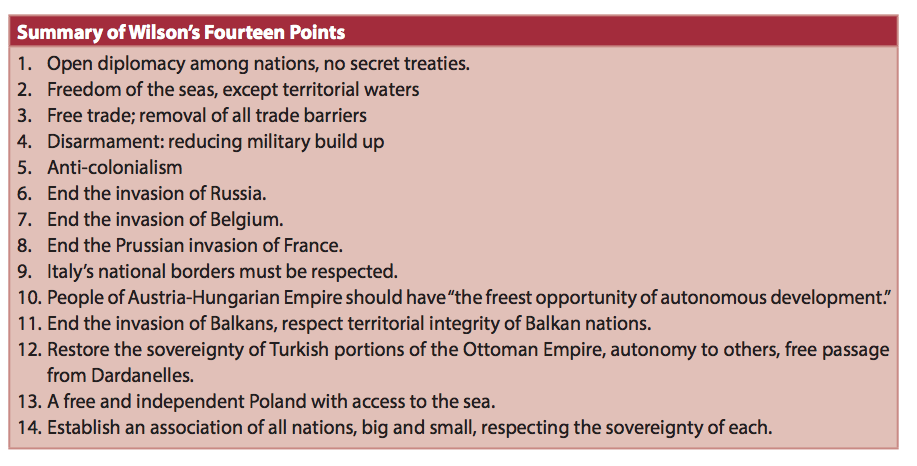
Soru 47
Which of the following did the Long Telegram from a U.S. diplomat in Moscow sent on February 22 in 1946 symbolize in the US history?
Seçenekler
A
The Cold War
B
Reaganomics
C
Idealism
D
Expansionism
E
Monroe Doctrine
Açıklama:
The U.S. and the Soviet Union fought together against the fascist regimes of Europe during World War II. However, this collaboration did not last long and the post-WWII international system became polarized between two superpowers. The U.S. foreign policy decision makers increasingly began to consider the Soviet economic and political models as fundamentally adversarial to the American model. The Long Telegram from a U.S. diplomat in Moscow sent on February 22 in 1946 became the symbol of the Cold War grand strategy for the US.
Soru 48
- Less government involvement in economy and more goods, services, utilities, etc. provided by the private sector
- Privatization of previously government owned industries
- Deregulations of the markets, banking and finance sectors
- Elimination of capital controls, welcoming foreign investment
Seçenekler
A
I, II, III
B
I, II and IV
C
I, III and IV
D
II, III and IV
E
I, II, III and IV
Açıklama:
The Reagan Presidency also coincided with massive economic crisis in the developing world. Hyperinflation, foreign currency shortages and capital flight were common across the Global South. The Reagan administration and the international financial institutions such as the World Bank and the International Monetary Fund (IMF) pushed the countries struggling with economic crisis to make structural changes. These countries had to abandon their prior economic development models (import substation industrialization -ISI) and switch to the free market model. Also referred as neoliberalism, the new development model required: • Less government involvement in economy and more goods, services, utilities, etc. provided by the private sector • Privatization of previously government owned industries • Deregulations of the markets, banking and finance sectors • Floating exchange rates, convertibility • Elimination of capital controls, welcoming foreign investment
Soru 49
Which term refers to the US foreign policy adopted in late 1940s against the rising powers of the Soviet Union and tried to curb the expansion of the Soviet influence and socialism at military, political, economic and ideological levels?
Seçenekler
A
Containment
B
Satisficing
C
Unilateralism
D
Reaganomics
E
Idealism
Açıklama:
Containment: US foreign policy adopted in late 1940s against the rising powers of the Soviet Union. It tried to curb the expansion of the Soviet influence and socialism at military, political, economic and ideological levels.
Soru 50
Which of the following refers to the US foreign policy during Barack Obama's presidency?
Seçenekler
A
Unilateralism
B
Anti-Communism
C
Offshore balancing
D
Containment
E
Idealism
Açıklama:
Obama’s approach to the Syrian crisis and his efforts to decrease the military footprint of the United States make him more an advocate of offshore balancing than liberal interventionism. In an article published in Foreign Affairs, scholars Mearsheimer and Walt define offshore balancing as the quintessential realist paradigm. They make the case that this strategy best serves the long term U.S. national interests.
Soru 51
Which could be classified as the first official foreign policy doctrine of the United States?
Seçenekler
A
Monroe Doctrine
B
Roosevelt Corollary
C
Platt Amendment
D
Reaganomics
E
Expansionism
Açıklama:
Monroe Doctrine of 1823 could be classified as the first official foreign policy doctrine of the United States. It was articulated by President James Monroe during the 7th State of the Union address to the Senate and the House. In his long speech, the president carefully makes the case that the U.S. does pay attention to the conflicts in Europe, because they share the same origins, but does not pick sides
Soru 52
Where were the effects of Manifest Destiny most dramatically observed?
Seçenekler
A
Latin America
B
Asia
C
Middle East
D
Europe
E
Africa
Açıklama:
The effects of Manifest Destiny were probably most dramatically observed across Latin America. After its independence from Spain, Mexico was embroiled in civil wars and infighting among numerous generals who wanted to be the President. The weakness of central authority and divisions within the military created a power vacuum in Mexico. Territories in the north, particularly Texas, took advantage of this, and decided to secede and go their own way. In 1836, Texas separated from Mexico and declared itself as an independent Republic. However, the ultimate goal was to join the United States as a new state, which they did in 1845.
Soru 53
Which of the following placed a clause in the constitution of the newly independent island nation of Cuba and essentially granted guardianship of the US over Cuba in 1890s?
Seçenekler
A
The Platt Amendment
B
The Roosevelt Corollary
C
The Manifest Destiny
D
The Truman Doctrine
E
The Monroe Doctrine
Açıklama:
Towards the end of 1800s (in 1890s), the expansionism of the U.S. became even more visible. The new generation of political leaders were more eager to exercise power not just at home, but also abroad. During this period, the U.S. took control of several Spanish colonies: Cuba, Puerto Rico and the Philippines. In the case of Cuba, the U.S. allegedly helped the Cubans to declare their independence from Spain. However, the Americans placed a clause in the constitution of the newly independent island nation that essentially granted guardianship of the US over Cuba. The Platt Amendment had the following provisions: “That the government of Cuba consents that the United States may exercise the right to intervene for the preservation of Cuban independence, the maintenance of a government adequate for the protection of life, property, and individual liberty, and for discharging the obligations with respect to Cuba imposed by the treaty of Paris on the United States, now to be assumed and undertaken by the government of Cuba.”
Soru 54
Which American president was a strong advocate of US expansionism and interventionism in the early 20th century?
Seçenekler
A
Theodore Roosevelt
B
Woodrow Wilson
C
George H. W. Bush
D
Bill Clinton
E
Harry S. Truman
Açıklama:
President Theodore Roosevelt, who served for two terms from 1901 to 1909, was a strong advocate of US expansionism. He was a naval commander before his presidency. When he got elected to the White House, he made sure the U.S. military presence was felt across the world.
Soru 55
Which US president advocated US assertiveness and engagement through diplomacy instead of interventionism in the 20th century?
Seçenekler
A
Theodore Roosevelt
B
Woodrow Wilson
C
Harry S. Truman
D
Ronald Reagan
E
Bill Clinton
Açıklama:
While President Theodore Roosevelt (Republican) envisioned a more assertive U.S. role in the world by serving as the global police, President Wilson (Democrat) had expressed U.S. assertiveness with very different methods. Wilson also advocated for greater U.S. engagement in the world. However, his preferred foreign policy tool was diplomacy. Many presidential historians refer to his childhood as the son of a Presbyterian minister. His upbringing could have played some role on how morality became a driving force for President Wilson’s foreign policy agenda.
Soru 56
- Open diplomacy among nations and no secret treaties
- Freedom of the seas except territorial waters
- Free trade and removal of all trade barriers
- Disarmament and reducing military build up
Seçenekler
A
I, II and III
B
I, II and IV
C
I, III and IV
D
II, III and IV
E
I, II, III and IV
Açıklama:
Summary of Wilson’s Fourteen Points 1. Open diplomacy among nations, no secret treaties. 2. Freedom of the seas, except territorial waters 3. Free trade; removal of all trade barriers 4. Disarmament: reducing military build up 5. Anti-colonialism 6. End the invasion of Russia. 7. End the invasion of Belgium. 8. End the Prussian invasion of France. 9. Italy’s national borders must be respected. 10. People of Austria-Hungarian Empire should have “the freest opportunity of autonomous development.” 11. End the invasion of Balkans, respect territorial integrity of Balkan nations. 12. Restore the sovereignty of Turkish portions of the Ottoman Empire, autonomy to others, free passage from Dardanelles. 13. A free and independent Poland with access to the sea. 14. Establish an association of all nations, big and small, respecting the sovereignty of each.
Soru 57
Which US president requested funds from the Congress to provide military aid to Greece and Turkey and send U.S. military staff and equipment to the region in 1947?
Seçenekler
A
Woodrow Wilson
B
Harry Truman
C
Bill Clinton
D
Theodore Roosevelt
E
Abraham Lincoln
Açıklama:
In his Long Telegram, Kennan made a disease analogy. He argued that “world communism is like a malignant parasite which feeds only on diseased tissue.” He was making the case that it was not sufficient for the U.S. to have a strong capitalist regime at home. Other nations that do not have similarly strong processes could easily be influenced by the Soviet model. Soon after the Long Telegram came the historic speech of President Truman at the Congress on March 12, 1947. In this speech, the U.S. President made the case that the British influence was weakening in the Eastern Mediterranean, and the U.S. foreign policy should be reoriented to fill that vacuum. He requested funds from the Congress to provide military aid to Greece and Turkey and send U.S. military staff and equipment to the region. In his speech, he insisted on supporting “free peoples” against the pressures of the “totalitarian regimes.”
Soru 58
Which of the doctrines below fueled decisions to go to war in Korea and Vietnam?
Seçenekler
A
Containment
B
Idealism
C
Expansionism
D
Interventionism
E
Unilateralism
Açıklama:
Containment doctrine also fueled decisions to go to war in Korea and Vietnam. As seen in the chart above, the bi-polar distribution of power made every nation, big or small, critical to maintain the systemic equilibrium. Consequently, anytime countries in the U.S. alliance camp, such as Turkey or Chile, elected left leaning governments, it was perceived as an existential threat for the U.S. that could potentially tilt the balance in favor of the Soviets.
Soru 59
Compared to the previous presidents of the Containment era, which US president expressed a more vocal anti-Soviet, and anti-communist stance?
Seçenekler
A
Ronald Reagan
B
Harry Truman
C
Woodrow Wilson
D
Bill Clinton
E
Barack Obama
Açıklama:
Compared to the previous presidents of the Containment era, President Reagan expressed a more vocal anti-Soviet, and anti-communist stance. As a successful public speaker, he frequently expressed harsher criticisms of the Soviet model. The 1980s was also the decade of Soviet invasion of Afghanistan. The Reagan Doctrine allowed the U.S. to provide military assistance to irregular armed forces that were allegedly combating communism
Soru 60
Which US president was the architect of the democratic enlargement doctrine?
Seçenekler
A
Bill Clinton
B
Barack Obama
C
Ronald Reagan
D
George W. Bush
E
Harry Truman
Açıklama:
President Clinton and his national security advisor Anthony Lake were the architects of the foreign policy doctrine that came to be known as “democratic enlargement.” Antony Lake had a long and accomplished career, by the time he became the right hand of President Clinton in foreign policy matters
Soru 61
Scholars like Cecil Crabb have often criticized what features of the American foreign policy doctrine?
Seçenekler
A
Being too inflexible and vague
B
Being too vague and ambiguous
C
Being too uncertain and inflexible
D
Being too complicated and officious
E
Being too aggressive and officious
Açıklama:
Scholars such as Cecil Crabb often criticize the US foreign policy doctrines for being too vague and ambiguous. The correct answer is B
Soru 62
Which of the following is the ideological perspective that the United States proposed to establish a new order in the international arena after World War II and to ensure international cooperation in all areas?
Seçenekler
A
Rationalism
B
Neo-realism
C
Realism
D
Neoliberal institutionalism
E
Raison D'etre
Açıklama:
neoliberal institutionalism might play an important role, as seen immediately after the World War II, when the US was eager to build multiple global institutions to facilitate
collaboration and collective security arrangements. The correct answer is D
collaboration and collective security arrangements. The correct answer is D
Soru 63
Which of the statements given below is not correct?
Seçenekler
A
In the early 1800s, Latin America was still colonized by the Spanish and the Portuguese empires
B
The independence of the United States from Great Britain, and subsequent political regime created in the north appealed to the nationalists in Southeast Asia between 1810 and 1820
C
Latin American nations ooked up to the US as a model for basic political institutions. Instead of adopting the Continental model of parliamentary regimes
D
Many Latin American nations opted for the US model of presidential system, with a bicameral Congress and a Supreme Court
E
North American distaste for the European powers, and efforts to exclude Europe from the Americas earned significant sympathy across the Latin America
Açıklama:
The independence of the United States from Great Britain, and subsequent political regime created in the north appealed to the nationalists in Latin America. Between 1810 and 1820. The correct answer is B
Soru 64
In which of the following options is the first official foreign policy doctrine of the USA given?
Seçenekler
A
Monroe Doctrine
B
Truman Doctrine
C
Guam Doctrine
D
Eisenhower Doctrine
E
Carter Doctrine
Açıklama:
Monroe Doctrine of 1823 could be classified as the first official foreign policy doctrine of the United States. The correct answer is A
Soru 65
Which of the following is not a feature of Woodrow Wilson's foreign policy understanding?
Seçenekler
A
He is considered an idealist president, for having his moral values direct his foreign policy agenda
B
He valued peace, prosperity and democracy in the world
C
His diplomatic propositions turned out to be unappealing both at home and abroad
D
He wanted to promote international law and institutions to facilitate these goals
E
His proposed international system condemned military aggression and colonialism,
and called for armament of all nation
and called for armament of all nation
Açıklama:
His proposed international system condemned military aggression and colonialism,
and called for not armament of all nation. He wanted to disarmament of all nation. The correct answer is E
and called for not armament of all nation. He wanted to disarmament of all nation. The correct answer is E
Soru 66
Who is the American diplomat who likens world communism to a malignant parasite and is the symbol name of the beginning of the Cold War?
Seçenekler
A
Dwight Eisenhover
B
Harry Truman
C
George Kennan
D
Woodrow Wilson
E
Henry Kissinger
Açıklama:
In his Long Telegram, Kennan made a disease analogy. He argued that "world communism is like a malignant parasite which feeds only on diseased tissue." The correct answer is C
Soru 67
Which of the following is not one of the features of the neoliberal economyimplemented during Ronald Reagan's presidency as a requirement of the new economic model?
Seçenekler
A
Privatization of previously government owned industries
B
Elimination of capital controls, welcoming foreign investment
C
Floating exchange rates, convertibility
D
More government involvement in economy and more goods, services, utilities, provided by the private sector
E
Deregulations of the markets, banking and finance sectors
Açıklama:
More government involvement in economy and more goods, services, utilities, provided by the private sector. It should have stated less goverment in economy. That's way the correct answer is D
Soru 68
Which of the following US presidents has not been a practitioner of post-cold war foreign policy?
Seçenekler
A
George W. Bush
B
Ronald Reagan
C
Barack Obama
D
Bill Clinton
E
Donald Trump
Açıklama:
This section covers the Post-Cold War foreign policy doctrines during the presidencies of Bill Clinton, George W. Bush, Barack Obama and Donald Trump. The correct answer is B
Soru 69
Who were the the architects of the foreign policy doctrine that came to be known as "democratic enlargement" ?
Seçenekler
A
George.W.Bush-Condoleezza Rice
B
Donald Trump-Mike Pompeo
C
Bill Clinton-Anthony Lake
D
Barack Obama-Susan Rice
E
Barack Obama-Hillary Clinton
Açıklama:
President Clinton and his national security advisor Anthony Lake were the architects of the foreign policy doctrine that came to be known as "democratic enlargement". The correct answer is C
Soru 70
Which of the events that took place in the chronology of American diplomacy below is wrong?
Seçenekler
A
1979-89 Soviet invasion of Afghanistan
B
1989 Cuban Missile Crisis: Soviet attempt to place nuclear warheads in Cuba
C
1973 Paris Peace Accords, the end of Vietnam War
D
1959 Cuban Revolution: Fidel Castro topples the pro-US Batista regime
E
1944 Bretton Woods conference in New Hampshire: World Bank and International Monetary Fund (IMF) created
Açıklama:
1962 Cuban Missile Crisis: Soviet attempt to place nuclear warheads in Cuba. The correct answer is B
Soru 71
Which of the following Latin American country below lost nearly half of its territory to the United States?
Seçenekler
A
Argentina
B
Mexico
C
Chile
D
Brasil
E
Peru
Açıklama:
The correct answer is B
Ünite 4
Soru 1
The combination of isolationism and ............ prevailing at the time is best justified by John Quincy Adams.
Fill in the blank.
Fill in the blank.
Seçenekler
A
Internationalism
B
Neutrality
C
Realpolitik
D
Moralpolitik
E
Wilsonianism
Açıklama:
The combination of isolationism and Moralpolitik prevailing at the time is best justified by John Quincy Adams, then Secretary of State, in his 4th July 1821 address: “ Wherever the standard of freedom and independence has been or shall be unfurled, there will be America’s heart, her benediction, and her prayers. But she goes not abroad in search of monsters to destroy. She is the well-wisher to the freedom and independence of all. She is the champion and vindicator only of her own…She well knows that by once enlisting under other banners than her own, were they even the banners of foreign independence, she would involve herself …in all the wars of interest and intrigue, of …envy and ambition…She might become the dictatress of the world. She would no longer be the ruler of her own spirit..”
Soru 2
In which president era did United States replace Great Britain as the world's greatest power?
Seçenekler
A
George Washington
B
Thomas Jefferson
C
William Mc Kinley
D
Theodore Roosvelt
E
Harry Truman
Açıklama:
Between 1897 and 1901, President William Mc Kinley ushered in the American Century, the era in which the United States replaced Great Britain as the world’s greatest power. "By the time he was reelected in 1901, he was heading a country that was the world’s economic leader and, by a historic shift at the turn of the century, a global military and diplomatic power".
Soru 3
Which president of US did receive the Nobel Peace Prize for he negotiated the end of Russo-Japanese War?
Seçenekler
A
Theodore Roosevelt
B
William Mc Kinley
C
William Howard
D
Woodrow Wilson
E
John Kennedy
Açıklama:
Concerned particularly with Latin America, the United States would, according to Roosevelt, “speak softly, but carry a big stick” and in the following years, would not only engineer a domestic uprising in northern Colombia, but after recognizing the Republic of Panama, sign a treaty to build and lease the Panama Canal, intervene militarily in the Dominican Republic, Haiti, Honduras, Nicaragua and other countries where internal social unrest threatened foreign investments and lives. Attaching an equal importance to the international balance of power, President Roosevelt negotiated the end of the Russo-Japanese War and received the Nobel Peace Prize in 1905.
Soru 4
Who is the last pre-World War I president?
Seçenekler
A
Benjamin Harrison
B
William Howard Taft
C
Theodore Roosevelt
D
Woodrow Wilson
E
Warren Harding
Açıklama:
The last pre-World War I president was William Howard Taft (1909-1913) He followed President Rossevelt’s policy of worldwide influence, albeit through different methods.
Soru 5
- The United States had direct stake in the outbreak of World War I
- The Industrial Revolution and its social impact, engendered, in turn, new doctrines such as socialism, communism and the ever carrier of all types of mass frustration, nationalism.
- Europe’s major nations had indeed grouped themselves into two main alliances opposed to each other -Central Powers, composed of Germany, Austria-Hungary, and Italy and the Triple Alliance of Great Britain, France, and Russia.
Seçenekler
A
Only I
B
Only II
C
I, II
D
II, III
E
I, II, III
Açıklama:
It is an obvious fact that the United States had no direct stake in the outbreak of World War I -also known in history as the Great War. Profound social changes in Europe brought about by a population explosion which began in the late 18th century, the Industrial Revolution and its social impact, engendered, in turn, new doctrines such as socialism, communism and the ever carrier of all types of mass frustration, nationalism. These factors culminated behind a number of existing intraEuropean rivalries -i.e. French-German conflict over Alsace-Lorraine, German-Russia competition over the Middle East, traditional Ottoman-Russia antagonism, Balkan nationalism towards AustroHungarian and Ottoman Empires, German-British rivalry over naval power etc.- turning the continent into a powder keg that a small spark could ignite. Against this background, technological advances leading to military developments and the growth of an interlocking system of alliances initiated by the German Chancellor Otto von Bismarck were to act as the catalysts leading to World War I (Stokesbury, 1981, 11-19). Europe’s major nations had indeed grouped themselves into two main alliances opposed to each other -Central Powers, composed of Germany, Austria-Hungary, and Italy and the Triple Alliance of Great Britain, France, and Russia.
Soru 6
Which president of US did come to power when World War I had begun?
Seçenekler
A
Woodrow Wilson
B
William Howard Taft
C
Franklin Roosevelt
D
Theodore Roosevelt
E
Harry Truman
Açıklama:
When on June 28, 1914, a Serbian nationalist named Gavrilo Princip assasinated Archduke Franz Ferdinand of Austria, heir to the Hapsburg throne, and his wife, visiting Sarajevo, the capital of Bosnia, no one imagined that it would trigger a chain of events drawing Europe into a world war and the United States into a new era in its foreign relations (Bagby, 1999, 18). A former Ottoman province, Bosnia had been annexed by Austria in 1909 and this had antagonized neighboring Serbia - also former Ottoman territory- that had hoped to annex it by itself, retaliating by promoting revolution among national minorities within the Austro-Hungarian Empire. Consequently, Austrians understandably suspected the Serbian government of conspiracy and decided to punish Serbia by invading it on July 28. Russian and French mobilization followed that with a view to defend Serbia, Germany’s declaration of war on them, Britain’s entry into war as part of the Allies, and finally Ottoman Turkey’s, on the side of the Central Powers. By August 1914, World War I had begun.
On August 4, 1914, President Woodrow Wilson (1913-1921), then much more interested in domestic than foreign affairs and largely endorsed by his people, declared that the United States would remain “impartial in thought as well as in action”.
On August 4, 1914, President Woodrow Wilson (1913-1921), then much more interested in domestic than foreign affairs and largely endorsed by his people, declared that the United States would remain “impartial in thought as well as in action”.
Soru 7
Which president did give the “Fourteen Points” speech?
Seçenekler
A
Woodrow Wilson
B
Theodore Roosevelt
C
Harry Truman
D
Richard Nixon
E
Calvin Coolidge
Açıklama:
As the war neared its end, President Wilson spelled out his vision of peace in a speech delivered on 8 January 1918 before Congress. Known as the “Fourteen Points” speech, it not only enumerated the conditions for bringing an end to hostilities, but it also included references to open diplomacy as opposed to secret treaties and alliances, as well as arms control and a new organization of nations to ensure the peace in the future, thus introducing the concept of collective security.
Soru 8
America’s inter-war and wartime, which president did inherit the Great Depression?
Seçenekler
A
Calvin Coolidge
B
Franklin D. Roosevelt
C
Woodrow Wilson
D
Harry Truman
E
John F. Kennedy
Açıklama:
America’s inter-war and wartime president Franklin D. Roosevelt (1933-1945) inherited the Great Depression, who was a Harvard graduate Democrat from a patrician family linked to the former President Theodore (Teddy) Roosevelt and himself appointed Assistant Secretary of the Navy twice by President Wilson.
Soru 9
As far as the US was concerned, the military & diplomatic developments in the history of World War II can be divided into three stages.
What is the correct order of these three stages?
What is the correct order of these three stages?
Seçenekler
A
Peripheral - active involvement - shaping the new world order
B
Shaping the new world order - peripheral - active involvement
C
Active involvement - peripheral - shaping the new world order
D
Active involvement - shaping the new world order - peripheral
E
Peripheral - shaping the new world order - active involvement
Açıklama:
As far as the US was concerned, the military & diplomatic developments in the history of World War II can be divided into three stages: from December 1941 to January 1943; from January 1943 to August 1944; and from then on to the end of the Pacific war in August 1945 (İriye, 2013, 193-217).
- The first phase can be labeled as “peripheral” as the American administration, rather than opening a second-front in Europe as suggested by its military, followed British PM Churchill’s advice in participating in the North African campaign to invade the French colonies of Morocco, Algeria and Tunisia -which remained under the authority of the Vichy régime, collaborating with the Germans.
- The second phase was one of “active involvement” for the US. Following the German defeat at Stalingrad in January 1943, the Allies proceeded to the invasion of Sicily and Italy and attacks of Japanese-occupied central Pacific islands.
- The third and last phase was aimed at “shaping the new world order” as the Allies were gaining ground in all fronts of military combat, while at the same time they were negotiating the post-war world order.
Soru 10
When was Marshall Plan announced?
Seçenekler
A
1914
B
1921
C
1933
D
1947
E
1951
Açıklama:
After weeks of consultation with military and congressional leaders, President Truman made a momentous address to Congress on 12 March 1947, underlining the danger looming over the two countries and declaring in what would be known as the Truman Doctrine, that “ it must be the policy of the United States to support free peoples who are resisting attempted subjugation by armed minorities or by outside pressures” (americanrhetoric.com). A $ 400 million package of military and economic aid to both countries was proposed by the President and voted by Congress that day. This is recognized as the definitive end of the politics of isolationism.
What would follow was the European Recovery Program, known as the Marshall Plan, announced by Secretary of State Marshall in a 5 June, 1947 speech at Harvard University to help ensure Europe’s survival, given its “economic, social, and political survival”. Over the four and a half years of the Marshall Plan, America gave more than 1 percent of its GDP in aid, a total of $13.5 billion by June 1952. England received $3.2 billion, France $2.7 billion, Italy $1.5 billion and Germany $1.4 billion. In the words of British Foreign Secretary Ernest Bevin, this was “generosity beyond belief” ( Bagby, 1999, 153), but also a visionary policy, since the two defeated powers of the Axis were also included in this massive geopolitical investment of the Cold War, leaving behind the scars of World War II.
What would follow was the European Recovery Program, known as the Marshall Plan, announced by Secretary of State Marshall in a 5 June, 1947 speech at Harvard University to help ensure Europe’s survival, given its “economic, social, and political survival”. Over the four and a half years of the Marshall Plan, America gave more than 1 percent of its GDP in aid, a total of $13.5 billion by June 1952. England received $3.2 billion, France $2.7 billion, Italy $1.5 billion and Germany $1.4 billion. In the words of British Foreign Secretary Ernest Bevin, this was “generosity beyond belief” ( Bagby, 1999, 153), but also a visionary policy, since the two defeated powers of the Axis were also included in this massive geopolitical investment of the Cold War, leaving behind the scars of World War II.
Soru 11
Who is the first president of U.S.?
Seçenekler
A
George Washington
B
Abraham Lincoln
C
Franklin D. Roosevelt
D
Harry S. Truman
E
Thomas Jefferson
Açıklama:
Americans had, throughout the 18th and 19th centuries, remained loyal to the political testament of their first president, George Washington.
Soru 12
Which of the following country is one of the Allied Powers in World War I?
Seçenekler
A
Germany
B
Austria-Hungary
C
Bulgaria
D
Ottoman Empire
E
Russia
Açıklama:
Central Powers, composed of Germany, Austria-Hungary, and Italy and the Triple Alliance of Great Britain, France, and Russia.
Soru 13
Which of the following member of the Central Powers in World War I?
Seçenekler
A
Germany
B
Japan
C
Great Britain
D
France
E
Russia
Açıklama:
Central Powers, composed of Germany, Austria-Hungary, and Italy and the Triple Alliance of Great Britain, France, and Russia.
Soru 14
Where did Archduke Franz Ferdinand of Austria is assasinated by a Serbian nationalist named Gavrilo Princip?
Seçenekler
A
Sarajevo
B
Bucharest
C
Belgrad
D
London
E
Paris
Açıklama:
When on June 28, 1914, a Serbian nationalist named Gavrilo Princip assasinated Archduke Franz Ferdinand of Austria, heir to the Hapsburg throne, and his wife, visiting Sarajevo, the capital of Bosnia.
Soru 15
Which of the following notion is related with American Neutrality at the beginning of World War I?
Seçenekler
A
Isolationism
B
Preemption
C
Containment
D
Deterrence
E
Liberalism
Açıklama:
On August 4, 1914, President Woodrow Wilson (1913-1921), then much more interested in domestic than foreign affairs and largely endorsed by his people, declared that the United States would remain “impartial in thought as well as in action”. That, however, meant political neutrality, while the United States eagerly continued its commercial activities with Europe despite the war, as an ultimate illustration of isolationism à la George Washington.
Soru 16
Who was the president of U.S. during the World War I?
Seçenekler
A
Abraham Lincoln
B
Theodore Roosevelt
C
Woodrow Wilson
D
Harry S. Truman
E
John F. Kennedy
Açıklama:
On August 4, 1914, President Woodrow Wilson (1913-1921), then much more interested in domestic than foreign affairs and largely endorsed by his people, declared that the United States would remain “impartial in thought as well as in action”.
Soru 17
- Austria-Hungary
- Bulgaria
- Turkey
- Germany
Seçenekler
A
I and II
B
I and III
C
I and IV
D
II and III
E
II and IV
Açıklama:
War was subsequently declared on Austria-Hungary but not on Bulgaria and Turkey.
Soru 18
Who did introduce the concept of collective security first as a system based on disarmament, selfdetermination and free navigation?
Seçenekler
A
John F. Kennedy
B
Harry S. Truman
C
Herbert Hoover
D
Theodore Roosevelt
E
Woodrow Wilson
Açıklama:
Yhe concept of collective security first introduced by Wilson as a system based on disarmament, selfdetermination and free navigation;
Soru 19
Which of the following is the worst economic downturn during inter-war period?
Seçenekler
A
Great Depression
B
The OPEC Oil Price Shock
C
The Asian Crisis
D
The Financial Crisis
E
The Credit Crisis
Açıklama:
All this would come to a halt with the Great Depression of 1929, the worst economic downturn in the history of the industrialized world, lasting until 1939.
Soru 20
Which of the following is one of the Axis Power?
Seçenekler
A
Japan
B
United States
C
Russia
D
Great Britain
E
France
Açıklama:
A rising international tension would follow all throughout the 1930s. In 1935, Italy invaded Ethiopia; in 1936, Hitler formed an alliance with Italy. Later Japan joined it, which createdthe “Berlin-Rome-Tokyo Axis “ against the Comintern.
Soru 21
Which US president believed that the US ought to be a great power rather than a messianic one?
Seçenekler
A
William McKinley
B
Theodore Roosevelt
C
William Howard Taft
D
Woodrow Wilson
E
Warren Harding
Açıklama:
Paradoxically, though, it was his vice president and then successor, Theodore Roosevelt (1901- 1909), who would be identified with American imperialism. The reason was Roosevelt’s explicit choice of Realpolitik over Moralpolitik. He indeed believed that the United States ought to be a great power rather than a messianic one. Skeptical about international law and the newly emerging concept of disarmament, he developed what came to be known as the “Roosevelt Corollary” to the Monroe Doctrine, proclaiming the right of the United States to intervene in the Western Hemisphere, against the interference of outside - meaning European colonial- powers as well as to protect US interests.
Soru 22
Following the assassination of Archduke Franz Ferdinand of Austria, which country did Austria invade?
Seçenekler
A
Serbia
B
Italy
C
France
D
Ottoman Empire
E
Bosnia
Açıklama:
When on June 28, 1914, a Serbian nationalist named Gavrilo Princip assasinated Archduke Franz Ferdinand of Austria, heir to the Hapsburg throne, and his wife, visiting Sarajevo, the capital of Bosnia, no one imagined that it would trigger a chain of events drawing Europe into a world war and the United States into a new era in its foreign relations (Bagby, 1999, 18). A former Ottoman province, Bosnia had been annexed by Austria in 1909 and this had antagonized neighboring Serbia - also former Ottoman territory- that had hoped to annex it by itself, retaliating by promoting revolution among national minorities within the Austro-Hungarian Empire. Consequently, Austrians understandably suspected the Serbian government of conspiracy and decided to punish Serbia by invading it on July 28. Russian and French mobilization followed that with a view to defend Serbia, Germany’s declaration of war on them, Britain's entry into war as part of the Allies, and finally Ottoman Turkey’s, on the side of the Central Powers. By August 1914, World War I had begun.
Soru 23
Although the US wanted to remain neutral in World War I and continue its trade with European countries, which country blockaded German coasts by 1915, ending by forbidding that “neutral” goods reach Germany through neutral ports -a practice called “continuous voyages”?
Seçenekler
A
Great Britain
B
France
C
Russia
D
Italy
E
Spain
Açıklama:
Determined to stop shipments from the United States to Germany, Great Britain blockaded German coasts by 1915, ending by forbidding that “neutral” goods reach Germany through neutral ports -a practice called “continuous voyages”. This led to a dispute between Great Britain and the US, which could have led to a grave crisis in other circumstances (İriye, 2013, 24). But Germany’s reaction to British policy and superiority at sea would be radical as the German navy began sinking enemy warships and other categories of vessels by means of submarines - or U-boats as they were called.
Soru 24
Which is NOT one of the reasons for the US's entry into WW1?
Seçenekler
A
German submarine warfare.
B
Deep sympathy for the Allies.
C
Growing economic ties with the Allies.
D
Preventing Germany from destroying the balance of power in Europe.
E
Insuring world peace.
Açıklama:
Historians agree that German submarine warfare and idealism set aside, entry into war was as much due to the deep sympathy for the Allies and growing economic ties with them, as the interest of the United States in preventing Germany - Europe’s second most populous nation and greatest industrial force - from destroying the balance of power in Europe and expanding further. Besides, there was growing conviction among America’s intellectuals and leaders that the country should play a role in international affairs and that it was time to abandon selfish isolationism. In that sense, World War I can be considered a major turning point in the country’s foreign policy history and tradition.
Soru 25
Which victorious country was not invited to The Paris Peace Conference for negotiations?
Seçenekler
A
Great Britain
B
France
C
Italy
D
The US
E
The Soviet Union
Açıklama:
The Paris Peace Conference was convened on January 18, 1919, and during five months the leaders of the victorious nations discussed the peace terms to be reached with Germany as well as other territorial arrangements in Europe and the post-war world order. Among the representatives of 27 nations who participated were the leaders of major powers such as Great Britain ( David Lloyd George), France (Georges Clémenceau), Italy ( Vittorio Orlando ), the United States (Woodrow Wilson), as well as Japan, and China. The Soviet Union, having already signed a separate peace treaty with the Central Powers in 1918, was not invited, nor were the defeated powers.
Soru 26
In the Washington Naval Conference, which five countries agreed to suspend construction of large naval vessels and to limit the size of aircraft carriers?
Seçenekler
A
The US - Great Britain - France - Italy - Japan
B
The US - Great Britain - Turkey - Italy - Japan
C
The US - Great Britain - Turkey - Germany - Japan
D
The US - Great Britain - France - China - Japan
E
The US - Germany - France - Italy - Russia
Açıklama:
International disarmament became an important objective for the United States throughout the 1920s. It all started with President Harding who convened the Washington Naval Conference in 1921 and 1922 which the foreign ministers of Great Britain, France, Italy, and Japan attended. They all agreed to suspend the construction of large naval vessels and to limit the size of aircraft carriers. In addition, they agreed on a complex balance of naval power by which the size of the five navies would be fixed and strictly regulated.
Soru 27
By the time the Great Depression reached its lowest point, how many Americans had lost their jobs?
Seçenekler
A
5 million
B
8 million
C
10 million
D
12 million
E
15 million
Açıklama:
All this would come to a halt with the Great Depression of 1929, the worst economic downturn in the history of the industrialized world, lasting until 1939. It began after the stock market crash of October 1929, which sent Wall Street into a panic and wiped out millions of investors. By 1933, when the Great Depression reached its lowest point, some 15 million Americans were unemployed and nearly half the country’s banks had failed.
Soru 28
The passage of which Act marked the beginning of a congressional shift away from isolationism in the US?
Seçenekler
A
The 1935 Neutrality Act
B
The 1936 Neutrality Act
C
The 1937 Neutrality Act
D
The 1938 Neutrality Act
E
The 1939 Neutrality Act
Açıklama:
The clearest expression of antiwar sentiment was the enactment of three Neutrality Acts passed between August 1935 and May 1937. By this, Congress made it illegal, in the event of a war abroad, for any US ship to enter the war zone or for any American to sell arms to a belligerent, travel on its ships, or lend it money. However, after Germany invaded Poland on 1 September 1939 and Britain and France responded by declaring war, Congress passed the Neutrality Act of 1939 ending the munitions embargo on a “cash and carry” basis. The passage of the 1939 Neutrality Act marked the beginning of a congressional shift away from isolationism.
Soru 29
When did FDR order that the positions of German submarines be reported to the British navy?
Seçenekler
A
March 1941
B
May 1941
C
July 1941
D
September 1941
E
November 1941
Açıklama:
FDR ordered in September 1941 that the positions of German submarines be reported to the British navy. This, in turn, triggered the torpedoing by the Germans of an American destroyer, the Greer, which was signaling the location of a German submarine. The response was a presidential order to the US Navy to sink any German or Italian submarine on sight. That meant being practically at war.
Soru 30
Why did President Truman decide to drop the atomic bombs on Japan?
Seçenekler
A
He was willing to end the war quickly.
B
Japan didn't seem like giving up.
C
He wanted to try the bombs.
D
He didn't think the effects would be so dramatic.
E
He liked the barbarity of the war.
Açıklama:
When he became president, Truman knew nothing about the Manhattan Project. Once informed, he set up an advisory committee chaired by Secretary of War Henry Stimson and which recommended the bomb’s deployment against Japan as soon as it would be available. Once it was successfully tested in the New Mexico desert in July 1945, the top scientists involved in the project and who had pleaded with President Roosevelt to build an atomic bomb, opposed the committee’s recommendation on humanitarian grounds, joined by a handful of civilian and military officials who argued that Japan was about to collapse anyway. But President Truman held firm, willing to end the war quickly, worried about the fierce Japanese resistance on Iwo Jima and Okinawa, and fearing a bloodbath in case of a full-scale invasion of the Japanese islands. On August 6, 1945, planes from the 59th Composite Group dropped the first uranium bomb (known as “Little Boy”) on the city of Hiroshima, killing an estimated 140,000 people. As Japan did not immediately surrender, a plutonium bomb (this one nicknamed “Fat Man”) was dropped on Nagasaki three days later, killing 70,000 more. Japan capitulated on August 12.
Soru 31
Which of the following is CORRECT?
I.Americans had, throughout the 18th and 19th centuries, remained loyal to the political testament of their first president, George Washington.
II. Surrounded by unthreatening neighbors, the American continent was isolated and self-sufficient.
III. Washington's Farewell Address was the political conceptualization of the physical and geopolitical isolation that characterized the young republic.
I.Americans had, throughout the 18th and 19th centuries, remained loyal to the political testament of their first president, George Washington.
II. Surrounded by unthreatening neighbors, the American continent was isolated and self-sufficient.
III. Washington's Farewell Address was the political conceptualization of the physical and geopolitical isolation that characterized the young republic.
Seçenekler
A
I and II
B
I and III
C
II and III
D
I. II, III
E
Only II
Açıklama:
All of the items given are correct.
Soru 32
Which of the following is CORRECT about American neutrality during World War I?
I. On August 4, 1914, President Woodrow Wilson declared that the United States would intervene in thought and action.
II. The United States eagerly continued its commercial activities with Europe despite the war.
III. The political isolationism/economic engagement pattern set earlier by the Founding Fathers was invalid.
I. On August 4, 1914, President Woodrow Wilson declared that the United States would intervene in thought and action.
II. The United States eagerly continued its commercial activities with Europe despite the war.
III. The political isolationism/economic engagement pattern set earlier by the Founding Fathers was invalid.
Seçenekler
A
Only I
B
Only II
C
I and II
D
I and III
E
I, II, III
Açıklama:
On August 4, 1914, President Woodrow Wilson (1913-1921), then much more interested in domestic than foreign affairs and largely endorsed by his people, declared that the United States would remain “impartial in thought as well as in action”. That, however, meant political neutrality, while the United States eagerly continued its commercial activities with Europe despite the war, as an ultimate illustration of isolationism à la George Washington. The political isolationism/economic engagementpattern set earlier by the Founding Fathers was thus very much alive.
Soru 33
Which of the following is NOT CORRECT about America at World War I?
Seçenekler
A
Entry into war was solely based on the deep sympathy for the Allies and growing economic ties with them.
B
There was growing conviction among America’s intellectuals and leaders that the country should play a role in international affairs.
C
World War I can be considered a major turning point in the country’s foreign policy history and tradition.
D
The United States did not sign a formal treaty alliance with Allies but remained an “associated power.”
E
The war was subsequently declared on Austria-Hungary but not on Bulgaria and Turkey.
Açıklama:
Historians agree that German submarine warfare and idealism set aside, entry into war was as much due to the deep sympathy for the Allies and growing economic ties with them, as the interest of the United States in preventing Germany - Europe’s second most populous nation and greatest industrial force - from destroying the balance of power in Europe and expanding further.
Soru 34
Which of the following is CORRECT?
I.Versailles Peace Treaty would plant the seeds of a deep crisis in Germany and ultimately lead to the Second World War.
II.The Soviet Union, having already signed a separate peace treaty with the Central Powers in 1918, was not invited to the Paris Peace Conference.
III.President Wilson himself was engaging his reputation directly by attending the conference.
I.Versailles Peace Treaty would plant the seeds of a deep crisis in Germany and ultimately lead to the Second World War.
II.The Soviet Union, having already signed a separate peace treaty with the Central Powers in 1918, was not invited to the Paris Peace Conference.
III.President Wilson himself was engaging his reputation directly by attending the conference.
Seçenekler
A
I and II
B
II and III
C
I and III
D
I, II, III
E
Only III
Açıklama:
All of the items given are correct.
Soru 35
Which of the following is CORRECT about the Inter-War Period?
I.International disarmament became an important objective for the United States throughout the 1920s.
II.The 1920s were marked by an intense economic expansion overseas.
III. The 1920s, were, paradoxically, a decade of isolationism.
I.International disarmament became an important objective for the United States throughout the 1920s.
II.The 1920s were marked by an intense economic expansion overseas.
III. The 1920s, were, paradoxically, a decade of isolationism.
Seçenekler
A
I and III
B
I and II
C
I and III
D
Only III
E
Only I
Açıklama:
Despite the apparent defeat of Wilsonianism and America’s resulting absence from the League of Nations which augured a return to hard-core isolationism, the 1920s, were, paradoxically, a decade of international engagement
Soru 36
Who launched New Deal?
Seçenekler
A
Thomas Jefferson
B
Woodrow Wilson
C
Franklin D. Roosevelt
D
Alexander Hamilton
E
Andrew Jackson
Açıklama:
The correct option is C. While the President tried to raise spirits by his eloquence and buoyant personality, he immediately undertook action. In what was called the First Hundred Days, no less than fourteen presidential messages were issued, fourteen historic laws promulgated, and a hundred days later, the New Deal was launched
Soru 37
Which of the following bombed and sank a US gunboat in 1937?
Seçenekler
A
Germany
B
China
C
Russia
D
Japan
E
Korea
Açıklama:
The US joined the League in condemning Japan for violating the Nine-Power Treaty and the Paris Peace Pact. The Japanese response was, in December 1937, the bombing and sinking of a US gunboat, the Panay, and three tankers it was escorting up the Chinese river of Yangtze to take aviation fuel to the Chinese.
Soru 38
Which of the following did involvement in WWII mean from the perspective of the US?
I.Becoming a 20th century global power.
II. The display, for the first time, of its military might across the Atlantic, the Pacific, North Africa and the Middle East simultaneously.
II.The avoidance of diplomacy in the construction of the post-war world order.
I.Becoming a 20th century global power.
II. The display, for the first time, of its military might across the Atlantic, the Pacific, North Africa and the Middle East simultaneously.
II.The avoidance of diplomacy in the construction of the post-war world order.
Seçenekler
A
I, II, III
B
I and III
C
II and III
D
Only II
E
I and II
Açıklama:
From the perspective of the United States, the involvement in World War II meant:
a. the display, for the first time, of its military might across the Atlantic, the Pacific, North Africa and the Middle East simultaneously, thus propelling it into becoming a 20th century global power;
b. the combination of conflict and diplomacy, since all throughout the war, it collaborated with the allies to construct the post-war world order that would come to be known as the American Century.
a. the display, for the first time, of its military might across the Atlantic, the Pacific, North Africa and the Middle East simultaneously, thus propelling it into becoming a 20th century global power;
b. the combination of conflict and diplomacy, since all throughout the war, it collaborated with the allies to construct the post-war world order that would come to be known as the American Century.
Soru 39
Which of the following led to the creation of the IMF and the World Bank?
Seçenekler
A
The Dumbarton Oaks Conference
B
Bretton Woods Conference
C
Cairo Conference
D
Yalta Conference
E
Tehran Conference
Açıklama:
Bretton Woods Conference in July envisaged the new international economic order in multilateral terms and led to the creation of the IMF and the World Bank.
Soru 40
Which of the following is CORRECT?
I. George F. Kennan advised an expansionist resistance in his "“Long Telegram.”
II.According to Truman doctrine, the United States was to support free peoples who are resisting attempted subjugation by armed minorities or by outside pressures.
III. With the Marshall Plan, financial aid was given to European countries to ensure European survival.
I. George F. Kennan advised an expansionist resistance in his "“Long Telegram.”
II.According to Truman doctrine, the United States was to support free peoples who are resisting attempted subjugation by armed minorities or by outside pressures.
III. With the Marshall Plan, financial aid was given to European countries to ensure European survival.
Seçenekler
A
I, II, III
B
Only I
C
I and II
D
I and III
E
II and III
Açıklama:
Kennan advised an anti-expansionist resistance hence to be known as “containment” rather than undertake a policy of confrontation.
Soru 41
"The period between 1914 and 1945 has been called by various historians 'the globalizing of America' revealing the long settling-down period of the pendular character of the U.S. foreign policy."
Which of the followings is another term to define this period of U.S. foreign policy?
Which of the followings is another term to define this period of U.S. foreign policy?
Seçenekler
A
Cold War.
B
The end of innocence.
C
The war to end all wars.
D
Gold rush.
E
Civil War.
Açıklama:
Page 77.
America’s involvement in the two world wars, including the surrounding pre-war, inter-war and post-war developments, constitutes the two most important episodes displaying these inherent contradictions that have since become a permanent feature in the conduct of US foreign policy. The period between, roughly, 1914- the beginning of World War I- and 1945 - the end of World War II- has therefore been called by various historians “ the globalizing of America”, “the end of innocence”, or “the times of reluctance”, thus revealing the long settling-down period of the pendular character of the country’s foreign policy. Therefore, the correct option is B.
America’s involvement in the two world wars, including the surrounding pre-war, inter-war and post-war developments, constitutes the two most important episodes displaying these inherent contradictions that have since become a permanent feature in the conduct of US foreign policy. The period between, roughly, 1914- the beginning of World War I- and 1945 - the end of World War II- has therefore been called by various historians “ the globalizing of America”, “the end of innocence”, or “the times of reluctance”, thus revealing the long settling-down period of the pendular character of the country’s foreign policy. Therefore, the correct option is B.
Soru 42
“The great rule of conduct for us in regard to foreign nations is in extending our commercial relations, to have with them as little political connection as possible." from 1796 Farewell Address to the nation.
Which of the followings is the principle which George Washington set for U.S. foreign policy in the early years of the republic?
Which of the followings is the principle which George Washington set for U.S. foreign policy in the early years of the republic?
Seçenekler
A
Imperialism.
B
Colonialism.
C
Capitalism.
D
Isolationism.
E
State secularism.
Açıklama:
Page 77.
Americans had, throughout the 18th and 19th centuries, remained loyal to the political testament of their first president, George Washington. In his 1796 Farewell Address to the nation, Washington said that “the great rule of conduct for us in regard to foreign nations is in extending our commercial relations, to have with them as little political connection as possible” (Avalon Law). This was the political conceptualization of the physical and geopolitical isolation that characterized the young republic. Surrounded by unthreatening neighbors in the North and the South (Canada and Mexico) and vast oceans in the East and the West (the Atlantic and the Pacific) the American continent was isolated and self-sufficient, endowed as it was with rich natural resources that allowed a rapid economic and industrial growth. Marking the period 1865-1912, the take-off of the US industrial complex transformed not only the nation’s society but also set the foundations of its foreign policy: the objectives of this generation of Americans was conquering overseas markets and acquiring a series of naval bases and island protectorates that could guard the routes to those markets and, if necessary, could provide the military forces to win conflicts that would /did erupt over those markets (Lafeber, 2013, Preface). This quest for markets, and source for raw materials was later termed as the quest for an “informal empire” (Mc Cormick, 1990, title) with an exclusively economic preoccupation and -unlike European colonialism- no direct geopolitical aim whatsoever. In short, American expansionism was commercial to begin with and therefore not in contradiction with George Washington’s political isolationism. Therefore, the correct option is D.
Americans had, throughout the 18th and 19th centuries, remained loyal to the political testament of their first president, George Washington. In his 1796 Farewell Address to the nation, Washington said that “the great rule of conduct for us in regard to foreign nations is in extending our commercial relations, to have with them as little political connection as possible” (Avalon Law). This was the political conceptualization of the physical and geopolitical isolation that characterized the young republic. Surrounded by unthreatening neighbors in the North and the South (Canada and Mexico) and vast oceans in the East and the West (the Atlantic and the Pacific) the American continent was isolated and self-sufficient, endowed as it was with rich natural resources that allowed a rapid economic and industrial growth. Marking the period 1865-1912, the take-off of the US industrial complex transformed not only the nation’s society but also set the foundations of its foreign policy: the objectives of this generation of Americans was conquering overseas markets and acquiring a series of naval bases and island protectorates that could guard the routes to those markets and, if necessary, could provide the military forces to win conflicts that would /did erupt over those markets (Lafeber, 2013, Preface). This quest for markets, and source for raw materials was later termed as the quest for an “informal empire” (Mc Cormick, 1990, title) with an exclusively economic preoccupation and -unlike European colonialism- no direct geopolitical aim whatsoever. In short, American expansionism was commercial to begin with and therefore not in contradiction with George Washington’s political isolationism. Therefore, the correct option is D.
Soru 43
"Theodore Roosevelt (1901-1909) is identified with American imperialism due to his explicit choice of Realpolitik over Moralpolitik."
Which of the followings best explains Theodore Roosevelt's approach towards U.S. imperialism?
Which of the followings best explains Theodore Roosevelt's approach towards U.S. imperialism?
Seçenekler
A
U.S. should be a great power rather than a saviour.
B
U.S. should play an humanitarian role in the region.
C
U.S. should take hostile actions even against minute threats.
D
U.S. should employ soft power instead of military one at all costs.
E
U.S. should be involved in worldwide affairs to ensure peace.
Açıklama:
Page 78.
The United States had suddenly become a dominant force in the Caribbean and a Pacific, even Asian power, by inheriting Spanish dependencies. President William Mc Kinley, who had no such intention in the beginning, had built an empire in less than four years and initiated the American Century. Paradoxically, though, it was his vice president and then successor, Theodore Roosevelt (1901-1909), who would be identified with American imperialism. The reason was Roosevelt’s explicit choice of Realpolitik over Moralpolitik. He indeed believed that the United States ought to be a great power rather than a messianic one. Skeptical about international law and the newly emerging concept of disarmament, he developed what came to be known as the “Roosevelt Corollary” to the Monroe Doctrine, proclaiming the right of the United States to intervene in the Western Hemisphere, against the interference of outside - meaning European colonial- powers as well as to protect US interests. Therefore, the correct option is A.
The United States had suddenly become a dominant force in the Caribbean and a Pacific, even Asian power, by inheriting Spanish dependencies. President William Mc Kinley, who had no such intention in the beginning, had built an empire in less than four years and initiated the American Century. Paradoxically, though, it was his vice president and then successor, Theodore Roosevelt (1901-1909), who would be identified with American imperialism. The reason was Roosevelt’s explicit choice of Realpolitik over Moralpolitik. He indeed believed that the United States ought to be a great power rather than a messianic one. Skeptical about international law and the newly emerging concept of disarmament, he developed what came to be known as the “Roosevelt Corollary” to the Monroe Doctrine, proclaiming the right of the United States to intervene in the Western Hemisphere, against the interference of outside - meaning European colonial- powers as well as to protect US interests. Therefore, the correct option is A.
Soru 44
Which of the followings was the reason for U.S.A. to finally join World War I after a long period of neutrality and reluctance?
Seçenekler
A
British diplomacy constantly antagonising U.S.
B
Rising threat of the National Socialist German Workers' Party.
C
Three U.S. ships sunk by Germans in March 1917.
D
Ottoman empires's entering the war alongside Germany.
E
The fall of Tsarist Russia.
Açıklama:
Page 81.
Introduced by a remarkable speech delivered by the President on January 22, 1917, known as his “peace without victory” speech where he proclaimed it would be better if neither side won as this would inevitably produce an unjust peace, the year 1917 brought about fundamental changes. Immediately after, Germany resumed its submarine warfare with a view to sink all ships in the designated war zone, while on February 25, the British gave Wilson an intercepted note from the German Foreign Secretary, Arthur Zimmermann, addressed to the German ambassador in Mexico with a view to seek an alliance with that country against the United States, promising it to help recover territory previously conquered by the latter. Between March 16 and March 18, the Germans sank three US ships, with the loss of 15 lives. On March 20, 2017, the cabinet approved President Wilson’s decision to go to war. Therefore, the correct option is C.
Introduced by a remarkable speech delivered by the President on January 22, 1917, known as his “peace without victory” speech where he proclaimed it would be better if neither side won as this would inevitably produce an unjust peace, the year 1917 brought about fundamental changes. Immediately after, Germany resumed its submarine warfare with a view to sink all ships in the designated war zone, while on February 25, the British gave Wilson an intercepted note from the German Foreign Secretary, Arthur Zimmermann, addressed to the German ambassador in Mexico with a view to seek an alliance with that country against the United States, promising it to help recover territory previously conquered by the latter. Between March 16 and March 18, the Germans sank three US ships, with the loss of 15 lives. On March 20, 2017, the cabinet approved President Wilson’s decision to go to war. Therefore, the correct option is C.
Soru 45
"The U.S. Senate adopted a joint resolution declaring war on Germany by an 82-6 vote on April 4."
Which of the followings is among the countries that U.S.A. declared war on by declaring war on Germany in World War I?
Which of the followings is among the countries that U.S.A. declared war on by declaring war on Germany in World War I?
Seçenekler
A
Greece.
B
Austria-Hungary.
C
Ottoman Empire.
D
Bulgaria.
E
Macedonia.
Açıklama:
Page 81.
The Senate adopted a joint resolution declaring war on Germany by an 82-6 vote on April 4, and the House approved it two days later by a 373-50 vote. War was subsequently declared on Austria-Hungary but not on Bulgaria and Turkey. Therefore, the correct option is B.
The Senate adopted a joint resolution declaring war on Germany by an 82-6 vote on April 4, and the House approved it two days later by a 373-50 vote. War was subsequently declared on Austria-Hungary but not on Bulgaria and Turkey. Therefore, the correct option is B.
Soru 46
Which of the followings was the first antagonism between Wilsonian America and colonial Europe during Paris Peace Conference of 1919?
Seçenekler
A
Dardanelles.
B
Readjustment of Italian borders.
C
Alsace-Lorraine.
D
Territorial integrity of the Balkan states.
E
Self-determination.
Açıklama:
Page 84.
Besides the President, the American delegation included his special adviser Colonel House, Secretary of State Robert Lansing, General Tasker H. Bliss, 21 members of The Inquiry, and Henry White, a career diplomat who was the only Republican in the group as neither a member of the Republican-controlled Senate nor any prominent Republican was included. This was amply criticized in the United States as well as the fact that President Wilson himself was engaging his reputation directly by attending the conference, thus taking the risk of being implicated in the eventual failures of a peace treaty - a criticism not totally unfounded. The reasons lying behind the President’s decision included his desire of contributing personally to the new international order he had already sketched in the Fourteen Points and his fear that the victorious camp would care more for vindication over Germany than establishing a just peace, thus relegating the expectations of peace by people all over the world to a secondary concern (Clements, 1999, 197-198). Experience would show that his apprehension too was not unfounded and that the peace treaty would only partially reflect the principles laid out in the Fourteen Points. The first antagonism between Wilsonian America and colonial Europe manifested itself over the scope of self-determination: while Point V of XIV envisaged an equitable and human solution to colonial claims as Wilson’s wish was to place former colonies under the administration of small, neutral nations like Holland or Sweden and the supervision of the future international organization until their independence, major European powers objected to that. Therefore, the correct option is E.
Besides the President, the American delegation included his special adviser Colonel House, Secretary of State Robert Lansing, General Tasker H. Bliss, 21 members of The Inquiry, and Henry White, a career diplomat who was the only Republican in the group as neither a member of the Republican-controlled Senate nor any prominent Republican was included. This was amply criticized in the United States as well as the fact that President Wilson himself was engaging his reputation directly by attending the conference, thus taking the risk of being implicated in the eventual failures of a peace treaty - a criticism not totally unfounded. The reasons lying behind the President’s decision included his desire of contributing personally to the new international order he had already sketched in the Fourteen Points and his fear that the victorious camp would care more for vindication over Germany than establishing a just peace, thus relegating the expectations of peace by people all over the world to a secondary concern (Clements, 1999, 197-198). Experience would show that his apprehension too was not unfounded and that the peace treaty would only partially reflect the principles laid out in the Fourteen Points. The first antagonism between Wilsonian America and colonial Europe manifested itself over the scope of self-determination: while Point V of XIV envisaged an equitable and human solution to colonial claims as Wilson’s wish was to place former colonies under the administration of small, neutral nations like Holland or Sweden and the supervision of the future international organization until their independence, major European powers objected to that. Therefore, the correct option is E.
Soru 47
Following World War I, which of the followings became an important objective for the United States throughout the 1920s?
Seçenekler
A
Reparations.
B
Self-determination.
C
International disarmament.
D
Adjustment of all colonial claims.
E
Freedom of navigation upon the seas.
Açıklama:
Page 86.
International disarmament became an important objective for the United States throughout the 1920s. It all started with President Harding who convened the Washington Naval Conference in 1921 and 1922 which the foreign ministers of Great Britain, France, Italy, and Japan attended. They all agreed to suspend construction of large naval vessels and to limit the size of aircraft carriers. Therefore, the correct option is C.
International disarmament became an important objective for the United States throughout the 1920s. It all started with President Harding who convened the Washington Naval Conference in 1921 and 1922 which the foreign ministers of Great Britain, France, Italy, and Japan attended. They all agreed to suspend construction of large naval vessels and to limit the size of aircraft carriers. Therefore, the correct option is C.
Soru 48
Which of the followings was the most important development after World War I to result in rise of fascism in Germany?
Seçenekler
A
The Great Depression.
B
Founding of the League of Nations.
C
Post-war discontent.
D
Disarmament.
E
Black Thursday.
Açıklama:
Page 87.
It is true that the resulting rise of fascism -and communism- in the Old World cannot be attributed exclusively to the effects of the Great Depression as these were pre-existing movements exacerbated by post-war discontent, high inflation and unemployment caused by heavy reparations in the case of Germany, and reactions against the uncertainty caused by liberal internationalism. Seizing power either by way of popular elections (as in Nazi Germany) or violent revolution (as in Bolshevik Russia), both right and left totalitarianisms were mobilized against the theory and praxis of liberalism, erecting the State as the key institutional apparatus and imposing undiluted nationalism as ideology, with class or race as the defining terms of their respective struggles. Therefore, the correct option is C.
It is true that the resulting rise of fascism -and communism- in the Old World cannot be attributed exclusively to the effects of the Great Depression as these were pre-existing movements exacerbated by post-war discontent, high inflation and unemployment caused by heavy reparations in the case of Germany, and reactions against the uncertainty caused by liberal internationalism. Seizing power either by way of popular elections (as in Nazi Germany) or violent revolution (as in Bolshevik Russia), both right and left totalitarianisms were mobilized against the theory and praxis of liberalism, erecting the State as the key institutional apparatus and imposing undiluted nationalism as ideology, with class or race as the defining terms of their respective struggles. Therefore, the correct option is C.
Soru 49
Which of the followings was the most important difference of Franklin D. Roosevelt’s New Deal from the traditional American political philosophy?
Seçenekler
A
Embracing a government-regulated economy.
B
Complete liberal economic practice.
C
Distancing from Washington's principle of isolationism.
D
Privatization of Federal Bank.
E
Absolute practice of laissez-faire.
Açıklama:
Page 88.
America’s inter-war and wartime president Franklin D. Roosevelt (1933-1945) inherited the Great Depression, who was a Harvard graduate Democrat from a patrician family linked to the former President Theodore (Teddy) Roosevelt and himself appointed Assistant Secretary of the Navy twice by President Wilson. At the time of his inauguration, national income had halved, the banking system had collapsed and unemployed people were standing in breadlines, with the most desperate ones committing suicide. While the President tried to raise spirits by his eloquence and buoyant personality, he immediately undertook action. In what was called the First Hundred Days, no less than fourteen presidential messages were issued, fourteen historic laws promulgated, and a hundred days later, the New Deal was launched (Leff in Brinkley and Dyer, 2004, 344-351). Opposed to the traditional American political philosophy of laissez-faire, the New Deal generally embraced the concept of a governmentregulated economy aimingat achieving a balance between conflicting economic interests. This was an experimental policy based on governmentdirected programs for creating jobs, reviving industrial activity, and guaranteeing minimum social security for the American people through various new federal agencies and social measures, while strengthening the labor unions. Therefore, the correct option is A.
America’s inter-war and wartime president Franklin D. Roosevelt (1933-1945) inherited the Great Depression, who was a Harvard graduate Democrat from a patrician family linked to the former President Theodore (Teddy) Roosevelt and himself appointed Assistant Secretary of the Navy twice by President Wilson. At the time of his inauguration, national income had halved, the banking system had collapsed and unemployed people were standing in breadlines, with the most desperate ones committing suicide. While the President tried to raise spirits by his eloquence and buoyant personality, he immediately undertook action. In what was called the First Hundred Days, no less than fourteen presidential messages were issued, fourteen historic laws promulgated, and a hundred days later, the New Deal was launched (Leff in Brinkley and Dyer, 2004, 344-351). Opposed to the traditional American political philosophy of laissez-faire, the New Deal generally embraced the concept of a governmentregulated economy aimingat achieving a balance between conflicting economic interests. This was an experimental policy based on governmentdirected programs for creating jobs, reviving industrial activity, and guaranteeing minimum social security for the American people through various new federal agencies and social measures, while strengthening the labor unions. Therefore, the correct option is A.
Soru 50
Which of the followings resulted in the end of U.S. neutrality and its entry in World War II?
Seçenekler
A
German Navy's hostility towards U.S. ships.
B
Invasion of France by Germany.
C
The Blitz.
D
The Manhattan Project.
E
The attack on Pearl Harbor.
Açıklama:
Page 89.
Suffice it to follow President Roosevelt’s itinerary between the mid-1930s and the attack on Pearl Harbor on 7 December 1941 which led to America’s entry in the war, to verify the accuracy of this diagnosis. FDR did not share the isolationist views of his people since the beginning of pre-war aggressions overseas. Therefore, the correct option is E.
Suffice it to follow President Roosevelt’s itinerary between the mid-1930s and the attack on Pearl Harbor on 7 December 1941 which led to America’s entry in the war, to verify the accuracy of this diagnosis. FDR did not share the isolationist views of his people since the beginning of pre-war aggressions overseas. Therefore, the correct option is E.
Ünite 5
Soru 1
Did the rise of which country as a major power undercut U.S. plans for a unipolar world based on free
trade and democracy?
trade and democracy?
Seçenekler
A
France
B
Germany
C
The Soviet Union
D
Iran
E
China
Açıklama:
The rise of the Soviet Union as a major power undercut U.S. plans for a unipolar world based on free
trade and democracy. Foreign policy became a binary choice between the Soviet bloc or America. The answer is C.
trade and democracy. Foreign policy became a binary choice between the Soviet bloc or America. The answer is C.
Soru 2
Against which countries did America and Great Britain join in common cause with the Soviet Union to defeat during the Second World War (1939-45)?
Seçenekler
A
Germany, Italy and Japan
B
Germany, Italy and France
C
Germany, France and China
D
Australia, Italy and Japan
E
Germany, Greece and Japan
Açıklama:
During the Second World War (1939-45), America and Great Britain joined in common cause with the Soviet Union to defeat the Axis Powers of fascist Germany, Italy and Japan. The answer is A.
Soru 3
Which of the following resulted with the outcome of World Bank and the IMF?
Seçenekler
A
Kirkpatrick Doctrine
B
Marshall Plan
C
Truman Doctrine
D
Bretton Woods
E
Reagan Doctrine
Açıklama:
In 1944, Britain and America established with the Bretton Woods conference three major goals: 1) make
funds available for postwar reconstruction and development; 2) to control the currency chaos that follows wars by making funds contingent upon sound monetary practices; 3) reduce or eliminate trade barriers. From Bretton Woods came the World Bank and the IMF. The president of the World Bank has traditionally been American, the managing director for the IMF, European. The answer is D.
funds available for postwar reconstruction and development; 2) to control the currency chaos that follows wars by making funds contingent upon sound monetary practices; 3) reduce or eliminate trade barriers. From Bretton Woods came the World Bank and the IMF. The president of the World Bank has traditionally been American, the managing director for the IMF, European. The answer is D.
Soru 4
During the the declaration of Vietnam’s independence, which of the following did Vietnamese leader Ho Chi Minh quote from?
Seçenekler
A
Charter of the United Nations
B
The Declaration of Independence of the United States of America
C
Universal Declaration of Human Rights
D
The Covenant of the League of Nations
E
The Declaration of Independence in Japan
Açıklama:
America had warm relations with the Vietnamese since the waning days of the Second World War. Ho Chi Minh’s partisans provided America with intelligence without pay (to the astonishment of the Americans)! Roosevelt for his part was hostile to a return of imperialism and openly complained that the French had done nothing for the Vietnamese in a hundred years of rule. Instead, he proposed an international trusteeship that would lead to eventual independence Vietnamese. This proposal was flatly
rejected by the French and British. When Ho took it upon himself to declare Vietnam’s independence, a band struck up the Star-Spangled Banner (Patti). Ho’s speech quoted liberally from America’s own Declaration of Independence: Compatriots of the entire nation assembled: “We hold truths that all men are created equal, they are endowed by their Creator with certain inalienable rights, among these are Life, Liberty, and the pursuit of Happiness.” This immortal statement is extracted from the Declaration of Independence of the United States of America in 1776. Understood in the broader sense, this means: “All the peoples on the earth are born equal; every person has the right to live to be happy and free.” The answer is B.
rejected by the French and British. When Ho took it upon himself to declare Vietnam’s independence, a band struck up the Star-Spangled Banner (Patti). Ho’s speech quoted liberally from America’s own Declaration of Independence: Compatriots of the entire nation assembled: “We hold truths that all men are created equal, they are endowed by their Creator with certain inalienable rights, among these are Life, Liberty, and the pursuit of Happiness.” This immortal statement is extracted from the Declaration of Independence of the United States of America in 1776. Understood in the broader sense, this means: “All the peoples on the earth are born equal; every person has the right to live to be happy and free.” The answer is B.
Soru 5
Which of the following argued that there was a fundamental difference between authoritarian government, and totalitarian -- authoritarian governments can eventually reform into democracies, totalitarian dictators cannot?
Seçenekler
A
Bretton Woods
B
Kirkpatrick Doctrine
C
Truman Doctrine
D
Nixon Doctrine
E
Reagan Doctrine
Açıklama:
Jean Kirkpatrick, President Ronald Reagan’s ambassador to the UN, argued there was a fundamental difference between authoritarian government (dictator on the right), and totalitarian (dictator on the left) -- authoritarian governments can eventually reform into democracies, totalitarian dictators cannot (the Kirkpatrick Doctrine). Moreover, authoritarian dictators have greater respect for private property and market forces. America placed a greater importance on private property than free elections. Nowhere are these principles more clearly demonstrated than America’s policies towards Latin America. The answer is B.
Soru 6
Which of the following became the first to successfully launch a satellite into orbit?
Seçenekler
A
China
B
The United States of America
C
The Soviet Union
D
France
E
Iran
Açıklama:
the Soviets became the first to successfully launch a satellite into orbit. Every 98 minutes Sputnik announced its presence overhead with a steady beep. Americans could well imagine a similar rocket carrying a nuclear warhead. The public, including John F. Kennedy, believed that the Soviets were “turning out missiles like sausages from a conveyor belt” (to quote Soviet premier, Nikita Khrushchev). Kennedy accused Eisenhower of failing to close the Missile Gap between the U.S. and USSR. The answer is C.
Soru 7
Was Middle East diplomacy marked by an irreconcilable relationship between whom?
Seçenekler
A
Arabs and Jews
B
Iran and the USA
C
Muslim and the Shi'a
D
Syria and Russia
E
The USA and the UK
Açıklama:
Middle East diplomacy was and is marked by an irreconcilable relationship between Arabs and Jews, originating from the search for a Jewish homeland in the late 19th century on Arab lands. The answer is A.
Soru 8
What is Jewish resettlement in Palestine called?
Seçenekler
A
New Look
B
Mutually Assured Destruction
C
Nasserism
D
Containment
E
Zionism
Açıklama:
The questions of Zionism (Jewish resettlement in Palestine) forced an intractable problem on first the Ottoman Empire, then the British, to which there were no good solutions. The answer is E.
Soru 9
The overthrow of the Egypt’s monarch in 1952 by a military officer represented to the United States the unleashing of a force beyond their control. What is the name of that movement?
Seçenekler
A
Containment
B
New Look
C
Nasserism
D
Zionism
E
Post-War Supremacy
Açıklama:
The overthrow of the Egypt’s monarch in 1952 by a military officer, Gamal Abdel Nasser represented to the United States the unleashing of a force beyond their control: Nasserism. This was the first successful national movement and it represented a third way, neither monarchical nor communist. Nasser reveled in this independent role. He purchased weapons from the Soviets. He recognized the Peoples Republic of China. isenhower complained how Nasser played “East against West by blackmailing both.” When Eisenhower cut aid to Egypt’s Aswan High Dam in 1956, Nasser nationalized the Suez Canal. Britain conspired with France and Israel to take it back by military force. The Israelis invaded the Sinai Peninsula. Eisenhower was furious that he was not consulted and that this action would further inflame nationalist sentiment. He, along with the Soviet Union, joined in the UN’s condemnation
of the attack on Egypt and the operation withered. Nasser immediately became a hero to the Arab world--a strike at imperialism and Zionism. The answer is C.
of the attack on Egypt and the operation withered. Nasser immediately became a hero to the Arab world--a strike at imperialism and Zionism. The answer is C.
Soru 10
Usually economic production stagnates, or an economy growing too rapidly leads to inflation. The 1970s experienced these two phenomena together. What is this situation called?
Seçenekler
A
Stagflation
B
Embargo
C
Détente
D
Reserve
E
Controversy
Açıklama:
Economic downturns had a major impact on American foreign policy during the 1970s, and so too for the Soviets during the 1980s. The oil crisis of 1973 contributed to the stagflationof the 1970s, which was particularly acute in the United States. Stagflation: Usually economic production stagnates, or an economy growing too rapidly leads to inflation. The 1970s experienced these two phenomena together. The answer is A.
Soru 11
Which of the below resulted in the World Bank and the International Monetary Fund in 1944?
Seçenekler
A
Bretton Woods
B
Yalta Conference
C
Truman Doctrine
D
Marshall Plan
E
Kirkpatrick Doctrine
Açıklama:
In 1944 at an idyllic New Hampshire resort, Britain and America established with the Bretton Woods conference three major goals: 1) make funds available for postwar reconstruction and development; 2) to control the currency chaos that follows wars by making funds contingent upon sound monetary practices; 3) reduce or eliminate trade barriers. From Bretton Woods came the World Bank and the IMF. The president of the World Bank has traditionally been American, the managing director for the IMF, European.
Soru 12
Which of the below was a living demonstration of the economic might and success of the capitalist model and helped Western European countries exceed their pre-war production by 25 percent by 1950?
Seçenekler
A
The Morgenthau Plan
B
The Marshall Plan
C
Truman Doctrine
D
The Kirkpatrick Doctrine
E
Nuclear Containment
Açıklama:
Faced with the very real fear that the communists would capitalize on Western European impoverishment to further their gains, Truman scrapped any last vestiges of the Morgenthau Plan and requested $17 billion in funds (with $12 billion ultimately allocated and spent, or 100 billion in today’s dollars). This came to be known as the Marshall Plan. Most funds went to the economic engines of Europe: Britain, France and West Germany. The Marshall Plan was a living demonstration of the economic might and success of the capitalist model. By 1950, Western Europe exceeded its pre-war production by 25 percent.
Soru 13
The IMF The World Bank The European Union The Nixon Doctrine Which of the above was among the results of Bretton Woods conference?
Seçenekler
A
I and II
B
I and III
C
II and IV
D
II and III
E
I and IV
Açıklama:
In 1944 at an idyllic New Hampshire resort, Britain and America established with the Bretton Woods conference three major goals: 1) make funds available for postwar reconstruction and development; 2) to control the currency chaos that follows wars by making funds contingent upon sound monetary practices; 3) reduce or eliminate trade barriers. From Bretton Woods came the World Bank and the IMF. The president of the World Bank has traditionally been American, the managing director for the IMF, European.
Soru 14
- The introduction of the Strategic Defense Initiative
- The end of détente
- The beginning of a military buildup
- The deterioration of relations with Iran
Seçenekler
A
I, II and III
B
I, II and IV
C
II, III and IV
D
I, III and IV
E
I, II, III and IV
Açıklama:
The Helsinki Accords, in fact turned out to be a surprisingly effective cudgel that later presidents could use against the Soviet government. When Carter came to power, he promised to make the United States the moral beacon that it had once been, but also to continue the policy of détente. Carter suspended military aid to Chile, El Salvador, Nicaragua and Uganda for human-rights abuses. He returned the Panama Canal and maintained good relations with the USSR. However, a more aggressive Soviet posture, culminating with the invasion of Afghanistan, forced Carter’s hand. Already by 1978, Carter announced that while he wanted to “increase our collaboration with the Soviet Union…. [they] can choose either confrontation or cooperation. The United States is adequately prepared to meet either choice (Carter, 1978: 1050-57).” By 1980, America boycotted the Moscow Olympics, embargoed grain and ended the SALT II negotiations. With his National Security Advisor, Zbigniew Brzezinski, providing a new, bolder vision for Carter, the President laid out his foreign policy doctrine at the State of the Union speech in January 1989. Brzezinski, a Polish émigré, was under no illusions when it came to Soviet policy and advocated a hard stance against their recent aggression. “Let our position be absolutely clear: An attempt by any outside force to gain control of the Persian Gulf region will be regarded as an assault on the vital interests of the United States of America, and such an assault will be repelled by any means necessary, including military force (Carter, 1980).” Détente was over.
Soru 15
Which doctrine states that there is a fundamental difference between authoritarian government (dictator on the right), and totalitarian (dictator on the left) and also that authoritarian governments can eventually reform into democracies, totalitarian dictatorships cannot?
Seçenekler
A
Kirkpatrick Doctrine
B
Truman Doctrine
C
Containment
D
Truman Doctrine
E
Socialism
Açıklama:
While America cast the Cold War as a struggle between democratic free nations and totalitarian communism, in reality, the choice was less clear. As in the case of Vietnam, democratic elections might lead to a communist government, which then may come under the sway of the Soviet Union, who could manipulate the levers of power towards permanent rule. On the other side, the leader who supports private property or American interests may also have authoritarian tendencies. Jean Kirkpatrick, President Ronald Reagan’s ambassador to the UN, argued there was a fundamental difference between authoritarian government (dictator on the right), and totalitarian (dictator on the left) -- authoritarian governments can eventually reform into democracies, totalitarian dictators cannot (the Kirkpatrick Doctrine). Moreover, authoritarian dictators have greater respect for private property and market forces (Kirkpatrick, 1983). America placed a greater importance on private property than free elections. Nowhere are these principles more clearly demonstrated than America’s policies towards Latin America.
Soru 16
Which of the events was an American involvement going wrong in 1961 and becoming a fiasco that proved the world the US had lied at the UN?
Seçenekler
A
The Bay of Pigs
B
The Gulf of Tonkin
C
The Marshall Plan
D
The Truman Doctrine
E
Bretton Woods
Açıklama:
Kennedy, like Eisenhower before him, shared a distrust of the military and sought to bring it firmly under the civilian authority of McNamara. When Cuba fell to communist rule under Fidel Castro, the CIA made over one hundred attempts on Castro’s life, in violation of the UN Charter. In 1975, in the wake of the Watergate scandal, the Senate formed the Church Committee (chaired by Frank Church) to investigate CIA assassination attempts against foreign leaders. The Committee confirmed eight attempts against Castro between 1960 and 1965, some of which included the use of the Mafia. The Committee also revealed the CIA had engaged in illegal wiretapping, domestic surveillance and human experimentation. The Cubans themselves put the total number of assassination attempts at 638. The most embarrassing CIA fiasco was the Bay of Pigs in 1961. Kennedy inherited the plan from the Eisenhower administration. The CIA, operating on a 13-million-dollar budget, recruited 1,400 Cuban exiles, including many spies for Castro. Kennedy, who was afraid of America’s involvement becoming public, made frequent last-minute changes, particularly the location of the invasion and the decision to call off air strikes. Castro’s forces had little trouble capturing or killing the brigade of exiles, caught on coral reefs and mangrove trees, and exposed to withering gunfire from the air and the jungles. Ultimately, the whole scheme became public, and it became apparent that the United States had lied at the UN about its involvement (Jones, 2008).
Soru 17
Which of the below was signed in December 1987?
Seçenekler
A
Intermediate Nuclear Force Treaty
B
Mutually Assured Destruction
C
Cuban Missile Crisis
D
Yalta Conference
E
General Agreement on Trade and Tariffs
Açıklama:
The drop in hard currency from falling oil prices coupled with the mounting pressures of the war in Afghanistan and Reagan’s arms race strained the USSR to its breaking point. The new Soviet premier, Mikhail Gorbachev, was departure from the Soviet old guard, who had been dying off in rapid succession during the early 1980s. When Gorbachev came to power in 1985, he was young, dynamic and willing to experiment. Crucially, he recognized that reform was needed. He offered up “glasnost” (openness) and “perestroika” (restructuring). The Soviets needed to reduce its military costs. To the West, he was a man we could do business with. The two leaders met in October 1986 in Reykjavik. While the summit Stagflation - Usually economic production stagnates, or an economy growing too rapidly leads to inflation. The 1970s experienced these two phenomena together. 123 American Foreign Policy did not produce any breakthroughs, largely because of Reagan’s unwillingness to negotiate away SDI research, it did pave the way for the Washington Summit in December 1987. There the Intermediate Nuclear Force (INF) Treaty was signed, the only one of its kind eliminating an entire class of nuclear weapons (National Security Archive). At both summits, Gorbachev was willing to go much further than the Americans in eliminating nuclear weapons and sought genuine collaboration on ending the war in Afghanistan. For his part, Reagan pushed hard on human rights violations, as delineated by the Helsinki Accords.
Soru 18
Why did the Truman Doctrine come about?
Seçenekler
A
China fell to communism.
B
Vietnam war was lost by the US.
C
North Korea invaded South Korea
D
Britain could not support Greece against communist rebels.
E
The Soviets decided to blockade Berlin.
Açıklama:
The first test of containment came from Greece. Its royalist dictatorship had long been closely supported by Britain but had now slipped into a civil war with communist insurgents. Britain was no longer equipped to cope. Britain and the United States saw the war as a test by the newly empowered Soviet Union, carrying out a policy of global expansionism. In fact, Greek Communists were funded by Marshall Josip Tito of Yugoslavia, not Stalin, who adhered to his earlier understanding with Churchill (Lane, 2009). Soviet-Turkish tensions were likewise rising over whether to internationalize the Turkish Straights. Recognizing that Britain was no longer able to protect the Greek government from a communist insurgency, Truman went to Congress with a bold request. He told a joint session of Congress that American reconstruction and military aid was imperative if Greece was to survive as free nation.
Soru 19
Which of the following is an accurate description foreign policy under Reagan?
Seçenekler
A
Reagan opposed limiting nuclear arms throughout his presidency.
B
Reagan disagreed vigorously with Pope John Paul II on Poland.
C
Reagan invited Secretary Gorbachev to “tear down” the Berlin Wall.
D
Reagan failed to use oil prices as a weapon against the Soviet Union.
E
Reagan followed a relatively had-line policy toward Iran.
Açıklama:
During a visit to Berlin in 1987, Reagan called out Gorbachev in a speech: “We welcome openness and change;…There is one sign the Soviets could make that would be unmistakable…if you seek peace…if you seek liberalization…Mr. Gorbachev, tear down this wall.” The Soviets erected the Berlin Wall in 1961 to stem the outflow of East Germans to the West. It stood as both a physical and symbolic barrier. It served as a reminder that the Soviet system was a failure if the only way to retain its citizens was to lock them behind a wall. Both the Carter and Reagan administrations supported Eastern European dissidents. In the Soviet Union, Helsinki Watch Groups sprouted to monitor the Soviet compliance to the Helsinki Accords.
Soru 20
Which of the following statements is true about the US policy toward Latin America?
Seçenekler
A
America always supported democratically elected governments.
B
America preferred right wing, authoritarian governments to communism.
C
America strictly prohibited assassination attempts of foreign leaders such as Fidel Castro.
D
America intervened openly in the overthrow of Arbenz in 1954.
E
America strongly supported the economic development of Latin America.
Açıklama:
While America cast the Cold War as a struggle between democratic free nations and totalitarian communism, in reality, the choice was less clear. As in the case of Vietnam, democratic elections might lead to a communist government, which then may come under the sway of the Soviet Union, who could manipulate the levers of power towards permanent rule. On the other side, the leader who supports private property or American interests may also have authoritarian tendencies. Jean Kirkpatrick, President Ronald Reagan’s ambassador to the UN, argued there was a fundamental difference between authoritarian government (dictator on the right), and totalitarian (dictator on the left) -- authoritarian governments can eventually reform into democracies, totalitarian dictators cannot (the Kirkpatrick Doctrine). Moreover, authoritarian dictators have greater respect for private property and market forces (Kirkpatrick, 1983). America placed a greater importance on private property than free elections. Nowhere are these principles more clearly demonstrated than America’s policies towards Latin America.
Soru 21
Which of the following leaders did the 'practical arithmetic' that supposed to divide Eastern Europe into spheres of influence in October 1944?
Seçenekler
A
Prime Minister Winston Churchill and Premier Joseph Stalin
B
President Harry S. Truman and Premier Joseph Stalin
C
President Franklin D. Roosevelt and President Harry S. Truman
D
Prime Minister Winston Churchill and Marshall Josip Tito
E
Premier Joseph Stalin and Marshall Josip Tito
Açıklama:
President Franklin D. Roosevelt held out hope that a personal relationship with Premier Joseph Stalin, together with the guarantees of democratic elections secured at the Yalta Conference in February 1945, would mean continued friendly relations.
Meanwhile, Prime Minister Winston Churchill took a more pragmatic approach. In October 1944, Churchill and Stalin sat down in Moscow to do some “practical arithmetic,” that is, dividing Eastern Europe into spheres of influence. The Soviets were given majority influence in Bulgaria, Hungary and Romania. Greece went to Britain and they divided Yugoslavia fifty-fifty. Whether the agreement was binding is a matter of some debate; however, Stalin never lent his support to Greek communists and Yugoslavia charted a course independent of both the Soviet Union and the West.
According to the 'Percentage Agreement' Churchill and Stalin were in the same opinion that the Soviets would get the majority influence in Bulgaria, Hungary and Romania. Greece would go to Britain and they divided Yugoslavia fifty-fifty. Therefore, the correct choice is A.
Meanwhile, Prime Minister Winston Churchill took a more pragmatic approach. In October 1944, Churchill and Stalin sat down in Moscow to do some “practical arithmetic,” that is, dividing Eastern Europe into spheres of influence. The Soviets were given majority influence in Bulgaria, Hungary and Romania. Greece went to Britain and they divided Yugoslavia fifty-fifty. Whether the agreement was binding is a matter of some debate; however, Stalin never lent his support to Greek communists and Yugoslavia charted a course independent of both the Soviet Union and the West.
According to the 'Percentage Agreement' Churchill and Stalin were in the same opinion that the Soviets would get the majority influence in Bulgaria, Hungary and Romania. Greece would go to Britain and they divided Yugoslavia fifty-fifty. Therefore, the correct choice is A.
Soru 22
Which of the following was one of the major goals of the USA and Britain at the Bretton Woods conference held in 1944?
Seçenekler
A
To make an immediate agreement on free trade between the victorious states.
B
To make funds available for postwar reconstruction and development.
C
To destroy German industries and transform it into an agrarian state.
D
To join forces with the Soviet Union to defeat the fascist states; Germany, Italy and Japan.
E
To force Stalin for the democratic elections which he promised at Yalta Conference.
Açıklama:
Britain and America established with the Bretton Woods conference three major goals: 1) make funds available for postwar reconstruction and development; 2) to control the currency chaos that follows wars by making funds contingent upon sound monetary practices; 3) reduce or eliminate trade barriers. From Bretton Woods came the World Bank and the IMF. The president of the World Bank has traditionally been American, the managing director for the IMF, European.
Making funds available for postwar reconstruction and development, controlling the currency chaos that follows wars by making funds contingent upon sound monetary practices and reducing or eliminating trade barriers were the three major goals set by the USA and Britain at the Bretton Woods conference. Therefore, the correct choice is B.
Making funds available for postwar reconstruction and development, controlling the currency chaos that follows wars by making funds contingent upon sound monetary practices and reducing or eliminating trade barriers were the three major goals set by the USA and Britain at the Bretton Woods conference. Therefore, the correct choice is B.
Soru 23
Which of the following countries was the first test of containment for the USA as they went into a civil war with communist insurgents right after George F. Kennan's X Article?
Seçenekler
A
Turkey
B
Hungary
C
Germany
D
Greece
E
Britain
Açıklama:
Greek royalist dictatorship, which was supported by Britain, slipped into a civil war with communist insurgents. Britain was no longer equipped to cope. Britain and the United States saw the war as a test by the newly empowered Soviet Union, carrying out a policy of global expansionism.
The first test of containment came from Greece as they went into a civil war with communist insurgents. Therefore, the correct choice is D.
The first test of containment came from Greece as they went into a civil war with communist insurgents. Therefore, the correct choice is D.
Soru 24
Which of the following showed the economic might and success of the capitalist model that came out with Truman's idea of funding the European economy with an amount of $17 billion?
Seçenekler
A
The General Agreement on Trade and Tariffs
B
The Marshall Plan
C
The Bretton Woods Conference
D
The Truman Doctrine
E
The Yalta Conference
Açıklama:
The IMF and World Bank were simply inadequate to recover European economy. The main issue was the dollar gap. Europe needed from the United States wheat, coal, machinery, sugar, but it did not have the money to pay for it. Truman scrapped any last vestiges of the Morgenthau Plan and requested $17 billion in funds. This came to be known as the Marshall Plan. Most funds went to the economic engines of Europe: Britain, France and West Germany.
The Marshall Plan was a living demonstration of the economic might and success of the capitalist model. Therefore, the correct choice is B.
The Marshall Plan was a living demonstration of the economic might and success of the capitalist model. Therefore, the correct choice is B.
Soru 25
Which of the following could be considered as the main political reason for the Marshall Plan?
Seçenekler
A
The US phobia that the communists would benefit from Western European impoverishment.
B
Marshall Josip Tito of Yugoslavia funding Greek communist revolutionists during the civil war.
C
The rising tensions over whether to internationalize the Turkish Straights by the Soviets.
D
The United States was so well supplied and prosperous economy.
E
Europe needed wheat, coal, machinery and sugar from the United States.
Açıklama:
The task of rebuilding Europe was monumental despite the far-reaching reforms of Bretton Woods. The IMF and World Bank were simply inadequate and it was in the Soviet interest to prolong misery in Western Europe. Communist partisans played a key role in defeating the fascists in Italy and France. After the war, their ranks were large and politically influential. Central to the problem was the dollar gap, that is, Europe needed from the United States wheat, coal, machinery, sugar, but it did not have the money to pay for it. Moreover, the United States was so well supplied, it needed little from Europe. Faced with the very real fear that the communists would capitalize on Western European impoverishment to further their gains, Truman scrapped any last vestiges of the Morgenthau Plan and requested $17 billion in funds. This came to be known as the Marshall Plan.
Communist partisans played a key role in defeating the fascists in Italy and France. After the war, their ranks were large and politically influential. The US fear that communists would benefit from the situation politically was the main reason for the Marshall Plan. Therefore, the correct choice is A.
Communist partisans played a key role in defeating the fascists in Italy and France. After the war, their ranks were large and politically influential. The US fear that communists would benefit from the situation politically was the main reason for the Marshall Plan. Therefore, the correct choice is A.
Soru 26
Which of the following caused the U.S.A. to declare an occupation zone in Korea?
Seçenekler
A
Japan surrendered on September 2, 1945.
B
The Soviets' quick advance into Manchuria and Korea.
C
The uneasy peace between Chiang Kai-shek’s nationalists and Mao Tse-tung’s communists in China.
D
The U.S.A. dropped the second atomic bomb on Nagasaki.
E
The Soviets declared war on Japan on August 8, 1945.
Açıklama:
The Soviets declared war on Japan on August 8, 1945 (a day before the American’s dropped a second atomic bomb on Nagasaki). Their rapid advance into Manchuria and Korea gave a new urgency to the war for both the United States and Japan. Caught off guard by the speed, America sent a young Dean Rusk on August 10 to define America’s occupation zone in Korea. Without consulting any Korean experts and using a National Geographic map, Rusk proposed the 38th parallel as the division between Soviet and American spheres. The Soviets immediately agreed. The line still defines the border today.
Their rapid advance of the Soviets into Manchuria and Korea gave a new urgency to the war for both the United States and Japan. America immediately sent its politician Dean Rusk to define America’s occupation zone in Korea. Therefore, the correct choice is B.
Their rapid advance of the Soviets into Manchuria and Korea gave a new urgency to the war for both the United States and Japan. America immediately sent its politician Dean Rusk to define America’s occupation zone in Korea. Therefore, the correct choice is B.
Soru 27
Which of the following personalities insisted on expanding the war to China during the Korean war and caused one of America’s great tests which was being political or military authority in the region?
Seçenekler
A
President Harry S. Truman
B
President Franklin D. Roosevelt
C
Politician Dean Rusk
D
General Douglas MacArthur
E
Secretary of State Dean Acheson
Açıklama:
The North Koreans soon occupied all but a small corner of South Korea, a fifty by eighty-mile cordon known as the Pusan Perimeter. MacArthur sought to break out of this encirclement with a daring landing at Inchon, deep in occupied territory. “I will, on the rising tide of the fifteenth of September, land at Inchon and between the hammer of this landing and the anvil of the Eighth Army, I will crush and destroy the army of North Korea.” The Chinese repeatedly warned that if UN troops neared the border, they would join the fight. MacArthur insisted on expanding the war to China. Truman relieved the popular general of duty. MacArthur was treated to a ticker-tape parade, gave a speech to a joint session of Congress, then faded into history. This episode was one of America’s great tests between political and military authority.
MacArthur insisted on expanding the war to China. Therefore, the correct choice is D.
MacArthur insisted on expanding the war to China. Therefore, the correct choice is D.
Soru 28
Which of the following is CORRECT about post-war world order?
I.Henry Morgenthau proposed an industrial Germany.
II.Roosevelt and Churchill eventually adopted a more integrative line based on free trade and reconstruction.
III.From Bretton Woods came the World Bank and the IMF.
I.Henry Morgenthau proposed an industrial Germany.
II.Roosevelt and Churchill eventually adopted a more integrative line based on free trade and reconstruction.
III.From Bretton Woods came the World Bank and the IMF.
Seçenekler
A
I and II
B
I and III
C
II and III
D
Only I
E
I, II, III
Açıklama:
Long before the final shots of World War II were fired, Roosevelt’s team grappled over its vision for the post-war world order. Secretary of Treasury Henry Morgenthau proposed destroying German industries and transforming it into an agrarian state.
Soru 29
Which of the following is CORRECT about Marshall plan?
I. Most funds went to the economic engines of Europe: Britain, France and West Germany.
II. It was a complete failure.
III. By 1950, thanks to the plan, Western Europe exceeded its pre-war production by 25 percent.
I. Most funds went to the economic engines of Europe: Britain, France and West Germany.
II. It was a complete failure.
III. By 1950, thanks to the plan, Western Europe exceeded its pre-war production by 25 percent.
Seçenekler
A
I and II
B
I and III
C
II and III
D
I, II, III
E
Only II
Açıklama:
Most funds went to the economic engines of Europe: Britain, France and West Germany. The Marshall Plan was a living demonstration of the economic might and success of the capitalist model. By 1950, Western Europe exceeded its pre-war production by 25 percent.
Soru 30
What is CORRECT about the fall of China to communism?
I. It exemplified Kennan’s description of the communist approach.
II.Mao’s forces receded into an asymmetrical guerilla war and befriended the local population with the promise of land reform.
III. Chiang’s forces bore the direct brunt of fighting Japanese occupation.
I. It exemplified Kennan’s description of the communist approach.
II.Mao’s forces receded into an asymmetrical guerilla war and befriended the local population with the promise of land reform.
III. Chiang’s forces bore the direct brunt of fighting Japanese occupation.
Seçenekler
A
I and III
B
Only III
C
I, II, III
D
I and II
E
Only I
Açıklama:
All of the items are correct.
Soru 31
Which of the following is NOT CORRECT?
Seçenekler
A
Roosevelt proposed an international trusteeship that would lead to eventual independence Vietnamese.
B
Britain and France were in the viewpoint that Vietnam should be free.
C
Truman did not recognize Vietnamese independence.
D
The Geneva Conference (1954) settled on a partition of Vietnam along the 17th parallel, with free elections to be held under international supervision.
E
South Vietnam and the Eisenhower administration refused to sign the agreement and did not hold elections in 1956.
Açıklama:
Roosevelt for his part was hostile to a return of imperialism and openly complained that the French had done nothing for the Vietnamese in a hundred years of rule. Instead, he proposed an international trusteeship that would lead to eventual independence Vietnamese. This proposal was flatly rejected by the French and British.
Soru 32
Which of the below was the first challenge to the client system in 1954?
Seçenekler
A
Vietnam
B
Korea
C
Cuba
D
Guatemala
E
Argentina
Açıklama:
The United States has long styled itself as the champion of independence against imperialism. It was the first to liberate itself and then became the model for Latin America, who followed suit when Europe was distracted with the Napoleonic Wars. However, this did not mean full independence for Latin America. Instead, it morphed into a new type of imperialism, economic in its nature. The newly liberated republics became client states to the United States. The cornerstone of the ruling class was the military, large landowners, the Catholic Church and big business. Except for Juan Peron’s rule in Argentina, these states were reliable partners of the U.S., conveniently forming the largest voting bloc in the UN. The first challenge to the client system came from Guatemala in 1954. Guatemala was a democratic success story. After forcing the resignation of a right-wing dictator in 1944, it held open elections and based its constitution on the United States.
Soru 33
Which of the following are the organizations established immediately after the BrettonWoods conference in 1944? I. United Nations II. World Trade Organization III. World Bank IV. IMF
Seçenekler
A
İİİ-IV
B
I-II
C
II-III-IV
D
I-II-III
E
I-IV
Açıklama:
In 1944 at an idyllic New Hampshire resort, Britain and America established with the Bretton
Woods conference three major goals: 1) make funds available for postwar reconstruction and
development; 2) to control the currency chaos that follows wars by making funds contingent upon
sound monetary practices; 3) reduce or eliminate trade barriers. From Bretton Woods came the
World Bank and the IMF. The president of the World Bank has traditionally been American, the
managing director for the IMF, European.
Woods conference three major goals: 1) make funds available for postwar reconstruction and
development; 2) to control the currency chaos that follows wars by making funds contingent upon
sound monetary practices; 3) reduce or eliminate trade barriers. From Bretton Woods came the
World Bank and the IMF. The president of the World Bank has traditionally been American, the
managing director for the IMF, European.
Soru 34
Which of the following is the nature of the Soviet threat according to George Keenan?
Seçenekler
A
commitment
B
fluidity
C
prosperity
D
containment
E
communism
Açıklama:
America’s adrift foreign policy in the aftermath of the Nazi defeat
soon found clarity with the famous X Article from George F. Kennan, a career diplomat in Moscow. Published in the July 1947 issue of Foreign Affairs under the pseudonym “X,” Kennan explained to policy makers and the American public the nature
of the Soviet threat: fluidity
soon found clarity with the famous X Article from George F. Kennan, a career diplomat in Moscow. Published in the July 1947 issue of Foreign Affairs under the pseudonym “X,” Kennan explained to policy makers and the American public the nature
of the Soviet threat: fluidity
Soru 35
Which of the following presidents initiated the Marshall Plan?
Seçenekler
A
Josip Tito
B
Winston Churchill
C
Harry S. Truman
D
Franklin D. Roosevelt
E
Joseph Stalin
Açıklama:
Truman scrapped any last vestiges of the Morgenthau Plan and requested $17 billion in
funds (with $12 billion ultimately allocated and spent, or 100 billion in today’s dollars). This came
to be known as the Marshall Plan.
funds (with $12 billion ultimately allocated and spent, or 100 billion in today’s dollars). This came
to be known as the Marshall Plan.
Soru 36
Which of the following is the main threat according to Truman doctrine?
Seçenekler
A
poverty
B
privatization
C
globalization
D
communism
E
war
Açıklama:
Arthur Vandenberg, the Republican chair of the
Senate Foreign Relations Committee and a former
isolationist, advised Truman that Republicans
would support him, but to get the support of
the public, he needed to “scare the hell out of the
American people” (Goldman, 1961: 59). This, the
Truman Doctrine did. The speech implied that
America was the unrivalled leader of the free world
and with it came an obligation to support any
government threatened by communism.
Senate Foreign Relations Committee and a former
isolationist, advised Truman that Republicans
would support him, but to get the support of
the public, he needed to “scare the hell out of the
American people” (Goldman, 1961: 59). This, the
Truman Doctrine did. The speech implied that
America was the unrivalled leader of the free world
and with it came an obligation to support any
government threatened by communism.
Soru 37
Which of the following Presidents had to deal with the 'Vietnam War' which started with the war of Vietnamese liberation from French colonialism?
Seçenekler
A
George H. W. Bush
B
Ronald Reagan
C
Theodore Roosevelt
D
James Earl Carter
E
John F. Kennedy
Açıklama:
President John F. Kennedy had inherited the Vietnam problem from Eisenhower, who inherited it from the French. Under Kennedy, America had 16,000 military advisors in Vietnam. His administration devised a plan to withdraw all advisors in two years by 1965.
Vietnam War period involved Truman, Eisenhower, Kennedy, Johnson and Nixon's periods. Therefore, the correct choice is E.
Vietnam War period involved Truman, Eisenhower, Kennedy, Johnson and Nixon's periods. Therefore, the correct choice is E.
Soru 38
Which of the following is one of the consequences of the Cuban Missile Crisis?
Seçenekler
A
The United States threatened the Soviets to fire-bomb their cities.
B
The United States placed Jupiter missiles in Turkey after the crisis was over.
C
The Soviets and Americans came to the conclusion that nuclear war meant Mutually Assured Destruction.
D
The Missile Crisis ended after Fidel Castro was overthrown by the CIA's efforts such as domestic surveillance.
E
The United States set up a naval quarantine around the Soviets.
Açıklama:
In 1962, U2 flights over Cuba revealed that the Soviets were building medium range missile sites on the island. The United States set up a naval quarantine around the island as Soviet ships carrying missiles approached. After some aggression, the Soviets agreed to remove their missiles, and that the United States at a later date would quietly remove its already outdated Jupiter missiles from Turkey.
As a result of the Cuban Missile Crisis, the Soviets and Americans came to the conclusion that nuclear war meant Mutually Assured Destruction (MAD); that is, nuclear weapons were no longer an option for warfare when both sides have the capacity to destroy the other in a counterstrike.
The Soviets and Americans came to the conclusion that nuclear war meant Mutually Assured Destruction. Therefore, the correct choice is C.
As a result of the Cuban Missile Crisis, the Soviets and Americans came to the conclusion that nuclear war meant Mutually Assured Destruction (MAD); that is, nuclear weapons were no longer an option for warfare when both sides have the capacity to destroy the other in a counterstrike.
The Soviets and Americans came to the conclusion that nuclear war meant Mutually Assured Destruction. Therefore, the correct choice is C.
Soru 39
Which of the following idea was behind the oil embargo targeted at countries who supported Israel in the Arab-Israeli war?
Seçenekler
A
To set higher oil prices for more profit.
B
To nationalize oil companies which had foreign partners.
C
To use oil as an economic weapon.
D
To pave the way for the Islamic Revolution in Iran.
E
To end the war in Vietnam.
Açıklama:
Arab nationalism, as well as Islamic fundamentalism, only grew more intense with the humiliating defeats of the Six-Day War of 1967 and the Yom Kippur War of 1973. The Arab countries decided to act in unison, monarchs and nationalists alike, to use oil as an economic weapon. Oil-supplying nations came together a decade earlier and formed OPEC to combat what they felt were the artificially low prices set by the major Western petroleum companies, the so-called Seven Sisters.
In the aftermath of Yom Kippur, OPEC targeted an oil embargo at countries who supported Israel in the war. Prices quadrupled in the final months of 1973. Therefore, the correct choice is C.
In the aftermath of Yom Kippur, OPEC targeted an oil embargo at countries who supported Israel in the war. Prices quadrupled in the final months of 1973. Therefore, the correct choice is C.
Soru 40
Which of the following is CORRECT?
I.Middle East diplomacy was and is marked by an irreconcilable relationship between Arabs and Jews.
II. The UN partition in 1948 of Palestine into a Palestinian and Jewish state resolved the issue of Jewish resettlement in Palestine.
III. Britain restricted Jewish immigration to Palestine in 1939.
I.Middle East diplomacy was and is marked by an irreconcilable relationship between Arabs and Jews.
II. The UN partition in 1948 of Palestine into a Palestinian and Jewish state resolved the issue of Jewish resettlement in Palestine.
III. Britain restricted Jewish immigration to Palestine in 1939.
Seçenekler
A
I and III
B
I and II
C
I, II, III
D
Only III
E
Only II
Açıklama:
The questions of Zionism (Jewish resettlement in Palestine) forced an intractable problem on first the Ottoman Empire, then the British, to which there were no good solutions. The UN partition in 1948 of Palestine into a Palestinian and Jewish state did not resolve the issue, but it did fundamentally change its character.
Soru 41
Which of the following is NOT CORRECT about the Middle East?
Seçenekler
A
Conservative monarchies and Israel dominated the Middle Eastern landscape.
B
Communism had a weaker hold in the Middle East than elsewhere.
C
Anti-imperialism never manifested itself as Arab nationalism.
D
The split of oil profits between foreign corporations and the source country was a symbol of the West and the Middle East.
E
The United States needed anti-communist monarchies in the region.
Açıklama:
Anti-imperialism roiled just under the surface and it would manifest itself as Arab nationalism.
Soru 42
Which of the following does the Pusan Perimeter refer to?
Seçenekler
A
the resolution about Korea by the UN
B
the agreement between the USA and Russia
C
the US. intervention program in South Korea
D
The economic program established by Japanese
E
the cordon between two Koreas
Açıklama:
On July 8, MacArthur was named supreme commander of all UN forces. The North Koreans soon occupied all but a small corner of South Korea, a fifty by eighty-mile cordon known as the Pusan Perimeter.
Soru 43
Who was the legendary leader of Vietnam?
Seçenekler
A
Ho Chi Minh
B
Ngo Dinh Diem
C
Nguyen Co Thach
D
Nguyen Cao Ki
E
Huynh Thuc Khang
Açıklama:
The Geneva Conference (1954) settled on a
partition of Vietnam along the 17th parallel,
with free elections to be held under international
supervision two years later. Despite participating
in the conference, South Vietnam and the
Eisenhower administration refused to sign the
agreement and did not hold elections in 1956.
The reason was simple: Ho Chi Minh was the
likely victor and by that time, Vietnam was firmly
in the communist camp. For the next ten years,
America would support its corrupt and unpopular
president, Ngo Dinh Diem.
partition of Vietnam along the 17th parallel,
with free elections to be held under international
supervision two years later. Despite participating
in the conference, South Vietnam and the
Eisenhower administration refused to sign the
agreement and did not hold elections in 1956.
The reason was simple: Ho Chi Minh was the
likely victor and by that time, Vietnam was firmly
in the communist camp. For the next ten years,
America would support its corrupt and unpopular
president, Ngo Dinh Diem.
Soru 44
Which of the following was the reason of US intervention in Chile?
Seçenekler
A
oil
B
copper
C
gold
D
strategic location
E
ferrum
Açıklama:
The CIA under presidents Lyndon Johnson and Richard Nixon likewise attempted to spoil democratic elections if the threat of a pro-communist victory seemed possible. In 1970, the election of a Marxist in Chile, Salvador Allende, stunned the Nixon administration. Nixon considered an immediate coup, but did not have the time or infrastructure to carry it out. Thus, Allende ruled for the next three years, continuing the policies of his predecessors of fully nationalizing the copper industry and expropriating land and redistributing it among the poor. Copper was the primary U.S. investment in Chile.
Soru 45
When did Jewish presence in Palestine begin?
Seçenekler
A
1936
B
1948
C
1917
D
1945
E
1939
Açıklama:
In the closing months of the First World War, Palestinian territory fell from the Ottoman hands to a British mandate. In 1917, the British government issued the Balfour Declaration, guaranteeing a national home for the
Jewish people in Palestine. Following the 1936-37 Arab revolt, the British government acknowledge that the local Palestinian population should have been consulted.
Jewish people in Palestine. Following the 1936-37 Arab revolt, the British government acknowledge that the local Palestinian population should have been consulted.
Soru 46
Which of the following country was Operation Ajax implemented?
Seçenekler
A
North Korea
B
Venezuella
C
Palestine
D
İran
E
Guetamala
Açıklama:
Despite the fact that
Britain isolated Iran from its potential markets
and Western expertise, nationalized oil continued
in Iran. Britain wanted to use the Royal Navy
to repossess the oilfields. Eisenhower believed it
would be more effective to use MI6 and the CIA
to orchestrate a coup. It came to be known as
Operation Ajax. Plausible deniability was critical.
Iran was one of the few countries in the Middle East
with sizable communist party.
Britain isolated Iran from its potential markets
and Western expertise, nationalized oil continued
in Iran. Britain wanted to use the Royal Navy
to repossess the oilfields. Eisenhower believed it
would be more effective to use MI6 and the CIA
to orchestrate a coup. It came to be known as
Operation Ajax. Plausible deniability was critical.
Iran was one of the few countries in the Middle East
with sizable communist party.
Soru 47
Which of the following doctrine does the following quotation state?
"Our mission is to nourish and defend freedom of democracy… on every continent from
Afghanistan to Nicaragua"
"Our mission is to nourish and defend freedom of democracy… on every continent from
Afghanistan to Nicaragua"
Seçenekler
A
Nixon Doctrine
B
Kissinger Doctrine
C
Roosewelt Doctrine
D
Bush Doctrine
E
Reagan Doctrine
Açıklama:
The Reagan
Doctrine states:
“Our mission is to nourish and defend freedom of democracy… on every continent from
Afghanistan to Nicaragua---to defy Soviet supported aggression and [to] secure rights which have been ours from birth…Support for freedom
fighters is self-defense” (Reagan, 1985)
Doctrine states:
“Our mission is to nourish and defend freedom of democracy… on every continent from
Afghanistan to Nicaragua---to defy Soviet supported aggression and [to] secure rights which have been ours from birth…Support for freedom
fighters is self-defense” (Reagan, 1985)
Soru 48
Which of the following is CORRECT?
I. Iranian prime minister Mohammad Mosaddegh proposed the privatization of the Anglo-Persian Oil Company.
II. Britain isolated Iran from its potential markets and Western expertise.
III. Britain wanted to use the Royal Navy to repossess the oilfields.
I. Iranian prime minister Mohammad Mosaddegh proposed the privatization of the Anglo-Persian Oil Company.
II. Britain isolated Iran from its potential markets and Western expertise.
III. Britain wanted to use the Royal Navy to repossess the oilfields.
Seçenekler
A
I and II
B
I and III
C
II and III
D
I, II, III
E
Only III
Açıklama:
All of the statements given are correct.
Soru 49
Who was Egypt's monarch overthrown by in 1952?
Seçenekler
A
Mohammad Reza Pahlavi
B
Mohammad Mosaddegh
C
Gamal Abdel Nasser
D
Ibn Saud
E
William Eddy
Açıklama:
The overthrow of the Egypt’s monarch in 1952 by a military officer, Gamal Abdel Nasser represented to the United States the unleashing of a force beyond their control: Nasserism.
Soru 50
Which of the following is CORRECT about Henry Kissinger?
I. He was Nixon's national security advisor.
II. One of his priorities was to win in Vietnam whatever the circumstances were.
III. He criticized Treaty of Versailles.
I. He was Nixon's national security advisor.
II. One of his priorities was to win in Vietnam whatever the circumstances were.
III. He criticized Treaty of Versailles.
Seçenekler
A
Only II
B
I and III
C
I, II, III
D
II and III
E
I and II
Açıklama:
Kisinger's priority was to disengage from Vietnam, but with honor. The other items given are correct.
Soru 51
Which of the following gave way to the foundation of the World Bank and the IMF?
Seçenekler
A
Bretton Woods
B
Postdam Conference
C
Marshall Plan
D
Truman Doctrine
E
Cuban Missile Crisis
Açıklama:
In 1944 at an idyllic New Hampshire resort, Britain and America established with the Bretton Woods conference three major goals: 1) make funds available for postwar reconstruction and development; 2) to control the currency chaos that follows wars by making funds contingent upon sound monetary practices; 3) reduce or eliminate trade barriers. From Bretton Woods came the World Bank and the IMF. The president of the World Bank has traditionally been American, the managing director for the IMF, European.
Soru 52
Which of the following oversaw the occupation of Japan, sought to eliminate its war potential as well as turning it into a Western-style nation, drafted a new constitution for Japan, tried war criminals, initiated land reform to eliminate castes?
Seçenekler
A
Douglas MacArthur
B
Winston Churchill
C
Joseph McCarthy
D
Dean Rusk
E
Charles De Gaulle
Açıklama:
The deteriorating situation in China had a profound impact on occupation policies in Japan during the late 1940s. General Douglas MacArthur, Supreme Commander of the Allied Powers, overseeing the occupation of Japan, sought to eliminate its war potential as well as turning it into a Western-style nation. MacArthur drafted a new constitution for Japan, tried war criminals, initiated land reform and to eliminate castes. The zaibatsu (traditional large business conglomerates) was to be eliminated and the country partially deindustrialized
Soru 53
Which of the following stated that there was a fundamental difference between authoritarian government, and totalitarian and also that authoritarian governments can eventually reform into democracies, totalitarian dictators cannot?
Seçenekler
A
Kirkpatrick Doctrine
B
Truman Doctrine
C
Nuclear Containment
D
Nixon Doctrine
E
Reagan Doctrine
Açıklama:
President Ronald Reagan’s ambassador to the UN, argued there was a fundamental difference between authoritarian government (dictator on the right), and totalitarian (dictator on the left) -- authoritarian governments can eventually reform into democracies, totalitarian dictators cannot (the Kirkpatrick Doctrine)
Soru 54
Which of the following cost 100 billion in today’s dollars, caused Western Europe to exceed its pre-war production by 25%; therefore, was demonstration of the economic might and success of the capitalist model?
Seçenekler
A
The Marshall Plan
B
The Morgenthau Plan
C
Truman Doctrine
D
Kirkpatrick Doctrine
E
Mutually Assured Destruction
Açıklama:
The Truman administration believed that communism spreads on economic misery; democracy, on a successful and prosperous foundation of capitalism. Europe experienced a crippling winter in 1946-47. Their economy was only two-thirds of its pre-war level. There was no definitive approach on how to handle Germany in the peace. The task of rebuilding Europe was monumental despite the far-reaching reforms of Bretton Woods. The IMF and World Bank were simply inadequate - and it was in the Soviet interest to prolong misery in Western Europe. Communist partisans played a key role in defeating the fascists in Italy and France. After the war, their ranks were large and politically influential. Central to the problem was the dollar gap, that is, Europe needed from the United States wheat, coal, machinery, sugar, but it did not have the money to pay for it. Moreover, the United States was so well supplied, it needed little from Europe. Faced with the very real fear that the communists would capitalize on Western European impoverishment to further their gains, Truman scrapped any last vestiges of the Morgenthau Plan and requested $17 billion in funds (with $12 billion ultimately allocated and spent, or 100 billion in today’s dollars). This came to be known as the Marshall Plan. Most funds went to the economic engines of Europe: Britain, France and West Germany. The Marshall Plan was a living demonstration of the economic might and success of the capitalist model. By 1950, Western Europe exceeded its pre-war production by 25 percent
Soru 55
Which US president was a lifelong military man, a conservative and favored the CIA and was the Supreme Allied Commander in World War II?
Seçenekler
A
Dwight D. Eisenhower
B
Richard Nixon
C
John F. Kennedy
D
Douglas MacArthur
E
Harry Truman
Açıklama:
The CIA became a favorite tool of President Dwight D. Eisenhower. As the Supreme Allied Commander in World War II and a lifelong military man, Eisenhower saw firsthand the cost of the military, which made him fiscally conservative.
Soru 56
Which of the following tempered such high expectations with the need for compromise and negotiations, as well as relying on other countries to share the burden by 1972?
Seçenekler
A
The Truman Doctrine
B
The Kirkpatrick Doctrine
C
The Marshall Plan
D
The Reagan Doctrine
E
The Nixon Doctrine
Açıklama:
By 1972, the Nixon Doctrine tempered such high expectations with the need for compromise and negotiations, as well as relying on other countries to share the burden. America was to support, not replace, local fighters. However, Nixon and Kissinger’s triangulations reeked of amoral, self-interested maneuvering.
Soru 57
Which of the following stated that their mission is to nourish and defend freedom of democracy on every continent from Afghanistan to Nicaragua -to defy Soviet supported aggression and secure rights which have been theirs from birth?
Seçenekler
A
The Reagan Doctrine
B
The Truman Doctrine
C
The Kirkpatrick Doctrine
D
The Nixon Doctrine
E
The Helsinki Accords
Açıklama:
The Reagan Doctrine states: “Our mission is to nourish and defend freedom of democracy… on every continent from Afghanistan to Nicaragua---to defy Sovietsupported aggression and [to] secure rights which have been ours from birth…Support for free
Soru 58
Who was the Soviet premier that came to power in 1985, was willing to experiment and offered up “glasnost” (openness) and “perestroika” (restructuring)?
Seçenekler
A
Mikhail Gorbachev
B
Zbigniew Brzezinski
C
Robert McNamara
D
Salvador Allende
E
Colonial Jacobo Arbenz
Açıklama:
The drop in hard currency from falling oil prices coupled with the mounting pressures of the war in Afghanistan and Reagan’s arms race strained the USSR to its breaking point. The new Soviet premier, Mikhail Gorbachev, was departure from the Soviet old guard, who had been dying off in rapid succession during the early 1980s. When Gorbachev came to power in 1985, he was young, dynamic and willing to experiment. Crucially, he recognized that reform was needed. He offered up “glasnost” (openness) and “perestroika” (restructuring). The Soviets needed to reduce its military costs. To the West, he was a man we could do business with.
Soru 59
Which of the following was signed in the Washington Summit in December 1987, eliminating an entire class of nuclear weapons?
Seçenekler
A
Mutually Assured Destruction (MAD)
B
General Agreement on Trade and Tariffs (GATT)
C
Bretton Woods conference
D
Intermediate Nuclear Force (INF) Treaty
E
Yalta Conference
Açıklama:
The drop in hard currency from falling oil prices coupled with the mounting pressures of the war in Afghanistan and Reagan’s arms race strained the USSR to its breaking point. The new Soviet premier, Mikhail Gorbachev, was departure from the Soviet old guard, who had been dying off in rapid succession during the early 1980s. When Gorbachev came to power in 1985, he was young, dynamic and willing to experiment. Crucially, he recognized that reform was needed. He offered up “glasnost” (openness) and “perestroika” (restructuring). The Soviets needed to reduce its military costs. To the West, he was a man we could do business with. The two leaders met in October 1986 in Reykjavik. While the summit did not produce any breakthroughs, largely because of Reagan’s unwillingness to negotiate away SDI research, it did pave the way for the Washington Summit in December 1987. There the Intermediate Nuclear Force (INF) Treaty was signed, the only one of its kind eliminating an entire class of nuclear weapons (National Security Archive). At both summits, Gorbachev was willing to go much further than the Americans in eliminating nuclear weapons and sought genuine collaboration on ending the war in Afghanistan. For his part, Reagan pushed hard on human rights violations, as delineated by the Helsinki Accords.
Soru 60
Which of the following did the Nixon administration try to make peace with?
Seçenekler
A
The Soviet Union
B
China
C
Libya
D
France
E
Mongolia
Açıklama:
Nixon and Kissinger bypassed the State Department and set their own foreign policy course. Their priorities were two: 1) disengage from Vietnam, but with honor; 2) reengage with China to exploit their tension with the Soviet Union to secure agreements both favorable to the United States. Twenty years earlier, Secretary of State Dean Acheson recognized the same opportunity, but the political climate created by Nixon, among others, made negotiations unimaginable. This is why Nixon shocked the world in February 1972 when he announced a visit to the People’s Republic of China (PRC). Only a Republican with his Cold War credentials could pull off such a diplomatic coup. For twenty years, the West failed to recognize Mao’s government, nor grant it a seat at the United Nations.
Ünite 6
Soru 1
what was the most important consequence of the end of the cold war?
Seçenekler
A
The withdrawal of the Soviet military from Eastern Europe.
B
The Warsaw pact was established as a result of the cold war.
C
President Bush had a good working relationship during the meeting with the Soviet leader in Helsinki to discuss the crisis.
D
The crisis was finished in the Persian Gulf.
E
The establishment of NATO.
Açıklama:
Gorbachev called for a reduced role for the use of force and threat in the international stage and ascribed stronger role for the UN. In reaching out to President George H. W. Bush, Gorbachev underlined the need for more cooperation, pluralism and tolerance in this new order.
Soru 2
What does "neo isolationism", that one of the four major basic strategies of America mean?
Seçenekler
A
Neo- isolationism was the strategy of selective engagement in areas that would prevent the great powers to go to war with one another.
B
Neo- isolationism was the first grand strategy that means to retreat from global leadership.
C
Neo- isolationism was to act collectively to achieve and sustain peace through international institutions.
D
Neo- isolationism was to show an effort to maintain both economic and military primacy.
E
Neo- isolationism was a new partnership of nations.
Açıklama:
Despite the end-of-Cold-War euphoria in 1991 and into 1992, U.S. foreign policy remained unsettled. Defining the post-Cold War U.S. foreign policy priorities and finding ways to meet the new challenges proved to be a difficult task. As President Bush’s term neared its end, a clearly defined direction for U.S. foreign policy was still far from clear. Several options were available to the policy-makers and analysts within the U.S. administration and outside. There were mainly four grand strategies. First was a retreat from global leadership. This is also referred to as neo- isolationism. Second one is the strategy of selective engagement in areas that would prevent the great powers to go to war with one another. Third is to act collectively to achieve and sustain peace through international institutions. Fourth and final strategy is to show an effort to maintain both economic and military primacy.
Soru 3
In the late 1980s, the American economy gave a very high twin deficit. What were these twin deficits in which America was suffered?
Seçenekler
A
The Congressional Budget Office reported that the federal government generated a $235 billion current US deficit.
B
The truth is, most of it is owed to Social Security and pension funds. This means U.S. citizens, through their retirement money, own most of the national debt.
C
It was federal budget deficit and trade deficit vis-à-vis newly industrialized countries of America.
D
The federal Reserve of America suffered from Public debt.
E
There was only a budget deficit.
Açıklama:
By the late 1980s, the American economy suffered a very high level of twin deficit: federal budget deficit and trade deficit vis-à-vis newly industrialized countries. In addition, spending reductions in social programs had hurt many U.S. citizens
Soru 4
What was strategically important to America when Hussein invaded Kuwait and then threatened Saudi Arabia too?
Seçenekler
A
It strategically was very important for America due to the high scale of Saudi wind and solar power.
B
Iraq invaded because of strategic cooperation.
C
Because Saudi Arabia wanted to enter the NATO
D
It strategically was very important for America due to the high scale of Saudi oil production.
E
Iraq invaded because of Kuwait’s Bank reserve.
Açıklama:
Hussein soon gave signals that he would not stop at Kuwait, and was ready to keep going to dominate the entire region. After the invasion of Kuwait, Iraqi leader massed his army along Kuwait’s border with Saudi Arabia. Saudi Arabia was not only a close U.S. ally, but also strategically very important given the high scale of Saudi oil production. With Kuwait and Saudi oil, Hussein would have controlled 40 percent of the world’s oil reserves.
Soru 5
Why did the US intervene in Somalia?
Seçenekler
A
President bush was primarily concerned with oil fields in Somalia.
B
President bush was primarily concerned with mineral deposits in Somalia.
C
President Bush first asked Somalia to improve its relations with Ethiopia.
D
President Bush first felt the need to fight for human rights in Somalia.
E
President Bush orders U.S. troops to Somalia. a war-torn East African nation where rival warlords were preventing the distribution of humanitarian aid to thousands of starving Somalis.
Açıklama:
President Bush decided to send U.S. combat troops to lead an international force to Somalia. The troops were dispatched in December 1992 as part of a humanitarian mission dubbed Operation Restore Hope to distribute food, restore and maintain order. The plan was to accomplish the mission and replace U.S. forces with UN forces by the Inauguration Day of president-elect Clinton in January 1993.
Soru 6
Why was Serbia bombed by NATO?
Seçenekler
A
Air raids were made to stop the massacres against ethnic Albanian Muslims in Kosovo.
B
Air raids were made to stop the massacres against ethnic Bosnian Muslims in Yugoslavia.
C
Air raids were made to stop aid in Bosnia.
D
Air raids were made to stop the massacres in Croatia.
E
Air raids were made to stop the agreements made in Bosnia.
Açıklama:
The Serbs continued their offensive against the Muslims and engaged in a massive ethnic cleansing. The massacre at Srebrenica in 1995 prompted President Clinton and under the U.S. leadership NATO launched air strikes against Serbian targets. This was followed by a ground offensive by Bosnian and Croat forces. The three sides agreed to start negotiations at the U.S. air force base at Dayton, Ohio that would end the war. The Dayton Accords led to a cease-fire in 1996 and NATO troops were deployed.
Soru 7
What is APEC and its purpose?
Seçenekler
A
APEC is a comprehensive trade agreement since it went into effect in 1994.
B
APEC is a more loosely organized forum, which aims to facilitate economic growth, cooperation, trade and investment among its member states.
C
APEC don’t want to eliminate tariffs in order to promote the free exchange of goods between countries.
D
According to APEC economic globalization would allow in the international economy and also access to the benefits of the new markets.
E
APEC countries adopted liberal reforms for organizing economic activities and were competing in the export markets.
Açıklama:
APEC is a more loosely organized forum, which aims to facilitate economic growth, cooperation, trade and investment among its member states. While the economically dynamic Pacific region was promising for the U.S., political divisions among its member states curtailed its potential.
Soru 8
What idea is American exceptionalism based on?
Seçenekler
A
The idea of American exceptionalism is the America that was becoming more interconnected economically.
B
The American exceptionalism was an enabling environment to resume the Middle East peace process.
C
The idea of American exceptionalism gives the US the mission to transform the world, and the U.S. democracy promotion follows this unique role to play.
D
The American exceptionalism was the various international crises and that the U.S. intervened.
E
This idea is emphasized that globalization was the dominant paradigm in international affairs.
Açıklama:
American exceptionalism refers to the history of the U.S. as different from other nations that is based on liberty, egalitarianism, and laissez faire. It also refers to the idea that the US has a unique mission to defend and spread these values in the world.
Soru 9
which countries was the St. Malo Summit declaration signed?
Seçenekler
A
This declaration was signed between France and China.
B
This declaration was signed between Germany and England.
C
This declaration was signed between Russia and England.
D
This declaration was signed between France and England.
E
This declaration was signed between Russia and NATO in 1999.
Açıklama:
In 1998, British Prime Minister Tony Blair and French President Jacques Chirac agreed at St. Malo Summit to bolster the EU’s capacity for autonomous military action with credible forces in order to respond to international crises.
Soru 10
What is the democratic peace theory?
Seçenekler
A
This theory holds that democracy requires three fundamental principles.
B
Democratic peace theory was established as a multilateral free trade agreement in 1948 and its provisions were revised over the years in several rounds.
C
According to democratic peace theory, United Kingdom and the U.S. to provide a forum in particular for macroeconomic initiatives among its members.
D
Democratic peace envisioned expanding free-trading world under the U.S. leadership. Productivity and growth rates became the new symbols of power.
E
Democratic peace theory asserts that democratic countries rarely go into war with one another because of the shared norms and the democratic domestic institutions.
Açıklama:
President Clinton embraced the liberal notion that shared the arguments of democratic peace theory. Democratic peace theory asserts that democratic countries rarely go into war with one another because of the shared norms and the democratic domestic institutions. These institutions constrain democratic states’ recourse to aggression.
Soru 11
Which of the following is the best option to complete the sentence below?
'__________ refers to the history of the U.S. as different from other nations that is based on liberty, egalitarianism, and laissez faire.'
'__________ refers to the history of the U.S. as different from other nations that is based on liberty, egalitarianism, and laissez faire.'
Seçenekler
A
American exceptionalism
B
New world order
C
Democracy promotion
D
Democratic peace theory
E
Globalization
Açıklama:
American exceptionalism refers to the history of the U.S. as different from other nations that is based on liberty, egalitarianism, and laissez faire. It also refers to the idea that the US has a unique mission to defend and spread these values in the world.
The full sentence is 'American exceptionalism refers to the history of the U.S. as different from other nations that is based on liberty, egalitarianism, and laissez faire'. Therefore, the correct choice is A.
The full sentence is 'American exceptionalism refers to the history of the U.S. as different from other nations that is based on liberty, egalitarianism, and laissez faire'. Therefore, the correct choice is A.
Soru 12
Which of the following is one of the topics William Jefferson Clinton mentioned in his speech 'New Covenant on American Security'?
Seçenekler
A
America should preserve its military dominance in the post-Cold War world.
B
If withdraw from the world, it will hurt us economically at home.
C
American domestic economy enhanced by domestic social reform rather than engaging in foreign interventions that would disrupt economic prosperity.
D
Americans are beautiful people spreading freedom around the world.
E
If the US does not reach out to other nations to promote its political and socio-economic model, Russians would definitely promote theirs.
Açıklama:
William Jefferson Clinton's speech; 'New Covenant on American Security' was about the interrelationship between domestic and foreign policy. Clinton asserted that “foreign and domestic policy are inseparable in today’s world. If we’re not strong at home, we can’t lead the world we’ve done so much to make. And if withdraw from the world, it will hurt us economically at home”. For Clinton, this interrelationship was very much to do with the U.S. global leadership, which would flow from “our ability to take care of our own at home that gives us the strength to stand up for what we believe around the world”. Clinton argued that in discussing domestic and foreign policies, policymakers created a false choice - one that he would remove. In that sense, he aspired to create a balance between domestic and foreign policies.
Clinton asserted that “foreign and domestic policy are inseparable in today’s world. If we’re not strong at home, we can’t lead the world we’ve done so much to make. And if withdraw from the world, it will hurt us economically at home”. Therefore, the correct choice is B.
Clinton asserted that “foreign and domestic policy are inseparable in today’s world. If we’re not strong at home, we can’t lead the world we’ve done so much to make. And if withdraw from the world, it will hurt us economically at home”. Therefore, the correct choice is B.
Soru 13
Which of the following is the military operation where the U.S. and the Soviet Union cooperated and their forces fought on the same side for the first time since the World War II?
Seçenekler
A
The Balkan Wars
B
The Cold War
C
Haitian Turmoil
D
The Gulf War
E
Rwandan Civil War
Açıklama:
On August 2, 1990, Iraqi army has marched into Iraq’s oil-rich neighbor Kuwait. Iraq greatly overwhelmed Kuwait’s defense forces, therefore quickly completed the invasion and annexed the country.
The Gulf War lasted forty-three days until Iraq was defeated and withdrew from Kuwait. It was remarkable that the countries forming the U.S.-led coalition was not tied to a traditional alliance, but included those that came together for a common purpose. Equally important, the U.S. and the Soviet Union cooperated and their forces fought on the same side for the first time since the World War II.
The U.S. and the Soviet Union cooperated and their forces fought on the same side for the first time since the World War II. Therefore, the correct choice is D.
The Gulf War lasted forty-three days until Iraq was defeated and withdrew from Kuwait. It was remarkable that the countries forming the U.S.-led coalition was not tied to a traditional alliance, but included those that came together for a common purpose. Equally important, the U.S. and the Soviet Union cooperated and their forces fought on the same side for the first time since the World War II.
The U.S. and the Soviet Union cooperated and their forces fought on the same side for the first time since the World War II. Therefore, the correct choice is D.
Soru 14
Which of the following was the main reason for building a large coalition against Saddam Hussein (half a million troops from 37 countries) for the mission under the codename Operation Desert Shield led by the U.S.A?
Seçenekler
A
Saddam Hussein's ambition was to invade the rest of the OPEC (Organization of Petroleum Exporting Countries) countries.
B
Saddam Hussein would have controlled 40 percent of the world’s oil reserves with Kuwait and Saudi oil.
C
Saddam Hussein set 600 Kuwaiti oil wells on fire and put the oil prices at risk globally.
D
Saddam Hussein's poison gas attack on the city of Halabja in northern Iraq in 1988.
E
Saddam Hussein financed the radical Islamist, anti-imperialist and nationalist views on satellite television channels.
Açıklama:
Hussein gave signals that he would not stop at Kuwait, and was ready to keep going to dominate the entire region. After the invasion of Kuwait, Iraqi leader massed his army along Kuwait’s border with Saudi Arabia. Saudi Arabia was not only a close U.S. ally, but also strategically very important given the high scale of Saudi oil production. With Kuwait and Saudi oil, Hussein would have controlled 40 percent of the world’s oil reserves. In addition, the stability of the post-Cold War balance of power in the region was also at stake. The U.S. could not pull back at a time when the stability of its allies in the region, including Israel, were at risk. President George Bush announced that the U.S. would launch a mission in defense of Saudi Arabia. The U.S. built a large coalition for the mission under the codename Operation Desert Shield. The mission led by the U.S. included half a million troops from 37 countries.
Saddam Hussein would have controlled 40 percent of the world’s oil reserves which was unacceptable by the coalition forces. Therefore, the correct choice is B.
Saddam Hussein would have controlled 40 percent of the world’s oil reserves which was unacceptable by the coalition forces. Therefore, the correct choice is B.
Soru 15
Which of the following is the best option to complete the sentence below?
'After its failure in Somalia, the Clinton Administration chose not to intervene in the __________ in 1994.'
'After its failure in Somalia, the Clinton Administration chose not to intervene in the __________ in 1994.'
Seçenekler
A
Rwandan genocide
B
Middle East Peace Process
C
Operation Desert Shield
D
Haitian violent military takeover
E
Balkan Wars
Açıklama:
The Somalia experience taught an important lesson to President Clinton about deployment U.S. forces to far-off countries that had no obvious links to U.S. national interests. For instance, in the wake of its failure in Somalia, the Clinton Administration chose not to intervene in the Rwandan genocide in 1994.
Furthermore, in May 1994, President Clinton signed a Presidential Decision Directive that aimed to limit U.S. involvement in UN peacekeeping operations and therefore introduced new conditions on support to these operations.
As a result of its failure in Somalia, the Clinton Administration chose not to intervene in the Rwandan genocide in 1994. Therefore, the correct choice is A.
Furthermore, in May 1994, President Clinton signed a Presidential Decision Directive that aimed to limit U.S. involvement in UN peacekeeping operations and therefore introduced new conditions on support to these operations.
As a result of its failure in Somalia, the Clinton Administration chose not to intervene in the Rwandan genocide in 1994. Therefore, the correct choice is A.
Soru 16
Which of the following Presidents was in power and prompted by the massacre at Srebrenica to decide the U.S. leadership NATO launched air strikes against Serbian targets?
Seçenekler
A
James Earl Carter, Jr.
B
George Herbert Walker Bush
C
William Jefferson Clinton
D
Barack Hussein Obama
E
George Walker Bush
Açıklama:
The Serbs were offensive against the Muslims and engaged in a massive ethnic cleansing. The massacre at Srebrenica in 1995 prompted President Clinton and under the U.S. leadership NATO launched air strikes against Serbian targets. This was followed by a ground offensive by Bosnian and Croat forces. The three sides agreed to start negotiations at the U.S. air force base at Dayton, Ohio that would end the war. The Dayton Accords led to a cease-fire in 1996 and NATO troops were deployed. Clinton extended the NATO mission in Bosnia after he was re-elected in 1996.
The massacre at Srebrenica in 1995 motivated President Clinton and under the U.S. leadership NATO launched air strikes against Serbian targets. Therefore, the correct choice is C.
The massacre at Srebrenica in 1995 motivated President Clinton and under the U.S. leadership NATO launched air strikes against Serbian targets. Therefore, the correct choice is C.
Soru 17
Which of the following is an example of a soft power intervention by the U.S. in the global issues?
Seçenekler
A
The Haitian violent military takeover
B
The Middle East Peace Process
C
The Northern Ireland peace process
D
The Gulf War
E
The Rwandan Civil War
Açıklama:
The U.S. involvement in the Northern Ireland peace process is an example of a soft power intervention. As defined by Joseph Nye, soft power is the ability to affect others by co-optive means rather than coercion (hard power). In the case of Northern Ireland peace process these included official visits, speeches, statements, and use of intermediaries such as mediators.
The Northern Ireland peace process is an example of a soft power intervention. Therefore, the correct choice is C.
The Northern Ireland peace process is an example of a soft power intervention. Therefore, the correct choice is C.
Soru 18
Which of the following is the best option to complete the sentence below?
'__________ is the combination of international economic, political and geographical factors in influencing a country and its policies.'
'__________ is the combination of international economic, political and geographical factors in influencing a country and its policies.'
Seçenekler
A
North American Free Trade Agreement
B
Democratic Peace Theory
C
Democracy Promotion
D
Realism
E
Geo-economics
Açıklama:
Unlike President Bush, whose modus operandi was geopolitical, the policy focus of the Clinton administration was economic (domestic or global). This led to a new geo-economic foreign policy, which envisioned expanding free-trading world under the U.S. leadership. Productivity and growth rates became the new symbols of power, and international trade agreements were now the new encounters of economic superpowers. Some dubbed this new strategy the Clinton Doctrine
'Geo-economics is the combination of international economic, political and geographical factors in influencing a country and its policies' is the full sentence. Therefore, the correct choice is E.
'Geo-economics is the combination of international economic, political and geographical factors in influencing a country and its policies' is the full sentence. Therefore, the correct choice is E.
Soru 19
Which of the following refers to the comprehensive trade agreement between the U.S., Canada, and Mexico signed in 1992?
Seçenekler
A
Asia-Pacific Economic Cooperation (APEC)
B
Common Foreign and Security Policy
C
Group of 3 (G-3)
D
World Trade Organization (WTO)
E
North American Free Trade Agreement (NAFTA)
Açıklama:
In accordance with its geo-economic foreign policy the Clinton administration prioritized the fostering of regional trading blocs and expansion of U.S. involvement in such organizations. In this respect, the first achievement was the signing of the North American Free Trade Agreement (NAFTA) between the U.S., Canada, and Mexico in 1992.
The NAFTA is a comprehensive trade agreement. Since it went into effect in 1994, the NAFTA gradually eliminated most tariffs, barriers and restrictions to trade, and investment. The agreement effectively created one of the world’s largest free trade blocs.
North American Free Trade Agreement (NAFTA) was signed between the U.S., Canada, and Mexico in 1992. Therefore, the correct choice is E.
The NAFTA is a comprehensive trade agreement. Since it went into effect in 1994, the NAFTA gradually eliminated most tariffs, barriers and restrictions to trade, and investment. The agreement effectively created one of the world’s largest free trade blocs.
North American Free Trade Agreement (NAFTA) was signed between the U.S., Canada, and Mexico in 1992. Therefore, the correct choice is E.
Soru 20
Which of the following bilateral cooperation program with former Warsaw Pact came out as a solution when Russia reacted to NATO’s expansion to the East?
Seçenekler
A
The North Atlantic Council meeting
B
Democratic Peace Theory
C
The Common Foreign and Security Policy
D
Partnership for Peace
E
The Transatlantic Declaration
Açıklama:
With the end of the Cold War, NATO had accomplished its mission and some thought that the Alliance should now be disbanded. Others, including the both Presidents George H. W. Bush and William J. Clinton disagreed. Indeed both presidents wanted to ensure the stability in Europe and found NATO a useful organization in facing new threats and therefore stabilizing the region. The desire of the former Soviet states to join NATO served as another indication of NATO’s remaining relevance. President Clinton supported NATO’s expansion to the east as he thought that NATO would bring a positive impact on the stability of these newly independent countries. Russia reacted to NATO’s decision to expand to the east. Therefore, President Clinton sought Russian President Boris Yeltsin’s consent for NATO expansion. The solution was the establishment of a bilateral cooperation program with former Warsaw Pact called Partnership for Peace that was agreed in 1993. If these partnerships were successfu
When Russia reacted to NATO’s decision to expand to the East, the issue was solved with the establishment of a bilateral cooperation program with former Warsaw Pact called Partnership for Peace that was agreed in 1993. Therefore, the correct choice is D.
When Russia reacted to NATO’s decision to expand to the East, the issue was solved with the establishment of a bilateral cooperation program with former Warsaw Pact called Partnership for Peace that was agreed in 1993. Therefore, the correct choice is D.
Soru 21
Which of the followings led to the emergence of the theory of a new world order?
Seçenekler
A
End of Cold War.
B
Beginning of Vietnam War.
C
End of World War I.
D
Beginning of Korean War.
E
End of World War II.
Açıklama:
Page 133.
As the Cold War drew to a close in the late 1980s, references to a new world order came to be made by different leaders. References of two of these leaders have become especially significant for the early post-Cold War years. Therefore, the correct option is A.
As the Cold War drew to a close in the late 1980s, references to a new world order came to be made by different leaders. References of two of these leaders have become especially significant for the early post-Cold War years. Therefore, the correct option is A.
Soru 22
Which of the followings refers to the history of the U.S. as different from other nations that is based on liberty, egalitarianism?
Seçenekler
A
Soft Power.
B
American exceptionalism.
C
Globalization.
D
New world order.
E
Laissez faire.
Açıklama:
Page 134.
American exceptionalism refers to the history of the U.S. as different from other nations that is based on liberty, egalitarianism, and laissez faire. It also refers to the idea that the US has a unique mission to defend and spread these values in the world. Therefore, the correct option is B.
American exceptionalism refers to the history of the U.S. as different from other nations that is based on liberty, egalitarianism, and laissez faire. It also refers to the idea that the US has a unique mission to defend and spread these values in the world. Therefore, the correct option is B.
Soru 23
Which of the followings was the result of Iraqi army's march into Iraq’s oil-rich neighbor Kuwait?
Seçenekler
A
Balkan War.
B
Persian Gulf War.
C
Paris Agreement.
D
9/11 attacks.
E
Vietnam War.
Açıklama:
Page 135.
Persian Gulf War On August 2, 1990, Iraqi army has marched into Iraq’s oil-rich neighbor Kuwait. Iraq greatly overwhelmed Kuwait’s defense forces, therefore quickly completed the invasion and annexed the country. Initially the U.S. approached the crisis with caution. The U.S. administration issued a public condemnation denouncing the invasion and demanded the immediate withdrawal of all Iraqi forces from Kuwait. However, at that time, the administration had no plans to take further action stating that “this ain’t our show”. Therefore, the correct option is B.
Persian Gulf War On August 2, 1990, Iraqi army has marched into Iraq’s oil-rich neighbor Kuwait. Iraq greatly overwhelmed Kuwait’s defense forces, therefore quickly completed the invasion and annexed the country. Initially the U.S. approached the crisis with caution. The U.S. administration issued a public condemnation denouncing the invasion and demanded the immediate withdrawal of all Iraqi forces from Kuwait. However, at that time, the administration had no plans to take further action stating that “this ain’t our show”. Therefore, the correct option is B.
Soru 24
Which of the followings was the deadline set by UN Security Council for Iraq to withdraw from Kuwait or face military action if it failed to comply?
Seçenekler
A
15 December 1990.
B
15 January 1991.
C
15 February 1991.
D
15 March 1991.
E
15 April 1991.
Açıklama:
Page 136.
In late November, UN Security Council passed Resolution 678 that set a deadline of 15 January 1991 for Iraq to withdraw from Kuwait or face military action if it failed to comply. The unanimity at the UN Security Council was noteworthy. The possibility that the U.S. armed forces might get involved in the conflict necessitated President Bush to seek approval of the Congress. Therefore, the correct option is B.
In late November, UN Security Council passed Resolution 678 that set a deadline of 15 January 1991 for Iraq to withdraw from Kuwait or face military action if it failed to comply. The unanimity at the UN Security Council was noteworthy. The possibility that the U.S. armed forces might get involved in the conflict necessitated President Bush to seek approval of the Congress. Therefore, the correct option is B.
Soru 25
Which of the followings eas the date when President George H. W. Bush ordered an emergency U.S. airlift of food to Somalia?
Seçenekler
A
September 1991.
B
January 1992.
C
April 1992.
D
August 1992.
E
December 1992.
Açıklama:
Page 137.
President George H. W. Bush ordered in August 1992 an emergency U.S. airlift of food to Somalia. However, it soon became clear that more needed to be done to address this humanitarian crisis. Therefore, the correct option is D.
President George H. W. Bush ordered in August 1992 an emergency U.S. airlift of food to Somalia. However, it soon became clear that more needed to be done to address this humanitarian crisis. Therefore, the correct option is D.
Soru 26
Which of the followings replaced the Bush admistration in the presidential election of 1992?
Seçenekler
A
Barrack Husseyin Obama.
B
Donald Trump.
C
Bill Clinton.
D
George W. Bush.
E
Ronald Reagan.
Açıklama:
Page 137.
President George H. W. had been defeated in re-election. His successor President William J. Clinton reduced the number of U.S. troops, therefore relying mainly on UN forces to maintain law and order. Therefore, the correct option is C.
President George H. W. had been defeated in re-election. His successor President William J. Clinton reduced the number of U.S. troops, therefore relying mainly on UN forces to maintain law and order. Therefore, the correct option is C.
Soru 27
Which of the followings was the leader of Yugoslavia who ruled the country and suppressed the nationalistic movements until his death in 1980?
Seçenekler
A
Alija Izetbegović.
B
Jovan Divjak.
C
Mustafa Hajrulahović.
D
Josip Broz Tito.
E
Slobodan Milošević.
Açıklama:
Page 138.
The violent breakup of Yugoslavia in the postCold War years became another important test case for the Clinton Administration. Yugoslavia was established in the aftermath of World War I that embodied various ethnic and religious groups. Marshal Josip Broz Tito ruled the country and suppressed the nationalistic movements until his death in 1980. Together with the end of Cold War, the constituting republics of Yugoslavia began to disintegrate. Therefore, the correct option is D.
The violent breakup of Yugoslavia in the postCold War years became another important test case for the Clinton Administration. Yugoslavia was established in the aftermath of World War I that embodied various ethnic and religious groups. Marshal Josip Broz Tito ruled the country and suppressed the nationalistic movements until his death in 1980. Together with the end of Cold War, the constituting republics of Yugoslavia began to disintegrate. Therefore, the correct option is D.
Soru 28
Which of the followings was the first democratically elected president of Haiti in 1990?
Seçenekler
A
Jovenel Moïse.
B
Jean-Bertrand Aristide.
C
Michel Martelly.
D
René Préval.
E
Prosper Avril.
Açıklama:
Page 138.
As the Somali crisis deepened, the U.S. faced another crisis, this time close to its borders. Haiti had its first democratic elections in 1990. However, its first democratically elected president the Reverend Jean-Bertrand Aristide was ousted by a violent military takeover less than a year after. Tens of thousands of Haitians tried to escape by boat. Initially, Coast Guard took fleeing Haitians to the U.S. naval base at Guantanamo. However, as the number of asylum seekers mounted President Bush directed the Coast Guard to turn back any Haitian “boat people”. Therefore, the correct option is B.
As the Somali crisis deepened, the U.S. faced another crisis, this time close to its borders. Haiti had its first democratic elections in 1990. However, its first democratically elected president the Reverend Jean-Bertrand Aristide was ousted by a violent military takeover less than a year after. Tens of thousands of Haitians tried to escape by boat. Initially, Coast Guard took fleeing Haitians to the U.S. naval base at Guantanamo. However, as the number of asylum seekers mounted President Bush directed the Coast Guard to turn back any Haitian “boat people”. Therefore, the correct option is B.
Soru 29
Which of the followings was the strong supporter that Palestine Liberation Organization lost during the Middle East peace process in 1990s?
Seçenekler
A
Soviet Union.
B
Turkish Republic.
C
People's Republic of China.
D
United Arab Emirates.
E
United Kingdom.
Açıklama:
Page 140.
In the early 1990s, there was an enabling environment to resume the Middle East peace process. With the end of Cold War, Palestine Liberation Organization (PLO) lost its strong supporter, the Soviet Union. In addition, the PLO leader Yasser Arafat made a costly decision to support Iraq during the Gulf War. On the Israeli side, Yitzhak Rabin’s Labor Party replaced the hard line Likud government in 1992. Therefore, the correct option is A.
In the early 1990s, there was an enabling environment to resume the Middle East peace process. With the end of Cold War, Palestine Liberation Organization (PLO) lost its strong supporter, the Soviet Union. In addition, the PLO leader Yasser Arafat made a costly decision to support Iraq during the Gulf War. On the Israeli side, Yitzhak Rabin’s Labor Party replaced the hard line Likud government in 1992. Therefore, the correct option is A.
Soru 30
Which of the followings refers to the ethno-nationalist conflict on the constitutional status of Northern Ireland.?
Seçenekler
A
Globalization.
B
Group of Twenty.
C
Democracy promotion.
D
The Troubles.
E
Geo-economics.
Açıklama:
Page 141.
The Troubles refers to the ethno-nationalist conflict on the constitutional status of Northern Ireland. The Troubles started in the late 1960s and ended with Good Friday (Belfast) Agreement in 1998. Therefore, the correct option is D.
The Troubles refers to the ethno-nationalist conflict on the constitutional status of Northern Ireland. The Troubles started in the late 1960s and ended with Good Friday (Belfast) Agreement in 1998. Therefore, the correct option is D.
Soru 31
Which of the following period refers to the declaration to end Cold War?
Seçenekler
A
the late 1980s
B
the early 1980s
C
the late 1990s
D
the early 1990s
E
the mid 1980s
Açıklama:
The U.S. administration initially remained cautious to Gorbachev’s calls in 1988. However, the Malta Summit between the U.S. President Bush and
Soviet General Secretary Gorbachev in December 1989 gave a new impetus to the discussions on a new world order. In the summit, the U.S. and the
Soviet leaders declared an end to the Cold War.
Soviet General Secretary Gorbachev in December 1989 gave a new impetus to the discussions on a new world order. In the summit, the U.S. and the
Soviet leaders declared an end to the Cold War.
Soru 32
Which of the following is the term used for the idea that the US has a mission to defend and spread freedom, equality and privatization in the world?
Seçenekler
A
American idealism
B
American exceptionalism
C
American stabilization
D
American cooperation
E
American liberalism
Açıklama:
American exceptionalism refers to the history of the U.S. as different from other nations that is based on liberty, egalitarianism, and laissez faire. It also refers to the idea that the US has a unique mission to defend and spread these values in the world.
Soru 33
Which of the following is not one of the grand strategies used in US foreign policiy in the eraly 1990s?
Seçenekler
A
retreat from global leadership
B
selective engagement in areas that would prevent the great
powers to go to war with one another
powers to go to war with one another
C
assuming new responsibilities to force leadership in different regions of the world.
D
act collectively to achieve and sustain peace through international institutions
E
show an effort to maintain both economic and military primacy
Açıklama:
Several options were available to the policy-makers and analysts within the U.S. administration and outside. There were mainly four grand strategies. First was a retreat from global leadership. This is also referred to as neoisolationism. Second one is the strategy of selective engagement in areas that would prevent the great powers to go to war with one another. Third is to
act collectively to achieve and sustain peace through international institutions. Fourth and final strategy is to show an effort to maintain both economic and
military primacy.
act collectively to achieve and sustain peace through international institutions. Fourth and final strategy is to show an effort to maintain both economic and
military primacy.
Soru 34
New Covenant _______.
Seçenekler
A
was a ceasefire agreement between the US and Russian government
B
is a document focusing on US foreign policy
C
brought an end to the Gulf War
D
is a new social contract between the American government and its citizens.
E
was an agreement between Clinton and George Bush for a fair competition in presidential election
Açıklama:
For strategic purposes, Clinton adopted a “look homeward” agenda during his presidential campaign. Clinton’s focus on domestic economic renewal set the tone of the electoral campaigns. Indeed, Clinton wanted to establish a new social contract between the American government and its citizens. He named this as the “New Covenant”, which became a theme Clinton used during his
electoral campaign to describe his agenda
electoral campaign to describe his agenda
Soru 35
Which of the following is the most obvious consequence of US intervention in Somalia?
Seçenekler
A
increasing importance of coalitions to fight against international crisis
B
to continue humanitarian missions across the world
C
Giving more importance to foreign policy and global leadership
D
trying to establish a stronger army and develop better weapons
E
deployment of U.S.forces to far-off countries that had no obvious links
to U.S. national interests
to U.S. national interests
Açıklama:
The Somalia experience taught an important lesson to President Clinton about deployment U.S. forces to far-off countries that had no obvious links
to U.S. national interests. For instance, in the wake of its failure in Somalia, the Clinton Administration chose not to intervene in the Rwandan genocide
in 1994 (Kaufman, 2017: 130). Furthermore, in May 1994, President Clinton signed a Presidential Decision Directive that aimed to limit U.S. involvement in UN peacekeeping operations and therefore introduced new conditions on support to these operations.
to U.S. national interests. For instance, in the wake of its failure in Somalia, the Clinton Administration chose not to intervene in the Rwandan genocide
in 1994 (Kaufman, 2017: 130). Furthermore, in May 1994, President Clinton signed a Presidential Decision Directive that aimed to limit U.S. involvement in UN peacekeeping operations and therefore introduced new conditions on support to these operations.
Soru 36
Which of the following case is considered a failure during Clinton's presidency?
Seçenekler
A
Haiti crisis
B
Balkan Wars
C
Somalia crisis
D
Persian Gulf War
E
The Middle East Peace Process
Açıklama:
In 1993, U.S. brokered an agreement between Aristide and the military regime. The military accepted Aristide’s return to power in exchange for a pardon to a military leadership. However, an armed anti-Aristide mob met the
U.S.S. Harlan County - the U.S. ship that carry the peacekeepers to oversee the transition - at the dock. The ship had to return back to the U.S.
This marked one of the lowest points in Clinton’s foreign policy.
U.S.S. Harlan County - the U.S. ship that carry the peacekeepers to oversee the transition - at the dock. The ship had to return back to the U.S.
This marked one of the lowest points in Clinton’s foreign policy.
Soru 37
Which of the following event has led to the disintegration of Yugoslavia?
Seçenekler
A
The massacre in Serebrenica
B
The death of Tito
C
US intervention in Balkans
D
international embargo against Yugoslavia
E
signing the Dayton Accords
Açıklama:
The violent breakup of Yugoslavia in the postCold War years became another important test case for the Clinton Administration. Yugoslavia
was established in the aftermath of World War I
that embodied various ethnic and religious groups.
Marshal Josip Broz Tito ruled the country and
suppressed the nationalistic movements until his
death in 1980. Together with the end of Cold War,
the constituting republics of Yugoslavia began to
disintegrate.
was established in the aftermath of World War I
that embodied various ethnic and religious groups.
Marshal Josip Broz Tito ruled the country and
suppressed the nationalistic movements until his
death in 1980. Together with the end of Cold War,
the constituting republics of Yugoslavia began to
disintegrate.
Soru 38
In which of the following country was the crisis called the Troubles observed?
Seçenekler
A
Haiti
B
Kuwait
C
The Northern Ireland
D
Somalia
E
New Zealand
Açıklama:
Northern Ireland
President Clinton also actively worked to end the conflict in Northern Ireland. When Clinton was elected president, the violent conflict in Northern Ireland, known as the Troubles, had been going on for decades. However, the ceasefire in 1994 paved the way to start negotiations. President Clinton appointed former Senator George Mitchell as his Special Envoy for Northern Ireland. Mitchell was to lead an international body and assist in brokering the peace talks.
President Clinton also actively worked to end the conflict in Northern Ireland. When Clinton was elected president, the violent conflict in Northern Ireland, known as the Troubles, had been going on for decades. However, the ceasefire in 1994 paved the way to start negotiations. President Clinton appointed former Senator George Mitchell as his Special Envoy for Northern Ireland. Mitchell was to lead an international body and assist in brokering the peace talks.
Soru 39
Which of the following is not a G-8 country?
Seçenekler
A
the USA
B
Canada
C
Germany
D
China
E
Russia
Açıklama:
G-7/G-8 and G-20
The Clinton Administration also took part in establishing and expanding international economic cooperation. One such initiative is the expansion
of what had been the Group of Seven (G-7). Initially, the G-6 had been established in 1975 by France, Germany, Italy, Japan, United Kingdom
and the U.S. to provide a forum in particular for macroeconomic initiatives among its members. A year later Canada joined. After the G-7 Naples
Summit, the Russian officials were invited to the political discussions. This became known as the Political 8 (P-8), or the G7+1. President Clinton
along with the United Kingdom Prime Minister Tony Blair invited Russian President Boris Yeltsin to the G-7 meetings. Russia became a fully
participating member in 1998.
The Clinton Administration also took part in establishing and expanding international economic cooperation. One such initiative is the expansion
of what had been the Group of Seven (G-7). Initially, the G-6 had been established in 1975 by France, Germany, Italy, Japan, United Kingdom
and the U.S. to provide a forum in particular for macroeconomic initiatives among its members. A year later Canada joined. After the G-7 Naples
Summit, the Russian officials were invited to the political discussions. This became known as the Political 8 (P-8), or the G7+1. President Clinton
along with the United Kingdom Prime Minister Tony Blair invited Russian President Boris Yeltsin to the G-7 meetings. Russia became a fully
participating member in 1998.
Soru 40
Which of the following is not one of the first 6 countries that established European Union?
Seçenekler
A
Belgium
B
Luxembourg
C
the Netherlands
D
Italy
E
England
Açıklama:
With the end of the Cold War, the relations of the U.S. with the Western European countries became more complex. Western European countries
had been moving closer since the 1950s. The six Western European countries (Belgium, France, Germany, Italy, Luxembourg, the Netherlands) estasblished the European Economic Community, which soon expanded to include Denmark, Ireland, United Kingdom (1973), Greece (1981), Spain and Portugal (1986). In 1995, the former neutral Austria, Finland and Sweden also joined.
Soon after the Cold War ended, the newly independent countries of the Central and Eastern Europe sought membership of this developing and
attractive Union as well.
had been moving closer since the 1950s. The six Western European countries (Belgium, France, Germany, Italy, Luxembourg, the Netherlands) estasblished the European Economic Community, which soon expanded to include Denmark, Ireland, United Kingdom (1973), Greece (1981), Spain and Portugal (1986). In 1995, the former neutral Austria, Finland and Sweden also joined.
Soon after the Cold War ended, the newly independent countries of the Central and Eastern Europe sought membership of this developing and
attractive Union as well.
Soru 41
It refers to the history of the U.S. as different from other nations that is based on liberty, egalitarianism, and laissez faire. It also refers to the idea that the US has a unique mission to defend and spread these values in the world
The concept explained above is correct in which of the following options?
The concept explained above is correct in which of the following options?
Seçenekler
A
American foreign policy
B
American liberty
C
American exceptionalism
D
American ideology
E
American pragmatism
Açıklama:
American exceptionalism refers to the history of the U.S. as different from other nations that is based on liberty, egalitarianism, and laissez faire. It also refers to the idea that the US has a unique mission to defend and spread these values in the world. The correct answer is C
Soru 42
Driven by the concern at home In what areas is Clinton's presidential campaign concentrated?
Seçenekler
A
Foreign policy and domestic policy
B
Economy policy and foreign policy
C
Economy and domestic politics.
D
Financial policy and foreign policy
E
Economy and financial policy
Açıklama:
Driven by the concerns at home, Clinton’s presidential campaign focused on economy
and domestic politics. The correct answer is C
and domestic politics. The correct answer is C
Soru 43
When did Haiti hold its first democratic elections?
Seçenekler
A
1980
B
1990
C
1995
D
2000
E
2005
Açıklama:
Haiti had its first democratic elections in 1990. The correct answer is B
Soru 44
The name of the treaty that ended the Bosnian war was correctly given in the following options?
Seçenekler
A
Dayton
B
Paris
C
Ankara
D
Guadalupe hidalgo
E
Berlin
Açıklama:
While the Dayton Accords ended the Bosnianc War, peace at the Balkan Peninsula did not last long. The correct answer is A
Soru 45
The secret talks between Israel and the PLO started under......................
Seçenekler
A
Norwegian auspices in 1993
B
Sweden auspices in 1992
C
Finland auspices in 1994
D
USA auspices 1993
E
Germany auspices 1999
Açıklama:
The secret talks between Israel and the PLO started under Norwegian auspices in 1993. The correct answer is A
Soru 46
Who is the US president who ended the Northern Ireland conflict?
Seçenekler
A
Donald Trump
B
Barrack Obama
C
Bill Clinton
D
George. W.Bush
E
Jimmy Carter
Açıklama:
President Clinton also actively worked to end the conflict in Northern Ireland. The correct answer is C
Soru 47
....................is the combination of international economic, political and geographical factors in influencing a country and its policies
Which of the following should be brought into the space above?
Which of the following should be brought into the space above?
Seçenekler
A
Geo-politics
B
Geo-economics
C
Geo-strategies
D
Geo-environmentalist
E
Geo-etics
Açıklama:
Geo-economics is the combination of international economic, political and geographical factors in influencing a country and its policies. The correct answer is B
Soru 48
Which of the following is not one of the G20 countries?
Seçenekler
A
Australia
B
Indonesia
C
Republic of Korea
D
Turkey
E
Austria
Açıklama:
Austria is not one of the G20 countries. The correct answer is E
Soru 49
European Union established the........................... to encourage better foreign policy coordination among its member state
Which of the following should be brought into the space above?
Which of the following should be brought into the space above?
Seçenekler
A
Partnership for Peace
B
Peacekeeping policy
C
Security policy
D
Common Foreign and Security Policy
E
St. Malo Summit
Açıklama:
the European Union established the Common Foreign and Security Policy to encourage better foreign policy coordination among its member states. The correct answer is D
Soru 50
When was Partnership for Peace accepted?
Seçenekler
A
1996
B
2000
C
1990
D
1980
E
1993
Açıklama:
Partnership for Peace that was agreed in 1993. The correct answer is E
Ünite 7
Soru 1
What was the basic idea behind the Powell Doctrine?
Seçenekler
A
Powell Doctrine was formulated by Powell, which limits American military action unless it satisfies criteria regarding American national security interests, overwhelming force, and widespread public support.
B
For American national security interests, it is an understanding that does not limit the American military operation.
C
The Powell Doctrine states that all of the questionnaires must be answered positively or negatively before military action is taken.
D
The Powell Doctrine was used to justify the American involvement in the Yugoslav Wars.
E
The Powell Doctrine holds that enemies of the US use terrorism as a war of ideology against the nation.
Açıklama:
In terms of the fight against international terrorism, 9/11 terror attacks changed the American way of war. An influential foreign policy doctrine was created by Powell and Weinberger. The Weinberger-Powell doctrine indicated that the United States should engage in military action only when it is vital to its national interests, it has a clearly defined exit strategy .
Soru 2
What does the “borderless world” mean?
Seçenekler
A
It refers to an open World which can chance in their culture and beliefs.
B
Globalization defined simply as a “borderless world” was not just promoted to spread of trade and investment but also spread of popular culture.
C
It has moved beyond the limited confines of the political disclosure.
D
Business in Borderless World globalization is defining the way companies do business.
E
Borderless is defined the purpose for the companies to go abroad and traying to invest in foreign countries.
Açıklama:
The first development was the pervasive spread of globalization around the world. Globalization defined simply as a “borderless world” was not just limited to spread of trade and investment but also spread of popular culture. It is based on the economic theory of comparative advantage.
Soru 3
What was the answer to the question “Why were we targeted?”
Seçenekler
A
A targeted attack refers to a type of threat in which threat actors actively pursue and compromise.
B
Globalization, with the spread of capitalism around the world produced two groups of winners
C
One simple answer to this was the huge resistance building up against globalization all across the World.
D
Significant development was the growing resistance towards globalization which is also known as the global justice movement.
E
There were also many losers of globalization such as Russia, the Muslim World.
Açıklama:
One simple answer to this was the huge resistance building up against globalization all across the World.
Soru 4
Which of the following could be viewed as the main drive for the Gulf states to bandwagon with the United States in the 2010s?
Seçenekler
A
Threat posed by Iran
B
Oil exploration
C
Arab Spring
D
Democratic deficit
E
Soviet expansion
Açıklama:
Gulf states were concerned about Shia assertiveness in the region and specifically Jordan was concerned about Al-Qaida inspired destructiveness. Hence, for the other countries, rise of Iran in the region not only threatened the Arab community but also created a “recharged pole of attraction for those actors out of step with the US policy of bandwagon . Among those countries was Syria who provided a “conduit for financial and jihadis flows out of and into the Sunni Arab areas of the country
Soru 5
Why has caused strategic ambiguity in Israel region?
Seçenekler
A
Due to political turmoil.
B
Not get along with states in middle east region.
C
Because of racing for armament, turmoil and instability.
D
Because of religious separation.
E
Because of unbalancing the power in the region.
Açıklama:
When Israel first possessed nuclear weapons under strategic ambiguity, this severely impacted the relations of Israel with other states in the region by unbalancing the power distribution.
Soru 6
Why was the called “papier tiger” for America?
Seçenekler
A
The Imige of US has been demolisched and to show vulnerability against asymmetrical treats.
B
For failing to solve the problem between Israel and Palestine.
C
US had an image of invincibility in the World.
D
Russia and China were encouraged moreover.
E
Different terrorist groups weren't encouraged anymore.
Açıklama:
This failure in the Middle East had six significant consequences. Before this failure, US had an image of invincibility in the Middle East. This image has not only been demolished, but the US also showed that it had vulnerability against asymmetrical threats as a consequence of losing peace in Iraq. The US was described as “paper tiger” during this period. Enemies of the US such as Russia, China or terrorist groups were encouraged moreover, and some terrorist groups increased the intensity of their actions which included bombing civilian targets in Madrid or Istanbul. Second, the US’s failure in Iraq stipulated the perception of a systematically declining USA.
Soru 7
Starting in 2003, a dialogue began between BMENA countries, the United States and other G8 countries. which are the mentioned BMENA countries?
Seçenekler
A
Mexico and Canada
B
Broader Middle East and North Africa
C
Brazil with Argentina
D
Thailand, Cambodia and Vietnam
E
Pakistan and India
Açıklama:
As a solution to protect the American interests in the region, the US government invented new geographies such as the Greater Black Sea Region and Broader Middle East and North Africa. Broader Middle East and North Africa (BMENA) terminology was invented in Washington DC by the US officials as a multilateral project to change the economic and political conditions. Starting in 2003, a dialogue began between BMENA countries, the United States and other G8 countries.
Soru 8
Why did the US choose to pursue a rapprochement strategy between 1970-1979?
Seçenekler
A
America wants to get closer to Russia.
B
United States abandonment of the Asia Pacific so that Asia is left at the mercy of Chinese dictates.
C
America figured out tremendous market potential in China.
D
By reinforcing hostility between Russia and the West, due to the Ukraine crisis.
E
The election of Donald Trump as President of the United States in November 2016 reinforced that state of affairs with Japan.
Açıklama:
Between 1970-1979, the United States chose to pursue a rapprochement strategy. With an increasing Soviet threat and China’s enormous potential market, China and the US began to move closer to one another and the United States greatly benefited from close military and security cooperation with Beijing against their common adversary. China was resisting the pressure from the Soviet Union and the US did not want the Soviets to get stronger by keeping China on their own side.
Soru 9
What does the 'pivot to Asia' strategy mean?
Seçenekler
A
With India as America’s ‘major defense partner’, the NDS seeks to further expand defense cooperation between the two countries
B
Following the eruption of the Ukraine crisis, the Asia-Pacific was reticent to join Western sanctions on Russia.
C
Russia wanted to built relationship with Asian countries in the context of “pivoting” towards Asia.
D
United States wanted to implement to be a win-win strategy in the far east.
E
Russia’s engagement with Japan, albeit with several dynamics, could be attributed to its efforts to play the “Japan card” when dealing with China.
Açıklama:
The visit which happened during the Obama administration was perceived as a signal that Bush era concerns with democratization, terrorism and the Middle East were over. 9/11 attacks, Iraq war, Afghanistan war and war against international terrorism has diverted the US’ attention from East Asia that is getting stronger and paving the way to becoming the new economic center of gravity. This was one of the main reasons why the United States wanted a pivot to Asia strategy which was considered to be a win-win strategy.
Soru 10
What was the leading motive for the Arab Spring?
Seçenekler
A
It is the lack of emergency laws to suspension of the constitution on behalf of state security.
B
The first sign fort he Arab Spring, along the road to Mubarak was the 1967 war between Egypt and Israel.
C
Arab spring occurred because Sedat neglected modernization.
D
In Tunisia on 18 December 2010 in Sidi Bouzid, following Mohamed Bouazizi's self-immolation in protest of police corruption and ill treatment.
E
There existed deep economic problems and political problems in these regimes for a long period of time.
Açıklama:
Arab Spring, which was a term, invented by an American academic was a series of anti-government and pro-democracy uprisings due to lack of “bread and freedom” that spread across the Middle East in early 2011. There existed deep economic problems and political problems in these regimes for a long period of time. Muammar al-Qaddafi has ruled Libya since 1969, the Assad Family took charge of Syria since 1970s, Zine el-Abidine Ben Ali became president of Tunisia in 1987, and Hosni Mubarak has ruled Egypt since 1981.
Soru 11
Which of the following can be considered as one of the significant developments in the world stage in the period between the fall of the Berlin Wall in 1989 and the fall of Twin Towers (9/11 Attacks) in 2001?
Seçenekler
A
The Soviet withdrawal from Eastern Europe and end of the Cold War.
B
Gulf War and US forces capturing Iraq’s capital Baghdad.
C
The Soviet invasion of Afghanistan.
D
The Lehman bankruptcy, mortgage crisis and recession in the US.
E
The Bretton Woods agreement and establishment of a new global monetary system.
Açıklama:
There were four significant developments in the world stage in the 1990s which can also be called as the decade of globalization. The first development was the extensive spread of globalization around the world. The second significant development was the growing resistance towards globalization which is also known as the global justice movement or anti-globalization movement. The third significant development in this period was the growing awareness of the potential need to use military force. The United States formulated a different notion in order to deal with the coming of international terrorism known as the 'Bush Doctrine'. The final significant development in this period was the Soviet withdrawal from Eastern Europe and end of the Cold War.
The Soviet withdrawal from Eastern Europe and the end of the Cold War is one of the developments between 1989 and 2001. Therefore, the correct choice is A.
The Soviet withdrawal from Eastern Europe and the end of the Cold War is one of the developments between 1989 and 2001. Therefore, the correct choice is A.
Soru 12
Which of the following can be considered as one of the reasons for the attacks against the World Trade Center and Pentagon on September 11, 2001 in the US?
Seçenekler
A
The USA killed many terrorists militants of Al-Qaeda in Pakistan and the attacks could be viewed as acts of revenge.
B
The disadvantaged sides of globalization were not able to cope with the negative effects and revealed their hostility and ill feelings.
C
The lack of American role in the global security was the main cause.
D
The attacks were organized as a reaction to the USA's assistance for anti-communist guerrilla movements against Marxist regimes.
E
The USA's extreme military dominance in the post-Cold War world solely caused the attacks.
Açıklama:
The growing resistance towards globalization which is also known as the global justice movement or anti-globalization movement due to its acute effect of negative aspects on the national identity or the sovereignty of people. Despite those winners in the West, there were also many losers of globalization such as Russia, the Muslim world (particularly Iran and Iraq), Africa and some countries in Latin America who were not able to cope with the negative effects of globalization. This resistance and resentment towards this new phenomenon found itself in international terrorism such as attacks against the World Trade Center and Pentagon on September 11, 2001 in the US.
The growing resistance towards globalization could be considered as one of the biggest reasons. The disadvantaged countries were not able to cope with the negative effects of globalization and showed an evil reaction. Therefore, the correct choice is B.
The growing resistance towards globalization could be considered as one of the biggest reasons. The disadvantaged countries were not able to cope with the negative effects of globalization and showed an evil reaction. Therefore, the correct choice is B.
Soru 13
Which of the following is NOT one of the four features of America’s supreme position in the world was mainly built on after the end of the Soviet Union?
Seçenekler
A
The USA not only had the largest and most advanced economy within the global economy but it was also the driving force of globalization.
B
The USA was not only the sole superpower but it was also a hyperpower.
C
The USA was the only country with the high-tech military power within the globe and was, at the time ,'the leader in the revolution in military affairs'.
D
The supreme economic help of the USA to the other countries ended the ideological struggle between communism and capitalism in the world.
E
The USA was a great example of not only a hard power but also a soft power as it was the disseminator of its popular culture throughout the world.
Açıklama:
By the turn of 2000s, the United States was the sole super-power in the world as the Soviet Union was no longer a challenger. America’s supreme position in the world was mainly built on four dimensions. First, the USA not only had the largest and most advanced economy within the global economy but it was also the driving force of globalization. Second, the USA was not only the sole superpower but it was also a hyperpower. Third, the USA was the only country with the high-tech military power within the globe and was, at the time ,“the leader in the revolution in military affairs”. Fourth, the USA was a great example of not only a hard power but also a soft power as well. It was the disseminator of its popular culture throughout the world
The USA financially aided allied countries, however this can't be considered that these cash flows put an end to the ideological struggle between communism and capitalism in the world. Therefore, the correct choice is D.
The USA financially aided allied countries, however this can't be considered that these cash flows put an end to the ideological struggle between communism and capitalism in the world. Therefore, the correct choice is D.
Soru 14
Which of the following Presidential administrations is the best example of the Traditional Liberal idea that American domestic economy should be enhanced by domestic social reform rather than by engaging in foreign interventions that would disrupt economic prosperity?
Seçenekler
A
President John F.Kennedy and his administration
B
President James E. Carter and his administration
C
President Richard M. Nixon and his administration
D
President George H. W. Bush and his administration
E
President Donald J. Trump and his administration
Açıklama:
We can identify four different American foreign policy traditions. These are: (1) Traditional Liberals (also widely known as the Jeffersonian tradition), (2) Traditional Conservatives (also widely known as the Jacksonian tradition), (3) Neoliberals (also widely known as the Wilsonian tradition), and (4) Neo-conservatives (also widely known as the Hamiltonian tradition). The first two traditions are usually addressed as the national perspectives due to their emphasis on the principle of national interest. They argue that the United States should be governed by its national interests, which are the “promotion and protection of the interests of Americans.” The central concern of the Traditional Liberals is that American domestic economy should be enhanced by domestic social reform rather than by engaging in foreign interventions that would disrupt economic prosperity. This tradition is best represented during the Carter administration. &l
The central concern of the Traditional Liberals is that American domestic economy should be enhanced by domestic social reform rather than by engaging in foreign interventions that would disrupt economic prosperity. This tradition is best represented during the Carter administration. Therefore, the correct choice is B.
The central concern of the Traditional Liberals is that American domestic economy should be enhanced by domestic social reform rather than by engaging in foreign interventions that would disrupt economic prosperity. This tradition is best represented during the Carter administration. Therefore, the correct choice is B.
Soru 15
Which of the following is the best option to complete the sentence below?
'The pre-emptive military action to eliminate threats such as rogue states, terrorist organizations or Weapons of Mass Destruction and force regime changes in regions like Middle East are ideas of the _________.'
'The pre-emptive military action to eliminate threats such as rogue states, terrorist organizations or Weapons of Mass Destruction and force regime changes in regions like Middle East are ideas of the _________.'
Seçenekler
A
Neo-conservatives
B
Traditional Conservatives
C
Traditional Liberals
D
Neoliberals
E
American Imperial Ambition
Açıklama:
The Neoconservatives’ main concern is to eliminate all military or terror threats to American security and provide security of its allies (primarily Israel) while utilizing its military might to deter its enemies. It aims to eliminate threats such as rogue states, terrorist organizations or Weapons of Mass Destruction (WMD) and force regime changes in regions like Middle East through taking on the task of nation-building in the name of creating a safer world for democracy. Neoconservatives were the ones who promoted the pre-emptive military action. This tradition is specifically represented by the George W. Bush- Dick Cheney administration where they were able to enjoy a robust period of influence.
The Neoconservatives’ main concern is to eliminate all military or terror threats to American security. Therefore, the correct choice is A.
The Neoconservatives’ main concern is to eliminate all military or terror threats to American security. Therefore, the correct choice is A.
Soru 16
Which of the following perspectives on American Foreign Policy (Traditions) ignored and downgraded international institutions?
Seçenekler
A
Traditional Liberals / the Jeffersonian Tradition
B
Traditional Conservatives / the Jacksonian Tradition
C
American Imperial Ambition
D
Neoliberals / the Wilsonian Tradition
E
Neo Conservatives / the Hamiltonian Tradition
Açıklama:
Neo-conservative thinking had four tenets. First, neo-conservatives believed that military preeminence of the United States should be preserved also in the post-Cold War period. Secondly, they perceived foreign policy as a “moral clarity about the forces of “good and evil”. They emphasized the superiority of certain ideas such as democracy and advocated the significance of strong military. Third, neo-conservatives believed that the United States should not only leverage its military power but should also be eager to utilize its military force to pursue its foreign policy interests. Finally, neo-conservatives ignored and downgraded international institutions.
Neo-conservatives also had a specific foreign policy perspective on the Middle East. They had a “special interest in the security of Israel.” Therefore, they considered Iraq, Syria and Iran as major threats.
Neo-conservatives ignored and downgraded international institutions. Therefore, the correct choice is E.
Neo-conservatives also had a specific foreign policy perspective on the Middle East. They had a “special interest in the security of Israel.” Therefore, they considered Iraq, Syria and Iran as major threats.
Neo-conservatives ignored and downgraded international institutions. Therefore, the correct choice is E.
Soru 17
Which of the following is one of the consequences of the 9/11 attacks?
Seçenekler
A
Progressive elimination of borders and liberalization of societies began.
B
The national security was enhanced by national unity.
C
Free markets and liberal democracies were created, and democratic peace was sought after.
D
The pre-emptive and unilateral strategy was developed by the Bush Doctrine.
E
The domestic economy enhanced by social reforms at home.
Açıklama:
The 9/11 attacks had significant consequences. One of them was the new “pre-emptive and unilateral strategy” developed by the Bush Doctrine and the first shift in US foreign policy since the Truman era. The second important consequence was the “one percent doctrine”. Although it is not one of the neo-conservative tenets, it was made by the Bush administration due to their feeling of vulnerability after the attacks. It also provided an “operational answer to a key element of the Bush Doctrine of pre-emptive war. Another consequence was the invasion of Iraq and Afghanistan with the removal of the Taliban regime in 2001.
The new “pre-emptive and unilateral strategy” developed by the Bush Doctrine is one of the significant consequences of the 9/11 attacks. Therefore, the correct choice is D.
The new “pre-emptive and unilateral strategy” developed by the Bush Doctrine is one of the significant consequences of the 9/11 attacks. Therefore, the correct choice is D.
Soru 18
Which of the following way of war could be considered as the project of military transformation that the USA preferred after 9/11?
Seçenekler
A
Overwhelming mass
B
Wide-ranging mobility
C
Reduce masses and emphesize mobility
D
High-tech weapons system
E
High public support of the war effort
Açıklama:
In terms of the fight against international terrorism, 9/11 terror attacks changed the American way of war. An influential foreign policy doctrine was created by Powell and Weinberger. The Weinberger-Powell doctrine indicated that the United States should engage in military action only when it is vital to its national interests, it has a clearly defined exit strategy and has the strong support of the American people. Before 9/11, America had a classic way of war which consisted of (1) overwhelming mass, (2) wide-ranging mobility, (3) high-tech weapons system, and (4) high public support of the war effort. The greatest example of this kind of classic American way of war happened during World War I and Persian Gulf War.
With the emergence of international terrorism and the challenge from guerillas and insurgents, Americans realized that their conventional war methods have failed them. This realization first happened with the Korean and Vietnam
Rumsfeld’s “project of military transformation” removed the classic American way of war. According to the Rumsfeld’s project, the role of masses was reduced, and the role of mobility was accentuated. The Iraq War had been the pilot case for this transformation. Therefore, the correct choice is C.
With the emergence of international terrorism and the challenge from guerillas and insurgents, Americans realized that their conventional war methods have failed them. This realization first happened with the Korean and Vietnam
Rumsfeld’s “project of military transformation” removed the classic American way of war. According to the Rumsfeld’s project, the role of masses was reduced, and the role of mobility was accentuated. The Iraq War had been the pilot case for this transformation. Therefore, the correct choice is C.
Soru 19
Which of the following countries did the US have to break its formal diplomatic relations in order to have closer connections with China?
Seçenekler
A
Thailand
B
The Philippines
C
Japan
D
North Korea
E
Taiwan
Açıklama:
Between 1970-1979, the United States chose to pursue a rapprochement strategy. With an increasing Soviet threat and China’s enormous potential market, China and the US began to move closer to one another and the United States greatly benefited from close military and security cooperation with Beijing against their common adversary. From 1979 to present, China and the US maintained full diplomatic relations and a mutually productive array of ties and interactions from trade to investment. Even though the US had to break its formal diplomatic relations with Taiwan, through the “Taiwan relations act”, it continued its informal relations with the Island by committing itself to maintain Taiwan’s self-defense capacity if it is attacked by mainland China.
The US had to break its formal diplomatic relations with Taiwan, through the “Taiwan relations act”, it continued its informal relations with the Island. Therefore, the correct choice is E.
The US had to break its formal diplomatic relations with Taiwan, through the “Taiwan relations act”, it continued its informal relations with the Island. Therefore, the correct choice is E.
Soru 20
Considering President Obama’s speech at the State Department on May 19, 2011, which the following was NOT one of the United States’ core interest in the MENA during the Arab Spring?
Seçenekler
A
Standing up for Israel’s security
B
Securing the free flow of commerce
C
Continuing of US Arms sales to the region
D
To promote reform across the region
E
Countering terrorism
Açıklama:
The interests of the United States in the Middle East have been outlined by President Obama’s speech at the State Department on May 19, 2011. President Obama indicated that United States’ core interest in the region has been “countering terrorism and stopping the spread of nuclear weapons; securing the free flow of commerce (access to its oil and security of the Gulf ) and safe-guarding the security of the region; standing up for Israel’s security and pursuing Arab- Israeli peace” and that they will continue to do these things. On the other hand, he also argues that the policy of the United States would be to promote reform across the region and to support transitions to democracy.
The United States opted to stay out of it militarily and instead followed an offshore balancing strategy in the MENA during the Arab Uprisings. Continuing of US Arms sales to the region was not one of the main concerns. Therefore, the correct choice is C.
The United States opted to stay out of it militarily and instead followed an offshore balancing strategy in the MENA during the Arab Uprisings. Continuing of US Arms sales to the region was not one of the main concerns. Therefore, the correct choice is C.
Soru 21
Which of the followings is another term used to define 1990s?
Seçenekler
A
Period of intermission.
B
Decade of globalization.
C
War against terrorism.
D
Great Depression.
E
Beginning of Cold War.
Açıklama:
Page 157.
The 1990s can also be addressed as the decade of globalization. This had a triple impact on international relations. In the period between the fall of the Berlin Wall on November 9, 1989 and the fall of Twin Towers on September 11, 2001 (also known as the 9/11), there were four significant developments in the world stage. The first development was the pervasive spread of globalization around the world. Therefore, the correct option is B.
The 1990s can also be addressed as the decade of globalization. This had a triple impact on international relations. In the period between the fall of the Berlin Wall on November 9, 1989 and the fall of Twin Towers on September 11, 2001 (also known as the 9/11), there were four significant developments in the world stage. The first development was the pervasive spread of globalization around the world. Therefore, the correct option is B.
Soru 22
Which of the following refers to a borderless world?
Seçenekler
A
Arab Spring.
B
Neo-Cons.
C
Pre-Emptive War.
D
Bush Doctrine.
E
Globalization.
Açıklama:
Page 157.
Globalization defined simply as a “borderless world” was not just limited to spread of trade and investment but also spread of popular culture. It is based on the economic theory of comparative advantage. Therefore, the correct option is E.
Globalization defined simply as a “borderless world” was not just limited to spread of trade and investment but also spread of popular culture. It is based on the economic theory of comparative advantage. Therefore, the correct option is E.
Soru 23
Which of the followings refers to growing resistance towards globalization?
Seçenekler
A
Anti-imperialist movement.
B
National socialist movement.
C
Global justice movement.
D
John Oliver Effect.
E
Social Justice Warriors.
Açıklama:
Page 157.
The second significant development was the growing resistance towards globalization which is also known as the global justice movement or anti-globalization movement due to its acute effect of negative aspects on the national identity or the sovereignty of people. Despite those winners in the West, there were also many losers of globalization such as Russia, the Muslim world (particularly Iran and Iraq), Africa and some countries in Latin America who were not able to cope with the negative effects of globalization. Therefore, the correct option is C.
The second significant development was the growing resistance towards globalization which is also known as the global justice movement or anti-globalization movement due to its acute effect of negative aspects on the national identity or the sovereignty of people. Despite those winners in the West, there were also many losers of globalization such as Russia, the Muslim world (particularly Iran and Iraq), Africa and some countries in Latin America who were not able to cope with the negative effects of globalization. Therefore, the correct option is C.
Soru 24
Which of the followings refers to America’s unilateral and preemptive use of force as the era of bipolarity during 1990s?
Seçenekler
A
American Moment.
B
Bush Doctrine.
C
John Oliver effect.
D
Rumsfeld’s project of military transformation.
E
Weinberger Powell Doctrine.
Açıklama:
Page 158.
Writers referred to or addressed America’s role in the world and the new international structure in different words but all of the labels were similar in context. Some addressed America’s unilateral and preemptive use of force as the era of bipolarity or the “American Moment” and some announced the coming of the American Empire. Therefore, the correct option is A.
Writers referred to or addressed America’s role in the world and the new international structure in different words but all of the labels were similar in context. Some addressed America’s unilateral and preemptive use of force as the era of bipolarity or the “American Moment” and some announced the coming of the American Empire. Therefore, the correct option is A.
Soru 25
"By the turn of 2000s, the United States was the sole super-power in the world as the Soviet Union was no longer a challenger."
Which of the followings is not one of the dimensions that resulted in the aforementioned outcome?
Which of the followings is not one of the dimensions that resulted in the aforementioned outcome?
Seçenekler
A
USA was the only country that had never gone through any kind of terrorsit attack in history.
B
USA was the the leader in the revolution in military affairs.
C
USA was a great example of not only a hard power but also a soft power, too.
D
USA was not only the sole superpower but it was also a hyperpower.
E
USA was also the driving force of globalization.
Açıklama:
Page 158.
By the turn of 2000s, the United States was the sole super-power in the world as the Soviet Union was no longer a challenger. America’s supreme position in the world was mainly built on four dimensions:
(1) the USA not only had the largest and most advanced economy within the global economy but it was also the driving force of globalization,
(2) the USA was not only the sole superpower but it was also a hyperpower,
(3) the USA was the only country with the high-tech military power within the globe and was, at the time ,“the leader in the revolution in military affairs”, and
(4) the USA was a great example of not only a hard power but also a soft power as well. It was the disseminator of its popular culture throughout the world.
Therefore, the correct option is A.
By the turn of 2000s, the United States was the sole super-power in the world as the Soviet Union was no longer a challenger. America’s supreme position in the world was mainly built on four dimensions:
(1) the USA not only had the largest and most advanced economy within the global economy but it was also the driving force of globalization,
(2) the USA was not only the sole superpower but it was also a hyperpower,
(3) the USA was the only country with the high-tech military power within the globe and was, at the time ,“the leader in the revolution in military affairs”, and
(4) the USA was a great example of not only a hard power but also a soft power as well. It was the disseminator of its popular culture throughout the world.
Therefore, the correct option is A.
Soru 26
Which of the followings also refers to Jeffersonian tradition?
Seçenekler
A
Neo-conservatives.
B
Neo-liberals.
C
National perspectives.
D
Traditional Liberals.
E
Traditional Conservatives.
Açıklama:
Page 159.
The global imperial project of America was “the outcome of a domestic political struggle.” We can identify four different American foreign policy traditions. These are: (1) Traditional Liberals (also widely known as the Jeffersonian tradition), (2) Traditional Conservatives (also widely known as the Jacksonian tradition), (3) Neoliberals (also widely known as the Wilsonian tradition), and (4) Neo-conservatives (also widely known as the Hamiltonian tradition). The first two traditions are usually addressed as the national perspectives due to their emphasis on the principle of national interest. Therefore, the correct option is D.
The global imperial project of America was “the outcome of a domestic political struggle.” We can identify four different American foreign policy traditions. These are: (1) Traditional Liberals (also widely known as the Jeffersonian tradition), (2) Traditional Conservatives (also widely known as the Jacksonian tradition), (3) Neoliberals (also widely known as the Wilsonian tradition), and (4) Neo-conservatives (also widely known as the Hamiltonian tradition). The first two traditions are usually addressed as the national perspectives due to their emphasis on the principle of national interest. Therefore, the correct option is D.
Soru 27
Which of the followings argues theat the US as a unique power within the global era?
Seçenekler
A
National Perspective.
B
Hamiltonian Tradition.
C
Jacksonian Tradition.
D
Jeffersonian Tradition.
E
Traditional Liberals.
Açıklama:
Page 160.
Neo Conservatives/the Hamiltonian Tradition (the Global perspective)
• Global perspective: The US as a unique power within the global era.
• Central concern: American role in the global security. US as the leader in a grand project to eliminate military or terror threats to the security of America and its allies (primarily Israel). Elimination of such threats as rogue states, terrorist organizations and WMD.
• Partially represented by: Reagan administration (Reagan Doctrine: promoted anti-communist guerilla movements against Marxist regimes)
• Best represented by: George W. Bush (Bush Doctrine: particularly in regard to its foreign policy towards ME and its support of Israel and war in Iraq).
Therefore, the correct option is B.
Neo Conservatives/the Hamiltonian Tradition (the Global perspective)
• Global perspective: The US as a unique power within the global era.
• Central concern: American role in the global security. US as the leader in a grand project to eliminate military or terror threats to the security of America and its allies (primarily Israel). Elimination of such threats as rogue states, terrorist organizations and WMD.
• Partially represented by: Reagan administration (Reagan Doctrine: promoted anti-communist guerilla movements against Marxist regimes)
• Best represented by: George W. Bush (Bush Doctrine: particularly in regard to its foreign policy towards ME and its support of Israel and war in Iraq).
Therefore, the correct option is B.
Soru 28
Which of the followings refers to the central concern that American national security enhanced by national unity rather than engaging in foreign interventions that are remote from American vital interests?
Seçenekler
A
Jacksonian Tradition.
B
Jeffersonian Tradition.
C
Wilsonian Tradition.
D
Hamiltonian Tradition.
E
Global perspective.
Açıklama:
Page 160.
Traditional Conservatives/ the Jacksonian Tradition (The National Perspective) • Central concern: American national security enhanced by national unity rather than engaging in foreign interventions that are remote from American vital interests.
• National perspective: The US foreign policy should be governed by the principle of national interest which is the promotion and protection of the interests of Americans.
• Best represented by: George H. W. Bush Traditional Conservatives/ the Jacksonian Tradition (The National Perspective) • Central concern: American national security enhanced by national unity rather than engaging in foreign interventions that are remote from American vital interests.
• National perspective: The US foreign policy should be governed by the principle of national interest which is the promotion and protection of the interests of Americans.
• Best represented by: George H. W. Bush.
Therefore, the correct option is A.
Traditional Conservatives/ the Jacksonian Tradition (The National Perspective) • Central concern: American national security enhanced by national unity rather than engaging in foreign interventions that are remote from American vital interests.
• National perspective: The US foreign policy should be governed by the principle of national interest which is the promotion and protection of the interests of Americans.
• Best represented by: George H. W. Bush Traditional Conservatives/ the Jacksonian Tradition (The National Perspective) • Central concern: American national security enhanced by national unity rather than engaging in foreign interventions that are remote from American vital interests.
• National perspective: The US foreign policy should be governed by the principle of national interest which is the promotion and protection of the interests of Americans.
• Best represented by: George H. W. Bush.
Therefore, the correct option is A.
Soru 29
I. International institutions should not be taken so seriously,
II. America should be eager to utilize its military force to pursue its interests,
III. Foreign Policy should be considered as a moral clarity between the forces of good and evil,
IV. America should preserve its military dominance in the post-Cold War world.
Which of the ones stated above is among the tenets of neoconservative foreign policy thought?
II. America should be eager to utilize its military force to pursue its interests,
III. Foreign Policy should be considered as a moral clarity between the forces of good and evil,
IV. America should preserve its military dominance in the post-Cold War world.
Which of the ones stated above is among the tenets of neoconservative foreign policy thought?
Seçenekler
A
I, II, III & IV.
B
II & IV.
C
II, III & IV.
D
I & III.
E
I, II & III.
Açıklama:
Page 161.
The tenets of neoconservative foreign policy thought
• America should preserve its military dominance in the post-Cold War world,
• Foreign Policy should be considered as a moral clarity between the forces of good (superiority of democracy) and evil and strong military should be advocated,
• America should not only leverage its military power, but it should also be eager to utilize its military force to pursue its interests,
• International institutions should not be taken so seriously.
Therefore, the correct option is A.
The tenets of neoconservative foreign policy thought
• America should preserve its military dominance in the post-Cold War world,
• Foreign Policy should be considered as a moral clarity between the forces of good (superiority of democracy) and evil and strong military should be advocated,
• America should not only leverage its military power, but it should also be eager to utilize its military force to pursue its interests,
• International institutions should not be taken so seriously.
Therefore, the correct option is A.
Soru 30
Following 9/11 attacks, which of the followings was the one of the answers to the question of “Why Do They Hate Us” presented by the White House Press Secretary Ari Fleischer?
Seçenekler
A
They hate our imperial policies.
B
They hate our freedoms.
C
They hate our capitalism.
D
They hate our policiy of neutralising the locals.
E
They hate our use of drones to kill our enemies.
Açıklama:
Page 164.
September 11 attacks were quite traumatic for the American people and afterwards, a great question went up: “Why do they hate us? (Kurth, 2007: 151)” In 2001, the White House Press Secretary Ari Fleischer (Fleischer cited in Bandow 2011) explained that Americans were hated because they were “beautiful people spreading freedom around the world”, “they don’t understand our goodness” and “they hate our freedoms… our freedom of religion, our freedom of speech, our freedom to vote and assemble and disagree with each other". Therefore, the correct option is B.
September 11 attacks were quite traumatic for the American people and afterwards, a great question went up: “Why do they hate us? (Kurth, 2007: 151)” In 2001, the White House Press Secretary Ari Fleischer (Fleischer cited in Bandow 2011) explained that Americans were hated because they were “beautiful people spreading freedom around the world”, “they don’t understand our goodness” and “they hate our freedoms… our freedom of religion, our freedom of speech, our freedom to vote and assemble and disagree with each other". Therefore, the correct option is B.
Soru 31
- Its largest and most advanced economy
- Its being the only hyper-power
- Its high tech military power
Seçenekler
A
I,II,III
B
Only I
C
Only III
D
I,II
E
II,III
Açıklama:
By the turn of 2000s, the United States was the sole super-power in the world as the Soviet Union was no longer a challenger.America’s supreme position in the world was mainly built on four dimensions: (1) the USA not only had the largest and most advanced economy within the global economy but it was also the driving force of globalization, (2) the USA was not only the sole superpower but it was also a hyper-power, (3) the USA was the only country with the high-tech military power within the globe and was, at the time ,“the leader in the revolution in military affairs”, and (4) the USA was a great example of not only a hard power but also a soft power as well. It was the dissemination of its popular culture throughout the world(Friedman 2015, p. 1).
Soru 32
- Traditional Liberals
- Traditional Conservatives
- Neo-liberals
- Neo-conservatives
Seçenekler
A
I,II,III,IV
B
III,IV
C
I,III
D
Only III
E
I,II
Açıklama:
The first two traditions, Traditional liberals and Traditonal Conservatives are usually addressed as the national perspectives due to their emphasis on the principle of national interest. They argue that the United States should be governed by its national interests, which are the “promotion and protection of the interests of Americans. Neo-liberals and neoconservatives share a global perspective rather than a national perspective. Both of them consider the United States as a unique power in the world.
Soru 33
Which of the followings promoted the pre-emptive wars?
Seçenekler
A
Traditional Conservatives
B
Traditional Liberals
C
Neo-conservatives
D
Neo-liberals
E
The Jacksonian Tradition
Açıklama:
The Neoconservatives’ main concern is to eliminate all military or terror threats to American security and provide security of its allies (primarily Israel) while utilizing its military might to deter its enemies. It aims to eliminate threats such as rogue states, terrorist organizations or Weapons of Mass Destruction (WMD) and force regime changes in regions like Middle East through taking on the task of nation-building in the name of creating a safer world for democracy. Neoconservatives were the ones who promoted the pre-emptive military action(Welch et al., 2018: 2). This tradition is specifically represented by the George W. Bush- Dick Cheney administration where they were able to enjoy a robust period of influence.
Soru 34
- pre-emptive and unilateral strategy
- one percent doctrine
- invasion of Iraq and Afghanistan
Seçenekler
A
Only III
B
II,III
C
Only I
D
I,II,III
E
I,III
Açıklama:
The 9/11 attacks had significant consequences. One of them was the new “pre-emptive and unilateral strategy” developed by the Bush Doctrine and the first shift in US foreign policy since the Truman era. The second important consequence was the “one percent doctrine”. Although it is not one of the neo-conservative tenets, it was made by the Bush administration due to their feeling of vulnerability after the attacks.It also provided an “operational answer to a key element of the Bush Doctrine of pre-emptive war(Allison, 2012: 261). Another consequence was the invasion of Iraq and Afghanistan with the removal of the Taliban regime in 2001. Before 2003, Iraq had chronic weaknesses. The leader of Iraq, Saddam Hussein, only represented a small portion of the society. After 2003, the Baathist regime collapsed but Iraq became an arena for the regional struggles of other states and different sectoral groups
Soru 35
- military transformation project by Donald Rumsfeld
- abolishing the entire army and security sources of Iraq
- administration's insulting and marginalizing its allies
Seçenekler
A
I,II
B
Only III
C
Only II
D
Only I
E
I,II,III
Açıklama:
Why did the US fail in Middle East and specifically in Iraq? One of the reasons was the military transformation project by Secretary of Defense Donald Rumsfeld. Even though the US armed forces were very successful against Saddam’s army, they were unsuccessful in the counterinsurgency war and maintaining stability and security in the post-war period in Iraq.This was due to several reasons. Firstly, Rumsfeld’s forces lacked the necessary military personnel per civilian which was needed to establish security and deter the insurgency. The ratio was 20 soldiers for every 1000 civilian in Iraq. Secondly, the USA’s traditional allies were marginalized and insulted by the American administration during this period. Thirdly, one of the first things that US army did in this period was abolishing the entire army and other security forces of Iraq since they were believed to be Saddam’s instrument.
Soru 36
In which years did the US follow a containment policy with China?
Seçenekler
A
1949-1969
B
1970-1979
C
1938-1945
D
1989-2000
E
1980-2010
Açıklama:
The US policy towards China has changed significantly since the establishment of People’s Republic of China in 1949. As China deferred Soviet Union as the leader of the communist bloc in the 1950s and later involved in the Vietnam war (Pillsbury 2016: 57), the United States believed China was an aggressive and expansionist power threatening the security of its non communist neighbors. Hence, for the first twenty years (1949-1969) the US followed a containment policy with China (University, 2009). In other terms, the US tried to disrupt, destabilize and weaken the communist government by constructing an offshore line of military alliances along eastern and southern borders of China such as Japan, South Korea and Taiwan.
Soru 37
Which of the following was formed in order to contain the turmoil in Iraq and to limit the effects of its instability around?
Seçenekler
A
Rumsfeld's Project
B
Neighboring Countries Initiatives
C
Bush Doctrine
D
Uni-polar Turn
E
Project for the New American Century
Açıklama:
A new initiative called “Neighboring Countries Initiative” was formed in order to contain the turmoil and instability in Iraq and limit the effect of this instability on neighboring states such as refugee flow to primarily Jordan and Syria, flow of radical ideas, violent spillover from Iraq into the neighboring states. After the invasion, Iraq became a safety hub for terrorist organization all around the world to gather and train together which became a huge concern for the neighboring states. The initiative comprised of six regional states and its first meeting was held in Istanbul, Turkey on January 2003. Fifth, the failure in the Middle East entrapped and faded US democratic idealism and its fantasies of democracy and reconstruction in Iraq (Fawcett 2013: 315).
Soru 38
Which of the below is an example of the US government invented geographies?
Seçenekler
A
Southeast Asian Treaty District
B
Shanghai Communique
C
Broader Middle East and North Africa
D
Greater Mediterranean Sea
E
Democracy Assistance Dialogue
Açıklama:
As a solution to protect the American interests in the region, the US government invented new geographies such as the Greater Black Sea Region and Broader Middle East and North Africa. Broader Middle East and North Africa (BMENA) terminology was invented in Washington DC by the US officials as a multilateral project to change the economic and political conditions of this region following the US-led military operation in Iraq and first made known to public on 13th of February 2004 through an Arabic newspaper (Al-Hayat) based in London.The aim was to help develop and flourish democracy and free market economies in the region.According to this newspaper, the United states presented this to the group of developing countries (G-8) as a project “to bring democracy to the Middle East(Erhan 2005, p. 160).
Soru 39
- China's rise in East Asia
- the significance of Asia
- China's taking place in Iraq War
Seçenekler
A
Only I
B
II,III
C
I,III
D
I,II
E
Only III
Açıklama:
On 13 April 2013, the US Secretary of State John Kerry paid a visit to China and met with Chinese State Councilor Yang Jiechi at the Diaoyutai State Guesthouse in Beijing. The visit which happened during the Obama administration was perceived as a signal that Bush era concerns with democratization, terrorism and the Middle East were over(Schiavenza, 2013). 9/11 attacks, Iraq war, Afghanistan war and war against international terrorism has diverted the US’ attention from East Asia that is getting stronger and paving the way to becoming the new economic center of gravity. This was one of the main reasons why the United States wanted a pivot to Asia strategy which was considered to be a win-win strategy. China’s rise in East Asia has long been a concern for the United States during this era and became one of the reasons of this initiative.The other reason was the significance of Asia. This was a region where world’s most pressing and prominent issues were occurring such as climate change and nuclear proliferation and this region was still indispensable for functioning of the world economy.
Soru 40
Where did the protests of the Arab uprisings start?
Seçenekler
A
Syria
B
Egypt
C
Lebanon
D
Yemen
E
Tunisia
Açıklama:
The protests began in Tunisia against former leader Zine el-Abidin Ben Ali after the death of Tarek al Tayeb Mohamed Bouazizi, a street vendor in the town of Sidi Bouzid who burned himself as a protest against the government in January 2011. The suicide galvanized Tunisian protesters and took them to the streets. Within a month, the autocratic president Zine al-Abidine Ben Ali fled to Saudi Arabia. Through the social media, the protests spread very quickly across Arab speaking countries including Egypt, Yemen, Libya and Syria, all demanding similar rights and demands (Manfreda 2019).
Soru 41
- The USA not only had the largest and most advanced economy within the global economy but it was also the driving force of globalization.
- The USA was not only the sole superpower but it was also a hyperpower.
- The USA was the only country with the high-tech military power within the globe and was, at the time ,“the leader in the revolution in military affairs”.
- The USA was a great example of not only a hard power but also a soft power as well. It was the disseminator of its popular culture throughout the world.
Which of the above is among the dimensions on which America's supreme position was mainly built on?
Seçenekler
A
I, II, III and IV
B
I, II and III
C
I, II and IV
D
II, III and IV
E
I, III and IV
Açıklama:
By the turn of 2000s, the United States was the sole super-power in the world as the Soviet Union was no longer a challenger. America’s supreme position in the world was mainly built on four dimensions: (1) the USA not only had the largest and most advanced economy within the global economy but it was also the driving force of globalization, (2) the USA was not only the sole superpower but it was also a hyperpower, (3) the USA was the only country with the high-tech military power within the globe and was, at the time ,“the leader in the revolution in military affairs”, and (4) the USA was a great example of not only a hard power but also a soft power as well. It was the disseminator of its popular culture throughout the world (Friedman 2015, p. 1). The United States was not only promoting its popular culture but also it was promoting its own values and ideas. Thus, the ideas that conquered the world were “peace, democracy and free markets (Kurth, 2007:150)” and the geography of this empire was partly built on military relations and partly on economic relations (Friedman 2015: 1).
Soru 42
- Traditional Liberals
- Traditional Conservatives
- Neo-conservatives
- Neoliberals
Seçenekler
A
I, II and III
B
I, III and IV
C
I, II and IV
D
II, III and IV
E
I, II, III and IV
Açıklama:
Before delving into the consequences of the coming of the American Empire and in order to understand the conditions that lead to it in more detail, it is vital to understand the four perspectives on American Foreign Policy and the rise of neoconservatives. The global imperial project of America was “the outcome of a domestic political struggle.” We can identify four different American foreign policy traditions. These are: (1) Traditional Liberals (also widely known as the Jeffersonian tradition), (2) Traditional Conservatives (also widely known as the Jacksonian tradition), (3) Neoliberals (also widely known as the Wilsonian tradition), and (4) Neo-conservatives (also widely known as the Hamiltonian tradition). The first two traditions are usually addressed as the national perspectives due to their emphasis on the principle of national interest. They argue that the United States should be governed by its national interests, which are the “promotion and protection of the interests of Americans (Kurth, 2007: 155).” The central concern of the Traditional Liberals is that American domestic economy should be enhanced by domestic social reform rather than by engaging in foreign interventions that would disrupt economic prosperity. This tradition is best represented during the Carter administration. The central concern of the traditional conservatives is American national security. They emphasize that national security should be enhanced by national unity rather than engaging in foreign interventions, which are remote from American vital interests. This tradition is best represented during George H. W. Bush administration.
Soru 43
Which of the American foreign policy traditions adopted by George W. Bush and Dick Cheney promoted the pre-emptive military action?
Seçenekler
A
Neoliberals
B
Neo-conservatives
C
Traditional Liberals
D
Traditional Conservatives
E
Unipolar turn
Açıklama:
The Neoconservatives’ main concern is to eliminate all military or terror threats to American security and provide security of its allies (primarily Israel) while utilizing its military might to deter its enemies. It aims to eliminate threats such as rogue states, terrorist organizations or Weapons of Mass Destruction (WMD) and force regime changes in regions like Middle East through taking on the task of nation-building in the name of creating a safer world for democracy. Neoconservatives were the ones who promoted the pre-emptive military action (Welch et al., 2018: 2). This tradition is specifically represented by the George W. BushDick Cheney administration where they were able to enjoy a robust period of influence.
Soru 44
- Central concern: American domestic economy enhanced by domestic social reform rather than engaging in foreign interventions that would disrupt economic prosperity.
- National perspective: The US foreign policy should be governed by the principle of national interest which is the promotion and protection of the interests of the Americans.
- Best represented by: Jimmy Carter administration
Seçenekler
A
Traditional Liberals
B
Traditional Conservatives
C
Neoliberals
D
Neo Conservatives
E
Unipolar turn
Açıklama:
Traditional Liberals/ the Jeffersonian Tradition (The National Perspective)
Central concern: American domestic economy enhanced by domestic social reform rather than engaging in foreign interventions that would disrupt economic prosperity.
National perspective: The US foreign policy should be governed by the principle of national interest which is the promotion and protection of the interests of the Americans.
Best represented by: Jimmy Carter administration
Central concern: American domestic economy enhanced by domestic social reform rather than engaging in foreign interventions that would disrupt economic prosperity.
National perspective: The US foreign policy should be governed by the principle of national interest which is the promotion and protection of the interests of the Americans.
Best represented by: Jimmy Carter administration
Soru 45
- Central concern: American national security enhanced by national unity rather than engaging in foreign interventions that are remote from American vital interests.
- National perspective: The US foreign policy should be governed by the principle of national interest which is the promotion and protection of the interests of Americans.
- Best represented by: George H. W. Bush
Seçenekler
A
Traditional Liberals
B
Traditional Conservatives
C
Neoliberals
D
Neo Conservatives
E
Unipolar Turn
Açıklama:
Traditional Conservatives/ the Jacksonian Tradition (The National Perspective)
Central concern: American national security enhanced by national unity rather than engaging in foreign interventions that are remote from American vital interests.
National perspective: The US foreign policy should be governed by the principle of national interest which is the promotion and protection of the interests of Americans.
Best represented by: George H. W. Bush
Central concern: American national security enhanced by national unity rather than engaging in foreign interventions that are remote from American vital interests.
National perspective: The US foreign policy should be governed by the principle of national interest which is the promotion and protection of the interests of Americans.
Best represented by: George H. W. Bush
Soru 46
- Global perspective: The US as a unique power within the global era.
- Central Concern: The US as the leader in the grand project of globalization (progressive elimination of borders and liberalization of societies). In other words; creating liberal democracies, free markets and democratic peace.
- Best represented by: Clinton administration
Seçenekler
A
Traditional Liberals
B
Traditional Conservatives
C
Neoliberals
D
Neo Conservatives
E
Unipolar Turn
Açıklama:
Neoliberals/the Wilsonian Tradition (the Global Perspective)
Global perspective: The US as a unique power within the global era.
Central Concern: The US as the leader in the grand project of globalization (progressive elimination of borders and liberalization of societies). In other words; creating liberal democracies, free markets and democratic peace.
Best represented by: Clinton administration
Global perspective: The US as a unique power within the global era.
Central Concern: The US as the leader in the grand project of globalization (progressive elimination of borders and liberalization of societies). In other words; creating liberal democracies, free markets and democratic peace.
Best represented by: Clinton administration
Soru 47
- Global perspective: The US as a unique power within the global era. •
- Central concern: American role in the global security. US as the leader in a grand project to eliminate military or terror threats to the security of America and its allies (primarily Israel). Elimination of such threats as rogue states, terrorist organizations and WMD.
- Partially represented by: Reagan administration (Reagan Doctrine: promoted anti-communist guerilla movements against Marxist regimes) • Best represented by: George W. Bush (Bush Doctrine: particularly in regard to its foreign policy towards ME and its support of Israel and war in Iraq)
Seçenekler
A
Traditional Liberals
B
Traditional Conservatives
C
Neoliberals
D
Neo Conservatives
E
Unipolar Turn
Açıklama:
Neo Conservatives/the Hamiltonian Tradition (the Global perspective)
Global perspective: The US as a unique power within the global era.
Central concern: American role in the global security. US as the leader in a grand project to eliminate military or terror threats to the security of America and its allies (primarily Israel). Elimination of such threats as rogue states, terrorist organizations and WMD.
Partially represented by: Reagan administration (Reagan Doctrine: promoted anti-communist guerilla movements against Marxist regimes) • Best represented by: George W. Bush (Bush Doctrine: particularly in regard to its foreign policy towards ME and its support of Israel and war in Iraq)
Global perspective: The US as a unique power within the global era.
Central concern: American role in the global security. US as the leader in a grand project to eliminate military or terror threats to the security of America and its allies (primarily Israel). Elimination of such threats as rogue states, terrorist organizations and WMD.
Partially represented by: Reagan administration (Reagan Doctrine: promoted anti-communist guerilla movements against Marxist regimes) • Best represented by: George W. Bush (Bush Doctrine: particularly in regard to its foreign policy towards ME and its support of Israel and war in Iraq)
Soru 48
- America should preserve its military dominance in the post-Cold War world.
- Foreign Policy should be considered as a moral clarity between the forces of good (superiority of democracy) and evil and strong military should be advocated
- America should not only leverage its military power, but it should also be eager to utilize its military force to pursue its interests.
- International institutions should not be taken so seriously.
Seçenekler
A
I, II and III
B
I, II and IV
C
I, III and IV
D
II, III and IV
E
I, II, III and IV
Açıklama:
The tenets of neoconservative foreign policy thought
• America should preserve its military dominance in the post-Cold War world. • Foreign Policy should be considered as a moral clarity between the forces of good (superiority of democracy) and evil and strong military should be advocated.
• America should not only leverage its military power, but it should also be eager to utilize its military force to pursue its interests.
• International institutions should not be taken so seriously.
• America should preserve its military dominance in the post-Cold War world. • Foreign Policy should be considered as a moral clarity between the forces of good (superiority of democracy) and evil and strong military should be advocated.
• America should not only leverage its military power, but it should also be eager to utilize its military force to pursue its interests.
• International institutions should not be taken so seriously.
Soru 49
What is the central concern of Traditional Liberal American foreign policy?
Seçenekler
A
American domestic economy enhanced by domestic social reform rather than engaging in foreign interventions that would disrupt economic prosperity.
B
American national security enhanced by national unity rather than engaging in foreign interventions that are remote from American vital interests.
C
The US as the leader in the grand project of globalization (progressive elimination of borders and liberalization of societies). In other words; creating liberal democracies, free markets and democratic peace.
D
American role in the global security. US as the leader in a grand project to eliminate military or terror threats to the security of America and its allies (primarily Israel). Elimination of such threats as rogue states, terrorist organizations and WMD.
E
Pre-emptive war is conducted to repel or defeat a perceived imminent aggressive enemy who is preparing to strike right away in order to gain a strategic advantage in an impending or unavoidable war.
Açıklama:
Traditional Liberals/ the Jeffersonian Tradition (The National Perspective)
Central concern: American domestic economy enhanced by domestic social reform rather than engaging in foreign interventions that would disrupt economic prosperity.
National perspective: The US foreign policy should be governed by the principle of national interest which is the promotion and protection of the interests of the Americans.
Best represented by: Jimmy Carter administration
Central concern: American domestic economy enhanced by domestic social reform rather than engaging in foreign interventions that would disrupt economic prosperity.
National perspective: The US foreign policy should be governed by the principle of national interest which is the promotion and protection of the interests of the Americans.
Best represented by: Jimmy Carter administration
Soru 50
What is the central concern of Neo Conservative American foreign policy?
Seçenekler
A
American role in the global security. US as the leader in a grand project to eliminate military or terror threats to the security of America and its allies (primarily Israel). Elimination of such threats as rogue states, terrorist organizations and WMD.
B
American domestic economy enhanced by domestic social reform rather than engaging in foreign interventions that would disrupt economic prosperity.
C
American national security enhanced by national unity rather than engaging in foreign interventions that are remote from American vital interests.
D
The US as the leader in the grand project of globalization (progressive elimination of borders and liberalization of societies). In other words; creating liberal democracies, free markets and democratic peace.
E
The US foreign policy should be governed by the principle of national interest which is the promotion and protection of the interests of the Americans.
Açıklama:
Neo Conservatives/the Hamiltonian Tradition (the Global perspective)
Global perspective: The US as a unique power within the global era.
Central concern: American role in the global security. US as the leader in a grand project to eliminate military or terror threats to the security of America and its allies (primarily Israel). Elimination of such threats as rogue states, terrorist organizations and WMD.
Partially represented by: Reagan administration (Reagan Doctrine: promoted anti-communist guerilla movements against Marxist regimes) • Best represented by: George W. Bush (Bush Doctrine: particularly in regard to its foreign policy towards ME and its support of Israel and war in Iraq)
Global perspective: The US as a unique power within the global era.
Central concern: American role in the global security. US as the leader in a grand project to eliminate military or terror threats to the security of America and its allies (primarily Israel). Elimination of such threats as rogue states, terrorist organizations and WMD.
Partially represented by: Reagan administration (Reagan Doctrine: promoted anti-communist guerilla movements against Marxist regimes) • Best represented by: George W. Bush (Bush Doctrine: particularly in regard to its foreign policy towards ME and its support of Israel and war in Iraq)
Ünite 8
Soru 1
In which one of the following periods did Turkey and the USA have their heydays of the relations?
Seçenekler
A
Post World War I
B
Just before World War II
C
Post World War II
D
Just before World War I
E
Cold War Period
Açıklama:
Despite the inequality between Turkey and the
United States (US) from many aspects and disparity
in various issues over the years, Turkish-American
relations have more than 200 years of history.
The heydays of the relations as well as the deepest
points were experienced during the Cold War.
The relationship at that time were mostly based
on a common understanding of external threat
perception, and the value of Turkey’s geopolitical
position to the US.
United States (US) from many aspects and disparity
in various issues over the years, Turkish-American
relations have more than 200 years of history.
The heydays of the relations as well as the deepest
points were experienced during the Cold War.
The relationship at that time were mostly based
on a common understanding of external threat
perception, and the value of Turkey’s geopolitical
position to the US.
Soru 2
Which one of the following years may be considered as the starting point of bilateral relations between Turkey and the US?
Seçenekler
A
1790
B
1800
C
1810
D
1820
E
1830
Açıklama:
The visit of the USS George Washington to
İstanbul in 1800 may be considered as the starting
point of bilateral relations between Turkey and
the US. Since then, the relationship has witnessed
and survived two world wars, the collapse of the
Ottoman Empire, the birth of the Turkish Republic,
a score of hot wars, an over-imposing Cold War, the
systemic changes (from the 19th century balance of
power through the 20th century bipolarity to loose
single-polarity of the post-Cold War era to current
multipolarity in world politics) as well as many more
ups and downs in bilateral relations
İstanbul in 1800 may be considered as the starting
point of bilateral relations between Turkey and
the US. Since then, the relationship has witnessed
and survived two world wars, the collapse of the
Ottoman Empire, the birth of the Turkish Republic,
a score of hot wars, an over-imposing Cold War, the
systemic changes (from the 19th century balance of
power through the 20th century bipolarity to loose
single-polarity of the post-Cold War era to current
multipolarity in world politics) as well as many more
ups and downs in bilateral relations
Soru 3
I. to secure free passage for American state ships through the Turkish Straits
II. to obtain a naval base in the Levant to protect American trade in the region
III. to dominate the trade routes on Ottoman territories
Which one(s) of these is/are among the reasons of the importance of the Ottoman Empire for the United States?
II. to obtain a naval base in the Levant to protect American trade in the region
III. to dominate the trade routes on Ottoman territories
Which one(s) of these is/are among the reasons of the importance of the Ottoman Empire for the United States?
Seçenekler
A
Only I
B
Only II
C
Only III
D
I-II
E
II-III
Açıklama:
The importance of the Ottoman Empire for
the United States derived from the following three
reasons: 1) to secure free passage for American state
ships through the Turkish Straits; 2) to obtain a
naval base in the Levant to protect American trade
in the region; and 3) to ensure safe and continuous
transfer of Caspian (i.e. Baku) and Egyptian oil to
the West (Erhan, 2004: 7-9).
the United States derived from the following three
reasons: 1) to secure free passage for American state
ships through the Turkish Straits; 2) to obtain a
naval base in the Levant to protect American trade
in the region; and 3) to ensure safe and continuous
transfer of Caspian (i.e. Baku) and Egyptian oil to
the West (Erhan, 2004: 7-9).
Soru 4
I. Turkey
II. France
III. Germany
Which one(s) of these countries is/are among countries that signed the Tripartite Alliance agreement of October 1939?
II. France
III. Germany
Which one(s) of these countries is/are among countries that signed the Tripartite Alliance agreement of October 1939?
Seçenekler
A
Only I
B
Only II
C
Only III
D
I-II
E
II-III
Açıklama:
From the Turkish perspective, too, the US was
still too distant to be any help, and there existed
the Tripartite Alliance agreement of October
1939 between Turkey, Britain, and France that
stipulated, among others, Allied help to Turkey
still too distant to be any help, and there existed
the Tripartite Alliance agreement of October
1939 between Turkey, Britain, and France that
stipulated, among others, Allied help to Turkey
Soru 5
When was the The Defense and Economic Cooperation Agreement (DECA) signed between Turkey and the USA?
Seçenekler
A
1979
B
1980
C
1981
D
1982
E
1983
Açıklama:
Even this revised relationship could not
withstand the storm created by the Turkish
intervention in Cyprus in 1974 and the American
response in the form of an arms embargo. It took
five years to create a new set of rules to delimit
Turkish-American relations: The Defense and
Economic Cooperation Agreement (DECA),
signed in 1980, set new parameters for the new
period. It included economic and defense industry
cooperation component for the first time and
signaled that Turkish-American relations were
slowly passing beyond “aid in return for military
bases” equation
withstand the storm created by the Turkish
intervention in Cyprus in 1974 and the American
response in the form of an arms embargo. It took
five years to create a new set of rules to delimit
Turkish-American relations: The Defense and
Economic Cooperation Agreement (DECA),
signed in 1980, set new parameters for the new
period. It included economic and defense industry
cooperation component for the first time and
signaled that Turkish-American relations were
slowly passing beyond “aid in return for military
bases” equation
Soru 6
I . the persistent Soviet demands could only be resisted with international support, especially the US support
II. the US was the only country at the end of the war that was able to provide Turkey with funds
III. Turkey's ongoing desire on acquiring a regional actor became more noticable
Which one(s) of these is/are among the two basic reasons why Turkey welcomed the Truman Doctrine?
II. the US was the only country at the end of the war that was able to provide Turkey with funds
III. Turkey's ongoing desire on acquiring a regional actor became more noticable
Which one(s) of these is/are among the two basic reasons why Turkey welcomed the Truman Doctrine?
Seçenekler
A
Only I
B
Only II
C
Only III
D
I-II
E
II-III
Açıklama:
Turkey welcomed the Truman Doctrine
essentially for two reasons: 1) the persistent Soviet
demands could only be resisted with international
support, especially the US support; 2) the US was
the only country at the end of the war that was
able to provide Turkey with funds, much needed
for both economic development and military
modernization.
essentially for two reasons: 1) the persistent Soviet
demands could only be resisted with international
support, especially the US support; 2) the US was
the only country at the end of the war that was
able to provide Turkey with funds, much needed
for both economic development and military
modernization.
Soru 7
When did Turkey allow the use of bases in its land for non-NATO purposes for the first time?
Seçenekler
A
1956
B
1957
C
1958
D
1959
E
1960
Açıklama:
With the implementation of the Eisenhower
Doctrine, the US started to construct additional
military bases in Turkey as well as upgrading and
enlarging the ones that had already been built.
Also, US military aid to Turkey was increased
substantially as a result. In return, Turkey for the
first time allowed these bases to be used for nonNATO purposes. The first such case was the use
of the İncirlik Airbase in 1958 to intervene in
Lebanon and Jordan.
Doctrine, the US started to construct additional
military bases in Turkey as well as upgrading and
enlarging the ones that had already been built.
Also, US military aid to Turkey was increased
substantially as a result. In return, Turkey for the
first time allowed these bases to be used for nonNATO purposes. The first such case was the use
of the İncirlik Airbase in 1958 to intervene in
Lebanon and Jordan.
Soru 8
Which one of the following included the consolidation of all the bilateral agreements into a single document that was signed in 1969?
Seçenekler
A
Joint Defense Cooperation Agreement
B
Baghdad Pact
C
Eisenhower Doctrine
D
The Marshall Plan
E
The Truman Doctrine
Açıklama:
While his withdrawal did not
end anti-American demonstrations and attacks on
US personnel, the two countries finally decided, at
Turkey’s request, to review all the bilateral agreements
that had been signed between the two countries since
1947 and to consolidate them into a single document,
which became the Joint Defense Cooperation
Agreement (JDCA), signed on July 3, 1969.
end anti-American demonstrations and attacks on
US personnel, the two countries finally decided, at
Turkey’s request, to review all the bilateral agreements
that had been signed between the two countries since
1947 and to consolidate them into a single document,
which became the Joint Defense Cooperation
Agreement (JDCA), signed on July 3, 1969.
Soru 9
How was Turgut Özal's perspective towards the USA?
Seçenekler
A
a firm believer in the benefits of an active cooperation with the US
B
a strong believer of the non-existence of the USA effect
C
a believer of distance relationship with the USA
D
a strong acceptance of the domination of the USA as a global power
E
a strong believer of the USA's effect on the region
Açıklama:
Upon Turgut Özal’s coming to power with
the general elections held on November 6, 1983,
Turkish-American relations received a boost.
Because Özal was a firm believer in the benefits
of an active cooperation with the US to improve
Turkey’s regional and global standing.
the general elections held on November 6, 1983,
Turkish-American relations received a boost.
Because Özal was a firm believer in the benefits
of an active cooperation with the US to improve
Turkey’s regional and global standing.
Soru 10
When did President Donald Trump come to office in the USA?
Seçenekler
A
2015
B
2016
C
2017
D
2018
E
2019
Açıklama:
Differing positions regarding Palestine and
relations with Israel has been another major
problem. As Turkey’s relations with Israel went
from bad to worse from 2010 onwards, the US
expectation that its two close allies in the region
could come together fell through. Moreover,
various US moves since President Donald
Trump came to office in January 2017 in
connection with Israeli-Palestinian dispute have
found Turkey on the other side
relations with Israel has been another major
problem. As Turkey’s relations with Israel went
from bad to worse from 2010 onwards, the US
expectation that its two close allies in the region
could come together fell through. Moreover,
various US moves since President Donald
Trump came to office in January 2017 in
connection with Israeli-Palestinian dispute have
found Turkey on the other side
Soru 11
Which of the given events may be considered as the starting point of bilateral relations between Turkey and the US?
Seçenekler
A
The collapse of the Ottoman Empire
B
World War I
C
The visit of the USS George Washington to İstanbul
D
World War II
E
The birth of the Turkish Republic
Açıklama:
The visit of the USS George Washington to İstanbul in 1800 may be considered as the starting point of bilateral relations between Turkey and the US. The correct answer is C.
Soru 12
- To secure free passage for American state ships through the Turkish Straits
- To obtain a naval base in the Levant to protect American trade
in the region - To ensure safe and continuous transfer of Caspian and Egyptian oil to the West
Seçenekler
A
Only I
B
I & II
C
I & III
D
II & III
E
I, II & III
Açıklama:
I, II and III show the importance of the Ottoman Empire for the United States. The correct answer is E.
Soru 13
What was the purpose of the establishment of Operation Northern Watch?
Seçenekler
A
To keep an eye on the developments in Iraq and the Middle East
B
To obtain the control of an Aegean island
C
To keep an eye on the developments in Cyprus.
D
To obtain the control of the Soviet Union
E
To keep an eye on the developments in Germany
Açıklama:
It was established, based in Turkey, to keep an eye on the developments in Iraq and the Middle East in general. The correct answer is A.
Soru 14
In which year, after the establishment of the Turkish Republic, did formal diplomatic relations between the USA and Turkey start?
Seçenekler
A
1920
B
1923
C
1925
D
1927
E
1928
Açıklama:
After the establishment of the Turkish Republic, formal diplomatic relations between the two countries started in 1927. The correct answer is D.
Soru 15
- The persistent Soviet demands could only be resisted with international support, especially the US support.
- The US was the only country at the end of the war that was
able to provide Turkey with funds. - The US threatened to leave Turkey to its fate against Iraq.
Seçenekler
A
Only II
B
I & II
C
I & III
D
II & III
E
I, II & III
Açıklama:
Turkey welcomed the Truman Doctrine essentially for two reasons:
- The persistent Soviet demands could only be resisted with international support, especially the US support
- The US was the only country at the end of the war that was able to provide Turkey with funds, much needed for both economic development and military modernization.
Soru 16
Which of the given countries did NOT take part in the creation of the Baghdad Pact in 1955?
Seçenekler
A
Turkey
B
Iraq
C
Great Britain
D
France
E
Pakistan
Açıklama:
Turkey, Iraq, Great Britain, Pakistan and Iran took part in the creation of the Baghdad Pact in 1955. The correct answer is D.
Soru 17
When was the new Defence and Economic Cooperation Agreement (DECA) signedbetween Turkey and US?
Seçenekler
A
In 1950
B
In 1960
C
In 1970
D
In 1980
E
In 1990
Açıklama:
The new Defence and Economic Cooperation Agreement (DECA) was signed on
March 29, 1980. The correct answer is D.
March 29, 1980. The correct answer is D.
Soru 18
- The refusal of the US to hand over Fethullah Gülen, the head of the FETÖ terrorist organization, or to exile him from the US
- Differing positions regarding Palestine and relations with Israel
- A clear divergence between the two states regarding the concept of international terrorism.
Seçenekler
A
Only I
B
I & II
C
I & III
D
II & III
E
I, II & III
Açıklama:
All the given are among the problems that have remained unsolved between Turkey and the US. The correct answer is E.
Soru 19
Which US President proposed the "Fourteen Points"?
Seçenekler
A
Woodrow Wilson
B
Franklin Delano Roosevelt
C
John F. Kennedy
D
Harry S. Truman
E
Lyndon Baines Johnson
Açıklama:
In 1919, US President Woodrow Wilson proposed his “Fourteen Points”. The correct answer is A.
Soru 20
Which of the following was signed in 1969 and included revision of all the bilateral agreements that had been signed between Turkey and US since 1947?
Seçenekler
A
The Defense and Economic Cooperation Agreement (DECA)
B
The Joint Defense Cooperation Agreement (JDCA)
C
The Treaty of Friendship and Neutrality
D
The Montreux Convention
E
The Truman Doctrine
Açıklama:
The Joint Defense Cooperation Agreement (JDCA) was signed in 1969 and included revision of all the bilateral agreements that had been signed between the two countries since 1947.The correct answer is B.
Soru 21
When was the first Ottoman Honorary Consulate in the US opened?
Seçenekler
A
In 1800
B
In 1809
C
In 1858
D
In 1866
E
In 1873
Açıklama:
The correct choice is C.
Soru 22
Formal diplomatic relations between Turkey and USA started in ________.
Seçenekler
A
1923
B
1924
C
1927
D
1928
E
1930
Açıklama:
The correct choice is C.
Soru 23
With which of the following two countries did Turkey sign the Tripartite Alliance agreement in 1939?
Seçenekler
A
Britain and France
B
Britain and USA
C
USA and France
D
France and Germany
E
Germany and Britain
Açıklama:
The correct choice is A.
Soru 24
In relation to which of the following was İncirlik Airbase allowed to be used for NATO purposes?
Seçenekler
A
The Truman Doctrine
B
The Marshall Plan
C
The Joint Defense Cooperation Agreement
D
The Eisenhower Doctrine
E
The Defense and Economic Cooperation Agreement
Açıklama:
The correct choice is D.
Soru 25
In connection to which of the following did Turkey sign the Agreement on Aid to Turkey in 1947?
Seçenekler
A
The Marshall Plan
B
The Eisenhower Doctrine
C
The Joint Defense Cooperation Agreement
D
The Defense and Economic Cooperation Agreement
E
The Truman Doctrine
Açıklama:
The correct choice is E.
Soru 26
As a result of which of the following did Turkey witness impacts of the US on its domestic politics, economy and foreign policy?
Seçenekler
A
The Eisenhower Doctrine
B
The Marshall Plan
C
The Truman Doctrine
D
The Joint Defense Cooperation Agreement
E
The Baghdad Pact
Açıklama:
The correct choice is B.
Soru 27
Which of the following was signed after the lifting of US embargo on Turkey because of her military intervention in Cyprus?
Seçenekler
A
Defense and Economic Cooperation Agreement
B
Joint Defense Cooperation Agreement
C
Rapid Deployment Force
D
Treaty of Friendship and Neutrality
E
Memorandum of Understanding
Açıklama:
The correct choice is A.
Soru 28
Which of the following was signed in 1982 to facilitate Turkey's support, provided for the modernization of the ten existing bases and the construction of two additional air bases in Turkey?
Seçenekler
A
The Joint Defense Cooperation Agreement
B
Defense and Economic Cooperation Agreement
C
Treaty of Friendship and Neutrality
D
The Memorandum of Understanding
E
Rapid Deployment Force
Açıklama:
The correct choice is D.
Soru 29
When did Turkey - US connection become a strategic partnership?
Seçenekler
A
In the late 1990s
B
In the mid 1990s
C
In the early 2000s
D
Just after 9/11 attacks
E
Just before Iraq War
Açıklama:
The correct choice is A.
Soru 30
When did President Donald Trump come to office?
Seçenekler
A
In 2014
B
In 2015
C
In 2016
D
In 2017
E
In 2018
Açıklama:
The correct choice is D.
Soru 31
Which of the following is considered as the starting point of Turkish-American bilateral relations?
Seçenekler
A
The visit of the American frigate USS George Washington to İstanbul in 1800.
B
The declaration of the Turkish Republic.
C
The cold war period.
D
The Marshall Plan and the monetary aid which widely helped Turkish economy to recover.
E
Turkey entering the NATO because of the Soviet threats especially on Turkish straits.
Açıklama:
The visit of the USS George Washington to İstanbul in 1800 may be considered as the starting point of bilateral relations between The Ottoman Empire and the US. Since then, the relationship has witnessed and survived two world wars, the collapse of the Ottoman Empire, the birth of the Turkish Republic, a score of hot wars, an over-imposing Cold War, the systemic changes (from the 19th century balance of power through the 20th century bipolarity to loose single-polarity of the post-Cold War era to current multipolarity in world politics) as well as many more ups and downs in bilateral relations.
The visit of the USS George Washington to İstanbul in 1800 may be considered as the starting point of bilateral relations between the Ottoman Empire and the US. Therefore, the correct choice is A.
The visit of the USS George Washington to İstanbul in 1800 may be considered as the starting point of bilateral relations between the Ottoman Empire and the US. Therefore, the correct choice is A.
Soru 32
Which of the following indicates the importance of the Ottoman Empire for the United States at the beginning of bilateral relations?
Seçenekler
A
To protect the state of Israel and keeping peace in the territory.
B
To ensure safe and continuous transfer of Caspian and Egyptian oil to the West.
C
To keep the Soviets and communism away from the territory.
D
To help the Ottoman Empire economically.
E
To keep its military bases safe in the region.
Açıklama:
The importance of the Ottoman Empire for the United States derived from the following three reasons: 1) to secure free passage for American state ships through the Turkish Straits; 2) to obtain a naval base in the Levant to protect American trade in the region; and 3) to ensure safe and continuous transfer of Caspian and Egyptian oil to the West.
The United States wanted the transfer of Caspian and Egyptian oil to the West. Therefore, the correct choice is B.
The United States wanted the transfer of Caspian and Egyptian oil to the West. Therefore, the correct choice is B.
Soru 33
Which of the following Sultans of the Ottoman Empire inquired whether an alliance with the US was possible and sent goods to form 'Turkish Village' in the Chicago World Exposition in 1893?
Seçenekler
A
Sultan Abdülmecid Han
B
Sultan Selim II Han
C
Sultan Mahmud II Han
D
Sultan Abdülhamid II Han
E
Sultan Mehmed Vahdeddin Han
Açıklama:
During the early days, the relationship was more of a convenience, encouraged by curiosity on the Ottoman side and need to protect American merchants in the Mediterranean on the US side.
The fact that the US was literally “on the other side of the world” and thus could not harbor expansionist designs toward the dying Ottoman Empire, led Sultan Abdülhamid II, in 1882, to inquire whether an alliance between the two countries was possible. Afterwards, as a token of goodwill, he sent goods to form “Turkish Village” in the Chicago World Exposition in 1893.
This meant a search for new openings in the relationship as the Ottoman Empire started to buy surplus guns left over from the US Civil War, which had ended in 1865.
Sultan Abdülhamid II sent goods to form “Turkish Village” in the Chicago World Exposition in 1893. Therefore, the correct choice is D.
The fact that the US was literally “on the other side of the world” and thus could not harbor expansionist designs toward the dying Ottoman Empire, led Sultan Abdülhamid II, in 1882, to inquire whether an alliance between the two countries was possible. Afterwards, as a token of goodwill, he sent goods to form “Turkish Village” in the Chicago World Exposition in 1893.
This meant a search for new openings in the relationship as the Ottoman Empire started to buy surplus guns left over from the US Civil War, which had ended in 1865.
Sultan Abdülhamid II sent goods to form “Turkish Village” in the Chicago World Exposition in 1893. Therefore, the correct choice is D.
Soru 34
When did formal diplomatic relations between the USA and Turkish Republic start?
Seçenekler
A
1923
B
1927
C
1929
D
1936
E
1944
Açıklama:
As the US was not a signatory to the Lausanne Peace Treaty and there was no relationship between Turkey and the US immediately after the establishment of the Turkish Republic, formal diplomatic relations between the two countries started in 1927. Even then, as the US was too far away to contemplate a closer cooperation for the emerging Turkish Republic.
Formal diplomatic relations between the two countries started in 1927. Therefore, the correct choice is B.
Formal diplomatic relations between the two countries started in 1927. Therefore, the correct choice is B.
Soru 35
Which of the following US aids did Turkey benefit from during most of the Second World War period?
Seçenekler
A
The medical assistance programs
B
The Marshall Plan
C
The Foreign Assistance Act
D
The Lend and Lease Program
E
The U.S. contribution to the Global Fund to Fight Poverty
Açıklama:
During most of the Second World War, the US and Turkey did not deal directly even though Turkey benefited from the Lend and Lease Program of the US. From the American perspective, the Near East was still seen as part of British responsibility. Moreover, since the American public was not keen on involving in another “European Affair,” the US government preferred dealing with Turkey through Britain.
Turkey benefited from the Lend and Lease Program of the US. during World War II. Therefore, the correct choice is D.
Turkey benefited from the Lend and Lease Program of the US. during World War II. Therefore, the correct choice is D.
Soru 36
Why did the US distance itself from Turkey and stopped the Lend and Lease support in 1941?
Seçenekler
A
Turkey signed a Non-Aggression Pact with Germany.
B
Turkey declared war on the (Soviets) USSR.
C
Turkey had a hostile relations with Britain.
D
The Japanese attacked on Pearl Harbor.
E
Churchill didn't want Turkey to get involved in Egypt since British army was there.
Açıklama:
Turkey signed a Non-Aggression Pact with Germany on June 18, 1941, that prompted the US to distance itself from Turkey and stopped the Lend and Lease support. Relations became even more strained when Turkey concluded a new agreement with Germany for the sale of chromium on October 9, 1941.
As US-Japanese relations worsened through the summer of 1941, President Roosevelt, worrying about the effects of possible Japanese entry into the war on the side of Germany, declared on December 3, 1941 that Turkey’s defense was important to him. The American position finally changed after the Japanese attack on Pearl Harbor and President Roosevelt ordered the restoration of Lend and Lease Law assistance to Turkey, starting from 1942.
Turkey signed a Non-Aggression Pact with Germany on June 18, 1941, that prompted the US to distance itself from Turkey and stopped the Lend and Lease support. Therefore, the correct choice is A.
As US-Japanese relations worsened through the summer of 1941, President Roosevelt, worrying about the effects of possible Japanese entry into the war on the side of Germany, declared on December 3, 1941 that Turkey’s defense was important to him. The American position finally changed after the Japanese attack on Pearl Harbor and President Roosevelt ordered the restoration of Lend and Lease Law assistance to Turkey, starting from 1942.
Turkey signed a Non-Aggression Pact with Germany on June 18, 1941, that prompted the US to distance itself from Turkey and stopped the Lend and Lease support. Therefore, the correct choice is A.
Soru 37
Which of the following was demanded from Turkey, in order to extend the Treaty of Friendship and Neutrality (Nonaggression), by the USSR in 1945?
Seçenekler
A
Turkey’s declaration of war on Axis powers in order to secure that Turkey would not be on the German side.
B
To stop getting the aids provided by the Marshall Plan.
C
Turkey should be out of the Lend and Lease Programs.
D
Turkey was asked to reduce its trade with the Axis countries by 50%.
E
The granting of military bases to the USSR in the Straits to ensure the joint defense of the waterway.
Açıklama:
Soviets said that the Treaty of Friendship and Neutrality (Nonaggression) of 17 December 1925, which had been the basis of Turkish- Soviet relations for twenty years, would not be extended.
When the Soviets informed Turkey on June 7, 1945, that to renew the treaty, it would be necessary to settle the following outstanding questions: (1) the revision of Turkey’s frontier with the USSR (the ceding of the region of Kars and Ardahan); (2) the granting of military bases to the USSR in the Straits to ensure the joint defense of the waterway; and (3) the revision of the Montreux Convention.
The revision of Turkey’s frontier with the USSR (the ceding of the region of Kars and Ardahan); the granting of military bases to the USSR in the Straits to ensure the joint defense of the waterway; and the revision of the Montreux Convention was asked by the Soviets. Therefore, the correct choice is E.
When the Soviets informed Turkey on June 7, 1945, that to renew the treaty, it would be necessary to settle the following outstanding questions: (1) the revision of Turkey’s frontier with the USSR (the ceding of the region of Kars and Ardahan); (2) the granting of military bases to the USSR in the Straits to ensure the joint defense of the waterway; and (3) the revision of the Montreux Convention.
The revision of Turkey’s frontier with the USSR (the ceding of the region of Kars and Ardahan); the granting of military bases to the USSR in the Straits to ensure the joint defense of the waterway; and the revision of the Montreux Convention was asked by the Soviets. Therefore, the correct choice is E.
Soru 38
Which of the following agreements did the US President John F. Kennedy make secretly and without consulting Turkey with the Soviet Union in 1962?
Seçenekler
A
The Defense and Economic Cooperation Agreement
B
Joint Defense Cooperation Agreement
C
Agreement on Aid to Turkey
D
Cyprus Intervention Agreement
E
Cuban Missile Deal
Açıklama:
Turkey provided the US with bases to monitor and encircle the Soviet Union. In return, the US provided economic aid and defense umbrella. As a result, the US obtained several bases in Turkey during the 1950s through various intricate bilateral agreements, while Turkey received 1.6 billion US dollars between 1948 and 1964 in economic aid. The “honeymoon” between the two countries, however, did not survive the 1962 Cuban missile deal. During the crisis US President John F. Kennedy secretly and without consulting Turkey entered a deal with the Soviet Union, agreeing to remove the Jupiter missiles based in Turkey in exchange for withdrawal of the Soviet missiles from Cuba.
During the crisis US President John F. Kennedy secretly and without consulting Turkey entered a deal with the Soviet Union, agreeing to remove the Jupiter missiles based in Turkey in exchange for withdrawal of the Soviet missiles from Cuba. Therefore, the correct choice is E.
During the crisis US President John F. Kennedy secretly and without consulting Turkey entered a deal with the Soviet Union, agreeing to remove the Jupiter missiles based in Turkey in exchange for withdrawal of the Soviet missiles from Cuba. Therefore, the correct choice is E.
Soru 39
Which country attended the Baghdad Pact meeting as an observer and declared that 'it would consider any attack on the territorial integrity and political independence of any member state as an aggression directed at itself'?
Seçenekler
A
Great Britain
B
Pakistan
C
The USA
D
Iran
E
Turkey
Açıklama:
The creation of the Baghdad Pact in 1955 by Turkey, Iraq, Great Britain, Pakistan and Iran with the US encouragement behind the scenes was linked to this policy. In fact, the US declared on November 29, 1956, at the Baghdad Pact meeting, where it was attending as an observer, that “it would consider any attack on the territorial integrity and political independence of any member state as an aggression directed at the US.” Later came the declaration of the Eisenhower Doctrine by the President during his address to the Congress on January 5, 1957.
The US declared on November 29, 1956, at the Baghdad Pact meeting, where it was attending as an observer, that “it would consider any attack on the territorial integrity and political independence of any member state as an aggression directed at the US. Therefore, the correct choice is C.
The US declared on November 29, 1956, at the Baghdad Pact meeting, where it was attending as an observer, that “it would consider any attack on the territorial integrity and political independence of any member state as an aggression directed at the US. Therefore, the correct choice is C.
Soru 40
Which of the following is one of the reasons why the US support to Turkey gained momentum after the September 11 attacks?
Seçenekler
A
The energy resources of the Caspian Basin gained more importance for the US and the European Union.
B
Turkey didn't object the return of Greece to the military structure of NATO.
C
Turkey is the only secular, democratic, and economically developed Islamic country to be presented as a model.
D
Turkey was considered as a pivotal state by the USA, that could either upset or enhance American interests within its region.
E
Turkey was trying to keep intense relations with Israel without attracting much consideration from the Arab World.
Açıklama:
The US support to Turkey received renewed impetus after the September 11 attacks, with Turkey being as the only secular, democratic, and economically developed Islamic country to be presented as a model.
The attacks were organised by fundamentalist groups. Turkey is the only secular, democratic, and economically developed Islamic country to be presented as a model. Therefore, the correct choice is C.
The attacks were organised by fundamentalist groups. Turkey is the only secular, democratic, and economically developed Islamic country to be presented as a model. Therefore, the correct choice is C.