Research Methods (ENG) - Tüm Sorular
Ünite 1
Soru 1
Which one of the following is a concept that means the study of being/existence and the nature of reality?
Seçenekler
A
Epistemology
B
Rationalism
C
Empiricism
D
Dualism
E
Ontology
Açıklama:
Ontology is a concept that means the study of being/existence and the nature of reality. Ontology asks questions such as “What is the essential substance of (or the underlying foundation of) existence?”, “What is the nature of reality?” and “Is it possible for us to perceive reality as is?”
Soru 2
Which one of the following is a concept about how we come to know about existing things and their reality?
Seçenekler
A
Empiricism
B
Dualism
C
Rationalism
D
Ontology
E
Epistemology
Açıklama:
Epistemology is a concept about how we come to know about these existing things (that ontology is interested in) and their reality. So, epistemology is interested in investigating the sources of our knowledge of reality. And, epistemology is also interested in investigating whether we are in a state to know reality as it exits independent of us (reality as is); and whether what we are able to know corresponds to a reality that exists independent of us (independent of us knowing it).
Soru 3
- It is a particular focus area within metaphysics, which focuses particularly on the study of “being” or “existence.”
- The word comes from the ancient Greek roots meaning “being”, “to be” or “to exist” and “the study of.”
- It focuses on questions related to abstract concepts such as “Is there an objective, unchanging reality beyond human perception and conception?” and so on.
Seçenekler
A
Only I
B
Only II
C
I and II
D
II and III
E
I, II, and III
Açıklama:
Ontology is a particular focus area within metaphysics, which focuses particularly on the study of “being” or “existence.” The term ontology also comes from the ancient Greek roots, from “ontos” which means “being”, “to be” or “to exist” and from “logos” which means “the study of.” Thus, ontology can be defined as the philosophy or the study of being or existence. Thus, ontology focuses on questions related to abstract concepts such as “what is it mean to exist?”, “What is the unchanging substance of the existing things?”, “Is there an objective, unchanging reality beyond human perception and conception?” and so on. These two areas of philosophy (epistemology and ontology) are not clearly separate fields, they overlap most of the time; that is, these are deeply interrelated areas of philosophical considerations
Soru 4
Which of the following concepts defends the idea that knowledge that is obtained through the senses lack certainty, because senses often deceive us?
Seçenekler
A
Dualism
B
Empiricism
C
Epistemology
D
Ontology
E
Rationalism
Açıklama:
Rationalism is most often associated with Rene Descartes (1596-1690) in modern philosophy. However, the ancient philosopher Plato is also known as a radical rationalist. Rationalism defends the idea that knowledge that is obtained through the senses lack certainty, because senses often deceive us; for example, a stick put in water seems to us as if it is bend, even though in reality it is not bend.
Soru 5
Which of the following is a concept that refers to propositions or knowledge gained through rational means like thinking and reasoning?
Seçenekler
A
Theory
B
Reflections
C
Forms
D
Sensations
E
A priori proposition
Açıklama:
A priori proposition/knowledge is a concept that refers to propositions or knowledge gained through rational means like thinking and reasoning. In other words, they don’t come from sense experience, or they are prior to the experience.
Soru 6
Which of the following is true about Empiricism?
Seçenekler
A
Empiricism argues that the only source of all human knowledge is the sense experience.
B
According to George Berkeley, at birth, our minds are “tabula rasa”.
C
For David Hume, there are two kinds of experiences; the experience of the sensations and reflections.
D
Empiricism disregards the role of reasoning as source of knowledge.
E
Empiricism ultimately rejects many forms of skepticism.
Açıklama:
Empiricism argues that the only source of all human knowledge is the sense experience (observations and experiments).
Soru 7
Which of the following is a concept that refers to propositions or knowledge that comes from sense experience, or they are available after the experience?
Seçenekler
A
Theory
B
Forms
C
Reflections
D
Sensations
E
A posteriori proposition
Açıklama:
A posteriori proposition/knowledge is a concept that refers to propositions or knowledge that comes from sense experience, or they are available after the experience.
Soru 8
In which of the following, the starting point is observations of singular facts, events, or happenings, then expressing them as singular observation statements?
Seçenekler
A
Positivism
B
Idealism
C
Duolism
D
Rationalism
E
Inductivism
Açıklama:
In inductivism, the starting point is observations of singular facts, events, or happenings, then expressing them as singular observation statements. An important condition is that the observations must be theoryfree in order to prevent contamination of pure facts with a previously accepted theory.
Soru 9
Which of the following is defined as a worldview, or an intellectual or theoretical framework that provides guidance for the engagement of the community of scientists with their phenomena of interest?
Seçenekler
A
Reflection
B
Normal Science
C
Sensation
D
Theory
E
Paradigm
Açıklama:
According to Kuhn, paradigm comes prior to any set of activities or procedures and provides the practitioners with the current state of knowledge and practices of a field. A paradigm is defined as a worldview, or an intellectual or theoretical framework that provides guidance for the engagement of the community of scientists with their phenomena of interest.
Soru 10
Which of the following argues that there is no material, or no physical external world that is the basis of our reality?
Seçenekler
A
Dualism
B
Empiricism
C
Materialism
D
Positivism
E
Idealism
Açıklama:
Idealism argues that there is no material, or no physical external world that is the basis of our reality. Thus, our reality does not correspond to a reality existing independent of our minds. Further, what we perceive are just ideas in our minds.
Soru 11
Which of the following is TRUE about ontology?
I.It focuses particularly on the study of “being” or “existence.”
II. It focuses on questions related to abstract concepts such as “what is it mean to exist?”
III.The term ontology also comes from the ancient Greek words meaning “being”, “to be” or “to exist” and “the study of.”
I.It focuses particularly on the study of “being” or “existence.”
II. It focuses on questions related to abstract concepts such as “what is it mean to exist?”
III.The term ontology also comes from the ancient Greek words meaning “being”, “to be” or “to exist” and “the study of.”
Seçenekler
A
I and II
B
I, II, III
C
I and III
D
II and III
E
Only II
Açıklama:
Ontology is a particular focus area within metaphysics, which focuses particularly on the study of “being” or “existence.” The term ontology also comes from the ancient Greek roots, from “ontos” which means “being”, “to be” or “to exist” and from “logos” which means “the study of.” Thus, ontology can be defined as the philosophy or the study of being or existence. Thus, ontology focuses on questions related to abstract concepts such as “what is it mean to exist?”, “What is the unchanging substance of the existing things?”, “Is there an objective, unchanging reality beyond humanperception and conception?” and so on.
Soru 12
The area of philosophy defined as the philosophy of knowledge and which focuses on answering questions such as “what are the foundations or sources of knowledge?” is called:
Seçenekler
A
Metaphysics.
B
Epistemology.
C
Entology.
D
Empiricism.
E
Priori proposition.
Açıklama:
The term “epistemology” comes from the ancient Greek roots, from “episteme” meaning “knowledge” and from “logos” meaning “the study of.” Thus, epistemology can be defined as the philosophy of knowledge, or the study of knowledge. Epistemology, thus, is also referred to as the theory of knowledge. Epistemology focuses on answering such questions as “what is the nature of coming to know?”, “what are the foundations or sources of knowledge?” and “what are the limits of human knowledge?”
Soru 13
Who is referred to as the founding father of sociology?
Seçenekler
A
Rene Descartes.
B
Plato.
C
David Hume.
D
George Berkeley.
E
Auguste Comte.
Açıklama:
The scientific study of social life began in the early 19th century, with Auguste Comte’s proposal of positivism as the model for studying society (in 1830s). The discipline of sociology was thereby established; thus, Comte is often referred to as the founding father of sociology (Stanford Encyclopedia of Philosophy, 2018).
Soru 14
Which of the following statements is true regarding rationalism?
Seçenekler
A
It claims that knowledge based on sense experiences can give us certain knowledge.
B
It defends the idea that the knowledge we gain through rational thinking and reason gives us probabilistic knowledge.
C
According to rationalism none of our knowledge is a priori.
D
It is most often associated with Rene Descartes in modern philosophy.
E
It claims that at birth, our minds are “tabula rasa”.
Açıklama:
Rationalism is most often associated with Rene Descartes (1596-1690) in modern philosophy. Rationalism defends the idea that knowledge that is obtained through the senses lack certainty, because senses often deceive us. However, the knowledge we gain through rational thinking and reason gives us certain knowledge.
Soru 15
Priori knowledge is:
Seçenekler
A
A concept that refers to knowledge gained through rational means like thinking and reasoning.
B
A concept that refers to knowledge that comes from sense experience.
C
A philosophical theory arguing that positive knowledge is possible as long as science is based on observations and experiments.
D
A concept that means the study of being/existence and the nature of reality.
E
A concept that describes the interest in investigating the sources of our knowledge of reality.
Açıklama:
A priori proposition/knowledge is a concept that refers to propositions or knowledge gained through rational means like thinking and reasoning. In other words, they don’t come from sense experience, or they are prior to the experience.
Soru 16
The idea that 'the sense experience of our everyday lives was just a reflection of the actual reality of forms (an ideal world), which was innate to us but accessible only through careful reasoning' was defended by:
Seçenekler
A
John Locke.
B
Plato.
C
George Berkeley.
D
Thomas Kuhn.
E
Peter Winch.
Açıklama:
Plato defended the idea that the sense experience of our everyday lives was just a reflection of the actual reality of forms (an ideal world), which was innate to us but accessible only through careful reasoning. And, our sense experiences in this world is only a venue towards the real world of forms, however only if we can reason effectively (Stanford Encyclopedia of Philosophy, 2018).
Soru 17
The view that we are not in a position to know or claim that our theories correspond to an external reality and we cannot know if there is a reality existing independent of our perceptions is the view of:
Seçenekler
A
Idealism.
B
Scientific realism.
C
Scientific anti-realism.
D
Materialism.
E
Methodological empiricism.
Açıklama:
Scientific anti-realism is the view which defends that we are not in a position to know or claim that our theories correspond to an external reality. We cannot know if there is a reality existing independent of our perceptions. Thus, anti-realism defends the idea that we are engaged in science and we develop scientific theories only because we are interested in what can science offer to us, for its practical, instrumental benefits for our life conditions. Science simply gives us useful tools to deal with the natural world for our own purposes, thus we cannot have claims about its ability to represent an external, mind-independent reality.
Soru 18
The idea of systematic method of science was developed by:
Seçenekler
A
Francis Bacon.
B
John Locke.
C
Auguste Comte.
D
Rene Descartes.
E
David Hume.
Açıklama:
The idea of systematic method of science was developed in the 17th century, by Francis Bacon (1561-1626). It is systematic in the sense that it is based on certain rules that could be followed by any practitioner who is interested in replicating a study. Bacon argued that science should be based on carefully conducted observations and measurements of a phenomenon. The method proposed by Bacon is based on inductive reasoning, thus known as inductivism.
Soru 19
Which of the following describes 'the problem of theory-ladennes'?
Seçenekler
A
It states that sense experience is not a reliable source of knowledge because senses can deceive us.
B
It states that no matter how many confirming cases are observed, no matter how varied observation conditions were, no matter how long each observation took, inductive generalizations are probabilistic; thus, they provide fallible (not absolute) knowledge of the world.
C
It states that the research is not free from the theoretical expectations, because any observation statement is shaped by certain prior expectations that are necessarily theoretical, if not formal scientific theories then it is theories that guide our everyday lives and language use.
D
It states that taking the reality we see and perceive as the exact copy of what exists outside of us is naïve because it does not consider the possibility that humans do not perceive the external world directly.
E
It states that science simply gives us useful tools to deal with the natural world for our own purposes, thus we cannot have claims about its ability to represent an external, mind-independent reality.
Açıklama:
Inductivism poses further a problem known as the problem of theory-ladennes, which states that inductivism assumes that theory-free observations are possible, however neither theory-free observations nor statements are possible. Because, without a framework for what to observe, that provides guidance for what features to pay attention to, or what to focus on, there are too many things to observe. Any observation statement presumes a theory behind it. In other words, theory-free observations are impossible simply because there are no pure facts to observe; what we call facts are interpreted by us as relevant to our purposes at hand. Thus, any observation statement is necessarily theory-laden, regardless of how purely-factual it appears to be.
Soru 20
What is defined by Kuhn as a deviation of the “paradigm-induced expectations that govern normal science”?
Seçenekler
A
Paradigm shift.
B
Pre-science.
C
Crisis.
D
Anomaly.
E
Revolution.
Açıklama:
An anomaly is defined by Kuhn as a deviation of the “paradigm-induced expectations that govern normal science” (Kuhn, 1962, pp. 52-53).
Soru 21
'The philosophy or the study of being or existence' is the definition for:
Seçenekler
A
Ontology.
B
Epistemology.
C
Scientific realism.
D
Methodology
E
Empiricism.
Açıklama:
Ontology is a particular focus area within metaphysics, which focuses particularly on the study of “being” or “existence.” The term ontology also comes from the ancient Greek roots, from “ontos” which means “being”, “to be” or “to exist” and from “logos” which means “the study of.” Thus, ontology can be defined as the philosophy or the study of being or existence. Thus, ontology focuses on questions related to abstract concepts such as “what is it mean to exist?”, “What is the unchanging substance of the existing things?”, “Is there an objective, unchanging reality beyond human perception and conception?” and so on.
Soru 22
Which one of the following is an examples for the questions that epistemology focuses on answering?
Seçenekler
A
What is the nature of reality?
B
How does the world exist?
C
What is the origin, or source of creation?
D
What is the connection between the knowing mind and the external reality?
E
What are the foundations or sources of knowledge?
Açıklama:
Epistemology can be defined as the philosophy of
knowledge, or the study of knowledge. Epistemology,
thus, is also referred to as the theory of knowledge.
Epistemology focuses on answering such questions
as “what is the nature of coming to know?”, “what
are the foundations or sources of knowledge?”
and “what are the limits of human knowledge?”
knowledge, or the study of knowledge. Epistemology,
thus, is also referred to as the theory of knowledge.
Epistemology focuses on answering such questions
as “what is the nature of coming to know?”, “what
are the foundations or sources of knowledge?”
and “what are the limits of human knowledge?”
Soru 23
Which one of the following refers to the concept that means the study of being/existence and the nature of reality?
Seçenekler
A
Ontology
B
Epistemology
C
Positivism
D
Metaphysics
E
Philosophy
Açıklama:
Ontology is a concept that means the study
of being/existence and the nature of reality.
Ontology asks questions such as “What is
the essential substance of (or the underlying
foundation of) existence?”, “What is the nature of reality?” and “Is it possible for us to perceive reality as is?”
of being/existence and the nature of reality.
Ontology asks questions such as “What is
the essential substance of (or the underlying
foundation of) existence?”, “What is the nature of reality?” and “Is it possible for us to perceive reality as is?”
Soru 24
I. Rationalism
II. Empiricism
III. Positivism
Which one(s) of these is/are among the major epistemological positions about the sources of human knowledge?
II. Empiricism
III. Positivism
Which one(s) of these is/are among the major epistemological positions about the sources of human knowledge?
Seçenekler
A
Only I
B
Only II
C
Only III
D
I-II
E
II-III
Açıklama:
Epistemology is concerned with the sources of
our knowledge and how we come to know about
the world and reality. There have been two major
epistemological positions about the sources of
human knowledge. These positions are known as
rationalism and empiricism, and they defend
opposing views. Both of these positions have a role
in methods of scientific practice.
our knowledge and how we come to know about
the world and reality. There have been two major
epistemological positions about the sources of
human knowledge. These positions are known as
rationalism and empiricism, and they defend
opposing views. Both of these positions have a role
in methods of scientific practice.
Soru 25
Which one of the following positions defends that human reality of the external world is perceived directly from the natural/physical world?
Seçenekler
A
materialism
B
immaterial existence
C
direct realism
D
indirect realism
E
idealism
Açıklama:
According to direct realism, human reality of the external world is
perceived directly from the natural/physical world.
In other words, the reality of the external, physical
world exists exactly as is perceived by us, hence direct.
perceived directly from the natural/physical world.
In other words, the reality of the external, physical
world exists exactly as is perceived by us, hence direct.
Soru 26
For the empiricists, all knowledge comes from experience or is dependent on experience. Which one of the following terms stands for this perspective?
Seçenekler
A
A priori
B
Scientific realism
C
Materialism
D
A posteriori
E
Indirect realism
Açıklama:
for the empiricists, all knowledge is a posteriori, that is, it comes from experience or is dependent on experience. Thus,
empiricism does not have any claim about existence
of any underlying reality beyond experience
empiricism does not have any claim about existence
of any underlying reality beyond experience
Soru 27
Which one of the following positions is explained by a well-known example callsed as The case of “all swans are white"?
Seçenekler
A
Inductivism
B
Idealism
C
Materialism
D
Rationalism
E
Empiricism
Açıklama:
The case of “all swans are white” is a famous allegory in philosophical circles, which clarifies the problem of inductive generalization.
Soru 28
Which one of the following is the first philosopher in modern era who proposed a method of science based on deductive reasoning?
Seçenekler
A
Karl Popper
B
Descartes
C
Piaget
D
David Hume
E
John Locke
Açıklama:
Descartes was the first philosopher in modern
era who proposed a method of science based on
deductive reasoning. He defended a rationalist
epistemology and believed that certain ideas
are innate and they provide the foundation for
development of further knowledge through
reasoning.
era who proposed a method of science based on
deductive reasoning. He defended a rationalist
epistemology and believed that certain ideas
are innate and they provide the foundation for
development of further knowledge through
reasoning.
Soru 29
Which one of the following terms refers to deviation of the “paradigm-induced
expectations that govern normal science?
expectations that govern normal science?
Seçenekler
A
Anomaly
B
Theory
C
Hypothesis
D
Crisis
E
Shift
Açıklama:
Anomaly: An anomaly is defined by Kuhn
as a deviation of the “paradigm-induced
expectations that govern normal science”
(Kuhn, 1962, pp. 52-53).
as a deviation of the “paradigm-induced
expectations that govern normal science”
(Kuhn, 1962, pp. 52-53).
Soru 30
Which one of the following presents the ontological position of interpretive
qualitative approach?
qualitative approach?
Seçenekler
A
All reality is not given (objective) but constructed
B
Coming to know the world is a communitarian practice in scientific practice as well as in ordinary lives
C
Social sciences require qualitative methods because of the already constructed nature of social reality.
D
Language is central to acquiring and constructing knowledge along with sense experience and reasoning
E
Scientific study of natural reality through measurement, quantified and
statistical expressions can be suitable in natural sciences, but for the social sciences they are not appropriate
statistical expressions can be suitable in natural sciences, but for the social sciences they are not appropriate
Açıklama:
In summary, the position of interpretive
qualitative approach is:
Ontologically: All reality is not given (objective)
but constructed. Natural reality is constructed by the
scientists, social reality is constructed by the social
actors (members) and knowledge of it is constructed
by the social scientists who study those realities.
qualitative approach is:
Ontologically: All reality is not given (objective)
but constructed. Natural reality is constructed by the
scientists, social reality is constructed by the social
actors (members) and knowledge of it is constructed
by the social scientists who study those realities.
Soru 31
Which one of the following is not included in the spiral cycle of science?
Seçenekler
A
Crisis
B
Revolution
C
Anomaly
D
Normal Science
E
Experience
Açıklama:
Spiral cycle of science includes Crisis, normal science, paradigm shift, anomaly and revolution
Soru 32
Which of the below is TRUE about positivism?
Seçenekler
A
It is possible as long as science is based on observations and experiments.
B
It includes imaginary knowledge.
C
According to positivism, information derived from sensory experience.
D
According to positivism, reason and logic should be the basis of certain type of knowledge.
E
It rejects inclusion of metaphysical considerations.
Açıklama:
According to positivism, information derived from sensory experience, interpreted through reason and logic should be the basis of all knowledge. Thus, this theory rejects inclusion of metaphysical considerations because metaphysics does not take the sensory experience as a reliable source of the external reality and doubts whether we are able to perceive reality as is.
Soru 33
Which of the below defends the idea that knowledge that is obtained through the senses lack certainty, because senses often deceive us?
Seçenekler
A
Empiricism
B
Rationalism
C
Ontology
D
Epistemology
E
Helio-centric universe
Açıklama:
Rationalism is most often associated with ReneDescartes (1596-1690) in modern philosophy. However, the ancient philosopher Plato is also known as a radical rationalist. Rationalism defends the idea that knowledge that is obtained through the senses lack certainty, because senses often deceive us; for example, a stick put in water seems to us as if it is bend, even though in reality it is not bend.
Soru 34
Which of the below argues that there is no material, or no physical external world that is the basis of our reality?
Seçenekler
A
Scientific realism
B
Dualism
C
Inductivism
D
Deductivism
E
Idealism
Açıklama:
Idealism argues that there is no material, or nophysical external world that is the basis of our reality.Thus, our reality does not correspond to a reality existing independent of our minds. Further, what we perceive are just ideas in our minds. Thus, there is no ground to claim that our reality comes from an objective reality of an external physical world. Only one world exists, that is the immaterial world of the minds and spiritual things.
Soru 35
Which of the following is TRUE about inductivism?
I. The aim is to induce the theory from observations of singular occurrences.
II. Thus, inductive generalization involves an inference to be drawn from past observations to future observations.
III. It is based on the guarentee that the things will happen in the same way in future.
IV. Inductivist theories provide probabilistic knowledge at best, or provide knowledge that is based on what is observed so
far.
I. The aim is to induce the theory from observations of singular occurrences.
II. Thus, inductive generalization involves an inference to be drawn from past observations to future observations.
III. It is based on the guarentee that the things will happen in the same way in future.
IV. Inductivist theories provide probabilistic knowledge at best, or provide knowledge that is based on what is observed so
far.
Seçenekler
A
I and II
B
I, II, II
C
III and IV
D
I, II, IV
E
II and IV
Açıklama:
Thus, inductivism involves generalization from observed singular cases to an all-inclusive-theory. Thus, inductive generalization involves an inference to be drawn from past observations to future observations, from what is already experienced to that which is not yet experienced. Thus, validity of any inductive conclusion assumes that nature acts in a regular way, however there is no guarantee that the things will happen in the same way in future, this issue is known as the problem of induction. It is called ‘problem’ because it is always possible that one or more future cases will have a disconfirming case. Thus, inductivist theories provide probabilistic knowledge at best, or provide knowledge that is based on what is observed so far.
Soru 36
Who was the first philosopher in modern era who proposed a method of science based on deductive reasoning?
Seçenekler
A
Descartes
B
Karl Popper
C
Jean Piaget
D
John Locke
E
David Hume
Açıklama:
Descartes was the first philosopher in modern era who proposed a method of science based on deductive reasoning. He defended a rationalist epistemology and believed that certain ideas are innate and they provide the foundation for development of further knowledge through reasoning.
Soru 37
Which of the below is TRUE about paradigm?
I.It is defined as a worldview, or an intellectual or theoretical framework that provides guidance for the engagement of the community of scientists with their phenomena of interest.
II. It comes prior to any set of activities or procedures and provides the practitioners with the current state of knowledge and practices of a field.
III. It provides the scientistswith the basic concepts, problems, and exemplary cases.
I.It is defined as a worldview, or an intellectual or theoretical framework that provides guidance for the engagement of the community of scientists with their phenomena of interest.
II. It comes prior to any set of activities or procedures and provides the practitioners with the current state of knowledge and practices of a field.
III. It provides the scientistswith the basic concepts, problems, and exemplary cases.
Seçenekler
A
I and II
B
I and III
C
II and III
D
I, II, III
E
Only III
Açıklama:
All of the items are true about paradigm.
Soru 38
Which of the following is NOT TRUE about the process during normal science?
Seçenekler
A
Achievement of normal science starts consensus phase.
B
During normal science there is a consensus among the community of scientists about how to proceed.
C
The process during normal science is similar to puzzle solving.
D
In normal science, assumptions are usually implicit.
E
The framework established strictly defines the moves.
Açıklama:
The process during normal science is similar to puzzle solving; in the sense that puzzles provide overall rules for the game which establish a framework that structures an individual’s activity of solving the puzzle, the paradigm provides the same structure for the individual scientists. However, such a framework does not strictly define the moves. Rather, it allows opportunities for creative moves of the individual players, or the scientists. Once one learns the rules, they can solve any puzzle given they are dedicated and act creatively, even though solving some puzzles can be harder than the others.
Soru 39
Which of the below defines a deviation of the “paradigm-induced expectations that govern normal science”?
Seçenekler
A
Anomaly
B
Pre-science
C
Revolutionary science
D
Crisis
E
Paradigm shift
Açıklama:
Overtime, the unsolvable problems start growing and anomalies start to accumulate. Even the most brilliant masterminds can’t solve these problems under the current paradigm. When this happens, the field enters into a phase of crisis (C). Only then, the community starts questioning the basic assumptions of their current theory. And, searches began for new ideas, for new ways of approaching problems; and competing schools of thought starts emerging, each offering their own distinctive views on how to deal with these problems. When this happens, the field enters the phase of revolutionary science (R). Revolutionary science is similar to pre-science in that there is a lack of consensus in both phases, because there are rival ideas coming from competing schools of thought. Again, over time, an individual or a group comes up with superior ideas and their ideas begin dominating, thereby paradigm shift (PS) takes place as the previously accepted theory is replaced by a new theory. Thereby, the field enters a next phase of normal science (N2). Thus, theory testing takes place only during revolutionary science. And, science has a cycle from normal science to revolutionary science and back to a new phase of normal science (N2) and to new phase of revolutionary science (R2) and so on. The process moves in a spiral like cyclical process.
Soru 40
Who particularly argued for how language practices, collective activities and life forms were central to meaning, hence to the process of reality construction?
Seçenekler
A
Michel Foucault
B
Alfred Schutz
C
Thomas Kuhn
D
Ludwig Wittgenstein
E
Auguste Comte
Açıklama:
Philosophers such as Ludwig Wittgenstein (1889-1951), Alfred Schutz (1899- 1959), Michel Foucault (1926-1984) and Thomas Kuhn (1922-1996) also argued that human activity is socially, culturally and historically situated. This meant that the reality changed over time and across cultural groups. This further meant that, reality is constructed; it is socially, culturally and historically constructed phenomena. This also meant that reality is multiple. Wittgenstein particularly argued for how language practices, collective activities and life forms were central to meaning, hence to the process of reality construction. Schutz particularly argued for centrality of meaning to the reality of everyday activities and social life. Foucault went a step further and argued how our most basic constructs like gender was socially and culturally constructed. These accounts collectively pointed to the shortcomings of the positivist approach.
Soru 41
Which of the following is CORRECT about Helio-centric universe?
I. It means the world is at the center of the universe.
II. It opposes the earlier version proposed by Ptolemy.
III. It suggests all planets circle around the sun.
I. It means the world is at the center of the universe.
II. It opposes the earlier version proposed by Ptolemy.
III. It suggests all planets circle around the sun.
Seçenekler
A
I and II
B
II and III
C
I and III
D
Only I
E
I, II, III
Açıklama:
Helio-centric universe means the sun is at the center of the universe and all planets circle around the sun. This view opposes the earlier version proposed by Ptolemy an ancient Egyptian philosopher, in which the earth is at the center and all planets circle around the earth; known as the geo-centric view.
Soru 42
Which of the following is CORRECT about rationalism?
Seçenekler
A
It rejects the idea that knowledge that is obtained through the senses lack certainty.
B
It suggests that senses often guide us in obtaining knowledge.
C
The knowledge gained from sense experience is based on deductive inference.
D
Our knowledge is induced form particular experiences we have had in the past.
E
The future has to resemble the past.
Açıklama:
Our knowledge is induced form particular experiences we have had in the past, and because the future does not have to resemble the past these generalizations are not trust worthy.
Soru 43
Who defended the idea that the sense experience of our everyday lives was just a reflection of the actual reality of forms?
Seçenekler
A
Plato
B
Descartes
C
Locke
D
Berkeley
E
Hume
Açıklama:
Plato defended the idea that the sense experience of our everyday lives was just a reflection of the actual reality of forms (an ideal world), which was innate to us but accessible only through careful reasoning. And, our sense experiences in this world is only a venue towards the real world of forms, however only if we can reason effectively.
Soru 44
Which of the following is CORRECT about a priori proposition/knowledge?
I.Propositions or knowledge come from sense experience.
II. Propositions or knowledge are gained through rational means.
III. Rationalists claim that all knowledge depends on this type of knowledge.
I.Propositions or knowledge come from sense experience.
II. Propositions or knowledge are gained through rational means.
III. Rationalists claim that all knowledge depends on this type of knowledge.
Seçenekler
A
I and III
B
II and III
C
I and II
D
Only II
E
I, II, III
Açıklama:
A priori proposition/knowledge is a concept that refers to propositions or knowledge gained through rational means like thinking and reasoning. In other words, they don’t come from sense experience, or they are prior to the experience. They object to the claim that all knowledge depends on sense experience.
Soru 45
Which of the following argues that the only source of all human knowledge is the sense
experience (observations and experiments)?
experience (observations and experiments)?
Seçenekler
A
Rationalism
B
Scientific realism
C
Empiricism
D
Idealism
E
Indirect realism
Açıklama:
Empiricism does not have any claim about existence of any underlying reality beyond experience. In short, all our knowledge is induced from our sense experiences and sense experience is the only source of our knowledge.
Soru 46
Which of the following is CORRECT?
I. Scientific realism defends the position that our theories of the world describe the world as it really exists outside of us.
II. Indirect realism is offered as a reaction to the shortcomings of direct realism (naïve realism).
III. Idealism argues that there is no material, or no physical external world that is the basis of our reality.
I. Scientific realism defends the position that our theories of the world describe the world as it really exists outside of us.
II. Indirect realism is offered as a reaction to the shortcomings of direct realism (naïve realism).
III. Idealism argues that there is no material, or no physical external world that is the basis of our reality.
Seçenekler
A
I, II, III
B
I and III
C
Only II
D
Only III
E
II and III
Açıklama:
All of the statements given are correct.
Soru 47
Which of the following is CORRECT?
I. Inductive generalization involves an inference to be drawn from past observations to future observations.
II. Inductivism is also known as methodological empiricism.
III. Inductivism prescribes a purely rationalist orientation to science, because it believes in construction of theories based only on reasoning.
I. Inductive generalization involves an inference to be drawn from past observations to future observations.
II. Inductivism is also known as methodological empiricism.
III. Inductivism prescribes a purely rationalist orientation to science, because it believes in construction of theories based only on reasoning.
Seçenekler
A
I and II
B
II and III
C
I, II, III
D
I and III
E
Only III
Açıklama:
Inductivism prescribes a purely empiricist orientation to science, because it believes in construction of theories based only on sense experience, thus also known as methodological empiricism. Thus, inductivism carries the problems associated with empiricism, such as the problem of sensation, the problem of induction and the problem of theory-ladennes.
Soru 48
Which of the following is CORRECT about pre-science?
Seçenekler
A
There is a consensus among the community of scientists about how to proceed.
B
The process during this phase is similar to puzzle solving.
C
Theory testing takes place only during this phase.
D
It happens multiple times after a field is transformed to science.
E
There are multiple schools of thought, each has their own ideas about basics of the field.
Açıklama:
Kuhn approaches science historically, dividing its development into distinctive phases: 1) Pre-science, 2) Normal science, and 3) Revolutionary science. Each phase has its own distinctive practices. Pre-science happens only once, before a field becomes science. During pre-science, there are multiple schools of thought, each has their own ideas about basics of the field, definitions of the concepts, and how the problems should be approached etc. During this phase, the field is defined by a competition between the rival ideas. They lack consensus even on the most fundamental issues.
Soru 49
Which of the following below is TRUE about indirect realism?
I. It is offered as a reaction to the shortcomings of direct realism.
II. It asserts that what we are perceiving and taking as the reality is a true copy of the external world.
III. It defends the position that our perception and knowledge of the world can only represent the world, rather than corresponding to it.
I. It is offered as a reaction to the shortcomings of direct realism.
II. It asserts that what we are perceiving and taking as the reality is a true copy of the external world.
III. It defends the position that our perception and knowledge of the world can only represent the world, rather than corresponding to it.
Seçenekler
A
Only I
B
I and III
C
I and II
D
II and III
E
Only III
Açıklama:
Indirect realism is offered as a reaction to the shortcomings of direct realism (naïve realism), which defends the position that our perception and knowledge of the world can only represent the world, rather than corresponding to it. That is, what we perceive represents the world similarly to a picture representing an object. A picture of an apple
is not the apple itself, it is just a representation of it. In the same vein, what we take as the reality is a representation of the world, because we cannot directly perceive the world (we can directly perceive only our sense data). So, sense data is a reflection of the external world, which is projected onto our minds. Thus, our sense data stands between our minds and the world. Therefore, indirect realism says, we never perceive the world directly, so we can never be certain that what we are perceiving and taking as the reality is a true copy (representation) of the external world. What we perceive could be not a truthful representation of the reality. Indirect realism ultimately leads to idealism.
is not the apple itself, it is just a representation of it. In the same vein, what we take as the reality is a representation of the world, because we cannot directly perceive the world (we can directly perceive only our sense data). So, sense data is a reflection of the external world, which is projected onto our minds. Thus, our sense data stands between our minds and the world. Therefore, indirect realism says, we never perceive the world directly, so we can never be certain that what we are perceiving and taking as the reality is a true copy (representation) of the external world. What we perceive could be not a truthful representation of the reality. Indirect realism ultimately leads to idealism.
Soru 50
Which one of the following can be defined as the philosophy or the study of being or existence?
Seçenekler
A
Epistemology
B
Hypothesis
C
Ontology
D
Paradigm
E
Theory-ladennes
Açıklama:
The correct answer is ontoloji.
Ontology
Ontology
Soru 51
Which one of the following is a concept about how we come to know
about these existing things and their reality?
about these existing things and their reality?
Seçenekler
A
Positivism
B
Epistemology
C
Ontology
D
Metaphysics
E
A priori
Açıklama:
The answer is epistemology because it focuses on the source of knowledge and the question of "how we know about ....." is at the centre of epistemology. On the other hand, ontology focuses on existence and reality and the question "what does it mean to exist" is at the centre of it.
Soru 52
Which one of the following is not correct about a priori proposition/knowledge?
Seçenekler
A
It is a concept that refers to propositions or knowledge gained through rational means like thinking and reasoning.
B
Propositions or knowledge don’t come from sense experience.
C
Propositions or knowledge are prior to the experience.
D
Ideas come by birth or are inborn.
E
Knowledge comes from sense experience.
Açıklama:
Knowledge comes from sense experience.
Soru 53
Which one of the following is correct about posteriori proposition/knowledge?
Seçenekler
A
A concept that refers to propositions or knowledge that comes from sense experience.
B
It is a concept that refers to propositions or knowledge gained through rational means like thinking and reasoning.
C
They don’t come from sense experience.
D
It is independent of experience.
E
These ara innate ideas they refer to the type of propositions that are true by definition.
Açıklama:
A concept that refers to propositions or knowledge that comes from sense experience,
or they are available after the experience.
or they are available after the experience.
Soru 54
Which of the following is the idea that our theories describe reality as it is, independently of the human mind and perception?
Seçenekler
A
Scientific anti-realism.
B
Indirect realism.
C
Direct realism.
D
Scientific realism
E
Idealism
Açıklama:
Scientific realism
Soru 55
Which one of the following is the starting point is observations of singular facts, events, or happenings, then expressing them as singular observation statements?
Seçenekler
A
Inductivism.
B
Deductivism.
C
Falsification.
D
Hypothesis.
E
Anomaly.
Açıklama:
Inductivism.
Soru 56
Which one of the following basic beliefs of positivist philosophy is not included in quantitative positivist paradigm?
Seçenekler
A
Scientific knowledge must be based on empirically testable data.
B
If any claim is not empirically verifiable, then it must be non-scientific, or even meaningless.
C
Empirical observations must be generalized and expressed as universal laws.
D
There must be a unity of method across all sciences.
E
There is a significant difference between the natural sciences and the social sciences.
Açıklama:
There is a significant difference between the natural sciences and the social sciences.
Soru 57
Which one of the following can be defined for the term, "paradigm"?
Seçenekler
A
Empirical sciences draws generalizations from singular observations, thus their conclusions are about the past.
B
Any observation requires prior understanding, prior expectations, thus, theory-free observations of the world is not possible.
C
A worldview that carries basic assumptions about the nature of reality, and how such
a reality can be known by human beings, although most of these assumptions are implicit in the ordinary day-to-day practices.
a reality can be known by human beings, although most of these assumptions are implicit in the ordinary day-to-day practices.
D
The qualitative differences between the nature of social life and the nature of natural world.
E
A method that provides broad analysis and in depth understanding of the local meanings.
Açıklama:
A worldview that carries basic assumptions about the nature of reality, and how such a reality can be known by human beings, although most of these assumptions are implicit in the ordinary day-to-day practices.
Soru 58
Which one of the following is not among social empirical sciences?
Seçenekler
A
Sociology.
B
Chemistry.
C
Political science.
D
Anthropology.
E
Communication Sciences.
Açıklama:
Chemistry.
Soru 59
What can be defined as the philosophy of knowledge, or the study of knowledge?
Seçenekler
A
Epistemology
B
Metaphysics
C
Ontology
D
Positivism
E
Empiricism
Açıklama:
The term “epistemology” comes from the ancient
Greek roots, from “episteme” meaning “knowledge”
and from “logos” meaning “the study of.”
Epistemology can be defined as the philosophy of
knowledge, or the study of knowledge. Epistemology,
thus, is also referred to as the theory of knowledge.
Greek roots, from “episteme” meaning “knowledge”
and from “logos” meaning “the study of.”
Epistemology can be defined as the philosophy of
knowledge, or the study of knowledge. Epistemology,
thus, is also referred to as the theory of knowledge.
Soru 60
Which one is NOT a feature of ratioanlism?
Seçenekler
A
Plato and Descartes are the two most known philosophers of the idea.
B
It hypothesize about things like an external reality beyond human perception, which can be achieved only through reasoning.
C
Some of our knowledge is a priori, that is, independent of experience.
D
Reasoning is the only way to reach an underlying, certain reality.
E
All knowledge is posteriori.
Açıklama:
E is related to Empiricism.
Soru 61
What refers to the knowledge or understanding that is based on experience in the world?
Seçenekler
A
Materialism
B
Empiricism
C
Rationalism
D
Idealism
E
Inductivism
Açıklama:
The word “empirical” refers to knowledge or
understanding that is based on experience in
the world. As in “empirical sciences” which
means science based on experience.
understanding that is based on experience in
the world. As in “empirical sciences” which
means science based on experience.
Soru 62
Which one is related to inductivism?
Seçenekler
A
The starting point is observations of singular facts, events, or happenings, then expressing
them as singular observation statements.
them as singular observation statements.
B
Descartes was the first philosopher in modern era who proposed a method of science based on it.
C
Theories were formulated as universal laws, covering all possible cases.
D
It is a top-down model.
E
The nature expresses itself in the language of mathematics.
Açıklama:
In inductivism, the starting point is observations of singular facts, events, or happenings, then expressing
them as singular observation statements. An important condition is that the observations must be theoryfree in order to prevent contamination of pure facts with a previously accepted theory. This is important,
because theory is built in bottom-up fashion, from singular cases of observations. Option A is related to inductivism.
them as singular observation statements. An important condition is that the observations must be theoryfree in order to prevent contamination of pure facts with a previously accepted theory. This is important,
because theory is built in bottom-up fashion, from singular cases of observations. Option A is related to inductivism.
Soru 63
Who offered falsificationism?
Seçenekler
A
Edmund Husserl
B
René Descartes
C
Thomas Kuhn
D
Karl Popper
E
John Dewey
Açıklama:
Testing should try to falsify all possible hypotheses rather than
trying to confirm them, and eventually try to
falsify the theory itself. This view was offered by
Karl Popper in the 20th century, and is known as
falsificationism (Popper, 1965).
trying to confirm them, and eventually try to
falsify the theory itself. This view was offered by
Karl Popper in the 20th century, and is known as
falsificationism (Popper, 1965).
Soru 64
What is the worldview, or an intellectual or theoretical framework that provides guidance for the engagement of the
community of scientists with their phenomena of interest?
community of scientists with their phenomena of interest?
Seçenekler
A
Paradigm
B
Methodology
C
Theory
D
Hypothesis
E
Anomaly
Açıklama:
According to Kuhn, paradigm comes prior to
any set of activities or procedures and provides the
practitioners with the current state of knowledge
and practices of a field. A paradigm is defined as a
worldview, or an intellectual or theoretical framework
that provides guidance for the engagement of the
community of scientists with their phenomena of
interest.
any set of activities or procedures and provides the
practitioners with the current state of knowledge
and practices of a field. A paradigm is defined as a
worldview, or an intellectual or theoretical framework
that provides guidance for the engagement of the
community of scientists with their phenomena of
interest.
Soru 65
What is Anomaly?
Seçenekler
A
Explanatory systems or generalizations usually expressed in the form of universal laws.
B
Takes place as the previously accepted theory is replaced by a new theory
C
A deviation of the “paradigm-induced expectations that govern normal science
D
Testing should try to falsify all possible hypotheses rather than trying to confirm them
E
Predictions or educated guesses about a certain phenomenon that are derived from a theory
Açıklama:
An anomaly is defined by Kuhn
as a deviation of the “paradigm-induced
expectations that govern normal science”
(Kuhn, 1962, pp. 52-53).
Option A is Theory, B is paradigm shift, D is Falsification, E is Hypothesis
as a deviation of the “paradigm-induced
expectations that govern normal science”
(Kuhn, 1962, pp. 52-53).
Option A is Theory, B is paradigm shift, D is Falsification, E is Hypothesis
Soru 66
What is 'predictions or educated guesses about a certain phenomenon that are derived from a theory'?
Seçenekler
A
Anomaly
B
Paradigm
C
Hypothesis
D
Methodology
E
Materialism
Açıklama:
Hypothesis: Predictions or educated guesses about a certain phenomenon that are derived from a theory.
Soru 67
Which one is NOT one of the oppositions to positivism?
Seçenekler
A
Reality is constructed and multiple.
B
Empirical world of the natural sciences are natural worlds, which are qualitatively different than the empirical world of the social sciences.
C
Reality does not project itself to a passive human mind.
D
Human activity is socially, culturally and historically situated.
E
Empirical observations must be generalized and expressed as universal laws.
Açıklama:
Option is one of the basic concepts of positivism.
Soru 68
How did NOT positivists treat social reality?
Seçenekler
A
Measurable
B
Quantifiable
C
Testable
D
Interpretable
E
Generalized
Açıklama:
Positivists treated the social reality as measurable, quantifiable, testable making generalizations, thus not taking into account that meaning as the central block of social life cannot be measured or quantified; it can only be interpreted.
Soru 69
"The philosophy of knowledge, or the study of knowledge."
Which of the following options is the definition above defines?
Which of the following options is the definition above defines?
Seçenekler
A
Metaphysics
B
Epistemology
C
Ontology
D
Positivism
E
Materialism
Açıklama:
The term “epistemology” comes from the ancient Greek roots, from “episteme” meaning “knowledge” and from “logos” meaning “the study of.” Thus, epistemology can be defined as the philosophy of knowledge, or the study of knowledge. Epistemology, thus, is also referred to as the theory of knowledge.
Soru 70
"It is a particular focus area within metaphysics, which focuses particularly on the study of “being” or “existence.”"
Which of the following options is the definition above defines?
Which of the following options is the definition above defines?
Seçenekler
A
Rationalism
B
Ontology
C
Substance of Existence
D
Idealism
E
Anti-realism
Açıklama:
Ontology is a concept that means the study of being/existence and the nature of reality. Ontology asks questions such as “What is the essential substance of (or the underlying foundation of) existence?”, “What is the nature of reality?” and “Is it possible for us to perceive reality as is?”
Soru 71
Which of the below is the internal experience?
Seçenekler
A
Sensations
B
Reflections
C
Forms
D
Pain
E
Anxiety
Açıklama:
The other type is the experience of the reflections, which is the internal experience. The internal experience (reflection) happens as we reflect on the data (or the ideas) we gained from our sense experiences. For example, we can come up with an idea of a “unicorn” even though we have not experienced one (which does not exist), through combining our idea of a horse with our idea of a rhinoceros (an animal with a single horn).
Soru 72
"...............is a concept that refers to propositions or knowledge gained through rational means like thinking and reasoning. In other words, they don’t come from sense experience, or they are prior to the experience."
Which of the following is true for left blank?
Which of the following is true for left blank?
Seçenekler
A
Indirect realism
B
A posteriori proposition
C
A priori proposition
D
Inductive
E
Generalization
Açıklama:
A priori proposition/knowledge is a concept that refers to propositions or knowledge gained through rational means like thinking and reasoning. In other words, they don’t come from sense experience, or they are prior to the experience.
Soru 73
Which of the following is most often associated with in the field of empiricism?
Seçenekler
A
Thomas Kuhn
B
Auguste Comte
C
Karl Marx
D
Rene Descartes
E
John Locke
Açıklama:
Empiricism is most often associated with John Locke (1632-1704)
Soru 74
".................is an intermediate position, defended by Descartes, according to which both material and immaterial worlds exist."
Which of the following is true for left blank?
Which of the following is true for left blank?
Seçenekler
A
Idealism
B
Dualism
C
Empiricism
D
Rationalism
E
Epistemology
Açıklama:
Dualism is an intermediate position, defended by Descartes, according to which both material and immaterial worlds exist.
Soru 75
"..................argues that there is no material, or no physical external world that is the basis of our reality."
Which of the following is true for left blank?
Which of the following is true for left blank?
Seçenekler
A
Idealism
B
Realism
C
Empiricism
D
Rationalism
E
Positivism
Açıklama:
Idealism argues that there is no material, or no physical external world that is the basis of our reality. Thus, our reality does not correspond to a reality existing independent of our minds.
Soru 76
Which is of the below is the starting point is observations of singular facts, events, or happenings, then expressing them as singular observation statements?
Seçenekler
A
Deductivism
B
Falsificationism
C
Inductivism
D
Paradigm
E
Hypothesis
Açıklama:
In inductivism, the starting point is observations of singular facts, events, or happenings, then expressing them as singular observation statements. An important condition is that the observations must be theory free in order to prevent contamination of pure facts with a previously accepted theory.
Soru 77
"..................is defined by Kuhn as a deviation of the “paradigm-induced expectations that govern normal science”
Which of the following is true for left blank?
Which of the following is true for left blank?
Seçenekler
A
Philosophy
B
Generalization
C
Inductivism
D
Anomaly
E
Deductivism
Açıklama:
Anomaly: An anomaly is defined by Kuhn as a deviation of the “paradigm-induced expectations that govern normal science”
Soru 78
"....................has no claims to existence of an immaterial world. They are similar in the sense that both acknowledge the role of human mind in human perception, human reality, and human knowledge."
Which of the following is true for left blank?
Which of the following is true for left blank?
Seçenekler
A
Direct realism
B
Positivism
C
Constructivism
D
Methodological empiricism
E
Inductive generalization
Açıklama:
Interpretive, constructivist position has some connections with idealism, however, it differs in many respects. Constructivism has no claims to existence of an immaterial world. They are similar in the sense that both acknowledge the role of human mind in human perception, human reality, and human knowledge.
Soru 79
Which of the following can be defined as "the study of being/existence and the nature of reality"?
Seçenekler
A
Epistemology
B
Ontology
C
Pozitivizm
D
Metaphysics
E
Rationalism
Açıklama:
Ontology is a concept that means the study of being/existence and the nature of reality. Ontology asks questions such as “What is the essential substance of (or the underlying foundation of) existence?”, “What is the nature of reality?” and “Is it possible for us to perceive reality as is?” The correct answer is B.
Soru 80
Which of the following is interested in the process of accumulation of knowledge of an apple?
Seçenekler
A
Epistemology
B
Ontology
C
Rationalism
D
Metaphysics
E
Pozitivizm
Açıklama:
While ontology is interested in the questions related to the apple’s existence, epistemology is interested in how we gain our knowledge of an apple. For example, how is it that we know that there is a thing called apple, and it is edible, and it has a taste, the taste can be sweet or sour, it has a particular material structure, it is juicy, it is smelly, and our knowledge that apple has health benefits, and what those benefits are and so on. The correct answer is A.
Soru 81
According to rationalism, which of the following is not one of the qualities of knowledge gained from sense?
Seçenekler
A
Deceptive
B
Uncertain
C
Untrustworthy
D
Probabilistic
E
Accurate
Açıklama:
Rationalism defends the idea that knowledge that is obtained through the senses lack certainty, because senses often deceive us; for example, a stick put in water seems to us as if it is bend, even though in reality it is not bend. Further, the knowledge gained from sense experience is based on inductive inference, which is a generalization that is based on our past experiences. That is, our knowledge is induced form particular experiences we have had in the past, and because the future does not have to resemble the past these generalizations are not trust worthy.are Thus, our knowledge based on sense experiences can only give us probabilistic knowledge, which could or could not be true in future experiences. In other words, knowledge based on sense experience lacks certainty. The correct answer is E.
Soru 82
According to empiricists, what is the source of all knowledge?
Seçenekler
A
Birth
B
Education
C
Interactions
D
Experience
E
Mind
Açıklama:
For the empiricists, all knowledge is a posteriori, that is, it comes from experience or is dependent on experience. Thus, empiricism does not have any claim about existence of any underlying reality beyond experience. In short, all our knowledge is induced from our sense experiences and sense experience is the only source of our knowledge. The correct answer is D.
Soru 83
Which of the following can be defined as the separation of mind and body?
Seçenekler
A
Surrealism
B
Materialism
C
Idealism
D
Realism
E
Dualism
Açıklama:
Dualism: is a position between materialism and immaterialism, argues for two substances of existence, matter and ideas/mind (a dualistic position). The correct answer is E.
Soru 84
What kind of knowledge can inductivist theories provide?
Seçenekler
A
Certain
B
Inaccurate
C
Probabilistic
D
Variable
E
Absolute
Açıklama:
Validity of any inductive conclusion assumes that nature acts in a regular way, however there is no guarantee that the things will happen in the same way in future, this issue is known as the problem of induction. It is called ‘problem’ because it is always possible that one or more future cases will have a disconfirming case. Thus, inductivist theories provide probabilistic knowledge at best, or provide knowledge that is based on what is observed so far. The correct answer is C.
Soru 85
Which of the following can be defined as "predictions or educated guesses about a certain phenomenon that are derived from a theory"?
Seçenekler
A
Theory
B
Law
C
Paradigm
D
Hypothesis
E
Problem
Açıklama:
Hypothesis: Predictions or educated guesses about a certain phenomenon that are derived from a theory. The correct answer is D.
Soru 86
What takes place when an individual or a group comes up with superior ideas to replace the previous theory with a new one?
Seçenekler
A
Normal science
B
Exchange of ideas
C
Paradigm shift
D
Crisis
E
Destruction of systems
Açıklama:
When over time, an individual or a group comes up with superior ideas and their ideas begin dominating, paradigm shift (PS) takes place as the previously accepted theory is replaced by a new theory. The correct answer is C.
Soru 87
Which of the following is not one of the basic beliefs of positivist philosophy?
Seçenekler
A
Scientific knowledge must be based on empirically testable data
B
Empirical observations must be generalized and expressed as universal laws
C
There must be a unity of method across all sciences
D
There is no significant difference between the natural sciences and the social sciences
E
Knowledge can be produced out of non-empirical methods
Açıklama:
Basic beliefs of positivist philosophy include: 1. Scientific knowledge must be based on empirically testable data. Thus, any scientific claim must be empirically verifiable. If any claim is not empirically verifiable, then it must be non-scientific, or even meaningless. 2. Empirical observations must be generalized and expressed as universal laws. Thus, observations must be reformulated as mathematical expressions, most often in statistical formulations. 3. There must be a unity of method across all sciences. Thus, there is no significant difference between the natural sciences and the social sciences. The correct answer is E.
Soru 88
How is interpretive position taken by the qualitative approaches also called?
Seçenekler
A
Constructivism
B
Positivism
C
Empiricism
D
Realism
E
Idealism
Açıklama:
Interpretive position is also known as constructivism or social constructivism, because of its focus on reflecting the constructed nature of social reality and human knowledge of the constructed reality. The correct answer is A.
Ünite 2
Soru 1
Which of the following is TRUE about mixed method research?
Seçenekler
A
It is possible to design it using only quantitative approaches.
B
It is unlikely to employ method-centered approach in mixed method research.
C
The research questions should be compatible with the research design to be employed.
D
Content-centered approach is unlikely to be employed in mixed method research.
E
Research questions should be written in a way that transcends qualitative methods only.
Açıklama:
A mixed method research includes (i) hypothesis or quantitative research questions (ii) qualitative research questions, and (iii) mixed method research questions. As you know, previous sections have been dedicated to explaining how hypothesis or quantitative and qualitative research questions should be written and what their characteristics are.
While planning mixed method research studies, research questions should be written in a way that transcends quantitative and qualitative methods and requires use of mixed method. In other words, mixed method research questions should not emphasize only quantitative or qualitative research approaches but they should combine both methods. Writing research questions in this way is also known as method centered approach. However, writing research questions in this way entails a certain command of knowledge about mixed method designs. Accordingly, a researcher should develop her/his research questions compatible with the research design s/he will employ.
The second approach to writing mixed method research questions is labeled as content-centered approach.
While planning mixed method research studies, research questions should be written in a way that transcends quantitative and qualitative methods and requires use of mixed method. In other words, mixed method research questions should not emphasize only quantitative or qualitative research approaches but they should combine both methods. Writing research questions in this way is also known as method centered approach. However, writing research questions in this way entails a certain command of knowledge about mixed method designs. Accordingly, a researcher should develop her/his research questions compatible with the research design s/he will employ.
The second approach to writing mixed method research questions is labeled as content-centered approach.
Soru 2
Which of the following aims to integrate the results obtained from both qualitative and quantitative data analyses after collecting both qualitative and quantitative data simultaneously?
Seçenekler
A
The Convergent Design
B
The Exploratory Sequential Design
C
The Explanatory Sequential Design
D
The Intervention Design
E
The Social Justice Design
Açıklama:
This design aims to integrate the results obtained from both qualitative and quantitative data analyses. Researchers adopting this design collect both qualitative and quantitative data simultaneously. In other words, collection of neither qualitative nor quantitative data is prioritized. Data is collected and analyzed separately. Later, the results produced after data analyses are combined. So, the researcher can check whether quantitative and qualitative results confirm each other.
Soru 3
What does the symbol “→” in a mixed method research indicate?
Seçenekler
A
the integration of collected data
B
the dominance of one method
C
an addition to be included into the research
D
embedding an independent study into it
E
consecutive collection of data
Açıklama:
* Abbreviations such as QUAN and QUAL indicate that either a quantitative or a qualitative method is dominant and prioritized in that mixed method research. If these two approaches are evenly employed within a mixed method research, then both of the upper-case initials are included.
* Lower case initials such as Quan and Qual represent the less dominant or recessive approach.
* Plus (+) points out the integration of collected data, and it is also used to mark quantitative and qualitative data sets are collected simultaneously.
* Arrow “→” shows that data is collected consecutively. When this symbol is used, the researcher bases the approach (e.g. qualitative) s/he will utilize in the second stage onto the one in the first stage (e.g. quantitative).
* Parentheses “( )” mean that there will be an addition to some parts of the research, and square brackets “[ ]” symbolize that another independent study has been embedded into the current research.
* Lower case initials such as Quan and Qual represent the less dominant or recessive approach.
* Plus (+) points out the integration of collected data, and it is also used to mark quantitative and qualitative data sets are collected simultaneously.
* Arrow “→” shows that data is collected consecutively. When this symbol is used, the researcher bases the approach (e.g. qualitative) s/he will utilize in the second stage onto the one in the first stage (e.g. quantitative).
* Parentheses “( )” mean that there will be an addition to some parts of the research, and square brackets “[ ]” symbolize that another independent study has been embedded into the current research.
Soru 4
Which of the following is NOT part of the scientific research process?
Seçenekler
A
Problem identification
B
Data collection
C
Data analysis
D
Interpretation
E
Prediction
Açıklama:
Scientific research is the process of systematic and planned data collection, data analysis, assessment and interpretation, and reporting in order to figure out reliable and valid solutions to problems by limiting them (Erkuş, 2011). According to another definition, it is a process to gather and analyze information so as to gain insight about a topic or issue (Creswell, 2012). Based on these definitions, it is possible to deduce that a scientific research process involves 1) problem identification, 2) data collection, 3) data analysis, 4) interpretation, and 5) report writing.
Soru 5
Which paradigm advocates that reality will surface precisely through logic and experiment?
Seçenekler
A
Positivist
B
Post-positivist
C
Post-modernist
D
Interpretivist
E
Qualitative
Açıklama:
The positivist paradigm advocates that reality will surface precisely through logic and experiment.
Soru 6
Which of the following is NOT a characteristic of the knowledge produced by the positivist quantitative research paradigm?
Seçenekler
A
Measurable
B
Replicable
C
Generalizable
D
Intact
E
Value-laden
Açıklama:
Quantitative research is based on positivist paradigm, which advocates that reality will surface precisely through logic and experiment. Accordingly, it strives to formulate universal laws for each field of scientific study. Such a stance with respect to the nature of reality led to the birth of a research design to produce knowledge that is measurable, replicable, generalizable, intact, and value-free judgements. Being "value-laden" is a characteristic that is not desirable in quantitative research.
Soru 7
Which field of study is suitable to form research problems in a scientific sense in empirical studies?
Seçenekler
A
Psychology
B
Metaphysics
C
Philosophy
D
Theology
E
Astrology
Açıklama:
Issues regarding metaphysical events, philosophy, theology, and astrology are not suitable to form research problems in a scientific sense as they cannot be examined in empirical studies. Issues in psychology, however, can be empirically studied.
Soru 8
What are the primary building blocks of quantitative research?
Seçenekler
A
Statistics
B
Figures
C
Variables
D
Numbers
E
Equations
Açıklama:
Primary building blocks of quantitative research are the variables (Christensen et al., 2014).
Soru 9
What type of variable can be expressed only through whole numbers?
Seçenekler
A
Dependent variable
B
Discrete variable
C
Independent variable
D
Continuous variable
E
Non-continuous variable
Açıklama:
If a variable can only assume certain values or options, and if it can be expressed through only whole numbers, then it is a discrete variable. For example, gender variable can assume either male or female option.
Soru 10
What type of variable can be expressed through fractions?
Seçenekler
A
Dependent variable
B
Independent variable
C
Discrete variable
D
Continuous variable
E
Non-continuous variable
Açıklama:
Continuous variables are those that can take any value between their bottom and top limits, that is to say,
they can be expressed in fractions. For instance, the value that variable of weight can assume ranges from zero to infinity (Karasar, 1994).
they can be expressed in fractions. For instance, the value that variable of weight can assume ranges from zero to infinity (Karasar, 1994).
Soru 11
Which type of hypothesis is the expression of the relation that a researcher hopes to confirm after relevant data collection and analysis?
Seçenekler
A
Research hypothesis
B
Statistical hypothesis
C
Neutral hypothesis
D
Null hypothesis
E
Absence hypothesis
Açıklama:
Hypotheses are of two major types: statistical and research hypotheses. Statistical hypothesis (H0- neutral hypothesis, null hypothesis, absence hypothesis) denotes that there is either no relation or difference between the variables. Research hypothesis, on the contrary, (H1- difference hypothesis, alternative hypothesis) is the expression of the relation that a researcher hopes to confirm after relevant data collection and analysis (Altunışık, Coşkun, Bayraktaroğlu, and Yıldırım, 2005).
Soru 12
What type of experimental design is preferred when the precise time for the emergence of independent variable’s effect is not certain and it is not clear when to conduct the most reliable pre-test?
Seçenekler
A
Post-test
B
Quasi-Experimental
C
Multiple-Group
D
Randomized Field
E
Repeated-Measurement
Açıklama:
Repeated-Measurement design is preferred when the precise time for the emergence of independent variable’s effect is not certain and it is not clear when to conduct the most reliable pre-test.
Soru 13
In which type of experimental design the dependent variable is subjected to pretest and post-test procedures prior to testing the independent variable?
Seçenekler
A
Intervention Analysis
B
Classic Randomized Experimental
C
Repeated-Measurement
D
Randomized Field
E
Multiple-group
Açıklama:
In intervention analysis design, the dependent variable is subjected to pretest and post-test procedures prior to testing the independent variable experimentally.
Soru 14
I. Problem identification.
II. Report writing.
III. Interpretation.
Which of the above is correct regarding the process that the scientific research involves?
II. Report writing.
III. Interpretation.
Which of the above is correct regarding the process that the scientific research involves?
Seçenekler
A
Only I
B
Only II
C
I and II
D
II and III
E
I, II and III
Açıklama:
It is possible to deduce that a scientific research process involves 1) problem identification, 2) data collection, 3) data analysis, 4) interpretation, and 5) report writing.
Soru 15
I. Variables in the problem have to explain a relation.
II. The problem has to be formulated as a question.
III. A research problem has to be suitable for analysis based on collected data.
Which of the above is among the features of a well-defined quantitative research problem?
II. The problem has to be formulated as a question.
III. A research problem has to be suitable for analysis based on collected data.
Which of the above is among the features of a well-defined quantitative research problem?
Seçenekler
A
Only I
B
Only II
C
I and II
D
II and III
E
I, II and III
Açıklama:
A well-defined quantitative research problem has to bear some certain features. First, the variables in the problem have to explain a relation. Second, it has to be formulated as a question.Third, a research problem has to be suitable for analysis based on collected data, or it has to be testable.
Soru 16
I. It should clearly point out the dependent and independent variables.
II.It is a factual guess about the result of a problem.
III. Comprehensive knowledge about the field of study is indispensable to produce a well-developed thesis.
Which of the above is correct regarding the notion of hypothesis?
II.It is a factual guess about the result of a problem.
III. Comprehensive knowledge about the field of study is indispensable to produce a well-developed thesis.
Which of the above is correct regarding the notion of hypothesis?
Seçenekler
A
Only I
B
Only II
C
I and III
D
II and III
E
I, II and III
Açıklama:
A hypothesis is the conversion of a research problem into a tangible form that can be examined and tested.A hypothesis is either an educated guess about the result of a problem or a temporary solution to a problem. Thus, a well-developed hypothesis should clearly point out the dependent and independent variables, their levels, the research model, and whether the relation or difference will be studied in that research (Erkuş, 2011). As a matter of fact, comprehensive knowledge about the field of study is indispensable to produce a well-developed hypothesis.
Soru 17
I. It's the arrangement necessary to collect and analyse research data. II. Survey and experimental designs are the core. III. A researcher's choice to employ the designs depend on the hypothesis and research questions. Which of the above is correct regarding the research design?
Seçenekler
A
Only I
B
Only II
C
I and II
D
II and III
E
I, II and III
Açıklama:
Research design is the arrangement necessary to collect and analyze research data in the most economical way. There are two primary research designs often utilized for quantitative research studies, which are survey and experimental designs. A researcher’s choice to employ either survey or experimental design is highly correlated with the hypothesis or research questions s/ he develops in the previous stage.
Soru 18
I. It aims to collect data at least two or more times.
II. It may not be the best choice when sources and financial support are limited.
III. Such studies might take up to years.
Which of the above is correct regarding the longitudinal studies?
II. It may not be the best choice when sources and financial support are limited.
III. Such studies might take up to years.
Which of the above is correct regarding the longitudinal studies?
Seçenekler
A
Only I
B
Only II
C
I and II
D
II and III
E
I, II and III
Açıklama:
Longitudinal study aims to collect data at least two or more times. Such studies generally last for years. Thus, longitudinal studies may not be the best choice when sources and financial support is limited and quick results are expected.
Soru 19
Which design is preferred when the precise time for the emergence of independent variable’s effect is not certain and when it is not clear when to conduct the most reliable pre-test?
Seçenekler
A
Randomized Field Experiments
B
Repeated-Measurement Design
C
Post-test Design
D
Multiple-Group Design
E
Quasi-Experiments
Açıklama:
Repeated-Measurement Design: This design is preferred when the precise time for the emergence of independent variable’s effect is not certain and when it is not clear when to conduct the most reliable pre-test. Accordingly, researchers administer different assessment and measurement tools before and after the experiment.
Soru 20
I. It strives to build up a theory by investigating and understanding social phenomena.
II. Researchers focus on people's actions and interactions.
III. Research process aims to understand human behaviours in their natural environments.
Which of the above is correct regarding the qualitative research?
II. Researchers focus on people's actions and interactions.
III. Research process aims to understand human behaviours in their natural environments.
Which of the above is correct regarding the qualitative research?
Seçenekler
A
Only I
B
Only II
C
I and II
D
II and III
E
I, II and III
Açıklama:
Qualitative research strives to build up a theory by investigating and understanding social phenomena in their natural environments (Yıldırım and Şimşek, 2013). During a qualitative research process, researchers focus on people’s behaviors, actions, and interactions. Research process aims to comprehensively understand human behaviors in their natural environments,
Soru 21
What is the name of the qualitative research design that can be used to obtain in-depth information about a current issue or to verify and explain effectiveness of a theory across various contexts?
Seçenekler
A
Action Research
B
Case Study
C
Phenomenology
D
Grounded Theory
E
Ethnography
Açıklama:
Case study is another qualitative research design that can be used to obtain in-depth information about a current issue or to verify and explain effectiveness of a theory across various contexts.
Soru 22
I. Lower case initials such as Quan and Qual represent the less dominant or recessive approach.
II. Plus (+) point out the integration of collected data.
III. Parentheses symbolise that another independent study has been embedded into the current research.
Which of the above is correct regarding the diagrams used in mixed method research?
II. Plus (+) point out the integration of collected data.
III. Parentheses symbolise that another independent study has been embedded into the current research.
Which of the above is correct regarding the diagrams used in mixed method research?
Seçenekler
A
Only I
B
Only II
C
I and II
D
II and III
E
I, II and III
Açıklama:
How symbol signals can be utilized is as follows:
- Lower case initials such as Quan and Qual represent the less dominant or recessive approach.
- Plus (+) points out the integration of collected data, and it is also used to mark quantitative and qualitative data sets are collected simultaneously.
- Parentheses “( )” mean that there will be an addition to some parts of the research, and square brackets “[ ]” symbolize that another independent study has been embedded into the current research.
Soru 23
Which of the following is not one of the stages of the process of scientific research?
Seçenekler
A
Problem identification
B
Data collection
C
Data analysis
D
Interpretation
E
Guesstimation
Açıklama:
A scientific research process involves 1) problem identification, 2) data collection, 3) data analysis, 4) interpretation, and 5) report writing.
Soru 24
Which of the following letters generally symbolize the dependent variable in quantitative analysis?
Seçenekler
A
X
B
Y
C
Z
D
A
E
Q
Açıklama:
Dependent variable is the one whose change is observed in comparison to other variables, and it is generally symbolized with the letter “Y”.
Soru 25
Which of the following concepts best defines the conversion of a research problem into a tangible form that can be examined and tested?
Seçenekler
A
Argument
B
Variable
C
Hypothesis
D
Identification
E
Thesis
Açıklama:
A hypothesis is the conversion of a research problem into a tangible form that can be examined and tested. Thus, a well-developed hypothesis should clearly point out the dependent and independent variables, their levels, the research model, and whether the relation or difference will be studied in that research.
Soru 26
Which of the following are most preferred by quantitative research?
- Surveys
- Narrative research
- Experimental design
Seçenekler
A
Only I
B
Only II
C
I and II
D
I and III
E
II and III
Açıklama:
There are two primary research designs often utilized for quantitative research studies, which are survey and experimental designs.
Soru 27
Which of the following is not one of the types of experimental design?
Seçenekler
A
Post-test design
B
Repeated-Measurement Design
C
Survey design
D
Multiple-Group Design
E
Intervention Analysis
Açıklama:
Primary experimental designs are:
The Classic Randomized Experimental Design
Post-test Design
Repeated-Measurement Design
Multiple-Group Design
Randomized Field Experiments
Quasi-Experiments
Intervention Analysis
The Classic Randomized Experimental Design
Post-test Design
Repeated-Measurement Design
Multiple-Group Design
Randomized Field Experiments
Quasi-Experiments
Intervention Analysis
Soru 28
Suppose that a research wants to analysis political behavior in Turkey for which it is not possible to collect data on the entire population. To that end, the researcher chooses to focus on a limited number of voters. What is this stage of the research process called?
Seçenekler
A
Sampling
B
Data collection
C
Identification
D
Reporting
E
Interpretation
Açıklama:
When it is possible to reach every single unit of a population, there is no need for sampling. Yet, sampling has to be precisely completed if all the units of a population is not within the reach of a researcher. Sample is a representative piece of the population whose features are examined.
Soru 29
Which of the following terms best defines the probability level that reflects the maximum risk you are willing to take that any observed differences are due to chance?
Seçenekler
A
Threshold level
B
Appropriation level
C
Regression level
D
Distribution level
E
Significance level
Açıklama:
Researchers need a standardization to interpret quantitative research data, which is labelled as significance level. A significance level (or alpha level) is a probability level that reflects the maximum risk you are willing to take that any observed differences are due to chance. It is typically set at .01 or .05. This means that an extremely low probability value will actually be observed 1 out of 100 times (or 5 out of 100 times) if the null hypothesis is true. During the planning stage, a quantitative researcher should ascertain which level of significance (.01 or .05) will be the standard for her/his research.
Soru 30
Which of the following qualitative research designs would be the most appropriate to explore the principles that regulate daily routines such as language, religion, tradition, power relations, and sovereignty of a specific cultural group?
Seçenekler
A
Action research
B
Ethnography
C
Phenomenology
D
Narrative Inquiry
E
Grounded theory
Açıklama:
Ethnography design would be the right choice if the research aim is to explore the principles that regulate daily routines such as language, religion, tradition, power relations, and sovereignty of a specific cultural group.
Soru 31
Which of the following best defines dividing the data into meaningful groups after thorough examination and trying to figure out what each division means conceptually?
Seçenekler
A
Data coding
B
Data sampling
C
Data analysis
D
Data reporting
E
Data interpretation
Açıklama:
During data coding, the researcher divides the data into meaningful groups after thorough examination and tries to figure out what each division means conceptually. Divisions forming a meaningful unit are named-coded by the researcher.
Soru 32
Which of the following is not one of the mixed method research designs?
Seçenekler
A
The Convergent Design
B
The Exploratory Sequential Design
C
The Explanatory Sequential Design
D
Narrative Inquiry
E
The Intervention Design
Açıklama:
Different designs are employed to explain how the research process is built in a mixed research method. These designs include The Convergent Design, The Explanatory Sequential Design, The Exploratory Sequential Design, The Intervention Design, The Social Justice Design, and The Multistage Evaluation Design.
Soru 33
Which concept refers to a process of systematic data collection and analysis to figure out a solution to a problem?
Seçenekler
A
Scientific research
B
Quantitative research
C
Qualitative research
D
Hypothesis
E
Research design
Açıklama:
Scientific research is a process of systematic data collection and analysis to figure out a solution to a problem.
Soru 34
Which of the concepts below is based on positivist paradigm, which advocates that reality will surface precisely through logic and experiment?
Seçenekler
A
Scientific research
B
Qualitative research
C
Research design
D
Quantitative research
E
Research problem
Açıklama:
Quantitative research is based on positivist paradigm, which advocates that reality will surface precisely through logic and experiment
Soru 35
Which concept refers to either an educated guess about the result of a problem or a temporary solution to a problem?
Seçenekler
A
Research design
B
Survey
C
Hypothesis
D
Quantitative design
E
Qualitative design
Açıklama:
A hypothesis is either an educated guess about the result of a problem or a temporary solution to a problem.
Soru 36
What is a quantitative research design aiming to determine individuals’ attitudes, behaviors, or opinions as they are without any outside interference?
Seçenekler
A
Survey
B
Hypothesis
C
Data collection
D
Theoretical Framework
E
Action Research
Açıklama:
Survey is a quantitative research design aiming to determine individuals’ attitudes, behaviors, or opinions as they are without any outside interference.
Soru 37
- In this design, a researcher should foresee the formation of two groups: one (or more) is the experimental group consisting of participants given an experimental intervention, and the other is the control group composed of participants who are not either given any experimental manipulation or provided with any test stimuli.
- The researcher should assign the participants in each group randomly.
- Subjects cannot decide which group they are going to be in. This random assignment of participants to any of the groups is known as randomization, and placement in any group is a matter of chance.
Seçenekler
A
The Classic Randomized Experimental Design
B
Post-test Design
C
Repeated-Measurement Design
D
Randomized Field Experiments
E
Multiple-Group Design
Açıklama:
In this design, a researcher should foresee the formation of two groups: one (or more) is the experimental group consisting of participants given an experimental intervention, and the other is the control group composed of participants who are not either given any experimental manipulation or provided with any test stimuli. The researcher should assign the participants in each group randomly. Subjects cannot decide which group they are going to be in. This random assignment of participants to any of the groups is known as randomization, and placement in any group is a matter of chance. Subsequently, the researcher administers the experimental intervention. In other words, s/he provides the experimental group with relevant stimuli by determining the time, setting, and situation on her/his own. Using this design, the researcher establishes a dependent variable that can be measured both before and after the independent variable is introduced. These are termed as pre-test and post-test measurements, and they indicate if the experimental process has any effect or not. This gauges the effect that the independent variable has over the dependent variable, namely the main focus of that experimental research.
Soru 38
Which research design is a cyclical and spiral process that is conducive to development and change, that encompasses individuals’ own practice, that entails systematic data collection, that enables reflective questioning, and as a result of these, provides opportunities to plan and apply new action?
Seçenekler
A
Action research
B
Case study
C
Phenomenology
D
Ethnography
E
Grounded theory
Açıklama:
Action research is a cyclical and spiral process that is conducive to development and change, that encompasses individuals’ own practice, that entails systematic data collection, that enables reflective questioning, and as a result of these, that provides opportunities to plan and apply new action.
Soru 39
Which of the below is another qualitative research design that can be used to obtain in-depth information about a current issue or to verify and explain effectiveness of a theory across various contexts?
Seçenekler
A
Action research
B
Case study
C
Phenomenology
D
Ethnography
E
Grounded theory
Açıklama:
Case study is another qualitative research design that can be used to obtain in-depth information about a current issue or to verify and explain effectiveness of a theory across various contexts.
Soru 40
Which of the below is a design rooted in social research tradition, and it analyzes the routines regulating daily lives of individuals that form a social group from those individuals’ point of views?
Seçenekler
A
Phenomenology
B
Case study
C
Ethnography
D
Narrative inquiry
E
Grounded theory
Açıklama:
Ethnography is a design rooted in social research tradition, and it analyzes the routines regulating daily lives of individuals that form a social group from those individuals’ point of views.
Soru 41
Which is a qualitative research design focusing on perceptions and meanings that individuals develop based on their experiences?
Seçenekler
A
Ethnography
B
Phenomenology
C
Grounded theory
D
Narrative inquiry
E
Case study
Açıklama:
Phenomenology is a qualitative research design focusing on perceptions and meanings that individuals develop based on their experiences
Soru 42
Which is a design mostly employed to develop a theory that would explain processes, actions, and interactions among people?
Seçenekler
A
Narrative inquiry
B
Phenomenology
C
Ethnography
D
Grounded theory
E
Action research
Açıklama:
Grounded theory is a design mostly employed to develop a theory that would explain processes, actions, and interactions among people
Soru 43
Which of below is NOT about scientific research?
Seçenekler
A
Planning
B
Data collection
C
Only quantitative
D
Assessment
E
Interpretation
Açıklama:
Scientific research is the process of systematic and planned data collection, data analysis, assessment and interpretation, and reporting in order to figure out reliable and valid solutions to problems by limiting them (Erkuş, 2011). It can be either quantitative or qualitative.
Soru 44
Which one of the below is about quantitative research?
Seçenekler
A
It is based on positivist paradigm.
B
It strives to build up a theory by investigating and understanding social phenomena in their natural environments.
C
Researchers focus on people’s behaviors, actions, and interactions.
D
It requires the researcher be flexible.
E
Research process can be re-arranged.
Açıklama:
It strives to formulate universal laws for each field of scientific study.
Quantitative research is based on positivist paradigm, which advocates that reality will surface precisely through logic and experiment.
Quantitative research is based on positivist paradigm, which advocates that reality will surface precisely through logic and experiment.
Soru 45
Which one can be an example for a discrete variable?
Seçenekler
A
Weight
B
Gender
C
Income
D
Age
E
Price of something
Açıklama:
Continuous variables, on the contrary, are those that can take any value between their bottom and top limits, that is to say, they can be expressed in fractions.
If a variable can only assume certain values or options, and if it can be expressed through only whole numbers, then it is a discrete variable. For example, gender variable can assume either male or female option.
If a variable can only assume certain values or options, and if it can be expressed through only whole numbers, then it is a discrete variable. For example, gender variable can assume either male or female option.
Soru 46
What is the variable that is the one whose change is observed in comparison to other variables, and it is generally symbolized with the letter “Y”?
Seçenekler
A
Discrete variable
B
Continuous variable
C
Control variable
D
Independent variable
E
Dependent variable
Açıklama:
Dependent variable is the one whose change is observed in comparison to other variables, and it is generally symbolized with the letter “Y” (Erkuş, 2011).
Soru 47
What is used to determine general tendency, attitude, or opinions of a population quantitatively or in numerical values by working on a sample chosen from that population?
Seçenekler
A
Survey
B
Experimental design
C
Intervention Analysis
D
Randomized Field Experiments
E
Repeated-Measurement Design
Açıklama:
The researcher draws inferences about the population based on the data collected from the sample. Survey can be employed to assess individuals’ attitudes, opinions, tendencies, and beliefs.
Survey serves to determine general tendency, attitude, or opinions of a population quantitatively or in numerical values by working on a sample chosen from that population.
Survey serves to determine general tendency, attitude, or opinions of a population quantitatively or in numerical values by working on a sample chosen from that population.
Soru 48
What is phenomenology?
Seçenekler
A
It is used to obtain in-depth information about a current issue or to verify and explain effectiveness of a theory across various contexts.
B
It is a design mostly employed to develop a theory that would explain processes, actions, and interactions among people.
C
It is the attempt to select, arrange, relate, and evaluate events or phenomena experienced by individuals in a way that is meaningful for readers.
D
It is a qualitative research design focusing on perceptions and meanings that individuals develop based on their experiences.
E
It analyzes the routines regulating daily lives of individuals that form a social group from those individuals’ point of views.
Açıklama:
A is case study, B is grounded theory, C is narrative inquiry, E is ethnography.
Soru 49
Which one of the below is NOT one of the features of Qualitative research?
Seçenekler
A
Makes generalisations
B
Formulas are not used for data analysis
C
The researcher tries to unfold the meanings and patterns embedded in the data set through her/his perspective.
D
No statistical process is run to determine the significance of the data set.
E
No direct test is applied for validity and credibility.
Açıklama:
Quantitative research makes generalizations.
Soru 50
Which one below is NOT one fo the mixed research method?
Seçenekler
A
The Convergent Design
B
The Explanatory Sequential Design
C
The Action Research Design
D
The Exploratory Sequential Design
E
The Intervention Design
Açıklama:
he research process is built in a mixed research
method. These designs include The Convergent
Design, The Explanatory Sequential Design, The
Exploratory Sequential Design, The Intervention
Design, The Social Justice Design, and The Multistage
Evaluation Design (Creswell, 2015).
method. These designs include The Convergent
Design, The Explanatory Sequential Design, The
Exploratory Sequential Design, The Intervention
Design, The Social Justice Design, and The Multistage
Evaluation Design (Creswell, 2015).
Soru 51
Which design aims to integrate the results obtained from both qualitative and quantitative data analyses?
Seçenekler
A
The Multistage Evaluation Design
B
The Convergent Design
C
The Social Justice Design
D
The Intervention Design
E
The Explanatory Sequential Design
Açıklama:
The Convergent Design aims to integrate the results obtained
from both qualitative and quantitative data analyses.
Researchers adopting this design collect both
qualitative and quantitative data simultaneously.
from both qualitative and quantitative data analyses.
Researchers adopting this design collect both
qualitative and quantitative data simultaneously.
Soru 52
In which research design does quantitative aspect outweigh the qualitative one?
Seçenekler
A
The Intervention Design
B
The Social Justice Design
C
The Multistage Evaluation Design
D
The Explanatory Sequential Design
E
The Convergent Design
Açıklama:
In the Intervention Design, quantitative
aspect outweighs the qualitative one.
Experimental procedure is applied during the
quantitative phase. Qualitative data, on the
other hand, is used to enhance and assess the
research process.
aspect outweighs the qualitative one.
Experimental procedure is applied during the
quantitative phase. Qualitative data, on the
other hand, is used to enhance and assess the
research process.
Soru 53
Which one is not a part that a scientific research process involves?
Seçenekler
A
problem identification
B
data analysis
C
interpretation
D
report writing
E
actualizing the results
Açıklama:
A scientific research process involves 1) problem identification, 2) data collection, 3) data analysis, 4) interpretation, and 5) report writing. All these stages are relevant parts of quantitative, qualitative, and mixed method research efforts.
Soru 54
Which of the following is not true for quantitative research studies?
Seçenekler
A
replicable
B
measurable
C
flexible
D
value-free judgements
E
generalizable
Açıklama:
Such a stance with respect to the nature of reality led to the birth of a research design to produce knowledge that is measurable, replicable, generalizable, intact, and value-free judgements. Unlike qualitative and mixed methods, quantitative studies entail a strict planning process that researchers have to abide step by step right from the beginning.
Soru 55
...................... is the expression of the relation that a researcher hopes to confirm after relevant data collection and analysis (Altunışık, Coşkun, Bayraktaroğlu, and Yıldırım, 2005). Which term is defined above?
Seçenekler
A
null hypothesis
B
alternative hypothesis
C
statistical hypothesis
D
absence hypothesis
E
neutral hypothesis
Açıklama:
Hypotheses are of two major types: statistical and research hypotheses. Statistical hypothesis (H0- neutral hypothesis, null hypothesis, absence hypothesis) denotes that there is either no relation or difference between the variables. Research hypothesis, on the contrary, (H1- difference hypothesis, alternative hypothesis) is the expression of the relation that a researcher hopes to confirm after relevant data collection and analysis (Altunışık, Coşkun,
Bayraktaroğlu, and Yıldırım, 2005).
Bayraktaroğlu, and Yıldırım, 2005).
Soru 56
There is a term and its definition in each option. Which explanation is not defining the term?
Seçenekler
A
Uni-directional hypothesis: The vote rate of political parties utilizing technology-supported propaganda methods is significantly higher than that of others employing traditional electioneering methods.
B
Cross-sectional study: In it, research data is gathered from the participants once and in a short period of time.
C
Hypothesis: It is the conversion of a research problem into a tangible form that can be examined and tested.
D
Independent variable: It is the one whose change is observed in comparison to other variables, and it is generally symbolized with the letter “Y”.
E
Bi-directional hypothesis: It is a significant difference between the vote rates of political parties employing traditional electioneering methods and those utilizing technology-supported propaganda methods.
Açıklama:
Dependent variable is the one whose change is observed in comparison to other variables, and it is generally symbolized with the letter “Y” (Erkuş, 2011). Pretend that our research problem focuses on the influence that international organizations have over the level of globalization. In this case, the level of globalization is the dependent variable since its change is examined in comparison to other variables. Independent variable, on the other hand, is the one that has some kind of effect over the dependent variable, and it is mostly symbolized with the letter “X”.
Soru 57
What is the true sequence of steps taken in the process of research?
Seçenekler
A
Data Collection-Data analysis-Problem identification-Report writing-Interpretation
B
Problem identification-Data collection-Data analysis-Interpretation-Report writing
C
Problem identification-Data analysis-Data collection-Report writing-Interpretation
D
Interpretation-Report writing-Data analysis-Problem identification-Data collection
E
Report writing-Data collection-Data analysis-Problem identification-Interpretation
Açıklama:
It is possible to deduce that a scientific research process involves 1) problem identification, 2) data collection, 3) data analysis, 4) interpretation, and 5) report writing. All these stages are relevant parts of quantitative, qualitative, and mixed method research efforts. The correct answer is B.
Soru 58
Which of the following variables is a discrete variable?
Seçenekler
A
Weight
B
Income level
C
Gender
D
Height
E
Budget
Açıklama:
If a variable can only assume certain values or options, and if it can be expressed through only whole numbers, then it is a discrete variable. For example, gender variable can assume either male or female option. Continuous variables, on the contrary, are those that can take any value between their bottom and top limits, that is to say, they can be expressed in fractions. For instance, the value that variable of weight can assume ranges from zero to infinity. The correct answer is C.
Soru 59
Which of the following is not one of the types of experimental research design?
Seçenekler
A
Post-test design
B
Randomized field experiments
C
Quasi-Experiments
D
Multiple-group design
E
Face-to-face experiment
Açıklama:
Face-to-face experiment is not of the types of experimental research design. The correct answer is E.
Soru 60
What is the name of the research design in which the dependent variable is subjected to pretest and post-test procedures prior to testing the independent variable experimentally?
Seçenekler
A
Intervention analysis
B
Randomized field experiments
C
Repeated-measurement design
D
Post-test design
E
Quasi-experiments
Açıklama:
The dependent variable is subjected to pretest and post-test procedures prior to testing the independent variable experimentally in this version of time series design, a.k.a intervention analysis or interrupted time series analysis. Just like the other non-randomized designs, formation of the independent variable is observed but not interfered by the researcher. The correct answer is A.
Soru 61
Which of the following is among the techniques of descriptive analysis?
I) Frequency
II) Regression
III) Arithmetic mean
IV) Logistic analysis
V) Standard deviation
I) Frequency
II) Regression
III) Arithmetic mean
IV) Logistic analysis
V) Standard deviation
Seçenekler
A
I ve III
B
I, III ve V
C
I, III ve IV
D
I, III, IV ve V
E
II, III, IV ve V
Açıklama:
Common descriptive analysis techniques often employed in quantitative research include frequency, percentage, arithmetic mean, weighted mean, mode, median, range, and standard deviation. The correct answer is B.
Soru 62
What is the first step of both qualitative and quantitative analyses?
Seçenekler
A
Selecting research design
B
Doing the fieldwork
C
Collecting data
D
Identifying the research problem
E
Writing the actual work
Açıklama:
Similar to quantitative research, identifying the research problem is the very first step of a qualitative research process. Literature, researcher’s personal and professional experience, and social issues discussed in the field bear a crucial role in terms of identifying the research problem. Literature review includes reading and learning about theories, research studies, and documents, which eases problem identification. The correct answer is D.
Soru 63
If a researcher wants to study the principles that regulate daily routines such as language, religion, tradition, power relations, and sovereignty of a specific cultural group, what would be the most suitable research design?
Seçenekler
A
Narrative inquiry
B
Ethnography
C
Grounded theory
D
Case study
E
Action research
Açıklama:
Ethnography is a design rooted in social research tradition, and it analyzes the routines regulating daily lives of individuals that form a social group from those individuals’ point of views. As usual, the researcher should first decide if ethnography is the most appropriate design to examine her/his research question during the planning stage. Ethnography design would be the right choice if the research aim is to explore the principles that regulate daily routines such as language, religion, tradition, power relations, and sovereignty of a specific cultural group. The correct answer is B.
Soru 64
Which of the following is not among the advantages of mixed-method research?
Seçenekler
A
It offers a more solid research structure than quantitative or qualitative approach does
B
It lays the foundation where quantitative and qualitative data sets can support each other
C
It leads to more consistency in research findings
D
It is more meaningful than merely collecting and analyzing quantitative and qualitative data
E
It helps to answer research questions more effectively
Açıklama:
Mixed-methods research has many advantages. But it does not lead to more consistency in research findings. The correct answer is C.
Soru 65
What is the name of the method in which both qualitative and quantitative approaches are used?
Seçenekler
A
Mixed-methods research
B
Merged-methods research
C
Combined-method research
D
Experimental research
E
Case study research
Açıklama:
Mixed method is a research approach where both quantitative and qualitative data sets are gathered and integrated so as to find answers to research questions. Mixed method approach accommodates philosophical assumptions of both quantitative and qualitative approaches. The correct answer is A.
Soru 66
Which of the following can be defined as "a research design mostly employed to develop a theory that would explain processes, actions, and interactions among people"?
Seçenekler
A
Action research
B
Ethnography
C
Narrative inquiry
D
Grounded theory
E
Case study
Açıklama:
Grounded theory is a design mostly employed to develop a theory that would explain processes, actions, and interactions among people. In grounded theory, the researcher strives to explore social processes, behavioral patterns, and acceptance among participants, and the meanings they form. The correct answer is D.
Soru 67
I. Subjects can decide which group they are going to be in in a classical experimental design. II. Experimental designs provide the researcher with the opportunity to determine the dependent variable’s effect. III. Quasi-experimental design makes use of non-randomized procedures. Based on the sentences above, which option includes the correct information?
Seçenekler
A
I
B
II
C
III
D
I and II
E
II and III
Açıklama:
-Experimental designs provide the researcher with the opportunity to determine the independent variable’s effect.
-The researcher should assign the participants in each group randomly. Subjects cannot decide which group they are going to be in.
-Classical experimental design employs randomization to assign participants to
groups whereas quasi-experimental design makes use of non-randomized procedures.
-The researcher should assign the participants in each group randomly. Subjects cannot decide which group they are going to be in.
-Classical experimental design employs randomization to assign participants to
groups whereas quasi-experimental design makes use of non-randomized procedures.
Soru 68
I. Research studies contain two types of population.
II. Target population is the one that is possible to reach out.
III. Accessible population in research studies is referred as research population.
Which of the statment(s) is/are true?
II. Target population is the one that is possible to reach out.
III. Accessible population in research studies is referred as research population.
Which of the statment(s) is/are true?
Seçenekler
A
I and II
B
II and III
C
I
D
III
E
I and III
Açıklama:
-Research studies contain two types of populations: target population and
accessible population. Target population is the one that is almost impossible to reach out.
-It is only the accessible population that is defined in the scientific reports of research studies, and it is referred as research population.
accessible population. Target population is the one that is almost impossible to reach out.
-It is only the accessible population that is defined in the scientific reports of research studies, and it is referred as research population.
Soru 69
I. There is a need for hypotheses to develop research question(s) in a qualitative research study . II. The aim is to figure out variables and the relations among them. III. The overall aim is to comprehensively understand perceptions and processes. Which information above is true about qualitative research design?
Seçenekler
A
III
B
II and III
C
I and II
D
II
E
I and III
Açıklama:
Unlike quantitative approach, there is no need for hypotheses to develop research question(s) in a qualitative research study (Creswell, 2003). Likewise, the aim is not to figure out variables and the relations among them. In addition, questions directed to determine specific features such as cause-effect, relation, and difference are not used in qualitative research. The overall aim of qualitative
research is to comprehensively understand perceptions and processes.
research is to comprehensively understand perceptions and processes.
Soru 70
............. is a qualitative research design focusing on perceptions and meanings that individuals develop based on their experiences. Which term is defined above?
Seçenekler
A
action research
B
case study
C
ethnography
D
phenomenology
E
grounded theory
Açıklama:
Phenomenology is a qualitative research design focusing on perceptions and meanings that individuals develop based on their experiences.
Soru 71
............... aims to integrate the results obtained from both qualitative and quantitative data analyses. Researchers adopting this design collect both qualitative and quantitative data simultaneously. Which term is defined above?
Seçenekler
A
the social justice design
B
the intervention design
C
the explanatory sequential design
D
the exploratory sequential design
E
the convergent design
Açıklama:
The Convergent Design: This design aims to integrate the results obtained
from both qualitative and quantitative data analyses. Researchers adopting this design collect both qualitative and quantitative data simultaneously. In other words, collection of neither qualitative nor quantitative data is prioritized.
from both qualitative and quantitative data analyses. Researchers adopting this design collect both qualitative and quantitative data simultaneously. In other words, collection of neither qualitative nor quantitative data is prioritized.
Soru 72
Which of the following is FALSE about a research problem?
Seçenekler
A
Issues regarding metaphysical events are suitable to form research problems.
B
The problem may stem from many sources like daily life an practical issues.
C
Research problem is often constructed as an interrogative statement
D
A research problem has to be suitable for analysis based on collected data.
E
Research problem is defined after problem identification.
Açıklama:
A research problem has to be compatible with empirical studies, which is the criterion to distinguish what is scientific from what is not. Therefore, issues regarding metaphysical events, philosophy, theology, and astrology are not suitable to form research problems in a scientific sense as they cannot be examined in empirical studies.
Soru 73
Which of the following is TRUE about the variables?
Seçenekler
A
Primary building blocks of qualitative research are the variables.
B
Variables are labeled as discrete and continuous depending on their values.
C
A variable can bear at least three different values.
D
The term variable is used to refer to features that stay the same.
E
Variables are classified into two groups depending on the control types.
Açıklama:
The term variable is used to refer to features that can change.
A variable can bear at least two different values.
Depending on their values and control types, variables are classified in two groups.
With respect to their values, they are labeled as either discrete or continuous variables. If a variable can only assume certain values or options, and if it can be expressed through only whole numbers, then it is a discrete variable. Continuous variables, on the contrary, are those that can take any value between their bottom and top limits, that is to say, they can be expressed in fractions.
As for the control types, variables are classified into three: dependent, independent, and control variables.
A variable can bear at least two different values.
Depending on their values and control types, variables are classified in two groups.
With respect to their values, they are labeled as either discrete or continuous variables. If a variable can only assume certain values or options, and if it can be expressed through only whole numbers, then it is a discrete variable. Continuous variables, on the contrary, are those that can take any value between their bottom and top limits, that is to say, they can be expressed in fractions.
As for the control types, variables are classified into three: dependent, independent, and control variables.
Soru 74
Which of the following research method is used to "determine general tendency, attitude, or opinions of a population quantitatively or in numerical values by working on a sample chosen from that population"?
Seçenekler
A
Experimental Design
B
Intervention Analysis
C
Survey
D
Quasi-Experiment
E
Repeated Measurement Design
Açıklama:
Survey serves to determine general tendency, attitude, or opinions of a population quantitatively or in numerical values by working on a sample chosen from that population. The researcher draws inferences about the population based on the data collected from the sample. Survey can be employed to assess individuals’ attitudes, opinions, tendencies, and beliefs. Most frequent data collection tools for survey are questionnaires, scales, or interviews. Survey can be implemented once (cross-sectional) or at different times (longitudinal).
Soru 75
Which of the following completes the sentence below correctly.
In the Classic Randomized Experimental Design, __________ .
In the Classic Randomized Experimental Design, __________ .
Seçenekler
A
there is only one or more experimental groups
B
all participants are given the experimental manipulation
C
participants are randomly assigned to the groups by the researcher
D
the results of the pre-test determines if a post-test is necessary
E
researchers have little control over the setting in the experimental group
Açıklama:
In this design, a researcher should foresee the formation of two groups: one (or more) is the experimental group consisting of participants given an experimental intervention, and the other is the control group composed of participants who are not either given any experimental manipulation or provided with any test stimuli. The researcher should assign the participants in each group randomly. Subjects cannot decide which group they are going to be in. This random assignment of participants to any of the groups is known as randomization, and placement in any group is a matter of chance. Subsequently, the researcher administers the experimental intervention. In other words, s/he provides the experimental group with relevant stimuli by determining the time, setting, and situation on her/his own. Using this design, the researcher establishes a dependent variable that can be measured both before and after the independent variable is introduced. These are termed as pre-test and post-test measurements, and they indicate if the experimental process has any effect or not. This gauges the effect that the independent variable has over the dependent variable, namely the main focus of that experimental research.
Soru 76
Which of the following is an example of parametric statistical techniques used in quantitative research?
Seçenekler
A
Chi-square
B
Mann-Whitney U
C
Spearman Rank Correlational Coefficient P
D
Regression Analysis
E
Kruskal Wallis Variance Analysis
Açıklama:
Primary non-parametric statistical techniques utilized in quantitative research involve chi-square, Mann-Whitney U, Spearman Rank Correlational Coefficient P, and Kruskal Wallis Variance Analysis. Likewise, some of the frequently used parametric statistical techniques are correlational analysis, regression analysis, t-Test, one-way variance analysis (ANOVA), and multi-way analysis of variance (MANCOVA).
Soru 77
Which of the following is FALSE about qualitative research?
Seçenekler
A
Researchers focus on people’s behaviors, actions, and interactions.
B
The obtained data may require researchers to re-arrange the process.
C
It aims to understand human behaviors in their natural environments.
D
Researchers need to form a theoretical framework as the foundational basis.
E
Qualitative research is composed of structured processes that a researcher can follow.
Açıklama:
Qualitative research strives to build up a theory by investigating and understanding social phenomena in their natural environments. During a qualitative research process, researchers focus on people’s behaviors, actions, and interactions. Research process aims to comprehensively understand human behaviors in their natural environments, which requires the researcher be flexible, re-arrange the research process in accordance with obtained data, adopt interpretive approach, and conduct data analysis through an inductive approach.
Unlike quantitative research, qualitative research is not composed of structured processes that a researcher can follow. Thus, a well-defined starting point or rigid procedures that a researcher should follow are not among the properties of a qualitative research process. Rather, it entails a flexible approach, and the research process can be re-arranged depending on circumstances emerging during the research process. Yet, during the planning stage, researchers should
1) form a theoretical framework as the foundational basis,
2) determine a systematic, manageable, and flexible research design, and,
3) turn the research into a meaningful, consistent, and reader-friendly report.
Unlike quantitative research, qualitative research is not composed of structured processes that a researcher can follow. Thus, a well-defined starting point or rigid procedures that a researcher should follow are not among the properties of a qualitative research process. Rather, it entails a flexible approach, and the research process can be re-arranged depending on circumstances emerging during the research process. Yet, during the planning stage, researchers should
1) form a theoretical framework as the foundational basis,
2) determine a systematic, manageable, and flexible research design, and,
3) turn the research into a meaningful, consistent, and reader-friendly report.
Soru 78
A teacher in a language classroom wants to know why the students in his classroom are reluctant to perform in pair and group works. He designs a research and applies and implements it until he reaches the desired outcome: active participation in pair and group works.
Which of the following research methods would the teacher probably employ in the given situation above?
Which of the following research methods would the teacher probably employ in the given situation above?
Seçenekler
A
Action research
B
Phenomenology
C
Case study
D
Etnography
E
Narrative inquiry
Açıklama:
Action research is a cyclical and spiral process that is conducive to development and change, that encompasses individuals’ own practice, that entails systematic data collection, that enables reflective questioning, and as a result of these, that provides opportunities to plan and apply new action. For instance, Let’s say that members of a political party have low levels of participation in the democratic processes within that party. In this regard, action plan can help determine the obstacles preventing members from participating in the democratic processes within the party and increase members’ participation into decision making processes by eliminating those obstacles through planning relevant actions. Action plans and implementation continues until participation is achieved. During drafting an action plan design, a researcher should keep in mind that action plans to be administered should be dynamic and flexible. In other words, a researcher should know that s/he may have to review, and revise action plans depending on their success and develop new action plans from scratch. Moreover, s/he should consider if s/he will include or exclude unforeseen issues pertinent to the research question and emerging during the process.
Ünite 3
Soru 1
If a researcher is applying a previously used methodology in a study, what is the reason that the researcher seek?
Seçenekler
A
Past experience
B
Replication
C
Theory testing
D
Rhetorical search
E
Affirmation
Açıklama:
There is no particular strategy for students and researchers to choose a research topic but there are three well-known reasons that researchers seek after. They are; experience, theory testing, and replication of previous research. Past experiences of professionals can be a strong inspiration for researchers. Researchers are mostly interested in negative experiences for the purpose of improving practices and making them better for next generations. Theories can be used to develop research studies. Even a single study can be the focus of a research to examine its implications. The replication studies refer to repeating a past research recognizing its methodological weaknesses to do a better one. A researcher repeats a study carefully so that the previous limitations will not be repeated.
Soru 2
Which one of the following research questions is given in an interrogative form?
Seçenekler
A
Examination of the role of the Internet in journalism
B
Analyzing the factors of ethical research
C
Evaluating what type of genre affects directors
D
What elements constitute democratic conditions
E
Revising the constituents of political elections
Açıklama:
When the research question is decided, it can be written in either interrogative or declarative form. For example, an interrogative form can be stated as “What factors have changed international relations after the World War II”, while a declarative form of that question can be worded as “An analysis of the reasons behind changes in international relations after the World War II”.
Soru 3
- Textbooks
- Databases
- Articles
- Social media
- Blogs
Seçenekler
A
II-III-V
B
I-II-IV
C
I-II-III
D
III-IV-V
E
I-III-V
Açıklama:
Research questions may arise from various sources. For example, one can get a research question from a discourse with colleagues or from their works and writing. Students may not be excellent source of emerging research questions but their interesting questions generally activate new paths to explore. Roselle and Spray (2011, 5) suggest some sources that may be useful to search for your research topic:
- Textbooks
- Scholarly literature
- Some scholarly articles that contain listings of particular groups of cases
- Some scholarly websites which contain the databases you can explore
- Websites of respected international organizations such as International Monetary Fund, International Labor Organization; intergovernmental organizations such as United Nations and the World Trade Organization.
- Websites of governmental and non- governmental organizations.
- Websites of government agencies such as Ministry of Foreign Affairs, Presidency of the Republic of Turkey.
- Reference books such as almanacs and books that contain helpful listings of the related field.
Soru 4
Which one of the following is one of the conditions that make literature review to be considered as research methodology on its own?
Seçenekler
A
If it is commenced with a research question
B
If it identifies a field and specific context
C
If it helps deciding methodology of research
D
If it discovers key papers in the field
E
If it introduces a general overview of the topic
Açıklama:
A literature review is considered to be a research methodology in its own right when it is carried out systematically. In other words, if a literature review:
- Is commenced with a well-defined research question,
- Follows a systematic approach to answering that question,
- Clearly documents the steps that are taken to write up,
- Presents the results and discussion section, it can be taken as a research methodology as well.
Soru 5
Which one of the following is not a purpose of literature review?
Seçenekler
A
To deepen the knowledge on topic
B
To decide data collection method
C
To avoid repeating previous studies
D
To discover related key papers
E
To present results and discussion
Açıklama:
The general purpose of literature review is to narrow down the focus of your research, to focus on it, and to help readers relate it to your research. Purposes of a literature review includes:
To identify the field and specific context in which the topic is located.
To decide which research and methodology will be adopted, which type of data may be collected and analyzed.
To deepen your knowledge related to the key concepts of the research topic
To avoid repeating previous studies that have ben completed before your attempt and to produce an original work.
To avoid the mistakes that past studies reported.
To discover the key people, organizations, and papers related to your research topic.
To identify the field and specific context in which the topic is located.
To decide which research and methodology will be adopted, which type of data may be collected and analyzed.
To deepen your knowledge related to the key concepts of the research topic
To avoid repeating previous studies that have ben completed before your attempt and to produce an original work.
To avoid the mistakes that past studies reported.
To discover the key people, organizations, and papers related to your research topic.
Soru 6
What is the first step of performing a literature review?
Seçenekler
A
Selecting databases and sources
B
Identifying research question
C
Specifying key terms
D
Doing the review
E
Applying screening criteria
Açıklama:
A literature review can be performed in seven steps:
- Identification of research questions. This step guides the review.
- Selecting the databases and sources.
There are numerous bibliographic or article databases, websites, and other resources that can be utilized. - Specifying the key terms. Key terms are the words that are used to search and get the related documents.
- Applying practical screening criteria.
Literature reviewer can set the criteria to include or exclude the documents from the review among the numerous articles. - Applying methodological screening criteria. Methodological criteria incorporate criteria for assessing scientific quality.
- Doing the review. To ensure the reliability and validity of the literature review, a standardized form should be used for abstracting data from papers. Besides, reviewers should be trained for abstracting the data and pilot testing of the process should be reported.
- Synthesizing the results. Literature review results may be synthesized expressively. An uncommon sort of synthesis-a meta- analysis involves the utilization of statistical results of two or more research.
Soru 7
Which one of the following types of literature review is mostly used in dissertations and research articles?
Seçenekler
A
Narrative
B
Systemic
C
Meta-analysis
D
Focused
E
Decisive
Açıklama:
There are four types of literature review: narrative, systemic, meta-analysis and focused. Narrative reviews are typically found in theses, dissertations, grant and research proposals, and research articles. In such reviews, the author selects relevant past research and synthesizes it into a coherent discussion. Narrative reviews typically are somewhat broad in focus compared to other kinds of literature reviews, discussing methodologies, findings, and limitations in the existing body of work.
Soru 8
There are certain issues in considering the quality of the information obtained from web sites. Among these issues, which one of the following refers to the website's being balanced among different points of views?
Seçenekler
A
Authority
B
Accuracy
C
Objectivity
D
Currency
E
Coverage
Açıklama:
Some issues in considering the quality of the information obtained from Web sites can be summarised as follows:
- Authority. The producer, or sponsor of the website should be clear and verifiable. This information can be mostly checked by clicking the button “About Us”. If this information is not available, it is better not too use it.
- Accuracy. Factual information such as data and names should match those found in almanacs, encyclopedias or other reference books. If the information is not consistent with the prestigious sources, the author should discuss its reasons. If the accuracy of the web source is uncertain, it should not be preferred.
- Objectivity. The literature reviewer should be careful about the sponsor’s point of view in case of biased expressions. The website should balance different points of views. Otherwise, it should not be taken as a trusted source.
- Currency. The website should give information about the uploading date of the document, the beginning and the end of the pages. If the document is not dated but include an bibliography, you can examine the references for up-to-dateness. The APA manual allows the n.d. usage for the unknown date of a source.
- Coverage. The site should fully cover its topic within the limits the authors determine themselves. It is not important whether the coverage is narrow or broad but it is important that the site claim the accurate information.
Soru 9
- Detail
- Statistics
- Structure
- Discourse
- Length
Seçenekler
A
II-V
B
I-III-V
C
II-III-V
D
I-III-IV
E
I-IV
Açıklama:
Sources on the Internet are questionable in terms of reliability. The following tips may help you decide the scholarliness of the sources accessed electronically: level of detail, level of discourse, structure, explanation of methodology, footnotes and endnotes, bibliography, and date of publication.
Soru 10
Which one of the following is not a common error in writing a literature review?
Seçenekler
A
Discussing studies consecutively without making connection to each other
B
Reading a lot of different sources
C
Neglecting to state similar findings
D
Including irrelevant articles
E
Writing up everything available
Açıklama:
Some common mistakes in writing a literature review include discussing the studies consecutively without making a connection with each other; neglecting to state similar findings of the past research; and including the articles that are almost irrelevant to the research questions. In order to write a literature review, a lot of reading is essential, but not everything read should be included in the review. The researcher should be critical in this perspective.
Soru 11
Which of the following knowledge type is also called “theory of experience”?
Seçenekler
A
Historical knowledge
B
Axiological knowledge
C
Theoretical and conceptual knowledge
D
Prior research studies
E
Reviews
Açıklama:
Axiological knowledge can also be called a “theory of experience”. This kind of knowledge is created by practitioners who share their long-term experiences. Axiological knowledge may include important conclusions and generalizations. This kind of literature knowledge does not mean technicalities but the world of practice. So, the literature reviewer should notice the potential use of the axiological knowledge and avoid using it as a theory or prior research. The correct answer is Choice B.
Soru 12
Imagine that a researcher likes to investigate the reasons for a failing policy. The ______________ of the study is “the failure of the policy".
Which of the following completes the sentence above?
Which of the following completes the sentence above?
Seçenekler
A
dependent variable
B
independent variable
C
hypotheses
D
research topic
E
research question
Açıklama:
Political scientists define “the circumstances, topics, policies, or other phenomena that they want to understand as dependent variables”. For instance, when a researcher likes to investigate the reasons for a failing policy, the dependent variable of the study is “the failure of the policy”. The correct answer is Choice A.
Soru 13
I. Specifying the key terms.
II. Applying methodological screening criteria.
III. Identification of research questions.
IV. Applying practical screening criteria.
V. Selecting the databases and sources.
VI. Doing the review.
VII. Synthesizing the results.
In which of the following the steps to perform literature review are given in their correct order?
II. Applying methodological screening criteria.
III. Identification of research questions.
IV. Applying practical screening criteria.
V. Selecting the databases and sources.
VI. Doing the review.
VII. Synthesizing the results.
In which of the following the steps to perform literature review are given in their correct order?
Seçenekler
A
III-I-II-V-IV-VI-VII
B
I-V-II-VII-VI-III-IV
C
III-V-I-IV-II-VI-VII
D
I-VII-III-V-II-VI-IV
E
I-V-III-IV-II-VII-VI
Açıklama:
A literature review can be performed in seven steps (Fink, 2014, 3):
1. Identification of research questions. This step guides the review.
2. Selecting the databases and sources. There are numerous bibliographic or article databases, websites, and other resources that can be utilized.
3. Specifying the key terms. Key terms are the words that are used to search and get the related documents.
4. Applying practical screening criteria. Literature reviewer can set the criteria to include or exclude the documents from the review among the numerous articles.
5. Applying methodological screening criteria. Methodological criteria incorporate criteria for assessing scientific quality.
6. Doing the review. To ensure the reliability and validity of the literature review, a standardized form should be used for abstracting data from papers. Besides, reviewers should be trained for abstracting the data and pilot testing of the process should be reported.
7. Synthesizing the results. Literature review results may be synthesized expressively. An uncommon sort of synthesis-a metaanalysis involves the utilization of statistical results of two or more research.
The correct answer is Choice C.
1. Identification of research questions. This step guides the review.
2. Selecting the databases and sources. There are numerous bibliographic or article databases, websites, and other resources that can be utilized.
3. Specifying the key terms. Key terms are the words that are used to search and get the related documents.
4. Applying practical screening criteria. Literature reviewer can set the criteria to include or exclude the documents from the review among the numerous articles.
5. Applying methodological screening criteria. Methodological criteria incorporate criteria for assessing scientific quality.
6. Doing the review. To ensure the reliability and validity of the literature review, a standardized form should be used for abstracting data from papers. Besides, reviewers should be trained for abstracting the data and pilot testing of the process should be reported.
7. Synthesizing the results. Literature review results may be synthesized expressively. An uncommon sort of synthesis-a metaanalysis involves the utilization of statistical results of two or more research.
The correct answer is Choice C.
Soru 14
Which of the following is performed by statistical techniques combining data from multiple studies that have analyzed the same research questions?
Seçenekler
A
Narrative Literature Review
B
Systematic Literature Review
C
Argumentative Literature Review
D
Meta-Analysis
E
Focused Literature Review
Açıklama:
Meta-analysis is performed by statistical techniques combining data from multiple studies that have analyzed the same research questions. Re-analyzing different sets of data related to the same research question provides a much better understanding than that of a single study. The correct answer is Choice D.
Soru 15
Which of the following is an example for primary sources?
Seçenekler
A
Interviews
B
Article reviews
C
Indexes
D
Abstracts
E
Databases
Açıklama:
There are three types of sources of information: primary, secondary, and tertiary sources.
1. Primary sources. The person presenting the data is actually present in primary sources (Anderson, 2005, 12). Original written works such as poems, diaries, court records, interviews, surveys and original research/fieldwork and research published in scholarly journals.
2. Secondary sources. When the data is reported from another author or source who is not present at the work cited, it is called secondary data (Anderson, 2005, 12). In other words, secondary sources are those which narrate and examine the primary sources/original research.
3. Tertiary sources. These kinds of sources organize and locate secondary and primary source. They can be summarized as follows:
• Indexes - provide citations that fully identify a work with information such as author, titles of a book, article, and/or journal, publisher and publication date, volume and issue number and page numbers.
• Abstracts - summarize the primary or secondary sources
• Databases - are online indexes that usually include abstracts for each primary or secondary resource, and may also include a digital copy of the resource.
The correct answer is Choice A.
1. Primary sources. The person presenting the data is actually present in primary sources (Anderson, 2005, 12). Original written works such as poems, diaries, court records, interviews, surveys and original research/fieldwork and research published in scholarly journals.
2. Secondary sources. When the data is reported from another author or source who is not present at the work cited, it is called secondary data (Anderson, 2005, 12). In other words, secondary sources are those which narrate and examine the primary sources/original research.
3. Tertiary sources. These kinds of sources organize and locate secondary and primary source. They can be summarized as follows:
• Indexes - provide citations that fully identify a work with information such as author, titles of a book, article, and/or journal, publisher and publication date, volume and issue number and page numbers.
• Abstracts - summarize the primary or secondary sources
• Databases - are online indexes that usually include abstracts for each primary or secondary resource, and may also include a digital copy of the resource.
The correct answer is Choice A.
Soru 16
Which of the following can be considered to be unreliable?
Seçenekler
A
Official materials published on a recognized institutional website.
B
Electronically readable books written by subject experts.
C
Lecture or research notes on the site of an academic working at a recognized institution.
D
The material on organization websites that is written by enthusiasts rather than experts.
E
Already published journal articles and book chapters that have been posted, usually in PDF format, on an academic’s home page.
Açıklama:
The Internet material can be ranked as reliable, fairly reliable and unreliable in terms of their sources:
Likely to be very reliable:1. Peer-reviewed journal articles that are also published in an academic journal. These should be referenced according to their paper details, rather than as an Internet resource. 2. Peer-reviewed journal articles published in genuine electronic journals. These should be referenced using their volume number and date, plus the full web address. It is possible that they will not have page numbers. 3. Already published journal articles and book chapters that have been posted, usually in PDF format, on an academic’s home page. Check, however, that it is the published version. If it says ‘submitted to’ a journal, or ‘draft’, it has yet to be peer-reviewed. You could then check if it has since been published. 4. Electronically readable books written by subject experts. 5. Official materials published on a recognized institutional website, e.g., the British Museum site, or the Institute of Linguists’ site. You can find out what site you are on by going to the homepage.
Likely to be fairly reliable 1. The pre-peer-reviewed material, as described in (3) above but track down the published version if possible. 2. Lecture or research notes on the site of an academic working at a recognized institution.
Likely to be unreliable 1. The material on the home pages of individuals. 2. The material on organization websites that is written by enthusiasts rather than experts. 3. Free-for-all post-your-views sites (unless restricted to a recognized set of academic contributors). 4. Weblogs (blogs), chatroom pontifications, etc.
The correct answer is Choice D.
Likely to be very reliable:1. Peer-reviewed journal articles that are also published in an academic journal. These should be referenced according to their paper details, rather than as an Internet resource. 2. Peer-reviewed journal articles published in genuine electronic journals. These should be referenced using their volume number and date, plus the full web address. It is possible that they will not have page numbers. 3. Already published journal articles and book chapters that have been posted, usually in PDF format, on an academic’s home page. Check, however, that it is the published version. If it says ‘submitted to’ a journal, or ‘draft’, it has yet to be peer-reviewed. You could then check if it has since been published. 4. Electronically readable books written by subject experts. 5. Official materials published on a recognized institutional website, e.g., the British Museum site, or the Institute of Linguists’ site. You can find out what site you are on by going to the homepage.
Likely to be fairly reliable 1. The pre-peer-reviewed material, as described in (3) above but track down the published version if possible. 2. Lecture or research notes on the site of an academic working at a recognized institution.
Likely to be unreliable 1. The material on the home pages of individuals. 2. The material on organization websites that is written by enthusiasts rather than experts. 3. Free-for-all post-your-views sites (unless restricted to a recognized set of academic contributors). 4. Weblogs (blogs), chatroom pontifications, etc.
The correct answer is Choice D.
Soru 17
- The website should give information about the uploading date of the document, the beginning and the end of the pages.
- The site should fully cover its topic within the limits the authors determine themselves.
- The website should give information about the target audience.
Seçenekler
A
I
B
II
C
III
D
I-II
E
II-III
Açıklama:
Lodico et al. (2006, 43) explain additional issues in considering the quality of the information obtained from Web sites. They can be summarised as follows.
1. Authority. The producer, or sponsor of the website should be clear and verifiable. This information can be mostly checked by clicking the button “About Us”. If this information is not available, it is better not too use it.
2. Accuracy. Factual information such as data and names should match those found in almanacs, encyclopedias or other reference books. If the information is not consistent with the prestigious sources, the author should discuss its reasons. If the accuracy of the web source is uncertain, it should not be preferred.
3. Objectivity. The literature reviewer should be careful about the sponsor’s point of view in case of biased expressions. The website should balance different points of views. Otherwise, it should not be taken as a trusted source.
4. Currency. The website should give information about the uploading date of the document, the beginning and the end of the pages. If the document is not dated but include an bibliography, you can examine the references for up-to-dateness. The APA manual allows the n.d. usage for the unknown date of a source.
5. Coverage. The site should fully cover its topic within the limits the authors determine themselves. It is not important whether the coverage is narrow or broad but it is important that the site claim the accurate information.
The correct answer is Choice D.
1. Authority. The producer, or sponsor of the website should be clear and verifiable. This information can be mostly checked by clicking the button “About Us”. If this information is not available, it is better not too use it.
2. Accuracy. Factual information such as data and names should match those found in almanacs, encyclopedias or other reference books. If the information is not consistent with the prestigious sources, the author should discuss its reasons. If the accuracy of the web source is uncertain, it should not be preferred.
3. Objectivity. The literature reviewer should be careful about the sponsor’s point of view in case of biased expressions. The website should balance different points of views. Otherwise, it should not be taken as a trusted source.
4. Currency. The website should give information about the uploading date of the document, the beginning and the end of the pages. If the document is not dated but include an bibliography, you can examine the references for up-to-dateness. The APA manual allows the n.d. usage for the unknown date of a source.
5. Coverage. The site should fully cover its topic within the limits the authors determine themselves. It is not important whether the coverage is narrow or broad but it is important that the site claim the accurate information.
The correct answer is Choice D.
Soru 18
- Publishers’ and Booksellers’ Catalogs enable researchers to search and locate print and online materials held in the library.
- Dewey Decimal Classification is especially appropriate for the research universities and is used in some of the libraries in Turkey such as Middle East Technical University, Anadolu University and Hacettepe University.
- Library catalog or Online Public Access Catalogues (OPACs) give the bibliographical details and locations of all the publications held within a specific library.
Seçenekler
A
I
B
II
C
III
D
I-II
E
II-III
Açıklama:
The library catalog enables researchers to search and locate print and online materials (books, journals, and other resources) held in the library. A journal may be available with an online link from the library catalog but some content may not be allowed to access. Instead, the library catalog may direct you to an available link that provides the content you search for (Jesson, Matheson and Lacey, 2011, 36). Library catalog or Online Public Access Catalogues (OPACs) give the bibliographical details and locations of all the publications held within a specific library. The Library of Congress Classification classification is especially appropriate for the research universities and is used in some of the libraries in Turkey such as Middle East Technical University, Anadolu University and Hacettepe University. The correct answer is Choice C.
Soru 19
Which of the following defines the “abstracting and indexing services for the scholarly literature”?
Seçenekler
A
Bibliographic databases
B
University repositories
C
Periodicals
D
Journal databases
E
Blogs and Wikies
Açıklama:
The function, content, and structure of bibliographic databases are different. Some are just files, containing foremost essential bibliographic data on papers (Trawick and McEntyre, 2004). The term ‘bibliographic databases’ defines the “abstracting and indexing services for the scholarly literature”. Over the past decade, technological developments expanded the horizons of the bibliographic database from abstracts to longer pieces of texts. The correct answer is Choice A.
Soru 20
- The purpose of the study should be presented by just summarizing the past studies or findings.
- The studies need to be discussed consecutively without making a connection with each other.
- A summary of the methods and findings of the studies cited should be made.
Seçenekler
A
I
B
II
C
III
D
I-II
E
II-III
Açıklama:
The inadequate training in conducting a literature review leads students learning by themselves, mostly by trial and error method, and this in a number of common problems and mistakes (Baumeister, 2013, 125-129):
1. Uncertain Purpose. The purpose of the study should be made clear not simply by summarizing the past studies or findings. Instead of this, the researcher should contribute to the literature by offering a new and developed understanding related to the selected topic. For this reason, the literature review should be clearly defined with the goal of advancing the field’s theoretical or conceptual knowledge.
2. Vague Introduction and Poor Organization. Many writers have difficulty in following the plan which dictates that the introduction should define the goals clearly and then explain the theoretical framework carefully and thoroughly.
3. Not Enough Information. One of the common mistakes is to fail to present satisfactory information about the literature review. Sometimes authors do not give enough information about how they reach their conclusions. A well-structured literature should make a summary of the methods and findings of the studies cited rather than the conclusions. You do not need to write multiple paragraphs on every reference you cited. But you have to give adequate information to provide the reader to make up their own reasoning whether the arguments make up your conclusions. Sometimes the opposite of this comes to existence. Presenting excessive details is another undesirable situation in literature reviews. The more you write, the more you risk making an error.
4. Failing to Connect to Take-Home Message. The take-home message should move the reader beyond the current state of knowledge on a specific topic by your comments which have the potential to develop the theory. The take-home message is your point of view expressed clearly in general discussion and abstract sections. “The take-home message is the capsule value of your paper, and everything in the paper should refer to it”.
5. Be Critical. Another common mistake is the lack of criticism. In social sciences, every study has a limitation and they should be discussed. The criticism can be performed under the sub-heading such as literature and findings. Your paper’s value will increase if you can discuss the weaknesses and strengths of the evidence you referred. As a researcher/literature reviewer your role is not that of a lawyer who seeks to prove the best case for one side of the argument. Instead, your role is to consider the evidence skeptically like a judge or jury. Another error related to this point is that, some writers fail to be consistent with what they evidenced and concluded. Your conclusions should coincide with the weaknesses and the strengths of what you discussed in the literature, methods, and findings subheadings.
6. Exceptions and Counterexamples. It is important to control the results and conclusions of the biases that ordinary people bear for selective critique of every day processes. The literature reviewer is likely to recognize similar tendencies when a conclusion goes with prevailing wisdom and or seems politically correct. The literature reviewer should avoid such tendencies as far as possible. The literature reviewer should also avoid seeking supportive examples for the research topic. This kind of approach will cause “confirmation bias”. To overcome this threat, the literature reviewer should spend time for inconsistent evidence.
7. Tell the Reader Where to Go. A successful literature review should open up a space for future researchers implying the research priorities. More specifically, the literature reviewer should discuss the strong, weak and ambiguous points of the paper to provide the reader with a focus on these issues in the future research.
8. Matters of Style. One of the critical issues in writing a literature review is following the guidelines and instructions for style. First responsibility of the researcher is citing the author/s and the date of statements in parentheses in the text properly. The format of citing should be correct in terms of referencing style to enable readers to make distinctions about different writers’ thoughts and findings. However, the literature reviewer should not let the names to have a principal position in the paper. One rule of thumb is “Do not start a paragraph with a name!”.
Some other common literature review mistakes referred in the literature are as follows (Roselle and Spray, 2011, 53):
1. Discussing the studies consecutively without making a connection with each other
2. Neglecting to state similar findings of the past research
3. Including the articles that are almost irrelevant to the research questions.
The correct answer is Choice C.
1. Uncertain Purpose. The purpose of the study should be made clear not simply by summarizing the past studies or findings. Instead of this, the researcher should contribute to the literature by offering a new and developed understanding related to the selected topic. For this reason, the literature review should be clearly defined with the goal of advancing the field’s theoretical or conceptual knowledge.
2. Vague Introduction and Poor Organization. Many writers have difficulty in following the plan which dictates that the introduction should define the goals clearly and then explain the theoretical framework carefully and thoroughly.
3. Not Enough Information. One of the common mistakes is to fail to present satisfactory information about the literature review. Sometimes authors do not give enough information about how they reach their conclusions. A well-structured literature should make a summary of the methods and findings of the studies cited rather than the conclusions. You do not need to write multiple paragraphs on every reference you cited. But you have to give adequate information to provide the reader to make up their own reasoning whether the arguments make up your conclusions. Sometimes the opposite of this comes to existence. Presenting excessive details is another undesirable situation in literature reviews. The more you write, the more you risk making an error.
4. Failing to Connect to Take-Home Message. The take-home message should move the reader beyond the current state of knowledge on a specific topic by your comments which have the potential to develop the theory. The take-home message is your point of view expressed clearly in general discussion and abstract sections. “The take-home message is the capsule value of your paper, and everything in the paper should refer to it”.
5. Be Critical. Another common mistake is the lack of criticism. In social sciences, every study has a limitation and they should be discussed. The criticism can be performed under the sub-heading such as literature and findings. Your paper’s value will increase if you can discuss the weaknesses and strengths of the evidence you referred. As a researcher/literature reviewer your role is not that of a lawyer who seeks to prove the best case for one side of the argument. Instead, your role is to consider the evidence skeptically like a judge or jury. Another error related to this point is that, some writers fail to be consistent with what they evidenced and concluded. Your conclusions should coincide with the weaknesses and the strengths of what you discussed in the literature, methods, and findings subheadings.
6. Exceptions and Counterexamples. It is important to control the results and conclusions of the biases that ordinary people bear for selective critique of every day processes. The literature reviewer is likely to recognize similar tendencies when a conclusion goes with prevailing wisdom and or seems politically correct. The literature reviewer should avoid such tendencies as far as possible. The literature reviewer should also avoid seeking supportive examples for the research topic. This kind of approach will cause “confirmation bias”. To overcome this threat, the literature reviewer should spend time for inconsistent evidence.
7. Tell the Reader Where to Go. A successful literature review should open up a space for future researchers implying the research priorities. More specifically, the literature reviewer should discuss the strong, weak and ambiguous points of the paper to provide the reader with a focus on these issues in the future research.
8. Matters of Style. One of the critical issues in writing a literature review is following the guidelines and instructions for style. First responsibility of the researcher is citing the author/s and the date of statements in parentheses in the text properly. The format of citing should be correct in terms of referencing style to enable readers to make distinctions about different writers’ thoughts and findings. However, the literature reviewer should not let the names to have a principal position in the paper. One rule of thumb is “Do not start a paragraph with a name!”.
Some other common literature review mistakes referred in the literature are as follows (Roselle and Spray, 2011, 53):
1. Discussing the studies consecutively without making a connection with each other
2. Neglecting to state similar findings of the past research
3. Including the articles that are almost irrelevant to the research questions.
The correct answer is Choice C.
Soru 21
What kind of knowledge is created by practitioners who share their long-term experiences?
Seçenekler
A
Historical knowledge
B
Axiological knowledge
C
Theoretical and conceptual knowledge
D
Academic debate
E
Reviews
Açıklama:
Axiological knowledge. It can also be called a “theory of experience”. This kind of knowledge is created by practitioners who share their long-term experiences. Axiological knowledge may include important conclusions and generalizations. This kind of literature knowledge does not mean technicalities but the world of practice. So, the literature reviewer should notice the potential use of the axiological knowledge and avoid using it as a theory or prior research.
Soru 22
Which step is to be followed in a literature review before selecting the databases and sources?
Seçenekler
A
Identification of the research questions
B
Specifying the key terms
C
Applyin practical screening criteria
D
Applying methodological screening criteria
E
Doing the review
Açıklama:
A literature review can be performed in seven steps (Fink, 2014, 3): 1. Identification of research questions. This step guides the review. 2. Selecting the databases and sources. There are numerous bibliographic or article databases, websites, and other resources that can be utilized. 3. Specifying the key terms. Key terms are the words that are used to search and get the related documents. 4. Applying practical screening criteria. Literature reviewer can set the criteria to include or exclude the documents from the review among the numerous articles. 5. Applying methodological screening criteria. Methodological criteria incorporate criteria for assessing scientific quality. 6. Doing the review. To ensure the reliability and validity of the literature review, a standardized form should be used for abstracting data from papers. Besides, reviewers should be trained for abstracting the data and pilot testing of the process should be reported. 7. Synthesizing the results. Literature review results may be synthesized expressively. An uncommon sort of synthesis-a metaanalysis involves the utilization of statistical results of two or more research.
Soru 23
You want to see what affects the height of a plant and design an experiment. Which of the following is a dependent variable in this study?
Seçenekler
A
The age of the plant
B
The brand of the fertilizer
C
The chemicals in the fertilizer
D
The height of the plant
E
The place where the plant is kept
Açıklama:
Political scientists define “the circumstances, topics, policies, or other phenomena that they want to understand as dependent variables”. For instance, when a researcher likes to investigate the reasons for a failing policy, the dependent variable of the study is “the failure of the policy”. Another study may attempt to find an answer why a specific country has ssuffered from several multiple coups, the dependent vvariable of the study is “the occurrence of several coup attempts in that country”. There exist multiple factors that influence the dependent variable of
a study which is called as independent variables. Independent variables may cause some changes on the dependent variable. In the example above, option A,B,C and E are independent variables that may change the dependent variable (the height of the plant.)The correct answer is D.
a study which is called as independent variables. Independent variables may cause some changes on the dependent variable. In the example above, option A,B,C and E are independent variables that may change the dependent variable (the height of the plant.)The correct answer is D.
Soru 24
It is performed by statistical techniques combining data from multiple studies that have analyzed the same research questions. Re-analyzing different sets of data related to the same research question provides a much better understanding than that of a single study.
Which type of a literature review is described above?
Which type of a literature review is described above?
Seçenekler
A
Narrative Literature Review
B
Systematic Literature Review
C
Meta-analysis
D
Content Analysis
E
Focused Literature Review
Açıklama:
Meta-Analysis. Meta-analysis is performed by statistical techniques combining data from multiple studies that have analyzed the same research questions. Re-analyzing different sets of data related to the same research question provides a much better
understanding than that of a single study.The correct answer is C
understanding than that of a single study.The correct answer is C
Soru 25
Which of the following terms refers to discovering useful materials that would be included in or excluded from a research project?
Seçenekler
A
Literature Search
B
Truncation
C
Wildcard symbols
D
Boolean Searching
E
Keyword searching
Açıklama:
Literature Search refers to discovering useful materials that would be included
in or excluded from a research project. The correct answer is A.
in or excluded from a research project. The correct answer is A.
Soru 26
In terms of the reliability of the sources on the Internet, which of the following is likely to be unreliable?
Seçenekler
A
Peer-reviewed journal articles that are also published in an academic journal
B
Peer-reviewed journal articles published in genuine electronic journals
C
Already published journal articles and book chapters that have been posted, usually in PDF format, on an academic’s home page
D
Electronically readable books written by subject experts
E
The material on the home pages of individuals
Açıklama:
The following sources on the Internet are likely to be unreliable:
1. The material on the home pages of individuals.
2. The material on organization websites that is written by enthusiasts rather than experts.
3. Free-for-all post-your-views sites (unless restricted to a recognized set of academic contributors).
4. Weblogs (blogs), chatroom pontifications, etc.
The correct answer is E.
1. The material on the home pages of individuals.
2. The material on organization websites that is written by enthusiasts rather than experts.
3. Free-for-all post-your-views sites (unless restricted to a recognized set of academic contributors).
4. Weblogs (blogs), chatroom pontifications, etc.
The correct answer is E.
Soru 27
Which is the major information source of prior research literature?
Seçenekler
A
University repositories
B
Periodicals
C
Bibliographical Databases
D
Catalogs
E
Online Databases
Açıklama:
Periodicals are more widely known as journals. They are the major information source of prior research literature. Periodicals are published a number of times a year and are sent to subscribers including the libraries. The journals which report the research findings are the most significant ones. The quality of journals varies greatly from journal to journal. The most qualified journals are refereed meaning that
the publication is evaluated by editors and/or peers expert in their fields in terms of quality assurance. The peer reviews process imply that the reviewers and the author identities are concealed from each other. The acceptance rate of submitted papers is another indicator of the quality of the journal. The best journals accept one or two percent of the papers submitted. The higher citation rates of the journals are
another indicator of the journal quality. The correct answer is B.
the publication is evaluated by editors and/or peers expert in their fields in terms of quality assurance. The peer reviews process imply that the reviewers and the author identities are concealed from each other. The acceptance rate of submitted papers is another indicator of the quality of the journal. The best journals accept one or two percent of the papers submitted. The higher citation rates of the journals are
another indicator of the journal quality. The correct answer is B.
Soru 28
The literature reviewer is likely to recognize similar tendencies when a
conclusion goes with prevailing wisdom and or seems politically correct. The literature
reviewer should avoid such tendencies as far as possible. The literature reviewer should also avoid seeking supportive examples for the research topic. This kind of approach will cause “confirmation bias”. To overcome this threat, the literature reviewer should spend time for inconsistent evidence.
Which of the problems in writing a literature review is described above?
conclusion goes with prevailing wisdom and or seems politically correct. The literature
reviewer should avoid such tendencies as far as possible. The literature reviewer should also avoid seeking supportive examples for the research topic. This kind of approach will cause “confirmation bias”. To overcome this threat, the literature reviewer should spend time for inconsistent evidence.
Which of the problems in writing a literature review is described above?
Seçenekler
A
Uncertain Purpose
B
Vague Introduction
C
Poor Organization
D
Exceptions and Counterexamples
E
Failing to Connect to Take-Home Message
Açıklama:
Exceptions and Counterexamples. It is important to control the results and
conclusions of the biases that ordinary people bear for selective critique of every
day processes. The literature reviewer is likely to recognize similar tendencies when a
conclusion goes with prevailing wisdom and or seems politically correct. The literature
reviewer should avoid such tendencies as far as possible. The literature reviewer should also avoid seeking supportive examples for the research topic. This kind of approach will cause “confirmation bias”. To overcome this threat, the literature reviewer should spend time for inconsistent evidence. The correct answer is D.
conclusions of the biases that ordinary people bear for selective critique of every
day processes. The literature reviewer is likely to recognize similar tendencies when a
conclusion goes with prevailing wisdom and or seems politically correct. The literature
reviewer should avoid such tendencies as far as possible. The literature reviewer should also avoid seeking supportive examples for the research topic. This kind of approach will cause “confirmation bias”. To overcome this threat, the literature reviewer should spend time for inconsistent evidence. The correct answer is D.
Soru 29
Which of the following is not one of the purposes of literature review?
Seçenekler
A
To identify the field and specific context in which the topic is located
B
To deepen your knowledge related to the key concepts of the research topic
C
To harshly criticize the published scholarship
D
To avoid the mistakes that past studies reported
E
To discover the key people, organizations, and papers related to your research topic
Açıklama:
Ridley (2012, 43) expresses the purpose of a literature search as follows: 1. To identify the field and specific context in which the topic is located. 2. To decide which research and methodology will be adopted, which type of data may be collected and analyzed. 3. To deepen your knowledge related to the key concepts of the research topic 4. To avoid repeating previous studies that have ben completed before your attempt and to produce an original work. 5. To avoid the mistakes that past studies reported. 6. To discover the key people, organizations, and papers related to your research topic.
Soru 30
Which of the following is considered the first step of the process of literature review?
Seçenekler
A
Selecting the databases and sources
B
Specifying the key terms
C
Applying practical screening criteria
D
Identification of research questions
E
Doing the review
Açıklama:
A literature review can be performed in seven steps (Fink, 2014, 3): 1. Identification of research questions. This step guides the review. 2. Selecting the databases and sources. There are numerous bibliographic or article databases, websites, and other resources that can be utilized. 3. Specifying the key terms. Key terms are the words that are used to search and get the related documents. 4. Applying practical screening criteria. Literature reviewer can set the criteria to include or exclude the documents from the review among the numerous articles. 5. Applying methodological screening criteria. Methodological criteria incorporate criteria for assessing scientific quality. 6. Doing the review. To ensure the reliability and validity of the literature review, a standardized form should be used for abstracting data from papers. Besides, reviewers should be trained for abstracting the data and pilot testing of the process should be reported. 7. Synthesizing the results. Literature review results may be synthesized expressively. An uncommon sort of synthesis-a metaanalysis involves the utilization of statistical results of two or more research.
Soru 31
Which type of literature review is performed by statistical techniques combining data from multiple studies that have analyzed the same research questions?
Seçenekler
A
Narrative Literature Review
B
Systematic Literature Review
C
Meta-analysis
D
Focused Literature Review
E
Analytic Literature Review
Açıklama:
Meta-Analysis. Meta-analysis is performed by statistical techniques combining data from multiple studies that have analyzed the same research questions. Re-analyzing different sets of data related to the same research question provides a much better understanding than that of a single study.
Soru 32
Which of the following internet materials is likely to be unreliable?
Seçenekler
A
Blogs
B
Articles in e-journals
C
Website of a governmental organization
D
Lecture notes in a professor's website
E
Electronic books
Açıklama:
Internet sources that are likely to be unreliable 1. The material on the home pages of individuals. 2. The material on organization websites that is written by enthusiasts rather than experts. 3. Free-for-all post-your-views sites (unless restricted to a recognized set of academic contributors). 4. Weblogs (blogs), chatroom pontifications, etc.
Soru 33
Which of the following is not an internet search engine?
Seçenekler
A
Google
B
Yahoo
C
Bing
D
Yandex
E
APA
Açıklama:
Internet search engines such as Google, Bing, Yahoo, and Yandex makes many sources available directly. Yet, most of the databases are not available without a pay or a subscription via institutions or universities. Google Scholar provides a practical alternative to search scholarly literature across many disciplines and sources from academic publishers, professional societies, online repositories, universities, and other websites. It also shows the alternatives to access the complete document suggesting several sources. See https://scholar.google.com.tr.
Soru 34
Which of the following classifications is the most appropriate for university libraries?
Seçenekler
A
Harvard Classification
B
Analytic Classification
C
Dewey Decimal Classification
D
National Classification
E
The Library of Congress Classification
Açıklama:
The Library of Congress Classification. This classification is especially appropriate for the research universities and is used in some of the libraries in Turkey such as Middle East Technical University, Anadolu University and Hacettepe University.
Soru 35
What is the name of the catalogue which list all the publications available in Turkey?
Seçenekler
A
TO-KAT
B
Sİ-VAS
C
YOZ-GAT
D
SAM-SUN
E
OR-DU
Açıklama:
Many countries have their own national catalogs which list all the publications available in the country An example for Turkey is TO-KAT (Ulusal Toplu Katalog - National Union Catalog). It is a database that includes all the recorded details of all the books that are available in the libraries in Turkey. The website of TO-KAT is available at http://www.toplukatalog.gov.tr.
Soru 36
Which of the following is closest in meaning to periodical?
Seçenekler
A
Collection
B
Article
C
Book
D
Journal
E
Newspaper
Açıklama:
Periodicals are more widely known as journals. They are the major information source of prior research literature.
Soru 37
Which of the following is not among the grey literature databases?
Seçenekler
A
Trove
B
MedNar
C
Cochrane Handbook
D
AHRQ
E
Opac
Açıklama:
Some grey literature databases are available from the following sources (http://libguides.library.curtin.edu): • Trove • Agency for Healthcare Research and Quality (AHRQ) • MedNar • The Grey Literature Report • OpenGrey • GreyNet International • Cochrane Handbook
Soru 38
Which of the following is not one of the common mistakes made in literature review writing?
Seçenekler
A
Uncertain Purpose
B
Too critical
C
Not Enough Information
D
Failing to Connect to Take-Home Message
E
Vague Introduction and Poor Organization
Açıklama:
Be Critical. Another common mistake is the lack of criticism. In social sciences, every study has a limitation and they should be discussed. The criticism can be performed under the sub-heading such as literature and findings. Your paper’s value will increase if you can discuss the weaknesses and strengths of the evidence you referred. As a researcher/literature reviewer your role is not that of a lawyer who seeks to prove the best case for one side of the argument. Instead, your role is to consider the evidence skeptically like a judge or jury. Another error related to this point is that, some writers fail to be consistent with what they evidenced and concluded. Your conclusions should coincide with the weaknesses and the strengths of what you discussed in the literature, methods, and findings subheadings.
Soru 39
They are based on the criticism of the important studies in a particular field and very helpful to researchers in the sense that they gather a lot of specific pieces of research and cast them into frameworks and levels of generalization which may be more useful than the many other types of studies.
Which type of knowledge is described above?
Which type of knowledge is described above?
Seçenekler
A
Historical knowledge
B
Axiological knowldge
C
Prior research studies
D
Academic debate
E
Reviews
Açıklama:
Reviews. As can be understood by its name, reviews are based on the criticism of the important studies in a particular field. Reviews are very helpful to researchers in the sense that they gather a lot of specific pieces of research and cast them into frameworks and levels of generalization which may be more useful than the many other types of studies.The correct answer is E.
Soru 40
When the Internet material is considered in terms of reliability, which of the following is likely to be very reliable?
Seçenekler
A
Electronically readable books written by subject experts
B
Weblogs (blogs), chatroom pontifications, etc
C
Free-for-all post-your-views sites (unless restricted to a recognized set of academic contributors)
D
The material on organization websites that is written by enthusiasts rather than experts
E
The material on the home pages of individuals
Açıklama:
The following material on the Internet is considered to be very reliable :
1.Peer-reviewed journal articles that are also published in an academic journal. These should be referenced according to their paper details, rather than as an Internet resource. 2. Peer-reviewed journal articles published in genuine electronic journals. These should be referenced using their volume number and date, plus the full web address. It is possible that they will not have page numbers. 3. Already published journal articles and book chapters that have been posted, usually in PDF format, on an academic’s home page. Check, however, that it is the published version. If it says ‘submitted to’ a journal, or ‘draft’, it has yet to be peer-reviewed. You could then check if it has since been published. 4. Electronically readable books written by subject experts. 5. Official materials published on a recognized institutional website, e.g., the British Museum site, or the Institute of Linguists’ site. You can find out what site you are on by going to the homepage.
The correct answer is A.
1.Peer-reviewed journal articles that are also published in an academic journal. These should be referenced according to their paper details, rather than as an Internet resource. 2. Peer-reviewed journal articles published in genuine electronic journals. These should be referenced using their volume number and date, plus the full web address. It is possible that they will not have page numbers. 3. Already published journal articles and book chapters that have been posted, usually in PDF format, on an academic’s home page. Check, however, that it is the published version. If it says ‘submitted to’ a journal, or ‘draft’, it has yet to be peer-reviewed. You could then check if it has since been published. 4. Electronically readable books written by subject experts. 5. Official materials published on a recognized institutional website, e.g., the British Museum site, or the Institute of Linguists’ site. You can find out what site you are on by going to the homepage.
The correct answer is A.
Soru 41
- Historical knowledge
- Axiological knowledge
- Theoretical and conceptual knowledge
- Academic debate
Seçenekler
A
I, II and III
B
I, II an IV
C
I, III and IV
D
II, III and IV
E
I, II, III and IV
Açıklama:
Anderson and Arsenault defines six types of knowledge (2005, 50):
- Historical knowledge. In different fields, researchers use particular lenses considered appropriate for the
time, and their research is dominated by this perspective. Besides, numerous topics keep their popularity within a specific period of date until another era starts with different frameworks and understandings. When considering the literature, it is important to keep its history in mind in case it evolves over time. Such an approach can keep you from engaging in a route that has been rejected in some past era. - Axiological knowledge. It can also be called a “theory of experience”. This kind of knowledge is created by practitioners who share their long-term experiences. Axiological knowledge may include important conclusions and generalizations. This kind of literature knowledge does not mean technicalities but the world of practice. So, the literature reviewer should notice the potential use of the axiological knowledge and avoid using it as a theory or prior research.
- Theoretical and conceptual knowledge. Theoretical and conceptual knowledge is mostly based on the critical analysis of past research. They serve as a construct for further research questions. In other words, theoretical and conceptual knowledge lead and guide wresearchers to generate contemporary construct based on these early investigations and their formulations. Research “not supported with a theory” is generally suspected in academic circles. Thus, researchers should explore the theoretical ground and conceptual framework of the problem they focus on.
- Prior research studies. Past research findings are essential starting points for any kind of investigation. Prior research studies have the potential to understand the historical evolution of your research problem.
- Reviews. As can be understood by its name, reviews are based on the criticism of the important studies in a particular field. Reviews are very helpful to researchers in the sense that they gather a lot of specific pieces of research and cast them into frameworks and levels of generalization which may be more useful than the many other types of studies.
- Academic debate. New lines of research attempts initiate academic debates in the literature. The academic debates may help a researcher to avoid the directions that have been discussed and rejected in scholarly circles. Familiarizing yourself with these six type of knowledge may help you have a good position to start and move forward with your research topic and problem.
Soru 42
Which kind of knowledge can also be called "theory of experience"?
Seçenekler
A
Historical knowledge
B
Axiological knowledge
C
Theoretical knowledge
D
Conceptual knowledge
E
Academic debate
Açıklama:
- Axiological knowledge. It can also be called a “theory of experience”. This kind of knowledge is created by practitioners who share their long-term experiences. Axiological knowledge may include important conclusions and generalizations. This kind of literature knowledge does not mean technicalities but the world of practice. So, the literature reviewer should notice the potential use of the axiological knowledge and avoid using it as a theory or prior research.
Soru 43
Which kind of knowledge dominates research and gets researchers to use particular lense appropriate for the current time and can keep them engaging in a route that has been rejected in some past era?
Seçenekler
A
Historical knowledge
B
Axiological knowledge
C
Theoretical knowledge
D
Conceptual knowledge
E
Academic debate
Açıklama:
Historical knowledge. In different fields, researchers use particular lenses considered appropriate for the
time, and their research is dominated by this perspective. Besides, numerous topics keep their popularity within a specific period of date until another era starts with different frameworks and understandings. When considering the literature, it is important to keep its history in mind in case it evolves over time. Such an approach can keep you from engaging in a route that has been rejected in some past era.
time, and their research is dominated by this perspective. Besides, numerous topics keep their popularity within a specific period of date until another era starts with different frameworks and understandings. When considering the literature, it is important to keep its history in mind in case it evolves over time. Such an approach can keep you from engaging in a route that has been rejected in some past era.
Soru 44
- This kind knowledge is mostly based on the critical analysis of past research.
- They serve as a construct for further research questions.
- It leads and guides researchers to generate contemporary construct based on early investigations and their formulations.
Seçenekler
A
Historical knowledge
B
Axiological knowledge
C
Reviews
D
Theoretical and Conceptual knowledge
E
Academic debate
Açıklama:
Theoretical and conceptual knowledge. Theoretical and conceptual knowledge is mostly based on the critical analysis of past research. They serve as a construct for further research questions. In other words, theoretical and conceptual knowledge lead and guide wresearchers to generate contemporary construct based on these early investigations and their formulations. Research “not supported with a theory” is generally suspected in academic circles. Thus, researchers should explore the theoretical ground and conceptual framework of the problem they focus on.
Soru 45
Which kind of knowledge may help a researcher to avoid the directions that have been discussed and rejected in scholarly circles?
Seçenekler
A
Historical knowledge
B
Axiological knowledge
C
Theoretical knowledge
D
Conceptual knowledge
E
Academic debate
Açıklama:
New lines of research attempts initiate academic debates in the literature. The academic debates may help a researcher to avoid the directions that have been discussed and rejected in scholarly circles.
Soru 46
What is the selection of available documents (both published and unpublished) on the topic, which contains information, ideas, data an evidence written from a particular standpoint to fulfill certain aims or express certain views on the nature of the topic and how it is to be investigated, and the effective evaluation of these documents in relation to the research being proposed?
Seçenekler
A
Literature Review
B
Research Method
C
Research Question
D
Research Topic
E
Axiological knowledge
Açıklama:
Literature review is the selection of available documents (both published and unpublished) on the topic, which contains information, ideas, data an evidence written from a particular standpoint to fulfil certain aims or express certain views on the nature of the topic and how it is to be investigated, and the effective evaluation of these documents in relation to the research being proposed.
Soru 47
- It is commenced with a well-defined research question
- It follows a systematic approach to answering that question
- It clearly documents the steps that are taken to write up
- It presents the results and discussion section, it can be taken as a research methodology as well
Seçenekler
A
I, II and III
B
I, II and IV
C
I, III and IV
D
II, III and IV
E
I, II, III and IV
Açıklama:
A literature review is also considered to be a research methodology in its own right when it is carried out systematically. In other words, if a literature review (Feak and Swales, 2009, 2):
- Is commenced with a well-defined research question,
- Follows a systematic approach to answering that question,
- Clearly documents the steps that are taken to write up,
- Presents the results and discussion section, it can be taken as a research methodology as well.
Soru 48
Which is not among the main characteristics of a literature review?
Seçenekler
A
It is commenced with a well-defined research question.
B
It follows a systematic approach to answering that question.
C
It clearly documents the steps that are taken to write up.
D
It reflects an anecdote and generalizes from that.
E
It presents the results and discussion section, it can be taken as a research methodology as well.
Açıklama:
A literature review is also considered to be a research methodology in its own right when it is carried out systematically. In other words, if a literature review (Feak and Swales, 2009, 2):
- Is commenced with a well-defined research question,
- Follows a systematic approach to answering that question,
- Clearly documents the steps that are taken to write up,
- Presents the results and discussion section, it can be taken as a research methodology as well.
Soru 49
- To identify the field and specific context in which the topic is located.
- To decide which research and methodology will be adopted, which type of data may be collected and analyzed.
- To deepen your knowledge related to the key concepts of the research topic
- To avoid repeating previous studies that have ben completed before your attempt and to produce an original work.
Seçenekler
A
I, II and III
B
I, II and IV
C
I, III and IV
D
II, III and IV
E
I, II, III and IV
Açıklama:
idley (2012, 43) expresses the purpose of a literature search as follows:
- To identify the field and specific context in which the topic is located.
- To decide which research and methodology will be adopted, which type of data may be collected and analyzed.
- To deepen your knowledge related to the key concepts of the research topic
- To avoid repeating previous studies that have ben completed before your attempt and to produce an original work.
- To avoid the mistakes that past studies reported.
- To discover the key people, organizations, and papers related to your research topic.
Soru 50
Which one is not among the benefits of a literature review?
Seçenekler
A
It can introduce a general overview of the previous studies which you do not know about
B
It can keep away the reviewer from “reinventing the wheel” so you won’t waste your time by repeating the similar efforts.
C
It can inspire your research by giving new ideas.
D
It can help you relate to the other researchers.
E
It can enable you to figure out where there are issues or imperfections in current literature.
Açıklama:
Knopf (2006) expresses the benefits of a literature review as follows:
- It can introduce a general overview of the previous studies which you do not know about.
- It can keep away the reviewer from “reinventing the wheel” so you won’t waste your time by repeating the similar efforts.
- It can inspire your research by giving new ideas.
- It can enable you to figure out where there are issues or imperfections in current literature.
- It can help you extend your research to inspire further studies based on your research.
Soru 51
Which of the followings is/are among the features of research questions?
I. Focused
II. Manageable
III. Interesting
IV. Answerable
I. Focused
II. Manageable
III. Interesting
IV. Answerable
Seçenekler
A
Only I and II
B
Only II and IV
C
Only I, II and IV
D
Only I, III and IV
E
I, II, III and IV
Açıklama:
Research questions should be focused, manageable, and answerable from the available literature. Accordingly, the correct answer is C.
Soru 52
Which of the following refers to the supposition made on the relationship between the dependent and
independent variables?
independent variables?
Seçenekler
A
Literatüre review
B
Research question
C
Meta-analysis
D
Keyword
E
Hypothesis
Açıklama:
The supposition made on the relationship between the dependent and independent variables is called as hypothesis. Accordingly, the correct answer is E.
Soru 53
Which of the following is not among the purposes of literatüre review?
Seçenekler
A
To identify the field and specific context in which the topic is located
B
To decide which research and methodology will be adopted, which type of data may be collected and analyzed
C
To deepen your knowledge related to the key concepts of the research topic
D
To try to repeat previous studies that have ben completed before your attempt
E
To avoid the mistakes that past studies reported.
Açıklama:
The purposes of literatüre review includes the following:
1. To identify the field and specific context in which the topic is located
2. To decide which research and methodology will be adopted, which type of data may be collected and analyzed
3. To deepen your knowledge related to the key concepts of the research topic
4. To avoid repeating previous studies that have ben completed before your attempt and to produce an original work
5. To avoid the mistakes that past studies reported
6. To discover the key people, organizations, and papers related to your research topic
Accordingly, the correct answer is D.
1. To identify the field and specific context in which the topic is located
2. To decide which research and methodology will be adopted, which type of data may be collected and analyzed
3. To deepen your knowledge related to the key concepts of the research topic
4. To avoid repeating previous studies that have ben completed before your attempt and to produce an original work
5. To avoid the mistakes that past studies reported
6. To discover the key people, organizations, and papers related to your research topic
Accordingly, the correct answer is D.
Soru 54
In which of the following are the steps of literature review given in the correct order?
A. Identification of research questions
B. Specifying the key terms
C. Selecting the databases and sources
D. Applying methodological screening criteria.
E. Applying practical screening criteria
F. Doing the review
G. Synthesizing the results
A. Identification of research questions
B. Specifying the key terms
C. Selecting the databases and sources
D. Applying methodological screening criteria.
E. Applying practical screening criteria
F. Doing the review
G. Synthesizing the results
Seçenekler
A
A, B, E, G, F, D, C
B
A, C, G, D, E, F, B
C
A, C, B, E, D, F, G
D
B, A, C, E, F, E, G
E
E, A, C, B, D, G, F
Açıklama:
The correct order of the steps of literature review are as follows: A, C, B, E, D, F, G
Soru 55
Which of the following type of research is performed by statistical techniques combining data from multiple studies that have analyzed the same research questions?
Seçenekler
A
Narrative literature review
B
Systematic literature review
C
Meta-analysis
D
Focused literature review
E
Boolean searching
Açıklama:
Meta-analysis is performed by statistical techniques combining data from multiple studies that have analyzed the same research questions. Accordingly, the correct answer is C.
Soru 56
Which of the following is known as keyword searching?
Seçenekler
A
Meta-analysis
B
Systematic literature review
C
Narrative literature review
D
Focused literature review
E
Boolean searching
Açıklama:
Boolean searching is also known as keyword searching. Accordingly, the correct answer is E.
Soru 57
Which of the following provides citations that fully identify a work with information such as author, titles of a book, article, and/or journal, publisher and publication date, volume and issue number and page numbers?
Seçenekler
A
Abstract
B
Index
C
Database
D
Literature search
E
Keyword
Açıklama:
Indexes provide citations that fully identify a work with information such as author, titles of a book, article, and/or journal, publisher and publication date, volume and issue number and page numbers. Accordingly, the correct answer is B.
Soru 58
Which of the following summarizes the primary or secondary sources?
Seçenekler
A
Index
B
Database
C
Abstract
D
Literatüre review
E
Keyword
Açıklama:
Abstracts summarize the primary or secondary sources. Accordingly, the correct answer is C.
Soru 59
Which of the following Internet material is an unreliable source of information?
Seçenekler
A
Electronically readable books written by subject experts
B
Peer-reviewed journal articles that are also published in an academic journal
C
Peer-reviewed journal articles published in genuine electronic journals
D
The material on the home pages of individuals
E
Lecture or research notes on the site of an academic working at a recognized institution
Açıklama:
The internet materials that are likely to be unreliable are as follows:
1. The material on the home pages of individuals.
2. The material on organization websites that is written by enthusiasts rather than experts.
3. Free-for-all post-your-views sites (unless restricted to a recognized set of academic contributors).
4. Weblogs (blogs), chatroom pontifications, etc.
Accordingly, the correct answer is D.
1. The material on the home pages of individuals.
2. The material on organization websites that is written by enthusiasts rather than experts.
3. Free-for-all post-your-views sites (unless restricted to a recognized set of academic contributors).
4. Weblogs (blogs), chatroom pontifications, etc.
Accordingly, the correct answer is D.
Soru 60
Which of the following(s) is/are among the characteristics of a good literature review?
I. The problems and controversial issues related to the topic should be discussed
II. The gaps in the current literature should be revealed in the literature review
III. The literature review should be presented chronologically
IV. The literature review should be long enough to persuade the reader that the literature was read extensively
I. The problems and controversial issues related to the topic should be discussed
II. The gaps in the current literature should be revealed in the literature review
III. The literature review should be presented chronologically
IV. The literature review should be long enough to persuade the reader that the literature was read extensively
Seçenekler
A
Only I and II
B
Only III and IV
C
Only I, III and IV
D
Only II, III and IV
E
I, II, III and IV
Açıklama:
The characteristics of a good literature review include the following:
I. The problems and controversial issues related to the topic should be discussed
II. The gaps in the current literature should be revealed in the literature review
III. The literature review should be presented chronologically
IV. The literature review should be long enough to persuade the reader that the literature was read extensively
V. The potential content that have not been covered in the literature review should be explained with its reasons clearly
VI. The literature review should explain the readers how your work might contribute to the existing scholarly literature and future research
Accordingly, the correct answer is E.
I. The problems and controversial issues related to the topic should be discussed
II. The gaps in the current literature should be revealed in the literature review
III. The literature review should be presented chronologically
IV. The literature review should be long enough to persuade the reader that the literature was read extensively
V. The potential content that have not been covered in the literature review should be explained with its reasons clearly
VI. The literature review should explain the readers how your work might contribute to the existing scholarly literature and future research
Accordingly, the correct answer is E.
Soru 61
.................... of professionals can be a strong inspiration for researchers.
Seçenekler
A
Past experiences
B
Theories
C
Replications
D
Dreams
E
Problems
Açıklama:
The correct answer is A.
Past experiences of professionals can be a strong inspiration for researchers.
Past experiences of professionals can be a strong inspiration for researchers.
Soru 62
Which of the following can be used to develop research studies.
Seçenekler
A
Guesses
B
Theories
C
Problems
D
Findings
E
Literature
Açıklama:
The correct answer is B.
Theories can be used to develop research studies.
Theories can be used to develop research studies.
Soru 63
Which of the following cannot be useful to search for your research topic?
Seçenekler
A
Textbooks
B
Scholarly literature
C
Past experiences
D
Websites of governmental and nongovernmental organizations.
E
Reference books
Açıklama:
The correct answer is C.
Roselle and Spray (2011, 5) suggest some sources that may be useful to search for your research topic:
• Textbooks
• Scholarly literature Literature Literature can be defined as published study such as articles, books, dissertations, research reports, etc.
• Some scholarly articles that contain listings of particular groups of cases (e.g., war, conflict, crises, particular negotiations, etc.).
• Some scholarly websites which contain the databases you can explore
• Websites of respected international organizations such as International Monetary Fund, International Labor Organization; intergovernmental organizations such as United Nations and the World Trade Organization.
• Websites of governmental and nongovernmental organizations.
• Websites of government agencies such as Ministry of Foreign Affairs, Presidency of the Republic of Turkey.
• Reference books such as almanacs and books that contain helpful listings of the related field.
Roselle and Spray (2011, 5) suggest some sources that may be useful to search for your research topic:
• Textbooks
• Scholarly literature Literature Literature can be defined as published study such as articles, books, dissertations, research reports, etc.
• Some scholarly articles that contain listings of particular groups of cases (e.g., war, conflict, crises, particular negotiations, etc.).
• Some scholarly websites which contain the databases you can explore
• Websites of respected international organizations such as International Monetary Fund, International Labor Organization; intergovernmental organizations such as United Nations and the World Trade Organization.
• Websites of governmental and nongovernmental organizations.
• Websites of government agencies such as Ministry of Foreign Affairs, Presidency of the Republic of Turkey.
• Reference books such as almanacs and books that contain helpful listings of the related field.
Soru 64
What is the supposition made on the relationship between the dependent and independent variables called?
Seçenekler
A
Hypotheses
B
Judgement
C
Information
D
Solution
E
Problem
Açıklama:
the correct answer is A.
The supposition made on the relationship between the dependent and independent variables is called as hypotheses.
The supposition made on the relationship between the dependent and independent variables is called as hypotheses.
Soru 65
Which of the following is not one of the purposes of a literature search?
Seçenekler
A
To identify the field and specific context in which the topic is located.
B
To decide which research and methodology will be adopted, which type of data may be collected and analyzed.
C
To feel attached to your field of research.
D
To deepen your knowledge related to the key concepts of the research topic
E
To avoid the mistakes that past studies reported.
Açıklama:
The correct answer is C.
Purposes of a literature search as follows:
1. To identify the field and specific context in which the topic is located.
2. To decide which research and methodology will be adopted, which type of data may be collected and analyzed.
3. To deepen your knowledge related to the key concepts of the research topic
4. To avoid repeating previous studies that have ben completed before your attempt and to produce an original work.
5. To avoid the mistakes that past studies reported.
6. To discover the key people, organizations, and papers related to your research topic.
Purposes of a literature search as follows:
1. To identify the field and specific context in which the topic is located.
2. To decide which research and methodology will be adopted, which type of data may be collected and analyzed.
3. To deepen your knowledge related to the key concepts of the research topic
4. To avoid repeating previous studies that have ben completed before your attempt and to produce an original work.
5. To avoid the mistakes that past studies reported.
6. To discover the key people, organizations, and papers related to your research topic.
Soru 66
Which of the following is the first step of a literature review?
Seçenekler
A
Selecting the databases and sources.
B
Specifying the key terms
C
Doing the review
D
Identification of research questions.
E
Synthesizing the results
Açıklama:
The correct answer is D.
A literature review can be performed in seven steps:
1. Identification of research questions.
2. Selecting the databases and sources.
3. Specifying the key terms.
4. Applying practical screening criteria.
5. Applying methodological screening criteria.
6. Doing the review.
7. Synthesizing the results.
A literature review can be performed in seven steps:
1. Identification of research questions.
2. Selecting the databases and sources.
3. Specifying the key terms.
4. Applying practical screening criteria.
5. Applying methodological screening criteria.
6. Doing the review.
7. Synthesizing the results.
Soru 67
Which of the following is typically somewhat broad in focus compared to other kinds of literature reviews?
Seçenekler
A
Systematic Literature Review
B
Meta-Analysis
C
Methodology
D
Focused Literature Review.
E
Narrative Literature Review.
Açıklama:
The correct answer is E.
Narrative reviews are typically found in theses, dissertations, grant and research proposals, and research articles. In such reviews, the author selects relevant past research and synthesizes it into a coherent discussion. Narrative reviews typically are somewhat broad in focus compared to other kinds of literature reviews, discussing methodologies, findings, and limitations in the existing body of work.
Narrative reviews are typically found in theses, dissertations, grant and research proposals, and research articles. In such reviews, the author selects relevant past research and synthesizes it into a coherent discussion. Narrative reviews typically are somewhat broad in focus compared to other kinds of literature reviews, discussing methodologies, findings, and limitations in the existing body of work.
Soru 68
Which of the following is likely to be unreliable?
Seçenekler
A
Peer-reviewed journal articles that are also published in an academic journal.
B
The material on the home pages of individuals.
C
Peer-reviewed journal articles published in genuine electronic journals.
D
Electronically readable books written by subject experts.
E
Lecture or research notes on the site of an academic working at a recognized institution.
Açıklama:
The correct answer is B.
The material on the home pages of individuals are likely to be unreliable.
The material on the home pages of individuals are likely to be unreliable.
Soru 69
Which of the following is not a characteristic of a good literature review?
Seçenekler
A
The problems and controversial issues related to the topic should never be discussed.
B
The potential content that have not been covered in the literature review should be explained with its reasons clearly
C
The literature review should be long enough to persuade the reader that the literature was read extensively
D
The gaps in the current literature should be revealed in the literature review
E
The literature review should be presented chronologically.
Açıklama:
The correct answer is A.
The problems and controversial issues related to the topic should be discussed.
The problems and controversial issues related to the topic should be discussed.
Soru 70
Which of the following is a problem of a literature review?
Seçenekler
A
Certain purpose
B
Clear introduction
C
Enough information
D
Lack of criticism
E
Telling the reader where to go
Açıklama:
The correct answer is D.
Another common mistake is the lack of criticism. In social sciences, every study has a limitation and they should be discussed.
Another common mistake is the lack of criticism. In social sciences, every study has a limitation and they should be discussed.
Soru 71
Which of the following is a reason to do a replication study?
Seçenekler
A
To improve conditions based on experience
B
To test a previously claimed academic theory
C
To develop an ongoing research study
D
To eliminate repeating previous limitations
E
To keep the research topic wide
Açıklama:
There are three well-known reasons that researchers seek after. They are; experience, theory testing, and replication of previous research. Past experiences of professionals can be a strong inspiration for researchers. Researchers are mostly interested in negative experiences for the purpose of improving practices and making them better for next generations. Theories can be used to develop research studies. Even a single study can be the focus of a research to examine its implications. The replication studies refer to repeating a past research recognizing its methodological weaknesses to do a better one. A researcher repeats a study carefully so that the previous limitations will not be repeated.
Soru 72
What kind of knowledge is created by practitioners and implies the world of practice?
Seçenekler
A
Historical knowledge
B
Conceptual knowledge
C
Axiological knowledge
D
Prior research study
E
Academic debate
Açıklama:
Anderson and Arsenault defines six types of knowledge: Historical knowledge, axiological knowledge, theoretical and conceptual knowledge, prior research studies, reviews and academic debate. Axiological knowledge, also be called a “theory of experience”, is created by practitioners who share their long-term experiences. Axiological knowledge may include important conclusions and generalizations. This kind of literature knowledge does not mean technicalities but the world of practice. So, the literature reviewer should notice the potential use of the axiological knowledge and avoid using it as a theory or prior research.
Soru 73
What can be defined as "published study such as articles, books, dissertations, research reports, etc."?
Seçenekler
A
Research
B
Literature
C
Topic
D
Knowledge
E
Area
Açıklama:
Literature can be defined as published study such as articles, books, dissertations, research reports, etc. Social scientists define literature as the “published scholarship”. The term literature review is referred as “the process of reading and reviewing published scholarship in the field.” It empowers us to perceive how new investigations and research are fairly similar to building squares, which are laid upon the thoughts worked by others.
Soru 74
Which one of the following is not a criterion for a literature review to be considered as a research methodology on its own?
Seçenekler
A
Being commenced with a well-defined research question
B
Following a systematic approach to answering a question
C
Clearly documenting the steps that are taken to write up
D
Presenting the results and discussion sections
E
Deepening the knowledge related to the research topic
Açıklama:
A literature review is considered to be a research methodology in its own right when it is carried out systematically. In other words, if a literature review):
- Is commenced with a well-defined research question,
- Follows a systematic approach to answering that question,
- Clearly documents the steps that are taken to write up,
- Presents the results and discussion section, it can be taken as a research methodology as well.
Soru 75
- Doing the review
- Identifying the research question
- Specifying key terms
- Selecting databases and sources
- Applying screening criteria
Seçenekler
A
II-IV-III-V-I
B
I-II-IV-V-III
C
III-V-I-II-IV
D
V-I-II-IV-III
E
IV-III-V-II-I
Açıklama:
A literature review can be performed in seven steps:
- Identification of research questions. This step guides the review.
- Selecting the databases and sources.
There are numerous bibliographic or article databases, websites, and other resources that can be utilized. - Specifying the key terms. Key terms are the words that are used to search and get the related documents.
- Applying practical screening criteria.
Literature reviewer can set the criteria to include or exclude the documents from the review among the numerous articles. - Applying methodological screening criteria. Methodological criteria incorporate criteria for assessing scientific quality.
- Doing the review. To ensure the reliability and validity of the literature review, a standardized form should be used for abstracting data from papers. Besides, reviewers should be trained for abstracting the data and pilot testing of the process should be reported.
- Synthesizing the results. Literature review results may be synthesized expressively. An uncommon sort of synthesis-a meta- analysis involves the utilization of statistical results of two or more research.
Soru 76
If researcher is doing a study by using literature review as a research methodology, what type pf literature review should she use?
Seçenekler
A
Meta-analysis
B
Focused review
C
Narrative review
D
Systematic review
E
Direct review
Açıklama:
There are four types of literature review: narrative literature review, systematic literature review, meta-analysis, focused literature review. A literature review is considered to be a research methodology in its own right when it is carried out systematically. In systematic reviews, a strict methodology is followed in literature selection. While selecting the literature, including or excluding criteria are transparent. Systematic reviews are convenient when the reviewer aims to illuminate the existing literature and its potential implications.
Soru 77
Which one of the following is a less reliable source that can be found on the Internet?
Seçenekler
A
Peer-reviewed journal articles
B
Electronic book chapters
C
Home pages of individuals
D
Institutional reports
E
Research notes of an academic
Açıklama:
Internet materials can be ranked from unreliable to very reliable depending on their sources and the quality of their publication processes. A good researcher distinguishes the most effective types of sources from the others. Peer-reviewed sources are regarded as the strongest, implying that the published paper has been reviewed by authorities in their fields and appreciated for the quality of the methods adopted in the paper. Thus, the literature reviewer should be careful about the sources they prefer. In this sense, websites of an individual, who is not an expert on the issue can be considered as an unreliable source.
Soru 78
Which one of the following is the major information source of prior research?
Seçenekler
A
Periodicals
B
Grey literature
C
Repositories
D
Encyclopedias
E
Statistics
Açıklama:
University repositories are an ordinarily open-access database of the research and publication productions of an institution. Grey literature is the unpublished, non-commercial, hard-to- find information that organizations such as professional associations, research institutes, think tanks, and government departments produce. The most comprehensible sources of reference are the encyclopedias for the selection of the topic as well as the preparation readings after the topic selection. One of the sources that are appealed in scientific studies is the statistics. The statistics utilized by researchers lose their up-to-dateness as soon as the new statistics are published. Periodicals are more widely known as journals. They are the major information source of prior research literature. Periodicals are published a number of times a year and are sent to subscribers including the libraries. The journals which report the research findings are the most significant ones.
Soru 79
Which one of the following is not a characteristic that a good literature review should have?
Seçenekler
A
It should be presented chronologically.
B
It should discuss controversial issues.
C
It should concentrate on latest documents.
D
It should be short to interact with readers.
E
It should include the study’s contribution.
Açıklama:
A good literature review should have the following characteristics:
- The problems and controversial issues related to the topic should be discussed.
- The potential content that have not been
covered in the literature review should be
explained with its reasons clearly. - The literature review should concentrate on latest documents since they are likely the
most pertinent. - The literature review should be long enough
to persuade the reader that the literature
was read extensively. - The gaps in the current literature should be
revealed in the literature review. - The literature review should be more than a list of past studies. Rather, it should give the reader a sense of what has been more significant and less significant. In other words, the works cited in the literature
review should be critically evaluated. - Overall, the literature review should be
presented chronologically. - The literature review can ignore the studies
from different disciplines than your immediate discipline. - The literature review should explain the readers how your work might contribute to the existing scholarly literature and future research.
Soru 80
- Uncertain purpose
- Vague introduction
- Not enough information
- Not being critical
- Not commenting
Seçenekler
A
I-II-V
B
II-III-V
C
I-IV-V
D
II-III-V
E
All of the above
Açıklama:
Common problems and mistakes in conducting a literature review include uncertain purpose, vague introduction and poor organization, not enough information, failing to connect to take-home message, be critical, exceptions and counterexamples, tell the reader where to go, and matters of style. Some other common literature review mistakes are as follows:
- Discussing the studies consecutively without making a connection with each other
- Neglecting to state similar findings of the past research
- Including the articles that are almost irrelevant to the research questions.
Soru 81
Which of the following is incorrect for a “problem statement” that the researcher should idetify?
Seçenekler
A
It sets out the purpose of the research.
B
It should be as broad as possible.
C
It tells the truth that will be defended in the research.
D
It tests the truth, or reveal the cause-effect relations.
E
It should be simple, clear, and questionable.
Açıklama:
A “problem statement” should be restrictive. Otherwise, it can't be handled by the literature reviewer. Therefore, B is not correct.
Soru 82
Which of the following can also be called a “theory of experience”?
Seçenekler
A
Historical knowledge
B
Prior research studies
C
Reviews
D
Axiological knowledge
E
Academic debate
Açıklama:
Axiological knowledge can also be called a “theory of experience”. This kind of knowledge is created by practitioners who share their long-term experiences. The correct answer is D.
Soru 83
Which of the following is NOT among the purposes of a literature search?
Seçenekler
A
To maintain repeating previous studies that have ben completed before.
B
To deepen your knowledge related to the key concepts of the research topic.
C
To avoid the mistakes that past studies reported.
D
To decide which research and methodology will be adopted,
E
To identify the field and specific context in which the topic is located.
Açıklama:
"To maintain repeating previous studies that have ben completed before" cannot be among the purposes of a literature search since the researcher is supposed to produce an original work. Therefore, the answer is A.
Soru 84
Which of the following is NOT among the questions a literature review should answer?
Seçenekler
A
Who has worked related to your research topic?
B
Who has researched your research topic?
C
Who has written the longest research paper related to your topic?
D
Who thinks your subject is worth researching?
E
How do you relate your subject with the previous studies?
Açıklama:
By answering the question "Who has written the longest research paper related to your topic?", a researcher cannot demonstrate the “gap” in the literature to prove that his/her work is worth studying. Such question including quantity of another work has no importance in contributing to the research. Therefore, the answer is C.
Soru 85
Which of the following is the last step that can be performed in writing a literature review?
Seçenekler
A
Specifying the key terms
B
Synthesizing the results
C
Doing the review
D
Identification of research questions
E
Applying practical screening criteria
Açıklama:
Synthesizing the results is the last one of the seven steps a literature review can be performed in. Literature review results may be synthesized expressively.
Soru 86
Which of the following is performed by statistical techniques combining data from multiple studies that have analyzed the same research questions?
Seçenekler
A
Narrative Literature Review
B
Systematic Literature Review
C
Tertiary Sources
D
Focused Literature Review
E
Meta-Analysis
Açıklama:
Meta-analysis is performed by statistical techniques combining data from multiple studies that have analyzed the same research questions. The correct answer is E.
Soru 87
In which of the following sources of information is the person presenting the data actually present?
Seçenekler
A
Secondary Sources
B
Encyclopedias
C
Tertiary Sources
D
Library Catalogs
E
Primary Sources
Açıklama:
In primary sources, the person presenting the data is actually present. Original written works such as poems, diaries, court records, interviews, surveys and original research/fieldwork and research published in scholarly journals are some examples of primary sources.
Soru 88
Factual information such as data and names should match those found in almanacs, encyclopedias or other reference books. Which issue does the given statement belong to considering the quality of the information obtained from Web sites?
Seçenekler
A
Authority
B
Objectivity
C
Currency
D
Accuracy
E
Coverage
Açıklama:
The given information is related to accuracy. If the accuracy of the web source is uncertain, it should not be preferred.
Soru 89
Which of the following refers to the unpublished, non-commercial, hard-to find information that organizations such as professional associations, research institutes, think tanks, and government departments produce?
Seçenekler
A
Grey Literature
B
Blogs and Wikies
C
Journal Databases
D
Ancestry Method
E
Periodicals
Açıklama:
Grey literature is the unpublished, non-commercial, hard-tofind information that organizations such as professional associations, research institutes, think tanks, and government departments produce.
Soru 90
Which of the following defines the process of finding the relevant literature, reading them, and writing up the literature?
Seçenekler
A
Ancestry Method
B
Organization of the Literature
C
Selecting the Sources
D
Grey Literature
E
Boolean Searching
Açıklama:
Organization of the Literature defines the process of finding the relevant literature, reading them, and writing up the literature. Therefore, the correct answer is B.
Ünite 4
Soru 1
Which of the following basic features of Qualitative Research Methods completes the sentence below?
...............................refers to the condition that the focal phenomenon/phenomena or event(s) of a qualitative research has/have to be examined in their natural environment, or context.
...............................refers to the condition that the focal phenomenon/phenomena or event(s) of a qualitative research has/have to be examined in their natural environment, or context.
Seçenekler
A
Participatory role of the researcher
B
Sensitivity to natural environment
C
Holistic data collection
D
Perceptions and experiences of participants
E
Flexibility of design
Açıklama:
Sensitivity to natural environment refers to the condition that the focal phenomenon/phenomena or event(s) of a qualitative research has/have to be examined in their natural environment, or context. This specifically means that any phenomenon or event studied via qualitative research can never be manipulated. The correct answer is B.
Soru 2
Which of the following refers to informing relevant people or institutions about value judgements after researchers closely examine the aforementioned political formations, systems or projects?
Seçenekler
A
Theorizing and testing case studies
B
Ethnographic studies
C
Narrative and drawing case studies
D
Field notes
E
Assessment based case studies
Açıklama:
Assessment based case studies refer to informing relevant people or institutions about value judgements after researchers closely examine the aforementioned political formations, systems, projects, or other case studies.
Soru 3
Which of the following terms is sometimes known as process tracing in IR?
Seçenekler
A
Ethnography
B
Narrative Inquiry
C
Phenomenology
D
Case Study
E
Grounded Theory
Açıklama:
Case studies are sometimes known as process tracing and case reports in IR, and they employ quantitative data collections, too. Therefore, the correct answe is D.
Soru 4
...................... researcher enters in the natural environment where the group lives and participates in daily routines together with the members of that culture during a time labeled as fieldwork.
Which of the following terms completes the sentence above?
Which of the following terms completes the sentence above?
Seçenekler
A
Narrative Inquiry
B
Phenomenology
C
Grounded theory
D
Ethnography
E
Case study
Açıklama:
Ethnography researcher enters in the natural environment where the group lives and participates in daily routines together with the members of that culture during a time labeled as fieldwork. Sharing the same culture with the members, researchers conduct studies where they interact with others for a considerable amount of time with minimum intervention in order to develop noticeable study models.
Soru 5
What does a researcher aspires to explore in narrative inquiry?
Seçenekler
A
Participants' daily routines
B
Participants' family backgrounds
C
Participants’ experiences
D
Participants’ work conditions
E
Participants’ favourite colors
Açıklama:
What a researcher aspires to explore in narrative inquiry are the participants’ experiences. Therefore, the correct answer is C.
Soru 6
Which of the following focuses on meanings embedded in individuals’ lives rather than simple definitions of concepts and their qualities?
Seçenekler
A
Interpretive phenomenology
B
Descriptive phenomenology
C
Grounded theory
D
Narrative inquiry
E
Narrative and drawing case studies
Açıklama:
Interpretive phenomenology defines interpretation as revelation of concealed things within human relations and experiences. Therefore, interpretive phenomenology focuses on meanings embedded in individuals’ lives rather than simple definitions of concepts and their qualities. The correct answer is A.
Soru 7
In which of the following Qualitative Research Designs does the researcher try to explore participants’ social processes, behavioral patterns, acceptances, and meanings?
Seçenekler
A
Phenomenology
B
Narrative Inquiry
C
Grounded theory
D
Ethnography
E
Case Study
Açıklama:
The researcher in a grounded theory tries to explore participants’ social processes, behavioral patterns, acceptances, and meanings. In other words, researchers focus on a process or action that has a different step or phase formed in time. The correct answer is C.
Soru 8
Which of the following data collection techniques completes the sentence below?
In ...................................., the researcher actively partakes in the target setting or the daily routines of the target group via direct interaction with the members of that group instead of taking a distant stance.
In ...................................., the researcher actively partakes in the target setting or the daily routines of the target group via direct interaction with the members of that group instead of taking a distant stance.
Seçenekler
A
Researcher diary
B
Participatory observation
C
Interview
D
Documents
E
Artifacts
Açıklama:
In participatory observation, the researcher actively partakes in the target setting or the daily routines of the target group via direct interaction with the members of that group instead of taking a distant stance. The correct answer is B.
Soru 9
Which of the following completes the sentence below?
The focal point of a .................... is not the words spoken, but gestures, mimes, and moves accompanying narration, and the effort to convince listeners.
The focal point of a .................... is not the words spoken, but gestures, mimes, and moves accompanying narration, and the effort to convince listeners.
Seçenekler
A
Thematic analysis
B
Structural analysis
C
İnteractive analysis
D
Performative analysis
E
Reporting
Açıklama:
The focal point of a performative analysis is not the words spoken, but gestures, mimes, and moves accompanying narration, and the effort to convince listeners. The correct answer is D.
Soru 10
Which of the following is not included in the reporting step of a research design?
Seçenekler
A
Findings
B
Method
C
Theoretical background
D
Results
E
Selecting Participants
Açıklama:
The final step of a qualitative research process is reporting, which includes the following sections: theoretical background, method, findings, and results. In reporting step, 'selecting participants' must have already completed. Therefore, the answe is E.
Soru 11
Which of the following is a quantitative data collection techniques?
Seçenekler
A
Observation
B
Interview
C
Survey
D
Document analysis
E
Focus group
Açıklama:
Qualitative research is defined as a method where perceptions and events can be pictured in their natural environments with a holistic and realistic perspective through use of qualitative data collection techniques such as observation, interview, focus groups and document analysis. Surveys are used for quantitative research methods.
Soru 12
What feature of qualitative research methods refers to approaching the subject matter as a whole?
Seçenekler
A
Holistic perspective
B
Sensitivity of natural environment
C
Participatory role
D
Identifying perspectives
E
Inductive analysis
Açıklama:
Qualitative research methods’ basic features can be listed as follows: (1) sensitivity to natural environment, (2) participatory role of the researcher, (3) holistic approach, (4) identifying the perceptions,(5)flexibility in research design, and (6) inductive analysis. Holistic data collection is among the other features of qualitative research methods. Based on the fact that a whole means more than the collection of its parts, research subject is approached with a holistic perspective.
Soru 13
Which one of the following can be said about qualitative research method?
Seçenekler
A
It fails to explain social phenomena
B
It takes social phenomena as fixed
C
It deals with universal values
D
It helps to understand complexity
E
It refers to timeless phenomena
Açıklama:
Research studies conducted via quantitative research methods are inclined to see the facts through the same eyes all the time, and thus, fail to explain social phenomena that are constantly in a state of change. Yet, it should be remembered that social phenomena cannot be universal, are never fixed, and can change in time. Social world is complex and only one research approach or design is not enough to understand this complexity.
Soru 14
Which one of the following s not an environmental information that qualitative methods can contribute tı international relations?
Seçenekler
A
Cultural
B
Demographic
C
Physical
D
Psychological
E
Perceptive
Açıklama:
The contributions that qualitative methods can introduce into IR include three types of information (environment, process, perceptions) which can be gathered through use of qualitative research methods. First is the environmental information, which regards social, psychological, cultural, demographic, and physical characteristics.
Soru 15
What kind of qualitative research design is mor suitable for explaining immigrants’ perspectives of their homeland?
Seçenekler
A
Phenomenology
B
Case study
C
Ethnography
D
Grounded theory
E
Questionnaire
Açıklama:
One qualitative research design that can be employed in IR is phenomenology, which is rooted in philosophy and psychology and where participants’ experiences about a phenomenon defined by them are described. As obvious by definition, phenomenological research aims to determine individuals’ own perceptions and experiences through their own standpoint. Phenomenology is a research design to study participants’ experiences about a phenomenon they define.
Soru 16
Which qualitative research design is the most utilized one in international relations?
Seçenekler
A
Phenomenology
B
Case study
C
Ethnography
D
Grounded theory
E
Narrative inquiry
Açıklama:
Case study is the most widely employed design in IR, and this is an increasing tendency in the field. The efforts to figure out complex social events or phenomena can be taken as the reason for this inclination. A simplified definition of case study could be the attempt to seek answers to “how?” or “why?” concerning a current case of interest. Case study refers to examination of a case in real life (context) when the boundaries between an event and its context are obscure.
Soru 17
- Identifying research focus
- Data collection techniques
- Reporting
- Data analysis
- Selecting participants
Seçenekler
A
III-IV-I-V-II
B
V-II-III-I-IV
C
I-V-II-IV-III
D
III-V-I-II-IV
E
IV-V-I-III-I
Açıklama:
Even though each research design is different, basic order of conducting a qualitative research is as follows: identifying the research focus or problem; selecting participants; data collection techniques; data analysis; and reporting.
Soru 18
Which one of the following refers to physical evidence for qualitative research?
Seçenekler
A
Interviews
B
Artifacts
C
Researcher diary
D
Documents
E
Observation
Açıklama:
As a qualitative data collection tool, interview enables the researcher to gather data that observation and questionnaire techniques cannot unravel and to examine the participants’ feelings, opinions, perceptions, and attitudes. Observation means reviewing naturally- emerging signs of an event/phenomenon to comprehensively understand that event/ phenomenon. Diary can be described as a source of data where the researcher writes down her/his comments, feelings, and opinions about events that s/he observes and hears and where s/he can add her/his reflections about her/his experience. Documents refer to any kind of written, audio, and/or visual materials that bear information about the focal events or phenomena in a given research. Artifacts are another source of help qualitative researchers can use to answer the research questions. They can also be described as physical evidence for qualitative research. Artifacts refer to object(s) located within the focal context, and somehow, they appeal to the researcher’s interest.
Soru 19
Which one of the following is about the external validity of a qualitative research?
Seçenekler
A
Significance of findings
B
Trustworthiness of findings
C
Meaningfulness of cases
D
Coherence of patterns
E
Generalization of findings
Açıklama:
Rigor refers to assessing quality and accuracy of research processes and conclusions. Rigor of a research involves the concepts of credibility (reliability) and validity. First major criterion for rigor in qualitative research is “internal validity” (trustworthiness), which means questioning the true value of the research for trustworthiness and to clarify the question “Does this research have a valid value?” Answering the questions below could be advised to establish trustworthiness for a given research:
- Are the findings of the research significant/ meaningful?
- Are the findings trustworthy for the participants and readers?
- Is there a genuine picture of the case we have been analyzing or trying to figure out?
- Are the descriptions of cases comprehensive and meaningful enough?
Are the patterns built by the findings coherent and holistic? - Do different data sources provide common or overlapping findings and results?
Soru 20
Which qualitative research design aims to find out a general abstract theory?
Seçenekler
A
Phenomenology
B
Case study
C
Ethnography
D
Grounded theory
E
Narrative inquiry
Açıklama:
Grounded theory is one of the qualitative research methods where a series of methods are systematically operated in order to develop an inductive theory. It is defined as a process in which the researcher digs out a general abstract theory about a process, action, or interaction grounded in participants’ standpoint.
Soru 21
Observation
Interview
Document analysis
Which of the above is/are the collection techniques that qualitative research methods use?
Interview
Document analysis
Which of the above is/are the collection techniques that qualitative research methods use?
Seçenekler
A
Only II
B
Only III
C
I and II
D
I and III
E
I, II and III
Açıklama:
Qualitative research is defined as a method
where perceptions and events can be pictured in
their natural environments with a holistic and
realistic perspective through use of qualitative data
collection techniques such as observation, interview,
and document analysis.
where perceptions and events can be pictured in
their natural environments with a holistic and
realistic perspective through use of qualitative data
collection techniques such as observation, interview,
and document analysis.
Soru 22
Which of the following is not a feature of qualitative methods?
Seçenekler
A
Sensitivity to natural environment
B
Participatory role of the researcher
C
Empirical approach
D
Identifying the perceptions
E
Flexibility in research designs
Açıklama:
Qualitative research is defined as a method
where perceptions and events can be pictured in
their natural environments with a holistic and
realistic perspective through use of qualitative data
collection techniques such as observation, interview,
and document analysis. To further clarify, its basic
features can be listed as follows: (1) sensitivity to
natural environment, (2) participatory role of the
researcher, (3) holistic approach, (4) identifying
the perceptions, (5) flexibility in research design,
and (6) inductive analysis.
where perceptions and events can be pictured in
their natural environments with a holistic and
realistic perspective through use of qualitative data
collection techniques such as observation, interview,
and document analysis. To further clarify, its basic
features can be listed as follows: (1) sensitivity to
natural environment, (2) participatory role of the
researcher, (3) holistic approach, (4) identifying
the perceptions, (5) flexibility in research design,
and (6) inductive analysis.
Soru 23
Which of the following is a qualitative design where a researcher collects data from various sources (e.g. observations, interviews, visual-auditory materials, documents, and reports) about an event or phenomenon in a specific context in a given time-period?
Seçenekler
A
Descriptive study
B
Case study
C
Etnography
D
Narrative inquiry
E
Phenomenology
Açıklama:
case study is the most
widely employed design in IR, and this is an
increasing tendency in the field. The efforts to
figure out complex social events or phenomena
can be taken as the reason for this inclination.
A simplified definition of case study could be
the attempt to seek answers to “how?” or “why?”
concerning a current case of interest
widely employed design in IR, and this is an
increasing tendency in the field. The efforts to
figure out complex social events or phenomena
can be taken as the reason for this inclination.
A simplified definition of case study could be
the attempt to seek answers to “how?” or “why?”
concerning a current case of interest
Soru 24
Which of the below is a research design where a researcher analyzes common behaviors, language, and action models of an intact culture within their natural environment during a long time-span?
Seçenekler
A
Case study
B
Ethnography
C
Phenomenology
D
Narrative inqiury
E
Grounded theory
Açıklama:
Because of the increase in research studies
employing ethnography design in 1980s, this
period is also known as “ethnographic transformation
of global policies” (Varsti, 2008). Stemming from
anthropology and sociology, ethnography is
a research design where a researcher analyzes
common behaviors, language, and action models of
an intact culture within their natural environment
during a long time-span.
employing ethnography design in 1980s, this
period is also known as “ethnographic transformation
of global policies” (Varsti, 2008). Stemming from
anthropology and sociology, ethnography is
a research design where a researcher analyzes
common behaviors, language, and action models of
an intact culture within their natural environment
during a long time-span.
Soru 25
Which of the below is based on sharing experiences about an event or a chain of events with another or others through any channel of communication.
Seçenekler
A
Case study
B
Enhnography
C
Narrative inquiry
D
Phenomenology
E
Grounded theory
Açıklama:
Czarniawska (2004) diagnoses narrative inquiry
design as written documents and conversations
interpreted about an event or a course of events
that are chronologically related. Narrative inquiry
is based on sharing experiences about an event or a
chain of events with another or others through any
channel of communication.
design as written documents and conversations
interpreted about an event or a course of events
that are chronologically related. Narrative inquiry
is based on sharing experiences about an event or a
chain of events with another or others through any
channel of communication.
Soru 26
Which of the below is a qualitative research design that is rooted in philosophy and psychology and aims to determine participants' perceptions and experiences through their standpoint?
Seçenekler
A
Case study
B
Ethnography
C
Narrative inquiry
D
Phenomenology
E
Grounded theory
Açıklama:
Another qualitative research design that can
be employed in IR is phenomenology, which is
rooted in philosophy and psychology and where
participants’ experiences about a phenomenon
defined by them are described. As obvious by
definition, phenomenological research aims to
determine individuals’ own perceptions and
experiences through their own standpoint
be employed in IR is phenomenology, which is
rooted in philosophy and psychology and where
participants’ experiences about a phenomenon
defined by them are described. As obvious by
definition, phenomenological research aims to
determine individuals’ own perceptions and
experiences through their own standpoint
Soru 27
- Data analysis
- Reporting
- Data collection techniques
- Identifying the research focus
- Selecting participants
Seçenekler
A
V-IV-III-I-II
B
III-I-II-V-IV
C
IV-V-III-I-II
D
I-IV-V-III-II
E
IV-III-I-II-V-II
Açıklama:
figure 4.1
The process of conducting a qualitative research includes identifying the research focus or problem, selecting participants, data collection techniques, data
analysis, and reporting.
The process of conducting a qualitative research includes identifying the research focus or problem, selecting participants, data collection techniques, data
analysis, and reporting.
Soru 28
Which of the following is a qualitative data collection technique that enables a researcher examine participants' opinions, feelings, perceptions, which cannot be unrevealed by observations or questionnaires?
Seçenekler
A
Interview
B
Researcher diary
C
Documents
D
Artifacts
E
Participatory observation
Açıklama:
As a qualitative data collection tool, interview
enables the researcher to gather data that observation
and questionnaire techniques cannot unravel and
to examine the participants’ feelings, opinions,
perceptions, and attitudes.
enables the researcher to gather data that observation
and questionnaire techniques cannot unravel and
to examine the participants’ feelings, opinions,
perceptions, and attitudes.
Soru 29
Which of the following is not an advantage of employing documents as a data collection technique in qualitative research?
Seçenekler
A
Variety in data collection
B
Aid to other data collection techniques
C
Quick access
D
Direct focus onto the topic
E
Deeper understanding of participants' perceptions
Açıklama:
Employing documents as a
data collection technique in a qualitative research
may produce the following advantages:
• Variety in data collection
• Aid to other data collection techniques
• Quick access
• Direct focus onto the topic
• Low costs
data collection technique in a qualitative research
may produce the following advantages:
• Variety in data collection
• Aid to other data collection techniques
• Quick access
• Direct focus onto the topic
• Low costs
Soru 30
For narrative research design, which of the following is not one of the data analysis types of Riessman's classification?
Seçenekler
A
thematic
B
structural
C
interpretative
D
interactive
E
performative
Açıklama:
For narrative research design, on the other
hand, Riessman’s (2005) classification is utilized
in general: thematic analysis, structural analysis,
interactive analysis, and performative analysis.
hand, Riessman’s (2005) classification is utilized
in general: thematic analysis, structural analysis,
interactive analysis, and performative analysis.
Soru 31
Which of the following is the most widely employed research design in the field of International Relations?
Seçenekler
A
Case study
B
Ethnograpy
C
Grounded theory
D
Phenomenology
E
Narrative inquiry
Açıklama:
Case study is the most widely employed design in IR, and this is an increasing tendency in the field. The efforts to figure out complex social events or phenomena can be taken as the reason for this inclination. A simplified definition of case study could be the attempt to seek answers to “how?” or “why?” concerning a current case of interest (Gray, 2009; Maoz, 2002; Yin, 2014; Wiener, 2009). According to Yin (2014), case study refers to examination of a case in real life (context) when the boundaries between an event and its context are obscure. The correct answer is A.
Soru 32
In which research design does a researcher analyze common behaviors, language, and action models of an intact culture within their natural environment during a long time-span?
Seçenekler
A
Case study
B
Etnography
C
Narrative inquiry
D
Phenomenology
E
Grounded theory
Açıklama:
Stemming from anthropology and sociology, ethnography is a research design where a researcher analyzes common behaviors, language, and action models of an intact culture within their natural environment during a long time-span. Wolcott (2008) states that ethnography is a study conducted on social behaviors of a definable human group instead of a study conducted on culture. The correct answer is B.
Soru 33
Which research design basically focuses on human experiences and stories?
Seçenekler
A
Case study
B
Ethnography
C
Narrative inquiry
D
Phenomenology
E
Grounded theory
Açıklama:
Narrative inquiry basically focuses on human experiences and stories. Relevant literature hosts narrative inquiries under several names such as autobiographies, individual narrations, narrative interviews, life documents, life stories and histories, oral history, ethno-history, ethno-biography, auto-ethnography, ethno-psychology, and personalized ethnography. Czarniawska (2004) diagnoses narrative inquiry design as written documents and conversations interpreted about an event or a course of events that are chronologically related. Narrative inquiry is based on sharing experiences about an event or a chain of events with another or others through any channel of communication.The correct answer is C.
Soru 34
Which of the following statements is NOT related to the research design "phenomenology" ?
Seçenekler
A
It aims to determine individuals’ own perceptions.
B
It studies participants’ experiences about a phenomenon they define.
C
It is frequently employed for studies within the field of IR.
D
Any human experience can be a research topic within the phenomenological inquiry.
E
It aims to find out a general abstract theory about a process, action, or interaction.
Açıklama:
Grounded theory is a qualitative research design aiming to find out a general abstract theory about a process, action, or interaction grounded in participants’ standpoint. Thus, in option E, it is related to grounded theory research design. The correct answer is E.
Soru 35
Which research design mainly aims to find out a general abstract theory?
Seçenekler
A
Case study
B
Phenomenology
C
Grounded theory
D
Narrative inquiry
E
Ethnography
Açıklama:
Grounded theory is one of the qualitative research methods where a series of methods are systematically operated in order to develop an inductive theory (Glaser, 2002). It is defined as a process in which the researcher digs out a general abstract theory about a process, action, or interaction grounded in participants’ standpoint (Corbin and Strauss, 2008). The correct answer is C.
Soru 36
In data collection, what does "triangulation" refer to?
Seçenekler
A
using more than one method in order to explain the problem as comprehensively as possible
B
gathering data that observation and questionnaire techniques cannot unravel
C
examining participants’ feelings, opinions, perceptions, and attitudes
D
reviewing naturally emerging signs of an event/phenomenon to comprehensively understand it
E
administering qualitative research using interviews as a data collection tool
Açıklama:
In qualitative research, triangulation refers to the use of more than one method in order to study, define, and explain the problem as comprehensively as possible and to establish necessary credibility (reliability) and validity.The correct answer is A.
Soru 37
Which of the following is a source of data where the researcher writes down her/his comments, feelings, and opinions about events that s/he observes and hears and where s/he can add her/his reflections about her/his experience?
Seçenekler
A
A questionnaire
B
An interview
C
A structured-interview
D
An observation
E
A researcher diary
Açıklama:
Researcher diary can be noted as the most important data source for a researcher administering a qualitative research. Diary can be described as a source of data where the researcher writes down her/his comments, feelings, and opinions about events that s/he observes and hears and where s/he can add her/his reflections about her/his experience (Glesne, 2012). A researcher diary can be conceived as a written log of researcher’s actions, opinions, and feelings during the design, data collection, analysis, reporting, and presentation steps of a given research.The correct answer is E.
Soru 38
Which type of data collection tools are the objects within the context of the focal topic, event or phenomenon?
Seçenekler
A
Documents
B
Artifacts
C
Audio materials
D
Researcher diaries
E
Interaction with participants
Açıklama:
Artifacts are another source of help qualitative researchers can use to answer the research questions. They can also be described as physical evidence for qualitative research (Merriam, 2013; Onwuegbuzie, Leech, and Collins, 2010). Artifacts refer to object(s) located within the focal context, and somehow, they appeal to the researcher’s interest. These objects may range from things that people in the focal setting use for their daily routines and rituals to a book, chair, or another piece of decoration in the environment (Onwuegbuzie et al., 2010). Some examples of artifacts that can be used for a research within IR can be historical footsteps in a specific region, or ruins of a battlefield and a communal area. If the aim is to conduct a more contemporary research study, then some examples may include the goods that refugees leave behind in their camps during migration. Artifacts that a researcher would utilize as a source of data depend primarily on the focal phenomenon and the research questions. The corerct answer is B.
Soru 39
Which of the following is not advised about data storage and transfer?
Seçenekler
A
Always back up the files in your computer.
B
Use a high-quality device to record the interviews.
C
Develop a main list for different types of data.
D
Write the participants’ names in your data set.
E
Develop a data collection matrix.
Açıklama:
In data storage and transfer, it is advised to conceal the participants’ names in your data set for confidentiality reasons. The correct answer is D.
Soru 40
_____of a study is accepted as an indicator of its quality; thus, all necessary steps have to be completed and meticulously.
Which of the following completes the sentence above?
Which of the following completes the sentence above?
Seçenekler
A
Research
B
Rigor
C
Data analysis
D
Report
E
Result
Açıklama:
Rigor means care, attention, and diligence displayed during every step of a research process where data about a topic is collected and analyzed, and findings are reported (Stringer, 2008). Rigor of a study is accepted as an indicator of its quality; thus, all necessary steps have to be completed and reported meticulously (MacNaughton and Hughes, 2009; Yin, 2014).The correct answer is B.
Soru 41
Which of the below is NOT one of the basic features of Qualitative methods?
Seçenekler
A
Sensitivity to artificial environments.
B
participatory role of the researcher
C
holistic approach
D
identifying the perceptions
E
flexibility in research design
Açıklama:
To further clarify, its basic features can be listed as follows: (1) sensitivity to natural environment, (2) participatory role of the researcher, (3) holistic approach, (4) identifying the perceptions, (5) flexibility in research design, and (6) inductive analysis.
Soru 42
According to Glaser and Strauss, which of the below about social phenomena is WRONG?
Seçenekler
A
social phenomena always change
B
social phenomena are constant
C
social phenomena are not fixed
D
social phenomena can change in time
E
social phenome can be assessed through observation
Açıklama:
Glaser and Strauss conclude that research studies conducted via quantitative research methods are inclined to see the facts through the same eyes all the time, and thus, fail to explain social phenomena that are constantly in a state of change. Yet, it should be remembered that social phenomena cannot be universal, are never fixed, and can change in time.
Soru 43
Which of the below research methods is the most widely used one in IR studies?
Seçenekler
A
Ethnography
B
Narrative inquiry
C
Case study
D
Phenomenology
E
Grounded theory
Açıklama:
As mentioned above, case study is the most widely employed design in IR, and this is an increasing tendency in the field. The efforts to figure out complex social events or phenomena can be taken as the reason for this inclination.
Soru 44
"a researcher analyzes common behaviours, language, and action models of an intact culture within their natural environment during a long time-span."
Which type of research design does the above definition describe?
Which type of research design does the above definition describe?
Seçenekler
A
Case study
B
Phenomenology
C
Grounded theory
D
Ethnography
E
Narrative inquiry
Açıklama:
Stemming from anthropology and sociology, ethnography is a research design where a researcher analyzes common behaviors, language, and action models of an intact culture within their natural environment during a long time-span.
Soru 45
I-Selecting Participants
II-Reporting
III-Identifying the Research Focus or Problem
IV-Data Analysis
V-Data Collection Techniques
Which of the below gives the correct order of the process of conducting qualitative research?
II-Reporting
III-Identifying the Research Focus or Problem
IV-Data Analysis
V-Data Collection Techniques
Which of the below gives the correct order of the process of conducting qualitative research?
Seçenekler
A
III-II-IV-V-I
B
II-III-V-IV-I
C
III-I-IV-V-II
D
III-II-V-IV-I
E
III-I-V-IV-II
Açıklama:
I-Identifying the Research Focus or Problem
II-Selecting Participants
III-Data Collection Techniques
IV-Data Analysis
V-Reporting
above order should be followed in conducting a qualitative research study.
II-Selecting Participants
III-Data Collection Techniques
IV-Data Analysis
V-Reporting
above order should be followed in conducting a qualitative research study.
Soru 46
Which type of sampling technique does the below description define?
"the researcher finds one participant who has experience about the topic, problem, event, or phenomenon and then reaches out to other participants through this participant".
"the researcher finds one participant who has experience about the topic, problem, event, or phenomenon and then reaches out to other participants through this participant".
Seçenekler
A
Snowball sampling
B
Criterion sampling
C
Homogenous sampling
D
maximum variation sampling
E
Minimum variation sampling
Açıklama:
In snowball sampling, the researcher finds one participant who has experience about the topic, problem, event, or phenomenon, and then reaches out to other participants through this participant.
Soru 47
In order to examine participants' feelings, opinions, perceptions and attitudes which type of qualitative data collection technique should a researcher use?
Seçenekler
A
questionnaires
B
interviews
C
observation
D
document analysis
E
artifacts
Açıklama:
As a qualitative data collection tool, interview enables the researcher to gather data that observation and questionnaire techniques cannot unravel and to examine the participants’ feelings, opinions, perceptions, and attitudes. According to several sources, some interview types include structured, semi-structured, and unstructured interviews
Soru 48
What does triangulation mean?
Seçenekler
A
Using triangles to collect data
B
using triangles to analyze data
C
using a variety of data collection techniques
D
using single collection technique
E
using questionnaires to collect data
Açıklama:
In qualitative research, triangulation refers to the use of more than one method in order to study, define, and explain the problem as comprehensively as possible and to establish necessary credibility (reliability) and validity.
Soru 49
Alex wants to learn about the mafia. they are dangerous people and do not like strangers. Which type of a data collection technique can Alex use to collect data from the mafia?
Seçenekler
A
Interviews
B
Documents
C
Artifacts
D
Observatory participation
E
Questionnaires
Açıklama:
Participatory observation is a data collection technique that entails direct participation into the target setting or the daily routines of the target group via interaction with the members of that group.
Soru 50
Which of the below data analysis techniques can a researcher use to analyze grounded theory research?
Seçenekler
A
thematic analysis
B
structural analysis
C
interactive analysis
D
performative analysis
E
Constant comparison
Açıklama:
The aim of data analysis in grounded theory research is to develop an inductive theory based on the data set. Accordingly, data is analyzed via a process called constant comparison (Glaser and Strauss, 2006), in which the researcher first divides the data set into manageable parts and then compares each part with each other in terms of similarities and differences. Similar data is grouped under the same conceptual title. During the later stages of constant comparison analysis, concepts developed by the researcher are re-grouped to form the categories. Each category is formulated according to its own features and sizes, and finally, several different categories are combined around one nucleus (high level) category.
Soru 51
Which of the following is one of the features of Qualitative Research Method?
Seçenekler
A
This type of research can be used to establish generalizable facts about a topic.
B
It is used to test or confirm theories and assumptions.
C
It requires many respondents.
D
It adopts deductive reasoning.
E
The researcher has a participatory role in the process.
Açıklama:
Qualitative research is de ned as a method where perceptions and events can be pictured in their natural environments with a holistic and realistic perspective through use of qualitative data collection techniques such as observation, interview, and document analysis. To further clarify, its basic features can be listed as follows: (1) sensitivity to natural environment, (2) participatory role of the researcher, (3) holistic approach, (4) identifying the perceptions,(5) flexibility in research design, and (6) inductive analysis. Each of these features are explained in the following paragraphs. The correct answer is Choice E.
Soru 52
"The nature of human behaviour is sophisticated and cannot be easily divided into smaller parts."
Which of the following is the basic feature of qualitative research method that is formed by taking the abovementioned philosophy?
Which of the following is the basic feature of qualitative research method that is formed by taking the abovementioned philosophy?
Seçenekler
A
Identifying the perceptions
B
Inductive analysis
C
Holistic approach
D
Flexibility in research design
E
Sensitivity to natural environment
Açıklama:
Qualitative research is de ned as a method where perceptions and events can be pictured in their natural environments with a holistic and realistic perspective through use of qualitative data collection techniques such as observation, interview, and document analysis. To further clarify, its basic features can be listed as follows: (1) sensitivity to natural environment, (2) participatory role of the researcher, (3) holistic approach, (4) identifying the perceptions,(5) flexibility in research design, and (6) inductive analysis. Each of these features are explained in the following paragraphs.
Holistic data collection is among the other features of qualitative research methods. Based on the fact that a whole means more than the collection of its parts, research subject is approached with a holistic perspective. Collected with this standpoint, data should also be analysed through a holistic approach. What lies under this idea is the hypothesis that the nature of human behaviour is sophisticated and cannot be easily divided into smaller parts. at is why qualitative research efforts focus on the unity of variables that comprise the problem and the relations among them. The correct answer is Choice C.
Holistic data collection is among the other features of qualitative research methods. Based on the fact that a whole means more than the collection of its parts, research subject is approached with a holistic perspective. Collected with this standpoint, data should also be analysed through a holistic approach. What lies under this idea is the hypothesis that the nature of human behaviour is sophisticated and cannot be easily divided into smaller parts. at is why qualitative research efforts focus on the unity of variables that comprise the problem and the relations among them. The correct answer is Choice C.
Soru 53
Which of the following is the most widely employed design in international relations?
Seçenekler
A
Case study design
B
Ethnography design
C
Narrative inquiry
D
Phenomenology
E
Grounded theory
Açıklama:
Case study is the most widely employed design in IR, and this is an increasing tendency in the eld. The efforts to figure out complex social events or phenomena can be taken as the reason for this inclination. The correct answer is Choice A.
Soru 54
- In case studies only one case is studied.
- Case studies are sometimes known as process tracing and case reports in IR.
- Primary focus of assessment based case studies is collection of empirical data for a theory whose effectiveness is still blurry.
Which of the statement(s) above is/are true about case studies?
Seçenekler
A
I
B
II
C
III
D
I-II
E
II-III
Açıklama:
Yin (2014) classi es case studies mainly into two: single-case and multiple-case. e former, single-case studies, can be suitable for critical, extraordinary, common, revelatory, or longitudinal cases whereas the latter, multiple-case studies, refers to more than one case. At this point, it is wise to remember that case study may sometimes involve analysis of more than one case depending on the focal phenomenon.
As for Woodside (2010), case studies should be categorized into three groups, which are theorizing and testing, narrative or drawing, and assessment. Primary focus of theorizing and testing case studies is collection of empirical data for a theory whose effectiveness is still blurry. Narrative and drawing case studies involve sharing descriptive records about political decisions, social structures, or stories of systems with relevant people following a scrutiny. Assessment based case studies refer to informing relevant people or institutions about value judgements after researchers closely examine the aforementioned political formations, systems, projects, or other case studies.
Case studies are sometimes known as process tracing and case reports in IR, and they employ quantitative data collections, too.
The correct answer is B.
As for Woodside (2010), case studies should be categorized into three groups, which are theorizing and testing, narrative or drawing, and assessment. Primary focus of theorizing and testing case studies is collection of empirical data for a theory whose effectiveness is still blurry. Narrative and drawing case studies involve sharing descriptive records about political decisions, social structures, or stories of systems with relevant people following a scrutiny. Assessment based case studies refer to informing relevant people or institutions about value judgements after researchers closely examine the aforementioned political formations, systems, projects, or other case studies.
Case studies are sometimes known as process tracing and case reports in IR, and they employ quantitative data collections, too.
The correct answer is B.
Soru 55
Which of the following period is also known as “ethnographic transformation of global policies”?
Seçenekler
A
1960s
B
1970s
C
1980s
D
1990s
E
2000s
Açıklama:
Because of the increase in research studies employing ethnography design in 1980s, this period is also known as “ethnographic transformation of global policies” (Varsti, 2008). The correct answer is Choice C.
Soru 56
Which of the following is a research design where a researcher analyses common behaviours, language, and action models of an intact culture within their natural environment during a long time-span?
Seçenekler
A
Case study
B
Ethnography
C
Narrative inquiry
D
Phenomenology
E
Grounded theory
Açıklama:
Ethnography is a research design where a researcher analyzes common behaviors, language, and action models of an intact culture within their natural environment during a long time-span. The correct answer is Choice B.
Soru 57
- The concept and categories are established before the research commences.
- Data collection and analysis are intricately interwoven.
- The study sample is purposefully selected. Which of the statement(s) above illustrate(s) the features of grounded theory?
Seçenekler
A
I
B
II
C
III
D
I-II
E
II-III
Açıklama:
An important feature of grounded theory is that the concepts and categories are distilled from the data collected throughout the research. These concept and categories can never be established before the research commences. Another significant feature is the fact that data collection and analysis are intricately interwoven. Third feature, on the other hand, is the advantage to purposefully select study sample within grounded theory. A sample that promises necessary richness in data set should be selected in grounded theory since the theory will be derived during the research process involving simultaneous data collection and analysis. The correct answer is Choice E.
Soru 58
Which of the following samplings is used when the aim of a research is to determine how standpoints about an event or a phenomenon vary from one participant to another, and if the event or phenomenon is conceived to be influenced by an individual’s personal features?
Seçenekler
A
Convenience sampling
B
Criterion sampling
C
Snowball sampling
D
Homogenous sampling
E
Maximum variation sampling
Açıklama:
If the aim of a research is to determine how standpoints about an event or a phenomenon vary from one participant to another, and if the event or phenomenon is conceived to be influenced by an individual’s personal features (such as political thoughts, socio- economic status, etc.), then maximum variation sampling could be the right technique to select participants. The correct answer is Choice E.
Soru 59
Which of the following is a data collection technique that entails direct participation into the target setting or the daily routines of the target group via interaction with the members of that group?
Seçenekler
A
Interview
B
Participatory observation
C
Researcher diary
D
Documents
E
Artifacts
Açıklama:
Participatory observation is a data collection technique that entails direct participation into the target setting or the daily routines of the target group via interaction with the members of that group. The correct answer is Choice B.
Soru 60
In which of the following the focal point is not the words spoken, but gestures, mimes, and moves accompanying narration, and the effort to convince listeners?
Seçenekler
A
Thematic analysis
B
Structural analysis
C
Interactive analysis
D
Performative analysis
E
Constant comparison
Açıklama:
For narrative research design, on the other hand, Riessman’s (2005) classification is utilized in general: thematic analysis, structural analysis, interactive analysis, and performative analysis. According to this classification, in thematic analysis, a researcher gathers many narrations and concludes findings by grouping the data conceptually via an inductive approach. As for structural analysis, what matters more than narration is the form of narration, and it is a suitable approach to provide details in case studies and to compare more than one narration. Interactive analysis focuses on the dialogue between the narrator and listener. The focal point of a performative analysis is not the words spoken, but gestures, mimes, and moves accompanying narration, and the effort to convince listeners. The aim of data analysis in grounded theory research is to develop an inductive theory based on the data set. Accordingly, data is analyzed via a process called constant comparison (Glaser and Strauss, 2006), in which the researcher first divides the data set into manageable parts and then compares each part with each other in terms of similarities and differences. The correct answer is Choice D.
Soru 61
What does "sensitivity to natural environment" mean in the context of qualitative research?
Seçenekler
A
The study should be sensitive to external factors
B
The focal phenomena should be studied in their own context
C
The core of the problem lies in the allocation of natural resources
D
The research should avoid studying sensitive subjects
E
Any social phenomena can be generalized as a theory
Açıklama:
Sensitivity to natural environment refers to the condition that the focal phenomenon/phenomena or event(s) of a qualitative research has/have to be examined in their natural environment, or context. This specifically means that any phenomenon or event studied via qualitative research can never be manipulated. The correct answer is B.
Soru 62
What is the qualitative methodology's main criticism to quantitative methodology?
Seçenekler
A
Numbers are not always telling enough
B
Quantitative researchers are ignorant of the history of social phenomena
C
It denies the fact that social phenomena is in constant change
D
Quantification inevitably leads to fabrication of results
E
Quantitative approaches do not make use of senses
Açıklama:
Research studies conducted via quantitative research methods are inclined to see the facts through the same eyes all the time, and thus, fail to explain social phenomena that are constantly in a state of change. Yet, it should be remembered that social phenomena cannot be universal, are never fixed, and can change in time. The correct answer is C.
Soru 63
Why is the case study the most widely used design in the field of International Relations?
Seçenekler
A
Flexibility of structure
B
Providing in-depth information
C
Narrowness of focus
D
Comprehensiveness
E
Timelessness
Açıklama:
Case studies are frequently utilized especially within IR and comparative political sciences. The reason for this is the flexible structure of case study design, which offers analysis of all sub-fields within the field of IR. The correct answer is A.
Soru 64
Which of the following should be avoided by an ethnographic researcher?
Seçenekler
A
Entering into the natural environment of the group under study
B
Sharing the same way of life with the members of the group
C
Intervening into the lives of the group at a minimum level
D
Constantly telling the group members how to behave
E
Spending a considerable amount of time with the group
Açıklama:
Ethnography researcher enters in the natural environment where the group lives and participates in daily routines together with the members of that culture during a time labeled as fieldwork. Sharing the same culture with the members, researchers conduct studies where they interact with others for a considerable amount of time with minimum intervention in order to develop noticeable study models. In this way, the researcher observes the cultural components in their real settings. The correct answer is D.
Soru 65
Which of the following is among the components of narrative inquiry design? I) Social context II) Temporal context III) Environmental context IV) Space
Seçenekler
A
I and III
B
I, II and IV
C
I, III and IV
D
II, III and IV
E
I, II and III
Açıklama:
There are three components in narrative inquiry: temporal context, social context, and space. These components may help deepen the understanding of a specific story; in the meantime, they are also regarded as the common parts of all stories. In this sense, personal experiences of the shapers in a story and their interactions with others constitute character dimension. Temporal context of a story, or time frame (past-present-future), builds the time dimension, and the physical environment where a story takes place forms place dimension. The correct answer is B.
Soru 66
Which method in qualitative research is most focused at the perspective of participants?
Seçenekler
A
Ethnography
B
Phenomenology
C
Narrative inquiry
D
Case study
E
Grounded theory
Açıklama:
Grounded theory is defined as a process in which the researcher digs out a general abstract theory about a process, action, or interaction grounded in participants’ standpoint. As can be followed from the definition, grounded theory makes use of processes and interactions grounded in participants’ narratives, perceptions, and experiences in order to develop a theory that can explain the phenomenon on a wider conceptual level. The correct answer is E.
Soru 67
Which steps should be replaced in order to have a correct ordering of the steps taken during the process of qualitative research?
I) Identifying the research focus or problem
II) Selecting participants
III) Data analysis
IV) Data collection techniques
V) Reporting
I) Identifying the research focus or problem
II) Selecting participants
III) Data analysis
IV) Data collection techniques
V) Reporting
Seçenekler
A
I and II
B
II and III
C
II and IV
D
III and IV
E
IV and V
Açıklama:
The correct ordering of the steps taken during the process of qualitative research are as follows:
I) Identifying the research focus or problem
II) Selecting participants
III) Data collection techniques
IV) Data analysis
V) Reporting
The correct answer is D.
I) Identifying the research focus or problem
II) Selecting participants
III) Data collection techniques
IV) Data analysis
V) Reporting
The correct answer is D.
Soru 68
Which of the following is not one of the advantages of documents as sources of qualitative research?
Seçenekler
A
Variety in data collection
B
Quick access
C
First-hand observation of events
D
Low costs
E
Direct focus onto the topic
Açıklama:
Despite its many advantages, documents do not provide first-hand experience of event as they are written, visual or vocal sources of research. The correct answer is C.
Soru 69
What should be avoided by a qualitative research regarding the storage and transfer of collected data?
Seçenekler
A
Deleting the files that are no longer used
B
Using a high-quality device to record the interviews
C
Frequent backing up of the files
D
Developing a main list for different types of data
E
Developing a data collection matrix
Açıklama:
A qualitative research may never make sure if a document that is not used at a given time will be necessary in future. Thus, it is crucial not to get rid of any documents as they might be relevant at a later time. The correct answer is A.
Soru 70
If a researcher can say that "data collected during research process will yield the same results if recollected and undergone the same steps," what does he mean by that?
Seçenekler
A
Internal validity
B
Transferability
C
External validity
D
Trustworthiness
E
Credibility
Açıklama:
Credibility (consistency) is a criterion for rigor. Credibility means that data collected during a research process will yield the same results if recollected and undergone the same steps. The correct answer is E.
Soru 71
"The hypothesis that the nature of human behavior is sophisticated and cannot be easily divided into smaller parts. That is why qualitative research efforts focus on the unity of variables that comprise the problem and the relations among them."
Which of the following properties of qualitative research is indicated by the sentence above?
Which of the following properties of qualitative research is indicated by the sentence above?
Seçenekler
A
Holistic approach
B
Sensitivity to natural environment
C
Identifying the perceptions
D
Inductive analysis
E
Flexibility in research design
Açıklama:
Based on the fact that a whole means more than the collection of its parts, research subject is approached with a holistic perspective. Collected with this standpoint, data should also be analyzed through a holistic approach. What lies under this idea is the hypothesis that the nature of human behavior is sophisticated and cannot be easily divided into smaller parts. That is why qualitative research efforts focus on the unity of variables that comprise the problem and the relations among them. The correct answer is A.
Soru 72
Which of the following is close examination of an event or phenomenon in its context in a given time-period?
Seçenekler
A
Phenomenology
B
Narrative Inquiry
C
Case Study
D
Grounded Theory
E
Ethnography
Açıklama:
Case study is close examination of an event or phenomenon in its context in a given time-period. Ethnography is a research design where a researcher analyzes common behaviors, language, and action models of an intact culture within their natural environment during a long time-span. Narrative inquiry is a qualitative research design where written documents or conversations are interpreted about an event or a course of events that are chronologically related. Phenomenology is a research design to study participants’ experiences about a phenomenon they define. Grounded theory is a qualitative research design aiming to find out a general abstract theory about a process, action, or interaction grounded in participants’ standpoint. The correct answer is C.
Soru 73
Which of the following is a qualitative research design where written documents or conversations are interpreted about an event or a course of events that are chronologically related?
Seçenekler
A
Ethnography
B
Case Study
C
Grounded Theory
D
Narrative inquiry
E
Phenomenology
Açıklama:
Narrative inquiry is a qualitative research design where written documents or conversations are interpreted about an event or a course of events that are chronologically related. Case study is close examination of an event or phenomenon in its context in a given time-period. Ethnography is a research design where a researcher analyzes common behaviors, language, and action models of an intact culture within their natural environment during a long time-span. Phenomenology is a research design to study participants’ experiences about a phenomenon they define. Grounded theory is a qualitative research design aiming to find out a general abstract theory about a process, action, or interaction grounded in participants’ standpoint. The correct answer is D.
Soru 74
Which of the following has an indispensable principle that is “the reflection of social life as it is experienced by the members of that group”?
Seçenekler
A
Narrative Inquiry
B
Phenomenology
C
Grounded Theory
D
Case Study
E
Ethnography
Açıklama:
An indispensable principle of ethnographic studies is “the reflection of social life as it is experienced by the members of that group”. The correct answer is E.
Soru 75
Which of the following is a data collection technique that enables a researcher to gather data that observation and questionnaire techniques cannot unravel and to examine participants’ feelings, opinions, perceptions, and attitudes.
Seçenekler
A
Documents
B
Artifacts
C
Participatory Observation
D
Researcher Diary
E
Interview
Açıklama:
Interview is a data collection technique that enables a researcher to gather data that observation and questionnaire techniques cannot unravel and to examine participants’ feelings, opinions, perceptions, and attitudes. The correct answer is E.
Soru 76
- Variety in data collection
- Aid to other data collection techniques
- Quick access
- Direct focus onto the topic
- Low costs
Seçenekler
A
Artifacts
B
Documents
C
Interview
D
Researcher Diary
E
Participatory Observation
Açıklama:
Employing documents as a data collection technique in a qualitative research may produce the following advantages:
- Variety in data collection
- Aid to other data collection techniques
- Quick access
- Direct focus onto the topic
- Low costs
Soru 77
Which of the following means questioning the true value of the research for trustworthiness and to clarify the question?
Seçenekler
A
Internal credibility
B
External credibility
C
Internal validity
D
Transferability
E
External validity
Açıklama:
Another important criterion for rigor in qualitative research is “external validity” (transferability). This refers to precise definition or explanation of the area that findings can be generalized to. It is not a generalization based on numbers as in quantitative studies, but an analytic generalization in terms of similar units, places, or cases. Credibility aspect involves “internal credibility” (consistency). Accordingly, concrete and clear explanations should be provided, raw data should be stored, participants/members should be monitored during each step of the research, and data should be confirmed. “External credibility” (confirmability), on the other hand, refers to precise description of the roles that a researcher has throughout the entire process and detailed explanation of the participants and the context/social setting.
First major criterion for rigor in qualitative research is “internal validity” (trustworthiness), which means questioning the true value of the research for trustworthiness and to clarify the question “Does this research have a valid value?” Answering the questions below could be advised to establish trustworthiness for a given research. The correct answer is C.
First major criterion for rigor in qualitative research is “internal validity” (trustworthiness), which means questioning the true value of the research for trustworthiness and to clarify the question “Does this research have a valid value?” Answering the questions below could be advised to establish trustworthiness for a given research. The correct answer is C.
Soru 78
If the aim of a research is to determine how standpoints about an event or a phenomenon vary from one participant
to another, and if the event or phenomenon is conceived to be influenced by an individual’s personal features, then which of the following could be the right technique to select participants?
to another, and if the event or phenomenon is conceived to be influenced by an individual’s personal features, then which of the following could be the right technique to select participants?
Seçenekler
A
Purposive sampling
B
Criterion sampling
C
Snowball sampling
D
Maximum variation sampling
E
Homogenous sampling
Açıklama:
There are some approaches to be employed during the planning process when selecting the participants of a study.
Accordingly, criterion sampling is suggested technique. If the number of people who have experienced the problem, topic, event, or phenomenon in question is high, then criterion sampling technique formed around some criteria could ease the work for the researcher. In such a situation, the criteria and the reasons as to choose them should be explained within the research. If the research aims to determine the experiences of a group, not individuals, then snowball sampling can be utilized. In snowball sampling, the researcher finds one participant who has experience about the topic, problem, event, or phenomenon, and then reaches out to other participants through this participant. Homogenous sampling is another alternative technique that can be used in a qualitative research.
If the aim of a research is to determine how standpoints about an event or a phenomenon vary from one participant
to another, and if the event or phenomenon is conceived to be influenced by an individual’s personal features (such as political thoughts, socioeconomic status, etc.), then maximum variation sampling could be the right technique to select participants. The correct answer is D.
Accordingly, criterion sampling is suggested technique. If the number of people who have experienced the problem, topic, event, or phenomenon in question is high, then criterion sampling technique formed around some criteria could ease the work for the researcher. In such a situation, the criteria and the reasons as to choose them should be explained within the research. If the research aims to determine the experiences of a group, not individuals, then snowball sampling can be utilized. In snowball sampling, the researcher finds one participant who has experience about the topic, problem, event, or phenomenon, and then reaches out to other participants through this participant. Homogenous sampling is another alternative technique that can be used in a qualitative research.
If the aim of a research is to determine how standpoints about an event or a phenomenon vary from one participant
to another, and if the event or phenomenon is conceived to be influenced by an individual’s personal features (such as political thoughts, socioeconomic status, etc.), then maximum variation sampling could be the right technique to select participants. The correct answer is D.
Soru 79
Which of the following is the last step to be followed to conduct a qualitative research?
Seçenekler
A
Data analysis
B
Reporting
C
Identifying the research focus and problem
D
Selecting participants
E
Data collection
Açıklama:
Steps to be followed to conduct a qualitative research are identifying the research focus or problem, selecting participants, data collection techniques, data analysis, and reporting. The correct answer is B.
Soru 80
For narrative research design, which of the following analysis focuses on the dialogue between the narrator and listener?
Seçenekler
A
Interactive analysis
B
Thematic analysis
C
Structural analysiS
D
Performative analysis
E
Descriptive analysis
Açıklama:
For narrative research design, classification is utilized in general: thematic analysis, structural analysis, interactive analysis, and performative analysis. According to this classification, in thematic analysis, a researcher gathers many narrations and concludes findings by grouping the data conceptually via an inductive approach. As for structural analysis, what matters more than narration is the form of narration, and it is a suitable approach to provide details in case studies and to compare more than one narration. Interactive analysis focuses on the dialogue between the narrator and listener. The focal point of a performative analysis is not the words spoken, but gestures, mimes, and moves accompanying narration, and the effort to convince listeners. The correct answer is A.
Ünite 5
Soru 1
Which of the following relates to the importance of using valid instruments, or it answers
if the researcher is using the right instrument including all its items to serve for answering the research questions?
if the researcher is using the right instrument including all its items to serve for answering the research questions?
Seçenekler
A
Objectiveness
B
Descriptiveness
C
Referentiality
D
Correlationality
E
Validity
Açıklama:
e
Soru 2
Which of the following method is employed when the researcher intentionally is interested in a population with certain knowledge, experience, or history?
Seçenekler
A
Two-stage Random Sampling
B
Purposive Sampling
C
Convenience Sampling
D
Random sampling
E
Multiple sampling
Açıklama:
b
Soru 3
Which following method is the most reliable strategy to identify your sample because it enables every member in the population to become selected at an equal chance and be a part of the study?
Seçenekler
A
Random sampling
B
Cluster Sampling
C
Purposive Sampling
D
Convenience Sampling
E
Systematic Sampling
Açıklama:
a
Soru 4
Although there is no strict rule behind what percentage is needed,what percentage of the population the researcher may draw his or her own limitation and decide that he or she is likely to reach?
Seçenekler
A
%10
B
%20
C
%30
D
%40
E
%50
Açıklama:
a
Soru 5
- Provides researcher with accurate and reliable data
- Data is based on observations and measurements of repeated incidences
- Data is obtained through the meanings that participants construct
Seçenekler
A
Only I
B
Only III
C
I and II
D
I and III
E
I, II and III
Açıklama:
The third option, however, is for qualitative methods.
As the title indicates it is essential to answer what quantitative methods refer to and to comprehend the underlying purpose of using them in research. Quantitative research, or also called scientific research method, is a way of obtaining information that provides the researcher with accurate and reliable data that is numeric in nature and has been obtained through testing or comparing ideas in the public arena. Quantitative research is based on observation and the measurement of repeated incidences of a political phenomenon.
As the title indicates it is essential to answer what quantitative methods refer to and to comprehend the underlying purpose of using them in research. Quantitative research, or also called scientific research method, is a way of obtaining information that provides the researcher with accurate and reliable data that is numeric in nature and has been obtained through testing or comparing ideas in the public arena. Quantitative research is based on observation and the measurement of repeated incidences of a political phenomenon.
Soru 6
Which of the below is a quantitative research method that describes a particular situation or case as detailed and elaborated as possible, and enables the classification and organization of taxonomic categories?
Seçenekler
A
Case studies
B
Descriptive studies
C
Associational research
D
Experimental studies
E
Survey research
Açıklama:
Case study is a qualitative research method.
As its meaning may indicate, descriptive studies are about describing a particular situation or case as detailed and elaborated as possible, and it enables the classification and organization of taxonomic categories as in survey methods.
As its meaning may indicate, descriptive studies are about describing a particular situation or case as detailed and elaborated as possible, and it enables the classification and organization of taxonomic categories as in survey methods.
Soru 7
Which of the following quantitative research type enables the researcher to identify how one or a set of variables are related to another or enables the researcher to make predictions?
Seçenekler
A
Descriptive research
B
Correlational research
C
Casual-Comparative research
D
Experimental research
E
Survey research
Açıklama:
Correlational studies enable the researcher to identify how one or a set of variables are related to another or enable the researcher to make predictions.
Soru 8
Which of the below is a quantitative research method that attempts to determine the cause or consequences of differences that already exist between identified set of subjects?
Seçenekler
A
Descriptive research
B
Correlational research
C
Causal-Comparative research
D
Experimental research
E
Survey research
Açıklama:
Causal comparative research which is also called as ex post facto (after the fact for Latin) attempts to determine the cause or consequences of differences that already exist between identified set of subjects.
Soru 9
Which of the following is considered the best method to test hypothesis related to cause-and-effect relationships and explicitly attempts to influence a particular variable?
Seçenekler
A
Descriptive research
B
Correlational research
C
Causal-Comparative research
D
Experimental research
E
Survey research
Açıklama:
experimental research is unique yet not so common in political research as the nature of experimental research demands manupulating of the independent variable in the experiment. More explicitly, it is a research type that explicitly attempts to influence a particular variable. Second, it is considered to be the best method to test hypothesis related to cause-and-effect relationships
Soru 10
Which of the following has become a common method of collecting descriptive data, and it also enables the social scientist to manipulate data and do more complex analysis to understand the relationship among variables through associational research?
Seçenekler
A
Descriptive research
B
Correlational research
C
Casual-comparative research
D
Experimental research
E
Survey research
Açıklama:
There is an increasing interest in utilizing survey research in the field of political sciences as it provides opportunities to build theory through empirical data via understanding the attitudes, behavior, and dynamics in the society (Butt, Widdop, & Winstone, 2016). It has become a common method of collecting descriptive data, and it also enables the social scientist to manipulate data and do more complex analysis to understand the relationship among variables through associational research.
Soru 11
Which of the following survey research types means collecting data through a survey across a pretermined population at one point in time?
Seçenekler
A
Cross-sectional
B
Cross-national
C
National time-series
D
Election surveys
E
Panel surveys
Açıklama:
A popular strategy for doing survey research is cross-sectional research, which means collecting data through a survey across a pretermined population at one point in time (Fraenkel and Wallen, 2010). Thus, the survey is administered to a representative sample at the same time.
Soru 12
Which of the following surveys are generally data collected over the years that are in the interest of political scientist?
Seçenekler
A
Cross-sectional
B
Cross-national
C
National times-series
D
Election surveys
E
Panel surveys
Açıklama:
The national time series surveys generally are data collected over the years that are in the interest of political scientists. Indicators may vary from economic to social indicators, such as income levels, education level, employment or unemployment figures by education level, in or out migration trends within a nation.
Soru 13
Political sciences, or international relations fields value policy decisions and the changing trends of individuals based on policy making decisions or applications, therefore through a ...................., the researcher can collect data from similar samples at different times.
Fill in the blank above with the correct survey type.
Fill in the blank above with the correct survey type.
Seçenekler
A
cross-sectional survey
B
cross-national survey
C
national time-series
D
election survey
E
panel survey
Açıklama:
Political sciences, or international relations fields value policy decisions and the changing trends of individuals based on policy making decisions or applications, therefore through a panel study, the researcher can collect data from similar samples at different times.
Soru 14
- Coverage error
- Sampling error
- Nonresponse error
- Measurement error
Seçenekler
A
I, II and III
B
I, III and IV
C
I, II and IV
D
II, III and IV
E
I, II, III and IV
Açıklama:
Dillman, Smyth, and Christian (2014) underscore that the researcher needs to avoid four types of errors as cornerstones of good quality surveys:
Coverage error, Sampling error, Nonresponse error, Measurement error
Coverage error, Sampling error, Nonresponse error, Measurement error
Soru 15
Which of the research type below enable the researcher to identify how one or a set of variables are related to another or enable the researcher to make predictions?
Seçenekler
A
Correlational research
B
Experimental research
C
Causal research
D
Causal-comparative research
E
Empirical research
Açıklama:
-
Correlational studies enable the researcher to identify how one or a set of variables are related to another or enable the researcher to make predictions. Especially in the case where it is difficult to conduct an experimental study, the researcher can make use of the available data to analyze the relationships among different variables. Correlational research contradicts with experimental research in the sense that no variable is manipulated in this method. Thus, it is important to say that correlation should not be confused with causal relation, it only provides an existing or nonexisting relationship between variables.
Correlational studies enable the researcher to identify how one or a set of variables are related to another or enable the researcher to make predictions. Especially in the case where it is difficult to conduct an experimental study, the researcher can make use of the available data to analyze the relationships among different variables. Correlational research contradicts with experimental research in the sense that no variable is manipulated in this method. Thus, it is important to say that correlation should not be confused with causal relation, it only provides an existing or nonexisting relationship between variables.
Soru 16
If a researcher is interested in examining the roots of individuals’ political engagement and explores if biological and psychological factors play a role in the formation of political interest, which research type do they employ?
Seçenekler
A
Survey research
B
Experimental research
C
Causal-comparative research
D
Correlational research
E
Cross-sectional research
Açıklama:
-
Causal comparative research which is also called as ex post facto (after the fact for Latin) attempts to determine the cause or consequences of differences that already exist between identified set of subjects. An example research study could be that of Weinschenk and Dawes (2017). They were interested in examining the roots of individuals’ politial engagement and explored if biological and psychological factors play a role in the formation of politcal interest.
Causal comparative research which is also called as ex post facto (after the fact for Latin) attempts to determine the cause or consequences of differences that already exist between identified set of subjects. An example research study could be that of Weinschenk and Dawes (2017). They were interested in examining the roots of individuals’ politial engagement and explored if biological and psychological factors play a role in the formation of politcal interest.
Soru 17
Which survey type means collecting data through a survey across a predetermined population at one point in time?
Seçenekler
A
Sectional survey
B
Cross-sectional survey
C
Cross-national survey
D
Panel survey
E
Election survey
Açıklama:
A popular strategy for doing survey research is cross-sectional research, which means collecting data through a survey across a pretermined population at one point in time. Thus, the survey is administered to a representative sample at the same time.
Soru 18
Which of the below refers to drawing samples form a list of irrelevant samples to represent the population?
Seçenekler
A
Sampling error
B
Nonresponse error
C
Measurement error
D
Perceptional error
E
Coverage error
Açıklama:
-
The researcher needs to avoid four types of errors as cornerstones of good quality surveys.
• Coverage error, which refers to drawing samples form a list of irrelevant samples to represent the population
• Sampling error, which exists any time when the researcher reaches some of the sample and not all members. For instance, instance, to understand the attitudes of political participation of university students the researcher only randomly selects students from one province as the available population rather than the whole country to generalize the findings to the target population;
• Nonresponse error, which occurs when some particular units of analysis tend to answer some particular items which are likely to influence the estimate of the findings;
• Measurement error is described as the difference between the estimate produced and the true value in case the respondents may answer inaccurately to the survey questions.
The researcher needs to avoid four types of errors as cornerstones of good quality surveys.
• Coverage error, which refers to drawing samples form a list of irrelevant samples to represent the population
• Sampling error, which exists any time when the researcher reaches some of the sample and not all members. For instance, instance, to understand the attitudes of political participation of university students the researcher only randomly selects students from one province as the available population rather than the whole country to generalize the findings to the target population;
• Nonresponse error, which occurs when some particular units of analysis tend to answer some particular items which are likely to influence the estimate of the findings;
• Measurement error is described as the difference between the estimate produced and the true value in case the respondents may answer inaccurately to the survey questions.
Soru 19
Which quantitative data collection method has the poorest response rate reliability?
Seçenekler
A
Direct administration
B
Telephone call
C
Per mail
D
Face-to-face interview
E
Social media platforms
Açıklama:
Response rate probability is the poorest when data is collected per mail whereas it is very high with telephone calls and face-to-face interviews.
Soru 20
I. Allows for group administration.
II. Allows for random sampling.
III. Cost efficiency is high.
IV. Standardization of responses is very hard.
Which of the above is true about face-to-face data collection method?
II. Allows for random sampling.
III. Cost efficiency is high.
IV. Standardization of responses is very hard.
Which of the above is true about face-to-face data collection method?
Seçenekler
A
Only II
B
Only IV
C
I and III
D
I, II, and III
E
II, III, and IV
Açıklama:
Face-to-face data collection does not allow for group administration; however, it does allow for random sampling, its cost efficiency is high, and standardization of responses is very hard.
Soru 21
Rather than administering a questionnaire to the entire population, selecting a random sampling strategy and generalizing it to the population refers to which characteristics of good research questions?
Seçenekler
A
Good research questions should be clear so that they do not give way to ambiguity.
B
Good research questions should be worth to investigate.
C
Good research questions should be ethical.
D
Good research questions should be feasible.
E
Good research questions should be measurable.
Açıklama:
-
Research questions should be feasible so that there is available time, energy, and even sufficient budget to investigate them. For instance, rather than administering a questionnaire to the entire population, a random sampling strategy could be selected and generalized to the population.
Research questions should be feasible so that there is available time, energy, and even sufficient budget to investigate them. For instance, rather than administering a questionnaire to the entire population, a random sampling strategy could be selected and generalized to the population.
Soru 22
Which of the below is a concept that may refer to any variation in a context?
Seçenekler
A
Variable
B
Hypothesis
C
Formulation
D
Census
E
Population
Açıklama:
-
A variable is a concept that may refer to any variation in a context. For example, artifacts used in elections can be a variable. Gender, education, nationality are all nouns that can be counted as variables.
A variable is a concept that may refer to any variation in a context. For example, artifacts used in elections can be a variable. Gender, education, nationality are all nouns that can be counted as variables.
Soru 23
If a researcher selects every 10th student in a list of 4000 students, what approach does he/she take to sampling?
Seçenekler
A
Random Sampling
B
Stratified Random Sampling
C
Systematic Sampling
D
Cluster Sampling
E
Purposive Sampling
Açıklama:
Systematic sampling is the selection of a sample systematically from the population- it belongs to the non-random sampling strategy. Consider the 4000 students in a list of a university campus, you may systematically select the 10th student. In other words, the researcher selects from the list the student number 10, 20, 30, and so on, until 4000. In case the researcher wants to make sure to avoid any biases possible, can randomly select the first number from a box numbered 1-10, and if the figure 2 appears, he or she can select the every 12th, 22nd, 32nd and so forth.
Soru 24
The decision on ‘Have I asked the most appropriate question/item to find answers?’ is associated with which method for checking validity below?
Seçenekler
A
Construct-related evidence
B
Reliability check
C
Face validity
D
Criterion-related validity
E
Content-related validity
Açıklama:
-
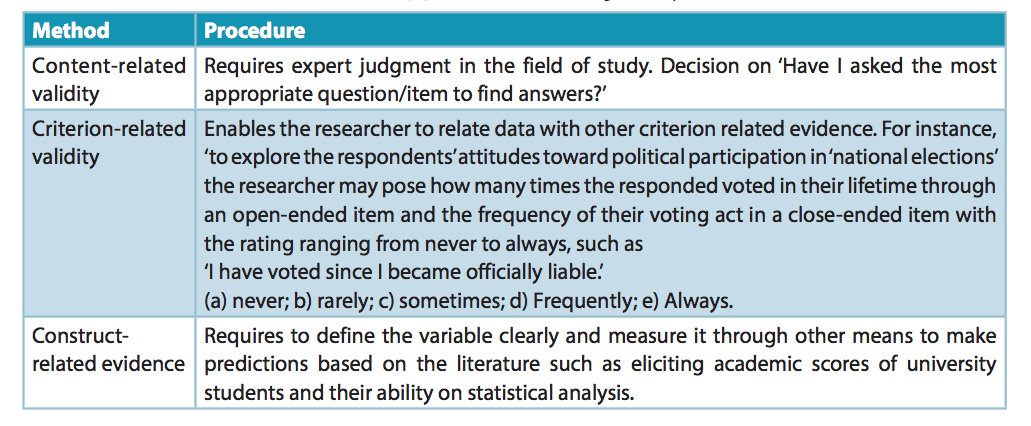
Soru 25
Which of the following is false about quantitative research?
Seçenekler
A
It enables to describe populations and phenomena in a detailed way based on figures or data.
B
Observation and experimentation are the strategies that can be employed to test an assumption.
C
It enables a researcher to make propositions out of relationships between two or more variables.
D
Experimentation is the most used strategy by political scientists, or other social sciences.
E
It provides reliable data that is numeric in nature obtained through testing or comparing ideas.
Açıklama:
Quantitative research, or also called scientific research method, is a way of obtaining information that provides the researcher with accurate and reliable data that is numeric in nature and has been obtained through testing or comparing ideas in the public arena. Quantitative research, as part of empirical research, enables to describe populations and phenomena in a detailed tradition based on figures or data, and enables the political scientist to make propositions out of relationships between two or more variables. Observation and experimentation are the strategies that can be employed to test an assumption or a theory. Observation is the most used strategy by political scientists for international relations, or other social sciences while experimentation is not that commonly used due to its nature of testing. For instance, in experimentation if the political scientist is interested in understanding the relationship of a political theory and humans social well-being, there needs to be two equivalent groups to understand the relationship or to verify the theory. Consequently, experimental research earns to be explained thoroughly and rigorously due to its complex nature of working with humans and the many social, cultural, anthropological, economic, political or historical factors that need to be considered in designing experimental research for social sciences. The correct answer is D.
Soru 26
Examine the scatterplot graph below indicating the number of hours students study in a day and their school grade averages in a particular school in a given year. What kind research does it suggest?
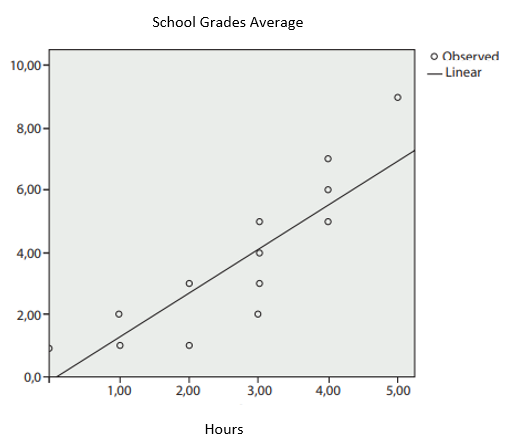
Seçenekler
A
Descriptive
B
Correlational
C
Cross-national
D
Causal-comparative
E
Experimental
Açıklama:
Correlational studies enable the researcher to identify how one or a set of variables are related to another or enable the researcher to make predictions. Especially in the case where it is difficult to conduct an experimental study, the researcher can make use of the available data to analyze the relationships among different variables. Correlational research contradicts with experimental research in the sense that no variable is manipulated in this method. In the hypothetical example, the researcher is interested in exploring if there is a correlation between the number of daily study hour and school grades average. Using scatterplots enable the researcher to see the regression line and interpret the correlation between these two variables of interest. The correct answer is B.
Soru 27
Mehmet is interested in examining whether factors such as gender, genetics, and personality traits play a role in political choices in his country. What kind of study design would be the most suitable?
Seçenekler
A
Experimental
B
Interrupted time series
C
Causal-comparative
D
Cross-national
E
Descriptive
Açıklama:
Causal comparative research which is also called as ex post facto (after the fact for Latin) attempts to determine the cause or consequences of differences that already exist between identified set of subjects. These sample variables (e.g. gender, personality traits, etc.) do not allow the researcher for manipulation and they attempt to explore causation. The correct answer is C.
Soru 28
Which of the following refers to drawing samples form a list of irrelevant samples to represent the population?
Seçenekler
A
Coverage error
B
Sampling error
C
Nonresponse error
D
Measurement error
E
Internal reliability error
Açıklama:
Coverage refers to drawing samples form a list of irrelevant samples to represent the population. The correct answer is A.
Soru 29
Which of the following is a good survey question for a Likert-type agreement scale about language learning?
Seçenekler
A
I am good at reading and writing in a foreign language.
B
I am totally pleased with the amazing computer lab in our school.
C
Not taking effective notes during classes does not affect learning.
D
Raised affective filter creates a barrier for comprehensible input.
E
I am able to use online resources to look up new vocabulary.
Açıklama:
Choice A has more than one objective. Choice B implies a preferred way to answer through a leading question. Choice C contains double negative expressions. Choice D is too technical. The best answer is E.
Soru 30
Which of the following methods has the longest duration and the highest cost efficiency for data collection?
Seçenekler
A
Direct administration
B
Per mail
C
Social media platforms
D
Face-to-face interview
E
Telephone call
Açıklama:
One of the earliest, yet most expensive approach could be the face-to-face interviews. It is advantageous in that it increases the likelihood for participation. However, it has the longest duration for data collection. The correct answer is D.
Soru 31
What is meant by the ‘feasibility’ of a research question?
Seçenekler
A
Its clarity to avoid ambiguity or misunderstanding.
B
Its significance and being useful for the humankind.
C
Its being ethical and not harming any living being or nature.
D
Its being measurable and capability of allowing statistical analyses.
E
Its availability of enough time, energy, and budget for investigation.
Açıklama:
Research questions should be feasible so that there is available time, energy, and even sufficient budget to investigate them. For instance, rather than administering a questionnaire to the entire population, a random sampling strategy could be selected and generalized to the population. The correct answer is E.
Soru 32
In the research question “Is there a relationship between the daily amount of caffeine intake of adults and their blood pressure?” what is the dependent variable?
Seçenekler
A
Blood pressure
B
Daily intake
C
Amount
D
Relationship
E
Caffeine
Açıklama:
In order to prepare good research questions or identify hypotheses it is essential to understand the difference between independent and dependent variables. Through an independent variable, a researcher can study its effect on one or more variables. Thus how the independent variable affects the dependent variable is studied. In the example, the daily amount of caffeine consumption of adults may or may not affect the blood pressure, but not vice versa physiologically. Thus, blood pressure is the dependent variable. The correct answer is A.
Soru 33
Which of the following is a categorical variable?
Seçenekler
A
Level of education
B
Nationality
C
Age
D
Level of interest
E
Number of children
Açıklama:
Variables can be defined as ‘quantitative variables’ and ‘categorical variables., Quantitative variables are mostly able to be divided into smaller chunks such as weight in kilograms, or height in centimeters, or age in numbers, or as magnitude of interest represented in figures like 1 for little interest or 5 for high interest, or 1 for disagreement and 5 for agreement. All those ratings hold a continuum in themselves and therefore are called quantitative. Categorical variables, on the other hand, are not varying in degrees, or amounts or quantity, they rather are part of a category such as gender, one is either male or female; or marital status, married, single, divorced, or other, or such as nationality, or school type, either public school or private school. The correct answer is B.
Soru 34
Which of the following is the least generalizable and the least suggested sampling strategy?
Seçenekler
A
Stratified random sampling
B
Cluster sampling
C
Convenience sampling
D
Two-stage random sampling
E
Purposive sampling
Açıklama:
Convenience sampling does not enable the researcher to generalize the findings from the sample to the targeted population and it is the least suggested sampling strategy (Fraenkel and Wallen, 2010). In this situation the sampling strategy selected may cause internal validity threat because the sample the researcher reached may consist of a group of volunteers and they may feel to please the data collector and this is likely to cause bias related to the field studied, and the results will not be reliable. The correct answer is C.
Soru 35
Which of the following quantitative research attempts to determine the cause or consequences of differences that already exist between identified set of subjects?
Seçenekler
A
Causal Comparative Research
B
Correlational Research
C
Experimental Research
D
Survey Research
E
Descriptive Research
Açıklama:
Causal comparative research which is also called ex post facto (after the fact for Latin) attempts to determine the cause or consequences of differences that already exist between an identified set of subjects. The correct answer is A.
Soru 36
Which of the following is considered to be the best method to test hypotheses related to cause-and-effect relationships?
Seçenekler
A
Survey Research
B
Experimental Research
C
Descriptive Research
D
Correlational Research
E
Causal-Comparative Research
Açıklama:
Experimental research is a research type that explicitly attempts to influence a particular variable. It is also considered to be the best method to test hypotheses related to cause-and-effect relationships. The correct answer is B.
Soru 37
Which of the following is about any research that is based on observational data indicating that knowledge is derived from actual experience or experiment rather than from a certain theory or belief?
Seçenekler
A
Experimental Research
B
Associational Research
C
Descriptive Research
D
Survey Research
E
Empirical Research
Açıklama:
Empirical research is about any research that is based on observational data indicating that knowledge is derived from actual experience or experiment rather than from a certain theory or belief. The correct answer is E.
Soru 38
Which of the following tools is considered to be one easy way of calculating descriptive statistics?
Seçenekler
A
Microsoft Word
B
Survey Monkey
C
Qualtrics
D
SPSS Software Programme
E
Microsoft PowerPoint
Açıklama:
One easy way of calculating descriptive statistics is using tools such as Microsoft Excel, or SPSS software data analysis packages. Through using such tools, the researcher or political scientist can easily convert the data collected from the online surveys to the program or manually insert the data collected through interviews, phone calls, or filled out questionnaires. The correct answer is D.
Soru 39
Which of the following is NOT one of the characteristics of a good research question?
Seçenekler
A
Feasible
B
Significant
C
Judgmental
D
Specific
E
Measurable
Açıklama:
Research questions should be feasible, clear, significant, specific, ethical, and measurable to initiate a research study. The answer is C.
Soru 40
Which of the following is a strategy that enables every member in the population to become selected and be a part of the study?
Seçenekler
A
Systematic sampling
B
Random sampling
C
Cluster sampling
D
Stratified random sampling
E
Purposive sampling
Açıklama:
‘Random sampling’ is a strategy that enables every member in the population to become selected and be a part of the study. Random sampling is essential as it avoids the likelihood to select a biased sample. The correct answer is B.
Soru 41
Which of the following is one of the most preferred methods in opinion studies in political science research as it ensures the representativeness of the population studied?
Seçenekler
A
Stratified Sampling
B
Systematic Sampling
C
Purposive Sampling
D
Convenience Sampling
E
Cluster Sampling
Açıklama:
The stratified sampling strategy is one of the most preferred methods in opinion studies in political science research as it ensures the representativeness of the population studied. The correct answer is A.
Soru 42
Which of the following is employed when the researcher intentionally is interested in a population with certain knowledge, experience, or history?
Seçenekler
A
Systematic Sampling
B
Stratified Random Sampling
C
Cluster Sampling
D
Purposive Sampling
E
Convenience Sampling
Açıklama:
As its name indicates, ‘purposive sampling’ method is employed when the researcher intentionally is interested in a population with certain knowledge, experience, or history. The correct answer is D.
Soru 43
Which of the following refers to the correctness, appropriateness, meaningfulness, and usefulness of the data collected or the relevancy of the data collection instrument?
Seçenekler
A
Sampling
B
Validity
C
Objectiveness
D
Reliability
E
Correlation
Açıklama:
Validity refers to the correctness, appropriateness, meaningfulness, and usefulness of the data collected or the relevancy of the data collection instrument. The correct answer is B.
Soru 44
What can the sample of research also be called?
Seçenekler
A
Unit of analysis
B
Unit of sampling
C
Groups of population
D
Geographical units
E
Unit of observation
Açıklama:
Population or sample, which can also be called as the unit of analysis, define the group that your research will be about.
Soru 45
Which of the following statements is not one of the characteristics of the national time series analysis?
Seçenekler
A
It provides the researcher a detailed picture of the change.
B
It helps to explain why as well as how changes have occurred over time.
C
It helps the researcher explain the cause of unexpected fluctuations.
D
It enables researchers to make predictions about the future changes.
E
It observes individuals, companies, etc. at a single point in time.
Açıklama:
The national time series surveys generally are data collected over the years that are in the interest of political scientists. The measurements are taken in an organized manner such as in fixed periods over time: these can be days, weeks, months or multiyear cycles as a season or time cycle may bear history that may influence the respondents attitudes or behaviors ultimately time series analysis has two major functions to consider: First, it provides the researcher a detailed picture of the underlying structure of change in a variable, including certain reoccurring trends or cycles that may be present in the change. Such information about the structure of change helps explain why as well as how changes have occurred over time helps the researcher explain the cause of unexpected fluctuations. Second, time series analysis enables researchers to trace the historical behavior of past change, … which allows for extrapolating from the data to make predictions about the future changes
Soru 46
Why do the researchers prefer sending out questionnaires by e-mail despite their low response rate for election surveys?
Seçenekler
A
Because voting tendencies can be defined by using some data mining methods.
B
Because the researcher can collect data from similar samples at different times.
C
Because it allows for group administration.
D
Because, the duration for data collection is shorter on online platforms.
E
Because it provides ready-made data for other researches.
Açıklama:
Political elections can be defined as systems that contain political tendencies and voters’ perceptions and preferences. The outputs of those systems are formed by specific attributes of individuals such as age, gender, occupancy, educational status, socio-economic status, religious belief, etc. Those attributes can create a data set, which contains hidden information and undiscovered patterns that can be revealed by using data mining methods and techniques.
Soru 47
If the researcher only randomly selects students from one city as the available population to understand the attitudes of political participation of university students, what kind of error is this?
Seçenekler
A
Coverage Error
B
Sampling Error
C
Nonresponse Error
D
Measurement Error
E
Recording Error
Açıklama:
Sampling error, exists any time when the researcher reaches some of the sample and not all members. For instance, instance, to understand the attitudes of political participation of university students the researcher only randomly selects students from one province as the available population rather than the whole country to generalize the findings to the target population.
Soru 48
Which of the following survey questions is not biased, leading or poor?
Seçenekler
A
Concerned parents always use infant car seats.
B
I think women face more discrimination at work
C
How satisfied are you with the pay and work benefits of your current job?
D
Do you always eat breakfast?
E
How often do you watch TV?
Açıklama:
Each question should have only one single objective. ‘I volunteer at governmental elections and NGOs’ Note, what if the participant only volunteers in one institution!
Avoid leading items that imply a preferred way to answer.
For example:
‘I think that women make best teachers.’
Avoid rating within the questions such as
‘I always attend student protests.’
1) Never 2) Rarely 3) Sometimes 4) Frequently 5)Always
Avoid loaded questions, especially during face-to-face interview survey, which may emotionally charge the respondent. For example: Do you have cancer?
Avoid leading items that imply a preferred way to answer.
For example:
‘I think that women make best teachers.’
Avoid rating within the questions such as
‘I always attend student protests.’
1) Never 2) Rarely 3) Sometimes 4) Frequently 5)Always
Avoid loaded questions, especially during face-to-face interview survey, which may emotionally charge the respondent. For example: Do you have cancer?
Soru 49
Which of the quantitative data collection methods does not allow for random
sampling?
sampling?
Seçenekler
A
Direct Administration
B
Telephone Call
C
Per Mail
D
Social Media Platforms
E
Face To Face İnterwiev
Açıklama:
Social Media Platforms do not allow for random sampling.
Soru 50
Which of the following sampling methods enables every member in the population to become selected and be a part of the study?
Seçenekler
A
Convenience sampling
B
Multiple sampling
C
Cluster sampling
D
Random sampling
E
Systematic sampling
Açıklama:
Random sampling is the most reliable strategy to identify your sample because it enables every member in the population to become selected at an equal chance and be a part of the study. Consequently, the findings of the study that are based on random sampling can be generalized to its population.
Soru 51
When the researcher intentionally is interested in a population with certain knowledge, experience, or history, which sampling method is employed?
Seçenekler
A
Purposive sampling
B
Multiple sampling
C
Cluster sampling
D
Systematic sampling
E
Random sampling
Açıklama:
As its name indicates, ‘purposive sampling’ method is employed when the researcher intentionally is interested in a population with certain knowledge, experience, or history. For instance, as a political scientist you may want to do descriptive research with the elderly who were activist university students during the protests of 1968 in the metropols and describe their current political participation behaviors. Thus, your sample needs to be purposively selected from individuals who were at college level at that time and who were activists.
Soru 52
Which of the following is not related with the validity of research?
Seçenekler
A
Correctness
B
Innovativeness
C
Appropriateness
D
Meaningfulness
E
Usefulness
Açıklama:
Validity refers to the correctness, appropriateness, meaningfulness, and usefulness of the data collected or the relevancy of the data collection instrument.
Soru 53
If a reserarcher is interested in investigating how knowledge, attitudes, and behavior many vary according to difference in democracy, culture, economic conditions through comparisons and collect data that is administered in various countries, what type of survey research does s/he needs to employ?
Seçenekler
A
Descriptive Survey
B
Cross-Sectional Survey
C
Cross-National Survey
D
Panel Survey
E
Census
Açıklama:
Review Cross-Sectional Surveys part in p. 127.
Cross-national surveys provide opportunities to collect data that is administered in various countries so that the researchers can collect data regarding how knowledge, attitudes, and behavior many vary according to difference in democracy, culture, economic conditions through comparisons
Cross-national surveys provide opportunities to collect data that is administered in various countries so that the researchers can collect data regarding how knowledge, attitudes, and behavior many vary according to difference in democracy, culture, economic conditions through comparisons
Soru 54
Which one is considered to be the best research method in order to investigate hypothesis related to cause-and-effect relationships?
Seçenekler
A
Experimental Research
B
Descriptive Research
C
Associational Research
D
Correlational Research
E
Surveys
Açıklama:
Review p.125 'Experimental Research'
Experimental research is considered to be the best method to test hypothesis related to cause-and-effect relationships (Fraenkel & Wallen, 2010).
Experimental research is considered to be the best method to test hypothesis related to cause-and-effect relationships (Fraenkel & Wallen, 2010).
Soru 55
If a reserarcher is interested in determining the cause or consequences of differences that already exist between identified set of subjects, what type of survey research does s/he needs to employ?
Seçenekler
A
Descriptive Research
B
Causal-Comparative Research
C
Correlational Research
D
Panel Survey
E
Census
Açıklama:
Review p.124 'Causal-comparative Research'
Causal comparative research which is also called as ex post facto (after the fact for Latin) attempts to determine the cause or consequences of differences that already exist between identified set of subjects (Fraenkel & Wallen, 2010).
Causal comparative research which is also called as ex post facto (after the fact for Latin) attempts to determine the cause or consequences of differences that already exist between identified set of subjects (Fraenkel & Wallen, 2010).
Soru 56
‘Is there a relationship between students’ school type and their mathematics achievement in a national exam?’
Review the research question above.
What is the dependent variable in the context of that research question?
Review the research question above.
What is the dependent variable in the context of that research question?
Seçenekler
A
Students
B
School type
C
National exam
D
Students' mathematics achievement
E
Lesson type
Açıklama:
Review p.136 'Variables' Section.
The independent variable is expected to affect or cause the change on the dependent
variable. In this research question, the effect of school type on mathematics achievement is investigated.
The independent variable is expected to affect or cause the change on the dependent
variable. In this research question, the effect of school type on mathematics achievement is investigated.
Soru 57
Which of the following data collection methods is best in order to encourage response to sensitive topics?
Seçenekler
A
Face-to face interview
B
Telephone call
C
Social Media Platforms
D
Direct administration
E
Mail
Açıklama:
Review the table in p. 133 'Data Collection Procedures'
Soru 58
What is the suggested minimum number of participants for correlational studies to consider the generalization?
Seçenekler
A
10
B
30
C
50
D
100
E
150
Açıklama:
Review p.137 'Random Sampling' section.
Fraenkel and Wallen (2010) state that samples should be large enough to obtain
reasonable expenditure of energy and time and suggests that the minimum numbers of subjects (participants) is “100 for a descriptive study, 50 for a correlational study, and 30 for causal-comparative and experimental studies”
Fraenkel and Wallen (2010) state that samples should be large enough to obtain
reasonable expenditure of energy and time and suggests that the minimum numbers of subjects (participants) is “100 for a descriptive study, 50 for a correlational study, and 30 for causal-comparative and experimental studies”
Soru 59
Which one of the following sampling techniques is the most appropriate one when the researcher intentionally is interested in a population with certain knowledge, experience, or history?
Seçenekler
A
Random Sampling
B
Cluster Sampling
C
Purposive Sampling
D
Convenience Sampling
E
Stratified Random Sampling
Açıklama:
Review p.139 'Purposive Sampling' section
‘Purposive sampling’ method is employed when the researcher intentionally is interested in a population with certain knowledge, experience, or history.
‘Purposive sampling’ method is employed when the researcher intentionally is interested in a population with certain knowledge, experience, or history.
Soru 60
If the purpose of the researcher is to make generalizations to the population, what is the most reliable sampling strategy?
Seçenekler
A
Random Sampling
B
Cluster Sampling
C
Purposive Sampling
D
Convenience Sampling
E
Stratified Random Sampling
Açıklama:
Review p.137 'Random Sampling' section
‘Random sampling’ is a strategy that enables every member in the population to become selected and be a part of the study. Random sampling is essential as it avoids the likelihood to select a biased sample. ‘Random sampling’ is the most reliable
strategy to identify your sample because it enables every member in the population to
become selected at an equal chance and be a part of the study. Consequently, the findings of the study that are based on random sampling can be generalized to its population.
‘Random sampling’ is a strategy that enables every member in the population to become selected and be a part of the study. Random sampling is essential as it avoids the likelihood to select a biased sample. ‘Random sampling’ is the most reliable
strategy to identify your sample because it enables every member in the population to
become selected at an equal chance and be a part of the study. Consequently, the findings of the study that are based on random sampling can be generalized to its population.
Soru 61
Consider that you have a list of 3000 high-school student and you select each 20th student from the list (select from the list the student number 20, 40, 60, and so on, until 3000). Which sampling strategy is preferred in this process?
Seçenekler
A
Random Sampling
B
Cluster Sampling
C
Stratified Random Sanmpling
D
Systematic Sampling
E
Purposive Sampling
Açıklama:
Review p.138 'Systematic Sampling' section.
Systematic sampling is the selection of a sample systematically from the population- it belongs to the non-random sampling strategy.
Systematic sampling is the selection of a sample systematically from the population- it belongs to the non-random sampling strategy.
Soru 62
What is the least suggested sampling strategy since it does not enable the researcher to generalize the findings from the sample to the targeted population?
Seçenekler
A
Random Sampling
B
Cluster Sampling
C
Purposive Sampling
D
Stratified Sampling
E
Convenience Sampling
Açıklama:
Review p.139 'Convenience Sampling' section.
Soru 63
......... is data collected from every member in the society by governments for official purposes and could vary from general demographic information such as sex, age, education, place of birth to questions about household.
Which term is defined above?
Which term is defined above?
Seçenekler
A
figure
B
evidence
C
quantitative
D
census
E
hypothesis
Açıklama:
Census is data collected from every member in the society by governments for official purposes and could vary from general demographic information such as sex, age, education, place of birth to questions about households. If the entire population is surveyed, meaning it is a census representing 100% the population.
Soru 64
Which information below is not true about quantitative research?
Seçenekler
A
It is also called scientific research method.
B
It provides reliable data.
C
The data is numeric in nature.
D
It is obtained through testing.
E
It provides estimated data.
Açıklama:
Quantitative research, or also called scientific research method, is a way of obtaining information that provides the researcher with accurate and reliable data that is numeric in nature and has been obtained through testing or comparing ideas in the public arena.
Soru 65
Which information below is not true about correlational research?
Seçenekler
A
It enables the researcher to make predictions.
B
Variable is manipulated in this method.
C
It provides the researcher to identify relationships between variables.
D
It can be used when it is difficult to conduct experimental research.
E
It is a kind of associational research.
Açıklama:
Correlational studies enable the researcher to identify how one or a set of variables are related to another or enable the researcher to make predictions. Especially in the case where it is difficult to conduct an experimental study, the researcher can make use of the available data to analyze the relationships among different variables (McNabb, 2004). Correlational research contradicts with experimental research in the sense that no variable is manipulated in this method.
Soru 66
Which information below is not true about experimental research?
Seçenekler
A
It is not so common in political research.
B
The nature of it demands manipulating of the independent variable.
C
It attempts to influence a particular variable.
D
It is not used to test hypothesis related to cause and effect relationships.
E
Ethics is of utmost importance.
Açıklama:
Experimental research is unique yet not so common in political research as the
nature of experimental research demands manupulating of the independent variable in the experiment. More explicitly, it is a research type that explicitly attempts to influence a particular variable. Second, it is considered to be the best method to test hypothesis related to cause-and-effect relationships (Fraenkel & Wallen, 2010). In addition, ethics is of utmost consideration.
nature of experimental research demands manupulating of the independent variable in the experiment. More explicitly, it is a research type that explicitly attempts to influence a particular variable. Second, it is considered to be the best method to test hypothesis related to cause-and-effect relationships (Fraenkel & Wallen, 2010). In addition, ethics is of utmost consideration.
Soru 67
National time series, cross-national, election and panel are the types of .......... research. Which is the best option for the gap above?
Seçenekler
A
survey
B
experimental
C
descriptive
D
associative
E
correlational
Açıklama:
There are different types of surveys, therefore, as the researcher you need to relate your survey design to your research questions. Butt et al. (2016) provide
a list of survey types that can be utilized in political science research such as cross-national surveys, national time series, election surveys, and panel
surveys.
a list of survey types that can be utilized in political science research such as cross-national surveys, national time series, election surveys, and panel
surveys.
Soru 68
.................. refers to drawing samples from a list of irrelevant samples to represent the population. Which error is defined above?
Seçenekler
A
sampling error
B
coverage error
C
response error
D
measurement error
E
nonresponse error
Açıklama:
Dillman, Smyth, and Christian (2014) underscore that the researcher needs to avoid four types of errors as cornerstones of good quality surveys.
• Coverage error, which refers to drawing samples form a list of irrelevant samples to represent the population
• Sampling error, which exists any time when the researcher reaches some of the sample and not all members. For instance, instance, to understand the attitudes of political participation of university students the researcher only randomly selects students from one province as the available population rather than the whole country to generalize the findings to the target population;
• Nonresponse error, which occurs when some particular units of analysis tend to answer some particular items which are likely to influence the estimate of the findings;
• Measurement error is described as the difference between the estimate produced and the true value in case the respondents may answer inaccurately to the survey questions.
• Coverage error, which refers to drawing samples form a list of irrelevant samples to represent the population
• Sampling error, which exists any time when the researcher reaches some of the sample and not all members. For instance, instance, to understand the attitudes of political participation of university students the researcher only randomly selects students from one province as the available population rather than the whole country to generalize the findings to the target population;
• Nonresponse error, which occurs when some particular units of analysis tend to answer some particular items which are likely to influence the estimate of the findings;
• Measurement error is described as the difference between the estimate produced and the true value in case the respondents may answer inaccurately to the survey questions.
Soru 69
Whcih one below is not suggested while writing survey items?
Seçenekler
A
use technical jargon
B
be precise
C
avoid loaded questions
D
avoid using estimations
E
avoid negatives
Açıklama:
Tips for writing good survey questions
• Each question should have only one single objective. ‘I volunteer at governmental elections and NGOs’ Note, what if the participant only volunteers in one institution!
• Adopt the same definitions or concepts throughout the survey. For instance, if your key term is university students, keep it like that, and do not alternate it with college students in different parts of the survey.
• Avoid leading items that imply a preferred way to answer.
For example:
‘I think that women make best teachers.’
1) Totally Disagree 2) Disagree 3) Undecided 4) Agree 5) Totally agree
• Avoid rating within the questions such as ‘I always attend student protests.’
1) Never 2) Rarely 3) Sometimes 4) Frequently 5)Always
Avoid loaded questions, especially during face-to-face interview survey, which may emotionally charge the respondent. For example: Do you have cancer?
• Use questions that are simple and easy to understand, and cause no misunderstanding.
• Avoid using technical jargon. It may discourage the individuals to continue with the survey.
• Avoid negative or double negative expressions such as ‘I do not like the politicians,’ or ‘I do not dislike politics.’
• Be precise, avoid estimations such as ‘Estimated how many students are there in your class?’ ask ‘What size is your class.’
• Each question should have only one single objective. ‘I volunteer at governmental elections and NGOs’ Note, what if the participant only volunteers in one institution!
• Adopt the same definitions or concepts throughout the survey. For instance, if your key term is university students, keep it like that, and do not alternate it with college students in different parts of the survey.
• Avoid leading items that imply a preferred way to answer.
For example:
‘I think that women make best teachers.’
1) Totally Disagree 2) Disagree 3) Undecided 4) Agree 5) Totally agree
• Avoid rating within the questions such as ‘I always attend student protests.’
1) Never 2) Rarely 3) Sometimes 4) Frequently 5)Always
Avoid loaded questions, especially during face-to-face interview survey, which may emotionally charge the respondent. For example: Do you have cancer?
• Use questions that are simple and easy to understand, and cause no misunderstanding.
• Avoid using technical jargon. It may discourage the individuals to continue with the survey.
• Avoid negative or double negative expressions such as ‘I do not like the politicians,’ or ‘I do not dislike politics.’
• Be precise, avoid estimations such as ‘Estimated how many students are there in your class?’ ask ‘What size is your class.’
Soru 70
Which one is not a feature of a good research question?
Seçenekler
A
It should be feasible.
B
It should be measurable.
C
It should be general.
D
It should be ethical.
E
It should be significant.
Açıklama:
-Research questions should be feasible.
-Research questions should be significant.
- Research questions should be ethical.
-Good quantitative research questions should be specific.
-Good research questions should be measurable.
-Research questions should be significant.
- Research questions should be ethical.
-Good quantitative research questions should be specific.
-Good research questions should be measurable.
Soru 71
............ sampling is a strategy that enables every member in the population to become selected and be a part of the study, and it is essential as it avoids the likelihood to select a biased sample. Which sampling strategy is defined above?
Seçenekler
A
cluster sampling
B
systematic sampling
C
random sampling
D
purposive sampling
E
convenience sampling
Açıklama:
Random sampling is a strategy that enables every member in the population to become selected and be a part of the study. Random sampling is essential as it avoids the likelihood to select a biased sample.
Soru 72
The researcher asks "Have I asked the most appropriate question/item to find the answer?" in order to ensure ............. Which option completes the sentence best?
Seçenekler
A
reliability
B
criterion-related validity
C
content-related validity
D
construct-related evidence
E
convenience sampling
Açıklama:
Content-related validity requires expert judgment in the field of study. Decision on ‘Have I asked the most appropriate question/item to find answers?’.
Soru 73
On what basis was the use of 1990 US census in quantitative studies criticized?
Seçenekler
A
For underrepresentation of the poor
B
For exclusion of the unemployed
C
For creating a gender bias
D
For including too many typos
E
For overrepresentation of the migrants
Açıklama:
Using quantitative methods to sample data from the entire population also created a lot of controversy, as in the example of the 1990 Census which provoked a major lawsuit in the US for not including the differentiated poor living in the inner cities and the loss of their political presentation. The correct answer is A.
Soru 74
Which of the following is true for quantitative methods in political research?
Seçenekler
A
It is always based on interviews
B
It is usually not as reliable as qualitative methods
C
It measures patterns of political phenomena
D
It makes use of speculative interpretations
E
It does not use numeric data
Açıklama:
Quantitative research, or also called scientific research method, is a way of obtaining information that provides the researcher with accurate and reliable data that is numeric in nature and has been obtained through testing or comparing ideas in the public arena. Quantitative research is based on observation and the measurement of repeated incidences of a political phenomenon. The correct answer is C.
Soru 75
What do quantitative researchers mean when they say correlation is not causation?
Seçenekler
A
Correlation is more important than causation
B
Correlation is an outcome of causation
C
Correlation leads to causation after a while
D
Correlation doesn't necessarily refer to a causal relationship
E
Correlation is a more technical term used for causation
Açıklama:
Correlational research contradicts with experimental research in the sense that no variable is manipulated in this method. Thus, it is important to say that correlation should not be confused with causal relation, it only provides an existing or nonexisting relationship between variables. Thus, correlation does not necessarily refer to the existence of a causal relationship between the variables. The correct answer is D.
Soru 76
What kind of a conclusion can we draw if the correlation of a regression line is very close to 0?
Seçenekler
A
There is no correlation between the variables
B
There is a highly strong negative correlation between the variables
C
There is a highly strong positive correlation between the variables
D
There is a weak negative correlation between the variables
E
There is a weak positive correlation between the variables
Açıklama:
In the case the regression line is approaching -1,00 or + 1,00 indicating there is a negative correlation for the former and a positive correlation for the latter. In other words, if it is close to 1 there is a positive correlation between the variables. The correct answer is A.
Soru 77
Which of the following is not one of the steps to be taken before starting a self-constructed survey research?
Seçenekler
A
Deciding on research design before starting
B
Reviewing the literature throughly
C
Formulating a research question
D
Determining how to sample subjects from the target population
E
Starting to conduct interviews right away
Açıklama:
There are many things that a survey researcher should do before starting to conduct interviews. Among them are deciding what research design to use, reading the secondary literature, decide on sampling strategy and formulating a research question. The correct answer is E.
Soru 78
Which of the following is not one of the categories of surveys that political scientists use?
Seçenekler
A
Cross-sectional surveys
B
Qualitative surveys
C
Cross-national surveys
D
Election surveys
E
Panel surveys
Açıklama:
There are many types of surveys that political scientists use. Qualitative surveys are not one of these categories. The correct answer is B.
Soru 79
Which of the following best describes the characteristics of panel data?
Seçenekler
A
Different countries at different times
B
Different samples at the same year
C
Similar samples at different times
D
Different samples at one point in time
E
Similar samples at one point in time
Açıklama:
Political sciences, or international relations fields value policy decisions and the changing trends of individuals based on policy making decisions or applications, therefore through a panel study, the researcher can collect data from similar samples at different times. The correct answer is C.
Soru 80
Which of the following is not one of the errors that should be avoided when preparing good quality surveys?
Seçenekler
A
Coverage error
B
Sampling error
C
Non-response error
D
Measurement error
E
Detention error
Açıklama:
Therefore, Dillman, Smyth, and Christian (2014) underscore that the researcher needs to avoid four types of errors as cornerstones of good quality surveys. • Coverage error, which refers to drawing samples form a list of irrelevant samples to represent the population • Sampling error, which exists any time when the researcher reaches some of the sample and not all members. For instance, instance, to understand the attitudes of political participation of university students the researcher only randomly selects students from one province as the available population rather than the whole country to generalize the findings to the target population; • Nonresponse error, which occurs when some particular units of analysis tend to answer some particular items which are likely to influence the estimate of the findings; • Measurement error is described as the difference between the estimate produced and the true value in case the respondents may answer inaccurately to the survey questions. The correct answer is E.
Soru 81
Which of the following is an advantage of face-to-face interviews as a method of collection of quantitative data?
Seçenekler
A
Cost efficiency
B
Response rate probability
C
Duration for data collection
D
Standardization of responses
E
Encourages response to sensitive topics
Açıklama:
Face-to-face interviews have advantages and disadvantages just like any other methods of data collection. One of its advantages is the high response rate probability because in face-to-face interactions it is very likely that the researcher gets responses. The correct answer is B.
Soru 82
Which of the following is not one of the qualities of a good research question?
Seçenekler
A
Feasibility
B
Specificity
C
Ethicality
D
Ambiguity
E
Clarity
Açıklama:
A good research question should be as clear as possible. An ambiguous or vague question is hard to answer and does not contribute much to the scholarship. The correct answer is D.
Soru 83
Which kind of study enables the researcher to identify how one or a set of variables are related to another or enable the researcher to make predictions?
Seçenekler
A
Correlational Research
B
Causal-Comparative Research
C
Experimental Research
D
Survey Research
E
National Research
Açıklama:
a
Soru 84
What kind of research method is also called as ex post facto?
Seçenekler
A
Correlational Research
B
Associational Research
C
Causal Comparative Research
D
Experimental Research
E
Empirical Research
Açıklama:
C
Soru 85
What kind of surveys are generally data collected over the years that are in the interest of political scientists?
Seçenekler
A
Cross-National Surveys
B
National Time-Series
C
Election Surveys
D
Online Surveys
E
Emprical Surveys
Açıklama:
b
Soru 86
Which of the following is one major limitation of a longitudinal panel study?
Seçenekler
A
The researcher is likely to lose some of his or her sample.
B
The researcher can collect data from similar samples at different times.
C
The researcher may reach the same sample again.
D
The researcher can see the changing trends of individuals based on policy making decisions.
E
It is possible to see if the attitudes of the citizens have changed over time.
Açıklama:
A
Soru 87
Which one of the following is not among the errors that Dillman, Smyth, and Christian underscore that the researcher needs to avoid?
Seçenekler
A
Coverage error
B
Sampling error
C
Nonresponse error
D
Technical error
E
Measurement error
Açıklama:
d
Soru 88
Which one of the following is not among quantitative data collection procedures?
Seçenekler
A
Telephone call
B
Discourse analysis
C
Face to face interview
D
Questionnaire in social media platforms
E
Per mail
Açıklama:
b
Ünite 6
Soru 1
There are five major objectives for conducting mixed methods research. Which one refers to seeking for further details and improvement of the results?
Seçenekler
A
Triangulation
B
Complementarity
C
Initiation
D
Development
E
Expansion
Açıklama:
Greene, Caracelli, and Graham (1989) suggest that five major objectives or motivations exist for conducting MMR. The first one is ‘triangulation’, which provides validation and concurrence of results gained from various methods and designs investigating the same circumstance. ‘Complementarity’, as the second motivation, seeks for further detailing, improvement, interpretation and description of the results obtained from one method with results from the other method. The third one is ‘initiation’, which means unearthing the bias, and discrepancies that cause re-designing of the research question. ‘Development’, the fourth motivation, includes utilizing the findings from one method to deliver clues to other method. The last motivation, ‘expansion’, seeks to expand the size of research with different methods for different investigation factors.
Soru 2
Which of the following can be considered as a weakness of mixed methods research?
Seçenekler
A
It increases the generalizability.
B
It creates a more entire knowledge.
C
It allows creating grounded theory.
D
It requires more time.
E
It allows using numbers and narrative.
Açıklama:
The weaknesses of the MMR are as follows:
- A single researcher may have difficulty in carrying out both qualitative and quantitative research, especially if two or more approaches are expected to be done concurrently (i.e., the study might require a research team).
- The researcher has to learn about multiple methods and approaches and understand how to combine them appropriately.
- Methodological purists contend that one should always work within either a qualitative or quantitative paradigm.
- It is more expensive.
- It is more time-consuming.
- Some of the details of mixed research
remain to be worked out fully by research methodologists
Soru 3
Which one of the following is not a strength of mixed methods research?
Seçenekler
A
Researchers can get comprehensive evidence.
B
It allows using numbers with words and narrative.
C
Weaknesses of methods can be balanced.
D
It helps answer research question better.
E
It requires more than one researcher.
Açıklama:
MMR can be defined as the combination of quantitative and qualitative methods for a clear understanding of research objectives than either approach alone. It is because MMR balances the weaknesses of quantitative and qualitative research and transforms them into strength. By using all types of data collection tools, researchers can get more comprehensive evidence for a research problem. On the other hand, MMR enables researchers to answer questions that cannot be answered by qualitative or quantitative approaches alone. MMR can be so functional that the researchers feel free to make use of different methodologies to reach the research objectives. It is possible to use words, pictures and narrative to add meaning to numbers in MMR. Requiring more than one research is considered as a weakness of mixed methods research.
Soru 4
- Gathering data
- Designating the research question
- Choosing the mixed method research design
- Specifying appropriateness of mixed method
- Clarifying data
Seçenekler
A
I-IV-V-II-III
B
III-I-V-II-IV
C
II-IV-III-I-V
D
V-II-III-I-IV
E
III-I-IV-I-V
Açıklama:
Johnson and Onwuegbuzie (2004) propose a process of MMR including eight specific steps, respectively designating the research question, specifying whether a mixed design is appropriate, choosing the mixed method or mixed model research design, gathering the data, clarifying the data, validating the data, coming to a conclusion and writing the final report.
Soru 5
If a researcher wants to have a better sample in the study, what is the rationale for conducting mixed methods research?
Seçenekler
A
Treatment integrity
B
Triangulation
C
Instrument fidelity
D
Participant enrichment
E
Significance enhancement
Açıklama:
After deciding that MMR is suitable for the study, the researchers determine their rationale for using a mixed design. Participant enrichment involves blending quantitative and qualitative research to better the sample using approaches that encompass recruiting participants, dealing with activities such as institutional review board interviews assuring that each participant chosen is eligible for involvement. Triangulation seeks convergence, correspondence, and corroboration of results from different methods studying the same phenomenon. Instrument fidelity pertains to evaluating the convenience and/or effectuality of current instruments, by generating new instruments and observing performance of human instruments. Significance enhancement refers to interpretation and utility of findings.
Soru 6
Which one of the following is the first step of mixed methods research sampling process?
Seçenekler
A
Determine the research question
B
Select the research design
C
Formulate the research question
D
Determine the research purpose
E
Determine the goal of the study
Açıklama:
MMR sampling process consists of seven steps:
- Determine the goal of the study
- Formulate the research question
- Determine the research purpose
- Determine the research question
- Select the research design
- Select the sampling design
- Select the individual sampling schemes
Soru 7
Which mixed methods research design is used for validating quantitative scales?
Seçenekler
A
Convergent design
B
Transformative design
C
Embedded design
D
Multiphase design
E
Exploratory design
Açıklama:
The goal of the study determines the used research design. The researchers can use the convergent design in order to make people understand the topic more completely or validate the quantitative scales. While the explanatory design is being used to explain quantitative results, the exploratory design is selected to test qualitative exploratory findings. The embedded design is preferred in experimental study for preliminary exploration or follow-up explanation or more complete understanding of the experimental trial. On the other hand, in case of the social injustice, the transformative mixed methods research is conducted to describe the phenomonolgy. Lastly, multiple phase design is implemented to develop, adapt or evaluate program, multilevel statewide studies
Soru 8
- Collecting data
- Analyzing data
- Validating findings
- Interpreting findings
- Writing the report
Seçenekler
A
I-II-III-IV-V
B
II-IV-V-III-I
C
V-II-III-I-IV
D
V-IV-III-II-I
E
I-III-IV-V-II
Açıklama:
In research implementation stage, firstly quantitative and/or qualitative data is collected through different methods followed by data analysis. Thirdly, mixed research findings should be validated or legitimized. Fourth stage is interpreting mixed research findings and the last step is writing the mixed research report.
Soru 9
What is the first stage of data analysis process within mixed methods research?
Seçenekler
A
Data display
B
Data correlation
C
Data comparison
D
Data reduction
E
Data integration
Açıklama:
Onwuegbuzie and Teddlie (2003) present a seven-stage conception of the mixed methods data analysis process within the MMR model. These stages are respectively data reduction, data display, data transformation, data correlation, data consolidation, data comparison, and data integration.
Soru 10
Which one of the following refers to capturing the meanings, effects or relationships while interpreting the mixed research findings?
Seçenekler
A
Analytical competence
B
Reliability of design
C
Conceptual coherence
D
Exploratory agreement
E
Combining efficiency
Açıklama:
It is necessary to represent the importance of all findings in the MMR article (Onwuegbuzie and Leech, 2004). Regarding the significance of that, an interpretive framework which includes ten aspects of quality is drafted by Teddlie and Tashakkori (2009, pp. 301-302):
- Appropriateness of design (i.e. ‘Are the methods of study appropriate for answering the research questions?’; ‘Does the design match the research questions?’; ‘Does the mixed methods design match the stated purpose for conducting an integrated study?’; ‘Do the strands of the mixed methods study address the same research questions [or closely related aspects of the research question]?’).
- Reliability of design (i.e. ‘Are the qualitative, quantitative, and mixed methods procedures or design components... capturing the meanings, effects, or relationships?’).
- Coherence inside the design (i.e. ‘Do the components of the design fit together in a seamless manner?’; ‘Do the strands of the mixed methods study follow each other [or are they linked] in a logical and seamless manner?’).
- Analytical competence (i.e., ‘Are the data analysis procedures/strategies appropriate and adequate to provide possible answers to research questions?’; ‘Are the mixed methods strategies implemented effectively?’).
- Analytical cohesion (i.e., ‘Do the inferences closely follow the relevant findings in terms of type, scope, and intensity?’; ‘Are multiple inferences made on the basis of the same findings consistent with each other?’).
- Conceptual coherence (i.e., ‘Are the inferences consistent with theory and state of knowledge in the field?’);
- Explicative concurrence (i.e., ‘Are other scholars likely to reach the same conclusions on the basis of the same results?’; ‘Do the inferences match participants’ constructions?’).
- Analytical uniqueness (i.e., ‘Is each inference distinctively more credible/plausible than other possible conclusions that might be made on the basis of the same results?’).
- Combining efficiency (i.e., ‘Do the meta-inferences adequately incorporate the inferences that are made in each strand of the study?’; ‘If there are credible inconsistencies between inferences made within/across strands, are the theoretical explanations for these inconsistencies explored, and possible explanations offered?’).
- Exploratory agreement (i.e., ‘Do the inferences correspond to the stated purpose/questions of the study?’; ‘Do the inferences made in each strand address the purposes of the study in that strand?’; ‘Do the meta-inferences meet the stated need for using a mixed methods design?’)
Soru 11
Which one of the following is true about mixed methods research?
Seçenekler
A
It is the sequential use of different methods.
B
It is the parallel use of different methods.
C
It refers only to data collection methods.
D
It uses quantitative and qualitative techniques.
E
It choses a single method among different ones.
Açıklama:
Mixed methods research can be defined as research designs using qualitative and quantitative data collection and analysis techniques in either parallel or sequential phases. The MMR can be stated as a process of research when researchers integrate quantitative methods of data collection and analysis and qualitative methods of data collection and analysis to understand a research problem. It corresponds to the class of research where the researcher mixes or combines quantitative and qualitative research techniques, methods, approaches, concepts or language into a single study.
Soru 12
If the options below are put in line as the steps of mixed research method, which one is the third step?
Seçenekler
A
Determine the rationale for mixed design
B
Collect the data of mixed research
C
Determine if mixed design is appropriate
D
Analyse the mixed research data
E
Select mixed research and sampling design
Açıklama:
Mixed methods research can be conducted in the following steps:
- Determine whether a mixed design is appropriate
- Determine the rationale for using a mixed design
- Select a mixed research design and mixed sampling design
- Collect the data
- Analyse the data
- Continually validate the data
- Continually interpret the data and findings
- Write the research report
Soru 13
If a researcher chooses mixed methods in order to get further details, improve and interpret the results of different methods, what is his/her motivation?
Seçenekler
A
Triangulation
B
Complementarity
C
Initiation
D
Development
E
Expansion
Açıklama:
Greene, Caracelli, and Graham (1989) suggest that five major objectives or motivations exist for conducting MMR. The first one is ‘triangulation’, which provides validation and concurrence of results gained from various methods and designs investigating the same circumstance. ‘Complementarity’, as the second motivation, seeks for further detailing, improvement, interpretation and description of the results obtained from one method with results from the other method. The third one is ‘initiation’, which means unearthing the bias, and discrepancies that cause re-designing of the research question. ‘Development’, the fourth motivation, includes utilizing the findings from one method to deliver clues to other method. The last motivation, ‘expansion’, seeks to expand the size of research with different methods for different investigation factors.
Soru 14
Which one of the following is not a limitation of mixed methods research?
Seçenekler
A
It requires a research team
B
It increases the cost
C
It increases the generalizability.
D
It is more time-consuming.
E
It requires formulating paradigm.
Açıklama:
In respect of limitations, a single researcher may have some difficulties on conducting both qualitative and quantitative research when s/he intends to use two or more ways all at once. Thus, a research team may be needed to get the best results. Furthermore, learning about multiple methods and approaches and understanding how to mix them aptly should be regarded as a must. Conducting MMR can also be more expensive, time consuming and may require formulating how to mix paradigm, analysing quantitative data or interpreting the paradoxical results by research methodologist
Soru 15
If a researcher aims to give an insight about the events to come based on previous knowledge, what should be his/her research objective?
Seçenekler
A
Exploration
B
Description
C
Explanation
D
Prediction
E
Influence
Açıklama:
Five major standard research objectives are pertinent for the quantitative and qualitative phases of the study: a) exploration, b) description, c) explanation, d) prediction, and/or e) influence. The first type of research objective, exploration, comprises inductive methods to figure out an opinion, argument and the like. In this way, it brings about intuition, hypotheses, deductions or generalization. Description, the second type, means clarifying and defining the previous experiences, relations, and the nature of the incident. One should develop or broaden a theory to achieve ‘explanation’ to find out the phenomena. Another type of research, prediction, enables the researcher to predict future events by means of previous knowledge. The fifth type of objective, influence, includes ‘the manipulation of a variable or construct’ so as to achieve an outcome.
Soru 16
Which study rationale is more appropriate if the aim is selecting eligible participants for the study?
Seçenekler
A
Instrument fidelity
B
Participant enrichment
C
Treatment integrity
D
Significance enhancement
E
Complementarity
Açıklama:
Participant enrichment means making sampling better by blending quantitative and qualitative research approaches in order to select eligible participants for the study. It involves blending quantitative and qualitative research to better the sample using approaches that encompass recruiting participants, dealing with activities such as institutional review board interviews assuring that each participant chosen is eligible for involvement.
Soru 17
Which type of mixed methods research design is used to make people understand a topic more completely or validate the quantitative scales?
Seçenekler
A
Embedded design
B
Exploratory design
C
Transformative design
D
Multiphase design
E
Convergent design
Açıklama:
The researchers can use the convergent design in order to make people understand the topic more completely or validate the quantitative scales. While the explanatory design is being used to explain quantitative results, the exploratory design is selected to test qualitative exploratory findings. The embedded design is preferred in experimental study for preliminary exploration or follow-up explanation or more complete understanding of the experimental trial. On the other hand, in case of the social injustice, the transformative mixed methods research is conducted to describe the phenomonolgy. Lastly, multiple phase design is implemented to develop, adapt or evaluate program, multilevel statewide studies.
Convergent design can be explained as:
Convergent design can be explained as:
- conducting qualitative and quantitative research concurrently
- giving equal status to qualitative and quantitative strands
- analysing the qualitative and quantitative data separately
- making general comment by combining the results
Soru 18
What is it called if the sample in mixed methods research is different for methods but drawn for the same population of interest?
Seçenekler
A
Purposeful sampling
B
Nested sampling
C
Parallel sampling
D
Multilevel sampling
E
Identical sampling
Açıklama:
Identical sampling: Exactly the same participants are involved in both the and qualitative phases of the study.
Parallel sampling: Sample for the quantitative and qualitative components of the study are different but are drawn from the same population of interest.
Nested sampling: Sample members selected for one phase of the study represent a subset of those sample members selected for the previous phase of the research.
Multilevel sampling: Use of two or more sets of samples that are extracted from different levels of the population of interest.
Purposeful sampling is not specific to mixed methods research.
Parallel sampling: Sample for the quantitative and qualitative components of the study are different but are drawn from the same population of interest.
Nested sampling: Sample members selected for one phase of the study represent a subset of those sample members selected for the previous phase of the research.
Multilevel sampling: Use of two or more sets of samples that are extracted from different levels of the population of interest.
Purposeful sampling is not specific to mixed methods research.
Soru 19
While interpreting the mixed research findings, which aspect of quality refers to the matching of the design and research question?
Seçenekler
A
Appropriateness of design
B
Analytical competence
C
Explicative concurrence
D
Exploratory agreement
E
Coherence inside the design
Açıklama:
an interpretive framework which includes ten aspects of quality is drafted by Teddlie and Tashakkori (2009, pp. 301-302):
- Appropriateness of design (i.e. ‘Are the methods of study appropriate for answering the research questions?’; ‘Does the design match the research questions?’; ‘Does the mixed methods design match the stated purpose for conducting an integrated study?’; ‘Do the strands of the mixed methods study address the same research questions [or closely related aspects of the research question]?’).
- Reliability of design (i.e. ‘Are the qualitative, quantitative, and mixed methods procedures or design components... capturing the meanings, effects, or relationships?’).
- Coherence inside the design (i.e. ‘Do the components of the design t together in a seamless manner?’; ‘Do the strands of the mixed methods study follow each other [or are they linked] in a logical and seamless manner?’).
- Analytical competence (i.e., ‘Are the data analysis procedures/strategies appropriate and adequate to provide possible answers to research questions?’; ‘Are the mixed methods strategies implemented effectively?’).
- Analytical cohesion (i.e., ‘Do the inferences closely follow the relevant findings in terms of type, scope, and intensity?’; ‘Are multiple inferences made on the basis of the same findings consistent with each other?’).
- Conceptual coherence (i.e., ‘Are the inferences consistent with theory and state of knowledge in the eld?’);
- Explicative concurrence (i.e., ‘Are other scholars likely to reach the same conclusions on the basis of the same results?’; ‘Do the inferences match participants’ constructions?’).
- Analytical uniqueness (i.e., ‘Is each inference distinctively more credible/plausible than other possible conclusions that might be made on the basis of the same results?’).
- Combining efficiency (i.e., ‘Do the meta-inferences adequately incorporate the inferences that are made in each strand of the study?’; ‘If there are credible inconsistencies between inferences made within/across strands, are the theoretical explanations for these inconsistencies explored, and possible explanations offered?’).
- Exploratory agreement (i.e., ‘Do the inferences correspond to the stated purpose/questions of the study?’; ‘Do the inferences made in each strand address the purposes of the study in that strand?’; ‘Do the meta-inferences meet the stated need for using a mixed methods design?’)
Soru 20
Which stage of data analysis of mixed methods research is about defining data through visual aids?
Seçenekler
A
Data reduction
B
Data display
C
Data transformation
D
Data correlation
E
Data consolidation
Açıklama:
Onwuegbuzie and Teddlie (2003) present a seven-stage conception of the mixed methods data analysis process within the MMR model. These stages are respectively data reduction, data display, data transformation, data correlation, data consolidation, data comparison, and data integration. Data display, the second stage, comprises defining the qualitative data visually through charts, graphs, lists etc. and quantitative data through tables and graphs.
Soru 21
Which of the following provides validation and concurrence of results gained from various methods and designs investigating the same circumstance?
Seçenekler
A
Complementarity
B
Triangulation
C
Initiation
D
Development
E
Expansion
Açıklama:
Greene, Caracelli, and Graham (1989) suggest that five major objectives or motivations exist for conducting MMR. e first one is ‘triangulation’, which provides validation and concurrence of results gained from various methods and designs investigating the same circumstance. ‘Complementarity’, as the second motivation, seeks for further detailing, improvement, interpretation and description of the results obtained from one method with results from the other method. e third one is ‘initiation’, which means unearthing the bias, and discrepancies that cause re-designing of the research question. ‘Development’, the fourth motivation, includes utilizing the findings from one method to deliver clues to other method. e last motivation, ‘expansion’, seeks to expand the size of research with different methods for different investigation factors. The correct answer is Choice B.
Soru 22
- It is less expensive when compared with the other methods.
- A grounded theory can be created and tested by researcher by means of it.
- A researcher can also use it to increase the generalisability of the results. Which of the statement(s) above is/are true about mixed method research (MMR)?
Seçenekler
A
I
B
II
C
III
D
I-II
E
II-III
Açıklama:
Some of the advantages using the MMR are listed below (Johnson and Onwuegbuzie, 2004, p. 21; Johnson and Christensen, 2004, p. 646):
• Researchers can use numbers to add precision to words, pictures and narrative.
• It serves the opportunity to bene t from the strengths of both quantitative and qualitative research.
• A grounded theory can be created and tested by researcher by means of it.
• By conducting MMR, it is possible to answer a broader and more complete range of research questions as only a single method or approach does not limit the researcher.
• Regarding the speci c strengths of mixed methods research in a two-stage sequential design, the researcher can use the Stage 1 results to improve and brief the aim and design of the Stage 2 component.
• Using the strengths of an additional method to overcome the weaknesses in another method by using both in a research study is also possible.
• Stronger evidence for a conclusion through convergence and corroboration of ndings can be available through MMR. Moreover, it may bring understanding and comprehension that might be missed when only a single method is applied.
• A researcher can also use MMR to increase the generalizability of the results.
• It can be concluded that qualitative and quantitative research blended together create more entire knowledge necessary to notify theory and practice.
On the other hand, conducting mixed methods research has some weaknesses, some of which result from researchers; some of which result from methodology itself. According to Johnson and Christensen, (2004, p. 647) the weaknesses of the MMR are as follows:
• Researchers can use numbers to add precision to words, pictures and narrative.
• It serves the opportunity to bene t from the strengths of both quantitative and qualitative research.
• A grounded theory can be created and tested by researcher by means of it.
• By conducting MMR, it is possible to answer a broader and more complete range of research questions as only a single method or approach does not limit the researcher.
• Regarding the speci c strengths of mixed methods research in a two-stage sequential design, the researcher can use the Stage 1 results to improve and brief the aim and design of the Stage 2 component.
• Using the strengths of an additional method to overcome the weaknesses in another method by using both in a research study is also possible.
• Stronger evidence for a conclusion through convergence and corroboration of ndings can be available through MMR. Moreover, it may bring understanding and comprehension that might be missed when only a single method is applied.
• A researcher can also use MMR to increase the generalizability of the results.
• It can be concluded that qualitative and quantitative research blended together create more entire knowledge necessary to notify theory and practice.
On the other hand, conducting mixed methods research has some weaknesses, some of which result from researchers; some of which result from methodology itself. According to Johnson and Christensen, (2004, p. 647) the weaknesses of the MMR are as follows:
- A single researcher may have di culty in carrying out both qualitative and quantitative research, especially if two or more approaches are expected to be done concurrently (i.e., the study might require a research team).
- e researcher has to learn about multiple methods and approaches and understand how to combine them appropriately.
- Methodological purists contend that one should always work within either a qualitative or quantitative paradigm.
- It is more expensive.
- It is more time-consuming.
- Some of the details of mixed research
remain to be worked out fully by research methodologists (e.g., problems of paradigm mixing, techniques for qualitatively analyzing quantitative data, how to integrate data and inferences, and how to interpret con icting results).
Soru 23
Which of the following mixed method research questions is written with two distinct parts (one part addresses to quantitative and another part addresses to qualitative part)?
Seçenekler
A
Separate questions
B
General overarching mixed method questions
C
Hybrid mixed method questions
D
Mixed methods procedural/mixing questions
E
Combination type question
Açıklama:
Badice (2010) have pointed out different types of research questions in MMR. Researchers can use separate questions, written in quantitative and qualitative strands of the study; general overarching mixed methods questions, addressed with both quantitative and qualitative approaches; hybrid mixed methods, in which one question is written with two distinct parts (one part addresses to quantitative and another part addresses to qualitative part); mixed methods procedural/mixing questions, directing the integration of the qualitative and quantitative strands of the study; and combination, in which questions are written separately both in qualitative and quantitative strands. From these types of questions, it is possible to say that combination type is the clearest and the most widely used one. The correct answer is Choice C.
Soru 24
Which of the following refers to interpretation and utility of findings?
Seçenekler
A
Instrument fidelity
B
Treatment integrity
C
Complementarity
D
Significance enhancement
E
Initiation
Açıklama:
Instrument fidelity pertains to evaluating the convenience and/or effectuality of current instruments, by generating new instruments and observing performance of human instruments. Treatment integrity presents evaluating the level of compliance of intervention. Complementarity seeks elaboration, enhancement, illustration, and clarification of the results from one method with results from the other method. Significance enhancement refers to interpretation and utility of findings. Initiation refers to discovering paradoxes and contradictions as well as providing different perspectives that may lead to a reframing of the research question or results. The correct answer is Choice D.
Soru 25
Which of the following describes nested sampling?
Seçenekler
A
Exactly the same participants are involved in both the and qualitative phases of the study.
B
Sample for the quantitative and qualitative components of the study are different but are drawn from the same population of interest.
C
Sample for the quantitative and qualitative components of the study are different and are drawn from different population of interest.
D
Sample members selected for one phase of the study represent a subset of those sample members selected for the previous phase of the research.
E
Use of two or more sets of samples that are extracted from different levels of the population of interest.
Açıklama:
In identical sampling exactly the same participants are involved in both the and qualitative phases of the study. In parallel sampling, sample for the quantitative and qualitative components of the study are different but are drawn from the same population of interest. In nested sampling sample members selected for one phase of the study represent a subset of those sample members selected for the previous phase of the research. In multilevel sampling use of two or more sets of samples that are extracted from different levels of the population of interest. The correct answer is Choice D.
Soru 26
- consisting of major and supporting research
- conducting qualitative and quantitative research either sequentially or
- concurrently
- a qualitative research can be conducted before, during or after the major
- quantitative research or vice versa.
- using the supporting phase in order to develop the major research in some
- way
Seçenekler
A
Convergent design
B
Explanatory design
C
Exploratory design
D
Embedded design
E
Transformative design
Açıklama:
Convergent design:
- conducting qualitative and quantitative research concurrently
- giving equal status to qualitative and quantitative strands
- analysing the qualitative and quantitative data separately
- making general comment by combining the results
- conducting qualitative and quantitative research sequentially
- begging the study with quantitative data collection and analyses
- building the second phase of the study on the results of first phase
- commenting on how the qualitative phase helps to explain the quantitative
- phase of the study
- conducting qualitative and quantitative research sequentially
- begging the study with qualitative data collection and analyses
- conducting the quantitative phase based on the qualitative phase by testing
- or generalizing the qualitative results
- explain how the quantitative data are built on qualitative results.
- consisting of major and supporting research
- conducting qualitative and quantitative research either sequentially or
- concurrently
- a qualitative research can be conducted before, during or after the major
- quantitative research or vice versa.
- using the supporting phase in order to develop the major research in some
- way
- shaping interaction, dominance, timing and combination of qualitative and quantitative research based on theoretical framework
- theoretical framework guides the methods decisions
Soru 27
Which of the limitation types refers to the extent to which the meta-inferences made reflect a mixed worldview based on the cognitive process of Gestalt switching and integration.
Seçenekler
A
Commensurability
B
Paradigmatic mixing
C
Multiple Validities
D
Inside-Outside
E
Conversion
Açıklama:
Commensurability: The extent to which the meta-inferences made reflect a mixed worldview based on the cognitive process of Gestalt switching and integration.
Paradigmatic mixing: The extent to which the researcher’s epistemological, ontological, axiological, methodological, and rhetorical beliefs that underlie the quantitative and qualitative approaches are successfully (a) combined or (b) blended into a usable package.
Multiple Validities: The extent to which addressing legitimation of the quantitative and qualitative components of the study result from the use of quantitative, qualitative, and mixed validity types, yielding high quality meta- inferences.
Inside-Outside: The extent to which the researcher accurately presents and appropriately utilizes the insider’s view and the observer’s views for purposes such as description and explanation.
Conversion: The extent to which the quantitizing or qualitizing yields quality meta-inferences.
The correct answer is Choice A.
Paradigmatic mixing: The extent to which the researcher’s epistemological, ontological, axiological, methodological, and rhetorical beliefs that underlie the quantitative and qualitative approaches are successfully (a) combined or (b) blended into a usable package.
Multiple Validities: The extent to which addressing legitimation of the quantitative and qualitative components of the study result from the use of quantitative, qualitative, and mixed validity types, yielding high quality meta- inferences.
Inside-Outside: The extent to which the researcher accurately presents and appropriately utilizes the insider’s view and the observer’s views for purposes such as description and explanation.
Conversion: The extent to which the quantitizing or qualitizing yields quality meta-inferences.
The correct answer is Choice A.
Soru 28
‘Do the meta-inferences adequately incorporate the inferences that are made in each strand of the study?’
‘If there are credible inconsistencies between inferences made within/across strands, are the theoretical explanations for these inconsistencies explored, and possible explanations offered?'
Asking the questions above, in terms of the aspects of quality, which of the following is investigated?
‘If there are credible inconsistencies between inferences made within/across strands, are the theoretical explanations for these inconsistencies explored, and possible explanations offered?'
Asking the questions above, in terms of the aspects of quality, which of the following is investigated?
Seçenekler
A
Conceptual coherence
B
Explicative concurrence
C
Analytical competence
D
Coherence inside the design
E
Combining efficiency
Açıklama:
It is necessary to represent the importance of all findings in the MMR article (Onwuegbuzie and Leech, 2004). Regarding the significance of that, an interpretive framework which includes ten aspects of quality is drafted by Teddlie and Tashakkori (2009, pp. 301-302):
- Appropriateness of design (i.e. ‘Are the methods of study appropriate for answering the research questions?’; ‘Does the design match the research questions?’; ‘Does the mixed methods design match the stated purpose for conducting an integrated study?’; ‘Do the strands of the mixed methods study address the same research questions [or closely related aspects of the research question]?’).
- Reliability of design (i.e. ‘Are the qualitative, quantitative, and mixed methods procedures or design components... capturing the meanings, effects, or relationships?’).
- Coherence inside the design (i.e. ‘Do the components of the design t together in a seamless manner?’; ‘Do the strands of the mixed methods study follow each other [or are they linked] in a logical and seamless manner?’).
- Analytical competence (i.e., ‘Are the data analysis procedures/strategies appropriate and adequate to provide possible answers to research questions?’; ‘Are the mixed methods strategies implemented effectively?’).
- Analytical cohesion (i.e., ‘Do the inferences closely follow the relevant findings in terms of type, scope, and intensity?’; ‘Are multiple inferences made on the basis of the same ndings consistent with each other?’).
- Conceptual coherence (i.e., ‘Are the inferences consistent with theory and state of knowledge in the eld?’);
- Explicative concurrence (i.e., ‘Are other scholars likely to reach the same conclusions on the basis of the same results?’; ‘Do the inferences match participants’ constructions?’).
- Analytical uniqueness (i.e., ‘Is each inference distinctively more credible/plausible than other possible conclusions that might be made on the basis of the same results?’).
- Combining efficiency (i.e., ‘Do the meta-inferences adequately incorporate the inferences that are made in each strand of the study?’; ‘If there are credible inconsistencies between inferences made within/across strands, are the theoretical explanations for these inconsistencies explored, and possible explanations offered?’).
- Exploratory agreement (i.e., ‘Do the inferences correspond to the stated purpose/questions of the study?’; ‘Do the inferences made in each strand address the purposes of the study in that strand?’; ‘Do the meta-inferences meet the stated need for using a mixed methods design?’) (Leech et al., 2011)
Soru 29
- The researchers may not be able to balance between quantitative and qualitative paradigm.
- Thee researchers may not be able to forecast the readers’ quantitative, qualitative and MMR knowledge.
- MMR studies may be rejected by the editors or referees, who adopt only one research paradigm.
Seçenekler
A
I
B
I-II
C
II-III
D
I-III
E
I-II-III
Açıklama:
While writing the MMR report, the researchers can come across possible four problems. These problems can be explained as follows:
- The researchers may not be able to balance between quantitative and qualitative paradigm;
- The researchers may not be able to forecast the readers’ quantitative, qualitative and MMR knowledge;
- The researchers may not be able to summarize big quantitative and qualitative data set in accordance with journal format; and
- MMR studies may be rejected by the editors or referees, who adopt only one research paradigm.
Soru 30
When samples for the quantitative and qualitative components of the study are different but are drawn from the same population of interest, what kind of sampling is it?
Seçenekler
A
Triangulation
B
Nested
C
Identical
D
Parallel
E
Multilevel
Açıklama:
Triangulation is not a sampling method.
Identical sampling: Exactly the same participants are involved in both the and qualitative phases of the study.
Parallel sampling: Sample for the quantitative and qualitative components of the study are different but are drawn from the same population of interest.
Nested sampling: Sample members selected for one phase of the study represent a subset of those sample members selected for the previous phase of the research.
Multilevel sampling: Use of two or more sets of samples that are extracted from different levels of the population of interest.
Therefore, the answer is D.
Identical sampling: Exactly the same participants are involved in both the and qualitative phases of the study.
Parallel sampling: Sample for the quantitative and qualitative components of the study are different but are drawn from the same population of interest.
Nested sampling: Sample members selected for one phase of the study represent a subset of those sample members selected for the previous phase of the research.
Multilevel sampling: Use of two or more sets of samples that are extracted from different levels of the population of interest.
Therefore, the answer is D.
Soru 31
Which one below is a disadvantage of MMR?
Seçenekler
A
Requires more time and resources
B
Is less limiting than single method research
C
Provides corroborative findings
D
It increases generalizability of the findings
E
Provides more comprehensive evidence
Açıklama:
B, C, D, and E are some of the advantages of MMR. Thereofore the answer is A.
Soru 32
Which of the following is FALSE about mixed methods research (MMR)?
Seçenekler
A
A combination of both qualitative and quantitative research methods are used.
B
Data collection and analysis techniques can be used in parallel or sequential phases.
C
It balances the weaknesses of quantitative research and qualitative research.
D
Mixed methods research is eclectic, inclusive, pluralistic and complementary.
E
Mixed methods research is easy to conduct, even for an single novice researcher.
Açıklama:
Some of the difficulties of conducting the mixed methods research are as follows:
Since MMR needs a vast amount of resources, time and expertise compared to a single method, it is not easy to implement and can be difficult for an individual novice researcher. The correct answer is E.
- The researchers have to spend a long time to conduct MMR because they need to collect and analyse both quantitative and qualitative data. It is more time-consuming
- It requires clear explanation of procedures since the readers may have difficulty in figuring out the qualitative and quantitative process
- A single researcher may have difficulty in carrying out both qualitative and quantitative research, especially if two or more approaches are expected to be done concurrently. (i.e., the study might require a research team).
- The researcher has to learn about multiple methods and approaches and understand how to combine them appropriately. Learning about multiple methods and approaches and understanding how to mix them aptly should be regarded as a must. Researchers should have a multidisciplinary perspective who are comfortable with using either methods.
- It is more expensive.
- Doing MMR study requires more time and expertise as collecting analysing, and interpreting quantitative and qualitative data take more time than expected. Besides, MMR studies must be conducted by a team consisting of well-qualified researchers in both quantitative and qualitative paradigms.
Since MMR needs a vast amount of resources, time and expertise compared to a single method, it is not easy to implement and can be difficult for an individual novice researcher. The correct answer is E.
Soru 33
Which of the following refers to the motivation of “validation and concurrence of results gained from various methods and designs investigating the same circumstance, corroboration of results from different methods” while conducting mixed methods research?
Seçenekler
A
Initiation
B
Triangulation
C
Development
D
Expansion
E
Complementarity
Açıklama:
Five major objectives or motivations exist for conducting MMR. The first one is ‘triangulation’, which provides validation and concurrence of results gained from various methods and designs investigating the same circumstance. ‘Complementarity’, as the second motivation, seeks for further detailing, improvement, interpretation and description of the results obtained from one method with results from the other method. The third one is ‘initiation’, which means unearthing the bias, and discrepancies that cause re-designing of the research question. ‘Development’, the fourth motivation, includes utilizing the findings from one method to deliver clues to other method. The last motivation, ‘expansion’, seeks to expand the size of research with different methods for different investigation factors. The correct answer is B.
Soru 34
Which of the following is a disadvantage of mixed methods research?
Seçenekler
A
A grounded theory can be created and tested by researcher by means of it.
B
A broader and more complete range of research questions can be answered.
C
Methodological purists think one should do either qualitative or quantitative research.
D
A researcher can use MMR to increase the generalizability of the results.
E
It promotes the active involvement of the participants using different research strategies.
Açıklama:
One of the weaknesses of MMR is that methodological purists contend that one should always work within either a qualitative or quantitative paradigm. This can lead to the rejection of the studies by editors or referees who adopt only one research paradigm. The correct answer is C.
Soru 35
Which of the following MMR objectives comprises inductive methods to figure out an opinion, argument and the like to bring about intuition, hypotheses, deductions or generalization?
Seçenekler
A
Exploration
B
Description
C
Explanation
D
Prediction
E
Influence
Açıklama:
Some common research objectives identified in various mixed researches can be stated as ‘exploration, description, explanation, prediction, influence. The first type of research objective, exploration, comprises inductive methods to figure out an opinion, argument and the like. In this way, it brings about intuition, hypotheses, deductions or generalization. Description, the second type, means clarifying and defining the previous experiences, relations, and the nature of the incident. One should develop or broaden a theory to achieve ‘explanation’ to find out the phenomena. Another type of research, prediction, enables the researcher to predict future events by means of previous knowledge. The fifth type of objective, influence, includes ‘the manipulation of a variable or construct’ so as to achieve an outcome. The correct answer is A.
Soru 36
Which of the following refers to sampling members selected for one phase of the study as a subset of those sample members selected for the previous phase of the research for MMR?
Seçenekler
A
Identical sampling
B
Nested sampling
C
Parallel sampling
D
Multilevel sampling
E
Homogenous sampling
Açıklama:
In nested sampling, sample members selected for one phase of the study represent a subset of those sample members selected for the previous phase of the research. The correct answer is B.
Soru 37
Which of the following is NOT a feature of exploratory designs?
Seçenekler
A
conducting qualitative and quantitative research sequentially to figure out an opinion, argument
B
beginning the study with qualitative data collection and analyses to bring about intuition, opinions
C
conducting the quantitative phase based on the qualitative phase by generalizing the qualitative results
D
explain how the quantitative data are built on qualitative results to explore a phenomenon
E
conducting qualitative and quantitative research concurrently with separate analyses of results
Açıklama:
Exploratory designs involve:
Choice E, i.e. “conducting qualitative and quantitative research concurrently” along with “analysing the qualitative and quantitative data separately” is a feature of Convergent design. The correct answer is E.
- conducting qualitative and quantitative research sequentially
- beginning the study with qualitative data collection and analyses
- conducting the quantitative phase based on the qualitative phase by testing or generalizing the qualitative results
- explain how the quantitative data are built on qualitative results
Choice E, i.e. “conducting qualitative and quantitative research concurrently” along with “analysing the qualitative and quantitative data separately” is a feature of Convergent design. The correct answer is E.
Soru 38
Which of the following interview methods resembles a closed-ended questionnaire?
Seçenekler
A
Interview guide approach
B
Informal conversation interview
C
Structured open-ended interview
D
Fixed response interview
E
Unstructured focus group interview
Açıklama:
Four major types of interview, informal conversation interview, interview guide approach, structured open-ended interview, closed fixed response interview can be outlined. The closed or fixed response interview resembles to a closed-ended questionnaire in which the participant only replies to the researcher’s questions in a fixed form and order. Indeed, the participant is not free to articulate herself/himself. Such a way of interviewing is rote and bothers the participant. Nevertheless, the interview guide approach stands in the middle of the process. The correct answer is D.
Soru 39
The data analysis process in MMR in which quantitative data are ‘qualitized’ into story-like data that can be examined qualitatively ‘or vice versa, i.e. qualitative data are turned into numeric codes that can be showed statistically is called _____.
Seçenekler
A
data reduction
B
transformation
C
correlation
D
comparison
E
consolidation
Açıklama:
A seven-stage conception of the mixed methods data analysis process within the MMR model includes data reduction, data display, data transformation, data correlation, data consolidation, data comparison, and data integration. Data transformation follows the previous stages in a way that quantitative data are transformed into story-like data that can be examined qualitatively which is stated before as ‘qualitized,’ and qualitative data are transformed into numeric codes that can be showed statistically. The correct answer is B.
Soru 40
Which of the following MMR designs is usually used to develop, adapt or evaluate programs as state-wide studies?
Seçenekler
A
Multiphase design
B
Convergent design
C
Transformative design
D
Paradigmatic mixing
E
Weakness minimization
Açıklama:
Ünitede dikkatimi çeken yazım yanlışları şunlardır:
Multiple phase design is implemented in order to develop, adapt or evaluate programs as multilevel statewide studies. The correct answer is A.
- sayfa 148 girişteki 3. maddede process-es sözcüğü bölünmemeli
- sayfa 149 ilk paragraf ortasındaki strentghts sözcüğü strengths olarak düzeltilmeli
- sayfa 160, tabloda 3. Exploratory design'in açıklamasında ikinci madde olan 'begging' sözcüğü 'beginning' olmalı
- sayfa 163, sağ sütun ilk paragraf sonunda ways of 'ing'deki ing düzeltilmeli
- sayfa 171'de 3. soruda 'Which..' diye başlayan sorudan önce silinmesi gereken, yarım kalmış bir soru var.
- 6, 8, 9 ve 10. sorulardaki can not'lar, tıpkı 1 ve 3'teki gibi koyu yapılabilir. Aslında hepsi bitişik de yazılabilir.
Multiple phase design is implemented in order to develop, adapt or evaluate programs as multilevel statewide studies. The correct answer is A.
Soru 41
Which term below is used for "providing validation and concurrence of results gained from various methods and designs investigating the same circumstance"?
Seçenekler
A
Complementarity
B
Triangulation
C
Initiation
D
Development
E
Expansion
Açıklama:
Greene, Caracelli, and Graham (1989) suggest that five major objectives or motivations exist for conducting MMR. The first one is ‘triangulation’, which provides validation and concurrence of results gained from various methods and designs investigating the same circumstance. ‘Complementarity’, as the second motivation, seeks for further detailing, improvement, interpretation and description of the results obtained from one method with results from the other method. The third one is ‘initiation’, which means unearthing the bias, and discrepancies that cause re-designing of the research question. ‘Development’, the fourth motivation, includes utilizing the findings from one method to deliver clues to other methods. The last motivation, ‘expansion’, seeks to expand the size of research with different methods for different investigation factors. The answer is B.
Soru 42
Which research objective comprises inductive methods to figure out an opinion, argument and the like?
Seçenekler
A
Description
B
Explanation
C
Prediction
D
Exploration
E
Influence
Açıklama:
Some common research objectives identified in various mixed research can be stated as ‘exploration, description, explanation, prediction, and influence’. The first type of research objective, exploration, comprises inductive methods to figure out an opinion, argument, and the like. In this way, it brings about intuition, hypotheses, deductions, or generalization. Description, the second type, means clarifying and defining the previous experiences, relations, and the nature of the incident. One should develop or broaden a theory to achieve an ‘explanation’ to find out the phenomena. Another type of research, prediction, enables the researcher to predict future events by means of previous knowledge. The fifth type of objective, influence, includes ‘the manipulation of a variable or construct’ so as to achieve an outcome. The answer is D.
Soru 43
What does instrument fidelity refer to as an MMR rationale?
Seçenekler
A
Evaluating the convenience and/or effectuality of current instruments, by generating new instruments and observing the performance of human instruments
B
Evaluating the level of compliance of intervention
C
Interpretation and utility of findings
D
Seeking convergence, correspondence, and corroboration of results from different methods
E
Blending quantitative and qualitative research to enhance the sample and to assure the eligibility of each chosen participant
Açıklama:
Instrument fidelity pertains to evaluating the convenience and/or effectuality of current instruments, by generating new instruments and observing performance of human instruments. The answer is A.
B: Treatment integrity
C: Significance enhancement
D: Triangulation
E: Participant enrichment
B: Treatment integrity
C: Significance enhancement
D: Triangulation
E: Participant enrichment
Soru 44
Which one below is the third step of MMR sampling process?
Seçenekler
A
Determining the goal of the study
B
Formulating the research questions
C
Determining the research purpose
D
Selecting the sampling design
E
Selecting the research design
Açıklama:
The sampling process in the MMR involves seven different steps. The researchers can follow the steps in a linear way. Firstly, the goal of the study is determined, and then this leads to formulating the research questions, determining the purpose and finalizing the questions, and selecting the design. In the last step, the sampling design is selected. The answer is C.
Soru 45
Which one below is a feature of explanatory design?
Seçenekler
A
Conducting qualitative and quantitative research concurrently
B
Giving equal status to qualitative and quantitative strands
C
Beginning the study with quantitative data collection and analyses
D
Conducting qualitative and quantitative research either sequentially or concurrently
E
Consisting of major and supporting research
Açıklama:
A and B are the features of the convergent design. D and E are the features of embedded design. The answer is C.
Soru 46
In which design are quantitative and qualitative research done concurrently, giving equal status to both strands?
Seçenekler
A
Explanatory design
B
Exploratory design
C
Triangulation design
D
Convergent design
E
Embedded design
Açıklama:
The features of a convergent design are: Conducting qualitative and quantitative research concurrently, giving equal status to qualitative and quantitative strands, analyzing the qualitative and quantitative data separately, and making general comments by combining the results. In A, B, and C, quan. and qual. research are done sequentially while in E, they can be done both concurrent and/or sequentially. The answer is D.
Soru 47
Which one is the final step of the data analysis in MMR?
Seçenekler
A
Data reduction
B
Data integration
C
Data transformation
D
Data display
E
Data correlation
Açıklama:
These stages are respectively data reduction, data display, data transformation, data correlation, data consolidation, data comparison, and data integration. The answer is B.
Soru 48
In which step of data analysis are qualitative data are "quantitized" and quantitative data are "qualitized"?
Seçenekler
A
Data reduction
B
Data consolidation
C
Data display
D
Data comparison
E
Data transformation
Açıklama:
Data transformation follows the previous stages in a way that quantitative data are transformed into storylike data that can be examined qualitatively which is stated as ‘qualitized’ and qualitative data are transformed into numeric codes that can be showed statistically. The answer is E.
Soru 49
Which of the following is not among types of research designs of mixed methods?
Seçenekler
A
Convergent design
B
Explanatory design
C
Embedded design
D
Transformative design
E
Single phase design
Açıklama:
E
Soru 50
Which of the following is among the explanations of convergent design?
Seçenekler
A
Conducting qualitative and quantitative research sequentially
B
Analysing the qualitative and quantitative data separately
C
Begging the study with qualitative data collection and analyses
D
Conducting the quantitative phase based on the qualitative phase by testing
or generalizing the qualitative results
or generalizing the qualitative results
E
Consisting of major and supporting research
Açıklama:
B
Soru 51
Which one is among the explanations of embedded design?
Seçenekler
A
Shaping interaction, dominance, timing and combination of qualitative and quantitative research based on theoretical framework
B
Theoretical framework guides the methods decisions
C
A qualitative research can be conducted before, during or after the major quantitative research or vice versa.
D
Conducting research by combining sequential and/or concurrent qualitative and quantitative research
E
conducting the quantitative phase based on the qualitative phase by testing
or generalizing the qualitative results
or generalizing the qualitative results
Açıklama:
C
Soru 52
The extent to which the relationship between the quantitative and qualitative sampling designs yields quality meta-inferences is the descprition of ... legitimation type.
Seçenekler
A
Sample Integration
B
Inside-Outside
C
Weakness Minimization
D
Sequential
E
Conversion
Açıklama:
A
Soru 53
The extent to which the researcher’s epistemological, ontological, axiological, methodological, and rhetorical beliefs that underlie the quantitative and qualitative approaches are successfully (a) combined or (b) blended into a usable package.
Which of the following legitimaiton type is description of the above statement?
Which of the following legitimaiton type is description of the above statement?
Seçenekler
A
Commensurability
B
Multiple Validities
C
Political
D
Inside-Outside
E
Paradigmatic mixing
Açıklama:
E
Soru 54
Which of the following legitimation type is described as the extent to which the consumers of mixed methods research value the meta-inferences stemming from both the quantitative and qualitative components?
Seçenekler
A
Sample Integration
B
Conversion
C
Political
D
Commensurability
E
Multiple Validities
Açıklama:
c
Soru 55
Which of the following is not related to appropriateness of design?
Seçenekler
A
Are the methods of study appropriate for answering the research questions?
B
Does the design match the research questions?
C
Does the mixed methods design match the stated purpose for conducting an integrated study?
D
Do the inferences closely follow the relevant findings in terms of type, scope, and intensity?’
E
Do the strands of the mixed methods study address the same research questions?
Açıklama:
d
Soru 56
"Are the inferences consistent with theory and state of knowledge in the field?"
Which of the following aspect of quality is regarding the above statement?
Which of the following aspect of quality is regarding the above statement?
Seçenekler
A
Conceptual coherence
B
Appropriateness of design
C
Reliability of design
D
Analytical cohesion
E
Exploratory agreement
Açıklama:
a
Soru 57
"Are the qualitative, quantitative, and mixed methods procedures or design components... capturing the meanings, effects, or relationships?"
Which of the following aspect of quality is related to the above mentioned statement?
Which of the following aspect of quality is related to the above mentioned statement?
Seçenekler
A
Explicative concurrence
B
Reliability of design
C
Analytical uniqueness
D
Combining efficiency
E
Exploratory agreement
Açıklama:
B
Soru 58
Which of the following statements is one of the strengths of the interviews as a data collection tool?
Seçenekler
A
Contributes to intensive knowledge in all kinds of interview.
B
Answers become inaccessible to interpretation.
C
The participant is not free to articulate herself/himself.
D
Requires less budget and time in face to face interviews.
E
Comparing and contrasting the gathered data is accomplishable.
Açıklama:
E
Soru 59
- Interpret the findings
- Determining research questions
- Select the sampling
- Determining the rationale of the study and the research design
- Collect and analyse the data
- Write the report
Seçenekler
A
IV-II-V-I-III-VI
B
II-IV-III-V-I-VI
C
IV-II-III-I-VI-V
D
II-III-IV-I-VI-V
E
III-II-IV-I-VI-V
Açıklama:
Review p. 150 'Overview of mixed research'
Soru 60
Which of the following terms includes utilizing the findings from one method to deliver clues to other method?
Seçenekler
A
Triangulation
B
Complementarity
C
Initiation
D
Development
E
Expansion
Açıklama:
Review p. 151 'What Is the Reason for Using Mixed Methods?'
Greene, Caracelli, and Graham (1989) suggest that five major objectives or motivations exist for conducting MMR. The first one is ‘triangulation’, which provides validation and concurrence of results gained from various methods and designs investigating the same circumstance. ‘Complementarity’, as the second motivation, seeks for further detailing, improvement, interpretation and description of the results obtained from one method with results from the other method. The third one is ‘initiation’, which means unearthing the bias, and discrepancies that cause re-designing
of the research question. ‘Development’, the fourth motivation, includes utilizing the findings from one method to deliver clues to other method. The last motivation, ‘expansion’, seeks to expand the size of research with different methods for different
investigation factors.
Greene, Caracelli, and Graham (1989) suggest that five major objectives or motivations exist for conducting MMR. The first one is ‘triangulation’, which provides validation and concurrence of results gained from various methods and designs investigating the same circumstance. ‘Complementarity’, as the second motivation, seeks for further detailing, improvement, interpretation and description of the results obtained from one method with results from the other method. The third one is ‘initiation’, which means unearthing the bias, and discrepancies that cause re-designing
of the research question. ‘Development’, the fourth motivation, includes utilizing the findings from one method to deliver clues to other method. The last motivation, ‘expansion’, seeks to expand the size of research with different methods for different
investigation factors.
Soru 61
Which of the following objectives means clarifying and defining the previous experiences, relations, and the nature of the incident?
Seçenekler
A
Exploration
B
Description
C
Explanation
D
Prediction
E
Influence
Açıklama:
Review p. 153 'Formulating the Mixed Research Objective(s)'
The first type of research objective, exploration, comprises inductive methods to
figure out an opinion, argument and the like. In this way, it brings about intuition, hypotheses, deductions or generalization. Description, the second type, means clarifying and defining the previous experiences, relations, and the nature of the incident. One should develop or broaden a theory to achieve ‘explanation’ to find out the phenomena. Another type of research, prediction, enables the researcher to predict future events by means of previous knowledge. The fifth type of objective, influence, includes ‘the manipulation of a variable or construct’ so as to achieve an outcome
The first type of research objective, exploration, comprises inductive methods to
figure out an opinion, argument and the like. In this way, it brings about intuition, hypotheses, deductions or generalization. Description, the second type, means clarifying and defining the previous experiences, relations, and the nature of the incident. One should develop or broaden a theory to achieve ‘explanation’ to find out the phenomena. Another type of research, prediction, enables the researcher to predict future events by means of previous knowledge. The fifth type of objective, influence, includes ‘the manipulation of a variable or construct’ so as to achieve an outcome
Soru 62
Which of the following rationales presents evaluating the level of compliance of intervention?
Seçenekler
A
Participant enrichment
B
Triangulation
C
Initiation
D
Instrument fidelity
E
Treatment integrity
Açıklama:
Review the Table 6.2 in page 155.
Treatment integrity presents evaluating the level of compliance of intervention.
Treatment integrity presents evaluating the level of compliance of intervention.
Soru 63
'Sample members selected for one phase of the study represent a subset of those sample members selected for the previous phase of the research.'
The above definition is related to which of the following methods?
The above definition is related to which of the following methods?
Seçenekler
A
Random sampling
B
Identical sampling
C
Parallel sampling
D
Nested sampling
E
Multilevel sampling
Açıklama:
Review Figure 6.3 at page 158.
Soru 64
Which of the following statements is false about exploratory design?
Seçenekler
A
Conducting qualitative and quantitative research sequentially
B
Explain how the quantitative data are built on qualitative results
C
Begging the study with qualitative data collection and analysis
D
Conducting the quantitative phase based on the qualitative phase by testing
or generalizing the qualitative results
or generalizing the qualitative results
E
Building the second phase of the study on the results of first phase
Açıklama:
Review Table 6.3 at page 160
Building the second phase of the study on the results of first phase is a characteristic of explanatory design.
Building the second phase of the study on the results of first phase is a characteristic of explanatory design.
Soru 65
- Shaping interaction, dominance, timing and combination of qualitative and
quantitative research based on theoretical framework - Theoretical framework guides the methods decisions
Seçenekler
A
Transformative design
B
Convergent design
C
Multiphase design
D
Embedded design
E
Explanatory design
Açıklama:
Review table 6.3 at page 160
Soru 66
Which of the following stages involves combining both quantitative and qualitative data to produce new or consolidated variables or data sets?
Seçenekler
A
Data reduction
B
Data display
C
Data consolidation
D
Data transformation
E
Data integration
Açıklama:
Review page 164 'Analyzing the Quantitative and/or Qualitative Data Using
Quantitative and/or Qualitative Analysis Techniques'
Quantitative and/or Qualitative Analysis Techniques'
Soru 67
‘Do the inferences closely follow the relevant findings in terms of type,
scope, and intensity?’
Which of the following aspects is related to the question above?
scope, and intensity?’
Which of the following aspects is related to the question above?
Seçenekler
A
Appropriateness of design
B
Coherence inside design
C
Analytical cohesion
D
Conceptual coherence
E
Exploratory agreement
Açıklama:
Review 'Interpreting the Mixed Research Findings' at p.166
Soru 68
Which of the following questions is related to the 'analytical uniqueness' aspect of quality?
Seçenekler
A
Does the design match the research questions?
B
Does the mixed methods design match the stated purpose for conducting an integrated study?
C
Are the mixed methods strategies implemented effectively?
D
Do the inferences correspond to the stated purpose/questions of the study?
E
Is each inference distinctively more credible/plausible than other possible conclusions that might be made on the basis of the same results?
Açıklama:
Review 'Interpreting the Mixed Research Findings' at page 166
Soru 69
Which one of the following is among the advantages of using the mixed methods research?
Seçenekler
A
The researcher has to learn about multiple methods and approaches and understand how to combine them appropriately.
B
Some of the details of mixed research remain to be worked out fully by research methodologists.
C
Methodological purists contend that one should always work within either a qualitative or quantitative paradigm.
D
It is easy to conduct.
E
It can be concluded that qualitative and quantitative research blended together
create more entire knowledge necessary to notify theory and practice.
create more entire knowledge necessary to notify theory and practice.
Açıklama:
E
Soru 70
Which one of the following is among the the weaknesses of the mixed methods research?
Seçenekler
A
Researchers can use numbers to add precision to words, pictures and narrative.
B
It serves the opportunity to benefit from the strengths of both quantitative and qualitative research.
C
The researcher has to learn about multiple methods and approaches and understand how to combine them appropriately.
D
A researcher can also use MMR to increase the generalizability of the results.
E
It is possible to answer a broader and more complete range of research questions as only a single method or approach does not limit the researcher.
Açıklama:
C
Soru 71
Which of the following pertains to evaluating the convenience and/or effectuality of current
instruments, by generating new instruments and observing performance of human instruments.
instruments, by generating new instruments and observing performance of human instruments.
Seçenekler
A
Instrument fidelity
B
Complementarity
C
Participant enrichment
D
Expansion
E
Initiation
Açıklama:
A
Soru 72
Which one of the following involves blending quantitative and qualitative research to better the sample using approaches that encompass recruiting participants, dealing with activities
such as institutional review board interviews assuring that each participant chosen is eligible for involvement?
such as institutional review board interviews assuring that each participant chosen is eligible for involvement?
Seçenekler
A
Complementarity
B
Participant enrichment
C
Initiation
D
Expansion
E
Treatment integrity
Açıklama:
b
Soru 73
Which of the following is not among the characteristics of convergent design?
Seçenekler
A
Conducting qualitative and quantitative research concurrently
B
giving equal status to qualitative and quantitative strands
C
analysing the qualitative and quantitative data separately
D
making general comment by combining the results
E
explain how the quantitative data are built on qualitative results
Açıklama:
E
Soru 74
Which of the following is not among explanatory design?
Seçenekler
A
Conducting qualitative and quantitative research concurrently
B
Conducting qualitative and quantitative research sequentially
C
Begging the study with quantitative data collection and analyses
D
Building the second phase of the study on the results of first phase
E
Commenting on how the qualitative phase helps to explain the quantitative phase of the study
Açıklama:
A
Soru 75
Which of the following legitimation type is the extent to which the weakness from one approach is compensated by the strengths from the other approach?
Seçenekler
A
Weakness minimization
B
Paradigmatic mixing
C
Commensurability
D
Multiple Validities
E
Political
Açıklama:
a
Soru 76
Which one of the following can be used by the researchers to legitimate the data?
Seçenekler
A
Minimizing weakness
B
Optimizing results
C
Comparing data
D
Mixing
E
Meta-inferences
Açıklama:
a
Soru 77
Which one is not among different procedures of collecting data?
Seçenekler
A
Closed ended questionnaires
B
Open ended questionnaires
C
Interviews
D
Observations
E
Classifications
Açıklama:
e
Soru 78
Which of the following question is not suitable for determining an appropriateness of design in a mixed methods study?
Seçenekler
A
Are the methods of study appropriate for answering the research questions?
B
Do the strands of the mixed methods study address the same research questions?
C
Do the strands of the mixed methods study address the related aspects of the research question?
D
Does the mixed methods design match the stated purpose for conducting an integrated study?
E
Does the method help answering the research questions?
Açıklama:
e
Soru 79
According to Greene, Caracelli, and Graham (1989), which option is not one of the five major objectives or motivations for conducting MMR?
Seçenekler
A
triangulation
B
inclusive
C
complementarity
D
initiation
E
expansion
Açıklama:
Greene, Caracelli, and Graham (1989) suggest that five major objectives or motivations exist for conducting MMR. The first one is ‘triangulation’, which provides validation and concurrence of results gained from various methods and designs investigating the same circumstance. ‘Complementarity’, as the second motivation, seeks for further detailing, improvement, interpretation and description of the results obtained from one method with results from the other method. The third one is ‘initiation’, which means unearthing the bias, and discrepancies that cause re-designing of the research question. ‘Development’, the fourth motivation, includes utilizing the findings from one method to deliver clues to other method. The last motivation, ‘expansion’, seeks to expand the size of research with different methods for different investigation factors.
Soru 80
Which one below is not true for MMR?
Seçenekler
A
Researchers can use numbers.
B
Using pictures, words and narrative are possible.
C
It can be used to increase the generalizability of the results.
D
A grounded theory can be created by means of it.
E
It can be less time-consuming.
Açıklama:
Some of the advantages using the MMR are listed below (Johnson and Onwuegbuzie, 2004, p. 21; Johnson and Christensen, 2004, p. 646):
-Researchers can use numbers to add precision to words, pictures and narrative.
-A grounded theory can be created and tested by researcher by means of it.
-A researcher can also use MMR to increase the generalizability of the results.
According to Johnson and Christensen, (2004, p. 647) the weaknesses of
the MMR are as follows:
-It is more time-consuming.
-Researchers can use numbers to add precision to words, pictures and narrative.
-A grounded theory can be created and tested by researcher by means of it.
-A researcher can also use MMR to increase the generalizability of the results.
According to Johnson and Christensen, (2004, p. 647) the weaknesses of
the MMR are as follows:
-It is more time-consuming.
Soru 81
............ is a type of research objective which comprises inductive methods tofigure out an opinion, argument and the like. In this way, it brings about intuition, hypotheses, deductions or generalization. Which term is defined above?
Seçenekler
A
description
B
exploration
C
explanation
D
prediction
E
influence
Açıklama:
The first type of research objective, exploration, comprises inductive methods to figure out an opinion, argument and the like. In this way, it brings about intuition, hypotheses, deductions or generalization.
Soru 82
There are different rationale for conducting mixed methods research. Which rationale refers to interpretation and utility of findings?
Seçenekler
A
Instrument fidelity
B
Treatment integrity
C
Significance enhancement
D
Participant enrichment
E
Initiation
Açıklama:
Significance enhancement refers to interpretation and utility of findings.
Soru 83
Which option is the first step in the mixed-methods sampling process?
Seçenekler
A
Selecting the sampling design
B
Selecting the research design
C
Determining the research questions
D
Determining the goal of the study
E
Selecting the individual sampling schemes
Açıklama:
The researchers can follow the steps in a linear way. Firstly, the goal of the study is determined, and then this leads to objectives, purpose, research questions and design linearly. In the last step, the sampling design is selected.
Soru 84
In .......... sampling, sample for the quantitative and qualitative components of the study are different but are drawn from the same population of interest. Which option defines the term above?
Seçenekler
A
Identical sampling
B
Nested sampling
C
Multilevel sampling
D
Sequential sampling
E
Parallel sampling
Açıklama:
Parallel sampling: Sample for the quantitative and qualitative components of the study are different but are drawn from the same population of interest.
Soru 85
Which one is not a feature of convergent design?
Seçenekler
A
conducting qualitative and quantitative research concurrently
B
giving equal status to qualitative and quantitative strands
C
explain how the quantitative data are built on qualitative results
D
analysing the qualitative and quantitative data separately
E
making general comment by combining the results
Açıklama:
Convergent design: conducting qualitative and quantitative research concurrently, giving equal status to qualitative and quantitative strands, analysing the qualitative and quantitative data separately, making general comment by combining the results.
Exploratory design: conducting qualitative and quantitative research sequentially, begging the study with qualitative data collection and analyses, conducting the quantitative phase based on the qualitative phase by testing
or generalizing the qualitative results, explain how the quantitative data are built on qualitative results.
Exploratory design: conducting qualitative and quantitative research sequentially, begging the study with qualitative data collection and analyses, conducting the quantitative phase based on the qualitative phase by testing
or generalizing the qualitative results, explain how the quantitative data are built on qualitative results.
Soru 86
Which option is not true about questionnaires?
Seçenekler
A
Structured questionnaires give numerical data.
B
Questionnaires can be delivered online.
C
Open ended questionnaires give qualitative data.
D
Return rate of questionnaires by post is high.
E
There are three types of questionnaires.
Açıklama:
-Questionnaires can be seen in three categories. The first is the closed ended or structured ones, the second is open ended or unstructured ones, and the last is a mixture of closed ended and openended questionnaires.
-Actually it can be said that closed ended questionnaires give the researcher
quantitative or numerical data and open-ended ones give qualitative or text information.
-To exemplify, when a participant of study is distant, the researcher may send the questionnaire by post. But the return rate of them become quite low.
Moreover, they can be delivered online. In this process, the rate of return may be slightly higher as it is easier for respondents to reply.
-Actually it can be said that closed ended questionnaires give the researcher
quantitative or numerical data and open-ended ones give qualitative or text information.
-To exemplify, when a participant of study is distant, the researcher may send the questionnaire by post. But the return rate of them become quite low.
Moreover, they can be delivered online. In this process, the rate of return may be slightly higher as it is easier for respondents to reply.
Soru 87
Onwuegbuzie and Teddlie (2003) present a seven-stage conception of the mixed methods data analysis process within the MMR model. Which of the following is not one of these?
Seçenekler
A
data display
B
data transformation
C
data correction
D
data comparison
E
data reduction
Açıklama:
Onwuegbuzie and Teddlie (2003) present a seven-stage conception of the mixed methods data analysis process within the MMR model. These stages are respectively data reduction, data display, data transformation, data correlation,
data consolidation, data comparison, and data integration.
data consolidation, data comparison, and data integration.
Soru 88
................ is the extent to which the quantitizing or qualitizing yields quality meta-inferences. Which term is defined above?
Seçenekler
A
Inside-Outside
B
Sequential
C
Political
D
Conversion
E
Sample Integration
Açıklama:
Conversion: The extent to which the quantitizing or qualitizing yields quality meta-inferences
Soru 89
Mixed methods research is defined as “research designs using qualitative and quantitative data collection and analysis techniques in either parallel or sequential phases.” What is the most important element in this definition that defines this method as mixed?
Seçenekler
A
Creating a comprehensive research design
B
Conducting research in an extensive manner
C
Using qualitative and quantitative techniques
D
Making parallel and sequential research
E
Combining data collection and analysis methods
Açıklama:
Mixed methods research or MMR can be defined as “research designs using qualitative and quantitative data collection and analysis techniques in either parallel or sequential phases.” MMR can be stated as “a process of research when researchers integrate quantitative methods of data collection and analysis and qualitative methods of data collection and analysis to understand a research problem.” It corresponds to the “class of research where the researcher mixes or combines quantitative and qualitative research techniques, methods, approaches, concepts or language into a single study.” As it can be seen from these definitions, the most important element of mixed methods research is using both quantitative and qualitative research methods.
Soru 90
What is the motivation for conducting mixed methods research when a researcher wants to utilize the findings from one method to deliver clues to other method?
Seçenekler
A
Triangulation
B
Complementarity
C
Initiation
D
Development
E
Expansion
Açıklama:
Greene, Caracelli, and Graham (1989) suggest that five major objectives or motivations exist for conducting MMR. The first one is ‘triangulation’, which provides validation and concurrence of results gained from various methods and designs investigating the same circumstance. ‘Complementarity’, as the second motivation, seeks for further detailing, improvement, interpretation and description of the results obtained from one method with results from the other method. The third one is ‘initiation’, which means unearthing the bias, and discrepancies that cause re-designing of the research question. ‘Development’, the fourth motivation, includes utilizing the findings from one method to deliver clues to other method. The last motivation, ‘expansion’, seeks to expand the size of research with different methods for different investigation factors.
Soru 91
Which one of the following can be considered as an advantage of using mixed methods research?
Seçenekler
A
It requires a research team.
B
It is more comprehensive.
C
It is more complex.
D
It is more expensive.
E
It is more time-consuming.
Açıklama:
MMR can be defined as the combination of quantitative and qualitative methods for a clear understanding of research objectives than either approach alone. It is because MMR balances the weaknesses of quantitative and qualitative research and transforms them into strength. By using all types of data collection tools, researchers can get more comprehensive evidence for a research problem. In respect of limitations, a single researcher may have some difficulties on conducting both qualitative and quantitative research when s/ he intends to use two or more ways all at once. Thus, a research team may be needed to get the best results. Furthermore, learning about multiple methods and approaches and understanding how to mix them aptly should be regarded as a must. Conducting MMR can also be more expensive, time consuming and may require formulating how to mix paradigm, analyzing quantitative data or interpreting the paradoxical results by research methodologist.
Soru 92
- Exploration
- Description
- Explanation
- Prediction
- Influence
Seçenekler
A
II-IV-V
B
I-III-IV
C
II-III-IV
D
I-III-V
E
All of the above
Açıklama:
The research goal directs forthrightly to the research objective. In this step, the researcher should determine which of the following five major standard research objectives are pertinent for the quantitative and qualitative phases of the study: a) exploration, b) description, c) explanation, d) prediction, and/or e) influence.
Soru 93
If a researcher wants to conduct a mixed methods research in order to use the results from one method to help inform the other method, what would be his/her rationale?
Seçenekler
A
Expansion
B
Development
C
Initiation
D
Triangulation
E
Enrichment
Açıklama:
After deciding that MMR is suitable for the study, the researchers determine their rationale for using a mixed design. Different rationales and their explanation can be found in the table below:
| Rationale for Conducting Mixed Methods Research | Explanation |
| Participant enrichment | involves blending quantitative and qualitative research to better the sample using approaches that encompass recruiting participants, dealing with activities such as institutional review board interviews assuring that each participant chosen is eligible for involvement |
| Instrument fidelity | pertains to evaluating the convenience and/or effectuality of current instruments, by generating new instruments and observing performance of human instruments. |
| Treatment integrity | presents evaluating the level of compliance of intervention. |
| Significance enhancement | refers to interpretation and utility of findings |
| Triangulation | seeks convergence, correspondence, and corroboration of results from different methods studying the same phenomenon |
| Complementarity | seeks elaboration, enhancement, illustration, and clarification of the results from one method with results from the other method |
| Development | seeks to use the results from one method to help inform the other method. |
| Initiation | refers to discovering paradoxes and contradictions as well as providing different perspectives that may lead to a reframing of the research question or results. |
| Expansion | seeks to expand the breadth and range of inquiry by using different methods for different inquiry components. |
Soru 94
- Select the research design
- Determine the goal of the study
- Determine the research purpose
- Formulate the research question
- Determine the research question
Seçenekler
A
I-II-V-II-IV
B
V-III-I-IV-II
C
II-IV-III-V-I
D
II-III-I-V-IV
E
I-IV-III-V-II
Açıklama:
MMR sampling process consists of seven steps: determine the goal of the study, formulate the research question, determine the research purpose, determine the research question, select the research design, select the sampling design, and select the individual sampling schemes.
Soru 95
What type of mixed methods research design begins the study with qualitative data collection and analyses, and then conducts the quantitative phase based on previous analyses?
Seçenekler
A
Convergent design
B
Embedded design
C
Transformative design
D
Exploratory design
E
Multiphase design
Açıklama:
There are six types of mixed methods research design. Their characteristics can be found in the following table:
| Types of Mixed Methods Research Design | Explanation |
| 1. Convergent design | • conducting qualitative and quantitative research concurrently •giving equal status to qualitative and quantitative strands •analysing the qualitative and quantitative data separately •making general comment by combining the results |
| 2. Explanatory design | • conducting qualitative and quantitative research sequentially •begging the study with quantitative data collection and analyses •building the second phase of the study on the results of first phase •commenting on how the qualitative phase helps to explain the quantitative phase of the study |
| 3. Exploratory design | • conducting qualitative and quantitative research sequentially •begging the study with qualitative data collection and analyses •conducting the quantitative phase based on the qualitative phase by testing or generalizing the qualitative results •explain how the quantitative data are built on qualitative results. |
| 4. Embedded design | • consisting of major and supporting research •conducting qualitative and quantitative research either sequentially or concurrently •a qualitative research can be conducted before, during or after the major quantitative research or vice versa. •using the supporting phase in order to develop the major research in some way |
| 5. Transformative design | • shaping interaction, dominance, timing and combination of qualitative and quantitative research based on theoretical framework •theoretical framework guides the methods decisions |
| 6. Multiphase design | • conducting research by combining sequential and/or concurrent qualitative and quantitative research •using this design in order to develop, adapt and evaluate programmes |
Soru 96
Which one of the following can be used for collecting data in mixed methods research?
Seçenekler
A
In-depth interviews
B
Open-ended questionnaires
C
Classroom observations
D
Focus groups
E
All of the above
Açıklama:
Closed ended, open- ended questionnaires, interviews and classroom observations are among the basic instruments that are used in the MMR. Conducting various ways of collecting data can support each other and thus strengthens the validity and dependability of the data. Researchers primarily enhance the items of questionnaires regarding the goals and questions of the research. It is a fact that surveys are one of the primary sources of gathering data in any research; on the other hand, it should be assured by the researcher that it is ‘valid, reliable and unambiguous’.
Soru 97
Which one of the following is not a possible problem for writing the report for mixed methods research?
Seçenekler
A
Presenting findings of the study in an integrated manner
B
Balancing between quantitative and qualitative paradigm
C
Forecasting readers mixed methods research knowledge
D
Summarizing big quantitative and qualitative data
E
Being rejected by editors who prefer one research paradigm
Açıklama:
While writing the MMR report, the researchers can come across possible four problems. These problems can be explained as follows:
1. The researchers may not be able to balance between quantitative and qualitative paradigm;
2. The researchers may not be able to forecast the readers’ quantitative, qualitative and MMR knowledge;
3. The researchers may not be able to summarize big quantitative and qualitative data set in accordance with journal format; and
4. MMR studies may be rejected by the editors or referees, who adopt only one research paradigm.
Presenting the findings in an integrated manner is not a problem but a choice that the writer has to make. The process of writing the MMR report has similar stages to mono method research reports where you ground your study on a single research paradigm ( either entirely quantitative or entirely qualitative). The researchers firstly give the problem, purpose, importance, and method of the study. However, when it comes to writing findings, the researchers have two choices: presenting the two sets of findings and interpretations in separate sections or by fully integrating them in the same section. Then they end up the report by adding conclusion, discussion and suggestions.
1. The researchers may not be able to balance between quantitative and qualitative paradigm;
2. The researchers may not be able to forecast the readers’ quantitative, qualitative and MMR knowledge;
3. The researchers may not be able to summarize big quantitative and qualitative data set in accordance with journal format; and
4. MMR studies may be rejected by the editors or referees, who adopt only one research paradigm.
Presenting the findings in an integrated manner is not a problem but a choice that the writer has to make. The process of writing the MMR report has similar stages to mono method research reports where you ground your study on a single research paradigm ( either entirely quantitative or entirely qualitative). The researchers firstly give the problem, purpose, importance, and method of the study. However, when it comes to writing findings, the researchers have two choices: presenting the two sets of findings and interpretations in separate sections or by fully integrating them in the same section. Then they end up the report by adding conclusion, discussion and suggestions.
Soru 98
What is the first step that should be checked while reviewing a mixed methods study?
Seçenekler
A
Choose the research design
B
Check theoretical foundations
C
Describe the research question
D
Evaluate the topic of the study
E
Be sure to explain the sample
Açıklama:
Conducting a MMR can be a complex and very extensive process especially for novice researchers. For this reason, the researchers may need to check whether their MMR steps are parallel with the MMR content, philosophy, design, sampling, etc. In order to figure out if their study fits the MMR, the researchers can follow the checklist below:
| Your Review (Put cross or tick) | The steps you must follow while reviewing your mixed methods study |
| 1. Evaluate your topic of the study (Is it suitable for mixed methods research?) | |
| 2. Check the philosophy and theoretical foundations of mixed methods research (Do you build up your research into this philosophy?) | |
| 3. Describe the goal/purpose/research questions of your study (Are your goal/purpose/ research questions of your study suitable for a mixed methods research?) | |
| 4. Choose your research design and organize the strands of your study | |
| 5. Be sure that you explain a sample, collecting quantitative/qualitative data, analyzing the data in your each strand in a detailed way | |
| 6. Give your rationale for collecting both quantitative and qualitative data | |
| 7. Determine timing (Is it sequential/concurrent or multiphase?) | |
| 8. Determine the type of interaction (How do you mix the strands of your study? Merged, connected, embedded, within a theoretical framework or within a program objective framework?) | |
| 9. Determine the priority (Is quantitative or qualitative dominant or equal?) | |
| 10. Explain the overall mixed methods design by citing references | |
| 11. Display each strand of your study in a detailed diagram by drawing flow of activities that occurred during your research. | |
| 12. If something goes wrong in any stage of your research, turn back to previous stage and check it, find the error, correct it and go ahead... |
Ünite 7
Soru 1
What is the most important aims of research ethics in terms of research participants?
Seçenekler
A
Ensuring that vulnerable people are protected from exploitation and other forms of harm.
B
Providing them all the research data.
C
Explaining them all the possible results of the research.
D
Ensuring them to understand the previous studies about the research.
E
Conducting a seminar about the research problem and method.
Açıklama:
a
Soru 2
Which following term can be defined as making up data or results and recording or reporting them?
Seçenekler
A
Falsification
B
Fabrication
C
Plagiarism
D
Honest error
E
Honest difference of opinion
Açıklama:
b
Soru 3
What is the main role of Research Ethics Committees (RECs)?
Seçenekler
A
To review research questions before it is carried out.
B
To test and validate the results of research.
C
To regulate the ethical conduct of research before it is carried out.
D
To obserce researhers' behaviours in terms of deontological ethics
E
To judge the researchers act's in terms of principle-based ethics.
Açıklama:
C
Soru 4
What sort of ethics stresses that there would always be cases for ethical dilemmas that would be difficult to solve, and therefore there would always be disagreements about what is good/bad or right/ wrong in particular research settings/situations?
Seçenekler
A
Relational Ethics
B
Principle-Based Ethics
C
Consequentialist/Utilitarian Ethics
D
Deontological Ethics
E
Situation-Based Ethics
Açıklama:
e
Soru 5
What sort of ethics argues that “Rather than being guided by general rules specifying duties
and rights, actions must be judged, prospectively, in terms of how well designed they are to produce good outcomes, and, retrospectively, according to whether or not they actually produced such outcomes”?
and rights, actions must be judged, prospectively, in terms of how well designed they are to produce good outcomes, and, retrospectively, according to whether or not they actually produced such outcomes”?
Seçenekler
A
Consequentialist/Utilitarian Ethics
B
Virtue Ethics
C
Situation-Based Ethics
D
Relational Ethics
E
Ethics of Care
Açıklama:
a
Soru 6
Which of the following is not among the principles developed by Beauchamp and Childress who proposes a system of ethical reasoning in Principle-Based Ethics?
Seçenekler
A
Respect for autonomy
B
Beneficence
C
Non-maleficence
D
Justice
E
Information
Açıklama:
e
Soru 7
According to Hammersley and Traianou, which of the following is not among the potential threats of harm arising from research can fall into?
Seçenekler
A
Pain, physical injury, and permanent disability.
B
Psychological damage, for instance emotional distress, erosion of selfconfidence, stress-related illness, and so on.
C
Material damage of some kind, for example loss of one’s freedom through imprisonment, dismissal from one’s job, reduction in income or wealth, damage to property, and so on.
D
Material damage of some kind, for example loss of one’s freedom through imprisonment, dismissal from one’s job, reduction in income or wealth, damage to property, and so on.
E
Confidentiality is like an iceberg, only the tip is known.
Açıklama:
e
Soru 8
Which of the following is not among historically disreputable research ethics scandals of which subject group were human that have raised important ethical questions?
Seçenekler
A
The little Albert experiment in 1920
B
The Nazi experiments between 1939 and 1945
C
The Hubel and Wiesel experiments on cats and monkeys in the 1960s.
D
The Milgram obedience experiments between 1960 and 1963
E
The Tuskegee syphilis experiment between 1932 and 1972
Açıklama:
c
Soru 9
Which of the following is among the six major ethical perspectives?
Seçenekler
A
Deontological ethics
B
Consequentialist/utilitarian ethics
C
Principle-based ethics
D
Virtue ethics
E
All of the above
Açıklama:
E
Soru 10
Which of the following is as a representation of a shared voice (i.e., exploring how both the
“researcher as social participant” and the “social participant as researcher” create understandings from within their ongoing, shared, and dialogical practices?
“researcher as social participant” and the “social participant as researcher” create understandings from within their ongoing, shared, and dialogical practices?
Seçenekler
A
Radical reflexivity
B
Self-reflexivity
C
Participant reflexivity
D
Group reflexivity
E
Situational reflexivity
Açıklama:
a
Soru 11
What is the ethical perspective that judges researchers based on the happiness they produce?
Seçenekler
A
Consequentialism
B
Deontology
C
Utilitarianism
D
Epistemology
E
Aesthetics
Açıklama:
Utilitarianism can refer to “A field of study, concerned with investigating what is good or right and how we should determine this. On this interpretation, ‘social research ethics’ means the study of what researchers ought and ought not to do, and how this should be decided. There are different theoretical frameworks about research ethics. Deontology is an ethical perspective that judges researchers’ actions according to some absolute/universal duties requiring certain types of action. Consequentialism is an ethical perspective that evaluates researchers’ actions according to their consequences. Utilitarianism is an ethical perspective that judges actions of researchers according to which they produce most happiness and/or utility for the participants. Epistemology and aesthetics are not related to research ethics.
Soru 12
Which one of the following is an important aim of research ethics?
Seçenekler
A
To protect participants from risks
B
To have valuable findings
C
To make a comprehensive research
D
To show statistical information
E
To demonstrate steps of research
Açıklama:
Research ethics is basically about means of ensuring that vulnerable people are protected from exploitation and other forms of harm. One of the most important aims of research ethics is to protect participants from all kinds of risks.
Soru 13
Which one of the following can be considered as the reason for research ethics to exist?
Seçenekler
A
Discovery of America
B
Colonization of Africa
C
World War II
D
Independence of USA
E
Cold War
Açıklama:
The phenomenon of “research ethics” was mostly resulted from the revelations regarding the appalling medical experiments conducted by some Nazi doctors in German concentration camps during the World War II. For example, they “killed Gypsy twin teenagers in order to determine why some of them had differently colored eyes. Prisoners of war were forced to drink seawater in order to find out how long a man might survive without fresh water.” As a result of such experiments, firstly, the Nuremberg Code of 1947 was developed to outline some basic ethical principles (e.g., informed consent, avoiding harm, respecting privacy) that were anticipated to guide medical experiments. The Nuremberg Code is the most important milestone in research ethics. Because the ethic codes developed in different areas of social sciences were based on the Nuremberg Code.
Soru 14
Which research ethics scandal was about mostly about invasion of privacy?
Seçenekler
A
The Tearoom Sex Study
B
The Zimbardo Prison Experiment
C
The Tuskegee Syphilis Experiment
D
The Milgram Obedience Experiment
E
The Little Albert Experiment
Açıklama:
The Tearoom sex study was conducted by Laud Humphreys (1970; cited in Thomas, 1996) and still continues to illustrate controversial ethical issues of deception, informed consent, and invasion of privacy. The Zimbardo Prison Experiment was criticized for not informing participants about the risk of psychological stress, physical discomfort, and/or humiliation to which they were ultimately exposed. The most widely held criticism of the Tuskegee study centers on the absence of informed consent and the exploitation of the participants. The Milgram obedience experiments were conducted to investigate people’s obedience to authority; in other words, the aim was to see how far a person would be willing to harm another person. However, the research participants were deceived about the nature of the research and led to believe that they were administering electric shocks to other participants. In The Little Albert Experiment an 11-month-old infant (named Albert B.), without the knowledge or consent of his parents, was conditioned to fear rats by associating them with fear-inducing circumstances such as a loud noise.
Soru 15
Which ethical perspective focuses basically on respect for autonomy, beneficence, non-maleficence and justice?
Seçenekler
A
Utilitarian ethics
B
Virtue ethics
C
Citation-based ethics
D
Principle-based ethics
E
Relational ethics
Açıklama:
Principle-based ethics, developed by Beauchamp and Childress (2000; cited in European Commission, 2010; Schüklenk, 2005), proposes a system of ethical reasoning based on the following four principles:
- Respect for autonomy (i.e., the obligation to respect decision-making capacities of autonomous people),
- Beneficence (i.e., the obligation to provide benefits and to balance them against risks),
- Non-maleficence (i.e., the obligation to avoid causing harm),
- Justice (i.e., the obligation of fairness in the distribution of benefits and risks).
Soru 16
If a researcher is concerned about his/her character as a researcher, what is his/her ethical evaluation is based on?
Seçenekler
A
Relational ethics
B
Deontological ethics
C
Utilitarian ethics
D
Procedural ethics
E
Virtue ethics
Açıklama:
A virtue is defined as a trait of character which is manifested in the habitual action of a person and believed to be good for the person to have. Virtue ethics, then, refers to a researcher’s possession of certain traits/virtues as part of his/her character/personality such as being kind, generous, courageous, just, and prudent, etc. Indeed, “The essence of virtue ethics is that character is the primary object of ethical appraisal, and actions are judged according to what they tell us about the agent’s character.”
Soru 17
Which ethical principle encompasses the criteria adequate information, voluntariness and competence?
Seçenekler
A
Privacy
B
Anonymity
C
Confidentiality
D
Autonomy
E
Informed consent
Açıklama:
There is almost a universal agreement that informed consent is of the most important ethical principle in research ethics. By way of informed consent, the prospective research participant comes to an understanding of the goals of a research and of what participation in it would involve so that he/she can make his or her own free decision about whether, and under what conditions, to participate. In order for informed consent to be considered valid it must meet at least the following three criteria:
- Adequate information (i.e., what a reasonable person would need/want to know, such as, among other things, the purpose of the research or any potential risks involved in order to decide whether or not to take part in the proposed research),
- Voluntariness (i.e., the consent must not result from coercion, manipulation, or undue inducements),
- Competence (i.e., having enough mental capacity to understand and retain relevant information about the research as well as to communicate his/her views on the research).
Soru 18
What are the two principles that are required for protecting privacy?
Seçenekler
A
Competence and participant sheet
B
Anonymity and confidentiality
C
Care and principle-based ethics
D
Beneficence and non-maleficence
E
Consent and ethical review
Açıklama:
European Commission (2010, p. 78) defines “privacy” as the protection of “control over information about oneself; control over access to oneself, both physical and mental; and control over one’s ability to make important decisions about family and lifestyle in order to be self-expressive and to develop varied relationships.” Privacy is also related to the issue of protecting both personal territory and information. Anonymity and confidentiality are the two strategies used to maintain/protect privacy. Confidentiality is the obligation of the researcher not to reveal information about a research participant without his/her permission. Anonymity is the condition of being anonymous as a participant in the research, or the removal of reference to a research participant from whom the information is gathered.
Soru 19
Which one of the following is not one of the issues that can produce ethical dilemmas?
Seçenekler
A
Research sponsorship
B
Research relations
C
Informed consent
D
Data dissemination
E
Research reflexivity
Açıklama:
Ethical issues are likely to arise in all kinds of social research. There are four broad issues that can produce ethical dilemmas for all researchers:
- Research sponsorship (i.e., the extent to which research funders influence a research activity, etc.).
- Research relations (i.e., questions of access, power, harm, deception, secrecy, confidentiality, and/or issues related to overt/covert research, etc.).
- Informed consent (i.e., whether consent has been obtained voluntarily, whether participants were adequately informed of the aims of research and its possible risks, or whether participants were competent to consent, etc.).
- Data dissemination (i.e., the extent to which research data can be stored, published, and/ or used by policy makers, etc.).
Soru 20
What can be defined as the process of critical reflection on the kind of knowledge produced from research?
Seçenekler
A
Reflexivity
B
Competence
C
Confidentiality
D
Anonymity
E
Autonomy
Açıklama:
The essence of reflexivity in qualitative research is, then, related to “a process of critical reflection both on the kind of knowledge produced from research and how that knowledge is generated”. Because qualitative research is primarily a shared activity of knowledge construction (that is, together the researcher and the participants are engaged in an active process of producing knowledge), it requires the researcher to not only report the “facts” of his/her research, but also actively construct interpretations (e.g., “What do I know?”) while at the same time questioning how the interpretations have been made (e.g., “How do I know what I know?”) as well to request from his/her participants to reflect on their experiences.
Soru 21
Research ethics is a matter of judgment and/ or evaluation in terms of right/wrong actions (of researchers) and/or good/bad consequences (resulting from those actions). Furthermore, our evaluations can vary in several important respects; notably according to what sort of thing is being evaluated and in terms of what standard is. Which of the following is “the sort of thing being evaluated”?
Seçenekler
A
Need
B
Fairness
C
Courage
D
Pleasure
E
Outcomes
Açıklama:
Research ethics is a matter of judgment and/ or evaluation in terms of right/wrong actions (of researchers) and/or good/bad consequences (resulting from those actions). In fact, “Making evaluations is central to all aspects of human life- we are continually engaged in judging things, including ourselves and other people. Furthermore, our evaluations can vary in several important respects; notably according to what sort of thing is being evaluated (for example, persons, courses of action, outcomes, institutions, cultures, societies, etc.), and in terms of what standard (for instance, in the case of actions this may be according to what is needed, what is pleasurable, what is fair, what is courageous, etc.)” (Hammersley and Traianou, 2012, p. 19).
Soru 22
Research ethics is a matter of judgment and/ or evaluation in terms of right/wrong actions (of researchers) and/or good/bad consequences (resulting from those actions). Furthermore, our evaluations can vary in several important respects; notably according to what sort of thing is being evaluated and in terms of what standard is. Which of the following is an example of “what standard is”?
Seçenekler
A
Persons
B
Courage
C
Cultures
D
Societies
E
Outcomes
Açıklama:
Research ethics is a matter of judgment and/ or evaluation in terms of right/wrong actions (of researchers) and/or good/bad consequences (resulting from those actions). In fact, “Making evaluations is central to all aspects of human life- we are continually engaged in judging things, including ourselves and other people. Furthermore, our evaluations can vary in several important respects; notably according to what sort of thing is being evaluated (for example, persons, courses of action, outcomes, institutions, cultures, societies, etc.), and in terms of what standard (for instance, in the case of actions this may be according to what is needed, what is pleasurable, what is fair, what is courageous, etc.)” (Hammersley and Traianou, 2012, p. 19).
Soru 23
Research ethics is a matter of judgment and/ or evaluation in terms of right/wrong actions (of researchers) and/or good/bad consequences (resulting from those actions). In this regard, Patton (2002) provides a very illuminating example about the meaning of evaluation and/or judgment. He provides a dialogue that took place between him and a participant in a workshop about the purpose of evaluation (with regard to the distinction between formative and summative types of evaluation). by using a metaphor. What metaphor is he using?
Seçenekler
A
Fishing
B
Cooking
C
Carpentry
D
Gardening
E
Bricklaying
Açıklama:
Research ethics is a matter of judgment and/ or evaluation in terms of right/wrong actions (of researchers) and/or good/bad consequences (resulting from those actions). In fact, “Making evaluations is central to all aspects of human life- we are continually engaged in judging things, including ourselves and other people. In this regard, Patton (2002) provides a very illuminating example about the meaning of evaluation and/or judgment. He provides a dialogue that took place between him and a participant in a workshop about the purpose of evaluation (with regard to the distinction between formative and summative types of evaluation) by using the metaphor of “fishing.” As Patton (2002) clearly illustrates every action starts with some aims/intentions but may end up with different results/consequences. So the main question here is “What should be the priority?”: Aims/intentions for an action/activity (be it evaluation, fishing, or research, etc.) or the results/consequences of that action/activity.
Soru 24
Which of the following defines “An ethical perspective that judges researchers’ actions according to some absolute/universal duties requiring certain types of action”?
Seçenekler
A
Consent
B
Autonomy
C
Deontology
D
Utilitarianism
E
Consequentialism
Açıklama:
Consent: A voluntarily and competently given permission to be researched. Autonomy: The capacity of a participant to make a reasoned decision for himself/herself, for example, whether to take part in a research voluntarily. Deontology: An ethical perspective that judges researchers’ actions according to some absolute/universal duties requiring certain types of action. Utilitarianism: An ethical perspective that judges actions of researchers according to which they produce most happiness and/or utility for the participants. Consequentialism: An ethical perspective that evaluates researchers’ actions according to their consequences.
Soru 25
Which of the following defines “An ethical perspective that judges actions of researchers according to which they produce most happiness and/or utility for the participants”?
Seçenekler
A
Consent
B
Autonomy
C
Deontology
D
Utilitarianism
E
Consequentialism
Açıklama:
Consent: A voluntarily and competently given permission to be researched. Autonomy: The capacity of a participant to make a reasoned decision for himself/herself, for example, whether to take part in a research voluntarily. Deontology: An ethical perspective that judges researchers’ actions according to some absolute/universal duties requiring certain types of action. Utilitarianism: An ethical perspective that judges actions of researchers according to which they produce most happiness and/or utility for the participants. Consequentialism: An ethical perspective that evaluates researchers’ actions according to their consequences.
Soru 26
Which of the following defines “An ethical perspective that evaluates researchers’ actions according to their consequences”?
Seçenekler
A
Consent
B
Autonomy
C
Deontology
D
Utilitarianism
E
Consequentialism
Açıklama:
Consent: A voluntarily and competently given permission to be researched. Autonomy: The capacity of a participant to make a reasoned decision for himself/herself, for example, whether to take part in a research voluntarily. Deontology: An ethical perspective that judges researchers’ actions according to some absolute/universal duties requiring certain types of action. Utilitarianism: An ethical perspective that judges actions of researchers according to which they produce most happiness and/or utility for the participants. Consequentialism: An ethical perspective that evaluates researchers’ actions according to their consequences.
Soru 27
The term “research ethics” has also been associated with how researchers ought to treat research participants in terms of protecting their rights. According to whom is the following definition given by? “Research ethics is basically about means of ensuring that vulnerable people are protected from exploitation and other forms of harm.”?
Seçenekler
A
Udo Schüklenk
B
Anna Traianou
C
John B. Watson
D
Martyn Hammersley
E
Michael Quinn Patton
Açıklama:
The term “research ethics” has also been associated with how researchers ought to treat research participants in terms of protecting their rights (such as causing them no harm, respecting their autonomy, or preserving their privacy, etc.). According to Schüklenk (2005, p. 3), for example, “Research ethics is basically about means of ensuring that vulnerable people are protected from exploitation and other forms of harm.”
Soru 28
Similarly to the definition of “Research ethics is basically about means of ensuring that vulnerable people are protected from exploitation and other forms of harm.” Hammersley and Traianou (2012) conceptualize “research ethics” as a form of “occupational/professional ethics” and assert that a distinction needs to be made between “intrinsic” and “extrinsic” values of research. Intrinsic values relate to the goal of research while extrinsic values relate to how research participants ought to be treated in the course of research. Which of the following is an example of “the goal of research”?
Seçenekler
A
Dedication
B
Objectivity
C
Protection of privacy
D
Independence of researchers
E
The production of knowledge
Açıklama:
Hammersley and Traianou (2012) conceptualize “research ethics” as a form of “occupational/professional ethics” and assert that a distinction needs to be made between “intrinsic” and “extrinsic” values of research. Intrinsic values (such as dedication, objectivity, and independence of researchers) relate to the goal of research (i.e., the production of knowledge) while extrinsic values relate to how research participants ought to be treated in the course of research (such as respecting for autonomy, protection of privacy, and/or minimization of harm).
Soru 29
Which of the following is the most important milestone in research ethics?
Seçenekler
A
Nuremberg Code
B
The Declaration of Helsinki
C
Research Ethics Committees
D
The Little Albert Experiment
E
USA Federal Policy on Research Misconduct
Açıklama:
The Nuremberg Code is the most important milestone in research ethics. Because the ethic codes developed in different areas of social sciences were based on the Nuremberg Code.
Soru 30
A widely accepted definition of “research misconduct”, appears in the USA Federal Policy on Research Misconduct. Research misconduct is defined as fabrication, falsification, or plagiarism in proposing, performing, or reviewing research, or in reporting research results. Which of the following defines “manipulating research materials, equipment, or processes, or changing or omitting data or results such that the research is not accurately represented in the research record”?
Seçenekler
A
Consent
B
Autonomy
C
Plagiarism
D
Fabrication
E
Falsification
Açıklama:
A widely accepted definition of “research misconduct”, as it appears in the USA Federal Policy on Research Misconduct (https://www.aps. org/policy/statements/upload/federalpolicy.pdf) is as follows: •Research misconduct is defined as fabrication, falsification, or plagiarism in proposing, performing, or reviewing research, or in reporting research results. •Fabrication is making up data or results and recording or reporting them. •Falsification is manipulating research materials, equipment, or processes, or changing or omitting data or results such that the research is not accurately represented in the research record. •Plagiarism is the appropriation of another person’s ideas, processes, results, or words without giving appropriate credit. •Research misconduct does not include honest error or honest difference of opinion. Consent: A voluntarily and competently given permission to be researched. Autonomy: The capacity of a participant to make a reasoned decision for himself/herself, for example, whether to take part in a research voluntarily.
Soru 31
"An ethical perspective that judges researchers’ actions according to some absolute/universal duties requiring certain types of action."
Which of the following ethical perspective is defined by the above expression?
Which of the following ethical perspective is defined by the above expression?
Seçenekler
A
Deontology
B
Consequentialism
C
Utilitarianism
D
Virtue ethics
E
Situation-based ethics
Açıklama:
a
Soru 32
"An ethical perspective that judges actions of researchers according to which they produce most happiness and/or utility for the participants."
Which of the following is defined by the above expression?
Which of the following is defined by the above expression?
Seçenekler
A
Deontology
B
Principle-Based Ethics
C
Utilitarianism
D
Virtue ethics
E
Situation-based ethics
Açıklama:
c
Soru 33
Which one is the most important milestone in research ethics?
Seçenekler
A
Autonomy Consent
B
Deontology Agreement
C
The Nuremberg Code
D
Policy on Research Misconduct
E
Research Ethics Committees
Açıklama:
c
Soru 34
"... is making up data or results and recording or reporting them."
Fill in the above blank with the appropriate term.
Fill in the above blank with the appropriate term.
Seçenekler
A
Fabrication
B
Falsification
C
Plagiarism
D
Honest error
E
Honest difference of opinion
Açıklama:
a
Soru 35
Which of the following is the definition of Plagiarism?
Seçenekler
A
The appropriation of another person’s ideas, processes, results, or words without giving appropriate credit.
B
Manipulating research materials, equipment, or processes.
C
Changing or omitting data or results such that the research is not accurately represented in the research record.
D
Deliberate deception and/or exploitation of research participants.
E
Something that is false or not real.
Açıklama:
A
Soru 36
Which of the following is not among a four-dimensional research ethics perspective?
Seçenekler
A
Procedural ethics
B
Situational ethics
C
Relational ethics
D
Exiting ethics
E
Autonomic ethics
Açıklama:
e
Soru 37
... - the idea that the research should be of mutual benefit to researcher and participants or that some form of collaboration or active participation should be involved.
Fill the above space with the appropriate ethical principle.
Fill the above space with the appropriate ethical principle.
Seçenekler
A
Reciprocity
B
Misrepresentation
C
Dignity
D
Privacy
E
Confidentiality
Açıklama:
A
Soru 38
"The obligation of the researcher not to reveal information about a research participant without his/her permission."
Which of the following term is related to the definition above?
Which of the following term is related to the definition above?
Seçenekler
A
Confidentiality
B
Anonymity
C
Privacy
D
Autonomy
E
Stability
Açıklama:
a
Soru 39
"... as a representation of the researcher’s voice"
Which of the following types of reflexivity should be filled in the blank?
Which of the following types of reflexivity should be filled in the blank?
Seçenekler
A
Participant reflexivity
B
Self-reflexivity
C
Radical reflexivity
D
Critical reflexivity
E
Qualitative reflexivity
Açıklama:
b
Soru 40
"... as a representation of the participant’s voice."
Which of the following types of reflexivity should be filled in the blank?
Which of the following types of reflexivity should be filled in the blank?
Seçenekler
A
Participant reflexivity
B
Self-reflexivity
C
Radical reflexivity
D
Qualitative reflexivity
E
Critical reflexivity
Açıklama:
a
Soru 41
What is the term for "an ethical perspective that judges researchers’ actions according to some absolute/universal duties requiring certain types of action"?
Seçenekler
A
Consequentialism
B
Deontology
C
Utilitarianism
D
Autonomy
E
Consent
Açıklama:
Deontology : An ethical perspective that judges researchers’ actions according to some absolute/universal duties requiring certain types of action.
Consequentialism :An ethical perspective that evaluates researchers’ actions according to their consequences.
Utilitarianism : An ethical perspective that judges actions of researchers according to which they produce most happiness and/or utility for the participants.
Autonomy :The capacity of a participant to make a reasoned decision for himself/herself, for example, whether to take part in a research voluntarily.
Consent : A voluntarily and competently given permission to be researched.
The correct answer is B.
Consequentialism :An ethical perspective that evaluates researchers’ actions according to their consequences.
Utilitarianism : An ethical perspective that judges actions of researchers according to which they produce most happiness and/or utility for the participants.
Autonomy :The capacity of a participant to make a reasoned decision for himself/herself, for example, whether to take part in a research voluntarily.
Consent : A voluntarily and competently given permission to be researched.
The correct answer is B.
Soru 42
"the appropriation of another person’s ideas, processes, results, or words without giving appropriate credit."
Which element of research misconduct is described above?
Which element of research misconduct is described above?
Seçenekler
A
Fabrication
B
Falsification
C
Plagiarism
D
Deception
E
Exploitation
Açıklama:
A widely accepted definition of “research misconduct”, as it appears in the USA Federal Policy on Research Misconduct (https://www.aps. org/policy/statements/upload/federalpolicy.pdf) is as follows:
• Research misconduct is defined as fabrication, falsification, or plagiarism in proposing, performing, or reviewing research, or in reporting research results.
• Fabrication is making up data or results and recording or reporting them.
• Falsification is manipulating research materials, equipment, or processes, or changing or omitting data or results such that the research is not accurately represented in the research record.
• Plagiarism is the appropriation of another person’s ideas, processes, results, or words without giving appropriate credit.
• Research misconduct does not include honest error or honest difference of opinion.
Doğru cevap C'dir.
• Research misconduct is defined as fabrication, falsification, or plagiarism in proposing, performing, or reviewing research, or in reporting research results.
• Fabrication is making up data or results and recording or reporting them.
• Falsification is manipulating research materials, equipment, or processes, or changing or omitting data or results such that the research is not accurately represented in the research record.
• Plagiarism is the appropriation of another person’s ideas, processes, results, or words without giving appropriate credit.
• Research misconduct does not include honest error or honest difference of opinion.
Doğru cevap C'dir.
Soru 43
In their initial years, ethical codes and guidelines were only aimed at ________ research.
Seçenekler
A
physics
B
biomedical
C
mathematical
D
astronomy
E
historical
Açıklama:
Initially, the ethical codes and guidelines were aimed at only biomedical research, but in many countries they were extended to all research involving humans, including both quantitate and qualitative research of all kinds (such as surveys, interviews, and/or observations of human behavior). The correct answer is B.
Soru 44
The type of research misconduct that involves making up data or results and recording or reporting them is called _______.
Seçenekler
A
plagiarism
B
falsification
C
exploitation
D
fabrication
E
manipulation
Açıklama:
Research misconduct is defined as fabrication, falsification, or plagiarism in proposing, performing, or reviewing research, or in reporting research results.
- Fabrication is making up data or results and recording or reporting them.
- Falsification is manipulating research materials, equipment, or processes, or changing or omitting data or results such that the research is not accurately represented in the research record.
- Plagiarism is the appropriation of another person’s ideas, processes, results, or words without giving appropriate credit.
Soru 45
Which of the following research studies that violated research ethics involved asking the participant to punish someone using electric shock?
Seçenekler
A
The Little Albert Experiment
B
The Milgram Obedience Experiments
C
The Tuskegee Syphilis Experiment
D
The Zimbardo Prison Experiment
E
The Tearoom Sex Study
Açıklama:
The Milgram obedience experiments were conducted to investigate people’s obedience to authority; in other words, the aim was to see how far a person would be willing to harm another person. However, the research participants were deceived about the nature of the research and led to believe that they were administering electric shocks to other participants. Therefore, the Milgram experiments have served two different purposes in writings about research ethics: (1) as a touchstone for discussions of the ethics of deceptive psychological research and (2) as a bad example of harm to research participants. The correct answer is B.
Soru 46
Which of the following refers to the capacity of a participant to make a reasoned decision for himself/herself, e.g. whether to take part in a research voluntarily?
Seçenekler
A
Informed consent
B
Confidentiality
C
Autonomy
D
Anonymity
E
Non-maleficence
Açıklama:
Autonomy is the capacity of a participant to make a reasoned decision for himself/herself, for example, whether to take part in a research voluntarily. Autonomy is the participants’ ability to decide for themselves how to live their own lives, according to their own desires and values. A person’s autonomy may be violated through manipulation, trickery, or deceit as well as by forcing him/her to do things against his/her will. The correct answer is C.
Soru 47
Which of the following about Research Ethics Committees is actually beneficial for the research study?
Seçenekler
A
They may ask the researcher to use plain language in the materials given to participants.
B
They may not know if there is misconduct after the research starts.
C
The Research Ethics Committee members may lack expertise in the field to be investigated.
D
They may impose unnecessary restrictions and apply inappropriate principles.
E
They cannot help when the researcher encounters a difficult situation during research.
Açıklama:
The main role of a research ethics committee (REC) is to regulate the ethical conduct of research before it is carried out, including plain language statements in the material provided to participants. In some occasions, RECs may also require some changes/alterations to research projects before they allow them to continue. For instance, if the information sheets for informed consent are considered to be too long to read in a reasonable time and too difficult to easily understand, the researchers can be recommended to modify the information sheet at an appropriate reading level. Research shows that, for instance, the information sheets can be too long to be read in a reasonable time and too difficult to be easily understood and that they need to be at a reading grade level of eight or below. In other words, the information provided in ISs should be such that could be easily comprehended by a person who has received only eight years of schooling. The correct answer is A.
Soru 48
Which of the major ethical principles and the key words about their philosophy is INCORRECTLY matched?
Seçenekler
A
Deontological ethics - absolute, universal duties of researchers
B
Utilitarian ethics - consequences and/or usefulness of researcher’s actions
C
Principle-based ethics - respect for autonomy, beneficence, non-maleficence, justice
D
Situation-based ethics - unique circumstances of the research context
E
Virtue ethics - the relationship, connectedness between the researcher and participants
Açıklama:
Virtue ethics treats the character of the researchers as the primary focus of ethical evaluation. Virtue ethics refers to a researcher’s possession of certain traits/virtues as part of his/her character/personality such as being kind, generous, courageous, just, and prudent, etc. Researchers should have the capacity to make sound judgements. In choice E, the key words describe Relational Ethics (Ethics of Care). The correct answer is E.
Soru 49
Which of the following considers ethical issues beyond the data collection process and deals with how researchers should leave the field and share their research findings?
Seçenekler
A
Procedural ethics
B
Exiting ethics
C
Consequentialist ethics
D
Principlism
E
Ethics of care
Açıklama:
Exiting ethics considers ethical issues beyond the data collection process in terms of how researchers should leave the field and share their research findings so as to avoid unjust/unintended consequences. The correct answer is B.
Soru 50
In which of the following situations may be an informed consent NOT necessary?
Seçenekler
A
While collecting data from people through interviewing
B
While asking for permission to read someone’s personal diary
C
While informing the participants about the potential risks of the study
D
While trying to obtain publicly available documents from open sources
E
While trying to enter a special library section that is not open to citizens
Açıklama:
According to Hammersley and Traianou, the issue of informed consent arises primarily in the following three situations:
In choice D, since the documents are publicly available, an informed consent may not be necessary. However, care must be taken to obtain permission to use the document from the authors or institutions when necessary. The correct answer is D.
- when researchers are seeking entry to settings to which they do not automatically have access as ‘members of the public’ or as citizens
- when they are trying to obtain documents that are not publicly available
- when they want to elicit information or data from people through interviews, questionnaires, diaries, and so on.
In choice D, since the documents are publicly available, an informed consent may not be necessary. However, care must be taken to obtain permission to use the document from the authors or institutions when necessary. The correct answer is D.
Soru 51
According to the Declaration of Helsinki, which of the following pieces of information may NOT be necessary to disclose to participants in the informed consent form?
Seçenekler
A
The research methods of the study
B
The aims of the research study
C
The sources of funding, sponsorship
D
The participant’s right to withdraw from the study
E
The curriculum vitae or resume of the researcher
Açıklama:
According to the Declaration of Helsinki each potential subject must be adequately informed of the aims, methods, sources of funding, any possible conflicts of interest, institutional affiliations of the researcher, the anticipated benefits and potential risks of the study and the discomfort it may entail, poststudy provisions and any other relevant aspects of the study. The potential subject must be informed of the right to refuse to participate in the study or to withdraw consent to participate at any time without reprisal. Special attention should be given to the specific information needs of individual potential subjects as well as to the methods used to deliver the information. Even though it is necessary to mention the institutional affiliations of the researcher, the CV or resume of the researcher may not be included as the consent form would become too long. The correct answer is E.
Soru 52
In which of the following ethical dilemma cases did the researchers decide to persuade the participant to disclose his/her secret to his/her parents or doctors?
Seçenekler
A
Husband’s case
B
Sonia’s case
C
Toby’s case
D
Little Albert
E
The Tearoom Sex Study
Açıklama:
In a study by Duncan et. al, on “self-management of chronic illness in adolescents” the researchers were conducting semi-structured interviews. Participants included adolescents aged between 10 and 18 years, who had one of the following four chronic conditions: asthma, diabetes, cystic fibrosis, or leukemia. While conducting interviews, a 16-years-old participant (named Toby) disclosed details of poor adherence with medication, which had significant health implications. The researchers were in a dilemma between respecting Toby’s autonomy/confidentiality and protecting his health. The correct answer is C.
Soru 53
"An ethical perspective that treats the character of researchers as the primary focus of ethical evaluation."
Which ethical perspective is defined above?
Which ethical perspective is defined above?
Seçenekler
A
Virtue Ethics
B
Situation-Based Ethics
C
Relational Ethics
D
Consequentialist/Utilitarian Ethics
E
Principle-based ethics
Açıklama:
Virtue Ethics: An ethical perspective that treats the character of researchers as the primary focus of ethical evaluation.
Principle-based ethics: An ethical perspective that is based on the principles of respect for autonomy, beneficence, non-maleficence, and justice.
Relational Ethics: An ethical perspective that focuses on the importance of the relationships between the researcher and participants.
Situation-based ethics stresses that there would always be cases for ethical dilemmas that would be difficult to solve, and therefore there would always be disagreements about what is good/bad or right/ wrong in particular research settings/situations.
The consequentialist/utilitarian ethics perspective represents a radical rejection of deontological ethics. It argues that “Rather than being guided by general rules specifying duties and rights, actions must be judged, prospectively, in terms of how well designed they are to produce good outcomes, and, retrospectively, according to whether or not they actually produced such outcomes” (Hammersley and Traianou, 2012, p. 22).
The correct answer is A.
Principle-based ethics: An ethical perspective that is based on the principles of respect for autonomy, beneficence, non-maleficence, and justice.
Relational Ethics: An ethical perspective that focuses on the importance of the relationships between the researcher and participants.
Situation-based ethics stresses that there would always be cases for ethical dilemmas that would be difficult to solve, and therefore there would always be disagreements about what is good/bad or right/ wrong in particular research settings/situations.
The consequentialist/utilitarian ethics perspective represents a radical rejection of deontological ethics. It argues that “Rather than being guided by general rules specifying duties and rights, actions must be judged, prospectively, in terms of how well designed they are to produce good outcomes, and, retrospectively, according to whether or not they actually produced such outcomes” (Hammersley and Traianou, 2012, p. 22).
The correct answer is A.
Soru 54
"It was carried out in 1971 as a prison experiment in which some male college students were recruited and randomly assigned the roles of “guard” and “prisoner.”
Who carried out the notorious experiment mentioned above?
Who carried out the notorious experiment mentioned above?
Seçenekler
A
John B. Watson
B
Philip Zimbardo
C
Rosalie Rayner
D
US Public Health Service
E
Laud Humphreys
Açıklama:
The Zimbardo Prison Experiment was carried out by Philip Zimbardo (1973) in 1971 as a prison experiment in which some male college students were recruited and randomly assigned the roles of “guard” and “prisoner.”
The correct answer is B.
The correct answer is B.
Soru 55
Which requirement for an ethical research below describes "whether the proposed research has been approved by an unaffiliated expert/institution such as a REC and/or an IRB)"?
Seçenekler
A
Value
B
Scientific validity
C
Fair subject selection
D
Independent review
E
Informed consent
Açıklama:
Emanuel, Wendler and Christine (2000, pp. 2703- 2707) propose the following seven requirements as a coherent framework for making research ethical:
• Value (i.e., whether the proposed research has the potential to improve knowledge and/or understanding),
• Scientific validity (i.e., whether the proposed research is methodologically rigorous),
• Fair subject selection (i.e., whether the participants are chosen based on the scientific objectives rather than vulnerability and/or privilege),
• Favorable risk-benefit ratio (i.e., whether the benefits of the proposed research outweigh the risks for the participants),Independent review (i.e., whether the proposed research has been approved by an unaffiliated expert/institution such as a REC and/or an IRB),
• Informed consent (i.e., whether the researcher informed his/her participants about the aim of the research and obtained their voluntary consent),
• Respect for enrolled subjects (i.e., whether the researcher has taken the proper precautions to protect the privacy of participants, to enable them to withdraw from the research at any phase if they wish to do so, and to ensure their safety and well-being).
The correct answer is D.
• Value (i.e., whether the proposed research has the potential to improve knowledge and/or understanding),
• Scientific validity (i.e., whether the proposed research is methodologically rigorous),
• Fair subject selection (i.e., whether the participants are chosen based on the scientific objectives rather than vulnerability and/or privilege),
• Favorable risk-benefit ratio (i.e., whether the benefits of the proposed research outweigh the risks for the participants),Independent review (i.e., whether the proposed research has been approved by an unaffiliated expert/institution such as a REC and/or an IRB),
• Informed consent (i.e., whether the researcher informed his/her participants about the aim of the research and obtained their voluntary consent),
• Respect for enrolled subjects (i.e., whether the researcher has taken the proper precautions to protect the privacy of participants, to enable them to withdraw from the research at any phase if they wish to do so, and to ensure their safety and well-being).
The correct answer is D.
Soru 56
Which one below is not among the four ethical principals Christians postulates ?
Seçenekler
A
Reciprocity
B
Informed consent
C
Deception
D
Privacy and confidentiality
E
Accuracy
Açıklama:
Christians postulates the following four ethical principles:
• Informed consent (i.e., the participants’ right to be informed about the nature and consequences of the research in which they are involved),
• Deception (i.e., the researchers’ obligation to design and conduct research free of active deception and/or exploitation),
• Privacy and confidentiality (i.e., the researchers’ obligation to secure or conceal all personal data belonging to research participants, for example, by using pseudonyms),
• Accuracy (i.e., the researchers’ obligation not to fabricate, duplicate and/or omit any research data).
The correct answer is A.
• Informed consent (i.e., the participants’ right to be informed about the nature and consequences of the research in which they are involved),
• Deception (i.e., the researchers’ obligation to design and conduct research free of active deception and/or exploitation),
• Privacy and confidentiality (i.e., the researchers’ obligation to secure or conceal all personal data belonging to research participants, for example, by using pseudonyms),
• Accuracy (i.e., the researchers’ obligation not to fabricate, duplicate and/or omit any research data).
The correct answer is A.
Soru 57
I. The confidentiality of information supplied by research participants and the anonymity of respondents must be respected.
II. Research participants must take part voluntarily, free from any coercion.
III. Harm to research participants must be avoided in all instances.
IV. The independence of research must be clear, and any conflicts of interest or partiality must be explicit.
Which ones above are among the key ethical principles listed in Economic and Social Research Council’s Framework for Research Ethics ?
II. Research participants must take part voluntarily, free from any coercion.
III. Harm to research participants must be avoided in all instances.
IV. The independence of research must be clear, and any conflicts of interest or partiality must be explicit.
Which ones above are among the key ethical principles listed in Economic and Social Research Council’s Framework for Research Ethics ?
Seçenekler
A
I and II
B
I and III
C
II and IV
D
I, II and III
E
I, II, III and IV
Açıklama:
Economic and Social Research Council’s (2015, p. 3) Framework for Research Ethics lists the following six key ethical principles:
• Research should be designed, reviewed and undertaken to ensure integrity, quality and transparency.
• Research staff and participants must normally be informed fully about the purpose, methods, and intended possible uses of the research, what their participation in the research entails and what risks, if any, are involved…
• The confidentiality of information supplied by research participants and the anonymity of respondents must be respected.
• Research participants must take part voluntarily, free from any coercion.
• Harm to research participants must be avoided in all instances.
• The independence of research must be clear, and any conflicts of interest or partiality must be explicit.
The correct answer is E.
• Research should be designed, reviewed and undertaken to ensure integrity, quality and transparency.
• Research staff and participants must normally be informed fully about the purpose, methods, and intended possible uses of the research, what their participation in the research entails and what risks, if any, are involved…
• The confidentiality of information supplied by research participants and the anonymity of respondents must be respected.
• Research participants must take part voluntarily, free from any coercion.
• Harm to research participants must be avoided in all instances.
• The independence of research must be clear, and any conflicts of interest or partiality must be explicit.
The correct answer is E.
Soru 58
I. Pain, physical injury, and permanent disability.
II. Psychological damage, for instance emotional distress, erosion of self confidence, stress-related illness, and so on.
III. Material damage of some kind, for example loss of one’s freedom through imprisonment, dismissal from one’s job, reduction in income or wealth, damage to property, and so on.
IV. Damage to reputation or status, or to relations with significant others, for example through the disclosure of information that was previously unknown to some relevant audience.
V. Damage to a project in which people are engaged, to some group or organization to which they belong, perhaps even to some institution or occupation in which they participate.
Which ones above are among the potential threats of harm arising from research according to Hammersley and Traianou?
II. Psychological damage, for instance emotional distress, erosion of self confidence, stress-related illness, and so on.
III. Material damage of some kind, for example loss of one’s freedom through imprisonment, dismissal from one’s job, reduction in income or wealth, damage to property, and so on.
IV. Damage to reputation or status, or to relations with significant others, for example through the disclosure of information that was previously unknown to some relevant audience.
V. Damage to a project in which people are engaged, to some group or organization to which they belong, perhaps even to some institution or occupation in which they participate.
Which ones above are among the potential threats of harm arising from research according to Hammersley and Traianou?
Seçenekler
A
I and II
B
II and III
C
I,II and V
D
II, III and IV
E
I, II, III, IV and V
Açıklama:
According to Hammersley and Traianou (2012, p. 62), the potential threats of harm arising from research can fall into the following five categories:
• Pain, physical injury, and permanent disability.
• Psychological damage, for instance emotional distress, erosion of self confidence, stress-related illness, and so on.
• Material damage of some kind, for example loss of one’s freedom through imprisonment, dismissal from one’s job, reduction in income or wealth, damage to property, and so on.
• Damage to reputation or status, or to relations with significant others, for example through the disclosure of information that was previously unknown to some relevant audience.
• Damage to a project in which people are engaged, to some group or organization to which they belong, perhaps even to some institution or occupation in which they participate.
The correct answer is E.
• Pain, physical injury, and permanent disability.
• Psychological damage, for instance emotional distress, erosion of self confidence, stress-related illness, and so on.
• Material damage of some kind, for example loss of one’s freedom through imprisonment, dismissal from one’s job, reduction in income or wealth, damage to property, and so on.
• Damage to reputation or status, or to relations with significant others, for example through the disclosure of information that was previously unknown to some relevant audience.
• Damage to a project in which people are engaged, to some group or organization to which they belong, perhaps even to some institution or occupation in which they participate.
The correct answer is E.
Soru 59
Which one below does not Burgesdraw attention to as one of the issues that can produce ethical dilemmas for all researchers?
Seçenekler
A
Research relations
B
The number of the subjects
C
Informed consent
D
Research sponsorship
E
Data dissemination
Açıklama:
Ethical issues are likely to arise in all kinds of social research. Burges (2005b, p. 5), for example, draws attention to the following four broad issues that can produce ethical dilemmas for all researchers:
Research sponsorship (i.e., the extent to which research funders influence a research activity, etc.).
• Research relations (i.e., questions of access, power, harm, deception, secrecy, confidentiality, and/or issues related to overt/covert research, etc.).
• Informed consent (i.e., whether consent has been obtained voluntarily, whether participants were adequately informed of the aims of research and its possible risks, or whether participants were competent to consent, etc.).
• Data dissemination (i.e., the extent to which research data can be stored, published, and/ or used by policy makers, etc.).
The correct answer is B.
Research sponsorship (i.e., the extent to which research funders influence a research activity, etc.).
• Research relations (i.e., questions of access, power, harm, deception, secrecy, confidentiality, and/or issues related to overt/covert research, etc.).
• Informed consent (i.e., whether consent has been obtained voluntarily, whether participants were adequately informed of the aims of research and its possible risks, or whether participants were competent to consent, etc.).
• Data dissemination (i.e., the extent to which research data can be stored, published, and/ or used by policy makers, etc.).
The correct answer is B.
Soru 60
I. Ethical dilemmas are part of every-day practice of doing qualitative research.
II. The notion of reflexivity as a conceptual tool becomes crucial when dealing with the day-to-day ethical issues/dilemmas arising in qualitative research.
III. Reflexivity can take many forms such as self-reflexivity, participant reflexivity or radical reflexivity.
IV. Radical reflexivity is the representation of the researcher’s voice (i.e., the influence of the researcher’s values and assumptions on the process of inquiry)
What can be said about reflectivity in qualitative research?
II. The notion of reflexivity as a conceptual tool becomes crucial when dealing with the day-to-day ethical issues/dilemmas arising in qualitative research.
III. Reflexivity can take many forms such as self-reflexivity, participant reflexivity or radical reflexivity.
IV. Radical reflexivity is the representation of the researcher’s voice (i.e., the influence of the researcher’s values and assumptions on the process of inquiry)
What can be said about reflectivity in qualitative research?
Seçenekler
A
I and II
B
I and III
C
II and III
D
I, II and III
E
I, II, III and IV
Açıklama:
The notion of reflexivity as a conceptual tool becomes crucial when dealing with the day-to-day ethical issues/dilemmas arising in qualitative research.
Because qualitative research is primarily a shared activity of knowledge construction (that is, together the researcher and the participants are engaged in an active process of producing knowledge), it requires the researcher to not only report the “facts” of his/her research, but also actively construct interpretations (e.g., “What do I know?”) while at the same time questioning how the interpretations have been made (e.g., “How do I know what I know?”) as well to request from his/her participants to reflect on their experiences. Reflexivity, then, can take many forms. Cunliffe (2003, p. 996), for example, introduces three types of reflexivity:
• Self-reflexivity as a representation of the researcher’s voice (i.e., the influence of the researcher’s values and assumptions on the process of inquiry).
• Participant reflexivity as a representation of the participant’s voice (i.e., asking participants to reflexively account for their practices).
• Radical reflexivity as a representation of a shared voice (i.e., exploring how both the “researcher as social participant” and the “social participant as researcher” create understandings from within their ongoing, shared, and dialogical practices.
The correct answer is D.
Because qualitative research is primarily a shared activity of knowledge construction (that is, together the researcher and the participants are engaged in an active process of producing knowledge), it requires the researcher to not only report the “facts” of his/her research, but also actively construct interpretations (e.g., “What do I know?”) while at the same time questioning how the interpretations have been made (e.g., “How do I know what I know?”) as well to request from his/her participants to reflect on their experiences. Reflexivity, then, can take many forms. Cunliffe (2003, p. 996), for example, introduces three types of reflexivity:
• Self-reflexivity as a representation of the researcher’s voice (i.e., the influence of the researcher’s values and assumptions on the process of inquiry).
• Participant reflexivity as a representation of the participant’s voice (i.e., asking participants to reflexively account for their practices).
• Radical reflexivity as a representation of a shared voice (i.e., exploring how both the “researcher as social participant” and the “social participant as researcher” create understandings from within their ongoing, shared, and dialogical practices.
The correct answer is D.
Soru 61
Which of the following is an ethical perspective that judges researchers’ actions according to some absolute/universal duties requiring certain types of action?
Seçenekler
A
Consequentialism
B
Utilitarianism
C
Autonomy
D
Deontology
E
Consent
Açıklama:
Deontology is an ethical perspective that judges researchers’ actions according to some absolute/universal duties requiring certain types of action. The correct answer is D.
Soru 62
Which of the following is incorrect about research misconduct?
Seçenekler
A
Research misconduct is conceived as a deliberate deception of research participants.
B
Research misconduct includes honest error or honest difference of opinion.
C
Fabrication is making up data or results and recording or reporting them.
D
Plagiarism is the appropriation of another person’s ideas without giving appropriate credit.
E
Falsification is manipulating research materials, equipment, or processes.
Açıklama:
Research misconduct does not include honest error or honest difference of opinion. Therefore B is the incorrect answer.
Soru 63
Which of the following studies was criticized for not informing participants about the risk of psychological stress, physical discomfort, and/or humiliation to which they were ultimately exposed?
Seçenekler
A
The Zimbardo Prison Experiment in 1971
B
The Little Albert Experiment in 1920
C
The Nazi Experiments Between 1939 and 1945
D
The Milgram Obedience Experiments Between 1960 and 1963
E
The Tuskegee Syphilis Experiment Between 1932 and 1972
Açıklama:
The Zimbardo Prison Experiment in 1971 was originally designed for a two-week time period, but ran only for six days. The reason for the early termination of the experiment was because the guards had begun to systematically abuse the prisoners through ridicule, verbal abuse, and other forms of severe treatment. The study was criticized for not informing participants about the risk of psychological stress, physical discomfort, and/or humiliation to which they were ultimately exposed.
Soru 64
On what basis does a utilitarian approach judge ethicality of researchers' actions?
Seçenekler
A
Some absolute/universal duties requiring certain types of action
B
Their consequences
C
The degree of happiness produced for participants
D
Religious teachings
E
Social norms
Açıklama:
Utilitarianism is an ethical perspective that judges actions of researchers according to which they produce most happiness and/or utility for the participants. The correct answer is C.
Soru 65
Which of the following is not one of the principles of principle-based ethics?
Seçenekler
A
Respect for autonomy
B
Non-maleficence
C
Beneficence
D
Justice
E
Scientific validity
Açıklama:
A,B,C and D are the four principles of principle-based ethics. However, scientific validity stands to look at whether the proposed research is methodologically rigorous and it is one of the seven requirements Emanuel, Wendler and Christine (2000, pp. 2703- 2707) proposed as a coherent framework for making research ethical. Therefore, the correct answer is E.
Soru 66
Which of the following is among the ethical concerns as to how research participants should be treated in the course of research? I) Their autonomy should be respected II) They should be utilized as much as possible III) Their privacy should be protected IV) Harm should be minimized
Seçenekler
A
I and III
B
II, III and IV
C
I, II and IV
D
I, III and IV
E
I, II, III and IV
Açıklama:
In the course of research, participants' autonomy should be respected, their privacy should be protected and harm resulting from research should be minimized. It is not ok to utilize them as much as possible. The correct answer is D.
Soru 67
What event led to the wide discussion of the phenomenon of research ethics?
Seçenekler
A
Experiments carried out by Nazi doctors
B
Great Depression of 1929
C
Use of animals in labs during the WW1
D
Bombings of Hiroshima by the US
E
Slave trade in the early 20th century
Açıklama:
The phenomenon of “research ethics” was mostly resulted from the revelations regarding the appalling medical experiments conducted by some Nazi doctors in German concentration camps during the World War II. For example, they “killed Gypsy twin teenagers in order to determine why some of them had differently colored eyes. Prisoners of war were forced to drink seawater in order to find out how long a man might survive without fresh water”. The correct answer is A.
Soru 68
Which of the following is an ethical perspective that treats the character of researchers as the primary focus of ethical evaluation?
Seçenekler
A
Utilitarian Ethics
B
Principle-Based Ethics
C
Situation-Based Ethics
D
Relational Ethics
E
Virtue ethics
Açıklama:
Virtue ethics refers to a researcher’s possession of certain traits/virtues as part of his/her character/personality such as being kind, generous, courageous, just, and prudent, etc. That is, it is an ethical perspective that treats the character of researchers as the primary focus of ethical evaluation. The correct answer is E.
Soru 69
What does plagiarism mean?
Seçenekler
A
Making up data or results and recording or reporting them
B
Manipulating research materials, equipment, or processes, or changing or omitting data
C
Appropriation of another person’s ideas, processes, results, or words without giving appropriate credit
D
Intentionally misinterpreting data to show the desired results
E
Mistreatment of research participants
Açıklama:
Plagiarism is the appropriation of another person’s ideas, processes, results, or words without giving appropriate credit. The correct answer is C.
Soru 70
Which of the following refers to the idea that the research should be of mutual benefit to researcher and participants or that some form of collaboration or active participation should be involved?
Seçenekler
A
Affiliation
B
Anonymity
C
Reciprocity
D
Confidentiality
E
Deception
Açıklama:
Reciprocity stands for the idea that the research should be of mutual benefit to researcher and participants or that some form of collaboration or active participation should be involved.
Soru 71
Which of the following is not one of the features of research experiments violating the ethics?
Seçenekler
A
Lack of informed consent
B
Deception
C
Manipulation
D
Respect to privacy
E
Some forms of harm to participants
Açıklama:
Research experiments conducted in the 20th century raised important ethical questions about informed consent, deception, manipulation, invasion of privacy, or some forms of harm to participants. Respect to privacy is a positive quality of a research experiment. The correct answer is D.
Soru 72
Which of the following ethical principles stands for checking whether the proposed research has the potential to improve knowledge and/or understanding?
Seçenekler
A
Anonymity
B
Informed consent
C
Accuracy
D
Value
E
Deception
Açıklama:
Value stands for being analyzed whether the proposed research has the potential to improve knowledge and/or understanding. Therefore, the correct answer is D.
Soru 73
Which country was not one of the first countries where research ethics committees were founded?
Seçenekler
A
United States
B
Turkey
C
Canada
D
United Kingdom
E
Australia
Açıklama:
Many countries around the world (but mostly western countries- such as the USA, the UK, Canada, and Australia) have established some forms of Research Ethics Committees (RECs) and/or Institutional Review Boards (IRBs) to review research proposals in terms of their ethical acceptability for protecting the rights of research participants. The correct answer is B.
Soru 74
Which of the following is NOT one of the the key ethical principles thet Framework for Research Ethics lists?
Seçenekler
A
Actions are to be judged right or wrong solely by virtue of their consequences and nothing else matters.
B
The confidentiality of information supplied by research participants and the anonymity of respondents must be respected.
C
Research participants must take part voluntarily, free from any coercion.
D
Harm to research participants must be avoided in all instances.
E
The independence of research must be clear, and any conflicts of interest or partiality must be explicit.
Açıklama:
A is one of the etchics that consequentialist/utilitarian perspective represents and it does not belong to the principles of Framework for Research Ethics. Therefore, the correct answer is A.
Soru 75
Which of the following refers to the obligation of the researcher not to reveal information about a research participant without his/her permission?
Seçenekler
A
Competence
B
Confidentiality
C
Voluntariness
D
Adequate information
E
Accuracy
Açıklama:
Confidentiality refers to the obligation of the researcher not to reveal information about a research participant without his/her permission. Therefore, the correct answer is B.
Soru 76
Which of the following ethical dilemmas in qualitative research includes the questions of access, power, harm, deception, secrecy, confidentiality, and/or issues related to overt/covert research, etc.?
Seçenekler
A
Informed consent
B
Data dissemination
C
Research sponsorship
D
Self-reflexivity
E
Research relations
Açıklama:
Research relations are about the questions of access, power, harm, deception, secrecy, confidentiality, and/or issues related to overt/covert research, etc.
Therefore, the correct answer is E.
Therefore, the correct answer is E.
Soru 77
What should be the primary focus of ethical evaluation according to the proponents of virtue ethics?
Seçenekler
A
Character of researchers
B
Features of situation facing the researcher
C
Consequences of actions
D
Absolute-universal duties
E
Social norms
Açıklama:
Virtue ethics is an ethical perspective that treats the character of researchers as the primary focus of ethical evaluation. The correct answer is A.
Soru 78
Which of the following cannot be considered an ethical principle a researcher has to abide by?
Seçenekler
A
Informed consent
B
Confidentiality
C
Honesty
D
Fabrication
E
Accuracy
Açıklama:
Scholars have listed different kinds of ethical principles to abide by in scientific research. None of them would say, however, that researchers should fabricate research output. The correct answer is D.
Soru 79
Which of the following are among the strategies that can be followed in order to maintain and protect privacy of participants in a research project? I) Using initials instead of full names II) Replacing actual names with invented ones III) Referring to people solely by the roles they play
Seçenekler
A
Yalnız I
B
I and II
C
II and III
D
I and III
E
I, II and III
Açıklama:
Anonymity and confidentiality are the two strategies used to maintain/protect privacy. For example, there are several ways to secure the anonymity of personal information (i.e., research data). “The most obvious one is to replace actual names with invented ones [i.e., pseudonyms]. Another is to refer to people solely by the roles that they play: doctor, nurse, patient, relative, and so on. Alternatively, first names without second names, or just initials, may be used; or numbers or letters of the alphabet: Informant 1, Informant 2; Doctor A, Doctor B, etc. The correct answer is E.
Soru 80
Which of the following terms in qualitative research can be defined as "a representation of the researcher’s voice" ?
Seçenekler
A
Participant reflexivity
B
Radical reflexivity
C
Self-reflexivity
D
Mutual reflexivity
E
Reciprocal reflexivity
Açıklama:
Self-reflexivity is a representation of the researcher’s voice (i.e., the influence of the researcher’s values and assumptions on the process of inquiry). The correct answer is C.
Ünite 8
Soru 1
- Research topic is important to attract attention of the readers
- Finding an original research problem is the main organizing principle guiding the analysis of research
- It is difficult to choose an interesting topic without doing preliminary reading
Seçenekler
A
Only II
B
Only III
C
I and II
D
I and III
E
I, II and III
Açıklama:
The research topic as well as the title is very
important to attract attention of the readers.
Finding an original and new research problem
is the main organizing principle guiding the
analysis of your research. It is difficult to choose
an interesting topic without doing a preliminary
reading in your discipline.
important to attract attention of the readers.
Finding an original and new research problem
is the main organizing principle guiding the
analysis of your research. It is difficult to choose
an interesting topic without doing a preliminary
reading in your discipline.
Soru 2
Writing abstract of a research, which of the following is not a sub-heading that researcher should mention?
Seçenekler
A
Problem statement
B
Purpose of the study
C
Methodology
D
Results and/or findings
E
Perceptions of the participants
Açıklama:
An abstract summarizes,
the research usually in one paragraph of 200-300
words or less. When writing a structured abstract,
consider the following sub-headings:
1. Problem statement: Why do we care about
the problem? What practical, scientific,
theoretical gap is your research topic filling?
2. Purpose: What is the overall purpose of the
study?
3. Method: The basic design of the study. What
did you actually do to get your findings/
results?
4. Results/Findings: Major findings found as a
result of your analysis. What did you learn/
invent/create?
5. Conclusion/Implications: What is your
concluding remark? What are the larger
implications of your findings, especially for
the problem/gap identified in the research?
the research usually in one paragraph of 200-300
words or less. When writing a structured abstract,
consider the following sub-headings:
1. Problem statement: Why do we care about
the problem? What practical, scientific,
theoretical gap is your research topic filling?
2. Purpose: What is the overall purpose of the
study?
3. Method: The basic design of the study. What
did you actually do to get your findings/
results?
4. Results/Findings: Major findings found as a
result of your analysis. What did you learn/
invent/create?
5. Conclusion/Implications: What is your
concluding remark? What are the larger
implications of your findings, especially for
the problem/gap identified in the research?
Soru 3
Writing an effective abstract, which of the followings is not a desirable step?
Seçenekler
A
Identify the major objectives and conclusions
B
State the results and implications in the first sentence
C
Identify the major results from the discussion or results section
D
Remove extra words and phrases
E
Revise the paragraph so that the abstract conveys only the essential information
Açıklama:
Below
are the steps in writing an effective abstract (San
Francisco Edit, 2018):
1. Identify the major objectives and
conclusions.
2. Identify phrases with keywords in the
methods section.
3. Identify the major results from the
discussion or results section.
4. Assemble the above information into a
single paragraph.
5. State your hypothesis or method used in
the first sentence.
6. Omit background information, literature
review, and detailed description of methods.
7. Remove extra words and phrases.
8. Revise the paragraph so that the abstract
conveys only the essential information.
9. Check to see if it meets the guidelines of the
targeted journal.
10. Give the abstract to a colleague (preferably
one who is not familiar with your work)
and ask him/her whether it makes sense.
are the steps in writing an effective abstract (San
Francisco Edit, 2018):
1. Identify the major objectives and
conclusions.
2. Identify phrases with keywords in the
methods section.
3. Identify the major results from the
discussion or results section.
4. Assemble the above information into a
single paragraph.
5. State your hypothesis or method used in
the first sentence.
6. Omit background information, literature
review, and detailed description of methods.
7. Remove extra words and phrases.
8. Revise the paragraph so that the abstract
conveys only the essential information.
9. Check to see if it meets the guidelines of the
targeted journal.
10. Give the abstract to a colleague (preferably
one who is not familiar with your work)
and ask him/her whether it makes sense.
Soru 4
Selecting keywords of a research paper, which of the following is not a step you should follow?
Seçenekler
A
Focus on the main topic of your research
B
Use keywords that are only one word
C
Avoid overlapping keywords in your title
D
Follow the journal guidelines
E
Perform keyword research before submitting your article
Açıklama:
When selecting keywords, you
should choose keywords that best describe the
content of your thesis or manuscript and follow
the below steps.
1. Focus on the main topic of your research.
2. Avoid keywords that are only one word.
3. Avoid overlapping keywords in your title
and those in your keyword list.
4. Follow the journal guidelines when selecting
keywords.
5. Perform keyword research before submitting
your article
should choose keywords that best describe the
content of your thesis or manuscript and follow
the below steps.
1. Focus on the main topic of your research.
2. Avoid keywords that are only one word.
3. Avoid overlapping keywords in your title
and those in your keyword list.
4. Follow the journal guidelines when selecting
keywords.
5. Perform keyword research before submitting
your article
Soru 5
Which of the following is not a question that Reyes highlighted to make introduction as a mental road map for the reader?
Seçenekler
A
What was I studying?
B
Why was this topic important to investigate?
C
What did we know about this topic before I did this study?
D
How will this study advance new knowledge or new ways of understanding?
E
With whom will I conduct this research?
Açıklama:
As Reyes (2017) highlighted “Think of
the introduction as a mental road map that must
answer these four questions for the reader:
1. What was I studying?
2. Why was this topic important to investigate?
3. What did we know about this topic before
I did this study?
4. How will this study advance new knowledge or new ways of understanding?
the introduction as a mental road map that must
answer these four questions for the reader:
1. What was I studying?
2. Why was this topic important to investigate?
3. What did we know about this topic before
I did this study?
4. How will this study advance new knowledge or new ways of understanding?
Soru 6
Which of the following is about identifying a research niche when writing introduction section?
Seçenekler
A
Highlight the importance of the topic
B
Present an overview on current research
C
Oppose an existing assumption
D
State the intent of the study
E
Describe important results
Açıklama:
In general, Introduction section
of an article should cover: research background,
research problem/problem statement, and research
objective(s)/research question(s).
1. Establish an area to research by:
• Highlighting the importance of the
topic, and/or
• Making general statements about the
topic, and/or
• Presenting an overview on current
research on the subject.
2. Identify a research niche by:
• Opposing an existing assumption, and/or
• Revealing a gap in existing research,
and/or
• Formulating a research question or problem, and/or
• Continuing a disciplinary tradition.
3. Place your research within the research niche by:
• Stating the intent of your study,
• Outlining the key characteristics of your study,
• Describing important results, and
• Giving a brief overview of the structure of the paper
of an article should cover: research background,
research problem/problem statement, and research
objective(s)/research question(s).
1. Establish an area to research by:
• Highlighting the importance of the
topic, and/or
• Making general statements about the
topic, and/or
• Presenting an overview on current
research on the subject.
2. Identify a research niche by:
• Opposing an existing assumption, and/or
• Revealing a gap in existing research,
and/or
• Formulating a research question or problem, and/or
• Continuing a disciplinary tradition.
3. Place your research within the research niche by:
• Stating the intent of your study,
• Outlining the key characteristics of your study,
• Describing important results, and
• Giving a brief overview of the structure of the paper
Soru 7
Which of the following is about establishing an area to research when writing introduction?
Seçenekler
A
Making general statements about the topic
B
Revealing a gap in existing research
C
Formulating a research question or problem
D
Stating the intent of the study
E
Giving a brief overview of the structure of the paper
Açıklama:
In general, Introduction section
of an article should cover: research background,
research problem/problem statement, and research
objective(s)/research question(s).
1. Establish an area to research by:
• Highlighting the importance of the
topic, and/or
• Making general statements about the
topic, and/or
• Presenting an overview on current
research on the subject.
2. Identify a research niche by:
• Opposing an existing assumption, and/or
• Revealing a gap in existing research,
and/or
• Formulating a research question or problem, and/or
• Continuing a disciplinary tradition.
3. Place your research within the research niche by:
• Stating the intent of your study,
• Outlining the key characteristics of your study,
• Describing important results, and
• Giving a brief overview of the structure of the paper
of an article should cover: research background,
research problem/problem statement, and research
objective(s)/research question(s).
1. Establish an area to research by:
• Highlighting the importance of the
topic, and/or
• Making general statements about the
topic, and/or
• Presenting an overview on current
research on the subject.
2. Identify a research niche by:
• Opposing an existing assumption, and/or
• Revealing a gap in existing research,
and/or
• Formulating a research question or problem, and/or
• Continuing a disciplinary tradition.
3. Place your research within the research niche by:
• Stating the intent of your study,
• Outlining the key characteristics of your study,
• Describing important results, and
• Giving a brief overview of the structure of the paper
Soru 8
Which of the following is about placing your research within the research niche when writing introduction?
Seçenekler
A
Highlighting the importance of the topic
B
Presenting an overview on current research on the subject
C
Formulating a research question or problem
D
Continuing a disciplinary tradition
E
Outlining the key characteristics of your study
Açıklama:
In general, Introduction section
of an article should cover: research background,
research problem/problem statement, and research
objective(s)/research question(s).
1. Establish an area to research by:
• Highlighting the importance of the
topic, and/or
• Making general statements about the
topic, and/or
• Presenting an overview on current
research on the subject.
2. Identify a research niche by:
• Opposing an existing assumption, and/or
• Revealing a gap in existing research,
and/or
• Formulating a research question or problem, and/or
• Continuing a disciplinary tradition.
3. Place your research within the research niche by:
• Stating the intent of your study,
• Outlining the key characteristics of your study,
• Describing important results, and
• Giving a brief overview of the structure of the paper
of an article should cover: research background,
research problem/problem statement, and research
objective(s)/research question(s).
1. Establish an area to research by:
• Highlighting the importance of the
topic, and/or
• Making general statements about the
topic, and/or
• Presenting an overview on current
research on the subject.
2. Identify a research niche by:
• Opposing an existing assumption, and/or
• Revealing a gap in existing research,
and/or
• Formulating a research question or problem, and/or
• Continuing a disciplinary tradition.
3. Place your research within the research niche by:
• Stating the intent of your study,
• Outlining the key characteristics of your study,
• Describing important results, and
• Giving a brief overview of the structure of the paper
Soru 9
- Argument/claim
- Evidence/proof
- Topic sentence
Seçenekler
A
Only I
B
I and II
C
I and III
D
II and III
E
I, II and III
Açıklama:
Elements of a paragraph. To be as effective as possible, a paragraph should contain each of the
following in order: argument/claim, evidence/proof, and summary. When writing a paragraph you should
bear in mind that a paragraph has three elements including 1) coherence, 2) a topic sentence, and 3)
adequate development (Driscoll and Brizee, 2013). Using and adapting them to your individual purposes
will help you construct effective paragraphs.
following in order: argument/claim, evidence/proof, and summary. When writing a paragraph you should
bear in mind that a paragraph has three elements including 1) coherence, 2) a topic sentence, and 3)
adequate development (Driscoll and Brizee, 2013). Using and adapting them to your individual purposes
will help you construct effective paragraphs.
Soru 10
Which of the following appears usually in the last section of an abstract?
Seçenekler
A
Findings
B
Research problem
C
Implications
D
Procedures
E
Purpose
Açıklama:
When writing a structured abstract, consider the following sub-headings:
- Problem statement: Why do we care about the problem? What practical, scientific, theoretical gap is your research topic filling?
- Purpose: What is the overall purpose of the study?
- Method: The basic design of the study. What did you actually do to get your findings/ results?
- Results/Findings: Major findings found as a result of your analysis. What did you learn/ invent/create?
- Conclusion/Implications: What is your concluding remark? What are the larger implications of your findings, especially for the problem/gap identified in the research?
Soru 11
In paragraph writing, the sentence that contains the main idea, the focus of each paragraph and tells readers what the paragraph is going to be about is called the __________ sentence.
Seçenekler
A
summary
B
subject
C
theme
D
topic
E
paraphrase
Açıklama:
The topic sentence is the main idea of each paragraph. It contains the focus of the paragraph and tells readers what the paragraph is going to be about. A topic sentence is a sentence that indicates in a general way what idea or thesis the paragraph is going to deal with. It is good to start a new paragraph with an argument or a claim. The correct answer is D.
Soru 12
Which of the following is a signal phrases to introduce an ‘argument against’ while quoting, paraphrasing, or summarizing?
Seçenekler
A
Disputes
B
Demonstrates
C
Grants
D
Observes
E
Illustrates
Açıklama:
While ‘arguing against,’ the verb indicates that the source is responding critically to another source or with the position you are advancing. Common signal phrases to introduce a quote, paraphrase, or summary for an ‘argument against’ include:
- Attacks
- Disputes
- Contradicts
- Objects
- Criticizes
- Opposes
- Denies
- Rebuts
- Differs
- Refutes
- Disagrees
Soru 13
Which of the following tenses does APA style require when using signal phrases to describe earlier research?
Seçenekler
A
Present simple
B
Present continuous
C
Past perfect
D
Simple past
E
Future
Açıklama:
APA style requires the use of the past tense or present perfect tense when using signal phrases to describe earlier research (Example: “Smith (1992) found…” or “Smith (1992) has found. The correct answer is D.
Soru 14
Elif is currently describing how she conducted her research, the design, sample selection, participants, the data collection tools, the data analysis techniques, reliability and validity. Which part of the research paper is she writing now?
Seçenekler
A
Literature review
B
Results
C
Introduction
D
Discussion
E
Methodology
Açıklama:
The method shows exactly how you conducted your research. It describes actions to be taken to investigate a research problem and the rationale for the application of specific procedures or techniques used to identify, select, process, and analyze information applied to understanding the problem, thereby, allowing the reader to critically evaluate a study’s overall validity and reliability. The method section of a research paper answers two main questions: How was the data collected or generated? And, how was it analyzed? In general, we should provide detailed information on the research design/ model, research samples/participants, data gathering instruments/equipment, materials and procedure, validity and reliability of the research instruments and data analysis. Therefore, Elif is writing the Methodology section. The correct answer is E.
Soru 15
Which of the following transitions is used to give examples?
Seçenekler
A
Notwithstanding
B
Meanwhile
C
Hence
D
On the whole
E
Namely
Açıklama:
The transition words or expressions to give examples include ‘For example, for instance, namely, specifically, to illustrate.’ The correct answer is E.
Soru 16
Which of the following terms refers to the concept “that the operations of a study - such as the data collection procedures - can be repeated, with the same results.”
Seçenekler
A
Validity
B
Reliability
C
Quality
D
Accountability
E
Coherence
Açıklama:
According to Yin (1994, p.144)) reliability demonstrates “that the operations of a study-such as the data collection procedures-can be repeated, with the same results.” Will the same measure yield the same results on different occasions (assuming no real change in what is to be measured)? Will similar observations be made by different researchers on different occasions? These questions address reliability. The correct answer is B.
Soru 17
Which of the following qualitative research approaches involves an in-depth description of a people group (e.g. Turkish nomads), done through “immersed” participant observation and recorded in the vernacular of the host society?
Seçenekler
A
Ethnography
B
Grounded theory
C
Case study
D
Phenomenology
E
Narrative
Açıklama:
Ethnography is an in-depth description of a people group done through “immersed” participant observation and recorded in the vernacular of the host society. An ethnographic study may look at the Cree people of Western Canada. The correct answer is A.
Soru 18
Ersin reports the statistics results as “The percentage of participants that held a driving licence did not differ by gender, χ2(1, N = 90) =0.89, p = .35.” What kind of statistics has he used?
Seçenekler
A
T test
B
ANOVA
C
Chi-square
D
Correlation
E
Standard deviation
Açıklama:
The figure χ2 is used to refer to Chi-square tests. When reporting statistical test results, t is used for T Tests, F for ANOVAs, r for correlations and SD for standart deviation. The correct answer is C.
Soru 19
“Some researchers state that they use random sampling; ____________, when the characteristics of the selected group are taken into consideration it appears that they are actually using convenience-sampling method.” Which transition word best fills the blank?
Seçenekler
A
furthermore
B
because
C
for example
D
however
E
even
Açıklama:
In the example, random sampling and convenience-sampling methods are two different and contradictory sampling methods. Therefore, the logical relationship between the two statements involves contrast. The transition word ‘however’ expresses contrast. The correct answer is D.
Soru 20
Which of the following sub-headings is not considered when writing a structured abstract?
Seçenekler
A
Problem statement
B
Purpose
C
Literature review
D
Method
E
Results/Findings
Açıklama:
When writing a structured abstract, consider the following sub-headings:
- Problem statement: Why do we care about the problem? What practical, scientific, theoretical gap is your research topic filling?
- Purpose: What is the overall purpose of the study?
- Method: The basic design of the study. What did you actually do to get your findings/ results?
- Results/Findings: Major findings found as a result of your analysis. What did you learn/ invent/create?
- Conclusion/Implications: What is your concluding remark? What are the larger implications of your findings, especially for the problem/gap identified in the research?
Soru 21
Parenting style is a well established influence on child development (Bornstein, 2003).
What piece of information is given in the sentense above?
What piece of information is given in the sentense above?
Seçenekler
A
A statement of the general topic
B
A general statement about what the literature has found
C
A statement about what the literature is missing or where there is an unanswered question
D
The aim of the study
E
A general statement of the study approach
Açıklama:
How a sample opening paragraph is structured is given below;
For a study about child development, parenting and culture
Parenting style is a well established influence on child development (Bornstein, 2003). - A statement of the general topic.
Research indicates that different parenting styles are generally predictive of academic and emotional adaptation in children (Steinberg, Elmen & Mounts, 1989). - A general statement about what the literature has found.
However, some research has suggested that the influence of parenting style may vary across cultures and by immigration status (Frankel & Roer-Bornstein, 1982). - A statement about what the literature is missing or where there is an unanswered question.
The aim of the current study was to examine how parenting style among first-generation immigrants from the African diaspora influenced child development. - The aim of the study.
The study examined parenting style and child outcomes within a community of Somalian immigrants in the Northeastern United States.- A general statement of the study approach.
For a study about child development, parenting and culture
Parenting style is a well established influence on child development (Bornstein, 2003). - A statement of the general topic.
Research indicates that different parenting styles are generally predictive of academic and emotional adaptation in children (Steinberg, Elmen & Mounts, 1989). - A general statement about what the literature has found.
However, some research has suggested that the influence of parenting style may vary across cultures and by immigration status (Frankel & Roer-Bornstein, 1982). - A statement about what the literature is missing or where there is an unanswered question.
The aim of the current study was to examine how parenting style among first-generation immigrants from the African diaspora influenced child development. - The aim of the study.
The study examined parenting style and child outcomes within a community of Somalian immigrants in the Northeastern United States.- A general statement of the study approach.
Soru 22
Which element of a paragraph relates to that the sentences should be arranged in a logical manner and should follow a definite plan for development?
Seçenekler
A
Argument/claim
B
Evidence
C
Coherence
D
A topic sentence
E
Adequate development
Açıklama:
Coherence. The sentences should be arranged in a logical manner and should follow a definite plan for development. ... It is the unity and coherence of ideas represented in a sentence or among sentences that constitutes to a good paragraph.
Soru 23
What is it called to state something written or spoken in different words, esp. in a shorter and simpler form to make the meaning clearer?
Seçenekler
A
Quoting
B
Paraphrasing
C
Implying
D
Citing
E
Discussing
Açıklama:
Paraphrasing: To state something written or spoken in different words, esp. in a shorter and simpler form to make the meaning clearer (Cambridge Dictionary).
Soru 24
Which one is one of the verbs ,used for paraphrasing, that indicates that the source is providing evidence or reasons for a position?
Seçenekler
A
Discusses
B
Allows
C
Explains
D
Demonstrates
E
Recognizes
Açıklama:
The verb indicates that the source is providing evidence or reasons for a position:
Argues
Asserts
Contends
Demonstrates
Holds
Illustrates
Indicates
Insists
Maintains
Proposes
Shows
Supports
Argues
Asserts
Contends
Demonstrates
Holds
Illustrates
Indicates
Insists
Maintains
Proposes
Shows
Supports
Soru 25
Which of the following steps that are important when synthetizing is true?
Seçenekler
A
It is impossible to synthesize multiple articles in one paragraph
B
Note the shared issue across the articles that you want to call attention to
C
Note any important differences that are not relevant to your study
D
Describe each article in detail in ways relevant to your study
E
Define any abbreviations or specialized terms
Açıklama:
Below are the steps that are important when synthetizing:
- It is possible to synthesize multiple articles in one paragraph,
- You note the shared issue across the articles that you want to call attention to,
- Note any important differences that are relevant to your study,
- And describe each article briefly in ways relevant to your study.
Soru 26
Which matching of the transitions and their intended use when writing paragraphs is true?
Seçenekler
A
Similarity-consequently
B
Exception/Contrast-at last
C
Time-in the same way
D
Cause and effect-however
E
Emphasis-truly
Açıklama:
Transitions and their intended use when writing paragraphs
You are beginning a paragraph that continues the argument of the previous paragraph or makes a similar point - Likewise, in addition, similarly, furthermore, also, moreover
You are beginning a paragraph that contradicts or qualifies the previous paragraph - Although, yet, but, on the one hand... on the other hand, however
You want to show cause and effect - Because/Since [idea from previous paragraph], [idea for new paragraph]. Example: “Because the administration cut funding, the program’s effectiveness is diminished.”
Similarity - Also, in the same way, just as ... so too, likewise, similarly
Exception/Contrast - But, however, in spite of, on the one hand ... on the other hand, nevertheless, nonetheless, notwithstanding, in contrast, on the contrary, still, yet
Time - After, afterward, at last, before, currently, during, earlier, immediately, later, meanwhile, now, recently
Cause and effect - Accordingly, consequently, hence, so, therefore, thus
You want to show additional support or evidence - Additionally, again, also, and, as well, besides, equally important, further, furthermore, in addition, moreover, then
You want to give examples - For example, for instance, namely, specifically, to illustrate
You want to emphasis - Even, indeed, in fact, of course, truly
You want to conclude/Summaries - Finally, in a word, in brief, briefly, in conclusion, in the end, in the final analysis, on the whole, thus, to conclude, to summarize, in sum, to sum up, in summary
You are beginning a paragraph that continues the argument of the previous paragraph or makes a similar point - Likewise, in addition, similarly, furthermore, also, moreover
You are beginning a paragraph that contradicts or qualifies the previous paragraph - Although, yet, but, on the one hand... on the other hand, however
You want to show cause and effect - Because/Since [idea from previous paragraph], [idea for new paragraph]. Example: “Because the administration cut funding, the program’s effectiveness is diminished.”
Similarity - Also, in the same way, just as ... so too, likewise, similarly
Exception/Contrast - But, however, in spite of, on the one hand ... on the other hand, nevertheless, nonetheless, notwithstanding, in contrast, on the contrary, still, yet
Time - After, afterward, at last, before, currently, during, earlier, immediately, later, meanwhile, now, recently
Cause and effect - Accordingly, consequently, hence, so, therefore, thus
You want to show additional support or evidence - Additionally, again, also, and, as well, besides, equally important, further, furthermore, in addition, moreover, then
You want to give examples - For example, for instance, namely, specifically, to illustrate
You want to emphasis - Even, indeed, in fact, of course, truly
You want to conclude/Summaries - Finally, in a word, in brief, briefly, in conclusion, in the end, in the final analysis, on the whole, thus, to conclude, to summarize, in sum, to sum up, in summary
Soru 27
If the researcher’s interest is in generalizing the findings derived from the sample to the general population, then ................. is far more useful and precise. Which statement is to fill the blank in the sentence above?
Seçenekler
A
probability sampling
B
nonprobability sampling
C
descriptive method
D
experimental method
E
quantitative research
Açıklama:
According to Lammers and Badia (2004) researchers use two major sampling techniques: probability sampling and nonprobability sampling. With probability sampling, a researcher can specify the probability of an element’s (participant’s) being included in the sample. A probability sampling scheme is one in which every unit in the population has a chance (greater than zero) of being selected in the sample, and this probability can be accurately determined. With nonprobability sampling, there is no way of estimating the probability of an element’s being included in a sample. Any sampling method where some elements of population have no chance of selection (these are sometimes referred to as ‘out of coverage’/’undercovered’), or where the probability of selection can’t be accurately determined If the researcher’s interest is in generalizing the findings derived from the sample to the general population, then probability sampling is far more useful and precise. Unfortunately, it is also much more difficult and expensive than nonprobability sampling.
Soru 28
Which one of the research traditions in qualitative research aims to describe participants’ experiences in a specific context and understand a phenomenon?
Seçenekler
A
Narrative
B
Phenomenology
C
Grounded theory
D
Ethnography
E
Case Study
Açıklama:
Phenomenology: The goal of phenomenological research is to describe participants’ experiences in a specific context and understand a phenomenon. For example, what is it like to be homeless in İstanbul or in Ankara?
Soru 29
There was a significant effect for gender, t(54) = 5.43, p < .001, with men receiving higher scores than women. Which statistics is reported as the statement above?
Seçenekler
A
Chi-Square
B
ANOVAs
C
T Tests
D
Correlations
E
Regression
Açıklama:
T Tests: There was a significant effect for gender, t(54) = 5.43, p < .001, with men receiving higher scores than women
Soru 30
At which part of the abstract should you give the gap in the literature?
Seçenekler
A
Problem statement
B
Method
C
Results / findings
D
Purpose
E
Implications
Açıklama:
The gap in the literature is given in the problem statement, where we provide reasons for working on our research problem. The answer is A.
Soru 31
Which one below does not belong to the introduction section of a research report?
Seçenekler
A
Research problem
B
Gap in the literature
C
A thorough review of the literature
D
Definitions of the key terms
E
Significance of the study
Açıklama:
In the introduction part, introduce the reader to the pertinent literature but do not give a full history of the topic. Only quote previous work having direct bearing on the present problem. The answer is C.
Soru 32
I) Parenting style is a well established influence on child development (Bornstein, 2003). II) Research indicates that different parenting styles are generally predictive of academic and emotional adaptation in children (Steinberg, Elmen & Mounts, 1989).
III) However, some research has suggested that the influence of parenting style may vary across cultures and by immigration status (Frankel & Roer-Bornstein, 1982).
IV) The aim of the current study was to examine how parenting style among first-generation immigrants from the African diaspora influenced child development.
V) The study examined parenting style and child outcomes within a community of Somalian immigrants in the Northeastern United States.
Which sentence of the paragraph above gives a general statement of the study approach?
III) However, some research has suggested that the influence of parenting style may vary across cultures and by immigration status (Frankel & Roer-Bornstein, 1982).
IV) The aim of the current study was to examine how parenting style among first-generation immigrants from the African diaspora influenced child development.
V) The study examined parenting style and child outcomes within a community of Somalian immigrants in the Northeastern United States.
Which sentence of the paragraph above gives a general statement of the study approach?
Seçenekler
A
I
B
II
C
III
D
IV
E
V
Açıklama:
I: A statement of the general topic.
II: A general statement about what the literature has found.
III: A statement about what the literature is missing or where there is an unanswered question.
IV: The aim of the study.
V: A general statement of the study approach.
Therefore, the answer is E.
II: A general statement about what the literature has found.
III: A statement about what the literature is missing or where there is an unanswered question.
IV: The aim of the study.
V: A general statement of the study approach.
Therefore, the answer is E.
Soru 33
Which phrase below indicates that the source is responding critically to another source or with the position you are advancing?
Seçenekler
A
Concurs
B
Rebuts
C
Assents
D
Maintains
E
Holds
Açıklama:
A and C indicate agreement with the source and the writer’s position. D and E indicate the source is providing evidence for the argument. The answer is B.
Soru 34
Which transition below indicates cause and effect?
Seçenekler
A
Likewise
B
On the other hand
C
Accordingly
D
Namely
E
In brief
Açıklama:
Expressions such as accordingly, consequently, hence, so, therefore, thus, because and since indicate cause and effect. Therefore the answer is C.
Soru 35
Which transition below is used differently than the others?
Seçenekler
A
Nonetheless
B
Notwithstanding
C
On the contrary
D
In contrast
E
On the whole
Açıklama:
A, B, C, and D indicate contrast while E is used to conclude or summarize an argument. The answer is E.
Soru 36
Which subsection below does not belong to the method section?
Seçenekler
A
Research design
B
Sampling
C
Data gathering tools/instrument
D
Reliability and validity of the instrument
E
Statistical findings
Açıklama:
In general, we should provide detailed information on the research design/ model, research samples/participants, data gathering instruments/equipment, materials and procedure, validity and reliability of the research instruments and data analysis. The method section should provide enough information to allow other researchers to reproduce our work. However, the statistical figures we get from the analyses are provided in the results section. The answer is E.
Soru 37
Which one below represents the statistical results of an ANOVA test?
Seçenekler
A
t(54) = 5.43, p < .001
B
r(55) = .49, p < .01.
C
β = -.34, t(225) = 6.53, p < .001.
D
F(2, 145) = 3.24, p = .04.
E
χ2(1, N = 90) =0.89, p = .35
Açıklama:
A: t-test
B: Correlation
C: Regression
D: ANOVA
E: Chi-square
The answer is D.
B: Correlation
C: Regression
D: ANOVA
E: Chi-square
The answer is D.
Soru 38
Which one below is explained in the introduction section?
Seçenekler
A
Implications for practice
B
Significance of the study
C
Descriptive and inferential analyses of the data
D
Interpreting major findings
E
Research design
Açıklama:
A: Discussion & conclusion section
B: Introduction
C: Results section
D: Discussion
E: Methods section
The answer is B.
B: Introduction
C: Results section
D: Discussion
E: Methods section
The answer is B.
Soru 39
In the general design of a research report, which section below comes after the literature review?
Seçenekler
A
Introduction
B
Results
C
Method
D
Discussion
E
Implications
Açıklama:
The general order of a research report is: Introduction, literature review, method, results, and discussion. Therefore, the answer is C.
Soru 40
Which of the following is not included in the abstract of a research?
Seçenekler
A
A brief resume of the researcher
B
The overall purpose of the study
C
The research problem investigated
D
The basic design of the study
E
Main results
Açıklama:
An abstract summarizes usually one paragraph (sometimes in structured format) of 200-300 words or less. In general, an abstract covers the overall purpose of the study and the research problem investigated, the basic design of the study, main results, implications for research and practice.
Soru 41
Which of the following steps should be omitted while writing an effective abstract?
Seçenekler
A
The major objectives and conclusions.
B
Phrases with keywords in the methods section.
C
The major results from the discussion or results section.
D
Background information and a part of literature review.
E
Keywords following the abstract.
Açıklama:
Below are the steps in writing an effective abstract:
- Identify the major objectives and conclusions.
- Identify phrases with keywords in the methods section.
- Identify the major results from the discussion or results section.
- Assemble the above information into a single paragraph.
- State your hypothesis or method used in the first sentence.
- Omit background information, literature review, and detailed description of methods.
- Remove extra words and phrases.
- Revise the paragraph so that the abstract conveys only the essential information.
- Check to see if it meets the guidelines of the targeted journal.
- Give the abstract to a colleague (preferably one who is not familiar with your work) and ask him/her whether it makes sense.
Soru 42
Which of the following questions is not answered in the introduction part of the research?
Seçenekler
A
What was I studying?
B
Why was this topic important to investigate?
C
What did we know about this topic before I did this study?
D
How will this study advance new knowledge?
E
What are the implications for further research?
Açıklama:
Think of the introduction as a mental road map that must answer these four questions for the reader:
- What was I studying?
- Why was this topic important to investigate?
- What did we know about this topic before I did this study?
- How will this study advance new knowledge or new ways of understanding?
Soru 43
In which part of the research abbreviations or specialized terms should be defined?
Seçenekler
A
Abstract
B
Introduction
C
Topic sentence
D
Rewiev of Literature
E
Interpretation/Discussion
Açıklama:
Defining any abbreviations or specialized terms is a step of developing an effective introduction.
Soru 44
Which of the following sentences best describes paraphrasing?
Seçenekler
A
Changing the meaning of a text using your own sentences.
B
Changing the sentence structure of a text from active to passive.
C
Restating something written by someone else in your own words.
D
Breaking long sentences into two or three.
E
A way of avoiding citations in research paper.
Açıklama:
Paraphrasing is restating something written by someone else in your own words. In social sciences, paraphrasing is preferred over quoting. When we paraphrase, we must still cite the original author.
Soru 45
Which of the following verbs indicates that the source agrees with another source or with the position you are advancing in a research paper?
Seçenekler
A
Assents
B
Objects
C
Rebuts
D
Disputes
E
Denies
Açıklama:
Common verbs indicate that the source agrees with another source or with the position you are advancing are: Accepts, Agrees, Assents Concurs, Parallels, Supports.
Soru 46
Which tense does APA style require when using signal phrases to describe earlier research?
Seçenekler
A
Present tense or present perfect tense
B
Past tense or present perfect tense
C
Past tense or Present tense
D
Present perfect tense or past perfect tense
E
Past tense or past perfect tense
Açıklama:
APA style requires the use of the past tense or present perfect tense when using signal phrases to describe earlier research (Example: “Smith (1992) found…” or “Smith (1992) has found.
Soru 47
What are the tools and approaches used to collect data to answer the research question / hypothesis called?
Seçenekler
A
Research methodology
B
Research design
C
Research instruments
D
Researh model
E
Research sample
Açıklama:
Research instruments/measures are the tools and approaches used to collect data to answer the research question / hypothesis.
Soru 48
Which of the following concepts tells us whether an item measures or describes what is supposed to measure or describe?
Seçenekler
A
Reliability of the measure
B
Validity of the measure
C
Adequacy of the measure
D
Originality of the measure
E
Replicability of the measure
Açıklama:
Validity tells us whether an items measures or describes what is supposed to measure or describe. If an item is unreliable, then it must also lack validity, but a reliable item is not necessarily also valid. It could produce the same or similar response on all occasions, but not be measuring what it is supposed to measure. The concept of validity is used to judge whether the research accurately describes the phenomenon that is intended to describe.
Soru 49
What type of reliability should a researcher provide for observational measures?
Seçenekler
A
Test-retest reliability.
B
Internal consistency reliability
C
External reliability
D
Inter-rater reliability
E
Parallel forms reliability
Açıklama:
Different types of reliability may be important for a measure. Authors needs to provide information for Inter-rater reliability for observational measures.
Soru 50
Which of the following is not one of the qualities of a good research topic?
Seçenekler
A
Interestingness
B
Easiness
C
Originality
D
Attractiveness to readers
E
Novelty
Açıklama:
A research topic should not be chosen just because it is thought to be easy to do. The correct answer is B.
Soru 51
What should be avoided in the introduction of a thesis or manuscript?
Seçenekler
A
Research question
B
Importance of the problem
C
Contribution to the literature
D
Attacking on the current literature
E
Important findings
Açıklama:
While a fair discussion of the current literature must be included in the introduction, it is generally considered inappropriate to attack on authors who wrote on the same topic. The correct answer is D.
Soru 52
Which of the following is a verb used when mentioning a study arguing against another?
Seçenekler
A
Support
B
Refute
C
Demonstrate
D
Show
E
Advocate
Açıklama:
Some verbs indicate that the source is responding critically to another source or with the position you are advancing. One of these words is to refute. The correct answer is B.
Soru 53
What is the scholarly term used to set the ground by giving an overview of the earlier works written on the chosen research topic?
Seçenekler
A
Source critique
B
Debate review
C
Literature review
D
Source critique
E
Scholarship review
Açıklama:
Literature reviews are designed to provide an overview of sources you have explored while researching a particular topic and to demonstrate to your readers how your research fits within a larger field of study. The correct answer is C.
Soru 54
Which of the following is a transition word used when beginning a paragraph that contradicts the previous paragraph?
Seçenekler
A
Likewise
B
In addition
C
Furthermore
D
Consequently
E
However
Açıklama:
The word however signals the coming of a contradictory argument. The correct answer is E.
Soru 55
Which of the following is the feature of a poorly developed research design?
Seçenekler
A
Clear identification of the research problem
B
Explicit specification of hypotheses
C
Vague discussion of the methods
D
Effective description of the data
E
Systematic review of the current literature
Açıklama:
In a well-developed research design it is important to clearly describe the methods of analysis to be applied to the data in determining whether or not the hypotheses are true or false. The correct answer is C.
Soru 56
When does statistical software packages become indispensable in quantitative research?
Seçenekler
A
When carrying out complex statistical tests
B
When describing the basic qualities of the data
C
When solving mathematical equations
D
When drawing graphs and figures
E
When preparing the data
Açıklama:
While all other tasks can be carried out by using softwares such as Microsoft office, it becomes crucial to use statistical software packages when carrying out complex statistical tests. The correct answer is A.
Soru 57
Which of the following is not one of the methods used in qualitative research?
Seçenekler
A
Narrative inquiry
B
Case study
C
Grounded theory
D
Regression analysis
E
Ethnography
Açıklama:
Regression analysis is a method used in quantitative analysis when carrying out complex statistical tests. The correct answer is D.
Soru 58
Which of the following should be avoided when preparing tables?
Seçenekler
A
Make sure that it is brief but explanatory
B
Answer the question whether it is really necessary
C
Make sure that only numbers are used in the title
D
Check the consistency of abbreviations, terminology, and probability level values
E
Cite properly if using other sources for creating the table
Açıklama:
It is important that a table title includes a brief and explanatory explanation regarding the content of the table. The correct answer is C.
Soru 59
Which of the following is not one of the components of the conclusion of a research paper?
Seçenekler
A
Recommendation for policy makers
B
Implications for research and practice
C
Suggestions for further research
D
Limitations
E
Motivation
Açıklama:
Motivation for a research project should be included in the very beginning of a paper not in the end. The correct answer is E.
Soru 60
What is the first thing a researcher needs to do in order to choose a research topic?
Seçenekler
A
Do preliminary reading
B
Write up a short title
C
Draft an abstract
D
Write a detailed outline
E
Choose a supervisor
Açıklama:
Finding an original and new research problem is the main organizing principle guiding the analysis of your research. It is difficult to choose an interesting topic without doing a preliminary reading in your discipline. Therefore, you should read a lot of topics and discuss the topic then determine the topic that you feel you find yourself better involved and interested in.
Soru 61
Which part of the abstract identifies the theoretical gap that the research is filling?
Seçenekler
A
Method
B
Results
C
Conclusion
D
Problem statement
E
Purpose
Açıklama:
An abstract is a short summary of your completed research. If written well, it makes the reader want to learn more about your research. When writing a structured abstract, consider the following sub-headings:
- Problem statement: Why do we care about the problem? What practical, scientific, theoretical gap is your research topic filling?
- Purpose: What is the overall purpose of the study?
- Method: The basic design of the study. What did you actually do to get your findings/ results?
- Results/Findings: Major findings found as a result of your analysis. What did you learn/ invent/create?
- Conclusion/Implications: What is your concluding remark? What are the larger implications of your findings, especially for the problem/gap identified in the research?
Soru 62
Which of the following questions is not answered in the introduction section of a study?
Seçenekler
A
What this study contributes?
B
What is studied in this research?
C
What is the importance of the study?
D
What was previously studied?
E
What are the findings of the research?
Açıklama:
Think of the introduction as a mental road map that must answer these four questions for the reader:
1. What was I studying?
2. Why was this topic important to investigate?
3. What did we know about this topic before I did this study?
4. How will this study advance new knowledge or new ways of understanding?
1. What was I studying?
2. Why was this topic important to investigate?
3. What did we know about this topic before I did this study?
4. How will this study advance new knowledge or new ways of understanding?
Soru 63
When paraphrasing, which of the following signal phrase can be used to mention that an author argues in favor of an idea?
Seçenekler
A
Differs
B
Proposes
C
Determines
D
Adds
E
Refutes
Açıklama:
When paraphrasing we generally begin the sentence with a signal phrase. When we want to imply that an author ‘argues in favor’, the verb that we use indicates that the source is providing evidence or reason for a position. Common signal phrases in this sense include argues, asserts, contends, demonstrates, holds, illustrates, indicates, ,insists, maintains, shows, supports and proposes. Differs and refutes means ‘argues against’; and determines implies drawing a conclusion from previous discussion.
Soru 64
If a writer wants to explain the cause of an idea while writing literature review, which transitional expression would be more appropriate to use?
Seçenekler
A
Hence
B
Even
C
Finally
D
Although
E
Likewise
Açıklama:
Transition words are words or phrases used in the topic sentence of a paragraph that give the reader clues about the paragraph logically relates to the rest of the paper. Transition words can also reveal different types of logical relationships, and that logically relate a particular paragraph. If the logical relationship between sentences or paragraphs are based on cause and effect, appropriate transitional expressions are accordingly, consequently, hence, so, therefore, and thus.
Soru 65
- Identify the research problem
- Review and synthesize literature
- Explicitly specify hypothesis
- Describe the necessary data
- Describe methods of analysis
Seçenekler
A
II-IV-V-I-III
B
I-II-III-IV-V
C
V-IV-III-II-I
D
III-V-II-I-IV
E
IV-V-II-III-I
Açıklama:
It is important that researchers are able to create appropriate research designs which are in line with the purpose and scope of their studies. A well-developed design will achieve the following:
1. Identify the research problem clearly and justify its selection, particularly in relation to any valid alternative designs that could have been used,
2. Review and synthesize previously published literature associated with the research problem,
3. Clearly and explicitly specify hypotheses [i.e., research questions] central to the problem,
4. Effectively describe the data which will be necessary for an adequate testing of the hypotheses and explain how such data will be obtained, and
5. Describe the methods of analysis to be applied to the data in determining whether or not the hypotheses are true or false.
1. Identify the research problem clearly and justify its selection, particularly in relation to any valid alternative designs that could have been used,
2. Review and synthesize previously published literature associated with the research problem,
3. Clearly and explicitly specify hypotheses [i.e., research questions] central to the problem,
4. Effectively describe the data which will be necessary for an adequate testing of the hypotheses and explain how such data will be obtained, and
5. Describe the methods of analysis to be applied to the data in determining whether or not the hypotheses are true or false.
Soru 66
What can be defined as the approach used to collect data?
Seçenekler
A
Research design
B
Research sample
C
Research instrument
D
Research question
E
Research analysis
Açıklama:
Research instruments are the tools and approaches used to collect data to answer the research question / hypothesis. More than one technique can be employed, the commonest are questionnaires and interviews. Research instruments or measures are the source of the actual data. These can be surveys, interviews, observation and measurement of demographic characteristics (gender, age, height, weight etc.) of the participants. Describing the measure is important because measures are the source of your data. All the results rest on whether or not the measures are adequate, whether measures help the reader judge the validity of the results or not.
Soru 67
Which one of the following does not belong to the methodology section of a research?
Seçenekler
A
Research design
B
Research sample
C
Research measures
D
Data analysis
E
Findings
Açıklama:
The method section is critical because it allows other researchers to see exactly how you conducted your research. This is one of the most crucial parts of a research, and extreme care should be given when writing. In general, we should provide detailed information on the research design/ model, research samples/participants, data gathering instruments/equipment, materials and procedure, validity and reliability of the research instruments and data analysis. The method section should provide enough information to allow other researchers to reproduce our work. In most thesis and articles, the results/findings are presented in a separate chapter/section. A ‘Result’ section that presents key findings emerging from the analysis that answers the research question.
Soru 68
For a study that aims to analyze the Aboriginal people in Australia, what kind of qualitative research approach should be adopted?
Seçenekler
A
Ethnography
B
Phenomenology
C
Narrative
D
Case study
E
Grounded theory
Açıklama:
There are five approaches to qualitative research. Narrative: This approach to inquiry retells someone’s story across time. It explores what the story means and the lessons to be learned. Phenomenology: The goal of phenomenological research is to describe participants’ experiences in a specific context and understand a phenomenon. Grounded theory: This type of qualitative approach investigates a process, action, or interaction with the goal of developing a theory. Ethnography: The mainstay of early culture anthropologists, ethnography is an in-depth description of a people group done through “immersed” participant observation and recorded in the vernacular of the host society. Case Study: The most common type of qualitative research, case study looks at episodic events in a definable framework bounded by time and setting. The overall purpose is generally to explain “how.”
Soru 69
In what section of the study the research questions should be answered?
Seçenekler
A
Methodology
B
Literature review
C
Discussion
D
Introduction
E
Findings
Açıklama:
Discussion section brings everything together, showing how our findings respond to the brief we explained in or introduction and the previous research we surveyed in our literature survey. This is also the place to answer our research questions and theses hypotheses. The purpose of the discussion is to interpret and describe the significance of your findings in the light of what was already known about the research problem being investigated, and to explain any new understanding or insights about the problem after you’ve taken the findings into consideration.