Psychology (ENG) - Tüm Sorular
Ünite 1
Soru 1
What does psychology study?
Seçenekler
A
Human and animal behavior
B
Human behavior
C
Animal behavior
D
Human and animal physiology
E
Human and animal in general
Açıklama:
Psychology is a discipline which studies both human and animal behavior.
Soru 2
Which of the following aims of Psychology refer to uncovering the causes of the behavior of human beings?
Seçenekler
A
Describing
B
Explaining
C
Predicting
D
Controlling
E
Improving
Açıklama:
Describing refers to identifying how behaviour occurs. Explaining refers to uncovering the causes of behaviour. Predicting refers to foreseeing the behaviour in different conditions. Controlling refers to changing the behaviour by changing its causes. Improving refers to using psychological explanations to promote humans’ wellbeing.
Soru 3
When did psychology separate from Philosophy and become a discipline on its own?
Seçenekler
A
17th Century
B
18th Century
C
19th Century
D
20th Century
E
21th Century
Açıklama:
Psychology separated from philosophy and became a discipline on its own right in the late nineteenth century. It has come to be accepted as an independent discipline with the foundation of its own laboratory and development of its own methodology.
Soru 4
What is Anthropology?
Seçenekler
A
Study of nature, existence, reality, knowledge, language and morality
B
Study of human social relationships, structures, institutions, politics.
C
study of nature of living organisms and life
D
study of humans' culture and physical body in the past and present
E
Study of physical and chemical processes in living organisms.
Açıklama:
| Philosophy | Study of nature of existence, reality, knowledge, language, morality |
| Sociology | Study of human social relationships, structures, institutions, politics |
| Anthropology | Study of humans’ culture and physical body in the past and present |
| Biology | Study of nature of living organisms and life |
| Physiology | Study of physical and chemical processes in living organism |
| Medicine | Study of diagnosing and treating the diseases and maintaining the health |
| Computer Science | Study of computers systems, designs, computations, data processing |
Soru 5
Which of the following philosophy rejected the idea of mind and body as separate entities?
Seçenekler
A
Dualism
B
Empiricism
C
Idealism
D
Functionalism
E
Materialism
Açıklama:
Materialism is a philosophical approach, which rejected the idea of mind and body as separate entities. According to materialism, the mind is not something spiritual or nonphysical. The mind is just a part of the body. That is, the roots of the mind can be found in the body.
Soru 6
Who was the first scientist to establish the first psychology laboratory?
Seçenekler
A
Wilhelm Wundt
B
William James
C
Stanley Hall
D
James Cattell
E
Charles Darwin
Açıklama:
Beginning of modern psychology dates back to the late nineteenth century, when Wilhelm Wundt (1832-1920) founded first psychology laboratory in Leipzig, Germany
Soru 7
Which of the two approaches to psychology are not valid today?
Seçenekler
A
Structuralism-Psychoanalysis
B
Structuralism-Functionalism
C
Psychoanalysis-Behaviorism
D
Behaviorism-Gestalt psychogy
E
Structuralism-Gestalt psychology
Açıklama:
Since the beginning of psychology, there have been different approaches to the study of human behavior. These approaches provided a variety of viewpoints for psychology to understand complicated human behavior better. Although some of these approaches (structuralism and functionalism) are not valid today, each made valuable contribution to the development of psychology as an independent discipline.
Soru 8
Who introduced "instrumental (operant) learning"?
Seçenekler
A
Ivan Pavlov
B
Sigmund Freud
C
B.F. Skinner
D
Carl Jung
E
William James
Açıklama:
B. F. Skinner (1904-1990), saw both humans and animals as empty organisms behaving like machines. He introduced instrumental (operant) learning and the concepts of reinforcement and punishment. Reinforcement refers to the conditions where the behavior occurs again because the obtained stimulus is positive (e.g., good treatment). Punishment refers to the conditions where the behavior is not likely to occur again because the obtained stimulus is negative (e.g., bad treatment).
Soru 9
Which of the below psychological approaches suggests that "Whole of anything is greater than its parts"?
Seçenekler
A
behaviorism
B
Cognitive psychology
C
Humanistic psychology
D
Gestalt Psychology
E
Structuralism
Açıklama:
Gestalt psychology suggests that psychology should consider the whole in order to understand its parts because the whole of anything is greater than its parts.
Soru 10
When subareas of psychology are taken into consideration which of the below study human behaviour in the context of the brain and nervous system?
Seçenekler
A
Social Psychology
B
Developmental Psychology
C
Clinical Psychology
D
Cross Cultural Psychology
E
Neuropsychology
Açıklama:
Neuropsychology studies human behavior in the context of the brain and nervous system. It aims to understand the relationship between functions of the brain and nervous system and behavior. Neuropsychology attempts to explain how and why the brain and nervous system function in relation with our behaviors, thoughts, and feelings.
Soru 11
In the explanation of behavior, researchers in psychology must follow some scientific rules. Which of the following is not among the rules researchers in psychology need to consider?
Seçenekler
A
They need to be aware of the psychological theories established before.
B
They need to have knowledge of studies that already tested these theories.
C
They need to come up with a theoretical question that has been answered before.
D
They need to use objective measures of the relevant behaviors and collect data from people.
E
They need to analyze the collected data and evidence that a hypothesis is correct or not.
Açıklama:
Researchers in psychology need to come with a theoretical question that has not already been answered. A theoretical question in a scientific study needs to be in the form of hypothesis, which expresses the prediction derived from the theory. Therefore, the answer is C since it gives us the incorrect information about research in psychology.
Soru 12
Which of the following is not among the disciplines interested in human behavior?
Seçenekler
A
Philosophy
B
Geography
C
Anthropology
D
Medicine
E
Computer Science
Açıklama:
The human behavior has always drawn the interest of scholars from other disciplines such as philosophy, sociology, anthropology, biology, physiology, medicine, and computer science. However, geography is not one of the disciplines interested in human behavior. Therefore, the answer is B.
Soru 13
Which of the following is study of humans’ culture and physical body in the past and present?
Seçenekler
A
Anthropology
B
Philosophy
C
Sociology
D
Psychology
E
Physiology
Açıklama:
Among the options, it is clear that Anthropology is study of humans’ culture and physical body in the past and present. Therefore, the correct answer is A.
Soru 14
Which of the following is a philosophical approach which rejected the idea of mind and body as separate entities?
Seçenekler
A
Behaviorism
B
Dualism
C
Idealism
D
Materialism
E
Empiricism
Açıklama:
Materialism rejects the idea of mind and body as separate entities. In this approach, the mind is not something spiritual or nonphysical. The mind is just a part of the body. That is, the roots of the mind can be found in the body. Therefore, the correct answer is D.
Soru 15
Which of the following two approaches are not valid today?
Seçenekler
A
Idealism - Materialism
B
Gestalt psychology - Empiricism
C
Behaviorism - Cognitive perspective
D
Psychoanalysis - Behaviorism
E
Structuralism - Functionalism
Açıklama:
Structuralism and its method introspection are not valid today. In addition, functionalism is also not valid today but its follower, behaviorism is still a crucial approach in psychology. The correct answer is E.
Soru 16
......................, founder of approach of psychoanalysis, proposed a free-association technique, which aims to make people with psychological problems aware of their anxious childhood experiences.
Which of the following scholars best completes the given information?
Which of the following scholars best completes the given information?
Seçenekler
A
B. F. Skinner
B
Sigmund Freud
C
Ivan Pavlov
D
Jean Piaget
E
Max Wertheimer
Açıklama:
Sigmund Freud founded the approach of psychoanalysis and proposed a free-association technique, which aims to make people with psychological problems aware of their anxious childhood experiences. The correct answer is B.
Soru 17
Which of the following scholars introduced instrumental (operant) learning and the concepts of reinforcement and punishment?
Seçenekler
A
Jean Piaget
B
Sigmund Freud
C
B. F. Skinner
D
Max Wertheimer
E
Wolfgang Köhler
Açıklama:
B. F. Skinner saw both humans and animals as empty organisms behaving like machines. He introduced instrumental (operant) learning and the concepts of reinforcement and punishment. The correct answer is C.
Soru 18
Which of the following approaches focuses on concepts such as free will, creativity, personal choice, responsibility, personality growth, self-worth, and self-actualization?
Seçenekler
A
Humanistic perspective
B
Gestalt psychology
C
Psychoanalysis
D
Cognitive perspective
E
Clinical Psychology
Açıklama:
Humanistic perspective focused on the concepts such as free will, creativity, personal choice, responsibility, personality growth, selfworth, and self-actualization. It argued that humans are good in nature and have a potential or natural drive for positive development and change. The correct answer is A.
Soru 19
Which of the following subareas of psychology studies human behavior in the context of aging?
Seçenekler
A
Social Psychology
B
Developmental Psychology
C
Clinical Psychology
D
Cross Cultural Psychology
E
Consumer Psychology
Açıklama:
Developmental psychology studies human behavior in the context of aging. It aims to understand how human behavior changes with aging across life. Therefore, the correct answer is B.
Soru 20
Which of the following subareas of psychology attempts to explain how and why the brain and nervous system function in relation with our behaviors, thoughts, and feelings?
Seçenekler
A
Developmental Psychology
B
Social Psychology
C
Consumer Psychology
D
Neuropsychology
E
Health Psychology
Açıklama:
Neuropsychology studies human behavior in the context of the brain and nervous system and it attempts to explain how and why the brain and nervous system function in relation with our behaviors, thoughts, and feelings. Therefore, the correct answer is D.
Soru 21
In order to understand behavior, psychology holds five aims. Which one of these refers to uncovering the causes of behavior?
Seçenekler
A
describing
B
explaining
C
predicting
D
controlling
E
improving
Açıklama:
In order to understand behavior, psychology holds five aims: to describe,
to explain, to predict, to control, and to improve the behavior. Explaining refers to uncovering the causes of behavior (e.g., authoritarianism develops in people with controlling parents).
to explain, to predict, to control, and to improve the behavior. Explaining refers to uncovering the causes of behavior (e.g., authoritarianism develops in people with controlling parents).
Soru 22
Which discipline did psychology separate from before becoming a discipline on its own?
Seçenekler
A
Physiology
B
Medicine
C
Sociology
D
Biology
E
Philosophy
Açıklama:
Psychology separated from philosophy and became a discipline on its own right in the late nineteenth century. It has come to be accepted as an independent discipline with the foundation of its own laboratory and development of its own methodology.
Soru 23
Which of the following disciplines studies the nature of existence, reality, knowledge, language and morality?
Seçenekler
A
Psychology
B
Anthropology
C
Philosophy
D
Physiology
E
Sociology
Açıklama:
Table 1.2 'Other disciplines interested in human behavior', on page 5.
Soru 24
Who founded the first psychology laboratory in Leipzig, Germany in the late nineteenth century?
Seçenekler
A
William James
B
Sigmund Freud
C
Carl Jung
D
Wilhelm Wundt
E
John Locke
Açıklama:
Beginning of modern psychology dates back to the late nineteenth century, when Wilhelm Wundt (1832-1920) founded the first psychology laboratory in Leipzig, Germany (Photo1.1). He had been educated as a physician but developed interest in psychology.
Soru 25
Which philosophical approach rejected the idea of mind and body as separate entities?
Seçenekler
A
Empiricism
B
Materialism
C
Dualism
D
Idealism
E
Modern Psychology
Açıklama:
Materialism is a philosophical approach, which rejected the idea of mind and body as separate entities. According to materialism, the mind is not something spiritual or nonphysical. The mind is just a part of the body. That is, the roots of the mind can be found in the body.
Soru 26
Which of the following approaches was found by Sigmund Freud?
Seçenekler
A
Psychoanalysis
B
Functionalism
C
Behaviorism
D
Structuralism
E
Gestalt Psychology
Açıklama:
The psychoanalysis approach, founded by Sigmund Freud (1856-1939), suggested that psychology should study human mind by discovering the unconscious processes.
Soru 27
Which of the following approaches was popularized by Abraham Maslow and Carl Rogers and focused on the concepts such as free will, creativity, personal choice, responsibility, personality growth etc.?
Seçenekler
A
Behaviorism
B
Cognitive Perspective
C
Humanistic Perspective
D
Psychoanalysis
E
Gestalt Psychology
Açıklama:
Humanistic perspective, popularized by Abraham Maslow (1908-1970) and Carl Rogers (1902-1987), emerged in the mid-twentieth century. Humanistic perspective focused on concepts such as free will, creativity, personal choice, responsibility, personality growth, selfworth, and self-actualization.
Soru 28
Which approach suggested that psychology should consider the whole in order to understand its parts because the whole of anything is greater than its parts?
Seçenekler
A
Behaviorism
B
Psychoanalysis
C
Gestalt Psychology
D
Humanistic Perspective
E
Cognitive Perspective
Açıklama:
According to Gestalt psychology, individual elements of any experience cannot explain the experience itself. It suggested that elements of any experience interact with each other and humans perceive a pattern or a whole of these interactions, which takes place across time and/or space. Thus, psychology should consider the whole in order to understand its parts because the whole of anything is greater than its parts.
Soru 29
Which subarea of psychology studies human behavior in the context of aging and is particularly interested in the study of what influences development in childhood and adolescence?
Seçenekler
A
Social Psychology
B
Clinical Psychology
C
Consumer Psychology
D
Cross Cultural Psychology
E
Developmental Psychology
Açıklama:
Developmental psychology studies human behavior in the context of aging. It aims to understand how human behavior changes with aging across life. Developmental psychology has particular interest in the study of what influences
development in the childhood. Some developmental psychologists focus on the life span development instead of the development in age periods, such as childhood and adolescence.
development in the childhood. Some developmental psychologists focus on the life span development instead of the development in age periods, such as childhood and adolescence.
Soru 30
Which subarea of psychology studies human behavior in relation with others’ behavior?
Seçenekler
A
Social Psychology
B
Clinical Psychology
C
Neuropsychology
D
Consumer Psychology
E
Cross Cultural Psychology
Açıklama:
Social psychology studies human behavior in relation with others’ behavior. It aims to understand how others influence humans’ behaviors, thoughts, and feelings.
Soru 31
In understanding human behavior, which of the following is not among the aims of psychology?
Seçenekler
A
Describing
B
Explaining
C
Predicting
D
Controlling
E
Punishing
Açıklama:
In order to understand behavior, psychology holds five aims: to describe, to explain, to predict, to control, and to improve the behavior. Punishing is NOT one of these aims.
Soru 32
When did psychology diverge from philosophy and become a distinct discipline?
Seçenekler
A
Early 18th century
B
Late 18th century
C
Early 19th century
D
Late 19th century
E
Early 20th century
Açıklama:
Psychology separated from philosophy and became a discipline on its own right in the late nineteenth century.
Soru 33
According to which philosophical approach, humans gain more complex understandings of themselves and their environment by associating their perceptions, observations, and ideas?
Seçenekler
A
Empiricism
B
Idealism
C
Materialism
D
Dualism
E
Determinism
Açıklama:
According to empiricism, humans gain more complex understandings of themselves and their environment by associating their perceptions, observations, and ideas.
Soru 34
According to which philosophical approach, by combining and integrating the sensations, perceptions and observations, humans’ mind plays an active role in the development of knowledge?
Seçenekler
A
Empiricism
B
Idealism
C
Dualism
D
Materialism
E
Determinism
Açıklama:
Idealism is a philosophical approach about the nature of human knowledge. While questioning how humans acquire knowledge, idealism not only emphasized the role of the senses as in empiricism, but also the role of the mind. It suggested that by combining and integrating the sensations, perceptions and observations, humans’ mind plays an active role in the development of knowledge.
Soru 35
According to which philosophical approach, working of the mind can be explained through the working of the body?
Seçenekler
A
Empiricism
B
Idealism
C
Materialism
D
Dualism
E
Determinism
Açıklama:
Materialism is a philosophical approach, which rejected the idea of mind and body as separate entities. According to materialism, the mind is not something spiritual or nonphysical. The mind is just a part of the body. That is, the roots of the mind can be found in the body. This implied that working of the mind can be explained through the working of the body. This also implied that internal psychological processes are understood by exploring the physical principles of the body.
Soru 36
Who founded first psychology laboratory?
Seçenekler
A
Sigmund Freud
B
William James
C
James Cattell
D
Edward Titchener
E
Wilhelm Wundt
Açıklama:
Beginning of modern psychology dates back to the late nineteenth century, when Wilhelm Wundt (1832-1920) founded first psychology laboratory in Leipzig, Germany.
Soru 37
Which approach to studying human behavior dictates that in order to understand the behavior, researchers in psychology should focus on how adaptive behavior is in the relevant environment?
Seçenekler
A
Structuralism
B
Functionalism
C
Psychoanalysis
D
Behaviorism
E
Gestalt Psychology
Açıklama:
In a frame of functionalism, in order to understand the behavior, researchers in
psychology should focus on how adaptive it is in the relevant environment. This was in contrast with the approach of structuralism, which focused on what
constituents the behavior internally or mentally.
psychology should focus on how adaptive it is in the relevant environment. This was in contrast with the approach of structuralism, which focused on what
constituents the behavior internally or mentally.
Soru 38
Which approach to studying human behavior suggests that psychology should study human mind by discovering the unconscious processes?
Seçenekler
A
Structuralism
B
Functionalism
C
Psychoanalysis
D
Behaviorism
E
Gestalt Psychology
Açıklama:
Approach of psychoanalysis, founded by Sigmund Freud (1856-1939), suggests that psychology should study human mind by discovering the unconscious processes.
Soru 39
Which approach to studying human behavior suggests that psychology should study the observable behavior and emphasizes the relationship between behavior and environment?
Seçenekler
A
Structuralism
B
Psychoanalysis
C
Behaviorism
D
Gestalt Psychology
E
Cognitive Perspective
Açıklama:
Approach of behaviorism, emerged in the USA, suggested that psychology should study the observable behavior. Behaviorism was influenced by functionalism and empiricism. It emphasized the relationship between behavior and environment. It suggested that psychology should question what happens in people’s environment and how they behave accordingly. That is, how the environment shapes the behavior.
Soru 40
Which subarea (subdiscipline) of psychology studies human behavior in the context of aging?
Seçenekler
A
Social Psychology
B
Industrial and Organizational Psychology
C
Developmental Psychology
D
Clinical Psychology
E
Health Psychology
Açıklama:
Developmental psychology studies human behavior in the context of aging. It aims to understand how human behavior changes with aging across life.
Soru 41
Which one of the following discipline is not interested in human behavior?
Seçenekler
A
Geology
B
Physiology
C
Computer Science
D
Anthropology
E
Medicine
Açıklama:
The human behavior has always drawn the interest of scholars from other disciplines such as philosophy, sociology, anthropology, biology, physiology, medicine, and computer science.
Philosophy Study of nature of existence, reality, knowledge, language, morality
Sociology Study of human social relationships, structures, institutions, politics
Anthropology Study of humans’ culture and physical body in the past and present
Biology Study of nature of living organisms and life
Physiology Study of physical and chemical processes in living organism
Medicine Study of diagnosing and treating the diseases and maintaining the health
Computer Science Study of computers systems, designs, computations, data processing
Philosophy Study of nature of existence, reality, knowledge, language, morality
Sociology Study of human social relationships, structures, institutions, politics
Anthropology Study of humans’ culture and physical body in the past and present
Biology Study of nature of living organisms and life
Physiology Study of physical and chemical processes in living organism
Medicine Study of diagnosing and treating the diseases and maintaining the health
Computer Science Study of computers systems, designs, computations, data processing
Soru 42
Which discipline is the study of humans’ culture and physical body in the past and present?
Seçenekler
A
Sociology
B
Anthropology
C
Physiology
D
Philosophy
E
Biology
Açıklama:
the human behavior has always drawn the interest of scholars from other disciplines such as philosophy, sociology, anthropology, biology, physiology, medicine, and computer science. From these disciplines ,anthropology; study of humans’ culture and physical body in the past and present.
Soru 43
Who was the founder of psychoanalysis approach?
Seçenekler
A
Wundt
B
Maslow
C
Jung
D
Freud
E
Watson
Açıklama:
Psychoanalysis approach, founded by Sigmund Freud (1856-1939), suggested that psychology should study human mind by discovering the unconscious processes.
Soru 44
With the use of which method, researchers attempted to analyze the basic elements of consciousness (sensations) in laboratory experiments?
Seçenekler
A
psychoanalysis
B
introspection
C
psychotherapy
D
tabula rasa
E
free association
Açıklama:
With the use of introspection, researchers attempted to analyze the basic elements of consciousness (sensations) in laboratory experiments. In these experiments, trained participants shared their internal experiences of sensations, perceptions, and reactions to the stimuli in the environment. In this way, researchers of structuralism aimed to understand what are in the mind (rather than how or why the mind works).
Soru 45
Which philosophical approach does reject the idea of mind and body as separate entities?
Seçenekler
A
Idealism
B
Empiricism
C
Materialism
D
Dualism
E
Functionalism
Açıklama:
Materialism is a philosophical approach, which rejects the idea of mind and body as separate entities. According to materialism, the mind is not something spiritual or nonphysical. The mind is just a part of the body. That is, the roots of the mind can be found in the body. This implies that working of the mind can be explained through the working of the body. This also implies that internal psychological processes are understood by exploring the physical principles of the body.
Soru 46
As a beginning of modern psychology, who was the founder of first formal psychology laboratory in nineteenth century?
Seçenekler
A
Locke
B
Mill
C
Watson
D
Wundt
E
Freud
Açıklama:
Beginning of modern psychology dates back to the late nineteenth century, when Wilhelm Wundt (1832-1920) founded first psychology laboratory in Leipzig, Germany
Soru 47
Which subareas of psychology does study the behavioral, emotional, and cognitive problems in humans?
Seçenekler
A
Cross Cultural Psychology
B
Developmental Psychology
C
Clinical Psychology
D
Health Psychology
E
Social Psychology
Açıklama:
Clinical psychology studies the behavioral, emotional, and cognitive problems in humans. It aims to understand the determinants of psychological disorders such as stress, depression, anxiety, and phobia. Clinical psychologists develop measures to recognize people with behavioral adjustment problems.
Soru 48
"Psychology should study how mental processes influence the human behavior".
Which perspective of psychology underlines the above thought?
Which perspective of psychology underlines the above thought?
Seçenekler
A
Humanistic Perspective
B
Cognitive Perspective
C
Developmental Perspective
D
Behaviorism
E
Gestalt PsychologyPsycholo
Açıklama:
Cognitive perspective suggested that psychology should study how mental processes influence the human behavior. According to cognitive perspective, how humans process the information or the stimuli in the environment influence how they behave. It suggests that humans’ thoughts and interpretations of information and stimuli shape their behaviors.
Soru 49
Which approach of the psychology argues that the human mind organizes the experience in the way that is not reducible to the sum of its parts?
Seçenekler
A
Structuralism
B
Behaviorism
C
Gestalt Psychology
D
Cognitive Perspective
E
Humanistic Perspective
Açıklama:
Gestalt is used in psychology in the meaning of pattern or configuration8. Gestalt psychology was a reaction against structuralism, which attempted to divide human experience or consciousness into its elements. According to Gestalt psychology, individual elements of any experience cannot explain the experience itself. This approach argued that the human mind organizes the experience in the way that is not reducible to the sum of its parts. It suggested that elements of any experience interact with each other and humans perceive a pattern or a whole of these interactions, which takes place across time and/or space
Soru 50
Which subareas of psychology examines how motivation, perception, learning, attitudes, personality etc. influence people’s buying behavior and their use of products?
Seçenekler
A
Social Psychology
B
Cross Cultural Psychology
C
Consumer Psychology
D
Neuropsychology Neuropsychology studies
E
Industrial and Organizational Psychology
Açıklama:
Consumer psychology studies human behavior in the context of marketing. It aims to understand determinants of purchasing behavior. Consumer psychology examines how motivation, perception, learning, attitudes, personality etc. influence people’s buying behavior and their use of products.
Soru 51
- Biological
- Social
- Psychological
Seçenekler
A
I,II,III
B
Only I
C
I,III
D
II,III
E
Only III
Açıklama:
Psychology regards humans as biological, social, and psychological creatures and aims to understand biological, social, and psychological bases of their behavior. The term behavior in psychology refers to any response, reaction, or action people experience toward any stimuli inside or outside the body.
Soru 52
Which of the following aims of psychology refers to foreseeing the behavior in different conditions?
Seçenekler
A
Controlling
B
Predicting
C
Explaining
D
Describing
E
Improving
Açıklama:
In order to understand behavior, psychology holds five aims: to describe, to explain, to predict, to control, and to improve the behavior3. Describing refers to identifying how behavior occurs (e.g., authoritarian people like hierarchy in society). Explaining refers to uncovering the causes of behavior (e.g., authoritarianism develops in people with controlling parents). Predicting refers to foreseeing the behavior in different conditions (e.g., authoritarian people perceive their mothers controlling). Controlling refers to changing the behavior by changing its causes (e.g., to expose a group of individuals to controlling behaviors and then to measure authoritarianism in them). Improving refers to using psychological explanations to promote humans’ well-being (e.g., to develop a program to help mothers in rearing non- authoritarian children).
Soru 53
Which discipline below studies human beings' culture and physical body in the past and present?
Seçenekler
A
Medicine
B
Philosophy
C
Anthropology
D
Physiology
E
Sociology
Açıklama:
Anthropology studies human beings' culture and physical body in the past and present.
Soru 54
Which of the below suggests that human beings gain knowledge later in their lives with their senses and experiences?
Seçenekler
A
Dualism
B
Idealism
C
Marxism
D
Empiricism
E
Structuralism
Açıklama:
Empiricism is a philosophical approach about how humans acquire knowledge. It suggests that humans come to the world with empty minds, which is called a tabula rasa or a blank slate. According to this approach, humans gain knowledge later in their life with their senses and through experience.
Soru 55
Which of the approaches given below is invalid today?
Seçenekler
A
Humanistic Perspective
B
Psychoanalysis
C
Gestalt Psychology
D
Behaviourism
E
Structuralism
Açıklama:
Approach of structuralism suggested that psychology should study human mind by discovering the structures of consciousness.With the use of introspection, researchers attempted to analyze the basic elements of consciousness (sensations) in laboratory experiments. In these experiments, trained participants shared their internal experiences of sensations, perceptions, and reactions to the stimuli in the environment. In this way, researchers of structuralism aimed to understand what are in the mind (rather than how or why the mind works). Structuralism and its method introspection are not valid today.
Soru 56
Which of the below suggests that psychology should study human mind by discovering unconscious processes?
Seçenekler
A
Psychoanalysis
B
Behaviorism
C
Functionalism
D
Structuralism
E
Cognitive perspective
Açıklama:
Psychoanalysis approach, founded by Sigmund Freud (1856-1939), suggested that psychology should study human mind by discovering the unconscious processes. He proposed a theory of personality development and a method of psychotherapy. He suggested that humans have sexual and aggressive drives, which affect the development of personality. He explained that the expressions of sexual and aggressive drives are punished in childhood and people experience conflict and anxiety. In order to cope with such conflict and anxiety, humans tend to keep their childhood experiences in unconscious mind.
Soru 57
Which of the below is a concept that is focused by humanistic perspective?
Seçenekler
A
Punishment
B
Personal growth
C
Reinforcement
D
A free-association
E
The wholeness
Açıklama:
Humanistic perspective focused on the concepts such as free will, creativity, personal choice, responsibility, personality growth, self- worth, and self-actualization. It argued that humans are good in nature and have a potential or natural drive for positive development and change. According to humanistic perspective, humans are able and responsible to make their existence in the world meaningful.
Soru 58
- Clinical
- Developmental
- Cross-cultural
- Social
- Industrial & Organizational
Seçenekler
A
Only I
B
III,IV,V
C
I,II,III,IV,V
D
I,II,III
E
II,IV
Açıklama:
Psychology has an interest in a variety of human behaviors occurring in a variety of contexts. This led modern psychology to divide into so many areas of specialization. Psychology has some main subareas, such as, social psychology, clinical psychology, developmental psychology, and industrial and organizational psychology. These subareas are relatively old and extensively contributed to the theoretical, empirical, and methodological development of psychology. Psychology has also some relatively young and small subareas such as traffic psychology, health psychology, psychology of religion, music psychology, sports psychology, forensic psychology, family psychology, and political psychology.
Soru 59
Which of the following aims at understanding the determinants of people's buying behavior and their use of products?
Seçenekler
A
Forensic psychology
B
Health psychology
C
Cross-cultural psychology
D
Consumer psychology
E
Clinical psychology
Açıklama:
Consumer psychology studies human behavior in the context of marketing. It aims to understand determinants of purchasing behavior. Consumer psychology examines how motivation, perception, learning, attitudes, personality etc. influence people’s buying behavior and their use of products. Some researchers in consumer psychology work with marketers to help them to promote sales of their products.
Soru 60
Which of the following subareas of psychology studies human behavior in the context of aging?
Seçenekler
A
Political psychology
B
Educational psychology
C
Forensic psychology
D
Neuro-psychology
E
Developmental psychology
Açıklama:
Developmental psychology studies human behavior in the context of aging. It aims to understand how human behavior changes with aging through life. Developmental psychology has particular interest in the study of what influences development in the childhood. It attempts to understand how physical, social, emotional and cognitive changes occur in the childhood and how they influence each other. Developmental psychology also aims to explain physical, social, emotional and cognitive changes in adolescence, adulthood, and old age. Some developmental psychologists focus on the life span development instead of the development in age periods, such as childhood and adolescence.
Soru 61
I. Psychology is a discipline which studies biological, social, and psychological bases of the behavior.
II. Psychology is a discipline which attempts to understand the behavior and aims to describe, explain, predict, control, and improve it.
III. Psychology is a discipline which studies both human and animal behavior.
Which one(s) above is(are) true about psychology?
II. Psychology is a discipline which attempts to understand the behavior and aims to describe, explain, predict, control, and improve it.
III. Psychology is a discipline which studies both human and animal behavior.
Which one(s) above is(are) true about psychology?
Seçenekler
A
I
B
II
C
I and II
D
II and III
E
I, II and III
Açıklama:
Psychology is a discipline which studies biological, social, and psychological bases of the behavior. Psychology is a discipline which attempts to understand the behavior and aims to describe, explain, predict, control, and improve it. Psychology is a discipline which studies both human and animal behavior.
The correct answer is E.
The correct answer is E.
Soru 62
I.Researchers need to be aware of the psychological theories explaining the situation.
II. They need to have knowledge of studies that already tested these theories.
III. Researchers need to come with a theoretical question that has not already been answered.
IV. In order to test this hypothesis, a researcher in psychology needs to use objective measures of the relevant behaviors (variables) and collect data from people.
V. A researcher in psychology needs to analyze the collected data and evidence that a hypothesis is correct or not.
Which ones above are among the rules that researchers in psychology need to consider to answer questions in a scientific way?
II. They need to have knowledge of studies that already tested these theories.
III. Researchers need to come with a theoretical question that has not already been answered.
IV. In order to test this hypothesis, a researcher in psychology needs to use objective measures of the relevant behaviors (variables) and collect data from people.
V. A researcher in psychology needs to analyze the collected data and evidence that a hypothesis is correct or not.
Which ones above are among the rules that researchers in psychology need to consider to answer questions in a scientific way?
Seçenekler
A
I and II
B
II and III
C
I, II and III
D
I, II, III and IV
E
I, II, III, IV and V
Açıklama:
First of all, they need to be aware of the psychological theories explaining the situation. Second, they need to have knowledge of studies that already tested these theories. Third, researchers need to come with a theoretical question that has not already been answered. Fourth, in order to test this hypothesis, a researcher in psychology needs to use objective measures of the relevant behaviors (variables) and collect data from people (Table 1.1). Fifth, a researcher in psychology needs to analyze the collected data and evidence that a hypothesis is correct or not. Thus, psychology is regarded as a science because researchers in psychology conduct empirical or observational studies in which they test theory based hypotheses by measuring the behaviors in an objective way.
The correct answer is E.
The correct answer is E.
Soru 63
"It is a philosophical approach about how humans acquire knowledge. It suggests that humans come to the world with empty minds, which is called a tabula rasa or a blank slate. According to this approach, humans gain knowledge later in their life with their senses and through experience."
What is the name of the philosophical approach described above?
What is the name of the philosophical approach described above?
Seçenekler
A
Empricism
B
Dualizm
C
Rationalism
D
Materialism
E
Idealism
Açıklama:
Empiricism is a philosophical approach about how humans acquire knowledge. It suggests that humans come to the world with empty minds, which is called a tabula rasa or a blank slate. According to this approach, humans gain knowledge later in their life with their senses and through experience.This contrasted with notion of dualism and rationalism, which suggested that humans have knowledge through the reasoning. Instead, empiricism emphasized the sensations, perceptions and observations, people experience in the world they live in, as bases of their knowledge.
The correct answer is A.
The correct answer is A.
Soru 64
Which name below is known with idealism?
Seçenekler
A
Rene Descartes
B
John Locke
C
George Berkeley
D
David Hume
E
James Mill
Açıklama:
One of the names known with idealism is British philosopher George Berkeley (1685-1753). Proposing that humans’ knowledge is influenced by their own perspective or worldview, idealism offered psychology a new approach for the explanation of human behavior.
The correct answer is C.
The correct answer is C.
Soru 65
Who founded first psychology laboratory marking the beginning of the modern psychology?
Seçenekler
A
Granville Stanley Hall
B
Wilhelm Wundt
C
James McKeen Cattell
D
Frank Angell
E
Edward Bradford Titchener
Açıklama:
Beginning of modern psychology dates back to the late nineteenth century, when Wilhelm Wundt (1832-1920) founded first psychology laboratory in Leipzig, Germany.
Wilhelm Wundt also wrote the first psychology textbook titled Principles of Physiological Psychology. He was not only influential in Germany but also in the UK and the USA. He had students important in the history of psychology, such as Granville Stanley Hall, James McKeen Cattell, and Frank Angell from the USA and Edward Bradford Titchener from the UK.
The correct answer is B.
Wilhelm Wundt also wrote the first psychology textbook titled Principles of Physiological Psychology. He was not only influential in Germany but also in the UK and the USA. He had students important in the history of psychology, such as Granville Stanley Hall, James McKeen Cattell, and Frank Angell from the USA and Edward Bradford Titchener from the UK.
The correct answer is B.
Soru 66
Who is the founder of psychoanalysis approach?
Seçenekler
A
Carl Jung
B
Melanie Klein
C
Sigmund Freud
D
Edward Thorndike
E
Ivan Pavlov
Açıklama:
Psychoanalysis approach, founded by Sigmund Freud (1856-1939), suggested that psychology should study human mind by discovering the unconscious processes.
The correct answer is C.
The correct answer is C.
Soru 67
I. It was a reaction against structuralism, which attempted to divide human experience or consciousness into its elements.
II. According to this approach, individual elements of any experience cannot explain the experience itself.
III. This approach argued that the human mind organizes the experience in the way that is not reducible to the sum of its parts.
IV. It suggested that elements of any experience interact with each other and humans perceive a pattern or a whole of these interactions, which takes place across time and/or space
Which approach below do the information above refer to?
II. According to this approach, individual elements of any experience cannot explain the experience itself.
III. This approach argued that the human mind organizes the experience in the way that is not reducible to the sum of its parts.
IV. It suggested that elements of any experience interact with each other and humans perceive a pattern or a whole of these interactions, which takes place across time and/or space
Which approach below do the information above refer to?
Seçenekler
A
Behaviorism
B
Functionalism
C
Cognitive Perspective
D
Gestalt psychology
E
Humanistic Perspective
Açıklama:
Gestalt psychology was a reaction against structuralism, which attempted to divide human experience or consciousness into its elements. According to Gestalt psychology, individual elements of any experience cannot explain the experience itself. This approach argued that the human mind organizes the experience in the way that is not reducible to the sum of its parts. It suggested that elements of any experience interact with each other and humans perceive a pattern or a whole of these interactions, which takes place across time and/or space (Figure 1.1). Thus, psychology should consider the whole in order to understand its parts because the whole of anything is greater than its parts.
The correct answer is D.
The correct answer is D.
Soru 68
Which name below is not among the researchers who influenced the development of cognitive perspective in psychology?
Seçenekler
A
B. F. Skinner
B
Noam Chomsky
C
Jean Piaget
D
Hermann Ebbinghaus
E
Semenovich Vygotsky
Açıklama:
Cognitive perspective suggested that psychology should study how mental processes influence the human behavior. In the late nineteenth and early twentieth centuries, researchers such as Hermann Ebbinghaus (1850-1909), Jean Piaget (1896-1980), Semenovich Vygotsky (1186-1934), and Noam Chomsky (1928) influenced the development of cognitive perspective in psychology.
The correct answer is A.
The correct answer is A.
Soru 69
"It studies human behavior in relation with others’ behavior. It aims to understand how others influence humans’ behaviors, thoughts, and feelings.Social identities and group and inter-group dynamics, interpersonal relationships, family and close relationships, aggression, helping behavior, crowd behavior, conformity, attitude formation and change, gender, ideological beliefs and voting behavior are some of the well-known subjects which this subarea of psychology studies."
Which subarea of psychology is the paragraph above about?
Which subarea of psychology is the paragraph above about?
Seçenekler
A
Industrial and Organizational Psychology
B
Developmental Psychology
C
Clinical Psychology
D
Cross Cultural Psychology
E
Social Psychology
Açıklama:
Social psychology studies human behavior in relation with others’ behavior. It aims to understand how others influence humans’ behaviors, thoughts, and feelings. Social psychology has played a very important role in the development of psychology since the early twentieth century and interested in a large variety of subjects. Social identities and group and inter-group dynamics, interpersonal relationships, family and close relationships, aggression, helping behavior, crowd behavior, conformity, attitude formation and change, gender, ideological beliefs and voting behavior are some of the well-known subjects which social psychology studies.
The correct answer is E.
The correct answer is E.
Soru 70
Which subarea of psychology studies judicial behaviors (e.g., defendant suitability for trial) in relation with biological, social, and psychological properties?
Seçenekler
A
Forensic Psychology
B
Family Psychology
C
Educational Psychology
D
Political Psychology
E
Psychology of Religion
Açıklama:
Traffic Psychology studiestraffic behaviors (e.g., having an accident) in relation with biological, social, and psychological properties.
Sports Psychology studies sports behaviors (e.g., high performance in tennis) in relation with biological, social, and psychological properties
Psychology of Religion studies (non)religious behaviors (e.g., going to church) in relation with biological, social, and psychological properties
Music Psychology studies music behaviors (e.g., composing music) in relation with biological, social, and psychological properties
Forensic Psychology studies judicial behaviors (e.g., defendant suitability for trial) in relation with biological, social, and psychological properties
Family Psychology studies family behaviors (e.g., communication problems) in relation with biological, social, and psychological properties
Educational Psychology studies school behaviors (e.g., participating class) in relation with biological, social, and psychological properties
Political Psychology studies political behaviors (e.g., participating collective action) in relation with biological, social, and psychological properties
The correct answer is A.
Sports Psychology studies sports behaviors (e.g., high performance in tennis) in relation with biological, social, and psychological properties
Psychology of Religion studies (non)religious behaviors (e.g., going to church) in relation with biological, social, and psychological properties
Music Psychology studies music behaviors (e.g., composing music) in relation with biological, social, and psychological properties
Forensic Psychology studies judicial behaviors (e.g., defendant suitability for trial) in relation with biological, social, and psychological properties
Family Psychology studies family behaviors (e.g., communication problems) in relation with biological, social, and psychological properties
Educational Psychology studies school behaviors (e.g., participating class) in relation with biological, social, and psychological properties
Political Psychology studies political behaviors (e.g., participating collective action) in relation with biological, social, and psychological properties
The correct answer is A.
Soru 71
Which of the following is not one of the methods that psychology is based on in dealing with human behaviors?
Seçenekler
A
Observation
B
Hypothesis testing
C
Spiritaulity
D
Empirical study
E
Analysis
Açıklama:
While dealing with human behaviors, psychology needs to deal with concepts like, theory, hypothesis testing, empirical or scientific study, data, objective measure, observation, analysis, and evidence.
Spiritaulity
Spiritaulity
Soru 72
Which of the following is not one of the aims of the discipline of psychology?
Seçenekler
A
To explain behaviour
B
To predict behaviour
C
To control behaviour
D
To improve behaviour
E
To manipulate behaviour
Açıklama:
Human behavior is multifaceted and complicated and psychology attempts to look at it from different viewpoints. In order to understand behavior, psychology holds five aims: to describe, to explain, to predict, to control, and to improve the behavior.
Soru 73
When did psychology become a separate discipline?
Seçenekler
A
18th century
B
Early 19th century
C
Late 19th century
D
Early 20th century
E
Late 20th century
Açıklama:
Psychology separated from philosophy and became a discipline on its own right in the late nineteenth century. It has come to be accepted as an independent discipline with the foundation of its own laboratory and development of its own methodology.
Soru 74
Which of the following is not among the disciplines interested in human behaviour?
Seçenekler
A
Philosophy
B
Sociology
C
Anthropology
D
Computer science
E
Zoology
Açıklama:
Other disciplines interested in human behavior Philosophy Study of nature of existence, reality, knowledge, language, morality Sociology Study of human social relationships, structures, institutions, politics Anthropology Study of humans’ culture and physical body in the past and present Biology Study of nature of living organisms and life Physiology Study of physical and chemical processes in living organism Medicine Study of diagnosing and treating the diseases and maintaining the health Computer Science Study of computers systems, designs, computations, data processing.
Soru 75
... a philosophical approach about how humans acquire knowledge?
Seçenekler
A
Dualism
B
Empiricism
C
Idealism
D
Materialism
E
Realism
Açıklama:
Empiricism is a philosophical approach about how humans acquire knowledge. It suggests that humans come to the world with empty minds, which is called a tabula rasa or a blank slate. According to this approach, humans gain knowledge later in their life with their senses and through experience.
Soru 76
Ivan Pavlov can be considered a proponent of which of the following approaches?
Seçenekler
A
Behaviorism
B
Structalism
C
Psychoanalysis
D
Gestalt Psychology
E
Cognitive Perspective
Açıklama:
Behaviorism approach, emerged in the USA, suggested that psychology should study the observable behavior. Behaviorism was influenced by functionalism and empiricism7. It emphasized the relationship between behavior and environment. It suggested that psychology should question what happens in people’s environment and how they behave accordingly. That is, how the environment shapes the behavior. The studies by Edward Thorndike (1874-1949) and Ivan Pavlov (1849-1936) influenced the development of behaviorism. Edward Thorndike searched the animal behavior and defined law of effect.
Soru 77
Gestalt psychology was a reaction against ...?
Seçenekler
A
Behaviorism
B
Structuralism
C
Psychoanalysis
D
Functionalism
E
Idealism
Açıklama:
Gestalt psychology was a reaction against structuralism, which attempted to divide human experience or consciousness into its elements. According to Gestalt psychology, individual elements of any experience cannot explain the experience itself. This approach argued that the human mind organizes the experience in the way that is not reducible to the sum of its parts. It suggested that elements of any experience interact with each other and humans perceive a pattern or a whole of these interactions, which takes place across time and/or space.
Soru 78
Which of the sub-fields of psychology studies conformity to norms?
Seçenekler
A
Clinical psychology
B
Developmental psychology
C
Cross cultural psychology
D
Social psychology
E
Consumer psychology
Açıklama:
Social psychology studies human behavior in relation with others’ behavior. It aims to understand how others influence humans’ behaviors, thoughts, and feelings. Social psychology has played a very important role in the development of psychology since the early twentieth century and interested in a large variety of subjects. Social identities and group and inter-group dynamics, interpersonal relationships, family and close relationships, aggression, helping behavior, crowd behavior, conformity, attitude formation and change, gender, ideological beliefs and voting behavior are some of the well-known subjects which social psychology studies.
Soru 79
Which sub-area of psychology directly helps people with psychological problems to do better?
Seçenekler
A
Clinical psychology
B
Social psychology
C
Developmental psychology
D
Health psychology
E
Neuropsychology
Açıklama:
Clinical psychology studies the behavioral, emotional, and cognitive problems in humans. It aims to understand the determinants of psychological disorders such as stress, depression, anxiety, and phobia. Clinical psychologists develop measures to recognize people with behavioral adjustment problems. They also develop and apply measures to help people with psychological problems to do better. Some clinical psychologists work as psychotherapists in hospitals or mental health clinics.
Soru 80
Who is the founder of Psychoanalysis?
Seçenekler
A
Ivan Pavlov
B
Carl Jung
C
William James
D
Wilhelm Wundt
E
Sigmund Freud
Açıklama:
Psychoanalysis approach, founded by Sigmund Freud (1856-1939), suggested that psychology should study human mind by discovering the unconscious processes (Photo1.3). Sigmund Freud was a neurologist and observed and talked with people having psychological problems. He concluded that early life experiences, which people are mostly unaware of, play an important role in the development of these problems. He proposed a theory of personality development and a method of psychotherapy. He suggested that humans have sexual and aggressive drives, which affect the development of personality. He explained that the expressions of sexual and aggressive drives are punished in childhood and people experience conflict and anxiety. In order to cope with such conflict and anxiety, humans tend to keep their childhood experiences in unconscious mind. Sigmund Freud proposed a free-association technique, which aims to make people with psychological problems aware of their anxious childhood experiences.
Soru 81
Max Wertheimer was a proponent of which of the following approaches?
Seçenekler
A
Behaviourism
B
Gestalt psychology
C
Cognitive perspective
D
Humanistic perspective
E
Structuralism
Açıklama:
Gestalt psychology, known with names, Max Wertheimer (1880-1943), Wolfgang Köhler (1887-1967), Kurt Koffka (1886-1941), emerged in Germany in the early twentieth century.
Soru 82
As a scientific discipline, psychology has to follow some scientific rules in explaining the underlying mechanisms of specific behaviors. Which of the following is the correct order of the rules given below:
I. to generate a research question that has been unexamined before
II. to have knowledge of the theories on the related behavior
III. to determine the appropriate research method and collect data
IV. to have knowledge of the previous studies conducted to test the related theories
V. to analyze the data to test the research question
I. to generate a research question that has been unexamined before
II. to have knowledge of the theories on the related behavior
III. to determine the appropriate research method and collect data
IV. to have knowledge of the previous studies conducted to test the related theories
V. to analyze the data to test the research question
Seçenekler
A
IV-I-II-III-V
B
II-IV-II-V-I
C
II-IV-I-III-V
D
I-II-IV-III-V
E
III-II-IV-I-V
Açıklama:
In the explanation of behavior, researchers in psychology must follow some scientific
rules. On the related page, the scientific rules has been given in detail.
II-IV-I-III-V
rules. On the related page, the scientific rules has been given in detail.
II-IV-I-III-V
Soru 83
Which of the philosophical approaches given below contributed to the development of psychology science by suggesting that mind and body interact in most activities?
Seçenekler
A
Empiricism
B
Materialism
C
Idealism
D
Cartesian dualism
E
Pragmatism
Açıklama:
Proposing a relationship between mind and body, Descartes influenced the development of psychology significantly. The idea of mind having control over the body implied that study of it does not have to be metaphysical or unscientific.
Cartesian dualism
Cartesian dualism
Soru 84
Which of the following information about the philosophical roots of psychology is correct?
Seçenekler
A
The first psychology laboratory was founded by William James.
B
Psychology became a discipline in the late eighteenth century.
C
Wilhem Wundt was the first to recommend a psychotherapy method.
D
One of the pioneers of functionalism was Carl Jung.
E
Functionalism and structuralism lost their dominance in psychology.
Açıklama:
Structuralism and functioanlism are not valid today.
Functionalism and structuralism lost their dominance in psychology.
Functionalism and structuralism lost their dominance in psychology.
Soru 85
Which of the information given about Gestalt psychology is incorrect?
Seçenekler
A
Wolfgang Köhler is one of the pioneers of this approach.
B
It suggests that observable and measurable behaviors should be the focus of study.
C
It studies how people perceive and experience objects as whole patterns.
D
Gestalt psychologists try to understand the organization of the cognitive processes.
E
It was a reaction against structuralism.
Açıklama:
The approach suggesting to study observable and measurable behaviors is behaviorism.
It suggests that observable and measurable behaviors should be the focus of study.
It suggests that observable and measurable behaviors should be the focus of study.
Soru 86
Which of the following is not in the scope of social psychology?
Seçenekler
A
Inter-group dynamics
B
Interpersonal relationships
C
Cognitive changes in childhood
D
Family relationships
E
Attitude change
Açıklama:
Cognitive changes in childhood are in the scope of developmental psychology.
Soru 87
Which of the information given about the psychoanalytical approach is incorrect?
Seçenekler
A
Internal conflicts determine one's behavior.
B
The experiences in unconscious mind are explored to understand the behavior.
C
Personality is shaped by the expressions of aggressive and sexual drives.
D
Free-association technique is used.
E
This approach is outdated.
Açıklama:
It continues to grow and attract many researchers in psychology and other disciplines.
This approach is outdated.
This approach is outdated.
Soru 88
Which of the information given about materialism is correct?
Seçenekler
A
It rejects the existence of a mind as an entity separate from the body.
B
It argues that humans born with empty minds.
C
It suggests to reveal unconsious mind through free association.
D
It emphasizes that adaptive behaviors increase the probability of survival.
E
It suggests to use introspection in explaining conscious mind.
Açıklama:
Materialism is a philosophical approach, which rejects the idea of mind and body as separate entities.
It rejects the existence of a mind as an entity separate from the body.
It rejects the existence of a mind as an entity separate from the body.
Soru 89
Fill in the blank.
To examine the deteminants of participating collective action is in the scope of ________ psychology.
To examine the deteminants of participating collective action is in the scope of ________ psychology.
Seçenekler
A
family
B
forensic
C
educational
D
traffic
E
political
Açıklama:
Political psychology explores the determinants and outcomes of political behaviors such as participating collective actions.
Soru 90
Fill in the blank.
To examine the coping, control, and adaptation processes of patients with diabetes is in the scope of ________ psychology.
To examine the coping, control, and adaptation processes of patients with diabetes is in the scope of ________ psychology.
Seçenekler
A
developmental
B
health
C
family
D
consumer
E
sports
Açıklama:
Health psychology aims to understand the relationship between behavior and health problems and illness.
Soru 91
"Psychology is a discipline which attempts to understand the behavior and aims to describe, explain, predict, control, and _________ it". Which of the following option best completes the gap?
Seçenekler
A
improve
B
comprehend
C
mention
D
display
E
observe
Açıklama:
Psychology is a discipline which attempts to understand the behavior and aims to describe, explain, predict, control, and improve it.
Soru 92
Which of the following term refers to separateness of mind (e.g. consciousness) and body (e.g. the brain)?
Seçenekler
A
Structuralism
B
Dualism
C
Materialism
D
Empiricism
E
Idealism
Açıklama:
The term dualism refers to separateness of mind (e.g. consciousness) and body (e.g. the brain).
Soru 93
"___________ is a philosophical approach, which rejects the idea of mind and body as separate entities. According to this approach, the mind is not something spiritual or nonphysical". Which of the following approach expresses the sentence?
Seçenekler
A
Empiricism
B
Dualism
C
Materialism
D
Idealism
E
Functionalism
Açıklama:
Materialism is a philosophical approach, which rejects the idea of mind and body as separate entities. According to materialism, the mind is not something spiritual or nonphysical.
Soru 94
Which of the following approach was emerged in the USA as an alternative to Functionalism ?
Seçenekler
A
Psychoanalysis
B
Idealism
C
Behaviorism
D
Structuralism
E
Neuropsychology
Açıklama:
Functionalism (approach), emerged in the USA as an alternative to structuralism (approach).
Soru 95
Which of the following subarea studies "judicial behaviors (e.g., defendant suitability for trial) in relation with biological, social, and psychological properties"?
Seçenekler
A
Educational Psychology
B
Political Psychology
C
Music Psychology
D
Traffic Psychology
E
Forensic Psychology
Açıklama:
"judicial behaviors (e.g., defendant suitability for trial) in relation with biological, social, and psychological properties"
Soru 96
Which of the following studies "human behavior in the context of marketing and aims to understand determinants of purchasing behavior"?
Seçenekler
A
Consumer psychology
B
Health Psychology
C
Neuropsychology
D
Educational Psychology
E
Forensic Psychology
Açıklama:
Consumer psychology studies human behavior in the context of marketing. It aims to understand determinants of purchasing behavior.
Soru 97
Which of the subarea studies "human behavior in the context of the brain and aims to understand the relationship between functions of the brain and nervous system and behavior"?
Seçenekler
A
Forensic Psychology
B
Neuropsychology
C
Consumer Psychology
D
Educational Psychology
E
Political Psychology
Açıklama:
Neuropsychology studies human behavior in the context of the brain and nervous system. It aims to understand the relationship between functions of the brain and nervous system and behavior.
Soru 98
Which of the following studies "human behavior in the context of aging and aims to understand how human behavior changes with aging through life"?
Seçenekler
A
Industrial and Organizational Psychology
B
Social Psychology
C
Developmental psychology
D
Cross Cultural Psychology
E
Clinical Psychology
Açıklama:
Developmental psychology studies human behavior in the context of aging. It aims to understand how human behavior changes with aging through life.
Soru 99
Which of the following studies "human behavior in the context of working people and aims to understand the relationship between behavior and work performance in settings such as factories, companies, banks, hospitals, schools, and universities"?
Seçenekler
A
Consumer Psychology
B
Social Psychology
C
Clinical Psychology
D
Industrial and organizational psychology
E
Cross Cultural Psychology
Açıklama:
Industrial and organizational psychology studies human behavior in the context of working people. It aims to understand the relationship between behavior and work performance in settings such as factories, companies, banks, hospitals, schools, and universities.
Soru 100
Which of the following studies "the behavioral, emotional, and cognitive problems in humans"?
Seçenekler
A
Industrial and Organizational Psychology
B
Social Psychology
C
Developmental Psychology
D
Cross Cultural Psychology
E
Clinical psychology
Açıklama:
Clinical psychology studies the behavioral, emotional, and cognitive problems in humans.
Soru 101
Among the aims of psychology, which one tries to understand the bases of the behavior?
Seçenekler
A
Explaining the behavior
B
Describing the behavior
C
Predicting the behavior
D
Improving the behavior
E
Controlling the behavior
Açıklama:
Psychology holds five aims: to describe, to explain, to predict, to control, and to improve the behavior. Describing refers to identifying how behavior occurs (e.g., authoritarian people like hierarchy in society). Explaining refers to uncovering the causes of behavior (e.g., authoritarianism develops in people with controlling parents). Predicting refers to foreseeing the behavior in different conditions (e.g., authoritarian people perceive their mothers controlling). Controlling refers to changing the behavior by changing its causes (e.g., to expose a group of individuals to controlling behaviors and then to measure authoritarianism in them). Improving refers to using psychological explanations to promote humans’ wellbeing (e.g., to develop a program to help mothers in rearing nonauthoritarian children).
Given the information above, the answer is A, "explaining the behavior".
Given the information above, the answer is A, "explaining the behavior".
Soru 102
Which approach studying human behavior suggests that psychology
should study human mind by discovering the unconscious processes?
should study human mind by discovering the unconscious processes?
Seçenekler
A
Structuralism
B
Psychoanalysis
C
Functionalism
D
Behaviorism
E
Gestalt Psychology
Açıklama:
- Approach of structuralism suggested that psychology should study human mind by discovering the structures of consciousness.
- Psychoanalysis approach, founded by Sigmund Freud (1856-1939), suggested that psychology should study human mind by discovering the unconscious processes.
- Functionalism suggested that psychology should study human mind by discovering the functions of consciousness. It suggested that psychology should question what consequences or functions the behavior has in a given environment or how it is useful in a particular condition.
- Behaviorism approach, emerged in the USA, suggested that psychology should study the observable behavior.
- Gestalt psychology suggests that psychology should consider the whole in order to understand its parts because the whole of anything is greater than its parts.
Soru 103
- This approach was popularized by Abraham Maslow (1908-1970) and Carl Rogers (1902-1987).
- It suggested that psychology should study the conscious processes or experiences.
- It argued that humans are good in nature and have a potential or natural drive for positive development and change.
Seçenekler
A
Gestalt psychology
B
Functionalism
C
Humanistic Perspective
D
Cognitive Perspective
E
Psychoanalysis
Açıklama:
Humanistic perspective, popularized by Abraham Maslow (1908-1970) and Carl Rogers (1902-1987), emerged in the mid-twentieth century. It suggested that psychology should study the conscious processes or experiences. This approach was in contrast with the approaches of psychoanalysis (unconscious processes shape behavior) and behaviorism (environment shapes behavior), both representing humans as not powerful enough to control their own behavior.9 Instead, humanistic perspective focused on the concepts such as free will, creativity, personal choice, responsibility, personality growth, selfworth, and self-actualization. It argued that humans are good in nature and have a potential or natural drive for positive development and change. According to humanistic perspective, humans are able and responsible to make their existence in the world meaningful.
Given the information above, the answer is C, "humanistic perspective".
Given the information above, the answer is C, "humanistic perspective".
Soru 104
Which of the subareas psychology can help explain the human behavior in different ages?
Seçenekler
A
Neuropsychology
B
Health Psychology
C
Clinical Psychology
D
Social Psychology
E
Developmental Psychology
Açıklama:
Developmental psychology studies human behavior in the context of aging. It aims to understand how human behavior changes with aging through life. Developmental psychology has particular interest in the study of what influences development in the childhood. It attempts to understand how physical, social, emotional and cognitive changes occur in the childhood and how they influence each other.
Given the information above, the answer is E, "Developmental Psychology".
Given the information above, the answer is E, "Developmental Psychology".
Soru 105
- Consumer Psychology
- Social Psychology
- Forensic Psychology
- Industrial and Organizational Psychology
Seçenekler
A
I and II
B
II and IV
C
I, II, IV
D
II, III, IV
E
I, II, III, IV
Açıklama:
Consumer psychology studies human behavior in the context of marketing. It aims to understand determinants of purchasing behavior. Social psychology studies human behavior in relation with others’ behavior. It aims to understand how others influence humans’ behaviors, thoughts, and feelings. Industrial and
organizational psychology attempts to understand the characteristics of problems experienced by working people and develops techniques to help them to do better. Forensic psychology has to do with judicial behaviors (e.g., defendant suitability for trial) in relation with biological, social, and psychological properties.
Given the information above, we can say that consumer physchology and social psychology can help the authorities come up with the suitable products, and strategies to sell them to the fans but industrial and organizational psychology and forensic physchology are irrelevant subareas of psychology in this context. Thus, the answer should be A, "I and II".
organizational psychology attempts to understand the characteristics of problems experienced by working people and develops techniques to help them to do better. Forensic psychology has to do with judicial behaviors (e.g., defendant suitability for trial) in relation with biological, social, and psychological properties.
Given the information above, we can say that consumer physchology and social psychology can help the authorities come up with the suitable products, and strategies to sell them to the fans but industrial and organizational psychology and forensic physchology are irrelevant subareas of psychology in this context. Thus, the answer should be A, "I and II".
Soru 106
Which of the statements is NOT true about cognitive perspective?
Seçenekler
A
Researchers such as Hermann Ebbinghaus, Jean Piaget, Semenovich Vygotsky, and Noam Chomsky influenced the development this approach.
B
It suggested that psychology should study how mental processes influence the human behavior.
C
It focuses on the concepts such as free will, creativity, personal
choice, responsibility, personality growth, selfworth, and self-actualization.
choice, responsibility, personality growth, selfworth, and self-actualization.
D
It suggests that humans’ thoughts and interpretations of information and stimuli shape their behaviors.
E
According to cognitive perspective, mental processes become more complex until the adolescence.
Açıklama:
The subjects such as decision-making, problem solving, learning, perception, attention, memory, and language development have been studied in a fame of cognitive perspective. Humanistic perspective, instead of cognitive perspective, focused on the the concepts such as free will, creativity, personal choice, responsibility, personality growth, selfworth, and self-actualization.
The answer is C.
The answer is C.
Soru 107
Which one is NOT true about empricism?
Seçenekler
A
It suggests that humans come to the world with empty minds.
B
This approach is in contrast with dualism and rationalism.
C
It is concerned about how humans acquire knowledge.
D
George Berkeley is one of the names known with empricism.
E
It claims that the bases of people's knowledge is their sensations, perceptions and observations.
Açıklama:
George Berkeley is known to have believed in idealism, not empricism so the answer is D.
Soru 108
What is the name of the approach that was led by Aristo, Plato and Descartes, and means "the seperateness of body and mind"?
Seçenekler
A
Structuralism
B
Empricism
C
Materialism
D
Dualism
E
Idealism
Açıklama:
Dualism is a very old approach coming from Greek philosophy. The term dualism refers to separateness of mind (e.g. consciousness) and body (e.g. the brain). According to this approach, humans do have spiritual (mind) and physical part (body) in an isolated way. Plato and Aristotle believed that the human mind or soul existed independent from the physical or material body. In a different way, Rene Descartes (1596 - 1650), the French philosopher and founder of modern philosophy, suggested an approach of Cartesian dualism. Descartes, known with saying of “I reflect therefore I am”, did not reject the idea of mind and body as different and separate entities.
Thus, the answer is D, "Dualism".
Thus, the answer is D, "Dualism".
Soru 109
- to come with a theoretical question that has not already been answered and form a hypothesis
- to be aware of the psychological theories explaining the subject
- to use objective measures of the relevant behaviors (variables) and collect data from people in order to test the hypothesis
- to have knowledge of studies that already tested the psychological theories
- to analyze the collected data and evidence that a hypothesis is correct or not
Seçenekler
A
III, II, I, IV, V
B
I, II, IV, V, III
C
II, IV, I, III, V
D
IV, II, I, III, V
E
II, I, IV, V, III
Açıklama:
Researchers need to be aware of the psychological theories explaining the subject. Second, they need to have knowledge of studies that already tested these theories. Third, researchers need to come with a theoretical question that has not already been answered. A theoretical question in a scientific study needs to be in the form of hypothesis, which expresses the prediction derived from the theory.Then, they hypothesize that perceived acceptance is negatively and perceived control is positively associated with the subject. Fourth, in order to test this hypothesis, a researcher in psychology needs to use objective measures of the relevant behaviors (variables) and collect data from people. Fifth, a researcher in psychology needs to analyze the collected data and evidence that a hypothesis is correct or not.
Given the information below, the correct order should be "II, IV, I, III, V" and the answer is C.
Given the information below, the correct order should be "II, IV, I, III, V" and the answer is C.
Soru 110
- Psychology is a discipline which studies both human and animal behavior.
- Psychology is a discipline which attempts to understand the behavior and aims to describe, explain, predict, control, and improve it.
- Psychology is a discipline which studies biological, social, and psychological bases of the behavior.
Seçenekler
A
Only II
B
I and II
C
I and III
D
II and III
E
I, II, III
Açıklama:
All the definitons of psychology given are true so the answer is E.
Soru 111
Which of the following defines psychology?
Seçenekler
A
a discipline asking questions about the life and aiming to understand a large variety of human (and animal) behavior
B
a discipline asking questions about the universe and aiming to understand a large variety of human (and animal) behavior
C
a discipline which studies biological, social, and psychological bases of
the humankind
the humankind
D
a discipline asking questions about humans and aiming to understand a large variety of human (and animal) behavior.
E
a discipline answering questions about humans and aiming to explain a large variety of human (and animal) behavior.
Açıklama:
Psychology as a discipline also asks questions about humans and aims to understand a large variety of human (and animal) behavior. The correct option is D.
Soru 112
Which of the following is NOT among the aims of psychology?
Seçenekler
A
describing the behaviour
B
explaining the behaviour
C
predicting the behaviour
D
controling the behaviour
E
defending the behaviour
Açıklama:
Psychology is a discipline which attempts to understand the behavior and aims not to defend the behaviour but to describe, explain, predict, control, and improve it. The correct option is E.
Soru 113
What is defined as a way of explaining the behavior, which consists of predictions, propositions or ideas about the causes of behavior?
Seçenekler
A
psychology
B
science
C
theory
D
study
E
article
Açıklama:
Theory is a way of explaining the behavior, which consists of predictions, propositions or ideas about the causes of behavior. Doğru cevap A seçeneğidir.
Soru 114
Which one played an important role in the development of psychology as a science?
Seçenekler
A
Philosophy
B
Sociology
C
Anthropology
D
Biology
E
Physiology
Açıklama:
Earlier in the history, philosophical arguments played a particular role in the development of psychology as a science. The correct option is A.
Soru 115
________ is a philosophical approach, which rejects the idea of mind and body as separate entities.
According to this approach, the mind is not something spiritual or nonphysical. The mind is just a part of the body. That is, the roots of the mind can be found in the body. This implies that working of the mind can be explained through the working of the body.
According to this approach, the mind is not something spiritual or nonphysical. The mind is just a part of the body. That is, the roots of the mind can be found in the body. This implies that working of the mind can be explained through the working of the body.
Seçenekler
A
Dualism
B
Empiricism
C
Idealism
D
Materialism
E
Functionalism
Açıklama:
Materialism is a philosophical approach, which rejects the idea of mind and body as separate entities. ... The correct option is D.
Soru 116
What is the chronological order of the approaches to the study of human behavior?
Seçenekler
A
Structuralism, Functionalism, Psychoanalysis, Behaviorism, Gestalt Psychology, Humanistic Perspective and Cognitive Perspective
B
Functionalism, Structuralism, Psychoanalysis, Behaviorism, Gestalt Psychology, Humanistic Perspective and Cognitive Perspective
C
Behaviorism, Structuralism, Functionalism, Psychoanalysis, Gestalt Psychology, Humanistic Perspective and Cognitive Perspective
D
Gestalt Psychology, Humanistic Perspective, Cognitive Perspective, Structuralism, Functionalism, Psychoanalysis and Behaviorism
E
Behaviorism, Functionalism, Structuralism, Gestalt Psychology, Psychoanalysis, Humanistic Perspective and Cognitive Perspective
Açıklama:
The correct order is Structuralism, Functionalism, Psychoanalysis, Behaviorism, Gestalt Psychology, Humanistic Perspective and Cognitive Perspective. The correct option is A.
Soru 117
Which approach particulary affected the studies of psychotherapy in psychology?
Seçenekler
A
Cognitive perspective
B
Humanistic perspective
C
Gestalt psychology
D
Behaviorism approach
E
Psychoanalysis approach
Açıklama:
Humanistic perspective particularly influenced the studies of psychotherapy in
psychology. The correct option is B.
psychology. The correct option is B.
Soru 118
Which of the following studies human behavior in relation with others’ behavior?
Seçenekler
A
Industrial and organizational psychology
B
Developmental psychology
C
Cross cultural psychology
D
Clinical psychology
E
Social psychology
Açıklama:
Social psychology studies human behavior in relation with others’ behavior. It aims to understand how others influence humans’ behaviors, thoughts, and feelings. The correct option is E.
Soru 119
Which one below studies the behavioral, emotional, and cognitive problems in humans?
Seçenekler
A
Clinical psychology
B
Cross cultural psychology
C
Developmental psychology
D
Social psychology
E
Health psychology
Açıklama:
Clinical psychology studies the behavioral, emotional, and cognitive problems in humans. The correct option is A.
Soru 120
Which one below deals with sleeping disorder with magnetic resonance imaging (MRI) technology?
Seçenekler
A
Family psychology
B
Psychology of religion
C
Traffic psychology
D
Neuro psychology
E
Clinical psychology
Açıklama:
Neuropsychology studies human behavior in the context of the brain and nervous system. It aims to understand the relationship between functions of the brain and nervous system and behavior. Neuropsychology attempts to explain how and why the brain and nervous system function in relation with our behaviors, thoughts, and feelings. The correct option is D.
Ünite 2
Soru 1
Which of the following refers to measuring the target features without any influence from other variables?
Seçenekler
A
Indirect measurement
B
Applied research studies
C
Fundamental research studies
D
Scientific research
E
Direct measurement
Açıklama:
Direct measurement is a term used for measuring the target features without any influence from other variables. In this measurement type, the features of the variable to be measured and the measurement tool are of the same kind. The correct answer is E.
Soru 2
Which of the following is true considering the differences between casual and scientific knowledge?
Seçenekler
A
Casual Knowledge is based on theory.
B
Scientific Knowledge is not necessarily organized.
C
Casual Knowledge is a product of scientific method.
D
Scientific Knowledge accumulates systematically.
E
Casual Knowledge is obtained after a plan.
Açıklama:
Casual Knowledge is not based on theory and not a product of scientific method. Moreover, it not a kind of knowledge that is obtained after a plan. These are actually the features of scientific knowledge. That is why A, C and E are all incorrect.
B is also incorrect since ‘casual knowledge’ is the type which is not necessarily organized. However, scientific knowledge accumulates systematically and therefore, the correct answer is D.
B is also incorrect since ‘casual knowledge’ is the type which is not necessarily organized. However, scientific knowledge accumulates systematically and therefore, the correct answer is D.
Soru 3
Which of the following is the first stage of psychological research process?
Seçenekler
A
Constructing the research method
B
Finding a research subject
C
Identifying the research problem
D
Gathering information about the problem
E
Reporting the results
Açıklama:
Finding a research subject is the first stage of psychological research process because it is impossible to carry out a research before specifying what to search.
Soru 4
Which of the psychological research process stages belongs to the following information? This stage is also known as literature review. Especially previous research studies about the subject are crucial.
Seçenekler
A
Identifying the research problem
B
Constructing the research method
C
Gathering information about the problem
D
Conducting a research
E
Finding a research subject
Açıklama:
After determining the problem, comprehensive information regarding the subject is gathered and the given description belongs to the stage which is called as ‘gathering information about the problem’. This information is organized from general to specific. The correct answer is C.
Soru 5
................... is a degree which indicates that the measurement instrument is free from mistakes. Which of the following terms completes the definition above?
Seçenekler
A
Validity
B
Method
C
Variable
D
Measurement
E
Reliability
Açıklama:
Reliability is a degree which indicates that the measurement instrument is free from mistakes. In order to secure reliability, the measurement instrument should be objective, it should provide similar results on repeated measurements, and the number of materials (questions) should be adequate and compatible. Therefore, the correct answer is E.
Soru 6
Which of the following research designs has the given characteristics below?
- It is the only method that can shed light onto cause & effect relations.
- The effectiveness of a specific variable is investigated over two or more research groups.
- There are two kinds of variables: independent and dependent variables.
Seçenekler
A
Experimental Research
B
Single-Subject Research
C
Correlational Research
D
Causal-Comparative Research
E
Descriptive Research
Açıklama:
The given characteristics belong to Experimental Research among all quantitative research designs. The correct answer is A.
Soru 7
Which of the following is not one of the qualitative research designs?
Seçenekler
A
Ethnography
B
Case Study
C
Single-Subject Research
D
Grounded Theory
E
Action Research
Açıklama:
Single-Subject Research is one of the quantitative research designs. Therefore, the correct answer is C.
Soru 8
Which of the following refers to analyzing written and visual materials containing information about the target phenomena or events?
Seçenekler
A
Observation
B
Document analysis
C
Interview
D
Observer effect
E
Case study
Açıklama:
Document analysis is used in data collection and analysis in qualitative research and it refers to analyzing written and visual materials containing information about the target phenomena or events. Therefore, the correct answer is B.
Soru 9
Which of the following research methods does the following description belong to? In this method, quantitative data is converted into an appropriate form to be analyzed qualitatively, or qualitative data is transformed into some kind of statistical values to be analyzed quantitatively.
Seçenekler
A
Transformative Mixed Method
B
Concurrent Mixed Method
C
Correlational Research
D
Sequential Mixed Method
E
Causal-Comparative Research
Açıklama:
In transformative mixed method, quantitative data is converted into an appropriate form to be analyzed qualitatively, or qualitative data is transformed into some kind of statistical values to be analyzed quantitatively. For example, if we identify the psychological problems of the workers through interviews, then we have to convert this data into quantitative form such as frequency, or percentage. The correct answer is A.
Soru 10
Which of the following is not one of the ethical principles that researchers have to follow?
Seçenekler
A
Not harming the participants.
B
Granting written consent from the participants.
C
Preserving confidentiality.
D
Recording the data during the interviews.
E
Avoiding scientific deception.
Açıklama:
Science ethics is the field where value problems encountered in scientific activities and their solutions are discussed and where researchers can find the principles they need to abide as they conduct their studies. A, B, C and E are those four main ethical principles that researchers have to follow. However recording the data during the interviews is one of the technical rules in data collection and analysis process in qualitative research. The correct answer is D.
Soru 11
Which of the following statements is not true about science and philosophy?
Seçenekler
A
Science is the sum of organized and systematic knowledge.
B
The most striking similarity between science and philosophy is that both generates knowledge.
C
Philosophy has to either prove or refute the knowledge that it produces.
D
Science focuses on analyzing the relations that exist in nature.
E
Philosophy asks questions, and strives to unfold the answers by reasoning but not by way of senses.
Açıklama:
Science has to either prove or refute the knowledge that it produces.
Soru 12
Which of the following can not be one of the fundamental characteristics of science?
Seçenekler
A
Science is replicable.
B
Science uncovers the reality in nature.
C
Science includes systematic and organized pieces of knowledge.
D
Science is subjective.
E
Science is cumulative.
Açıklama:
Science is objective not subjective.
Soru 13
Which of the following can not be considered as one of the sub-branches of social sciences?
Seçenekler
A
Ethnology
B
Physiology
C
Anthropology
D
Economics
E
Psychology
Açıklama:
The social sciences include sub-branches such as sociology, psychology, anthropology, ethnology, economics, and law. Physiology is classified as a physical science.
Soru 14
____________ refers to symbolic representation, especially digital, of the characteristics, qualities, and objects-in other words, the variables-through observation.
Which of the following words completes the sentence best?
Which of the following words completes the sentence best?
Seçenekler
A
Variable
B
Measurement
C
assessment
D
Judgement
E
Comment
Açıklama:
Measurement refers to symbolic representation, especially digital, of the characteristics, qualities, and objects-in other words, the variables-through observation.
Soru 15
"Scientists make use of several tests to measure intelligence."
What is the process above called?
What is the process above called?
Seçenekler
A
Indirect measurement
B
Direct measurement
C
Descriptive measurement
D
Interpretive measurement
E
Specific measurement
Açıklama:
Indirect measurement refers to measuring a variable that is not fit for direct measurement by using measurement tools that supposedly measure this particular variable.
Soru 16
Which of the following is not one of the characteristics of scientific knowledge?
Seçenekler
A
It is based on theory.
B
It is relevant to personal decision-making.
C
It is obtained after a plan.
D
It accumulates systematically.
E
It is a product of scientific method.
Açıklama:
It is relevant to reaching a general truth.
Soru 17
which of the following is the third stage of research process in psychology?
Seçenekler
A
Identifying the Research Problem
B
Reporting the Results
C
Finding a research subject
D
Gathering Information about the Problem
E
Determining Hypothesis of Research Questions
Açıklama:
Gathering Information about the Problem
Soru 18
In which stage of the research process one should decide which problem to solve regarding the subject?
Seçenekler
A
Finding a research subject
B
Identifying the research problem
C
Gathering Information About the Problem
D
Determining hypotheses or research questions
E
Constructing the Research Method
Açıklama:
Identifying the research problem
Soru 19
Some researchers in documentaries start living with the members of a tribe in order to get to know and understand their culture better. This kind of studies are examples for ____________.
Which of the following terms completes the sentence best?
Which of the following terms completes the sentence best?
Seçenekler
A
Phenomenology
B
Case study
C
Grounded theory
D
Action research
E
Ethnography
Açıklama:
Some researchers in documentaries start living with the members of a tribe in order to get to know and understand their culture better. This kind of studies are examples for ethnography.
Soru 20
There are four main ethical principles that researchers have to follow.
Which of the following is not one of these ethical principals?
Which of the following is not one of these ethical principals?
Seçenekler
A
Preserving confidentiality
B
Not harming the participants
C
Rewarding the participants
D
Avoiding scientific deception
E
Granting written consent from the participants
Açıklama:
There are four main ethical principles that researchers have to follow:
• Not harming the participants
• Granting written consent from the participants
• Preserving confidentiality
• Avoiding scientific deception
• Granting written consent from the participants
• Preserving confidentiality
Soru 21
Which of the following is not among the fundamental characteristics of science?
Seçenekler
A
It is objective
B
It focuses on the reality in nature
C
It is systematic and organized
D
It is cumulative
E
It tries to discover what should be
Açıklama:
Some of the fundamental characteristics of science are as follows:
• It is objective
• It focuses on the reality in nature
• It is systematic and organized
• It is cumulative
• It is replicable
Philosophy tries to discover what should be, but science focuses on analyzing the relations that exist in nature.
• It is objective
• It focuses on the reality in nature
• It is systematic and organized
• It is cumulative
• It is replicable
Philosophy tries to discover what should be, but science focuses on analyzing the relations that exist in nature.
Soru 22
Which of the following is among physical sciences?
Seçenekler
A
Physiology
B
Sociology
C
Psychology
D
Anthropology
E
Ethnology
Açıklama:
Physical sciences, also called natural sciences, is the general name for the branches of science such as physics, chemistry, biology, zoology, botany, and physiology. The social sciences include sub-branches such as sociology, psychology, anthropology, ethnology, economics, and law.
Soru 23
Which of the following is a social science?
Seçenekler
A
Physics
B
Chemistry
C
Biology
D
Zoology
E
Anthropology
Açıklama:
Physical sciences, also called natural sciences, is the general name for the branches of science such as physics, chemistry, biology, zoology, botany, and physiology. The social sciences include sub-branches such as sociology, psychology, anthropology, ethnology, economics, and law.
Soru 24
Which of the following is defined as a scientific rule that holds true under all circumstances?
Seçenekler
A
Theory
B
Law
C
Principle
D
Phenomenon
E
Knowledge
Açıklama:
Law, a general outcome of physical sciences, is a scientific rule that holds true under all circumstances.
Soru 25
Which of the following is among natural sciences?
Seçenekler
A
Art
B
Veterinary science
C
Agricultural biotechnology
D
Clinical medicine
E
Mathematics
Açıklama:
Mathematics, computer and information sc., physical sc., chemical sc., Earth and environmental sc., Biological sc. are all examples of natural sciences.
Soru 26
Which of the following can be classified under humanities?
Seçenekler
A
Physical science
B
Agriculture
C
Health sciences
D
Philosophy
E
Nano-technology
Açıklama:
History and archeology, languages and literature philosophy, ethics,religion, art are some examples for humanities.
Soru 27
Which of the following is a characteristic of casual knowledge?
Seçenekler
A
It is based on theory.
B
It is obtained after a plan.
C
It is objective.
D
It is relevant to reaching a general truth.
E
It is mostly biased.
Açıklama:
Some general characteristics of casual knowledge is as follows:
-Is based on personal intuition
-Accumulates mostly on its own
-Is directed towards instant personal needs
-Is relevant to personal decision-making
-Is relevant to reaching a general truth
-Is mostly biased
-Includes personal desires and subjective comments
-Is not necessarily organized
-Is based on personal intuition
-Accumulates mostly on its own
-Is directed towards instant personal needs
-Is relevant to personal decision-making
-Is relevant to reaching a general truth
-Is mostly biased
-Includes personal desires and subjective comments
-Is not necessarily organized
Soru 28
Which of the following is not a general characteristic of a research problem?
Seçenekler
A
It should be researchable.
B
It should be observable.
C
It should be biased.
D
It should be measurable.
E
It should be assessable.
Açıklama:
The research problem should be researchable, observable, measurable, and assessable.
Soru 29
Which of the following can be defined as the prediction of the results of a research?
Seçenekler
A
Law
B
Theory
C
Hypothesis
D
Analysis
E
Phenomenon
Açıklama:
A hypothesis is the prediction of the results of a research.
Soru 30
Which of the following is a characteristic of qualitative research paradigm?
Seçenekler
A
It implements a deductive method.
B
Data analysis is statistical.
C
Data analysis is quantitative.
D
It implements an inductive method.
E
It uses a pre-ordained and structured plan.
Açıklama:
Quantitative research uses deductive method but qualitative research employs inductive method.
Soru 31
Which one is the following is not included to the fundamental characteristics of science ?
Seçenekler
A
Science is objective
B
Science covers the reality in nature
C
Science includes systematic and organized pieces of knowledge
D
Science is replicable
E
Science is cumulative
Açıklama:
Science uncovers the reality in nature: Science works on what it is, not what it should be. Remember, it is philosophy that focuses on what it should be
Soru 32
Which scientific field does take place in social sciences?
Seçenekler
A
History and archeology
B
Economics and business
C
Languages and literature
D
Agricultural biotechnology
E
Art
Açıklama:
Psychology, Economics and business, Educational sciences, Sociology, Law, Political science, Social and economic geography, Media and communications, Other social sciences take place in the field of Social sciences
Soru 33
Which one of the following is a systematic process of data collection and analysis?
Seçenekler
A
Scientific assesment
B
Variable
C
Research analysis
D
Scientific research
E
Scientific method
Açıklama:
Scientific research is a systematic process of data collection and analysis. In other words, it is a methodological study conducted in relation to science.
Soru 34
Which one is a body of related principles that functions to explain, predict, and control a phenomenon?
Seçenekler
A
Theory
B
Law
C
Research
D
Variable
E
Science
Açıklama:
Theory is a body of related principles that functions to explain, predict, and control a phenomenon.
Soru 35
Which are the focal points of any research; for example, age, gender, marital status, socio-economic status, and academic success?
Seçenekler
A
Measurement
B
Variable
C
Treatment
D
Method
E
Data
Açıklama:
Variables are the focal points of any research; for example, age, gender, marital status, socio-economic status, and academic success.
Soru 36
Which one of the following does mean to convert quality into quantity?
Seçenekler
A
Theory
B
Research
C
Treatment
D
Variable
E
Measurement
Açıklama:
Measurement refers to symbolic representation, especially digital, of the characteristics, qualities, and objects-in other words, the variables-through observation. To put it differently, measurement means to convert quality into quantity. Measurement is an effort of description.
Soru 37
-It is impossible to carry out a research before specifying what to search.
-The research can be about anything as long as the researcher’s characteristics, the topic to be examined, and the technical conditions are suitable.
-It is preferred that the study be based on a need.
-The researcher may benefit from his/her own observations, resource person and publications or theoretical knowledge.
Which stage of the research process is related to above mentioned information?
-The research can be about anything as long as the researcher’s characteristics, the topic to be examined, and the technical conditions are suitable.
-It is preferred that the study be based on a need.
-The researcher may benefit from his/her own observations, resource person and publications or theoretical knowledge.
Which stage of the research process is related to above mentioned information?
Seçenekler
A
Identifying the Research Problem
B
Finding a research subject
C
Gathering Information About the Problem
D
Constructing the Research Method
E
Determining Hypotheses or Research Questions
Açıklama:
Finding a research subject. It is impossible to carry out a research before specifying what to search. The research can be about anything as long as the researcher’s characteristics, the topic to be examined, and the technical conditions are suitable. However; it is preferred that the study be based on a need. While deciding on a subject, the researcher may benefit from his/her own observations, resource person and publications or theoretical knowledge. As an example, let’s take the following as the subject of our research: ‘Problems of workers working at a workplace’.
Soru 38
Which one of the following stage of the research process does occur earlier than others?
Seçenekler
A
Reporting the Results
B
Constructing the Research Method
C
Determining Hypothesis of Research Questions
D
Analyzing Data
E
Conducting the Research
Açıklama:
Stages of the research process are listed below respectively;
-Finding a research subject
-Identifying the Research Problem
-Gathering Information about the Problem
-Determining Hypothesis of Research Questions
-Constructing the Research Method
-Conducting the Research
-Analyzing Data
-Reporting the Results
Therefore "Determining Hypothesis of Research Questions" stage stage of the research process occurs earlier than others
-Finding a research subject
-Identifying the Research Problem
-Gathering Information about the Problem
-Determining Hypothesis of Research Questions
-Constructing the Research Method
-Conducting the Research
-Analyzing Data
-Reporting the Results
Therefore "Determining Hypothesis of Research Questions" stage stage of the research process occurs earlier than others
Soru 39
Which of the following is included in the Qualitative research?
Seçenekler
A
Descriptive
B
Case Study
C
Transformative
D
Correlational
E
Causal-Comparative
Açıklama:
Qualitative Research includes Ethnography, Phenomenology, Case Study, Grounded Theory and Action Research.
Soru 40
In an experimental study in which the effect of sleep time on the performance of the math exam performed the next day is measured, which of the following is the independent variable?
Seçenekler
A
sleep time
B
math exam performance
C
Duration of the exam
D
Age
E
Day
Açıklama:
Independent variable: this is the cause in a research so in an experimental study in which the effect of sleep time on the performance of the math exam performed the next day is measured, independent variable is sleep time.
Soru 41
What is the term defined as ''a thinking act about the basic principles of a science or a scientific field.''
Seçenekler
A
Philosophy
B
Epistemology
C
Knowledge
D
Information
E
Learning
Açıklama:
Philosophy of science (epistemology) is a subfield of philosophy. Epistemology is a thinking act about the basic principles of a science or a scientific field.3 The most striking similarity between science and philosophy is that both generates knowledge. This knowledge aims to help individuals understand themselves, their environment, the world, and even the universe. The answer is B.
Soru 42
Which of the following is true about the philosophy?
Seçenekler
A
It pursues its quest to find answers by using senses
B
It focuses on analyzing the relations that exist in nature.
C
It does not need to prove any piece of knowledge that it produces.
D
It is systematic, organized.
E
It is replicable.
Açıklama:
Interestingly enough, there are also significant differences between science and philosophy. Philosophy asks questions, and strives to unfold the answers by reasoning but not by way of senses. On the contrary, science pursues its quest to find answers by using senses and the scientific methods to be mentioned below. Second, philosophy tries to discover what should be, but science focuses on analyzing the relations that exist in nature. Lastly, science has to either prove or refute the knowledge that it produces. However, philosophy does not need to prove any piece of knowledge that it produces. Science is objective, it focuses on the reality in nature and it is systematic, organized, cumulative and replicable. The answer is C.
Soru 43
It has been proved that the more senses are involved, the better the knowledge is remembered in the long term.Based on this knowledge, scholars specializing on educational sciences have been investigating ways to prepare learning material which make students to use more senses.
What is exemplified in this paragraph?
What is exemplified in this paragraph?
Seçenekler
A
Fundamental Research Studies
B
Applied Research Studies
C
Direct Measurement
D
Scientific research
E
Social Sciences
Açıklama:
Applied research studies, on the other hand, produce suggestions for practice based on the findings of fundamental research. For instance, scholars working in the field of psychology have determined that rewarding has a positive influence on changing human behaviors. This is a finding obtained by fundamental research studies. Based on this knowledge, scholars specializing on educational sciences have been investigating ways to change undesired student behaviors via use of reward mechanism; and this is an example of applied research study. The answer is B.
Soru 44
Which of the following is true about casual knowledge?
Seçenekler
A
Is based on theory
B
Accumulates systematically
C
Is obtained after a plan
D
Includes personal desires and subjective comments
E
Is objective
Açıklama:
Casual Knowledge is based on personal intuition, it accumulates mostly on its own, It is directed towards instant personal needs, ıt is relevant to personal decision-making Is relevant to reaching a general truth, it is mostly biased, Includes personal desires and subjective comments and it is not necessarily organized. The answer is D.
Soru 45
Which of the following is the first step in research process in philosophy?
Seçenekler
A
Identifying the Research Problem
B
Finding a research subject.
C
Gathering Information About the Problem
D
Determining Hypotheses or Research Questions
E
Constructing the Research Method
Açıklama:
It is impossible to carry out a research before specifying what to search. The research can be about anything as long as the researcher’s characteristics, the topic to be examined, and the technical conditions are suitable. However; it is preferred that the study be based on a need. While deciding on a subject, the researcher may benefit from his/her own observations, resource person and publications or theoretical knowledge. As an example, let’s take the following as the subject of our research: ‘Problems of workers working at a workplace’. The answer is B.
Soru 46
What is ''a degree which indicates that the measurement instrument is free from mistakes''?
Seçenekler
A
Validity
B
Population
C
Sample
D
Reliability
E
Method
Açıklama:
Measurement instruments used to collect data must be reliable and valid. It is inevitable to make mistakes about measurement in psychology studies. The aim is to minimize those possible mistakes. Reliability is a degree which indicates that the measurement instrument is free from mistakes. In order to secure reliability, the measurement instrument should be objective, it should provide similar results on repeated measurements, and the number of materials (questions) should be adequate and compatible. The answer is D.
Soru 47
Which of the research design belongs to quantitative research paradigm?
Seçenekler
A
Ethnography
B
Descriptive
C
Case Study
D
Grounded Theory
E
Action Research
Açıklama:
There are descriptive, correlational,causal-comparative and Experimantal Research designs in Quantitative Research Paradigm. The answer is B.
Soru 48
Between which of the pairs is there a negative correlation?
Seçenekler
A
Health and sports
B
Concentration and academic success
C
Intelligence and ability to learn
D
Balanced diet and health
E
Age and health
Açıklama:
Negative correlation can be expected between inflation and purchasing power: Either purchasing power can decrease with an increase in inflation or inflation can increase with a decrease in purchasing power (Negative correlation). The older people get, the more health problems they have, so as age increases, health decreases. The answer is E.
Soru 49
Which of the following research design focuses on the definition and analysis of cultural components (such as social structure, function, behavior, value, and norm) as much as on personal perceptions and behaviors?
Seçenekler
A
Ethnography
B
Action Research
C
Case Study
D
Grounded Theory
E
Phenomenology
Açıklama:
Ethnography: As one of the fundamental research designs for anthropology, ethnography is currently utilized in other social study domains as well. It focuses on the definition and analysis of cultural components (such as social structure, function, behavior, value, and norm) as much as on personal perceptions and behaviors. For example, we sometimes see that some researchers in documentaries start living with the members of a tribe in order to get to know and understand their culture better. This kind of studies are examples for ethnography. The answer is A.
Soru 50
Which of the following is not one of the main ethical principles that researchers have to follow?
Seçenekler
A
Not harming the participants
B
Using others’ studies without citing
C
Granting written consent from the participants
D
Avoiding scientific deception
E
Preserving confidentiality
Açıklama:
There are four main ethical principles that researchers have to follow:
• Not harming the participants
• Granting written consent from the participants
• Preserving confidentiality
• Avoiding scientific deception.Plagiarism is defined in option B so the answer is B.
• Not harming the participants
• Granting written consent from the participants
• Preserving confidentiality
• Avoiding scientific deception.Plagiarism is defined in option B so the answer is B.
Soru 51
Which of the following term describes a thinking act about the basic principles of a science or a scientific field?
Seçenekler
A
Epistemology
B
Principle
C
Law
D
Theory
E
Measurement
Açıklama:
Epistemology is a thinking act about the basic principles of a science or a scientific field.
Soru 52
What term refers to symbolic representation, especially digital, of the characteristics, qualities, and objects-in other words, the variables-through observation?
Seçenekler
A
Variable
B
Measurement
C
Method
D
Theory
E
Law
Açıklama:
Measurement refers to symbolic representation, especially digital, of the characteristics, qualities, and objects-in other words, the variables-through observation.
Soru 53
Which of the following option best describes a systematic process of data collection and analysis?
Seçenekler
A
Theory
B
Law
C
Scientific research
D
Measurement
E
Method
Açıklama:
Scientific research is a systematic process of data collection and analysis. In other words, it is a methodological study conducted in relation to science.
Soru 54
Which term refers to a path that is paved in accordance with a plan in order to access some specific results?
Seçenekler
A
Law
B
Theory
C
Variable
D
Method
E
Measurement
Açıklama:
Method, on the other hand, refers to a path that is paved in accordance with a plan in order to access some specific results.
Soru 55
"A __________________ is the prediction of the results of a research". Which option best completes the blank?
Seçenekler
A
Field
B
Subject
C
Knowledge
D
Information
E
Hypothesis
Açıklama:
A hypothesis is the prediction of the results of a research.
Soru 56
Psychology studies go through many stages as other social science studies do. Which of the following option cannot be regarded as a necessary stage while conducting studies?
Seçenekler
A
Determining the anxiety level of participants
B
Finding a research subject.
C
Identifying the Research Problem.
D
Gathering Information About the Problem.
E
Determining Hypotheses or Research Questions.
Açıklama:
Psychology studies go through many stages as other social science studies do. Below, each stage is clarified briefly.
1. Finding a research subject.
2. Identifying the Research Problem.
3. Gathering Information About the Problem.
4. Determining Hypotheses or Research Questions.
5. Constructing the Research Method.
6. Conducting a Research.
1. Finding a research subject.
2. Identifying the Research Problem.
3. Gathering Information About the Problem.
4. Determining Hypotheses or Research Questions.
5. Constructing the Research Method.
6. Conducting a Research.
Soru 57
Which term mentiones a group formed by a certain number of individuals or participants that allows making generalizations on the population?
Seçenekler
A
Hypothesis
B
Sample
C
Measurement
D
Variable
E
Assessment
Açıklama:
A sample is a group formed by a certain number of individuals or participants that allows making generalizations on the population.
Soru 58
"_______________ is a degree which indicates that the measurement instrument is free from mistakes". Which of the following best completes the sentence?
Seçenekler
A
Population
B
Sample
C
Reliability
D
Hypothesis
E
Problem
Açıklama:
Reliability is a degree which indicates that the measurement instrument is free from mistakes.
Soru 59
Which of the following refers to a degree which represents how well a measurement instrument is goal-oriented?
Seçenekler
A
Population
B
Measurement
C
Method
D
Validity
E
Theory
Açıklama:
Validity is a degree which represents how well a measurement instrument is goal-oriented
Soru 60
Which of the following is not included in the research method?
Seçenekler
A
Research design
B
Universe and sample
C
Data collection tools
D
Data analysis
E
Process
Açıklama:
Research method includes research design, universe and sample, data collection tools, implementation, and data analysis.
Soru 61
Which of the following refers to a path that is paved in accordance with a plan in order to access some specific results?
Seçenekler
A
Scientific research
B
Measurement
C
Variable
D
Method
E
Assessment
Açıklama:
Method refers to a path that is paved in accordance with a plan in order to access some specific results. The correct answer is D.
Soru 62
Which of the following refers to a systematic process of data collection and analysis?
Seçenekler
A
Variables
B
Method
C
Scientific research
D
Assessment
E
Measurement
Açıklama:
Scientific research refers to a systematic process of data collection and analysis whereas method is a planned way to reach specific results. The correct answer is C.
Soru 63
Which of the following is one of the characteristics of scientific knowledge?
Seçenekler
A
It accumulates mostly on its own.
B
It is obtained after a plan.
C
It is not necessarily organized.
D
It includes subjective comments.
E
It is based on personal intuition.
Açıklama:
The only statement which is one of the characteristics of scientific knowledge is given in B. The rest of the options belong to casual knowledge.
Soru 64
Which of the following is the first stage of the psychological research process?
Seçenekler
A
Identifying the research problem
B
Constructing the research method
C
Conducting a research
D
Reporting the results
E
Finding a research subject
Açıklama:
The first stage of the psychological research process is finding a research subject because it is impossible to carry out a research before specifying what to search. The correct answer is E.
Soru 65
Which of the following stage of the psychological research process is also known as 'literature review'?
Seçenekler
A
Gathering Information About the Problem
B
Constructing the Research Method
C
Determining Hypotheses or Research Questions
D
Identifying the Research Problem
E
Conducting a Research
Açıklama:
In the stage of gathering information about the problem, comprehensive information regarding the subject is gathered. This stage is also known as literature review. The correct answer is A.
Soru 66
Which of the following is the last stage of the psychological research process?
Seçenekler
A
Identifying the Research Problem
B
Analyzing Data
C
Reporting the Results
D
Constructing the Research Method
E
Conducting a Research
Açıklama:
The research has to be reported to be shared with the relevant community of researchers at the end of the analyses. Therefore, the last stage is 'reporting the results' which is given in C.
Soru 67
Which of the following is NOT one of the primary features of the qualitative approach?
Seçenekler
A
It focuses on the process.
B
Research process is flexible.
C
It has a holistic approach.
D
It has a deductive structure.
E
Researcher is also a participant.
Açıklama:
Unlike the statement given in D, the qualitative approach has an inductive structure. The rest of the options are correct. The correct answer is D.
Soru 68
Which of the following qualitative research designs aims to focus on meanings and experiences?
Seçenekler
A
Ethnography
B
Case Study
C
Phenomenology
D
Action Research
E
Grounded Theory
Açıklama:
The aim of grounded theory design is to focus on meanings and experiences. It somehow resembles the phenomenology design. Still, the meanings and experiences studied in this design are used to form a theory. The correct answer is E.
Soru 69
Which of the following refers to analyzing written and visual materials containing information about the target phenomena or events?
Seçenekler
A
Document Analysis
B
Observation
C
Interview
D
Sequential Mixed Method
E
Action Research
Açıklama:
Document analysis refers to analyzing written and visual materials containing information about the target phenomena or events. The correct answer is A.
Soru 70
Which of the following is NOT one of the main ethical principles that researchers have to follow?
Seçenekler
A
Not harming the participants
B
Interacting with the participants
C
Granting written consent from the participants
D
Preserving confidentiality
E
Avoiding scientific deception
Açıklama:
There are four main ethical principles that researchers have to follow and these four principles are given in A, C, D and E. However, interacting with the participants is just a research focus in qualitative research rather than being an ethical principle. Therefore, the answer to this question is B.
Soru 71
Which of the research methods below is a qualitative research method?
Seçenekler
A
Experimental Research
B
Causal-Comparative Research
C
Correlational Research
D
Action Research
E
Single-Subject Research
Açıklama:
While the other options are the examples of quantitative research, "action research" is a kind of qualitative research. So, the answer is D.
Soru 72
Which of the research methods given below is a quantitative research method?
Seçenekler
A
Action research
B
Descriptive research
C
Etnography
D
Case Study
E
Grounded Theory
Açıklama:
While the other options are the examples of qualitative research, "decsriptive research" is a quantitative research method. So, the answer is B.
Soru 73
Which of the statements about quantitative research is true?
Seçenekler
A
Quantitative approach aims to describe the subject as elaborately and comprehensively as possible.
B
Quantitative approach tries to investigate the subject with a holistic
perspective.
perspective.
C
The researcher tries to be a part of the natural environment as much as possible in quantitative approach.
D
The aim is to reach a theory in quantitative approach.
E
Quantitative research paradigm is based on numbers and statistical analysis.
Açıklama:
All the options except for E describes the qualitative approach, so the answer is E.
Soru 74
Which of the terms below is NOT related with quantitative research methods?
Seçenekler
A
Dependent variable
B
Experimental group
C
Correlation coefficient
D
Case study
E
Ex-post-facto research
Açıklama:
Case study is a type of qualitative research so the answer is D.
Soru 75
Which of the below is a mixed research method?
Seçenekler
A
Concurrent methods
B
Grounded theory
C
Casual-comparative research
D
Correlational research
E
Phenomenology
Açıklama:
Concurrent mixed methods is the correct answer.
Soru 76
Which statement is NOT true about quantitative research methods?
Seçenekler
A
Method: Deductive
B
Goal: To test a theory, to interpret and reveal the truth to test a hypothesis
C
Research Focus: Dealing with the whole context, interacting with participants, collecting data by face to face interviews
D
Research Plan: Pre-ordained and structured plan based on formal research proposal
E
Data Analysis: Statistical, quantitative
Açıklama:
In quantitative research methods, the focus is determining variables, big sampling, collecting data by using tests, and formal measurement tools. So, the answer is C.
Soru 77
Which stage of psychological study given below is NOT in the correct order?
Seçenekler
A
Finding a research subject
B
Identifying the research problem.
C
Gathering information about the problem
D
Constructing the research method
E
Determining hypotheses or research questions
Açıklama:
Before constructing the research method, it is necessary to determine hypotheses or research questions, so the answer is D.
Soru 78
Which of the fundamental characteristics of science given below refers to the fact that the results of a research will be the same when repeated under the same circumstances?
Seçenekler
A
It is objective.
B
It focuses on the reality in nature.
C
It is systematic and organized.
D
It is cumulative.
E
It is replicable.
Açıklama:
We can list some of the fundamental characteristics of science as follows:2,4
1. Science is objective: Science generates impartial knowledge, and scientific
conclusions do not vary across individuals.
2. Science uncovers the reality in nature: Science works on what it is, not what it should be. Remember, it is philosophy that focuses on what it should be.
3. Science includes systematic and organized pieces of knowledge: Scientific knowledge can only be obtained through scientific methods.
4. Science is cumulative: A scientific finding may not be enough to solve a problem. In time, pieces of knowledge growing in the pool of science can be helpful to formulate a possible solution.
5. That science is replicable means the results of a research must be replicable by another research conducted under the same circumstances. So, the answer is E.
1. Science is objective: Science generates impartial knowledge, and scientific
conclusions do not vary across individuals.
2. Science uncovers the reality in nature: Science works on what it is, not what it should be. Remember, it is philosophy that focuses on what it should be.
3. Science includes systematic and organized pieces of knowledge: Scientific knowledge can only be obtained through scientific methods.
4. Science is cumulative: A scientific finding may not be enough to solve a problem. In time, pieces of knowledge growing in the pool of science can be helpful to formulate a possible solution.
5. That science is replicable means the results of a research must be replicable by another research conducted under the same circumstances. So, the answer is E.
Soru 79
Which of the below is true about scientific knowledge?
Seçenekler
A
It is mostly biased.
B
It based on theory.
C
It accumulates mostly on its own.
D
It includes personal desires and subjective comments.
E
It is relevant to personal decision-making.
Açıklama:
Scientific knowledge is based on theory but the other options define casual knowledge. The answer is B.
Soru 80
If a researcher is avoiding plagiarism, which ethical rule of science is is s/he trying to comply with?
Seçenekler
A
Researchers have to avoid scientific deception.
B
Researchers have to comply with the principle of confidentiality.
C
Researchers have to grant written consent from the participants.
D
Researchers can never harm the participants.
E
Research process should be flexible.
Açıklama:
Plagiarism means using others’ studies without citing, or manipulating them on purpose. So, to avoid plagiarism means that researchers have to avoid any form of deception. The answer is A.
Ünite 3
Soru 1
Which of the following refers to non-biological elements that appeal to an individual even if he does not feel any need and trigger him for an action accordingly?
Seçenekler
A
Motives
B
Incentives
C
Drives
D
Instincts
E
Homeostasis
Açıklama:
Incentives refer to non-biological elements that appeal to an individual even if he does not feel any need and trigger him for an action accordingly. These elements might be in the form of objects or events that attract individual’s attention. The correct answer is B.
Soru 2
Which of the following is a social motive?
Seçenekler
A
Manipulation
B
Hunger and thirst
C
Sexual behavior
D
Exploration and curiosity
E
The need for affiliation
Açıklama:
Among the options, A and D are regarded as stimulus motives of individuals while B and C are the primary motives. However, the need for affiliation is one of the social motives which include being together, power and affiliation. The correct answer is E.
Soru 3
Which of the following refers to the highest level need in the Hierarchy of Needs?
Seçenekler
A
Physiological needs
B
The need for safety
C
Self-actualization
D
Love and belonging
E
Esteem
Açıklama:
Abraham Maslow classified the needs shaping human behavior in the form a pyramid and accordingly, achieving self-actualization is the last step involving the attempts to do an individual’s best by using his full potential. However, very few people can reach this step. The correct answer is C.
Soru 4
Which of the following is not among the basic emotions ensuring adaptation to the environment?
Seçenekler
A
Respect
B
Anger
C
Sadness
D
Anticipation
E
Acceptance
Açıklama:
Rather than being a basic emotion ensuring adaptation to the environment, respect is regarded as a need in the hierarchy of individuals. Respect does not belong to the category mentioned in the question. Therefore, the correct answer is A.
Soru 5
Plutchik developed “Wheel of Emotion” by placing emotions according to some criteria. Which of the following is a wrong combination?
Seçenekler
A
Acceptance and fear = submission
B
Surprise and sadness = disproval
C
Anger and disgust = contempt
D
Joy and acceptance = remorse
E
Anticipation and anger = aggressiveness
Açıklama:
It is possible to have different emotions by combining different emotions in the “Wheel of Emotion”. In relation to this information, ‘joy and acceptance = remorse’ is the wrong one since ‘joy and acceptance’ combination gives us ‘love’ emotion, not remorse. Therefore the answer is D.
Soru 6
Which of the following theories suggest that physiological changes trigger emotions and fear emerges as a result of physiological reactions such as sweating and white face?
Seçenekler
A
Cannon-Bard theory
B
Cognitive Theory
C
James-Lange Theory
D
Sociobiological Theory
E
Hierarchy of Needs Theory
Açıklama:
James-Lange theory suggests that emotions emerge as a result of the reactions of the body. It also claims that we fear because we run away; we do not run away because we are afraid. Therefore, the given explanation belongs to C.
Soru 7
In which of the following theories do the emotions and physiological reactions emerge simultaneously?
Seçenekler
A
Sociobiological Theory
B
Cannon-Bard theory
C
James-Lange Theory
D
Hierarchy of Needs Theory
E
Cognitive Theory
Açıklama:
According to Cannon-Bard theory, emotions do not emerge as a reaction to physiological conditions. Organism activates physical reaction at the same time as emotions. In other words, emotions and physiological reactions emerge simultaneously. Therefore, the correct answer is B.
Soru 8
Which of the following terms is used to define how some individuals recover from illnesses by taking fake medicine without receiving a real treatment?
Seçenekler
A
Cognitive label
B
Emotion
C
Stimulus
D
Arousal
E
Placebo effect
Açıklama:
The given definition belongs to placebo effect. According to this, individuals take fake medicine thinking that they are real, so they believe that they are receiving medical treatment. The correct answer is E.
Soru 9
The movements of theater players and pantomime performers can be classified in this group. Which of the following terms does the given information belong to?
Seçenekler
A
Schematic gestures and mimics
B
Social gestures and mimics
C
Expressive gestures and mimics
D
Secondary gestures and mimics
E
Facial expressions
Açıklama:
Gestures and Mimics make emotions and thoughts tangible and concrete by accompanying the expression of emotions and thoughts and the given description belongs to schematic gestures and mimics. The correct answer is A.
Soru 10
Which of the following refers to a biological balance displaying an internal stable condition regarding how and how much food will be taken by the organism?
Seçenekler
A
Motive
B
Homeostasis
C
Incentives
D
Drive
E
Instinct
Açıklama:
Homeostasis explains how much of the substances should be taken by body to keep a balance. The correct answer is B.
Soru 11
Which of the following is a social motive?
Seçenekler
A
exploration
B
curiosity
C
manipulation
D
affiliation
E
sexuality
Açıklama:
Social motives - which include being together, need for achievement, power and affiliation-are about interpersonal relationships.
Soru 12
According to Maslow’s hierarchy of needs, which of the following is at the top of the pyramid and the most complex need of individuals?
Seçenekler
A
love/belonging
B
safety
C
physiological
D
self-realization
E
esteem
Açıklama:
Abraham Maslow classified the needs shaping human behavior in the form of a pyramid; placing the most basic ones at the bottom step and the most complex ones at the top. While basic physiological needs such as hunger and thirst are placed at the bottom step, the top step houses self-realization, which is about individuals’ using all their potentials, as the highest level need in the hierarchy.
Soru 13
What are physiological motives such as hunger, thirst and sex called?
Seçenekler
A
incentive
B
instinct
C
homeostasis
D
motive
E
drive
Açıklama:
Bodily needs such as hunger, thirst and sex create a state of tension or arousal called drive.
Soru 14
A German person may take action in the same situation while a Turkish person may not act and wait for the consequences of the event first. Which difference in social motive does this situation describe?
Seçenekler
A
need for achievement
B
need for affiliation
C
need for control
D
need for social acceptance
E
need for individuality
Açıklama:
Some people feel the need to control the events and people nearby. Fatalism, which means waiting for the consequences of events, is more dominant in some societies. On the other hand, other societies want to control the situation and reach the desired consequences.
Soru 15
Which of the following is measured by a lie detector to detect if a person is lying or not?
Seçenekler
A
subjective emotional experience
B
emotional behavior level
C
physiological reactions
D
parasympathetic nervous system
E
sympathetic nervous system
Açıklama:
The physiological changes in the body in relation to emotions are also used for the working principles of a lie detector. Unusual increase in heartbeat, dry mouth and similar physiological reactions are the signs of excitement, and they are used to make decisions about whether a person is lying or not.
Soru 16
According to Maslow's hierarchy of needs, which of the following needs are placed in the correct order starting from the most basic need?
Seçenekler
A
basic physiological needs-the need for safety-social needs- the need for appreciation-self-actualization
B
basic physiological needs-the need for appreciation-the need for safety-social needs-self actualization
C
basic physiological needs-the need for appreciation-the need for safety-self actualization-social needs
D
the need for safety-basic physiological needs-the need for appreciation-social needs-self actualization
E
the need for safety-basic physiological needs-social needs-the need for appreciation-self actualization
Açıklama:
Maslow's hierarchy of needs from the bottom level to the top can
be listed as follows respectively:
• basic physiological needs such as hunger,
thirst, breathing, sexuality and sleeping
• the need for safety for family, job and
properties
• social needs related to love and belonging
such as family, social groups, close friendship
• the need for the appreciation of value,
achievement and respect
• self-actualization which covers the superiority
of morality, creativity and problem solution
be listed as follows respectively:
• basic physiological needs such as hunger,
thirst, breathing, sexuality and sleeping
• the need for safety for family, job and
properties
• social needs related to love and belonging
such as family, social groups, close friendship
• the need for the appreciation of value,
achievement and respect
• self-actualization which covers the superiority
of morality, creativity and problem solution
Soru 17
According to Maslow, it is not possible to meet the needs at upper levels without satisfying the ones at a lower level. Which of the following examples is an exeption according to Maslow's theory?
Seçenekler
A
a homeless man who cannot finance a permanent home is not expected to seek for a romantic relationship
B
a person who has been hungry for some time is not expected to spend the first money he receives on books
C
a joung architecht who just starts a new job aims to meet his physiological needs first and then guarantee his position in the company
D
a father makes sure that the need for safety for family and his job are met before he can focus on his social needs, such as taking time for clubs or friends
E
a family who is happy to be together but have difficulties in meeting their first level physiological needs due to financial problems
Açıklama:
Maslow’s Hierarchy of Needs is criticized because of some exceptions observed in practical terms. To illustrate with, although some families have difficulties in meeting their first level physiological needs due to financial problems, they might satisfy their “being together” need, which is a need at a higher level. In other words, despite financial problems, a family may succeed in being together. In addition, a person brought up in a family giving importance to education may spend his money on books rather than on food even if he is hungry.
Soru 18
According to Plutchik's “Wheel of Emotion”, which of the following emotions is not created by the combination of two other emotions?
Seçenekler
A
acceptance and fear = submission
B
joy and acceptance = love
C
surprise and sadness = approval
D
anger and disgust = contempt
E
joy and anticipation = optimism
Açıklama:
Plutchik developed “Wheel of Emotion” by placing emotions according to some criteria. As shown in figure 3.2, the neighboring emotions are similar while those at the opposite ends are opposite emotions; for instance anticipation surprise, joy-sadness etc. In addition, it is possible to have different emotions by combining different emotions in the “Wheel of Emotion”. To illustrate,
• joy and anticipation = optimism
• acceptance and fear = submission
• surprise and sadness = disproval
• anger and disgust = contempt
• joy and acceptance = love
• anticipation and anger = aggressiveness
• fear and surprise = Awe (dread ?*)
• disgust and sadness = remorse
• joy and anticipation = optimism
• acceptance and fear = submission
• surprise and sadness = disproval
• anger and disgust = contempt
• joy and acceptance = love
• anticipation and anger = aggressiveness
• fear and surprise = Awe (dread ?*)
• disgust and sadness = remorse
Soru 19
Which of the following involve non-social body movements associated with body needs such as yawning, sneezing and coughing?
Seçenekler
A
Basic gestures and mimics
B
Social gestures and mimics
C
Expressive gestures and mimics
D
Schematic gestures and mimics
E
Secondary gestures and mimics
Açıklama:
Secondary gestures and mimics involve non-social body movements associated with body needs such as yawning, sneezing and coughing. They can give cluesabout the source as well. For instance, yawning many times can reflect the reactions of the individual to an ongoing speech.
Soru 20
Which of the following theories supports the idea that mental processes, such as recalling and how we perceive and think, affect how emotions emerge?
Seçenekler
A
Cognitive Theory
B
James Lange Theory
C
Cannon Bard Theory
D
Sociobiological Theory
E
Expression of Emotion Theory
Açıklama:
In cognitive theory, what makes emotions different is our cognitive value judgments that we attribute to emotions. Cognitive theories involve mental processes such as recalling and how we perceive and think, and these affect how emotions emerge. In short, cognitive factors play an important role in how our emotions differ and change from person to person.
Soru 21
Which of the following is a term covering wishes, needs and interests that induce an organism to act towards a purpose?
Seçenekler
A
Drive
B
Motive
C
Instinct
D
Gestures
E
Hope
Açıklama:
Motive It is a general term covering wishes, needs, drives and interests that induce an organism to act towards a purpose.
Soru 22
What are bodily needs such as hunger, thirst and sex creating state of tension or arousal called ?
Seçenekler
A
Incentive
B
Motive
C
Instinct
D
Gestures
E
Drive
Açıklama:
Drive Bodily needs such as hunger, thirst and sex creating state of tension or arousal are called a drives.
Soru 23
Which of the following is an example of a situation like; you own a new and multi-functional mobile phone, but you want to buy a new one?
Seçenekler
A
Incentive
B
Motive
C
Instinct
D
Need
E
Greed
Açıklama:
Biological factors are not always necessary in the emergence of some behaviors. Any condition around the individual may act as a stimulant for a specific behavior. For instance, even if you own a new and multi-functional mobile phone, you may tend to buy a new one. Incentives refer to non-biological elements that appeal to an individual even if he does not feel any need and trigger him for an action accordingly.
Soru 24
Which of the following explains how much substances should be taken by body to keep a balance?
Seçenekler
A
Instinct
B
Need
C
Incentive
D
Homeostasis
E
Hypothalamus
Açıklama:
Organisms need the regular intake of some basic needs such as water, air and food to continue their life in a healthy way. Homeostasis explains how much of these substances should be taken by body to keep a balance. Homeostasis refers to a biological balance displaying an internal stable condition regarding how and how much food will be taken by the organism.
Soru 25
Which of the following refer to common and unlearned drives that emerge due to biological needs and direct human behaviors accordingly?
Seçenekler
A
Instinct
B
Social motives
C
Primary Motives
D
Self-Actualization
E
Drive
Açıklama:
Primary motives refer to common and unlearned drives that emerge due to biological needs and direct human behaviors accordingly. All biological drives such as hunger, thirst and sexuality are among primary drives.
Soru 26
What are motives such as curiosity and scrutiny direct individuals to search and change nearby environment called?
Seçenekler
A
Safety Motives
B
Learned Motives
C
Primary Motives
D
Social Motives
E
Stimulus Motives
Açıklama:
Stimulant-based motives, which are examples of unlearned motives, mainly depend on external stimulants and aim to obtain information from nearby environment. Motives such as curiosity and scrutiny direct individuals to search and change nearby environment.
Soru 27
Which of the following is NOT one of the needs that affect the emergence of behaviors?
Seçenekler
A
Basic physiological needs such as hunger, thirst, breathing, sexuality and sleeping
B
The need for safety for family, job and properties
C
Self-deny which causes the inferiority and problem creating
D
Social needs related to love and belonging such as family, social groups, close friendship
E
The need for the appreciation of value, achievement and respect
Açıklama:
The needs from the bottom level to the top can be listed as follows respectively:
- basic physiological needs such as hunger, thirst, breathing, sexuality and sleeping
- the need for safety for family, job and properties
- social needs related to love and belonging such as family, social groups, close friendship
- the need for the appreciation of value, achievement and respect
- self-actualization which covers the superiority of morality, creativity and problem solution
Soru 28
Which of the following can be defined as what individuals feel about something?
Seçenekler
A
Emotion
B
Energy
C
Behavior
D
Manner
E
Sensation
Açıklama:
Emotions are complex processes that affect human behaviors. In fact, emotions, which can be defined as what individuals feel about something, are the drives that induce behaviors. Human beings have been programmed in a way to be able to make contingency plans to handle life-related issues. The word “emotion” derives from the Latin word “motere”, which means, “move”. In other words, it comes from the exact word e-motion; that is, the moving energy.
Soru 29
Which of the following is a term used to explain how some individuals recover from illnesses by taking fake medicine without receiving a real treatment?
Seçenekler
A
Self treatment
B
Phytotherapy
C
Sociobiological
D
Placebo effect
E
Physical effect
Açıklama:
Placebo effect It is a term used to explain how some individuals recover from illnesses by taking fake medicine without receiving a real treatment. They take fake medicine thinking that they are real, so they believe that they are receiving medical treatment.
Soru 30
Which of the following make emotions and thoughts tangible and concrete by accompanying the expression of emotions and thoughts?
Seçenekler
A
Emotion
B
Gestures and Mimics
C
Placebo effect
D
Primary Motives
E
Self Actualization
Açıklama:
Gestures and Mimics They make emotions and thoughts tangible and concrete by accompanying the expression of emotions and thoughts. Gestures and mimics can be classified into two main groups: Basic gestures and mimics, Secondary gestures and mimics.
Soru 31
Stereotype behavior patterns of all the species are called ...?
Seçenekler
A
Instinct
B
Motive
C
Incentive
D
Homeostasis
E
Drive
Açıklama:
A complex behavior must have a fixed pattern throughout a species and be learned. Stereotype behavior patterns of all the species are called instinct.
Soru 32
Which of the following can be defined as a biological balance displaying an internal stable condition regarding how and how much food will be taken by the organism?
Seçenekler
A
Manipulation
B
Stimulation
C
Motive
D
Homeostasis
E
Instinct
Açıklama:
Homeostasis It refers to a biological balance displaying an internal stable condition regarding how and how much food will be taken by the organism.
Soru 33
Which of the following body parts directs the reactions related to hunger?
Seçenekler
A
Frontal labe
B
Spinal cord
C
Cerebellum
D
Homeostasis
E
Hypothalamus
Açıklama:
Hypothalamus is the center directing the reactions related to hunger in the body. It also controls eating process as hunger and thirst control center.
Soru 34
Which of the following is not among the direct factors affecting sexual behaviour?
Seçenekler
A
Testesterone level
B
Advertisements
C
Moral values
D
Climate
E
Social rules
Açıklama:
Chemical messengers such as testosterone hormone secreted into the bloodstream by the endocrine glands strongly influence the human sex drive for both men and women. Testosterone level alone does not determine sexual desire (Morris, 1996). Some people have active interest in sex in spite of their low testosterone level. In addition to hormones controlled by the central nerve system, the smell of a perfume, a sexuality-based advertisement and erotic dreams are among the factors affecting the emergence of sexual behavior. Moral values and rules of a society determine the pattern and density of sexual behavior.
Soru 35
In which of the following societies, social acceptance need is expected to be less influential?
Seçenekler
A
United States of America
B
Turkey
C
Ghana
D
Morocco
E
India
Açıklama:
While social acceptance need, which is about social approval and living in harmony with others without disturbing them, is more dominant in Turkish culture, independence need is more influential in American society, which states that individual do not need anybody to survive.
Soru 36
According to Abraham Maslow, which need lies at the top of the hierarchy of needs?
Seçenekler
A
Physiological
B
Self-actualization
C
Safety
D
Esteem
E
Love/Belonging
Açıklama:
The needs from the bottom level to the top can be listed as follows respectively: • basic physiological needs such as hunger, thirst, breathing, sexuality and sleeping • the need for safety for family, job and properties • social needs related to love and belonging such as family, social groups, close friendship • the need for the appreciation of value, achievement and respect • self-actualization which covers the superiority of morality, creativity and problem solution.
Soru 37
Which of the following is not amogn the physiological changes in the body to intense emotions such as rage and fear?
Seçenekler
A
The heart beats faster and breathing gets quicker
B
The pupils get bigger
C
Saliva excretion stops
D
Blood sugar becomes more intense in the blood to provide energy
E
Blood clots slower
Açıklama:
Intense emotions such as rage or fear cause some physiological changes in the body. For instance, when we are afraid of something, our heart beats faster, our mouth gets dry, we sweat, shiver, and feel heartburn in the stomach. Most of these physiological reactions of the body occur when the sympathetic division of autonomic nervous system activates. The following are changes in the sympathetic nervous system • The heart beats faster and breathing gets quicker • The pupils get bigger • Saliva excretion stops • In order to be used in case of emergency, more blood is directed to skeleton muscles to coordinate movements and to brain for decision making processes - instead of to stomach or intestines • Blood sugar becomes more intense in the blood to provide energy • Blood clots faster.
Soru 38
... a term used to explain how some individuals recover from illnesses by taking fake medicine without receiving a real treatment?
Seçenekler
A
Domino effect
B
Butterfly effect
C
Placebo effect
D
Multiplier effect
E
Doubling effect
Açıklama:
Placebo effect It is a term used to explain how some individuals recover from illnesses by taking fake medicine without receiving a real treatment. They take fake medicine thinking that they are real, so they believe that they are receiving medical treatment.
Soru 39
Cannon-Bard theory was born as a reaction to which of the following theories?
Seçenekler
A
James Lange Theory
B
Cognitive Theory
C
Sociobiological Theory
D
Physiological Theory
E
Multi-functional Theory
Açıklama:
Aiming to cover the weaknesses of JamesLange theory, Cannon-Bard theory argues that emotions and behaviors are simultaneous. Where there is any kind of stimulant nearby, thalamus is activated. While nerve system is stimulated to induce physiological changes, a signal is sent to the cortex to start the process of being aware of emotion-related experience.
Soru 40
Which of the following is an example to stimulus motives?
Seçenekler
A
Social Acceptance Need
B
Independence Need
C
Curiosity Need
D
Need for Achievement
E
Need for Power
Açıklama:
Stimulant-based motives, which are examples of unlearned motives, mainly depend on external stimulants and aim to obtain information from nearby environment. Motives such as curiosity and scrutiny direct individuals to search and change nearby environment.
Soru 41
Which of the following term covers wishes,needs, drives and interests that induce an organism to act towards a purpose?
Seçenekler
A
Motive
B
Drive
C
Perspective
D
Emotion
E
Incentives
Açıklama:
Motive It is a general term covering wishes,needs, drives and interests that induce an organism to act towards a purpose.
Soru 42
Which of the following notion refers to non-biological elements that appeal to an individual even if he does not feel any need and trigger him for an action accordingly?
Seçenekler
A
Need
B
Incentive
C
Hunger
D
Motive
E
Drive
Açıklama:
Incentives refer to non-biological elements that appeal to an individual even if he does not feel any need and trigger him for an action accordingly.
Soru 43
What is the word that describes stereotype behavior patterns of all the species?
Seçenekler
A
Homeostasis
B
Plutchik
C
Instinct
D
Hierarchy
E
Self Actualization
Açıklama:
Stereotype behavior patterns of all the species are called instinct.
Soru 44
Which of the follwing refers to a biological balance displaying an internal stable condition regarding how and how much food will be taken by the organism?
Seçenekler
A
Primary Motives
B
Drive
C
Instinct
D
Homeostasis
E
Manipulation
Açıklama:
Homeostasis It refers to a biological balance displaying an internal stable condition regarding how and how much food will be taken by the organism.
Soru 45
________________ refer to common and unlearned drives that emerge due to biological needs and direct human behaviors accordingly. Which of the following term best completes the blank?
Seçenekler
A
Homeostasis
B
Incentives
C
Drive
D
Instinct
E
Primary Motives
Açıklama:
Primary Motives refer to common and unlearned drives that emerge due to biological needs and direct human behaviors accordingly.
Soru 46
According to Maslow, it is not possible to meet the needs at upper levels without satisfying the ones at a lower level. In this regard, which of the following need is at the lowest level?
Seçenekler
A
Basic physiological needs such as hunger, thirst, breathing, sexuality and sleeping
B
The need for safety for family, job and properties
C
Social needs related to love and belonging such as family, social groups, close friendship
D
The need for the appreciation of value, achievement and respect
E
Self-actualization which covers the superiority of morality, creativity and problem solution
Açıklama:
The needs from the bottom level to the top can be listed as follows respectively:
• basic physiological needs such as hunger, thirst, breathing, sexuality and sleeping
• the need for safety for family, job and properties
• social needs related to love and belonging such as family, social groups, close friendship
• the need for the appreciation of value, achievement and respect
• self-actualization which covers the superiority of morality, creativity and problem solution
• basic physiological needs such as hunger, thirst, breathing, sexuality and sleeping
• the need for safety for family, job and properties
• social needs related to love and belonging such as family, social groups, close friendship
• the need for the appreciation of value, achievement and respect
• self-actualization which covers the superiority of morality, creativity and problem solution
Soru 47
Intense emotions such as rage or fear cause some physiological changes in the body. Which of the following reaction(s) cannot be given by a person who is afraid of something?
Seçenekler
A
Heart beats faster
B
Feels relieved
C
Mouth gets dry
D
Sweats and shivers
E
Feels heartburn in the stomach
Açıklama:
Intense emotions such as rage or fear cause some physiological changes in the body. For instance, when we are afraid of something, our heart beats faster, our mouth gets dry, we sweat, shiver, and feel heartburn in the stomach.
Soru 48
Which of the following term explains how some individuals recover from illnesses by taking fake medicine without receiving a real treatment?
Seçenekler
A
Boomerang effect
B
Bezold effect
C
Placebo effect
D
Baader-Meinhof effect
E
Barnum effect
Açıklama:
Placebo effect: It is a term used to explain how some individuals recover from illnesses by taking fake medicine without receiving a real treatment. They take fake medicine thinking that they are real, so they believe that they are receiving medical treatment.
Soru 49
"The movements of theater players and pantomime performers can be classified in this group. The job-related movements are also in this group, such as the movements of brokers in a stock exchange". What type of gesture describes the abovementioned description?
Seçenekler
A
Expressive
B
Social
C
Schematic
D
Secondary
E
Iconic
Açıklama:
Schematic gestures and mimics: The movements of theater players and pantomime performers can be classified in this group. The job-related movements are also in this group, such as the movements of brokers in a stock exchange.
Soru 50
"_________ gestures and mimics involve non-social body movements associated with body needs such as yawning, sneezing and coughing. They can give clues about the source as well. For instance, yawning many times can reflect the reactions of the individual to an ongoing speech". Which of the following option best fits the blank?
Seçenekler
A
Basic
B
Expressive
C
Social
D
Schematic
E
Secondary
Açıklama:
Secondary gestures and mimics: They involve non-social body movements associated with body needs such as yawning, sneezing and coughing. They can give clues about the source as well. For instance, yawning many times can reflect the reactions of the individual to an ongoing speech.
Soru 51
Which of the following refers to non-biological elements that appeal to an individual even if he does not feel any need and trigger him for an action accordingly?
Seçenekler
A
Instinct
B
Incentive
C
Homeostasis
D
Motive
E
Drive
Açıklama:
Incentive refers to non-biological elements that appeal to an individual even if he does not feel any need and trigger him for an action accordingly. The correct answer is B.
Soru 52
Which of the following refers to a biological balance displaying an internal stable condition regarding how and how much food will be taken by the organism?
Seçenekler
A
Instinct
B
Incentive
C
Homeostasis
D
Motive
E
Drive
Açıklama:
Homeostasis refers to a biological balance displaying an internal stable condition regarding how and how much food will be taken by the organism. The correct answer is C.
Soru 53
Which of the following is a primary motive?
Seçenekler
A
Curiosity
B
Manipulation
C
Power
D
Thirst
E
Achievement
Açıklama:
All biological drives such as hunger, thirst, and sexuality are among primary drives. Therefore, the correct answer is D.
Soru 54
Which of the following is among social motives?
Seçenekler
A
Affiliation
B
Exploration
C
Thirst
D
Manipulation
E
Hunger
Açıklama:
Social motives -which include being together, power, and affiliation- are about interpersonal relationships and as influential as unlearned motives on human behaviors. The correct answer is A.
Soru 55
Which of the following needs in Maslow’s Hierarchy of Needs covers the superiority of morality, creativity, and problem solution?
Seçenekler
A
Esteem
B
Social needs
C
Self-actualization
D
The need for safety
E
Physiological needs
Açıklama:
Self-actualization which is the top level in Maslow’s Hierarchy of Needs covers the superiority of morality, creativity and problem solution. The correct answer is C.
Soru 56
Which of the following is NOT among the basic emotions ensuring adaptation to the environment according to Plutchik?
Seçenekler
A
Disgust
B
Anticipation
C
Acceptance
D
Inhibition
E
Surprise
Açıklama:
Robert Plutchik, who divided emotions into 8 main categories, introduced one of the most important attempts for the classifications of emotions. Accordingly, the basic emotions ensuring adaptation to the environment are fear, joy, anger, sadness, disgust, anticipation, acceptance, and surprise. The answer to this question is D since it is not among them.
Soru 57
Which of the following gives a wrong combination considering the “Wheel of Emotion”?
Seçenekler
A
Joy and anticipation = optimism
B
Acceptance and fear = submission
C
Surprise and sadness = disaproval
D
Anger and disgust = contempt
E
Joy and acceptance = remorse
Açıklama:
In the “Wheel of Emotion”, the combination of 'joy' and 'acceptance' gives 'love' not 'remorse'. Therefore the answer is E.
Soru 58
Which of the following claims that physiological changes trigger emotions?
Seçenekler
A
Cannon-Bard theory
B
Cognitive theory
C
Sociobiological theory
D
James-Lange theory
E
Drive theory
Açıklama:
James-Lange theory claims that physiological changes trigger emotions. The correct answer is D.
Soru 59
Which of the following argues that emotions and behaviors are simultaneous?
Seçenekler
A
Cannon-Bard Theory
B
Cognitive Theory
C
James Lange Theory
D
Drive Theory
E
Sociobiological Theory
Açıklama:
Cannon-Bard theory argues that emotions and behaviors are simultaneous. Where there is any kind of stimulant nearby, the thalamus is activated. The correct answer is A.
Soru 60
According to which of the following theories do mental processes such as perception, mentality, the methods of coding, recalling the knowledge and experience gained, and thinking styles affect how physiological changes are shaped?
Seçenekler
A
Drive Theory
B
Cognitive Theory
C
Sociobiological Theory
D
Cannon Bard Theory
E
James Lange Theory
Açıklama:
In cognitive theories, mental processes such as perception, mentality, the methods of coding, recalling the knowledge and experience gained, and thinking styles affect how physiological changes are shaped. The correct answer is B.
Soru 61
Which of the following is not true about behavior?
Seçenekler
A
Behavior can be said to be random, spontaneous and instinct
B
There might be one reason or many reasons that induce the behaviors of an organism
C
Behaviors are always stimulated and shaped by motives
D
Motive stimulates an organism to act towards a certain goal
E
Motive is the power that gives energy to behaviors and directs them
Açıklama:
No behavior can be said to be random and spontaneous. There might be one reason or many reasons that induce the behaviors of an organism. Behaviors are always stimulated and shaped by motives. Being a concept related to demands, wishes and drives, motive stimulates an organism to act towards a certain goal. Motive is the power that gives energy to behaviors and directs them. Motive is an umbrella term covering wishes, needs, drives and interests that induce an organism to act towards a purpose.
Soru 62
Which of the following is a part of drive’s definition?
Seçenekler
A
Wishes
B
Interests
C
Hunger
D
Needs
E
Incentives
Açıklama:
Drive: Bodily needs such as hunger, thirst and sex creating state of tension or arousal are called a drives. Motives: It is a general term covering wishes, needs, drives and interests that induce an organism to act towards a purpose.
Soru 63
Which of the option below best completes the following sentence.
__________ refers to a biological balance displaying an internal stable condition regarding how and how much food will be taken by the organism.
__________ refers to a biological balance displaying an internal stable condition regarding how and how much food will be taken by the organism.
Seçenekler
A
Arousal
B
Incentives
C
Thermostats
D
Homeostasis
E
Instincts
Açıklama:
If your body loses more than a certain amount of water in proportion with your weight, body functions may be corrupted, and even there might be risk of death. Homeostasis explains how much of these substances should be taken by body to keep a balance. According to Eysenck (2004) homeostatis is the tendency for an individual’s internal environment to remain fairly constant. Homeostasis It refers to a biological balance displaying an internal stable condition regarding how and how much food will be taken by the organism.
Soru 64
Which of the following items is considered to be one of the motives acquired through learning?
Seçenekler
A
Manipulation
B
Hunger and thirst
C
Sexuality
D
Exploration and curiosity
E
Need for power
Açıklama:
While the motives such as hunger, thirst and sexuality are common motives of humans, social motives -the learned motives- are shaped by social life and social values although they are sometimes affected by biological needs. Need for power is a subcategory of social motives
Soru 65
Which of the following motives can be defines the need that is more dominant in industry societies where competition is an important factor, and has a great effect on human behavior?
Seçenekler
A
The Need for Power
B
Need for Achievement
C
Exploration and Curiosity
D
Manipulation
E
The Need for Affiliation
Açıklama:
Need for achievement refers to doing your best while working on a task and feeling pleasure about its consequences. This need is more dominant in industry societies, where competition is an important factor, and has a great effect on human behavior. The individuals with higher need for achievement work more carefully in their jobs to have better outcomes.
Soru 66
Which of the following is covered by self-actualization needs?
Seçenekler
A
Morality
B
Self-esteem
C
Friendship
D
Confidence
E
Intimacy
Açıklama:
The needs from the bottom level to the top can be listed as follows respectively: • basic physiological needs such as hunger, thirst, breathing, sexuality and sleeping • the need for safety for family, job and properties • social needs related to love and belonging such as family, social groups, close friendship • the need for the appreciation of value, achievement and respect • self-actualization which covers the superiority of morality, creativity and problem solution.
Soru 67
According to Maslow’s Hierarchy of Needs model which level covers respect, achievement and confidence?
Seçenekler
A
Self-actualization
B
Esteem
C
Love/Belonging
D
Safety
E
Psychological
Açıklama:
Esteem: This level covers the need for the appreciation of value, achievement and respect.
Soru 68
Intense emotions cause some physiological changes in the body. Which of the following is not one of the changes in the sympathetic nervous system?
Seçenekler
A
The heart beats faster
B
Breathing gets quicker
C
The pupils get smaller
D
Saliva excretion stops
E
Blood clots faster
Açıklama:
The following are changes in the sympathetic nervous system • The heart beats faster and breathing gets quicker • The pupils get bigger • Saliva excretion stops • In order to be used in case of emergency, more blood is directed to skeleton muscles to coordinate movements and to brain for decision making processes - instead of to stomach or intestines• Blood clots faster.
Soru 69
According to “Wheel of Emotion” developed by Plutchik which of the combinations is corret?
Seçenekler
A
Joy and fear = optimism
B
Acceptance and anger = submission
C
Anger and sadness = disapproval
D
Sadness and disgust = contempt
E
Joy and acceptance = love
Açıklama:
it is possible to have different emotions by combining different emotions in the “Wheel of Emotion”. To illustrate, • joy and anticipation = optimism • acceptance and fear = submission • surprise and sadness = disaproval • anger and disgust = contempt • joy and acceptance = love • anticipation and anger = aggressiveness • fear and surprise = Awe (dread ?*) • disgust and sadness = remorse.
Soru 70
Which of the following gestures and mimics is considered among secondary gestures and mimics?
Seçenekler
A
Happiness
B
Rage
C
Astonishment
D
Yawning
E
Disgust
Açıklama:
Secondary gestures and mimics: They involve non-social body movements associated with body needs such as yawning, sneezing and coughing. They can give clues about the source as well. For instance, yawning many times can reflect the reactions of the individual to an ongoing speech.
Soru 71
Which of the following is a more general term than the others?
Seçenekler
A
Wish
B
Need
C
Drive
D
Motive
E
Interest
Açıklama:
Motive is a general term covering wishes, needs, drives and interests that induce an organism to act towards a purpose.
The correct choice is D.
The correct choice is D.
Soru 72
Which of the following refers to bodily needs such as hunger, thirst and sex creating state of tension or arousal?
Seçenekler
A
Motive
B
Drive
C
Need
D
Motivation
E
Interest
Açıklama:
Drive refers to bodily needs such as hunger, thirst and sex creating state of tension or arousal are called a drives.
The correct choice is B.
The correct choice is B.
Soru 73
Which of the following refers to non-biological elements that appeal to an individual even if he does not feel any need and trigger him for an action accordingly?
Seçenekler
A
Homeostasis
B
Instinct
C
Motive
D
Incentive
E
Drive
Açıklama:
Incentives refer to non-biological elements that appeal to an individual even if he does not feel any need and trigger him for an action accordingly.
The correct choice is D.
The correct choice is D.
Soru 74
Which of the following refers to a biological balance displaying an internal stable condition regarding how and how much food will be taken by the organism?
Seçenekler
A
Instinct
B
Incentive
C
Drive
D
Incentive
E
Homeostasis
Açıklama:
The correct choice is E.
Soru 75
What is the stereotype behavior patterns of all the species?
Seçenekler
A
Instinct
B
Drive
C
Motive
D
Incentive
E
Homeostasis
Açıklama:
Stereotype behavior patterns of all the species are called instinct.
The correct choice is A.
The correct choice is A.
Soru 76
Which of the following refer to common and unlearned drives that emerge due to biological needs and direct human behaviors accordingly?
Seçenekler
A
Stimulus motives
B
Primary motives
C
Needs
D
Social motives
E
Incentives
Açıklama:
Primary Motives refer to common and unlearned drives that emerge due to biological needs and direct human behaviors accordingly.
The correct choice is B.
The correct choice is B.
Soru 77
Which of the following takes place at the top of the hierarchy of needs?
Seçenekler
A
Esteem
B
Love/Belonging
C
Safety
D
Self actualization
E
Physiological needs
Açıklama:
The needs from the bottom level to the top can be listed as follows respectively:
The correct choice is D.
basic physiological needs such as hunger, thirst, breathing, sexuality and sleeping
the need for safety for family, job and properties
social needs related to love and belonging such as family, social groups, close friendship
the need for the appreciation of value, achievement and respect
self-actualization which covers the superiority of morality, creativity and problem solution
The correct choice is D.
Soru 78
Which of the following is the theory of emotion that argues emotions and behaviors are simultaneous?
Seçenekler
A
Instinct Theory
B
James Lange Theory
C
Cannon Bard Thoeory
D
Cognitive Theory
E
Sociobiological Theory
Açıklama:
Cannon-Bard theory argues that emotions and behaviors are simultaneous. Where there is any kind of stimulant nearby, thalamus is activated.
The correct choice is C.
The correct choice is C.
Soru 79
Who developed the Wheel of Emotion?
Seçenekler
A
Abraham Maslow
B
William James
C
Robert Plutchik
D
Carl Lange
E
Walter Cannon
Açıklama:
Plutchik developed “Wheel of Emotion” by placing emotions according to some criteria.
The correct choice is C.
The correct choice is C.
Soru 80
Which of the following is the theory of emotion that claims psychological changes trigger emotions?
Seçenekler
A
Cognitive Theory
B
Instinct Theory
C
Sociobiological Theory
D
James Lange Thoery
E
Cannon Bard Theory
Açıklama:
James-Lange theory claims that physiological changes trigger emotions.
The correct choice is D.
The correct choice is D.
Soru 81
I. Some motives are biologically inherent in all individuals.
II. Primary and social motives are the two sub-categories.
III. Motives have patterns changing from society to society.
Which of the above is correct regarding the motive?
II. Primary and social motives are the two sub-categories.
III. Motives have patterns changing from society to society.
Which of the above is correct regarding the motive?
Seçenekler
A
Only I
B
Only II
C
I and II
D
II and III
E
I, II and III
Açıklama:
Motives are covering wishes, needs, drives and interests that activate an organism to act towards a goal. While some motives are biologically inherent in all individuals, others have patterns changing from society to society. Still other motives vary according to individuals since they are learned ones. Motives are divided mainly into two groups; primary motives and social motives.
Soru 82
What term refers to non-biological elements that appeal to an individual even if he does not feel any need and trigger him for an action accordingly?
Seçenekler
A
Homeostasis
B
Drive
C
Motive
D
Incentive
E
Instinct
Açıklama:
Incentives refer to non-biological elements that appeal to an individual even if he does not feel any need and trigger him for an action accordingly. These elements might be in
the form of objects or events that attract individual’s attention.
the form of objects or events that attract individual’s attention.
Soru 83
I. The same stimulant might trigger different motives in different individuals.
II. Most of the motive processes do not have fixed results.
III. All biological drives such as hunger and thirst are among primary drives.
Which of the above is correct regarding the primary motives?
II. Most of the motive processes do not have fixed results.
III. All biological drives such as hunger and thirst are among primary drives.
Which of the above is correct regarding the primary motives?
Seçenekler
A
Only I
B
Only II
C
I and III
D
II and III
E
I, II and III
Açıklama:
Most of the motive processes do not have fixed results that can be predicted for everybody. While the same stimulant might trigger different motives in different individuals, the same motive might induce different human behaviors. All biological drives such as hunger, thirst and sexuality are among primary drives.
Soru 84
I. They include power and affiliation.
II. They are learned motives that are shaped by social values.
III. They are sometimes affected by biological needs.
Which of the above is correct regarding the social motives?
II. They are learned motives that are shaped by social values.
III. They are sometimes affected by biological needs.
Which of the above is correct regarding the social motives?
Seçenekler
A
Only I
B
Only II
C
I and II
D
II and III
E
I, II and III
Açıklama:
Social motives -which include being together, power and affiliation- are about interpersonal relationships and as influential as unlearned motives on human behaviors. While the motives such as hunger, thirst and sexuality are common motives of humans, social motives -the learned motives- are shaped by social life and social values although they are sometimes affected by biological needs.
Soru 85
I. Esteem ==> Respect and achievement
II. Safety ==> Security of body, of resources and of property
III. Self-actualization ==> Morality, creative and spontaneity
Which of the above is correctly matched according to the hierarchy of needs?
II. Safety ==> Security of body, of resources and of property
III. Self-actualization ==> Morality, creative and spontaneity
Which of the above is correctly matched according to the hierarchy of needs?
Seçenekler
A
Only I
B
Only II
C
I and II
D
II and III
E
I, II and III
Açıklama:
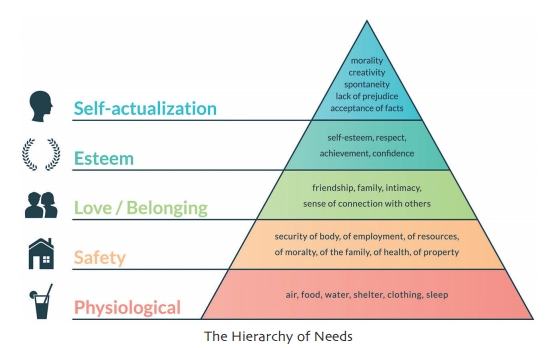
Soru 86
I. It is not possible to associate internal organs with excitement and emotions.
II. It is possible to obtain physiological changes in the body by taking a pill.
III. Individuals may reach differently for the same emotion.
Which of the above is among the criticism that James-Lange theory receives?
II. It is possible to obtain physiological changes in the body by taking a pill.
III. Individuals may reach differently for the same emotion.
Which of the above is among the criticism that James-Lange theory receives?
Seçenekler
A
Only I
B
Only II
C
I and II
D
II and III
E
I, II and III
Açıklama:
The main points criticized in this theory can be listed as follows:
Since internal organs are not supported as strongly as other organs by nervous system,
internal changes occur very slowly. Thus, it is not possible to associate internal organs
with excitement and emotions.
It is possible to artificially obtain such physiological changes in the body by taking medicine. In other words, when a medicine or substance is taken to the body, similar physiological changes occur.
Individuals may react differently for the same emotion.
Since internal organs are not supported as strongly as other organs by nervous system,
internal changes occur very slowly. Thus, it is not possible to associate internal organs
with excitement and emotions.
It is possible to artificially obtain such physiological changes in the body by taking medicine. In other words, when a medicine or substance is taken to the body, similar physiological changes occur.
Individuals may react differently for the same emotion.
Soru 87
I. It argues that emotions and behaviours are simultaneous.
II. The physical reactions such as being alert about the danger are accompanied with emotional experiences.
III. Emotions emerge as a result of the reactions of the body.
Which of the above is correct regarding the Cannon-Bard theory?
II. The physical reactions such as being alert about the danger are accompanied with emotional experiences.
III. Emotions emerge as a result of the reactions of the body.
Which of the above is correct regarding the Cannon-Bard theory?
Seçenekler
A
Only I
B
Only II
C
I and II
D
II and III
E
I, II and III
Açıklama:
Cannon-Bard theory argues that emotions and behaviours are simultaneous.According to Walter Cannon and Philip Bard, the founders of this theory, the physical reactions such as being alert about the danger are accompanied with emotional experiences. James-Lange theory suggests that emotions emerge as a result of the reactions of the body.
Soru 88
I. They refer to movements expressing biopsychology-based basic emotions expressed on the face.
II. They are the movements individuals have to perform because of their social role.
III. The job-related movements are in this group.
Which of the above is correct regarding the expressive gestures and mimics?
II. They are the movements individuals have to perform because of their social role.
III. The job-related movements are in this group.
Which of the above is correct regarding the expressive gestures and mimics?
Seçenekler
A
Only I
B
Only II
C
I and II
D
II and III
E
I, II and III
Açıklama:
Expressive gestures and mimics: They refer to movements expressing biopsychology-based basic emotions expressed on the face. These universal emotions such as happiness, rage, astonishment, sadness, disgust etc are common emotions of human beings.
Social gestures and mimics: They are the movements individuals have to perform because of their social role.
Schematic gestures and mimics: The movements of theater players and pantomime performers can be classified in this group. The job-related movements are also in this group, such as the movements of brokers in a stock exchange.
Social gestures and mimics: They are the movements individuals have to perform because of their social role.
Schematic gestures and mimics: The movements of theater players and pantomime performers can be classified in this group. The job-related movements are also in this group, such as the movements of brokers in a stock exchange.
Soru 89
I. Mental processes affect how physiological changes are shaped.
II. They are related to how emotions emerge in human bodies.
III. Notable scientists in this theory are Stanley Schachter and Jerome E. Singer.
Which of the above is correct regarding the Cognitive Theory?
II. They are related to how emotions emerge in human bodies.
III. Notable scientists in this theory are Stanley Schachter and Jerome E. Singer.
Which of the above is correct regarding the Cognitive Theory?
Seçenekler
A
Only I
B
Only II
C
I and II
D
II and III
E
I, II and III
Açıklama:
In cognitive theories, mental processes such as perception, mentality, the methods of coding, recalling the knowledge and experience gained and thinking styles - which are also defined as cognitive elements affect how physiological changes are shaped. At this point, Stanley Schachter and Jerome E. Singer theory states that the factors related to cognition play a great role in shaping human behaviors. Cognitive theories, which involve mental processes such as recalling and how we perceive and think, affect how emotions emerge.
Soru 90
I. Robert Plutchik divided emotions into 8 main categories.
II. The neighbouring emotions are similar and opposite ends are opposite of these emotions.
III. It is possible to have different emotions by combining different emotions.
Which of the above is correct regarding "Wheel of Emotion"?
II. The neighbouring emotions are similar and opposite ends are opposite of these emotions.
III. It is possible to have different emotions by combining different emotions.
Which of the above is correct regarding "Wheel of Emotion"?
Seçenekler
A
Only I
B
Only II
C
I and II
D
II and III
E
I, II and III
Açıklama:
Robert Plutchik, who divided emotions into 8 main categories, introduced one of the most important attempts for the classifications of emotions. Plutchik developed “Wheel of Emotion” by placing emotions according to some criteria. The neighboring emotions are similar while those at the opposite ends are opposite emotions; for instance anticipation-surprise, joy-sadness etc. In addition, it is possible to have different emotions by combining different emotions in the “Wheel of Emotion”.
Soru 91
Stereotype behavior patterns of all the species are called...........?
Seçenekler
A
homeostasis
B
instinct
C
motive
D
stimulus
E
drive
Açıklama:
Stereotype behavior patterns of all the species are called instinct. The migrations of storks and spiders’ spinning their webs are unique behaviors to a species.
Soru 92
which one of the following term refers to biological balance displaying an internal stable condition?
Seçenekler
A
homeostasis
B
incentive
C
instinct
D
drive
E
motive
Açıklama:
Homeostasis It refers to a biological balance displaying an internal stable condition regarding how and how much food will be taken by the organism.
Soru 93
Which one of the following does refer to non-biological elements that appeal to an individual even if he does not feel any need and trigger him for an action accordingly?
Seçenekler
A
Drives
B
Homeostasis
C
Incentives
D
Motives
E
Instincts
Açıklama:
Incentives refer to non-biological elements that appeal to an individual even if he does not feel any need and trigger him for an action accordingly. These elements might be in the form of objects or events that attract individual’s attention.
Soru 94
Which part of the brain is the center directing the reactions related to hunger in the body?
Seçenekler
A
Medulla
B
Hypertalamus
C
Cerebellum
D
Hipocampus
E
Hypothalamus
Açıklama:
Hypothalamus is the center directing the reactions related to hunger in the body. It also controls eating process as hunger and thirst control center.
Soru 95
Which needs are at the bottom and covering the largest area in the Maslow's hierarchy of needs?
Seçenekler
A
Esteem
B
Physiological
C
Safety
D
Self-Actualization
E
Love /Belonging
Açıklama:
Basic physiological needs such as hunger and thirst are placed at the bottom step and these needs are at the bottom and covering the largest area in the Maslow's hierarchy of needs.
Soru 96
In which of the following are the needs in the hierarchy of needs given in order from bottom to top?
Seçenekler
A
Physiological, safety, esteem, self actualization, love/belonging
B
Safety, physiological, love/belonging, esteem, self actualization
C
Physiological, safety,esteem, love/belonging, self actualization
D
Physiological, safety, love/belonging, esteem, self actualization
E
Love/belonging, physiological, safety, esteem, self actualization
Açıklama:
The needs in the hierarchy of needs are from bottom to top are listed as; physiological, safety, love/belonging, esteem, self actualization
Soru 97
Which one of the following needs are included to stimulus motives?
Seçenekler
A
Manipulation
B
Homeostasis
C
Incentives
D
Hunger
E
Achivement
Açıklama:
Manipulation, Exploration and Curiosity are stimulus motives which are examples of unlearned motives, mainly depend on external stimulants and aim to obtain information from nearby environment.
Soru 98
Which of the following options gives social motives together and correctly?
Seçenekler
A
Achievement, Affiliation, Manipulation
B
Achievement, Affiliation, Power
C
Incentive, Affiliation, Power
D
Achievement, Homeostasis, Power
E
Achievement, Exploration, Power
Açıklama:
Social motives -which include being together, achievement, power and affiliation- are about interpersonal relationships and as influential as unlearned motives on human behaviors.
Soru 99
"An individual needs to be together with others in the society, get their approval and be in harmony with the society"
Which one of the following need is related to above mentioned situation?
Which one of the following need is related to above mentioned situation?
Seçenekler
A
Power
B
Manipulation
C
Exploration
D
Affiliation
E
Achievement
Açıklama:
The Need for Affiliation:Having relationships with other people in the society and the need to be closer to them are among the most important needs that shape human behaviors. An individual needs to be together with others in the society, get their approval and be in harmony with the society.
Soru 100
According to "Wheel of Emotion" which one of the following emotion emerges from the combining emotions of anger and disgust?
Seçenekler
A
acceptance
B
remorse
C
anticipation
D
disaproval
E
contempt
Açıklama:
anger and disgust = contempt
Soru 101
Bodily needs such as hunger, thirst and sex creating state of tension or arousal are called a _________.
Which term should be written in the blank to complete the sentence correctly?
Which term should be written in the blank to complete the sentence correctly?
Seçenekler
A
Motive
B
Drive
C
Incentive
D
Homeostasis
E
Instinct
Açıklama:
Incentive refers to non-biological elements that appeal to an individual even if he does not feel any need and trigger him for an action accordingly. Stereotype behavior patterns of all the species are called instinct. Homeostasis refers to a biological balance displaying an internal stable condition regarding how and how much food will be taken by the organism. Motive It is a general term covering wishes, needs, drives and interests that induce an organism to act towards a purpose. Bodily needs such as hunger, thirst and sex creating state of tension or arousal are called drives. So, the answer is B.
Soru 102
According to Maslow's hierarchy of needs theory, which of the below needs must be satisfied first?
Seçenekler
A
Self-actualization
B
Love/ Belonging
C
Physiological
D
Safety
E
Esteem
Açıklama:
According to Maslow's theory, the needs from the bottom level to the top can be listed as follows respectively:
• basic physiological needs such as hunger, thirst, breathing, sexuality and sleeping
• the need for safety for family, job and properties
• social needs related to love and belonging such as family, social groups, close friendship
• the need for the appreciation of value, achievement and respect
• self-actualization which covers the superiority of morality, creativity and problem solution
Given the information above, the answer is C, "Physiological"needs.
• basic physiological needs such as hunger, thirst, breathing, sexuality and sleeping
• the need for safety for family, job and properties
• social needs related to love and belonging such as family, social groups, close friendship
• the need for the appreciation of value, achievement and respect
• self-actualization which covers the superiority of morality, creativity and problem solution
Given the information above, the answer is C, "Physiological"needs.
Soru 103
Which one is a stimulus motive?
Seçenekler
A
Hunger and thirst
B
Exploration and curiosity
C
Need for power
D
Need for achievement
E
Need for affiliation
Açıklama:
While hunger and thirst are primary motives, need for power, affiliation and achievement are social motives. On the other hand, exploration and curiosity are stimulus motives. So, the answer is B.
Soru 104
According to Plutchik's "Wheel of Emotions" theory, which equation is FALSE?
Seçenekler
A
joy and anticipation = optimism
B
anger and disgust = contempt
C
surprise and sadness = disaproval
D
acceptance and fear = submission
E
disgust and sadness = dread
Açıklama:
According to Plutchik's "Wheel of Emotions" theory, disgut and sadness form remorse when combined, not dread. So, the answer is E.
Soru 105
Which of the below body gestures and mimics is the best example to non-social body movement?
Seçenekler
A
Sneezing
B
Smiling
C
Frowning
D
Eye contact
E
Laughing
Açıklama:
Secondary gestures and mimics: They involve non-social body movements associated with body needs such as yawning, sneezing and coughing. So, the answer is A.
Soru 106
Which of the theories about emotions claims that emotions and physiological reactions emerge simultaneously?
Seçenekler
A
James Lange Theory
B
Cognitive Theory
C
Plutchik's "Wheel of Emotion" Theory
D
Cannon Bard Theory
E
Sociobiological Theory
Açıklama:
According to Cannon-Bard theory, emotions do not emerge as a reaction to physiological conditions. Organism activates physical reaction at the same time as emotions. In other words, emotions and physiological reactions emerge simultaneously. So, the answer is D.
Soru 107
Which emotion theory suggests that emotions are triggered by physiological changes?
Seçenekler
A
James Lange Theory
B
Cannon Bard Theory
C
Cognitive Theory
D
Sociobiological Theory
E
"Wheel of Emotions" Theory
Açıklama:
According to the theory developed by William James and Carl Lange, the body reacts to the nearby events, and when this reaction is noticed, an emotion occurs accompanied with these physiological changes.So, the asnwer is A.
Soru 108
- Cognitive factors play an important role in how our emotions differ and change from person to person.
- Throughout history, some behaviors have disappeared and some new behaviors have emerged to help humans adapt to the environment.
- Emotions emerge as a result of the reactions of the body.
Seçenekler
A
Only I
B
Only II
C
Only III
D
I and II
E
II and III
Açıklama:
According to Sociobiological theory, humans display social behaviors as a social entity. These behaviors have evolved through a natural process throughout history. While some behaviors have disappeared, some new behaviors have emerged. Emotions have also passed through similar stages. While some emotions have disappeared, some have successfully retained. Such emotions help individuals to adapt himself to the environment. So, the answer is B.
Soru 109
- Manipulation
- Exploration and curiosity
- Need for affiliation
- Need for achievement
Seçenekler
A
I and II
B
II and III
C
III and IV
D
I and IV
E
II and IV
Açıklama:
Social motives are need for affiliation, power and achievement. On the other hand, manipulationi exploration and curiosity are stimulus motives. So, the answer is C.
Soru 110
________ refers to a biological balance displaying an internal stable condition regarding how and how much food will be taken by the organism.
Which term should be written in the blank to complete the definiton correctly?
Which term should be written in the blank to complete the definiton correctly?
Seçenekler
A
Instinct
B
Motive
C
Incentive
D
Drive
E
Homeostasis
Açıklama:
The word “Homeostatis” come from two Greek words: First one is “homos” means “same” and “therme” means “heat”. Homeostasis, is often defined as biological balance and it maintains the balance in the body like a thermostats. When room temperature decreases or increases, thermostats turns off or turns on the central heating system. Similarly, our body tries to keep this balance during hunger or thirst through certain systems. So, the answer is E.
Ünite 4
Soru 1
The main principle of perception is based on electrical signals that are created in the receptors in our nervous system. Which of the following describes the transformation of one form of energy into another form of energy?
Seçenekler
A
Transduction
B
Process
C
Perception
D
Sensation
E
Thresholds
Açıklama:
The main principle of perception is based on electrical signals that are created in the receptors in our nervous system. Transduction is the transformation of one form of energy into another form of energy.
Soru 2
Among the given options below, which describes the realization of the leafshaped bug (not leaf) as the outcome of the perceptual process?
Seçenekler
A
Process
B
Transduction
C
Sensation
D
Perception
E
Recognition
Açıklama:
Perception occurs when the electiric signals of the leaf-shaped bug representation reach the brain in a transformed form. Realization of the leafshaped bug (not leaf) is called recognition; walking towards it to see it clearly is an action. Recognition and action are the outcomes of theperceptual process.
Soru 3
Which of the following includes the information contained in the enviromental stimuli that are captured by the relevant sensory system and transmitted to the brain?
Seçenekler
A
Transduction
B
Process
C
Sensation
D
Perception
E
Recognition
Açıklama:
Sensation includes the information contained in the enviromental stimuli that are captured by the relevant sensory system and transmitted to the brain.
Soru 4
What is the word that is related to the process of analyzing, recognizing, interpreting, and organizing the information?
Seçenekler
A
Transduction
B
Process
C
Sensation
D
Perception
E
Recognition
Açıklama:
Perception, on tne other hand, is the process of analyzing, recognizing, interpreting, and organizing this information.
Soru 5
Which of the following option describes the area on the retina lacking receptors that respond to light?
Seçenekler
A
The Blind Spot
B
Visual Cortex
C
Optic Nerve
D
Photoreceptors
E
Face Detection
Açıklama:
The blind spot is the area on the retina lacking receptors that respond to light.
Soru 6
Through which feature humans can distinguish objects from each other and from the background?
Seçenekler
A
Visual Cortex
B
Optic Nerve
C
Color Perception
D
Photoreceptors
E
Face Detection
Açıklama:
We can distinguish objects from each other and from the background through our color perception.
Soru 7
Among the below given options, which theory is based on the idea that the light of a particular wave length stimulates the three different receptor mechanisms?
Seçenekler
A
Trichromatic
B
Identity
C
Age
D
Mood
E
Ethnical origin
Açıklama:
The trichromatic theory is based on the idea that the light of a particular wave length stimulates the three different receptor mechanisms, each with different spectral sensitivities (also called Young - Helmhotz theory of color vision). These three colors are red, green, and blue.
Soru 8
What is the word that describes the act of knowing or recognizing a distance by previous experiences or recollective thought?
Seçenekler
A
Perceptual Organization
B
Distance Perception
C
Color Perception
D
Shadowing or Shading
E
Texture Gradient
Açıklama:
Distance perception is the act of knowing or recognizing a distance by previous experiences or recollective thought.
Soru 9
Which given word below desrcibes the reduction in response to a continuing smell?
Seçenekler
A
Distance Perception
B
Color Perception
C
Olfactory adaptation
D
Shadowing or Shading
E
Texture Gradient
Açıklama:
Olfactory adaptation is the reduction in response to a continuing smell.
Soru 10
Which of the following is not the tactile sensations that humans are sensitive to?
Seçenekler
A
Touch
B
Pain
C
Warmth
D
Cold
E
Hear
Açıklama:
Humans are sensitive to mostly four tactile sensations: pressure (touch), pain, warmth and cold.
Soru 11
"______________________is based on the idea that the light of a particular wave length stimulates the three different receptor mechanisms, each with different spectral sensitivities. These three colors are red, green, and blue". Which of the following option best fits the gap above?
Seçenekler
A
The Trichromatic Theory
B
Two-Factor Theory
C
The Psycho-Analytic Theory
D
The Constitutional Theory
E
Theory of Moral Development
Açıklama:
The trichromatic theory is based on the idea that the light of a particular wave length stimulates the three different receptor mechanisms, each with different spectral sensitivities (also called Young - Helmhotz theory of color vision). These three colors are red, green, and blue.
Soru 12
Which term refers to the following description: "Elements that are equally spaced in a scene appear to be more closely packed as distance increases"?
Seçenekler
A
Shadowing or Shading
B
Texture Gradient
C
Linear perspective
D
Atmospheric perspective
E
Occlusion
Açıklama:
Texture Gradient: Elements that are equally spaced in a scene appear to be more closely packed as distance increases.
Soru 13
Which of the following option below refers to the result of nearer objects covering up part of farther objects?
Seçenekler
A
Relative height
B
Familiar size
C
Occlusion
D
Texture Gradient
E
Linear perspective
Açıklama:
Occlusion: This is a result of nearer objects covering up part of farther objects.
Soru 14
Which term best desribes the parallel lines appear to converge in depth?
Seçenekler
A
Atmospheric perspective
B
Familiar size
C
Texture Gradient
D
Linear perspective
E
Relative height
Açıklama:
Linear perspective: Parallel lines appear to converge in depth.
Soru 15
"_________________ cues are based on our ability to sense the position of our eyes and the tension in our eye muscles?" Which of the following word best fills the blank?
Seçenekler
A
Place theory
B
Auditory Perception
C
Temporal theory
D
Taste Perception
E
Oculomotor
Açıklama:
Oculomotor cues are based on our ability to sense the position of our eyes and the tension in our eye muscles.
Soru 16
Which of the following option is not included in the four principles of law of proximity that the Gestalt psychologists proposed to explain how perceptual grouping occurs?
Seçenekler
A
Occlusion
B
Proximity
C
Common region
D
Connectedness
E
Synchrony
Açıklama:
There are four principles of law of proximity that the Gestalt psychologists proposed to explain how perceptual grouping occurs: Grouping by (a) proximity; (b) common region; (c) connectedness and (d) synchrony.
Soru 17
Which of the following term is the reduction in response to a continuing smell?
Seçenekler
A
Connectedness
B
Olfactory adaptation
C
Law of proximity
D
Temporal theory
E
Taste Perception
Açıklama:
Olfactory adaptation is the reduction in response to a continuing smell.
Soru 18
Human ear consists of three parts inner, outer and middle ear. Sound travels at a constant speed in the air. Which of the following is one of the three components of a sound wave?
Seçenekler
A
Motion
B
Texture
C
Amplitude
D
Lightness
E
Color
Açıklama:
Human ear consists of three parts inner, outer and middle ear. Sound travels at a constant speed in the air. A sound wave is defined by three components: frequency, amplitude and phase.
Soru 19
"The animals, which have a highly developed sense of smell are ______________". Which of the following term best fits the gap?
Seçenekler
A
Coenzymatic
B
Symptomatic
C
Apothegmatic
D
Macrosmatic
E
Trichromatic
Açıklama:
The animals, which have a highly developed sense of smell are macrosmatic.
Soru 20
"Humans are sensitive to mostly four tactile sensations namely touch, warmth, cold, and ____________". Which of the following is the last sensation that should be mentioned in the statement?
Seçenekler
A
Motion
B
Texture
C
Color
D
Lightness
E
Pain
Açıklama:
Humans are sensitive to mostly four tactile sensations: pressure (touch), pain, warmth and cold.
Soru 21
Which of the following is true about "stimulus" as a step of the perceptual process?
Seçenekler
A
While walking in a park perceiving stimuli such as trees, banks, birds, etc. are examples of attended stimulus.
B
Electrical signals that capture one's attention are called environmental stimulus.
C
The stimulus on the receptors is based on transformation of one form of energy into another form of energy.
D
Stimulus is the process of analyzing, recognizing, interpreting, and organizing information.
E
Stimulus in the environment has two aspects: environmental stimulus and
attended stimulus.
attended stimulus.
Açıklama:
Stimulus exists both in the environment, and within our body. Stimulus in the environment has two aspects: environmental stimulus and attended stimulus. Thus, the answer is B.
Soru 22
Which of the following best explains 'Absolute Threshold'?
Seçenekler
A
The energy level at which the lowest level stimulus is noticed or discerned by
the human senses, including vision, hearing, taste, smell and touch
the human senses, including vision, hearing, taste, smell and touch
B
Information contained in the enviromental stimuli that are captured by the relevant sensory system and transmitted to the brain
C
The lowest noticeable change in the intensity of the stimulus
D
Electrical signals that are created in the receptors in nervous system
E
The process of analyzing, recognizing, interpreting, and organizing information
Açıklama:
Absolute threshold is explained as the energy level at which the lowest level stimulus is noticed or discerned by the human senses, including vision, hearing, taste, smell and touch. Thus, the aswer is A.
Soru 23
Which of the following is responsible for providing periphery detection?
Seçenekler
A
Fovea
B
Cones
C
Rods
D
Lateral geniculate nuclei
E
Cornea
Açıklama:
The rods aren’t located in the fovea and the density increases toward the periphery. For this reason, the rods provide periphery detection while the cones are responsible for seeing the center. Therefore, the answer is C.
Soru 24
Which of the following matches is true regarding depth information?
Seçenekler
A
Occlusion - It occurs when more distant objects appear less sharp accompanied with a slight blue tint
B
Atmospheric perspective - This is a result of nearer objects covering up part of farther objects
C
Shading - Parallel lines appear to converge in depth
D
Texture Gradient - Elements that are equally spaced in a scene appear to be more closely packed as distance increases
E
Linear perspective - When two objects are of equal size, the one that is farther away will take up less of your field view than the one that is closer.
Açıklama:
Options A, B, C, and E are not true matches. Texture gradient refers to elements that are equally spaced in a scene appear to be more closely packed as distance increases. Thus, the answer is D.
Soru 25
Which of the following is not true about 'Distance Perception'?
Seçenekler
A
Depth and distance perception refer to the ability to recognize objects by positioning them in variable distances in the three-dimensional world
B
Binocular cues aid in depth perception and monocular cues provide the information necessary to feel the depth and the distance in a picture on a two-dimensional paper
C
Distance perception depends only on optical information like monocular and
binocular depth cues
binocular depth cues
D
Distance perception is the act of knowing or recognizing a distance by previous experiences or recollective thought
E
Perception of depth is perceived by the distance cues
Açıklama:
Distance perception doesn’t depend only on optical information like monocular and
binocular depth cues. The amount of effort and expectations also determine distance judgements. Therefore, the answer is C.
binocular depth cues. The amount of effort and expectations also determine distance judgements. Therefore, the answer is C.
Soru 26
Which of the following is not among the principles of law of proximity that the Gestalt psychologists proposed to explain how perceptual grouping occurs?
Seçenekler
A
Proximity
B
Clarity
C
Common region
D
Connectedness
E
Synchrony
Açıklama:
There are four principles of law of proximity that the Gestalt psychologists proposed to explain how perceptual grouping occurs: Grouping by (a) proximity; (b) common
region; (c) connectedness and (d) synchrony. Clarity is not among these principles. Thus, the answer is B.
region; (c) connectedness and (d) synchrony. Clarity is not among these principles. Thus, the answer is B.
Soru 27
Which of the following is true about the auditory system?
Seçenekler
A
The physical definition of sound refers to the experience that we have during hearing
B
A sound wave is defined by two components: frequency and phase
C
The perceptual definition of sound refers to the pressure change in the air
D
The middle ear contains three bones: anvil, stirrup and hammer
E
The outer ear is the visible part of the hearing system in the shape of a snail shell.
Açıklama:
A sound wave is defined by two components: frequency and phase. The other options A, C, D, and E include false information regarding the auditory system. Therefore, the answer is B.
Soru 28
Which of the following describes 'anosmia'?
Seçenekler
A
The sense of smell is not that crucial to our survival
B
A highly developed sense of smell
C
Losing the ability to smell
D
The reduction in response to a continuing smell
E
The urge to find nutrition and orient in the environment
Açıklama:
Losing the ability to smell is called anosmia. Therefore, the answer is C.
Soru 29
Which of the following is true about the sense of taste?
Seçenekler
A
Living species stay away from things that are usually sour because they are mostly poisonous
B
Filiform papillae contains taste buds
C
The whole tongue contains about 1000 taste buds
D
When a bud is examined in detail, it is observed that between 10 and 70 taste cells are present
E
Taste ensures that we stay away from toxic and harmful things
Açıklama:
Living species stay away from things that are usually 'bitter'. Filiform papillae does not contain taste buds. The whole tongue contains about 10,000 taste buds, and there are 40 and 100 taste cells on a bud. The last option that says 'Taste ensures that we stay away from toxic and harmful things' is true. Thus, the answer is E.
Soru 30
Which of the following has far more touching cells than other regions?
Seçenekler
A
Palms
B
Fingertips
C
Feets
D
Arms
E
Legs
Açıklama:
Fingertips have far more touching cells than other regions; therefore, they are more sensitive to touch than other parts of the body. Thus, the answer is B.
Soru 31
Which statement below is not correct about the perceptual process?
Seçenekler
A
It is a process about how we experience and react to the stimuli in the environment.
B
The main principle of perception is based on electrical signals that are created in the receptors in our nervous system.
C
Sensation includes the information contained in the environmental stimuli that are captured by the relevant sensory system and transmitted to the brain.
D
Perception occurs instantly and it involves very simple mechanisms.
E
Perception is the process of analyzing, recognizing, interpreting, and organizing this information.
Açıklama:
There are so many things happening around us. However, we perceive only a small part of it. Even this perception does not just happen; there are many processes involved in. These sequences of steps are called perceptual processes.It is a process about how we experience and react to the stimuli in the environment.
The main principle of perception is based on electrical signals that are created in the receptors in our nervous system.
Sensation includes the information contained in the enviromental stimuli that are captured by the relevant sensory system and transmitted to the brain. Perception, on the other hand, is the process of analyzing, recognizing, interpreting, and organizing this information. Even though perception seems to occur instantly, it involves complex mechanisms.
The correct answer is D.
The main principle of perception is based on electrical signals that are created in the receptors in our nervous system.
Sensation includes the information contained in the enviromental stimuli that are captured by the relevant sensory system and transmitted to the brain. Perception, on the other hand, is the process of analyzing, recognizing, interpreting, and organizing this information. Even though perception seems to occur instantly, it involves complex mechanisms.
The correct answer is D.
Soru 32
"It is explained as the energy level at which the lowest level stimulus is noticed or discerned by the human senses, including vision, hearing, taste, smell and touch. For example, the lowest amount of salt in a glass is noticed by stimulating your sensory system."
What is the term whose definition is given above?
What is the term whose definition is given above?
Seçenekler
A
Environmental stimulus
B
Attended Stimulus
C
Absolute threshold
D
Difference Threshold
E
Transduction
Açıklama:
Stimulus in the environment has two aspects: environmental stimulus and attended stimulus. Let me explain with an example. Imagine that you are walking in a park where there are lots of stimuli that you can potentially perceive such as trees, banks, birds, etc. These are environmental stimuli. When you are walking in the park a distinctive leaf captures your attention. Then, you reliaze that this thing is not a leaf; it is a leaf-shaped bug. Thus, you focus on the bug. The bug becomes the center of your attention. In other words, it becomes the attended stimulus. If you shift your attention (for example, David Beckham comes into the park for running), your attended stimulus also changes (David Beckham).
Absolute threshold is explained as the energy level at which the lowest level stimulus is noticed or discerned by the human senses, including vision, hearing, taste, smell and touch. For example, the lowest amount of salt in a glass is noticed by stimulating your sensory system.
The difference threshold refers to is the lowest noticeable change in the intensity of the stimulus. It occurs depending on how great the intensity of the stimulus is. For example, if you lift a five-kilogram and a ten-kilogram dumbbell consecutively, you can notice the difference. However, if you lift 100 kilos and then 105 kilos, the difference is most likely indistinguishable.
Transduction is the transformation of one form of energy into another form of energy.
The correct answer is C.
Absolute threshold is explained as the energy level at which the lowest level stimulus is noticed or discerned by the human senses, including vision, hearing, taste, smell and touch. For example, the lowest amount of salt in a glass is noticed by stimulating your sensory system.
The difference threshold refers to is the lowest noticeable change in the intensity of the stimulus. It occurs depending on how great the intensity of the stimulus is. For example, if you lift a five-kilogram and a ten-kilogram dumbbell consecutively, you can notice the difference. However, if you lift 100 kilos and then 105 kilos, the difference is most likely indistinguishable.
Transduction is the transformation of one form of energy into another form of energy.
The correct answer is C.
Soru 33
I. It is based on the idea that the light of a particular wave length stimulates the three different receptor mechanisms, each with different spectral sensitivities.
II. These three colors are red, yellow, and blue.
III. Each of these color-sensitive cone cells has different degrees of sensitivity, with red cones being the most sensitive and blue cones being the least.
IV. In the absence of any of the cone types or an altered absorption spectrum in one or more of the photopigments lead to color perception problems.
V. Color blindness is a fairly common condition and mostly seen in women.
Which statements above are true about the trichromatic theory?
II. These three colors are red, yellow, and blue.
III. Each of these color-sensitive cone cells has different degrees of sensitivity, with red cones being the most sensitive and blue cones being the least.
IV. In the absence of any of the cone types or an altered absorption spectrum in one or more of the photopigments lead to color perception problems.
V. Color blindness is a fairly common condition and mostly seen in women.
Which statements above are true about the trichromatic theory?
Seçenekler
A
I and V
B
I and IV
C
I, II and III
D
I,II,III, and IV
E
I, II, III, IV and V
Açıklama:
The trichromatic theory is based on the idea that the light of a particular wave length stimulates the three different receptor mechanisms, each with different spectral sensitivities (also called Young - Helmhotz theory of color vision). These three colors are red, green, and blue. Each of these color-sensitive cone cells has different degrees of sensitivity, with blue cones being the most sensitive and red cones being the least. This activity pattern results in the perception of color. Color deficiencies are usually explained by thrichromatic theory. In the absence of any of the cone types or an altered absorption spectrum in one or more of the photopigments lead to color perception problems. Color blindness is a fairly common condition and mostly seen in men. This is because the cone photopigment genes are located on the X-chromosome (men have only one X-chromosome).
The correct answer is B.
The correct answer is B.
Soru 34
"This is a result of nearer objects covering up part of farther objects."
Which pictorial cue does the sentence above describe?
Which pictorial cue does the sentence above describe?
Seçenekler
A
Occlusion
B
Relative height
C
Relative size
D
Shadowing
E
Linear perspective
Açıklama:
Monocular pictorial cues are the source of depth information (Figure 4.6):
• Occlusion: This is a result of nearer objects covering up part of farther objects.
• Relative height: Objects that are below the horizon and have their bases higher in the field of view are usually seen as being more distant.
• Relative size: When two objects are of equal size, the one that is farther away will take up less of your field view than the one that is closer.
• Familiar size: We use this cue when we judge distance based on our prior knowledge of the size of objects.
• Atmospheric perspective: It occurs when more distant objects appear less sharp accompanied with a slight blue tint.
• Linear perspective: Parallel lines appear to converge in depth.
• Shadowing or Shading: When objects appear in front of the shadow, the angle and sharpness of the shadow will influence the amount of depth perceived.
• Texture Gradient: Elements that are equally spaced in a scene appear to be more closely packed as distance increases.
• Occlusion: This is a result of nearer objects covering up part of farther objects.
• Relative height: Objects that are below the horizon and have their bases higher in the field of view are usually seen as being more distant.
• Relative size: When two objects are of equal size, the one that is farther away will take up less of your field view than the one that is closer.
• Familiar size: We use this cue when we judge distance based on our prior knowledge of the size of objects.
• Atmospheric perspective: It occurs when more distant objects appear less sharp accompanied with a slight blue tint.
• Linear perspective: Parallel lines appear to converge in depth.
• Shadowing or Shading: When objects appear in front of the shadow, the angle and sharpness of the shadow will influence the amount of depth perceived.
• Texture Gradient: Elements that are equally spaced in a scene appear to be more closely packed as distance increases.
Soru 35
Which one is correct about "atmospheric perspective"?
Seçenekler
A
Parallel lines appear to converge in depth.
B
Objects that are below the horizon and have their bases higher in the field of view are usually seen as being more distant.
C
When two objects are of equal size, the one that is farther away will take up less of your field view than the one that is closer.
D
It occurs when more distant objects appear less sharp accompanied with a slight blue tint.
E
When objects appear in front of the shadow, the angle and sharpness of the shadow will influence the amount of depth perceived.
Açıklama:
Monocular pictorial cues are the source of depth information (Figure 4.6):
• Occlusion: This is a result of nearer objects covering up part of farther objects.
• Relative height: Objects that are below the horizon and have their bases higher in the field of view are usually seen as being more distant.
• Relative size: When two objects are of equal size, the one that is farther away will take up less of your field view than the one that is closer.
• Familiar size: We use this cue when we judge distance based on our prior knowledge of the size of objects.
• Atmospheric perspective: It occurs when more distant objects appear less sharp accompanied with a slight blue tint.
• Linear perspective: Parallel lines appear to converge in depth.
• Shadowing or Shading: When objects appear in front of the shadow, the angle and sharpness of the shadow will influence the amount of depth perceived.
• Texture Gradient: Elements that are equally spaced in a scene appear to be more closely packed as distance increase.
The correct answer is D.
• Occlusion: This is a result of nearer objects covering up part of farther objects.
• Relative height: Objects that are below the horizon and have their bases higher in the field of view are usually seen as being more distant.
• Relative size: When two objects are of equal size, the one that is farther away will take up less of your field view than the one that is closer.
• Familiar size: We use this cue when we judge distance based on our prior knowledge of the size of objects.
• Atmospheric perspective: It occurs when more distant objects appear less sharp accompanied with a slight blue tint.
• Linear perspective: Parallel lines appear to converge in depth.
• Shadowing or Shading: When objects appear in front of the shadow, the angle and sharpness of the shadow will influence the amount of depth perceived.
• Texture Gradient: Elements that are equally spaced in a scene appear to be more closely packed as distance increase.
The correct answer is D.
Soru 36
"It states that visual events occurring at the same time are perceived as belonging together."
Which principle of law of proximity is described above?
Which principle of law of proximity is described above?
Seçenekler
A
the principle of synchrony
B
the principle of uniform connectedness
C
principle of common region
D
principle of good continuation
E
principle of similarity
Açıklama:
There are four principles of law of proximity that the Gestalt psychologists proposed to explain how perceptual grouping occurs: Grouping by (a) proximity; (b) common region; (c) connectedness and (d) synchrony.
(a) Proximity: When things are near each other, they appear to be grouped together.
(b) Elements that are within the same region of space appear to be grouped together, and this phenomenon is called principle of common region.
(c) The principle of uniform connectedness states that a connected region of visual properties, such as lightness, color, texture, or motion, is perceived as a single unit
(d) The principle of synchrony states that visual events occurring at the same time are perceived as belonging together.
The correct answer is A.
(a) Proximity: When things are near each other, they appear to be grouped together.
(b) Elements that are within the same region of space appear to be grouped together, and this phenomenon is called principle of common region.
(c) The principle of uniform connectedness states that a connected region of visual properties, such as lightness, color, texture, or motion, is perceived as a single unit
(d) The principle of synchrony states that visual events occurring at the same time are perceived as belonging together.
The correct answer is A.
Soru 37
I. The main function of the outer ear is to catch the voice from the outside world and transmit it to the other parts of the ear.
II. The sound wave reaches the eardrum through an ear canal.
III. When the sound waves reach the eardrum (tympanic membrane), they cause vibration. As a result of this, the vibrations coming to the center are transmitted to the middle ear.
IV. The sound wave arriving at the inner ear reaches the structure of the cochlea and the fluid in the cochlea vibrates as a result of sound waves.
V. These neural signals are then transmitted to the hearing center and hearing-related areas in the brain.
Which ones are correct about the hearing process?
II. The sound wave reaches the eardrum through an ear canal.
III. When the sound waves reach the eardrum (tympanic membrane), they cause vibration. As a result of this, the vibrations coming to the center are transmitted to the middle ear.
IV. The sound wave arriving at the inner ear reaches the structure of the cochlea and the fluid in the cochlea vibrates as a result of sound waves.
V. These neural signals are then transmitted to the hearing center and hearing-related areas in the brain.
Which ones are correct about the hearing process?
Seçenekler
A
I and V
B
I, II and V
C
I, II, III and IV
D
I, II, III, and IV
E
I, II, III, IV and V
Açıklama:
Sound waves first reach the outer ear, which is the visible part of the hearing system. The main function of the outer ear is to catch the voice from the outside world and transmit it to the other parts of the ear. The sound wave reaches the eardrum through an ear canal. When the sound waves reach the eardrum (tympanic membrane), They cause vibration. As a result of this, the vibrations coming to the center are transmitted to the middle ear. The middle ear contains three bones: anvil, stirrup and hammer. The sound wave arriving at the inner ear reaches the structure of the cochlea, which resembles a snail shell. The fluid in the cochlea vibrates as a result of sound waves. There is also a section inside the cochlea that contains the hearing neurons called the hair cell. These neural signals are then transmitted to the hearing center and hearing-related areas in the brain.
The correct answer is E.
The correct answer is E.
Soru 38
Which is false about the sense of smell?
Seçenekler
A
The sense of smell is important for most species because it is often the primary source of perceiving the environment.
B
The most basic function of the sense of smell in vertebrate animals is to catch the chemical stimuli in the air.
C
Animals sometimes emit odor and serve as the source of stimulus, (for instance during mating behavior)
D
The sense of smell is not so crucial to our survival as some other animals , so humans are microsmatic.
E
In humans, the sense of smell plays a role in behaviors such as finding nutrition and orienting themselves in the environment-as wells as a role on social relations.
Açıklama:
The sense of smell is important for most species because it is often the primary source of perceiving the environment. The animals, which have a highly developed sense of smell are macrosmatic. The sense of smell is not that crucial to our survival, so humans are microsmatic. The most basic function of the sense of smell in vertebrate animals is to catch the chemical stimuli in the air (Figure 4.15). Animals sometimes emit odor and serve as the source of stimulus, (for instance during mating behavior)4. Basicly in humans, the sense of smell plays a role in behaviors such as finding nutrition and orienting themselves in the environment. It has also a role on social relations.
The correct answer is D.
The correct answer is D.
Soru 39
I. Olfactory adaptation is the reduction in response to a continuing smell.
II. Olfaction is very important for our survival.
III. It serves as an olfactory warning system in dangerous situations, such as gas leakage or rotten food.
Which statement(s) above is (are) correct about olfaction?
II. Olfaction is very important for our survival.
III. It serves as an olfactory warning system in dangerous situations, such as gas leakage or rotten food.
Which statement(s) above is (are) correct about olfaction?
Seçenekler
A
I
B
II
C
III
D
I and II
E
I, II and III
Açıklama:
Olfactory adaptation is the reduction in response to a continuing smell.Olfaction is more important for our survival than we think. It serves as an olfactory warning system in dangerous situations, such as gas leakage or rotten food.
The correct answer is E.
The correct answer is E.
Soru 40
What is false about the sense of taste?
Seçenekler
A
The surface of the tongue contains many ridges and valleys caused by the presence of structures called papillae.
B
All of the papillae (except the filiform papillae) contain taste buds, and the whole tongue contains about 1000 taste buds.
C
When a bud is examined in detail, it is observed that between 40 and 100 taste cells are present
D
The signals formed in the receptors are sent to the brain stem and then to the cerebral cortex via the taste signal.
E
The taste of the thing that the person eats is determined by the arrival of these signals at the brain.
Açıklama:
The surface of the tongue contains many ridges and valleys caused by the presence of structures called papillae. All of the papillae (except the filiform papillae) contain taste buds (Figure 4.16.), and the whole tongue contains about 10,000 taste buds. When a bud is examined in detail, it is observed that between 40 and 100 taste cells are present. The signals formed in the receptors are sent to the brain stem and then to the cerebral cortex via the taste signal. The taste of the thing that the person eats is determined by the arrival of these signals at the brain.
The correct answer is B.
The correct answer is B.
Soru 41
What is the transformation of one form of energy into another form of energy called?
Seçenekler
A
Transduction
B
Neural processing
C
Recognition
D
Perception
E
Sensation
Açıklama:
Transduction is the transformation of one form of energy into another form of energy. The correct answer is A.
Soru 42
What is the process of analyzing, recognizing, interpreting, and organizing information called?
Seçenekler
A
Sensation
B
Perception
C
Stimulus
D
Processing
E
Absolute threshold
Açıklama:
Perception is the process of analyzing, recognizing, interpreting, and organizing information. The correct answer is B.
Soru 43
What regulates the amount of light according to its brightness?
Seçenekler
A
Iris
B
Lens
C
Pupil
D
Cornea
E
Retina
Açıklama:
The pupil regulates the amount of light according to its brightness (by contracting and dilating). The correct answer is C.
Soru 44
What converts the light energy into neural messages?
Seçenekler
A
Cornea
B
Cones
C
Retina
D
Receptor cells
E
Fovea
Açıklama:
The role of receptor cells is to convert the light energy into neural messages. The correct answer is D.
Soru 45
There are no photoreceptors at the place where the optic nerve leaves
the eye, so the reflected light cannot be processed.What is this place called?
the eye, so the reflected light cannot be processed.What is this place called?
Seçenekler
A
Lateral geniculate nucleus
B
Thalamus
C
Optic nerve
D
Choroid
E
Blind spot
Açıklama:
At the point where the optic nerve leaves the eye, there are no photoreceptors, so the reflected light cannot be processed. For this reason, this point is called
the blind spot. The correct answer is E.
the blind spot. The correct answer is E.
Soru 46
I. Red
II. Green
III. Blue
IV. Black
V. White
Which three types of cones do people have that receive information about color?
II. Green
III. Blue
IV. Black
V. White
Which three types of cones do people have that receive information about color?
Seçenekler
A
I-II-III
B
I-III-V
C
II-III-V
D
II-III-IV
E
III-IV-V
Açıklama:
Humanbeings can see many colors, but they only have 3 types of cones that receive information about color: red, green, and blue. The correct answer is A.
Soru 47
Which one of the following is not one of the four principles of law of proximity that the Gestalt psychologists proposed to explain how perceptual grouping occurs?
Seçenekler
A
Proximityand
B
Similarity
C
Common region
D
Synchrony
E
Connectedness
Açıklama:
There are four principles of law of proximity that the Gestalt psychologists proposed to explain how perceptual grouping occurs: Grouping by (a) proximity; (b) common region; (c) connectedness and (d) synchrony. The correct answer is B.
Soru 48
I- Frequency
II- Amplitude
III- Phase
IV- Speed
Which of the above components defines a sound wave?
II- Amplitude
III- Phase
IV- Speed
Which of the above components defines a sound wave?
Seçenekler
A
I and II
B
II and III
C
I, II and III
D
I, II and IV
E
II, III and IV
Açıklama:
A sound wave is defined by three components: frequency, amplitude and phase. The correct answer is C.
Soru 49
What are the animals which have a highly developed sense of smell called?
Seçenekler
A
Talamus
B
Pituitary
C
Limbic
D
Macrosmatic
E
Microsmatic
Açıklama:
The animals, which have a highly developed sense of smell are called macrosmatic. The correct answer is D.
Soru 50
The receptor cells on the retina are called ........ .
Please fill in the blank with the correct answer.
Please fill in the blank with the correct answer.
Seçenekler
A
The rods and cones
B
Corneas
C
Lenses
D
Fovea
E
Vitreous chamber
Açıklama:
The rods and cones are the receptor cells on the retina. The correct answer is A.
Soru 51
"_____ is the transformation of one form of energy into another form of energy" Which of the following concepts completes the sentence correctly?
Seçenekler
A
Stimulus
B
Sensation
C
Transduction
D
Perception
E
Recognition
Açıklama:
The main principle of perception is based on electrical signals that are created in the receptors in our nervous system. Transduction is the transformation of one form of energy into another form of energy. After transforming energy into electrical signals, neurons are activated. The correct option is C.
Soru 52
Which of the following does 'perception' not include?
Seçenekler
A
Organizing the information
B
Acting
C
Interpreting
D
Analyzing
E
Recognizing
Açıklama:
Sensation includes the information contained in the enviromental stimuli that are captured by the relevant sensory system and transmitted to the brain. Perception, on the other hand, is the process of analyzing, recognizing, interpreting, and organizing this information. The correct option is B.
Soru 53
Which of the following part of the eye regulates the amount of light according to its brightness?
Seçenekler
A
Fovea
B
Retina
C
Cornea
D
Pupil
E
Iris
Açıklama:
The pupil regulates the amount of light according to its brightness (by contracting and dilating). You can think of your eye as a camera. Light enters the eye through its pupil, focuses on the cornea and lenses, and then reaches the rods and cones, the receptor cells on the retina. The correct option is D.
Soru 54
What is the role of the receptor cells, rods and cones?
Seçenekler
A
To perceive only black and white
B
To perceive depth
C
To provide periphery detection
D
To control the size of pupil
E
To convert the light energy into neural messages
Açıklama:
The role of receptor cells is to convert the light energy into neural messages. The correct option is E.
Soru 55
What is the area on the retina lacking receptors that respond to light called?
Seçenekler
A
Fovea
B
Blind spot
C
Optic nerve
D
Lens
E
Cones
Açıklama:
The stimuli are transmitted to the lateral geniculate nucleus of the thalamus first through the optic nerve and then to the visual cortex, after processing in the eye network system. At the point where the optic nerve leaves the eye, there are no photoreceptors, so the reflected light cannot be processed. For this reason, this point is called the blind spot. The correct option is B.
Soru 56
'The Trichromatic Theory is the idea that there are three receptors in the retina of the eye that are each sensitive to their own specific color.' What are these three colors?
Seçenekler
A
yellow, white and blue
B
white, black and grey
C
blue, yellow and red
D
red, green and blue
E
green, white and blue
Açıklama:
The trichromatic theory is based on the idea that the light of a particular wave length stimulates the three different receptor mechanisms, each with different spectral sensitivities (also called Young - Helmhotz theory of color vision). These three colors are red, green, and blue. Each of these color-sensitive cone cells has different degrees of sensitivity, with blue cones being the most sensitive and red cones being the least. This activity pattern results in the perception of color. The correct option is D.
Soru 57
 What is the monocular pictorial cue in the figure called?
Seçenekler
A
Occlusion
B
Relative size
C
Atmospheric perspective
D
Texture Gradient
E
Shadowing
Açıklama:
Monocular pictorial cues are the source of depth information. Occlusion is a result of nearer objects covering up part of farther objects. The correct option is A.
Soru 58
Which of the following is not one of the principles of law of proximity that the Gestalt psychologists proposed to explain how perceptual grouping occurs?
Seçenekler
A
Convergence
B
Proximity
C
Connectedness
D
Common region
E
Synchrony
Açıklama:
There are four principles of law of proximity that the Gestalt psychologists proposed to explain how perceptual grouping occurs: Grouping by (a) proximity; (b) common region; (c) connectedness and (d) synchrony.
(a) Proximity occurs when things that are near each other appear to be grouped together. (b) Elements that are within the same region of space appear to be grouped together. This is called principle of common region. (c) The principle of uniform connectedness states that a connected region of visual properties, such as lightness, color, texture, or motion is perceived as a single unit. (c) The principle of synchrony states that visual events that occur at the same time are perceived as belonging together.
The correct option is A.
(a) Proximity occurs when things that are near each other appear to be grouped together. (b) Elements that are within the same region of space appear to be grouped together. This is called principle of common region. (c) The principle of uniform connectedness states that a connected region of visual properties, such as lightness, color, texture, or motion is perceived as a single unit. (c) The principle of synchrony states that visual events that occur at the same time are perceived as belonging together.
The correct option is A.
Soru 59
Which of the following lists include the bones that the middle ear contains?
Seçenekler
A
Tympanic membrane, ear canal and eardrum
B
Frequency, amplitude and phase
C
Anvil, stirrup and hammer
D
Cochlea, haircell and hammer
E
Ear canal, stirrup and eardrum
Açıklama:
The middle ear contains three bones: anvil, stirrup and hammer. The correct option is C.
Soru 60
What is the loss of the ability of smell called?
Seçenekler
A
Phantosmia
B
Hyposmia
C
Anemia
D
Insomnia
E
Anosmia
Açıklama:
Losing the ability to smell is called anosmia. People who suffer from anosmia show us the importance of smell since these people also lose their ability to taste many foods. The reason for that is the close connection between smell and flavor. The correct option is E.
Soru 61
I. It exists both in the environment and within our body.
II. It has two aspects: environmental and attended.
III. It is the process of analysing, recognising and organising the information.
Which of the above is correct regarding Stimulus?
II. It has two aspects: environmental and attended.
III. It is the process of analysing, recognising and organising the information.
Which of the above is correct regarding Stimulus?
Seçenekler
A
Only I
B
Only II
C
I and II
D
II and III
E
I, II and III
Açıklama:
Stimulus exists both in the environment, and within our body. Stimulus in the environment has two aspects: environmental stimulus and attended stimulus. Perception, on the other hand, is the process of analyzing, recognizing, interpreting, and organizing this information.
Soru 62
I. It is based on the idea that the light of wave length stimulate three different receptor mechanism.
II. The strong colours are red, green and blue.
III. Each colour has a different degree of sensitivity.
Which of the above is correct regarding the trichromatic theory?
II. The strong colours are red, green and blue.
III. Each colour has a different degree of sensitivity.
Which of the above is correct regarding the trichromatic theory?
Seçenekler
A
Only I
B
Only II
C
I and II
D
II and III
E
I, II and III
Açıklama:
The trichromatic theory is based on the idea that the light of a particular wave length stimulates the three different receptor mechanisms, each with different spectral sensitivities (also called Young - Helmhotz theory of color vision). These three colors are red, green, and blue. Each of these color-sensitive cone cells has different degrees of sensitivity, with blue cones being the most sensitive and red cones being the least. This activity pattern results in the perception of color.
Soru 63
I. Color deficiencies are explained by thrichromatic theory.
II. Color blindness is a fairly common condition in men.
III. The cone photopigment are located on the Y-chromosome.
Which of the above is correct regarding the color deficiencies?
II. Color blindness is a fairly common condition in men.
III. The cone photopigment are located on the Y-chromosome.
Which of the above is correct regarding the color deficiencies?
Seçenekler
A
Only I
B
Only II
C
I and II
D
II and III
E
I, II and III
Açıklama:
Color deficiencies are usually explained by thrichromatic theory. In the absence of any of the cone types or an altered absorption spectrum in one or more of the photopigments lead to color perception problems. Color blindness is a fairly common condition and mostly seen in men. This is because the cone photopigment genes are located on the X-chromosome (men have only one X-chromosome).
Soru 64
"This is a result of nearer objects covering up part of farther objects."
What is the name of the term described above?
What is the name of the term described above?
Seçenekler
A
Relative height
B
Linear perspective
C
Shading
D
Occlusion
E
Texture Gradient
Açıklama:
Monocular pictorial cues are the source of depth information:
Occlusion: This is a result of nearer objects covering up part of farther objects.
Relative height: Objects that are below the horizon and have their bases higher in the field of view are usually seen as being more distant.
Linear perspective: Parallel lines appear to converge in depth.
Shadowing or Shading: When objects appear in front of the shadow, the angle and sharpness of the shadow will influence the amount of depth perceived.
Texture Gradient: Elements that are equally spaced in a scene appear to be more closely packed as distance increases.
Occlusion: This is a result of nearer objects covering up part of farther objects.
Relative height: Objects that are below the horizon and have their bases higher in the field of view are usually seen as being more distant.
Linear perspective: Parallel lines appear to converge in depth.
Shadowing or Shading: When objects appear in front of the shadow, the angle and sharpness of the shadow will influence the amount of depth perceived.
Texture Gradient: Elements that are equally spaced in a scene appear to be more closely packed as distance increases.
Soru 65
I. It is the act of knowing or recognising a distance by previous experiences.
II. It is perceived by the distance cues.
III. It doesn't solely depend on optical information like monocular and binocular depth cues.
Which of the above is correct regarding distance perception?
II. It is perceived by the distance cues.
III. It doesn't solely depend on optical information like monocular and binocular depth cues.
Which of the above is correct regarding distance perception?
Seçenekler
A
Only I
B
Only II
C
I and II
D
II and III
E
I, II and III
Açıklama:
Distance perception is the act of knowing or recognizing a distance by previous experiences or recollective thought. Perception of depth is perceived by the distance cues: binocular cues and monocular cues. However, distance perception doesn’t depend only on optical information like monocular and binocular depth cues.
Soru 66
"This principle states that visual events occurring at the same time are perceived as belonging together."
What is the name of the principle described above?
What is the name of the principle described above?
Seçenekler
A
The principle of uniform
B
The principle of synchrony
C
The principle of common region
D
Perceptual definition
E
Proximity
Açıklama:
The principle of synchrony states that visual events occurring at the same time are perceived as belonging together. It seems like the most important aspect of perception is the sequence of steps through which we perceive and recognize what an object is.
Soru 67
I. The activity level of a sensory neuron codes the frequency.
II. A given cell fires action potentials related to the frequency of the sound wave.
III. Sounds with different pitch generate neural messages in different sets of neurons.
Which of the above is correct related to the temporal theory?
II. A given cell fires action potentials related to the frequency of the sound wave.
III. Sounds with different pitch generate neural messages in different sets of neurons.
Which of the above is correct related to the temporal theory?
Seçenekler
A
Only I
B
Only II
C
I and II
D
II and III
E
I, II and III
Açıklama:
According to the temporal theory, the activity level of a sensory neuron codes the frequency. This means that a given hair cell fires action potentials related to the frequency of the sound wave. However, the place theory suggests that sounds with different pitch generate neural messages in different sets of neurons.
Soru 68
I. It is the primary source of perceiving the environment.
II. Animals are macrosmatic while humans are microsmatic.
III. The most basic function of the sense of smell in animals is to catch the chemical stimuli in the air.
Which of the above is correctly stated regarding the sense of smell?
II. Animals are macrosmatic while humans are microsmatic.
III. The most basic function of the sense of smell in animals is to catch the chemical stimuli in the air.
Which of the above is correctly stated regarding the sense of smell?
Seçenekler
A
Only I
B
Only II
C
I and II
D
II and III
E
I, II and III
Açıklama:
The sense of smell is important for most species because it is often the primary source of perceiving the environment. The animals, which have a highly developed sense of smell are macrosmatic. The sense of smell is not that crucial to our survival, so humans are microsmatic. The most basic function of the sense of smell in vertebrate animals is to catch the chemical stimuli in the air.
Soru 69
I. All of the papillae on the surface of the tongue contain taste buds.
II. Each bud contains around 40-100 taste cells.
III. There are around 10,000 taste buds in the whole tongue.
Which of the above is correct related to the taste perception?
II. Each bud contains around 40-100 taste cells.
III. There are around 10,000 taste buds in the whole tongue.
Which of the above is correct related to the taste perception?
Seçenekler
A
Only I
B
Only II
C
I and II
D
II and III
E
I, II and III
Açıklama:
The surface of the tongue contains many ridges and valleys caused by the presence of structures called papillae. All of the papillae (except the filiform papillae) contain taste buds and the whole tongue contains about 10,000 taste buds. When a bud is examined in detail, it is observed that between 40 and 100 taste cells are present. The signals formed in the receptors are sent to the brain stem and then to the cerebral cortex via the taste signal. The taste of the thing that the person eats is determined by the arrival of these signals at the brain.
Soru 70
I. Fingertips have far more touching cells than other regions.
II. The skin prevents dangerous stimuli from entering the body.
III. The skin can also regulate the body temperature.
Which of the above is correct regarding the sense of touch?
II. The skin prevents dangerous stimuli from entering the body.
III. The skin can also regulate the body temperature.
Which of the above is correct regarding the sense of touch?
Seçenekler
A
Only I
B
Only II
C
I and II
D
II and III
E
I, II and III
Açıklama:
Fingertips have far more touching cells than other regions; therefore, they are more sensitive to touch than other parts of the body. The skin prevents dangerous stimuli from entering the body. It also has other functions such as regulating the body temperature.
Soru 71
Which of the following is one of the steps of perceptual process?
Seçenekler
A
Sensation
B
Action
C
Detection
D
Aesthesis
E
Vision
Açıklama:
Action is one of the steps of perceptual process along with perception recognition etc. (Figure 4.1 on page 77)
Soru 72
Stimulus in the environment has two aspects. Which of the following is one of them?
Seçenekler
A
Situational Stimulus
B
Perceptional Stimulus
C
Attended stimulus
D
Actional Stimulus
E
Recognitive Stimulus
Açıklama:
Stimulus in the environment has two aspects: environmental stimulus and attended stimulus.
Soru 73
What occurs when the electric signals of an object's representation reach the brain in a transformed form?
Seçenekler
A
Sensation
B
Perception
C
Recognition
D
Transduction
E
Action
Açıklama:
Perception occurs when the electric signals of an object's representation reach the brain in a transformed form.
Soru 74
"The energy level at which the lowest level stimulus is noticed or discerned by the human senses, including vision, hearing, taste, smell and touch."
What is defined above?
What is defined above?
Seçenekler
A
Absolute Threshold
B
Activation Energy
C
Mechanical Threshold
D
Potential Energy
E
Absolute Stimulus
Açıklama:
Absolute threshold is explained as the energy level at which the lowest level stimulus is noticed or discerned by the human senses, including vision, hearing, taste, smell and touch.
Soru 75
Which of the following is one of the structures of visual system?
Seçenekler
A
Radial Nerve
B
Ulnar Nerve
C
Optic Perception
D
Optic Nerve
E
Sensational Cortex
Açıklama:
The visual system consists of structures including the eye, optic nerve, and visual cortex.
Soru 76
What is the area on the retina lacking receptors that respond to light?
Seçenekler
A
The Blind Spot
B
Iris
C
Lenticularis
D
Morghulis
E
Anterior Chamber
Açıklama:
The blind spot is the area on the retina lacking receptors that respond to light.
Soru 77
What is the act of knowing or recognizing a distance by previous experiences or recollective thought?
Seçenekler
A
Binocular Perception
B
Depth perception
C
Perceptual Organization
D
Afterimage Perception
E
Distance perception
Açıklama:
Distance perception is the act of knowing or recognizing a distance by previous experiences or recollective thought.
Soru 78
"According to __________ our brains sometimes fill in gaps in order to create a meaningful image."
Which of the following completes the blank correctly?
Which of the following completes the blank correctly?
Seçenekler
A
Law of Completion
B
Law of Closure
C
Law of Perception
D
Law of Recognition
E
Law of Departure
Açıklama:
According to the law of closure, our brains sometimes fill in gaps in order to create a meaningful image.
Soru 79
Which of the following is one the bones in the middle ear?
Seçenekler
A
Incus
B
Staples
C
Malleus
D
Stirrup
E
Eustachian tube
Açıklama:
The middle ear contains three bones: anvil, stirrup and hammer.
Soru 80
Which of the following is a component of taste bud?
Seçenekler
A
Oral Cell
B
Taste Cell
C
Tork Cell
D
Nasal Cell
E
Basal Cell
Açıklama:
Basal cell is a component of taste bud. (See Figure 4.16 in page 85)
Soru 81
In which one of the following, two aspects of stimulus in the environment are listed correctly?
Seçenekler
A
environmental and attended
B
social and unattended
C
personal and attended
D
biological and attended
E
psychological and attributed
Açıklama:
Stimulus exists both in the environment, and within our body. Stimulus in the environment has two aspects: environmental stimulus and attended stimulus.
Soru 82
How physical stimuli are translated into psychological experiences, is measured by .........?
Seçenekler
A
sensations
B
perceptions
C
thresholds
D
recognition
E
receptors
Açıklama:
Even though perception seems to occur instantly, it involves complex mechanisms. How physical stimuli are translated into psychological experiences, is measured by thresholds.
Soru 83
What is the name of the transformation of one form of energy into another form of energy?
Seçenekler
A
Transference
B
Transduction
C
Recognition
D
Transaction
E
Transmission
Açıklama:
The main principle of perception is based on electrical signals that are created in the receptors in our nervous system. Transduction is the transformation of one form of energy into another form of energy.
Soru 84
Which one of the following theory is based on the idea that the light of a particular wave length stimulates the three different receptor mechanisms, each with different spectral sensitivities?
Seçenekler
A
trimetric
B
trisense
C
monochromatic
D
trichromatic
E
trichroid
Açıklama:
The trichromatic theory is based on the idea that the light of a particular wave length stimulates the three different receptor mechanisms, each with different spectral sensitivities (also called Young - Helmhotz theory of color vision). These three colors are red, green, and blue. Each of these color-sensitive cone cells has different degrees of sensitivity, with blue cones being the most sensitive and red cones being the least. This activity pattern results in the perception of color.
Soru 85
Which one of the following cues are based on our ability to sense the position of our eyes and the tension in our eye muscles?
Seçenekler
A
multiculomotor
B
triculomotor
C
binocular
D
monocular
E
Oculomotor
Açıklama:
Oculomotor cues are based on our ability to sense the position of our eyes and the tension in our eye muscles.
Soru 86
In which one of the following monocular pictorial cues when two objects are of equal size, the one that is farther away will take up less of your field view than the one that is closer?
Seçenekler
A
Atmospheric perspective
B
Linear perspective
C
Occlusion
D
Relative size
E
Familiar size
Açıklama:
Relative size: When two objects are of equal size, the one that is farther away will take up less of your field view than the one that is closer
Soru 87
In which one of the following elements that are equally spaced in a scene appear to be more closely packed as distance increases?
Seçenekler
A
Linear perspective
B
Texture Gradient
C
Familiar size
D
Atmospheric perspective
E
Occlusion
Açıklama:
Texture Gradient: Elements that are equally spaced in a scene appear to be more closely packed as distance increases.
Soru 88
According to which theory, pain signals travel from body to the brain through a gate in the spinal cord?
Seçenekler
A
the brain-control theory of pain
B
the gate-control theory of pain
C
the brain-gate theory of pain
D
the self-control theory of pain
E
the gate-emotion theory of pain
Açıklama:
According to the gate-control theory of pain, pain signals travel from body to the brain through a gate in the spinal cord. Gate refers to the pattern of neural activity which functions as a gate. This activity either stops pain signals or allows them to pass.
Soru 89
Which one of the following does not include the taste sensation categories?
Seçenekler
A
sweetness
B
sourness
C
saltiness
D
softness
E
bitterness
Açıklama:
The taste sensation has the following categories: sweetness, sourness, saltiness and bitterness.
Soru 90
Which one of the four principles of law of proximity that the Gestalt psychologists proposed to explain the elements that are within the same region of space appear to be grouped together?
Seçenekler
A
uniform
B
common region
C
synchrony
D
continuity
E
proximity
Açıklama:
Elements that are within the same region of space appear to be grouped together, and this phenomenon is called principle of common region
Ünite 5
Soru 1
Which option is not an example of a learned behavior?
Seçenekler
A
When leaving the room turning off the lights
B
Not getting undressed outside
C
Playing the piano
D
Taking photographs
E
Licking your thumb when you are a baby
Açıklama:
When the changes in behavior occur for other reasons such as maturation, reflexes, we cannot define it as a learned behavior. Therefore, Option E is a reflex for a baby and cannot be defined as a learned behavior.
Soru 2
I.It studies behavior as the relationship between observable stimuli and observable responses.
II.There are a lot of references to mental processes in the mind.
III.It is mainly concerned with internal events.
Which one/ones is/are correct about Behaviorism?
II.There are a lot of references to mental processes in the mind.
III.It is mainly concerned with internal events.
Which one/ones is/are correct about Behaviorism?
Seçenekler
A
Only I
B
I-II
C
I-III
D
II-III
E
I-II-III
Açıklama:
Behaviorism studies behavior as the relationship between observable stimuli and observable responses. There is no reference to mental processes in the mind.And the third one is about cognitive approach.
Soru 3
Which option is an example of elicited behavior?
Seçenekler
A
Solving math problems
B
Riding a bicycle
C
Salivating when you see a lemon
D
Playing computer games
E
Reading books
Açıklama:
Elicited behaviors are involuntary and they are mostly reflexive behaviors.
When reflexive behaviors are elicited in new situations through associations, they are defined as behaviors learned by classical conditioning or shortly as learned behaviors.
When reflexive behaviors are elicited in new situations through associations, they are defined as behaviors learned by classical conditioning or shortly as learned behaviors.
Soru 4
"It is a neutral stimulus which gets the ability to produce a response after conditioning." Which notion's definition is given?
Seçenekler
A
Neutral stimulus
B
Conditioned Stimulus
C
Conditioned Response
D
Classical Conditioning
E
A behavior
Açıklama:
Conditioned Stimulus (CS) is a neutral stimulus which gets the ability to produce a response after conditioning.
Soru 5
What is "Operant Conditioning" based on?
Seçenekler
A
Behavior
B
Stimulus
C
Consequences
D
Acquisition
E
Reflexes
Açıklama:
We do learn also by making associations between the stimulus in the environment (which we will call consequence) and response.
Soru 6
"Any stimulus which decreases the probability of the preceding response" Which notion's definition is given?
Seçenekler
A
Reinforcer
B
Punisher
C
Acquisition
D
Extinction
E
Spontaneous recovery
Açıklama:
Punisher any stimulus which decreases the probability of the preceding response.
Soru 7
Which option is an example for negative reinforcement?
Seçenekler
A
Wearing a jacket - getting away from the cold
B
studying math-getting high scores
C
doing exercise-losing weight
D
respecting others- getting respects from others
E
saving money-buying a car
Açıklama:
In the ‘negative reinforcement’ procedure, after the behavior occurs, an unpleasant stimulus is removed. As a result, the future probability of that behavior increases. For example, when it is getting cold, you wear your jacket; as a consequence you avoid getting cold.
Soru 8
Which schedule of reinforcement type do the Slot machines at a gambling casino use?
Seçenekler
A
Fixed Ratio
B
Variable Ratio
C
Fixed Interval
D
Variable Interval
E
Continuous reinforcement
Açıklama:
In VR, the reinforcer is presented after a varying, unpredictable number of responses. For example, on a variable ratio 5 (VR 5) schedule, a rat produces an average of 5 lever presses for each food pellet. In VR schedules, response rate is fast. Slot machines at a gambling casino, buying lottery tickets, and fishing are examples of cases available for this type of schedule.
Soru 9
"Learning occurs by observing and imitating others in the environment" which learning theory is this idea about?
Seçenekler
A
Classical Conditioning
B
Operant Conditioning
C
Köhler's Insight Learning
D
Tolman's Cognitive Map
E
Social Learning Theory
Açıklama:
People have a tendency to imitate other people around them. Bandura suggests that
humans can learn through observation rather than through personal experience. In other words, learning can occur by acquiring information about the environment and other people’s behaviors through observation.
humans can learn through observation rather than through personal experience. In other words, learning can occur by acquiring information about the environment and other people’s behaviors through observation.
Soru 10
Which one is the reason for why insight learning is called as "ah-ha experience"?
Seçenekler
A
It happens slowly.
B
It was tested on chimpanzees.
C
It happens all of a sudden.
D
That was the first thing that the scientist said.
E
It was the name of the laboratory.
Açıklama:
Köhler suggested that, chimpanzees solve problems in a flash of insight. It is like the ah-ha feeling. So, insight learning is also called ‘ah-ha experience’ because it occurs all of a sudden.
Soru 11
Which of the following learning types is mainly concerned with internal events?
Seçenekler
A
Cognitive Approach
B
Behaviorist Approach
C
Classical Conditioning
D
Operant Conditioning
E
Social Learning Theory
Açıklama:
The cognitive approach is mainly concerned with internal events. According to this, psychologists should consider what is going on in the mind to understand behavior and they should study mental events scientifically using controlled experiments.
Soru 12
Which of the following is the definition of 'elicited behavior'?
Seçenekler
A
It is a simple, automatic, voluntary response to an event.
B
It is a new stimulus that does not produce a response.
C
It is a behavior, which occurs in response to a event.
D
It is an involuntary and mostly reflexive response to an event.
E
It is an event in the environment.
Açıklama:
Do you think you have a chance not to salivate when you bite into a lemon? The answer is no. In this instance, salivation occurs automatically because of the stimulus, which is a lemon. This type of behavior is called ‘elicited behavior’. Elicited behaviors are involuntary and they are mostly reflexive behaviors.
Soru 13
Which of the following produces a reflexive response automatically and therefore does not require learning?
Seçenekler
A
Unconditioned Response (UCR)
B
Conditioned Stimuli (CS)
C
Unconditioned Stimulus (UCS)
D
Conditioned Response (CR)
E
Neutral stimulus (NS)
Açıklama:
Unconditioned Stimulus (UCS) produces a reflexive response automatically; therefore, it does not require learning. For example; food, loud noises, painful stimuli.
Soru 14
Principles of ________are commonly used in TV commercials. A new product to sell is a(n) __________, initially. During a TV commercial, the product is paired with a(n)__________ , which naturally produces positive feelings. The product in the commercial, which is associated with a stimulus producing positive feelings, becomes a(n)_____________, so the product produces positive feelings at the end. As a result of this repeated procedure, people start to buy the product to feel good.
Complete the text above with the correct definitons respectively:
Complete the text above with the correct definitons respectively:
Seçenekler
A
operant conditioning-neutral stimulus-unconditioned stimulus-conditioned stimuli
B
classical conditioning-neutral stimulus-unconditioned stimulus-conditioned stimuli
C
operant conditioning-neutral stimulus-conditioned stimuli-unconditioned stimulus
D
classical conditioning-neutral stimulus-unconditioned response-unconditioned stimuli
E
classical conditioning-neutral stimulus-conditioned stimuli-unconditioned stimulus
Açıklama:
Principles of classical conditioning are commonly used in TV commercials. A product to sell is a NS, initially. So, that product does not produce any
response before conditioning (as another behavioral consequence, people do not buy it). During conditioning (that is, during a TV commercial), the product is paired with a stimulus, which naturally produces positive feelings (that is, UCS). During this process, the product and the UCS are presented together. The product in the commercial, which is associated with a stimulus producing positive feelings, becomes a CS, so the product produces positive feelings
at the end. As a result of this repeated procedure, people start to buy the product to feel good.
response before conditioning (as another behavioral consequence, people do not buy it). During conditioning (that is, during a TV commercial), the product is paired with a stimulus, which naturally produces positive feelings (that is, UCS). During this process, the product and the UCS are presented together. The product in the commercial, which is associated with a stimulus producing positive feelings, becomes a CS, so the product produces positive feelings
at the end. As a result of this repeated procedure, people start to buy the product to feel good.
Soru 15
When a dog reacts with saliva only to a specific bell ringing but not to similar ones, what do we call this situation?
Seçenekler
A
stimulus generalization
B
spontaneous recovery
C
stimulus discrimination
D
suppressed conditioned response
E
conditioned response extinction
Açıklama:
When the dog does not salivate in response to other stimuli similar to CS, this means the dog has learned to discriminate the stimuli, and it only salivates in
response to the original CS. This phenomenon is called stimulus discrimination.
response to the original CS. This phenomenon is called stimulus discrimination.
Soru 16
What type of behaviors are involuntary and mostly reflexive?
Seçenekler
A
Elicited behaviors
B
Learned behaviors
C
Automatic behaviors
D
Reflexive behaviors
E
Involuntary behaviors
Açıklama:
Elicited behaviors are involuntary and they are mostly reflexive behaviors. The correct answer is A.
Soru 17
According to which model, the extent to which we are attracted to someone can be significantly affected by the degree to which the person is associated with events that elicit positive emotions?
Seçenekler
A
The reinforcement-affect model
B
The enforcement-affect model
C
The conditioning-affect model
D
The stimulus-affect model
E
The reinforcement-stimulus model
Açıklama:
Classical conditioning may play an important role in interpersonal attraction. According to the reinforcement-affect model of attraction (Byrne & Clore, 1970), the extent to which we are attracted to someone can be significantly affected by the degree to which the person is associated with events that elicit positive emotions. For this reason, we are generally attracted to people who say and do the kinds of things that make us feel good. Eventually, we feel good just being around such people. The correct answer is A.
Soru 18
Which of the following two types of procedures in operant conditioning increase the probability of a response being repeated in the future?
Seçenekler
A
positive reinforcement-negative punishment
B
positive reinforcement-positive punishment
C
negative reinforcement-negative punishment
D
positive reinforcement-negative reinforcement
E
negative reinforcement-positive punishment
Açıklama:
In the ‘positive reinforcement’ procedure, after the behavior occurs, a pleasant stimulus is presented. As a result, the future probability of that behavior increases.In the ‘negative reinforcement’ procedure, after the behavior occurs, an unpleasant stimulus is removed. As a result, the future probability of that behavior increases. As a result, both positive and negative reinforcement increase the probability of response being repeated!
Soru 19
Whose studies on cats formed the basis of operant conditioning?
Seçenekler
A
Burrhus Frederic Skinner
B
Edward Thorndike
C
Byrne and Clore
D
Ivan P. Pavlov
E
Wolfgang Köhler
Açıklama:
The root of operant conditioning comes from Edward Thorndike’s (1874 - 1949) studies on cats.
Soru 20
Which term describes responding to stimuli similar to the original Conditioned Stimulus (CS)?
Seçenekler
A
Stimulus discrimination
B
Operant Conditioning
C
Reinforcer
D
Stimulus generalization
E
Classical Conditioning
Açıklama:
Stimulus generalization means to respond to stimuli similar to the original CS. So, learned response occurs not only to the original CS, but also to other stimuli, which are similar to original CS.
Soru 21
Who conducted the famous Bobo Doll experiment?
Seçenekler
A
Thorndike
B
Pavlov
C
Skinner
D
Köhler
E
Bandura
Açıklama:
Bandura’s famous experiment is the Bobo Doll experiment (Bandura, 1961). In the experiment, children (boys and girls) watched a movie in which a model (a male of a female) acting aggressively toward a toy called ‘Bobo Doll’,
Soru 22
Which of the following is NOT one of the four types of procedures that can be performed in operant conditioning?
Seçenekler
A
Positive reinforcement
B
Negative reinforcement
C
Positive punishment
D
Negative punishment
E
Neutral reinforcement
Açıklama:
There are 4 types of procedures that one can follow in operant conditioning. In other words, there are four possible ways to change behavior based on the principles of operant conditioning.
• Positive reinforcement
• Negative reinforcement
• Positive punishment
• Negative punishment
Neutral reinforcement is NOT one of these procedures. Therefore, the correct answer is E.
• Positive reinforcement
• Negative reinforcement
• Positive punishment
• Negative punishment
Neutral reinforcement is NOT one of these procedures. Therefore, the correct answer is E.
Soru 23
Which of the following is NOT one of the partial schedules of reinforcement?
Seçenekler
A
Fixed Ratio
B
Fixed Interval
C
Variable Ratio
D
Variable Interval
E
Flexible Ratio
Açıklama:
There are 4 different partial schedules of reinforcement:
• Fixed Ratio (FR)
• Variable Ratio (VR)
• Fixed Interval (FI)
• Variable Interval (VI)
Flexible ratio is NOT one of these partial schedules of reinforcement. Therefore, the correct answer is E.
• Fixed Ratio (FR)
• Variable Ratio (VR)
• Fixed Interval (FI)
• Variable Interval (VI)
Flexible ratio is NOT one of these partial schedules of reinforcement. Therefore, the correct answer is E.
Soru 24
Which scientist developed the ‘latent learning’ phenomenon?
Seçenekler
A
Frederic Skinner
B
Albert Bandura
C
Edward Tolman
D
Ivan Petrovich Pavlov
E
Wolfgang Köhler
Açıklama:
Edward Tolman was interested in hidden mental processes. To explore mind, he conducted studies in rats. In his experiments by training rats in a maze, Tolman further developed the ‘latent learning’ phenomenon.
Soru 25
Which theory suggests that it is not necessary to perform any behavior or receive any reinforcer to learn?
Seçenekler
A
Classical conditioning
B
Operant conditioning
C
Tolman’s Cognitive Map
D
Behaviorism
E
Bandura’s social learning theory
Açıklama:
Unlike classical and operant conditioning, Bandura’s social learning theory suggests that it is not necessary to perform any behavior or receive any reinforcer to learn.
Soru 26
Which theory emphasizes the importance of observation, imitation, memory, and self-reward?
Seçenekler
A
Tolman’s Cognitive Map
B
Classical conditioning
C
Operant conditioning
D
Behaviorism
E
Bandura’s Social Learning Theory
Açıklama:
Bandura’s Social Learning Theory emphasizes the importance of observation, imitation, memory, and self-reward.
Soru 27
This type of cognitive learning is also called ‘ah-ha experience’ because it occurs all of a sudden?
Seçenekler
A
insight learning
B
latent learning
C
observation
D
cognitive map
E
imitation
Açıklama:
Wolfgang Köhler (1924) conducted experiments on chimpanzees. Köhler hang a banana from the ceiling in a room. There was also a box inside the room. Since the banana was hanging from the ceiling, it was impossible for a chimpanzee to reach the banana. However, after about 5 minutes what the chimpanzee did was amazing. The chimpanzee got the box, placed it properly to stand on it, stepped on it and finally jumped to get the banana. And it got it! After this experience, Köhler suggested that, chimpanzees solve problems in a flash of insight. It is like the ah-ha feeling. So, insight learning is also called ‘ah-ha experience’ because it occurs all of a sudden.
Soru 28
Which theory clearly distinguishes between learning and performance?
Seçenekler
A
Bandura’s Social Learning Theory
B
Behaviorism
C
Tolman’s Cognitive Map
D
Insight learning
E
Operant Conditioning
Açıklama:
Bandura’s famous Bobo Doll experiment shows that learning a behavior and performing it are two different things, which is an example of the learning-performance distinction. Thus, Bandura’s Social Learning Theory distingushes between learning and performance.
Soru 29
According to which learning theory do humans learn by observing but don't necessarily perform what they have learned?
Seçenekler
A
Köhler’s Insight Learning
B
Tolman’s Cognitive Map
C
Bandura’s Social Learning Theory
D
Pavlov's Classical Conditioning
E
Thorndike’s Operant Conditioning
Açıklama:
In Bandura’s famous Bobo Doll experiment children watched the model’s aggressive behaviors and learned all behaviors through observation, but they did not choose to perform them until they were reinforced for doing so. This result was interesting because it indicates that learning a behavior and performing it are two different things. This is actually an example of the learning-performance distinction.
Soru 30
For which type of reinforcement schedule can slot machines at gambling casinos, buying lottery tickets or fishing be given as examples?
Seçenekler
A
Fixed Interval
B
Fixed Ratio
C
Variable Interval
D
Variable Ratio
E
Continuous Reinforcement
Açıklama:
In Variable Ratio, the reinforcer is presented after a varying, unpredictable number of responses. For example, on a variable ratio 5 schedule, a rat produces an average of 5 lever presses for each food pellet. In variable ratio schedules, response rate is fast. Slot machines at a gambling casino, buying lottery tickets, and fishing are examples of cases available for this type of schedule.
Soru 31
- Learning is unique to humans.
- Learning is an adaptation process.
- Learning only takes place in schools.
Seçenekler
A
Only I
B
Only II
C
Only III
D
I and II
E
I and III
Açıklama:
Although the term ‘learning’ is associated with educational settings, it bears a whole other meaning within the realm of psychology. First of all, learning, as a matter of research in psychology, is not unique to humans. It actually refers to the adaptation process that an organism goes through to balance with the changing environmental conditions. Some animal behaviors and almost all human behaviors are formed as a result of learning processes. The most common definition states that learning is a relatively permanent change in the behavior of an organism due to experience. The correct option is B.
Soru 32
"John sneezes everytime he puts pepper in his meal."
Which one below can be seen as stimulus considering the sentence above?
Which one below can be seen as stimulus considering the sentence above?
Seçenekler
A
John
B
sneeze
C
pepper
D
everytime
E
meal
Açıklama:
Basically, there are two components of behavior - stimulus and response. Stimulus is either an external or internal change in state that induces a response from the organism. For example, turning our head towards the sound of a plane is a response for the sound stimulus. In this question, sneezing after pepper is a response to the pepper, in which case it becomes the stimulus. The correct option is C.
Soru 33
"Let's think that John is bullied by the older students in another class during break times. At first, when the ring bells, John was happy to be in the class with his class mate. But after some time, after the bell, the older students has started to come to his class and bully John. So, after that, whenever the ring bells for the break, John has started to feel worried and afraid."
According to behavioral learning theory, what can the ring be called?
According to behavioral learning theory, what can the ring be called?
Seçenekler
A
neutral stimulus
B
unconditioned stimulus
C
unconditioned response
D
conditioned stimulus
E
conditioned response
Açıklama:
When the famous Pavlov experiment is considered, the same logic applied in this question. After several bells and bullying experience that follows the bells, he associates the bells with older students and their bullying behaviour to him. So for John, the bells for the break becomes the informant for the negative behaviour and in time the bells become a conditioned stimulus that creates the same response to bullying. The correct option is D.
Soru 34
A baby who had a shot by doctor with white apron starts to cry whenever he sees a pharmacist, nurse or even a teacher with white apron. What is the baby's response to white apron called?
Seçenekler
A
desensitization
B
stimulus discrimination
C
habituation
D
stimulus generalization
E
extinction
Açıklama:
Stimulus generalization is to respond to stimuli similar to the original CS. For example, the child who learns to fear white rats in the Little Albert experiment later developed a fear for white rabbits he saw in the park, and even for his grandfather’s white beard. This is called stimulus generalization. So, the correct option is D.
Soru 35
When drivers park on the bus stops in Turkey, they get penalty and have to pay money. In this way, the government tries to stop drivers unwanted behaviour. What is the mechanism used by the government called according to operant conditioning?
Seçenekler
A
positive reinforcement
B
positive punishment
C
desired behaviour
D
negative reinforcement
E
negative punishment
Açıklama:
Punishment is anything that immediately follows an undesired behavior and decreases the possibility for that specific behavior to occur again in the future. In positive punishment, an organism is exposed to an aversive stimulus as a consequence of its behavior. In this case, payin money serves as positive punishment. The correct option is B.
Soru 36
What is the term defined as ''either an external or internal change in state that induces a response from the organism.''?
Seçenekler
A
Learning
B
Stimulus
C
Response
D
Reinforcement
E
Behaviour
Açıklama:
Basically, there are two components of behavior - stimulus and response. Stimulus is either an external or internal change in state that induces a response from the organism. Feeling hungry and rapid heartbeat rate can be noted as examples of internal changes while others that relate to changes in lightning, heat, or sound are classified as external changes. Response, on the contrary, is the behavior that an organism displays based on a stimulus. For example, turning our head towards the sound of a plane is a response for the sound stimulus. The answer is B.
Soru 37
Which of the following can be defined as learning?
Seçenekler
A
A bird's flying
B
A newly born baby's swimming
C
Trembling because of cold
D
Knee jerk
E
A child's reading
Açıklama:
Albeit permanent, congenital behaviors are not considered as learning. Congenital behaviors include reflexes and modal behaviors. Reflexes are rapid, consistent, and simple behaviors displayed against a stimulus - e.g. knee jerk, eye blinking. Modal behaviors, yet, refer to complicated behaviors observed among all the members of a species. Honey production by bees and spiders producing webs are among modal behaviors. Although both behaviors are permanent and goal oriented, they do not represent learning because they are innate. If the change in behavior is not a result of an individual’s interaction with the environment, but instead is a by-product of an illness, fatigue, medication, or accident, then this change cannot be classified as learning. For instance, nonsense talk exhibited by a patient waking up from anesthesia is not learning since stimulus here is medication. If the change in a behavior is dependent on growing, then it is not learning. For example, clumsiness displayed by a teenager during adolescence cannot be considered learning since it is a result of growing body parts. The answer is E.
Soru 38
A person who has learned to speak a foreign language can learn the second foreign language more easily. Which factor influences the learning process in this situation?
Seçenekler
A
Species-Specific Readiness
B
Motivation
C
Transfer
D
Maturation
E
Cognitive readiness
Açıklama:
An organism needs to have completed some earlier learning, in other words some kind of prior information, in order to achieve learning. Positive or negative transfer is observed respectively if previous learning facilitates or debilitates current learning. Learning how to play tennis after you know how to play ping-pong is an example of positive transfer but learning to type on an F keyboard layout after learning to type on a Q keyboard is an example of negative transfer. The answer is C.
Soru 39
''A person who trusts all the people who wears a specific style of clothing no matter who or what kind of a person that person is.''
What is this situation called?
What is this situation called?
Seçenekler
A
Stimulus Generalization
B
Unconditioned Stimulus
C
Conditioned Response
D
Stimulus Discrimination
E
Neutral Stimulus
Açıklama:
A vast field of research, classical conditioning accommodates several other concepts not included in the above examples. For example, the child who learns to fear white rats in the Little Albert experiment later developed a fear for white rabbits he saw in the park, and even for his grandfather’s white beard. This is called stimulus generalization. The answer is A .
Soru 40
In a school, students get nervous whenever they hear a door knock because they get a pop quiz brought by a person who knocks the dor and brings the quiz. After they finish this school, they no longer get nervous when they hear a door knock. Which of the following terms defines this change?
Seçenekler
A
Classical Conditioning
B
Stimulus Generalization
C
Stimulus Discrimination
D
Extinction
E
Temporal Contiguity
Açıklama:
The term used for this is stimulus discrimination. What produces conditioned response in classical conditioning is the mechanism by which an organism builds an association between neutral stimulus and the conditioned stimulus. Temporal contiguity is the main requirement for such an association to surface. When temporal contiguity between two stimuli disappears for a long time, the association also weakens or fades away; in other words, extinction is observed. In Pavlov’s experiment, the dog stops salivating upon the sound of the bell when meat is not delivered after that sound for repeated times (when temporal contiguity is dissolved). The answer is D.
Soru 41
Which of the following is an example of operant conditioning?
Seçenekler
A
A child who has been to the doctor many times starts crying whenever he sees a doctor.
B
A child who wants to eat cakes whenever he sees his grandma who always cooks cakes for him.
C
A dog which does a trick taught by its owner to get dog biscuits.
D
A child who was beaten by a dog gets scared of dogs.
E
A man who feels hungry whenever he comes home where he smells the meals cooked at home.
Açıklama:
Do we always learn via classical conditioning that associates NS with UCS? Of course not. In operant conditioning - another behaviorist learning style - we learn about the link between a behavior and the consequence of that behavior. The idea that learning occurs as a result of an action/activity was supported by Thorndike’s (1874-1949) pioneering research. The dog does an activity to get the reward so the answer is C.
Soru 42
Which of the following is correct for operational conditioning?
Seçenekler
A
Reinforcer is delivered before the response
B
There is unconditioned stimulus
C
Conditioning depends on the link between neutral and unconditioned stimuli
D
Conditioned behavior is cognitive and psycho-motor behaviors
E
Organism is extremely passive
Açıklama:
Conditioned behavior is cognitive and psycho-motor behaviors. The answer is D.
Soru 43
According to which cognitive learning theory if a behavior serves a goal, it can be learned; if not, it cannot?
Seçenekler
A
Purposive behaviorism
B
Insight learning
C
Information processing
D
Classical conditioning
E
Operant conditioning
Açıklama:
Developed by Tolman (1886-1959), who disagreed with Thorndike’s ideas, purposive behaviorism is mainly a cognitive learning theory. Tolman suggested that an organism can learn without any reinforcement process. According to him, if a behavior serves a goal, it can be learned; if not, it cannot. The answer is A.
Soru 44
In which of the following, learning occurs with Ah-ha feeling which comes suddenly?
Seçenekler
A
Purposive behaviorism,
B
Social learning
C
Insight learning,
D
Information processing
E
Latent learning
Açıklama:
What Köhler concluded at the end of his research is as follows: in some cases, an organism solves a problem not via the trial-and-error process but by relating parts to a whole. Learning occurs with an “Ah-ha feeling” that emerges in one’s mind like a lightbulb suddenly turning on. Upon encountering similar problems, the organism can employ the same mechanism to overcome that problem because an insight has been formed to either solve that particular type of problem or to learn. Archimedes’ sudden discovery of the buoyancy of water when watching a bowl float on water during having a bath, or Newton’s discovery of gravity when an apple fell onto his head are both examples of insight learning. The answer is C.
Soru 45
In which learning theory, observation is the dominant concept?
Seçenekler
A
Cognitive learning
B
Social learning
C
Latent Learning
D
Insight Learning
E
Operant conditioning
Açıklama:
Learning through observation is the dominant concept in social learning theory suggested by Albert Bandura in 1977. The name of the theory was updated to cognitive-social learning theory based on the importance of cognitive characteristics such as beliefs, sense of self, self-competencies, and expectations. Bandura stated that people learn through observation. Also known as taking someone as a model or imitation, learning through observation states that people outline a mental representation of a behavior they observe and assimilate that behavior into their own repertoire. For instance, a child of a father with temper issues may reflect the same behavior in friendships he has after observing how the father behaves.
Soru 46
Which cognitive learning theory focuses on the importance of goals and suggests that learning can take place without any reinforcement?
Seçenekler
A
Purposive Behaviorism
B
Operant Conditioning
C
Insight Leaning
D
Classical Conditioning
E
Information Processing
Açıklama:
Developed by Tolman (1886-1959), who disagreed with Thorndike's ideas, purposive behaviorism is mainly a cognitive learning theory. Tolman suggested that an organism can learn without any reinforcement process. According to him, if a behavior serves a goal, it can be learned; if not, it cannot. Tolman supported this view of his via labyrinth experiments he conducted with rats. The correct option is A.
Soru 47
- Sudden illumination of the solution
- Preparation to solve the problem
- Incubation
- Conduction mental and kinetic trials to solve the problem
Seçenekler
A
II-III-I-IV
B
IV-I-II-III
C
III-I-IV-II
D
III-II-IV-I
E
II-IV-III-I
Açıklama:
In insight learning, problems are solved via four stages:
- Preparation to solve the problem (Sultan’s thinking to reach the bananas)
- Conducting mental and kinetic trials to solve the problem (Sultan’s trial jumps to get the bananas)
- Incubation (Sultan’s sitting and thinking in one of the corners of the room)
- Sudden illumination of the solution (Sultan’s sudden movement to attach the cues and reach the bananas).
Soru 48
"If the new piece of information appeals to a person, transfer to LTM becomes faster."
To which factor of information transition from WM to LTM does the above definition belong to?
To which factor of information transition from WM to LTM does the above definition belong to?
Seçenekler
A
association
B
awareness
C
necessity
D
significance
E
originality
Açıklama:
When the transition of information from WM to LTM is analyzed, some factors are seemed to be influential. Among these factors, originality means that if the new piece of information appeals to a person, transfer to LTM becomes faster. The way the information is presented matters more than what the information actually is. The correct option is E.
Soru 49
- Attention
- Trial
- Retention
- Solution
Seçenekler
A
I and II
B
I and III
C
II and IV
D
III and IV
E
II and III
Açıklama:
Learning through observation, as described by social-cognitive learning theory, is realized via four steps; which are attention, retention, production and motivation. The correct option is B.
Soru 50
Which one below is the correct model of the elements of Bandura's social-cognitive theory?
Seçenekler
A
Behaviour- Stimulus- Environment
B
Stimulus-Response- Environment
C
Environment- Response- Behaviour
D
Behaviour- Cognition- Environment
E
Environment- Cognition- Stimulus
Açıklama:
According to social learning theory, the main factors determining psychological development are environment and cognitive processes. And, Bandura’s cognitive-social learning model relies on behavior, cognition (individual) and environment. The correct option is D.
Soru 51
Which of the followings is not considered learning?
Seçenekler
A
It is a change in behaviour that is long lasting and permanent
B
The individual assumes active role and performs operant behaviour
C
Learning itself cannot be observed but can be observed in individual's performance
D
Learning, once achieved, can be transferred to various situations and settings.
E
Instantaneous and temporary changes in behavior are considered learning.
Açıklama:
Instantaneous and temporary changes in behavior are not considered learning. The correct answer is E.
Soru 52
Which one of the followings is not one of the components of the learning process?
Seçenekler
A
Learner
B
What is learned
C
Learning strategy
D
Time
E
Learning environment
Açıklama:
Time is not one of the components of the learning process. The learning process is grounded on five main components: learner, what is learned, learning strategy, learning support (if any), and learning environment. The correct answer is D.
Soru 53
Which one of the followings is not a factor influential over learning?
Seçenekler
A
Species-Specific Readiness
B
Maturation
C
Arousal
D
Transfer
E
Focus
Açıklama:
The definition of learning is the change in a behavior that has to be a result of an organism’s own experience. This emphasis puts factors about a learner (organism) in front of all other factors because they are directly definitive over learning. These factors include species-specific readiness, maturing, arousal, transfer, motivation, cognitive readiness, physical fit, and active participation. The correct answer is E.
Soru 54
Unlike intelligence, this factor points out that an individual is ready to pick up certain types of stimuli.
Which one of the followings is the factor stated above?
Which one of the followings is the factor stated above?
Seçenekler
A
Cognitive Readiness
B
Physical Fit
C
Active Participation
D
Maturation
E
Motivation
Açıklama:
Cognitive Readiness: Unlike intelligence, this factor points out that an individual is ready to pick up certain types of stimuli. An individual should focus her/his attention onto the subject matter to achieve learning. Stimulus has to be the focal point of attention. The correct answer is A.
Soru 55
"................. are the smallest building blocks of the central nervous system and are the individual cells of the brain."
Which one of the followings is defined above?
Which one of the followings is defined above?
Seçenekler
A
Axon
B
Neurons
C
Nucleus
D
Dendrite
E
Mitochondrion
Açıklama:
Neurons - on the other hand - are the smallest building blocks of the central nervous system and are the individual cells of the brain (see Photo 5.1). The correct answer is B.
Soru 56
Which one of the followings is the theorist of the social learning theory?
Seçenekler
A
Edward Tolman
B
Wolfgang Köhler
C
Albert Bandura
D
John Watson
E
Ivan Pavlov
Açıklama:
Albert Bandura is the theorist of the Social Learning Theory. The correct answer is C.
Soru 57
Which of the below stimulus-response match is NOT correct?
Seçenekler
A
hearing a car horn-hearing a bumping sound
B
hearing thunders-going under a shelter
C
seeing a snake-running away
D
eating something-feeling full
E
touching a hot stove-taking your hand immediately
Açıklama:
Basically, there are two components of behavior - stimulus and response. Stimulus is either an external or internal change in state that induces a response from the organism. Feeling hungry and rapid heartbeat rate can be noted as examples of internal changes while others that relate to changes in lightning, heat, or sound are classified as external changes. Response, on the contrary, is the behavior that an organism displays based on a stimulus. For example, turning our head towards the sound of a plane is a response for the sound stimulus.
Soru 58
Which concept refers to being biologically equipped in line with species-specific layout so that the organism can display the desired behavior?
Seçenekler
A
Maturation
B
Motivation
C
Cognitive Readiness
D
Species-Specific Readiness
E
Physical Fit
Açıklama:
Species-Specific Readiness: This refers to being biologically equipped in line with species-specific layout so that the organism can display the desired behavior. For example, many animals cannot learn to talk because they biologically lack speciesspecific speaking equipment.
Soru 59
Which concept refers to that an organism needs to have completed some earlier learning, in other words some kind of prior information, in order to achieve learning?
Seçenekler
A
Transfer
B
Species-Specific Readiness
C
Maturation
D
Arousal
E
Cognitive Readiness
Açıklama:
Transfer: An organism needs to have completed some earlier learning, in other words some kind of prior information, in order to achieve learning. Positive or negative transfer is observed respectively if previous learning facilitates or debilitates current learning. Learning how to play tennis after you know how to play ping-pong is an example of positive transfer but learning to type on an F keyboard layout after learning to type on a Q keyboard is an example of negative transfer.
Soru 60
- It helps an individual to move, to be open and eager for learning, and to feel the need for learning.
- It consists of three cyclical components: feeling the need, acting to satisfy the need, and satisfaction and relief.
Seçenekler
A
Species-Specific Readiness
B
Active Participation
C
Arousal
D
Maturation
E
Motivation
Açıklama:
Motivation: Motivation helps an individual to move, to be open and eager for learning, and to feel the need for learning. Motivation consists of three cyclical components: (1) feeling the need, (2) acting to satisfy the need, and (3) satisfaction and relief.
Soru 61
Which concept refers to age and intelligence and is influential over learning?
Seçenekler
A
Motivation
B
Maturation
C
Species-Specific Readiness
D
Cognitive Readiness
E
Active Participation
Açıklama:
Maturation: An organism has to be mature enough in terms of both age and mental processes in order for effective learning to be achieved. Influential over learning, maturing generally refers to two concepts: age and intelligence. For instance, humans have the species-specific tools to talk, but they cannot talk until they reach a certain age. In addition, they cannot solve survival problems before they attain a certain mental level.
Soru 62
- People with a certain set of muscle type are advantageous in terms of learning how to swim as opposed to others who do not have the same muscle layout. Likewise, it will turn out to be a nightmare to learn how to walk rhythmically for an individual with coordination problems.
Seçenekler
A
Species-Specific Readiness
B
Maturation
C
Arousal
D
Transfer
E
Physical Fit
Açıklama:
Physical Fit: Bearing certain physical characteristics may either hinder or ease certain types of learning. For instance, people with a certain set of muscle type are advantageous in terms of learning how to swim as opposed to others who do not have the same muscle layout. Likewise, it will turn out to be a nightmare to learn how to walk rhythmically for an individual with coordination problems.
Soru 63
- Levels of this factor can vary across different organisms.
- This factor indicates the capacity and skills an organism has to process external stimuli.
- The ideal level of this factor for effective learning is “midline”.
Seçenekler
A
Species-Specific Readiness
B
Active Participation
C
Cognitive Readiness
D
Physical Fi
E
Arousal
Açıklama:
Arousal: Levels of arousal can vary across different organisms. Arousal indicates the capacity and skills an organism has to process external stimuli. If the level of external stimuli is low or high, the level of arousal will also be low or high, respectively. For example, little or no external stimuli is registered during sleep because the level of arousal is low. At the other extreme, arousal level is maximal during fear or panic. The ideal level of arousal for effective learning is “midline”, which is called optimal arousal level. The same applies to anxiety as well. Both low and high levels of anxiety negatively influence learning, and the optimal anxiety level is best for learning
Soru 64
- Species-Specific Readiness
- Cognitive Readiness
- Active Participation
- Fixed Internal
Seçenekler
A
I, II and III
B
I, II and IV
C
I, III and IV
D
II, III and IV
E
I, II, III and IV
Açıklama:
Factors Influential over Learning
- Species-Specific Readiness
- Maturation
- Arousal
- Transfer
- Motivation
- Cognitive Readiness
- Physical Fit
- Active Participation
Soru 65
What is anything that immediately follows a desired behavior and increases the possibility of future repetitions of that specific behavior?
Seçenekler
A
Stimuli
B
Punishment
C
Reinforcement
D
Schedule
E
Conditioning
Açıklama:
Reinforcement is anything that immediately follows a desired behavior and increases the possibility of future repetitions of that specific behavior. Stimuli serving to this end are called reinforcers. There are two kinds of reinforcement: positive reinforcement can be considered rewarding. The existence of a pleasant stimulus in the learning environment raises the odds for the recurrence of the same behavior in the future. In negative reinforcement, the withdrawal of an aversive stimulus from the learning environment amplifies the possibility of recurrence for a desired behavior in the future. In both types of reinforcement, the only constant is the boost in the frequency of a desired behavior
Soru 66
Which of the scientists are known for classical conditioning?
Seçenekler
A
Köhler
B
Pavlov
C
Skinner
D
Bandura
E
Tolman
Açıklama:
Classical Conditioning, so-called Pavlovian conditioning, was discovered and developed by Ivan Pavlov (1849-1936) almost as a result of coincidence. A physiologist, Pavlov was carrying out experiments on the digestive system of dogs together with his assistant.
Soru 67
Which scientist's trial and error experiments gave way to the story of operant conditioning?
Seçenekler
A
Köhler
B
Pavlov
C
Thorndike
D
Skinner
E
Bandura
Açıklama:
The story of operant conditioning stems from Thorndike’s trial and error experiments.
Soru 68
In the Little Albert Experiment which one of the followings is used for creating fear in classical conditioning?
Seçenekler
A
Cat
B
Horse
C
Dog
D
Rat
E
Squirrel
Açıklama:
Albert was a 9-month-old baby. In the first step of the experiment, the child was shown several animals including a monkey, a white rat, and a dog within the lab setting. Doing his best to play with these animals (NS), the child displayed no signs of fear. In the second step, researchers hit a metal rod to a surface as hard as possible to produce disturbing noise when a white rat was presented to Albert. (UCS). Naturally, Albert was scared of those sounds (UCR). In the third step, the child started showing his fear (CR) through crying upon seeing a white rat (CS). The correct answer is D.
Soru 69
Which of the below can be considered as learning?
Seçenekler
A
using left hand because of an injury on the right
B
swimming
C
knee jerk
D
eye blinking
E
honey production by bees
Açıklama:
Learning is a change in behavior. This change is relatively permanent and long lasting.
Soru 70
"The most common current treatment approach for phobias is .........."
Which one of the followings is explained above?
Which one of the followings is explained above?
Seçenekler
A
Systematic Desensitization
B
Stimulus discrimination
C
Temporal contiguity
D
Stimulus generalization
E
Habituation
Açıklama:
The most common current treatment approach for phobias is systematic desensitization. The correct answer is A.
Soru 71
Which of the below is an example of maturation?
Seçenekler
A
feeling of hunger
B
learning to walk rythmically
C
learning to talk
D
learning how to play tennis
E
feeling anxious
Açıklama:
Maturation: An organism has to be mature enough in terms of both age and mental processes in order for effective learning to be achieved. Influential over learning, maturing generally refers to two concepts: age and intelligence. For instance, humans have the species-specific tools to talk, but they cannot talk until they reach a certain age. In addition, they cannot solve survival problems before they attain a certain mental level.
Soru 72
Which of the following theorists is known for observational learning?
Seçenekler
A
Ivan Pawlov
B
John Watson
C
Edward Tolman
D
Albert Bandura
E
Wofgang Köhler
Açıklama:
Table 5.1 on page 98
Soru 73
What does UCR stand for?
Seçenekler
A
Neural stimulus
B
Unconditioned stimulus
C
conditioned stimulus
D
Conditioned response
E
Unconditioned response
Açıklama:
NS = Neutral Stimulus
UCS = Unconditioned Stimulus
UCR = Unconditioned Response
CS = Conditioned Stimulus
CR = Conditioned Response
UCS = Unconditioned Stimulus
UCR = Unconditioned Response
CS = Conditioned Stimulus
CR = Conditioned Response
Soru 74
Who proposed "learning through trial and error" is the way to learn?
Seçenekler
A
Edward Thorndike
B
John Watson
C
Ivan Pavlov
D
Albert Bandura
E
John Watson
Açıklama:
In one of Thorndike’s experiments, a hungry cat was placed in a cage that could be unlocked with a little effort to see if the cat would make it to the other cage for food. Thorndike observed that the cat was able to open the cage through accidental/coincidental trials. As the number of experimental sessions increased, the cat’s behavior turned out to be more purposeful. In addition, the number of trials exhibited by the cat decreased with every experimental session. This way of behaving is called learning through trial and error. Then, Thorndike proposed that appropriate behaviors become stronger depending on the cat’s success and failure. The decrease in the number of trails and errors in time indicated that the animal was learning
Soru 75
Which of the below reinforcement schedules is "Praising students on the 3rd, 4th, and 12th days"?
Seçenekler
A
Continuous
B
Variable interval
C
fixed interval
D
Variable ratio
E
Fixed ratio
Açıklama:
Table 5.2 on page 105
Soru 76
Who disagreed Thorndike's ideas and proposed purposive behaviorism?
Seçenekler
A
Ivan Pavlov
B
Köhler
C
Edward Tolman
D
John Watson
E
B.F. Skinner
Açıklama:
Developed by Tolman (1886-1959), who disagreed with Thorndike’s ideas, purposive behaviorism is mainly a cognitive learning theory. Tolman suggested that an organism can learn without any reinforcement process. According to him, if a behavior serves a goal, it can be learned; if not, it cannot. Tolman supported this view of his via labyrinth experiments he conducted with rats.
Soru 77
Which of the below is NOT one of the steps applied in Insight learning?
Seçenekler
A
Incubation
B
Conducting mental and kinetic trials
C
preparation to solve the problem
D
Asking for help
E
sudden illumination
Açıklama:
In insight learning, problems are solved via four stages:
1. Preparation to solve the problem (Sultan’s thinking to reach the bananas)
2. Conducting mental and kinetic trials to solve the problem (Sultan’s trial jumps to get the bananas)
3. Incubation (Sultan’s sitting and thinking in one of the corners of the room)
4. Sudden illumination of the solution (Sultan’s sudden movement to attach the cues and reach the bananas)
1. Preparation to solve the problem (Sultan’s thinking to reach the bananas)
2. Conducting mental and kinetic trials to solve the problem (Sultan’s trial jumps to get the bananas)
3. Incubation (Sultan’s sitting and thinking in one of the corners of the room)
4. Sudden illumination of the solution (Sultan’s sudden movement to attach the cues and reach the bananas)
Soru 78
How do individuals learn according to Social Learning theory?
Seçenekler
A
By attention
B
By retention
C
By production
D
By motivation
E
By observation
Açıklama:
Learning through observation is the dominant concept in social learning theory suggested by Albert Bandura in 1977. The name of the theory was updated to cognitive-social learning theory based on the importance of cognitive characteristics such as beliefs, sense of self, self-competencies, and expectations. Bandura stated that people learn through observation.
Soru 79
Which one of the followings is the example of "praising a child"?
Seçenekler
A
Positive punishment
B
Negative punishment
C
Positive reinforcement
D
Negative Reinforcement
E
Desensitization
Açıklama:
There are two kinds of reinforcement: positive reinforcement can be considered rewarding. The existence of a pleasant stimulus in the learning environment raises the odds for the recurrence of the same behavior in the future. Praising a child is an example for positive reinforcement. The correct answer is C.
Soru 80
Learning through observation, as described by social-cognitive learning theory, is realized via four steps.
Which one of the followings is not one of these steps?
Which one of the followings is not one of these steps?
Seçenekler
A
Attention
B
Retention
C
Production
D
Motivation
E
Rehearsal
Açıklama:
Learning through observation, as described by social-cognitive learning theory, is realized via four steps. These steps are Attention, Retention, Production and Motivation. The correct answer is E.
Soru 81
Which statement below is true for learning?
Seçenekler
A
Learning is a temporary change of behavior.
B
A by-product of an illness or a condition is also called learning.
C
Changes in behavior due to growing is part of learning.
D
Learning itself cannot be directly observed.
E
Congenital behaviors are considered learning.
Açıklama:
A, B, C and E are false statements about learning. However, learning, itself, cannot be directly observed. What can be observed is an individual’s performance, meaning that what is observable is not an individual’s potential but her/his performance. The answer is D.
Soru 82
What term is used if previous learning facilitates or debilitates current learning?
Seçenekler
A
Arousal
B
Transfer
C
Readiness
D
Stimuli
E
Maturation
Açıklama:
An organism needs to have completed some earlier learning, in other words some kind of prior information, in order to achieve learning. Positive or negative transfer is observed respectively if previous learning facilitates or debilitates current learning. Learning how to play tennis after you know how to play ping-pong is an example of positive transfer but learning to type on an F keyboard layout after learning to type on a Q keyboard is an example of negative transfer. The answer is B.
Soru 83
Which theorist below worked on social (observational) learning theory?
Seçenekler
A
Albert Bandura
B
Edward Thorndike
C
Ivan Pavlov
D
Burrhus Skinner
E
John Watson
Açıklama:
Albert Bandura is the one who developed social learning theory. The other theorists worked on behavioral and cognitive models. The answer is A.
Soru 84
Which one below is a form of negative punishment?
Seçenekler
A
Praising a child when h/she makes his/her bed.
B
Taking a pain killer for headache.
C
Using a roll paper to hit a cat when it wets the carpet.
D
Losing your allowance as a result of arguing with your father.
E
Cleaning your room to avoid complaints from your parents.
Açıklama:
In positive punishment, an organism is exposed to an aversive stimulus as a consequence of its behavior. On the contrary, in negative punishment, an organism is deprived of a desired stimulus as a consequence of its behavior. Therefore, D is the correct answer.
The answer is D.
The answer is D.
Soru 85
Which reinforcement below is an example of a fixed interval (FI) schedule?
Seçenekler
A
Playing the lottery
B
Buying a newspaper every morning.
C
Paying the salary to workers every month.
D
Paying workers for every 5 tasks they get done.
E
Praising students on 3rd, 5th, and 6th days.
Açıklama:
In the fixed interval schedule, a reinforcer is employed at certain time intervals. Regular payment to workers is an example of this schedule. Therefore, the answer is C.
Soru 86
Which one below is the most resistant type of reinforcement schedule against change?
Seçenekler
A
Variable Interval (VI)
B
Fixed Interval (FI)
C
Variable Ratio (VR)
D
Continuous
E
Fixed Ratio (FR)
Açıklama:
The most resilient schedule against change, in other words the one that makes a behavior permanent, is a variable ratio schedule. Therefore, the answer is A.
Soru 87
Which term corresponds to the method in which individual is taught not to respond to a particular bothering stimulus via systematic and graded exposure.
Seçenekler
A
Habituation
B
Desensitization
C
Stimulus generalization
D
Stimulus discrimination
E
Extinction
Açıklama:
The most common current treatment approach for phobias is systematic desensitization. In this approach, the individual is taught not to respond to a particular bothering stimulus via systematic and graded exposure. For example, a person who is afraid of snakes can first be told stories about snakes, shown snake drawings and documentaries, and finally can be presented with a real image of a snake in a graded design. Yet, the individual should never be left alone under any circumstances. These techniques can only be applied by experts. The answer is B.
Soru 88
Which one of the names given below was the first to study classical conditioning on humans?
Seçenekler
A
Ivan Pavlov
B
Edward Thorndike
C
Albert Bandura
D
Edward Tolman
E
John Watson
Açıklama:
Following Pavlov’s sensational classical conditioning experiments, Watson and his student Ryner studied classical conditioning models applicable to humans. Contemplating that emotions such as fear and anxiety could be results of classical conditioning, scientists conducted the famous Little Albert experiment. The aim was to condition a child to fear rats. The answer is E.
Soru 89
Which approach below assumes that learning takes place if it is goal-oriented?
Seçenekler
A
Classical conditioning
B
Insight learning
C
Social learning
D
Purposive behaviorism
E
Information processing
Açıklama:
According to cognitive approach, learning is not a mechanical process. The kind of response that a stimulus will produce is determined by the cognitive processes an organism goes through during learning process.
Developed by Tolman (1886-1959), purposive behaviorism is mainly a cognitive learning theory. Tolman suggested that an organism can learn without any reinforcement process. According to him, if a behavior serves a goal, it can be learned; if not, it cannot. The answer is D.
Developed by Tolman (1886-1959), purposive behaviorism is mainly a cognitive learning theory. Tolman suggested that an organism can learn without any reinforcement process. According to him, if a behavior serves a goal, it can be learned; if not, it cannot. The answer is D.
Soru 90
Which type of learning does not manifest itself immediately but later when suitable conditions are provided?
Seçenekler
A
Insight learning
B
Latent learning
C
Operant conditioning
D
Social-cognitive learning
E
Classical conditioning
Açıklama:
Latent learning is a type of learning which is not apparent in the learner’s behavior at the time of learning, but which manifests later when suitable motivation and circumstances appear. The answer is B.
Soru 91
________ is either an external or internal change in state that induces a response from the organism.
Which of the terms below correctly completes this sentence?
Which of the terms below correctly completes this sentence?
Seçenekler
A
Reflex
B
Stimulus
C
Learning
D
Arousal
E
Maturation
Açıklama:
Stimulus is either an external or internal change in state that induces a
response from the organism. Feeling hungry and rapid heartbeat rate can be noted as examples of internal changes while others that relate to changes in lightning, heat, or sound are classified as external changes. So, the answer is B.
response from the organism. Feeling hungry and rapid heartbeat rate can be noted as examples of internal changes while others that relate to changes in lightning, heat, or sound are classified as external changes. So, the answer is B.
Soru 92
After learning English as a foreign language, Kim Yung finds it easier to learn German. Which factor is influential over Kim's learning German?
Seçenekler
A
Motivation
B
Species-specific readiness
C
Transfer
D
Physical fit
E
Active participation
Açıklama:
Transfer: An organism needs to have completed some earlier learning, in other words some kind of prior information, in order to achieve learning. Positive or negative transfer is observed respectively if previous learning facilitates or debilitates current learning. Learning how to play tennis after you know how to play ping-pong is an example of positive transfer but learning to type on an F keyboard layout after learning to type on a Q keyboard is an example of negative transfer. So, the answer is C.
Soru 93
In __________ , an organism experiences either of the two consequences
depending on the behavior: reinforcement or punishment.
Which learning theory is mentioned in the definiton above?
depending on the behavior: reinforcement or punishment.
Which learning theory is mentioned in the definiton above?
Seçenekler
A
Operant conditioning
B
Classical conditioning
C
Latent learning
D
Insight learning
E
Observational learning
Açıklama:
In operant conditioning, an organism experiences either of the two consequences depending on the behavior: reinforcement or punishment. So, the answer is A.
Soru 94
A boss is rewarding the employees by organizing a happy hour every week. What king of reinforcement is s/he is using in this case?
Seçenekler
A
Continuous
B
Fixed ratio
C
Variable ratio
D
Fixed interval
E
Variable interval
Açıklama:
Fixed Interval is a reinforcer that is employed at certain time intervals. So, the answer is D.
Soru 95
Which of the statements about classical conditioning is FALSE?
Seçenekler
A
Reinforceris delivered before the response.
B
Reinforcer is unconditioned stimulus.
C
Conditioned behavior is generally involutional.
D
Conditioned behaviour is generally cognitive and psycho-motor behaviors.
E
Therapeutic use is mostly in fears, phobias, and anxiety.
Açıklama:
In classical conditioning, conditioned behaviour is generally emotional behaviors such as fear and anxiety.
Soru 96
- Motivation
- Retention
- Attention
- Production
Seçenekler
A
I-II-III-IV
B
I-III-II-IV
C
III-II-IV-I
D
IV-I-III-II
E
III-I-IV-II
Açıklama:
Learning through observation, as described by social-cognitive learning theory, is realized via four steps: Attention, retention, production and motivation. So, the answer is C.
Soru 97
- The main factors determining psychological development are environment and cognitive processes.
- Behaviors are learned through reinforcers not observation.
- There are intermediary variables between stimulus and response.
Seçenekler
A
Only I
B
II and III
C
I and II
D
I and III
E
I, II, III
Açıklama:
According to social-cognitive learning theory, behaviors are learned through observation not reinforcers, not the opposite. So, the answer is D.
Soru 98
- Sudden illumination of the solution
- Preparation to solve the problem
- Incubation
- Conducting mental and kinetic trials to solve the problem
What is the correct order of the stages of solving a problem according to insight learning?
Seçenekler
A
I, II, II, IV
B
II, I, IV, III
C
III, I, IV, II
D
II, IV, III, I
E
IV, III, II,I
Açıklama:
In insight learning, problems are solved via four stages:
- Preparation to solve the problem
- Conducting mental and kinetic trials to solve the problem
- Incubation
- Sudden illumination of the solution
Soru 99
- Cognitive maps
- Latent learning
- Token reinforcement
Seçenekler
A
Only I
B
Only II
C
Only III
D
I and II
E
I and III
Açıklama:
Token reinforcement has to do with operant conditioning. So, the answer is D.
Soru 100
In ___________, the individual is taught not to respond to a particular bothering stimulus via systematic and graded exposure.
What is the name of the approach defined in the above sentence?
What is the name of the approach defined in the above sentence?
Seçenekler
A
Habituation
B
Systematic desensitization
C
Temporal contiguity
D
Stimulus discrimination
E
Extinction
Açıklama:
The most common current treatment approach for phobias is systematic
desensitization. In this approach, the individual is taught not to respond to a particular bothering stimulus via systematic and graded exposure. For example, a person who is afraid of snakes can first be told stories about snakes, shown snake drawings and documentaries, and finally can be presented with a real image of a snake in a graded design. So, the answer is B.
desensitization. In this approach, the individual is taught not to respond to a particular bothering stimulus via systematic and graded exposure. For example, a person who is afraid of snakes can first be told stories about snakes, shown snake drawings and documentaries, and finally can be presented with a real image of a snake in a graded design. So, the answer is B.
Soru 101
Which factor is influential over learning helps an individual to move, to be open and eager for learning, and to feel the need for learning?
Seçenekler
A
maturation
B
cognitive readiness
C
motivation
D
physical fit
E
arousal
Açıklama:
Motivation helps an individual to move, to be open and eager for learning, and to feel the need for learning.
Soru 102
Which one of the following theorist is related to the insight learning?
Seçenekler
A
Edward Thorndike
B
Wolfgang Köhler
C
Albert Bandura
D
Edward Tolman
E
Edward Thorndike
Açıklama:
Wolfgang Köhler is the theorist of insight learning (by Gestalt psychology).
Soru 103
Which one of the following is the unconditioned response-UCR in the classical conditioning experiment of Ivan Pavlov?
Seçenekler
A
salivation
B
bell
C
meat
D
dog
E
experimenter
Açıklama:
the salivation for meat is not something conditioned, but natural. erefore, a natural response is exhibited for a natural stimulus, meat being the unconditioned stimulus (UCS) and salivation being the unconditioned response
Soru 104
Which experiment proved that fear can be taught?
Seçenekler
A
Little Hans
B
Little Rupert
C
Little Albert
D
Little Alfred
E
Little Robert
Açıklama:
Little Albert experiment proved that fear can be taught. In addition, this experiment led to another important idea for practical purposes: If fear can be taught to humans, then no-fear can also be taught.
Soru 105
Which one of the following is anything that immediately follows an undesired behavior and decreases the possibility for that specific behavior to occur again in the future?
Seçenekler
A
neutral reinforcement
B
negative reinforcement
C
positive reinforcement
D
punishment
E
conditioning
Açıklama:
Punishment is anything that immediately follows an undesired behavior and decreases the possibility for that specific behavior to occur again in the future.
Ünite 6
Soru 1
Which of the following addresses the term 'Multidisciplinary component'?
Seçenekler
A
Memory can be examined by neuroscience, developmental science, cognitive science, and social science.
B
Thinking patterns, emotional states, perception on relationships, etc., might change with age, and any change in one area might affect another change in another area.
C
An increase in one dimension or component might be associated with a decrease in another dimension.
D
Human development comes into existence within a certain context: family, school, work, social groups, political groups, neighborhood, ethnic groups, countries, etc., and each context is affected by different economic, socio-cultural and historical factors.
E
Human development does not end with the beginning of adulthood, but it continues
throughout years.
throughout years.
Açıklama:
According to multidisciplinary component human development is a very unique and special area of science in which various types of disciplines can work together. For example, memory can be examined by neuroscience, developmental science, cognitive science, even social science when it comes to collective memory. Thus, the answer is A.
Soru 2
Which of the following belongs to Baltes and his associates' (2006) views concerning the lifespan development?
Seçenekler
A
Experience might change the brain structure, and the brain structure might also change the experience that an individual inclines to live.
B
The lifespan development of a human being usually consists of conflicts and competition between growth, maintenance and regulation of loss.
C
Dynamics of a specific context is highly influential on the dynamics
of a person and his/her development.
of a person and his/her development.
D
During adolescence, if a teenager has a romantic partner and spends lots of time
with him/her partner; s/he would probably decrease the time spent for friends.
with him/her partner; s/he would probably decrease the time spent for friends.
E
Whatever an individual does during mental processing can affect the change in cognitive processes, and, in turn, human development.
Açıklama:
According to Baltes and his associates (2006); the lifespan development of a human being usually consists of conflicts and competition between growth, maintenance and regulation of loss. Thus, the answer is B.
Soru 3
Which of the following matches is true regarding the developmental periods?
Seçenekler
A
Middle and late childhood: 3 years to 6/7 years
B
Adolescence: from 9 years to 21
C
Early Childhood: 1-3 years
D
Infancy: Birth to 12-18 months
E
Toddlerhood: 18-24 months to 36 months
Açıklama:
Middle and late childhood is the period from 6 years to 10-11 years of age, adolescence is the period from 10-12 years to 18-21 years of age, early childhood is the period from 3 to 5 years of age, infancy is the period from birth to 18-24 months of age, and toddlerhood is the period from 18-24 months to 36 months of age. Therefore, the answer is E.
Soru 4
Which of the following is not true about the period of adolescence?
Seçenekler
A
In this period dramatic changes in hormones and physiology take place.
B
Psychological development also consists of visible changes such as, becoming more independent from parents.
C
This period is valid for identity development.
D
This period ends with the signs of puberty.
E
It is the period from 10-12 years to 18-21 years of age.
Açıklama:
Middle and late childhood is the period which usually ends with the signs of puberty. Adolescence starts with the signs of puberty. Thus, the answer is D.
Soru 5
Which of the following is concerned with whether human development
is affected by genetic makeup or environment?
is affected by genetic makeup or environment?
Seçenekler
A
Stability and Change
B
Continuity and Discontinuity
C
Nature and Nurture
D
Personality and Environment
E
Personality and Nature
Açıklama:
Nature and Nurture is concerned with whether human development
is affected by nature (genetic makeup) or nurture (environment). Thus, the answer is C.
is affected by nature (genetic makeup) or nurture (environment). Thus, the answer is C.
Soru 6
Which of the following is among the concerns of Continuity vs Discontinuity?
Seçenekler
A
Whether or not human development consists of cumulative or specific stages.
B
To what extent early characteristics and patterns continue for the rest of one’s life.
C
Whether experiences later in life has an influence on the outcome of human being.
D
Whether human development is affected by nature or nurture.
E
Whether humans’ genetic background determines a kind of biological program for each human being.
Açıklama:
B and C are the concerns of 'Stability and Change' while D and E are the concerns of 'Nature and Nurture'. 'Continuity and Discontinuity' concentrates on whether or not
human development consists of cumulative or specific stages. Thus, the answer is A.
human development consists of cumulative or specific stages. Thus, the answer is A.
Soru 7
Which of the following is the reason for Sigmund Freud's psychoanalytic
theory to be criticized?
theory to be criticized?
Seçenekler
A
It pays great attention to the potential effects of culture.
B
It pays great attention to sexual instintcs.
C
It considers early life experiences as the main determinants.
D
It pays great attention to shame and doubt.
E
It puts an emphasis on processes on conscious level only.
Açıklama:
Freud’s theory has been criticized since it pays great attention to sexual instintcs
and since it does not mention the potential effects of culture. Thus, the answer is B.
and since it does not mention the potential effects of culture. Thus, the answer is B.
Soru 8
Which of the following defines the zone of proximal development best?
Seçenekler
A
The psychosocial development of trust vs mistrust, autonomy vs shame and doubt.
B
The development of a different way of thinking in the sensorimotor stage, and the
preoperational stage.
preoperational stage.
C
The difference between observable and quantitative behaviors.
D
The learning basically through the reward and punishment principle.
E
The distance between what a person can perform individually and what that person
can perform under guidence.
can perform under guidence.
Açıklama:
The zone of proximal development was defined as “the distance between the actual
development level as determined by independent problem solving and the level of potential development as determined through problem-solving under adult guidance or in collaboration with more capable peers.’ Thus, the answer is E.
development level as determined by independent problem solving and the level of potential development as determined through problem-solving under adult guidance or in collaboration with more capable peers.’ Thus, the answer is E.
Soru 9
Which of the following pattern is the physical developmental pattern from top to bottom?
Seçenekler
A
The proximodistal pattern
B
The postnatal pattern
C
The pincer pattern
D
The cephalocaudal pattern
E
The tertiary pattern
Açıklama:
Cephalocaudal pattern is the pattern of development that begins at the top
of the body and gradually follows a path from top to down. Therefore, the answer is D.
of the body and gradually follows a path from top to down. Therefore, the answer is D.
Soru 10
Which of the following is explained in the quotation "the thinking that inanimate objects have the same qualities as animate beings and thus they act like animate
beings."?
beings."?
Seçenekler
A
Egocentrism
B
Animism
C
Equilibration
D
Accommodation
E
Moratorium
Açıklama:
Animism is thinking that objects that are not alive have qualities like things that are alive, and thus, thinking that these objects can move or act like alive things. Thus, the answer is B.
Soru 11
"A process which exhibits a pattern of change in the growth of someone throughout his/her lifespan."
What is the correct term for this defition?
What is the correct term for this defition?
Seçenekler
A
Development
B
Process
C
Improvement
D
Developmental Theories
E
Period
Açıklama:
Development is a process which exhibits a pattern of change in the growth of someone throughout his/her lifespan.
Soru 12
"The process in the womb, which approximately takes 37-40 weeks in order to complete its full term."
Which is the correct term for above definition?
Which is the correct term for above definition?
Seçenekler
A
Infancy
B
Toddlerhood
C
Late childhood
D
The prenatal period
E
Adolescence
Açıklama:
The prenatal period refers to the process in the womb, which approximately takes 37-40 weeks in order to complete its full term. A single cell gradually evolves into embryo, fetus, and baby.
Soru 13
"Uncontrolled-automatic reactions to external stimuli and they have a survival value."
What is the correct term for above definition?
What is the correct term for above definition?
Seçenekler
A
Fine Motor Skills
B
The cephalocaudal pattern
C
Gross Motor Skills
D
Reflexes
E
The proximodistal pattern
Açıklama:
Reflexes are uncontrolled-automatic reactions to external stimuli and they have a survival value.
Soru 14
When approximately can the roll over skill be observed?
Seçenekler
A
0 - 1 Months
B
2 - 4 Months
C
2.5 - 4.5 Months
D
4 - 5 Months
E
11 - 12 Months
Açıklama:
See the table 6.5: Milestones for gross motor development.
Soru 15
"It occurs when external stimuli interact with sensory receptors."
What is the correct term for above definition?
What is the correct term for above definition?
Seçenekler
A
Palmar Grasp
B
Pincer Grasp
C
Perception
D
Size Constancy
E
Sensation
Açıklama:
Sensation occurs when external stimuli interact with sensory receptors.
Soru 16
"The recognition that the shape of an object remains the same when the orientation of that object is changed."
What is the correct term for above definition?
What is the correct term for above definition?
Seçenekler
A
Sensation
B
Perception
C
Size Constancy
D
Shape Constancy
E
Pincer Grasp
Açıklama:
Shape Constancy is the recognition that the shape of an object remains the same when the orientation of that object is changed.
Soru 17
"Actions or mental representations to help for systematizing the information in the world."
What the correct term for this description?
What the correct term for this description?
Seçenekler
A
Schemes
B
Assimilation
C
Accommodation
D
equilibration
E
Palmar Grasp
Açıklama:
Schemes are actions or mental representations to help for systematizing the information in the world.
Soru 18
"A feeling satisfied, being confident with and respec to one’s own self."
What is the correct term for this defition?
What is the correct term for this defition?
Seçenekler
A
Efficacy
B
Self-efficacy
C
Esteem
D
Self-esteem
E
Autonomy
Açıklama:
Self-esteem is a feeling satisfied, being confident with and respec to one’s own self.
Soru 19
"One’s belief in his/her own capability and ability to accomplish something."
Seçenekler
A
Efficacy
B
Self-efficacy
C
Esteem
D
Self-esteem
E
Autonomy
Açıklama:
Self-efficacy is one’s belief in his/her own capability and ability to accomplish something.
Soru 20
"It is results from the changes in the brain-neuroendocrine system and it triggers rapid physical changes."
What is this process called?
What is this process called?
Seçenekler
A
Childhood
B
Early Childhood
C
Puberty
D
Adolescence
E
Adulthood
Açıklama:
Puberty is a process that starts in early adolescence. It is results from the changes in the brain-neuroendocrine system and it triggers rapid physical changes.
Soru 21
Human development starts with a dramatic increase during the first ......... years of life, and it continues through other stages like childhood, adolescence and adulthood.
Which of the following completes the statement above correctly?
Which of the following completes the statement above correctly?
Seçenekler
A
two
B
three
C
four
D
five
E
six
Açıklama:
Human development starts with a dramatic increase during the first two years of life, and it continues through other stages like childhood, adolescence and adulthood.
Soru 22
Thinking patterns, emotional states, perception on relationships, etc., might change with age, and any change in one area might affect another change in another area.
Which component is the statement above related to?
Which component is the statement above related to?
Seçenekler
A
Lifelong
B
Multidimensional
C
Multidirectional
D
Multidisciplinary
E
Plastic
Açıklama:
Multidimensional component: Human development is multidimensional; that is, it includes many different aspects which can influence one another. Thinking patterns, emotional states, perception on relationships, etc., might change with age, and any change in one area might affect another change in another area. F
Soru 23
Developmental scientists have been trying to enucleate how much ....... human beings have in different aspects of development in different stages of life.
Which of the following completes the statement above correctly?
Which of the following completes the statement above correctly?
Seçenekler
A
dynamics
B
context
C
plasticity
D
regulation of loss
E
scope
Açıklama:
Developmental scientists have been trying to enucleate how much plasticity human beings have in different aspects of development in different stages of life.
Soru 24
Which of the following pairs is matched correctly?
Seçenekler
A
Cognitive process-genes
B
Cognitive process-sudoku puzzle
C
Socio-emotional process-cardiovascular systems
D
Biological process-attention
E
Socio-emotional process-memory
Açıklama:
Cognitive Processes: Cognitive processes arise from the mental state of an individual, such as thought, memory, attention, language acquisition, etc., Whatever an individual does during mental processing can affect the change in cognitive processes, and, in turn, human development. For example; memorizing names, solving Sudoku puzzle or any other cognitive task, using cognitive map on the roads as a taxi driver influence the change in cognitive processes.
Soru 25
Which developmental period is between 40s and 50s?
Seçenekler
A
Middle Adulthood
B
Late Adulthood
C
Early Adulthood
D
Adolescence E
E
Prenatal Period
Açıklama:
Middle adulthood is the period from 40s to 60s and is about maintaining and improving what is gained from early years.
Soru 26
- In this period dramatic changes in hormones and physiology take place.
- Psychological development also consists of visible changes such as, becoming more independent from parents and spending lots of time with friends.
Seçenekler
A
The prenatal period
B
Toddlerhood
C
Middle and late childhood
D
Early childhood
E
Adolescence
Açıklama:
Adolescence is the period from 10-12 years to 18-21 years of age and starts with the signs of puberty. In this period dramatic changes in hormones and physiology take place. These changes include voice, growth of facial and pubic hair and breasts. Psychological development also consists of visible changes such as, becoming more independent from parents and spending lots of time with friends. This period is valid also for identity development.
Soru 27
- It is concerned with whether human development is affected by nature (genetic makeup) or nurture (environment)
- According to the nature part of the debate, humans’ genetic background determines a kind of biological program for each human being.
- The nurture part of the debate emphasizes the importance of environmental experiences and influences on human development.
- Human beings are born with developmental aspects.
Seçenekler
A
I and II
B
II and III
C
I, II and III
D
I, II and IV
E
I, II, III and IV
Açıklama:
Nature vs Nurture: This topic of debate might be the oldest issue of developmental psychology. It is concerned with whether human development is affected by nature (genetic makeup) or nurture (environment), and with the extent to which aspects of development are affected by nature and by nurture. According to the nature part of the debate, humans’ genetic background determines a kind of biological program for each human being. This is unique to a person and influence a person’s individual tendency and growth potential for a certain aspect of development15. In contrast with the nature part, the nurture part of the debate emphasizes the importance of environmental experiences and influences on human development. From this perspective, human beings are born with a tabula rasa (a blank state) and gain developmental aspects through exposure to the environment across the years.
Soru 28
Human development follows a process based on psychosocial stages rather than psychosexual stages.
Who proposed the theory above?
Who proposed the theory above?
Seçenekler
A
Sigmund Freud
B
Erik Erikson
C
Jean Piaget
D
Lev Vygotsky
E
Albert Bandura
Açıklama:
Psychosocial Theory was developed by Erik Erikson (1902-1994). Erikson proposed that human development follows a process based on psychosocial stages rather than psychosexual stages. Contrary to Freud’s theory, Erikson suggested that the basic motivation of humans is being social and associating with other human beings, beyond sexual instincts. Freud considers early life experiences as the main determinants.
Soru 29
This is a process that starts in early adolescence. It results from the changes in the brain-neuroendocrine system and it triggers rapid physical changes.
What's the name of the process in the statement above?
What's the name of the process in the statement above?
Seçenekler
A
Socioemotional
B
Postformal Thought
C
Infancy
D
Puberty
E
Middle childhood
Açıklama:
Puberty is a process that starts in early adolescence. It results from the changes in the brain-neuroendocrine system and it triggers rapid physical changes.
Soru 30
In terms of cognitive changes, what is one of the most popular topics that has been studied in middle adulthood?
Seçenekler
A
Creativity
B
Self-esteem
C
Tendency
D
Stagnation
E
Memory
Açıklama:
In terms of cognitive changes, one of the most popular topics that has been studied in middle adulthood is memory. While some researchers propose that memory capacity declines during this term, other researchers emphasize that there is no or minimal decline in memory capacity and performance. The basic conclusion of this topic is that more scientific research needs to be conducted in order to have an inference. In terms of other cognitive tasks, expertise has an influence on success. Expertise occurs usually in middle adulthood rather than early adulthood since being an expert on something needs lots of time, lots of practice and experience, and effort.
Soru 31
- Multidisciplinary component
- Contextual component
- Lifelong component
Seçenekler
A
Only II
B
I & II
C
I & III
D
II & III
E
I, II & III
Açıklama:
Here are the components of human development from lifespan perspective:
- Lifelong component
- Multidimensional component
- Multidirectional component
- Multidisciplinary component
- Plastic component
- Contextual component
- Growth, maintenance, and regulation of loss
- Biological, culture, and individual factors
Soru 32
.......... can be described as "the ability to change, to be shaped, and to be developed".
Fill in the blank with the correct answer.
Fill in the blank with the correct answer.
Seçenekler
A
Context
B
Plasticity
C
Multidimension
D
Growth
E
Maintenance
Açıklama:
Plasticity is described as the ability to change, to be shaped, and to be developed. The correct answer is B.
Soru 33
- It is the longest period of human life.
- It is the period from birth to 18-24 months of age.
- An attachment relationship is developed with the main caregiver during this period.
Seçenekler
A
Only II
B
I & II
C
I & III
D
II & III
E
I, II & III
Açıklama:
- Infancy is the period from birth to 18-24 months of age.
- The infant develops an attachment relationship with the main
caregiver during this period.
The correct answer is D.
Soru 34
- Erik Erikson
- Jean Piaget
- Sigmund Freud
Seçenekler
A
Only III
B
I & II
C
I & III
D
II & III
E
I, II & III
Açıklama:
Sigmund Freud and Erik Erikson developed psychoanalytic theories while Cognitive Developmental theory was developed by Jean Piaget. The correct answer is C.
Soru 35
Which of the following is NOT one of the developmental stages according to Piaget’s theory?
Seçenekler
A
The prenatal stage
B
The formal operational stage
C
The concrete operational stage
D
The preoperational stage
E
The sensorimotor stage
Açıklama:
According to Piaget’s theory, children follow these developmental stages:
- the sensorimotor stage
- the preoperational stage
- the concrete operational stage
- the formal operational stage
Soru 36
According to Psychosexual Theory, what is the main challenge of the phallic stage?
Seçenekler
A
Weaning
B
Genital intercourse
C
Learning
D
Sexual identity
E
Toilet training
Açıklama:
According to Psychosexual Theory, developed by Sigmund Freud,the main challenge of phallic stage is sexual identity.The correct answer is D.
Soru 37
In which process do children use their already existing schemes to handle new incoming information when they encounter new information?
Seçenekler
A
Assimilation
B
Accommodation
C
Organization
D
Equilibration
E
Coordination
Açıklama:
Assimilation takes place when a child encounters with new information and uses his/her already existence schemes to handle this incoming information. The correct answer is A.
Soru 38
.......... is the feeling of uniqueness and invulnerability.
Please, fill in the blank with the correct answer.
Please, fill in the blank with the correct answer.
Seçenekler
A
The imaginary audience
B
Animism
C
Personal fable
D
Self-efficacy
E
Adolescent egocentrism
Açıklama:
Personal fable is the feeling of uniqueness and invulnerability. The correct answer is C.
Soru 39
Which part of the brain is responsible for emotions and emotional reactions?
Seçenekler
A
Corpus callosum
B
Prefrontal cortex
C
Hypothalamus
D
Brain stem
E
Amygdala
Açıklama:
Amygdala is responsible for emotions and emotional reactions. The correct answer is E.
Soru 40
Which part of the brain is responsible for logic and reasoning?
Seçenekler
A
Prefrontal cortex
B
Corpus callosum
C
Limbic system
D
Amygdala
E
Hypothalamus
Açıklama:
Prefrontal cortex is responsible for decision making, logic and reasoning. The correct answer is A.
Soru 41
Which of the following periods functions as a kind of bridge between infancy and early childhood?
Seçenekler
A
The prenatal period
B
Early adulthood
C
Middle adulthood
D
Adolescence
E
Toddlerhood
Açıklama:
Toddlerhood is the period from 18-24 months to 36 months of age. This is the time for toddlers to explore the environment both physically and psychologically. This period functions as a kind of bridge between infancy and early childhood. The correct answer is E.
Soru 42
In which of the following developmental periods do the children usually tend to become self-sufficient since they learn and start to use social cues and rules?
Seçenekler
A
Infancy
B
Middle and late childhood
C
Toddlerhood
D
Early childhood
E
Adolescence
Açıklama:
Early childhood is the period that has been described usually as preschool time. During this period, children typically follow a certain developmental path in terms of different aspects of development. They usually tend to become self-sufficient, since they learn and start to use social cues and rules in this period. The correct answer is D.
Soru 43
In which of the following developmental periods do the individuals go through phases such as having a job, making money, and becoming economically independent?
Seçenekler
A
Adolescence
B
Late adulthood
C
Early adulthood
D
Early childhood
E
Middle adulthood
Açıklama:
Early adulthood is the period from 20s to late 30s. Individuals in this period go through the following phases: becoming a member of the ‘adult world’ by having a job, making money and becoming economically independent, having romantic relationships to form a family, and have kids, etc.. The correct answer is C.
Soru 44
Which of the following puts an emphasis on processes on conscious level?
Seçenekler
A
Cognitive Theory
B
Psychosocial Theory
C
Sociocultural Theory
D
Psychosexual Theory
E
Behavioral Theory
Açıklama:
In contrast with psychoanalytic theories, Cognitive theories put an emphasis on processes on conscious level. The correct answer is A.
Soru 45
In which of the following developmental stages does an adolescent begin to think and understand abstract concepts and events in a more complex and reasonable way?
Seçenekler
A
Concrete Operational
B
Formal Operational
C
Simple Reflex
D
Preoperational
E
Sensorimotor
Açıklama:
Among Cognitive Developmental Stages, an adolescent begins to think and understand abstract concepts and events in a more complex and reasonable way in Formal Operational stage. The correct answer is B.
Soru 46
Which of the following is the recognition that the shape of an object remains the same when the orientation of that object is changed?
Seçenekler
A
Sensation
B
Gross Motor Skills
C
Size Constancy
D
Perception
E
Shape Constancy
Açıklama:
Shape Constancy is the recognition that the shape of an object remains the same when the orientation of that object is changed. The correct answer is E.
Soru 47
Which of the following is the inability to differentiate between the child’s own perspective and the perspective of others?
Seçenekler
A
Animism
B
Puberty
C
Personal fable
D
Egocentrism
E
Identity diffusion
Açıklama:
Egocentrism is the inability to differentiate between the child’s own perspective and the perspective of others. The correct answer is D.
Soru 48
Which of the following is one’s belief in his/her own capability and ability to accomplish something?
Seçenekler
A
Self-efficacy
B
Puberty
C
Self-esteem
D
Egocentrism
E
Personal fable
Açıklama:
Self-efficacy is one’s belief in his/her own capability and ability to accomplish something. The correct answer is A.
Soru 49
Which of the following is the feeling of uniqueness and invulnerability?
Seçenekler
A
Adolescent egocentrism
B
Personal fable
C
The imaginary audience
D
Identity diffusion
E
Identity moratorium
Açıklama:
Personal fable is the feeling of uniqueness and invulnerability. The correct answer is B.
Soru 50
In which of the following status do the adolescents experience a crisis that has been going on, but their commitment might be weak or they do not show any commitment?
Seçenekler
A
Identity diffusion
B
Postformal Thought
C
Identity moratorium
D
Identity foreclosure
E
Identity achievement
Açıklama:
Adolescents in 'Identity moratorium' this status experience a crisis that has been going on, but their commitment might be weak or they do not show any commitment. The correct answer is C.
Soru 51
Around when do babies typically start to explore the environment?
Seçenekler
A
1 year of age
B
2 years of age
C
3 years of age
D
4 years of age
E
5 years of age
Açıklama:
Under normal circumstances, we basically follow the same developmental path across years. We produce our first words around 12 months of age, we increasingly explore the environment around 2 years of age, we start to acquire abstract thinking around the begining of puberty, we have an increased need for affiliation with social agents around adulthood, and if we are lucky to live enough, we experience the physical, cognitive and emotional changes of aging in the final phase.
Soru 52
That human development includes many different aspects which can influence one another refers to which of the following components of human development as looked from a lifelong perspective?
Seçenekler
A
Multidimensional component
B
Multidirectional component
C
Multidisciplinary component
D
Plastic component
E
Contextual component
Açıklama:
Multidimensional component: Human development is multidimensional; that is, it includes many different aspects which can influence one another. Thinking patterns, emotional states, perception on relationships, etc., might change with age, and any change in one area might affect another change in another area.
Soru 53
Where does the cognitive process arise from?
Seçenekler
A
Physiological structures
B
Social interactions
C
The mental state
D
Interactions with nature
E
Interactions in the family
Açıklama:
Cognitive Processes: Cognitive processes arise from the mental state of an individual, such as thought, memory, attention, language acquisition, etc., Whatever an individual does during mental processing can affect the change in cognitive processes, and, in turn, human development. For example; memorizing names, solving Sudoku puzzle or any other cognitive task, using cognitive map on the roads as a taxi driver influence the change in cognitive processes.
Soru 54
To which age category does early adulthood refer?
Seçenekler
A
From 10-12 years to 18-21 years
B
From 15-17 to 23-25 years
C
From 18-20 to late 20s
D
From 20s to late 30s
E
From late 20s to late 30s
Açıklama:
Early adulthood is the period from 20s to late 30s. Individuals in this period go through the following phases: becoming a member of the ‘adult world’ by having a job, making money and becoming economically independent, having romantic relationships to form a family, and have kids, etc.
Soru 55
Which of the following debates on development ask the following question: "To what extent do ones early characteristics and patterns continue for the rest of one’s life?"
Seçenekler
A
Nature vs Nurture
B
Developmental vs Evolutionary
C
Life vs Death
D
Continuity vs Discontinuity
E
Stability vs Change
Açıklama:
Stability vs Change: To what extent do ones early characteristics and patterns continue for the rest of one’s life? This is the question of stability vs change debate. Stability part highlights the importance of heredity and exposure to environmental in early life. Change part emphasis the importance of experiences later in life might also influence the outcome of human being. Thus, who you were does not necessarily affect who you will be.
Soru 56
Which of the following scientists can be considered a proponent of cognitive theories?
Seçenekler
A
B.F. Skinner
B
Lev Vygotsky
C
Albert Bandura
D
Erik Erikson
E
Sigmund Freud
Açıklama:
Cognitive Theories: In contrast with psychoanalytic theories, Cognitive theories put an emphasis on processes on conscious level. Important cognitive theories are Cognitive Developmental Theory developed by Jean Piaget (1896-1980) Socio-Cultural Cognitive Theory developed by Lev Vygotsky (1896-1934). According to Piaget’s theory, children follow four developmental stages: the sensorimotor stage, the preoperational stage, the concrete operational stage, and the formal operational stage. During these stages; two processes help children to construct their mind: and shape their way of thinking about the world as they go through these stages: organization and adaptation. Each stage represents a distinct way of thinking, and a child adopts a different way of thinking in each stage.
Soru 57
... is an uncontrolled-automatic reaction to external stimuli?
Seçenekler
A
Skill
B
Pattern
C
Gesture
D
Reflex
E
Mimic
Açıklama:
Reflexes Infants are born with basic reflexes, which are uncontrolled- automatic reactions to external stimuli. All reflexes have a survival value.
Soru 58
According to Piaget, when do babies become able to use mental representations and symbols?
Seçenekler
A
1-4 months
B
4-8 months
C
8-12 months
D
12-18 months
E
18-24 months
Açıklama:
At the age of 18-24 months, which is called the substage of internalization of schemes, babies are able to use mental representations and symbols.
Soru 59
Which of the following can be best described as the inability to differentiate between the child’s own perspective and the perspective of others?
Seçenekler
A
Egocentrism
B
Animism
C
Internalization
D
Self-awareness
E
Self-efficacy
Açıklama:
Egocentrism refers to not being able to differentiate between child’s own perspective and other’s perspective. Children gradually gain the capability to see other individual’s perspective, and distinguish between two perspectives.
Soru 60
Which of the following is the decision part of the brain?
Seçenekler
A
Parietal lobe
B
Central sulcus
C
Prefrontal cortex
D
Cerebellum
E
Hypothalamus
Açıklama:
Especially four distinct areas in the brain are important to be mentioned during adolescence. The first one is prefrontal cortex, which is the “decision’’ part of the brain. It is responsible for decision making, logic, reasoning and many other aspects. This part keeps on developing until early adulthood.
Soru 61
In which of the following developmental periods, identity development is at the forefront for individuals?
Seçenekler
A
Early childhood
B
Middle childhood
C
Adolescence
D
Early adulthood
E
Middle adulthood
Açıklama:
Adolescence period is valid also for identity development.
Soru 62
Which of the following is the developmental period defined by genericness and commitment to social life?
Seçenekler
A
Adolescence
B
Pre-adulthood
C
Early adulthood
D
Middle adulthood
E
Late adulthood
Açıklama:
Middle adulthood is the time for generativity and becoming attached to the family,
groups, and the social world.
groups, and the social world.
Soru 63
Which of the information given about Psychosocial Theory is incorrect?
Seçenekler
A
The theory emphasizes the social experience across the lifespan.
B
Personality develeopment takes place at certain stages.
C
Problems experienced in early developmental periods have negative influences in one's future life.
D
In each develeopmental stage, people experience conflict which serves as a turning point in one's life.
E
Intimacy vs isolation stage is experienced in the early adulthood period.
Açıklama:
The argument that problems experienced in early developmental periods have negative influences on one's future life belongs to the Psychosexual Theory.
Problems experienced in early developmental periods have negative influences on one's future life.
Problems experienced in early developmental periods have negative influences on one's future life.
Soru 64
Which of the following statements indicates the behavioral perspective in human development?
Seçenekler
A
Observable and quantifiable behaviors should be taken into account to understand human development.
B
Social interaction is the most important determinant of human development.
C
What shapes human behavior is genetic predisposition.
D
Culture plays an important role in shaping human behavior.
E
Sexual impulses experienced in developmental stages are influential in personality development.
Açıklama:
According to the behavioral perspective, human development is understood by only looking at observable and quantitative behaviors.
Observable and quantifiable behaviors should be taken into account to understand human development.
Observable and quantifiable behaviors should be taken into account to understand human development.
Soru 65
Which of the following is an example of fine motor skills?
Seçenekler
A
Lifting the head
B
Standing alone
C
Controlling the body posture
D
Pulling the body up
E
Holding up a toy
Açıklama:
Grasping the mother’s finger, holding up a milk bottle, using a spoon, or playing with toys requiring hand-eye coordination are all examples of activities involving fine motor skills. The other options illustrate the gross motor skills.
Holding up a toy
Holding up a toy
Soru 66
According to Piaget's cognitive developmental theory, what are the schemes?
Seçenekler
A
The match of the infant's temperament with environmental conditions.
B
Actions or mental representations to organize information.
C
Uncontrolled-automatic reactions to external stimuli.
D
Large muscle activities and movements.
E
The combination of sensory input and physical actions.
Açıklama:
Schemes are actions or mental representations to help for systematizing the information in the world.
Actions or mental representations to organize information.
Actions or mental representations to organize information.
Soru 67
Which of the developmental situations given below is not expected to be experienced in early childhood?
Seçenekler
A
Heteronomous morality
B
Concerete operations
C
Animism
D
Primitive reasoning
E
Egocentrism
Açıklama:
Children in 7-11-year of age (middle childhood) are able to perform concrete operations.
Concerete operations
Concerete operations
Soru 68
Which of the statements given about puberty is incorrect?
Seçenekler
A
It merely indicates the physical changes in adolescence period.
B
It refers to a process of change, not one-off change.
C
Dramatic hormonal changes are observed in this period.
D
With the onset of puberty, the changes in neurotransmitters lead to changes in emotions, behaviors, and cognition.
E
Corpus callosum gets thicker to assist information processing in adolescents.
Açıklama:
Puberty covers the changes in brain neuroendocrine system and physical changes.
It merely indicates the physical changes in adolescence period.
It merely indicates the physical changes in adolescence period.
Soru 69
If an individual in high school has difficulties in determining the major of his/her education to address, this is an example of which identity status?
Seçenekler
A
Identity diffusion
B
Identity confusion
C
Identity foreclosure
D
Identity moratorium
E
Identity achievement
Açıklama:
The example illustrates the identity moratorium. Adolescents in this status experience a crisis that has been going on, but their commitment might be weak or they do not show any commitment.
Soru 70
According to Erikson's theory, which of the followings is the socioemotional developmental stage experienced in the late adulthood?
Seçenekler
A
Industry vs inferiority
B
Identity vs identity confusion
C
Intimacy vs isolation
D
Generativity vs stagnation
E
Integrity vs despair
Açıklama:
In terms of socioemotional development, this is the time for the stage of integrity vs despair. An adult either looks back on the past and integrate his/her past with the present in a positive way or feels that his/her life was not spent well.
Soru 71
Which of the components of lifespan perspective is described as 'the ability to change, to be shaped, and to be developed'?
Seçenekler
A
Plastic component
B
Contextual component
C
Multidisciplinary component
D
Lifelong component
E
Contextual component
Açıklama:
Plastic component: Plasticity, one of the main aspects in developmental studies, is described as the ability to change, to be shaped, and to be developed. For example, think about yourself acquiring a second language after your 30s. Would you follow the same developmental path as a child, who acquires a second language in his/her early childhood, i.e. 4 years of age. Developmental scientists have been trying to enucleate how much plasticity human beings have in different aspects of development in different stages of life.
Soru 72
Which of the following developmental periods is the longest?
Seçenekler
A
Adolescence
B
Late adulthood
C
Early adulthood
D
Toddlerhood
E
Middle adulthood
Açıklama:
Late adulthood is the longest period which begins in 60s and goes until death. This is the time for revising the entire life and settling down in many aspects. Since this period can be the longest, there are lots of variations among individuals. For example, chronic stress can affect health at this stage.
Soru 73
Which of the following explains the development of a butterfly from cocoon to butterfly best?
Seçenekler
A
Nurture
B
Stability
C
Change
D
Continuity
E
Discontinuity
Açıklama:
See Photo 6.11 discontinuity page:129
Continuity vs Discontinuity: This topic of debate concentrates on whether or not
human development consists of cumulative or specific stages. Continuity principle emphasizes the gradual and cumulative development, while discontinuity takes development in hand as sequences of certain stages, which indicate qualitative change.
Continuity vs Discontinuity: This topic of debate concentrates on whether or not
human development consists of cumulative or specific stages. Continuity principle emphasizes the gradual and cumulative development, while discontinuity takes development in hand as sequences of certain stages, which indicate qualitative change.
Soru 74
According to 'Psychosocial Theory', which developmental stage results in 'fidelty'?
Seçenekler
A
Trust vs Mistrust
B
Generativity vs Stagnation
C
Autonomy vs Shame & Doubt
D
Identity vs Identity confusion
E
Integrity vs Despair
Açıklama:
Table 6.3 Psychosocial Developmental Stages
Soru 75
Which famous behavioral theorist highlighted the importance of 'observational learning'?
Seçenekler
A
B.F. Skinner
B
Erik Erikson
C
Albert Bandura
D
Lev Vygotsky
E
Jean Piaget
Açıklama:
Behavioral Theories: According to the behavioral perspective, is understood by only looking at observable and quantitative behaviors. These theories suggested that a human baby is born with a tabula rasa and s/he learns and develops through behavioral experience. From this perspective, that is why human learning processes should be examined.
Two famous behavioral theorists are B.F. Skinner, and Albert Bandura. Skinner (operant conditioning) proposed that a human being learns basically through the
reward and punishment principle. On the other hand, Bandura (social-cognitive theory) extended this proposal and highlighted the importance of observational learning.
Two famous behavioral theorists are B.F. Skinner, and Albert Bandura. Skinner (operant conditioning) proposed that a human being learns basically through the
reward and punishment principle. On the other hand, Bandura (social-cognitive theory) extended this proposal and highlighted the importance of observational learning.
Soru 76
What is the milestone for an infant to stand without support?
Seçenekler
A
1 month
B
2 months
C
3 months
D
4 months
E
5 months
Açıklama:
Table 6.5 Milestones for gross motor development
Soru 77
Which of the following is the inability to differentiate between the child’s own perspective and the perspective of others?
Seçenekler
A
egocentrism
B
accommodation
C
organization
D
equilibration
E
assimilation
Açıklama:
Egocentrism is the inability to differentiate between the child’s own perspective and the perspective of others.
Soru 78
In which stage do children have advanced skills of expressing emotions, recognizing and understanding emotions, and monitoring their own emotions?
Seçenekler
A
2-3 years of age
B
3-4 years of age
C
4-5 years of age
D
5-6 years of age
E
6-7 years of age
Açıklama:
Around 4 and 5 years of age, children develop self-understanding by considering their own traits. Children at this stage, have advanced skills of expressing emotions, recognizing and understanding emotions, and monitoring their own emotions (emotion regulation).
Soru 79
Which of the following is the feeling of uniqueness and invulnerability experienced in adolescence?
Seçenekler
A
Adolescent egocentrism
B
Identity diffusion
C
Imaginary audience
D
Personal fable
E
Deductive reasoning
Açıklama:
Personal fable is the feeling of uniqueness and invulnurability
Soru 80
In which status have adolescents already passed a crisis and made a commitment?
Seçenekler
A
Identity diffusion
B
Identity achievement
C
Identity moratorium
D
Identity foreclosure
E
Identity formation
Açıklama:
Identity achievement: Adolescents in this status have already passed a crisis and made a commitment.
Ünite 7
Soru 1
Which of the following matches is true about personality tests?
Seçenekler
A
Subjective tests - paper-pencil tests
B
Objective tests - interviews
C
Projective Tests - free association techniques
D
Projective Tests - Minnesota Multiphasic Personality Inventory-2
E
Objective tests - Rorschach Inkblot Test
Açıklama:
Subjective tests refer to the interview method; objective tests are standardized paper-pencil tests; Two well-known projective tests are Rorschach Inkblot Test and TAT; projective Tests utilize the freeassociation technique that requires the person
to look at an ambiguous source. Thus, the answer is C.
to look at an ambiguous source. Thus, the answer is C.
Soru 2
Which of the following is among the reasons why Projective tests have been criticized?
Seçenekler
A
Because they are designed in order to assess unconscious thoughts only.
B
Because they are designed to contribute to certain behavioral patterns.
C
Because they are widely used for clinical, vocational, and research purposes.
D
Because they include ambiguous figures.
E
Because they are not being reliable and valid.
Açıklama:
Projective tests have been criticized for not being reliable and valid. Thus the answer is E.
Soru 3
Whic of the following is related to psychoticism?
Seçenekler
A
It is related to male sex hormones and indicates an impulsive and aggressive tendency.
B
It indicates an over-activity of sympathetic nervous system which results in emotional instability.
C
It refers to a need for stimulation as the cortical arousal levels of extraverts are indicated to be low.
D
It is related to the biological part of the personality that is observable in the
manners of little children.
manners of little children.
E
It is composed of the whole set of acquired characteristics throughout one’s life.
Açıklama:
Psychoticism is related with male sex hormones and indicates an impulsive and aggressive tendency. Thus, the answer is A.
Soru 4
Which of the following is true about Latency stage?
Seçenekler
A
It involves the biggest psychosexual conflict.
B
The child discovers her/his sexuality, gender, gender differences, and social meanings attached to being a man or woman.
C
Boys feel sexual urges towards their mothers.
D
Girls feel as if they are disabled and incomplete, and blame their mothers for their loss.
E
Children seem to be uninterested in sexuality, their own bodies or other people’s bodies.
Açıklama:
The biggest psychosexual conflict, girls feeling as if they are disabled and incomplete, boys feeling sexual urges towards their mothers, and children discovering their sexuality, gender, gender differences, and social meanings happen during the phallic stage. Only the last option "children being uninterested in sexuality, their own bodies or other people’s bodies" belong to the Latency stage. Therefore, the answer is E.
Soru 5
Which of the following Neo-Freudian psychologists highlighted the effect of interpersonal relations and social factors on the development of personality and claimed that the basic anxiety in childhood, characterized by feeling insecure and helpless, is more fundamental in personality development?
Seçenekler
A
Karen Horney
B
Carl Gustav Jung
C
Alfred Adler
D
Harry Stack Sullivan
E
Erich Fromm
Açıklama:
Horney highlighted the effect of interpersonal relations and social factors on the development of personality, and she basically claimed that the basic anxiety in childhood, characterized by feeling insecure and helpless, is more fundamental in personality development. Thus the answer is A.
Soru 6
Which of the following is an example of Negative reinforcement?
Seçenekler
A
As a mother, giving attention to the baby when it smiles.
B
Wearing a seatbelt due to the disturbing noise which is only removed when the seatbelt is fasten.
C
A teacher scolding his/her students.
D
As a mother taking the toy which her children were fighting about.
E
Treating a child to an ice cream cone when he stays quiet and obedient during a shopping trip.
Açıklama:
A positive reinforcement is “giving something” in order to increase the frequency of a behavior. For instance; the mother gives her attention when her baby smiles or a father treats his child to an ice cream cone when he stays quiet and obedient during a shopping trip. Negative reinforcement is “removing something” in order to increase the frequency of a behavior. For example, when you get into a car you might hear a disturbing noise which is only removed when you wear your seatbelt. A positive punishment is giving something that wasn’t previously evident in the environment, like the teacher’s scolding behavior. Thus, the answer is B.
Soru 7
Which of the following is not true concerning Humanistic approach to personality?
Seçenekler
A
It highlights dignity, free will, and responsibility.
B
It relies on the idea that individuals strive for actualizing their full potentials.
C
It focuses on flaws and weaknesses of human beings.
D
It gives a special emphasis to the present rather than focusing on the past childhood
experiences or predicting the future.
experiences or predicting the future.
E
It claims that every individual possesses an inherent worth despite the behaviors that are not be occasionally positive.
Açıklama:
Humanistic approach differentiates from other perspectives in the sense that, it doesn’t focus on flaws and weaknesses of human beings. Thus, the answer is C.
Soru 8
In which of the following Maslow’s hierarchy of needs are given in the right order?
Seçenekler
A
Safety - Physiological needs - Love & belonging - Esteem - Self-actualization
B
Physiological needs - Love & belonging - Safety - Esteem - Self-actualization
C
Physiological needs - Esteem - Love & belonging - Safety - Self-actualization
D
Physiological needs - Safety - Love & belonging - Esteem - Self-actualization
E
Safety - Love & belonging - Physiological needs - Esteem - Self-actualization
Açıklama:
The first one is physiological needs which consists of basic needs, for survival, like oxygen, food, water and sleep. Once you have secured your physiological needs, your second concern would be safety needs such as house and shelter. Then, the third stage is love & belonging needs. Next, there are esteem needs which include being
respected and recognized by others. When the person fulfills these four groups of needs, the behaviors will be motivated by the need for self-actualization, which is at the top of the hierarchy. Thus, the answer is D.
respected and recognized by others. When the person fulfills these four groups of needs, the behaviors will be motivated by the need for self-actualization, which is at the top of the hierarchy. Thus, the answer is D.
Soru 9
Which of the following is not among the 'Big Five Traits'?
Seçenekler
A
Neuroticism
B
Extraversion
C
Conscientiousness
D
Agreeableness
E
Consciousness
Açıklama:
The factors (or Big Five Traits) are Neuroticism, Extraversion, Conscientiousness,
Agreeableness, and Openness to Experience. Consciousness is not among those traits. Therefore, the answer is E.
Agreeableness, and Openness to Experience. Consciousness is not among those traits. Therefore, the answer is E.
Soru 10
Which of the following is a feature of 'Conscientiousness'?
Seçenekler
A
It points out individual differences in terms of responsibility, reliability, organization, control and meticulousness as well as goal-directed behavior.
B
It is characterized by altruistic, empathic, forgiving, and trusting
behavioral patterns in social relationships.
behavioral patterns in social relationships.
C
Its core element is is frustration and toleration.
D
It refers to the imaginative, novelty seeking, and flexible part of the personality structure.
E
It is the chronic instability of emotional adjustment, low frustration toleration
due to one’s degree of control over her/his urges.
due to one’s degree of control over her/his urges.
Açıklama:
Option B and C are features of 'Agreeableness', option D is a feature of 'Openness to Experience', and option E is a feature of 'Neuroticism'. Thus, the right answer is A.
Soru 11
"In classical psychoanalysis, the patient lies on a couch, talks about part of a dream or a memory that is he/she expresses whatever comes to his/ her mind, though the content might be irrelevant, unacceptable or shameful".
Which of the following term refers to this explanation?
Which of the following term refers to this explanation?
Seçenekler
A
Free-Association
B
Projective Tests
C
Structural model
D
Reality principle
E
Immediate gratification
Açıklama:
Free-Association: In classical psychoanalysis, the patient lies on a couch, talks about part of a dream or a memory and free-associates, that is he/she expresses whatever comes to his/ her mind, though the content might be irrelevant, unacceptable or shameful.
Soru 12
_________________ is the conscious attempt to hide or prevent unacceptable thoughts, feelings and motives.
Which of the following word best fits the gap given above?
Which of the following word best fits the gap given above?
Seçenekler
A
Personality
B
Suppression
C
Projection
D
Regression
E
Gratification
Açıklama:
Suppression is the conscious attempt to hide or prevent unacceptable thoughts, feelings and motives.
Soru 13
Suppression is the conscious attempt to hide or prevent unacceptable thoughts, feelings and motives. _______________, on the other hand, operates at the unconscious level. Which option best fits the blank?
Seçenekler
A
Fixation
B
Sublimation
C
Repression
D
Projection
E
Intellectualization
Açıklama:
Suppression is the conscious attempt to hide or prevent unacceptable thoughts, feelings and motives. Repression, on the other hand, operates at the unconscious level.
Soru 14
Which of the following option represents moral rules, social norms and values?
Seçenekler
A
Free-Association
B
Temperament
C
Repression
D
Superego
E
Gratification
Açıklama:
Superego represents moral rules, social norms and values.
Soru 15
"In order to deal with the unacceptable motives, feelings, etc., the ego sometimes unconsciously adopts the opposite motives and feelings, which is called ___________________". Which notion best fills the gap?
Seçenekler
A
Immediate gratification
B
Pleasure principle
C
Defense mechanism
D
Reality principle
E
Reaction formation
Açıklama:
In order to deal with the unacceptable motives, feelings, etc., the ego sometimes unconsciously adopts the opposite motives and feelings, which is called reaction formation.
Soru 16
Which option best decribes projecting one’s unacceptable drives, feelings, motives, faults and flows to other people?
Seçenekler
A
Projection
B
Suppression
C
Reaction
D
Gratification
E
Free-Association
Açıklama:
Projection is defined simply as projecting one’s unacceptable drives, feelings, motives, faults and flows to other people.
Soru 17
Which concept explains the situation in intellectual terms and occurs when the ego is trying to avoid facing with the real threat or conflicting emotions?
Seçenekler
A
Erogenous zone
B
Intellectualization
C
Sublimation
D
Phallic Stage
E
Castration anxiety
Açıklama:
Intellectualization is explaining the situation in intellectual terms and occurs when the ego is trying to avoid facing with the real threat or conflicting emotions.
Soru 18
The term “reinforcement schedules” describes how and when the reinforcements and punishments are applied.
Which of the following cannot be regarded as one of the four schedules of reinforcement?
Which of the following cannot be regarded as one of the four schedules of reinforcement?
Seçenekler
A
Fixed interval
B
Fixed ratio
C
Inferiority Complex
D
Variable interval
E
Variable ratio
Açıklama:
The term “reinforcement schedules” describes how and when the reinforcements and punishments are applied. There are four schedules of reinforcement: fixed interval, fixed ratio, variable interval and variable ratio.
Soru 19
Which of the following option is any kind of automatic response that is elicited by a specific stimulus, such as an eye blink as a response to a blow?
Seçenekler
A
Feminine psychology
B
Individuation process
C
Inferiority Complex
D
Respondent behavior
E
Operant conditioning
Açıklama:
Respondent behavior is any kind of automatic response that is elicited by a specific stimulus, suchas an eye blink as a response to a blow.
Soru 20
Below which option means that every individual is in a constant struggle of achieving their full potential, and this is what makes life meaningful for human beings?
Seçenekler
A
Punishment
B
Reinforcement
C
Determinism
D
Hierarchy
E
Selfactualization
Açıklama:
Selfactualization means that every individual is in a constant struggle of achieving their full potential, and this is what makes life meaningful for human beings.
Soru 21
In which of the followings is Rorschach Inkblot Test used?
Seçenekler
A
Subjective Test
B
Objective Test
C
Projective Test
D
Minnesota Multiphasic Personality Inventory-2
E
NEO Personality Inventory Revised
Açıklama:
Opiton C and D are two main objective tests. The Rorschach Inkblot Test is a projective test that is specifically designed in order to assess unconscious thoughts and motives that contribute to certain behavioral patterns. The Rorschach Inkblot Test was developed by Hermann Rorschach in 1921 and includes ambiguous inkblot figures 7.1. The correct answer is C.
Soru 22
In Eysenck Personality Questionnaire (EPQ) there are three dimensions. Which one of the followings versus emotional stability?
Seçenekler
A
neuroticism
B
extraversion
C
introversion
D
psychoticism
E
impulse control
Açıklama:
Relying on factor analysis, Eysenck and his wife Sybil developed the Eysenck Personality Questionnaire (EPQ) and suggested that personality could be understood in terms of three dimensions: neuroticism versus emotional stability, extraversion versus introversion, and psychoticism versus impulse control. The correct answer is A.
Soru 23
"We keep information such as what we have done last summer, or what we ate yesterday, or the meanings of the words we know in the _____ layer of the mind."
Which of the followings is correct?
Which of the followings is correct?
Seçenekler
A
conscious
B
preconscious
C
unconscious
D
subconscious
E
coconscious
Açıklama:
We keep information such as what we have done last summer, or what we ate yesterday, or the meanings of the words we know in the preconscious layer of the mind. The correct answer is B.
Soru 24
In Psychoanalytic Theory, which one of the followings involves biological impulses, drives and motives?
Seçenekler
A
Ego
B
Superego
C
Id
D
Unconsciousness
E
Preconsciousness
Açıklama:
Psychoanalytic theory depicts Id, Ego and Superego as the three basic dynamic structures of personality. Id involves biological impulses, drives and motives. That’s why it’s usually described as the most primitive part of the personality. Id operates according to the pleasure principle. Think about a newborn baby. When the baby needs something (i.e., s/he might be hungry), s/he looks for immediate gratification. The correct answer is C.
Soru 25
"__________ is the conscious attempt to hide or prevent unacceptable thoughts, feelings and motives."
Which of the following defense mechanisms is correct?
Which of the following defense mechanisms is correct?
Seçenekler
A
Suppression
B
Regression
C
Rationalization
D
Projection
E
Reaction formation
Açıklama:
Suppression is the conscious attempt to hide or prevent unacceptable thoughts, feelings and motives. The correct answer is A.
Soru 26
"_______ is defined as ignoring the threatening, anxiety provoking thoughts, feelings, motives, or sometimes even events and realities."
Which of the following defense mechanisms is correct?
Which of the following defense mechanisms is correct?
Seçenekler
A
Displacement
B
Intellectualization
C
Sublimation
D
Denial
E
Rationalisation
Açıklama:
Denial is defined as ignoring the threatening, anxiety provoking thoughts, feelings, motives, or sometimes even events and realities. The correct answer is D.
Soru 27
In which of the following places is the eurogenous zone of the Oral Stage in Psychoanalytic Theory?
Seçenekler
A
The Ear
B
The sex organs
C
The mouth
D
The anus
E
The butt
Açıklama:
Psychosexual development begins with the Oral Stage, lasting from birth to 12-18 months. In this stage, the center of libido (erogenous zone) is the mouth. Hence, the baby feels pleasure from sucking behaviour and s/he tries to take everything in the mouth. The correct answer is C.
Soru 28
Which one of the followings is not one of the archetypes of Carl Gustav Jung?
Seçenekler
A
Ego
B
Homo Sapiens
C
Anima/animus
D
Shadow
E
Self
Açıklama:
Jung developed the theory of archetypes, which are defined as the thoughts and images that are shared universally across cultures. The five major archetypes in Jung’s theory are the persona, ego, anima/animus, shadow, and the self. The correct answer is B.
Soru 29
In which of the stages of Erik Erikson's Psychosocial Development Theory is the major conflict "Identity vs. Role Conflict"?
Seçenekler
A
Infancy (birth to 18 months)
B
Play Age (3 to 5 years)
C
Young Adulthood (19 to 40 years)
D
Old Age (65 to death)
E
Adolescence (12-18 years)
Açıklama:
The major conflict "Identity vs. Role Conflict" comes out in the Adolescence stage according to Erik Erikson's theory. The correct answer is E.
Soru 30
Which one of the followings is at the top of the hierarchy of needs of Maslow?
Seçenekler
A
Esteem
B
Safety
C
Self-actualization
D
Love/Belonging
E
Physiological
Açıklama:
When the person fulfills the previous four groups of needs, Maslow indicates that the behaviors will be motivated by the need for self-actualization, which is at the top of the hierarchy. The correct answer is C.
Soru 31
Which of the following terms can be defined as a psychological construct that characterizes our relatively enduring patterns of thinking, feeling, and acting?
Seçenekler
A
Psychology
B
Production
C
Character
D
Personality
E
Emotion
Açıklama:
We can define personality as a psychological construct that characterizes our relatively enduring patterns of thinking, feeling, and acting, which is unique to us and differentiates us from other people. Personality is the psychological mechanism that organizes how people perceive and interact with their environment, so that their thoughts, feelings, and behaviors occur in accordance with each other.
Soru 32
Which of the following refer to the interview method?
Seçenekler
A
Subjective tests
B
Objective tests
C
Projective tests
D
Personal tests
E
Free tests
Açıklama:
Subjective tests refer to the interview method. The interview questions vary depending on the context; whether it is a clinical or a job interview. For instance, a clinical interview generally include, questions about present and past experiences, as well as questions aiming to assess any psychological characteristics that might contribute to the client’s present complaints. In addition, behavioral observation during the interview (i.e., general attitude, nonverbal behaviors, motivation, or insight) provides information about the personality. Subjective assessment ensures fruitful information.
Soru 33
Which of the following consists of various pictures that are asked to be verbalized in stories?
Seçenekler
A
Subjective tests
B
Objective tests
C
Rorschach Inkblot Test
D
TAT
E
NEO
Açıklama:
Two well-known projective tests are Rorschach Inkblot Test . Rorschach Inkblot Test was developed by Hermann Rorschach in 1921 and includes ambiguous inkblot figures while the TAT, developed by Christiana Morgan and Henry Murray in 1935 consists of various pictures that are asked to be verbalized in stories.
Soru 34
Which of the following reflects the biological part of the personality that is observable in the manners of little children?
Seçenekler
A
Humanity
B
Character
C
Anger
D
Consuetude
E
Temperament
Açıklama:
Temperament reflects the biological part of the personality that is observable in the manners of little children. Personality, on the other hand, is composed of the whole set of acquired characteristics throughout one’s life.
Soru 35
Which of the following terms represents moral rules, social norms and values?
Seçenekler
A
Ego
B
Superego
C
Repression
D
Sociality
E
Suppression
Açıklama:
As the baby grows up, s/he learns about the expectations and rules of her/his parents as well as the society. Developing at the ages of 4-5, Superego represents moral rules, social norms and values. In order to meet (or not to violate) these norms, it has to control the impulses of the id. However, superego seeks for perfection in terms of morality, so it might be forbidding and punitive. If the standards of the superego are not met, this might lead to feeling of guilt. Superego operates mostly at the unconscious level.
Soru 36
Which of the following is the conscious attempt to hide or prevent unacceptable thoughts, feelings and motives?
Seçenekler
A
Sublimation
B
Gratification
C
Repression
D
Regression
E
Suppression
Açıklama:
Suppression is the conscious attempt to hide or prevent unacceptable thoughts, feelings and motives. Repression, on the other hand, operates at the unconscious level.
Soru 37
Which of the following occurs when the conflict in a certain stage of psychosexual development is not resolved in classical psychoanalysis?
Seçenekler
A
Libido
B
Erogenous zone
C
Fixation
D
Phallic stage
E
Oedipus complex
Açıklama:
Fixation: In classical psychoanalysis, fixation occurs when the conflict in a certain stage of psychosexual development is not resolved. In this case, the person becomes unconsciously fixated to that specific stage and develops neurotic reactions, such as overindulgence with the erogenous zone, a person or an object related to that stage.
Soru 38
Which of the following is a learned response that occurs voluntarily?
Seçenekler
A
Respondent behavior
B
Operant behavior
C
Operant conditioning
D
Positive reinforcement
E
Positive punishment
Açıklama:
- F. Skinner is one of the featured theorists of the behavioral approach. Following the works of Ivan Pavlov and John B. Watson he dedicated his research on understanding how behavior changes through learning and conditioning principles. Accordingly, he suggested that there are two kinds of behavior: respondent and operant behavior. Respondent behavior is any kind of automatic response that is elicited by a specific stimulus, such as an eye blink as a response to a blow. Respondent behavior is involuntary and doesn’t need to be learned. Conversely, operant behavior is a learned response that occurs voluntarily. It is shaped by the reinforcements following the behavior. According to Skinner, operant behavior is more important than the respondent behavior, because it can change the environment as well. For instance, the baby smiles (operant behavior) and in turn her mother attends at her (reinforcement). The mother’s attention increases the chance that the baby will smile again, and that’s why it is considered as a reinforcement.
Soru 39
In Rogers person-centered theory, which of the following refers to one’s trusting their own judgments of right and wrong?
Seçenekler
A
Organismic trust
B
Fully functioning
C
Respondent behavior
D
Conditional regard
E
Self-actualization
Açıklama:
In Rogers person-centered theory, organismic trust refers to one’s trusting their own judgments of right and wrong.
Soru 40
Which of the following can be defined as the chronic instability of emotional adjustment, low frustration toleration due to one’s degree of control over her/his urges and maladaptive coping responses with regard to the emotional context?
Seçenekler
A
Conscientiousness
B
Extraversion
C
Agreeableness
D
Neuroticism
E
Openness to Experience
Açıklama:
Neuroticism is defined as the chronic instability of emotional adjustment, low frustration toleration due to one’s degree of control over her/his urges and maladaptive coping responses with regard to the emotional context. Accordingly, high levels of Neuroticism contribute negatively to the psychological well-being and it is associated with proneness to psychological distress.
Soru 41
What does the behavioral approach highlight?
Seçenekler
A
the importance of learning and conditioning
B
stable and enduring beliefs
C
how people perceive and interact with their environment
D
individual uniqueness
E
projective tests
Açıklama:
The psychoanalytic approach to personality emphasizes the role of early childhood experiences while behavioral approach highlights the importance of learning and conditioning.
Soru 42
- They refer to the interview method.
- Behavioral observation during the interview provides information about personality.
- The subjective assessment ensures fruitful information.
- The information from a subjective test is more reliable when it is supported by objective tests
Seçenekler
A
I and II
B
II and III
C
I, II and III
D
I, III and IV
E
I, II, III and IV
Açıklama:
Subjective tests refer to the interview method. The interview questions vary depending on the context; whether it is a clinical or a job interview. For instance, a clinical interview generally include, questions about present and past experiences, as well as questions aiming to assess any psychological characteristics that might contribute to the client’s present complaints. In addition, behavioral observation during the interview (i.e., general attitude, nonverbal behaviors, motivation, or insight) provides information about the personality. Subjective assessment ensures fruitful information. Still, the information is more reliable when it is supported by objective tests.
Soru 43
What kind of tests are Rorschach Inkblot Test and TAT?
Seçenekler
A
Subjective
B
Objective
C
Projective
D
Clinical
E
Job interview
Açıklama:
Projective Tests are different from subjective and objective measures of personality in the sense that they are specifically designed in order to assess unconscious thoughts and motives that contribute to certain behavioral patterns. Relying on the psychoanalytic theory, the tests utilize the free association technique that requires the person to look at an ambiguous source (i.e., an inkblot figure, a picture, etc.) and tell whatever comes to her/his mind. In this way, the person projects her/ his unconscious motives to the test material. Two well-known projective tests are the Rorschach Inkblot Test and the TAT.
Soru 44
Who is one of the most important theoreticians claiming that biology is the principal factor that shapes our personalities?
Seçenekler
A
Mcrae
B
Harris
C
Freud
D
Eysenck
E
Horney
Açıklama:
Hans Eysenck is one of the most important theoreticians claiming that biology is the principal factor that shapes our personalities. According to Eysenck, there is a certain biological tendency in how we respond and this tendency is not acquired through experiences but rather inherited.
Soru 45
- Aging is one of the important factors in personality.
- The change with age is fast.
- The influence of aging on personality cannot be understood apart from biology.
Seçenekler
A
Only I
B
Only II
C
Only III
D
I and II
E
I, II and III
Açıklama:
Aging is another important factor on personality. Studies suggested that personality remains relatively stable between similar developmental periods (i.e., from adolescence to young adulthood or from middle adulthood to late adulthood). However, the longest longitudinal study that examined the stability of certain personality characteristics over time depicted that, contrary to the popular belief, personality does change with age11. The change is slow, which might explain why it cannot be observed in shorter periods. However, when the period is longer, the cumulative impact becomes significant. Still, the influence of aging on personality cannot be understood apart from biology.
Soru 46
The ........ operates according to the pleasure principle.
Which of the following completes the sentence above correctly?
Which of the following completes the sentence above correctly?
Seçenekler
A
Id
B
Ego
C
Superego
D
Defense Mechanism
E
Projection
Açıklama:
The id operates according to the pleasure principle.
Soru 47
Who highlighted the effect of interpersonal relations and social factors on the development of personality?
Seçenekler
A
Harry Stack Sullivan
B
Erich Fromm
C
Carl Gustav Jung
D
Karen Horney
E
Erik Erikson.
Açıklama:
Karen Horney was a German-born American psychoanalyst. She basically opposed the assumption that personality is shaped through the roles of aggressive and sexual impulses. Rather, she highlighted the effect of interpersonal relations and social factors on the development of personality. Horney basically claimed that the basic anxiety in childhood, characterized by feeling insecure and helpless, is more fundamental in personality development. The child learns to deal with this anxiety in three ways: approaching other people, moving against other people (aggression), or avoiding them.
Soru 48
It's one’s mental representations of herself/himself and other people. There are three ways that we see ourselves: the good-me, the bad-me, and the not-me. The not-me provokes so much anxiety that it is kept in the unconscious. Which statement above is related to personafication?
Seçenekler
A
Only I
B
Only II
C
Only III
D
II and III
E
I, II and III
Açıklama:
Harry Stack Sullivan was an American psychologist. His views diverged from that of Freud’s especially in the sense that Sullivan gave a special emphasis on the role of interpersonal relations (especially the relations with significant others) in shaping one’s personality. Moreover, he suggested the term personafication: one’s mental representations of herself/himself and other people. You might think that personafication sounds more cognitive than psychoanalytic, and this is another important difference between Sullivan’s view of personality and classical psychoanalytic theory. He placed more emphasis on the conscious processes but did not completely ignore the unconscious. Sullivan proposed that there are three ways that we see ourselves: the good-me, the bad-me, and the not-me. The good-me is what we like about ourselves and what we want to show to others. Conversely, the bad-me includes what we do not like about ourselves and try to hide from others. Most of the time we are consciously aware of the good-me and the bad-me, and the anxiety that is provoked because of the bad-me. What we are not consciously aware of ourselves is the not-me; the things that we do not accept as part of ourselves. The not-me provokes so much anxiety that it is kept in the unconscious.
Soru 49
Gambling and chance are good examples of ....... .
Which of the following completes the sentence above correctly?
Which of the following completes the sentence above correctly?
Seçenekler
A
variable-interval
B
variable-ratio
C
reciprocal determinism
D
fixed-interval
E
fixed-ratio
Açıklama:
The best example of a variable-ratio schedule might be gambling and chance games.
Soru 50
What is the most prominent characteristic of self-actualized people?
Seçenekler
A
needs
B
emotions
C
self-awareness
D
selfishness
E
past experinces
Açıklama:
The most prominent characteristic of self-actualized people is self-awareness.
Soru 51
Which trait points out individual differences in terms of responsibility, reliability, organization, control, and meticulousness as well as goal-directed behavior and reduced impulsivity which is evident in induced risk-taking behavior?
Seçenekler
A
Extraversion
B
Agreeableness
C
Conscientiousness
D
Openness to Experience
E
Neuroticism
Açıklama:
Conscientiousness points out individual differences in terms of responsibility, reliability, organization, control, and meticulousness as well as goal-directed behavior and reduced impulsivity which is evident in induced risk-taking behavior. Conscientiousness further relates to the acquirement of strategies to cope with frustration coming from objects and tasks.
Soru 52
Which one of the followings is a subjective test?
Seçenekler
A
Interview
B
Minnesota Multiphasic Personality Inventory-2 (MMPI-2)
C
NEO Personality Inventory Revised
D
Rorschach Inkblot Test
E
TAT
Açıklama:
Subjective tests refer to the interview method. The interview questions vary depending on the context; whether it is a clinical or a job interview. For instance, a clinical interview generally include, questions about present and past experiences, as well as questions aiming to assess any psychological characteristics that might contribute to the client’s present complaints. The correct answer is A.
Soru 53
"The ......................... that requires the person to look at an ambiguous source (i.e., an inkblot figure, a picture, etc.) and tell whatever comes to her/his mind. In this way, the person projects her/ his unconscious motives to the test material."
Which one of the followings is explained above?
Which one of the followings is explained above?
Seçenekler
A
Temperament
B
Free association technique
C
Hsyteria
D
Superego
E
Reality principle
Açıklama:
The free association technique that requires the person to look at an ambiguous source (i.e., an inkblot figure, a picture, etc.) and tell whatever comes to her/his mind. In this way, the person projects her/ his unconscious motives to the test material. The correct answer is B.
Soru 54
"The aggressive and sexual impulses, unacceptable thoughts, memories and wishes as well as emotional conflicts" are in which of the following layers?
Seçenekler
A
Superego
B
Ego
C
Subconscious
D
Unconscious
E
Preconscious
Açıklama:
At the very bottom of the iceberg there is the unconscious layer, which has the largest area, meaning that the amount of information it holds is inconceivable. The unconscious holds the information that we cannot and do not want to access, such as the aggressive and sexual impulses, unacceptable thoughts, memories, and wishes as well as emotional conflicts. The unconscious is the deepest layer, as the information therein is difficult to achieve through our conscious efforts. The correct answer is D.
Soru 55
"............. represents moral rules, social norms and values."
Which one of the followings is defined above?
Which one of the followings is defined above?
Seçenekler
A
Ego
B
Subconsciousness
C
Unconsciousness
D
Id
E
Superego
Açıklama:
Superego represents moral rules, social norms and values. The correct answer is E.
Soru 56
Which one of the following defense mechanisms is the example for a person who, during times of physical illness, might feel helpless and dependent, relying on others?
Seçenekler
A
Regression
B
Repression
C
Projection
D
Suppression
E
Rationalization
Açıklama:
When the ego uses regression as a defense mechanism, the person regresses to the childish patterns of thinking, feeling and behaving. For instance, during times of physical illness, people might feel helpless and dependent, relying on others. Similarly, regression leads to receiving other people’s attention. So, the ego protects itself by pushing others to solve its own problems. However, you should keep in mind that the process is unconscious. Hence, the person does not consciously make plans or even realize that s/he is relying on others. The correct answer is A.
Soru 57
You are at your instructor’s office and he is scolding you for some reason. Suddenly you feel a strong urge to slam the door and leave the office. But you try to calm down. What is this defense mechanism called?
Seçenekler
A
Projection
B
Rationalization
C
Suppression
D
Regression
E
Repression
Açıklama:
Suppression is the conscious attempt to hide or prevent unacceptable thoughts, feelings and motives. For instance, you are at your instructor’s office and he is scolding you for some reason. Suddenly you feel a strong urge to slam the door and leave the office. But you suppress this urge by trying to calm down. In this case you are consciously aware of your motive and your effort to deal with your motive. Remember that the defense mechanisms generally operate at the unconscious level. Suppression is an exception for this. The correct answer is C.
Soru 58
In which of the following stages the erogenous zone is the anus?
Seçenekler
A
Oral Stage
B
Anal Stage
C
Phallic Stage
D
Latency Stage
E
Genital Stage
Açıklama:
When the baby becomes a toddler (1-3 years of age) s/he proceeds into the Anal Stage as the libido moves from the mouth to the anus. The correct answer is B.
Soru 59
According to Erik Erikson's Psychosocial Development, in which one of the following stages does the conflict "Identity vs. Role Conflict" occur?
Seçenekler
A
Infancy
B
Early Childhood
C
Play Age
D
School Age
E
Adolescence
Açıklama:
In the Adolescence (12 to 18 years) the mahor conflict that occurs is "Identity vs. Role Conflict". The correct answer is E.
Soru 60
Which one of the followings is on the top of Maslow's hierarchy of needs?
Seçenekler
A
Love
B
Esteem
C
Self-actualization
D
Safety
E
Physiological
Açıklama:
Self-actualization is on the top of Maslow's hierarchy of needs.Maslow suggests that one cannot achieve self-actualization before meeting certain needs, which are organized in a hierarchical pyramid system: the hierarchy of needs. The correct answer is C.
Soru 61
Which one of the followings is not one of the physiological needs in Maslow's hierarchy of needs?
Seçenekler
A
Food
B
Water
C
Sleep
D
Health
E
Sex
Açıklama:
Health is not a physiological need but a need of safety. The correct answer is D.
Soru 62
What kind of a defense mechanism is used when relying on others during a physical illness?
Seçenekler
A
Suppression
B
Repression
C
Regression
D
Denial
E
Projection
Açıklama:
When the ego uses regression as a defense mechanism, the person regresses to the childish patterns of thinking, feeling and behaving. For instance, during times of physical illness, people might feel helpless and dependent, relying on others. Similarly, regression leads to receiving other people’s attention. So, the ego protects itself by pushing others to solve its own problems. However, you should keep in mind that the process is unconscious. Hence, the person does not consciously make plans or even realize that s/he is relying on others. The answer is C.
Soru 63
Which defense mechanism may serve as a strategy for guilt-reduction?
Seçenekler
A
Projection
B
Sublimation
C
Intellectualization
D
Rationalization
E
Displacement
Açıklama:
Rationalization generally occurs when the ego experiences a feeling of guilt, due to an unacceptable drive, feeling or because of a faulty behavior and it is difficult for the person to accept the responsibility at the conscious level. For instance, a person who is rejected by someone might be unconsciously blaming her/himself. So, the ego might rationalize this situation, saying that “s/he is not attractive at all”. In another example, a thief might rationalize her/his behavior saying that “everybody is stealing, why shouldn’t I?”. It should be noted that rationalization, as a defense mechanism, does not mean “to be more reasonable” or “to have a different perspective”. First, higher- order thinking processes such as reasoning operate at the conscious level and do not intervene with unconscious processes. Secondly, rationalization functions as a strategy for guilt-reduction and avoidance from responsibility. The answer is D.
Soru 64
In Freudian approach, a girl might feel sexual urges towards her father and see their mothers as opponents. What is the term used for this phenomenon?
Seçenekler
A
Oedipus complex
B
Castration anxiety
C
Penis envy
D
Electra complex
E
Fixation
Açıklama:
Psychoanalytic theory suggests that, at the phallic stage, boys feel sexual urges towards their mothers (which will be repressed into the unconscious later). Preoccupied with gaining the mother’s attention, the boy begins to see his father as his opponent. However, the boy also becomes aware of the fact that his father is stronger than him, which leads to the most determining conflict of this stage: The Oedipus Complex. When girls experience a similar conflict, it is called the Electra Complex. The answer is D.
Soru 65
In which stage do children avoid and occasionally express disgust towards the opposite-sex and towards sexual relationships?
Seçenekler
A
Genital stage
B
Latency stage
C
Phallic stage
D
Anal stage
E
Oral stage
Açıklama:
Latency Stage is assumed to begin at 6 and lasts until the age of 12, before puberty begins. This stage is not characterized by a specific erogenous zone, because sexual impulses are repressed into the unconscious. This becomes more reasonable when you consider that the biggest conflict in the phallic stage is resolved through repression. Therefore, in the latency stage children seem to be uninterested in sexuality, their own bodies or other people’s bodies. Their attention is directed towards other things that are socially acceptable, such as studying, same- sex friendships and displaying gender-normative behaviors. It is highly common that at these ages both genders avoid and occasionally express disgust towards the opposite-sex and towards sexual relationships. The answer is B.
Soru 66
According to Jung, archetypes are the thoughts and images that are shared universally across culture. Which archetype below is the source of our creative and destructive tendencies?
Seçenekler
A
Persona
B
Self
C
Ego
D
Anima / animus
E
Shadow
Açıklama:
Persona is the mask that we present to other people. Ego is our conscious sense of the self. Anima/animus is the mirror image of our biological sex, indicating the unconscious masculine side in women and feminine side in men. Shadow, which is very much like id, is the source of our creative and destructive tendencies. Finally, the self indicates a sense of unity. According to Jung, personality development is directed towards achieving the self which provides a sense of awareness, integration and wholeness. The answer is E.
Soru 67
According to Erik Erikson’s psychosocial development stages, what is the major conflict in young adulthood?
Seçenekler
A
Trust - mistrust
B
Industry - inferiority
C
Initiative - guilt
D
Intimacy - isolation
E
Identity - role conflict
Açıklama:
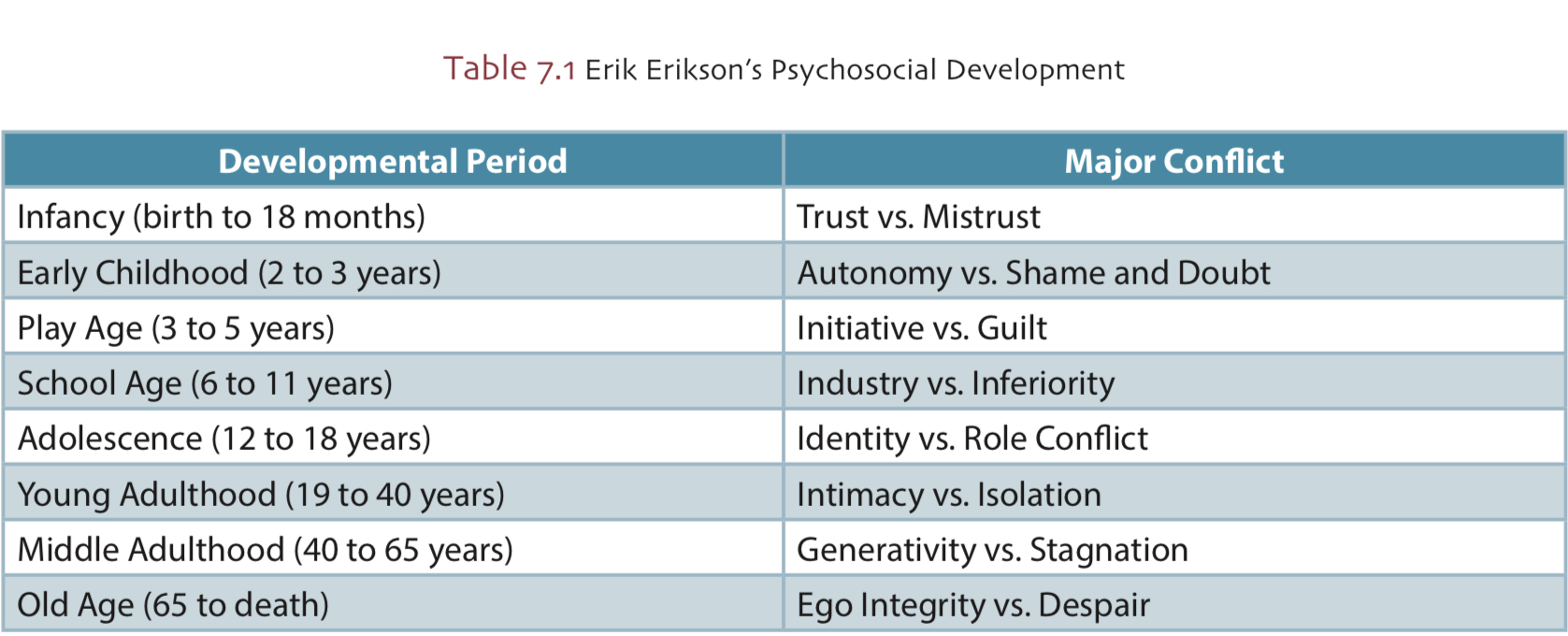
The answer is D.
Soru 68
Getting a payment for every five t-shirts you sell is a ...... schedule.
Complete the statement about reinforcement schedules with the correct term below.
Complete the statement about reinforcement schedules with the correct term below.
Seçenekler
A
Fixed interval
B
Fixed ratio
C
Variable interval
D
Variable ratio
E
Continuous
Açıklama:
Receiving the salary at the beginning of each month is an example for a fixed-interval schedule. However, if you get a payment for every five t-shirts you sell, then it is a fixed-ratio schedule, meaning that the reinforcement is given for a fixed number of behaviors. The answer is B.
Soru 69
According to the Five Factor Model, which personality trait points out individual differences in terms of responsibility, reliability, organization, control and meticulousness as well as goal-directed behavior?
Seçenekler
A
Extraversion
B
Neuroticism
C
Agreeableness
D
Consctientiousness
E
Openness to experience
Açıklama:
Conscientiousness points out individual differences in terms of responsibility, reliability, organization, control and meticulousness as well as goal-directed behavior and reduced impulsivity which is evident in induced risk taking behavior. The answer is D.
Soru 70
Which Neo-Freudian psychologist claim that the main conflict that influences personality is inferiority complex?
Seçenekler
A
Carl Gustav Jung
B
Alfred Adler
C
Erich Fromm
D
Karen Horney
E
Harry Stack Sullivan
Açıklama:
Adler claimed that the major conflict that influences the personality is inferiority complex. Accordingly, people are born with a sense of inferiority and in order to overcome this feeling, each individual engages in a conscious struggle with the people around them (i.e., their siblings) and strive to feel superior. The answer is B.
Soru 71
Which psychologist below developed social learning theory and social-cognitive model of personality?
Seçenekler
A
Albert Bandura
B
George Kelly
C
Erich Fromm
D
Abraham Maslow
E
Carl Ransom Rogers
Açıklama:
Albert Bandura developed social-learning theory and the social-cognitive model of personality. According to Bandura, the association between the behavior and the consequences of the behavior can also be learned through observing others. In this way, individuals develop certain expectations about the consequences of a behavior, keep the information in the memory, and recall the learned expectation in a pertinent context. The answe is A.
The answer is A.
The answer is A.
Soru 72
I. Minnesota Multiphasic Personality Inventory-2
II. NEO Personality Inventory Revised
III. Rorschach Inkblot Test
IV. TAT
Which of the above are projective tests?
II. NEO Personality Inventory Revised
III. Rorschach Inkblot Test
IV. TAT
Which of the above are projective tests?
Seçenekler
A
I and II
B
I and III
C
II and III
D
II and IV
E
III and IV
Açıklama:
Two well-known projective tests are Rorschach Inkblot Test, developed by Hermann Rorschach in 1921, and TAT, developed by Christiana Morgan and Henry Murray in 1935. The correct answer is E.
Soru 73
Which one of the following indicates an over-activity of sympathetic nervous system which results in emotional instability?
Seçenekler
A
Psychoticism
B
Extraversion
C
Introversion
D
Neuroticism
E
Impulse control
Açıklama:
Neuroticism indicates an over-activity of sympathetic nervous system which results in emotional instability. The correct answer is D.
Soru 74
Which one of the following is the conscious attempt to hide or prevent unacceptable thoughts, feelings and motives?
Seçenekler
A
Projection
B
Repression
C
Suppression
D
Rationalization
E
Sublimation
Açıklama:
Suppression is the conscious attempt to hide or prevent unacceptable thoughts, feelings and motives. The correct answer is C.
Soru 75
Which stage begins at 3 and lasts until 6-7 years of age, and is considered to be the most critical for personality development as it involves the biggest psychosexual conflict?
Seçenekler
A
Oral
B
Phallic
C
Anal
D
Latency
E
Genital
Açıklama:
Among the psychosexual stages, the Phallic Stage is considered to be the most critical for personality development as it involves the biggest psychosexual
conflict. Phallic stage begins at 3 and lasts until 6-7 years of age. During this stage the libido is located at the sex organs, mainly at the penis (the phallus). The correct answer is B.
conflict. Phallic stage begins at 3 and lasts until 6-7 years of age. During this stage the libido is located at the sex organs, mainly at the penis (the phallus). The correct answer is B.
Soru 76
What is the source of our creative and destructive tendencies?
Seçenekler
A
Shadow
B
Anima/animus
C
Self
D
Ego
E
Personal unconscious
Açıklama:
Shadow, which is very much like id, is the source of our creative and destructive
tendencies. The correct answer is A.
tendencies. The correct answer is A.
Soru 77
When is intimacy vs isolation conflict seen according to Erik Erikson’s Psychosocial Development?
Seçenekler
A
Early Childhood (2 to 3 years)
B
Play Age (3 to 5 years)
C
School Age (6 to 11 years)
D
Adolescence (12 to 18 years)
E
Young Adulthood (19 to 40 years)
Açıklama:
According to Erik Erikson’s Psychosocial Development, intimacy vs isolation conflict is seen in young adulthood (19 to 40 years). The correct answer is E.
Soru 78
What is “removing something” in order to decrease the frequency of a behavior called?
Seçenekler
A
Respondent behavior
B
Operant behavior
C
Negative reinforcement
D
Negative punishment
E
Positive punishment
Açıklama:
Negative punishment is “removing something” in order to decrease the frequency of a behavior. Consider two little boys fighting for a toy. When the mother takes the toy from them, the boys learn not to fight again. The correct answer is D.
Soru 79
In which type of schedule, the reinforcement is provided after a specific amount
of time has elapsed?
of time has elapsed?
Seçenekler
A
Subjective-ratio
B
Fixed-ratio
C
Fixed-interval
D
Variable-interval
E
Variable-ratio
Açıklama:
A fixed-interval schedule means that the reinforcement is provided after a specific (fixed) amount of time (interval) has elapsed. Receiving the salary at the beginning of each month is an example for a fixed-interval schedule. The correct answer is C.
Soru 80
What is the first stage of Maslow’s hierarchy of needs?
Seçenekler
A
Safety needs
B
Physiological needs
C
Love & belonging needs
D
Esteem needs
E
Self-actualization
Açıklama:
The basic premise is that behavior is motivated by certain needs and individuals should fulfill the necessities of one stage in order to move to the next one. The first one is physiological needs which consists of basic needs, for survival, like oxygen, food, water and sleep. If you feel you are out of oxygen, you can’t think
about whether you are successful or approved by the society. The correct answer is B.
about whether you are successful or approved by the society. The correct answer is B.
Soru 81
Which trait refers to the imaginative, novelty seeking, and flexible part of the personality structure?
Seçenekler
A
Openness to Experience
B
Agreeableness
C
Conscientiousness
D
Extraversion
E
Neuroticism
Açıklama:
Openness to Experience refers to the imaginative, novelty seeking, and flexible part of the personality structure. The correct answer is A.
Ünite 8
Soru 1
Which of the following is not one of the criteria used while defining abnormal behaviors?
Seçenekler
A
Divergence from the norms
B
Divergence from the ideal
C
Personal disorder
D
Social distance
E
Personal illness
Açıklama:
The correct answer is D.
Soru 2
In which approach is it thought that adult abnormality is caused by unresolved conflicts in early childhood?
Seçenekler
A
Psychodynamic Approach
B
Cognitive-Behaviorist Approach
C
Humanist-Existentialist Approach
D
Sociocultural Approach
E
Biological Approach
Açıklama:
In Psychodynamic Approach, it is thought that adult abnormality is caused by unresolved conflicts in early childhood. The correct answer is A.
Soru 3
"It wants to live in accordance with ethical principles. If these aspects fail to achieve a good working relationship, psychological problems could appear. It will allow the person to get what it wants as long as it is not immoral to do so."
Which of the following is the definition of the statements above?
Which of the following is the definition of the statements above?
Seçenekler
A
Id
B
Ego
C
Superego
D
Normal
E
Abnormal
Açıklama:
Superego wants to live in accordance with ethical principles. The correct answer is C.
Soru 4
Which of the following statements gives the basic argument of Cognitive-Behaviorist Approach?
Seçenekler
A
It is concerned with behaving in a way that is socially acceptable.
B
Adult abnormality was caused by unresolved conflicts in early childhood.
C
behavior is motivated by internal and psychological forces and abnormality is caused by an imbalance in the internal forces that motivate the behavior.
D
Individuals are born with a tendency to behave ideally in terms of psychological development, growth and healthy balance.
E
Abnormal behaviors occur because of learned behaviors like all other behaviors.
Açıklama:
Behaviorist approach argues that abnormal behaviors occur because of learned behaviors like all other behaviors. The correct answer is E.
Soru 5
Which of the following concepts is defines whether a person thinks negatively or positively about certain situations?
Seçenekler
A
Cognitive structure
B
Cognitive process
C
Cognitive content
D
Cognitive product
E
Cognitive approach
Açıklama:
Cognitive content is about hether a person thinks negatively or positively about certain situations. The correct answer is C.
Soru 6
Which of the following is not one of the anxiety disorders?
Seçenekler
A
Generalized anxiety disorder
B
Panic disorder
C
Phobic disorder
D
Conversion disorder
E
Obsessive compulsive disorder
Açıklama:
Conversion disorder is one of the somatoform disorders. The correct answer is D.
Soru 7
Which of the following is one of the mood disorders?
Seçenekler
A
Perception disorder
B
Bipolar disorders
C
Paraphillas
D
Multiple personality
E
Dissociative fugue
Açıklama:
Bipolar disorder is one of the mood disorders. The correct answer is B.
Soru 8
What is "disturbingly intense experience of fear or terror despite the lack of rational reason" called?
Seçenekler
A
Phobic disorder
B
Panic disorder
C
Obssesive-Compulsive Disorder
D
Somatoform Disorder
E
Perception disorder
Açıklama:
Disturbingly intense experience of fear or terror despite the lack of rational reason is called panic disorder. The correct answer is B.
Soru 9
Which of the following refers to the situation when an individual is too much interested in his/her body functions and develops irrational beliefs about disorders or illnesses affecting the functions of his/her internal organs?
Seçenekler
A
Compulsion
B
Obsession
C
Hypochondriasis
D
Conversion hysteria
E
Psychogenic pain
Açıklama:
Hypochondriasis refers to the situation when an individual is too much interested in his/her body functions and develops irrational beliefs about disorders or illnesses affecting the functions of his/her internal organs. The correct answer is C.
Soru 10
Which of the following is the fear of air swallowing?
Seçenekler
A
Anthophobia
B
Contreltophobia
C
Dystychiphobia
D
Anemophobia
E
Nyctohylophobia
Açıklama:
The correct answer is D.
Soru 11
Behaviors of some individuals around us often differ considerably from usual (common) behaviors. Which of the following is one of the concepts that such behavior is not evaluated?
Seçenekler
A
Physical health
B
Behavior disorder
C
Mental disorder
D
Abnormal behavior
E
Mental health
Açıklama:
Behaviors of some individuals around us often differ considerably from usual (common) behaviors. Such behaviors are usually evaluated within the framework of certain general concepts such as behavior disorder, mental disorder, mental health, and abnormal behavior.
Soru 12
Below which option can be considered as an abnormal behavior?
Seçenekler
A
Loneliness
B
Sexual assault
C
Frustration
D
Disappointment
E
Affrightment
Açıklama:
Since abnormal behaviors are often defined through the examples depicting divergence from social norms such as suicides, murders and sexual assault, they are considered identical to behavioral disorders or dangerous behaviors.
Soru 13
Which of the neurologists below has psychodynamic approach developed?
Seçenekler
A
Aaron Beck
B
Philip Zimbardo
C
Sigmund Freud
D
Carl Gustav Jung
E
Ivan Pavlov
Açıklama:
Psychodynamic approach developed by Sigmund Freud.
Soru 14
Which approach below explains abnormal behaviors through faulty processes due to genetic factors or organic function disorders in the nervous system and glands?
Seçenekler
A
Sociocultural Approach
B
Humanist-Existentialist Approach
C
Cognitive-Behaviorist Approach
D
Biological Approach
E
Psychological Approach
Açıklama:
Biological Approach: This approach explains abnormal behaviors through faulty processes due to genetic factors or organic function disorders in the nervous system and glands.
Soru 15
Which word given below refer to irrational fears felt when there is not a specific danger?
Seçenekler
A
Mood
B
Stimuli
C
Germs
D
Nausea
E
Phobia
Açıklama:
Phobia:They refer to irrational fears felt when there is not a specific danger.
Soru 16
Which of the following term given below describes disturbingly intense experience of fear or terror despite the lack of rational reason?
Seçenekler
A
Panic disoder
B
Dizziness
C
Nausea
D
Trembling
E
Chest pain
Açıklama:
Disturbingly intense experience of fear or terror despite the lack of rational reason is called panic disoder.
Soru 17
Which of the following word best describes Compulsion Ritual behaviors repeated continuously by individuals?
Seçenekler
A
Obsession
B
Compulsion
C
Phobia
D
Symptom
E
Emotion
Açıklama:
Compulsion Ritual behaviors repeated continuously by individuals are called compulsion.
Soru 18
Which of the following options identifies the involuntary ideas that individuals cannot control?
Seçenekler
A
Hypocondriasis
B
Somatoform disorders
C
Obsession
D
Psychogenic pain
E
Hyperchondriasis
Açıklama:
Obsession: The involuntary ideas that individuals cannot control are called obsession.
Soru 19
Below which term refers to the situation when an individual is too much interested in his/her body functions and develops irrational beliefs about disorders or illnesses affecting the functions of his/her internal organs?
Seçenekler
A
Multiple personality
B
Functional Psychosis
C
Delusions
D
Hypocondriasis
E
Social withdrawal
Açıklama:
Hypocondriasis Hypochandriasis refers to the situation when an individual is too much interested in his/her body functions and develops irrational beliefs about disorders or illnesses affecting the functions of his/her internal organs.
Soru 20
Which of the following best signifies a disorder in which the person cannot remember personal information?
Seçenekler
A
Hebephrenia schizophrenia
B
Multiple personality
C
Functional Psychosis
D
Catatonic Schizophrenia
E
Dissociative amnesia
Açıklama:
Dissociative amnesia: A dissociative disorder in which the person cannot remember personal information.
Soru 21
Which of the following is true regarding 'abnormal behaviors'?
Seçenekler
A
All abnormal behavior patterns are highly dangerous for the society
B
The concept “abnormal behaviors” is the most comprehensive one since it also includes strange behaviors of normal individuals
C
There is a basic criterion to distinguish normal behaviors from abnormal ones.
D
Norms are suitable criteria to evaluate abnormal behaviours.
E
Individuals showing abnormal behaviors are to be punished
Açıklama:
The options A, C, D, and E include incorrect information about abnormal behaviors. The only true information regarding abnormal behaviors is that the concept “abnormal behaviors” is the most comprehensive one since it also includes strange behaviors of normal individuals. Therefore, the answer is B.
Soru 22
Which of the following is an example of "divergence from the norms"?
Seçenekler
A
While an individual can eat something during a football match or concert, it is not possible or appropriate to eat something in a mosque or during a symphony concert.
B
The lack of unhappiness and feeling of anxiety experienced for weeks.
C
Not having a problem and always seeing the positive sides of the world.
D
Sleeping almost all day or sleeping very little.
E
Eating a lot under stress or refuse to eat at all.
Açıklama:
All the option except for A, are examples of "Personal Disorder". Any behavior that
diverges or differs from the acceptable norms of the society are considered abnormal as in this example 'While an individual can eat something during a football match or concert, it is not possible or appropriate to eat something in a mosque or during a symphony concert'. Thus, the answer is A.
diverges or differs from the acceptable norms of the society are considered abnormal as in this example 'While an individual can eat something during a football match or concert, it is not possible or appropriate to eat something in a mosque or during a symphony concert'. Thus, the answer is A.
Soru 23
Which of the following approaches is developed by Sigmund Freud?
Seçenekler
A
Cognitive Approach
B
Behaviorist Approach
C
Humanist - Existentialist approach
D
Psychodynamic Approach
E
Sociocultural Approach
Açıklama:
Psychodynamic approach was developed by Sigmund Freud. Therefore, the answer is D.
Soru 24
Which of the following is not among the concepts of human cognition?
Seçenekler
A
Cognitive structures
B
Cognitive content
C
Cognitive processes
D
Cognitive products
E
Cognitive solution
Açıklama:
There are four different concepts regarding human cognition and these are; cognitive structures, cognitive content, cognitive processes, and cognitive products. Cognitive solution is not a concept of human cognition. Thus, the answer is E.
Soru 25
According to which approach, individuals are born with a tendency to behave ideally in terms of psychological development, growth and healthy balance?
Seçenekler
A
Psychodyamic Approach
B
Cognitive Approach
C
Humanist - Existentialist Approach
D
Behaviorist Approach
E
Sociocultural Approach
Açıklama:
According to Humanist - Existentialist Approach, individuals are born with a tendency to behave ideally in terms of psychological development, growth and healthy balance. Therefore, the answer is C.
Soru 26
Which of the following best defines 'Somatoform Disorders '?
Seçenekler
A
Problems in which anxiety impedes daily functioning such as generalized anxiety disorder, panic disorder, phobic disorder etc.
B
Psychological difficulties displayed through physical problems such as hypochondriasis, and conversion disorders.
C
The splitting apart of crucial parts of personality that are usually integrated such as
multiple personality, dissociative amnesia, and dissociative fugue.
multiple personality, dissociative amnesia, and dissociative fugue.
D
Emotions of depression or euphoria that are so strong they intrude on everyday living such as major depression, and bipolar disorder.
E
Problems that create little personal distress but that lead to an inability to function as a
normal member of the society such as antisocial, personality disorder, and narcissistic personality disorder.
normal member of the society such as antisocial, personality disorder, and narcissistic personality disorder.
Açıklama:
Somatoform disorders are psychological difficulties displayed through physical problems like hypochondriasis, and conversion disorders. Therefore, the answer is B.
Soru 27
Which of the following is a physical symptom of 'Generalized Anxiety Disorder'?
Seçenekler
A
The normal behavior of the individual displays a sort of distortion. The individual always feels upset and has some hostile ideas about others.
B
The wish to hide anxiety affects anxious individuals' daily life, preventing them from having a normal life.
C
The individual displays irrational and meaningless behaviors. Sometimes, he/she has irrational fears such as repeating a behavior many times or being afraid of getting on a bus.
D
Muscle tension-Shivering and failure of relaxation in muscles since they are very tense.
E
Those suffering from general anxiety disorder do not break their ties with reality. They do not live in a world of fantasy.
Açıklama:
The options A, B, C, and E are psychological symptoms of general anxiety while Muscle tension-Shivering and failure of relaxation in muscles are physical symptoms of Generalized Anxiety Disorder. Thus, the answer is D.
Soru 28
Which of the following is not among the common symptoms associated with a panic attack?
Seçenekler
A
Numb legs
B
Shortness of breath
C
Feeling like you are choking
D
Dizziness (vertigo)
E
Chest pain or tightness
Açıklama:
Shortness of breath, feeling like you are choking, dizziness (vertigo), and chest pain or tightness are among the common symptoms of a panic attack, yet numb legs is not a common symptom. Thus, the answer is A.
Soru 29
Which of the following matches is true concerning common phobias?
Seçenekler
A
Potophobia - Talking loudly
B
Nyctohylophobia - Accidents
C
Contreltophobia - Darkness
D
Phonophobia - Alone, being
E
Thanatophobia - Death
Açıklama:
Fear of death is an example of Thanatophobia. Thus, the answer is E.
Soru 30
Which of the following examples refer to "Hypochondriasis"?
Seçenekler
A
Being reluctant to see a doctor despite the presence of the symptoms of an illness.
B
Being too much interested in body functions and developing irrational beliefs about disorders or illnesses affecting the functions of internal organs.
C
A sudden loss of important information (knowledge) due to stressful and traumatic incidents although the capacity to learn new information is not deteriorated.
D
Having elaborate hallucinations and delusions, especially delusions of persecuitons and
delusions of grandeur.
delusions of grandeur.
E
Changes in an individual’s mood and behavior switching between an over excited state called manic and a state of feeling hopeless called depressive.
Açıklama:
Hypochandriasis refers to the situation when an individual is too much interested in his/her body functions and develops irrational beliefs about disorders or illnesses affecting the functions of his/her internal organs. Thus, the answer is B.
Soru 31
Which of the following situations is NOT true for normality?
Seçenekler
A
It means being healthy.
B
It refers to average values.
C
It refers to the changes an organism rather than definning a particular situation at a particular time.
D
It is divergence from the average.
E
It is a process and behavior is a common product of a system interacting within itself.
Açıklama:
“Normality means being healthy. According to this traditional view of normal, healthy person is the one who does not have any illnesses. Normality refers to average values. Normality is a process, and normal behavior is a common product of a system interacting within itself. In other words, normality refers to the changes an organism rather than definning a particular situation at a particular time.
Soru 32
Which of the following is the rational part of mind?
Seçenekler
A
Ego
B
Superego
C
Anxiety
D
Id
E
Ideal
Açıklama:
Ego is the rational part of mind. Ego is concerned with behaving in a way that is socially acceptable.
Soru 33
Which of the following concepts regarding human cognition is the one that shows whether a person thinks negatively or positively about certain situations?
Seçenekler
A
Cognitive foresight
B
Cognitive structures
C
Cognitive content
D
Cognitive processes
E
Cognitive products
Açıklama:
Behaviorist approach argues that abnormal behaviors occur because of learned behaviors like all other behaviors. It assumes that, unlike classical conditioning and operant conditioning, abnormal behaviors are shaped by the effects of internal processes such as expectations and a wish to see the results of the things done. There are four different concepts regarding human cognition and these are: • Cognitive structures: how an individual organizes information,
- Cognitive content: whether a person thinks negatively or positively about certain situations
- Cognitive processes: how individuals then process this information and operate on it and whether they do so in a rational or irrational way
- Cognitive products: this refers to the conclusion that the individual will draw from the processed information
Soru 34
In which of the following approaches the individual consistently expresses his wishes and needs according to his own psychological development needs?
Seçenekler
A
Psychological Approach
B
Human - behavior Approach
C
Cognitive-Behaviorist Approach
D
Sociocultural Approach
E
Humanist - Existentialist Approach
Açıklama:
Humanist - Existentialist Approach : According to this approach, individuals are born with a tendency to behave ideally in terms of psychological development, growth and healthy balance. This tendency is called self-realization. In this approach, the individual consistently expresses his wishes and needs according to his own psychological development needs. Such an expression pattern is sometimes observed as aggressiveness, sometimes as sexuality and sometimes as a wish to be independent.
Soru 35
Which of the following can be defined as “Disturbingly intense experience of fear or terror despite the lack of rational reason”?
Seçenekler
A
Anxiety Disorder
B
Panic Disorder
C
Phobic Disorder
D
Obsessive-Compulsive Disorder
E
Somatoform Disorder
Açıklama:
Disturbingly intense experience of fear or terror despite the lack of rational reason is called panic disoder.
Soru 36
Which of the following is NOT one of the common symptoms associated with a panic attack?
Seçenekler
A
Racing heartbeat or palpitations
B
Nausea
C
Rising or falling blood pressure
D
Feeling like you are choking
E
Numbness or tingling in your hands or feet
Açıklama:
People with this disorder live in fear of having a panic attack. Common symptoms associated with a panic attack include:
- racing heartbeat or palpitations
- shortness of breath
- feeling like you are choking
- dizziness (vertigo)
- lightheadedness
- nausea
- sweating or chills
- shaking or trembling
- changes in mental state, including a feeling of derealization (feeling of unreality) or depersonalization (being detached from oneself)
- numbness or tingling in your hands or feet
- chest pain or tightness
- fear that you might die
Soru 37
Which of the following is the definition of “Compulsion”?
Seçenekler
A
Psychological difficulties that take on physical form.
B
The individual experiences both depression and excitement.
C
Irrational fears felt when there is not a specific danger.
D
The involuntary ideas that individuals cannot control.
E
Ritual behaviors repeated continuously by individuals
Açıklama:
Obsessive-Compulsive Disorder: The individuals having this psychological illness develop habits that they repeat quite often but are not able to control them easily. The involuntary ideas that individuals cannot control are called obsession. Ritual behaviors repeated continuously by individuals are called compulsion.
Soru 38
Which of the following refers to the situation when an individual is too much interested in his/her body functions?
Seçenekler
A
Somatoform disorders
B
Hypochondriasis
C
Obsessive-compulsive disorder
D
Dissociative disorder
E
Dissociative amnesia
Açıklama:
Hypochondriasis refers to the situation when an individual is too much interested in his/her body functions and develops irrational beliefs about disorders or illnesses affecting the functions of his/her internal organs.
Soru 39
Which of the following is a mood disorder when the individual experiences both depression and excitement?
Seçenekler
A
Bipolar disorder
B
Depression
C
Antisocial personality
D
Schizophrenia
E
Psychosis
Açıklama:
Bipolar disorder: the individual experiences both depression and excitement. It is a mood disorder that manifests itself in the form of alternating periods of depression and mania. There are changes in an individual’s mood and behavior switching between an over excited state called manic and a state of feeling hopeless called depressive.
Soru 40
Which of the following is a symptom of “Narcissistic personality disorder”?
Seçenekler
A
Blaming himself for failing to do a task
B
Not caring about the safety of himself, his acquaintances or other people
C
Disregarding social behaviors
D
Disregards the feelings of others, lacks empathy
E
Bad temper or tendency to be involved in fights and attacks
Açıklama:
“Narcissistic personality disorder is characterized by a preoccupation with oneself. People with narcissistic personality disorder believe they are superior or special. They have the following symptoms:
- Exaggerate own importance
- He/or she is preoccupied with fantasies of success, power, beauty, intelligence
- Requires constant attention and admiration from others
- Has unreasonable expectations of favorable treatment
- Takes advantage of others to reach his or her own goals
- Disregards the feelings of others, lacks empathy
- Is often envious of others or believes other people are envious of him or her
- Shows arrogant behaviors and attitudes.
Soru 41
Which of the followings can be considered as normal behaviour?
Seçenekler
A
Suicide
B
Sexual Assault
C
Theft
D
Murder
E
Generosity
Açıklama:
Generosity is a normal behaviour. In every society, there are social expectations, norms and values. As long as you obey societal norms, your behavior is considered as normal. Definitions of normality depends on the person’s time, place and situation. It changes along with what society expects from you. Normal behavior is often only recognized in contrast to abnormality.The correct answer is E.
Soru 42
".......... is the rational part of mind which is concerned with behaving in a way that is socially acceptable."
Which of the followings is correct?
Which of the followings is correct?
Seçenekler
A
Id
B
Ego
C
Superego
D
Self
E
Mind
Açıklama:
Ego is the rational part of mind which is concerned with behaving in a way that is socially acceptable. The correct answer is B.
Soru 43
Which of the followings can be classified into anxiety disorder?
Seçenekler
A
Sexual dysfunction
B
Narcissistic personality disorder
C
bipolar disorder
D
panic disorder
E
multiple personality
Açıklama:
Panic disorder is an anxiety disorder. The correct answer is D.
Soru 44
What is agoraphobia?
Seçenekler
A
Fear of Darkness
B
Fear of Accident
C
Fear of Crowded Public
D
Fear of Closed Areas
E
Fear of Bacteria
Açıklama:
Agoraphobia is fear of crowded public. The correct answer is C.
Soru 45
Which one of the followings is phobic disorder?
Seçenekler
A
Vertigo
B
Nyctohylophobia
C
Amnesia
D
Hysteria
E
Schizophrenia
Açıklama:
Nyctohylophobia is a fear of darkness. The correct answer is B.
Soru 46
"Fear of being infected with contagious diseases and microbes" can be classified into which of the followings?
Seçenekler
A
Obsessive- compulsive disorder
B
Social Phobia
C
Somatoform Disorder
D
Dissociative Disorder
E
Multiple Personality
Açıklama:
Fear of being infected with contagious diseases and microbes; for example not shaking hands with other people and developing a fear of being infected with an illness. The correct answer is A.
Soru 47
Which of the followings is associated with loss of memory?
Seçenekler
A
Multiple Personality
B
Schizophrenia
C
Dissociative Amnesia
D
Delusion
E
Mood Disorder
Açıklama:
“Dissociative amnesia (loss of memory) is about the sudden loss of important information (knowledge) due to stressful and traumatic incidents although the capacity to learn new information is not deteriorated. Such a memory loss cannot be considered a simple forgetfulness problem. The person cannot remember personal information, typically for a specific event (death of a loved one) or period of time, although it can extend to one’s entire identity (who am I). The correct answer is C.
Soru 48
In which of the followings experiences the individual both expression and excitement?
Seçenekler
A
Antisocial Personality
B
Amnesia
C
Functional Psychosis
D
Bipolar Disorder
E
Schizophrenia
Açıklama:
In Bipolar disorder, the individual experiences both depression and excitement. It is a mood disorder that manifests itself in the form of alternating periods of depression and mania. There are changes in an individual’s mood and behavior switching between an over excited state called manic and a state of feeling hopeless called depressive. If the symptoms are a mix of those experienced in the manic and depressive states, the state is called mixed. The correct answer is D.
Soru 49
Which of the followings is a symptom of narcissitic personality?
Seçenekler
A
Exaggerate own importance
B
Not caring about the safety of himself, his acquintances or other people
C
Bad temper or tendency to be involved in fights and attacks
D
One's Social Withdrawal
E
Being obssessed with cleanliness
Açıklama:
“Narcissistic personality disorder is characterized by a preoccupation with oneself. People with narcissistic personality disorder believe they are superior or special. They have the following symptoms: • Exaggerate own importance • He/or she is preoccupied with fantasies of success, power, beauty, intelligence • Requires constant attention and admiration from others • Has unreasonable expectations of favorable treatment • Takes advantage of others to reach his or her own goals • Disregards the feelings of others, lacks empathy • Is often envious of others or believes other people are envious of him or her • Shows arrogant behaviors and attitudes. The correct answer is A.
Soru 50
Which type of schizophrenia has the following symptoms of "the individual does not change his/her body position" and "eyes stare blankly" and "faces are meaningless"?
Seçenekler
A
Simple Schizophrenia
B
Paranoid Schizophrenia
C
Catatonic Schizophrenia
D
Hebephrenia schizophrenia
E
Obsessive Schizophrenia
Açıklama:
The symptoms mentioned above are symptoms of catatonic schizophrenia. The correct answer is C.
Soru 51
Which of the below is NOT one of the psychological approaches to normal/abnormal behaviors?
Seçenekler
A
Psychosocial approach
B
Psychodynamic Approach
C
Cognitive Behaviorist Approach
D
Humanist - Existentialist approach
E
Sociocultural Approach
Açıklama:
While some take childhood life a criterion when defining abnormal behaviors, others take present time as the criterion. Some approaches, on the other hand, suggest that behaviors are determined through external factors. At this point, there are four main approaches.
• Psychodynamic Approach
• Cognitive Behaviorist Approach
• Humanist - Existentialist approach
• Sociocultural Approach
• Psychodynamic Approach
• Cognitive Behaviorist Approach
• Humanist - Existentialist approach
• Sociocultural Approach
Soru 52
What does psychodynamic approach claim about abnormal behaviour?
Seçenekler
A
They are innate
B
caused by conflicts in childhood
C
caused by conflict in adulthood
D
caused by the society
E
caused by misbeliefs
Açıklama:
Psychodynamic approach was developed by Sigmund Freud. He believed adult abnormality was caused by unresolved conflicts in early childhood. He said that abnormal behavior arise from mental conflicts and drives that the person has been unable to resolve or coordinate with the realities of life and that therefore generate anxiety.
Soru 53
Which approach claim that abnormal behaviors are learned?
Seçenekler
A
Psychodynamic Approach
B
All of them
C
Cognitive Behaviorist Approach
D
Humanist - Existentialist approach
E
Sociocultural Approach
Açıklama:
Behaviorist approach argues that abnormal behaviors occur because of learned behaviors like all other behaviors. It assumes that, unlike classical conditioning and operant conditioning, abnormal behaviors are shaped by the effects of internal processes such as expectations and a wish to see the results of the things done.
Soru 54
"emotions of depression or euphoria that are so strong they intrude on everyday living major depression, bipolar disorder"
Which of the below diagnostic categories does the above description belong?
Which of the below diagnostic categories does the above description belong?
Seçenekler
A
Anxiety disorders
B
Somatoform disorders
C
Schizophrenia
D
Mood disorders
E
Sexual disorders
Açıklama:
Table 8.1 on page 189
Soru 55
Which of the below phobia-definition pairs is NOT correct?
Seçenekler
A
Zoophobia-fear of animals
B
Arachnaphobia-fear of spiders
C
Acrophobia-fear of heights
D
Clostrofobia-fear of closed places
E
Agoraphobia-fear of spiders
Açıklama:
On the other hand, not having a single specific reason for a phobia can be suggested for “complex” phobias. Such phobias may have multi-dimensional reasons. To illustrate, the reason of “fear of open areas (agoraphobia)” might be observed in different dimensions such as coming together with other people, meeting with strangers or simply talking on the phone.
Soru 56
Which of the below illnesses is "loss of memory"?
Seçenekler
A
Dissociative amnesia
B
Conversion hysteria
C
psychogenic pain
D
Hypercondriasis
E
Hypochondriasis
Açıklama:
“Dissociative amnesia (loss of memory) is about the sudden loss of important information (knowledge) due to stressful and traumatic incidents although the capacity to learn new information is not deteriorated.
Soru 57
Which one of the followings is not correct about normal/ity?
Seçenekler
A
Normality means being healthy.
B
Normality refers to average values.
C
Normality is a process.
D
Normality refers to the changes an organism rather than defining a particular situation at a particular time.
E
The majority group is evaluated as “abnormal” and the ones on the extreme points are considered “normal”.
Açıklama:
The majority group is evaluated as “normal” and the ones on the extreme points are considered “abnormal”. The correct answer is E.
Soru 58
According to the Psychodynamic Approach, which one of the followings wants immediate gratification of its desires?
Seçenekler
A
Id
B
Ego
C
Superego
D
Preconsciousness
E
Unconsciousness
Açıklama:
Id wants immediate gratification of its desires. The correct answer is A.
Soru 59
In what psychological symptom does a person travel to new places without being aware who s/he is?
Seçenekler
A
Dissociative amnesia
B
Conversion hysteria
C
Dissociative amnesia
D
psychogenic pain
E
Multiple personality
Açıklama:
Sudden whole memory loss is called dissociative fugue. The patient sets off for an unplanned sudden travel to a far place because of a refusal, loss, failure, marriage problems or financial problems. He/she does not remember an important portion of his/her previous identity and often adopts a new one. This travel is often an idle one, and the individual suffers from serious memory loss. More interestingly, he/she is not aware of this situation. He/she looks quite normal -not weird-with the new identity. Sometimes, the individual may experience confusion and control problems.
Soru 60
There are four different concepts regarding human cognition. Which one of the followings is not one of them?
Seçenekler
A
Cognitive structures
B
Cognitive content
C
Cognitive Ability
D
Cognitive processes
E
Cognitive products
Açıklama:
There are four different concepts regarding human cognition and these are:
• Cognitive structures: how an individual organizes information; for example, do they see a spider as just another daily object that they need to live with or do they see that spider as an object of fear?
• Cognitive content: whether a person thinks negatively or positively about certain situations
• Cognitive processes: how individuals then process this information and operate on it and whether they do so in a rational or irrational way
• Cognitive products: this refers to the conclusion that the individual will draw from the processed information
The correct answer is C.
• Cognitive structures: how an individual organizes information; for example, do they see a spider as just another daily object that they need to live with or do they see that spider as an object of fear?
• Cognitive content: whether a person thinks negatively or positively about certain situations
• Cognitive processes: how individuals then process this information and operate on it and whether they do so in a rational or irrational way
• Cognitive products: this refers to the conclusion that the individual will draw from the processed information
The correct answer is C.
Soru 61
In which type of schizophrenia does a patient talk childishly, giggle and have disconnected talk?
Seçenekler
A
Simple schizophrenia
B
Paranoid schizophrenia
C
Catatonic schizophrenia
D
Hebephrenia schizophrenia
E
None of the above
Açıklama:
Hebephrenia schizophrenia: The most characteristic symptoms of hebephrenic schizophrenia are as follows: childish talk, giggling, disconnected talk, gestures and mimics, self-talking, crying jags following reasonless laughters, too much interest in feces and urine, smearing feces on clothes or walls, showing sexual organs with no feeling of shame, tantrums and bad temper.
Soru 62
Which of the below is a bodily symptom of bipolar disorder?
Seçenekler
A
Narcissism
B
Sleeping too much
C
Being introvert
D
Being depressed
E
being jovial
Açıklama:
Figure 8.5 on page 199
Soru 63
"According to this approach, individuals are born with a tendency to behave ideally in terms of psychological development, growth and healthy balance."
Which one of the followings is the approach described above?
Which one of the followings is the approach described above?
Seçenekler
A
Psychodynamic Approach
B
Humanist-Existentialist Approach
C
Cognitive-Behaviorist Approach
D
Sociocultural Approach
E
Structural Approach
Açıklama:
According to Humanist-Existentialist approach, individuals are born with a tendency to behave ideally in terms of psychological development, growth and healthy balance. This tendency is called self-realization. In this approach, the individual consistently expresses his wishes and needs according to his own psychological development needs. The correct answer is B.
Soru 64
Which one of the following subcategories includes obsessive compulsive disorder?
Seçenekler
A
Mood disorders
B
Dissociative disorders
C
Somatoform disorders
D
Anxiety disorder
E
Personality disorders
Açıklama:
Anxiety disorder subcategory includes problems in which anxiety impedes daily functioning generalized anxiety disorder, panic disorder, phobic disorder, obsessive compulsive disorder, posttraumatic disorder. The correct answer is D.
Soru 65
Which one of the below is NOT one of the psychosexual disorders?
Seçenekler
A
Rape
B
Loss of sexual desire
C
impotance
D
Exhibitionism
E
Homosexuality
Açıklama:
Homosexuality, which was once listed as one of the psychosexual disorders, was removed from the list by American Psychatry Association (APA) in 1973. It is not considered as a mental disorder or illnesses anymore.
Soru 66
- racing heartbeat or palpitations
- shortness of breath
- feeling like you are choking
- dizziness (vertigo)
Seçenekler
A
Phobic Disorder
B
Panic Disorder
C
Dissociative Disorders
D
Obssesive-Compulsive Disorder
E
Somatoform Disorder
Açıklama:
People with this disorder live in fear of having a panic attack. You may be having a panic attack when you feel sudden, overwhelming terror that has no obvious cause. You may experience physical symptoms, such as a racing heart, breathing difficulties and sweating. Panic disorder is characterized by persistent fear of having another panic attack after you have experienced at least one month (or more) of persistent concern or worry about additional panic attacks (or their consequences) recurring. The correct answer is B.
Soru 67
Which one of the followings is the fear of darkness?
Seçenekler
A
Anthophobia
B
Contreltophobia
C
Nyctohylophobia
D
Phonophobia
E
Thanatophobia
Açıklama:
Nyctohylophobia is the fear of darkness. The correct answer is C.
Soru 68
".................. refers to the situation when an individual is too much interested in his/her body functions and develops irrational beliefs about disorders or illnesses affecting the functions of his/her internal organs." Which one of the followings is defined above?
Seçenekler
A
Hypochandriasis
B
Somatoform Disorder
C
Conversion hysteria
D
Hyperchondriasis
E
Psychogenic pain
Açıklama:
Hypocondriasis Hypochandriasis refers to the situation when an individual is too much interested in his/her body functions and develops irrational beliefs about disorders or illnesses affecting the functions of his/her internal organs. The correct answer is A.
Soru 69
"................... (loss of memory) is about the sudden loss of important information (knowledge) due to stressful and traumatic incidents although the capacity to learn new information is not deteriorated."
Which one of the followings is defined above?
Which one of the followings is defined above?
Seçenekler
A
Conversion Hysteria
B
Hyperchondriasis
C
Psychogenic Pain
D
Dissociative Amnesia
E
Hypocondriasis
Açıklama:
“Dissociative amnesia (loss of memory) is about the sudden loss of important information (knowledge) due to stressful and traumatic incidents although the capacity to learn new information is not deteriorated. Such a memory loss cannot be considered a simple forgetfulness problem." The correct answer is D.
Soru 70
"Feeling superior and bullying are the characteristics of ............. schizophrenia."
Which one of the followings is defined above?
Which one of the followings is defined above?
Seçenekler
A
Simple schizophrenia
B
Paranoid Schizophrenia
C
Catatonic Schizophrenia
D
Hebephrenia schizophrenia
E
Hallucinational schizophrenia
Açıklama:
Paranoid Schizophrenia: Feeling superior and bullying are the characteristics of paranoid schizophrenia. They always suspect that others bully them and talk behind them or deceive them. The correct answer is B.
Soru 71
Which approach did Sigmund Freud develop?
Seçenekler
A
Cognitive Behaviorist Approach
B
Psychodynamic Approach
C
Sociocultural Approach
D
Humanist Approach
E
Existentialist Approach
Açıklama:
Psychodynamic approach was developed by Freud. He believed adult abnormality was caused by unresolved conflicts in early childhood. He said that abnormal behavior arise from mental conflicts and drives that the person has been unable to resolve or coordinate with the realities of life and that therefore generate anxiety. The answer is B.
Soru 72
“The ................ approach assumes that a person’s thoughts are responsible for their behavior. The approach deals with how information is processed in the brain and the impact of this on behavior.”
Fill in the blanks with the correct word below.
Fill in the blanks with the correct word below.
Seçenekler
A
Sociocultural
B
Cognitive
C
Biological
D
Humanist
E
Existentialist
Açıklama:
The cognitive approach assumes that a person’s thoughts are responsible for their behavior. The approach deals with how information is processed in the brain and the impact of this on behavior. In this approach, the poeople’s thoughts and beliefs are central to abnormal behavior. The answer is B.
Soru 73
Which diagnostic category below refers to the psychological difficulties displayed through physical problems?
Seçenekler
A
Anxiety disorders
B
Dissociative disorders
C
Somatoform disorders
D
Mood disorders
E
Personality disorders
Açıklama:
Psychological difficulties displayed throgh physical problems like hypochondriasis and conversion disorders are called somatoform disorders. The answer is C.
Soru 74
Which term below is used for the fear of death?
Seçenekler
A
Agoraphobia
B
Thanatophobia
C
Anemophobia
D
Anthophobia
E
Brontophobia
Açıklama:
A: fear of crowded public spaces
B: fear of death
C: fear of swallowing air
D: fear of flowers
E: fear of thunder
The answer is B.
B: fear of death
C: fear of swallowing air
D: fear of flowers
E: fear of thunder
The answer is B.
Soru 75
Which one below is a type of mood disorder?
Seçenekler
A
Schizophrenia
B
Dissociative fugue
C
Conversion hysteria
D
Dissociative amnesia
E
Bipolar disorder
Açıklama:
Mood disorders, which occur due to the increase of emotional disorders in the category of psychosis, vary according to the mental health of the individual. Any individual suffering from emotional disorders experiences emotional depression and emotional excitement. Avoiding these feelings are not under his/her control. He/she can not keep up with normal working life and is not in harmony with his/her surroundings due to the effects of these feelings. These periods generally last six months either by following manic or depressive patterns. These disorders are observed as depression or bipolar disorder. The answer is E.
Soru 76
What is the name of the situation when an individual is too much interested in his/her body functions and develops irrational beliefs about disorders or illnesses affecting the functions of his/her internal organ?
Seçenekler
A
Compulsion
B
Hyperchondriasis
C
Conversion hysteria
D
Hypochondriasis
E
Phobic disorder
Açıklama:
Hypochandriasis refers to the situation when an individual is too much interested in his/her body functions and develops irrational beliefs about disorders or illnesses affecting the functions of his/her internal organs. Hypochondriacs have a strong belief that they have a serious illness that cannot be cured. It is possible that patients are sensitive towards body functions and senses or have low threshold for pain since their birth. The answer is B.
Soru 77
In which type of disorder are the body functions lost?
Seçenekler
A
Catatonic schizophrenia
B
Social phobia
C
Obsessive-compulsive disorder
D
Depression
E
Multiple personality disorder
Açıklama:
In catatonic Schizophrenia, since body movement functions are lost due to this illness, the individual does not change his/her body position - motionless like a sculpture- for hours or even days. In catatonic freezing, eyes stare blankly, faces are meaningless and individuals do not react to pain-giving stimulants and threats. They should be helped for their nutrition and dressing activities. Some catatonics automatically obey what is asked from them but never speak a word. Sometimes, a catatonic individual may wander around in fast steps, talk, shout and attack people around them in a dangerous way, wound and even kill them. They sit for hours, but can also participate in intense activity such as jumping and running around. The answer is A.
Soru 78
Which symptom below is a strong indicator of a narcissistic personality disorder?
Seçenekler
A
Hatred for opposite sex
B
Unreasonable expectations of favorable treatment
C
Displaying dishonest behaviors and deception
D
Manipulative behavior
E
Lack of remorse upon inflicting pain on others
Açıklama:
Narcissistic personality disorder is characterized by a preoccupation with oneself. People with narcissistic personality disorder believe they are superior or special and have unreasonable expectations of favorable treatment. The other sypmtoms given in the options are also related to antisocial personality, and psychosexual disorders. Therefore, the answer is B.
Soru 79
Which approach argues that behaviors of individuals are guided by the unconscious through sexuality and aggressiveness motives?
Seçenekler
A
Biological approach
B
Cognitive approach
C
Psychodynamic approach
D
Humanist approach
E
Existentialist approach
Açıklama:
Psychodynamic approach was developed by Sigmund Freud. He believed adult abnormality was caused by unresolved conflicts in early childhood. He said that abnormal behavior arise from mental conflicts and drives that the person has been unable to resolve or coordinate with the realities of life and that therefore generate anxiety. The behaviors of individuals are guided by the unconscious through sexuality and aggressiveness motives. The answer is C.
Soru 80
“Sudden whole memory loss is called ............. The patient sets off for an unplanned sudden travel to a far place because of a refusal, loss, failure, marriage problems or financial problems.”
Fill in the blank with the correct term below.
Fill in the blank with the correct term below.
Seçenekler
A
Amnesia
B
Schizophrenia
C
Dissociative fugue
D
Delusion
E
Antisocial personality
Açıklama:
Dissociative disorders involve problems with memory, identity, emotion, perception, behavior and sense of self. There are three main types of dissociative disorders: Dissociative amnesia, Dissociative fugue, Multiple personality. Dissociative amnesia (loss of memory) is about the sudden loss of important information (knowledge) due to stressful and traumatic incidents although the capacity to learn new information is not deteriorated. Amnesia is the most common dissociative disorder, especially with women. It is observed more often after disasters or during wars and especially during puberty and young adulthood. Emotional traumas might trigger this illness, which might end suddenly or relapse several times. Sudden whole memory loss is called dissociative fugue. The answer is C.
Soru 81
I. Divergence from the norms
II. Personal Disorder
III. Divergence from the ideal
IV. Personal Traits
Which of the above are part of the criteria used while defining abnormal behaviors?
II. Personal Disorder
III. Divergence from the ideal
IV. Personal Traits
Which of the above are part of the criteria used while defining abnormal behaviors?
Seçenekler
A
I, II and III
B
I, II and IV
C
I, III and IV
D
II, III and IV
E
I, II, III and IV
Açıklama:
The criteria used while defining abnormal behaviors are divergence from the norms, personal disorder, and divergence from the ideals. The correct answer is A.
Soru 82
Which one of the following is not one of the main approaches to abnormal behaviors?
Seçenekler
A
Generative Approach
B
Psychodynamic Approach
C
Cognitive Behaviorist Approach
D
Humanist-Existentialist Approach
E
Sociocultural Approach
Açıklama:
While some take childhood life a criterion when defining abnormal behaviors, others take present time as the criterion. Some approaches, on the other hand, suggest that behaviors are determined through external factors. At this point, there are four main approaches.
• Psychodynamic Approach
• Cognitive Behaviorist Approach
• Humanist - Existentialist approach
• Sociocultural Approach
The correct answer is A.
• Psychodynamic Approach
• Cognitive Behaviorist Approach
• Humanist - Existentialist approach
• Sociocultural Approach
The correct answer is A.
Soru 83
Which approach was developed by Sigmund Freud?
Seçenekler
A
Cognitive Behaviorist Approach
B
Psychodynamic Approach
C
Humanist-Existentialist approach
D
Sociocultural Approach
E
Biological Approach
Açıklama:
Psychodynamic approach was developed by Sigmund Freud. The correct answer is B.
Soru 84
Which one of the following wants immediate gratification of its desires?
Seçenekler
A
Ego
B
Superego
C
Id
D
Anxiety
E
Schizophrenia
Açıklama:
Id wants immediate gratification of its desires. The motivating forces for the id is the libido, which is the body’s pleasure seeking (sexual pleasure) force. The correct answer is C.
Soru 85
Which concept is about whether a person thinks negatively or positively about certain situations?
Seçenekler
A
Cognitive structures
B
Cognitive processes
C
Cognitive content
D
Cognitive products
E
Cognitive faculty
Açıklama:
Cognitive content is about whether a person thinks negatively or positively about certain situations. The correct answer is C.
Soru 86
In which disorder subcategory is bipolar disorder?
Seçenekler
A
Anxiety disorders
B
Somatoform disorders
C
Mood disorders
D
Dissociative disorders
E
Personality disorders
Açıklama:
In mood disorders, emotions of depression or euphoria are so strong that they intrude on everyday living. Disorders such as major depression and bipolar disorder are some examples. The correct answer is C.
Soru 87
What is the name given to fear of darkness?
Seçenekler
A
Anthophobia
B
Dystychiphobia
C
Brontophobia
D
Nyctohylophobia
E
Potophobia
Açıklama:
The name given to fear of darkness is nyctohylophobia. The correct answer is D.
Soru 88
What is the name given to the situation when an individual is too much interested in his/her body functions and develops irrational beliefs about disorders or illnesses affecting the functions of his/her internal organs?
Seçenekler
A
Conversion hysteria
B
Hyperchondriasis
C
Psychogenic pain
D
Hypochondriasis
E
Dissociative amnesia
Açıklama:
Hypochondriasis refers to the situation when an individual is too much interested in his/her body functions and develops irrational beliefs about disorders or illnesses affecting the functions of his/her internal organs. The correct answer is D.
Soru 89
Which one of the following is not one of the types of schizophrenia?
Seçenekler
A
Simple schizophrenia
B
Paranoid schizophrenia
C
Catatonic schizophrenia
D
Hebephrenia schizophrenia
E
Abnormal schizophrenia
Açıklama:
The types of schizophrenia are simple schizophrenia, paranoid schizophrenia, catatonic schizophrenia, and hebephrenia schizophrenia. The correct answer is E.
Soru 90
I. Wrong belief that the victim wants this action or encourages it to happen
II. Regarding the other sex as an object
III. Disregarding the feelings of others, lacking empathy
IV. Requiring constant attention and admiration from others
Which of the above are some symptoms of narcissitic personality?
II. Regarding the other sex as an object
III. Disregarding the feelings of others, lacking empathy
IV. Requiring constant attention and admiration from others
Which of the above are some symptoms of narcissitic personality?
Seçenekler
A
I and II
B
I and III
C
II and III
D
II and IV
E
III and IV
Açıklama:
Narcissistic personality disorder is characterized by a preoccupation with oneself. People with narcissistic personality disorder believe they are superior or special. They have the following symptoms:
• Exaggerate own importance
• He/or she is preoccupied with fantasies of success, power, beauty, intelligence
• Requires constant attention and admiration from others
• Has unreasonable expectations of favorable treatment
• Takes advantage of others to reach his or her own goals
• Disregards the feelings of others, lacks empathy
• Is often envious of others or believes other people are envious of him or her
• Shows arrogant behaviors and attitudes.
The correct answer is E.
• Exaggerate own importance
• He/or she is preoccupied with fantasies of success, power, beauty, intelligence
• Requires constant attention and admiration from others
• Has unreasonable expectations of favorable treatment
• Takes advantage of others to reach his or her own goals
• Disregards the feelings of others, lacks empathy
• Is often envious of others or believes other people are envious of him or her
• Shows arrogant behaviors and attitudes.
The correct answer is E.