Organization Theory and Design (Örgüt Kuramı ve Tasarımı) (ENG) - Tüm Sorular
Ünite 1
Soru 1
"A deep knowledge of organizations and organizing, and organization theory provides content for executive training programs"
Which of the practical applications below include the benefit of organizational theory above?
Which of the practical applications below include the benefit of organizational theory above?
Seçenekler
A
Strategy/Finance
B
Marketing
C
Information technology (IT)
D
Communication
E
Human resources (HR)
Açıklama:
All HR activities from recruiting to compensation have organizational implications and hence benefit from the knowledge provided by the organization theory; organizational development and change are particularly important elements of HR that demand a deep knowledge of organizations and organizing, and organization theory provides content for executive training programs.
Soru 2
Which of the following metaphors emphasizes the technical, hierarchical, rational, prolific, mechanical, and productive aspects of organizations?
Seçenekler
A
Organizations as Machines
B
Organizations as Organisms
C
Organizations as Brains
D
Organizations as Cultures
E
Organizations as Political Systems
Açıklama:
Organizations as Machines: This metaphor emphasizes the technical, hierarchical, rational, prolific, mechanical, and productive aspects of organizations. Organizations mostly defined by classical organizational approaches are defined by this metaphor.
Soru 3
Which of the following can be seen as a mutual benefit organization?
Seçenekler
A
Educational institutions
B
Political parties
C
Hospitals
D
Animal protection associations
E
Environment protection associations
Açıklama:
Political parties, clubs, and professional organizations are examples of mutual benefit organizations. Individuals tend to participate in these organizations just to make use of their own benefits to the organization. Members of these organizations begin shaping them since their establishment.
Many service organizations are formed not for profit but for offering services to customers in the relevant community. Educational institutions, hospitals, animal protection associations, environment protect associations and various non-profit organizations are examples of these service organizations.
Many service organizations are formed not for profit but for offering services to customers in the relevant community. Educational institutions, hospitals, animal protection associations, environment protect associations and various non-profit organizations are examples of these service organizations.
Soru 4
Which of the following management schools of thought are F. Taylor, H. Fayol, and M. Weber three important theorists of?
Seçenekler
A
Modern
B
Behavioral
C
Classical
D
Humanistic
E
Postmodern
Açıklama:
Three important views representing Classical management school of thought are those of F. Taylor, H. Fayol, and M. Weber. The ideas of these three important organization theorists make up the foundation of today’s organization theories. Following are the still used approaches of these authors.
Soru 5
Which of the following is not one of the four elements that scientific management approach is grounded on?
Seçenekler
A
One best way
B
Scientific selection of personnel
C
Financial incentives
D
Environmental and internal concerns
E
Functional foremanship
Açıklama:
We may basically ground this approach on these four elements:
1. One best way: Organizational issues must be examined through observations and analyses on the scientific base. Owing to this knowledge obtained from scientific methods, it is possible to develop one valid and correct business model for all organizations. A way to make a business effectively and efficiently must be found.
2. Scientific selection of personnel: Even though personnel has certain restrictions, the management can offer necessary training for personnel and improve their capacities. The management must understand what is required for maximum efficiency and offer the relevant training using scientific methods.
3. Financial incentives: Taylor knew that making use of the correct person did not guarantee efficiency and suggested that financial incentives must be used regarding the performance of employees.
4. Functional foremanship: Taylor argued and defended that managers must make plans, while the employees must work according to divided and specialized jobs in direction with this planning.
Environmental and internal concerns are related to contingency theory.
1. One best way: Organizational issues must be examined through observations and analyses on the scientific base. Owing to this knowledge obtained from scientific methods, it is possible to develop one valid and correct business model for all organizations. A way to make a business effectively and efficiently must be found.
2. Scientific selection of personnel: Even though personnel has certain restrictions, the management can offer necessary training for personnel and improve their capacities. The management must understand what is required for maximum efficiency and offer the relevant training using scientific methods.
3. Financial incentives: Taylor knew that making use of the correct person did not guarantee efficiency and suggested that financial incentives must be used regarding the performance of employees.
4. Functional foremanship: Taylor argued and defended that managers must make plans, while the employees must work according to divided and specialized jobs in direction with this planning.
Environmental and internal concerns are related to contingency theory.
Soru 6
During value creation, Which of the following is in an organization’s conversion process?
Seçenekler
A
Raw materials
B
Shareholders
C
Machinery
D
Dividends
E
Distributors
Açıklama:
Organization’s Conversion Process
The organization transforms inputs and adds value to them via:
• Machinery • Computers • Human skills and abilities
The organization transforms inputs and adds value to them via:
• Machinery • Computers • Human skills and abilities
Soru 7
_____ means concentration on adherence to certain principles and methods while operating in an organization.
Which of the following best fills the blank above?
Which of the following best fills the blank above?
Seçenekler
A
Professionalism
B
Formalization
C
Centralization
D
Personnel ratios
E
Hierarchy of authority
Açıklama:
Formalization: This means concentration on adherence to certain principles and methods while operating in an organization. If what, when, where, how, and who to do something is specified in detail and entitled to follow these, formalization can be regarded as high. In short, formalization is about the organization’s written business definitions, rules, procedures and communications, which include written policies, handbooks, job/business definitions activity guides, organizational schemes, management and technical systems, etc.
Soru 8
Which of the following best describes organizational technology?
Seçenekler
A
the optimum way to deliver performance
B
common values, norms, beliefs, and notions shared by the employees of an organization
C
the aims of the organization and the strategy for reaching these aims
D
a total of technical tools used for transforming inputs into outputs and actions during transformation process
E
the environment where the organization operates
Açıklama:
It is possible to define organizational technology as a total of technical tools used for transforming inputs into outputs and actions during this transformation process. This is about how the organization offers the service for its customers and produces the product.
Soru 9
_____ means an evaluation of the usefulness of an organization’s work and how sources are used during this process and also the level of achieving the result that the organization aims to reach.
Which of the following best fills the blank above?
Which of the following best fills the blank above?
Seçenekler
A
Goals and Strategies
B
Organizational efficiency
C
Organizational effectiveness
D
organization’s structure
E
Productivity
Açıklama:
Organizational effectiveness indicates that how an organization satisfies the demands of various groups. Effectiveness means an evaluation of the usefulness of an organization’s work and how sources are used during this process and also the level of achieving the result that the organization aims to reach. Efficiency is the criterion for the capability of doing things right during the value creation process and effectiveness is the measure of realizing the plans made beforehand, while productivity means producing an output with the least possible input.
Soru 10
Which one of the following is not a challenge for today’s modern organizations?
Seçenekler
A
Innovation
B
Digitalization
C
Intense competition
D
Globalization
E
Centralization
Açıklama:
In the present day, organizations operate in an environment where globalization, intense competition, digitalization and innovation take the stage. Organizations that cannot adapt to these changes are not likely to survive.
Soru 11
- Consciously coordinated activities
- Two or more persons
- Actions in coordinated ways to reach their aims within a certain frame of aims.
- Social structures with a highly dynamic system
- Intense interaction with the surrounding
Seçenekler
A
I, II and III
B
I, IV and V
C
II, III and IV
D
II, III and IV
E
I, II, III, IV and V
Açıklama:
So many authors have presented their ideas to define existing organizations of our lives. There are so many comprehensive definitions that emphasize different specifics of organizations. One of the most accepted, comprehensive and common definitions is the one made by C. I. Barnard, which argues that “organization is a system of consciously coordinated activities of two or more persons.” This very definition by Barnard is used commonly since it encompasses all organizations with different features. This definition increasingly emphasizes the coordination created among individuals. The common side of all organizations is to act in coordinated ways to reach their aims within a certain frame of aims. As two prestigious names in the field of organizational studies, Blau P.M. and Scott W.R. extend the scope of the definition above and utter these words: “The accomplishment of an objective requires collective effort, men set up an organization designed to coordinate the activities of many persons and to furnish incentives for others to join them for this purpose.” There are many other definitions by various other theorists. The definitions above are common ones, which make us prefer them to include in our text. The reason for this much variety about the definitions of organizations is related to the nature of the organizational structure. Organizations are, by their nature, social structures with a highly dynamic system and intense interaction with the surrounding, which leads to treating organizations with different approaches from different academic fields. Not just organizational theorists, but also theoreticians from sociology, economics, psychology, and politics elaborate on organizations to understand and explain them. Organizational theory field has also drawn a lot from other academic disciplines. Researchers that were influenced by different disciplines and trends within organization theory strived for understanding organizations with differenttheoretical backgrounds, which caused various schools of thoughts to emerge. As also understood from the information given the correct answer is “E”.
Soru 12
Which of the below is related to Gareth Morgan’s “Organizations as Instruments of Domination” metaphor?
Seçenekler
A
Organizations formed by individuals coming together make those individuals create some values and gather around them.
B
By this metaphor, organizations relations with their surrounding is emphasized and their taking shape as a result of expectations and demands is expressed.
C
Organizations mostly defined by classical organizational approaches are defined by this metaphor.
D
Organizations are complex, non-linear, self-organizing systems characterized by contradiction.
E
Organizations are institutions in which people are alienated, oppressed and exploited, and they have to comply with corporate interests.
Açıklama:
In his Images of Organization, Gareth Morgan explains this diversity in the field of organization theory and describes different perspectives on the organizations using metaphors4. He identifies eight metaphors:
- Organizations as Machines: This metaphor emphasizes the technical, hierarchical, rational, prolific, mechanical, and productive aspects of organizations. Organizations mostly defined by classical organizational approaches are defined by this metaphor.
- Organizations as Organisms: By this metaphor, organizations relations with their surrounding is emphasized and their taking shape as a result of expectations and demands is expressed. And it is inspired by the general conceptual framework of systems and contingency theories.
- Organizations as Brains: Learning and sharing information and knowledge are the basic concepts of this metaphor, which emphasizes that organizations also learn from their surroundings just like human beings.
- Organizations as Cultures: Organizations formed by individuals coming together make those individuals create some values and gather around them. The common goal, vision, and values shared by individuals forming the organizations are defined by social constructionism using this metaphor.
- Organizations as Political Systems: This metaphor is about the inclusion of organizations in the clash of power and interests and their resting some activities on political moves they make to find funding.
- Organizations as Psychic Prisons: Organizations involve the unconscious, patriarchal, and repressed sexuality - both destructive and creative.
- Organizations as Flux and Transformation: Organizations are complex, non-linear, self-organizing systems characterized by contradiction. Chaos and complexity theory explains this perspective.
- Organizations as Instruments of Domination: Organizations are institutions in which people are alienated, oppressed and exploited, and they have to comply with corporate interests. Marxist studies explain this perspective.
Soru 13
- Political parties, clubs, professional organizations/ Business
- Facebook, HSBC Bank, IBM, General Motors, Turkish Airlines/ Mutual Benefit
- Educational institutions, hospitals, animal protection associations, environment protect associations and various non-profit organizations/ Service
- Police offices, army forces, courts, fire services, and other public institutions/ Commonwealth
In which choice above is there a correct match with organization examples and types of organizations?
Seçenekler
A
I and II
B
I and III
C
II and III
D
III and IV
E
II, III and IV
Açıklama:
One of the common classifications based on organizations aims and functions is the one argued by Blau and Scott. As to their argument, we can separate organizations into four basic types on a very simple level.
Mutual Benefit Organization
Raison d’etre of mutual benefit organizations is to increase their members and thus the benefit they have. Political parties, clubs, and professional organizations are examples of mutual benefit organizations. Individuals tend to participate in these organizations just to make use of their own benefits to the organization. Members of these organizations begin shaping them since their establishment. However, when these organizations reach a certain size and become active in their environments, the potential of members to influence them decreases. This kind of organizations is inclined to conflicts. When the needs of members are not satisfied fully and completely, possible and potential conflicts and problems are among the most encountered problems with this type of organizations. That is why the failure rate of these organizations is quite high.
Business Concerns
Business organizations are established with the aim of economic benefit. The fundamental problem of these organizations is operating efficiency and achievement of maximum gain at minimum cost for further survival and growth in competition with other organization. This type of organization has also a high failure rate. Survival and sustainability are other important problems that business organizations handle. In today’s fast-changing business environment, these organizations suffer the pressure of solving problems and learning in flexible and quicker ways. They are also expected to have innovative processes in a time when the competition is really fierce and global. Facebook, HSBC Bank, IBM, General Motors, Turkish Airlines are examples of these organizations. Even though they all differ from each other in terms of their nature, their goal is to survive and make the profit for growth. The main beneficiaries of commercial organizations are their owners or shareholders.
Service Organizations
Many service organizations are formed not for profit but for offering services to customers in the relevant community. Educational institutions, hospitals, animal protection associations, environment protect associations and various non-profit organizations are examples of these service organizations. These organizations are generally funded by small fees, donations, grants, contributions by members, or government assistance. The main beneficiaries of non-profit organizations are customers and communities. Their main problem is the lack of professional management. A professional way of an organization may be costly for such foundations.
Commonwealth Organizations
These organizations, which are basically for social services, are formed to offer standard services for the majority of the population. The motivator of these organizations is not profit. Police offices, army forces, courts, fire services, and other public institutions are examples of these organizations. The beneficiaries of commonwealth organizations are ordinary people in general.
As also understood from the information given the correct answer is “D”. Political parties, clubs, professional organizations are not examples of business organizations, but mutual benefit organizations. On the other hand, Facebook, HSBC Bank, IBM, General Motors, Turkish Airlines are not example of mutual benefit organizations, but business organizations.
Mutual Benefit Organization
Raison d’etre of mutual benefit organizations is to increase their members and thus the benefit they have. Political parties, clubs, and professional organizations are examples of mutual benefit organizations. Individuals tend to participate in these organizations just to make use of their own benefits to the organization. Members of these organizations begin shaping them since their establishment. However, when these organizations reach a certain size and become active in their environments, the potential of members to influence them decreases. This kind of organizations is inclined to conflicts. When the needs of members are not satisfied fully and completely, possible and potential conflicts and problems are among the most encountered problems with this type of organizations. That is why the failure rate of these organizations is quite high.
Business Concerns
Business organizations are established with the aim of economic benefit. The fundamental problem of these organizations is operating efficiency and achievement of maximum gain at minimum cost for further survival and growth in competition with other organization. This type of organization has also a high failure rate. Survival and sustainability are other important problems that business organizations handle. In today’s fast-changing business environment, these organizations suffer the pressure of solving problems and learning in flexible and quicker ways. They are also expected to have innovative processes in a time when the competition is really fierce and global. Facebook, HSBC Bank, IBM, General Motors, Turkish Airlines are examples of these organizations. Even though they all differ from each other in terms of their nature, their goal is to survive and make the profit for growth. The main beneficiaries of commercial organizations are their owners or shareholders.
Service Organizations
Many service organizations are formed not for profit but for offering services to customers in the relevant community. Educational institutions, hospitals, animal protection associations, environment protect associations and various non-profit organizations are examples of these service organizations. These organizations are generally funded by small fees, donations, grants, contributions by members, or government assistance. The main beneficiaries of non-profit organizations are customers and communities. Their main problem is the lack of professional management. A professional way of an organization may be costly for such foundations.
Commonwealth Organizations
These organizations, which are basically for social services, are formed to offer standard services for the majority of the population. The motivator of these organizations is not profit. Police offices, army forces, courts, fire services, and other public institutions are examples of these organizations. The beneficiaries of commonwealth organizations are ordinary people in general.
As also understood from the information given the correct answer is “D”. Political parties, clubs, professional organizations are not examples of business organizations, but mutual benefit organizations. On the other hand, Facebook, HSBC Bank, IBM, General Motors, Turkish Airlines are not example of mutual benefit organizations, but business organizations.
Soru 14
Which approach below is a management theory that tries to explain how to utilize human resource effectively in routine jobs?
Seçenekler
A
Scientific Management
B
Behavioral School
C
Contingency Theory
D
Bureaucracy
E
Systems Approach
Açıklama:
Classical Management School
Three important views representing Classical Management School period are those of F. Taylor, H. Fayol, and M. Weber. The ideas of these three important organization theorists make up the foundation of today’s organization theories. Following are the still used approaches of these authors. As the first author of these three, F. Taylor is the founder of scientific management. In scientific management, the aim is to produce more through increasing efficiency. As a way to realize this aim, arrangements in the business level make up the main field of activity. The most focused aspect of these studies is business management and organization. In terms of scientific management, etudes of motion and time are given importance to have productivity. Motion etude is used for determining which motions will make the job. The goal is to get the highest result with minimum labor. Time etude is used for determining the standard time of a job. Thus, necessary performance measures can be conducted. In short, this approach is a management theory that tries to explain how to utilize human resource effectively in routine jobs. As also understood from the information given, the correct answer is “A”. Behavioral School following the classical period are known as the micro-organization theory. The contingency theory is the second important approach in modern organization theories and brings a new dimension to the relations of organizations with their environment. The contingency theory that regards the organization as a system argues that only one ever-successful management and organization style is not possible. According to bureaucratic theory, if expanding and growing organizations do not desire to turn out to be inadequate, they must adhere to the ideal bureaucracy structure. The aspects of ideal bureaucracy theory can be summarized as the following six items: A well-defined hierarchy of authority, clear division of work, a system of rules covering the rights and duties of all employees. System approach approach is the one that decides various communication and interaction areas between different units of modern organization and their environment and shows which way to go. The system is an integral structure whose parts communicate and interact with each other.
Three important views representing Classical Management School period are those of F. Taylor, H. Fayol, and M. Weber. The ideas of these three important organization theorists make up the foundation of today’s organization theories. Following are the still used approaches of these authors. As the first author of these three, F. Taylor is the founder of scientific management. In scientific management, the aim is to produce more through increasing efficiency. As a way to realize this aim, arrangements in the business level make up the main field of activity. The most focused aspect of these studies is business management and organization. In terms of scientific management, etudes of motion and time are given importance to have productivity. Motion etude is used for determining which motions will make the job. The goal is to get the highest result with minimum labor. Time etude is used for determining the standard time of a job. Thus, necessary performance measures can be conducted. In short, this approach is a management theory that tries to explain how to utilize human resource effectively in routine jobs. As also understood from the information given, the correct answer is “A”. Behavioral School following the classical period are known as the micro-organization theory. The contingency theory is the second important approach in modern organization theories and brings a new dimension to the relations of organizations with their environment. The contingency theory that regards the organization as a system argues that only one ever-successful management and organization style is not possible. According to bureaucratic theory, if expanding and growing organizations do not desire to turn out to be inadequate, they must adhere to the ideal bureaucracy structure. The aspects of ideal bureaucracy theory can be summarized as the following six items: A well-defined hierarchy of authority, clear division of work, a system of rules covering the rights and duties of all employees. System approach approach is the one that decides various communication and interaction areas between different units of modern organization and their environment and shows which way to go. The system is an integral structure whose parts communicate and interact with each other.
Soru 15
- The emphasis on the informal aspects of organizations
- Tackling the structural and physical design of organizations
- Examining human behavior, human relations, motivation, managerial change, and development
- Taking the relationship of organizations with their environment into consideration
- Considering the organization as an open system
Seçenekler
A
I and II
B
II and III
C
I and III
D
II and IV
E
IV and V
Açıklama:
Following the classical period, studies of the behavioral school’s current representatives are known as the micro-organization theory. The basic contribution of the behavioral school to the classical management theory is the emphasis on the informal aspects of organizations. While the classical management thought tackles the structural and physical design of organizations, the behavioral school focuses on human relations within organizations. The starting point of the behavioral school is the criticism that the classical school was not humanist and it regarded the human being as a machine, which makes it harder to increase productivity. Effectiveness and productivity, too, are at stake in this period. However, the theorists mentioned try to explain that the human being has also a soul. So, the relations and situations within the organization are seen as variables that influence productivity. The most important studies within this field are Harwood and Hawthorne Experiments. Especially, Hawthorne concludes that productivity can only be increased by the emphasis on the emotional side of the human being and on managerial practices that make an employee feel important. In short, human behavior, human relations, motivation, managerial change, and development are the topics examined in this period, which maintained its importance until the 1960s. As also understood from the information given the correct answer is “C”. “The emphasis on the informal aspects of organizations” and “examining human behavior, human relations, motivation, managerial change, and development” are the basic contributions of the behavioral school to the classical management theory. “Tackling the structural and physical design of organizations” is the contribution of the classical management thought. “taking the relationship of organizations with their environment into consideration” and “considering the organization as an open system” are the benefits of systems approach.
Soru 16
- A well-defined hierarchy of authority
- Clear division of work
- A system of rules covering the rights and duties of all employees
- Impersonality of interpersonal relationships
- Selection and promotion based on technical competence
Seçenekler
A
I and II
B
II and III
C
I, II and IV
D
II, IV and V
E
I, II, III, IV and V
Açıklama:
According to bureaucratic theory, if expanding and growing organizations do not desire to turn out to be inadequate, they must adhere to the ideal bureaucracy structure. The aspects of ideal bureaucracy theory can be summarized as the following six items: A well-defined hierarchy of authority, clear division of work, a system of rules covering the rights and duties of all employees, a system of procedures for dealing with the work situation, impersonality of interpersonal relationships, selection and promotion based on technical competence. The success of an organization depends on the strict compliance with rules. Arbitrary behaviors and procedures must be routinized and managed. Management principles and approaches to the bureaucratic theory are those aiming at composing the formal structure of organizations. As also understood from the information given, the correct answer is “E”. “A well-defined hierarchy of authority”, “Clear division of work”, “”A system of rules covering the rights and duties of all employees”, “Impersonality of interpersonal relationships” and “Selection and promotion based on technical competence” are among the aspects of ideal bureaucracy. “A system of procedures for dealing with the work situation” is the sixth aspect of ideal bureaucracy theory.
Soru 17
- Scientific Management
- Ideal Bureaucracy Theory
- Improvements in system theory
- Behavioral sciences
- Quantitative methods
Seçenekler
A
I and II
B
I and III
C
II and IV
D
I, II and III
E
III, IV and V
Açıklama:
Modern approaches have tried to combine the thoughts of the previous schools; and they have additionally mentioned the interaction between organizations and their environments. Three great developments have contributed to the improvement of modern management and organization theories: improvements in system theory, behavioral sciences, and quantitative methods. Modern management theories consist of the two important ones: Systems approach to organization and contingency theory. As also understood from the information given, the correct answer is “E”. As the first author of three important views representing classical management school, F. Taylor is the founder of scientific management. Bureaucracy theory, one of three important views representing classical management school, was developed by M. Weber.
Soru 18
- Inputs as the first stage of value-creation process influence the created value.
- Procedures followed by organizations to transform inputs to outputs are called transformation process.
- Value-creation process will also be influenced by how an organization chooses and acquires the inputs.
- Output which is the last element of the value-creation process may also be input for another organization.
- Each stage of the value creation process is only influenced by the internal organizational factors.
Seçenekler
A
I and II
B
I and III
C
I, II and V
D
II, III and V
E
I, II, III and IV
Açıklama:
According to Gareth Jones, value creation has three stages: Input, conversion, and output. Each stage of the value creation process is influenced by the organizational environment. As also understood from this information given the statement “Each stage of the value creation process is only influenced by the internal organizational factors.” is not correct related to value creation process. On the contrary, each stage of the value creation process is influenced by the organizational environment. Because of the fact that the other statements are correct, the correct answer is “E”. Inputs may be abstract and concrete things such as end products semi-products money, capital, machine and equipment, human resource and knowledge, which are acquired from organizational environments and used as resources during the value-creation process. This value-creation process will also be influenced by how an organization chooses and acquires the inputs. Quality, amount and compliance of inputs, used in the transformation process, must be paid attention to because inputs as the first stage of value-creation process influence the created value. Procedures followed by organizations to transform inputs to outputs are called transformation process. The last element of the value-creation process is output. The products or services offered by the organization following the transformation process make up the output, which may also be input for another organization. Just as the organization offering output acquires the input from an organization, its output may also be used as an input by another one. In this sense, complex value-creation processes of organizations are influenced by their environments.
Soru 19
- Formalization
- Specialization
- Personnel Ratios
- Goals and Strategy
- Culture
Seçenekler
A
I and II
B
I and III
C
II and III
D
III and IV
E
IV and V
Açıklama:
Daft groups the dimensions of organization design into two basic categories. He sorts structural dimensions as formalization, specialization, the hierarchy of authority, centralization, professionalism and personnel ratios, while he labels contextual dimensions as size, technology, environment, goals and strategy, and culture. These dimensions cannot be dissociated since there is a connection between them and they mutually influence one another. While structural dimensions are about internal features of an organization, contextual dimensions influence a whole organization, which also shape and create an impact on structural dimensions. As also understood from the information given, the correct answer is “E”. Goals and strategy and culture are among the contextual dimensions. On the contrary, formalization, specialization and personnel ratios are among structural dimensions.
Soru 20
- Organizational efficiency means reaching and achieving organizational goals.
- Organizational effectiveness indicates that how an organization satisfies the demands of various groups.
- Productivity means producing an output with the least possible input.
- Effectiveness is the criterion for the capability of doing things right during the valuecreation process.
- Efficiency is the measure of realizing the plans made beforehand.
Seçenekler
A
I and II
B
I and III
C
II and III
D
I, II and III
E
III, IV and V
Açıklama:
Performance generally means the level of work. Effective resource use, productivity, efficiency, profitability or the realization level of similar organizational aims reflect the performance level of a business. Performance is also the level of a work finished or outputs achieved according to certain goals. Organizational performance is the skill for reaching the organization’s aims using the scarce resources in effective and efficient ways and the consequence of an output or work after a certain period of time. Organizational efficiency means reaching and achieving organizational goals. Organizational effectiveness indicates that how an organization satisfies the demands of various groups. Effectiveness means an evaluation of the usefulness of an organization’s work and how sources are used during this process and also the level of achieving the result that the organization aims to reach. We may summarize these three concepts which are very similar to each other as follows: Efficiency is the criterion for the capability of doing things right during the valuecreation process and effectiveness is the measure of realizing the plans made beforehand, while productivity means producing an output with the least possible input. As also understood from the information given the definitions “Organizational efficiency means reaching and achieving organizational goals.”, “Organizational effectiveness indicates that how an organization satisfies the demands of various groups.” and “Productivity means producing an output with the least possible input.” are correct. The correct answer is “D”. The definitions in the options IV and V are not correct. Efficiency is the criterion for the capability of doing things right during the valuecreation process, while effectiveness is the measure of realizing the plans made beforehand.
Soru 21
Which of the following is true about organizational theory?
Seçenekler
A
Studies on organizational theory mainly emerged in the second half of the 20th century.
B
The aim of organizational theory studies is to design static structured organizations.
C
Organization theory only supports the technical aspects of supply chain and business systems integration.
D
Today only organizational theorists elaborate on organizations to understand and explain them.
E
The way information flows through the organization affects work processes and outcomes.
Açıklama:
The history of organization theory studies dates back to 100 years, during which basic fields of interest and approaches have been changed. Today, organization theory still preserves its existence with various focal points. While this theory was about to transform in important ways, it took a completely different turn toward the 20th century and had a wide coverage in American business schools and business studies. The discipline of organization theory became one of the important fields of interest for managers who have to design a dynamic-structured organization within an unstable environment. Value chain management requires that managers interconnect their organizing processes with those of suppliers, distributors, and customers; organization theory not only supports the technical aspects of supply chain and business systems integration, but explains their political, social, and cultural aspects as well. Organizations are, by their nature, social structures with a highly dynamic system and intense interaction with the surrounding, which leads to treating organizations with different approaches from different academic fields. Not just organizational theorists, but also theoreticians from sociology, economics, psychology, and politics elaborate on organizations to understand and explain them. The way information flows through the organization affects work processes and outcomes, so knowing organization theory can help IT specialists identify, understand, and serve the organization’s informational needs as they design and promote the use of their information systems. The correct choice is answer E.
Soru 22
Which of the following is valid with the description of organizations in which an analogy between organizations and organisms are drown?
Seçenekler
A
Organizations’ relations with their surrounding is emphasized and their taking shape as a result of expectations and demands is expressed.
B
Learning and sharing information and knowledge are the basic concepts, which emphasizes that organizations also learn from their surroundings just like human beings.
C
Organizations formed by individuals coming together make those individuals create some values and gather around them.
D
Organizations involve the unconscious, patriarchal, and repressed sexuality - both destructive and creative.
E
Organizations are complex, non-linear, self-organizing systems characterized by contradiction.
Açıklama:
Organizations as organisms: By this metaphor, organizations relations with their surrounding is emphasized and their taking shape as a result of expectations and demands is expressed.
Organizations as brains:Learning and sharing information and knowledge are the basic concepts, which emphasizes that organizations also learn from their surroundings just like human beings .
Organizations as Cultures: Organizations formed by individuals coming together make those individuals create some values and gather around them.
Organizations as Psychic Prisons: Organizations involve the unconscious, patriarchal, and repressed sexuality - both destructive and creative.
Organizations as Flux and Transformation: Organizations are complex, non-linear, self-organizing systems characterized by contradiction.
The correct answer is choice A.
Organizations as brains:Learning and sharing information and knowledge are the basic concepts, which emphasizes that organizations also learn from their surroundings just like human beings .
Organizations as Cultures: Organizations formed by individuals coming together make those individuals create some values and gather around them.
Organizations as Psychic Prisons: Organizations involve the unconscious, patriarchal, and repressed sexuality - both destructive and creative.
Organizations as Flux and Transformation: Organizations are complex, non-linear, self-organizing systems characterized by contradiction.
The correct answer is choice A.
Soru 23
Which of the following is true about the mutual benefit organizations?
Seçenekler
A
The fundamental problem of these organizations is operating efficiency and achievement of maximum gain at minimum cost for further survival and growth in competition with other organization.
B
Members of these organizations begin shaping them from the very beginning of their establishment.
C
Facebook, HSBC Bank, IBM, General Motors, Turkish Airlines are examples of these organizations.
D
Many service organizations are formed not for profit but for offering services to customers in the relevant community.
E
The motivator of these organizations is not profit.
Açıklama:
Business concerns: The fundamental problem of these organizations is operating efficiency and achievement of maximum gain at minimum cost for further survival and growth in competition with other organization. Facebook, HSBC Bank, IBM, General Motors, Turkish Airlines are examples of these organizations.
Service organizations: Many service organizations are formed not for profit but for offering services to customers in the relevant community.
Commonwealth organizations: The motivator of these organizations is not profit.
Mutual benefit organizations: Political parties, clubs, and professional organizations are examples of mutual benefit organizations. Individuals tend to participate in these organizations just to make use of their own benefits to the organization. Members of these organizations begin shaping them since their establishment.
The correct answer is choice B.
Service organizations: Many service organizations are formed not for profit but for offering services to customers in the relevant community.
Commonwealth organizations: The motivator of these organizations is not profit.
Mutual benefit organizations: Political parties, clubs, and professional organizations are examples of mutual benefit organizations. Individuals tend to participate in these organizations just to make use of their own benefits to the organization. Members of these organizations begin shaping them since their establishment.
The correct answer is choice B.
Soru 24
Which of the following contributed to the organizational theory by suggesting that the achievement of production efficiency came as a result of cooperation?
Seçenekler
A
F. Taylor
B
H. Fayol
C
M. Weber
D
A. Smith
E
K. Marx
Açıklama:
After the industrial civilization began, structures of production and consumption began changing, too. Production mechanisms shifted to fabrication methods in small size establishments. Achievement of production efficiency came as a result of cooperation, which Adam Smith wrote in detail in his famous book Wealth of Nations (1760). The correct answer is choice D
Soru 25
Which of the following is the founder of scientific management theory?
Seçenekler
A
H. Fayol
B
A. Smith
C
F. Taylor
D
M. Weber
E
K. Marx
Açıklama:
Three important views of classical management school are those of F. Taylor, H. Fayol, and M. Weber. The ideas of these three important organization theorists make up the foundation of today’s organization theories. Following are the still used approaches of these authors. As the first author of these three, F. Taylor is the founder of scientific management. In scientific management, the aim is to produce more through increasing efficiency. The correct answer is choice C.
Soru 26
Which of the following is true about the behavioral school theory?
Seçenekler
A
Behavioral school suggests that if expanding and growing organizations do not desire to turn out to be inadequate, they must adhere to the ideal bureaucracy structure.
B
The basic contribution of it is the emphasis on the informal aspects of organizations.
C
The focus of this school is on the structure and physical design of organizations.
D
The role of a manager is to plan and organize the work, while the role of a worker is to fulfill the duties successfully assigned to him/her.
E
This school determined the management functions such as planning, organization, chain of command, coordination, and control that are still valid and important to this day.
Açıklama:
According to bureaucratic theory, if expanding and growing organizations do not desire to turn out to be inadequate, they must adhere to the ideal bureaucracy structure (Choice A).While the classical management thought tackles the structural and physical design of organizations, the behavioral school focuses on human relations within organizations (Choice C). The role of a manager in scientific management is to plan and organize the work, while the role of a worker is to fulfill the duties successfully assigned to him/her (Choice D). School of Management Principles contributed to management and organization theory in two important areas. First, this school determined the management functions such as planning, organization, chain of command, coordination, and control that are still valid and important to this day. As a second contribution, this school established 14 principals of management: Division of work, authority, responsibility, discipline, unity of command, unity of direction, subordination of individual interests, remuneration, centralization, scalar chain, order, equity, stability of tenure of personnel, initiative, and esprit de corps (Choice E). Following the classical period, studies of the behavioral school’s current representatives are known as the micro-organization theory. The basic contribution of the behavioral school to the classical management theory is the emphasis on the informal aspects of organizations. While the classical management thought tackles the structural and physical design of organizations, the behavioral school focuses on human relations within organizations. The correct answer is choice B
Soru 27
Which of the following is one of the three innovative developments in the field that has contributed to the improvement of modern management and organization theories?
Seçenekler
A
System theory
B
Bureaucratic theory
C
Scientific management theory
D
School of management principles
E
Behavioral school
Açıklama:
Modern approaches have tried to combine the thoughts of the previous schools; and they have additionally mentioned the interaction between organizations and their environments. Three great developments have contributed to the improvement of modern management and organization theories: improvements in system theory, behavioral sciences, and quantitative methods. The correct answer is choice A.
Soru 28
Which of the following is one of the arguments of the contingency theory?
Seçenekler
A
Even though personnel has certain restrictions, the management can offer necessary training for personnel and improve their capacities.
B
Financial incentives must be used regarding the performance of employees.
C
Managers must make plans, while the employees must work according to divided and specialized jobs in direction with this planning.
D
The success of an organization depends on the strict compliance with rules.
E
The success of organizational structures will change depending on the conditions.
Açıklama:
Choice A, B, and C are arguments of scientific management theory and D is argues by the bureaucratic theory. The contingency theory that regards the organization as a system argues that only one ever-successful management and organization style is not possible. The success of organizational structures will change depending on the conditions. This theory especially focuses on conditions, organization’s environment, technology, size, and variables. The correct answer is choice E.
Soru 29
Which of the following is one of the contextual dimensions of an organizational design?
Seçenekler
A
Formalization
B
Specialization
C
The hierarchy of authority
D
Technology
E
Personnel ratios
Açıklama:
Daft groups the dimensions of organization design into two basic categories. He sorts structural dimensions as formalization, specialization, the hierarchy of authority, centralization, professionalism and personnel ratios, while he labels contextual dimensions as size, technology, environment, goals and strategy, and culture. The correct answer is choice E.
Soru 30
Which of the following is not one of the strategies to improve organizational effectiveness?
Seçenekler
A
Making use of human resources
B
Focusing on education and growth
C
Keeping the organization in mind
D
Working on quality services or products
E
Using technology
Açıklama:
The five strategies to improve organizational effectiveness are making use of human resources, focusing on education and growth, keeping the customers in mind, working on quality services or products and using technology. The correct answer is choice C.
Soru 31
Which term is described by "a system of consciously coordinated activities of two or more persons"?
Seçenekler
A
Teamwork
B
Unit
C
Organization
D
Coordination
E
Collaboration
Açıklama:
One of the most accepted, comprehensive and common definitions is the one made by C. I. Barnard, which argues that “organization is a system of consciously coordinated activities of two or more persons.”
One of the most accepted, comprehensive and common definitions is the one made by C. I. Barnard, which argues that “organization is a system of consciously coordinated activities of two or more persons.” This very definition by Barnard is used commonly since it encompasses all organizations with different features. This definition increasingly emphasizes the coordination created among individuals. The common side of all organizations is to act in coordinated ways to reach their aims within a certain frame of aims.
One of the most accepted, comprehensive and common definitions is the one made by C. I. Barnard, which argues that “organization is a system of consciously coordinated activities of two or more persons.” This very definition by Barnard is used commonly since it encompasses all organizations with different features. This definition increasingly emphasizes the coordination created among individuals. The common side of all organizations is to act in coordinated ways to reach their aims within a certain frame of aims.
Soru 32
Which of the following is NOT one of the metaphors stated by Gareth Morgan in his 'Images of Organization' book?
Seçenekler
A
Machine
B
Brain
C
Culture
D
Psychic Prison
E
Beehive
Açıklama:
In his "Images of Organization," Gareth Morgan explains the diversity in the field of organization theory and describes different perspectives on the organizations using metaphors. He identifies eight metaphors as Organizations as Machines, Organizations as Organisms,Organizations as Brains, Organizations as Cultures, Organizations as Political Systems, Organizations as Psychic Prisons, Organizations as Flux and Transformation, and Organizations as Instruments of Domination. "Beehive" is not among the metaphors he mentions.
Soru 33
Which metaphor described by Gareth Morgan emphasizes the technical, hierarchical, rational, prolific, mechanical, and productive aspects of organizations?
Seçenekler
A
Organizations as Machines
B
Organizations as Organisms
C
Organizations as Brains
D
Organizations as Cultures
E
Organizations as Political Systems
Açıklama:
"Organizations as Machines" metaphor described by Gareth Morgan emphasizes the technical, hierarchical, rational, prolific, mechanical, and productive aspects of organizations. Organizations mostly defined by classical organizational approaches are defined by this metaphor.
Soru 34
Which metaphor described by Gareth Morgan emphasizes organizations' relations with their surrounding and their taking shape as a result of expectations and demands?
Seçenekler
A
Organizations as Machines
B
Organizations as Organisms
C
Organizations as Brains
D
Organizations as Cultures
E
Organizations as Political Systems
Açıklama:
Organizations as Organisms: By this metaphor, organizations relations with
their surrounding is emphasized and their taking shape as a result of expectations and demands is expressed. And it is inspired by the general conceptual framework of systems and contingency theories.
their surrounding is emphasized and their taking shape as a result of expectations and demands is expressed. And it is inspired by the general conceptual framework of systems and contingency theories.
Soru 35
Which metaphor described by Gareth Morgan emphasizes learning and sharing information and knowledge as the basic concepts, and organizations' learning from their surroundings?
Seçenekler
A
Organizations as Machines
B
Organizations as Organisms
C
Organizations as Brains
D
Organizations as Cultures
E
Organizations as Political Systems
Açıklama:
Organizations as Brains: Learning and sharing information and knowledge are the basic concepts of this metaphor, which emphasizes that organizations also learn from their surroundings just like human beings.
Soru 36
Which metaphor described by Gareth Morgan emphasizes the the unconscious, patriarchal, and repressed sexuality aspects of organizations?
Seçenekler
A
Organizations as Machines
B
Organizations as Organisms
C
Organizations as Brains
D
Organizations as Cultures
E
Organizations as Psychic Prisons
Açıklama:
According to the "Organizations as Psychic Prisons" metaphor, organizations involve the unconscious, patriarchal, and repressed sexuality - both destructive and creative.
Soru 37
According to Blau and Scott, which organization type is inclined to have conflicts?
Seçenekler
A
Mutual Benefit Organization
B
Business Organization
C
Service Organization
D
Commonwealth Organization
E
Scientific Organization
Açıklama:
Raison d’etre of mutual benefit organizations is to increase their members and thus the benefit they have. Political parties, clubs, and professional
organizations are examples of mutual benefit organizations. Individuals tend to participate in these organizations just to make use of their own benefits to the organization. Members of these organizations begin shaping them since their
establishment. However, when these organizations reach a certain size and become active in their environments, the potential of members to influence them decreases. This kind of organizations is inclined to conflicts. When the needs of members are not satisfied fully and completely, possible and potential conflicts and problems are among the most encountered problems with this type of organizations.
organizations are examples of mutual benefit organizations. Individuals tend to participate in these organizations just to make use of their own benefits to the organization. Members of these organizations begin shaping them since their
establishment. However, when these organizations reach a certain size and become active in their environments, the potential of members to influence them decreases. This kind of organizations is inclined to conflicts. When the needs of members are not satisfied fully and completely, possible and potential conflicts and problems are among the most encountered problems with this type of organizations.
Soru 38
According to Blau and Scott, which organization type has a high failure rate?
Seçenekler
A
Mutual Benefit Organization
B
Business Organization
C
Service Organization
D
Commonwealth Organization
E
Scientific Organization
Açıklama:
Business organizations are established with the aim of economic benefit. The fundamental problem of these organizations is operating efficiency and achievement of maximum gain at minimum cost for further survival and growth in competition with other organization. This type of organization has also a high failure rate.
Soru 39
According to Blau and Scott, the main problem of which organization type is the lack of professional management?
Seçenekler
A
Mutual Benefit Organization
B
Business Organization
C
Service Organization
D
Commonwealth Organization
E
Scientific Organization
Açıklama:
Many service organizations are formed not for profit but for offering services to customers in the relevant community. Educational institutions, hospitals, animal protection associations, environment protect associations and various non-profit organizations are examples of these service organizations. These organizations are generally funded by small fees, donations, grants, contributions by members, or government assistance. The main beneficiaries of non-profit organizations are customers and communities. Their main problem is the lack of professional management.
Soru 40
According to Blau and Scott, which organization type is formed to offer standard services for the majority of the population?
Seçenekler
A
Mutual Benefit Organization
B
Business Organization
C
Service Organization
D
Commonwealth Organization
E
Scientific Organization
Açıklama:
Commonwealth organizations, which are basically for social services, are formed to offer standard services for the majority of the population. The motivator of these organizations is not profit. Police offices, army forces, courts, fire services, and other public institutions are examples of these organizations. The beneficiaries of commonwealth organizations are ordinary people in general.
Soru 41
Which of the following statements defines the "organizations as machines" metaphor?
Seçenekler
A
This metaphor emphasizes the technical, hierarchical, rational, prolific, mechanical, and productive aspects of organizations
B
By this metaphor, organizations relations with their surrounding is emphasized and their taking shape as a result of expectations and demands is expressed
C
Learning and sharing information and knowledge are the basic concepts of this metaphor
D
The common goal, vision, and values shared by individuals forming the organizations are defined by social constructionism using this metaphor
E
This metaphor is about the inclusion of organizations in the clash of power and interests and their resting some activities on political moves they make to find funding
Açıklama:
Organizations as Machines: This metaphor emphasizes the technical, hierarchical, rational, prolific, mechanical, and productive aspects of organizations. Organizations mostly defined by classical organizational approaches are defined by this metaphor.
Soru 42
"Organizations are complex, non-linear, self-organizing systems characterized by contradiction. Chaos and complexity theory explains this perspective."
Which of the following metaphors is defined above?
Which of the following metaphors is defined above?
Seçenekler
A
Organizations as Cultures
B
Organizations as Political Systems
C
Organizations as Psychic Prisons
D
Organizations as Instruments of Domination
E
Organizations as Flux and Transformation
Açıklama:
Organizations as Flux and Transformation: Organizations are complex, non-linear, self-organizing systems characterized by contradiction. Chaos and complexity theory explains this perspective.
Soru 43
Which of the following matches of the metaphor and the definition is correct?
Seçenekler
A
Organizations as Cultures: By this metaphor, organizations relations with their surrounding is emphasized and their taking shape as a result of expectations and demands is expressed.
B
Organizations as Brains: Learning and sharing information and knowledge are the basic concepts of this metaphor, which emphasizes that organizations also learn from their surroundings just like human beings.
C
Organizations as Instruments of Domination: This metaphor is about the inclusion of organizations in the clash of power and interests and their resting some activities on political moves they make to find funding.
D
Organizations as Political Systems: Organizations are institutions in which people are alienated, oppressed and exploited, and they have to comply with corporate interests. Marxist studies explain this perspective.
E
Organizations as Organisms: Organizations formed by individuals coming together make those individuals create some values and gather around them. The common goal, vision, and values shared by individuals forming the organizations are defined by social constructionism using this metaphor.
Açıklama:
1. Organizations as Machines: This metaphor emphasizes the technical, hierarchical, rational, prolific, mechanical, and productive aspects of organizations. Organizations mostly defined by classical organizational approaches are defined by this metaphor.
2. Organizations as Organisms: By this metaphor, organizations relations with their surrounding is emphasized and their taking shape as a result of expectations and demands is expressed. And it is inspired by the general conceptual framework of systems and contingency theories.
3. Organizations as Brains: Learning and sharing information and knowledge are the basic concepts of this metaphor, which emphasizes that organizations also learn from their surroundings just like human beings.
4. Organizations as Cultures: Organizations formed by individuals coming together make those individuals create some values and gather around them. The common goal, vision, and values shared by individuals forming the organizations are defined by social constructionism using this metaphor.
5. Organizations as Political Systems: This metaphor is about the inclusion of organizations in the clash of power and interests and their resting some activities on political moves they make to find funding.
6. Organizations as Psychic Prisons: Organizations involve the unconscious, patriarchal, and repressed sexuality - both destructive and creative.
7. Organizations as Flux and Transformation: Organizations are complex, non-linear, self-organizing systems characterized by contradiction. Chaos and complexity theory explains this perspective.
8. Organizations as Instruments of Domination: Organizations are institutions in which people are alienated, oppressed and exploited, and they have to comply with corporate interests. Marxist studies explain this perspective.
2. Organizations as Organisms: By this metaphor, organizations relations with their surrounding is emphasized and their taking shape as a result of expectations and demands is expressed. And it is inspired by the general conceptual framework of systems and contingency theories.
3. Organizations as Brains: Learning and sharing information and knowledge are the basic concepts of this metaphor, which emphasizes that organizations also learn from their surroundings just like human beings.
4. Organizations as Cultures: Organizations formed by individuals coming together make those individuals create some values and gather around them. The common goal, vision, and values shared by individuals forming the organizations are defined by social constructionism using this metaphor.
5. Organizations as Political Systems: This metaphor is about the inclusion of organizations in the clash of power and interests and their resting some activities on political moves they make to find funding.
6. Organizations as Psychic Prisons: Organizations involve the unconscious, patriarchal, and repressed sexuality - both destructive and creative.
7. Organizations as Flux and Transformation: Organizations are complex, non-linear, self-organizing systems characterized by contradiction. Chaos and complexity theory explains this perspective.
8. Organizations as Instruments of Domination: Organizations are institutions in which people are alienated, oppressed and exploited, and they have to comply with corporate interests. Marxist studies explain this perspective.
Soru 44
Which of the following theorists classified organizations as Mutual benefit organization, Business concerns, Service organizations and Commonwealth Organizations?
Seçenekler
A
Hatch and Cunliffe
B
Barnard
C
Blau ve Scott
D
Smith
E
Taylor
Açıklama:
One of the common classifications based on organizations aims and functions is the one argued by Blau and Scott5. As to their argument, we can separate organizations into four basic types on a very simple level; Mutual benefit organization, Business concerns, Service organizations and Commonwealth Organizations.
Soru 45
When did organization theory discipline, which is about modern organizations, mainly emerge?
Seçenekler
A
Early years of 18th century
B
Second half of the 18th century
C
Early years of 19th century
D
Second half of the 19th century
E
Late 20th century
Açıklama:
Organization theory discipline, which is about modern organizations, mainly emerged in the second half of the 19th century when the industrial civilization appeared.
Soru 46
Which of the following theorist-theory matches is correct?
Seçenekler
A
F. Taylor - Scientific Management
B
F. Taylor - Bureaucracy
C
Max Weber - Scientific Management
D
H. Fayol - Scientific Management
E
H. Fayol - Bureaucracy
Açıklama:
As the first author of these three, F. Taylor is the founder of scientific management.
Soru 47
Which of the following is the output of an organization?
Seçenekler
A
Raw materials
B
Computers
C
Finished goods
D
Government
E
Shareholders
Açıklama:
Organization’s Outputs: The organization releases outputs to its environment;
• Finished goods
• Servies
• Dividends
• Salaries
• Value for stakeholders
• Finished goods
• Servies
• Dividends
• Salaries
• Value for stakeholders
Soru 48
Which of the following is not one of the structural dimensions of an organization?
Seçenekler
A
Formalization
B
Professionalism
C
Hierarchy of authority
D
Personnel ratios
E
Size
Açıklama:
Contextual Dimensions: Size can be used to define not the whole but the part of an organization and it is generally measured by the number of employees.
Soru 49
"A total of technical tools used for transforming inputs into outputs and actions during this transformation process"
Which of the following has the definition given above?
Which of the following has the definition given above?
Seçenekler
A
Goals and Strategies
B
Organizational Technology
C
Environment
D
Organization Culture
E
Formalization
Açıklama:
Organizational Technology
It is possible to define organizational technology as a total of technical tools used for transforming inputs into outputs and actions during this transformation process. This is about how the organization offers the service for its customers and produces the product. The working method and models of the organization is a part of its technology. It is also known that there is a different organizational structure for each kind of technology and a direct relationship between technology and structure.
It is possible to define organizational technology as a total of technical tools used for transforming inputs into outputs and actions during this transformation process. This is about how the organization offers the service for its customers and produces the product. The working method and models of the organization is a part of its technology. It is also known that there is a different organizational structure for each kind of technology and a direct relationship between technology and structure.
Soru 50
Which of the following is one of the basic concepts that today's modern organizations challange?
Seçenekler
A
Globalization
B
Intense competition
C
Digitalization
D
Innovation
E
All
Açıklama:
Some Basic Concepts That Today’s Modern Organizations Challenge
In the present day, organizations operate in an environment where globalization, intense competition, and technological developments take the stage. Organizations that cannot adapt to these changes are not likely to survive. The number of variables for a high-performance delivery, outcompeting and reaching the desired goals has recently increased. Organizations now challenge many more difficulties than they used to in the past. They have to operate in a more complex and intense environment. These concepts faced by businesses sometimes create opportunities for them, but sometimes make the management issues harder. These basic concepts explained below are the constant variables of businesses’ environment.
In the present day, organizations operate in an environment where globalization, intense competition, and technological developments take the stage. Organizations that cannot adapt to these changes are not likely to survive. The number of variables for a high-performance delivery, outcompeting and reaching the desired goals has recently increased. Organizations now challenge many more difficulties than they used to in the past. They have to operate in a more complex and intense environment. These concepts faced by businesses sometimes create opportunities for them, but sometimes make the management issues harder. These basic concepts explained below are the constant variables of businesses’ environment.
Soru 51
Which of the following is not true for organizations?
Seçenekler
A
They make people’s daily lives easier in the modern world.
B
Many services and products simplifying our lives are offered by organizations.
C
The manufacturing of the cellphones we use is an activity of organizations.
D
Organizations differ in terms of such things as their scales and structures.
E
All organizations offer products and services at international level.
Açıklama:
E is not true for organizations, because some organizations offer products and services at international level, while some of them serve only for the region we reside in. That is why the correct answer is E.
Soru 52
_____________ is a scientific discipline that tries to grasp and explain many various organizations surrounding us and our lives. Which of the following terms completes the sentence above?
Seçenekler
A
The social structures
B
The organization theory
C
The human resources
D
Service organizations
E
Contingency theory
Açıklama:
The given explanation belongs to the organizational theory which dates back to 100 years, during which basic fields of interest and approaches have been changed. The correct answer is B.
Soru 53
Value chain management requires that managers interconnect their organizing processes with those of suppliers, distributors, and customers; organization theory not only supports the technical aspects of supply chain and business systems integration, but explains their political, social, and cultural aspects as well.
Which practice area of organization theory does the given explanation belong to?
Which practice area of organization theory does the given explanation belong to?
Seçenekler
A
Strategy
B
Marketing
C
Operations
D
Human resources
E
Communication
Açıklama:
The given explanation belongs to ‘operations’ which is one of the practical applications of organization theory. The correct answer is C.
Soru 54
In his Images of Organization, Gareth Morgan explains diversity in the field of organization theory and describes different perspectives on the organizations using metaphors. According to these perspectives, which metaphor emphasizes the technical, hierarchical, rational, prolific, mechanical, and productive aspects of organizations?
Seçenekler
A
Organizations as Brains
B
Organizations as Cultures
C
Organizations as Organisms
D
Organizations as Machines
E
Organizations as Psychic Prisons
Açıklama:
The metaphor ‘Organizations as Machines’ emphasizes the given information. Organizations mostly defined by classical organizational approaches are defined by this metaphor. The correct answer is D.
Soru 55
Which metaphor indicates that organizations are complex, non-linear, self-organizing systems characterized by contradiction?
Seçenekler
A
Organizations as Instruments of Domination
B
Organizations as Flux and Transformation
C
Organizations as Psychic Prisons
D
Organizations as Political Systems
E
Organizations as Cultures
Açıklama:
The metaphor ‘Organizations as Flux and Transformation’ indicates that organizations are complex, non-linear, self-organizing systems characterized by contradiction. Chaos and complexity theory explains this perspective. The correct answer is B.
Soru 56
Which of the following statements is false for the types of organizations?
Seçenekler
A
Political parties, clubs, and professional organizations are examples of service organizations.
B
The goal of the business organizations is to survive and make profit for growth.
C
Police offices, army forces and other public institutions are examples of commonwealth organizations.
D
The beneficiaries of commonwealth organizations are ordinary people in general.
E
Service organizations are generally funded by small fees, donations, grants and contributions.
Açıklama:
Political parties, clubs, and professional organizations are examples of mutual benefit organizations, not service organizations. That is why the correct answer is A.
Soru 57
Which of the following authors is the founder of scientific management theory?
Seçenekler
A
A. Smith
B
H. Fayol
C
F. Taylor
D
M. Weber
E
G. Morgan
Açıklama:
F. Taylor is the founder of scientific management theory. The correct answer is C.
Soru 58
_____________ regards the organization as a system and argues that only one ever-successful management and organization style is not possible. Which of the following approaches completes the explanation above?
Seçenekler
A
Behavioral School
B
Contingency Theory
C
Management School
D
Commonwealth Organization
E
Organization Theory
Açıklama:
Contingency Theory is an important approach in modern organization and it brings a new dimension to the relations of organizations with their environment. This approach completes the given explanation. The right answer is B.
Soru 59
Which of the following is a basic factor in Organization’s Conversion Process?
Seçenekler
A
Human skills and abilities
B
Information and knowledge
C
Customers of service organizations
D
Finished goods
E
Value for stakeholders
Açıklama:
Among the options, B and C might belong to organization’s Inputs, while finished goods and value for stakeholders might belong to Organization’s Outputs. The correct answer is A since human skills and abilities is regarded as a factor in Organization’s Conversion Process.
Soru 60
Which of the following is not a structural dimension of organizational design?
Seçenekler
A
Hierarchy of authority
B
Formalization
C
Personnel ratios
D
Profitability
E
Centralization
Açıklama:
A,B,C and E are all structural dimensions of organizational design. However, profitability is not one of them. The correct answer is D.
Soru 61
“Every entity in the organization, except one, is subordinate to a single other entity.” Which metaphor is used to explain this fact about organizations?
Seçenekler
A
Organizations as Machines
B
Organizations as Organisms
C
Organizations as Brains
D
Organizations as Cultures
E
Organizations as Political Systems
Açıklama:
Organizations as Machines: This metaphor emphasizes the technical, hierarchical, rational, prolific, mechanical, and productive aspects of organizations. What is described in the question is the hierarchical aspect of the organization. Therefore, choice (A) is the correct answer.
Soru 62
Which of the following is a commonwealth organization?
Seçenekler
A
Twitter
B
Macintosh
C
Anadolu University
D
Chicago Fire Department
E
The Democratic Party
Açıklama:
Choices (a) and (b) are business organizations, (c) is a service organization, and (d) is a mutual benefit organization. However, commonwealth organizations are basically for social services. They are formed to offer standard services for the majority of the population. The motivator of these organizations is not profit. Police offices, army forces, courts, fire services, and other public institutions are examples of these organizations. The beneficiaries of commonwealth organizations are ordinary people in general. Therefore, choice (d) is the correct answer.
Soru 63
Which of the following is the concern of the contingency theory?
Seçenekler
A
Informal aspects of organizations
B
Organization’s environment
C
Efficiency and productivity
D
Human relations within organizations
E
Emotional characteristics of the employees
Açıklama:
The contingency theory brings a new dimension to the relations of organizations with their environment. It regards the organization as a system and argues that only one ever-successful management and organization style is not possible. The success of organizational structures will change depending on the conditions. This theory especially focuses on conditions, organization’s environment, technology, size, and variables. Therefore, choice (b) is the correct answer.
Soru 64
Which one of the following puts an emphasis on the humanistic aspect of organizations?
Seçenekler
A
The classical management school
B
The bureaucratic theory
C
The behavioral school
D
The modern management school
E
The systems approach
Açıklama:
The Behavioral School: The basic contribution of the behavioral school to the classical management theory is the emphasis on the informal aspects of organizations. While the classical management thought tackles the structural and physical design of organizations, the behavioral school focuses on human relations within organizations. The starting point of the behavioral school is the criticism that the classical school was not humanist and it regarded the human being as a machine, which makes it harder to increase productivity. So, choice (c) is the correct answer.
Soru 65
Input, conversion, and output are the stages involved in _____ .
Seçenekler
A
value creation
B
functional foremanship
C
selection of personnel
D
financial incentives
E
value evaluation
Açıklama:
Choices (b), (c), (d), and (e) are among the elements of the scientific management approach. They have nothing to do with input, conversion, and output, which are defined by Gareth Jones as the three stages in value creation. Therefore, choice (a) is the correct answer.
Soru 66
Which of the following is an example of input?
Seçenekler
A
Finished goods
B
Services
C
Salaries
D
Value for stakeholders
E
Money and capital
Açıklama:
Inputs may be abstract and concrete things such as end products semi-products money, capital, machine and equipment, human resource and knowledge, which are acquired from organizational environments and used as resources during the value-creation process. So, choice (e) is the correct answer.
Soru 67
Which of the following is a professional?
Seçenekler
A
An office worker
B
A lawyer
C
A receptionist
D
A secretary
E
A bodyguard
Açıklama:
Professionalism is about the formal education and improvement level of employees. The need for long-term education and improvement implies a high level of professionalism, which is measured by the average study periods of employees. For example, medical doctors in the healthcare sector can be said to have a higher level of education, while the level of professionalism in the construction industry is less high. Likewise, lawyers in the justice sector are said to have a higher level of education, while the level of professionalism in the other occupations listed in the question is less high. Therefore, choice (b) is the correct answer.
Soru 68
While University A has 68.000 enrolled students, University B has only 22.000 enrolled students.
The above sentence contrasts these organizations in terms of the contextual dimension of ____ .
The above sentence contrasts these organizations in terms of the contextual dimension of ____ .
Seçenekler
A
formalization
B
specialization
C
size
D
strategy
E
goals
Açıklama:
Daft groups the dimensions of organization design into two basic categories. He sorts structural dimensions as formalization, specialization, the hierarchy of authority, centralization, professionalism and personnel ratios. So, (a), (b), (d), (e) are associated with the structural dimensions of organizations. He labels contextual dimensions as size, technology, environment, goals and strategy, and culture. Among these, size can be used to define not the whole but the part of an organization and it is generally measured by the number of employees. For example, the size of a factory belonging to a big business can be expressed by mentioning the number of employees. However, there are also other criteria such as total sales, total profit, total production amount and total assets to indicate size. In the given example, too, the number of the students are mentioned to describe the size of these organizations. So, choice (c) is the correct answer.
Soru 69
To deal with _____, organizations must decrease their cost of production, increase their quality, and exceed customers’ expectations.
Seçenekler
A
globalization
B
intense competition
C
digitalization
D
innovation
E
deregulation
Açıklama:
The concept of “intense competition”, regardless of the sector, has emerged in today’s fast-changing condition, which is more backbreaking than simple competition between companies. Globalization has caused competition to change its structural and dimensional form. The environment of businesses has increasingly become dynamic and the time factor has gained importance. The success of organizations that want to provide a competitive advantage depends on the ability to perceive the change around them and adapt to it quickly. To succeed in the intense competition environment, organizations must decrease their cost of production, increase their quality and exceed high above customers’ expectations. Therefore, choice (b) is the correct answer.
Soru 70
Read the following commercial of a paper company:
"Our company leads the integration of bio and forest industries. Our constant aim is to produce more with less. This is what Biofore stands for. Paper is a true Biofore product: made of renewable and recyclable raw material, it remains sustainable throughout its whole lifecycle."
Which of the following is this company careful about?
"Our company leads the integration of bio and forest industries. Our constant aim is to produce more with less. This is what Biofore stands for. Paper is a true Biofore product: made of renewable and recyclable raw material, it remains sustainable throughout its whole lifecycle."
Which of the following is this company careful about?
Seçenekler
A
Globalization
B
Intense competition
C
Digitalization
D
Social responsibility
E
Innovation
Açıklama:
The social responsibility of organizations is to be accountable for individuals, communities, and environment influenced by their activities. This company, too, is environmentally sensitive, so it is careful about its ethical and social responsibilities. Choice (d) is the correct answer.
Ünite 2
Soru 1
Which of the following theories can be denoted as the first comprehensive approach to relate organizations with their external environments?
Seçenekler
A
Contingency Theory
B
General Systems Theory
C
Holism
D
Resource Dependency Theory
E
Population Ecology Theory
Açıklama:
General systems theory and holism have gained popularity among organizational scholars in the post war period. Contingency theory can be denoted as the first comprehensive approach to relate organizations with their external environment.
Soru 2
'All elements that exist outside the organizational boundaries' is the definition for:
Seçenekler
A
Environmental complexity.
B
Organizational environment.
C
Task environment.
D
Organizational domain.
E
Boundary spanning.
Açıklama:
Traditionally organizational environment is defined as all elements that exist outside the organizational boundaries and an organizational domain is the chosen environmental field of action
Soru 3
Environmental complexity is defined as:
Seçenekler
A
A measure of the number and the degree of dissimilarity of the factors surrounding an organization.
B
All elements that exist outside the organizational boundaries.
C
The chosen environmental field of action of an organization.
D
The sectors, which have a direct impact on organization’s ability to achieve its goal.
E
A function of environmental complexity and speed of change.
Açıklama:
Environmental complexity is a measure of the number and the degree of dissimilarity of the factors surrounding an organization. It simply refers to the number of interactions of organizations with many sectors or elements within those sectors.
Soru 4
According to Burns and Stalker's research study, which of the following is true for the organizations operating in a stable environment?
Seçenekler
A
It is very difficult to predict the future and to organize internal activities accordingly under stable environmental conditions.
B
Organizations operating in a stable environment mostly adopt a structural design that encourages creativity and innovation.
C
Principles of classical management are most fit with the organizations operating in an unstable environment.
D
Applying written rules, guidelines and instructions to employees is most appropriate for organizations operating in an unstable environment.
E
For organizations operating in a stable environment, achieving maximum efficiency is a prerequisite to survive.
Açıklama:
It is possible to state that principles of classical management are most fit with the organizations operating in a stable environment since achieving maximum efficiency is a prerequisite to survive.
Soru 5
Which of the following is a primary sector for a chain of hospitals which have several health care facilities located in different cities of a country?
Seçenekler
A
Raw materials sector
B
Government sector
C
Human resources sector
D
Economic conditions sector
E
Sociocultural sector
Açıklama:
Imagine a chain of hospitals, which has several health care facilities, located in different cities of a country. Which sectors should be considered primarily when analyzing the external environment? State can be viewed as an important actor that provides and regulates health care services in most of the countries. Therefore, a health care organization has to monitor government sector and establish good relations with the authorities
Soru 6
Which of the following best completes the sentence below?
“____________ ___________ is/are a measure of the number and the degree of dissimilarity of the factors surrounding and organization”
“____________ ___________ is/are a measure of the number and the degree of dissimilarity of the factors surrounding and organization”
Seçenekler
A
Environmental uncertainty
B
Mechanic structure
C
Environmental complexity
D
Environmental structure
E
Buffer units
Açıklama:
Environmental complexity is a measure of the number and the degree of dissimilarity of the factors surrounding an organization. It simply refers to the number of interactions of organizations with many sectors or elements within those sectors.
Soru 7
Which of the following is true about stable and turbulent environments?
Seçenekler
A
A stable environment is difficult to predict future
B
Rigid culture is a meaningful structural design for turbulent environments
C
The principles of classical management are most fit with organizations in turbulent environments.
D
Stable environment is characterized by high levels of formalization
E
Competitive strategy become vital when organizations face with turbulent environments.
Açıklama:
This means it is quite simple to predict the future and to organize internal activities accordingly under such environmental conditions. Therefore, it is not so meaningful to adopt a structural design that can increase level of creativity and innovation for such organizations. It is possible to state that principles of classical management are most fit with the organizations operating in a stable environment since achieving maximum efficiency is a prerequisite to survive. These mechanic structures are characterized by high levels of formalization- rules, procedures, guidelines, instructions and written communication-, routine tasks - standardization of production processes-, vertical design focus to increase control, rigid culture which favors accomplishments of predefined tasks and competitive behavior towards rivals. Whereas, it was observed that the electronic manufacturers in the same research preferred completely different organizational design. Learning and creativity become vital when organizations face with turbulent environments
Soru 8
Which of the following pairs is correct about three different organizational levels as outlined by James Thompson?
Seçenekler
A
Institutional-Closed
B
Managerial-Open
C
Technical-Natural
D
Technical-Open
E
Managerial-Natural
Açıklama:
In Thompson’s model, Institutional level should be open because its task is to relate organization with its broader context. However, technical level should be closed and organized rationally. Managerial level should act as a mediator between the other two levels according to Thompson
Soru 9
Which of the following is the reason why organizations establish buffer units or departments?
Seçenekler
A
To control uncertainty and to protect their technical cores from external effects.
B
To establish channels that will connect the staff with the administrators.
C
To ease the flow of information among different sectors.
D
To absorb economic challenges before they become vital.
E
To redirect technical problems and assist troubleshooting
Açıklama:
Organizations establish buffer units or departments to control uncertainty and to protect their technical cores from external effects. The units which have buffering roles are responsible for absorbing environmental uncertainty. These departments apply systematic procedures during the exchange of resources -supplies, raw materials, labor- between an organization and its environment.
Soru 10
Which of the following best completes the sentence below?
“______________ determine and bring information about changes in the environment into the organization and send critical information to the context representing the organization”
“______________ determine and bring information about changes in the environment into the organization and send critical information to the context representing the organization”
Seçenekler
A
Buffer units
B
Boundary spanning units
C
Mechanical system designs
D
Natural system designs
E
External components
Açıklama:
The units which have boundary spanning roles 1) determine and bring information about changes in the environment into the organization and 2) send critical information to the context representing the organization. These units act as mediators between the internal and external environments of organizations. Research and development departments and market research-departments are the distinctive examples of these units having boundary spanning roles
Soru 11
Which of the following is NOT true about low-moderate environments?
Seçenekler
A
Formal
B
Many departments, some boundary spanning
C
Extensive planning
D
Centralized
E
Moderate speed response
Açıklama:
Low-moderate uncertainty environments have to be formal and centralized, but many departments should exist to manage environmental complexity. Integration among units and boundary spanning seem to be particularly important due to the environmental stability. It is not necessary to organize extensive planning activities in stable-complex environments.
Soru 12
Which of the following is NOT among the strategies to manage dependency relations with the actors in the Acquisition of suppliers external environments?
Seçenekler
A
Acquisition of suppliers
B
Interlocking directorates
C
Founding joint ventures with the critical firms
D
Shrinking
E
Lobbying
Açıklama:
There are various strategies to manage dependency relations with the actors in the external environment:
a. Acquisition of suppliers
b. Developing long term contracts with the critical suppliers.
c. Interlocking directorates - to assign some members of board of directors to the supplier firms’ boards.
d. Founding joint ventures with the critical firms in terms of resource flow.
e. Joining trade associations.
f. Lobbying.
a. Acquisition of suppliers
b. Developing long term contracts with the critical suppliers.
c. Interlocking directorates - to assign some members of board of directors to the supplier firms’ boards.
d. Founding joint ventures with the critical firms in terms of resource flow.
e. Joining trade associations.
f. Lobbying.
Soru 13
Which of the following theories tries to explain why there are diverse forms of organizations?
Seçenekler
A
Contingency theory
B
Resource dependency theory
C
General systems theory
D
Holism
E
Population ecology theory
Açıklama:
Hannan and Freeman applied principles of evolutionary biology to explain the relation between interorganizational dynamics and environment. Organizational form refers to formal structure, technology, normative order, goals and human resources. Population ecology theory tries to explain why there are diverse forms of organizations. Population means a group of organizations having the same structural characteristics which depend on same resources to survive and have similar outcomes
Soru 14
Units, departments or parts in organizations where the main operations are carried on such as assembly line in a factory, software development units in an IT company and clinical units in a hospital are referred to as:
Seçenekler
A
Open system.
B
Institutional system.
C
Managerial system.
D
Technical system.
E
Natural system.
Açıklama:
Technical system refers to the units, departments or parts in organizations where the main operations are carried on such as assembly line in a factory, software development units in an IT company and clinical units in a hospital- consultation rooms, operation theatres, radiology, and laboratories. Technical systems must be isolated from possible external effects to work properly.
Soru 15
In order to control uncertainty and to protect their technical cores from external effects, organizations establish:
Seçenekler
A
Boundary spanning units.
B
Buffer units.
C
Technical units.
D
Managerial units.
E
Rational units.
Açıklama:
Organizations establish buffer units or departments to control uncertainty and to protect their technical cores from external effects. The units which have buffering roles are responsible for absorbing environmental uncertainty. These departments apply systematic procedures during the exchange of resources -supplies, raw materials, labor- between an organization and its environment. Departments such as human resource and procurement are the well-known examples of these buffering departments.
Soru 16
Who divided organizations into three levels: institutional level, managerial level, and technical level?
Seçenekler
A
Burns and Stalker.
B
Robert Duncan.
C
James Thompson.
D
Gerald Salancik.
E
Jeffrey Pfeffer.
Açıklama:
Adapting to an organic structure and flexible managerial approach may not be sufficient to cope with uncertainty. James Thompson who made contributions to the field highlights that organizations are not completely closed structures in his famous book Organizations in Action. He divided organizations into three levels: institutional level, managerial level, and technical level.
Soru 17
Based on Duncan's model, which of the following is true regarding organizations operating in high uncertainity?
Seçenekler
A
They have to be formal and centralized.
B
There should be no boundary spanning.
C
It is not necessary to organize any planning in these organizations.
D
Very few departments should exist to manage environmental complexity.
E
High speed response to the contextual changes is critical for these organizations.
Açıklama:
These are the characteristics of organizations operating in high uncertainity according to Duncan's model: 1. Participative decentralized 2. Many departments differentiated, extensive boundary spanning 3. Many integrating roles 4. Extensive planning, forecasting, high speed response.
Soru 18
Which of the following is not a good strategy for organizations to use in order to manage dependency relations with the actors in the external environment?
Seçenekler
A
Acquisition of suppliers.
B
Developing long term contracts with the critical suppliers.
C
Founding joint ventures with the critical firms in terms of resource flow.
D
Interlocking directorates - to assign some members of board of directors to the supplier firms’ boards.
E
Not participating in any trade associations.
Açıklama:
The main problem for the managers is to find ways to control dependency relations in the external environment. There are various strategies to manage dependency relations with the actors in the external environment: a. Acquisition of suppliers. b. Developing long term contracts with the critical suppliers. c. Interlocking directorates - to assign some members of board of directors to the supplier firms’ boards. d. Founding joint ventures with the critical firms in terms of resource flow. e. Joining trade associations. f. Lobbying.
Soru 19
According the population ecology theory, big and old organizations will lose their abilities for adaptation to external changes because of:
Seçenekler
A
Structural inertia.
B
Resourse dependency.
C
Organizational form.
D
Normative isomorphism.
E
Low uncertainity.
Açıklama:
Big and old organizations will lose their abilities for adaptation to external changes because of structural inertia according the population ecology theory. The term structural inertia means state of being indifferent to external changes. There are internal and external causes of structural inertia according to Hannan and Freeman.
Soru 20
According to French sociologist Pierre Bordieu and other researchers, 'network relations of an actor that can provide benefits' is the definition for:
Seçenekler
A
Coercive Isomorphism.
B
Niche.
C
Organizational form.
D
Social capital.
E
Structural inertia.
Açıklama:
Having social ties with the key decision makers and the other organizations can enable flow of resources into an organization. Famous French sociologist Pierre Bordieu and other network researchers define social capital as network relations of an actor that can provide benefits.
Soru 21
Which of the following is not among the pioneers of Contingency Theory, which is the first comprehensive approach to relate organisations with their external environment?
Seçenekler
A
Joan Woodward
B
Charles B: Perrow
C
Robert B. Duncan
D
Henri Fayol
E
Jay Galbraith
Açıklama:
Although four of the options served as pioneers of Contingency Theory, Henri Fayol was among the first to systematically study the organizations. So, Fayol’s ideas and works may have paved the way for Contingency Theory, yet he, himself, was not among relevant theorists. Thus, the correct answer is D
Soru 22
Which of the following matches is true?
Seçenekler
A
Contingency Theorists-They were more interested in the societal influences in an organisation.
B
Institutional Theorists-They underlined the significance of technical aspects of a given environment.
C
Institutional Theorists-They ignored the decisive role of powerful institutional forces.
D
Population Ecology Theorists-They explained environmental dynamics through revolutional history.
E
Resource Dependency Theorists-They emphasised importance of managing demands of multiple interest groups.
Açıklama:
Resource Dependency Theorists underlined the significance of managing demands of multiple interest groups. Thus, the correct answer is E.
Soru 23
Which of the following is true about the relations between sectors and organisations?
Seçenekler
A
Task environment includes the sectors that have a direct impact on an organisation’s ability to achieve its goals.
B
State is not an important sector that organisations should take into account.
C
Determination of the sectors that have priority can be left vague while dealing with structural arrangements in organisations
D
There is no link between the characteristic of task environment and the features of the business conducted by an organisation.
E
Traditionally, organisational environment is defined as a few elements outside the organisational boundaries.
Açıklama:
Task environment includes the sectors that have a direct impact on an organisation’s ability to achieve its goals. Thus, the correct answer is A.
Soru 24
Which of the following corresponds to the definition of environmental complexity?
Seçenekler
A
It refers to low-density relations that an organisation has with its environment.
B
It refers to the number of factors surrounding an organisation.
C
It refers to the number of dissimilar factors around an organisation.
D
It is the sum number of sectors an organisation has to interact with.
E
It refers to the number and degree of dissimilarity among the factors surrounding an organisation.
Açıklama:
Environmental complexity is a measure of the number and degree of dissimilarity among the factors surrounding an organization. Thus, the correct answer is E.
Soru 25
Which of the following is not among the structural arrangements that can be employed to resolve coordination problems?
Seçenekler
A
Usage of information systems
B
Making permanent contracts with the clients
C
Direct contact with the managers of relevant units
D
Establishment of cross departmental temporal task forces
E
Conversion to a team based structure
Açıklama:
Only one of the arrangements above is not considered within structural arrangements to resolve coordination problems. Making permanent contracts with the clients is neither doable nor a functional strategy to eliminate coordinaton problems. thus, the correct answer is B.
Soru 26
Which of the following is true about stable environments?
Seçenekler
A
It is quite difficult to predict the future and to organise internal activities accordingly.
B
It is seriously meaningful to adopt a structural design that can increase level of innovation and creativity.
C
Achieving maximum efficiency is a prerequisite to survive in a stable environment.
D
Horizontal design focus is adopted to increase control and rigid culture.
E
It is not possible to state that principles of classical management are most fit with organisations operating in a stable environment.
Açıklama:
In stable environments, the major concern of producers is efficiency. Thus, the correct answer is C.
Soru 27
Which of the following matches is true?
Seçenekler
A
Low uncertainty-Formal, centralised
B
Low-Moderate uncertainty-Formal, decentralised
C
High-Moderate uncertainty-Participative centralised
D
High uncertainty-Few integrating roles
E
Low uncertainty-high speed response
Açıklama:
Under low uncertainty condition, when the environment is stable, the structure of the organisation should be formal and centralised. Thus, the correct answer is A.
Soru 28
Which of the following is not a strategy to manage dependency relations with the actors in the external environment?
Seçenekler
A
Acquisition of suppliers
B
Developing short term contracts with the critical suppliers
C
Lobying
D
Joining trade associations
E
Interlocking directorates
Açıklama:
Main problem for the managers is to find ways to control dependency relations in the external relations. Developing long terms contracts with the critical suppliers is a frequent strategy, yet short term contracts are not classified among the relevant strategies. Thus, the correct answer is B.
Soru 29
Which of the following is true about organisational form?
Seçenekler
A
It refers to informal structure.
B
It doesn’t refer to technology
C
It is not a normative order
D
It refers to marketing strategies
E
It refers to goals
Açıklama:
Organisational form, as offered by Hannan and Freeman, refers to goals, formal structure, technology, normative order, and human resources. Thus, the correct answer is E.
Soru 30
What does structural inertia mean according to Hannan and and Freeman?
Seçenekler
A
Organisations are fast to respond to environmental changes.
B
Big and old organisations are better at meeting environmental demands.
C
Organisations become indifferent to external changes.
D
New organisations are always the best to adapt to environmental changes.
E
Old and small scale organisations are slow in responding to environmental changes.
Açıklama:
Structural inertia means state of being indifferent to external changes. Thus, the correct answer is C.
Soru 31
Who was interested in the efficient processing of internal systems?
Seçenekler
A
Henry Fayol
B
Burns and Stalker
C
Woodward
D
Thompson
E
Lawrence and Lorsch
Açıklama:
First systematic approaches to study organizations were developed by pioneers of management thought such as Frederick Winslow Taylor, Henry Gantt, Frank and Lillian Gilbert, Henri Fayol and James Mooney. All of these scholars were mostly interested in the efficient processing of internal systems. The others listed in (b), (c), (d), and (e) were among the contingency theorists. Choice (a) is the correct answer.
Soru 32
Which one of the following is true of an approach focusing on internal systems?
Seçenekler
A
interest in external factors
B
focus on minimum efficiency
C
employees as permanent members
D
interest in the human side of the organization
E
focus on defining an economic man
Açıklama:
Scholars who were mostly interested in the efficient processing of internal systems did not have motivation to think about external factors surrounding organizations because the main problem at the dawn of 20th century was to find a way to organize business in the workplace. They imagined a machine like closed structure operating with maximum efficiency. Employees working in the first modern organizations were viewed as replaceable parts of this perfect model. They ignored the human side of organizations, and they preferred to focus on defining an economic man. Choice (e) is the correct answer.
Soru 33
Which one of the following is explained by the population ecology theory?
Seçenekler
A
Power relations in the environment
B
Managing demands of interest groups
C
Technical aspects of the environment
D
Environmental dynamics from a biological perspective
E
Internal factors determining the the organization
Açıklama:
Contingency theorists were more interested in technical aspects of organizational environment, and they ignored societal influences. Resource dependency theory emphasized power relations in environment and importance of managing demands of multiple interest groups. Finally, population ecology theory explained environmental dynamics with the perspective of evolutionary biology. Internal factors were the concern of more traditional approaches to organizations. Choice (d) is the correct answer.
Soru 34
Who would use a survey and a questionnaire as a method to change the working conditions and the productivity of the employees in an organization?
Seçenekler
A
Frederick Winslow Taylor
B
Elton Mayo
C
Henry Gantt
D
Lillian Gilbert
E
James Mooney
Açıklama:
Elton Mayo and his colleagues had started to search the behavioral aspects in organizations after they completed a series of experiments in Hawthorne Electric Company. They developed counseling interview techniques and other managerial tools that may help to reduce the burden on employees in workplace. Choice (b) is the correct answer.
Soru 35
Which one of the following is defined as a measure of the number and the degree of dissimilarity of the factors surrounding an organization?
Seçenekler
A
Task environment
B
Organizational environment
C
Organizational domain
D
Environmental complexity
E
Environmental uncertainty
Açıklama:
Organizational environment is defined as all elements existing outside the organizational boundaries; and an organizational domain is the chosen environmental field of action. Task environment includes the sectors, which have a direct impact on organization’s ability to achieve its goal. Environmental uncertainty is defined as a function of environmental complexity and speed of change. Environmental complexity is a measure of the number and the degree of dissimilarity of the factors surrounding an organization. Choice (d) is the correct answer.
Soru 36
Which one of the following sets has irrelevant members?
Seçenekler
A
Vertical structure-routine tasks
B
Stable environment-formal systems
C
Competitive strategy-horizontal structure
D
Turbulent environment-collaborative strategy
E
Empowered roles-shared information
Açıklama:
It is possible to state that principles of classical management are most fit with the organizations operating in a stable environment since achieving maximum efficiency is a prerequisite to survive. These mechanic structures are characterized by high levels of formalization- rules, procedures, guidelines, instructions and written communication-, routine tasks - standardization of production processes-, vertical design focus to increase control, rigid culture which favors accomplishments of predefined tasks and competitive behavior towards rivals. Whereas, it was observed that the electronic manufacturers in the same research preferred completely different organizational design. Learning and creativity become vital when organizations face with turbulent environments. In this case, old-fashioned ways of organizing business may restrict learning, creativity and innovation. Turbulent environment requires natural or organic system design according to Burns and Stalker. Organizational structure should enable learning and creativity. Applying written rules, guidelines and instructions to employees is not a good idea in this respect. Employees should feel themselves free and powerful to become innovative and creative. Horizontal structures, which aim at enabling information share among units and employees, have to be adopted to increase learning capacity of these organizations. Management has to be tolerant towards faults and mistakes of employees to encourage them to learn. It may not be sufficient only to make internal adjustments for innovation and creativity. Organizations need to interact with the other organizations in their environment to transfer knowledge and new ideas. This requires the development of good relations and search for some opportunities to have collaboration with the others. Therefore, competitive strategy is associated with stable environments, whereas horizontal structure with turbulent environments. Choice (c) involves non-matching members.
Soru 37
Imagine a class during which the parents of a student directly enter the classroom without control. The teacher may spend most of his/her energy to deal with them. It is obvious that this system will suffer because of intervention from the external environment. According to James Thompson, this shows that the _____ is essential.
Seçenekler
A
closedness of the technical system
B
openness of the technical system
C
closeness of the institutional level
D
openness of the institutional level
E
mediator role of the managerial level
Açıklama:
James Thompson, who made contributions to the field, highlights that organizations are not completely closed structures. He divided organizations into three levels: institutional level, managerial level, and technical level. System approach treats organizations as open systems and assumes that it is impossible for a closed system to survive. Institutional level should be open because its task is to relate the organization to its broader context. However, technical level should be closed and organized rationally. Managerial level should act as a mediator between the other two levels according to Thompson. Technical system refers to the units, departments or parts in organizations where the main operations are carried on such as assembly line in a factory, software development units in an IT company and clinical units in a hospital -consultation rooms, operation theatres, radiology, and laboratories. Technical systems must be isolated from possible external effects to work properly. Therefore, closeness of the technical system is essential for efficiency in an organization. The given example represents the technical level of an organization. Therefore, choice (a) is the correct answer.
Soru 38
Robert Duncan defined four types of environmental conditions with the combination of two variables -change and complexity- that were used to define uncertainty. These four dimensions are stable-simple, stable-complex, unstable-simple and unstable-complex. Which one of the following is an example of the unstable-simple type?
Seçenekler
A
Hepsiburada.com
B
Turkish Airlines
C
Anadolu University
D
Kızılay Mineral Water
E
Apple Company
Açıklama:
Duncan lists the following examples:
Stable-simple: Soft drink bottlers, food, processors, container manufacturers.
Stable-complex: Universities, appliance manufacturers, chemical companies.
Unstable-simple: E-commerce, fashion clothing, music industry.
Unstable-complex: Computer, airlines, aerospace firms.
Based on this, Hepsiburada.com, as an e-commerce company, is an example for unstable-simple dimension; Turkish Airlines is an example for the unstable-complex dimension; Anadolu University is an example for the stable-complex dimension; Kızılay Mineral Water, as a soft drink bottler, is an example for the stable-simple dimension; and Apple Company, as a computer company, is an example for the unstable-complex dimension. Therefore, choice (a) is the correct answer.
Stable-simple: Soft drink bottlers, food, processors, container manufacturers.
Stable-complex: Universities, appliance manufacturers, chemical companies.
Unstable-simple: E-commerce, fashion clothing, music industry.
Unstable-complex: Computer, airlines, aerospace firms.
Based on this, Hepsiburada.com, as an e-commerce company, is an example for unstable-simple dimension; Turkish Airlines is an example for the unstable-complex dimension; Anadolu University is an example for the stable-complex dimension; Kızılay Mineral Water, as a soft drink bottler, is an example for the stable-simple dimension; and Apple Company, as a computer company, is an example for the unstable-complex dimension. Therefore, choice (a) is the correct answer.
Soru 39
A private school chain has the former Minister of Education as a board member. This allows the organization to use his or her connections with the Ministry of Education to reach required resources, to manipulate regulations and to enable bureaucratic procedures.
Which of the following can explain the source of benefit for the organization described above?
Which of the following can explain the source of benefit for the organization described above?
Seçenekler
A
Resource Dependency Perspective
B
Population Ecology Perspective
C
Institutional Perspective
D
Organizational Networks
E
The Models of Contingency Theory
Açıklama:
Social network theory emphasizes that organizations need social support from the important actors in their environment just as an individual or a group of people. Having social ties with the key decision makers and the other organizations can enable flow of resources into an organization. Famous French sociologist Pierre Bordieu and other network researchers define social capital as network relations of an actor that can provide benefits. Organizations, which have broad and influential social networks, can have a significant competitive advantage over others that are having few social connections. If this assumption is valid in business life, organizations should spend their efforts to increase quantity and quality of their social connections. Their intention to form organizational social capital may lead to emergence of complex inter-organizational networks. It can be vitally important for a manager to examine and analyze these networks in the external environment. Organizations can form a network of relations by hiring individuals who can provide the required social connections, collaborating with other organizations or promoting employees who have powerful social networks to the critical positions - strategic level. In the given example, too, this kind of an advatage is described. Therefore, choice (d) is the correct answer.
Soru 40
All the schools in Turkey must be consistent with the standards imposed by the Ministry of Education. This is an example of _____ .
Seçenekler
A
mimetic isomorphism
B
coercive isomorphism
C
normative isomorphism
D
institutional isomorphism
E
structural inertia
Açıklama:
Coercive Isomorphism: Sometimes the impact of legal environment and state institutions on some sectors may be higher than the other areas. In this case, organizations must develop an internal system which is consistent with the requirements imposed by state and other regulative agencies. All the health care institutions in Turkey must be consistent with the standards imposed by Ministry of Health. The given example is similar to this situation. Therefore, choice (b) is the correct answer.
Soru 41
Which researcher and his colleagues conducted experiments in Hawthorne Electric Company?
Seçenekler
A
Frederick Winslow Taylor
B
Elton Mayo
C
Henry Gantt
D
Henri Fayol
E
James Mooney
Açıklama:
Elton Mayo and his colleagues had started to search behavioral aspects in organizations after they completed a series of experiments in Hawthorne Electric Company. They developed counseling interview techniques and other managerial tools that may help to reduce the burden on employees in workplace.
Soru 42
Which element can be considered in a R&D department within an organization?
Seçenekler
A
Manufacturing Subenvironment
B
Suppliers
C
Raw Materials
D
Customers
E
Scientific Journals
Açıklama:
Manufacturing Subenvironment, raw materials and suppliers are considered under the manufacturing division. Customers are considered under sales division, where else scientific journals are considered under the research & development division.
Soru 43
Which one is one of the characteristics of a natural system design?
Seçenekler
A
Routine Tasks
B
Competitive Strategy
C
Empowered Roles
D
Rigid Culture
E
Vertical Structure
Açıklama:
Vertical structure, routine tasks, rigid culture, formal systems and competitive strategy are all mechanical system design's characteristics. However empowered roles have a crucial role in natural system designs.
Soru 44
Who is the author of the book "Organizations in Action"?
Seçenekler
A
James Thompson
B
Frederick WinslowTaylor
C
Henry Gantt
D
Henri Fayol
E
James Mooney
Açıklama:
James Tompson who made contributions to the field highlights that organizations are not completely closed structures in his famous book Organizations in Action. He divided organizations into three levels: institutional level, managerial level, and technical level.
Soru 45
Which one is an example of an organization with a low-moderate uncertainty environment?
Seçenekler
A
Soft drink bottlers
B
E-commerce
C
Fashion Clothing
D
Universities
E
Airlines
Açıklama:
Organizations with low-moderate uncertainty environments are formal and centralized, have many departments, some boundry spanning, have few integrating roles, some planning and moderate speed response. Universites are an example for this kind of organizations.
Soru 46
Which one is not among the strategies to manage dependency relation with the actors in the external environment?
Seçenekler
A
Acquisition of suppliers
B
Founding joint ventures with the critical firms
C
Joinin trade associations
D
Lobbying
E
Upgrading processes
Açıklama:
There are various strategies to manage dependency relations with the actors in the external environment:
- Acquisition of suppliers.
- Developing long term contracts with the
critical suppliers - Interlocking directorates - to assign some members of board of directors to the supplier firms’ boards.
- Founding joint ventures with the critical firms in terms of resource flow.
- Joining trade associations.
- Lobbying.
Soru 47
From which theory did Michael Hannan and John Freeman benefited in order to explain the relation between interorganizational dynamics and environment?
Seçenekler
A
Quantum Theory
B
General Relativity
C
Special Relativity
D
Game Theory
E
Natural Selection
Açıklama:
Michael Hannan and John Freeman used natural selection theory to explain population dynamics among organizations.
Soru 48
What is the type of isomorphism when organization have similarities due to occupational standards they must obey?
Seçenekler
A
Mimetic Isomorphism
B
Coercive Isomorphism
C
Normative Isomorphism
D
Organizational Isomorphism
E
Technological Isomorphism
Açıklama:
Some offices and business organizations of certified public accountants have great similarities because they must obey occupational standards imposed on them by the professional association. This is called Normative Isomorphism.
Soru 49
What kind of environment does music industry have?
Seçenekler
A
Low Uncertainty
B
High-Moderate Uncertainty
C
Low-Moderate Uncertainty
D
High Uncertainty
E
No Uncertainty
Açıklama:
Music industry has a high-moderate uncertain environment. They are participative decentralized, have few departments, few integrating roles, planning orientation and fast response.
Soru 50
Which one is not among the pioneers of management who conducted systematic approaches?
Seçenekler
A
Frederick Winslow Taylor
B
Henry Gantt
C
Peter F. Drucker
D
Henri Fayol
E
James Mooney
Açıklama:
First systematic approaches to study organizations were developed by pioneers of management thought such as Frederick Winslow Taylor, Henry Gantt, Frank and Lillian Gilbert, Henri Fayol and James Mooney. All of these scholars were mostly interested in efficient processing of internal systems. Peter F. Drucker was from postmodern era.
Ünite 3
Soru 1
I. It is the process of lining up the activities of people or their units to achieve a state of integration.
II. It is a process through which management can initiate and regulate activities such that their results fit in with the goals and expectations held by management.
III. It is allocating incentives for managers and employees to improve performance and meet unit goals.
IV. Profit sharing is one of its four basic types.
Which of the above are the characteristics of control?
II. It is a process through which management can initiate and regulate activities such that their results fit in with the goals and expectations held by management.
III. It is allocating incentives for managers and employees to improve performance and meet unit goals.
IV. Profit sharing is one of its four basic types.
Which of the above are the characteristics of control?
Seçenekler
A
I and II
B
I and III
C
II and IV
D
Only IV
E
Only II
Açıklama:
I refers to coordination. III and IV refer to reward.
Soru 2
Which of the following is an advantage of the functional (unitary) form?
Seçenekler
A
It offers enhanced responsiveness to the needs of customers.
B
It lowers costs by reducing duplication.
C
It consistently provides more extensive growth.
D
It provides better training for future executives.
E
It provides for accountability based on divisional profits.
Açıklama:
Options A, C, D, and E are the advantages of the M-form. the functional (unitary) form lowers costs by reducing duplication.
Soru 3
Which of the following are about the matrix form?
I. The primary disadvantage is the high level of coordination required.
II. It provides tremendous flexibility to tackle new projects.
III. It would hire potentially redundant specialists for each of its divisions.
IV. The product managers and functional or geographic managers have equal authority within the organization.
I. The primary disadvantage is the high level of coordination required.
II. It provides tremendous flexibility to tackle new projects.
III. It would hire potentially redundant specialists for each of its divisions.
IV. The product managers and functional or geographic managers have equal authority within the organization.
Seçenekler
A
I, III, IV
B
I,II, III
C
I, II, IV
D
I and II
E
III and IV
Açıklama:
The M-form would hire potentially redundant specialists for each of its divisions, the matrix can more efficiently use its specialists to their full capacity. Only III is not about the matrix form.
Soru 4
Which of the following are TRUE about business groups?
I. The headquarter needs to achieve coordination between business units.
II. The form of business group is achieving financial synergy.
III. Business groups are labeled differently in different countries.
IV. The diversification discount is the main disadvantage of a business group if it operates in a developed country.
I. The headquarter needs to achieve coordination between business units.
II. The form of business group is achieving financial synergy.
III. Business groups are labeled differently in different countries.
IV. The diversification discount is the main disadvantage of a business group if it operates in a developed country.
Seçenekler
A
II, III, IV
B
I, II, IV
C
I and II
D
III and IV
E
I, II, III
Açıklama:
An advantage of the form of business group is the headquarter does not need to achieve coordination between business units; it has to cope only with the bureaucratic costs that arise from the number of businesses in its portfolio. II, III, and IV are true about business groups.
Soru 5
Which of the following is TRUE about the stable network?
Seçenekler
A
It includes independent companies along the value chain form temporary alliances from among a large pool of potential partners
B
It consists of a large core company creates market-based linkages to a limited set of partners.
C
It exists within a space that is not bound by the legal and physical structures that define a conventional organization.
D
It resembles a kind of the form of business group in which sister companies do business with each other in market term
E
It is dominant in the industries where production cycle times are relatively short such as the movie, garment, and construction industries.
Açıklama:
In the stable network, a large core company creates market- based linkages to a limited set of partners. These networks are more popular in relatively mature industries such as the automobile, home appliance, and heating, ventilation, and air conditioning industries.
Soru 6
Which of the following industries usually prefers dynamic networks?
Seçenekler
A
Automobile
B
Home appliance
C
Ventilation
D
Construction
E
Air conditioning
Açıklama:
Dynamic networks are dominant in the industries where production cycle times are relatively short such as the movie, garment, and construction industries. Contrary to dynamic networks, in the stable network, a large core company creates market- based linkages to a limited set of partners. These networks are more popular in relatively mature industries such as the automobile, home appliance, and heating, ventilation, and air conditioning industries.
Soru 7
What is TRUE about the mechanistic organization?
Seçenekler
A
It offers bonus-based incentives and/or profit sharing as the incentive system.
B
It practices flat hierarchy.
C
It includes HRM and/or cultural control.
D
It includes a low degree of specialization.
E
It is necessary for the environments characterized by relative stability.
Açıklama:
The mechanistic organization has a high degree of formalization, centralization, and specialization; tall hierarchy; bureaucratic control; and personal and/ or skill-based pay as the incentive system. The environments characterized by uncertaintyand rapid rates of change in market conditions or technologies require organic organizational designs. On the contrary, the environments characterized by relative stability necessitate mechanistic organizational designs.
Soru 8
What is TRUE about larger organizations?
Seçenekler
A
They tend to develop organic designs.
B
They tend to adopt less formalized systems of control.
C
Employees often have discretion which they can exercise without any limits.
D
They allow lower-level employees to make all the programmed decisions.
E
They remain highly controlled by being decentralized.
Açıklama:
In a larger organization, many routine decisions are pushed low levels of the organization, but there are some strict rules and procedures govern how those decisions are made. Thus, employees often have discretion, but can only exercise it within strict limits. Like the pure mechanistic design, it remains highly controlled, but it does so by being decentralized in such a way that allows lower-level employees to make all the programmed decisions while freeing managers to form policy and make unprogrammed choices.
Soru 9
Which of the following is the characteristic of mediating technologies?
Seçenekler
A
they serve parties by bringing them together in an exchange or other transaction.
B
They necessitate coordinating the specialized abilities of two or more experts.
C
They produce one item or unitat a time or a few items all at once.
D
They produce vast numbers of identical products using highly routinized and often mechanized procedures.
E
They deliver high numbers of identical products using highly routinized and often mechanized procedures.
Açıklama:
Mediating technologies serve parties by bringing them together in an exchange or other transaction. Banks, online marketplaces, and social network companies all operate using mediating technology that links the participants by helping them locate one another and conduct their transactions, often without ever having to meet physically.
Soru 10
Which of the following is a characteristic of the machine bureaucracy?
Seçenekler
A
It is typically a new, small start-up company.
B
The organization is managed and coordinated by direct supervision from the top.
C
The middle management area reflects the tall hierarchy for control.
D
There is little formalization or specialization.
E
It is suited to a dynamic environment.
Açıklama:
The machine bureaucracy is huge, typically mature, and is often oriented to mass production. The middle management area reflects the tall hierarchy for control. This form demostrates extensive formalization and specialization, with a primary goal of efficiency. This form is suitedto a simple, stable environment. Examples of machine bureaucracy are steel companies and large government organizations.
Soru 11
Which of the following is not one of the basic types of incentive systems?
Seçenekler
A
Skill-based pay
B
Personal pay
C
Bonus-based incentives
D
Profit sharing
E
Salary and commission
Açıklama:
There are four basic types of incentive systems:
1. Personal pay, which is based on the individual compliance with rules or directives. Usually, personal pay-based systems take the form of a contract through which employee behavior is measured regarding people coming on at a particular time and then working for some hours.
2. Skill-based pay, which is based on merit, and is usually measured regarding formal education and seniority. It is the basis for payment in most organizations, whether private companies or public organizations.
3. Bonus-based incentives, which are based on individual performance, are rooted in a management-by-objectives philosophy. Goals, which are derived from the organizational goals, are set for employees, and rewards are distributed based on performance which is compared to preestablished targets or goals.
4. Profit sharing is based on giving both a fixed bonus and a share in the profits to the group (team, a division, department, or another subunit; it could also be the whole organization). People are rewarded by productive collaboration with others to yield high performance on the part of the group.
1. Personal pay, which is based on the individual compliance with rules or directives. Usually, personal pay-based systems take the form of a contract through which employee behavior is measured regarding people coming on at a particular time and then working for some hours.
2. Skill-based pay, which is based on merit, and is usually measured regarding formal education and seniority. It is the basis for payment in most organizations, whether private companies or public organizations.
3. Bonus-based incentives, which are based on individual performance, are rooted in a management-by-objectives philosophy. Goals, which are derived from the organizational goals, are set for employees, and rewards are distributed based on performance which is compared to preestablished targets or goals.
4. Profit sharing is based on giving both a fixed bonus and a share in the profits to the group (team, a division, department, or another subunit; it could also be the whole organization). People are rewarded by productive collaboration with others to yield high performance on the part of the group.
Soru 12
Which of the following consists of all the departments that an organization requires to produce its goods or services?
Seçenekler
A
The simple form
B
A functional form (U-from)
C
The multidivisional form (M-form)
D
The matrix form
E
The business form
Açıklama:
A function is a group of people, working together, who have similar skills or use the same kind of knowledge, tools, or techniques to perform their jobs. A functional form (U-from) consists of all the departments that an organization requires to produce its goods or services.
Soru 13
I. It allows high-degree of specialization.
II. It lowers costs by reducing duplication.
III. It accelerates the decision-making process.
Which of the statements above is/are true about U-forms?
II. It lowers costs by reducing duplication.
III. It accelerates the decision-making process.
Which of the statements above is/are true about U-forms?
Seçenekler
A
Only I
B
Only II
C
I and II
D
II and III
E
I and III
Açıklama:
There are three advantages of the U-form. First, it allows high-degree of specialization. Second, it lowers costs by reducing duplication. Third, it eases communication and coordination for departmental managers.
At the same time, the possible difficulty of cross-department coordination, slow decision making, and narrowing the experience and expertise of the employees are some disadvantages of the U-form.
At the same time, the possible difficulty of cross-department coordination, slow decision making, and narrowing the experience and expertise of the employees are some disadvantages of the U-form.
Soru 14
Which of the following does NOT refer to an advantage associated with the M-form?
Seçenekler
A
Coordination across the different departments
B
Enabling quick growth
C
Training for future executives
D
Responsiveness to the needs of customers
E
Accountability based on divisional profits
Açıklama:
There are many advantages of the M-form. The M-form enables growing quickly; it provides better training for future executives; it offers enhanced responsiveness to the needs of customers; and it allows for accountability based on divisional profits. However, duplication and the challenge of coordinating across the different departments are the main disadvantages.
Soru 15
Which of the following is regarded infamous for confusion and conflict between project managers?
Seçenekler
A
The functional form
B
The multidivisional form
C
The simple form
D
The matrix form
E
The network form
Açıklama:
-
The primary disadvantage of the matrix form is the high level of coordination required to manage the complexity involved in running large, ongoing projects at various levels of completion. Matrix forms are infamous for confusion and conflict between project managers in different parts of the matrix. Disagreements or misunderstandings about schedules, budgets, available resources, and the availability of employees with particular functional expertise are common in matrix structures.
The primary disadvantage of the matrix form is the high level of coordination required to manage the complexity involved in running large, ongoing projects at various levels of completion. Matrix forms are infamous for confusion and conflict between project managers in different parts of the matrix. Disagreements or misunderstandings about schedules, budgets, available resources, and the availability of employees with particular functional expertise are common in matrix structures.
Soru 16
I. The headquarter is responsible for the coordination between business units.
II. It has to cope only with the bureaucratic costs that arise from the number of businesses in its portfolio.
III. The diversification discount is the main disadvantage of the business group if it operates in a developed country.
Which of the above is/are true about business groups?
II. It has to cope only with the bureaucratic costs that arise from the number of businesses in its portfolio.
III. The diversification discount is the main disadvantage of the business group if it operates in a developed country.
Which of the above is/are true about business groups?
Seçenekler
A
Only I
B
Only III
C
I and II
D
II and III
E
I and III
Açıklama:
-
The business group achieves financial synergy, and the headquarter does not need to make coordination between business units; it has to cope only with the bureaucratic costs that arise from the number of businesses in its portfolio. The diversification discount is the main disadvantage of the business group if it operates in a developed country.
The business group achieves financial synergy, and the headquarter does not need to make coordination between business units; it has to cope only with the bureaucratic costs that arise from the number of businesses in its portfolio. The diversification discount is the main disadvantage of the business group if it operates in a developed country.
Soru 17
Which of the below consists of a large core company that creates market-based linkages to a limited set of partners?
Seçenekler
A
The network form
B
The dynamic network
C
The stable network
D
The internal network
E
The external form
Açıklama:
The network form combines legally separate companies along with a value chain into a loosely integrated whole. There are three types of a network form: The dynamic network includes independent companies along the value chain that form temporary alliances from among a large pool of potential partners. The stable network consists of a large core company that creates market-based linkages to a limited set of partners. The internal network is composed of commonly owned companies that allocate resources along the value chain using prices established in the open market.
Soru 18
Which of the below refers to producing one item or unit at a time or a few items all at once?
Seçenekler
A
Unit technologies
B
Mass production technologies
C
Continuous processing
D
Intensive technologies
E
Mediating technologies
Açıklama:
Unit technologies produce one item or unit at a time or a few items all at once. Mass production technologies deliver high numbers of identical products using highly routinized and often mechanized procedures. The continuous processing is a series of non-discrete transformations occurring in a sequence. Mediating technologies serve parties by bringing them together in an exchange or other transaction. Intensive technologies necessitate coordinating the specialized abilities of two or more experts in the transformation of a usually unique input into a customized output.
Soru 19
To effectively implement a cost-leadership strategy, managers must create a ________ that contains the organizational elements of a mechanistic structure.
Which of the below best completes the sentence above?
Which of the below best completes the sentence above?
Seçenekler
A
The M-form
B
The matrix form
C
The simple form
D
The C-form
E
The U-form
Açıklama:
To effectively implement a cost-leadership strategy, managers must create a U-form that contains the organizational elements of a mechanistic structure since all drivers of cost leadership strategy requires increased efficiency thus a high degree of centralization, formalization, specialization, and bureaucratic control
Soru 20
Which of the below refers to a multidimensional combination of work contingencies, design and performance elements that commonly occur together?
Seçenekler
A
The machine bureaucracy
B
A configuration
C
The professional bureaucracy
D
The adhocracy
E
Long-linked technologies
Açıklama:
A configuration implies a multidimensional combination of work contingencies, design and performance elements that commonly occur together. However, rather than trying to explain how an organization is designed from its constituent elements, one-element-at-atime, a configuration perspective tends to focus on how a work system is designed from the interaction of its constituent elements taken together as a whole.
Soru 21
Which of the following is a process through which management can initiate and regulate activities such that their results fit in with the goals and expectations held by management?
Seçenekler
A
Control
B
Reward
C
Progress
D
Coordination
E
Organizational design
Açıklama:
Control is a process through which management can initiate and regulate activities such that their results fit in with the goals and expectations held by management.
Soru 22
Which of the following refers to the complete specification of the strategy, structure, and processes of the organization?
Seçenekler
A
Process
B
Organizational design
C
Control
D
Reward
E
Coordination
Açıklama:
Organizational design refers to the complete specification of the strategy, structure, and processes of the organization.
Soru 23
Which of the four basic types of incentive systems is based on the individual compliance with rules or directives?
Seçenekler
A
Skill-based pay
B
Bonus-based incentives
C
Personal pay
D
Profit sharing
E
Reward
Açıklama:
Personal pay, which is based on the individual compliance with rules or directives.Usually, personal pay-based systems take the form of a contract through which employee behavior is measured regarding people coming on at a particular time and then working for some hours.
Soru 24
Which of the following groups functions according to the specific demands of products, markets, or customers?
Seçenekler
A
Multidivisional form
B
Simple form
C
The U-form
D
The M-form
E
Matrix form
Açıklama:
The M-form groups functions according to the specific demands of products, markets, or customers.
Soru 25
Which of the following technologies produce vast numbers of identical products using highly routinized and often mechanized procedures?
Seçenekler
A
Unit technologies
B
Continuous processing
C
Intensive technologies
D
Long-linked technologies
E
Mass production technologies
Açıklama:
Mass production technologies produce vast numbers of identical products using highly routinized and often mechanized procedures. These technologies involve breaking the total production process into many discrete steps that can be performed either by human hands or machines. Automobile, computer, and processed food manufacturing are examples for mass production.
Soru 26
Which of the following technologies necessitate coordinating the specialized abilities of two or more experts in the transformation of a usually unique input into a customized output?
Seçenekler
A
Intensive technologies
B
Mediating technologies
C
Long-linked technologies
D
Mass production technologies
E
Unit technologies
Açıklama:
Intensive technologies necessitate coordinating the specialized abilities of two or more experts in the transformation of a usually unique input into a customized output.
Soru 27
Which of the following technologies serves parties by bringing them together in an exchange or other transaction?
Seçenekler
A
Unit technologies
B
Mediating technologies
C
Long-linked technologies
D
Mass production technologies
E
Intensive technologies
Açıklama:
Mediating technologies serve parties by bringing them together in an exchange or other transaction. Banks, online marketplaces, and social network companies all operate using mediating technology that links the participants by helping them locate one another and conduct their transactions, often without ever having to meet physically.
Soru 28
Which of the following is huge, typically mature, and is often oriented to mass production?
Seçenekler
A
Professional bureaucracy
B
Adhocracy
C
Machine bureaucracy
D
Simple structure
E
Configuration
Açıklama:
The machine bureaucracy is huge, typically mature, and is often oriented to mass production.
Soru 29
Which of the following offers enhanced responsiveness to the needs of customers because of the specialization allows greater focus on the businesses each division operates?
Seçenekler
A
Simple form
B
Matrix form
C
Functional form
D
M-form
E
U-form
Açıklama:
the M-form offers enhanced responsiveness to the needs of customers because of the specialization allows greater focus on the businesses each division operates.
Soru 30
Which one of the following has the advantage of having tremendous flexibility to tackle new projects?
Seçenekler
A
Functional form
B
U-form
C
M-form
D
Simple form
E
Matrix form
Açıklama:
The matrix form has significant advantages. One is tremendous flexibility to tackle new projects.
Soru 31
I. Coordination-supporting software packages,
II. Indirect supervision,
III. Standardized plans, skills, and values,
IV. Face-to-face interpersonal interaction.
Among the listed above, which makes up diverse coordination mechanisms for organizations?
II. Indirect supervision,
III. Standardized plans, skills, and values,
IV. Face-to-face interpersonal interaction.
Among the listed above, which makes up diverse coordination mechanisms for organizations?
Seçenekler
A
Only I.
B
I, II & III.
C
II & IV.
D
I, III & IV.
E
Only IV.
Açıklama:
There are diverse coordination mechanisms for
organizations:
1. Face-to-face interpersonal interaction
2. Rules and procedures for coordinating routine, recurring activities
3. Standardized plans, skills, and values
4. Direct supervision
5. Staff assistants as specialized administrative personnel created to facilitate interaction between personnel of the same unit
6. Liaisons as specialized positions or units designed to facilitate interchange between interdependent units
7. Teams having members from different units
8. Coordination-supporting software packages
9. Independent integrators, who are independent of the departments they coordinate and report to the manager who oversees those departments.
Therefore, the correct option is D.
organizations:
1. Face-to-face interpersonal interaction
2. Rules and procedures for coordinating routine, recurring activities
3. Standardized plans, skills, and values
4. Direct supervision
5. Staff assistants as specialized administrative personnel created to facilitate interaction between personnel of the same unit
6. Liaisons as specialized positions or units designed to facilitate interchange between interdependent units
7. Teams having members from different units
8. Coordination-supporting software packages
9. Independent integrators, who are independent of the departments they coordinate and report to the manager who oversees those departments.
Therefore, the correct option is D.
Soru 32
Which of the followings is not one of the six important strategies of control in organizations?
Seçenekler
A
Decentralized control.
B
HRM control.
C
Cultural control.
D
Bureaucratic control.
E
Control through electronic surveillance.
Açıklama:
There are six particularly important strategies of control in organizations:
1. Personal centralized control,
2. Bureaucratic control,
3. Output control,
4. Control through electronic surveillance,
5. HRM control,
6. Cultural control.
Therefore, the correct option is A.
1. Personal centralized control,
2. Bureaucratic control,
3. Output control,
4. Control through electronic surveillance,
5. HRM control,
6. Cultural control.
Therefore, the correct option is A.
Soru 33
Which of the followings refers to allocating incentives for managers and employees to improve performance and meet unit goals?
Seçenekler
A
Reward.
B
Control.
C
Organizational design.
D
Coordination.
E
Departmentalization.
Açıklama:
Reward refers to allocating incentives for managers and employees to improve performance and meet unit goals. Therefore, the correct option is A.
Soru 34
I. Bonus-based incentive,
II. Skill-based pay,
III. Personal pay,
IV. Profit sharing.
Among the listed above, which is one of the basic types of incentive systems?
II. Skill-based pay,
III. Personal pay,
IV. Profit sharing.
Among the listed above, which is one of the basic types of incentive systems?
Seçenekler
A
Only I.
B
I & II.
C
I, II & III.
D
Only IV.
E
I, II, III & IV.
Açıklama:
There are four basic types of incentive systems:
1. Personal pay,
2. Skill-based pay,
3. Bonus-based incentives,
4. Profit sharing.
Therefore, the correct option is E.
1. Personal pay,
2. Skill-based pay,
3. Bonus-based incentives,
4. Profit sharing.
Therefore, the correct option is E.
Soru 35
Which of the followings is not one of the five significant forms of departmentalization?
Seçenekler
A
Simple Form.
B
Unilateral Form.
C
Multidivisional Form.
D
Matrix Form.
E
Functional Form.
Açıklama:
There are five significant forms of departmentalization: simple, functional (unitary), multidivisional, and matrix. Therefore, the correct option is B.
Soru 36
I. Cross-department coordination can be tricky,
II. It may lead to slower decision making,
III. Communication and coordination are less problematic,
IV. It may produce managers with narrow experience.
Which of the ones listed above is the advantages of U-form departmentalization?
II. It may lead to slower decision making,
III. Communication and coordination are less problematic,
IV. It may produce managers with narrow experience.
Which of the ones listed above is the advantages of U-form departmentalization?
Seçenekler
A
Only I.
B
I & II.
C
Only III.
D
I, II, III & IV.
E
Only VI.
Açıklama:
The U-form has some advantages. First, it allows work to be done by highly qualified specialists. Second, it lowers costs by reducing duplication. Third, with everyone in the same department having similar work experience or training, communication and coordination are less problematic for departmental managers. Therefore, the correct option is C
Soru 37
I. Markets,
II. Customers,
III. Supply chain,
IV. Specific demands of products.
According to which of those listed above do the M-form groups function?
II. Customers,
III. Supply chain,
IV. Specific demands of products.
According to which of those listed above do the M-form groups function?
Seçenekler
A
I, II & III.
B
Only I.
C
I & III.
D
I, II & IV.
E
Only IV.
Açıklama:
The M-form groups functions according to the specific demands of products, markets, or customers. Therefore, the correct option is D.
Soru 38
Which of the followings is one of the primary disadvantages of the M-form?
Seçenekler
A
Duplication often results in higher costs.
B
It offers enhanced responsiveness to the needs of customers.
C
It provides better training for future executives.
D
It allows for accountability based on divisional profits.
E
It enables growing quickly.
Açıklama:
There are many advantages of the M-form. The M-form enables growing quickly; it provides better training for future executives; it offers enhanced responsiveness to the needs of customers; and it allows for accountability based on divisional profits. However, duplication and the challenge of coordinating across the different departments are the main disadvantages. Therefore, the correct option is A.
Soru 39
In which of the followings are the two elements that Matrix form enables implementing simultaneously?
Seçenekler
A
M-form and U-form.
B
Coordination and management.
C
Divisional and functional forms.
D
Cooperation and management.
E
Communication and cooperation.
Açıklama:
A matrix form enables implementing both divisional and functional forms, simultaneously. Therefore, the correct option is C.
Soru 40
Which of the followings consists of a large core company creates market-based linkages to a limited set of partners?
Seçenekler
A
Internal network.
B
Virtual form.
C
Stable network.
D
Business group.
E
Dynamic network.
Açıklama:
The network form combines legally separate companies along with a value chain into a loosely integrated whole. There are three types of a network form: The dynamic network includes independent companies along the value chain form temporary alliances from among a large pool of potential partners. The stable network consists of a large core company creates market-based linkages to a limited set of partners. The internal network is composed of commonly owned companies allocate resources along the value chain using prices established in the open market. Therefore, the correct option is C.
Soru 41
Which one of the following refers to the process of setting up the activities of people or their units to achieve a state of integration?
Seçenekler
A
Organization
B
Coordination
C
Collaboration
D
Control
E
Organizational system
Açıklama:
Coordination refers to the process of setting up the activities of people or their units to achieve a state of integration.
Soru 42
Which one of the following is not among the coordination mechanisms for organizations?
Seçenekler
A
Sincerity among team members
B
Face-to-face interpersonal interaction
C
Direct supervision
D
Teams having members from different units
E
Standardized plans, skills, and values
Açıklama:
There are diverse coordination mechanisms for organizations
1. Face-to-face interpersonal interaction
2. Rules and procedures for coordinating routine, recurring activities
3. Standardized plans, skills, and values
4. Direct supervision
5. Staff assistants as specialized administrative personnel created to facilitate interaction
between personnel of the same unit
6. Liaisons as specialized positions or units designed to facilitate interchange between
interdependent units
7. Teams having members from different units
8. Coordination-supporting software packages
9. Independent integrators, who are independent of the departments they coordinate and report to the manager who
oversees those departments.
1. Face-to-face interpersonal interaction
2. Rules and procedures for coordinating routine, recurring activities
3. Standardized plans, skills, and values
4. Direct supervision
5. Staff assistants as specialized administrative personnel created to facilitate interaction
between personnel of the same unit
6. Liaisons as specialized positions or units designed to facilitate interchange between
interdependent units
7. Teams having members from different units
8. Coordination-supporting software packages
9. Independent integrators, who are independent of the departments they coordinate and report to the manager who
oversees those departments.
Soru 43
Which one of the following terms refers to allocating incentives for managers and employees to improve performance and meet unit goals?
Seçenekler
A
Control
B
Coordination
C
Reward
D
Organization
E
Motivation
Açıklama:
Reward refers to allocating incentives for managers and employees to improve performance and meet unit goals.
Soru 44
I. HRM control
II. Profit sharing
III. Direct supervision
Which one(s) of the elements above is/are among the basic types of incentive systems?
II. Profit sharing
III. Direct supervision
Which one(s) of the elements above is/are among the basic types of incentive systems?
Seçenekler
A
Only I
B
Only II
C
Only III
D
I-II
E
II-III
Açıklama:
Among the choices, only the second one "profit sharing" is one of the basic types of incentive systems.
Soru 45
Which one of the following is not one of the important strategies of control in organizations?
Seçenekler
A
Profit control
B
Cultural control
C
Output control
D
Bureaucratic control
E
Personal centralized control
Açıklama:
There are six particularly important strategies of control in organizations.
1. Personal centralized control
2. Bureaucratic control
3. Output control
4. Control through electronic surveillance,
5. HRM control
6. Cultural control
1. Personal centralized control
2. Bureaucratic control
3. Output control
4. Control through electronic surveillance,
5. HRM control
6. Cultural control
Soru 46
Which one of the following forms of departmentalization groups functions according to
the specific demands of products, markets, or customers?
the specific demands of products, markets, or customers?
Seçenekler
A
The Simple Form
B
The Functional (Unitary) Form
C
The Multidivisional Form
D
The Matrix Form
E
The Form of Business Group
Açıklama:
The Multidivisional form groups functions according to the specific demands of products, markets, or customers.
Soru 47
I. It allows work to be done by highly qualified specialists
II. It lowers costs by reducing duplication
III. It leads to a faster decision making
Which one(s) of these items is/are among the advantages of the functional (unitary) form of departmentalization?
II. It lowers costs by reducing duplication
III. It leads to a faster decision making
Which one(s) of these items is/are among the advantages of the functional (unitary) form of departmentalization?
Seçenekler
A
Only I
B
Only II
C
Only III
D
I-II
E
II-III
Açıklama:
The U-form has some advantages. First, it allows work to be done by highly qualified specialists. Second, it lowers costs by reducing duplication. On the other hand, slow decision making, and narrowing the experience and expertise of the employees are some disadvantages of the U-form.
Soru 48
Which one of the following is not among the advantages of the Multidivisional Form?
Seçenekler
A
It enables growing quickly
B
It provides better training for future executive
C
It offers enhanced responsiveness to the needs of customers
D
It allows for accountability based on divisional profits
E
It allows easy coordination across the different departments
Açıklama:
There are many advantages of the M-form. The M-form enables growing quickly; it provides better training for future executives; it offers enhanced responsiveness to the needs of customers; and it allows for accountability based on divisional profits. However, duplication and the challenge of coordinating across the different departments are the main disadvantages.
Soru 49
Which one of the following is among the types of network form?
Seçenekler
A
Business form
B
Dynamic network
C
Stable network
D
Internal network
E
Virtual form
Açıklama:
The network form combines legally separate companies along with a value
chain into a loosely integrated whole. There are certain types of a network form: The
dynamic network, The stable network, The internal network and the virtual form as a highly developed version of the network form.
chain into a loosely integrated whole. There are certain types of a network form: The
dynamic network, The stable network, The internal network and the virtual form as a highly developed version of the network form.
Soru 50
Which one of the following technologies involves linear transformation processes
in which inputs enter at one end of a long series of sequential steps from which products emerge at the other end?
in which inputs enter at one end of a long series of sequential steps from which products emerge at the other end?
Seçenekler
A
Unit technologies
B
Long-linked technologies
C
Mass production technologies
D
Intensive technologies
E
Mediating technologies
Açıklama:
Long-linked technologies involve linear transformation processes in which inputs enter at one end of a long series of sequential steps from which products emerge at the other end
Soru 51
What is the process of setting up the activities of people or their units to achieve a state of integration?
Seçenekler
A
Coordination
B
Organizational Design
C
Control
D
Reward
E
Departmentalization
Açıklama:
Coordination refers to the process of setting up the activities of people or their units to achieve a state of integration.
Soru 52
What is the complete specification of the strategy, structure, and processes of the organization?
Seçenekler
A
Coordination
B
Control
C
Reward
D
Organizational design
E
Departmentalization
Açıklama:
Organizational design refers to the complete specification of the strategy, structure, and processes of the organization.
Soru 53
What is the process through which management is able to initiate and regulate activities such that their results fit in with the goals and expectations held by management?
Seçenekler
A
Reward
B
Departmentalization
C
Organizational design
D
Coordination
E
Control
Açıklama:
Control refers to a process through which management is able to initiate and regulate activities such that their results fit in with the goals and expectations held by management.
Soru 54
What is the concept of allocating incentives for managers and employees to improve performance and meet unit goals?
Seçenekler
A
Control
B
Organizational design
C
Reward
D
Coordination
E
Departmentalization
Açıklama:
Reward refers to allocating incentives for managers and employees to improve performance and meet unit goals.
Soru 55
What is the basis for grouping positions into departments and departments into the whole organization?
Seçenekler
A
Reward
B
Departmentalization
C
Organizational design
D
Control
E
Coordination
Açıklama:
Departmentalization is the basis for grouping positions into departments and departments into the whole organization.
Soru 56
Which form includes completely flexible relationships with limited differentiation and almost no hierarchy?
Seçenekler
A
Simple
B
Functional
C
Unitary
D
Multidivisional
E
Matrix
Açıklama:
Simple forms include completely flexible relationships with limited differentiation and almost no hierarchy.
Soru 57
I. It allows high-degree of specialization.
II. It lowers costs by reducing duplication.
III. It eases communication and coordination for departmental managers.
Which are the advantages of U-form?
II. It lowers costs by reducing duplication.
III. It eases communication and coordination for departmental managers.
Which are the advantages of U-form?
Seçenekler
A
Only I
B
Only II
C
I and II
D
II and III
E
I, II, III
Açıklama:
There are three advantages of the U-form. First, it allows high-degree of specialization. Second, it lowers costs by reducing duplication. Third, it eases communication and coordination for departmental managers. At the same time, the possible difficulty of cross-department coordination, slow decision making, and narrowing the experience and expertise of the employees are some disadvantages of the U-form.
Soru 58
I. Difficulty in cross-department coordination
II. Slow decision making
III. Narrowing the experience and expertise of the employees
Which are the disadvantages of the U-form?
II. Slow decision making
III. Narrowing the experience and expertise of the employees
Which are the disadvantages of the U-form?
Seçenekler
A
Only I
B
Only II
C
I and III
D
II and III
E
I, II, III
Açıklama:
The possible difficulty of cross-department coordination, slow decision making, and narrowing the experience and expertise of the employees are some disadvantages of the U-form.
Soru 59
I. It enables growing quickly.
II. It provides better training for future executives.
III. It offers enhanced responsiveness to the needs of customer
IV. It allows for accountability based on divisional profits
Which are many advantages of the M-form?
II. It provides better training for future executives.
III. It offers enhanced responsiveness to the needs of customer
IV. It allows for accountability based on divisional profits
Which are many advantages of the M-form?
Seçenekler
A
I and II
B
I and III
C
II and IV
D
II and III
E
I, II, III, IV
Açıklama:
There are many advantages of the M-form. The M-form enables growing quickly; it provides better training for future executives; it offers enhanced responsiveness to the needs of customers; and it allows for accountability based on divisional profits. However, duplication and the challenge of coordinating across the different departments are the main disadvantages.
Soru 60
Which form enables implementing both divisional and functional form simultaneously?
Seçenekler
A
Matrix
B
Simple
C
Multidivisional
D
Unitary
E
M-form
Açıklama:
A matrix form enables implementing both divisional and functional forms, simultaneously. A matrix form often is the answer when organizations find that the functional, divisional, and geographic structures combined with coordination mechanisms will not work. The matrix is a secure form of coordination.
Ünite 4
Soru 1
Which of the following can be defined as ".....determines an organization’s basic long-term goals and objectives; including courses of action and allocation of resources in order to reach those goals."?
Seçenekler
A
Competetive advantage
B
Mission
C
Strategy
D
Vision
E
Differentiation
Açıklama:
A strategy determines an organization’s basic long-term goals and objectives; including courses of action and allocation of resources in order to reach those goals. Correct answer is C.
Soru 2
If you talk about core competences of the firm which of the following cannot be an issue?
Seçenekler
A
Unique skills
B
Knowledge
C
Abilities of managers
D
Resource allocation
E
Abilities of employees
Açıklama:
A core competence distinguishes a company from its competitors and emerges over a period of time through organizational learning. A Core competence describes unique skills, knowledge, and abilities of managers and employees in value-creating activities. Correct answer is D.
Soru 3
- A typical organization often considers four levels of strategy
- All levels of strategy are interconnected and therefore should be aligned together.
- Corporate-level strategy is often made at the middle levels of the organization such as the mid-level managers.
- The overall corporate directional strategy can be conceptualized in terms of stability, growth and retrenchment.
- A corporate strategy of retrenchment is to enhance a firm’s level of activities.
Seçenekler
A
II and IV
B
I, III and IV
C
II, IV and V
D
III and V
E
I, III and V
Açıklama:
It is needed to correct three of the above mentioned statements. Firstly, a typical organization often considers three levels of strategy: corporate level, business level and functional level. Secondly, corporate-level strategy is often made at the highest levels of the organization such as the board of directors, the CEO and executive management with inputs from other managers. And lastly, a retrenchment strategy is to reduce a firm’s level of activities. In this chapter, we discuss growth strategies at the corporate level. Correct answer is A.
Soru 4
Which of the given concept and its definition is correct?
Seçenekler
A
Business-Level Strategy is adopted when a firm tries to gain market share by keeping costs low compared to its competitors.
B
A cost leadership strategy concerns with the competitive aspect of a firm’s products or services in its industry or market segment.
C
A differentiation strategy concerns with developing distinctive competencies by functional areas or departments as well as their ability to coordinate among various departments to provide competitive advantage.
D
Functional-Level Strategy is adopted when a firm seeks to be unique and distinguish its products or services from others in the industry.
E
A focus strategy aims either at a low cost advantage or a differentiation advantage for a narrow segment or niche market.
Açıklama:
Functional-Level Strategy Concerns with developing distinctive competencies by functional areas or departments as well as their ability to coordinate among various departments to provide competitive advantage. A cost leadership strategy is adopted when a firm tries to gain market share by keeping costs low compared to its competitors. Business-Level Strategy Concerns with the competitive aspect of a firm’s products or services in its industry or market segment. A differentiation strategy is adopted when a firm seeks to be unique and distinguish its products or services from others in the industry. Correct answer is E.
Soru 5
As a manager you focus on the transformation process and to what extent organizational skills and resources are used to convert into finished products or services. Which approach do you use in this case?
Seçenekler
A
Balanced scorecard approach
B
Strategic constituency approach
C
Internal process approach
D
Competetive value approach
E
Rational goal approach
Açıklama:
The internal process approach focuses on the transformation process and to what extent organizational skills and resources are used to convert into finished products or services. Correct answer is C.
Soru 6
Which of the following concept is a visual representation of an organization strategy that describes its key business objectives which can be easily used to communicate to the whole organization?
Seçenekler
A
Visualisation schema
B
Process maping
C
Balance table
D
Strategy map
E
Effective schema
Açıklama:
Strategy map is a visual representation of an organization strategy that describes its key business objectives which can be easily used to communicate to the whole organization. Correct answer is D.
Soru 7
Which one of the following is not one of the attributes of the national competitive advantage described by Porter?
Seçenekler
A
Factor conditions
B
Growth processes
C
Demand conditions
D
Related and supported industries
E
Firm strategy, structure and rivalry
Açıklama:
Porter described four attributes that can lead to national competitive advantage. These are; factor conditions, demand conditions,Related and supported industries and Firm strategy, structure and rivalry. Correct answer is B.
Soru 8
Inca firm engages enters into a new business that has no relationship with its core business. Which of the following statement is true?
Seçenekler
A
It engages in backward integration
B
It engages in forward integration
C
It engages in related diversification
D
It engages in vertical integration
E
It engages in unrelated diversification
Açıklama:
A firm engages in unrelated diversification when it enters into a new business that has no relationship with its core business. Correct answer is E.
Soru 9
- When a firm faces a simple and slowly changing organizational environment, its functional departments need to become specialized and highly skilled.
- The degree of differentiation among departments decreases as each department has unique orientations, attitudes, values, goals, and education.
- Firms that pursue product differentiation strategy should adopt an organic structure with flat decentralized structure.
- Firms that pursue cost leadership strategy would need to develop core competencies in production department to support efficient operations.
- Firms that pursue cost leadership strategy structures should have mechanistic design elements with tall centralized hierarchy.
Seçenekler
A
IV and V
B
I, III and V
C
II and V
D
I and II
E
III, IV and V
Açıklama:
I and II need to be corrected as follows:
-When a firm faces a complex and fast changing organizational environment, its functional departments need to become highly specialized and highly skilled to handle complexity and uncertainty in its environment.
-The degree of differentiation among departments increases as each department has unique orientations, attitudes, values, goals, and education that distinguish them from one another.
Correct answer is D.
-When a firm faces a complex and fast changing organizational environment, its functional departments need to become highly specialized and highly skilled to handle complexity and uncertainty in its environment.
-The degree of differentiation among departments increases as each department has unique orientations, attitudes, values, goals, and education that distinguish them from one another.
Correct answer is D.
Soru 10
Which one of the following determines an organization’s basic long-term goals and objectives; including courses of action and allocation of resources in order to reach those goals?
Seçenekler
A
Mission
B
Strategy
C
Competition
D
Core competence
E
Resource
Açıklama:
A strategy determines an organization’s basic long-term goals and objectives;
including courses of action and allocation of resources in order to reach those goals.
including courses of action and allocation of resources in order to reach those goals.
Soru 11
Which one of the following organizational resources refers to experienced and knowledgeable management teams, skilled labor, and motivated workers?
Seçenekler
A
Physical Resources
B
Human Resources
C
Financial Resources
D
Learning Resources
E
General Resources
Açıklama:
Human resources refer to experienced and knowledgeable management teams, skilled labor, and motivated workers.
Soru 12
I. Functional resources
II. Coordination ability
III. Organizational Resources
Which one(s) above is/are regarded as specialized resources of core competencies?
II. Coordination ability
III. Organizational Resources
Which one(s) above is/are regarded as specialized resources of core competencies?
Seçenekler
A
Only I
B
Only II
C
Only III
D
I-II
E
I-III
Açıklama:
Specialized Resources: Functional resources are the highly skilled personnel from an organization’s various functions that must be special, unique or difficult to imitate. Another is organizational resources which are the skills that are specific to the organization such as excellent top management team and possession of valuable and scarce resources such as raw materials, land and capital assets.
Soru 13
Which one of the following strategy levels is formulated for the overall organization and often deals with the selection of which business domain or markets the firm is to compete in?
Seçenekler
A
Corporate-Level Strategy
B
Business-level strategy
C
Functional-level strategy
D
Cost-leadership strategy
E
Differentiation strategy
Açıklama:
Corporate-level strategy is often made at the highest levels of the organization such as the board of directors, the CEO and executive management with inputs from other managers. It is formulated for the overall organization and often deals with the selection of which business domain or markets the firm is to compete in.
Soru 14
Which one of the following is not among the features of differentiation strategy?
Seçenekler
A
Flexibility or learning orientation
B
Decentralization of authority
C
High degree of standardization
D
Strong R&D capabilities
E
Innovation, creativity and risk taking
Açıklama:
High degree of standardization is one of the features of cost leadership strategy.
Soru 15
Which one of the following business strategies does not belong to Miles and Snow's Strategy Framework?
Seçenekler
A
Prospector strategy
B
Defender strategy
C
Analyzer Strategy
D
Focus strategy
E
Reactor Strategy
Açıklama:
As an alternative approach to generic strategy, Miles and Snow developed four business strategies: Prospectors, Defenders, Analyzers, and Reactors in order to deal with environmental uncertainty.
Soru 16
I. Extensive division of labor
II. High degree of formalization
III. Decentralization of authority
Which of the items above is/are among the characteristics of the defender strategy?
II. High degree of formalization
III. Decentralization of authority
Which of the items above is/are among the characteristics of the defender strategy?
Seçenekler
A
Only I
B
Only II
C
Only III
D
I-II
E
I-III
Açıklama:
Defender Strategy includes Efficiency orientation, Extensive division of labor, Centralization of authority, and High degree of formalization.
Soru 17
If an organization wants to gain competitive advantage within its industry by working with, rather than against, others, which strategy does it pursue?
Seçenekler
A
Cooperative business strategy
B
Focus business-level strategy
C
Competitive business strategy
D
Low-cost business-level strategy
E
Differentiation business-level strategy
Açıklama:
An organization can pursue cooperative business strategies to gain competitive advantage within its industry by working with, rather than against, others. This can be done using strategic alliances. A strategic alliance is any cooperative efforts of two or more organizations to achieve strategic objectives of developing, producing or selling products or services
Soru 18
Which of the following is not among the four attributes described by Porter that can lead to national competitive advantage?
Seçenekler
A
Factor conditions
B
Demand conditions
C
Related and supporting industries
D
Firm strategy, structure, and rivalry
E
Social conditions
Açıklama:
Porter described four attributes that can lead to national competitive
advantage; Factor conditions, Demand conditions, Related and supporting industries, Firm strategy, structure, and rivalry
advantage; Factor conditions, Demand conditions, Related and supporting industries, Firm strategy, structure, and rivalry
Soru 19
Which of the following strategies is oriented towards a high level of local responsiveness where products can be actively adapted to local preferences in each country market?
Seçenekler
A
International Corporate-Level Strategy
B
Global Strategy
C
Multidomestic Strategy
D
Transnational Strategy
E
Corporate-Level Strategy
Açıklama:
A multidomestic strategy is oriented towards a high level of local responsiveness where products can be actively adapted to local preferences in each country market.
Soru 20
Which of the following is the definition of "mission"?
Seçenekler
A
An organization’s reason for existence, its value and beliefs, and what it should be doing
B
An organization’s basic long-term goals and objectives including courses of action and allocation of resources in order to reach those goals
C
A firm’s ability to generate superior economic performance and outperform its competitor because managers are able to create more value and meet customer needs in the marketplace
D
Unique skills, knowledge, and abilities of managers and employees in value-creating activities
E
An organization’s ability to coordinate and direct its specialized resources to create the most value such as effective control systems and adaptable and open organizational culture
Açıklama:
A mission often states in general terms the firm’s purpose and philosophy. A mission is an organization’s reason for existence, its value and beliefs, and what it should be doing.
Soru 21
Which of the following statements is correct?
Seçenekler
A
Business-Level Strategy is formulated for the overall organization and often deals with the selection of which business domain or markets the firm is to compete in.
B
Corporate-Level Strategy concerns with the competitive aspect of a firm’s products or services in its industry or market segment.
C
Corporate-Level Strategy is formulated for the overall organization and often deals with the selection of which business domain or markets the firm is to compete in.
D
Corporate-Level Strategy concerns with developing distinctive competencies by functional areas or departments as well as their ability to coordinate among various departments to provide competitive advantage.
E
Functional-Level Strategy concerns with the competitive aspect of a firm’s products or services in its industry or market segment.
Açıklama:
Corporate-Level Strategy is formulated for the overall organization and often deals with the selection of which business domain or markets the firm is to compete in.
Soru 22
Which of the following is one of the characteristics of "reactor strategy"?
Seçenekler
A
Flexibility with loose structure
B
Decentralization of authority
C
Extensive division of labor
D
No clear strategy with design characteristics for current needs
E
Open culture
Açıklama:
A reactor strategy is not really a strategy as firms inconsistently respond to the environment.
• No clear strategy with design characteristics for current needs
• No clear strategy with design characteristics for current needs
Soru 23
Which of the following is not one of the characteristics of "analyzer strategy"?
Seçenekler
A
Maintain stability and flexibility
B
Moderate level of centralization
C
Innovation and creativity for new products with looser controls
D
Efficient production processes for existing products with tight cost control
E
Open culture
Açıklama:
ANALYZER STRATEGY • Maintain stability and flexibility • Efficient production processes for existing products with tight cost control • Innovationandcreativityfornew productswithloosercontrols • Moderate level of centralization
Soru 24
Considering the Sources of Functional-Level Strategy Advantages, which of the following function has the "Business processes automation" in terms of Sources of Cost Leadership Advantages?
Seçenekler
A
Production
B
Marketing and Sales
C
R&D
D
Information Systems
E
None of them
Açıklama:
Information Systems
- Business processes automation
- Abilities of managers to make faster and better decisions for high responsiveness to organizational environments
Soru 25
Which of the following is defined as "any cooperative efforts of two or more organizations to achieve strategic objectives of developing, producing or selling products or services"?
Seçenekler
A
Differentiation business-level strategy
B
Cooperative business strategy
C
Strategic alliance
D
Competitive business strategy
E
Focus business-level strategy
Açıklama:
A strategic alliance is any cooperative efforts of two or more organizations to achieve strategic objectives of developing, producing or selling products or services.
Soru 26
Which of the following is the definition of the "focus business-level strategy"?
Seçenekler
A
The strategy would put all their efforts and resources to serve a narrow segment of a market well.
B
The strategy would position a firm in an industry to outperform its competitors.
C
A firm chooses to produce for a customer group who wants unique or differentiated products by using the strategy.
D
The strategy is to gain competitive advantage within its industry by working with, rather than against, other competitors.
E
A firm can choose to produce lower priced products and services using the strategy
Açıklama:
A focus business-level strategy would put all their efforts and resources to serve a narrow segment of a market well.
Soru 27
"________ is used to pursue growth along an industry’s supply chain from extracting raw materials, production and distribution of products or services. " Which of the following terms fills in the blank correctly?
Seçenekler
A
Forward Integration
B
Backward Integration
C
Vertical Integration
D
Related Diversification
E
Unrelated diversification
Açıklama:
Vertical integration is used to pursue growth along an industry’s supply chain from extracting raw materials, production and distribution of products or services.
Soru 28
"A firm engages in ___________ when it enters into a new business that has no relationship with its core business."
Which of the following terms fills in the blank correctly?
Which of the following terms fills in the blank correctly?
Seçenekler
A
Conglomerate
B
Backward integration
C
Transaction costs
D
Related Diversification
E
Unrelated diversification
Açıklama:
A firm engages in unrelated diversification when it enters into a new business that has no relationship with its core business.
Soru 29
"________is an integrated measure of organization effectiveness that includes not only traditional financial measurements and business processes but also includes concerns for customers and employees."
Which of the following terms fills in the blank correctly?
Which of the following terms fills in the blank correctly?
Seçenekler
A
The Balanced Scorecard Approach
B
The Goal Approach
C
The External Resource Approach
D
The Strategic Constituency Approach
E
The Internal Process Approach
Açıklama:
The balanced scorecard approach (BSC) is an integrated measure of organization effectiveness that includes not only traditional financial measurements and business processes but also includes concerns for customers and employees. Unlike the approaches we have previously discussed, BSC seeks to generate a comprehensive performance measurement framework to balance concerns of various parts of an organization instead of focusing only on one part.
Soru 30
Which of the following strategy is adopted when a firm keeps costs low compared to competitors to gain market share?
Seçenekler
A
Cost leadership strategy
B
Business level strategy
C
Functional level Strategy
D
Focus strategy
E
Corporate level strategy
Açıklama:
A cost leadership strategy is adopted when a firm tries to gain market share by keeping costs low compared to its competitors. Thus, the correct answer is A.
Soru 31
Which of the following is not among Miles and Snow’s four business strategies?
Seçenekler
A
Prospector Strategy
B
Defender strategy
C
Reactor Strategy
D
Analyzer Strategy
E
Differentiation Strategy
Açıklama:
Although four of the options are among Miles and Snow’s strategies,‘‘Differentiation Strategy’’ belongs to Michael E. Porter. Thus, the correct answer is E.
Soru 32
Which of the following is the reason for Lean Manufacturing to be bound to highly trained employees?
Seçenekler
A
To be adaptable for changes
B
To be able to make enough goods
C
To reduce waste and improve quality at every stage of production process
D
To improve process efficiency with lower costs
E
To reduce time that is spent on the process
Açıklama:
Lean Manufacturing involves continuous efforts by highly trained employees to reduce waste and improve quality at every stage of production process. Thus, the correct answer is C.
Soru 33
Which of the following is one of the drawbacks of goal approach?
Seçenekler
A
An organization having multiple goals cannot be measured effectively since the goals can be conflicting or incompatible
B
An organization having multiple goals cannot focus on its target
C
An organization with multiple goals cannot perform well since it’s time consuming
D
An organization having multiple goals cannot be set in different levels
E
An organization with multiple goals needs more investment in order to achieve its goal.
Açıklama:
Exclusive use of the goal approach to measure organizational effectiveness may be questionable. One single indicator cannot measure effectiveness as several goals should be taken into consideration simultaneously. Thus, the correct answer is A.
Soru 34
Which of the following is one of the reasons to employ external resource approach?
Seçenekler
A
When the goals of the organization are very vague or difficult to measure such as in public or non-profit organizations
B
When there is a need to check the efficiency and quality of the products
C
When two or more companies can’t reach an agreement
D
When there is a need to analyze how two organizations in the same industry compete successfully
E
When the aim of the organization is not appropriate
Açıklama:
External resource approach is applicable when the objectives of the organization are uncertain or difficult to evaluate such as in public or non-profit organizations. Thus, the correct answer is A.
Soru 35
Which of the following is not true about Blue Ocean Strategy?
Seçenekler
A
It creates new and uncontested market space and aims to make the competition irrelevant by reconstructing industry boundaries
B
It shows how to create a win-win outcome by aligning two strategy propositions - income and outcome
C
It provides a roadmap and visual guidance to pursue value innovation
D
It provides a step-by-step process from assessing the current state of an industry to exploring the paths to new market space
E
It builds execution into strategy using inclusive, easy to understand and communicate, and visual, to make the process effective
Açıklama:
In fact, BOS aligns ‘’3’’ strategy propositions which are value, profit, and people to create a winning situation for all stakeholders. Thus, the correct answer is B.
Soru 36
Which of the following matches is true?
Seçenekler
A
The Balanced Scorecard Approach - Kaplan and Norton
B
The Competing Value Approach - Bartlett & Ghoshal
C
The Internal Process Approach - Quinn & Rohrbaugh
D
The goal Approach- Kaplan and Norton
E
The External Resource Approach - Bartlett & Ghoshal
Açıklama:
Four of the options don’t have the right match though only Balanced Scorecard Approach has because it is introduced by Kaplan and Norton. Thus, the correct answer is A.
Soru 37
Which approach is represented by ‘Organizational focus, structure, and Organizational means and ends?
Seçenekler
A
The External Resource Approach
B
The Balanced Scorecard Approach
C
The Competing Value Approach
D
The Internal Process Approach
E
The Strategic Constituency Approach
Açıklama:
The Competing Value Approach is represented by three underlining value dimensions; Organizational focus, Organizational structure, Organizational means and ends. Thus, the correct answer is C.
Soru 38
Which of the following terms refers to "an organization’s reason for existence, its value and beliefs, and what it should be doing"?
Seçenekler
A
Startegy
B
Mission
C
Competitive advantage
D
Vertical integration
E
International strategy
Açıklama:
A mission is an organization’s reason for existence, its value and beliefs, and what it should be doing.
Soru 39
Which of the following is not a source of competitive advantage?
Seçenekler
A
Physical resources
B
Financial resources
C
International resources
D
Learning resources
E
Human resources
Açıklama:
There are five general categories of organizational resources and capabilities which lead to competitive advantage. These are:
- Physical resources
- Human resources
- Financial resources
- Learning resources
- General resources
Soru 40
Which of the following concerns the overall organization and often deals with the selection of which business domain or markets the firm is to compete in?
Seçenekler
A
Corporate-level strategy
B
Business-level strategy
C
Functional-level strategy
D
Cost leadership strategy
E
Differentiation strategy
Açıklama:
Corporate-level strategy is formulated for the overall organization and often deals with the selection of which business domain or markets the firm is to compete in.
Soru 41
Which of the following strategy types aims either at a low cost advantage or a differentiation advantage for a narrow segment or niche market?
Seçenekler
A
Focus strategy
B
Differentiation strategy
C
Defender strategy
D
Prospector strategy
E
Reactor strategy
Açıklama:
A focus strategy aims either at a low cost advantage or a differentiation advantage for a narrow segment or niche market.
Soru 42
Which of the following is not an aspect of prospector strategy?
Seçenekler
A
Flexibility with loose structure
B
Low degree of formalization
C
Open culture
D
Flexibility with loose structure
E
Extensive division of labor
Açıklama:
Extensive division of labor is an aspect of defender strategy.
Flexibility with loose structure, open culture, low degree of formalization and flexibility with loose structure are related to prospector strategy.
Flexibility with loose structure, open culture, low degree of formalization and flexibility with loose structure are related to prospector strategy.
Soru 43
Which of the following is not a structural characteristic of production department?
Seçenekler
A
Tall structure
B
Centralization of authority
C
Collobrative teamwork
D
Standardization
E
Mechanisric form
Açıklama:
Structural characteristics of production department are as follows:
- Tall structure
- Centralization of authority
- Standardization
- Strict hierarchy of authority
- Mechanistic form
Soru 44
Which of the following terms refer to "any cooperative efforts of two or more organizations to achieve strategic objectives of developing, producing or selling products or services"?
Seçenekler
A
Cooperative business strategy
B
Differentiation business-level strategy
C
Diversification
D
Strategic alliances
E
Vertical integration
Açıklama:
A strategic alliance is any cooperative efforts of two or more organizations to achieve strategic objectives of developing, producing or selling products or services.
Soru 45
Which of the following involves "acquiring ownership or increasing control over its suppliers to make some of its own inputs"?
Seçenekler
A
Related diversification
B
Unrelated diversification
C
Vertical integration
D
Backward integration
E
Forward integration
Açıklama:
Backward integration involves acquiring ownership or increasing control over its suppliers to make some of its own inputs.
Soru 46
I. Factor conditions
II. Demand conditions
III. Supply conditions
IV. Firm strategy, structure, and rivalry
Which of the factors above are described as attributes that can lead to national competitive advantage by Porter?
II. Demand conditions
III. Supply conditions
IV. Firm strategy, structure, and rivalry
Which of the factors above are described as attributes that can lead to national competitive advantage by Porter?
Seçenekler
A
I and III
B
II and III
C
III and IV
D
I, II and IV
E
II, III and IV
Açıklama:
Porter described four attributes that can lead to national competitive advantage:
- Factor conditions
- Demand conditions
- Related and supporting industries
- Firm strategy, structure, and rivalry
Soru 47
Which of the following terms refers to "a combination of characteristics of both multidomestic and global strategies along with its own unique features by trying to achieve both local responsiveness and efficiency at the global level"?
Seçenekler
A
Multidomestic strategy
B
Transnational strategy
C
Global strategy
D
Goal approach
E
Internal process approach
Açıklama:
Transnational strategy combines characteristics of both multidomestic and global strategies along with its own unique features by trying to achieve both local responsiveness and efficiency at the global level.
Soru 48
A firm can easily create a good impression if it creates a quality website, ensures a well-curated social media presence, ensures a engages with its stakeholders and nurtures and communicates its identity. In that case, what would be the source of that firm’s competitive advantage?
Seçenekler
A
Physical resources
B
Human resources
C
Financial resources
D
Learning resources
E
General resources
Açıklama:
Competitive advantage is a firm’s ability to generate superior economic performance and outperform its competitor because managers are able to create more value and meet customer needs in the marketplace. There are five general categories of organizational resources and capabilities, which lead to competitive advantage:
Since the given case describes the firm’s good impression which will eventually lead to a good reputation and its relationships with stakeholders, choice (e) is the correct answer.
| Physical Resources | Advantages from better location, possession of raw materials, and superior machines, equipment and factories. |
| Human Resources | Experienced and knowledgeable management teams, skilled labor, and motivated workers. |
| Financial Resources | Strong financial performance, and the ability to borrow or receive credits from financial institutions. |
| Learning Resources | Strong research and development programs leading to innovations and superior learning processes. |
| General Resources | Strong brand, good reputations, superior management systems, and strong relationships with stakeholders. |
Soru 49
Which one of the following is one of Porter’s generic strategies?
Seçenekler
A
A cost leadership strategy
B
Defender strategy
C
Prospector strategy
D
Analyzer strategy
E
Reactor strategy
Açıklama:
According to Michael E. Porter, a firm must select a strategy to cope with competitive forces such as the threats of new and existing competitors in order to gain competitive advantage. Managers can choose from cost leadership, differentiation, and focus strategies. Choice (a) is the correct answer.
Soru 50
A firm with _____ is more likely to follow a differentiation strategy.
Seçenekler
A
flexible manufacturing systems
B
lean manufacturing
C
just-in-time inventory system
D
R&D efforts directed to innovations
E
R&D efforts directed to operational processes
Açıklama:
Research and development efforts are essential for many firms especially those that put priority on new product development, process improvement, and to advance innovation goals. A firm that adopts a differentiation strategy often pursues different types of R&D than those that pursue cost leadership strategy, and often spends more on R&D. Firms often direct their R&D efforts to improve operational processes to make them more efficient when following cost leadership strategy. In contrast, firms that direct their R&D efforts toward innovations in the quality or uniqueness of their products or services often follow differentiation strategy. Choice (d) is the correct answer.
Soru 51
Which one of the following is associated with the production department?
Seçenekler
A
Flat structure
B
Standardization
C
Few rules
D
Teamwork
E
Organic form
Açıklama:
Structural Characteristics for Production and R&D Functions
Choice (b) is the correct answer.
| PRODUCTION DEPARTMENT | R&D DEPARTMENT |
| Tall structure | Flat structure |
| Centralization of authority | Decentralization of authority |
| Standardization | Few rules, informal |
| Strict hierarchy of authority | Collaborative teamwork |
| Mechanistic form | Organic form |
Soru 52
A firm will be said to use a differentiation business-level strategy if _____ .
Seçenekler
A
only that firm manufactures a particular product
B
that firm is more successful than other firms in its league
C
that firm manufactures less expensive products
D
that firm works against and challenges its competitors
E
that firm is a strategic partner of another firm
Açıklama:
A competitive business strategy would position a firm in an industry to outperform its competitors (Choices b & d). A firm can choose to produce lower priced products and services using a low-cost business-level strategy (Choice c). A firm chooses to produce for a customer group who wants unique or differentiated products by using a differentiation business-level strategy (Choice a). A cooperative business strategy is to gain competitive advantage within its industry by working with, rather than against, other competitors (Choice e).
Soru 53
The home furnishing company IKEA seeks to combine low per-unit profit with large sales to make a profit. What strategy does it use to compete with other stores in the same industry, then?
Seçenekler
A
Competitive business strategy
B
Low-cost business-level strategy
C
Differentiation business-level strategy
D
Cooperative business strategy
E
Focus business-level strategy
Açıklama:
IKEA specializes in selling lower-price furnishing to customers who want or can afford to pay for mid- and lower-priced products. It follows a cost leadership business-level strategy and it is successful in its select domain and positions itself to use its resources and abilities to manage its environment. Choice (b) is the correct answer.
Soru 54
TORKU used to produce only sugar in the past, but now it has added the following segments to its production: chocolate products, bakery products, chocolate covered products, candy, frozen potatoes, dairy and meat products, etc. Considering the corporate-level strategies, which one of the following is exemplified by TORKU?
Seçenekler
A
backward vertical integration
B
forward vertical integration
C
unrelated diversification
D
related diversification
E
internal growth
Açıklama:
A corporate-level strategy of diversification allows a firm to use its core competencies to pursue opportunities in several industries and product markets. A firm engages in related diversification when it enters a new domain with similar or related core competence. Since these are all products of the food industry, there are related to the company’s core business. Choice (d) is the correct answer.
Soru 55
Which one of the following is one of the Porter’ s four attributes that can lead to national competitive advantage?
Seçenekler
A
Factor conditions
B
Transaction costs
C
Organic design
D
Mechanistic design
E
A conglomerate
Açıklama:
Porter described four attributes that can lead to national competitive advantage: Factor conditions - a nation’s factors of production such as skilled labor. Factor conditions that are important are often not inherited (natural resources are inherited) but are created such as highly skilled employees, scientific and specialized knowledge, and the ability to innovate. Demand conditions - home market demand for an industry’s products or services. Demand conditions of the home market especially when the buyer’s needs anticipate or shape those of other countries (i.e. global trends). Related and supporting industries that are internationally competitive, for example, home-based suppliers who can deliver cost effective inputs, especially those that can provide innovations along with long-term working relationships. Firm strategy, structure, and rivalry that govern how companies are created, organized and managed as well as the nature of domestic rivalry. For example, powerful domestic rivalry can have a large positive stimulating effect on all firms in an industry by putting pressures for constant upgrading of the sources of competitive advantage. Therefore, choice (a) is the correct answer.
Soru 56
Among the international strategies, a _____ strategy is oriented towards a high level of local responsiveness where products can be actively adapted to local preferences in each country market.
Seçenekler
A
business-level
B
corporate-level
C
global
D
multi-domestic
E
transnational
Açıklama:
A multi-domestic strategy is oriented towards a high level of local responsiveness where products can be actively adapted to local preferences in each country market. Choice (d) is the correct answer.
Soru 57
Among the different approaches used to measure effectiveness, which one includes concerns for customers and employers?
Seçenekler
A
The goal approach
B
The external resource approach
C
The internal process approach
D
The strategic constituency approach
E
The balanced scorecard approach
Açıklama:
The following are five of the common approaches that managers can use to measure organizational effectiveness:
- A Goal approach is to look at the degree to which an organization achieves its goals or how well it is performing.
- An external resource approach focuses on the ability of organizations to acquire inputs from their external environment.
- An internal process approach focuses on the transformation process and to what extent organizational skills and resources are used to convert into finished products or services.
- A strategic constituency approach is concerned with how successfully an organization satisfies its strategic constituency or the key stakeholder groups from which it requires support to survive and thrive.
- The balanced scorecard approach is an integrated measure of organization effectiveness that includes not only traditional financial measurements and business processes but also includes concerns for customers, employees and organizational learning.
Soru 58
Similar to the BSC, _______________ tries to balance concerns from various parts of an organization.
Which of the following best completes the sentence above?
Which of the following best completes the sentence above?
Seçenekler
A
The Goal Aproach
B
The Competing Value Approach
C
The Internal Process Approach
D
The External Process Approach
E
The Strategic Constituency Approach
Açıklama:
Similar to the BSC, the competing value approach tries to balance concerns from various parts of an organization. This approach is represented by three underlining value dimensions: organizational focus, organization structure, and organizational means
Soru 59
Which of the following is concerned with how successfully it satisfies the key stakeholder groups from which it requires support to survive and thrive?
Seçenekler
A
The Strategic Constituency Approach
B
The Competing Value Approach
C
The Internal Process Approach
D
The Goal Approach
E
The External Process Approach
Açıklama:
The strategic constituency approach is concerned with how successfully it satisfies its strategic constituency or the key stakeholder groups from which it requires support to survive and thrive. Thus, the correct answer is B.
Ünite 5
Soru 1
- Technology can add economic value to organizations.
- Organizations can gain competitive advantage.
- Technology can improve the production of the existing goods and services.
- Technology can also improve new products, services and innovations.
- Technology can improve the relations among customers and organizations.
Seçenekler
A
I and II
B
II and III
C
I, III and V
D
II, IV and V
E
All
Açıklama:
How does use of technology help and support the organizations? The answers and explanations for this question are as follows:
• Technology can add economic value to organizations.
• Organizations can gain competitive advantage.
• Technology can improve the production of the existing goods and services.
• Technology can also improve new products, services and innovations.
• Technology can improve the relations among customers and organizations.
• Technology can add economic value to organizations.
• Organizations can gain competitive advantage.
• Technology can improve the production of the existing goods and services.
• Technology can also improve new products, services and innovations.
• Technology can improve the relations among customers and organizations.
Soru 2
Which concept can be defined as the information necessary to achieve a certain production outcome from a particular means of combining or processing selected inputs which include production processes, intra-firm organizational structures, management techniques, and means of finance, marketing methods or any of its combination?
Seçenekler
A
Technology
B
Technique
C
Identification
D
Selection
E
Acquisition
Açıklama:
Technology is “the information necessary to achieve a certain production outcome from a particular means of combining or processing selected inputs which include production processes, intra-firm organizational structures, management techniques, and means of finance, marketing methods or any of its combination”
Soru 3
Which concept refers to the set of scientific knowledge and experience to use to accomplish tasks?
Seçenekler
A
Technology
B
Technique
C
Technology Management
D
Protection
E
Exploitation
Açıklama:
“Technique” refers to the set of scientific knowledge and experience to use to accomplish tasks; technology is the ability of using the scientific knowledge and experience with the help of tools, machines and materials.
Soru 4
What is defined as a process for planning and controlling the necessary technologies to shape and realize the strategic and functional goals of the organizations?
Seçenekler
A
Business Management
B
Knowledge Management
C
Technology Management
D
R & D Management
E
Innovation Management
Açıklama:
Technology Management is defined as a process for planning and controlling the necessary technologies to shape and realize the strategic and functional goals of the organizations.
Soru 5
- Product or Service Development
- R & D Management
- Supply Chain Management
- Human Resources Management
- Innovation Management
Seçenekler
A
I, II and III
B
I, III and V
C
I, III and IV
D
II, IV and V
E
All
Açıklama:
The main subjects of technology management are listed below.
• Human Resources Management
• Strategies and Politics • Product or Service Development
• Marketing, organizations and program management
• Transferring of technology
• Corporations among universities and industries
• Organizational structures and procedures
• Planning and controlling, mathematical and statistical modelling
• Entrepreneurship and Intrapreneurship, International Entrepreneurship
• Supply chain management
• Human Resources Management
• Strategies and Politics • Product or Service Development
• Marketing, organizations and program management
• Transferring of technology
• Corporations among universities and industries
• Organizational structures and procedures
• Planning and controlling, mathematical and statistical modelling
• Entrepreneurship and Intrapreneurship, International Entrepreneurship
• Supply chain management
Soru 6
- Technology assessment
- Pre-selection framework
- Information management
- Technology forecasting
- Customer-supplier network
Seçenekler
A
I, II and III
B
II, III and IV
C
III, IV and V
D
I, III and V
E
II, IV and V
Açıklama:
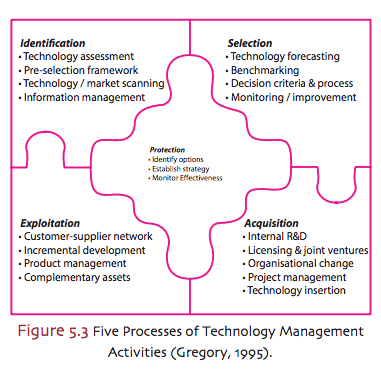
Soru 7
- Internal R&D
- Incremental Development
- Benchmarking
- Customer-supplier Network
- Decision criteria & process
Seçenekler
A
I and III
B
II and IV
C
III and V
D
I and IV
E
II and V
Açıklama:
Soru 8
- Technology insertion
- Technology forecasting
- Market scanning
- Organizational change
- Incremental development
Above, which are some tools in the acquisition process of technology management?
Seçenekler
A
II and V
B
I and II
C
III and V
D
II and IV
E
I and IV
Açıklama:
Soru 9
- Database technology
- Multivariate statistical techniques
- Artificial intelligence/ expert sytems
- Modelling
Seçenekler
A
I and II
B
II and III
C
II and IV
D
I and IV
E
All
Açıklama:
There may be need for tools to manage technology and its activities. These tools may help organizations to manage technology more effectively. On the other hand, individuals or groups in the organizations, which are applicable in the whole company, can use these tools. In the literature, many technology management methods are explained. Some of them are given below6: • Technology Management Framework - Computer Aided Manufacturing - Building Project Management - Work Process Engineering - Project Assessment - Product Design - Technology Measurement - Process Design - Engineering Design - Knowledge Management • Information Systems and Technology Management - Decision Support Systems - Object Oriented Programming - Computer Aided System Engineering - Information Based Systems - Database Applications. • Information and Communication Systems • Artificial Intelligence/ Expert Systems • Database technology • Modelling • Multivariate Statistical Techniques
Soru 10
Which concept refers to the utilization of technologies to improve organizational performances of products, services and processes?
Seçenekler
A
Identification
B
Selection
C
Acquisition
D
Explotation
E
Protection
Açıklama:
Technology exploitation refers to the utilization of technologies to improve organizational performances of products, services and processes.
Soru 11
________ refers to the set of scientific knowledge and experience to use to accomplish tasks; technology is the ability of using the scientific knowledge and experience with the help of tools, machines and materials.
Fill in the blanks.
Fill in the blanks.
Seçenekler
A
Technology
B
Technique
C
Technology management
D
Transferring of technology
E
Strategies
Açıklama:
“Technology” and “Technique” to different meanings can be important to explain. While the term “Technique” refers to the set of scientific knowledge and experience to use to accomplish tasks, technology is the ability of using the scientific knowledge and experience with the help of tools, machines and materials. Therefore, these two concepts do not differ completely from each other, but complete each other in different perspectives.
Soru 12
__________is the information necessary to achieve a certain production outcome from a particular means of combining or processing selected inputs which include production processes, intra-firm organizational structures, management techniques, and means of finance, marketing methods or any of its combination.
Fill in the blanks.
Fill in the blanks.
Seçenekler
A
Supply chain
B
Organizational structure
C
Technology
D
Product development
E
Program management
Açıklama:
Technology can be described as “the information necessary to achieve a certain production outcome from a means of combining or processing selected inputs which include production processes, intra-firm organizational structures, management techniques, and means of finance, marketing methods or any of its combination”.
Soru 13
_________ is defined as a process for planning and controlling the necessary technologies to shape and realize the strategic and functional goals of the organizations.
Fill in the blanks.
Fill in the blanks.
Seçenekler
A
Technology development
B
Strategy management
C
Technology management
D
Supply management
E
Marketing
Açıklama:
Technology Management is defined as a process for planning and controlling the necessary technologies to shape and realize the strategic and functional goals of the organizations. It can also be seen as a multidisciplinary approach, combination of engineering, management, information technologies. It is possible to say that the aim of the technology management is not only improving the existing or new products and services to meet their own managerial needs of organizations that have been acquired and exploited by technologies in their structures.
Soru 14
Which one is not one of the topics of technology management?
Seçenekler
A
Transferring of technology
B
Strategies and policies
C
Supply chain managament
D
Organizational structures
E
Innovation management
Açıklama:
The main subjects of technology management are listed below.
• Human Resources Management
• Strategies and Politics
• Product or Service Development
• Marketing, organizations and program management
• Transferring of technology
• Corporations among universities and industries
• Organizational structures and procedures
• Planning and controlling, mathematical and statistical modelling
• Entrepreneurship and Intrapreneurship, International Entrepreneurship
• Supply chain management
• Human Resources Management
• Strategies and Politics
• Product or Service Development
• Marketing, organizations and program management
• Transferring of technology
• Corporations among universities and industries
• Organizational structures and procedures
• Planning and controlling, mathematical and statistical modelling
• Entrepreneurship and Intrapreneurship, International Entrepreneurship
• Supply chain management
Soru 15
___________ is the initial sub-process, including the identification of existing technologies and new technologies for products and services and the processes within
an organization.
Fill in the blanks.
an organization.
Fill in the blanks.
Seçenekler
A
Selection
B
Identification
C
Acquisition
D
Innovation
E
Exploitation
Açıklama:
Technology identification is the initial subprocess, including the identification of existing technologies and new technologies for products and services and the processes within an organization.
Soru 16
___________ is about who will use the acquired technology, where and for what purpose is it going to be used in organizations.
Fill in the blanks.
Fill in the blanks.
Seçenekler
A
Selection
B
Acquisition
C
Exploitation
D
İdentification
E
Protection
Açıklama:
Exploitation: The important key characteristics in this process are about who will use the acquired technology, where and for what purpose is it going to be used in organizations. While the internal and external acquisition of the technology will be used by the departments of organizations, technology exploitation will utilize the new technologies to improve the performance of products or manufacturing processes.
Soru 17
Which one is about information systems and technology management?
Seçenekler
A
Product Design
B
Process design
C
Technology measurement
D
Engeneering design
E
Data base applications
Açıklama:
Information Systems and Technology Management
- Decision Support Systems
- Object Oriented Programming
- Computer Aided System Engineering
- Information Based Systems
- Database Applications
- Decision Support Systems
- Object Oriented Programming
- Computer Aided System Engineering
- Information Based Systems
- Database Applications
Soru 18
Which one is not one of the technology management methods?
Seçenekler
A
Strategy design
B
Modelling
C
Database technology
D
Artificial intelligence
E
Technology management framework
Açıklama:
Some of the technology management methods are given below:
• Technology Management Framework
- Computer Aided Manufacturing
- Building Project Management
- Work Process Engineering
- Project Assessment
- Product Design
- Technology Measurement
- Process Design
- Engineering Design
- Knowledge Management
• Information Systems and Technology
Management
- Decision Support Systems
- Object Oriented Programming
- Computer Aided System Engineering
- Information Based Systems
- Database Applications.
• Information and Communication Systems
• Artificial Intelligence/ Expert Systems
• Database technology
• Modelling
• Multivariate Statistical Techniques
• Technology Management Framework
- Computer Aided Manufacturing
- Building Project Management
- Work Process Engineering
- Project Assessment
- Product Design
- Technology Measurement
- Process Design
- Engineering Design
- Knowledge Management
• Information Systems and Technology
Management
- Decision Support Systems
- Object Oriented Programming
- Computer Aided System Engineering
- Information Based Systems
- Database Applications.
• Information and Communication Systems
• Artificial Intelligence/ Expert Systems
• Database technology
• Modelling
• Multivariate Statistical Techniques
Soru 19
I. Skilled manager
II. Efficent human resources
III. Lack of research
IV. Costly innovations
Which ones affect the technology development in a good way?
II. Efficent human resources
III. Lack of research
IV. Costly innovations
Which ones affect the technology development in a good way?
Seçenekler
A
I an III
B
I and II
C
III and IV
D
I and IV
E
II and IV
Açıklama:
Internal management may require organizations to hire highly skilled managers or workers to identify problems and find creative solutions for dealing with them about the ongoing processes. Therefore, an efficient human resources management must take the responsibility. On the other hand, innovations or new product developments can be highly complexand costly. Research and development and commercialization issues may also affect the organizational performance.
Soru 20
__________ is a process and a set of activities to protect the knowledge, skills, technologies and brands of organizations.
Seçenekler
A
Selection
B
Acquisition
C
Identification
D
Exploitation
E
Protection
Açıklama:
Protection of the technologies is the protection of knowledge and experiences during production processes13. It is also “the protection of unique of industrial and intellectual property of a company”. Intellectual Properties cover the skills and capabilities, technologies and brands of organizations. Patent, licensing activities and copyrights can be evaluated as protection activities.
Soru 21
Which of the below is not one of the ways use of technology can help and support the organizations?
Seçenekler
A
Technology can add economic value to organizations.
B
Organizations can collaborate with each other.
C
Technology can improve the production of the existing goods and services.
D
Technology can also improve new products, services and innovations.
E
Technology can improve the relations among customers and organizations.
Açıklama:
-
How does use of technology help and support the organizations? The answers and explanations for this question are as follows:
• Technology can add economic value to organizations.
• Organizations can gain competitive advantage.
• Technology can improve the production of the existing goods and services.
• Technology can also improve new products, services and innovations.
• Technology can improve the relations among customers and organizations.
How does use of technology help and support the organizations? The answers and explanations for this question are as follows:
• Technology can add economic value to organizations.
• Organizations can gain competitive advantage.
• Technology can improve the production of the existing goods and services.
• Technology can also improve new products, services and innovations.
• Technology can improve the relations among customers and organizations.
Soru 22
Which of the below refers to the set of scientific knowledge and experience to use to accomplish tasks?
Seçenekler
A
Technology
B
Process
C
Technique
D
Input
E
Output
Açıklama:
-
The term “technique” refers to the set of scientific knowledge and experience to use to accomplish tasks, technology is the ability of using the scientific knowledge and experience with the help of tools, machines and materials.
The term “technique” refers to the set of scientific knowledge and experience to use to accomplish tasks, technology is the ability of using the scientific knowledge and experience with the help of tools, machines and materials.
Soru 23
I. Human Resources Management
II. Strategies and Politics
III. Product or Service Development
IV. Corporations among universities and industries
Which of the above are among the main subjects of technology development?
II. Strategies and Politics
III. Product or Service Development
IV. Corporations among universities and industries
Which of the above are among the main subjects of technology development?
Seçenekler
A
Only I
B
Only III
C
I and II
D
II, III and IV
E
I, II, III and IV
Açıklama:
-
The main subjects of technology management are listed below.
• Human Resources Management
• Strategies and Politics
• Product or Service Development
• Marketing, organizations and program management
• Transferring of technology
• Corporations among universities and industries
• Organizational structures and procedures
• Planning and controlling, mathematical and statistical modelling
• Entrepreneurship and Intrapreneurship, International Entrepreneurship
• Supply chain management
The main subjects of technology management are listed below.
• Human Resources Management
• Strategies and Politics
• Product or Service Development
• Marketing, organizations and program management
• Transferring of technology
• Corporations among universities and industries
• Organizational structures and procedures
• Planning and controlling, mathematical and statistical modelling
• Entrepreneurship and Intrapreneurship, International Entrepreneurship
• Supply chain management
Soru 24
Which of the below is not one of the types of technology identified by the organizations?
Seçenekler
A
Base Technologies
B
Critical technologies
C
Pacing technologies
D
Stative technologies
E
Emerging technologies
Açıklama:
-
The types of technology identified by the organizations are listed below.
1. BaseTechnologies
2. Critical technologies
3. Pacing technologies
4. Emerging technologies
The types of technology identified by the organizations are listed below.
1. BaseTechnologies
2. Critical technologies
3. Pacing technologies
4. Emerging technologies
Soru 25
Which of the below refers to giving decisions for using appropriate technologies from the alternatives?
Seçenekler
A
Acquisition
B
Protection
C
Identification
D
Selection
E
Exploitation
Açıklama:
-
Selection process is about giving decisions for using appropriate technologies from the alternatives.
Selection process is about giving decisions for using appropriate technologies from the alternatives.
Soru 26
I. Intelligence
II. Negotiation
III. Reflection
IV. Control
Which of the below is/are among the steps for external technology exploitation?
II. Negotiation
III. Reflection
IV. Control
Which of the below is/are among the steps for external technology exploitation?
Seçenekler
A
Only I
B
Only II
C
I and III
D
II and IV
E
I, II and IV
Açıklama:
-
There are five steps for external technology exploitation:
• Planning
• Intelligence
• Negotiation
• Realization
• Control
There are five steps for external technology exploitation:
• Planning
• Intelligence
• Negotiation
• Realization
• Control
Soru 27
Engineering Design is considered to be a subcategory of which of the technology management tools below?
Seçenekler
A
Information Systems and Technology Management
B
Modelling
C
Technology Management Framework
D
Multivariate Statistical Techniques
E
Artificial Intelligence/ Expert Systems
Açıklama:
-
Engineering Design is considered to be a subcategory of Technology Management Framework.
Engineering Design is considered to be a subcategory of Technology Management Framework.
Soru 28
I. Patents
II. Social networks
III. Trademarks
IV. Know-how
Which of the below can be considered to be instrument(s) used to protect technology?
II. Social networks
III. Trademarks
IV. Know-how
Which of the below can be considered to be instrument(s) used to protect technology?
Seçenekler
A
Only I
B
I and II
C
II and III
D
I, III and IV
E
I, II, III and IV
Açıklama:
Technology can be protected by the instruments listed below:
• Patents (legal right to exclude other organizations given by the government)
• Trademarks (Word, name, symbol, etc.)
• Copyrights (Protection of lierary work, musical work, dramatic work, sound recordings)
• Trade Secrets (Protecting the internal secret information)
• Know-How (Contractual transfer of knowledge from experts)
• Patents (legal right to exclude other organizations given by the government)
• Trademarks (Word, name, symbol, etc.)
• Copyrights (Protection of lierary work, musical work, dramatic work, sound recordings)
• Trade Secrets (Protecting the internal secret information)
• Know-How (Contractual transfer of knowledge from experts)
Soru 29
Which of the tasks below is regarded as the first of the five stages for technology acquisition?
Seçenekler
A
Establish market-place requirements
B
Assess sources of technology acquisition
C
Classify technology solutions
D
Identify technology solutions
E
Make the technology decision
Açıklama:
In the literature five stages are given for technology acquisition with the several tasks to accomplish:
1. Establish market-place requirements
2. Identify technology solutions
3. Classify technology solutions
4. Assess sources of technology acquisition
5. Make the technology decision
1. Establish market-place requirements
2. Identify technology solutions
3. Classify technology solutions
4. Assess sources of technology acquisition
5. Make the technology decision
Soru 30
Complementary assets are listed below which process of technology management?
Seçenekler
A
Exploitation
B
Selection
C
Identification
D
Acquisition
E
Protection
Açıklama:
Exploitation encompasses "customer-supplier network, incremental development, product management, and complementary assets".
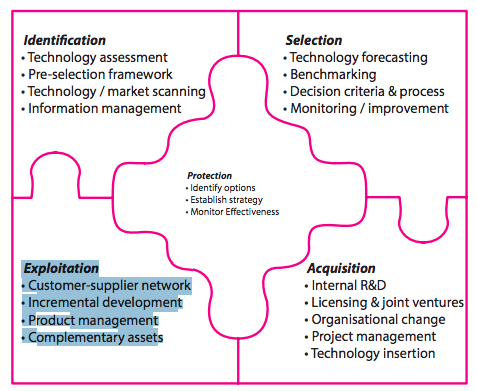
Soru 31
Which of the following answers is NOT related to the question below?
''How does use of technology help and support the organisations?''
''How does use of technology help and support the organisations?''
Seçenekler
A
It can improve the relations among customers and organisations.
B
It can improve new products, services and innovations.
C
Organisations can gain competitive advantage.
D
It can add economic value to organisations.
E
Organisations may not be ready financially.
Açıklama:
Technology could be used to help and support the organisations in different ways such as; it can add economic value to organisations, organisations can gain competitive advantage. It can also improve the production of the existing goods and services, improve new products, services and innovations and it can improve the relations among customers and organisations.
Technology could be used to help and support the organisations in different ways, however in answer E, there is a negative assumption about the cost of needed technology for any organisation.
Technology could be used to help and support the organisations in different ways, however in answer E, there is a negative assumption about the cost of needed technology for any organisation.
Soru 32
The process for planning and controlling the necessary technologies to shape and realize the strategic and functional goals of an organization is ............... .
Seçenekler
A
Technology management
B
Technique management
C
Innovation management
D
R&D management
E
knowledge management
Açıklama:
Technology Management is defined as a process for planning and controlling the necessary technologies to shape and realize the strategic and functional goals of the organizations. It can also be seen as a multidisciplinary approach, combination of engineering, management, information technologies.
The sentence describes technology management so the correct answer is A.
The sentence describes technology management so the correct answer is A.
Soru 33
Which of the following main subjects of technology management is related to taking on financial risks in hope of profit?
Seçenekler
A
Planning and controlling
B
Human Resources Management
C
Transferring of technology
D
Entrepreneurship and Intrapreneurship
E
Product or Service Development
Açıklama:
The main subjects of technology management are: Human Resources Management, Strategies and Politics, Product or Service Development, Marketing, organizations and program management, Transferring of technology, Corporations among universities and industries, Organizational structures and procedures, Planning and controlling, mathematical and statistical modelling, Entrepreneurship and Intrapreneurship, International Entrepreneurship and Supply chain management.
Entrepreneurship and Intrapreneurship are about taking risks in order to make profit or opening up new businesses, therefore the correct answer is D.
Entrepreneurship and Intrapreneurship are about taking risks in order to make profit or opening up new businesses, therefore the correct answer is D.
Soru 34
Considering the Five Processes of Technology Management Activities, which of the following is one of the steps in the identification process?
Seçenekler
A
Information management
B
Project management
C
Technology insertion
D
Incremental development
E
Benchmarking
Açıklama:
Technology identification is the initial sub-process, including the identification of existing technologies and new technologies for products and services and the processes within an organization. Identification: Technology assessment, Pre-selection framework, Technology / market scanning, Information management
In this sub-process, current and future technologies are identified to add value to organizations. It also includes foresights and gathering information about the technologies and capabilities that are in and outside the organization. Therefore the correct answer is A.
In this sub-process, current and future technologies are identified to add value to organizations. It also includes foresights and gathering information about the technologies and capabilities that are in and outside the organization. Therefore the correct answer is A.
Soru 35
Which of the following is one of the steps in the selection process according to the Five Processes of Technology Management Activities?
Seçenekler
A
Complementary assets
B
Licensing & joint ventures
C
Customer-supplier network
D
Organisational change
E
Decision criteria & process
Açıklama:
Organizations expect to produce goods and services with low costs and sell them to gain high profit to be able to compete. Therefore, they need to improve their goods and services to create competitive advantage. To create this advantage, the selection process becomes an important process for organizations. This is also the ability of organizations to improve their strategies in the long run.
Decision criteria & process is one of the steps in selection process, the other options are not related to this process, so the correct answers E.
Decision criteria & process is one of the steps in selection process, the other options are not related to this process, so the correct answers E.
Soru 36
Which of the following is one of the steps in the acqusition process according to the Five Processes of Technology Management Activities?
Seçenekler
A
Technology forecasting
B
Information management
C
Technology insertion
D
Incremental development
E
Benchmarking
Açıklama:
An important role in the management of technology is the acquisition of the technology to by the organization. It is also another decision process like selection of the technologies, which involves a number of individuals from almost every department of the organization.
Technology insertion is one of the steps in the acquisition process, other options are not related to the question, therefore the correct answer is C.
Technology insertion is one of the steps in the acquisition process, other options are not related to the question, therefore the correct answer is C.
Soru 37
Which of the following is NOT one of the five steps for external technology exploitation?
Seçenekler
A
Planning
B
Intelligence
C
Negotiation
D
Selection
E
Control
Açıklama:
There are five steps for external technology exploitation: Planning, Intelligence, Negotiation, Realization, Control.
Planning, Intelligence, Negotiation, Realization and Control are the five steps for external technology exploitation. Selection is not one of the five, so the correct answer is D.
Planning, Intelligence, Negotiation, Realization and Control are the five steps for external technology exploitation. Selection is not one of the five, so the correct answer is D.
Soru 38
Which of the following is the best option to complete the sentence below?
............... is a process and a set of activities to preserve the knowledge, skills, technologies and brands of organizations.
............... is a process and a set of activities to preserve the knowledge, skills, technologies and brands of organizations.
Seçenekler
A
Protection
B
Selection
C
Acqusition
D
Identification
E
Exploitation
Açıklama:
Protection is a process and a set of activities to protect the knowledge, skills, technologies and brands of organizations.
Protection is necessary to keep the knowledge, skills, technologies and brands of organizations. Other options are not related to the definition, so the answer is A.
Protection is necessary to keep the knowledge, skills, technologies and brands of organizations. Other options are not related to the definition, so the answer is A.
Soru 39
Which of the following belongs to Technology Management Framework?
Seçenekler
A
Information Based Systems
B
Technology Measurement
C
Decision Support Systems
D
Database technology
E
Multivariate Statistical Techniques
Açıklama:
Technology Management Framework consists of; Computer Aided Manufacturing, Building Project Management, Work Process Engineering, Project Assessment, Product Design, Technology Measurement, Process Design, Engineering Design, Knowledge Management.
Only Technology Measurement belongs to Technology Management Framework, therefore the correct answer is B.
Only Technology Measurement belongs to Technology Management Framework, therefore the correct answer is B.
Soru 40
Which of the following is NOT one of the instruments to protect technology?
Seçenekler
A
Copyrights
B
Planning
C
Patents
D
Trade Secrets
E
Trademarks
Açıklama:
The fixed, variable and total costs and the level of tangible and intangible investments can be very high during the production. For those reasons, organizations may not want their products or services to be imitated, so they may need to protect them to reduce the risk of the similarity of the other organizations’ products. With protecting, organizations will again have competitive advantage over other organizations.
Technology can be protected by the instruments such as; Patents (legal right to exclude other organizations given by the government), Trademarks (Word, name, symbol, etc.), Copyrights (Protection of lierary work, musical work, dramatic work, sound recordings), Trade Secrets (Protecting the internal secret information) and Know-How (Contractual transfer of knowledge from experts). Planning is not one of the instruments, therefore the correct answer is B.
Technology can be protected by the instruments such as; Patents (legal right to exclude other organizations given by the government), Trademarks (Word, name, symbol, etc.), Copyrights (Protection of lierary work, musical work, dramatic work, sound recordings), Trade Secrets (Protecting the internal secret information) and Know-How (Contractual transfer of knowledge from experts). Planning is not one of the instruments, therefore the correct answer is B.
Soru 41
Which of the following is described as "The information necessary to achieve a certain production outcome from a particular means of combining or processing selected inputs which include production processes, intra-firm organizational structures, management techniques, and means of finance, marketing methods or any combination of the above"?
Seçenekler
A
Technique
B
Management
C
Technology
D
Material
E
Design
Açıklama:
The information necessary to achieve a certain production outcome from a particular means of combining or processing selected inputs which include production processes, intra-firm organizational structures, management techniques, and means of finance, marketing methods or any of its combination is called "technology".
Soru 42
What is "The set of scientific knowledge and experience used to accomplish tasks" called?
Seçenekler
A
Technique
B
Material
C
Technology
D
Management
E
Strategy
Açıklama:
The set of scientific knowledge and experience to use to accomplish tasks is called "technique". The correct option is A.
Soru 43
I- Strategies and Politics
II- Transfer of technology
III- Supply chain management
Which of the subjects above are among the main topics of technology management?
II- Transfer of technology
III- Supply chain management
Which of the subjects above are among the main topics of technology management?
Seçenekler
A
I
B
I and II
C
I and III
D
II and III
E
I, II and III
Açıklama:
The main subjects of technology management are as follows:
- Human resources management
- Strategies and politics
- Product or service development
- Marketing, organizations and program management
- Transferring technology
- Corporations among universities and industries
- Organizational structures and procedures
- Planning and controlling, mathematical and statistical modeling
- Entrepreneurship and intrapreneurship, international entrepreneurship
- Supply chain management
Soru 44
Which one below is one of the base technologies stated by Thompson?
Seçenekler
A
Emerging Technologies
B
Intensive Technologies
C
Critical Technologies
D
Pacing Technologies
E
Short-Linked Technologies
Açıklama:
The three are technologies stated by Thompson are:
The correct option is B.
- Long-Linked Technologies
- Mediating Technologies
- Intensive Technologies
The correct option is B.
Soru 45
Which option below belongs to the identification process of technology management?
Seçenekler
A
Complementary assets
B
Organizational Change
C
Technology Assessment
D
Technology Forecasting
E
Incremental Development
Açıklama:
The identification process of technology management includes:
The correct option is C.
- Technology assessment
- Pre-selection framework
- Technology/market scanning
- Information management
The correct option is C.
Soru 46
- Licensing and joint ventures
- Incremental development
- Benchmarking
- Organizational change
Seçenekler
A
I and II
B
I and III
C
II and III
D
III and IV
E
II and IV
Açıklama:
The acquisition process includes five sub-processes which are:
- Internal R&D
- Licensing and joint ventures
- Organizational change
- Project management
- Technology insertion
Soru 47
What are the process and set of activities to preserve the knowledge, skills, technologies, and brands of organizations called?
Seçenekler
A
Protection
B
Planning
C
Realization
D
Negotiation
E
Control
Açıklama:
Protection is the process and set of activities to preserve the knowledge, skills, technologies, and brands of organizations. the correct option is A.
Soru 48
- Decision support systems
- Information based systems
- Work process engineering
Seçenekler
A
I
B
II and III
C
I and II
D
I and III
E
I, II and III
Açıklama:
Information Systems and Technology Management includes:
-Decision support systems
-Object-Oriented Programming
-Computer Aided System Engineering
-Information Based Systems
-Database Applications
The correct option is C.
-Decision support systems
-Object-Oriented Programming
-Computer Aided System Engineering
-Information Based Systems
-Database Applications
The correct option is C.
Soru 49
Which technology management tool should be used for the selection process?
Seçenekler
A
Stage-gate
B
Patent Analysis
C
Road Mapping
D
S-Curve
E
Value Analysis
Açıklama:
The tools used for the section process are portfolio management and value analysis. The correct option is E.
Soru 50
For which process can both S-Curve and Stage-Gate be used?
Seçenekler
A
Acquisition
B
Exploitation
C
Identification
D
Protection
E
Selection
Açıklama:
Both S-Curve and Stage-Gate can be used for the identification process. The correct option is C.
Ünite 6
Soru 1
Which of the following combines technological and business model disruptions?
Seçenekler
A
Architectural innovation
B
Radical innovation
C
Product innovation
D
Disruptive innovation
E
Routine innovation
Açıklama:
Architectural innovation combines technological and business model disruptions.
Soru 2
Which of the following is based on having the existing business model, exploiting the existing knowledge base and small improvements of existing products?
Seçenekler
A
Architectural innovation
B
Routine innovation
C
Radical innovation
D
Disruptive innovation
E
Product innovation
Açıklama:
Routine (incremental) innovation is based on having the existing business model, exploiting the existing knowledge base and small improvements of existing products.
Soru 3
Which of the following is the key mechanism of invention?
Seçenekler
A
Development
B
Innovation
C
Exploration
D
Implementation
E
Execution
Açıklama:
The key mechanism of invention is exploration, which includes things represented by words such as search, variation, risk-taking, experimentation,
Soru 4
Which of the following means the widespread acceptance of the innovation?
Seçenekler
A
Development
B
Invention
C
Exploitation
D
Implementation
E
Integration
Açıklama:
Implementation, whose key mechanism is exploitation, refers to the widespread acceptance of the innovation.
Soru 5
Which of the following refers to changing the hardware of the work and skills and knowledge of employees.
Seçenekler
A
Organizational change
B
Strategic change
C
Structural change
D
Cultural change
E
Technological change
Açıklama:
Technological change refers to changing the hardware of the work and skills and knowledge of employees.
Soru 6
Which of the following refers to any change in the patterned or regularized aspects of the relationships among participants in the organization?
Seçenekler
A
Structural change
B
Strategic change
C
Organizational changeCultural change
D
Cultural change
E
Technological change
Açıklama:
Structural change refers to any change in the patterned or regularized aspects of the relationships among participants in the organization.
Soru 7
Which of the following is NOT a step of change management assessing the need for change, deciding on the change to make, implementing the change, and evaluating the change?
Seçenekler
A
Deciding on the change
B
Implementing the change
C
Evaluating the change
D
Planning the change
E
Assessing the need for change
Açıklama:
The steps of change management are assessing the need for change, deciding on the change to make, implementing the change, and evaluating the change.
Soru 8
Which of the following views development as a repetitive sequence of goal formulation, implementation, evaluation, and modification of a pictured end state based on what was learned or intended by the people involved?
Seçenekler
A
Planned change
B
Prescribed change
C
Top-down change
D
Bottomup change
E
Strategic change
Açıklama:
Planned change models view development as a repetitive sequence of goal formulation, implementation, evaluation, and modification of a pictured end state based on what was learned or intended by the people involved.
Soru 9
In which step of change management do managers decide whether the change will be top-down or bottom-up?
Seçenekler
A
Assessing the need for change
B
Deciding on the change to make
C
Planning the change
D
Evaluating the change.
E
Implementing the change
Açıklama:
After deciding the change to make, managers decide whether the change will be top-down or bottom-up.
Soru 10
Which of the following is an example of corporate change attempts?
Seçenekler
A
Changing price policy
B
Investing in new equipment
C
Entering strategic alliances
D
Designing new education and training programs
E
Privatization
Açıklama:
Investing in new equipment, changing price policy, and designing new education and training programs are some examples of changes in functional strategies.
Mergers and acquisitions, outsourcing, and entering strategic alliances (franchising, equity alliance, joint venture, etc.) are the most common corporate change attempts.
Mergers and acquisitions, outsourcing, and entering strategic alliances (franchising, equity alliance, joint venture, etc.) are the most common corporate change attempts.
Soru 11
What can be defined as the implementation of a new or significantly improved product (good or service), or process or a new organizational method?
Seçenekler
A
Innovation
B
Architectural innovation
C
Routine (incremental) innovation
D
Routine (incremental) innovation
E
Disruptive innovation
Açıklama:
Innovation can be defined as “the implementation of a new or significantly improved product (good or service), or process…or a new organizational method”
Soru 12
Which concept refers to having the existent technical knowledge base and exploring a new business model?
Seçenekler
A
Product innovation
B
Routine (incremental) innovation
C
Disruptive innovation
D
Architectural innovation
E
Radical innovation
Açıklama:
Disruptive innovation refers to having the existent technical knowledge base and exploring a new business model.
Soru 13
Which concept integrates new business models with new products that are based on new technical knowledge?
Seçenekler
A
Routine (incremental) innovation
B
Product Innovation
C
Architectural innovation
D
Organizational Innovation
E
Radical innovation
Açıklama:
Architectural innovation integrates new business models with new products that are based on new technical knowledge.
Soru 14
- It requires a new business model.
- It requires a new technical knowledge base.
- It leverages an existing technical knowledge base.
- It leverages an existing business model.
Seçenekler
A
I and IV
B
II and III
C
III and IV
D
II and IV
E
I and III
Açıklama:
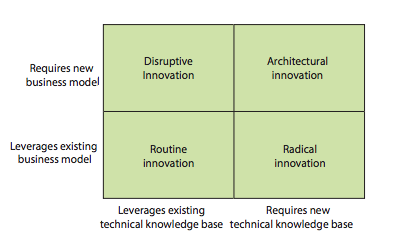
Soru 15
- Invention
- Observation
- Implementation
- Experimentation
- Development
Seçenekler
A
I, III and IV
B
II, IV and V
C
I, III and V
D
II, III and IV
E
I, II and IV
Açıklama:
Innovation process has three stages: invention, development, and implementation.
Soru 16
Which of these behaviours does not trigger generating ideas in the process of invention?
Seçenekler
A
Questioning
B
Observing
C
Networking
D
Experimenting
E
Training
Açıklama:
Questioning, observing, networking, and experimenting trigger generating insights.
Soru 17
Which conecpt refers to having the existent business model, exploiting the existing technical knowledge base and small improvements of existent products?
Seçenekler
A
Radical innovation
B
Architectural innovation
C
Product innovation
D
Routine Innovation
E
Process Innovation
Açıklama:
Routine innovation refers to having the existent business model, exploiting the existing technical knowledge base and small improvements of existent products.
Soru 18
Which concept refers to alterations in a company’s corporate, business-level, and/or functional strategies such as mergers and acquisitions, outsourcing, and entering strategic alliances?
Seçenekler
A
Organizational change
B
Strategic change
C
Structural change
D
Technoloical change
E
Cultural change
Açıklama:
Strategic change refers to alterations in a company’s corporate, business-level, and/or functional strategies. Mergers and acquisitions, outsourcing, and entering strategic alliances (franchising, equity alliance, joint venture, etc.) are the most common corporate change attempts.
Soru 19
Which concept refers to changing the hardware of the work and skills and knowledge of employeed?
Seçenekler
A
Cultural change
B
Structural change
C
Strategic change
D
Organizational change
E
Technological change
Açıklama:
Technological change refers to changing the hardware of the work and skills and knowledge of employees.
Soru 20
Which type of organizational change includes a repetitive sequence of goal formulation, implementation, evaluation, and modification of a pictured end state, and is rapid and dramatic?
Seçenekler
A
Strategic change
B
Planned change
C
Prescribed change
D
Structural change
E
Cultural change
Açıklama:
Planned change includes a repetitive sequence of goal formulation, implementation, evaluation, and modification of a pictured end state, and it is rapid and dramatic.
Soru 21
Which below is vital in process innovation?
Seçenekler
A
Reduction of product quality
B
Increasing manufacturing costs
C
Maintenance of the product variety
D
Improving the way the business is run
E
Disenabling competencies
Açıklama:
Over time product innovation becomes less critical, and process innovations designed to reduce manufacturing costs and increase product quality become more critical.
Process innovation refers to a company’s effort to refine and improve its current processes.
Process innovation refers to a company’s effort to refine and improve its current processes.
Soru 22
Which below is not one of the categories of product innovation?
Seçenekler
A
Incremental innovation
B
Radical innovation
C
Disruptive innovation
D
Architectural innovation
E
Organizational innovation
Açıklama:
Product innovation refers to the new or recombined knowledge incarnated in a new product.
There are four categories of innovation: routine (incremental), radical, disruptive, and architectural innovations.
There are four categories of innovation: routine (incremental), radical, disruptive, and architectural innovations.
Soru 23
What kind of innovation is seen when Apple introduces a new iPhone with a better camera?
Seçenekler
A
Process innovation
B
Organizational innovation
C
Incremental innovation
D
Radical innovation
E
Disruptive innovation
Açıklama:
It is easier and less risky than radical innovation.
The majority of product innovations are incremental ones, such as adding an extra blade with each new version of the razor, putting a new and faster chip into the PC, and redesigning an automobile model.
The majority of product innovations are incremental ones, such as adding an extra blade with each new version of the razor, putting a new and faster chip into the PC, and redesigning an automobile model.
Soru 24
Amazon, when they began to sell books on line, changed the way books and many other products are sold in the world. What kind of innovation is seen in the case of Amazon?
Seçenekler
A
Disruptive innovation
B
Radical innovation
C
Process innovation
D
Product innovation
E
Architectural innovation
Açıklama:
For example, ride-hailing companies, streaming media companies, and web-based book retailers are disrupting taxis, television networks, and book retailers at physical locations, respectively.
Disruptive innovation requires a new business model but not necessarily a technological breakthrough. For that reason, it also challenges or disrupts, the business models of other companies.
Disruptive innovation requires a new business model but not necessarily a technological breakthrough. For that reason, it also challenges or disrupts, the business models of other companies.
Soru 25
What kind of innovation is about integrating new business models with new products that are based on new technical knowledge?
Seçenekler
A
Process innovation
B
Routine innovation
C
Radical innovation
D
Disruptive innovation
E
Architectural innovation
Açıklama:
An example is digital photography. For companies such as Kodak and Polaroid, entering the digital world meant mastering entirely new competencies in solid-state electronics, camera design, software, and display technology.
Architectural innovation integrates new business models with new products that are based on new technical knowledge.
Architectural innovation integrates new business models with new products that are based on new technical knowledge.
Soru 26
Which below is an example to innovation in organizational methods?
Seçenekler
A
Distribution of responsibilities among employees
B
Outsourcing
C
Introducing total quality management
D
Engagement in customer relationship management
E
Coming up with new concepts for the structuring of activities
Açıklama:
There are three types of organizational innovation: organizational innovation in business practice, innovation in workplace organization, and innovation in organization methods for external relationships.
Innovation in organization methods for external relationships involves the implementation of new ways of organizing relationships with other firms or public institutions, such as collaboration with public organizations, methods for integration with suppliers, or outsourcing.
Innovation in organization methods for external relationships involves the implementation of new ways of organizing relationships with other firms or public institutions, such as collaboration with public organizations, methods for integration with suppliers, or outsourcing.
Soru 27
How can innovators best challenge the status quo?
Seçenekler
A
By questioning
B
By observing
C
By networking
D
By exprementing
E
By outsourcing
Açıklama:
They often ask “what if ” questions to envision a different future.
Innovators bring forth insights through questioning, constantly challenging the status quo with “why” and “why not” questions to turn things upside-down.
Innovators bring forth insights through questioning, constantly challenging the status quo with “why” and “why not” questions to turn things upside-down.
Soru 28
Which below is crucial for a a very different idea to be developed as well as possible?
Seçenekler
A
Strict bureaucracy
B
Autonomous teams
C
Large sums of money
D
Big teams
E
Task prioritisation
Açıklama:
For having the full advantages of projects, companies should give more autonomy to the project team if the targeted innovation is radical, disruptive, or architectural.
The more different the idea, the more autonomy the project team will require.
The more different the idea, the more autonomy the project team will require.
Soru 29
The central mechanism of implementation is exploitation. Which below does exploitation not contain?
Seçenekler
A
Refinement
B
Choice
C
Production
D
Efficiency
E
Exploration
Açıklama:
Implementation, whose key mechanism is exploitation, refers to the widespread acceptance of the innovation.
Exploration is about invention.
Exploration is about invention.
Soru 30
Which below is the first step in change management?
Seçenekler
A
Identifying the source of the problem or need
B
Identifying barriers to the change
C
Identifying the way to introduce the change
D
Evaluating the change
E
Implementing the change
Açıklama:
Many people are not willing to change unless they perceive a problem or a crisis.
Managers sense a need for change through the appearance of a performance gap-a disparity between existing and desired performance levels. This is about assessing the need for change which is the first step in change management.
Managers sense a need for change through the appearance of a performance gap-a disparity between existing and desired performance levels. This is about assessing the need for change which is the first step in change management.
Soru 31
What type of innovation is described by "a company’s effort to refine and improve its current processes"?
Seçenekler
A
Process Innovation
B
Product Innovation
C
Routine innovation
D
Radical innovation
E
Disruptive innovation
Açıklama:
Process innovation is a company’s effort to refine and improve its current processes.
Soru 32
What kind of product innovation is involved in "adding an extra blade with each new version of the razor"?
Seçenekler
A
Process innovation
B
Routine innovation
C
Radical innovation
D
Disruptive innovation
E
Architectural innovation
Açıklama:
Routine (incremental) innovation is based on having the existing business model, exploiting the existing knowledge base and small improvements of existing products. The majority of product innovations are incremental ones, such as adding an extra blade with each new version of the razor, putting a new and faster chip into the PC, and redesigning an automobile model, since it is easier and less risky than radical innovation.
Soru 33
What kind of product innovation is involved in "putting a new and faster chip into the PC"?
Seçenekler
A
Process innovation
B
Routine innovation
C
Radical innovation
D
Disruptive innovation
E
Architectural innovation
Açıklama:
Routine (incremental) innovation is based on having the existing business model, exploiting the existing knowledge base and small improvements of existing products. The majority of product innovations are incremental ones, such as adding an extra blade with each new version of the razor, putting a new and faster chip into the PC, and redesigning an automobile model, since it is easier and less risky than radical innovation.
Soru 34
What kind of product innovation is involved in "redesigning an automobile model"?
Seçenekler
A
Process innovation
B
Routine innovation
C
Radical innovation
D
Disruptive innovation
E
Architectural innovation
Açıklama:
Routine (incremental) innovation is based on having the existing business model, exploiting the existing knowledge base and small improvements of existing products. The majority of product innovations are incremental ones, such as adding an extra blade with each new version of the razor, putting a new and faster chip into the PC, and redesigning an automobile model, since it is easier and less risky than radical innovation.
Soru 35
What type of innovation requires a new business model but not necessarily a technological breakthrough?
Seçenekler
A
Process innovation
B
Routine innovation
C
Radical innovation
D
Disruptive innovation
E
Architectural innovation
Açıklama:
Disruptive innovation requires a new business model but not necessarily a technological breakthrough.
Soru 36
What type of innovation is based on existent business model and exploring novel technology, and development of new and different products?
Seçenekler
A
Process innovation
B
Routine innovation
C
Radical innovation
D
Disruptive innovation
E
Architectural innovation
Açıklama:
Radical innovation is based on existent business model and exploring novel technology, and development of new and different products such as biotechnology for pharmaceutical companies, jet engines for airplane manufacturers, and fiber-optic cable for telecommunication companies.
Soru 37
What type of innovation integrates new business models with new products that are based on new technical knowledge?
Seçenekler
A
Organizational innovation
B
Routine innovation
C
Radical innovation
D
Disruptive innovation
E
Architectural innovation
Açıklama:
Architectural innovation integrates new business models with new products that are based on new technical knowledge.
Soru 38
What kind of innovation is involved in "ride-hailing companies"?
Seçenekler
A
Process innovation
B
Routine innovation
C
Radical innovation
D
Disruptive innovation
E
Architectural innovation
Açıklama:
Disruptive innovation requires a new business model but not necessarily a technological breakthrough. For that reason, it also challenges or disrupts, the business models of other companies. For example, ride-hailing companies, streaming media companies, and web-based book retailers are disrupting taxis, television networks, and book retailers at physical locations, respectively.
Soru 39
Which two types of innovation require a new business model?
Seçenekler
A
Disruptive-Architectural
B
Routine-Radical
C
Disruptive-Routine
D
Disruptive-Radical
E
Architectural-Radical
Açıklama:
Disruptive-Architectural innovations require a new business model.
Soru 40
Which two types of innovation leverage the existing business model?
Seçenekler
A
Disruptive-Architectural
B
Routine-Radical
C
Disruptive-Routine
D
Disruptive-Radical
E
Architectural-Radical
Açıklama:
Routine-Radical innovations leverage the existing business model.
Soru 41
What type of innovation is exemplified in the following description?
A company is renewing its equipment and software to increase its production level and decrease the costs.
A company is renewing its equipment and software to increase its production level and decrease the costs.
Seçenekler
A
Process innovation
B
Product innovation
C
Organizational innovation
D
Routine innovation
E
Disruptive innovation
Açıklama:
Process innovation is a company’s effort to refine and improve its current processes. In the early stages of industry development, product innovation is vital. However, over time product innovation becomes less critical, and process innovations designed to reduce manufacturing costs and increase product quality become more critical.
Soru 42
What type of innovation is exemplified in the description below?
A watch is basically used to check time. However, with new models like Apple Watch, it seems to be reinvented with the integration of novel technology, which makes it more than a watch.
A watch is basically used to check time. However, with new models like Apple Watch, it seems to be reinvented with the integration of novel technology, which makes it more than a watch.
Seçenekler
A
Disruptive innovation
B
Incremental innovation
C
Radical innovation
D
Routine innovation
E
Architectural innovation
Açıklama:
Radical innovation is based on existent business model and exploring novel technology, and development of new and different products such as biotechnology for pharmaceutical companies, jet engines for airplane manufacturers, and fiber-optic cable for telecommunication companies.
Routine (incremental) innovation refers to having the existent business model, exploiting the existing technical knowledge base and small improvements of existent products.
Architectural innovation integrates new business models with new products that are based on new technical knowledge.
Disruptive innovation requires a new business model but not necessarily a technological breakthrough. For that reason, it also challenges or disrupts, the business models of other companies.
Routine (incremental) innovation refers to having the existent business model, exploiting the existing technical knowledge base and small improvements of existent products.
Architectural innovation integrates new business models with new products that are based on new technical knowledge.
Disruptive innovation requires a new business model but not necessarily a technological breakthrough. For that reason, it also challenges or disrupts, the business models of other companies.
Soru 43
Which of the following is NOT considered among the key words representing exploration, the key mechanism of invention?
Seçenekler
A
Flexibility
B
Risk-taking
C
Variation
D
Experimentation
E
Conservation
Açıklama:
Invention refers to the emergence of an idea. The key mechanism of invention is exploration, which includes things represented by words such as search, variation, risk-taking, experimentation, play, flexibility, and discovery10. Invention includes generating an insight about the customers’ problem or need and profoundly understanding this problem or need.
Conservation is a concept that does not refer to invention.
Conservation is a concept that does not refer to invention.
Soru 44
Which of the following is NOT among the behaviors that trigger innovators to generate ideas?
Seçenekler
A
Asking "Why?", "Why not?", and "What if?" type of questions to challenge the status quo.
B
Going out of offices and observing people and the life outside.
C
Testing new ideas wherever possible.
D
Communicating with people sharing the same ideas with them.
E
Questioning why people are doing what they are doing.
Açıklama:
Questioning, observing, networking and experimenting are the four behaviours innovators have.
First, innovators bring forth insights through questioning, constantly challenging the status quo with “why” and “why not” questions to turn things upside-down. They often ask “what if” questions to envision a different future. Questioning gives you the fuel to power new associations and insights. Second, innovators gather new ideas by observing the environment as if they were anthropologists. They get out of their offices to watch the world around them-especially customers, products, services, and processes-to activate unique ways of doing things. Third, innovators surpass at networking, talking with people to find-or actuate a new way to solve-perplexing problems. They regularly communicate with people who do not look, act, or (most importantly) think as they do. Instead of networking simply to gain resources, they interact with diverse people to get new ideas. Finally, innovators generate insights by invariably experimenting. They test new experiences wherever they go. They disassemble products or processes to see how things work-and how to improve them.
First, innovators bring forth insights through questioning, constantly challenging the status quo with “why” and “why not” questions to turn things upside-down. They often ask “what if” questions to envision a different future. Questioning gives you the fuel to power new associations and insights. Second, innovators gather new ideas by observing the environment as if they were anthropologists. They get out of their offices to watch the world around them-especially customers, products, services, and processes-to activate unique ways of doing things. Third, innovators surpass at networking, talking with people to find-or actuate a new way to solve-perplexing problems. They regularly communicate with people who do not look, act, or (most importantly) think as they do. Instead of networking simply to gain resources, they interact with diverse people to get new ideas. Finally, innovators generate insights by invariably experimenting. They test new experiences wherever they go. They disassemble products or processes to see how things work-and how to improve them.
Soru 45
Instead of located and run in a single specific place, McDonalds corporation, the world-famous fast-food restaurant, has over 75 of its worldwide restaurants independently owned.
The example given above represents a __________ to improve the company's effectiveness and efficiency.
The example given above represents a __________ to improve the company's effectiveness and efficiency.
Seçenekler
A
structural change
B
strategic change
C
technological change
D
cultural change
E
ideal change
Açıklama:
Strategic change refers to alterations in a company’s corporate, business-level, and/or functional strategies. Mergers and acquisitions, outsourcing, and entering strategic alliances (franchising, equity alliance, joint venture, etc.) are the most common corporate change attempts. Product and/or process innovation, engaging to achieve economies of scale or scope, and offering new complementary products are some attempts at changing the business-level strategies. Investing in new equipment, changing price policy, and designing new education and training programs are some examples of changes in functional strategies.
The example given in the question is about franchising.
The example given in the question is about franchising.
Soru 46
Which of the following is about planned change as a type of organizational change?
Seçenekler
A
There is a non-arbitrary sequence of change and stages over time.
B
It is gradual and incremental.
C
Total quality management is an example of this.
D
Flexible and empowered work groups are created.
E
Restructuring and reengineering are two examples of it.
Açıklama:
Planned change models view development as a repetitive sequence of goal formulation, implementation, evaluation, and modification of a pictured end state based on what was learned or intended by the people involved48. Planned change is rapid and dramatic. It tends to result in a radical shift in ways of doing things, new goals, and a new structure49. Restructuring (downsizing an organization by eliminating the jobs of large numbers of managers and employees), and reengineering (deleting old processes and all unnecessary process details, and redesigning processes from scratch, leading to radical transformation) are two examples for the planned structural change.
Soru 47
Which of the following is a reason for resistance to an organizational change?
Seçenekler
A
It is considered a contribution to their established routine.
B
It helps protect their job security and status.
C
It may interfere the smooth running of their operation.
D
It may make people's comfort zone larger.
E
It is appealing to work with a specialists.
Açıklama:
The reasons why people resist organizational change are as follows:
1. It is considered an unwelcome disturbance and interference to their established routine.
2. People may perceive as negatively affecting their job security, payment and status differentials, working conditions, and value of their acquired skills.
3. Managers often resist changes proposed by specialists such as systems and HRM experts because they perceive a risk to the smooth running of their operations in accepting the potential disruption caused by something new.
4. Specialists for their part are often uncomfortable with the emphasis that new forms of organizing place on their integration with other specialists in teams or other units that cut across traditional disciplinary or functional boundaries. They may, therefore, resist developments of this kind.
1. It is considered an unwelcome disturbance and interference to their established routine.
2. People may perceive as negatively affecting their job security, payment and status differentials, working conditions, and value of their acquired skills.
3. Managers often resist changes proposed by specialists such as systems and HRM experts because they perceive a risk to the smooth running of their operations in accepting the potential disruption caused by something new.
4. Specialists for their part are often uncomfortable with the emphasis that new forms of organizing place on their integration with other specialists in teams or other units that cut across traditional disciplinary or functional boundaries. They may, therefore, resist developments of this kind.
Soru 48
In dealing with resistance to organizational change, what type of technique is described below?
* Using threats like dismissal, stopping promotions, or a paycut in salary
* Forcing the resisters to apply what is required
* Using threats like dismissal, stopping promotions, or a paycut in salary
* Forcing the resisters to apply what is required
Seçenekler
A
Coercion
B
Manipulation
C
Negotiation
D
Facilitation
E
Communication
Açıklama:
Coercion can be used to deal with resistance to change. Coercion involves the use of direct threats or force against the resisters. Notwithstanding, it may be illegal and may undermine change agent’s credibility.
Soru 49
Which of the following may be a reason to have a bottom-up change in an organization?
Seçenekler
A
Having limited time to implement a change
B
Being a poorly run organization
C
Being led by the superiors in making decisions
D
Being afraid of receiving a lot of resistance
E
Considering change essential and indispensable
Açıklama:
In general, bottom-up change is easier to implement than top-down change because it provokes less resistance. Organizations that have the time to engage in bottom-up change are generally well-run organizations that pay attention to change, are used to change, and change often. Poorly run organizations, those that rarely change or postpone change until it is too late, are forced to engage in top-down restructuring merely to survive.
Soru 50
What type of change is exemplified in the following description?
A company compares its performance on specific dimensions with the performance of high-performing organizations to decide how successful a change effort has been.
A company compares its performance on specific dimensions with the performance of high-performing organizations to decide how successful a change effort has been.
Seçenekler
A
Using a bottom-up change
B
The definition of organizational change
C
Using benchmarking to evaluate change
D
Using questioning to trigger innovative change
E
Implementing a prescribed change
Açıklama:
The final step in the change process is to evaluate how successful the change effort has been. Using measures such as changes in market share, in profits, or the ability of scientists to innovate new drugs, managers compare how well an organization is performing after the change with how well it was performing before. Managers also can use benchmarking which refers to comparing their performance on specific dimensions with the performance of high-performing organizations to decide how successful a change effort has been.
Soru 51
Which of the following is/are true about process innovation?
- Process innovation is the most critical one among the types of innovation in the early stages of industry development.
- Process innovation refers to the implementation of a new organizational method in the company context.
- Advances such as containerization, just-in-time production, mass customization, lean manufacturing, and Six Sigma make process innovations possible.
Seçenekler
A
I
B
II
C
III
D
I-II
E
II-III
Açıklama:
Process innovation is a company’s effort to refine and improve its current processes. In the early stages of industry development, product innovation is vital. However, over time product innovation becomes less critical, and process innovations designed to reduce manufacturing costs and increase product quality become more critical. Advances such as containerization, just-in-time production, mass customization, lean manufacturing, and Six Sigma make possible process innovations. The implementation of a new organizational method in the company context is called Organizational innovation. The correct answer is Choice C.
Soru 52
Which of the following is based on having the existing business model, exploiting the existing knowledge base, and making small improvements on existing products?
Seçenekler
A
Routine innovation
B
Radical innovation
C
Disruptive innovation
D
Architectural innovation
E
Process innovation
Açıklama:
Radical innovation is based on existent business model and exploring novel technology, and development of new and different products such as biotechnology for pharmaceutical companies, jet engines for airplane manufacturers, and fiber-optic cable for telecommunication companies. Disruptive innovation requires a new business model but not necessarily a technological breakthrough. Architectural innovation combines technological and business model disruptions. Process innovation refers to a company’s effort to refine and improve its current processes. Routine (incremental) innovation is based on having the existing business model, exploiting the existing knowledge base and small improvements of existing products. The correct answer is Choice A.
Soru 53
There was a time when Nokia was the cell phone company that mattered. Starting in the 1990s and until the advent of the iPhone and Android, it produced many successful phones. However, with the creation of smartphones, it lost its popularity, and in time, it died. Which of the following is the type of innovation that Nokia needed to work on, in which new business models are integrated with new products that are based on new technical knowledge?
Seçenekler
A
Routine innovation
B
Radical innovation
C
Disruptive innovation
D
Architectural innovation
E
Organizational innovation
Açıklama:
Architectural innovation combines technological and business model disruptions. An example is digital photography. For companies such as Kodak and Polaroid, entering the digital world meant mastering entirely new competencies in solid-state electronics, camera design, software, and display technology. It also meant finding a way to earn profits from cameras rather than from “disposables” (film, paper, processing chemicals, and services). Taking the example given above into account, Nokia needed to change the product itself, so the innovation needed to be one of the product innovation. Here both technological and business models needed to be changed. The correct answer is Choice D.
Soru 54
Which of the following is an example for innovation in organization methods for external relationships?
Seçenekler
A
Engaging in training
B
Introducing total quality management
C
Collaboration with public organizations
D
Engaging in education systems for employees
E
Implementation of new methods for distributing responsibilities
Açıklama:
Organizational innovation is the implementation of a new organizational method in the company context. There are three types of organizational innovation: organizational innovation in business practice, innovation in workplace organization, and innovation in organization methods for external relationships. Organization innovation in business practice contains the implementation of new methods for organizing routines and procedures, such as engaging in customer relationship management, training, and education systems for employees, or introducing total quality management. Innovation in workplace organization includes the implementation of new methods for distributing responsibilities and decision-making among employees for the division of work, as well as new concepts for the structuring of activities. Finally, innovation in organization methods for external relationships involves the implementation of new ways of organizing relationships with other firms or public institutions, such as collaboration with public organizations, methods for integration with suppliers, or outsourcing. The correct answer is Choice C.
Soru 55
Which of the following is/are true about the innovation process?
- Innovation is a complex process.
- According to MIRP researchers, innovation process has three main periods.
- MIRP researchers conceptualized innovations as just the emergence of new ideas.
Seçenekler
A
I
B
II
C
III
D
I-II
E
II-III
Açıklama:
In 1983, the Minnesota Innovation Research Program (MIRP) initiated a longitudinal study of service, product, technology, and program innovation. MIRP researchers conceptualized innovations as more than the emergence of new ideas. Rather, the ideas must be developed, and activities such as supplying, manufacturing, marketing, and servicing must be established. Even such efforts are completed, the innovation may not be readily adopted, leading to an additional aspect of the process-its implementation. MIRP researchers also found that innovation is a complex process which is inherently uncertain and far from equilibrium. The correct answer is Choice D.
Soru 56
Which of the following is not one of the behaviors which trigger generating insights?
Seçenekler
A
Questioning
B
Observing
C
Networking
D
Experimenting
E
Note taking
Açıklama:
Invention refers to the emergence of an idea. The key mechanism of invention is exploration, which includes things represented by words such as search, variation, risk-taking, experimentation, play, flexibility, and discovery. Invention includes generating an insight about the customers’ problem or need and profoundly understanding this problem or need. The insight could be finding a problem that others have missed or perhaps uncovering a potential new solution to a well-understood problem. Four behaviors trigger generating insights: questioning, observing, networking, and experimenting. The correct answer is Choice E.
Soru 57
Which of the following is defined as “The main aim of it is enhancing the fundamental understanding of nature, without any commercial application or benefit in mind”?
Seçenekler
A
Observing
B
Questioning
C
Basic science
D
Culture of “play”
E
Autonomous actions of employees
Açıklama:
As innovators are engaged in the four behaviors, it is crucial to search broadly. One source of insight is abstract concepts or findings derived from basic research (science). Basic research is conducted to discover new knowledge and is often published in academic journals. The main aim of basic science is enhancing the fundamental understanding of nature, without any commercial application or benefit in mind. In the end, however, basic research is often transformed into applied research with commercial applications. Secondly, individuals are likely to be creative in their work, especially in organizations that further a culture of “play”. Finally, insight can also emerge through autonomous actions, which are strategic initiatives undertaken by lower-level employees on their own will and often in response to unexpected situations. To be successful, top-level managers need to support autonomous actions that they believe fit with the organization’s vision and mission. The insight could be finding a problem that others have missed or perhaps uncovering a potential new solution to a well-understood problem. Four behaviors trigger generating insights: questioning, observing, networking, and experimenting. First, innovators bring forth insights through questioning, constantly challenging the status quo with “why” and “why not” questions to turn things upside-down. They often ask “what if” questions to envision a different future. Questioning gives you the fuel to power new associations and insights. Second, innovators gather new ideas by observing the environment as if they were anthropologists. Third, innovators surpass at networking, talking with people to find-or actuate a new way to solve-perplexing problems. Finally, innovators generate insights by invariably experimenting. They test new experiences wherever they go. They disassemble products or processes to see how things work-and how to improve them. The correct answer is Choice C.
Soru 58
Which of the following is not one of the key elements in discovery of jobs-to-be-done?
Seçenekler
A
Engagement
B
Being aware of the types of sellers
C
Focusing on a monetizable job
D
Being aware of the consumer expectations
E
Looking for satisfying needs that have a high degree of customer emotion
Açıklama:
Focusing on a monetizable job, being aware of types of customers and their expectations, and looking for satisfying needs that have a high degree of customer emotion and engagement are the key elements in discovery of jobs-to-be-done. The correct answer is Choice B.
Soru 59
In which of the following stages does the elaboration of the idea take place?
Seçenekler
A
Invention
B
Networking
C
Development
D
Experimenting
E
Implementation
Açıklama:
According to MIRP researchers, innovation process has three main periods: invention, development, and implementation. Invention refers to the emergence of an idea. The key mechanism of invention is exploration, which includes things represented by words such as search, variation, risk-taking, experimentation, play, flexibility, and discovery. Invention includes generating an insight about the customers’ problem or need and profoundly understanding this problem or need. The insight could be finding a problem that others have missed or perhaps uncovering a potential new solution to a well-understood problem. Four behaviors trigger generating insights: questioning, observing, networking, and experimenting. The elaboration of the idea takes place at the development stage. After identifying a customer problem worth solving, innovators search broadly for a variety of solutions and then use a series of prototypes. A prototype is a full-scale working model that is being tested for design, function, and reliability. Implementation means the widespread acceptance of the innovation. The central mechanism of implementation is exploitation, which contains such things as refinement, choice, production, efficiency, selection, and execution. The correct answer is Choice D.
Soru 60
Which of the following refers to the change in the patterned or regularized aspects of the relationships among participants in the organization?
Seçenekler
A
People
B
Culture
C
Strategy
D
Structure
E
Technology
Açıklama:
Organizational change is usually oriented to improving effectiveness and efficiency at one or more of four different targets: strategy, technology, structure, and people and/or the culture. Strategy refers to “the determination of the basic long-term goals of an enterprise, the adoption of courses of action and the allocation of resources necessary for carrying out these goals for achieving sustainable competitive advantage. Structural change means any change in the patterned or regularized aspects of the relationships among participants in the organization. Technological change means changing the hardware (equipment, machines, and instruments) used in performing work and skills and knowledge of employees. People/ Cultural change includes changes in beliefs and values (ideals, goals, values, aspirations, ideologies, and rationalizations), and/or basic underlying assumptions (unconscious, taken - for - granted beliefs and values). The correct answer is Choice D.
Ünite 7
Soru 1
Which of the following is NOT one of the important aspects of decision making process?
Seçenekler
A
Being active
B
Relying on foresight
C
Having a plan
D
Generating alternative expenses
E
Generating team spirit
Açıklama:
The decision-making process generally involves a number of aspects such as being active, giving importance to communication and information flow, relying on foresight, having a plan, generating alternative expenses, and incorporating a problem-solving process. The process becomes more complicated when it transforms from individual decision-making into organizational decision-making.
Soru 2
Which of the following best completes the following sentence?
"___________ decision-making is a matter of finding solutions or action plans for problems and providing the maximum benefit for organizational stakeholders."
"___________ decision-making is a matter of finding solutions or action plans for problems and providing the maximum benefit for organizational stakeholders."
Seçenekler
A
Managerial
B
Industrial
C
Programmed
D
Non-programmed
E
Technical
Açıklama:
Managerial decision-making is a matter of finding solutions or action plans for problems and providing the maximum benefit for organizational stakeholders. This problem may involve finding the best inputs, offering the best service, or designing the best production process. It may sometimes involve choosing the right move against competitors or offering a solution to a threat to the environment.
Soru 3
Which of the following is true about Programmed Decision-Making?
Seçenekler
A
Constant value creation of the organization cannot be managed effectively.
B
This decision-making mechanism includes a set of written rules and standards.
C
Organizations are never prepared for policies and detailed procedures for decisions.
D
This is a very time consuming process for organizations.
E
Managers have to deal with simple problems due to the detailed and time consuming nature of this mechanism.
Açıklama:
Programmed decision-making involves the most efficient and easily repeatable routine operations. Thus, constant value creation processes of the organization can be effectively managed. In general, this decision-making mechanism includes a set of written rules and standards that enable the organization to operate in the most efficient manner. Organizations arrange boards, policies and detailed procedures for decisions to be taken in such repetitive situations. This type of solution eliminates a very time-consuming process of identifying and evaluating alternatives and making new decisions. Managers, thus, have the opportunity to devote their time to solving more complex problems. In such pre-programmed decisions about a range of actions, it is mainly certain at the decision stage which actions to take, which persons to include, which resources and means to use, and which outcomes to be achieved.
Soru 4
Which of the following is true about Non-Programmed Decision Making?
Seçenekler
A
Non-prgrammed decision making includes the most standard and the least creative decisions.
B
Certain rules predetermine how to make such decisions.
C
There is a need for more comprehensive information to make such decisions.
D
There is no need for coordination to make such decisions.
E
Managers make such decisions on the basis of lab results and test reports.
Açıklama:
Non-programmed decision-making includes the most creative, original and unstructured decisions by which managers help organizations to produce solutions to changing and uncertain situations.2 Such decisions cannot be made in advance. No rule, procedure or written norms alone are sufficient to pre-determine how to make these decisions. Every situation, problem or solution is unique and emerges at its own particular time. There is a need for more comprehensive information to make such decisions. Greater coordination between departments of the organization is expected. There is also greater cooperation between departments. It is often impossible to know whether such decisions are correct. Managers make such decisions on the basis of their past experience and predictions. Therefore, this decision-making process is a process that requires managers to make decisions by relying on their intuition and creativity.
Soru 5
Which of the following is true about the nature of rational approach to decision making?
Seçenekler
A
This model is a qualitative and informative model.
B
It is based on intuition and one's self ethical values.
C
It was developed by James March and Herbert Simon.
D
Decisions are generally made based on the quantitative data through a linear process.
E
It has emerged as a reaction to Bounded Rationality Approach
Açıklama:
Under the rational approach to decision-making, decisions are generally made based on the quantitative data through a linear process. These models are quantitative and normative and tend to observe, identify, explain and predict choices3. They involve the logical completion of the stages including the identification and systematic analysis of the problem, right choice, and implementation. An important number of decisions made by managers in a day include repetitive decisions. Well-designed rational decision-making processes, especially in such decision-making activities, enable managers to engage in effective management. If this process is written and made accessible to everyone, it is turned into an important tool for others who deal with similar problems.
Herbert Alexander Simon is the founder and the most prominent name of the rational decision-making approach. However, some sources also refer to Chester Barnard, one of the most prominent figures in the behavioral school, as the pioneer of decision-making theory.
Herbert Alexander Simon is the founder and the most prominent name of the rational decision-making approach. However, some sources also refer to Chester Barnard, one of the most prominent figures in the behavioral school, as the pioneer of decision-making theory.
Soru 6
Which of the following steps does the following statement relate to?
"Decision-making tools include many analysis techniques such as brainstorming, pros and cons analysis, Kepner/Trego decision analysis, force field analysis, analytical hierarchy process, and multi-attribute utility theory analysis. Which method to use is influenced by many factors ranging from the number of goals and requirements to the nature of the decision"
"Decision-making tools include many analysis techniques such as brainstorming, pros and cons analysis, Kepner/Trego decision analysis, force field analysis, analytical hierarchy process, and multi-attribute utility theory analysis. Which method to use is influenced by many factors ranging from the number of goals and requirements to the nature of the decision"
Seçenekler
A
Step 1: Define the problem
B
Step 2: Determine the requirements that the solution to the problem must meet?
C
Step 6: Select a decision making tool
D
Step 5: Develop evaluation criteria based on the goals.
E
Step 8: Check the answer to make sure it solves the answer.
Açıklama:
Step 6. Select a decision-making tool: There are various tools to solve a decision problem. Choosing the most suitable tool is an easy task. Which tool is the most appropriate depends on the goal of decision-maker and the nature of the problem. The simplest method is often the best solution; however, it may sometimes be necessary to choose a more complicated method depending on the nature of the problem that needs to be solved. Decision-making tools include many analysis techniques such as brainstorming, pros and cons analysis, Kepner/Trego decision analysis, force field analysis, analytical hierarchy process, and multi-attribute utility theory analysis. Which method to use is influenced by many factors ranging from the number of goals and requirements to the nature of the decision. Most decisions can be made using simpler techniques. In our example, the decision maker can use a simple comparison technique to exclude inappropriate software programs.
Soru 7
Which of the following best completes the sentence below?
Decision-makers do not have all information, which makes a complete evaluation impossible. This is called bounded rationality. Bounded rationality is based on the principle of __________ ___________.
Decision-makers do not have all information, which makes a complete evaluation impossible. This is called bounded rationality. Bounded rationality is based on the principle of __________ ___________.
Seçenekler
A
complete knowledge
B
absolute information
C
commercial intelligence
D
sufficient satisfaction
E
quick response
Açıklama:
Decision-makers do not have all information, which makes a complete evaluation impossible. This is called bounded rationality. Bounded rationality is based on the principle of sufficient satisfaction. When managers find a solution as good as they can, they accept the solution.
Soru 8
Which of the following is true about Carnegie Model?
Seçenekler
A
Information is available.
B
Decision making is costly.
C
Decision making is "value free".
D
Solution chosen by unanimous agreement.
E
The full range of possible alternatives is generated.
Açıklama:
In Carnegie Model:
- Limited information is available
- Decision making is costly
- Decision making is affected by the preferences and values of decision makers
- A limited range of alternatives is generated
- Solution is chosen by compromise, bargaining, and accommodation between organizational coalitions
- Solution chosen is satisfactory for the organization
Soru 9
Which of the following means "a tendency to make irrational decisions about other people and situations"?
Seçenekler
A
Cognitive bias
B
Overconfidence
C
Anchoring bias
D
Organizational anarchy
E
Hindsight Bias
Açıklama:
Cognitive bias means a tendency to make irrational decisions about other people and situations. Cognitive biases are really common since they are produced by human nature. Habits, educational background, experience, business culture and similar components reflect cognitive bias of decision-maker in organizational decisions.
Soru 10
Which of the following means "if you also have proof that proves the truth of the idea against your own idea, and you still insist on the accuracy of your own idea"?
Seçenekler
A
Frame Effects
B
Escalation of Commitment
C
Confirmation Bias
D
Hindsight Bias
E
Anchoring Bias
Açıklama:
Escalation of commitment means that if you also have proofs that prove the truth of the idea against your own idea, you still insist on the accuracy of your own idea. Although many decisions by top level managers satisfy them, these ideas may not be that much rational. And despite this possibility, they may have the tendency to show an increasing commitment to their previous decision, which can be seen frequently in top level managers’ decision-making process. According to some explanations, the reason of the commitment to these wrong decisions is the denial of first mistaken decision by the manager himself.
Soru 11
Which of the following matchings about the decisions functional managers make is true?
Seçenekler
A
Accounting Manager- What bank should we use?
B
Finance Manager- Should we give this customer credit?
C
Production Manager- Should we buy the new machine?
D
Sales Manager- Should we sell bonds or stocks?
E
Human Resource Manager- Which sales rep should we use in this region?
Açıklama:
Production Manager- Which supplier should we use? Should we build the new plant? Should we buy the new machine?
Soru 12
Which of the following is a feature of nonprogrammed decisions?
Seçenekler
A
computerized solutions
B
Reliance on rules and computation
C
Policies and rules
D
Creative problem-solving processes
E
Well-defined information and decision criteria
Açıklama:
Nonprogrammed decisions:
- Unpredictable; ambiguous information; shifting decision criteria
- Reliance on principles, judgment, Creative problem-solving processes
- Judgment; intuition, creativity; computerized decision support systems and modeling
Soru 13
Which of the following is the third step of the rational decision-making steps?
Seçenekler
A
Develop evaluation criteria based on the goals
B
Apply the tool to select a preferred alternative
C
Identify alternatives that will solve the problem
D
Determine the requirements that the solution to the problem must meet
E
Establish goals that solving the problem should accomplish
Açıklama:
STEP 1 Define problem
STEP 2
Determine the requirements that the solution to the problem must meet
STEP 3
Establish goals that solving the problem should accomplish
STEP 4
Identify alternatives that will solve the problem
STEP 5
Develop evaluation criteria based on the goals
STEP 6
Select a decision-making tool
STEP 7
Apply the tool to select a preferred alternative
STEP 8
Check the answer to make sure it solves the problem
STEP 2
Determine the requirements that the solution to the problem must meet
STEP 3
Establish goals that solving the problem should accomplish
STEP 4
Identify alternatives that will solve the problem
STEP 5
Develop evaluation criteria based on the goals
STEP 6
Select a decision-making tool
STEP 7
Apply the tool to select a preferred alternative
STEP 8
Check the answer to make sure it solves the problem
Soru 14
"The rational decision-making approach has been criticized and should be reviewed and made as ___________ as possible."
Which of the following options fills the gap correctly?
Which of the following options fills the gap correctly?
Seçenekler
A
Quick
B
Realistic
C
Easy
D
Reliable
E
Understandable
Açıklama:
The rational decision-making approach has been criticized and considered to be non-realistic; thus, it has been argued that this approach should be reviewed and made as practical and realistic as possible because the limited capacity of the manager is insufficient to analyze the complexity of business relations in the modern world and to completely clear up problems.
Soru 15
"A manager with limited rationality uses mental methods that simplify the solution and provide shortcuts to make decisions and process information."
How does this process called?
How does this process called?
Seçenekler
A
Intuitive decision-making
B
Rational decision-making
C
Individual decision-making
D
Irrational decision-making
E
Bounded decision-making
Açıklama:
A manager with limited rationality uses mental methods that simplify the solution and provide shortcuts to make decisions and process information. This is called intuitive decision-making.
Soru 16
Which of the following is NOT a factor of organizational constraints during nonprogrammed decision-making?
Seçenekler
A
Need for agreement
B
Shared perspective
C
Desire for prestige
D
Corporate culture and structure
E
Ethical values
Açıklama:
Personal Constraints:
Desire for prestige, success; personal decision style; and the need to satisfy emotional needs, cope with pressure, maintain self-concept.
Desire for prestige, success; personal decision style; and the need to satisfy emotional needs, cope with pressure, maintain self-concept.
Soru 17
Which of the following means a consensus of managers’ decisions about organizational goals and privileged problems?
Seçenekler
A
Cooperation
B
Configuration
C
Company
D
Constitution
E
Coalition
Açıklama:
Coalition means a consensus of managers’ decisions about organizational goals and privileged problems.
Soru 18
Which of the following is a feature of Carnegie Model?
Seçenekler
A
Costless decision-making
B
A limited range of alternatives
C
Value-free decision making
D
The best solution for the organization
E
Available information
Açıklama:
In Carnegie Model, there is a limited range of alternatives.
Soru 19
Which of the following decision-making type has the idea "do it before think about it"?
Seçenekler
A
Garbage Can Model
B
Intuitive Approach
C
Rational Approach
D
Bounded Rationality Approach
E
Carnegie Decision Model
Açıklama:
The Garbage Can Model shortly, means “do it before think about it.
Soru 20
Which of the following means a tendency to make irrational decisions about other people and situations?
Seçenekler
A
Overconfidence
B
Anchoring bias
C
Escalation of commitment
D
Cognitive bias
E
Frame effect
Açıklama:
Cognitive bias means a tendency to make irrational decisions about other people and situations.
Soru 21
- Nonprogrammed decisions are recurring and predictable.
- Programmed decisions rely on principles, judgment, and creative problem-solving processes.
- Decision-making tools for programmed decisions are policies and rules; capital budgeting; computerized solutions.
Seçenekler
A
I
B
II
C
III
D
I-II
E
II-III
Açıklama:
Programmed:
Nature of decision:Recurring and predictable; well-defined information and decision criteria
Decision-making strategy: Reliance on rules and computation
Decision-making tools: Policies and rules; capital budgeting; computerized solutions
Nonprogrammed:
Nature of decision: Unpredictable; ambiguous information; shifting decision criteria
Decision-making strategy: Reliance on principles, judgment, Creative problem-solving processes
Decision-making tools: Judgment; intuition, creativity; computerized decision support systems and modeling
The correct answer is Choice C.
Nature of decision:Recurring and predictable; well-defined information and decision criteria
Decision-making strategy: Reliance on rules and computation
Decision-making tools: Policies and rules; capital budgeting; computerized solutions
Nonprogrammed:
Nature of decision: Unpredictable; ambiguous information; shifting decision criteria
Decision-making strategy: Reliance on principles, judgment, Creative problem-solving processes
Decision-making tools: Judgment; intuition, creativity; computerized decision support systems and modeling
The correct answer is Choice C.
Soru 22
- Under the rational approach to decision-making, decisions are generally made based on the qualitative data.
- The founders of rational decision-making approach are Herbert Alexander Simon and Chester Barnard.
- The rational approach suggests that there is a linear process in decision making.
Seçenekler
A
I
B
II
C
III
D
I-II
E
II-III
Açıklama:
Under the rational approach to decision- making, decisions are generally made based on the quantitative data through a linear process. These models are quantitative and normative and tend to observe, identify, explain and predict choices. They involve the logical completion of the stages including the identification and systematic analysis of the problem, right choice, and implementation. An important number of decisions made by managers in a day include repetitive decisions. Well-designed rational decision-making processes, especially in such decision-making activities, enable managers to engage in effective management. If this process is written and made accessible to everyone, it is turned into an important tool for others who deal with similar problems. Herbert Alexander Simon is the founder and the most prominent name of the rational decision-making approach. However, some sources also refer to Chester Barnard, one of the most prominent figures in the behavioural school, as the pioneer of decision-making theory. is approach founded by Simon and Barnard has been developed by various authors using different analytical propositions and defined by several researchers using similar steps. The correct answer is Choice E.
Soru 23
- Apply the tool to select a preferred alternative
- Develop evaluation criteria based on the goals
- Identify alternatives that will solve the problem
- Determine the requirements that the solution to the problem must meet
- Define problem
- Select a decision-making tool
- Establish goals that solving the problem should accomplish
- Check the answer to make sure it solves the problem
Seçenekler
A
VI-IV-III-VII-I-V-II-VIII
B
IV-V-VI-II-III-VII-I-VIII
C
I-IV-II-III-VII-VI-V-VIII
D
VII-IV-V-II-III-I-VI-VIII
E
V-IV-VII-III-II-VI-I-VIII
Açıklama:
The analytical process of rational decision making developed by Baker et al. is:
- Define problem
- Determine the requirements that the solution to the problem must meet
- Establish goals that solving the problem should accomplish
- Identify alternatives that will solve the problem
- Develop evaluation criteria based on the goals
- Select a decision-making tool
- Apply the tool to select a preferred alternative
- Check the answer to make sure it solves the problem
Soru 24
In which of the following decision making steps the aim is to turn the problem into a clear, single-sentence problem statement that explains both the initial conditions and the desired conditions?
Seçenekler
A
Establishing goals that solving the problem should accomplish
B
Developing evaluation criteria based on the goals
C
Defining the problem
D
Identifying alternatives that will solve the problem
E
Selecting a decision-making tool
Açıklama:
Step 1. Define the problem: e process of defining the problem involves defining the underlying causes and related assumptions of the problem, the system, and organizational limitations, or any stakeholder problem. e aim here is to turn the problem into a clear, single- sentence problem statement that explains both the initial conditions and the desired conditions. The correct answer is Choice C.
Soru 25
What is the rational decision-making approach mostly criticised for?
Seçenekler
A
For being unrealistic
B
For being unfair
C
For being too strict
D
For being against human rights
E
For not having standards
Açıklama:
The rational approach presents a systematic and analytical point of view for managers to make decisions. However, the rational decision-making approach has been criticized and considered to be non-realistic; thus, it has been argued that this approach should be reviewed and made as practical and realistic as possible because the limited capacity of the manager is insufficient to analyze the complexity of business relations in the modern world and to completely clear up problems. The correct answer is Choice A.
Soru 26
In ________________ a manager with limited rationality uses mental methods that simplify the solution and provide shortcuts to make decisions and process information.
Which of the following completes the definition above?
Which of the following completes the definition above?
Seçenekler
A
Administrative decision-making
B
Effective decision-making
C
Instantaneous decision-making
D
Intuitive decision-making
E
Operative decision-making
Açıklama:
In intuitive decision-making, manager with limited rationality uses mental methods that simplify the solution and provide shortcuts to make decisions and process information. The correct answer is choice D.
Soru 27
Which of the following is suggested by the Carnegie Model?
Seçenekler
A
Information is available.
B
Decision making is costless.
C
A limited range of alternatives is generated.
D
Solution is chosen by unanimous agreement.
E
Solution chosen is best for the organization.
Açıklama:
For the Rational Mode information is available, but Carnegie Model suggests that limited information is available. According to Rational Model, decision making is costless; however, for Carnegie Model it is costly. Rational Model suggests that full range of possible alternatives is generated, but for the Carnegie Model it is limited. ın Rational Model, solution is chosen by unanimous agreements and solution chosen is best for the organization. On the other hand, in Carnegie Model, solution is chosen by comprise, bargaining, and accommodation between organizational coalitions and solutions chosen is satisfactory for the organiziation. The correct answer is Choice C.
Soru 28
Which of the following is/are the founders of garbage can theory?
Seçenekler
A
Herbert Simon
B
Chester Barnard
C
Richard Cyert
D
James March
E
Michael D. Cohen, James G. March, and Johan P. Olsen
Açıklama:
The garbage can theory that has important points in common with the bounded rationality approach is suggested by Michael D. Cohen, James G. March, and Johan P. Olsen. The correct answer is Choice E.
Soru 29
Which of the following is the product of perceptual selectivity?
Seçenekler
A
Overconfidence
B
Anchoring bias
C
Confirmation Bias
D
Hindsight Bias
E
Frame Effec
Açıklama:
Confirmation bias is the product of perceptual selectivity. Since the decision- maker looks for the information confirming his/ her past choices, he/she tends to ignore the sources that o er contradicting information. He/she pays attention to choose the sources playing along with his/her past choices. e individual’s tendency to eliminate the information contradicting his/her past choices, accept the information confirming the anticipated opinion and approach the data against the current opinion critically and doubtfully make him/her decide under the influence of past experiences. And, the information we collect with these biases make up the biased data to tell us what we want to hear. The correct answer is Choice C.
Soru 30
_________________ means that if you also have proofs that prove the truth of the idea against your own idea, you still insist on the accuracy of your own idea.
Complete the definition above with the right element that has impact on the decision.
Complete the definition above with the right element that has impact on the decision.
Seçenekler
A
Overconfidence
B
Hindsight Bias
C
Anchoring bias
D
Confirmation Bias
E
Escalation of Commitment
Açıklama:
Escalation of commitment means that if you also have proofs that prove the truth of the idea against your own idea, you still insist on the accuracy of your own idea. Although many decisions by top level managers satisfy them, these ideas may not be that much rational. And despite this possibility, they may have the tendency to show an increasing commitment to their previous decision, which can be seen frequently in top level managers’ decision-making process. According to some explanations, the reason of the commitment to these wrong decisions is the denial of first mistaken decision by the manager himself. The correct answer is Choice E.
Soru 31
Which one below is true about non-programmed decision making?
Seçenekler
A
produces solutions to unchanging situations
B
can be made in advance
C
is often impossible to know its correctness
D
includes a set of written rules and standards
E
requires greater cooperation between departments
Açıklama:
Non-programmed decision-making includes the most creative, original and unstructured decisions by which managers help organizations to produce solutions to changing and uncertain situations.2 Such decisions cannot be made in advance. No rule, procedure or written norms alone are sufficient to pre-determine how to make these decisions. Every situation, problem or solution is unique and emerges at its own particular time. There is a need for more comprehensive information to make such decisions. Greater coordination between departments of the organization is expected. There is also greater cooperation between departments. It is often impossible to know whether such decisions are correct. Managers make such decisions on the basis of their past experience and predictions. Therefore, this decision-making process is a process that requires managers to make decisions by relying on their intuition and creativity.
Soru 32
Which word below is one of the key words that is associated with programmed decision making?
Seçenekler
A
Creative
B
Recurring and predictable
C
Ambiguous information
D
Shifting decision criteria
E
Judgement and intituition
Açıklama:
resim
Soru 33
Who developed the most commonly used steps for analytical decision making process?
Seçenekler
A
Simon
B
Barnard
C
Baker
D
Carneige
E
March
Açıklama:
Herbert Alexander Simon is the founder and the most prominent name of the rational decision-making approach. However, some sources also refer to Chester Barnard, one of the most prominent figures in the behavioral school, as the pioneer of decision-making theory. This approach founded by Simon and Barnard has been developed by various authors using different analytical propositions and defined by several researchers using similar steps. Figure 7.1 shows the analytical process developed by Baker et al.4 and commonly used in the literature.
Soru 34
Which one below is the last step of the rational decison making process?
Seçenekler
A
Checking the answer to make sure it solves the problem
B
Applying the tool to select a preferred alternative
C
Developing evaluation criteria based on the goals
D
Identifying alternatives that will solve the problem
E
Determining the requirements that the solution to the problem must meet
Açıklama:
resim
Soru 35
- a matter of finding solutions
- action plans for problems
- providing the maximum benefit for organizational stakeholders
Seçenekler
A
I
B
II
C
III
D
II and III
E
I, II and III
Açıklama:
Managerial decision-making is a matter of finding solutions or action plans for problems and providing the maximum benefit for organizational stakeholders
Soru 36
Which of the manager - the questions managers ask pair is correct?
Seçenekler
A
Sales Manager - Which supplier should we use?
B
Human Resource Manager - Where should we recruit for employees?
C
Accounting Manager - What bank should we use?
D
Finance Manager - Should we give this customer credit?
E
Production Manager -Should we use this advertising agency?
Açıklama:
Human Resource Manager
Where should we recruit for employees?
Should we set up a testing program?
Should I advise settling the equal-employment complaint?
Where should we recruit for employees?
Should we set up a testing program?
Should I advise settling the equal-employment complaint?
Soru 37
- the most creative decisions
- original decisions
- unstructured decisions
- efficient and easily repeatable routine operations
Seçenekler
A
II and IV
B
II, III and IV
C
I, II and IV
D
I, II and III
E
I and IV
Açıklama:
Non-programmed decision-making includes the most creative, original and unstructured decisions by which managers help organizations to produce solutions to changing and uncertain situations.
Soru 38
Which of the following information is not correct?
Seçenekler
A
Programmed - Nature of decision - Recurring and predictable; well-defined information and decision criteria
B
Nonprogrammed - Nature of decision - Unpredictable; ambiguous information; shifting decision criteria
C
Programmed -Decision-making strategy - Reliance on rules and computation
D
Nonprogrammed - Decision-making strategy - Reliance on principles, judgment, Creative problem-solving processes
E
Programmed - Decision-making tools -Judgment; intuition, creativity; computerized decision support systems and modeling
Açıklama:
Programmed - Decision-making tools - Policies and rules; capital budgeting; computerized solutions
Soru 39
- Apply the tool to select a preferred alternative
- Develop evaluation criteria based on the goals
- Define problem
- Determine the requirements that the solution to the problem must meet
- Select a decision-making tool
- Establish goals that solving the problem should accomplish
- Identify alternatives that will solve the problem
- Check the answer to make sure it solves the problem
Seçenekler
A
III, IV, VII, V, I, VII, VI, II
B
III, IV, VI, VII, II, V, I, VIII
C
IV, VI, VII, II, V, I, VIII, III
D
VI, VII, II, V, I, VIII, IV, III
E
II, V, I, VIII, III, IV, VI, VII
Açıklama:
STEP 1 Define problem
STEP 2 Determine the requirements that the solution to the problem must meet
STEP 3 Establish goals that solving the problem should accomplish
STEP 4 Identify alternatives that will solve the problem
STEP 5 Develop evaluation criteria based on the goals
STEP 6 Select a decision-making tool
STEP 7 Apply the tool to select a preferred alternative
STEP 8 Check the answer to make sure it solves the problem
STEP 2 Determine the requirements that the solution to the problem must meet
STEP 3 Establish goals that solving the problem should accomplish
STEP 4 Identify alternatives that will solve the problem
STEP 5 Develop evaluation criteria based on the goals
STEP 6 Select a decision-making tool
STEP 7 Apply the tool to select a preferred alternative
STEP 8 Check the answer to make sure it solves the problem
Soru 40
Information is available Decision making is costless Decision making is "value-free" Solution chosen is best for the organization A limited range of alternatives is generated Which of the given is not included in rational model?
Seçenekler
A
I
B
II
C
III
D
IV
E
V
Açıklama:
Rational Model
- Information is available
- Decision making is costless
- Decision making is "value-free"
- Solution chosen is best for the organization
- The full range of possible alternatives is generated
Soru 41
"a tendency to make irrational decisions about other people and situations. "
Which of the given is defined above?
Which of the given is defined above?
Seçenekler
A
Escalation of Commitment
B
Hindsight Bias
C
Cognitive bias
D
Confirmation Bias
E
Anchoring bias
Açıklama:
Cognitive bias means a tendency to make irrational decisions about other people and situations.
Soru 42
Which of the given definition corecctly matches with "Overconfidence"?
Seçenekler
A
is the product of perceptual selectivity
B
means that if you also have proofs that prove the truth of the idea against your own idea, you still insist on the accuracy of your own idea
C
means that form of information’s presentation influences the decisions greatly importantly
D
means a tendency to make irrational decisions about other people and situations
E
means the individual’s tendency to assume his/her ability or capacity to make a prediction much greater than it normally is
Açıklama:
Overconfidence: Overconfidence means the individual’s tendency to assume his/her ability or capacity to make a prediction much greater than it normally is.
Soru 43
- If group members suppose that their decisions are perfect and insist on it,
- If managers are not informed about the arguments supporting the opposing view,
- If group members give more importance to the data supporting their own views and ignore the others,
- If no one tries to consider alternative options,
- If members that do not share the majority’s opinion are excluded,
Seçenekler
A
I, II, III, IV and V
B
I, II, III and IV
C
I, II, III and V
D
II, IV and V
E
I, IV and V
Açıklama:
Thanks to certain symptoms, it is possible to understand that a group is closed to different views and away from alternative decisions because of excessive harmony. • If group members suppose that their decisions are perfect and insist on it, • If managers are not informed about the arguments supporting the opposing view, • If group members give more importance to the data supporting their own views and ignore the others, • If no one tries to consider alternative options, • If members that do not share the majority’s opinion are excluded,
Soru 44
Which of the following "the term - the definition" pair is correct?
Seçenekler
A
Hindsight Bias - When you create a false belief that when the result of an event becomes clear, you knew this very result beforehand, it means that you have hindsight bias.
B
Confirmation Bias - means that if you also have proofs that prove the truth of the idea against your own idea, you still insist on the accuracy of your own idea.
C
Frame Effect - is the product of perceptual selectivity.
D
Anchoring bias - means that form of information’s presentation influences the decisions greatly importantly.
E
Escalation of Commitment - means being stuck in the first information coming to mind, which causes us to not evaluate the following data appropriately.
Açıklama:
Hindsight Bias: When you create a false belief that when the result of an event becomes clear, you knew this very result beforehand, it means that you have hindsight bias. If you have hindsight bias, your predictions change retrospectively. If the decisionmaker realizes that his/her past decision is mistaken, he/she increasingly believes that living through this is inevitable due to hindsight bias. Meanwhile, hindsight bias are the reflections of overconfidence, which causes decision-maker to re-build the past and matches his/her current knowledge.
Soru 45
Rational decision-making approach has been criticized and considered to be non-realistic. Which factors below are among the downsides of rational decision-making approach?
I Time pressure, internal and external factors affecting decisions, ill-defined problems do not allow a systematic analysis every time.
II Managers have the cognitive capacity to solve each problem.
III Decision-makers do not have all information, which makes a complete evaluation impossible.
IV Managers are tend to give emotional decisions.
I Time pressure, internal and external factors affecting decisions, ill-defined problems do not allow a systematic analysis every time.
II Managers have the cognitive capacity to solve each problem.
III Decision-makers do not have all information, which makes a complete evaluation impossible.
IV Managers are tend to give emotional decisions.
Seçenekler
A
Only I
B
Only II
C
II and III
D
I and III
E
III, IV
Açıklama:
The rational approach presents a systematic and analytical point of view for managers to make decisions. However, the rational decision-making approach has been criticized and considered to be non-realistic; thus, it has been argued that this approach should be reviewed and made as practical and realistic as possible because the limited capacity of the manager is insufficient to analyze the complexity of business relations in the modern world and to completely clear up problems. It is also impossible to create a rational model for each decision. Time pressure, internal and external factors affecting decisions, ill-defined problems do not allow a systematic analysis every time. Even if we assume that managers have the cognitive capacity to solve each problem, they cannot evaluate every problem and every alternative. Additionally, decision-makers do not have all information, which makes a complete evaluation impossible.
Soru 46
In which decision method, decision-makers make decisions by trial and error, taking advantage of their past experience?
Seçenekler
A
Organizational model
B
Garbage can model
C
Administrative model
D
Rational model
E
Carneige model
Açıklama:
The administrative model of decision- making was developed as an alternative to the criticized rational decision-making model and is, to a certain extent, based on satisfaction. Simon’s (1979) administrative decision-making model is not a predictive but descriptive model as opposed to the rational model. In the administrative model, decision-makers make decisions by trial and error, taking advantage of their past experience.
Soru 47
In which model below, many managers within the organization are included in the decisions and act as a coalition?
Seçenekler
A
Coalition model
B
Carneige model
C
Ratinal model
D
Intuitive decision-making
E
Bounded rationality
Açıklama:
Carneige model, one of the organizational decision models, was developed by Cyert, James March and Herbert Simon from Carnegie-Mellon University. They adapted the notion of limited rationality to the decision behaviors of managers. This new model led to new opinions about organizational decision. Until the development of this model, researchers especially based-on economics acted with the assumption that the managers had all the information while deciding. At the same time, they assumed that the organizations made decisions as if it was the only one individual ignoring various people and opinions within the organization. The first important element arising from this model for decision mechanisms is that decision mechanism within a whole organization must not be restricted to just one person. Many managers within the organization are included in the decisions and act as a coalition. Coalition means a consensus of managers’ decisions about organizational goals and privileged problems. This coalition may consist of different departments, individuals working in different levels and even customers and sometimes suppliers. Bankers, advisors outside the organization and union representatives may be included in this coalition since they must be involved in decision- making process.
Soru 48
Which one below is TRUE about Carneige model?
Seçenekler
A
Solution chosen is best for the organization
B
Decision making is value free
C
Information is available
D
Decision making is affected by preferences
E
Decision making is costless
Açıklama:
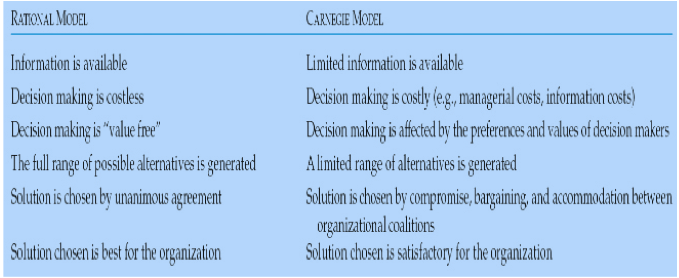
Soru 49
Which model below tries to combine organizational design and organizational anarchy, states that there is no connection between problems that tried to be solved and solution methods?
Seçenekler
A
Garbage can model
B
Carneige model
C
Intuitive decision-making
D
Bounded rationality
E
Rational decision making
Açıklama:
The garbage can theory that has important points in common with the bounded rationality approach is suggested by Michael D. Cohen, James G. March, and Johan P. Olsen. They actually focused on the operation of universities and the communication problems of sub-departments. Garbage can model has been constructed after the examination of decision-making processes on this issue. The name of it was given due to its possible colorfulness and complex appearance. This model is clearly emphasized to be used in complex organizations where organizational anarchy rules, information flow procedures are uncertain and technology usage is low. Underlying this view, there are assertive behaviors, decisions and practices argued against the rational decision- making models. This model, shortly, means “do it before think about it.” Decisions, policies and practices whose results are not searched, traps and disadvantages are not considered are eventually thrown into garbage can.
This model, which tries to combine organizational design and organizational anarchy, states that there is no connection between problems that tried to be solved and solution methods.
This model, which tries to combine organizational design and organizational anarchy, states that there is no connection between problems that tried to be solved and solution methods.
Soru 50
Which one below is the most important element impacting on individual decisions?
Seçenekler
A
Frame effect
B
Lack of commitment
C
Lack of confidence
D
Overconfidence
E
Bias
Açıklama:
The most important elements impacting on individual decisions are individual bias. To make a decision within an organization makes you perform the decisions within a group dynamic. Collective decisions are influenced by group dynamics unlike individual decisions. And, the environment is one of the most influential components in making decision due to its uncertainty.
Soru 51
Which of the following is responsible for deciding about setting up a testing program?
Seçenekler
A
Accounting Manager
B
Finance Manager
C
Production Manager
D
Sales Manager
E
Human Resource Manager
Açıklama:
Human Resource Manager is responsible for where to recruit employees, setting up a testing program, and advising settling the equal-employment
complaint.
complaint.
Soru 52
Which of the following is the first step in a rational decision-making process?
Seçenekler
A
Checking the answer to make sure it solves the problem
B
Developing evaluation criteria based on the goals
C
Establishing goals that solving the problem should accomplish
D
Defining problem
E
Selecting a decision-making tool
Açıklama:
Rational decision-making steps are as follows:
STEP 1 Define problem
STEP 2 Determine the requirements that the solution to the problem must meet
STEP 3 Establish goals that solving the problem should accomplish
STEP 4 Identify alternatives that will solve the problem
STEP 5 Develop evaluation criteria based on the goals
STEP 6 Select a decision-making tool
STEP 7 Apply the tool to select a preferred alternative
STEP 8 Check the answer to make sure it solves the problem
STEP 1 Define problem
STEP 2 Determine the requirements that the solution to the problem must meet
STEP 3 Establish goals that solving the problem should accomplish
STEP 4 Identify alternatives that will solve the problem
STEP 5 Develop evaluation criteria based on the goals
STEP 6 Select a decision-making tool
STEP 7 Apply the tool to select a preferred alternative
STEP 8 Check the answer to make sure it solves the problem
Soru 53
" ..........is the process of determining decision criteria to choose among alternatives"
Which of the following best completes the sentence above?
Which of the following best completes the sentence above?
Seçenekler
A
Defining Criteria
B
Identifying Alternatives
C
Determining requirements
D
Establishing Goals
E
Defining the problem
Açıklama:
Defining Criteria is the process of determining decision criteria to choose among. Criteria used for elimination can be based on the goals. Criteria should be defined as the objective measures of goals to measure how well each alternative leads to goals
Soru 54
Which of the following is false about "Carneige model"?
Seçenekler
A
It is one of the organizational decision models
B
It was developed by Cyert, James March and Herbert Simon
C
Creators of the model adapted the notion of limited rationality to the decision behaviors of managers
D
This new model led to new opinions about organizational decisions.
E
It is based on the assumption that managers had all the information while deciding
Açıklama:
Carneige model, one of the organizational decision models, was developed by Cyert, James March and Herbert Simon from Carnegie-Mellon University. They adapted the notion of limited rationality to the decision behaviors of managers. This new model led to new opinions about organizational decision. Until the development of this model, researchers especially based-on economics acted the assumption that the managers had all the information while deciding. At the same time, they assumed that the organizations made decisions as if it was the only one individual ignoring various people and opinions within the organization. The first important element arising from this model for decision mechanisms is that decision mechanism within a whole organization must not be restricted to just one person. Many managers within the organization are included in the decisions and act as a coalition
Soru 55
Which of the following is true about the "Rational Model"?
Seçenekler
A
Limited information is available
B
Decision-making is costless
C
Decision-making is "value-free"
D
A limited range of alternatives is generated
E
Solution is chosen by unanimous agreement
Açıklama:
In the Rational Model,
- Limited information is available
- Decision-making is costless
- Decision-making is "value-free"
- The full range of possible alternatives is generated
- The solution is chosen by unanimous agreement
- The solution chosen is best for the organization
Soru 56
Which of the following is true about Garbage Can Model of Decision-Making?
Seçenekler
A
This model is clearly used in easy-to-manage organizations
B
It tries to combine organizational design and organizational anarchy
C
It does not have any points in common with the bounded rationality approach
D
It shortly means "do not do it before thinking about it"
E
It states that there is a connection between problems that tried to be solved and solution methods
Açıklama:
The garbage can theory that has important points in common with the bounded rationality approach is suggested by Michael D. Cohen, James G. March, and Johan P. Olsen. They actually focused on the operation of universities and the communication problems of sub-departments. Garbage can model has been constructed after the examination of decision-making processes on this issue. The name of it was given due to its possible colorfulness and complex appearance. This model is clearly emphasized to be used in complex organizations where organizational anarchy rules, information flow procedures are uncertain and technology usage is low. Underlying this view, there are assertive behaviors, decisions and practices argued against the rational decisionmaking models. This model, shortly, means “do it before think about it.” Decisions, policies, and practices whose results are not searched, traps and disadvantages are not considered are eventually thrown into a garbage can. This model, which tries to combine organizational design and organizational anarchy, states that there is no connection between problems that tried to be solved and solution methods.
Soru 57
Which of the following is not one of the frequently encountered types of bias in organizational decisions?
Seçenekler
A
Overconfidence
B
Anchoring bias
C
Escalation of Commitment
D
Confirmation Bias
E
Storm Effect
Açıklama:
The most frequently encountered types of bias in organizational decisions are as follows;
- Overconfidence
- Anchoring bias
- Confirmation Bias
- Hindsight Bias
- Escalation of Commitment
- Frame Effect
Soru 58
Which of the following cannot be considered as one of the symptoms suggesting that a group is closed to different views and away from alternative decisions?
Seçenekler
A
If group members suppose that their decisions are perfect and insist on it
B
If the members that share the majority’s opinion are excluded
C
If managers are not informed about the arguments supporting the opposing view
D
If group members give more importance to the data supporting their own views and ignore the others
E
If no one tries to consider alternative options
Açıklama:
Thanks to certain symptoms, it is possible to understand that a group is closed to different views and away from alternative decisions because of excessive.
• If group members suppose that their decisions are perfect and insist on it,
• If managers are not informed about the arguments supporting the opposing view,
• If group members give more importance to the data supporting their own views and ignore the others,
• If no one tries to consider alternative options,
• If members that do not share the majority’s opinion are excluded,
• If group members suppose that their decisions are perfect and insist on it,
• If managers are not informed about the arguments supporting the opposing view,
• If group members give more importance to the data supporting their own views and ignore the others,
• If no one tries to consider alternative options,
• If members that do not share the majority’s opinion are excluded,
Soru 59
"Non-programmed decision-making........................" Which of the following best completes the sentence above?
Seçenekler
A
eliminates a very time-consuming process of made identifying and evaluating alternatives and making new decisions
B
includes a set of written rules and standards that enable the organization to operate efficiently
C
helps create constant value processes of the organization and effectively manage
D
includes the most creative, original and unstructured decisions
E
involves the most efficient and easily repeatable routine operations.
Açıklama:
Non-programmed decision-making includes the most creative, original and unstructured decisions by which managers help organizations to produce solutions to changing and uncertain situations. Such decisions cannot be taken in advance. No rule, procedure or written norms alone are sufficient to pre-determine how made to take these decisions. Every situation, problem or solution is unique and emerges at its own particular time. There is a need for more comprehensive information to make such decisions. Greater coordination between departments of the organization is expected. There is also greater cooperation between departments. It is often impossible to know whether such decisions are correct.
Soru 60
"Frame effect, as a type of bias, ................................." Which of the following best completes the sentence above?
Seçenekler
A
means that form of information’s presentation influences the decisions greatly
B
means that if you also have proofs that prove the truth of the idea against your own idea, you still insist on the accuracy of your own idea
C
is the product of perceptual selectivity opposed to the common belief that the target is achievable
D
means being stuck in the first information coming to mind, which causes not to evaluate the data appropriately
E
means the individual’s tendency to assume his/her ability or capacity to make a prediction is much greater
Açıklama:
Frame Effect means that form of information’s presentation influences the decisions greatly importantly. According to the frame effect, the way we define the problem, the words we choose, emphasis, the way we talk, the way we present our knowledge cause individuals to have various attitudes and perceptions and influence their choices. This case especially has an impact on decisionmaking behavior under risky circumstances. The decision-making process does not always end up choosing the rational one because of the frame effect. For example, if you offer an alternative idea expressed in a way that puts emphasis on the gain, the tendency of decision-makers to avoid loss may be fed, and thus, his/her decision may be influenced.
Soru 61
Which of the following is about programmed decision-making processes?
Seçenekler
A
It involves creative problem solving processes.
B
There is reliance on judgement.
C
There may be a shift in decision criteria.
D
It is recurring and predictable.
E
It is time consuming.
Açıklama:
Programmed decision-making involves the most efficient and easily repeatable routine operations.
In general, this decision-making mechanism includes a set of written rules and standards that enable the organization to operate in the most efficient manner.
Organizations arrange boards, policies and detailed procedures for decisions to be taken in such repetitive situations.
This type of solution eliminates a very time-consuming process of identifying and evaluating alternatives and making new decisions. Managers, thus, have the opportunity to devote their time to solving included in the resolution of problems that these managers deal with.
In general, this decision-making mechanism includes a set of written rules and standards that enable the organization to operate in the most efficient manner.
Organizations arrange boards, policies and detailed procedures for decisions to be taken in such repetitive situations.
This type of solution eliminates a very time-consuming process of identifying and evaluating alternatives and making new decisions. Managers, thus, have the opportunity to devote their time to solving included in the resolution of problems that these managers deal with.
Soru 62
Which of the following is among the decisions that a sales manager has to make?
Seçenekler
A
The sales reps to be used in specific regions
B
The flow of the company's stocks in the market
C
The advertising agency to be used
D
To adjust the prices to compete with others
E
What to do to promote the company's products
Açıklama:
What bank should we use? Should we sell bonds or stocks? Should we buy back some of our company’s stock?
This type of questions are the ones about finance managers, not sales managers.
This type of questions are the ones about finance managers, not sales managers.
Soru 63
In rational decision-making steps, after defining the problem, the requirements that solution to the problem must meet are determined.
Which of the following states the step that should follow?
Which of the following states the step that should follow?
Seçenekler
A
Establishing goals that solving the problem should accomplish
B
Applying the tool to select a preferred alternative
C
Developing evaluation criteria based on the goals
D
Checking the answer to make sure it solves the problem
E
Selecting a decision-making tool
Açıklama:
Rational decision-making steps are as follows:
1. Define problem
2. Determine the requirements that the solution to the problem must meet
3. Establish goals that solving the problem should accomplish
4. Identify alternatives that will solve the problem
5. Develop evaluation criteria based on the goals
6. Select a decision-making tool
7. Apply the tool to select a preferred alternative
8. Check the answer to make sure it solves the problem
1. Define problem
2. Determine the requirements that the solution to the problem must meet
3. Establish goals that solving the problem should accomplish
4. Identify alternatives that will solve the problem
5. Develop evaluation criteria based on the goals
6. Select a decision-making tool
7. Apply the tool to select a preferred alternative
8. Check the answer to make sure it solves the problem
Soru 64
Which of the following tips might NOT help create alternative solutions to a problem?
Seçenekler
A
Inviting outsiders to the meeting
B
Asking probing questions
C
Avoiding addressing different views
D
Abstaining from traditional roles
E
Welcoming mixed choices
Açıklama:
Thinking outside the box, inviting outsiders to look at the problem and create alternatives, asking team members to abstain from their traditional roles, not underestimating mixed choices, being willing to discuss different views are among the tips that manager can benefit to create alternative solutions to a problem.
Soru 65
Which of the following is NOT among the criticism rational approach receives?
Seçenekler
A
Managers' high cognitive capacity
B
Ill-defined problems
C
Internal and external factors
D
Lack of evaluation of the problem
E
Being non-realistic
Açıklama:
The rational approach presents a systematic and analytical point of view for managers to make decisions. However, the rational decision-making approach has been criticized and considered to be non-realistic; thus, it has been argued that this approach should be reviewed and made as practical and realistic as possible because the limited capacity of the manager is insufficient to analyze the complexity of business relations in the modern world and to completely clear up problems. It is also impossible to create a rational model for each decision. Time pressure, internal and external factors affecting decisions, ill-defined problems do not allow a systematic analysis every time. Even if we assume that managers have the cognitive capacity to solve each problem, they cannot evaluate every problem and every alternative.
Soru 66
Which of the following is TRUE about "intuitive decision-making"?
Seçenekler
A
Logic and reasoning play a role in the decision-making process.
B
It is generally used for problems requiring long-term solutions.
C
It features individual experience and judgements.
D
It requires following a step-by-step process.
E
It occurs regardless of a manager's disposition.
Açıklama:
A manager with limited rationality uses mental methods that simplify the solution and provide shortcuts to make decisions and process information. This is called intuitive decision-making.
Intuitive decision-making features individual experience and judgments more than logic and reasoning. Intuitive decision-making is not as coincidental as is thought. What underlies these decisions is that the manager faces similar problems many times and experiences different solutions. Managers act intuitively especially in decisions that must be immediately made. The more intuitive or rational behavior of the manager is sometimes related to his or her disposition.
Intuitive decision-making features individual experience and judgments more than logic and reasoning. Intuitive decision-making is not as coincidental as is thought. What underlies these decisions is that the manager faces similar problems many times and experiences different solutions. Managers act intuitively especially in decisions that must be immediately made. The more intuitive or rational behavior of the manager is sometimes related to his or her disposition.
Soru 67
Which of the following is among the personal constraints experienced during nonprogrammed decision-making processes?
Seçenekler
A
Shared perspective in the organization
B
Multidimensional issues to be considered
C
Need for agreement
D
Corporate culture and structures
E
The need to satisfy emotional needs
Açıklama:
There are constraints and trade-off experienced during nonprogrammed decision-making processes.
Bounded Rationality: Limited time, information, resources to deal with complex, multidimensional issues
Organizational Constraints: Need for agreement, shared perspective, cooperation, support, corporate culture and structure, ethical values
Personal Constraints: Desire for prestige, success; personal decision style; and the need to satisfy emotional needs, cope with pressure, Or maintain self-concept
Bounded Rationality: Limited time, information, resources to deal with complex, multidimensional issues
Organizational Constraints: Need for agreement, shared perspective, cooperation, support, corporate culture and structure, ethical values
Personal Constraints: Desire for prestige, success; personal decision style; and the need to satisfy emotional needs, cope with pressure, Or maintain self-concept
Soru 68
“Do it before think about it.”
Which decision-making process does the quotation above describe?
Which decision-making process does the quotation above describe?
Seçenekler
A
Garbage Can Model
B
Carnegie Decision Model
C
Intuitive Decision Making
D
Rational Decision Making
E
Programmed Decision Making
Açıklama:
This model is clearly emphasized to be used in complex organizations where organizational anarchy rules, information flow procedures are uncertain and technology usage is low. Underlying this view, there are assertive behaviors, decisions and practices argued against the rational decision making models. This model, shortly, means “do it before think about it.” Decisions, policies and practices whose results are not searched, traps and disadvantages are not considered are eventually thrown into garbage can.
This model, which tries to combine organizational design and organizational anarchy, states that there is no connection between problems that tried to be solved and solution methods.
This model, which tries to combine organizational design and organizational anarchy, states that there is no connection between problems that tried to be solved and solution methods.
Soru 69
"the tendency to make irrational decisions about other people and situations".
Which of the following is about the description given above?
Which of the following is about the description given above?
Seçenekler
A
Overconfidence
B
Anchoring bias
C
Confirmation bias
D
Hindsight bias
E
Cognitive bias
Açıklama:
Cognitive bias means a tendency to make irrational decisions about other people and situations. Cognitive biases are really common since they are produced by human nature. Habits, educational background, experience, business culture and similar components reflect cognitive bias of decision-maker in organizational decisions. Knowledge level and automatic behaviors of managers and routines are examples of cognitive biases in strategic decisions. Shortly, especially intuitional decisions made by managers are influenced by these biases. Many patterns for bias have been defined in the current literature. The most frequently encountered types of bias in organizational decisions are as follows.
Soru 70
Which of the following is a symptom showing that a group is closed to different views and away from alternative decisions?
Seçenekler
A
The majority sharing the same opinion
B
Individuals' insisting on their own decisions
C
Considering all the data in the process
D
Being open to consider alternative opinions
E
Including all the opinions even in being minority
Açıklama:
Thanks to certain symptoms, it is possible to understand that a group is closed to different views and away from alternative decisions because of excessive harmony.
• If group members suppose that their decisions are perfect and insist on it,
• If managers are not informed about the arguments supporting the opposing view,
• If group members give more importance to the data supporting their own views and ignore the others,
• If no one tries to consider alternative options,
• If members that do not share the majority’s opinion are excluded,
If symptoms above are to be seen in decision mechanisms of an organization, we can argue that decisions are not made in a healthy way.
• If group members suppose that their decisions are perfect and insist on it,
• If managers are not informed about the arguments supporting the opposing view,
• If group members give more importance to the data supporting their own views and ignore the others,
• If no one tries to consider alternative options,
• If members that do not share the majority’s opinion are excluded,
If symptoms above are to be seen in decision mechanisms of an organization, we can argue that decisions are not made in a healthy way.
Soru 71
What is the most frequent activity performed by managers in a day on behalf of organizations?
Seçenekler
A
Planning
B
Decision-making
C
Motivating employees
D
Organizing
E
Controlling
Açıklama:
The answer to the question of what is the most frequent activity performed by managers in a day on behalf of organizations may be decision-making. In many respects, organizational life is essentially made up of a series of decisions taken on the basis of certain practices and activities. The correct answer is B.
Soru 72
Which of the following is one of the decisions that production managers make?
Seçenekler
A
Who should process our payroll?
B
Should we give this customer credit?
C
Where should we recruit for employees?
D
Should we set up a testing program?
E
Which supplier should we use?
Açıklama:
- Which supplier should we use?
- Should we build the new plant?
- Should we buy the new machine?
Soru 73
I. Which sales rep should we use in this region?
II. Should we use this advertising agency?
III. What accounting firm should we use?
IV. Should we lower prices in response to our competitor’s doing so?
Which of the given above is among the decisions made by sales managers?
II. Should we use this advertising agency?
III. What accounting firm should we use?
IV. Should we lower prices in response to our competitor’s doing so?
Which of the given above is among the decisions made by sales managers?
Seçenekler
A
I & IV
B
I, II & III
C
I, II & IV
D
I, III & IV
E
II, III & IV
Açıklama:
- Which sales rep should we use in this region?
- Should we use this advertising agency?
- Should we lower prices in response to our competitor’s doing so?
Soru 74
Which of the following is NOT one of the features of nonprogrammed decisions?
Seçenekler
A
Reliance on principles
B
Shifting decision criteria
C
Ambiguous information
D
Predictability
E
Creative problem-solving processes
Açıklama:
Predictability is a feature of programmed decisions. Nonprogrammed decisions are unpredictable. The correct answer is D.
Soru 75
I. Checking the answer to make sure it solves the problem
II. Defining the problem
III. Identifying alternatives that will solve the problem
IV. Establishing goals that solving the problem should accomplish
V. Selecting a decision-making tool
Some steps of the rational decision-making process are given above. Can you put them into the correct order?
II. Defining the problem
III. Identifying alternatives that will solve the problem
IV. Establishing goals that solving the problem should accomplish
V. Selecting a decision-making tool
Some steps of the rational decision-making process are given above. Can you put them into the correct order?
Seçenekler
A
II- IV- III- V- I
B
II- V- I- IV- III
C
II- III- IV- I- V
D
II- V- IV- I- III
E
II- III- IV- V- I
Açıklama:
Steps of rational decision-making process:
- Define problem
- Determine the requirements that the solution to the problem must meet
- Establish goals that solving the problem should accomplish
- Identify alternatives that will solve the problem
- Develop evaluation criteria based on the goals
- Select a decision-making tool
- Apply the tool to select a preferred alternative
- Check the answer to make sure it solves the problem
Soru 76
Which of the following is NOT one of the features of Carnegie decision model?
Seçenekler
A
It was developed by Cyert, James March and Herbert Simon.
B
It ignores the individual preferences and values of managers.
C
This model looks for satisfying limited information rather than trying to find all solutions for problems.
D
Decision mechanism within a whole organization must not be restricted to just one person.
E
Different departments, individuals working in different levels and even customers and sometimes suppliers may be included in the decision-making decision process.
Açıklama:
Rational decision-making process ignores the individual preferences and values of managers not Carnegie decision model. The correct answer is B.
Soru 77
Which of the given is NOT among the features of rational decision-making process?
Seçenekler
A
Solution is chosen by unanimous agreement.
B
Decision-making is costless.
C
Decision making is 'value free'.
D
The full range of possible alternatives is generated.
E
Limited information is available.
Açıklama:
Limited information is available in Carnegie decision model. In rational model, information is available (not limited), decision making is costless and value free. The full range of possible alternatives is generated and solution is chosen by unanimous agreement. The correct answer is E.
Soru 78
I. Problems
II. Participants
III. Potential solutions
IV. Choice opportunities
Which of the given above are among the components of the organizational decision-making process?
II. Participants
III. Potential solutions
IV. Choice opportunities
Which of the given above are among the components of the organizational decision-making process?
Seçenekler
A
II & IV
B
I, II, III
C
I, II, IV
D
I, III, IV
E
I, II, III, IV
Açıklama:
Problems, participants, potential solutions, choice opportunities are among the components of the organizational decision-making process. The correct answer is E.
Soru 79
.......... means that if you have proofs that prove the truth of the idea against your own idea, you still insist on the accuracy of your own idea.
Seçenekler
A
Overconfidence
B
Anchoring bias
C
Escalation of commitment
D
Frame effect
E
Hindsight bias
Açıklama:
One of the most frequently encountered types of bias in organizational decisions is escalation of commitment and it means that if you also have proofs that prove the truth of the idea against your own idea, you still insist on the accuracy of your own idea. The correct answer is C.
Soru 80
I. It was suggested by Michael D. Cohen, James G. March, and Johan P. Olsen.
II. It tries to combine organizational design and organizational anarchy.
III. It can be used in cases where organizational anarchy rules, which has two structural features
Which of the given is among the features of Garbage Can Model of Decision-making process?
II. It tries to combine organizational design and organizational anarchy.
III. It can be used in cases where organizational anarchy rules, which has two structural features
Which of the given is among the features of Garbage Can Model of Decision-making process?
Seçenekler
A
Only I
B
I & II
C
I & III
D
II & III
E
I, II & III
Açıklama:
This model can only be used in cases where organizational anarchy rules, which has THREE structural features:
- Problematic preferences
- Unclear, poorly understood technology
- Turnover
Soru 81
- What accounting firm should we use?
- What bank should we use?
- Should we give this customer credit?
- Should we buy the new machine?
Seçenekler
A
I and II
B
I and III
C
II and III
D
II and IV
E
III and IV
Açıklama:
The accounting manager can ask the following questions:
- What accounting firm should we use?
- Who should process our payroll?
- Should we give this customer credit?
Soru 82
Which of the questions below can be asked by a finance manager?
Seçenekler
A
Should we give this customer credit?
B
Should we set up a testing program?
C
Should we buy the new machine?
D
Should we sell bonds and stocks?
E
Should we use this advertising agency?
Açıklama:
A finance manager can ask the following questions:
-What bank should we use?
-Should we sell bonds or stocks?
-Should we buy back some of our company’s stock?
The correct option is D.
-What bank should we use?
-Should we sell bonds or stocks?
-Should we buy back some of our company’s stock?
The correct option is D.
Soru 83
Which option below can be considered as a feature of programmed decisions?
Seçenekler
A
Recurring
B
Ambiguous
C
Unpredictable
D
Shifting
E
Creativity
Açıklama:
programmed decisions are recurring and predictable with well-defined information and decision criteria. The correct option is A.
Soru 84
- Capital budgeting
- Intuition
- Computerized solutions
- Computerized decision support
Seçenekler
A
I and II
B
I and III
C
II and III
D
II and IV
E
I and IV
Açıklama:
Decision-making tools for nonprogrammed decisions are judgment, intuition and creativity, computerized decision support systems and modeling. the correct option is D.
Soru 85
- Develop evaluation criteria based on the goals
- Check the answer to make sure it solves the problem
- Select a decision-making tool
- Apply the tool to select a preferred alternative
Seçenekler
A
I-II-III-IV
B
I-III-II-IV
C
I-III-IV-II
D
I-IV-II-III
E
I-IV-III-II
Açıklama:
The rational decision-making steps are listed below:
- Define the problem
- Determine the requirements that the solution to the problem must meet
- Establish goals that solving the problem should accomplish
- Identify alternatives that will solve the problem
- Develop evaluation criteria based on goals
- Select a decision-making tool
- Apply the tool to select a preferred alternative
- Check the answer to make sure it solves the problem
Soru 86
- Cope with pressure
- Shared perspective
- Ethical values
- Need for agreement
Seçenekler
A
I ve II
B
I, III ve IV
C
I, II ve III
D
II, III ve IV
E
I, II, III ve IV
Açıklama:
Organizational constraints during nonprogrammed decision-making are need for agreement, shared perspective, cooperation, support, corporate culture and structure, ethical values. The correct option is D.
Soru 87
In Carnegie decision model, what does " an alternative production made with limited information just to find solutions for the problems" mean?
Seçenekler
A
Rational
B
Coalition
C
Bounded
D
Anarchy
E
Satisficing
Açıklama:
In Carnegie decision model, satisficing means " an alternative production made with limited information just to find solutions for the problems". The correct option is E.
Soru 88
Which item below belongs to Carnegie model of decision making?
Seçenekler
A
Limited information is available.
B
Decision making is costless.
C
Decision making is value-free.
D
Solution chosen is best for the organization.
E
Solution is chosen by unanimous agreement.
Açıklama:
Carnegie model of decision making has the following features:
- Limited information is available.
- Decision making is costly.
- Decision making is affected by the preferences and values of decision makers.
- A limited range of alternatives is generated.
- Solution is chosen by compromise, bargaining, and accommodation between organizational coalitions.
- Solution chosen is satisfactory for the organization.
Soru 89
Mr. Brown knows that working with bank A would be better for the company. However, as he suggested working with bank B before, he still insists on working with ban B would be better. What is the impact on this decision Mr. Brown has called?
Seçenekler
A
Hindsight bias
B
Anchoring bias
C
Escalation of commitment
D
Confirmation bias
E
Frame effect
Açıklama:
Escalation of commitment means that if you also have proofs that prove the truth of the idea against your own idea, you still insist on the accuracy of your own idea. In this case, the correct option is C.
Soru 90
If a manager believes that he has foreseen the economic crisis problem beforehand; yet, it was inevitable not to experience it; which bias does this manager experience?
Seçenekler
A
Hindsight bias
B
Escalation of commitment
C
Confirmation bias
D
Frame effect
E
Anchoring bias
Açıklama:
When you create a false belief that when the result of an event becomes clear, you knew this very result beforehand, it means that you have hindsight bias. If you have hindsight bias, your predictions change retrospectively. If the decision- maker realizes that his/her past decision is mistaken, he/she increasingly believes that living through this is inevitable due to hindsight bias. Therefore, the correct option is A.
Ünite 8
Soru 1
Which of the following is not one of the specific characteristics of culture according to Mats Alvesson?
Seçenekler
A
Culture is collectively shared by a group of people.
B
Culture is related to history and traditions.
C
Culture is more a rational and analytical phenomenon rather than a subjective and emotional phenomenon.
D
Meanings attached to culture has deeper roots that can go below the level of one’s consciousness, so it requires further explanations for thorough understanding.
E
Culture has strong ties with intangible dimensions such as perspectives, beliefs, and knowledge.
Açıklama:
Based on a review of cultural approaches Mats Alvesson from the Lund University of Sweden concludes that culture has specific characteristics , such as: culture is not a rational and analytical phenomenon; it is more of an integrative, subjective, and emotional phenomenon.
Soru 2
Groups sharing overall cultural values of the society but diverging by holding different values brought by their lifestyles, values and norms is the definition for:
Seçenekler
A
Basic culture.
B
Counterculture.
C
Dominant culture.
D
Marginalized culture.
E
Subculture.
Açıklama:
From the sociological perspective, subculture is defined as groups sharing overall cultural values of the society but diverges from these groups by holding different values brought by their lifestyles, values, and norms.
Soru 3
Which of the following is one of the disadvantages of having strong organizational culture?
Seçenekler
A
Creates organizational inertia.
B
Differentiates organization from the others.
C
Members’ organizational identification is easy.
D
Guides organizational behavior.
E
Creates stability throughout the organization.
Açıklama:
Disadvantages of having strong organizational culture are: 1.Makes mergers & acquisition harder. 2.Only attracts the same type of people thus diminishes organizational diversity. 3.Creates organizational inertia. 4.Decreases organization’s environmental adaptability potential.
Soru 4
Which of the following is an essential characteristic of healthy organizational culture?
Seçenekler
A
Employees are not allowed to take risks.
B
Mistakes are never tolerated, they are punished.
C
Employees are prohibited to search for better alternatives on how job can be done.
D
All members of the organization are empowered and held accountable.
E
The overall mood of the work environment is profoundly pessimistic.
Açıklama:
Some essential characteristics of healthy organizational culture are listed below: • All members of the organization are empowered and held accountable. • Employees are encouraged to take risks within set limits. • Searching for better alternatives about how jobs to be done is the norm • Mistakes are tolerated to some degree and treated as a learning opportunity.
Soru 5
In Schein’s levels of organizational culture, in the most inner level of organizational culture (the core) are:
Seçenekler
A
Artifacts.
B
Espoused values.
C
Stories.
D
Basic assumptions.
E
Languages.
Açıklama:
Basic assumptions are the most inner level and are said to be the core of organizational culture. Basic assumptions have a substantial influence on employees. Once it is inscribed into their cognitive schema, people tend to act without further scrutiny.
Soru 6
Which of the following is not a factor affecting the process of constructing organizational culture?
Seçenekler
A
Founder and top management team.
B
Espoused Values.
C
Mission and vision statement.
D
Communication styles.
E
Organizational environment.
Açıklama:
The factors affecting the process of constructing organizational culture are: organizational history, founder and top management team, mission and vision statement, human capital, power relations and authority, communication styles, reward and discipline systems, organizational environment.
Soru 7
'Particular words or expressions used by a profession or group that are difficult for others to understand' is the definition for:
Seçenekler
A
Slogan.
B
Ritual.
C
Code of conduct.
D
Ceremony.
E
Jargon.
Açıklama:
Jargon is particular words or expressions used by a profession or group that are difficult for others to understand. If you don’t have education in medical sciences, language spoken at the emergency room may have no meaning. Every profession has its jargon. Doctors, lawyers, accountants have all use their particular language that others can often find it hard to understand.
Soru 8
According to William Ouchi, what was one feature of the typical Japanese firm?
Seçenekler
A
Explicit, formalized control.
B
Slow evaluation and promotion.
C
Specialized career path.
D
Segmented concern.
E
Short-term employment.
Açıklama:
Ouchi describes three types of organizations which are called Type J, Type A, and finally Type Z. Type J depicts features of the typical one of which is slow evaluation and promotion.
Soru 9
In which of these models there emerge four different quadrants depicting different forms of organizations, named as clan, adhocracy, hierarchy, and market?
Seçenekler
A
Ouchi’s Theory z.
B
Peters & Waterman’s Model of Excellence.
C
Cameron and Quinn’s Model of Organizational Culture.
D
Deal and Kennedy’s Model of Organizational Culture.
E
Handy’s Cultural Typologies.
Açıklama:
Organizational culture in Cameron and Quinn's model is said to be composed of two values in which each value competes within. Each continuum highlights a core value that is opposite from the value on the other end of the continuum and hence constructing a four-fielder. These core values are; • Stability and Control Vs. Flexibility and Discretion, • Internal Focus and Integration Vs. External Focus and Differentiation. When these two values are put together on an X-Y axis, four different quadrants depicting different forms organizations emerge.These four quadrants are named as clan, adhocracy, hierarchy, and market.
Soru 10
Which of the following is a reality regarding business ethics?
Seçenekler
A
The ethical concern in organizations has always been a pervasive issue.
B
Ethical decision making is easy.
C
Unethical behavior can be traced to a limited number of “bad apples” in an organization.
D
Ethics can be managed by developing formal ethics codes and programs.
E
Ethical leadership is really about leader morality and honesty.
Açıklama:
''Business leaders are less ethical today than they used to be'' is a myth. The reality is that the ethical concern in organizations has always been a pervasive issue.
Soru 11
Which of the following is not true about culture?
Seçenekler
A
Culture is related to history and traditions.
B
Culture requires further explanations than one's consciousness to be understood thoroughly.
C
Culture is collectively shared by a group of people.
D
Culture is a rational and non-analytical phenomenon.
E
Culture has strong ties with beliefs, perspectives and knowledge.
Açıklama:
- Culture is related to history and traditions.
- Meanings attached to culture has deeper roots that can go below the level of one’s consciousness. For this reason, it is not an easy concept, requires further explanations for thorough understanding.
- Culture is collectively shared by a group of people.
- Culture has strong ties with intangible dimensions such as perspectives, beliefs, and knowledge. Culture has to be interpreted rather than talked.
- Culture is not a rational and analytical phenomenon; it is more of an integrative, subjective, and emotional phenomenon.
Soru 12
- Individualism and alienation
- Technically advanced production and the rise of service industry
- Machine bureaucracy gradually becoming less useful in managing people
- Innovative production techniques
- Japanese miracle
Seçenekler
A
I, III and V
B
II, IV and V
C
I, II and IV
D
II, III and V
E
All
Açıklama:
What was the reason behind the rise of organizational culture as a concept for understanding organizations? Of course, it was not coincidental. Many social, field and individual-level developments triggered the increase of awareness in the 90s. These factors are explained below:5 • Individualism and alienation: By the end of 1970s modern societies witnessed widespread diffusion of individualism that alienated people from the society. Lonely people searching for an identity celebrated organizational culture as a haven. Organizational culture allowed people to answer aching questions for raison d’etre! “Who am I, what is my reason for being in this world? what this organization stands for?” are all examples of questions asked and generally found an explanation within the concept of organizational culture. • Technically advanced production and the rise ofservice industry: Production process was upgraded to an advanced level in which automation became widespread. Moreover, the volume of service industry gradually surpassed goods production in many developed countries.Thus,employees had to be more customer-focused and technically qualified. Consequently, skillful and welltrained employees preferred independent working conditions. Organizational culture, as a way of controlling employee behavior, allows members to use their judgment, and act morefreely within defined organizational norms. Once members of the organizations cultivated with organizational values, close supervision will be redundant.• Machine bureaucracy gradually became less useful in managing people: Scientific management was the paradigm relevant to 1960s and 1970s. During 1980s validity of scientific management as the only paradigm for managing people started to be scrutinized. The effectiveness of objective and mathematical management techniques like time-and-motion studies was challenged. This movement led scholars focusing on the human aspect of management, or in other words, “soft” aspects of organizations. • Innovative production techniques: Mass production techniques increase the level of efficiency. But these techniques usually decrease the overall flexibility of the organization. To balance the level of efficiency with the degree of flexibility, organizations should employ people who have a sense of active belonging and commitment. Organizational culture is providing a cognitiveschemethroughwhich members can agree upon collective values, and thus elevates the level of organizational commitment. • Japanese miracle: After the devastation experienced by Japan following the 2nd World War, Japan’s reborn as an economic power found to be related to the Japanese management style. Globalization which is generally equated with getting rid of economic, political, cultural, and technological barriers led to an increase in awareness and curiosity in the global west for the east. It was self-evident that Japanese miracle was mostly related to the Japanese cultural value system and its reflections within Japanese organizations. Other countries also tried to understand and encapsulate these reflections for themselves, and hence the interest in the cultural aspect of organizations tend to strengthen.
Soru 13
Which concept refers to the shared social knowledge among organizational members shaping organizational members’ attitudes and behaviors based on mutually accepted rules, norms, and values?
Seçenekler
A
Organizational Culture
B
Subculture
C
Counterculture
D
Strong culture
E
Weak culture
Açıklama:
Organizational culture is shared social knowledge among organizational members shaping organizational members’ attitudes and behaviors based on mutually accepted rules, norms, and values.
Soru 14
- It is made up of fundamental beliefs and assumptions.
- It provides shared values that make being a part of an organization meaningful.
- It offers members well-defined integrative patterns for expressing themselves.
- It is usually defined as a norm and value-based phenomenon.
Seçenekler
A
I, II and III
B
II, III and IV
C
I, III and IV
D
I, II and IV
E
I, II, III and IV
Açıklama:
Organizational culture is made up of fundamental beliefs and assumptions, providing shared values that make being a part of an organization meaningful, and offers organizational members welldefined integrative patterns for expressing themselves. Organizational culture is usually defined as a norm and value-based phenomenon.
Soru 15
Which concept is defined as groups sharing overall cultural values of the society but diverges from these groups by holding different values brought by their lifestyles, values, and norms?
Seçenekler
A
Counterculture
B
Marginalized culture
C
Dominant culture
D
Subculture
E
Healthy culture
Açıklama:
Subculture is defined as groups sharing overall cultural values of the society but diverges from these groups by holding different values brought by their lifestyles, values, and norms.
Soru 16
- Makes mergers & acquisition harder.
- Creates organizational inertia.
- Members’ organizational identification is easy.
- Guides organizational behavior.
- Creates stability throughout the organization.
Seçenekler
A
III, IV and V
B
I, II and III
C
II, III and IV
D
I, III and V
E
II, III and V
Açıklama:
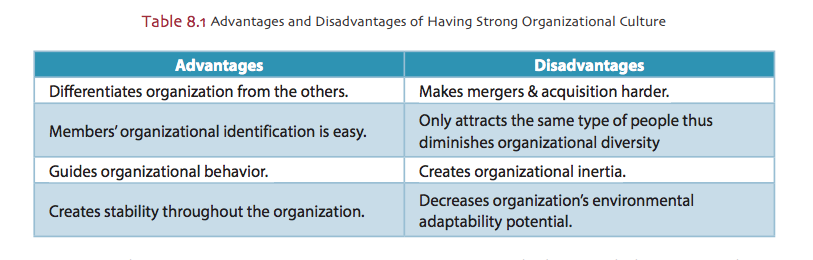
Soru 17
- Espoused Values
- Slogans
- Artifacts
- Jargon
- Basic Assumptions
Seçenekler
A
I, III and IV
B
II, IV and V
C
I, II and IV
D
I, III and V
E
I, II, III, IV and V
Açıklama:
Organizational culture has three levels, namely basic assumptions, espoused values, and artifacts.
Soru 18
- Physical Symbols
- Slogans
- Ethical Decision Making
- Jargon
- Ouchi's Theory Z
Seçenekler
A
I, II and IV
B
II, IV and V
C
II, III and IV
D
I, III and V
E
I, III and IV
Açıklama:
Physical symbols, slogans, stories, jargon, ceremonies, rites and rituals, code of conduct are the ways organizational culture is conveyed.
Soru 19
- Ethical decision making is easy.
- Unethical behavior can be a systemic part of the organization’s culture.
- Ethics can be managed by developing formal ethics codes and programs.
- Leader morality and honesty is a good start, but the leader must also infuse ethics into the organization and hold others accountable.
- Business leaders are less ethical today than they used to be.
Seçenekler
A
I, II and V
B
II, III and IV
C
II, IV and V
D
I, III and V
E
I, II, III, IV and V
Açıklama:
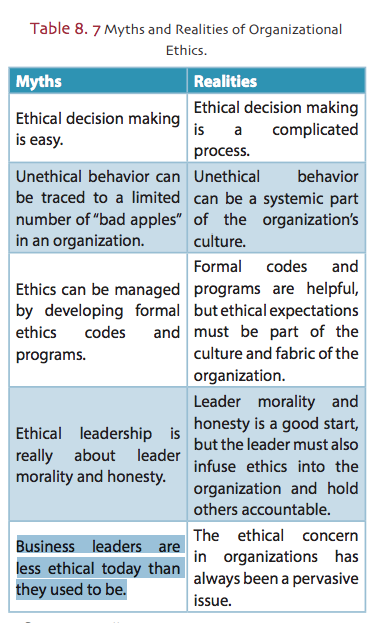
Soru 20
- Selecting and recruiting ethically developed employees
- Setting up proactive mechanisms for preventing unethical behavior
- Determining moral codes
- Ethics training and education
Seçenekler
A
I and II
B
I and III
C
II and IV
D
I and IV
E
I, II, III and IV
Açıklama:
Ethics is about personal morality. Organizations can reinforce ethical values and behavior by using tactics given below; • Selecting and recruiting ethically developed employees, • Determining moral codes, • Ethical leadership, • Designing performance management and defining organizational objectives in relation to the ethical standards, • Ethics training and education, • Independent audits and • Setting up proactive mechanisms for preventing unethical behavior.
Soru 21
Which of the following sentences are true about culture?
I Perspectives, beliefs, and knowledge are the tangible dimensions of culture.
II Culture is an analytical phenomenon.
III Culture is an integrative and emotional phenomenon.
IV Culture is subjevtive so it has to be interpreted.
V Culture is collectively shared.
I Perspectives, beliefs, and knowledge are the tangible dimensions of culture.
II Culture is an analytical phenomenon.
III Culture is an integrative and emotional phenomenon.
IV Culture is subjevtive so it has to be interpreted.
V Culture is collectively shared.
Seçenekler
A
I, II and III
B
I, II and IV
C
II, IIIi and V
D
III, IV, V
E
II, IV, V
Açıklama:
Culture is related to history and traditions. • Meanings attached to culture has deeper roots that can go below the level of one’s consciousness. For this reason, it is not an easy concept, requires further explanations for thorough understanding. • Culture is collectively shared by a group of people. • Culture has strong ties with intangible dimensions such as perspectives, beliefs, and knowledge. Culture has to be interpreted rather than talked. • Culture is not a rational and analytical phenomenon; it is more of an integrative, subjective, and emotional phenomenon.
Culture is an integrative pattern of the meaning-making process which people subconsciously use to understand the world surrounding them via the shared set of values and beliefs, language, symbols, and physical artifacts.
Culture is an integrative pattern of the meaning-making process which people subconsciously use to understand the world surrounding them via the shared set of values and beliefs, language, symbols, and physical artifacts.
Soru 22
Which one below is not among the first reasons behind the rise of organizational culture as a concept for understanding organizations in 90s ?
Seçenekler
A
Individualism and alienation
B
Technically advanced production and the rise of service industry
C
Machine bureaucracy's becoming less useful in managing people
D
Innovative production techniques
E
İncrease in cultural exchange among nations
Açıklama:
Individualism and alienation: By the end of 1970s modern societies witnessed widespread diffusion of individualism that alienated people from the society. Lonely people searching for an identity celebrated organizational culture as a haven. Organizational culture allowed people to answer aching questions for raison d’etre! “Who am I, what is my reason for being in this world? what this organization stands for?” are all examples of questions asked and generally found an explanation within the concept of organizational culture. • Technically advanced production and the rise of service industry: Production process was upgraded to an advanced level in which automation became widespread. Moreover, the volume of service industry gradually surpassed goods production in many developed countries. Thus, employees had to be more customer-focused and technically qualified. Consequently, skillful and welltrained employees preferred independent working conditions. Organizational culture, as a way of controlling employee behavior, allows members to use their judgment, and act more freely within defined organizational norms. Once members of the organizations cultivated with organizational values, close supervision will be redundant.
Machine bureaucracy gradually became less useful in managing people: Scientific management was the paradigm relevant to 1960s and 1970s. During 1980s validity of scientific management as the only paradigm for managing people started to be scrutinized. The effectiveness of objective and mathematical management techniques like time-and-motion studies was challenged. This movement led scholars focusing on the human aspect of management, or in other words, “soft” aspects of organizations. •
Innovative production techniques: Mass production techniques increase the level of efficiency. But these techniques usually decrease the overall flexibility of the organization. To balance the level of efficiency with the degree of flexibility, organizations should employ people who have a sense of active belonging and commitment. Organizational culture is providing a cognitive scheme through which members can agree upon collective values, and thus elevates the level of organizational commitment. • Japanese miracle: After the devastation experienced by Japan following the 2nd World War, Japan’s reborn as an economic power found to be related to the Japanese management style. Globalization which is generally equated with getting rid of economic, political, cultural, and technological barriers led to an increase in awareness and curiosity in the global west for the east. It was self-evident that Japanese miracle was mostly related to the Japanese cultural value system and its reflections within Japanese organizations. Other countries also tried to understand and encapsulate these reflections for themselves, and hence the interest in the cultural aspect of organizations tend to strengthen.
Machine bureaucracy gradually became less useful in managing people: Scientific management was the paradigm relevant to 1960s and 1970s. During 1980s validity of scientific management as the only paradigm for managing people started to be scrutinized. The effectiveness of objective and mathematical management techniques like time-and-motion studies was challenged. This movement led scholars focusing on the human aspect of management, or in other words, “soft” aspects of organizations. •
Innovative production techniques: Mass production techniques increase the level of efficiency. But these techniques usually decrease the overall flexibility of the organization. To balance the level of efficiency with the degree of flexibility, organizations should employ people who have a sense of active belonging and commitment. Organizational culture is providing a cognitive scheme through which members can agree upon collective values, and thus elevates the level of organizational commitment. • Japanese miracle: After the devastation experienced by Japan following the 2nd World War, Japan’s reborn as an economic power found to be related to the Japanese management style. Globalization which is generally equated with getting rid of economic, political, cultural, and technological barriers led to an increase in awareness and curiosity in the global west for the east. It was self-evident that Japanese miracle was mostly related to the Japanese cultural value system and its reflections within Japanese organizations. Other countries also tried to understand and encapsulate these reflections for themselves, and hence the interest in the cultural aspect of organizations tend to strengthen.
Soru 23
Which of the statements below are true about organizational culture?
I It is usually defined as a norm and value-based phenomenon.
II It offers organizational members well-defined integrative patterns for expressing themselves.
III It provides shared values that make being a part of an organization meaningful
IV It shapes organizational members’ attitudes and behaviors based on mutually accepted rules, norms, and values.
V It cannot be historically transferred from generations to generations.
I It is usually defined as a norm and value-based phenomenon.
II It offers organizational members well-defined integrative patterns for expressing themselves.
III It provides shared values that make being a part of an organization meaningful
IV It shapes organizational members’ attitudes and behaviors based on mutually accepted rules, norms, and values.
V It cannot be historically transferred from generations to generations.
Seçenekler
A
I, II, III,
B
II, III, IV,
C
III, IV, V
D
I, II, III, V
E
I, II, III, IV
Açıklama:
Organizational culture is shared social knowledge among organizational members shaping organizational members’ attitudes and behaviors based on mutually accepted rules, norms, and values.
Organizational culture is made up of fundamental beliefs and assumptions, providing shared values that make being a part of an organization meaningful, and offers organizational members well- defined integrative patterns for expressing themselves.
The definitions underline that culture (1) is made up of shared emotions and beliefs, (2) guides behaviors in organizational settings, (3) is historically transferred from generations to generations. Shortly, organizational culture defines how things are done within a given organization. Today organizational culture frequently used both theoretically and empirically as a lens for analyzing complex organizations surrounding us.
Organizational culture is made up of fundamental beliefs and assumptions, providing shared values that make being a part of an organization meaningful, and offers organizational members well- defined integrative patterns for expressing themselves.
The definitions underline that culture (1) is made up of shared emotions and beliefs, (2) guides behaviors in organizational settings, (3) is historically transferred from generations to generations. Shortly, organizational culture defines how things are done within a given organization. Today organizational culture frequently used both theoretically and empirically as a lens for analyzing complex organizations surrounding us.
Soru 24
Which term below can be defined as "groups sharing overall cultural values of the society but diverges from these groups by holding different values brought by their lifestyles, values, and norms"?
Seçenekler
A
Common cultures
B
Subcultures
C
Dominanat cultures
D
Marginalized cultures
E
Countercultures
Açıklama:
Subculture is defined as groups sharing overall cultural values of the society but diverges from these groups by holding different values brought by their lifestyles, values, and norms.
Soru 25
Which statement is not true for countercultures?
Seçenekler
A
Marginalized cultures are called counterculture.
B
Subcultures within the organization may marginalize.
C
Naïve managers need to avoid countercultures at all cost.
D
Countercultures have 100% opposite lifestyles, values, and norms relative to the organization.
E
Countercultures should be used to provide constructive criticism.
Açıklama:
It is natural to have a dominant culture surrounded by various subcultures in today’s organizations. But sometimes subcultures within the organization may marginalize due to several factors affecting them. In the last analysis, cultures are made up of people, and people are social beings. These marginalized cultures are called counterculture. People who are the member of counterculture have 100% opposite lifestyles, values, and norms relative to the organization and/ or society in which they are living and working in.17 Naïve managers may try to avoid countercultures at all cost. But countercultures are so much crucial for managers conceptualizing the organization as a whole. Countercultures should be used and treated so that their ideas provide constructive criticism for managerial action and the organization as a whole.
Soru 26
Which one below is not one of the advantages of having strong organizational culture?
Seçenekler
A
Creates organizational inertia.
B
Differentiates organization from the others.
C
Guides organizational behavior.
D
Creates stability throughout the organization.
E
Members’ organizational identification is easy.
Açıklama:
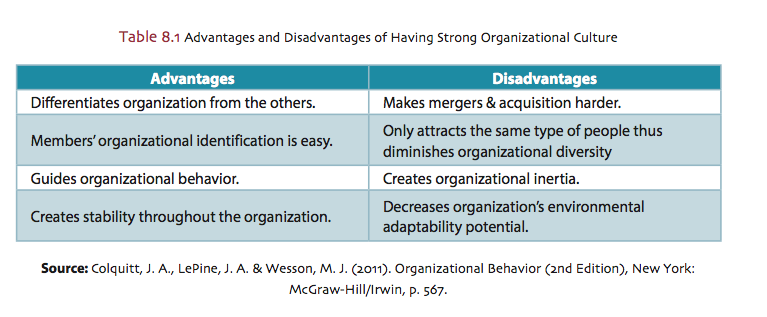
Soru 27
Which one below is one of the levels of organizational culture?
Seçenekler
A
Artifacts
B
Employees
C
Employers
D
Interactions
E
Principles
Açıklama:
Organizational culture has three levels. From outer layer to the inner; these levels are artifacts, espoused values, and basic assumptions. Many people use onion as a metaphor to make sense of how these levels are positioned. From a structural sense, organizational culture is just like an onion. The outer most layer is called artifacts. This lay- er is made up of symbols and behavioral patterns. The layer between artifacts and basic assumptions is called espoused values.
Soru 28
Which one below is a verbal artifact?
Seçenekler
A
Gestures
B
Rewards
C
Theories
D
Communication patterns
E
Logo
Açıklama:
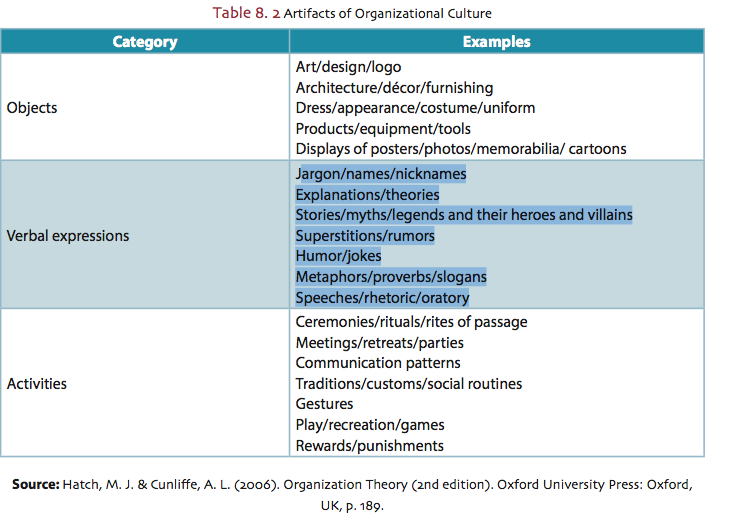
Soru 29
One-Best-Way models of organizational culture are in really good, well-packaged management consultancy products providing universal recipes of success. Who can be regarded as precursors of one-best-way models?
Seçenekler
A
Apollo
B
Handy
C
Quinn
D
Ouchi
E
Cameron
Açıklama:
One of the streams offers a universal solution and ubiquitous cultural values that are valid and supposed to be working effectively in any organizational settings. These models generally labeled as one-best-way models where the description of excellent organizational culture is presented as a panacea. Two of the most well-known examples of this stream is William G. Ouchi’s “Theory Z” and Tom J. Peters & Thomas H. Waterman’s “In Search of Excellence.”
Soru 30
Whose model of organizational culture is summarized in the table below ?
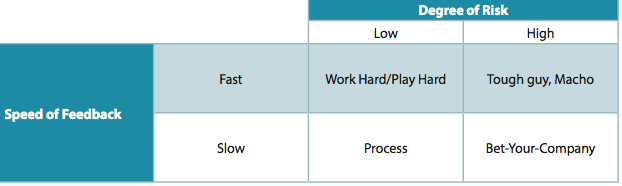
Seçenekler
A
Deal & Kennedy's
B
Ouichi's
C
Peter's
D
Cameron and Quin's
E
Handy's
Açıklama:
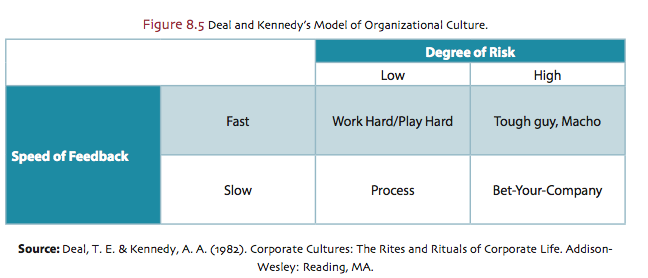
Soru 31
- Culture is collectively shared by a group of people.
- Culture has to be talked rather than interpreted.
- Culture is a rational and analytical phenomenon.
Seçenekler
A
I
B
II
C
III
D
I-II
E
II-III
Açıklama:
Based on a review of cultural approaches Mats Alvesson from the Lund University of Sweden concludes that culture has specific characteristics stated below.2
- Culture is related to history and traditions.
- Meanings attached to culture has deeper roots that can go below the level of one’s consciousness. For this reason, it is not an easy concept, requires further explanations
for thorough understanding. - Culture is collectively shared by a group of
people. - Culture has strong ties with intangible
dimensions such as perspectives, beliefs, and knowledge. Culture has to be interpreted rather than talked. - Culture is not a rational and analytical phenomenon; it is more of an integrative, subjective, and emotional phenomenon.
Soru 32
- Taylor's work standardization which led to the minimization of employees' resistance.
- The results of Hawthorne Studies.
- Report of Fritz Rothlisberger and his colleague William John Dickson.
Seçenekler
A
I
B
I-II
C
II-III
D
I-III
E
I-II-III
Açıklama:
Although culture has become one of the most popular concepts of management and organization curriculum by the 1980’s, studies that can be linked to organizational culture has much deeper historical roots. For example, you may recall Frederick Winslow Taylor (1856 - 1915) from your business management course as the father of scientific management. Taylor published e Principles of Scientific Management in 1911 through which he heralded the introduction of scientific principles into work. But a closer look at Taylor’s scientific management principles will reveal cultural aspects of a system through which he standardizes work and eventually the process leads to the minimization of employees’ resistance. Instead of workers’ values, the introduction of scientific management nurtured values of managers. Another well-known study which shapes the way how organizations function is the famous Hawthorne Studies, led by Harvard Business School professor Elton Mayo at Western Electric Hawthorne Works Plant between 1924 - 1933. Based on Hawthorne Studies’ outcome Mayo’s protégé Fritz Rothlisberger and his colleague William John Dickson reports that social factors rather than physical factors are found to be much more important for increasing the level efficiency. The correct answer is Choice E.
Soru 33
Which of the following was one of the factors that triggered the rise of cultural perspective in organizational theory?
Seçenekler
A
The diffusion of collectivism
B
Automation's losing prestige
C
The fact that the volume of goods production gradually surpassed service industry in many developed countries
D
Machine bureaucracy gradually becoming more useful in managing people
E
Devastation experienced by Japan following the 2nd World War
Açıklama:
By the end of 1970s modern societies witnessed widespread diffusion of individualism that alienated people from the society. Lonely people searching for an identity celebrated organizational culture as a haven. Organizational culture allowed people to answer aching questions for raison d’etre! “Who am I, what is my reason for being in this world? what this organization stands for?” are all examples of questions asked and generally found an explanation within the concept of organizational culture. Production process was upgraded to an advanced level in which automation became widespread. Moreover, the volume of service industry gradually surpassed goods production in many developed countries. us, employees had to be more customer-focused and technically qualified. Consequently, skilful and well- trained employees preferred independent working conditions. Organizational culture, as a way of controlling employee behaviour, allows members to use their judgment, and act more freely within de ned organizational norms. Once members of the organizations cultivated with organizational values, close supervision will be redundant. Machine bureaucracy gradually became less useful in managing people: Scientific management was the paradigm relevant to 1960s and 1970s. During 1980s validity of scientific management as the only paradigm for managing people started to be scrutinised. e effectiveness of objective and mathematical management techniques like time-and-motion studies was challenged. is movement led scholars focusing on the human aspect of management, or in other words, “soft” aspects of organizations. After the devastation experienced by Japan following the 2nd World War, Japan’s reborn as an economic power found to be related to the Japanese management style. Globalization which is generally equated with getting rid of economic, political, cultural, and technological barriers led to an increase in awareness and curiosity in the global west for the east. It was self-evident that Japanese miracle was mostly related to the Japanese cultural value system and its reflections within Japanese organizations. Other countries also tried to understand and encapsulate these re ections for themselves, and hence the interest in the cultural aspect of organizations tend to strengthen. The correct answer is Choice E.
Soru 34
Which of the following, in his classic book called Organizational Culture and Leadership, warns us that culture is not just what we see, and adds that culture is generally deeply rooted sub-consciously in people’s minds?
Seçenekler
A
Frederick Winslow Taylor
B
Elton Mayo
C
Fritz Rothlisberge
D
Edgar H. Schein
E
William John Dickson
Açıklama:
Edgar H. Schein, Sloan Professor of Management Emeritus at the Sloan School of Management at the MIT views organizational culture as shared and mutually accepted values, beliefs, and assumptions. In his classic book called Organizational Culture and Leadership Schein (1985) warns us that culture is not just what we see, and adds that culture is generally deeply rooted sub-consciously in people’s minds. The correct answer is Choice D.
Soru 35
_____________ is defined as groups sharing overall cultural values of the society but diverges from these groups by holding different values brought by their lifestyles, values, and norms.
Chose the right word to complete the definition.
Chose the right word to complete the definition.
Seçenekler
A
Shared culture
B
Subculture
C
Metaculture
D
Socioculture
E
Divergent culture
Açıklama:
Subculture is defined as groups sharing overall cultural values of the society but diverges from these groups by holding different values brought by their lifestyles, values, and norms. The correct answer is Choice B.
Soru 36
- Organizations reaching certain levels regarding size will generally have four subculture.
- Technical subculture is usually known as the culture of blue- collar workers who conduct technical tasks within the organization for accomplishing day-to-day operations.
- Managerial subculture is self-evident that shared by managers usually positioned at the upper echelons of the organizational hierarchy.
Seçenekler
A
I
B
II
C
III
D
I-II
E
I-III
Açıklama:
Organizations reaching certain levels regarding size will generally have three subculture namely operational, technical, and managerial. Operational subculture is usually known as the culture of blue- collar workers who conduct technical tasks within the organization for accomplishing day-to-day operations. Technical subculture, on the other hand, is both shared by blue- and white-collar workers who have technical knowledge. Managerial subculture is self-evident that shared by managers usually positioned at the upper echelons of the organizational hierarchy. The correct answer is Choice C.
Soru 37
Which of the following is also called counterculture?
Seçenekler
A
Marginalized culture
B
Dominant culture
C
Technical culture
D
Operational culture
E
Managerial culture
Açıklama:
Organizations reaching certain levels regarding size will generally have three subculture namely operational, technical, and managerial. Operational subculture is usually known as the culture of blue- collar workers who conduct technical tasks within the organization for accomplishing day-to-day operations. Technical subculture, on the other hand, is both shared by blue- and white-collar workers who have technical knowledge. Managerial subculture is self-evident that shared by managers usually positioned at the upper echelons of the organizational hierarchy. Having one dominant cultural platform seem to be ideal for any organization, but the reality is more complicated. So, instead of avoiding subcultures, managers should acknowledge these peculiarities and act accordingly. It is natural to have a dominant culture surrounded by various subcultures in today’s organizations. But sometimes subcultures within the organization may marginalize due to several factors a ecting them. In the last analysis, cultures are made up of people, and people are social beings. These marginalized cultures are called counterculture. The correct answer is Choice A.
Soru 38
Which of the following is considered to be one of the disadvantages of having a strong organizational culture?
Seçenekler
A
Differentiates organization from the others.
B
Members’ organizational identification is easy.
C
Only attracts the same type of people thus diminishes organizational diversity
D
Guides organizational behaviour.
E
Creates stability throughout the organization.
Açıklama:
The advantages of having a strong organizational culture are listed to be: (1) Differentiates organization from the others. (2) Members’ organizational identification is easy. (3) Guides organizational behaviour. (4) Creates stability throughout the organization. And the disadvantages are: (1) Makes mergers & acquisition harder. (2) Only attracts the same type of people thus diminishes organizational diversity. (3) Creates organizational inertia. (4) Decreases organization’s environmental adaptability potential. The correct answer is Choice C.
Soru 39
- Artifacts are the most inner level and are said to be the core of organizational culture.
- Basic assumptions govern everyday thinking and organizational behaviour in general.
- Values are on the more conscious level.
Seçenekler
A
II
B
I-II
C
II-III
D
I-III
E
I-II-III
Açıklama:
Basic assumptions are the most inner level and are said to be the core of organizational culture. Basic assumptions have a substantial influence on employees. Basic assumptions govern everyday thinking and organizational behavior in general. Espoused values are located between basic assumptions and artifacts. Values are general criteria, standards, or guiding principles that people use to determine which types of behaviours, events, situations, and outcomes are desirable or undesirable. Values are on the more conscious level. The correct answer is Choice C.
Soru 40
Taking artifacts into consideration, which of the following is an example for objects?
Seçenekler
A
Art
B
Stories
C
Oratory
D
Meetings
E
Games
Açıklama:
In Schein’s levels of organizational culture, the most visible level is called artifacts. Artifacts are the physical, behavioural, and verbal manifestation of the culture.
Objects:
Art/design/logo/Architecture/décor/furnishing Dress/appearance/costume/uniform/Products/equipment/tools/Displays of posters/photos/memorabilia/ cartoons
Verbal expressions:
Jargon/names/nicknames/Explanations/theories/Stories/myths/legends and their heroes and villains Superstitions/rumors/Humor/jokes/Metaphors/proverbs/slogans Speeches/rhetoric/oratory
Activities:
Ceremonies/rituals/rites of passage/Meetings/retreats/parties/Communication patterns Traditions/customs/social routines Gestures/Play/recreation/games/Rewards/punishments
The correct answer is Choice A.
Objects:
Art/design/logo/Architecture/décor/furnishing Dress/appearance/costume/uniform/Products/equipment/tools/Displays of posters/photos/memorabilia/ cartoons
Verbal expressions:
Jargon/names/nicknames/Explanations/theories/Stories/myths/legends and their heroes and villains Superstitions/rumors/Humor/jokes/Metaphors/proverbs/slogans Speeches/rhetoric/oratory
Activities:
Ceremonies/rituals/rites of passage/Meetings/retreats/parties/Communication patterns Traditions/customs/social routines Gestures/Play/recreation/games/Rewards/punishments
The correct answer is Choice A.
Soru 41
Which of the following is one of the advantages of having a strong organizational culture?
Seçenekler
A
Makes mergers and acquisition harder
B
Only attracts the same type of people thus diminishes organizational diversity
C
Differentiates organization from the others
D
Creates organizational inertia
E
Decreases organization’s environmental adaptability potential
Açıklama:
The advantages of being strong in organizational culture are as follows;
- Differentiates organization from the others
- Members’ organizational identification is easy
- Guides organizational behavior
- Creates stability throughout the organization
Soru 42
________ are standards or styles of behavior that are considered acceptable or typical for a group of people.
Seçenekler
A
Norms
B
Rules
C
Tradition
D
Custom
E
Law
Açıklama:
Norms are standards or styles of behavior that are considered acceptable or typical for a group of people. The correct answer is A.
Soru 43
Which of the following is one of the objects of artifacts in organizational culture?
Seçenekler
A
Jargon/names/nicknames
B
Architecture/décor/furnishing
C
Explanations/theories
D
Ceremonies/rituals/rites of passage
E
Play/recreation/games
Açıklama:
The objects of artifacts in organizational culture are as follow;
- Art/design/logo
- Architecture/décor/furnishing
- Dress/appearance/costume/uniform
- Products/equipment/tools
- Displays of posters/photos/memorabilia/ cartoons
Soru 44
Which of the following is verbal expression of organizational culture?
Seçenekler
A
Architecture/décor/furnishing
B
Dress/appearance/costume/uniform
C
Ceremonies/rituals/rites of passage
D
Superstitions/rumors
E
Traditions/customs/social routines
Açıklama:
Verbal expressions are as follow;
- Jargon/names/nicknames
- Explanations/theories
- Stories/myths/legends and their heroes and villains
- Superstitions/rumors
- Humor/jokes
- Metaphors/proverbs/slogans
- Speeches/rhetoric/oratory
Soru 45
Which of the following is the first step to construct an organizational culture?
Seçenekler
A
Founder finds people sharing her/his vision
B
Founder comes up with a new business idea
C
Founder and initial employees work towards the realization of founder's business idea
D
As organization grows and matures, new employees are recruited, initial values and founder's vision transmitted and hence sustained
E
Founder establishes a relationship with employees in social life
Açıklama:
Founder constructs organizational culture as follow;
1. step: Founder comes up with a new business idea
2. step: Founder finds people sharing her/his vision
3. step: Founder and initial employees work towards the realization of founder's business idea
4. step: As organization grows and matures, new employees are recruited, initial values and founder's vision transmitted and hence sustained.
The correct answer is B.
1. step: Founder comes up with a new business idea
2. step: Founder finds people sharing her/his vision
3. step: Founder and initial employees work towards the realization of founder's business idea
4. step: As organization grows and matures, new employees are recruited, initial values and founder's vision transmitted and hence sustained.
The correct answer is B.
Soru 46
________ is a formal religious or public occasion, especially one celebrating a particular event, achievement, or anniversary.
Seçenekler
A
Jargon
B
Rites and Rituals
C
Stories
D
Ceremony
E
Slogans
Açıklama:
Ceremony is a formal religious or public occasion, especially one celebrating a particular event, achievement, or anniversary. The correct answer is D.
Soru 47
Which of the following is one of the characteristics of the Ouchi’s Ideal Type Z?
Seçenekler
A
Lifetime employment
B
Consensual decision-making
C
Individual responsibility
D
Personal responsibility
E
Rapid assessment and promotion
Açıklama:
Features of Type A ara as follow;
- Long-term employment
- Consensual decision
- Individual responsibility
- Deliberate evaluation and promotion
- Inherent, informal control with explicit, formalized measures
- Moderately specialized career path
- Holistic concern, including family
Soru 48
Which of the following is related to the hierarchy culture?
Seçenekler
A
Control
B
Consent
C
Competition
D
Collaboration
E
Creativity
Açıklama:
Hierarchy culture is about controlling. The correct answer is A.
Soru 49
Which of the following is related to the clan culture?
Seçenekler
A
Control
B
Consent
C
Competition
D
Creativity
E
Collaboration
Açıklama:
Collaboration is the keyword for clan culture. Tradition, loyalty, individual commitment, high level of socialization, teamwork, autonomy, and social interaction define what clan culture is. The correct answer is E.
Soru 50
Which of the following is visualized as the web in Handy’s Cultural Typologies?
Seçenekler
A
Role
B
Person
C
Task
D
Power
E
Adhocracy
Açıklama:
Power culture: Visualized as web, this archetype is functioning with power coming from the center. The correct answer is D.
Soru 51
"Groups sharing overall cultural values of the society but diverges from these groups by holding different values brought by their lifestyles, values, and norms."
Which of the following is defined above?
Which of the following is defined above?
Seçenekler
A
Organizational culture
B
Subculture
C
Strong culture
D
Weak culture
E
Dominant culture
Açıklama:
Subculture is defined as groups sharing overall cultural values of the society but diverges from these groups by holding different values brought by their lifestyles, values, and norms.
Soru 52
Marginalized cultures are called _____.
Which of the following best fills the blank above?
Which of the following best fills the blank above?
Seçenekler
A
Strong culture
B
Weak culture
C
Subculture
D
Counterculture
E
Dominant culture
Açıklama:
Marginalized cultures are called counterculture.
Soru 53
Which of the following is one of the advantages of strong organizational culture?
Seçenekler
A
Only attracts the same type of people thus diminishes organizational diversity
B
Differentiates organization from the others
C
Creates organizational inertia.
D
Decreases organization’s environmental adaptability potential
E
Makes mergers & acquisition harder
Açıklama:
Advantages:
Differentiates organization from the others.
Creates stability throughout the organization.
Members’ organizational identification is easy.
Guides organizational behavior.
Disadvantages:
Makes mergers & acquisition harder.
Creates organizational inertia.
Only attracts the same type of people thus diminishes organizational diversity
Decreases organization’s environmental adaptability potential.
Differentiates organization from the others.
Creates stability throughout the organization.
Members’ organizational identification is easy.
Guides organizational behavior.
Disadvantages:
Makes mergers & acquisition harder.
Creates organizational inertia.
Only attracts the same type of people thus diminishes organizational diversity
Decreases organization’s environmental adaptability potential.
Soru 54
Which of the following is not one of the essential characteristics of healthy organizational culture?
Seçenekler
A
Honesty is the primary building block of the organizational culture.
B
All members of the organization are empowered and held accountable.
C
Competition is more favoured than collaboration in standard operating procedures.
D
Employees are encouraged to take risks within set limits.
E
Searching for better alternatives about how jobs to be done is the norm
Açıklama:
The essential characteristics of healthy organizational culture:
• Every member of the organization is open to communication and have modest characteristics.
• All members of the organization are empowered and held accountable.
• Employees are encouraged to take risks within set limits.
• Searching for better alternatives about how jobs to be done is the norm
• Mistakes are tolerated to some degree and treated as a learning opportunity.
• Honesty is the primary building block of the organizational culture.
• Collaboration is part of the standard operating procedures.
• Courage and resilience are essential individual characteristics to become an active participant in the organization.
• Every member of the organization is open to communication and have modest characteristics.
• All members of the organization are empowered and held accountable.
• Employees are encouraged to take risks within set limits.
• Searching for better alternatives about how jobs to be done is the norm
• Mistakes are tolerated to some degree and treated as a learning opportunity.
• Honesty is the primary building block of the organizational culture.
• Collaboration is part of the standard operating procedures.
• Courage and resilience are essential individual characteristics to become an active participant in the organization.
Soru 55
Organizational culture has three levels. Which of the following options has all three of them?
Seçenekler
A
basic assumptions, norms, and artifacts
B
basic assumptions, espoused values, and concepts
C
basic assumptions, knowledge, and artifacts
D
Individualism, espoused values, and artifacts
E
basic assumptions, espoused values, and artifacts
Açıklama:
Organizational culture has three levels; basic assumptions, espoused values, and artifacts.
Soru 56
Organizational culture is shaped and communicated by shared values through symbolic interaction. Which of the following is not a type of these symbols?
Seçenekler
A
The environment
B
Slogans
C
Stories
D
Jargon
E
Ceremonies
Açıklama:
Please refer to page 198, COMMUNICATING ORGANIZATIONAL CULTURE.
Soru 57
- Culture is related to history and traditions.
- Culture is collectively shared by a group of people.
- Culture is a rational and analytical phenomenon.
- Culture has strong ties with intangible dimensions.
Seçenekler
A
I and II
B
III and IV
C
I, II, III
D
I, II, IV
E
II, III, IV
Açıklama:
Culture has specific characteristics stated below:
- Culture is related to history and traditions.
- Meanings attached to culture has deeper roots that can go below the level of one’s consciousness. For this reason, it is not an easy concept, requires further explanations for thorough understanding.
- Culture is collectively shared by a group of people.
- Culture has strong ties with intangible dimensions such as perspectives, beliefs, and knowledge. Culture has to be interpreted rather than talked.
- Culture is not a rational and analytical phenomenon; it is more of an integrative, subjective, and emotional phenomenon.
Soru 58
_____ can be viewed as organization’s manifestation of its expectations.
Which of the following best fills the blank above?
Which of the following best fills the blank above?
Seçenekler
A
Jargon
B
Ceremonies
C
Rites and rituals
D
Mission and vision statement
E
Code of conduct
Açıklama:
Code of conduct determines how one should behave within the organization.
Soru 59
- Individualism and alienation
- Innovative production techniques
- Historical development of management thought
- Technically advanced production and the rise of service industry
- Machine bureaucracy gradually became less useful in managing people
Seçenekler
A
I, II, III
B
III, IV, V
C
I, II, IV, V
D
I, III, IV, V
E
II, III, IV, V
Açıklama:
What was the reason behind the rise of organizational culture as a concept for understanding organizations? Of course, it was not coincidental. Many social, field and individual-level developments in the 90s triggered the increase of awareness of organizational culture as a concept for understanding organizations. These factors are:
- Individualism and alienation,
- Innovative production techniques,
- Technically advanced production and the rise of service industry,
- Machine bureaucracy gradually became less useful in managing people.
Soru 60
Which quadrant in Cameron & Quinn’s Model of Organizational Culture is about controlling?
Seçenekler
A
Market
B
Hierarchy
C
Adhocracy
D
Clan
E
Flexibility
Açıklama:
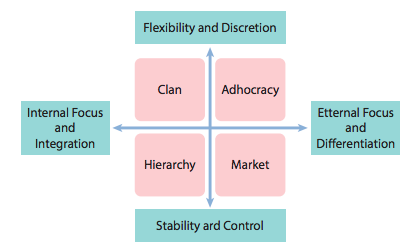
Soru 61
In Handy’s Cultural Typologies, Which type of culture is depicted as a Greek temple?
Seçenekler
A
Power culture
B
Person culture
C
Task culture
D
Role culture
E
Formal culture
Açıklama:
Role culture: Metaphorically depicted as Greek temple, all-encompassing bureaucracy and high level of the hierarchy is main features of this type. Operations are controlled through strict job descriptions, organizational policies, and authority. Employees arerecruited based on theirexpertise and experiences.
Soru 62
Which of the following is not one of the characteristics of organizational culture?
Seçenekler
A
It is shared knowledge.
B
It is learned through training activities.
C
It tells employees what is expected.
D
It is perceived without employees realizing the process.
E
It is mutually accepted values, beliefs, and assumptions.
Açıklama:
Organizational culture is shared knowledge; tells employees what is expected; is perceived without employees realizing the process and is mutually accepted values, beliefs, and assumptions. However, it is not learned through training activities - it is learned by experiencing it. The correct answer is B.
Soru 63
Which of the following refers to groups sharing overall cultural values of the society but diverges from these groups by holding different values brought by their lifestyles, values, and norms?
Seçenekler
A
Subculture
B
Counterculture
C
Dominant culture
D
Weak culture
E
Strong culture
Açıklama:
Subculture is defined as groups sharing overall cultural values of the society but diverges from these groups by holding different values brought by their lifestyles, values, and norms. The correct answer is A.
Soru 64
- Creating organizational inertia
- Differentiating organization from the others
- Easing members’ organizational identification
- Creating stability throughout the organization
Seçenekler
A
I and III
B
II and IV
C
I, II, III
D
I, III, IV
E
II, III, IV
Açıklama:
The advantages of strong organizational culture are:
- Differentiating organization from the others,
- Easing members’ organizational identification,
- Guiding organizational behavior,
- Creating stability throughout the organization.
Soru 65
Which of the following is a myth in organizational ethics?
Seçenekler
A
Ethical decision making is easy.
B
Unethical behavior can be a systemic part of the organization’s culture
C
Formal codes and programs are helpful, but ethical expectations must be part of the culture
D
Leader morality and honesty is a good start, but the leader must also infuse ethics into the organization and hold others accountable
E
The ethical concern in organizations has always been a pervasive issue.
Açıklama:
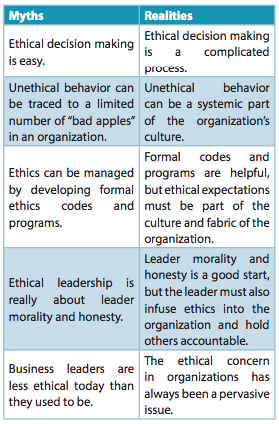
Soru 66
- Artifacts
- Espoused values
- Basic assumptions
- Human capital
Seçenekler
A
I and II
B
III and IV
C
I, II, III
D
I, II, IV
E
II, III, IV
Açıklama:
Organizational culture has three levels, namely basic assumptions, espoused values, and artifacts. The correct answer is C.
Soru 67
- They govern everyday thinking and organizational behavior in general.
- They are beliefs about the organization and its surrounding environment.
- They are general criteria for people to determine the desirable behaviors.
- They are the most inner level and are said to be the core of organizational culture.
Seçenekler
A
I and III
B
II and IV
C
I, II, III
D
I, II, IV
E
II, III, IV
Açıklama:
Basic assumptions are beliefs about the organization and its surrounding environment. They govern everyday thinking and organizational behavior in general. They are the most inner level and are said to be the core of organizational culture. However, the general criteria for people to determine the desirable behaviors is the level of espoused values. The correct answer is D.
Soru 68
- Globalization
- Human capital
- Organizational history
- Communication styles
- Power relations and authority
Seçenekler
A
I, II, III
B
III, IV, V
C
I, II, III, IV
D
I, III, IV, V
E
II, III, IV, V
Açıklama:
The factors that affect the process of constructing organizational culture are:
- Organizational history,
- Founder and top management team,
- Mission and vision statement,
- Human capital,
- Power relations and authority,
- Communication styles,
- Reward and discipline systems,
- Organizational environment.
Soru 69
Which of the following is not one of the symbols that communicate organizational culture?
Seçenekler
A
Holidays
B
Logos
C
Slogans
D
Ceremonies
E
Rituals
Açıklama:
Physical symbols (logos, open-office, etc.), slogans, stories, jargon, ceremonies, rites and rituals are the symbols that communicate organizational culture. The correct answer is A.
Soru 70
- Implicit, informal control
- Specialized career path
- Consensual decision
- Individual responsibility
Seçenekler
A
I and II
B
III and IV
C
I, II, III
D
I, III, IV
E
II, III, IV
Açıklama:
Consensual decision and individual responsibility are among the characteristics of Type Z. However, specialized career path is that of Type A, and implicit, informal control is that of Type J. The correct answer is B.
Soru 71
Which of the following can NOT be said about culture?
Seçenekler
A
It is related to traditions and history.
B
It is a rational and analytical phenomenon.
C
It is collectively shared by a group of people.
D
It has strong ties with tangible dimensions.
E
It requires further explanations for thorough understanding.
Açıklama:
Culture is an integrative pattern of the meaning-making process which people subconsciously use to understand the world surrounding them via the shared set of values and beliefs, language, symbols, and physical artifacts.
It is not an easy concept to comprehend and it cannot be understand by its surface meaning. It requires a deeper explanation to understand it fully. It has close connections with tangible dimensions such as beliefs, perspective and knowledge.
Culture is not a rational and analytical phenomenon; it is more of an integrative, subjective, and emotional phenomenon.
It is not an easy concept to comprehend and it cannot be understand by its surface meaning. It requires a deeper explanation to understand it fully. It has close connections with tangible dimensions such as beliefs, perspective and knowledge.
Culture is not a rational and analytical phenomenon; it is more of an integrative, subjective, and emotional phenomenon.
Soru 72
Which of the following states a reasons why organizational culture has become important in understanding organizations?
Seçenekler
A
The rise of collectivism in recent years
B
The shift to product-based employees
C
Holding a machine bureaucracy approach
D
The use of mass production techniques
E
Efforts to adopt a Japanese miracle approach
Açıklama:
The increase in individualism and alienation (rather than collectivism) triggered lonely people to search for an identity and they celebrated organizational culture because it allowed people to answer aching questions for raison d’etre! “Who am I, what is my reason for being in this world? etc.
Technically advanced production and the rise of service industry led employees to be more customer-focused (not product-focused) and technically qualified. Consequently, skillful and well trained employees preferred independent working conditions. Organizational culture, as a way of controlling employee behavior, allows members to use their judgment, and act more freely within defined organizational norms. Once members of the organizations cultivated with organizational values, close supervision will be redundant.
Machine bureaucracy gradually became less useful in managing people: This movement led scholars focusing on the human aspect of management, or in other words, “soft” aspects of organizations.
Innovative production techniques usually decrease the overall flexibility of the organization. To balance the level of efficiency with the degree of flexibility, organizations should employ people who have a sense of active belonging and commitment. Organizational culture is providing a cognitive scheme through which members can agree upon collective values, and thus elevate the level of organizational commitment.
Finally, observing the Japanese cultural value system and its reflections within Japanese organizations, other countries also tried to understand and encapsulate these reflections for themselves, and hence the interest in the cultural aspect of organizations tend to strengthen. This is called Japanese miracle.
Technically advanced production and the rise of service industry led employees to be more customer-focused (not product-focused) and technically qualified. Consequently, skillful and well trained employees preferred independent working conditions. Organizational culture, as a way of controlling employee behavior, allows members to use their judgment, and act more freely within defined organizational norms. Once members of the organizations cultivated with organizational values, close supervision will be redundant.
Machine bureaucracy gradually became less useful in managing people: This movement led scholars focusing on the human aspect of management, or in other words, “soft” aspects of organizations.
Innovative production techniques usually decrease the overall flexibility of the organization. To balance the level of efficiency with the degree of flexibility, organizations should employ people who have a sense of active belonging and commitment. Organizational culture is providing a cognitive scheme through which members can agree upon collective values, and thus elevate the level of organizational commitment.
Finally, observing the Japanese cultural value system and its reflections within Japanese organizations, other countries also tried to understand and encapsulate these reflections for themselves, and hence the interest in the cultural aspect of organizations tend to strengthen. This is called Japanese miracle.
Soru 73
Which of the following is an disadvantage of having a strong organizational culture?
Seçenekler
A
It differentiates the organization from the others.
B
It guides the organizational behavior.
C
It creates stability throughout the organization.
D
It attracts same type of people which diminishes diversity.
E
It makes organizational identification for members easy.
Açıklama:
Advantages
Differentiates organization from the others.
Members’ organizational identification is easy.
Guides organizational behavior.
Creates stability throughout the organization.
Disadvantages
Makes mergers & acquisition harder.
Only attracts the same type of people thus diminishes organizational diversity
Creates organizational inertia.
Decreases organization’s environmental adaptability potential.
Differentiates organization from the others.
Members’ organizational identification is easy.
Guides organizational behavior.
Creates stability throughout the organization.
Disadvantages
Makes mergers & acquisition harder.
Only attracts the same type of people thus diminishes organizational diversity
Creates organizational inertia.
Decreases organization’s environmental adaptability potential.
Soru 74
Which of the following group does the described people below represent in an organization?
* They have totally different lifestyles.
* They have different norms and values relative to the organization and / or society they live in.
* Naive managers may try to avoid this group of people in the organization.
* They have totally different lifestyles.
* They have different norms and values relative to the organization and / or society they live in.
* Naive managers may try to avoid this group of people in the organization.
Seçenekler
A
Counterculture
B
Subculture
C
Dominant culture
D
Operational culture
E
Managerial culture
Açıklama:
Subculture is defined as groups sharing overall cultural values of the society but diverges from these groups by holding different values brought by their lifestyles, values, and norms. Organizations reaching certain levels regarding size will generally have three subcultures namely operational, technical, and managerial.
But sometimes subcultures within the organization may marginalize due to several factors affecting them. In the last analysis, cultures are made up of people, and people are social beings. These marginalized cultures are called counterculture. People who are the member of counterculture have 100% opposite lifestyles, values, and norms relative to the organization and/ or society in which they are living and working in.
But sometimes subcultures within the organization may marginalize due to several factors affecting them. In the last analysis, cultures are made up of people, and people are social beings. These marginalized cultures are called counterculture. People who are the member of counterculture have 100% opposite lifestyles, values, and norms relative to the organization and/ or society in which they are living and working in.
Soru 75
If an employee in an organization feels stressed and insecure and the overall mood of the organization is pessimistic, which of the following can be said about the organizational culture there?
Seçenekler
A
Collaboration among employees is probably supported by the manager.
B
Mistakes are tolerated and seen as opportunities to learn more.
C
Employees are far from being empowered and autonomous.
D
Searching for better alternative to do a job is a norm.
E
Employees are encouraged to take risks within limits.
Açıklama:
If employees experience the feelings mentioned in the questions, it means that the organizational culture is unhealthy and toxic. If there are such problems in an organization, managers should diagnose the problem and take actions to solve it. The following may be considered a checklist for managers to diagnoses such a problem:
• Every member of the organization is open to communication and have modest characteristics.
• All members of the organization are empowered and held accountable.
• Employees are encouraged to take risks within set limits.
• Searching for better alternatives about how jobs to be done is the norm
• Mistakes are tolerated to some degree and treated as a learning opportunity.
• Honesty is the primary building block of the organizational culture.
• Collaboration is part of the standard operating procedures.
• Courage and resilience are essential individual characteristics to become an active participant in the organization.
• Every member of the organization is open to communication and have modest characteristics.
• All members of the organization are empowered and held accountable.
• Employees are encouraged to take risks within set limits.
• Searching for better alternatives about how jobs to be done is the norm
• Mistakes are tolerated to some degree and treated as a learning opportunity.
• Honesty is the primary building block of the organizational culture.
• Collaboration is part of the standard operating procedures.
• Courage and resilience are essential individual characteristics to become an active participant in the organization.
Soru 76
In Turkish culture, when someone sneezes, the reaction to this is almost always "Çok Yaşa!". It is taken for granted that the person has caught a cold, had the flu or is allergic to something and the very first reaction to this is to say "Çok Yaşa!"
For what level of organizational culture can this metaphor be used?
For what level of organizational culture can this metaphor be used?
Seçenekler
A
Espoused values
B
Basic assumptions
C
Artifacts
D
Organizational values
E
Norms and standards
Açıklama:
Basic assumptions are taken-for-granted beliefs about reality, nature of the organization and its relations to the environment, the nature of human life, the nature of time, and the nature of people’s relations to each other.
Soru 77
Which of the following is NOT an example of artifacts in an organizational culture?
Seçenekler
A
The furnishing, architecture and decor
B
The nicknames, names and jargon
C
The number of stakeholders
D
The jokes and humour
E
Rewards and punishments
Açıklama:
In Schein’s levels of organizational culture, the most visible level is called artifacts. Artifacts are the physical, behavioral, and verbal manifestation of the culture. Organizational members talk about organizational culture by using these artifacts. Members also set role models with behavioral patterns they choose is also an example of artifact. Newly recruits are looking for any useful information that is suitable for guiding them on how to behave in the new organizational setting.
Soru 78
Which of the following shows the order of the steps for a founder to construct organizational culture?
I- Founder finds people sharing her/his vision.
II- As organization grows and matures, new employees are recruited, initial values and founder's vision transmitted and hence sustained.
III- Founder comes up with a new business idea.
IV- Founder and initial employees work towards the realization of founder's busines
I- Founder finds people sharing her/his vision.
II- As organization grows and matures, new employees are recruited, initial values and founder's vision transmitted and hence sustained.
III- Founder comes up with a new business idea.
IV- Founder and initial employees work towards the realization of founder's busines
Seçenekler
A
I-II-III-IV
B
II-IV-III-I
C
I-III-II-IV
D
III-I-IV-II
E
III-II-I-IV
Açıklama:
Founder(s) and top management team are essential figures shaping organizational culture. The founder is said to be the architect of the organization. From blueprints to the realization, it is the founder who makes essential decisions shaping organizational values. Founders’ values and vision tend to be very strong, and traces of their effect can be found anywhere within the organization even if several years are passed. Founders vision and values linger throughout the organization for good. One thing founders do during the initial stages of the organization is to employ people who they think suitable for the organization during the first few years. These recruits usually became the first-generation managers of the organization. By this way, values of the founder are easily transferred from one generation to the next. Managers providing role-model for aspiring managers create a chain reaction which sustains and develops organizational culture.
Soru 79
Which of the following is about human capital in organizational culture?
Seçenekler
A
Organizational citizenship behavior
B
Scope and dynamics of an organization
C
Organizational hierarchy
D
Communication sytles
E
Organizational environment
Açıklama:
There are factors that affect the process of constructing organizational culture: Organzational history, founder and top management team, mission and vision statement, human capital, power relations and authority, communication styles, reward and discipline systems and organizational environment.
Human Capital is about the following:
Organization is made up of people. As we touched upon, top managers and founders have a substantial influence on organizational culture. In addition to these top figures, human resources employed by the organization also has an enduring effect on organizational culture. All participating organizational members interactively shape organizational culture, so it should be viewed as the fundamental aspect of the culture itself. Employees are bound to the organization with a labor contract, but contemporary organizations require one to add more than what is written in these contracts. Requirements of modern business life can only be fulfilled by employees who can develop organizational citizenship behavior. This situation leads us to another type of contract called psychological contract. To create strong ties with employees, organizations should focus on psychological contract. Typically, this type of bonds can only be created within strong organizational cultures.Organizations demand more, and in turn, employees request more. For example, today employees are looking for fun at work, flexible working hours, empowerment, slack time for innovation. Suitable organizational cultures can only fulfill these requests. So, all in all, culture is shaped by and can shape human side of organizations.
Human Capital is about the following:
Organization is made up of people. As we touched upon, top managers and founders have a substantial influence on organizational culture. In addition to these top figures, human resources employed by the organization also has an enduring effect on organizational culture. All participating organizational members interactively shape organizational culture, so it should be viewed as the fundamental aspect of the culture itself. Employees are bound to the organization with a labor contract, but contemporary organizations require one to add more than what is written in these contracts. Requirements of modern business life can only be fulfilled by employees who can develop organizational citizenship behavior. This situation leads us to another type of contract called psychological contract. To create strong ties with employees, organizations should focus on psychological contract. Typically, this type of bonds can only be created within strong organizational cultures.Organizations demand more, and in turn, employees request more. For example, today employees are looking for fun at work, flexible working hours, empowerment, slack time for innovation. Suitable organizational cultures can only fulfill these requests. So, all in all, culture is shaped by and can shape human side of organizations.
Soru 80
Which of the following gives correct information about Quchi's Ideal Types?
Seçenekler
A
Type A offers lifetime employment as opposed to Type J.
B
Rapid assessment and promotion is a characteristic of Type Z.
C
Types J depicts features of the Japanese firm.
D
Type Z offers non-specialized career path to its employees.
E
Type A and Z have consensual decision making processes.
Açıklama:
Ouchi describes three types of organizations which are called Type J, Type A, and finally Type Z. As the names denote, Type J depicts features of the typical Japanese firm, on the other hand, Type A depicts characteristics of the average American firm. Type Z, offered by Ouchi, is the blended version of Type J and Type A in which suitable elements of Japanese firms are adapted to the US context. Table 8. 5 shows peculiar features of each type. Shortly, Ouchi describes an organization that can quickly adopt environmental changes while fulfilling employees’ needs. The characteristics of them are briefly listed below:
Type J:Lifetime employment - Consensual decision-making - Collective responsibility - Slow evaluation and promotion - Implicit, informal control - Non-specialized career path - Holistic concern
Type A:Short-term employment - Individual decision-making - Personal responsibility - Rapid assessment and promotion - Explicit, formalized control - Specialized career path - Segmented concern
Type Z: Long-term employment - Consensual decision - Individual responsibility - Deliberate evaluation and promotion - Inherent, informal control with explicit, formalized measures - Moderately specialized career path - Holistic concern, including family
Type J:Lifetime employment - Consensual decision-making - Collective responsibility - Slow evaluation and promotion - Implicit, informal control - Non-specialized career path - Holistic concern
Type A:Short-term employment - Individual decision-making - Personal responsibility - Rapid assessment and promotion - Explicit, formalized control - Specialized career path - Segmented concern
Type Z: Long-term employment - Consensual decision - Individual responsibility - Deliberate evaluation and promotion - Inherent, informal control with explicit, formalized measures - Moderately specialized career path - Holistic concern, including family
Soru 81
What refers to the integrative pattern of the meaningmaking process which people subconsciously use to understand the world surrounding them via the shared set of values and beliefs, language, symbols, and physical artifacts?
Seçenekler
A
Culture
B
Globalization
C
Organizational Culture
D
Artifacts
E
Mission
Açıklama:
Culture is an integrative pattern of the meaningmaking process which people subconsciously use to understand the world surrounding them via the shared set of values and beliefs, language, symbols, and physical artifacts.
Soru 82
- Individualism and alienation
- Technically advanced production and the service industry
- Machine bureaucracy gradually became less useful managing people
- Innovative production techniques
- Japanese miracle
What were the factors that helped increase the cultural awareness and the organization theory rise in the 90s?
Seçenekler
A
I, II, III and IV
B
II, III, IV and V
C
I, III, IV and V
D
I, II, III and V
E
All
Açıklama:
What was the reason behind the rise of organizational culture as a concept for understanding organizations? Of course, it was not coincidental. Many social, field and individual-level developments triggered the increase of awareness in the 90s. These factors are explained below:5 • Individualism and alienation: By the end of 1970s modern societies witnessed widespread diffusion of individualism that alienated people from the society. Lonely people searching for an identity celebrated organizational culture as a haven. Organizational culture allowed people to answer aching questions for raison d’etre! “Who am I, what is my reason for being in this world? what this organization stands for?” are all examples of questions asked and generally found an explanation within the concept of organizational culture. • Technically advanced production and the rise ofservice industry: Production process was upgraded to an advanced level in which automation became widespread. Moreover, the volume of service industry gradually surpassed goods production in many developed countries.Thus,employees had to be more customer-focused and technically qualified. Consequently, skillful and welltrained employees preferred independent working conditions. Organizational culture, as a way of controlling employee behavior, allows members to use their judgment, and act morefreely within defined organizational norms. Once members of the organizations cultivated with organizational values, close supervision will be redundant.
Machine bureaucracy gradually became less useful in managing people: Scientific management was the paradigm relevant to 1960s and 1970s. During 1980s validity of scientific management as the only paradigm for managing people started to be scrutinized. The effectiveness of objective and mathematical management techniques like time-and-motion studies was challenged. This movement led scholars focusing on the human aspect of management, or in other words, “soft” aspects of organizations. • Innovative production techniques: Mass production techniques increase the level of efficiency. But these techniques usually decrease the overall flexibility of the organization. To balance the level of efficiency with the degree of flexibility, organizations should employ people who have a sense of active belonging and commitment. Organizational culture is providing a cognitiveschemethroughwhich members can agree upon collective values, and thus elevates the level of organizational commitment. • Japanese miracle: After the devastation experienced by Japan following the 2nd World War, Japan’s reborn as an economic power found to be related to the Japanese management style. Globalization which is generally equated with getting rid of economic, political, cultural, and technological barriers led to an increase in awareness and curiosity in the global west for the east. It was self-evident that Japanese miracle was mostly related to the Japanese cultural value system and its reflections within Japanese organizations. Other countries also tried to understand and encapsulate these reflections for themselves, and hence the interest in the cultural aspect of organizations tend to strengthen.
Machine bureaucracy gradually became less useful in managing people: Scientific management was the paradigm relevant to 1960s and 1970s. During 1980s validity of scientific management as the only paradigm for managing people started to be scrutinized. The effectiveness of objective and mathematical management techniques like time-and-motion studies was challenged. This movement led scholars focusing on the human aspect of management, or in other words, “soft” aspects of organizations. • Innovative production techniques: Mass production techniques increase the level of efficiency. But these techniques usually decrease the overall flexibility of the organization. To balance the level of efficiency with the degree of flexibility, organizations should employ people who have a sense of active belonging and commitment. Organizational culture is providing a cognitiveschemethroughwhich members can agree upon collective values, and thus elevates the level of organizational commitment. • Japanese miracle: After the devastation experienced by Japan following the 2nd World War, Japan’s reborn as an economic power found to be related to the Japanese management style. Globalization which is generally equated with getting rid of economic, political, cultural, and technological barriers led to an increase in awareness and curiosity in the global west for the east. It was self-evident that Japanese miracle was mostly related to the Japanese cultural value system and its reflections within Japanese organizations. Other countries also tried to understand and encapsulate these reflections for themselves, and hence the interest in the cultural aspect of organizations tend to strengthen.
Soru 83
What is the shared social knowledge among organizational members shaping organizational members’ attitudes and behaviors based on mutually accepted rules, norms, and values?
Seçenekler
A
Subculture
B
Dominant Culture
C
Organizational culture
D
Counterculture
E
Strong Culture
Açıklama:
Organizational culture is shared social knowledge among organizational members shaping organizational members’ attitudes and behaviors based on mutually accepted rules, norms, and values.
Soru 84
What are groups sharing overall cultural values of the society but diverges from these groups by holding different values brought by their lifestyles, values, and norms?
Seçenekler
A
Dominant Cultures
B
Countercultures
C
Strong Cultures
D
Subcultures
E
Weak Cultures
Açıklama:
Subculture is defined as groups sharing overall cultural values of the society but diverges from these groups by holding different values brought by their lifestyles, values, and norms.
Soru 85
- It differentiates organization from the others.
- Members' organizational identification is easy.
- It makes mergers and acquisition harder.
- It guides organizational behavior.
- It creates organizational inertia.
Which are the advantages of having a strong organizational culture?
Seçenekler
A
I, II, and IV
B
I, II and III
C
I, III and V
D
III, IV and V
E
II, III and V
Açıklama:
Advantages of Having Strong Organizational Culture are:
- Differentiates organization from the others.
- Members’ organizational identification is easy.
- Guides organizational behavior.
- Creates stability throughout the organization
Soru 86
- Artifacts
- Jargon
- Basic Assumptions
- Physical Symbols
- Espoused Values
What are the levels of organizational culture?
Seçenekler
A
I, II and III
B
II, III and IV
C
III, IV and V
D
I, III and V
E
I, III and IV
Açıklama:
Organizational culture has three levels, namely basic assumptions, espoused values, and artifacts.
Soru 87
Which way of communicating organizational culture determines how one should behave within the organization?
Seçenekler
A
Rites and rituals
B
Code of conduct
C
Ceremonies
D
Jargon
E
Slogans
Açıklama:
Code of conduct determines how one should behave within the organization.
Soru 88
What are catchy and strikingly vivid messages that are not only used for advertisement and PR purposes, but also for conveying meaning attached to the organizational culture of the organizations?
Seçenekler
A
Ceremonies
B
Stories
C
Jargon
D
Physical Symbols
E
Slogans
Açıklama:
Slogans are catchy and strikingly vivid messages that are not only used for advertisement and PR purposes, but also for conveying meaning attached to the organizational culture of the organizations
Soru 89
- Lifetime employment
- Consensual decision-making
- Collective responsibility
- Slow evaluation and promotion
- Implicit, informal control
- Non-specialized career path
- Holistic concern
Which model of organizational culture has these characteristics?
Seçenekler
A
Ouchi's Ideal Type A
B
Ouch's Ideal Type J
C
Ouchi's Ideal Type Z
D
Peter and Waterman's Model of Excellence
E
Cameron and Quinn's Model of Organizational Culture
Açıklama:
Ouchi's Ideal Type J has these characteristics:
- Lifetime employment
- Consensual decision-making
- Collective responsibility
- Slow evaluation and promotion
- Implicit, informal control
- Non-specialized career path
- Holistic concern
Soru 90
- Managers should act as a role model
- Unethical offences should be punished.
- Ethical training and development programs should be conducted.
- Ethical practices should be rewarded.
Which ones are principles of constructing an ethical organizational culture?
Seçenekler
A
I and II
B
II and IV
C
I, II and III
D
II, III and IV
E
All
Açıklama:
Ethics is about personal morality. Organizations can reinforce ethical values and behavior by using tactics given below; • Selecting and recruiting ethically developed employees, • Determining moral codes, • Ethical leadership, • Designing performance management and defining organizational objectives in relation to the ethical standards, • Ethics training and education, • Independent audits and • Setting up proactive mechanisms for preventing unethical behavior