Qualıty Management (ENG) - Tüm Sorular
Ünite 1
Soru 1
Which of the following is the user-based definition of quality?
Seçenekler
A
Quality is the degree to which a specific product satisfies the wants of a specific consumer.
B
Quality means conformance to requirements.
C
Quality is the degree to which a specific product conforms to a design or specification.
D
Quality is the degree of excellence at an acceptable price and the control of variability at an acceptable cost.
E
Quality means best for certain customer conditions; the actual use and the selling of a product.
Açıklama:
"Quality is the degree to which a specific product satisfies the wants of a specific consumer." is a user-based definition. The correct answer is "A".
Soru 2
......................... is an approach to doing business that attempts to maximize the competitiveness of an organization through the continual improvement of the quality of its products, services, people, processes, and environments.
Which of the following correctly completes the left blank in the above sentence?
Which of the following correctly completes the left blank in the above sentence?
Seçenekler
A
Quality
B
Total quality
C
Total quality management
D
Quality Certification
E
Accreditation
Açıklama:
Total quality is an approach to doing business that attempts to maximize the competitiveness of an organization through the continual improvement of the quality of its products, services, people, processes, and environments. The correct answer is "B".
Soru 3
Which of the following is not one of the quality frameworks?
Seçenekler
A
TQM
B
ISO 9001
C
EFQM
D
Accreditation
E
Certification
Açıklama:
EFQM is European Foundation for Quality Management and it asserts that organizations that meet the expectations of all their stakeholders will achieve and maintain superior performance and thus become excellent. The others are quality frameworks. The correct answer is "C".
Soru 4
................. refers to the basic usability characteristics of a product, in terms of dimensions of quality.
Which of the following correctly completes the left blank in the above sentence?
Which of the following correctly completes the left blank in the above sentence?
Seçenekler
A
Features
B
Reliability
C
Durability
D
Performance
E
Serviceability
Açıklama:
Performance: Refers to the basic usability characteristics of a product, which can usually be measured. The correct answer is "D".
Soru 5
............... means the understanding and implementation regarding the customers’ present and future needs and requirements about the product/service to satisfy customer expectations.
Which of the following correctly completes the left blank in the above sentence?
Which of the following correctly completes the left blank in the above sentence?
Seçenekler
A
Customer focus
B
Leadership
C
Engagement of people
D
Improvement
E
Relationship management
Açıklama:
Customer focus means the understanding and implementation regarding the customers’ present and future needs and requirements about the product/service to satisfy customer expectations. The correct answer is "A".
Soru 6
Which of the following is not one of the key principles of TQM?
Seçenekler
A
Management Commitment
B
Employee empowerment
C
Evidence- based decision making
D
Continuous improvement
E
Leadership
Açıklama:
The key principles of total quality management include:1. Management Commitment 2. Employee empowerment. 3. Evidence- based decision making 4. Continuous improvement 5. Customer focus 6. Process approach.The correct answer is "E".
Soru 7
Which of the followings are the features of the businesses, which practice total quality management principles?
I. A total commitment to continually increasing value for stakeholders, especially customers, investors and employees.
II. A firm understanding that quality is defined by customers, not the company.
III. A commitment to leading people with a bias for continuous improvement and communication.
IV. A commitment to fundamental improvement through knowledge, skills, problem solving, and teamwork.
V. A commitment to fast-paced, constant learning, and an ability to respond quickly to changes in the competitive environment.
I. A total commitment to continually increasing value for stakeholders, especially customers, investors and employees.
II. A firm understanding that quality is defined by customers, not the company.
III. A commitment to leading people with a bias for continuous improvement and communication.
IV. A commitment to fundamental improvement through knowledge, skills, problem solving, and teamwork.
V. A commitment to fast-paced, constant learning, and an ability to respond quickly to changes in the competitive environment.
Seçenekler
A
I, II, III, IV
B
I, II, IV, V
C
I, III, IV, V
D
II, III, IV, V
E
I, II, III, IV,V
Açıklama:
The features of the businesses, which practice total quality management principles?
I. A total commitment to continually increasing value for stakeholders, especially customers, investors and employees.
II. A firm understanding that quality is defined by customers, not the company.
III. A commitment to leading people with a bias for continuous improvement and communication.
IV. A commitment to fundamental improvement through knowledge, skills, problem solving, and teamwork.
V. A commitment to fast-paced, constant learning, and an ability to respond quickly to changes in the competitive environment.
The correct answer "E".
I. A total commitment to continually increasing value for stakeholders, especially customers, investors and employees.
II. A firm understanding that quality is defined by customers, not the company.
III. A commitment to leading people with a bias for continuous improvement and communication.
IV. A commitment to fundamental improvement through knowledge, skills, problem solving, and teamwork.
V. A commitment to fast-paced, constant learning, and an ability to respond quickly to changes in the competitive environment.
The correct answer "E".
Soru 8
What is the final stage in development of quality management?
Seçenekler
A
Quality inspection
B
Quality control
C
Quality assurance
D
Total Quality Management
E
Quality planning
Açıklama:
After quality inspection, quality control, and quality assurance, Total Quality Management is the final stage in development of quality management. The correct answer is "D".
Soru 9
Which one is not one of the basic principles of Total Quality Management?
Seçenekler
A
Customer focused
B
Cooperation with suppliers
C
Preliminary evaluation
D
Improvement and participation of workers
E
Continuous improvement and creativity
Açıklama:
Basic principles of Total Quality Management is as follows:• Customer focused• Cooperation with suppliers• Improvement and participation of workers• Management with data and processes• Continuous improvement and creativity• Leadership and goal consistency. The correct answer is "C".
Soru 10
Who made PDCA cycle popular ?
Seçenekler
A
Shewhart
B
Deming
C
Juran
D
Feigenbaum
E
Taguchi
Açıklama:
PDCA cycle was invented by Walter Shewhart and made popular by Dr. Edwards Deming. The correct answer is "B".
Soru 11
Which of the following is not one of the features of quality?
Seçenekler
A
It has a relative nature.
B
It is unconditional.
C
It is a matter of degree.
D
It is perceptual.
E
It is a somewhat subjective attribute of a product or service.
Açıklama:
Quality has a relative nature. Quality is a matter of degree. Quality is perceptual,
conditional and a somewhat subjective attribute of a product or service.
conditional and a somewhat subjective attribute of a product or service.
Soru 12
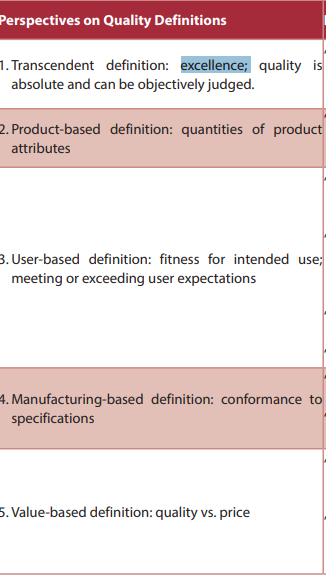
Which of the following perpectives on quality definitions is correct?
Seçenekler
A
Transcendent definition: quantities of product attributes
B
Product-based definition: excellence; quality is absolute and can be objectively judged.
C
User-based definition: conformance to specifications
D
Manufacturing-based definition: fitness for intended use; meeting or exceeding user expectations
E
Value-based definition: quality vs. price
Açıklama:
Soru 13
____________ is a form of external quality assurance process under which services and operations of educational institutions or programs are evaluated by an external body to determine if applicable standards are met.
Which of the following completes the sentence above?
Which of the following completes the sentence above?
Seçenekler
A
Quality Certifications
B
Quality Management System
C
Accreditation
D
Product quality standard
E
Total quality
Açıklama:
Accreditation, Accreditation is a form of external quality assurance process under which services and operations of educational institutions or programs are evaluated by an external body (accrediting agency) to determine if applicable
standards are met.
standards are met.
Soru 14
__________ refers to the product, which will perform the expected function and will not malfunction within a specific period of time.
Which of the following completes the sentence above?
Which of the following completes the sentence above?
Seçenekler
A
Serviceability
B
Conformance to standard
C
Durability
D
Reliability
E
Perceived quality
Açıklama:
Reliability: Refers to the product, which will perform the expected function and will not malfunction within a specific period of time.
Soru 15
Which of the following is not among the quality management principles?
Seçenekler
A
Employee empowerment
B
Engagement of people
C
Process approach
D
Evidence-based decision making
E
Relationship management
Açıklama:
The requirements described in ISO 9001 is based on the quality management principles that are (ISO 9001:2015: Quality management systems Requirements):
1. Customer focus,
2. Leadership,
3. Engagement of people,
4. Process approach,
5. Improvement,
6. Evidence-based decision making,
7. Relationship management.
1. Customer focus,
2. Leadership,
3. Engagement of people,
4. Process approach,
5. Improvement,
6. Evidence-based decision making,
7. Relationship management.
Soru 16
Which of the following scientist-their contribution matchings is correct?
Seçenekler
A
Kaoru Ishikawa- ISO 9001
B
Genichi Taguchi- Statistical Experiment Design and Quality Loss Function
C
Taachi Ohna- Continuous Improvement
D
Masaaki Imai- Production Just in Time
E
Harvey and Green- Quality Circles and CauseEffect Analysis
Açıklama:
These scientists and their contributions are listed below (Aktan, 1999, pp. 3-4):
• Kaoru Ishikawa (Quality Circles and Cause Effect Analysis)
• Genichi Taguchi (Statistical Experiment Design and Quality Loss Function)
• Taachi Ohna (Production Just in Time)
• Masaaki Imai (Continuous Improvement)
• Kaoru Ishikawa (Quality Circles and Cause Effect Analysis)
• Genichi Taguchi (Statistical Experiment Design and Quality Loss Function)
• Taachi Ohna (Production Just in Time)
• Masaaki Imai (Continuous Improvement)
Soru 17
When did NASA create quality system requirements for its suppliers?
Seçenekler
A
1910s
B
1930s
C
1940s
D
1960s
E
1980s
Açıklama:
In 1960s, NASA created quality system requirements for its suppliers.
Soru 18
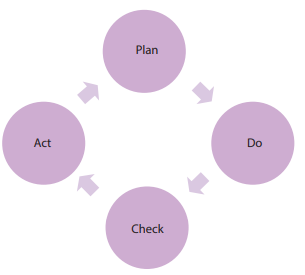 Who invented this cycle?
Seçenekler
A
Joseph M. Juran
B
Armand V. Feigenbaum
C
Philip B. Crosby
D
W. Edwards Deming
E
Walter Shewhart
Açıklama:
PDCA cycle was invented by Walter Shewhart and made popular byDr. Edwards Deming.
Soru 19
How many points are there in Demings manifesto?
Seçenekler
A
12
B
13
C
14
D
15
E
16
Açıklama:
There are 14 points in a manifesto in which Deming places a number of duties and responsibilities for the transformation of the American industry.
Soru 20
Whose contibution is Zero Defect?
Seçenekler
A
Genichi Taguchi
B
Philip B. Crosby
C
Kaoru Ishikawa
D
Armand V. Feigenbaum
E
Joseph M. Juran
Açıklama:
Zero Defect, which is considered Crosby’s biggest contribution to the TQM, is one of the four requirements of quality.
Soru 21
I. Quality is perceptual.
II. Quality has a relative nature.
III. Quality is a matter of degree.
IV. Quality is conditional.
Which of the above can be said about quality?
II. Quality has a relative nature.
III. Quality is a matter of degree.
IV. Quality is conditional.
Which of the above can be said about quality?
Seçenekler
A
Only I
B
I and II
C
III and IV
D
I, II and III
E
I, II, III and IV
Açıklama:
They are all features of quality.
Soru 22
What is the name of the "form of external quality assurance process under which services and operations of educational institutions or programs are evaluated by an external body (accrediting agency) to determine if applicable standards are met."?
Seçenekler
A
Accreditation
B
Product quality standard
C
TQM
D
Quality Certification
E
Quality Management System
Açıklama:
Accreditation is a form of external quality assurance process under which services and operations of educational institutions or programs are evaluated by an external body (accrediting agency) to determine if applicable standards are met.
Soru 23
Which of the options below is currently the last quality management philosophy and approach?
Seçenekler
A
ISO 9001
B
TQM
C
Quality Certification
D
Quality Management System
E
Accreditation
Açıklama:
TQM is currently the last quality management philosophy and approach.
Soru 24
Which of the terms below refers to the basic usability characteristics of a product, which can usually be measured?
Seçenekler
A
Features
B
Reliability
C
Performance
D
Conformance to standards
E
Durability
Açıklama:
Performance: Refers to the basic usability characteristics of a product, which can usually be measured.
Soru 25
Which of the terms below refers to the product, which will perform the expected function and will not malfunction within a specific period of time?
Seçenekler
A
Aesthetics
B
Durability
C
Conformance to standards
D
Reliability
E
Perceived quality
Açıklama:
Reliability: Refers to the product, which will perform the expected function and will not malfunction within a specific period of time.
Soru 26
Which of the terms below relates to measuring the length of time of a product’s lifetime?
Seçenekler
A
Reliability
B
Conformance to standards
C
Aesthetics
D
Serviceability
E
Durability
Açıklama:
Durability: It relates to measuring the length of time of a product’s lifetime.
Soru 27
Which of the terms below refers to the possibility, ease and speed of getting the product serviced when it requires maintenance?
Seçenekler
A
Serviceability
B
Reliability
C
Performance
D
Features
E
Aesthetics
Açıklama:
Serviceability: Refers to the possibility, ease and speed of getting the product serviced when it requires maintenance.
Soru 28
Which of the terms below is a subjective quality dimension that reflects the customer’s individual preference and evaluates the overall appearance of the product?
Seçenekler
A
Perceived quality
B
Conformance to standards
C
Aesthetics
D
Durability
E
Performance
Açıklama:
Aesthetics: It is a subjective quality dimension that reflects the customer’s individual preference and evaluates the overall appearance of the product.
Soru 29
Which one of the quality management principles below means the understanding and implementation regarding the customers’ present and future needs and requirements about the product/service to satisfy customer expectations?
Seçenekler
A
Relationship Management
B
Engagement of People
C
Leadership
D
Customer focus
E
Improvement
Açıklama:
Customer focus means the understanding and implementation regarding the customers’ present and future needs and requirements about the product/service to satisfy customer expectations.
Soru 30
Which one of the quality management principles below emphasizes the importance of the employee participation to the quality improvement efforts to achieve the organization’s vision and goals?
Seçenekler
A
Evidence-based decision making
B
Engagement of people
C
The process approach
D
Leadership
E
Customer focus
Açıklama:
Engagement of people emphasizes the importance of the employee participation to the quality improvement efforts to achieve the organization’s vision and goals.
Soru 31
Which of the following describes quality as fitness for purpose/mission?
Seçenekler
A
Focusing on process and setting quality specifications; zero defects and getting things right first time.
B
Aantithesis of “you get what you pay for”; quality products at economy prices.
C
Quality as something special, distinctive, elitist, embodied in excellence, passing a set of required standards.
D
Quality is a fundamental change of form.
E
Quality only has meaning in relation to the purpose of the product or service.
Açıklama:
1. Quality as exceptional: quality as something special, distinctive, elitist, embodied in excellence, passing a set of required standards.
2. Quality as perfection or consistency: Focusing on process and setting quality specifications; zero defects and getting things right first time.
3. Quality as fitness for purpose/mission: quality only has meaning in relation to the purpose of the product or service.
4. Quality as value for money: antithesis of “you get what you pay for”; quality products at economy prices.
5. Quality as transformative: quality is a fundamental change of form.
2. Quality as perfection or consistency: Focusing on process and setting quality specifications; zero defects and getting things right first time.
3. Quality as fitness for purpose/mission: quality only has meaning in relation to the purpose of the product or service.
4. Quality as value for money: antithesis of “you get what you pay for”; quality products at economy prices.
5. Quality as transformative: quality is a fundamental change of form.
Soru 32
Which of the following is one of the eight dimensions for quality proposed by Garvin (1987)?
Seçenekler
A
Production
B
Performance
C
Requirements
D
Improvement
E
Process approach
Açıklama:
Performance: Refers to the basic usability characteristics of a product, which can usually be measured.
Soru 33
Which of the following quality management principles emphasizes employee participation?
Seçenekler
A
Evidence-based decision making
B
Relationship management
C
Leadership
D
Engagement of people
E
Customer focus
Açıklama:
Engagement of people emphasizes the importance of the employee participation to the quality improvement efforts to achieve the organization’s vision and goals.
Soru 34
Which of the following is one of the key principles of total quality management?
Seçenekler
A
Employee empowerment
B
Frame breaking improvement
C
New approaches
D
Team building
E
Communication in the organization
Açıklama:
The key principles of total quality management include:
1. Management Commitment
2. Employee empowerment.
3. Evidence-based decision making
4. Continuous improvement
5. Customer focus
6. Process approach
1. Management Commitment
2. Employee empowerment.
3. Evidence-based decision making
4. Continuous improvement
5. Customer focus
6. Process approach
Soru 35
Which of the following is one of the steps of the quality assurance system?
Seçenekler
A
Detecting requirements
B
Developing a strategy
C
Continuous improvement
D
Managerial engagement
E
Creating satisfied management
Açıklama:
Quality assurance system takes place in 9 steps. These are;
• Determining of quality assurance requirements
• Training of managers and personnel
• Organization
• Preliminary evaluation
• Quality planning
• Implementation and evaluation
• Internal auditing
• External auditing
• Continuous improvement
• Determining of quality assurance requirements
• Training of managers and personnel
• Organization
• Preliminary evaluation
• Quality planning
• Implementation and evaluation
• Internal auditing
• External auditing
• Continuous improvement
Soru 36
Which of the following is one of the basic principles of Total Quality Management?
Seçenekler
A
Product focused
B
Data governance
C
Change management
D
Cooperation with suppliers
E
Organization
Açıklama:
Basic principles of Total Quality Management is as follows:
• Customer focused
• Cooperation with suppliers
• Improvement and participation of workers
• Management with data and processes
• Continuous improvement and creativity
• Leadership and goal consistency
• Customer focused
• Cooperation with suppliers
• Improvement and participation of workers
• Management with data and processes
• Continuous improvement and creativity
• Leadership and goal consistency
Soru 37
Which of the following is not one of The Deming Cycle's steps?
Seçenekler
A
Plan
B
Review
C
Do
D
Check
E
Act
Açıklama:
The planning phase of The Deming Cycle includes Plan - Do - Check - Act steps.
Review
Review
Soru 38
Which of the following is one of Deming's Seven Deadly Diseases?
Seçenekler
A
Removing quotas and management by objectives
B
Using only visible data and information in decision making
C
Eliminating slogans, exhortations and targets for the workforce
D
Stopping awarding contracts on the basis of low bids
E
Breaking down barriers between departments
Açıklama:
5. Using only visible data and information in decision making with little or no consideration given to what is not known or cannot be known.
Soru 39
Which of the following is one of Deming’s Fourteen Points?
Seçenekler
A
Depend on inspection to achieve quality
B
Remain loyal to the existing philosophy
C
Create constancy of purpose toward improvement
D
Institute quotas and management by objectives
E
Make the transformation only one employee's job
Açıklama:
1. Create constancy of purpose toward the improvement of products and services in order to become competitive, stay in business, and provide jobs.
Create constancy of purpose toward improvement
Create constancy of purpose toward improvement
Soru 40
Who among the following developed Strategic Quality Management (SQM) approach?
Seçenekler
A
Kaoru Ishikawa (1915 - 1989)
B
Philip B. Crosby (1926 - 2001)
C
Genichi Taguchi (1924 - 2012)
D
Armand V. Feigenbaum (1920 - 2014)
E
Joseph M. Juran (1904 - 2008)
Açıklama:
Joseph M. Juran developed an approach named Strategic Quality Management (SQM) to help with managers planning quality.
Joseph M. Juran (1904 - 2008)
Joseph M. Juran (1904 - 2008)
Soru 41
Which of the following is a statement by Armand V. Feigenbaum?
Seçenekler
A
Quality is a form of management
B
Quality and innovation are not necessarily dependent
C
Quality is what the producer says
D
Quality, once achieved, does not require continuous improvement
E
Quality requires team work, not individual work
Açıklama:
Quality is a form of management
Soru 42
I. Quality has a relative nature.
II. Quality is a matter of degree.
III. Quality is perceptual.
Which of the above are among features of Quality?
II. Quality is a matter of degree.
III. Quality is perceptual.
Which of the above are among features of Quality?
Seçenekler
A
Only I
B
Only II
C
I and II
D
II and III
E
I, II and III
Açıklama:
Quality has a relative nature. Quality is a matter of degree. Quality is perceptual, conditional and a somewhat subjective attribute of a product or service.
Soru 43
Which of the below is currently the last quality management philosophy and approach?
Seçenekler
A
Quality Certification
B
ISO 9001
C
TQM
D
Product quality standard
E
Quality Management System
Açıklama:
TQM is currently the last quality management philosophy and approach.
Soru 44
I. Performance
II. Features
III. Reliability
IV. Conformance to standard
Which of the above are among dimensions of quality?
II. Features
III. Reliability
IV. Conformance to standard
Which of the above are among dimensions of quality?
Seçenekler
A
I and II
B
III and IV
C
I, II and IV
D
II, III and IV
E
I, II, III and IV
Açıklama:
All of them are among dimensions of quality.
Soru 45
I. Durability
II. Serviceability
III. Aesthetics
IV. Perceived quality
Which of the above are among dimensions of quality?
II. Serviceability
III. Aesthetics
IV. Perceived quality
Which of the above are among dimensions of quality?
Seçenekler
A
I and II
B
III and IV
C
I, II and III
D
II, III and IV
E
I, II, III and IV
Açıklama:
All of them are among dimensions of quality.
Soru 46
Which dimension of quality refers to the basic usability characteristics of a product, which can usually be measured?
Seçenekler
A
Performance
B
Reliability
C
Durability
D
Aesthetics
E
Serviceability
Açıklama:
Performance: Refers to the basic usability characteristics of a product, which can usually be measured.
Soru 47
Which dimension of quality refers to the product, which will perform the expected function and will not malfunction within a specific period of time?
Seçenekler
A
Performance
B
Reliability
C
Features
D
Durability
E
Aesthetics
Açıklama:
Reliability: Refers to the product, which will perform the expected function and will not malfunction within a specific period of time.
Soru 48
Which dimension of quality relates to measuring the length of time of a product’s lifetime?
Seçenekler
A
Perceived quality
B
Reliability
C
Features
D
Durability
E
Performance
Açıklama:
Durability: It relates to measuring the length of time of a product’s lifetime.
Soru 49
Which dimension of quality refers to the possibility, ease and speed of getting the product serviced when it requires maintenance?
Seçenekler
A
Serviceability
B
Performance
C
Features
D
Reliability
E
Durability
Açıklama:
Serviceability: Refers to the possibility, ease and speed of getting the product serviced when it requires maintenance.
Soru 50
I. Leadership
II. Engagement of People
III. Improvement
IV. Relationship Management
Which of the above are among Quality Management Systems Principles?
II. Engagement of People
III. Improvement
IV. Relationship Management
Which of the above are among Quality Management Systems Principles?
Seçenekler
A
I and II
B
III and IV
C
I, II and III
D
II, III and IV
E
I, II, III and IV
Açıklama:
All of them among Quality Management Systems Principles.
Soru 51
I. Employee Empowerement
II. Evidence-based Decision Making
III. Process Approach
IV. Management Commitment
Which of the above are among Total Quality Management Principles?
II. Evidence-based Decision Making
III. Process Approach
IV. Management Commitment
Which of the above are among Total Quality Management Principles?
Seçenekler
A
I and II
B
III and IV
C
I, II and III
D
II, III and IV
E
I, II, III and IV
Açıklama:
All of them are among Total Quality Management Principles.
Soru 52
I. It has a relative nature.
II. It is a matter of degree.
III. It is perceptual.
Which of the above are among features of Quality?
II. It is a matter of degree.
III. It is perceptual.
Which of the above are among features of Quality?
Seçenekler
A
Only I
B
Only III
C
I and II
D
I and III
E
I, II and III
Açıklama:
Quality has a relative nature. Quality is a matter of degree. Quality is perceptual, conditional and a somewhat subjective attribute of a product or service.
Soru 53
What is "a form of external quality assurance process under which services and operations of educational institutions or programs are evaluated by an external body (accrediting agency) to determine if applicable standards are met." called?
Seçenekler
A
Product quality standard
B
Accreditation
C
Reliability
D
Durability
E
Serviceability
Açıklama:
Accreditation is a form of external quality assurance process under which services and operations of educational institutions or programs are evaluated by an external body (accrediting agency) to determine if applicable standards are met.
Soru 54
What is "a detail of the requirements, specifications, the various guidelines and characteristics to be able to meet its quality by the product in order to meet the purpose of the product, process or the service" called?
Seçenekler
A
Perceived quality
B
Serviceability
C
Performance
D
Product quality standard
E
Accreditation
Açıklama:
Product quality standard is a detail of the requirements, specifications, the various guidelines and characteristics to be able to meet its quality by the product in order to meet the purpose of the product, process or the service.
Soru 55
I. TQM
II. Accreditation
III. ISO 9001
IV. Certification
Which of the above are among different frameworks of quality matters?
II. Accreditation
III. ISO 9001
IV. Certification
Which of the above are among different frameworks of quality matters?
Seçenekler
A
I and II
B
III and IV
C
I, II and III
D
II, III and IV
E
I, II, III and IV
Açıklama:
All of them are among different frameworks of quality matters.
Soru 56
Which dimension of quality refers to the basic usability characteristics of a product, which can usually be measured?
Seçenekler
A
Performance
B
Features
C
Reliability
D
Durability
E
Aesthetics
Açıklama:
Performance: Refers to the basic usability characteristics of a product, which can usually be measured.
Soru 57
Which dimension of quality relates to measuring the length of time of a product’s lifetime?
Seçenekler
A
Features
B
Performance
C
Serviceability
D
Durability
E
Reliability
Açıklama:
Durability: It relates to measuring the length of time of a product’s lifetime.
Soru 58
Which of the below is a subjective quality dimension that reflects the customer’s individual preference and evaluates the overall appearance of the product?
Seçenekler
A
Serviceability
B
Reliability
C
Aesthetics
D
Durability
E
Performance
Açıklama:
Aesthetics: It is a subjective quality dimension that reflects the customer’s individual preference and evaluates the overall appearance of the product.
Soru 59
Which of the below refers to the quality dimension in which the brand, image, etc. are in the forefront?
Seçenekler
A
Performance
B
Perceived quality
C
Features
D
Durability
E
Reliability
Açıklama:
Perceived quality: Refers to the qualitydimension in which the brand, image, etc. are in the forefront.
Soru 60
I. Customer Focus
II. Employee Empowerement
III. Evidence-based Decision Making
Which of the above are among Total Quality Management Principles?
II. Employee Empowerement
III. Evidence-based Decision Making
Which of the above are among Total Quality Management Principles?
Seçenekler
A
Only I
B
Only III
C
I and II
D
II and III
E
I, II and III
Açıklama:
All of them are among Total Quality Management Principles.
Soru 61
I. Continous Improvement
II. Management Commitment
III. Process Approach
Which of the above are among Total Quality Management Principles?
II. Management Commitment
III. Process Approach
Which of the above are among Total Quality Management Principles?
Seçenekler
A
Only I
B
Only III
C
I and II
D
I and III
E
I, II and III
Açıklama:
All of them are among Total Quality Management Principles.
Ünite 2
Soru 1
What can be defined as the principles, norms, and standards of conduct governing an individual or group?
Seçenekler
A
Ethics
B
TQM
C
Quality
D
CSR
E
Ethical dilemma
Açıklama:
Ethics can be defined as the principles, norms, and standards of conduct governing an individual or group. In this definition, the word “conduct” is important. The correct answer is "A".
Soru 2
Which of the following questions do ethics try to answer?
I. What action it is right (or wrong) to take
II. What kind of person it is right (or wrong) to be
III. In what kind of a world it is right (or wrong) to live
I. What action it is right (or wrong) to take
II. What kind of person it is right (or wrong) to be
III. In what kind of a world it is right (or wrong) to live
Seçenekler
A
Only I
B
I, II
C
I, III
D
II, III
E
I, II, III
Açıklama:
Ethics asks;• what action it is right (or wrong) to take,• what kind of person it is right (or wrong) to be, and • in what kind of a world it is right (or wrong) to livE. The correct answer is "E".
Soru 3
___________, the belief that there are no absolute principles or standards, no objective truth, and no objective reality.
Which word can best complete the blank in the sentence?
Which word can best complete the blank in the sentence?
Seçenekler
A
Utilitarianism
B
Pragmatism
C
Deontology
D
Virtue ethics
E
Ethical issues
Açıklama:
Pragmatism, the belief that there are no absolute principles or standards, no objective truth, and no objective reality. “Truth” is whatever works, or helps you attain the goals you want. The correct answer is "B".
Soru 4
What refers to revealing wrongdoings in an organization to the public or to management of the organization?
Seçenekler
A
Code of ethics
B
Ego strength
C
Locus of control
D
Whistleblowing
E
Communication
Açıklama:
Whistleblowing means revealing wrongdoings in an organization to the public or to management of the organization. The correct answer is "D".
Soru 5
Which of the following principles are used as ethical codes focused on quality?
I. Institute training on the job.
II. Adopt and institute leadership.
III. Break down barriers between staff areas.
IV. Drive out fear.
V. Eliminate numerical quotas for the workforce and numerical goals for management.
I. Institute training on the job.
II. Adopt and institute leadership.
III. Break down barriers between staff areas.
IV. Drive out fear.
V. Eliminate numerical quotas for the workforce and numerical goals for management.
Seçenekler
A
I, II, III, IV
B
I, III, IV, V
C
I, II, III
D
II, III, IV, V
E
I, II, III, IV, V
Açıklama:
Ethical codes focused on quality:• Adopt the new philosophy that encourages high quality and effective training and ensures effective supervision.• Institute training on the job.• Adopt and institute leadership.• Drive out fear.• Break down barriers between staff areas.• Eliminate numerical quotas for the workforce and numerical goals for management.• Remove barriers that rob people of pride of workmanship, and eliminate the annual rating or merit system. The correct answer is "E".
Soru 6
Which one is not an exemplary code of ethics developed by Stimson?
Seçenekler
A
Meeting customer expectations
B
Honesty
C
Discrimination
D
Non-delegable quality
E
Integrity
Açıklama:
“We shall not discriminate against others-customers, employees or peers-on the basis of race, religion or gender. The correct answer is "C".
Soru 7
Which of the following are the examples how TQM can foster ethical behavior within organizations?
I. QM leads to clear communication of commitments and goals.
II. QM fosters the development of good listening skills.
III. TQM leads to early identification of problematic behavior.
IV. TQM promotes honesty and fair dealing.
V. QM highlights the ethical dimension of production.
I. QM leads to clear communication of commitments and goals.
II. QM fosters the development of good listening skills.
III. TQM leads to early identification of problematic behavior.
IV. TQM promotes honesty and fair dealing.
V. QM highlights the ethical dimension of production.
Seçenekler
A
I, II, III
B
II, III, IV, V
C
III, IV, V
D
II, III, IV, V
E
I, II, III, IV, V
Açıklama:
The following are the examples how TQM can foster ethical behavior within organizations:• TQM leads to clear communication of commitments and goals. • TQM fosters the development of good listening skills. • TQM leads to early identification of problematic behavior. • TQM promotes honesty and fair dealing. • TQM helps eliminate the atmosphere where people look for someone to blame. • TQM highlights the ethical dimension of production. The correct answer is "E".
Soru 8
What refers to the idea that firms have obligations to society beyond their economic obligations to owners or stockholders and also beyond those prescribed by law or contract?
Seçenekler
A
Corporate social responsibility
B
Quality management philosophy
C
TQM
D
Code of ethics
E
Ethical work environment
Açıklama:
Corporate social responsibilityis the idea that firms have obligations to society beyond their economic obligations to owners or stockholders and also beyond those prescribed by law or contract. The correct answer is "A".
Soru 9
Which one is not among the most common CSR practices?
Seçenekler
A
Improving organizational labor policies
B
Increasing the organization’s carbon footprints
C
Charitable giving for various causes
D
Committing to fair trade
E
Volunteering in the community initiatives
Açıklama:
Reducing the organization’s carbon footprints, it is not increasing. The correct answer is "B".
Soru 10
Which one is not one of the type of responsibilities in CSR?
Seçenekler
A
Philanthropic
B
Economic
C
Legal
D
Individualistic
E
Ethical
Açıklama:
Four responsibilities are: Economic Responsibilities, Legal Responsibilities, Ethical Responsibilities, Philanthropic responsibilities. The correct answer is "D".
Soru 11
Which one occurs in the first step of the development of quality thinking?
Seçenekler
A
Quality has been related primarily to the products or services and their performances.
B
The focus shifted from production line to the process.
C
The focus has moved from process to system.
D
The focus has moved back from system to process.
E
Quality has become a more strategic issue and the focus is broadened towards the quality of the organization and its relationships with its environment such as customers, suppliers, competitors, and society at large.
Açıklama:
Understanding of quality in management thinking has been changing and evolving in time. According to Garvin (1988, cited in Kok, et. al. 2001: 285), there are four distinguishable periods in the development of quality thinking. Quality has been related primarily to the products or services and their performances in the first stage. In the second stage, the focus shifted from production line to the process. In the third stage, the focus has moved from process to system. The fourth stage can be called as the Total Quality Management (TQM) stage, in which quality has become a more strategic issue and the focus is broadened towards the quality of the organization and its relationships with its environment such as customers, suppliers, competitors, and society at large.
Soru 12
Which of the following is NOT one of the concepts that recent interpretations of TQM refer to?
Seçenekler
A
Organizational learning
B
Business ethics
C
Social responsibility
D
Governance
E
Production
Açıklama:
Recent interpretations of TQM refer to concepts like organizational learning, business ethics, social responsibility, and governance, which go beyond improvement of productionrelated processes. Moreover, the rising importance of the product liability concept has made CSR a crucial aspect of quality.
Soru 13
Improving the organization’s ethical climate is essential to avoiding failures in the organization. Which factor has the utmost importance in this regard?
Seçenekler
A
Trust
B
Top management leadership
C
Cooperation
D
Empowerment
E
Customer satisfaction
Açıklama:
Improving the organization’s ethical climate is essential to avoiding failures in the organization and enhancing the quality of its operation. This may be accomplished through various means. Of utmost importance is the need for top management leadership. The behavior of managers has the most important influence on the ethical behavior of their subordinates.
Soru 14
___________ can be defined as the principles, norms, and standards of conduct governing an individual or group. Which of the following can meaningfully complete the gap?
Seçenekler
A
Morality
B
Philosophy
C
Ethics
D
Logic
E
Religion
Açıklama:
Ethics can be defined as the principles, norms, and standards of conduct governing an individual or group. In this definition, the word “conduct” is important. If the management focuses on conduct, ethics becomes an extension of good management. Leaders identify appropriate and inappropriate conduct, and they communicate their expectations to employees through ethics codes, training programs, and other communication channels. On the other hand, an ethical behavior in business can be defined as ‘‘behavior that is consistent with the principles, norms, and standards of business practice that have been agreed upon by the society’’.
Soru 15
Which of the below has the highest percentage of certain behaviors observed in the previous year by employees in terms of questionable workplace behaviour?
Seçenekler
A
Engaging in conflicts of interest
B
Lying to outside stakeholders
C
Engaging in health and safety violations
D
Lying to employees
E
Producing poor product quality
Açıklama:
Ethical problems remain a major concern in the workplace. Despite a heightened emphasis on business ethics following the scandals earlier this decade, a significant number of employees say they still witness questionable workplace behavior. Here is the percentage of employees who say they observed certain behaviors in the previous year, according to a survey of 2,852 workers by the Ethics Resource Center (Questionable Workplace Behavior as Reported by Employees,” National Business Ethics Survey- 2009, cited in DuBrin, 2012: 80):
• Lying to employees (19%)
• Engaging in conflicts of interest (16%)
• Lying to outside stakeholders (12%)
• Engaging in health and safety violations (11%)
• Producing poor product quality (9%)
• Stealing (9%)
• Sexual harassment (7%)
• Lying to employees (19%)
• Engaging in conflicts of interest (16%)
• Lying to outside stakeholders (12%)
• Engaging in health and safety violations (11%)
• Producing poor product quality (9%)
• Stealing (9%)
• Sexual harassment (7%)
Soru 16
Which one is NOT one of four types of philosophical basis directing ethical behaviors?
Seçenekler
A
Utilitarianism
B
Pragmatism
C
Deontology
D
Virtue ethics
E
Religious law
Açıklama:
A standard way of understanding ethical decision-making is to know the philosophical basis for making these decisions. Here, four types of philosophical basis directing ethical behaviors will be introduced: Utilitarianism, Pragmatism, Deontology, and Virtue Ethics
Soru 17
A/An _________ is a problem or issue that confronts a person, group, or organization and that requires a decision or choice among competing claims and interests, all of which may be unethical.
Seçenekler
A
pragmatism
B
virtue
C
ethical dilemma
D
social responsibility
E
moral philosophy
Açıklama:
People in organizations may face ethical dilemmas from time to time. An ethical dilemma is a problem or issue that confronts a person, group, or organization and that requires a decision or choice among competing claims and interests, all of which may be unethical (i.e., against all parties’ principles). Decision alternatives presented by an ethical dilemma usually involve solutions that do not satisfy all stakeholders. In some situations, there may be a resolution to an ethical dilemma that is the “right” thing to do, although none of the stakeholders’ material interests are benefited.
Soru 18
What is a formal statement of the company’s values concerning ethics and social responsibility called?
Seçenekler
A
Code of ethics
B
Communication
C
Disclosure mechanisms
D
Formal position
E
Whistleblowing
Açıklama:
Compliance with ethical codes is essential to create and sustain a climate where ethical behaviors flourish. So, what is this code of ethics? A code of ethics is a formal statement of the company’s values concerning ethics and social responsibility; it clarifies to employees what the company stands for and its expectations for employee conduct.
Soru 19
According to TQM guru Deming, what should management’s principal goal be?
Seçenekler
A
Creating “consistency of purpose”
B
Improving team members' listening skills
C
Enforcing honest communication between employees
D
Monitoring company's production processes
E
Identifying which processes are leading people to the wrong path
Açıklama:
According to TQM guru Deming, management’s principal goal should be creating “consistency of purpose”. Achieving such consistency requires that management and the firm as a whole become quite clear and articulate about the firm’s goals. Since acting well requires critically examining beliefs and commitments, being explicit about them is a crucial first step toward behaving ethically.
Soru 20
Which one is NOT one of the conceptualized levels of corporate social responsibilities?
Seçenekler
A
Economic responsibilities
B
Legal responsibilities
C
Ethical responsibilities
D
Philanthropic responsibilities
E
Social responsibilities
Açıklama:
Carroll (1991:39-42) conceptualized four levels of corporate social responsibilities. These four responsibilities do not exclude each other; in fact they are interconnected. Carroll depicted the relationship among them in his Pyramid of Corporate Social Responsibility (See Figure 2.2). The pyramid demonstrates that a socially responsible organization should act with respect to law, hold ethical values and demonstrate its virtues by acting as a good corporate citizen, along with making profits. Four responsibilities are as follows:
- Economic Responsibilities
- Legal Responsibilities
- Ethical Responsibilities
- Philanthropic responsibilities
Soru 21
Which of the following is NOT one of the core elements of Total Quality Management?
Seçenekler
A
Trust
B
Cooperation
C
Empowerment
D
Continuous improvement
E
Customer service
Açıklama:
Customer satisfaction is one of the core elements of TQM.
The correct choice is E.
The correct choice is E.
Soru 22
Which of the following is the most important means of improving the organization's ethical climate?
Seçenekler
A
Employee behavior
B
Customers' criteria
C
Top management leadership
D
Norms and values
E
Ethics policies
Açıklama:
Top management leadership is the most important means of improving the organization's ethical climate.
The correct choice is C.
The correct choice is C.
Soru 23
Which of the following is the principles, norms, and standards of conduct governing an individual or group?
Seçenekler
A
Quality management
B
Leadership
C
Ethical behavior
D
Ethics
E
Values
Açıklama:
The correct choice is D.
Soru 24
Which of the following is the belief that there are no absolute standards, no objective truth and no objective reality?
Seçenekler
A
Utilitarianism
B
Pragmatism
C
Deontology
D
Virtue ethics
E
Locus of control
Açıklama:
The correct choice is B.
Soru 25
Which of the following refers to moral philosophies that center on the rights of the individuals and the intentions associated with a particular behavior?
Seçenekler
A
Utilitarianism
B
Virtue ethics
C
Pragmatism
D
Ethical dilemma
E
Deontology
Açıklama:
The correct choice is E.
Soru 26
Which of the following is the degree to which people believe their fate is in their hands?
Seçenekler
A
Virtue ethics
B
Locus of control
C
Ego strength
D
Deontology
E
Ethical dilemma
Açıklama:
The correct choice is B.
Soru 27
In creating an ethical work environment, which of the following clarifies to employees what the company stands for and its expectations for employee conduct?
Seçenekler
A
Code of ethics
B
Communication
C
Disclosure mechanism
D
Whistleblowing
E
Integrity
Açıklama:
The correct choice is A.
Soru 28
Which of the following is NOT among the types of responsibilities in CSR?
Seçenekler
A
Ethical responsibility
B
Philanthropic responsibility
C
Personal responsibility
D
Legal responsibility
E
Economic responsibility
Açıklama:
The correct choice is C.
Soru 29
Which of the following includes many business activities motivated by the motto "good ethics is good business"?
Seçenekler
A
Purely economic domain
B
Economic/Ethical domain
C
Economic/Legal domain
D
Legal/Ethical domain
E
Purely legal domain
Açıklama:
The correct choice is B.
Soru 30
Which of the following is about the philanthropic responsibilities of the CSR?
Seçenekler
A
Obeying the law
B
Being profitable
C
Being ethical
D
Being a good corporate citizen
E
Creating a good atmosphere
Açıklama:
The correct choice is D.
Soru 31
Which of the following has the most important influence on the ethical behavior of the personnel?
Seçenekler
A
Dynamic interaction with the environment
B
The behavior of managers
C
Norms and values
D
Developing the core elements
E
Ruling values in the society
Açıklama:
The behavior of managers has the most important influence on the ethical behavior of their subordinates.
The behavior of managers plays a key role for the employees.
The behavior of managers plays a key role for the employees.
Soru 32
What is the main reason an organization that constantly creates a negative ethical impact may find the withdrawal of the market for its products?
Seçenekler
A
Ethics and quality management are interrelated
B
Lack of advertisement
C
Not getting into the international market
D
Not to comply with ethical rules
E
Not providing a good quality management
Açıklama:
An organization that constantly creates a negative ethical impact may find the withdrawal of public approval and of the market for its product or services. In this regard, ethics and quality management are interrelated. Establishing the foundation quality management on ethical principles is necessary.
Main reason of the consequences mentioned in the question is the fact that ethics and quality management are interrelated.
Main reason of the consequences mentioned in the question is the fact that ethics and quality management are interrelated.
Soru 33
"Some of the differences leading unethical behaviour may derive from country’s governance system. .................... countries tend to be less transparent and have a higher degree of corruption than ............... countries."
Which of the following is the correct sequence to fill in the blanks above?
Which of the following is the correct sequence to fill in the blanks above?
Seçenekler
A
Rule-based - Relationship-based
B
Education-based - Obligation based
C
Relationship-based - Rule-based
D
Obligation based - Education-based
E
Interaction-based - Obligation-based
Açıklama:
Some of these differences leading to unethical behaviour may derive from whether a country’s governance system is rule-based or relationship-based. Relationship-based countries tend to be less transparent and have a higher degree of corruption than rule-based countries.
To fill in the blanks correctly, true statment is "Relationship-based - Rule-based".
To fill in the blanks correctly, true statment is "Relationship-based - Rule-based".
Soru 34
Which of the following terms refers to "deontology"?
Seçenekler
A
Focusing on consequences
B
Moral philosophies that center on the rights of individuals and the intentions associated with a particular behavior
C
The belief that there are no absolute principles or standards, no objective truth, and no objective reality
D
Focusing on the character of the person involved in the decision or action
E
Measuring the strength of a person’s convictions
Açıklama:
Deontology refers to moral philosophies that center on the rights of individuals and the intentions associated with a particular behavior. The deontological approach is based on universal principles based on moral philosophies such as honesty, fairness, justice, and respect for persons and property.
The definition of the term mentioned in the question is "Moral philosophies that center on the rights of individuals and the intentions associated with a particular behavior."
The definition of the term mentioned in the question is "Moral philosophies that center on the rights of individuals and the intentions associated with a particular behavior."
Soru 35
"....... is the revealing wrongdoings in an organization to the public or to management of the organization."
Which of the following is the correct term to fill in the blank above?
Which of the following is the correct term to fill in the blank above?
Seçenekler
A
Ethical dilemma
B
Pragmatism
C
Deontology
D
Whistle blowing
E
Virtue ethics
Açıklama:
Holding organizations accountable depends to some degree on individuals who are willing to speak up if they suspect illegal, dangerous, or unethical activities (a. k. a Whistle-blowers). Whistleblowing means revealing wrongdoings in an organization to the public or to management of the organization.
The definition stated in the question refers to the term "Whistle blowing".
The definition stated in the question refers to the term "Whistle blowing".
Soru 36
Which of the following is a personality variable that influence an individual’s actions according to his or her beliefs about what is right or wrong?
Seçenekler
A
Locus of control
B
Deontology
C
Ethical dilemma
D
Virtue ethics
E
Utilitarianism
Açıklama:
Two personality variables influence an individual’s actions according to his or her beliefs about what is right or wrong: ego strength and locus of control. Ego strength measures the strength of a person’s convictions. Locus of control is the degree to which people believe they control their own fate.
Ego strength and locus of control are the two personality variables influence an individual’s actions according to his or her beliefs about what is right or wrong.
Ego strength and locus of control are the two personality variables influence an individual’s actions according to his or her beliefs about what is right or wrong.
Soru 37
Imagine a doctor having a patient with a disease in the last stage. Treating seems too much likely to cause pain and discomfort to the patient without any benefit. But the family of the dying patient insists on. Which term defines the ethical case the doctor going through?
Seçenekler
A
Utilitarianism
B
Pragmatism
C
Ethical dilemma
D
Deontology
E
Virtue ethics
Açıklama:
An ethical dilemma is a problem or issue that confronts a person, group, or organization and that requires a decision or choice among competing claims and interests, all of which may be unethical (i.e., against all parties’ principles). Decision alternatives presented by an ethical dilemma usually involve solutions that do not satisfy all stakeholders.
The situation described in the question is an example of ethical dilemma.
The situation described in the question is an example of ethical dilemma.
Soru 38
By requiring a firm think through all of its practices, processes, and operations, TQM highlights which of the following statements?
Seçenekler
A
Promotion of honesty and fair dealing
B
Leading to early identification of problematic behavior
C
Elimination the atmosphere where people look for someone to blame
D
The ethical dimension of production
E
Leading to clear communication of commitments and goals
Açıklama:
TQM requires that a firm thinks through all of its practices, processes, and operations.
By requiring a firm think through all of its practices, processes, and operations, TQM highlights the ethical dimension of production
By requiring a firm think through all of its practices, processes, and operations, TQM highlights the ethical dimension of production
Soru 39
What has been suggested to be most and particularly necessary for the business to take advantage of CSR not only for marketing purposes but also in other areas of interest?
Seçenekler
A
Complying with ethical rules
B
Training the employees
C
Managing social responsibility issues
D
Targeting management excellence
E
Tool to translate ideas into processes
Açıklama:
Aşçıgil (2010) states that businesses may take advantage of CSR only for marketing purposes without penetrating all management processes if there is no tool to translate ideas into processes.
Tool to translate ideas into processes has been suggested to be necessary for the business to take advantage of CSR not only for marketing purposes but also in other areas of interest.
Tool to translate ideas into processes has been suggested to be necessary for the business to take advantage of CSR not only for marketing purposes but also in other areas of interest.
Soru 40
Considering the overlapping nature of responsibilities in CSR, which of the following characteristics of the overlapping domains depicts the business actions that are not considered ethical and have no direct or indirect economic benefit?
Seçenekler
A
Purely Legal Domain
B
Economic/Ethical Domain
C
Purely Economic Domain
D
Economic/Legal
E
Legal/Ethical
Açıklama:
Purely Legal Domain depicts the business actions that are not considered ethical and have no direct or indirect economic benefit. The activity must take place because of the legal system and not in spite of it (For example: Businesses, such as cosmetics companies, that hesitantly place warnings on their products).
Soru 41
I. Organizational learning
II. Business ethics
III. Social responsibility
Which of the above refer to concepts of recent interpretations of Total Quality Management?
II. Business ethics
III. Social responsibility
Which of the above refer to concepts of recent interpretations of Total Quality Management?
Seçenekler
A
Only I
B
Only III
C
I and II
D
II and III
E
I, II and III
Açıklama:
Recent interpretations of TQM refer to concepts like organizational learning, business ethics, social responsibility, and governance, which go beyond improvement of productionrelated processes.
Soru 42
I. Trust
II. Cooperation
III. Empowerment
Which of the above are among the core elements of Total Quality Management?
II. Cooperation
III. Empowerment
Which of the above are among the core elements of Total Quality Management?
Seçenekler
A
Only I
B
Only III
C
I and II
D
II and III
E
I, II and III
Açıklama:
Even though the core elements of TQM such as trust, cooperation, empowerment, continuous improvement, and customer satisfaction are management or business concepts, they can also be developed and implemented as moral (i.e. ethical) values.
Soru 43
What is the name of the principles, norms, and standards of conduct governing an individual or group?
Seçenekler
A
Values
B
Pragmatism
C
Ethics
D
Deontology
E
Dilemma
Açıklama:
Ethics can be defined as the principles, norms, and standards of conduct governing an individual or group.
Soru 44
What is the name of ‘‘behavior that is consistent with the principles, norms, and standards of business practice that have been agreed upon by the society’’?
Seçenekler
A
Virtue ethics
B
Ethical behavior
C
Pragmatism
D
Deontology
E
Utilitarianism
Açıklama:
An ethical behavior in business can be defined as ‘‘behavior that is consistent with the principles, norms, and standards of business practice that have been agreed upon by the society’’.
Soru 45
What is focusing on consequences often referred to as?
Seçenekler
A
Locus of control
B
Virtue ethics
C
Deontology
D
Pragmatism
E
Utilitarianism
Açıklama:
Focusing on consequences is often referred to as utilitarianism.
Soru 46
What is the name of the belief that there are no absolute principles or standards, no objective truth, and no objective reality?
Seçenekler
A
Utilitarianism
B
Virtue ethics
C
Ethical dilemma
D
Pragmatism
E
Deontology
Açıklama:
Pragmatism: The belief that there are no absolute principles or standards, no objective truth, and no objective reality.
Soru 47
Which term refers to moral philosophies that center on the rights of individuals and the intentions associated with a particular behavior?
Seçenekler
A
Deontology
B
Virtue ethics
C
Pragmatism
D
Utilitarianism
E
Ethical dilemma
Açıklama:
Deontology refers to moral philosophies that center on the rights of individuals and the intentions associated with a particular behavior.
Soru 48
What is focusing on the character of the person involved in the decision or action called?
Seçenekler
A
Deontology
B
Virtue ethics
C
Pragmatism
D
Utilitarianism
E
Ethical dilemma
Açıklama:
Virtue ethics: Focusing on the character of the person involved in the decision or action.
Soru 49
What is "a problem or issue that confronts a person, group, or organization and that requires a decision or choice among competing claims and interests, all of which may be unethical" called?
Seçenekler
A
Pragmatism
B
Ethics
C
Values
D
Virtue
E
Ethical dilemma
Açıklama:
Ethical dilemma: A problem or issue that confronts a person, group, or organization and that requires a decision or choice among competing claims and interests, all of which may be unethical.
Soru 50
Which term means revealing wrongdoings in an organization to the public or to management of the organization?
Seçenekler
A
Whistleblowing
B
Ethics
C
Values
D
Communication
E
Code of Ethics
Açıklama:
Whistleblowing means revealing wrongdoings in an organization to the public or to management of the organization.
Ünite 3
Soru 1
Which one is NOT one of the questions that concepts of leadership and teamwork require consideration
of and that are fundamental to the management style and philosophy?
of and that are fundamental to the management style and philosophy?
Seçenekler
A
How do you communicate with your staff?
B
How do you obtain their commitment and motivation?
C
How good is your teamwork?
D
Do you need to change your management style?
E
Are you a gracious employer?
Açıklama:
Concepts of leadership and teamwork require consideration of a few questions that are fundamental to the management style and philosophy (Armstrong, 1994, p.19)
• How do you communicate with your staff?
• How do you obtain their commitment and motivation?
• How good is your teamwork?
• Do you need to change your management style?
• Could you benefit from multilevel problem solving/ task teams?
• How do you communicate with your staff?
• How do you obtain their commitment and motivation?
• How good is your teamwork?
• Do you need to change your management style?
• Could you benefit from multilevel problem solving/ task teams?
Soru 2
What is the term that refers to an approach whereby managers are mainly concerned with increasing workplace efficiency and pay little attention to people within the organization?
Seçenekler
A
Participative management
B
Autocratic management
C
Consultative management
D
Collaborative management
E
Delegative management
Açıklama:
Autocratic management refers to an approach whereby managers are mainly concerned with increasing workplace efficiency and pay little attention to people within the organization. Autocratic managers typically make decisions without obtaining input from their subordinates. Autocratic management style mainly relies on the positional power created by the managerial role.
Soru 3
What is the primary concern of participative managers?
Seçenekler
A
People
B
Organization
C
Competitors
D
Suppliers
E
Workplace efficiency
Açıklama:
Participative management is a different approach compared to autocratic management because, unlike autocratic managers, participative managers are primarily concerned with people but might strive to balance this concern with the business concerns of the organization. Participative managers encourage their subordinates to participate in the decision-making process. In quality management, participative management plays an integral role since almost all quality approaches and practices rely heavily on employee participation at all levels.
Soru 4
Which leadership style refers to the exchanges that occur between supervisor and subordinate on a daily basis?
Seçenekler
A
Autocratic
B
Participative
C
Charismatic
D
Transactional
E
Transformational
Açıklama:
Transactional leadership refers to the exchanges that occur between supervisor and subordinate on a daily basis.
Soru 5
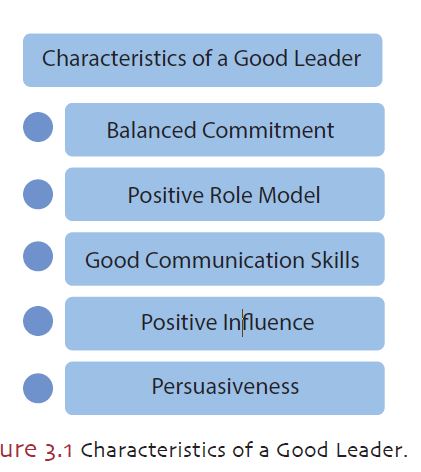
Which of the below is NOT one of the characteristics of good leaders?
Seçenekler
A
Balanced Commitment
B
Positive Role Model
C
Good Communication Skills
D
Persuasiveness
E
Forbidding
Açıklama:
Soru 6
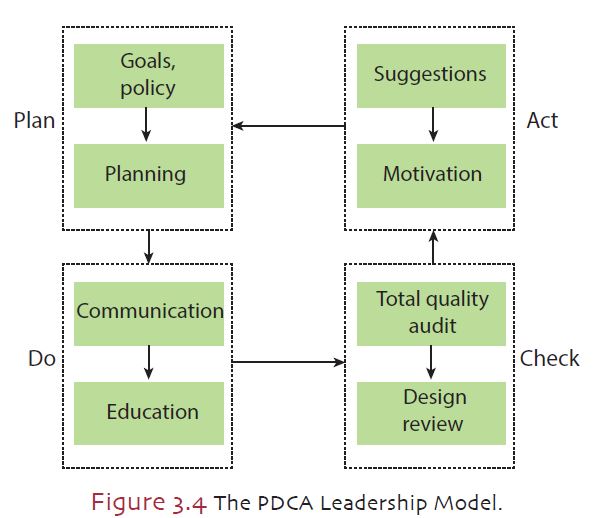
Which of the following terms belongs to the 'Act' section in the PDCA Leadership Model?
Seçenekler
A
Goals
B
Planning
C
Communication
D
Motivation
E
Design review
Açıklama:
Soru 7
The development of the plan for quality improvements calls for an understanding of the current situation; therefore, which phase does the PDCA leadership model cycle start with?
Seçenekler
A
Check
B
Act
C
Plan
D
Do
E
Process
Açıklama:
PDCA leadership model cycle starts with the “Check” phase because the development of the plan for quality improvements calls for an understanding of the current situation. In other words, this phase tries to answer the question “Where are we now?”.
Soru 8
According to one definition, what is the sum total of the intellectual, constitutional and creative values produced by a firm’s people, as well as its knowledge and skills, behavior patterns, customs, and value judgements, procedures and departments which, in their structural inter-association and organization, represent the work content of its people in a certain period of time or era?
Seçenekler
A
Leadership
B
Personnel with vision
C
Organizational culture
D
Values of quality
E
Participation
Açıklama:
According to one definition, organizational culture is the sum total of the intellectual, constitutional and creative values produced by a firm’s people, as well as its knowledge and skills, behavior patterns, customs, and value judgements, procedures and departments which, in their structural inter-association and organization, represent the work content of its people in a certain period of time or era. Another definition suggests that organizational culture is the amalgam of shared values, behavior patterns, mores, symbols, attitudes and normative ways of conducting business that, more than its products or services, differentiate it from other companies
Soru 9
Which of the below is NOT one of the elements that organizational culture is formed by?
Seçenekler
A
Behaviors based on people interactions.
B
Norms resulting from working groups.
C
Dominant values adopted by the country.
D
Rules of the game for ‘getting on’.
E
The climate.
Açıklama:
According to Oakland (2004, p.47), organizational culture is formed by a number of elements:
• Behaviors based on people interactions.
• Norms resulting from working groups.
• Dominant values adopted by the organization.
• Rules of the game for ‘getting on’.
• The climate.
• Behaviors based on people interactions.
• Norms resulting from working groups.
• Dominant values adopted by the organization.
• Rules of the game for ‘getting on’.
• The climate.
Soru 10
Failure to establish and assess a solid quality culture might create serious problems for the organizations. Which of the following is NOT one of the most common root causes of these problems?
Seçenekler
A
Internal managers and workers have no connection with the customers
B
Companies do not promote an empowered culture with customer focus
C
Companies do not use enough common sense and process mapping
D
Quality improvement begins by reducing cost, but ultimately offers more by improving value.
E
Companies do not give enough bonuses to boost performance.
Açıklama:
Failure to establish and assess a solid quality culture might create serious problems for the organizations. Furthermore, it could be argued that such failures happen quite often and the majority of these problems occur for just a few basic reasons related to organizational culture and corporate quality programs. The most common root causes of these problems are given below:
• Internal managers and workers have no connection with the customers
• Companies do not promote an empowered culture with customer focus
• Companies do not use enough common sense and process mapping
• Quality improvement begins by reducing cost, but ultimately offers more by improving value.
• Internal managers and workers have no connection with the customers
• Companies do not promote an empowered culture with customer focus
• Companies do not use enough common sense and process mapping
• Quality improvement begins by reducing cost, but ultimately offers more by improving value.
Soru 11
Which information is not true for Autocratic Management?
Seçenekler
A
Managers are mainly concerned with increasing workplace efficiency.
B
Autocratic managers typically make decisions without obtaining input from their subordinates.
C
Almost all quality approaches and practices rely heavily on employee participation at all levels.
D
Autocratic management style mainly relies on the positional power created by the managerial role.
E
Autocratic managers pay little attention to people within the organization.
Açıklama:
Autocratic management refers to an approach whereby managers are mainly concerned with increasing workplace efficiency and pay little attention to people within the organization. Autocratic managers typically make decisions without obtaining input from their subordinates. Autocratic management style mainly relies on the positional power created by the managerial role.
Participative management is a different approach compared to autocratic management because, unlike autocratic managers, participative managers are primarily concerned with people but might strive to balance this concern with the business concerns of the organization. Participative managers encourage their subordinates to participate in the decision-making process. In quality management, participative management plays an integral role since almost all quality approaches and practices rely heavily on employee participation at all levels.
Participative management is a different approach compared to autocratic management because, unlike autocratic managers, participative managers are primarily concerned with people but might strive to balance this concern with the business concerns of the organization. Participative managers encourage their subordinates to participate in the decision-making process. In quality management, participative management plays an integral role since almost all quality approaches and practices rely heavily on employee participation at all levels.
Soru 12
Which are the leadership techniques used by the leaders to inspire their followers (Goetsch and Davis, 2014, p.133)? I. aligning personnel with the vision II. empowerment III. provide a sense of direction IV. training and mentoring
Seçenekler
A
I and II
B
I, II and IV
C
II, III and IV
D
III and IV
E
I, II, III and IV
Açıklama:
Leaders inspire their followers to commit to the goals, vision, and mission of the organization. Following are the leadership techniques used by the leaders to inspire their followers (Goetsch and Davis, 2014, p.133):
Aligning personnel with the vision: Simply conveying the vision to the personnel is not sufficient. True leaders help their followers to see why the vision is commendable and worthy of their commitment.
Provide a sense of direction: Leaders make sure that their followers know where the organization is trying to go and what the organization is trying to achieve. This is possible only through a solid understanding of the vision and mission of the organization.
Effective and frequent communication: Leaders keep their followers up-to-date and well-informed.
Because, only by doing so, leaders can make sure that their personnel have the information required to achieve top performance.
Empowerment: Leaders empower their personnel to do the jobs they were hired to do by (1) identifying the parameters within which they may make unilateral decisions, (2) involving them in the decisionmaking process, (3) encouraging them to think critically and creatively to find ways to continually improve
quality, cost, and service, (4) encouraging them to take the initiative to solve problems, and (5) treating mistakes as learning opportunities.
Training and mentoring: Leaders devote themselves to the development of their personnel through solid mentoring and training. Problems are seen as learning opportunities and weaknesses are seen as a target for improvement.
Aligning personnel with the vision: Simply conveying the vision to the personnel is not sufficient. True leaders help their followers to see why the vision is commendable and worthy of their commitment.
Provide a sense of direction: Leaders make sure that their followers know where the organization is trying to go and what the organization is trying to achieve. This is possible only through a solid understanding of the vision and mission of the organization.
Effective and frequent communication: Leaders keep their followers up-to-date and well-informed.
Because, only by doing so, leaders can make sure that their personnel have the information required to achieve top performance.
Empowerment: Leaders empower their personnel to do the jobs they were hired to do by (1) identifying the parameters within which they may make unilateral decisions, (2) involving them in the decisionmaking process, (3) encouraging them to think critically and creatively to find ways to continually improve
quality, cost, and service, (4) encouraging them to take the initiative to solve problems, and (5) treating mistakes as learning opportunities.
Training and mentoring: Leaders devote themselves to the development of their personnel through solid mentoring and training. Problems are seen as learning opportunities and weaknesses are seen as a target for improvement.
Soru 13
Which information is not true for PDCA leadership model cycle?
Seçenekler
A
It starts with the “Check” phase.
B
Check phase consists of two elements: Design review and total quality audit.
C
The last phase is the “Do” phase.
D
“Act” phase consists of two elements: Suggestions and motivation.
E
“Do” phase consists of two elements: plan and act.
Açıklama:
-PDCA leadership model cycle starts with the “Check” phase because the development of the plan for quality improvements calls for an understanding of the current situation. In other words, this phase tries to answer the question “Where are we now?”.Check phase of the PDCA leadership model consists of two elements: Design review and total quality audit.
-The second phase of the PDCA leadership model cycle is the “Act” phase and it consists of two elements: Suggestions and motivation.
- “Plan” is the third phase in the PDCA leadership model and it consists of two elements: Defining the quality goals and policies, and design of the quality plans. The goals and policies must be determined clearly and openly since they act as a picture showing where the organization wants to be in the future.
-Finally, the last phase of the PDCA leadership model is the “Do” phase
that consists of two elements: communication and education.
-The second phase of the PDCA leadership model cycle is the “Act” phase and it consists of two elements: Suggestions and motivation.
- “Plan” is the third phase in the PDCA leadership model and it consists of two elements: Defining the quality goals and policies, and design of the quality plans. The goals and policies must be determined clearly and openly since they act as a picture showing where the organization wants to be in the future.
-Finally, the last phase of the PDCA leadership model is the “Do” phase
that consists of two elements: communication and education.
Soru 14
According to Oakland (2004, p.47), organizational culture is formed by a number of elements. Which ones are these elements? I. Behaviors based on people interactions. II. Norms resulting from working groups. III. Dominant values adopted by the organization. IV. Rules of the game for ‘getting on’. V. The climate.
Seçenekler
A
II, IV and V
B
I, II, III and IV
C
I, II and V
D
II, III, IV and V
E
I, II, III, IV and V
Açıklama:
According to Oakland (2004, p.47), organizational culture is formed by a number of elements:
• Behaviors based on people interactions.
• Norms resulting from working groups.
• Dominant values adopted by theorganization.
• Rules of the game for ‘getting on’.
• The climate.
• Behaviors based on people interactions.
• Norms resulting from working groups.
• Dominant values adopted by theorganization.
• Rules of the game for ‘getting on’.
• The climate.
Soru 15
Concepts of leadership and teamwork require consideration of a few questions that are fundamental to the management style and philosophy (Armstrong,1994, p.19). Which option includes all of those questions? I. How do you communicate with your staff? II. How do you obtain their commitment and motivation? III. How good is your teamwork? IV. Do you need to change your management style? V. Could you benefit from multilevel problem solving/task teams?
Seçenekler
A
II, III and IV
B
I, II,III and V
C
II, III, IV and V
D
I, II, III and IV
E
I, II, III, IV and V
Açıklama:
Concepts of leadership and teamwork require consideration of a few questions that are fundamental to the management style and philosophy (Armstrong, 1994, p.19)
• How do you communicate with your staff?
• How do you obtain their commitment and motivation?
• How good is your teamwork?
• Do you need to change your management style?
• Could you benefit from multilevel problemsolving/task teams?
Careful consideration of the questions given above allows an organization to effectively align its quality-related activities with its leadership style and managerial philosophy.
• How do you communicate with your staff?
• How do you obtain their commitment and motivation?
• How good is your teamwork?
• Do you need to change your management style?
• Could you benefit from multilevel problemsolving/task teams?
Careful consideration of the questions given above allows an organization to effectively align its quality-related activities with its leadership style and managerial philosophy.
Soru 16
............. refers to the exchanges that occur between supervisor and subordinate on a daily basis. Which management style is mentioned above?
Seçenekler
A
Autocratic management
B
Transactional leadership
C
Charismatic leadership
D
Management by fact
E
Coaching
Açıklama:
Managerial philosophy is closely linked with different management styles.
Among these styles, autocratic management, participative management, charismatic leadership, transactional and transformational leadership, management by fact, and coaching are the most commonly referred approaches.
-Transactional leadership refers to the exchanges that occur between supervisor and subordinate on a daily basis.
Among these styles, autocratic management, participative management, charismatic leadership, transactional and transformational leadership, management by fact, and coaching are the most commonly referred approaches.
-Transactional leadership refers to the exchanges that occur between supervisor and subordinate on a daily basis.
Soru 17
............ is an integral contribution to quality management since this approach suggests that managerial decisions should be based on data.
Which management style is mentioned above?
Which management style is mentioned above?
Seçenekler
A
Management by fact
B
Coaching
C
Charismatic leadership
D
Transformational leadership
E
Participative management
Açıklama:
Management by fact is an integral contribution to quality management since this approach suggests that managerial decisions should be based on data.
Soru 18
Which one is not one of the principles of leadership for quality?
Seçenekler
A
Embody the values of quality
B
Create unity of purpose
C
Focus on the product
D
Motivation of individuals
E
Control and participation
Açıklama:
THE PRINCIPLES OF LEADERSHIP FOR QUALITY
Leadership for quality means leadership from the perspective of quality management. Leadership for quality is mainly based on the philosophy of continually improving people, processes, and products/ services. There are several principles of leadership for quality. These principles are as follows:
• Embody the values of quality:
• Create unity of purpose:
• Focus on the process, not the outcome:
• Motivation of individuals:
• Control and participation:
Leadership for quality means leadership from the perspective of quality management. Leadership for quality is mainly based on the philosophy of continually improving people, processes, and products/ services. There are several principles of leadership for quality. These principles are as follows:
• Embody the values of quality:
• Create unity of purpose:
• Focus on the process, not the outcome:
• Motivation of individuals:
• Control and participation:
Soru 19
Which information is true for internal and external customers? I. External customers mainly refer to the employees working for the organization whose work depends on the work of other employees. II. External customers purchase or use an organization’s products or services. III. Both require close attention.
Seçenekler
A
Only I
B
Only II
C
Only III
D
I and II
E
II and III
Açıklama:
Customers refer to both internal and external customers. Both require close attention. Internal customers mainly refer to the employees working for the organization whose work depends on the work of other employees.External customers are those who purchase or use an organization’s products or services.
Soru 20
It is the last phase of the PDCA leadership model, and consists of two elements: communication and education. Which phase is mentioned above?
Seçenekler
A
“Check” phase
B
"Do" phase
C
"Act" phase
D
"Plan" phase
E
"Suggestion" phase
Açıklama:
The last phase of the PDCA leadership model is the “Do” phase that consists of two elements: communication and education. The final quality plan should be communicated to everyone concerned in the organization and the required education must be provided (Dahlgaard et al., 2002, p.211).
Soru 21
Which of the following management styles pays little attention to the people within the organization?
Seçenekler
A
Autocratic management
B
Participative management
C
Charismatic management
D
Coaching
E
Management by fact
Açıklama:
The correct choice is A.
Soru 22
In which management style, do the subordinates have a say in the decision-making process?
Seçenekler
A
Charismatic management
B
Transactional leadership
C
Coaching
D
Participative management
E
Autocratic management
Açıklama:
The correct choice is D.
Soru 23
In QM, which of the following s the ability to inspire people to make a total, willing, and voluntary commitment to the achievement of organizational goals?
Seçenekler
A
inspiration
B
motivation
C
leadership
D
vision
E
management
Açıklama:
The correct choice is C.
Soru 24
Which of the following is NOT a technique used by leaders to inspire their followers?
Seçenekler
A
Aligning personnel with the vision
B
Effective communication
C
Empowerment
D
Providing a sense of humor
E
Training and mentoring
Açıklama:
Providing a sense of direction is one of the techniques.
The correct choice is D.
The correct choice is D.
Soru 25
Which of the following is NOT one of the principles of leadership for quality?
Seçenekler
A
Creating unity of purpose
B
Control and participation
C
Embodying the values of quality
D
Focusing on the products/services
E
Motivation of individuals
Açıklama:
Focusing on the process, not the outcome is oen of the principles of leadership for quality.
The correct choice is D.
The correct choice is D.
Soru 26
Which of the following is NOT an element of the phases in the PDCA leadership model?
Seçenekler
A
Communication
B
Design review
C
Goals
D
Promotion
E
Suggestions
Açıklama:
The correct choice is D.
Soru 27
Which of the following shows the correct order of the phases in the PDCA leadership model?
Seçenekler
A
Plan-Do-Check-Act
B
Plan-Act-Do-Check
C
Check-Act-Plan-Do
D
Check-Plan-Do-Act
E
Act-Check-Plan-Do
Açıklama:
The correct choice is C.
Soru 28
Which of the following gives the two elements of the 'Act' phase in the PDCA model?
Seçenekler
A
Communication-Education
B
Education-Motivation
C
Motivation-Suggestions
D
Suggestions-Design Review
E
Design Review- Planning
Açıklama:
The correct choice is C.
Soru 29
Which of the following is "the sum total of shared values and beliefs, knowledge and skills that help individuals understand how the organization functions"?
Seçenekler
A
The PDCA leadership model
B
Organizational culture
C
TQM leadership
D
Quality culture
E
TQM principles
Açıklama:
The correct choice is B.
Soru 30
Which of the following is NOT one of the five factors for developing quality culture?
Seçenekler
A
Evidence of top management commitment
B
Providing goals and measurement
C
Participation for inspiring action
D
Reward and punishment
E
Self-development and empowerment
Açıklama:
Recognition and reward is one of the five factors, not reward and punishment.
The correct choice is D.
The correct choice is D.
Soru 31
Which of the following completes the sentence below?
__________are mainly concerned with increasing workplace efficiency and make decisions without obtaining ideas from their subordinates.
__________are mainly concerned with increasing workplace efficiency and make decisions without obtaining ideas from their subordinates.
Seçenekler
A
Participative managers
B
Trancastional leaders
C
Autocratic managers
D
Coaches
E
Charismatic managers
Açıklama:
Autocratic managers are mainly concerned with increasing workplace efficiency and make decisions without obtaining ideas from their subordinates.54
Soru 32
Which of the following is not one of the leadership techniques?
Seçenekler
A
Aligning personnel with the vision
B
Provide a sense of direction
C
Empowerment
D
Training and mentoring
E
Being reserved towards the team
Açıklama:
Following are the leadership techniques used by the leaders to inspire their followers:
Aligning personnel with the vision: Simply conveying the vision to the personnel is not sufficient. True leaders help their followers to see why the vision is commendable and worthy of their commitment.
Provide a sense of direction: Leaders make sure that their followers know where the organization is trying to go and what the organization is trying to achieve. This is possible only through a solid understanding of the vision and mission of the organization.
Effective and frequent communication: Leaders keep their followers up-to-date and well-informed. Because, only by doing so, leaders can make sure that their personnel have the information required to achieve top performance.
Empowerment: Leaders empower their personnel to do the jobs they were hired to do by (1) identifying the parameters within which they may make unilateral decisions, (2) involving them in the decision-making process, (3) encouraging them to think critically and creatively to find ways to continually improve quality, cost, and service, (4) encouraging them to take the initiative to solve problems, and (5) treating mistakes as learning opportunities.
Training and mentoring: Leaders devote themselves to the development of their personnel through solid mentoring and training. Problems are seen as learning opportunities and weaknesses are seen as a target for improvement.
Aligning personnel with the vision: Simply conveying the vision to the personnel is not sufficient. True leaders help their followers to see why the vision is commendable and worthy of their commitment.
Provide a sense of direction: Leaders make sure that their followers know where the organization is trying to go and what the organization is trying to achieve. This is possible only through a solid understanding of the vision and mission of the organization.
Effective and frequent communication: Leaders keep their followers up-to-date and well-informed. Because, only by doing so, leaders can make sure that their personnel have the information required to achieve top performance.
Empowerment: Leaders empower their personnel to do the jobs they were hired to do by (1) identifying the parameters within which they may make unilateral decisions, (2) involving them in the decision-making process, (3) encouraging them to think critically and creatively to find ways to continually improve quality, cost, and service, (4) encouraging them to take the initiative to solve problems, and (5) treating mistakes as learning opportunities.
Training and mentoring: Leaders devote themselves to the development of their personnel through solid mentoring and training. Problems are seen as learning opportunities and weaknesses are seen as a target for improvement.
Soru 33
Who is at the top of the pyramid in coaching?
Seçenekler
A
CEO
B
Operators
C
Supervisors
D
Management
E
Senior management
Açıklama:
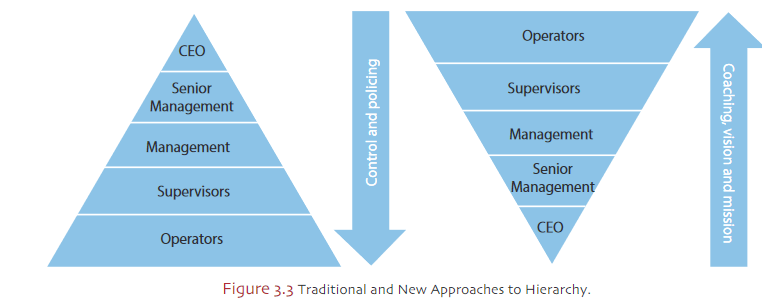
Soru 34
Which of the following is in the Plan phase of the PDCA Leadership Model?
Seçenekler
A
Goals and policy
B
Total Quality Audit
C
Education
D
Motivation
E
Communication
Açıklama:
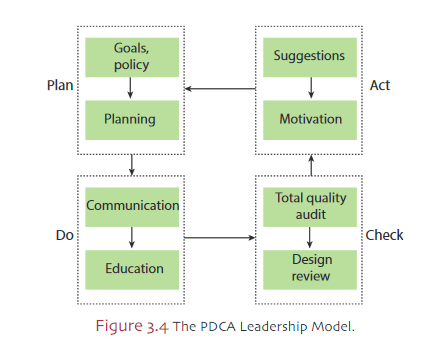
Soru 35
Which of the following is in the Do phase of the PDCA Leadership Model?
Seçenekler
A
Suggestions
B
Education
C
Goals
D
Design review
E
Motivation
Açıklama:
Soru 36
Which of the following is not one of TQM Principles?
Seçenekler
A
Isolation
B
Teamwork
C
Prevention
D
Leadership
E
Measurement
Açıklama:
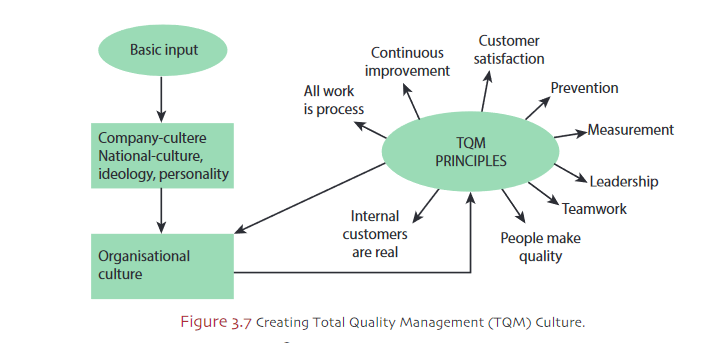
Soru 37
Which of the following is not one of the success factors for developing a quality culture?
Seçenekler
A
Providing goals and measurement
B
Evidence of top management commitment
C
Keeping pressure for good production
D
Self-development and empowerment
E
Participation for inspiring action
Açıklama:
There are five critical success factors for developing a quality culture;
Providing goals and measurement
Evidence of top management commitment
Self-development and empowerment
Participation for inspiring action
Recognition and reward
Providing goals and measurement
Evidence of top management commitment
Self-development and empowerment
Participation for inspiring action
Recognition and reward
Soru 38
Which of the following best completes the sentence below?
_____________can be defined as the sum total of shared values and beliefs, knowledge and skills that help individuals understand how the organization functions.
_____________can be defined as the sum total of shared values and beliefs, knowledge and skills that help individuals understand how the organization functions.
Seçenekler
A
Success in business
B
Leadership
C
Organisation
D
Management
E
Organisational culture
Açıklama:
Organisational culture can be defined as the sum total of shared values and beliefs, knowledge and skills that help individuals understand how the organization functions.
Soru 39
Who is at the top of the pyramid in control and policing?
Seçenekler
A
Senior management
B
CEO
C
Management
D
Supervisors
E
Operators
Açıklama:
Soru 40
Which of the following best completes the sentence below?
__________refers to the exchanges that occur between supervisor and subordinate on a daily basis.
__________refers to the exchanges that occur between supervisor and subordinate on a daily basis.
Seçenekler
A
Charismatic leadership
B
Participative management
C
Transactional leadership
D
Transformational leadership
E
Autoctratic management
Açıklama:
Transactional leadership refers to the exchanges that occur between supervisor and subordinate on a daily basis.
Soru 41
Imagine a leader who values awareness of the followers for being up-to-date plus well informed about the goals, vision, and mission of the organization, so that they can achive top performance. Which is the best technique for the leader to do so?
Seçenekler
A
Aligning personnel with the vision
B
Provide a sense of direction
C
Effective and frequent communication
D
Empowerment
E
Training and mentoring
Açıklama:
In the effective and frequent communicationtechnique, leaders keep their followers up-to-date and well-informed. Because, only by doing so, leaders can make sure that their personnel have the information required to achieve top performance.
The leader described in the question should use "effective and frequent communication" technique to keep the followers up-to-date.
The leader described in the question should use "effective and frequent communication" technique to keep the followers up-to-date.
Soru 42
In a cosmetic company, a personnel made a calculation error in a report. Luckily, the leader realized the error and asked him to correct the mistake. Also he wanted that personnel to realize why exactly he/she did such an error and to establish a crosscheck system which will avoid such errors for the next reports. Which method is the one the leader used to inspire?
Seçenekler
A
Aligning personnel with the vision
B
Provide a sense of direction
C
Effective and frequent communication
D
Empowerment
E
Training and mentoring
Açıklama:
Leaders empower their personnel to do the jobs they were hired to do by (1) identifying the parameters within which they may make unilateral decisions, (2) involving them in the decisionmaking process, (3) encouraging them to think critically and creatively to find ways to continually improve quality, cost, and service, (4) encouraging them to take the initiative to solve problems, and (5) treating mistakes as learning opportunities.
The method used in the question is the empowerment technique.
The method used in the question is the empowerment technique.
Soru 43
A leader asks the personnel to attend a workshop for marketing to figure out and design the best way to convince a particular customer on choosing their company that has been doubtful for so long and needed to be convinced. In this case which technique was used by the leader for inspring the personnel?
Seçenekler
A
Aligning personnel with the vision
B
Provide a sense of direction
C
Effective and frequent communication
D
Empowerment
E
Training and mentoring
Açıklama:
In the taining and mentoring method, leaders devote themselves to the development of their personnel through solid mentoring and training. Problems are seen as learning opportunities, as it was considered so in the question and weaknesses are seen as a target for improvement.
Training and mentoring method was the one used by the leader in the case.
Training and mentoring method was the one used by the leader in the case.
Soru 44
Which method of inspiration is used when a rectorate of a university sends an email describing the vision and the mission of the university to all the academic staff?
Seçenekler
A
Aligning personnel with the vision
B
Provide a sense of direction
C
Effective and frequent communication
D
Empowerment
E
Training and mentoring
Açıklama:
In the "provide a sense of direction" method, leaders make sure that their followers know where the organization is trying to go and what the organization is trying to achieve. This is possible only through a solid understanding of the vision and mission of the organization.
Rectorate is using the method "Provide a sense of direction".
Rectorate is using the method "Provide a sense of direction".
Soru 45
One of the project team members in an engineering company did not follow the conventional bureaucratic order to fulfil a duty and the manager organised a meeting for an open debate among the personnel to discuss that behaviour. Which of the following principle of leadership for quality is used in the mentioned case?
Seçenekler
A
Learning, education, and training
B
Control and participation
C
Motivation of individuals
D
Focus on the process, not the outcome
E
Create unity of purpose
Açıklama:
In the learning, education, and training principle of the leadership for quality, leaders are needed to foster open debate and sense-making as opposed to blame and reward.
The principle the manager in the case applied is "Learning, education and training".
The principle the manager in the case applied is "Learning, education and training".
Soru 46
In the event of a rectorate asking for feedback from academic staff about the most recent version of the mission and vision of the university, which principle of leadership for quality is carried out?
Seçenekler
A
Motivation of individuals
B
Focus on the process, not the outcome
C
Embody the values of quality
D
Create unity of purpose
E
Learning, education, and training
Açıklama:
In the case of "create unity of purpose" principle, one of the most important roles of leaders is considered to be generating and conveying the vision and mission in a clear, accurate, and compelling manner. It is important that the vast majority of the employees need to believe in and commit to the attainment of the vision.
The case mentioned in the question reflects "create unity of purpose" principle.
The case mentioned in the question reflects "create unity of purpose" principle.
Soru 47
Which of the following elements belongs to the first phase of PDCA leadership model?
Seçenekler
A
Goals, policy
B
Communication
C
Planning
D
Design review
E
Motivation
Açıklama:
PDCA leadership model cycle starts with the “Check” phase because the development of the plan for quality improvements calls for an understanding of the current situation. Check phase of the PDCA leadership model consists of two elements: Design review and total quality audit.
Design review is one of the elements of the first phase of PDCA, in other words "Check".
Design review is one of the elements of the first phase of PDCA, in other words "Check".
Soru 48
When the quality plan is communicated to everyone concerned in the organization, which phase of the PDCA leadership model is being implemented?
Seçenekler
A
Check
B
Plan
C
Do
D
Act
E
Confirm
Açıklama:
The last phase of the PDCA leadership model is the “Do” phase that consists of two elements: communication and education. The final quality plan should be communicated to everyone concerned in the organization and the required education must be provided.
The phase mentioned in the question is the last phase of the model, "Do".
The phase mentioned in the question is the last phase of the model, "Do".
Soru 49
Employees set their own goals in a particular project and monitor their own results by themselves. In the present case, which critical success factor for developing a quality culture is being fulfilled?
Seçenekler
A
Evidence of top management commitment
B
Self-development and empowerment
C
Providing goals and measurement
D
Participation for inspiring action
E
Recognition and reward
Açıklama:
Self development refers to the self-management by the employees. Employees must learn to set their own goals, provide their own reinforcements, and monitor their own results over time. They also need to play an active role in the decision-making processes.
"Self-development and empowerment" is the success factor mentioned in the question.
"Self-development and empowerment" is the success factor mentioned in the question.
Soru 50
In an insurance company, an employee is getting a promotion due to the superior performance on improving the quality of the counseling service (s)he provides. In the mentioned case, which critical success factor for developing a quality culture is being carried out?
Seçenekler
A
Providing goals and measurement
B
Evidence of top management commitment
C
Self-development and empowerment
D
Participation for inspiring action
E
Recognition and reward
Açıklama:
Rewards refer to some benefits such as salary increases, bonuses, and promotions due to an individual’s superior performance on improving the quality aspects of her or his job. Recognition is a sort of public acknowledgement for superior performance on quality practices.
The implied critical success factor for developing a quality culture is "Recognition and reward".
The implied critical success factor for developing a quality culture is "Recognition and reward".
Soru 51
Which of the following refers to an approach whereby managers are mainly concerned with increasing workplace efficiency and pay little attention to people within the organization?
Seçenekler
A
Single management
B
Effective management
C
Autocratic management
D
Participative management
E
Hierarchial management
Açıklama:
Autocratic management refers to an approach whereby managers are mainly concerned with increasing workplace efficiency and pay little attention to people within the organization. Autocratic managers typically make decisions without obtaining input from their subordinates. Autocratic management style mainly relies on the positional power created by the managerial role.The correct answer is C.
Soru 52
"Leaders keep their followers up-to-date and well-informed. Because, only by doing so, leaders can make sure that their personnel have the information required to achieve top performance." Which of the following leadership techniques is described above?
Seçenekler
A
Aligning personnel with the vision
B
Provide a sense of direction
C
Effective and frequent communication
D
Empowerment
E
Training and mentoring
Açıklama:
Effective and frequent communication: Leaders keep their followers up-to-date and well-informed. Because, only by doing so, leaders can make sure that their personnel have the information required to achieve top performance. The correct answer is C.
Soru 53
"One of the most important roles of leaders is to generate and convey the vision and mission in a clear, accurate, and compelling manner. It is important that the vast majority of the employees need to believe in and commit to the attainment of the vision. "
Which of the following principles of leadership for quality is described above?
Which of the following principles of leadership for quality is described above?
Seçenekler
A
Embody the values of quality
B
Create unity of purpose
C
Focus on the process, not the outcome
D
Motivation of individuals
E
Control and participation
Açıklama:
Create unity of purpose: One of the most important roles of leaders is to generate and convey the vision and mission in a clear, accurate, and compelling manner. It is important that the vast majority of the employees need to believe in and commit to the attainment of the vision. The correct answer is B.
Soru 54
Which of the following is an element of "Do" phase in the PDCA Leadership Model?
Seçenekler
A
Goals
B
Policy
C
Planning
D
Motivation
E
Communication
Açıklama:
The phases and the elements of these phases of the PDCA Leadership Model is given below. The correct answer is E.
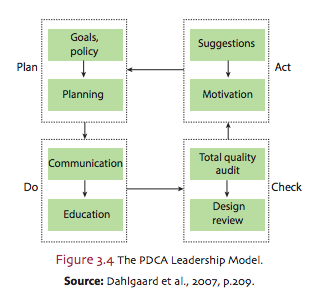
Soru 55
Which of the following are the elements of "Check" phase of the PDCA Leadership Model?
Seçenekler
A
Goals, policy & Planning
B
Communication & Education
C
Suggestions & Motivation
D
Total quality audit & Design review
E
Planning & Design Review
Açıklama:
For the check phase of PDCA leadership model, the two elements are Total quality audit & Design review. The correct answer is D.
Soru 56
Which of the following terms can be defined as the sum total of shared values and beliefs, knowledge and skills that help individuals understand how the organization functions?
Seçenekler
A
Organizational Culture
B
TQM Process
C
PDCA Leadership Model
D
Vision Framework for an Organization
E
TQM Culture
Açıklama:
Organizational culture can be defined as the sum total of shared values and beliefs, knowledge and skills that help individuals understand how the organization functions.The correct answer is A.
Soru 57
Which of the following is not an element of organizational culture?
Seçenekler
A
Climate
B
Hierarchy
C
Norms resulting from working groups.
D
Dominant values adopted by the organization.
E
Rules of the game for ‘getting on’
Açıklama:
According to Oakland (2004, p.47), organizational culture is formed by a number of elements: • Behaviors based on people interactions. • Norms resulting from working groups. • Dominant values adopted by the organization. • Rules of the game for ‘getting on’. • The climate. The correct answer B.
Soru 58
I. They are strict controllers.
II. They help subordinates make good decisions.
III. They support subordinates in taking the actions.
Which of the characteristics above belong to participative leaders?
II. They help subordinates make good decisions.
III. They support subordinates in taking the actions.
Which of the characteristics above belong to participative leaders?
Seçenekler
A
Only I
B
I and II
C
I and III
D
II and III
E
I, II and III
Açıklama:
Participative leaders see themselves not as strict controllers and policers of behaviors and decisions, but as coaches with respect to helping subordinates make good decisions, and supporting them in taking the actions they deem necessary.The correct answer is D.
Soru 59
Which of the following elements belongs to the "Act" phase of the PDCA Leadership Model?
Seçenekler
A
Suggestions
B
Goals
C
Policy
D
Design review
E
Communication
Açıklama:
According to the figure below, the correct answer is A.
Soru 60
Which of the following is false regarding the principles of leadership for quality?
Seçenekler
A
Leaders must embody the principles of quality in all of their actions.
B
The vast majority of the employees do not need to believe in and commit to the attainment of the vision.
C
The role that individuals play in quality processes is very crucial.
D
A good leader always looks to understand the system that generates results and to drive improvement in the system.
E
The leader must be devoted to the principles of quality and (s) he must focus on customers and stress their importance at every opportunity.
Açıklama:
One of the most important roles of leaders is to generate and convey the vision and mission in a clear, accurate, and compelling manner. It is important that the vast majority of the employees need to believe in and commit to the attainment of the vision. The correct answer is B.
Ünite 4
Soru 1
In which of the following job analysis steps assembler’s job is analysed?
Seçenekler
A
Decide how to gather information
B
Review relevant background information about the job.
C
Select representative positions
D
Actually analyze the job
E
Verify the job analysis information with the worker performing the job and with his or her immediate supervisor.
Açıklama:
JOB ANALYSIS
tep 3: Select representative positions: The supervisor generally selects a sample of positions to center. For example, to analyze an assembler’s job, it is usually unnecessary to examine the jobs of all the firm’s assembly workers; instead, a sample of 10 jobs will do.
tep 3: Select representative positions: The supervisor generally selects a sample of positions to center. For example, to analyze an assembler’s job, it is usually unnecessary to examine the jobs of all the firm’s assembly workers; instead, a sample of 10 jobs will do.
Soru 2
Which of the followings is a document that provides information about the essential tasks, duties, responsibilities, types of equipment or tools used, and working conditions of the job?
Seçenekler
A
Job Analysis
B
Job Description
C
Job Design
D
Job Training
E
Job Performance Management
Açıklama:
The job description is a document that provides information about the essential tasks, duties, responsibilities, types of equipment or tools used, and working conditions of the job. Information obtained through job analysis is crucial to the development of job descriptions.
Soru 3
Which of the followings refers to creating balanced jobs in the context of organizational, environmental, technical, and resource demands.
Seçenekler
A
Compensation
B
Empowerment
C
Job Design
D
Selection
E
Performance Management
Açıklama:
JOB ANALYSIS
The job design refers to creating balanced jobs in the context of organizational, environmental, technical, and resource demands.
The job design refers to creating balanced jobs in the context of organizational, environmental, technical, and resource demands.
Soru 4
Which of the followings is the process of generating a pool of qualified applicants for organizational jobs?
Seçenekler
A
Job Analysis
B
Empowerment
C
Selection
D
Recruitment
E
Development
Açıklama:
RECRUITMENT AND SELECTION
Recruitment is the process of generating a pool of qualified applicants for organizational jobs
Recruitment is the process of generating a pool of qualified applicants for organizational jobs
Soru 5
Which of the following sources of external candidates charges employers for providing referrals?
Seçenekler
A
Direct applicants and referrals
B
Online recruitment
C
Advertisements in newspapers and magazines
D
Public employment agencies
E
Private employment agencies
Açıklama:
External Recruitment
Private employment agencies charge employers for providing referrals.
Private employment agencies charge employers for providing referrals.
Soru 6
Which of the following types of training provides foundation skills that new employees may lack?
Seçenekler
A
Legally required training
B
Basic and remedial skills training
C
Job and technical training
D
Soft skills training
E
Organizational training
Açıklama:
TRAINING AND DEVELOPMENT
Basic and remedial skills training provides foundation skills that new employees may lack (e.g., MS Excel, foreign language proficiency, and core mathematics).
Basic and remedial skills training provides foundation skills that new employees may lack (e.g., MS Excel, foreign language proficiency, and core mathematics).
Soru 7
Which of the followings refers to performing employees’ jobs while interacting every day with their colleagues?
Seçenekler
A
Lifelong learning
B
Job aid
C
Team training
D
Informal learning
E
Behavior modeling
Açıklama:
Training
Informal learning refers to performing employees’ jobs while interacting every day with their colleagues.
Informal learning refers to performing employees’ jobs while interacting every day with their colleagues.
Soru 8
Which of the following organizational techniques contains keeping a record of uncommonly good or undesirable examples of an employee’s work-related behavior and reviewing it with the employee at predetermined times?
Seçenekler
A
Graphic rating scale
B
Alternation ranking method
C
Paired comparison method
D
Forced distribution method
E
Critical incident method
Açıklama:
Performance Management
Critical incident method contains keeping a record of uncommonly good or undesirable examples of an employee’s work-related behavior and reviewing it with the employee at predetermined times.
Critical incident method contains keeping a record of uncommonly good or undesirable examples of an employee’s work-related behavior and reviewing it with the employee at predetermined times.
Soru 9
In which of the methods of performance-based pay the employee’s performance is assessed subjectively by herself and by her supervisor according to agreed criteria?
Seçenekler
A
Output incentive schemes
B
Merit rating
C
Gain sharing
D
Profit sharing
E
Stock ownership scheme
Açıklama:
Compensation
In merit rating, the employee’s performance is assessed subjectively by herself and by her supervisor according to agreed criteria. The payment is usually a deferred bonus or increase in wage level.
In merit rating, the employee’s performance is assessed subjectively by herself and by her supervisor according to agreed criteria. The payment is usually a deferred bonus or increase in wage level.
Soru 10
Which of the followings is the work team composed of individuals from various specialties?
Seçenekler
A
The independent team
B
The Problem-solving team
C
The self-managed work team
D
The cross-functional team
E
The virtual team
Açıklama:
WORK TEAMS
The cross-functional team is the work team composed of individuals from various specialties.
The cross-functional team is the work team composed of individuals from various specialties.
Soru 11
What is the second step in doing a job analysis of a job?
Seçenekler
A
Decide how to gather information
B
Select representative positions
C
Review relevant background information about the job
D
Actually analyze the job
E
Verify the job analysis information with the worker performing the job and with his or her immediate supervisor
Açıklama:
There are six steps in doing a job analysis of a job, as follows (Dessler, 2017: 98-100):
Step 1: Decide how to gather information.
Step 2: Review relevant background information about the job.
Step 3: Select representative positions
Step 4: Actually analyze the job
Step 5: Verify the job analysis information with the worker performing the job and with his or her immediate supervisor.
Step 1: Decide how to gather information.
Step 2: Review relevant background information about the job.
Step 3: Select representative positions
Step 4: Actually analyze the job
Step 5: Verify the job analysis information with the worker performing the job and with his or her immediate supervisor.
Soru 12
___________ attempts to motivate employees by giving them more authority or independence for organizing their work and solving problems.
Which of the following completes the sentence?
Which of the following completes the sentence?
Seçenekler
A
Job design
B
Job specialization
C
Job enlargement
D
Job enrichment
E
Job rotation
Açıklama:
Job enrichment attempts to motivate employees by giving them more authority or independence for organizing their work and solving problems.
Soru 13
Which of the following is not one of the advantages of internal recruitment?
Seçenekler
A
There is no substitute for knowing a candidate’s strengths and weaknesses, after working with her for some time.
B
A limited field of candidates is considered.
C
Morale and engagement may rise if employees see promotions as rewards for loyalty and competence.
D
Inside candidates should require less orientation and (perhaps) training than outsiders.
E
Some apparent “stars” hired from outside may turn out to have excelled more because of the firm they came from than from their skills.
Açıklama:
Internal recruitment has several advantages. First, there is no substitute for knowing a candidate’s strengths and weaknesses, after working with her for some time. Second, morale and engagement mayrise if employees see promotions as rewards for loyalty and competence. Third, inside candidates should require less orientation and (perhaps) training than outsiders. Finally, some apparent “stars” hired from outside may turn out to have excelled more because of the firm they came from than from their skills.
Soru 14
Which of the following is not one of the sources of external candidates?
Seçenekler
A
Public employment agencies
B
Executive search firms
C
Private employment agencies
D
Corporate intranets
E
Universities and vocational schools
Açıklama:
External recruitment orients to the candidates that are not employed by the organization. There are many sources of external candidates (Noe et al.,
2016: 149-155).
1) Direct applicants and referrals
2) Online recruitment
3) Advertisements in newspapers and magazines
4) Public employment agencies
5) Private employment agencies
6) Executive search firms (headhunters)
7) Universities and vocational schools
2016: 149-155).
1) Direct applicants and referrals
2) Online recruitment
3) Advertisements in newspapers and magazines
4) Public employment agencies
5) Private employment agencies
6) Executive search firms (headhunters)
7) Universities and vocational schools
Soru 15
Which of the following selection steps is the third step?
Seçenekler
A
Using selection tests
B
Pre-employment screening and background checks
C
Interview
D
Selection decision
E
Medical examination
Açıklama:
The selection process has the following steps (Mondy & Martocchio, 2016: 157-175):
1) Initial screening
2) Using selection tests
3) Interview
4) Pre-employment screening and background
checks
5) Selection decision
6) Medical examination
7) Notification of candidates
1) Initial screening
2) Using selection tests
3) Interview
4) Pre-employment screening and background
checks
5) Selection decision
6) Medical examination
7) Notification of candidates
Soru 16
Which of the following is one of the Job and technical training types?
Seçenekler
A
Safety compliance
B
Quality procedures
C
Foreign language proficiency
D
Team relationships
E
Problem-solving
Açıklama:
There are four types of training: legally required, basic and remedial skills, job and technical, and soft skills training. Legally required training complies with various mandated legal requirements (e.g., safety compliance, driving skills, and industry-specific requirements), and it is given to all employees upon hire along with periodic refreshers. Basic and remedial skills training provides foundation skills that new employees may lack (e.g., MS Excel, foreign language proficiency, and core mathematics). Job and technical training enables employees to perform their jobs better (e.g., customer service, quality procedures, and product details). Finally, soft skills training improves organizational working relationships (e.g., interpersonal communication, team relationships, and problem-solving) and the organization’s culture.
Soru 17
____________requires trainees to learn on the actual or simulated equipment but are trained off the job.
Which of the following completes the sentence above?
Which of the following completes the sentence above?
Seçenekler
A
Vestibule training
B
Apprenticeship training
C
Job description training
D
Behavior modeling
E
On-the-job training
Açıklama:
Vestibule training requires trainees to learn on the actual or simulated equipment but are trained off the job.
Soru 18
__________occurs when managers rate employees based on their most recent encounter with them or their most current knowledge of their performance.
Which of the following completes the sentence above?
Which of the following completes the sentence above?
Seçenekler
A
The comparing employees effect
B
The horn effect
C
The central tendency effect
D
The halo effect
E
The recentness effect
Açıklama:
The recentness effect occurs when managers rate employees based on their most recent encounter with them or their most current knowledge of their performance.
Soru 19
Which of the following is not one of the most common methods of performance-based pay?
Seçenekler
A
Profit sharing
B
Output incentive schemes
C
Merit rating
D
Forced distribution method
E
Gain sharing
Açıklama:
The most common methods of performance-based pay are as follows (Child, 2015: 194-204):
• Output incentive schemes
• Merit rating
• Gain sharing
• Under profit sharing
• Output incentive schemes
• Merit rating
• Gain sharing
• Under profit sharing
Soru 20
__________is the work team composed of individuals from various specialties.
Which of the following completes the sentence above?
Which of the following completes the sentence above?
Seçenekler
A
The virtual team
B
The cross-functional team
C
The self-managed work team
D
Problem-solving teams
E
The minimal work team
Açıklama:
The cross-functional team is the work team composed of individuals from various specialties.
Soru 21
What refers to creating balanced jobs in the context of organizational, environmental, technical, and resource demands?
Seçenekler
A
Job
B
Job analysis
C
Job description
D
Job design
E
Empowerment
Açıklama:
The job design refers to creating balanced jobs in the context of organizational, environmental, technical, and resource demands.Overseeing the efficiency of the organization carefully while keeping in mind employee satisfaction is the fundamental responsibility in job design. The correct answer is "D".
Soru 22
In which step in doing a job analysis of a job, does the supervisor select a sample of positions to center?
Seçenekler
A
Deciding to gather information
B
Reviewing background information about the job
C
Selecting representative positions
D
Analyzing the job
E
Verifing the job analysis information with the worker
Açıklama:
Step 3: Select representative positions: The supervisor generally selects a sample of positions to center. For example, to analyze an assembler’s job, it is usually unnecessary to examine the jobs of all the firm’s assembly workers; instead, a sample of 10 jobs will do. The correct answer is "C".
Soru 23
What increases the scope of a job by extending the range of tasks?
Seçenekler
A
Job specialization
B
Job enlargement
C
Job rotation
D
Job enrichment
E
Job identification
Açıklama:
Job enlargement increases the scope of a job by extending the range of tasks. The correct answer is "B".
Soru 24
What is the process of generating a pool of qualified applicants for organizational jobs?
Seçenekler
A
Recruitment
B
Selection
C
Training
D
Development
E
Empowerment
Açıklama:
Recruitment is the process of generating a pool of qualified applicants for organizational jobs. The correct answer is "A".
Soru 25
Which of the followings are the sources of external candidates?
I. Direct applicants and referrals
II. Online recruitment
III. Public and private employment agencies
IV. Executive search firms
V. Universities and vocational schools
I. Direct applicants and referrals
II. Online recruitment
III. Public and private employment agencies
IV. Executive search firms
V. Universities and vocational schools
Seçenekler
A
I, II, III, IV
B
I, II, III, V
C
I, II, IV, V
D
II, III, IV, V
E
I, II, III, IV, V
Açıklama:
Direct applicants and referrals, Online recruitment, Public and private employment agencies, Executive search firms, Universities and vocational schools. All of them are the sources of external candidates. The correct answer is "E".
Soru 26
Which step in the selection process determines the accuracy of the information provided?
Seçenekler
A
Initial screening
B
Using selection tests
C
Interview
D
Pre-employment screening and background checks
E
Selection decision
Açıklama:
Pre-employment screening and background checks determine the accuracy of the information provided or determine whether vital information was not submitted. The correct answer is "D".
Soru 27
What kind of a training method is it if a person learn a job by actually doing it?
Seçenekler
A
On-the-job training
B
Vestibule training
C
Apprenticeship training
D
Behavior modeling
E
Team training
Açıklama:
On-the-job training (OJT) means having a person learn a job by actually doing it. The most well-known OJT is the coaching method, in which an experienced worker or the trainee’s supervisor trains the employee. The correct answer is "A".
Soru 28
..............is a combination of formal education, job experiences, and relationships to help employees prepare for the future of their careers.
Which of the following completes the sentence above?
Which of the following completes the sentence above?
Seçenekler
A
Training
B
Development
C
Career development
D
Informal learning
E
Lifelong learning
Açıklama:
Development is a combination of formal education, job experiences, and relationships to help employees prepare for the future of their careers. The correct answer is "B".
Soru 29
What is a perceptual bias on behalf of the appraiser, in which they focus almost entirely on the positive aspects of an employee, regardless of problem areas that require remedial action?
Seçenekler
A
The halo effect
B
The horn effect
C
The comparing employees effect
D
The recentness effect
E
The central tendency effect
Açıklama:
The halo effect is a perceptual bias on behalf of the appraiser, in which they focus almost entirely on the positive aspects of an employee, regardless of problem areas that require remedial action. The correct answer is "A".
Soru 30
Which of the following is not one of the most common types of work teams?
Seçenekler
A
Problem-solving teams
B
The self-managed work team
C
The cross-functional team
D
The virtual team
E
The game team
Açıklama:
The most common types of work teams are problem-solving teams, self-managed work team, cross-functional team and virtual team. The correct answer is "E".
Soru 31
Which of the following is NOT among the steps in doing a job analysis of a job?
Seçenekler
A
Review relevant background information about the job.
B
Actually analyze the job.
C
Fill in the job analysis form with the worker
D
Decide how to gather information.
E
Select representative positions.
Açıklama:
These are the steps in doing a job analysis of a job:
Step 1: Decide how to gather information.
Step 2: Review relevant background information about the job.
Step 3: Select representative positions.
Step 4: Actually analyze the job
Step 5: Verify the job analysis information with the worker performing the job and with his or her immediate supervisor.
Step 1: Decide how to gather information.
Step 2: Review relevant background information about the job.
Step 3: Select representative positions.
Step 4: Actually analyze the job
Step 5: Verify the job analysis information with the worker performing the job and with his or her immediate supervisor.
Soru 32
Which of the following is is a document that provides information about the essential tasks, duties, responsibilities, types of equipment or tools used, and working conditions of the job?
Seçenekler
A
Job Analysis
B
Job Description
C
Job Design
D
Job Selection
E
Job Training
Açıklama:
The job description is a document that provides information about the essential tasks, duties, responsibilities, types of equipment or tools used, and working conditions of the job. Information obtained through job analysis is crucial to the development of job descriptions. They should provide brief statements of what employees are expected to do on the job, how they do it, and the conditions under which the duties are performed.
Soru 33
What does the term “Recruitment” refer to?
Seçenekler
A
It refers to creating balanced jobs in the context of organizational, environmental, technical, and resource demands.
B
It is a document that provides information about the essential tasks and duties.
C
It means to promote higher levels of task mastery and thus speed, and more straightforward incumbent replacement.
D
It refers to employees the power to make decisions and take actions on their own.
E
It is the process of generating a pool of qualified applicants for organizational jobs.
Açıklama:
The employment process should be inclusive, fair, relevant, effective, and efficient. Recruitment is the process of generating a pool of qualified applicants for organizational jobs. Strategic decisions about recruitment consider factors such as assigning responsibility for carrying out recruitment, establishing the employment brand, determining the optimal mix of core and flexible employees, and the type of recruitment.
Soru 34
Which of the following is the main disadvantage of only advertising posts internally?
Seçenekler
A
There is a limited field of candidates considered.
B
There is no substitute for knowing a candidate’s strengths and weaknesses.
C
Morale and engagement may fall if employees see promotions as rewards.
D
Inside candidates require less orientation.
E
Some stars hired from outside may turn out to have excelled more.
Açıklama:
The main disadvantage of only advertising posts internally is that a limited field of candidates is considered. Over the long term, the organization can thus end up being less well served. It is also important to note that the management of internal recruitment practices is difficult to carry out effectively. Serious problems often occur when internal candidates fail to be selected. Internal candidates tend to enter the selection process with higher expectations of being offered the position than external candidates.
Soru 35
Which of the following is the process concerned with deciding which applicants or candidates should be appointed to jobs?
Seçenekler
A
Recruitment
B
Training
C
Description
D
Selection
E
Development
Açıklama:
Selection is the process concerned with deciding which applicants or candidates should be appointed to jobs. If employment agencies or executive search firms are used, they will deliver their client a shortlist of candidates for selection. If not, the organization should examine the information supplied by applicants, sort them and draw up a shortlist of applicants to be selected.
Soru 36
Which of the following means having a person learn a job by actually doing it?
Seçenekler
A
Vestibule training
B
Apprenticeship training
C
Behavior modeling
D
Team training
E
On-the-job training
Açıklama:
On-the-job training (OJT) means having a person learn a job by actually doing it. The most well-known OJT is the coaching method, in which an experienced worker or the trainee’s supervisor trains the employee. The method of special assignments gives lower-level executives firsthand experience in working on actual problems. Job rotation is another OJT technique. Finally, many firms use peer training in which several employees or a team who spend several days per week over several months for analyzing training needs, prepare training materials, and train their colleagues back on the job.
Soru 37
Which of the following is NOT one of the criteria that the traditional evaluation of training is based on?
Seçenekler
A
Discussions
B
Reactions
C
Learning
D
Behavior
E
Organizational results
Açıklama:
It is crucial to evaluate the training program for effectiveness and efficiency. The traditional evaluation of training is based on four criteria: reactions, learning, behavior, and organizational results.
Soru 38
Which of the following methods contains keeping a record of uncommonly good or undesirable examples of an employee’s work-related behavior and reviewing it with the employee at predetermined times.?
Seçenekler
A
Alternation ranking method
B
Paired comparison method
C
Forced distribution method
D
Critical incident method
E
Graphic rating scale
Açıklama:
Organizations can use numerous techniques for performance appraisal, either separately or together. Critical incident method contains keeping a record of uncommonly good or undesirable examples of an employee’s work-related behavior and reviewing it with the employee at predetermined times.
Soru 39
Which of the following compensation is linked to the accomplishment of agreed hours of work?
Seçenekler
A
Output incentive schemes
B
Flat-time rate
C
Gain sharing
D
Merit rating
E
Profit sharing
Açıklama:
There are two broad categories of compensation in organizations: flat-time rates and performance-based pay. A flat-time rate is linked to the accomplishment of agreed hours of work. The payment may be made at an hourly “rate,” a weekly “wage,” or a monthly “salary.
Soru 40
Which of the following is not one of the common types of work teams?
Seçenekler
A
Problem-solving teams
B
The self-managed work team
C
The matching team
D
The cross-functional team
E
The virtual team
Açıklama:
Work teams refer to groups whose members work intensely on specific common goals using their positive synergy, individual and mutual accountability, and complementary skills. The most common types of work teams are; Problem-solving teams, The self-managed work team, The cross-functional team and The virtual team.
Soru 41
Which of the following terms refers to the process of generating a pool of qualified applicants for organizational jobs?
Seçenekler
A
Empowerment
B
Recruitment
C
Job description
D
Job design
E
Selection
Açıklama:
Recruitment is the process of generating a pool of qualified applicants for organizational jobs. Strategic decisions about recruitment consider factors such as assigning responsibility for carrying out recruitment, establishing the employment brand, determining the optimal mix of core and flexible employees, and the type of recruitment.
Soru 42
What does 'A' stand for in KSAOC?
Seçenekler
A
Appearance
B
Administration
C
Abilities
D
Analysis
E
Attributes
Açıklama:
The most commonly collected information is on job activities, educational requirements, types of equipment or tools used, working conditions, supervisory or management responsibilities, and the knowledge, skills, abilities, and other characteristics (KSAOCs) including attitudes, personality factors, or physical or mental traits needed to perform the job (Pynes, 2013: 148).
Soru 43
Which of the following terms refers to the practice of transferring an employee from one division or activity to another so that they understand the “big picture” and become cross-trained?
Seçenekler
A
Job satisfaction
B
Job enlargement
C
Job specialization
D
Job rotation
E
Job enrichment
Açıklama:
Job rotation is the practice of transferring an employee from one division or activity to another so that they understand the “big picture” and become cross-trained.
Soru 44
I. Referrals
II. Online recruitment
III. Executive search firms
IV. Corporate intranet
Which of the methods above can be a source of candidates for external recruitment?
II. Online recruitment
III. Executive search firms
IV. Corporate intranet
Which of the methods above can be a source of candidates for external recruitment?
Seçenekler
A
Only II
B
I and IV
C
I, II and III
D
II, III and IV
E
I, II, III and IV
Açıklama:
External recruitment orients to the candidates that are not employed by the organization. There are many sources of external candidates (Noe et al., 2016: 149-155).
- Direct applicants and referrals
- Online recruitment
- Executive search firms
- Advertisements in newspapers and magazines
- Public employment agencies
- Private employment agencies
- Universities and vocationals schools
Soru 45
Which training below focuses on improving organizational working relationships and the organization's culture?
Seçenekler
A
Job training
B
Technical training
C
Remedial training
D
Legally required training
E
Soft skills training
Açıklama:
Soft skills training improves organizational working relationships (e.g., interpersonal communication, team relationships, and problem-solving) and the organization’s culture (e.g., ethics)
Soru 46
Which method below requires trainees to learn on the actual or simulated equipment but are trained off the job?
Seçenekler
A
Vestibule training
B
Apprenticeship training
C
Behavioral modeling
D
Life-long learning
E
Informal learning
Açıklama:
Vestibule training requires trainees to learn on the actual or simulated equipment but are trained off the job.
Soru 47
Which of the following is NOT one of the techniques used for performance appraisal?
Seçenekler
A
Halo effect
B
Graphic rating
C
Paired comparison
D
Critical incident
E
Mixed standard scales
Açıklama:
Organizations can use numerous techniques for performance appraisal, either separately or together (Dessler, 2017: 278-285):
- Graphic rating scale
- Alternation ranking method
- Paired comparison method
- Forced distribution method
- Critical incident method
- Behaviorally anchored rating scale
- Mixed standard scales
Soru 48
Which of the following refers to a system of judging relative performance, where the manager evaluates one employee against another without considering the different tasks they are required to perform?
Seçenekler
A
Halo effect
B
Horn effect
C
Recentness effect
D
Comparing emloyees effect
E
Central tendency effect
Açıklama:
The comparing employees effect is a system of judging relative performance, where the manager evaluates one employee against another without considering the different tasks they are required to perform.
Soru 49
Which term below refers to the work team composed of individuals from various specialties?
Seçenekler
A
Authorized team
B
Cross-functional team
C
Problem-splving team
D
Virtual team
E
Self-managed work team
Açıklama:
The cross-functional team is the work team composed of individuals from various specialties.
Soru 50
In which method below is the employee’s performance assessed subjectively by herself and by her supervisor according to agreed criteria?
Seçenekler
A
Output incentive schemes
B
Gain sharing
C
Profit sharing
D
Stock ownership
E
Merit rating
Açıklama:
In merit rating, the employee’s performance is assessed subjectively by herself and by her supervisor according to agreed criteria. The payment is usually a deferred bonus or increase in wage level.
Soru 51
- Decide how to gather information
- Review relevant background information about the job
- Select representative positions
- Actually analyze the job
- Verify the job analysis information with the worker performing the job and with his or her immediate supervisor
Seçenekler
A
I - II - III - IV - V
B
II - III - IV - V - I
C
III - IV - V - I - II
D
IV - V - I - II - III
E
V - I - II - III - IV
Açıklama:
Step 1: Decide how to gather information
Step 2: Review relevant background information about the job.
Step 3: Select representative positions
Step 4: Actually analyze the job
Step 5: Verify the job analysis information with the worker performing the job and with his or her immediate supervisor.
Step 2: Review relevant background information about the job.
Step 3: Select representative positions
Step 4: Actually analyze the job
Step 5: Verify the job analysis information with the worker performing the job and with his or her immediate supervisor.
Soru 52
- the essential tasks
- duties
- responsibilities
- types of equipment or tools used
- working conditions of the job
Which ones of the given correctly fill in the blank?
Seçenekler
A
I-II-III
B
III-IV-V
C
I-II-III-IV-V
D
II-III-IV
E
I-IV-V
Açıklama:
The job description is a document that provides information about the essential tasks, duties, responsibilities, types of equipment or tools used, and working conditions of the job.
Soru 53
- refers to creating balanced jobs in the context of organizational, environmental, technical, and resource demands
- tends to promote higher levels of task mastery and thus speed, less training, and more straightforward incumbent replacement.
- increases the scope of a job by extending the range of tasks.
- is the practice of transferring an employee from one division or activity to another so that they understand the “big picture” and become cross-trained.
- attempts to motivate employees by giving them more authority or independence for organizing their work and solving problems.
- The job design
- Job specialization-the narrowing of performed tasks-
- Job enlargement
- Job rotation
- Job enrichment
Seçenekler
A
- I
- II
- III
- IV
- V
B
- II
- III
- IV
- V
- I
C
- III
- IV
- V
- I
- II
D
- IV
- V
- I
- II
- III
E
- V
- I
- II
- III
- IV
Açıklama:
The job design refers to creating balanced jobs in the context of organizational, environmental, technical, and resource demands
Job specialization-the narrowing of performed tasks- tends to promote higher levels of task mastery and thus speed, less training, and more straightforward incumbent replacement.
Job enlargement increases the scope of a job by extending the range of tasks.
Job rotation is the practice of transferring an employee from one division or activity to another so that they understand the “big picture” and become cross-trained.
Job enrichment attempts to motivate employees by giving them more authority or independence for organizing their work and solving problems.
Job specialization-the narrowing of performed tasks- tends to promote higher levels of task mastery and thus speed, less training, and more straightforward incumbent replacement.
Job enlargement increases the scope of a job by extending the range of tasks.
Job rotation is the practice of transferring an employee from one division or activity to another so that they understand the “big picture” and become cross-trained.
Job enrichment attempts to motivate employees by giving them more authority or independence for organizing their work and solving problems.
Soru 54
- assigning responsibility for carrying out recruitment,
- establishing the employment brand,
- determining the optimal mix of core and flexible employees, and the type of recruitment
Seçenekler
A
I - II
B
I - II - III
C
I - III
D
II - III
E
Only I
Açıklama:
Strategic decisions about recruitment consider factors such as assigning responsibility for carrying out recruitment, establishing the employment brand, determining the optimal mix of core and flexible employees, and the type of recruitment.
Soru 55
- Direct applicants and referrals
- Online recruitment
- Advertisements in newspapers and magazines
- Public employment agencies
- Private employment agencies
- Executive search firms (headhunters)
- Universities and vocational schools
Seçenekler
A
I - II - III - IV
B
IV - V - VI - VII
C
I - II - VI - VII
D
II - III - IV - V - VI
E
I - II - III - IV - V - VI - VII
Açıklama:
- Direct applicants and referrals
- Online recruitment
- Advertisements in newspapers and magazines
- Public employment agencies
- Private employment agencies
- Executive search firms (headhunters)
- Universities and vocational schools
Soru 56
- Initial screening
- Using selection tests
- Interview
- Pre-employment screening and background checks
- Selection decision
- Medical examination
- Notification of candidates
Seçenekler
A
I-II-III-IV
B
IV-V-VI-VII
C
I-II-VI-VII
D
II-III-IV-V-VI
E
I-II-III-IV-V-VI-VII
Açıklama:
- Initial screening
- Using selection tests
- Interview
- Pre-employment screening and background checks
- Selection decision
- Medical examination
- Notification of candidates
Soru 57
- On-the-job training (OJT)
- Vestibule training
- Apprenticeship training
- Job description training
- Behavior modeling
- A job aid
- Lifelong learning
- Team training
- Informal learning
Seçenekler
A
I-II-III-IV-V-VI-VII-VIII-IX
B
I-II-III-IV-V-VI
C
IV-V-VI-VII-VIII-IX
D
I-II-III-VII-VIII-IX
E
II-III-IV-V-VI-VII
Açıklama:
- On-the-job training (OJT)
- Vestibule training
- Apprenticeship training
- Job description training
- Behavior modeling
- A job aid
- Lifelong learning
- Team training
- Informal learning
Soru 58
"......lists some traits and a range of performance for each. The employee is then rated by identifying the score that best describes her level of performance for each trait."
Which of the following is identified above?
Which of the following is identified above?
Seçenekler
A
Alternation ranking method
B
Paired comparison method
C
Forced distribution method
D
Graphic rating scale
E
Critical incident method
Açıklama:
Graphic rating scale lists some traits and a range of performance for each. The employee is then rated by identifying the score that best describes her level of performance for each trait.
Soru 59
output incentive schemes merit rating gain sharing profit sharing Which ones are most common methods of performance-based pay?
Seçenekler
A
I - II - III
B
I - II - III - IV
C
I - III - IV
D
II - III - IV
E
I - II
Açıklama:
- output incentive schemes
- merit rating
- gain sharing
- profit sharing
Soru 60
- Work teams integrate employees around tasks and are intended to create strong networks of those people.
- The integration offered by work teams also facilitates learning and innovation.
- Work teams substitute a peer-based control of work for traditional hierarchical control.
- The devolution of managerial duties to work teams enables hierarchical levels to be reduced and administrative overheads to be cut.
Seçenekler
A
I - II - III
B
II - III - IV
C
I - II - III - IV
D
I - II - IV
E
I - III - IV
Açıklama:
- Work teams integrate employees around tasks and are intended to create strong networks of those people.
- The integration offered by work teams also facilitates learning and innovation.
- Work teams substitute a peer-based control of work for traditional hierarchical control.
- The devolution of managerial duties to work teams enables hierarchical levels to be reduced and administrative overheads to be cut.
Soru 61
Which of the following is the first step in job analysis?
Seçenekler
A
Verify the job analysis information with the worker
B
Decide how to gather information
C
Review relevant background information
D
Actually analyze the job
E
Select representative positions
Açıklama:
There are six steps in doing a job analysis of a job, as follows:
Step 1: Decide how to gather information
Step 2: Review relevant background information about the job.
Step 3: Select representative positions
Step 4: Actually analyze the job
Step 5: Verify the job analysis information with the worker performing the job and with his or her immediate supervisor.
Step 1: Decide how to gather information
Step 2: Review relevant background information about the job.
Step 3: Select representative positions
Step 4: Actually analyze the job
Step 5: Verify the job analysis information with the worker performing the job and with his or her immediate supervisor.
Soru 62
Which of the following is not considered in job design?
Seçenekler
A
Organizational
B
Environmental
C
Technical
D
Resource
E
Public
Açıklama:
Job design refers to creating balanced jobs in the context of organizational, environmental, technical, and resource demands. Overseeing the efficiency of the organization carefully while keeping in mind employee satisfaction is the fundamental responsibility in job design.
Soru 63
"Empowerment.................."
Which of the following most appropriately completes the sentence above?
Which of the following most appropriately completes the sentence above?
Seçenekler
A
refers to employees' power to make decisions and take actions on their own
B
refers to employees' willingness to cooperate in fulfilling a job task
C
refers to employees' joy that they have upon their job achievement
D
refers to employees' coordination at an organisation
E
refers to employees' self-confidence gained through job achievement
Açıklama:
Empowerment refers to employees' power to make decisions and take actions on their own. Empowered employees can provide that flexibility and speed
Soru 64
Which of the following is not a factor considered in strategic decisions about recruitment?
Seçenekler
A
Assigning responsibility for carrying out recruitment
B
Establishing the employment brand
C
Individual differences
D
Determining the optimal mix of core and flexible employees
E
The type of recruitment
Açıklama:
Recruitment is the process of generating a pool of qualified applicants for organizational jobs. Strategic decisions about recruitment consider factors such as assigning responsibility for carrying out recruitment, establishing the employment brand, determining the optimal mix of core and flexible employees, and the type of recruitment. In most organizations, HR staff members handle much of the recruiting.
Soru 65
"Internal recruitment focuses on employees who.........................."
Which of the following most appropriately completes the sentence above?
Which of the following most appropriately completes the sentence above?
Seçenekler
A
are borrowed from other firms temporarily
B
are employed for certain positions in the company
C
organizes staff meeting on a regular basis
D
currently hold other positions in the organization.
E
coordinate the departments within a company
Açıklama:
Internal recruitment focuses on employees who currently hold other positions in the organization.
Soru 66
Which of the following is the first stage of the selection process?
Seçenekler
A
Medical examination
B
Pre-employment screening and background checks.
C
Initial screening
D
Using selection tests
E
Interview
Açıklama:
The selection process has the following steps:
1) Initial screening
2) Using selection tests
3) Interview.
4) Pre-employment screening and background checks
5) Selection decision.
6) Medical examination.
7) Notification of candidates.
1) Initial screening
2) Using selection tests
3) Interview.
4) Pre-employment screening and background checks
5) Selection decision.
6) Medical examination.
7) Notification of candidates.
Soru 67
" It requires trainees to learn on the actual or simulated equipment but are trained off the job"
Which of the following training method is described above?
Which of the following training method is described above?
Seçenekler
A
On-the-job training
B
Vestibule training
C
Apprenticeship training
D
Job description training
E
Behavior modeling
Açıklama:
Vestibule training requires trainees to learn on the actual or simulated equipment but are trained off the job.
Soru 68
Which of the following cannot be true about "Performance management"?
Seçenekler
A
It aims to identify individuals' performances
B
It measures performances
C
It aims to develop team performance
D
It aims to align performance with the goals of the organization
E
Team performance is valued more than individual performance
Açıklama:
Performance management refers to the continuous process of identifying, measuring, and developing the performance of individuals and teams and aligning performance with the goals of the organization
Soru 69
Which of the following is not one type of work team?
Seçenekler
A
Problem-solving teams
B
Self-managed work team
C
Cross-functional team
D
Virtual team
E
Organisational team
Açıklama:
The most common types of work teams are as follows:
Problem-solving teams are composed of employees from the same department or functional area involved in efforts to improve work activities or to solve specific problems. These teams are rarely given the authority to implement any of their suggested actions.
• The self-managed work team is the formal group of employees who operate without a and are responsible for a complete work process or segment.
• The cross-functional team is the work team composed of individuals from various specialties.
• The virtual team refers to the team that uses technology to link physically dispersed members for achieving a common goal. In a virtual team, members collaborate online with tools such as videoconferencing, e-mail, or Web sites where the team can hold online conferences.
Problem-solving teams are composed of employees from the same department or functional area involved in efforts to improve work activities or to solve specific problems. These teams are rarely given the authority to implement any of their suggested actions.
• The self-managed work team is the formal group of employees who operate without a and are responsible for a complete work process or segment.
• The cross-functional team is the work team composed of individuals from various specialties.
• The virtual team refers to the team that uses technology to link physically dispersed members for achieving a common goal. In a virtual team, members collaborate online with tools such as videoconferencing, e-mail, or Web sites where the team can hold online conferences.
Ünite 5
Soru 1
What refers to a set of policies, rules, directives, and procedures set by management for all major transactions to guide employees to successfully perform their jobs?
Seçenekler
A
Quality
B
Standard
C
Quality standards
D
Standardization
E
Accreditation
Açıklama:
Astandard is a set of policies, rules, directives, and procedures set by management for all major transactions to guide employees to successfully perform their jobs. The correct answer is "B".
Soru 2
Which of the followings are the benefits of quality standards?
I. Ensuring productivity in production and increasing profitability
II. Increasing employee motivation
III. Helping to achieve sustainability
IV. Helping to increase the level of quality and reliability
I. Ensuring productivity in production and increasing profitability
II. Increasing employee motivation
III. Helping to achieve sustainability
IV. Helping to increase the level of quality and reliability
Seçenekler
A
I, II, III
B
I, II, IV
C
I, III, IV
D
II, III, IV
E
I, II, III, IV
Açıklama:
Some of the benefits are as follows: • Ensuring productivity in production and increasing profitability,• Increasing employee motivation,• Yielding stronger competitive power in national / international sectors,• Helping to achieve sustainability,• Facilitating the increase of market share by increasing trade volume,• Strengthening the perception of reputation for goods or services,• Helping to increase the level of quality and reliability. The correct answer is "E".
Soru 3
What does ISO stand for?
Seçenekler
A
International Organization for Standardization
B
International Standardization Office
C
Standardization of Organization
D
Standards Institute of Organization
E
Institute of Standardization
Açıklama:
ISO (International Organization for Standardization since 1956). The correct answer is "A".
Soru 4
How many work programs does TSE have?
Seçenekler
A
5
B
8
C
10
D
18
E
21
Açıklama:
The standards are the product of a joint work of all relevant stakeholders. TSE has 18 work programs. The correct answer is "D".
Soru 5
Which order is true for TSE standard formation process?
1. Proposal for a work program
2. Review of the proposals
3. Preparation of the standard draft
4. Review of the standard draft
5. Acceptance of the standard draft by the technical committee
6. Publication
1. Proposal for a work program
2. Review of the proposals
3. Preparation of the standard draft
4. Review of the standard draft
5. Acceptance of the standard draft by the technical committee
6. Publication
Seçenekler
A
1-2-3-4-5-6
B
2-3-1-5-6-4
C
1-2-3-5-4-6
D
3-1-2-4-5-6
E
6-5-1-2-3-4
Açıklama:
True order for TSE standard formation process is:
1. Proposal for a work program
2. Review of the proposals
3. Preparation of the standard draft
4. Review of the standard draft
5. Acceptance of the standard draft by the technical committee
6. Publication
1. Proposal for a work program
2. Review of the proposals
3. Preparation of the standard draft
4. Review of the standard draft
5. Acceptance of the standard draft by the technical committee
6. Publication
Soru 6
When were ISO 9000 Quality Management Standards first published?
Seçenekler
A
1956
B
1961
C
1987
D
2000
E
2015
Açıklama:
ISO 9000 Quality Management Standards were first published in 1987. The ISO standards were revised in 2015. The correct answer is "C".
Soru 7
Which of the following is included in certification of persons in accreditation process ?
Seçenekler
A
Electrical devices
B
Auditors
C
Speed control meters
D
Spectrometers
E
Information technology
Açıklama:
Certification of persons includes Auditors, welders, verifiers, inspectors, experts, consultants, professionals in IT, healthcare, training and education. The correct answer is "B".
Soru 8
Which one is not a self-evaluation objective in the institutions?
Seçenekler
A
Identifying and encouraging the adoption of good examples
B
Establishing a common quality culture
C
Operationalizing a sustainable quality development process
D
Discouraging teamwork
E
Ensuring effective and efficient use of resources
Açıklama:
Encouraging teamwork is a self-evaluation objective. The correct answer is "D".
Soru 9
Which question does Process Management answer in Malcolm Baldrige Model’s self-evaluation criteria?
Seçenekler
A
How does the senior management manage the organization?
B
What kind of strategic plan did the business prepare?
C
How are the basic production, delivery and support processes designed, managed, and developed?
D
How exactly are the potentials of individuals operating within the organization determined?
E
How does the business determine the expectations and needs of customers and the market?
Açıklama:
Process Management: How are the basic production, delivery and support processes designed, managed, and developed? The correct answer is "C".
Soru 10
Which one is a criterion of direction?
Seçenekler
A
Organizational Culture and Leadership
B
Ensuring Stakeholder Engagement
C
Creating Sustainable Value
D
Stakeholder perceptions
E
Strategic and Operational Performance
Açıklama:
Direction includes Criterion 1: Aim, Vision and Strategy, Criterion 2: Organizational Culture and Leadership. The correct answer is "A".
Soru 11
- Quality is undoubtedly a concept that can vary according to the expectations of the person who demands a product or service.
- It depends on the standards to ensure that the quality is always the same when a good or service is requested for those with similar expectations.
- Standards control the variability of quality.
- Quality is about how much the standards are followed.
- The concepts of quality and standard complement each other.
Seçenekler
A
I and II
B
III and IV
C
I, IV and V
D
I, II, IV and V
E
I, II, III, IV and V
Açıklama:
Before defining the concept of quality standards, the concepts of standard and standardization will be explained. Since the concept of quality is explained in detail in the previous units, the focus will only be on what needs to be understood regarding the nature of quality. Quality is
As also understood from the information given, the answer is E. All of the statements related to the concepts of quality and standard in the options are correct.
- an organization-wide process.
- what the customer says it is.
- a way of managing.
- an ethic.
- the most cost effective, least capital intensive route to productivity.
- implemented as a total system connected to both customers and suppliers (Watson, 2005, p.52).
As also understood from the information given, the answer is E. All of the statements related to the concepts of quality and standard in the options are correct.
Soru 12
- prioritize the safety of human health, life and property
- ensure the uniformity of products and /or services
- require the production of quality products and / or services
- require that they are produced especially economically in accordance with the intended use
- are based on the verified results of scientific, technical and experimental research
- are proven for accuracy
Seçenekler
A
I and II
B
I and IV
C
II, III and IV
D
I, II, IV and V
E
I, II, III, IV and V
Açıklama:
A standard is a set of policies, rules, directives, and procedures set by management for all major transactions to guide employees to successfully perform their jobs (Imai, 1986). There are a number of features that the standards used for production and/or service delivery in enterprises should have. Accordingly, standards (Algan, 2015, p. 3)
- prioritize the safety of human health, life and property,
- ensure the uniformity of products and /or services,
- require the production of quality products and / or services,
- require that they are produced especially economically in accordance with the intended use,
- are based on the verified results of scientific, technical and experimental research, and
- are proven for accuracy.
Soru 13
- Standards are deeply involved in all the processes, from the production factors and production process used in the production of goods or services to obtaining the output in the enterprises.
- Standards, just like other life forms, lose their validity over time, based on the expectations of those who demand goods or services, innovations in the technological field, changes in the social and cultural sphere of society, and are replaced by more current standards.
- Standards increase productivity in businesses and thus help businesses to be more successful.
- It is very important to maintain standards and update them when necessary.
Seçenekler
A
I and II
B
I and IV
C
II and III
D
I, III and IV
E
I, II, III and IV
Açıklama:
Standards are deeply involved in all the processes, from the production factors and production process used in the production of goods or services to obtaining the output in the enterprises. Standards, just like other life forms, lose their validity over time, based on the expectations of those who demand goods or services, innovations in the technological field, changes in the social and cultural sphere of society, and are replaced by more current standards. Standards increase productivity in businesses and thus help businesses to be more successful. Therefore, it is very important to maintain standards and update them when necessary.
As also understood from the information given, the answer is E. All of the statements related to standards in the options are correct.
As also understood from the information given, the answer is E. All of the statements related to standards in the options are correct.
Soru 14
- Standardization is the process of setting and applying certain rules with the contribution and cooperation of all parties. In standardization applications, the basic document is the standards.
- The standards included in the standardization are the agreed-upon documents that are established with the participation of all relevant stakeholders, prepared for common and repetitive uses, and approved by an authorized institution that are not mandatory to implement.
- Quality standards are the predetermined criteria that will ensure the production of a good or service at a level that meets the expectations of demanders.
- These quality standards should not be considered as features that should be acquired only after the goods or services have been obtained.
- Quality standards in the enterprises should be considered as a whole and they should start with the inputs needed for the production of the goods or services, continue with the production process, and rather than ending with the acquisition of the output, they should include the after-sales services as well.
Seçenekler
A
I and II
B
I, III and IV
C
II, IV and V
D
I, III, IV and V
E
I, II, III, IV and V
Açıklama:
Standardization is the process of setting and applying certain rules with the contribution and cooperation of all parties. In standardization applications, the basic document is the standards. The standards included in the standardization are the agreed-upon documents that are established with the participation of all relevant stakeholders, prepared for common and repetitive uses, and approved by an authorized institution that are not mandatory to implement (TSE, 2019).
Quality standards are the predetermined criteria that will ensure the production of a good or service at a level that meets the expectations of demanders. These quality standards should not be considered as features that should be acquired only after the goods or services have been obtained. Here, such quality standards in the enterprises should be considered as a whole. They should start with the inputs needed for the production of the goods or services, continue with the production process, and rather than ending with the acquisition of the output, they should include the after-sales services as well (OAİB, 2019).
As also understood from the information given, the answer is E. All of the statements related to standardization and quality standards in the options are correct.
Quality standards are the predetermined criteria that will ensure the production of a good or service at a level that meets the expectations of demanders. These quality standards should not be considered as features that should be acquired only after the goods or services have been obtained. Here, such quality standards in the enterprises should be considered as a whole. They should start with the inputs needed for the production of the goods or services, continue with the production process, and rather than ending with the acquisition of the output, they should include the after-sales services as well (OAİB, 2019).
As also understood from the information given, the answer is E. All of the statements related to standardization and quality standards in the options are correct.
Soru 15
- Ensuring productivity in production and increasing profitability,
- Increasing employee motivation,
- Yielding stronger competitive power in national / international sectors,
- Helping to achieve sustainability,
- Facilitating the increase of market share by increasing trade volume,
- Strengthening the perception of reputation for goods or services,
- Helping to increase the level of quality and reliability.
Seçenekler
A
I, II and III
B
II, IV, V and VI
C
III, IV, V, VI and VII
D
I, II, III, IV, V and VII
E
I, II, III, IV, V, VI and VII
Açıklama:
There are a number of reasons why quality standards are needed. These include homogeneity for production or use, regulatory requirements or sectoral needs. Although the main benefit of defining quality standards and producing according to these standards seems to be customer satisfaction, quality standards have many other benefits, some of which are as follows (TÜRKAK, 2019):
- Ensuring productivity in production and increasing profitability,
- Increasing employee motivation,
- Yielding stronger competitive power in national / international sectors,
- Helping to achieve sustainability,
- Facilitating the increase of market share by increasing trade volume,
- Strengthening the perception of reputation for goods or services,
- Helping to increase the level of quality and reliability.
Soru 16
- To prepare standards and projects at the request of the public and private sectors and to provide expert opinions,
- To conduct all kinds of scientific technical studies on standards and to follow similar studies in foreign countries,
- To cooperate with universities and other scientific and technical institutions and organizations, to publish on standardization issues,
- To establish relations with international and international standard institutions and to cooperate with them,
- To create archives from national and international standards and to make them available to the interested parties,
Seçenekler
A
I and II
B
I and IV
C
II, III and IV
D
I, III, IV and V
E
I, II, III, IV and V
Açıklama:
National Standardization
A national standard is a sector-specific standard that is published by the relevant organization of a country. In Turkey, the Turkish Standards Institute (TSE) is authorized to prepare such standards. The Turkish Standards Institute was established in 1960 in order to bring standards for all kinds of materials, products, procedures, and services. Only standards accepted by the TSE in Turkey are called the “Turkish Standard”. The implementation of the standards is optional, but may also be mandatory with the approval of the relevant ministry. In order for a standard to be mandatory, it must be a Turkish Standard. Mandatory standards are published in the Official Gazette (TSE, 2019). The TSE has many different functions, which are listed below:
A national standard is a sector-specific standard that is published by the relevant organization of a country. In Turkey, the Turkish Standards Institute (TSE) is authorized to prepare such standards. The Turkish Standards Institute was established in 1960 in order to bring standards for all kinds of materials, products, procedures, and services. Only standards accepted by the TSE in Turkey are called the “Turkish Standard”. The implementation of the standards is optional, but may also be mandatory with the approval of the relevant ministry. In order for a standard to be mandatory, it must be a Turkish Standard. Mandatory standards are published in the Official Gazette (TSE, 2019). The TSE has many different functions, which are listed below:
- To prepare all kinds of standards or have them prepared.
- To examine the standards prepared within the Institute or outside the Institute and to accept them as Turkish Standards if deemed appropriate,
- To publish the accepted standards and to encourage their implementation, and to submit those that are deemed beneficial to make mandatory to the approval of the relevant ministry.
- To prepare standards and projects at the request of the public and private sectors and to provide expert opinions,
- To conduct all kinds of scientific technical studies on standards and to follow similar studies in foreign countries,
- To cooperate with universities and other scientific and technical institutions and organizations, to publish on standardization issues,
- To establish relations with international and international standard institutions and to cooperate with them,
- To create archives from national and international standards and to make them available to the interested parties,
- To establish laboratories to conduct research on standards and to supervise the implementation of optional standards, to perform the technical studies and reports required by public or private sector,
- To train staff to establish and develop standard works in the nation and to open courses and seminars for this purpose,
- To carry out studies to encourage quality production in accordance with the standards and to issue the related documents,
- To carry out research and development studies related to metrology and calibration and to establish the necessary laboratories (TSE, 2019).
Soru 17
- ISO (International Organization for Standardization since 1956)
- IEC (International Electrotechnical Commission since 1956)
- SMIIC (Standards and Metrology Institute for the Islamic Countries since 2010)
- CEN (European Committee for Standardization since 2012)
- CENELEC (European Committee for Electrotechnical Standardization since 2012)
Seçenekler
A
I and II
B
II and III
C
I, IV and V
D
II, III, IV and V
E
I, II, III, IV and V
Açıklama:
The Turkish Standards Institute is a full member of some international standard organizations. The TSE conducts its activities in a manner that does not contradict the rules of the organizations to which it is a member. The TSE is a full member of these organizations and the only representative of them in Turkey. The international organizations that the TSE is a member of are listed below:
- ISO (International Organization for Standardization since 1956)
- IEC (International Electrotechnical Commission since 1956)
- SMIIC (Standards and Metrology Institute for the Islamic Countries since 2010)
- CEN (European Committee for Standardization since 2012)
- CENELEC (European Committee for Electrotechnical Standardization since 2012)
Soru 18
- Proposal for a work program
- Review of the proposals
- Preparation of the standard draft
- Review of the standard draft
- Acceptance of the standard draft by the technical committee
- Publication
Seçenekler
A
I-II-III-IV-V-VI
B
I-III-II-IV-VI-V
C
II-IV-I-III-VI-V
D
II-III-IV-I-V-VI
E
IV-I-II-III-V-VI
Açıklama:
The standards prepared by the TSE are prepared with the participation of all relevant stakeholders in line with the international standards preparation principles. These stakeholders include the private sector, SMEs, universities, public organizations, and the non-governmental organizations such as associations and unions. In this respect, the standards are the product of a joint work of all relevant stakeholders. TSE has 18 work programs. Turkish standards are prepared by the Technical Committees within the framework of the work programs prepared in the relevant activity periods and accepted by the TSE Technical Board. The process of establishing Turkish standards is as follows:
- Proposal for a work program
- Review of the proposals
- Preparation of the standard draft
- Review of the standard draft
- Acceptance of the standard draft by the technical committee
- Publication
Soru 19
- Another standardization activity of the TSE is to ensure that current standards are regularly updated.
- As per the international systematic review principles, the TSE systematically reviews and evaluates the standards every five (5) years for revision, amendment, repeal or acceptance.
- Since 2014, the TSE has been reviewing the Turkish Standards by relevant sectors, institutions and organizations in order to ensure compliance with international and European Union procedures.
- This systematic review is carried out to ensure the revision, amendment, repeal or acceptance of the Turkish standards (TSE, 2019).
Seçenekler
A
I and II
B
I and III
C
II and IV
D
I, II and III
E
I, II, III and IV
Açıklama:
Another standardization activity of the TSE is to ensure that current standards are regularly updated. As per the international systematic review principles, the TSE systematically reviews and evaluates the standards every five (5) years for revision, amendment, repeal or acceptance. Since 2014, the TSE has been reviewing the Turkish Standards by relevant sectors, institutions and organizations in order to ensure compliance with international and European Union procedures. This systematic review is carried out to ensure the revision, amendment, repeal or acceptance of the Turkish standards (TSE, 2019).
As also understood from the information given, the answer is E. All of the statements in the options related to systematic review of TSE Standards are correct.
As also understood from the information given, the answer is E. All of the statements in the options related to systematic review of TSE Standards are correct.
Soru 20
- International Standardization Organization (ISO), which develops and publishes international standards and to which Turkey also belongs as a member, is a non-profit organization with members from 164 countries.
- The European Committee for Standardization (CEN) is a regional standard organization established in 1961 by the members of the European Economic Community (EEC) and EFTA (European Free Trade Area).
- The European Committee for Electrotechnical Standardization (CENELEC) is a regional standard organization that prepares the European Standard for electrical and electrotechnical issues.
- The International Electrotechnical Commission (IEC) is a non-profit, international, and non governmental organization established in 1906 in accordance with Swiss Laws. It develops international standards and operates conformity assessment systems in the field of electrotechnology.
Seçenekler
A
I and II
B
I and III
C
II and III
D
I, III and IV
E
I, II, III and IV
Açıklama:
International standards are the standards published by international organizations with the participation of member countries including different sector standards and open to the use of all countries. The organizations which the TSE is also a full member of are listed below.
European Committee for Standardization (CEN)
The European Committee for Standardization (CEN) is a regional standard organization established in 1961 by the members of the European Economic Community (EEC) and EFTA (European Free Trade Area). TSE has been a full member of CEN since 2012 and CEN members have the right to participate in the work of any technical committee. TSE harmonizes the European standards published by CEN and publishes them as Turkish standards and monitors the preparation of standards through mirror committees. In some technical committees of CEN, the secretariat is carried out by the TSE. (CEN BOSS, 2019)
https://boss.cen.eu/ reference%20material/Pages/default.aspx.
European Committee for Electrotechnical Standardization (CENELEC)
The European Committee for Electrotechnical Standardization (CENELEC) is a regional standard organization that prepares the European Standard for electrical and electrotechnical issues. It is responsible for standardization activities in the field of electrotechnics. It prepares voluntary standards that facilitate trade between countries, create new markets, reduce compliance costs, and support the development of the European Market as a unity. TSE became a full member of CENELEC in 2012. (CENELEC, 2019)
https://boss.cenelec.eu/ reference%20material/Pages/default.aspx.
The International Electrotechnical Commission (IEC)
The International Electrotechnical Commission (IEC) is a non-profit, international, and non governmental organization established in 1906 in accordance with Swiss Laws. It develops international standards and operates conformity assessment systems in the field of electrotechnology. In IEC, each country may be represented by a National Committee member.
The TSE has been a full member of IEC (International Electrotechnical Commission) since 1956, and attends some of the technical and sub-committees of IEC as a full member, and others as an observer member. The IEC’s certification body is a member of the IECEE / MC and CB. The TSE has been a member of IEC finance committee for many years. The national committees that are the members of IEC can participate in the technical committee work of their stakeholders as a participant or observer member. All national stakeholders in Turkey can participate in the international standardization activities through the Mirror Committee platforms. Observer members have access to committee documents and can participate in meetings, but cannot send experts to any working groups. When a participant member notifies its interest to participate in the committee activities, it is obliged to vote on the opinion documents of the committee concerned and attends meetings as much as possible. (IEC, 2019)
https://www.iec.ch/members_ experts/refdocs/governing.htm.
International Standardization Organization (ISO)
International Standardization Organization (ISO), which develops and publishes international standards and to which Turkey also belongs as a member, is a non-profit organization with members from 164 countries. The TSE has been a full member of the International Standardization Organization since 1956. National standardization organizations, which are ISO members, can participate in the technical committee studies of their stakeholders as participant or observer members. All stakeholders at the national level can participate in international standardization studies through the Mirror Committee platforms in Turkey. Participating as an observer member, the member has access to the committee documents and can participate in the meetings, but cannot send experts to the working groups. Actively participating in the committee activities as a participant member, the member has the obligation to vote on the opinion documents of the committee concerned and has to attend the meetings as much as possible. The TSE is currently a full member of 41 Technical Committees (TC) and 46 Subcommittees (SCs) of the ISO. It is an active member of the ISO’s Policy Development Committees for the developing countries committee (DEVCO), the conformity assessment committee (CASCO), and the consumers committee (COPOLCO). It is an observer member of the reference materials committee (REMCO) ISO 9000 Quality Management Standards were first published in 1987. The ISO standards were revised in 2015. Today, the following standards are used more often within the scope of the ISO 9000 standards (ISO, 2019):
https://www.iso.org/resources.html
ISO 9000: 2015 : Quality Management Systems-Basic Concepts and Glossary
ISO 9001: 2015 : Quality Management Systems-Requirements (Certification based standard)
ISO 9004: 2018: Quality Management Systems - Performance Improvement Guide
ISO 19011: 2000: Guidelines for Quality System Audit
As also understood from the information given, the answer is E. All of the statements in the options related to the international organizations which the TSE is also a full member of are correct.
European Committee for Standardization (CEN)
The European Committee for Standardization (CEN) is a regional standard organization established in 1961 by the members of the European Economic Community (EEC) and EFTA (European Free Trade Area). TSE has been a full member of CEN since 2012 and CEN members have the right to participate in the work of any technical committee. TSE harmonizes the European standards published by CEN and publishes them as Turkish standards and monitors the preparation of standards through mirror committees. In some technical committees of CEN, the secretariat is carried out by the TSE. (CEN BOSS, 2019)
https://boss.cen.eu/ reference%20material/Pages/default.aspx.
European Committee for Electrotechnical Standardization (CENELEC)
The European Committee for Electrotechnical Standardization (CENELEC) is a regional standard organization that prepares the European Standard for electrical and electrotechnical issues. It is responsible for standardization activities in the field of electrotechnics. It prepares voluntary standards that facilitate trade between countries, create new markets, reduce compliance costs, and support the development of the European Market as a unity. TSE became a full member of CENELEC in 2012. (CENELEC, 2019)
https://boss.cenelec.eu/ reference%20material/Pages/default.aspx.
The International Electrotechnical Commission (IEC)
The International Electrotechnical Commission (IEC) is a non-profit, international, and non governmental organization established in 1906 in accordance with Swiss Laws. It develops international standards and operates conformity assessment systems in the field of electrotechnology. In IEC, each country may be represented by a National Committee member.
The TSE has been a full member of IEC (International Electrotechnical Commission) since 1956, and attends some of the technical and sub-committees of IEC as a full member, and others as an observer member. The IEC’s certification body is a member of the IECEE / MC and CB. The TSE has been a member of IEC finance committee for many years. The national committees that are the members of IEC can participate in the technical committee work of their stakeholders as a participant or observer member. All national stakeholders in Turkey can participate in the international standardization activities through the Mirror Committee platforms. Observer members have access to committee documents and can participate in meetings, but cannot send experts to any working groups. When a participant member notifies its interest to participate in the committee activities, it is obliged to vote on the opinion documents of the committee concerned and attends meetings as much as possible. (IEC, 2019)
https://www.iec.ch/members_ experts/refdocs/governing.htm.
International Standardization Organization (ISO)
International Standardization Organization (ISO), which develops and publishes international standards and to which Turkey also belongs as a member, is a non-profit organization with members from 164 countries. The TSE has been a full member of the International Standardization Organization since 1956. National standardization organizations, which are ISO members, can participate in the technical committee studies of their stakeholders as participant or observer members. All stakeholders at the national level can participate in international standardization studies through the Mirror Committee platforms in Turkey. Participating as an observer member, the member has access to the committee documents and can participate in the meetings, but cannot send experts to the working groups. Actively participating in the committee activities as a participant member, the member has the obligation to vote on the opinion documents of the committee concerned and has to attend the meetings as much as possible. The TSE is currently a full member of 41 Technical Committees (TC) and 46 Subcommittees (SCs) of the ISO. It is an active member of the ISO’s Policy Development Committees for the developing countries committee (DEVCO), the conformity assessment committee (CASCO), and the consumers committee (COPOLCO). It is an observer member of the reference materials committee (REMCO) ISO 9000 Quality Management Standards were first published in 1987. The ISO standards were revised in 2015. Today, the following standards are used more often within the scope of the ISO 9000 standards (ISO, 2019):
https://www.iso.org/resources.html
ISO 9000: 2015 : Quality Management Systems-Basic Concepts and Glossary
ISO 9001: 2015 : Quality Management Systems-Requirements (Certification based standard)
ISO 9004: 2018: Quality Management Systems - Performance Improvement Guide
ISO 19011: 2000: Guidelines for Quality System Audit
As also understood from the information given, the answer is E. All of the statements in the options related to the international organizations which the TSE is also a full member of are correct.
Soru 21
- an independent external evaluation
- a document that is not permanent and is valid for a certain period of time
- a process at the end of which an organization is decided to be accredited or not accredited,
- a process where the institution and the organization must prove that they operate according to the quality criteria used in the assessment,
- a process where, after receiving this document, institutions or organizations are monitored periodically
- a process where, if requested by the institutions, the accreditation process is initiated. Volunteering is essential.
Seçenekler
A
I and II
B
I, IV and V
C
II, IV, V and VI
D
I, II, III, V and VI
E
I, II, III, IV, V and VI
Açıklama:
The word “accreditation” is derived from the Latin word CREDITO, which means trust (Alstete, 2007, p. 11). The concept of accreditation can be defined in different ways according to sectoral needs and the political structure, culture, and legislative structure of a country (Grossman, Sands & Brittingham, 2010, p. 102). According to “European Co-operation for Accreditation” (EA) (EA, 2019, p.5):
http://www.european-accreditation.org.
“Accreditation provides the attestation that accredited bodies offering testing, examination, calibration, certification, inspection and verification services have the technical competence and impartiality to check the conformity of products and services with the relevant national and international standards.”
According to another definition, accreditation means that an independent accrediting body evaluates the relevant institution or organization according to the field-specific standards and/or criteria, and formally recognizes or refuses the relevant institution or organization for a certain period depending on the positive or negative decision made at the end of the process. Following the definitions given above, we can list the characteristics of accreditation as follows: Accreditation is
http://www.european-accreditation.org.
“Accreditation provides the attestation that accredited bodies offering testing, examination, calibration, certification, inspection and verification services have the technical competence and impartiality to check the conformity of products and services with the relevant national and international standards.”
According to another definition, accreditation means that an independent accrediting body evaluates the relevant institution or organization according to the field-specific standards and/or criteria, and formally recognizes or refuses the relevant institution or organization for a certain period depending on the positive or negative decision made at the end of the process. Following the definitions given above, we can list the characteristics of accreditation as follows: Accreditation is
- a way to ensure quality assurance,
- an independent external evaluation,
- a method of obtaining a quality certificate,
- a document that is not permanent and is valid for a certain period of time,
- an evaluation process,
- a process at the end of which an organization is decided to be accredited or not accredited,
- a process where the institution and the organization must prove that they operate according to the quality criteria used in the assessment,
- a process where, after receiving this document, institutions or organizations are monitored periodically,
- a process where, if requested by the institutions, the accreditation process is initiated. Volunteering is essential.
Soru 22
- to identify open areas for improvement and development by using different analysis methods (SWOT, PEST, Problem tree, etc.)
- to ensure the continuity of their corporate development and form a system based on evidence, data information and observation to measure these developments regularly
- to compare and contrast with other institutions
- to integrate the applied development model with their own operations
Seçenekler
A
I and II
B
I and IV
C
II and IV
D
I, II and III
E
I, II, III and IV
Açıklama:
Self-evaluation is a review based on systematic concrete data that allows an organization to identify strengths and areas for improvement and to periodically measure progress. Self-evaluation provides a comprehensive, systematic and regular review of the organization’s activities and business results based on a management model (KALDER, 2019, p.7).
According to another definition, self-evaluation is a process that enables the determination of the current situation, the examination of the processes and resources, the revealing of the problems, the evaluation of the extent to which the determined targets are achieved and thus contributes to the development of the institution (MEB, 2019, p.1).
Self-evaluation enables organizations to evaluate themselves in line with established standards using a variety of methods and techniques. Thus, organizations
As also understood from the information given, the answer is E.
According to another definition, self-evaluation is a process that enables the determination of the current situation, the examination of the processes and resources, the revealing of the problems, the evaluation of the extent to which the determined targets are achieved and thus contributes to the development of the institution (MEB, 2019, p.1).
Self-evaluation enables organizations to evaluate themselves in line with established standards using a variety of methods and techniques. Thus, organizations
- identify open areas for improvement and development by using different analysis methods (SWOT, PEST, Problem tree, etc.),
- ensure the continuity of their corporate development and form a system based on evidence, data, information and observation to measure these developments regularly,
- compare and contrast with other institutions, and
- integrate the applied development model with their own operations
As also understood from the information given, the answer is E.
Soru 23
What is the process of setting and applying certain rules with the contribution and cooperation of all parties?
Seçenekler
A
Quality
B
Standard
C
Standardization
D
Quality standard
E
National standard
Açıklama:
Standardization is the process of setting and applying certain rules with the contribution and cooperation of all parties. In standardization applications, the basic document is the standards. The correct answer is "C".
Soru 24
Which of the following is not a benefit of quality standards?
Seçenekler
A
Ensuring productivity in production and increasing profitability
B
Decreasing employee motivation
C
Helping to achieve sustainability
D
Increasing the level of quality and reliability
E
Facilitating the increase of market share
Açıklama:
The benefits are: Ensuring productivity in production and increasing profitability,• Increasing employee motivation,• Yielding stronger competitive power in national / international sectors,• Helping to achieve sustainability,• Facilitating the increase of market share by increasing trade volume,• Strengthening the perception of reputation for goods or services,• Helping to increase the level of quality and reliability. The correct answer is "B".
Soru 25
In which year was the TSE established?
Seçenekler
A
1956
B
1960
C
1980
D
2010
E
2019
Açıklama:
The Turkish Standards Institute was established in 1960 in order to bring standards for all kinds of materials, products, procedures, and services. The correct answer is "B".
Soru 26
Which of the following is the right order of TSE standards formation process?
Seçenekler
A
• Proposal for a Work Program, • Review of the Proposals, • Preparation of the Standard Draft, • Review of the Standard Draft, • Acceptance of the Standard Draft by theTechnical Committee, • Publication
B
• Proposal for a Work Program, • Review of the Proposals, • Preparation of the Standard Draft, • Acceptance of the Standard Draft by theTechnical Committee, • Review of the Standard Draft, • Publication
C
• Review of the Proposals, • Preparation of the Standard Draft, • Review of the Standard Draft, • Proposal for a Work Program,• Publication
D
• Acceptance of the Standard Draft by theTechnical Committee, • Publication, • Proposal for a Work Program, • Review of the Proposals, • Preparation of the Standard Draft, • Review of the Standard Draft
E
• Preparation of the Standard Draft, • Review of the Standard Draft, • Acceptance of the Standard Draft by theTechnical Committee, • Publication
Açıklama:
The right order is: • Proposal for a Work Program, • Review of the Proposals, • Preparation of the Standard Draft, • Review of the Standard Draft, • Acceptance of the Standard Draft by theTechnical Committee, • Publication. The correct answer is "A".
Soru 27
Which of the following develops and publishes international standards and is a non-profit organization with members from 164 countries?
Seçenekler
A
CEN
B
EEC
C
CENELEC
D
ISO
E
IEC
Açıklama:
International Standardization Organization (ISO), which develops and publishes international standards and to which Turkey also belongs as a member, is a non-profit organization with members from 164 countries. The correct answer is "D".
Soru 28
Which of the following is not the characteristics of accreditation?
Seçenekler
A
A way to ensure quality assurance
B
An independent external evaluation
C
A method of obtaining a quality certificate
D
Helping to establish quality assurance
E
An evaluation process
Açıklama:
We can list the characteristics of accreditation as follows:Accreditation is• a way to ensure quality assurance,• an independent external evaluation,• a method of obtaining a quality certificate, • a document that is not permanent and is valid for a certain period of time,• an evaluation process,• a process at the end of which an organization is decided to be accredited or not accredited, • a process where the institution and the organization must prove that they operate according to the quality criteria used in the assessment, • a process where, after receiving this document, institutions or organizations are monitored periodically, • a process where, if requested by the institutions, the accreditation process is initiated. The correct answer is "D".
Soru 29
Which of the following accredits conformity assessment activities in Turkey?
Seçenekler
A
TÜRKAK
B
TSE
C
ISO
D
ILAC
E
EA
Açıklama:
Turkish Accreditation Agencywas established by Law No. 4457 published on 4 November 1999 for accrediting conformity assessment activities in Turkey. The correct answer is "A".
Soru 30
In which year was TÜRKAK established?
Seçenekler
A
1956
B
1999
C
2002
D
2006
E
2008
Açıklama:
Turkish Accreditation Agencywas established by Law No. 4457 published on 4 November 1999 for accrediting conformity assessment activities in Turkey. The correct answer is "B".
Soru 31
Which of the following is not one of the criteria in the Malcolm Baldrige model?
Seçenekler
A
Leadership
B
Strategic Planning
C
Customer and Market Focus
D
Human Resource Focus
E
Business plans
Açıklama:
Leadership, Strategic Planning, Customer and Market Focus, Measurement, Analysis and Knowledge Management, Human Resource Focus, Process Management, Business Results. The correct answer is "E".
Soru 32
Under which heading stakeholder perceptions is grouped in the EFQM model?
Seçenekler
A
Direction
B
Execution
C
Results
D
RADAR
E
Deploy
Açıklama:
Stakeholder perceptions is grouped in the EFQM model under RESULTS. The correct answer is "C".
Soru 33
- An organization-wide process
- What the manager says it is
- A way of managing.
Seçenekler
A
Only I
B
I and II
C
I and III
D
II and III
E
I, II and III
Açıklama:
Quality is
- an organization-wide process.
- what the customer says it is.
- a way of managing.
- an ethic.
- the most cost-effective, the least capital intensive route to productivity.
- implemented as a total system connected to both customers and suppliers (Watson, 2005, p.52). The correct option is C.
Soru 34
- Homogeneity for production or use
- Increasing employee motivation
- Helping to achieve sustainability
Seçenekler
A
Only I
B
I and II
C
I and III
D
II and III
E
I, II and III
Açıklama:
There are a number of reasons why quality standards are needed. These include homogeneity for production or use, regulatory requirements or sectoral needs. The correct option is A.
Soru 35
When was TSE founded?
Seçenekler
A
1950
B
1960
C
1970
D
1980
E
1990
Açıklama:
A national standard is a sector-specific standard that is published by the relevant organization of a country. In Turkey, the Turkish Standards Institute (TSE) is authorized to prepare such standards. The Turkish Standards Institute was established in 1960 in order to bring standards for all kinds of materials. The correct option is B.
Soru 36
Which one below is not an international standard organization that TSE is a member of?
Seçenekler
A
ISO
B
IEC
C
SMIIC
D
WHO
E
CEN
Açıklama:
The international organizations that the TSE is a member of are listed below:
- ISO (International Organization for Standardization since 1956),
- IEC (International Electrotechnical Commission since 1956)
- SMIIC (Standards and Metrology Institute for the Islamic Countries since 2010)
- CEN (European Committee for Standardization since 2012)
- CENELEC (European Committee for Electrotechnical Standardization since 2012). The correct option is D.
Soru 37
- It is established in 1961 by EEC and EFTA.
- Members have the right to participate in the work of any technical committee.
- Some of the secretariats are carried out by TSE.
Seçenekler
A
CEN
B
CENELEC
C
IEC
D
ISO
E
SMIIC
Açıklama:
The European Committee for Standardization (CEN) is a regional standard organization established in 1961 by the members of the European Economic Community (EEC) and EFTA (European Free Trade Area). TSE has been a full member of CEN since 2012 and CEN members have the right to participate in the work of any technical committee. TSE harmonizes the European standards published by CEN and publishes them as Turkish standards and monitors the preparation of standards through mirror committees. In some technical committees of CEN, the secretariat is carried out by the TSE. The correct option is A.
Soru 38
Which conformity assessment service is aimed for declarations of greenhouse gas emissions, such as water vapor, carbon dioxide, methane, nitrous oxide, ozone, and chlorofluorocarbons?
Seçenekler
A
Inspections
B
Calibrations
C
Medical examinations
D
Verifications
E
Laboratory tests
Açıklama:
Accreditation is an ongoing process that guarantees the competence of accredited bodies performing conformity assessment services such as verifications that deals with declarations of greenhouse gas emissions, such as water vapor, carbon dioxide, methane, nitrous oxide, ozone, chlorofluorocarbons. The correct option is D.
Soru 39
- Consistency in product quality
- Increase in productivity
- Decrease in costs
Seçenekler
A
Only I
B
I and II
C
I and III
D
II and III
E
I, II and III
Açıklama:
There are many bene ts to be gained by the organizations by implementing the Deming model. These include consistency in product quality, continuous improvement in product quality, increase in productivity, decrease in costs, increase in sales, increase in profitability, full implementation of management and business plans, the realization of the vision, improvement of employees’ level of participation in decisions, increasing standardization, increasing motivation, increasing morale strength of employees, and the introduction of different management systems. The correct option is E.
Soru 40
Which question below is asked for the business results criteria of the Malcolm Baldrige's self-evaluation model?
Seçenekler
A
What are the e orts of senior management to become a good corporate citizen?
B
How is customer loyalty managed?
C
What is the relative position of the form compared to competitors?
D
How did the business prepare its basic action plans?
E
How does business improve as a result of this analysis?
Açıklama:
The questions asked for "business results" criteria are:
- How is the organizational performance and development of key operational results such as customer satisfaction, financial and market performance, human resources, the performance of suppliers and partners, operational performance, and social responsibility?
- What is the relative position of the rm compared to competitors?
Soru 41
Which core value of Malcolm Baldrige Model deals with "making meaningful change to improve your products, services, programs, processes, operations, and business model, with the purpose of creating new value for stakeholders"?
Seçenekler
A
Visionary Leadership
B
Valuing People
C
Focus on Success
D
Managing for Innovations
E
Ethics and Transparency
Açıklama:
When "Managing for Innovation" core value is analyzed, it can be understood that innovation means making meaningful change to improve your products, services, programs, processes, operations, and business model, with the purpose of creating new value for stakeholders. Innovation requires a supportive environment, a process for identifying strategic opportunities, and the pursuit of those that are intelligent risks. The correct option is D.
Soru 42
- What has it actually achieved to date?
- What does it intend to achieve tomorrow?
- Why does this organization exist?
Seçenekler
A
Only I
B
Only II
C
Only III
D
I and II
E
II and III
Açıklama:
The EFQM Model structure is based on the simple but powerful logic of asking three questions:
- “Why” does this organization exist? What Purpose does it fulfill? Why this particular strategy? (DIRECTION)
- “How” does it intend to deliver on its Purpose and Strategy? (EXECUTION)“What has it actually achieved to date?
- “What” does it intend to achieve tomorrow? (RESULTS
Soru 43
Which of the following terms can be defined as a set of policies, rules, directives, and procedures set by management for all major transactions to guide employees to successfully perform their jobs?
Seçenekler
A
Standard
B
Norm
C
Ritual
D
Quality
E
Uniformity
Açıklama:
A standard is a set of policies, rules, directives, and procedures set by management for all major transactions to guide employees to successfully perform their jobs (Imai, 1986).
Soru 44
- Quality is an organization-wide process.
- Quality is an ethic
- Quality is a way of managing.
Seçenekler
A
Only I
B
I and II
C
II and III
D
I and III
E
I, II and III
Açıklama:
Quality is • an organization-wide process. • what the customer says it is. • a way of managing. • an ethic. • the most costeffective, least capital intensive route to productivity. • implemented as a total system connected to both customers and suppliers (Watson, 2005, p.52).
Soru 45
- The basic document is the standards.
- It is the process of setting and applying certain rules.
- It is prepared for common and repetitive uses
Seçenekler
A
Only II
B
I and II
C
I and III
D
II and III
E
I, II and III
Açıklama:
Standardization is the process of setting and applying certain rules with the contribution and cooperation of all parties. In standardization applications, the basic document is the standards. The standards included in the standardization are the agreed-upon documents that are established with the participation of all relevant stakeholders, prepared for common and repetitive uses, and approved by an authorized institution that are not mandatory to implement (TSE, 2019).
Soru 46
- Helping to achieve sustainability
- Increasing employee motivation
- Yielding stronger competitive power in national / international sectors
Seçenekler
A
Only III
B
I and II
C
I and III
D
II and III
E
I, II and III
Açıklama:
Although the main benefit of defining quality standards and producing according to these standards seems to be customer satisfaction, quality standards have many other benefits, some of which are as follows (TÜRKAK, 2019): • Ensuring productivity in production and increasing profitability, • Increasing employee motivation, • Yielding stronger competitive power in national / international sectors, • Helping to achieve sustainability, • Facilitating the increase of market share by increasing trade volume, • Strengthening the perception of reputation for goods or services, • Helping to increase the level of quality and reliability
Soru 47
Which of the following is a national standard institute?
Seçenekler
A
TSE
B
ISO
C
CEN
D
IEC
E
SMIIC
Açıklama:
In Turkey, the Turkish Standards Institute (TSE) is authorized to prepare national standards.
Soru 48
- To prepare all kinds of standards or have them prepared.
- To create archives from national and international standards
- To conduct all kinds of scientific technical studies on standards
Seçenekler
A
Only III
B
I and II
C
II and III
D
I and III
E
I, II and III
Açıklama:
- To prepare all kinds of standards or have them prepared.
- To create archives from national and international standards
- To conduct all kinds of scientific technical studies on standards
Soru 49
- It is a way to ensure quality assurance
- It is an independent external evaluation,
- It is a method of obtaining a quality certificate
Seçenekler
A
Only II
B
I and II
C
II and III
D
I and III
E
I, II and III
Açıklama:
Accreditation is • a way to ensure quality assurance, • an independent external evaluation, • a method of obtaining a quality certificate, • a document that is not permanent and is valid for a certain period of time, • an evaluation process,
Soru 50
- Certification of management systems
- Certification of persons
- Inspections
- Calibrations
Seçenekler
A
I and II
B
I, II and III
C
II, III and IV
D
III and IV
E
I, II, III and IV
Açıklama:
Accreditation is an ongoing process that guarantees the competence of accredited bodies performing conformity assessment services such as:
- Certification of management systems
- Certification of persons
- Inspections
- Calibrations etc.
Soru 51
- Provides accountability
- Provides transparency
- Helps to establish quality assurance
Seçenekler
A
Only III
B
I and II
C
I and III
D
II and III
E
I, II and III
Açıklama:
There are lots of benefits of accreditation. It;
• helps to establish quality assurance, • inspires trust, • improves the quality of work by developing standards or criteria, • encourages the continuous development of the work done with a systematic approach, • provides accountability, • provides transparency,
• helps to establish quality assurance, • inspires trust, • improves the quality of work by developing standards or criteria, • encourages the continuous development of the work done with a systematic approach, • provides accountability, • provides transparency,
Soru 52
Which of the following can be defined as a review based on systematic concrete data that allows an organization to identify strengths and areas for improvement and to periodically measure progress?
Seçenekler
A
Self evaluation
B
Self motivation
C
Self inquiry
D
Quality assurance
E
Quality evaluation
Açıklama:
Self evaluation is a review based on systematic concrete data that allows an organization to identify strengths and areas for improvement and to periodically measure progress.
Soru 53
- prioritize the safety of human health, life and property
- ensure the uniformity of products and / or services
- require the production of quality products and / or services
- require that they are produced especially economically in accordance with the intended use
- are based on the verified results of scientific, technical and experimental research
- are proven for accuracy
Seçenekler
A
I-II-III-IV-V-VI
B
I-II-III-IV
C
III-IV-V-VI
D
I-II-V-VI
E
II-III-IV-V
Açıklama:
There are a number of features that the standards used for production and/or service delivery in enterprises should have. Accordingly, standards (Algan, 2015, p. 3), • prioritize the safety of human health, life and property, • ensure the uniformity of products and / or services, • require the production of quality products and / or services, • require that they are produced especially economically in accordance with the intended use, • are based on the verified results of scientific, technical and experimental research, and • are proven for accuracy.
Soru 54
- Ensuring productivity in production and increasing profitability,
- Increasing employee motivation,
- Yielding stronger competitive power in national / international sectors,
- Helping to achieve sustainability,
- Facilitating the increase of market share by increasing trade volume,
- Strengthening the perception of reputation for goods or services,
- Helping to increase the level of quality and reliability
Seçenekler
A
I-II-III-IV-V
B
III-IV-V-VI-VII
C
I-II-V-VI-VII
D
II-III-IV-V-VI
E
I-II-III-IV-V-VI-VII
Açıklama:
Although the main benefit of defining quality standards and producing according to these standards seems to be customer satisfaction, quality standards have many other benefits, some of which are as follows (TÜRKAK, 2019):
• Ensuring productivity in production and increasing profitability, • Increasing employee motivation, • Yielding stronger competitive power in national / international sectors, • Helping to achieve sustainability, • Facilitating the increase of market share by increasing trade volume, • Strengthening the perception of reputation for goods or services, • Helping to increase the level of quality and reliability
• Ensuring productivity in production and increasing profitability, • Increasing employee motivation, • Yielding stronger competitive power in national / international sectors, • Helping to achieve sustainability, • Facilitating the increase of market share by increasing trade volume, • Strengthening the perception of reputation for goods or services, • Helping to increase the level of quality and reliability
Soru 55
- ISO (International Organization for Standardization since 1956),
- IEC (International Electrotechnical Commission since 1956)
- SMIIC (Standards and Metrology Institute for the Islamic Countries since 2010)
- CEN (European Committee for Standardization since 2012)
- CENELEC (European Committee for Electrotechnical Standardization since 2012)
Seçenekler
A
I-II-III
B
III-IV-V
C
II-III-IV
D
I-IV-V
E
I-II-III-IV-V
Açıklama:
The TSE is a full member of these organizations and the only representative of them in Turkey. The international organizations that the TSE is a member of are listed below: • ISO (International Organization for Standardization since 1956), • IEC (International Electrotechnical Commission since 1956) • SMIIC (Standards and Metrology Institute for the Islamic Countries since 2010) • CEN (European Committee for Standardization since 2012) • CENELEC (European Committee for Electrotechnical Standardization since 2012)
Soru 56
- To prepare all kinds of standards or have them prepared,
- To examine the standards prepared within the Institute or outside the Institute and to accept them as Turkish Standards if deemed appropriate,
- To publish the accepted standards and to encourage their implementation, and to submit those that are deemed beneficial to make mandatory to the approval of the relevant ministry.
- To prepare standards and projects at the request of the public and private sectors and to provide expert opinions,
- To conduct all kinds of scientific technical studies on standards and to follow similar studies in foreign countries,
Seçenekler
A
I-II-III
B
III-IV-V
C
I-II-III-IV-V
D
II-III-IV
E
I-IV-V
Açıklama:
The TSE has many different functions, which are listed below:
• To prepare all kinds of standards or have them prepared, • To examine the standards prepared within the Institute or outside the Institute and to accept them as Turkish Standards if deemed appropriate, • To publish the accepted standards and to encourage their implementation, and to submit those that are deemed beneficial to make mandatory to the approval of the relevant ministry. • To prepare standards and projects at the request of the public and private sectors and to provide expert opinions, • To conduct all kinds of scientific technical studies on standards and to follow similar studies in foreign countries.
• To prepare all kinds of standards or have them prepared, • To examine the standards prepared within the Institute or outside the Institute and to accept them as Turkish Standards if deemed appropriate, • To publish the accepted standards and to encourage their implementation, and to submit those that are deemed beneficial to make mandatory to the approval of the relevant ministry. • To prepare standards and projects at the request of the public and private sectors and to provide expert opinions, • To conduct all kinds of scientific technical studies on standards and to follow similar studies in foreign countries.
Soru 57
- private sector
- SMEs
- universities
- public organizations
- the non-governmental organizations such as associations and unions
Seçenekler
A
I-II-III
B
I-II-III-IV-V
C
III-IV-V
D
I-IV-V
E
II-III-IV
Açıklama:
The standards prepared by the TSE are prepared with the participation of all relevant stakeholders in line with the international standards preparation principles. These stakeholders include the private sector, SMEs, universities, public organizations, and the non-governmental organizations such as associations and unions.
Soru 58
".....is a regional standard organization established in 1961 by the members of the European Economic Community (EEC) and EFTA (European Free Trade Area)."
Which of the following defined above?
Which of the following defined above?
Seçenekler
A
IEC
B
CENELEC
C
ISO
D
CEN
E
TSE
Açıklama:
The European Committee for Standardization (CEN) is a regional standard organization established in 1961 by the members of the European Economic Community (EEC) and EFTA (European Free Trade Area).
Soru 59
- a way to ensure quality assurance
- an independent external evaluation
- a method of obtaining a quality certificate
- a document that is not permanent and is valid for a certain period of time
- an evaluation process
Seçenekler
A
II-III-IV-V
B
I-II-IV-V
C
I-II-III-V
D
I-II-III-IV
E
I-II-III-IV-V
Açıklama:
Following the definitions given above, we can list the characteristics of accreditation as follows: Accreditation is • a way to ensure quality assurance, • an independent external evaluation, • a method of obtaining a quality certificate, • a document that is not permanent and is valid for a certain period of time, • an evaluation process, • a process at theend ofwhich an organization is decided to be accredited or not accredited, • a process where the institution and the organization must prove that they operate according to the quality criteria used in the assessment, • a process where, after receiving this document, institutions or organizations are monitored periodically, • a process where, if requested by the institutions, the accreditation process is initiated. Volunteering is essential.
Soru 60
- Certification of management systems
- Certification of products, processes, and services
- Certification of persons
- Inspections
- Verifications
- Calibrations
- Medical examinations
- Laboratory tests
Seçenekler
A
I-II-III-IV-V-VI-VII-VIII
B
I-II-III-IV-V-VI
C
III-IV-V-VI-VII-VIII
D
I-II-III-VI-VII-VIII
E
II-III-IV-V-VI-VII
Açıklama:
Accreditation is an ongoing process that guarantees the competence of accredited bodies performing conformity assessment services such as:
- Certification of management systems
- Certification of products, processes, and services
- Certification of persons
- Inspections
- Verifications
- Calibrations
- Medical examinations
- Laboratory tests
Soru 61
- Inclusion of all units in activities aimed at improving the processes related to the field of activity (goods/services) of the organization
- Identifying and encouraging the adoption of good examples
- Establishing a common quality culture
- Operationalizing a sustainable quality development process
- Providing reliable data needed for external evaluation
- Ensuring a better understanding of the objectives and encouraging teamwork
- Ensuring effective and efficient use of resources
Seçenekler
A
II-III-IV-V-VI
B
I-II-V-VI-VII
C
III-IV-V-VI-VII
D
I-II-III-IV-V
E
I-II-III-IV-V-VI-VII
Açıklama:
Self-evaluation aims to achieve the following objectives in the institutions: • Inclusion of all units in activities aimed at improving the processes related to the field of activity (goods/services) of the organization, • Identifying and encouraging the adoption of good examples, • Establishing a common quality culture, • Operationalizing a sustainable quality development process, • Providing reliable data needed for external evaluation, • Ensuring a better understanding of the objectives and encouraging teamwork, • Ensuring effective and efficient use of resources.
Soru 62
- Deming Model
- Malcolm Baldrige Model
- The EFQM (The European Foundation for Quality Management) Model
- The basic foundation of the model is an organization’s analysis of its own subjective situation well to determine its own goals and to develop itself in accordance with these goals. This model is considered as a real tool for change and transformation for the organization
- This model aims to raise the quality level of American organizations, to set the criteria both to guide and evaluate the quality improvement efforts of individual institutions, to identify the organizations that will set an example for quality improvement. Underlying the basis of this model are three important criteria: The effectiveness of the quality improvement approach, the quality management system, and customer satisfaction.
- With this model, the company’s strong and vulnerable areas are identified at regular intervals. In line with these findings, the company makes action plans for continuous improvement and aims to implement these plans. In other words, organizations determine their strengths and areas that are open to improvement, and they have the opportunity to improve their management approaches with the action plans they prepare. The model is essentially an institutional assessment tool that can be used by all organizations, regardless of size and sector.
Seçenekler
A
- A
- B
- C
B
- B
- C
- A
C
- C
- B
- A
D
- A
- C
- B
E
- B
- A
- C
Açıklama:
Deming Model: The basic foundation of the model is an organization’s analysis of its own subjective situation well to determine its own goals and to develop itself in accordance with these goals. This model is considered as a real tool for change and transformation for the organization
Malcolm Baldrige Model: This model aims to raise the quality level of American organizations, to set the criteria both to guide and evaluate the quality improvement efforts of individual institutions, to identify the organizations that will set an example for quality improvement. Underlying the basis of this model are three important criteria: The effectiveness of the quality improvement approach, the quality management system, and customer satisfaction.
The EFQM (The European Foundation for Quality Management) Model: With this model, the company’s strong and vulnerable areas are identified at regular intervals. In line with these findings, the company makes action plans for continuous improvement and aims to implement these plans. In other words, organizations determine their strengths and areas that are open to improvement, and they have the opportunity to improve their management approaches with the action plans they prepare. The model is essentially an institutional assessment tool that can be used by all organizations, regardless of size and sector.
Malcolm Baldrige Model: This model aims to raise the quality level of American organizations, to set the criteria both to guide and evaluate the quality improvement efforts of individual institutions, to identify the organizations that will set an example for quality improvement. Underlying the basis of this model are three important criteria: The effectiveness of the quality improvement approach, the quality management system, and customer satisfaction.
The EFQM (The European Foundation for Quality Management) Model: With this model, the company’s strong and vulnerable areas are identified at regular intervals. In line with these findings, the company makes action plans for continuous improvement and aims to implement these plans. In other words, organizations determine their strengths and areas that are open to improvement, and they have the opportunity to improve their management approaches with the action plans they prepare. The model is essentially an institutional assessment tool that can be used by all organizations, regardless of size and sector.
Soru 63
"..... is the process of setting and applying certain rules with the contribution and cooperation of all parties."
Which term below is correct to fill the blank?
Which term below is correct to fill the blank?
Seçenekler
A
Standard
B
Standardization
C
Quality standards
D
Accreditation
E
Quality management
Açıklama:
Standardization is the process of setting and applying certain rules with the contribution and cooperation of all parties. In standardization applications, the basic document is the standards.
Standardization is the correct term to fill the blank in the question.
Standardization is the correct term to fill the blank in the question.
Soru 64
"A .......... is a set of policies, rules, directives, and procedures set by management for all major transactions to guide employees to successfully perform their jobs."
Which term below is correct to fill the blank?
Which term below is correct to fill the blank?
Seçenekler
A
Standard
B
Standardization process
C
Quality management
D
Accreditation
E
Requirement
Açıklama:
A standard is a set of policies, rules, directives, and procedures set by management for all major transactions to guide employees to successfully perform their jobs.
"Standard" is the correct term to fill the blank in the question.
"Standard" is the correct term to fill the blank in the question.
Soru 65
Which of the following is not a feature you would consider a standart for production and/or service delivery in enterprises to have?
Seçenekler
A
Prioritize the safety of human health, life and property
B
To be produced especially economically in accordance with the intended use
C
Require the production of quality products and / or services
D
Ensure the variaility of products and / or services
E
To be proven for accuracy
Açıklama:
There are a number of features that the standards used for production and/or service delivery in enterprises should have. Accordingly, standards
• prioritize the safety of human health, lif and property,
• ensure the uniformity of products and / or services,
• require the production of quality products and / or services,
• require that they are produced especially economically in accordance with the intended use,
• are based on the verified results of scientific, technical and experimental research, and
• are proven for accuracy
Standards ensure the uniformity of products and / or services.
• prioritize the safety of human health, lif and property,
• ensure the uniformity of products and / or services,
• require the production of quality products and / or services,
• require that they are produced especially economically in accordance with the intended use,
• are based on the verified results of scientific, technical and experimental research, and
• are proven for accuracy
Standards ensure the uniformity of products and / or services.
Soru 66
Which of the following is an international organizations that the TSE is a member of?
Seçenekler
A
ISO
B
IME
C
EEC
D
MTO
E
ISSBN
Açıklama:
The international organizations that the TSE is a member of are listed below:
• ISO (International Organization for Standardization since 1956),
• IEC (International Electrotechnical Commission since 1956)
• SMIIC (Standards and Metrology Institute for the Islamic Countries since 2010)
• CEN (European Committee for Standardization since 2012)
• CENELEC (European Committee for Electrotechnical Standardization since 2012)
TSE is a member of ISO (International Organization for Standardization since 1956).
• ISO (International Organization for Standardization since 1956),
• IEC (International Electrotechnical Commission since 1956)
• SMIIC (Standards and Metrology Institute for the Islamic Countries since 2010)
• CEN (European Committee for Standardization since 2012)
• CENELEC (European Committee for Electrotechnical Standardization since 2012)
TSE is a member of ISO (International Organization for Standardization since 1956).
Soru 67
Which organization has the function of training staff to establish and develop standard works in the nation and to open courses and seminars for this purpose and to examine the standards prepared within the Institute or outside the Institute and to accept them as Turkish Standards if deemed appropriate?
Seçenekler
A
International Electrotechnical Commission
B
European Committee for Electrotechnical Standardization
C
European Committee for Standardization
D
International Organization for Standardization
E
Turkish Standards Institute
Açıklama:
The TSE has many different functions, which includes to train staff to establish and develop standard works in the nation and to open courses and seminars for this purpose and to examine the standards prepared within the Institute or outside the Institute and to accept them as Turkish Standards if deemed appropriate.
Turkish Standards Institute has the duties mentioned in the question.
Turkish Standards Institute has the duties mentioned in the question.
Soru 68
In the setting up process of a standard in TSE, if the next stpe is "Review of the Standard Draft", which stage the process is at?
Seçenekler
A
Proposal for a Work Program
B
Review of the Proposals
C
Preparation of the Standard Draft
D
Acceptance of the Standard Draft by the Technical Committee
E
Publication
Açıklama:
Steps of the TSE Standards Formation Process:
• Proposal for a Work Program
• Review of the Proposals
• Preparation of the Standard Draft
• Review of the Standard Draft
• Acceptance of the Standard Draft by the Technical Committee
• Publication
The current stage of the process is the "Preparation of the Standard Draft".
• Proposal for a Work Program
• Review of the Proposals
• Preparation of the Standard Draft
• Review of the Standard Draft
• Acceptance of the Standard Draft by the Technical Committee
• Publication
The current stage of the process is the "Preparation of the Standard Draft".
Soru 69
Which international organization is a non-profit, international, and non-governmental organization established in 1906 in accordance with Swiss Laws?
Seçenekler
A
CEN
B
CENELEC
C
IEC
D
ISO
E
DEVCO
Açıklama:
The International Electrotechnical Commission (IEC) is a non-profit, international, and non governmental organization established in 1906 in accordance with Swiss Laws. It develops international standards and operates conformity assessment systems in the field of electrotechnology.
IEC is a non-profit, international, and non-governmental organization established in 1906 in accordance with Swiss Laws.
IEC is a non-profit, international, and non-governmental organization established in 1906 in accordance with Swiss Laws.
Soru 70
Which of the conformity assessment services below is concerned mainly with chemical, biological,
physical, fire, mechanical, water, air, food, electrical and electronic, software, DNA, fingerprints, anti-doping, animal health?
physical, fire, mechanical, water, air, food, electrical and electronic, software, DNA, fingerprints, anti-doping, animal health?
Seçenekler
A
Certification of products, processes, and services
B
Medical examinations
C
Inspections
D
Calibrations
E
Laboratory tests
Açıklama:
Accreditation is an ongoing process that guarantees the competence of accredited bodies performing conformity assessment services such as laboratıry tests (Chemical, biological,
physical, fire, mechanical, water, air, food, electrical and electronic, software, DNA, fingerprints, anti-doping, animal health)
Laboratory tests are conformity assessment services concerned mainly with chemical, biological,
physical, fire, mechanical, water, air, food, electrical and electronic, software, DNA, fingerprints, anti-doping, animal health.
physical, fire, mechanical, water, air, food, electrical and electronic, software, DNA, fingerprints, anti-doping, animal health)
Laboratory tests are conformity assessment services concerned mainly with chemical, biological,
physical, fire, mechanical, water, air, food, electrical and electronic, software, DNA, fingerprints, anti-doping, animal health.
Soru 71
Which institution was built to establish a network of nationally recognized accreditation bodies in the European geographical area?
Seçenekler
A
European Co-operation for Accreditation
B
International Standardization Organization
C
Consumers committee
D
Conformity assessment committee
E
European Committee for Electrotechnical Standardization
Açıklama:
When the European Union set new rules for conformity assessment, a need arose for a type of quality assurance system, preferably between accreditation bodies, certification bodies and inspection bodies that determine laboratory competence. The European Commission has developed a system of quality assurance among such organizations. To this end, the European
Commission brought accreditation organizations together to allow them to shape their union, to observe other members’ activities and to sign agreements on the equivalence of other members’
systems.
The European Accreditation Association - EA is a network of nationally recognized accreditation
bodies in the European geographical area and concludes bilateral agreements with national accreditation bodies of these countries to establish cooperation with non-European accreditation bodies.
European Co-operation for Accreditation was built to establish a network of nationally recognized accreditation bodies in the European geographical area.
Commission brought accreditation organizations together to allow them to shape their union, to observe other members’ activities and to sign agreements on the equivalence of other members’
systems.
The European Accreditation Association - EA is a network of nationally recognized accreditation
bodies in the European geographical area and concludes bilateral agreements with national accreditation bodies of these countries to establish cooperation with non-European accreditation bodies.
European Co-operation for Accreditation was built to establish a network of nationally recognized accreditation bodies in the European geographical area.
Soru 72
In which self-evaluation model, the concept of "How exactly are the potentials of individuals operating within the organization determined? How are these individuals developed and how are their workforce competencies optimally distributed within the organization?" is considered as a criteria?
Seçenekler
A
Business Results Model
B
Malcolm Baldrige Model
C
Deming Model
D
The EFQM Model
E
The Execution Model
Açıklama:
One of the criteria of Malcolm Baldrige Model is;
Human Resource Focus: How exactly are the potentials of individuals operating within the organization determined? How are these individuals developed and how are their workforce competencies optimally distributed within the organization?
In Malcolm Baldrige Model, the concept of "How exactly are the potentials of individuals operating within the organization determined? How are these individuals developed and how are their workforce competencies optimally distributed within the organization?" is considered as a criteria.
Human Resource Focus: How exactly are the potentials of individuals operating within the organization determined? How are these individuals developed and how are their workforce competencies optimally distributed within the organization?
In Malcolm Baldrige Model, the concept of "How exactly are the potentials of individuals operating within the organization determined? How are these individuals developed and how are their workforce competencies optimally distributed within the organization?" is considered as a criteria.
Ünite 6
Soru 1
A process has five main features (Özay, 2003). One of the features is the feature of the process to be monitored with performance criteria. Which feature is defined above?
Seçenekler
A
Definability
B
Measurability
C
Repeatability
D
Controllability
E
Value added capability
Açıklama:
A process has five main features (Özay 2003, p. 19):
1. Definability: Determination of the main elements/ activities.
2. Measurability: It is the feature of the process to be monitored with performance criteria.
3. Repeatability: It is the ability of the output that is formed as a result of processing the inputs that activate the process to meet the customer needs and requirements continuously.
4. Controllability: It is the ability of the process managers who are always aware of the performance of the process and can take corrective actions when necessary.
5. Value added capability: It is an ability to have a positive effect on the quality of the output of the process and the satisfaction of the customer.
1. Definability: Determination of the main elements/ activities.
2. Measurability: It is the feature of the process to be monitored with performance criteria.
3. Repeatability: It is the ability of the output that is formed as a result of processing the inputs that activate the process to meet the customer needs and requirements continuously.
4. Controllability: It is the ability of the process managers who are always aware of the performance of the process and can take corrective actions when necessary.
5. Value added capability: It is an ability to have a positive effect on the quality of the output of the process and the satisfaction of the customer.
Soru 2
The processes are classified in three main groups (Turan, 1989). Which information below about the processes is true? I. Main processes: Processes that start directly on demand from the external customers of the organization and provide a product or service to the external customer. II.Support processes: Planning the activities of all processes in line with theorganization’s objectives and regularly reviewing and reporting the performanceindicators related to them. III.Management processes: Process that consists of different areas of expertise gathered under one roof in order to ensure the most appropriate use of resources throughout the company.
Seçenekler
A
Only I
B
Only II
C
I and II
D
II and III
E
I, II and III
Açıklama:
The processes are classified in three main groups (Turan, 1989, pp. 89-90):
• Main processes: Processes that start directly on demand from the external customers of the organization and provide a product or service to the external customer,
• Management processes: Planning the activities of all processes in line with the
organization’s objectives and regularly reviewing and reporting the performance
indicators related to them,
• Support processes: Process that consists of different areas of expertise gathered under one roof in order to ensure the most appropriate use of resources throughout the company.
• Main processes: Processes that start directly on demand from the external customers of the organization and provide a product or service to the external customer,
• Management processes: Planning the activities of all processes in line with the
organization’s objectives and regularly reviewing and reporting the performance
indicators related to them,
• Support processes: Process that consists of different areas of expertise gathered under one roof in order to ensure the most appropriate use of resources throughout the company.
Soru 3
................... is a diagram, also known as the Fishbone, used to investigate the potential and root causes of a particular problem or error. Possible causes can be determined by brainstorming with the quality improvement team. Which term is defined above?
Seçenekler
A
Check Sheet
B
Scatter Diagram
C
Pareto Chart
D
Cause and Effect Diagram
E
Box Plot
Açıklama:
Cause and Effect Diagram is a diagram, also known as the Fishbone, used to investigate the potential and root causes of a particular problem or error. Possible causes can be determined by brainstorming with the quality improvement team.
Soru 4
Which definition below is not true?
Seçenekler
A
Box plot shows a visual impression about a data set where the median, quartiles, minimum and maximum values are given.
B
The scatter diagram shows the relationship between two variables graphically without any graphical calculation.
C
Cause and Effect Diagram is a diagram used to investigate the potential
and root causes of a particular problem or error.
and root causes of a particular problem or error.
D
Histogram is used to rank the causes of quality problems of process.
E
Check sheet is a data collection tool that is designed for frequency of detect, to indicate the place of detect, etc.
Açıklama:
-Histogram is the graphical presentation of distribution of data.
-Check sheet is a data collection tool that can be designed according to the use. Check list is designed for frequency of detect, to indicate the place of detect, etc.
-Pareto Chart is used to rank the causes of quality problems of process.
-Cause and Effect Diagram is a diagram, also known as the Fishbone, used to investigate the potential and root causes of a particular problem or error.
-The scatter diagram shows the relationship between two variables graphically without any graphical calculation.
-Box plot shows a visual impression about a data set where the median, quartiles, minimum and maximum values, namely the distribution of data, are given.
-Check sheet is a data collection tool that can be designed according to the use. Check list is designed for frequency of detect, to indicate the place of detect, etc.
-Pareto Chart is used to rank the causes of quality problems of process.
-Cause and Effect Diagram is a diagram, also known as the Fishbone, used to investigate the potential and root causes of a particular problem or error.
-The scatter diagram shows the relationship between two variables graphically without any graphical calculation.
-Box plot shows a visual impression about a data set where the median, quartiles, minimum and maximum values, namely the distribution of data, are given.
Soru 5
Which ones are some of the practical benefits of implementing Statistical Process Control? I. Catching the variability in a process and define the causes II. Explaining the variation with statistical tools by using samples from the process III.Using and understanding some statistical tools such as histogram, Pareto chart, cause and effect diagram, and Shewhart charts IV. Catching and analyzing the patterns on process with statistical tools and interfering with them
Seçenekler
A
I and II
B
II and III
C
III and IV
D
II, III and IV
E
I, II, III and IV
Açıklama:
The practical benefits of implementing SPC are:
• Catching the variability in a process and define the causes
• Explaining the variation with statistical tools by using samples from the process
• Using and understanding some statistical tools such as histogram, Pareto chart, cause and effect diagram, and Shewhart charts
• Catching and analyzing the patterns on process with statistical tools and interfering with them.
• Catching the variability in a process and define the causes
• Explaining the variation with statistical tools by using samples from the process
• Using and understanding some statistical tools such as histogram, Pareto chart, cause and effect diagram, and Shewhart charts
• Catching and analyzing the patterns on process with statistical tools and interfering with them.
Soru 6
Variation can change some controllable or uncontrollable factors. Which information is not true for these factors?
Seçenekler
A
Operation time is an example of controllable factors.
B
Temperature is an example of uncontrollable factors.
C
Pressure is an example of controllable factors.
D
Voltage drop is an example of uncontrollable factors.
E
Humidity is an example of uncontrollable factors.
Açıklama:
Variation can change some controllable factors (operation time, temperature, pressure) or uncontrollable factors (humidity, dust on air, voltage drop).
Soru 7
Which information is true for the reasons for preferring individual charts? I. Every unit can be measured by technologically. II. Production rate is quite low since the number of production is low. III. There is a lot of variation in production. IV. The test method is destructive.
Seçenekler
A
I and III
B
II and III
C
II, III and IV
D
I, II and IV
E
I, II, III and IV
Açıklama:
Many QCs are expressed in terms of numerical measurements called a variable such as length of parts, weights of boxes, or diameters of roller bearing. The reasons for preferring individual charts are as follows:
• Every unit can be measured by technologically;
• Production rate is quite low since the number of production is low;
• There is little variation in production;
• The test method is destructive.
• Every unit can be measured by technologically;
• Production rate is quite low since the number of production is low;
• There is little variation in production;
• The test method is destructive.
Soru 8
Which is not true for Control Charts for Fraction Nonconforming?
Seçenekler
A
If monitoring the number of defects on product is important, control charts for
fraction nonforming could be used.
fraction nonforming could be used.
B
The fraction nonconformities mean the ratio of defective unit (p).
C
The defect is defined as the quality characteristic not satisfying the specifications, or scratches/ stains on the product.
D
A product can be flagged as ‘defective’ due to one or more defect.
E
If we are interested in monitoring the defective ratio, we must construct the control charts for fraction nonconforming.
Açıklama:
Attribute Control Charts
When data is countable like defective/ non defective, available/ unavailable, conforming/ nonconforming, etc. to the specifications, the attribute control charts are used. If we consider that the product is defective/ nondefective, control charts for fraction nonconforming (p control chart) is used. If monitoring the number of defects on product is important, control charts for nonconformities (c control chart) could be used.
Control Charts for Fraction Nonconforming
The fraction nonconformities mean the ratio of defective unit (p). The defect is defined as the quality characteristic not satisfying the specifications, or
scratches/ stains on the product. A product can be flagged as ‘defective’ due to one or more defect. If we are interested in monitoring the defective ratio, we must construct the control charts for fraction nonconforming.
When data is countable like defective/ non defective, available/ unavailable, conforming/ nonconforming, etc. to the specifications, the attribute control charts are used. If we consider that the product is defective/ nondefective, control charts for fraction nonconforming (p control chart) is used. If monitoring the number of defects on product is important, control charts for nonconformities (c control chart) could be used.
Control Charts for Fraction Nonconforming
The fraction nonconformities mean the ratio of defective unit (p). The defect is defined as the quality characteristic not satisfying the specifications, or
scratches/ stains on the product. A product can be flagged as ‘defective’ due to one or more defect. If we are interested in monitoring the defective ratio, we must construct the control charts for fraction nonconforming.
Soru 9
Which information is true for Failure Mode and Effect Analysis(FMEA)? I. FMEA is a specific methodology to evaluate a system, design, process, or service for possible ways in which failures (problems, errors, risks, concerns) can occur. II. The main purpose of FMEA is to predict and prevent the known or potential problems based on the historical data of a similar product or process in the design stage. III. According to Stamatis (2003) who defines the old way and the new way of quality,elimination of waste is an old way. IV. According to Stamatis (2003) who defines the old way and the new way of quality, reduction of unreliability is a new way.
Seçenekler
A
I and II
B
II and III
C
III and IV
D
I, II and IV
E
I, II, III and IV
Açıklama:
FMEA is a specific methodology to evaluate a system, design, process, or service for possible ways in which failures (problems, errors, risks, concerns) can occur (Stamatis, 2003). FMEA is the method that is used to determine the potential failures of product, process, service, and/or system. The main purpose of FMEA is to predict and prevent the known or potential problems based on the historical data of a similar product or process in the design stage. Stamatis (2003) defines the old way and the new way of quality as follows:
Old way:
Solution of problems
Monitoring of waste
Quantification of reliability
New way:
Prevention of problems
Elimination of waste
Reduction of unreliability
Old way:
Solution of problems
Monitoring of waste
Quantification of reliability
New way:
Prevention of problems
Elimination of waste
Reduction of unreliability
Soru 10
Which information is true for the benefits of FMEA? I. It identifies and ranks the known or potential failures. II. It improves the quality, reliability, and safety of the products or service. III. It helps increase customer satisfaction. IV. It helps select the optimal system design.
Seçenekler
A
Only II
B
I, II and III
C
II and IV
D
II, III and IV
E
I, II, III and IV
Açıklama:
The benefits of FMEA are given as follows (Stamatis, 2003):
• Identifies and ranks the known or potential failures. Therefore, risks are determined and it is possible to eliminate the important risks of product, process, services, and systems;
• Improves the quality, reliability, and safety of the products or service;
• Improves the company’s image and competitiveness;
• Helps increase customer satisfaction;
• Reduces product development time and costs;
• Helps select the optimal system design.
• Identifies and ranks the known or potential failures. Therefore, risks are determined and it is possible to eliminate the important risks of product, process, services, and systems;
• Improves the quality, reliability, and safety of the products or service;
• Improves the company’s image and competitiveness;
• Helps increase customer satisfaction;
• Reduces product development time and costs;
• Helps select the optimal system design.
Soru 11
To which year does the origin of statistical process control (SPC) date back?
Seçenekler
A
1928
B
1929
C
1930
D
1931
E
1932
Açıklama:
The origin of statistical process control (SPC) dates back to 1931 and Dr. Walter Shewhart’s book The Economic Control of Quality of Manufactured Product. It can be applied not only in manufacturing but also in any process carried out in the workplace. SPC is a statistical method of separating variations resulting from special causes, e. g. environmental and the Five M’s, from variations resulting from natural causes in order to eliminate the special causes. The rationale for SPC is similar that of total quality in that it is based on the control of variations, continual improvement, predictability of processes, elimination of waste, and product inspection.
Soru 12
Which word does Cambridge Dictionary define as “a series of actions that you take in order to achieve a result”?
Seçenekler
A
Process
B
Art
C
Entertainment
D
Media
E
Business
Açıklama:
Process is defined by Cambridge Dictionary (https://dictionary.cambridge.org/dictionary/english/ process, August 20th, 2019) as “a series of actions that you take in order to achieve a result”.
Soru 13
Which one is NOT one of main features of a process?
Seçenekler
A
Definability
B
Measurability
C
Repeatability
D
Transferability
E
Controllability
Açıklama:
A process has five main features (Özay 2003, p. 19):
- Definability: Determination of the main elements/ activities.
- Measurability: It is the feature of the process to be monitored with performance criteria.
- Repeatability: It is the ability of the output that is formed as a result of processing the inputs that activate the process to meet the customer needs and requirements continuously.
- Controllability: It is the ability of the process managers who are always aware of the performance of the process and can take corrective actions when necessary.
- Value added capability: It is an ability to have a positive effect on the quality of the output of the process and the satisfaction of the customer.
- Value added capability: It is an ability to have a positive effect on the quality of the output of the process and the satisfaction of the customer.
Soru 14
Which classified group of the processes is described as 'planning the activities of all processes in line with the organization’s objectives and regularly reviewing and reporting the performance indicators related to them'?
Seçenekler
A
Main processes
B
Management processes
C
Repeated processes
D
Controlled processes
E
Support processes
Açıklama:
The processes are classified in three main groups (Turan, 1989, pp. 89-90):
- Main processes: Processes that start directly on demand from the external customers of the organization and provide a product or service to the external customer,
- Management processes: Planning the activities of all processes in line with the organization’s objectives and regularly reviewing and reporting the performance indicators related to them,
- Support processes: Process that consists of different areas of expertise gathered under one roof in order to ensure the most appropriate use of resources throughout the company.
- Support processes: Process that consists of different areas of expertise gathered under one roof in order to ensure the most appropriate use of resources throughout the company.
Soru 15
Which one is NOT one of the ways to eliminate non-value-added activities?
Seçenekler
A
Rearrange the sequence of work steps and the physical location
B
Change work methods, forms, documents
C
Change the type of equipment used in the process
D
Improve operator training
E
Try to add steps to the process
Açıklama:
Ways to Eliminate Non-value-Added Activities (Montgomery D.C., 2009 p. 214):
- Rearrange the sequence of work steps and the physical location
- Change work methods, forms, documents
- Change the type of equipment used in the process
- Improve operator training
- Try to eliminate unnecessary steps or merge steps
Soru 16
Of seven major quality tools for detecting and reducing the variability of process, which one is described as the graphical presentation of distribution of data?
Seçenekler
A
Histogram
B
Check sheet
C
Pareto chart
D
Cause and effect diagram
E
Box plot
Açıklama:
Histogram is the graphical presentation of distribution of data. It is drawn by dividing the largest 8 and smallest values evenly and determining the number of data per interval. It is easy to show and interpret minimum and maximum value of data and the distribution of data.
Soru 17
Of seven major quality tools for detecting and reducing the variability of process, what is designed for frequency of detect, to indicate the place of detect?
Seçenekler
A
Control chart
B
Scatter diagram
C
Box plot
D
Check sheet
E
Cause and effect diagram
Açıklama:
Check sheet is a data collection tool that can be designed according to the use. Check list is designed for frequency of detect, to indicate the place of detect, etc.
Soru 18
Which one is NOT one of the advantages of experiments in DoE?
Seçenekler
A
Experiments allow us to set up a direct comparison between the treatments of interest.
B
We can design experiments to minimize any bias in the comparison.
C
We can't make inferences about causation.
D
We can design experiments so that the error in the comparison is small.
E
We are in control of experiments.
Açıklama:
Advantages of experiments (Oehlert,2010):
- Experiments allow us to set up a direct comparison between the treatments of interest.
- We can design experiments to minimize any bias in the comparison.
- We can design experiments so that the error in the comparison is small.
- Most important, we are in control of experiments, and having that control allows us to make stronger inferences about the nature of differences that we see in the experiment. Specifically, we may make inferences about causation.
Soru 19
Who was the first person to describe control charts?
Seçenekler
A
Joseph Juran
B
Kaoru Ishikawa
C
Philip Crosby
D
Walter Shewhart
E
Edwards Deming
Açıklama:
It is costly and invalid to control finished product at the end of the manufacturing process. Quality must be created in process by controlling meaningful steps of process. Therefore, the product can be built right the first time. Also, inspecting all products is impossible especially in mass product due to time, cost, and applied destructive tests. SPC is an inevitable tool for monitoring product by controlling key quality characteristics (QCs) of both product and process. Control charts were first described by Shewhart.
Soru 20
What is 'a specific methodology to evaluate a system, design, process, or service for possible ways in which failures (problems, errors, risks, concerns) can occur' called?
Seçenekler
A
FMEA
B
CMEA
C
FCMA
D
FREA
E
CREA
Açıklama:
FMEA is a specific methodology to evaluate a system, design, process, or service for possible ways in which failures (problems, errors, risks, concerns) can occur (Stamatis, 2003). FMEA is the method that is used to determine the potential failures of product, process, service, and/or system. The main purpose of FMEA is to predict and prevent the known or potential problems based on the historical data of a similar product or process in the design stage.
Soru 21
A process has five main features.Which of the following is not one of them?
Seçenekler
A
Definability
B
Measurability
C
Repeatability
D
Value reduced capability
E
Controllability
Açıklama:
Value reduced capability is not one of them
Soru 22
According to main features of process,the following expression refers to which feature?
...................................It is the feature of the process to be monitored with performance criteria.
...................................It is the feature of the process to be monitored with performance criteria.
Seçenekler
A
Measurability
B
Defineability
C
Value added capability
D
Controllability
E
Repeatability
Açıklama:
It should be measurability
Soru 23
Which of the following should come to the dotted place according to 5 basic features?
....................................is the ability of the output that is formed as a result of processing the inputs that activate the process to meet the customer needs and requirements continuously.
....................................is the ability of the output that is formed as a result of processing the inputs that activate the process to meet the customer needs and requirements continuously.
Seçenekler
A
Definability
B
Measurability
C
Repeatability
D
Controllability
E
Value added capability
Açıklama:
It should be repeability
Soru 24
Which of the following should come to the dotted place according to 5 basic features?
..........................................It is the ability of the process managers who are always aware of the performance of the process and can take corrective actions when necessary.
..........................................It is the ability of the process managers who are always aware of the performance of the process and can take corrective actions when necessary.
Seçenekler
A
Definability
B
Measurability
C
Repeatability
D
Controllability
E
Value added capability
Açıklama:
It should be contolability
Soru 25
According to main features of process,the following expression refers to which feature?
...................................It is an ability to have a positive effect on the quality of the
output of the process and the satisfaction of the customer.
...................................It is an ability to have a positive effect on the quality of the
output of the process and the satisfaction of the customer.
Seçenekler
A
Repeatability
B
Controllability
C
Value added capability
D
Definability
E
Measurability
Açıklama:
It should be Value added capability
Soru 26
The processes are classified in three main groups.which of the following is one of them?
Seçenekler
A
Management processes
B
Organization processes
C
Non-value-Added processes
D
indicator processes
E
satisfaction processes
Açıklama:
Main processes,Management processes,Support processes these three
Soru 27
Which of the following is not one of the Ways to Eliminate Value-Added Activities?
Seçenekler
A
Rearrange the sequence of work steps and the physical location
B
Change work methods, forms, documents
C
Change the type of equipment used in the process
D
Improve operator training
E
Try to improve unnecessary steps or merge steps
Açıklama:
Try to improve unnecessary steps or merge steps is not one of them
Soru 28
There are seven major quality tools for detecting and reducing the variability of process.
Which of followings are not one of them?
Which of followings are not one of them?
Seçenekler
A
Histogram
B
Check sheet
C
Pareto chart
D
Cause-and-effect sheet
E
Scatter diagram
Açıklama:
Cause-and-effect sheet is not one of them
Soru 29
There are seven major quality tools for detecting and reducing the variability of process.
.....................distribution of data. It is drawn by dividing the largest and smallest values evenly and determining the number of data per interval. It is easy to show and
interpret minimum and maximum value of data and the distribution
of data.
Which of these should come to the dotted place?
.....................distribution of data. It is drawn by dividing the largest and smallest values evenly and determining the number of data per interval. It is easy to show and
interpret minimum and maximum value of data and the distribution
of data.
Which of these should come to the dotted place?
Seçenekler
A
Histogram
B
Check Sheet
C
Pareto Chart
D
Cause and Effect Diagram
E
Scatter Diagram
Açıklama:
It should be histogram
Soru 30
which of the following is not element of a Successful SPC Program?
Seçenekler
A
Management leadership
B
A team approach, focusing on project-oriented applications
C
Education of employees at all levels
D
A mechanism for communicating successful results throughout the organization
E
Emphasis on increasing variability
Açıklama:
ıt should be decreasing variability
Soru 31
Which of the following best completes the sentence below?
............. is the ability of the process managers who are always aware of the performance of the process and can take corrective actions when necessary.
............. is the ability of the process managers who are always aware of the performance of the process and can take corrective actions when necessary.
Seçenekler
A
Repeatability
B
Measurability
C
Controllability
D
Definability
E
Value added capability
Açıklama:
Controllability is the ability of the process managers who are always aware of the performance of the process and can take corrective actions when necessary.
Soru 32
Which of the following is not one of the ways to eliminate non-value added activities?
Seçenekler
A
Rearrange the sequence of work steps and the physical location
B
Change work methods, forms, documents
C
Never change the type of equipment in the process
D
Improve operator training
E
Try to eliminate unnecessary steps or merge steps
Açıklama:
Ways to Eliminate Non-value-Added Activities:
1. Rearrange the sequence of work steps and the physical location
2. Change work methods, forms, documents
3. Change the type of equipment used in the
4. Improve operator training
5. Try to eliminate unnecessary steps or merge steps
1. Rearrange the sequence of work steps and the physical location
2. Change work methods, forms, documents
3. Change the type of equipment used in the
4. Improve operator training
5. Try to eliminate unnecessary steps or merge steps
Soru 33
Which of the following is a data collection tool that can be designed according to the use?
Seçenekler
A
Histogram
B
Pareto Chart
C
Cause and Effect Diagram
D
Scatter Diagram
E
Check Sheet
Açıklama:
Check sheet is a data collection tool that can be designed according to the use.
Soru 34
Which of the following is not one of the advantages of experiments?
Seçenekler
A
Experiments allow us to set up a direct comparison between the treatments of
interest.
interest.
B
We can design experiments to minimize any bias in the comparison.
C
We can design experiments so that the error in the comparison is small.
D
It is a time consuming process.
E
We may make inferences about causation.
Açıklama:
Advantages of experiments (Oehlert,2010):
1. Experiments allow us to set up a direct comparison between the treatments of interest.
2. We can design experiments to minimize any bias in the comparison.
3. We can design experiments so that the error in the comparison is small.
4. Most important, we are in control of experiments, and having that control
allows us to make stronger inferences about the nature of differences that we see in the experiment. Specifically, we may make inferences about causation.
1. Experiments allow us to set up a direct comparison between the treatments of interest.
2. We can design experiments to minimize any bias in the comparison.
3. We can design experiments so that the error in the comparison is small.
4. Most important, we are in control of experiments, and having that control
allows us to make stronger inferences about the nature of differences that we see in the experiment. Specifically, we may make inferences about causation.
Soru 35
Which of the following tool is used to rank the causes of quality problems of process?
Seçenekler
A
Cause and effect Chart
B
Pareto Chart
C
Box Plot
D
Histogram
E
ANOVA
Açıklama:
Pareto Chart is used to rank the causes of quality problems of process.
Soru 36
Which of the following tool is used when data is countable like defective/ non
defective, available/ unavailable, conforming/ nonconforming, etc. to the specifications?
defective, available/ unavailable, conforming/ nonconforming, etc. to the specifications?
Seçenekler
A
Attribute Control Charts
B
Control Charts for Fraction Nonconforming
C
Charts for x and s
D
Charts for x and r
E
ANOVA
Açıklama:
When data is countable like defective/ non defective, available/ unavailable, conforming/ nonconforming, etc. to the specifications, the attribute control charts are used.
Soru 37
Which of the following is not one of the reasons for preferring individual charts?
Seçenekler
A
Every unit can be measured by technologically.
B
Production rate is quite low since the number of production is low.
C
There is little variation in production.
D
The test method is destructive.
E
The results are safe although it is an expensive method.
Açıklama:
The reasons for preferring individual charts are as follows:
• Every unit can be measured by technologically;
• Production rate is quite low since the number of production is low;
• There is little variation in production;
• The test method is destructive.
• Every unit can be measured by technologically;
• Production rate is quite low since the number of production is low;
• There is little variation in production;
• The test method is destructive.
Soru 38
Which of the following date best completes the sentence below?
The origin of statistical process control (SPC) dates back to...........
The origin of statistical process control (SPC) dates back to...........
Seçenekler
A
1930
B
1931
C
1932
D
1933
E
1934
Açıklama:
The origin of statistical process control (SPC) dates back to 1931.
Soru 39
Which of the following is not one of the Five Ms that affect a process?
Seçenekler
A
Manpower
B
Machine
C
Material
D
Method
E
Monitoring
Açıklama:
The Five M’s that affect a process are: manpower, machine, material, method,
and measurements.
and measurements.
Soru 40
Which of the following best completes the sentence below?
.......... is a series of actions that you take in order to achieve a result
.......... is a series of actions that you take in order to achieve a result
Seçenekler
A
Component
B
Process
C
Measurement
D
Control
E
Production
Açıklama:
Process is defined by Cambridge Dictionary process as “a series of actions that you take in order to achieve a result”.
Soru 41
- Definability
- Measurability
- Controllability
Seçenekler
A
Only I
B
I and II
C
II and III
D
I and III
E
I, II and III
Açıklama:
A process has five main features (Özay 2003, p. 19): 1. Definability: Determination of the main elements/ activities. 2. Measurability: It is the feature of the process to be monitored with performance criteria. 3. Repeatability: It is the ability of the output that is formed as a result of processing the inputs that activate the process to meet the customer needs and requirements continuously. 4. Controllability: It is the ability of the process managers who are always aware of the performance of the process and can take corrective actions when necessary. 5. Value added capability: It is an ability to have a positive effect on the quality of the output of the process and the satisfaction of the customer
Soru 42
- Every employee can work at the same format in an organization.
- The problems or barriers can be seen clearly.
- The activities can be planned more accurately.
Seçenekler
A
Only II
B
I and II
C
II and III
D
I and III
E
I, II and III
Açıklama:
The benefits of management with processes:
• The processes, sub-processes and activities are defined as process map, procedures, and instructions. Therefore, every employee can work at the same format in an organization.
• Process performance indicators are defined, measured and reviewed periodically. The problems or barriers can be seen clearly. By eliminating these problems or barriers, the process can be improved according to its performance criteria.
• The relationships and interactions of the process are defined. By this way, the activities can be planned more accurately.
• The processes, sub-processes and activities are defined as process map, procedures, and instructions. Therefore, every employee can work at the same format in an organization.
• Process performance indicators are defined, measured and reviewed periodically. The problems or barriers can be seen clearly. By eliminating these problems or barriers, the process can be improved according to its performance criteria.
• The relationships and interactions of the process are defined. By this way, the activities can be planned more accurately.
Soru 43
Which of the following is not a way of eliminating non value added activities?
Seçenekler
A
Rearrange the sequence of work steps and the physical location
B
Change work methods
C
Change the type of equipment used in the process
D
Decrease operator training
E
Try to eliminate unnecessary steps
Açıklama:
In order to eliminate non value added activities you need to improve operator training.
Soru 44
In a process, value added time is 4 hours and process cycle time is 8 hours. Which of the following is the process cycle efficiency ratio?
Seçenekler
A
%16
B
%25
C
%50
D
%90
E
%95
Açıklama:
Process cycle efficiency= Value added time / Process cycle time =4/8 =%50
Soru 45
Which of the following is not one of the seven basic quality tools for process improvement?
Seçenekler
A
Histogram
B
Regression analysis
C
Pareto chart
D
Scatter diagram
E
Check sheet
Açıklama:
The seven major quality tools for detecting and reducing the variability of process are: 1. Histogram 2. Check sheet 3. Pareto chart 4. Cause-and-effect diagram 5. Box plot 6. Scatter diagram 7. Control chart
Soru 46
Which of the following is the graphical presentation of distribution of data and is drawn by dividing the largest and smallest values evenly and determining the number of data per interval?
Seçenekler
A
Histogram
B
Check sheet
C
Box plot
D
Scatter diagram
E
Control chart
Açıklama:
Histogram is the graphical presentation of distribution of data. It is drawn by dividing the largest and smallest values evenly and determining the number of data per interval.It is easy to show and interpret minimum and maximum value of data and the distribution of data.
Soru 47
Which of the following is true for cause and effect diagram?
Seçenekler
A
It shows the relationship between two variables graphically without any graphical calculation.
B
It is also known as the Fishbone
C
It is used to rank the causes of quality problems of process
D
It shows a visual impression about a data set where the distribution of data is given.
E
It is designed for frequency of detect.
Açıklama:
Cause and Effect Diagram is a diagram, also known as the Fishbone, used to investigate the potential and root causes of a particular problem or error. Possible causes can be determined by brainstorming with the quality improvement team.
Soru 48
- What are the key factors in a process?
- At what settings would the process deliver acceptable performance?
- What are the key, main, and interaction effects in the process?
Seçenekler
A
Only I
B
Only III
C
I and II
D
II and III
E
I, II and III
Açıklama:
A well-performed experiment may provide answers to questions such as : • What are the key factors in a process? • At what settings would the process deliver acceptable performance? • What are the key, main, and interaction effects in the process? • What settings would bring about less variation in the output?
Soru 49
- Catching the variability in a process and define the causes
- Explaining the variation with statistical tools by using samples from the process
- Catching and analyzing the patterns on process with statistical tools and interfering with them
Seçenekler
A
Only II
B
I and II
C
II and III
D
I and III
E
I, II and III
Açıklama:
The practical benefits of implementing SPC are:
- Catching the variability in a process and define the causes
- Explaining the variation with statistical tools by using samples from the process
- Using and understanding some statistical tools such as histogram, Pareto chart, cause and effect diagram, and Shewhart charts
- Catching and analyzing the patterns on process with statistical tools and interfering with them
Soru 50
- A team approach, focusing on project-oriented applications
- Education of employees at all levels
- Emphasis on reducing variability
Seçenekler
A
Only II
B
I and II
C
II and III
D
I and III
E
I, II and III
Açıklama:
Elements of a Successful SPC Program: 1. Management leadership 2. A team approach, focusing on project-oriented applications 3. Education of employees at all levels 4. Emphasis on reducing variability 5. Measuring success in quantitative (economic) terms 6. A mechanism for communicating successful results throughout the organization
Soru 51
- The origin of statistical process control (SPC) dates back to 1931.
- The origin of statistical process control (SPC) dates back to Dr. Walter Shewhart’s book The Economic Control of Quality of Manufactured Product.
- SPC can be applied not only in manufacturing but also in any process carried out in the workplace.
- SPC is a statistical method of separating variations resulting from special causes, e. g. environmental and the Five M’s, from variations resulting from natural causes in order to eliminate the special causes.
- The rationale for SPC is similar that of total quality in that it is based on the control of variations, continual improvement, predictability of processes, elimination of waste, and product inspection.
Seçenekler
A
I-II-III-IV-V
B
II-III-IV-V
C
I-III-IV-V
D
I-II-IV-V
E
I-II-III-IV
Açıklama:
The origin of statistical process control (SPC) dates back to 1931 and Dr. Walter Shewhart’s book The Economic Control of Quality of Manufactured Product. It can be applied not only in manufacturing but also in any process carried out in the workplace. SPC is a statistical method of separating variations resulting from special causes, e. g. environmental and the Five M’s, from variations resulting from natural causes in order to eliminate the special causes. The rationale for SPC is similar that of total quality in that it is based on the control of variations, continual improvement, predictability of processes, elimination of waste, and product inspection (Goetsch and Davis, 2016, pp. 298-299).
Soru 52
- manpower
- machine
- material
- method
- measurements
Seçenekler
A
I-II-III-IV
B
I-II-III-IV-V
C
I-II-III-V
D
I-II-IV-V
E
II-III-IV-V
Açıklama:
The Five M’s that affect a process are: manpower, machine, material, method, and measurements.
Soru 53
- Definability
- Measurability
- Repeatability
- Controllability
- Value added capability
Seçenekler
A
I-II-III-IV
B
I-II-III-V
C
I-II-III-IV-V
D
I-III-IV-V
E
II-III-IV-V
Açıklama:
A process has five main features (Özay 2003, p. 19): 1. Definability: Determination of the main elements/ activities. 2. Measurability: It is the feature of the process to be monitored with performance criteria. 3. Repeatability: It is the ability of the output that is formed as a result of processing the inputs that activate the process to meet the customer needs and requirements continuously. 4. Controllability: It is the ability of the process managers who are always aware of the performance of the process and can take corrective actions when necessary. 5. Value added capability: It is an ability to have a positive effect on the quality of the output of the process and the satisfaction of the customer.
Soru 54
- Histogram
- Check sheet
- Pareto chart
- Cause-and-effect diagram
- Box plot
- Scatter diagram
- Control chart
Seçenekler
A
II-III-IV-V-VI
B
I-II-V-VI-VII
C
III-IV-V-VI-VII
D
I-II-III-IV-V
E
I-II-III-IV-V-VI-VII
Açıklama:
The seven major quality tools for detecting and reducing the variability of process are: 1. Histogram 2. Check sheet 3. Pareto chart 4. Cause-and-effect diagram 5. Box plot 6. Scatter diagram 7. Control chart
Soru 55
Which of the following defines "histogram"?
Seçenekler
A
It is used to rank the causes of quality problems of process.
B
It is designed for frequency of detect, to indicate the place of detect, etc.
C
It is a diagram, also known as the Fishbone, used to investigate the potential and root causes of a particular problem or error.
D
It is the graphical presentation of distribution of data.
E
It shows the relationship between two variables graphically without any graphical calculation.
Açıklama:
Histogram is the graphical presentation of distribution of data.
Soru 56
- Experiments allow us to set up a direct comparison between the treatments of interest.
- We can design experiments to minimize any bias in the comparison.
- We can design experiments so that the error in the comparison is small.
- Most important, we are in control of experiments, and having that control allows us to make stronger inferences about the nature of differences that we see in the experiment. Specifically, we may make inferences about causation.
Seçenekler
A
I-II-III-IV
B
I-II-III
C
I-II-IV
D
I-III-IV
E
II-III-IV
Açıklama:
Advantages of experiments (Oehlert,2010): 1. Experiments allow us to set up a direct comparison between the treatments of interest. 2. We can design experiments to minimize any bias in the comparison. 3. We can design experiments so that the error in the comparison is small. 4. Most important, we are in control of experiments, and having that control allows us to make stronger inferences about the nature of differences that we see in the experiment. Specifically, we may make inferences about causation.
Soru 57
- Catching the variability in a process and define the causes
- Explaining the variation with statistical tools by using samples from the process
- Using and understanding some statistical tools such as histogram, Pareto chart, cause and effect diagram, and Shewhart charts
- Catching and analyzing the patterns on process with statistical tools and interfering with them.
Seçenekler
A
II-III-IV
B
I-III-IV
C
I-II-IV
D
I-II-III
E
I-II-III-IV
Açıklama:
The practical benefits of implementing SPC are: • Catching the variability in a process and define the causes • Explaining the variation with statistical tools by using samples from the process • Using and understanding some statistical tools such as histogram, Pareto chart, cause and effect diagram, and Shewhart charts • Catching and analyzing the patterns on process with statistical tools and interfering with them.
Soru 58
- Every unit can be measured by technologically
- Production rate is quite low since the number of production is low
- There is little variation in production
- The test method is destructive
Seçenekler
A
I-II-III-IV
B
I-II-III
C
I-II-IV
D
I-III-IV
E
II-III-IV
Açıklama:
The reasons for preferring individual charts are as follows: • Every unit can be measured by technologically; • Production rate is quite low since the number of production is low; • There is little variation in production; • The test method is destructive.
Soru 59
- FMEA is a specific methodology to evaluate a system, design, process, or service for possible ways in which failures can occur.
- FMEA is the method that is used to determine the potential failures of product, process, service, and/or system.
- The main purpose of FMEA is to predict and prevent the known or potential problems based on the historical data of a similar product or process in the design stage.
- By definition, the FMEA becomes a systematic technique using engineering knowledge, reliability, and organizational development techniques; in other words, teams to optimize the system, design, process, product, and/or service.
Seçenekler
A
I-II-III-IV
B
I-II-III
C
I-II-IV
D
I-III-IV
E
II-III-IV
Açıklama:
FMEA is a specific methodology to evaluate a system, design, process, or service for possible ways in which failures (problems, errors, risks, concerns) can occur (Stamatis, 2003). FMEA is the method that is used to determine the potential failures of product, process, service, and/or system. The main purpose of FMEA is to predict and prevent the known or potential problems based on the historical data of a similar product or process in the design stage. By definition, the FMEA becomes a systematic technique using engineering knowledge, reliability, and organizational development techniques; in other words, teams to optimize the system, design, process, product, and/or service.
Soru 60
- Identifies and ranks the known or potential failures. Therefore, risks are determined and it is possible to eliminate the important risks of product, process, services, and systems
- Improves the quality, reliability, and safety of the products or service
- Improves the company’s image and competitiveness
- Helps increase customer satisfaction
- Reduces product development time and costs
- Helps select the optimal system design
Seçenekler
A
I-III-IV-V-VI
B
II-III-IV-V-VI
C
I-II-III-IV-VI
D
I-II-III-IV-V
E
I-II-III-IV-V-VI
Açıklama:
The benefits of FMEA are given as follows (Stamatis, 2003): • Identifies and ranks the known or potential failures. Therefore, risks are determined and it is possible to eliminate the important risks of product, process, services, and systems; • Improves the quality, reliability, and safety of the products or service; • Improves the company’s image and competitiveness; • Helps increase customer satisfaction; • Reduces product development time and costs; • Helps select the optimal system design.
Ünite 7
Soru 1
........................ defined as a continual appraisal of what have been done, what
is yet to be done, what needs to be done and actions taken and yet to be taking.
What should be at dotted place?
is yet to be done, what needs to be done and actions taken and yet to be taking.
What should be at dotted place?
Seçenekler
A
Continuous Improvement
B
Organizational Improvement
C
Process Improvement
D
Lean Improvement
E
Waste Improvement
Açıklama:
It should be continuous improvement
Soru 2
Which of the following is not the benefits of Continuous Improvement?
Seçenekler
A
reduce costs and waste
B
improve the quality of waste
C
customer satisfaction
D
customer loyalty
E
improve the quality of product
Açıklama:
improve the quality of waste is not one of them
Soru 3
There are seven steps in Mansir and Schacht’s “Continuous Improvement Process
Model”
how many steps are there in total?
Model”
how many steps are there in total?
Seçenekler
A
9
B
8
C
7
D
6
E
5
Açıklama:
There are 7 steps.
Soru 4
Set the Stage for Process Improvement:This step starts with creating the environment.
In this context, the improvement team needs to be selected and trained by improvement tools. Mission statement and quality issues need to be discussed. Setting the ground rules and logistics are also topics about this step.
There are seven steps in Mansir and Schacht’s “Continuous Improvement Process
Model”.What step is the above mentioned step?
In this context, the improvement team needs to be selected and trained by improvement tools. Mission statement and quality issues need to be discussed. Setting the ground rules and logistics are also topics about this step.
There are seven steps in Mansir and Schacht’s “Continuous Improvement Process
Model”.What step is the above mentioned step?
Seçenekler
A
1
B
2
C
3
D
4
E
5
Açıklama:
The first step is mentioned
Soru 5
Select a Process to Improve: This step starts with identifying, prioritizing and selecting
the opportunities. After localizing the problem, an improvement plan needs to be created. After establishing operational definitions and team objectives, key measures are identified
There are seven steps in Mansir and Schacht’s “Continuous Improvement Process
Model”.What step is the above mentioned step?
the opportunities. After localizing the problem, an improvement plan needs to be created. After establishing operational definitions and team objectives, key measures are identified
There are seven steps in Mansir and Schacht’s “Continuous Improvement Process
Model”.What step is the above mentioned step?
Seçenekler
A
1
B
2
C
3
D
4
E
5
Açıklama:
second one is mentioned above
Soru 6
Standardize the Process: This step is shortly described in four stages (SDCA):
Standardize (S) - Do (D) - Check (C) and Act (A). In “standardize” stage to assess process stability, variation in measure system needs to be reduced. In this context, special causes of variation should be analyzed and corrected. After bringing process under control, the standards need to be documented, communicated and promoted. “Do” phase consists of training, enabling and enforcing to the standard. Measuring results to the standard, responding to deviation from the standard,
identifying root causes, and analyzing common causes of variation are the issues under the “Check” phase. In the last stage of “Act”, variation in process is reduced and recurrent deviation should be prevented from standard. Documenting standard
improvements and revising the standard are the other issues to be considered.
There are seven steps in Mansir and Schacht’s “Continuous Improvement ProcessModel”.What step is the above mentioned step?
Standardize (S) - Do (D) - Check (C) and Act (A). In “standardize” stage to assess process stability, variation in measure system needs to be reduced. In this context, special causes of variation should be analyzed and corrected. After bringing process under control, the standards need to be documented, communicated and promoted. “Do” phase consists of training, enabling and enforcing to the standard. Measuring results to the standard, responding to deviation from the standard,
identifying root causes, and analyzing common causes of variation are the issues under the “Check” phase. In the last stage of “Act”, variation in process is reduced and recurrent deviation should be prevented from standard. Documenting standard
improvements and revising the standard are the other issues to be considered.
There are seven steps in Mansir and Schacht’s “Continuous Improvement ProcessModel”.What step is the above mentioned step?
Seçenekler
A
2
B
3
C
4
D
5
E
6
Açıklama:
Step 4 is mentioned above
Soru 7
Assess Improvement Performance: In the last step data is organized and project results are documented in picture book format. After making final presentations, team methods and project results are evaluated. Follow-up activities are recommended
and PDCA cycle completion is celebrated. After recognizing and rewarding CIP behavior, the model finishes with selecting a new process to improvement.
There are seven steps in Mansir and Schacht’s “Continuous Improvement ProcessModel”.What step is the above mentioned step?
and PDCA cycle completion is celebrated. After recognizing and rewarding CIP behavior, the model finishes with selecting a new process to improvement.
There are seven steps in Mansir and Schacht’s “Continuous Improvement ProcessModel”.What step is the above mentioned step?
Seçenekler
A
3
B
6
C
4
D
5
E
7
Açıklama:
7. is mentioned above
Soru 8
Sreedharan (2017) stated the four main CI constructs.
Which of the following is not one of them
Which of the following is not one of them
Seçenekler
A
Total Quality Management
B
Lean
C
Lean Six Sigma
D
Six Sigma
E
Three sigma
Açıklama:
Three sigma is not one of them
Soru 9
In the Continuous Improvement principle context, there are crucial steps.
Which of the following is not one of them?
Which of the following is not one of them?
Seçenekler
A
Promoting small improvements
B
Research and development - innovation
C
Measuring performance
D
Reducing process productivity
E
Communicating with data
Açıklama:
Reducing process productivity is not one of them
Soru 10
Lean Quality perspective differs from traditional quality perspective.
which of the following is not one of them
which of the following is not one of them
Seçenekler
A
Jidoka
B
Poka-Yoke
C
Hansei
D
andon
E
Hansei-yoke
Açıklama:
Hansei-yoke is not one of them
Soru 11
Which of the following is the first step of Mansir and Schacht's Continuous Improvement Process Model?
Seçenekler
A
Define the process
B
Select a proces to improve
C
Standardize the process
D
Set the stage for process improvement
E
Tighten the process
Açıklama:
The correct choice is D.
Soru 12
Which step of the Continuous Improvement Process Model is described in four stages of PDCA?
Seçenekler
A
Selecting a process to improve
B
Improving the process
C
Tightening the process
D
Defining the process
E
Assessing improvement performance
Açıklama:
The correct choice is B.
Soru 13
Which of the following is NOT one of the primary aspects of an organization that are affected from CIP transformation?
Seçenekler
A
Communication
B
Environment
C
Individual and team activity
D
Quality assurance
E
Structure
Açıklama:
Quality assurance can be considered under the heading of 'integration', so it is not a primary aspect.
The correct choice is D.
The correct choice is D.
Soru 14
Which of the following is the primary aspect of an organization under which education and training, reward and recognition system are dealt with?
Seçenekler
A
Communication
B
Environment
C
Individual and team activity
D
Integration
E
Structure
Açıklama:
Increasing the emphasis and availability of education and training, tailoring the reward and recognition system to reinforce improvement- oriented behaviors, increasing the emphasis on and wider participation in the planning process, clarifying the recognition of customers and increasing the emphasis on customer satisfaction, increasing reliance on rigorous analytical methods and statistical evidence, clarifying and demonstrating attention to identifying and removing the sources of fear and insecurity and the roadblocks to improvement, and increasing respect for the capabilities and contributions of individuals are related with environmental changes.
The correct choice is B.
The correct choice is B.
Soru 15
Among the eleven principles of Continuous Improvement Process (CIP) which of the following deals with policy deployment and allocating resources efficiently?
Seçenekler
A
Commitment to quality
B
Process orientation
C
Constancy of purpose
D
System-centered management
E
Total involvement
Açıklama:
The correct choice is C.
Soru 16
Which of the following is the 8th muda?
Seçenekler
A
Unused employee activity
B
Excess raw material
C
Over processing
D
Over production
E
Unnecessary transport
Açıklama:
The correct choice is A.
Soru 17
There are three kinds of wastes mentioned within the Toyota Production System (TPS): muda, mura and muri. Which of the following does mura refer to?
Seçenekler
A
Seven wastes
B
Overburden
C
Waiting
D
Defects
E
Irregularity
Açıklama:
The correct choice is E.
Soru 18
In Lean Quality Perspective, which of the following terms is used for autonomation?
Seçenekler
A
Paka-Yoke
B
Jidoka
C
Andon
D
Muri
E
Hansei
Açıklama:
The correct choice is B.
Soru 19
Which of the following is a visual aid which highlights where action is required?
Seçenekler
A
Hansei
B
Jidoka
C
Kaizen
D
Andon
E
Paka-Yoke
Açıklama:
The correct choice is D.
Soru 20
Which of the following is defined as a means of continuous improvement in personal, social, working and home life?
Seçenekler
A
Jidoka
B
Andon
C
Kaizen
D
Hansei
E
Poka-Yoke
Açıklama:
The correct choice is C.
Soru 21
Continous improvement cannot be carried off without individual improvement. Therefore, Mansir and Schacht (1989;5-20) also presented an “Individual Improvement Model” consisting of seven steps. Which one of the given steps does not belong to these seven steps?
Seçenekler
A
Envision personal improvement
B
Improve yourself
C
Disable personal improvement
D
Help others improve
E
Evaluate improvement progress
Açıklama:
CI cannot be carried off without individual improvement. Therefore, Mansir and Schacht (1989;5-20) also presented an “Individual Improvement Model” consisting of seven steps:
Step 1: Envision Personal Improvement Step 2: Enable Personal Improvement Step 3: Focus on Improvement
Step 4: Improve Your Job
Step 5: Improve Yourself
Step 6: Help Others Improve
Step 7: Evaluate Improvement Progress
Step 1: Envision Personal Improvement Step 2: Enable Personal Improvement Step 3: Focus on Improvement
Step 4: Improve Your Job
Step 5: Improve Yourself
Step 6: Help Others Improve
Step 7: Evaluate Improvement Progress
Soru 22
While improving the continous improvement process there are four steps. Which one of the given items is not among these steps?
Seçenekler
A
Plan
B
Organise
C
Do
D
Check
E
Act
Açıklama:
Improve the Process: This step is shortly described in four stages: (PDCA): Plan (P) - Do (D) - Check (C) - Act (A).
Soru 23
There are some critical factors of Continous Improvements. Which one is considered as the most important factor of all?
Seçenekler
A
Developing communication
B
Training andeducation
C
Customer focus
D
Team work
E
Top management commitment
Açıklama:
As expected, top management commitment is found to be the most important factor. Without leadership, it cannot be possible to create a cultural environment that stimulates change for improvement.
Soru 24
Five primary aspects of an organization are affected from Continous Improvement Process transformation. Which one of the given items is not among these aspects?
Seçenekler
A
Environment
B
Structure
C
Sales
D
Communication
E
Integration
Açıklama:
Five primary aspects of an organization are affected from CIP transformation. These aspects are environment, structure, individual and team activity, communication, and integration (Mansir and Schacht, 1989; p.1-9).
Soru 25
There are seven types of Muda. Which one of the given items is one the seven Mudas?
Seçenekler
A
Overproduction
B
Raw material
C
Under processing
D
Necessary transport
E
Under production
Açıklama:
There are seven types of muda as explained below (Krajewski et al., p. 297; Al Mouzani and Bouami, 2016):
1. Overproduction - Producing items more than required at given point of time is the first type of waste. According to the Ohno, it is so important because it causes unnecessary movement and transport waste (Liker, 2004).
1. Overproduction - Producing items more than required at given point of time is the first type of waste. According to the Ohno, it is so important because it causes unnecessary movement and transport waste (Liker, 2004).
Soru 26
Which one of the given lean quality perspectives means mistake-proofing?
Seçenekler
A
Jidoka
B
Andon
C
Poka-Yoke
D
HAnsei
E
Kaizen
Açıklama:
Poka-Yoke
Mistake-proofing is called as “Poka-Yoke” in Japanese. Poka-yoke helps a worker to avoid (yokeru) mistakes (poka).
Mistake-proofing is called as “Poka-Yoke” in Japanese. Poka-yoke helps a worker to avoid (yokeru) mistakes (poka).
Soru 27
Complete the given sentence:
Kaizen is ...
Kaizen is ...
Seçenekler
A
a philosophy that helps to ensure maximum quality, the elimination of waste, and improvements in efficiency, both in terms of equipment and work procedures
B
one of the two pillars of TPS with Just-In-Time.
C
the Japanese form of “Signal” and it is one of the lean tools.
D
a Japanese word used for “self- reflection”
E
is the critical starting point in lean context.
Açıklama:
Kaizen is described as “a philosophy that helps to ensure maximum quality, the elimination of waste, and improvements in efficiency, both in terms of equipment and work procedures”
Soru 28
There are a plenty of lean tools in literature and these tools get their names from a country. Which country is it?
Seçenekler
A
China
B
Japan
C
South Korea
D
North Korea
E
Singapore
Açıklama:
There are a plenty of lean tools in literature which have Japanese names generally. Here some of them highly related with Kaizen will be introduced briefly: Gemba, genchi gembutsu, value stream mapping, nemawashi and hoshin kanri.
Soru 29
Which one of the given items is not one of the characteristics of benchmarking?
Seçenekler
A
...improves practices, services and products
B
...promotes a hard data on performance
C
...focuses not only on what is achieved, but
how it is achieved;
how it is achieved;
D
...results in the setting of specific targets.
E
...is a stable process
Açıklama:
According to the Meade (2007; p.4), benchmarking
According to the Meade (2007; p.4), benchmarking
improves practices, services or products;
involveslearningabout‘bestpractices’from
others;
accelerates the rate of progress and
improvement;
contributes to continuous quality
improvement;
is an ongoing process;
promotes fresh and innovative thinking
about problems;
provides hard data on performance;
focuses not only on what is achieved, but
how it is achieved;
involves the adaptation, not merely the
adoption, of best practices; and
results in the setting of specific targets.
According to the Meade (2007; p.4), benchmarking
- improves practices, services or products;
- involveslearningabout‘bestpractices’from
others; - accelerates the rate of progress and
improvement; - contributes to continuous quality
improvement; - is an ongoing process;
- promotes fresh and innovative thinking
about problems; - provides hard data on performance;
- focuses not only on what is achieved, but
how it is achieved; - involves the adaptation, not merely the
adoption, of best practices; and - results in the setting of specific targets.
Soru 30
Which item given below is not one of the benefits of benchmarking?
Seçenekler
A
Providing a systematic approach to quality improvement
B
Increasing subjectivity in decision making
C
Promoting contacts and networks
D
Providing a framework for change
E
Exposing the need for change
Açıklama:
The benefits of benchmarking are listed in Meade (2007; p.7) as follows:
• provides a systematic approach to quality improvement
• brings an external focus to internal activities • utilizes existing knowledge about the
effectiveness of particular processes
• identifies new ideas and technologies • exposes the need for change
The benefits of benchmarking are listed in Meade (2007; p.7) as follows:
• provides a systematic approach to quality improvement
• brings an external focus to internal activities • utilizes existing knowledge about the
effectiveness of particular processes
• identifies new ideas and technologies • exposes the need for change
• provides a systematic approach to quality improvement
• brings an external focus to internal activities • utilizes existing knowledge about the
effectiveness of particular processes
• identifies new ideas and technologies • exposes the need for change
establishes the extent of improvement required
demystifies and encourages change
provides a framework for change
decreases subjectivity in decision making
legitimizes targets by basing them on hard
data
enablestheincorporationof“bestpractices”
into one’s organiz
The benefits of benchmarking are listed in Meade (2007; p.7) as follows:
• provides a systematic approach to quality improvement
• brings an external focus to internal activities • utilizes existing knowledge about the
effectiveness of particular processes
• identifies new ideas and technologies • exposes the need for change
- establishes the extent of improvement required
- demystifies and encourages change
- provides a framework for change
- decreases subjectivity in decision making
- legitimizes targets by basing them on hard
data - enablestheincorporationof“bestpractices”
into one’s organization - encourages a learning culture which is open
to new ideas - promotes contacts and networks
Soru 31
Which of the following is the fifth step according to Mansir and Schacht’s “Continuous Improvement Process Model”?
Seçenekler
A
Define the Process
B
Set the Stage for Process Improvement
C
Select a Process to Improve
D
Tighten the Process
E
Standardize the Process
Açıklama:
Step 5: Tighten the Process: To assess the process capability against requirements, the process needs to be streamlined and error-proofed.
Soru 32
Which of the following can be used to explain the sixth step "Improve the Process" of the Continuous Improvement Process Model?
Seçenekler
A
This step starts with identifying, prioritizing and selecting the opportunities. After localizing the problem, an improvement plan needs to be created. After establishing operational definitions and team objectives, key measures are identified.
B
After mapping the process with flow charts, supplier/customer relationship and measures of performance need to be identified. This step continues with relating measures to customer needs and expectations. Assuring capable measurement system should also be taken into consideration in this step.
C
In this stage to assess process stability, variation in measure system needs to be reduced. In this context, special causes of variation should be analyzed and corrected. After bringing process under control, the standards need to be documented, communicated and promoted.
D
To assess the process capability against requirements, the process needs to be streamlined and error-proofed. The work area should be straightened-up and unnecessary equipment should be eliminated. To institute total productive maintenance, to document lessons learned and to collect and maintain process performance data are the other issues in this step.
E
After analyzing available process data and stating a goal, a change or test needs to be planned. To design system changes, to define expected outcomes, to identify process measures, to plan data collection strategy, to establish a test measurement process, to test and refine data collection are the other issues to be considered in this stage.
Açıklama:
Step 6: Improve the Process: This step is shortly described in four stages: (PDCA): Plan (P) - Do (D) - Check (C) - Act (A). The “Plan” stage starts with developing questions and a theory. After analyzing available process data and stating a goal, a change or test needs to be planned. To design system changes, to define expected outcomes, to identify process measures, to plan data collection strategy, to establish a test measurement process, to test and refine data collection are the other issues to be considered in this stage.
Soru 33
Which of the following is the seven-step model selected after recognizing and rewarding CIP behavior?
Seçenekler
A
Benchmarking Process
B
Individual Improvement
C
Lean Quality Management
D
Data Envelopment Analysis
E
Quality Framework
Açıklama:
CI cannot be carried off without individual improvement. Therefore, Mansir and Schacht (1989;5-20) also presented an “Individual Improvement Model” consisting of seven steps.
Soru 34
Which of the following is one of the steps of the Individual Improvement Model?
Seçenekler
A
Define the Required Project Tasks
B
Plan and Update Schedules
C
Evaluate Improvement Progress
D
Identify the Required Resources and Costs
E
Establish Priorities
Açıklama:
“Individual Improvement Model” consists of seven steps:
Step 1: Envision Personal Improvement
Step 2: Enable Personal Improvement
Step 3: Focus on Improvement
Step 4: Improve Your Job
Step 5: Improve Yourself
Step 6: Help Others Improve
Step 7: Evaluate Improvement Progress
Step 1: Envision Personal Improvement
Step 2: Enable Personal Improvement
Step 3: Focus on Improvement
Step 4: Improve Your Job
Step 5: Improve Yourself
Step 6: Help Others Improve
Step 7: Evaluate Improvement Progress
Soru 35
Which of the following is one of the crucial steps in the Continuous Improvement principle context?
Seçenekler
A
Communicating with data
B
Increasing process variability
C
Planning detailed schedules
D
Enlarging the vendor base
E
Allowing occasional defects
Açıklama:
In the Continuous Improvement principle context, there are crucial steps as stated below:
• Promoting small improvements
• Research and development - innovation
• Measuring performance
• Improving through projects
• Communicating with data
• Reducing process variability
• Reducing the vendor base
• Preventing defects
• Managing upstream processes
• Promoting small improvements
• Research and development - innovation
• Measuring performance
• Improving through projects
• Communicating with data
• Reducing process variability
• Reducing the vendor base
• Preventing defects
• Managing upstream processes
Soru 36
Which of the following is the starting point of lean thinking?
Seçenekler
A
Total Quality Control (TQC)
B
Quality Control Circles (QCC)
C
Total Quality Management (TQM)
D
Toyota Production System (TPS)
E
Just-In-Time (JIT) System
Açıklama:
Lean thinking is not only a CI tool, it is a philosophy. Toyota Production System (TPS), developed by Eiji Toyoda and Taichi Ohno after the 2nd World War, is the starting point of this philosophy.
Soru 37
Which of the following is mura, one of the three types of waste mentioned within the TPS?
Seçenekler
A
Overproduction
B
Unevenness
C
Over processing
D
Waiting
E
Overburden
Açıklama:
Mura is a Japanese term used for “unevenness” or “irregularity”. Eliminating mura is important in Just-In-Time (JIT) system, one of the main pillars of the TPS.
Soru 38
Which of the following explains Poka-Yoke?
Seçenekler
A
Equipment are designed to stop automatically and they can detect and call attention to problems immediately whenever they occur. This is the mechanical side.
B
It is a visual aid which highlights where action is required and it is vital to detect the problem. A pull-cord or button is used to activate the alert generally.
C
It is a tool that can be used to achieve zero defect manufacturing. It was developed from the fact that mistake is unavoidable, defect is not, and a mistake becomes a defect only when it reaches the customers.
D
High quality products can be produced, and there will not be undetermined low-quality product problem according to sampling.
E
In reflection meetings, experienced failures are identified and clear plans for future efforts are being created to take appropriate action to avoid reoccurrence
Açıklama:
Mistake-proofing is called as “Poka-Yoke” in Japanese. Poka-yoke helps a worker to avoid (yokeru) mistakes (poka). Shigeo Shingo developed PokaYoke from the fact that mistake is unavoidable, defect is not, and a mistake becomes a defect only when it reaches the customers.
It is a tool that can be used to achieve zero defect manufacturing. It was developed from the fact that mistake is unavoidable, defect is not, and a mistake becomes a defect only when it reaches the customers.
It is a tool that can be used to achieve zero defect manufacturing. It was developed from the fact that mistake is unavoidable, defect is not, and a mistake becomes a defect only when it reaches the customers.
Soru 39
Which of the following is one of the features of Kaizen?
Seçenekler
A
Technological breakthroughs, new inventions, new theories
B
Results and profits
C
Better suited to fast-growth economy
D
Rugged individualism, individual ideas and efforts
E
Requires little investment but great effort to maintain it
Açıklama:
Practical Requirements:
Kaizen requires little investment but great effort to maintain it
Kaizen requires little investment but great effort to maintain it
Soru 40
Which of the following tools is used to improve in the Six Sigma?
Seçenekler
A
Cause Validation Future State VSM
B
Control Chart Sustainability Plan
C
Project charter Problem definition Flow chart SIPOC chart Current State VSM
D
Waste categorization Process Capability analysis Activity categorization
E
Defect Analysis Cause and Effect Diagram Pareto Analysis
Açıklama:
Improve
Question: What are the potential solutions to be implemented?
Tool: Cause Validation Future State VSM
Question: What are the potential solutions to be implemented?
Tool: Cause Validation Future State VSM
Soru 41
Which of the following can be said about benchmarking?
Seçenekler
A
It maintains current practices, services or products
B
It focuses only on what is achieved
C
It results in the setting of specific targets
D
It contributes to temporary quality improvement
E
It promotes traditional thinking about problems
Açıklama:
According to the Meade, benchmarking results in the setting of specific targets.
It results in the setting of specific targets
It results in the setting of specific targets
Soru 42
- Environment
- Structure
- Individual Activity
- Communication
- Integration
Seçenekler
A
I,II,III,IV,V
B
I,II,III
C
III,IV,V
D
II,III,IV
E
I,IV,V
Açıklama:
Five primary aspects of an organization are affected from CIP transformation. These aspects are environment, structure, individual and team activity, communication, and integration.
Soru 43
Which of the below is not taking place in Continuous Improvement Process (CIP)?
Seçenekler
A
to create a competitive working environment
B
to foster a positive and dynamic work places
C
to apply qualitative methods
D
to tap creativity of its people
E
to involve every member of the organization
Açıklama:
CI never ends, and it is a process. An organization creates and sustains a culture of continuous improvement with the Continuous Improvement Process (CIP). It is important to create a positive and dynamic working environment, to foster teamwork, to apply quantitative methods and analytical techniques, and to tap the creativity and ingenuity of all its people in this process. Also, to increase customer satisfaction, it is vital to understand and meet internal and external customer needs. One of the critical points is to involve every member of the organization, apply to every activity, and focus on creating and managing change to assure success and survival in this process.
Soru 44
Which one is the first step of CI Process Model?
Seçenekler
A
Tighten the process
B
Set the stage for Process Improvement
C
Select a process to improve
D
Standardize the process
E
Assess improvement process
Açıklama:
There are seven steps in Mansir and Schacht’s (1989; p. 5-12) “Continuous Improvement Processand the first step is a s follows:
Step 1: Set the Stage for Process Improvement: This step starts with creating the environment. In this context, the improvement team needs to be selected and trained by improvement tools. Mission statement and quality issues need to be discussed. Setting the ground rules and logistics are also topics about this step.
Step 1: Set the Stage for Process Improvement: This step starts with creating the environment. In this context, the improvement team needs to be selected and trained by improvement tools. Mission statement and quality issues need to be discussed. Setting the ground rules and logistics are also topics about this step.
Soru 45
- Envision personal improvement
- Enable personal improvement
- Focus on improvement
- Help others improve
Seçenekler
A
Only II
B
Only I
C
II,III,IV
D
I,II,III,IV
E
II,IV
Açıklama:
CI cannot be carried off without individual improvement. Therefore, Mansir and Schacht (1989;5-20) also presented an “Individual Improvement Model” consisting of seven steps:
Step 1: Envision Personal Improvement
Step 2: Enable Personal Improvement
Step 3: Focus on Improvement
Step 4: Improve Your Job
Step 5: Improve Yourself
Step 6: Help Others Improve
Step 7: Evaluate Improvement Progress
Step 1: Envision Personal Improvement
Step 2: Enable Personal Improvement
Step 3: Focus on Improvement
Step 4: Improve Your Job
Step 5: Improve Yourself
Step 6: Help Others Improve
Step 7: Evaluate Improvement Progress
Soru 46
Which of the following waste is about ergonomic factors affecting the workers' quality of working life?
Seçenekler
A
Waiting
B
Excessive raw material
C
Over production
D
Unnecessary movements
E
Over processing
Açıklama:
There are seven types of muda as explained below (Krajewski et al., p. 297; Al Mouzani and Bouami, 2016):
1.Overproduction - Producing items more than required at given point of time is the first type of waste. According to the Ohno, it is so important because it causes unnecessary movement and transport waste
2.Waiting - It is the easiest waste to detect (Armstrong, 2010). As it can be understood from the name, workers or products wait for raw material, the machine, information, etc.
3. Unnecessary Transport - This waste is about the material/human transportation from one place to another place. (Al Mouzani and Bouami, 2016). Damage risk should not be ignored in this context. 4. Over processing - Working on a product before the requirement is called over processing (Al Mouzani and Bouami, 2016).
5. Excess Raw Material - Over processing waste is the reason of this kind of waste.
6. Unnecessary Movement - This waste is about ergonomic factors which affect the workers’ quality of working life.
7. Defects - According to the quality problems, this waste can occur. Some of the parts need to be reproduced or diminished.
1.Overproduction - Producing items more than required at given point of time is the first type of waste. According to the Ohno, it is so important because it causes unnecessary movement and transport waste
2.Waiting - It is the easiest waste to detect (Armstrong, 2010). As it can be understood from the name, workers or products wait for raw material, the machine, information, etc.
3. Unnecessary Transport - This waste is about the material/human transportation from one place to another place. (Al Mouzani and Bouami, 2016). Damage risk should not be ignored in this context. 4. Over processing - Working on a product before the requirement is called over processing (Al Mouzani and Bouami, 2016).
5. Excess Raw Material - Over processing waste is the reason of this kind of waste.
6. Unnecessary Movement - This waste is about ergonomic factors which affect the workers’ quality of working life.
7. Defects - According to the quality problems, this waste can occur. Some of the parts need to be reproduced or diminished.
Soru 47
Which of the below is a vital visual aid that signals where action is required to detect the problem?
Seçenekler
A
Poka-Yoke
B
Jidoka
C
Andon
D
Hansei
E
Theda-core
Açıklama:
Andonis the Japanese form of “Signal” and it is one of the lean tools. Jidoka cannot be thought without andon. Andon is a visual aid which highlights where action is required and it is vital to detect the problem. A pull-cord or button is used to activate the alert generally. With the warning lights which are incorporated into an easily visible, overhead sign board, the area or specific workstation that has the problem can be identified.
Soru 48
Which of the following is true about Kaizen and Innovation?
Seçenekler
A
Kazei requires large investment but little effort to maintain it.
B
Innovation works well in slow-growth economies.
C
Kaizen usually takes a top-down approach.
D
The change is gradual and constant in innovation.
E
The effects of Kaizen are long term and long lasting.
Açıklama:
The Japanese and the Western management approaches differ from each other. Western approach favors innovation based on technological breakthroughs. On the other hand, Japanese approach emphasizes small incremental changes under existing technology. The comparison of these two approaches are shown in Table 7.1. Refer to page 169 please.
Soru 49
Which component of the Kaizen Toolkit is used to stress making what is needed when it is needed and in the amount needed?
Seçenekler
A
5S
B
JIT
C
QCC
D
TQM
E
QC
Açıklama:
Just-In-Time (JIT) is one of the two pillars of TPS with jidoka. “Just-In-Time” term is used to stress “making what is needed, when it is needed, and in the amount needed” in a ‘pull’ system. To save warehouse space and unnecessary cost-carrying and to improve efficiency are the aims of a JIT. (https://blog.toyota.co.uk/kaizen-toyota-production-system). Setup time reduction, small lot production, the use of kanbans, level production scheduling, and preventive maintenance are the core elements of JIT (Kannan and Tan, 2005).
Soru 50
- Brainstorming
- Pareto histograms
- Cause and effect diagram
- Measurement system analysis
Seçenekler
A
Only II
B
I,II
C
I,II,III,IV
D
II,IV
E
II,III,IV
Açıklama:
Brainstorming, pareto histograms, cause-and-effect diagram, and measurement system analysis are found as the most necessary and implemented tools during LSS projects.
Soru 51
Which of the below is not one of the benefits of benchmarking?
Seçenekler
A
to establish the extent of improvement required
B
to provide a framework for a change
C
to provide systematic approach to quality improvement
D
to decrease objectivity in decision making
E
to identify new ideas and technologies
Açıklama:
The benefits of benchmarking are listed in Meade (2007; p.7) as follows:
• provides a systematic approach to quality improvement • brings an external focus to internal activitie• utilizes existing knowledge about the effectiveness of particular processes• identifies new ideas and technologies• exposes the need for change, establishes the extent of improvement required• demystifies and encourages change• provides a framework for change• decreases subjectivity in decision making• legitimizes targets by basing them on hard data• enables the incorporation of “best practices” into one’s organization• encourages a learning culture which is open to new ideas• promotes contacts and networks.
• provides a systematic approach to quality improvement • brings an external focus to internal activitie• utilizes existing knowledge about the effectiveness of particular processes• identifies new ideas and technologies• exposes the need for change, establishes the extent of improvement required• demystifies and encourages change• provides a framework for change• decreases subjectivity in decision making• legitimizes targets by basing them on hard data• enables the incorporation of “best practices” into one’s organization• encourages a learning culture which is open to new ideas• promotes contacts and networks.
Soru 52
To put the Continuous Improvement Process Model in practise, which step should be taken in the first place?
Seçenekler
A
Define the process
B
Select a process to improve
C
Set the stage for process improvement
D
Improve the process
E
Tighten the process
Açıklama:
The first step of the model, setting the stage for process improvement, starts with creating the environment.
First step of the Continuous Improvement Process Model is setting the stage for process improvement.
First step of the Continuous Improvement Process Model is setting the stage for process improvement.
Soru 53
If an operation is subjected to consider isses such as assessment of the process capability against requirements, the process being streamlined and error-proofed, and the work
area is being straightened-up and unnecessary equipment is getting eliminated, which step of the Continuous Improvement Process Model is being applied?
area is being straightened-up and unnecessary equipment is getting eliminated, which step of the Continuous Improvement Process Model is being applied?
Seçenekler
A
Step 1: Set the Stage for Process Improvement
B
Step 2: Select a Process to Improve
C
Step 3: Define the Process
D
Step 4: Standardize the Process
E
Step 5: Tighten the Process
Açıklama:
Step 5: Tighten the Process: To assess the process capability against requirements, the process needs to be streamlined and error-proofed. The work area should be straightened-up and unnecessary equipment should be eliminated. To institute total productive maintenance, to document lessons learned and to collect and maintain processperformance data are the other issues in this step.
The issues mentioned in the question are dealed in the 5th step of the Continuous Improvement Process Mode.
The issues mentioned in the question are dealed in the 5th step of the Continuous Improvement Process Mode.
Soru 54
What is the common point of Lean and Total Quality Management Relationship?
Seçenekler
A
Focusing on customer needs
B
Preferring “value stream” instead of “process”
C
Their origins
D
Their tools
E
Their methodologies
Açıklama:
Because lean and Total Quality Management are different terms, they have both similarities and differences. First of all, to increase customer satisfaction both of these focus on customer needs and emphasize continuous improvement. However, there are some differences concerning origin, methodologies, tools, and effects. For example, “value stream” is usually preferred in lean whereas the term “process” is used in Total Quality Management.
Both concepts focus on customer needs.
Both concepts focus on customer needs.
Soru 55
If a company is working on a product before the requirement, which type of muda is being the subject?
Seçenekler
A
Overproduction
B
Waiting
C
Unnecessary Transport
D
Over processing
E
Excess Raw Material
Açıklama:
There are seven types of muda. Over processing is working on a product before the requirement.
The muda mentioned in the question is over processing.
The muda mentioned in the question is over processing.
Soru 56
What is the Japanese term for "Autonomation - automation with human intelligence"?
Seçenekler
A
Jidoka
B
Andon
C
Poka-Yoke
D
Hansei
E
Tsuda
Açıklama:
“Jidoka” is one of the two pillars of Toyota Production System with Just-In-Time. Jidoka is a Japanese term used for “Autonomation - automation with human intelligence”. Jidoka is the quality perspective of lean
Soru 57
Which of the statments below is true about Kaizen tool?
Seçenekler
A
Select few “champions” for involvement parameter
B
Intermittent and non-incremental considering timeframe
C
Requires little investment for practical requirements but great effort to maintain it
D
Rugged individualism, individual ideas and efforts are in the forefront.
E
Better suited to fast-growth economy
Açıklama:
While requiring little investment for practical requirements but great effort to maintain it is a feature of Kaizen, all the other features defines innovation.
Kaizen requires little investment for practical requirements but great effort to maintain it.
Kaizen requires little investment for practical requirements but great effort to maintain it.
Soru 58
If a company adopt "making what is needed, when it is needed, and in the amount needed" idea as a principle, which of the following aims in particular is prominent?
Seçenekler
A
Self-discipline
B
Communication
C
Standardization
D
To save warehouse space
E
Team effort
Açıklama:
Just-In-Time (JIT) is one of the two pillars of TPS with jidoka. “Just-In-Time” term is used to stress “making what is needed, when it is needed, and in the amount needed” in a ‘pull’ system. To save warehouse space and unnecessary costcarrying and to improve efficiency are the aims of a JIT.
To save warehouse space is a prominent aim of Just-In-Time system.
To save warehouse space is a prominent aim of Just-In-Time system.
Soru 59
To find out what the potential solutions to be implemented in improvement stage, which tools would you prefer to be compatible with DMAIC?
Seçenekler
A
Flow chart and SIPOC chart
B
Cause Validation and Future State VSM
C
Current State and VSM
D
Defect Analysis and Cause and Effect Diagram
E
Control Chart and Sustainability Plan
Açıklama:
The roadmap for improvement is a step-by-step approach called DMAIC, the acronym for define, measure, analyze, improve, and control. In this concept for the question "What are the potential solutions to be implemented?", the tools "Cause Validation and Future State VSM" are used.
To find out what the potential solutions to be implemented in improvement stage, Cause Validation and Future State VSM tools should be used.
To find out what the potential solutions to be implemented in improvement stage, Cause Validation and Future State VSM tools should be used.
Soru 60
To find out what is the current state of the process and which data should be collected in measure stage, which tools would you prefer to be compatible with DMAIC?
Seçenekler
A
Project charter and Problem definition
B
Flow chart and SIPOC chart
C
Defect Analysis and Cause and Effect Diagram
D
Waste categorization and Process Capability analysis
E
Cause Validation and Future State VSM
Açıklama:
In the phase of measure for DMAIC, for the questions "What is the current state of the process?" and "Which data should be collected?", Waste categorization, Process Capability analysis and Activity categorization tools should be used.
To find out what is the current state of the process and which data should be collected in measure stage, one should prefer the tools Waste categorization and Process Capability analysis.
To find out what is the current state of the process and which data should be collected in measure stage, one should prefer the tools Waste categorization and Process Capability analysis.
Soru 61
If a company starts the Data Collection from own organization and the benchmarking partner, which stage of the benchmarking process is the subject?
Seçenekler
A
The Approach phase
B
The Deployment phase
C
The Review phase
D
The Improvement phase
E
The Analysis phase
Açıklama:
The Deployment Phase starts with Data Collection from own organization and the benchmarking partner. Site visits are planned and conducted to collect data. The second step is related to analysis of Data.
If a company starts the Data Collection from own organization and the benchmarking partner, The Deployment phase is the subject.
If a company starts the Data Collection from own organization and the benchmarking partner, The Deployment phase is the subject.
Soru 62
Which of the following is not one of the steps of the "Individual Improvement Model”?
Seçenekler
A
Envision Personal Improvement
B
Enable Personal Improvement
C
Focus on Improvement
D
Improve your organization
E
Improve Your Job
Açıklama:
Continuous Improvement cannot be carried off without individual improvement. Therefore, Mansir and Schacht (1989;5-20) also presented an “Individual Improvement Model” consisting of seven steps:
Step 1: Envision Personal Improvement
Step 2: Enable Personal Improvement
Step 3: Focus on Improvement
Step 4: Improve Your Job
Step 5: Improve Yourself
Step 6: Help Others Improve
Step 7: Evaluate Improvement Progress
Step 1: Envision Personal Improvement
Step 2: Enable Personal Improvement
Step 3: Focus on Improvement
Step 4: Improve Your Job
Step 5: Improve Yourself
Step 6: Help Others Improve
Step 7: Evaluate Improvement Progress
Soru 63
Which of the following is not one of the Continuous Improvement Process (CIP) Principles?
Seçenekler
A
Organisation-centered management
B
Constancy of purpose
C
Commitment to quality
D
Customer focus and involvement
E
Process orientation
Açıklama:
CIP includes eleven compatible and mutually supporting principles: the constancy of purpose, commitment to quality, customer focus and involvement, process orientation, continuous improvement, system-centered management, investment in knowledge, teamwork, and conservation of human resources, total
involvement, and perpetual commitment.
involvement, and perpetual commitment.
Soru 64
Which of the following cannot be claimed to be one of the concepts in lean thinking?
Seçenekler
A
Elimination of waste
B
Just-in-Time
C
Perfect quality
D
Visual management
E
Financial resources management
Açıklama:
Lean is one of the main constructs in continuous improvement, and generally, it is synonymous with eliminating wastes. It is true that lean is a continuous improvement process. Continuous improvement is one of the main concepts of Lean Management, and it is used synonymously with Kaizen. Elimination of waste, Just-in-Time, perfect quality, visual management, and human resources management are the other main concepts in lean thinking.
Soru 65
"Lean as a business improvement method ..................."
Which of the following most appropriately completes the sentence above?
Which of the following most appropriately completes the sentence above?
Seçenekler
A
is to produce the most quality products or deliver the best services using the best resources.
B
is to make more profit selling fewer products or services using resources at the maximum level.
C
is to produce better products or deliver better services using fewer resources.
D
is to produce most products or deliver the best services using less human resource.
E
is to make maximum profit from products or deliver the best quality services using the resources available.
Açıklama:
Lean as a business improvement method is to produce better products or deliver better services using fewer resources.
Soru 66
"Producing items more than required at given point of time"
Which of the following is defined above?
Which of the following is defined above?
Seçenekler
A
Overproduction
B
Excess labour force
C
Waiting
D
Unnecessary Transport
E
Over processing
Açıklama:
Types of Wastes
There are seven types of muda as explained below:
1. Overproduction - Producing items more than required at given point of time is the first type of waste. According to the Ohno, it is so important because it causes unnecessary movement and transport waste
2. Waiting - It is the easiest waste to detect. As it can be understood from the name, workers or products wait for raw material, the machine, information, etc.
3. Unnecessary Transport - This waste is about the material/human transportation from one place to another place. Damage risk should not be ignored in this context.
4. Over processing - Working on a product before the requirement is called over processing.
5. Excess Raw Material - Over processing waste is the reason of this kind of waste.
6. Unnecessary Movement - This waste is about ergonomic factors which affect the workers’ quality of working life.
7. Defects - According to the quality problems, this waste can occur. Some of the parts need to be reproduced or diminished.
There are seven types of muda as explained below:
1. Overproduction - Producing items more than required at given point of time is the first type of waste. According to the Ohno, it is so important because it causes unnecessary movement and transport waste
2. Waiting - It is the easiest waste to detect. As it can be understood from the name, workers or products wait for raw material, the machine, information, etc.
3. Unnecessary Transport - This waste is about the material/human transportation from one place to another place. Damage risk should not be ignored in this context.
4. Over processing - Working on a product before the requirement is called over processing.
5. Excess Raw Material - Over processing waste is the reason of this kind of waste.
6. Unnecessary Movement - This waste is about ergonomic factors which affect the workers’ quality of working life.
7. Defects - According to the quality problems, this waste can occur. Some of the parts need to be reproduced or diminished.
Soru 67
Which of the following is not true about "Lean and Total Quality"Management Relationship"?
Seçenekler
A
Both of them aim to improve the quality and the performance in an organization
B
Both of them use continuous process improvement
C
Both of them focus on customer needs and emphasize continuous improvement.
D
Both of them use almost the same methodologies, tools, and cause the same effects.
E
Both of them aim to increase customer satisfaction
Açıklama:
Lean and Total Quality Management (TQM) are both universally applicable approaches to improve the quality and the performance in an organization through continuous process improvement. Because lean and TQM are different terms, they have both similarities and differences. First of all, to increase customer satisfaction both of these focus on customer needs and emphasize continuous improvement. However, there are some differences concerning origin, methodologies, tools, and effects.
Soru 68
Which of the following is not a feature of Kaizen?
Seçenekler
A
Long-term and long-lasting but undramatic
B
Continuous and incremental
C
Maintenance and improvement
D
Conventional know-how and state of the art
E
It requires large investment but little effort to maintain it
Açıklama:
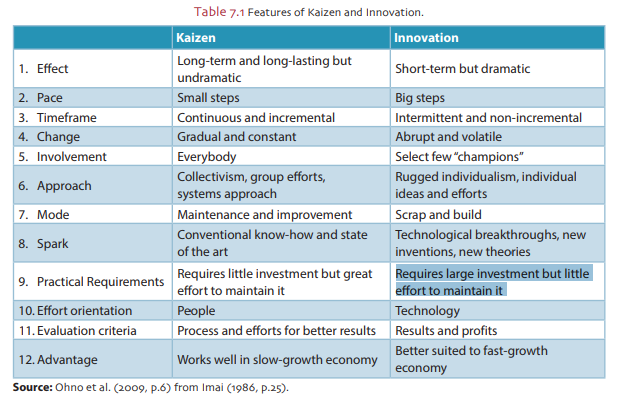
Soru 69
Which of the following cannot be claimed for "Lean Six Sigma"?
Seçenekler
A
It is related to technology
B
It aims to improve customer satisfaction
C
It aims to sustain in a competitive environment
D
It is a replacement for total quality management
E
It is related to sustainable manufacturing
Açıklama:
Lean Six Sigma is defined as “an emerging technology which is used to improve the performance, efficiency and customer satisfaction to sustain in competitive manufacturing and nonmanufacturing environment”
Soru 70
Which of the following cannot be claimed about Lean Six Sigma (LSS)?
Seçenekler
A
The manufacturing sector is more costly to implement LSS
B
Companies started to implement LSS after the successful results of Motorola and Toyota
C
The origin of both Lean and Six Sigma is the manufacturing sector
D
There is an increasing trend for LSS in the services industry.
E
LSS was implemented in the service sector more than manufacturing
Açıklama:
Companies started to implement LSS after the successful results of Motorola and Toyota in their continuous improvement program. Although the origin of both Lean and Six Sigma is the manufacturing sector, there is an increasing trend in the services industry. It is shown in the literature that LSS was implemented in finance, banking, IT, business process outsourcing, shared services, call centers, government operations, military, and higher educational institutions successfully. Singh and Rathi’s (2019) findings (near about 58% of articles are from service sector) show that LSS was implemented in service sector more than manufacturing. The definition of “defect” is important in the service sector.
Soru 71
Which of the following is not true about "benchmarking"?
Seçenekler
A
It improves practices, services or products
B
It involves learning about ‘best practices’ from others
C
It accelerates the rate of progress and improvement
D
It results in the setting of general targets
E
It provides hard data on performance
Açıklama:
According to the Meade, benchmarking
• improves practices, services or products;
• involves learning about ‘best practices’ from others;
• accelerates the rate of progress and improvement;
• contributes to continuous quality improvement;
• is an ongoing process;
• promotes fresh and innovative thinking about problems;
• provides hard data on performance;
• focuses not only on what is achieved but how it is achieved;
• involves the adaptation, not merely the adoption, of best practices; and
• results in the setting of specific targets
• improves practices, services or products;
• involves learning about ‘best practices’ from others;
• accelerates the rate of progress and improvement;
• contributes to continuous quality improvement;
• is an ongoing process;
• promotes fresh and innovative thinking about problems;
• provides hard data on performance;
• focuses not only on what is achieved but how it is achieved;
• involves the adaptation, not merely the adoption, of best practices; and
• results in the setting of specific targets
Soru 72
.................................. defined as a continual appraisal of what have been done, what is yet to be done, what needs to be done and actions taken and yet to be taking.
Which of the following should be at the dotted place?
Which of the following should be at the dotted place?
Seçenekler
A
Continuous Improvement
B
Stable Improvement
C
Lean Improvement
D
Total Improvement
E
Poka-Yoke Improvement
Açıklama:
It should be Continuous Improvement
Soru 73
There are....................steps in Mansir and Schacht’s “Continuous Improvement Process Model”
Which of following should be at dotted plate?
Which of following should be at dotted plate?
Seçenekler
A
3
B
4
C
5
D
6
E
7
Açıklama:
It should be 7
Soru 74
Five primary aspects of an organization are affected from CIP transformation.
Which of following is not one of them?
Which of following is not one of them?
Seçenekler
A
environment
B
structure
C
İndividual and team activity
D
İntegration
E
disintegration
Açıklama:
disintegration is not one of them
Soru 75
CIP includes eleven compatible and mutually supporting principles.
Which of the following is not one of them?
Which of the following is not one of them?
Seçenekler
A
constancy of purpose
B
commitment to quality
C
customer focus and involvement
D
process orientation
E
Individual work
Açıklama:
Individual work is not one of them
Soru 76
In the Continuous Improvement principle context, there are crucial steps.
Which of following is not one them?
Which of following is not one them?
Seçenekler
A
Promoting small improvements
B
Research and development - innovation
C
Measuring performance
D
Improving through projects
E
Improving defects
Açıklama:
Improving defects is not one of them
Soru 77
................ as a business improvement method is to produce better products or deliver better services using fewer resources.
Which of following should be at dotted place?
Which of following should be at dotted place?
Seçenekler
A
Loan
B
Lean
C
Waste
D
Jidoka
E
Poka-Yoke
Açıklama:
It should be lean
Soru 78
There are seven types of Muda. Which of the following is not one them?
Seçenekler
A
Overproduction
B
Waiting
C
Unnecessary Transport
D
Over processing
E
Unnecessary Movement
Açıklama:
Unnecessary Movement is not one them.
Soru 79
Mistake-proofing is called as ............. in Japanese. To eliminate defects by preventing, correcting, or highlighting errors as they occur is
the aim of .............. .
Which of the following should come to the dotted point according to the continuation of the sentence?
the aim of .............. .
Which of the following should come to the dotted point according to the continuation of the sentence?
Seçenekler
A
Poka-Yoke
B
Jidoka
C
Andon
D
Kaizen
E
Hansei
Açıklama:
It should be Poka-Yoke
Soru 80
..........................is a Japanese word used for “selfreflection”. In reflection meetings ,
experienced failures are identified and clear plans for future efforts are being created to take appropriate action to avoid reoccurrence.
Which of following should be at dotted place?
experienced failures are identified and clear plans for future efforts are being created to take appropriate action to avoid reoccurrence.
Which of following should be at dotted place?
Seçenekler
A
Jidoka
B
Poka-Yoke
C
Hansei
D
Kaizen
E
Andon
Açıklama:
It should be Hansei
Soru 81
......................is the Japanese form of “Signal” and it is one of the lean tools. Jidoka cannot be thought without ............ ................. is a visual aid which highlights where action is required and it is vital to detect the problem.
Which of following should be at dotted place?
Which of following should be at dotted place?
Seçenekler
A
Poka-Yoke
B
Andon
C
Jidoka
D
Hansei
E
Kaizen
Açıklama:
It should be Andon
Ünite 8
Soru 1
What is 'the ability of the business to produce new products and ideas and to develop new processes by managing the change process in order to achieve the goals of the business and reach the desired position in the future' called?
Seçenekler
A
Change management
B
Control management
C
Innovation management
D
Risk management
E
Strategic management
Açıklama:
Change management is the ability of the business to produce new products and ideas and to develop new processes by managing the change process in order to achieve the goals of the business and reach the desired position in the future. For instance, durable goods manufacturers produce refrigerators that keep food fresh longer and consume less energy. The patterns on the ceramic tiles we use in kitchens and bathrooms are embroidered on the products with more sensitive printer-like machines instead of the old techniques. As in the examples above, change is not limited to goods and services produced in the enterprise or to production processes. In addition, change can mean changes in the way of doing things, in organizational structure, and in information flow in the organization. With change management, the business aims to reduce the risks and costs of all these changes.
Soru 2
In which change, does the business decide the need for change by analyzing the information it collects from the environment and applies the change.
Seçenekler
A
Planned change
B
Unplanned change
C
Sudden change
D
Radical change
E
Incremental change
Açıklama:
Change is divided into two categories namely planned and unplanned changes depending on the way how it emerges. Planned change means that managers have the initiative and plan the change process and implement the change in line with the needs determined. In planned change, the business decides the need for change by analyzing the information it collects from the environment and applies the change. Unplanned change refers to the change that is not planned before and which is implemented in order to adapt to sudden changes occurring in the internal or external environment.
Soru 3
According to McKinsey’s survey of nearly 3000 executives around the world, what is the ratio of successful change processes?
Seçenekler
A
One out of two
B
One out of three
C
One out of four
D
One out of five
E
One out of six
Açıklama:
According to McKinsey’s survey of nearly 3000 executives around the world, only one out of every three change processes is successful (Meaney & Pung, 2008). In the research, managers were asked what they would do differently if their firm carried out the change process again. Nearly half of the managers said that they would set clearer targets (48%), spend more time engaging the workforce (43%), spend more time developing and communicating a change story (%42).
Soru 4
What is 'the transfer of capital, labor and goods and services between countries without encountering any obstacles' called?
Seçenekler
A
Economic globalization
B
Political conditions
C
Social trends
D
Economic conditions
E
Legal conditions
Açıklama:
We can define economic globalization as the transfer of capital, labor and goods and services between countries without encountering any obstacles. With the globalization process, businesses can deliver their products to consumers all over the world, establish production facilities in different countries or buy the established ones in other countries. Therefore, businesses must compete not only with enterprises in their own countries or regions, but with businesses all over the world. Increasing competition due to globalization encourages enterprises to produce higher quality, different products and adopt different business models.
Soru 5
Which of the below is NOT one of the factors from which innovation can arise?
Seçenekler
A
Products
B
Production process
C
Organizational structure
D
Marketing efforts of the business
E
Teamwork capability of the employees
Açıklama:
Innovation can arise from the products, production process, organizational structure or marketing efforts of the business. Innovations greatly change the way things are done in the organization. New products mean creating new production processes, forming new positions, organizing people responsible for carrying out these processes, processing new raw materials, redesigning the flow of information and documents. Therefore, innovations bring change, regardless of their source.
Soru 6
Which one is NOT one of the categories of reasons for resistance to change?
Seçenekler
A
Self-interest
B
Misunderstandings
C
Different evaluations
D
Low tolerance
E
Prejudices
Açıklama:
The reasons for resistance to change can be listed as follows:
- Self-interest
- Misunderstandings
- Different Evaluations
- Low Tolerance
Soru 7
Which one is the first step of using the resistance to contribute to the change process as a resource?
Seçenekler
A
Return to Purpose
B
Change the Change
C
Boost Awareness
D
Build the Participation
E
Past Experiences
Açıklama:
The steps of using the resistance to contribute to the change process as a resource are as follows:
1. Boost Awareness: The issue of change is discussed with all actors in the organization so that the interest and awareness about the change is kept on the agenda.
2. Return to Purpose: All actors are included in the planning of the change process, so that the content, causes and objectives of the change are better understood by everyone.
3. Change the Change: The inclusion of other actors in the change process can help generate different ideas, eliminate any flaws in the change plan, or help to prepare more effective change plans.
4. Build the Participation: The inclusion of other actors in the change process encourages people to become part of the process.
5. Past Experiences: Failed old practices of change can affect people’s attitudes and perceptions of the process of change. It can be the source of resistance to change. Old experiences should also be examined before the change process is planned.
1. Boost Awareness: The issue of change is discussed with all actors in the organization so that the interest and awareness about the change is kept on the agenda.
2. Return to Purpose: All actors are included in the planning of the change process, so that the content, causes and objectives of the change are better understood by everyone.
3. Change the Change: The inclusion of other actors in the change process can help generate different ideas, eliminate any flaws in the change plan, or help to prepare more effective change plans.
4. Build the Participation: The inclusion of other actors in the change process encourages people to become part of the process.
5. Past Experiences: Failed old practices of change can affect people’s attitudes and perceptions of the process of change. It can be the source of resistance to change. Old experiences should also be examined before the change process is planned.
Soru 8
What term can be defined as the disruption of routines of existing habits in the processes that are intended to be changed in the organization?
Seçenekler
A
Unfreezing
B
Moving
C
Freezing
D
Changing
E
Taking
Açıklama:
Unfreezing can be defined as the disruption of routines of existing habits in the processes that are intended to be changed in the organization. In this process, the current situation is defined, the vision for the desired level is designed and the forces that contribute to or prevent change are predicted. This prediction is called force field analysis. The forces that accelerate to change are called driving forces, and the forces that decelerate it are called restraining forces. Driving forces must be increased or restraining forces must be reduced in order for the change to take place.
Soru 9
Which of the below belongs to the preparation stage that is necessary for TQM to be applied successfully?
Seçenekler
A
Team activation and direction
B
Award & recognition
C
Feedback of customer satisfaction
D
Commitment by the top management
E
Feedback of employee satisfaction
Açıklama:
TQM applications start with the preparation stage. The preparation stage is critical to the success of the entire process. The stage should not be carried out in a hurry. Managers should never start the practices until preparations are complete. The decisions to be taken during the preparation stage and the actions to be taken are as follows:
Commitment by the top management
Form a steering committee
Team building
Total quality training for the steering committee
Developing vision and guiding principles
Set broad strategic objectives
Communicate and publicize
Identify organizational strengths and weaknesses
Identify change advocates
Baseline employee and customer satisfaction
Commitment by the top management
Form a steering committee
Team building
Total quality training for the steering committee
Developing vision and guiding principles
Set broad strategic objectives
Communicate and publicize
Identify organizational strengths and weaknesses
Identify change advocates
Baseline employee and customer satisfaction
Soru 10
Which one is NOT one of the mistakes that cause unsuccessful TQM practices?
Seçenekler
A
Not to examine the practices of other businesses.
B
Not to plan the quality process.
C
Focusing on short-term business interests.
D
Ignoring subordinates’ participation.
E
Not changing business objectives frequently.
Açıklama:
Managerial Barriers:
• Not to examine the practices of other businesses.
• Not to plan the quality process.
• Not to insist on the process of change.
• Not to allocate sufficient resources for TQM applications.
• Not using effective quality measurement techniques.
• Not to determine the type of training required for each job and person.
• Changing business objectives frequently.
• Focusing on short-term business interests, putting teamwork and quality improvement efforts in the background.
• Ignoring subordinates’ participation.
Organizational Barriers:
• Poor written and verbal communication between hierarchical levels in the organization.
• Poor communication between departments. • High employee turnover.
• Resistance to change.
Philosophical Barriers:
• Not trying to understand customers, ignoring customer feedback.
• Not being able to create an organizational culture that enables everyone to participate.
• Failure to develop long-term relationships with good suppliers, believe that quality will only be achieved within the boundaries of the enterprise
• Forgetting that the TQM is an ongoing work.
• Not to examine the practices of other businesses.
• Not to plan the quality process.
• Not to insist on the process of change.
• Not to allocate sufficient resources for TQM applications.
• Not using effective quality measurement techniques.
• Not to determine the type of training required for each job and person.
• Changing business objectives frequently.
• Focusing on short-term business interests, putting teamwork and quality improvement efforts in the background.
• Ignoring subordinates’ participation.
Organizational Barriers:
• Poor written and verbal communication between hierarchical levels in the organization.
• Poor communication between departments. • High employee turnover.
• Resistance to change.
Philosophical Barriers:
• Not trying to understand customers, ignoring customer feedback.
• Not being able to create an organizational culture that enables everyone to participate.
• Failure to develop long-term relationships with good suppliers, believe that quality will only be achieved within the boundaries of the enterprise
• Forgetting that the TQM is an ongoing work.
Soru 11
Which of the following is 'the adoption of a new idea or behavior by an organization'?
Seçenekler
A
Change
B
Change agent
C
Planned change
D
Change management
E
Radical change
Açıklama:
The correct choice is D.
Soru 12
Which of the following is NOT one of the external factors causing change?
Seçenekler
A
Economic conditions
B
Innovation
C
Political conditions
D
Social trends
E
Technology
Açıklama:
The correct choice is B.
Soru 13
If one is talking about the need for a change to take place in an organization form bottom to top, which factor is he/she stressing?
Seçenekler
A
Innovation
B
Competition
C
Legal conditions
D
Social trends
E
Employee expectations
Açıklama:
The correct choice is E.
Soru 14
Which of the following refers to the rapid and constant change process carried out by managers?
Seçenekler
A
Acceleration trap
B
Unplanned change
C
Speed change
D
Continuous competition
E
Incremental change
Açıklama:
The correct choice is A.
Soru 15
Which of the following is NOT one of the reasons for resistance to change?
Seçenekler
A
Misunderstandings
B
Different evaluations
C
Organizational failure
D
Self-interest
E
Low tolerance
Açıklama:
The correct choice is C.
Soru 16
Below are some examples of resistance to change. Which ones are the examples of implicit resistance?
I. Loss of job motivation
II. Complaints of employees
III. Increased production errors
IV. Absenteeism
V. Doing the work reluctantly
I. Loss of job motivation
II. Complaints of employees
III. Increased production errors
IV. Absenteeism
V. Doing the work reluctantly
Seçenekler
A
I, II, III, IV
B
II, III, IV, V
C
I, II, III
D
II, III, IV
E
I, III, IV
Açıklama:
The correct choice is E.
Soru 17
Which of the following is NOT one of the steps of using resistance to contribute to the change process of a resource?
Seçenekler
A
Boosting awareness
B
Returning to purpose
C
Sticking to the change plan
D
Building participation
E
Examining past experiences
Açıklama:
Changing the change is one of the steps.
The correct choice is C.
The correct choice is C.
Soru 18
In kur Lewin's 3-step model, which of the following is the disruption of routines of existing habits in the processes intended to be changed?
Seçenekler
A
Moving
B
Unfreezing
C
Boosting awareness
D
Establishing a sense of urgency
E
Consolidating gains
Açıklama:
The correct choice is B.
Soru 19
Which of the following choices gives the stages of the implementation process of TQM in the correct order?
Seçenekler
A
Preparation-Planning-Execution
B
Planning-Preparation-Execution
C
Execution-Preparation-Planning
D
Planning-Execution-Preparation
E
Preparation-Execution-Planning
Açıklama:
The correct choice is A.
Soru 20
Which of the following is a philosophical barrier that affects the implementation of TQM?
Seçenekler
A
Not to plan the quality process
B
Ignoring customer feedback
C
Resistance to change
D
Ignoring Subordinates' participation
E
Poor communication between departments
Açıklama:
The correct choice is B.
Soru 21
Which is the main philosophy behind the total quality management?
Seçenekler
A
Continous change and progress
B
Surviving big crisis
C
The quality of the product
D
The management
E
Stability
Açıklama:
"The main philosophy of total quality management (TQM) is continous change and progress."
Soru 22
Which of the statements given below about change and change management is wrong?
Seçenekler
A
Change management refers to the conscious process of change in the organization.
B
Change management is the ability of the business to produce new products and ideas and to develop new processes by managing the change process in order to achieve the goals of the business and reach the desired position in the future.
C
With change management, the business aims to reduce the risks and costs of all these changes.
D
Change is divided into three categories namely planned, unplanned and unseen changes depending on the way how it emerges.
E
Change is also divided into two categories namely radical and incremental changes depending on the impact on firm operations.
Açıklama:
Because : "Change is divided into two categories namely planned and unplanned changes depending on the way how it emerges."
Soru 23
Which of the given is related to radical change?
Seçenekler
A
Continous improvement
B
Breakthrough in technology
C
Affecting some departments
D
NEw technology
E
Change through normal structure
Açıklama:
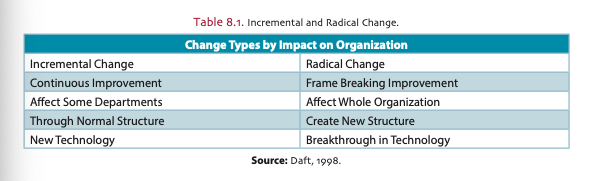
Soru 24
Which one of the given factors is an external factor causing change?
Seçenekler
A
Innovation
B
Self-interest
C
Social trends
D
Employee expectations
E
Organisational failure
Açıklama:
Social Trends: Social trends that lead businesses to change are related to the change in people’s taste, preference and consumption habits. The direction of the change activities of the businesses will undoubtedly be shaped by the opinions and behaviors of the consumers. For example, as a result of increased environmental awareness, many businesses have transformed their products and production processes in an environmentally friendly way.
Social trends is an external factor.
Social trends is an external factor.
Soru 25
Complete the sentence:
Different evaluations are among the ____ factors causing change.
Different evaluations are among the ____ factors causing change.
Seçenekler
A
External factors
B
Internal factors
C
Personal factors
D
Resistance to change
E
Organisational failures
Açıklama:
Different Evaluations: One of the issues that cause resistance in the change process is that everyone has different evaluations about the reasons, results, benefits and costs aspects of change.
Different evaluations are among the"resistance to change" factors.
Different evaluations are among the"resistance to change" factors.
Soru 26
Which of the given statements belongs to Kurt Lewin's 3 Step Model?
Seçenekler
A
Consolidating gains and producing more change: Being committed to change is to try to realize the bigger changes that will carry out the vision without declaring an early victory with the climate of short-term gains.
B
Communicating the change vision: The vision, tools, goals and paths of change are shared with all actors in the organization. Thus, a common understanding about change is tried to create.
C
Developing a vision and a strategy: Guiding team develops a clear vision and strategy for change with other employees. Thus, the direction and means of change are determined.
D
Creating the guiding coalition: After convincing people to take action for change, a team is formed to guide the process of change with sufficient talent, authority and skill.
E
Unfreezing:The disruption of routines of existing habits in the processes that are intended to be changed in the organization.
Açıklama:
Unfreezing can be defined as the disruption of routines of existing habits in the processes that are intended to be changed in the organization. All the other options given in the question refer to the John Kottler's 8 step plan.
According to Kurt Lewin’s 3-step model, successful change in business basically follows unfreezing-moving-freezing steps (Smith, 2014).
According to Kurt Lewin’s 3-step model, successful change in business basically follows unfreezing-moving-freezing steps (Smith, 2014).
Soru 27
Which of the given statements about total quality management (TQM) is not correct?
Seçenekler
A
Total quality management is a management technique based on continuous development in order to meet the desires and needs of customers.
B
With TQM applications, all processes, products and information flow in the business can change.
C
By successfully implementing TQM, businesses can avoid mistakes and wastes, reduce customer complaints by producing better quality products and have more loyal customers.
D
Total quality management can improve safety conditions in the workplace and continue its activities in a more environmentally friendly way.
E
TQM is essentially a process of incremental change.
Açıklama:
Total quality management is a management technique based on continuous development in order to meet the desires and needs of customers. With TQM applications, all processes, products and information flow in the business can change. TQM is therefore essentially a process of radical change. By successfully implementing TQM, businesses can avoid mistakes and wastes, reduce customer complaints by producing better quality products and have more loyal customers. In addition, it can improve safety conditions in the workplace and continue its activities in a more environmentally friendly way (Jones & Seraphim, 2008).
TQM is not essentially a process of incremental change, It is a part of radical change.
TQM is not essentially a process of incremental change, It is a part of radical change.
Soru 28
Which is a mistake causing unsuccessful total quality management (TQM)?
Seçenekler
A
Not to focus on short-term business interests, putting teamwork and quality improvement efforts in the background.
B
Not to plan the quality process.
C
Not to insist on the process of change.
D
Not to allocate sufficient resources for TQM applications.
E
Not using effective quality measurement techniques.
Açıklama:
Managerial Barriers:
• Not to examine the practices of other businesses.
• Not to plan the quality process.
• Not to insist on the process of change.
• Not to allocate sufficient resources for TQM applications.
• Not using effective quality measurement techniques.
• Not to determine the type of training required for each job and person.
• Changing business objectives frequently.
• Focusing on short-term business interests, putting teamwork and quality improvement efforts in the background.
• Ignoring subordinates’ participation.
Organizational Barriers:
• Poor written and verbal communication between hierarchical levels in the organization.
• Poor communication between departments. • High employee turnover.
• Resistance to change.
• Not to examine the practices of other businesses.
• Not to plan the quality process.
• Not to insist on the process of change.
• Not to allocate sufficient resources for TQM applications.
• Not using effective quality measurement techniques.
• Not to determine the type of training required for each job and person.
• Changing business objectives frequently.
• Focusing on short-term business interests, putting teamwork and quality improvement efforts in the background.
• Ignoring subordinates’ participation.
Organizational Barriers:
• Poor written and verbal communication between hierarchical levels in the organization.
• Poor communication between departments. • High employee turnover.
• Resistance to change.
Soru 29
Which one of the given processes is not among the planning stage of total quality management (TQM)?
Seçenekler
A
Planning the implementation approach
B
Identifying the projects
C
Establishing team composition
D
Providing team training
E
Establishing the product process
Açıklama:
Planning
The planning stage consists of 4 main processes namely, planning the implementation approach, identifying the projects, establishing team composition and providing team training.
The planning stage consists of 4 main processes namely, planning the implementation approach, identifying the projects, establishing team composition and providing team training.
Soru 30
What is the reason of forming a steering committee in the preparation process of Total Quality Management (TQM)?
Seçenekler
A
To ensure achieving the business’ vision rather than people with separate agendas.
B
To guide the change in the TQM process.
C
To gathers employees around a goal, reminds them of the final result and motivates them.
D
To inform the employees about what will change in business.
E
To create a benchmark for the future so as to determine whether TQM practices increase employee satisfaction.
Açıklama:
Form a steering committee: A steering committee is set up to guide the change in the TQM process. This committee should consist of the chief executive officer and function managers. This committee determines the vision and objectives to be achieved via TQM practices, establishes plans and supervises progress. This committee is needed to avoid deviating from the objectives in the process of change.
Soru 31
Which of the following does not explain change management?
Seçenekler
A
It refers to planning, organizing, leading, and controlling a change process in an organization.
B
It refers to the conscious process of change in the organization
C
It is defined as the adoption of a new idea or behavior by an organization.
D
It is the movement of an organization away from its present state and toward some desired future state to increase its effectiveness.
E
It is limited to the goods and services produced in the enterprise or to production processes.
Açıklama:
Change is not limited to goods and services produced in the enterprise or to production processes. In addition, change can mean changes in the way of doing things, in organizational structure, and in information flow in the organization.
It is limited to the goods and services produced in the enterprise or to production processes.
It is limited to the goods and services produced in the enterprise or to production processes.
Soru 32
Which of the following is one of the change agents used for improved organizational performance?
Seçenekler
A
Environment
B
Investment
C
Production
D
Structure
E
Strategy
Açıklama:
Figure 8.1. The Change and Business.
Structure
Structure
Soru 33
Which of the following is an impact of incremental change?
Seçenekler
A
Affect Whole Organization
B
Traditional Technology
C
Continuous Improvement
D
Create New Structure
E
Breakthrough in Technology
Açıklama:
Incremental Change by Impact on Organization
- Continuous Improvement
- Affect Some Departments
- Through Normal Structure
- New Technology
Soru 34
Which of the following external factors caused many businesses to change their products and production processes in an environmentally friendly way?
Seçenekler
A
Political Conditions
B
Globalization
C
Social Trends
D
Organizational Failure
E
Employee Expectations
Açıklama:
Social trends that lead businesses to change are related to the change in people’s taste, preference and consumption habits. For example, as a result of increased environmental awareness, many businesses have transformed their products and production processes in an environmentally friendly way.
Soru 35
Which of the following is one of the internal factors that cause change in businesses?
Seçenekler
A
Innovation
B
Globalization
C
Economy
D
Competition
E
Technology
Açıklama:
Internal factors causing change in businesses can be listed as innovation, organizational failure and expectations of employees.
Soru 36
Which of the following defines low tolerance as a reason for resistance to change?
Seçenekler
A
Employees and managers may be concerned about the risk of losing their jobs, wages, qualifications and status.
B
When adequately informed about the causes and process of change, people may have wrong ideas about the causes and consequences of change.
C
Everyone has different evaluations about the reasons, results, benefits and costs aspects of change.
D
Uncertainty for the future influences employee motivation and business performance negatively
E
People respond to the same events with different reactions. The process of change, which is fun and exciting for some, can be scary for others.
Açıklama:
Low Tolerance: We respond to the same events with different reactions. The process of change, which is fun and exciting for some of us, can be scary for others. This is due to our level of tolerance to change and the uncertainty it may bring.
People respond to the same events with different reactions. The process of change, which is fun and exciting for some, can be scary for others.
People respond to the same events with different reactions. The process of change, which is fun and exciting for some, can be scary for others.
Soru 37
Which of the following is one of the ways of using the resistance to contribute to the change process?
Seçenekler
A
The issue of change is not discussed with the actors in the organization so that change is kept on the agenda.
B
Not all actors are included in the planning of the change process so that the content, causes and objectives of the change are stable.
C
The inclusion of other actors in the change process can create flaws in the change plan, or prevent preparing more effective change plans.
D
Failed old practices of change can affect people’s attitudes and perceptions of the process of change. They should be examined before the change process is planned.
E
The exclusion of other actors in the change process encourages people more to become part of the process.
Açıklama:
Past Experiences: Failed old practices of change can affect people’s attitudes and perceptions of the process of change. It can be the source of resistance to change. Old experiences should also be examined before the change process is planned.
Failed old practices of change can affect people’s attitudes and perceptions of the process of change. They should be examined before the change process is planned.
Failed old practices of change can affect people’s attitudes and perceptions of the process of change. They should be examined before the change process is planned.
Soru 38
Which of the following is the first step of John Kotter’s 8 step plan?
Seçenekler
A
Creating the guiding coalition
B
Establishing a sense of urgency
C
Anchoring new approaches in the culture
D
Communicating the change vision
E
Developing a vision and a strategy
Açıklama:
1. Establishing a sense of urgency: A sense of urgency is necessary to mobilize people, to provide the
necessary cooperation and to express the need for change.
necessary cooperation and to express the need for change.
Soru 39
Which of the following is one of the decisions and actions to be taken during the preparation stage?
Seçenekler
A
The objectives that will enable the business to reach the vision are defined.
B
The committee decides the projects starting the TQM practices.
C
The committee informs the team about what is expected of the teams, the project schedule and managers.
D
The qualifications required by the projects are taken into consideration while establishing the teams.
E
The teams are provided with training about communication and problem-solving tools.
Açıklama:
Set broad strategic objectives: Once the vision and values are determined, the objectives that will enable business to reach the vision are defined.
The objectives that will enable the business to reach the vision are defined.
The objectives that will enable the business to reach the vision are defined.
Soru 40
Which of the following is a philosophical barrier arising from the misperception of TQM philosophy?
Seçenekler
A
Not to examine the practices of other businesses.
B
Not using effective quality measurement techniques.
C
Not to determine the type of training required for each job and person.
D
Not to allocate sufficient resources for TQM applications.
E
Not trying to understand customers, ignoring customer feedback.
Açıklama:
Philosophical Barriers:
• Not trying to understand customers, ignoring customer feedback.
• Not trying to understand customers, ignoring customer feedback.
Soru 41
Which of the following results from major changes or technological breakthroughs in the environment in which the business operates and affects the whole organization and redefines the business?
Seçenekler
A
Incremental change
B
Radical change
C
Continuous improvement
D
Normal structure
E
Change agent
Açıklama:
Change is also divided into two categories namely radical and incremental changes depending on the
impact on firm operations. Accordingly, if change in a business affects certain departments, if the strategy,
values and mission of the business are not affected by this change, we define it as an incremental change.
These changes are the result of continuous development efforts, which can significantly increase operational
efficiency. Radical or strategic change affects the whole organization and redefines the business. It usually
results from major changes or technological breakthroughs in the environment in which the business
operates. It requires doing different things rather than doing things well. It also radically changes the business
operations and the way people do their works (Hodges & Julie 2016; Nadler & Tushman, 1990).
impact on firm operations. Accordingly, if change in a business affects certain departments, if the strategy,
values and mission of the business are not affected by this change, we define it as an incremental change.
These changes are the result of continuous development efforts, which can significantly increase operational
efficiency. Radical or strategic change affects the whole organization and redefines the business. It usually
results from major changes or technological breakthroughs in the environment in which the business
operates. It requires doing different things rather than doing things well. It also radically changes the business
operations and the way people do their works (Hodges & Julie 2016; Nadler & Tushman, 1990).
Soru 42
Which of the following is one of the external factors causing change in organizations?
Seçenekler
A
Employee Expectations
B
Organizational Failure
C
Innovation
D
Social Trends
E
Misunderstandings
Açıklama:
We can list the external factors causing change
in organizations as technology, globalization and
competition, economic conditions, political and
legal conditions and social trends.
in organizations as technology, globalization and
competition, economic conditions, political and
legal conditions and social trends.
Soru 43
Which of the following is the fisrt step of John Kotter’s 8 Step Plan?
Seçenekler
A
Establishing a sense of urgency
B
Creating the guiding coalition
C
Communicating the change vision
D
Developing a vision and a strategy
E
Generating short term wins
Açıklama:
Kotter argues that there are common steps taken by businesses that perform successful big change
processes. According to him, successful change process is possible by performing the following 8 steps
(Kotter, 1996; Kotter & Cohen, 2002):
1. Establishing a sense of urgency: A sense of urgency is necessary to mobilize people, to provide the
necessary cooperation and to express the need for change.
2. Creating the guiding coalition: After convincing people to take action for change, a team is formed
to guide the process of change with sufficient talent, authority and skill.
3. Developing a vision and a strategy: Guiding team develops a clear vision and strategy for change
with other employees. Thus, the direction and means of change are determined.
4. Communicating the change vision: The vision, tools, goals and paths of change are shared with all
actors in the organization. Thus, a common understanding about change is tried to create.
5. Empowering employees for broad based action: It means that all the factors that may prevent change
are hindered. The employees and managers should be encouraged to take risks and initiatives so
that all efforts of them contribute to the change. If necessary, they should get trainings.
6. Generating short term wins: The change process should be divided to short terms and the improvements
are measured in every term. The short-term achievements provide credibility, resource and morale for
the change process. It provides feedback on strategies and allows changes if necessary.
7. Consolidating gains and producing more change: Being committed to change is to try to realize the
bigger changes that will carry out the vision without declaring an early victory with the climate of
short-term gains.
8. Anchoring new approaches in the culture: At the end of the change process, new practices create a
new culture to ensure that the change is permanent. As a result of the process of change, new norms
and values are created if the success of change has been proven.
processes. According to him, successful change process is possible by performing the following 8 steps
(Kotter, 1996; Kotter & Cohen, 2002):
1. Establishing a sense of urgency: A sense of urgency is necessary to mobilize people, to provide the
necessary cooperation and to express the need for change.
2. Creating the guiding coalition: After convincing people to take action for change, a team is formed
to guide the process of change with sufficient talent, authority and skill.
3. Developing a vision and a strategy: Guiding team develops a clear vision and strategy for change
with other employees. Thus, the direction and means of change are determined.
4. Communicating the change vision: The vision, tools, goals and paths of change are shared with all
actors in the organization. Thus, a common understanding about change is tried to create.
5. Empowering employees for broad based action: It means that all the factors that may prevent change
are hindered. The employees and managers should be encouraged to take risks and initiatives so
that all efforts of them contribute to the change. If necessary, they should get trainings.
6. Generating short term wins: The change process should be divided to short terms and the improvements
are measured in every term. The short-term achievements provide credibility, resource and morale for
the change process. It provides feedback on strategies and allows changes if necessary.
7. Consolidating gains and producing more change: Being committed to change is to try to realize the
bigger changes that will carry out the vision without declaring an early victory with the climate of
short-term gains.
8. Anchoring new approaches in the culture: At the end of the change process, new practices create a
new culture to ensure that the change is permanent. As a result of the process of change, new norms
and values are created if the success of change has been proven.
Soru 44
Which of the following is NOT one of the decisions and actions to be taken during the preparation stage?
Seçenekler
A
Total quality training for the steering committee
B
Team building
C
Feedback of customer satisfaction
D
Commitment by the top management
E
Developing vision and guiding principles
Açıklama:
The decisions to be taken during the preparation stage and the actions to be taken are as follows:
- Total quality training for the steering committee
- Commitment by the top management
- Team building
- Form a steering committee
- Developing vision and guiding principles
- Set broad strategic objectives
- Communicate and publicize
- Identify organizational strengths and weaknesses
- Identify change advocates
- Baseline employee and customer satisfaction
Soru 45
I. Not to plan the quality process
II. Changing business objectives frequently
III. Poor communication between departments
IV. Ignoring subordinates’ participation
Which of the examples above fall under the category of managerial barriers causing unsuccessful TQM practices?
II. Changing business objectives frequently
III. Poor communication between departments
IV. Ignoring subordinates’ participation
Which of the examples above fall under the category of managerial barriers causing unsuccessful TQM practices?
Seçenekler
A
I and III
B
III and IV
C
I, II and III
D
I, II, and IV
E
I, II, III and IV
Açıklama:
Managerial Barriers:
• Not to examine the practices of other
businesses.
• Not to plan the quality process.
• Not to insist on the process of change.
• Not to allocate sufficient resources for
TQM applications.
• Not using effective quality measurement
techniques.
• Not to determine the type of training
required for each job and person.
• Changing business objectives frequently.
• Focusing on short-term business interests,
putting teamwork and quality improvement
efforts in the background.
• Ignoring subordinates’ participation.
• Not to examine the practices of other
businesses.
• Not to plan the quality process.
• Not to insist on the process of change.
• Not to allocate sufficient resources for
TQM applications.
• Not using effective quality measurement
techniques.
• Not to determine the type of training
required for each job and person.
• Changing business objectives frequently.
• Focusing on short-term business interests,
putting teamwork and quality improvement
efforts in the background.
• Ignoring subordinates’ participation.
Soru 46
Which is NOT one of the organizational barriers causing unsuccessful TQM practices?
Seçenekler
A
Forgetting that the TQM is an ongoing work
B
Resistance to change
C
High employee turnover
D
Poor communication between departments
E
Poor written and verbal communication between hierarchical levels in the organization
Açıklama:
Organizational Barriers:
• Poor written and verbal communication between hierarchical levels in the organization.
• Poor communication between departments.
• High employee turnover.
• Resistance to change.
• Poor written and verbal communication between hierarchical levels in the organization.
• Poor communication between departments.
• High employee turnover.
• Resistance to change.
Soru 47
I. Level of education
II. Gender
III. Talents
IV. Working time in the organization
Which of the aspects about employees above play an important role in the success of TQM applications?
II. Gender
III. Talents
IV. Working time in the organization
Which of the aspects about employees above play an important role in the success of TQM applications?
Seçenekler
A
I and II
B
II and III
C
I, II and III
D
II, III and IV
E
I, III and IV
Açıklama:
The talents of the employees, their level of education, working time in the organization, the average age of the employees and their attitude towards change play an important role in the success of TQM applications
Soru 48
Which of the following is a stage in the execution step of implementation process?
Seçenekler
A
Identify change advocates
B
Award and recognation
C
Communicate and publicize
D
Providing team training
E
Baseline employee and customer satisfaction
Açıklama:
In the execution stage, all preparations have been
completed. The TQM practices start according to
plans prepared by the committee. At this stage, the
committee activates the teams, receives feedback
from customers and employees about the practices,
reorganizes the organizational structure according
to changing conditions or needs in practice and
rewards the successful teams. Now let’s examine
these stages respectively
completed. The TQM practices start according to
plans prepared by the committee. At this stage, the
committee activates the teams, receives feedback
from customers and employees about the practices,
reorganizes the organizational structure according
to changing conditions or needs in practice and
rewards the successful teams. Now let’s examine
these stages respectively
Soru 49
Which of the following happens when employees are not adequately informed about the causes and process of change, and as a result they may have wrong ideas about the causes and consequences of change?
Seçenekler
A
Different Evaluations
B
Self-interest
C
Misunderstandings
D
Low Tolerance
E
Innovation
Açıklama:
Misunderstandings: In businesses where
employees are not adequately informed about the
causes and process of change, people may have
wrong ideas about the causes and consequences of
change.
employees are not adequately informed about the
causes and process of change, people may have
wrong ideas about the causes and consequences of
change.
Soru 50
Which of the following refers to the change implemented in order to adapt to sudden changes occurring in the internal or external environment?
Seçenekler
A
Planned change
B
Unplanned change
C
Radical change
D
Incremental change
E
Continuous improvement
Açıklama:
Unplanned change refers to the change that is not planned before and which is implemented in order to adapt to sudden changes occurring in the internal or external environment (Koçel, 2011).
Soru 51
What refers to planning, organizing, leading, and controlling a change process in an organization to improve its performance and achieve the predetermined sets of strategic objectives, as defined by Ha?
Seçenekler
A
Change
B
Organizational change
C
Change management
D
Organizational performance
E
Business management
Açıklama:
Change management refers to the conscious process of change in the organization. Change management;
• “refers to planning, organizing, leading, and controlling a change process in an organization to improve its performance and achieve the predetermined sets of strategic objectives (Ha, 2014)”.
• “is defined as the adoption of a new idea or behavior by an organization (Daft, 2010)”.
• “is the movement of an organization away from its present state and toward some desired future state to increase its effectiveness (Anınkan, 2018)”
• “refers to planning, organizing, leading, and controlling a change process in an organization to improve its performance and achieve the predetermined sets of strategic objectives (Ha, 2014)”.
• “is defined as the adoption of a new idea or behavior by an organization (Daft, 2010)”.
• “is the movement of an organization away from its present state and toward some desired future state to increase its effectiveness (Anınkan, 2018)”
Soru 52
"........ is an act or process through which something becomes different; an alteration, a modification."
What is defined above?
What is defined above?
Seçenekler
A
Success
B
Progress
C
Improvement
D
Change
E
Business
Açıklama:
The word of change is defined in a dictionary as follow (Lexico Dictionary, 2019):
• An act or process through which something becomes different.
• The substitution of one thing for another.
• An alteration or modification.
• An act or process through which something becomes different.
• The substitution of one thing for another.
• An alteration or modification.
Soru 53
If change in a business affects certain departments, if the strategy, values and mission of the business are not affected by this change, what kind of change is it?
Seçenekler
A
Incremental change
B
Radical change
C
Planned change
D
Unplanned change
E
Involuntary change
Açıklama:
Change is divided into two categories namely planned and unplanned changes depending on the way how it emerges. Planned change means that managers have the initiative and plan the change process and implement the change in line with the needs determined. In planned change, the business decides the need for change by analyzing the information it collects from the environment and applies the change. Unplanned change refers to the change that is not planned before and which is implemented in order to adapt to sudden changes occurring in the internal or external environment.
Change is also divided into two categories namely radical and incremental changes depending on the impact on firm operations. Accordingly, if change in a business affects certain departments, if the strategy, values and mission of the business are not affected by this change, we define it as an incremental change. These changes are the result of continuous development efforts, which can significantly increase operational efficiency. Radical or strategic change affects the whole organization and redefines the business. It usually results from major changes or technological breakthroughs in the environment in which the business operates. It requires doing different things rather than doing things well. It also radically changes the business operations and the way people do their works.
Change is also divided into two categories namely radical and incremental changes depending on the impact on firm operations. Accordingly, if change in a business affects certain departments, if the strategy, values and mission of the business are not affected by this change, we define it as an incremental change. These changes are the result of continuous development efforts, which can significantly increase operational efficiency. Radical or strategic change affects the whole organization and redefines the business. It usually results from major changes or technological breakthroughs in the environment in which the business operates. It requires doing different things rather than doing things well. It also radically changes the business operations and the way people do their works.
Soru 54
Which one is a characteristic of radical change?
Seçenekler
A
Continuous improvement
B
Affects some departments
C
Doing things better
D
New technology
E
Creating new structure
Açıklama:
Radical or strategic change affects the whole organization and redefines the business. It usually results from major changes or technological breakthroughs in the environment in which the business operates. It requires doing different things rather than doing things well. It also radically changes the business operations and the way people do their works.
Comparison of Incremental & Radical Change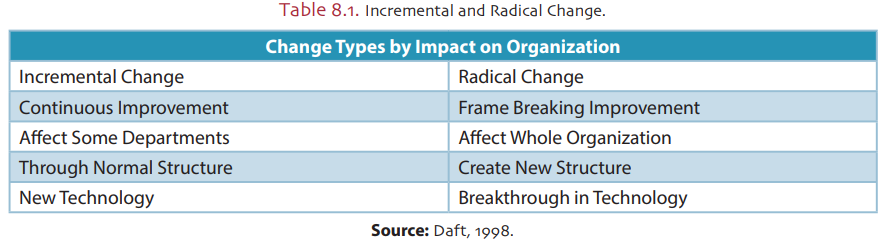
Comparison of Incremental & Radical Change
Soru 55
Based on McKinsey's survey, what was the most common answer when managers were asked what they would do differently if their firm carried out the change process again?
Seçenekler
A
Engaging workforce
B
Setting clearer targets
C
Spending more time planning
D
Setting a higher aspiration
E
Developing and communicating a ‘change story’
Açıklama:
Not every change process can be performed successfully as in the example above. According to McKinsey’s survey of nearly 3000 executives around the world, only one out of every three change processes is successful (Meaney & Pung, 2008). In the research, managers were asked what they would do differently if their firm carried out the change process again. Nearly half of the managers said that they would set clearer targets (48%), spend more time engaging the workforce (43%), spend more time developing and communicating a change story (%42).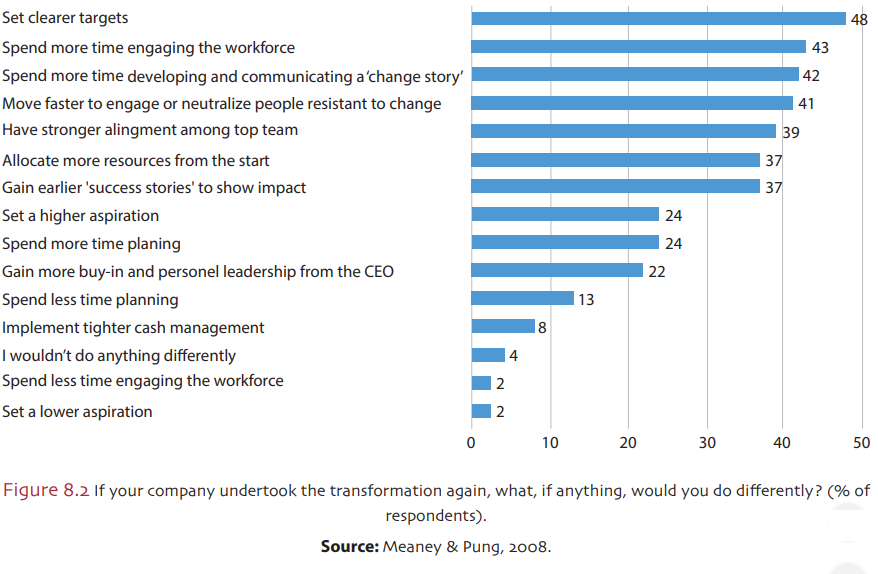
Soru 56
Which of the following is an internal factor of change?
Seçenekler
A
Technology
B
Innovation
C
Economic conditions
D
Social trends
E
Competition
Açıklama:
We can list the external factors causing change in organizations as technology, globalization and competition, economic conditions, political and legal conditions and social trends.
Internal factors causing change in businesses can be listed as innovation, organizational failure and expectations of employees.
Internal factors causing change in businesses can be listed as innovation, organizational failure and expectations of employees.
Soru 57
"As a result of increased environmental awareness, many businesses have transformed their products and production processes in an environmentally friendly way. The annual goals of many businesses now include environmental sustainability and reducing greenhouse gas emissions."
What is the main reason for such changes?
What is the main reason for such changes?
Seçenekler
A
Technology
B
Globalization
C
Social trends
D
Economic conditions
E
Political conditions
Açıklama:
Social trends that lead businesses to change are related to the change in people’s taste, preference and consumption habits. The direction of the change activities of the businesses will undoubtedly be shaped by the opinions and behaviors of the consumers. For example, as a result of increased environmental awareness, many businesses have transformed their products and production processes in an environmentally friendly way. The annual goals of many businesses now include environmental sustainability and reducing greenhouse gas emissions. An example of how social trends affect business activities took place in the tourism sector in 2019. The fact that people started arranging their own travels via the internet played an important role in the bankruptcy of Thomas Cook, a 178-year-old British travel company. Since tourists have arranged their accommodation, air tickets and transportation in the country of destination, the need for travel agents has greatly decreased.
Soru 58
Which of the following is NOT considered a reason for resistance to change?
Seçenekler
A
Self-interest
B
Misunderstandings
C
Different evaluations
D
Unwillingness
E
Low Tolerance
Açıklama:
The reasons for resistance to change can be listed as follows (Buchanan & Huczynski, 2017):
Self-interest: We all have various habits and routines in our lives. Regardless of scale, every process of change replaces something old with the new. New business processes, new tasks, new products, new power relations and so on. These modifications change the whole routine in the business. As a result of the change, employees and managers may be concerned about the risk of losing their jobs, wages, qualifications and status. Change creates uncertainty in businesses where communication is not healthy, and employees are not well informed. Uncertainty for the future influences employee motivation and business performance negatively.
Misunderstandings: In businesses where employees are not adequately informed about the causes and process of change, people may have wrong ideas about the causes and consequences of change.
Different Evaluations: One of the issues that cause resistance in the change process is that everyone has different evaluations about the reasons, results, benefits and costs aspects of change. Some employees may say that costs outweigh the benefits. One way to create a consensus about the change is to share healthy data-based analyses and future forecasts with employees.
Low Tolerance: We respond to the same events with different reactions. The process of change, which is fun and exciting for some of us, can be scary for others. This is due to our level of tolerance to change and the uncertainty it may bring.
Self-interest: We all have various habits and routines in our lives. Regardless of scale, every process of change replaces something old with the new. New business processes, new tasks, new products, new power relations and so on. These modifications change the whole routine in the business. As a result of the change, employees and managers may be concerned about the risk of losing their jobs, wages, qualifications and status. Change creates uncertainty in businesses where communication is not healthy, and employees are not well informed. Uncertainty for the future influences employee motivation and business performance negatively.
Misunderstandings: In businesses where employees are not adequately informed about the causes and process of change, people may have wrong ideas about the causes and consequences of change.
Different Evaluations: One of the issues that cause resistance in the change process is that everyone has different evaluations about the reasons, results, benefits and costs aspects of change. Some employees may say that costs outweigh the benefits. One way to create a consensus about the change is to share healthy data-based analyses and future forecasts with employees.
Low Tolerance: We respond to the same events with different reactions. The process of change, which is fun and exciting for some of us, can be scary for others. This is due to our level of tolerance to change and the uncertainty it may bring.
Soru 59
Which step of using the resistance to contribute to the change process as a resource is explained correctly?
Seçenekler
A
Boost Awareness: The inclusion of other actors in the change process can help generate different ideas, eliminate any flaws in the change plan, or help to prepare more effective change plans.
B
Return to Purpose: The inclusion of other actors in the change process encourages people to become part of the process.
C
Change the Change: The issue of change is discussed with all actors in the organization so that the interest and awareness about the change is kept on the agenda.
D
Build the Participation: All actors are included in the planning of the change process, so that the content, causes and objectives of the change are better understood by everyone.
E
Past Experiences: Failed old practices of change can affect people’s attitudes and perceptions of the process of change.
Açıklama:
The steps of using the resistance to contribute to the change process as a resource are as follows (Ford & Ford, 2009):
1. Boost Awareness: The issue of change is discussed with all actors in the organization so that the interest and awareness about the change is kept on the agenda.
2. Return to Purpose: All actors are included in the planning of the change process, so that the content, causes and objectives of the change are better understood by everyone.
3. Change the Change: The inclusion of other actors in the change process can help generate different ideas, eliminate any flaws in the change plan, or help to prepare more effective change plans.
4. Build the Participation: The inclusion of other actors in the change process encourages people to become part of the process.
5. Past Experiences: Failed old practices of change can affect people’s attitudes and perceptions of the process of change. It can be the source of resistance to change. Old experiences should also be examined before the change process is planned.
1. Boost Awareness: The issue of change is discussed with all actors in the organization so that the interest and awareness about the change is kept on the agenda.
2. Return to Purpose: All actors are included in the planning of the change process, so that the content, causes and objectives of the change are better understood by everyone.
3. Change the Change: The inclusion of other actors in the change process can help generate different ideas, eliminate any flaws in the change plan, or help to prepare more effective change plans.
4. Build the Participation: The inclusion of other actors in the change process encourages people to become part of the process.
5. Past Experiences: Failed old practices of change can affect people’s attitudes and perceptions of the process of change. It can be the source of resistance to change. Old experiences should also be examined before the change process is planned.
Soru 60
Which of the following is a decision or an action to be taken during the preparation stage?
Seçenekler
A
Identifying organizational strengths
B
Team activation and direction
C
Feedback of customer satisfaction
D
Award & recognition
E
Modification of infrastructure
Açıklama:
The decisions to be taken during the preparation stage and the actions to be taken are as follows: Commitment by the top management, forming a steering committee, team building, total quality training for the steering committee, developing vision and guiding principles, setting broad strategic objectives, communication and publicity, identifying organizational strengths and weaknesses, identifying change advocates, and baseline employee and customer satisfaction.
In the execution stage the committee activates the teams, receives feedback from customers and employees about the practices, reorganizes the organizational structure according to changing conditions or needs in practice and rewards the successful teams.
In the execution stage the committee activates the teams, receives feedback from customers and employees about the practices, reorganizes the organizational structure according to changing conditions or needs in practice and rewards the successful teams.
Soru 61
Which of the following is not a category of change within the concept of change management?
Seçenekler
A
Planned change
B
Radical change
C
Incremental change
D
Aggressive change
E
Strategic change
Açıklama:
Change is divided into two categories namely planned and unplanned changes depending on the way how it emerges. Change is also divided into two categories namely radical and incremental changes depending on the impact on firm operations. Strategic change is also used to describe the radical change.
Soru 62
Which of the following statements is not correct?
Seçenekler
A
Incremental change often requires new technology.
B
Radical change affects whole organization.
C
Frame breaking improvement is a must for incremental change.
D
Strategic change creates new structures.
E
Radical changes compel breakthroughs in technology.
Açıklama:
rame breaking improvement is a NOT must for incremental change. It requires continuous change whereas frame-breaking improvement is associated with radical change.
Soru 63
I. Setting clear targets
II. Spending time engaging the workforce
III. Implementing proper cash management
IV. Having a strong alignment among the top team
Which of the above can be recommended for a more successful change process?
II. Spending time engaging the workforce
III. Implementing proper cash management
IV. Having a strong alignment among the top team
Which of the above can be recommended for a more successful change process?
Seçenekler
A
I and II
B
I and III
C
I, II and III
D
II, III and IV
E
I, II, III and IV
Açıklama:
The question does not directly address the findings of the survey mentioned above. However, the question aims to determine if the students understand the dynamics of change management and what is important in the process.
According to McKinsey’s survey of nearly 3000 executives around the world, only one out of every three change processes is successful (Meaney & Pung, 2008). In the research, managers were asked what they would do differently if their firm carried out the change process again. Nearly half of the managers said that they would set clearer targets (48%), spend more time engaging the workforce (43%), spend more time developing and communicating a change story (%42). The other themes are shown in Figure 8.2. Two of those are:
Have stronger alignment among the top team (39%)
Implement tighter cash management (8%)
According to McKinsey’s survey of nearly 3000 executives around the world, only one out of every three change processes is successful (Meaney & Pung, 2008). In the research, managers were asked what they would do differently if their firm carried out the change process again. Nearly half of the managers said that they would set clearer targets (48%), spend more time engaging the workforce (43%), spend more time developing and communicating a change story (%42). The other themes are shown in Figure 8.2. Two of those are:
Have stronger alignment among the top team (39%)
Implement tighter cash management (8%)
Soru 64
I. Technology
II. Innovation
III. Social Conditions
IV. Organizational Failures
Which of the above are external factors that cause a change in organizations?
II. Innovation
III. Social Conditions
IV. Organizational Failures
Which of the above are external factors that cause a change in organizations?
Seçenekler
A
I and II
B
I and III
C
II and IV
D
II and III
E
III and IV
Açıklama:
Technology and social conditions are external factors whereas innovation and organizational failures are internal.
Soru 65
What are the three steps of change process in Kurt Lewin’s 3 Step Model?
Seçenekler
A
planning - execution - consolidation
B
unfreezing - development - cosolidaiton
C
planning - execution - evaluation
D
unfreezing - moving - freezing
E
planning - movement - evaluation
Açıklama:
According to Kurt Lewin’s 3-step model, successful change in business basically follows unfreezing-moving-freezing steps (Smith, 2014).
Soru 66
I. Self-interest
II. Low tolerance
III. Misunderstandings
IV. Different evaluations
Which of the above are reasons for resistance to change?
II. Low tolerance
III. Misunderstandings
IV. Different evaluations
Which of the above are reasons for resistance to change?
Seçenekler
A
I and II
B
I and III
C
I, II and IV
D
I, III and IV
E
I, II, III and IV
Açıklama:
Self-interest, Low tolerance, Misunderstandings, Different evaluations are all reasons for resistance to change.
Soru 67
What are the three steps of the implementation process of total quality management?
Seçenekler
A
preparation - planning - execution
B
planning - execution - evaluation
C
preparation - movement - consolidation
D
planning - movement - evaluation
E
preparation - planning - movement
Açıklama:
In order for TQM to be applied successfully in the businesses, preparation, planning, and execution stages must be carried out successfully.
Soru 68
Which of the following is not one of the decisions made or the actions taken in the preparation step of the implementation process of total quality management?
Seçenekler
A
Team building
B
Developing a vision and guiding principles
C
Forming a steering committee
D
Setting broad strategic objectives
E
Team activation and direction
Açıklama:
Team activation and direction is a stage in the EXECUTION step of the implementation process of total quality management?
Soru 69
Not to insist on the process of change is an example of (1) ............... whereas not trying to understand customers and ignoring customer feedback is an example of (2) ............... as mistakes causing unsuccessful TQM practices?
Seçenekler
A
(1) managerial barriers - (2) philosophical barriers
B
(1) managerial barriers - (2) organizational barriers
C
(1) organizational barriers - (2) philosophical barriers
D
(1) organizational barriers - (2) managerial barriers
E
(1) philosophical barriers - (2) managerial barriers
Açıklama:
Managerial Barriers:
• Not to examine the practices of other businesses.
• Not to plan the quality process.
• Not to insist on the process of change.
• Not to allocate sufficient resources for TQM applications.
• Not using effective quality measurement techniques.
• Not to determine the type of training required for each job and person.
• Changing business objectives frequently.
• Focusing on short-term business interests, putting teamwork and quality improvement efforts in the background.
• Ignoring subordinates’ participation
Philosophical Barriers:
• Not trying to understand customers, ignoring customer feedback.
• Not being able to create an organizational culture that enables everyone to participate.
• Not to examine the practices of other businesses.
• Not to plan the quality process.
• Not to insist on the process of change.
• Not to allocate sufficient resources for TQM applications.
• Not using effective quality measurement techniques.
• Not to determine the type of training required for each job and person.
• Changing business objectives frequently.
• Focusing on short-term business interests, putting teamwork and quality improvement efforts in the background.
• Ignoring subordinates’ participation
Philosophical Barriers:
• Not trying to understand customers, ignoring customer feedback.
• Not being able to create an organizational culture that enables everyone to participate.
Soru 70
I. Employees
II. Business age
III. Business scale
IV. Management and leadership style
Which of the above are business characteristics affecting the TQM practices?
II. Business age
III. Business scale
IV. Management and leadership style
Which of the above are business characteristics affecting the TQM practices?
Seçenekler
A
I and II
B
I and III
C
I, II and III
D
I, III and IV
E
I, II, III and IV
Açıklama:
Employees, Business age, scale, and performance, management and leadership style are business characteristics affecting the TQM practices.