Prıncıples of Atatürk and the Hıstory of Turkısh Revolutıon I (ENG) - Tüm Sorular
Ünite 1
Soru 1
Which of the following legitimized the conquest of Anatolia by the Seljuks?
Seçenekler
A
Looting
B
Ghaza
C
Natural resources
D
Slavery
E
Invasion
Açıklama:
The Seljuk Army was composed of many Turkic tribes including the Kayı who primarily served in the military expeditions of the Seljuk Army.These conquests under the Seljuk started in 1048 were legitimized as ghaza -Arabic word means war against “the infidels”- in order to conquer lands of the Byzantine Empire (Eastern Roman Empire) and the territories in the Caucasus . The correct answer is B.
Soru 2
The Anatolian Seljuk State lost its power in Anatolia after it was defeated by the - - - in 1243.
Which of the following correctly completes the sentence above?
Which of the following correctly completes the sentence above?
Seçenekler
A
Byzantine Empire
B
Third Crusaders
C
Ottoman State
D
Mongolian İlhanid State
E
Second Crusaders
Açıklama:
The Anatolian Seljuk State lost its power in Anatolia after it was defeated by the Mongolian İlhanid State in the Battle of Kösedağ on July 3, 1243. The Turkish tribes loyal to the Seljuks became tribute-paying vassals of the Mongolians. The correct answer is D.
Soru 3
Which of the following Ottoman rulers conquered the important Byzantine city of Prousas (Bursa) in 1326?
Seçenekler
A
Osman Ghazi
B
Orhan Ghazi
C
Murad I
D
Yıdırım Beyazit
E
Mehmed I
Açıklama:
At the time of Osman Ghazi’s death c.1324, the borders of Ottoman principality had reached the borders of Nicaea (İznik). His successor, Orhan Ghazi (r.1324-1362) continued to expand the borders westward starting with the important Byzantine city of Prousas (Bursa) which he conquered on April 6, 1326. The correct answr is B
Soru 4
Which of the following became the second capital of the Ottomans after Bursa?
Seçenekler
A
İstanbul
B
İznik
C
İzmit
D
Edirne
E
Bilecik
Açıklama:
Edirne was the second capital of the Ottoman Empire chosen by Murat I. The correct answer is D.
Soru 5
Who was the first Ottoman ruler honored as "Sultan"?
Seçenekler
A
Yıdırım Beyazit
B
Mehmet II
C
Osman Ghazi
D
Murat I
E
Orhan Ghazi
Açıklama:
Murat I was the first Ottoman ruler honored as Sultan. He was called Hüdavendigâr (Hüda means creator of the world) used in place of sultan as well. The correct answer is D.
Soru 6
Who was the sultan ended the oeriod of “Reign of Interregnum” (Fetret
Devri)?
Devri)?
Seçenekler
A
Murad I
B
Murad II
C
Mehmed I
D
Mehmed II
E
Selim I
Açıklama:
Death of Bayezid I and the Ottoman defeat at Çubuk left a vacuum in the Ottoman throne. The ten year period called “Reign of Interregnum” (Fetret Devri, or Devr-i Şehzadegan) was caused when the sons of Bayezid I started an ongoing dynastic quarrel from 1403 until 1413. This chaos was finally ended by Mehmet I, by name Çelebi (r.1413-1421) one of the sons of Bayezid I. Mehmet I was instrumental in uniting the Ottoman forces after the retreat of the Timurids from Anatolia. The correct answer is C.
Soru 7
Mehmet II, after entering Constantinople established Ottoman rule and revived the city. He did not change the name of the city and for a long time the name of the city was Konstantiniye.
After reading the fact above what can you infer about Mehmet II?
After reading the fact above what can you infer about Mehmet II?
Seçenekler
A
He didn't like sudden changes.
B
He had difficulty in establishing Ottoman rules
C
Changing a name of a city was difficult at taht time
D
He was tolerant towards non -Muslims.
E
He loved the sound of the word "Konstantiniye"
Açıklama:
He followed a tolerant policy towards non-Muslims and established the Greek Orthodox Patriarchate, a Jewish grand rabbi and an Armenian patriarch to serve the non-Muslims in the city. The correct answer is D.
Soru 8
When were the Ottomans able to take control of Syria and Egypt?
Seçenekler
A
At the Battle of Malazgirt
B
At the Battle of Mercidabık
C
At the Battle of Ridaniya
D
At the Battle of Ankara
E
At the Battle of Dorlayon
Açıklama:
The conquest of Syria and Egypt was made
possible after the Ottomans defeated the Mamluks
for a second time at the Battle of Ridaniya on
January 22, 1517 near Cairo.
possible after the Ottomans defeated the Mamluks
for a second time at the Battle of Ridaniya on
January 22, 1517 near Cairo.
Soru 9
I High prices
II Heavy taxation
III Lack of freedom
IV Debasement of coinage
V Decline in the devşirme system
What were the reasons for Celali revorts?
II Heavy taxation
III Lack of freedom
IV Debasement of coinage
V Decline in the devşirme system
What were the reasons for Celali revorts?
Seçenekler
A
I and II
B
III and V
C
I,III and IV
D
II,IV and V
E
II,III,IV and V
Açıklama:
Celali revolts took place in Anatolia against the Ottoman rule in the sixteenth and seventeenth centuries. The first revolt broke out in 1519 under the leadership of Shiite preacher, Celal. From then on, the revolts were known as Celali revolts, which in fact did not mean to overthrow the sultans but to react to the social and financial crisis, to name a few: , heavy taxation, decline in the devşirme system.
Soru 10
When did The Ottoman diplomatic relations with the European countries start?
Seçenekler
A
After the conquest of Konstantiniy (1453)
B
After Holy Sanctuaries of Mecca and Medina (1517)
C
After the Treaty of Kasr-ı Şirin ( 1639)
D
After the Treaty of Karlowitz (1699)
E
After the Treaty of Passarowitz (1718)
Açıklama:
The Ottoman diplomatic relations with the European countries started after the Treaty of Karlowitz (1699) in the eighteenth century since the conditions necessitated active Ottoman participation in the European diplomatic arena. The correct answer is D.
Soru 11
Which of the following is the classical title of Turkish rulers?
Seçenekler
A
Kaghan
B
Sultan
C
Ghazi
D
Emperor
E
Emir
Açıklama:
Türklerin devlet başkanı/lider için kullandığı klasik terim "Kağan"dır. (Hakan/Kaan/Han olarak da geçer bu ifade). Selçuklularla birlikte "sultan" ifadesinin kullanıldığını görüyoruz. Gazi ifadesinin tarihimizdeki yeri ve anlamı farklıdır. İmparator ve Emir gibi terimler ise farklı uygarlıklar tarafından kullanılagelmiştir. Doğru cevap A şıkkıdır.
"The Seljuk rulers were the first Turkish rulers who used the title of sultan in place of classical Turkish rulers’ title kaghan."
"The Seljuk rulers were the first Turkish rulers who used the title of sultan in place of classical Turkish rulers’ title kaghan."
Soru 12
Which of the following is not a principality that was established after the Anatolian Seljuk State had come to an end in the late 13th century?
Seçenekler
A
Ottoman
B
Karesi
C
Saruhan
D
Germiyan
E
Ilhanid
Açıklama:
İlhanlılar moğol İmparatorluğu'nun bir koluydu ve Kösedağ Savaşı'nda Selçuklu İmparatorluğu'nu yenerek Selçukluların dağılmasına ve Anadolu Beyliklerinin doğmasına neden olmuştu. A, B,C,D seçeneklerinde bu beyliklerden örnekler yer alırken, E seçeneğinde İlhanlılar vardır. Doğru cevap bu nedenle E seçeneğidir.
Soru 13
Which of the following cities was the last capital of the Ottomans?
Seçenekler
A
Bursa
B
Edirne
C
Istanbul
D
Iznik
E
Gallipoli
Açıklama:
Öğrenciden, ünitede değişik sayfalarda verilen (örneğin s. 6, 7, 10) bilgileri özümsemiş olması beklendiğinden bu temelde bir analiz sorusudur.
İstanbul Osmanlıların 3. ve son başkentiydi. Daha önceleri, Bursa ve Edirne de başkent olmuştu. Ama son başkent İstanbul'dur. Gallipoli (Gelibolu) ve İznik (Nicaea) ise başkent olmamıştır. Dolayısıyla doğru cevap C şıkkıdır.
İstanbul Osmanlıların 3. ve son başkentiydi. Daha önceleri, Bursa ve Edirne de başkent olmuştu. Ama son başkent İstanbul'dur. Gallipoli (Gelibolu) ve İznik (Nicaea) ise başkent olmamıştır. Dolayısıyla doğru cevap C şıkkıdır.
Soru 14
The personalities such as Uruç and Barbarossa as well as the titles such as Kapudan and Kapudan-Derya refer to the Ottoman ---
Which of the following options correctly completes the sentence above?
Which of the following options correctly completes the sentence above?
Seçenekler
A
Janissary Corps
B
élite military force
C
land power
D
naval power
E
cavalry units
Açıklama:
Öğrenciden beklenen, ders kitabının değişik sayfalarında ve özellikle 11-12. sayfalarda verilen bilgilerden hareketle Osmanlı'nın deniz gücünü ve gelişme döneminde deniz gücünün önemini kavramış olmasıdır. Dolayısıyla temelde bu soru bir "Kavrama" sorusudur.
Uruç ve Barbaros gibi isimler ile Kapudan ve Kapudan-Derya gibi unvanlar, Osmanlı İmparatorluğu'nda "deniz gücü"ne işaret etmektedir. Dolayısıyla doğru cevap D şıkkıdır. Diğer şıklar olan, Yeniçerililer, seçkin askeri birlikler, sipahiler ve kara gücü, ilgili isim ve unvanlarla doğrudan ilgili değildir.
Uruç ve Barbaros gibi isimler ile Kapudan ve Kapudan-Derya gibi unvanlar, Osmanlı İmparatorluğu'nda "deniz gücü"ne işaret etmektedir. Dolayısıyla doğru cevap D şıkkıdır. Diğer şıklar olan, Yeniçerililer, seçkin askeri birlikler, sipahiler ve kara gücü, ilgili isim ve unvanlarla doğrudan ilgili değildir.
Soru 15
By the time the Ottomans put a second siege to Vienna in 1683, all of the following areas (territories) had become under the control of the Ottomans except ---
Which of the following options correctly completes the sentence above?
Which of the following options correctly completes the sentence above?
Seçenekler
A
Crimea
B
Cyprus
C
Crete
D
Sicily
E
Syria
Açıklama:
Bu soruda öğrenciden beklenen, hem ünitede Osmanlı İmparatorluğu'nun genişleme (klasik) dönemi hakkında verilen bilgileri özümsemiş olması hem de (yine ünitede verilen görsellerden yola çıkarak) harita bilgisine sahip olmasıdır.
1683 yılına kadar, şıklarda verilen bölgelerden (topraklardan) Sicilya dışındakiler Osmanlı egemenliği /kontrolü altına girmişlerdi. Doğru cevap D şıkkıdır.
1683 yılına kadar, şıklarda verilen bölgelerden (topraklardan) Sicilya dışındakiler Osmanlı egemenliği /kontrolü altına girmişlerdi. Doğru cevap D şıkkıdır.
Soru 16
Which of the following refers to the state officials (bureaucracy) in the Ottoman Empire?
Seçenekler
A
Haseki
B
Kalemiyye
C
Seyfiyye
D
Ulema
E
İlmiyye
Açıklama:
Osmanlı'da (sivil) bürokrasi "Kalemiyye" sınıfı olarak adlandırılmaktaydı. Doğru cevap B şıkkı.
Soru 17
The Ottomans considered all the nations and creeds under their rule as ---
Which of the following correctly completes the sentence above?
Which of the following correctly completes the sentence above?
Seçenekler
A
Reaya
B
Kul
C
Millet
D
Tebaa
E
Zimmi-dhimmis
Açıklama:
Osmanlı İmparatorluğu'ndan etnik gruplar (uluslar) ve inançlar temel olarak "Millet" olarak adlandırılmış ve millet sistemi altında idare edilmiştir. Dolayısıyla doğru cevap C şıkkıdır.
Soru 18
All of the following concepts refer to non-Muslims or foreigners in the Ottoman Empire except ---
Which of the following options correctly completes the sentence above?
Which of the following options correctly completes the sentence above?
Seçenekler
A
Cizye
B
Cariye
C
İltizam
D
Zimmi
E
Devshirme
Açıklama:
Bu soruda öğrenciden beklenen, ünitenin değişik sayfalarında açıklanan Osmanlı İmparatorluğu ile ilgili sosyal ve ekonomik kavramları özümsemiş olması ve edindiği bilgileri biraraya getirip kullanmasıdır. Dolayısıyla bu temelde bir analiz sorusudur.
İltizam, tarımın vergilendirilmesi ile ilgili bir kavramdır. Diğer şıklarda yer alan terimler (cariye, cizye, zimmi, devşirme) ise Osmanlı İmparatorluğunda sosyal ve ekonomik ilişkiler açıklayan ve gayri Müslümler ile yabancılar hakkındaki kavramlardır. Dolayısıyla doğru cevap C şıkkıdır.
İltizam, tarımın vergilendirilmesi ile ilgili bir kavramdır. Diğer şıklarda yer alan terimler (cariye, cizye, zimmi, devşirme) ise Osmanlı İmparatorluğunda sosyal ve ekonomik ilişkiler açıklayan ve gayri Müslümler ile yabancılar hakkındaki kavramlardır. Dolayısıyla doğru cevap C şıkkıdır.
Soru 19
If the Enlightenment was an era marked by cultural innovation and new forms of social and economic relations in Europe, which of the following eras of the Ottoman Empire can be compared to the Enlightenment?
Seçenekler
A
The era of territorial expanison
B
The Ghaza period
C
The Reign of Sultan Süleyman I
D
The Tulip Age
E
The Reign of Mehmet II
Açıklama:
Bu temelde bir Değerlendirme sorusudur. Öğrenciden beklenen, Osmanlı İmparatorluğu'nda değişik dönemlerde yaşanan ekonomik-sosyal-teknik gelişmeleri ve olayları özümsemiş olması ve bu bilgiyi Avrupa'daki gelişmelerle karşılaştırmasıdır.
Lale Devri hem değişik toplumsal/kültürel ilişkilerin tanımlandığı ve Avrupa'ya elçiler gönderildiği hem de matbaanın topluma tanıtılması ve endüstriyel alanda yatırımların yapılması gibi ekonomik-teknik yeniliklerin gerçekleştiği bir dönem olması nedeniyle, Osmanlı'da Avrupa'daki Aydınlanma dönemine bezemekte/benzetilmektedir. Dolayısıyla doğru cevap D şıkkıdır.
Lale Devri hem değişik toplumsal/kültürel ilişkilerin tanımlandığı ve Avrupa'ya elçiler gönderildiği hem de matbaanın topluma tanıtılması ve endüstriyel alanda yatırımların yapılması gibi ekonomik-teknik yeniliklerin gerçekleştiği bir dönem olması nedeniyle, Osmanlı'da Avrupa'daki Aydınlanma dönemine bezemekte/benzetilmektedir. Dolayısıyla doğru cevap D şıkkıdır.
Soru 20
Which of the following served as the palace interpreter in the Ottoman Empire?
Seçenekler
A
Reisülküttab
B
Dragoman
C
Phanar
D
Haseki
E
Kadı
Açıklama:
Saray çevirmenlerine (tercümanlarına) "dragoman" adı verilmekteydi. Dolayısıyla doğru cevap B şıkkıdır.
Soru 21
Who was the leader of the nomadic Turkish tribe which founded the Ottoman Empire?
Seçenekler
A
Oğuz Ghazi
B
Alp Arslan
C
Orhan Ghazi
D
Ertuğrul Ghazi
E
Tamerlane
Açıklama:
The Ottoman Empire was founded by a nomadic Turkish tribe named Kayı from Oghuz (Oğuz) descent who came from the steppes of the inner and the Central Asia led by Ertuğrul Ghazi.
Soru 22
Why did the Turkic tribes loyal to the Seljuks migrate to the west and northern parts of Anatolia after 1250?
Seçenekler
A
Due to the advance of the First Crusade.
B
They were forced by heavy taxes levied by the Mongols and their raids.
C
They were forced by the attacks of the Byzantine empire.
D
They wanted to establish their own states and those territories were geographically more appropriate for this.
E
They were forced by the Seljuk state to leave their territories.
Açıklama:
The Anatolian Seljuk State lost its power in Anatolia after it was defeated by the Mongolian İlhanid State on July 3, 1243. The Turkish tribes loyal to the Seljuks became tribute-paying vassals of the Mongolians. However, heavy taxes levied by the Mongols and their raids forced the Turkic tribes to migrate to the west and northern parts of Anatolia after 1250.
Soru 23
Which of these cities was a capital of the Ottoman Empire?
Seçenekler
A
İzmir
B
Konya
C
Ankara
D
Trabzon
E
Edirne
Açıklama:
Edirne was the second capital of the Ottoman Empire chosen by Murat I.
Soru 24
Who was the Ottoman ruler killed on the batterfield in the Battle of Kosovo?
Seçenekler
A
Sultan Süleyman I
B
Sultan Selim I
C
Sultan Murat I
D
Sultan Mehmet I
E
Sultan Bayezid I
Açıklama:
The Ottoman army defeated a coalition of Serbian, Bulgarian and Croatian forces at the First Battle of Kosovo in 1389 and gained full control of the Balkans. But this war at the same time brought the death of Murat I, who was killed by a Serbian soldier on the battlefield when he was walking around the wounded.
Soru 25
Who was the longest reigning sovereign on Ottoman throne?
Seçenekler
A
Sultan Murat I
B
Sultan Süleyman I
C
Sultan Mehmet II
D
Sultan Selim I
E
Sultan Ibrahim
Açıklama:
Sultan Süleyman I was the longest reigning sovereign on Ottoman throne. He ruled the Ottoman Empire for 46years from 1520 to 1566.
Soru 26
Which of the alternatives was not a Treaty signed by the Ottoman Empire?
Seçenekler
A
Treaty of Passarowitz
B
Treaty of Manzikert
C
Treaty of Küçük Kaynarca
D
Treaty of Karlowitz
E
Treaty of Zuhab
Açıklama:
While all the others were treaties signed by the Ottoman Empire, there was not a 'Treaty of Manzikert'. There was the Battle of Manzikert, fought between the Byzantine Empire and the Seljuk Empire.
Soru 27
What marked the end of the Tulip Age?
Seçenekler
A
The second siege of Vienna
B
Celali revolts
C
Battle of Kösedağ
D
Patrona Halil Revolt
E
Second Battle of Moh’acs
Açıklama:
Economic problems originating from the luxurious expenditures of the palace circles and conservatives’ criticism of the adaptation of the Frankish customs were some of the causes of The Patrona Halil Revolt that took place in 1730 and marked the end of the so-called Tulip Age.
Soru 28
Which were the two major classes in the Ottoman empire?
Seçenekler
A
Ulemâ and kadı.
B
Muslims and non muslims.
C
Askerî and reâyâ.
D
Kul and tebaa.
E
Mehter and berâtlı.
Açıklama:
With the transformation of Ottoman principality into an empire there were two major classes: askerî (military) and reâyâ (common people). The ruling elite who were askerî while the rest of the society either Muslims and non-Muslims were regarded as reâyâ.
Soru 29
What was not the role of Ottoman envoys sent to Europe in the early eighteenth century?
Seçenekler
A
To lead military operations against European armies.
B
To observe and understand European military systems.
C
To establish relations with European countries.
D
To observe the European way of life.
E
To collect information on European innovations and technology.
Açıklama:
The expectations from the envoys were to establish relations, to observe the capabilities of the Europeans, understand European military technology and way of life. The Ottoman envoys came back full of information on European military systems and technology, daily life and the courts of Europe, administrative system, innovations in printing press, factory systems, bridges, streets, economy and culture.
Soru 30
What were capitulations?
Seçenekler
A
Regulations used to establish state authority and law in the society.
B
Secular laws introduced with the Tanzîmât reforms.
C
Taxes collected for exemption from military service.
D
Taxes collected for the special needs like the wars.
E
Privileges given to foreign merchants to trade on the coastal borders of the empire.
Açıklama:
Capitulations (ahidname) were the privileges given to foreign merchants mainly Europeans to trade on the coastal borders of the empire. Capitulations could either be renewed often with modifications or ended on the accession of a new sultan.
Soru 31
Which of the following information about The Seljuks is not true?
Seçenekler
A
The Seljuks were one of the Oghuz Turks like the Kayı Tribe.
B
The Seljuk rulers were the first Turkish rulers who used the title of sultan.
C
The Seljuk dynasty was the first Muslim-Turkish dynasty.
D
The Seljuks were the ones who brought Turkish people to the Iranian plateau and Anatolia.
E
The Seljuk rulers were the first Turkish rulers who used the title of kaghan.
Açıklama:
The Seljuk rulers were the first Turkish rulers who used the title of sultan in place of classical Turkish rulers’ title kaghan.
Soru 32
Which of the following commanders confronted at the Battle of Manzikert?
Seçenekler
A
Alp Arslan- Romanus IV Diogenes
B
Ertuğrul Ghazi- Constantine I
C
Seljuk Shah- Constantine I
D
Ertuğrul Ghazi- Romanus IV Diogenes
E
Alp Arslan- Constantine I
Açıklama:
The Seljuk Army entered Anatolia under the leadership of Alp Arslan -one of the sons of the Seljuk Shahafter defeating the Byzantine army commanded by the Byzantine emperor Romanus IV Diogenes at the Battle of Manzikert -present-day Malazgirt in Eastern Anatolia- on August 26, 1071.
Soru 33
Which statement below is not true about Ottoman Empire?
Seçenekler
A
Ottoman Empire was established by Kayı tribe.
B
Osman Ghazi founded Ottoman Empire.
C
Ottoman Empire was established in 1071.
D
Ottoman Empire ruled many territories.
E
In World War I, Ottoman Empire was occupied by the Allies Powers.
Açıklama:
The Ottoman Empire was established by a nomadic Turkish tribe named Kayı that came to Anatolia in the service of the Turkish Great Seljuk State in 1071. Osman Ghazi, the successor of Ertuğrul Ghazi, founded the Ottoman Empire in the thirteenth century and this empire became a world power ruling the territories from Anatolia to Central Europe, from Northern Black Sea region to North Africa in the following centuries. However, the Ottoman Empire lost many of these territories from the eighteenth century onwards and the final blow came with the World War I (1914-1918). The Ottoman defeat in this war threatened its last territory Anatolia since it was occupied by the Allied Powers of the World War I.
Soru 34
Which statement below is not true about the birth of the Ottoman Empire?
Seçenekler
A
The Kayı tribe was led by Osman ghazi.
B
The Kayı tribe was from Oghuz descent.
C
Turkish Great Seljuk State once ruled Iran and Caucasia.
D
The Seljuk Army was composed of many Turkic tribes.
E
The Kayı tribe was a Turkic tribe.
Açıklama:
The Ottoman Empire was founded by a nomadic Turkish tribe named Kayı from Oghuz (Oğuz) descent led by Ertuğrul Ghazi. The Kayı tribe came to Anatolia in the service of the armies of the Turkish Great Seljuk State which once ruled Iran and Caucasia. The Seljuk Army was composed of many Turkic tribes including the Kayı who primarily served in the military expeditions of the Seljuk Army.
Soru 35
When did the Anatolian Seljuk State lose its power in Anatolia?
Seçenekler
A
1227
B
1243
C
1250
D
1288
E
1299
Açıklama:
The Anatolian Seljuk State lost its power in Anatolia after it was defeated by the Mongolian İlhanid State in the Battle of Kösedağ on July 3, 1243.
Soru 36
Which of the following places was not conquered by Osman Ghazi?
Seçenekler
A
Eskişehir
B
Karacahisar
C
Kocaeli
D
Yenişehir
E
Bursa
Açıklama:
- Osman Ghazi began to expand its borders. He captured two Byzantine
strategic forts of Eskişehir and Karacahisar in 1288. - By 1299 Osman Ghazi was able to control the Kocaeli Peninsula -Mesothynia.
- He divided the lands he conquered between his sons as yurtluk -fief- and
he, himself, settled in Yenişehir (Melangeia). Yenişehir provided him with the control of the roads to the Byzantine capital, Constantinople. - Orhan Ghazi (r.1324-1362) continued to expand the borders westward starting with the important Byzantine city of Prousas (Bursa) which he conquered on April 6, 1326.
Soru 37
Which of the following is false about the battle of Sırpsındığı?
Seçenekler
A
As a result of the battle, the Ottomans controlled Thrace.
B
The battle occurred in 1364.
C
As a result of the battle, Edirne became the first capital of the Ottomans.
D
The battle brought an end to the Hungarian superiority in the Balkans.
E
Murat I confronted the army of Christian dynasties.
Açıklama:
- Murat I confronted the army of the Christian dynasties at Sırpsındığı.
- Battle of Sırpsındığı -otherwise called Battle of Maritzawith the Ottoman superiority in 1364.
- This victory brought an end to the Hungarian superiority in the Balkans.
- It was the Ottomans who had control of Thrace.
- As a result Murat I made Adrianople (Edirne) the second capital of the Ottoman State in 1367.
Soru 38
Which of the following Ottoman rulers built the Anadoluhisarı fortress?
Seçenekler
A
Bayezid I
B
Murat I
C
Orhan Ghazi
D
Mehmet II
E
Murat II
Açıklama:
Bayezid I had Anadoluhisarı fortress build on the Asian shores of Bosphorus as part of his preparations for the siege.
Soru 39
Which of the following rulers' death led to the era of "Reign of Interregnum” (Fetret Devri, or Devr-i Şehzadegan)?
Seçenekler
A
Murat I
B
Bayezid I
C
Mehmet II
D
Selim I
E
Murat II
Açıklama:
Death of Bayezid I and the Ottoman defeat at Çubuk left a vacuum in the Ottoman throne. The ten year period called “Reign of Interregnum” (Fetret
Devri, or Devr-i Şehzadegan) was caused when the sons of Bayezid I started an ongoing dynastic quarrel from 1403 until 1413.
Devri, or Devr-i Şehzadegan) was caused when the sons of Bayezid I started an ongoing dynastic quarrel from 1403 until 1413.
Soru 40
Which of the following statements is false about Mehmet II?
Seçenekler
A
He established the Ottoman rule in Constantinopole.
B
He immediately changed the name of the city.
C
He followed a tolerant policy toward non-Muslims.
D
He founded many Islamic institutions.
E
He made efforts to rebuild the city.
Açıklama:
- Mehmet II, after entering Constantinople established Ottoman rule and revived the city.
- He did not change the name of the city and for a long time the name of the city was Konstantiniye.
- He followed a tolerant policy towards non-Muslims.
- He also founded Muslim institutions.
- Mehmet II spent his time to rebuild the city.
Soru 41
In which year did the Ottomans control the whole Mediterranean Sea?
Seçenekler
A
1453
B
1517
C
1611
D
1538
E
1573
Açıklama:
During Süleyman I’s reign Ottoman supremacy in the Mediterranean Sea was unsurpassed and his kapudan (admiral) Barbaros Hayreddin was
instrumental in this supremacy. Barbaros defeated the combined naval forces of Venice and Spain at Preveza (Greece) in 1538 and this enabled the the Ottoman control of the whole of the Mediterranean Sea.
instrumental in this supremacy. Barbaros defeated the combined naval forces of Venice and Spain at Preveza (Greece) in 1538 and this enabled the the Ottoman control of the whole of the Mediterranean Sea.
Soru 42
Which of the following statements is false about the Ottoman political system?
Seçenekler
A
The Ottoman Empire was a patrimonial state.
B
Bayezid I created the classical image of an Ottoman sultan.
C
With Murat I, the title "sultan" began to be used for the Ottoman rulers.
D
The Ottoman princes were educated at the palace school, called "Enderun".
E
The practice of killing the members of the dynasty started with Osman I.
Açıklama:
- The Ottoman Empire was a patrimonial state ruled by the Turkish-Ottoman dynasty.
- The Ottoman rulers were called Bey or Gazi until the reign of Murat I, with him, the title “Sultan” began to be used.
- Mehmet II created the classical image of an Ottoman sultan.
- The Ottoman princes (şehzade) were educated at the palace school, Enderun.
- Fratricide was implemented not only to brothers but also to uncles or sons. In fact, killing members of the dynasty started with Osman I who came to throne by assassinating his uncle Dündar.
Soru 43
Which of the following statements about Orhan Ghazi is false?
Seçenekler
A
He made Bursa the new capital of the Ottoman state.
B
He issued an imperial cipher, known as the tughra.
C
He issued coins in his own name.
D
He founded charitable endowments.
E
He issued written documents in the Arabic language.
Açıklama:
Orhan Ghazi made Bursa the capital of the principality which also marked the birth of the Ottoman Empire with urban life style, state institutions, administrative system and a regular army. Orhan Ghazi also issued an “imperial cipher, known as the tughra, a term derived from those used for the seal of the Oghuz khans… and coins in his own name, employed slaves and eunuchs, found charitable endowments, and issued written documents in Persian.”
Soru 44
Which of the following events occurred during the reign of Orhan Ghazi?
I) Conquering Nicaea (İznik) and Nicomedia (İzmit).
II) Expanding the Ottoman borders up to Khrisopolis (Üsküdar).
III) Blocking the connection between the Byzantine Empire and the Balkans.
IV) Conquering Adrianople (Edirne), which is a strong foothold in Thrace.
I) Conquering Nicaea (İznik) and Nicomedia (İzmit).
II) Expanding the Ottoman borders up to Khrisopolis (Üsküdar).
III) Blocking the connection between the Byzantine Empire and the Balkans.
IV) Conquering Adrianople (Edirne), which is a strong foothold in Thrace.
Seçenekler
A
I and II
B
I and III
C
II and III
D
II and IV
E
III and IV
Açıklama:
During the reign of Orhan Ghazi, the borders were expanded westward and eastward in Anatolia. He was able to conquer Nicaea (İznik) in 1331 and Nicomedia (İzmit) in 1337. He expanded the Ottoman borders up to Khrisopolis (Üsküdar) after destroying Byzantine defensive lines just before Constantinople. Moreover, Orhan Ghazi established Ottoman rule in the Marmara region around Balcea (Balıkesir) region that was ruled by Turkic Karesi Beylik in 1345. Orhan Ghazi continued with the Ottoman raids in the northwest of Sea of Marmara and captured Gallipoli. Gallipoli gave him the opportunity to control the Dardanelles. This was the first time that the Ottomans established a strong hold and permanent residence in Europe.
III and IV occured during the reign of Murat I, son of Orhan Ghazi.
III and IV occured during the reign of Murat I, son of Orhan Ghazi.
Soru 45
Which of the following Ottoman rulers used the title of Sultan for the first time?
Seçenekler
A
Murat I
B
Bayezid I
C
Mehmet I
D
Selim I
E
Mehmet II
Açıklama:
In acknowledgment of his successes, he was given the titles of Hüdavendigâr and of Sultan. The term Sultan was used for an Ottoman ruler for the first time by Murat I and his successors continued to use this title to designate an Ottoman ruler or king.
Soru 46
_ _ _ assumed the title of "Caesar of Rum", compiled a library consisting of works in the Greek and Latin languages, and
had his portrait done by painter "Gentile Bellini".
Which of the following correctly completes the sentence above?
had his portrait done by painter "Gentile Bellini".
Which of the following correctly completes the sentence above?
Seçenekler
A
Sultan Murat I
B
Sultan Bayezid I
C
Sultan Mehmet II
D
Sultan Selim I
E
Sultan Süleyman I
Açıklama:
It was the conquest of Istanbul that Mehmet II earned the title Fatih (the Conqueror) and he assumed the title of Caesar of Rum/Kayser-i Rum (Roman Caesar). Mehmet II could speak several languages and read about Western civilization and thinkers. He compiled a library consisting of works in Greek and Latin. He was truly what the Westerns call a Renaissance man. He had his portrait done by Gentile Bellini. He had constructed learning centers around his grand mosque that became the centers of scientific research. He also invited Islamic scholar to teach and do research in these centers.
Soru 47
Having defeated the Mamluks in 1517, - - - became the first Ottoman Caliph.
Which of the following correctly completes the sentence above?
Which of the following correctly completes the sentence above?
Seçenekler
A
Sultan Murat I
B
Sultan Mehmet II
C
Sultan Selim I
D
Sultan Süleyman I
E
Sultan Bayezid I
Açıklama:
After he defeated Mamluks in 1517, Selim I became the first Ottoman caliph. The Sharif of Mecca submitted to Ottoman authority and Selim’s name was read in mosques as the Caliph (means spiritual leader of Islam and successor to Prophet Mohammed) of Moslems. This ceremony announced him as the ruler of Islam and the ruler of the two holy sanctuaries-cities of Mecca and Medina. Moreover, the conquest of Syria and Egypt enabled the Ottomans further control over
the Arab lands.
the Arab lands.
Soru 48
Which of the following flowers had become a major theme in arts and folklore during the reign of Ahmet III?
Seçenekler
A
Carnation
B
Daisy
C
Magnolia
D
Tulip
E
Violet
Açıklama:
The reign of Ahmet III was also known as the Tulip Age (Lale Devri) due to the popularity of tulips and flowers in Istanbul in the early eighteenth century. Tulips became a major theme in arts and folklore and the daily life. Embroidery, carpets, miniatures had become the theme and large tulip gardens became very popular.
Soru 49
Which of the following statements about the Janissaries is false?
Seçenekler
A
Christian boys have recruited through a system called "devshirme".
B
Christian boys were converted to Islam and sent to live with Turkish families.
C
Janissary corps were loyal only to the sultan and symbolized the sultan’s power.
D
The Janissary corps constituted the backbone of the Ottoman Army until the 18th century.
E
The Janissary corps were allowed to marry and have children.
Açıklama:
During the reign of Orhan Ghazi, the need for a regular army increased as the number of conquests increased. He established his army called the Janissary with Christian boys recruited through a system called devshirme-devşirme system from the conquered lands to be trained for the infantry and cavalry units only loyal to the sultan. These Christian boys were converted to Islam and sent to live with Turkish families for eight years to learn traditions and Turkish. These devshirmes formed the origin of the Janissary corps (élite forces) were only loyal to the sultan and symbolized the sultan’s power and his household (Barkey, 2008, p.76). The Janissary Army constituted the Ottoman Army until the eighteenth century. They had special training with their own principles. They were not allowed to marry.
Soru 50
Which of the following statements about Ottoman diplomacy and cultural encounters with Europe is false?
Seçenekler
A
The Ottoman rulers did not accept foreign rulers as their equal for a long time.
B
The Sultan and Grand vizier were jointly in charge of foreign affairs of the empire.
C
The Ottoman diplomatic relations with the Europeans started after the Treaty of Karlowitz.
D
The cultural impact of the West on the Ottoman Empire started with the foreign embassies.
E
The Ottomans, who did not contribute to European culture, were not influenced by Europe either.
Açıklama:
The Ottomans were influenced by Europe but they also contributed to the European culture. The impact of the Ottoman Turkish culture was seen in music, theatre, art and literature. The Ottoman themes and scenes from Ottoman lands started an art movement called Orientalism. Janissary Band music inspired the compositors such as Mozart, Beethoven, Brahms and Haydn who used Turkish rhythms in their compositions. Turkish coffee, armchair with deep fringes and tassels, Turkish carpets, and copper trays became the fashion for the Europeans.
Soru 51
Which of the following was the first Muslim-Turkish society that legitimized the Turkish traditional ruling system with Islamic motifs?
Seçenekler
A
The Seljuks
B
The Ottomans
C
The Mamluks
D
The Baburs
E
The Gokturks
Açıklama:
The Seljuks were one of the Oghuz Turks like the Kayı Tribe. The Seljuk rulers were the first Turkish rulers who used the title of sultan in place of classical Turkish rulers’ title kaghan. The Seljuk dynasty was the first Muslim-Turkish dynasty who legitimized their Turkish traditional ruling system with Islamic motifs. The Seljuks were the ones who brought Turkish people to the Iranian plateau and Anatolia.
Soru 52
The conquest of - - - marked the beginning of the Ottoman power as an empire. The Ottoman state was now to be called the "Ottoman Empire".
Which of the following correctly completes the sentence above?
Which of the following correctly completes the sentence above?
Seçenekler
A
Edirne
B
İstanbul
C
İznik
D
Bursa
E
Ankara
Açıklama:
The conquest of Bursa marked the beginning of the Ottoman power as an empire, which began to be called as the Ottoman Empire.
Soru 53
Which of the following was the first Ottoman ruler who was honored as "Sultan"?
Seçenekler
A
Bayezid I
B
Murat I
C
Orhan Ghazi
D
Ertuğrul Ghazi
E
Mehmet II
Açıklama:
Murat I was the first Ottoman ruler honored as Sultan. He was called Hüdavendigâr (Hüda means creator of the world) used in place of sultan as well.
Soru 54
Which of the following Ottoman rulers earned the title of "The Conqueror" after his conquest of Istanbul?
Seçenekler
A
Selim I
B
Mehmet I
C
Bayezid I
D
Murat II
E
Mehmet II
Açıklama:
It was the conquest of Istanbul that Mehmet II earned the title Fatih (the Conqueror) and he assumed the title of Caesar of Rum/Kayser-i Rum (Roman Caesar). Mehmet II could speak several languages and read about Western civilization and thinkers. He compiled a library consisting of works in Greek and Latin. He was truly what the Westerns call a Renaissance man. He had his portrait done by Gentile Bellini. He had constructed learning centers around his grand mosque that became the centers of scientific research. He also invited Islamic scholar to teach and do research in these centers.
Soru 55
Having defeated the Mamluks in 1517, which of the following rulers became the first Ottoman caliph?
Seçenekler
A
Selim I
B
Mehmet II
C
Murat II
D
Mehmet I
E
Bayezid I
Açıklama:
After he defeated Mamluks in 1517, Selim I became the first Ottoman caliph. The Sharif of Mecca submitted to Ottoman authority and Selim’s name was read in mosques as the Caliph (means spiritual leader of Islam and successor to Prophet Mohammed) of Moslems. This ceremony announced him as the ruler of Islam and the ruler of the two holy sanctuaries-cities of Mecca and Medina. Moreover, the conquest of Syria and Egypt enabled the Ottomans further control over the Arab lands.
Soru 56
- - - was the longest reigning sovereign on the Ottoman throne. The Ottoman territorial expansion reached its peak during his reign. Not only Hungary became a vassal after the battle of Mohacs in 1526 but also the first Ottoman attempt to conquer Vienna was made in 1529 during his reign.
Which of the following correctly completes the sentence above?
Which of the following correctly completes the sentence above?
Seçenekler
A
Selim I
B
Mehmet II
C
Süleyman I
D
Selim I
E
Murat I
Açıklama:
Süleyman I (Kanunî-the Law giver-r.1520-1566), the longest reigning sovereign on Ottoman throne took over the empire after his father’s death. The Ottoman territorial expansion reached its peak during the reign of Sultan Süleyman I in the sixteenth century. He conquered Belgrade in 1521 and Rhodes in 1522. Hungary became a vassal after he defeated the Hungarians at the Battle of Moh’acs in 1526 and annexed Hungary in 1541. Süleyman I sieged Vienna the capital city of Holy Roman Empire in 1529 marking the first attempt of the Ottomans to capture this city. Although he could not conquer Vienna, the siege was enough to threaten the European powers.
Soru 57
The Treaty of - - - was signed on January 26, 1699, and marked the first treaty that the Ottomans signed as a defeated power.
Which of the following correctly completes the sentence above?
Which of the following correctly completes the sentence above?
Seçenekler
A
Carlowitz
B
Passarowitz
C
Qasr-e Shirin
D
Küçük Kaynarca
E
Zuhab
Açıklama:
The Treaty of Carlowitz (Karlowitz) was signed on January 26 1699. It was the first treaty that the Ottomans signed as a defeated power.
Soru 58
Whcih of the following events marked the end of the so-called "Tulip Age" in 1730?
Seçenekler
A
The Patrona Halil Revolt
B
The Treaty of Carlowitz
C
The Treaty of Passarowitz
D
The Battle of Mohacs
E
The Treaty of Küçük Kaynarca
Açıklama:
Patrona Halil Revolt that took place in 1730 marked the end of the so-called Tulip Age.
Soru 59
Which of the following events ended the Ottoman rule in the northern Black Sea region?
Seçenekler
A
The Ottoman-Russian War of 1768-1774.
B
The Patrona Halil Revolt.
C
The Battle of Mohacs.
D
The Treaty of Karlowitz.
E
The Zuhab Treaty.
Açıklama:
The Ottomans could not prevent the Russian advance in the northern Black Sea region and in the Caucasus. The Treaty of Küçük Kaynarca signed on 21 July 1774 was the final of 1768-1774 OttomanRussian Wars.
Soru 60
Barbaros defeated the combined naval forces of Venice and Spain at Preveza (Greece) in 1538 and this enabled the Ottomans to control - - - .
Which of the following correctly completes the sentence above?
Which of the following correctly completes the sentence above?
Seçenekler
A
the Mediterranean Sea
B
Egypt
C
Hungary
D
Eastern Anatolia
E
Crimea
Açıklama:
During Süleyman I’s reign Ottoman supremacy in the Mediterranean Sea was unsurpassed and his kapudan (admiral) Barbaros Hayreddin was instrumental in this supremacy. Barbaros defeated the combined naval forces of Venice and Spain at Preveza (Greece) in 1538 and this enabled the the Ottoman control of the whole of the Mediterranean Sea.
Ünite 2
Soru 1
What was one of the main two reasons why Sultan Selim III started his reform program called Nizâm-ı Cedîd in the 1890s?
Seçenekler
A
To help develop the Ottoman economy
B
To promote law and justice in the country
C
To suppress the opposition in the Ottoman realm
D
To be successful at wars against foreign powers
E
To support agricultural growth across the empire
Açıklama:
To be successful at wars and to deal with the growing power of the local notables and the Janissaries, Sultan Selim III started his reform program called Nizâm-ı Cedîd in the 1890s.The correct answer is D.
Soru 2
During the reign of Selim III, the term Nizâm-ı Cedîd was used as an umbrella term covering different areas such as - - - .
Which of the following correctly completes the sentence above?
Which of the following correctly completes the sentence above?
Seçenekler
A
economy and finance
B
foreign relations and diplomacy
C
administration and military
D
science and technology
E
rights and liberties
Açıklama:
Generally referring to military and sometimes political and technological reforms, the term Nizâm-ı Cedîd meant new regulation or order. During the reign of Selim III, the term Nizâm-ı Cedîd was used as an umbrella term covering different areas, such as administration, military, education, and the society.The correct answer is C:
Soru 3
What was the main purpose why some engineering schools were founded during the reign of Selim III?
Seçenekler
A
To train young and dynamic civil engineers
B
To help develop the construction system
C
To invent new technological applications
D
To build new roads and railways across the empire
E
To introduce Western sciences and techniques
Açıklama:
As part of reforming the military, technical schools were opened to introduce western sciences and techniques. The correct answer is E.
Soru 4
What was one of main reasons for such revolts as Edirne Incident and the Kabakçı Rebellion against Selim III ?
Seçenekler
A
Debasing the coinage and increasing taxes
B
Losing battles against the European powers
C
The increase in population density
D
The worsening of famine conditions
E
The sharp increase in unemployment
Açıklama:
In order to finance his reforms in the military and bureaucracy, Selim III decided to debase the coinage, confiscated the property of wealthy merchants and increased taxes.Selim had also difficulty in fighting with overstaffing, favoritism and corruption. Selim also agitated people when he seized the timars and aimed at reforming the older military corps. The combination of these events paved the way for revolts against him, namely the Edirne Incident and the Kabakçı Rebellion. The correct answer is A.
Soru 5
Which of the following came to be known as the "Ottoman Magna Carta"?
Seçenekler
A
Tanzimat Fermanı
B
Sened-i İttifak
C
Islahat Fermanı
D
Nizam-ı Cedid
E
Sekban-ı Cedid
Açıklama:
Even though it was not implemented Sened-i İttifâk has been called the Ottoman Magna Carta because it limited the power of the Sultan. It was also seen as a step towards constitutionalism. The correct answer is B.
Soru 6
Which one is one of the negative effect of the French Revolution in 1789 on the Ottoman Empire?
Seçenekler
A
People demanded more freedom and justice
B
France took control of the Ottoman economy
C
The Ottomans lost their control in the north of Africa
D
The Ottomans had to deal with nationalism
E
French goverment stopped trade with the Ottomans
Açıklama:
Nationalism is an ideology that implies one’s loyalty and devotion to the nation-state. In this way, it surpasses any individual or group interests. At the end of the eighteenth century, with the French Revolution in 1789, nationalism prevailed around the world. As a result, the Ottomans as a multi-religious and multiethnic empire were challenged by the nationalist waves initiated by Ottoman Serbs and Greeks. The correct answer is D.
Soru 7
What is granting lands to feudal cavalrymen (sipâhî) called?
Seçenekler
A
The devşirme
B
Kapıkulus
C
Janissary
D
Islamic Tithe (Öşür)
E
The Timar
Açıklama:
The timar system in Ottoman Empire meant granting lands to feudal cavalrymen (sipâhî) who in return rendered military services and provided soldiers to the Ottoman center. The correct answer is E:
Soru 8
When was the Janissary corps abolished?
Seçenekler
A
During the reign of Sultan Selim III
B
During the reign of Sultan Mustafa IV
C
During the reign of Sultan Mahmud II
D
During the reign of Sultan Abdulmecit
E
During the reign of Sultan Abdulaziz
Açıklama:
May 28 1826, a new army was formed to be trained and equipped in the European military norms. Mahmud II decided to enroll 150 men from each Janissary battalion to the new corps called eşkinciyan. The Janissaries resisted Mahmud’s ideas of reforms once more and rebelled.This time Mahmud II asked their surrender when they were on the way to the palace. When they refused, the Sultan’s artillery force acted quickly and directed their fire on the Janissary barracks. Most of the Janissaries were killed in this attack. The ones who
escaped were executed. The correct answer is C.
escaped were executed. The correct answer is C.
Soru 9
What was the most important reforms introduced by Sultan Mahmud II in education?
Seçenekler
A
Foreign schools were founded
B
Education had its own budget
C
Schools for the civilian population were founded
D
A new school for Janissary junior officers founded
E
Ministery of Education was founded
Açıklama:
Although most of Mahmud’s educational reforms were directed to the military, he founded schools for the civilian population as well. The correct answer is C:
Soru 10
Where was the new head gear("fez") introduced after The 1829 Clothing Law originally from?
Seçenekler
A
North Africa
B
India
C
Iran
D
Mongolia
E
China
Açıklama:
The 1829 Clothing Law aimed at eliminating the visual differences among men by requiring them to wear a special headgear. According to the law, a new head gear called fez of North African origin was introduced and extended to civilians. The correct answer is A:
Soru 11
Which of the following treaties signified what has been called “the Eastern Question,” involving the Ottoman Empire’s domestic affairs through its Christian subjects?
Seçenekler
A
Treaty of Küçük Kaynarca
B
Treaty of Ziştovi/Sistova
C
Treaty of Jassy
D
Treaty of Tilsit
E
Treaty of Bucharest
Açıklama:
Küçük Kaynarca Antlaşması, Osmanlıların Ortodoks Hristiyan tebaası üzerinde Rusya'nın hamiliğini (koruma hakkını) kabul ederek, büyük güçlerin dini gruplar üzerinden Osmanlı İmparatorluğu'nun içişlerine karışma yolunu açmıştır. Doğru cevap A şıkkıdır.
Soru 12
Which of the following concepts best signifies that Sultan Selim III initiated a program during his reign that aimed at establising a New Order in the Ottoman Empire?
Seçenekler
A
Nizâm-ı Kadîm
B
Nizâm-ı Cedîd
C
İrâd-ı Cedîd
D
Janissaries
E
Sekbân-ı Cedîd
Açıklama:
Sultan III. Selim döneminde 1794 yılında başlatılan ve İmparatorluğa yönetsel, askeri, sosyal alanlarda yeni bir düzen (New Order) getirmeyi amaçlayan programa (politikaya) "Nizam-ı Cedid" adı verilmekteydi. Doğru cevap B şıkkıdır. Bu soruda amaç, öğrencilerden o dönemde kullanılan temel politikaları ve politik kavramları ayırt edebilmesidir. Dolayısıyla bu bir "Anlama" sorusudur.
Soru 13
From the activities and policies of such persons as Tirsiniklioğlu İsmail Agha, Alemdar Mustafa Pasha, and Pasvanoğlu Osman Pasha one can infer that ---
Which of the following options corretly completes the sentence above?
Which of the following options corretly completes the sentence above?
Seçenekler
A
The Ottoman Empire had initiated a new program of political development.
B
Russia wanted to ensure that the Ottomans fulfilled the requirements of treaties.
C
Sultan Selim III under the influence of Britain broke up his relations with France.
D
The notables expanded their influence in the Ottoman Empire in the late 18th century.
E
Some technical and scientific schools had been founded before the time of Selim III.
Açıklama:
Bu soru, öğrenciden değişik yerel beylerin eylem ve politikalarından, Osmanlının yerel beylerin gücüne dayanmak zorunda kaldığını çıkarsamasını beklemesi açısından bir Analiz sorusu olarak değerlendirilebilir.
18. yüzyılın sonlarında Osmanlı İmparatorluğu (Sultan Selim III), büyük güçlerle mücadelesinde artık yerel ağa ve beylere dayanmak zorunda kalmıştır. Bu süreç de yerel beylerin gücünü oldukça artırmıştır ve süreç 1808 Sened-i İttifak'a doğru gidecektir. Doğru cevap D şıkkıdır.
18. yüzyılın sonlarında Osmanlı İmparatorluğu (Sultan Selim III), büyük güçlerle mücadelesinde artık yerel ağa ve beylere dayanmak zorunda kalmıştır. Bu süreç de yerel beylerin gücünü oldukça artırmıştır ve süreç 1808 Sened-i İttifak'a doğru gidecektir. Doğru cevap D şıkkıdır.
Soru 14
Given that the Ottoman Empire was a multi-religious and multiethnic empire, which of the following incidents might have threatened the Ottoman Empire most in the 19th century?
Seçenekler
A
The rise of Chatherine the Great to the throne of Russia.
B
The signing of the Magna Carta in England.
C
The occurence of the French Revolution.
D
The signing of the Franco-Ottoman alliance.
E
The abolution of the Janissary Corps.
Açıklama:
Osmanlı İmparatorluğu çok etnikli bir devlet olduğundan dolayı, Osmanlı imparatorluğu içindeki etnik grupların bağımsızlık ilan etme sürecini başlatması ve bu sürecin dış güçlerce desteklenmesi açısından Fransız Devriminin önemli etkileri olmuştur. Doğru cevap C şıkkıdır.
Soru 15
With which of the following states did the Ottoman Empire sign a "free trade treaty" in 1838?
Seçenekler
A
Britain
B
France
C
Russia
D
Serbia
E
Austria-Hungary
Açıklama:
1838 yılında Osmanlı İmparatorluğu ile Britanya (İngiltere) arasında "Balta Limanı" serbest ticaret anlaşması imzalanmış ve bu anlaşma imparatorlukta kapitülasyonlar sorununun doğmasında ve büyümesinde etkili olmuştur. Doğru cevap A şıkkıdır.
Soru 16
All of the following concepts refer to the Ottoman army and the empire's guards or soliders except---
Which of the following options correctly completes the sentence above?
Which of the following options correctly completes the sentence above?
Seçenekler
A
Yamaks
B
Sipahis
C
Eşkinciyan
D
Bostancis
E
Ulema
Açıklama:
Ders kitabının değişik sayfalarında verilen (açıklanan) kavramları öğrencinin anlamış ve aralarındaki farkı ayırt etmiş olmasını ölçmesi açısından, bu soru bir Anlama sorusudur.
Yamak, sipahi, bostancıve eşkinciyan gibi terimler Osmanlı İmparatorluğu'nda ordu sınıfına işaret ederken, ulema terimi dini sınıfı tanımlamaktadır. Doğru cevap E şıkkıdır.
Yamak, sipahi, bostancıve eşkinciyan gibi terimler Osmanlı İmparatorluğu'nda ordu sınıfına işaret ederken, ulema terimi dini sınıfı tanımlamaktadır. Doğru cevap E şıkkıdır.
Soru 17
All of the following reforms occurred during the reign of Sultan Mahmud II except ---
Which of the following options correctly completes the sentence above?
Which of the following options correctly completes the sentence above?
Seçenekler
A
The establishment of the New Treasury (İrâd-ı Cedîd).
B
The establisment of the School of Military Sciences (Mekteb-i Ulûm-ı Harbiye).
C
The opening of the Translation Office (Tercüme Odası).
D
The establishment of the Council for Military Affairs (Meclis-i Dar-ı Şûrâ-yı Askerî).
E
The introduction of a new head gear called fez.
Açıklama:
Yen Hazinenin kurulması Sultan Selim III döneminde olmuştur. Diğer reformlar ise Sultan Mahmud II tarafından gerçekleştirilmiştir. Doğru cevap A şıkkıdır.
Soru 18
In which of the following areas did Giuseppe Donizetti (Donizetti Pasha) contribute to the Ottoman empire and the Ottoman social life?
Seçenekler
A
Primary school education
B
Architecture
C
Music
D
Literature
E
Language training and translation
Açıklama:
İtalyan kompozitör Giuseppe Donizetti (Donizetti Pasha) Osmanlı ordusuna Avrupa tarzında müzik öğretimini konusunda görev almış, aynı zamanda ilk Osmanlı milli marşını bestelemiştir. Doğru cevap C şıkkıdır.
Soru 19
To which of the following does the concept of "Sublime Porte" refer?
Seçenekler
A
Any free trade agreement that the Ottomans signed.
B
The Balta Limanı Treaty signed with Britain in 1838.
C
The sea power of the Ottoman Empire.
D
Tersane (Imperial Naval Arsenal).
E
The seat of the Grand vizier.
Açıklama:
Osmanlı İmparatorluğu'nda 1789 sonrasındaki ve özellikle Tanzimat sonrasındaki gelişmeleri ve siyasal olayları değerlendirebilmek açısından bu soru önemlidir. Padişahın yanında, "Sublime Porte"un da önemi ve siyasi ağırlığı bu dönemde artmıştır.
Sublime Porte kavramı, Osmanlı İmparatorluğunun son dönemlerinde başbakan konumundaki "Veziriazam"ın makamı veya hükumet/ hükumet merkezi anlamlarında kullanılmıştır. Doğru cevap E şıkkıdır.
Sublime Porte kavramı, Osmanlı İmparatorluğunun son dönemlerinde başbakan konumundaki "Veziriazam"ın makamı veya hükumet/ hükumet merkezi anlamlarında kullanılmıştır. Doğru cevap E şıkkıdır.
Soru 20
Given the then situation of the Ottoman Empire and the Ottoman economy, all of the following is true about the Anglo-Ottoman Convention of 1838 (The Balta Limanı Treaty) except that ---
Which of the following correctly completes the sentence above?
Which of the following correctly completes the sentence above?
Seçenekler
A
it opened the way for further liberal economic policies.
B
it marked the end of protectionism and provisionism.
C
it opened the Ottoman market to the British trade.
D
it helped strengthen the guild system that protected tradesmen and artisans.
E
it opened the way to give similar concessions to other nations between 1838 and 1841.
Açıklama:
Balta Limanı Antlaşması (1838 İngiliz-Osmanlı Ticaret Anlaşması), Osmanlı'da zanaatkarlar ile esnafı ve onları korumakta olan sosyal teşkilatları (kurumları) olumsuz etkilemişti. Dolayısıyla doğru cevap D şıkkı.
Soru 21
Which of the following events did NOT happen before the Nizam-ı Cedid (New Order)?
Seçenekler
A
The Treaty of Küçük Kaynarca was signed.
B
The Osmanlı Empire lost territories and paid a large sum of indemnity.
C
The Russian ships gained free access to Ottoman waters.
D
The Treaty of Küçük Kaynarca brought peace to the Empire.
E
The Ottoman Empire entered the war against Russia again.
Açıklama:
During the second half of the eighteenth century, the Ottoman Empire began to lose its power as a major world empire. The wars, such as the Russian-Ottoman War of 1768-1774, played an important role as it resulted in a humiliating. Treaty of Küçük Kaynarca.The treaty made the Ottoman Empire lose territories and pay a large sum of indemnity. The Ottomans also gave up the Tartar Khanate in the Crimea and had to grant the trans-Danubian provinces their autonomy. The Russian ships now gained free access to Ottoman waters and the right to protect Ottoman Orthodox Christians.The Treaty of Küçük Kaynarca failed to bring peace, in 1783, Russia, which sought partition of the Ottoman Empire and the revival of the Byzantine Empire in Istanbul, annexed the Khanate of Crimea. In 1787, the Ottoman Empire entered the war against Russia one more time.
Soru 22
In order to introduce a new program, Nizam-ı Cedid, Sultan Selim III was inspired by ............. .
Seçenekler
A
Russia
B
Orthodox Christians
C
Pan-islamism
D
The Eastern Question
E
The French Revolution
Açıklama:
Inspired by the French Revolution, in 1794, Selim introduced a new program, Nizâm-ı Cedîd (New Order), which opposed the existing old system and regulations, called Nizâm-ı Kadîm (Old Order).
Soru 23
During the reign of Selim III, the term Nizâm-ı Cedîd was used as an umbrella term covering different areas.
Which of the following was NOT one of those areas?
Which of the following was NOT one of those areas?
Seçenekler
A
Administration
B
Religion
C
Military
D
Society
E
Education
Açıklama:
During the reign of Selim III, the term Nizâm-ı Cedîd was used as an umbrella term covering different areas, such as administration, military, education, and the society.
Soru 24
During the reign of Selim III, Mühendishâne-i Sultanî (Imperial Engineering School) was opened in ......... .
Seçenekler
A
1790
B
1792
C
1794
D
1796
E
1798
Açıklama:
During the reign of Selim III, Mühendishâne-i Sultanî (Imperial Engineering School) was opened in 1792 where the curriculum included engineering courses, Turkish, Latin and European Languages as well.
Soru 25
I. The influence of the west, compared to the earlier times, was greater.
II. European instructors and merchants came to the Ottoman lands where they did not have to live in isolation.
III. The Revolution had an impact on nationalist movements on the Ottoman lands.
IV. French agents became active in the Balkans and France invaded Egypt in 1798 under the command of Napoleon Bonaparte.
During the reign of Selim III, which of the above can be said?
II. European instructors and merchants came to the Ottoman lands where they did not have to live in isolation.
III. The Revolution had an impact on nationalist movements on the Ottoman lands.
IV. French agents became active in the Balkans and France invaded Egypt in 1798 under the command of Napoleon Bonaparte.
During the reign of Selim III, which of the above can be said?
Seçenekler
A
I and II
B
III and IV
C
II and IV
D
I, III and IV
E
I, II, III and IV
Açıklama:
During the reign of Selim III, the influence of the west, compared to the earlier times, was greater. European instructors and merchants came to the Ottoman lands where they did not have to live in isolation. Among Europeans, French seemed to carry more weight. The main concepts of the French Revolution liberty, equality, and fraternity, circulated in the Ottoman coffeehouses. We do not know, however, their immediate effects on the Ottoman populace. It was, however, certain that the Revolution had an impact on nationalist movements on the Ottoman lands. Although Selim was disturbed by the death of French King Louis XVI, who was a friend and a role model to him, he did not oppose the French Revolution. The problem with France, however, started when French agents became active in the Balkans and France invaded Egypt in 1798 under the command of Napoleon Bonaparte. Napoleon not only wanted to conquer Egypt but also claim its cultural heritage. The attack on Egypt deteriorated the Ottoman-French relations and as a result, French influence on the Ottoman court lessened.
Soru 26
After the Kabakçı Mustafa Rebellion who ascended the throne?
Seçenekler
A
Alemdar Mustafa Pasha
B
Sultan Selim IV
C
Sultan Mustafa IV
D
Sultan Mahmut I
E
Sultan Mahmut II
Açıklama:
In May 1807, the Janissaries who had been restless since the establishment of Nizâm-ı Cedîd revolted again under Kabakçı Mustafa. The rebellion started when the Janissary auxiliaries (yamaks) who guarded Bosphorus forts at Büyükdere/Istanbul refused to wear the new uniforms and participate in intensive training. They killed a Nizâm-ı Cedîd army officer and marched on to Istanbul. They allied with the ulemâ and the students of theology who were in opposition. Selim tried to appease the rebels by promising to disband the new army. For the same reason, he appointed some conservative people to key positions. Selim failed in all of his efforts. In the end, he was deposed and confined to the palace. His cousin Sultan Mustafa IV ascended the throne on May 29, 1807.
Soru 27
Which of those aimed to limit the power of the Sultan?
Seçenekler
A
Sened-i İttifak
B
Evkâf-ı Hümâyûn
C
Nizâm-ı Cedîd
D
Meclis-i Vâlâ-i Ahkâm-ı Adliye
E
The Eastern Question
Açıklama:
Even though it was not implemented Sened-i İttifâk has been called the Ottoman Magna Carta because it limited the power of the Sultan. It was also seen as a step towards constitutionalism
Soru 28
Who has sometimes been called as the Peter the Great of the Ottoman Empire?
Seçenekler
A
Alemdar Mustafa Pasha
B
Sultan Selim III
C
Mehmet Ali Pasha
D
Sultan Mahmut II
E
Sultan Mustafa IV
Açıklama:
Sultan Mahmud II has sometimes been called as the Peter the Great of the Ottoman Empire.
Soru 29
I. The Mansure troops were appointed a commander-in-chief, called Serasker.
II. Serasker replaced the head Janissary (Janissary Agha).
III. Local notables took some Janissary tasks in public security, police duties, and fire-fighting in the capital city.
IV. The office of Serasker developed into the Minister of War by 1908.
Which of the above is true for Muallem Asâkir-i Mansûre-i Muhammediye (The Trained Victorious Soldiers of Mohammed)?
II. Serasker replaced the head Janissary (Janissary Agha).
III. Local notables took some Janissary tasks in public security, police duties, and fire-fighting in the capital city.
IV. The office of Serasker developed into the Minister of War by 1908.
Which of the above is true for Muallem Asâkir-i Mansûre-i Muhammediye (The Trained Victorious Soldiers of Mohammed)?
Seçenekler
A
I and II
B
II and IV
C
III and IV
D
I, II and IV
E
I, II and III
Açıklama:
It was the post-1826 era that Mahmud started his reform program. He abandoned the eşkinci unit and created a new army, called Muallem Asâkir-i Mansûre-i Muhammediye (The Trained Victorious Soldiers of Mohammed). The Mansure troops were appointed a commander-in-chief, called Serasker and by putting soldiers under his control, autonomy of different corps came to an end. Serasker replaced the head Janissary (Janissary Agha) and took some Janissary tasks in public security, police duties, and fire-fighting in the capital city. Later, in 1845, another department, Zabtiye Müşiriyeti came to replace the police functions. Under the Serasker, 12,000 men from the newly founded army were stationed in Istanbul. New recruits were ordered from the provinces and soldiers were expected to serve for twelve years, which later was reduced to four to five years of service. The office of Serasker developed into the Minister of War by 1908.
Soru 30
......... was a political figure but more importantly, he was a very significant literary man. He established the first European style theatre and theatre plays in Bursa. He translated major works of Moliere and staged them.
Who was the person described in the paragraph above?
Who was the person described in the paragraph above?
Seçenekler
A
Ahmet Cevdet Pasha
B
Giuseppe Donizetti
C
Mehmet Ali Pasha
D
Ahmet Vefik Pasha
E
Mustafa Reşit Pasha
Açıklama:
Ahmet Vefik Pasha was a political figure but more importantly, he was a very significant literary man. He established the first European style theatre and theatre plays in Bursa. He translated major works of Moliere and staged them.
Soru 31
When did the reformist Ottoman elite and most importantly the sultans turn their eyes to the west?
Seçenekler
A
From the late 18th century
B
From the late 17th century
C
From the early 16th century
D
From the late 16th century
E
From the late 15th century
Açıklama:
To the Ottomans, on the one hand, it meant returning to the age of Sultan Süleyman I (1520-66), which marked the golden age of the Ottoman Empire. On the other hand, it meant adapting to the west and transferring western knowledge and practices. From the late eighteenth century onwards, instead of glorifying the age of Süleyman, the reformist Ottoman elite and most importantly the sultans turned their eyes to the west. They wisely realized that the Ottoman state which had been ruled and governed through tradition could no longer exist in the same manner. The state needed more systematization and regulations. Selim III (r. 1789-1807) and Mahmud II (r. 1808-1839) were two reform-minded sultans who felt the need to reform as well as implement some of the western innovations and ideas. The present chapter explores the reforms both under Sultan Selim III and Sultan Mahmud II and discusses of their pros and cons.
Soru 32
What was one of the reasons that forced the Ottoman Empire to introduce a reform program?
Seçenekler
A
The rise of the population in the empire
B
The results of the Treaty of Küçük Kaynarca
C
Selim III's being a Mawlawi
D
To separate Islam's teachings
E
To improve art in the empire
Açıklama:
The Treaty of Küçük Kaynarca failed to bring peace, in 1783, Russia, which sought partition of the Ottoman Empire and the revival of the Byzantine Empire in Istanbul, annexed the Khanate of Crimea. In 1787, the Ottoman Empire entered the war against Russia one more time. At that time, the empire was at war with Austria. When Selim III ascended to the throne, he found himself in the middle of ongoing wars, which were concluded with treaties that did not favor the Ottomans much.
The wars, such as the Russian-Ottoman War of 1768-1774, played an important role as it resulted in a humiliating. Treaty of Küçük Kaynarca. The treaty made the Ottoman Empire lose territories and pay a large sum of indemnity. The Ottomans also gave up the Tartar Khanate in the Crimea and had to grant the transDanubian provinces their autonomy.
The wars, such as the Russian-Ottoman War of 1768-1774, played an important role as it resulted in a humiliating. Treaty of Küçük Kaynarca. The treaty made the Ottoman Empire lose territories and pay a large sum of indemnity. The Ottomans also gave up the Tartar Khanate in the Crimea and had to grant the transDanubian provinces their autonomy.
Soru 33
When did the Ottoman Empire sign a treaty with France to agree on mutual assistance in case of war and decided to renew former treaties and capitulations?
Seçenekler
A
1802
B
1804
C
1806
D
1808
E
1810
Açıklama:
The relationship with France and other powers was a fluctuating one. As such, the Ottomans signed a treaty with France in 1802. They agreed on mutual assistance in case of war and decided to renew former treaties and capitulations. In 1804, Napoleon Bonaparte declared himself the emperor and the next year, Selim under the influence of Britain and Austria broke up his relation with France. It was in 1806 that Selim recognized Bonaparte as the emperor of France.
Soru 34
What was the main aim of Sened-i İttifak?
Seçenekler
A
To walk a very tight line to keep the balance among different interest groups
B
To take over administrative functions of the traditional elite
C
To reassert control over European provinces
D
To ensure that the ayans in different districts would respect the central government.
E
To gain more power through developing households, patronage systems, political culture
Açıklama:
The attendants produced the Sened-i İttifâk (Deed of Agreement) reached between the central government and local interest groups. It was unwillingly approved by the Sultan. Nevertheless, the aim of this document was to ensure that the ayans in different districts would respect the central government. In return, the rights and privileges of the provincial local interest groups were confirmed. Local power holders pledged their loyalty to the Sultan. They also agreed to provide troops for the army and to pay taxes. Furthermore, the Sultan would avoid any arbitrary punishments, in the same manner, the local power would be just to the people under their control.
Soru 35
What is the name of the region where unrest and rebellion emerged during the reign of Mahmud II?
Seçenekler
A
Northern Anatolia
B
Southern Anatolia
C
Middle Anatolia
D
Western Anatolia
E
Eastern Anatolia
Açıklama:
Unrest and rebellion also emerged in Bosnia, Albania, eastern Anatolia and Bagdad. Mahmud II was successful in suppressing them in certain places but he, for example, failed to prevent France from occupying Algiers in 1830.
Soru 36
Which of the following statements is false about Sultan Mahmud's reform program?
Seçenekler
A
New recruits ordered from the provinces were expected to serve for only one year.
B
Sultan Mahmud created a new army, called Muallem Asâkir-i Mansûre-i Muhammediye.
C
The Mansure troops were appointed a commander-in-chief, called Serasker.
D
Serasker replaced the Janissary Agha and took some Janissary tasks in public security.
E
In 1845 Zabtiye Müşiriyeti came to replace the police functions of Serasker.
Açıklama:
It was the post-1826 era that Mahmud started his reform program. He abandoned the eşkinci unit and created a new army, called Muallem Asâkir-i Mansûre-i Muhammediye (The Trained Victorious Soldiers of Mohammed). The Mansure troops were appointed a commander-in-chief, called Serasker and by putting soldiers under his control, autonomy of different corps came to an end. Serasker replaced the head Janissary (Janissary Agha) and took some Janissary tasks in public security, police duties, and fire-fighting in the capital city. Later, in 1845, another department, Zabtiye Müşiriyeti came to replace the police functions. Under the Serasker, 12,000 men from the newly founded army was stationed in Istanbul. New recruits were ordered from the provinces and soldiers were expected to serve for twelve years, which later was reduced to four to five years of service.
Soru 37
Which of the following schools was established by Sultan Mahmud in 1834 as part of the reform in military education?
Seçenekler
A
Muzika-i Hümâyûn Mektebi
B
Mekteb-i Ulûm-ı Harbiye
C
Mekteb-i Ulûm-ı Edebiye
D
Rüşdiye
E
Mekteb-i Maârif-i Adliye
Açıklama:
Sultan Mahmud revived the naval and military schools of the late eighteenth century. In 1827, he established a military medical school to train doctors for the new army and in 1834, Mekteb-i Ulûm-ı Harbiye (the School of Military Sciences). Muzika-i Hümâyûn Mektebi (Imperial Music School) was founded. Although most of Mahmud’s educational reforms were directed to the military, he founded schools for the civilian population as well. The Ottomans relied on foreign nationals to do the translations in their interactions with the great powers. The increasing relations with the west necessitated that civil servants who worked for the Palace to learn the languages of the west. Tercüme Odası (The Translation Office) was founded in 1821. The purpose of this school/office was to train civil servants in foreign languages and educate translators for the Palace. Mahmud also sent a small number of students to Paris in 1827 to study military sciences. Permanent embassies were reconstituted in London, Paris and Vienna. As
in 1834, Mekteb-i Ulûm-ı Harbiye (the School of Military Sciences) was founded.
in 1834, Mekteb-i Ulûm-ı Harbiye (the School of Military Sciences) was founded.
Soru 38
Whose duties in the Ottoman Empire were similar to those of a prime minister in mid-19th century?
Seçenekler
A
Serasker
B
Reisülküttâb
C
Grand vizier
D
Kazasker
E
Kahya
Açıklama:
By 1835, civil bureaucracy (kalemiyye) was reorganized under the Grand vizier, the religiousjudicial administration (ilmiyye) under Şeyhülislam and the military (seyfiyye) under Serasker. They were considered to be equal to one another and all were responsible to the Sultan. The power of the Grand vizier declined with changing of his title from absolute deputy (vekil-i mutlak) into chief deputy (baş vekil), which meant that the Grand vizier’s duties were like those of a prime minister. Furthermore, Grand vizier’s steward, kahya, became the minister of the civil affairs that later developed into the minister of the interior. The chief scribe (reisülküttâb) became the minister of the foreign affairs. Treasury and justice departments were also institutionalized and advisory councils were created. Such bureaucratic divisions of responsibilities made the Sublime Porte, seat of the Grand vizier, a place where power was consolidated, especially after Mahmud’s reign.
Soru 39
Which of the following consultative committees was founded to plan and execute reforms during the reign of Sultan Mahmud?
Seçenekler
A
Meclis-i Hass
B
Meclis-i Vükelâ
C
Meclis-i Ulema
D
Meclis-i Dar-ı Şûrâ-yı Askerî
E
Evkâf-ı Hümâyûn Nezâreti
Açıklama:
There were consultative committees that were formed earlier to aid the state affairs. A new one like Meclis-i Hass and Meclis-i Vükelâ (Privy Council or Council of Ministers) were founded. Meclis-i Dar-ı Şûrâ-yı Askerî (Council for Military Affairs) and Meclis-i Vâlâ-i Ahkâm-ı Adliye (Supreme Council for Judicial Regulations) were created to plan and execute reforms. As the highest of the councils, the Supreme Council for Judicial Regulations was established in 1838 as an advisory council for the Sultan. This Council prepared new legislations and acted as a court of appeals in administrative matters.
Meclis-i Dar-ı Şûrâ-yı Askerî (Council for Military Affairs) was created to plan and execute reforms.
Meclis-i Dar-ı Şûrâ-yı Askerî (Council for Military Affairs) was created to plan and execute reforms.
Soru 40
Which of the following statements is true about the first newspaper in the Ottoman Empire?
Seçenekler
A
It was published by the German embassy in Istanbul.
B
It was printed from 1796 to 1798 in the German language.
C
In the 1820s German newspapers appeared also in İzmir.
D
The first local newspaper, Waka-i Misriya, was published in Egypt in 1840.
E
Misriya was a bilingual newspaper, which was printed half in Turkish and half in Arabic.
Açıklama:
The first newspaper had been published by the French embassy in Istanbul within the Ottoman capital. It was in French and was printed from 1796 to 1798. In the 1820s, French newspapers appeared in İzmir, as well. Misriya (Events of Egypt) was published in Egypt in 1828.
That Misriya was a bilingual one-it was printed half in Turkish and half in Arabic is true.
That Misriya was a bilingual one-it was printed half in Turkish and half in Arabic is true.
Soru 41
Who was on the Ottoman throne when the Treaty of Küçük Kaynarca was signed between the Ottomans and Russians in 1774?
Seçenekler
A
Abdülhamid I
B
Selim II
C
Abdülhamid II
D
Selim III
E
Mahmud II
Açıklama:
Abdülhamid I was the Ottoman sultan when The Treaty of Küçük Kaynarca signed.
Soru 42
Which of the following is not among the results of the Treaty of Küçük Kaynarca?
Seçenekler
A
The Trans-Danubian provinces were granted autonomy.
B
Abdülhamid I was recognized as the Caliph of all muslims.
C
The whole Crimea was annexed by Russia.
D
Russian ships gained free access to Ottoman waters.
E
The Ottoman Empire had to pay a large sum of indemnity.
Açıklama:
Crimea was not annexed by Russia but as a result of the treaty the Ottoman Empire had to give up the Tartar Khanate in Crimea.
Soru 43
To which of the following does "Nizam-ı Cedid" refer?
Seçenekler
A
New Education
B
New Order
C
New Judiciary
D
New Treasury
E
New Army
Açıklama:
Nizam-ı Cedid means 'New Order'.
Soru 44
The term Nizâm-ı Cedîd meant - - - .
Which of the following correctly completes the sentence above?
Which of the following correctly completes the sentence above?
Seçenekler
A
political system
B
economic system
C
social structure
D
Old Order
E
New Order
Açıklama:
Inspired by the French Revolution, in 1794, Selim introduced a new program, Nizâm-ı Cedîd (New Order), which opposed the existing old system and regulations, called Nizâm-ı Kadîm (Old Order).
Soru 45
Which of the following treaties was signed between the Ottoman Empire and Austria in 1791?
Seçenekler
A
Küçük Kaynarca
B
Ziştovi/Sistova
C
Jassy
D
San Stafeno
E
Vienna
Açıklama:
In 1787, the Ottoman Empire entered the war against Russia one more time. At that time, the empire was at war with Austria. When Selim III ascended to the throne, he found himself in the middle of ongoing wars, which were concluded with treaties that did not favor the Ottomans much. The Ottoman Empire and Austria signed the Peace Treaty of Ziştovi/Sistova (modern Svishtov-in present-day Bulgaria) in 1791.
Soru 46
Which of the following schools was established during the reign of Mahmud I ?
Seçenekler
A
Hendesehâne
B
Mühendishâne-i Bahrî-i Hümâyun
C
Mühendishâne-i Tersâne-i Âmire
D
Mühendishâne-i Sultanî
E
Rüşdiye
Açıklama:
Technical and scientific schools had been founded before the time of Selim III. As such, during the reign of Mahmud I (r.1730-1754), a school of mathematics (Hendesehâne) had been opened in 1734 on the advice of Comte de Bonneval who had come to Istanbul to train the engineers. Another foreigner, Baron de Tott came and served under Sultan Mustafa III (1857-1874), father of Selim III. In 1773, the artillery corps along the European lines
were reformed and in 1774 a light artillery corps was established. Reforms continued during the reign of Abdülhamid I that Mühendishâne-i Bahrî-i Hümâyun (The Imperial Naval Engineering School) was founded in 1775 and in 1784, Mühendishâne-i Tersâne-i Âmire (the Imperial School of Military Engineering) was reorganized.
were reformed and in 1774 a light artillery corps was established. Reforms continued during the reign of Abdülhamid I that Mühendishâne-i Bahrî-i Hümâyun (The Imperial Naval Engineering School) was founded in 1775 and in 1784, Mühendishâne-i Tersâne-i Âmire (the Imperial School of Military Engineering) was reorganized.
Soru 47
In which year was Napoleon Bonaparte recognized as the Emperor of France by the Ottaman Empire?
Seçenekler
A
1789
B
1793
C
1815
D
1798
E
1806
Açıklama:
In 1804, Napoleon Bonaparte declared himself the emperor and the next year, Selim under the influence of Britain and Austria broke up his relation with France. It was in 1806 that Selim recognized Bonaparte as the emperor of France.
Soru 48
By which of the following treaties did the Ottoman Empire and Russia grant autonomy to Serbia in 1812?
Seçenekler
A
Tilsit
B
Bucharest
C
Hünkar İskelesi
D
Balta Limanı
E
Küçük Kaynarca
Açıklama:
Russia continued its war against the Ottoman Empire (lasted from 1806 to 1812). The
Treaty of Bucharest between Russia and the Ottoman Empire was signed in 1812, during Mahmud’s time. With this treaty, both sides agreed that Russian acquire Bessarabia and grant autonomy to Serbia.
Treaty of Bucharest between Russia and the Ottoman Empire was signed in 1812, during Mahmud’s time. With this treaty, both sides agreed that Russian acquire Bessarabia and grant autonomy to Serbia.
Soru 49
Reforms required a great deal of money and the traditional taxation system was inefficient to cover all
the expenses. A new treasury under the name - - - was therefore founded to meet the new needs.
Which of the following correctly completes the sentence above?
the expenses. A new treasury under the name - - - was therefore founded to meet the new needs.
Which of the following correctly completes the sentence above?
Seçenekler
A
Nizam-ı Cedid
B
Nizam-ı Kadim
C
Hendesehane
D
İrad-ı Cedid
E
Ayan
Açıklama:
İrâd-ı Cedid means 'New Treasury'.
Soru 50
Which of the following movements prevailed around the world as a result of the French Revolution?
Seçenekler
A
Capitalism
B
Imperialism
C
Nationalism
D
Industrial Revolution
E
Renaissance
Açıklama:
Nationalism is an ideology that implies one’s loyalty and devotion to the nation-state. In this way, it surpasses any individual or group interests. At the end of the eighteenth century, with the French Revolution in 1789, nationalism prevailed around the world. As a result, the Ottomans as a multi-religious and multiethnic empire were challenged by the nationalist waves initiated by Ottoman Serbs and Greeks.
Soru 51
Which of the following replaced the head Janissary (Janissary Agha) with the military reforms of Mahmud II ?
Seçenekler
A
Serasker
B
Reisülküttab
C
Eşkinciyan
D
Ayan
E
Sipâhî
Açıklama:
Serasker replaced the head Janissary (Janissary Agha) and took some Janissary tasks in public security, police duties, and fire-fighting in the capital city. Later, in 1845, another department, Zabtiye Müşiriyeti came to replace the police functions.
Soru 52
By 1835 which of the following became the head of civil bureaucracy in the Ottoman Empire?
Seçenekler
A
Serasker
B
Şeyhülislam
C
Grand Vizier
D
Reisülküttâb
E
Kahya
Açıklama:
By 1835, civil bureaucracy (kalemiyye) was reorganized under the Grand vizier, the religiousjudicial administration (ilmiyye) under Şeyhülislam and the military (seyfiyye) under Serasker. They were considered to be equal to one another and all were responsible to the Sultan. The power of the Grand vizier declined with changing of his title from absolute deputy (vekil-i mutlak) into chief deputy (baş vekil), which meant that the Grand vizier’s duties were like those of a prime minister. Furthermore, Grand vizier’s steward, kahya, became the minister of the civil affairs that later developed into the minister of the interior. The chief scribe (reisülküttâb) became the minister of the foreign affairs. Treasury and justice departments were also institutionalized and advisory councils were created. Such bureaucratic divisions of responsibilities made the Sublime Porte, seat of the Grand vizier, a place where power was consolidated, especially after Mahmud’s reign.
Soru 53
Which of the following was the main purpose of the 1829 Clothing Law?
Seçenekler
A
Increasing the sense of fashion in the society
B
Forming heterogeneity among ruling political elites
C
Liberating women from dress codes
D
Taking precaution against the Industrial Revolution
E
Creating uniformity among the bureaucrats
Açıklama:
The 1829 Clothing Law introduced unity and uniformity among the bureaucrats. The civil
servants were required to follow the dress code.
servants were required to follow the dress code.
Soru 54
In which year was the first newspaper published in the Ottoman Empire by the French Embassy?
Seçenekler
A
1796
B
1839
C
1856
D
1789
E
1876
Açıklama:
The first newspaper had been published by the French embassy in Istanbul within the Ottoman capital. It was in French and was printed from 1796 to 1798. In the 1820s, French newspapers appeared in İzmir, as well.
Soru 55
The Mühendishâne-i Bahrî-i Hümâyun refers to the - - - founded in 1775 during the reign of Abdülhamid I.
Which of the following correctly completes the sentence above?
Which of the following correctly completes the sentence above?
Seçenekler
A
Imperial Naval Arsenal
B
School of Mathematics
C
Imperial Engineering School
D
The Imperial School of Military Engineering
E
The Imperial Naval Engineering School
Açıklama:
Mühendishâne-i Bahrî-i Hümâyun is the Imperial Naval Engineering School founded during the reign of Abdülhamid I.
Soru 56
Whom did Mahmud II appoint as the Grand Vizier after he came to the Ottoman throne on July 28, 1808?
Seçenekler
A
Kara George
B
Ahmed Cezzar Pasha
C
Hafız İsmail Agha
D
Alemdar Mustafa Pasha
E
Tepedelenli Ali Pasha
Açıklama:
Alemdar Mustafa Pasha was a powerful figure who had saved Mahmud and had become a staunch supporter of the reforms. He was appointed as the Grand vizier by Mahmud II
Soru 57
Wich of the following new army corps established by the Grand Vizier Alemdar Mustafa Pasha to restore Nizam-ı Cedid?
Seçenekler
A
Kapıkulu army
B
Sekbân-ı Cedid
C
Janissary Corps
D
Sipahis
E
Ayans
Açıklama:
After the Sened-i İttifâk, Alemdar Mustafa Pasha sought ways to restore Nizâm-ı Cedîd but under a different name, Sekbân-ı Cedîd, which was made part of the kapıkulu army.
Soru 58
Which of the following caused nationalism to prevail around the world?
Seçenekler
A
Reformation
B
Renaissance
C
French Revolution
D
Industrial Revolution
E
Commerical Revolution
Açıklama:
At the end of the eighteenth century, with the French Revolution in 1789, nationalism prevailed around the world.
Soru 59
In which year were Mekteb-i Maârif-i Adliye (School for Judicial Education) and Mekteb-i Ulûm-ı Edebiye (School for Literary Sciences) founded during the reign of Mahmud II?
Seçenekler
A
1839
B
1856
C
1789
D
1808
E
1876
Açıklama:
In 1839, Mekteb-i Maârif-i Adliye (School for Judicial Education) and Mekteb-i Ulûm-ı Edebiye (School for Literary Sciences) were founded. Mahmud’s such educational reforms were followed by his successors.
Soru 60
What is the name of the first official newspaper published in Ottoman Turkish in 1831?
Seçenekler
A
Moniteur Ottoman
B
Takvim-i Havadis
C
Waka-i Misriya
D
Takvim-i Vekâyi
E
Ceride-i Havadis
Açıklama:
A few years later, in 1831, the first issue of an official newspaper was published under the name of Moniteur Ottoman, which was in French. The Turkish version of the official newspaper was called Takvim-i Vekâyi (Calendar of Events) published in the same year.
Ünite 3
Soru 1
Which countries supported Ottoman Empire against Eygpt after the Ottoman army was defeated by the forces of Mehmed Ali Pasha at the Battle of Nizipin 1839?
Seçenekler
A
France and Germany
B
Syria and Iran
C
Britain and Russia
D
Greece and Italy
E
Israel and yhe USA
Açıklama:
When the defeat by Egypt at Nizip left the Ottoman Empire defenseless, Abdülmecid asked for help against Egypt from Britain and Russia. Both countries decided to act on behalf of the Ottomans while France sided with Egypt. The correct answer is C.
Soru 2
Which one is one of the goals of the reforms introduced after the Gülhâne decree in 1839?
Seçenekler
A
Fostering Ottoman patriotism
B
Promoting liberalism
C
Consalidating etnic groups
D
Dominating religious values
E
Building democracy
Açıklama:
In order to get the support of the European powers against Mehmed Ali Pasha and at the same time prevent any foreign powers’ intervention in the Ottoman domestic affairs, reforms were introduced by promulgating the Gülhâne decree in 1839. Other goals of the reforms were to solve the existent treasury crisis through new policies of taxation and to foster Ottoman patriotism to unite people under the new ideology, Ottomanism (Osmanlıcılık). The correct answer is A
Soru 3
Who was the sultan of the Ottoman Empire when The Gülhâne decree was read?
Seçenekler
A
Sultan Mahmud II
B
Sultan Abdulaziz
C
Sultan Murad V
D
Sultan Abdülmecid
E
Sultan Abdulhamid II
Açıklama:
The Gülhâne decree was read in the name of The Gülhâne decree was read in the name of Sultan Abdülmecid at Gülhâne (Rose Garden)-located outside the Topkapı palace- by Mustafa Reşit Pasha, the leading statesman and the architect of the reforms of this particular period.The correct answer is D.
Soru 4
Which one is true about the administrative reform after he Gülhâne decree?
Seçenekler
A
The central administration was reorganized
B
New councils were established to assist in long-term planning
C
Firm Ottoman governmental control was established over Anatolia
D
The influence of the ulama and of popular religious organizations was undermined.
E
The power shifted from the palace to the Sublime Porte (Bâb-ı Âli)
Açıklama:
Under the reform program, the central bureaucracy became more specialized. Notably, the power shifted from the palace to the Sublime Porte (Bâb-ı Âli), which represented the Ottoman government and was where state departments were housed. The correct answer is E:
Soru 5
Which one is one of the innovation in education that Tanzimat brought?
Seçenekler
A
Sıbyan Mektebi (Children’s school) was opened.
B
A modern and secular school system was achieved
C
Course books were written using new alphabet
D
Religious schools were abolished
E
Elementary education was be spreaded to all over country
Açıklama:
Tanzîmât brought innovations into the educational system. A modern and secular school system was achieved through the creation of the Council of Education in 1845, the Ministry of Education in 1857 and the Law of Education (Maârif-i Umûmiye Nizâmnâmesi) in 1869. This law required that schools be established in every corner of the Ottoman state. The correct answer is B.
Soru 6
Which one was the first university opened in Istanbul?
Seçenekler
A
Sultani
B
Galatasaray
C
Mekteb-i Harbiye
D
Dârülfünûn
E
Darüşşafaka
Açıklama:
In 1863, Dârülfünûn was opened in Istanbul as the first bona fide Ottoman university. The courses were taught by the scientist of the time. The viziers and ministers would often come and listen to the lectures. The correct answer is D.
Soru 7
Which one might be one of the reason which helped agriculture and trade accelerate in Ottoan Empire?
Seçenekler
A
Traditional agriculture
B
Immigrations
C
The railroads
D
Change in the climate
E
Invention of elecricity
Açıklama:
The railroads with the use of steam engine helped the development of agriculture; and thus, opening of new lands to cultivation. Ottoman cultivators found the opportunity to sell their products at competitive prices. The correct answer is C.
Soru 8
What action did the Ottoman state take in order to repay its international debts in 1881?
Seçenekler
A
The tax farming system was brought back.
B
The Ottoman Public Debt Administration was founded
C
Banque Austro-Ottomane were founded
D
The Constantinople Stock Exchange was established
E
The direct taxation system was abolished
Açıklama:
Crisis in the world capitalist system made it difficult for the Ottoman state to pay back the interests on older loans. By the mid1870s, the Ottoman state was unable to repay its international debts. As a result, negotiations were made between the European creditors and the Ottoman state. In 1881, the Ottoman Public Debt Administration (Duyûn-ı Umûmiye İdaresi) was created as a consortium of foreign creditors. They were to oversee the Ottoman economy and make it possible to repay the debts. The correct answer is B.
Soru 9
Which one was the the first privately owned newspaper in Ottoman Empire?
Seçenekler
A
Tercüman-ı Ahvâl
B
Takvîm-i Vekâyi
C
Cerîde-i Havâdis
D
Tasvîr-i Efkâr
E
İbret
Açıklama:
İbrahim Şinasi (1826-1871), Ziya Pasha (1829-1880) and Namık Kemal (1840- 1888) were three of the major figures of the new literary movement. This new wave of literature influenced the start of a weekly journal, Tercüman-ı Ahvâl (Interpreter of Situations) in 1860 as the first privately owned newspaper. It was published by Çapanzade Agah Efendi, a member of the Translation Bureau of the Sublime Porte.The correct answer ia A.
Soru 10
What was one of the main purpose of the Young Ottomans?
Seçenekler
A
To assert Sultan's own authority
B
To beat the invaders in the country
C
To cooparate with the foreign forces
D
To help state invade other lands
E
To create a constitutional parliamentary system
Açıklama:
The first modern intelligentsia called the Young Ottomans emerged in the 1860s. The hallmark of this new intellectuals manifested itself when Namık Kemal and some young bureaucrats founded a secret society known as İttifâk-ı Hamiyet (Alliance of Patriotism) in 1865. This society, like Carbonari in Italy, aimed at preventing foreign intervention and sought to create a patriotic and a constitutional parliamentary system. The correct answer is E.
Soru 11
Which of the following main ideologies did the Gülhane Decree introduce and adopt to foster patriotism in an attempt to unite the Ottoman subjects (citizens)?
Seçenekler
A
Reformism
B
Islamism
C
Turkism
D
Ottomanism
E
Imperialism
Açıklama:
With the Gülhane Decree and the subsequent reforms, the Ottomans adopted the ideology of Ottomanism to foster patriotism toward uniting the subjects of the Empire.
Soru 12
In which of the following areas did the Gülhane (Tanzimat) Decree not introduce reforms?
Seçenekler
A
The administrative system and policies
B
The military and military service
C
The legal system and laws
D
The education system and policies
E
The acession to the throne
Açıklama:
Bu soru, öğrenciden Gülhane Hattı Hümayunu (Tanzimat Fermanı) ile getirilen reformları toplu halde değerlendirmesini ve hangi alanda değişiklik (reform) tanımlamadığını bilmesini beklemektedir. Bu özelliği ile soru, temelde bir Analiz (parçaları birleştirerek sonuca ulaşma) sorusudur.
Altough the Gülhane Decree and the Tanzimat Period introduced reforms in the Ottoman Empire in such areas as administration, military, education, and judiciary; however, it did not change the rules for the accession to the throne in the Empire.
Altough the Gülhane Decree and the Tanzimat Period introduced reforms in the Ottoman Empire in such areas as administration, military, education, and judiciary; however, it did not change the rules for the accession to the throne in the Empire.
Soru 13
All of the following education institutions or schools were introduced (opened) during the Tanzimat Era, except---
Which of the following options correctly completes the sentence above?
Which of the following options correctly completes the sentence above?
Seçenekler
A
Enderun
B
Mekteb-i Mülkiye
C
Sultani
D
Dârülfünûn
E
Darülmuallimin
Açıklama:
Soru öğrenciden, daha önceki ünitelerde ve derslerde Osmanlı hakkında verilen bilgileri bu ünitede edindiği bilgilerle birleştirip karşılaştırarak bir sonuca ulaşmasını beklemektedir. Enderun Osmanlı İmparatorluğu'nun ilk dönemlerinde (14.yy) kurulmuş ve varlığını İmparatorluğun yaşamı boyunca devam ettirmiştir. Diğer okullar, ünitede ayrıntılarıyla verildiği üzere, Tanzimat Döneminin eğitim alanındaki eserleridir. Bu nedenlerle soru, Analiz sorusu olarak da görülmesi gerekmesine rağmen, temelde bir Anlama sorusudur.
Enderun was opened in the 14th century and survived (with some changes and reforms) until the fall of the Ottoman Empire. Therefore, all the schools but Enderun were introduced in the Tanzimat era.
Enderun was opened in the 14th century and survived (with some changes and reforms) until the fall of the Ottoman Empire. Therefore, all the schools but Enderun were introduced in the Tanzimat era.
Soru 14
Which of the following was not one of the important results of the Treaty of Paris, signed in 1856 following the end of the Crimean War?
Seçenekler
A
An agreement was reached on the neutralization of the Black Sea.
B
The province of Kars was returned to the Ottomans.
C
The claims of the right to protect Orthodox Christians were relinquished by Russia.
D
The Ottoman Empire became part (a member) of the Concert of Europe.
E
The Ottoman Empire and the European states became equals.
Açıklama:
As written on page 71 of the course book, the signing of the Treaty of Paris " did not mean that the Ottomans and the European states became equals, for instance, the Ottomans could not force the European powers to abolish the capitulations."
Soru 15
Which of the following statements is true about the direct effects of the opening of the Suez Canal on the the Ottoman Empire in its relations with Egypt?
Seçenekler
A
It turned Britain an ally of the Ottomans against Mehmed Ali Pasha.
B
France sided with Mehmed Ali Pasha to control the Middle East.
C
Mehmed Ali Pasha received the hereditary governorship of Egypt.
D
The use of steamships paved the way for the British occupation of Egypt.
E
Egypt acted as an autonomous region under the Ottoman center.
Açıklama:
Her ne kadar soru şıklarındaki bilgiler (ifadeler) ders kitabında yer alıyorsa da, bu soruda öğrencinin kitabın değişik sayfalarında (61 ve 67. sayfalar) verilen bilgileri özümsemiş olması ve şıkları dönemin ekonomik ve teknik /teknolojik gelişmeleri çerçevesinde değerlendirmesi beklenmektedir. Bu nedenle soru, bir Analiz sorusu olarak görülebilir.
Although the statements in options A, B,C, and E are correct; they are however, cannot be considered as direct effects of the Suez Canal on the Ottoman Empire in its relations with Egypt and its governor, Mehmet Ali Pasha. Because the Canal was opened in 1869. The opening of the Canal, because it became possible for the British to use its steamships on the Canal, paved the way for Britain to occupy Egypt. This meant the loss of Egypt by the Ottomans.
Although the statements in options A, B,C, and E are correct; they are however, cannot be considered as direct effects of the Suez Canal on the Ottoman Empire in its relations with Egypt and its governor, Mehmet Ali Pasha. Because the Canal was opened in 1869. The opening of the Canal, because it became possible for the British to use its steamships on the Canal, paved the way for Britain to occupy Egypt. This meant the loss of Egypt by the Ottomans.
Soru 16
To which of the following did the concept of "Kaime" refer in the Ottoman Empire?
Seçenekler
A
Central Treasury
B
Financial deficit
C
Paper money
D
Market crash
E
Money lenders
Açıklama:
As stated in the textbook, "paper currency called kaime, was put into circulation" in 1840 in the Ottoman Empire during the reign of Sultan Abdülmecid.
Soru 17
“The Tanzîmât era was hit by a sectarian conflict that broke out between the Maronite and Druze. Tension arose in 1845 when Maronite Christian villages were burned down by the Druzes. As a result, France claimed a de facto protectorate over the Maronite Christians, Britain over the Druzes, and the Russians over the Orthodox Christians.”
In which of the following Ottoman provinces or principalities does the above paragraph summarize the sectarian and political developments?
In which of the following Ottoman provinces or principalities does the above paragraph summarize the sectarian and political developments?
Seçenekler
A
Egypt
B
Crete
C
Lebanon
D
Romania
E
Moldavia
Açıklama:
Osmanlı İmparatorluğu'ndan sonra Lübnan'da iç karışıklıkların devam etmesi (ve 1980'lerde içsavaş ortaya çıkması) açısından bu soru önemlidir. Öğrenciden ilgili etnik-siyasi çatışmanın Lübnan'daki gruplar arasında süregeldiğini bilmesini ve Lübnan'ı anlamasını beklemektedir. Dolayısıyla bu soru temelde bir "Anlama" sorusudur.
The sectarian conflict broke out in Lebanon between the Maronite and Druze.
The sectarian conflict broke out in Lebanon between the Maronite and Druze.
Soru 18
More than any others, which of the following Ottoman authors or intellectuals used the old concepts in his writings such as vatan (patrie), hürriyet (liberty), and millet (nation) with their new meanings assumed after the French Revolution?
Seçenekler
A
İbrahim Şinasi
B
Namık Kemal
C
Agah Efendi
D
Ali Suavi
E
Yusuf Kamil Pasha
Açıklama:
" Namık Kemal used old concepts with new meanings assumed after the French Revolution. Among them, vatan (French patrie), hürriyet (liberty) and millet (nation) were the most notable and important ones."
Soru 19
To which of the following concepts "Jeunes Turcs" (Jön Türkler) refer?
Seçenekler
A
Alliance of Patriotism
B
The New Ottomans
C
Carbonari
D
The Kuleli Incident
E
Tanzimat Reformers
Açıklama:
"Jön Türkler" kavramının sadece ilgili dönemde değil, bugün de Türk dilinde ve politik yazınımızda önemli bir yere sahip olması nedeniyle bu soru sorulmuştur.
As stated in the textbook, "the New Ottomans (Yeni Osmanlılar) were referred to as Jeunes Turcs."
As stated in the textbook, "the New Ottomans (Yeni Osmanlılar) were referred to as Jeunes Turcs."
Soru 20
Given the political development of the Ottoman Empire and of Turkey, which of the following may be argued to have been the most important effect of the Tanzimat era and its reforms?
Seçenekler
A
The publication of the first novels and newspapers
B
The establisment of new schools and educational institutions
C
The introduction of the first constitution and the parliament
D
The translation of major French literary works into Turkish
E
The integration into the world economic and financial system
Açıklama:
Tüm seçenekler Tanzimat dönemindeki bir gelişmeye işaret etmektedir. Ancak öğrenciden beklenen, bu şıkları değerlendirerek, hangi şıkkın Tanzimat döneminin Osmanlı-Türk politik gelişmesi açısından en önemli özelliği ve etkisi (sonucu) olduğunu bulmasıdır. Bu nedenle, bu temelde bir değerlendirme sorusudur.
"The Tanzîmât reforms opened the way for the first Ottoman constitution introduced on December 23, 1876 along with a parliamentary system. "
"The Tanzîmât reforms opened the way for the first Ottoman constitution introduced on December 23, 1876 along with a parliamentary system. "
Soru 21
In the history of the Ottoman Empire, when did Tanzîmât period start?
Seçenekler
A
1838
B
1839
C
1840
D
1841
E
1842
Açıklama:
In the history of the Ottoman Empire, Tanzîmât was also the name given to the period from 1839 to the First Constitutional era, starting in 1876.
Soru 22
When was Egypt occupied by French under Napoleon Bonaparte?
Seçenekler
A
1798
B
1799
C
1800
D
1801
E
1802
Açıklama:
Egypt was a semi-autonomous province of the Ottoman Empire. In 1798, it was occupied by French under Napoleon Bonaparte.
Soru 23
When was the Gülhâne decree in promulgated?
Seçenekler
A
1837
B
1838
C
1839
D
1840
E
1841
Açıklama:
In order to get the support of the European powers against Mehmed Ali Pasha and at the same time prevent any foreign powers’ intervention in the Ottoman domestic affairs, reforms were introduced by promulgating the Gülhâne decree in 1839.
Soru 24
Which ones below from Gülhâne decree promises are given correctly?
I- guarantee the life, honor and property of the Ottoman subjects,
II- treat subjects from non-muslim classes alike,
III- make most of the trials public,
IV- not to sentence any subject to death without proper trial and sentencing,
V - equality to all non-muslim subjects in taxation.
I- guarantee the life, honor and property of the Ottoman subjects,
II- treat subjects from non-muslim classes alike,
III- make most of the trials public,
IV- not to sentence any subject to death without proper trial and sentencing,
V - equality to all non-muslim subjects in taxation.
Seçenekler
A
I, II
B
I, III, V
C
III, IV
D
I, IV
E
I, II, III, IV, V
Açıklama:
To summarize, the Gülhâne decree promised:
- to guarantee the life, honor and property of the Ottoman subjects,
- to treat subjects from all classes alike,
- to make all trials public,
- not to sentence any subject to death without proper trial and
sentencing, - and equality to all subjects in taxation.
Soru 25
When did a legal decision allow foreigners to own land in the Ottoman Empire?
Seçenekler
A
1863
B
1864
C
1865
D
1866
E
1867
Açıklama:
In 1867 another legal decision allowed foreigners to own land in the Ottoman Empire.
Soru 26
When was the Land Code (Arâzi Kanunnâmesi) came to cover the lands that belonged to private owners, the state or pious foundations?
Seçenekler
A
1857
B
1858
C
1859
D
1860
E
1861
Açıklama:
The Land Code of 1858 (Arâzi Kanunnâmesi) came to cover the lands that belonged to private owners, the state or pious foundations.
Soru 27
With which one below, given correctly, the head tax, cizye, for non-Muslims was abolished?
Seçenekler
A
Gülhâne decree of 1839
B
The Land Code of 1858
C
Imperial decree of 1856
D
The Land Code of 1857
E
Imperial decree of 1858
Açıklama:
The head tax cizye for non-Muslims was abolished with the Imperial decree of 1856
Soru 28
When was the Ottoman Bank created as a British enterprise?
Seçenekler
A
1856
B
1857
C
1858
D
1859
E
1860
Açıklama:
In 1856, the Ottoman Bank was created as a British enterprise.
Soru 29
When was the Ottoman Public Debt Administration (Duyûn-ı Umûmiye İdaresi) created as a consortium of foreign creditors?
Seçenekler
A
1879
B
1880
C
1881
D
1882
E
1883
Açıklama:
In 1881, the Ottoman Public Debt Administration (Duyûn-ı Umûmiye İdaresi) was created as a consortium of foreign creditors.
Soru 30
When was the newspaper Takvîm-i Vekâyi (Calendar of Facts) published as an official bulletin?
Seçenekler
A
1830
B
1831
C
1832
D
1833
E
1834
Açıklama:
The newspaper Takvîm-i Vekâyi (Calender of Facts) had been published in 1831 as an official bulletin.
Soru 31
When was Egypt occupied by French?
Seçenekler
A
In 1798
B
In 1780
C
In 1782
D
In 1784
E
In 1787
Açıklama:
In 1798, it was occupied by French under Napoleon Bonaparte.
Soru 32
Which country sided with Egypt against the Ottoman?
Seçenekler
A
Russia
B
Britain
C
France
D
Syria
E
Italy
Açıklama:
Abdülmecid asked for help against Egypt from Britain and Russia. Both countries decided to act on behalf of the Ottomans while France sided with Egypt.
Soru 33
Which of the followings is not one of the promises of Gülhane Decree?
Seçenekler
A
to guarantee the life, honor and property of the Ottoman subjects
B
to treat subjects from all classes alike
C
to make all trials confidentially
D
not to sentence any subject to death without proper trial and sentencing
E
equality to all subjects in taxation
Açıklama:
To summarize, the Gülhâne decree promised:
• to guarantee the life, honor and property of the Ottoman subjects, • to treat subjects from all classes alike, • to make all trials public, • not to sentence any subject to death without proper trial and sentencing, • and equality to all subjects in taxation.
• to guarantee the life, honor and property of the Ottoman subjects, • to treat subjects from all classes alike, • to make all trials public, • not to sentence any subject to death without proper trial and sentencing, • and equality to all subjects in taxation.
Soru 34
Which of the following is one of the military reforms?
Seçenekler
A
In the provinces, a hierarchical system was introduced with the Provincial Law (Vilâyet Nizâmnâmesi) of 1864
B
New councils opened the way for a parliamentary system that was realized in the 1870s
C
The power shifted from the palace to the Sublime Porte (Bâb-ı Âli), which represented the Ottoman government and was where state departments were housed
D
The Provincial Law of 1864 also established provincial executive councils made up of two Muslim and two non-Muslim representatives who were chosen from the local populace
E
For the sake of equality, Christians were initially subjected to conscription. They were later excluded and instead of performing military duty, they paid a special tax known as bedel-i askerî (military payment)
Açıklama:
An important novelty of the time was the official introduction of military conscription. For the sake of equality, Christians were initially subjected to conscription. They were later excluded and instead of performing military duty, they paid a special tax known as bedel-i askerî (military payment).
Soru 35
When was the new penal code announced?
Seçenekler
A
In 1840
B
In 1842
C
In 1843
D
In 1844
E
In 1845
Açıklama:
A new penal code- later revised- was announced in 1843 and it introduced equality between Muslim and non-Muslim subjects under the law.
Soru 36
What were the schools based on the teachings of the Quran called?
Seçenekler
A
Rüşdiye
B
İdadi
C
Sultani
D
Mekteb-i Mülkiye
E
Sıbyan Mektebi
Açıklama:
Until the Tanzîmât, the schools based on the teachings of the Quran were called Sıbyan Mektebi (Children’s school) that had offered primary education.
Soru 37
Which of the following is the first female teachers' school?
Seçenekler
A
Darülmuallimat
B
Dârülfünûn
C
Mekteb-i Mülkiye
D
Darülmuallimin
E
Darüşşafaka
Açıklama:
In 1870 the first female teachers’ school under the name of Darülmuallimat was established to train teachers for female secondary schools.
Soru 38
Which of the following tax was abolished during the Tanzîmât era?
Seçenekler
A
the tithe (a‘şâr)
B
The head tax cizye
C
Service tax (mürettebat)
D
A military service exemption tax (bedel-i askerî)
E
The sheep tax (ağnâm vergisi)
Açıklama:
The head tax cizye for non-Muslims was abolished with the Imperial decree of 1856.
Soru 39
When was the proclamation of the Imperial Decree (Islahât Fermânı)?
Seçenekler
A
1850
B
1856
C
1858
D
1860
E
1861
Açıklama:
One of the results of the Crimean War was the proclamation of the Imperial Decree (Islahât Fermânı) in 1856.
Soru 40
When was the first privately owned newspaper published?
Seçenekler
A
1850
B
1855
C
1858
D
1860
E
1862
Açıklama:
This new wave of literature influenced the start of a weekly journal, Tercüman-ı Ahvâl (Interpreter of Situations) in 1860 as the first privately owned newspaper.
Soru 41
When was the Gulhane decree promulgated?
Seçenekler
A
1839
B
1876
C
1830
D
1878
E
1850
Açıklama:
In order to get the support of the European powers against Mehmed Ali Pasha and at the same time prevent any foreign powers’ intervention in The Tanzîmât Reforms, 1876 the Ottoman domestic affairs, reforms were introduced by promulgating the Gülhâne decree in 1839.
The Gulhane decree was promulgated in 1839.
The Gulhane decree was promulgated in 1839.
Soru 42
What did the Gulhane decree promise?
Seçenekler
A
To honor and property of the foreigners
B
To treat subjects from all classes alike
C
To make all trials private
D
To sentence any subject to death without proper trial and sentencing
E
Priority to all Muslims in taxation
Açıklama:
To summarize, the Gülhâne decree promised: • to guarantee the life, honor and property of the Ottoman subjects, • to treat subjects from all classes alike, • to make all trials public, • not to sentence any subject to death without proper trial and sentencing, • and equality to all subjects in taxation.
The Gülhâne decree promised to treat subjects from all classes alike.
The Gülhâne decree promised to treat subjects from all classes alike.
Soru 43
What was the name of the first higher education institutions established in the nineteenth century, in 1859?
Seçenekler
A
Mekteb-i Harbiye
B
Mekteb-i Tıbbiye (School of Medicine)
C
Mekteb-i Mülkiye (School of Political Science)
D
Darülfünun
E
Rüşdiye
Açıklama:
The first higher education institutions established in the nineteenth century were Mekteb-i Mülkiye (School of Political Science) in 1859 and Mekteb-i Tıbbiye (School of Medicine) in 1838. In fact, Mahmud II earlier had ordered the establishment of military schools, such as the Mekteb-i Harbiye. Mekteb-i Mülkiye trained civil servants who would be appointed to bureaucratic positions and conduct state affairs. On the other hand, Mekteb-i Tıbbiye was established in order to replace the military medical schools and offered modern medical education. The graduates of both these schools were instrumental in later political and social developments of the empire.
The first higher education institutions established in the nineteenth century was Mekteb-i Mülkiye (School of Political Science) in 1859.
The first higher education institutions established in the nineteenth century was Mekteb-i Mülkiye (School of Political Science) in 1859.
Soru 44
Who established new administrative districts?
Seçenekler
A
Fuad Pasha
B
Sultan Abdülaziz Abdülmecid
C
Ali Pasha
D
Sultan Abdullaziz
E
Agah Efendi
Açıklama:
Sultan Abdülaziz ascended to the Ottoman throne upon Abdülmecid’s death in 1861. Like his brother, he continued the reforms directed by the Grand viziers Fuad Pasha and Ali Pasha. He established new administrative districts (vilayet), organized public education and declared the first Ottoman civil code.
Sultan Abdullaziz established new administrative districts (vilayet) and organized public education and declared the first Ottoman civil code.
Sultan Abdullaziz established new administrative districts (vilayet) and organized public education and declared the first Ottoman civil code.
Soru 45
Who published Tercuman-ı Ahval?
Seçenekler
A
Ali Suavi
B
Namık Kemal
C
Ziya Pasha
D
İbrahim Şinasi
E
Agah Efendi
Açıklama:
The new wave of literature influenced the start of a weekly journal, Tercüman-ı Ahvâl (Interpreter of Situations) in 1860 as the first privately owned newspaper. It was published by Çapanzade Agah Efendi, a member of the Translation Bureau of the Sublime Porte.
It was published by Agah Efendi.
It was published by Agah Efendi.
Soru 46
Who published Tasvir-i Efkar first?
Seçenekler
A
Şinasi
B
Agah Efendi
C
Ziya Pasha
D
Ali Suavi
E
Namık Kemal
Açıklama:
Şinasi left the newspaper in 1862 when it was closed down for two weeks by the government. He, then, started to publish his own newspaper, called Tasvîr-i Efkâr (Illustration of Opinion), which became a platform for the criticism of the government in terms of its authoritarian character and its subordination to the European powers. The newspaper asked for financial and legal reforms. Afraid of raising official anger, Şinasi left for Paris in 1865. Then, Namık Kemal took over the editing of Tasvîr-i Efkâr. Unlike Şinasi, Namık Kemal used a more radical tone in his criticism.
Soru 47
Who used old concepts with new meanings assumed after the French Revolution such as vatan (French patrie), hürriyet (liberty) and millet (nation)?
Seçenekler
A
Şinasi
B
Agah Efendi
C
Namık Kemal
D
Ziya Pasha
E
Ali Suavi
Açıklama:
Namık Kemal wrote in different newspapers along with Tasvîr-i Efkâr, such as Hürriyet (Freedom) and İbret (Warning). In his writings, Namık Kemal used old concepts with new meanings assumed after the French Revolution. Among them, vatan (French patrie), hürriyet (liberty) and millet (nation) were the most notable and important ones.
Soru 48
Who was "Muhbir" edited by?
Seçenekler
A
Ziya Pasha
B
Ali Suavi
C
Şinasi
D
Agah Efendi
E
Namık Kemal
Açıklama:
Ayine-i Vatan (Mirror of the Fatherland) and Mirât (Mirror), Muhbir (Informer) were other newspapers published in the Ottoman lands. Muhbir was edited by Ali Suavi (1839-78). He was a poor boy from a village and received medrese (religious school) education. He was sent to exile as a result of his ideas. However, he escaped to London where he continued to publish Muhbir.
Soru 49
Who wrote the first play in the Turkish Language, Şair Evlenmesi (The Marriage of the Poet)?
Seçenekler
A
Ali Suavi
B
Namık Kemal
C
Agah Efendi
D
Şinasi
E
Ziya Pasha
Açıklama:
In this period, there were also translation of European works into Turkish. For example, in 1862, Yusuf Kamil Pasha translated Fenelon’s Aventures de Télémaque which criticized the absolutist rule. Works of Victor Hugo, Molière and other prominent French writers of the time were also translated. Drama, too, found its expression in the Ottoman world. In theatres, translated works were seen on stage. It was Şinasi, who wrote the first play in the Turkish Language, Şair Evlenmesi (The Marriage of the Poet).
Soru 50
Who was not in the group of Young Ottomans?
Seçenekler
A
Ziya Pasha
B
Namık Kemal
C
Mustafa Fazıl Pasha
D
Midhat Pasha
E
Agah efendi
Açıklama:
Ziya Pasha, Namık Kemal, Mustafa Fazıl Pasha and Midhat Pasha were in the Young Ottomans group.
Agah Efendi was not in the Young Ottomans.
Agah Efendi was not in the Young Ottomans.
Soru 51
Which of the following is not the synonym of the "Tanzimat" term?
Seçenekler
A
Ordering
B
Regulating
C
Undermining
D
Restructuring
E
Reforms
Açıklama:
The news of the Ottoman defeat at Nizip by the Egyptian forces came after Mahmud’s death in 1839. With his death, his two sons came to the Ottoman throne. His elder son Abdülmecid succeeded him. The son continued with the modernizing reforms, which his father had already started. These efforts required help from Europe and produced the Tanzîmât, which means ‘ordering,’ ‘regulating,’ or ‘restructuring’ and as a noun, it denotes ‘reforms.’
Soru 52
Which of the following is the last Sultan of the First Constitutional era starting in 1876?
Seçenekler
A
Murat V
B
Abdülaziz
C
Abdülmecid
D
Mahmud II
E
Selim III
Açıklama:
In the history of the Ottoman Empire, Tanzîmât was also the name given to the period from 1839 to the First Constitutional era, starting in 1876. During this period, Sultan Abdülmecid (r. 1839-1861), Sultan Abdülaziz (r. 1861-1876) and Sultan Murad V (r. June to August 1876) were in power.
Soru 53
Which of the following was not promised by the Gülhâne decree?
Seçenekler
A
To guarantee the life, honor and property of the Ottoman subjects
B
To treat subjects from all classes alike
C
To make all trials public
D
Not to sentence any subject to death without proper trial and sentencing
E
To diminish the Muslim subjects' taxation wage
Açıklama:
To summarize, the Gülhâne decree promised:
• to guarantee the life, honor and property of the Ottoman
subjects,
• to treat subjects from all classes alike,
• to make all trials public,
• not to sentence any subject to death without proper trial and
sentencing,
• and equality to all subjects in taxation.
• to guarantee the life, honor and property of the Ottoman
subjects,
• to treat subjects from all classes alike,
• to make all trials public,
• not to sentence any subject to death without proper trial and
sentencing,
• and equality to all subjects in taxation.
Soru 54
When arrayed in regard to population amount, which of the following was the smallest settlement according to Vilâyet Nizâmnâmesi of 1864?
Seçenekler
A
Vilâyet
B
Sancak
C
Kariye
D
Nâhiye
E
Kaza
Açıklama:
Later, in the provinces, a hierarchical system was introduced with the Provincial Law (Vilâyet Nizâmnâmesi) of 1864. According to this law, provinces were organized as follows: vilâyet
(province), sancak (county), kaza (district), nâhiye (rural community) and kariye (village). Twentyseven provinces were designed under the revised law of 1871 which survived until 1913.
(province), sancak (county), kaza (district), nâhiye (rural community) and kariye (village). Twentyseven provinces were designed under the revised law of 1871 which survived until 1913.
Soru 55
Which model did the first civil code of the Ottoman Empire proposed by Ali Pasha take?
Seçenekler
A
British Model
B
American Model
C
French Model
D
German Model
E
Russian Model
Açıklama:
Furthermore, a civil code was proposed by Ali Pasha taking the French one as a model. However, this was rejected by the ulemâ as their power over the existing judicial system declined.
Soru 56
Which date the İdâdî schools were established in The Ottoman Empire?
Seçenekler
A
1844
B
1845
C
1846
D
1847
E
1848
Açıklama:
In 1845, İdâdî schools were established to serve two purposes. One was to have students ready for higher education and the other was to accept both non-Muslim and Muslim students so that they could have a better intercultural understanding of one another.
Soru 57
Which period was the first Ottoman railroad network in Anatolia built?
Seçenekler
A
1850s
B
1860s
C
1870s
D
1880s
E
1890s
Açıklama:
The first Anatolian lines were built in the 1860s and it was in the 1870s that most railways were built in the Balkans.
Soru 58
When was The first Ottoman paper currency "Kaime" issued?
Seçenekler
A
1840
B
1841
C
1845
D
1850
E
1852
Açıklama:
The first Ottoman paper currency Kaime was issued in 1840 under Sultan Abdülmecid. These banknotes were not printed but rather handmade and were stamped with the official seal. Later they were printed in various forms and amounts until 1862.
Soru 59
Which of the following is the first privately owned newspaper of The Ottoman Empire?
Seçenekler
A
Takvîm-i Vekâyi
B
Cerîde-i Havâdis
C
Tercüman-ı Ahvâl
D
Tasvîr-i Efkâr
E
Vatan
Açıklama:
The actual beginning of the Ottoman press was the 1860s when print media produced a new style of penmanship under the influence of French literature. İbrahim Şinasi (1826-1871), Ziya Pasha (1829-1880) and Namık Kemal (1840-1888) were three of the major figures of the new literary movement. This new wave of literature influenced the start of a weekly
journal, Tercüman-ı Ahvâl (Interpreter of Situations) in 1860 as the first privately owned
newspaper. It was published by Çapanzade Agah Efendi, a member of the Translation
Bureau of the Sublime Porte. İbrahim Şinasi, a liberal minded intellectual, poet and dramatist became its editor and writer.
journal, Tercüman-ı Ahvâl (Interpreter of Situations) in 1860 as the first privately owned
newspaper. It was published by Çapanzade Agah Efendi, a member of the Translation
Bureau of the Sublime Porte. İbrahim Şinasi, a liberal minded intellectual, poet and dramatist became its editor and writer.
Soru 60
Which one of the following did not have a relationship with the Young Ottomans Movement?
Seçenekler
A
Ali Suavi
B
Mustafa Fazıl Pasha
C
Ziya Pasha
D
Mustafa Reşid Pasha
E
Namık Kemal
Açıklama:
The first modern intelligentsia called the Young Ottomans emerged in the 1860s. The hallmark of this new intellectuals manifested itself when Namık Kemal and some young bureaucrats founded a secret society known as İttifâk-ı Hamiyet (Alliance of Patriotism) in
1865. More conservative than Namık Kemal, Ziya Pasha was another member of the Young Ottoman movement. Prince Mustafa Fazıl Pasha had an important
role in the Young Ottoman Movement. After all Mustafa Reşid Pasha is not related to the movement.
1865. More conservative than Namık Kemal, Ziya Pasha was another member of the Young Ottoman movement. Prince Mustafa Fazıl Pasha had an important
role in the Young Ottoman Movement. After all Mustafa Reşid Pasha is not related to the movement.
Soru 61
What transformed Europe from a rural and agrarian society into an industrial and urban one?
Seçenekler
A
The French Revolution
B
The Industrial Revolution
C
Magna Carta
D
The Tanzîmât Reforms
E
The Fermân of Concessions
Açıklama:
In the eighteenth and the nineteenth centuries, the world changed drastically after the Industrial Revolution, which transformed Europe from a rural and agrarian society into an industrial and urban one.
Soru 62
What is the name given to the period from 1839 to the First Constitutional era?
Seçenekler
A
Tanzîmât
B
Magna Carta
C
The Industrial Revolution
D
Gülhane
E
The French Revolution
Açıklama:
Tanzîmât was also the name given to the period from 1839 to the First Constitutional era, starting in 1876.
Soru 63
I. Britain helped the Ottoman Empire
II. France helped the Ottoman Empire
III. Russia helped the Ottoman Empire
IV. Egypt gained autonomy
What is true about the revolt of Mehmed Ali Pasha?
II. France helped the Ottoman Empire
III. Russia helped the Ottoman Empire
IV. Egypt gained autonomy
What is true about the revolt of Mehmed Ali Pasha?
Seçenekler
A
I, II and III
B
I, II and IV
C
I, III and IV
D
II, III and IV
E
I, II, III and IV
Açıklama:
Franced sided with Egypt during the revolt of Mehmed Ali Pasha
Soru 64
I. To treat subjects from all classes alike
II. To make all trials public
III. Equality to all subjects in taxation
IV. To guarantee the life, honor and property of the Ottoman subjects
Which of the above are among the promises of the Gülhane decree?
II. To make all trials public
III. Equality to all subjects in taxation
IV. To guarantee the life, honor and property of the Ottoman subjects
Which of the above are among the promises of the Gülhane decree?
Seçenekler
A
I, II and III
B
I, II and IV
C
I, III and IV
D
II, III and IV
E
I, II, III and IV
Açıklama:
All of the above are among the promises of the Gülhane decree.
Soru 65
What does Meclis-i Vâlâ-yı Ahkâm-ı Adliye mean?
Seçenekler
A
Supreme Council of Judicial Ordinances
B
Supreme Council of Reforms
C
Council of State
D
Council of Reforms
E
Council of Officials
Açıklama:
Meclis-i Vâlâ-yı Ahkâm-ı Adliye means Supreme Council of Judicial Ordinances.
Soru 66
What was the name of the army changed to during the post 1826 era?
Seçenekler
A
Bedel-i askeri
B
Kışla
C
Tımar
D
Nizâmiye
E
Şeriat
Açıklama:
Under the command of Serasker created during the post 1826 era, the name of the army was changed to nizâmiye (regular army) troops that were organized according to the European military design.
Soru 67
What is the name of the Civil Code of Legal Affairs written between 1870-1877?
Seçenekler
A
Ulemâ
B
Nizâmiye
C
İdâdî
D
Tanzîmât
E
Mecelle
Açıklama:
Instead of the French civil code, the religious law was codified and Mecelle (Civil Code of Legal Affairs) was written (1870-1877).
Soru 68
What is the name of the head tax for non-Muslims?
Seçenekler
A
Cizye
B
Mürettebat
C
A‘şâr
D
Bedel-i askerî
E
Ağnâm vergisi
Açıklama:
Name of the head tax for non-Muslims is Cizye.
Soru 69
When was the first telegraphic line established between the Ottoman Empire and Europe?
Seçenekler
A
During Mahmud II's reign
B
During the Revolt of Mehmed Ali Pasha
C
During the Crimean War
D
During Selim III's reign
E
With the Imperial Decree of 1856
Açıklama:
It was during the Crimean War that the first telegraphic line was established between Europe and the Ottoman Empire.
Soru 70
What defined defined Ottoman citizenship?
Seçenekler
A
Law of Ottoman Nationality
B
The Gülhane Decree
C
Law of Ottoman Citizenship
D
The Fermân of Concessions
E
Imperial Decree of 1856
Açıklama:
Law of Ottoman Nationality in 1869 was important as it defined Ottoman citizenship.
Ünite 4
Soru 1
Which of the following options correctly gives the name of the first Ottoman Constitution, approved by the Sultan in 1876?
Seçenekler
A
Mabeyin Müşiri
B
Heyet-i Vükela
C
Kanun-i Esasi
D
Cemiyet-i Mahsusa
E
Mecelle
Açıklama:
Osmanlı İmparatorluğu'nun ilk anayasası, Kanun-i Esasi adını taşımaktadır.
"The draft (of the Constitution) was officially approved by the Ottoman government (Heyet-i Vükela) on October 10 and later by the sultan on October 28, 1876, and named Kânûn-ı Esâsî (Basic Law)."
"The draft (of the Constitution) was officially approved by the Ottoman government (Heyet-i Vükela) on October 10 and later by the sultan on October 28, 1876, and named Kânûn-ı Esâsî (Basic Law)."
Soru 2
Which of the following Ottoman statesmen or intellectuals had contributed more than any others to the preparation and declaration of the first constitution in the Ottoman Empire and also came to be known as the "architect of the constitution"?
Seçenekler
A
Namık Kemal
B
Ziya Pasha
C
Hüseyin Avni Pasha
D
Midhat Pasha
E
Şükrü Bey
Açıklama:
Midhat Paşa, diğer Osmanlı devlet adamlarından veya entellektüellerinden daha fazla ilk anayasal sürecin oluşumuna katkıda bulunmuş ve adeta ilk anayasanın "mimarı" olmuştur.
"After the approval of the Constitution, Midhat Pasha, the architect of the constitution, was appointed as grand vizier for the second time in December 19, 1876."
"After the approval of the Constitution, Midhat Pasha, the architect of the constitution, was appointed as grand vizier for the second time in December 19, 1876."
Soru 3
Which of the following statements is true about the first Parliament of the Ottoman Empire?
Seçenekler
A
The Parliament was composed of only one chamber, which was the Chamber of Deputies.
B
The notables in the Ottoman Empire only served as the members of the Council of Ministers.
C
The Parliament was never able to hold a meeting because the Empire had declared war on the Russians.
D
The Ottoman Parliament was opened in 1876 at the Topkapı Palace with the participation of the Sultan.
E
The Sultan, using Article 113 of the Constitution, dissolved the Parliament in February 1878.
Açıklama:
İlk Parlamento Sultan Abdulhamid tarafından, Anayasanın 113. maddesine istinaden, 14 Şubat 1878 tarihinde kapatılmıştır.
" The Parliament met again on December 13, 1877 and continued to work until February 14, 1878 when the Sultan dissolved the parliament using article 113 of the constitution".
" The Parliament met again on December 13, 1877 and continued to work until February 14, 1878 when the Sultan dissolved the parliament using article 113 of the constitution".
Soru 4
With the signing of the Treaty of Berlin in 1878, all of the following provinces once belonged to the Ottoman Empire became independent except ---
Which of the following options correctly completes the sentence above?
Which of the following options correctly completes the sentence above?
Seçenekler
A
Greece
B
Macedonia
C
Romenia (Rumania)
D
Bulgaria
E
Serbia
Açıklama:
Berlin Antlaşması'nın 1878'de imzalanmasından sonra, eskiden Osmanlı'ya bağlı olan Bulgaristan, Romanya, Sırbistan ve Yunanistan Osmanlı toprağı olmaktan çıkmıştı. Ancak Makedonya'nın Osmanlı egemenliği altında kalması Berlin Antlaşması ile de onandı.
At the Berlin Congress, it was decided that Macedonia was to remain under the Ottoman rule.
At the Berlin Congress, it was decided that Macedonia was to remain under the Ottoman rule.
Soru 5
Russia declared war on the Ottoman Empire in 1877 to force the Ottomans to implement reforms mainly in the ---
Which of the following options correctly completes the sentence above?
Which of the following options correctly completes the sentence above?
Seçenekler
A
Middle East
B
Caucasia
C
Balkans
D
Levant
E
Crimea
Açıklama:
1877-1878 Osmanlı-Rus savaşı, temel olarak Balkanlar'daki gelişmeler üzerine çıkmış ve sonuçta Osmanlı Balkanlarda toprak kaybına uğramıştır.
"Russia declared war on the Ottoman Empire on April 24, 1877 to force the Ottoman Sultan to implement reforms in the Balkans."
"Russia declared war on the Ottoman Empire on April 24, 1877 to force the Ottoman Sultan to implement reforms in the Balkans."
Soru 6
The conspiracies of both the Çırağan Raid and the Second Çırağan incident were organized to dethrone Sultan ---
Which of the following options correctly completes the sentence above?
Which of the following options correctly completes the sentence above?
Seçenekler
A
Albülhamid II
B
Abdülmecid
C
Abdülaziz
D
Murad V
E
V. Mehmed Reşad
Açıklama:
"Çırağan Baskını" ve "İkinci Çırağan Vakası" olayları, Sultan II.Abdülhamid'i tahttan indirip, V.Murad'ı tahta çıkarmak isteyenler tarafından gerçekleştirilmiştir.
"After Abdülhamid II closed the Parliament, his opponents staged a coup to bring Murad V back to the throne. The first coup d’état attempt known as Çırağan Baskını (Çırağan Raid) took place in Istanbul on May 20, 1878.There was another attempt called the Second Çırağan Incident (İkinci Çırağan Vakası) at a later date which also ended with failure."
"After Abdülhamid II closed the Parliament, his opponents staged a coup to bring Murad V back to the throne. The first coup d’état attempt known as Çırağan Baskını (Çırağan Raid) took place in Istanbul on May 20, 1878.There was another attempt called the Second Çırağan Incident (İkinci Çırağan Vakası) at a later date which also ended with failure."
Soru 7
Given the state of education in the Ottoman Empire in the 18th and early 19th centuries, the reign of Sultan Abdülhamid II, especially with regard to secondary education, had been ---
Which of the following options best completes the sentence above?
Which of the following options best completes the sentence above?
Seçenekler
A
Devastating
B
Hampering
C
Negative
D
Beneficial
E
Unsuccessful
Açıklama:
Sultan Abdülhamid II döneminde önemli eğitim hamleleri ve reformları gerçekleştirilmiş, özellikle ortaöğretime (secondary school- Rüşdiye) önem verilmiştir. Bu soru, öğrencinin "değerlendirme" yeteneğini ölçmek amacıyla hazırlanmıştır.
"Sultan Abdülhamid II supported and facilitated a modern public education and considered secondary education especially the most significant stage in education".
"Sultan Abdülhamid II supported and facilitated a modern public education and considered secondary education especially the most significant stage in education".
Soru 8
Which of the following ideologies was developed by the Young Ottomans to reverse the decline of the Empire?
Seçenekler
A
Ottomanism
B
Islamism
C
Pan-Islamism
D
Turkism
E
Pan-Turkism
Açıklama:
"The Young Ottomans developed Ottomanism as an ideology to unite Ottoman people around the same goal against the other nationalisms."
Soru 9
If the railroad built by China in Africa developed the friendship between China and several African states in the 21st century, the building of the Baghdad railroad in the early 20th century may be expected to have developed the relations between the Ottoman Empire and ---
Which of the following options correctly completes the sentence above?
Which of the following options correctly completes the sentence above?
Seçenekler
A
The Great Britain
B
Italy
C
France
D
Germany
E
Egypt
Açıklama:
Bu bir Uygulama sorusudur. Başka bir olayın sonuçları (Çin'in Afrika'da demiryolu inşa etmesi) yeni bir olaya uygulanması suretiyle, Osmanlı İmparatorluğu ile hangi devletin arasındaki ilişkilerin gelişmiş olabileceğini sormaktadır. Cevap Almanya'dır; Almanya Bağdat demiryolunun inşasında teknik ve mali anlamlarda katkıda bulunarak, iki ülke arasındaki ilişkilerin gelişmesini sağlamış ve bu ilişki 1. Dünya Savaşı sürecine giderken ittifaka dönüşmüştür.
" On December 23, 1899 Ottoman Empire and Germany signed a new agreement for the construction of the Baghdad railroad. With the financial support provided by Deusche Bank, the building of the line started in 1903."
" On December 23, 1899 Ottoman Empire and Germany signed a new agreement for the construction of the Baghdad railroad. With the financial support provided by Deusche Bank, the building of the line started in 1903."
Soru 10
One may argue that the Young Turks favored and supported all of the following ideologies or philosophies except ---
Which of the following options correctly completes the sentence above?
Which of the following options correctly completes the sentence above?
Seçenekler
A
Liberalism
B
Patriotism
C
Nationalism
D
Idealism
E
Ottomanism
Açıklama:
"The Young Turks were the idealist and patriotic men brought up with the Western liberal ideas (civil rights, freedom, parliament, nation, and fatherland) and revolutionary ideologies (nationalism, nation state, socialism and republic)."
Soru 11
By whom was the 1876 Constitution accepted?
Seçenekler
A
Abdülhamid II
B
Murad IV
C
Fatih II
D
Yavuz Sultan Selim
E
Mustafa Kemal Atatürk
Açıklama:
The Constitution was accepted by Sultan Abdülhamid II on December 30, 1876 in the turmoil of these rebellions which created tension between Russia and the Ottoman Empire.
Soru 12
Which of the following was not one of the Constitution Parliament chambers during the first constitutional regime?
Seçenekler
A
Cemiyet-i Mahsusa
B
Meclis-i Mebusan
C
Meclis-i Ayan
D
Chamber of Deputies
E
Chamber of Notables or Senate
Açıklama:
The parliament was to be composed of two chambers as the Chamber of Notables or Senate (Meclis-i Ayan), and the Chamber of Deputies (Meclis-i Mebusan) according the constitution.
Soru 13
What was the role of kazasker in the Ottoman Empire?
Seçenekler
A
Ambassador
B
Patriarch
C
Judge
D
General
E
Grand Rabbi
Açıklama:
The members of theChamber of Senate were to be appointed by the Porte and would have between 30 and 50 members (Shaw and Shaw, 2002, p.175). The sultan, for this Chamber, would appoint the persons who had previously served as Ministers, Governor-Generals (vali), Commandant of Corps (ordu müşirliği), Judges (kazasker), Ambassadors, Patriarchs, Grand Rabbi, and Generals who either served in the army and or in the navy.
Soru 14
When was the Ottoman Parliement opened?
Seçenekler
A
1877
B
1942
C
1903
D
1675
E
1091
Açıklama:
The Ottoman Parliament was opened on March 19, 1877 at Dolmabahçe Palace.
Soru 15
Which of the following led to Treaty of San Stefano?
Seçenekler
A
Ottoman-Russian War
B
Ottoman Greek War 1987
C
Ottoman Bulgarian War
D
Ottoman Serbian War
E
Ottoman Romania War
Açıklama:
After the Ottoman Russian war was lost and Plevna falled, The Ottoman Foreign Minister Safvet Pasha and Sadullah Bey, Ottoman Ambassador to Germany and Russian Representatives Count Nicholas Pavlovich Ignatiev and Alexandre Ivanovich Nelidov met in Ayastefanos and signed the Treaty of San Stefano (Ayastefanos) on March 3, 1878. The Treaty of San Stefano in fact was a victory for the Pan-Slavist policy of Russia. Russia literally planned to bring the Ottoman Empire to an end with territorial losses and heavy financial crisis due to war indemnities.
Soru 16
When was the first railway construction started in Ottoman Empire?
Seçenekler
A
1803
B
1846
C
1856
D
1905
E
1923
Açıklama:
First railway construction in the Ottoman Empire was started in 1856 by a British company after the Crimean War. It was constructed between İzmir and Aydın and completed in 1866-1867.
Soru 17
Who founded the Osmanlı İttihadı Cemiyeti?
Seçenekler
A
Young Turks
B
Henchaks
C
Ottoman Bank
D
Sublime Porte
E
Non muslims
Açıklama:
The Young Turks were the idealist and patriotic men brought up with the Western liberal ideas (civil rights, freedom, parliament, nation, and fatherland) and revolutionary ideologies (nationalism, nation state, socialism and republic). They were not content with Abdülhamid II’s policies and they blamed him for the territorial losses and putting the empire under financial and political control of the Europeans with his misguided policies. They wanted to restore the constitution to save the Ottoman Empire from dissolution. To this end, they founded a secret society named the Ottoman Unity Society (Osmanlı İttihadı Cemiyeti) on June 3, 1889.
Soru 18
Which one of the following was a nationalist Armenian terrorist organisation during the reign of Abdülhamid II?
Seçenekler
A
Cyril and Methodius Committee
B
Society of Saint Sava
C
Bulgarian Macedonian Edirne Revolutionary Committee
D
Internal Macedonian Revolutionary Organization
E
Dashnaktsutyun
Açıklama:
While the Ottoman authorities were busy with the Balkans, there were other nationalist anti-Ottoman political organizations founded in the Empire not only in the Balkans but also in Anatolia wanting to establish their independent states. Among those anti-Ottoman nationalist organizations, the ones established by the Armenians such as Henchak (Bell) and
Dashnaktsutyun (confederacy) directly organized terrorist attacks on the Muslim population in Anatolia.
Dashnaktsutyun (confederacy) directly organized terrorist attacks on the Muslim population in Anatolia.
Soru 19
Which one of the following was a nationalist Bulgarian terrorist organization during the reign of Abdülhamid II?
Seçenekler
A
Henchak
B
Bulgarian Macedonian-Edirne Revolutionary Committee
C
Dashnaktsutyun
D
Cyril and Methodius Committee
E
Society of Saint Sava
Açıklama:
There were also nationalist terrorist organizations, and the Bulgarian Macedonian-Edirne Revolutionary Committee established in 1893 by the Bulgarian nationalists in Salonica was one of them. It claimed first autonomy for Macedonia and then the union of the territories which were still under Ottoman control with Bulgaria and Serbia. This committee later took the name “Internal Macedonian Revolutionary Organization”.
Soru 20
Which of the following replaced the Ottoman Tobacco Monopoly in the 19th century Ottoman Empire?
Seçenekler
A
Société de la Régie Cointeressée des Tabacs de l’Empire Ottoman
B
Maiyet-i Seniye Erkân-i Harbiye
C
Teftiş-i Umumi-i Askeri Komisyon-u Alisi
D
Agricultural Bank
E
Erkân-ı Harbiye
Açıklama:
In 1883, Société de la Régie Cointeressée des Tabacs de l’Empire Ottoman (Osmanlı Reji İdaresi) was founded and replaced the Ottoman Tobacco Monopoly.
Soru 21
All of the following events occurred prior to the promulgation of 1876 Constitution EXCEPT
Seçenekler
A
The empire faced some difficulties with the interest payments on her debt.
B
The issues regarding the payment of debts badly affected the prestige and credit of the empire in Europe.
C
Some Eastern European peasants rebelled against their landlords and Ottoman rulers refusing to pay taxes.
D
The political situation in the capital was in turmoil.
E
Political and financial crisis was solved in the reign of Murad V.
Açıklama:
However, neither political nor financial crisis were solved in the reign of Murad V. His reign rather caused further crisis. Midhat Pasha and his fellows were expecting the new sultan’s orders for the declaration of a new constitution for which they had already prepared a draft empowering the parliament more than the sultanate by proposing a separation of powers. Meanwhile, the deposed Sultan Abdülaziz committed suicide on June 5, 1876 in Çırağan Palace where he was kept after his deposition from the throne. According to some sources, this was not a suicide but murder.
Soru 22
Which of the following is NOT true about the 1876 constitution?
Seçenekler
A
It was full of firsts in the history of the Ottoman Empire.
B
It was the first written and detailed law bringing equality to all Ottoman citizens.
C
It was composed of 119 articles classified under 12 sections.
D
The constitution accepted Islam as the state religion and expected different faiths to accept Islam.
E
The constitution declared Istanbul as the capital city of the Ottoman Empire.
Açıklama:
The 1876 constitution was full of firsts in the history of the Ottoman Empire. It was the first written law and a detailed one bringing equality to all Ottoman citizens before the law in education, employment in state institutions and in the army together with equal representation in the parliament. It was composed of 119 articles classified under 12 sections. The constitution declared Istanbul as the capital city of the Ottoman Empire, determined Turkish as the official language of the state, and required a knowledge of Turkish to be eligible for public office. The constitution also accepted Islam as the state religion but protected free exercise of different faiths all over the empire.
Soru 23
The 1876 constitution was based on the ...
I) Belgian constitution
II) French constitution
III) Prussian
IV) Russian
Which of the following constitutions is the one that affects the constitution of 1876?
I) Belgian constitution
II) French constitution
III) Prussian
IV) Russian
Which of the following constitutions is the one that affects the constitution of 1876?
Seçenekler
A
I and IV
B
II and IV
C
III and IV
D
I, II and III
E
II, III and IV
Açıklama:
The 1876 constitution was based on the Belgian, French and Prussian constitutions. According to the articles of this constitution, effective power would be placed in the hands of a council of ministers appointed by the sultan and legislative power would be in the hands of a chamber of deputies, elected indirectly by the people, and a senate, appointed by the sultan; though sovereignty would in principle remain with the sultan.
Soru 24
Which of the following is NOT true about The Ottoman Parliament?
Seçenekler
A
The Ottoman Parliament was opened on March 19, 1877 at Dolmabahçe Palace.
B
The ministers, statesmen, bureaucrats and high ranking officers were ready at the opening.
C
Midhat Pasha, the leading architect of the constitution, attended as Grand vizier to parliament.
D
There were Muslims and non-Muslims deputies among the elected deputies.
E
As no elections were held in autonomous regions that had their own representative institutions, they were not represented in the parliament.
Açıklama:
The Ottoman Parliament was opened on March 19, 1877 at Dolmabahçe Palace. The new Grand vizier İbrahim Ethem Pasha, the ministers, statesmen, bureaucrats and high ranking officers were ready at the opening but not Midhat Pasha who was the Grand vizier when the constitution was declared because he had already been dismissed by the sultan. Thus, Midhat Pasha, the leading architect of the constitution, could not see the opening of the parliament for which he had spent time and effort.
Soru 25
Which of the following was the result of the Treaty of San Stefano?
Seçenekler
A
Ottoman Rumelia was to be divided into two as Bulgaria and Eastern Rumelia.
B
The Ottoman Empire expanded its borders.
C
Russia had to pay war indemnity to the Ottoman Empire.
D
Russia was to help the Ottoman Empire financially.
E
Greece and Serbia were satisfied with this treaty.
Açıklama:
According to the Treaty of San Stefano, Ottoman Rumelia was to be divided into two as Bulgaria and Eastern Rumelia. Bulgaria would become an autonomous principality linked to the Ottoman State while Eastern Rumelia to be remained under Ottoman rule with borders reaching Black Sea in the northeast and to the Aegean Sea in the south at the expense of the Ottoman Empire’s aimed at creating “Greater Bulgaria”.
Soru 26
Which of the following country did NOT have delegations in The Berlin Congress?
Seçenekler
A
Austria-Hungary
B
Bulgaria
C
England
D
France
E
Ottoman Empire
Açıklama:
The Berlin Congress was attended by delegations from Russia, England, Austria-Hungary, Germany, France, Italy, and the Ottoman Empire. The Congress was not more than an international meeting to discuss the Eastern Question. The term eastern question referred to the problems that emerged among the western powers to control the regions under the Ottoman rule in the 18th, 19th, and early 20th centuries once the Empire started to disintegrate.
Soru 27
Which of the following is true of the coup attempts against Abdulhamid II?
- The first coup attempt known as Çırağan Raid was organized by Ali Suavi.
- The purpose of the coup attempts was to ascend Murat V to the throne.
- There were several coup attempts to overthrow Abdülhamid II.
- The Second Çırağan Incident (İkinci Çırağan Vakası) was also organized by Ali Suavi.
Seçenekler
A
I only
B
II only
C
I and II
D
I, II, III
E
I, II, III, IV
Açıklama:
After Abdülhamid II closed the Parliament, his opponents staged a coup to bring Murad V back to the throne. The first coup d’état attempt known as Çırağan Baskını (Çırağan Raid) took place in Istanbul on May 20, 1878. The coup was organized by Ali Suavi, a well-known journalist, a member of the Young Ottoman Society and keen supporter of the constitutional regime. Ali Suavi, with his hundreds of companions mostly migrants from the Rumelia who fled to Istanbul after the turmoil in the Balkans, came to Çırağan Palace to save and ascend Murat V to the throne. However, this attempt ended with failure and Ali Suavi and most of his companions were killed by the police forces. There was another attempt called the Second Çırağan Incident (İkinci Çırağan Vakası) at a later date which also ended with failure. There had been no other attempts later to ascend Murat V the throne since Murat V was not capable of ruling the Empire, and Çırağan Palace was protected heavily against any other attempt.
Soru 28
Which of the following is NOT one of the reforms in education ?
Seçenekler
A
Sıbyan mektebs were replaced by substitute schools.
B
Teachers took payment instead of gifts given by the students.
C
A new system of teaching to write and read was developed.
D
Schools of higher education and many vocational schools were founded.
E
A cavalry unit called Hamidiye Regiments was established in 1891.
Açıklama:
All of the above except (E) were reforms in education. (E) was one of the reforms in military as can be seen in the following quotation. "In addition to the arrangements in the Army and recruitment, Abdülhamid II established a cavalry unit in 1891 called Hamidiye Alayları (Hamidiye Regiments). This cavalry was composed of only Kurdish and Turkoman tribesmen from eastern Anatolia. These regiments served as local tribal gendarmes. A Tribal School (Aşiret Mektebi) was also established to train native Turkoman and Kurdish officers to support these regiments."
Soru 29
Which of the following is true about Public Debt Commission?
Seçenekler
A
The Public Debt Commission was interested in all of the Ottoman financial sources.
B
The Public Debt Commission was interested in the modernization of the Ottoman Army.
C
The Public Debt Commission was interested in the establishment of the Girl’s Teacher Training School.
D
The Public Debt Commission was interested in building Pan-Islamism.
E
The Public Debt Commission was interested in the coup attempts against Albulhamit II.
Açıklama:
The financial crisis Ottoman Empire had in the nineteenth century brought European financial control on the Ottoman Empire. The empire was also struggling with foreign debts of about 7.6 million Ottoman Liras in the midnineteenth century. The accumulation of debts led to the establishment of Public Debt Commission (Düyûn-u Umumiye Teşkilatı -Administration de la Dette Publique Ottomane) on December 20, 1881 by the European states whose banks lent money to the Ottomans. The Public Debt Commission controlled all the Ottoman financial sources.
Soru 30
Which of the following was the secret society founded by Mustafa Kemal, a young captain, in 1906?
Seçenekler
A
Young Turks
B
Ottoman Union Society
C
The League of Private Initiative and Decentralization
D
Fatherland Society
E
The Ottoman Committee of Union and Progress
Açıklama:
The idealist and nationalist Ottoman officers and bureaucrats founded secret societies in the Ottoman Empire since they began to believe the empire was on the brink of collapse. One of these secret societies, Vatan Cemiyeti (Fatherland Society) was founded by a young captain Mustafa Kemal (Atatürk-the future founder of Modern Turkey) in 1906 in Damascus while he was serving in the Fifth Army. In a short time, the Fatherland Society had branches in Jaffa, Beirut and Jerusalem and even in Salonika in 1906 but with a different name Osmanlı Hürriyet Cemiyeti (Ottoman Liberty Society). Later with the participation of provincial bureaucrats like Talat Bey, the name of the society in Salonika was changed to Vatan ve Hürriyet Cemiyeti (Fatherland and Freedom Society) and many Turkish and non-Turkish idealists and opponents of Abdülhamid II joined this society. This society merged with the Committee of Union and Progress on 27 September 1907.
Soru 31
Who was reigning when the Grand Vizier Mahmut Nedim Pasha announced the suspension of interest payments in the Ottoman debt?
Seçenekler
A
Murat V
B
Mustafa Reşit Pasha
C
Midhat Pasha
D
Abdülhamid II
E
Sultan Abdülaziz
Açıklama:
The chains of events that brought the constitutional regime to the Ottoman Empire started when the Grand vizier Mahmut Nedim Pasha announced the suspension of interest payments on the Ottoman debt in October 1875 during the reign of Sultan Abdülaziz.
Soru 32
When was the first written constitution of the Ottoman Empire approved?
Seçenekler
A
1846
B
1900
C
1876
D
1906
E
1850
Açıklama:
The constitution was declared on December 23, 1876 by Sultan Abdülhamid
Soru 33
Which of the following is NOT one of the characteristics of the Ottoman Constitution?
Seçenekler
A
It was the first written law.
B
It brought equality to all Ottoman citizens before the law.
C
It declared Bursa as the capital city of the Ottoman Empire.
D
It declared Turkish as the official language of the state.
E
It accepted Islam as the state religion but protected free exercise of different faiths all over the empire.
Açıklama:
The constitution declared Istanbul as the capital city of the Ottoman Empire
Soru 34
Which of the following is NOT a result of the Berlin Treaty?
Seçenekler
A
Russia handed over the Alashkert Valley and the town of Bayezit to the Ottoman Empire.
B
With this Treaty, the Armenian question was brought into the international arena for the first time.
C
The Treaty of Berlin indirectly developed close relations between the Ottoman Empire and Germany.
D
Ottoman Empire had to pay heavy war compensation.
E
Serbia, Montenegro, Romania and Bulgaria became independent.
Açıklama:
Independence of Serbia, Montenegro, Romania and Bulgaria was the result of Treaty of San Stefano
Soru 35
Which of the following cannot be said for Abdülhamid II's reign?
Seçenekler
A
The Sultan personally followed all advancements in technology, education and agriculture.
B
Abdülhamid II’s reign is remembered with his use of a secret police organization (called Hafiye Teşkilatı in Turkish).
C
The parliament was active until 1908 without interruption during Abdülhamid II's reign.
D
The reign of Sultan Abdülhamid II started with financial problems, rebellions, wars and declaration of a constitutional system.
E
Abdülhamid II used exile and imprisonment as punishment for many of his opponents, journalists and intellectuals to make own his power.
Açıklama:
Abdülhamid II dissolved the parliament on February 14, 1878 using his constitutional right to dismiss the parliament when faced with a state of emergency according to Article 113. Thus, the constitutional regime ended and the Parliament did not meet for thirty years until 1908.
Soru 36
Which of the following is a system of thought that Abdulhamid II advocated to protect the country in the short term?
Seçenekler
A
Pan-Islamism
B
Ottomanism
C
Westernism
D
Monarchism
E
Turkism
Açıklama:
Abdülhamid II’s Pan-Islamist policies had two basic goals: to protect the country in the short term and to establish unity of the world of Islam around of the Caliphate in the long term.
Soru 37
What was the reason for the establishment of the Public Debt Commission?
Seçenekler
A
To transport people easily within Anatolia
B
To control all the Ottoman financial sources
C
To help grow the agriculture industry
D
To defend minority rights
E
To restore the 1876 Constitution
Açıklama:
The accumulation of debts led to the establishment of Public Debt Commission (Düyûn-u Umumiye Teşkilatı -Administration de la Dette Publique Ottomane) on December 20, 1881 by the European states whose banks lent money to the Ottomans.The Public Debt Commission controlled all the Ottoman financial sources
Soru 38
The first railway construction in the Ottoman Empire was started in 1856 by .......... .
Seçenekler
A
a French company
B
a German company
C
a British company
D
a Russian company
E
an American company
Açıklama:
First railway construction in the Ottoman Empire was started in 1856 by a British company after the Crimean War. It was constructed between İzmir and Aydın and completed in 1866-1867.
Soru 39
Which of the following was established by The Young Turks in 1889 to restore the constitution to save the Ottoman Empire from dissolution?
Seçenekler
A
The Public Debt Commission
B
The Regie
C
Secret police organization (Hafiye Teşkilâtı)
D
Ottoman Unity Society (Osmanlı İttihadı Cemiyeti)
E
Second General Staff (Maiyet-i Seniye Erkân-i Harbiye
Açıklama:
The Young Turks wanted to restore the constitution to save the Ottoman Empire from dissolution. To this end, they founded a secret society named the Ottoman Unity Society (Osmanlı İttihadı Cemiyeti) on June 3, 1889.
Soru 40
Who was the architect of the Vatan Cemiyeti (Fatherland Society)?
Seçenekler
A
Namık Kemal
B
Ahmet Rıza
C
Prince Sabahaddin
D
İbrahim Temo
E
Mustafa Kemal
Açıklama:
One of these secret societies, Vatan Cemiyeti (Fatherland Society) was founded by a young captain Mustafa Kemal (Atatürk-the future founder of Modern Turkey) in 1906 in Damascus while he was serving in the Fifth Army.
Soru 41
Which of the following was established in 1881 to charge Ottoman Debts for European countries?
Seçenekler
A
The Regie
B
Agricultural Bank
C
Ottoman Bank
D
Ottoman Parliament
E
Public Debt Commission
Açıklama:
The war expenditures as well as war compensations increased the financial crisis in the empire and the Public Debt Commission was established to manage foreign debts.
Soru 42
Which of the following is not true when Abdülhamid II’s education policy is concerned?
Seçenekler
A
Vocational schools were opened
B
Girls’ education was encouraged
C
Secondary schools were only opened in Istanbul
D
İbtidai schools were opened
E
Ottoman University (Dar’ül Fünûn) was reopened
Açıklama:
Abdülhamid II worked hard to eliminate deficiencies both in the primary and in the secondary education system. Before he came to the throne, there were 4 colleges, 4 male teacher training schools (Darülmuallimin), 253 secondary schools (Rüştiye mektebs), 18, 490 primary schools (Sıbyan mektebs), and one private
school in the Ottoman Empire
school in the Ottoman Empire
Soru 43
Which of the following can be given as example to Abdülhamid II’s authoritarianism?
Seçenekler
A
Grand Vizierate
B
Secret police organization
C
Second General Staf
D
Sending missionaries to Countries where Muslims lived
E
B and C
Açıklama:
Additionally, the Sultan also changed the position of the General
Staff (Erkân-ı Harbiye) from “directing the army to preparing staff studies and collecting data and statistics on the army” while establishing “a Second General Staff to convey the Sultan’s wishes directly into the military structure”
Staff (Erkân-ı Harbiye) from “directing the army to preparing staff studies and collecting data and statistics on the army” while establishing “a Second General Staff to convey the Sultan’s wishes directly into the military structure”
Soru 44
Hedjaz Railway was built to ...........................
Seçenekler
A
transport the Muslim pilgrims to the sacred cities Mecca and Medina
B
finance the Public Debt Commission
C
pay Ottoman debts back
D
transport people easily in Anatolia
E
collect taxes easily
Açıklama:
As part of his Pan-Islamist policy, he ordered for the construction of the Hedjaz railway line which was the continuation of Baghdad Railway through Damascus. This railway line connected Mecca and Medina, the sacred cities of Islam, and this eased the Pilgrimage and ensured control on the Muslims in the region by transporting military personnel and arms in cases of rebellions against the
Empire
Empire
Soru 45
Ottoman Unity Society was established to
...........................
...........................
Seçenekler
A
defend minority rights
B
support Abdülhamid II
C
bring Murat V to throne
D
support the Monarchy
E
restore the 1876 Constitution
Açıklama:
They wanted to restore the constitution to save the Ottoman Empire from dissolution. To this end, they founded a secret society named the Ottoman Unity Society
Soru 46
Who was the architect of the 1876 Ottoman Constitution?
Seçenekler
A
Midhat Pasha
B
Abdülhamid II
C
Namık Kemal
D
Ahmet Cevdet Pasha
E
Mustafa Reşit Pasha
Açıklama:
The first constitutional regime in the Ottoman Empire started in 1876 with the promulgation of the Ottoman Constitution (Kanun-i Esasi) on December 23, 1876 by Abdülhamid II. This regime became possible with the efforts of the Young Ottomans and idealist Tanzimat men like Midhat Pasha after
the deposition of the Sultans Abdülaziz and Murat V. This constitution was the first written law and a detailed one bringing equality to all Ottoman citizens before the law, in education, employment in state institutions, in the army and equal representation in the parliament.
the deposition of the Sultans Abdülaziz and Murat V. This constitution was the first written law and a detailed one bringing equality to all Ottoman citizens before the law, in education, employment in state institutions, in the army and equal representation in the parliament.
Soru 47
The 1876 Constitution was modelled on ......
Seçenekler
A
the Russian Constitution
B
the French Constitution
C
the British Constitution
D
the Belgian Constitution
E
B and D
Açıklama:
The commission studied and compared many constitutions that were
in practice in Europe and in the US. Finally, a draft constitution was prepared with articles adopted from liberal Belgian Constitution of 1831, Prussian
Constitution of 1859 and the French Constitution of 1814. The draft was officially approved by the Ottoman government (Heyet-i Vükela) on October
10 and later by the sultan on October 28, 1876, and named Kânûn-ı Esâsî (Basic Law).
in practice in Europe and in the US. Finally, a draft constitution was prepared with articles adopted from liberal Belgian Constitution of 1831, Prussian
Constitution of 1859 and the French Constitution of 1814. The draft was officially approved by the Ottoman government (Heyet-i Vükela) on October
10 and later by the sultan on October 28, 1876, and named Kânûn-ı Esâsî (Basic Law).
Soru 48
Which of the following was not one of the terms of the Treaty of San Stefano?
Seçenekler
A
Kars, Ardahan, Batum and Bayezit were given to Russia
B
Serbia, Montenegro, Romania and Bulgaria became independent
C
Ottoman Empire had to pay heavy war compensation
D
Greater Bulgaria was established
E
Crimea was given to Russia
Açıklama:
The outcomes of the 1877-1878 Ottoman-Russian War were the territorial losses and heavy war compensation paid to Russia as determined with the Treaty of San Stefano. With this treaty, Serbia, Montenegro, Rumania and Bulgaria became independent and the Ottoman Empire lost control in Rumelia since it was divided into three parts- Bulgaria, Eastern Rumelia and Macedonia. With this treaty, the Ottoman Empire had to accept reforms in Bosnia and Herzegovina, in Rumelia’s residential areas and also in the places where Armenians were located in Eastern Anatolia under the supervision of Austria-Hungary and Russia. This was direct intervention into the internal affairs of the Ottoman Empire. Moreover, the Ottoman Empire had to pay war compensation to Russia and as part of this compensation it had to leave Kars, Ardahan, Batum and Bayezit to Russia with economic privileges and Russian consuls’ official protection on the Russians in the Ottoman territories.
Soru 49
Before the Berlin Congress, Cyprus Island was rented to ...........................
Seçenekler
A
Russia
B
Britain
C
France
D
Greece
E
Ottoman Empire
Açıklama:
These terms were approved with the Treaty of Berlin at the Berlin Congress. Furthermore, before the Berlin Congress, the Ottoman Empire rented Cyprus Island to Britain
Soru 50
Which of the following ideology was primarily implemented as state ideology during the reign of Abdülhamid II?
Seçenekler
A
Monarchism
B
Ottomanism
C
Turkism
D
Pan-Islamism
E
Westernism
Açıklama:
The reign of Abdülhamid II is not only remembered with the new institutional reforms, technological adaptations, and modernization efforts in education and in the army but also clashes of various versions of pan ideologies. Among these ideologies nationalist ideology found first supporters among the Ottoman nonMuslim subjects in the Balkans to be used as a tool to unite their people to get their independence from the Ottoman Empire.
Soru 51
Why was Sultan Murat V was replaced by his younger brother Prince Hamid?
Seçenekler
A
He refused to rule the Empire.
B
He had a deadly disease.
C
He was mentally ill and found unsuitable to rule the Empire.
D
He betrayed the Empire
E
He ran away from the Empire.
Açıklama:
Due to the fact that Murad V had mental problems, the declaration of the constitution became a necessity. The cabinet therefore decided to have the Sultan examined by Ottoman and foreign doctors. The Sultan was found unsuitable to rule the Empire and three months later the Ministers including Mithat Pasha deposed him on August 30, 1876. Murat V was replaced by his younger brother Prince Hamid as Sultan Abdülhamid II on August 31, 1876.
Soru 52
When was the first constitution named Kanun-ı Esası (Basic Law) was approved at Ottoman Empire?
Seçenekler
A
1831
B
1859
C
1814
D
1876
E
1884
Açıklama:
The commission studied and compared many constitutions that were in practice in Europe and in the US. Finally, a draft constitution was prepared with articles adopted from liberal Belgian Constitution of 1831, Prussian Constitution of 1859 and the French Constitution of 1814. The draft was officially approved by the Ottoman government (Heyet-i Vükela) on October 10 and later by the sultan on October 28, 1876, and named Kânûn-ı Esâsî (Basic Law).
Soru 53
Where was declared as the capital city of the Ottoman Empire at the first constitution?
Seçenekler
A
İstanbul
B
Ankara
C
Bursa
D
Kütahya
E
Eskişehir
Açıklama:
The constitution declared Istanbul as the capital city of the Ottoman Empire, determined Turkish as the official language of the state, and required a knowledge of Turkish to be eligible for public office.
Soru 54
"According to the Article 65 of the constitution, the number of deputies was fixed at one deputy for every .......... males of the Ottoman nationality."
What is the number that should fill in the blank?
What is the number that should fill in the blank?
Seçenekler
A
10.000
B
20.000
C
30.000
D
40.000
E
50.000
Açıklama:
According to the Article 65 of the constitution, the number of deputies was fixed at one deputy for every 50.000 males of the Ottoman nationality.
Soru 55
When did Ottoman Parliament opened?
Seçenekler
A
March 19, 1877
B
April 19, 1877
C
March 19, 1876
D
April 19, 1876
E
March 19, 1876
Açıklama:
The Ottoman Parliament was opened on March 19, 1877 at Dolmabahçe Palace.
Soru 56
What was the reason behind The Ottoman-Russian War, also known as 93 Harbi (93 War)?
Seçenekler
A
Russia attacked the Ottoman Empire.
B
The disagreement between the Ottoman Empire and the European delegates in the Shipyard Conference.
C
Ottoman Empire attacked Russia.
D
Western powers started to control the regions under the Ottoman rule
E
The independence of Bulgaria.
Açıklama:
The Ottoman-Russian War, also known as 93 Harbi (93 War) among the Turks with a reference to the Hijri Calendar 1293, started in April 1877. The reason behind this war was the disagreement between the Ottoman Empire and the European delegates in the Shipyard Conference.
Soru 57
Which country below did not have any delegations at The Berlin Congress?
Seçenekler
A
Russia
B
England
C
France
D
Portugal
E
Italy
Açıklama:
The Berlin Congress was attended by delegations from Russia, England, Austria-Hungary, Germany, France, Italy, and the Ottoman Empire.
Soru 58
What was the reason Pan-Islamism was born as an Islamist discourse in the nineteenth century?
Seçenekler
A
To unite Islamic societies around a common front against the European colonialism, European political, military, economic, and missionary penetration.
B
To educate Islamic societies.
C
To condemn other religions.
D
To declare war against Christians.
E
To create a new belief system.
Açıklama:
Pan-Islamism was born as an Islamist discourse in the nineteenth century to unite Islamic societies around a common front against the European colonialism, European political, military, economic, and missionary penetration.
Soru 59
Which of the following is not one of the developments that led to the declaration of the First Ottoman Constitution in 1876?
Seçenekler
A
Riots in the Balkans
B
Murad V's mental problems
C
Coup attempts in Istanbul
D
Abdülhamit II's enthronement
E
Mustafa Kemal's pressure
Açıklama:
Mustafa Kemal was not at the political scene yet. The correct answer is E.
Soru 60
Which of the following is not one of the features of the First Ottoman Constitution?
Seçenekler
A
It was composed of 119 articles
B
It accepted Islam, Christianity and Judaism as three state religions
C
It declared Istanbul as the capital city
D
It determined Turkish as the official language
E
Turkish was required to be eligible for public office
Açıklama:
In the First Ottoman Constitution, Islam was accepted as the state religion but free exercise of different faiths all over the empire was protected. The correct answer is B.
Soru 61
What was the minimum voting age in the first Ottoman election?
Seçenekler
A
18
B
25
C
27
D
30
E
35
Açıklama:
According to the constitution, the eligible voters should be tax-paying males who were over the age of 25 and could only vote for their deputies from among the inhabitants of the province to which they belonged. The correct answer is B.
Soru 62
What was the main policy of Abdülhamid II to prevent the Young Ottomans from attempting a coup?
Seçenekler
A
To kill them straight away
B
To put them in jail
C
To co-opt them
D
To keep them away from Istanbul
E
To keep them close to him
Açıklama:
Abdülhamid II's policy of eliminating the Young Ottomans was to appoint them to governmental positions in far away provinces or send them in exile so that they would be incapable of attempting a coup. The correct answer is D.
Soru 63
Which of the following led Abdülhamid II to establish total political control?
I) The fear of coup and execution
II) His mental problems
III) The ongoing war with the Russians
I) The fear of coup and execution
II) His mental problems
III) The ongoing war with the Russians
Seçenekler
A
Only I
B
Only III
C
I and II
D
II and III
E
I and III
Açıklama:
Two reasons why Abdülhamid II established total political control after his first years was the fear of coup and execution and the ongoing war with the Russians. The correct answer is E.
Soru 64
The use and publication of which of the following words was not banned by Abdülhamid II?
Seçenekler
A
Liberty (Hürriyet)
B
Nation (Vatan)
C
Equality (Eşitlik)
D
Ancient Law (Kanun-u Kadim)
E
Constitution (Kanun-i Esasi)
Açıklama:
As part of his censorship policies, Abdülhamid II banned the use and publication of some words, especially those that remind revolution. Kanun-u Kadim was not one of these words. The correct answer is D.
Soru 65
Which nation did not establish missionary schools in the Ottoman Empire during the reign of Abdülhamid II?
Seçenekler
A
The Spanish
B
The British
C
The French
D
Austrians
E
Italians
Açıklama:
The Spanish was one among the nations that established missionary schools in the Ottoman Empire during the reign of Abdülhamid II. These schools mostly accepted non-Muslims but they also had Muslims students. The correct answer is A.
Soru 66
Which of the following is not true for Pan-Islamism adopted by Abdülhamid II?
Seçenekler
A
Its aim was to unite Islamic societies around a common front against European colonialism
B
It founds supporters around the Islamic world with the propagation of Sayyid Jamal ad-Din al-Afghani
C
It was born upon the success of Ottomanism
D
It claimed the Sultan as a universal caliph to whom Muslims everywhere owed allegiance and obedience
E
As part of it, religious education and teaching of religious essentials in the schools became important
Açıklama:
Pan-Islamism was born upon the failure of Ottomanism. It was now understood that non-Muslims and Muslims could not be brought together even around the idea of Ottomanism. The correct answer is C.
Soru 67
Which of the following is not among the direct results of the construction of railway networks during the reign of Abdühamid II?
Seçenekler
A
Easier international trade
B
More effective government control
C
More dependency on European capital
D
Greater dependency of diplomatic support of the European countries
E
Increase in the levels of girls' education
Açıklama:
Although advances in girls' education was one of the deeds of the sultan, it was not among the direct results of railway construction. The correct answer is E.
Soru 68
Who led one of the groups in the Ottoman Union Society that supported the restoration of the old Ottoman decentralized system and liberal economy?
Seçenekler
A
Ahmed Rıza
B
Prince Sabahaddin
C
İbrahim Temo
D
Abdullah Cevdet
E
Hikmet Emin
Açıklama:
With the participation of new people into the Ottoman Union Society established by the Young Turks, ideological differences emerged. The group led by Prince Sabahaddin was advocates of the restoration of the old Ottoman decentralized system and liberal economy. The correct answer is B.
Soru 69
When did the first railway construction started in the Ottoman Empire?
Seçenekler
A
1850
B
1855
C
1856
D
1860
E
1866
Açıklama:
First railway construction in the Ottoman Empire was started in 1856 by a British company after the Crimean War.
Soru 70
Where did the first railway construction took place in the Ottoman Empire?
Seçenekler
A
Between Ankara and Eskişehir
B
Between Ankara and İstanbul
C
Between İzmir and Aydın
D
Between istanbul and Bursa
E
Between Ankara and Bursa
Açıklama:
First railway construction in the Ottoman Empire was started in 1856 by a British company after the Crimean War. It was constructed between İzmir and Aydın and completed in 1866-1867.
Soru 71
Which date was the Constitution of 1876 restored after being closed due to the Ottoman-Russian War?
Seçenekler
A
1900
B
1905
C
1908
D
1910
E
1912
Açıklama:
The Constitution was accepted by Sultan Abdülhamid II on December 30, 1876 in the
turmoil of these rebellions which created tension between Russia and the Ottoman Empire. Sultan Abdülhamid II closed the parliament due to the Ottoman-Russian War, and the Constitution of 1876 was restored later in 1908.
turmoil of these rebellions which created tension between Russia and the Ottoman Empire. Sultan Abdülhamid II closed the parliament due to the Ottoman-Russian War, and the Constitution of 1876 was restored later in 1908.
Soru 72
Which one of the following is the date of accession of II. Abdülhamid?
Seçenekler
A
1876
B
1878
C
1880
D
1881
E
1885
Açıklama:
Abdülaziz’s death and the ensuing murders badly affected the mental health of the new Sultan Murad V. Due to the fact that Murad V had mental problems, the declaration of
the constitution became a necessity. The cabinet therefore decided to have the Sultan examined by Ottoman and foreign doctors. The Sultan was found unsuitable to rule the Empire and three months later the Ministers including Mithat Pasha deposed him on August 30, 1876. Murat V was replaced by his younger brother Prince Hamid as Sultan Abdülhamid II on August 31, 1876.
the constitution became a necessity. The cabinet therefore decided to have the Sultan examined by Ottoman and foreign doctors. The Sultan was found unsuitable to rule the Empire and three months later the Ministers including Mithat Pasha deposed him on August 30, 1876. Murat V was replaced by his younger brother Prince Hamid as Sultan Abdülhamid II on August 31, 1876.
Soru 73
Which one of the following is wrong about the election of 1877?
Seçenekler
A
Elections were held in the country between January and March 1877 in accordance with the
constitution.
constitution.
B
The number of deputies was fixed at one deputy for every 50.000 males of the Ottoman
nationality
nationality
C
The election was held by open ballot.
D
Only trustable Ottoman citizens who could speak Turkish, literate in Turkish and at the age
of 30 or over were elected as deputies.
of 30 or over were elected as deputies.
E
The eligible voters should have been tax-paying males who were over the age of 25.
Açıklama:
After the promulgation of the constitution, elections were held in the country between
January and March 1877 in accordance with the constitution. According to the Article 65 of the constitution, the number of deputies was fixed at one deputy for every 50.000 males of the Ottoman nationality. The election was held by secret ballot and only trustable Ottoman citizens who could speak Turkish, literate in Turkish and at the age of 30 or over were elected as deputies. According to the constitution, the eligible voters should be tax-paying males who were over the age of 25 and could only vote for their deputies from among
the inhabitants of the province to which they belonged.
January and March 1877 in accordance with the constitution. According to the Article 65 of the constitution, the number of deputies was fixed at one deputy for every 50.000 males of the Ottoman nationality. The election was held by secret ballot and only trustable Ottoman citizens who could speak Turkish, literate in Turkish and at the age of 30 or over were elected as deputies. According to the constitution, the eligible voters should be tax-paying males who were over the age of 25 and could only vote for their deputies from among
the inhabitants of the province to which they belonged.
Soru 74
Which date was the Ottoman Parliament opened for the first time?
Seçenekler
A
1876
B
1877
C
1878
D
1879
E
1880
Açıklama:
The Ottoman Parliament was opened on March 19, 1877 at Dolmabahçe Palace. The new
Grand vizier İbrahim Ethem Pasha, the ministers, statesmen, bureaucrats and high ranking officers were ready at the opening but not Midhat Pasha who was the Grand vizier when the constitution was declared because he had already been dismissed by the sultan. Thus, Midhat Pasha, the leading architect of the constitution, could not see the opening of the parliament for which he had spent time and effort.
Grand vizier İbrahim Ethem Pasha, the ministers, statesmen, bureaucrats and high ranking officers were ready at the opening but not Midhat Pasha who was the Grand vizier when the constitution was declared because he had already been dismissed by the sultan. Thus, Midhat Pasha, the leading architect of the constitution, could not see the opening of the parliament for which he had spent time and effort.
Soru 75
Which one of the following is the place that Russian progress stopped for a while by Gazi Osman Pasha during the The Ottoman-Russian War (1877-1878)?
Seçenekler
A
Sofia
B
Danube River
C
Plevna
D
Edirne
E
Yeşilköy
Açıklama:
The Russian armies attacked the Ottoman territories both in the Balkans and in eastern Anatolia. The Russian Armies occupied Kars, Ardahan, Batum and Bayezit, cities in eastern Anatolia, and advanced to Sofia crossing the Danube River in the west. The Ottoman forces could not prevent the Russian advance in the Balkans since they were dispersed over a large geography. Later, the Ottoman forces under the command of Gazi Osman Pasha stopped the Russian forces and did not give up Plevna (in present day Bulgaria) for a while, but in the end Osman Pasha had to surrender on December 10, 1877.
Soru 76
Which one of the following refused the request of Ottoman Empire about being a mediator between him and Russia?
Seçenekler
A
Great Britain
B
France
C
Italy
D
Germany
E
Prussia
Açıklama:
The fall of Plevna cleared the way for the Russians to advance all the way to the capital city Istanbul especially when Edirne, a gate to Istanbul, was lost to the Russians in January 1878. The Russians advanced close to Ayastefanos (Hagios Stephanos-present day Yeşilköy) at the outskirts of Istanbul defeating the Ottoman Armies. The Russian advance alarmed Britain and Austria so much so that they wanted to prevent the Russian march to Istanbul. Meantime, the Ottoman government asked for mediation to the European powers on January 8, 1878. While Germany refused the Ottomans, the British government accepted to be a mediator between the two, and with the help of other European powers asked Russia for
an armistice which was accepted.
an armistice which was accepted.
Soru 77
Which one of the following was not an attender of The Berlin Congress (1878)?
Seçenekler
A
Russia
B
England
C
Germany
D
Ottoman Empire
E
Greece
Açıklama:
The Berlin Congress was attended by delegations from Russia, England, Austria-Hungary, Germany, France, Italy, and the Ottoman Empire.
Soru 78
When did the autonomous government of Crete declare its union with Greece?
Seçenekler
A
1905
B
1906
C
1907
D
1908
E
1909
Açıklama:
Although the Ottoman Empire defeated Greece and Crete remained under Ottoman control,
the treaty required the withdrawal of the Greek and Turkish troops from Crete. Shortly after an international protectorate was created and an autonomous government under Prince George was formed in Crete in 1898. Later, this autonomous governmentdeclared its union with Greece in 1908.
the treaty required the withdrawal of the Greek and Turkish troops from Crete. Shortly after an international protectorate was created and an autonomous government under Prince George was formed in Crete in 1898. Later, this autonomous governmentdeclared its union with Greece in 1908.
Soru 79
Which one of the following was the leader of the "Çırağan Raid" took place in 1878?
Seçenekler
A
Namık Kemal
B
Ziya Pasha
C
Ali Suavi
D
Midhat Pasha
E
Ahmed Rıza
Açıklama:
After Abdülhamid II closed the Parliament, his opponents staged a coup to bring Murad V
back to the throne. The first coup d’état attempt known as Çırağan Baskını (Çırağan Raid) took place in Istanbul on May 20, 1878. The coup was organized by Ali Suavi, a well-known journalist, a member of the Young Ottoman Society and keen supporter of the constitutional regime.
back to the throne. The first coup d’état attempt known as Çırağan Baskını (Çırağan Raid) took place in Istanbul on May 20, 1878. The coup was organized by Ali Suavi, a well-known journalist, a member of the Young Ottoman Society and keen supporter of the constitutional regime.
Soru 80
Which one of the following influenced the Ottoman Empire's army industry druing the reign of II. Abdülhamid?
Seçenekler
A
Great Britain
B
France
C
Italy
D
Russia
E
Germany
Açıklama:
During Abdülhamid II’s reign, German officers were invited as advisors to help the modernization of the Ottoman army. Upon the Ottoman invitation, German chief of the General Staff Helmuth von Moltke who previously had come to Istanbul to help modernize the Ottoman Army sent his best officers including Von der Goltz to accomplish this task. The Sultan trusted these foreign advisors thinking that Germany had no aspirations on the Ottoman lands. However, he was much mistaken in his impressions. The Ottoman-German cooperation in army modernization activated German arms industry. Although the modernization efforts could not be carried out due to economic difficulties. Only land forces were strengthened with German methods and ammunitions which made the Ottoman Army dependent on the German arms industry. The defense of the Straits and Çatalca (a defense line in the west of Istanbul) were strengthened with German cannons manufactured by German Krupp Company and other German made weapons between 1885 and 1888. In addition to Krupp Cannons, modern German Mauser rifles were used in place of carbines.
Ünite 5
Soru 1
Whose work was "the restoration of the constitutional regime"
on July 23, 1908 ?
on July 23, 1908 ?
Seçenekler
A
Osmanlı Ahrar Fırkası's (The Party of Ottoman Liberals)
B
The Committee of Union and Progress's
C
Sultan Abdülhamid II's
D
The National Battalions'
E
the Unionists'
Açıklama:
The restoration of the constitutional regime on July 23, 1908 was mainly the work of the Committee of Union and Progress which had effectively brought together almost all discontented opposition groups from Abdülhamid II’s regime prior to 1908.The correct answer is B:
Soru 2
I Strikes
II Violence
III Meetings
IV Lobbying against theregime
V Refusal to pay taxes
Which ones above are some of the means of resistances which were declared in the final declaration of the Congress the Second Young Turk Congress in Paris, in December 1907?
II Violence
III Meetings
IV Lobbying against theregime
V Refusal to pay taxes
Which ones above are some of the means of resistances which were declared in the final declaration of the Congress the Second Young Turk Congress in Paris, in December 1907?
Seçenekler
A
III and IV
B
IV and V
C
I,II and V
D
II,III and IV
E
I,II and IV
Açıklama:
In the final declaration of the Congress, it was stated that the Sultan should
be deposed and a constitutional regime replace the existing system. In order to realize such a change, violence, if necessary, could be used. In order to stand against the oppression of the regime, peaceful means such as strikes, refusal to pay taxes, circulation of propaganda materials would be used besides armed resistance. The correct answer is C:
be deposed and a constitutional regime replace the existing system. In order to realize such a change, violence, if necessary, could be used. In order to stand against the oppression of the regime, peaceful means such as strikes, refusal to pay taxes, circulation of propaganda materials would be used besides armed resistance. The correct answer is C:
Soru 3
I Liberty
II Love
III Fraternity
IV Justice
V Equality
Which ones were promised by the Revolution of 1908 to people living in Ottoman Empire?
II Love
III Fraternity
IV Justice
V Equality
Which ones were promised by the Revolution of 1908 to people living in Ottoman Empire?
Seçenekler
A
I,IV and V
B
II,III and IV
C
I,III and V
D
I,III,IV and V
E
II,III,IV and V
Açıklama:
The era that started with the Revolution of 1908 promised ‘liberty, equality, fraternity and justice’, the slogan of the revolution, to all Ottoman citizens. The correct answer is D:
Soru 4
What might be one of the reason for the expansion in new publications aftermath of the Revolution of 1908?
Seçenekler
A
Printing houses were established
B
Costs of publications became affordable
C
Foreign publishers invested a lot of money.
D
Publications were more available.
E
Censorship was removed
Açıklama:
As censorship was lifted, there was an expansion in new publications. Newspapers and journals were published without fear. The correct answer is E:
Soru 5
Who were allowed to vote in the 1908 elections?
Seçenekler
A
Both males and females who were over 20
B
Males working for the goverment who were over 40
C
All citiziens over 18 years old.
D
The tax-paying males who were over 25.
E
People who were able to read and write
Açıklama:
The most notable political development in the remaining months of 1908 was the elections which were held in November and December. Eligible voters were the tax-paying males who were over the age of twenty-five. The correct answer is D:
Soru 6
What was the main concern of Osmanlı Ahrar Fırkası (The Party of Ottoman Liberals),which the only rival party to the Committee of Union and Progress in
the 1908 elections?
the 1908 elections?
Seçenekler
A
Liberty
B
Poverty
C
Decentralization
D
Unity
E
Colonization
Açıklama:
Prince Sabahaddin’s followers was the only rival party to the Committee of Union and Progress in the elections. This party defended decentralization as the principle means of maintaining the empire. The correct answer is C.
Soru 7
I Muslim merchants
II Imams
III Shaykh-al-Islam
IV the Greeks
V Big landowners
Who were the supporters of The Committee of Union and Progress during the elections of 1908?
II Imams
III Shaykh-al-Islam
IV the Greeks
V Big landowners
Who were the supporters of The Committee of Union and Progress during the elections of 1908?
Seçenekler
A
II and III
B
I and II
C
I,II and III
D
III,IV and V
E
I,IV and V
Açıklama:
The Committee’s branches, speaking generally, were made up by a coalition of professional men; that is, teachers, lawyers and doctors, Muslim merchants, guild leaders and big landowners. During the elections, the Committee also sought the cooperation of non-Muslim ethno-religious communities; the Greeks, Armenians and Jews. The correct answer is E.
Soru 8
After The 31 March Incident on April 27,whom Abdülhamid II replaced by?
Seçenekler
A
Sultan Mehmed V
B
Sultan Abdulaziz
C
Sultan Murad V
D
Sultan Mehmed Vahdettin VI
E
Sultan Abdulmecid
Açıklama:
The Liberal Union Party and many cultural and political associations as well as newspapers that were sympathetic to the opposition were closed down. Finally, on April 27, the national assembly declared its decision to depose Abdülhamid II on the basis of his complicity in the rebellion and the deaths that resulted. He was replaced by his brother Mehmed Reşad (Sultan Mehmed V). The correct answer is A.
Soru 9
Which one is one of the types of opposition against the Committee of
Union and Progress seen during the 1909-1911 period?
Union and Progress seen during the 1909-1911 period?
Seçenekler
A
The Democrats
B
The Liberals
C
The Communists
D
The Nationalists
E
The Populists
Açıklama:
Three types of opposition against the Committee of Union and Progress could be seen during the 1909-1911 period. The first were the Liberals who were the traditional, old-established rivals of the Committee. They initially organized themselves as new parties called Mutedil Hürriyetperveran Fırkası (Party of Moderate Liberals) and Islahat-ı Esasiye-i Osmaniye Fırkası (Party of Fundamental Ottoman Reforms).
Soru 10
Which one is one of the case that the Ottoman state had to deal with after the Balkan War ?
Seçenekler
A
The demonstrations in Macedonia
B
The rebellion in Cyprus
C
Immigration of Muslim population into Anatolia
D
The war with Italy
E
Isolation of the Ottoman state in international politics
Açıklama:
In the autumn of 1912 the Balkan War broke out. Until then, the Ottoman state had to deal with three cases of internal and external pressure: The insurrection in Albania, the revolt in Yemen and the war with Italy in Tripolitania where its rule was nominal.The correct answer is D.
Soru 11
Which of the following is another name used for the restoration of the constitutional regime on July 23, 1908?
Seçenekler
A
The constitutional revolution.
B
The Young Turk Revolution.
C
The Committee of Union and Progress Revolution.
D
The Ottoman Freedom Society Revolution.
E
The Paris Accords.
Açıklama:
The period that starts with the restoration of the constitutional regime on July 23, 1908 - also called the 1908 Revolution, the Young Turk Revolution - has been considered a landmark in the history of modern Turkey.
Soru 12
The era that started with the Revolution of 1908 promised all of the following to the Ottoman citizens except ---
Which of the following options correctly completes the sentence above?
Which of the following options correctly completes the sentence above?
Seçenekler
A
Liberty
B
Equality
C
Fraternity
D
Republic
E
Justice
Açıklama:
As explained on page 121, "The era that started with the Revolution of 1908 promised ‘liberty, equality, fraternity and justice’, the slogan of the revolution, to all Ottoman citizens".
Soru 13
At the 1908 elections, which of the following was not among those that won some of the 288 seats at the Ottoman Parliament?
Seçenekler
A
Arabs
B
Afghans
C
Albanians
D
Slavs
E
Jews
Açıklama:
Bu soru, Osmanlı İmparatorluğu altında yaşayan ulusları öğrencinin özümsemiş olup olmadığını test etmek amacıyla sorulmuştur ve bu nedenle bir "anlama" sorusudur.
In the 1908 elections, as explained in the textbook, "288 deputies were elected; nearly half of the seats (147) were held by the Turks. The rest of the seats were distributed among 60 Arabs, 27 Albanians, 26 Greeks, 14 Armenians, 10 Slavs, and 4 Jews".
In the 1908 elections, as explained in the textbook, "288 deputies were elected; nearly half of the seats (147) were held by the Turks. The rest of the seats were distributed among 60 Arabs, 27 Albanians, 26 Greeks, 14 Armenians, 10 Slavs, and 4 Jews".
Soru 14
From 1908 to 1910, the era which covers criticial developments such as the 1908 Ottoman elections and the 31 March incident, all of the following statesmen served as the Grand Vizier except---
Which of the following correctly completes the sentence above?
Which of the following correctly completes the sentence above?
Seçenekler
A
Said Pasha
B
Kamil Pasha
C
Hüseyin Hilmi Pasha
D
Tevfik Pasha
E
Ethem Pasha
Açıklama:
Ders kitabının 121-124. sayfalarındaki bilgileri öğrencinin birleştirmesi gerektiğinden dolayı, bu soru "Analiz sorusu" olarak görülebilir.
All the statesmen except Ethem Pasha, who was the minister of war, served as the Ottomab Grand Vizier between 1908 and 1910.
All the statesmen except Ethem Pasha, who was the minister of war, served as the Ottomab Grand Vizier between 1908 and 1910.
Soru 15
Which of the following can be considered one of the direct and prominent causes of the insurrection in the Ottoman Empire that resulted in the 31 March Incident?
Seçenekler
A
The friction in the army between the alaylı and mektepli officers.
B
The establishment of the organization called Muhammadan Union.
C
The start of the publication of a paper named Volcano (Volkan)
D
The murder of the editor of Serbesti, an anti-Unionist daily.
E
The annexation of Bosnia-Herzegovina by the Austrian Empire.
Açıklama:
As explained on page 125 of the textbook, in the Ottoman army, "there was a friction between the alaylı officers, who had risen through ranks and favored by the old regime, and the mektepli officers, who had been trained in military schools and the military academies."
Soru 16
As a result of the 1909 amendments to the Constitution of 1876, in his accession oath the Ottoman Sultan had to promise respect to, or be loyal to, all of the following except---
Which of the following correctly completes the sentence above?
Which of the following correctly completes the sentence above?
Seçenekler
A
the religious law
B
the constitution
C
the Committee of Union and Progress
D
the motherland
E
the nation
Açıklama:
By his oath, the Sultan "had to promise respect to the religious law, Shariah, and to the constitution and to be loyal to the motherland and the nation."
Soru 17
Which of the following was established as an umbrella party in November 1911 that brought together almost all the opposition groups and parties, whether conservative or liberal, in the Ottoman Empire?
Seçenekler
A
Mutedil Hürriyetperveran Fırkası (Party of Moderate Liberals)
B
Islahat-ı Esasiye-i Osmaniye Fırkası (Party of Fundamental Ottoman Reforms)
C
Ahali Fırkası (the People’s Party)
D
Hizb-i Cedid (New Party)
E
Hürriyet ve İtilâf Fırkası (the Party of Freedom and Accord)
Açıklama:
"The other development was the formation of an umbrella party, the Hürriyet ve İtilâf Fırkası (the Party of Freedom and Accord) in November 1911. Almost all the opposition groups and parties, whether conservative or liberal, came together in this party. "
Soru 18
Which of the following was the first Muslim community that seceded from the Ottoman Empire?
Seçenekler
A
Kosovars
B
Bosnians
C
Herzegovians
D
Albanians
E
Syrians
Açıklama:
" The Albanians were mostly Muslims. They had played a significant role in the Ottoman administration and even in the Committee of Union and Progress. They were the first Muslim community that seceded from the Ottoman Empire. "
Soru 19
To address the crisis in the Balkans, the Ottoman Empire, with an agreement signed on 18 October 1912, had to leave Tripolitania and the Dodecanese islands to ---
Which of the following options correctly completes the sentence above?
Which of the following options correctly completes the sentence above?
Seçenekler
A
Great Britain
B
Greece
C
Italy
D
France
E
Austria-Hungary
Açıklama:
"The situation in the Balkans forced the Ottomans to come to terms with Italy. On October 18, an agreement was made with Italy leaving Tripolitania and the Dodecanese islands to the Italian hands"
Soru 20
Which of the following statements is false about the consequences of the Balkan Wars?
Seçenekler
A
The Ottoman Empire was reduced from the empire of three continents to an Asiatic state.
B
The Empire lost almost all its territories in Europe, including Rumelia.
C
The Ottoman Empire lost approximately four million of its population.
D
The population of the Muslims in general and the Turks in particular decreased sharply.
E
The Ottoman Empire lost considerable number of its non-Muslim population.
Açıklama:
"The population of the Muslims in general and the Turks in particular increased sharply as a result of migration from the lost territories into Anatolia."
Soru 21
Which of the following wrote the work titled Üç Tarz-ı Siyaset (Three Types of Policy), also came to be known as "the menifesto of Turkism"?
Seçenekler
A
Hüseyinzade Ali Turan
B
Ahmet Ağaoğlu
C
Yusuf Akçura
D
Ziya Gökalp
E
Enver Pasha
Açıklama:
"The so-called manifesto of Turkism was written by Yusuf Akçura in 1904. It was titled as Üc Tarz-ı Siyaset (Three Types of Policy)"
Soru 22
Which of the following is the correct slogan to the Revolution of 1908 in the Ottoman empire?
Seçenekler
A
Liberty, equality, fraternity.
B
Liberty, fraternity, equality, justice.
C
Liberty, fraternity, equality, democracy.
D
Liberty, democracy, freedom, equality.
E
Liberty, equality, fraternity, constitution.
Açıklama:
The era that started with the Revolution of 1908 promised ‘liberty, equality, fraternity and justice’, the slogan of the revolution, to all Ottoman citizens.
Soru 23
Which of the following accurately describes the reason for both the appointment, and subsequent removal of Kamil Pasha as Grand Vizier?
Seçenekler
A
Said Pasha was not preferred by Sultan Abdülhamid II and Kamil Pasha was appointed in his stead. However, Kamil Pasha failed to overcome the Committee of Union and Progress, resulting in the Sultan removing him from office.
B
Sultan Abdülhamid II had attempted to retain his power to appoint the ministers of war and the navy, and Said Pasha was blamed for this attempt. After the appointment of Kamil Pasha to Grand Vizier, the Sultan attempted again to retain this power and Kamil Pasha was blamed once again as Grand Vizier.
C
When the sultan insisted on appointing the war and navy ministers, the Committee of Union and Progress forced the Grand Vizier Said Pasha to resign and appointed Kamil Pasha in his stead. Kamil Pasha was removed for the same reason.
D
Grand Vizier Said Pasha was removed from office by the Sultan, and Kamil Pasha was instated in an attempt to form a bridge between the Sultan and the Committee of Union and Progress. This bridge failed when the Sultan also removed Kamil Pasha for being too liberal.
E
Kamil Pasha was appointed as Grand Vizier due to his liberal tendencies, but was removed from the office when Said Pasha was appointed instead as the existing cabinet head.
Açıklama:
The sultan attempted to retain the power to appoint the ministers of war and navy, resulting in the Committee of Union and Progress removing Said Pasha as Grand Vizier and appointing the liberal Kamil Pasha instead. Kamil Pasha, weary of the Committee intervening in politics behind the scenes, attempted to appoint his own men to these positions. This was interpreted as an attempted coup, and Kamil Pasha was removed from office.
Soru 24
Which of the following was not part of the insurrection to disband the Committee of Union and Progress during the 31 March incident?
Seçenekler
A
Mektepli, trained soldiers.
B
Alaylı, ranked soldiers.
C
Softa, theological students.
D
Ulema, lower Muslim scholars.
E
Muhammadan Union.
Açıklama:
The 31 March incident began as mutiny of the alaylı soldiers against the mektepli, college trained file soldiers. As they locked their officers and imprisoned them, they marched to the city, toward the parliament building
Soru 25
Following the rebellion during the 31 March incident, on which dates did the Action Army surround the capital, enter the capital, and depose Abdülhamid II?
Seçenekler
A
April 15-17-24.
B
April 17-24-27.
C
April 22-24-27
D
April 15-24-27.
E
April 15-17-27.
Açıklama:
The Action Army left Salonika on April 17 with the aim of restoring the order in Istanbul. Five days later, on April 22, it surrounded the capital. On April 24, the Action Army entered the capital with little resistance and suppressed the insurrection. Finally, on April 27, the national assembly declared its decision to depose Abdülhamid II on the basis of his complicity in the rebellion and the deaths that resulted.
Soru 26
Which of the following was not one of the underlying conditions that led to the 31 March incident?
Seçenekler
A
Friction between the trained officers and the rank promoted soldiers.
B
Opposition to secularization and the threat of military service to the previously exempt religious students.
C
Discontent from the opposition Party of Ottoman Liberals who viewed Unionist policies as monopolistic and irresponsible.
D
Discontent from the unemployment caused by the collapse of Abdülhamid II's spy network.
E
The increase in nepotism resulting in civil servants occupying jobs they were not qualified for.
Açıklama:
As Abdülhamid II’s spy network collapsed after the revolution, hundreds of people earning their living from activities of espionage lost their income. The same was valid for those who benefited from the nepotism of the old regime. Hundreds of civil servants who did not have the qualifications for the positions they occupied but only loyal to the sultan, lost their jobs.
Soru 27
Which of the following resulted in the insurrection and eventual secession of Albania from the Ottoman empire resulting in their independence?
Seçenekler
A
The martial law established and employed following the deposition of Abdülhamid II.
B
The constitutional amendments taking power away from the sultan.
C
The laws and decrees centralizing the government and restricting communal privileges.
D
The censorship of media through enacting laws greatly restraining the freedom of the press.
E
The law on brigandage allowing the creation of special military units to disarm and repress foreign bands.
Açıklama:
Two developments displayed the extent of the opposition against the Committee of Union and Progress through the years of 1910-1911. The first was the outbreak of a large-scale insurrection in Albania where the demand for autonomy was strong. The insurrection began as a resistance against the taxation and recruitment, continued as a protest against centralization measures of the Committee of Union and Progress and ended with the independence of Albania in 1912. This insurrection was a shock to the Unionists. The Albanians were mostly Muslims. They had played a significant role in the Ottoman administration and even in the Committee of Union and Progress. They were the first Muslim community that seceded from the Ottoman Empire.
Soru 28
Which of the following took control of the Dodecanese islands during the Balkan wars?
Seçenekler
A
Serbia.
B
Montenegro.
C
Bulgaria.
D
Greece.
E
Italy.
Açıklama:
Despite not being a Balkan country, Italy gained control of Tripoli and the Dodecanese islands following the Balkan states declaring war on October 18, 1912.
Soru 29
Which of the following may be considered the most important problem the Ottoman state faced during and after the Balkan wars?
Seçenekler
A
The loss and reconstitution of Edirne.
B
The secession of Albania.
C
The reduction of the empire to a primarily Anatolian state.
D
The resettlement of migrants and refugees.
E
The absolute power achieved by the Committee of Union and Progress.
Açıklama:
Hundreds of thousands of Muslims escaped from the atrocities committed by the Balkan states in the lost territories poured into the capital. Their resettlement was the most important problem that the Ottoman state faced during and after the Balkan wars. Mortality was high among the refugees. They widely suffered from fatal diseases like typhus and cholera. The population of the Muslims in general and the Turks in particular increased sharply as a result of migration from the lost territories into Anatolia while the non-Muslim population fell drastically. By the end of the Balkan Wars, the Ottoman state had lost considerable number of its non-Muslim population.
Soru 30
Which supra-identity ideology gained traction following the defeat of the Ottoman empire in the Balkan wars?
Seçenekler
A
Secularism.
B
Islamism.
C
Turkism.
D
Ottomanism.
E
Unionism.
Açıklama:
In his article, Akçura compared Islamism, Ottomanism and Turkism policies in terms of their applicability to securing the survival of the Ottoman state. He argued that Ottomanism, forming an Ottoman supra identity out of the diverse ethnic and religious elements of the empire (which was heavily supported since the constitutional revolution), was an unattainable dream. Creating an identity on the basis of Islamic unity was similarly not possible as the colonial powers would not allow any attempt to this end. The only way to salvation, according to Akçura, rested in pan-Turkism, the union of the Turkish and Turkic peoples.
It was the defeat of the Ottoman state in the Balkan Wars which demonstrated very clearly the failure of Ottomanism. It stimulated the rise of Turkish nationalism politically. During and after the wars, Ottomanism was heavily criticized by prominent intellectuals
It was the defeat of the Ottoman state in the Balkan Wars which demonstrated very clearly the failure of Ottomanism. It stimulated the rise of Turkish nationalism politically. During and after the wars, Ottomanism was heavily criticized by prominent intellectuals
Soru 31
When were the 1908 elections held?
Seçenekler
A
October, November
B
November, December
C
December, January
D
October, December
E
November, January
Açıklama:
The most notable political development in the remaining months of 1908 was the elections which were held in November and December.
Soru 32
- Russia
- Germany
- France
Seçenekler
A
Only I
B
Only II
C
I and II
D
II and IIII
E
I and III
Açıklama:
The Great Powers are Britain, France, Russia, and Austria-Hungary.
Soru 33
What can be claimed to be the most important cause of the Committee of Union and Progress' becoming successful in the revolution?
Seçenekler
A
Their ability to bring discontented opposition groups together
B
Their being military officers
C
The Ottoman's defeat against Italy and Balkan states
D
The absolutist rule of the Sultan Abdülhamid II
E
The nationalists/separatist movements of the era
Açıklama:
The restoration of the constitutional regime on July 23, 1908 was mainly the work of the Committee of Union and Progress which had effectively brought together almost all discontented opposition groups from Abdülhamid II’s regime prior to 1908.
Soru 34
Which group had the least number of deputies of the Committee of Union and Progress in 1908 elections?
Seçenekler
A
Armenians
B
Greeks
C
Albanians
D
Slavs
E
Jews
Açıklama:
Despite such unfavorable developments, the elections resulted in an overwhelming victory for the Committee of Union and Progress. 288 deputies were elected; nearly half of the seats (147) were held by the Turks. The rest of the seats were distributed among 60 Arabs, 27 Albanians, 26 Greeks, 14 Armenians, 10 Slavs, and 4 Jews.
Soru 35
With which country was the Ottoman in war in Tripolitania?
Seçenekler
A
Serbia
B
Greece
C
Italy
D
Bulgaria
E
France
Açıklama:
The political struggle and nationalist/separatist movements gained impetus as the Ottoman state waged wars, first, in Tripolitania against Italy and later in the Balkans against a coalition of Balkan states.
Soru 36
What does the term alaylı officers mean in the army?
Seçenekler
A
The officers loyal to the Sultan
B
The officers trained in military colleges
C
The officers from Balkan states
D
The uneducated officers promoted only by Sultan's blessing
E
The officers who lost many wars
Açıklama:
The alaylı officers were promoted through the ranks by his blessing.
Soru 37
Which of the below after the 31 March Incident can be claimed to be an action to take the ultimate power of the Sultan in ruling the country?
Seçenekler
A
Dissolution of the parliament would only be possible if the cabinet lost a vote of confidence.
B
The Sultan's prerogative was restricted to the appointment of the grand vizier and şeyhülislam.
C
The ministers were to be responsible the Chamber of Deputies for their policy of their government.
D
The legislation were to be made by the parliament.
E
The Sutan's right of appointing ministers was taken back.
Açıklama:
One of the most important changes was the removal of the article that gave him the right to dissolve the Parliament. Based on this article, Abdülhamit II had dissolved the parliament in 1877. According to the new article, the dissolution of the parliament would only be possible if the cabinet lost a vote of confidence.
Soru 38
Which community was the first muslim one that seceded from the Ottoman Empire?
Seçenekler
A
Albanians
B
Bosnians
C
Serbians
D
Macedonians
E
Arabs
Açıklama:
The insurrection began as a resistance against the taxation and recruitment, continued as a protest against centralization measures of the Committee of Union and Progress and ended with the independence of Albania in 1912. This insurrection was a shock to the Unionists. The Albanians were mostly Muslims. They had played a significant role in the Ottoman administration and even in the Committee of Union and Progress. They were the first Muslim community that seceded from the Ottoman Empire.
Soru 39
Why was the agreement of Serbia, Montenegro, Bulgaria, and Greece seemed unexpected?
Seçenekler
A
Because they were neighbours.
B
Because the Greece were loyal to the Ottoman Empire.
C
Because the Ottoman Empire was in war with Italy.
D
Because these four were mutually hostile toward each other.
E
Because the Ottoman Empire had given privileges to these nations.
Açıklama:
Four new national states; Serbia, Montenegro, Bulgaria and Greece, unexpectedly agreed to remove the Ottomans from Europe. This was unforeseen because Serbia, Bulgaria and Greece were mutually hostile toward each other.
Soru 40
Who argued that Ottomanism, forming an Ottoman supra identity out of the diverse ethnic and religious elements of the empire, was an unattainable dream?
Seçenekler
A
Ziya Gökalp
B
Ahmet Ağaoğlu
C
Yusuf Akçura
D
Hüseyinzade Ali
E
Namık Kemal
Açıklama:
In his article, Akçura compared Islamism, Ottomanism and Turkism policies in terms of their applicability to securing the survival of the Ottoman state. He argued that Ottomanism, forming an Ottoman supra identity out of the diverse ethnic and religious elements of the empire, was an unattainable dream.
Soru 41
Who was responsible for the restoration of constitutional regime on July 28, 1908?
Seçenekler
A
The Liberals
B
Ottoman Freedom Society
C
The Committee of Union and Progress
D
Young Turks
E
The National Battalions
Açıklama:
The restoration of the constitutional regime on July 23, 1908, was mainly the work of the Committee of Union and Progress which had effectively brought together almost all discontented opposition groups from Abdülhamid II’s regime prior to 1908.
Soru 42
- Male
- Tax-payer
- Above 18
Seçenekler
A
Only I
B
Only II
C
I and II
D
I and III
E
II abd III
Açıklama:
The most notable political development in the remaining months of 1908 was the elections which were held in November and December. Eligible voters were the tax-paying males who were over the age of twenty-five. The correct option is C.
Soru 43
- Arabs
- Greeks
- Jews
- Albanians
Seçenekler
A
I, II and III
B
II, III and IV
C
I, III and IV
D
I, II and IV
E
I, II, III and IV
Açıklama:
The 1908 elections resulted in an overwhelming victory for the Committee of Union and Progress. 288 deputies were elected; nearly half of the seats (147) were held by the Turks. e rest of the seats were distributed among 60 Arabs, 27 Albanians, 26 Greeks, 14 Armenians, 10 Slavs, and 4 Jews. The correct option is E.
Soru 44
- Dismissal of the grand vizier only
- Replacement of a number of Unionist officers
- Restoration of the Sharia
- An amnesty for the rebellious troops
Seçenekler
A
I and II
B
I, II and III
C
I, II and IV
D
II, III and IV
E
I, II, III and IV
Açıklama:
Six demands were presented to the chief of police sent by the government in the 31 March Incident:
- Dismissal of the grand vizier and the ministers of war and the navy;
- Replacement of a number of Unionist officers;
- Replacement of Ahmet Rıza, the Unionist president of the Chamber of Deputies;
- Banishing a number of deputies from Istanbul;
- Restoration of the Sharia (the holy law of Islam)
- An amnesty for the rebellious troops (Zürcher, 1993, p. 96)
Soru 45
When did Abdülhamit II dissolve the parliament?
Seçenekler
A
1885
B
1886
C
1887
D
1888
E
1889
Açıklama:
Abdülhamit II had dissolved the parliament in 1877. The correct option is C.
Soru 46
Which one below was a Liberal party that opposed the Committee of Union and Progress during 1909-1911 period?
Seçenekler
A
Mutedil Hürriyetperveran Fırkası
B
Ahali Fırkası
C
Hizb-i Cedid
D
Hürriyet ve İtilâf Fırkası
E
Halaskâr Zabitân Grubu
Açıklama:
Three types of opposition against the Committee of Union and Progress could be seen during the 1909-1911 period. The first were the Liberals who were the traditional, old-established rivals of the Committee. They initially organized themselves as new parties called Mutedil Hürriyetperveran Fırkası (Party of Moderate Liberals) and Islahat-ı Esasiye-i Osmaniye Fırkası (Party of Fundamental Ottoman Reforms). The correct option is A.
Soru 47
When did the Balkan War break out?
Seçenekler
A
1908
B
1909
C
1911
D
1912
E
1913
Açıklama:
In the autumn of 1912 the Balkan War broke out. The correct option is D.
Soru 48
Which city's fall resulted in the Treaty of London?
Seçenekler
A
Kırkkilise
B
Edirne
C
Lüleburgaz
D
Janina
E
Scutari
Açıklama:
After the coup, in early February, the hostilities with the Balkan states resumed. After a six-month siege, Edirne fell on March 26, 1913. The Committee of Union and Progress had no other choice rather than pursue peace. The negotiations resulted in the Treaty of London, signed on May 30, 1913 that left Edirne in enemy hands. The correct option is B.
Soru 49
In which option, were the leading figures of Committee of Union and Progress given correctly?
Seçenekler
A
Enver, Talat, Mahmut Şevket Pashas
B
Talat, Mahmut Şevket, Cemal Pashas
C
Mahmut Şevket, Cemal, Enver Pashas
D
Cemal, Şükrü, Mahmet Şevket Pashas
E
Enver, Talat, Cemal Pashas
Açıklama:
Three leading figures of the Committee of Union and Progress; namely, Enver, Talât and Cemal Pashas were mostly in the control of affairs. Therefore, the form of rule that had emerged is defined as the ‘Triumvirate’. The correct option is E.
Soru 50
- Mutedil Hürriyetperveran Fırkası
- Ahali Fırkası
- Islahat-ı Esasiye-i Osmaniye Fırkası
- Hizb-i Cedid Fırkası
Seçenekler
A
I and II
B
I and III
C
II and III
D
III and IV
E
II and IV
Açıklama:
Among the oppositions to the Committee, one type of opposition emerged from within the Committee itself. Disturbed by secular policies of the Committee and the central role of the military in politics, the dissident Unionists -some favored a more liberal and some more conservative line- founded the Ahali Fırkası (the People’s Party) in 1910 and the Hizb-i Cedid (New Party) in 1911 respectively. The correct option is E.
Soru 51
- They should be the tax-paying males
- They should be over the age of twenty-five
- They should have knowledge of the Turkish language
Seçenekler
A
I only
B
I and II only
C
I and III only
D
II and III only
E
I, II and III
Açıklama:
The most notable political development in the remaining months of 1908 was the elections which were held in November and December. Eligible voters were the tax-paying males who were over the age of twenty-five. Deputies, who would be elected had to be at least thirty years old and should have knowledge of the Turkish language.
Soru 52
Which of the following groups was not among the branches that made up Committee of Union and Progress?
Seçenekler
A
lawyers
B
teachers
C
guild leaders
D
non-muslim merchants
E
landowners
Açıklama:
The Committee’s branches, speaking generally, were made up by a coalition of professional men; that is, teachers, lawyers and doctors, Muslim merchants, guild leaders and big landowners. During the elections, the Committee also sought the cooperation of non-Muslim ethno-religious communities; the Greeks, Armenians and Jews.
Soru 53
Which of the following demands was not presented by the opposition forces on the 31st March Incident?
Seçenekler
A
Dismissal of the grand vizier and the ministers of war and the navy
B
Restoration of the Sharia (the holy law of Islam)
C
Promotion of Ahmet Rıza, the Unionist president of the Chamber of Deputies
D
Banishing a number of deputies from Istanbul
E
Replacement of a number of Unionist officers
Açıklama:
Six demands were presented by their spokesmen to the chief of police sent by the government:
Dismissal of the grand vizier and the ministers of war and the navy;
Replacement of a number of Unionist officers;
Replacement of Ahmet Rıza, the Unionist president of the Chamber of Deputies;
Banishing a number of deputies from Istanbul;
Restoration of the Sharia (the holy law of Islam)
An amnesty for the rebellious troops
Soru 54
- Discontent among different groups; especially, those who lost their jobs, because of the new regime
- Friction between the alaylı and the mektepli officers
- Secularization of social life as a result of constitutional regime
Which of the above are among the causes of the insurrection?
Seçenekler
A
I only
B
I and II only
C
I and III only
D
II and III only
E
I, II and III
Açıklama:
Among the several causes of the insurrection, four are prominent in retrospect:
Discontent of different groups; especially, those who lost their jobs, because of the new regime.
In the army, there was a friction between the alaylı officers, who had risen through ranks and favored by the old regime,
and the mektepli officers, who had been trained in military schools and the military academies.
The constitutional regime brought about a change of atmosphere, the secularization of social life which threatened the position of the lower ulema.
The discontent of the opposition party. The Party of Ottoman Liberals viewed the Unionist policies as irresponsible and disliked their attempt to monopolize power.
Discontent of different groups; especially, those who lost their jobs, because of the new regime.
In the army, there was a friction between the alaylı officers, who had risen through ranks and favored by the old regime,
and the mektepli officers, who had been trained in military schools and the military academies.
The constitutional regime brought about a change of atmosphere, the secularization of social life which threatened the position of the lower ulema.
The discontent of the opposition party. The Party of Ottoman Liberals viewed the Unionist policies as irresponsible and disliked their attempt to monopolize power.
Soru 55
With whom did the Ottoman state find itself at war while all opposition groups gathered under the Party of Freedom and Accord?
Seçenekler
A
France
B
Italy
C
Russia
D
Germany
E
England
Açıklama:
In 1911, all opposition groups gathered under the newly founded umbrella party, the Party of Freedom and Accord. Meanwhile, the Ottoman state found itself at war with Italy in Tripoli.
Soru 56
The ongoing political struggle after 1912 elections came to a halt temporarily as the Ottoman state found itself at war with ....
Seçenekler
A
the Balkan States
B
Italy
C
Russia
D
England
E
France
Açıklama:
Domestic political developments were further complicated as a result of the autocratic tendencies of the Committee of Union and Progress that were exhibited during the 1912 elections. Although it won the elections, the Committee did not form a government as a threat of military intervention came from a group within the army. The ongoing political struggle came to a halt temporarily as the Ottoman state found itself in another war; now, with the Balkan states.
Soru 57
- The Empire lost almost all its territories in Europe.
- The increase in the size of the Muslim population made Ottomanist identity more popular.
- It demonstrated to the Unionists the isolation of the Ottoman state in international politics.
Which of the statements above are among the results of the Balkan Wars?
Seçenekler
A
I only
B
I and II only
C
III only
D
I and III only
E
I, II and III
Açıklama:
The consequences of the Balkan Wars for the Ottoman Empire were tremendous. As a result of the loss of territory in the Balkans, its central territory became Anatolia. Hundreds of thousands of Muslim refugees poured into Istanbul and Anatolia as a result of the territorial losses. The increase in the size of Muslim population and the obvious failure of the policy of saving the state by promoting Ottomanist identity brought about the rise of Turkish nationalism on popular and governmental level. A fundamental change in the ruling ideology of the Ottoman state came into being as the Committee of Union and Progress increasingly adopted Turkish nationalism as the basis of the state and Turkishness as the new basis of loyalty. The Balkan Wars had also demonstrated the Unionists the isolation of the Ottoman state in international politics.
Soru 58
- Assassination of Mahmut Şevket Pasha
- Recovery of Edirne
- Bab-ı Âli Coup
Seçenekler
A
I-II-III
B
II-I-III
C
III-I-II
D
III-II-I
E
I-III-II
Açıklama:
The Committee of Union and Progress took over the power by a coup in 1908. In June 1913, the assassination of Mahmut Şevket Pasha, then the grand vizier and the minister of war, diverted the attention of the Unionists toward the domestic opposition, mainly, the Liberals. As the second phase of the Balkan War started around the same time, they were able to recover Edirne in July and as a result, their prestige.
Soru 59
- Britain
- Austria-Hungary
- Russia
Seçenekler
A
I only
B
I and II only
C
I and III only
D
II and III only
E
I, II and III
Açıklama:
The Committee of Union and Progress sought an alliance with Britain but they were rejected. In 1914, the Committee’s attempts to have alliance with Austria-Hungary, Russia and France ended in discontent. Germany was also reluctant to form an alliance with the Ottoman state after the disastrous defeat in the Balkan Wars.
Soru 60
With the aim of disseminating Turkish nationalist ideology through lectures, discussions and artistic performances, when was Türk Ocağı (Turkish Hearth) founded?
Seçenekler
A
1912
B
1903
C
1911
D
1908
E
1913
Açıklama:
The influence of pan-Turkism seemed to be restricted to some intellectuals who gathered around a social and cultural organization close to the Committee of Union and Progress called Türk Ocağı (Turkish Hearth). It was founded in 1912 with the aim of disseminating Turkish nationalist ideology through lectures, discussions and artistic performances.
Soru 61
Which of the following groups constituted the backbone of the Ottoman Freedom Society?
Seçenekler
A
Military students-Religious officials
B
Religious officials-Young military officers
C
Bureaucrats-Religious officials
D
Young military officers-Bureaucrats
E
Janissaries-Bureaucrats
Açıklama:
They were young military officers, especially of the third (Macedonian) and the second (Edirne) armies and bureaucrats, who constituted the backbone of the Ottoman Freedom Society. The correct answer is D.
Soru 62
What was the ideology promoted by the Committee of Union and Progress in the aftermath of the Revolution of 1908?
Seçenekler
A
Ottomanism
B
Turkism
C
Sultanism
D
Islamism
E
Socialism
Açıklama:
They promoted a new Ottoman identity, Ottomanism, based on equal and fraternal citizenship which would unite the people from all segments of society against Great Powers’ intervention in the domestic affairs of the Ottoman Empire. The correct answer is A.
Soru 63
The only party other than the Committee of Union and Progress that attended the 1908 elections was the Party of Ottoman Liberals established by Prince Sabahaddin. Which of the following concepts best describes their ideology which they believed would have maintained the empire?
Seçenekler
A
Centralization
B
Decentralization
C
Socialism
D
Mandatism
E
Imperialism
Açıklama:
Prince Sabahaddin and his friends believed that decentralization and liberal economy would have maintained the empire. They attended the 1908 elections under the name of the Party of Ottoman Liberals. The correct answer is B.
Soru 64
Why did the conservative religious circles oppose the Committee of Union and Progress?
Seçenekler
A
Because of the Committee's secularist leanings
B
Because the religious circles could not get a seat in the parliament
C
Because of closing the dervish lodges
D
Because of killings of imams
E
Because of the Committee's anti-imperialist policies
Açıklama:
The opposition that came from the religious circles was mainly due to the secularist leanings of the Committee of Union and Progress. The correct answer is A.
Soru 65
Which of the following are the sources of discontent with the CUP (Committee of Union and Progress) regime in the period 1909-1911?
I) Changes in the tax system
II) Military recruitment of non-Muslims
III) Decentralization
IV) Secularist policies
I) Changes in the tax system
II) Military recruitment of non-Muslims
III) Decentralization
IV) Secularist policies
Seçenekler
A
I and II
B
I and IV
C
I, II and IV
D
I, II and III
E
I, III, IV
Açıklama:
The policies pursued by the CUP can be described as centralist since they wanted to bring power back into the centre. The correct answer is C.
Soru 66
What was the name of the political party under which all the opponents of the Committee of Union and Progress established in 1911?
Seçenekler
A
Islahat-ı Esasiye-i Osmaniye Fırkası (Party of Fundamental Ottoman Reforms)
B
Mutedil Hürriyetperveran Fırkası (Party of Moderate Liberals)
C
Hizb-i Cedid (New Party)
D
Ahali Fırkası (the People’s Party)
E
Hürriyet ve İtilâf Fırkası (the Party of Freedom and Accord)
Açıklama:
Almost all the opposition groups and parties, whether conservative or liberal, came together under the umbrella of Hürriyet ve İtilâf Fırkası (the Party of Freedom and Accord). It contained diverse elements such as clericals, free-thinkers, constitutionalists, absolutists, non-Turkish Muslims, non-Muslims. The correct answer is E.
Soru 67
Which development led the Committee of Union and Progress to adopt Turkish nationalism as the official ideology?
Seçenekler
A
31 March Incident
B
The Balkan Wars
C
1877 Russian War
D
World War I
E
1908 Revolution
Açıklama:
It was the Balkan Wars that led to the CUP to adopt Turkish nationalism as its official ideology due to the territorial losses and demographic change that the war created. The correct answer is B.
Soru 68
Who penned the famous treatise called Üç Tarz-ı Siyaset (Three Types of Policy) that compared Islamism, Ottomanism and Turkism?
Seçenekler
A
Yusuf Akçura
B
Ziya Gökalp
C
Hüseyinzade Ali
D
Ahmet Ağaoğlu
E
Mustafa Kemal Atatürk
Açıklama:
The author of Üç Tarz-ı Siyaset was Yusuf Akçura, who was a Tatar. In his treatise, he compared three types of policy, namely Ottomanism, Islamism and Turkism, and argued that the only way to salvation rested in Pan-Turkism. The correct answer is A.
Soru 69
When was Türk Ocağı established?
Seçenekler
A
1910
B
1911
C
1912
D
1913
E
1914
Açıklama:
Türk Ocağı was established in 1912 with the aim of disseminating Turkish nationalist ideology through lectures, discussions and artistic performances. The correct answer is C.
Soru 70
Which of the following is true for the 1908 elections in the Ottoman Empire?
Seçenekler
A
All elected deputies were Turks
B
Committee of Union and Progress was the only attending party
C
Committee of Union and Progress did not have an effective countrywide organization
D
Some Balkan territories were lost during the elections
E
Committee of Union and Progress started its direct control over the administration
Açıklama:
The only true statement is that while the Ottomans were occupied with the elections, Austria annexed Bosnia-Herzegovina, Bulgaria declared independence and Greece annexed Crete. The correct answer is D.
Soru 71
Which one of the following was the common fear of The Great Britain and Russia during the Reval Meeting in 1908?
Seçenekler
A
The Ottoman Empire
B
France
C
Greece
D
Germany
E
Italy
Açıklama:
When the Committee decided to act to force Sultan Abdülhamid II for the restoration of the Constitution in July 1908, it had already secured the support of the key officers in the Ottoman army amidst rumors of a new intervention by the Great Powers; notably Britain and Russia, into the
Macedonian affairs. The Russian tsar and the king of Britain met in June 1908 at Reval in the Baltic to settle some problems that hindered their cooperation against their common fear; namely, Germany.
Macedonian affairs. The Russian tsar and the king of Britain met in June 1908 at Reval in the Baltic to settle some problems that hindered their cooperation against their common fear; namely, Germany.
Soru 72
Who was the founder of The Party of Ottoman Liberals (Osmanlı Ahrar Fırkası)?
Seçenekler
A
Kâmil Pasha
B
Prince Sabahaddin
C
Ahmed Rıza Bey
D
Mizancı Murad
E
İbrahim Temo
Açıklama:
The most notable political development in the remaining months of 1908 was the elections which were held in November and December. Eligible voters were the tax-paying males who were over the age of twenty-five. Deputies, who would be elected had to be at least thirty years old and should have knowledge of the Turkish language. Osmanlı Ahrar Fırkası (The Party of Ottoman Liberals), a new party that had been founded after the revolution by Prince Sabahaddin’s followers was the only rival party to the Committee of Union and Progress in the elections.
Soru 73
Which one of the following had the least seats in Parliament after the elections of 1908?
Seçenekler
A
Turks
B
Arabs
C
Albanians
D
Greeks
E
Jews
Açıklama:
The elections resulted in an overwhelming victory for the Committee of Union and Progress. 288 deputies were elected; nearly half of the seats (147) were held by the Turks. The rest of the seats were distributed among 60 Arabs, 27 Albanians, 26 Greeks, 14 Armenians, 10 Slavs, and 4 Jews.
Soru 74
In which year did the 31 March Incident take place?
Seçenekler
A
1908
B
1909
C
1910
D
1911
E
1912
Açıklama:
Anti-Unionist tide eventually culminated in an armed insurrection of the Istanbul garrison on the night of April 12/13, 1909. On account of the solar calendar which was in use at the time of the event, this insurrection is known as the 31 March Incident. The immediate cause of the insurrection was the attempt of the Committee of Union and Progress to expand its control over the armed forces.
Soru 75
When did Albania gain independence from The Ottoman Empire?
Seçenekler
A
1910
B
1911
C
1912
D
1913
E
1914
Açıklama:
Two developments displayed the extent of the opposition against the Committee of Union and Progress through the years of 1910-1911. The
first was the outbreak of a large-scale insurrection in Albania where the demand for autonomy was strong. The insurrection began as a resistance
against the taxation and recruitment, continued as a protest against centralization measures of the Committee of Union and Progress and ended with the independence of Albania in 1912.
first was the outbreak of a large-scale insurrection in Albania where the demand for autonomy was strong. The insurrection began as a resistance
against the taxation and recruitment, continued as a protest against centralization measures of the Committee of Union and Progress and ended with the independence of Albania in 1912.
Soru 76
Which one of the following Sultans was sent to Macedonia and Kosovo to secure their loyalty to the Ottoman state?
Seçenekler
A
Murad V
B
Abdülhamid II
C
Abdülaziz
D
Mehmed Reşad V
E
Mehmed Vahdeddin VI
Açıklama:
Facing opposition stemming from different sources including opposition within its ranks, the response of the Committee of Union and Progress was conciliatory in the beginning. They sent Sultan Mehmed V on a goodwill tour to Macedonia and Kosovo to appease the Albanians, bring an end to the insurrection and secure their loyalty to the Ottoman state.
Soru 77
When did the First Balkan War break out?
Seçenekler
A
1909
B
1910
C
1911
D
1912
E
1913
Açıklama:
The Committee of Union and Progress, facing such challenges, like their predecessors, sought to secure an alliance with a great power for protection. Britain and Germany were the two major powers whom the Unionists knocked the doors for alliance. However, they did not get results. In the autumn of 1912 the Balkan War broke out.
Soru 78
Which of the following countries obtained Tripolitania and the Dodecanese islands from The Ottoman Empire before the first Balkan War?
Seçenekler
A
France
B
Italy
C
Germany
D
Great Britain
E
Greece
Açıklama:
The situation in the Balkans forced the Ottomans to come to terms with Italy. On October 18, an agreement was made with Italy leaving Tripolitania and the Dodecanese islands to the Italian hands.
Soru 79
On which date the Treaty of London was signed between Balkan States and The Ottoman Empire?
Seçenekler
A
1911
B
1912
C
1913
D
1914
E
1915
Açıklama:
Soon after the coup, in early February, the hostilities with the Balkan states resumed. After a six-month siege, Edirne fell on March 26, 1913. The Committee of Union and Progress had no other choice rather than pursue peace. The negotiations resulted in the Treaty of London, signed on May 30, 1913 that left Edirne in enemy hands.
Soru 80
Which one of the following is not a result of the Balkan Wars for The Ottoman Empire?
Seçenekler
A
The Ottoman Empire was reduced from the empire of three continents to an Asiatic state.
B
The Empire has lost almost all its territories in Europe and approximately four million inhabitants who lived in these regions.
C
After the Balkan Wars mortality was high among the refugees and they widely suffered from fatal diseases like typhus and cholera.
D
By the end of the Balkan Wars, the Ottoman state lost a considerable number of its non-Muslim population.
E
After the Balkan Wars, there were no non-Muslim ethnic groups left in Anatolia.
Açıklama:
The consequences of the Balkan wars were multidimensional. The Ottoman Empire was reduced from the empire of three continents to an Asiatic state. The Empire has lost almost all its territories in Europe and approximately four million inhabitants who lived in these regions. The loss of one of the central pillars of the empire, Rumelia, -the other was Anatolia- was actually traumatic. Rumelia had been the richest region and contained the most developed provinces within its borders. It was also the cradle of the Committee of Union and Progress. Many Unionists who became part of the ruling elite were originally from Salonika. The Ottoman boundaries were confined to Anatolia, now being the core territory, and the Arab lands which were loosely connected to the center. Hundreds of thousands of Muslims escaped from the atrocities committed by the Balkan states in the lost territories poured into the capital. Their resettlement was the most important problem that the Ottoman state faced during and after the Balkan wars. Mortality was high among the refugees. They widely suffered from fatal diseases like typhus and cholera. The population of the Muslims in general and the Turks in particular increased sharply as a result of migration from the lost territories into Anatolia while the non-Muslim population fell drastically. By the end of the Balkan Wars, the Ottoman state had lost considerable number of its non-Muslim population. The Armenians, situated in eastern Anatolia, Cilicia and in the capital, and the Greeks, situated in western Anatolia, northern Black Sea basin and in the capital, were the only non-Muslim ethnic groups left with a considerable population.
Ünite 6
Soru 1
When was the German-Ottoman alliance concluded?
Seçenekler
A
July 1, 1915
B
August 2, 1914
C
September 3, 1913
D
October 4, 1912
E
November 5, 1911
Açıklama:
The German-Ottoman alliance was concluded on August 2, 1914 following the opening of hostilities in the Balkans in June 1914.
Soru 2
When was Archduke Franz Ferdinand assassinated by a Serbian nationalist?
Seçenekler
A
June 28, 1914
B
May 27, 1914
C
April 26, 1914
D
March 25, 1914
E
February 24, 1914
Açıklama:
The relations among the major powers of Europe were tense when Archduke Franz Ferdinand, heir to the throne of Austria-Hungary, was assassinated by a Serbian nationalist on June 28, 1914. A month later, on July 28, Austria-Hungary declared war on Serbia.
Soru 3
When was the formal treaty of alliance between Germany and Ottoman Emipre was signed?
Seçenekler
A
April 6, 1914
B
May 5, 1914
C
June 4, 1914
D
July 3, 1914
E
August 2, 1914
Açıklama:
The formal treaty of alliance was signed in Istanbul on August 2, 1914.
Soru 4
Which term of the formal treaty of alliance below is not given correctly?
Seçenekler
A
The Ottoman state and Germany would remain neutral in any Austro - Serbian conflict.
B
The agreement would automatically be renewed for five years unless one of the signatories denounced it.
C
The Ottoman Sultan and German Kaiser would ratify the agreement within a week.
D
The agreement would immediately become effective and remain valid until December 31, 1918.
E
In case Russia intervened in the conflict and forced Germany to do so in relation to Austria-Hungary, the Ottoman Empire would also join the Central powers.
Açıklama:
The formal treaty of alliance was signed in Istanbul on August 2, 1914. Its terms were as follows:
- The Ottoman state and Germany would remain neutral in any Austro - Serbian conflict.
- In case Russia intervened in the conflict and forced Germany to do so in relation to Austria-Hungary, the Ottoman Empire would also join the Central powers.
- In case of war, the German military mission would be at the disposal of the Ottoman Empire and given an effective role to play under the Ottoman high command.
- Germany would protect the Ottoman territorial integrity.
- The agreement would immediately become effective and remain valid until December 31, 1918.
- The agreement would automatically be renewed for five years unless one of the signatories denounced it.
- The Ottoman Sultan and German Kaiser would ratify the agreement within a month.
- The agreement would remain a secret.
Soru 5
Which were the main goals that led the Ottoman state to enter the First World War?
I- Alliance with Germany in order to have strong protection against both European and Balkan powers.
II- Reestablish their control over the various autonomous regions of the empire.
III- The territories that had been previously lost to different powers had to be restored.
IV- Eliminate the economic and legal constraints generated by the capitulations granted to foreign states.
I- Alliance with Germany in order to have strong protection against both European and Balkan powers.
II- Reestablish their control over the various autonomous regions of the empire.
III- The territories that had been previously lost to different powers had to be restored.
IV- Eliminate the economic and legal constraints generated by the capitulations granted to foreign states.
Seçenekler
A
I-II
B
II-III-IV
C
I-II-III-IV
D
I-III-IV
E
I-II-IV
Açıklama:
The Ottoman leading political figures Enver, Talat and Cemal Pashas had four main goals that led the Ottoman state to enter the First World War.
Firstly, they wanted to reach a more favorable treaty of alliance with Germany in order to have strong protection against both European and Balkan powers. Secondly, the war was to provide the Ottomans with a chance to reestablish their control over the various autonomous regions of the empire, especially over those situated in the Arabian Peninsula. Thirdly, the territories that had been previously lost to different powers had to be restored. Finally, the Ottomans viewed the war as an opportunity to eliminate the economic and legal constraints generated by the capitulations granted to foreign states.
Firstly, they wanted to reach a more favorable treaty of alliance with Germany in order to have strong protection against both European and Balkan powers. Secondly, the war was to provide the Ottomans with a chance to reestablish their control over the various autonomous regions of the empire, especially over those situated in the Arabian Peninsula. Thirdly, the territories that had been previously lost to different powers had to be restored. Finally, the Ottomans viewed the war as an opportunity to eliminate the economic and legal constraints generated by the capitulations granted to foreign states.
Soru 6
When was Russia declared war on the Ottoman Empire?
Seçenekler
A
August 5, 1914
B
September 4, 1914
C
October 3, 1914
D
November 2, 1914
E
December 1, 1914
Açıklama:
On November 2, 1914, Russia declared war on the Ottoman Empire.
Soru 7
Which of the following powers threatened the overseas empires and wanted to change the European political system in the years leading up to the First World War?
Seçenekler
A
Great Britain
B
France
C
Russia
D
The Ottoman Empire
E
Germany
Açıklama:
Germany challenged the hegemonic position of both Britain and France in the early 20th century and wanted to change the European political system. "The main expectation of Britain and France from the alliance was to preserve their overseas empires against Germany, which was in search of ambitious expansion in the way of creating a large empire".
Soru 8
Given the policies and thoughts of the leading Ottoman political figures, which of the following was not one of the objectives of the Ottoman Empire in entering the First World War?
Seçenekler
A
To have strong protection against both European and Balkan powers.
B
To reestablish the control over some of the autonomous regions of the empire.
C
To restore the territories that had been lost to some countries such as Italy and Greece.
D
To defeat Russia in an attempt to reach out to the Turkic countries in Central Asia.
E
To eliminate the economic and legal constraints generated by the capitulations.
Açıklama:
The Turkish political figures such as Talat, Cemal, and Enver Pashas wanted to achive the objectives given in all the options above, except for D. Reaching out to the Turkic countries in Central Asia was not a war objective of the Ottoman state and its political leaders in the years leadşng up to the Great War.
Soru 9
Which of the following statements is false with regard to the two cruisers from the German Mediterranean squadron, Goeben and Bresleu, that caused the Ottomans to enter the First World War?
Seçenekler
A
The two cruisers, Goeben and Bresleu, became part of the Ottoman Navy.
B
The cabinet announced that the two cruisers were bought from the Germans.
C
Goeben was renamed Midilli and Bresleu was renamed Yavuz Sultan Selim.
D
Admiral Souchon became the commander of the Ottoman Black Sea fleet.
E
The German sailors of the two cruisers were enlisted in the Ottoman Navy.
Açıklama:
In fact, Goeben was renamed Yavuz Sultan Selim, and Bresleu was renamed Midilli.
Soru 10
Until when did the Gallipoli campaign lasted?
Seçenekler
A
December 7, 1915.
B
January 8, 1916.
C
February 9, 1916.
D
March 10, 1916.
E
April 11, 1916.
Açıklama:
The Gallipoli campaign (also known as the Dardanelles Campaign) lasted from March 1915 until the final withdrawal of the Entente powers on January 8, 1916.
Soru 11
At which of the following military campaigns or fronts did almost a hundred thousand Ottoman soliders die because of the freezing weather conditions?
Seçenekler
A
Galicia
B
Sarıkamış
C
Gallipoli
D
Palestine
E
Hejaz
Açıklama:
"Enver Pasha decided to send more and more troops to Sarıkamış. Without supplies and with temperatures constantly below 20 degrees centigrade, thousands of Ottoman soldiers froze to death...Approximately, a hundred thousand Ottoman soldiers died; mostly not by bullets but due to extremely harsh winter conditions".
Soru 12
Nearly a century after the war, Australians, New Zealanders and Turks regard --- as a central event in their history.
Which of the following options correctly completes the sentence above?
Which of the following options correctly completes the sentence above?
Seçenekler
A
Gallipoli
B
Sarıkamış
C
Hejaz
D
Goeben
E
Galicia
Açıklama:
"Nearly a century after Gallipoli, the parties involved, namely Australians, New Zealanders and Turks regard Gallipoli as a central event in their history."
Soru 13
Which one below did grant southern Iraq and the ports of Haifa and Acre in Palestine to Britain and the coastal province of Syria, Lebanon, Adana and Cilicia to France?
Seçenekler
A
Constantinople Agreement
B
Treaty of London
C
Sykes-Picot Agreement
D
Treaty of St. Jean de Maurienne
E
Balfour Declaration
Açıklama:
The Sykes-Picot Agreement signed on May16, 1916, was named after Sir Mark Sykes of the Arab Bureau in Cairo and French diplomat François Georges Picot. The agreement negotiated by these two diplomats granted southern Iraq, from Baghdad to the Persian Gulf, and the ports of Haifa and Acre in Palestine to Britain. In return, France would get the coastal province of Syria, including Lebanon, the province of Adana and all of Cilicia.
Soru 14
Which of the following agreements or treaties did not aim at partitioning the Ottoman Empire?
Seçenekler
A
The Constantinople Agreement
B
The Treaty of London
C
The Sykes-Picot Agreement
D
The Brest-Litovsk Agreement
E
The Treaty of St. Jean de Maurienne
Açıklama:
All of them were treaties or agreements that aimed at partitioning the Ottoman Empire except the Brest-Litovsk, which restored "to the Ottomans the territories Russian forces had captured during the war and the three eastern provinces".
Soru 15
When did Bolsheviks conduct a separate peace negation with the Central Powers at Brest-Litovsk?
Seçenekler
A
December 1917
B
January 1918
C
February 1918
D
March 1918
E
April 1918
Açıklama:
The Bolsheviks denounced the secret agreements as imperialist treaties and publicized them. They conducted a separate peace negation with the Central Powers at Brest-Litovsk in March 1918.
Soru 16
When did the occupation of the Allied Powers begin?
Seçenekler
A
September 1, 1918.
B
October 2, 1918.
C
November 3, 1918.
D
December 4, 1918.
E
January 5, 1919.
Açıklama:
The occupation of the Allied Powers began on November 3, 1918.
Soru 17
The Ottoman troops surrounded the British Indian expeditionary force at --- and captured over ten thousand soldiers in April 1916. This was one of the worst defeats the British suffered during WWI.
Which of the following options correctly completes the sentence above?
Which of the following options correctly completes the sentence above?
Seçenekler
A
Jidda
B
Kut-ul-Amara
C
the Gaza strip
D
Jerusalem
E
Aleppo
Açıklama:
"They surrounded the British Indian expeditionary force at Kut-ul-Amara and captured over ten thousand soldiers in April 1916."
Soru 18
Which of the following conditions of the Moudros Armistice may be associated with the main principles of the Fourteen Points Declaration with regard to the settlement of the Ottoman state after the end of the war?
Seçenekler
A
Ottoman forces were to be surrendered.
B
Communication with the Central Powers was to discontinue.
C
The Straits were to be opened at once.
D
Allied prisoners were to be freed.
E
German officials were to be turned over to the Allies.
Açıklama:
"Fourteen Points Declaration of January 1918, had set three main principles regarding the settlement of the Ottoman state after the end of the war", and one of the was "opening of the Dardanelles as a free passage to the ships and commerce of all nations under international guarantees. "
Soru 19
The letter from Arthur Balfour to Lord Rothschild and the efforts of the Zionist leaders at the time aimed at establishing the so-called "national home" for the ---- people in Palestine.
Which of the following options correctly completes the sentence above?
Which of the following options correctly completes the sentence above?
Seçenekler
A
Jewish
B
Armenian
C
Greek
D
Ottoman Turkish
E
Arab
Açıklama:
"The decision of the British government to endorse the establishment of a Jewish national home was publicized by a letter from Arthur Balfour to Lord Rothschild."
Soru 20
The Committee of Union and Progress made --- compulsory for girls in 1913.
Which of the following options correctly completes the sentence above?
Which of the following options correctly completes the sentence above?
Seçenekler
A
primary education
B
secondary education
C
military service
D
labor
E
marriage
Açıklama:
Öğrencinin ilgili dönemdeki reformları özümsemiş olması açısından, bu bir Anlama sorusudur.
"the Committee of Union and Progress made primary education compulsory for girls in 1913."
"the Committee of Union and Progress made primary education compulsory for girls in 1913."
Soru 21
When was the German-Ottoman alliance was concluded?
Seçenekler
A
On August 2, 1914
B
On November 14, 1914
C
On October 4,1913
D
On January 6,1913
E
On June 28,1914.
Açıklama:
On August 2, 1914
Soru 22
Which following country didn't comprise the Triple Alliance (the Central Powers)?
Seçenekler
A
Germany
B
Italy
C
Austria
D
Hungary
E
France
Açıklama:
France
Soru 23
Which following term of the formal treaty of alliance signed with the Germans is false?
Seçenekler
A
• Germany would protect the Ottoman territorial integrity.
B
• The agreement would immediately become effective and remain valid until December 31, 1918.
C
• The agreement would automatically be renewed for two years unless one of the signatories denounced it.
D
• The Ottoman state and Germany would remain neutral in any Austro - Serbian conflict.
E
• In case Russia intervened in the conflict and forced Germany to do so in relation to Austria-Hungary, the Ottoman Empire would also join the Central powers.
Açıklama:
• The agreement would automatically be renewed for two years unless one of the signatories denounced it.
Soru 24
With the efforts of the pro-German clique in the cabinet led by Enver Pasha, these two cruisers became part of the Ottoman navy. The cabinet announced that they were brought from Germans. What is the name of one of these cruisers?
Seçenekler
A
Mustafa Kemal Atatürk
B
Cemal Pasha
C
Selim II
D
Enver Pasha
E
Yavuz Sultan Selim
Açıklama:
Yavuz Sultan Selim
Soru 25
When did the German influence on the Ottoman military begin?
Seçenekler
A
In the sixteenth century
B
In the nineteenth century
C
In the eighteenth century.
D
In the seventeeth century.
E
In the fifteenth century.
Açıklama:
In the nineteenth century
Soru 26
The offensive ended with a huge defeat at Sarıkamış, on the road to Kars in a month. Enver Pasha left the front for Istanbul. Approximately, a hundred thousand Ottoman soldiers died; mostly....................
Seçenekler
A
by bullets
B
due to harsh winter conditions.
C
due to illnesses
D
due to lack of water
E
due to lack of food
Açıklama:
by harsh winter conditions
Soru 27
What is the date of the Gallipoli campaign?
Seçenekler
A
February 1915-August 2,1915
B
April 1914-January 5, 1915.
C
March 1915-January 8, 1916.
D
March 1916-September 9,1916
E
June,1914-October 9,1915
Açıklama:
March 1915-January 8, 1916.
Soru 28
The British and the ANZAC (Australian and New Zealand Army Corps) troops made another landing at Anafarta (Sulva Bay) in order to ...................
Seçenekler
A
sever the Ottomans’ north-south communications down the peninsula from İstanbul.
B
sever the Germans' communications down the peninsula from İstanbul.
C
help the British soldiers.
D
establish a landing for Europe.
E
kill the Ottoman soldiers.
Açıklama:
sever the Ottomans’ north-south communications down the peninsula from İstanbul.
Soru 29
The Armenian reform question had been internationalized in the Treaty of Berlin in 1878. The related article stipulated making reforms in the six provinces of eastern Anatolia; which following city is not related with it?
Seçenekler
A
Erzurum
B
Van
C
Bitlis
D
Elazığ
E
Erzincan
Açıklama:
Erzincan
Soru 30
Oil was first discovered in Iran in 1908 by..................
Seçenekler
A
the Germans
B
the British
C
the Russians
D
the Ottomans
E
the Australians
Açıklama:
the British
Soru 31
Bolshevik means ........
Seçenekler
A
German soldiers.
B
British army.
C
minority in Russian.
D
majority in Russian.
E
Australian crops.
Açıklama:
majority in Russian.
Soru 32
The Armistice of Moudros stipulated a total and unconditional surrender of the Ottoman state. According to the conditions of the armistice,which one is false?
Seçenekler
A
• British and Austrian military and civilian officials in the empire were to be turned over to the Allies
B
• the Straits were to be opened at once and their forts surrendered to Allied crews
C
• Allied prisoners held in Ottoman prisons were to be freed immediately
D
• all mines were to be moved or their location communicated to the Allied commanders
E
• Ottoman warships were to surrender, and all ports were to be opened to Allied ships
Açıklama:
• British and Austrian military and civilian officials in the empire were to be turned over to the Allies,
Soru 33
Until the First World War, the Ottoman economy and finance had been dominated by .................... who formed the
intermediary class in the trade between Europe and the Ottoman Empire.
intermediary class in the trade between Europe and the Ottoman Empire.
Seçenekler
A
the anti-Bolsheviks
B
the Russians.
C
the Georgians and Azerbaijans.
D
the Greeks and Armenians.
E
the Russians and Germans.
Açıklama:
the Greeks and Armenians
Soru 34
Which of the following is not a cause of the World War I?
Seçenekler
A
the imperialist rivalry of the time
B
the competition of the major powers
C
the formation of two opposing alliances
D
Germany's ambitious search for expansion
E
Italy's policy after Ferdinand's assassination
Açıklama:
Archduke Franz Ferdinand, heir to the throne of Austria-Hungary, was assassinated by a Serbian nationalist on June 28, 1914. Austria-Hungary declared war on Serbia and the alliances came into effect except for Italy:it followed a policy of “wait and see” until 1915, all powers that had been part of alliances soon found themselves at war. Therefore, Italy's reaction was not a cause for the war.
Soru 35
I. Britain
II. France
III. Italy
IV. Russia
V. Serbia
Which of the countries given above formed the countries in the Triple Entente?
II. France
III. Italy
IV. Russia
V. Serbia
Which of the countries given above formed the countries in the Triple Entente?
Seçenekler
A
I, II, and IV
B
I, II, and III
C
I, III, and V
D
II, III, and IV
E
II, III and V
Açıklama:
Britain, France and Russia formed the Triple Entente.
Soru 36
I. Germany
II. Austria-Hungary
III. Serbia
IV. France
V. Italy
Which of the countries given above formed the Triple Entente?
II. Austria-Hungary
III. Serbia
IV. France
V. Italy
Which of the countries given above formed the Triple Entente?
Seçenekler
A
I, II and III
B
II, III and IV
C
I, III and V
D
I, II, V
E
III, IV and V
Açıklama:
Germany, Austria-Hungary and Italy comprised the Triple Alliance.
Soru 37
I. It was concluded by exchange of notes between Britain, Russia and France.
II. The agreement intended to settle the question of who would control the Ottoman capital.
III. This agreement also stipulated the separation of the Muslim holy places in Mecca and Medina and the rest of Arabia and the Arab world from the Ottoman Empire.
The information given above is about which of the following treaty?
II. The agreement intended to settle the question of who would control the Ottoman capital.
III. This agreement also stipulated the separation of the Muslim holy places in Mecca and Medina and the rest of Arabia and the Arab world from the Ottoman Empire.
The information given above is about which of the following treaty?
Seçenekler
A
London
B
St. Jean de Maurienne
C
Moscow
D
Sykes-Picot
E
Constantinople
Açıklama:
The first secret treaty, the Constantinople treaty, was concluded by exchange of notes between Britain, Russia and France. The agreement intended to settle the question of who would control the Ottoman capital. Istanbul, though under Russian control, would remain a free port for the Entente members. Russia also agreed to allow free commercial navigation through the Straits and accepted the British and French spheres of influence in Anatolia. This agreement also stipulated the separation of the Muslim holy places in Mecca and Medina and the rest of Arabia and the Arab world from the Ottoman Empire.
Soru 38
Which of the treaties stated that in case of the defeat of the Ottoman Empire, a part of the Mediterranean coast of Anatolia, the province of Adalya (Antalya), would be included in the Italian sphere of influence?
Seçenekler
A
St. Jean de Maurienne
B
Moscow
C
Sykes-Picot
D
Constantinople
E
London
Açıklama:
The treaty of London gave Italy full sovereignty over the Dodecanese islands. In addition, all Ottoman rights in Tripoli were transferred to Italy. Equally important, in case of the defeat of the Ottoman Empire, a part of the Mediterranean coast of Anatolia, the province of Adalya (Antalya), would be included in the Italian sphere of influence.
Soru 39
Which of the following treaties included compromises so that Italy would join the Allied Powers?
Seçenekler
A
London
B
St. Jean de Maurienne
C
Moscow
D
Sykes-Picot
E
Constantinople
Açıklama:
The Entente ( the Allied) powers reached a different agreement with Italy on April 26, 1915, called the Treaty of London. This agreement gave Italy full sovereignty over the Dodecanese islands. In addition, all Ottoman rights in Tripoli were transferred to Italy. Equally important, in case of the defeat of the Ottoman Empire, a part of the Mediterranean coast of Anatolia, the province of Adalya (Antalya), would be included in the Italian sphere of influence. All these concessions were made to Italy so that she would join them.
Soru 40
- "Allied prisoners held in Ottoman prisons were to be freed immediately
- The Allies were to be allowed to take over important forts, railroads, telephone and telegraph lines, harbors, quays, and the tunnels leading through the Taurus in Cilicia,
- All mines were to be moved or their location communicated to the Allied commanders"
Seçenekler
A
The Armistice of Moudros
B
The treaty of St. Jean de Maurienne
C
The Sykes-Picot Agreement
D
The Treaty of London
E
The Constantinople Agreement
Açıklama:
The Armistice of Moudros stipulated a total and unconditional surrender of the Ottoman state. According to the conditions of the armistice:
- the Straits were to be opened at once and their forts surrendered to Allied crews,
- all mines were to be moved or their location communicated to the Allied commanders,
- Allied prisoners held in Ottoman prisons were to be freed immediately,
- Ottoman forces were to be demobilized and surrendered except where their presence was temporarily needed to keep law and order,
- Ottoman warships were to surrender, and all ports were to be opened to Allied ships,
- The Allies were to be allowed to take over important forts, railroads, telephone and telegraph lines, harbors, quays, and the tunnels leading through the Taurus in Cilicia,
- Ottoman forces still operating in the east were to surrender to the nearest Allied troops,
- the Ottomans were to supply the occupation forces with coal, food, and whatever else they needed without charge
- German and Austrian military and civilian officials in the empire were to be turned over to the Allies
- communication with the Central Powers was to discontinue immediately
Soru 41
During the First World War, the Committee of Union and Progress also took some legislative measures that further secularized the judicial and educational systems and undermined the position of the _____.
Which of the following completes the sentence above?
Which of the following completes the sentence above?
Seçenekler
A
ulema
B
şeriat
C
kadı
D
şeyhülislam
E
medrese
Açıklama:
During the First World War, the Committee of Union and Progress also took some legislative measures that further secularized the judicial and educational systems and undermined the position of the ulema.
Soru 42
_____, the judges of Islamic canon law, were appointed, supervised, transferred and dismissed by the ministry of justice following the same regulations and standards applied to the judges of secular courts.
Which of the following completes the sentence about the attempts at secularisation above?
Which of the following completes the sentence about the attempts at secularisation above?
Seçenekler
A
The Ulema
B
Kadıs
C
Şeyhulislam
D
Medreses
E
Şeriat
Açıklama:
Kadıs, the judges of Islamic canon law, were appointed, supervised, transferred and dismissed by the ministry of justice following the same regulations and standards applied to the judges of secular courts.
Soru 43
One of the attempts at secularisation was to remove _____, the highest religious dignitary in the government, from the cabinet in 1916.
Which of the following completes the sentence about the attempts at secularisation above?
Which of the following completes the sentence about the attempts at secularisation above?
Seçenekler
A
Şeyhülislam
B
Kadı
C
Ulema
D
Şeriat
E
Medrese
Açıklama:
The highest religious dignitary in the government, the şeyhülislam, was removed from the cabinet in 1916.
Soru 44
Which of the following below allied to preserve their overseas empires
against Germany in the First World War?
against Germany in the First World War?
Seçenekler
A
Germany, Austria-Hungary
B
Italy, Britain
C
Britain, France
D
France, Italy
E
Russia, Austria-Hungary
Açıklama:
Britain, France and Russia formed the Triple Entente (the Entente/Allied Powers) while Germany, Austria-Hungary and Italy comprised the Triple Alliance (the Central Powers). The main expectation of Britain and France from the alliance was to preserve their overseas empires against Germany which was in search of ambitious expansion in the way of creating a large empire.
Soru 45
Which of the terms below is included in the formal treaty signed by the Unionist leaders and the Germans in 1914?
Seçenekler
A
The Ottoman state and Germany were free to take sides in any Austro-Serbian conflict
B
The German military mission would be at the disposal of the Ottoman Empire in case of war
C
The agreement would become effective after December 31, 1918
D
The agreement would be made public within a month
E
The agreement would automatically be terminated five years later
Açıklama:
According to the treaty:
•The Ottoman state and Germany would remain neutral in any Austro - Serbian conflict.
•In case of war, the German military mission would be at the disposal of the Ottoman Empire and given an effective role to play under the Ottoman high command. Germany would protect the Ottoman
territorial integrity.
• The agreement would immediately become effective and remain valid until December 31, 1918.
• The agreement would automatically be renewed for five years unless one of the signatories denounced it.
• The Ottoman Sultan and German Kaiser would ratify the agreement within a month.
• The agreement would remain a secret.
•The Ottoman state and Germany would remain neutral in any Austro - Serbian conflict.
•In case of war, the German military mission would be at the disposal of the Ottoman Empire and given an effective role to play under the Ottoman high command. Germany would protect the Ottoman
territorial integrity.
• The agreement would immediately become effective and remain valid until December 31, 1918.
• The agreement would automatically be renewed for five years unless one of the signatories denounced it.
• The Ottoman Sultan and German Kaiser would ratify the agreement within a month.
• The agreement would remain a secret.
Soru 46
Which of the following are among Germany's expectations from the alliance with the Ottoman Empire in the World War I?
I.The Ottoman Empire would be influential in tying down Russian and British divisions in the Caucasus and Egypt.
II.The Ottomans would mobilize the Muslims in the colonial empires of France and Britain.
III. The Ottomans would restore the territories that had been previously lost to different powers.
IV. The Ottomans would eliminate the economic and legal constraints generated by the capitulations.
I.The Ottoman Empire would be influential in tying down Russian and British divisions in the Caucasus and Egypt.
II.The Ottomans would mobilize the Muslims in the colonial empires of France and Britain.
III. The Ottomans would restore the territories that had been previously lost to different powers.
IV. The Ottomans would eliminate the economic and legal constraints generated by the capitulations.
Seçenekler
A
I, III
B
II, III
C
I, IV
D
III, IV
E
I, II
Açıklama:
III and IV are the four main goals that Enver, Talat and Cemal Pashas had, and these goals led the Ottoman state to enter the First World War.
Soru 47
Which of the following is NOT a reason of Dardanelles Campaign?
Seçenekler
A
To tie down Russian and British divisions in the Caucasus and Egypt.
B
To lessen the pressure on Russia and open supply lines via the Black Sea.
C
To prevent German efforts from expanding into the East.
D
To help the British to protect their position in Egypt.
E
To bring the Ottoman Empire to an end.
Açıklama:
To tie down Russian and British divisions in the Caucasus and Egypt is a reason for Germany to go to war with the Ottoman Empire.
Soru 48
Which agreement intended to settle the question of who would control the Ottoman capital?
Seçenekler
A
Treaty of London
B
Sykes-Picot Agreement
C
Constantinople Agreement
D
Treaty of St. Jean de Maurienne
E
Treaty of Berlin
Açıklama:
Constantinople Agreement which was signed on March 18, 1915. It was concluded by exchange of notes between Britain, Russia and France. The agreement intended to settle the question of who would control the Ottoman capital.
Soru 49
Which agreement granted southern Iraq, from Baghdad to the Persian Gulf, and the ports of Haifa and Acre in Palestine to Britain?
Seçenekler
A
Treaty of London
B
Sykes-Picot Agreement
C
Treaty of St. Jean de Maurienne
D
Constantinople Agreement
E
Treaty of Berlin
Açıklama:
Sykes-Picot Agreement was named after Sir Mark Sykes of the Arab Bureau in Cairo and French diplomat François Georges Picot. The agreement negotiated by these two diplomats granted southern Iraq, from Baghdad to the Persian Gulf, and the ports of Haifa and Acre in Palestine to Britain. In return, France would get the coastal province of Syria, including Lebanon, the province of Adana and all of Cilicia.
Soru 50
Which of the following agreed to restore to the Ottomans the territories Russian forces had captured during the war and the three eastern provinces (Kars, Ardahan, Batum)?
Seçenekler
A
Treaty of London
B
Sykes-Picot Agreement
C
Treaty of St. Jean de Maurienne
D
Constantinople Agreement
E
Brest-Litovsk
Açıklama:
In Russia, the Bolshevik Revolution was in full force and the Tsarist regime collapsed in 1917. The Bolsheviks assumed power and this resulted in the withdrawal of Russia from the war. As soon as they were in full control of affairs, the Bolsheviks denounced the secret agreements as imperialist treaties and publicized them. They conducted a separate peace negation with the Central Powers at Brest-Litovsk in March 1918. They agreed to restore to the Ottomans the territories Russian forces had captured during the war and the three eastern provinces (Kars, Ardahan, Batum) that had been under Russian rule since 1878.
Soru 51
According to the Armistice of Moudros.......... .
Seçenekler
A
Russia would withdraw from the war
B
the Straits were to be opened at once
C
Russia would take Istanbul and the Straits
D
The Italian area of influence in Anatolia would be redefined
E
would granted southern Iraq to Britain
Açıklama:
According to this armistice the Straits were to be opened at once and their forts surrendered to Allied crews,
Soru 52
The Unionists’ attempt of creating a national economy..... .
Seçenekler
A
came to an end during the war.
B
came to a standstill after the Balkan War
C
tried to reduce the influence of German economic thought
D
favored ecenomic independence
E
required the creation of Ottoman joint stock companies
Açıklama:
The Unionists strongly believed that economic independence was the precondition of the political one.
Soru 53
The family law of 1917... .
Seçenekler
A
prohibited divorce
B
granted the Muslim women right to divorce partially
C
was opposed by Ziya Gökalp
D
had a minor effect on the rights of women
E
recruited women for service in industry
Açıklama:
Paralleling their participation in the job market, the rights of women were improved. The family law of 1917 was important in this respect. Although it was partial, the family law granted the Muslim women right to divorce.
Soru 54
I. The Ottoman state and Germany would remain neutral in any Austro - Serbian conflict.
II. If Russia intervened in any case regarding Austria-Hungary, the Ottomans would join the Central powers.
III. The German military missions would be under the command of the Ottoman Empire.
Which of the above is correct regarding the formal treaty of alliance that was signed in Istanbul on August 2, 1914?
II. If Russia intervened in any case regarding Austria-Hungary, the Ottomans would join the Central powers.
III. The German military missions would be under the command of the Ottoman Empire.
Which of the above is correct regarding the formal treaty of alliance that was signed in Istanbul on August 2, 1914?
Seçenekler
A
Only I
B
Only II
C
I and II
D
I and III
E
I, II and III
Açıklama:
I. The Ottoman state and Germany would remain neutral in any Austro - Serbian conflict.
II. In case Russia intervened in the conflict and forced Germany to do so in relation to Austria-Hungary, the Ottoman Empire would also join the Central powers.
III. In case of war, the German military mission would be at the disposal of the Ottoman Empire and given an effective role to play under the Ottoman high command.
For these reasons, all of the answers are correct. The correct option is E.
II. In case Russia intervened in the conflict and forced Germany to do so in relation to Austria-Hungary, the Ottoman Empire would also join the Central powers.
III. In case of war, the German military mission would be at the disposal of the Ottoman Empire and given an effective role to play under the Ottoman high command.
For these reasons, all of the answers are correct. The correct option is E.
Soru 55
I. Ottoman Empire wanted to have a more favorable treaty with Germany.
II. Ottoman Empire saw the war as a chance to reestablish their control.
III. Ottoman Empire wanted to retake the sectors previously lost.
Which of the above is correct regarding the reason the Ottoman Empire wanted to join the war?
II. Ottoman Empire saw the war as a chance to reestablish their control.
III. Ottoman Empire wanted to retake the sectors previously lost.
Which of the above is correct regarding the reason the Ottoman Empire wanted to join the war?
Seçenekler
A
Only I
B
Only II
C
I and II
D
II and III
E
I, II and III
Açıklama:
The Ottoman leading political figures Enver, Talat and Cemal Pashas had four main goals that led the Ottoman state to enter the First World War. Firstly, they wanted to reach a more favorable treaty of alliance with Germany in order to have strong protection against both European and Balkan powers. Secondly, the war was to provide the Ottomans with a chance to reestablish their control over the various autonomous regions of the empire, especially over those situated in the Arabian Peninsula. Thirdly, the territories that had been previously lost to different powers had to be restored. All of the statements are correct. The correct option is E.
Soru 56
I. The German influence on the Ottoman military started in the 19th century.
II. The German influence was at its peak during the reign of Abdulhamid II.
III. Many German officers enlisted in the Ottoman army to teach the cadets.
Which of the above is correct regarding the German and Ottoman relations?
II. The German influence was at its peak during the reign of Abdulhamid II.
III. Many German officers enlisted in the Ottoman army to teach the cadets.
Which of the above is correct regarding the German and Ottoman relations?
Seçenekler
A
Only I
B
Only II
C
I and III
D
II and III
E
I, II and III
Açıklama:
The German influence on the Ottoman military began in the nineteenth century. It increased especially during the rule of Abdülhamid II. Abdülhamid II was under the influence of German military might. He invited German officers to reorganize and modernize the Ottoman military. One of these officers, Colmar von der Goltz, who was appointed as the inspector of military schools, would have great influence on the cadets with his teachings. All of the statements above are correct. The correct answer is E.
Soru 57
I. The army wanted to cut the Russian forces in the Caucasus.
II. The army wanted to take Kars and make it a base.
III. It was the only front where Ottomans could fight the Russians.
Which of the above is correct regarding the policy at Sarikamis?
II. The army wanted to take Kars and make it a base.
III. It was the only front where Ottomans could fight the Russians.
Which of the above is correct regarding the policy at Sarikamis?
Seçenekler
A
Only I
B
Only II
C
Only III
D
I and II
E
I, II and III
Açıklama:
Early confrontations with Russian forces were in November 1914. Managed to have stopped the Russians, the Ottomans launched a major offensive under the command of Enver Pasha in December. The consideration was to cut the Russian lines of communication between the Caucasus and their main base at Kars to be followed by the town’s occupation as an initial step of invading the Caucasus. Enver Pasha decided to send more and more troops to Sarıkamış. As a result, only I and II are correct. The correct option is D.
Soru 58
I. to lessen the pressure on Russia.
II. to open supply lines via the Black Sea.
III. to take the Gallipoli Peninsula.
Which of the above is correct regarding Churchill's Gallipoli proposal?
II. to open supply lines via the Black Sea.
III. to take the Gallipoli Peninsula.
Which of the above is correct regarding Churchill's Gallipoli proposal?
Seçenekler
A
Only I
B
Only II
C
I and II
D
II and III
E
I, II and III
Açıklama:
The Gallipoli campaign (also known as the Dardanelles Campaign) lasted from March 1915 until the final withdrawal of the Entente powers on January 8, 1916. This operation was proposed by Winston Churchill, then the First Lord of Admiralty in order to lessen the pressure on Russia and open supply lines via the Black Sea. The consideration was initially a naval expedition that would take the Gallipoli Peninsula with İstanbul as its objective. All of the statements are correct. The correct option is E.
Soru 59
I. Mining the waterway along the Gallipoli.
II. Mounting strong batteries on the surrounding hills.
III. Sinking some of the heavy ships.
Which of the following prevented British and French forces from taking Istanbul?
II. Mounting strong batteries on the surrounding hills.
III. Sinking some of the heavy ships.
Which of the following prevented British and French forces from taking Istanbul?
Seçenekler
A
Only I
B
Only II
C
I and III
D
II and III
E
I, II and III
Açıklama:
Britain and France began the bombardment of the outer forts of the Dardanelles in mid-February 1915. They expected to force the Straits and pass on to İstanbul easily. They were unaware that the Ottomans had mined the waterway and mounted strong batteries on the surrounding hills. As a result, a month had passed without fulfilling their objectives. The sinking of a French battleship, Bouvet, on March 18 eased the situation for the Ottomans. Along with the Bouvet, two more battleships sank and many more were damaged. As a result, all of the statements are correct. The correct option is E.
Soru 60
I. Many ANZAC troops were deployed.
II. They wanted to severe Ottoman's north-south communication.
III. They wanted to take the fort that was overlooking the sea.
Which of the following is correct regarding the landing at the Sulva Bay?
II. They wanted to severe Ottoman's north-south communication.
III. They wanted to take the fort that was overlooking the sea.
Which of the following is correct regarding the landing at the Sulva Bay?
Seçenekler
A
Only I
B
Only II
C
I and II
D
I and III
E
I, II and III
Açıklama:
The British and the ANZAC (Australian and New Zealand Army Corps) troops made another landing at Anafarta (Sulva Bay) in order to sever the Ottomans’ north-south communications down the peninsula from İstanbul. Another force mounted the heights of Kilid-i Bahr fort, which overlooked the Straits from the east. The correct answer is E.
Soru 61
I. It means "majority" in Russian.
II. It was related to the Democrat Labour Party.
III. Lenin was a big part of the movement.
Which of the above is correct related to the Bolshevik Revolution in Russia?
II. It was related to the Democrat Labour Party.
III. Lenin was a big part of the movement.
Which of the above is correct related to the Bolshevik Revolution in Russia?
Seçenekler
A
Only I
B
Only II
C
I and II
D
I and III
E
I, II and III
Açıklama:
Bolshevik means majority in Russian. The Bolsheviks were a faction of the Russian Social Democrat Labor Party which was led by Lenin. They became increasingly popular among the workers and soldiers following the first phase of the Russian Revolution in February 1917. They became the leading party the second phase of the Revolution in October 1917. All of the statements are correct. The correct option is E.
Soru 62
I. The straits were to be opened at once.
II. All mines were to be removed from the area.
III. Allied prisoners were to be released immediately.
Which of the following is correct according to the Armistice of Moudros?
II. All mines were to be removed from the area.
III. Allied prisoners were to be released immediately.
Which of the following is correct according to the Armistice of Moudros?
Seçenekler
A
Only I
B
Only II
C
Only III
D
I and II
E
I, II and III
Açıklama:
The Armistice of Moudros stipulated a total and unconditional surrender of the Ottoman state. According to the conditions of the armistice:
- the Straits were to be opened at once and their forts surrendered to Allied crews,
- all mines were to be moved or their location communicated to the Allied commanders,
- Allied prisoners held in Ottoman prisons were to be freed immediately.
Soru 63
I. British forces occupied Mosul.
II. French forces occupied the Cilicia region.
III. Italians occupied the south-west area.
Which of the above is correct regarding the aftermath of the Armistice of Moudros?
II. French forces occupied the Cilicia region.
III. Italians occupied the south-west area.
Which of the above is correct regarding the aftermath of the Armistice of Moudros?
Seçenekler
A
Only I
B
Only II
C
I and II
D
II and III
E
I, II and III
Açıklama:
The armistice terms went into effect the next day, on October 31, 1918. The occupation of the Allied Powers began on November 3, 1918. Under article seven of the armistice, the British forces occupied Mosul, the main town in northern Iraq which had been originally assigned to the French in the Sykes-Picot Agreement. In the southern regions of Anatolia, the Cilicia region including Mersin, Tarsus, Adana and the Taurus tunnels were occupied by the French forces in November and December. The French occupation would be extended into Ayıntab, Maraş and Urfa within months. In the North, the British occupied Merzifon and the three provinces of Kars, Ardahan and Batumi. In the South-west, the Italians occupied Marmaris, Fethiye, Antalya and Burdur that had been promised to them in the treaty of St. Jean de Maurienne in January-April 1919. All of the statements are correct. The correct option is E.
Soru 64
Which of the following is the reason for Austria and Hungary to declare war on Serbia
Seçenekler
A
Archduke Franz Ferdinand, heir to the throne of Austria-Hungary, was assassinated by a Serbian racist
B
Archduke Franz Frederick, heir to the throne of Austria-Hungary, was assassinated by a Serbian nationalist
C
Archduke Franz Ferdinand, heir to the throne of Austria-Hungary, was assassinated by a Serbian racist
D
Archduke Franz Frederick, heir to the throne of Austria-Hungary, was assassinated by a Serbian nationalist
E
Archduke Franz Ferdinand, heir to the throne of Austria-Hungary, was assassinated by a Serbian nationalist
Açıklama:
Archduke Franz ‘Ferdinand’, heir to the throne of Austria-Hungary, was assassinated by a Serbian’ nationalist’ not a racist. Thus, the correct answer is E.
Soru 65
Which of the following was Italy’s policy until 1915?
Seçenekler
A
Wait and see
B
Wait then attack
C
Wait and strike
D
Wait and analyze
E
Wait and notify
Açıklama:
Italy followed a policy of “wait and see” until 1915. Thus, the correct answer is A.
Soru 66
Which of the following is not among the terms of the treaty signed in Istanbul on August 2, 1914?
Seçenekler
A
The Ottoman state and Germany would remain neutral in any Austro - Serbian conflict
B
The Ottoman Sultan and German Kaiser would ratify the agreement within a year
C
Germany would protect the Ottoman territorial integrity
D
In case of war, the German military mission would be at the disposal of the Ottoman Empire and given an effective role to play under the Ottoman high command
E
The agreement would immediately become effective and remain valid until December 31, 1918.
Açıklama:
The Ottoman Sultan and German Kaiser would ratify the agreement not within a year but a month. Thus, the correct answer is B.
Soru 67
Which of the following is not among Enver, Talat and Cemal Pasha’s four main goals that led the Ottoman state to enter the First World War?
Seçenekler
A
to reach a more favorable treaty of alliance with Germany in order to have strong protection against both European and Balkan power
B
to provide the Ottomans with a chance to reestablish their control over the various autonomous regions of the empire
C
to restore the territories that had been previously lost to different powers
D
to restore the three Anatolian provinces lost to Russia in 1878 and expand further into the Caucasus.
E
to promote the economic and legal constraints generated by the capitulations granted to foreign states
Açıklama:
One of Enver, Talat and Cemal Pasha’s main goals was not to promote but to eliminate the economic and legal constraints generated by the capitulations granted to foreign states. Thus, the correct answer is E.
Soru 68
Why did Russia divert some of its troops from the European fronts during the early stages of the First World War?
Seçenekler
A
Because England has to postpone its planned attack on Suez Canal
B
Because the two former German cruises bombarded the Russian coast
C
Because Ottoman Empire refused the extradition of the two former German cruises
D
Because the pro-German clique in the Ottoman cabinet were successful enlisting the two former German cruises within the Ottoman Empire army
E
Because two former German cruises bombarded the French bases in North Africa
Açıklama:
When the two former German cruises bombarded the Russian coast, Russia launched and offensive in the Caucasus and diverted some of its troops from the European fronts to the benefit of Germany. Thus, the correct answer is B
Soru 69
Which of the following is true?
Seçenekler
A
Armenian nationalist organizations hoped for the establishment of an independent Armenian State
B
After Ottoman state waged war against Russia, many Armenian joined the Russian army
C
Some of the Armenians who joined the Russian forces were deserters from the Ottoman army
D
Desertions from the Ottoman army decreased dramatically after the Sarıkamış disaster
E
Deserters were located behind the Ottoman lines, and they were engaged in guerilla warfare killing many Turkish and Kurdish civilians.
Açıklama:
Armenian nationalist organizations hoped for the establishment of an independent Armenian State. After Ottoman state waged war against Russia, many Armenian joined the Russian army. Some of the Armenians who joined the Russian forces were deserters from the Ottoman army. Desertions from the Ottoman army didnot decrease but increased dramatically after the Sarıkamış disaster. Deserters were located behind the Ottoman lines, and they were engaged in guerilla warfare killing many Turkish and Kurdish civillians. Thus, the correct answer is D.
Soru 70
Which of the following is among the articles of Skyes-Picot agreement?
Seçenekler
A
Italy would be given full sovereignty over the Dodecanese islands
B
It would allow Russia to take Istanbul and the Straits
C
Southern Iraq and the ports of Haifa and Acre would be granted to Britain
D
Eastern Thrace would be given to Russia
E
The control over Adalya (Antalya) would be granted to France.
Açıklama:
One of the stipulations of Syke-Picot Agreement was to grant the southern Iraq and the ports of Haifa and Acre to Britain. Thus, the correct answer is C
Soru 71
Which of the following is among the stipulations of the Armistice of Moudros?
Seçenekler
A
The Straits were to be opened at once and their forts surrendered to Allied crews
B
Allied prisoners held in Ottoman prisons were to be judged by the Ottoman courts
C
Ottoman forces were to be mobilized and fight against Arab army in the East
D
German and Austrian military and civilian officials in the empire were to be granted lands the size of their choice
E
Communication with the Central Powers were to be strengthened immediately
Açıklama:
Of all the articles above, only one is true. One of the stipulations of the Armistice of Moudros was to open the Straights at once and surrender the forts to the Allied powers. Thus, the correct answer is A.
Soru 72
Which of the following is true about the legislative measures taken secularization?
Seçenekler
A
Secular ministry of justice was not allowed to interfere with the doings of Şeriat courts
B
Members of the ulema were put under government control same as other civilian servants
C
Kadıs were accepted as the supreme power within a province
D
The property of the religious foundations was appointed to the Entente powers
E
Şeyhülislam was appointed as the head of the cabinet in 1916
Açıklama:
Of all the options above, only one is true considering the attempts at secularization. The members of Ulema were put under government control with similar salary and pension scale as the other civilian servants. Thus, the correct answer is B.
Soru 73
Which of the following is one of the reasons why the position of women improved in the social and economic life after the First World War?
Seçenekler
A
The Unionists closed down the Society for the Employment of Men
B
Family law granted non-muslim women right to work and divorce
C
The Committee of Union and Progress made pre-school education compulsory for girls
D
Family law restricted the number of children a family can have
E
Loss of a considerable amount of manpower during the mobilization was compensated with women after the war
Açıklama:
Of all the options above, only one is true about the increasing number of women in both social and economic life after the end of the war. The number of men killed during the mobilization was enormously high, and there was an urgent need for workforce. SO, the loss of manpower was compensated with women after the war. thus, the correct asnwer is E.
Soru 74
What was the aim of the Ottomans to reach an agreement with Germany on August 2, 1914?
Seçenekler
A
To fight against the Entente (Allied) Powers.
B
To preserve their overseas empires against Germany.
C
To protect the empire from the ambitions of European imperialism and to bring an end to its semi-colonial status.
D
To start the diplomatic isolation.
E
To prevent the British and the French from reaching Istanbul.
Açıklama:
By reaching an agreement with one of the great powers of Europe on equal terms, the Ottomans aimed to protect the empire from the ambitions of European imperialism and to bring an end to its semi-colonial status.
Soru 75
Which country followed the policy of 'wait and see' until 1915, after all the powers (the Entente / Allied Powers) and (the Central Powers) soon found themselves at World War I?
Seçenekler
A
Britain
B
France
C
Russia
D
Italy
E
Austria- Hungary
Açıklama:
Italy, which followed a policy of “wait and see” until 1915, all powers that had been part of alliances soon found themselves at war.
Soru 76
Which of the following was not among the formal treaty of alliance signed in Istanbul on August 2, 1914?
Seçenekler
A
Germany would protect the Ottoman territorial integrity.
B
The agreement would be immediately become effective and remain valid until December 31, 1918.
C
The Ottoman Sultan and German Kaiser would ratify the agreement.
D
The agreement would not remain a secret.
E
The Ottoman state and Germany would remain neutral in Austro- Serbian conflict.
Açıklama:
The formal treaty of alliance was signed in Istanbul on August 2, 1914. Its terms were as follows:
• The Ottoman state and Germany would remain neutral in any Austro - Serbian
conflict.
• Germany would protect the Ottoman territorial integrity.
• The agreement would immediately become effective and remain valid until
December 31, 1918.
• The Ottoman Sultan and German Kaiser would ratify the agreement within a month.
• The agreement would remain a secret
• The Ottoman state and Germany would remain neutral in any Austro - Serbian
conflict.
• Germany would protect the Ottoman territorial integrity.
• The agreement would immediately become effective and remain valid until
December 31, 1918.
• The Ottoman Sultan and German Kaiser would ratify the agreement within a month.
• The agreement would remain a secret
Soru 77
Which country declared war on the Ottoman Empire on November 2, 1914?
Seçenekler
A
Britain
B
France
C
Italy
D
Germany
E
Russia
Açıklama:
Souchon, one of the cruisers, bombarded the Russian coast and caused the destruction of several Russian ships. On November 2, Russia declared war on the Ottoman Empire.
Soru 78
Who was the commander of all Ottoman operations in eastern Anatolia after the declaration of war?
Seçenekler
A
Cemal Pasha
B
Enver Pasha
C
Mehmet V
D
Wilhelm Souchon
E
The Ottoman Şehülislam the main religious authority
Açıklama:
Enver Pasha assumed the command of all Ottoman operations in eastern Anatolia while Cemal Pasha took the control of Syria. The German officers took very active roles in the departments of the ministry of war such as the operations, intelligence, railroads, supply, munitions, coal and fortresses (Shaw and Shaw, 1977, p. 313).
On November 14, the Ottoman şeyhülislam, the main religious authority, issued a religious decree, a fetva, to announce the religious/holy war, jihad, on the demand of the sultan.
On November 14, the Ottoman şeyhülislam, the main religious authority, issued a religious decree, a fetva, to announce the religious/holy war, jihad, on the demand of the sultan.
Soru 79
Where did a hundred thousand Ottoman soldiers died, due to extremely harsh winter conditions with temperatures -20 degrees centigrade and without supplies?
Seçenekler
A
In Sarıkamış
B
In western Anatolia
C
In Caucasus
D
In Erzurum
E
In Van
Açıklama:
Approximately, a hundred thousand Ottoman soldiers died; mostly not by bullets but due to extremely harsh winter conditions.
Soru 80
What would be the possible result of the Gallipoli Campaign if the Entente powers had been able to defeat the Ottomans in the Dardanelles Campaign?
Seçenekler
A
The capture of the straits and the following occupation of Istanbul would be the end of war for the Ottomans.
B
The Germans could protect their position in Egypt.
C
The pressure on Russia would increase.
D
The supply lines via the Black Sea would be closed.
E
The Germans would be at more ease with their campaign in Mesopotamia.
Açıklama:
The capture of the Straits and the following occupation of İstanbul would be the end of war for the Ottomans.
Soru 81
According to which agreement, signed by Britain, Russia and France about the participation of Ottoman Empire, would Russia take the Ottoman capital city, Istanbul, and straits?
Seçenekler
A
The Treaty of London on April 26, 1915.
B
The Sykes-Picot Agreement on May 16, 1916.
C
The Treaty of St. Jean de Maurienne, on April 17, 1917.
D
The Balfour Declaration on November 2, 1917.
E
The Constantinople Agreement on March 18, 1915.
Açıklama:
The first agreement was the Constantinople Agreement which was signed on March 18, 1915. It was concluded by exchange of notes between Britain, Russia and France. The agreement intended to settle the question of who would control the Ottoman capital. This agreement allowed Russia to take Istanbul and the Straits.
Soru 82
When was the Armistice of Moudros signed?
Seçenekler
A
October 2, 1918
B
October 31, 1918
C
November 3, 1918
D
November 13, 1918
E
February, 1917
Açıklama:
On October 31, 1918, the Ottoman delegation led by Hüseyin Rauf [Orbay] signed an armistice agreement with Admiral Calthrophe, the commander of the British squadron anchored in Moudros, a town on the island of Lemnos in the Aegean Sea.
Soru 83
Which of the following best explains the aim of the Committee of Union and Progress for the Ottoman State and society during the World War I?
Seçenekler
A
It aimed to rest the Ottoman state and society on a modern, secular and nationalist basis.
B
It aimed to limit the power of Şerria courts
C
It aimed to create an international economy
D
It aimed to establish commercial companies .
E
It aimed to found Kadınları Çalıştırma Cemiyeti ( The Society for the Employment of Women)
Açıklama:
The Committee of Union and Progress aimed to rest the Ottoman state and society on a modern, secular and nationalist basis The reform program they started during the First World War served to this purpose.
Soru 84
When did the first world war start?
Seçenekler
A
1914
B
1915
C
1916
D
1917
E
1918
Açıklama:
The outbreak of the First World War in the summer of 1914 caught the Ottoman Empire unprepared and at a time of distress.
Soru 85
Which one below is not one of the four main goals of Ottoman leading political figures?
Seçenekler
A
They wanted to reach a more favourable treaty of alliance with Germany in order to have strong protection against both European and Balkan powers.
B
They thought Ottoman forces would defeat the Russian forces in a short period of time.
C
The war was to provide the Ottomans with a chance to reestablish their control over the various autonomous regions of the empire, especially over those situated in the Arabian Peninsula.
D
The territories that had been previously lost to different powers had to be restored.
E
The Ottomans viewed the war as an opportunity to eliminate the economic and legal constraints generated by the capitulations granted to foreign states.
Açıklama:
Firstly, they wanted to reach a more favorable treaty of alliance with Germany in order to have strong protection against both European and Balkan powers. Secondly, the war was to provide the Ottomans with a chance to reestablish their control over the various autonomous regions of the empire, especially over those situated in the Arabian Peninsula. Thirdly, the territories that had been previously lost to different powers had to be restored. The Ottomans expected, for example, to recover Northern Aegean islands, occupied during the Balkan Wars, from Greece, and Tripoli, Cyrenaica and the Dodecanese from Italy. They also hoped to restore the three Anatolian provinces lost to Russia in 1878 and expand further into the Caucasus. Finally, the Ottomans viewed the war as an opportunity to eliminate the economic and legal constraints generated by the capitulations granted to foreign states.
Soru 86
What were the names of the cruises bought from Germany?
Seçenekler
A
Fatih Sultan Mehmet and Midilli
B
Yavuz Sultan Selim and Fatih
C
Yavuz Sultan Selim and Midilli
D
Midilli and Suleyman Shah
E
Yavuz Sultan Selim and Fatih Sultan Mehmet
Açıklama:
These two cruisers were named Yavuz Sultan Selim and Midilli. The squadron commander, Admiral Souchon, became the commander of the Ottoman Black Sea fleet.
Soru 87
Who proposed the Gallipoli Campain
Seçenekler
A
Napoleon Bonaparte
B
Kaiser Wilhelm
C
Franz Joseph
D
Winston Churchill
E
Mehmet V
Açıklama:
The Gallipoli campaign (also known as the Dardanelles Campaign) lasted from March 1915 until the final withdrawal of the Entente powers on January 8, 1916. This operation was proposed by Winston Churchill, then the First Lord of Admiralty in order to lessen the pressure on Russia and open supply lines via the Black Sea.
Soru 88
When was the treaty of Berlin signed?
Seçenekler
A
1871
B
1874
C
1876
D
1877
E
1878
Açıklama:
The Armenian reform question had been internationalized in the Treaty of Berlin in 1878.
Soru 89
When was oil discovered in Iran by the British?
Seçenekler
A
1908
B
1919
C
1923
D
1918
E
1911
Açıklama:
Oil was first discovered in Iran in 1908 by the British. They had obtained concessions from the Iranian King for exploration.
Soru 90
When was Armistice of Moudros signed?
Seçenekler
A
November 31, 1918
B
October 31, 1918
C
December 31, 2018
D
September 31, 1918
E
August 31, 1918
Açıklama:
On October 31, 1918, the Ottoman delegation led by Hüseyin Rauf [Orbay] signed an armistice agreement with Admiral Calthrophe, the commander of the British squadron anchored in Moudros, a town on the island of Lemnos in the Aegean Sea.
Soru 91
Which army occupied İstanbul on November 13, 1918?
Seçenekler
A
German
B
French
C
British
D
American
E
Italian
Açıklama:
The most significant of all these acts was the occupation of the Straits and Istanbul on November 13, 1918. The city was placed under joint Allied occupation but, militarily, the control was in the hands of the British.
Soru 92
Which military officials exercised great influence on Ottoman military decisions in the first world war?
Seçenekler
A
French officials
B
Italian officials
C
British officials
D
German officials
E
American officials
Açıklama:
In the First World War, a considerably large number of German military officials exercised great influence on Ottoman military decisions.
Soru 93
Until the first world war who dominated the economy and finance?
Seçenekler
A
Greeks and Romans
B
Greeks and Germans
C
Armenians and Germans
D
Germans and Russians
E
Greeks and Armenians
Açıklama:
Until the First World War, the Ottoman economy and finance had been dominated by the Greeks and Armenians who formed the intermediary class in the trade between Europe and the Ottoman Empire. The Turks/Muslims had dominated the state sector, that is, the bureaucracy and the army
Ünite 7
Soru 1
Which of the following had the most widespread and effective organization in the Ottoman Empire between 1908 and 1918?
Seçenekler
A
The Committee of Union and Progress
B
A clandestine organization named Karakol (Guard).
C
The Party of Freedom and Accord
D
The Society for the Defense of Rights of the Eastern Provinces
E
The Society for the Preservation of Rights of Trabzon
Açıklama:
"The Committee of Union and Progress had the most widespread and effective organization" from the 1908 Revolution up until the signing of the Moudros Armistice.
Soru 2
In an attempt to present their claims, all of the following Ottoman subjects were represented by a delegation at the 1919 Paris Peace Conference except --- ?
Which of the following options correctly completes the sentence above?
Which of the following options correctly completes the sentence above?
Seçenekler
A
Greeks
B
Armenians
C
Arabs
D
Jews
E
Turks
Açıklama:
"The Ottoman Greeks, Ottoman Armenians, Kurds, Arabs and Jews except Turks were all represented by delegations in order to present their claims before the conference".
Soru 3
Which of the following states was not a member of the Supreme Council of the Paris Conference (the Council of Four)?
Seçenekler
A
France
B
Great Britain
C
Italy
D
The Soviet Union
E
The United States
Açıklama:
"The Supreme Council of the Conference (Council of Four) composed of Great Britain, France, Italy and the United States".
Soru 4
At the end of April 1919, which of the following officers was appointed as the General Inspector of the Ottoman Ninth Army?
Seçenekler
A
Ali Fuat (Cebesoy) Pasha
B
Kazım (Karabekir) Pasha
C
Mustafa Kemal Pasha (Atatürk)
D
Refet (Bele) Pasha
E
Enver Pasha
Açıklama:
" These appointments were followed by the appointment of Mustafa Kemal [Atatürk] as the General Inspector of the Ninth Army at the end of April 1919."
Soru 5
Which of the following was considered as the "Manifesto of the Turkish national movement" that stated "national independence can only be won through the nation’s effort and determination"?
Seçenekler
A
The Amasya Circular
B
The Proclamation of the Erzurum Congress
C
The Proclamation of the Sivas Congress
D
The National Pact (Misak-ı Milli)
E
The Sultanahmet Square Meetings
Açıklama:
"...resulted in the declaration of the Amasya Circular on June 21/22, 1919. Called also as the manifesto of the Turkish national movement, the circular was sent to all civilian and military authorities in Anatolia".
Soru 6
Which of the following is not one of the events that provided legitimacy to the Turkish national movement?
Seçenekler
A
The declaration of the Amasya Circular
B
The convening of the Erzurum Conference
C
The convening of the Sivas Conference
D
The signing of the Sevres Treaty
E
The declaration of the National Pact
Açıklama:
The Treaty of Sevres was signed between the Allied Powers and the Ottoman Empire that aimed at partitioning the Ottoman/Turkish lands and, as such, was not an event or a legal development that provided legitimacy to the Turkish national movement.
Soru 7
For all of the following Ottoman regions the National Pact (Misak-ı Milli) approved conducting a plebiscite to determine the destiny of its inhabitants, except the---
Seçenekler
A
territories under foreign occupation and inhabited by Arab majority
B
Sanjak of Kars
C
Sanjak of Batum
D
Western Thrace
E
territories inhabited by Ottoman Muslim majority
Açıklama:
"All such territories inhabited by Ottoman Muslim majority, united in religion, in race, and in aspirations, form an indivisible whole".
Soru 8
One immediate result of the official occupation of Istanbul was ---
Which of the following options correctly completes the sentence above?
Which of the following options correctly completes the sentence above?
Seçenekler
A
the re-opening of the Ottoman Parliament
B
the declaration of the National Pact (Misak-ı Milli)
C
the opening of the Grand National Assembly
D
the announcement of the Amasya Circular
E
the establiehment of the Unionist underground network
Açıklama:
" Immediately after the occupation, Mustafa Kemal, acting on behalf of the Representative Committee, contacted the governors and commanders in the provinces and circulated the decision for immediate elections to be followed by convening an assembly possessing extra-ordinary powers in Ankara. This assembly was to include deputies elected in the 1919 elections as well as those who would be elected in the new one. Mustafa Kemal explained the situation as ‘Turkish nation was establishing its parliament under the name Grand National Assembly of Turkey (Türkiye Büyük Millet Meclisi)’."
Soru 9
The Treaty of Sevres assigned spheres of influence to all of the following states in Anatolia except ---
Which of the following options correctly completes the sentence above?
Which of the following options correctly completes the sentence above?
Seçenekler
A
France
B
The United States
C
Great Britain
D
Italy
E
Greece
Açıklama:
See page 186 of the textbook, especially Figure 7.14.
Soru 10
Which of the following statements is false about the newly-opened Grand National Assembly of Turkey in Ankara?
Seçenekler
A
For the first time it convened on April 23, 1920.
B
It embraced both the executive and legislative functions.
C
Kazım Karabekir Pasha was elected as its the president.
D
A Council of State was formed from among its members.
E
It formed a commission that would prepare a constitution.
Açıklama:
"Mustafa Kemal was elected as the president of the assembly".
Soru 11
Which of the following happened immediately after the Armistice of Moudros?
Seçenekler
A
The occupation of Anatolia by the Allied Powers; namely, Britain, France and Italy began.
B
A series of demonstrations throughout the country against the occupation started and turned the resistance movements into a full scale national resistance movement under the leadership of Mustafa Kemal Pasha.
C
The leadership of the national movement attempted to gain legitimacy by securing the re-opening of the parliament.
D
The last Ottoman Parliament opened in January 1920 where the nationalists were in majority.
E
On August 20, 1920 the Treaty of Sevrès which partitioned the Ottoman territories was signed between the Allied Powers and the Ottoman state.
Açıklama:
The Armistice of Moudros marked the final dissolution of the Ottoman Empire. Immediately after the armistice, the occupation of Anatolia by the Allied Powers; namely, Britain, France and Italy began. The British forces occupied Mosul in Iraq and Merzifon, Kars, Ardahan and Batumi in north and north-eastern Anatolia. The French took Cilicia region including Mersin, Tarsus, Adana and the Taurus tunnels under their control. The Italians occupied Marmaris, Fethiye, Antalya and Burdur in south-western Anatolia. İstanbul entered into joint Allied administration led by these three powers.
Soru 12
Who headed at least five cabinets after the war, revived Hürriyet ve İtilâf Fırkası (the Party of Freedom and Accord) and became the dominant force in official politics?
Seçenekler
A
Enver Pasha
B
Damat Ferit Pasha
C
Talat Pasha
D
Cemal Pasha
E
Vahdeddin, the Sultan
Açıklama:
The Liberals were in a stronger position as their main rivals, the Unionists, lost power. Organized around old leaders, notably Damat Ferit Pasha, who headed at least five cabinets after the war, revived Hürriyet ve İtilâf Fırkası (the Party of Freedom and Accord) and became the dominant force in official politics under the new circumstances. Their efforts concentrated on punishing the Unionists and suppress the resistance movement that was to emerge in Anatolia. The Allied Powers were partly in control of Istanbul. Through their diplomatic representatives, called high commissioners, they attempted to influence and interfered with domestic politics.
Soru 13
What was the purpose of forming Müdafaa-i Hukuk Cemiyetleri (Societies for the Defense of Rights)?
Seçenekler
A
To control the parliament, the army, the police force, the postal and telegraph services as well as many other organizations.
B
To protect the Unionists in the postwar era against possible revengeful actorsthe Allied Powers, the Liberals and the Christian communities.
C
To preserve the rights of Turkish population based on Wilson’s twelfth point that had promised sovereignty to the Turkish portions of the Ottoman Empire.
D
To strengthen the resistance in Anatolia and the Caucasus by sending people, money, arms and supplies from İstanbul.
E
To evacuate the Unionists who were under threat of arrest from Istanbul to Anatolia where they would join resisting forces.
Açıklama:
Many regional organizations called Müdafaa-i Hukuk Cemiyetleri (Societies for the Defense of Rights) were formed with the purpose of preserving the rights of Turkish population based on Wilson’s twelfth point that had promised sovereignty to the Turkish portions of the Ottoman Empire. They were to demonstrate that the areas in danger of being separated from the Ottoman Empire were overwhelmingly Turkish and that they wanted to remain with the motherland.
Soru 14
Which of the following was one of the defeated powers that came together at the conference for the peace settlements in Paris on January 18, 1919?
Seçenekler
A
Belgium
B
Lithuania
C
Denmark
D
Germany
E
Holland
Açıklama:
The conference for the peace settlements with the defeated powers, Germany, Austria-Hungary, Bulgaria and the Ottoman Empire, commenced in Paris on January 18, 1919. The question of dealing with Germany and Austria was the primary concern. The settlement regarding the Ottoman territories that is Anatolia and the Arab lands, would require more time since there were conflicting interests among the Allies as well as the ethnic groups. The Ottoman Greeks, Ottoman Armenians, Kurds, Arabs and Jews except Turks were all represented by delegations in order to present their claims before the conference.
Soru 15
Which of the following countries was in The Supreme Council of the Paris Peace Conference (Council of Four)?
Seçenekler
A
Holland
B
Denmark
C
Belgium
D
Canada
E
United States
Açıklama:
The Supreme Council of the Conference (Council of Four) composed of Great Britain, France, Italy and the United States adopted a resolution on the territorial settlement of the Ottoman Empire on January 30, 1919. It stated that the Allied (Great Britain, France and Russia) and Associate Powers (Japan, Portugal, Italy and the United States) and other nations who fought alongside the Allies were all in agreement to separate Armenia, Syria, Mesopotamia, Kurdistan, Palestine and Arabia from the Ottoman Empire.
Soru 16
Which of the following item(s) belongs to the Amasya Circular?
I. The unity of the Motherland and national independence are in danger.
II. The İstanbul government is unable to carry out its responsibilities.
III. The province of Trabzon, the district of Samsun, and the six eastern provinces (Erzurum, Sivas, Diyarbekir, Elazığ, Van and Bitlis) are an inseparable whole. They cannot be separated from each other or from Ottoman territory for any reason.
IV. The preservation of the integrity of the Ottoman Empire and national independence, the protection of the sultanate and caliphate are dependent to the putting of national forces in charge and the recognition of the national will as sovereign.
V. All occupation and interference will be considered undertaken on behalf of establishing Greek and Armenian states.
I. The unity of the Motherland and national independence are in danger.
II. The İstanbul government is unable to carry out its responsibilities.
III. The province of Trabzon, the district of Samsun, and the six eastern provinces (Erzurum, Sivas, Diyarbekir, Elazığ, Van and Bitlis) are an inseparable whole. They cannot be separated from each other or from Ottoman territory for any reason.
IV. The preservation of the integrity of the Ottoman Empire and national independence, the protection of the sultanate and caliphate are dependent to the putting of national forces in charge and the recognition of the national will as sovereign.
V. All occupation and interference will be considered undertaken on behalf of establishing Greek and Armenian states.
Seçenekler
A
I. and II.
B
III. and IV.
C
IV. and V.
D
I. and III.
E
I. and V.
Açıklama:
The Amasya Circular states:
1. The unity of the Motherland and national independence are in danger.
2. The İstanbul government is unable to carry out its responsibilities.
3. National independence can only be won through the nation’s effort and determination.
4. The establishment of a national committee free from all external and internal influences and control is necessary. This committee will review the national situation and make known to the world the people’s demand for justice. The committee will be responsible to announce the nation’s demand for justice to the whole world.
5. A National Congress will convene immediately in Sivas which is the most secure place in Anatolia.
6.Three representatives from each province must be sent immediately to the Congress which will convene in Sivas. This subject should be kept a national secret to be prepared for every eventuality.
"I. The unity of the Motherland and national independence are in danger, and
II. The İstanbul government is unable to carry out its responsibilities." belong to the Amasya Circular.
1. The unity of the Motherland and national independence are in danger.
2. The İstanbul government is unable to carry out its responsibilities.
3. National independence can only be won through the nation’s effort and determination.
4. The establishment of a national committee free from all external and internal influences and control is necessary. This committee will review the national situation and make known to the world the people’s demand for justice. The committee will be responsible to announce the nation’s demand for justice to the whole world.
5. A National Congress will convene immediately in Sivas which is the most secure place in Anatolia.
6.Three representatives from each province must be sent immediately to the Congress which will convene in Sivas. This subject should be kept a national secret to be prepared for every eventuality.
"I. The unity of the Motherland and national independence are in danger, and
II. The İstanbul government is unable to carry out its responsibilities." belong to the Amasya Circular.
Soru 17
Which of the following conclusion(s) was stated at the end of the Erzurum Congress?
I. A National Congress will convene immediately in Sivas which is the most secure place in Anatolia.
II. Three representatives from each province must be sent immediately to the Congress which will convene in Sivas. This subject should be kept a national secret to be prepared for every eventuality.
III. If the central government abandons any part of the territory under foreign pressure, measures and decisions, including the establishment of a provisional government in eastern Anatolia, will be taken in order to defend the national rights and the sultanate and caliphate.
IV. The legal rights of the non-Muslims as indicated in the laws of the Ottoman state are reaffirmed. The Congress is in consensus that the property, life, and honor of the non-Muslims are the basic tenets of religious practices, national traditions, and legal principles.
V. The Congress completely rejects the division of lands and separation of peoples who were within the boundaries of the country at the signature of the Moudros Armistice on October 30, 1918.
I. A National Congress will convene immediately in Sivas which is the most secure place in Anatolia.
II. Three representatives from each province must be sent immediately to the Congress which will convene in Sivas. This subject should be kept a national secret to be prepared for every eventuality.
III. If the central government abandons any part of the territory under foreign pressure, measures and decisions, including the establishment of a provisional government in eastern Anatolia, will be taken in order to defend the national rights and the sultanate and caliphate.
IV. The legal rights of the non-Muslims as indicated in the laws of the Ottoman state are reaffirmed. The Congress is in consensus that the property, life, and honor of the non-Muslims are the basic tenets of religious practices, national traditions, and legal principles.
V. The Congress completely rejects the division of lands and separation of peoples who were within the boundaries of the country at the signature of the Moudros Armistice on October 30, 1918.
Seçenekler
A
I., II. and III.
B
III., IV. and V.
C
II., III. and IV.
D
I., II., and V.
E
II., III. and V.
Açıklama:
The Erzurum Congress reached the following conclusions:
1. The province of Trabzon, the district of Samsun, and the six eastern provinces (Erzurum, Sivas, Diyarbekir, Elazığ, Van and Bitlis) are an inseparable whole. They cannot be separated from each other or from Ottoman territory for any reason.
2. The preservation of the integrity of the Ottoman Empire and national independence, the protection of the sultanate and caliphate are dependent to the putting of national forces in charge and the recognition of the national will as sovereign.
3. All occupation and interference will be considered undertaken on behalf of establishing Greek and Armenian states. Therefore, the principle of united defense and resistance is accepted. Christian elements will not be granted new privileges that can counter political sovereignty and social equilibrium.
4. If the central government abandons any part of the territory under foreign pressure, measures and decisions, including the establishment of
"III. If the central government abandons any part of the territory under foreign pressure, measures and decisions, including the establishment of a provisional government in eastern Anatolia, will be taken in order to defend the national rights and the sultanate and caliphate.
IV.The legal rights of the non-Muslims as indicated in the laws of the Ottoman state are reaffirmed. The Congress is in consensus that the property, life, and honor of the non-Muslims are the basic tenets of religious practices, national traditions, and legal principles.
V. The Congress completely rejects the division of lands and separation of peoples who were within the boundaries of the country at the signature of the Moudros Armistice on October 30, 1918." were some of the conclusions at the and of the Erzurum Congress.
1. The province of Trabzon, the district of Samsun, and the six eastern provinces (Erzurum, Sivas, Diyarbekir, Elazığ, Van and Bitlis) are an inseparable whole. They cannot be separated from each other or from Ottoman territory for any reason.
2. The preservation of the integrity of the Ottoman Empire and national independence, the protection of the sultanate and caliphate are dependent to the putting of national forces in charge and the recognition of the national will as sovereign.
3. All occupation and interference will be considered undertaken on behalf of establishing Greek and Armenian states. Therefore, the principle of united defense and resistance is accepted. Christian elements will not be granted new privileges that can counter political sovereignty and social equilibrium.
4. If the central government abandons any part of the territory under foreign pressure, measures and decisions, including the establishment of
"III. If the central government abandons any part of the territory under foreign pressure, measures and decisions, including the establishment of a provisional government in eastern Anatolia, will be taken in order to defend the national rights and the sultanate and caliphate.
IV.The legal rights of the non-Muslims as indicated in the laws of the Ottoman state are reaffirmed. The Congress is in consensus that the property, life, and honor of the non-Muslims are the basic tenets of religious practices, national traditions, and legal principles.
V. The Congress completely rejects the division of lands and separation of peoples who were within the boundaries of the country at the signature of the Moudros Armistice on October 30, 1918." were some of the conclusions at the and of the Erzurum Congress.
Soru 18
By which protocol the following items were stipulated?
I. Provinces inhabited by Turks would not be ceded to enemies.
II. No mandate would be accepted.
III. The integrity and independence of the motherland would be secured.
IV. Non-Muslims would not be granted privileges that might undermine the national sovereignty and social balance.
V. Delegates approved by the Representative Committee would be sent to any peace conference that might be conducted with the Allied Powers.
I. Provinces inhabited by Turks would not be ceded to enemies.
II. No mandate would be accepted.
III. The integrity and independence of the motherland would be secured.
IV. Non-Muslims would not be granted privileges that might undermine the national sovereignty and social balance.
V. Delegates approved by the Representative Committee would be sent to any peace conference that might be conducted with the Allied Powers.
Seçenekler
A
Moudro
B
Sivas
C
Amasya
D
Trabzon
E
Sevres
Açıklama:
Ali Rıza Pasha sent his minister of navy to negotiate with Mustafa Kemal and secure some kind of an agreement with him. Negotiations took place in Amasya on October 20-22, 1919. The Amasya Protocol was the result of the discussions. Through this protocol, the resistance leadership demanded the acceptance of the resolutions of the Erzurum and Sivas Congresses and the recognition of the legality of the Society for Defense of Rights of Anatolia and Rumelia by the Istanbul government.
It was the Amasya Protocol.
It was the Amasya Protocol.
Soru 19
When was the Treaty of Sèvres signed?
Seçenekler
A
June 21, 1919
B
July 23, 1919
C
August 16, 1919
D
August 10, 1920
E
January 12, 1920
Açıklama:
The Allied Powers and the Ottoman signed the Treaty of Sèvres on August 10, 1920.
It was signed on August 10, 1920.
It was signed on August 10, 1920.
Soru 20
"The separation of the Arab lands from the Ottoman state. France was to rule the Syrian coast outright and its hinterland through a mandate administration. Britain acquired a mandate over Palestine. The oil rich Mosul province remained in the sphere of influence of Britain."
In which alliance was the item above stated?
In which alliance was the item above stated?
Seçenekler
A
The Amasya Circular
B
The Erzurum Congress
C
The Amasya Congress
D
The National Pact
E
The Treaty of Sèvres
Açıklama:
Among the stipulations of the Treaty of Sèvres was "The separation of the Arab lands from the Ottoman state. France was to rule the Syrian coast outright and its hinterland through a mandate administration. Britain acquired a mandate over Palestine. The oilrich Mosul province remained in the sphere of influence of Britain."
It was stated in The Treaty of Sèvres.
It was stated in The Treaty of Sèvres.
Soru 21
Which of the following is not one of the places occupied by Britain?
Seçenekler
A
Mosul
B
Ardahan
C
Merzifon
D
Kars
E
Mersin
Açıklama:
The British forces occupied Mosul in Iraq and Merzifon, Kars, Ardahan and Batumi in north and north-eastern Anatolia.
Soru 22
Which of the following is one of the places France controls?
Seçenekler
A
Merzifon
B
Kars
C
Mersin
D
Marmaris
E
Antalya
Açıklama:
The French took Cilicia region including Mersin, Tarsus, Adana and the Taurus tunnels under their control.
Soru 23
Which of the following is one of the locations controlled by Italy?
Seçenekler
A
Marmaris
B
Iraq
C
Mersin
D
Adana
E
Kars
Açıklama:
The Italians occupied Marmaris, Fethiye, Antalya and Burdur in south-western Anatolia
Soru 24
Which of the following is not one of the places in which the Vilâyat-ı Şarkiye Defense of Rights Society (December 1918) was active (Association of East Province Rights Defense) or six provinces (vilayât-ı sitte)?
Seçenekler
A
Erzurum
B
Diyarbekir
C
Adıyaman
D
Adana
E
Van
Açıklama:
One of the earliest of such organizations was the Vilâyat-ı Şarkiye Müdafaa-i Hukuk Cemiyeti (The Society for the Defense of Rights of the Eastern Provinces) founded in December 1918. Eastern provinces included Erzurum, Van, Bitlis, Diyarbekir, Mamuretü’l-Aziz (Elazığ) and Sivas. They were also known as the six provinces (vilayât-ı sitte).
Soru 25
Which of the following is not a local resistance organization?
Seçenekler
A
Müdafaa-i Hukuk Cemiyetleri
B
Trabzon Muhafaza-i Hukuk Cemiyeti
C
İzmir Müdafaa-i Hukuk Cemiyeti
D
Vilâyat-ı Şarkiye Müdafaa-i Hukuk Cemiyeti
E
Malatya Müdafaa-i Hukuk Cemiyeti
Açıklama:
A local resistance organization called Malatya Defense of Rights Society was not established.
Soru 26
Which of the following is not a member of the Council of the Supreme Council?
Seçenekler
A
Great Britain
B
Germany
C
France
D
Italy
E
United States
Açıklama:
The Supreme Council of the Conference (Council of Four) composed of Great Britain, France, Italy and the United States adopted a resolution on the territorial settlement of the Ottoman Empire on January 30, 1919.
Soru 27
.......... was the first woman speaker at the mass meeting in Istanbul in
1919 protesting the occupation of Izmir by the Greek armed forces.
1919 protesting the occupation of Izmir by the Greek armed forces.
Seçenekler
A
Halime Çavuş
B
Nezahat Onbaşı
C
Halide Onbaşı (Halide Edip Adıvar)
D
Fatma Seher Erden (Erzurumlu Kara Fatma)
E
Gördesli Makbule
Açıklama:
Halide Edip (Adıvar) was the first woman speaker at the mass meeting in Istanbul in 1919 protesting the occupation of Izmir by the Greek armed forces.
Soru 28
...... congress is a national congress with participation from all over the country.
Seçenekler
A
Erzurum
B
Sivas
C
Balıkesir
D
Alaşehir
E
Amasya
Açıklama:
The most crucial step in the unification of resistance organizations took place at Sivas
Congress September, 4-11, 1919. Compared to the Erzurum Congress, a wider geography, from eastern Anatolia to Thrace, were represented in Sivas, though with fewer participants.
Congress September, 4-11, 1919. Compared to the Erzurum Congress, a wider geography, from eastern Anatolia to Thrace, were represented in Sivas, though with fewer participants.
Soru 29
Which of the following is not an accurate information about the Guard?
Seçenekler
A
the organization established by the Ottoman state to arrest and trial the Unionists who had involved in war crimes in the First World War.
B
It had been established before the end of the war with the purpose of protecting the Unionists in the postwar era against possible revengeful actorsthe llied Powers, the Liberals and the Christian communities.
C
It also aimed to strengthen the resistance in Anatolia and the Caucasus by sending
people, money, arms and supplies from İstanbul.
people, money, arms and supplies from İstanbul.
D
Its branches in İstanbul distributed arms especially to the Turks and formed intelligence networks in government offices through which it provided information to the resistance.
E
The organization also evacuated the Unionists who were under threat of arrest from Istanbul to Anatolia where they would join resisting forces.
Açıklama:
The Committee of Union and Progress established Guard.
Soru 30
What is the turning point, which is a turning point for the transformation of local resistances into a unified national movement?
Seçenekler
A
The occupation of Antalya
B
The occupation of İzmir
C
The occupation of Adana
D
The occupation of Kars
E
The occupation of Mersin
Açıklama:
The occupation of İzmir was a turning point with regard to the development of the local resistances into a unified national movement.
Soru 31
Which of the following is not true about the occupation of Anatolia by the Allied Powers after the Moudros Armistice?
Seçenekler
A
The British forces occupied Mosul in Iraq and Merzifon, Kars, Ardahan and Batumi.
B
The French took Cilicia region including Mersin, Tarsus, Adana and the Taurus tunnels under their control.
C
The Italians occupied Marmaris, Fethiye, Antalya and Burdur in south-western Anatolia.
D
İstanbul entered into joint Allied administration led by British, French, and Italian powers.
E
The Armistice of Moudros marked the redevelopment of the Ottoman Empire.
Açıklama:
The Armistice of Moudros marked the final dissolution of the Ottoman Empire. Immediately after the armistice, the occupation of Anatolia by the Allied Powers.
Soru 32
Which of the following is not one of the eastern province that is included in The Society for the Defense of Rights of the Eastern Provinces?
Seçenekler
A
Bitlis
B
Diyarbekir
C
Elazığ
D
Sivas
E
Zonguldak
Açıklama:
One of the earliest of such organizations was the Vilâyat-ı Şarkiye Müdafaa-i Hukuk Cemiyeti (The Society for the Defense of Rights of the Eastern Provinces) founded in December 1918. Eastern provinces included Erzurum, Van, Bitlis, Diyarbekir, Mamuretü’l-Aziz (Elazığ) and Sivas. They were also known as the six provinces (vilayât-ı sitte).
Zonguldak was not one of them.
Zonguldak was not one of them.
Soru 33
Who was/were excited about the arrival of the Allied forces at Istanbul?
Seçenekler
A
The Committee of Union and Progress
B
Enver Pasha
C
Talat Pasha
D
Cemal Pasha
E
Non-muslim Ottomans
Açıklama:
The defeat of the Ottoman Empire and the following occupation of the Allied Powers were welcomed by the Ottoman non-Muslim communities, especially the Greeks and the Armenians. They regarded the occupying powers as ‘saviors’ and as a guarantee for the repatriation of the deported Greeks and Armenians. In addition, based on the principle of self-determination the occupying powers were considered to be the main supporters for the attainment of Greek and Armenian territorial claims in Anatolia. As a result, the arrival of the Allied fleet and the Allied military forces at Istanbul caused great excitement among the Greeks and Armenians. They hold demonstrations rejecting the Ottoman sovereignty and demanding independence. Choice (e) is the correct answer.
Soru 34
Müdafaa-i Hukuk Cemiyetleri were formed to protect the rights of _____ .
Seçenekler
A
Non-Muslim Ottomans
B
The Turkish population
C
The allied forces
D
The occupying forces
E
The Committee of Union and Progress
Açıklama:
Müdafaa-i Hukuk Cemiyetleri (Societies for the Defense of Rights) were formed with the purpose of preserving the rights of Turkish population based on Wilson’s twelfth point that had promised sovereignty to the Turkish portions of the Ottoman Empire. They were to demonstrate that the areas in danger of being separated from the Ottoman Empire were overwhelmingly Turkish and that they wanted to remain with the motherland. Choice (b) is the correct answer.
Soru 35
At the Paris Peace Conference, the allied and Associate powers agreed to _____.
Seçenekler
A
deport the Armenians from the Ottoman Empire
B
leave the Ottoman Empire alone
C
separate Mesopotamia from the Ottoman Empire
D
leave Syria to the Ottoman Empire
E
leave Palestine to the Ottoman Empire
Açıklama:
The Supreme Council of the Conference (Council of Four) composed of Great Britain, France, Italy and the United States adopted a resolution on the territorial settlement of the Ottoman Empire on January 30, 1919. It stated that the Allied (Great Britain, France and Russia) and Associate Powers (Japan, Portugal, Italy and the United States) and other nations who fought alongside the Allies were all in agreement to separate Armenia, Syria, Mesopotamia, Kurdistan, Palestine and Arabia from the Ottoman Empire. Choice (c) is the correct answer.
Soru 36
Considering the territorial demands of the ethnic groups at the Paris Peace Conference, which groups had conflicting claims?
Seçenekler
A
Greeks and Kurds
B
Greeks and Armenians
C
Armenians and Kurds
D
Syrians and Greeks
E
Palestinians and Arabians
Açıklama:
The claims of the Kurds were presented by former Ottoman Ambassador Şerif Pasha. His main effort was to demonstrate to the Allied Powers that eastern Anatolian provinces which were claimed by the Armenian delegation belonged to the Kurds ethnologically, historically and statistically. Therefore, he stated that his demands were against imperialistic claims of Armenia before the conference. The boundaries he drew for a possible Turkish Kurdistan extended from Caucasia to southeastern Anatolia and to northern Iraq. Choice (c) is the correct answer.
Soru 37
The Greek occupation of İzmir was strongly protested by the Turks claiming that it violated the _____.
Seçenekler
A
Wilson’s principle
B
resolutions of the Paris Conference
C
reports of the Inter-Allied Commission of Inquiry
D
London Agreement
E
Treaty of St Jean de Maurienne
Açıklama:
The news of the Greek occupations and following atrocities spread to Anatolia like wild fire. All resistance organizations in regions exposed to possible Greek or Armenian occupation were alarmed. The occupation of İzmir was seen as an initial step to further partitioning of Anatolia. As soon as the news of occupation arrived, public reactions began. Initial reactions were in the form of protesting the Allied Powers through telegrams sent to their representatives in Istanbul and the Ottoman government itself. Subsequently, meetings, rallies were organized in several provinces and districts. In İstanbul, first, university students boycotted classes. On May 23 and 30, two meetings were held in Sultanahmet Square with the participation of approximately two-hundred thousand people listening to speeches made by intellectuals including female speakers such as Halide Edip (Adıvar). Political parties and the Societies for Defense of Rights submitted a joint memorandum to the Allied high commissioners with protests claiming that the occupation of İzmir by the Greeks was in violation of the armistice terms and the Wilson’s principles. The memorandum stated that the Turkish nation was determined to protect its national unity and existence. It demanded from the Allies to determine the national destiny of the Turks in accordance with the Wilson’s principles. This demand was also communicated through letters sent to Allied representatives and to President Wilson himself urging him to stand by his principles. Choice (a) is the correct answer.
Soru 38
Which one of the following figures was pro-British?
Seçenekler
A
Kazım Karabekir
B
Ali Fuat Cebesoy
C
Mustafa Kemal
D
Sultan Vahdettin
E
Enver Pasha
Açıklama:
Following the occupation of İzmir, however, high-ranking commanders and officers gradually took the lead in coordinating the national resistance. The appointments of General Kâzım Karabekir, the wartime commander of the Caucasus army, as the commander of the Fifteenth Army corps at Erzurum and Ali Fuat [Cebesoy] to the Twentieth Army corps in Ankara became beneficial in the organization of the resistance in the eastern and central Anatolia. After the conclusion of the Moudros Armistice, Mustafa Kemal returned to İstanbul from Syria where he had been the commander of the Seventh Army. In İstanbul, he attempted to gain a position in politics. Soon, he understood that this would lead nowhere. He was disappointed with Sultan Vahdettin’s willingness to do whatever the British told him to do. The sultan seemed to have only one concern which was keeping his own power and position. Mustafa Kemal began to consider leaving for Anatolia similar to his several colleagues. Having played no role in the wartime policies of the Unionists and critical of Enver Pasha’s pro- German stand, he appeared as a suitable candidate for Damat Ferit Pasha government to be appointed as military inspector into eastern Anatolia and the Black Sea region. Choice (d) is the correct answer.
Soru 39
Which one of the following is called the manifesto of the Turkish national movement?
Seçenekler
A
The Amasya Circular
B
The Erzurum congress
C
The Sivas congress
D
The Alaşehir congress
E
The Balıkesir congress
Açıklama:
In his attempt to build a new base of support and foster resistance, Mustafa Kemal met with prominent Ottoman officers, Rauf (Orbay), former minister of navy, Ali Fuat (Cebesoy), and Refet (Bele) in Amasya on June 19, 1919. They had intensive meetings and consultations by telegraph with Kâzım Pasha that resulted in the declaration of the Amasya Circular on June 21/22, 1919. Called also as the manifesto of the Turkish national movement, the circular was sent to all civilian and military authorities in Anatolia. Choice (a) is the correct answer.
Soru 40
_____ was convened to protect the ‘holy existence’ of the eastern provinces.
Seçenekler
A
The Amasya Circular
B
The Erzurum congress
C
The Sivas congress
D
The Alaşehir congress
E
The Balıkesir congress
Açıklama:
The Erzurum Congress convened with the participation of over fifty delegates who were mostly from Erzurum and Trabzon from July 23, 1919 to August 7, 1919. Mustafa Kemal was elected as the chairman of the Congress. At the end of the Congress; a proclamation was issued setting the basic principles of the resistance movement. In the preface of the proclamation, it was stated that the Congress was convened to protect the ‘holy existence’ of the eastern provinces. Choice (b) is the correct answer.
Soru 41
When was the Grand National Assembly of Turkey established?
Seçenekler
A
May 19, 1919
B
April 23, 1922
C
April 23, 1920
D
October 30, 1918
E
January 12, 1920
Açıklama:
The occupation of Istanbul led Mustafa Kemal to declare the Representative Committee as the sole lawful authority in Anatolia. He ordered all civilian and military officials to comply with the Committee decisions rather than the İstanbul government on the basis that the latter was under full control of the Allied Powers. Immediately after the occupation, Mustafa Kemal, acting on behalf of the Representative Committee, contacted the governors and commanders in the provinces and circulated the decision for immediate elections to be followed by convening an assembly possessing extra-ordinary powers in Ankara. This assembly was to include deputies elected in the 1919 elections as well as those who would be elected in the new one. Mustafa Kemal explained the situation as ‘Turkish nation was establishing its parliament under the name Grand National Assembly of Turkey (Türkiye Büyük Millet Meclisi)’. On April 23, 1920, the new assembly convened with approximately 92 deputies from the Istanbul parliament and 232 newly elected ones. Choice (c) is the correct answer.
Soru 42
Which one of the following was NOT stated in the Treaty of Sevrès?
Seçenekler
A
No mandate would be accepted.
B
The capitulations were to be restored.
C
The Straits would be under international control.
D
The Ottoman state agreed to limit the size of its army and navy.
E
The remaining non-Muslims would be granted extensive privileges.
Açıklama:
Choices (b), (c), (d), and (f) were among the terms of the Treaty. However, choice (a) was stated in the Amasya protocol.
Soru 43
Which of the following about Local Resistance Organizations is not true?
Seçenekler
A
They were called Societies for the Defense of Rights, in general.
B
They were formed with the purpose of preserving the rights of Turkish population.
C
They published two newspapers, in order to propagate and defend their claims as well as influence the European public.
D
The journal, İstikbal (The Future) was published by Muslim Turkish to propagate against Pontian Greeks and Armenians.
E
The Society for the Defense of Rights of Izmir was established to foster the argument that Izmir was a part of the Turkish homeland.
Açıklama:
They tried to spread their arguments and counter the adverse propaganda of the Greeks and Armenians through a journal named İstikbâl (The Future). They also attempted to form armed militia groups. In this attempt the local influential families supported their efforts. So, The Journal İstikbal was not published by Muslim Turkish.
Soru 44
I) The unity of the Motherland and national independence are in danger.
II) The İstanbul government is unable to carry out its responsibilities.
III) National independence can only be won through the nation’s effort and determination.
In which of the following city was held the meeting where the decisions above were made?
II) The İstanbul government is unable to carry out its responsibilities.
III) National independence can only be won through the nation’s effort and determination.
In which of the following city was held the meeting where the decisions above were made?
Seçenekler
A
Amasya
B
Ankara
C
Erzurum
D
Samsun
E
Sivas
Açıklama:
Mustafa Kemal met with prominent Ottoman officers, Rauf (Orbay), former minister of navy, Ali Fuat (Cebesoy), and Refet (Bele) in Amasya on June 19, 1919. They had intensive meetings and consultations by telegraph with Kâzım Pasha that resulted in the declaration of the Amasya Circular on June 21/22, 1919. Called also as the manifesto of the Turkish national movement, the circular was sent to all civilian and military authorities in Anatolia.
Soru 45
Which of the following about Amasya Circular is not true?
Seçenekler
A
The nation is warned against partition and possible occupation by the Allied forces.
B
The Amasya circular welcomed by the İstanbul government.
C
A national committee headed by Mustafa Kemal was formed so as to communicate on behalf of the nation.
D
Mustafa Kemal resigned from his duties as an Ottoman soldier.
E
Kazım Karabekir Pasha refused to obey the orders of Istanbul government to arrest Mustafa Kemal.
Açıklama:
With Amasya Circular; a national committee headed by Mustafa Kemal was formed so as to communicate on behalf of the nation with the rest of the world including the İstanbul government. In doing so İstanbul government and the palace was completely ignored. The Amasya circular was not welcomed by the İstanbul government. Mustafa Kemal was ordered back to İstanbul. He in return tried to stall his return but when he found no other way to appease İstanbul government and the palace he resigned from his duties as an Ottoman soldier.
Soru 46
The Armistice of Moudros marked the final dissolution of the Ottoman Empire. After the armistice by whom were the citties of Turkey, Mersin, Tarsus, Adana occupied?
Seçenekler
A
The British forces
B
The French forces
C
The Italian forces
D
The German forces
E
The Greeek forces
Açıklama:
The French took Cilicia region including Mersin, Tarsus, Adana and the Taurus tunnels under their control. C is the right answer.
Soru 47
Although the Unionists lost power ater Moudros Armistice, they continued to he parliament, the army, and the police force.Whan can you infer from this?
Seçenekler
A
The Unionists didn't disappear from the political scene.
B
Moudros Armistice let the unionist have some control
C
The Unionists were supported by Sultan Vahdeddin (byname Mehmet VI)
D
The Unionists were supported by British goverment
E
The Grand National Assembly was very influential in shaping some organizations
Açıklama:
The flight of the leading members of Committee of Union and Progress did not mean complete disappearance of the Unionist from the political scene. They continued to control the parliament, the army, the police force, the postal and telegraph services as well as many other organizations. A is the right answer.
Soru 48
What was the main purpose of regional organizations called Müdafaa-i Hukuk Cemiyetleri (Societies for the Defense of Rights) ?
Seçenekler
A
Supporting the Sultan
B
Preserving the constitutional rights
C
Supporting the allied forces
D
Preserving the rights of Turkish population
E
Protecitng Islam
Açıklama:
Regional organizations called Müdafaa-i Hukuk Cemiyetleri (Societies for the Defense of Rights) were formed with the purpose of preserving the rights of Turkish population based on Wilson’s twelfth point that had promised sovereignty to the Turkish portions of the Ottoman Empire. They were to demonstrate that the areas in danger of being separated from the Ottoman Empire were overwhelmingly Turkish and that they wanted to remain with the motherland. The correct answer is D.
Soru 49
I Germany
II Britan
III Austria-Hungary
IIIV Bulgaria
V The Ottoman Empire
Which countries were the participants of the Paris Peace Conference?
II Britan
III Austria-Hungary
IIIV Bulgaria
V The Ottoman Empire
Which countries were the participants of the Paris Peace Conference?
Seçenekler
A
I and V
B
II and III
C
I,II,III and V
D
II,III and IV
E
I,III,Iv and V
Açıklama:
The conference for the peace settlements with the defeated powers, Germany, Austria-Hungary, Bulgaria and the Ottoman Empire, commenced in Paris on January 18, 1919.The correct answer is E.
Soru 50
The ethnic groups who claimed lands in Anatolia presented their cases before the Paris Peace Conference. Which etnic group claimed lands from Caucasia?
Seçenekler
A
Kurds
B
Greeks
C
Armenians
D
Russians
E
Bulgarians
Açıklama:
The claims of the Kurds were presented by former Ottoman Ambassador Şerif Pasha.The boundaries he drew for a possible Turkish Kurdistan extended from Caucasia to southeastern Anatolia and to northern Iraq. He demanded an entirely free and independent Kurdish state. The correct answer is A.
Soru 51
Which two countries were the main actors of the decision for the occupation of İzmir?
Seçenekler
A
Greece and Italy
B
Germany and Austria
C
Britain and France
D
Britain and Itally
E
Itally and France
Açıklama:
The decision for the occupation of İzmir was taken mainly by Britain and France. Both countries disliked the idea of the extension of Italian occupation in Western Anatolia. The correct answer is C.
Soru 52
What might be one of the reason why Mustafa Kemal was a suitable candidate for Damat Ferit Pasha government to be appointed as military inspector into eastern Anatolia and the Black Sea region?
Seçenekler
A
Damat Ferit Pasha suggested that Mustafa Kemal should gain some experience in inspecting.
B
Mustafa Kemal didn't play any role in the wartime policies of
the Unionists
the Unionists
C
Damat Ferit Pasha predicted that Mustafa Kemal would lead the Unionists in Black Sea region.
D
Damat Ferit Pasha government didn't have any other candiate for this position.
E
Mustafa Kemal had a lot of experience of inspecting.
Açıklama:
Having played no role in the wartime policies of the Unionists and critical of Enver Pasha’s proGerman stand, Mustafa Kemal appeared as a suitable candidate for Damat Ferit Pasha government to be appointed as military inspector into eastern Anatolia and the Black Sea region where the amount of intercommunal tension had risen. The correct answer is B.
Soru 53
Which country occupied South-Western Anatolia?
Seçenekler
A
Britain
B
France
C
Armenia
D
Italy
E
Greek
Açıklama:
The Italians occupied Marmaris, Fethiye, Antalya and Burdur in South-Western Anatolia.
Soru 54
Which of the following countries does not belong to Defeated Powers?
Seçenekler
A
Germany
B
Austria-Hungary
C
Bulgaria
D
Romania
E
Ottoman Empire
Açıklama:
The conference for the peace settlements with the defeated powers, Germany, Austria-Hungary, Bulgaria and the Ottoman Empire, commenced in Paris on January 18, 1919.
Soru 55
What is the date of Paris Peace Conference?
Seçenekler
A
May 18, 1918
B
January 18, 1919
C
February 23, 1920
D
March 25, 1921
E
June 11, 1922
Açıklama:
The conference for the peace settlements with the defeated powers, Germany, Austria-Hungary, Bulgaria and the Ottoman Empire, commenced in Paris on January 18, 1919. The question of dealing with Germany and Austria was the primary concern. The settlement regarding the Ottoman territories that is Anatolia and the Arab lands, would require more time since there were conflicting interests among the Allies as well as the ethnic groups. The Ottoman Greeks, Ottoman Armenians, Kurds, Arabs and Jews except Turks were all represented by delegations in order to present their claims before the conference.
Soru 56
Which of the countries below does not belong to Associate Powers?
Seçenekler
A
Japan
B
Portugal
C
Italy
D
The USA
E
Russia
Açıklama:
The Supreme Council of the Conference (Council of Four) composed of Great Britain, France, Italy and the United States adopted a resolution on the territorial settlement of the Ottoman Empire on January 30, 1919. It stated that the Allied (Great Britain, France and Russia) and Associate Powers (Japan, Portugal, Italy and the United States) and other nations who fought alongside the Allies were all in agreement to separate Armenia, Syria, Mesopotamia, Kurdistan, Palestine and Arabia from the Ottoman Empire.
Soru 57
Which event is the turning point for the development of a unified national movement?
Seçenekler
A
Erzurum Congress
B
Paris Peace Conference
C
The occupation of İzmir
D
Moudros Armistice
E
Sivas Congress
Açıklama:
The occupation of İzmir was a turning point with regard to the development of the local resistances into a unified national movement.
Soru 58
What is the idea of reviving the Byzantine Empire and forming a greater Greece called?
Seçenekler
A
Enosis
B
Megali idea
C
Eoka
D
Filiki Eterya
E
Makarios
Açıklama:
By the occupation of western Anatolia, a crucial step in the realization of the Megali Idea, the idea of reviving the Byzantine Empire and forming a greater Greece, had been taken.
Soru 59
Who was the first woman speaker at the meeting in Istanbul in 1919 protesting the occupation of Izmir?
Seçenekler
A
Halide Edip Adıvar
B
Fatma Seher Erden
C
Nezahat Baysel
D
Halime Çavuş
E
Hafız Selman İzbeli
Açıklama:
Halide Edip (Adıvar) was the first woman speaker at the mass meeting in Istanbul in 1919 protesting the occupation of Izmir by the Greek armed forces. She fled İstanbul after the occupation of İstanbul by the British to join Mustafa Kemal and the national movement. She worked at the general staff headquarters at first then moved to the western front. She was promoted to the rank of sergeant in recognition of her military services.
Soru 60
Who was the highest commanding officer in Eastern Anatolia?
Seçenekler
A
Rauf Orbay
B
Ali Fuat Cebesoy
C
İsmet İnönü
D
Refet Bele
E
Kazım Karabekir
Açıklama:
When Mustafa Kemal landed in Samsun, the only Ottoman forces with a considerable size were located in eastern Anatolia. They were better equipped in arms than their western counterparts. These troops remained intact since they were located in inaccessible areas by the Allied Powers. Kâzım Pasha (Karabekir) of the Fifteenth Army Corps was the highest commanding officer in the area. The commander of the Twentieth Army Ali Fuat Pasha (Cebesoy) in Ankara followed him in rank. On his way to Samsun Mustafa Kemal was accompanied by Refet (Bele) who was appointed as the commander of the Third Army Corps in Sivas who had already agreed to join the national resistance.
Soru 61
Which of the following option gives the correct chronological order of Mustafa Kemal’s travels to organize the National Resistance?
Seçenekler
A
Arrival in Samsun-Amasya-Circular-Erzurum Congress-Havza Declaration
B
Arrival in Samsun-Havza Declaration-Erzurum Congress-Amasya Circular
C
Arrival in Samsun-Havza Declaration-Amasya Circular-Erzurum Congress
D
Arrival in Samsun-Amasya Circular-Havza Declaration-Erzurum Congress
E
Arrival in Samsun-Erzurum Congress-Havza Declaration-Amasya Circular
Açıklama:
Mustafa Kemal’s travels to organize the National Resistance
- Arrival at Samsun - May 19, 1919
- Havza Declaration - May 28, 1919
- Amasya Circular- June 22, 1919
- Erzurum Congress- July 23 August 7, 1919
- Sivas Congress- September 11, 1919
- Arrival at Ankara- December 17, 1919
Soru 62
Which of the following statements is not true considering the Treaty of Sèvres?
Seçenekler
A
Ottoman territories were partitioned
B
The Ottoman state would continue as a small state around the Aegean region
C
The Ottoman army and navy were to be controlled by the Allied Powers
D
Financially the Ottoman state would depend on to the Allied Powers
E
The treaty was accepted by the Sultan
Açıklama:
The terms of the peace treaty between the Allied Powers and the Ottoman state was shaped during this time period. Its final provisions were clarified in April 1920. It was signed on August 10, 1920 as the Treaty of Sèvres. It included very harsh terms for Ottomans. The treaty’s territorial, military and financial stipulations were actually a death blow to the Ottoman state. Ottoman territories were partitioned; the Ottoman state would continue as a small state around the Marmara region. Its army and navy were to be controlled by the Allied Powers. Financially, the Ottoman state would depend on to the Allied Powers. While the treaty was accepted by the sultan, the leadership of the national resistance movement completely rejected it.
Soru 63
When was Heyet-i Temsiliye (Representative Committee) elected?
Seçenekler
A
After Mustafa Kemal landed in Samsun.
B
Before the declaration of the Amasya Circular
C
After the Congress of Sivas
D
At the end of the Congress of Erzurum
E
Before Mustafa Kemal left Istanbul
Açıklama:
The Erzurum Congress also elected Heyet-i Temsiliye (Representative Committee) as executive authority equipped with extraordinary power. It was to maintain the existence and permanence of the national organization and unite all societies that had been established for the common goal. The correct answer is D.
Soru 64
The decision to force the Istanbul government to hold elections was taken at...
Seçenekler
A
Sivas Conress.
B
Erzurum Conress.
C
The Last Ottoman Parliment
D
The Grand NAtional Assembly
E
The Amasya Circular
Açıklama:
One of the decisions that was taken at Sivas Congress was to force the Istanbul government to hold elections and have the parliament reconvened with the new elected representatives. The correct answer is A
Soru 65
After Treaty of Sèvres the Arab lands would have been separated from the Ottoman State. Which country was supposed to cotrol Syrian coast?
Seçenekler
A
Bratain
B
Italy
C
Iran
D
Israel
E
France
Açıklama:
Treaty of Sèvres agreement included a stipulation that The separation of the Arab lands from the Ottoman state. France was to rule the Syrian coast outright and its hinterland through a mandate administration. The correct answer is E.
Soru 66
Which one of the following was not occupied by Britain after The Armistice of Moudros?
Seçenekler
A
Mosul
B
Merzifon
C
Kars
D
Cilicia
E
Batumi
Açıklama:
The Armistice of Moudros marked the final dissolution of the Ottoman Empire. Immediately
after the armistice, the occupation of Anatolia by the Allied Powers; namely, Britain, France and Italy began. The British forces occupied Mosul in Iraq and Merzifon, Kars, Ardahan and Batumi in north and north-eastern Anatolia. The French took Cilicia region including Mersin, Tarsus, Adana and the Taurus tunnels under their control.
after the armistice, the occupation of Anatolia by the Allied Powers; namely, Britain, France and Italy began. The British forces occupied Mosul in Iraq and Merzifon, Kars, Ardahan and Batumi in north and north-eastern Anatolia. The French took Cilicia region including Mersin, Tarsus, Adana and the Taurus tunnels under their control.
Soru 67
Which one of the following was occupied by France after The Armistice of Moudros?
Seçenekler
A
Kars
B
Ardahan
C
Taurus Tunnels
D
Marmaris
E
Fethiye
Açıklama:
The Armistice of Moudros marked the final dissolution of the Ottoman Empire. Immediately
after the armistice, the occupation of Anatolia by the Allied Powers; namely, Britain, France and Italy began. The British forces occupied Mosul in Iraq and Merzifon, Kars, Ardahan and Batumi in north and north-eastern Anatolia. The French took Cilicia region including Mersin, Tarsus, Adana and the Taurus tunnels under their control. The Italians occupied Marmaris, Fethiye, Antalya and Burdur in south-western Anatolia.
after the armistice, the occupation of Anatolia by the Allied Powers; namely, Britain, France and Italy began. The British forces occupied Mosul in Iraq and Merzifon, Kars, Ardahan and Batumi in north and north-eastern Anatolia. The French took Cilicia region including Mersin, Tarsus, Adana and the Taurus tunnels under their control. The Italians occupied Marmaris, Fethiye, Antalya and Burdur in south-western Anatolia.
Soru 68
Where was Mustafa Kemal Pasha heading during the occupation of İzmir?
Seçenekler
A
Samsun
B
Cilicia
C
Ankara
D
Marmaris
E
Mosul
Açıklama:
The turning point in the development of the resistance movements was the occupation of İzmir by the Greek army in May 1919. This started a series of demonstrations throughout the country against the occupation and turned the resistance movements into a full scale national resistance movement under the leadership of Mustafa Kemal Pasha. Mustafa Kemal was the military commander whose success during the Gallipoli Campaign had distinguished
him as a military leader. In fact, Mustafa Kemal was on his way to Samsun on the northern Black Sea region to establish the order in the region when İzmir was occupied by the Greek army.
him as a military leader. In fact, Mustafa Kemal was on his way to Samsun on the northern Black Sea region to establish the order in the region when İzmir was occupied by the Greek army.
Soru 69
When was The Sivas Congress assambled?
Seçenekler
A
September, 1919
B
September, 1920
C
June, 1919
D
July, 1919
E
June, 1920
Açıklama:
The local resistances were united under the umbrella of Anadolu ve Rumeli Müdafaa-i Hukuk Cemiyeti (the Defense of Rights Society of Anatolia and Thrace) at the end of the Sivas Congress (September 4-11, 1919).
Soru 70
Which one of the following was not a member of The Supreme Council of the Paris Peace Conference?
Seçenekler
A
Great Britain
B
France
C
Greece
D
Italy
E
United States
Açıklama:
The Supreme Council of the Conference (Council of Four) composed of Great Britain, France, Italy and the United States adopted a resolution on the territorial settlement of the Ottoman Empire on January 30, 1919. It stated that the Allied (Great Britain, France and Russia) and Associate Powers (Japan, Portugal, Italy and the United States) and other nations who fought alongside the Allies were all in agreement to separate Armenia, Syria, Mesopotamia, Kurdistan, Palestine and Arabia from the Ottoman Empire.
Soru 71
According to the demands of Boghos Nubar, the spokesmen of the Armenian delegation which one of the following was not included into the complete independent Armenia?
Seçenekler
A
Van
B
Bitlis
C
Diyarbekir
D
Harput
E
Ardahan
Açıklama:
The Armenians, also, presented their claims in the peace conference. The Armenian delegation appeared before the Supreme Council on February 26. They presented the Armenian case by a Memorandum entitled The Armenian Question before the Peace
Conference. Boghos Nubar, the spokesmen of the delegation, demanded a complete independent state of Armenia. Its boundaries would include the seven provinces of Van, Bitlis, Diyarbekir, Harput (Elazığ), Sivas, Erzurum and Trabzon as well as the four Cilician sandjaks (Maraş, Kozan, Cebel-i Bereket (Osmaniye) and Adana with its hinterland
Alexandretta) and the province of Kars.
Conference. Boghos Nubar, the spokesmen of the delegation, demanded a complete independent state of Armenia. Its boundaries would include the seven provinces of Van, Bitlis, Diyarbekir, Harput (Elazığ), Sivas, Erzurum and Trabzon as well as the four Cilician sandjaks (Maraş, Kozan, Cebel-i Bereket (Osmaniye) and Adana with its hinterland
Alexandretta) and the province of Kars.
Soru 72
Which one of the following was not stipulated by the Protocol during the Sivas Congress?
Seçenekler
A
Provinces inhabited by Turks would not be ceded to enemies
B
A reasonable mandate will be accepted
C
The integrity and independence of the motherland would be secured
D
Non-Muslims would not be granted privileges that might undermine the national sovereignty and social balance
E
Delegates approved by the Representative Committee would be sent to any peace
conference that might be conducted with the Allied Powers
conference that might be conducted with the Allied Powers
Açıklama:
The following were stipulated by the Protocol.
• Provinces inhabited by Turks would not be ceded to enemies.
• No mandate would be accepted.
• The integrity and independence of the motherland would be secured.
• Non-Muslims would not be granted privileges that might undermine the national sovereignty and social balance.
• Delegates approved by the Representative Committee would be sent to any peace
conference that might be conducted with the Allied Powers
• Provinces inhabited by Turks would not be ceded to enemies.
• No mandate would be accepted.
• The integrity and independence of the motherland would be secured.
• Non-Muslims would not be granted privileges that might undermine the national sovereignty and social balance.
• Delegates approved by the Representative Committee would be sent to any peace
conference that might be conducted with the Allied Powers
Soru 73
Which date the Treaty of Sèvres was signed between the Allied Powers and the Ottoman State?
Seçenekler
A
1919
B
1920
C
1921
D
1922
E
1923
Açıklama:
All these were confirmed with minor additions in the peace treaty that had been signed between the Allied Powers and the Ottoman state at Sèvres on August 10, 1920.
Soru 74
Which one of the following was not a stipulation of the Teraty of Sèvres?
Seçenekler
A
The separation of the Arab lands from the Ottoman state. France was to rule the Syrian coast outright and its hinterland through a mandate administration. Britain acquired a mandate over Palestine. The oilrich Mosul province remained in the sphere of influence of Britain.
B
Greece, in addition to Thrace up to the outskirts of Istanbul, was given the Aegean
Islands, while the Dodecanese Islands went to Italy. In İzmir and its environs, the Greek
administration was to be established for five years. Later, if the population wanted a full incorporation to the Greek state, it would be allowed.
Islands, while the Dodecanese Islands went to Italy. In İzmir and its environs, the Greek
administration was to be established for five years. Later, if the population wanted a full incorporation to the Greek state, it would be allowed.
C
The Straits would be under international control with demilitarization of the
adjacent lands. Istanbul would nominally be under Ottoman rule.
adjacent lands. Istanbul would nominally be under Ottoman rule.
D
The Ottoman state agreed to limit the size of its army and navy. The army could have
no more than fifty thousand men with restricted armaments. Both the army and navy were to be under the Allied control.
no more than fifty thousand men with restricted armaments. Both the army and navy were to be under the Allied control.
E
The Ottoman state would submit in all financial matters including the budget, customs duties, taxes, loans and the public debt to an Allied commission. The capitulations were to be removed.
Açıklama:
Among the stipulations of the Treaty of
Sèvres, there were the following:
• The separation of the Arab lands from the Ottoman state. France was to rule the
Syrian coast outright and its hinterland through a mandate administration. Britain
acquired a mandate over Palestine. The oilrich Mosul province remained in the sphere
of influence of Britain.
• Greece, in addition to Thrace up to the outskirts of Istanbul, was given the Aegean
Islands, while the Dodecanese Islands went to Italy. In İzmir and its environs, the Greek
administration was to be established for five years. Later, if the population wanted a full incorporation to the Greek state, it would be allowed.
• The Straits would be under international control with demilitarization of the adjacent lands. Istanbul would nominally be under Ottoman rule.
• The Ottoman state agreed to limit the size of its army and navy. The army could have no more than fifty thousand men with restricted armaments. Both the army and navy were to be under the Allied control.
• The Ottoman state would submit in all financial matters including the budget, customs duties, taxes, loans and the public debt to an Allied commission. The capitulations were to be restored.
• The remaining non-Muslims would be granted extensive privileges.
Sèvres, there were the following:
• The separation of the Arab lands from the Ottoman state. France was to rule the
Syrian coast outright and its hinterland through a mandate administration. Britain
acquired a mandate over Palestine. The oilrich Mosul province remained in the sphere
of influence of Britain.
• Greece, in addition to Thrace up to the outskirts of Istanbul, was given the Aegean
Islands, while the Dodecanese Islands went to Italy. In İzmir and its environs, the Greek
administration was to be established for five years. Later, if the population wanted a full incorporation to the Greek state, it would be allowed.
• The Straits would be under international control with demilitarization of the adjacent lands. Istanbul would nominally be under Ottoman rule.
• The Ottoman state agreed to limit the size of its army and navy. The army could have no more than fifty thousand men with restricted armaments. Both the army and navy were to be under the Allied control.
• The Ottoman state would submit in all financial matters including the budget, customs duties, taxes, loans and the public debt to an Allied commission. The capitulations were to be restored.
• The remaining non-Muslims would be granted extensive privileges.
Soru 75
Which one of the following did not occur after the Treaty of Sèvres?
Seçenekler
A
The government in Istanbul accepted the Treaty of Sèvres
B
The government in Ankara rejected the treaty
C
The treaty brought about a final break regarding the relations between the Ottoman government in Istanbul and the nationalist government in Ankara
D
Nationalist government in Ankara claimed that the İstanbul government represents
the Turkish nation but it is mistaken
the Turkish nation but it is mistaken
E
Under strong British pressure, The Allied Powers accepted the Greek offer of enforcing the terms of the treaty by military means
Açıklama:
The government in Istanbul accepted the Treaty of Sèvres. A delegation authorized by the İstanbul government signed the treaty on August 10, 1920. The government in Ankara rejected it as it was in contradiction with its fundamental political and economic objectives that had been manifested in the National Pact. Regarding the relations between the Ottoman government in Istanbul and the nationalist government in Ankara. The treaty brought about a final break. The latter claimed that the İstanbul government did not represent the Turkish nation; nor did it have authority to accept the treaty. As a result, it would resist its
implementation. The treaty was never ratified by the parliament. As Ankara government represented the political authority over much of Anatolia, it owned the means to prevent its implementation. It was even clear at the day of signing of the treaty that some kind of military action against the nationalists would be absolutely necessary if its stipulations were to be implemented. The Allied Powers seemed reluctant for a full-scale military occupation of Anatolia. However, under strong British pressure, they accepted the Greek offer of
enforcing the terms of the treaty by military means
implementation. The treaty was never ratified by the parliament. As Ankara government represented the political authority over much of Anatolia, it owned the means to prevent its implementation. It was even clear at the day of signing of the treaty that some kind of military action against the nationalists would be absolutely necessary if its stipulations were to be implemented. The Allied Powers seemed reluctant for a full-scale military occupation of Anatolia. However, under strong British pressure, they accepted the Greek offer of
enforcing the terms of the treaty by military means
Soru 76
Which of the following is not true according to the conclusion of the Moudros Armistice?
Seçenekler
A
The occupation of Ottoman lands by the Allied Powers began.
B
The Ottoman Greeks and Armenians demonstrated their demands of separation from the Ottoman Empire.
C
The leading figures of the Committee of Union progress and their party strengtened.
D
The palace and the Liberals acquired more political power under the new circumstances.
E
Resistance movements arose at local bases against the territorial demands of the Greeks and Armenians.
Açıklama:
The leading figures of the Committee of Union and Progress fled the country and the party was closed.
Soru 77
Which of the following is not among the stipulations of the Treaty of Sèvres?
Seçenekler
A
France was to rule the Syrian coast outright and its hinterland through a mandate administration.
B
Britain acquired a mandate over Palestine.
C
Thrace up to the outskirts of Istanbul, was given the Greece.
D
Dodecanese Islands went to Italy.
E
The oilrich Mosul province remained in the sphere of influence of Ottoman Empire.
Açıklama:
The oilrich Mosul province remained in the sphere of influence of Britain (not remained in the sphere of influence of Ottoman Empire).
Soru 78
According to Amasya Protocol, which of the following was not stipulated by the protocol?
Seçenekler
A
Provinces inhabited by Turks would not be ceded to enemies.
B
Mandate by just some Allied Powers would be accepted.
C
The integrity and independence of the motherland would be secured.
D
Non-Muslims would not be granted privileges that might undermine the national sovereignty and social balance.
E
Delegates approved by the Representative Committee would be sent to any peace conference that might be conducted with the Allied Powers.
Açıklama:
According to Amasya Protocol; no mandate would be accepted.
Soru 79
When was established Grand National Assembly of Turkey?
Seçenekler
A
May 19, 1919
B
September 4, 1919
C
January 12, 1920
D
April 23, 1920
E
October 29, 1923
Açıklama:
Mustafa Kemal explained the situation as ‘Turkish nation was establishing its parliament under the name Grand National Assembly of Turkey (Türkiye Büyük Millet Meclisi)’. On April 23, 1920, the new assembly convened with approximately 92 deputies from the Istanbul parliament and 232 newly elected ones. The deputies had mostly bureaucratic and military background (about 50 per cent). The rest were traders, landowners, religious dignitaries and tribal chieftains. Mustafa Kemal was elected as the president of the assembly.
Soru 80
 Which of the following country was dominated on the green region, when partitioning of Anatolia by the Treaty of Sevres?
Seçenekler
A
Armenian zone
B
British zone
C
French zone
D
Greek zone
E
Italian zone
Açıklama:
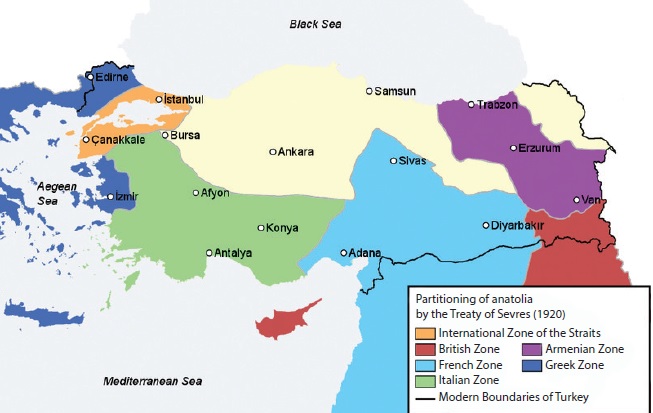
Soru 81
Which one of places below the British forces occupied after the Armistice of Moudros?
Seçenekler
A
Tarsus
B
Adana
C
Kars
D
Burdur
E
Antalya
Açıklama:
The British forces occupied Mosul in Iraq and Merzifon, Kars, Ardahan and Batumi in the north and north-eastern Anatolia. The correct option is C.
Soru 82
Which of the organizations below was founded in Eastern provinces of Turkey in 1918?
Seçenekler
A
Trabzon Muhafaza-i Hukuk Cemiyeti
B
Vilâyat-ı Şarkiye Müdafaa-i Hukuk Cemiyeti
C
İzmir Müdafaa-i Hukuk Cemiyeti
D
Adana Müdafaa-i Hukuk Cemiyeti
E
Müdafaa-i Hukuk Cemiyeti
Açıklama:
One of the regional organizations formed with the purpose of preserving the rights of the Turkish population in eastern provinces of Turkey is Vilâyat-ı Şarkiye Müdafaa-i Hukuk Cemiyeti. The correct option is B.
Soru 83
Which one below was among the defeated power attended Paris Peace Conference?
Seçenekler
A
Italy
B
France
C
England
D
Germany
E
United States
Açıklama:
The Paris Peace conference included the defeated powers, Germany, Austria-Hungary, Bulgaria and the Ottoman Empire. The correct answer is D.
Soru 84
In which option below, are the members of the Council of Four given correctly?
Seçenekler
A
Great Britain-Germany-France-Italy
B
France-United States-Germany-Italy
C
France-Great Britain-United States-Italy
D
Italy-Germany-Great Britain-United States
E
France-Great Britain-United States-Germany
Açıklama:
The Supreme Council of the Conference (Council of Four) composed of Great Britain, France, Italy, and the United States. the correct option is C.
Soru 85
During the Paris Peace Conference, which countries were thought to be separated from the Ottoman Empire?
Seçenekler
A
Armenia-Kurdistan-Palestine
B
Arabia-Syria-Georgia
C
Kurdistan-Arabia-Georgia
D
Armenia-Georgia-Syria
E
Arabia-Armenia-Georgia
Açıklama:
During the Paris Peace Conference, it stated that the Allied (Great Britain, France and Russia) and Associate Powers (Japan, Portugal, Italy and the United States) and other nations who fought alongside the Allies were all in agreement to separate Armenia, Syria, Mesopotamia, Kurdistan, Palestine and Arabia from the Ottoman Empire. The correct answer is A.
Soru 86
What was the motive behind the Greeks' occupation in Anatolia?
Seçenekler
A
London Agreement
B
Council of Ten
C
League of Nations
D
Megali Idea
E
Mandate Issue
Açıklama:
By the occupation of western Anatolia, Greece took a crucial step in the realization of the Megali Idea, the idea of reviving the Byzantine Empire and forming a greater Greece. The correct answer is D.
Soru 87
- The occupation of İzmir
- The Greek atrocities in Aydın
- The extending Armenian massacres
Seçenekler
A
Only III
B
I and II
C
II and III
D
I and III
E
I, II and III
Açıklama:
The Erzurum Congress was convened to protect the ‘holy existence’ of the eastern provinces in face of the following menaces:
- The occupation of İzmir, Adana and Antalya,
- The Greek atrocities in Aydın
- The Armenian massacres extending into the Caucasian boundaries of the Ottoman state,
- The preparations to realize the Pontus state at the Black Sea coast and bringing Greek immigrants in crowds from Russian shores to this effort.
Soru 88
In which meeting was the Representative Committee elected as the executive authority equipped with extraordinary power?
Seçenekler
A
Sivas Congress
B
Council of Four
C
Erzurum Congress
D
Amasya Circular
E
The National Pact
Açıklama:
The Erzurum Congress elected Heyet-i Temsiliye (Representative Committee) as executive authority equipped with extraordinary power. It was to maintain the existence and permanence of the national organization and unite all societies that had been established for the common goal. The correct answer is C.
Soru 89
What was the first commision formed by the Americans in order to investigate the conditions of mandate in the Ottoman Empire?
Seçenekler
A
Harbord Mission
B
King-Crane Commision
C
American Military Mission
D
League of Nations
E
The National Pact
Açıklama:
Two commissions were formed in different times for different regions of the Ottoman Empire by the Americans in order to investigate the conditions for mandate. The first was called the King-Crane Commission. The correct answer is B.
Soru 90
Which places were among the main concerns of the Treaty of Sevres?
Seçenekler
A
Thrace-İzmir-Pontus
B
Kurdistan-İzmir-Pontus
C
Armenia-Kurdistan-Pontus
D
Armenia-İzmir-Pontus
E
Thrace-Armenia-İzmir
Açıklama:
During the negotiations of the Treaty of Sevres, the questions of Thrace, İzmir, Armenia and Kurdistan were discussed in regard to territorial settlement. The correct answer is E.
Soru 91
I - Arrival at Ankara
II- Sivas Congress
III- Erzurum Congress
IV- Amasya Circular
V- Arrival at Samsun
What is the correct chronological order of the events above, from the earliest to the latest?
II- Sivas Congress
III- Erzurum Congress
IV- Amasya Circular
V- Arrival at Samsun
What is the correct chronological order of the events above, from the earliest to the latest?
Seçenekler
A
I - V - III - IV - II
B
V - II - III - IV - I
C
V - IV - II - III - I
D
V - IV - III - II - I
E
V - III - II - IV - I
Açıklama:
The correct answer is D
Soru 92
Which of the following statements is not from Amasya Circular?
Seçenekler
A
The unity of motherland and national independence are in danger.
B
National Independence can only be won through the nation’s effort and determination.
C
The İstanbul government will be supported in their efforts to reconcile the allies.
D
Three representatives from each province are to be sent to Congress in Sivas.
E
The national committee will be responsible to announce the nation’s demand for justice to the world.
Açıklama:
Amasya Circular did not mention supporting Istanbul government in any way.
Soru 93
Which of the following is not true about the Treaty of Sévres?
Seçenekler
A
South-Western Anatolian will be given to Italians.
B
The Ottoman State will limit size of its army and navy.
C
It was signed by İstanbul and Ankara governments.
D
The Ottoman State will submit all financial matters to an Allied commission.
E
The Arab lands will be separated from the Ottoman State.
Açıklama:
The treaty was signed by Istanbul government, not by Ankara government. The correct answer is C.
Soru 94
I - The Greek Army began to extend its occupation after landing.
II - It was a step in realization of the Megali Idea.
III - İstanbul Government declared war against Greece.
IV - Meetings and rallies that are against the landing were organized in several provinces and districts.
Which of the above statement(s) is/are correct about the occupation of İzmir by the Greek Army?
II - It was a step in realization of the Megali Idea.
III - İstanbul Government declared war against Greece.
IV - Meetings and rallies that are against the landing were organized in several provinces and districts.
Which of the above statement(s) is/are correct about the occupation of İzmir by the Greek Army?
Seçenekler
A
I and II
B
I, II and III
C
II, III and IV
D
I, II, III and IV
E
I, II, and, IV
Açıklama:
İstanbul Government did not declare war against Greece. Correct answer is E.
Soru 95
Which one of the following is not among Müdafaa-i Hukuk Cemiyetleri (Societies for the Defense of Rights)?
Seçenekler
A
Vilâyat-ı Şarkiye Müdafaa-i Hukuk Cemiyeti (The Society for the Defense of Rights of the Eastern Provinces)
B
Trabzon Muhafaza-i Hukuk Cemiyeti (the Society for the Preservation of Rights of Trabzon)
C
İzmir Müdafaa-i Hukuk Cemiyeti (The Society for the Defense of Rights of Izmir)
D
Sulh ve Selamet-i Osmaniye Fırkası (The Party of Peace and Security of the Ottoman)
E
Adana Müdafaa-i Hukuk Cemiyeti (the Society for the Defense of Rights of Adana)
Açıklama:
Sulh ve Selamet-i Osmaniye Fırkası (The Party of Peace and Security of the Ottoman) was against defense. Correct answer is D.
Soru 96
Which of the following was not in the position to compete for political power after the Moudros Armistice?
Seçenekler
A
The Unionists
B
The Liberals
C
The Conservatives
D
The Palace
E
The representatives of the Allied Powers in the capital
Açıklama:
The answer is C
Soru 97
I. They were local organizations.
II.They were led by notables, religious men and officials.
III. In defending their cases, they referred to the principle of self-determination.
IV. The former Unionists were active in these organizations.
Which statements above are true?
II.They were led by notables, religious men and officials.
III. In defending their cases, they referred to the principle of self-determination.
IV. The former Unionists were active in these organizations.
Which statements above are true?
Seçenekler
A
I and II
B
II and III
C
I, II and III
D
II, III and IV
E
I, II, III and IV
Açıklama:
All the statements are true. Correct answer is E.
Soru 98
Which of the following is the common idea in the Amasya Circular and the resolutions of the Erzurum and Sivas Congresses?
Seçenekler
A
They were in search of a national salvation independent of the government in İstanbul.
B
They were in search of local salvation.
C
They set the goal of reaching immediately an agreement with the Allied Powers.
D
All developed with Mustafa Kemal’s initiative.
E
They recognized the danger to the unity of the motherland.
Açıklama:
Amasya Circular and the resolutions of the Erzurum and Sivas Congresses were in search of a national salvation independent of the government in İstanbul. Correct answer is A.
Soru 99
Which of the following adopted Misak-ı Milli (the National Pact/National Oath)?
Seçenekler
A
Amasya Circular
B
The Grand National Assembly
C
Erzurum Congress
D
Sivas Congress
E
The Istanbul government
Açıklama:
Misak-ı Mill was adopted by the Grand National Assembly.
Soru 100
When was Istanbul officially occupied?
Seçenekler
A
March 16, 1920
B
May 19, 1919
C
July 23, 1919
D
December 17, 1919
E
April 23, 1920
Açıklama:
Istanbul was occupied on March 16, 1920.
Ünite 8
Soru 1
Which of the following leaders had been appointed as the first commander of the national forces but was later sent to Moscow as the ambassador of the Ankara government?
Seçenekler
A
Ali Fuat (Cebesoy) Pasha
B
İsmet (İnönü) Pasha
C
Kazım (Karabekir) Pasha
D
Marshall Zeki Pasha
E
Ali Refet Pasha
Açıklama:
" Major General (Mirliva) Ali Fuat was appointed as the commander of the national forces...Colonel İsmet (İsmet İnönü), replaced Ali Fuat who was appointed as Ambassador to Moscow."
Soru 2
Which of the following was not among the powers that occupied Anatolia after World War I had ended?
Seçenekler
A
France
B
Italy
C
Great Britain
D
Greece
E
The Soviet Union
Açıklama:
Olayların arasında bağlantı kurmak ve Türk topraklarını işgal etmeye çalışan devletler hakkında ünitede verilen bilgileri kullanarak sonuca ulaşmaya çalışmak açısından bu bir Analiz sorusudur.
"The Russian troops after evacuation signed the Peace Treaty of Brest Litovsk (3 March 1918) with the Central Powers including the Ottoman Empire". Therefore, the Soviet Union was not among the powers that occupied the Turkish lands, Anatolia, between 1919 and 1922.
"The Russian troops after evacuation signed the Peace Treaty of Brest Litovsk (3 March 1918) with the Central Powers including the Ottoman Empire". Therefore, the Soviet Union was not among the powers that occupied the Turkish lands, Anatolia, between 1919 and 1922.
Soru 3
Which of the following events meant (amounted to) the recognition of the Turkish Grand National Assembly and as such the Ankara government by the Allied powers?
Seçenekler
A
The armistice of Mudros
B
The armistice of Mudanya
C
İnönü Battles
D
The London Conference
E
The Great Offensive
Açıklama:
" The Foreign Minister of Italy invited the TGNA to the (London) conference separately. This meant the recognition of the TGNA as an independent political entity both by the Allies and Istanbul Government."
Soru 4
Which of the following was the first Muslim nation to recognize the Turkish Grand National Assembly (TGNA) as an independent entity?
Seçenekler
A
Iran (Persia)
B
Afghanistan
C
Egypt
D
Albania
E
(Saudi) Arabia
Açıklama:
"Ankara signed a friendship agreement with Afghanistan on March 1, 1921. Afghanistan was the first Muslim nation to recognize the TGNA as an independent entity."
Soru 5
Which of the following indicated a real break among the Allied Powers leaving the British and the Greeks alone in Anatolia?
Seçenekler
A
The Treaty of Kars
B
The Treaty of Moscow
C
The Treaty of Ankara
D
The Peace Treaty of Gümrü
E
The Treaty of Alexandropol
Açıklama:
"The French troops left Anatolia by signing a separate treaty, the Treaty of Ankara (Ankara Antlaşması) with the Ankara Government on October 20, 1921. This treaty indicated a real break among the Allied Powers leaving the British and the Greeks alone in Anatolia."
Soru 6
Which of the following best defines the political system of the Turkish national movement between 1920 and 1923?
Seçenekler
A
Parliamentray democracy
B
Presidential system
C
Semi-presidential system
D
Constitutional monarchy
E
Assembly Government
Açıklama:
"The first government or council of ministers, called the Assembly Government (Meclis Hükümeti), was founded by a law issued on May 2, 1920."
Soru 7
- - - - - the Turkish Grand National Assembly passed the "Law of Treason against the Motherland" (Hıyanet-i Vataniye Kanunu) and established the Courts of Independence (İstiklal Mahkemeleri).
Which of the following options correctly completes the sentence above?
Which of the following options correctly completes the sentence above?
Seçenekler
A
Because many internal rebellions had occurred in Anatolia
B
Because the İstanbul Government had declared all nationalists as rebels
C
Because the Turkish army had to withdraw to the east of Sakarya River
D
Because the Greek troops had started invading İzmir
E
Because the Italians had occupied Antalya and Konya
Açıklama:
"The Turkish Grand National Assembly had to take measures against these rebellions. To this end, in April 1920 a law was decreed by the Assembly named Hıyanet-i Vataniye.. and in accordance with this law İstiklal Mahkemeleri were formed to implement the law."
Soru 8
Who had been elected as the president of the Turkish Grand National Assembly on April 23, 1920, and was later appointed also as the Commander-in-Chief of the TGNA army?
Seçenekler
A
Mustafa Kemal Pasha (Atatürk)
B
İsmet Pasha (İnönü)
C
Fevzi Pasha (Çakmak)
D
Ali Fuat Pasha (Cebesoy)
E
Rauf Pasha (Orbay)
Açıklama:
"Mustafa Kemal was elected as the president of the Turkish Grand National Assembly on April 23.... He was given full powers as Commander-in-chief of the Army by the Turkish Grand National Assembly on August 5, 1921."
Soru 9
Which of the following signified the final stage in the Turkish War of Independence and paved the way for a negotiated armistice at Mudanya?
Seçenekler
A
The İnönü Battles
B
The Sakarya Battle
C
The Kütahya-Eskişehir Battles
D
The Great Offensive
E
The Ankara Agreement
Açıklama:
"The major step to save Anatolia from the Allied occupation was the Grand Offensive (Büyük Tarruz) waged against the Greek army in 1922....The Great Offensive had been a success ending with the unquestionable victory of the Turkish Grand National Assembly Army."
Soru 10
Which of the following had refused to participate in the armistice talks in October 1922 but later recognized the terms of the Mudanya Armistice?
Seçenekler
A
The TGNA Government
B
France
C
Greece
D
Italy
E
Great Britain
Açıklama:
"The Greek representative, General Mazaraki, refused to participate in the talks...The terms of the Mudanya Armistice later were recognized by the Greek Government."
Soru 11
When was the first confrontation of the national forces with the Greek troops in Aegean Reagon?
Seçenekler
A
31 May, 1919
B
10 June, 1919
C
15 June, 1919
D
20 May, 1919
E
15 May, 1919
Açıklama:
First confrontation with the Greek troops happened on 31 May, 1919, but the national forces could not resist much. As a result, the Greek troops moved further west, east and south of İzmir occupying Ödemiş, Ayvalık and Aydın in a short time.
Soru 12
In which city did the Italian army land in Anatolia in March 1919?
Seçenekler
A
Antalya
B
Muğla
C
Aydın
D
Burdur
E
Bilecik
Açıklama:
Italy was also one of the Allied Powers that occupied Anatolia. The Italian occupation in Anatolia began as a protest to the decision made at the Paris Peace Conference that gave İzmir to Greece. The Italian Army landed first in Antalya in March 1919 and their justification was that the city was their heritage from the Roman Empire. They, declared their rule in the regions between the coasts of Antalya and the Dodecanese Islands after March 16, 1919 without the approval of the Paris Peace Conference.
Soru 13
What was the reason why the Italian occupation didn't encounter any resistance?
Seçenekler
A
There were no soldiers to fight against Italians
B
They had a friendly attitude towards the Turkish people
C
They immediately killed whoever resisted
D
Turkish forces were still busy making plans
E
Sultan forbade soldiers from making any kind of resistance against Italians
Açıklama:
the Italian occupation was realized without encountering any resistance. The most important reason why the Italian occupations were easily done was their friendly attitude towards the Turkish people. Unlike the brutal Greek occupation, the Italians treated the people fairly, protected the Turks living in the occupied territories against the Greeks and provided help to the Turks who had to migrate from the Greek occupation zone.
Soru 14
Which one is not among the countries that participated to the London Conference held on February 2, 1921?
Seçenekler
A
Britain
B
France
C
Italy
D
Japan
E
Hungary
Açıklama:
The Conference in London started with the participation of Allied Powers; Britain, France, Italy, Greece, and Japan. Lloyd George, the Prime Minister of Britain, chaired the conference. The Ankara and Istanbul delegations joined the conference on February 23 after it had started.
Soru 15
What was the reason why the Greek couldn't be pushed further back from Dumlupınar in the Second Battle of İnönü?
Seçenekler
A
Turkish forces changed strategy
B
The Greek got reinforcements from the allies
C
The Greek had a stronghold there
D
Turkish forces were eliminated completely
E
Allied forces offered a ceasefire
Açıklama:
Second Battle of İnönü. The Greek attacks again were directed from Bursa to Eskişehir and from Uşak to Afyon. The Greek forces occupied Bilecik on March 24 and Pazarcık on March 25 and finally, they came to İnönü from the northwest. In the south, they occupied Afyon and Metris Tepe located north of İnönü. The TGNA Army under the command of İsmet Pasha took position and counter-attacked the Greek Army and forced them to retreat to Bursa on March 31, 1921. The Greek Army had to leave Bilecik and Söğüt (the first domains of the Kayı Tribe in Central Anatolia) with heavy losses. This was the second success of the TGNA Army against the Greeks. In the south, the Greeks were also forced to retreat from Afyon. However, the Greek Army had a stronghold in Dumlupınar near Afyon and they could not be pushed further back because of the strong logistic support they had behind their lines.
Soru 16
After which battle did Mustafa Kemal gain the rank 'Field Marshal'?
Seçenekler
A
Sakarya Battle
B
First Battle of İnönü
C
Second Battle of İnönü
D
Battle of Gallipoli
E
Battle of Dumlupınar
Açıklama:
After the Sakarya Battle Mustafa Kemal returned to Ankara in triumph and was awarded with the title of Ghazi and the rank of Field Marshal (müşir). It has to be remembered that once Mustafa Kemal resigned from the Ottoman army he did not have a military rank. Through Sakarya Battle, he had been reinstated as a military officer by the TGNA. The ranks of other brave commanders of this battle were also upgraded.
Soru 17
Which of the below is not one of the statements that Mustafa Kemal proposed to the Turkish Grand National Assembly?
Seçenekler
A
There should be no power superior over the Assembly
B
There should be no appointed deputy in place of the sultan and the caliph whether temporary or not
C
The government should be responsible only to the Parliament
D
The president of the Assembly should preside over the government
E
The future of the sultan-caliph should be determined by the Turkish people
Açıklama:
On the day the TGNA was opened Mustafa Kemal submitted a proposal to the Assembly. In this proposal, he affirmed that:
- There should be no power superior over the Assembly,
- There should be no appointed deputy in place of the sultan and the caliph whether temporary or not,
- The government should be responsible only to the Parliament,
- The president of the Assembly should preside over the government, and
- The future of the sultan-caliph should be determined by the Assembly.
Soru 18
Which of the below was one of the actions Sultan and İstanbul government performed after the invasion of the Allied powers?
Seçenekler
A
Resisting to Allied powers' demands
B
Making preparations that would prevent a permanent occupation
C
Rejecting fetvas from Şeyhülislam that declare nationalists as sinners
D
Believing that peace would be secured in the near future
E
Showing national struggle as an illegal movement
Açıklama:
When the Ottoman Empire signed the Armistice of Moudros, Sultan Vahidettin by name Mehmed VI, has been on the Ottoman throne only for six months. After the Armistice, the Sultan found himself in an impossible situation and yielded to whatever the Allied Powers demanded. He believed that the Allied occupations would be temporary. However, it was obvious with the secret pre-war agreements and very severe demands of the Treaty of Sevrés that this would not be the case. Firmly holding on to his belief, he did not take heed of the warnings made by the patriotic officers, instead, the Ottoman government condemned Mustafa Kemal and the other nationalists to death in their absentia. Moreover, after the Turkish Grand National Assembly was opened, the sultan and Istanbul government declared Mustafa Kemal and all nationalists as rebels and the Assembly an illegal organization. The Istanbul government even took fetvas (religious order issued by the clergy) from Şehyülislam to declare the nationalists as sinners and Muslim clergy was used to provoke people against Mustafa Kemal and all nationalists.
Soru 19
What was the role of Kazım Özalp in the Turkish War of Independence: Great Offensive?
Seçenekler
A
Minister of National Defense
B
Chief of General Staff Marshal
C
Commander of the Western Front
D
Commander of the Eastern Front
E
Commander of the Southern Front
Açıklama:
The preparations for an offensive against the Greek Army were arranged in the greatest secrecy. Only a few people who were close associates of Mustafa Kemal, Kazım (Özalp), the Minister of National Defense, Fevzi (Çakmak) Chief of General Staff Marshal, and İsmet (İnönü) Commander of the Western Front, knew the army could launch attack in the middle of June. The troops were transferred from the eastern and southeastern fronts to the western since they were no longer needed in those regions.
Soru 20
On which date did the TGNA Army enter İzmir?
Seçenekler
A
September 1, 1922
B
September 5, 1922
C
September 9, 1922
D
September 14, 1922
E
September 19, 1922
Açıklama:
On September 1, Commander-in-Chief Mustafa Kemal Pasha issued his historic order “Armies, your first goal is the Mediterranean. Forward!” The army needed to move fast so that the Greek forces could not have time to regain their strength and form resistance lines. From September 1st until the 8th, the national army freed Uşak, Eskişehir, Balıkesir, Bilecik, Aydın and Manisa from Greek occupation. On September 9, 1922, the TGNA Army entered İzmir. The second arm of the army which had been fighting on the Eskişehir-Bursa line continued its operations and moved forward in order to end the invasion of Thrace. The Great Offensive had been a success ending with the unquestionable victory of the Turkish Grand National Assembly Army and consequently of the Turkish people. The answer to the Treaty of Sevrés was given in the battle fields.
Soru 21
Which war was the beginning of the Turkish War of Independence to save Anatolia from the Allied occupation.
Seçenekler
A
The Grecko-Turkish was
B
İnönü Battles
C
Kütahya-Eskişehir Battles
D
Sakarya Battles
E
Great Offensive
Açıklama:
The Greco-Turkish War started after the Greek landing in İzmir in 1919, in accordance with the agreements made with the Allied powers, and continued until the Greek troops were defeated in 1922. This war at the same time was the beginning of the Turkish War of Independence to save Anatolia from the Allied occupation.
Soru 22
Where did Italians first occupy in Anatolia?
Seçenekler
A
Konya
B
Antalya
C
Kuşadası
D
Bodrum
E
Marmaris
Açıklama:
The Italian Army landed first in Antalya in March 1919 and their justification was that the city was their heritage from the Roman Empire. They, declared their rule in the regions between the coasts of Antalya and the Dodecanese Islands after March 16, 1919 without the approval of the Paris Peace Conference. The Italians, later, occupied Konya in April, and Kuşadası, Fethiye, Bodrum and Marmaris in May 1919.
Soru 23
When did The İnönü battle take place?
Seçenekler
A
1919
B
1920
C
1921
D
1922
E
1923
Açıklama:
Greek Army which had already occupied Bursa in the north and Uşak in the south Anatolia attacked Eskişehir and Afyon on January 6, 1921 with a pretext of following and cleaning the nationalist resistance. In fact, their main aim was to control the Anatolian Railways lines which passed through Ankara and Konya via Eskişehir. Thus, the Greeks hoped to control the hinterland of western Anatolia by taking central Anatolia under their control. However, while the Nationalist Army took position around İnönü River to confront the Greek Army, Çerkez Ethem rebelled against the Nationalist Army in the Gediz Region which meant fractioning the national forces.
Soru 24
What was the main effect of İnönü battles in the war against allied powers?
Seçenekler
A
Allied powers started to think that they could win
B
Ottoman empire got stronger
C
Turkish Grand National Assembly got weaker
D
Turkish Grand National Assembly strengthen its image
E
Greek forces occupied Anatolia completely
Açıklama:
The Turkish victory at the battles of İnönü strengthened the image and power of the Turkish Grand National Assembly both in the country and in the world.
Soru 25
After which event was Mustafa Kemal given the title of Ghazi?
Seçenekler
A
İnönü battle
B
Kütahya-Eskişehir battle
C
Great offensive
D
Treaty of Gümrü
E
Sakarya Battle
Açıklama:
After the Sakarya Battle Mustafa Kemal returned to Ankara in triumph and was awarded with the title of Ghazi and the rank of Field Marshal (müşir).
Soru 26
After which treaty did the French Troops leave Anatolia?
Seçenekler
A
Treaty of Ankara
B
Treaty of Kars
C
Treaty of Sevres
D
Treaty of Istanbul
E
Treaty of Sivas
Açıklama:
The French troops left Anatolia by signing a separate treaty, the Treaty of Ankara (Ankara Antlaşması) with the Ankara Government on October 20, 1921.
Soru 27
When did the Turkish Grand National Assembly open?
Seçenekler
A
1923
B
1920
C
1938
D
1921
E
1919
Açıklama:
The opening of the Turkish Grand National Assembly in Ankara on April 23, 1920 in fact was birth of a new state in Anatolia. Both the Ottoman Sultan and his government (Istanbul Government) as well as the Allied Powers were aware of this fact.
Soru 28
Who was the first to rebel against Turkish Grand National Assembly in Anatolia?
Seçenekler
A
Çerkes Ethem
B
Çapanoğlu
C
Anzavur
D
Musa Çopur
E
Ali Batı
Açıklama:
The first of internal rebellions was led by Ahmet Anzavur, a discharged officer from the Ottoman army, who was loyal to the Sultan in Manyas against the National movement in September 1919 at the time of the Sivas Congress.
Soru 29
When was the law named Hıyanet-i Vataniye (Treason against the Motherland), decreed by the Assembly?
Seçenekler
A
1919
B
1922
C
1923
D
1920
E
1918
Açıklama:
The Turkish Grand National Assembly had to take measures against these rebellions. To this end, in April 1920 a law was decreed by the Assembly named Hıyanet-i Vataniye (Treason against the Motherland), and in accordance with this law İstiklal Mahkemeleri (Courts of Independence) were formed to implement the law.
Soru 30
How long did the Turkish War of Independence take?
Seçenekler
A
5 years
B
4 years
C
2 years
D
8 years
E
3 years
Açıklama:
The war took 3 years from treaty of Serves in 1919 to Armistice of Mudanya in 1922.
Soru 31
Even though Greece is not a military intervention against the Ottoman Empire during World War I, the Greek army is attacking Izmir and its environs by claiming which Treaty?
Seçenekler
A
Sevrés
B
Gümrü
C
Moscow
D
Berlin
E
Paris
Açıklama:
Even though Greece has not been militarily involved against the Ottoman Empire during
World War I, as a consequence of the Treaty of Paris, the Greek army landed at İzmir and its vicinity in a week by killing whoever resisted them.
World War I, as a consequence of the Treaty of Paris, the Greek army landed at İzmir and its vicinity in a week by killing whoever resisted them.
Soru 32
Which years did The Greco-Turkish War take place?
Seçenekler
A
1876-1877
B
1884-1887
C
1905-1909
D
1915-1918
E
1919-1922
Açıklama:
The Greco-Turkish War started after the Greek landing in İzmir in 1919, in accordance with the agreements made with the Allied powers, and continued until the Greek troops were defeated
in 1922.
in 1922.
Soru 33
Which of the following congress was attended by Mustafa Kemal?
Seçenekler
A
Balıkesir Congress (June 1919)
B
Alaşehir Congress (August 1919)
C
Nazilli Congress (August and September 1919)
D
Afyon Karahisar (August 1920)
E
İzmir Congress ( May 1919 )
Açıklama:
There were also other congresses in Western Anatolia such as two congresses in
Nazilli (August and September 1919) and one in Afyon Karahisar in August 1920 to which Mustafa Kemal participated as well.
Nazilli (August and September 1919) and one in Afyon Karahisar in August 1920 to which Mustafa Kemal participated as well.
Soru 34
Who was appointed to replace Ali Fuat Pasha when he failed to prevent Greek attacks?
Seçenekler
A
İsmet İnönü
B
Mustafa Kemal
C
Mithat Paşa
D
Fevzi Çakmak
E
Bekir Sam
Açıklama:
Ali Fuat Pasha, the Commander of the Western Front, attacked the Greek Army
but failed to stop them and had to retreat. Upon this, Colonel İsmet (İsmet İnönü), replaced Ali Fuat who was appointed as Ambassador to Moscow.
but failed to stop them and had to retreat. Upon this, Colonel İsmet (İsmet İnönü), replaced Ali Fuat who was appointed as Ambassador to Moscow.
Soru 35
Which of the following is not one of the places occupied by Italy?
Seçenekler
A
Fethiye
B
Kuşadası
C
Kütahya-Eskişehir
D
Marmaris
E
Bodrum
Açıklama:
The Italians, occupied Konya in April, and Kuşadası, Fethiye, Bodrum and Marmaris in May 1919.
Soru 36
Where did the Grand National Assembly for the first time as an independent political entity by the Allies?
Seçenekler
A
Treaty of Sevrés (August 1920)
B
London Conference (February 1921)
C
Treaty of Gümrü (December 1920)
D
Treaty of Moscow (March 1921)
E
Armistice of Mudanya (October 1922)
Açıklama:
the London Conference ended without a resolution of peace but the Ankara Government
and the TGNA were recognized as an independent political entity by the Allies.
and the TGNA were recognized as an independent political entity by the Allies.
Soru 37
Who is the first Muslim nation to recognize the TGNA as an independent institution?
Seçenekler
A
Iranian
B
Saudi Arabia
C
Egypt
D
Afghanistan
E
Libya
Açıklama:
Afghanistan was the first Muslim nation to recognize the TGNA as an independent entity.
Soru 38
Who was the commander of the battle of Sakarya, which was the bloodiest and longest war of the national struggle, which lasted 22 days since the Greek occupation of Anatolia?
Seçenekler
A
Mustafa Kemal
B
İsmet İnönü
C
Kazım Karabekir
D
Fevzi Çakmak
E
Celal Bayar
Açıklama:
Sakarya Battle and Mustafa Kemal Pasha in Command
Soru 39
Which is the first peace treaty of the Grand National Assembly of Turkey following the Armenian "Great Armenia", she concluded her dreams?
Seçenekler
A
Treaty of Gümrü
B
Treaty of Moscow
C
Treaty of Ankara
D
Treaty of Kars
E
Armistice of Mudanya
Açıklama:
Treaty of Gümrü was the first peace treaty that the Turkish Grand National Assembly had signed as a result of its military success with an internationally accepted state.this treaty removed the Armenians from being an element of constant threat and ended their dreams of “Greater Armenia”.
Soru 40
Which of the following countries was signed with the Ankara Treaty?
Seçenekler
A
England
B
Italy
C
Germany
D
France
E
Greece
Açıklama:
Turkish Grand National Assembly and France agreed on the return of Antep, Adana and
their surroundings to the Turks on March 15, 1921. As a matter of fact, this agreement was finalized with the Ankara Agreement in October 1921. Finally French Army accepted
defeat and signed the Treaty of Ankara (Ankara Antlaşması) on October 20, 1921.
their surroundings to the Turks on March 15, 1921. As a matter of fact, this agreement was finalized with the Ankara Agreement in October 1921. Finally French Army accepted
defeat and signed the Treaty of Ankara (Ankara Antlaşması) on October 20, 1921.
Soru 41
Which of the following event, totally annihilated the Treaty of Sevres?
Seçenekler
A
The Defeat of the Allied Powers by the TGNA Army
B
Treaty of Gümrü
C
Treaty of Moscow
D
The opening of the Turkish Grand National Assembly
E
Armistice of Mudanya
Açıklama:
The imperialists also had to realize that they could not implement the Treaty of Sevres which aimed at ending the Turkish presence in Anatolia in any manner
possible
possible
Soru 42
Which of the following treaty was signed after the Battle of Sakarya with an Allied Power?
Seçenekler
A
Ankara
B
Kars
C
Sevres
D
Gümrü
E
Moscow
Açıklama:
Moreover, it was the Turkish victory on the Greeks in the Battle of
Sakarya that convinced the French Command to withdraw from Turkey by
signing the Treaty of Ankara in October 1921 and this caused a break among
the Allied Powers.
Sakarya that convinced the French Command to withdraw from Turkey by
signing the Treaty of Ankara in October 1921 and this caused a break among
the Allied Powers.
Soru 43
After which military development Mustafa Kemal Pasha was awarded with the rank of Marshal and title of Ghazi by the TGNA?
Seçenekler
A
Great Offensive
B
Commander-in-Chief Battle
C
Armistice of Mudanya
D
Sakarya Battle
E
İnönü Battles
Açıklama:
After the Sakarya Battle Mustafa Kemal returned to Ankara in triumph and was awarded with the title of Ghazi and the rank of Field Marshal
Soru 44
Which of the following event marked the first break in the Allied Block during the Turkish War of Independence?
Seçenekler
A
The Turkish victory in the Sakarya Battle
B
Signing the Treaty of Ankara
C
The Turkish victory in İnönü Battles
D
London Conference after the First Battle of İnönü
E
The Turkish victory in the Great Offensive
Açıklama:
The French troops left Anatolia by signing a separate treaty, the Treaty of Ankara (Ankara Antlaşması) with the Ankara Government on October 20, 1921. This treaty indicated a real break among the Allied Powers leaving the British and the Greeks alone in Anatolia
Soru 45
The National Tax Orders were issued after…?
Seçenekler
A
Kütahya-Eskişehir Battles
B
First Battle of İnönü
C
Second Battle of İnönü
D
Sakarya Battle
E
Occupation of Istanbul
Açıklama:
Then, he ordered the mobilization of “all the moral and material forces of the country” by requisitioning “40 percent of all goods in Anatolia including those of foreign firms” using article 10 of the National Tax Orders (Tekâlif-i Milliye Emirleri)
issued on August 7-8, 1921
issued on August 7-8, 1921
Soru 46
Which of the following was the main reason for the incitement of rebellions in the Bolu and Düzce regions?
Seçenekler
A
To prevent the travel of the Representative Committee to Sivas
B
To prevent the organization of the Representative Committee
C
To support the National forces
D
To prevent the opening of the TGNA
E
To form a buffer zone around of the Straits in favor of Britain
Açıklama:
Some of these rebellions such Ahmet Anzavur’s rebellions, Düzce and Bolu rebellions started with the provocation of the British to secure their control of the Dardanelles and of the Straits even before the TGNA was opened.
Soru 47
The USSR accepted the the abolition of the capitulations with the Treaty of Moscow and this meant ...........?
Seçenekler
A
TGNA established a new state
B
USSR recognized Turkey’s full independence
C
The Treaty of Mudanya was recognized by the USSR
D
USSR secured economic privileges
E
Two governments acted together
Açıklama:
Later, the Soviet Union signed the Treaty of Moscow with the TGNA in March
1921. With this treaty, the Bolshevik government accepted the abolition
of the capitulations and this meant it recognized full independence of the
Turkey
1921. With this treaty, the Bolshevik government accepted the abolition
of the capitulations and this meant it recognized full independence of the
Turkey
Soru 48
The Importance of the Constitution that the TGNA accepted was…?
Seçenekler
A
to authorize the TGNA government’s decisions and acts
B
to held majority in the TGNA
C
to held majority in the Ottoman Parliament
D
to elect Mustafa Kemal as the President of the TGNA
E
to support the Ottoman sultan
Açıklama:
This law laid the basis of the first constitution of Modern Turkey called Teşkilât-ı Esasiye Kanunu accepted on January 20, 1921 and was to authorize decisions and acts of the government of Turkish Grand National Assembly
Soru 49
The Ankara Government accepted the Law on Deserters to …?
Seçenekler
A
prevent internal rebellions
B
remove the opposition in the Assembly
C
issue new taxes
D
prevent desertion from the Army
E
establish Independence Tribunals
Açıklama:
Then these rebellions not only threatened security
in the country but also dangered the maintenance of the Turkish War of
Independence. The TGNA accepted the Law of Treason against Motherland
(Hıyanet-i Vataniye Kanunu) to punish those who opposed the legal existence of
the TGNA literally or via publication knowingly or unknowingly and engaged
in the act of corruption or mischief
in the country but also dangered the maintenance of the Turkish War of
Independence. The TGNA accepted the Law of Treason against Motherland
(Hıyanet-i Vataniye Kanunu) to punish those who opposed the legal existence of
the TGNA literally or via publication knowingly or unknowingly and engaged
in the act of corruption or mischief
Soru 50
Which of the following was the reason for the London Conference ?
Seçenekler
A
Kütahya-Eskişehir Battles
B
Turkish success at the First İnönü Battle
C
The opening of the TGNA
D
Allied occupation of Istanbul
E
Greek occupation of İzmir
Açıklama:
After the London Conference the Greeks did not wait to find out how the Turkish Grand National Assembly would respond to the ultimatum given at the conference. With great encouragement and provocation from Britain they attacked the Turkish positions in Eskişehir on March 23, 1921 with the idea of forcing TGNA to accept the terms of the Treaty of Sevrés. This battle would be named the Second Battle of İnönü.
Soru 51
- The Allied occupation plan was just left on paper since a national struggle started in Anatolia under the leadership of Mustafa Kemal Pasha (later Mustafa Kemal Atatürk).
- The National Struggle (Milli Mücadele) was initiated by the militia groups called kuva-yı milliye (national forces) in 1919 later maintained by the regular army established under the authority of the TGNA in June 1920.
- The Greco-Turkish War started after the Greek landing in İzmir in 1919, in accordance with the agreements made with the Allied Powers.
- The Greco-Turkish War continued until the Greek troops were defeated in 1922.
- The Greco-Turkish War at the same time was the beginning of the Turkish War of Independence to save Anatolia from the Allied occupation.
Seçenekler
A
I and II
B
I, II and III
C
I, II and IV
D
I, II and V
E
I, II, III, IV and V
Açıklama:
The Allied occupation of Anatolia was legitimized through the Treaty of Sevrés by sharing Anatolia among themselves. But their plan was just left on paper since a national struggle started in Anatolia under the leadership of Mustafa Kemal Pasha (later Mustafa Kemal Atatürk). Pasha lifted the plan out of practice and literally destroyed it. This national struggle though started against the Allied occupation, later it turned to be a war to secure national sovereignty since the Ottoman sultan and his government in Istanbul (hereafter the Istanbul Government) tried every political rouse to block the national struggle cooperating with the Allies. It was the Grand National Assembly (Büyük Millet Meclisi) called the Turkish Grand National Assembly (hereafter the TGNA) after March 1921 with its government served as the sole political entity defending the Turkish national interests in Anatolia and organized people around a common goal to save it from the occupations. The Struggle was initiated by the militia groups called kuva-yı milliye (national forces) in 1919 later maintained by the regular army established under the authority of the TGNA in June 1920.
The Greco-Turkish War started after the Greek landing in İzmir in 1919, in accordance with the agreements made with the Allied powers, and continued until the Greek troops were defeated in 1922. This war at the same time was the beginning of the Turkish War of Independence to save Anatolia from the Allied occupation.
As also understood from the information given, the correct answer is E.
The Greco-Turkish War started after the Greek landing in İzmir in 1919, in accordance with the agreements made with the Allied powers, and continued until the Greek troops were defeated in 1922. This war at the same time was the beginning of the Turkish War of Independence to save Anatolia from the Allied occupation.
As also understood from the information given, the correct answer is E.
Soru 52
- The Greco-Turkish War started after the Greek landing in İzmir in 1919, in accordance with the agreements made with the Allied Powers.
- The Greco-Turkish War continued until the Greek troops were defeated in 1922.
- The Greco-Turkish War at the same time was the beginning of the Turkish War of Independence to save Anatolia from the Allied occupation.
- As a consequence of the Treaty of Paris, the Greek army landed at İzmir and its vicinity in a week by killing whoever resisted them.
- The patriotic people in Aegean Region protested occupations and they formed militia forces (national forces) to confront the Greek Army.
Seçenekler
A
I and V
B
I, III and V
C
II, III and IV
D
II, III, IV and V
E
I, II, III, IV and V
Açıklama:
The Greco-Turkish War started after the Greek landing in İzmir in 1919, in accordance with the agreements made with the Allied powers, and continued until the Greek troops were defeated in 1922. This war at the same time was the beginning of the Turkish War of Independence to save Anatolia from the Allied occupation. Even though Greece has not been militarily involved against the Ottoman Empire during World War I, as a consequence of the Treaty of Paris, the Greek army landed at İzmir and its vicinity in a week by killing whoever resisted them. The Ottoman government protested this occupation but not as strongly as it was expected from a government whose territorial integrity was challenged by a foreign army. The Grand Vizier Damat Ferit Pasha resigned but then he was ordered to form a new government again. The Ottoman Sultan Vahidettin, by name Mehmet VI, followed a submissive policy towards the occupations believing that peace would be possible with this course of action. The patriotic people in Aegean Region protested occupations and they formed militia forces (national forces) to confront the Greek Army. As also understood from the information given, the correct answer is E.
Soru 53
- The Redd-i İlhâk Komitesi (Rejection of Annexation Committee) held congresses in Balıkesir.
- The Redd-i İlhâk Komitesi (Rejection of Annexation Committee) held congresses in Alaşehir.
- The Representative Committee in Sivas Congress decided to form a regular army.
- The opening of the Turkish Grand National Assembly (the TGNA)
- A regular army which would include all the military units in central, north, east and south of Anatolia under the command of the nationalist officers including the Western Front Command was formed.
Seçenekler
A
I, II, III, IV, V
B
I, III, IV, V, II
C
III, IV, V, I, II
D
IV, V, I, III, I
E
V, I, III, II, IV
Açıklama:
First confrontation with the Greek troops happened on 31 May, 1919, but the national forces could not resist much. As a result, the Greek troops moved further west, east and south of İzmir occupying Ödemiş, Ayvalık and Aydın in a short time. Meanwhile, the Redd-i İlhâk Komitesi (Rejection of Annexation Committee) held congresses in Balıkesir (June 1919) and in Alaşehir (August 1919) to call people to stand against the Greek occupation. These congresses had great influence on people to get organized in western Anatolia. In Balıkesir, for example, there were four other congresses held in July, September and November in 1919 and one in March 1920. There were also other congresses in Western Anatolia such as two congresses in Nazilli (August and September 1919) and one in Afyon Karahisar in August 1920 to which Mustafa Kemal participated as well. While these congresses were taking place, the Representative Committee in Sivas Congress decided to form a regular army on September 9, 1919 and founded Western Front Command (Batı Anadolu Umum Kuva-yi Milliye Komutanlığı). Major General (Mirliva) Ali Fuat was appointed as the commander of the national forces since the local resistance forces were not strong enough to stop the Greek expansion in Western Anatolia. As also understood from the information given, the correct answer is A.
Soru 54
- The first stage of The Turkish War of Independence started after the landing of the Greek Troops which initiated the Greco-Turkish War.
- The first stage of The Turkish War of Independence continued until the first defeat of the Greek Army at the Battle of Sakarya.
- During the first stage of The Turkish War of Independence the TGNA Army repelled the Armenian attacks in Eastern Anatolia and the national forces repelled the French and Armenian attacks in Southern Anatolia as well.
- The second stage was the period that started after the Sakarya Battle until victory achieved with the Turkish Great Offensive (Büyük Taarruz).
- The Turkish Great Offensive (Büyük Taarruz) defeated the Greek Army and sent them out of the National borders determined by the National Oath/National Pact (Misak-ı Milli).
- The Greek defeat was also the defeat of the Allied Powers and thus, they yielded to sign an armistice in Mudanya, a town in western Anatolia.
Seçenekler
A
I, II, III, IV, V, VI
B
I, II, IV, V, VI, III
C
III, I, II, IV, V, VI
D
IV, VI, I, II, III, V
E
IV, I, II, III, V, IV
Açıklama:
The Struggle was initiated by the militia groups called kuva-yı milliye (national forces) in 1919 later maintained by the regular army established under the authority of the TGNA in June 1920. During the National Struggle called the Turkish National Struggle (Milli Mücadele) or Turkish War of Independence (Türk Kurtuluş Savaşı) which lasted from 1919 to 1922, many patriotic inviduals from different segments of the society joined the TGNA Army. These people under the leadership of Mustafa Kemal Pasha removed every provocation and obstacle created by the Allied Powers and the Ottoman Sultan to save Anatolia and laid the foundation of the Republic of Turkey (Modern Turkey). The Turkish War of Independence had two stages. The first stage started after the landing of the Greek Troops in 1919 which initiated the Greco-Turkish War and continued until the first defeat of the Greek Army at the Battle of Sakarya in September 1921. During this period the TGNA Army repelled the Armenian attacks in Eastern Anatolia and the national forces repelled the French and Armenian attacks in Southern Anatolia as well. The second stage was the period that started after the Sakarya Battle until victory achieved with the Turkish Great Offensive (Büyük Taarruz) in 1922 which defeated the Greek Army and sent them out of the National borders determined by the National Oath/National Pact (Misak-ı Milli). The Greek defeat was also the defeat of the Allied Powers and thus, they yielded to sign an armistice in Mudanya, a town in western Anatolia, in October 1922. As also understood from the information given, the correct answer is A.
Soru 55
- The Italian occupation in Anatolia began as a protest to the decision made at the Paris Peace Conference that gave İzmir to Greece.
- The Italian Army landed first in Antalya in March 1919 and their justification was that the city was their heritage from the Roman Empire.
- They, declared their rule in the regions between the coasts of Antalya and the Dodecanese Islands after March 16, 1919 without the approval of the Paris Peace Conference.
- The Italians, later, occupied Konya in April, and Kuşadası, Fethiye, Bodrum and Marmaris in May 1919.
- Italians having understood this well evacuated their positions in West and South Anatolia on June 1, 1921 unconditionally.
Seçenekler
A
I and V
B
II, III and V
C
II, IV and V
D
II, III, IV and V
E
I, II, III, IV and V
Açıklama:
Italy was also one of the Allied Powers that occupied Anatolia. The Italian occupation in Anatolia began as a protest to the decision made at the Paris Peace Conference that gave İzmir to Greece. The Italian Army landed first in Antalya in March 1919 and their justification was that the city was their heritage from the Roman Empire. They, declared their rule in the regions between the coasts of Antalya and the Dodecanese Islands after March 16, 1919 without the approval of the Paris Peace Conference. The Italians, later, occupied Konya in April, and Kuşadası, Fethiye, Bodrum and Marmaris in May 1919. The Italian statesmen were not satisfied with these occupations and sent military units to Söke of Aydın Province and Milas of Muğla in May 1919 while the Greeks landed in İzmir. The Italian occupation also expanded to Burdur (Isparta) and Çine in Aydın province. The Italians wanted to own the lands which were promised to them with the secret war agreements by establishing peaceful relations with the Turks. But their policies were useless since Ankara Government was not willing to give any territory from Anatolia to any occupiers. Italians having understood this well evacuated their positions in West and South Anatolia on June 1, 1921 unconditionally. As also understood from the information given, the correct answer is E.
Soru 56
- The people in Anatolia began to trust the Ankara Government
- The counter propagandas maintained by the Istanbul Government and its supporters were stopped with the victory at İnönü.
- Deserters from the Army also decreased
- The victory had important ramifications in foreign relations as well
- The rank of Colonel İsmet was promoted to General.
Seçenekler
A
I and II
B
II and III
C
IV and V
D
I, II, III and V
E
I, II, III, IV and V
Açıklama:
Recommended Corrections:
Page 200
Venizelos hoped to win the elections but he was not successful. The pro-King party won the elections and called the exiled King Constantine back. However, King Constantine was not supported by Britain and even the latter tried to prevent him enter Athens on December 4, 1920.
Page 201
Tevfik Pasha refused telling them that Ankara representatives were the actual representatives of the Turkish people.
Tevfik Pasha refused by telling them that Ankara representatives were the actual representatives of the Turkish people.
The Greek Army which had already occupied Bursa in the north and Uşak in the south Anatolia attacked Eskişehir and Afyon on January 6, 1921 with a pretext of following and cleaning the nationalist resistance. In fact, their main aim was to control the Anatolian Railways lines which passed through Ankara and Konya via Eskişehir. Thus, the Greeks hoped to control the hinterland of western Anatolia by taking central Anatolia under their control. However, while the Nationalist Army took position around İnönü River to confront the Greek Army, Çerkez Ethem rebelled against the Nationalist Army in the Gediz Region which meant fractioning the national forces. The Greek Army benefitted from this weakness of the Turkish army and moved toward İnönü region and attacked the Turkish positions at İnönü on January 9, 1921. The TGNA Army units which went to suppress Çerkez Ethem Rebellion came back to İnönü to help the other units and stopped the Greek Army on January 10. The Greek Army retreated to Bursa and this was the first success of the TGNA Army against the Greek forces. The impact of this success was numerous in the country. The people in Anatolia began to trust the Ankara Government and the counter propagandas maintained by the Istanbul Government and its supporters were stopped with the victory at İnönü. In addition, deserters from the Army also decreased. The rank of Colonel İsmet was promoted to General on March 1, 1921. The victory of the TGNA Army at the İnönü Battle also had important ramifications in foreign relations as well. As also understood from the information given, the correct answer is E.
Page 200
- It is not clear in the sentence what “the latter” refers to.
Venizelos hoped to win the elections but he was not successful. The pro-King party won the elections and called the exiled King Constantine back. However, King Constantine was not supported by Britain and even the latter tried to prevent him enter Athens on December 4, 1920.
Page 201
Tevfik Pasha refused telling them that Ankara representatives were the actual representatives of the Turkish people.
Tevfik Pasha refused by telling them that Ankara representatives were the actual representatives of the Turkish people.
The Greek Army which had already occupied Bursa in the north and Uşak in the south Anatolia attacked Eskişehir and Afyon on January 6, 1921 with a pretext of following and cleaning the nationalist resistance. In fact, their main aim was to control the Anatolian Railways lines which passed through Ankara and Konya via Eskişehir. Thus, the Greeks hoped to control the hinterland of western Anatolia by taking central Anatolia under their control. However, while the Nationalist Army took position around İnönü River to confront the Greek Army, Çerkez Ethem rebelled against the Nationalist Army in the Gediz Region which meant fractioning the national forces. The Greek Army benefitted from this weakness of the Turkish army and moved toward İnönü region and attacked the Turkish positions at İnönü on January 9, 1921. The TGNA Army units which went to suppress Çerkez Ethem Rebellion came back to İnönü to help the other units and stopped the Greek Army on January 10. The Greek Army retreated to Bursa and this was the first success of the TGNA Army against the Greek forces. The impact of this success was numerous in the country. The people in Anatolia began to trust the Ankara Government and the counter propagandas maintained by the Istanbul Government and its supporters were stopped with the victory at İnönü. In addition, deserters from the Army also decreased. The rank of Colonel İsmet was promoted to General on March 1, 1921. The victory of the TGNA Army at the İnönü Battle also had important ramifications in foreign relations as well. As also understood from the information given, the correct answer is E.
Soru 57
- After the Sakarya Battle Mustafa Kemal returned to Ankara in triumph and was awarded with the title of Ghazi and the rank of Field Marshal (müşir).
- Treaty of Kars was signed with the USSR on October 13, 1921 solving border disputes.
- The Allied Powers were shocked by the Turkish victory and tried to establish peaceful relations with the Turks again.
- Italy which had a stance against Greece long before had already established friendly relations with the Ankara Government.
- The French troops left Anatolia by signing a separate treaty, the Treaty of Ankara (Ankara Antlaşması) with the Ankara Government.
- France with the Treaty of Ankara has recognized the Ankara Government as the sole political authority in Anatolia.
Seçenekler
A
I, II and III
B
I, II, III and IV
C
I, II, IV and V
D
I, III, IV and VI
E
I, II, III, IV, V and VI
Açıklama:
Recommended Correction:
Page 202
The Turkish victories caused Britain to loose trust in the ability of the Greek Army to be victorious over the Turks.
The Turkish victories caused Britain to lose trust in the ability of the Greek Army to be victorious over the Turks.
After the Sakarya Battle Mustafa Kemal returned to Ankara in triumph and was awarded with the title of Ghazi and the rank of Field Marshal (müşir). It has to be remembered that once Mustafa Kemal resigned from the Ottoman army he did not have a military rank. Through Sakarya Battle he had been reinstated as a military officer by the TGNA. The ranks of other brave commanders of this battle were also upgraded. While the Battle of Sakarya enhanced the reputation and image of the TGNA and its army in the country, the most significant aftermath was seen in foreign relations. Most notable was that the countries that sympathize with the Turks signed either friendship treaties or treaties to solve the border disputes with the Ankara government. The most concrete example of the treaties was the Treaty of Kars signed with the USSR on October 13, 1921 solving border disputes. The Allied Powers were shocked by the Turkish victory and tried to establish peaceful relations with the Turks again. Meanwhile, there was political crisis in Greece and this reflected itself in the Greek army. The Greek Army in their attempt at least to keep the cities they occupied in western Anatolia in their hands, started to build a strong defense. The attitudes and beliefs of the Allies towards Greece have also changed. Italy which had a stance against Greece long before had already established friendly relations with the Ankara Government. When the Greeks asked for help for a new attack, France also responded to it by making peace with the Turks. The French troops left Anatolia by signing a separate treaty, the Treaty of Ankara (Ankara Antlaşması) with the Ankara Government on October 20, 1921. This treaty indicated a real break among the Allied Powers leaving the British and the Greeks alone in Anatolia. Moreover, France with this treaty has recognized the Ankara Government as the sole political authority in Anatolia. She also recognized stipulations of the National Pact instead of the Treaty of Sevrés and agreed to evacuate southern Anatolia by withdrawing its forces from Cilicia to her Syrian Mandate with the exception of Hatay (Alexandretta) whose fate to join Turkish Republic was determined later- the city became part of the Turkish Republic on 23 July, 1939. As also understood from the information given, the correct answer is E.
Page 202
The Turkish victories caused Britain to loose trust in the ability of the Greek Army to be victorious over the Turks.
The Turkish victories caused Britain to lose trust in the ability of the Greek Army to be victorious over the Turks.
After the Sakarya Battle Mustafa Kemal returned to Ankara in triumph and was awarded with the title of Ghazi and the rank of Field Marshal (müşir). It has to be remembered that once Mustafa Kemal resigned from the Ottoman army he did not have a military rank. Through Sakarya Battle he had been reinstated as a military officer by the TGNA. The ranks of other brave commanders of this battle were also upgraded. While the Battle of Sakarya enhanced the reputation and image of the TGNA and its army in the country, the most significant aftermath was seen in foreign relations. Most notable was that the countries that sympathize with the Turks signed either friendship treaties or treaties to solve the border disputes with the Ankara government. The most concrete example of the treaties was the Treaty of Kars signed with the USSR on October 13, 1921 solving border disputes. The Allied Powers were shocked by the Turkish victory and tried to establish peaceful relations with the Turks again. Meanwhile, there was political crisis in Greece and this reflected itself in the Greek army. The Greek Army in their attempt at least to keep the cities they occupied in western Anatolia in their hands, started to build a strong defense. The attitudes and beliefs of the Allies towards Greece have also changed. Italy which had a stance against Greece long before had already established friendly relations with the Ankara Government. When the Greeks asked for help for a new attack, France also responded to it by making peace with the Turks. The French troops left Anatolia by signing a separate treaty, the Treaty of Ankara (Ankara Antlaşması) with the Ankara Government on October 20, 1921. This treaty indicated a real break among the Allied Powers leaving the British and the Greeks alone in Anatolia. Moreover, France with this treaty has recognized the Ankara Government as the sole political authority in Anatolia. She also recognized stipulations of the National Pact instead of the Treaty of Sevrés and agreed to evacuate southern Anatolia by withdrawing its forces from Cilicia to her Syrian Mandate with the exception of Hatay (Alexandretta) whose fate to join Turkish Republic was determined later- the city became part of the Turkish Republic on 23 July, 1939. As also understood from the information given, the correct answer is E.
Soru 58
- There should be no power superior over the Assembly,
- There should be no appointed deputy in place of the sultan and the caliph whether temporary or not,
- The government should be responsible only to the Parliament
- The president of the Assembly should preside over the government
- The future of the sultan caliph should be determined by the Assembly
Seçenekler
A
I and II
B
I, II and III
C
I, II and IV
D
I, II, IV and V
E
I, II, III, IV and V
Açıklama:
Recommended Corrections:
Page 207
The Istanbul government even took fetvas (religious order issued by the clregy)…
The Istanbul government even took fetvas (religious order issued by the clergy)…
Page 210
This treaty was the first peace treaty that the Turkish Grand National Assembly had signed as a result of its military success with an internationally accepted state.
This treaty was the first peace treaty that the Turkish Grand National Assembly had signed as a result of its military success and as an internationally accepted state.
On the day the TGNA was opened Mustafa Kemal submitted a proposal to the Assembly. In this proposal he affirmed that:
Page 207
The Istanbul government even took fetvas (religious order issued by the clregy)…
The Istanbul government even took fetvas (religious order issued by the clergy)…
Page 210
This treaty was the first peace treaty that the Turkish Grand National Assembly had signed as a result of its military success with an internationally accepted state.
This treaty was the first peace treaty that the Turkish Grand National Assembly had signed as a result of its military success and as an internationally accepted state.
On the day the TGNA was opened Mustafa Kemal submitted a proposal to the Assembly. In this proposal he affirmed that:
- There should be no power superior over the Assembly,
- There should be no appointed deputy in place of the sultan and the caliph whether temporary or not,
- The government should be responsible only to the Parliament
- The president of the Assembly should preside over the government
- The future of the sultan caliph should be determined by the Assembly
Soru 59
Which of the following treaties was the first peace treaty that the Turkish Grand National Assembly had signed as a result of its military success and as an internationally accepted state?
Seçenekler
A
The Peace Treaty of Brest Litovsk
B
The Peace Treaty of Gümrü
C
The Treaty of SykesPicot
D
The Treaty of Kars
E
The Treaty of Moscow
Açıklama:
Recommended Correction:
Page 216
Indemnation to be paid by Greece for the war damages caused in Anatolia
Indemnisation to be paid by Greece for the war damages caused in Anatolia
Kazım Karabekir Pasha, the Commander of the 15th Army Corps in Erzurum, was preparing to take Kars, Ardahan, and Batum back to save the Turks from Armenian attacks. But when the Red Army (the Soviet Army) entered the Caucasus defeating the British, Kazım Karabekir asked permission from Mustafa Kemal on March 28, 1920 for the invasion of these cities up to the border drawn by Treaty of Brest Litovsk. However, the TGNA found such an attack disadvantageous in such an adverse environment since the Armenian problem was also brought to the attention of international platform in Paris and Rome. Then the Red Army entered Caucasus and Ankara Government changed the status of 15th Army Corps into the Eastern Front Command and proclaimed partial mobilization in the region. Meanwhile, the planned operation against the Armenians was also postponed so as not to harm the newly established relations with the Soviet Union. The Armenians, however, seizing the opportunity from this delay, occupied Oltu and its environs after August 12, 1920 and started a general attack on September 24. The Turkish Grand Naitonal Assembly Army went into operation against the Armenians on the morning of September 28th and rescued Sarıkamış and waited for the response from the Soviets. But when the Soviets asked Kars, Ardahan, and Batum to be returned to the Armenians, the TGNA Army took Kars on October 30 and extended its maneuvers until the borders determined with the National Pact was reached. Then the Armenians evacuated Alexandropol (Gümrü) on November 7 and asked for truce and later the Peace Treaty of Gümrü was signed on December 3, 1920. This treaty was the first peace treaty that the Turkish Grand National Assembly had signed as a result of its military success with an internationally accepted state. As also understood from the information given, the correct answer is B.
Page 216
Indemnation to be paid by Greece for the war damages caused in Anatolia
Indemnisation to be paid by Greece for the war damages caused in Anatolia
Kazım Karabekir Pasha, the Commander of the 15th Army Corps in Erzurum, was preparing to take Kars, Ardahan, and Batum back to save the Turks from Armenian attacks. But when the Red Army (the Soviet Army) entered the Caucasus defeating the British, Kazım Karabekir asked permission from Mustafa Kemal on March 28, 1920 for the invasion of these cities up to the border drawn by Treaty of Brest Litovsk. However, the TGNA found such an attack disadvantageous in such an adverse environment since the Armenian problem was also brought to the attention of international platform in Paris and Rome. Then the Red Army entered Caucasus and Ankara Government changed the status of 15th Army Corps into the Eastern Front Command and proclaimed partial mobilization in the region. Meanwhile, the planned operation against the Armenians was also postponed so as not to harm the newly established relations with the Soviet Union. The Armenians, however, seizing the opportunity from this delay, occupied Oltu and its environs after August 12, 1920 and started a general attack on September 24. The Turkish Grand Naitonal Assembly Army went into operation against the Armenians on the morning of September 28th and rescued Sarıkamış and waited for the response from the Soviets. But when the Soviets asked Kars, Ardahan, and Batum to be returned to the Armenians, the TGNA Army took Kars on October 30 and extended its maneuvers until the borders determined with the National Pact was reached. Then the Armenians evacuated Alexandropol (Gümrü) on November 7 and asked for truce and later the Peace Treaty of Gümrü was signed on December 3, 1920. This treaty was the first peace treaty that the Turkish Grand National Assembly had signed as a result of its military success with an internationally accepted state. As also understood from the information given, the correct answer is B.
Soru 60
- The hostilities between the two sides would end.
- The Greek occupation of Thrace was to be terminated and the Greek forces were to be withdrawn to the left bank of Maritza River.
- The Turkish gendarmerie forces would be present in Eastern Thrace to prevent possible adversary acts during the withdrawal.
- The Greeks would hand over the administration of the region first to the Allied Powers and then to the Turks within 30 days, under the supervision of the Allied Powers.
- Both Turks and Greek would not try to reinforce their troops and keep to their current positions.
Seçenekler
A
I, II and III
B
I, III and IV
C
I, IV and V
D
II, III, IV and V
E
I, II, III, IV and V
Açıklama:
The negations between the delegations for an armistice started on October 3, 1922 in Mudanya. İsmet Pasha the commander of the western front was representing the Turkish Grand National Assembly, Britain was represented by General Charles Harrington, France by General Charpy and Italy by General Mombelli. The Greek representative, General Mazaraki, refused to participate in the talks. The negotiations ended in a favorable agreement on October 11, 1922. However, further discussions of peace had to wait for another time
The Mudanya Armistice Agreement had the following stipulations:
The Mudanya Armistice Agreement had the following stipulations:
- The hostilities between the two sides would end,
- The Greek occupation of Thrace was to be terminated and the Greek forces were to be withdrawn to the left bank of Maritza River,
- The Turkish gendarmerie forces would be present in Eastern Thrace to prevent possible adversary acts during the withdrawal,
- The Greeks would hand over the administration of the region first to the Allied Powers and then to the Turks within 30 days, under the supervision of the Allied Powers.
- Both Turks and Greek would not try to reinforce their troops and keep to their current positions.
Soru 61
Which war can be considered as the beginning of the Turkish War of Independence?
Seçenekler
A
World War I
B
World War II
C
Ottoman-Armenian War
D
The Greco-Turkish war
E
Ankara
Açıklama:
The Greco-Turkish War started after the Greek landing in İzmir in 1919, in accordance with the agreements made with the Allied powers, and continued until the Greek troops were defeated in 1922. This war at the same time was the beginning of the Turkish War of Independence to save Anatolia from the Allied occupation.
Soru 62
Under whose leadership did the national struggle started in Anatolia?
Seçenekler
A
Damat Ferit Pasha
B
Mustafa Kemal Pasha
C
Sultan Vahidettin
D
District Governor Bekir Sami
E
Çerkez Ethem
Açıklama:
The Allied occupation of Anatolia was legitimized through the Treaty of Sevrés by sharing Anatolia among themselves. But their plan was just left on paper since a national struggle started in Anatolia under the leadership of Mustafa Kemal Pasha (later Mustafa Kemal Atatürk). Pasha lifted the plan out of practice and literally destroyed it.
Soru 63
When did the first confrontation with the Greek troops happened?
Seçenekler
A
31 May, 1919
B
31 May, 1918
C
10 June, 1919
D
10 June, 1920
E
10 June, 1918
Açıklama:
First confrontation with the Greek troops happened on 31 May, 1919, but the national forces could not resist much. As a result, the Greek troops moved further west, east and south of İzmir occupying Ödemiş, Ayvalık and Aydın in a short time.
Soru 64
At which congress did Mustafa Kemal Paşa also attended himself, to get people organised at the western Anatolia?
Seçenekler
A
Balıkesir
B
Alaşehir
C
Nazilli
D
Afyon Karahisar
E
Sivas
Açıklama:
Redd-i İlhâk Komitesi (Rejection of Annexation Committee) held congresses in Balıkesir (June 1919) and in Alaşehir (August 1919) to call people to stand against the Greek occupation. These congresses had great influence on people to get organized in western Anatolia. In Balıkesir, for example, there were four other congresses held in July, September and November in 1919 and one in March 1920. There were also other congresses in Western Anatolia such as two congresses in Nazilli (August and September 1919) and one in Afyon Karahisar in August 1920 to which Mustafa Kemal participated as well.
Soru 65
When the Western front was divided into two, who was in command of the South West?
Seçenekler
A
Ali Refet Pasha
B
İsmet Pasha
C
Tevfik Pasha
D
Ali Fuat Pasha
E
Mustafa Kemal Pasha
Açıklama:
Ali Fuat Pasha, the Commander of the Western Front, attacked the Greek Army but failed to stop them and had to retreat. Upon this, Colonel İsmet (İsmet İnönü), replaced Ali Fuat who was appointed as Ambassador to Moscow. The Western Front was divided into two commands. İsmet Pasha was in command of the North West while Ali Refet Pasha was in charge of South West Front.
Soru 66
As being one of the Allied Forces that occupied Anatolia, where did the Italian army landed first?
Seçenekler
A
İzmir
B
Antalya
C
Marmaris
D
Muğla
E
Burdur
Açıklama:
Italy was also one of the Allied Powers that occupied Anatolia. The Italian occupation in Anatolia began as a protest to the decision made at the Paris Peace Conference that gave İzmir to Greece. The Italian Army landed first in Antalya in March 1919 and their justification was that the city was their heritage from the Roman Empire.
Soru 67
Which battle is considered the first success of the TGNA Army against Greek forces?
Seçenekler
A
Kütahya-Eskişehir battles
B
Sakarya Battle
C
İnönü Battle
D
Second İnönü Battle
E
Battle of the Commander-in-Chief
Açıklama:
January 9, 1921. The TGNA Army units which went to suppress Çerkez Ethem Rebellion came back to İnönü to help the other units and stopped the Greek Army on January 10. The Greek Army retreated to Bursa and this was the first success of the TGNA Army against the Greek forces. The impact of this success was numerous in the country. The people in Anatolia began to trust the Ankara Government and the counter propagandas maintained by the Istanbul Government and its supporters were stopped with the victory at İnönü. In addition, deserters from the Army also decreased. The rank of Colonel İsmet was promoted to General on March 1, 1921.
Soru 68
Where didi the Second Battle of İnönü took place?
Seçenekler
A
Kütahya-Eskişehir
B
Sakarya
C
Muğla
D
İzmir
E
Antalya
Açıklama:
After the London Conference the Greeks did not wait to find out how the Turkish Grand National Assembly would respond to the ultimatum given at the conference. With great encouragement and provocation from Britain they attacked the Turkish positions in Eskişehir on March 23, 1921 with the idea of forcing TGNA to accept the terms of the Treaty of Sevrés. This battle would be named the Second Battle of İnönü. The Greek attacks again were directed from Bursa to Eskişehir and from Uşak to Afyon.
Soru 69
How long did the Great Battle of Sakarya lasted?
Seçenekler
A
Twenty two days
B
Two weeks
C
A month
D
Twelve days
E
One week
Açıklama:
The great battle of the Sakarya, which lasted from the 23rd August to the 13th September, both days included, continued without interruption for twenty-two days and twenty-two nights and constitutes a unique example of a battle of the widest extent, not alone in the historical records of the new Turkish State but also in the pages of the world’s history.
Soru 70
On what date did the Turkish Grand National Assembly in Ankara was opened?
Seçenekler
A
June 23, 1920
B
April 23, 1923
C
April 23, 1920
D
May 19, 1919
E
May 19, 1920
Açıklama:
The opening of the Turkish Grand National Assembly in Ankara on April 23, 1920 in fact was birth of a new state in Anatolia.
Soru 71
Which of the following is the term used for the militia groups that initiated the struggle against the Allies' occupation of Anatolia?
Seçenekler
A
Misak-ı Milli
B
Tekalif-i Milliye
C
Düzensiz Birlikler
D
Kuva-yı Milliye
E
Müdafaa-ı Vatan Grubu
Açıklama:
The independence struggle against the Allies' occupation of most parts of Anatolia was initiated by the military groups known as Kuva-yı Milliye. The correct answer is D.
Soru 72
In which congress during the Turkish Independence War was it decided to form a regular army to confront the Allies?
Seçenekler
A
Erzurum Congress
B
Balıkesir Congress
C
Sivas Congress
D
Alaşehir Congress
E
Amasya Congress
Açıklama:
Although there were congresses held before, it was in Sivas Congress that it was decided to form a regular army against the occupation. The correct answer is C.
Soru 73
What was the condition of Britain for granting the mandate of Western Anatolia to the Greeks in the Turkish Independence War?
Seçenekler
A
To defeat the Turks
B
To bring democracy into their country
C
To treat Turkish people well
D
To stay there temporarily
E
To support Britain in its wars
Açıklama:
The condition put by Britain to Greece for granting them the mandate of Western Anatolia was to defeat the Turks in war. The correct answer is A.
Soru 74
Which of the following countries was the first Muslim nation to recognize the Ankara government as a separate entity?
Seçenekler
A
Pakistan
B
Umman
C
Afghanistan
D
Egypt
E
Malaysia
Açıklama:
Afghans were the first Muslim nation that recognized the Ankara government as a separate political entity in 1921. The correct answer is C.
Soru 75
What was the main motivation of the Greeks when they fought against the troops of the Ankara government in Eskişehir and Kütahya?
Seçenekler
A
To force the Ankara government to accept the terms of the Treaty of Serves
B
To occupy the entire Anatolia
C
To take revenge of the Ottoman rule
D
To prevent the Ankara government from occupying Greece
E
To kill as many people as they could
Açıklama:
The main aim of the Greeks when they fought the Eskişehir-Kütahya battles was to make the Ankara government to accept the terms of the Treaty od Sevres, which would have left Western Anatolia to them. The correct answer is A.
Soru 76
After which war Mustafa Kemal was reinstated as a military officer?
Seçenekler
A
Kütahya-Eskişehir Battles
B
Sakarya Battle
C
Battle of the Commander-in-Chief
D
İnönü Battles
E
Great Offensive
Açıklama:
Once Mustafa Kemal resigned from the Ottoman army he did not have a military rank. After the Sakarya battle he was awarded with the title of Ghazi and the rank of Field Marshal. The correct answer is B.
Soru 77
Which of the following was not included in the proposal submitted by Mustafa Kemal to the Turkish Grand National Assembly on the day of its opening?
Seçenekler
A
There should be no power superior to the Assembly
B
The government should be responsible only to the Parliament
C
The president of the Assembly should preside over the government
D
The future of the sultan-caliph should be determined by the Assembly
E
The assembly should be liable to the President
Açıklama:
In the proposal submitted by Mustafa Kemal to the Turkish Grand National Assembly, there was not such a proposal that the assembly should be liable to the President. It would have been against the nature of the assembly. The correct answer is E.
Soru 78
Which of the following is not one of the precautions taken by the Istanbul government against the nationalists in the year of 1920?
Seçenekler
A
Heyet-i Nasiha, advisory committees advising people not to resist the Allies, was founded
B
A fatwa condemning them as rebels and legitimizing their execution was issued
C
Hilafet ordusu (Caliph army) was established
D
Italians were asked to provide military support
E
Bribes were given in order to provoke an anti-nationalist reaction
Açıklama:
Istanbul government did its best to provoke an anti-nationalist reaction in Anatolia and took some measures to this end. Asking Italians for military support was not one of them. Their primary external source of support was the British. The correct answer is D.
Soru 79
Which of the following was among the stipulations of the Mudanya Armistice Agreement?
I) The hostilities between the two sides would end
II) The Greek occupation of Thrace was to be terminated and the Greek forces were to be withdrawn to the left bank of Maritza River
III) Izmir would be left to the Greeks
I) The hostilities between the two sides would end
II) The Greek occupation of Thrace was to be terminated and the Greek forces were to be withdrawn to the left bank of Maritza River
III) Izmir would be left to the Greeks
Seçenekler
A
Only I
B
Only II
C
I and II
D
I and III
E
II and III
Açıklama:
Mudanya Armistice Agreement was signed after the success of the Great Offensive. Therefore, leaving Izmir to the Greeks was not an issue at all. The correct answer is C.
Soru 80
Where did the Çapanoğlu rebellion, which was one of the rebellions against the newly founded Turkish Grand National Assembly, take place?
Seçenekler
A
Yozgat
B
Antep
C
Afyon
D
Zonguldak
E
Kars
Açıklama:
The Çapanoğlu rebellion was led by the Çapanoğlu family of Yozgat region. The correct answer is A.
Soru 81
Which date the regular army was established under the authority of the Turkish Grand
National Assembly ?
National Assembly ?
Seçenekler
A
1919
B
1920
C
1921
D
1922
E
1923
Açıklama:
The Struggle was initiated by the militia groups called kuva-yı milliye (national forces) in 1919 later maintained by the regular army established under the authority of the TGNA in June 1920.
Soru 82
Which one of the following event started the second stage of the The Turkish War
of Independence?
of Independence?
Seçenekler
A
Treaty of Moudros
B
Treaty of Serves
C
Foundation of Turkish Grand National Assembly
D
Battle of Sakarya
E
Turkish Great Offensive
Açıklama:
The second stage was the period that started after the Sakarya Battle until victory achieved with the Turkish Great Offensive (Büyük Taarruz) in 1922 which defeated the Greek Army and sent them out of the National borders determined by the National Oath/National Pact (Misak-ı Milli).
Soru 83
Which one of the following is the date of The Turkish Great Offensive (Büyük Taarruz)?
Seçenekler
A
1920
B
1921
C
1922
D
1923
E
1924
Açıklama:
The second stage was the period that started after the Sakarya Battle until victory achieved with the Turkish Great Offensive (Büyük Taarruz) in 1922 which defeated the Greek Army and sent them out of the National borders determined by the National Oath/National Pact (Misak-ı Milli).
Soru 84
Which on of the following is the date of the Armistice of Mudanya?
Seçenekler
A
1922
B
1923
C
1924
D
1925
E
1926
Açıklama:
The Greek defeat was also the defeat of the Allied Powers and thus, they yielded to sign an armistice in Mudanya, a town in western Anatolia, in October 1922. The Mudanya Armistice not only ended the Allied occupation which had started in 1918 but also brought an end to the Ottoman Empire.
Soru 85
When did the first confrontation between the Greek troops and National forces happen?
Seçenekler
A
1923
B
1922
C
1921
D
1920
E
1919
Açıklama:
First confrontation with the Greek troops happened on 31 May, 1919, but the national forces could not resist much.
Soru 86
After being replaced by Colonel İsmet, which state Ali Fuat was appointed as an Ambassador?
Seçenekler
A
Italy
B
France
C
CCCP
D
Great Britain
E
The United States
Açıklama:
Meanwhile the Greek advance could not be stopped. The Greek troops came up to Gediz
River which constituted a natural passage to Central Anatolia. Ali Fuat Pasha, the Commander of the Western Front, attacked the Greek Army but failed to stop them and had to retreat. Upon this, Colonel İsmet (İsmet İnönü), replaced Ali Fuat who was appointed as Ambassador to Moscow.
River which constituted a natural passage to Central Anatolia. Ali Fuat Pasha, the Commander of the Western Front, attacked the Greek Army but failed to stop them and had to retreat. Upon this, Colonel İsmet (İsmet İnönü), replaced Ali Fuat who was appointed as Ambassador to Moscow.
Soru 87
Which one of the following was occupied by the Italian forces firstly?
Seçenekler
A
Marmaris
B
Fethiye
C
Antalya
D
Bodrum
E
Kuşadası
Açıklama:
Italy was also one of the Allied Powers that occupied Anatolia. The Italian occupation in
Anatolia began as a protest to the decision made at the Paris Peace Conference that gave İzmir to Greece. The Italian Army landed first in Antalya in March 1919 and their justification was that the city was their heritage from the Roman Empire.
Anatolia began as a protest to the decision made at the Paris Peace Conference that gave İzmir to Greece. The Italian Army landed first in Antalya in March 1919 and their justification was that the city was their heritage from the Roman Empire.
Soru 88
Which one of the following caused problems between Greece and Italy after Italian forces occupied it?
Seçenekler
A
Marmaris
B
Bodrum
C
Milas
D
Aydın
E
Fethiye
Açıklama:
The Italians, later, occupied Konya in April, and Kuşadası, Fethiye, Bodrum and Marmaris in May 1919. The Italian statesmen were not satisfied with these occupations and sent
military units to Söke of Aydın Province and Milas of Muğla in May 1919 while the Greeks landed in İzmir. The Italian occupation also expanded to Burdur (Isparta) and Çine in Aydın province. While, the Italian occupations were not protested by the Ottoman government, the Nationalists protested them. Interestingly, the Italian command claimed that their presence in these regions was in accordance with the permission given by the sultan which in fact was not true. However, the Italian occupation in Aydın province caused problems between the Italians and the Greeks since this province was promised to the Greeks.
military units to Söke of Aydın Province and Milas of Muğla in May 1919 while the Greeks landed in İzmir. The Italian occupation also expanded to Burdur (Isparta) and Çine in Aydın province. While, the Italian occupations were not protested by the Ottoman government, the Nationalists protested them. Interestingly, the Italian command claimed that their presence in these regions was in accordance with the permission given by the sultan which in fact was not true. However, the Italian occupation in Aydın province caused problems between the Italians and the Greeks since this province was promised to the Greeks.
Soru 89
Which date The Turkish Grand National Assembly signed a friendship agreement with Afghanistan?
Seçenekler
A
1919
B
1920
C
1921
D
1922
E
1923
Açıklama:
While, the Allies were trying to subdue the TGNA, Ankara signed a friendship agreement
with Afghanistan on March 1, 1921. Afghanistan was the first Muslim nation to recognize the
TGNA as an independent entity.
with Afghanistan on March 1, 1921. Afghanistan was the first Muslim nation to recognize the
TGNA as an independent entity.
Soru 90
Which one of the following was the first battle which Mustafa Kemal Pasha commanded the Turkish forces for the first time during the Turkish Indıpence War?
Seçenekler
A
The First İnönü Battle
B
The Second İnönü Battle
C
Battle of Sakarya
D
Battle of Eskişehir
E
Turkish Great Offensive
Açıklama:
The Deputies in the TGNA were disappointed and angry after the defeats in Eskişehir. The common people of Anatolia were fearful and in panic, too. The deputies of TGNA fearing the advance of the Greek troops even further proposed to transfer the Assembly to Kayseri -a
city east of Ankara. The opponents of Mustafa Kemal blamed him for defeats in these battles. Mustafa Kemal convinced them to stay in Ankara and the deputies asked Mustafa Kemal to take the responsibility of fighting the Greek army. He requested complete and
unquestionable authority to take the Army under his command. He was given full powers as Commanderin-chief of the Army by the Turkish Grand National Assembly on August 5, 1921 for a period of three months.
city east of Ankara. The opponents of Mustafa Kemal blamed him for defeats in these battles. Mustafa Kemal convinced them to stay in Ankara and the deputies asked Mustafa Kemal to take the responsibility of fighting the Greek army. He requested complete and
unquestionable authority to take the Army under his command. He was given full powers as Commanderin-chief of the Army by the Turkish Grand National Assembly on August 5, 1921 for a period of three months.