Organızatıonal Behavıor (ENG) - Tüm Sorular
Ünite 1
Soru 1
I. The necessity of individual effort
II. Satisfying the needs of society
III. Existing for a purpose
Which one(s) of the element(s) above is/are included in the definition of organization?
II. Satisfying the needs of society
III. Existing for a purpose
Which one(s) of the element(s) above is/are included in the definition of organization?
Seçenekler
A
Only I
B
Only II
C
Only III
D
I and II
E
II and III
Açıklama:
An organization means an organized effort of people, which satisfies the society’s needs for its own purpose.
Soru 2
Which one of the following is not among the elements of human capital?
Seçenekler
A
knowledge
B
personality
C
skill
D
ability
E
experience
Açıklama:
Human capital is one of the most important assets of organizations. This kind of capital includes knowledge, skill, ability and experience of individuals
Soru 3
Which one of the following terms refers to the set of shared beliefs, values, attitudes, norms, goals and practices among the organizational members?
Seçenekler
A
Organizational behaviour
B
Organizational environment
C
Organizational culture
D
Organizational capital
E
Organizational effort
Açıklama:
Organizational culture is defined as the set of shared beliefs, values, attitudes, norms, goals and practices among the organizational members, so that these shared values and behaviors form a unique psychological and social organizational environment that characterize the organization.
Soru 4
Which one of the following does not have a major role in the emergence of organizational behaviour as a field?
Seçenekler
A
Psychology
B
Linguistics
C
Sociology
D
Economics
E
Political science
Açıklama:
Although it is primarily identified with psychology, OB field also emerged from sociology, political science and economics (Schneider, 1985). Besides, anthropology field has important contributions for OB. In addition to social sciences, engineering and medicine also contributed to its development
Soru 5
Which one of the following scholars is best known for defining scientific management techniques?
Seçenekler
A
Frederick Winslow Taylor
B
Adam Smith
C
Fritz Roethlisberger
D
Elton Mayo
E
Plato
Açıklama:
Frederick Winslow Taylor (1856-1915), who was an engineer and manufacturing manager at a steel company in U.S., is best known for defining scientific management techniques, in other words applying engineering principles to the study of work tasks
Soru 6
I. The attitudes and feelings of employees
II. Social and interpersonal human dynamics
III. Job expertise and education of the managers
Which one(s) of the statement(s) above is/are among the major findings of the Hawthorne studies?
II. Social and interpersonal human dynamics
III. Job expertise and education of the managers
Which one(s) of the statement(s) above is/are among the major findings of the Hawthorne studies?
Seçenekler
A
Only I
B
Only II
C
Only III
D
I and II
E
II and III
Açıklama:
The researchers also discovered the attitudes and feelings of employees; manager’s behavior or leadership; social and interpersonal human dynamics, and the behavioral norms set by the task group, as critically important factors for productivity
Soru 7
Which one of the following is not regarded as a challenge in managing organizational behavior?
Seçenekler
A
increasing globalization
B
need to understand diverse workforce
C
advancing technology
D
managing ethical issues
E
economic crisis throughout the world
Açıklama:
Managing organizational behavior in today’s organizations is especially challenging for organizations which face many outstanding rapid changes in their external environment. These challenges can be grouped into four; which are, (1) increasing globalization, (2) need to understand diverse workforce, (3) advancing technology, and (4) managing ethical issues.
Soru 8
Which one of the following refers to the the total value of goods produced and services provided by a country’s economy within a specified time-period, which is usually one year?
Seçenekler
A
multinational corporations
B
Globalization
C
gross domestic product
D
outsourcing
E
transformation
Açıklama:
GDP (gross domestic product) is the total value of goods produced and services provided by a country’s economy within a specified time-period, which is usually one year.
Soru 9
Which one of the following is defined as systematic psychological abuse of an individual or group?
Seçenekler
A
Mobbing
B
Work-family conflict
C
Discrimination
D
Pressure
E
Cultural diversity
Açıklama:
Mobbing is defined as systematic psychological abuse of an individual or group; the ultimate purpose of mobbing is making the individual leave the organization as a result of damaging the reputation, honor and integrity of the individual.
Soru 10
"Employees are working in teams with others who have different national origins, or they need to cooperate with them who work in the subsidiaries of their companies located in different countries."
Which one of the following terms stands for this description?
Which one of the following terms stands for this description?
Seçenekler
A
ability diversity
B
cultural diversity
C
age diversity
D
atmosphere
E
organizational culture
Açıklama:
As a result of increasing global economy, organizations’ workforce has more cultural diversity. Employees are working in teams with others who have different national origins, or they need to cooperate with them who work in the subsidiaries of their companies located in different countries. Therefore, team performance and effective communication among others arise as important OB topics
Soru 11
According to Schwartz, what represents the organization where everyone knows what the organization is about?
Seçenekler
A
Clockwork
B
Snakepit
C
Clockpit
D
Snakework
E
Pitwork
Açıklama:
Schwartz (1987) distinguished between two views of organizations. The first one, which he defined as clockwork, represents an organization where everyone knows what the organization is about; and the other one, defined as snakepit, represents an organization where nobody knows what is going on.
Soru 12
According to Schwartz, what represents an organization where nobody knows what is going on?
Seçenekler
A
Clockwork
B
Snakepit
C
Clockpit
D
Snakework
E
Workpit
Açıklama:
Schwartz (1987) distinguished between two views of organizations. The first one, which he defined as clockwork, represents an organization where everyone knows what the organization is about; and the other one, defined as snakepit, represents an organization where nobody knows what is going on.
Soru 13
What term is defined as "two or more people with shared leadership and fate, who work together and interdependent on each other’s support towards achieving a common goal"?
Seçenekler
A
Team
B
Group
C
Unit
D
Task force
E
Crew
Açıklama:
A team is defined as two or more people with shared leadership and fate, who work together and interdependent on each other’s support towards achieving a common goal; therefore, team members are jointly responsible for their outcomes.
Soru 14
What term is defined as "two or more people who interact with each other to achieve their individual goals which are not mutual goals" ?
Seçenekler
A
Team
B
Group
C
Unit
D
Task force
E
Crew
Açıklama:
A group is two or more people who interact with each other to achieve their individual goals which are not mutual goals.
Soru 15
Which scientific discipline has an impact on the Organizational Behavior field in terms of occupational health and safety?
Seçenekler
A
Economics
B
Anthropology
C
Sociology
D
Psychology
E
Engineering
Açıklama:
In today’s conditions, engineering discipline impacts OB field in terms of occupational health and safety which has became a popular area of
research.
research.
Soru 16
Which philosopher suggested the term "division of labor"?
Seçenekler
A
Plato
B
Aristotle
C
Machiavelli
D
Adam Smith
E
Frederick Winslow Taylor
Açıklama:
In 1776, Adam Smith suggested division of labor.
Soru 17
When did the Industrial Revolution take place in Great Britain?
Seçenekler
A
Late 1600s
B
Early 1700s
C
Late 1600s and early 1700s
D
Late 1700s and early 1800s
E
Late 1800s and early 1900s
Açıklama:
The Industrial Revolution which took place firstly in Great Britain during the late 1700s and early 1800s.
Soru 18
Who is best known for defining scientific management techniques?
Seçenekler
A
Adam Smith
B
Frederick Winslow Taylor
C
Fritz Roethlisberger
D
Elton Mayo
E
Hawthorne Plant
Açıklama:
Frederick Winslow Taylor (1856-1915), who was an engineer and manufacturing manager at a steel company in U.S., is best known for defining scientific management techniques, in other words applying engineering principles to the study of work tasks.
Soru 19
Which of the following is NOT one of the challenges for organizational behavior in rapidly changing environment?
Seçenekler
A
Increasing globalization
B
Need to understand diverse workforce
C
Advancing technology
D
Managing ethical issues
E
Difficulties in effective communication
Açıklama:
Managing organizational behavior in today’s organizations is especially challenging for organizations which face many outstanding rapid changes in their external environment. These challenges can be grouped into four; which are, (1) increasing globalization, (2) need to understand diverse workforce, (3) advancing technology, and (4) managing ethical issues. These challenges should be addressed by organizations with increasing sensitivity for managing their human resources. "Difficulties in effective communication" is NOT on of these challenges.
Soru 20
Which term is defined by "an invisible barrier that prevents women or other minorities from rising above the hierarchical-level"?
Seçenekler
A
Promotion barrier
B
Glass barrier
C
Glass ceiling
D
Stereotyping
E
Outsourcing barrier
Açıklama:
Glass-ceiling, which was first coined by Hymowitz and Schellhardt in Wall Street Journal in 1986, defines an invisible barrier that prevents women (or the minorities) from rising above the hierarchical-level.
Soru 21
An organization means an organized effort of people,
which satisfies the society’s needs for its own
purpose. Which one of the following aspects is not covered by this defınition?
which satisfies the society’s needs for its own
purpose. Which one of the following aspects is not covered by this defınition?
Seçenekler
A
An organization exists for a purpose.
B
Organizations exist for varying purposes.
C
An organization is composed of a group of people.
D
Organizations satisfy different needs of societies.
E
An organization is a composition of technologies.
Açıklama:
An organization means an organized effort of people,
which satisfies the society’s needs for its own
purpose. This definition covers three important
concepts. One of which is that organizations exist
for a purpose, either to earn profits (as it is the
purpose of most organizations) or to serve the
community and act for its welfare (purpose of
non-profit or charitable organizations is to fulfill
social mission). The second concept regarding the
definition is that organizations satisfy the needs
of the society in which they operate. The
final concept reflects the necessity of organized
effort of people who work for the organizations
so that they can satisfy the society’s needs and
achieve their purposes.
An organization is a composition of technologies.
which satisfies the society’s needs for its own
purpose. This definition covers three important
concepts. One of which is that organizations exist
for a purpose, either to earn profits (as it is the
purpose of most organizations) or to serve the
community and act for its welfare (purpose of
non-profit or charitable organizations is to fulfill
social mission). The second concept regarding the
definition is that organizations satisfy the needs
of the society in which they operate. The
final concept reflects the necessity of organized
effort of people who work for the organizations
so that they can satisfy the society’s needs and
achieve their purposes.
An organization is a composition of technologies.
Soru 22
Which one below covers the main assumption of organizational behavior?
Seçenekler
A
Organizational members resemble each other in terms of their emotions.
B
Each individual is unique.
C
People are the same in their reactions to various occasions.
D
Organizations are composed of homogenous group of members.
E
Organizations involve identical people.
Açıklama:
The main assumption of organizational
behavior is that each individual is unique
in terms of their personality, needs,
expectations, or perceptions. Therefore organizations do not cover fully identical group of people.
Each individual is unique.
behavior is that each individual is unique
in terms of their personality, needs,
expectations, or perceptions. Therefore organizations do not cover fully identical group of people.
Each individual is unique.
Soru 23
Which of the historical perspectives created a
new paradigm in human related disciplines?
new paradigm in human related disciplines?
Seçenekler
A
Classical management
B
Scientific management
C
Hawthorne studies
D
Systems behavior
E
Contingency approach
Açıklama:
Hawthorne studies created a
new paradigm in human related
disciplines in terms of indicating the
importance of emotions and social
interaction among employees
new paradigm in human related
disciplines in terms of indicating the
importance of emotions and social
interaction among employees
Soru 24
Which of the following is related to organizations as an open system according to the systems approach?
Seçenekler
A
Organizations have to continually monitor and interact with the
external environment.
external environment.
B
Organizations target certain markets.
C
Organizations are composed of different groups of people.
D
Classical management approach consider rather mechanical activities.
E
Systems approach is considered in the modern approach to management.
Açıklama:
As open systems, organizations must be in continuous interact with the environment. therefore have to
continually monitor and interact with the
external environment.
Organizations have to continually monitor and interact with the
external environment.
continually monitor and interact with the
external environment.
Organizations have to continually monitor and interact with the
external environment.
Soru 25
Which aspect of globalization below requires organizations to deal with different types of reactions and characteristics of people?
Seçenekler
A
Multinational organizations
B
Expatriate experience
C
Global organizations
D
Global technologies
E
Diverse work force
Açıklama:
Diversity and diverse workforce is a main result of globalized operations.
A diverse work force reflects both similarities and differences in terms of
individual characteristics. Organizations need to be
responsive to changing demographic trends.
A diverse work force reflects both similarities and differences in terms of
individual characteristics. Organizations need to be
responsive to changing demographic trends.
Soru 26
Which one below is relevant with the main idea of contingency approach?
Seçenekler
A
Classical approach to management is the best way.
B
There is no best way of organizational structure.
C
There is the best way of managing organizatşons.
D
Organizations of any type are managed the same way.
E
Contingency brings stability to the organizational environment.
Açıklama:
According to the contingency theory, “the best way”
changes according to different situations; there is “no best way” and the solution depends on the conditions
at a certain time.
There is no best way of organizational structure.
changes according to different situations; there is “no best way” and the solution depends on the conditions
at a certain time.
There is no best way of organizational structure.
Soru 27
Which of the following is described as the "Completion of business activities outside the organization"?
Seçenekler
A
Downsizing
B
Globalization
C
Reengineering
D
Contingency approach
E
Oursourcing
Açıklama:
Many MNCs in recent years benefited from
cost advantages of outsourcing, which is defined
as the completion of organization’s activities,
jobs or processes, outside the organization. To do
this, the organization makes an agreement with
a service provider (usually in a foreign country
with cost advantage) or an individual; and by
using outsourcing, organizations stop doing their
outsourced activity and have other organizations
with expertise to complete it with more efficiency.
cost advantages of outsourcing, which is defined
as the completion of organization’s activities,
jobs or processes, outside the organization. To do
this, the organization makes an agreement with
a service provider (usually in a foreign country
with cost advantage) or an individual; and by
using outsourcing, organizations stop doing their
outsourced activity and have other organizations
with expertise to complete it with more efficiency.
Soru 28
As organizations become globalized the work environment becomes more diversified which must be managed well. Which of the following defines diversity management?
Seçenekler
A
Diversity management refers to recognize
differences and respond to those differences
in ways that make each employee fulfilled.
differences and respond to those differences
in ways that make each employee fulfilled.
B
Diversity management refers to a homogeneous managerial environment.
C
Diversity management refers to recognizing technological developments.
D
Diversity management is an autocratic leadership approach.
E
Diversity management refers changing environmental cirscumstances.
Açıklama:
Globalization created a competitive
environment which organizations may respond
with new products that meet the changing customer
demands. Companies ensure the development of
new ideas, through diversity. Diversity of workforce
brings different perspectives, due to interaction of
different skills, talents and experiences of employees,
which is an important driver of creativity leading
to innovation. New ideas and products develop
as a result of multiple ideas. Being aware of this,
organizations handle diversity management as an
ongoing activity. On the other hand, a culturally
diverse workforce helps organizations to overcome
language and cultural barriers. In addition,
organizations could also benefit from generational
diversity, by creating mentorship and coaching
programs for younger generations.
Diversity management refers to recognize
differences and respond to those differences
in ways that make each employee fulfilled.
environment which organizations may respond
with new products that meet the changing customer
demands. Companies ensure the development of
new ideas, through diversity. Diversity of workforce
brings different perspectives, due to interaction of
different skills, talents and experiences of employees,
which is an important driver of creativity leading
to innovation. New ideas and products develop
as a result of multiple ideas. Being aware of this,
organizations handle diversity management as an
ongoing activity. On the other hand, a culturally
diverse workforce helps organizations to overcome
language and cultural barriers. In addition,
organizations could also benefit from generational
diversity, by creating mentorship and coaching
programs for younger generations.
Diversity management refers to recognize
differences and respond to those differences
in ways that make each employee fulfilled.
Soru 29
Which of the concepts below refers to the discovery of new ways of doing
things as a result of innovation, while the older
ways are abandoned?
things as a result of innovation, while the older
ways are abandoned?
Seçenekler
A
Technological developments
B
Gender diversity
C
Creative destruction
D
Diversity management
E
Unethical activities
Açıklama:
The concept of “creative destruction”
was popularized by Schumpeter (1942), who
described it as the discovery of new ways of doing
things as a result of innovation, while the older
ways are abandoned. These new innovations could
destroy all of the business or in fact industries.
was popularized by Schumpeter (1942), who
described it as the discovery of new ways of doing
things as a result of innovation, while the older
ways are abandoned. These new innovations could
destroy all of the business or in fact industries.
Soru 30
Whistle blower is a commonly used term in management and organizational behavior texts. Which one below is the whistle blower?
Seçenekler
A
Whistle blower is the controller in organizations.
B
Whistle blower is the person who informs the society and other
authorized parties about the unethical behaviors
of their organizations.
authorized parties about the unethical behaviors
of their organizations.
C
A whistle blower is the person who organizes ethical behaviors
in their organizations.
in their organizations.
D
Whistle blower is the person who informs the interns about the ethical codes
of their organizations.
of their organizations.
E
Whistle blower is the most recent technology that is used by the production departments.
Açıklama:
Organizations, besides developing ethical codes, should try to build an
ethical climate and should promote their managers
to act ethically. In addition, society encourages
whistleblowers, who inform the society and other
authorized parties about the unethical behaviors
of their organizations. Organizations would also
benefit from whistleblowing, when shareholders
or managers are aware of unethical conduct of
coworkers of whistleblowers.
Whistle blower is the person who informs the society and other
authorized parties about the unethical behaviors
of their organizations.
ethical climate and should promote their managers
to act ethically. In addition, society encourages
whistleblowers, who inform the society and other
authorized parties about the unethical behaviors
of their organizations. Organizations would also
benefit from whistleblowing, when shareholders
or managers are aware of unethical conduct of
coworkers of whistleblowers.
Whistle blower is the person who informs the society and other
authorized parties about the unethical behaviors
of their organizations.
Soru 31
Which of the following disciplines contributes to organizational behavior in terms of organizational culture?
Seçenekler
A
Psychology
B
Sociology
C
Economics
D
Political science
E
Anthropology
Açıklama:
Psychology at the individual level, and sociology at the group level provide main contributions to organizational behavior (OB). The topics of industrial organizational psychology, such as motivation, power and leadership, employee training and development, performance appraisal; and in terms of sociology based topics such as inter-group behavior, social categories and systems, small groups and group dynamics are very similar to the topics of OB. Contributions of economics to OB are
mainly related with organizational structure. Economic pressures, as well as other factors, affect the organizational structure design and change, and the structure forms the basis for employee behavior. On the other hand, behavior of individuals and groups in a political environment is studied by political science. This field contributes to OB with the topics of power allocation, conflict resolution, individual interests and negotiation. Last but not least, anthropology discipline provides insights for understanding the relationship of human with the environment, and the contributions of this discipline to OB field are in terms of organizational culture and its effects on human behavior.
mainly related with organizational structure. Economic pressures, as well as other factors, affect the organizational structure design and change, and the structure forms the basis for employee behavior. On the other hand, behavior of individuals and groups in a political environment is studied by political science. This field contributes to OB with the topics of power allocation, conflict resolution, individual interests and negotiation. Last but not least, anthropology discipline provides insights for understanding the relationship of human with the environment, and the contributions of this discipline to OB field are in terms of organizational culture and its effects on human behavior.
Soru 32
Which of the following statements explains one of the results of the Hawthorne studies?
Seçenekler
A
Employees perform better if they receive attention and recognition.
B
Division of labor reduces time and effort of employees for the production.
C
Stable and predictable work behaviors increase production output.
D
Reducing variability resulting from human factors increase efficiency.
E
Differential incentive systems are influential in increasing organizational efficiency.
Açıklama:
Taylor, who is best known for defining scientific management
techniques, indicated that with division of labor and work specialization, time and effort of employees for the production of a unit of product
will be reduced which results in a more efficient production process. Taylor not only focused on the efficiency; by focusing on work processes to increase efficiency, he also systematically studied human behavior and the interaction of people with their tasks and physical conditions. In order to achieve his goal of maximum output, he focused on developing stable and predictable work behaviors and eliminating or reducing variability resulting from human factors. Believing that the primary employee motivation was money, Taylor developed piece-rate systems of pay that is differential incentive systems based on extra completed work. On the other hand, Hawthorne studies led the researchers turn their attention to leadership in organizations, who believed that the productivity could be increased not only by financial rewards but with cooperative behavior of managers and supervisors with employees. Because, one of the influencing results of the Hawthorne studies suggested that employees perform better if they receive attention and recognition.
techniques, indicated that with division of labor and work specialization, time and effort of employees for the production of a unit of product
will be reduced which results in a more efficient production process. Taylor not only focused on the efficiency; by focusing on work processes to increase efficiency, he also systematically studied human behavior and the interaction of people with their tasks and physical conditions. In order to achieve his goal of maximum output, he focused on developing stable and predictable work behaviors and eliminating or reducing variability resulting from human factors. Believing that the primary employee motivation was money, Taylor developed piece-rate systems of pay that is differential incentive systems based on extra completed work. On the other hand, Hawthorne studies led the researchers turn their attention to leadership in organizations, who believed that the productivity could be increased not only by financial rewards but with cooperative behavior of managers and supervisors with employees. Because, one of the influencing results of the Hawthorne studies suggested that employees perform better if they receive attention and recognition.
Soru 33
Which of the following indicates that the organization obtains the resources necessary for production from its environment, transforms these resources into products, and delivers them back to its environment?
Seçenekler
A
Scientific Management
B
The Hawthorne Studies
C
Open-systems perspective
D
Contingency Approach
E
Quantitative Approach
Açıklama:
Mainly three stages exist in open-systems perspective. These stages are defined as input, transformation and output. Each of the stages is affected from each other and by the forces outside the organization. Basically, the organization obtains the resources necessary for production from its environment, transforms these resources into products, and delivers them back to its environment.
Soru 34
Which of the following about contingency theory is not correct?
Seçenekler
A
The contingency theory focuses on the relations of sub-systems of the organization.
B
Contingency theory investigates the effects of uncertainty and variance on organizations.
C
The contingency theory focuses on the relations of sub-systems with the situations outside the organizations.
D
Contingency theory is about finding “one best way of organizing” for identified situations.
E
According to contingency theory, various conditions are the result of many variables related with organizational behavior.
Açıklama:
Early approaches for organization studies were about suggesting universal solutions for organizational problems; the general principle was about finding “one best way of organizing” that could be applied as a “formula” for identified situations. With contingency theory, this concept changed to an understanding that there exist no certain principles to determine the organizational behavior. This is due to the fact that none of the principles are appropriate for explaining a unique situation.
Soru 35
Which of the following is defined as the completion of organization’s activities, jobs or processes, outside the organization?
Seçenekler
A
Globalization
B
Outsourcing
C
Expatriation
D
Transforming
E
Stereotyping
Açıklama:
Globalization implies a borderless world, which means the development of an increasingly integrated global economy. The organizations rotate their managers to other countries in which they
have operations; by this way, they can directly gain information about the problems and other necessary issues. These managers called as expatriate managers help the organizations to coordinate their activities in foreign countries with respect to organizational procedures and standards. Transforming means changing in character or condition and is a component of systems approach (transformation). Stereotyping is a way of demarcating one group from an alien ‘other’ and implicitly asserting superiority of the closely related group.
have operations; by this way, they can directly gain information about the problems and other necessary issues. These managers called as expatriate managers help the organizations to coordinate their activities in foreign countries with respect to organizational procedures and standards. Transforming means changing in character or condition and is a component of systems approach (transformation). Stereotyping is a way of demarcating one group from an alien ‘other’ and implicitly asserting superiority of the closely related group.
Soru 36
I. The behavioral norms set by the task group
II. Risks associated with coordination of global activities
III.Conflicts caused by inadequate communication
Which of the above are important risks in terms of organizational behavior in a global environment?
II. Risks associated with coordination of global activities
III.Conflicts caused by inadequate communication
Which of the above are important risks in terms of organizational behavior in a global environment?
Seçenekler
A
Only I
B
Only II
C
I and II
D
II and III
E
I, II, and III
Açıklama:
Although globalization has many benefits such as increase in sales due to activities in countries other than domestic country and reduction of costs, it also brings along some important risks in terms of organizational behavior. Because the foreign managers might have different views about the organizational purposes and strategies,
the coordination of global activities might arouse as a risk and the conflicts might occur due to inadequate communication.
the coordination of global activities might arouse as a risk and the conflicts might occur due to inadequate communication.
Soru 37
Which of the following concepts refers to diversity?
Seçenekler
A
Dissimilarity
B
Discrimination
C
Work-family conflict
D
Mobbing
E
Glass-ceiling
Açıklama:
Diversity reflects both similarities and differences in terms of
individual characteristics. Discrimination explains the treatment of one party in favor of the other. Although the societal roles of women are many (they are responsible for housework, child-care and elderlycare);
mostly they are supported to handle all the roles and as a result of these multiple roles, work-family conflict occurs. Mobbing is defined as systematic psychological abuse of an individual or group; the ultimate purpose of mobbing is making the individual leave the organization as a result of damaging the reputation, honor and integrity of the individual. Glass-ceiling, which was first coined by Hymowitz and Schellhardt in Wall Street Journal in 1986, defines an invisible barrier that prevents women (or other minorities) from rising above the hierarchical-level.
individual characteristics. Discrimination explains the treatment of one party in favor of the other. Although the societal roles of women are many (they are responsible for housework, child-care and elderlycare);
mostly they are supported to handle all the roles and as a result of these multiple roles, work-family conflict occurs. Mobbing is defined as systematic psychological abuse of an individual or group; the ultimate purpose of mobbing is making the individual leave the organization as a result of damaging the reputation, honor and integrity of the individual. Glass-ceiling, which was first coined by Hymowitz and Schellhardt in Wall Street Journal in 1986, defines an invisible barrier that prevents women (or other minorities) from rising above the hierarchical-level.
Soru 38
Which of the following types of diversity reflects that employees are working in teams with others who have different national origins?
Seçenekler
A
Education diversity
B
Cultural diversity
C
Ability diversity
D
Age diversity
E
Gender diversity
Açıklama:
As a result of increasing global economy, organizations’ workforce has more cultural diversity. Employees are working in teams with others who have different national origins, or they need to cooperate with them who work in the subsidiaries of their companies located in different countries. There are many forms of diversity and in general
it can be classified into two dimensions as primary and secondary. Primary dimension, including especially gender and age, can be noticed easily; and the secondary dimension, including education, religion, income and others, might change with time and are not noticeable at first sight. Ability diversity is another form of diversity which is becoming more important. During the previous years, disabled people were generally underutilized in the workforce, but it is
expected that workforce representation of disabled people will increase in the near future.
it can be classified into two dimensions as primary and secondary. Primary dimension, including especially gender and age, can be noticed easily; and the secondary dimension, including education, religion, income and others, might change with time and are not noticeable at first sight. Ability diversity is another form of diversity which is becoming more important. During the previous years, disabled people were generally underutilized in the workforce, but it is
expected that workforce representation of disabled people will increase in the near future.
Soru 39
Which of the following defines innovation?
Seçenekler
A
The application of scientific knowledge to design, produce, and utilize
goods and services
goods and services
B
Systems, methods and tools, and used for practical purposes
C
New combinations of new or existing knowledge, resources, equipment, and other factors
D
Transformation of inputs to outputs
E
Recognizing differences and treating everyone alike
Açıklama:
Technology is defined as the application of scientific knowledge to design, produce, and utilize goods and services. Technology consists of systems, methods and tools, and used for practical purposes, that is transformation of inputs to outputs. Diversity management refers not to treat everyone alike. It refers to recognize differences and respond to those differences in ways that make each employee pleasant. Schumpeter (1934) defined innovation long ago, as new combinations of new or existing knowledge, resources, equipment, and other factors.
Soru 40
Which of the following is notan issue of business ethics?
Seçenekler
A
Decision to produce unsafe products
B
Polluting the environment
C
Insider-trading
D
Confidentiality of company records
E
Automation at workplace
Açıklama:
Business ethics is defined as the study of moral behaviors and principles that guide business activities. It helps managers to distinguish between what is “right” or “wrong”, and then make the right choice. Business ethics generally includes controversial issues, such as fraud, bribery, insider-trading, confidentiality of company records and employee rights such as equal employment opportunity and discrimination among employees, decision to produce unsafe or unhealthy products, polluting the environment.
Soru 41
- Individual characteristics are related with employees’ job outcomes.
- A group is defined as two or more people with shared leadership and fate, who work together and interdependent on each other’s support towards achieving a common goal.
- A team is two or more people who interact with each other to achieve their individual goals which are not mutual goals.
Seçenekler
A
I
B
II
C
III
D
I-II
E
II-III
Açıklama:
The study of OB is primarily concerned with the individual characteristics, including personality, feelings, perception, values, attitudes, capabilities, motivation, and many other topics; and which of these characteristics are related with employees’ job outcomes (such as, motivation, performance, conflict, stress and burnout). Apart from individual characteristics, the team and/ or group characteristics and processes also matter for OB. Both team and group represent two or more people; whereas, a team is defined as two or more people with shared leadership and fate, who work together and interdependent on each other’s support towards achieving a common goal; therefore, team members are jointly responsible for their outcomes. Representing the team’s common identity, sports teams (i.e. football team) form an example and all the team members are responsible for the championship or bad league performance. The group members do not share characteristics of teams. A group is two or more people who interact with each other to achieve their individual goals which are not mutual goals. The correct answer is Choice A.
Soru 42
Which of the following is defined as "the set of shared beliefs, values, attitudes, norms, goals and practices among the organizational members, so that these shared values and behaviours form a unique psychological and social organizational environment that characterize the organization"?
Seçenekler
A
Organizational structure
B
Organizational culture
C
Organizational behavior
D
Organizational purposes
E
Organizational effectiveness
Açıklama:
Being similar to the characteristics of a national culture; organizational culture is defined as the set of shared beliefs, values, attitudes, norms, goals and practices among the organizational members, so that these shared values and behaviors form a unique psychological and social organizational environment that characterize the organization. The correct answer is Choice B.
Soru 43
Imagine that you are the manager of human resource department in an organization, where relationship based conflict occurs frequently. To solve the conflict at the organization level analysis, what do you need to analyze?
Seçenekler
A
Personalities of the conflicting partners
B
Perceptions of the conflicting partners
C
Communication patterns
D
How people structure their working relations in HR department
E
The way conflicting partners interact
Açıklama:
Imagine that you are the manager of human resource department in an organization, where relationship based conflict occurs frequently. To solve conflict, firstly, at the individual level analysis, you have to explore individual sources of conflict. This road takes you to analyze personalities and perceptions of the conflicting partners. At the group level analysis, you need to analyze communication patterns or look at the way conflicting partners interact. And finally at the organizational level, you need to focus on how people structure their working relations in HR department. The correct answer is Choice D.
Soru 44
- The systematic organizational studies began as an academic discipline after Machiavelli's discussions.
- Scientific management approach was defined by Weber.
- Scientific management approach was criticized for treating the employees rather like machines than humans.
Seçenekler
A
I
B
II
C
III
D
I-II
E
II-III
Açıklama:
It is generally considered that systematic organizational studies began as an academic discipline, after the Industrial Revolution which took place firstly in Great Britain during the late 1700s and early 1800s. This is the first milestone for OB. The emergence of scientific management represents the peak of this development, which dates back to the end of 19th century. Frederick Winslow Taylor (1856-1915), who was an engineer and manufacturing manager at a steel company in U.S., is best known for defining scientific management techniques, in other words applying engineering principles to the study of work tasks. Although, many people criticize his approach for treating the employees rather like machines(According to Morgan’s (1986) “machine” organizational metaphor, people are expected to work similar to clockwork, with certain procedures and repeat them mechanically.) not humans, his lasting approach formed the basis of modern management studies. The correct answer is Choice C.
Soru 45
Which of the following is true about the Hawthorne Studies?
Seçenekler
A
The studies aimed to examine human motivation.
B
The studies consisted of five separate studies.
C
The studies took four years.
D
Fritz Roethlisberger was the influential researcher who encouraged the organization’s management to further develop the Hawthorne studies which were preceded by a series of studies focusing on the effect of illumination conducted by himself in Philadelphia textile industry.
E
It formed the second milestone of OB history.
Açıklama:
After the First World War, the effect of human and psychological factors became the main focus of organizational studies, which formed the second milestone of OB history. Most of the studies followed the footsteps of Taylor, and focused on efficiency of work activities. During 1925 to 1932, a series of studies known as Hawthorne Studies, conducted at Hawthorne Plant of the Western Electric Company; the studies at first was influenced from the scientific management principles, but developed to be the major research advancement in understanding of human behavior in organizations. The research at the Hawthorne Plant, which consisted of four separate studies that last over a seven-year period was directed by Fritz Roethlisberger; but Elton Mayo was the influential researcher who encouraged the organization’s management to further develop the Hawthorne studies which were preceded by a series of studies focusing on the effect of illumination conducted by himself in Philadelphia textile industry. These studies, consisting of several experiments, were initiated to investigate the effect of characteristics of work setting (specifically the lighting or illumination level) on the productivity of employees consisting of test groups (for whom the level of illumination varied) and control groups (for whom the level of illumination held constant). Unexpected results of the experiments surprised the researchers who discovered that employee productivity increased approximately at a same rate, for both test and control groups. This particular effect which lacks the direct cause and effect relation, derived from the first experiments, became known as the Hawthorne effect. It suggests that human motivation, which was not included in the research, has an important role in work settings. The researchers found out that the surprising results they obtained were due to the effect of many factors influencing the behavior of Hawthorne employees. The employees, receiving attention of the research team, behaved differently when being studied than they might otherwise, and they were willing to cooperate with the researchers to reveal their desired results. After this first experiment, other important results were derived from the following experiments. The researchers also discovered the attitudes and feelings of employees; manager’s behavior or leadership; social and interpersonal human dynamics, and the behavioral norms set by the task group, as critically important factors for productivity. The correct answer is E.
Soru 46
- The focus was mostly on formal organizations.
- It focused mostly on the organizations' relation with the environment.
- Its emphasis was mostly on small and informal groups.
Seçenekler
A
I
B
II
C
III
D
I-II
E
II-III
Açıklama:
With an emphasis on human side of organizations, human relations view attracted many research; but later important criticisms occurred due to its emphasis on mostly small and informal groups and the relations among the group members. The human relations approach ignored the formal organization and its relation with the environment. The correct answer is Choice C.
Soru 47
- Systems theory basically focuses on the interactions among the big parts.
- Open systems theory identifies the relations between the different parts of the organization, and between the organization and its environment.
- The organization is considered as a system with input-output relations.
Seçenekler
A
I
B
II
C
III
D
I-II
E
II-III
Açıklama:
Systems theory fundamentally focuses on the interactions among the smaller parts and opensystems theory identifies the relations between the different parts of the organization, and between the organization and its environment. The organization is considered as a system with input-output relations. The correct answer is Choice E.
Soru 48
- It was first termed by Von-Bertalanffy.
- The theory focuses on only the relations of sub-systems of the organization and the relation of these sub-systems with the situations outside the organizations.
- It totally remove the assumptions of prior approaches.
Seçenekler
A
I
B
II
C
III
D
I-II
E
II-III
Açıklama:
Contingency theory, which was first termed in 1967 by Lawrence and Lorsch who investigated the effect of uncertainty and variance on organizations; represents an important part of systems approach. Within the scope of contingency theory, organizations are studied as a system. The theory focuses on both the relations of sub-systems of the organization and the relation of these sub-systems with the situations outside the organizations. Contingency theory did not totally remove the assumptions of prior approaches, but it brought a new perspective to them, which were the consideration of environmental factors and the fit of organizational factors with these external factors. The correct answer is Choice B.
Soru 49
Which of the following is not one of the categories created for defining the challenges for organizational behaviour in changing environment?
Seçenekler
A
Increasing globalization
B
Need to understand diverse workforce
C
Advancing technology
D
Managing ethical
E
Lack of human resources
Açıklama:
Managing organizational behavior in today’s organizations is especially challenging for organizations which face many outstanding rapid changes in their external environment. These challenges can be grouped into four; which are, (1) increasing globalization, (2) need to understand diverse workforce, (3) advancing technology, and (4) managing ethical issues. The correct answer is Choice E.
Soru 50
- It refers to treat everyone alike.
- It emerged as a result of globalization.
- It refers to recognize differences and respond to those differences in ways that make each employee pleasant.
Seçenekler
A
I
B
II
C
III
D
II-III
E
I-II-III
Açıklama:
Globalization created a competitive environment which organizations may respond with new products that meet the changing customer demands. Companies ensure the development of new ideas, through diversity. Diversity of workforce brings different perspectives, due to interaction of different skills, talents and experiences of employees, which is an important driver of creativity leading to innovation. New ideas and products develop as a result of multiple ideas. Being aware of this, organizations handle diversity management as an ongoing activity. Diversity management refers not to treat everyone alike. It refers to recognize differences and respond to those differences in ways that make each employee pleasant. The correct answer is Choice D.
Soru 51
- Individual levels
- Group levels
- Organizational levels
Seçenekler
A
Only i
B
Only ii
C
i and ii
D
i and iii
E
- i,ii,iii
Açıklama:
Individual, group and organizational levels are the levels of organizational behavior. Correct answer is (E)
Soru 52
What is called to the study of moral behaviors and principles that guide business activities?
Seçenekler
A
Corporate ethics
B
Business ethics
C
Operating ethics
D
Behavioral ethics
E
Group ethics
Açıklama:
Business ethics is defined as the study of moral behaviors and principles that guide business activities. Correct answer is (E).
Soru 53
Both team and group represent … or … people.
Seçenekler
A
Two, more
B
Three, more
C
Five, more
D
Ten, less
E
Five, less
Açıklama:
Both team and group represent two or more people. Correct answer is (A).
Soru 54
- OB should not be multidisciplinary.
- OB is useful to understand, identify and shape how organizational members feel and behave in their organizations.
- OB uses scientific research to understand and to predict human behaviors in organizational life.
Seçenekler
A
Only i
B
Only ii
C
Only iii
D
ii and iii
E
i and iii
Açıklama:
OB should be multidisiplinary, so the first premise is wrong. The other two premises, ii and iii, are true. The correct answer is (D).
Soru 55
Which of the following is the name given to the systematic psychological abuse of an individual or group?
Seçenekler
A
Group conflict
B
Psychological warfare
C
Intergroup war
D
Conflict
E
Mobbing
Açıklama:
Mobbing is defined as systematic psychological abuse of an individual or group; the ultimate purpose of mobbing is making the individual leave the organization as a result of damaging the reputation, honor and integrity of the individual. The correct answer is (E).
Soru 56
- People born between the years of 1946 and 1964
- People that were born between 1965 and 1980
- People that were born between 1981 and 1999
- People who were born after 1999 a. Generation-X
b. Generation-Y
c. Generation-Z
d. Baby-boomer generation
Seçenekler
A
i - a, ii - b, iii - c, iv - d
B
i - d, ii - a, iii - b, iv - c
C
i - c, ii - b, iii - a, iv - d
D
i - a, ii - c, iii - b, iv - d
E
i - d, ii - c, iii - b, iv - a
Açıklama:
People born between the years of 1946 and 1964 are known as “baby-boomer” generation. People that were born between 1965 and 1980 are known as Generation-X. Generation-Y represents people who were born between the years of 1981 and 1999. Generation-Z consist of people who were born after 1999. Correct answer is (B).
Soru 57
Which of the following is not among the common features of organizations?
Seçenekler
A
It consists of individuals and groups.
B
Focused on achieving the goals.
C
They are formal structures with planned coordination.
D
Attaches importance to specialization in certain areas in order to achieve the goals.
E
These are systems that develop spontaneously without any plan.
Açıklama:
Organizations are not systems that develop spontaneously without any plan. On the contrary, they are systems that need to progress in a timely and planned manner. Correct answer is (E).
Soru 58
Which of the following is not one of the goals of organizational behavior?
Seçenekler
A
To systematically describe how people, behave in a variety of conditions.
B
Understanding the causes of people's behavior.
C
a uniform employee profile.
D
To be able to predict future behavior of employees.
E
To improve the activities of individuals at work and at least to a certain degree of control.
Açıklama:
The study of OB is primarily concerned with the individual characteristics, including personality, feelings, perception, values, attitudes, capabilities, motivation, and many other topics. Therefore, organizational behavior does not aim to createa an uniform employee profile.
Soru 59
Which of the following is not one of the main factors affecting organizational behavior?
Seçenekler
A
People
B
Structure
C
Technology
D
Environment
E
Activities
Açıklama:
Activities are not among the main factors affecting organizational behavior. Correct answer is (E).
Soru 60
Which of the following are the basic concepts of organizational behavior?
Seçenekler
A
The nature of people - The nature of organizations
B
The nature of people - the nature of machines
C
The nature of the machines - The nature of the organizations
D
The nature of values - The nature of desires
E
The nature of perceptions - The nature of people
Açıklama:
The nature of people and organizations are the basic concepts of organizational behavior. Correct answer is (A).
Soru 61
- Knowledge
- Skill
- Ability
- Experience
Seçenekler
A
I
B
I and II
C
II and IV
D
I, II and IV
E
I, II, III and IV
Açıklama:
Human capital is one of the most important assets of organizations. This kind of capital includes knowledge, skill, ability and experience of individuals. As can be understood from the information given, the correct answer is E.
Soru 62
- The individual characteristics include personality, feelings, perception, values, attitudes, capabilities, motivation.
- A team is defined as two or more people with shared leadership and fate, who work together and interdependent on each other’s support towards achieving a common goal; therefore, team members are jointly responsible for their outcomes.
- A group is two or more people who interact with each other to achieve their individual goals which are not mutual goals.
- Organizational culture is defined as the set of shared beliefs, values, attitudes, norms, goals and practices among the organizational members.
- Organizational structure is defined as how people are organized or the division and coordination of jobs; the basic dimensions of organizational structure are the key organizational parts responsible for its success or failure, coordination mechanism, and type of decentralization.
Seçenekler
A
I and II
B
I and IV
C
II, III and IV
D
I, II, III and V
E
I, II, III, IV and V
Açıklama:
The study of OB is primarily concerned with the individual characteristics, including personality, feelings, perception, values, attitudes, capabilities, motivation, and many other topics; and which of these characteristics are related with employees’ job outcomes (such as, motivation, performance, conflict, stress and burnout).
A team is defined as two or more people with shared leadership and fate, who work together and interdependent on each other’s support towards achieving a common goal; therefore, team members are jointly responsible for their outcomes.
A group is two or more people who interact with each other to achieve their individual goals which are not mutual goals.
Being similar to the characteristics of a national culture; organizational culture is defined as the set of shared beliefs, values, attitudes, norms, goals and practices among the organizational members, so that these shared values and behaviors form a unique psychological and social organizational environment that characterize the organization.
Organizational structure is defined as how people are organized or the division and coordination of jobs; the basic dimensions of organizational structure are the key organizational parts responsible for its success or failure, coordination mechanism, and type of decentralization.
As can be understood from the information given, all definitions in the answer choices are correct, so the correct answer is E.
A team is defined as two or more people with shared leadership and fate, who work together and interdependent on each other’s support towards achieving a common goal; therefore, team members are jointly responsible for their outcomes.
A group is two or more people who interact with each other to achieve their individual goals which are not mutual goals.
Being similar to the characteristics of a national culture; organizational culture is defined as the set of shared beliefs, values, attitudes, norms, goals and practices among the organizational members, so that these shared values and behaviors form a unique psychological and social organizational environment that characterize the organization.
Organizational structure is defined as how people are organized or the division and coordination of jobs; the basic dimensions of organizational structure are the key organizational parts responsible for its success or failure, coordination mechanism, and type of decentralization.
As can be understood from the information given, all definitions in the answer choices are correct, so the correct answer is E.
Soru 63
- Supervision
- Manager-employee relations
- Decision-making
- Problem-solving
- Power Relations
- Communication
- Standardization of Work Processes
Seçenekler
A
I, II and III
B
II, III and V
C
I, III, IV and V
D
II, III, IV, VI and VII
E
I, II, III, IV, V,VI and VII
Açıklama:
The design of organizational structure, either hierarchical or collaborative, among other things, is a primary factor that defines supervision and manager-employee relations, decision-making, problem-solving, power relations, communication, standardization of work processes. As can be understood from the information given, the correct answer is E. All the components given in the answer choices are defined by the design of the organizational structure.
Soru 64
- Motivation
- Power and Leadership
- Employee Training and Development
- Performance Appraisal
Seçenekler
A
I and II
B
I and III
C
II and IV
D
I, II and IV
E
I, II, III and IV
Açıklama:
It is clear that psychology at the individual level, and sociology at the group level provide main contributions. The topics of industrial-organizational psychology, such as motivation, power and leadership, employee training and development, performance appraisal; and in terms of sociology based topics such as inter-group behavior, social categories and systems, small groups and group dynamics are very similar to the topics of OB. As can be understood from the information given, the correct answer is E. All topics in the answer choices are related to industrial-organizational psychology.
Soru 65
Which of the below contributes to OB with the topics of power allocation, conflict resolution, individual interests and negotiation?
Seçenekler
A
Political Science
B
Anthropology
C
Economics
D
Engineering
E
Medicine
Açıklama:
Behavior of individuals and groups in a political environment is studied by political science. This field contributes to OB with the topics of power allocation, conflict resolution, individual interests and negotiation, so the correct answer is A.
Anthropology discipline provides insights for understanding the relationship of human with the environment, and the contributions of this discipline to OB field are in terms of organizational culture and its effects on human behavior.
Contributions of economics to OB are mainly related with organizational structure. Economic pressures, as well as other factors, affect the organizational structure design and change, and the structure forms the basis for employee behavior.
In today’s conditions, engineering discipline also impacts OB field in terms of occupational health and safety which has became a popular area of research.
Medicine discipline with its concern on psychical and psychological health, also contributed to the development of the field, the main topics are related to work-stress and well-being.
Anthropology discipline provides insights for understanding the relationship of human with the environment, and the contributions of this discipline to OB field are in terms of organizational culture and its effects on human behavior.
Contributions of economics to OB are mainly related with organizational structure. Economic pressures, as well as other factors, affect the organizational structure design and change, and the structure forms the basis for employee behavior.
In today’s conditions, engineering discipline also impacts OB field in terms of occupational health and safety which has became a popular area of research.
Medicine discipline with its concern on psychical and psychological health, also contributed to the development of the field, the main topics are related to work-stress and well-being.
Soru 66
- Plato mentioned essence of leadership and specialization.
- Aristotle who addressed persuasive communication.
- Machiavelli discussed power and politics.
- Adam Smith suggested division of labor.
Seçenekler
A
I and II
B
II and III
C
III and IV
D
I, II and IV
E
I, II, III and IV
Açıklama:
The history of OB starts with the most influential Greek philosophers, whose thoughts are still valid for today’s organizations. The roots of OB can be traced back to the writings of Plato who mentioned essence of leadership and specialization, and Aristotle who addressed persuasive communication. During Renaissance time in Italy, Machiavelli, who was considered as the founder of history and political science, discussed power and politics. Later, in 1776, Adam Smith suggested division of labor. The modern history of OB, based on these ancient roots, is also not a new field of study; there had been more than one hundred years of progress about the field. As can be understood from the information given, the correct answer is E. All statements given in the answer choices are correct.
Soru 67
- The emergence of scientific management represents the peak of this development, which dates back to the end of 19th century.
- Frederick Winslow Taylor (1856-1915), who was an engineer and manufacturing manager at a steel company in U.S., is best known for defining scientific management techniques.
- With an engineering background, Frederick Winslow Taylor applied the scientific principles to human behavior in organizations, emphasizing human productivity and efficiency in work-behavior.
- Taylor’s work is generally recognized as the beginning of the history of modern organizational behavior.
- Taylor indicated that with division of labor and work specialization, time and effort of employees for the production of a unit of product will be reduced which results in a more efficient production process.
- Taylor not only focused on the efficiency; by focusing on work processes to increase efficiency, he also systematically studied human behavior and the interaction of people with their tasks and physical conditions.
Seçenekler
A
I and IV
B
I, II and V
C
II, III, IV and V
D
III, IV, V and VI
E
I, II, III, IV, V and VI
Açıklama:
The emergence of scientific management represents the peak of this development, which dates back to the end of 19th century. Frederick Winslow Taylor (1856-1915), who was an engineer and manufacturing manager at a steel company in U.S., is best known for defining scientific management techniques, in other words applying engineering principles to the study of work tasks. But, also with an engineering background, as he applied the scientific principles to human behavior in organizations, emphasizing human productivity and efficiency in work-behavior; Taylor’s work is generally recognized as the beginning of the history of modern organizational behavior. Taylor indicated that with division of labor and work specialization, time and effort of employees for the production of a unit of product will be reduced which results in a more efficient production process. Taylor not only focused on the efficiency; by focusing on work processes to increase efficiency, he also systematically studied human behavior and the interaction of people with their tasks and physical conditions. In order to achieve his goal of maximum output, he focused on developing stable and predictable work behaviors and eliminating or reducing variability resulting from human factors. Believing that the primary employee motivation was money, Taylor developed piece-rate systems of pay that is differential incentive systems based on extra completed work. As can be understood from the information given, the correct answer is E. All statements related to scientific management given in the answer choices are correct.
Soru 68
- formed a basis to understand social and psychological behavior in organizations.
- revealed that the complex human behavior including feelings, perceptions, thoughts, and behaviors of group members and managers were critical for understanding performance.
- implied managerial and group behavior in organizations is important in explaining employee performance as well as the technical aspects of work.
- led the researchers turn their attention to leadership in organizations, who believed that the productivity could be increased not only by financial rewards but with cooperative behavior of managers and supervisors with employees.
Seçenekler
A
I and II
B
I and IV
C
I, III and IV
D
II, III and IV
E
I, II, III and IV
Açıklama:
Hawthorne studies formed a basis to understand social and psychological behavior in organizations, and revealed that the complex human behavior including feelings, perceptions, thoughts, and behaviors of group members and managers were critical for understanding performance. The Hawthorne studies implied managerial and group behavior in organizations is important in explaining employee performance as well as the technical aspects of work. Developing as a myth, in social psychology, which covers industrial and organizational psychology, management theory, industrial sociology (Gillespie, 1993); Hawthorne studies led the researchers turn their attention to leadership in organizations, who believed that the productivity could be increased not only by financial rewards but withcooperative behavior of managers and supervisors with employees. This was mainly because that one of the influencing results of the Hawthorne studies suggested that employees perform better if they receive attention and recognition. As can be understood from the information given, the correct answer is E. All statements related to Hawthorne studies above are correct.
Soru 69
- Industrial Revolution
- The Emergence of Scientific Management
- The Human Relations Approach
- Systems-theory in Life-Sciences as a Multidisciplinary Approach
- Contingency theory
Seçenekler
A
I and II
B
I, II and III
C
II, III and IV
D
I, II, III and IV
E
I, II, III, IV and V
Açıklama:
It is generally considered that systematic organizational studies began as an academic discipline, after the Industrial Revolution which took place firstly in Great Britain during the late 1700s and early 1800s. This is the first milestone for OB.
The emergence of scientific management represents the peak of this development, which dates back to the end of 19th century. Frederick Winslow Taylor (1856-1915), who was an engineer and manufacturing manager at a steel company in U.S., is best known for defining scientific management techniques, in other words applying engineering principles to the study of work tasks.
Developing as a myth, in social psychology, which covers industrial and organizational psychology, management theory, industrial sociology; Hawthorne studies led the researchers turn their attention to leadership in organizations, who believed that the productivity could be increased not only by financial rewards but with cooperative behavior of managers and supervisors with employees. This was mainly because that one of the influencing results of the Hawthorne studies suggested that employees perform better if they receive attention and recognition. “Human relations”, defined as “motivating people in organizational settings to develop teamwork that accomplishes the individual, as well as organization’s goal efficiently”
With Hawthorne Studies, an essential part, the effect of employee motivation on organizational performance, was discovered; however there was still something missing to understand the fullpicture. With an emphasis on human side of organizations, human relations view attracted many research; but later important criticisms occurred due to its emphasis on mostly small and informal groups and the relations among the group members. The human relations approach ignored the formal organization and its relation with the environment. In 1960s, a major shift of thinking occurred, which was represented as a new scientific paradigm; this identified a third milestone in the OB history. The development of systems-theory in life-sciences as a multidisciplinary approach affected the way of thinking in organizations.
Systems theory changed the way of thinking in organizational studies; starting from 1960s, research which were undertaken within the framework of contingency theory dominated the organizational behavior field. Contingency theory, which was first termed in 1967 by Lawrence and Lorsch who investigated the effect of uncertainty and variance on organizations; represents an important part of systems approach. Within the scope of contingency theory, organizations are studied as a system. The theory focuses on both the relations of sub-systems of the organization and the relation of these sub-systems with the situations outside the organizations. Contingency theory did not totally remove the assumptions of prior approaches, but it brought a new perspective to them, which were the consideration of environmental factors and the fit of organizational factors with these external factors.
As can be understood from the nformation given, the correct answer is E. All developments given in the answer choices formed the milestones of OB history.
The emergence of scientific management represents the peak of this development, which dates back to the end of 19th century. Frederick Winslow Taylor (1856-1915), who was an engineer and manufacturing manager at a steel company in U.S., is best known for defining scientific management techniques, in other words applying engineering principles to the study of work tasks.
Developing as a myth, in social psychology, which covers industrial and organizational psychology, management theory, industrial sociology; Hawthorne studies led the researchers turn their attention to leadership in organizations, who believed that the productivity could be increased not only by financial rewards but with cooperative behavior of managers and supervisors with employees. This was mainly because that one of the influencing results of the Hawthorne studies suggested that employees perform better if they receive attention and recognition. “Human relations”, defined as “motivating people in organizational settings to develop teamwork that accomplishes the individual, as well as organization’s goal efficiently”
With Hawthorne Studies, an essential part, the effect of employee motivation on organizational performance, was discovered; however there was still something missing to understand the fullpicture. With an emphasis on human side of organizations, human relations view attracted many research; but later important criticisms occurred due to its emphasis on mostly small and informal groups and the relations among the group members. The human relations approach ignored the formal organization and its relation with the environment. In 1960s, a major shift of thinking occurred, which was represented as a new scientific paradigm; this identified a third milestone in the OB history. The development of systems-theory in life-sciences as a multidisciplinary approach affected the way of thinking in organizations.
Systems theory changed the way of thinking in organizational studies; starting from 1960s, research which were undertaken within the framework of contingency theory dominated the organizational behavior field. Contingency theory, which was first termed in 1967 by Lawrence and Lorsch who investigated the effect of uncertainty and variance on organizations; represents an important part of systems approach. Within the scope of contingency theory, organizations are studied as a system. The theory focuses on both the relations of sub-systems of the organization and the relation of these sub-systems with the situations outside the organizations. Contingency theory did not totally remove the assumptions of prior approaches, but it brought a new perspective to them, which were the consideration of environmental factors and the fit of organizational factors with these external factors.
As can be understood from the nformation given, the correct answer is E. All developments given in the answer choices formed the milestones of OB history.
Soru 70
- Increasing Globalization
- Need to Understand Diverse Workforce
- Advancing Technology
- Managing Ethical Issues
Seçenekler
A
I and II
B
I and III
C
I, II and III
D
II, III and IV
E
I, II, III and IV
Açıklama:
Managing organizational behavior in today’s organizations is especially challenging for organizations which face many outstanding rapid changes in their external environment. These challenges can be grouped into four; which are;
Challenge I. Increasing Globalization
Although globalization has many benefits (increase in sales due to activities in countries other than domestic country and reduction of costs, are the most outstanding ones), it also bring along some important risks in terms of OB. First, because the foreign managers might have different views about the organizational purposes and strategies, the coordination of global activities might arouse as a risk and the conflicts might occur due to inadequate communication. In order to manage the risks associated with this, the organizations rotate their managers to other countries in which they have operations; by this way, they can directly gain information about the problems and other necessary issues. These managers called as expatriate managers (also briefly called as ‘expat’), help the organizations to coordinate their activities in foreign countries with respect to organizational procedures and standards. On the other hand, global organizations should also consider the risks of terrorism; environmental disasters, such as hurricanes, earthquakes and other crises. Global organizations might become the targets for terrorist attacks due to their country of origin. The threat of terrorism has an important but negative effect on global operations. It is not only about damaging the foreign organizations’ property which is indicated as a symbol of the organization’s countryof-origin; but there is the threat of kidnapping or murdering organizations’ managers or employees. Furthermore, global organizations are also found to be responsible of environmental destruction (i.e. pollution, global warming). Besides to these, the challenge of managing an increasingly diverse workforce is related to globalization.
Challenge II. Need to Understand Diverse
Globalization created a competitive environment which organizations may respond with new products that meet the changing customer demands. Companies ensure the development of new ideas, through diversity. Diversity of workforce brings different perspectives, due to interaction of different skills, talents and experiences of employees, which is an important driver of creativity leading to innovation. New ideas and products develop as a result of multiple ideas. Being aware of this, organizations handle diversity management as an ongoing activity. On the other hand, a culturally diverse workforce helps organizations to overcome language and cultural barriers. In addition, organizations could also benefit from generational diversity, by creating mentorship and coaching programs for younger generations.
Challenge III. Advancing Technology
By increasing productivity, reducing production costs and prices, and helping to raise real wages, the process of innovation initiated by technological progress can help to transform economies and improve living standards. Recent technologies helped to increase effectiveness by product quality improvement and low-costs, and in addition, creativity and innovation also enhanced effectiveness. In accordance, advances of technology have tremendous effects on organizational behavior. First of all, the technological progress in all fields creates automation at workplace. This implies substantial transformations at workplace and changes for all employees. This means that an important portion of existing jobs would be lost and new jobs would be gained. This requires development of new skills for employees. Because new technology usage brings new skill requirements, continuous training is essential. Since technological change is so rapid, organizations should find ways for their employees to constantly make them learn and adapt these changes.
Challenge IV. Managing Ethical Issues
Ethics is important for OB because it can enhance or reduce the motivation, loyalty and well-being of employees. Concern for ethical issues increased due to major corporate scandals. Ethical norms and standards within the organization specify the actions of organizations for making profits, therefore it is necessary to document these principles as code of ethics. For fulfilling their actions ethically, organizations should establish an ethical code and create a system based on rewards and punishments for the enforcement of their ethical code. Developing ethical codes help organizations to protect their reputations. These codes are important for managers and employees to understand how to behave when faced with ethical issues. However, since the distinction between ethical and unethical behavior is not clear, ethical codes may not be comprehensive, and as a result organizations probably face ethical dilemmas.
As can be understood from the information, the correct answer is E. All of the following answer choices i.e. “increasing globalization”, “need to understand diverse workforce”, “advancing technology” and “managing ethical issues” are the challenges for Organizational Behaviour in changing environment.
- increasing globalization
- need to understand diverse workforce
- advancing technology
- managing ethical issues
Challenge I. Increasing Globalization
Although globalization has many benefits (increase in sales due to activities in countries other than domestic country and reduction of costs, are the most outstanding ones), it also bring along some important risks in terms of OB. First, because the foreign managers might have different views about the organizational purposes and strategies, the coordination of global activities might arouse as a risk and the conflicts might occur due to inadequate communication. In order to manage the risks associated with this, the organizations rotate their managers to other countries in which they have operations; by this way, they can directly gain information about the problems and other necessary issues. These managers called as expatriate managers (also briefly called as ‘expat’), help the organizations to coordinate their activities in foreign countries with respect to organizational procedures and standards. On the other hand, global organizations should also consider the risks of terrorism; environmental disasters, such as hurricanes, earthquakes and other crises. Global organizations might become the targets for terrorist attacks due to their country of origin. The threat of terrorism has an important but negative effect on global operations. It is not only about damaging the foreign organizations’ property which is indicated as a symbol of the organization’s countryof-origin; but there is the threat of kidnapping or murdering organizations’ managers or employees. Furthermore, global organizations are also found to be responsible of environmental destruction (i.e. pollution, global warming). Besides to these, the challenge of managing an increasingly diverse workforce is related to globalization.
Challenge II. Need to Understand Diverse
Globalization created a competitive environment which organizations may respond with new products that meet the changing customer demands. Companies ensure the development of new ideas, through diversity. Diversity of workforce brings different perspectives, due to interaction of different skills, talents and experiences of employees, which is an important driver of creativity leading to innovation. New ideas and products develop as a result of multiple ideas. Being aware of this, organizations handle diversity management as an ongoing activity. On the other hand, a culturally diverse workforce helps organizations to overcome language and cultural barriers. In addition, organizations could also benefit from generational diversity, by creating mentorship and coaching programs for younger generations.
Challenge III. Advancing Technology
By increasing productivity, reducing production costs and prices, and helping to raise real wages, the process of innovation initiated by technological progress can help to transform economies and improve living standards. Recent technologies helped to increase effectiveness by product quality improvement and low-costs, and in addition, creativity and innovation also enhanced effectiveness. In accordance, advances of technology have tremendous effects on organizational behavior. First of all, the technological progress in all fields creates automation at workplace. This implies substantial transformations at workplace and changes for all employees. This means that an important portion of existing jobs would be lost and new jobs would be gained. This requires development of new skills for employees. Because new technology usage brings new skill requirements, continuous training is essential. Since technological change is so rapid, organizations should find ways for their employees to constantly make them learn and adapt these changes.
Challenge IV. Managing Ethical Issues
Ethics is important for OB because it can enhance or reduce the motivation, loyalty and well-being of employees. Concern for ethical issues increased due to major corporate scandals. Ethical norms and standards within the organization specify the actions of organizations for making profits, therefore it is necessary to document these principles as code of ethics. For fulfilling their actions ethically, organizations should establish an ethical code and create a system based on rewards and punishments for the enforcement of their ethical code. Developing ethical codes help organizations to protect their reputations. These codes are important for managers and employees to understand how to behave when faced with ethical issues. However, since the distinction between ethical and unethical behavior is not clear, ethical codes may not be comprehensive, and as a result organizations probably face ethical dilemmas.
As can be understood from the information, the correct answer is E. All of the following answer choices i.e. “increasing globalization”, “need to understand diverse workforce”, “advancing technology” and “managing ethical issues” are the challenges for Organizational Behaviour in changing environment.
Soru 71
Which of the following is one of the characteristics of a group?
Seçenekler
A
Members share leadership.
B
Members share the fate.
C
Members try to achieve their individual goals.
D
Members are jointly responsible for their outcomes.
E
Members work together and interdependent on each other’s support towards achieving a common goal.
Açıklama:
Both team and group represent two or more people; whereas, a team is defined as two or more people with shared leadership and fate, who work together and interdependent on each other’s support towards achieving a common goal; therefore, team members are jointly responsible for their outcomes. Representing the team’s common identity, sports teams (i.e. football team) form an example and all the team members are responsible for the championship or bad league performance. The group members do not share characteristics of teams. A group is two or more people who interact with each other to achieve their individual goals which are not mutual goals. The correct answer is Choice C.
Soru 72
Which of the following is the concept which specifically refers to “the set of shared beliefs, values, attitudes, norms, goals and practices among the organizational members, so that these shared values and behaviors form a unique psychological and social organizational environment that characterize the organization”?
Seçenekler
A
Organizational Culture
B
Organizational Analysis
C
Organizational Structure
D
Organizational Behavior
E
Organizational Characteristics
Açıklama:
Organizational culture is defined as the set of shared beliefs, values, attitudes, norms, goals and practices among the organizational members, so that these shared values and behaviors form a unique psychological and social organizational environment that characterize the organization. The behaviors of organizational members are mainly regulated by the unique environment created by the culture of organization. The correct answer is Choice A.
Soru 73
The manager of human resource department wants to solve a conflict in their organization, where relationship based conflict occurs frequently. According to the three levels of analysis of organizational behavior, which sequence should s/he follow?
- Analyzing communication patterns/ looking at the way conflicting partners interact
- Exploring individual sources of conflict
- Focusing on how people structure their working relations in the organization
Seçenekler
A
I-II-III
B
II-I-III
C
II-III-I
D
III-I-II
E
III-II-I
Açıklama:
Imagine that you are the manager of human resource department in an organization, where relationship based conflict occurs frequently. To solve conflict, firstly, at the individual level analysis, you have to explore individual sources of conflict. This road takes you to analyze personalities and perceptions of the conflicting partners. At the group level analysis, you need to analyze communication patterns or look at the way conflicting partners interact. And finally at the organizational level, you need to focus on how people structure their working relations in HR department. The correct answer is Choice B.
Soru 74
Which of the following is considered to be the first milestone for organizational behavior?
Seçenekler
A
Division of labor suggested by Adam Smith’s
B
Industrial Revolution which took place firstly in Great Britain
C
The writings of Plato of which focus is on leadership and specialization
D
Thoughts of Aristotle who addressed persuasive communication
E
Machiavelli’s influence, who was considered as the founder of history and political science, discussed power and politics
Açıklama:
The history of OB starts with the most influential Greek philosophers, whose thoughts are still valid for today’s organizations. The roots of OB can be traced back to the writings of Plato who mentioned essence of leadership and specialization, and Aristotle who addressed persuasive communication. During Renaissance time in Italy, Machiavelli, who was considered as the founder of history and political science, discussed power and politics. Later, in 1776, Adam Smith suggested division of labor. The modern history of OB, based on these ancient roots, is also not a new field of study; there had been more than one hundred years of progress about the field. As it will be discussed, the major milestones within the history of OB represent the spirit of its time. It is generally considered that systematic organizational studies began as an academic discipline, after the Industrial Revolution which took place firstly in Great Britain during the late 1700s and early 1800s. This is the first milestone for OB. The correct answer is Choice B.
Soru 75
- The use of steam as a power
- Increase of the hand-made products
- Invention and adoption of machines used for production
Seçenekler
A
Only I
B
I-II
C
I-III
D
II-III
E
I-II-III
Açıklama:
It is generally considered that systematic organizational studies began as an academic discipline, after the Industrial Revolution which took place firstly in Great Britain during the late 1700s and early 1800s. This is the first milestone for Organizational Behavior. Major transitions in terms of economic and technical conditions occurred with the Industrial Revolution which developed nations to an industrial society from an agricultural society. The transitions were mainly due to the use of steam as a power instead of human or animal power, and the invention and adoption of machines used for production instead of hand-made products. The correct answer is Choice C.
Soru 76
Which of the following is considered to be the most significant pioneer defending scientific management?
Seçenekler
A
Elton Mayo
B
Von-Bertalanffy
C
Fritz Roethlisberger
D
Lawrence and Lorsch
E
Frederick Winslow Taylor
Açıklama:
The emergence of scientific management represents the peak of this development, which dates back to the end of 19th century. Frederick Winslow Taylor (1856-1915), who was an engineer and manufacturing manager at a steel company in U.S., is best known for defining scientific management techniques, in other words applying engineering principles to the study of work tasks. But, also with an engineering background, as he applied the scientific principles to human behavior in organizations, emphasizing human productivity and efficiency in work-behavior; Taylor’s work is generally recognized as the beginning of the history of modern organizational behavior. The correct answer is Choice E.
Soru 77
- At the beginning, they were influenced by the scientific management principles.
- They consisted of four separate studies.
- They were directed by Fritz Roethlisberger.
Seçenekler
A
I
B
I-II
C
I-III
D
II-III
E
I-II-III
Açıklama:
After the First World War, the effect of human and psychological factors became the main focus of organizational studies, which formed the second milestone of OB history. Most of the studies followed the footsteps of Taylor, and focused on efficiency of work activities. During 1925 to 1932, a series of studies known as Hawthorne Studies, conducted at Hawthorne Plant of the Western Electric Company; the studies at first was influenced from the scientific management principles, but developed to be the major research advancement in understanding of human behavior in organizations. The research at the Hawthorne Plant, which consisted of four separate studies that last over a seven-year period was directed by Fritz Roethlisberger; but Elton Mayo was the influential researcher who encouraged the organization’s management to further develop the Hawthorne studies which were preceded by a series of studies focusing on the effect of illumination conducted by himself in Philadelphia textile industry. The correct answer is Choice E.
Soru 78
Which of the following is true about the approach which views organizations as systems?
Seçenekler
A
The output stage consists of acquisition of raw materials, machinery and equipment, financial resources and human resources as well.
B
The organization offers its products in its external environment to the customers, as outputs, at the transformation stage.
C
As open systems, organizations have to continually monitor and interact with the external environment.
D
It is criticized for ignoring the formal organization and its relation with the environment.
E
There mainly exist four stages.
Açıklama:
With an emphasis on human side of organizations, human relations view attracted many research; but later important criticisms occurred due to its emphasis on mostly small and informal groups and the relations among the group members. The human relations approach ignored the formal organization and its relation with the environment. In 1960s, a major shift of thinking occurred, which was represented as a new scientific paradigm; this identified a third milestone in the OB history. The development of systems-theory in life-sciences as a multidisciplinary approach affected the way of thinking in organizations. There exist mainly three stages, defined as input, transformation and output, which each of the stage are affected from each other and by the forces outside the organization. The input stage consists of acquisition of raw materials, machinery and equipment, financial resources and human resources as well. At this stage, recruitment of skilled employees, training them both for work procedures and obtaining the other necessary resources at a reasonable cost and time are the key issues to be considered. After the organization obtain the necessary resources, next at the transformation stage, the inputs are converted to outputs that are finished ready-to-sell products, by using human skills and machinery and equipment. In order to produce the products (either goods or services) which satisfy the customers’ needs, the managers should create the necessary procedures and motivate the employees to behave accordingly to complete their tasks. It is also necessary to develop the skills of the employees, due to the occurrence of changes, such as new technologies, changing customer demands, or regulations. The organization offers its products in its external environment to the customers, as outputs, at the output stage. The correct answer is Choice C.
Soru 79
- It was first termed in 1967 by Lawrence and Lorsch.
- It totally removed the assumptions of prior approaches.
- It focuses on both the relations of sub-systems of the organization and the relation of these sub-systems with the situations outside the organizations.
Seçenekler
A
II
B
I-II
C
I-III
D
II-III
E
I-II-III
Açıklama:
Systems theory changed the way of thinking in organizational studies; starting from 1960s, research which were undertaken within the framework of contingency theory dominated the organizational behavior field. Contingency theory, which was first termed in 1967 by Lawrence and Lorsch who investigated the effect of uncertainty and variance on organizations; represents an important part of systems approach. Within the scope of contingency theory, organizations are studied as a system. The theory focuses on both the relations of sub-systems of the organization and the relation of these sub-systems with the situations outside the organizations. Contingency theory did not totally remove the assumptions of prior approaches, but it brought a new perspective to them, which were the consideration of environmental factors and the fit of organizational factors with these external factors. The correct answer is Choice is C.
Soru 80
Which of the following is not one of the challenges for organizational behavior?
Seçenekler
A
Increasing globalization
B
Need to understand diverse workforce
C
Advancing technology
D
Managing ethical issues
E
Transformation
Açıklama:
Managing organizational behavior in today’s organizations is especially challenging for organizations which face many outstanding rapid changes in their external environment. These challenges can be grouped into four; which are, (1) increasing globalization, (2) need to understand diverse workforce, (3) advancing technology, and (4) managing ethical issues. These challenges should be addressed by organizations with increasing sensitivity for managing their human resources. The correct answer is Choice E.
Ünite 2
Soru 1
The definition of personality was produced by ___________________ nearly 70 years ago.
Which of the following is most appropriate for the blank in the above sentence?
Which of the following is most appropriate for the blank in the above sentence?
Seçenekler
A
Carl Gustav Jung
B
Gordon Allport
C
Sigmund Freud
D
Wilhelm Wundt
E
Katharine Briggs
Açıklama:
The definition of personality was produced by Gordon Allport nearly 70 years ago.
The correct answer is B.
The correct answer is B.
Soru 2
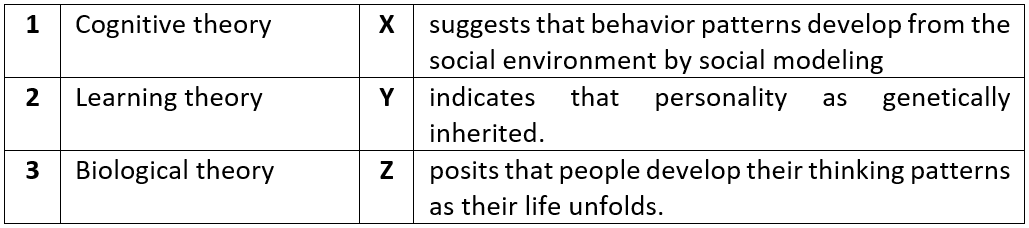 Which of the following is the correct match of the above items?
Seçenekler
A
1-Z, 2-X, 3-Y
B
1-X, 2-Y, 3-Z
C
1-Z, 2-Y, 3-X
D
1-Y, 2-Z, 3-X
E
1-Y, 2-X, 3-Z
Açıklama:
Cognitive theory: This theory posits that people develop their thinking patterns as their life unfolds. Accordingly, cognitions affect how the person interprets and internalizes life’s events.
Learning theory: This theory suggests that behavior patterns develop from the social environment by social modeling and learning. Thus, a person’s personality is developed and shaped by the influence of the environment as well as by what the person learns from the environment through experiences or observations.
Biological theory: This theory indicates that personality as genetically inherited.
The correct answer is A.
Learning theory: This theory suggests that behavior patterns develop from the social environment by social modeling and learning. Thus, a person’s personality is developed and shaped by the influence of the environment as well as by what the person learns from the environment through experiences or observations.
Biological theory: This theory indicates that personality as genetically inherited.
The correct answer is A.
Soru 3
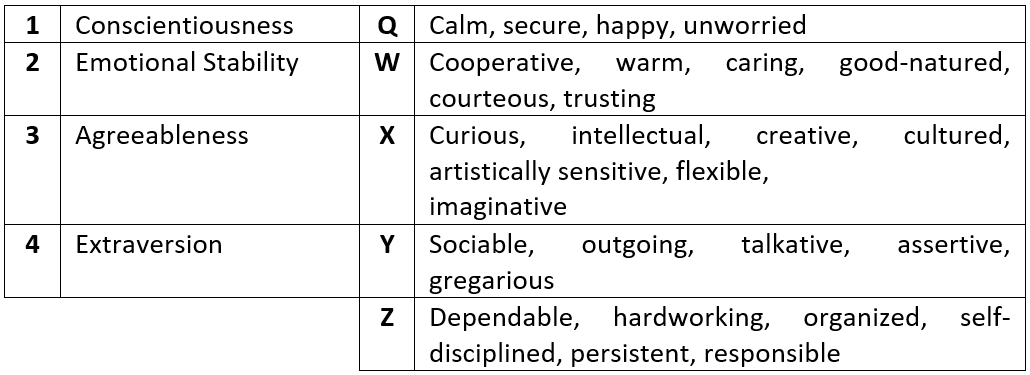 Which of the following is the correct match of the above items?
Seçenekler
A
1-Q, 2-X, 3-Z, 4-W
B
1-X, 2-Q, 3-W, 4-Z
C
1-Z, 2-Q, 3-W, 4-Y
D
1-Z, 2-W, 3-Y, 4-X
E
1-W, 2-Z, 3-Q, 4-Y
Açıklama:
Conscientiousness: Dependable, hardworking, organized, self-disciplined, persistent, responsible
Emotional Stability: Calm, secure, happy, unworried
Agreeableness: Cooperative, warm, caring, good-natured, courteous, trusting
Extraversion: Sociable, outgoing, talkative, assertive, gregarious
Openness to Experience: Curious, intellectual, creative, cultured, artistically sensitive, flexible, imaginative
The correct match of the above items is 1-Z, 2-Q, 3-W, 4-Y. Thus, the correct answer is B.
Emotional Stability: Calm, secure, happy, unworried
Agreeableness: Cooperative, warm, caring, good-natured, courteous, trusting
Extraversion: Sociable, outgoing, talkative, assertive, gregarious
Openness to Experience: Curious, intellectual, creative, cultured, artistically sensitive, flexible, imaginative
The correct match of the above items is 1-Z, 2-Q, 3-W, 4-Y. Thus, the correct answer is B.
Soru 4
___________ personality, is characterized by impatience, a chronic sense of time urgency, enhanced competitiveness, aggressive drive, and often some hostility.
Which of the following is most appropriate for the blank in the above sentence?
Which of the following is most appropriate for the blank in the above sentence?
Seçenekler
A
Proactive
B
Type B
C
Achievement oriented
D
Type A
E
Self-monitoring
Açıklama:
Type A personality is characterized by impatience, a chronic sense of time urgency, enhanced competitiveness, aggressive drive, and often some hostility.
The correct answer is D.
The correct answer is D.
Soru 5
"The person is perceived on the basis of one trait. It is often discussed in performance appraisal when a rater makes an error in judging a person’s total personality and/or performance on the basis of a single positive trait such as intelligence, appearance, dependability, or cooperativeness."
Which of the following is the concept defined above?
Which of the following is the concept defined above?
Seçenekler
A
Stereotype
B
Horns effect
C
Prejudice
D
Clone effect
E
Halo effect
Açıklama:
The halo effect in social perception is very similar to stereotyping. Whereas in stereotyping the person is perceived according to a single category, under the halo effect the person is perceived on the basis of one trait. Halo is often discussed in performance appraisal when a rater makes an error in judging a person’s total personality and/or performance on the basis of a single positive trait such as intelligence, appearance, dependability, or cooperativeness.
The correct answer is E.
The correct answer is E.
Soru 6
People tend to attribute their success to internal factors, but tend to attribute their failures to the external factors. This is called as the ________________________.
Which of the following is most appropriate for the blank in the above sentence?
Which of the following is most appropriate for the blank in the above sentence?
Seçenekler
A
Self-serving bias.
B
Stereotype
C
Halo effect
D
Fundamental attribution error
E
Horns effect
Açıklama:
People tend to attribute their success to internal factors, but tend to attribute their failures to the external factors. This is called as the self-serving bias.
The correct answer is A.
The correct answer is A.
Soru 7
Terminal values, refers to desirable end-states. These are the goals a person would like to achieve during his or her lifetime. In the view of such information, which of the following is a terminal value?
Seçenekler
A
Capable & Competent
B
Forgiving
C
Courageous
D
Knowledge & Wisdom
E
Ambitious & Hard-working
Açıklama:
TERMINAL VALUES (End states of existence): Happiness, Knowledge & Wisdom, Peace & Harmony in the world, A sense of accomplishment, Security, A world of Beauty, ...
INSTRUMENTAL VALUES (Preferred ways to achieve terminal values): Ambitious & Hard-working, Broad-minded, Capable & Compotent, Cheerful, Courageous, Forgiving, Helpful, Honest,...
The correct answer is B.
INSTRUMENTAL VALUES (Preferred ways to achieve terminal values): Ambitious & Hard-working, Broad-minded, Capable & Compotent, Cheerful, Courageous, Forgiving, Helpful, Honest,...
The correct answer is B.
Soru 8
Which of the following can not be said for Generation X?
Seçenekler
A
Their life have been shaped by globalization, two-career parents, AIDS, and computers.
B
They value flexibility, life options, and the achievement of job satisfaction.
C
Family and relationships are very important for them.
D
They are the first generation to take technology for granted.
E
They enjoy team-oriented work.
Açıklama:
The lives of Xers ( Generation Xers ) have been shaped by globalization, twocareer parents, AIDS, and computers. Xers value flexibility, life options, and the achievement of job satisfaction. Family and relationships are very important. Xers are skeptical, particularly of authority. They also enjoy team-oriented work.
The most recent entrants to the workforce, the Millennials (also called Netters, Nexters, Generation Yers, and Generation Y ) grew up during prosperous times. Millennials are the first generation to take technology for granted.
The correct answer is D.
The most recent entrants to the workforce, the Millennials (also called Netters, Nexters, Generation Yers, and Generation Y ) grew up during prosperous times. Millennials are the first generation to take technology for granted.
The correct answer is D.
Soru 9
Which of the following can be referred as the degree to which a person psychologically identifies himself/ herself with his/her work, or the importance of work in his/her total self-image?
Seçenekler
A
Organizational commitment
B
Job involvement
C
Job satisfaction
D
Personality-job fit
E
Organizational citizenship
Açıklama:
Related to job satisfaction, job involvement, which measures the degree to which people identify psychologically with their job and consider their perceived performance level important to self-worth. Job involvement was referred as, the degree to which a person psychologically identifies himself/ herself with his/her work, or the importance of work in his/her total self-image.
The correct answer is B.
The correct answer is B.
Soru 10
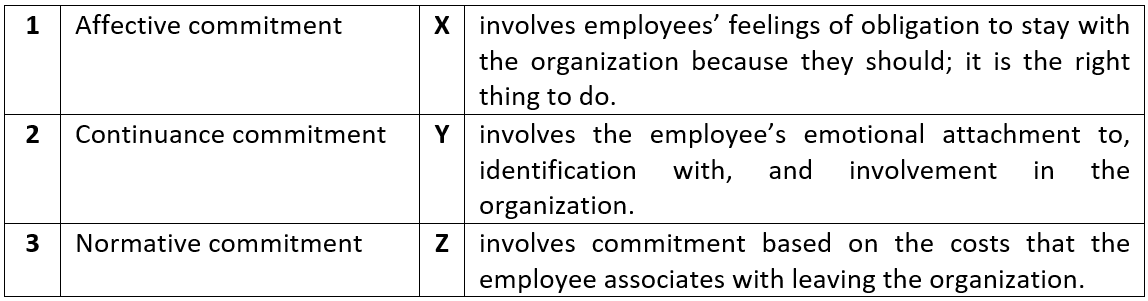 Which of the following is the correct match of the above items?
Seçenekler
A
1-Y, 2-X, 3-Z
B
1-Z, 2-X, 3-Y
C
1-X, 2-Y, 3-Z
D
1-Z, 2-Y, 3-X
E
1-Y, 2-Z, 3-X
Açıklama:
Affective commitment involves the employee’s emotional attachment to, identification with, and involvement in the organization.
Continuance commitment involves commitment based on the costs that the employee associates with leaving the organization. This may be because of the loss of senority for promotion or benefits.
Normative commitment involves employees’ feelings of obligation to stay with the organization because they should; it is the right thing to do.
The correct match of the above items is 1-Y, 2-Z, 3-X. Thus, the correct answer is E.
Continuance commitment involves commitment based on the costs that the employee associates with leaving the organization. This may be because of the loss of senority for promotion or benefits.
Normative commitment involves employees’ feelings of obligation to stay with the organization because they should; it is the right thing to do.
The correct match of the above items is 1-Y, 2-Z, 3-X. Thus, the correct answer is E.
Soru 11
Which of the following theory indicates that personality is genetically inherited?
Seçenekler
A
Cognitive theory
B
Learning theory
C
Biological theory
D
Emotional theory
E
Big five theory
Açıklama:
Biological theory indicates that personality is genetically inherited.
The correct answer is C.
The correct answer is C.
Soru 12
Which of big five personlaity core trait can be defined as cooperative, warm, caring, good-natured, courteous, trusting?
Seçenekler
A
Conscientiousness
B
Emotional Stability
C
Extraversion
D
Agreeableness
E
Openness to Experience
Açıklama:
Agreeableness: Cooperative, warm, caring, good-natured, courteous, trusting.
The correct answer is D.
The correct answer is D.
Soru 13
_________ thought that people could be typed into extraverts and introverts and that they had two basic mental processes-perception and judgment. Then, he divided perception into sensing and intuiting and judgment into thinking and feeling. This created four personality dimensions or traits: (1) introversion/extraversion, (2) perceiving/judging, (3) sensing/ intuition, and (4) thinking/feeling.
Which of the following is most appropriate for the blank in the above sentence?
Which of the following is most appropriate for the blank in the above sentence?
Seçenekler
A
Jung
B
Freud
C
Wundt
D
Allport
E
Pavlov
Açıklama:
Jung thought that people could be typed into extraverts and introverts and that they had two basic mental processes-perception and judgment. Then, he divided perception into sensing and intuiting and judgment into thinking and feeling. This created four personality dimensions or traits: (1) introversion/extraversion, (2) perceiving/judging, (3) sensing/ intuition, and (4) thinking/feeling.
The correct answer is A.
The correct answer is A.
Soru 14
I. Individuals with a Type B personality have been shown to report more work stressors and strain
II. Type A individuals report more psychic complaints and responsibility for people
III. Type B people show higher levels of aggression and hostility
IV. Type A people may have superior performance because of their devotion towards the work.
Which of the above sentences are correct?
II. Type A individuals report more psychic complaints and responsibility for people
III. Type B people show higher levels of aggression and hostility
IV. Type A people may have superior performance because of their devotion towards the work.
Which of the above sentences are correct?
Seçenekler
A
I and II
B
II and IV
C
I, II and III
D
I, III and IV
E
I, II, III and IV
Açıklama:
I. Individuals with a Type A personality have been shown to report more work stressors and strain
II. Type A individuals report more psychic complaints and responsibility for people
III. Type A people show higher levels of aggression and hostility
IV. Type A people may have superior performance because of their devotion towards the work.
The sentences with number I and III are wrong. Therefore, the correct answer is B.
II. Type A individuals report more psychic complaints and responsibility for people
III. Type A people show higher levels of aggression and hostility
IV. Type A people may have superior performance because of their devotion towards the work.
The sentences with number I and III are wrong. Therefore, the correct answer is B.
Soru 15
_____________________ refers to an individual’s ability to adjust his or her behavior to external, situational factors.
Which of the following is most appropriate for the blank in the above sentence?
Which of the following is most appropriate for the blank in the above sentence?
Seçenekler
A
Proactive personality
B
Self-control
C
Machiavellianism
D
Self-monitoring
E
Achievement oriented personality
Açıklama:
Self-monitoring refers to an individual’s ability to adjust his or her behavior to external, situational factors.
The correct answer is D.
The correct answer is D.
Soru 16
Which of the following perceptual error is defined as "where an individual is downgraded because of a single negative characteristic or incident"?
Seçenekler
A
Stereotype
B
The halo effect
C
Prejudice
D
Clone effect
E
Horns effect
Açıklama:
The opposite of the halo effect is sometimes called the “horns effect” where an individual is downgraded because of a single negative characteristic or incident.
The correct answer is E.
The correct answer is E.
Soru 17
Which of the following is defined as the process by which people come to know and understand each other?
Seçenekler
A
Social perception
B
Attribution process
C
Perceptual process
D
Self-control
E
Self-monitoring
Açıklama:
Social perception is the process by which people come to know and understand each other.
The correct answer is A.
The correct answer is A.
Soru 18
___________________ describes a positive feeling about a job, resulting from an evaluation of its characteristics.
Which of the following is most appropriate for the blank in the above sentence?
Which of the following is most appropriate for the blank in the above sentence?
Seçenekler
A
Organizational commitment
B
Job involvement,
C
Job satisfaction
D
Psychological empowerment
E
Person-organization fit
Açıklama:
Job satisfaction, describes a positive feeling about a job, resulting from an evaluation of its characteristics.
The correct answer is C.
The correct answer is C.
Soru 19
 Which of the following is the correct match of the above items?
Seçenekler
A
1-Z, 2-Y, 3-X
B
1-X, 2-Y, 3-Z
C
1-Y, 2-X, 3-Z
D
1-Z, 2-X, 3-Y
E
1-Y, 2-Z, 3-X
Açıklama:
The correct match is 1-Z, 2-X, 3-Y.
Therefore, the correct answer is D.
Therefore, the correct answer is D.
Soru 20
Which of the following is defined as “individual behavior that is discretionary, not directly or explicitly recognized by the formal reward system, and that in the aggregate promotes the effective functioning of the organization"?
Seçenekler
A
Employee well-being
B
On-the-job behavior
C
Turn over intention
D
Occupational commitment
E
Organizational citizenship behavior
Açıklama:
Organizational citizenship behavior was coined by Organ and his colleagues. It is defined as “individual behavior that is discretionary, not directly or explicitly recognized by the formal reward system, and that in the aggregate promotes the effective functioning of the organization."
The correct answer is E.
The correct answer is E.
Soru 21
Which one below is in the content of the cognitive theory explaining personality?
Seçenekler
A
People develop their thinking patterns as
their life unfolds.
their life unfolds.
B
Personality is genetically inherited.
C
Trait and gene come from parents.
D
Common characteristics is a
result of evolution.
result of evolution.
E
People learn from social interaction with other people.
Açıklama:
Cognitive theory posits that
people develop their thinking patterns as
their life unfolds. Accordingly, cognitions
affect how the person interprets and
internalizes life’s events
people develop their thinking patterns as
their life unfolds. Accordingly, cognitions
affect how the person interprets and
internalizes life’s events
Soru 22
Which personality trait composes the following descriptive characteristics?
"Curious, intellectual, creative, cultured, artistically sensitive, flexible,
imaginative"
"Curious, intellectual, creative, cultured, artistically sensitive, flexible,
imaginative"
Seçenekler
A
Conscientiousness
B
Emotional stability
C
Openness to experience
D
Extraversion
E
Agreeableness
Açıklama:
The Big Five provide an ideal personality profile for employees
over their whole career, because different traits
are needed for different jobs. The key is still to
find the right fit.
Openness to experience
over their whole career, because different traits
are needed for different jobs. The key is still to
find the right fit.
Openness to experience
Soru 23
Which theory divides perception into sensing and intuiting and judgment into thinking and feeling?
Seçenekler
A
Maslow's theory
B
Mc Gregor's theory
C
Big five theory
D
Myers-Briggs Type Indicator (MBTI)
E
Personality theory
Açıklama:
This theory goes back to Carl Jung in the 1920s. Jung thought that people could be typed into extraverts
and introverts and that they had two basic mental processes-perception and judgment. Then, he divided
perception into sensing and intuiting and judgment into thinking and feeling. This created four personality
dimensions or traits: (1) introversion/extraversion, (2) perceiving/judging, (3) sensing/ intuition, and (4)
thinking/feeling.
Myers-Briggs Type Indicator (MBTI)
and introverts and that they had two basic mental processes-perception and judgment. Then, he divided
perception into sensing and intuiting and judgment into thinking and feeling. This created four personality
dimensions or traits: (1) introversion/extraversion, (2) perceiving/judging, (3) sensing/ intuition, and (4)
thinking/feeling.
Myers-Briggs Type Indicator (MBTI)
Soru 24
According to the Jung Theory Dimensions and the Myers-Briggs Type Indicators which is the below reflects extraversive character?
Seçenekler
A
Outgoing
Interacting
Speaks, then thinks
Gregarious
Interacting
Speaks, then thinks
Gregarious
B
Thinks, then speaks
Gregarious
Reflective
Gregarious
Reflective
C
Speaks, then thinks
Gregarious
Thinks, then speaks
Gregarious
Thinks, then speaks
D
Exploring
Organized
Spontaneous
Organized
Spontaneous
E
Exploring
Organized
Thinks, then speaks
Organized
Thinks, then speaks
Açıklama:
Jung thought that people could be typed into extraverts
and introverts and that they had two basic mental processes-perception and judgment. Then, he divided
perception into sensing and intuiting and judgment into thinking and feeling. This created four personality
dimensions or traits: (1) introversion/extraversion, (2) perceiving/judging, (3) sensing/ intuition, and (4)
thinking/feeling. He felt that although people had all four of these dimensions in common, they differ in
the combination of their preferences of each. Importantly, he made the point that one’s preferences were
not necessarily better than another’s, only different. About 20 years after Jung developed his theoretical
types, in the 1940s Katharine Briggs and Isabel Briggs-Myers developed about a 100-item personality test
asking participants how they usually feel or act in particular situations in order to measure the preferences
on the four pairs of traits yielding 16 distinct types.
Outgoing
Interacting
Speaks, then thinks
Gregarious
and introverts and that they had two basic mental processes-perception and judgment. Then, he divided
perception into sensing and intuiting and judgment into thinking and feeling. This created four personality
dimensions or traits: (1) introversion/extraversion, (2) perceiving/judging, (3) sensing/ intuition, and (4)
thinking/feeling. He felt that although people had all four of these dimensions in common, they differ in
the combination of their preferences of each. Importantly, he made the point that one’s preferences were
not necessarily better than another’s, only different. About 20 years after Jung developed his theoretical
types, in the 1940s Katharine Briggs and Isabel Briggs-Myers developed about a 100-item personality test
asking participants how they usually feel or act in particular situations in order to measure the preferences
on the four pairs of traits yielding 16 distinct types.
Outgoing
Interacting
Speaks, then thinks
Gregarious
Soru 25
Which one below is a personality trait that is
characterized by manipulative and exploitative
attitude toward others, lack of empathy, and a
cynical view of human nature?
characterized by manipulative and exploitative
attitude toward others, lack of empathy, and a
cynical view of human nature?
Seçenekler
A
Self-control
B
Proactive personality
C
Self-monitoring personality
D
Achievement-oriented personality
E
Machiavellianism
Açıklama:
Within the personality theories literature, Machiavellianism has been
stated as the dark personality characteristics.
Machiavellianism is a personality trait that is
characterized by manipulative and exploitative
attitude toward others, lack of empathy, and a
cynical view of human nature (Inancsi, Lang
and Bereczkei, 2016). Machiavellians are
characterized by agency and progress rather than
connectedness to others and the community.
stated as the dark personality characteristics.
Machiavellianism is a personality trait that is
characterized by manipulative and exploitative
attitude toward others, lack of empathy, and a
cynical view of human nature (Inancsi, Lang
and Bereczkei, 2016). Machiavellians are
characterized by agency and progress rather than
connectedness to others and the community.
Soru 26
Which description below is related to perception being a cognitive process?
Seçenekler
A
Lets a person make sense of stimuli from the environment.
B
Helps adapting to a changing organizational requirements.
C
Helps adapting to a changing environment.
D
Includes inputs to person and choice of inputs to which the person attends.
E
Affects all senses.
Açıklama:
Perception is a unique interpretation of the situation, not an exact recording of it. Therefore, it
depends on how a person evaluates his/her environment or the stimuli. In short, perception is a very complex
cognitive process that yields a unique picture of the world, a picture that may be quite different from reality.
Lets a person make sense of stimuli from the environment.
depends on how a person evaluates his/her environment or the stimuli. In short, perception is a very complex
cognitive process that yields a unique picture of the world, a picture that may be quite different from reality.
Lets a person make sense of stimuli from the environment.
Soru 27
Which sub-process of perception related to person, includes motivation and learning?
Seçenekler
A
Consequence
B
Interpretation
C
Feedback
D
Registration
E
Confrontation
Açıklama:
Perception has a complex and interactive nature since it is composed of several sub-processes. The first important sub-process is the stimulus or situation that is present. Perception begins when a
person is confronted with a stimulus or a situation. This confrontation may be with the immediate sensual
stimulation or with the total physical and sociocultural environment. In addition to the situation-person interaction, there are the internal cognitive processes of
registration, interpretation, and feedback.
person is confronted with a stimulus or a situation. This confrontation may be with the immediate sensual
stimulation or with the total physical and sociocultural environment. In addition to the situation-person interaction, there are the internal cognitive processes of
registration, interpretation, and feedback.
Soru 28
Attribution theory tries to explain the ways in
which we judge people differently, depending on the
meaning we attribute to a given behavior.
Therefore this theory suggests that______.
which we judge people differently, depending on the
meaning we attribute to a given behavior.
Therefore this theory suggests that______.
Seçenekler
A
It is the process by which
people come to know and understand each other.
people come to know and understand each other.
B
It consists forming impression
of a person.
of a person.
C
It is where an individual is downgraded because
of a single negative characteristic or incident.
of a single negative characteristic or incident.
D
When we observe an individual’s behavior, we
attempt to determine whether it was internally or
externally caused.
attempt to determine whether it was internally or
externally caused.
E
It refers to the tendency to perceive another person (hence
social perception) as belonging to a single class or
category.
social perception) as belonging to a single class or
category.
Açıklama:
Attribution theory tries to explain the ways in
which we judge people differently, depending on the
meaning we attribute to a given behavior (Martinko,
Harvey and Dasborough, 2011). It suggests that
when we observe an individual’s behavior, we
attempt to determine whether it was internally or
externally caused which meand analyzing the circumstances.
When we observe an individual’s behavior, we
attempt to determine whether it was internally or
externally caused.
which we judge people differently, depending on the
meaning we attribute to a given behavior (Martinko,
Harvey and Dasborough, 2011). It suggests that
when we observe an individual’s behavior, we
attempt to determine whether it was internally or
externally caused which meand analyzing the circumstances.
When we observe an individual’s behavior, we
attempt to determine whether it was internally or
externally caused.
Soru 29
Which of the following is the correct description of terminal and intrumental values?
Seçenekler
A
Terminal values refer to desirable end-states; instrumental values set
refers to preferable modes of behavior.
refers to preferable modes of behavior.
B
Terminal values refer to means of
achieving the terminal values; instrumental values set instrumental values set
refers to preferable modes of behavior.
achieving the terminal values; instrumental values set instrumental values set
refers to preferable modes of behavior.
C
Terminal values and instrumental values both refer to desirable end-states.
D
Terminal values set refers to preferable modes of behavior; instrumental values refer to desirable end-states.
E
Terminal values and instrumental values both refer to preferable modes of behavior.
Açıklama:
Values represent basic convictions that “a
specific mode of conduct or end-state of existence
is personally or socially preferable to an opposite or
converse mode of conduct or end-state of existence.”
One set, called terminal
values, refers to desirable end-states. These are the
goals a person would like to achieve during his or her
lifetime. The other set, called instrumental values,
refers to preferable modes of behavior, or means of
achieving the terminal values.
Terminal values refer to desirable end-states; instrumental values set
refers to preferable modes of behavior.
specific mode of conduct or end-state of existence
is personally or socially preferable to an opposite or
converse mode of conduct or end-state of existence.”
One set, called terminal
values, refers to desirable end-states. These are the
goals a person would like to achieve during his or her
lifetime. The other set, called instrumental values,
refers to preferable modes of behavior, or means of
achieving the terminal values.
Terminal values refer to desirable end-states; instrumental values set
refers to preferable modes of behavior.
Soru 30
When an employee thinks as "My supervisor gave a promotion to a
coworker who deserved it less than
me. My supervisor is unfair", which attitude component is practiced?
coworker who deserved it less than
me. My supervisor is unfair", which attitude component is practiced?
Seçenekler
A
Affective component
B
Feeling component
C
Action component
D
Behavioral component
E
Cognitive component
Açıklama:
An attitude can be based on any
one or a combination of these three information
sources. Attitudes, once formed, also guide
affective, cognitive, and behavioral reactions to the
object. The “affective” basis of an attitude is made up of feelings, moods, and emotions that have become
associated with the attitude object through past or current experience. It is possible to have multiple
affective responses to an object based on the same, or different, experiences with it. The “cognitive” basis is made up of particular attributes that are ascribed to the object. An attribute
is any characteristic, quality, trait, concept, value, or goal associated with the object. The “behavioral” basis is made up of two kinds
of information, past behaviors and intentions to
commit future behaviors.
Cognitive component
one or a combination of these three information
sources. Attitudes, once formed, also guide
affective, cognitive, and behavioral reactions to the
object. The “affective” basis of an attitude is made up of feelings, moods, and emotions that have become
associated with the attitude object through past or current experience. It is possible to have multiple
affective responses to an object based on the same, or different, experiences with it. The “cognitive” basis is made up of particular attributes that are ascribed to the object. An attribute
is any characteristic, quality, trait, concept, value, or goal associated with the object. The “behavioral” basis is made up of two kinds
of information, past behaviors and intentions to
commit future behaviors.
Cognitive component
Soru 31
Which of the following personality type initiated an action for the aim to improve the current situation rather than accept it as it is and qualified as pathfinders and responsible?
Seçenekler
A
Achievement oriented personality
B
Machiavellianism
C
Proactive personality
D
Self-control
E
Type B
Açıklama:
Proactive behaviour is described as initiating an action for the aim to improve the current situation rather than accept it as it is. Covey (2004:71) asserted the importance of proactive people. Highly proactive people recognize that responsibility. Proactive people are known as pathfinders and the reverse is the passive approach. For this reason, the correct answer is C.
Soru 32
I. Hereditary
II. Perception
III.Environmental factors
Which of the above factors form personality?
II. Perception
III.Environmental factors
Which of the above factors form personality?
Seçenekler
A
Only I
B
I and II
C
II and III
D
I and III
E
I, II, and III
Açıklama:
Personality is considered to be formed as a result of combined hereditary (genetic) and environmental factors, moderated by situational conditions and has a big impact on how people are motivated.
Soru 33
I. Affective processes
II. Behavioral processes
III.Cognitive processes
Which of the above processes are relevant to perception?
II. Behavioral processes
III.Cognitive processes
Which of the above processes are relevant to perception?
Seçenekler
A
Only I
B
Only II
C
Only III
D
I and III
E
II and III
Açıklama:
Perception is a very complex cognitive process that yields a unique picture of the world, a picture that may be quite different from reality.
Soru 34
Which of the following processes is not a sub-process of perception?
Seçenekler
A
Stimulus
B
Motivation
C
Confrontation
D
Registration
E
Interpretation
Açıklama:
Perception has a complex and interactive nature since it is composed
of several sub-processes. The first important sub-process is the stimulus or situation that is present. Perception begins when a person is confronted with a stimulus or a situation. In addition to the situation-person interaction, there are the internal cognitive processes of registration, interpretation, and feedback. During the registration phenomenon, the physiological (sensory and neural) mechanisms are affected; the physiological ability to hear and see will affect perception. Interpretation is the most significant cognitive aspect of perception. It means that a person recognizes and evaluates the target or the situation. The last sub-process is the feedback. Feedback is the response that a person receives from the perceptual target or the situation. Motivation is not a sub-process of perception, however, other psychological processes will affect the interpretation of a situation. For example, in an organization, employees’ interpretations of a situation are largely dependent on their learning and motivation and their personality.
of several sub-processes. The first important sub-process is the stimulus or situation that is present. Perception begins when a person is confronted with a stimulus or a situation. In addition to the situation-person interaction, there are the internal cognitive processes of registration, interpretation, and feedback. During the registration phenomenon, the physiological (sensory and neural) mechanisms are affected; the physiological ability to hear and see will affect perception. Interpretation is the most significant cognitive aspect of perception. It means that a person recognizes and evaluates the target or the situation. The last sub-process is the feedback. Feedback is the response that a person receives from the perceptual target or the situation. Motivation is not a sub-process of perception, however, other psychological processes will affect the interpretation of a situation. For example, in an organization, employees’ interpretations of a situation are largely dependent on their learning and motivation and their personality.
Soru 35
Which of the following concepts refers to the tendency to perceive another person on the basis of one trait?
Seçenekler
A
Self-serving bias
B
Stereotype
C
Affiliation bias
D
Horns effect
E
Halo effect
Açıklama:
Self-serving bias occurs when people tend to attribute their success to internal factors, on the contrary they tend to attribute their failures to the external factors. Stereotypes are the beliefs and perceived attributes about a target based on any characteristic. Affiliation bias occurs when people evaluate a person's actions on the basis of his or her affiliations rather than on the merits of the behavior itself. Horns effect occurs where an individual is downgraded because of a single negative characteristic or incident.
Soru 36
Which of the following situations reflects an internal attribution?
Seçenekler
A
My boy-friend is not calling me, because he does not care about me.
B
The weather is very nice outside, so the students are not in the classroom.
C
The patient could not come to her appointment, because it is raining.
D
My mother is very angry with me, since she is very nervous recently.
E
The students were late for class, because there was a traffic jam.
Açıklama:
Internally caused behaviors are those we believe to be under the personal control of the individual. Externally caused behavior is what we imagine the situation forced the individual to do. Your boy-friend is not calling you and you are attributing the behavior to your boy-friend's personal preference, which is under his control. In all other situations, the causation is attributed to an external condition.
Soru 37
What does ranking an individual’s values in terms of intensity refer to?
Seçenekler
A
Terminal values
B
Instrumental values
C
Value system
D
Personality-job fit
E
Person-organization fit
Açıklama:
Terminal values refer to desirable end-states. These are the goals a person would like to achieve during his or her lifetime. Some examples of terminal values are prosperity and economic success, freedom, health and well-being. Instrumental values refer to preferable modes of behavior, or means of achieving the terminal values. Some examples of instrumental values are self-improvement, autonomy and self-reliance, personal discipline, kindness, ambition,and goal -orientation. Personality-job fit theory presents six personality
types and proposes that satisfaction and the propensity to leave a position depend on how well individuals match their personalities to a
job. The theory argues that satisfaction is highest and turnover lowest when personality and occupation are in agreement. Person-organization fit theory suggests that people are attracted to and selected by organizations that match their values, and they leave organizations that are not compatible with their personalities. On the other hand, we obtain a person’s value system by ranking that individual’s values in terms of intensity, which specifies how important each value is.
types and proposes that satisfaction and the propensity to leave a position depend on how well individuals match their personalities to a
job. The theory argues that satisfaction is highest and turnover lowest when personality and occupation are in agreement. Person-organization fit theory suggests that people are attracted to and selected by organizations that match their values, and they leave organizations that are not compatible with their personalities. On the other hand, we obtain a person’s value system by ranking that individual’s values in terms of intensity, which specifies how important each value is.
Soru 38
Which of the following reflects the values of Generation Xers?
Seçenekler
A
Achievement and material success
B
Globalization and achievement of job satisfaction
C
Distrust of authority and social recognition
D
Entitled life and entrepreneurial skills
E
Knowledge sharing and career goal-orientation
Açıklama:
The lives of Xers ( Generation Xers ) have been shaped by globalization, two career parents, AIDS, and computers. Xers value flexibility, life options, and the achievement of job satisfaction. Family and relationships are very important. Xers are skeptical, particularly of authority. They also enjoy team-oriented work. In search of balance in their lives, Xers are less willing to make personal sacrifices for the sake of their employer than previous generations were. They rate high on true friendship, happiness, and pleasure.
Soru 39
Which of the following is not an objective of attitudes?
Seçenekler
A
To mentally represent what we like and dislike in our world
B
To explain people’s decisions and actions
C
To respond in a consistently favorable or unfavorable manner with respect to a given object
D
To interprete the situation by evaluating the environment or the stimuli
E
To give a positive, negative, or mixed reaction to a person, object, or idea
Açıklama:
Attitudes are the mental representations of what we like and dislike in our world and they help to explain these choices. Attitudes are one of psychology’s fundamental concepts because they help to explain people’s decisions and actions. An attitude is a learned predisposition to respond in a consistently favorable or unfavorable manner with respect to a given object. An attitude is a global and relatively enduring evaluation of a person, object, or issue - a representation of whether we think the target is generally good or bad, desirable or undesirable. An attitude can be described as a positive, negative, or mixed reaction to a person, object, or idea. On the other hand, perception is a unique interpretation of the situation and it depends on how a person evaluates his/her
environment or the stimuli.
environment or the stimuli.
Soru 40
Which of the following concepts best explains the relationship between an attitude and a behavior?
Seçenekler
A
Social perception
B
Attribution theory
C
Fundamental attribution error
D
Value system
E
Cognitive dissonance
Açıklama:
Social perception is the process by which people come to know and understand each other. Attribution theory tries to explain the ways in
which we judge people differently, depending on the meaning we attribute to a given behavior. It suggests that when we observe an individual’s behavior, we attempt to determine whether it was internally or externally caused. Fundamental attribution error occurs when we make judgments about the behavior of other people by underestimating the influence of external factors and by overestimating the influence of internal or personal factors. When we rank an individual’s values in terms of their intensity, we obtain that person’s value system. Festinger (1958) proposed that cases of attitude following behavior
illustrate the effects of cognitive dissonance, any incompatibility an individual might perceive between two or more attitudes or between
behavior and attitudes. Festinger (1958) argued that any form of inconsistency is uncomfortable and that individuals will therefore attempt to reduce it. They will seek a stable state, which is a minimum of dissonance.
which we judge people differently, depending on the meaning we attribute to a given behavior. It suggests that when we observe an individual’s behavior, we attempt to determine whether it was internally or externally caused. Fundamental attribution error occurs when we make judgments about the behavior of other people by underestimating the influence of external factors and by overestimating the influence of internal or personal factors. When we rank an individual’s values in terms of their intensity, we obtain that person’s value system. Festinger (1958) proposed that cases of attitude following behavior
illustrate the effects of cognitive dissonance, any incompatibility an individual might perceive between two or more attitudes or between
behavior and attitudes. Festinger (1958) argued that any form of inconsistency is uncomfortable and that individuals will therefore attempt to reduce it. They will seek a stable state, which is a minimum of dissonance.
Soru 41
Which of the following is not accurate information about individuals high in self-monitoring?
Seçenekler
A
There is high behavioral consistency between who they are and what they do.
B
These managers tend to be more mobile in their careers.
C
They pay closer attention to the behavior of others.
D
They show adaptability in adjusting their behavior to external situational factors.
E
They are highly sensitive to external cues.
Açıklama:
Individuals high in self-monitoring show considerable adaptability in adjusting their behavior to external situational factors. They high self-monitors pay closer attention to the behavior of others. high self- monitoring managers tend to be more mobile in their careers. They are highly sensitive to external cues and can behave differently in different situations, sometimes presenting striking contradictions between their public persona and their private self. When it comes to individuals low self-monitoring, there is high behavioral consistency between who they are and what they do. For this reason, the correct answer is A.
Soru 42
Which of the following is the personality type that is defined as the capacity for altering one’s own responses, to bring them into line with standards and to support the pursuit of long-term goals?
Seçenekler
A
Achievement-oriented personality
B
Machiavellianism
C
Proactive personality
D
Self-control
E
Type B
Açıklama:
Self-control is defined as the capacity for altering one’s own responses, especially to bring them into line with standards such as ideals, values, morals, and social expectations, and to support the pursuit of long-term goals. For this reason, the correct answer is D.
Soru 43
Which of the following personality type has a manipulative and exploitative attitude toward others, lack of empathy and a cynical view of human nature?
Seçenekler
A
Achievement-oriented personality
B
Machiavellianism
C
Proactive personality
D
Self-control
E
Type B
Açıklama:
Machiavellianism is a personality trait that is characterized by manipulative and exploitative attitude toward others, lack of empathy, and a cynical view of human nature. For this reason, the correct answer is B.
Soru 44
Which of the following is the first sub-process of perception?
Seçenekler
A
Behavior
B
Confrontation
C
Consequence
D
Registration
E
Stimulus
Açıklama:
The first important sub-process is the stimulus or situation that is present. Perception begins when a person is confronted with a stimulus or a situation. This confrontation may be with the immediate sensual stimulation or with the total physical and sociocultural environment. For this reason, the correct answer is E.
Soru 45
Which of the following is the perception error that the individual is downgraded because of a single negative characteristic or incident?
Seçenekler
A
Fundamental attribution error
B
Halo effect
C
Horns effect
D
Stereotype
E
Self-serving bias
Açıklama:
The opposite of halo effect is called the horns effect where an individual is downgraded because of a single negative characteristic or incident. For this reason, the correct answer is C.
Soru 46
Which of the following attribution error is the individual is the tendency for individuals to attribute their own successes to internal factors and put the blame for failures on external factors?
Seçenekler
A
Fundamental attribution error
B
Halo effect
C
Horns effect
D
Stereotype
E
Self-serving bias
Açıklama:
Fundamental attribution error and Self-serving bias are the common attribution errors. Self-serving bias is the tendency for individuals to attribute their own successes to internal factors and put the blame for failures on external factors. Fundamental attribution error is making judgments about the behavior of others. For this reason, the correct answer is E.
Soru 47
Which of the following is a theory that identifies six personality types and proposes that the fit between personality type and occupational environment determines satisfaction and turnover?
Seçenekler
A
Person-environment fit theory
B
Person-group fit theory
C
Person-job fit theory
D
Person-organization fit theory
E
Person-supervisor fit theory
Açıklama:
Holland presents six personality types and proposes that satisfaction and the propensity to leave a position depend on how well individuals match their personalities to a job. The person-job fit theory argues that satisfaction is highest and turnover lowest when personality and occupation are in agreement. For this reason, the correct answer is C.
Soru 48
Which of the following is the concept of employee attitude that a positive feeling about a job?
Seçenekler
A
Job enhancement
B
Job satisfaction
C
Occupational commitment
D
Organizational citizenship behavior
E
Organizational commitment
Açıklama:
Job satisfaction describes a positive feeling about a job, resulting from an evaluation of its characteristics. A person with a high level of job satisfaction holds positive feelings about his or her job, while a person with a low level holds negative feelings. For this reason, the correct answer is B.
Soru 49
Which of the following is the concept of employee job attitude that a strong desire to remain a member of a particular organization?
Seçenekler
A
Job enhancement
B
Job satisfaction
C
Occupational commitment
D
Organizational citizenship behavior
E
Organizational commitment
Açıklama:
Organizational commitment is most often defined as (1) a strong desire to remain a member of a particular organization; (2) a willingness to exert high levels of effort on behalf of the organization; and (3) a definite belief in, and acceptance of, the values and goals of the organization. For this reason, the correct answer is E.
Soru 50
Which of the following concepts refers to the degree to which people identify psychologically with their job and consider their perceived performance level important to self-worth?
Seçenekler
A
Job involvement
B
Organizational commitment
C
Job satisfaction
D
Psychological empowerment
E
Organizational citizenship
Açıklama:
In organizational commitment, an employee identifies with a particular organization and its goals and wishes to remain a member. Job satisfaction describes a positive feeling about a job, resulting from an evaluation of its characteristics. Psychological empowerment refers to employees’ beliefs in the degree to which they influence their work environment, their competence, the meaningfulness of their job,
and their perceived autonomy. Organizational citizenship behavior is defined as individual behavior that is discretionary, not directly or explicitly recognized by the formal reward system, and that in the aggregate promotes the effective functioning of the organization.
and their perceived autonomy. Organizational citizenship behavior is defined as individual behavior that is discretionary, not directly or explicitly recognized by the formal reward system, and that in the aggregate promotes the effective functioning of the organization.
Soru 51
Biological Theory indicates that personality as genetically inherited. Develop ____ characteristic as a result of evolution.
Seçenekler
A
Common
B
Collective
C
Unusual
D
Globally
E
Specific
Açıklama:
Biological Theory indicates that personality as genetically inherited. Develop common characteristic as a result of evolution.
Correct answer is "common".
Correct answer is "common".
Soru 52
Which of the following does not describe the concept of personality?
Seçenekler
A
The sum total of ways in which an individual reacts to and interacts with others.
B
Set of traits, characteristics, and predispositions of a person and usually stabilizes by about age 30.
C
The affects how a person adjusts to different environments and workplace.
D
Personality is the result of combined hereditary and environmental factors.
E
The processes that account for an individual’s intensity, direction, and persistence of effort toward attaining a goal.
Açıklama:
The concept of personality can be described as follows:
- The sum total of ways in which an individual reacts to and interacts with others,
- Set of traits, characteristics, and predispositions of a person and usually stabilizes by about age 30,
- The affects how a person adjusts to different environments and workplace,
- The result of combined hereditary and environmental factors.
The processes that account for an individual’s intensity, direction, and persistence of effort toward attaining a goal does not describe the concept of personality.
- The sum total of ways in which an individual reacts to and interacts with others,
- Set of traits, characteristics, and predispositions of a person and usually stabilizes by about age 30,
- The affects how a person adjusts to different environments and workplace,
- The result of combined hereditary and environmental factors.
The processes that account for an individual’s intensity, direction, and persistence of effort toward attaining a goal does not describe the concept of personality.
Soru 53
Which of the following best describes the term Job Involvement ?
Seçenekler
A
Job involvement, which measures the degree to which people identify psychologically with their job and consider their perceived performance level important to self-worth.
B
Job involvement term to the literature and several empirical studies relating job involvement as a positive organizational behavior concept have been conducted.
C
Job involvement was examined to a variety of personal and situational characteristics in diverse work settings
D
Employees with a high level of job involvement strongly identify with and really care about the kind of work they do.
E
Organizational citizenship behavior has five main dimensions: Conscientiousness, sportsmanship, civic virtue, courtesy and altruism.
Açıklama:
"It term to the literature and several empirical studies relating job involvement as a positive organizational behavior concept have been conducted" is the best description for job involment among the given options.
Job involvement may describe as term to the literature and several empirical studies relating job involvement as a positive organizational behavior concept have been conducted.
Job involvement may describe as term to the literature and several empirical studies relating job involvement as a positive organizational behavior concept have been conducted.
Soru 54
Which of the following does not interact with the Relationships of Organizational Commitment?
Seçenekler
A
Job Satisfaction
B
Job Involvement
C
Investments
D
Affective Commitment
E
Occupational Commentiment
Açıklama:
Job satisfaction, job involvement, affective commitment, affective commentiment, occupational commentiment are all interact with the Relationships of Organizational Commitment, but investments not.
Investments does not interact with the Relationships of Organizational Commitment
Investments does not interact with the Relationships of Organizational Commitment
Soru 55
Which term is wrongly matched from the following?
Seçenekler
A
HAPPINESS - Terminal Values
B
AMBITIOUS- Instrumental Values
C
CHEERFUL- Instrumental Values
D
INTELLECTUAL- Terminal Values
E
SECURITY- Terminal Values
Açıklama:
Security is not one of terminal values.
Soru 56
Which of the following is not one of the terms Richard Branson defines?
Seçenekler
A
Energetic
B
Charismatic
C
Ambitious
D
Relations
E
Courageous
Açıklama:
Energetic, charismatic, ambitious and courageous are all the terms of Richard Branson defines.
Relations is not one of the terms Richard Branson defines, correct aswer is D.
Relations is not one of the terms Richard Branson defines, correct aswer is D.
Soru 57
Which of the following is not included in the factors that influence perception?
Seçenekler
A
Personal characteristics
B
Characteristics of the target
C
The context of the situation
D
Personal interpretation
E
Self-actualization
Açıklama:
Self-actualization is not included in the factors that influence perception.
Self-actualization is not included in the factors that influence perception, correct answer is E.
Self-actualization is not included in the factors that influence perception, correct answer is E.
Soru 58
Which of the following is instrumental value?
Seçenekler
A
Obedient
B
Happiness
C
Equality
D
Freedom
E
Self-respect
Açıklama:
Happiness, equality, freedom and self-respect are terminal values.
Obedient is one of the instrumental values, correct answer is A.
Obedient is one of the instrumental values, correct answer is A.
Soru 59
In ______ commitment, an employee identifies with a particular organization and its goals and wishes to remain a member.
Seçenekler
A
Personal
B
Organizational
C
Group
D
National
E
General
Açıklama:
In organizational commitment, an employee identifies with a particular organization and its goals and wishes to remain a member.
In organizational commitment, an employee identifies with a particular organization and its goals and wishes to remain a member; correct answer is B.
In organizational commitment, an employee identifies with a particular organization and its goals and wishes to remain a member; correct answer is B.
Soru 60
i. Conscientiousness
ii. Emotional Stability
iii. Agreeableness
iv. Extraversion
v. Openness to Experience
Which of the above is the “Big Five” personality traits?
ii. Emotional Stability
iii. Agreeableness
iv. Extraversion
v. Openness to Experience
Which of the above is the “Big Five” personality traits?
Seçenekler
A
Only i
B
i and ii
C
i, ii and iii
D
i, ii, iii and v
E
All of the above
Açıklama:
The “Big Five” Personality Traits:
- Conscientiousness,
- Emotional Stability,
- Agreeableness,
- Extraversion,
- Openness to Experience.
All of the above are the “Big Five” personality traits, correct answer is E.
- Conscientiousness,
- Emotional Stability,
- Agreeableness,
- Extraversion,
- Openness to Experience.
All of the above are the “Big Five” personality traits, correct answer is E.
Soru 61
What are characteristics of personality
Seçenekler
A
Personality is a set of traits, characteristics, and predispositions of a person.
B
An individual reacts to and interacts together for their company.
C
It is important reduce gender discrimination in certain organisation.
Personality in organizations means,Set of traits, characteristics, and predispositions of a person.
Usually matures and stabilizes by about age 30.Affects how a person adjusts to different environments and workplace.
Personality in organizations means,Set of traits, characteristics, and predispositions of a person.
Usually matures and stabilizes by about age 30.Affects how a person adjusts to different environments and workplace.
D
It refers to a combination of same personality traits and preferences.
E
For employees to achieve deep impact how people are motivated.
Açıklama:
Personality in organizations means, set of traits, characteristics, and predispositions of a person. Usually matures and stabilizes by about age 30. Affects how a person adjusts to different environments and workplace.
Soru 62
What are the basic personality theories?
Seçenekler
A
The major theories include important approaches such as dispositional, perspective and psychodynamic approaches.
B
Basic personality theories are cognitive theory, learning theory and biological theory.
C
The basic personality theories are external appearance that is the role of heredity and the brain.
D
The basic personality theories focus on provides knowledge whether a person will do some specific job, in comparison to others.
E
Personality theory is considered to be formed as a result of combined hereditary (genetic) and environmental factors.
Açıklama:
Basic personality theories are cognitive theory, learning theory and biological theory.
Soru 63
What is the main idea of cognitive theory?
Seçenekler
A
This theory suggests that behavior patterns develop from the social environment by social modeling and learning.
B
This theory indicates that personality as genetically inherited.
C
This theory that people develop their thinking patterns as their life unfolds. Accordingly, cognitions affect how the person interprets and internalizes life’s events.
D
The cognitive interactions are between the person and the environment, and the socialization process.
E
Cognitive theory focuses how people affect others depends primarily on their external appearance (height, weight, facial features, color, and other physical aspects) and traits.
Açıklama:
Cognitive theory posits that people develop their thinking patterns as their life unfolds. Accordingly, cognitions affect how the person interprets and internalizes life’s events. Cognitive theory is an approach to psychology that attempts to explain human behavior by understanding your thought processes.
Soru 64
What are the main theory of learning?
Seçenekler
A
This theory indicates that personality as genetically inherited such as develop common characteristics as a result of evolution and trait and gene come from parents.
B
Learning Theory is a broad theory that explains thinking and differing mental processes and how they are influenced by internal and external factors in order to produce learning in individuals.
C
Learning theory is focused on the individual's thoughts as the determinate of his or her emotions and behaviors and therefore personality.
D
This theory suggests that behavior patterns develop from the social environment by social modeling and learning. people learn from,
- social interaction with other people,
- early family socialization,
- social environment (friends, teachers).
E
Learning theory is theories of personality that emphasize cognitive processes, such as thinking and judging.
Açıklama:
Learning theorysuggests that behavior patterns develop from the social environment by social modeling and learning. Thus, a person’s personality is developed and shaped by the influence of the environment as well as by what the person learns from the environment through experiences or observations. In sum; people learn from,
- social interaction with other people,
- early family socialization,
- social environment (friends, teachers).
Soru 65
What are the five dimensions of personality?
Seçenekler
A
Big five dimension of trait features characteristics are such as imagination, insight dislikes change, does not enjoy new things and resists new ideas.
B
The big five personality traits, also known as the five-factor model, and these are spends time preparing, finishes important tasks right away, pays attention to detail, enjoys having a set schedule and makes messes and doesn't take care of things.
C
The big five personality traits are cooperative, warm, caring, good-natured, courteous, and trusting.
D
The big five personality traits, also known curious, intellectual, creative, cultured, artistically sensitive and imaginative.
E
The "big five" are broad categories of personality traits. These are conscientiousness, emotional stability, agreeableness, extraversion, openness to experience.
Açıklama:
Soru devamlı bold karekterinde çıkıyor. Düzeltemedim.
The Big Five personality traits, also known as the Openness to Experience and these are Curious, intellectual, creative, cultured, artistically sensitive, flexible and imaginative. Big Five and their major characteristics. Importantly, The Big Five have been extended through meta- analytic studies to also demonstrate a positive relationship with behaviors and attitudes of employees such as performance motivation and job satisfaction such as imagination, insight dislikes change, does not enjoy new things and resists new ideas.
The Big Five personality traits, also known as the Openness to Experience and these are Curious, intellectual, creative, cultured, artistically sensitive, flexible and imaginative. Big Five and their major characteristics. Importantly, The Big Five have been extended through meta- analytic studies to also demonstrate a positive relationship with behaviors and attitudes of employees such as performance motivation and job satisfaction such as imagination, insight dislikes change, does not enjoy new things and resists new ideas.
Soru 66
What is myers briggs type indicator MBTI?
Seçenekler
A
The Myers-Briggs Type Indicator (MBTI) is the most widely used personality assessment instrument in the world.
- It is a 100-question personality test that asks people how they usually feel or act in particular situations.
- Respondents are classified as extraverted or introverted (E or I), sensing or intuitive (S or N),
- Thinking or feeling (T or F), and judging or perceiving (J or P).
B
The Myers-Briggs Type Indicator (MBTI) is an introspective self-report questionnaire with the purpose of indicating differing sociological preferences in how people behavior the world around them.
C
Personality tests are kind of accurate, Myers Briggs personality test not as reliable, valid as the 'big 5' ... we know not to take them seriously, but there are others, like the mMyersBriggs type indicator (MBTI), that we trust, because a lot of psychologists once did too.
D
Determining Myers Briggs type indicator, your personality type is determined by your preferences. Your four dominant preferences are extraversion , sensing feeling and perceiving.
E
According to MyersBriggstheory, your personality type is inborn, and it can change. however, the way you exhibit your type will also change as you go through life.
Açıklama:
The Myers-Briggs Type Indicator (MBTI) is the most widely used personality assessment instrument in the world.
- It is a 100-question personality test that asks people how they usually feel or act in particular situations.
- Respondents are classified as extraverted or introverted (E or I), sensing or intuitive (S or N),
- Thinking or feeling (T or F), and judging or perceiving (J or P).
Soru 67
What is type A personality in psychology?
Seçenekler
A
In this hypothesis Type A, personalities that are more competitive, highly organized, ambitious, impatient, relaxed, flexible with situations.
B
A personality, by definition, are noted to live at lower stress levels. They typically work steadily, and may enjoy achievement, although they have a greater tendency to disregard physical or mental stress when they do not achieve.
C
Type A personality is characterized by impatience, a chronic sense of time urgency, enhanced competitiveness, aggressive drive, and often some hostility.
D
A-personalities are true introverts who are extremely hard workers.
E
With a type A personality are natural pessimists and are often living with a lot of stress.
Açıklama:
Type A personality is characterized by impatience, a chronic sense of time urgency, enhanced competitiveness, aggressive drive, and often some hostility. A behavior, irritation and exasperation triggered by impatience and time urgency, free-floating hostility caused by even minor incidences and, a competitive drive causing stress and achievement oriented mental framework.
Soru 68
What are the characteristics of a proactive person?
Seçenekler
A
They tend to manage themselves appropriately as well as inspire others. Proactive leaders are compassionate, loyal, integrity-filled, straightforward, calm, direct, but not fair, polite, hopeful and thoughtful.
B
The characteristics of an active person first Predict to be active, you must first develop foresight and then prevent.
C
Being proactive takes time, since you have to consider your options, weigh alternatives and make your own decisions to ask somebody.
D
Their behavior is a product of their own conscious choice, based on values, rather than a product of their conditions, based on external factors. Proactive people are known as pathfinders.
E
Being proactive means without anticipating problems, seeking new solutions and doing your best.
Açıklama:
Their behavior is a product of their own conscious choice, based on values, rather than a product of their conditions, based on external factors. Proactive people are known as “pathfinders” and the reverse is the “passive” approach, people who are not proactive fail to identify, or even sense, the opportunities and problems around them.
Soru 69
What is the concept of sub-processes of perception?
Seçenekler
A
Perception is awareness, comprehension or an understanding of something of sub-process.
B
A simple perception of events would be recognizing the consequences of actions.
C
Physiological mechanisms such as listening, hearing, etc. play an active role in the sub-perception of individuals.
D
Types of sub-process and perception are telepathy, clairvoyance, precognition, retro-cognition.
E
Perception has a complex and interactive nature since it is composed of several sub-processes. The first important sub-process is the stimulus or situation that is present. Perception begins when a person is confronted with a stimulus or a situation. This confrontation may be with the immediate sensual stimulation or with the total physical and sociocultural environment.
Açıklama:
Perception has a complex and interactive nature since it is composed of several sub-processes. The first important sub-process is the stimulus or situation that is present. Perception begins when a person is confronted with a stimulus or a situation. This confrontation may be with the immediate sensual stimulation or with the total physical and sociocultural environment.
Soru 70
What is attribution theory?
Seçenekler
A
Attribution theory tries to explain the ways in which we judge people differently, depending on the meaning we attribute to a given behavior.
B
Attribution theory is the process by which people come to know and understand each other.
C
It is understood that is various perceptual differences with effective management and organizational behavior.
D
This Process is to assume the persons behavior is due to their personality.
E
Attribution theory means the act of giving someone credit for doing something or the quality or characteristic.
Açıklama:
Attribution theory tries to explain the ways in which we judge people differently, depending on the meaning we attribute to a given behavior. It suggests that when we observe an individual’s behavior, we attempt to determine whether it was internally or externally caused.
Soru 71
If a subject scored high in “conscientiousness” trait, which of the following is a possible characteristic of that person?
Seçenekler
A
Calm
B
Secure
C
Curious
D
Dependable
E
Cooperative
Açıklama:
A subject who scores high in Conscientiousness category is expected to be dependable, hardworking, organized, self-disciplined, persistent, responsible. For the other categories:
Emotional Stability: Calm, secure, happy, unworried
Agreeableness: Cooperative, warm, caring, good-natured, courteous, trusting
Extraversion: Sociable, outgoing, talkative, assertive, gregarious
Openness to Experience: Curious, intellectual, creative, cultured, artistically sensitive, flexible, imaginative. The correct answer is Choice D.
Emotional Stability: Calm, secure, happy, unworried
Agreeableness: Cooperative, warm, caring, good-natured, courteous, trusting
Extraversion: Sociable, outgoing, talkative, assertive, gregarious
Openness to Experience: Curious, intellectual, creative, cultured, artistically sensitive, flexible, imaginative. The correct answer is Choice D.
Soru 72
- There are five personality dimensions of traits.
- The theory is influenced by the thoughts of Carl Jung.
- It is the most widely used personality assessment instrument in the world.
Seçenekler
A
I
B
I-II
C
I-III
D
II-III
E
I-II-III
Açıklama:
This theory goes back to Carl Jung in the 1920s. Jung thought that people could be typed into extraverts and introverts and that they had two basic mental processes-perception and judgment. Then, he divided perception into sensing and intuiting and judgment into thinking and feeling. This created four personality dimensions or traits: (1) introversion/extraversion, (2) perceiving/judging, (3) sensing/ intuition, and (4) thinking/feeling. He felt that although people had all four of these dimensions in common, they differ in the combination of their preferences of each. Importantly, he made the point that one’s preferences were not necessarily better than another’s, only different. About 20 years after Jung developed his theoretical types, in the 1940s Katharine Briggs and Isabel Briggs-Myers developed about a 100-item personality test asking participants how they usually feel or act in particular situations in order to measure the preferences on the four pairs of traits yielding 16 distinct types. Called the Myers-Briggs Type Indicator or simply MBTI, the questions relate to how people prefer to focus their energies (extraversion vs. introversion); give attention and collect information (sensing vs. intuiting); process and evaluate information and make decisions (thinking vs. feeling); and orient themselves to the outside world (judging vs. perceiving). The Myers-Briggs Type Indicator (MBTI) is the most widely used personality assessment instrument in the world. It is a 100-question personality test that asks people how they usually feel or act in particular situations. Respondents are classi_ed as extraverted or introverted (E or I), sensing or intuitive (S or N), Thinking or feeling (T or F), and judging or perceiving (J or P). The correct answer is Choice D.
Soru 73
Which of the following is one of the characteristics of Type B personality?
Seçenekler
A
Impatience
B
Expressiveness
C
Aggressive drive
D
Often some hostility
E
Enhanced competitiveness
Açıklama:
Type A personality is characterized by impatience, a chronic sense of time urgency, enhanced competitiveness, aggressive drive, and often some hostility”. The theory further describes Type B individuals, who generally live at lower stress levels, work steadily, and enjoy achievement but not become stressed out when not achieving in contrast to Type A personalities. Some of the major traits of Type B personality pattern are: relaxed, flexible with situations, too casual and laid back attitude, and emotional and expressive (Friedman and Rosenman, 1974). The correct answer is Choice B
Soru 74
Which of the following is the personality trait that is characterized by manipulative and exploitative attitude toward others, lack of empathy, and a cynical view of human nature?
Seçenekler
A
Self-Control
B
Self-Monitoring
C
Machiavellianism
D
Proactive Personality
E
Achievement Oriented Personality
Açıklama:
Among the socially aversive personalities cited in Kowalski (2001), one has attracted the most empirical attention: Machiavellianism. The construct of Machiavellianism, the manipulative personality-emerged from Machiavelli’s original book of Prince (Paulhus and Williams, 2002). Within the personality theories literature, Machiavellianism has been stated as the dark personality characteristics. Machiavellianism is a personality trait that is characterized by manipulative and exploitative attitude toward others, lack of empathy, and a cynical view of human nature (Inancsi, Lang and Bereczkei, 2016). Machiavellians are characterized by agency and progress rather than connectedness to others and the community. Thus, they are usually autonomous, self-seeking, and lack social connectedness with others. These people are described as being coldhearted, self-seeking, dominant and lacking emphaty (Jones and Paulhus, 2011; Inancsi et al., 2016). Machiavellianism may be delineated by a combination of attributes such as dominant, self-seeking-utilitarian, secretive, suspicious, norm-avoiding, thinking in concrete and pragmatic terms as well as emotionally unstable and anxious in the context of close relationships (Inancsi, Lang and Bereczkei, 2015). The correct answer is Choice C.
Soru 75
In the perceptual process, during which sub-process are the physiological (sensory and neural) mechanisms affected?
Seçenekler
A
Feedback
B
Behavior
C
Registration
D
Interpretation
E
Confrontation
Açıklama:
The first important sub-process is the stimulus or situation that is present. Perception begins when a person is confronted with a stimulus or a situation. This confrontation may be with the immediate sensual stimulation or with the total physical and sociocultural environment. In addition to the situation-person interaction, there are the internal cognitive processes of registration, interpretation, and feedback. During the registration phenomenon, the physiological (sensory and neural) mechanisms are affected; the physiological ability to hear and see will affect perception. Interpretation is the most significant cognitive aspect of perception. It means that a person recognizes and evaluates the target or the situation. The other psychological processes will affect the interpretation of a situation. For example, in an organization, employees’ interpretations of a situation are largely dependent on their learning and motivation and their personality. The last sub-process is the feedback. Feedback is the response that a person received from the perceptual target or the situation. Later, follow the behavior and consequences. The correct answer is Choice C.
Soru 76
Which of the following is an example for “horns effect”?
Seçenekler
A
Classifying people as white- and blue-collar workers
B
Having strict opinions about minorities in the society
C
Employing a candidate for being appropriately dressed
D
Expecting an intelligent employee to be dependent as well
E
Expecting an impatient employee to be irresponsible as well
Açıklama:
Perceptual errors are the mistakes in the perceptual process. Stereotype and the halo effect are the common perceptual errors. Stereotypes are the beliefs and perceived attributes about a target based on any characteristic. The term stereotype refers to the tendency to perceive another person (hence social perception) as belonging to a single class or category. In particular, it is employed in analyzing prejudice. Not commonly acknowledged is the fact that stereotyping may attribute favorable or unfavorable traits to the person being perceived. Most often a person is put into a stereotype because the perceiver knows only the overall category to which the person belongs. However, because each individual is unique, the real traits of the person will generally be quite different from those the stereotype would suggest.
Stereotyping greatly influences social perception in today’s organizations. Common stereotyped groups include managers, supervisors, knowledge workers, union members, young people, old people, minorities, women, people with disabilities, white- and blue-collar workers, and all the various functional and staff specialists, for example, accountants, salespeople, computer programmers, and engineers (Luthans, 2010).
The halo effect in social perception is very similar to stereotyping. Whereas in stereotyping the person is perceived according to a single category, under the halo effect the person is perceived on the basis of one trait. Halo is often discussed in performance appraisal when a rater makes an error in judging a person’s total personality and/or performance on the basis of a single positive trait such as intelligence, appearance, dependability, or cooperativeness. Whatever the single trait is, it may override all other traits in forming the perception of the person. For example, a person’s physical appearance or dress may override all other characteristics in making a selection decision or in appraising the person’s performance.
The opposite is sometimes called the “horns effect” where an individual is downgraded because of a single negative characteristic or incident. The correct answer is Choice E.
Stereotyping greatly influences social perception in today’s organizations. Common stereotyped groups include managers, supervisors, knowledge workers, union members, young people, old people, minorities, women, people with disabilities, white- and blue-collar workers, and all the various functional and staff specialists, for example, accountants, salespeople, computer programmers, and engineers (Luthans, 2010).
The halo effect in social perception is very similar to stereotyping. Whereas in stereotyping the person is perceived according to a single category, under the halo effect the person is perceived on the basis of one trait. Halo is often discussed in performance appraisal when a rater makes an error in judging a person’s total personality and/or performance on the basis of a single positive trait such as intelligence, appearance, dependability, or cooperativeness. Whatever the single trait is, it may override all other traits in forming the perception of the person. For example, a person’s physical appearance or dress may override all other characteristics in making a selection decision or in appraising the person’s performance.
The opposite is sometimes called the “horns effect” where an individual is downgraded because of a single negative characteristic or incident. The correct answer is Choice E.
Soru 77
Imagine that an employee has not finish the given task when the deadline arrived. Which of the following can be an example for internal causation of the manager in the attribution process?
Seçenekler
A
“S/he must have neglected her/his duties.”
B
“There must be some problems with the task.”
C
“There must be some problem in the family.”
D
“S/he does most probably not have the necessary equipment.”
E
“Most probably, s/he did not have enough time to fulfill the task on time because of the workload.”
Açıklama:
Internally caused behaviors are those we believe to be under the personal control of the individual. Externally caused behavior is what we imagine the situation forced the individual to do. If one of your employees is late for work, you might attribute that to his partying into the wee hours and then oversleeping. This is an internal attribution. But if you attribute lateness to an automobile accident that tied up traffic, you are making an external attribution. The correct answer is Choice A.
Soru 78
Which of the following refers to the tendency for individuals to attribute their own successes to internal factors and put the blame for failures on external factors?
Seçenekler
A
Consencus
B
Consistency
C
Distinctiveness
D
Self-saving bias
E
Internal causation
Açıklama:
Internally caused behaviors are those we believe to be under the personal control of the individual. Externally caused behavior is what we imagine the situation forced the individual to do. Distinctiveness refers to whether an individual displays different behaviors in different situations. If everyone who faces a similar situation responds in the same way, we can say the behavior shows consensus. An observer looks for consistency in a person’s actions. Does the person respond the same way over time? Coming in 10 minutes late for work is not perceived in the same way for an employee who hasn’t been late for several months as it is for an employee who is late two or three times a week. The more consistent the behavior, the more we are inclined to attribute it to internal causes. Individuals and organizations also tend to attribute their own successes to internal factors such as ability or effort, while blaming failure on external factors such as bad luck or unproductive co-workers. People also tend to attribute their success to internal factors, but tend to attribute their failures to the external factors. This is called as the self-serving bias. The correct answer is Choice D.
Soru 79
Which of the following is an example for terminal values?
Seçenekler
A
Kindness
B
Ambition
C
Autonomy
D
Well-being
E
Personal discipline
Açıklama:
Rokeach classified values as terminal and instrumental values. In this part, we review these approaches as follows. Milton Rokeach created the Rokeach Value Survey (RVS) (Rokeach, 1973:6) It consists of two sets of values, each containing 18 individual value items. One set, called terminal values, refers to desirable end-states. These are the goals a person would like to achieve during his or her lifetime. The other set, called instrumental values, refers to preferable modes of behavior, or means of achieving the terminal values. Some examples of terminal values in the Rokeach Value Survey are: Prosperity and economic success, Freedom, Health and well-being, World peace, Social recognition, and Meaning in life. The types of instrumental values illustrated in RVS are Self-improvement, Autonomy and Self-reliance, Personal discipline, Kindness, Ambition, and Goal-orientation. The correct answer is Choice D.
Soru 80
Which of the following is one of the antecedents of affective commitment?
Seçenekler
A
Investments
B
Altermatives
C
Work experience
D
Socialization Experiences
E
Organizational Investments
Açıklama:
Examples for antecedents of affective commitment are personal characteristics and work experience. Examples for antecedents of continuance commitment are personal characteristics, alteratives, and investments. Examples for antecedents of normative commitment are personal characteristics, socialization experiences, and organizational investments. The correct answer is Choice C.
Ünite 3
Soru 1
Which of the following includes secondary motives?
Seçenekler
A
avoidance of pain - hunger - power
B
sleep - thirst - avoidance of pain
C
thirst - achievement - affiliation
D
power - achievement - affiliation
E
hunger - sex - sleep
Açıklama:
Some of the important secondary motives are power, achievement and affiliation. The correct answer is D.
Soru 2
Which of the following is known as growth need because it endures even when satisfied?
Seçenekler
A
Esteem needs
B
Need for self-actualization
C
Safety needs
D
Physiological needs
E
Deficiency needs
Açıklama:
As Maslow stated the first four needs are counted as deficiency needs which activated when unfulfilled, the last level of need for self-actualization is known as growth need because it endures even when satisfied.
Soru 3
Which of the following needs reflects salary, bonuses and physical work environment at work?
Seçenekler
A
Growth
B
Relatedness
C
Existence
D
Self-actualization
E
Need for Power
Açıklama:
Existence needs are about physiological material needs like hunger or sheltering. They are aligned with Maslow’s first two level of needs; physiological and safety. They reflect salary, bonuses and physical work environment at work. Therefore, the correct answer is C.
Soru 4
Which of the following is the baseline of Self-Determination theory that is developed to highlight extrinsic-intrinsic rewards balance determining employee motivation?
Seçenekler
A
Cognitive Evaluation Theory
B
Self-Efficacy Theory
C
Goal-Setting Theory
D
Equity Theory
E
Expectancy Theory
Açıklama:
Cognitive Evaluation theory is the baseline of Self-Determination theory. It is developed to highlight extrinsic-intrinsic rewards balance determining employee motivation. The correct answer is A.
Soru 5
Which of the following refers to gaining relevant experiences in specific task?
Seçenekler
A
Vicarious Modeling
B
Enactive (Personal) Mastery
C
Social Persuasion
D
Arousal (Physiological Feedback)
E
Task significance
Açıklama:
Enactive (Personal) Mastery means gaining relevant experiences in specific task. If an employee was successful with a job in the past, the probability of being confident about receiving success will be increased. The correct answer is B.
Soru 6
Which of the following is the extent to which the job affects the lives or work of other people?
Seçenekler
A
Skill variety
B
Task identity
C
Feedback
D
Autonomy
E
Task significance
Açıklama:
Task significance is the extent to which the job affects the lives or work of other people. A policeman has high task significance (society) because he/she works for the sake of the society. Therefore, the correct answer is E.
Soru 7
Which of the following refers to the degree to which a job provides employee initiative in deciding about work related activities?
Seçenekler
A
Task significance
B
Task identity
C
Skill variety
D
Feedback
E
Autonomy
Açıklama:
Autonomy is the degree to which a job provides employee initiative in deciding about work related activities. The correct answer is E.
Soru 8
.............................. provides companies to decrease their office space costs, but at the same time disloyalty might be experienced because of being distant. Managers might have problems in observing and tracking their subordinates’ performance.
Which of the following best completes the given sentence above?
Which of the following best completes the given sentence above?
Seçenekler
A
Job Sharing
B
Job Rotation
C
Telecommuting
D
Flextime
E
Job Enrichment
Açıklama:
The given sentences can be best completed with Telecommunicating. Telecommuting provides companies to decrease their office space costs, but at the same time disloyalty might be experienced because of being distant. Managers might have problems in observing and tracking their subordinates’ performance. Thus, performance appraisal biases might occur. Employees who do not regularly stay at their desks might be disadvantaged in performance appraisals. Also, telecommuting restricts teamwork efficiency and coordination. The correct answer is C.
Soru 9
Which of the following refers to perceived fairness of the outcomes received by the employees?
Seçenekler
A
Distributive justice
B
Procedural justice
C
Telecommuting
D
Interactional justice
E
Job enrichment
Açıklama:
Distributive justice is the perceived fairness of the outcomes received by the employees. The correct answer is A.
Soru 10
Which of the following theory asserts that when employees believe their superiors are fair enough in their interactions, they will reciprocate with working hard or citizenship behavior?
Seçenekler
A
Self-Efficacy Theory
B
Self-Determination Theory
C
Goal-Setting Theory
D
Social Exchange Theory
E
Expectancy Theory
Açıklama:
Motivation and interactional justice is explained by Social Exchange Theory. Theory asserts that people act according to what they receive. The more they receive a fair treatment the more they invest. When employees believe their superiors are fair enough in their interactions (interactional justice), they will reciprocate with working hard or citizenship behavior.
Soru 11
Which of the following is not a content theory?
Seçenekler
A
Hierarchy of Needs Theory
B
X and Y Theory
C
Expectancy Theory
D
ERG Theory
E
Two-Factor Theory
Açıklama:
Expectancy theory is a process theory. The correct answer is "C".
Soru 12
According to Maslow’s Hierarchy of Needs Theory what type of needs are first level needs?
Seçenekler
A
Physiological needs
B
Safety needs
C
Love needs
D
Esteem needs
E
Self-actualization needs
Açıklama:
Physiological needs are first level needs which are related with homeostasis and appetites. Homeostasis covers the automatic efforts to keep the blood pressure constant. It can be referred as the resources needed to survive. The correct answer is "A".
Soru 13
What kind of a theory of needs can be thought about if the person is in need to
build quality social ties and social interaction?
build quality social ties and social interaction?
Seçenekler
A
Need for Achievement
B
Need for Power
C
Need for Affiliation
D
Need for Existence
E
Need for Growth
Açıklama:
Need for Affiliation (nAff): It is the need based on the desire to have close and friendly
relationships. People high in this need likely to build quality social ties and social interaction. The correct answer is "C".
relationships. People high in this need likely to build quality social ties and social interaction. The correct answer is "C".
Soru 14
Which of the followings are the findings of goal-setting theory?
I. Difficult goals produce higher level of effort and performance.
II. “Do your best” approach creates ambiguity in goal perception.
III. Feedback leads to higher performance than does no feedback.
IV. Goal commitment is a contingent factor between goal and performance.
I. Difficult goals produce higher level of effort and performance.
II. “Do your best” approach creates ambiguity in goal perception.
III. Feedback leads to higher performance than does no feedback.
IV. Goal commitment is a contingent factor between goal and performance.
Seçenekler
A
I, II, III
B
I, II, IV
C
I, III, IV
D
II, III, IV
E
I, II, III, IV
Açıklama:
The findings of the research are;
• When the goals are agreed upon with the employee, difficult goals produce higher
level of effort and performance. • Instead of telling people “do your best”, specific goals can better predict performance. “Do your best” approach creates ambiguity in goal perception • Feedback leads to higher performance than does no feedback. • Goal commitment is a contingent factor between goal and performance especially
for difficult goals. The correct answer is "E".
• When the goals are agreed upon with the employee, difficult goals produce higher
level of effort and performance. • Instead of telling people “do your best”, specific goals can better predict performance. “Do your best” approach creates ambiguity in goal perception • Feedback leads to higher performance than does no feedback. • Goal commitment is a contingent factor between goal and performance especially
for difficult goals. The correct answer is "E".
Soru 15
Who proposed the X and Y Theory?
Seçenekler
A
Frederick Herzberg
B
Douglas McGregor
C
McClelland
D
Vroom
E
Locke and Latham
Açıklama:
Douglas McGregor (1960) proposed the X and Y Theory based on two distinct groups of views as X and Y. The correct answer is "B".
Soru 16
__________ is the degree to which a job requires activities including different skills
and talents.
and talents.
Seçenekler
A
Skill variety
B
Task identity
C
Task significance
D
Autonomy
E
Feedback
Açıklama:
Skill variety is the degree to which a job requires activities including different skills
and talents. The correct answer is "A.
and talents. The correct answer is "A.
Soru 17
According to the Job Characteristics Model, task identity is defined as the degree to which _________.
Seçenekler
A
a job requires activities including different skills and talents.
B
a job requires completion of a whole work.
C
the job has affects the lives or work of other people.
D
a job provides employee initiative in deciding about work related activities.
E
a job provides direct and objective information about the progress and performance
delivered by the supervisor or the job itself.
delivered by the supervisor or the job itself.
Açıklama:
Task identity is the degree to which a job requires completion of a whole work. The correct answer is "B".
Soru 18
Which term can be used for the periodic shifting of an employee from one task to another?
Seçenekler
A
Job enrichment
B
Flextime
C
Job sharing
D
Job rotation
E
Alternative work arrangements
Açıklama:
Job rotation is periodic shifting of an employee from one task to another. The shifted task requires the similar skill requirements in the same level of the organization. The correct answer is "D".
Soru 19
In which of the following job practices the employee must connect the organization
with a computer to follow the job processes and provide information?
with a computer to follow the job processes and provide information?
Seçenekler
A
Flextime
B
Job sharing
C
Job enrichment
D
Telecommuting
E
Job rotation
Açıklama:
In telecommuting employees do their job outside the organization whether at home or
other possible places at least 2 working days. The employee must connect the organization with a computer to follow the job processes and provide information. The correct answer is "D".
other possible places at least 2 working days. The employee must connect the organization with a computer to follow the job processes and provide information. The correct answer is "D".
Soru 20
___________is the perceived fairness of the outcomes received by the employees.
Seçenekler
A
Equity theory
B
Distributive justice
C
Procedural justice
D
Interactional justice
E
Organizational justice
Açıklama:
Distributive justice is the perceived fairness of the outcomes received by the employees. The correct answer is "B".
Soru 21
Which of the following is an example of secondary motives?
Seçenekler
A
affiliation
B
hunger
C
thirst
D
sleep
E
avoidance of pain
Açıklama:
Secondary motives are satisfied after a goal pursued. These motives are learned motives which arise dependent upon a situation. When there is a link between the goal and the environment or context in which the motive is satisfied, this environment or context is converted to the motive itself. It is about the learning principle of reinforcement. They are the most important motives for the study of organizational behavior. Some of the important ones are power, achievement, affiliation which are discussed later sections below (Tevrüz et al., 1999). Doğru cevap A' dır.
Soru 22
Which of the following is not among the primary motives?
Seçenekler
A
hunger
B
power
C
sleep
D
thirst
E
avoidance of pain
Açıklama:
Motives are classified as primary and secondary motives. Primary motives are unlearned arising physiologically. The most commonly recognized primary motives include hunger, sex, sleep, thirst and avoidance of pain. These needs are required for human survival. The correct answer is B.
Soru 23
Which of the following is not among the content theories?
Seçenekler
A
Hierarchy of Needs Theory
B
X and Y Theory
C
Expectancy theory
D
TwoFactor Theory
E
ERG Theory
Açıklama:
Motivation is about satisfying individual needs by purposive actions. Content theories emphasize these needs and try to predict the type of need in initiating the motivation process. Hierarchy of Needs Theory, X and Y Theory, ERG Theory, TwoFactor Theory and Theory of Needs are called as Content Theories. The correct answer is C.
Soru 24
Which of the following is among the process theories?
Seçenekler
A
Hierarchy of Needs Theory
B
X and Y Theory
C
TwoFactor Theory
D
Equity theory
E
Theory of Needs
Açıklama:
Process theories answer the question of “How”. They are based on the process (instead of the need) that the motivated behavior occurrs. Thus, each theory explains how the need is activated and turned into behavior. Expectancy, equity and attribution are the significant criteria of these theories. The correct answer is D.
Soru 25
According to Maslow's Hierarchy of Needs Theory, which of the following is the last level of needs?
Seçenekler
A
Physiological need
B
The need for self-actualization
C
Love needs
D
Safety needs
E
Esteem needs
Açıklama:
The need for self-actualization refers to the desire for self-fulfillment, namely, to the tendency for him to become actualized in what he is potentially (Goldstein, 1939, p.383). Individuals who satisfy these needs feel themselves as exerting their full capacity. Of course the level of satisfaction depends on the person’s perspective. One can be actualized by “being an ideal mother”, the other by “painting pictures” or “teaching adults”. As Maslow stated the first four needs are counted as deficiency needs which activated when unfulfilled, the last level of need self-actualization is known as growth need because it endures even when satisfied. The correct answer is B.
Soru 26
Which of the following includes adding tasks vertically to the job description of the employees?
Seçenekler
A
Job sharing
B
Job rotation
C
Job enlargement
D
Flextime working
E
Job enrichment
Açıklama:
Job enrichment is adding tasks vertically to the job description of the employees. Vertically expanding the job adds supervision authority covering planning, execution and controlling of the work. An enriched job enables individuals to control the whole process of their work, responsibility and ultimately feedback about their results. The correct answer is E.
Soru 27
According to Hackman and Oldham' s job characteristics model, which of the five core job dimensions refers to the degree to which a job provides direct and objective information about the progress and performance delivered by the supervisor or the job itself?
Seçenekler
A
Task identity
B
Task significance
C
Autonomy
D
Skill variety
E
Feedback
Açıklama:
Feedback is the degree to which a job provides direct and objective information about the progress and performance delivered by the supervisor or the job itself. A machine operator receiving direct information about the process receives high feedback. If another machine operator routes his work to other workers, he/she receives low and indirect feedback (Robbins and Judge, 2012).The correct answer is E.
Soru 28
According to Hackman and Oldham' s job characteristics model, which of the five core job dimensions refers to the extent to which the job affects the lives or work of other people?
Seçenekler
A
Feedback
B
Skill variety
C
Task identity
D
Task significance
E
Autonomy
Açıklama:
Task significance is the extent to which the job has affects the lives or work of other people. A policeman has high task significance (society) because he/she works for the sake of the society; a human resource professional again has high task significance (work) when he/she makes decisions for the well-being of the employees. The correct answer is D.
Soru 29
Which of the following theories of motivation refers to the belief of an individual about being capable of performing a task?
Seçenekler
A
Expectancy Theory
B
Maslow’s Hierarchy of Needs Theory
C
Self-efficacy theory
D
Equity Theory
E
Goal-Setting Theory
Açıklama:
Self-efficacy theory (also known as social cognitive theory or social learning theory) refers to the belief of an individual about being capable of performing a task. Bandura (1995) explains that it “refers to beliefs in one’s capabilities to organize and execute the courses of action required to manage prospective situations” (p. 2). The correct answer is C.
Soru 30
Which of the following is not one of the main levels of Maslow’s Hierarchy of Needs?
Seçenekler
A
Entertainment
B
Esteem
C
Love and belonging
D
Self-actualization
E
Safety needs
Açıklama:
Maslow’s Hierarchy of Needs:
Self-actualization: desire to become the most that one can be
Esteem: respect, self-esteem, status, recognition, strength, freedom
Love and belonging: friendship, intimacy, family, sense of connection
Safety needs: personal security, employment, resources, health, property
Physiological needs: air, water, food, shelter, sleep, clothing, reproduction Figure The correct answer is A.
Self-actualization: desire to become the most that one can be
Esteem: respect, self-esteem, status, recognition, strength, freedom
Love and belonging: friendship, intimacy, family, sense of connection
Safety needs: personal security, employment, resources, health, property
Physiological needs: air, water, food, shelter, sleep, clothing, reproduction Figure The correct answer is A.
Soru 31
Which of the below are amongst the secondary motives?
Seçenekler
A
Hunger, sex, sleep, self achievement
B
Hunger, sex, sleep, affiliation
C
Power, sleep, avoiadance of pain
D
Hunger, power, achievement, affiliation
E
Power, achievement, affiliation
Açıklama:
Primary motives are unlearned arising
physiologically. The most commonly recognized
primary motives include hunger, sex, sleep, thirst
and avoidance of pain. These needs are required for
human survival.
Hunger, sex, sleep, avoiadance of pain
physiologically. The most commonly recognized
primary motives include hunger, sex, sleep, thirst
and avoidance of pain. These needs are required for
human survival.
Hunger, sex, sleep, avoiadance of pain
Soru 32
Which of the following is true for secondary motives?
Seçenekler
A
They are unlearned arising
physiologically.
physiologically.
B
These needs are required for human survival.
C
These motives include hunger, sex, sleep.
D
They are learned needs which should
be elaborated clearly.
be elaborated clearly.
E
Primary motives are unlearned arising
physiologically.
physiologically.
Açıklama:
Secondary motives are satisfied after a goal
pursued. These motives are learned motives which
arise dependent upon a situation.
They are learned needs which should
be elaborated clearly.
pursued. These motives are learned motives which
arise dependent upon a situation.
They are learned needs which should
be elaborated clearly.
Soru 33
The well-known motivation theories have
started to develop since 1950s. They are classified as
content and process theories. Which of the below describes content theories?
started to develop since 1950s. They are classified as
content and process theories. Which of the below describes content theories?
Seçenekler
A
Answer the question of “How”
B
They are based on the process instead of the need.
C
Emphasize individuals' needs and try to predict the type of need in
initiating the motivation process.
initiating the motivation process.
D
Explain how the need is activated and turned into behavior.
E
They are based on the process that the motivated behavior occurrs.
Açıklama:
Motivation is about satisfying individual needs
by purposive actions. Content theories emphasize
these needs and try to predict the type of need in
initiating the motivation process. Hierarchy of
Needs Theory, X and Y Theory, ERG Theory, TwoFactor Theory and Theory of Needs are called as
Content Theories.
Emphasize individuals' needs and try to predict the type of need in
initiating the motivation process.
by purposive actions. Content theories emphasize
these needs and try to predict the type of need in
initiating the motivation process. Hierarchy of
Needs Theory, X and Y Theory, ERG Theory, TwoFactor Theory and Theory of Needs are called as
Content Theories.
Emphasize individuals' needs and try to predict the type of need in
initiating the motivation process.
Soru 34
Which of the following is correct for Mc Gregor's Y type employee?
Seçenekler
A
Employees must be directed or even forced
to exhibit performance.
to exhibit performance.
B
Employees dislike work and they do not like to take
responsibility.
responsibility.
C
They are motivated only
by money or other material gains.
by money or other material gains.
D
Employees can be motivated by more humanistic initiatives
like recognition and development.
like recognition and development.
E
Employees must be managed autocratically.
Açıklama:
Theory Y assumes that employees can enjoy
working and see it as natural as fun. They like to take
responsibility and try to do their best. Employees
can be motivated by more humanistic initiatives
like recognition and development.
Employees can be motivated by more humanistic initiatives
like recognition and development.
working and see it as natural as fun. They like to take
responsibility and try to do their best. Employees
can be motivated by more humanistic initiatives
like recognition and development.
Employees can be motivated by more humanistic initiatives
like recognition and development.
Soru 35
Which of the following motivation theories assumes that "The opposite of satisfaction is no satisfaction(instead of dissatisfaction) and the opposite
of dissatisfaction is no dissatisfaction (instead
of satisfaction)"?
of dissatisfaction is no dissatisfaction (instead
of satisfaction)"?
Seçenekler
A
ERG theory
B
Theory of needs
C
Maslow's needs hierarchy theory
D
X-Y theory
E
Two-factor theory
Açıklama:
The factors causing satisfaction differ from
the factors leading to dissatisfaction. The opposite of satisfaction is no satisfaction
(instead of dissatisfaction) and the opposite
of dissatisfaction is no dissatisfaction (instead
of satisfaction). Thus, removing dissatisfying
characteristics from a job does not make the job satisfying.
Two-factor theory
the factors leading to dissatisfaction. The opposite of satisfaction is no satisfaction
(instead of dissatisfaction) and the opposite
of dissatisfaction is no dissatisfaction (instead
of satisfaction). Thus, removing dissatisfying
characteristics from a job does not make the job satisfying.
Two-factor theory
Soru 36
Process theories answer the question of “How”.
Which one below describes the equity theory?
Which one below describes the equity theory?
Seçenekler
A
Motivation of individuals depends on the solution
of the inequity they perceive.
of the inequity they perceive.
B
Instead of telling people “do your
best”, specific goals can better predict
performance.
best”, specific goals can better predict
performance.
C
When the goals are agreed upon with the
employee, difficult goals produce higher
level of effort and performance.
employee, difficult goals produce higher
level of effort and performance.
D
Feedback leads to higher performance than
does no feedback.
does no feedback.
E
Employees receiving feedback can know the areas need to be
corrected or developed.
corrected or developed.
Açıklama:
Adams (1963) developed Equity theory based
on perceived inequity that individuals experience.
According to him, any exchange between two
people includes comparison and possible feeling
of inequity at least for one party. Motivation of individuals depends on the solution
of the inequity they perceive. They try to reduce
the inequity in few ways subject to the magnitude
of the inequity. The stronger the inequity a person
experiences, the higher the motivation to equate it
will be.
on perceived inequity that individuals experience.
According to him, any exchange between two
people includes comparison and possible feeling
of inequity at least for one party. Motivation of individuals depends on the solution
of the inequity they perceive. They try to reduce
the inequity in few ways subject to the magnitude
of the inequity. The stronger the inequity a person
experiences, the higher the motivation to equate it
will be.
Soru 37
Which one of the following describes the autonomy dimension for job characteristics?
Seçenekler
A
The degree to which a job
provides employee initiative in deciding
about work related activities.
provides employee initiative in deciding
about work related activities.
B
The degree to which a job
requires completion of a whole work.
requires completion of a whole work.
C
The degree to which a job
requires activities including different skills
and talents.
requires activities including different skills
and talents.
D
The degree to which a job provides direct and objective information about the progress and performance delivered by the supervisor or the job itself.
E
The extent to which job is succeeded.
Açıklama:
Hackman and Oldham (1976) developed the
job characteristics model (JCM) that includes five
core job dimensions in designing jobs. Autonomy dimension is the degree to which a job
provides employee initiative in deciding
about work related activities.
The degree to which a job
provides direct and objective information
about the progress and performance
delivered by the supervisor or the job
itself.
job characteristics model (JCM) that includes five
core job dimensions in designing jobs. Autonomy dimension is the degree to which a job
provides employee initiative in deciding
about work related activities.
The degree to which a job
provides direct and objective information
about the progress and performance
delivered by the supervisor or the job
itself.
Soru 38
Which core job-dimension is high-quality
work performance relevant to?
work performance relevant to?
Seçenekler
A
Feedback
B
Task siginificance
C
Autonomy
D
Skill variety
E
Task identity
Açıklama:
Skill variety, task identity and task significance together create experienced meaningfulness
of the work, which makes the job valuable and important. Highly autonomous jobs give employees
responsibility for the outcomes of the work. When the jobs provide feedback to the employees, they
will understand how well they are doing and have chance to improve themselves.
Autonomy
of the work, which makes the job valuable and important. Highly autonomous jobs give employees
responsibility for the outcomes of the work. When the jobs provide feedback to the employees, they
will understand how well they are doing and have chance to improve themselves.
Autonomy
Soru 39
A job is enriched through combining tasks,
forming natural work units, establishing client
relationships, expanding jobs vertically and
opening feedback channels.
What is the content of expanding jobs vertically?
forming natural work units, establishing client
relationships, expanding jobs vertically and
opening feedback channels.
What is the content of expanding jobs vertically?
Seçenekler
A
It lets employees to
understand his/her performance progression.
understand his/her performance progression.
B
It provides management responsibility which makes
the individual autonomous in making decisions.
the individual autonomous in making decisions.
C
It increases the frequency of
interaction between customers and employees to
deliver direct feedback.
interaction between customers and employees to
deliver direct feedback.
D
It is about recruiting more skilled employees.
E
It is concerned with designing jobs that
require higher level of knowledge and skill.
require higher level of knowledge and skill.
Açıklama:
Combining tasks lets
the person to do different aspects of the work.
Forming natural work units makes an employee’s
job more meaningful as a whole. Establishing
client relationships increases the frequency of
interaction between customers and employees to
deliver direct feedback. Expanding jobs vertically
provides management responsibility which makes
the individual autonomous in making decisions.
Opening feedback channels lets employees to
understand his/her performance progression.
It provides management responsibility which makes
the individual autonomous in making decisions.
the person to do different aspects of the work.
Forming natural work units makes an employee’s
job more meaningful as a whole. Establishing
client relationships increases the frequency of
interaction between customers and employees to
deliver direct feedback. Expanding jobs vertically
provides management responsibility which makes
the individual autonomous in making decisions.
Opening feedback channels lets employees to
understand his/her performance progression.
It provides management responsibility which makes
the individual autonomous in making decisions.
Soru 40
Which of the following describes the procedural justice?
Seçenekler
A
Overall perception of what is fair in the workplace
B
Perceived degree to which one is treated with respect
C
Perceived degree to which one is treated with dignity
D
Perceived fairness of process used to determine outcome
E
Perceived fairness of distribution of outcome
Açıklama:
Procedural justice is related with the fairness of the way decisions made. For example, a company might design their performance evaluation system based on the number of sales instead of effort exerted. Thus, if the products of an employee is more expensive and hard to be sold than the other employees’ products, he/she will be less motivated because of procedural injustice.
Perceived fairness of process used to determine outcome
Perceived fairness of process used to determine outcome
Soru 41
i. Need for Achievement
ii. Need for Consolation
iii. Need for Power
iv. Need for Affiliation
Which of the above are among the need groups developed by McClelland according to the needs theory?
ii. Need for Consolation
iii. Need for Power
iv. Need for Affiliation
Which of the above are among the need groups developed by McClelland according to the needs theory?
Seçenekler
A
i and iii
B
i, ii and iii
C
i, iii and iv
D
ii, iii and iv
E
i, ii and iv
Açıklama:
Need for Achievement (nAch): It is the drive to succeed and achieve the set of standards. People high in this need look for challenging work environment, like to receive concrete feedback about how well they are doing and look for taking responsibility to excel.
Need for Power (nPow): A person high in this need tries to make others in behave in a way they do not like to. This need is about the desire in exerting power over others.
Need for Affiliation (nAff): It is the need based on the desire to have close and friendly relationships. People high in this need likely to build quality social ties and social interaction
McClelland and his associates developed three groups of needs; Need for Achievement, Need for Power and Need for Affiliation.
Need for Power (nPow): A person high in this need tries to make others in behave in a way they do not like to. This need is about the desire in exerting power over others.
Need for Affiliation (nAff): It is the need based on the desire to have close and friendly relationships. People high in this need likely to build quality social ties and social interaction
McClelland and his associates developed three groups of needs; Need for Achievement, Need for Power and Need for Affiliation.
Soru 42
Which of the following is not one of the 5 core job dimensions in the Hackman and Oldham's model JCM?
Seçenekler
A
Skill variety
B
Task identity
C
Task significance
D
Task approvement
E
Autonomy
Açıklama:
5 core job dimensions in the Hackman and Oldham's model JCM are given below:
1. Skill variety
2. Task identity
3. Task significance
4. Autonomy
5. Feedback
"Task approvement" is not one of the core job dimensions in the Hackman and Oldham's model JCM.
1. Skill variety
2. Task identity
3. Task significance
4. Autonomy
5. Feedback
"Task approvement" is not one of the core job dimensions in the Hackman and Oldham's model JCM.
Soru 43
______ is about satisfying individual needs by purposive actions.
Seçenekler
A
Motivation
B
Job
C
Necessity
D
Expectancy
E
Equity
Açıklama:
Motivation is about satisfying individual needs by purposive actions. Correct answer is "A".
Soru 44
i. Enactive Mastery
ii. Vicarious Modeling
iii. SocialPersuasion
iv. Arousal
Which of the above are sources that increase self-efficacy?
ii. Vicarious Modeling
iii. SocialPersuasion
iv. Arousal
Which of the above are sources that increase self-efficacy?
Seçenekler
A
i and ii
B
i and iii
C
i, ii and iii
D
i, iii and iv
E
i, ii, iii and iv
Açıklama:
Enactive mastery, vicarious modeling, social persuasion and arousal are sources that increase self-efficacy.
There are 5 sources that increase self-efficacy:
i. Enactive Mastery,
ii. Vicarious Modeling,
iii. SocialPersuasion,
iv. Arousal.
Correct answer is "E".
There are 5 sources that increase self-efficacy:
i. Enactive Mastery,
ii. Vicarious Modeling,
iii. SocialPersuasion,
iv. Arousal.
Correct answer is "E".
Soru 45
_____ is considered to be foundation for the common thread of perceived fairness among these types of justice.
Seçenekler
A
Equity Theory
B
Two-Factor Theory
C
Needs Theory
D
X and Y Theory
E
ERG Theory
Açıklama:
Equity Theory is considered to be foundation for the common thread of perceived fairness among these types of justice. Correct answer is "A".
Soru 46
Which of the following is an example for secondary motives?
Seçenekler
A
Sleep
B
Thirst
C
Power
D
Hunger
E
Avoidance of pain
Açıklama:
Motives are classified as primary and secondary motives. Primary motives are unlearned arising physiologically. The most commonly recognized primary motives include hunger, sex, sleep, thirst and avoidance of pain. These needs are required for human survival. Secondary motives are satisfied after a goal pursued. These motives are learned motives which arise dependent upon a situation. When there is a link between the goal and the environment or context in which the motive is satisfied, this environment or context is converted to the motive itself. It is about the learning principle of reinforcement. They are the most important motives for the study of organizational behavior. Some of the important ones are power, achievement, affiliation. The correct answer is Choice C.
Soru 47
Which of the following is an example for Process Theories?
Seçenekler
A
ERG Theory
B
X and Y Theory
C
Expectancy Theory
D
Two-Factor Theory
E
Hierarchy of Needs Theory
Açıklama:
Motivation is about satisfying individual needs by purposive actions. Content theories emphasize these needs and try to predict the type of need in initiating the motivation process. Hierarchy of Needs Theory, X and Y Theory, ERG Theory, Two- Factor Theory and Theory of Needs are called as Content Theories. Process theories answer the question of “How”. They are based on the process (instead of the need) that the motivated behavior occurs. Thus, each theory explains how the need is activated and turned into behavior. Expectancy, equity and attribution are the significant criteria of these theories. Expectancy Theory, Equity Theory, and Goal-Setting Theory are examples for process theories. The correct answer is Choice C.
Soru 48
Which of the following is the first motivation theory which is determined as the basis of later theories?
Seçenekler
A
ERG Theory
B
X and Y Theory
C
Theory of Needs
D
Two-Factor Theory
E
Hierarchy of Needs Theory
Açıklama:
Maslow’s Hierarchy of Needs Theory is the first motivation theory which is determined as the basis of later theories. Maslow defined his theory as the starting point with lack of empirical evidence and offered research questions which were needed to explore for future studies. The correct answer is Choice E.
Soru 49
- Freedom
- Reproduction
- Resources
Seçenekler
A
I. esteem/ II. physiological needs/ III. safety needs
B
I. self-actualization/ II. esteem/ III. physiological needs
C
I. physiological needs/ II. safety needs/ III. esteem
D
I. safety needs/ II. physiological needs/ III. love and belonging
E
I. love and belonging/ II. physiological needs/ III. esteem
Açıklama:
Physiological needs are first level needs which are related with homeostasis and appetites. Homeostasis covers the automatic efforts to keep the blood pressure constant. It can be referred as the resources needed to survive. Appetites on the other side is about feeling hunger and looking for food. Hunger, sex, sleep, air, thirst are basic examples of this level of need. At work, this level of need is indicated as salary or other material gains needed to get employed.
Safety needs are the second level needs which are satisfied because of looking for a stable (free from danger) environment. For physiological needs, current situation is the basis, but safety needs are related with future issues. Examples of these needs are shelter, certain situations etc. For work setting secure job and insurance can be cited.
If physiological and safety needs are gratified enough, the third level of need is emerged. Love needs are the needs related to affection and belongingness. Looking for friendship or a partner, building affectionate relationships, being loved or connected are the kinds of these needs. They cover both giving and taking love.
Esteem needs are classified into two; one is about feeling capable, confident, strong and successful over the demands of the world. Second is related with being respected, recognized and appreciated by others. Satisfaction of these needs make individuals to feel valuable and a sense of usefulness for the world.
The need for self-actualization refers to the desire for self-fulfillment, namely, to the tendency for him to become actualized in what he is potentially (Goldstein, 1939, p.383). Individuals who satisfy these needs feel themselves as exerting their full capacity. Of course the level of satisfaction depends on the person’s perspective. One can be actualized by “being an ideal mother”, the other by “painting pictures” or “teaching adults”. The correct answer is Choice A.
Safety needs are the second level needs which are satisfied because of looking for a stable (free from danger) environment. For physiological needs, current situation is the basis, but safety needs are related with future issues. Examples of these needs are shelter, certain situations etc. For work setting secure job and insurance can be cited.
If physiological and safety needs are gratified enough, the third level of need is emerged. Love needs are the needs related to affection and belongingness. Looking for friendship or a partner, building affectionate relationships, being loved or connected are the kinds of these needs. They cover both giving and taking love.
Esteem needs are classified into two; one is about feeling capable, confident, strong and successful over the demands of the world. Second is related with being respected, recognized and appreciated by others. Satisfaction of these needs make individuals to feel valuable and a sense of usefulness for the world.
The need for self-actualization refers to the desire for self-fulfillment, namely, to the tendency for him to become actualized in what he is potentially (Goldstein, 1939, p.383). Individuals who satisfy these needs feel themselves as exerting their full capacity. Of course the level of satisfaction depends on the person’s perspective. One can be actualized by “being an ideal mother”, the other by “painting pictures” or “teaching adults”. The correct answer is Choice A.
Soru 50
Which of the following is one of the criticisms directed at Maslow’s theories about the hierarchy of human needs?
Seçenekler
A
When a need in the bottom line is satisfied, this need no longer exists and higher order need is aroused.
B
Individuals go through hierarchy of needs in the same order.
C
Actions of the need satisfaction when it is first activated will be different from the next time it is aroused.
D
Most members of the world are partially satisfied and unsatisfied of their basic needs.
E
A motivational determinant of each behavior is determined by several or all of the basic needs.
Açıklama:
Maslow’s Hierarchy of Needs Theory is the first motivation theory which is determined as the basis of later theories. Maslow defined his theory as the starting point with lack of empirical evidence and offered research questions which were needed to explore for future studies. According to Maslow, there are four significant characteristics of the theory which dominate human behavior (Maslow, 1943);
- When a need in the bottom line is satisfied, this need no longer exists and higher order need is aroused. Here, the gratification is as important as the deprivation of need.
- Actions of the need satisfaction when it is first activated will be different from the next time it is aroused. Also, “those who are deprived in the past will react differently to current satisfactions than the one who has never been deprived” (p.6).
- Most members of the world are partially satisfied and unsatisfied of their basic needs. Here, relativity of need level (varying degree of needs) needed to be considered.
- A motivational determinant of each behavior is determined by several or all of the basic needs. One person can be motivated to eat food because of his stomach and at the same time for his comfort.
Soru 51
- Employees dislike work.
- Employees do not like taking responsibilities.
- Employees are motivated by more humanistic initiatives.
Seçenekler
A
Only I
B
I-II
C
II-III
D
I-III
E
I-II-III
Açıklama:
Douglas McGregor (1960) proposed the theory based on two distinct groups of views as X and Y. Theory X is based on the assumptions as employees dislike work, and they do not like to take responsibility and must be directed or even forced to exhibit performance. They were motivated only by money or other material gains. On the other hand, Theory Y assumes that employees can enjoy working and see it as natural as fun. They like to take responsibility and try to do their best. Employees can be motivated by more humanistic initiatives like recognition and development. Luthans (2011, p.11) stated in his book as “companies are coming to realize that knowledge workers, who have been identified as the creators of future wealth, thrive only under Theory Y. Theory X is becoming extinct”. The correct answer is Choice B.
Soru 52
Which of the following is one of the results of the study conducted by Herzberg in 1968?
Seçenekler
A
The factors causing satisfaction are the same with the factors leading to dissatisfaction.
B
Removing dissatisfying characteristics from a job makes the job satisfying.
C
There are two different group of individual needs.
D
Factors causing dissatisfaction are the motivators.
E
Factors leading to satisfaction are the hygiene factors.
Açıklama:
Frederick Herzberg (1968) developed the theory by conducting a study with engineers and accountants’ examination of events in their lives. 1685 employees participated in the study with 16 investigations. The results of the study implied that;
- The factors causing satisfaction differ from the factors leading to dissatisfaction.
- The opposite of satisfaction is no satisfaction (instead of dissatisfaction) and the opposite of dissatisfaction is no dissatisfaction (instead of satisfaction). Thus, removing dissatisfying characteristics from a job does not make the job satisfying (Herzberg, 1968).
- There are two different group of individual needs; biological needs (avoiding pain) and growth. The former is satisfied externally (money, insurance, working conditions etc.) called as hygiene factors and the later intrinsically (achievement, recognition, responsibility, the work itself etc.) called as motivators.
- Factors causing dissatisfaction are the hygiene factors and leading to satisfaction are the motivators.
- When an employee is offered hygiene factors, the person is shifted to no dissatisfaction point after that the same person is provided motivators he/she moves to satisfaction level.
Soru 53
Which of the following is possibly true for employees who is high in need for affiliation in the Theory of Needs?
Seçenekler
A
They look for challenging work environment.
B
They like to receive concrete feedback about her/his performance.
C
They look for taking responsibility to excel.
D
They try to make others in behave in a way they do not like to.
E
They try to build quality social ties.
Açıklama:
McClelland (1965) defined motives as “affectively toned associative networks” arranged in a hierarchy of strength or importance within a given individual”. He and his associates developed three groups of needs; Need for Achievement, Need for Power and Need for Affiliation.
Need for Achievement (nAch): It is the drive to succeed and achieve the set of standards. People high in this need look for challenging work environment, like to receive concrete feedback about how well they are doing and look for taking responsibility to excel.
Need for Power (nPow): A person high in this need tries to make others in behave in a way they do not like to. This need is about the desire in exerting power over others.
Need for Affiliation (nAff): It is the need based on the desire to have close and friendly relationships. People high in this need likely to build quality social ties and social interaction.
The correct answer is Choice E.
Need for Achievement (nAch): It is the drive to succeed and achieve the set of standards. People high in this need look for challenging work environment, like to receive concrete feedback about how well they are doing and look for taking responsibility to excel.
Need for Power (nPow): A person high in this need tries to make others in behave in a way they do not like to. This need is about the desire in exerting power over others.
Need for Affiliation (nAff): It is the need based on the desire to have close and friendly relationships. People high in this need likely to build quality social ties and social interaction.
The correct answer is Choice E.
Soru 54
Which of the following theories was first developed as “cognitive evaluation theory (CET)” and emphasizes the strength of both intrinsic and extrinsic factors on work motivation and states that extrinsic rewards can diminish the magnitude of intrinsic motivation?
Seçenekler
A
Self-Efficacy Theory
B
Self-Determination Theory
C
Goal-Setting Theory
D
Equity Theory
E
Expectancy Theory
Açıklama:
Self-Efficacy Theory (also known as social cognitive theory or social learning theory) refers to the belief of an individual about being capable of performing a task. Bandura (1995) explains that it “refers to beliefs in one’s capabilities to organize and execute the courses of action required to manage prospective situations” Self-Determination Theory was first developed as “cognitive evaluation theory (CET)” which emphasizes the strength of both intrinsic and extrinsic factors on work motivation. Basic assumption of the theory is extrinsic rewards can diminish the magnitude of intrinsic motivation.
Goal-Setting Theory is developped by Locke and Latham, based on their research. Their research is built upon Ryan’s (1970) premise that ‘conscious goals predict action’. A goal is defined as ‘object or aim of an action’ (Locke and Latham, 2002, p.705). They proposed that motivation is related with the intention of the individual to work towards the goal.
Adams (1963) developed Equity theory based on perceived inequity that individuals experience. According to him, any exchange between two people includes comparison and possible feeling of inequity at least for one party.
Expectancy theory was firstly conceptualized by Vroom (1964) and then added new terms by Lawler and Porter (1983). The model of theory is based on two variables; expectancy and outcome. Individuals are motivated by the value of the outcome which is called as valence. Valence implies how important the outcome for the person and is it worth reaching it or not? The more a person is likely to reach the outcome, the more effort he/she exerts. The correct answer is Choice B.
Goal-Setting Theory is developped by Locke and Latham, based on their research. Their research is built upon Ryan’s (1970) premise that ‘conscious goals predict action’. A goal is defined as ‘object or aim of an action’ (Locke and Latham, 2002, p.705). They proposed that motivation is related with the intention of the individual to work towards the goal.
Adams (1963) developed Equity theory based on perceived inequity that individuals experience. According to him, any exchange between two people includes comparison and possible feeling of inequity at least for one party.
Expectancy theory was firstly conceptualized by Vroom (1964) and then added new terms by Lawler and Porter (1983). The model of theory is based on two variables; expectancy and outcome. Individuals are motivated by the value of the outcome which is called as valence. Valence implies how important the outcome for the person and is it worth reaching it or not? The more a person is likely to reach the outcome, the more effort he/she exerts. The correct answer is Choice B.
Soru 55
Which of the following job dimensions in designing a job refers to the extent to which the job affects the lives or work of other people?
Seçenekler
A
Skill variety
B
Task identity
C
Task significance
D
Autonomy
E
Feedback
Açıklama:
Hackman and Oldham (1976) developed the job characteristics model (JCM) that includes five core job dimensions in designing jobs.
- Skill variety is the degree to which a job requires activities including different skills and talents. A professor scores high on this dimension because he/she designs, lectures and schedules exams, does academic work and be thesis advisory. A worker doing hand printing 8 hours in a day scores low in this dimension.
- Task identity is the degree to which a job requires completion of a whole work. When a shoe retailer designs the shoe, finds the proper raw material, produces and sells it has high score on this dimension, but if another shoe retailer sells the shoes which are bought by the producer has low score on this dimension.
- Task significance is the extent to which the job has affects the lives or work of other people. A policeman has high task significance (society) because he/she works for the sake of the society; a human resource professional again has high task significance (work) when he/she makes decisions for the well-being of the employees.
- Autonomy is the degree to which a job provides employee initiative in deciding about work related activities. One example for highly autonomous job can be given below: A product manager schedules her meetings, decides the most effective marketing tool for the product and arranges her management style in accordance with her employees. When a product manager is given a direction to do her job, he/she has low autonomous job.
- Feedback is the degree to which a job provides direct and objective information about the progress and performance delivered by the supervisor or the job itself. A machine operator receiving direct information about the process receives high feedback. If another machine operator routes his work to other workers, he/she receives low and indirect feedback. The correct answer is Choice C.
Soru 56
Which term is described by “energetic forces that originate both within as well as beyond an individual’s being that influence the initiation, direction, intensity, and duration of action”?
Seçenekler
A
Motivation
B
Initiative
C
Purposive action
D
Persistence
E
Inner stimulation
Açıklama:
The definition “energetic forces that originate both within as well as beyond an individual’s being that influence the initiation, direction, intensity, and duration of action” describes the term "motivation."
Soru 57
Which three elements make up the motivated behavior?
Seçenekler
A
Motivation-Purpose-Direction
B
Initiative-Purpose-Direction
C
Intensity-Diligence-Persistence
D
Intensity-Direction-Persistence
E
Intensity-Direction-Motivation
Açıklama:
Motivated behavior is a three-level process:
• Inner force which directs person towards the goal (intensity)
• Purposive actions to attain the goal (direction)
• Reaching the goal persistently (persistence) (Robbins and Judge, 2012).
• Inner force which directs person towards the goal (intensity)
• Purposive actions to attain the goal (direction)
• Reaching the goal persistently (persistence) (Robbins and Judge, 2012).
Soru 58
Which term is described by the “inner force which directs person towards the goal”?
Seçenekler
A
Intensity
B
Direction
C
Purposive action
D
Persistence
E
Inner stimulation
Açıklama:
Intensity is described as the “inner force which directs person towards the goal”.
Soru 59
Which term is described by the “purposive action to attain the goal”?
Seçenekler
A
Intensity
B
Direction
C
Purposive action
D
Persistence
E
Inner stimulation
Açıklama:
As part of motivation, direction is described as the “purposive action to attain the goal”.
Soru 60
Which of the following is NOT one of the Content Theories?
Seçenekler
A
ERG Theory
B
Process Theory
C
X and Y Theory
D
Two-Factor Theory
E
Theory of Needs
Açıklama:
The Hierarchy of Needs Theory, X and Y Theory, ERG Theory, Two-Factor Theory and Theory of Needs are called as Content Theories. Process Theory is not one of them.
Soru 61
Which theory is the basis of other motivation theories?
Seçenekler
A
ERG Theory
B
Maslow’s Hierarchy of Needs Theory
C
X and Y Theory
D
Two-Factor Theory
E
Theory of Needs
Açıklama:
Maslow’s Hierarchy of Needs Theory is the first motivation theory which is determined as the basis of later motivation theories.
Soru 62
Which theory was developed by Douglas McGregor?
Seçenekler
A
ERG Theory
B
Hierarchy of Needs Theory
C
X and Y Theory
D
Two-Factor Theory
E
Theory of Needs
Açıklama:
Douglas McGregor (1960) proposed the theory based on two distinct groups of views as X and Y. Theory X is based on the assumptions as employees dislike work, and they do not like to take responsibility and must be directed or even forced to exhibit performance. They were motivated only by money or other material gains. On the other hand, Theory Y assumes that employees can enjoy working and see it as natural as fun.
Soru 63
Which theory was developed by Frederick Herzberg?
Seçenekler
A
ERG Theory
B
Hierarchy of Needs Theory
C
X and Y Theory
D
Two-Factor Theory
E
Theory of Needs
Açıklama:
Frederick Herzberg (1968) developed the Two-Factor theory by conducting a study with engineers and
accountants’ examination of events in their lives.
accountants’ examination of events in their lives.
Soru 64
Which of the following is a process theory?
Seçenekler
A
ERG Theory
B
Hierarchy of Needs Theory
C
X and Y Theory
D
Two-Factor Theory
E
Goal-Setting Theory
Açıklama:
Hierarchy of Needs Theory, X and Y Theory, ERG Theory, and Two-Factor Theory are Content Theories. Among the given options, only the Goal-Setting Theory is a process theory.
Soru 65
Who conceptualized the Expectancy Theory for the first time?
Seçenekler
A
Alderfer
B
Lawler and Porter
C
Vroom
D
McClelland
E
Locke and Latham
Açıklama:
Expectancy theory was firstly conceptualized by Vroom (1964) and then added new terms by Lawler and Porter (1983).
Ünite 4
Soru 1
"a pattern of shared basic assumptions that the group learned as it solved its problems of external adaptation and internal integration, that has worked well enough to be considered valid and, therefore, to be taught to new members as the correct way to perceive, think, and feel in relation to those problems"
Which of the following gives the term for the definition given above?
Which of the following gives the term for the definition given above?
Seçenekler
A
Organizational culture
B
Organizational climate
C
Organizational members
D
Organizational Regulations
E
Organizational environment
Açıklama:
Organizational culture is a pattern of shared basic assumptions that the group learned as it solved its problems of external adaptation and internal integration, that has worked well enough to be considered valid and, therefore, to be taught to new members as the correct way to perceive, think, and feel in relation to those problems.
Organizational climate is the shared perceptions of and the meaning attached to the policies, practices, and procedures employees experience and the behaviors they observe getting rewarded and that are supported and expected.
Organizational climate is the shared perceptions of and the meaning attached to the policies, practices, and procedures employees experience and the behaviors they observe getting rewarded and that are supported and expected.
Soru 2
Which of the following is TRUE about organizational climate and organizational culture?
Seçenekler
A
They are both about less tangible properties of the environment.
B
Organizational climate is concerned with more observable properties of the environment.
C
Organizational culture is about the more tangible properties of the environment.
D
Organizational culture is less concerned with the values and assumptions in an organization.
E
Organizational climate is less concerned with policies, practices and managerial decisions.
Açıklama:
Organizational culture is about the (less) tangible, (more) symbolic properties of the environment within an organization including values and assumptions.
Organizational climate is concerned with (more) observable properties of the environment, such as policies, practices and managerial decisions, and the way they are interpreted.
Organizational climate is concerned with (more) observable properties of the environment, such as policies, practices and managerial decisions, and the way they are interpreted.
Soru 3
Which of the following is NOT an example of artifacts?
Seçenekler
A
Dress code
B
Office layout
C
Future goals of employees
D
The amount of work
E
The jargon used
Açıklama:
Artifacts refer to observable phenomena; everything employees see, hear, do, and talk about as well as the way they talk about them (e.g., the jargon they use).
In fact, artifacts are often what people outside the organization can also see. Some examples of artifacts are;
• what people wear,
• how they talk,
• how much they work,
• the way the offices are organized,
• stories about past events that most employees know about, and
• ritualistic activities(for example, celebrating the birthdays of everyone born that month in the department on the same day).
In fact, artifacts are often what people outside the organization can also see. Some examples of artifacts are;
• what people wear,
• how they talk,
• how much they work,
• the way the offices are organized,
• stories about past events that most employees know about, and
• ritualistic activities(for example, celebrating the birthdays of everyone born that month in the department on the same day).
Soru 4
Which of the following is TRUE about espoused values?
Seçenekler
A
They need to be about complex virtues.
B
They don't have to be shared by everyone in the organization.
C
They are less visible than artifacts.
D
All organizations have the same set of espoused values.
E
Members can articulate espoused values.
Açıklama:
Espoused values are less visible than artifacts but they will still have concrete expressions, such as a declaration of corporate values.
Each organization will have a different set of espoused values. And members of that organization will be able to articulate them.
Espoused values and beliefs do not have to be about complex virtues. They could be as simple as believing that greeting colleagues is appropriate behavior or they could be about material issues.
The espoused values of an organization are those beliefs and values that members of an organization share because these beliefs and values have proven useful in the past. It is important to remember that organizational members should see that the benefits of a specific value repeatedly before it becomes part of the organizational culture.
Each organization will have a different set of espoused values. And members of that organization will be able to articulate them.
Espoused values and beliefs do not have to be about complex virtues. They could be as simple as believing that greeting colleagues is appropriate behavior or they could be about material issues.
The espoused values of an organization are those beliefs and values that members of an organization share because these beliefs and values have proven useful in the past. It is important to remember that organizational members should see that the benefits of a specific value repeatedly before it becomes part of the organizational culture.
Soru 5
Basic assumptions are different from espoused assumptions because they are ________ .
Which of the following does NOT complete the sentence above correctly?
Which of the following does NOT complete the sentence above correctly?
Seçenekler
A
conscious values of organizational culture
B
taken-for-granted beliefs
C
least visible of organizational culture
D
the most difficult to discover
E
habits of perception and thought
Açıklama:
Unlike espoused values, basic assumptions are unconscious; they are “taken-for-granted beliefs, habits of perception, thought, and feeling”.
Basic assumptions are the least visible element of organizational culture and they are the most difficult to discover. This is mostly because organizational members make these assumptions unconsciously.
However, because these assumptions are the least visible and most ingrained, they may also result in very serious problems when different organizational cultures meet.
Basic assumptions are the least visible element of organizational culture and they are the most difficult to discover. This is mostly because organizational members make these assumptions unconsciously.
However, because these assumptions are the least visible and most ingrained, they may also result in very serious problems when different organizational cultures meet.
Soru 6
Which of the following is NOT an example of Organizational Culture Profile items?
Seçenekler
A
Being innovative
B
Predictability
C
Having integrity
D
Supporting conflict
E
Respecting individuals
Açıklama:
Avoiding conflict and confronting conflict directly are the two items considered among OCP Items. Supporting conflict is something that may destroy organizational culture.
Soru 7
* Goal setting
* Planning task focus
* Competitiveness
* Aggressiveness
Which of the following culture type has these artifacts given above?
* Planning task focus
* Competitiveness
* Aggressiveness
Which of the following culture type has these artifacts given above?
Seçenekler
A
Clan
B
Adhocracy
C
Market
D
Hierarchy
E
Committee
Açıklama:
Culture Type: Market
Assumption : Achievement
Artifacts: Goal setting, planning task focus, competitiveness, aggressiveness
Assumption : Achievement
Artifacts: Goal setting, planning task focus, competitiveness, aggressiveness
Soru 8
Which of the following is TRUE about climate strength?
Seçenekler
A
It is critical in determining how much impact climate has on group outcomes.
B
It indicates the reasons for disagreement between members of the same group.
C
It shows the degree of conflict between group members about their perceptions of climate.
D
If it is stronger than desired, it may lead to unexpected outcomes.
E
Differences between members of the same group will make the climate stronger.
Açıklama:
Climate strength indicates the degree of agreement or similarity between members of the same group about their perceptions of climate. Higher agreement or similarity indicates higher climate strength.
Climate strength is critical in determining how much impact climate has on individual and group outcomes. The stronger the climate, the higher its effect will be.
Climate strength is critical in determining how much impact climate has on individual and group outcomes. The stronger the climate, the higher its effect will be.
Soru 9
1. Individual characteristics including personality and demographics.
2. Characteristics of the moral issue such as how high the consequences may be or how soon the results will occur.
3. Organizational environment, specifically the ethical climate.
Which of the following indicates the result from one or more reasons stated above?
2. Characteristics of the moral issue such as how high the consequences may be or how soon the results will occur.
3. Organizational environment, specifically the ethical climate.
Which of the following indicates the result from one or more reasons stated above?
Seçenekler
A
Strong ethical climate
B
Increased job satisfaction
C
Shared values and belief
D
Illegal actions
E
Unethical work behavior
Açıklama:
Empirical and conceptual evidence suggests that unethical work behavior results from one or more of three reasons:
1. Individual characteristics including personality and demographics.
2. Characteristics of the moral issue such as how high the consequences may be or how soon the results will occur.
3. Organizational environment, specifically the ethical climate.
1. Individual characteristics including personality and demographics.
2. Characteristics of the moral issue such as how high the consequences may be or how soon the results will occur.
3. Organizational environment, specifically the ethical climate.
Soru 10
- It is related to inequality.
- It is about how comfortable people in a culture.
- It is about about inequalities of power among people.
- When it is low, people question authority.
Which of the following states the nation culture based on the characteristics given above?
- It is about how comfortable people in a culture.
- It is about about inequalities of power among people.
- When it is low, people question authority.
Which of the following states the nation culture based on the characteristics given above?
Seçenekler
A
Indulgence
B
Power distance
C
Masculinity-femininity
D
Individualism-Collectivism
E
Uncertainitiy avoidance
Açıklama:
Power distance (PDI): Related to inequality. Basically, PDI is about how comfortable people in a culture are about inequalities of power among people. High PDI cultures accept that power will be distributed unequally. Low PDI cultures are question authority, and do not expect great differences of power among people. This is a very significant dimension for organizations because of the role of hierarchy. Like UA, Turkey is fairly high in terms of PDI.
Soru 11
__________________________ is the shared perceptions of and the meaning attached to the policies, practices, and procedures employees experience and the behaviors they observe getting rewarded and that are supported and expected.
Seçenekler
A
Organizational culture
B
Organizational climate
C
Organizational behavior
D
Job rotation
E
Job enrichment
Açıklama:
Organizational climate is the shared perceptions of and the meaning attached to the policies, practices, and procedures employees experience and the behaviors they observe getting rewarded and that are supported and expected.
The correct answer is B.
The correct answer is B.
Soru 12
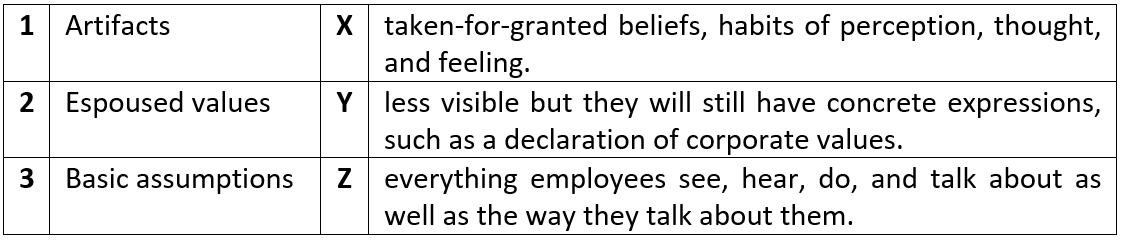 Which of the following is the correct match of the above items?
Seçenekler
A
1-Y , 2-Z, 3-X
B
1-Y, 2-X, 3-Z
C
1-Z, 2-Y, 3-X
D
1-Z, 2-X, 3-Y
E
1-X, 2-Y, 3-Z
Açıklama:
When we talk about artifacts, we refer to observable phenomena; everything employees see, hear, do, and talk about as well as the way they talk about them.
Espoused values are less visible than artifacts but they will still have concrete expressions, such as a declaration of corporate values.
Unlike espoused values, basic assumptions are unconscious; they are taken-for-granted beliefs, habits of perception, thought, and feeling.
The correct answer is C.
Espoused values are less visible than artifacts but they will still have concrete expressions, such as a declaration of corporate values.
Unlike espoused values, basic assumptions are unconscious; they are taken-for-granted beliefs, habits of perception, thought, and feeling.
The correct answer is C.
Soru 13
Which of the following can be described as "a pattern of shared basic assumptions that the group learned as it solved its problems of external adaptation and internal integration, that has worked well enough to be considered valid and, therefore, to be taught to new members as the correct way to perceive, think, and feel in relation to those problems"?
Seçenekler
A
Organizational culture
B
Cohesiveness
C
Organizartional climate
D
Groupthink
E
Formalization
Açıklama:
Organizational culture is a pattern of shared basic assumptions that the group learned as it solved its problems of external adaptation and internal integration, that has worked well enough to be considered valid and, therefore, to be taught to new members as the correct way to perceive, think, and feel in relation to those problems.
The correct answer is A.
The correct answer is A.
Soru 14
We can group artifacts into several categories. One of these categories is ________________. These include everything from company logos to dress codes, to company culture manifestos; things that make you think of the organization when you see them.
Which of the following is most appropriate for the blank in the above sentence?
Which of the following is most appropriate for the blank in the above sentence?
Seçenekler
A
Language
B
Rituals and stories
C
Values
D
Symbols
E
Groups
Açıklama:
Generally speaking, we can group artifacts into several categories.
Symbols: These include everything from company logos to dress codes, to company culture manifestos; things that make you think of the organization when you see them.
The correct answer is D.
Symbols: These include everything from company logos to dress codes, to company culture manifestos; things that make you think of the organization when you see them.
The correct answer is D.
Soru 15
I. Artifacts are often what people outside the organization can also see.
II. Espoused values and beliefs are about complex virtues.
III. There is a difference between declared values and espoused values.
IV. Over time espoused values may transform into basic assumptions.
Which of the above sentences is correct?
II. Espoused values and beliefs are about complex virtues.
III. There is a difference between declared values and espoused values.
IV. Over time espoused values may transform into basic assumptions.
Which of the above sentences is correct?
Seçenekler
A
I and II
B
III and IV
C
I, II and III
D
II, III and IV
E
I, III and IV
Açıklama:
p. 100, p. 101, p. 102
Artifacts are often what people outside the organization can also see.
Espoused values and beliefs do not have to be about complex virtues. They could be as simple as believing that greeting colleagues is appropriate behavior or they could be about material issues.
There is a difference between declared values and espoused values.
Over time espoused values may transform into basic assumptions.
Sentence number II is not true. The correct sentences are I, III, and IV.
Thus the correct answer is E.
Artifacts are often what people outside the organization can also see.
Espoused values and beliefs do not have to be about complex virtues. They could be as simple as believing that greeting colleagues is appropriate behavior or they could be about material issues.
There is a difference between declared values and espoused values.
Over time espoused values may transform into basic assumptions.
Sentence number II is not true. The correct sentences are I, III, and IV.
Thus the correct answer is E.
Soru 16
_______________________, is a method of social science research where researchers delve into the details of a specific event, organization, culture, group etc. and try to understand the dynamics of the case including the factors that lead up to it and the outcomes that result from it.
Which of the following is most appropriate for the blank in the above sentence?
Which of the following is most appropriate for the blank in the above sentence?
Seçenekler
A
Typology
B
Job enrichment
C
Case study
D
Groupthink
E
Teamwork
Açıklama:
Case study is a method of social science research where researchers delve into the details of a specific event, organization, culture, group etc. and try to understand the dynamics of the case including the factors that lead up to it and the outcomes that result from it. It is frequently used in political science as well as sociology.
Soru 17
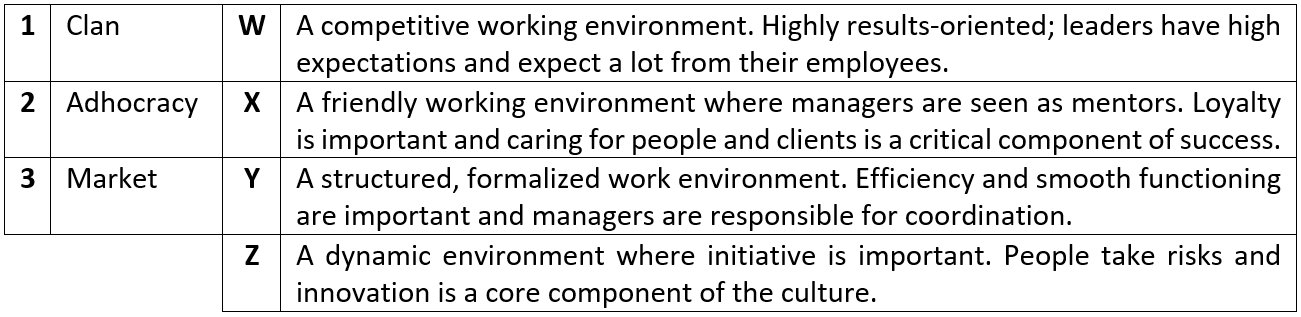 Which of the following is the correct match of the above items?
Seçenekler
A
1-X, 2-Z, 3-W
B
1-X, 2-W, 3-Y
C
1-Y, 2-Z, 3-X
D
1-Z, 2-Y, 3-W
E
1-W, 2-X, 3-Z
Açıklama:
Clan: A friendly working environment where managers are seen as mentors. Loyalty is important and caring for people and clients is a critical component of success.
Adhocracy: A dynamic environment where initiative is important. People take risks and innovation is a core component of the culture.
Market: A competitive working environment. Highly results-oriented; leaders have high expectations and expect a lot from their employees.
Hierarchy: A structured, formalized work environment. Efficiency and smooth functioning are important and managers are responsible for coordination.
The correct matchof the above items should be 1-X, 2-Z and 3-W.
Thus, the correct answer is A.
Adhocracy: A dynamic environment where initiative is important. People take risks and innovation is a core component of the culture.
Market: A competitive working environment. Highly results-oriented; leaders have high expectations and expect a lot from their employees.
Hierarchy: A structured, formalized work environment. Efficiency and smooth functioning are important and managers are responsible for coordination.
The correct matchof the above items should be 1-X, 2-Z and 3-W.
Thus, the correct answer is A.
Soru 18
Which of the following is described as "how employees collectively perceive the formal and informal ways and rules in terms of serving customers in an organization and what they see being rewarded and punished"?
Seçenekler
A
Safety climate
B
Service climate
C
Climate strength
D
Ethical Climate
E
Safety compliance
Açıklama:
Service Climate is how employees collectively perceive the formal and informal ways and rules in terms of serving customers in an organization and what they see being rewarded and punished in terms of service behaviors.
The correct answer is B.
The correct answer is B.
Soru 19
_____________________ indicates the degree of agreement or similarity between members of the same group about their perceptions of climate.
Which of the following is most appropriate for the blank in the above sentence?
Which of the following is most appropriate for the blank in the above sentence?
Seçenekler
A
Ethical climate
B
Safety compliance
C
Service performance
D
Climate strength
E
Safety participation
Açıklama:
Climate strength indicates the degree of agreement or similarity between members of the same group about their perceptions of climate. Higher agreement or similarity indicates higher climate strength.
The correct answer is D.
The correct answer is D.
Soru 20
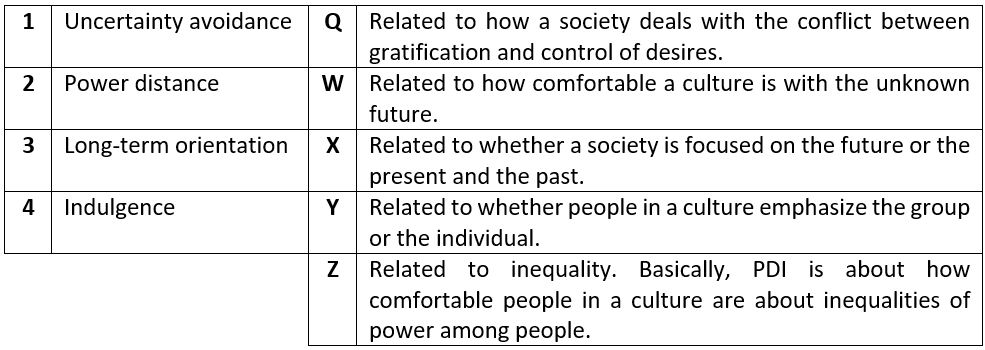 Which of the following is the correct match of the above items?
Seçenekler
A
1-W, 2-X, 3-Q, 4-Y
B
1-X, 2-W, 3-Q, 4-Z
C
1-Z, 2-W, 3-X, 4-Q
D
1-Y, 2-Z, 3-X, 4-W
E
1-W, 2-Z, 3-X, 4-Q
Açıklama:
Uncertainty avoidance: Related to how comfortable a culture is with the unknown future.
Power distance: Related to inequality. Basically, PDI is about how comfortable people in a culture are about inequalities of power among people.
Long-term orientation: Related to whether a society is focused on the future or the present and the past.
Indulgence: Related to how a society deals with the conflict between gratification and control of desires.
Individualism-Collectivism: Related to whether people in a culture emphasize the group or the individual.
The correct match should be 1-W, 2-Z, 3-X, 4-Q.
The correct answer is E.
Power distance: Related to inequality. Basically, PDI is about how comfortable people in a culture are about inequalities of power among people.
Long-term orientation: Related to whether a society is focused on the future or the present and the past.
Indulgence: Related to how a society deals with the conflict between gratification and control of desires.
Individualism-Collectivism: Related to whether people in a culture emphasize the group or the individual.
The correct match should be 1-W, 2-Z, 3-X, 4-Q.
The correct answer is E.
Soru 21
Which descriptions below are correct for organizational culture and organizational climate?
Seçenekler
A
Organizational climate is “a pattern of shared
basic assumptions'; whereas organizational culture is "the shared perceptions ".
basic assumptions'; whereas organizational culture is "the shared perceptions ".
B
Organizational culture is “a pattern of shared
basic assumptions"; organizational climate is "the shared perceptions ".
basic assumptions"; organizational climate is "the shared perceptions ".
C
Organizational culture is a function whereas organizational climate is a process.
D
Both organizational culture is and organizational climate are “a pattern of shared
basic assumptions".
basic assumptions".
E
Both organizational culture and organizational climate are "the shared perceptions ".
Açıklama:
Organizational culture is “a pattern of shared
basic assumptions that the group learned as it solved
its problems of external adaptation and internal
integration, that has worked well enough to be
considered valid and, therefore, to be taught to new
members as the correct way to perceive, think, and feel
in relation to those problems.” Organizational climate is: “the shared perceptions
of and the meaning attached to the policies, practices,
and procedures employees experience and the behaviors
they observe getting rewarded and that are supported
and expected.”
Organizational culture is “a pattern of shared
basic assumptions'; organizational climate is "the shared perceptions ".
basic assumptions that the group learned as it solved
its problems of external adaptation and internal
integration, that has worked well enough to be
considered valid and, therefore, to be taught to new
members as the correct way to perceive, think, and feel
in relation to those problems.” Organizational climate is: “the shared perceptions
of and the meaning attached to the policies, practices,
and procedures employees experience and the behaviors
they observe getting rewarded and that are supported
and expected.”
Organizational culture is “a pattern of shared
basic assumptions'; organizational climate is "the shared perceptions ".
Soru 22
Which alternative below only covers the elements of organizational culture?
Seçenekler
A
Assumptions, values, government regulations
B
Global developments, assumptions, management style, organizational structure
C
Values, assumptions, management style, organizational structure
D
Global developments, assumptions, management style, values
E
Rivals' methods, values, traditions, management style
Açıklama:
Organizational culture is “a pattern of shared
basic assumptions that the group learned as it solved
its problems of external adaptation and internal
integration, that has worked well enough to be
considered valid and, therefore, to be taught to new
members as the correct way to perceive, think, and feel
in relation to those problems.
Values, assumptions, management style, organizational structure
basic assumptions that the group learned as it solved
its problems of external adaptation and internal
integration, that has worked well enough to be
considered valid and, therefore, to be taught to new
members as the correct way to perceive, think, and feel
in relation to those problems.
Values, assumptions, management style, organizational structure
Soru 23
What are the organizational culture
elements at different layers?
elements at different layers?
Seçenekler
A
Language, values, basic underlying assumptions
B
Artifacts, basic underlying assumptions
C
Values, basic underlying assumptions
D
Artifacts, values, visible items
E
Artifacts, values, basic underlying assumptions
Açıklama:
According to Schein, organizational culture
manifests at three different levels, going from the
most visible, surface-level phenomena to the least
tangible and unconscious understandings:
1) Artifacts
2) Espouses values
3) Basic underlying assumptions
Artifacts, espouses values, basic underlying assumptions
manifests at three different levels, going from the
most visible, surface-level phenomena to the least
tangible and unconscious understandings:
1) Artifacts
2) Espouses values
3) Basic underlying assumptions
Artifacts, espouses values, basic underlying assumptions
Soru 24
What type of organizational element is described as "Beliefs and values that members of an
organization share"?
organization share"?
Seçenekler
A
Espoused values
B
Norms
C
Slogans
D
Traditions
E
Artifacts
Açıklama:
The espoused values of an organization are
those beliefs and values that members of an
organization share because these beliefs and values
have proven useful in the past. It is important to
remember that organizational members should see
that the benefits of a specific value repeatedly before
it becomes part of the organizational culture.
those beliefs and values that members of an
organization share because these beliefs and values
have proven useful in the past. It is important to
remember that organizational members should see
that the benefits of a specific value repeatedly before
it becomes part of the organizational culture.
Soru 25
Based on the idea that culture is a characteristic of an organization, which one of the following is correct?
Seçenekler
A
Cultures can not be observed.
B
All cultures are the same.
C
Cultures are a myth.
D
Certain elements of culture may be similar
across organizations.
across organizations.
E
Cultures can not be measured.
Açıklama:
When we say that organizations have cultures,
we are also implicitly saying that the organization
and the culture are separate entities. In other words,
culture is a characteristic of an organization, like
technology, size, and structure. This implies several
things:
1. Certain elements of culture may be similar
across organizations,
2. we can observe cultures, and
3. we can measure them.
Certain elements of culture may be similar
across organizations.
we are also implicitly saying that the organization
and the culture are separate entities. In other words,
culture is a characteristic of an organization, like
technology, size, and structure. This implies several
things:
1. Certain elements of culture may be similar
across organizations,
2. we can observe cultures, and
3. we can measure them.
Certain elements of culture may be similar
across organizations.
Soru 26
Competing values framework (CVF) identifies two dimensions of values.
Which one below is correct for the "structure" dimension?
Which one below is correct for the "structure" dimension?
Seçenekler
A
The focus is internal and the emphasis is on integration.
B
The focus is external and the emphasis is on differentiation.
C
The focus is internal and the emphasis is on differentiation.
D
One end is flexibility while the other is stability.
E
The focus is external and the emphasis is on stability.
Açıklama:
Theoretically, CVF identifies two dimensions of values. The polar ends of each dimension are opposites.
• Dimension 1 is about structure; one end is flexibility while the other is stability.
• Dimension 2 is about focus; on one end, the focus is internal and the emphasis is on integration
while on the other end, the focus is external and the emphasis is on differentiation.
• Dimension 1 is about structure; one end is flexibility while the other is stability.
• Dimension 2 is about focus; on one end, the focus is internal and the emphasis is on integration
while on the other end, the focus is external and the emphasis is on differentiation.
Soru 27
According to the CVF, the four organizational structures are named as Clan, Adhocracy, Market, and Hierarchy. one below is described as "A dynamic environment where
initiative is important"?
initiative is important"?
Seçenekler
A
Clan
B
Autocracy
C
Adhocracy
D
Hierarchy
E
Market
Açıklama:
According to the CVF, organizations may be located
anywhere in the matrix space based on what the culture values more. The four cells are named as Clan, Adhocracy, Market, and Hierarchy.
anywhere in the matrix space based on what the culture values more. The four cells are named as Clan, Adhocracy, Market, and Hierarchy.
Soru 28
Which one below properly identifies corganizational climate?
Seçenekler
A
Organizational climate can not be observed.
B
Organizational climate talks about policies, practices, and
procedures.
procedures.
C
It is the same concept with organizational culture.
D
It is about abstract concepts like values and assumptions.
E
It is about invisible values.
Açıklama:
While culture is about more
abstract concepts like values and assumptions,
climate talks about policies, practices, and
procedures; these are things employees can observe
and experience.
Organizational climate talks about policies, practices, and
procedures.
abstract concepts like values and assumptions,
climate talks about policies, practices, and
procedures; these are things employees can observe
and experience.
Organizational climate talks about policies, practices, and
procedures.
Soru 29
"It is how employees collectively
perceive the formal and informal ways and
rules in terms of serving customers in an
organization".
Which of the following is described as above?
perceive the formal and informal ways and
rules in terms of serving customers in an
organization".
Which of the following is described as above?
Seçenekler
A
Service climate
B
Ethical climate
C
Ethical culture
D
Safety climate
E
Safety culture
Açıklama:
Safety Climate is how employees collectively
perceive the formal and informal ways and
rules in terms of workplace health and safety
in an organization and what they see being
rewarded and punished in terms of workplace
safety behaviors.
Service climate
perceive the formal and informal ways and
rules in terms of workplace health and safety
in an organization and what they see being
rewarded and punished in terms of workplace
safety behaviors.
Service climate
Soru 30
Which of the following descriptions refers to uncertainity avoidance?
Seçenekler
A
It is related to whether people in a culture emphasize
the group or the individual.
the group or the individual.
B
“I” is more important than “we”.
C
It is about how comfortable people in
a culture are about inequalities of power among
people.
a culture are about inequalities of power among
people.
D
It is related to gender
roles and the competing of ego-related issues.
roles and the competing of ego-related issues.
E
It may create intolerable anxiety under unknown conditions.
Açıklama:
It is related to how comfortable a culture is with the unknown
future. If a culture is high on UA, it has a low
tolerance of ambiguity and high levels of UA may
create “intolerable anxiety” (Hofstede, 1980).
Rules, rituals, and bureaucracy are important
organizational tools for dealing with this anxiety.
Turkey is typically fairly high on UA.
It may create intolerable anxiety under unknown conditions.
future. If a culture is high on UA, it has a low
tolerance of ambiguity and high levels of UA may
create “intolerable anxiety” (Hofstede, 1980).
Rules, rituals, and bureaucracy are important
organizational tools for dealing with this anxiety.
Turkey is typically fairly high on UA.
It may create intolerable anxiety under unknown conditions.
Soru 31
- Artifacts
- Espoused values
- Basic assumptions
- everything employees see, hear, do, and talk about as well as the way they talk about them (e.g., the jargon they use).
- principles or qualities that are considered important and describe the way things ‘ought to be’, such as honesty, helpfulness, humility or fairness.
- taken-for-granted beliefs, habits of perception, thought, and feeling.
Seçenekler
A
- A
- B
- C
B
- B
- C
- A
C
- C
- B
- A
D
- B
- A
- C
E
- A
- C
- B
Açıklama:
- Artifacts: everything employees see, hear, do, and talk about as well as the way they talk about them (e.g., the jargon they use).
- Espoused values: principles or qualities that are considered important and describe the way things ‘ought to be’, such as honesty, helpfulness, humility or fairness.
- Basic assumptions: taken-for-granted beliefs, habits of perception, thought, and feeling.
Soru 32
- organizational actions are predetermined by those assumptions that “worked in the past” rather than by rational and purposeful actions of its managerial authority
- certain elements of culture may be similar across organizations
- we can observe cultures
- we can measure cultures
Seçenekler
A
I-II-III-IV
B
I - III - IV
C
I - II - III
D
II - III - IV
E
I - IV
Açıklama:
When we say that organizations have cultures, we are also implicitly saying that the organization and the culture are separate entities. In other words, culture is a characteristic of an organization, like technology, size, and structure. This implies several things: 1. Certain elements of culture may be similar across organizations, 2. we can observe cultures, and 3. we can measure them.
Soru 33
- Innovation & risktaking
- Stability
- Aggressiveness
- Outcome orientation
- People orientation
- Team orientation
- Detail orientation
Seçenekler
A
I-II-III-IV-V-VI-VII
B
I-II-III-IV-V
C
I-II-III-IV-VII
D
I-II-III-VI-VII
E
I-IV-V-VI-VII
Açıklama:
Organizational Culture Profile (OCP; Chatman and Jehn, 1994; O’Reilly, et. al., 1991) has been a widely used tool to categorize cultural dimensions and measure organizational cultures. Here are the seven dimensions of culture;
- Innovation & risktaking
- Stability
- Aggressiveness
- Outcome orientation
- People orientation
- Team orientation
- Detail orientation
Soru 34
- Dimension 1 "structure"
- Dimension 2 "focus"
- integration
- differentiation
- flexibility
- stability
Seçenekler
A
- A-B
- C-D
B
- A-C
- B-D
C
- A-D
- B-C
D
- B-C
- A-B
E
- B-D
- A-C
Açıklama:
• Dimension 1 is about structure; one end is flexibility while the other is stability. • Dimension 2 is about focus; on one end, the focus is internal and the emphasis is on integration while on the other end, the focus is external and the emphasis is on differentiation.
Soru 35
- Clan
- Adhocracy
- Market
- Hierarchy
- A friendly working environment where managers are seen as mentors. Loyalty is important and caring for people and clients is a critical component of success.
- A dynamic environment where initiative is important. People take risks and innovation is a core component of the culture.
- A competitive working environment. Highly results-oriented; leaders have high expectations and expect a lot from their employees.
- A structured, formalized work environment. Efficiency and smooth functioning are important and managers are responsible for coordination.
Seçenekler
A
- B
- C
- D
- A
B
- C
- D
- A
- B
C
- D
- A
- B
- C
D
- A
- D
- B
- C
E
- A
- B
- C
- D
Açıklama:
Clan: A friendly working environment where managers are seen as mentors. Loyalty is important and caring for people and clients is a critical component of success.
Adhocracy: A dynamic environment where initiative is important. People take risks and innovation is a core component of the culture.
Market: A competitive working environment. Highly results-oriented; leaders have high expectations and expect a lot from their employees.
Hierarchy: A structured, formalized work environment. Efficiency and smooth functioning are important and managers are responsible for coordination.
Adhocracy: A dynamic environment where initiative is important. People take risks and innovation is a core component of the culture.
Market: A competitive working environment. Highly results-oriented; leaders have high expectations and expect a lot from their employees.
Hierarchy: A structured, formalized work environment. Efficiency and smooth functioning are important and managers are responsible for coordination.
Soru 36
- Ethical Climate
- Safety Climate
- Service Climate
- is about how employees collectively perceive the formal and informal ways and rules in terms of ethics in an organization and what they see being rewarded and punished in terms of ethical behaviors.
- is how employees collectively perceive the formal and informal ways and rules in terms of workplace health and safety in an organization and what they see being rewarded and punished in terms of workplace safety behaviors.
- is how employees collectively perceive the formal and informal ways and rules in terms of serving customers in an organization and what they see being rewarded and punished in terms of service behaviors.
Seçenekler
A
- A
- B
- C
B
- C
- B
- A
C
- B
- C
- A
D
- C
- A
- B
E
- A
- C
- B
Açıklama:
- Ethical Climate is about how employees collectively perceive the formal and informal ways and rules in terms of ethics in an organization and what they see being rewarded and punished in terms of ethical behaviors.
- Safety Climate is how employees collectively perceive the formal and informal ways and rules in terms of workplace health and safety in an organization and what they see being rewarded and punished in terms of workplace safety behaviors.
- Service Climate is how employees collectively perceive the formal and informal ways and rules in terms of serving customers in an organization and what they see being rewarded and punished in terms of service behaviors.
Soru 37
- Instrumental
- Caring
- Independence
- Rules
- Law and code
Seçenekler
A
I-II-III-IV-V
B
I-II-III-IV
C
I-II-III-V
D
I-II-IV-V
E
I-III-IV-V
Açıklama:
Unlike the other climate types we discussed, research on ethical climates has concentrated on 5 specific types of ethical climates (Victor and Culen, 1987, 1988): 1. Instrumental - concerns putting self and company interests first. 2. Caring - concerns putting the interest of friends and the team first. 3. Independence - concerns putting an individual’s own personal morality first. 4. Rules - concerns following company rules and procedures. 5. Law and code - concerns following laws and the requirements of professions.
Soru 38
"how much members of an organization or society try to avoid uncertainty and unpredictability of the future by reliance on social norms, rituals, and bureaucratic practices"
Which concept is defined above?
Which concept is defined above?
Seçenekler
A
Gender Egalitarianism
B
In-Group Collectivism
C
Uncertainty Avoidance
D
Societal Collectivism
E
Power Distance
Açıklama:
Uncertainty Avoidance- how much members of an organization or society try to avoid uncertainty and unpredictability of the future by reliance on social norms, rituals, and bureaucratic practices.
Soru 39
"how much individuals in organizations or societies encourage and reward individuals for being fair, altruistic, friendly, generous, caring and kind to others"
Which concept is defined above?
Which concept is defined above?
Seçenekler
A
Gender Egalitarianism
B
Human Orientation
C
Assertiveness
D
Future Orientation
E
Performance Orientation
Açıklama:
Human Orientation- how much individuals in organizations or societies encourage and reward individuals for being fair, altruistic, friendly, generous, caring and kind to others.
Soru 40
"how much individuals express pride, loyalty and cohesiveness in their organizations or families"
Which concept is defined above?
Which concept is defined above?
Seçenekler
A
Uncertainty Avoidance
B
Power Distance
C
In-Group Collectivism
D
Societal Collectivism
E
Assertiveness
Açıklama:
In-Group Collectivism- how much individuals express pride, loyalty and cohesiveness in their organizations or families.
Soru 41
What can organizational culture be described as?
- Social energy causing people to act
- Programming of the mind
- Social glue binding people together
- Maintaining impersonal work relations
Seçenekler
A
I and II
B
II and III
C
III and IV
D
I, II and III
E
II, III and IV
Açıklama:
Organizational culture is about the values and beliefs that the people in an organization have, how these are ‘taught’ to new members, and the stories that are told from generation to generation to pass the culture along. It can be described as social energy causing people to act (Kilmann et al., 1985), as programming of the mind (Hofstede, 1991), and as social glue binding people together (Hall, 1959). The correct answer is D.
Soru 42
- It is shared by those who possess it, which means it belongs to a group.
- It is born out of trying to solve organizational problems.
- Solutions that work become part of the collective cultural history of the group.
- It relates to how individuals experience life in the organization.
Seçenekler
A
I and II
B
III and IV
C
I, II and III
D
I, III and IV
E
II, III and IV
Açıklama:
Organizational culture is shared by those who possess it, which means it belongs to a group. In that sense, culture is to the organization what personality is to the individual. Second, organizational culture is born out of trying to solve (organizational) problems. Adapting to the external environment and internal coordination are the primary problems of organizations and culture is the outcome of a shared history of finding solutions to these problems. Third, solutions that work become part of the collective cultural history of the group and new members are socialized into the culture. What relates to how individuals experience life in the organization and the way they interpret that experience is organizational climate. The correct answer is C.
Soru 43
- Symbolic values
- Organizational practices
- Managerial decisions
- Rewarded behaviors
Seçenekler
A
I and III
B
II and IV
C
I, II and III
D
I, III and IV
E
II, III and IV
Açıklama:
Organizational climate is concerned with (more) observable properties of the environment, such as policies, practices and managerial decisions, and the way they are interpreted. Organizational culture is, on the other hand, about the (less) tangible, (more) symbolic properties of the environment within an organization including values and assumptions. The correct answer is E.
Soru 44
- Symbols
- Rituals
- Promptness
- Humility
Seçenekler
A
I and II
B
I and III
C
II and IV
D
I, II and III
E
II, III and IV
Açıklama:
Artifacts refer to observable phenomena; everything employees see, hear, do, and talk about as well as the way they talk about them (e.g., the jargon they use). In fact, artifacts are often what people outside the organization can also see. Generally speaking, we can group artifacts into several categories: symbols, language, rituals and stories. Promptness and humility are among the espoused values. The correct answer is A.
Soru 45
A corporation states that it values frugality, using only as much money as necessary, but it has very large customer entertainment budgets and takes its mid-level managers on an annual retreat.
Which of the following explains the situation above?
Which of the following explains the situation above?
Seçenekler
A
Frugality is an espoused value of the organizational culture.
B
Frugality is a declared value of the organizational culture.
C
Frugality is a basic assumption of the organizational culture.
D
Frugality is an artifact of the organizational culture.
E
Frugality is a cultural dimension of the organizational culture.
Açıklama:
There is a difference between declared values and espoused values. Over time, espoused values may transform into basic assumptions. For example, an organization may state that it values frugality, but it may be known for having very large customer entertainment budgets, taking its mid-level managers on an annual retreat, and other expensive practices. In this example, frugality is a declared value, but it is not an espoused value of the organizational culture. The correct answer is B.
Soru 46
- They ensure members pay attention to and interpret things in similar ways.
- They are the most visible element of organizational culture, thus the easiest to discover.
- They may result in serious problems on meeting with a different organizational culture.
Seçenekler
A
I
B
II
C
III
D
I and III
E
II and III
Açıklama:
Unlike espoused values, basic assumptions are unconscious; they are “taken-for-granted beliefs, habits of perception, thought, and feeling”. In organizations, they ensure that members pay attention to the same things in the same ways, interpret them in similar ways, and react similarly emotionally. They are in fact the least visible and the most difficult to discover element of organizational culture. However, because these assumptions are the least visible and most ingrained, they may also result in very serious problems when different organizational cultures meet. The correct answer is D.
Soru 47
Aproach Definition
1. Aggregation A. It is concerned with the comparable broadness of organizational outcomes.
2. Bandwith B. It looks at different types of climate.
3. Focused C. It focuses on the sharedness of the responses of members.
In which of the following are the approaches to organizational climate research matched with their definitions correctly?
1. Aggregation A. It is concerned with the comparable broadness of organizational outcomes.
2. Bandwith B. It looks at different types of climate.
3. Focused C. It focuses on the sharedness of the responses of members.
In which of the following are the approaches to organizational climate research matched with their definitions correctly?
Seçenekler
A
1-A, 2-B, 3-C
B
1-B, 2-A, 3-C
C
1-B, 2-C, 3-A
D
1-C, 2-B, 3-A
E
1-C, 2-A, 3-B
Açıklama:
Aggregation approach focuses on the sharedness of the responses of members (1-C); bandwith approach is concerned with the comparable broadness of organizational outcomes (2-A); focused approach looks at different types of climate (3-B). The correct answer is E.
Soru 48
Which of the following is not one of the specific types of ethical climates?
Seçenekler
A
Leadership
B
Caring
C
Independence
D
Instrumental
E
Law and code
Açıklama:
Research on ethical climates has concentrated on 5 specific types of ethical climates:
- Instrumental - concerns putting self and company interests first,
- Caring - concerns putting the interest of friends and the team first,
- Independence - concerns putting an individual’s own personal morality first,
- Rules - concerns following company rules and procedures,
- Law and code - concerns following laws and the requirements of professions.
Soru 49
- The socialization processes
- The role of leaders
- The selection processes
- The quality of service
Seçenekler
A
I and II
B
III and IV
C
I, II and III
D
I, II and IV
E
II, III and IV
Açıklama:
When studying how culture and climate are formed and maintained, researchers have focused on two very important and interrelated elements: i) the role of leaders, and ii) the selection and socialization processes within organizations. The correct answer is C.
Soru 50
Which of the following is not one of the dimensions of differences that national culture causes in organizations?
Seçenekler
A
Individualism-collectivism
B
Job acceptance
C
Power distance
D
Masculinity-femininity
E
Uncertainty avoidance
Açıklama:
The national culture dimensions of differences in organizations are: uncertainty avoidance, individualism-collectivism, power distance, masculinity-femininity, long-term orientation and indulgence. The correct answer is B.
Soru 51
What is organizational culture?
Seçenekler
A
Organizational culture is a pattern of shared basic assumptions that the group learned as it solved its problems of external adaptation and internal integration, that has worked well enough to be considered valid and, therefore, to be taught to new members as the correct way to perceive, think, and feel in relation to those problems.
B
Organizational culture is defined as the underlying beliefs, assumptions, values and some ways of interacting.
C
Organizational culture conducts its business treats its employees, customers, and the community.
D
Organizational culture extends in decision making, developing new ideas and personal expression.
E
It means that the organization’s productivity and performance, and provides guidelines on customer care and service.
Açıklama:
Organizational culture is a pattern of shared basic assumptions that the group learned as it solved its problems of external adaptation and internal integration, that has worked well enough to be considered valid and, therefore, to be taught to new members as the correct way to perceive, think, and feel in relation to those problems. Culture also includes the organization’s vision, values, norms, systems, symbols, language, assumptions, beliefs, and habits
Soru 52
What are the two most important two features of organizational culture?
Seçenekler
A
Organizational culture is concerned with observable properties of the environment, such as policies, practices and managerial decisions, and the way they are interpreted.
B
Two most important features of organizational culture are first, like culture, climate is also a shared property of groups. Second, climate relates to how individuals experience life in the organization and the way they interpret that experience.
C
Organizational climate influences to a great extent the performance of the employees and individual obedience to management.
D
Features of organizational culture, creating and maintaining a positive working environment depends on the needs of company benefit.
E
Organizational culture is a system of obey the rules, and system that governs how people in an organization behave.
Açıklama:
First of all, organizational culture is shared by those who possesses it, which means it belongs to a group. In that sense, culture is to the organization what personality is to the individual. Almost everyone who works in Bank ALLSMILE believes it is important to be social and friendly to their colleagues even when they rarely work closely with them. Second, (organizational) culture is born out of trying to solve (organizational) problems.
Soru 53
The origin of organizational climate is in social psychology?
Seçenekler
A
The origin of Organizational climate based on business management.
B
The origin of organizational climate is popular culture and environment.
C
The origin of organizational climate is in social psychology.
D
The main aspect of organizational climate is underlying assumptions, attitudes, and behaviors shared by a group of people
E
It is based on creating employee happiness and better company performance. Employees are loyal and companies perform better.
Açıklama:
The origin of organizational climate is in social psychology. The origins of organizational culture research lie in anthropology and sociology. Culture research has generally taken a higher-level view and the collective organization is of interest.
Soru 54
According to Schein, what are thethree levels of organizational culture?
Seçenekler
A
Edgar Schein Model of Organization Culture. The term “Organization culture” refers to the technology, strategy and beliefs of an organization.
B
Schien, described levelof organizational culture such as specific relationship, signal of culture of organization and symbols.
C
According to Schein, the level of organizational culture are ritualistic activities, symbols and codes of company.
D
According to Schein, organizational culture manifests at three different levels, going from the most visible, surface-level phenomena to the least tangible and unconscious understandings: artifacts, espouses values, basic underlying assumptions.
E
According to Schein, observable differences in an organizational culture are previous experience, concrete expressions and related behavior.
Açıklama:
According to Schein, organizational culture manifests at three different levels, going from the most visible, surface-level phenomena to the least tangible and unconscious understandings: artifacts, espouses values, basic underlying assumptions.
Soru 55
What is artifacts and what given as an example?
Seçenekler
A
Artifact based on ritualistic activities such as celebrating the birthdays.
B
Artifact based on language the ways of speaking and writing.
C
Some examples of artifacts include: a cross, , a picture or a tartan cloth, a flag, a food, clothing.
D
An artifact is a man-made object that has some kind of cultural significance and used for a particular purpose during a much earlier time.
E
When we talk about artifacts, we refer to observable phenomena; everything employees see, hear, do, and talk about as well as the way they talk about them. Artifacts are often what people outside the organization can also see. Some examples of artifacts are; what people wear, how they talk, how much they work, the way the offices are organized, stories about past events that most employees know about, and ritualistic activities.
Açıklama:
When we talk about artifacts, we refer to observable phenomena; everything employees see, hear, do, and talk about as well as the way they talk about them (e.g., the jargon they use). In facts, artifacts are often what people outside the organization can also see. Some examples of artifacts are; what people wear, how they talk, how much they work, the way the offices are organized, stories about past events that most employees know about, and ritualistic activities.
Soru 56
What are espoused values?
Seçenekler
A
Espoused values are less visible than artifacts but they will still have concrete expressions, such as a declaration of corporate values. When we speak of values, it means those principles or qualities that are considered important and describe the way things ‘ought to be’, such as honesty, helpfulness, humility or fairness.
B
Corporate values and morals important to an organization. Espoused values contribute to the development of normal standards of the organization for how it conducts business now and in the future.
C
Espoused Values are appropriate behavior or they could be about material issues.
D
Espoused Values include factors such as dress codes, myths, rituals, and tangible items such as awards, product displays, logos, furnishings and decor.
E
Edgar Schein developed a organizational culture model to make flexibility more visible within an organization.
Açıklama:
Espoused Values represent the more visible level of culture within the organization espoused values are less visible than artifacts but they will still have concrete expressions, such as a declaration of corporate values. When we speak of values, it means those principles or qualities that are considered important and describe the way things ‘ought to be’, such as honesty, helpfulness, humility or fairness.
Soru 57
Unlike espoused values, what is the basic a ssumptions of culture?
Seçenekler
A
Basic assumptions of culture are nature of the people such as individual differences, caused behavior and value of the person.
B
Unlike espoused values, basic assumptions are unconscious; they are “taken-for-granted beliefs, habits of perception, thought, and feeling”.
C
Basic assumptions based on social system and mutual interest.
D
Basic assumptions of organizational behavior are levels, challenges and opportunities.
E
Fundamental Assumptions of an organization are to improve organizational performance by understanding and controlling human behavior in organization.
Açıklama:
Unlike espoused values, basic assumptions are unconscious; they are “taken-for-granted beliefs, habits of perception, thought, and feeling”. In organizations, they ensure that members pay attention to the same things in the same ways, interpret them in similar ways, and react similarly emotionally
Soru 58
The Competing Values Framework of Quinn and Rohrbaugh is a theory based on statistical analyses of a comprehensive list of effectiveness indicators. What are the dimensions of this theory?
Seçenekler
A
Theoretically, CVF identifies two dimensions of values. These are; Dimension 1 is about structure; one end is flexibility while the other is stability. Dimension 2 is about focus; on one end, the focus is internal and the emphasis is on integration while on the other end, the focus is external and the emphasis is on differentiation.
B
Quinn and Rohrbaugh discovered two major dimensions underlying conceptions of effectiveness. First dimension is related to transitional flexibility and second is organizational stress readiness.
C
Two dimensions of Quinn and Rohrbaugh are, first stability and control and second deals with leadership.
D
Quinn and Rohrbaugh argues that more effective managers have the ability to play and competing leadership roles.
E
Competing value framework can be used in organization to development supervision and management programs to diagnose existing and desired cultures.
Açıklama:
Theoretically, CVF identifies two dimensions of values. The polar ends of each dimension are opposites. That means no organization can be 100% of both of these ends, which is why the values are said to compete with each other and serve different goals. Let us take a look at the dimensions and you will understand what we mean.
- Dimension 1 is about structure; one end is flexibility while the other is stability.
- Dimension 2 is about focus; on one end, the focus is internal and the emphasis is on integration while on the other end, the focus is external and the emphasis is on differentiation.
Soru 59
What does service climate mean?
Seçenekler
A
Service climate is how employees collectively perceive the formal and informal ways and rules in terms of serving customers in an organization and what they see being rewarded and punished in terms of service behaviors.
B
Service Climate is climate such as service climate, safety climate, justice climate, and ethical climate.
C
Service Climate is having a robust safety climate may lower workplace accidents.
D
Organizations and society in general may be interested in ensuring that certain types of organizations have healthy ethical climates and employees act ethically.
E
It means global financial crisis, many stakeholders engaged in a debate about the ethical climate of large financial institutions, who appeared to lack a robust ethical climate.
Açıklama:
It may not be clear what ‘service climate’ means, so let’s make sure we know what we are discussing. Formally, service climate is defined as “employee perceptions of the practices, procedures, and behaviors that get rewarded, supported, and expected with regard to customer service and customer-service quality”.
Soru 60
What does leadership mean to you?
Seçenekler
A
A good place to start looking at the impact of leadership on culture and culture creation is with the first leader of an organization.
B
Top management teams have control over the strategy and operations of their organizations. They make the decisions and set the targets, they are the ones who choose which values to emphasize and which rules and policies to prioritize, and they determine the procedures to follow.
C
The Leader behaves will influence the people they work with because founders can act as role models to their employees.
D
To do this they create an inspiring vision and leadership is a set of skills that can be learned by training.
E
They are clear and concise at all times, sometimes there is few question of their vision and what needs to be accomplished.
Açıklama:
Focusing on the highest level of leadership is not wrong. Top management teams have control over the strategy and operations of their organizations. They make the decisions and set the targets, they are the ones who choose which values to emphasize and which rules and policies to prioritize, and they determine the procedures to follow.
Ünite 5
Soru 1
....................... are constituted by the organization itself in order to perform certain tasks.
Which of the following terms best completes the given sentence?
Which of the following terms best completes the given sentence?
Seçenekler
A
Project teams
B
Formal groups
C
Informal groups
D
Learning teams
E
Virtual teams
Açıklama:
Formal groups are constituted by the organization itself in order to perform certain tasks, and there are order groups or functional groups and task groups in formal groups. The correct answer is B.
Soru 2
Which of the following in NOT a characteristic of informal groups?
Seçenekler
A
Fulfill affiliation needs for friendship, love and support.
B
Their activities contribute directly to the organization’s collective purpose.
C
Reduce feelings of insecurity and anxiety, provide social support to each other.
D
Help to define our sense of identity and maintain our self-esteem.
E
Provide guidelines on generally acceptable behavior.
Açıklama:
The correct answer is B, because it is one of the main characteristics of formal groups. Their activities contribute directly to the organization’s collective purpose.
Soru 3
Which of the following is the last stage for the permanent groups where the group is fully functional?
Seçenekler
A
Adjourning
B
Storming
C
Norming
D
Performing
E
Forming
Açıklama:
Performing is the last stage for the permanent groups, and the group is fully functional. Members are more committed to the group on this stage, they focus on task performance. Structure is solid, roles and norms are well clear and accepted.
Soru 4
Which of the following five stages is about the termination of the group activities?
Seçenekler
A
Norming
B
Performing
C
Adjourning
D
Forming
E
Storming
Açıklama:
Adjourning stage is about the termination of the group activities. Temporary groups have to end their lives in a professional manner. The correct answer is C.
Soru 5
Which of the following refers to a change in overt behavior caused by real or imagined pressure from others?
Seçenekler
A
Compliance
B
Obedience
C
Formal status
D
Conformity
E
Social influence
Açıklama:
Social influence is change in overt behavior caused by real or imagined pressure from others. Therefore, the correct answer is E.
Soru 6
Which of the following refers to a behavior change that occurs as a result of a direct request?
Seçenekler
A
Obedience
B
Conformity
C
Compliance
D
Social influence
E
Leadership
Açıklama:
Compliance is a behavior change that occurs as a result of a direct request. Therefore, the correct answer is C.
Soru 7
Which of the following refers to the strength of the members’ desire to remain in a team and their commitment to it?
Seçenekler
A
Cohesiveness
B
Leadership
C
Status
D
Formal status
E
Social status
Açıklama:
Cohesiveness is the strength of the members’ desire to remain in a team and their commitment to it. Interpersonal cohesion is the members’ attraction to other group members. Task cohesion is members’ attraction and commitment to the tasks and goals of the group.
Soru 8
Which of the following refers to the relative ranking that an individual hold and the value of that individual measured by a group?
Seçenekler
A
Formal status
B
Leadership
C
Cohesiveness
D
Social status
E
Groupthink
Açıklama:
Social status refers to the relative ranking that an individual hold and the value of that individual measured by a group. Therefore, the correct answer is D.
Soru 9
Which of the following refers to a highly structured decisionmaking process in which participants are surveyed regarding their opinions or best judgments?
Seçenekler
A
Nominal Group Technique
B
Delphi method
C
Brainstorming
D
Groupthink
E
Leadership
Açıklama:
Delphi method is a highly structured decisionmaking process in which participants are surveyed regarding their opinions or best judgments. The correct answer is B.
Soru 10
Interpersonal trust and good communication are the critical essentials of .........................
Which of the following types of teams best completes the given sentence above?
Which of the following types of teams best completes the given sentence above?
Seçenekler
A
Project Teams
B
Self-Managed Work Teams
C
Virtual Teams
D
Learning Teams
E
Problem-Solving Teams
Açıklama:
Interpersonal trust and good communication are the critical essentials of virtual teams. The correct answer is C.
Soru 11
Which of the following is not among the common characteristics of formal groups?
Seçenekler
A
They tend to be permanent organizations.
B
They have a formal structure.
C
They are consciously organized by management.
D
They contribute directly to personal purposes.
E
They are task oriented.
Açıklama:
Formal groups have certain common characteristics (Buchanan and Huczynski, 2017,
p. 332):
They are task oriented.
They tend to be permanent.
They have a formal structure.
They are consciously organized by management to achieve organizational goals.
Their activities contribute directly to the organization’s collective purpose.
The correct answer is D.
p. 332):
They are task oriented.
They tend to be permanent.
They have a formal structure.
They are consciously organized by management to achieve organizational goals.
Their activities contribute directly to the organization’s collective purpose.
The correct answer is D.
Soru 12
In which stage of group development do the people meet for the first time and try to learn about each other?
Seçenekler
A
Performing
B
Adjourning
C
Norming
D
Forming
E
Storming
Açıklama:
Forming
During the forming stage, group members discover expectations, evaluate value of membership, defer to existing authority, and test boundaries of behavior. They meet for the first time, and new team members try to learn about each other. The initial ideas regarding the group tasks start to be discussed. This stage is characterized by uncertainty, structure, and the leadership of the group. It is completed when the group members start to consider themselves as part of the group.
The correct answer is D.
During the forming stage, group members discover expectations, evaluate value of membership, defer to existing authority, and test boundaries of behavior. They meet for the first time, and new team members try to learn about each other. The initial ideas regarding the group tasks start to be discussed. This stage is characterized by uncertainty, structure, and the leadership of the group. It is completed when the group members start to consider themselves as part of the group.
The correct answer is D.
Soru 13
Which of the following options is not one of things in which a group may affect its members positively or negatively?
Seçenekler
A
Satisfaction
B
Performance
C
Productivity
D
Product and service quality
E
Income
Açıklama:
Groups can affect their member’s satisfaction, performance, product and service quality, productivity, and a range of organizational goals and outcomes, both positively and negatively.
Soru 14
Which of the following shows the fundamentals of being a group?
Seçenekler
A
Common likes and dislikes
B
Common social background
C
Common goals, norms, and feelings
D
Common education and income
E
To be above a certain number of people
Açıklama:
In order for a crowd to become a group, conditions such as common goals, common norms, and common feelings of being a group are required.
Soru 15
Which of the following is focused interaction occurring between two or more individuals in an organization which discusses work issues and which enhances learning?
Seçenekler
A
Treaty
B
Huddle
C
Mission
D
Meeting
E
Concordat
Açıklama:
Huddle is a short term, a focused interaction occurring between two or more individuals in an organization which discusses work issues and which enhances learning. They are low on formality and high on task content; include problem-solving and information sharing activities. Huddles are usually considered to be more of an event than a type of group.
Soru 16
Which of the following is one of the characteristics of informal groups?
Seçenekler
A
They provide guidelines on generally acceptable behaviour.
B
They are task oriented.
C
They tend to be permanent.
D
They are consciously organized by management to achieve organizational goals.
E
Their activities contribute directly to the organization’s collective purpose.
Açıklama:
Informal group is a collection of individuals who become a group when they develop interdependencies, influence one another’s behaviour, and contribute to mutual need satisfaction.
Informal groups can;
Informal groups can;
- Reduce feelings of insecurity and anxiety, provide social support to each other.
- Fulfil affiliation needs for friendship, love and support.
- Help to define our sense of identity and maintain our self-esteem.
- Provide guidelines on generally acceptable behaviour.
- Cater for those often-ill-defined tasks which can only be performed through the combined efforts of a number of individuals working together.
- They are task oriented.
- They tend to be permanent.
- They have a formal structure.
- They are consciously organized by management to achieve organizational goals.
- Their activities contribute directly to the organization’s collective purpose.
Soru 17
In which of the following stages of group development do group members collaborate with each other and become more cohesive?
Seçenekler
A
Forming
B
Adjourning
C
Storming
D
Norming
E
Performing
Açıklama:
One of the most widely accepted models on group development is Tuckman’s (1977) five stage development model. Tuckman suggests that groups pass through five stages over their life. this model consists of five stages: forming, storming, norming, performing, and adjourning. Each stage has different implications for member behaviour and group performance.
In Norming stage, group members collaborate with each other and become more cohesive. It is characterized by cooperation and shared responsibility. Members accept each other, and a recognizable group culture arises. They set informal rules by which the team will function. Leadership roles are accepted, and behavioural norms are established on this stage. This stage is complete when the group structure strengthens.
In Norming stage, group members collaborate with each other and become more cohesive. It is characterized by cooperation and shared responsibility. Members accept each other, and a recognizable group culture arises. They set informal rules by which the team will function. Leadership roles are accepted, and behavioural norms are established on this stage. This stage is complete when the group structure strengthens.
Soru 18
Which of the following is a model that temporary groups generally follow?
Seçenekler
A
Norming stage
B
Five stages
C
Punctuated equilibrium
D
Adjourning stage
E
Delphi stage
Açıklama:
Temporary groups generally do not follow the five stages. Punctuated equilibrium is an alternate theory for five stages model. According to this model, groups do not go through linear stages but that group formation depends on the deadlines for the task at hand. PEM is essentially a two-stage model representing two periods of equilibrium “punctuated” by a shift in focus. When groups work on a particular task, they may go through “punctuated equilibrium”.
Soru 19
Which of the following is a maintenance role which reduces conflict within the group by finding ways of splitting differences?
Seçenekler
A
Compromiser
B
Harmonizer
C
Elaborator
D
Coordinator
E
Aggressor
Açıklama:
Maintenance Roles
Compromiser: reduces conflict within the group by finding ways of splitting differences.
Compromiser: reduces conflict within the group by finding ways of splitting differences.
Soru 20
Which of the following can be defined as “Behaviour change that occurs as a result of a direct request.”?
Seçenekler
A
Influence
B
Conformity
C
Obedience
D
Compliance
E
Status
Açıklama:
Conformity: Behaviour change designed to match the actions of others. Conformity is a change in one’s behaviour due to the real or imagined influence of other people. It is a behaviour change designed to match the actions of others. People will conform when the situation is ambiguous, when the situation is a crisis, and when other people of the group are experts.
Soru 21
Which of the following can be defined as the collection of rights and obligations related to a position disparately from the individual occupying the position?
Seçenekler
A
Cohesiveness
B
Conformity
C
Obedience
D
Social status
E
Formal status
Açıklama:
Status is a prestige ranking in a group which is independent of formal status or position. Formal status is the collection of rights and obligations related to a position disparately from the individual occupying the position.
Soru 22
Which of the following is not one of the criteria that group effectiveness depends on?
Seçenekler
A
Accuracy
B
Liability
C
Speed
D
Creativity
E
Acceptance
Açıklama:
Group effectiveness depends on different criteria like, accuracy, speed, creativity, and acceptance.
Soru 23
During which stage of group development do the group members collaborate with each other and become more cohesive?
Seçenekler
A
Forming
B
Performing
C
Adjourning
D
Storming
E
Norming
Açıklama:
Norming In this stage, group members collaborate with each other and become more cohesive. It is characterized by cooperation and shared responsibility. Members accept each other, and a recognizable group culture arises. They set informal rules by which the team will function. Leadership roles are accepted, and behavioral norms are established on this stage. This stage is complete when the group structure strengthens. The correct answer is E.
Soru 24
Which stage of group development is about conflict as members become more proactive and compete for various team roles?
Seçenekler
A
Storming
B
Norming
C
Performing
D
Forming
E
Adjourning
Açıklama:
Storming This stage is about conflict as members become more proactive and compete for various team roles. Discussions generally focus on behavior, roles, and social relationships that are right for doing the group’s task. Informal leaders begin to emerge, even though there is an existing leader in the group. Some members may try to isolate themselves from the emotional tension. The correct answer is A.
Soru 25
During which stage of group development is the group fully functional and more committed?
Seçenekler
A
Storming
B
Performing
C
Norming
D
Forming
E
Adjourning
Açıklama:
Performing It is the last stage for the permanent groups, and the group is fully functional. Members are more committed to the group on this stage, they focus on task performance. Structure is solid, roles and norms are well clear and accepted. In high-performance groups, members are highly cooperative, have a high level of trust in each other, are committed to group objectives, and identify with the group. Like the process of human development, groups need to complete all stages of development successfully to fully function and record high levels of achievement. The correct answer is B.
Soru 26
In which type of group do the members focus on a specific issue, develop a potential solution, and act within outlined borders?
Seçenekler
A
Diverse teams
B
Learning teams
C
Problem-solving teams
D
Self-managed work teams
E
Virtual teams
Açıklama:
Problem-Solving Teams If the members focus on a specific issue, develop a potential solution, and act within outlined borders, this team is called problem-solving teams. They are basically shaped to solve problems. Quality circles might be a very good example for this kind of teams. They need to solve the quality problems and work on improvements while getting trained in the group process (Ivancevich et al., 2006, p. 336). The correct answer is C.
Soru 27
What is the group decision making technique that refers to the situation in which participants spontaneously generate as much ideas as possible?
Seçenekler
A
Nominal group technique
B
Delphi method
C
Adjourning
D
Brainstorming
E
Forming
Açıklama:
Brainstorming In brain storming, participants spontaneously generate as much ideas as possible. Its role in the decision process is to create a set of decision alternatives, not to pick the final alternative. It was coined by Alex Osborn in 1939, and he proposes four rules to maximize the quantity and quality of ideas generated. First one is to speak freely, even the craziest ideas are accepted. Second, criticizing others or their ideas is forbidden. Third, you should come with as many ideas as possible. Last but not the least, you should build on the ideas that other members have generated (McShane and Von Glinow, 2018, p. 239). The correct answer is D.
Soru 28
Which of the following terms refers to the strength of the members’ desire to remain in a team and their commitment to it?
Seçenekler
A
Brainstorming
B
Cohesiveness
C
Leadership
D
Status
E
Groupthink
Açıklama:
Cohesiveness is the strength of the members’ desire to remain in a team and their commitment to it. Interpersonal cohesion is the members’ attraction to other group members. Task cohesion is members’ attraction and commitment to the tasks and goals of the group. The correct answer is B.
Soru 29
Which of the following is not among the characteristics of groupthink?
Seçenekler
A
Collective rationalization
B
Belief in inherent morality of the team
C
Speaking freely
D
Direct presssure on dissenters
E
llusion of unanimity
Açıklama:
Characteristic of Groupthink
• Illusion of invulnerability
• Collective rationalization
• Belief in inherent morality of the team
• Stereotypes of other groups
• Direct presssure on dissenters
• Self-censorship
• Illusion of unanimity
• Self-appointed ‘‘mind guards’
The correct answer is C.
• Illusion of invulnerability
• Collective rationalization
• Belief in inherent morality of the team
• Stereotypes of other groups
• Direct presssure on dissenters
• Self-censorship
• Illusion of unanimity
• Self-appointed ‘‘mind guards’
The correct answer is C.
Soru 30
Which stage of group development is about the termination of the group activities?
Seçenekler
A
Adjourning
B
Storming
C
Performing
D
Norming
E
Forming
Açıklama:
Adjourning stage is about the termination of the group activities. Temporary groups have to end their lives in a professional manner. This stage might be characterized by positive emotions of joy and achievement, yet it might be a cause of disappointment or anger. The correct answer is A.
Soru 31
Which of the concepts below is described as "individuals who happen to be
collected together at any particular time'?
collected together at any particular time'?
Seçenekler
A
Organization
B
Team
C
Society
D
Group
E
Aggregate
Açıklama:
There are some concepts that it is important to
maintain a distinction between group and these
concepts. One of these concepts is the aggregate.
Aggregates are individuals who happen to be
collected together at any particular time, e.g. on a
bus as travelers, theatre audience, etc. They are not
related to each other in a meaningful way. And
also, they don’t consider themselves a part of any
identifiable unit
maintain a distinction between group and these
concepts. One of these concepts is the aggregate.
Aggregates are individuals who happen to be
collected together at any particular time, e.g. on a
bus as travelers, theatre audience, etc. They are not
related to each other in a meaningful way. And
also, they don’t consider themselves a part of any
identifiable unit
Soru 32
Which of the reasons below is not one of the motives for joining groups?
Seçenekler
A
Gestalt psychology
B
Sense of belonging
C
Individual tasks
D
Sense of safety
E
Getting information
Açıklama:
Being member of a group helps people
to fulfil important psychological and sociological
needs such as belonging somewhere or attract
attention of others. Sense of belonging is one of
the most important reasons why people gather in
groups, and gathering in groups has always been a
characteristic of human behavior. By joining groups, we can achieve
things that we can’t when we are on our own. Also,
we can get information that is not available to nonmembers of the groups. Finally, being member of a group ensures
a positive social identity
Individual tasks
to fulfil important psychological and sociological
needs such as belonging somewhere or attract
attention of others. Sense of belonging is one of
the most important reasons why people gather in
groups, and gathering in groups has always been a
characteristic of human behavior. By joining groups, we can achieve
things that we can’t when we are on our own. Also,
we can get information that is not available to nonmembers of the groups. Finally, being member of a group ensures
a positive social identity
Individual tasks
Soru 33
Which of the following correctly describes the difference between the order group and the task group?
Seçenekler
A
Task groups are continuous, order groups are relatively temporary.
B
Order groups are continuous, task groups are relatively temporary.
C
Both groups are temporary formal groups.
D
Both groups are continuous formal groups.
E
Both groups are permanent formal groups.
Açıklama:
Formal groups are constituted by the organization itself in order to perform certain tasks,
and there are order groups or functional groups and task groups in formal groups. While order groups are continuous, task groups are relatively temporary. Task groups are
constituted to solve a specific problem about the organization. They dissolve when the problem is solved.
and there are order groups or functional groups and task groups in formal groups. While order groups are continuous, task groups are relatively temporary. Task groups are
constituted to solve a specific problem about the organization. They dissolve when the problem is solved.
Soru 34
Which of the following is the minimum requirement for a crowd to become a group?
Seçenekler
A
Cohesiveness
B
Common feelings
C
Common goals
D
Common norms
E
Interaction
Açıklama:
In order for a crowd to become a group, conditions such as common goals, common norms, and common feelings of being a group are required. The minimum requirement for a crowd to become a group is interaction. Accordingly, the group is defined as “more than one person who are in interaction with each other”. These kinds of groups are temporary, because their members’ common goals and characteristics are limited. But as long as there is interaction, it is possible to call it as a group. Even though they look like a group, if there is no interaction between them, people who are physically together can’t be called a group. For this reason, the correct answer is E.
Soru 35
Which of the following formal groups is relatively temporary?
Seçenekler
A
Functional groups
B
Huddle
C
Order groups
D
Self-managed groups
E
Task groups
Açıklama:
Formal groups are constituted by the organization itself in order to perform certain tasks, and there are order groups or functional groups and task groups informal groups. While order groups are continuous, task groups are relatively temporary. Task groups are constituted to solve a specific problem about the organization. They dissolve when the problem is solved. While employees are in the task groups, their membership of the order groups are also continuing. For this reason, the correct answer is E.
Soru 36
Which of the following is an alternative theory for the five-stage model, in which group formation does not go through linear stages but depends on the deadlines for the task at hand?
Seçenekler
A
GRIP Model
B
Integrated model of group development
C
Kurt Lewin's change process
D
Punctuated equilibrium model
E
Systems model
Açıklama:
Temporary groups generally do not follow the five stages. Punctuated equilibrium is an alternate theory for five stages model. According to this model, groups do not go through linear stages but that group formation depends on the deadlines for the task at hand. For this reason, the correct answer is D.
Soru 37
Which of the following is a concept related to informal rules and shared expectations that groups establish to regulate the behavior of their members?
Seçenekler
A
Cohesiveness
B
Leadership
C
Norms
D
Roles
E
Status
Açıklama:
Norms are the informal rules and shared expectations that groups establish to regulate the behavior of their members. For this reason, the correct answer is C.
Soru 38
Which of the following term is defined as the prestige ranking in a group which is independent of position?
Seçenekler
A
Cohesiveness
B
Leadership
C
Norms
D
Roles
E
Status
Açıklama:
Status is a prestige ranking in a group which is independent of formal status or position. It is a socially defined position given to a group or members by others. For this reason, the correct answer is E.
Soru 39
Which of the following is the strength of the members’ desire to remain in a team and their commitment to it?
Seçenekler
A
Cohesiveness
B
Leadership
C
Norms
D
Roles
E
Status
Açıklama:
Cohesiveness is the strength of the members’ desire to remain in a team and their commitment to it. Interpersonal cohesion is the members’ attraction to other group members. Task cohesion is members’ attraction and commitment to the tasks and goals of the group. For this reason, the correct answer is A.
Soru 40
Which of the following group decision-making techniques starts with the group members writing their ideas silently and independently at the first stage?
Seçenekler
A
Brainstorming
B
Delphi method
C
Fish bowling technique
D
Nominal group technique
E
Meetings
Açıklama:
Nominal group technique consists of four stages. At first stage, group members silently and independently write down their ideas. Then, each member describes these ideas one by one to the other group members without critique. The group discusses the ideas afterwards. Finally, group members silently and independently evaluate the ideas presented. For this reason, the correct answer is D.
Soru 41
Which of the following does not describe the concept of the team?
Seçenekler
A
The team members focus on achieving team goals and performance.
B
The team leader dominates and controls the team.
C
The team members are not random people, each of them is complementary to each other.
D
The team is more than the sum of its parts and creates positive synergies.
E
The team members are dependent on each other, share the responsibilities and are collectively judged.
Açıklama:
Apart from sharing information, the team members also share the responsibility of the team task and focus on achieving the team goals and performance. The team is always responsible for the outcome. Result of the collective efforts of the team members, they are not working individually and their work is not also valued individually. They create positive synergies. In work group, leader dominates and controls the team but in work teams, leader act as a facilitator. For this reason, the correct answer is B.
Soru 42
Which of the following is the type of teams that rely on communication through technology while crossing borders of geography, time, culture and organization to accomplish interdependent tasks?
Seçenekler
A
Virtual teams
B
Self-managed work teams
C
Project teams
D
Problem-solving teams
E
Learning teams
Açıklama:
Virtual teams rely on communication through technology, while crossing borders of geography, time, culture, and organization to accomplish interdependent tasks. For this reason, the correct answer is A.
Soru 43
Which of the following effective team member behaviors is based on sharing information freely, efficiently, respectfully and listening actively according to the Five C’s model?
Seçenekler
A
Comforting
B
Communicating
C
Confronting
D
Cooperating
E
Coordinating
Açıklama:
Five Cs Model, which explains the effective team member behaviors: cooperating, coordinating, communicating, comforting, and conflict handling. Communication from these behaviors requires sharing information freely, efficiently, respectfully and listening actively. For this reason, the correct answer is B.
Soru 44
Which one below is a feature that identify informal groups?
Seçenekler
A
They help to define sense of identity and
maintain self-esteem.
maintain self-esteem.
B
They tend to be permanent.
C
They are task oriented.
D
They are consciously organized
E
They contribute directly to the
organization’s collective purpose.
organization’s collective purpose.
Açıklama:
Informal groups satisfy the sense of belonging,
the idea that we can be wanted, needed and included
for what we are, in a way that formal group may
not. These informal groups can also satisfy a range
of other needs. nformal groups satisfy the sense of belonging,
the idea that we can be wanted, needed and included
for what we are, in a way that formal group may
not. These informal groups can also satisfy a range
of other needs.
They help to define sense of identity and
maintain self-esteem.
the idea that we can be wanted, needed and included
for what we are, in a way that formal group may
not. These informal groups can also satisfy a range
of other needs. nformal groups satisfy the sense of belonging,
the idea that we can be wanted, needed and included
for what we are, in a way that formal group may
not. These informal groups can also satisfy a range
of other needs.
They help to define sense of identity and
maintain self-esteem.
Soru 45
At which stage of a groups development "Discussions generally focus on behavior, roles, and social relationships that are right for doing the group’s task"?
Seçenekler
A
Forming
B
Norming
C
Storming
D
Adjourning
E
Performing
Açıklama:
Storming stage is about conflict as members become more proactive and compete for various team roles. Discussions generally focus on behavior, roles, and social relationships that are right for doing the group’s task. Informal leaders begin to emerge, even though there is an existing leader in the group. Some members may try to isolate themselves from the emotional tension.
Soru 46
Which one below identifies the norming stage of group development?
Seçenekler
A
It is the termination
of the group activities.
of the group activities.
B
Temporary groups have
to end their lives in a professional manner.
to end their lives in a professional manner.
C
Group members discover expectations, evaluate value of membership, defer
to existing authority, and test boundaries of behavior.
to existing authority, and test boundaries of behavior.
D
Members are more committed to the group on this stage, they
focus on task performance.
focus on task performance.
E
Group members collaborate
with each other and become more cohesive.
with each other and become more cohesive.
Açıklama:
In this stage, group members collaborate
with each other and become more cohesive.
It is characterized by cooperation and shared
responsibility. Members accept each other, and
a recognizable group culture arises. They set
informal rules by which the team will function.
Leadership roles are accepted, and behavioral
norms are established on this stage.
with each other and become more cohesive.
It is characterized by cooperation and shared
responsibility. Members accept each other, and
a recognizable group culture arises. They set
informal rules by which the team will function.
Leadership roles are accepted, and behavioral
norms are established on this stage.
Soru 47
Which option below covers some of the maintenance roles in a group?
Seçenekler
A
Aggressor
Blocker
Joker
Blocker
Joker
B
Blocker
Joker
Dominator
Joker
Dominator
C
Encourager
Harmonizer
Compromiser
Harmonizer
Compromiser
D
Initiator
Information seeker/giver Elaborator
Elaborator
Information seeker/giver Elaborator
Elaborator
E
Elaborator
Coordinator
Recorder
Coordinator
Recorder
Açıklama:
Maintenance roles are: Encourager
Harmonizer
Compromiser
Gatekeeper
Follower
Harmonizer
Compromiser
Gatekeeper
Follower
Soru 48
Which concept below is described as " A change in one’s behavior due to the real or imagined
influence of other people".
influence of other people".
Seçenekler
A
Conformity
B
Compliance
C
Resistance
D
Role conflict
E
Obedience
Açıklama:
According to social psychologists, conformity,
compliance, and obedience are three major
categories of social influence. Conformity is a
change in one’s behavior due to the real or imagined
influence of other people. It is a behavior change
designed to match the actions of others. People will
conform when the situation is ambiguous, when
the situation is a crisis, and when other people of
the group are experts.
compliance, and obedience are three major
categories of social influence. Conformity is a
change in one’s behavior due to the real or imagined
influence of other people. It is a behavior change
designed to match the actions of others. People will
conform when the situation is ambiguous, when
the situation is a crisis, and when other people of
the group are experts.
Soru 49
Which type of groupthink below leads to defective decision making?
Seçenekler
A
Success in examining risks of
preferred choice.
preferred choice.
B
Selective bias in processing
information at hand.
information at hand.
C
Effective reappraisal of
alternatives.
alternatives.
D
Good information search.
E
Complete survey of goals.
Açıklama:
Groupthink does not necessarily end up with a poor decision but definitely
increases the possibility of it. When good judgment and
discussion are suppressed, the group might still have a
chance. Nevertheless, to increase the possibility of a good
decision, managers need to limit groupthink.
Selective bias in processing
information at hand.
increases the possibility of it. When good judgment and
discussion are suppressed, the group might still have a
chance. Nevertheless, to increase the possibility of a good
decision, managers need to limit groupthink.
Selective bias in processing
information at hand.
Soru 50
Which of the following is a short term, a focused interaction occurring between two or more individuals in an organization that discusses work issues and that enhances learning?
Seçenekler
A
Group
B
Team
C
Aggregate
D
Swarm
E
Huddle
Açıklama:
There are some concepts that it is important to maintain a distinction between group and these concepts. These concepts are aggregate, swarm, and huddles. Aggregates are individuals who happen to be collected together at any particular time, e.g. on a bus as travelers, theatre audience, etc. They are not related to each other in a meaningful way. And also, they don’t consider themselves a part of any identifiable unit. Swarm is characterized by a flurry of collective activity involving anyone who is able to add value to a task. They form quickly, solve the problem or grab an opportunity, and then quickly disperse. Their members are not members of the same formal group, and probably include people who have never worked together. However, academic researchers refer to this work arrangement as a huddle. Huddle is a short term, a focused interaction occurring between two or more individuals in an organization which discusses work issues and which enhances learning. They are low on formality and high on task content; include problem-solving and information sharing activities. Huddles are usually considered to be more of an event than a type of group.
Soru 51
Which group decision making technique surveys group members without the requirement of gathering face to face?
Seçenekler
A
Brain storming
B
Participative decision making
C
Authoritarian decision making
D
Delphi technique
E
Nominal group technique
Açıklama:
Contrary to brainstorming and
nominal group technique, in Delphi method,
group members are not required to be face to face.
Usually group members respond to a survey form
without gathering. Then, group members receive a
second survey form to rank the items generated and
summarized from the first round. They are asked to
rank the items considering the priorities.
Delphi technique
nominal group technique, in Delphi method,
group members are not required to be face to face.
Usually group members respond to a survey form
without gathering. Then, group members receive a
second survey form to rank the items generated and
summarized from the first round. They are asked to
rank the items considering the priorities.
Delphi technique
Soru 52
Which of the following is a function of informal groups?
Seçenekler
A
To coordinate the activities of the organization’s functions
B
To establish logical authority relationships
C
To provide social support to each other
D
To apply the concepts of specialization
E
To create more group cohesion as a result of a common set of goals
Açıklama:
Informal groups satisfy the sense of belonging, the idea that we can be wanted, needed and included for what we are, in a way that formal group may not. These informal groups can also satisfy a range of other needs. We can list the functions of informal groups as in the following:
- Reduce feelings of insecurity and anxiety, provide social support to each other.
- Fulfil affiliation needs for friendship, love and support.
- Help to define our sense of identity and maintain our self-esteem.
- Provide guidelines on generally acceptable behavior.
- Cater for those often-ill-defined tasks which can only be performed through the combined efforts of a number of individuals working together.
Soru 53
In which stage of group development do group members test the boundaries of behavior?
Seçenekler
A
Forming
B
Storming
C
Norming
D
Performing
E
Adjourning
Açıklama:
During the forming stage, group members discover expectations, evaluate value of membership, defer to existing authority, and test boundaries of behavior. They meet for the first time, and new team members try to learn about each other. The initial ideas regarding the group tasks start to be discussed. This stage is characterized by uncertainty, structure, and the leadership of the group. It is completed when the group members start to consider themselves as part of the group.
Soru 54
Which stage of group development is characterized by a recognizable group culture?
Seçenekler
A
Forming
B
Storming
C
Norming
D
Performing
E
Adjourning
Açıklama:
In norming stage, group members collaborate with each other and become more cohesive. It is characterized by cooperation and shared responsibility. Members accept each other, and a recognizable group culture arises. They set informal rules by which the team will function. Leadership roles are accepted, and behavioral norms are established on this stage. This stage is complete when the group structure strengthens.
Soru 55
Which of the following is not a mode of norm transmission?
Seçenekler
A
Demonstrations and rituals
B
Formal structure
C
Nonverbal behaviors
D
Implicit activation of normative standards
E
Inference from the behavior of others
Açıklama:
There are three main modes of norm transmission. First one is through careful instruction, demonstrations and rituals; the second one is more passive, with nonverbal behaviors and implicit activation of normative standards; and the last one is by inferring the norm from the behavior of others around us. On the other hand, formal structure is a characteristic of formal groups.
Soru 56
I. The situation has a low level of risk.
II. Other people of the group are experts.
III.The situation is a crisis.
Which of the above statements explains why people confirm the measures against Covid-19 pandemic?
II. Other people of the group are experts.
III.The situation is a crisis.
Which of the above statements explains why people confirm the measures against Covid-19 pandemic?
Seçenekler
A
Only II
B
I and II
C
I and III
D
II and III
E
I, II, and III
Açıklama:
According to social psychologists, conformity, compliance, and obedience are three major categories of social influence. Conformity is a change in one’s behavior due to the real or imagined influence of other people. It is a behavior change designed to match the actions of others. People will conform when the situation is ambiguous, when the situation is a crisis, and when other people of the group are experts. Covid-19 pandemic measures were suggested by a group of medicine doctors who are experts in this area. Additionally, everybody has perceived that Covid-19 pandemic situation is a significant crisis that requires precaution.
Soru 57
Which of the following concepts is derived from an individual’s personal characteristics?
Seçenekler
A
Conformity
B
Compliance
C
Obedience
D
Status
E
Norm
Açıklama:
Status is a prestige ranking in a group which is independent of formal status or position. It is a socially defined position given to a group or members by others. Each role has a certain position within the group’s status structure. Status characteristics theory suggests that status is derived from three sources. First one is the power of an individual wielding over others, second one is an individual’s ability to contribute to group goals, and the last one is an individual’s personal characteristics.
Soru 58
I. security
II. social
III. prestige
IV. self-actualization
Which of the above are the needs that groups either formal or informal fulfil for their members?
II. social
III. prestige
IV. self-actualization
Which of the above are the needs that groups either formal or informal fulfil for their members?
Seçenekler
A
all of them
B
I and II
C
I, II and III
D
I, III and IV
E
II, III and IV
Açıklama:
Whether formal or informal, groups fulfil security, social, prestige and self-actualization needs of their members.
Soru 59
Which of the below is a task group?
Seçenekler
A
Quality Control
B
Project group
C
Department of industrial engineering
D
Personnel department
E
Human resources
Açıklama:
Formal groups are constituted by the organization itself in order to perform certain tasks, and there are order groups or functional groups and task groups in formal groups. While order groups are continuous, task groups are relatively temporary. Quality control department, department of industrial engineering, and personnel department can be given as examples to order groups. Task groups are constituted to solve a specific problem about the organization. They dissolve when the problem is solved.
Soru 60
Which of the following is not a factor that can influence the cohesion of the group?
Seçenekler
A
Role conflict
B
Member similarity
C
Team size
D
Member interaction
E
Somewhat difficult entry
Açıklama:
So many factors can influence the cohesion of the group. Some important ones are member similarity, team size, member interaction, somewhat difficult entry, team success, and external competition and challenges.
• Member similarity. Similarity-attraction effect occurs because we assume that people are more trustworthy and more likely to accept us if they look and act like us.
• Team size. Smaller teams tend to have more cohesion than larger teams.
• Member interaction. Teams tend to have more cohesion when their members interact with each other regularly.
• Somewhat difficult entry. Teams tend to have more cohesion when entry to the team is restricted.
• Member similarity. Similarity-attraction effect occurs because we assume that people are more trustworthy and more likely to accept us if they look and act like us.
• Team size. Smaller teams tend to have more cohesion than larger teams.
• Member interaction. Teams tend to have more cohesion when their members interact with each other regularly.
• Somewhat difficult entry. Teams tend to have more cohesion when entry to the team is restricted.
Soru 61
Which of the below is an informal group?
Seçenekler
A
personnel management
B
human resources
C
book club
D
accounting
E
quality control
Açıklama:
Running alongside and within, and cutting across and around these formal groups there exists a number of informal groups such as the office quiz or bowls team, theatre-going group or the Friday lunchtime people, the Monday morning “let’s talk about the weekend” group, and the “let’s moan about the organization” people (Brooks, 2016, p. 90). Informal groups are constituted by the members of organization. Among informal groups, there are friendship groups and interest groups. While friendship groups are more continuous, interest groups are relatively less continuous.
Soru 62
I. Performing II: Forming III. Adjourning IV. Norming V. Storming
Which of the below shows the correct order of stages of group development?
Which of the below shows the correct order of stages of group development?
Seçenekler
A
I-II-III-IV-VI
B
II-V-III-I-IV
C
III-IV-V-II-I
D
II-V-IV-I-III
E
IV-II-I-III-V
Açıklama:
Five stage model consists of five stages: forming, storming, norming, performing, and adjourning. Each stage has different implications for member behavior and group performance.
Soru 63
"This stage is about conflict as members become more proactive and compete for various team roles. Discussions generally focus on behavior, roles, and social relationships that are right for doing the group’s task. Informal leaders begin to emerge, even though there is an existing leader in the group. Some members may try to isolate themselves from the emotional tension."
Which stage of five-stage group development does the above description belong?
Which stage of five-stage group development does the above description belong?
Seçenekler
A
performing
B
adjourning
C
forming
D
norming
E
storming
Açıklama:
Storming
This stage is about conflict as members become more proactive and compete for various team roles. Discussions generally focus on behavior, roles, and social relationships that are right for doing the group’s task. Informal leaders begin to emerge, even though there is an existing leader in the group. Some members may try to isolate themselves from the emotional tension.
This stage is about conflict as members become more proactive and compete for various team roles. Discussions generally focus on behavior, roles, and social relationships that are right for doing the group’s task. Informal leaders begin to emerge, even though there is an existing leader in the group. Some members may try to isolate themselves from the emotional tension.
Soru 64
Which of the below is NOT one of the characteristics of the group structure that needs to be well-defined?
Seçenekler
A
forms
B
status
C
norms
D
leadership
E
cohesiveness
Açıklama:
To understand the group behavior, one needs to clarify the characteristics of the group. Every group evolves through the development process. When individuals gather, differences start to appear. To manage these differences, characteristics of the group structure needs to be well identified. Some important characteristics will be discussed below. These characteristics are: roles, norms, status, leadership, and cohesiveness.
Soru 65
Which of the below is a maintenance role in the group?
Seçenekler
A
initiator
B
harmonizer
C
aggressor
D
recorder
E
joker
Açıklama:
Table 5.1 Typical roles in the group on page 144
Soru 66
What might be defined as the process in which one party perceives that its interests are being opposed or negatively affected by another party?
Seçenekler
A
Role Expectation
B
Role Perception
C
Role Conflict
D
Norms
E
Conformity
Açıklama:
Conflict might be defined as the process in which one party perceives that its interests are being opposed or negatively affected by another party. In many organizations, individuals become members of multiple groups and need to act according to different roles.
Soru 67
How can obedience be defined?
Seçenekler
A
A change in overt behavior caused by real or imagined pressure from others.
B
Behavior change designed to match the actions of others.
C
Behaviour change that occurs as a result of a direct request.
D
Compliance that occurs in response to a directive from an authority figure.
E
The way others believe how you should act in a certain situation in the group. For
Açıklama:
Obedience
Compliance that occurs in response to a directive from an authority figure.
Compliance that occurs in response to a directive from an authority figure.
Soru 68
Which of the following is a characteristic of groupthink?
Seçenekler
A
Encouragement to speak freely
B
Belief in inherent morality of the team
C
Independent evaluation of the ideas presented
D
Conducting surveys without gathering
E
Generating as many ideas as possible
Açıklama:
We can list the characteristics of groupthink as in the following:
• Illusion of invulnerability
• Collective rationalization
• Belief in inherent morality of the team
• Stereotypes of other groups
• Direct presssure on dissenters
• Self-censorship
• Illusion of unanimity
• Self-appointed ‘‘mind guards’’
• Illusion of invulnerability
• Collective rationalization
• Belief in inherent morality of the team
• Stereotypes of other groups
• Direct presssure on dissenters
• Self-censorship
• Illusion of unanimity
• Self-appointed ‘‘mind guards’’
Soru 69
In which group decision making technique group members do not have to be together?
Seçenekler
A
Brainstroming
B
Nominal Group Technique
C
Project Teams
D
Groupthink
E
Delphi Method
Açıklama:
This method is developed by Dalkey and Helmer (1963). Contrary to brainstorming and nominal group technique, in Delphi method, group members are not required to be face to face. Usually group members respond to a survey form without gathering.
Soru 70
Which of the following is not a characteristic of a team?
Seçenekler
A
Composed of two or more people with work roles
B
Interdependent members operating within the organization
C
Performing tasks relevant to the organization’s mission
D
Affecting others inside and outside the organization
E
Who have membership on the team cannot be identified
Açıklama:
Teams can be defined as: “two or more people with work roles that require them to be interdependent, who operate within the organization, performing tasks relevant to the organization’s mission, with consequences that affect others inside and outside the organization, and who have membership that is identifiable to those on the team and those not on the team” (Hitt et al., 2011, p. 425).
Soru 71
I. There must be interaction between the people.
II. There must be at least 50 people.
III. The people must have common goals.
Which of the conditions listed above are required for a crowd to be called a group?
II. There must be at least 50 people.
III. The people must have common goals.
Which of the conditions listed above are required for a crowd to be called a group?
Seçenekler
A
Only I
B
Only II
C
Only III
D
I and II
E
I and III
Açıklama:
In order for a crowd to become a group, conditions such as common goals, common norms, and common feelings of being a group are required. The minimum requirement for a crowd to become a group is interaction. Accordingly, the group is defined as “more than one person who are in interaction with each other”. The correct answer is E.
Soru 72
Which of the following is not one of the features of small groups?
Seçenekler
A
In small groups, it is easy to see the presence of interaction.
B
Small groups are a social phenomenon.
C
Small groups reflect society.
D
They consist of less than fifty people.
E
Family is an example of a small group.
Açıklama:
Size of the group is also an important factor while defining groups. If the number of people who come together is too many, and there is no interaction between them, it is not possible to talk about presence of the group. Thus, sociologists and social psychologists focus on small groups. Small groups is a social phenomenon. We all spend significant parts of our lives in small groups like family, friend groups, and work groups. Second, small groups reflect society. By examining small groups, we can provide important information and clues about functioning of society. A small group consists of less than fifteen people. The correct answer D.
Soru 73
Which of the following is true about informal groups?
Seçenekler
A
They are formed through division of labor.
B
They are constituted by the organization itself in order to perform certain tasks.
C
These groups are formed when people contribute to mutual need satisfaction.
D
Personnel department can be given as an example.
E
There are two types such as order groups and task groups.
Açıklama:
Informal group is a collection of individuals who become a group when they develop interdependencies, influence one another’s behavior, and contribute to mutual need satisfaction. The correct answer is C.
Soru 74
In which stage of developing groups, group members discover expectations, evaluate value of membership, defer to existing authority, and test boundaries of behavior?
Seçenekler
A
Forming
B
Storming
C
Norming
D
Performing
E
Adjourning
Açıklama:
During the forming stage, group members discover expectations, evaluate value of membership, defer to existing authority, and test boundaries of behavior. They meet for the first time, and new team members try to learn about each other. The initial ideas regarding the group tasks start to be discussed. This stage is characterized by uncertainty, structure, and the leadership of the group. It is completed when the group members start to consider themselves as part of the group. The correct answer is A.
Soru 75
While developing a group, which stage is about the termination of the group activities?
Seçenekler
A
Forming
B
Storming
C
Norming
D
Performing
E
Adjourning
Açıklama:
Adjourning stage is about the termination of the group activities. Temporary groups have to end their lives in a professional manner. This stage might be characterized by positive emotions of joy and achievement, yet it might be a cause of disappointment or anger. This isn’t always a planned stage and may be rather unexpected. A planned conclusion is a better opportunity for goodbyes and recognition of achievements. The correct answer is E.
Soru 76
Which stage of group development is characterized by conflict?
Seçenekler
A
Forming
B
Storming
C
Norming
D
Performing
E
Adjourning
Açıklama:
Storming stage is about conflict as members become more proactive and compete for various team roles. Discussions generally focus on behavior, roles, and social relationships that are right for doing the group’s task. Informal leaders begin to emerge, even though there is an existing leader in the group. Some members may try to isolate themselves from the emotional tension. The correct answer is B.
Soru 77
_____ are the informal rules and shared expectations that groups establish to regulate the behavior of their members.
Which option completes the sentence best?
Which option completes the sentence best?
Seçenekler
A
Roles
B
Tasks
C
Duties
D
Norms
E
Negotiations
Açıklama:
Norms are the informal rules and shared expectations that groups establish to regulate the behavior of their members. The correct answer is D.
Soru 78
______ is a change in one’s behavior due to the real or imagined influence of other people. It is a behavior change designed to match the actions of others.
Which option completes the sentence best?
Which option completes the sentence best?
Seçenekler
A
Conformity
B
Compliance
C
Obedience
D
Immediacy
E
Strength
Açıklama:
According to social psychologists, conformity, compliance, and obedience are three major categories of social influence. Conformity is a change in one’s behavior due to the real or imagined influence of other people. It is a behavior change designed to match the actions of others. People will conform when the situation is ambiguous, when the situation is a crisis, and when other people of the group are experts.The correct answer is A.
Soru 79
What is the strength of the members’ desire to remain in a team and their commitment to it ?
Seçenekler
A
Comformity
B
Cohesiveness
C
Compliance
D
Social influence
E
Obedience
Açıklama:
Cohesiveness is the strength of the members’ desire to remain in a team and their commitment to it. Interpersonal cohesion is the members’ attraction to other group members. Task cohesion is members’ attraction and commitment to the tasks and goals of the group. The correct answer is B.
Soru 80
What is an agreement-at-any-cost mentality that results in ineffective group or team decision making and poor decisions?
Seçenekler
A
Groupthink
B
Group effectivenes
C
Member similarity
D
Team success
E
Brainstorming
Açıklama:
Groupthink is an agreement-at-any-cost mentality that results in ineffective group or team decision making and poor decisions (Hellriegel and Slocum, 2010, p. 374). It is associated with norms, and focusing too much attention on consensus. The correct answer is A.
Soru 81
What is the minimum requirement for a crowd to become a group?
Seçenekler
A
Interaction
B
Collaboration
C
Interdependence
D
Cooperation
E
Communication
Açıklama:
The minimum requirement for a crowd to become a group is interaction.
Soru 82
Which term is defined by “three or more independent persons interacting due to their needs and goals”?
Seçenekler
A
Team
B
Group
C
Organization
D
Association
E
Committee
Açıklama:
A group is defined as “three or more independent persons interacting due to their needs and goals” (Aronson et. al., 2012, p. 496).
Soru 83
Which term is defined by "rules of behavior that group members must obey in their individual activities within the group and in mutual relations with each other"?
Seçenekler
A
Directives
B
Regulations
C
Norms
D
Criteria
E
Standards
Açıklama:
Norms are the rules of behavior that group members must obey in their individual activities within the group and in mutual relations with each other (Tutar, 2016, p. 291).
Soru 84
What is the name of the social unit that is characterized by a flurry of collective activity involving anyone who is able to add value to a task, also called as a "huddle" by academic researchers?
Seçenekler
A
Group
B
Association
C
Collective
D
Swarm
E
Aggregate
Açıklama:
According to Gartner (2010), swarm is characterized by a flurry of collective activity involving anyone who is able to add value to a task. They form quickly, solve the problem or grab an opportunity, and then quickly disperse. Their members are not members of the same formal group, and probably include people who have never worked together (Buchanan and Huczynski, 2017, p. 320). However, academic researchers refer to this work arrangement as a huddle.
Soru 85
Which of the following is not one of the reasons for people to join groups?
Seçenekler
A
Feeling a sense of belonging
B
Getting information
C
Feeling safe
D
Ensuring a positive social identity
E
Achieving solitude and mindfulness
Açıklama:
Findings show that people participate groups for several reasons. Being member of a group helps people to fulfil important psychological and sociological needs such as belonging somewhere or attract attention of others. Sense of belonging is one of the most important reasons why people gather in groups, and gathering in groups has always been a characteristic of human behavior. The phrase from Gestalt psychology “the whole is greater than the sum of its parts” highlights that groups represent power. The unachievable becomes possible through group action. By joining groups, we can achieve things that we can’t when we are on our own. Also, we can get information that is not available to nonmembers of the groups. Groups also allow us to feel safe. Finally, being member of a group ensures a positive social identity (Brooks, 2016, p. 80-82; Kağıtçıbaşı, 2016, p. 273)."Achieving solitude and mindfulness" is not one of these reasons.
Soru 86
What is a group that is formed through division of labor called?
Seçenekler
A
Formal group
B
Informal group
C
Division group
D
Work group
E
Labor group
Açıklama:
A group that is formed through division of labor is called a formal group (Buchanan and Huczynski,
2017, p. 332).
2017, p. 332).
Soru 87
Which type of groups are formed to solve a specific problem about the organization, and dissolve when the problem is solved?
Seçenekler
A
Task groups
B
Functional groups
C
Informal groups
D
Problem-focused groups
E
Solution-oriented groups
Açıklama:
Task groups are constituted to solve a specific problem about the organization. They dissolve when the problem is solved.
Soru 88
Which of the following is NOT one of the stages in Tuckman’s (1977) five stage development model?
Seçenekler
A
Forming
B
Storming
C
Absorbing
D
Norming
E
Performing
Açıklama:
Tuckman’s (1977) five stage development model consists of five stages: forming, storming, norming, performing, and adjourning. "Absorbing" is not one of these stages.
Soru 89
In which stage of Tuckman's development model do group members discover expectations, evaluate value of membership, defer to existing authority, and test boundaries of behavior?
Seçenekler
A
Forming
B
Storming
C
Norming
D
Performing
E
Adjourning
Açıklama:
During the forming stage, group members discover expectations, evaluate value of membership, defer to existing authority, and test boundaries of behavior. They meet for the first time, and new team members try to learn about each other. The initial ideas regarding the group tasks start to be discussed. This stage is characterized by uncertainty, structure, and the leadership of the group. It is completed when the group members start to consider themselves as part of the group.
Soru 90
In which stage of Tuckman's development model do group members collaborate with each other and become more cohesive?
Seçenekler
A
Forming
B
Storming
C
Norming
D
Performing
E
Adjourning
Açıklama:
In the norming stage, group members collaborate with each other and become more cohesive. It is characterized by cooperation and shared responsibility. Members accept each other, and a recognizable group culture arises. They set informal rules by which the team will function. Leadership roles are accepted, and behavioral norms are established on this stage. This stage is complete when the group structure strengthens.
Ünite 6
Soru 1
Which of the following is TRUE about leadership?
Seçenekler
A
It is unlikely to provide a universally accepted definition of leadership.
B
Leaders are agents of change, persons who are affected by other people's acts.
C
Leadership is the process of hindering individual efforts to accomplish shared objectives.
D
It is crucial that a leader should be perceived as a leader by his/her followers.
E
Leadership comes to an end when one group member modifies the motivation of others in the group.
Açıklama:
Some people say that we cannot define leadership, but we know it when we see it. Others argue that leadership can only be defined as someone who has followers. So scholars argue that a universally acceptable definition for leadership is practically impossible and will hinder new ideas and creative ways of thinking.
Leaders are agents of change, persons whose acts affect other people more than other people’s acts affect them. Leadership occurs when one group member modifies the motivation or competencies of others in the group.
Leadership “…is the process of influencing others to understand and agree about what needs to be done and how to do it, and the process of facilitating individual and collective efforts to accomplish shared objectives”.
Attribution theory posits that attributions are understood to play a crucial role in human categorization processes and, thus to become a leader, he/she needs to be perceived as a leader by his/her followers.
Important note: Leadership is the matter of perception. A leader could not be perceived by everyone as a leader.
Leaders are agents of change, persons whose acts affect other people more than other people’s acts affect them. Leadership occurs when one group member modifies the motivation or competencies of others in the group.
Leadership “…is the process of influencing others to understand and agree about what needs to be done and how to do it, and the process of facilitating individual and collective efforts to accomplish shared objectives”.
Attribution theory posits that attributions are understood to play a crucial role in human categorization processes and, thus to become a leader, he/she needs to be perceived as a leader by his/her followers.
Important note: Leadership is the matter of perception. A leader could not be perceived by everyone as a leader.
Soru 2
Which of the following is NOT among the traits that effective leadership should entail?
Seçenekler
A
Intelligence
B
Being self-centered
C
Task-relevant knowledge
D
Integrity and honesty
E
Tolerance for stress
Açıklama:
George and Jones defined effective leadership characteristics under eight personal traits as;
• Intelligence; helps a leader solve complex problems.
• Task-relevant knowledge; ensures that a leader knows what has to be done, how is should be done and what resources are required for a group organization to achieve its goals.
• Dominance; an individual’s need to exert influence and control over others helps a leader channel follower’s efforts and abilities toward achieving group and organizational goals.
• Self-confidence; helps a leader influence followers and motivates them to persevere in the face of obstacles or difficulties.
• Energy; helps a leader deal with the many demands they face on a day to day basis.
• Tolerance for stress; helps a leader deal with the uncertainty inherent in any leadership role.
• Integrity and honesty; help to ensure a leader behaves ethically and is worthy of followers’ trust and confidence.
• Emotional maturity; helps to ensure a leader is not overly self-centered, can control their feelings, and can accept criticism.
• Intelligence; helps a leader solve complex problems.
• Task-relevant knowledge; ensures that a leader knows what has to be done, how is should be done and what resources are required for a group organization to achieve its goals.
• Dominance; an individual’s need to exert influence and control over others helps a leader channel follower’s efforts and abilities toward achieving group and organizational goals.
• Self-confidence; helps a leader influence followers and motivates them to persevere in the face of obstacles or difficulties.
• Energy; helps a leader deal with the many demands they face on a day to day basis.
• Tolerance for stress; helps a leader deal with the uncertainty inherent in any leadership role.
• Integrity and honesty; help to ensure a leader behaves ethically and is worthy of followers’ trust and confidence.
• Emotional maturity; helps to ensure a leader is not overly self-centered, can control their feelings, and can accept criticism.
Soru 3
A leader in a company tries to improve the working conditions because she believes that it will improve the satisfaction of the subordinates who have shared their ideas on what should be improved in the work environment.
Which of the following best describes the leader illustrated above?
Which of the following best describes the leader illustrated above?
Seçenekler
A
Task-oriented leader
B
Product-oriented leader
C
People-oriented leader
D
Goal-oriented leader
E
Company-oriented leader
Açıklama:
Through interviewing leaders and followers, researchers defined two types of leaders, task/goal oriented leader and people oriented leader.
Task/goal-oriented Leader: According to both studies, the leader shows a behavior that closely controls whether the group members are working in accordance with the predetermined company principles, methods and rules and push them to reach their performance capacity. They focus on clear cut procedures, plan and schedule tasks, organize followers activities and deployed necessary technical assistance. Besides he/she uses formal authority on coercion, reward, and legitimate power to influence the behavior and performance of followers.
People- oriented Leader: People oriented leader tries to improve the working conditions that will improve the satisfaction of the group members and is closely interested in the personal development and progress of the subordinates. Thus people-oriented leadership involves behaviors such as showing trust and respect for subordinates, acting friendly and considerate, trying to understand and solve their problems, showing appreciation for subordinates’ ideas.
Task/goal-oriented Leader: According to both studies, the leader shows a behavior that closely controls whether the group members are working in accordance with the predetermined company principles, methods and rules and push them to reach their performance capacity. They focus on clear cut procedures, plan and schedule tasks, organize followers activities and deployed necessary technical assistance. Besides he/she uses formal authority on coercion, reward, and legitimate power to influence the behavior and performance of followers.
People- oriented Leader: People oriented leader tries to improve the working conditions that will improve the satisfaction of the group members and is closely interested in the personal development and progress of the subordinates. Thus people-oriented leadership involves behaviors such as showing trust and respect for subordinates, acting friendly and considerate, trying to understand and solve their problems, showing appreciation for subordinates’ ideas.
Soru 4
This leader has a moderate concern for production and people. So there is a moderate effort to accomplish the tasks by creating a good working environment. These leaders try to keep the status quo by adopting moderate approach.
Which of the following describes the leadership style illustrated above?
Which of the following describes the leadership style illustrated above?
Seçenekler
A
Country club management
B
Impoverished management
C
Team management
D
Middle of the road management
E
Task management
Açıklama:
According to managerial grid, leaders are grouped into five leadership styles:
• Country club management; this leader has low concern for production, but much more concern for people. Country club managers focus on building positive relations among employees even when production is low.
• Task management; this leader has a high concern for production, on the other hand minimum concern for people. They apply restrict control on working and perceive employees as a part of machines for achieving goals. So they don’t care much about employees’ problems or needs.
• Middle of the road management; this leader has a moderate concern for production and people. So there is a moderate effort to accomplish the tasks by creating a good working environment. Middle of the road managers try to keep the status quo by adopting moderate approach.
• Impoverished management; this leader has neither a concern for people nor concern for production. Managers show little effort on building relationships with employees or getting the tasks completed.
• Team management; in this leadership style, both job satisfaction and productivity are high, because the leader has a high concern for both people and production. There is a peaceful working environment and strong relationship between the leaders and the employees, but the focus still remains on achieving the organizational goals.
• Country club management; this leader has low concern for production, but much more concern for people. Country club managers focus on building positive relations among employees even when production is low.
• Task management; this leader has a high concern for production, on the other hand minimum concern for people. They apply restrict control on working and perceive employees as a part of machines for achieving goals. So they don’t care much about employees’ problems or needs.
• Middle of the road management; this leader has a moderate concern for production and people. So there is a moderate effort to accomplish the tasks by creating a good working environment. Middle of the road managers try to keep the status quo by adopting moderate approach.
• Impoverished management; this leader has neither a concern for people nor concern for production. Managers show little effort on building relationships with employees or getting the tasks completed.
• Team management; in this leadership style, both job satisfaction and productivity are high, because the leader has a high concern for both people and production. There is a peaceful working environment and strong relationship between the leaders and the employees, but the focus still remains on achieving the organizational goals.
Soru 5
Which of the following is NOT among the factors determining the effectiveness of the leader according to contingency leadership approach?
Seçenekler
A
The quality of intended purpose
B
Abilities and expectations of the group members
C
Characteristics of an organization that leadership composed
D
Past experiences of the leader and the followers
E
Intra and interpersonal relationships of group members
Açıklama:
According to contingency leadership approach, the factors determining the effectiveness of the leader are:
• The quality of the intended purpose
• Abilities and expectations of the followers (group members)
• Characteristics of an organization that leadership composed
• Past experiences of the leader and the followers
• The quality of the intended purpose
• Abilities and expectations of the followers (group members)
• Characteristics of an organization that leadership composed
• Past experiences of the leader and the followers
Soru 6
What makes a task-oriented leader important and crucial in favorable and highly unfavorable situations?
Seçenekler
A
They are more concerned with the task than with their interpersonal relations.
B
People relations skills are much more important in achieving high group performance.
C
The leader has relatively legitimate power and there are some ambiguity on tasks.
D
The leader focuses on improving interpersonal relationships for better outcomes.
E
The group malfunctions when the leader takes the charge and makes the decisions.
Açıklama:
The task-oriented leader is important and crucial in favorable and highly unfavorable situations. They are more concerned with the task than with their interpersonal relations. In favorable situations everyone trusts and believes each other, the task is clear and the leader has power, the group is ready to be directed so all that is needed for a group to be managed, provide direction and say what to do. Likewise in unfavorable situations, because of poor member relations and unstructured tasks, the strong leader takes charge and makes the decisions that need to be made to accomplish the task asking for input.
Soru 7
The new manager at a company:
* lets subordinates what is expected from them
* lets them form the work schedules
* coordinates the work to be done
* gives specific guidance on how to accomplish these tasks
Which of the following is about the leadership behavior described above?
* lets subordinates what is expected from them
* lets them form the work schedules
* coordinates the work to be done
* gives specific guidance on how to accomplish these tasks
Which of the following is about the leadership behavior described above?
Seçenekler
A
Supportive leadership
B
Directive leadership
C
Participative leadership
D
Achievement-oriented leadership
E
Communicative leadership
Açıklama:
Directive leadership means that the leader lets subordinates know what’s expected of them. They form the work schedules and coordinates the works to be done. Additionally, they give specific guidance on how to accomplish these tasks. A directive leader clarifies policies, rules, and procedures and establishes clear standards of performance to reduce role ambiguity. Those leaders also purify the follower perceptions concerning the degree to which their effort would result in successful performance (goal attainment). Directive leadership behavior is similar with previously mentioned job-centered or task-oriented leadership styles.
Soru 8
Which of the following is among the Environmental Contingency Factors according to Path-Goal Theory?
Seçenekler
A
Locus of control
B
Satisfaction
C
Perceived ability
D
Formal authority system
E
Performance
Açıklama:
Environmental Contingency Factors
• Task Structure • Formal Authority System • Work Group
Subordinate Contingency Factors
• Locus of Control • Experience • Perceived Ability
Outcomes
• Performance • Satisfaction
Leader Behavior
• Directive • Participative • Achievement Oriented
• Task Structure • Formal Authority System • Work Group
Subordinate Contingency Factors
• Locus of Control • Experience • Perceived Ability
Outcomes
• Performance • Satisfaction
Leader Behavior
• Directive • Participative • Achievement Oriented
Soru 9
I. They are more prone to focus on daily managerial activities.
II. They instill respect, pride and faith in a leader.
III. They are willing to take risks to achieve their vision.
IV. The end goal of these leaders are to develop followers into leaders.
V. They have exhibit behaviors that are out of the ordinary.
Which of the characteristics mentioned above are related to charismatic leadership?
II. They instill respect, pride and faith in a leader.
III. They are willing to take risks to achieve their vision.
IV. The end goal of these leaders are to develop followers into leaders.
V. They have exhibit behaviors that are out of the ordinary.
Which of the characteristics mentioned above are related to charismatic leadership?
Seçenekler
A
I, IV, V
B
II, III, IV
C
III, IV, V
D
I, II, IV
E
I, III, V
Açıklama:
Charismatic leaders;
• have vision.
• have strong and inspirational articulation of future vision.
• are willing to take risks to achieve that vision.
• need high sensitive to both environment constraints and follower needs.
• have exhibit behaviors that are out of the ordinary.
Transactional leaders are more prone to focus on daily managerial activities.
• have vision.
• have strong and inspirational articulation of future vision.
• are willing to take risks to achieve that vision.
• need high sensitive to both environment constraints and follower needs.
• have exhibit behaviors that are out of the ordinary.
Transactional leaders are more prone to focus on daily managerial activities.
Soru 10
Which of the following is TRUE about the followers in a transformational leadership?
Seçenekler
A
They are aware of their needs for personal growth, development, and accomplishment.
B
They prioritize their personal growth rather than the task to be performed.
C
They tend to lose their motivation when their personal gain is ignored by the leaders.
D
They fail to work fo the good of the organization in the absence of incentives.
E
Performing well on the tasks given by the organization is considered mandatory, hence demotivating.
Açıklama:
In transformational leadership, followers
* have increased awareness of the importance of their tasks and of performing them well.
* are aware of their needs for personal growth, development, and accomplishment.
* are motivated to work for the good of the organization rather than for their own personal gain.
* have increased awareness of the importance of their tasks and of performing them well.
* are aware of their needs for personal growth, development, and accomplishment.
* are motivated to work for the good of the organization rather than for their own personal gain.
Soru 11
I. Managers are appointed to their positions and have formal authority in planning, organizing and implementing the goals set by organizations.
II. Leaders' ability to influence subordinates is grounded from the formal authority apart of that position.
III. leaders could be appointed or emerged from the organization, who have ability to influence a group of people to accomplish its goals and objectives.
IV. Some people can be both leader and manager.
Which of the above sentences are correct?
II. Leaders' ability to influence subordinates is grounded from the formal authority apart of that position.
III. leaders could be appointed or emerged from the organization, who have ability to influence a group of people to accomplish its goals and objectives.
IV. Some people can be both leader and manager.
Which of the above sentences are correct?
Seçenekler
A
I and II
B
III and IV
C
I, II and III
D
I, III and IV
E
II, III and IV
Açıklama:
I. Managers are appointed to their positions and have formal authority in planning, organizing and implementing the goals set by organizations.
II. Managers' ability to influence subordinates is grounded from the formal authority apart of that position.
III. leaders could be appointed or emerged from the organization, who have ability to influence a group of people to accomplish its goals and objectives.
IV. Some people can be both leader and manager.
The correct sentences are I, III and IV. The correct answer is D.
II. Managers' ability to influence subordinates is grounded from the formal authority apart of that position.
III. leaders could be appointed or emerged from the organization, who have ability to influence a group of people to accomplish its goals and objectives.
IV. Some people can be both leader and manager.
The correct sentences are I, III and IV. The correct answer is D.
Soru 12
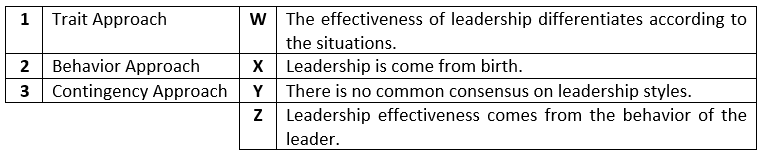 Which of the following is the correct match of the above items?
Seçenekler
A
1-W, 2-Y, 3-Z
B
1-X, 2-Z, 3-W
C
1-X, 2-Y, 3-W
D
1-Z, 2-X, 3-Y
E
1-Y, 2-W, 3-X
Açıklama:
Trait Approach: Leadership is come from birth.
Behavior Approach: Leadership effectiveness comes from the behavior of the leader.
Contingency Approach: The effectiveness of leadership differentiates according to the situations.
From the 1980s to today: There is no common consensus on leadership styles.
The correct match is 1-X, 2-Z, 3-W. Thus, the correct answer is B.
Behavior Approach: Leadership effectiveness comes from the behavior of the leader.
Contingency Approach: The effectiveness of leadership differentiates according to the situations.
From the 1980s to today: There is no common consensus on leadership styles.
The correct match is 1-X, 2-Z, 3-W. Thus, the correct answer is B.
Soru 13
_________________ has two fundamental assumptions: Leaders are born and not made; and great leaders will arise when there is a great need.
Which of the following is most appropriate for the blank in the above sentence?
Which of the following is most appropriate for the blank in the above sentence?
Seçenekler
A
Great Man Theory
B
Authentic Leadership
C
Cognitive Resource Theory
D
Servant Leadership
E
Ohio State Theory
Açıklama:
Great Man Theory has two fundamental assumptions: Leaders are born and not made; and great leaders will arise when there is a great need.
The correct answer is A.
The correct answer is A.
Soru 14
I. Trait perceptive focuses only on the followers and the situation.
II. In trait approach, the list of possible significant traits for effective leader is unlimited.
III. Trait approach assumes that all successful leaders have the same personal traits that are equally important in all situations.
Which of the above sentences is/are correct?
II. In trait approach, the list of possible significant traits for effective leader is unlimited.
III. Trait approach assumes that all successful leaders have the same personal traits that are equally important in all situations.
Which of the above sentences is/are correct?
Seçenekler
A
Only I
B
Only III
C
I and II
D
I and III
E
II and III
Açıklama:
I. Trait perceptive in leadership is very different from the other perspectives in leadership because it focuses only on the leader, not on the followers or the situation.
II. In trait approach, the list of possible significant traits for effective leader is unlimited.
III. Trait approach assumes that all successful leaders have the same personal traits that are equally important in all situations.
First sentences is not a true statement. Thus, the correct answer is E.
II. In trait approach, the list of possible significant traits for effective leader is unlimited.
III. Trait approach assumes that all successful leaders have the same personal traits that are equally important in all situations.
First sentences is not a true statement. Thus, the correct answer is E.
Soru 15
______________________ tries to explain the leadership in process rather than the traits and characteristics of a leader. The way of communication, authority delegation, decision making, planning and controlling, determining the goals, resolving disputes with all subordinates are all considered as important factors that determine the effectiveness of the leader.
Which of the following is most appropriate for the blank in the above sentence?
Which of the following is most appropriate for the blank in the above sentence?
Seçenekler
A
The trait approach
B
Path and Goal Theory
C
The behavioral approach
D
Great Man Theory
E
The contingency approach
Açıklama:
The behavioral approach tries to explain the leadership in process rather than the traits and characteristics of a leader. This approach focuses exclusively on the behaviors the leader shows in leadership and the relations with the people who form the leadership group. The way of communication, authority delegation, decision making, planning and controlling, determining the goals, resolving disputes with all subordinates are all considered as important factors that determine the effectiveness of the leader
The correct answer is C.
The correct answer is C.
Soru 16
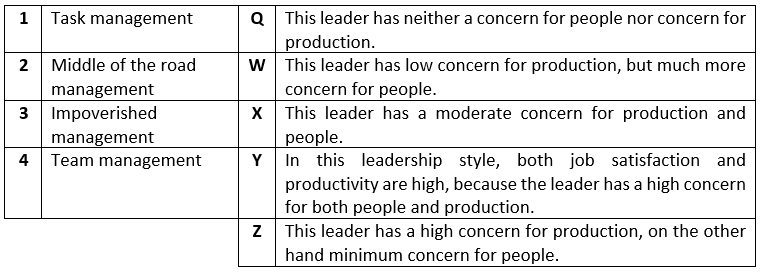 Which of the following is the correct match of the above items?
Seçenekler
A
1-X, 2-Y, 3-W, 4-Z
B
1-Y, 2-X, 3-W, 4-Q
C
1-Z, 2-X, 3-Q, 4-Y
D
1-W, 2-Q, 3-Y, 4-X
E
1-Q, 2-W, 3-Z, 4-Y
Açıklama:
Task management; this leader has a high concern for production, on the other hand minimum concern for people.
Middle of the road management; this leader has a moderate concern for production and people.
Impoverished management; this leader has neither a concern for people nor concern for production.
Team management; in this leadership style, both job satisfaction and productivity are high, because the leader has a high concern for both people and production.
Country club management; this leader has low concern for production, but much more concern for people.
The correct match is 1-Z, 2-X, 3-Q, 4-Y. Thus, the correct answer is C.
Middle of the road management; this leader has a moderate concern for production and people.
Impoverished management; this leader has neither a concern for people nor concern for production.
Team management; in this leadership style, both job satisfaction and productivity are high, because the leader has a high concern for both people and production.
Country club management; this leader has low concern for production, but much more concern for people.
The correct match is 1-Z, 2-X, 3-Q, 4-Y. Thus, the correct answer is C.
Soru 17
__________________ is about how leaders motivate followers to accomplish their goals. Leaders use their leadership style to meet followers’ motivational needs. They improve attainment of followers goals by disseminating necessary information and increasing the incentives in the work environment.
Which of the following is most appropriate for the blank in the above sentence?
Which of the following is most appropriate for the blank in the above sentence?
Seçenekler
A
Michigan Theory
B
System 4 Theory
C
Cognitive Resource Theory
D
Path-goal Theory
E
Ohio State Theory
Açıklama:
Path-goal Theory is about how leaders motivate followers to accomplish their goals. Leaders use their leadership style to meet followers’ motivational needs. They improve attainment of followers goals by disseminating necessary information and increasing the incentives in the work environment.
The correct answer is D.
The correct answer is D.
Soru 18
Which of the following is a true statement?
Seçenekler
A
Task-oriented leaders emphasize the feelings of the subordinates and tend to share decision-making responsibility with their subordinates.
B
Directive leadership means that the leader lets subordinates know what’s expected of them.
C
Supportive leadership involves leader behavior that encourage and enable subordinate involvement in decision making.
D
Participative leadership means encouraging subordinates to reach the highest performance by settings clear and challenging goals.
E
Achievement oriented leadership contains leader behaviors that concerns subordinates’ satisfaction of needs and preferences, as well as well-being of them.
Açıklama:
Task-oriented leaders focus on success, so they make sure that the work within the group is completed successfully. Relationship (people)- oriented leaders emphasize the feelings of the subordinates and tend to share decision-making responsibility with their subordinates.
Directive leadership means that the leader lets subordinates know what’s expected of them.
Supportive leadership contains leader behaviors that concerns subordinates’ satisfaction of needs and preferences, as well as well-being of them.
Participative leadership involves leader behavior that encourage and enable subordinate involvement in decision making.
Achievement oriented leadership means encouraging subordinates to reach the highest performance by settings clear and challenging goals.
The correct answer is B.
Directive leadership means that the leader lets subordinates know what’s expected of them.
Supportive leadership contains leader behaviors that concerns subordinates’ satisfaction of needs and preferences, as well as well-being of them.
Participative leadership involves leader behavior that encourage and enable subordinate involvement in decision making.
Achievement oriented leadership means encouraging subordinates to reach the highest performance by settings clear and challenging goals.
The correct answer is B.
Soru 19
Which leaders influence followers based on individual inspirational qualities with referent power rather than formal positional power?
Seçenekler
A
Charismatic leaders
B
Transactional leaders
C
Authentic leaders
D
Paternalistic leaders
E
Servant leaders
Açıklama:
Charismatic leaders influence followers based on individual inspirational qualities with referent power rather than formal positional power.
The correct answer is A.
The correct answer is A.
Soru 20
According to analyses, which of the following countries are among the countries that have highest paternalism scores?
Seçenekler
A
Canada and USA
B
Germany and Israel
C
Romania and Russia
D
Russia and Israel
E
China and Pakistan
Açıklama:
Aycan and Kanungo (2000) carried out a research to determine the cultural assumption of paternalism among 10 countries (Canada, USA, Turkey, China, Pakistan, India, Germany, Romania, Israel, and Russia). According to analyses, India, Pakistan, China, and Turkey have highest paternalism scores while Germany and Israel scores are the lowest.
The correct answer is E.
The correct answer is E.
Soru 21
Which approach below belongs to Contingency Approach?
Seçenekler
A
Path and goal theory
B
Ohio State Theory
C
Visionary leadership
D
Trait approach
E
Strategic leadership
Açıklama:
Path and goal theory which is about how formally appointed superiors affect the motivation and satisfaction of subordinates by clarifying the path to attain personal and organizational goals belongs to Contingency theory.
Soru 22
Which of the below is the definition of intelligence according to trait approach?
Seçenekler
A
ensures that a leader knows what has to be done, how is should be done and what resources are required for a group organization to achieve its goals.
B
helps a leader solve complex problems.
C
helps a leader influence followers and motivates them to persevere in the face of obstacles or difficulties.
D
helps a leader deal with the many demands they face on a day to day basis.
E
help to ensure a leader behaves ethically and is worthy of followers’ trust and confidence.
Açıklama:
Intelligence; helps a leader solve complex problems.
Soru 23
When was the first study of behavior conducted?
Seçenekler
A
1932
B
1937
C
1945
D
1956
E
1960
Açıklama:
The first study of behavior perspective was conducted by the Bureau of Educational Research at Ohio State University in 1945 after World War II.
Soru 24
what does contingency perspective of leadership focus on?
Seçenekler
A
leadership behavior
B
leadership traits
C
leadership in the company
D
leadership in situation
E
leadership against people
Açıklama:
The contingency perspective of leadership focuses on leadership in situations. The main assumption is there is no optimum style of leadership, different conditions (situations) require different leadership styles.
Soru 25
What does LPC stand for?
Seçenekler
A
Least Prefered Company
B
Last Performance Company
C
Least performed Co-worker
D
Least prefered Code
E
Least Prefeed Co-worker
Açıklama:
In this study, Fiedler developed the least-preferred co-worker (LPC) scale to determine the type of leadership style that fits various situations. With the help of LPC, it is determined that people are “task-oriented” or “relationship oriented”.
Soru 26
"______________ leadership means encouraging subordinates to reach the highest performance by settings clear and challenging goals."
Which of the below leadership types complete the above definition?
Which of the below leadership types complete the above definition?
Seçenekler
A
Achievement-oriented leadership
B
Participative leadership
C
Supportive leadership
D
Directive leadership
E
Environmental leadership
Açıklama:
Achievement-oriented leadership means encouraging subordinates to reach the highest performance by settings clear and challenging goals. This leader behaviour is emphasized on excellent performance and improvement over current performance. The achievement-oriented leader also shows a high degree of confidence and assists followers that are capable of establishing and accomplishing challenging goals.
Soru 27
According to Path-Goal Theory, which of the below goes into subordinate contingency factors?
Seçenekler
A
Task structure
B
Locus of control
C
Formal authority system
D
Achievement oriented
E
performance
Açıklama:
Employees with internal locus of control, believe themselves, are confident so as they can control their work environment.
Soru 28
Which type of leadership does not belong to modern leadership approaches?
Seçenekler
A
Charismatic
B
Transformational
C
Transactional
D
Authentic
E
Paternalistic
Açıklama:
Before explaining charismatic and transformational leadership, transactional leadership has to be explained to understand the differences between early and modern leadership theories. Most of the early leadership theories, which we explained in the previous sections, were implicitly referred as transactional leaders.
Soru 29
Which of the below is an example of charismatic leader in political life?
Seçenekler
A
Elon Musk
B
Steve Jobs
C
Ali Koç
D
Mustafa Kemal Atatürk
E
Muhtar Kent
Açıklama:
There are numerous historical figures such as Nelson Mandela, Winston Churchill, Mother Teresa, Martin Luther King, Mustafa Kemal Atatürk and John F. Kennedy. In business world Steve Jobs, Elon Musk, Muhtar Kent and Ali Koç could be examples.
Soru 30
Which leadership type does Eastern Cultures Exhibit the most?
Seçenekler
A
Authentic
B
Transformational
C
Charismatic
D
Transactional
E
Paternalistic
Açıklama:
Findings showed that especially Eastern societies exhibit paternalistic leadership features
Soru 31
Which of the following assumptions does not belong to the Great Man Theory?
Seçenekler
A
The theory asserts that leaders are born and not made.
B
Leadership qualities may be acquired and developed through training and practice.
C
Great leaders will arise when there is a great need.
D
The theory possesses a masculine viewpoint of leadership.
E
The characteristics attributed to leaders do not represent “women leaders”.
Açıklama:
The main distinction between the Great Man and the Trait Theory is the possibility of acquisition of leadership characteristics. Apart from Great Man, Trait Theory posits that leadership qualities may be acquired and developed through training and practice. Therefore, the answer is B.
Soru 32
Which of the following explains the benefit of integrity and honesty traits of a leader?
Seçenekler
A
It helps a leader deal with the uncertainty inherent in any leadership role.
B
It helps a leader deal with the many demands they face on a day to day basis.
C
It helps to ensure a leader behaves ethically and is worthy of followers’ trust and confidence.
D
It helps to ensure a leader is not overly self-centered, can control their feelings, and can accept criticism.
E
It ensures that a leader knows what has to be done, how is should be done.
Açıklama:
Option A belongs to the trait of tolerance for stress whereas B belongs to the trait of energy. Moreover, the statement given in option D belongs to the trait of emotional maturity. Finallly, E explains the trait of task-relevant knowledge. Therefore, the correct option that explains the trait of integrity and honesty is C.
Soru 33
In ........................................, managers focus on building positive relations among employees even when production is low. Which of the following leadership styles completes the given explanation above?
Seçenekler
A
Task management
B
Middle of the road management
C
Impoverished management
D
Team management
E
Country club management
Açıklama:
In country club management, the leader has low concern for production, but much more concern for people. Country club managers focus on building positive relations among employees even when production is low. The correct answer is E.
Soru 34
In which of the following leadership styles does the leader have neither a concern for people nor concern for production?
Seçenekler
A
Impoverished management
B
Task management
C
Country club management
D
Middle of the road management
E
Team management
Açıklama:
In impoverished management, the leader has neither a concern for people nor concern for production. Managers show little effort on building relationships with employees or getting the tasks completed. Therefore, the correct answer is A.
Soru 35
Which of the following means encouraging subordinates to reach the highest performance by setting clear and challenging goals?
Seçenekler
A
Participative Leadership
B
Supportive Leadership
C
Directive Leadership
D
Charismatic Leadership
E
Achievement Oriented Leadership
Açıklama:
Achievement oriented leadership means encouraging subordinates to reach the highest performance by setting clear and challenging goals. This leader behavior is emphasized on excellent performance and improvement over current performance. The correct answer is E.
Soru 36
Which of the following leaders are more prone to focus on daily managerial activities?
Seçenekler
A
Authentic leaders
B
Transformational leaders
C
Charismatic leaders
D
Transactional leaders
E
Paternalistic Leaders
Açıklama:
Transactional leaders are more prone to focus on daily managerial activities. Transactional leadership is a more classical management style as “doing things right”, because leaders focus on accomplishing organizational goals by improving employee performance and well-being. The correct answer is D.
Soru 37
Followers of ............................. show respect and admiration as a source of referent power. Which of the following leadership styles completes the given sentence?
Seçenekler
A
Transactional Leadership
B
Authentic Leadership
C
Paternalistic Leadership
D
Charismatic Leadership
E
Transformational Leadership
Açıklama:
Charismatic leaders are often products of certain circumstances and environments. Followers of charismatic leaders show respect and admiration as a source of referent power. The correct answer is D.
Soru 38
Which of the following statements expresses the weak side of charismatic leadership?
Seçenekler
A
Charismatic leaders influence followers based on individual inspirational qualities.
B
The superficies power may result in a tendency to reject criticisms and expect full admiration and loyalty.
C
The leaders need high sensitive to both environment constraints and follower needs.
D
Valuing innovation and focusing on the future are their basic characteristics.
E
Charismatic leaders have strong and inspirational articulation of future vision.
Açıklama:
The weak side of charismatic leadership is that the superficies power can be easily converted into narcissistic traits which have a tendency to reject criticisms and expect full admiration and loyalty. Therefore, the correct answer is B.
Soru 39
Which of the following leadership styles has the end goal of developing followers into leaders?
Seçenekler
A
Authentic Leadership
B
Paternalistic Leadership
C
Transformational Leadership
D
Charismatic Leadership
E
Transactional Leadership
Açıklama:
The end goal of transformational leaders are to develop followers into leaders. The correct answer is C.
Soru 40
Which of the following refers to the leader’s ability to analyze all relevant information objectively and examine other people’s opinions before making decisions?
Seçenekler
A
Balanced processing
B
Self-awareness
C
Relational transparency
D
Internalized moral perspective
E
New paternalism
Açıklama:
Balanced processing refers a leader’s ability to analyze all relevant information objectively and examine other people’s opinions before making decisions. Authentic leaders with balanced processing, consider not only their own perspective, but they also open all others’ perspectives and solicit viewpoints from those who disagree with them. The correct answer is A.
Soru 41
Which of the following is true about leadership?
Seçenekler
A
A universally acceptable definition for leadership is impossible.
B
Managers and leaders are doing exactly the same things.
C
Leadership is one of the least searched areas in organizational behavior.
D
There is only one approach to leadership that emerged over the years.
E
Leadership is definitely not a matter of perception.
Açıklama:
What is leadership? Some people say that we cannot define leadership, but we know it when we see it. Others argue that leadership can only be defined as someone who has followers. So scholars argue that a universally acceptable definition for leadership is practically impossible and will hinder new ideas and creative ways of thinking.
Soru 42
- Leaders are born and not made.
- Great leaders will arise when there is a need.
- It possesses a masculine viewpoint of leadership.
Seçenekler
A
Only I
B
I,II,III
C
Only II
D
I,II
E
I,III
Açıklama:
Great Man Theory has some fundamental assumptions: Leaders are born and not made; and great leaders will arise when there is a great need. Great Man Theory possesses a masculine viewpoint of leadership; the characteristics attributed to leaders do not represent “women leaders”.
Soru 43
Which of the behavior below basically belongs to people-oriented leadership?
Seçenekler
A
focusing on clear cut procedures
B
planning and scheduling tasks
C
being concerned about subordinates
D
using formal authority on coercion
E
deploying necessary technical assistance
Açıklama:
People oriented leader tries to improve the working conditions that will improve the satisfaction of the group members and is closely interested in the personal development and progress of the subordinates. Thus people-oriented leadership involves behaviors such as showing trust and respect for subordinates, acting friendly and considerate, trying to understand and solve their problems, showing appreciation for subordinates’ ideas.
Soru 44
According to managerial grid, which of the following has a concern for neither people nor production?
Seçenekler
A
Country club management
B
Task management
C
Middle of the road management
D
Impoverished management
E
Team management
Açıklama:
According to managerial grid, leaders are grouped into five leadership styles:iimpoverished management (1, 1); this leader has neither a concern for people nor concern for production. Managers show little effort on building relationships with employees or getting the tasks completed.
Soru 45
- The quality of the intended purpose
- Abilities and expectations of the followers
- Characteristics of the organization
- Past experiences of the leaders and followers
Seçenekler
A
Only I
B
Only IV
C
II,III,IV
D
I,III
E
I,II,III,IV
Açıklama:
The contingency perspective of leadership focuses on leadership in situations. The main assumption is there is no optimum style of leadership, different conditions (situations) require different leadership styles. According to this theory, the factors determining the effectiveness of the leader are:
*The quality of the intended purpose
*Abilities and expectations of the followers (group members)
*Characteristics of an organization that leadership composed
* Past experiences of the leader and the followers (Koçel, 2014; Szilagyi,1990).
*The quality of the intended purpose
*Abilities and expectations of the followers (group members)
*Characteristics of an organization that leadership composed
* Past experiences of the leader and the followers (Koçel, 2014; Szilagyi,1990).
Soru 46
Which of the following is about how leaders motivate followers to accomplish their goals?
Seçenekler
A
Path-goal theory
B
Great man theory
C
Contingency theory
D
Michigan theory
E
Trait approach
Açıklama:
Path-goal theory is about how formally appointed superiors affect the motivation and satisfaction of subordinates by clarifying the path to attain personal and organizational goals. Path-goal Theory is about how leaders motivate followers to accomplish their goals. Leaders use their leadership style to meet followers’ motivational needs. They improve attainment of followers goals by disseminating necessary information and increasing the incentives in the work environment.
Soru 47
- Directive leadership
- Supportive leadership
- Participative leadership
- Achievement oriented leadership
Seçenekler
A
I,II,III
B
I,II,III,IV
C
II,III
D
II,III,IV
E
Only I
Açıklama:
In path-goal theory, Evan and House classified leadership behaviors as directive, supportive, participative, and achievement-oriented (House, 1996). Leaders motivate employees in a particular work situation by adopting one or more of the four leadership styles.
Soru 48
Which is not one of the traits of charismatic leaders?
Seçenekler
A
a strong need to power
B
a high level of self-confidence
C
a tendency to dominate
D
a need to influence others
E
an unwillingness to take risks
Açıklama:
According to House, charismatic leaders have some traits such as: • A strong need for power,• A high level of self-confidence, • A tendency to dominate, • A need to influence others, • A strong belief in their own beliefs.
Charismatic leaders;• have vision.• have strong and inspirational articulation of future vision. • are willing to take risks to achieve that vision.• need high sensitive to both environment constraints and follower needs.• have exhibit behaviors that are out of the ordinary.
Charismatic leaders;• have vision.• have strong and inspirational articulation of future vision. • are willing to take risks to achieve that vision.• need high sensitive to both environment constraints and follower needs.• have exhibit behaviors that are out of the ordinary.
Soru 49
Which of the following leaders are proactive decision makers making deep and radical changes and promoting innovations?
Seçenekler
A
Transformational leaders
B
Transactional leaders
C
Task-oriented leaders
D
Supportive leaders
E
Paternalistic leaders
Açıklama:
Transformational leadership is a process that transforms and changes the needs, beliefs and values of employees and organizational strategies to fit with the surrounding environment. Transformational leaders are proactive decision makers, and also change agents that make deep and radical changes in the organization’s mission, strategy, structure and culture as well as promote innovation in products and technologies.
Soru 50
Which of the leadership is like a father-child relationship that breeds loyalty and care in exchange for follower obedience and commitment?
Seçenekler
A
Authentic
B
Charismatic
C
Paternalistic
D
Transformational
E
Transactional
Açıklama:
Paternalism is conceptualized as the employer’s authority and guidance in return for loyalty and respect from his/her subordinates. Paternalistic leadership is “a style that blends strong discipline and authority with fatherly benevolence and moral integrity couched in a personality atmosphere” (Farh and Cheng, 2000, p. 94). In paternalism, the leader is like a father and takes care of the followers like a parent would. Paternalistic leader creates a family environment at work, behaves like a father to subordinates. He protects and establishes close relations with them and gives fatherly advice for both work and personal lives.
Soru 51
Which of the following is the main feature that distinguishes the Trait Theory from Great Man?
Seçenekler
A
Trait theory posits that the innate qualities and characteristics possessed by great social, political and military leaders.
B
Trait theory posits that leadership qualities may be acquired and developed through training and practice.
C
Trait theory focuses only on the leader, not on the followers or the situation.
D
Trait theory posits that leadership comes from birth.
E
Trait theory posits that the effectiveness of leadership differentiates according to the situations.
Açıklama:
The main distinction between the Great Man and the Trait Theory is the possibility of acquisition of leadership characteristics. Apart from Great Man, Trait Theory posits that leadership qualities may be acquired and developed through training and practice. For this reason, the correct answer is B.
Soru 52
Which of the following two types of leadership defined by the Michigan Theory is correctly given?
Seçenekler
A
Achievement oriented leader and supportive leader
B
Concern for people and concern for production
C
Initiating structure and consideration
D
Participative leader and directive leader
E
Task oriented leader and people oriented leader
Açıklama:
Through interviewing leaders and followers, researchers defined two types of leaders, task/goal oriented leader and people oriented leader in Michigan Theory. For this reason, the correct answer is E.
Soru 53
Which of the following is the leadership style defined by Managerial Grid where the leader is concerned for both people and production, and where job satisfaction and productivity are high?
Seçenekler
A
Country club management
B
Impoverished management
C
Middle of the road management
D
Task management
E
Team management
Açıklama:
Team management leadership style, both job satisfaction and productivity are high, because the leader has a high concern for both people and production. There is a peaceful working environment and strong relationship between the leaders and the employees, but the focus still remains on achieving the organizational goals. For this reason, the correct answer is E.
Soru 54
Which of the following leadership approach emphasizes that there is no optimum leadership style and different conditions require different leadership styles?
Seçenekler
A
Behavior approach
B
Contingency approach
C
Modern leadership approach
D
Great man approach
E
Trait approach
Açıklama:
The contingency perspective of leadership focuses on leadership in situations. The main assumption is there is no optimum style of leadership, different conditions (situations) require different leadership styles. So, to become an effective leader, he or she has to adapt his or her style to the demands of different situations. For this reason, the correct answer is B.
Soru 55
Which of the following leadership theories is not evaluated within the context of the contingency approach?
Seçenekler
A
Charismatic leadership model
B
Fiedler’s contingency theory
C
Hersey and Blanchard’s situational theory
D
Leader participation model
E
Path and goal theory
Açıklama:
Hersey and Blanchard’s situational theory, Fiedler’s contingency theory, Path and goal theory, Leader participation model, Decision trees model and Cognitive resource theory are the contingency approach theories that suggest that the effectiveness of leadership differentiates according to the situation. But Charismatic leadership model is not evaluated within the context of the contingency approach. For this reason, the correct answer is A.
Soru 56
Which of the following is not one of the leadership behaviors determined in Path-Goal theory?
Seçenekler
A
Achievement-oriented leadership
B
Consultative leadership
C
Directive leadership
D
Participative leadership
E
Supportive leadership
Açıklama:
In path-goal theory, Robert House and Martin Evans classified leadership behaviors as directive, supportive, participative, and achievement-oriented. For this reason, the correct answer is B.
Soru 57
Which of the following is not one of the modern leadership styles?
Seçenekler
A
Charismatic leadership
B
Ethical leadership
C
Servant leadership
D
Situational leadership
E
Visionary leadership
Açıklama:
Charismatic leadership, ethical leadership, servant leadership and visionary leadership are the modern leadership styles. But situational leadership is evaluated from the contincengy approaches. For this reason, the correct answer is D.
Soru 58
Which of the following is the leadership approach that leaders guide and motivate their followers to achieve organizational goals with providing appropriate rewards?
Seçenekler
A
Authentic leadership
B
Charismatic leadership
C
Paternalistic leadership
D
Transactional leadership
E
Transformational leadership
Açıklama:
Transactional leadership focuses on the exchanges between leaders and their followers. Transactional leadership occurs when leaders guide and motivate their followers to achieve organizational goals with providing appropriate rewards. For this reason, the correct answer is D.
Soru 59
Which of the following is not one of the four behavioral components in the authentic leadership process?
Seçenekler
A
Balanced processing
B
Formal authority system
C
Internalized moral perspective
D
Relational transparency
E
Self-awareness
Açıklama:
After comprehensive studies, Walumbwa and colleagues (2008) constructed four-behavioral components to define authentic leadership process; namely self-awareness, relational transparency, balanced processing and internalized moral perspective. For this reason, the answer is B.
Soru 60
Which of the following leadership approach can lead to nepotism based on kinship or family relationships?
Seçenekler
A
Authentic leadership
B
Charismatic leadership
C
Paternalistic leadership
D
Transactional leadership
E
Transformational leadership
Açıklama:
One criticism for paternalism relationship is that rules could vary depending on persons and situations. Leader could support and share resources with more close and loyal subordinates while excluding others, which in turn may cause nepotism and favoritism. For this reason, the correct answer is C.
Soru 61
Which of the following statement is false about leadership?
Seçenekler
A
Leaders are agents of change, persons whose acts affect other people more than other people’s acts affect them.
B
Leadership occurs when one group member modifies the motivation or competencies of others in the group.
C
Manager and leader are two terms that are usually used interchangeably and actually two are the same thing.
D
Leadership is the matter of perception. A leader could not be perceived by everyone as a leader.
E
The leader is the person who directs others to act in accordance with a specific purpose.
Açıklama:
Manager and leader are two terms that are usually used interchangeably but they are not the same. First, we have to clarify the difference between these two concepts. Managers are appointed to their positions and have formal authority in planning, organizing and implementing the goals set by organizations. Their ability to influence subordinates is grounded from the formal authority apart of that position. In contrary, leaders could be appointed or emerged from the organization, who have ability to influence a group of people to accomplish its goals and objectives. The correct answer is C.
Soru 62
Which of the following statement is true about leaders?
Seçenekler
A
Leaders are appointed to their positions.
B
Leaders have formal authority in planning, organizing and implementing the goals set by organizations.
C
Their ability to influence subordinates is grounded from the formal authority apart of that position.
D
Leaders have ability to influence a group of people to accomplish its goals and objectives.
E
Leadership is a set of behaviors limited only to managers.
Açıklama:
Leaders could be appointed or emerged from the organization, who have ability to influence a group of people to accomplish its goals and objectives. The correct answer is D.
Soru 63
Which approach was adopted in leadership until the 1950s?
Seçenekler
A
Trait Approach/Great Man Theory
B
Behavior Approach
C
Contingency Approach
D
Visionary Leadership
E
Transformational and Transactional Leadership
Açıklama:
Trait Approach/Great Man Theory was adopted in leadership until the 1950s. In the early 1900s, leadership traits were studied to determine what made certain people leaders. The theories that developed were called “great man” theories focused on identifying the innate qualities and characteristics possessed by great social, political and military leaders such as Napoleon Bonaparte, Indira Gandhi, Martin Luther King, and Mustafa Kemal Atatürk. the correct answer is A.
Soru 64
Which approach was adopted in leadership between 1950-1970 years?
Seçenekler
A
Contingency Approach
B
Behavior Approach
C
Trait Approach
D
Cognitive Approach
E
Great Man Theory
Açıklama:
Behavior Approach was adopted in leadership between 1950-1970 years. The correct answer is B.
Soru 65
Which of the following theories and models is not included in behavioral approaches?
Seçenekler
A
Ohio State Theory
B
Michigan Theory
C
Managerial Grid
D
System 4 Theory
E
Hersey and Blanchard’s Situational Theory
Açıklama:
Behavior Approaches:
- Ohio State Theory
- Michigan Theory
- Managerial Grid
- System 4 Theory (University of Iowa Studies)
Soru 66
Which of the following theories and models is included in Contingency Approach?
Seçenekler
A
Path and Goal Theory
B
Visionary Leadership
C
Transformational and Transactional Leadership
D
Paternalistic Leadership
E
System 4 Theory
Açıklama:
Contingency Approach:
- Hersey and Blanchard’s Situational Theory
- Fiedler’s Contingency Theory
- Path and Goal Theory
- Leader Participation Model
- Decision Trees Model
- Cognitive Resource Theory
Soru 67
In _______ leadership approach leader effectiveness is set by both the personal characteristics of the leader and by the situations where the leader finds his/herself.
Seçenekler
A
Trait Approach
B
Behavior Approach
C
Authentic Approach
D
Charismatic Approach
E
Contingency Approach
Açıklama:
In contingency leadership approach leader effectiveness is set by both the personal characteristics of the leader and by the situations where the leader finds his/herself. The correct answer is E.
Soru 68
Which model is based on the idea that effective group performance is a function of leadership style and environmental characteristics?
Seçenekler
A
Hersey and Blanchard’s Situational Theory
B
Fiedler’s Contingency Theory
C
Path and Goal Theory
D
Leader Participation Model
E
Decision Trees Model
Açıklama:
The first extensive contingency leadership model was pioneered by Fred Fiedler. This model is based on the idea that effective group performance is a function of leadership style and environment characteristics. Fiedler proposed that there is an interaction between leadership style and the particular organizational situations. The basic idea is to match the leader’s style with the situation most favorable for his or her effectiveness. Therefore, the key was to define those leadership styles and different types of situations and decide the appropriate combinations of style. The correct answer is B.
Soru 69
_______ is about how leaders motivate followers to accomplish their goals. Leaders use their leadership style to meet followers’ motivational needs. They improve attainment of followers goals by disseminating necessary information and increasing the incentives in the work environment.
Seçenekler
A
Trait Approach
B
Decision Trees Model
C
Path and Goal Theory
D
Visionary Leadership
E
Paternalistic Leadership
Açıklama:
Path-goal Theory is about how leaders motivate followers to accomplish their goals. Leaders use their leadership style to meet followers’ motivational needs. They improve attainment of followers goals by disseminating necessary information and increasing the incentives in the work environment. The correct answer is C.
Soru 70
_______ involves leader behavior that encourage and enable subordinate involvement in decision making. The leaders consult with subordinates, asking for their opinions and suggestions, encourage participation in the decision process before making decisions.
Seçenekler
A
Directive Leadership
B
Supportive Leadership
C
Achievement-Oriented Leadership
D
Participative Leadership
E
Charismatic Leadership
Açıklama:
Participative leadership involves leader behavior that encourage and enable subordinate involvement in decision making. The leaders consult with subordinates, asking for their opinions and suggestions, encourage participation in the decision process before making decisions. Participative leadership relates to involve subordinates in decisions. The correct answer is D.
Soru 71
Which of the following descriptions is related to the traits perspective on leadership?
Seçenekler
A
Leadership is only acquired.
B
Personality, social, physical, and intellectual
traits were found to differentiate leaders from
others.
traits were found to differentiate leaders from
others.
C
Leadership is based on expertise knowledge only.
D
Leadersship changes with conditions.
E
Leaders have the same characteristics.
Açıklama:
The trait theory essentially
says that leaders are born or can be made with certain traits
or characteristics. This theory attempts to identify specific
physical, mental and personality characteristics associated
with leadership success and relates those traits to certain
success criteria.
Personality, social, physical, and intellectual
traits were found to differentiate leaders from
others.
says that leaders are born or can be made with certain traits
or characteristics. This theory attempts to identify specific
physical, mental and personality characteristics associated
with leadership success and relates those traits to certain
success criteria.
Personality, social, physical, and intellectual
traits were found to differentiate leaders from
others.
Soru 72
Which leadership perspective describes leadership as "The way of communication, authority delegation, decision making, planning and controlling, determining the goals, resolving disputes with all subordinates are all considered as important factors that determine the effectiveness of the leader"?
Seçenekler
A
Situational perspective
B
Autocratic leadership
C
Traits perspective
D
Behavioral perspective
E
Transformational leadership
Açıklama:
The behavioral approach tries to explain the
leadership in process rather than the traits and
characteristics of a leader. This approach focuses
exclusively on the behaviors the leader shows
in leadership and the relations with the people
who form the leadership group.
Behavioral perspective
leadership in process rather than the traits and
characteristics of a leader. This approach focuses
exclusively on the behaviors the leader shows
in leadership and the relations with the people
who form the leadership group.
Behavioral perspective
Soru 73
According to the Managerial Grid Model which management style shows " neither a concern for people nor concern for production"?
Seçenekler
A
Middle of the road management
B
Task management
C
Country club management
D
Impoverished management
E
Team management
Açıklama:
Impoverished management (1, 1); this
leader has neither a concern for people nor
concern for production. Managers show
little effort on building relationships with
employees or getting the tasks completed.
leader has neither a concern for people nor
concern for production. Managers show
little effort on building relationships with
employees or getting the tasks completed.
Soru 74
According to Blake and Mouton, which one below is the
most effective leader?
most effective leader?
Seçenekler
A
Team manager
B
Middle of the road manager
C
Impoverished manager
D
Task manager
E
Authoritative manager
Açıklama:
According to Blake and Mouton (1985), the
most effective leader is the team manager who
shows high concern for both tasks and people.
Because organizations need to be concerned for both of the elements.
most effective leader is the team manager who
shows high concern for both tasks and people.
Because organizations need to be concerned for both of the elements.
Soru 75
Which description below is about people oriented leaders?
Seçenekler
A
Closely controling whether the group members are in accordance with the methods and rules.
B
Improving work conditions that will improve
the satisfaction of the group members.
the satisfaction of the group members.
C
Pushing the group members to
reach their performance capacity.
reach their performance capacity.
D
Closely controling whether the group members are in accordance with the predetermined company
principles.
principles.
E
Closely controling whether the group members are working.
Açıklama:
People oriented leader tries
to improve the working conditions that will improve
the satisfaction of the group members and is closely
interested in the personal development and progress
of the subordinates.
Improving work conditions that will improve
the satisfaction of the group members
to improve the working conditions that will improve
the satisfaction of the group members and is closely
interested in the personal development and progress
of the subordinates.
Improving work conditions that will improve
the satisfaction of the group members
Soru 76
Which one below is the description for task management style?
Seçenekler
A
High concern for production, minimum concern for people.
B
High concern for both people and production.
C
Moderate effort to accomplish the tasks
by creating a good working environment.
by creating a good working environment.
D
Neither a concern for people nor
concern for production.
concern for production.
E
Moderate concern for both
production and people.
production and people.
Açıklama:
This type of leader has a
high concern for production, on the other
hand minimum concern for people. They
apply restrict control on working and
perceive employees as a part of machines
for achieving goals.
high concern for production, on the other
hand minimum concern for people. They
apply restrict control on working and
perceive employees as a part of machines
for achieving goals.
Soru 77
According to the contingency theory of leadership, which one bloew is not one of the determinants of the leadership effectiveness?
Seçenekler
A
The quality of the intended purpose
B
Past experiences of the leader and the
followers
followers
C
Abilities and expectations of the followers
(group members)
(group members)
D
Characteristics of an organization that
leadership is composed
leadership is composed
E
The leader's educational background
Açıklama:
The contingency perspective of leadership
focuses on leadership in situations.
According to this theory, the factors determining
the effectiveness of the leader are:
- The quality of the intended purpose
- Abilities and expectations of the followers
(group members)
- Characteristics of an organization that
leadership composed
- Past experiences of the leader and the
followers
The leader's educational background
focuses on leadership in situations.
According to this theory, the factors determining
the effectiveness of the leader are:
- The quality of the intended purpose
- Abilities and expectations of the followers
(group members)
- Characteristics of an organization that
leadership composed
- Past experiences of the leader and the
followers
The leader's educational background
Soru 78
Which one below is the scale Fiedler developed to determine the
type of leadership style that fits various situations?
type of leadership style that fits various situations?
Seçenekler
A
People oriented leadership
B
Least preferred co-worker (LPC)
C
Production oriented leadership
D
Task oriented leadership
E
Situational leadership scale
Açıklama:
In this study, Fiedler developed the leastpreferred co-worker (LPC) scale to determine the
type of leadership style that fits various situations.
With the help of LPC, it is determined that people
are “task-oriented” or “relationship oriented”.
Least preferred co-worker (LPC)
type of leadership style that fits various situations.
With the help of LPC, it is determined that people
are “task-oriented” or “relationship oriented”.
Least preferred co-worker (LPC)
Soru 79
How does the directive leader behave and motivate subordinates?
Seçenekler
A
Creates a friendly and
psychologically supportive work environment
and treats subordinates as coworkers of her/
him.
psychologically supportive work environment
and treats subordinates as coworkers of her/
him.
B
Consults with subordinates, asking for their opinions and
suggestions, encourage participation in the decision
process before making decisions.
suggestions, encourage participation in the decision
process before making decisions.
C
Emphasized on
excellent performance and improvement over
current performance.
excellent performance and improvement over
current performance.
D
Involves leader behaviors
that encourage and enable subordinate involvement
in decision making.
that encourage and enable subordinate involvement
in decision making.
E
Clarifies policies, rules, and procedures
and establishes clear standards of performance to
reduce role ambiguity.
and establishes clear standards of performance to
reduce role ambiguity.
Açıklama:
Directive leadership means that the leader lets
subordinates know what’s expected of them. They
form the work schedules and coordinates the works
to be done. Additionally, they give specific guidance
on how to accomplish these tasks.
Clarifies policies, rules, and procedures
and establishes clear standards of performance to
reduce role ambiguity.
subordinates know what’s expected of them. They
form the work schedules and coordinates the works
to be done. Additionally, they give specific guidance
on how to accomplish these tasks.
Clarifies policies, rules, and procedures
and establishes clear standards of performance to
reduce role ambiguity.
Soru 80
Transformational leadership is identified with 4Is.
Which one below describes the intellectual stimulation?
Which one below describes the intellectual stimulation?
Seçenekler
A
It is the behavior also
called “charisma” that arises strong follower
emotions and identification with leaders.
called “charisma” that arises strong follower
emotions and identification with leaders.
B
It is the leadership
behavior that includes communicating high
expectations to followers.
behavior that includes communicating high
expectations to followers.
C
Team sprit occurs by the help of this type of leadership.
D
Leaders stimulate
their followers to be creative and innovative.
their followers to be creative and innovative.
E
It includes providing
support, encouragement and coaching to listen
each follower's individual need for achievement and
growth.
support, encouragement and coaching to listen
each follower's individual need for achievement and
growth.
Açıklama:
In intellectual stimulation, leaders stimulate
their followers to be creative and innovative. They
encourage them to question assumptions and find
new ways to solve problems. In addition, new
ideas and creativity are rewarded by, mistakes and
failures are not criticized. Leaders see failures as a
learning process to encourage innovation
their followers to be creative and innovative. They
encourage them to question assumptions and find
new ways to solve problems. In addition, new
ideas and creativity are rewarded by, mistakes and
failures are not criticized. Leaders see failures as a
learning process to encourage innovation
Soru 81
Which of the theories given below focuses on the idea that leadership comes from birth?
Seçenekler
A
Authentic Leadership
B
Paternalistic Leadership
C
Trait Approach
D
Strategic Leadership
E
Servant Leadership
Açıklama:
According to Trait Approach/Great Man Theory, leadership is come from birth. The correct answer is C.
Soru 82
Which theory focuses on the idea that leadership effectiveness comes from the behavior of the leader?
Seçenekler
A
Ohio State Theory
B
Fiedler’s Contingency Theory
C
Path and Goal Theory
D
Decision Trees Model
E
Cognitive Resource Theory
Açıklama:
Ohio State Theory : Leadership effectiveness comes from the behavior of the leader.
Path and Goal Theory, Leader Participation Model, Decision Trees Model Cognitive Resource Theory :The effectiveness of leadership differentiates according to the situations.
The correct answer is A.
Path and Goal Theory, Leader Participation Model, Decision Trees Model Cognitive Resource Theory :The effectiveness of leadership differentiates according to the situations.
The correct answer is A.
Soru 83
Which trait of a leader helps to ensure a leader is not overly self-centered, can control their feelings, and can accept criticism ?
Seçenekler
A
Self-confidence
B
Tolerance for stress
C
Integrity and honesty
D
Emotional maturity
E
Task-relevant knowlege
Açıklama:
Self-confidence; helps a leader influence followers and motivates them to persevere in the face of obstacles or difficulties. Tolerance for stress; helps a leader deal with the uncertainty inherent in any leadership role. Integrity and honesty; help to ensure a leader behaves ethically and is worthy of followers’ trust and confidence.Emotional maturity; helps to ensure a leader is not overly self-centered, can control their feelings, and can accept criticism. Task-relevant knowledge; ensures that a leader knows what has to be done, how is should be done and what resources are required for a group organization to achieve its goals.
The correct answer is D.
The correct answer is D.
Soru 84
Which of the following is a trait of a task-oriented leader?
Seçenekler
A
He/she is closely interested in the personal development and progress of the subordinates.
B
He/she tries to improve the working conditions that will improve the satisfaction of the group members.
C
He/she involves behaviors such as showing trust and respect for subordinates.
D
He/she is being concerned about subordinates wellbeing.
E
He/she is concerned with specifying and identifying the roles and tasks of subordinates.
Açıklama:
Task-oriented leaders tend to emphasize technical part of the job. They are concerned with specifying and identifying the roles and tasks of subordinates. People-oriented leaders emphasize interpersonal relations. They are being concerned about subordinates wellbeing and appreciation for their accomplishment. Therefore, the correct answer is E.
Soru 85
This leader has a moderate concern for production and people. So there is a moderate effort to accomplish the tasks by creating a good working environment. These managers try to keep the status quo by adopting moderate approach.
Which leadership style is described above?
Which leadership style is described above?
Seçenekler
A
Country club management
B
Task management
C
Middle of the road management
D
Impoverished management
E
Team management
Açıklama:
Middle of the road management : This leader has a moderate concern for production and people. So there is a moderate effort to accomplish the tasks by creating a good working environment. Middle of the road managers try to keep the status quo by adopting moderate approach. The correct answer is C.
Soru 86
______leadership contains leader behaviors that concerns subordinates’ satisfaction of needs and preferences, as well as well-being of them. This leader creates a friendly and psychologically supportive work environment and treats subordinates as coworkers of him/ her.
Which word completes the description above best?
Which word completes the description above best?
Seçenekler
A
Supportive
B
Participative
C
Achievement-oriented
D
Task-oriented
E
Directive
Açıklama:
Supportive leadership contains leader behaviors that concerns subordinates’ satisfaction of needs and preferences, as well as well-being of them. This leader creates a friendly and psychologically supportive work environment and treats subordinates as coworkers of him/ her. Supportive leadership behavior is similar with previous consideration, people-centered or relationship- oriented leadership styles. The correct answer is A.
Soru 87
Which type of leaders aim to develop their followers into leaders in the end?
Seçenekler
A
Charismatic
B
Transformational
C
Paternalistic
D
Supportive
E
Authentic
Açıklama:
Inspirational motivation is the leadership behavior that includes communicating high expectations to followers that want to meet, inspiring and motivating them to committed goals which in turn is the part of the shared vision in the organization. Followers are involved in visualizing the future states of organization. As a result, team sprit occurs by the help of this type of leadership. The end goal of transformational leaders are to develop followers into leaders. The correct answer is B.
Soru 88
_____ is like a father-child relationship that breeds loyalty and care in exchange for follower obedience and commitment.
Which option completes the description above best?
Which option completes the description above best?
Seçenekler
A
Charismatic leadership
B
Transformational leadership
C
Paternalistic leadership
D
Authentic leadership
E
Directive leadership
Açıklama:
Charismatic leaders are generally come to mind with politicians in certain circumstances and environments. Traits and behaviors are key factors that differentiate charismatic leadership from other leadership styles. Charismatic leaders are self-confident and have a strong belief in their own abilities. Besides, they could inspire and motivate by influencing followers. They have strong and inspirational articulation of future vision. On the other hand, transformational leadership is a process that transforms and changes the needs, beliefs and values of employees and organizational strategies to adapt to the surrounding environment. Transformational leaders increase subordinates’ awareness of the importance of their tasks; balance the interest of the organization with employee growth, and motivate their subordinates to work for solving organizational problems. Authentic leaders act in accordance with deep personal values which in turn create trust and ethical practices in organizations. Paternalism is like a father-child relationship that breeds loyalty and care in exchange for follower obedience and commitment. The correct answer is C.
Soru 89
Which statement is FALSE according to contingency leadership theories?
Seçenekler
A
Different conditions (situations) require different leadership styles.
B
Effective leaders must be able to adapt their behaviors and styles to the immediate situation.
C
Past experiences of the leader and the followers are deteminers of effective leadership.
D
There is always an optimum style of a leadership.
E
Organizational climate and policies are also determiners of effective leadership.
Açıklama:
After trait and behavioral perspectives of leadership, studies showed that there is no optimum style of leadership, different conditions (situations) require different leadership styles. Most contingency leadership theories assume that effective leaders must be able to adapt their behaviors and styles to the immediate situation. In contingency theory, the nature of the intended purpose, expectation and behavior of top management, abilities and expectations of the followers (group members), organizational climate and policies, characteristics of an organization and past experiences of the leader and the followers are the most important factors that determine the effectiveness of a leader. The correct answer is D.
Soru 90
Which of the following statements about leadership and leadership theories is FALSE?
Seçenekler
A
First approaches in leadership studies are based on personal characteristics and traits.
B
According to trait theory, leaders are born with certain physical, mental and personality characteristics.
C
Task/goal-oriented leaders use his/her legitimate power in rewarding and coercion.
D
Authentic leaders act in accordance with deep personal values which in turn create trust.
E
People oriented leaders avoid involving behaviors such as friendship, trust, respect, warmth.
Açıklama:
People oriented leaders focus on satisfaction of the group members so they closely follow their subordinates personal development and progress. People oriented leader behaviors involve such as friendship, trust, respect, warmth. They share knowledge and communicate with subordinates to understand and solve their problems. The correct answer is E.
Ünite 7
Soru 1
- What type of conflict is it?
- How long does it exist?
- How many people involved in the conflict?
- What is the intensity of the conflict?
Seçenekler
A
Only I
B
II, III
C
I, II, III
D
I, II, IV
E
I, II, III, IV
Açıklama:
The interactionist perspective indicates that we have to analyse three important question to perceive conflict as dysfunctional or functional:
- What type of conflict is it?
- How long does it exist?
- What is the intensity of the conflict?
Soru 2
------- is the conflict that arouses among people with personal dissonance or tension.
Which of the fallowing completes the sentence above?
Which of the fallowing completes the sentence above?
Seçenekler
A
Relationship conflict
B
Task conflict
C
Process conflict
D
Product conflict
E
Emotional conflict
Açıklama:
The first question is related to differentiating three types of conflict: Relationship conflict, task conflict and process conflict. Relationship conflict (socio-emotional conflict) is the conflict that arouses among people with personal dissonance or tension. This type of conflict is about relationships or emotional aspects, no deal with organizational issues. The correct answer is Choice A.
Soru 3
Two human resource specialists are in conflict about the candidates which one more proper for the position of sales representative. One of the HR specialist thinks that the woman at the ages of 30s has deep experience in marketing, and can be more successful as a sales representative. The other HR specialist thinks that the man at at the ages of 40s can speak three languages and is talkative in interviews, so he can be the proper candidate for that position.
What is the type of the conflict in the above case?
What is the type of the conflict in the above case?
Seçenekler
A
Relationship conflict
B
Task conflict
C
Process conflict
D
Product conflict
E
Emotional conflict
Açıklama:
Task conflict is about task related issues. It is peculiar to disagreement about task content or about work goals. The correct answer is Choice B.
Soru 4
------- is a team decision making process whereby team members interact to generate as many alternative solutions to the problems as possible.
Which of the fallowing completes the sentence above?
Which of the fallowing completes the sentence above?
Seçenekler
A
Conflict management
B
Group meeting
C
Brain storming
D
Ice breaking
E
Groupthink
Açıklama:
Brainstorming is a team decision making process whereby team members interact to generate as many alternative solutions to the problems as possible. Thereby, increasing decision acceptance and innovative solutions are the possible beneficial outcomes of brainstorming. The correct answer is Choice C.
Soru 5
Which of the fallowing is one of the functional outcomes of organizational conflict?
Seçenekler
A
Slow down the pace of decision making
B
Damage social relations and organizational trust
C
Decrease organizational commitment
D
Impair individual/group performance
E
Support creative thinking
Açıklama:
Functional outcomes of the organizational conflicts are;
- Improve the quality of decisions
- Support creative thinking
- Help to recognize dysfunctional processes or functions
- Eliminate group-thinking and predispose alternative ways/solutions
Soru 6
Which of the fallowing is not one of the sub-levels of intra-organizational conflict?
Seçenekler
A
Intrapersonal
B
Interpersonal
C
Intragroup
D
Intergroup
Inter-organizational
Inter-organizational
E
Interorganizational
Açıklama:
Organizational conflict can be classified as intraorganizational (conflict within an organization) and interorganizational conflict (conflict between two or more organizations). Intraorganizational conflict, which is the main concern of this chapter, has four sub-levels: Intrapersonal, Interpersonal, intragroup and intergroup conflict. The correct answer is Choice E.
Soru 7
Which of the following is the correct sequence for organizational conflict according to Pondy’s Model?
- Manifest Conflict
- Conflict Aftermath
- Felt Conflict
- Latent Conflict
- Perceived Conflict
Seçenekler
A
I-II-IV-III-V
B
II-III-I-IV-V
C
III-II-I-IV-V
D
IV-V-III-I-II
E
V-II-III-IV-I
Açıklama:
Pondy (1967) states that conflict is an episode and a dynamic process. According to Pondy’s (1967) model, the process of conflict can be portrayed in five stages:
Stage 1: Latent Conflict
Stage 2: Perceived Conflict
Stage 3: Felt Conflict
Stage 4: Manifest Conflict
Stage 5: Conflict Aftermath
The correct answer is Choice D.
Stage 1: Latent Conflict
Stage 2: Perceived Conflict
Stage 3: Felt Conflict
Stage 4: Manifest Conflict
Stage 5: Conflict Aftermath
The correct answer is Choice D.
Soru 8
Which of the fallowing is one of the prominent traits of Type A behaviour pattern?
Seçenekler
A
Being competitive
B
Being patient
C
Being peaceful
D
Being kind
E
Being adventurer
Açıklama:
Type A behavior pattern is mostlyand strongly related with stress management. Being competitive, impatient, aggressive, time urgent, drive, perfectionist and workaholic are some prominent traits of Type A personality. The correct answer is Choice A.
Soru 9
------- occurs when the employee is in charge of various role sets, which are impossible to perform in a given set.
Which of the fallowing completes the sentence above?
Which of the fallowing completes the sentence above?
Seçenekler
A
Role underload
B
Role overload
C
Role ambiguity
D
Role specialisation
E
Role discrimination
Açıklama:
Role overload occurs when the employee is in charge of various role sets, which are impossible to perform in a given set. Role overload can be classified as quantitative and qualitative role overload. The correct answer is Choice B.
Soru 10
In which of the fallowing conflict management style do the party ignores own needs or goals, and try to satisfy the other conflict party’s interests?
Seçenekler
A
Integrating Style
B
Avoiding Style
C
Obliging Style
D
Dominating Style
E
Ignorance Style
Açıklama:
Obliging Style: Low concern for self and high concern for the other are called lose-win strategy. This style refers to ignore your own needs or goals, and try to satisfy the other conflict party’s interests. This type is appropriate when you perceive that you are weaker than the other party, and to maintain your social relationship is more beneficial for you. In this case, you neglect your goals and allow the other party to reach their goals. The correct answer is Choice C.
Soru 11
Which of the following is a dysfunctional outcome of conflict?
Seçenekler
A
Improve the quality of decisions.
B
Help to recognize dysfunctional processes or functions.
C
Impair individual/group performance
D
Eliminate group-thinking and predispose alternative ways/solutions.
E
Support creative thinking.
Açıklama:
Dysfunctional Outcomes
- Slow down the pace of decision making.
- Damage social relations and organizational trust.
- Decrease organizational commitment.
- Impair individual/group performance.
- Improve the quality of decisions.
- Support creative thinking.
- Help to recognize dysfunctional processes or functions.
- Eliminate group-thinking and predispose alternative ways/solutions.
Soru 12
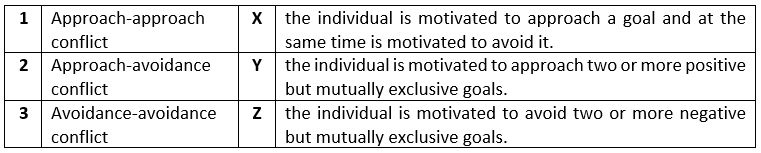 Which of the following is the correct match of the above items?
Seçenekler
A
1-Y, 2-Z, 3-X
B
1-Y, 2-X, 3-Z
C
1-X, 2-Z, 3-Y
D
1-Z, 2-X, 3-Y
E
1-Z, 2-Y, 3-X
Açıklama:
1. Approach-approach conflict, where the individual is motivated to approach two or more positive but mutually exclusive goals.
2. Approach-avoidance conflict, where the individual is motivated to approach a goal and at the same time is motivated to avoid it. The single goal contains both positive and negative characteristics for the individual.
3. Avoidance-avoidance conflict, where the individual is motivated to avoid two or more negative but mutually exclusive goals.
The correct answer is B.
2. Approach-avoidance conflict, where the individual is motivated to approach a goal and at the same time is motivated to avoid it. The single goal contains both positive and negative characteristics for the individual.
3. Avoidance-avoidance conflict, where the individual is motivated to avoid two or more negative but mutually exclusive goals.
The correct answer is B.
Soru 13
I. High work pressure, dense level of competition among coworkers, perception of injustice politics, perception of being inadequate to performn the job, and goal conflict can create intrapersonal level of conflict.
II. Intragroup conflict is conflict that takes place among different groups.
III. Interpersonal conflict is the dyadic conflict between two or more organizational members who can be in different/same department or at different/same hierarchical position.
IV. Intergroup conflict is the conflict that takes place in the same team or in the same group.
Which of the above sentences are correct?
II. Intragroup conflict is conflict that takes place among different groups.
III. Interpersonal conflict is the dyadic conflict between two or more organizational members who can be in different/same department or at different/same hierarchical position.
IV. Intergroup conflict is the conflict that takes place in the same team or in the same group.
Which of the above sentences are correct?
Seçenekler
A
I and III
B
II and III
C
II and IV
D
I, II and III
E
I, III and IV
Açıklama:
I. High work pressure, dense level of competition among coworkers, perception of injustice politics, perception of being inadequate to performn the job, and goal conflict can create intrapersonal level of conflict.
II. Intragroup conflict is the conflict that takes place in the same team or in the same group.
III. Interpersonal conflict is the dyadic conflict between two or more organizational members who can be in different/same department or at different/same hierarchical position.
IV. Intergroup conflict is conflict that takes place among different groups.
The sentences with number II and number IV are wrong. Thus, the correct answer is A.
II. Intragroup conflict is the conflict that takes place in the same team or in the same group.
III. Interpersonal conflict is the dyadic conflict between two or more organizational members who can be in different/same department or at different/same hierarchical position.
IV. Intergroup conflict is conflict that takes place among different groups.
The sentences with number II and number IV are wrong. Thus, the correct answer is A.
Soru 14
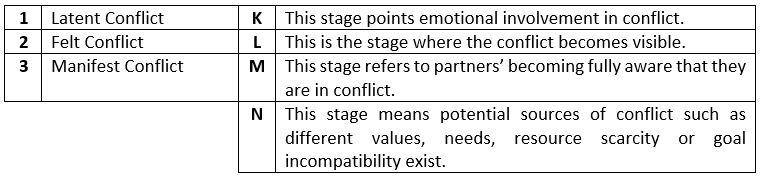 Which of the following is the correct match of the above items?
Seçenekler
A
1-N, 2-L, 3-K
B
1-K, 2-M, 3-L
C
1-L, 2-K, 3-N
D
1-M, 2-K, 3-L
E
1-N, 2-K, 3-L
Açıklama:
Latent Conflict: The first stage called as “latent conflict” means potential sources of conflict such as different values, needs, resource scarcity or goal incompatibility exist.
Felt Conflict: The third stage points emotional involvement in conflict.
Manifest Conflict: The fourth stage is the stage where the conflict becomes visible.
Perceived Conflict: The second stage refers to partners’ becoming fully aware that they are in conflict.
The correct answer is E.
Felt Conflict: The third stage points emotional involvement in conflict.
Manifest Conflict: The fourth stage is the stage where the conflict becomes visible.
Perceived Conflict: The second stage refers to partners’ becoming fully aware that they are in conflict.
The correct answer is E.
Soru 15
_______________________ arises when individuals face with inconsistent or incompatible demands.
Which of the following is most appropriate for the blank in the above sentence?
Which of the following is most appropriate for the blank in the above sentence?
Seçenekler
A
Role ambiguity
B
Power base
C
Role overload
D
Role conflict
E
Role underload
Açıklama:
Role conflict arises when individuals face with inconsistent or incompatible demands.
The correct answer is D.
The correct answer is D.
Soru 16
Which of the following is a true statement?
Seçenekler
A
Lower self-monitors are capable of modifying their behaviors according to the interpersonal and social cues.
B
Higher self-monitors tend to observe and regulate their acts to make a favorable impression on others.
C
Higher self-monitors prefer stability instead of flexibility and are less prone to adapt their behaviors in order to meet the expectations and gain positive evaluations of others.
D
Low self-monitors experience less frequency of conflict with others.
E
Individuals high in self-monitoring are thought to regulate their behaviors in respect of inner thoughts or beliefs.
Açıklama:
Higher self-monitors are capable of modifying their behaviors according to the interpersonal and social cues. They (higher self-monitors) tend to observe and regulate their acts to make a favorable impression on others.
Individuals low in self-monitoring are thought to regulate their behaviors in respect of inner thoughts or beliefs. They (low self-monitors) prefer stability instead of flexibility and are less prone to adapt their behaviors in order to meet the expectations and gain positive evaluations of others.
High self-monitors experience less frequency of conflict with others.
The correct answer is B.
Individuals low in self-monitoring are thought to regulate their behaviors in respect of inner thoughts or beliefs. They (low self-monitors) prefer stability instead of flexibility and are less prone to adapt their behaviors in order to meet the expectations and gain positive evaluations of others.
High self-monitors experience less frequency of conflict with others.
The correct answer is B.
Soru 17
Which of the following is a true statement?
Seçenekler
A
Patience, relaxation, ability to balance work and non-work life are the main characteristics of Type A personality.
B
Negative affectivity reflects a pleasurable engagement with environment.
C
Individuals with lower emotional intelligence also tend to be more self-aware.
D
Employees in large units are more inclined to perceive conflict in their units.
E
Indirect communication leads to stereotyping which is the common and powerful source of discrimination.
Açıklama:
Patience, relaxation, ability to balance work and non-work life are the main characteristics of Type B personality.
Positive affectivity reflects a pleasurable engagement with environment.
Individuals with higher emotional intelligence also tend to be more self-aware.
Employees in small units are more inclined to perceive conflict in their units.
Indirect communication leads to stereotyping which is the common and powerful source of discrimination.
The correct answer is E.
Positive affectivity reflects a pleasurable engagement with environment.
Individuals with higher emotional intelligence also tend to be more self-aware.
Employees in small units are more inclined to perceive conflict in their units.
Indirect communication leads to stereotyping which is the common and powerful source of discrimination.
The correct answer is E.
Soru 18
________________________ describes situations in which employee has a high level of skills and competencies not required to perform simple tasks.
Which of the following is most appropriate for the blank in the above sentence?
Which of the following is most appropriate for the blank in the above sentence?
Seçenekler
A
Role ambiguity
B
Quantitative role overload
C
Qualitative role underload
D
Qualitative role overload
E
Quantitative role underload
Açıklama:
Qualitative role underload describes situations in which employee has a high level of skills and competencies not required to perform simple tasks.
The correct answer is C.
The correct answer is C.
Soru 19
Which of the following conflict management style represents to reach a mutually satisfactory solution under the circumstances of complex problems?
Seçenekler
A
Integrating style
B
Dominating style
C
Obliging style
D
Compromising style
E
Avoiding style
Açıklama:
Integrating Style: High concern for meeting his/ her own interests and high concern for meeting other’s interests are called win-win strategy. The style represents to reach a mutually satisfactory solution under the circumstances of complex problems.
The correct answer is A.
The correct answer is A.
Soru 20
I. Improving emotion management
II. Changing the composition of the team
III. Improving bureaucratic leadership style
IV. Supporting risk-taking organizational culture
Which of the above statements are among the conflict management strategies?
II. Changing the composition of the team
III. Improving bureaucratic leadership style
IV. Supporting risk-taking organizational culture
Which of the above statements are among the conflict management strategies?
Seçenekler
A
I and IV
B
II and III
C
I, II and III
D
I, II and IV
E
I, III and IV
Açıklama:
Here are some of the important conflict management strategies:
- Improving Transformational Leadership Style
- Improving Emotion Management
- Supporting Risk-Taking Organizational Culture
- Cultivating Workplace Trust
- Changing Inappropriate Design of Organization
- Making Job Design
- Defining a Superior Goal
- Training about Conflict Management and Resolution
- Changing the Composition of the Team
Soru 21
I - disagreement II - controversy III - disputes IV - tensions V - opposition Which of the terms given are some of the terms in common usage to cite the situations related to conflict?
Seçenekler
A
I - II - III - IV - V
B
II - III - IV - V
C
I - III - IV - V
D
I - II - III - IV
E
I - II - IV - V
Açıklama:
Disagreement, controversy, disputes, tensions, and opposition are some of the terms in common usage to cite the situations related to conflict.
Soru 22
"People are in conflict when the actions of one person are interfering or making another’s behavior …………...."
Which of the following fills in the blank correctly?
Which of the following fills in the blank correctly?
Seçenekler
A
more interesting
B
more meaningful
C
less effective
D
more effective
E
less interesting
Açıklama:
People are in conflict when the actions of one person are interfering or making another’s behavior less effective.
Soru 23
"Perception of conflict generates unpleasant feelings like………. or ……... toward the other party."
Which of the given pairs fill in the blank correctly?
Which of the given pairs fill in the blank correctly?
Seçenekler
A
excitement-sadness
B
peace-sadness
C
anger-happiness
D
anger-sadness
E
excitement-happiness
Açıklama:
Perception of conflict generates unpleasant feelings like anger or sadness toward the other party.
Soru 24
Which of the following is one of the Dysfunctional outcomes?
Seçenekler
A
Improve the quality of decisions.
B
Eliminate group-thinking and predispose alternative ways/solutions.
C
Impair individual/group performance.
D
Help to recognize dysfunctional processes or functions.
E
Support creative thinking.
Açıklama:
Functional Outcomes
- Improve the quality of decisions.
- Support creative thinking.
- Help to recognize dysfunctional processes or functions.
- Eliminate group-thinking and predispose alternative ways/solutions.
- Slow down the pace of decision making.
- Damage social relations and organizational trust.
- Decrease organizational commitment.
- Impair individual/group performance.
Soru 25
Which of the following is one of the functional outcomes?
Seçenekler
A
Decrease organizational commitment.
B
Damage social relations and organizational trust.
C
Slow down the pace of decision making.
D
Impair individual/group performance.
E
Support creative thinking.
Açıklama:
Functional Outcomes
Improve the quality of decisions.
Support creative thinking.
Help to recognize dysfunctional processes or functions.
Eliminate group-thinking and predispose alternative ways/solutions.
Dysfunctional Outcomes
Slow down the pace of decision making.
Damage social relations and organizational trust.
Decrease organizational commitment.
Impair individual/group performance.
Improve the quality of decisions.
Support creative thinking.
Help to recognize dysfunctional processes or functions.
Eliminate group-thinking and predispose alternative ways/solutions.
Dysfunctional Outcomes
Slow down the pace of decision making.
Damage social relations and organizational trust.
Decrease organizational commitment.
Impair individual/group performance.
Soru 26
Which of the given pair is correct?
Seçenekler
A
Avoidance-avoidance conflict -where the individual is motivated to approach two or more positive but mutually exclusive goals.
B
Avoidance-avoidance conflict - where the individual is motivated to avoid two or more negative but mutually exclusive goals
C
Avoidance-avoidance conflict -where the individual is motivated to approach a goal and at the same time is motivated to avoid it. The single goal contains both positive and negative characteristics for the individual.
D
Approach-approach conflict - where the individual is motivated to approach a goal and at the same time is motivated to avoid it. The single goal contains both positive and negative characteristics for the individual.
E
Approach-avoidance conflict - where the individual is motivated to approach two or more positive but mutually exclusive goals
Açıklama:
Three distinct types of goal conflict are generally identified as;
1. Approach-approach conflict, where the individual is motivated to approach two or more positive but mutually exclusive goals.
2. Approach-avoidance conflict, where the individual is motivated to approach a goal and at the same time is motivated to avoid it. The single goal contains both positive and negative characteristics for the individual.
3. Avoidance-avoidance conflict, where the individual is motivated to avoid two or more negative but mutually exclusive goals (Luthans, 2010, p.290).
1. Approach-approach conflict, where the individual is motivated to approach two or more positive but mutually exclusive goals.
2. Approach-avoidance conflict, where the individual is motivated to approach a goal and at the same time is motivated to avoid it. The single goal contains both positive and negative characteristics for the individual.
3. Avoidance-avoidance conflict, where the individual is motivated to avoid two or more negative but mutually exclusive goals (Luthans, 2010, p.290).
Soru 27
What is the correct order of level of conflict from low to high?
Seçenekler
A
Intergroup conflict - Intrapersonal conflict - Interpersonal conflict - Intragroup conflict
B
Interpersonal conflict - Intragroup conflict - Intergroup conflict - Intrapersonal conflict
C
Intrapersonal conflict - Interpersonal conflict - Intergroup conflict - Intragroup conflict
D
Intrapersonal conflict - Interpersonal conflict - Intragroup conflict - Intergroup conflict
E
Interpersonal conflict -Intrapersonal conflict - Intragroup conflict - Intergroup conflict
Açıklama:
Intrapersonal conflict - Interpersonal conflict - Intragroup conflict - Intergroup conflict
Soru 28
- Latent Conflict
- Perceived Conflict
- Felt Conflict
- Manifest Conflict
- Conflict Aftermath
Seçenekler
A
I - II - III - IV - V
B
IV - II - III - I - V
C
II - I - III - V - IV
D
III - IV - V - I - II
E
IV - V - I - II - III
Açıklama:
- Latent Conflict
- Perceived Conflict
- Felt Conflict
- Manifest Conflict
- Conflict Aftermath
Soru 29
Which of the following is not one of the personal factors of conflict?
Seçenekler
A
Communication Problems
B
Narcissism
C
Self-Monitoring
D
Negative Affectivity
E
Emotional Intelligence
Açıklama:
- Narcissism
- Self-Monitoring
- Negative Affectivity
- Type A
- Emotional Intelligence
Soru 30
Which of the following pair is not correct?
Seçenekler
A
Integrating Style: High concern for meeting his/ her own interests and high concern for meeting other’s interests are called win-win strategy.
B
Obliging Style: Low concern for self and the others are likely to yield lose-lose outcome which allows the conflict take its own action.
C
Dominating Style: High concern for self and low concern for the other are called win-lose strategy.
D
Avoiding Style: Low concern for self and the others are likely to yield lose-lose outcome which allows the conflict take its own action.
E
Compromising Style: Intermediate concern for self and the others involves a give-andtake approach which results in mutual satisfaction.
Açıklama:
Obliging Style: Low concern for self and high concern for the other are called lose-win strategy.
Soru 31
Which one of the following is not among the terms in common usage to cite the situations related to conflict?
Seçenekler
A
Disagreement
B
Controversy
C
Disputes
D
Opposition
E
Prevention
Açıklama:
Disagreement, controversy, disputes, tensions, and opposition are some of the
terms in common usage to cite the situations related to conflict.
terms in common usage to cite the situations related to conflict.
Soru 32
I. Linguistics
II. Social psychology
III. Cognitive science
Which one(s) of these discipline(s) are examined in order to provide an insight about the nature of conflict?
II. Social psychology
III. Cognitive science
Which one(s) of these discipline(s) are examined in order to provide an insight about the nature of conflict?
Seçenekler
A
Only I
B
Only II
C
Only III
D
I-II
E
II-III
Açıklama:
Three main fields, namely sociology, social psychology and cognitive science, are examined in order to provide an insight about the nature of conflict
Soru 33
I. Traditionalist
II. Cognitivist
III. Interactionist
Which one(s) of the perspective(s) above affect the perception of conflict and how to manage it in organizations
II. Cognitivist
III. Interactionist
Which one(s) of the perspective(s) above affect the perception of conflict and how to manage it in organizations
Seçenekler
A
Only I
B
Only II
C
Only III
D
I-III
E
II-III
Açıklama:
Three main perspectives, namely traditionalist, behavioralist and interactionist, affect the perception of conflict and how to manage it in organizations.
Soru 34
Which one of the following is not among the results of dysfunctional conflict
Seçenekler
A
Eliminate group-thinking and predispose alternative ways/solutions
B
Damage social relations and organizational trust
C
Decrease organizational commitment
D
Slow down the pace of decision making
E
Impair individual/group performance
Açıklama:
Eliminate group-thinking and predispose alternative ways/solutions is a functional outcome of conflict.
Soru 35
Which one of the following is not among the sub-levels of intraorganizational conflict?
Seçenekler
A
Intrapersonal
B
Interorganizational
C
Interpersonal
D
Intragroup
E
intergroup
Açıklama:
Intraorganizational conflict has four sub-levels: Intrapersonal, Interpersonal, intragroup and intergroup conflict.
Soru 36
Which one of the following terms refers to the situation in which the individual is motivated to approach two or more positive but mutually exclusive goals?
Seçenekler
A
Approach-approach conflict
B
Approach-avoidance conflict
C
Avoidance-avoidance conflict
D
Interpersonal conflict
E
Intragroup conflict
Açıklama:
Approach-approach conflict, where the individual is motivated to approach two or more positive but mutually exclusive goals
Soru 37
Which one of the following stages of conflict refers to the partners’ becoming fully aware that they are in conflict?
Seçenekler
A
Latent Conflict
B
Perceived Conflict
C
Felt Conflict
D
Manifest Conflict
E
Conflict Aftermath
Açıklama:
Perceived Conflict: The second stage refers to partners’ becoming fully aware that they are in conflict. This is the stage when one party perceives the other to be likely to thwart or frustrate his/her goals.
Soru 38
Which one of the following is not among the forms of manifest conflict?
Seçenekler
A
Violence
B
Infighting
C
Physical Intimidation
D
Lack of communication
E
Lack of self-confidence
Açıklama:
Here are the some forms of manifest conflict
• Violence
• Infighting
• Sabotage
• Physical Intimidation
• Lack of communication
• Open agression
• Violence
• Infighting
• Sabotage
• Physical Intimidation
• Lack of communication
• Open agression
Soru 39
Which one of the following terms refers to the personal trait that contains self-love, inflated self-view, ruthlessness, devaluation of others and manipulation of others?
Seçenekler
A
Narcissism
B
Negative Affectivity
C
Self-Monitoring
D
Emotional Intelligence
E
Type A
Açıklama:
Narcissism: Narcissim is a personal trait that contains self-love, inflated self-view, ruthlessness, devaluation of others and manipulation of others.
Soru 40
Which one of the following conflict management styles refer to to ignore your own needs or goals, and try to satisfy the other conflict party’s interests?
Seçenekler
A
Integrating Style
B
Obliging Style
C
Dominating Style
D
Avoiding Style
E
Compromising style
Açıklama:
Obliging Style: Low concern for self and high concern for the other are called lose-win strategy. This style refers to ignore your own needs or goals, and try to satisfy the other conflict party’s interests.
Soru 41
Which of the following approach can be considered helpful about conflict?
Seçenekler
A
Conflict hinders individual and organizational performance.
B
Conflict has to be eliminated completely by managers.
C
Total rejection of conflict in organizations is useful.
D
Conflict can keep organizations out of development and innovation.
E
Conflict can produce functional results in some instances.
Açıklama:
E)
Conflict is multidimensional, and one type of conflict can produce functional results in some instances, and fail in other instances.
Conflict is multidimensional, and one type of conflict can produce functional results in some instances, and fail in other instances.
Soru 42
- Controversy
- Anxiety
- Dispute
- Tension
Seçenekler
A
I and II
B
I, II and III
C
I, III and IV
D
II, III and IV
E
I, II, III and IV
Açıklama:
Disagreement, controversy, disputes, tensions, and opposition are some of the terms in common usage to cite the situations related to conflict.
C) I, III and IV
C) I, III and IV
- Controversy
- Dispute
- Tension
Soru 43
Which are the main fields that provide an insight into the nature of conflict?
Seçenekler
A
Sociology, social psychology and cognitive science
B
Philosophy, sociology and social psychology
C
Psychology and philosophy
D
Philosophy and cognitive science
E
Physics, philosophy and sociology
Açıklama:
Three main fields, namely sociology, social psychology and cognitive science, are examined in order to provide an insight about the nature of conflict.
A) Sociology, social psychology and cognitive science
A) Sociology, social psychology and cognitive science
Soru 44
Which of the perspectives confirmed that conflict is inevitable and has to be resolved in organizations?
Seçenekler
A
Traditionalist
B
Behavioralist
C
Interactionist
D
Traditionalist and interactionist
E
Interactionist and behavioralist
Açıklama:
B) Behavioralist
Soru 45
Which of the following situations refers to process conflict?
Seçenekler
A
One employee complains about the high volume of speech of his/her co-worker.
B
In one department one team makes gossip about the other team.
C
Two teams disagree about task content or about work goals.
D
Two human resource specialists are in conflict about the candidates.
E
There is a disagreement about who will be in charge of completing the task.
Açıklama:
E)
There is a disagreement about who will be in charge of completing the task.
There is a disagreement about who will be in charge of completing the task.
Soru 46
Which of the following is the conflict that takes place in the same team or in the same group?
Seçenekler
A
Intrapersonal conflict
B
Interpersonal conflict
C
Intergroup conflict
D
Intragroup conflict
E
Task conflict
Açıklama:
D)
Intragroup conflict is the conflict that takes place in the same team or in the same group.
Intragroup conflict is the conflict that takes place in the same team or in the same group.
Soru 47
- Latent conflict
- Perceived conflict
- Felt conflict
- Manifest conflict
- conflict aftermath
Seçenekler
A
I and II
B
I, II and III
C
I, II, III and IV
D
I, II, IV and V
E
I, II, III, IV and V
Açıklama:
E)
- Latent conflict
- Perceived conflict
- Felt conflict
- Manifest conflict
- conflict aftermath
Soru 48
- Violence
- Infighting
- Sabotage
- Physical Intimidation
- Self-esteem
Seçenekler
A
I and II
B
Only II
C
I, II, III and IV
D
II and V
E
II, III, IV and V
Açıklama:
C)
- Violence
- Infighting
- Sabotage
- Physical Intimidation
Soru 49
Individuals differ with respect to do extent to which “strategically cultivate public
appearance”. Which specific dispositional trait does this statement refer to?
appearance”. Which specific dispositional trait does this statement refer to?
Seçenekler
A
Self-monitoring
B
Narcissism
C
Type A
D
Negative affectivity
E
Emotional intelligence
Açıklama:
A)
Self-monitoring
Self-monitoring
Soru 50
Which of the following conflict management styles refer to win-win orientation?
Seçenekler
A
Obliging style
B
Integrating style
C
Dominating style
D
Compromising style
E
Avoiding style
Açıklama:
Integrating Style: High concern for meeting his/ her own interests and high concern for meeting other’s interests are called win-win strategy.
B) Integrating style
B) Integrating style
Soru 51
"The system should have rights-based and interest-based options for employees to consider." Which characteristic does this statement refer to in conflict management?
Seçenekler
A
Broad Scope
B
A Culture of Toleration and Early Resolution
C
Multiple Options
D
Multiple Access Points
E
Support Structures
Açıklama:
Multiple Options: The system should have rights-based and interest-based options for employees to consider.
C) Multiple Options
C) Multiple Options
Soru 52
- Controversy
- Disputes
- Tensions
Seçenekler
A
I
B
I-II
C
I-III
D
II-III
E
I-II-III
Açıklama:
Disagreement, controversy, disputes, tensions, and opposition are some of the terms in common usage to cite the situations related to conflict. The correct answer is Choice E.
Soru 53
Which of the following is one of the main fields examined in order to provide an insight about the nature of conflict?
Seçenekler
A
Ecology
B
Sociology
C
Physics
D
Chemistry
E
Biology
Açıklama:
Three main fields, namely sociology, social psychology and cognitive science, are examined in order to provide an insight about the nature of conflict. The correct answer is Choice B.
Soru 54
- From a pluralist perspective, the drive to maximize advantage over others will lead to competitive tension.
- From an individualist perspective, different social groups have differing goals and competing claims for scarce resources.
- A Marxist sees conflict in the fundementally opposed interests of the ruling and working classes.
Seçenekler
A
I
B
II
C
III
D
I-II
E
II-III
Açıklama:
The discipline of sociology concentrates on how social order is maintained or damaged. The individualist perspective presumes that social order is provided by the consent which individuals give to instituations to set regulations, in return for the protection of the individual’s rights and well-being. A pluralist perspective is that the framework of societal rules is maintained in the ‘general interest’ of the society. From a Marxist perspective, it is the ruling class, using the instruments of the state, which imposes order and suppresses dissent. In each of these perspectives, social order is achieved, but never without conflict. From an individualist perspective, the drive to maximize advantage over others will lead to competitive tension. From a pluralist perspective, different social groups have differing goals and competing claims for scarce resources. A Marxist sees conflict in the fundementally opposed interests of the ruling and working classes. The correct answer is Choice C.
Soru 55
Which of the following is an example for task conflict?
Seçenekler
A
One employee complaining about high volume of speech of his/her co-worker
B
One team making gossip about the other team
C
Two human resource specialists being in conflict about the candidates in terms of which one of them is more proper for the position of sales representative
D
Disagreement pertaining to how the task will be done in a company
E
Disagreement pertaining to who will be in charge of completing the task
Açıklama:
Relationship conflict (socioemotional conflict) is the conflict that arouses among people with personal dissonance or tension. This type of conflict is about relationships or emotional aspects, no deal with organizational issues. For example, if one employee complains about high volume of speech of his/her co-worker, or in one department one team makes gossip about the other team, then relationship conflict exists in these two work context. Therefore, negative emotions like resentment, annoyance, and sadness are felt by conflict partners, and group performance can decrease. On the other side, task conflict is about task related issues. It is peculiar to disagreement about task content or about work goals (Jehn, 1997, p.88-89). For example, two human resource specialists are in conflict about the candidates which one more proper for the position of sales representative. One of the HR specialist thinks that the woman at the ages of 30s has deep experience in marketing, and can be more successful as a sales representative. The other HR specialist thinks that the man at at the ages of 40s can speak three languages and is talkative in interviews, so he can be the proper candidate for that position. This type of conflict can be beneficial for organization; especially in non-routine, complex jobs like strategy formation or product development. Different ideas or viewpoints can be channelled into brainstorming which supports decision participation and high quality decision-making. If task conflict is managed properly, it can enhance team performance and team member satisfaction. The third conflict type is process conflict. It refers to a disagreement pertaining to how the task will be done, who will be in charge of completing the task. This kind of conflict is associated with lower morale or group performance (Jehn, 1999). The correct answer is Choice C.
Soru 56
- If relationship conflict lasts for a long time, it can develop into task conflict.
- Groups with low level of interdependence are less open to the negative group outcomes
- Process conflict can hinder decision making process and can cause delay in working process.
Seçenekler
A
I
B
II
C
III
D
I-II
E
II-III
Açıklama:
If task conflict lasts for a long time, it can develop into relationship conflict, which is detrimental to organizational performance and employee satisfaction. Members can perceive task disputes as personal dislike or personal attack, and may want to dominate decision making process to gain personal power. Relationship conflict can hinder decision making process and can cause delay in working process. Especially, in highly interdependent groups, which group members are reliant on the other member to perform and complete the task, high amount of interaction and dependence may cause affective conflict, and it can create more negative group outcomes. Groups with low level of interdependence are less open to the negative group outcomes. The correct answer is Choice B.
Soru 57
Which of the following is one of the functional outcomes?
Seçenekler
A
Slow down the pace of decision making.
B
Damage social relations and organizational trust.
C
Decrease organizational commitment.
D
Impair individual/group performance.
E
Eliminate group-thinking and predispose alternative ways/solutions.
Açıklama:
Functional Outcomes: (1) Improve the quality of decisions. (2) Support creative thinking. (3) Help to recognize dysfunctional processes or functions. (4) Eliminate group-thinking and predispose alternative ways/solutions.
Dysfunctional Outcomes: (1) Slow down the pace of decision making. (2) Damage social relations and organizational trust. (3) Decrease organizational commitment. (4) Impair individual/group performance.
The correct answer is Choice E.
Dysfunctional Outcomes: (1) Slow down the pace of decision making. (2) Damage social relations and organizational trust. (3) Decrease organizational commitment. (4) Impair individual/group performance.
The correct answer is Choice E.
Soru 58
Which of the following can be occurred when employees are frustrated by personal or organizational dynamics?
Seçenekler
A
Interorganizational conflict
B
Intrapersonal conflict
C
Interpersonal conflict
D
Intragroup conflict
E
Intergroup conflict
Açıklama:
Intrapersonal conflict can be occured when employees are frustrated by personal or organizational dynamics. High work pressure, dense level of competition among coworkers, perception of injustice politics, perception of being inadequate to performn the job, and goal conflict can create intrapersonal level of conflict. The correct answer is Choice B.
Soru 59
If the individual is motivated to avoid two or more negative but mutually exclusive goals, which of the following is possible to be valid?
Seçenekler
A
Interorganizational conflict
B
Intrapersonal conflict
C
Interpersonal conflict
D
Intragroup conflict
E
Intergroup conflict
Açıklama:
Intrapersonal conflict can be occured when employees are frustrated by personal or organizational dynamics. High work pressure, dense level of competition among coworkers, perception of injustice politics, perception of being inadequate to performn the job, and goal conflict can create intrapersonal level of conflict. Three distinct types of goal conflict are generally identified as; 1. Approach-approach conflict, where the individual is motivated to approach two or more positive but mutually exclusive goals. 2. Approach-avoidance conflict, where the individual is motivated to approach a goal and at the same time is motivated to avoid it. The single goal contains both positive and negative characteristics for the individual. 3. Avoidance-avoidance conflict, where the individual is motivated to avoid two or more negative but mutually exclusive goals. The correct answer is Choice B.
Soru 60
Which of the following is true about the process of conflict?
Seçenekler
A
The first stage called as “latent conflict” refers to partners’ becoming fully aware that they are in conflict.
B
The second stage points emotional involvement in conflict.
C
The third stage is the stage where the conflict becomes visible.
D
The fourth stage is the stage where partners show a clear conflictful behavior, such as open aggression.
E
Felt conflict consists of cognitive awareness of disagreement that results when relational incompatibilities or injustices are recognized.
Açıklama:
Latent Conflict: The first stage called as “latent conflict” means potential sources of conflict such as different values, needs, resource scarcity or goal incompatibility exist. Although the sources are rooted in organization for a long time of period, the partners does not perceive the tension. This stage is called latent until the partners intent to change the situation. In other words, if the partners are not aware of the tension, or do not act to change the situation, the conflict will not emerge. Perceived Conflict: The second stage refers to partners’ becoming fully aware that they are in conflict. This is the stage when one party perceives the other to be likely to thwart or frustrate his/her goals. Felt Conflict: The third stage points emotional involvement in conflict. The partners are not only aware of the conflict, but also feel negative emotions like tension, and anxiety. Felt emotions help individuals to perceive that they are in conflict (Bodtker and Jameson, 2001). Jehn (1997) proposed that negative emotions felt during conflict in groups hamper the resolution of conflict. Perceived conflict consists of cognitive awareness of disagreement that results when relational incompatibilities or injustices are recognized, whereas felt conflict represents affective recognition of these concerns and resultant anger, tension, or frustration. Manifest Conflict: The fourth stage is the stage where the conflict becomes visible. Partners show a clear conflictful behavior, such as open aggression. Which behavior accepted as conflictful depends on the culture of organization and the perception of the conflict partners. If the behavior is against the norms of the culture and people perceive it to be conflicftul, then manifest conflict can be called for the reactions or statements of the partners. The second criteria to call the behavior as conflictful, partners consciously prefer to behave like that. The correct answer is Choice D.
Soru 61
Which of the following is one of the organizational factors that causes conflict?
Seçenekler
A
Self-Monitoring
B
Type A
C
Negative Affectivity
D
Emotional Intelligence
E
Communication Problems
Açıklama:
Personal Factors: Narcissism, self-monitoring, Type A, negative affectivity, emotional intelligence
Organizational Factors: Size of the Organization, Communication Problems, Power Base, Role Conflict and Role Ambiguity, Specialization, Resource Scarcity, Performance Criteria and Rewards, Diversity of Goals, Personality and Value Clashes, Task Interdependence
The correct answer is Choice E.
Organizational Factors: Size of the Organization, Communication Problems, Power Base, Role Conflict and Role Ambiguity, Specialization, Resource Scarcity, Performance Criteria and Rewards, Diversity of Goals, Personality and Value Clashes, Task Interdependence
The correct answer is Choice E.
Soru 62
Which of the following is a functional outcome of conflict in organizations?
Seçenekler
A
Help to recognize dysfunctional processes or functions.
B
Impair individual/group performance.
C
Decrease organizational commitment.
D
Damage social relations and organizational trust.
E
Slow down the pace of decision making.
Açıklama:
Especially relationship conflict decreases the level of organizational commitment, job satisfaction, and damages trust in social relationships. In longer terms, this leads to slow decision making and weak organizational performance. In contrast with the dark side of conflict, bright side of conflict brings innovative thoughts, new ways of thinking and alternative solutions, and helps to recognize dysfunctional processes or functions.
Help to recognize dysfunctional processes or functions.
Help to recognize dysfunctional processes or functions.
Soru 63
Which type of organizational conflict develop when when employees are frustrated by personal or organizational dynamics such as high work pressure, dense level of competition among coworkers?
Seçenekler
A
Intergroup conflict
B
Intragroup conflict
C
Intrapersonal conflict
D
Organizational conflict
E
Interpersonal conflict
Açıklama:
Intrapersonal conflict can be occured when employees are frustrated by personal or organizational
dynamics. High work pressure, dense level of competition among coworkers, perception of injustice
politics, perception of being inadequate to performn the job, and goal conflict can create intrapersonal level of conflict.
dynamics. High work pressure, dense level of competition among coworkers, perception of injustice
politics, perception of being inadequate to performn the job, and goal conflict can create intrapersonal level of conflict.
Soru 64
Which of the following describes intragroup conflict?
Seçenekler
A
Thse types of groups may
include different departments or units in an
organization.
include different departments or units in an
organization.
B
between two or more organizational members
C
it is the dyadic conflict in different/same department or at different/same
hierarchical position.
hierarchical position.
D
It is the conflict that takes place
among different groups.
among different groups.
E
It is the conflict that takes
place in the same team or in the same group.
place in the same team or in the same group.
Açıklama:
Intragroup conflict is the conflict that takes
place in the same team or in the same group.
The incompatibilities and misunderstandings,
differences and disagreements among
individuals with regard to group goals, functions
or activities lead to an intragroup conflict.
It is the conflict that takes
place in the same team or in the same group.
place in the same team or in the same group.
The incompatibilities and misunderstandings,
differences and disagreements among
individuals with regard to group goals, functions
or activities lead to an intragroup conflict.
It is the conflict that takes
place in the same team or in the same group.
Soru 65
Accroding to the Pondy's model of conflict , which of the following is the final stage of the conflict process?
Seçenekler
A
Latent conflict
B
Conflict aftermath
C
Manifest conflict
D
Felt conflict
E
Perceived conflict
Açıklama:
Conflict aftermath is the last stage of the conflict process. The satisfaction of the conflict parties should be maintained in the process of
conflict resolution. If the conflict is not resolved or managed in a proper way, it will be experienced in a more serious form.
conflict resolution. If the conflict is not resolved or managed in a proper way, it will be experienced in a more serious form.
Soru 66
Causes of organizational conflict range from personal to organizational situations.
Which of the below group of causes are among the personal factors?
Which of the below group of causes are among the personal factors?
Seçenekler
A
Size of the organization
B
Management style
C
Narcissism
D
Organizational communication
E
External environment
Açıklama:
Narcissim is a personal trait that contains self-love, inflated self-view, ruthlessness,
devaluation of others and manipulation of others.Narcissistic individuals who are concerned with
obtaining admiration of other people aim to
promote positive self-image by pursuing selfimage goals which can create conflict in their
relationships. These kind of goals can undermine social support and trust in social interactions.
Under the conditions of failing to achieve these goals, fragile self-esteem of narcissistic individuals
trigger conflict.
Narcissism
devaluation of others and manipulation of others.Narcissistic individuals who are concerned with
obtaining admiration of other people aim to
promote positive self-image by pursuing selfimage goals which can create conflict in their
relationships. These kind of goals can undermine social support and trust in social interactions.
Under the conditions of failing to achieve these goals, fragile self-esteem of narcissistic individuals
trigger conflict.
Narcissism
Soru 67
Which of the set of terms below is used to cite the situations related to conflict?
Seçenekler
A
Disputes, tensions, opposition
B
Aggression, absenteeism, discussion
C
Opposing goals, interests, diarrhea
D
Low self-esteem, depersonalization, anger
E
Anxiety, low job performance, struggle
Açıklama:
Disagreement, controversy, disputes, tensions and opposition are some of the terms in common usage to cite the situations related to conflict.
Soru 68
Two human resource specialists are in conflict about the candidates which one more proper for the position of sales representative. What type of conflict is this?
Seçenekler
A
Relationship conflict
B
Process conflict
C
Negative conflict
D
Group conflict
E
Task conflict
Açıklama:
The first question is related to differentiateing three types of conflict: Relationship conflict, task conflict and process conflict.
Task conflict is about task related issues. It is peculiar to disagreement about task content or about work goals. For example, two human resource specialists are in conflict about the candidates which one more proper for the position of sales representative. One of the HR specialist thinks that the woman at the ages of 30s has deep experience in marketing, and can be more successful as a sales representative. The other HR specialist thinks that the man at at the ages of 40s can speak three languages and is talkative in interviews, so he can be the proper candidate for that position. This type of conflict can be beneficial for organization.
Task conflict is about task related issues. It is peculiar to disagreement about task content or about work goals. For example, two human resource specialists are in conflict about the candidates which one more proper for the position of sales representative. One of the HR specialist thinks that the woman at the ages of 30s has deep experience in marketing, and can be more successful as a sales representative. The other HR specialist thinks that the man at at the ages of 40s can speak three languages and is talkative in interviews, so he can be the proper candidate for that position. This type of conflict can be beneficial for organization.
Soru 69
"Disagreement pertaining to how the task will be done, who will be in charge of completing the task". What type of conflict is described here?
Seçenekler
A
Task conflict
B
Extant conflict
C
Process conflict
D
Relationship conflict
E
Negative conflict
Açıklama:
Process conflict refers to a disagreement pertaining to how the task will be done, who will be in charge of completing the task. This kind of conflict is associated with lower morale or group performance.
Soru 70
"It occurs when employees are frustrated by personal or organizational dynamics. High work pressure, dense level of competition among coworkers, perception of injustice politics, perception of being inadequate to performn the job, and goal conflict can create intrapersonal level of conflict." What type of organizational conflict is described here?
Seçenekler
A
Interpersonal
B
Intragroup
C
Intrapersonal
D
Intergroup
E
intraorganizational
Açıklama:
Intrapersonal conflict can be occured when employees are frustrated by personal or organizational dynamics. High work pressure, dense level of competition among coworkers, perception of injustice politics, perception of being inadequate to performn the job, and goal conflict can create intrapersonal level of conflict.
Soru 71
"One team member prefers to decide based on facts, and the other member prefers to decide based on his/her intuition. Different styles on decision techniques lead them to conclude on different results which may produce conflict between them." What type of conflict is exemplified in this case?
Seçenekler
A
Intraorganizational
B
Intrapersonal
C
Intragroup
D
Interpersonal
E
Intergroup
Açıklama:
Interpersonal conflict is the dyadic conflict between two or more organizational members who can be in different/same department or at different/same hierarchical position. Competition, unfairness, different values or styles can be the sources of interpersonal conflict.
For example, one team member prefers to decide based on facts, and the other member prefers to decide based on his/her intuition. Different styles on decision techniques lead them to conclude on different results which may produce conflict between them.
For example, one team member prefers to decide based on facts, and the other member prefers to decide based on his/her intuition. Different styles on decision techniques lead them to conclude on different results which may produce conflict between them.
Soru 72
Which one below is not one of stages of the processes of organizational conflict?
Seçenekler
A
Latent
B
Perceived
C
Felt
D
Manifest
E
Extant
Açıklama:
Pondy's Model of Organizational Conflict;
Stage 1 : Latent Conflict
Stage 2 : Perceived Conflict
Stage 3 : Felt Conflict
Stage 4 : Manifest Conflict
Stage 5 : Conflict Aftermath
Stage 1 : Latent Conflict
Stage 2 : Perceived Conflict
Stage 3 : Felt Conflict
Stage 4 : Manifest Conflict
Stage 5 : Conflict Aftermath
Soru 73
Which stage of conflict do violence, infighting, sabotage, physical Intimidation, lack of communication and open aggression belong to?
Seçenekler
A
Manifest
B
Conflict Aftermath
C
Percieved
D
Felt
E
Latent
Açıklama:
Manifest Conflict: The fourth stage is the stage where the conflict becomes visible. Partners show a clear conflictful behavior, such as open aggression. Which behavior accepted as conflictful depends on the culture of organization and the perception of the conflict partners. If the behavior is against the norms of the culture and people perceive it to be conflicftul, then manifest conflict can be called for the reactions or statements of the partners. The second criteria to call the behavior as conflictful, partners consciously prefer to behave like that. The purpose of the behavior is to frustrate or block the other’s attainment of his/ her goal. Here are the some forms of manifest conflict:
- Violence
- Infighting
- Sabotage
- Physical Intimidation
- Lack of communication
- Open agression
Soru 74
Which of them below occurs when two working groups are mutually interdependent in performing their tasks?
Seçenekler
A
Performance interdependence
B
Reciprocal interdependence
C
Task interdependence
D
Poor interdependence
E
Sequential interdependence
Açıklama:
Reciprocal interdependence occurs when two working groups are mutually interdependent in performing their tasks (McShane and Von Glinow, 2000, p.406- 407). For example, at a car manufacturing plant, electronic workers and steel workers work together and come together several times to produce the best vehicle.
Soru 75
Which conflict management style is most often used by people who have difficulty facing conflict, and by people who are unwilling to involve or participate in negative and stressful events?
Seçenekler
A
Integrating
B
Obliging
C
Dominating
D
Avoiding
E
Compromising
Açıklama:
Low concern for self and the others are likely to yield lose-lose outcome which allows the conflict take its own action. This style is most often used by people who have difficulty facing conflict, and by people who are unwilling to involve or participate in negative and stressful events. Using this style is not proper when the conflict issue has to be solved quickly or the issue is trivial for conflict parties. This style can damage trust especially in low level of conflict. This style is also improper when the relationship between conflicting partners is not effective and includes trust. When partners have cooperative goals, and a strong relationship, and focus on task productivity, to avoid conflict embrace positive results
Soru 76
"A sense of being united in the pursuit of group’s goals" what term is defined here?
Seçenekler
A
Superior goal
B
Desired goal
C
Cohesiveness
D
Negotiation
E
Consistency
Açıklama:
Cohesiveness can be defined as a sense of being united in the pursuit of group’s goals.
Ünite 8
Soru 1
I. a flexible division of labor among participants
II. a hierarchy of offices
III. employment viewed as a career by participants
Which one/ones of the statement(s) above is/are among the basic features of bureaucratic forms?
II. a hierarchy of offices
III. employment viewed as a career by participants
Which one/ones of the statement(s) above is/are among the basic features of bureaucratic forms?
Seçenekler
A
Only I
B
Only II
C
Only III
D
I and II
E
II and III
Açıklama:
Weber named this ideal type of organization as “bureaucracy” and he defined basic features of bureaucratic forms (Scott, 2007):
a) a fixed division of labor among participants,
b) a hierarchy of offices,
c) a set of general rules that governs performance,
d) a separation of personnel from official property,
e) selection of personnel based on technical qualifications,
f) employment viewed as a career by participants
a) a fixed division of labor among participants,
b) a hierarchy of offices,
c) a set of general rules that governs performance,
d) a separation of personnel from official property,
e) selection of personnel based on technical qualifications,
f) employment viewed as a career by participants
Soru 2
Which one of the following stands for the major criticism towards in terms of his principles concerning bureaucracy?
Seçenekler
A
He did not have a theoretical background while designing principles
B
His principles decreased creativity, increased dissatisfaction and demotivation
C
He did not consult other scholars while desgining the principles
D
His principles were too motivating and encouraging
E
His principles were limited to certain types of organizations
Açıklama:
Organizational theorists and researchers have used ideas of Max Weber to explain components of organizational structure. Weber was criticized because of designing an iron cage for the employees, which decreases creativity, increases
dissatisfaction and demotivation (Adler and Borys, 1996).
dissatisfaction and demotivation (Adler and Borys, 1996).
Soru 3
Which one of the followowing refers to formal interaction and communication patterns; hierarchical relations; organization of departments and units; written rules, instructions and procedures in an organization?
Seçenekler
A
Social structure
B
Physical structure
C
Formalization
D
Social network
E
Centralization
Açıklama:
Social structure refers to formal interaction and communication patterns; hierarchical relations; organization of departments and units; written rules, instructions and procedures.
Soru 4
What does the term formal organization refer to?
Seçenekler
A
The number of written documents comprising procedures, job descriptions, regulations, instructions and guidelines
B
Tendency of organizations to record all business-related activities by written documents
C
Tangible assets such as buildings, plants, plots and institutional design
D
Formal interaction and communication patterns
E
The hierarchy of offices
Açıklama:
the term “formal organization” means tendency of organizations to record all business-related activities by written documents.
Soru 5
Which one of the following is an idiom which has been frequently used to denote unnecessary paperwork in organizations?
Seçenekler
A
A melting pot
B
A bowl of salad
C
Too much red tape
D
Ahead of the pack
E
Easy come easy go
Açıklama:
Too much red tape is an idiom, which has been frequently used to denote unnecessary paperwork in organizations.
Soru 6
Which one of the following level is responsible for developing long-term plans and strategies for organizations
Seçenekler
A
Middle Managers
B
First-Lines Managers
C
Nonmanagerial Employees
D
Top Level Managers
E
Managerial Assistants
Açıklama:
We usually classify managers under three basic groups, since they have different requirements and responsibilities. These three groups of managers are top or strategic level, middle level and lower level managers. Top-level managers have responsibility of developing long-term plans and strategies for organizations.
Soru 7
Which one of the following refers to the degree to which organizational tasks or work processes are subdivided into separate jobs
Seçenekler
A
Specialization
B
Departmentalization
C
Centralization
D
Hierarchy of Authority
E
Formalization
Açıklama:
Specialization refers to the degree to which organizational tasks or work processes are subdivided into separate jobs.
Soru 8
Which one of the following is not among the elements of mechanic design?
Seçenekler
A
Traditional hierarchy
B
Formal rules
C
Structured decision making
D
More participatory decision making
E
Mostly vertical communication
Açıklama:
A mecganic desgin in arganization includes Traditional hierarchy, Structured decision making, Mostly vertical communication and Formal rules.
Soru 9
"There is no direct human involvement to the manufacturing process. All steps of the production are mechanized and they consist of numerous chemical steps."
Which one of the following firms is described by statement above?
Which one of the following firms is described by statement above?
Seçenekler
A
Small batch and unit production
B
Continuous process production
C
Large batch and mass production
D
Small batch and large production
E
Large batch and unit production
Açıklama:
Continuous process production: There is no direct human involvement to the manufacturing process. All steps of the production are mechanized and they consist of numerous chemical steps. There is no start or stop, manufacturing proceeds in a cyclical manner. Chemical plants, beverage producers, oil refineries, pharmaceuticals and nuclear plants are the examples of the organizations having continuous process production.
Soru 10
Which one of the following terms refers to the degree of dependence among departments to each other to accomplish their tasks?
Seçenekler
A
Interdependence
B
Specialization
C
Centralization
D
Formalization
E
Hierarchy
Açıklama:
James Thompson developed another contingent model concerning organizational technology and structure. Thompson claimed that structure should be designed according to workflow interdependence among departments. Interdependence refers to the degree of dependence among departments to each other to accomplish their tasks.
Soru 11
_________________ named this ideal type of organization as “bureaucracy” and he defined basic features of bureaucratic forms.
Which of the following is the most appropriate for the blank in the above sentence?
Which of the following is the most appropriate for the blank in the above sentence?
Seçenekler
A
Max Weber
B
Emile Durkheim
C
Karl Marx
D
Talcott Parsons
E
Auguste Comte
Açıklama:
Weber named this ideal type of organization as “bureaucracy” and he defined basic features of bureaucratic forms.
The correct answer is A.
The correct answer is A.
Soru 12
Why was Weber's studies criticized?
Seçenekler
A
Because of designing an iron cage for the employees, which decreases dissatisfaction and demotivation.
B
Because his principles concerning bureaucracy have significantly determined the fundamentals of organizing business in modern society.
C
Because it is not possible to imagine an organization without bureaucracy in contemporary business life.
D
Because of designing an iron cage for the employees, which decreases creativity.
E
Because employment viewed as a career by participants.
Açıklama:
Weber was criticized because of designing an iron cage for the employees, which decreases creativity, increases dissatisfaction and demotivation.
The correct answer is D.
The correct answer is D.
Soru 13
I. Employees treated as mindless, ignorant and desperate individuals who strongly need guidance, direction and command in typical bureaucratic systems.
II. Bureaucracy has a mission to convert organizational participants to “ideal employees” by using guidelines, instructions, rules and strict hierarchy.
III. It it is not possible to think especially complex and large organizations without bureaucracy.
Which of the above sentences is/are correct?
II. Bureaucracy has a mission to convert organizational participants to “ideal employees” by using guidelines, instructions, rules and strict hierarchy.
III. It it is not possible to think especially complex and large organizations without bureaucracy.
Which of the above sentences is/are correct?
Seçenekler
A
Only I
B
Only III
C
I and II
D
II and III
E
I, II and III
Açıklama:
Employees treated as mindless, ignorant and desperate individuals who strongly need guidance, direction and command in typical bureaucratic systems.
Bureaucracy has a mission to convert organizational participants to “ideal employees” by using guidelines, instructions, rules and strict hierarchy.
Bureaucracy may seem as an outdated, rigorous and time wasting system for contemporary business organizations, but it is still not possible to think especially complex and large organizations without bureaucracy.
All sentences are correct. Thus, the correct answer is E.
Bureaucracy has a mission to convert organizational participants to “ideal employees” by using guidelines, instructions, rules and strict hierarchy.
Bureaucracy may seem as an outdated, rigorous and time wasting system for contemporary business organizations, but it is still not possible to think especially complex and large organizations without bureaucracy.
All sentences are correct. Thus, the correct answer is E.
Soru 14
Which of the following refers to the number of written documents comprising procedures, job descriptions, regulations, instructions and guidelines?
Seçenekler
A
Hierarchy of authority
B
Centralization
C
Formalization
D
Specialization
E
Departmentalization
Açıklama:
Formalization refers to the number of written documents comprising procedures, job descriptions, regulations, instructions and guidelines.
The correct answer is C.
The correct answer is C.
Soru 15
Which of the following is a true statement?
Seçenekler
A
Formalization is not required in all kinds of organizations.
B
Most state organizations such as army and ministries have a less formal system.
C
Private firms in knowledge intensive sectors have highly formalized systems.
D
According to organizational life cycle model, it is required to have formal systems at the entrepreneurial stage of an organization.
E
Too much red tape is an idiom, which has been frequently used to denote unnecessary paperwork in organizations.
Açıklama:
Formalization is required in all kinds of organizations.
Most state organizations such as army, ministries, educational institutions, governmental agencies and hospitals have highly formalized systems.
Private firms in knowledge intensive sectors may adopt a less formal system to increase creativity.
According to organizational life cycle model, it is not required to have any kind of formal systems at the entrepreneurial stage of an organization because entrepreneur-managers can easily control work processes of few employees.
Too much red tape is an idiom, which has been frequently used to denote unnecessary paperwork in organizations.
The correct answer is E.
Most state organizations such as army, ministries, educational institutions, governmental agencies and hospitals have highly formalized systems.
Private firms in knowledge intensive sectors may adopt a less formal system to increase creativity.
According to organizational life cycle model, it is not required to have any kind of formal systems at the entrepreneurial stage of an organization because entrepreneur-managers can easily control work processes of few employees.
Too much red tape is an idiom, which has been frequently used to denote unnecessary paperwork in organizations.
The correct answer is E.
Soru 16
 Which of the following is the correct match of the above items?
Seçenekler
A
1-X, 2-Y, 3-Z
B
1-Y, 2-Z, 3-X
C
1-Y, 2-X, 3-Z
D
1-X, 2-Z, 3-Y
E
1-Z, 2-Y, 3-X
Açıklama:
Top-level managers have responsibility of developing long-term plans and strategies for organizations.
Middle level managers have direct hierarchical links with lower level managers.
The lower level managers are the individuals who are responsible for the operations of non-managerial groups or ordinary employees.
The correct answer is B.
Middle level managers have direct hierarchical links with lower level managers.
The lower level managers are the individuals who are responsible for the operations of non-managerial groups or ordinary employees.
The correct answer is B.
Soru 17
"In some cases top-level managers may not prefer to transfer their authority to lower levels, and they always want to determine rules of the game."
Which of the following concepts does the statement given above relate to?
Which of the following concepts does the statement given above relate to?
Seçenekler
A
Specialization
B
Centralization
C
Departmentalization
D
Hierarchy of authority
E
Formalization
Açıklama:
Employees in some organizations may feel autonomous and can make their own decisions about their jobs. On the contrary, in some cases top-level managers may not prefer to transfer their authority to lower levels, and they always want to determine rules of the game. Centralization refers to the direction -top or lower level- of decisions in organizational hierarchy.
The correct answer is B.
The correct answer is B.
Soru 18
I. Horizontal design aims at increasing control over employees and work processes in organizations.
II. Employee creativity and innovativeness are not considered to be important in vertical design perspective.
III. Vertical design approach gives priority to increase collaboration and information sharing among organizational units.
IV. Strict hierarchy, high level of formalization and centralized decision making are the common features of horizontal structure.
Which of the above sentences is/are correct?
II. Employee creativity and innovativeness are not considered to be important in vertical design perspective.
III. Vertical design approach gives priority to increase collaboration and information sharing among organizational units.
IV. Strict hierarchy, high level of formalization and centralized decision making are the common features of horizontal structure.
Which of the above sentences is/are correct?
Seçenekler
A
Only I
B
Only II
C
I and II
D
I, III and IV
E
II, III and IV
Açıklama:
Vertical design aims at increasing control over employees and work processes in organizations.
Employee creativity and innovativeness are not considered to be important in vertical design perspective.
Horizontal design approach gives priority to increase collaboration and information sharing among organizational units.
Strict hierarchy, high level of formalization and centralized decision making are the common features of vertical structure.
Only the sentence with number II is correct. Thus, the correct answer is B.
Employee creativity and innovativeness are not considered to be important in vertical design perspective.
Horizontal design approach gives priority to increase collaboration and information sharing among organizational units.
Strict hierarchy, high level of formalization and centralized decision making are the common features of vertical structure.
Only the sentence with number II is correct. Thus, the correct answer is B.
Soru 19
Which of the following is not a true statement?
Seçenekler
A
Military, ministries and other state organizations are the typical examples of the horizontally designed organizations.
B
The firms in the silk production sector have hierarchic structures, formal rules and strict work environment.
C
Firms in the electronic sector had a flat hierarchy, less formalization, flexible work environment and participative decision making system.
D
Job enrichment, decentralization, informal interactions, teamwork and communication among units are the significant features of horizontal design.
E
Organic design perspective characterized by decentralized, flexible and informal interactions among employees are best for rapidly changing environments.
Açıklama:
Military, ministries and other state organizations are the typical examples of the vertically designed organizations.(s. 230)
The firms in the silk production sector have hierarchic structures, formal rules and strict work environment. (s. 232)
Firms in the electronic sector had a flat hierarchy, less formalization, flexible work environment and participative decision making system. (s. 232)
Job enrichment, decentralization, informal interactions, teamwork and communication among units are the significant features of horizontal design. (s. 230)
Organic design perspective characterized by decentralized, flexible and informal interactions among employees are best for rapidly changing environments. (s.232)
The correct answer is A.
The firms in the silk production sector have hierarchic structures, formal rules and strict work environment. (s. 232)
Firms in the electronic sector had a flat hierarchy, less formalization, flexible work environment and participative decision making system. (s. 232)
Job enrichment, decentralization, informal interactions, teamwork and communication among units are the significant features of horizontal design. (s. 230)
Organic design perspective characterized by decentralized, flexible and informal interactions among employees are best for rapidly changing environments. (s.232)
The correct answer is A.
Soru 20
I. Vertical and mechanical design perspectives aim at increasing efficiency of operations through standardization
of work routines and establishment of formal control systems.
II. High level of specialization and dominance of vertical communication may considerably restrict social interactions among employees.
III. Strict structure may increase job satisfaction, organizational citizenship and commitment.
IV. Organic and horizontal design perspectives are more appropriate for the organizations trying to survive in a turbulent business environment.
V. A certain degree of discipline and order should be established in organizations even work activities require innovation.
Which of the above sentences are correct?
of work routines and establishment of formal control systems.
II. High level of specialization and dominance of vertical communication may considerably restrict social interactions among employees.
III. Strict structure may increase job satisfaction, organizational citizenship and commitment.
IV. Organic and horizontal design perspectives are more appropriate for the organizations trying to survive in a turbulent business environment.
V. A certain degree of discipline and order should be established in organizations even work activities require innovation.
Which of the above sentences are correct?
Seçenekler
A
I and II
B
I, II and III
C
I, III and IV
D
I, II, III and IV
E
I, II, IV and V
Açıklama:
Vertical and mechanical design perspectives aim at increasing efficiency of operations through standardization of work routines and establishment of formal control systems. (s.236)
High level of specialization and dominance of vertical communication may considerably restrict social interactions among employees. (s. 237)
Strict structure may decrease job satisfaction, organizational citizenship and commitment. (Variables such as job satisfaction, organizational citizenship and commitment may decrease because of strict structure.) (s. 237)
Organic and horizontal design perspectives are more appropriate for the organizations trying to survive in a turbulent business environment. (s. 237).
A certain degree of discipline and order should be established in organizations even work activities require innovation. (s. 237).
Only the sentence with number III is wrong. Thus, the correct answer is E.
High level of specialization and dominance of vertical communication may considerably restrict social interactions among employees. (s. 237)
Strict structure may decrease job satisfaction, organizational citizenship and commitment. (Variables such as job satisfaction, organizational citizenship and commitment may decrease because of strict structure.) (s. 237)
Organic and horizontal design perspectives are more appropriate for the organizations trying to survive in a turbulent business environment. (s. 237).
A certain degree of discipline and order should be established in organizations even work activities require innovation. (s. 237).
Only the sentence with number III is wrong. Thus, the correct answer is E.
Soru 21
What was the name Max Weber gave to the ideal type of organizational design?
Seçenekler
A
Bureaucracy
B
Politics
C
Corporation
D
Management
E
Directorate
Açıklama:
Max Weber had focused on developing an ideal form of organizing business in state institutions that may help to isolate these organizations from corruption - recruitment and promotion decisions were based on relations of a candidate with the German Dynasty. Weber named this ideal type of organization as “bureaucracy” and he defined basic features of bureaucratic forms.
Soru 22
Why was Weber criticized?
Seçenekler
A
Because of creating a business model
B
Because of creating an iron cage
C
Because of creating a wooden chest
D
Because of creating a model
E
Because of creating a motivating model
Açıklama:
Weber was criticized because of designing an iron cage for the employees, which decreases creativity, increases dissatisfaction and demotivation.
Soru 23
"__________refers to the number of written documents comprising procedures, job descriptions, regulations, instructions and guidelines."
How can you complete the above definition?
How can you complete the above definition?
Seçenekler
A
Hierarchy of Authority
B
Centralization
C
Formalization
D
Departmentalization
E
Specialization
Açıklama:
Formalization refers to the number of written documents comprising procedures, job descriptions, regulations, instructions and guidelines.
Soru 24
What does "too much red tape" idiom mean in business life?
Seçenekler
A
using too much red tape
B
making too many unnecessary decisions
C
giving too much work
D
too much papaerwork
E
making too much money
Açıklama:
Too much red tape is an idiom, which has been frequently used to denote unnecessary paperwork in organizations. Managers must take measures to protect large and old organizations from negative consequences of “too much red tape”.
Soru 25
who examined administrative aspects of organizations in his book titled “General and Industrial Management” published in 1916?
Seçenekler
A
Max Weber
B
Frederic Winslow Taylor
C
Henry Ford
D
Rene Descartes
E
Henri Fayol
Açıklama:
Henri Fayol was a French industrialist who examined administrative aspects of organizations in his book titled “General and Industrial Management” published in 1916. Fayol defined the important general principles of management, which are still used in various types of modern organizations. Departmentalization was one of his principles.
Soru 26
Which of the below features belongs to the horizontal structure?
Seçenekler
A
Shared tasks
B
Specialized tasks
C
Strict hierarchy
D
Vertical communication
E
Centralized decision making
Açıklama:
Horizontal structure is dominant
• Shared tasks, empowerment
• Relaxed hierarchy, few rules
• Horizontal communication, face-to-face
• Many teams and tasks forces
• Decentralized decision making
• Shared tasks, empowerment
• Relaxed hierarchy, few rules
• Horizontal communication, face-to-face
• Many teams and tasks forces
• Decentralized decision making
Soru 27
Which one is a feature of mechanistic organizations?
Seçenekler
A
Less rigid organization
B
Traditional hierarchy
C
flexible; fewer rules
D
All kinds of communication
E
More participatory decision making
Açıklama:
Mechanistic (best when stable)
Traditional hierarchy
Mostly vertical communication
Formal rules
Structured decision making
Traditional hierarchy
Mostly vertical communication
Formal rules
Structured decision making
Soru 28
What should organizations do to cope with environmental complexity?
Seçenekler
A
their hierarchy
B
their bureaucracy
C
their internal units
D
their politics
E
their management
Açıklama:
Organizations should differentiate their internal units to cope with environmental complexity.
Soru 29
Who classified manufacturing firms according to technical complexity?
Seçenekler
A
Max Weber
B
Henri Fayol
C
James Thompson
D
John Woodward
E
Rene Descartes
Açıklama:
Joan Woodward had classified manufacturing firms according to the technical complexity of their production processes by using a scale.
Soru 30
What does interdependence mean?
Seçenekler
A
Dependence among companies
B
Dependence of companies to the technology
C
Dependence of people to their workplace
D
Dependence among workers to each other
E
Dependence among departments to each other
Açıklama:
Interdependence refers to the degree of dependence among departments to each other to accomplish their tasks. It simply means that any kind of activity may have variable effects over the activities in another department.
Soru 31
What does success and survival of organizations depend on?
Seçenekler
A
Culture
B
Strategy and goals of an organization
C
Technology
D
Environment
E
Finding the right match between structural dimensions and contingency
Açıklama:
Success and survival of organizations depend on finding the right match between structural dimensions and contingency factors according to some organizational researchers (Burns and Stalker, 1961; Woodward, 1965; Thompson, 1967; Child, 1975).
Soru 32
Which one is not an example of historical organizational form?
Seçenekler
A
Hunting and gathering
B
Workshops
C
Army
D
State institutions
E
Religious institutions
Açıklama:
Workshops, army, state and religious institutions are among the examples of historical organizational forms.
Soru 33
''............... refers to the number of written documents comprising procedures,
job descriptions, regulations, instructions and guidelines'' which word is suitable to fill in the blank?
job descriptions, regulations, instructions and guidelines'' which word is suitable to fill in the blank?
Seçenekler
A
Physical structure
B
Organizations
C
Hierarchical relations
D
Formalization
E
Social structure
Açıklama:
Formalization refers to the number of written documents comprising procedures,
job descriptions, regulations, instructions and guidelines.
job descriptions, regulations, instructions and guidelines.
Soru 34
The physical structure refers to ............. ?
Seçenekler
A
Written rules
B
Institutional design
C
Organization of departments and units
D
Communication patterns
E
İnteraction
Açıklama:
Organizations are composed of physical and social structures. The term physical structure refers to tangible assets such as buildings, plants, plots and institutional design.
Soru 35
Social structure refers to ..........?
Seçenekler
A
Institutional design
B
Plots
C
Formal interaction
D
Plants
E
Buildings
Açıklama:
Social structure refers to formal interaction and communication patterns; hierarchical relations; organization of departments and units; written rules, instructions and procedures.
Soru 36
............. refers to the direction -top or lower level- of decisions in organizational hierarchy. Which word is suitable for the blank?
Seçenekler
A
Formalization
B
Too much red tape
C
Hierarchy of Authority
D
Specialization
E
Centralization
Açıklama:
Centralization refers to the direction -top or lower level- of decisions in organizational hierarchy.
Soru 37
......... refers to the degree to which organizational tasks or work processes are subdivided into separate jobs. Which word is suitable for the blank?
Seçenekler
A
Specialization
B
Organization
C
Hierarchy of authority
D
Centralization
E
Departmentalization
Açıklama:
Specialization refers to the degree to which organizational tasks or work processes are subdivided into separate jobs.
Soru 38
Horizontal complexity is .......
Seçenekler
A
The larger ones or large organizations can survive with a simple structure
B
Environmental complexity
C
Vertical Complexity
D
a specific term explaining the number of departments in organizations.
E
Departmentalization
Açıklama:
Horizontal complexity is a specific term explaining the number of departments in organizations.
Soru 39
........ refers to the degree of dependence among departments to each other
to accomplish their tasks. Which word is suitable for the blank?
to accomplish their tasks. Which word is suitable for the blank?
Seçenekler
A
Closeness of technical level
B
Interdependence
C
Organizational technology
D
Continuous process production
E
Large batch and mass production
Açıklama:
Interdependence refers to the degree of dependence among departments to each other to accomplish their tasks.
Soru 40
Which one is a contextual variable?
Seçenekler
A
Horizontal
B
Vertical
C
Culture
D
Mechanistic
E
Organic design
Açıklama:
Contextual variables are size, environment, technology, culture and strategy.
Soru 41
Which of the following have laid the foundations of modern organizational structure?
Seçenekler
A
Religious institutions
B
State institutions
C
Military organizations
D
Studies of Max Weber
E
Studies of Adam Smith
Açıklama:
Organizations have existed since human beings’ first attempts to seek ways to survive in nature. Hunting and gathering, defending the society from external threats and establishing order in the society all require job division, hierarchical relations and rules that govern behavior of individuals. Therefore, it is possible to state that organizations did not
suddenly emerge right after the industrial revolution. Workshops, army, state and religious institutions are among the examples of historical organizational forms. However, guiding principles of modern organizations and the term “structure” that we use today frequently to explain features of organizations are related to the studies of Max Weber.
suddenly emerge right after the industrial revolution. Workshops, army, state and religious institutions are among the examples of historical organizational forms. However, guiding principles of modern organizations and the term “structure” that we use today frequently to explain features of organizations are related to the studies of Max Weber.
Soru 42
Which of the following is not a basic feature of bureaucracy?
Seçenekler
A
A set of general rules that governs performance
B
Collaboration and information sharing among organizational units
C
A separation of personnel from official property
D
Selection of personnel based on technical qualifications
E
Employment viewed as a career by participants
Açıklama:
Max Weber had focused on developing an ideal form of organizing business in state institutions and named this ideal type of organization as “bureaucracy”. He defined basic features of bureaucratic forms as in the following:
- a fixed division of labor among participants,
- a hierarchy of offices,
- a set of general rules that governs performance,
- a separation of personnel from official property,
- selection of personnel based on technical qualifications,
- employment viewed as a career by participants.
Soru 43
Which of the following types of organizations have low level of formalization?
Seçenekler
A
Ministries
B
Educational institutions
C
Private firms
D
Governmental agencies
E
Hospitals
Açıklama:
The term “formal organization” means tendency of organizations to record all business-related activities by written documents. It seems the process of formalization is a loss of time due to additional efforts spent by employees to cope with paperwork. However, it is not possible to imagine an organization without formalization, because organizational members need direction, certainty and order. Most state organizations such as army, ministries, educational institutions, governmental agencies and hospitals have highly formalized systems. On the other hand, private firms in knowledge intensive sectors may adopt a less formal system to increase creativity of their employees.
Soru 44
I. Specialization
II. Hierarchy of authority
III.Centralization
Which of the above dimensions of organizational structure are directly affected by organizational size?
II. Hierarchy of authority
III.Centralization
Which of the above dimensions of organizational structure are directly affected by organizational size?
Seçenekler
A
Only I
B
Only II
C
I and II
D
II and III
E
I, II, and III
Açıklama:
Regarding hierarchy of authority, when organizations reach a certain size in terms of number of employees, managers frequently face with challenges of establishing a system of control over organizational participants and managerial tasks become more complicated. Centralization dimension of structure is also related to organizational size. An entrepreneur-manager of an organization may have full control over employees and work processes due to small size. When organizations become larger, entrepreneurs’ managerial knowledge
and their abilities to control internal processes will not be sufficient. They must transfer their authority by hiring managers. Therefore, it is possible to state that increasing size leads to decentralization in organizations.
and their abilities to control internal processes will not be sufficient. They must transfer their authority by hiring managers. Therefore, it is possible to state that increasing size leads to decentralization in organizations.
Soru 45
- Managers who aim at increasing creativity in the organisation may adopt vertical design perspective.
- Organisations emerged right after the industrial revolution.
- Workshops, army, state and religious institutions are among the examples of historical organisational forms.
Seçenekler
A
I
B
II
C
III
D
I-II
E
I-III
Açıklama:
Organizational design preferences depend on contextual factors like environment, technology, size, culture, strategy and goals of an organization. Success and survival of organizations depend on finding the right match between structural dimensions and contingency factors according to some organizational researchers Intentions of decision makers to increase control or to increase learning and creativity sometimes shape design perspectives. Managers who aim at increasing control may adopt a vertical design perspective-to give priority to a structure that enables communication among hierarchical layers. Managers who aim at increasing creativity in the organization may adopt horizontal design perspective - to give priority to a structure that enables collaboration and coordination among organizational units. More specific design options can also be applied to different parts of complex and large organizations. Some business units may require a flexible work environment; others may be more efficient with strict internal control systems. Organizations have existed since human beings’ first attempts to seek ways to survive in nature. Hunting and gathering, defending the society from external threats and establishing order in the society all require job division, hierarchical relations and rules that govern behaviour of individuals. Therefore, it is possible to state that organizations did not suddenly emerge right after the industrial revolution. Workshops, army, state and religious institutions are among the examples of historical organizational forms. The correct answer is Choice C.
Soru 46
Which of the organizational structure dimensions is related to vertical complexity?
Seçenekler
A
Hierarchy of authority
B
Formalization
C
Centralization
D
Specialization
E
Departmentalization
Açıklama:
Hierarchy of authority refers to the number of managerial levels in an organization and it is closely related to span of control - the number of employees reporting to a supervisor. Vertical complexity is a similar term to denote the number of hierarchical layers.
Soru 47
Which of the following is true about Weber bureaucracy?
Seçenekler
A
It is used to provide a flexible division of labor among participants.
B
The selection of personnel is based on individual qualifications and human rights.
C
It was praised for increasing creativity, and decreasing dissatisfaction and demotivation.
D
It was criticised for treating employees as mindless, ignorant and desperate individuals who strongly need guidance, direction and command.
E
Lack of bureaucracy may lead to loss of time, and as a consequence, it may increase burden of managers while dealing with the demands of subordinates.
Açıklama:
Weber named this ideal type of organization as “bureaucracy” and he defined basic features of bureaucratic forms: a) a fixed division of labor among participants, b) a hierarchy of offices, c) a set of general rules that governs performance, d) a separation of personnel from official property, e) selection of personnel based on technical qualifications, f) employment viewed as a career by participants. Weber was criticized because of designing an iron cage for the employees, which decreases creativity, increases dissatisfaction and demotivation. Employees treated as mindless, ignorant and desperate individuals who strongly need guidance, direction and command in typical bureaucratic systems. Rules, instructions and guidelines are generally superficially designed and they do not include all exceptional circumstances of work in typical bureaucracy. When an employee faces with a challenging situation, which is not written elsewhere he or she has to consult to the upper hierarchical layers for help. This may lead to loss of time and as a consequence, it may increase burden of managers while dealing with the demands of subordinates. The correct answer is Choice D.
Soru 48
Which of the following is a contextual variable that affects the organizational design?
Seçenekler
A
Formalization
B
Centralization
C
Hierarchy of authority
D
Departmentalization
E
Technology
Açıklama:
There are various factors affecting the preferences of organizational design. It depends on a designer’s purpose and several contingency
factors. Researchers believed that appropriate design depends on finding a match between contextual variables and structural variables. Contextual variables are size, environment, technology, culture and strategy. On the other hand, structural dimensions are formalization, centralization, hierarchy of authority, specialization and departmentalization.
factors. Researchers believed that appropriate design depends on finding a match between contextual variables and structural variables. Contextual variables are size, environment, technology, culture and strategy. On the other hand, structural dimensions are formalization, centralization, hierarchy of authority, specialization and departmentalization.
Soru 49
Which of the following can be given as an example for physical structures of organisations?
Seçenekler
A
Institutional design
B
Hierarchical relations
C
Organisation of departments and units
D
Written rules
E
Instructions and procedures
Açıklama:
Organizations are composed of physical and social structures. The term physical structure refers to tangible assets such as buildings, plants, plots and institutional design. Social structure refers to formal interaction and communication patterns; hierarchical relations; organization of departments and units; written rules, instructions and procedures. The correct answer is Choice A.
Soru 50
Which of the following refers to the number of written documents comprising procedures, job descriptions, regulations, instructions and guidelines?
Seçenekler
A
Centralization
B
Formalization
C
Hierarchy of authority
D
Specialization
E
Departmentalization
Açıklama:
Formalization refers to the number of written documents comprising procedures, job descriptions, regulations, instructions and guidelines. Hierarchy of authority refers to the number of managerial levels in an organization, and it is closely related to span of control - the number of employees reporting to a supervisor. Centralization refers to the direction -top or lower level- of decisions in organizational hierarchy. Specialization refers to the degree to which organizational tasks or work processes are subdivided into separate jobs. In departmentalization similar or related activities should be grouped in the same administrative units to achieve high level of coordination among employees working on relevant tasks. The correct answer is Choice B.
Soru 51
- It is possible to expect a tall hierarchy in organizations when spans of control are wide.
- Span of controls in organizations is the only factor directly affecting hierarchy of authority.
- Wide spans of control in an organization mean that there are few managers having responsibility of many employees.
Seçenekler
A
I
B
II
C
III
D
I-II
E
II-III
Açıklama:
Wide spans of control in an organization simply mean that there are few managers having responsibility of many employees. On the contrary, more managers have direct control over lesser numbers of employees in organizations that have narrow spans control. Therefore, it is possible to expect a tall hierarchy in organizations when spans of control are narrow and a shorter one when spans of control are wide. A preference of wide or narrow span of control may depend on several factors such as knowledge, ability and skill levels of the employees, degree of standardization of work activities, ability of managers to control his or her subordinates. Span of controls in organizations is not the only factor directly affecting hierarchy of authority. Design perspectives of owners or managers can also determine the question of how hierarchic an organization should be. The correct answer is Choice C.
Soru 52
Which of the following refers to the direction -top or lower level- of decisions in organizational hierarchy?
Seçenekler
A
Formalization
B
Hierarchy of authority
C
Centralization
D
Specialization
E
Departmentalization
Açıklama:
Formalization refers to the number of written documents comprising procedures, job descriptions, regulations, instructions and guidelines. Hierarchy of authority refers to the number of managerial levels in an organization, and it is closely related to span of control - the number of employees reporting to a supervisor. Centralization refers to the direction -top or lower level- of decisions in organizational hierarchy. Specialization refers to the degree to which organizational tasks or work processes are subdivided into separate jobs. In departmentalization similar or related activities should be grouped in the same administrative units to achieve high level of coordination among employees working on relevant tasks. The correct answer is Choice
Soru 53
- Vertical complexity is a specific term explaining the number of departments in organizations.
- Horizontal complexity is not necessarily linked with organizational size.
- Horizontal design aims at increasing control over employees and work processes in organizations. .
Seçenekler
A
I
B
II
C
III
D
I-II
E
II-III
Açıklama:
Horizontal complexity is a specific term explaining the number of departments in organizations. There is a positive relation between the number of units/departments and horizontal complexity. It is possible to expect emergence of departments after organizations reach a certain size. But, horizontal complexity is not necessarily linked with organizational size; smaller organizations may have more units than the larger ones or large organizations can survive with a simple structure. There might be various factors determining level of horizontal complexity. Organizational purpose, environmental complexity and design approach of top management team are some of these factors. An ideal organizational structure should enable information flow among hierarchical layers and units to achieve collaboration and control. Vertical design aims at increasing control over employees and work processes in organizations. Horizontal design approach gives priority to increase collaboration and information sharing among organizational units. The correct answer is Choice B.
Soru 54
Which of the following can be stated when vertical structure is dominant?
Seçenekler
A
Shared tasks, empowerment
B
Many teams and tasks forces
C
Face-to-face communication
D
Relaxed hierarchy, few rules
E
Centralized decision making
Açıklama:
Vertical structure is dominant when there is: Specialized task; Strict hierarchy, many rules; Vertical communication and reporting systems; Few teams, task forces, or integrators; and Centralized decision making.
Horizontal structure is dominant when there is: Shared tasks, empowerment; Relaxed hierarchy, few rules; Horizontal communication, face-to-face; Many teams and tasks forces; and Decentralized decision making.
The correct answer is Choice E.
Horizontal structure is dominant when there is: Shared tasks, empowerment; Relaxed hierarchy, few rules; Horizontal communication, face-to-face; Many teams and tasks forces; and Decentralized decision making.
The correct answer is Choice E.
Soru 55
Which of the following is one of the features of Organic Design?
Seçenekler
A
Traditional hierarchy
B
Formal rules
C
Fewer rules
D
Mostly vertical communication
E
Structured decision making
Açıklama:
Mechanistic (best when stable): Traditional hierarchy; Mostly vertical communication; Formal rules; Structured decision making. Organic (for rapid changes): Less rigid organization; All kinds of communication; Flexible rules; Fewer rules; More participatory decision making. The correct answer is Choice C.
Soru 56
Which of the following is an example for "Small batch and unit production" firms?
Seçenekler
A
Aerospace companies
B
Automobile manufacturers
C
Computer manufacturers
D
Chemical plants
E
Beverage producers
Açıklama:
1. Small batch and unit production: Some firms produce customized small orders of a specific customer group. Production of these goods requires human craft and it cannot be mechanized. Advanced manufacturing technologies such as CAM (computer aided manufacturing) are sometimes used. Shipbuilders, defense contractors and aerospace companies are the typical examples of these firms.
2. Large batch and mass production: Manufacturing process is based on job simplification and standardization. It progresses through fulfillment of predefined and sequential pieces of tasks. Automobile, computer and white goods manufacturers use mass production techniques.
3. Continuous process production: There is no direct human involvement to the manufacturing process. All steps of the production are mechanized and they consist of numerous chemical steps. There is no start or stop, manufacturing proceeds in a cyclical manner. Chemical plants, beverage producers, oil refineries, pharmaceuticals and nuclear plants are the examples of the organizations having continuous process production.
The correct answer is Choice A.
2. Large batch and mass production: Manufacturing process is based on job simplification and standardization. It progresses through fulfillment of predefined and sequential pieces of tasks. Automobile, computer and white goods manufacturers use mass production techniques.
3. Continuous process production: There is no direct human involvement to the manufacturing process. All steps of the production are mechanized and they consist of numerous chemical steps. There is no start or stop, manufacturing proceeds in a cyclical manner. Chemical plants, beverage producers, oil refineries, pharmaceuticals and nuclear plants are the examples of the organizations having continuous process production.
The correct answer is Choice A.
Soru 57
Which of the following is a characteristic of organic design?
Seçenekler
A
Traditional hierarchy
B
Dynamic work environment
C
Mostly vertical communication
D
Structured decision making
E
Formal rules
Açıklama:
The findings of Burns and Stalker’s study indicate that an organic design
perspective characterized by decentralized, flexible and informal interactions among employees are best for rapidly changing environments.
perspective characterized by decentralized, flexible and informal interactions among employees are best for rapidly changing environments.
Soru 58
Which of the following technologies refers to the production of customized orders of a specific customer group?
Seçenekler
A
Large batch production
B
Continuous process production
C
Unit production
D
Pooled interdependence
E
Reciprocal interdependence
Açıklama:
Some firms produce customized small orders of a specific customer group called small batch and unit production. Production of these goods requires human craft and it cannot be mechanized. Advanced manufacturing technologies such as CAM (computer aided manufacturing) are sometimes used. Shipbuilders, defense contractors and aerospace companies are the typical examples of these firms.
Soru 59
Which of the following do not convert behavioral variations of employees into common behavioral patterns in modern organizations?
Seçenekler
A
Individual values
B
Guidelines
C
Job descriptions
D
Procedures
E
Hierarchical controls
Açıklama:
Organizations have become a powerful mechanism that fundamentally shapes the modern society since the early 20th century. We spend
most of our lives in modern organizations after reaching a certain age. Our behavioral variations are converted into unique responses and common behavioral patterns through guidelines, job descriptions,
rules, procedures and hierarchical control. Some of the organizations such as military and political parties may even have a major impact over their employees’ lifestyle.
most of our lives in modern organizations after reaching a certain age. Our behavioral variations are converted into unique responses and common behavioral patterns through guidelines, job descriptions,
rules, procedures and hierarchical control. Some of the organizations such as military and political parties may even have a major impact over their employees’ lifestyle.
Soru 60
What is the primary goal of vertical and mechanical design perspectives?
Seçenekler
A
Standardization of work routines
B
Establishment of formal control systems
C
Development of written procedures and rules
D
Restriction of social interactions among employees
E
Increasing efficiency of operations
Açıklama:
Vertical and mechanical design perspectives aim at increasing efficiency of operations through standardization of work routines and establishment of formal control systems. People are generally responsible for narrowly defined tasks and they must obey written procedures and rules while dealing with daily activities. High level of specialization and dominance of vertical communication may considerably restrict social interactions among employees as a behavioral outcome.
Soru 61
- A fixed division of labor among participants
- A hierarchy of offices
- Selection of personnel based on technical
qualifications - A separation of personnel from official
property
Seçenekler
A
Only I
B
I and II
C
Only III
D
I, II and III
E
I, II, III and IV
Açıklama:
E)
- A fixed division of labor among participants
- A hierarchy of offices
- Selection of personnel based on technical
qualifications - A separation of personnel from official
property
Soru 62
- It decreases creativity
- It causes a lack of communication
- It increases dissatisfaction
- It causes demotivation
Seçenekler
A
I and II
B
II and III
C
I, II and III
D
I, III and IV
E
I, II, III and IV
Açıklama:
Weber was criticized because of designing an iron cage for the employees, which, decreases creativity, increases dissatisfaction and demotivation.
D)
D)
- It decreases creativity
- It increases dissatisfaction
- It causes demotivation
Soru 63
- Formal interaction
- Communication patterns
- Hierarchical relations
- Written rules
Seçenekler
A
Only I
B
Only II
C
I and II
D
I, II and III
E
I, II, III and IV
Açıklama:
Social structure refers to formal interaction and communication patterns; hierarchical relations; organization of departments and units; written rules, instructions and procedures.
E)
E)
- Formal interaction
- Communication patterns
- Hierarchical relations
- Written rules
Soru 64
What does the idiom too much red tape refer to?
Seçenekler
A
It refers to low level of formalizations in organizations.
B
It refers to unnecessary paperwork in organizations.
C
It refers to organizational design approach.
D
It refers to pyramidal structure of organizations.
E
It refers to exceptional circumstances in organizations.
Açıklama:
Too much red tape is an idiom, which has been frequently used to denote unnecessary paperwork in organizations.
B) It refers to unnecessary paperwork in organizations.
B) It refers to unnecessary paperwork in organizations.
Soru 65
What is the meaning of wide spans of control?
Seçenekler
A
There are few managers having the responsibility of many employees.
B
More managers have direct control over lesser numbers of employees.
C
Employees feel autonomous and can make their own decisions.
D
Managers do not prefer to transfer their authority to lower levels.
E
Top-managers transfer their authorities to lower-levels.
Açıklama:
A) There are few managers having the responsibility of many employees.
Soru 66
What does specialization refer to?
Seçenekler
A
It refers to the direction -top or lower level- of decisions in an organizational hierarchy.
B
It refers to the degree to which organizational tasks or work processes are subdivided into separate jobs.
C
It refers to the number of managerial levels in an organization
D
It refers to design perspectives of managers who determine the question of how hierarchic an organization should be.
E
It refers to simplification principle, which means jobs should be broken into simple tasks to achieve efficiency.
Açıklama:
B) Specialization refers to the degree to which organizational tasks or work processes are subdivided into separate jobs.
Soru 67
________ is a specific term explaining the number of departments in
organizations.
organizations.
Seçenekler
A
Centralization
B
Specialization
C
Vertical complexity
D
Horizontal complexity
E
Hierarchy of authority
Açıklama:
D)
Horizontal complexity is a specific term explaining the number of departments in organizations.
Horizontal complexity is a specific term explaining the number of departments in organizations.
Soru 68
Which of the following is true about the aim of vertical design?
Seçenekler
A
It is based on making contributions to innovation and learning capacity of the organizations.
B
It gives priority to increasing collaboration and information sharing among organizational units.
C
It aims at increasing control over employees and work processes in organizations.
D
Employee creativity and innovativeness are not considered to be important.
E
The internal system should be designed according to the requirements of the complex environment.
Açıklama:
Vertical design aims at increasing control over employees and work processes in organizations.
C) It aims at increasing control over employees and work processes in organizations.
C) It aims at increasing control over employees and work processes in organizations.
Soru 69
Which of the following refers to continuous process production?
Seçenekler
A
Production requires human craft and it cannot be mechanized.
B
There is no direct human involvement in the manufacturing process.
C
Manufacturing process is based on job simplification and standardization.
D
They produce customized small orders of a specific customer group.
E
Defense contractors and aerospace companies are the typical examples of these firms.
Açıklama:
B) There is no direct human involvement in the manufacturing process.
Soru 70
What is the most probable result of restricted social interactions among employees in a vertically designed structure?
Seçenekler
A
It may lead to alienation of the individuals.
B
They may voluntarily increase their efforts.
C
Employees can find a chance to satisfy their social needs.
D
It may increase the feeling of responsibility in employees.
E
They can adapt to the work process more efficiently.
Açıklama:
High level of specialization and dominance of vertical communication may considerably restrict social interactions among employees. This may lead to alienation of the individuals working in a vertically designed structure.
A) It may lead to alienation of the individuals.
A) It may lead to alienation of the individuals.
Soru 71
Which of the following's studies are used as the guiding principles of modern organizations and the term “structure” that we use today frequently to explain features of organizations?
Seçenekler
A
Marx
B
Weber
C
Taylor
D
Fayol
E
Ford
Açıklama:
Guiding principles of modern organizations and the term “structure” that we use today frequently to explain features of organizations the studies of Max Weber. The correct answer is Choice B.
Soru 72
- Max Weber had tried to rationalize simple and small governmental organizations.
- Weber's principles concerning bureaucracy have significantly determined the fundamentals of organizing business in modern society.
- Weber was criticized because of designing an iron cage for the employees, which decreases creativity, increases dissatisfaction and demotivation.
Seçenekler
A
I
B
I
C
III
D
I-II
E
II-III
Açıklama:
Max Weber had tried to rationalize complex and large governmental organizations. His principles concerning bureaucracy have significantly determined the fundamentals of organizing business in modern society. Organizational theorists and researchers have used ideas of Max Weber to explain components of organizational structure. Weber was criticized because of designing an iron cage for the employees, which decreases creativity, increases dissatisfaction and demotivation. The correct answer is Choice E.
Soru 73
Which of the following is one of the social structures which compose organizations?
Seçenekler
A
Buildings
B
Plants
C
Written rules
D
Plots
E
Institutional design
Açıklama:
Organizations are composed of physical and social structures. The term physical structure refers to tangible assets such as buildings, plants, plots and institutional design. Social structure refers to formal interaction and communication patterns; hierarchical relations; organization of departments and units; written rules, instructions and procedures. The correct answer is Choice C.
Soru 74
Which of the following refers to the number of written documents comprising procedures, job descriptions, regulations, instructions and guidelines?
Seçenekler
A
Formalization
B
Hierarchy of Authority
C
Centralization
D
Specialization
E
Departmentalization
Açıklama:
Formalization refers to the number of written documents comprising procedures, job descriptions, regulations, instructions and guidelines. The correct answer is Choice A.
Soru 75
- Most state organizations have highly formalized systems.
- Private firms in knowledge intensive sectors may adopt a more formal system to increase creativity of their employees.
- Low level of formalization caused by increasing age and size can limit adaptation capacity of an organization and may become a source of resistance against change.
Seçenekler
A
I
B
II
C
III
D
I-II
E
II-III
Açıklama:
Some organizations may prefer high level of formalizations, whereas others may adopt less formalization. Most state organizations such as army, ministries, educational institutions, governmental agencies and hospitals have highly formalized systems. On the other hand, private firms in knowledge intensive sectors may adopt a less formal system to increase creativity of their employees. In addition to the sectorial requirements, organizational design approach based on several contingencies may also determine level of formalization. Age and size are the other factors that lead to the emergence of formal systems in organizations. According to organizational life cycle model (Grenier, 1972; Adizes, 1979; Churchill and Levis, 1983; Lester, Parnell and Carraher, 2003), it is not required to have any kind of formal systems at the entrepreneurial stage of an organization because entrepreneur-managers can easily control work processes of few employees. When organizations get larger after the start-up stage, entrepreneurs must delegate their authorities to the managers. Control capacity of managers might be insufficient after organizations reach a certain size, and which in turn, establishment of formal systems will become inevitable (Hannan and Freeman, 1984). High level of formalization caused by increasing age and size can limit adaptation capacity of an organization and may become a source of resistance against change. The correct answer is Choice A.
Soru 76
- The managers are mostly classified in four categories.
- Middle level managers have responsibility of developing long-term plans and strategies for organizations.
- The lower level managers are the individuals who are responsible for the operations of non-managerial groups or ordinary employees.
Seçenekler
A
I
B
II
C
III
D
I-II
E
II-III
Açıklama:
We usually classify managers under three basic groups, since they have different requirements and responsibilities. These three groups of managers are top or strategic level, middle level and lower level managers. Top-level managers have responsibility of developing long-term plans and strategies for organizations. Besides that, they have to control activities of middle-level managers. Middle level managers have direct hierarchical links with lower level managers, and the lower level managers are the individuals who are responsible for the operations of non-managerial groups or ordinary employees. The correct answer is Choice C.
Soru 77
Which of the following refers to the direction -top or lower level- of decisions in organizational hierarchy?
Seçenekler
A
Formalization
B
Hierarchy of Authority
C
Centralization
D
Specialization
E
Departmentalization
Açıklama:
Centralization refers to the direction -top or lower level- of decisions in organizational hierarchy. The correct answer is Choice C.
Soru 78
In which of the following vertical structure is dominant?
Seçenekler
A
Shared tasks
B
Relaxed hierarchy
C
Face-to-face communication
D
Few teams and task forces
E
Decentralized decision making
Açıklama:
Vertical structure is dominant: Specialized task; Strict hierarchy, many rules; Vertical communication and reporting systems; Few teams, task forces, or integrators; Centralized decision making
Horizontal structure is dominant: Shared tasks, empowerment; Relaxed hierarchy, few rules; Horizontal communication, face-to-face; Many teams and tasks forces; Decentralized decision making
The correct answer is Choice D.
Horizontal structure is dominant: Shared tasks, empowerment; Relaxed hierarchy, few rules; Horizontal communication, face-to-face; Many teams and tasks forces; Decentralized decision making
The correct answer is Choice D.
Soru 79
Which of the following is valid about organic systems?
Seçenekler
A
Traditional hierarchy
B
Formal rules
C
Less rigid organization
D
Mostly vertical communication
E
Structured decision making
Açıklama:
Mechanistic (best when stable): Traditional hierarchy; Mostly vertical communication; Formal rules; Structured decision making
Organic (for rapid changes): Less rigid organization; All kinds of communication; Flexible, fewer rules; More participatory decision making
The correct answer is Choice C.
Organic (for rapid changes): Less rigid organization; All kinds of communication; Flexible, fewer rules; More participatory decision making
The correct answer is Choice C.
Soru 80
Which of the following is an example of small batch and unit production firms?
Seçenekler
A
Aerospace companies
B
Automobile manufacturers
C
Computer manufacturers
D
Beverage producers
E
Oil refineries
Açıklama:
Small batch and unit production: Some firms produce customized small orders of a specific customer group. Production of these goods requires human craft and it cannot be mechanized. Advanced manufacturing technologies such as CAM (computer aided manufacturing) are sometimes used. Shipbuilders, defense contractors and aerospace companies are the typical examples of these firms. The correct answer is Choice A.
Soru 81
Which of the following is one of basic features of bureaucratic forms Weber named?
Seçenekler
A
a fixed division of labor among participants
B
an equality of offices
C
a set of specific rules that governs performance
D
a combination of personnel from official property
E
selection of personnel based on academic qualifications
Açıklama:
Max Weber had focused on developing an ideal form of organizing business in state institutions that may help to isolate these organizations from corruption - recruitment and promotion decisions were based on relations of a candidate with the German Dynasty. Weber named this ideal type of organization as “bureaucracy” and he defined basic features of bureaucratic forms (Scott, 2007):
a) a fixed division of labor among participants, b) a hierarchy of offices, c) a set of general rules that governs performance, d) a separation of personnel from official property, e) selection of personnel based on technical qualifications, f) employment viewed as a career by participants.
A fixed division of labor among participants is one of basic features of bureaucratic forms Weber named.
a) a fixed division of labor among participants, b) a hierarchy of offices, c) a set of general rules that governs performance, d) a separation of personnel from official property, e) selection of personnel based on technical qualifications, f) employment viewed as a career by participants.
A fixed division of labor among participants is one of basic features of bureaucratic forms Weber named.
Soru 82
Which of the following is one of the reasons why Weber was criticized because of designing an iron cage for the employees?
Seçenekler
A
increasing creativity
B
decreasing creativity
C
increasing satisfaction
D
increasing motivation
E
increasing gratitude
Açıklama:
Weber was criticized because of designing an iron cage for the employees, which, decreases creativity, increases dissatisfaction and demotivation.
Weber was criticized because of designing an iron cage for the employees, which, decreases creativity.
Weber was criticized because of designing an iron cage for the employees, which, decreases creativity.
Soru 83
Which of the following is one of the patterns social structure refers to?
Seçenekler
A
informal interaction and communication patterns
B
equal relations
C
organization of departments and units
D
spoken rules
E
unwritten procedures
Açıklama:
Social structure refers to formal interaction and communication patterns; hierarchical relations; organization of departments and units; written rules, instructions and procedures.
Social structure refers to organization of departments and units.
Social structure refers to organization of departments and units.
Soru 84
Which of the following is not one type of documents formalization refers to?
Seçenekler
A
the number of written documents
B
the number of comprising procedures
C
job descriptions
D
spoken procedures
E
regulations
Açıklama:
Formalization refers to the number of written documents comprising procedures, job descriptions, regulations, instructions and guidelines.
Spoken procedures is not one type of documents formalization refers to.
Spoken procedures is not one type of documents formalization refers to.
Soru 85
Which of the following is in organizational hierarcy?
Seçenekler
A
Topdown Managers
B
Bottomup managers
C
Middleline Managers
D
Second-Lines Managers
E
Nonmanagerial Employees
Açıklama:
Top Managers, Middle Managers, First-Lines Managers and Nonmanagerial Employees are in organizational hierarchy.
Nonmanagerial Employees is in the organizational hierarchy.
Nonmanagerial Employees is in the organizational hierarchy.
Soru 86
'........................... refers to the number of managerial levels in an organization, and it is closely related to span of control - the number of employees reporting to a supervisor.' Which of the following best completes the blank?
Seçenekler
A
Hierarchy of authority
B
Too much red tape
C
Formalization
D
Centralization
E
Specialization
Açıklama:
Hierarchy of authority refers to the number of managerial levels in an organization, and it is closely related to span of control - the number of employees reporting to a supervisor.
Hierarchy of authority best completes the blank.
Hierarchy of authority best completes the blank.
Soru 87
'.......................... refers to the direction -top or lower level- of decisions in organizational hierarchy.' Which of the following best completes the statement?
Seçenekler
A
Formalization
B
Centralization
C
Standardization
D
Specialization
E
Departmentalization
Açıklama:
Centralization refers to the direction -top or lower level- of decisions in organizational hierarchy.
Centralization best completes the sentence.
Centralization best completes the sentence.
Soru 88
Which of the following is in the categories Woodward classified as 'small batch and unit production'?
Seçenekler
A
Automobile manufacturers
B
Computer manufacturers
C
White goods manufacturers
D
Shipbuilders
E
Beverage producers
Açıklama:
Joan Woodward had classified manufacturing firms according to technical complexity of their production processes by using a scale. Firms classified under three categories by Woodward (1965):Small batch and unit production: Some firms produce customized small orders of a specific customer group. Production of these goods requires human craft and it cannot be mechanized. Advanced manufacturing technologies such as CAM (computer aided manufacturing) are sometimes used. Shipbuilders, defense contractors and aerospace companies are the typical examples of these firms.
Shipbuilders are in the categories Woodward classified as 'small batch and unit production'.
Shipbuilders are in the categories Woodward classified as 'small batch and unit production'.
Soru 89
Which of the following is in the categories Woodward classified as 'large batch and mass production'?
Seçenekler
A
White goods production
B
Chemical plants
C
Aerospace companies
D
Defense contractors
E
Shlipbuilders
Açıklama:
Joan Woodward had classified manufacturing firms according to technical complexity of their production processes by using a scale. Firms classified under three categories by Woodward (1965): Large batch and mass production: Manufacturing process is based on job simplification and standardization. It progresses through fulfillment of predefined and sequential pieces of tasks. Automobile, computer and white goods manufacturers use mass production techniques.
White goods production is in the categories Woodward classified as 'large batch and mass production'?
White goods production is in the categories Woodward classified as 'large batch and mass production'?
Soru 90
Which of the following is in the categories Woodward classified as 'continuous process production'?
Seçenekler
A
Aerospace companies
B
Shipbuilders
C
Defense contractors
D
Pharmaceuticals
E
White goods production
Açıklama:
Joan Woodward had classified manufacturing firms according to technical complexity of their production processes by using a scale. Firms classified under three categories by Woodward (1965): Continuous process production: There is no direct human involvement to the manufacturing process. All steps of the production are mechanized and they consist of numerous chemical steps. There is no start or stop, manufacturing proceeds in a cyclical manner. Chemical plants, beverage producers, oil refineries, pharmaceuticals and nuclear plants are the examples of the organizations having continuous process production.
Pharmaceuticals is in the categories Woodward classified as 'continuous process production'.
Pharmaceuticals is in the categories Woodward classified as 'continuous process production'.
Soru 91
Which of the following is not one of the features of bureaucratic forms?
Seçenekler
A
a hierarchy of offices
B
a flexible division of labor among participants
C
a set of general rules that governs performance
D
a separation of personnel from official property
E
selection of personnel based on technical qualifications
Açıklama:
Max Weber had focused on developing an ideal form of organizing business in state institutions that may help to isolate these organizations from corruption - recruitment and promotion decisions were based on relations of a candidate with the German Dynasty. Weber named this ideal type of organization as “bureaucracy” and he defined basic features of bureaucratic forms (Scott, 2007):
- a) a fixed division of labor among participants,
- b) a hierarchy of offices,
- c) a set of general rules that governs performance,
- d) a separation of personnel from official property,
- e) selection of personnel based on technical qualifications, and
- f) employment viewed as a career by participants.
Soru 92
Which of the following is an example of social structure components in organizations?
Seçenekler
A
Plots
B
Plants
C
Buildings
D
Written rules
E
Institutional design
Açıklama:
Organizations are composed of physical and social structures. The term physical structure refers to tangible assets such as buildings, plants, plots and institutional design. Social structure refers to formal interaction and communication patterns; hierarchical relations; organization of departments and units; written rules, instructions and procedures. The correct answer is Choice D.
Soru 93
Which of the following refers to the number of written documents comprising procedures, job descriptions, regulations, instructions and guidelines?
Seçenekler
A
Formalization
B
Centralization
C
Specialization
D
Departmentalization
E
Hierarchy of Authority
Açıklama:
Formalization refers to the number of written documents comprising procedures, job descriptions, regulations, instructions and guidelines. Centralization refers to the direction -top or lower level- of decisions in organizational hierarchy. Specialization refers to the degree to which organizational tasks or work processes are subdivided into separate jobs.
Henri Fayol was a French industrialist who examined administrative aspects of organizations in his book titled “General and Industrial Management” published in 1916. Fayol defined the important general principles of management, which are still used in various types of modern organizations. Departmentalization was one of his principles. He suggested that similar or related activities should be grouped in the same administrative units to achieve high level of coordination among employees working on relevant tasks. Thus, employees working physically close to each other can easily communicate and collaborate with the others in their departments. Hierarchy of authority refers to the number of managerial levels in an organization, and it is closely related to span of control - the number of employees reporting to a supervisor. The correct answer is Choice A.
Henri Fayol was a French industrialist who examined administrative aspects of organizations in his book titled “General and Industrial Management” published in 1916. Fayol defined the important general principles of management, which are still used in various types of modern organizations. Departmentalization was one of his principles. He suggested that similar or related activities should be grouped in the same administrative units to achieve high level of coordination among employees working on relevant tasks. Thus, employees working physically close to each other can easily communicate and collaborate with the others in their departments. Hierarchy of authority refers to the number of managerial levels in an organization, and it is closely related to span of control - the number of employees reporting to a supervisor. The correct answer is Choice A.
Soru 94
- In an organization with a wide spans of control there are many managers having responsibility of the employees.
- Span of controls in organizations is the only factor directly affecting hierarchy of authority.
- Managers have direct control over lesser numbers of employees in organizations that have narrow spans control.
Seçenekler
A
Only I
B
Only II
C
Only III
D
I-II
E
II-III
Açıklama:
Hierarchy of authority refers to the number of managerial levels in an organization, and it is closely related to span of control - the number of employees reporting to a supervisor (Daft, 2007). Vertical complexity is a similar term to denote number of hierarchical layers. The term “span of control” becomes meaningful when managers of two organizations compared in terms of number of employees reporting to managers. Wide spans of control in an organization simply mean that there are few managers having responsibility of many employees. On the contrary, more managers have direct control over lesser numbers of employees in organizations that have narrow spans control. Therefore, it is possible to expect a tall hierarchy in organizations when spans of control are narrow and a shorter one when spans of control are wide. A preference of wide or narrow span of control may depend on several factors such as knowledge, ability and skill levels of the employees, degree of
standardization of work activities, ability of managers to control his or her subordinates. Span of controls in organizations is not the only factor directly affecting hierarchy of authority. Design perspectives of owners or managers can also determine the question of how hierarchic an organization should be. The correct answer is Choice C.
standardization of work activities, ability of managers to control his or her subordinates. Span of controls in organizations is not the only factor directly affecting hierarchy of authority. Design perspectives of owners or managers can also determine the question of how hierarchic an organization should be. The correct answer is Choice C.
Soru 95
Which of the following suggested job simplification principle, which means jobs should be broken into simple tasks to achieve efficiency and order in the revolutionary book “Principles of Scientific Management”?
Seçenekler
A
Max Weber
B
Adam Smith
C
Henri Fayol
D
Elton Mayo
E
Frederic Winslow Taylor
Açıklama:
Theoretical evolution of this concept has started in the age of enlightenment in Europe. Rene Descartes, who is the founder of modern philosophy, believed that whole could only be understood by reducing it into small pieces. The term, which is based on the idea “a whole is the sum of its parts”, is called as reductionism. Reductionism has a very significant effect on the development of scientific research as well as organization of work in modern society. Adam Smith, father of economics, believed the benefits of applying job division for daily work routines. Frederic Winslow Taylor used these ideas to organize job in modern organizations. He suggested job simplification principle, which means jobs should be broken into simple tasks to achieve efficiency and order in his revolutionary book Principles of Scientific Management published in 1911. The correct answer is Choice E.
Soru 96
Which of the following refers to the degree to which organizational tasks or work processes are subdivided into separate jobs?
Seçenekler
A
Hierarchy of Authority
B
Departmentalization
C
Specialization
D
Formalization
E
Centralization
Açıklama:
Formalization refers to the number of written documents comprising procedures, job descriptions, regulations, instructions and guidelines. Centralization refers to the direction -top or lower level- of decisions in organizational hierarchy. Specialization refers to the degree to which organizational tasks or work processes are subdivided into separate jobs. Henri Fayol was a French industrialist who examined administrative aspects of organizations in his book titled “General and Industrial Management” published in 1916. Fayol defined the important general principles of management, which are still used in various types of modern organizations. Departmentalization was one of his principles. He suggested that similar or related activities should be grouped in the same administrative units to achieve high level of coordination among employees working on relevant tasks. Thus, employees working physically close to each other can easily communicate and collaborate with the others in their departments. Hierarchy of authority refers to the number of managerial levels in an organization, and it is closely related to span of control - the number of employees reporting to a supervisor. The correct answer is Choice C.
Soru 97
- It is not necessarily linked with organizational size.
- There are limited number of factors determining the level of horizontal complexity.
- There is a negative relation between the number of units/departments and horizontal complexity.
Seçenekler
A
Only I
B
I-II
C
I-III
D
II-III
E
I-II-III
Açıklama:
Horizontal complexity is a specific term explaining the number of departments in organizations. There is a positive relation between the number of units/departments and horizontal complexity. It is possible to expect emergence of departments after organizations reach a certain size. But, horizontal complexity is not necessarily linked with organizational size; smaller organizations may have more units than the larger ones or large organizations can survive with a simple structure. There might be various factors determining level of horizontal complexity. Organizational purpose, environmental complexity and design approach of top management team are some of these factors. The correct answer is Choice A.
Soru 98
Which of the following is true when vertical structure is dominant in an organization?
Seçenekler
A
Shared tasks
B
Relaxed hierarchy
C
Reporting systems
D
Many teams and task forces
E
Decentralized decision making
Açıklama:
In an organization when horizontal structure is dominant, the following features can be observed:
- Shared tasks, empowerment
- Relaxed hierarchy, few rules
- Horizontal communication, face-to-face
- Many teams and tasks forces and
- Decentralized decision making.
- Specialized task
- Strict hierarchy, many rules
- Vertical communication and reporting systems
- Few teams, task forces, or integrators and
- Centralized decision making are mostly the characteristics of the organization.
Soru 99
Which of the following is one of the characteristics of mechanistic structure?
Seçenekler
A
It is less rigid.
B
There are fewer rules.
C
There is mostly vertica communication.
D
There is more participatory decision making.
E
It is the best structure when the organization changes frequently.
Açıklama:
Mechanistic systems work best when the organization is in a more stable status. Traditional hierarchy is mostly valid and there is mostly vertical communication. Formal rules and structured decision making are the other features of this system. Organic systems, on the other hand, work better when there is a rapid change. The organization is less rigid and more flexible. There are fewer rules, and all kinds of communication. There is also more participatory decision making. The correct answer is Choice C.
Soru 100
Which of the following mostly uses continuous process production?
Seçenekler
A
Shipbuilders
B
Oil refineries
C
Defense contractors
D
Aerospace companies
E
White goods manufacturers
Açıklama:
Firms are classified under three categories by Woodward (1965):
Small batch and unit production: Some firms produce customized small orders of a specific customer group. Production of these goods requires human craft and it cannot be mechanized. Advanced manufacturing technologies such as CAM (computer aided manufacturing) are sometimes used. Shipbuilders, defense contractors and aerospace companies are the typical examples of these firms.
Small batch and unit production: Some firms produce customized small orders of a specific customer group. Production of these goods requires human craft and it cannot be mechanized. Advanced manufacturing technologies such as CAM (computer aided manufacturing) are sometimes used. Shipbuilders, defense contractors and aerospace companies are the typical examples of these firms.
- Large batch and mass production: Manufacturing process is based on job simplification and standardization. It progresses through fulfillment of predefined and sequential pieces of tasks. Automobile, computer and white goods manufacturers use mass production techniques.
- Continuous process production: There is no direct human involvement to the manufacturing process. All steps of the production are mechanized and they consist of numerous chemical steps. There is no start or stop, manufacturing proceeds in a cyclical manner. Chemical plants, beverage producers, oil refineries, pharmaceuticals and nuclear plants are the examples of the organizations having continuous process production.