Operatıons Management (ENG) - Tüm Sorular
Ünite 1
Soru 1
“Jobs or tasks consisting of one or more elements or subtasks, performed typically in one location”.
Which option has a relevance with the given definition?
Which option has a relevance with the given definition?
Seçenekler
A
Operations
B
Goods
C
Service
D
Management
E
Manufacturing
Açıklama:
Operations is responsible for the production of goods and services. According to the Business Dictionary website, operations are defined as “Jobs or tasks consisting of one or more elements or subtasks, performed typically in one location”.The correct answer is "A".
Soru 2
I.Right Quality
II.Right Quantity
III.Right Time
IV.Right Manufacturing Cost
V.Efficiency
VI.Effectiveness
What are the main objectives of operations/production management?
II.Right Quantity
III.Right Time
IV.Right Manufacturing Cost
V.Efficiency
VI.Effectiveness
What are the main objectives of operations/production management?
Seçenekler
A
I,II,III,IV,V
B
I,II,III,IV
C
I,III,V,
D
I,II,III,VI
E
II,IV,V,VI
Açıklama:
The main objective of operations/production management is the production of goods and services of right quality and quantity at the right time and right manufacturing cost.In companies, it is desired to manage all the operations effectively and efficiently.The correct answer is "B".
Soru 3
I.Physical
II.Chemical
III.Locational
IV.Exchange
V.Psychological
VI.Informational
Which are the forms of the transformation process?
II.Chemical
III.Locational
IV.Exchange
V.Psychological
VI.Informational
Which are the forms of the transformation process?
Seçenekler
A
I,III,V,VI
B
II,IV,V,VI
C
I,II,III,IV,V,VI
D
IV,V,VI
E
I,II,III,VI
Açıklama:
The transformation process can take all the given forms. The correct answer is "C".
Soru 4
I.Reduced the time required to assemble a car
II.Workers made a small amount work
III.Made the price of it affordable for the average person
IV.Developed the concept of mass production
V. Made the inventory control and materials management available
What are the advantages of the production Model T made by Henry Ford in 1913?
II.Workers made a small amount work
III.Made the price of it affordable for the average person
IV.Developed the concept of mass production
V. Made the inventory control and materials management available
What are the advantages of the production Model T made by Henry Ford in 1913?
Seçenekler
A
I,II,III,IV,V
B
I,II,III
C
I,III,IV,V
D
II,III,V
E
II,III,IV,V
Açıklama:
All the given options are the advantages of Model T. The correct option is "A".
Soru 5
When did a new phase of quality control and management begin by Japanese companies, known as Total Quality Management?
Seçenekler
A
1970s -1980s
B
1920s -1930s
C
1963s -1973s
D
1913s-1914s
E
1980s -1990s
Açıklama:
In the 1980s to the 1990s, a new phase of quality control and management began by Japanese companies, known as Total Quality Management. The correct option is "E".
Soru 6
I.Coordination of the relationship between the company and the suppliers
II.Globalization of supplier, production and distribution networks III.Increased co-production of goods and services
IV.Necessity of shortening the product development phase V.Being aware of the power of operations in a company as a competitive weapon
Which are the challenges that operations management faces in the field?
II.Globalization of supplier, production and distribution networks III.Increased co-production of goods and services
IV.Necessity of shortening the product development phase V.Being aware of the power of operations in a company as a competitive weapon
Which are the challenges that operations management faces in the field?
Seçenekler
A
I,II,V
B
II,III,IV,V
C
I,II,III,IV,V
D
III,IV,V
E
I,II,III,IV
Açıklama:
All of them represent the challenges that operations management faces in the field.The correct option is "C".
Soru 7
"__________ is responsible for purchasing the highest quality equipment and products at the lowest possible cost for the organization and also responsible for managing purchasing, inventory control functions, shipping and receiving, also planning and administering department budgets." Which activity of the scope of operations management does this definition belong to?
Seçenekler
A
Material Handling
B
Maintenance Management
C
Quality Control
D
Materials Management
E
Product Design
Açıklama:
Materials management is responsible for purchasing the highest quality equipment and products at the lowest possible cost for the organization and also responsible for managing purchasing, inventory control functions, shipping and receiving, also planning and administering department budgets.The correct option is "D".
Soru 8
I.Maintenance Management II.Locations of Facilities III.Plant Layout & Material Handling IV.Quality Control V.Process Design VI.E-Business Which of them are the activities of the scope of operations management?
Seçenekler
A
I,II,III,IV,V,VI
B
II,IV,V,VI
C
I,III,V,
D
I,II,III,IV,V
E
I,II,IV
Açıklama:
Due to the rapid changes, operations management faces many challenges in the field."Increasing importance of e-business" is one of these challenges.The other options are the activities of the scope of operations management. The correct option is "D".
Soru 9
"______ is the continuous movement of products through the production process and when one task is finished the next task starts immediately."
Which process is defined in the statement?
Which process is defined in the statement?
Seçenekler
A
Job-shop process
B
Flow process
C
Cellular process
D
Project process
E
Production process
Açıklama:
Flow process is the continuous movement of products through the production process and when one task is finished the next task starts immediately.The correct option is "B".
Soru 10
Which systems use much less of certain resources such as space, inventory and workers than typical mass production systems use to produce a comparable amount of output?
Seçenekler
A
Lean
B
Supply Chain Management
C
Business Process Reengineering
D
Total Quality Management
E
Agile Manufacturing
Açıklama:
Lean systems use much less of certain resources such as space, inventory and workers than typical mass production systems use to produce a comparable amount of output.The sorrect answer is "A".
Soru 11
What is the name of the business function that plans, organizes, coordinates and controls the resources needed to produce a company’s goods and services?
Seçenekler
A
Operations
B
Goods
C
Service
D
Operations management
E
Right quality
Açıklama:
Operations management is the business function that plans, organizes, coordinates and controls the resources needed to produce a company’s goods and services. In other words, operations management designs, operates and improves production systems to get work performed. The correct answer is "D".
Soru 12
What is established based upon the customers’ needs and requirements?
Seçenekler
A
The quality of a product
B
The quantity of a product
C
Right Time
D
Right Manufacturing Cost
E
The production department
Açıklama:
The quality of a product is established based upon the customers’ needs and requirements. The right quality does not mean the highest and the best quality. Quality is determined by the cost of the product and the technical specifications as suited to the specific requirements. The correct answer is "A".
Soru 13
Which one is not one of the primary functions of an organization?
Seçenekler
A
Marketing
B
Finance
C
Operations
D
Human resources
E
Customer’s needs
Açıklama:
The four primary functions of an organization are marketing, finance, operations and human resources. The degree of importance of these functions can vary from one organization to another. The correct answer is "E".
Soru 14
Which of the following principles are included in Total Quality Management (TQM)?
I. Customer satisfaction
II. Involvement of all employees
III. Continuous improvement
IV. Training of workers
I. Customer satisfaction
II. Involvement of all employees
III. Continuous improvement
IV. Training of workers
Seçenekler
A
I, II, III
B
I, II, IV
C
I, III, IV
D
II, III, IV
E
I, II, III, IV
Açıklama:
In the 1980s and 1990s Japanese companies started to apply a new phase of quality control and management known as Total Quality Management (TQM) including principles such as customer focus, involvement of all employees, continuous improvement, training of workers. The correct answer is "E".
Soru 15
Which of the followings are the challenges that operations management faces?
I. Coordination of the relationship betweenthe company and the suppliers
II. Globalization of supplier, production and distribution networks
III. Increased co-production of goods and services
IV. Managing customer contact
V. Increasing importance of e-business
I. Coordination of the relationship betweenthe company and the suppliers
II. Globalization of supplier, production and distribution networks
III. Increased co-production of goods and services
IV. Managing customer contact
V. Increasing importance of e-business
Seçenekler
A
I, II, III, IV
B
I, II, IV, V
C
I, III, IV, V
D
II, III, IV, V
E
I, II, III, IV, V
Açıklama:
Coordination of the relationship betweenthe company and the suppliers, Globalization of supplier, production and distribution networks, Increased co-production of goods and services, Managing customer contact, Increasing importance of e-business, Managing customer contact and Being aware of the power of operations in a company as a competitive weapon are some challenges that operations management faces.The correct answer is "E".
Soru 16
Which term is used for the system that is used to assure desired level of quality in operations in a company?
Seçenekler
A
Material handling
B
Operations management
C
Quality control
D
Maintenance management
E
Process design
Açıklama:
Quality control is a type of system which is used to assure the required level of quality in operations in a company. The correct answer is "C".
Soru 17
What kind of flow process is it if the production is for 24 hours and 365 days of a year?
Seçenekler
A
Repetitive flow process
B
Continuous flow process
C
Discrete flow process
D
Disconnected flow process
E
Batch flow process
Açıklama:
Continuous flow processes are used when a process runs all day for each day of the year on a continuous basis. In other words, it is for 24 hours and 365 days of a year. The correct answer is "B".
Soru 18
What term is used for 'the production of large, expensive, customized products one at a time in a long time period' ?
Seçenekler
A
Flow process
B
Job-shop process
C
Cellular process
D
Project process
E
Batch flow process
Açıklama:
Project process is the production of large, expensive, customized products one at a time in a long time period. The correct answer is "D".
Soru 19
What term is used for working continuously on eliminating all forms of waste that do not add any value to customer from the production process?
Seçenekler
A
Lean production
B
Supply chain management
C
Business process reengineering
D
Agile manufacturing
E
Mass customization
Açıklama:
Lean production is to work continuously on eliminating all forms of waste that do not add any value to customer, from the production process. The correct answer is "A".
Soru 20
____________ is a data-driven approach and continuous improvement methodology for eliminating defects in a product, process or service.
Which term can be put in the blank?
Which term can be put in the blank?
Seçenekler
A
E-manufacturing
B
Computer-integrated manufacturing
C
Six sigma
D
Total quality management
E
Agile manufacturing
Açıklama:
Six Sigma is a data-driven approach and continuous improvement methodology for eliminating defects in a product, process or service. Six Sigma emphasizes both cycle-time improvement and reducing manufacturing defects to a level of no more than 3.4 occurrences per million units or events. The correct answer is "C".
Soru 21
Which of the following statements is not a main objective of operations/production management?
Seçenekler
A
production of goods and services in right quality
B
production of goods and services in right quantity
C
production of goods and services in a right time
D
production of goods and services in a right manufacturing cost
E
production of goods and services from the cheapest materials
Açıklama:
The main objective of operations/production management is the production of goods and
services of right quality and quantity at the right time and right manufacturing cost.
the right answer is E.
production of goods and services from the cheapest materials
services of right quality and quantity at the right time and right manufacturing cost.
the right answer is E.
production of goods and services from the cheapest materials
Soru 22
Which of the following is not a main input of operations system?
Seçenekler
A
raw material
B
capital
C
labor
D
land
E
goods
Açıklama:
The main inputs of operations management are:
Raw Materials
Capital
Labor
Land
Machine & Technology
Energy
Knowledge
Entrepreneurship
Management.
goods and services are outputs of the system.
Raw Materials
Capital
Labor
Land
Machine & Technology
Energy
Knowledge
Entrepreneurship
Management.
goods and services are outputs of the system.
Soru 23
Which of the following is not a material resource?
Seçenekler
A
facility
B
equipment
C
inventories
D
supplies
E
goods and services
Açıklama:
Material resources are the facilities and materials like equipment, inventories and supplies.
goods and services
goods and services
Soru 24
Which of the following statements about the main charateristics of production of services is correct?
Seçenekler
A
It can be separated from the consumer both in space and in time
B
output of the system can be stored for later use
C
the system usually rely heavily on raw material inputs
D
measurement of the system can be more straightforward
E
input variability is very high
Açıklama:
Service operations’ inputs variability is greater than the manufacturing operations’.
Each customers’ needs and requirements can be different from each other in service operations such as repairment of the autosor treatment of the patients. Manufacturing operations often have a greater ability to control the amount of variability of inputs and thus achieve low variability in outputs. Inputs variability is very high in service production.
input variability is very high
Each customers’ needs and requirements can be different from each other in service operations such as repairment of the autosor treatment of the patients. Manufacturing operations often have a greater ability to control the amount of variability of inputs and thus achieve low variability in outputs. Inputs variability is very high in service production.
input variability is very high
Soru 25
Which of the following statements about the main charateristics of service production is correct?
Seçenekler
A
customer contact in space is low
B
Labor content is low
C
Output is tangible
D
too much inventory
E
Customer contact in time is rare
Açıklama:
here in below you can see the main characteristics of service production.
Customer contact in time is rare
- Customer contact in space is high
- Uniformity of input is low
- Labor content is high
- Uniformity of output is low
- Output is intangible
- Measurement of productivity is difficult
- Raw material intensity is low
- Inventory is little
- Customer contact in time is frequent.
Customer contact in time is rare
Soru 26
Which of the activities below is not a part of Operation Management?
Seçenekler
A
materials management
B
product design
C
process design
D
quality control
E
marketing
Açıklama:
The scope of operations management,includes many activities such as product design, process and technology selection, job design, location of facilities, plant layout and material handling, production planning and control, quality control, forecasting, capacity planning, scheduling, inventory control, maintenance, materials management, distribution and logistics and after sales service.
marketing
marketing
Soru 27
Which of the followings is not a process type?
Seçenekler
A
Flow
B
job-shop
C
continuous
D
project
E
mass
Açıklama:
Processes can be classified according to physical configuration, material and product flow, product
variation and volume expectation. Processes are classified according to product flow and volume expectations into the following four categories:
1. Flow processes
2. Job-shop processes
3. Cellular processes
4. Project processes
mass
variation and volume expectation. Processes are classified according to product flow and volume expectations into the following four categories:
1. Flow processes
2. Job-shop processes
3. Cellular processes
4. Project processes
mass
Soru 28
Which of the following is not the end result of Business Process Reengineering?
Seçenekler
A
changes the focus of the company values more on customer needs and requirements
B
recreates core business processes by information technology
C
reorganizes a business into cross-functional teams by full responsibility
D
rethinks issues related to organization and personnel
E
focuses on minimization of cost
Açıklama:
Business Process Reengineering (BPR) seeks to make radical changes and redesign almost all core
business processes of the company achieve dramatic improvements in productivity and quality. Minimization cost and maximizing profits is the main aim of all company.
BPR starts a dramatic change in the business
processes and
• changes the focus of the company values
more on customer needs and requirements,
• recreating core business processes by
information technology,
• reorganizes a business into cross-functional
teams by full responsibility,
• rethinks issues related to organization and
personnel,
• improves business processes across the
organization
focuses on minimization of cost
business processes of the company achieve dramatic improvements in productivity and quality. Minimization cost and maximizing profits is the main aim of all company.
BPR starts a dramatic change in the business
processes and
• changes the focus of the company values
more on customer needs and requirements,
• recreating core business processes by
information technology,
• reorganizes a business into cross-functional
teams by full responsibility,
• rethinks issues related to organization and
personnel,
• improves business processes across the
organization
focuses on minimization of cost
Soru 29
Which of the items below is not an element of Agile manufacturing?
Seçenekler
A
Fully Connected Information Technology
B
Corporate Partners
C
Knowledge Culture
D
Full Company Involvement
E
Cellular Product Design
Açıklama:
There are five key elements of agile manufacturing:
Cellular Product Design
- Modular Product Design
- Fully Connected Information Technology
- Corporate Partners
- Knowledge Culture
- Full Company Involvement
Cellular Product Design
Soru 30
Which of the following is not a type of mass customization?
Seçenekler
A
Collaborative customization
B
Adaptive customization
C
Transparent customization
D
cosmetic customization
E
Esthetics customization
Açıklama:
There are four primary types of mass customization which move mass production to a new level:
Esthetics customization
- Collaborative customization
- Adaptive customization
- Transparent customization
- Cosmetic customization
Esthetics customization
Soru 31
Which of the following is NOT a condition in managing the production of goods and services?
Seçenekler
A
Right quantity
B
Right time
C
Right place
D
Right quality
E
Right manufacturing cost
Açıklama:
The main objective of operations/production management is the production of goods and services of right quality and quantity at the right time and right manufacturing cost.
Soru 32
"________________ means doing the right things to create the most value for the company."
Which of the following options fills in the gap correctly?
Which of the following options fills in the gap correctly?
Seçenekler
A
Validity
B
Effectiveness
C
Profitability
D
Efficiency
E
Productivity
Açıklama:
Effectiveness means doing the right things to create the most value for the company.
Soru 33
I. National security
II. Public health
III. Global trade
IV. Use of services
V. Job creation
Which of the given items can correctly fill in the gap in the sentence below?
"Manufacturing is important in terms of _______________."
II. Public health
III. Global trade
IV. Use of services
V. Job creation
Which of the given items can correctly fill in the gap in the sentence below?
"Manufacturing is important in terms of _______________."
Seçenekler
A
I, III
B
II, III, V
C
I, III, V
D
III, IV, V
E
II, IV
Açıklama:
Six Reasons Manufacturing is Central to the Economy
1. Manufacturing has been the path to development
2. Manufacturing is the foundation of global “Great Power”
3. Manufacturing is the most important cause of economic growth
4. Global trade is based on goods, not services
5. Services are dependent on manufactured goods
6. Manufacturing creates jobs
1. Manufacturing has been the path to development
2. Manufacturing is the foundation of global “Great Power”
3. Manufacturing is the most important cause of economic growth
4. Global trade is based on goods, not services
5. Services are dependent on manufactured goods
6. Manufacturing creates jobs
Soru 34
Which of the following options developed the concept of manufacturing worldwide?
Seçenekler
A
Industrial revolution
B
Scientific management
C
The specialization of the workers
D
The development of machinery
E
The assembly line
Açıklama:
The creation of the assembly line by Henry Ford at his Highland Park plant, introduced on December 1, 1913, revolutionized the automobile industry and the concept of manufacturing worldwide.
Soru 35
Which of the following is NOT included in the scope of operations management?
Seçenekler
A
Maintenance management
B
Locations of Facilities
C
Competition in the market
D
plant layout and material handling
E
Process Design
Açıklama:
The scope of operations management includes many activities such as product design, process and technology selection, job design, location of facilities, plant layout and material handling, production planning and control, quality control, forecasting, capacity planning, scheduling, inventory control, maintenance, materials management, distribution and logistics and after sales service.
Soru 36
"___________________ give the manufacturer an opportunity of the efficiency of flow processes along with the flexibility of job-shop processes."
Which of the following fills in the gap correctly?
Which of the following fills in the gap correctly?
Seçenekler
A
Cellular processes
B
Job-shop processes
C
Disconnected flow processes
D
Discrete flow processes
E
Continuous flow processes
Açıklama:
Cellular processes give the manufacturer an opportunity of the efficiency of flow processes along with the flexibility of job-shop processes.
Soru 37
"____________________ is a type of production process in which small amounts of a variety of custom products are made." Which of the following fills in the gap correctly?
Seçenekler
A
Project processes
B
Job-shop process
C
Cellular processes
D
Batch processes
E
Repetitive processes
Açıklama:
Job-shop process is a type of production process in which small amounts of a variety of custom products are made.
Soru 38
Which of the following is NOT a function of Business Process Reengineering (BPR)?
Seçenekler
A
Recreating core business processes
B
Improving business processes
C
Rethinking issues
D
Changing the mission of the company
E
Reorganizing a business into cross-functional teams
Açıklama:
BPR starts a dramatic change in the business processes and • changes the focus of the company values more on customer needs and requirements, • recreating core business processes by information technology, • reorganizes a business into cross-functional teams by full responsibility, • rethinks issues related to organization and personnel, • improves business processes across the organization.
Soru 39
Which of the following is defined as working continuously on eliminating all forms of waste that do not add any value to customer, from the production process?
Seçenekler
A
Supply chain
B
Business process reengineering
C
Mass production
D
Customization of market
E
Lean production
Açıklama:
Lean production is to work continuously on eliminating all forms of waste that do not add any value to customer, from the production process.
Soru 40
I. Full company involvement
II. Knowledge culture
III. Share holders involvement
IV. Service design
V. Corporate partners
Which ones of the given items are the key elements of agile manufacturing?
II. Knowledge culture
III. Share holders involvement
IV. Service design
V. Corporate partners
Which ones of the given items are the key elements of agile manufacturing?
Seçenekler
A
I, II, V
B
II, III, IV
C
III, IV, V
D
I, III
E
II, V
Açıklama:
There are five key elements of agile manufacturing:
1. Modular Product Design
2. Fully Connected Information Technology
3. Corporate Partners
4. Knowledge Culture
5. Full Company Involvement
1. Modular Product Design
2. Fully Connected Information Technology
3. Corporate Partners
4. Knowledge Culture
5. Full Company Involvement
Soru 41
__________ are tangible items (pencil, apple, chair) that satisfy the needs and requirements of human and provide utility.
Seçenekler
A
Goods
B
Services
C
Operations
D
Business activities
E
Products
Açıklama:
Goods are tangible items (pencil, apple, chair) that satisfy the needs and requirements of human and provide utility. Goods can be consumable items useful to people, however they are scarce items in relation to the demand, therefore some effort is needed to get them. Some examples of goods can be computers, cars, engines for trucks and so on.
Soru 42
__________ is the business function that plans, organizes, coordinates and controls the resources needed to produce a company’s goods and services.
Seçenekler
A
Right Quantitity
B
Effectiveness
C
Operations management
D
Location of facilities
E
Quality control
Açıklama:
Operations management is the business function that plans, organizes, coordinates and controls the resources needed to produce a company’s
goods and services. In other words, operations management designs, operates and improves production systems to get work performed.
goods and services. In other words, operations management designs, operates and improves production systems to get work performed.
Soru 43
Which one is true about service and manifacture?
Seçenekler
A
Manufacturing operations' inputs variability is greater than the service operations’ inputs.
B
Manufacturing systems usually rely less on raw material inputs than do service systems.
C
Services can be stored for later use and transported over space before use.
D
Productivity measurement of manufacturing can be more straightforward and easier.
E
Customer contact is much more in manufacturing operations.
Açıklama:
Productivity measurement of manufacturing can be more straightforward and easier because of a high degree of uniformity of many manufactured goods than that of services. Variation of needs and requirements of customers make the measurement of service productivity more difficult. Customers can require different types of haircuts and each type of haircut can last various time of period.
Soru 44
____________ is developing, producing and delivering new products to customers faster than competitors.
Seçenekler
A
Industrial revolution
B
Total quality management
C
Computer aided design
D
Computer aided manufacturing
E
Time-based competition
Açıklama:
One of the most important trends within companies today is time-based competition which is developing, producing and delivering new products to customers faster than competitors.
Soru 45
- Localization of supplier and production
- Increased co-production of goods and services
- Necessity of broadening the product development phase
- Increasing importance of e-business
Seçenekler
A
I and II
B
I, II and III
C
II and III
D
II and IV
E
III and IV
Açıklama:
Due to the rapid changes of this environment, operations management faces many challenges in the field. Some of the important challenges are as follows:
- Coordination of the relationship between the company and the suppliers
- Globalization of supplier, production and distribution networks
- Increased co-production of goods and service
- Managing customer contact
- Being aware of the power of operations in a company as a competitive weapon
- Necessity of shortening the product development phase
- Increasing importance of e-business
Soru 46
_________ is the physical arrangements of facilities, including personnel, equipment and materials.
Seçenekler
A
Location of facilities
B
Maintanence management
C
Plant layout
D
Material handling
E
Product design
Açıklama:
Plant layout is the physical arrangements of facilities, including personnel, equipment and materials. Plant layout requires the integration of capacity needs, personnel levels, technology, inventory requirements in order to determine the optimal flow of personnel, materials and information. The basic purpose of plant layout is to reach the required quality and quantity of output by the arrangements of all the physical materials such as machine, man and storage space in the plant.
Soru 47
________ is responsible for purchasing the highest quality equipment and products at the lowest possible cost for the organization and also responsible for managing purchasing, inventory control functions, shipping and receiving, also planning and administering department budgets.
Seçenekler
A
Maintanence management
B
Materials management
C
Quality control
D
Production planning
E
Job design
Açıklama:
Materials management is one of the most important functions of an organisation that deals with the acquisition, control and use of materials needed and flow of goods and services connected with the production process having some predetermined objectives in view. Minimizing materials cost including purchase, receive, transport and store is one of the main objectives of a company. Seamless flow of materials throughout the operations is crucial for the efficiency of operations and continuous supply of materials must be provided for the achievement of it.
Soru 48
_____________ is the production of similar products using cells or workstations to facilitate operations by the elimination of setup and unneeded costs among operations.
Seçenekler
A
Batch flow process
B
Flow process
C
Job-shop process
D
Project process
E
Cellular process
Açıklama:
Cellular processes give the manufacturer an opportunity of the efficiency of flow processes along with the flexibility of job-shop processes. It is a hybrid production process that is considered as a mixture of mini flow processes called as work cells and a job-shop operation. When productivity becomes a big problem for a job-shop manufacturer, the company tries to convert its processes into a cellular design to increase efficiency. On the other hand, the manufacturer that makes production by flow processes tries to make production by cellular processes in order to increase flexibility.
Soru 49
____________ is the capability to survive and to be successful in a competitive environment by responding quickly and effectively to changing market needs and requirements.
Seçenekler
A
Agile manufacturing
B
Lean production
C
Business process reengineering
D
Total quality management
E
Supply chain management
Açıklama:
Agile manufacturing is an approach for developing competitive advantage in today’s fast changing market. The company becomes speedy and agile to focus on rapid response to the customer as a competitive advantage. An agile manufacturing strategy would use processes, tools and training, which enables it to respond to these needs and changes rapidly without jeopardizing the cost and quality of the product. An agile company has the advantage of having opportunities for meeting fast changes in customer demand.
Soru 50
____________ is a data-driven approach and continuous improvement methodology for eliminating defects in a product, process or service.
Seçenekler
A
Computer integrated management
B
E-manufacturing
C
Six stigma
D
Mass costumarization
E
Flexible manufacturing system
Açıklama:
Six sigma which is popularized by Motorola, is a systematic method for improving the process and used for reducing defects, lowering cost, saving time and improving customer satisfaction. It is a comprehensive system for achieving and sustaining success in business. Sigma shows the number of standards deviations of the process. Six sigma means 3.4 defective parts per million.
Ünite 2
Soru 1
Which of the following is associated with corporate strategy?
Seçenekler
A
More than one business unit
B
Market competition
C
Finance
D
Operations
E
Marketing
Açıklama:
Corporate level strategy is the top level of strategy. If there are more than one businesses unit in an organization, corporate level strategy come into play and specifies what these businesses should be, which resources are necessary and how they will be allocated, and how the business units and corporate center will be connected and managed. A is the correct answer.
Soru 2
Which question is associated with mission?
I. Which resources are necessary?
II. How will the resources be allocated?
III. What will be the business of the company?
IV. Who are the consumers?
I. Which resources are necessary?
II. How will the resources be allocated?
III. What will be the business of the company?
IV. Who are the consumers?
Seçenekler
A
Only I
B
Only II
C
Only III
D
Only IV
E
III, IV
Açıklama:
Mission: A company’s mission is the reason or purpose of its existence. Mission statement basically has to answer three questions which draw the boundaries and focus of the organization. These questions are:
- What will be the business of the company? (“selling smartphones”, “producing goods” etc.)
- Who are the consumers and what are their known habits for buying? (“graduates”, “undergraduates” etc.)
- How will the company contribute to the business? (“by providing the highest customer service” etc.)
Soru 3
Which of the following is one of the core competencies?
Seçenekler
A
SWOT
B
Financial know-how
C
Mission
D
Environmental scanning
E
Functional strategy
Açıklama:
Core competencies include the following: workers, facilities, market & financial know-how, systems & technology. B is the correct answer.
Soru 4
Which of the following is the focus of operations strategy?
Seçenekler
A
Marketing
B
Finance
C
Mass production
D
Business plan
E
Market share
Açıklama:
Until the 1970s and early 1980s, operations strategy was often neglected by United States companies. Until then, companies focused primarily on marketing and financial strategies, and they emphasized mass production which means producing standard products in big quantities. Many of the managers did not have an operations background and therefore they did not fully appreciate the importance of the operations function. After 1980s Japanese companies began offering low-cost and high-quality products, U.S. companies started to lose market share to their Japanese competitors. In order to survive, many U.S. companies started to copy Japanese approaches. But the copying process often proved unsuccessful, because it really took time to understand the Japanese approaches. It became clear that the success of Japanese companies is based on their operations strategy; which means that all their resources were designed to support the company’s business plan. D is the correct answer.
Soru 5
What is the focus of operational efficiency?
Seçenekler
A
Performing operations well
B
A plan for competing
C
Marketing
D
Finance
E
Mass production
Açıklama:
Harvard Business School Professor Michael Porter says that companies often do not understand the differences between operational efficiency and strategy. Operational efficiency could be defined as performing operations well when compared to the competitors. But a strategy is a plan for competing in the market. A is the correct answer.
Soru 6
At what stage, operations attempt to improve competitiveness by ‘avoiding making mistakes’?
I. Stage 1: Internal neutrality
II. Stage 2: External neutrality
III. Stage 3: Internally supportive
IV. Stage 4: Externally supportive
I. Stage 1: Internal neutrality
II. Stage 2: External neutrality
III. Stage 3: Internally supportive
IV. Stage 4: Externally supportive
Seçenekler
A
Only I
B
Only II
C
Only III
D
Only IV
E
I, II, III, IV
Açıklama:
Stage 1: Internal Neutrality: In this stage, the contribution of operations function is at the poorest level. The contribution of operations function to competitive success is very little or it is holding the company back from competing well. It is inward-looking which means the main goal in this stage is being internally neutral. It only attempts to improve competitiveness by ‘avoiding making mistakes’. A is the correct answer.
Soru 7
If low price is a competitive factor, then which of the following will the operation need to excel at?
Seçenekler
A
Quality
B
Cost
C
Speed
D
Dependability
E
Flexibility
Açıklama:
Cost: Competing on cost means delivering a service as a product at the lowest cost when compared with competitors’ services or products. B is the correct answer.
Soru 8
Which of the following is a flexible company?
Seçenekler
A
Migros Ticaret A.Ş.
B
DeFacto
C
LC Waikiki
D
Cemil İpekçi Haute Couture
E
Mavi Jeans
Açıklama:
Flexibility: Flexibility is defined as adapting to the changes occurred in the preferences of the customers easily and quickly. There are two dimensions of flexibility. One is product flexibility which is defined as the ability to offer a wide variety of goods or services and customization of them to the requirements of the customers. Another one is called volume flexibility which means the ability to change the amount of production according to demand changes. For example, if you consider a custom tailor, he will be more flexible than a retailer. Another example would be going to a fire restaurant and asking for a meal that is made just for you. These examples are examples of flexible companies who accommodate customers’ wishes. Cemil İpekçi is a custom tailor. D is the correct answer.
Soru 9
Which of the following is used to measure competitiveness?
Seçenekler
A
Bottom-up perspective
B
Top-down perspective
C
Operations resources perspective
D
Market requirements perspective
E
Degree of productivity
Açıklama:
As mentioned before, an effective business strategy and a supporting operations strategy contribute to the competitiveness of the company in its market. The main questions here could be how to measure competitiveness. One of the most well-known and accepted way is measuring productivity. E is the correct answer.
Soru 10
Which of the following is evaluated by means of productivity?
I. Economies
II. Industries
III. Firms
I. Economies
II. Industries
III. Firms
Seçenekler
A
Only I
B
Only III
C
Only III
D
I, II, III
E
Only I, II
Açıklama:
As a basic measure, productivity is used in evaluating economies, industries, firms and processes. D is the correct answer.
Soru 11
"It is a long-range plan for a business".
Which term is described above?
Which term is described above?
Seçenekler
A
Business Strategy
B
Environmental Strategy
C
Cooperate Strategy
D
Functional Strategy
E
Mission Strategy
Açıklama:
business strategy
Soru 12
Business strategy is based on the strategic decisions of managers who are responsible for considering many factors.
Which of following is not one of them?
Which of following is not one of them?
Seçenekler
A
defining a mission
B
making environmental scanning
C
identifying company’s core competencies
D
developing the company’s core competencies
E
defining a vision
Açıklama:
Business strategy is based on the strategic decisions of managers who are responsible for considering many factors. These decisions include (1) defining a mission, (2) making environmental scanning, and (3) identifying and developing the company’s core competencies which are also called as the company’s strength.
Soru 13
A company’s ................ is the reason or purpose of its existence.
............. statement basically has to answer three questions which draw the boundaries and focus of the organization.
Which of following completes the blanks?
............. statement basically has to answer three questions which draw the boundaries and focus of the organization.
Which of following completes the blanks?
Seçenekler
A
Business strategy
B
Mission
C
Vision
D
Environmental scanning
E
Limit
Açıklama:
A company’s mission is the reason or purpose of its existence. Mission statement basically has to answer three questions which draw the boundaries and focus of the organization.
Soru 14
...........................................can be defined as monitoring the external environment for changes and trends.
Which of following completes the sentence above?
Which of following completes the sentence above?
Seçenekler
A
Environmental Scanning
B
Mission
C
Vision
D
Business strategy
E
Core strategy
Açıklama:
Environmental Scanning: Monitoring the external environment for changes and trends.
Soru 15
"They can be described as the unique strengths of a business".
Which of following is described by the sentence above?
Which of following is described by the sentence above?
Seçenekler
A
Core Competencies
B
Visions
C
Missions
D
Business strategies
E
Environmental scannings
Açıklama:
Core Competencies: The unique strengths of a business.
Soru 16
Core competencies include some terms Which of following is not one of them ?
Seçenekler
A
Facilities
B
Workers
C
Systems & technology
D
Market & financial know-how
E
Owners
Açıklama:
Owners is not one of them
Soru 17
Harvard university professors Hayes and Wheelwright proposed a ............. stage model for
evaluating the role and the contribution of the operations to business strategy.
According to sentence which of following should be at dotted part?
evaluating the role and the contribution of the operations to business strategy.
According to sentence which of following should be at dotted part?
Seçenekler
A
1
B
2
C
3
D
4
E
5
Açıklama:
it should be four
Soru 18
According to The Four-Stage Model of Operations Contribution,
-Contribution of operations function is at the poorest level.
Which stage is this?
-Contribution of operations function is at the poorest level.
Which stage is this?
Seçenekler
A
Internal Neutrality
B
Externally Supportive
C
External Neutrality
D
Internally Supportive
E
Middle Neutrally
Açıklama:
Internal Neutrality
Soru 19
According to The Four-Stage Model of Operations Contribution
-In this stage, the operations function begins comparing itself with similar organizations in the outside market
Which stage is this?
-In this stage, the operations function begins comparing itself with similar organizations in the outside market
Which stage is this?
Seçenekler
A
Middle Neutrality
B
Internal Neutrality
C
Internally Supportive
D
Externally Supportive
E
External Neutrality
Açıklama:
ıt should be External Neutrality
Soru 20
According to The Four-Stage Model of Operations Contribution,
-Operations are seen as the source of the company’s competitive success. Operations look to the long term, they forecast the changes in the market and supply, and based upon these future conditions they develop operations-based capabilities.
Which stage is this?
-Operations are seen as the source of the company’s competitive success. Operations look to the long term, they forecast the changes in the market and supply, and based upon these future conditions they develop operations-based capabilities.
Which stage is this?
Seçenekler
A
Externally Supportive
B
External Neutrality
C
Internal Neutrality
D
Internally Supportive
E
Middle Neutrality
Açıklama:
ıt should be Externally Supportive
Ünite 3
Soru 1
I.Birth
II.Introduction
III.Growth
IV.Selection
V.Maturity
VI.Decline
What are the phases of the products in the product life cycle?
II.Introduction
III.Growth
IV.Selection
V.Maturity
VI.Decline
What are the phases of the products in the product life cycle?
Seçenekler
A
I,II,III,IV,V,VI
B
I,II,III,V,VI
C
II,IV,V
D
I,III,IV,V
E
III,IV,V,VI
Açıklama:
The phases of the products in the product life cycle are birth or introduction, growth, maturity and decline. The right choice is "B".
Soru 2
Which phase are DVD and flash disks in?
Seçenekler
A
Introduction phase
B
Maturity phase
C
Growth phase
D
Decline phase
E
Birth phase
Açıklama:
DVD and flash disks are in the maturity phase. The right choice is "B".
Soru 3
I.Refine or modify current products
II.Develop new products
III.Formulate quality goals and cost targets
IV.Construct and test prototypes
V.Document specifications
Which of the above are the essential activities and responsibilities of a product design?
II.Develop new products
III.Formulate quality goals and cost targets
IV.Construct and test prototypes
V.Document specifications
Which of the above are the essential activities and responsibilities of a product design?
Seçenekler
A
II,III,V
B
I,II,IV,V
C
I,II,III,IV,V
D
I,III,V
E
I,II,III,IV
Açıklama:
All of them are the essential activities and responsibilities of a product design. The right choice is "C".
Soru 4
I. Understand the opportunity
II. Project planning
III.Develop a concept
IV. Implement a concept.
Which of the above are the phases of product development process?
II. Project planning
III.Develop a concept
IV. Implement a concept.
Which of the above are the phases of product development process?
Seçenekler
A
I,II,III,IV
B
I,II,III
C
II and III
D
I,III,IV
E
III and IV
Açıklama:
Product development process is separated into three phases
1. Understand the opportunity
2. Develop a concept
3. Implement a concept. The right choice is "D".
1. Understand the opportunity
2. Develop a concept
3. Implement a concept. The right choice is "D".
Soru 5
"This stage shows the end of the design phase. The designed product is introduced to the market after its production in the company. The design phase is a part of a total product development process." What is the stage mentioned above?
Seçenekler
A
Launch
B
Prototype and testing
C
Evaluation
D
Concept development
E
Re-innovation
Açıklama:
Launch: This stage shows the end of the design phase. The designed product is introduced to the market after its production in the company. The design phase is a part of a total product development process. The right choice is "A".
Soru 6
I.Commitment of top management
II.Clear explanation of the concept
III.Early detection of problems
IV.Close monitoring of each design stage
V.Multi-disciplinary team working in design
VI.Evaluate competing products
Which of the above are the success factors in design?
II.Clear explanation of the concept
III.Early detection of problems
IV.Close monitoring of each design stage
V.Multi-disciplinary team working in design
VI.Evaluate competing products
Which of the above are the success factors in design?
Seçenekler
A
I,II,IV,V,VI
B
II,III,V
C
I,III,IV,V
D
I,III,V,VI
E
I,II,III,IV,V
Açıklama:
All of them are the success factors in design except "Evaluate competing products".This option need to be followed to build the house of quality. The right choice is "E".
Soru 7
"This uses parameter design which is an engineering method for product or process design that focuses on determining the parameter settings giving the best levels of a quality characteristic with minimum variation."
Which of the following product design tools defines the information given above?
Which of the following product design tools defines the information given above?
Seçenekler
A
Taguchi method
B
Value Analysis
C
Quality Function Deployment
D
Concurrent Engineering
E
Over-the-wall design
Açıklama:
Taguchi method uses parameter design which is an engineering method for product or process design that focuses on determining the parameter (controllable factor) settings giving the best levels of a quality characteristic (performance measure) with minimum variation. The right choice is "A".
Soru 8
I.Flow processes II.Job-shop processes III.Cellular processes IV.Project processes V.Assemble-to-order process VI.Make-to-order process
Which of the processes above are classified according to product flow and volume expectations?
Which of the processes above are classified according to product flow and volume expectations?
Seçenekler
A
I,II,III,IV,V,VI
B
I,II,IV,VI
C
IV,V,VI
D
I,II,III,IV
E
II,III,IV,V
Açıklama:
Processes are classified according to product flow and volume expectations into the following four categories:
1. Flow processes
2. Job-shop processes
3. Cellular processes
4. Project processes
The right option is "D". The other options are according to the demand of the customer.
1. Flow processes
2. Job-shop processes
3. Cellular processes
4. Project processes
The right option is "D". The other options are according to the demand of the customer.
Soru 9
In which process is the production activated only in response to an actual demand or orders from customers?
Seçenekler
A
Make-to-order process
B
Flow process
C
Assemble-to-order process
D
Job-shop process
E
Project process
Açıklama:
In make-to-order processes, the production is activated only in response to an actual demand or orders from customers. The right choice is "A".
Soru 10
I.It increases the productivity of the company by efficient use of all kinds of resources.
II.It helps the company follow the latest technology and other improvements.
III.It promotes creativity and innovation
IV.Management effectiveness can be measured easily.
V.Customer satisfaction is high.
Which of the above are some of the most important benefits of value analysis?
II.It helps the company follow the latest technology and other improvements.
III.It promotes creativity and innovation
IV.Management effectiveness can be measured easily.
V.Customer satisfaction is high.
Which of the above are some of the most important benefits of value analysis?
Seçenekler
A
I,III,IV
B
II,III,V
C
I,II,IV,V
D
I,IV,V
E
I,II,III,IV,V
Açıklama:
All of them are the most important benefits of value analysis. The right choice is "E".
Soru 11
What is the third phase of product-life cycle?
Seçenekler
A
Growth
B
Beginning
C
Birth
D
Maturity
E
Decline
Açıklama:
1-Introduction
2-Growth
3-Maturity
4-Decline
2-Growth
3-Maturity
4-Decline
Soru 12
Which of the following is a good example of different stages of the product life cycle in the market?
Seçenekler
A
Video cassette and floppy disc in the maturity phase
B
DVD and flash disks in the growth phase
C
3D TVs in the growth phase
D
Blu Ray discs in the growth phase
E
Game consoles are in the introduction phase
Açıklama:
The followings are some examples for them.
• 3D TVs in the introduction phase
• Blu Ray discs in the growth phase
• DVD and flash disks in the maturity phase
• Video cassette and floppy disc in the decline phase
• 3D TVs in the introduction phase
• Blu Ray discs in the growth phase
• DVD and flash disks in the maturity phase
• Video cassette and floppy disc in the decline phase
Soru 13
Which of the followings is not one of the essential activities and responsibilities of a product design?
Seçenekler
A
Refine or modify current products
B
Develop new products
C
Document specifications
D
Translate process specifications into product specifications
E
Construct and test prototypes
Açıklama:
The followings are some of the essential activities and responsibilities of a product design:
• Reflect customer needs and requirements to product requirements
• Refine or modify current products
• Develop new products
• Formulate quality goals and cost targets
• Construct and test prototypes
• Document specifications
• Translate product specifications into process specifications.
• Reflect customer needs and requirements to product requirements
• Refine or modify current products
• Develop new products
• Formulate quality goals and cost targets
• Construct and test prototypes
• Document specifications
• Translate product specifications into process specifications.
Soru 14
What does "the ability to combine ideas in new ways to solve problems and exploit opportunities" stand for?
Seçenekler
A
Innovation
B
Compromise
C
Creativity
D
Choice
E
Complexity
Açıklama:
Creativity is the ability to combine ideas in new ways to solve problems and exploit opportunities.
Soru 15
In which stage is the idea evaluated in terms of viability for the company, based on its strengths, capabilities and market demands?
Seçenekler
A
Project planning
B
Concept development
C
Design brief
D
Sourcing design skills
E
Concept design
Açıklama:
Concept development: In this stage, the idea is evaluated in terms of viability for the company, based on its strengths, capabilities and market demands.
Soru 16
"a company manufactures 100 different types of refrigerators but do not use 100 different motors. Instead, they can use 5 to 10 different motors for all these 100 different refrigerators."
For which design principle can this example be given?
For which design principle can this example be given?
Seçenekler
A
Minimize the number of parts used
B
Use standard components and tools
C
Simplify assembly
D
Design products to be robust
E
Use common components and processes
Açıklama:
Use common components and processes: In order to reduce the number of parts used, the design team can use parts that are common across several products or used in several processes. For example, a company manufactures 100 different types of refrigerators but do not use 100 different motors. Instead, they can use 5 to 10 different motors for all these 100 different refrigerators.
Soru 17
Where was QFD first used?
Seçenekler
A
USA
B
China
C
Korea
D
Japan
E
Switzerland
Açıklama:
One of the important product design tools is quality function deployment (QFD). It is first used in Japan in the late 1960s as a form of cause-and-effect analysis, and it was brought to the United States in the early 1980s.
Soru 18
Which one of the followings is the first step in building a world-class production system?
Seçenekler
A
Identify customer needs and requirements
B
Defining the relationship
C
Identify how the goods will satisfy customer needs and requirements
D
Determine importance ratings
E
Identify relationships between the company’s hows
Açıklama:
Defining the relationship is the first step in building a world-class production system.
Soru 19
"Almost 80 percent of all defective items are caused by poor product"
This is based on ........'s research?
This is based on ........'s research?
Seçenekler
A
Heizer
B
Reid
C
Sanders
D
Taguchi
E
Russell
Açıklama:
Dr. Genichi Taguchi is a Japanese quality guru known with his work in the field of product design. According to his research, almost 80 percent of all defective items are caused by poor products design.
Soru 20
In which processes are a high variety products in small batches with different processing requirements produced?
Seçenekler
A
Job-shop processes
B
Flow processes
C
Make-to-order process
D
Project processes
E
Cellular processes
Açıklama:
Job-shop processes: Generally job shop operates on a relatively small scale. In jobshop processes a high variety products in small batches with different processing requirements are produced.
Soru 21
Which of the following is not listed as one of the phases of the products in the product life cycle?
Seçenekler
A
birth or introduction,
B
development,
C
growth,
D
maturity,
E
decline
Açıklama:
The Product Life Cycle
Every product has a life span and they are born then they live and die. Every product goes out of the market by changes in the market sooner or later. The lives of products are changing from one product to another, from a few months to several decades. However, the structure of product life cycles are the same for all the products regardless of the length of the cycle. The phases of the products in the product life cycle are birth or introduction, growth, maturity and decline.
Every product has a life span and they are born then they live and die. Every product goes out of the market by changes in the market sooner or later. The lives of products are changing from one product to another, from a few months to several decades. However, the structure of product life cycles are the same for all the products regardless of the length of the cycle. The phases of the products in the product life cycle are birth or introduction, growth, maturity and decline.
Soru 22
Since companies know that products they sell have a limited lifespan, what most of them do in order to make sure that their businesses continue to grow?
Seçenekler
A
Try to expand the lifespan,
B
Produce substitutes,
C
Try to sell company before the decline,
D
Invest heavily in new product development,
E
Go out of business
Açıklama:
The Product Life Cycle
Since companies know that products they sell have a limited lifespan, most of them invest heavily in new product development in order to make sure that their businesses continue to grow.
Since companies know that products they sell have a limited lifespan, most of them invest heavily in new product development in order to make sure that their businesses continue to grow.
Soru 23
What the Product strategy defines for the company?
Seçenekler
A
the direction of the product and what the company wants to achieve,
B
the lifespan of the product and the company’s vision,
C
the direction of the product and the company’s vision,
D
the duration of the product and what the company wants to achieve,
E
the profitability of the product and what the company wants to achieve.
Açıklama:
Product Strategy
Product strategy defines the direction of the product and what the company wants to achieve.
Product strategy defines the direction of the product and what the company wants to achieve.
Soru 24
According to Stevenson, which of the following is not one of the essential activities and responsibilities of a product design?
Seçenekler
A
Reflect customer needs and requirements to product requirements,
B
Refine or modify current products,
C
Develop classical products from old menü,
D
Formulate quality goals and cost targets,
E
Construct and test prototypes.
Açıklama:
Product Strategy
While companies try to construct strategies for the products in order to be successful in the competitive markets they need to know the activities and responsibilities of product design. So, they become conscious of the value of product design for their customers and themselves. The followings are some of the essential activities and responsibilities of a product design (Stevenson, 2009, p. 132):
Product Strategy
While companies try to construct strategies for the products in order to be successful in the competitive markets they need to know the activities and responsibilities of product design. So, they become conscious of the value of product design for their customers and themselves. The followings are some of the essential activities and responsibilities of a product design (Stevenson, 2009, p. 132):
While companies try to construct strategies for the products in order to be successful in the competitive markets they need to know the activities and responsibilities of product design. So, they become conscious of the value of product design for their customers and themselves. The followings are some of the essential activities and responsibilities of a product design (Stevenson, 2009, p. 132):
- Reflect customer needs and requirements to product requirements
- Refine or modify current products
- Develop new products
- Formulate quality goals and cost targets
- Construct and test prototypes
- Document specifications
- Translate product specifications into process specifications.
Product Strategy
While companies try to construct strategies for the products in order to be successful in the competitive markets they need to know the activities and responsibilities of product design. So, they become conscious of the value of product design for their customers and themselves. The followings are some of the essential activities and responsibilities of a product design (Stevenson, 2009, p. 132):
- Reflect customer needs and requirements to product requirements
- Refine or modify current products
- Develop new products
- Formulate quality goals and cost targets
- Construct and test prototypes
- Document specifications
- Translate product specifications into process specifications.
Soru 25
I.Understand the opportunity
II.Develop a concept
III.Define the concept
IV.Implement a concept
Which of above listed the phases correctly show three phases of the Product development process?
II.Develop a concept
III.Define the concept
IV.Implement a concept
Which of above listed the phases correctly show three phases of the Product development process?
Seçenekler
A
Only I and II
B
I, II, III
C
I, III, IV
D
II, III, IV
E
I, II, IV
Açıklama:
Product Development Process
In the product development process, creativity, understanding, communication, testing and persuasion activities are essential for the success. Product development process is separated into three phases (Otto & Wood, 2001, p. 14).
Product Development Process
In the product development process, creativity, understanding, communication, testing and persuasion activities are essential for the success. Product development process is separated into three phases (Otto & Wood, 2001, p. 14).
In the product development process, creativity, understanding, communication, testing and persuasion activities are essential for the success. Product development process is separated into three phases (Otto & Wood, 2001, p. 14).
- Understand the opportunity
- Develop a concept
- Implement a concept.
Product Development Process
In the product development process, creativity, understanding, communication, testing and persuasion activities are essential for the success. Product development process is separated into three phases (Otto & Wood, 2001, p. 14).
- Understand the opportunity
- Develop a concept
- Implement a concept.
Soru 26
Which of the following C was not identified by Walsh et al. (1992) as four “Cs” of design?
Seçenekler
A
Creativity,
B
Cultivation,
C
Complexity,
D
Compromise,
E
Choice.
Açıklama:
The Design Process
Walsh et al. (1992) identify four “Cs” of design:
The Design Process
Walsh et al. (1992) identify four “Cs” of design:
Walsh et al. (1992) identify four “Cs” of design:
- Creativity: Creation of something that has not previously existed.
- Complexity: Design includes many decisions for a wide variety of parameters and elements such as shape, texture and color to materials.
- Compromise: It is a type of trade-off between some elements and features such as performance and cost or weight and ease of use.
- Choice: It is about coming to decisions on the concept solution to color or form.
The Design Process
Walsh et al. (1992) identify four “Cs” of design:
- Creativity: Creation of something that has not previously existed.
- Complexity: Design includes many decisions for a wide variety of parameters and elements such as shape, texture and color to materials.
- Compromise: It is a type of trade-off between some elements and features such as performance and cost or weight and ease of use.
- Choice: It is about coming to decisions on the concept solution to color or form.
Soru 27
In design process, creativity is used with which words (terms) extensively and synonymously?
Seçenekler
A
design and innovation,
B
design and invention,
C
sign and innovation,
D
knowledge and innovation,
E
design and information,
Açıklama:
The Design Process
In design process creativity, design and innovation terms are used extensively and synonymously. Many countries encourage their own local manufacturers to design new products in order to help companies compete in the global market. Such attempts discover the value of design and promote it as an engine of innovation in products and business processes. Design takes new improved technologies out of research and development and into the market as original and usable products.
In design process creativity, design and innovation terms are used extensively and synonymously. Many countries encourage their own local manufacturers to design new products in order to help companies compete in the global market. Such attempts discover the value of design and promote it as an engine of innovation in products and business processes. Design takes new improved technologies out of research and development and into the market as original and usable products.
Soru 28
According to Martinich (1997) which of the following is not included in to the design principles to simplify the products and processes?
Seçenekler
A
Minimize the number of parts used and Use common components and processes,
B
Use standard components and tools and Simplify assembly,
C
Minimize the cost of production and Make it simple,
D
Use modularity to obtain variety and Make product specifications and tolerances reasonable,
E
Design products to be robust.
Açıklama:
The Design Process
The followings are the design principles to simplify the products and processes (Martinich, 1997, p. 219): 1. Minimize the number of parts used 2. Use common components and processes 3. Use standard components and tools 4. Simplify assembly 5. Use modularity to obtain variety 6. Make product specifications and tolerances reasonable 7. Design products to be robust.
The followings are the design principles to simplify the products and processes (Martinich, 1997, p. 219): 1. Minimize the number of parts used 2. Use common components and processes 3. Use standard components and tools 4. Simplify assembly 5. Use modularity to obtain variety 6. Make product specifications and tolerances reasonable 7. Design products to be robust.
Soru 29
Which of the following is not listed among the four product design characteristics especially affect the ease and quality of assembly?
Seçenekler
A
Fasteners,
B
Orientation and accessibility in assembly,
C
Design for testing,
D
Smooth working environment,
E
Mistake-proof assembly.
Açıklama:
The Design Process
Four product design characteristics especially affect the ease and quality of assembly:
The Design Process
Four product design characteristics especially affect the ease and quality of assembly:
Four product design characteristics especially affect the ease and quality of assembly:
- Fasteners,
- Orientation and accessibility in assembly,
- Design for testing,
- Mistake-proof assembly
The Design Process
Four product design characteristics especially affect the ease and quality of assembly:
- Fasteners,
- Orientation and accessibility in assembly,
- Design for testing,
- Mistake-proof assembly
Soru 30
As one of the product design tools what QFD stands for?
Seçenekler
A
quality function development,
B
quality footbol deployment,
C
quality function deployment,
D
quarter function deployment,
E
quatro function development,
Açıklama:
Quality Function Deployment
One of the important product design tools is quality function deployment (QFD). It is first used in Japan in the late 1960s as a form of cause-and-effect analysis, and it was brought to the United States in the early 1980s. Most of its popularity comes as a result of numerous successes in the automotive industry. QFD is transferring the voice of the customer to the design specifications of a product. During the implementation of this method multi-disciplinary teams from marketing, design, engineering and manufacturing are used in the organizations. QFD process starts by determining the requirements of the customer then finishes by translating these customer desires into the target design. The idea of QFD is to understand the desires of customers and to identify alternative process solutions. This information is then integrated into the evolving product design. QFD is used early in the design process to determine the needs and requirements of the customer and where to deploy quality efforts.
One of the important product design tools is quality function deployment (QFD). It is first used in Japan in the late 1960s as a form of cause-and-effect analysis, and it was brought to the United States in the early 1980s. Most of its popularity comes as a result of numerous successes in the automotive industry. QFD is transferring the voice of the customer to the design specifications of a product. During the implementation of this method multi-disciplinary teams from marketing, design, engineering and manufacturing are used in the organizations. QFD process starts by determining the requirements of the customer then finishes by translating these customer desires into the target design. The idea of QFD is to understand the desires of customers and to identify alternative process solutions. This information is then integrated into the evolving product design. QFD is used early in the design process to determine the needs and requirements of the customer and where to deploy quality efforts.
Soru 31
I. It can bring advantages like increasing market share.
II. It can designate the needs and requirements of the customers.
III. It can change the products for the rejuvenation of the company.
Which of the above is correct regarding product design?
II. It can designate the needs and requirements of the customers.
III. It can change the products for the rejuvenation of the company.
Which of the above is correct regarding product design?
Seçenekler
A
Only I
B
Only II
C
I and II
D
II and III
E
I, II and III
Açıklama:
Product design can bring many opportunities to the company in the competitive market such as increasing market share, new customers and new products. Product design is the process of deciding on the characteristics and features of the company’s product based on customer’s needs and requirements. It is a critical process for a company and uses company’s core competencies and tries to find out the other competencies that must be developed. Moreover, product design causes changes by new products and markets for the rejuvenation of the company.
Soru 32
I. It has to satisfy the needs of the customers.
II. The existence and survival of the company depend on the product.
III. It is a prerequisite for the success of the company.
Which of the above is correct regarding the product selection?
II. The existence and survival of the company depend on the product.
III. It is a prerequisite for the success of the company.
Which of the above is correct regarding the product selection?
Seçenekler
A
Only I
B
Only II
C
I and II
D
II and III
E
I, II and III
Açıklama:
Many global companies are aware of having products that satisfy the needs and requirements of the customers. Otherwise, the existence and survival of the company are in danger. A good product is one of the essential factors of a company to be successful in the market.
Soru 33
I. The main purpose of the company is to establish the product.
II. The sales and the profit are rapidly growing.
III. More money is invested in the promotional activities.
Which of the above is correct regarding the "growth" phase of the product?
II. The sales and the profit are rapidly growing.
III. More money is invested in the promotional activities.
Which of the above is correct regarding the "growth" phase of the product?
Seçenekler
A
I
B
II
C
III
D
I and II
E
I, II and III
Açıklama:
The main purpose of the company is to establish the product as firmly as possible in the market. In this phase, the sales and the profit are rapidly growing. Since the potential of market growth is high, more money is invested in the promotional activities to use this potential.
Soru 34
I. Reflect customer needs and requirements to product requirements.
II. Refine or modify current products.
III. Formulate quality goals and cost targets.
Which of the above are some of the essential activities and responsibilities to product requirements?
II. Refine or modify current products.
III. Formulate quality goals and cost targets.
Which of the above are some of the essential activities and responsibilities to product requirements?
Seçenekler
A
Only I
B
Only II
C
I and II
D
II and III
E
I, II and III
Açıklama:
The followings are some of the essential activities and responsibilities of a product design:
• Reflect customer needs and requirements to product requirements
• Refine or modify current products
• Develop new products
• Formulate quality goals and cost targets
• Construct and test prototypes
• Document specifications
• Translate product specifications into process specifications
• Reflect customer needs and requirements to product requirements
• Refine or modify current products
• Develop new products
• Formulate quality goals and cost targets
• Construct and test prototypes
• Document specifications
• Translate product specifications into process specifications
Soru 35
I. Product design activity has strategic effects for the success of the organisation.
II. Decisions about design activities must be given by mid or high level managers.
III. The factors can include the changes in economy, society and demographic structure.
Which of the above is correct regarding the product design activity?
II. Decisions about design activities must be given by mid or high level managers.
III. The factors can include the changes in economy, society and demographic structure.
Which of the above is correct regarding the product design activity?
Seçenekler
A
Only I
B
Only III
C
I and II
D
II and III
E
I, II and III
Açıklama:
Product design activity has typically strategic effects for the success and wealth of an organization. Moreover, this activity definitely affects its future plans. Therefore, decisions about design activities must be given by mid or high level managers. Organizations are involved in product design or redesign for different reasons. One of the most important reasons for product design or redesign is to have market opportunities and threats. The factors that give rise to market opportunities and threats can be one or more changes in economy, society and demographic structure of it, policies or liabilities of government, competition, cost structure and technology.
Soru 36
I. It can include marketing efforts and technical engineering design activities.
II. It can conclude introducing the new product.
III. It only includes the product management.
Which of the above is correct regarding product development process?
II. It can conclude introducing the new product.
III. It only includes the product management.
Which of the above is correct regarding product development process?
Seçenekler
A
Only II
B
Only III
C
I and II
D
I and III
E
I, II and III
Açıklama:
A product development process is a group of activities required to bring a new concept to a state of market readiness. These activities involve everything from the initial inspiring new product vision, to business case analysis activities, marketing efforts, technical engineering design activities, development of manufacturing plans, and the validation of the product design to conform to these plans. Moreover, it even concludes development of the distribution channels for strategically marketing and introducing the new product.
Soru 37
When product development process is taken into consideration, which order is given correctly?
Seçenekler
A
Understand the opportunity > Implement a concept > develop a concept
B
Develop a concept > understand the opportunity > implement a concept
C
Develop a concept > implement a concept > understand the opportunity
D
Understand the opportunity > develop a concept > implement a concept
E
Implement a concept > understand the opportunity > develop a concept
Açıklama:
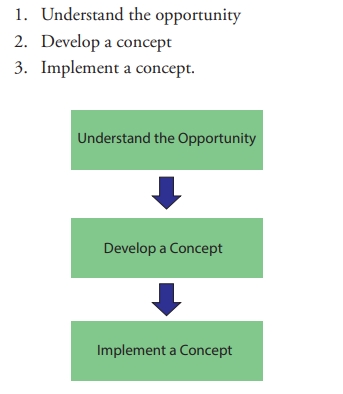
Soru 38
I. Creative: Creation of something that has not previously existed.
II. Choice: It is about coming to decisions on the concept solution to color or form.
III. Compromise: Design includes many decisions for a wide variety of parameters and elements such as shape, texture and color to materials.
Which of the above is correctly given regarding the four "Cs" of design?
II. Choice: It is about coming to decisions on the concept solution to color or form.
III. Compromise: Design includes many decisions for a wide variety of parameters and elements such as shape, texture and color to materials.
Which of the above is correctly given regarding the four "Cs" of design?
Seçenekler
A
Only I
B
Only II
C
I and II
D
II and III
E
I, II and III
Açıklama:
During the design process structures, systems and behaviours produce designs that satisfy the customer at low cost, that are easy to make and that appear in a short time. Walsh et al. (1992) identify four “Cs” of design:
Creativity: Creation of something that has not previously existed.
Complexity: Design includes many decisions for a wide variety of parameters and elements such as shape, texture and color to materials.
Compromise: It is a type of trade-off between some elements and features such
as performance and cost or weight and ease of use.
Choice: It is about coming to decisions on the concept solution to color or form.
Creativity: Creation of something that has not previously existed.
Complexity: Design includes many decisions for a wide variety of parameters and elements such as shape, texture and color to materials.
Compromise: It is a type of trade-off between some elements and features such
as performance and cost or weight and ease of use.
Choice: It is about coming to decisions on the concept solution to color or form.
Soru 39
"After discussions about the final design, agreed design is converted into detailed specifications. Some prototypes of the agreed design are produced and tested."
Which main stage of design process is described above?
Which main stage of design process is described above?
Seçenekler
A
Stimulus/trigger
B
Concept design
C
Concept development
D
Detailed design
E
Design specification
Açıklama:
Detailed design: After discussions about the final design, agreed design is converted into detailed specifications. Some prototypes of the agreed design are produced and tested.
Soru 40
In which phase of the product life cycle are costs low and
productivity high?
productivity high?
Seçenekler
A
Birth
B
Groth
C
Maturity
D
Renewal
E
Decline
Açıklama:
Maturity: When the product is mature, competition is high in the market. Although many changes are made during the introduction and growth phases, some minor changes can be made in the product design if necessary and costs are low and productivity is high in this phase.
Soru 41
Which of the following product-phase matchings is not true?
Seçenekler
A
3D TVs in the introduction phase
B
Blu Ray discs in the growth phase
C
DVD and flash disks in the maturity phase
D
Video cassette and floppy disc in the decline phase
E
Smart phones in the birth phase
Açıklama:
There are many products in different stages of the product life cycle in the market. The followings are some examples for them.
• 3D TVs in the introduction phase
• Blu Ray discs in the growth phase
• DVD and flash disks in the maturity phase
• Video cassette and floppy disc in the decline phase
• 3D TVs in the introduction phase
• Blu Ray discs in the growth phase
• DVD and flash disks in the maturity phase
• Video cassette and floppy disc in the decline phase
Soru 42
Which of the followings is not one of the essential activities and responsibilities of a product design?
Seçenekler
A
Reflect customer needs and requirements to product requirements
B
Increase the price of the product if it hits the market
C
Refine or modify current products
D
Translate product specifications into process specifications
E
Construct and test prototypes
Açıklama:
The followings are some of the essential activities and responsibilities of a product design:
• Reflect customer needs and requirements to product requirements
• Refine or modify current products
• Develop new products
• Formulate quality goals and cost targets
• Construct and test prototypes
• Document specifications
• Translate product specifications into process specifications.
• Reflect customer needs and requirements to product requirements
• Refine or modify current products
• Develop new products
• Formulate quality goals and cost targets
• Construct and test prototypes
• Document specifications
• Translate product specifications into process specifications.
Soru 43
Which of the followings belongs to implementing a concept phase?
Seçenekler
A
To develop a vision for a new product.
B
To make a market analysis
C
To design general market specifications for the product
D
To model and test the physical construction
E
To fulfill customer satisfaction
Açıklama:
Implement a concept: The selected concept takes a form through purchased
components, manufactured parts and assembled as a product. This is called
embodiment engineering. Embodiment involves modeling and testing of the
physical construction.
components, manufactured parts and assembled as a product. This is called
embodiment engineering. Embodiment involves modeling and testing of the
physical construction.
Soru 44
............ is the successful application of new ideas in practice in the form of new or improved products, processes.
Which of the following completes the sentence above?
Which of the following completes the sentence above?
Seçenekler
A
Creativity
B
Compromise
C
Innovation
D
Complexity
E
Design
Açıklama:
Innovation is the successful application of new ideas in practice in the form of new or improved products, processes.
Soru 45
In which stage of the design process does the design team explore the key strategic questions based on collected information?
Seçenekler
A
Stimulus/trigger
B
Sourcing design skills
C
Project planning
D
Detailed design
E
Concept development
Açıklama:
Concept development: The concept is elaborated and missing and incomplete
information is collected. The design team explores the key strategic questions based on collected information.
information is collected. The design team explores the key strategic questions based on collected information.
Soru 46
................ is the use of any automatic device or method that either makes it impossible for an error to occur or makes the error immediately obvious once it has occurred.
Which of the followings complete the sentence above?
Which of the followings complete the sentence above?
Seçenekler
A
Poka-Yoke
B
Standardization
C
Assembly chart
D
Orientation
E
Modularity
Açıklama:
Mistake proofing, or Poka-Yoke is the use of any automatic device or method that either makes it impossible for an error to occur or makes the error immediately obvious once it has occurred.
Soru 47
Which of the followings is the fifth step of building the house of quality?
Seçenekler
A
Identify customer needs and requirements
B
Determine importance ratings.
C
Identify how the goods will satisfy customer needs and requirements.
D
Identify relationships between the company’s hows
E
Evaluate competing product
Açıklama:
To build thehouse of quality, the following seven basic steps need to be followed:
1. Identify customer needs and requirements
2. Identify how the goods will satisfy customer needs and requirements.
3. Relate customer needs and requirements to product hows by building a matrix.
4. Identify relationships between the company’s hows.
5. Determine importance ratings.
6. Evaluate competing products.
7. Determine the desirable technical attributes, company’s attributes, and the competitor’s performanceagainst these attributes.
1. Identify customer needs and requirements
2. Identify how the goods will satisfy customer needs and requirements.
3. Relate customer needs and requirements to product hows by building a matrix.
4. Identify relationships between the company’s hows.
5. Determine importance ratings.
6. Evaluate competing products.
7. Determine the desirable technical attributes, company’s attributes, and the competitor’s performanceagainst these attributes.
Soru 48
When was the value analysis developed?
Seçenekler
A
1945
B
1946
C
1947
D
1948
E
1949
Açıklama:
Value analysis is also known as value engineering, is a design methodology developed by General Electric in 1947 that focuses on the function of the product, rather than on its structure or form.
Soru 49
In which processes are a high variety products in small batches with different processing requirements produced?
Seçenekler
A
Project processes
B
Flow processes
C
Make-to-order processes
D
Job-shop processes
E
Cellular processes
Açıklama:
Job-shop processes: Generally job shop operates on a relatively small scale. In jobshop processes a high variety products in small batches with different processing requirements are produced.
Ünite 4
Soru 1
- Large expenditure money and effort for the construction of facilities and no compensation for this
- The results of layout decisions covers a short period of time
- It significantly affects production efficiency and production cost.
Which of the above are the main reasons for facility layout decisions?
Seçenekler
A
Only 1
B
Only 2
C
Only 3
D
2 and 3
E
1 and 3
Açıklama:
Facility Layout decisions are very important for organizations. Although there are many reasons for this, three main reasons are as follows:
• Large expenditure of money and effort for the construction of facilities and no compensation for this.
• The result of layout decisions covers a long period. Therefore, it is very difficult to
overcome the mistakes to be made.
• The decision about facility layout significantly affects production efficiency and production cost.
• Large expenditure of money and effort for the construction of facilities and no compensation for this.
• The result of layout decisions covers a long period. Therefore, it is very difficult to
overcome the mistakes to be made.
• The decision about facility layout significantly affects production efficiency and production cost.
Soru 2
Facility layout planning is to decide how to place the physical production resources used in the transformation process such as .....
Which of the following is not suitable for the blank?
Which of the following is not suitable for the blank?
Seçenekler
A
Raw material
B
Financial resources
C
Labor
D
Machinery
E
Product
Açıklama:
Facility layout planning is to decide how to place the physical production resources used in the transformation process such as labor, machinery, raw material, product, intermediate product and personnel.
Soru 3
"Ergonomic factors such as noise, temperature and lighting should be considered in the layout planning".
This sentence is related to ..... target in the facility layout.
Which of the following fills the blank?
This sentence is related to ..... target in the facility layout.
Which of the following fills the blank?
Seçenekler
A
Safety
B
Flow of movement
C
Ease of communication
D
Comfort of employees
E
Space usage
Açıklama:
Comfort of employees: In the production process, it is necessary to ensure that the
working conditions of the personnel are appropriate. Ergonomic factors such as
noise, temperature and lighting should be considered in the layout planning.
working conditions of the personnel are appropriate. Ergonomic factors such as
noise, temperature and lighting should be considered in the layout planning.
Soru 4
"The product is not moved due to its structure and size. Instead, production resources are moved around the product".
Which types of layout belong to the above description?
Which types of layout belong to the above description?
Seçenekler
A
Fixed-position layouts
B
Process layouts
C
Product layouts
D
Cell layouts
E
Project layouts
Açıklama:
In a fixed--position facility, the product is not moved due to its structure and size. Instead, production resources are moved around the product.
Soru 5
- Parts are transported between workshops by flexible transport methods such as forklifts
- Hospitals can be given as an example of facilities where it is applied
Seçenekler
A
Fixed-position layouts
B
Process layouts
C
Product layouts
D
Cell layouts
E
Mass layouts
Açıklama:
In the process layout, parts are transported between workshops by flexible transport methods such as forklifts. Hospitals in the service sector can be given as examples of facilities where the process layout is applied.
Soru 6
- Production resources are designed for the purpose of high-speed production.
- Automation systems used to improve production speed and performance result in high installation costs.
- The process rate is faster as all the resources are ordered for efficient production.
Seçenekler
A
Fixed-position layouts
B
Process layouts
C
Product layouts
D
Cell layouts
E
Mass layouts
Açıklama:
The general characteristics of the product layout are summarized below.
• Production resources are designed for the purpose of high-speed production.
• Automation systems used to improve production speed and performance result in high installation costs.
• The process rate is faster as all the resources are ordered for efficient production.
• The arrangement of production resources according to the product, the proximity of the production lines to each other leads to lower material transportation costs compared to the process layout.
• The warehouse requirement for inventory is lower.
• Since all facilities and resources are customized for the production of certain products, there is no flexibility when a new product is added to the system or when substantial changes to the product are required.
• Production resources are designed for the purpose of high-speed production.
• Automation systems used to improve production speed and performance result in high installation costs.
• The process rate is faster as all the resources are ordered for efficient production.
• The arrangement of production resources according to the product, the proximity of the production lines to each other leads to lower material transportation costs compared to the process layout.
• The warehouse requirement for inventory is lower.
• Since all facilities and resources are customized for the production of certain products, there is no flexibility when a new product is added to the system or when substantial changes to the product are required.
Soru 7
What is the number of options in a plant with four workstations in the process layout?
Seçenekler
A
8
B
12
C
18
D
24
E
48
Açıklama:
The number of options in the process layout is calculated by the factorial of the number of workstations. 4! = 1x2x3x4 = 24 different options can be created in a plant with four workstations.
Soru 8
What is the cycle time of the tasks in the assembly line, which is intended to produce 400 products in 300 minutes?
Seçenekler
A
15
B
25
C
35
D
45
E
55
Açıklama:
C= Production Time/Required Output
C=300*60/400=45
C=300*60/400=45
Soru 9
Which of the following sentences is wrong?
Seçenekler
A
If the capacity is higher than demand, the unit cost of the product increases
B
If the capacity level is equal to or greater than the demand, it prevents loss of income
C
Quick response to customer demands can be made by underproduction
D
Making a production decision on stock to meet high demand will adversely affect working capital
E
A capacity plan that meets fluctuations in demand through the use of temporary personnel may adversely affect product or service quality
Açıklama:
Quick response to customer demands can be made by overproduction. Many customers want to get ready for the product instead of waiting for the product.
Soru 10
Which of the following is not one of the short- and medium-term capacity strategies?
Seçenekler
A
Stock
B
Labor level
C
Delay
D
Employee training
E
Forecast of future demand
Açıklama:
Determination of long term capacity needs is based on forecast of future demand. When companies need to make long-term forecasts, they examine patterns of long-term variability, such as trends.
Soru 11
Which of the following is not one of the basic approaches?
Seçenekler
A
Product Layouts
B
Fixed-position layouts
C
Customer Layouts
D
Process Layouts
E
Cell layouts
Açıklama:
Four basic approaches in this chapter are discussed.
• Fixed-position layouts
• Process Layouts
• Product Layouts
• Cell layouts
• Fixed-position layouts
• Process Layouts
• Product Layouts
• Cell layouts
Soru 12
Which of the following is an advantage of process layout?
Seçenekler
A
The automation of the transport system is possible.
B
The satisfaction of the staff is lower.
C
High setup times of the machines result in high productivity.
D
Production time is lower than other facility layout types.
E
The level of flexibility in the distribution of work is high.
Açıklama:
Advantages:
• Machine utilization rates are high and require fewer machines.
• Flexible use of production resources is possible.
• It requires lower investment costs.
• High utilization rate of its production facilities.
• The level of flexibility in the distribution of work is high.
• The satisfaction of the staff is higher.
• Machine utilization rates are high and require fewer machines.
• Flexible use of production resources is possible.
• It requires lower investment costs.
• High utilization rate of its production facilities.
• The level of flexibility in the distribution of work is high.
• The satisfaction of the staff is higher.
Soru 13
Which of the following characteristics of product layout is true?
Seçenekler
A
Product variety is high.
B
Product flexibility is high.
C
Production speed is high.
D
Material handling cost is high.
E
Stock area is high.
Açıklama:
Process Layout Characteristics Product Layout
High Product variety Low
General purpose Resource usage Specialized
Labor intensive Resources feature Technology intensive
High Product flexibility Low
Low Production speed High
High Material handling cost Low
Low Stock area Low
High Product variety Low
General purpose Resource usage Specialized
Labor intensive Resources feature Technology intensive
High Product flexibility Low
Low Production speed High
High Material handling cost Low
Low Stock area Low
Soru 14
Which of the following characteristics of process layout is true?
Seçenekler
A
Resource usage is specialized.
B
Resources feature is labour intensive.
C
Production speed is high.
D
Material handling cost is low.
E
Product variety is low.
Açıklama:
Process Layout Characteristics Product Layout
High Product variety Low
General purpose Resource usage Specialized
Labor intensive Resources feature Technology intensive
High Product flexibility Low
Low Production speed High
High Material handling cost Low
Low Stock area Low
High Product variety Low
General purpose Resource usage Specialized
Labor intensive Resources feature Technology intensive
High Product flexibility Low
Low Production speed High
High Material handling cost Low
Low Stock area Low
Soru 15
What is the second step of balancing an assembly line?
Seçenekler
A
Calculate for a day the cycle time of the required workstations using the following formula;
C = Production time
________________
Required output
C = Production time
________________
Required output
B
The order of relations between tasks is determined using the precedence diagram. The diagram consists of circles representing tasks and arrows showing the ordering between tasks.
C
Using the following formula, the minimum number of workstations sufficient for cycle time is theoretically determined. (The calculated value is rounded to an upper integer)
Nt =T(sum of task times)
____________________
C(cycle time)
Nt =T(sum of task times)
____________________
C(cycle time)
D
The primary and secondary rules are used for assigning tasks to the workstation. The primary rule allows the workstation to decide which task to start with and the second rule to decide which task to select first among multiple tasks. By applying these rules, a task is assigned to the workstation.
E
Tasks are assigned to the workstation so that the total duration of the tasks on the workstation does not exceed the cycle time.
Açıklama:
The steps to be followed for balancing an assembly line are listed below.
1. The order of relations between tasks is determined using the precedence diagram. The diagram consists of circles representing tasks and arrows showing the ordering between tasks.
2. Calculate for a day the cycle time of the required workstations using the following formula
C = Production time
________________
Required output
3. Using the following formula, the minimum number of workstations sufficient for cycle time is theoretically determined. (The calculated value is rounded to an upper integer)
Nt =T(sum of task times)
____________________
C(cycle time)
4. The primary and secondary rules are used for assigning tasks to the workstation. The primary rule allows the workstation to decide which task to start with and the second rule to decide which task to select first among multiple tasks. By applying these rules, a task is assigned to the workstation.
5. Tasks are assigned to the workstation so that the total duration of the tasks on the workstation does not exceed the cycle time. Repeat step 4 until all tasks are assigned to the workstations.
1. The order of relations between tasks is determined using the precedence diagram. The diagram consists of circles representing tasks and arrows showing the ordering between tasks.
2. Calculate for a day the cycle time of the required workstations using the following formula
C = Production time
________________
Required output
3. Using the following formula, the minimum number of workstations sufficient for cycle time is theoretically determined. (The calculated value is rounded to an upper integer)
Nt =T(sum of task times)
____________________
C(cycle time)
4. The primary and secondary rules are used for assigning tasks to the workstation. The primary rule allows the workstation to decide which task to start with and the second rule to decide which task to select first among multiple tasks. By applying these rules, a task is assigned to the workstation.
5. Tasks are assigned to the workstation so that the total duration of the tasks on the workstation does not exceed the cycle time. Repeat step 4 until all tasks are assigned to the workstations.
Soru 16
It is aimed to produce 1600 products in an assembly line that works 12 hours a day.
According to this information, how many seconds is the cycle time of the assembly line calculated?
According to this information, how many seconds is the cycle time of the assembly line calculated?
Seçenekler
A
25
B
26
C
32
D
27
E
29
Açıklama:
C= Production time = 12X60X60 =27
_____________ _________
Required output 1600
_____________ _________
Required output 1600
Soru 17
Which of the following decisions is true?
Seçenekler
A
If the capacity is lower than demand, the unit cost of the product increases.
B
If the capacity level is equal to or lower than the demand, it prevents loss of income.
C
Quick response to customer demands can be made by overproduction.
D
The balance between demand and capacity may make it possible to respond to unexpected increases in demand.
E
Making a production decision on stock to meet high demand will positively affect working capital.
Açıklama:
These decisions are closely related to cost, revenue, capital, quality, speed of meeting customer demand, dependability of supply and flexibility.
• Costs are affected by the balance between capacity and demand. If the capacity is higher than demand, the unit cost of the product increases.
• Revenues are also affected by the balance between capacity and demand. If the capacity level is equal to or greater than the demand, it prevents loss of income.
• Making a production decision on stock to meet high demand will adversely affect working capital. This decision will ensure that the demand is met but there will be no income inflow until the products are sold.
• A capacity plan that meets fluctuations in demand through the use of temporary personnel may adversely affect product or service quality. Employing inexperienced personnel increases error rates.
• Quick response to customer demands can be made by overproduction. Many
customers want to get ready for the product instead of waiting for the product.
• Dependability of supply is also affected by the close proximity of capacity and demand levels. This proximity makes it difficult to remedy disruptions in product or service deliveries.
• Flexibility, in particular volume flexibility, is closely related to excess capacity. The balance between demand and capacity may make it impossible to respond to unexpected increases in demand.
• Costs are affected by the balance between capacity and demand. If the capacity is higher than demand, the unit cost of the product increases.
• Revenues are also affected by the balance between capacity and demand. If the capacity level is equal to or greater than the demand, it prevents loss of income.
• Making a production decision on stock to meet high demand will adversely affect working capital. This decision will ensure that the demand is met but there will be no income inflow until the products are sold.
• A capacity plan that meets fluctuations in demand through the use of temporary personnel may adversely affect product or service quality. Employing inexperienced personnel increases error rates.
• Quick response to customer demands can be made by overproduction. Many
customers want to get ready for the product instead of waiting for the product.
• Dependability of supply is also affected by the close proximity of capacity and demand levels. This proximity makes it difficult to remedy disruptions in product or service deliveries.
• Flexibility, in particular volume flexibility, is closely related to excess capacity. The balance between demand and capacity may make it impossible to respond to unexpected increases in demand.
Soru 18
Which of the followings is an example for output measures?
Seçenekler
A
Number of beds
B
Generator size
C
Labor time per shift
D
Number of seats
E
Produced electric megawatts
Açıklama:
Input measures Output measures Number of beds Number of patients treated per week
Number of seats Number of customers watching movies per week
Labor time per shift Number of cars produced per shift
Generator size Produced electric megawatts
Production tank capacity Liters produced per week
Number of seats Number of customers watching movies per week
Labor time per shift Number of cars produced per shift
Generator size Produced electric megawatts
Production tank capacity Liters produced per week
Soru 19
Which of the following is not one of the short- and mediumterm capacity strategies?
Seçenekler
A
Stock
B
Employer training
C
Delay
D
Labor level
E
Process design
Açıklama:
Short- and mediumterm capacity strategies are listed below:
• Stock
• Delay
• Labor level
• Employee training
• Subcontractor use
• Process design
• Stock
• Delay
• Labor level
• Employee training
• Subcontractor use
• Process design
Soru 20
What does "a modeling tool used to evaluate independent decisions that must be made in sequence" stand for?
Seçenekler
A
Decision points
B
Decision options
C
Decision tree
D
Random events
E
Outputs
Açıklama:
Decision tree is a modeling tool used to evaluate independent decisions that must be made in sequence.
Soru 21
I. Large expenditure of Money and effort for the construction of facilities and no compensation for this.
II. The result of layout decisions covers a long period. Therefore, it is very difficult to overcome the mistakes to be made.
III. The decision about facility layout significantly affects production efficiency and production cost.
IV. Capacity planning is closely related to the competitiveness of enterprises.
Which of the above three are seen as the main reasons for the Facility Layout decisions for organizations?
II. The result of layout decisions covers a long period. Therefore, it is very difficult to overcome the mistakes to be made.
III. The decision about facility layout significantly affects production efficiency and production cost.
IV. Capacity planning is closely related to the competitiveness of enterprises.
Which of the above three are seen as the main reasons for the Facility Layout decisions for organizations?
Seçenekler
A
I, II, IV
B
I, II, III
C
II, III, IV
D
I, III, IV
E
I and II
Açıklama:
INTRODUCTION
Facility Layout decisions are very important for organizations. Although there are many reasons for this, three main reasons are as follows:
INTRODUCTION
Facility Layout decisions are very important for organizations. Although there are many reasons for this, three main reasons are as follows:
Facility Layout decisions are very important for organizations. Although there are many reasons for this, three main reasons are as follows:
- Large expenditure of Money and effort for the construction of facilities and no compensation for this.
- The result of layout decisions covers a long period. Therefore, it is very difficult to overcome the mistakes to be made.
- The decision about facility layout significantly affects production efficiency and production cost.
INTRODUCTION
Facility Layout decisions are very important for organizations. Although there are many reasons for this, three main reasons are as follows:
- Large expenditure of Money and effort for the construction of facilities and no compensation for this.
- The result of layout decisions covers a long period. Therefore, it is very difficult to overcome the mistakes to be made.
- The decision about facility layout significantly affects production efficiency and production cost.
Soru 22
Although the targets in the facility layout may differ according to the strategic plans of the enterprises, Which of the following is not included among the basic targets that apply to all systems in the efficient and safe execution of the production process?
Seçenekler
A
Security and flow of production
B
Safety and Flow of movement
C
Comfort of employees and Ease of communication
D
Access and Space usage
E
Flexibility and Bottlenecks
Açıklama:
FACILITY LAYOUT
Although the targets in the facility layout may differ according to the strategic plans of the enterprises, there are basic targets that apply to all systems in the efficient and safe execution of the production process.
FACILITY LAYOUT
Although the targets in the facility layout may differ according to the strategic plans of the enterprises, there are basic targets that apply to all systems in the efficient and safe execution of the production process.
Although the targets in the facility layout may differ according to the strategic plans of the enterprises, there are basic targets that apply to all systems in the efficient and safe execution of the production process.
- Safety
- Flow of movement
- Comfort of employees
- Ease of communication
- Access
- Space usage
- Flexibility
- Bottlenecks
FACILITY LAYOUT
Although the targets in the facility layout may differ according to the strategic plans of the enterprises, there are basic targets that apply to all systems in the efficient and safe execution of the production process.
- Safety
- Flow of movement
- Comfort of employees
- Ease of communication
- Access
- Space usage
- Flexibility
- •Bottlenecks
Soru 23
In facility layout planning which of the following is not used as one of the main approaches?
Seçenekler
A
Fixed-position layouts
B
Process Layouts
C
Circular moving layouts
D
Product Layouts
E
Cell layouts
Açıklama:
TYPES OF FACILITY LAYOUTS
Facility layout planning is the decision to determine the location of machines in a manufacturing facility, the location of tables and office machines in an office, and the locations of polyclinics in a hospital. An effective layout plan means the best flow of materials, people and information between departments. In order to achieve this aim, different approaches have been developed according to production processes and characteristics. Four basic approaches in this chapter are discussed.
TYPES OF FACILITY LAYOUTS
Facility layout planning is the decision to determine the location of machines in a manufacturing facility, the location of tables and office machines in an office, and the locations of polyclinics in a hospital. An effective layout plan means the best flow of materials, people and information between departments. In order to achieve this aim, different approaches have been developed according to production processes and characteristics. Four basic approaches in this chapter are discussed.
Facility layout planning is the decision to determine the location of machines in a manufacturing facility, the location of tables and office machines in an office, and the locations of polyclinics in a hospital. An effective layout plan means the best flow of materials, people and information between departments. In order to achieve this aim, different approaches have been developed according to production processes and characteristics. Four basic approaches in this chapter are discussed.
- Fixed-position layouts
- Process Layouts
- Product Layouts
- Cell layouts
TYPES OF FACILITY LAYOUTS
Facility layout planning is the decision to determine the location of machines in a manufacturing facility, the location of tables and office machines in an office, and the locations of polyclinics in a hospital. An effective layout plan means the best flow of materials, people and information between departments. In order to achieve this aim, different approaches have been developed according to production processes and characteristics. Four basic approaches in this chapter are discussed.
- Fixed-position layouts
- Process Layouts
- Product Layouts
- Cell layouts
Soru 24
Which of the following cannot be counted among the advantages of the process layoutwhich is listed below?
Seçenekler
A
Machine utilization rates are high and require fewer machines.
B
Flexible use of production resources is possible.
C
It requires lower investment costs.
D
The satisfaction of the consumers is higher.
E
The level of flexibility in the distribution of work is high.
Açıklama:
Process Layouts
The advantages of the process layout are listed below.
• The satisfaction of the staff is higher.
Process Layouts
The advantages of the process layout are listed below.
The advantages of the process layout are listed below.
- Machine utilization rates are high and require fewer machines.
- Flexible use of production resources is possible.
- It requires lower investment costs.
- High utilization rate of its production facilities.
- The level of flexibility in the distribution of work is high.
• The satisfaction of the staff is higher.
Process Layouts
The advantages of the process layout are listed below.
- Machine utilization rates are high and require fewer machines.
- Flexible use of production resources is possible.
- It requires lower investment costs.
- High utilization rate of its production facilities.
- The level of flexibility in the distribution of work is high.
- The satisfaction of the staff is higher.
Soru 25
Which of the following cannot be counted among the limitations of the process layout which is listed below?
Seçenekler
A
Long routes increase the amount of transport.
B
The automation of the transport system is not possible.
C
High setup times of the machines result in low productivity.
D
Production time is higher than other facility layout types.
E
Excess demand for the products causes product price to increase.
Açıklama:
Process Layouts
The limitations of the process layout are listed below.
Process Layouts
The limitations of the process layout are listed below.
The limitations of the process layout are listed below.
- Long routes increase the amount of transport.
- The automation of the transport system is not possible.
- High setup times of the machines result in low productivity.
- Production time is higher than other facility layout types.
- Excess stocks in the production area cause a waste of space and capital.
Process Layouts
The limitations of the process layout are listed below.
- Long routes increase the amount of transport.
- The automation of the transport system is not possible.
- High setup times of the machines result in low productivity.
- Production time is higher than other facility layout types.
- Excess stocks in the production area cause a waste of space and capital.
Soru 26
Which of the following is not listed among the general characteristics of the product layout?
Seçenekler
A
Production resources are designed for the purpose of high-speed production.
B
Technology investments result in high installation costs.
C
The process rate is faster as all the resources are ordered for efficient production.
D
The arrangement of production resources according to the product, the proximity of the production lines to each other leads to lower material transportation costs compared to the process layout.
E
The warehouse requirement for inventory is lower.
Açıklama:
Product Layouts
The general characteristics of the product layout are summarized below.
•Since all facilities and resources are customized for the production of certain products, there is no flexibility when a new product is added to the system or when substantial changes to the product are required.
Product Layouts
The general characteristics of the product layout are summarized below.
The general characteristics of the product layout are summarized below.
- Production resources are designed for the purpose of high-speed production.
- Automation systems used to improve production speed and performance result in high installation costs.
- The process rate is faster as all the resources are ordered for efficient production.
- The arrangement of production resources according to the product, the proximity of the production lines to each other leads to lower material transportation costs compared to the process layout.
- The warehouse requirement for inventory is lower.
•Since all facilities and resources are customized for the production of certain products, there is no flexibility when a new product is added to the system or when substantial changes to the product are required.
Product Layouts
The general characteristics of the product layout are summarized below.
- Production resources are designed for the purpose of high-speed production.
- Automation systems used to improve production speed and performance result in high installation costs.
- The process rate is faster as all the resources are ordered for efficient production.
- The arrangement of production resources according to the product, the proximity of the production lines to each other leads to lower material transportation costs compared to the process layout.
- The warehouse requirement for inventory is lower.
Soru 27
What is the advantages of using the cell layout, also called hybrid layout?
Seçenekler
A
applies the advantages of output layout only,
B
applies the advantages of process layout only,
C
applies the advantages of both product layout and output layout together,
D
applies the advantages of both product layout and process layout together,
E
applies the advantages of product layout only,
Açıklama:
Cell Layouts
The cell layout, also called hybrid layout, is the layout that applies the advantages of both product layout and process layout together. In the cell layout, it is possible to process product groups formed by similar geometry or similar methods in the same section. Machines with different functions are used to produce a group of products together in a cell. In this way, each cell benefits from the advantages of the product layout when forming a production line. The simultaneous operation of more than one cell also means the flexibility of the process layout.
The cell layout, also called hybrid layout, is the layout that applies the advantages of both product layout and process layout together. In the cell layout, it is possible to process product groups formed by similar geometry or similar methods in the same section. Machines with different functions are used to produce a group of products together in a cell. In this way, each cell benefits from the advantages of the product layout when forming a production line. The simultaneous operation of more than one cell also means the flexibility of the process layout.
Soru 28
Which of the following pairs are important criteria for the selection of facility layout type?
Seçenekler
A
volume and variety,
B
volume and varsity,
C
varsity and variety,
D
volume and speed,
E
speed and variety,
Açıklama:
DESIGNING FACILITY LAYOUTS
The number of products produced (volume) and the number of different products (variety) are important criteria for the selection of facility layout type.
The number of products produced (volume) and the number of different products (variety) are important criteria for the selection of facility layout type.
Soru 29
The number of options in the process layout is calculated by which of the following method?
Seçenekler
A
the multiply of the number of workstations with eachother,
B
the double of the number of workstations,
C
the factorial of the number of workstations,
D
the sum of the number of workstations,
E
the number of workstations minus 1,
Açıklama:
Process Layout Design
The number of options in the process layout is calculated by the factorial of the number of workstations. For example, 5! = 1x2x3x4x5 = 120 different options can be created in a plant with five workstations.
The number of options in the process layout is calculated by the factorial of the number of workstations. For example, 5! = 1x2x3x4x5 = 120 different options can be created in a plant with five workstations.
Soru 30
Which of the following statement is correct for the Production flow analysis?
Seçenekler
A
It allows only the parts to be analyzed,
B
It allows the parts to be analyzed and grouped to similarities,
C
It allows the parts to be grouped,
D
It allows the parts to be grouped to similarities,
E
It allows the parts to be analyzed and reported,
Açıklama:
Cell Layout Design
Production flow analysis allows the parts to be analyzed and grouped to similarities.
Production flow analysis allows the parts to be analyzed and grouped to similarities.
Ünite 5
Soru 1
Which of the following terms refers to the quantity of an item ordered for delivery on a specific date or manufactured in a single production run?
Seçenekler
A
Inventory
B
Lot size
C
Abc analysis
D
Economic order quantity
E
Inventory management
Açıklama:
Lot size refers to the quantity of an item ordered for delivery on a specific date or manufactured in a single production run.
Soru 2
Which term refers to a process designed to track the remaining inventory of an item each time when a withdrawal is made to determine whether it is time to reorder?
Seçenekler
A
Continuous review system
B
Material requirements planning
C
Safety stock
D
Lot size
E
Lead time
Açıklama:
Continuous review system refers to a process designed to track the remaining inventory of an item each time when a withdrawal is made to determine whether it is time to reorder.
Soru 3
In which system the inventory level is controlled at the beginning or end of predetermined time intervals?
Seçenekler
A
Continuous review system
B
Two-bin system
C
Material requirement planning
D
Fixed order system
E
Periodic review system
Açıklama:
In periodic review system, the inventory level is controlled at the beginning or end of predetermined time intervals.
Soru 4
Which of the terms below refers to the review of inventory levels by the experienced worker individually on the place of the inventory?
Seçenekler
A
Continuous review system
B
Periodical review system
C
Lead time
D
Visual control
E
Economic order quantity
Açıklama:
Visual control, is a simple and practical method that is widely used in small businesses or markets. In this method, inventory levels are periodically reviewed by an experienced warehouse officer. Order items that fall below a certain level are immediately ordered. The level of order and the order quantity are entirely left to the official’s experience.
Soru 5
I. Why to order?
II. When to order?
III. How much to order?
Which of the questions above does material requirement system try to answer?
II. When to order?
III. How much to order?
Which of the questions above does material requirement system try to answer?
Seçenekler
A
Only I
B
Only II
C
Only III
D
I and III
E
II and III
Açıklama:
Material Requirement Planning (MRP) is a system that regulates production plans for final product’s production decisions, control of inventory levels of raw materials and parts, and programs of workshop and assembly unit. MRP is a method that tries to find the most economical answer to the questions of “when to order” and “how much to order” for dependent inventory items.
Soru 6
Which aspect about material requirement planning below is FALSE?
Seçenekler
A
Ordering up to actual requirement
B
No demand for lead time
C
History based demand
D
Quantity and time-based system
E
Safety stock for the final products
Açıklama:
Aspects of material requirement planing are as follows:
- Dependent demand
- Ordering up to actual requirement
- For product
- Discrete demand
- Known demand behavior
- No demand for lead time
- Order is based on requirement and time
- Demand due to future production
- Estimation of the items in the master production
- Quantity and time-based system
- Safety stock for the final products
Soru 7
Which is FALSE about successful implementation of the MRP system?
Seçenekler
A
Supply sources should be reliable.
B
The smallest failure in the supply can cause the entire production to stop.
C
MRP can be applied without the use of information technologies.
D
Supply sources should be punctual.
E
All employees such as operator, analyst, purchasing agent, planner, quality controller, must be fully trained in the updating of the system.
Açıklama:
The three important factors for successful implementation of the MRP system are:
- Supply sources should be reliable and punctual. Since the delay allowances are too small, the smallest failure in the supply can cause the entire production to stop.
- MRP requires a great deal of information and processing capacity. For this reason, MRP application is not possible without computer and other information technologies.
- All employees such as operator, analyst, purchasing agent, planner, quality controller, must be fully trained in the updating of the system.
Soru 8
What is the sum of the cost of capital plus the variable costs of keeping items on hand, such as storage and handling costs and taxes, insurance, and shrinkage costs called?
Seçenekler
A
Shortage cost
B
Inventory holding cost
C
Order cost
D
Pareto
E
Kanban
Açıklama:
Inventory holding cost (H): Costs are arising due to inventory holding. Inventory holding cost is the sum of the cost of capital plus the variable costs of keeping items on hand, such as storage and handling costs and taxes, insurance, and shrinkage costs. When these components change with inventory levels, so does the holding cost.
Soru 9
Which of the statements about the underlying assumptions for the EOQ model is TRUE?
Seçenekler
A
The demand rate for the year is known.
B
The order quantity (Q) is temporary.
C
The lead time is fluctuating.
D
The cost of ordering depends on order quantity.
E
Orders are delivered at different times.
Açıklama:
Following are the underlying assumptions for the EOQ model. • The demand rate for the product (D) is constant and uniform throughout the entire planning horizon. • The order quantity (Q) is constant. • The demand rate for the year is known and evenly spread throughout the year. The product price is constant for the entire planning period. • The lead time is not fluctuating. • The average inventory level is taken into account when calculating the cost of holding. • The cost of ordering is constant and independent from order quantity. • All the demand in the planning period must be met. • All orders are delivered simultaneously.
Soru 10
What a minority of inputs resulting in the majority of outputs is called?
Seçenekler
A
Inventory
B
Kanban
C
Lot size
D
Pareto
E
Lead-time
Açıklama:
Pareto principle can be interpreted as that a minority of inputs (around 20 percent of the input) results in the majority of outputs (around 80 percent of the output).
Soru 11
What does "the process of ordering, storing, and using a company’s inventory" stand for?
Seçenekler
A
Inventory management
B
Production
C
Lot size
D
Continuous Review System
E
Safety Stock
Açıklama:
Inventory management refers to the process of ordering, storing, and using a company’s inventory.
Soru 12
Which of the following is not necessary to be met in inventory control?
Seçenekler
A
Desired time
B
Desired location
C
Desired quantity
D
Desired quality
E
Desired color
Açıklama:
The purpose of inventory control is to ensure that the material requirements are met at the “desired time”, at the “desired quantity”, at the “desired location” and at the “desired quality”. In order to achieve this goal, it is necessary to determine “which materials” are to be stocked and to decide “what amount of inventory” is to be kept.
Soru 13
What does "a system designed to track the remaining inventory of an item each time when a withdrawal is made to determine whether it is time to reorder" stand for?
Seçenekler
A
Material requirements planning
B
Two-bin system
C
Continuous review system
D
Periodic review system
E
Safety stock for all items
Açıklama:
Continuous Review System: A system designed to track the remaining inventory of an item each time when a withdrawal is made to determine whether it is time to reorder.
Soru 14
What does "the review of inventory levels by the experienced worker individually on the place of the inventory" stand for?
Seçenekler
A
Lead Time
B
Visual Control
C
Order Quantity
D
Inventory Level
E
Final Product
Açıklama:
Visual control is the review of inventory levels by the experienced worker individually on the place of the inventory.
Soru 15
Which of the following is not one of the contributions of the MRP system to the provision of effective inventory management?
Seçenekler
A
Inventory investments are kept in a minimum level
B
MRP creates a forward-looking perspective based on inventory items
C
Order quantities are determined according to the requirements
D
It focuses on the timing and complete fulfillment of requirements
E
The MRP system is open to gradual changes
Açıklama:
The MRP system contributes to the provision of effective inventory management at the following points:
• Inventory investments are kept in a minimum level.
• The MRP system is sensitive to changes.
• MRP creates a forward-looking perspective based on inventory items.
• Order quantities are determined according to the requirements.
• It focuses on the timing and complete fulfillment of requirements.
• Inventory investments are kept in a minimum level.
• The MRP system is sensitive to changes.
• MRP creates a forward-looking perspective based on inventory items.
• Order quantities are determined according to the requirements.
• It focuses on the timing and complete fulfillment of requirements.
Soru 16
Which of the following is not one of the wastes determined by Toyota?
Seçenekler
A
Inventory
B
Motion
C
Transport
D
Under-processing
E
Defects
Açıklama:
The seven wastes that causes the costs to increase were determined by Toyota, the developer of the lean production system, as follows:
1. Overproduction
2. Transport
3. Inventory
4. Motion
5. Defects
6. Over-processing
7. Waiting
1. Overproduction
2. Transport
3. Inventory
4. Motion
5. Defects
6. Over-processing
7. Waiting
Soru 17
Where was Lean Enterprise Institute founded?
Seçenekler
A
Japan
B
USA
C
Korea
D
UK
E
Swedan
Açıklama:
Lean Enterprise Institute (LEI) (http://www.lean.org/), is a nonprofit publication-training and research organization founded in the United States in 1997 to promote a broad range of lean thinking principles from production to service sectors and in all aspects of business.
Soru 18
What does H stand for among the variables used in the EOQ model?
Seçenekler
A
Annual interest rate
B
Purchasing price per unit
C
Annual cost of holding per unit
D
Order quantity
E
Ordering cost per batch
Açıklama:
The variables used in the EOQ model are as follows:
D = Annual demand (unit/year)
C = Purchasing price per unit (T/unit)
A = Ordering cost per batch (T/batch)
i = Annual interest rate (%)
H = Annual cost of holding per unit (T/unit-year)
Q = Order quantity (unit)
D = Annual demand (unit/year)
C = Purchasing price per unit (T/unit)
A = Ordering cost per batch (T/batch)
i = Annual interest rate (%)
H = Annual cost of holding per unit (T/unit-year)
Q = Order quantity (unit)
Soru 19
Which of the following is one of the differences between barcode scanner and RFID?
Seçenekler
A
A barcode scanner uses small microchips
B
A barcode scanner will pick up on the signals coming from all of the microchips
C
An RFID needs to scan each unit individually
D
RFID use barcodes printed on pieces of paper
E
With RFID technology, the task of controlling inventory is made much easier and faster.
Açıklama:
Also known as RFID, such systems make inventory control very easy. Both RFID technology and barcode technology involve the
scanning of products in order to enter them into the system. The main difference between the two is that barcode systems use barcodes printed on pieces of paper, which are then stuck on the products, while RFID uses small microchips that are either placed on a tag attached to the product or on the packaging of the product itself.
Another major difference is the bandwidth of the two technologies. A barcode scanner needs to scan each unit individually for it to be entered into the system. An RFID reception device, on the other hand, will pick up on the signals coming from all of the microchips within a given radius. With RFID technology, the task of controlling inventory is made much easier and faster.
scanning of products in order to enter them into the system. The main difference between the two is that barcode systems use barcodes printed on pieces of paper, which are then stuck on the products, while RFID uses small microchips that are either placed on a tag attached to the product or on the packaging of the product itself.
Another major difference is the bandwidth of the two technologies. A barcode scanner needs to scan each unit individually for it to be entered into the system. An RFID reception device, on the other hand, will pick up on the signals coming from all of the microchips within a given radius. With RFID technology, the task of controlling inventory is made much easier and faster.
Soru 20
Which of the following can be considered as the cost of opportunity loss?
Seçenekler
A
Shortage cost
B
Inventory holding cost
C
Order cost
D
Total Cost
E
Minimum
Cost
Cost
Açıklama:
A large part of this cost arises from cost of investment tied to the inventory. This cost can be considered as the cost of opportunity loss which is the result of the deprivation of loan interest or other investments that could have been done with this money.
Ünite 6
Soru 1
"______ is an integrated series of planning techniques developed to ensure the efficient use of all resources such as materials, machinery, money and people."
What is the term that defines the statement?
What is the term that defines the statement?
Seçenekler
A
ERP
B
MRP II
C
MRP
D
APICS
E
MPC
Açıklama:
MRP II is an integrated series of planning techniques developed to ensure the efficient use of all resources such as materials, machinery, money and people. The right option is "B".
Soru 2
I.It ensures that the numbers generated at the time of the transaction are reflected in the financial system. II.It gives the opportunity to examine the results of different master production schedules or different policies with what-if analysis. III. It is a system that integrates basic components of planning and controlsuch as sales, products, inventories, business centers, production schedules, cash flows and so on. VI. It is a very useful system for the companies that assemble mixed materials and companies that want to make the material priorities and capacity control in the best way. What are the basic features of MRP II according to Wight?
Seçenekler
A
I,II,III
B
I and II
C
I,II,III,IV
D
III and IV
E
I,II,IV
Açıklama:
MRP is a very useful system for the companies that assemble mixed materials and companies that want to make the material priorities and capacity control in the best way. The other choices are about MRP II. The right choice is "A".
Soru 3
After the MRP, a more efficient system was developed in order to overcome some of the inadequacies of MRP. With it companies were able to answer additional questions such as: “Is there enough capacity for the orders received?” and “Which resources are the bottleneck resources?”.
According to the given information what is the name of this efficient system?
According to the given information what is the name of this efficient system?
Seçenekler
A
Manufacturing Resource Planning (MRP II)
B
Closed Loop MRP (CLMRP)
C
Master Production Schedule (MPS)
D
Enterprise Resource Planning (ERP)
E
Supply Chain Management (SCM)
Açıklama:
After the MRP, a more efficient system called “Closed Loop MRP” (CL-MRP) was developed in order to overcome some of the inadequacies of MRP. With CLMRP companies were able to answer additional questions such as: “Is there enough capacity for the orders received?” and “Which resources are the bottleneck resources?”. The right option is "B".
Soru 4
"With the intense competition in the 1990s, the need to expand to international markets has created the need for integration across the international firms for the enterprises that are central to different geographical regions. Thus, a new need for information technology has emerged." According to the given information what is the new concept which emerged?
Seçenekler
A
Manufacturing resource planning (MRP II)
B
Master Production Schedule (MPS)
C
Enterprise Resource Planning (ERP)
D
Supply Chain Management (SCM)
E
Customer Relationship Management (CRM)
Açıklama:
With the strong changes in the market, technological developments and the orientation towards the institutionalization of the organizational structure of the companies, a new concept, Enterprise Resource Planning (ERP), has emerged. The right choice is "C".
Soru 5
Which option shows the chronological order of the transformation process in time ?
Seçenekler
A
MRP - CLMRP - MRP II - ERP - ERP ?
B
CLMRP - MRP - MRP II - ERP ? - ERP
C
ERP ?- ERP -CLMRP - MRP - MRP II
D
MRP - MRP II - ERP - ERP ? - CLMRP
E
ERP ? - MRP - ERP - MRP II - CLMRP
Açıklama:
The chronological order of this transformation process is shown in option "A".
Soru 6
"_______ is the process of planning the amount and timing of output in the medium to long term by regulating production speed, workforce size, inventory and other controllable resources."
Which MRP II module is mentioned above?
Which MRP II module is mentioned above?
Seçenekler
A
Master Production Schedule
B
Rough Cut Capacity Planning
C
Material Requirements Planning
D
Capacity Requirements Planning
E
Production and Sales Planning
Açıklama:
Production and sales planning is the process of planning the amount and timing of output in the medium to long term by regulating production speed, workforce size, inventory and other controllable resources "E".
Soru 7
I. To keep customer satisfaction as high as possible.
II. To ensure the best use of material, labor and production tools.
III.To consider customer orders.
IV. To keep the level of investment in the material at the desired level.
V.To consider sales forecasts.
Which of the above show the purpose of the master production schedule?
II. To ensure the best use of material, labor and production tools.
III.To consider customer orders.
IV. To keep the level of investment in the material at the desired level.
V.To consider sales forecasts.
Which of the above show the purpose of the master production schedule?
Seçenekler
A
I,II,IV
B
III and V
C
I,III,IV
D
I,II,III,IV,V
E
II,IV,V
Açıklama:
The purpose of the master production schedule;
- To keep customer satisfaction as high as possible. To do so, balance product stock levels and delivery dates to customers.
- To ensure the best use of material, labor and production tools.
- To keep the level of investment in the material at the desired level.
- Sales forecasts
- Customer orders
Soru 8
What is used to prepare work orders that detail the daily activities of workers?
Seçenekler
A
PSP outputs
B
MRP outputs
C
BOM outputs
D
MPS output
E
CRP outputs
Açıklama:
Work orders that detail the daily activities of workers are prepared using MRP outputs.The right choice is "B".
Soru 9
I.Gross Requirement
II.Scheduled receipt
III.Projected inventory
IV.Net Requirement
V.Planned receipts
VI.Planned order release
How can the basic concepts used in MRP operations can be defined?
II.Scheduled receipt
III.Projected inventory
IV.Net Requirement
V.Planned receipts
VI.Planned order release
How can the basic concepts used in MRP operations can be defined?
Seçenekler
A
I,II,III,IV
B
II,IV,V,VI
C
I,II,III,IV,V,VI
D
I,III,VI
E
I,II,III,IV,V
Açıklama:
The basic concepts used in MRP operations can be defined as follows:
I.Gross Requirement
II.Scheduled receipt
III.Projected inventory
IV.Net Requirement
V.Planned receipts
VI.Planned order release
The right choice is "C".
I.Gross Requirement
II.Scheduled receipt
III.Projected inventory
IV.Net Requirement
V.Planned receipts
VI.Planned order release
The right choice is "C".
Soru 10
- What is the best way to ship a product to a specific customer?
- What is the optimal production plan?
- How much product should ship to specific intermediaries?
- How can outbound and inbound transportation costs be minimized?
Seçenekler
A
ASP
B
ERP
C
MRP II
D
APICS
E
SCM
Açıklama:
SCM system is designed to improve decision making in the supply chain. It helps answer such questions as:
- What is the best way to ship a product to a specific customer?
- What is the optimal production plan?
- How much product should ship to specific intermediaries?
- How can outbound and inbound transportation costs be minimized?
Soru 11
When was the MRP concept introduced to the business world?
Seçenekler
A
1960
B
1961
C
1962
D
1963
E
1964
Açıklama:
In 1960, the MRP concept was introduced to the business world, as IBM launched the first economic computer that commercial enterprises could own.
Soru 12
Which of the following enterprise resource planning systems emerged after CL-MRP?
Seçenekler
A
MRP
B
MRP II
C
ERP
D
ERP II
E
SCM
Açıklama:
MRP CLMRP MRP II ERP ERP ?
1960’s 1970’s 1980’s 1990’s 2000’s 2010’s
1960’s 1970’s 1980’s 1990’s 2000’s 2010’s
Soru 13
Which of the following is NOT one of the purposes of the master production schedule?
Seçenekler
A
To keep customer satisfaction as high as possible
B
To balance product stock levels and delivery dates to customers
C
To ensure the best use of material, labor and production tools
D
To promote the staff who are in charge of this process
E
To keep the level of investment in the material at the desired level
Açıklama:
The purpose of the master production schedule;
• To keep customer satisfaction as high as possible. To do so, balance product stock levels and delivery dates to customers.
• To ensure the best use of material, labor and production tools.
• To keep the level of investment in the material at the desired level.
• To keep customer satisfaction as high as possible. To do so, balance product stock levels and delivery dates to customers.
• To ensure the best use of material, labor and production tools.
• To keep the level of investment in the material at the desired level.
Soru 14
Which of the following is a transformed form of the master production schedule into workloads?
Seçenekler
A
MRP
B
MPS
C
RCCP
D
ERP
E
CL-MRP
Açıklama:
Rough cut capacity planning (RCCP) is the approach of roughly estimating and determining the required level of capacity problems in order to realize the master production schedule. It can also be considered as a transformed form of the master production schedule into workloads.
Soru 15
Which of the following is NOT one of the basic concepts used in MRP operations?
Seçenekler
A
Planned order release
B
Scheduled receipt
C
Gross Requirement
D
Net Requirement
E
Projected customers
Açıklama:
The basic concepts used in MRP operations can be defined as follows:
• Gross Requirement
• Scheduled receipt
• Projected inventory
• Net Requirement
• Planned receipts
• Planned order release
• Gross Requirement
• Scheduled receipt
• Projected inventory
• Net Requirement
• Planned receipts
• Planned order release
Soru 16
What does "the purchase order quantity for the materials to be purchased and the production work order amounts for the materials to be produced" stand for?
Seçenekler
A
Total cost
B
Batch size
C
Gross requirements
D
Material cost
E
Manufacturing cost
Açıklama:
The concept of batch size refers to the purchase order quantity for the materials to be purchased and the production work order amounts for the materials to be produced.
Soru 17
What does " an information system designed to integrate internal and external members of the supply chain" stand for?
Seçenekler
A
ERP
B
MPS
C
MRP
D
FPQ
E
LTC
Açıklama:
Enterprise resource planning (ERP) is an information system designed to integrate internal and external members of the supply chain.
Soru 18
What does " a record that shows which operations the part will go through in the factory in order for a production to take place" stand for?
Seçenekler
A
Order
B
Route
C
Cost
D
Balance
E
Period
Açıklama:
The route is a record that shows which operations the part will go through in the factory in order for a production to take place.
Soru 19
Which of the following categories does Field Service belong to?
Seçenekler
A
Manufacturing
B
Accounting and Finance
C
Customer Service
D
Supply Chain Management
E
Human Resources
Açıklama:
Customer Service
• Field service
• Quality
• Field service
• Quality
Soru 20
What does Application Service Provider do?
Seçenekler
A
Sets up the framework and operates it for the organization
B
Organizes the orders and categorize them
C
Designs the new plant and manufactures the systems
D
Examines the utilization levels of existing or planned facilities
E
Determines the parts that are in the process
Açıklama:
The ERP provider is commonly called as an Application Service Provider (ASP).TheASPsetsup the framework and operates it for the organization.
Soru 21
Choose the option that completes the following sentence correctly.
"Manufacturing Resource Planning is mentioned in the literature with the abbreviation MRP II to avoid confusion with the .........."
"Manufacturing Resource Planning is mentioned in the literature with the abbreviation MRP II to avoid confusion with the .........."
Seçenekler
A
Material Requirements Planning
B
Management Redistribution Planning
C
Manufacture and Restructuring Planning
D
Minimized Revenue Planning
E
Malfunction Resource Planning
Açıklama:
Manufacturing Resource Planning is mentioned in the literature with the abbreviation MRP II to avoid confusion with the Material Requirements Planning.
Soru 22
Choose the option that completes the following sentence correctly.
"The MRP II system is followed by a .......... approach."
"The MRP II system is followed by a .......... approach."
Seçenekler
A
circular
B
top-down
C
horizontal
D
bottom-up
E
superficial
Açıklama:
The MRP II system is followed by a top-down approach.
Soru 23
Choose the option that completes the following sentence correctly.
".......... is a computerized information system developed specifically to help manufacturers manage dependent demand inventory and schedule replenishment orders."
".......... is a computerized information system developed specifically to help manufacturers manage dependent demand inventory and schedule replenishment orders."
Seçenekler
A
Manufactoring Resource Planning
B
Production and Inventory Control System
C
Material Requirements Planning
D
Master Production Scheduling
E
Demand Management
Açıklama:
Material Requirements Planning is a computerized information system developed specifically to help manufacturers manage dependent demand inventory and schedule replenishment orders.
Soru 24
Which of the following is an MRP system that includes production planning, master production scheduling, and capacity requirements planning?
Seçenekler
A
Manufacturing order
B
Open-loop MRP
C
Purchasing order
D
Master capacity planning
E
Closed-loop MRP
Açıklama:
Closed-loop MRP is an MRP system that includes production planning, master production scheduling, and capacity requirements planning.
Soru 25
Which of the following concepts chronologically followed MRP and MRP II?
Seçenekler
A
CL-MRP (CLosed-loop MRP)
B
ERP (Enterprie Resource Planning)
C
CRP (Capacity Requirement Planning)
D
MPS (Master Production Scheduling)
E
SOP (sales and Operations Planning)
Açıklama:
ERP (Enterprie Resource Planning) chronologically followed MRP and MRP II.
Soru 26
Which of the following is the process of planning the amount and timing of output in the medium to long term by regulating production speed, workforce size, inventory and other controllable resources?
Seçenekler
A
Master Production Schedule
B
Estimated Demand Planning
C
Production and Sales Planning
D
Production Quantity Schedule
E
Enterprise Manufacture Planning
Açıklama:
Production and Sales Planning is the process of planning the amount and timing of output in the medium to long term by regulating production speed, workforce size, inventory and other controllable resources.
Soru 27
Which of the following is a plan that details how many end items will be produced within specified periods of time?
Seçenekler
A
Capacity Requirement Planning
B
Material Requirement Planning
C
Rough-cut Planning
D
Master Production Schedule
E
Purchase Order System
Açıklama:
Master Production Schedule is a plan that details how many end items will be produced within specified periods of time.
Soru 28
Which of the following is the approach of roughly estimating and determining the required level of capacity problems in order to realize the master production schedule?
Seçenekler
A
Master Production Schedule
B
Rough Cut Capacity Planning
C
Closed Cut Production Planning
D
Rough Loop Production Schedule
E
Rough Sales Forecast Capacity Schedule
Açıklama:
Rough cut capacity planning (RCCP) is the approach of roughly estimating and determining the
required level of capacity problems in order to realize the master production schedule.
required level of capacity problems in order to realize the master production schedule.
Soru 29
Choose the option that completes the following sentence correctly.
"The orders given to each of the actions that must be taken in order to obtain the product are called .......... orders."
"The orders given to each of the actions that must be taken in order to obtain the product are called .......... orders."
Seçenekler
A
release
B
inventory
C
master
D
material
E
work
Açıklama:
The orders given to each of the actions that must be taken in order to obtain the product are called work orders.
Soru 30
Choose the option that completes the following sentence correctly.
"The concept of .......... refers to the purchase order quantity for the materials to be purchased and the production work order amounts for the materials to be produced."
"The concept of .......... refers to the purchase order quantity for the materials to be purchased and the production work order amounts for the materials to be produced."
Seçenekler
A
route
B
explosion
C
batch size
D
gross requirement
E
planned receipt
Açıklama:
The concept of batch size refers to the purchase order quantity for the materials to be purchased and the production work order amounts for the materials to be produced.
Ünite 7
Soru 1
I.Identify Value
II.Map the Value Stream
III.Create Flow
IV.Establish Pull
V.Seek Perfection
Which of the above are the main principles of lean systems?
II.Map the Value Stream
III.Create Flow
IV.Establish Pull
V.Seek Perfection
Which of the above are the main principles of lean systems?
Seçenekler
A
I,III,IV
B
I,II,IV,V
C
I,II,III,IV,V
D
II,III,V
E
I,II,III
Açıklama:
Five main principles of lean systems are: value, value stream, flow, pull and perfection.The right choice is "C".
Soru 2
What is the combination of all steps and processes over the entire life cycle of products or services?
Seçenekler
A
Value stream
B
Flow
C
Pull
D
value
E
Perfection
Açıklama:
Value stream is the combination of all steps and processes over the entire life cycle of products or services. The right choice is "A".
Soru 3
Which option is correct about lean systems?
Seçenekler
A
Derived from the Toyota Production System (TPS) in the 19th century.
B
Derived from the Toyota Production System (TPS) in the middle of the 20th century.
C
Derived from the Ford System (FS) in the middle of the 20th century.
D
Derived from the Ford System (FS) in the middle of the 19 th century.
E
Derived from the Toyota Production System (TPS) in the 21st century.
Açıklama:
Lean systems are derived from the Toyota Production System (TPS) in the middle of the 20th century. The correct option is "B".
Soru 4
I.Plan
II.Check
III.Value
IV.Do
V.Pull
VI.Act
Which of the above are the phases used by Kaizen?
II.Check
III.Value
IV.Do
V.Pull
VI.Act
Which of the above are the phases used by Kaizen?
Seçenekler
A
I,II,III,IV,V,VI
B
II,III,V,VI
C
I,III,IV,V
D
IV,V,VI
E
I,II,IV,VI
Açıklama:
Kaizen essentially uses a strategy composed of 4 phases known as the PDCA cycle: Plan (P), Do (D), Check (C), Act (A).The right choice is "E".
Soru 5
I.Transportation
II.Inventory
III.Waiting
IV.Motion
V.Overproduction
VI.Overprocessing
What are the types of waste that were defined originally by Taiichi Ohno in lean systems?
II.Inventory
III.Waiting
IV.Motion
V.Overproduction
VI.Overprocessing
What are the types of waste that were defined originally by Taiichi Ohno in lean systems?
Seçenekler
A
I,III,IV,V
B
I,II,III,IV,V,VI
C
I,II,III,IV
D
III,V,VI
E
I,II,V,VI
Açıklama:
7 types of waste were defined originally by Taiichi Ohno as: Transportation, Inventory, Motion, Waiting, Overproduction, Overprocessing and Defects.The right option is "B".
Soru 6
All ________ that is more than necessary for a steady production flow in a Just-inTime manner is considered as waste.
Which waste in Lean Systems is mentioned above?
Which waste in Lean Systems is mentioned above?
Seçenekler
A
Transportation
B
Defects
C
Overproduction
D
Inventory
E
Over-processing
Açıklama:
All inventory that is more than necessary for a steady production flow in a Just-inTime manner is considered as waste. The right choice is "D".
Soru 7
"To cause overburden, meaning to give excessive or unreasonable work beyond one’s power, causing unnecessary stress to workers"
Which one of the following stands for the definition above?
Which one of the following stands for the definition above?
Seçenekler
A
Muri
B
Mura
C
Motion
D
Muda
E
Movement
Açıklama:
Muri is to cause overburden, meaning to give excessive or unreasonable work beyond one’s power, causing unnecessary stress to workers. The right choice is "A".
Soru 8
"It is a continuous improvement management concept and aims to reduce defects by standardizing each process and making the perfect production at the first time with very little variation to increase customer satisfaction."
Which of the following terms defines the statement above?
Which of the following terms defines the statement above?
Seçenekler
A
JIT
B
3Ms
C
PDCA
D
TPS
E
TQM
Açıklama:
TQM is a continuous improvement management concept and aims to reduce defects by standardizing each process and making the perfect production at the first time with very little variation to increase customer satisfaction. The right choice is "E".
Soru 9
What does one-piece flow work best with?
Seçenekler
A
Seiketsu (Standardize)
B
Cellular layout
C
Kanban method
D
Single minute exchange of dies technique
E
Just-in-Time Production
Açıklama:
One-piece flow works best with a cellular (generally U-shaped) layout. The right choice is "B".
Soru 10
Which of the following phases is about standards for always keeping the work environment clean and neat shoul be set?
Seçenekler
A
Seiketsu (Standardize)
B
Shitsuke (Sustain)
C
Seiso (Shine)
D
Seiton (Set in order)
E
Seiri (Sort)
Açıklama:
Seiketsu (Standardize): In this fourth phase, standards for always keeping the work environment clean and neat should be set. The right choice is "A".
Soru 11
What are the two main pillars of lean systems?
Seçenekler
A
Continuous Improvement - Respect for People
B
Continuous Production - Zero Waste
C
Customer Satisfaction - Minimum Waste
D
Waste Elimination - Continuous Improvement
E
Continuous Improvement - Continuous Production
Açıklama:
'Continuous improvement' and 'respect for people' are the two main pillars of lean systems. Lean systems always aim to design better processes and search for improvement.
'Continuous improvement' and 'respect for people' are the two main pillars of lean systems. Therefore, the correct choice is A.
'Continuous improvement' and 'respect for people' are the two main pillars of lean systems. Therefore, the correct choice is A.
Soru 12
Which of the following concepts were used to develop Toyota Production System?
Seçenekler
A
Value and Flow
B
Jidoka and Just-in-Time
C
Pull and Kaizen
D
Muda and Kaizen
E
Muri and Mura
Açıklama:
Jidoka is about quality at source and means 'automation with a human touch', requiring that when a problem occurs, process should be automatically stopped to prevent defective products to be produced. On the other hand, Just-in-Time requires each process to be done only when it is needed by the next process in a continuous flow. Just-in-Time approach aimed to minimize inventories by producing what is needed at the exact time when it is needed.
Toyota Production System was built on two concepts, Jidoka and Just-in-Time. Therefore, the correct choice is B.
Toyota Production System was built on two concepts, Jidoka and Just-in-Time. Therefore, the correct choice is B.
Soru 13
Which of the following statements is true according to the comparison of Ford and Toyota production systems?
Seçenekler
A
Ford produced small batches of multiple types of products and applied Just-in-Time principles.
B
Inspection was done by managers or controllers in Toyota Production System.
C
Toyota Production System used the push strategy.
D
Worker authority and responsibility was high in Toyota Production System.
E
Ford’s mass production system focused on the workers and cared about their thoughts and cooperative efforts.
Açıklama:
Ford’s mass production system was designed to produce a few types of products with large quantities. However, Toyota Production System was designed to handle product variety and it was much easier to make changes in the products or processes depending on customer needs. They developed new approaches to decrease the setup and changeover times in production that allowed them to be much more flexible. They could produce small batches of multiple types of products and apply Just-in-Time principles. Thus, Toyota became much more successful in satisfying customer needs and increased their sales significantly in a very short time. Different than Ford’s mass production system, TPS also focused on the workers and cared about their thoughts and cooperative efforts. They designed a “Team Development” approach to improve the processes and the quality of production.
Worker authority and responsibility was high in Toyota Production System. Even inspections were done by workers. Therefore, the correct choice is D.
Worker authority and responsibility was high in Toyota Production System. Even inspections were done by workers. Therefore, the correct choice is D.
Soru 14
Which of the following is NOT one of the five main principles of lean systems?
Seçenekler
A
Perfection
B
Pull
C
Value stream
D
Value
E
Push
Açıklama:
Toyota was able to produce high quality products efficiently and quickly that will satisfy customer requirements. After the success of Toyota, lean principles and lean thinking ideas spread over to many other companies all over the world. Five main principles of lean systems are; value, value stream, flow, pull and perfection.
Five main principles of lean systems are; value, value stream, flow, pull and perfection. Therefore, the correct choice is E.
Five main principles of lean systems are; value, value stream, flow, pull and perfection. Therefore, the correct choice is E.
Soru 15
'All production should be done in a synchronized setting such that each process should be completed exactly when it is needed by the next step.'
Which of the following main principles of lean systems is the best option to explain the sentence above?
Which of the following main principles of lean systems is the best option to explain the sentence above?
Seçenekler
A
Value
B
Pull
C
Value Stream
D
Flow
E
Perfection
Açıklama:
All production should be done in a synchronized setting such that each process should be completed exactly when it is needed by the next step. This principle is related to the Just-in-Time idea. In this system, products are not built in advance and expensive inventory costs are eliminated. Pull system requires great flexibility in the production process and efficient ways of communication and thus the production system should be designed accordingly.
Pull principle requires that no process should be made ahead of time and all inventories should be eliminated. Therefore, the correct choice is B.
Pull principle requires that no process should be made ahead of time and all inventories should be eliminated. Therefore, the correct choice is B.
Soru 16
Which of the following is the best option to explain the term 'Kaizen'?
Seçenekler
A
Continuous production
B
Continuous flow
C
Continuous improvement
D
Continuous waste
E
Continuous inspection
Açıklama:
Kaizen is a Japanese term for continuous improvement and has an important place in lean systems. It proposes to continually improve activities, processes and products to satisfy customer needs. It focuses on value-added activities and aims to eliminate waste. Kaizen requires all employees at all levels of the company work together to improve the system. Kaizen essentially uses a strategy composed of 4 phases known as the PDCA cycle: Plan (P), Do (D), Check (C) and Act (A).
Kaizen is a Japanese term for continuous improvement. Therefore, the correct choice is C.
Kaizen is a Japanese term for continuous improvement. Therefore, the correct choice is C.
Soru 17
Which of the following is not one of the 4 phases in the PDCA cycle of Kaizen?
Seçenekler
A
Plan
B
Check
C
Push
D
Do
E
Act
Açıklama:
Kaizen essentially uses a strategy composed of 4 phases known as the PDCA cycle: Plan (P), Do (D), Check (C)and Act (A).
Push is not one of the 4 phases in the PDCA cycle of Kaizen. Therefore, the correct choice is C.
Push is not one of the 4 phases in the PDCA cycle of Kaizen. Therefore, the correct choice is C.
Soru 18
'Nearly all of the Turkish Airlines cabin crew have over 80 hours of monthly flight schedule and suffer from overwork load and fatigue which causes small occupational accidents.'
Which of the following term is the best option to explain the situation above?
Which of the following term is the best option to explain the situation above?
Seçenekler
A
Muri
B
Mura
C
Kaizen
D
Muda
E
JIT
Açıklama:
Muri is to cause overburden, meaning to give excessive or unreasonable work beyond one’s power, causing unnecessary stress to workers. Muri can be caused by uneven workloads which can cause some workers to be overburdened.
Also, other problems in the system, such as lack of training, undefined or unclear work instructions, inappropriate work assignments, excessive performance measures etc. can cause Muri.
Muri is also observed when workers or machines are utilized over their capabilities to complete a task.
Muri may result in worker absenteeism, fatigue, illness, problems in worker health, work accidents and breakdowns of machines.
Muri is to cause overburden, meaning to give excessive or unreasonable work beyond one’s power, causing unnecessary stress to workers. Therefore, the correct choice is A.
Also, other problems in the system, such as lack of training, undefined or unclear work instructions, inappropriate work assignments, excessive performance measures etc. can cause Muri.
Muri is also observed when workers or machines are utilized over their capabilities to complete a task.
Muri may result in worker absenteeism, fatigue, illness, problems in worker health, work accidents and breakdowns of machines.
Muri is to cause overburden, meaning to give excessive or unreasonable work beyond one’s power, causing unnecessary stress to workers. Therefore, the correct choice is A.
Soru 19
'Kanban is ____________.'
Which of the following is the best option to complete the sentence above?
Which of the following is the best option to complete the sentence above?
Seçenekler
A
what the customer is willing to pay for
B
a visual method for controlling production
C
a continuous improvement management concept
D
the rate of customer requests of products from the production line
E
refers to any idle time during the production of a product
Açıklama:
Kanban is a visual method for controlling production in lean systems as a part of the pull approach. It is used to control inventory levels and the production and supply of components.
Kanban is a visual method for controlling production in lean systems. Therefore, the correct choice is B.
Kanban is a visual method for controlling production in lean systems. Therefore, the correct choice is B.
Soru 20
Which of the following is the term for 'the methodology that aims to create a clean, uncluttered, safe, and well organized workplace to reduce waste and increase productivity'?
Seçenekler
A
SMED
B
Kaizen
C
Muri
D
Mura
E
5S
Açıklama:
5S represents five Japanese words beginning with the letter 'S' used to create a workplace suited for visual control and lean production. These words are Seiri (Sort), Seiton (Set in order), Seiso (Shine), Seiketsu (Standardize) and Shitsuke (Sustain).
5S is a methodology that aims to create a clean, uncluttered, safe, and well organized workplace to reduce waste and increase productivity. Therefore, the correct choice is E.
5S is a methodology that aims to create a clean, uncluttered, safe, and well organized workplace to reduce waste and increase productivity. Therefore, the correct choice is E.
Soru 21
- Lean systems focus on producing exactly what the customer wants
- Lean tries to improve value with less work to provide perfect value to the customer with a perfect value creation process with zero waste
- “Continuous improvement” and “respect for people” are the two main pillars of lean systems
- Leaders of lean systems often spend their time advising and actively working with their workers to identify problems and to improve their systems by eliminating wastes
Seçenekler
A
I - II - III - IV
B
I - II - III
C
II - III - IV
D
I - III - IV
E
I - II - IV
Açıklama:
Lean systems are built on the principle of defining value from the viewpoint of the customer, and they aim to continually improve their system by eliminating every waste that does not contribute to the value of the product. Lean tries to improve value with less work to provide perfect value to the customer with a perfect value creation process with zero waste (Skhmot, 2017). Lean systems focus on producing exactly what the customer wants, when the customer wants with less resources.
“Continuous improvement” and “respect for people” are the two main pillars of lean systems. Lean systems always aim to design better processes and search for improvement. The concept of “kaizen”, which means continuous improvement, has a very important place in lean systems. Lean philosophy also includes respect for people. It aims to benefit from human potential by including workers in decision processes and caring about their ideas in order to improve their work. Leaders of lean systems often spend their time advising and actively working with their workers to identify problems and to improve their systems by eliminating wastes.
“Continuous improvement” and “respect for people” are the two main pillars of lean systems. Lean systems always aim to design better processes and search for improvement. The concept of “kaizen”, which means continuous improvement, has a very important place in lean systems. Lean philosophy also includes respect for people. It aims to benefit from human potential by including workers in decision processes and caring about their ideas in order to improve their work. Leaders of lean systems often spend their time advising and actively working with their workers to identify problems and to improve their systems by eliminating wastes.
Soru 22
"Lean systems are derived from the Toyota Production System (TPS) ....................."
Which of the following correctly fills in the blank?
Which of the following correctly fills in the blank?
Seçenekler
A
at the end of the 20th century
B
in the middle of the 20th century
C
early 20th century
D
early 21st century
E
in the middle of the 21st century
Açıklama:
Lean systems are derived from the Toyota Production System (TPS) in the middle of the 20th century.
Soru 23
Which of the following statements is not true?
Seçenekler
A
Toyota Production System was built on two concepts: Jidoka and Just-in-Time.
B
Just-in-Time requires each process to be done only when it is needed by the next process in a continuous flow.
C
Jidoka is about quality at source and means “automation with a human touch”, requiring that when a problem occurs, process should be automatically stopped to prevent defective products to be produced.
D
Sakichi Toyoda developed new ideas that became known as the Toyota Production System, which is later also named as the Lean System.
E
Toyota was founded in 1926 by Sakichi Toyoda.
Açıklama:
Ohno developed new ideas that became known as the Toyota Production System, which is later also named as the Lean System.
Soru 24
- value
- value stream
- flow
- pull
- perfection
Seçenekler
A
I - II - III - IV - V
B
I - II - III - IV
C
I - II - III - V
D
I - II - IV - V
E
II - III - IV - V
Açıklama:
Five main principles of lean systems, which were first introduced by Womack et al. (1990), are stated as: value, value stream, flow, pull and perfection
Soru 25
- Value is defined by the quality of the product.
- Companies need to apply different methods to understand what their customers want.
- Value needs to be specified from the end customer’s standpoint and it also defines the price.
- The companies need to focus on eliminating waste to deliver the value that the customer expects at lowest cost and highest profitability.
Which of the given above is correct for "value"?
Seçenekler
A
Only I
B
Only II
C
I and II
D
I and III
E
II - III - IV
Açıklama:
Value: Lean systems approach starts with understanding the value of products and services for the customers. Value is defined by what the customer is willing to pay for. Companies need to apply different methods to understand what their customers want. Womack and Jones (2003) state that: “The critical starting point for lean thinking is value. Value can only be defined by the ultimate customer. And it’s only meaningful when expressed in terms of a specific product (a good or service, often both at once) which meets the customer’s needs at a specific point in time.” Value needs to be specified from the end customer’s standpoint and it also defines the price. Then, the companies need to focus on eliminating waste to deliver the value that the customer expects at lowest cost and highest profitability
Soru 26
Which of the following is not correct?
Seçenekler
A
Kaizen is a lean principle that means continuous improvement.
B
Perfection principle aims to reach to a perfect system that satisfies the customer expectations completely by producing the highest quality products in a very short time at a very low cost by eliminating all waste from the system.
C
In a flow setting, pull principle states that nothing should be made until it is needed by the next step.
D
Flow is the creation of a chain of value adding steps with no interruption between the processes.
E
Value stream is defined by what the customer is willing to pay for.
Açıklama:
Value stream is the combination of all steps and processes over the entire life cycle of products or services, from the raw materials until the delivery of the end result to the customers.
Soru 27
"In this phase the problem or the improvement opportunity is identified and analyzed. In this step, the current situation is analyzed, objectives are clearly determined, solution alternatives are identified, and a plan is made to improve the system."
Which phase of Kaizen is defined above?
Which phase of Kaizen is defined above?
Seçenekler
A
Plan
B
Do
C
Check
D
Act
E
Evaluate
Açıklama:
Plan: In this phase the problem or the improvement opportunity is identified and analyzed. In this step, the current situation is analyzed, objectives are clearly determined, solution alternatives are identified, and a plan is made to improve the system.
Soru 28
- Defects
- Transportation
- Overprocessing
- Overproduction
- Inventory
- Waiting
- Motion
Seçenekler
A
I - II - III - IV - V - VI - VII
B
I - II - III - IV - V
C
III - IV - V - VI - VII
D
I - II - III - V - VI - VII
E
I - II - III - VII
Açıklama:
Originally, 7 types of such waste were defined by Taiichi Ohno as Defects, Transportation, Overprocessing, Overproduction, Inventory, Waiting, and Motion.
Soru 29
Which statement is correct?
Seçenekler
A
Muri means unevenness and imbalance of processes.
B
Mura is to cause overburden, meaning to give excessive or unreasonable work beyond one’s power, causing unnecessary stress to workers.
C
Mura is also observed when workers or machines are utilized over their capabilities to complete a task.
D
Mura may result in worker absenteeism, fatigue, illness, problems in worker health, work accidents and breakdowns of machines.
E
In order to avoid Muri, activities should be standardized and workloads should be evenly distributed according to worker capabilities.
Açıklama:
In order to avoid Muri, activities should be standardized and workloads should be evenly distributed according to worker capabilities.
Soru 30
- Lean philosophy places a great importance in quality.
- One of the main ideas in lean philosophy is to determine and solve the problems.
- Just-in-Time production simply means producing the right quantity of products at the right place at the right time.
- Takt time is the rate of customer requests of products from the production line.
- TQM is a continuous improvement management concept and aims to reduce defects by standardizing each process and making the perfect production at the first time with very little variation to increase customer satisfaction.
Seçenekler
A
I - II - III - IV - V
B
I - II - III - IV
C
I - II - III - V
D
II - III - IV - V
E
I - II - IV - V
Açıklama:
- Lean philosophy places a great importance in quality.
- One of the main ideas in lean philosophy is to determine and solve the problems.
- Just-in-Time production simply means producing the right quantity of products at the right place at the right time.
- Takt time is the rate of customer requests of products from the production line.
- TQM is a continuous improvement management concept and aims to reduce defects by standardizing each process and making the perfect production at the first time with very little variation to increase customer satisfaction.
Soru 31
What is the name of the system that designs its processes to continuously increase customer value with the ultimate goal to achieve perfect value with zero waste?
Seçenekler
A
Smart System
B
Soft System
C
Lean System
D
Practice System
E
Design System
Açıklama:
Lean systems have the objective to maximize customer value while minimizing waste. A lean system designs its processes to continuously increase customer value with the ultimate goal to achieve perfect value with zero waste. Eliminating waste over the whole business creates a system that requires less effort, less space, less time and less costs with fewer defects, compared to traditional systems. The answer is C.
Soru 32
From whose viewpoint the lean systems are built on?
Seçenekler
A
The viewpoint of the customer
B
The viewpoint of the seller
C
The viewpoint of the designer
D
The viewpoint of the market
E
The viewpoint of the producer
Açıklama:
Lean systems are built on the principle of defining value from the viewpoint of the customer, and they aim to continually improve their system by eliminating every waste that does not contribute to the value of the product. Lean tries to improve value with less work to provide perfect value to the customer with a perfect value creation process with zero waste. The answer is A.
Soru 33
Which one of the following principles are not among the principles of lean systems?
Seçenekler
A
value
B
value stream
C
flow
D
pull
E
creation
Açıklama:
Five main principles of lean systems, which were first introduced by Womack et al. (1990), are stated
as: value, value stream, flow, pull and perfection. The answer is E.
as: value, value stream, flow, pull and perfection. The answer is E.
Soru 34
Which is the lean system principle that means the creation of a chain of value adding steps with no interruption between the processes?
Seçenekler
A
Value Stream
B
Perfection
C
Pull
D
Value
E
Flow
Açıklama:
Flow is the creation of a chain of value adding steps with no interruption between the processes. In a flow setting, each activity should be fully in line with the others and value-creating steps should be sequenced tightly one after the other, so that the product flows smoothly from the beginning to the end customer. If the value adding steps do not move forward at any point, it leads to the creation of waste. The answer is E.
Soru 35
In which of the following statements are the phases of KAIZEN listed in a correct order?
Seçenekler
A
Do, Check, Act, Plan
B
Plan, Do, Check, Act
C
Do, Act, Plan, Check
D
Plan, Do, Act, Check,
E
Do, Plan, Act, Check
Açıklama:
Kaizen is a Japanese term for continuous improvement and has an important place in lean systems. It proposes to continually improve activities, processes and products to satisfy customer needs. It focuses on value-added activities and aims to eliminate waste. Kaizen requires all employees at all levels of the company work together to improve the system. Kaizen essentially uses a strategy composed of 4 phases known as the PDCA cycle: Plan (P), Do (D), Check (C), Act (A). The answer is B.
Soru 36
In which KAIZEN phase phase are the collected data and the results analyzed and their effectiveness are
measured?
measured?
Seçenekler
A
Check
B
Plan
C
Do
D
Act
E
Create
Açıklama:
Check: In this phase, the collected data and the results are analyzed and their effectiveness are measured. Unexpected issues and their causes are also identified in this step, and key learnings are
obtained. Do and Check steps might be repeated many times until the expected results are obtained and determined objectives are reached. The best solution is decided as a result of Check phase. The result is A.
obtained. Do and Check steps might be repeated many times until the expected results are obtained and determined objectives are reached. The best solution is decided as a result of Check phase. The result is A.
Soru 37
What are Muda (waste), Mura (unevenness) and Muri (overburden)?
Seçenekler
A
Types of lean systems
B
Solutions of lean systems
C
Enemies of lean systems
D
Elements of lean systems
E
Bases of lean systems
Açıklama:
Lean systems have three types of enemies that cause inefficient use of resources. These three types are named as Muda (waste), Mura (unevenness) and Muri (overburden), also called 3Ms of lean systems. The answer is C.
Soru 38
What are the unnecessary movements of products, materials, tools, inventory, equipment, etc. considered as?
Seçenekler
A
Inventory Waste
B
Transportation Waste
C
Motion Waste
D
Overproduction Waste
E
Overprocessing Waste
Açıklama:
Unnecessary movements of products, materials, tools, inventory, equipment, etc. are considered as the transportation waste. These movements do not add any value to the product and lead to unnecessary work, loss of effort and time, and also can cause damages to the products. In order to avoid such waste, several measures can be applied such as developing a U-shaped production line, locating facilities that have more interactions closer to each other, creating flow between processes, avoiding unnecessary handling of materials, decreasing work-in-process inventories etc. The answer is B.
Soru 39
What is the term used for producing the right quantity of products at the right place at the right time?
Seçenekler
A
Just-in-Time Dissemination
B
Just-in-Time Selling
C
Just-in-Time Development
D
Just-in-Time Production
E
Just-in-Time Working
Açıklama:
Just-in-Time production simply means producing the right quantity of products at the right place at the right time. Before JIT was developed by Toyota, most companies kept large amounts of inventory just in case they would need them to satisfy the demand. Instead of making production in large quantities and keeping inventories, Taiichi Ohno developed a production system that orders and makes production in small quantities in short production cycles. This system was designed to ensure that each part would arrive to a place exactly when it is needed (i.e. just in time to be used), eliminating the need to keep it in inventory. The answer is D.
Soru 40
What is a visual method for controlling production in lean systems as a part of the pull approach?
Seçenekler
A
Kanban
B
One-piece flow
C
Single piece flow
D
5S
E
Seiketsu
Açıklama:
Kanban is a visual method for controlling production in lean systems as a part of the pull approach. It is used to control inventory levels and the production and supply of components. The answer is A.
Ünite 8
Soru 1
Which of the following is not a component of the supply chain?
Seçenekler
A
Suppliers
B
manufacturers
C
transporters
D
warehouses
E
landlords not retailers
Açıklama:
retailers also can be
Soru 2
Which of following is not correct?
Seçenekler
A
finance considered to be parts of the supply chain
B
customer service considered to be parts of the supply chain
C
distribution considered to be parts of the supply chain
D
marketing considered to be parts of the supply chain
E
All instuties considered to be parts of the supply chain
Açıklama:
All instuties are not considered to be parts of the supply chain
Soru 3
"........................... encompasses the planning and management of all
activities involved in sourcing, procurement, conversion, and logistics management."
Which one of the following completes the above sentence correctly?
activities involved in sourcing, procurement, conversion, and logistics management."
Which one of the following completes the above sentence correctly?
Seçenekler
A
Supply chain management
B
Operations Management
C
Customer Order management
D
Customer Order management
E
Procurement management
Açıklama:
It should be supply chain management
Soru 4
Supply chain systems are analyzed via different views.Which of the following is one of them?
Seçenekler
A
Push/Pull View
B
Replenishment view
C
Supplier view
D
Distributor view
E
Strategic view
Açıklama:
Supply chain systems are analyzed via different views. Cycle View and Push/Pull View are two of the most commonly used ways to view the processes in a supply chain
Soru 5
"According to.................., processes in a supply chain are divided into two
groups depending on whether they are executed in response to a customer order or in anticipation of a customer order."
Which of the following completes the above sentence correctly?
groups depending on whether they are executed in response to a customer order or in anticipation of a customer order."
Which of the following completes the above sentence correctly?
Seçenekler
A
Push/pull view
B
Cycle view
C
Strategic view
D
Replishment view
E
Costumer view
Açıklama:
It should be push/pull view
Soru 6
"............................ is the consistency between customer expectations and supply chain capabilities and supply chain strategie."
Which of the following completes the above sentence correctly?
Which of the following completes the above sentence correctly?
Seçenekler
A
Strategic fit
B
Push/Pull View
C
Cycle View
D
Replenishment view
E
Customer view
Açıklama:
Strategic fit is the consistency between
customer expectations and supply chain
capabilities and supply chain strategies.
customer expectations and supply chain
capabilities and supply chain strategies.
Soru 7
According to Chopra and Meindl supply chain responsiveness is defined as the
supply chain’s ability to certain factors. Which of following is not one of them?
supply chain’s ability to certain factors. Which of following is not one of them?
Seçenekler
A
respond to wide ranges of quantities demanded
B
meet short lead times
C
handle a large variety of products
D
handle supply certainty
E
meet a high service level
Açıklama:
According to Chopra and Meindl (2007,
p.30), supply chain responsiveness is defined as the
supply chain’s ability to
• respond to wide ranges of quantities
demanded
• meet short lead times
• handle a large variety of products
• build highly innovative products
• meet a high service level
• handle supply uncertainty
p.30), supply chain responsiveness is defined as the
supply chain’s ability to
• respond to wide ranges of quantities
demanded
• meet short lead times
• handle a large variety of products
• build highly innovative products
• meet a high service level
• handle supply uncertainty
Soru 8
Supply chain managers aim to ................... total systemwide profitability which is mainly the difference between the revenues from sales and the system costs which include material costs, transportation and distribution costs, manufacturing costs and inventory costs among others.
Which one of the following completes the above sentence correctly?
Which one of the following completes the above sentence correctly?
Seçenekler
A
Minimize
B
Maximize
C
Optimize
D
Decrease
E
Reduce
Açıklama:
It should be maximize
Soru 9
"...................are long-term decisions that are generally about the structure of the supply chain and made by top level managers."
Which one of the following completes the above sentence correctly?
Which one of the following completes the above sentence correctly?
Seçenekler
A
Strategic level decisions
B
Tactical Level Decisions
C
Operational Level Decisions
D
Manufacturing Decisions
E
Uncertainties decisions
Açıklama:
It should be Strategic level decisions
Soru 10
"............................in supply chains are a set of policies that govern medium term (generally between 6 months and 2 years) decisions and they are constrained by the strategic decisions."
Which one of the following completes the above sentence correctly?
Which one of the following completes the above sentence correctly?
Seçenekler
A
Strategic Level Decisions
B
Tactical Level Decisions
C
Operational Level Decisions
D
Manufacturing Decisions
E
Inventory Decisions
Açıklama:
It should be tactical level decisions
Soru 11
I. All activities involved in sourcing
II. Procurement
III. Conversion
IV. Logistics management
Which of the above does supply chain management encompas?
II. Procurement
III. Conversion
IV. Logistics management
Which of the above does supply chain management encompas?
Seçenekler
A
I and II
B
II, II, and III
C
II, III and IV
D
III and IV
E
I, II, III and IV
Açıklama:
E is the correct answer.
Supply chain management encompasses the planning and management of all activities involved in sourcing, procurement, conversion, and logistics management.
Supply chain management encompasses the planning and management of all activities involved in sourcing, procurement, conversion, and logistics management.
Soru 12
- Supplier
- Intermediaries
- Third-party service providers
- Customers
Seçenekler
A
I and III
B
I, II and III
C
I, III and IV
D
I and IV
E
I, II, III and IV
Açıklama:
The correct answer is E.
- Supplier
- Intermediaries
- Third-party service providers
- Customers
Soru 13
What does the Customer Order Cycle refer to according to cycle view?
Seçenekler
A
the operations between the customers and the retailers
B
the relation between the retailers and distributors
C
the operations between the suppliers and manufacturers
D
the relation between the suppliers and the customers
E
the operations between the manufacturers and customers
Açıklama:
A) the operations between the customers and the retailers
Soru 14
Which of the following refers to a pull system?
Seçenekler
A
The customers do not specify the product characteristics as they want
B
It is a speculative system initiated in anticipation of customer orders
C
Manufacturing is done according to customer orders
D
Products are manufactured and delivered to retail stores first
E
Customers can choose the products from the shelves as they wish
Açıklama:
C) Manufacturing is done according to customer orders
Soru 15
Which of the following defines the consistency between customer expectations and supply chain capabilities and supply chain strategies?
Seçenekler
A
The lead time
B
The wastage costs
C
The goods inventory
D
The supply chain responsiveness
E
The strategic fit
Açıklama:
E) The strategic fit
Soru 16
"These decisions are long-term (over several years) decisions and they are generally about the structure of the supply chain." Which of the following refers to this type of decisions?
Seçenekler
A
Tactical Level Decisions
B
Operational Level Decisions
C
Manufacturing Decisions
D
Strategic Level Decisions
E
Facility Decisions
Açıklama:
D) Strategic Level Decisions
Soru 17
- Uncertainties in demand and supply
- Economies of scale
- Production smoothing
- Automated production methods
- Anticipations about price changes
Seçenekler
A
I and II
B
I, II and III
C
I, II, III and V
D
II and V
E
I, II, III and IV
Açıklama:
C)
- Uncertainties in demand and supply
- Economies of scale
- Production smoothing
- Anticipations about price changes
Soru 18
................ is the part of supply chain management that plans, implements, and controls the efficient, effective forward and reverse flow and storage of goods.
Seçenekler
A
Pricing and marketing decision
B
Logistics management
C
Manufacturer storage
D
Sourcing decision
E
Retail storage
Açıklama:
B) Logistics management
Soru 19
"The customer gets a single delivery even if his order is composed of multiple pieces produced at different locations." Which of the following refers to this explanation?
Seçenekler
A
Manufacturer storage with direct shipping
B
Manufacturer storage with direct shipping and in-transit merge
C
Distributor storage with carrier delivery
D
Retail storage with customer pick-up
E
Cross-docking
Açıklama:
B) Manufacturer storage with direct shipping and in-transit merge
Soru 20
The phenomena that small changes in customer demand at the end of the supply chain propagate to the beginning of the supply chain with significantly increased order variations is called .............
Seçenekler
A
a decentralized supply chain
B
strategic partnerships
C
Order batching
D
closed-loop supply chain management
E
the Bullwhip Effect
Açıklama:
E) the Bullwhip Effect