Mathematıcs I (ENG) - Tüm Sorular
Ünite 1
Soru 1
A = {0, 1, -1, -2, 2, 4, -4}, B = {1, -2, -3, -4, 5}, C={0, 2, 4, 6}. (A \ B) ∪ C = ?
Seçenekler
A
{-1, 0, 2, 4, 5, 6}
B
{-1, 0, 2, 4, 6}
C
{-4, -3, -2, -1, 0, 1, 2, 4, 5, 6}
D
{-4, -2, 0, 1, 2, 4, 6}
E
{-3, -1, 0, 2, 4, 6}
Açıklama:
x = A \ B = {-1, 0, 2, 4} ; x ∪ C = {-1, 0, 2, 4, 6}. Correct answer is B.
Soru 2
The total number of students in a class is 87, the number of students taking Music course is 55, the number of students taking Dance course is 45. If the number of students taking neither Music nor Dance is 26. What is the number of students taking both Music and Dance courses ?
Seçenekler
A
10
B
19
C
29
D
39
E
13
Açıklama:
55 + 45 + 26 - x = 87 ; x = 126 - 87 = 39. Correct answer is D.
Soru 3
(59 - 57) / (252 - 253) = ?
Seçenekler
A
-25
B
-625
C
-125
D
125
E
25
Açıklama:
x = (57 (52 - 1)) / (54 (1 - 52)) = -125. Correct answer is C.
Soru 4
((5-1 + 2-1)- 1 / (5-1 - 2-1))- 1 = ?
Seçenekler
A
-3 / 7
B
-7 / 3
C
3 / 7
D
7 / 3
E
21 / 10
Açıklama:
x = ((1 / 5) + (1 / 2))-1 / ((1 / 5) - (1 / 2))-1 = -3 / 7. Correct answer is A.
Soru 5
(351/2 / 51/2) . (700)1/2 = ?
Seçenekler
A
90
B
80
C
50
D
60
E
70
Açıklama:
x = ((7 . 5)1/2 / 51/2) . (7 . 100)1/2 = 70. Correct answer is E.
Soru 6
Which one of these is the minimum : 1 / 3, 2 / 5, 3 / 6, 3 / 10, 7 / 15 ?
Seçenekler
A
3 / 10
B
7 / 5
C
1 / 3
D
3 / 6
E
2 / 5
Açıklama:
x = min {1 / 3, 2 / 5, 3 / 6, 3 / 10, 7 / 15} = min {10, 12, 15, 9, 14} / 30 = 3 / 10. Correct answer is A.
Soru 7
Which one of these is an irrational number : 491/2, -(64)1/3, -(25)1/2, 0, 31/2 ?
Seçenekler
A
0
B
-(64)1/3
C
-(25)1/2
D
491/2
E
31/2
Açıklama:
x = 31/2 = 1.732.... . Correct answer is E.
Soru 8
[-3, 5) ∩ (4, 7] = ?
Seçenekler
A
[4, 5)
B
[4, 5]
C
(4, 5)
D
(4, 5]
E
[-3, 4)
Açıklama:
x = (4, 5). Correct answer is C.
Soru 9
A = {a, b, c, d}, B = {b, c, e, f}, C = {c, d, e, g}. {b} = ?
Seçenekler
A
(A ∪ B) \ C
B
(A ∩ B) \ C
C
A ∩ B ∩ C
D
C \ (A ∩ B)
E
B ∩ C
Açıklama:
x = (A ∩ B) \ C. Correct answer is B.
Soru 10
a, b, c : real numbers ; a > b > c. |b - a| + |c - b| + |a - c| = ?
Seçenekler
A
2c - 2b
B
2b - 2c
C
2c - 2a
D
0
E
2a - 2c
Açıklama:
x = a - b + b - c + a - c = 2a - 2 c. Correct answer is E.
Soru 11
- A = {x| x is a natural number between 30 and 40}
- A = {x: x is a natural number between 30 and 40}
- A = {x| x is a natural number}
- The empty set is a subset of the set A.
- A is its own subset.
Seçenekler
A
I and II
B
I and IV
C
II and IV
D
I, II and III
E
III, IV and V
Açıklama:
A set can also be defined by giving a rule that determines whether an element is a member or not. For example, the expression
B = {x: x is a natural number between 10 and 20}
means that x is the collection of all natural numbers greater than 10 and less than 20. The set B above equivalently can be written as
B = {x| x is a natural number between 10 and 20}
or
B = {11, 12, ..., 19}.
Obviously, 15 ∈ B, 10 ∉ B, 25 ∉ B. The notations {x: …} and {x| …} are called implicit representations of sets.
As also understood from the information given, “A = {x| x is a natural number between 30 and 40" and “ A = {x: x is a natural number between 30 and 40}” are the implicit representations of the set A= {31, 32, 33,…39}, so the correct answer is A.
The expression “A = {x| x is a natural number}” is not well-defined, so it is not a set.
The expression “A is its own subset.” in the option IV explains the notion of set, but it is not the implicit representation of the set A.
B = {x: x is a natural number between 10 and 20}
means that x is the collection of all natural numbers greater than 10 and less than 20. The set B above equivalently can be written as
B = {x| x is a natural number between 10 and 20}
or
B = {11, 12, ..., 19}.
Obviously, 15 ∈ B, 10 ∉ B, 25 ∉ B. The notations {x: …} and {x| …} are called implicit representations of sets.
As also understood from the information given, “A = {x| x is a natural number between 30 and 40" and “ A = {x: x is a natural number between 30 and 40}” are the implicit representations of the set A= {31, 32, 33,…39}, so the correct answer is A.
The expression “A = {x| x is a natural number}” is not well-defined, so it is not a set.
The expression “A is its own subset.” in the option IV explains the notion of set, but it is not the implicit representation of the set A.
Soru 12
- A ∩ B = {2, 3}
- A ∪ B = {1, 2, 2, 3, 3, 5, 8, 10, 11}
- A \ B = {1, 5, 8}
- B \ A = {10, 11}
Seçenekler
A
I and II
B
II and IV
C
I, II and IV
D
I, III and IV
E
II, III and IV
Açıklama:
Operations on sets are somewhat similar to operations of addition, multiplication and subtraction of numbers.
Let A and B be two sets.
The set of elements that are in either A or B or both is called the union of the sets A and B and is denoted by A ∪ B, i.e.,
A ∪ B = {x| x ∈ A or x ∈ B}
The set of all elements of the sets A and B is called the union of the sets A and B and is denoted by
A ∪ B.
Union is the act of combining two sets together into a single set.
Example
A = {1, 3, 5, 8}, B = {1, 3, 7}. Then A ∪ B = {1, 3, 5, 7, 8}.
If an element appears in both sets then we only list it once in the new set.
Example
A = {x| x is a city in Turkey with population greater than 1 million}, B = {x| x is a city in Turkey with population less than 500 000}. Then A ∪ B ={x| x is a city in Turkey with population greater than 1 million or less than 500 000}. The set of elements A which are not in B is called the difference between A and B and is denoted by A \ B.
A \ B = {x| x ∈ A and x ∉ B}
Example
A = {3, 5, 8, 10}, B = {4, 5, 9}. Then A \ B = {3, 8, 10}.
Example
A = {0, 1, 2, 3, 4, …}, B = {1, 3, 5, 7, …}. Then A \ B = {0, 2, 4, 6, ...}.
Usually the sets that we deal with are subsets of some ambient set. Such a set is called a universal set and is denoted by U. In other words, U is the universal set if all the sets under examination are subsets of U. The difference U \ A is called the complement of A and is denoted by Ac . That is,
Ac = U \ A = {x| x ∈ U and x ∉ A}
Example
U = {1, 2, …, 10}, A = {9, 10}. Then U \ A = {1, 2, …, 8}.
The intersection of two sets A and B, written A ∩ B is the set consisting of the elements of both A and B. Thus, A ∩ B = {x| x ∈ A and x ∈ B}
Example A = {1, 2, 3, 5, 8}, B = {2, 3, 10, 11}. Then
A ∩ B = {2, 3}. x ∈ A ∩ B if and only if x ∈ A and x ∈ B.
Example
A = {x| x is a city in Turkey with population less than 1 million},
B = {x| x is a city in Turkey with population greater than 500 000}.
Then A ∩ B ={x| x is a city in Turkey with population between 500 000 and 1 million}.
As also understood from the information given,
If A = {1, 2, 3, 5, 8} and B = {2, 3, 10, 11}, the expressions in the options;
I “A ∩ B = {2, 3}”
III “A \ B = {1, 5, 8}”
IV “B \ A = {10, 11}” are correct, so the correct answer is D.
If an element appears in both sets then we only list it once in the new set, so the expression in the option II “A ∪ B = {1, 2, 2, 3, 3, 5, 8, 10, 11}” is not correct. It is written as;
A ∪ B = {1, 2, 3, 5, 8, 10, 11}.
Let A and B be two sets.
The set of elements that are in either A or B or both is called the union of the sets A and B and is denoted by A ∪ B, i.e.,
A ∪ B = {x| x ∈ A or x ∈ B}
The set of all elements of the sets A and B is called the union of the sets A and B and is denoted by
A ∪ B.
Union is the act of combining two sets together into a single set.
Example
A = {1, 3, 5, 8}, B = {1, 3, 7}. Then A ∪ B = {1, 3, 5, 7, 8}.
If an element appears in both sets then we only list it once in the new set.
Example
A = {x| x is a city in Turkey with population greater than 1 million}, B = {x| x is a city in Turkey with population less than 500 000}. Then A ∪ B ={x| x is a city in Turkey with population greater than 1 million or less than 500 000}. The set of elements A which are not in B is called the difference between A and B and is denoted by A \ B.
A \ B = {x| x ∈ A and x ∉ B}
Example
A = {3, 5, 8, 10}, B = {4, 5, 9}. Then A \ B = {3, 8, 10}.
Example
A = {0, 1, 2, 3, 4, …}, B = {1, 3, 5, 7, …}. Then A \ B = {0, 2, 4, 6, ...}.
Usually the sets that we deal with are subsets of some ambient set. Such a set is called a universal set and is denoted by U. In other words, U is the universal set if all the sets under examination are subsets of U. The difference U \ A is called the complement of A and is denoted by Ac . That is,
Ac = U \ A = {x| x ∈ U and x ∉ A}
Example
U = {1, 2, …, 10}, A = {9, 10}. Then U \ A = {1, 2, …, 8}.
The intersection of two sets A and B, written A ∩ B is the set consisting of the elements of both A and B. Thus, A ∩ B = {x| x ∈ A and x ∈ B}
Example A = {1, 2, 3, 5, 8}, B = {2, 3, 10, 11}. Then
A ∩ B = {2, 3}. x ∈ A ∩ B if and only if x ∈ A and x ∈ B.
Example
A = {x| x is a city in Turkey with population less than 1 million},
B = {x| x is a city in Turkey with population greater than 500 000}.
Then A ∩ B ={x| x is a city in Turkey with population between 500 000 and 1 million}.
As also understood from the information given,
If A = {1, 2, 3, 5, 8} and B = {2, 3, 10, 11}, the expressions in the options;
I “A ∩ B = {2, 3}”
III “A \ B = {1, 5, 8}”
IV “B \ A = {10, 11}” are correct, so the correct answer is D.
If an element appears in both sets then we only list it once in the new set, so the expression in the option II “A ∪ B = {1, 2, 2, 3, 3, 5, 8, 10, 11}” is not correct. It is written as;
A ∪ B = {1, 2, 3, 5, 8, 10, 11}.
Soru 13
- The sets A = {4, 8, 11, 15} and B = {8, 15, 4 ,11} are the same.
- The empty set Ø is a subset of any set.
- The equality A = B is equivalent to two inclusions: A ⊂ B and B ⊂ A.
- The set of elements that are in either A or B or both is called the union of the sets A and B and is denoted by A ∪ B.
- x ∈ A ∩ B if and only if x ∈ A and x ∈ B.
- If A ∩ B = Ø then the sets A and B are called disjoint sets.
- Universal set is unique.
Seçenekler
A
I, II and IV
B
II, IV, V and VI
C
III, IV, V, VI and VII
D
I, II, III, IV, V and VI
E
II, III, IV, V, VI and VII
Açıklama:
The statements regarding to sets in the options;
I “The sets A = {4, 8, 11, 15} and B = {8, 15, 4 ,11} are the same.”
II “The empty set Ø is a subset of any set.”
III “The equality A = B is equivalent to two inclusions: A ⊂ B and B ⊂ A.”
IV “The set of elements that are in either A or B or both is called the union of the sets A and B and is denoted by A ∪ B.”
V “x ∈ A ∩ B if and only if x ∈ A and x ∈ B.”
VI “If A ∩ B = Ø then the sets A and B are called disjoint sets.” are correct, so the correct answer is D.
The statement in the option VII “Universal set is unique.” is not correct. Universal set is not unique. It varies depending on the problem.
I “The sets A = {4, 8, 11, 15} and B = {8, 15, 4 ,11} are the same.”
II “The empty set Ø is a subset of any set.”
III “The equality A = B is equivalent to two inclusions: A ⊂ B and B ⊂ A.”
IV “The set of elements that are in either A or B or both is called the union of the sets A and B and is denoted by A ∪ B.”
V “x ∈ A ∩ B if and only if x ∈ A and x ∈ B.”
VI “If A ∩ B = Ø then the sets A and B are called disjoint sets.” are correct, so the correct answer is D.
The statement in the option VII “Universal set is unique.” is not correct. Universal set is not unique. It varies depending on the problem.
Soru 14
- Ø
- {a}
- {b}
- {c}
- {a, b}
- {a, c}
- {b, c}
- {a, b, c}
Seçenekler
A
II, III and IV
B
III, IV, V and VI
C
V, VI, VII and VIII
D
I, II, III, IV, V, VI and VII
E
I, II, III, IV, V, VI, VII and VIII
Açıklama:
Recommendation for Correction:
Page 9
Example
E = {1, 2, …, 10}, A = {1, 2, 3, 4}, B = {3, 4, 5}. Find A ∪ B, A ∩ B, A \ B, B \ A, Ac and Bc .
Example
A = {1, 2, 3, 4}, B = {3, 4, 5}. Find A ∪ B, A ∩ B, A \ B, B \ A, Ac and Bc .
If A is a finite set and n is the number of its elements, that is s(A) = n, then the number of all subsets of A is 2n.
For example, if A = {1, 2, 3} then the subsets of A
are Ø, {1}, {2}, {3}, {1, 2}, {1, 3}, {2, 3}, {1, 2, 3}.
The set A has 23 = 8 subsets. Recall that, by convention, every set is its own subset, that is A ⊂ A. The empty set Ø is a subset of any set.
As also understood from the information given the subsets of A are
Ø, {a}, {b}, {c}, {a, b}, {a, c}, {b, c}, {a, b, c}, so the correct answer is E.
Page 9
Example
E = {1, 2, …, 10}, A = {1, 2, 3, 4}, B = {3, 4, 5}. Find A ∪ B, A ∩ B, A \ B, B \ A, Ac and Bc .
Example
A = {1, 2, 3, 4}, B = {3, 4, 5}. Find A ∪ B, A ∩ B, A \ B, B \ A, Ac and Bc .
If A is a finite set and n is the number of its elements, that is s(A) = n, then the number of all subsets of A is 2n.
For example, if A = {1, 2, 3} then the subsets of A
are Ø, {1}, {2}, {3}, {1, 2}, {1, 3}, {2, 3}, {1, 2, 3}.
The set A has 23 = 8 subsets. Recall that, by convention, every set is its own subset, that is A ⊂ A. The empty set Ø is a subset of any set.
As also understood from the information given the subsets of A are
Ø, {a}, {b}, {c}, {a, b}, {a, c}, {b, c}, {a, b, c}, so the correct answer is E.
Soru 15
- s(A ∩ B) = 13
- s(A) + s(B) - s(A ∪ B) = s(A ∩ B)
- s(B \ A) = 13
- s(A \ B) = 7
Seçenekler
A
I and II
B
I and III
C
II and IV
D
I, III and IV
E
I, II, III and IV
Açıklama:
Example
For given sets A and B assume that s(A) = 10, s(B) = 16 and s(A ∪ B) = 23. Find s(B \ A).
Solution
s(A ∩ B) = s(A) + s(B) - s(A ∪ B) = 10 + 16 - 23 = 3. Therefore s(A \ B) = 7 and s(B \ A) = 13
As also understood form the solution given for the example, all of the statements in the options are correct, so the correct answer is E.
s(A ∩ B) = s(A) + s(B) - s(A ∪ B) = 20 + 26 - 33 = 13. Therefore s(A \ B) = 7 and s(B \ A) = 13.
For given sets A and B assume that s(A) = 10, s(B) = 16 and s(A ∪ B) = 23. Find s(B \ A).
Solution
s(A ∩ B) = s(A) + s(B) - s(A ∪ B) = 10 + 16 - 23 = 3. Therefore s(A \ B) = 7 and s(B \ A) = 13
As also understood form the solution given for the example, all of the statements in the options are correct, so the correct answer is E.
s(A ∩ B) = s(A) + s(B) - s(A ∪ B) = 20 + 26 - 33 = 13. Therefore s(A \ B) = 7 and s(B \ A) = 13.
Soru 16
- Every natural number is an integer. Every integer is a rational number.
- Every rational number has an infinite number of representations by fractions.
- Every rational number has a finite periodical representation.
- There is one-to-one correspondence between the points of the real line and the set of real numbers.
Which of the statements above regarding to the number sets and the real line are correct?
Seçenekler
A
I and II
B
II and IV
C
III and IV
D
I, II and IV
E
I, II, III and IV
Açıklama:
- Every natural number is an integer. Every integer is a rational number. We do not consider the zero as a natural number.
- Every rational number has an infinite number of representations by fractions.
- Every rational number has a finite or infinite periodical representation.
- The term “number” means real number.
- There is one-to-one correspondence between the points of the real line and the set of real numbers.
As also understood from the information given, the correct answer is D. The statements regarding to the number sets and the real line in the options I “Every natural number is an integer. Every integer is a rational number.”, II “Every rational number has an infinite number of representations by fractions.” and IV “There is one-to-one correspondence between the points of the real line and the set of real numbers.”are correct. The statement in the option III “Every rational number has a finite periodical representation.” is not correct because of the fact that every rational number has a finite or infinite periodical representation.
Soru 17
- 325 of them like at least one of these sports.
- 275 of them like none of these sports.
- 105 of them like only football.
- 35 of them like football and basketball but not volleyball.
- 135 of them like basketball or volleyball but not football.
Which of the statements above are correct according to the case given below?
"600 men are interviewed about which sports they like. It is found that 190 like football, 140 like basketball, 120 like volleyball, 65 like football and basketball, 50 like football and volleyball, 40 like basketball and volleyball, 30 like all three sports."
Seçenekler
A
I and III
B
I, III and IV
C
II, III and V
D
I, II, III and IV
E
I, II, III, IV and V
Açıklama:
Example
600 men are interviewed about which sports they like. It is found that 190 like football, 140 like basketball, 120 like volleyball, 65 like football and basketball, 50 like football and volleyball, 40 like basketball and volleyball, 30 like all three sports.
Solution
Define
F = The set of all men who like football,
B = The set of all men who like basketball,
V = The set of all men who like volleyball.
Then s(F) = 190, s(B) = 140, s(V) = 120, s(F ∩ B) = 65, s(F ∩ V) = 50, s(B ∩ V) = 40,
s(F ∩ B ∩ V) = 30 where, as defined above, the symbol s(.) is used for the number of elements. Below, we give the Venn diagram solution of this problem where the numbers on the regions they are sitting indicate the number of elements of the corresponding set.
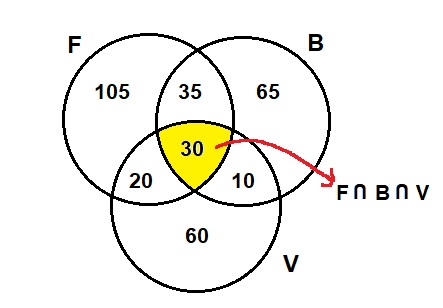
For example, the number 30 indicates that he number of elements of the intersection F ∩ B ∩ V is 30.
We can easily count the required numbers in the questions:
As also undersood from the information given, all statements in the options are correct according to the case given, so the correct answer is E.
600 men are interviewed about which sports they like. It is found that 190 like football, 140 like basketball, 120 like volleyball, 65 like football and basketball, 50 like football and volleyball, 40 like basketball and volleyball, 30 like all three sports.
- How many of them like at least one of these sports?
- How many of them like none of these sports?
- How many of them like only football?
- How many of them like football and basketball but not volleyball?
- How many of them like basketball or volleyball but not football?
Solution
Define
F = The set of all men who like football,
B = The set of all men who like basketball,
V = The set of all men who like volleyball.
Then s(F) = 190, s(B) = 140, s(V) = 120, s(F ∩ B) = 65, s(F ∩ V) = 50, s(B ∩ V) = 40,
s(F ∩ B ∩ V) = 30 where, as defined above, the symbol s(.) is used for the number of elements. Below, we give the Venn diagram solution of this problem where the numbers on the regions they are sitting indicate the number of elements of the corresponding set.
For example, the number 30 indicates that he number of elements of the intersection F ∩ B ∩ V is 30.
We can easily count the required numbers in the questions:
- 105 + 35 + 30 + 20 + 65 +10 + 60 = 325
- 600 - 325 = 275,
- 105,
- 65 - 30 = 35,
- 60 + 10 + 65 = 135.
As also undersood from the information given, all statements in the options are correct according to the case given, so the correct answer is E.
Soru 18
- The set of all elements of the sets A and B is called the union of A and B
- The set of the elements that the set A and the set B have in common is called the intersection of A and B
- The set of all elements of A which are not in B is called the difference of A and B
- The difference of U and A is called the complement of U.
Which of the statements above regarding to operations on sets are correct?
Seçenekler
A
I and II
B
I and III
C
II and IV
D
I, II and III
E
I, II, III and IV
Açıklama:
If all the sets under examination are subsets of some set U then U is called a universal set. Given two sets A and B:
As also understood from the information given, the correct answer is D. The statements in the options I “The set of all elements of the sets A and B is called the union of A and B “, II “The set of the elements that the set A and the set B have in common is called the intersection of A and B.”, and III “The set of all elements of A which are not in B is called the difference of A and B. are correct. The statement in the option IV “The difference of U and A is called the complement of U.” is not correct because of the fact that the difference of U and A is called the complement of A not U.
- The set of all elements of the sets A and B is called the union of A and B
- The set of the elements that the set A and the set B have in common is called the intersection of A and B.
- The set of all elements of A which are not in B is called the difference of A and B
- The difference of U and A is called the complement of A.
As also understood from the information given, the correct answer is D. The statements in the options I “The set of all elements of the sets A and B is called the union of A and B “, II “The set of the elements that the set A and the set B have in common is called the intersection of A and B.”, and III “The set of all elements of A which are not in B is called the difference of A and B. are correct. The statement in the option IV “The difference of U and A is called the complement of U.” is not correct because of the fact that the difference of U and A is called the complement of A not U.
Soru 19
- a0 = 1 for all nonzero numbers a.
- If a = 0, a0 is called power of a.
- ∞ (infinity) is not a number. It represents an infinitely large quantity.
- The whole real line is an interval denoted by (-∞, ∞).
- Powers are used when we multiply a real number by itself repeatedly.
Which of the statements above regarding to numbers are correct?
Seçenekler
A
I and II
B
I, II, III and V
C
I, III, IV and V
D
II, III, IV and V
E
I, II, III, IV and V
Açıklama:
- a0 = 1 for all nonzero numbers a.
- If a = 0, a0 is called indeterminate.
- ∞ (infinity) is not a number. It represents an infinitely large quantity.
- The whole real line is an interval denoted by (-∞, ∞).
- Powers are used when we multiply a real number by itself repeatedly.
As also understood from the information given, the correct answer is C.
The statements in the options
I. a0 = 1 for all nonzero numbers a.”,
III. “∞ (infinity) is not a number. It represents an infinitely large quantity.”,
IV. “The whole real line is an interval denoted by (-∞, ∞).” and
V. “Powers are used when we multiply a real number by itself repeatedly.”
are correct.
The statement in the option
II. “If a = 0, a0 is called power of a.” is not correct because of the fact that if a = 0, a0 is called indeterminate.
Soru 20
- A ∪ B = (-1, 5)
- A ∩ B = (2, 3)
- A \ B = (-1, 2]
Let A = (-1, 3), B = (2, 5) be open intervals. Which of the statements above are correct?
Seçenekler
A
I
B
I and II
C
I and III
D
II and III
E
I, II and III
Açıklama:
Let A = (-1, 3), B = (2, 5) be open intervals. Find A ∪ B, A ∩ B, and A \ B.
A ∪ B = (-1, 5), A ∩ B = (2, 3), A \ B = (-1, 2]
As also understood from the information given, the correct answer is E. All of the statements in the options are correct.
A ∪ B = (-1, 5), A ∩ B = (2, 3), A \ B = (-1, 2]
As also understood from the information given, the correct answer is E. All of the statements in the options are correct.
Soru 21
Given the sets A = {a, b, c, d}, B = {a, c, f, g}
and C= {c, d, g, h, i}. Find (A ∪ B) ∩ C.
and C= {c, d, g, h, i}. Find (A ∪ B) ∩ C.
Seçenekler
A
{a, c, d}
B
{c, d, g}
C
{c, d, h}
D
{g, h, i}
E
{a, d, g}
Açıklama:
A ∪ B = {a, b, c, d, f, g}.
Intersection of this set with C is
(A ∪ B) ∩ C = {c, d, g}.
Intersection of this set with C is
(A ∪ B) ∩ C = {c, d, g}.
Soru 22
In a school, the total number of students are 250. The number of the members of the Mathematics Club is 153, and the number of the members of the Sports Club is 110. Given that there are only two clubs in the school, and the number of the students who are neither a member of the Mathematics Club nor the Sports club is 17.
Find the number the students who are a member of both the Sports Club and the Mathematics Club.
Find the number the students who are a member of both the Sports Club and the Mathematics Club.
Seçenekler
A
10
B
20
C
30
D
40
E
50
Açıklama:
Denote by M and S the set of all students who are members of the Mathematics and Sports clubs, respectively.
Then, s(M ∪ S) = 250-17 = 233.
Using the formula (M ∪ S) = s(M) + s(S) - s(M ∩ S),
we have s(M ∩ T) = 233 = 153 + 110 - x, where x is the required number.
Then we find that x = 153 + 110 - 233.
Thus, x equals to 30.
Then, s(M ∪ S) = 250-17 = 233.
Using the formula (M ∪ S) = s(M) + s(S) - s(M ∩ S),
we have s(M ∩ T) = 233 = 153 + 110 - x, where x is the required number.
Then we find that x = 153 + 110 - 233.
Thus, x equals to 30.
Soru 23
Evaluate (2-1 + 3-2) / 3-2
Seçenekler
A
11/2
B
13/2
C
15/2
D
17/2
E
19/2
Açıklama:
Since
2-1 is 1/21 which equals to 1/2;
3-1 is 1/31 which equals to 1/3; and 3-2 is 1/32 which equals to 1/9,
what we have in hand is ( (1/2) + (1/3) ) / (1/9). (1/2) + (1/3) equals to 11/18,
and if we divide it by 1/9, this equals to 11/2.
2-1 is 1/21 which equals to 1/2;
3-1 is 1/31 which equals to 1/3; and 3-2 is 1/32 which equals to 1/9,
what we have in hand is ( (1/2) + (1/3) ) / (1/9). (1/2) + (1/3) equals to 11/18,
and if we divide it by 1/9, this equals to 11/2.
Soru 24
Evaluate the product (27-2 / 9-2) . 32
Seçenekler
A
-3
B
-1
C
0
D
1
E
3
Açıklama:
27-2 / 9-2 equals to (27/9)-2 = 3-2.
When we do the operation 3-2 . 32 , we find 3-2+2 which equals to 30. 30 equals to 1.
When we do the operation 3-2 . 32 , we find 3-2+2 which equals to 30. 30 equals to 1.
Soru 25
Among the numbers 7/12, 3/5, 11/15, 14/20, and 23/30 which is the greatest number?
Seçenekler
A
7/12
B
3/5
C
11/15
D
14/20
E
23/30
Açıklama:
Extend the given fractions to the common denominator 60.
Then we find that
7/12 =35/60,
3/5 = 36/60,
11/15 = 44/60,
14/20 = 42/60, and
23/30 = 46/60.
The greatest number among these is, therefore, 23/30.
Then we find that
7/12 =35/60,
3/5 = 36/60,
11/15 = 44/60,
14/20 = 42/60, and
23/30 = 46/60.
The greatest number among these is, therefore, 23/30.
Soru 26
Which of the following is the intersection of intervals (-3, 7), and [4, 9)?
Seçenekler
A
[4, 7]
B
(4, 7]
C
[4, 7)
D
(-3, 9)
E
[4, 9)
Açıklama:
The interval consisting of the elements of both intervals (-3, 7), and [4, 9) is [4, 7).
Soru 27
Given that a < b < c and all a, b, and c are real numbers, which of the following equals to the expression |b - a| + |a - c| ?
Seçenekler
A
b + c
B
-2a +b + c
C
a + c
D
2a - b + c
E
b - c
Açıklama:
From the definition of the absolute value
|b - a| = b - a since a < b
and
|a - c| = c - a since a < c.
Therefore |b - a| + |a - c| = b - a + c - a = -2a + b + c.
|b - a| = b - a since a < b
and
|a - c| = c - a since a < c.
Therefore |b - a| + |a - c| = b - a + c - a = -2a + b + c.
Soru 28
Which of the following is an half-opened interval?
Seçenekler
A
(-1, +1)
B
[0, 5]
C
(-∞, ∞)
D
[-7, -2]
E
(3, 5]
Açıklama:
According to the definition, intervals like (a, b], [a, b) are half-open intervals. (3, 5] is the only one fits to this definition.
Soru 29
Let A = [0, 5], B = [1, 7), and C = (2, 8). Find C \ (A ∪ B).
Seçenekler
A
(0, 7)
B
(0, 8)
C
(7,8)
D
[7, 8)
E
(0, 7]
Açıklama:
Given these intervals, (A ∪ B) is [0, 7).
Then, (2, 8) \ [0, 7) is the required result.
It is [7, 8), and D is the correct answer.
Then, (2, 8) \ [0, 7) is the required result.
It is [7, 8), and D is the correct answer.
Soru 30
Let A = (-∞, ∞), B = (-∞, 0] and C = (-2, 2). Find C \ (A ∪ B).
Seçenekler
A
(0, 2)
B
[0, 2)
C
Ø
D
(0, 2]
E
(-∞, ∞)
Açıklama:
Since A represents the infinite whole real line interval, so does A ∪ B.
Then, C \ (A ∪ B) must be an empty set.
Then, C \ (A ∪ B) must be an empty set.
Soru 31
A = {2, -3, -4, -5, 6}, B = {1, 3, 5, 7}, C = {1, 2, -2, -3, 3, 5, -5}.
(C \ B) ∩ A = ?
(C \ B) ∩ A = ?
Seçenekler
A
{2, -3, -5}
B
{2, -3, 6}
C
{-5, 6, 1}
D
{2, -3, -4, 6}
E
{-4, -5}
Açıklama:
x = C \ B = {2, -2, -3, -5} ; x ∩ A = {2, -3, -5}. pg. 4. Correct answer is A.
Soru 32
The number of students taking Piano course is 45, the number of students taking Flute course is 22. The number of students taking neither Piano nor Flute courses is 17. The number of students taking both Piano and Flute courses is 15. What is the total number of students in this class ?
Seçenekler
A
99
B
69
C
55
D
67
E
31
Açıklama:
P = {x| x is a student who taking Piano course}
F = {x| x is a student who taking Flute course}
The number of students taking Piano or Flute courses is
s(P ∪ F) = s(P) + s(F) -s(P ∩ F).
s(P ∪ F) = 45 + 22 - 15 = 67 - 15 = 52
Additionally, 17 students are taking neither Piano, nor Flute courses. Therefore, the total number of students is 52 + 17 = 69.
Correct answer is C.
F = {x| x is a student who taking Flute course}
The number of students taking Piano or Flute courses is
s(P ∪ F) = s(P) + s(F) -s(P ∩ F).
s(P ∪ F) = 45 + 22 - 15 = 67 - 15 = 52
Additionally, 17 students are taking neither Piano, nor Flute courses. Therefore, the total number of students is 52 + 17 = 69.
Correct answer is C.
Soru 33
(28 + 26) / (43 + 44) = ?
Seçenekler
A
2
B
1
C
0.25
D
8
E
16
Açıklama:
x = (22 (26 + 1)) / (4 (1 + 43)) = 1. pg. 14. Correct answer is B.
Soru 34
(4-1 - 3-1)- 1 / (4-1 + 3-1)-1 = ?
Seçenekler
A
-1 / 7
B
-7 / 4
C
-3 / 7
D
-7 / 3
E
-7
Açıklama:
x = ((1 / 4) - (1 / 3))-1 / ((1 / 4) + (1 / 3))-1 = -7 . pg. 11. Correct answer is E.
Soru 35
(801/2 / 251/2) . (20)1/2 = ?
Seçenekler
A
30
B
40
C
32
D
8
E
16
Açıklama:
x = ((16 . 5)1/2 / (5 . 5)1/2) . (4 . 5)1/2 = 8 . pg. 12 . Correct answer is D.
Soru 36
Which one of these is the maximum : 2 / 5, 1 / 4, 3 / 8, 3 / 10, 7 / 16 ?
Seçenekler
A
3 / 10
B
3 / 8
C
1 / 4
D
2 / 5
E
7 / 16
Açıklama:
Let's combine the denominators in common 80
x = max {2 / 5, 1 / 4, 3 / 8, 3 / 10, 7 / 16}
= max {32/80, 20/80, 30/80, 24/80, 35/80}
= 35/80 = 7 / 16.
pg. 12. Correct answer is E.
x = max {2 / 5, 1 / 4, 3 / 8, 3 / 10, 7 / 16}
= max {32/80, 20/80, 30/80, 24/80, 35/80}
= 35/80 = 7 / 16.
pg. 12. Correct answer is E.
Soru 37
Which one of these is an irrational number : 6251/2, (-64)1/3, -(25)1/2, 0, 271/2 ?
Seçenekler
A
6251/2
B
-(25)1/2
C
(-64)1/3
D
271/2
E
0
Açıklama:
〖625〗^(1⁄2) 〖=(〖25〗^2)〗^(1⁄2)=25 is not an irrational number
-〖64〗^(1⁄3)= - (4^3 )^(1⁄3)= -4 is not an irrational number
-(〖25)〗^(1⁄2)= -(〖5^(2×)〗^(1⁄2))= -5 is not an irrational number
0 is not an irrational number
〖27〗^(1⁄2) 〖=(3^3)〗^(1⁄2)=3^(3⁄2)=3√3 is an irrational number
Correct answer is D.
Soru 38
A = (-4, 6] and B = [3, 8)
Find A ∪ B.
Find A ∪ B.
Seçenekler
A
(-4, 3]
B
(-4, 8)
C
[-4, 3]
D
[-4, 8)
E
[6, 8)
Açıklama:
A = (-4, 6] = {x| x ∈ R and -4 < x ≤ 6},
B = [3, 8) = {x| x ∈ R and 3 ≤ x < 8},
A ∪ B = {x| x ∈ A or x ∉ B}. Then A ∪ B= {x| -4 < x < 8 } = (-4, 8)
Correct answer is B.
B = [3, 8) = {x| x ∈ R and 3 ≤ x < 8},
A ∪ B = {x| x ∈ A or x ∉ B}. Then A ∪ B= {x| -4 < x < 8 } = (-4, 8)
Correct answer is B.
Soru 39
The sets A = {a, b, c, d, e}, B = {b, c, e, f, g}, C = {c, d, f, g} are given. Which of the following is the set {c} ?
Seçenekler
A
(A ∪ C) \ B
B
(B ∩ C) \ A
C
A ∩ B ∩ C
D
A \ (C ∩ B)
E
B ∩ A
Açıklama:
The corresponding diagram is
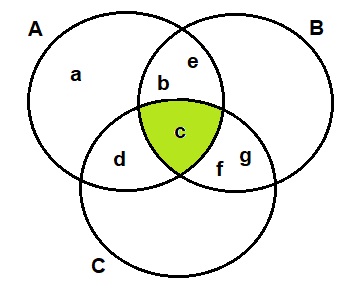
A ∩ B ∩ C = {c}
Correct answer is C
A ∩ B ∩ C = {c}
Correct answer is C
Soru 40
a, b, c : real numbers ; c > a > b. |b - c| + |a - b| + |c - a| = ?
Seçenekler
A
2c - 2b
B
2a - 2c
C
0
D
2c - 2a
E
2b - 2c
Açıklama:
c > b. then |b - c| = -b + c
a > b then |a - b| = a - b
c > a then |c - a| = c - a
Then |b - c| + |a - b| + |c - a| = -b + c + a - b + c - a
= -2b + 2c
= 2c - 2b
Answer is A.
a > b then |a - b| = a - b
c > a then |c - a| = c - a
Then |b - c| + |a - b| + |c - a| = -b + c + a - b + c - a
= -2b + 2c
= 2c - 2b
Answer is A.
Soru 41
Which of the following is not a subset of the set A={0,1,2,3,a,b}?
Seçenekler
A
{0,1,2,3,a,b}
B
Empty set
C
{0,1,2,3}
D
{a,b}
E
{0,4,a,b}
Açıklama:
Since "4" is not an element of set A, the set {0,4,a,b} is not a subset of set A.
Soru 42
Which of the following statements is false?
Seçenekler
A
If A is subset of B and B is subset of A, then A=B.
B
Empty set is subset of any set.
C
A set is subset of itself.
D
If A is subset of B and C is subset of B, then intersection of A and C can not be empty set.
E
If A is subset of B and B is subset of C, then A is subset of C.
Açıklama:
Assume that B={1, 3, 5, 7}, A={1, 3} and C={5, 7}. Both A and C are subsets of set B, but their intersection is empty set. All the other statements are true.
Soru 43
Assume that
A={x| 0}
and
B={x| 0}.
What is the intersection of A and B?
A={x| 0
and
B={x| 0
What is the intersection of A and B?
Seçenekler
A
{6}
B
Empty set
C
{6,12,18}
D
{2,3}
E
{2,4,6,12,18}
Açıklama:
Since x is both divisible by 2 and 3, it must be divisible to 6 for intersection. Then the intersection set contains 6, 12 and 18.
Soru 44
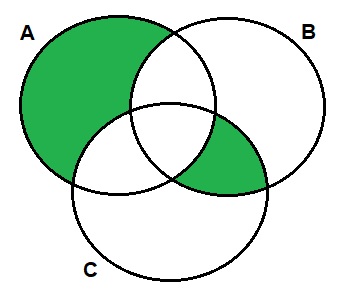
Which of the following defines the shaded area below?
Seçenekler
A
[A \ (B∪C)] ∪ [(B∩C) \ A]
B
[A \ (B∪C)] ∪ [(B∪C)\A]
C
[A \ (B∪C) ] ∪ (B∩C)
D
[A ∩ (B∪C) ] \ (B
E
A ∩ [(B∩C)\A]
Açıklama:
[A \ (B∪C)]
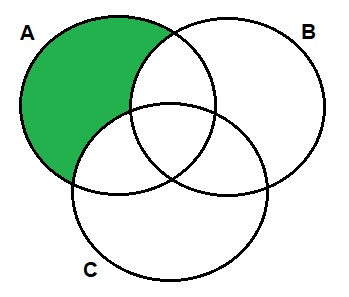
[(B∩C) \ A]
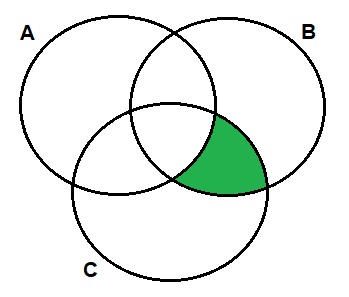
The shaded are is defined in A.
[(B∩C) \ A]
The shaded are is defined in A.
Soru 45
Given that A={0,1,2,3,a,b}, how many subsets of A contains both letters ("a" and "b")?
Seçenekler
A
7
B
8
C
16
D
31
E
32
Açıklama:
Let's combine a and b to single element that we call *.
Then our set will become A={0,1,2,3,*}.
Since this set has 5 elements it has 32 subsets (25=32).
Out of these 32 sets, there are 16 sets that doesn't contain *. (If we delete *, there remains a set containing 4 elements which has 24=16 subsets).
A subset will either contain * or it will not contain *.
Thus 32-16=16 sets contain *, namely a and b.
Then our set will become A={0,1,2,3,*}.
Since this set has 5 elements it has 32 subsets (25=32).
Out of these 32 sets, there are 16 sets that doesn't contain *. (If we delete *, there remains a set containing 4 elements which has 24=16 subsets).
A subset will either contain * or it will not contain *.
Thus 32-16=16 sets contain *, namely a and b.
Soru 46
Which of the following statements is true?
Seçenekler
A
Every real number is a rational number also.
B
Every integer is a rational number.
C
Every integer is a natural number.
D
Every rational number is an integer.
E
Every rational number is a natural number.
Açıklama:
√2 is a real number but it is not rational (It is impossible to write √ 2 as a/b where a and b are integers), so A is false.
-3 is an integer but it is not a natural number, so C is false also.
5/7 is a rational number but it is not an integer so D is false.
5/7 is rational but it is not a natural number so E is false also.
Only statement in B is true.
-3 is an integer but it is not a natural number, so C is false also.
5/7 is a rational number but it is not an integer so D is false.
5/7 is rational but it is not a natural number so E is false also.
Only statement in B is true.
Soru 47
Which of the following rational numbers is the biggest?
Seçenekler
A
700/701
B
701/702
C
702/703
D
703/704
E
704/705
Açıklama:
The difference between the numerator and denominator is 1 in all given numbers. In this case the value of the ratio increases as the numerator (or denominator increases) For a simple example think of 1/2 and 2/3. 1/2=0.5 and 2/3=0.67. Thus the answer is E.
Soru 48
What is the intersection of the intervals (-∞, 4] and (2, ∞)
Seçenekler
A
Empty set
B
(2, 4]
C
(2, 4)
D
[2, 4)
E
(-∞, ∞)
Açıklama:
The intersection interval is (2, 4] because 2 is open in the second interval and 4 is closed in both intervals.
Soru 49
Evaluate (32-3-2)/(32+3-2)
Seçenekler
A
40/41
B
41/40
C
28/26
D
26/28
E
9/8
Açıklama:
32=9 3-2=1/9
So, (32-3-2)/(32+3-2)=(9-1/9)/(9+1/9)=(80/9)/(82/9)=80/82=40/41
So, (32-3-2)/(32+3-2)=(9-1/9)/(9+1/9)=(80/9)/(82/9)=80/82=40/41
Soru 50
642/3=?
Seçenekler
A
2
B
4
C
8
D
16
E
32
Açıklama:
64=26 so 642/3=(26)2/3=26*2/3=24=16
Soru 51
Given the sets A={2, 4, 6, 7}, B={1, 2, 3, 4} and C={8, 7,4}. Find the (AUBUC).
Seçenekler
A
{1,2,3,4,6,8}
B
{1,2,3,4,6,7,8}
C
{3,4,6,7,8}
D
{1,2,3,7,8}
E
{2,3,4,6,7}
Açıklama:
A={2, 4, 6, 7}, B={1, 2, 3, 4} and C={8, 7,4}. AUB={1,2,3,4,6,7} and AUBUC={1,2,3,4,6,7,8}. The answer is B.
Soru 52
What is the value of 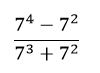 ?
?
?Seçenekler
A
11
B
9
C
8
D
6
E
7
Açıklama:
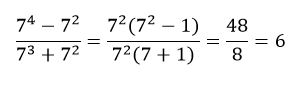 The answer is D.
Soru 53
Evaluate 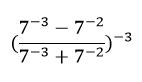 ?
?
?Seçenekler
A
15/37
B
27/64
C
-36/27
D
-27/64
E
-64/27
Açıklama:
 The answer is E.
Soru 54
What is the product 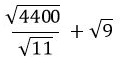 ?
?
?Seçenekler
A
23
B
15
C
20
D
21
E
17
Açıklama:
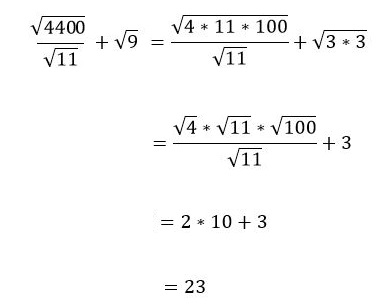
The answer is A.
Soru 55
Among the numbers 3, -3/5, 7/2 and 4/5 which is the greatest number?
Seçenekler
A
4/5
B
3/5
C
3
D
7/2
E
-3/5
Açıklama:
Extend the given fractions to the common denominator 10.
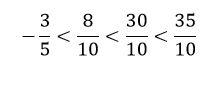
The greatest fraction is 7/2. The answer is D.
The greatest fraction is 7/2. The answer is D.
Soru 56
Which of the following is the intersection of intervals [-3, 5) and [-2, 0)?
Seçenekler
A
[-2, 0]
B
[-2, 0)
C
[-5, 0)
D
[-2, 1)
E
(-2, 0)
Açıklama:
The interval consisting of the elements of both [-3, 5) and [-2, 0) is [-2, 0). The answer is B.
Soru 57
What is the value of 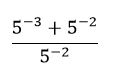 ?
?
?Seçenekler
A
3/5
B
1/5
C
6/5
D
5
E
7/5
Açıklama:
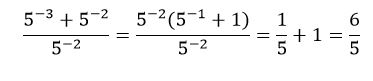 . The answer is C.
Soru 58
Which of the following is the intersection of intervals (-1/3, 4] and [-1, 7/2)?
Seçenekler
A
(-1/3, 7/2)
B
[-1, 7/2)
C
[-1, 4)
D
[0, 3)
E
[-1/3, 7/2)
Açıklama:
The interval consisting of the elements of both intervals (-1/3, 4] and [-1, 7/2) is (-1/3, 7/2). The answer is A.
Soru 59
Given the sets A={a, 1, d, -3}, B={e, -3, 0} and C={a, d, e, 0}. Find (AUC)\B.
Seçenekler
A
{d, 1}
B
{a, d, e, 1}
C
{a, d, 1}
D
{a, d, 1, -3}
E
{a, d, 1, e}
Açıklama:
A={a, 1, d, -3}, B={e, -3, 0} and C={a, d, e, 0}.(AUC)={a, d, e, 0, 1, -3}. The set of elements AUC which are not in B is {a, d, 1}. Therefore (AUC)\B={a, d, 1}. The answer is C.
Soru 60
What is the value 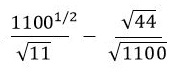 ?
?
?Seçenekler
A
51/5
B
49/5
C
12
D
10
E
5
Açıklama:

The answer is B.
Soru 61
Given the sets A={1,3,4,9,12}, B={3,4,7,10} and C={3,9,10}. Find(A∪B)\C.
Seçenekler
A
{1,3,5,8,9}
B
{1,3,9,12}
C
{1,4,7,12}
D
{3,4,7,10}
E
{1,3,4,9,12}
Açıklama:
A ∪ B = {1,3,4,7,9,10,12} The set of elements A ∪ B which are not in C is {1,4,7,12}. Therefore (A ∪ B) \ C = {1,4,7,12}.
Soru 62
The total number of students in a class is 45, the number of students passing Mathematics test is 35, the number of students passing Turkish test is 40. If the number of students passing neither Mathematics nor Turkish is 5, find the number of students passing both Mathematics and Turkish tests.
Seçenekler
A
15
B
20
C
25
D
30
E
35
Açıklama:
Since the total number of students is 45 then s(M ∪ T) = 45 - 5 = 40.
Using the formula (M ∪ T) = s(M) + s(T) - s(M ∩ T),
we have s(M ∩ T) = 35+ 40 - 40 = 35 which is the required number.
Correct answer is 35.
Using the formula (M ∪ T) = s(M) + s(T) - s(M ∩ T),
we have s(M ∩ T) = 35+ 40 - 40 = 35 which is the required number.
Correct answer is 35.
Soru 63
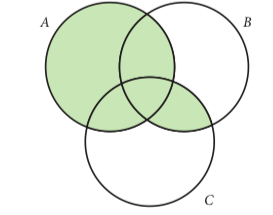 Wich one of the following describes green area?
Seçenekler
A
(A ∪ B) ∩ (A ∪ C)
B
(A ∪ B) / C
C
(A ∪ B) ∩ C
D
(A ∪ C) ∩ B
E
(B ∪ C) ∩ (A ∪ C)
Açıklama:
Venn diagram showing A ∪ (B ∩ C) = (A ∪ B) ∩ (A ∪ C)
Correct answer is A.
Correct answer is A.
Soru 64
In a touristic group, 10 tourists can speak English, 15 tourists can speak German, 9 tourists can speak both English and German, and 3 tourists can speak neither English nor German. Find the number of tourists in this group.
Seçenekler
A
16
B
17
C
18
D
19
E
20
Açıklama:
E ∪ G = {x| x is a tourist who can speak English or German}
E ∩ G = {x| x is a tourist who can speak both English and German}
Then
s(E ∪ G) = s(E) + s(G) - s(E ∩ G)= 10 + 15 - 9 = 16.
Additionally, 3 tourists can speak neither English, nor German. Therefore, the total number of tourists is 16 + 3 = 19.
Correct answer is D.
E ∩ G = {x| x is a tourist who can speak both English and German}
Then
s(E ∪ G) = s(E) + s(G) - s(E ∩ G)= 10 + 15 - 9 = 16.
Additionally, 3 tourists can speak neither English, nor German. Therefore, the total number of tourists is 16 + 3 = 19.
Correct answer is D.
Soru 65
Wich one of the following irregular number?
Seçenekler
A
-16
B 
C
1
D 
E
0
Açıklama:
A real number which is not a rational is an irrational number
Correct answer is B.
Correct answer is B.
Soru 66
A = [1, 3], B = [2, 5). Find A \ B.
Seçenekler
A
[1, 3)
B
[1, 2]
C
[1, 2)
D
(1, 2)
E
(1, 2]
Açıklama:
A = [1, 3] = {x| x ∈ R and 1 ≤ x ≤ 3},
B = [2, 5) = {x| x ∈ R and 2 ≤ x < 5},
A \ B = {x| x ∈ A and x ∉ B}. Then A \ B = {x| 1 ≤ x < 2 } = [1, 2)
Correct answer is C.
B = [2, 5) = {x| x ∈ R and 2 ≤ x < 5},
A \ B = {x| x ∈ A and x ∉ B}. Then A \ B = {x| 1 ≤ x < 2 } = [1, 2)
Correct answer is C.
Soru 67
Wich one of the following numbers is greater?
Seçenekler
A 
B 
C 
D 
E 
Açıklama:
6/23= (6 x 12)/(23 x 12)= 72/276
9/32= (9 x 8)/(32 x 8)= 72/256
3/13= (3 x 24)/(13 x 24)= 72/312
2/5= (2 x 36)/(5 x 36)= 72/180
24/99= (24 x 3)/(99 x 3)= 72/297
Then, the greatest number is 2/5= (2 x 36)/(5 x 36)= 72/180
Correct answer is D.
Soru 68
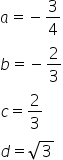
Write in increasing order.
Seçenekler
A
a
B
b
C
a
D
b
E
b
Açıklama:
a= -3/4= -9/12 and b= - 2/3= - 8/12 then aCorrect answer is A.
Soru 69

Seçenekler
A
25
B
50
C
60
D
80
E
100
Açıklama:
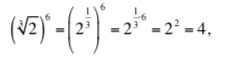
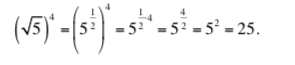 4 x 25= 100
Correct answer is E.
Soru 70
Which of the following is the intersection of intervals [-5, 7], and (3, 9]?
Seçenekler
A
(3, 7]
B
(3, 7)
C
(3, 5]
D
[-5, 9]
E
[3, 7)
Açıklama:
The interval consisting of the elements of both intervals [-5, 7] and (3, 9] is (3, 7]. Correct answers is A.
Soru 71
Given sets A = {1, 5, 7, 9}, B = {2, 5, 7}. Find the difference A \ B?
Seçenekler
A
{1, 9}
B
{2, 9}
C
{5, 7}
D
{1, 2, 5}
E
{5, 7, 9}
Açıklama:
A = {1, 5, 7, 9}, B = {2, 5, 7}.
A \ B = {x| x ∈ A and x ∉ B} then A \ B = {1, 9}.
A \ B = {x| x ∈ A and x ∉ B} then A \ B = {1, 9}.
Soru 72
There are 22 students in a class. 16 of them has blue pens. 18 of them has red pens. How many of them has both blue and red pens?
Seçenekler
A
8
B
10
C
12
D
14
E
16
Açıklama:
s(B)=16
s(R)=18
s(B ∪ R)=22
s(B ∩ R) = s(B) + s(R) - s(B ∪ R)=16+18-22=34-22=12
s(R)=18
s(B ∪ R)=22
s(B ∩ R) = s(B) + s(R) - s(B ∪ R)=16+18-22=34-22=12
Soru 73
E = {0, 1, 2, …, 10}, A = {1, 2, 3}, B = {3, 4, 5}. Which one is equal to {4,5}?
Seçenekler
A
A ∪ B
B
A ∩ B
C
A \ B
D
B \ A
E
Ac
Açıklama:
A ∪ B = {1, 2, 3, 4, 5},
A ∩ B = {3},
A \ B = {1, 2},
B \ A = {4,5},
Ac = {5, 6, 7, 8, 9, 10},
Bc = {1, 2, 6, 7, 8, 9, 10}.
correct answer is D.
A ∩ B = {3},
A \ B = {1, 2},
B \ A = {4,5},
Ac = {5, 6, 7, 8, 9, 10},
Bc = {1, 2, 6, 7, 8, 9, 10}.
correct answer is D.
Soru 74
Let A = {a, b, c, d}. Find the number of all nonempty subsets of A?
Seçenekler
A
3
B
7
C
15
D
31
E
63
Açıklama:
n = s(A) = 4, 2n = 24 = 16.
A has only one empty subset Ø, therefore the number of nonempty subsets is 16 - 1 = 15.
A has only one empty subset Ø, therefore the number of nonempty subsets is 16 - 1 = 15.
Soru 75
For given sets A and B assume that s(A) = 16, s(B) = 20 and s(A ∪ B) = 26. Find s(B \ A).
Seçenekler
A
8
B
10
C
12
D
14
E
16
Açıklama:
s(A ∩ B) = s(A) + s(B) - s(A ∪ B)
= 16 + 20 - 26
= 10
The corresponding diagram is
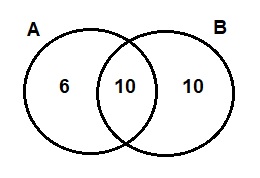
where the numbers 6, 10 and 10 indicate the numbers of elements in the corresponding subsets.
Therefore s(B \ A) = 10.
= 16 + 20 - 26
= 10
The corresponding diagram is
where the numbers 6, 10 and 10 indicate the numbers of elements in the corresponding subsets.
Therefore s(B \ A) = 10.
Soru 76
Which one is one of the infinite representation of 16/20?
Seçenekler
A
1/2
B
2/3
C
3/4
D
4/5
E
5/6
Açıklama:
m/n= p/q => m . q = n . p
Therefore, every rational number has an infinite number of representations.
4/5 = 8/10 = 12/15 = 16/20 = ...
Therefore, every rational number has an infinite number of representations.
4/5 = 8/10 = 12/15 = 16/20 = ...
Soru 77
Which one is an irrational number?
Seçenekler
A
0
B
2
C
3/4
D
π
E
0.5
Açıklama:
A real number which is not a rational is an irrational number. π=3.14 ... in an irrational numbers.
Soru 78
Write a = -3, b = -1/2, c = - 5/3, d = 3/2 in increasing order?
Seçenekler
A
a < b < c < d.
B
a < c < b < d.
C
b < a < c < d.
D
c < a < d < b.
E
d < b < c < a.
Açıklama:
a=-3, c=-1,6666..., b=-0.5, d=1.5 Then,
a < c < b < d.
a < c < b < d.
Soru 79
Simplify the following number 16-1/4?
Seçenekler
A
0
B
1/2
C
2
D
4
E
8
Açıklama:
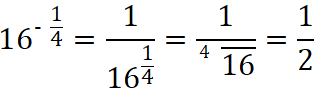
Soru 80
Given intervals A = [-1, 3], B = [0, 5). Find A \ B?
Seçenekler
A
[-1, 5)
B
[0, 3]
C
(0, 3)
D
[-1, 0)
E
(3, 5)
Açıklama:
A \ B = [-1, 0)
Ünite 2
Soru 1
f : R → R, f(x) = 5 x3 + x - 2. f(-1) = ?
Seçenekler
A
-8
B
6
C
4
D
-5
E
-2
Açıklama:
y = -5 - 1 - 2 = -8 . Correct answer is A.
Soru 2
f : R → R, f(x) = 3 x2 - 5. f -1(x) = ?
Seçenekler
A
(3 x2 - 5)-1
B
(-3 x2 + 5)-1
C
((x + 5) / 3)1/2
D
((-x + 5) / 3)-1/2
E
(-3 x2 + 5)-1/2
Açıklama:
x = ((y + 5) / 3)1/2 . Correct answer is C.
Soru 3
f : R → R, f(x) = 2 + 3 x3 ; g : R → R , g(x) = -x + 1. (f ∘ g)(-1) = ?
Seçenekler
A
2
B
26
C
-1
D
-3
E
10
Açıklama:
y = 2 + 3 (-x +1)3 = 2 + 3 (1 + 1)3 = 26 . Correct answer is B.
Soru 4
f : R → R, f(x) = 2 + 3 x3 ; g : R → R , g(x) = -x + 1. (g ∘ f)(-1) = ?
Seçenekler
A
10
B
-1
C
-3
D
26
E
2
Açıklama:
y = -(2 + 3 x3) + 1 = 2 . Correct answer is E.
Soru 5
f : R → R, f(x) = 2 + 3 x3 ; g : R → R , g(x) = -x + 1. (f . g)(-1) = ?
Seçenekler
A
0
B
10
C
-5
D
-2
E
4
Açıklama:
y = -2 x + 2 - 3 x4 + 3 x3 = -2 . Correct answer is D.
Soru 6
f : R → R, f(x) = x3 + 2. f -1(1) = ?
Seçenekler
A
31/3
B
1 / 3
C
3
D
0
E
-1
Açıklama:
x = (y - 2)1/3 = -1 . Correct answer is E.
Soru 7
f : R → R, f(x) = 2 + 3 x3 ; g : R → R , g(x) = -x + 1. (f + g)(-1) = ?
Seçenekler
A
0
B
5
C
7
D
1
E
-1
Açıklama:
x = 2 + 3 x3 - x + 1 = 1 . Correct answer is D.
Soru 8
f : R → R, f(x) = (64 - 8x)1/3 ; what is the largest domain of x = ?
Seçenekler
A
(-∞, 8]
B
(-∞, ∞)
C
[4, ∞)
D
[8, ∞)
E
[4, 8]
Açıklama:
x = 64 - 8 x ≥ 0 ; 8 ≥ x . Correct answer is A.
Soru 9
f : R → R, f(x) = -x + 3, if x ≤ 4 ; f(x) = -1, if x > 4. 3 f(-2) + 4 f(16) = ?
Seçenekler
A
11
B
35
C
5
D
-1
E
-6
Açıklama:
y = 3 (-(-2) + 3) + 4 (-1) = 15 - 4 = 11. Correct answer is A.
Soru 10
How many different inverse functions can be defined from a set of 10 elements to a set of 2 elements ?
Seçenekler
A
45
B
20
C
90
D
10
E
2
Açıklama:
Constant functions map every element from their domain to the same element of the range. We may therefore define a constant function for every element in the range. Since there are 10 different elements in the range we may write 10 different constant functions and inverse functions. Correct answer is D.
Soru 11
Given the function f: R→R, f(x)=7x²+12, what is the value of f(2)?
Seçenekler
A
17
B
36
C
40
D
51
E
66
Açıklama:
f(x)=7x²+12, f(2)=7.2²+12 ,then f(2)=7.4+12=40
Soru 12
For the functions f: R→R, f(x)=3x-8 and g: R→R, g(x)=(x+12)/4, what is the value of f(3).g(8)?
Seçenekler
A
3
B
5
C
-4
D
12
E
-16
Açıklama:
f(x)=3x-8 → f(3)=3.3-8=1
g(x)=(x+12)/4 → g(8)=(8+12)/4=20/4=5
f(3).g(8)=1.5=5
g(x)=(x+12)/4 → g(8)=(8+12)/4=20/4=5
f(3).g(8)=1.5=5
Soru 13
Given the functions f: R→R, f(x)=x-5 and g: R→R, g(x)=2x+9, calculate the value of (fog)(-1)?
Seçenekler
A
-3
B
-1
C
0
D
1
E
2
Açıklama:
g(x)=2x+9 → g(-1)=-1.2+9=7
f(x)=x-5 →f(7)=7-5=2 (we used the output of the function g(x), as the input of the function f(x))
f(x)=x-5 →f(7)=7-5=2 (we used the output of the function g(x), as the input of the function f(x))
Soru 14
Let the functions f: R→R, f(x)=2x+7 and g: R→R, g(x)=3x-2, what is the value of (gof)(x)?
Seçenekler
A
6x-3
B
6x+3
C
6x
D
6x-19
E
6x+19
Açıklama:
f(x)=2x+7 and g(x)=3x-2 →(gof)(x)=3.(2x+7)-2=6x+21-2=6x+19
Soru 15
Let the functions m: R→R, m(x)=(3/x)+7 and k: R→R, k(x)=3/(x-2), what is the value of m(k(1))?
Seçenekler
A
3
B
6
C
9
D
-3
E
-6
Açıklama:
k(x)=3/(x-2)→k(1)=3/(1-2)=-3
m(x)=(3/x)+7→m(-3)=(3/-3)+7=6
m(k(1))=(mok)(1)=6
m(x)=(3/x)+7→m(-3)=(3/-3)+7=6
m(k(1))=(mok)(1)=6
Soru 16
The function f: R→R is given by,
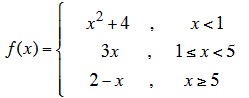 What is the value of 2f(6)-3f(3)+6f(-1)?
What is the value of 2f(6)-3f(3)+6f(-1)?Seçenekler
A
-5
B
-1
C
0
D
6
E
12
Açıklama:
f(6)=2-6=-4 hence 6>5
f(3)=3.3=9 hence 1<3<5
f(-1)=(-1)²+4=5 hence -1<1
so, 2f(6)-3f(3)+6f(-1)=2.(-4)-3.9+6.5=-8-27+30=-5
f(3)=3.3=9 hence 1<3<5
f(-1)=(-1)²+4=5 hence -1<1
so, 2f(6)-3f(3)+6f(-1)=2.(-4)-3.9+6.5=-8-27+30=-5
Soru 17
What is the inverse of the function f(x)=6x-5 ?
Seçenekler
A
6x-5
B
(2x-5)/12
C
(2x+5)/12
D
(x-5)/6
E
(x+5)/6
Açıklama:
6x-5=y→(y+5)/6=x→f-1(x)=(x+5)/6
Soru 18
Let f: R→R, f(x)=7x+1 and g: R→R, g(x)=x²-1 be given. What is the value of f/g(2)?
Seçenekler
A
14/3
B
3
C
5
D
7
E
15/2
Açıklama:
f(2)=7.2+1=15
g(2)=2²-1=4-1=3
f/g(2)=15/3=5
g(2)=2²-1=4-1=3
f/g(2)=15/3=5
Soru 19
For the functions f: R→R, f(x)=x-1 and g: R→R, g(x)=(x+2)/4, what is the value of (f.g)(3)?
Seçenekler
A
-3/2
B
1
C
3/2
D
5/2
E
3
Açıklama:
f(3)=3-1=2 and g(3)=(3+2)/4=5/4
(f.g)(3)=f(3).g(3)→2.5/4=5/2
(f.g)(3)=f(3).g(3)→2.5/4=5/2
Soru 20
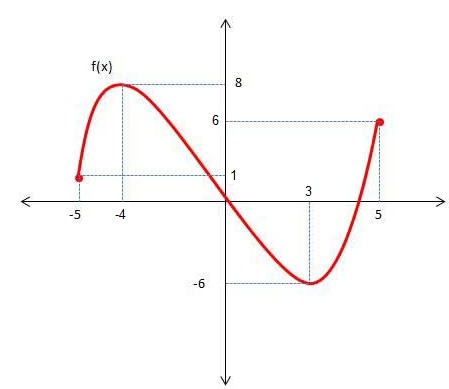 According to the graph of f(x) is given above, what is the value of f(-4)+3f(5)-2f(3) ?
Seçenekler
A
21
B
38
C
44
D
65
E
72
Açıklama:
By using the graph which is given in the question;
f(-5)=1, f(-4)=8, f(3)=-6 and f(5)=6 then,
f(-4)+3f(5)-2f(3)=8+(3.6)-(2.-6)=8+18-(-12)=38
f(-5)=1, f(-4)=8, f(3)=-6 and f(5)=6 then,
f(-4)+3f(5)-2f(3)=8+(3.6)-(2.-6)=8+18-(-12)=38
Soru 21
Let f : R → R, f (x) = 5x2 +10x + 7 given. What is the value of f (-1)?
Seçenekler
A
1
B
2
C
3
D
4
E
5
Açıklama:
Substituting x for -1, we find 5.(-12) + 10.(-1) + 7 = 5 . 1 + (-10) + 7 = 5 -10 + 7 = 2.
Soru 22
Given that f : R→ R, f (x) = 3x + 5 which of the following equals to f-1 (2)?
Seçenekler
A
1
B
2
C
3
D
4
E
5
Açıklama:
It is clear that this function has an inverse. Hence, for finding f-1 (x), we write y = 3x + 5. What we find is x = (5 - y) / 3. Then, f-1 (x) = (5 - y) / 3. Substituting 2 with x, we find 1.
Soru 23
For the functions f : R→ R , f (x) = 3x - 7 and g : R→ R , g(x) = -x + 3, what is the value of the composition (f ∘ g)(2)=?
Seçenekler
A
-1
B
-2
C
-3
D
-4
E
-5
Açıklama:
(f ∘ g)(2) equals to f ( g(2) ). g(2), substituting 2 with x in the g function is -2 +3 = 1. Then, (f ∘ g)(2) = f (1) = 3 . 1 -7 = 3 - 7 = -4.
Soru 24
For the functions f : R→ R , f (x) = x2 -5 and g : R→ R , g(x) = x3 - 2, what is the value of the composition (g ∘f)(-1)=?
Seçenekler
A
-22
B
-44
C
-66
D
-88
E
-111
Açıklama:
(g ∘f)(-1) = g ( f(-1) ) = g (-4) = -66
Soru 25
What is the largest domain of the function f(x) = (2x - 4) / (2x - 10)?
Seçenekler
A
R \ {0, 2, 5}
B
R
C
R \ {2, 5}
D
R \ {2}
E
R \ {5}
Açıklama:
This function makes sense if its denominator is not zero, i.e. the condition of 2x - 10 ≠ 0 should be satisfied. Hence, if x ≠ 5, this condition is satisfied. Therefore, the largest domain of the function is R \ {5}.
Soru 26
How many different constant functions can be defined from a set of 5 elements to a set of 9 elements?
Seçenekler
A
5
B
9
C
45
D
59
E
95
Açıklama:
Constant functions map every element from their domain to the same element of the range. We may therefore define a constant function for every element in the range. Since there are 9 different elements in the range we may write 9 different constant functions.
Soru 27
- A correspondence assigning each element of the set A, one and only one element of the set B is called a function from the set A into the set B.
- In this context, the set A is called the domain or the departure set of the function.
- In this context, the set B is called the range or terminal set.
- For a given function f and an element a from its domain A, the element corresponding to a under the rule f is called the image of the element a, and is denoted by f (a).
- A function defined from the set A to the set B is denoted by
 or
or 
Seçenekler
A
I and II
B
I, III and IV
C
II, IV and V
D
I, III, IV and V
E
I, II, III, IV and V
Açıklama:
Let A and B be two sets different from the empty set. A correspondence assigning each element of the set A, one and only one element of the set B is called a function from the set A into the set B. Functions are generally denoted by the lower case letters such as f, g, h. In this case a function defined from the set A to the set B is denoted by
f: or .
or .
In this context, the set A is called the domain or the departure set of the function, and the set B is called the range or terminal set. For a given function f and an element a from its domain A, the element corresponding to a under the rule f is called the image of the element a, and is denoted by f (a).
As also understood from the information given, all of the statements regarding to functions in the options are correct, so the correct answer is E.
f:
or . In this context, the set A is called the domain or the departure set of the function, and the set B is called the range or terminal set. For a given function f and an element a from its domain A, the element corresponding to a under the rule f is called the image of the element a, and is denoted by f (a).
As also understood from the information given, all of the statements regarding to functions in the options are correct, so the correct answer is E.
Soru 28
- If we denote this real number by x, and the function by f we may express it as

- It is customary to also denote this function by y = f (x).
- In the expression y = f (x), x is called the independent variable.
- In the expression y = f (x), y is called the dependent variable.
- In the equation y = f (x)=3x+4, the dependent variable y is a function of the independent variable x.
Seçenekler
A
I
B
I and II
C
I and IV
D
I, III and IV
E
I, II, III and IV
Açıklama:
Consider the function that assigns to each real number three times itself and four. If we denote this real number by x, and the function by f we may express it as
It is customary to also denote this function by y = f (x).
In the expression y = f (x), x is called the independent variable, whereas y is called the dependent variable.
In the expression y is called the dependent variable.
In the equation y = f (x)=3x+4, the dependent variable y is a function of the independent variable x.
As also understood from the information given, the correct answer is E. All of the statements in the options are correct.
It is customary to also denote this function by y = f (x).In the expression y = f (x), x is called the independent variable, whereas y is called the dependent variable.
In the expression y is called the dependent variable.
In the equation y = f (x)=3x+4, the dependent variable y is a function of the independent variable x.
As also understood from the information given, the correct answer is E. All of the statements in the options are correct.
Soru 29
Let  be given. What is the value of f (3)?
be given. What is the value of f (3)?Seçenekler
A
11
B
13
C
-11
D
15
E
17
Açıklama:
Substituting 3 for x we find f (3) = 5.3 - 4 = 15 - 4 = 11, so the correct answer is A.
Soru 30
Given that  which of the following is f -1(x)?
which of the following is f -1(x)?Seçenekler
A
3x - 6
B 
C
6x+3
D
3x-6
E 
Açıklama:
From the equation 3x+6=y we find x = f -1(y) =  . Thus f -1(x) = , so the correct answer is B.
. Thus f -1(x) = , so the correct answer is B.Soru 31
- If a rule defining a function is given but the domain has not been specified explicitly, then the largest set which makes the rule meaningful is understood.
- This set is denoted by Df for the rule y=f (x) and is called the natural domain of the function.
- The function given by the rule f(x) =
 makes sense if its denominator is not zero.
 - For the function given by the rule f(x) =, x-1≠0 should be satisfied.
Seçenekler
A
I
B
I and III
C
II and III
D
I, III and IV
E
I, II, III and IV
Açıklama:
If a rule defining a function is given but the domain has not been specified explicitly, then the largest set which makes the rule meaningful is understood.
This set is denoted by Df for the rule y=f (x) and is called the natural domain of the function.
The function given by the rule f(x) =makes sense if its denominator is not zero, i.e. x-1≠0 should be satisfied.
As also understood from the information given, the correct answer is E.
This set is denoted by Df for the rule y=f (x) and is called the natural domain of the function.
The function given by the rule f(x) =
makes sense if its denominator is not zero, i.e. x-1≠0 should be satisfied.As also understood from the information given, the correct answer is E.
Soru 32
Consider the function f: . For every x1, x2 A if x1 ≠ x2 implies
f(x1) ≠ f(x2) then the function f is called …
. For every x1, x2A if x1 ≠ x2 impliesf(x1) ≠ f(x2) then the function f is called …
Seçenekler
A
one-to-one
B
surjective
C
bijective
D
constant
E
identity
Açıklama:
Consider the function f: .
For every x1, x2A if x1 ≠ x2 implies
f(x1) ≠ f(x2)
then the function f is called one-to-one (or injective), so the correct answer is A.
Although the range and the image of a function are two concepts that need to be distinguished, we still know that they are closely related. The image is always a subset of the range. Yet, there are functions for which the range and the image sets are exactly the same. Thus, given a function f : if the image is equal to the range, i.e. f (A)=B the function f is called surjective (onto). Equivalently, for every element b of the set B if there can be found an element a of A such that f (a)=b, then f is called onto.
If a function which is both one-to-one and onto is called a bijection.
Constant function and identity function are the concepts related to types of functions.
A function assigning each element from its domain a single element in its range is called a constant function.
Given A ≠ , a function defined on the set A and assigning every element of A to itself is called the identity function.
. For every x1, x2
A if x1 ≠ x2 impliesf(x1) ≠ f(x2)
then the function f is called one-to-one (or injective), so the correct answer is A.
Although the range and the image of a function are two concepts that need to be distinguished, we still know that they are closely related. The image is always a subset of the range. Yet, there are functions for which the range and the image sets are exactly the same. Thus, given a function f :
if the image is equal to the range, i.e. f (A)=B the function f is called surjective (onto). Equivalently, for every element b of the set B if there can be found an element a of A such that f (a)=b, then f is called onto.If a function which is both one-to-one and onto is called a bijection.
Constant function and identity function are the concepts related to types of functions.
A function assigning each element from its domain a single element in its range is called a constant function.
Given A ≠
, a function defined on the set A and assigning every element of A to itself is called the identity function.Soru 33
- Consider the function
 . For every x1, x2 A if x1 ≠ x2 implies f(x1) ≠ f(x2) then the function f is called one-to-one (or injective).
 - Given a function if the image is equal to the range, i.e. f (A)=B the function f is called surjective (onto).
- If a function which is both one-to-one and onto is called a bijection.
- Constant function and identity function are the concepts related to types of functions. A function assigning each element from its domain a single element in its range is called a constant function.
- Given A ≠, a function defined on the set A and assigning every element of A to itself is called the identity function.
Seçenekler
A
III
B
II and III
C
I, III and IV
D
I, II, III and V
E
I, II, III, IV and V
Açıklama:
Consider the function . For every x1, x2A if x1 ≠ x2 implies
f(x1) ≠ f(x2) then the function f is called one-to-one (or injective).
Given a function if the image is equal to the range, i.e. f (A)=B the function f is called surjective (onto).
If a function which is both one-to-one and onto is called a bijection.
Constant function and identity function are the concepts related to types of functions. A function assigning each element from its domain a single element in its range is called a constant function.
Given A ≠ a function defined on the set A and assigning every element of A to itself is called the identity function.
As also understood from the information all of the statements regarding to properties and types of functions in the options are correct, so the correct answer is E.
. For every x1, x2A if x1 ≠ x2 impliesf(x1) ≠ f(x2) then the function f is called one-to-one (or injective).
Given a function
if the image is equal to the range, i.e. f (A)=B the function f is called surjective (onto).If a function which is both one-to-one and onto is called a bijection.
Constant function and identity function are the concepts related to types of functions. A function assigning each element from its domain a single element in its range is called a constant function.
Given A ≠
a function defined on the set A and assigning every element of A to itself is called the identity function.As also understood from the information all of the statements regarding to properties and types of functions in the options are correct, so the correct answer is E.
Soru 34
Functions, which are represented by different formulas on different subsets of its domain are called … functions.
Seçenekler
A
constant
B
identity
C
piecewise defined
D
surjective
E
bijective
Açıklama:
Functions, which are represented by different formulas on different subsets of its domain are called piecewise defined functions, so the correct answer is C. Definitions for the other concepts regarding to functions in the other options are as follows:
Constant function and identity function are the concepts related to types of functions. A function assigning each element from its domain a single element in its range is called a constant function.
Given A ≠, a function defined on the set A and assigning every element of A to itself is called the identity function.
Given a function if the image is equal to the range, i.e. f (A)=B the function f is called surjective (onto).
If a function which is both one-to-one and onto is called a bijection.
Constant function and identity function are the concepts related to types of functions. A function assigning each element from its domain a single element in its range is called a constant function.
Given A ≠
, a function defined on the set A and assigning every element of A to itself is called the identity function.Given a function
if the image is equal to the range, i.e. f (A)=B the function f is called surjective (onto).If a function which is both one-to-one and onto is called a bijection.
Soru 35
Given that x is a real number and f is given by the rule  , which of the following sets is the largest domain of definition of f ?
, which of the following sets is the largest domain of definition of f ?Seçenekler
A
(-∞, 3]
B
(6, ∞)
C
(9, 3)
D
(1, 6)
E
(1, ∞)
Açıklama:
Recommended Revision
Page 44
The question 8 on the page 44 (-∞,2]
The answer for the question 8 on the page 45Df=[-∞, 2).
The inequality should be satisfied. Hence, Df = (-∞, 3], so the correct answer is A.
Page 44
The question 8 on the page 44 (-∞,2]
The answer for the question 8 on the page 45Df=[-∞, 2).
The inequality
should be satisfied. Hence, Df = (-∞, 3], so the correct answer is A.Soru 36
- Two real lines intersecting perpendicularly at both their zeros constitute the Cartesian coordinate system.
- The Cartesian coordinate system is a tool which enables us to view the graphs of functions.
- In the Cartesian coordinate system, the horizontal real line is called the x-axis, or abscissa,
- In the Cartesian coordinate system, the vertical real line is called the y-axis, or ordinate.
- We call the point of intersection of the number lines as the origin in the Cartesian coordinate system.
Seçenekler
A
II
B
I and III
C
II, IV and V
D
I, II, III and V
E
I, II, III, IV and V
Açıklama:
Now is the time to plot the graph of functions in order to make them visible to the eye. We will talk about the Cartesian coordinate system, a tool which enables us to view the graphs of functions.
Let us get acquainted with the Cartesian coordinate system. Two real lines intersecting perpendicularly at both their zeros constitute the Cartesian coordinate system. In this system, the horizontal real line is called the x-axis, or abscissa, and the vertical real line is called the y-axis, or ordinate. We call the point of intersection of the number lines as the origin.
As also understood from the information given, the correct answer is E. All of the statements regarding to graphs of functions in the options are correct.
Let us get acquainted with the Cartesian coordinate system. Two real lines intersecting perpendicularly at both their zeros constitute the Cartesian coordinate system. In this system, the horizontal real line is called the x-axis, or abscissa, and the vertical real line is called the y-axis, or ordinate. We call the point of intersection of the number lines as the origin.
As also understood from the information given, the correct answer is E. All of the statements regarding to graphs of functions in the options are correct.
Soru 37
Given the functions f : R → R , f (x)= x-2 and g : R → R , g (x)= 2x-9, determine (4f -2g)(x).
Seçenekler
A
2
B
4
C
6
D
8
E
10
Açıklama:
(4f -2g)(x) = 4(x-2) - 2(2x-9) = 4x - 8 - 4x + 18 = 10
Soru 38
Given that x is a real number and f is given by the rule f (x) = (2x - 12)1/2 , which of the following sets is the largest domain of the definition of f ?
Seçenekler
A
(-∞, -1]
B
(-∞, -6]
C
(-∞, 6]
D
[6, ∞)
E
[1, ∞)
Açıklama:
In order for the square root to make sense, the argument (the terms inside the square root) should not be negative. (2x - 12)1/2 is the square root of 2x - 12. Therefore, the inequality 2x-12 ≥ 0 should be satisfied. This means that x ≥ 6 must be satisfied. Hence, the largest domain of definition of f is [6, ∞).
Soru 39
Let f : R → R , f (x)= 2x + 6 and g : R → R g(x)=x2+3 be given. Calculate f / g (-1).
Seçenekler
A
1
B
2
C
3
D
4
E
5
Açıklama:
Since g cannot be zero, f / g is meaningful, and the answer can be calculated.
The answer is, then, (-2+6) / ((-1)2 +3) = 4 / 4 ) = 1
The answer is, then, (-2+6) / ((-1)2 +3) = 4 / 4 ) = 1
Soru 40
The functions f : R→ R , f (x) = 2x + 9 and g : R→ R , g(x) = 12 - 3x are given. What is the value of (4f - 3g)(2)?
Seçenekler
A
14
B
24
C
34
D
44
E
54
Açıklama:
4(4 + 9) - 3(12-6) = 52 - 18 = 34
Soru 41
Let f:R→R f(x)=x³-x²+5x-12 be given. What is the value of f(5)?
Seçenekler
A
74
B
99
C
102
D
113
E
127
Açıklama:
f(x)=x³-x²+5x-12 if we put 5 instead of x then,
f(5)=5³-5²+25-12=125-25+25-12=113
f(5)=5³-5²+25-12=125-25+25-12=113
Soru 42
Given that f : R→R, f (x) = 7x - 3 which of the following is f -1(x) ?
Seçenekler
A
(x-3)/7
B
(x+3)/7
C
7x+3
D
7x-3
E
(x+7)/3
Açıklama:
f (x) = 7x - 3 and f -1(x)=(x+3)/7
Soru 43
How many different functions can be defined from a set of 8 elements to a set of 11 elements?
Seçenekler
A
3
B
8
C
11
D
19
E
88
Açıklama:
Constant functions map every element from their domain to the same element of the range. We may therefore define a constant function for every element in the range. Since there are 11 different elements in the range we may write 11 different constant functions.
Soru 44
Let f :R→R, f (x) = 9x - 1. Which of the following is the value of f -1 (16)?
Seçenekler
A
2
B
11/5
C
12
D
17/9
E
21/3
Açıklama:
f -1 (x)=(x+1)/9→f -1 (16)=16+1/9=17/9
Soru 45
For the functions f :R→R, f (x) = 5x³ and g :R→R, g(x) = x - 1, what is the value of the composition (f ∘g)(1)=?
Seçenekler
A
0
B
5
C
25
D
125
E
625
Açıklama:
(f ∘g)(1)=f(g(1)) hence g(1)=0 f(0)=5.(0)³=0
Soru 46
Given the functions f :R→R, f (x) = 1 - x and g :R→R, g(x) = x - 2 find (gof)(7)=?
Seçenekler
A
0
B
-2
C
6
D
7
E
-8
Açıklama:
(gof)(x)=g(f(x)) then (gof)(7)=g(f(7)) by the way f(7)=1-7=-6 (gof)(7)=g(-6)=-6-2=-8
Soru 47
Let f :R→R, f (x) = 1 + 3x and g :R→R, g(x) = x +12 be given. What is the value of (f+g)(1) =?
Seçenekler
A
2
B
7
C
9
D
11
E
17
Açıklama:
(f+g)(1)=f(1)+g(1)=1+3.1+1+12=17
Soru 48
Let f :R→R, f (x) = x-1 and g :R→R, g(x) = 2x -1 be given. What is the value of (f.g)(3) =?
Seçenekler
A
-3
B
3
C
5/3
D
7/3
E
-8/3
Açıklama:
(f.g)(3) =f(3).g(3)=3-1.2.3-1=3-1.5=5/3
Soru 49
The graph of f :R→R is given below. According to this, what is the value of 2f (0) ?
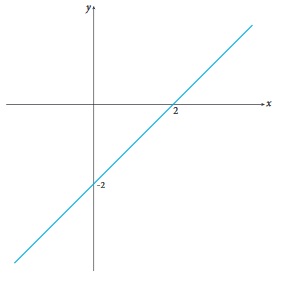
Seçenekler
A
-2
B
2
C
4
D
-4
E
8
Açıklama:
for x=0 y=-2 then 2f(0)=2.-2=-4
Soru 50
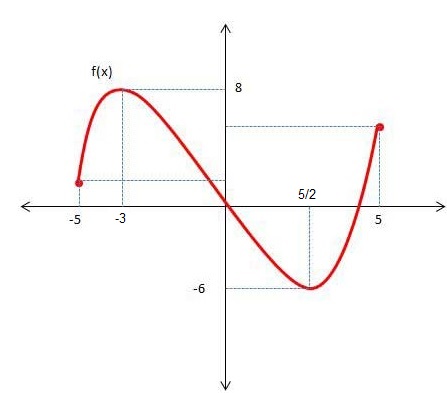 The graph of f :R→R is given above. According to this, what is the value of 2f (5/2)-f (-3) ?
Seçenekler
A
-20
B
-10
C
0
D
10
E
20
Açıklama:
From the graph we see that f(5/2)=-6 and f(-3)=8, so 2f (5/2)-f (-3)=(2.-6)-8=-20
Soru 51
Assume that the function f(x)=x2-1 is defined over the domain set A={1, 2, 3, 4}. Which of the following is the image set of function f?
Seçenekler
A
{1, 2, 3, 4}
B
{0, 1, 2, 3}
C
{0, 3, 8, 15}
D
{2, 5, 10, 17}
E
{1, 4, 9, 16}
Açıklama:
Since f(x)=x2-1, let's find the image of each element of set A.
12-1=0
22-1=3
32-1=8
42-1=15
Thus, the image set is {0, 3, 8, 15}
12-1=0
22-1=3
32-1=8
42-1=15
Thus, the image set is {0, 3, 8, 15}
Soru 52
For which of the functions below 1 is element of the natural domain?
Seçenekler
A
f(x)=x2/(x2-1)
B
f(x)=(2+x3)/(x3-1)
C
f(x)=(1+5x+x2)/(x2+2x-3)
D
f(x)=(x2-1)/(x2-x-2)
E
f(x)=(x2+4x-1)/(x2+4x-5)
Açıklama:
The denominator for the functions in A, B, C and E equals to zero when x=1. Since a/0 is undefined 1 is not in the natural domain for these functions. Thus the answer is D, since f(x)=(x2-1)/(x2-x-2) is defined for x=1 (altough f(1)=0 !)
Soru 53
Which of the following functions is not one-to-one?
Seçenekler
A
f(x)=x2-1
B
f(x)=x-1
C
f(x)=x+1
D
f(x)=-x-1
E
f(x)=x
Açıklama:
If f(a)=f(b) then a=b for one to one functions. Consider the function in A.
f(x)=x2-1
f(2)=3
f(-2)=3 but 2 is not equal to -2. Thus this function is not one-to-one. All the other given functions are linear and hence one-to-one. Note that f(x)=x3 is not linear but one-to-one also. Thus, all linear functions are one-to-one but not all one-to-one functions are linear.
f(x)=x2-1
f(2)=3
f(-2)=3 but 2 is not equal to -2. Thus this function is not one-to-one. All the other given functions are linear and hence one-to-one. Note that f(x)=x3 is not linear but one-to-one also. Thus, all linear functions are one-to-one but not all one-to-one functions are linear.
Soru 54
Which of the following functions (which are defined on natural numbers to natural numbers) is onto(surjective)?
Seçenekler
A
f(x)=x2
B
f(x)=5+x2
C
f(x)=x+5
D
f(x)=x3
E
f(x)=x
Açıklama:
 is onto (surjective)if every element of
  is mapped to by some element of
  . In other words, nothing is left out.
-
 Let all these functions defined from A to B (where both sets are set of natural numbers).It is clear that the function f(x)=x2 is not onto because for instance 5 can not be square of a natural number. By the same logic the function in B is not onto since x2 +5 can not be equal to for instance 4 if x is natural number. The functions in C and D are also not onto. Only f(x)=x is onto.
Soru 55
Suppose f(x)=x2-1 and g(x)=3x-1. Find f(g(x)).
Seçenekler
A
3x2-1
B
9x2-1
C
9x2-2
D
9x2-6x
E
9x2-6x-2
Açıklama:
f(g(x)=(3x-1)2-1=(9x2-6x+1)-1=9x2-6x
Soru 56
What is the inverse of function f(x)=(3x-2)/4?
Seçenekler
A
(4x+2)/3
B
(4x-2)/3
C
(3x-4)/3
D
(4x-1)/3
E
(3x+4)/3
Açıklama:
suppose y=(3x-2)/4
We have to leave x alone on the right side and rewrite x as a function of y.
So:
4y=3x-2
4y+2=3x
(4y+2)/3=x
Thus f-1(x)=(4x+2)/3
We have to leave x alone on the right side and rewrite x as a function of y.
So:
4y=3x-2
4y+2=3x
(4y+2)/3=x
Thus f-1(x)=(4x+2)/3
Soru 57
Which of the following graphs belongs to the function f(x)=x2+4?
Seçenekler
A 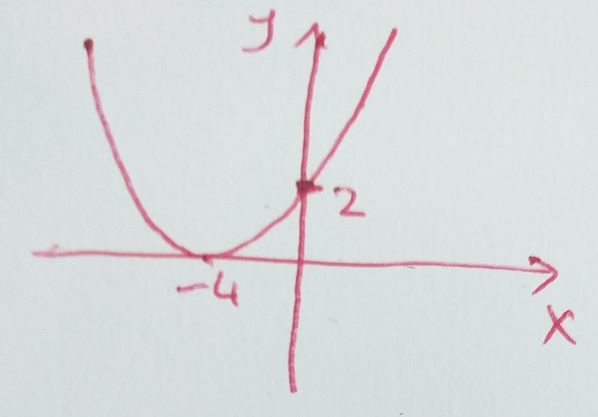
B 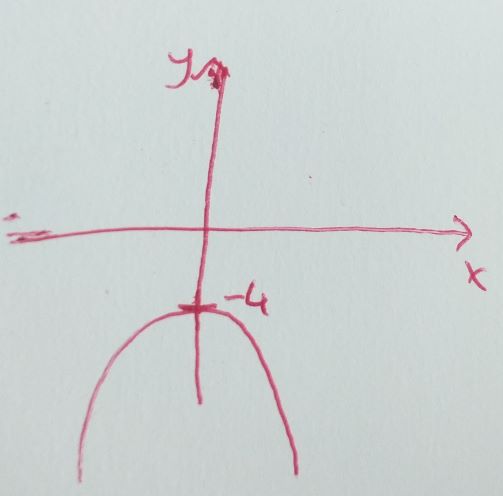
C 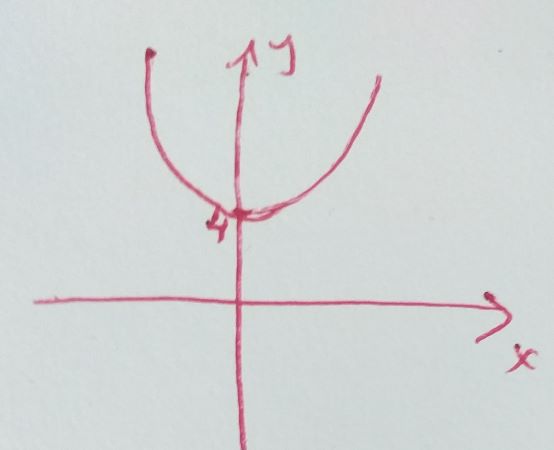
D 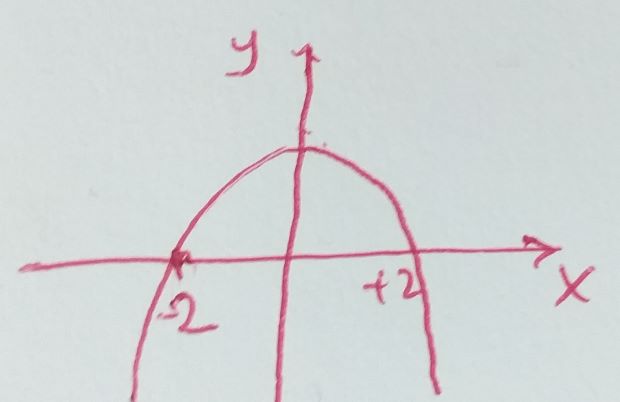
E 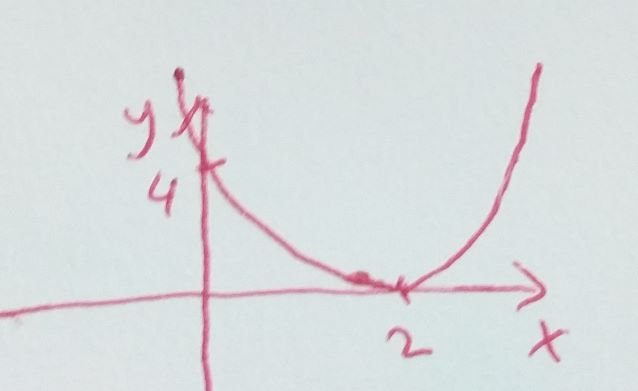
Açıklama:
since f(x)=x2+4, f(0)=4. Thus the graphs in A and B are eliminated. Also since x2+4 can not be equal to zero for real values of x, the graph can not cross the y-axis at y=0. Thus, E and D are eliminated also. Therefore the answer is C. Besides see that the coefficient of x2 is positive. Therefore the function has a positive slope for x>0 and a negative slope for x<0.
Soru 58
Suppose f(x)= x+2 and g(x)=x2. Find f(g(2)).
Seçenekler
A
8
B
6
C
4
D
2
E
1
Açıklama:
f(g(x))=f(x2)=2+x2. Thus for x=2, f(g(2))=6
Soru 59
Find the inverse of the function f(x)=(2x-3)/(4x+1).
Seçenekler
A
(x-3)/(2-4x)
B
(3x-2)/(2+4x)
C
(4x+3)/(2-x)
D
(x-3)/(2+4x)
E
(x+3)/(2-4x)
Açıklama:
Let's try to leave x alone from the expression f(x)=(2x-3)/(4x+1)=y
(2x-3)/(4x+1)=y
2x-3=y(4x+1)
2x-3=4xy+y
2x-4xy=y+3
x(2-4y)=y+3
x=(y+3)/(2-4y)
Thus f-1(x)=(x+3)/(2-4x)
(2x-3)/(4x+1)=y
2x-3=y(4x+1)
2x-3=4xy+y
2x-4xy=y+3
x(2-4y)=y+3
x=(y+3)/(2-4y)
Thus f-1(x)=(x+3)/(2-4x)
Soru 60
Suppose that f(x)=3x-1 and g(x)=x2-1. Find f/g(3).
Seçenekler
A
1/3
B
1
C
3
D
8/3
E
10/8
Açıklama:
Since f(x)=3x-1 and g(x)=x2-1, then f/g(x)=(3x-1)/(x2-1).
For x=3, f/g(3)=8/8=1
For x=3, f/g(3)=8/8=1
Ünite 3
Soru 1

Seçenekler
A 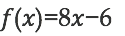
B 
C 
D 
E 
Açıklama:
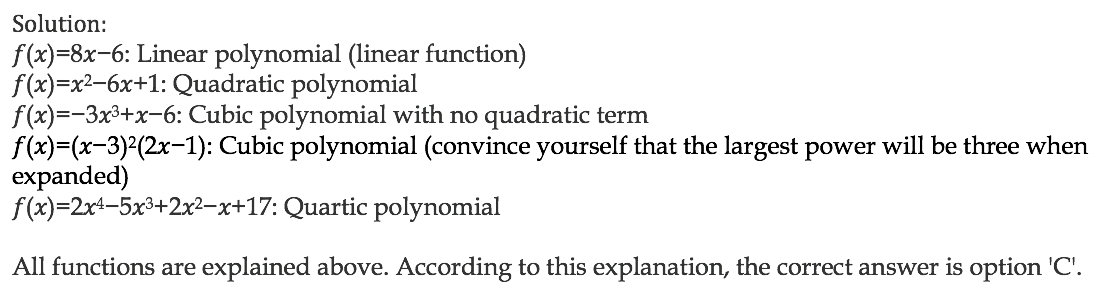
Soru 2

Seçenekler
A 
B 
C 
D 
E 
Açıklama:

Soru 3

Seçenekler
A 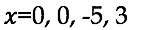
B 
C 
D 
E 
Açıklama:
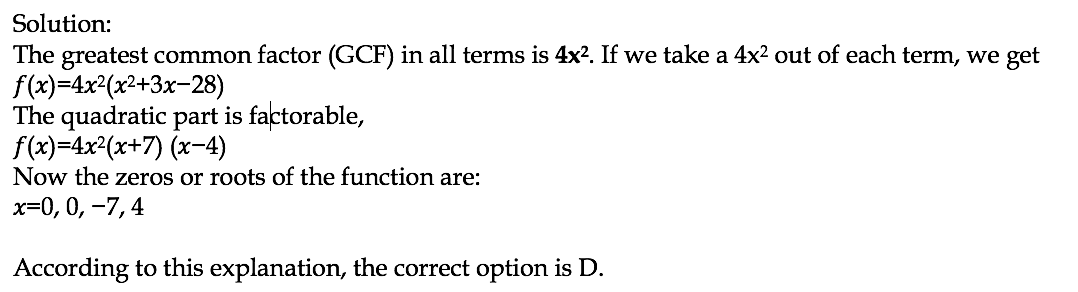
Soru 4

Seçenekler
A 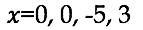
B 
C 
D 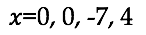
E 
Açıklama:
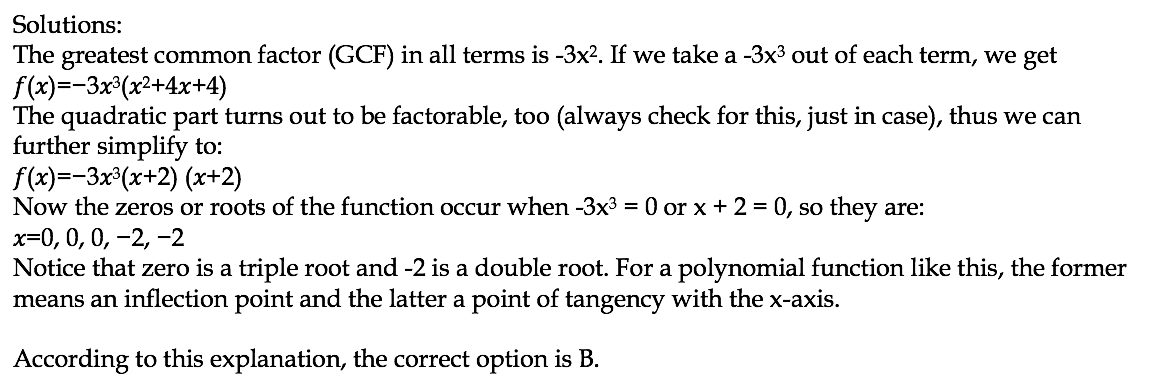
Soru 5

Seçenekler
A
1
B
2
C
3
D
4
E
5
Açıklama:
Soru 6

Seçenekler
A
2
B
4
C
5
D
7
E
9
Açıklama:

Soru 7

Seçenekler
A
2, 3
B
-2, -3
C
1, 4
D
2, -3
E
-2, 3
Açıklama:

Soru 8
When you divide a number by 3 and then add 2, the result is the same as when you multiply the same number by 2 then subtract 23. What is the number?
Seçenekler
A
2
B
15
C
7
D
3
E
9
Açıklama:
Soru 9
Which of the following linear function has slope 2?
Seçenekler
A 
B 
C 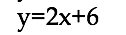
D 
E 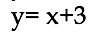
Açıklama:

Soru 10
Which of the options given is a quartic polynomial?
Seçenekler
A 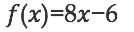
B 
C 
D 
E 
Açıklama:
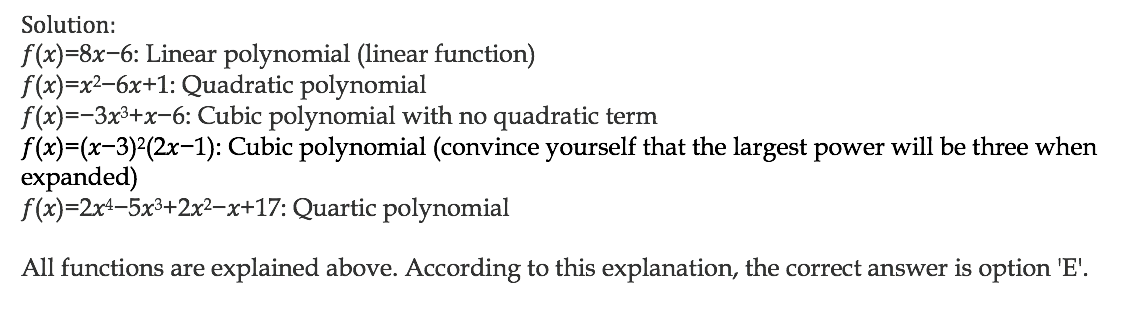
Soru 11
Which of the following is a polynomial function, with degree 3?
Seçenekler
A
f(x)= x3+3x-5
B
f(x)= x2+3x-2
C
f(x)= x2+3x-2x
D
f(x)=3x
E
f(x) =3x-2x
Açıklama:
The degree of f(x)= x3+3x-5 is 3.
Soru 12
Which of the following is not a point on the line y=2x+1?
Seçenekler
A
(0,1)
B
(-1/2,0)
C
(0,-1/2)
D
(1,3)
E
(2,5)
Açıklama:
(0,-1/2) does not satisfy the equivalence of y=2x+1.
Soru 13
Which of the following is a solution set of 2x-2=0?
Seçenekler
A 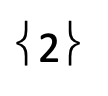
B 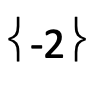
C 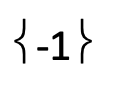
D 
E 
Açıklama:
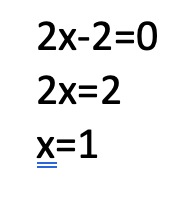
Soru 14
Which of the following functions is quadratic and has y-intercept -1?
Seçenekler
A
f(x)= x2-2x-1
B
f(x)= x2-x+1
C
f(x)= x2-x
D
f(x)= x-1
E
f(x)=-1
Açıklama:
f(x)= x2-2x-1 is quadratic and has y-intercept -1.
Soru 15
What is the solution set of the inequality x-2>0?
Seçenekler
A 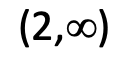
B 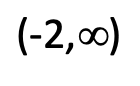
C 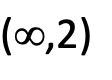
D 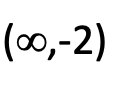
E
(2,0)
Açıklama:
x-2>0
x>2
x>2
Soru 16
Which of the following quadratic functions has not x-intercept on naturel numbers?
Seçenekler
A
y=x2-x-2
B
y=x2-x+2
C
y=x2-x-1
D
y=2x2-x-1
E
y=3x2-3x-3
Açıklama:
There is not any naturel numbers satisfy the equation of 0=x2-x+2
Soru 17
Which of the following is not a polynomial function?
Seçenekler
A
f(x)=x2-(1/2)x+2
B
f(x)=(1/2)x-1/2
C
f(x)=(-1/2)x
D
f(x)=2
E
f(x)=x2-x-1/2+2
Açıklama:
-1/2; the power of x-1/2
is not a naturel number.
is not a naturel number.
Soru 18
Which of the following function' s root is 0?
Seçenekler
A
f(x)=4x-5
B
f(x)=4
C
f(x)=4x2
D
f(x)=4x2-4
E
f(x)=4x-4
Açıklama:
For y=0, x=0 for the equality of f(x)=4x2
Soru 19
Which of the following equation is identity?
Seçenekler
A
y=2x-2
B
x+x=2x
C
x-2=0
D
x2=2x
E
x2=-x2
Açıklama:
All real numbers satisfy the equality of x+x=2x.
Soru 20
Which of the following linear equality's graph does not intersect the y-axis?
Seçenekler
A
y=x
B
y=2x+1
C
y=2
D
x=2
E
x=2y-2
Açıklama:
In order to intersect the y-axis, the equalty of x=0 should be satisfied for x=2. But it can not be.
Soru 21
Which of the following functions are polynomial?
I- f(x)=4x2-5x+3
II- g(x)=2x-3-5x-1
III- h(x)=0.6x3-0.5x
IV- p(x)=7x3/2-2x+4
I- f(x)=4x2-5x+3
II- g(x)=2x-3-5x-1
III- h(x)=0.6x3-0.5x
IV- p(x)=7x3/2-2x+4
Seçenekler
A
I and IV
B
I and II
C
II and III
D
I and III
E
III and IV
Açıklama:
g(x) and p(x) are not in polynomial for because the powers of the elements must be natural numbers. Since -3 and 3/2 are not natural numbers, only f(x) and h(x) are polynomials.
Soru 22
Which of the following functions is(are) a polynomial(s) of degree 1?
I- f(x)=2
II- g(x)=2x
III- h(x)=2/x
IV- k(x)=x/2
I- f(x)=2
II- g(x)=2x
III- h(x)=2/x
IV- k(x)=x/2
Seçenekler
A
I and III
B
II and IV
C
II and III
D
I and IV
E
I and II
Açıklama:
h(x) is not a polynomial because, power of x in expression is -1, which is not a natural number. Besides f(x)=2 is a constant function, which means its degree is zero. Thus only g(x)=2x and k(x)=x/2 (which is equal to 0.5x) are polynomials of degree 1, namely they are linear functions.
Soru 23
Which of the following polynomial equations have a natural number root?
Seçenekler
A
3x+4=0
B
4x+3=0
C
3x+5=0
D
5x+5=0
E
5x-5=0
Açıklama:
-4/3, -3/4,-5/3 and -1 are not natural numbers, but 1 is. So the answer is E.
Soru 24
Which of the following sets contain the roots of the polynomial equation
f(x)=x2-5x+6=0?
f(x)=x2-5x+6=0?
Seçenekler
A
(2,3)
B
(-2,3)
C
(2,-3)
D
(1,6)
E
(-6,1)
Açıklama:
x2-5x+6=(x-2)(x-3)=0
Thus either x-2=0, which means x=2, or x-3=0, which means x=3. So the solution set is (2,3).
Thus either x-2=0, which means x=2, or x-3=0, which means x=3. So the solution set is (2,3).
Soru 25
Which of the following quadratic equations has a root x=0?
Seçenekler
A
4x2-15x+3=0
B
x2-4x+3=0
C
x2-9x=0
D
3x2-7x-5=0
E
3x2+12=0
Açıklama:
When you substitute x with zero, only the equation in C is true.
Soru 26
Which of the following expression's graphs passes through the origin?
I- f(x)=3
II- g(x)=3x
III- h(x)=3x2
IV- p(x)=3+3x2
I- f(x)=3
II- g(x)=3x
III- h(x)=3x2
IV- p(x)=3+3x2
Seçenekler
A
I and II
B
II and III
C
I and III
D
II and IV
E
I and IV
Açıklama:
For a function's graph to pass through the origin, it must satisfy f(x)=0 for x=0. This condition is satisfied only for II and III
Soru 27
Which of the following parabolas cross the x axis?
Seçenekler
A
f(x)=x2-4x+5
B
f(x)=x2-2x+3
C
f(x)=x2-2x+10
D
f(x)=x2+4x+5
E
f(x)=x2-5x+4
Açıklama:
One parabola cross x axis only if it has real roots, which means in turn, the discirminant of parabola equation is greater than or equal to zero. This condition is satisfied only for the equation x2-5x+4
Soru 28
Which of the following parabolas have a positive y intercept?
Seçenekler
A
f(x)=x2-5x-4
B
f(x)=x2+5x-1
C
f(x)=-x2-6x-3
D
f(x)=x2-5x+4
E
f(x)=x2
Açıklama:
For a parabola to have a positive y intercept f(0) must be positive. This is true for only f(x)=x2-5x+4 for x=0 (since f(0)=4).
Soru 29
What is the solution set for the inequality x2-5x+4<0
Seçenekler
A
1
B
4
C
x<1
D
-4
E
5
Açıklama:
Firstly we have to find the roots of the quadratic expression f(x)=x2-5x+4=0
x2-5x+4=(x-1)(x-4)=0 is satisfied only if x=1 or x=4.
Thus we can divide the real numbers line to 3 regions:
1-)x<1
2-)1
3-) 4
In the first region (where x<1), f(x)=x2-5x+4>0. You can see this by substituting arbitrary numbers for x. (For instance think of x=0).
In the second region (where 12-5x+4<0. You can see this by substituting arbitrary numbers for x. (For instance think of x=2).
In the third region (where 42-5x+4>0. You can see this by substituting arbitrary numbers for x. (For instance think of x=5).
Thus only for the values of x in the second region, f(x) takes a negative value.
x2-5x+4=(x-1)(x-4)=0 is satisfied only if x=1 or x=4.
Thus we can divide the real numbers line to 3 regions:
1-)x<1
2-)1
3-) 4
In the first region (where x<1), f(x)=x2-5x+4>0. You can see this by substituting arbitrary numbers for x. (For instance think of x=0).
In the second region (where 1
In the third region (where 4
Thus only for the values of x in the second region, f(x) takes a negative value.
Soru 30
What is the solution set for the inequality x2-6x-16<0?
Seçenekler
A
1
B
-8
C
-2
D
8
E
x<-2
Açıklama:
Firstly we have to find the roots of the quadratic expression f(x)=x2-6x-16=0
x2-6x-16=(x-8)(x+2)=0 is satisfied only if x=-2 or x=8.
Thus we can divide the real numbers line to 3 regions:
1-)x<-2
2-)-2
3-) 8
In the first region (where x<-2), f(x)=x2-6x-16>0. You can see this by substituting arbitrary numbers for x. (For instance think of x=-3).
In the second region (where -22-6x-16<0. You can see this by substituting arbitrary numbers for x. (For instance think of x=0).
In the third region (where 82-6x-16>0. You can see this by substituting arbitrary numbers for x. (For instance think of x=10).
Thus only for the values of x in the second region, f(x) takes a negative value.
x2-6x-16=(x-8)(x+2)=0 is satisfied only if x=-2 or x=8.
Thus we can divide the real numbers line to 3 regions:
1-)x<-2
2-)-2
3-) 8
In the first region (where x<-2), f(x)=x2-6x-16>0. You can see this by substituting arbitrary numbers for x. (For instance think of x=-3).
In the second region (where -2
In the third region (where 8
Thus only for the values of x in the second region, f(x) takes a negative value.
Soru 31

Seçenekler
A 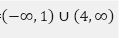
B 
C 
D
(1,5)
E
(4,5)
Açıklama:
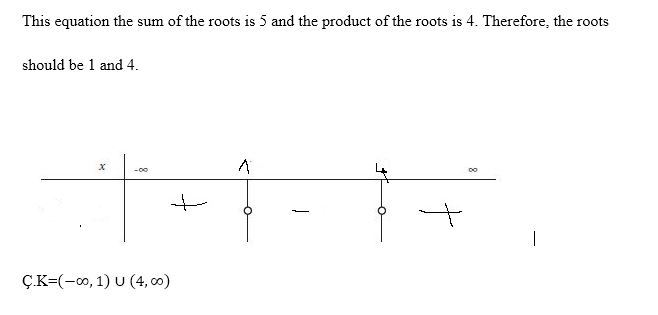
Soru 32

Seçenekler
A
1 and 4
B
-1 and 4
C
-4 and 1
D
1 and 5
E
-5 and 1
Açıklama:
This equation the sum of the roots is 5 and the product of the roots is 4. Therefore, the roots
should be 1 and 4.
should be 1 and 4.
Soru 33
Which of the following is a polynomial function, with degree 7?
Seçenekler
A 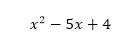
B 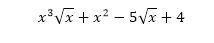
C 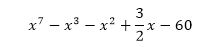
D 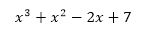
E 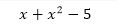
Açıklama:
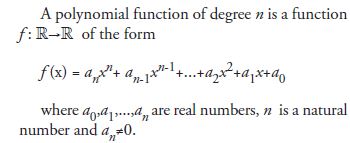
Soru 34
Which of the following is a solution set of 7x-21=0?
Seçenekler
A
3
B
4
C
5
D
6
E
7
Açıklama:
if 7x-21=0 7x=21 and x=3.
Soru 35
What is the solution set of the inequality 4x-128<0?
Seçenekler
A
(-∞, 48)
B
(4,32)
C 
D
(-∞, 24).
E
(32,∞).
Açıklama:
if 4x-128<0 4x<128 and x<32
ÇK=(-∞, 32).
ÇK=(-∞, 32).
Soru 36
Which of the following linear function has slope -5?
Seçenekler
A
8y=6x+3
B
y=2x-3
C
2y=-10x+4
D
y=4-3x
E
2y=5x+7
Açıklama:
slope =a for equation y = ax+b
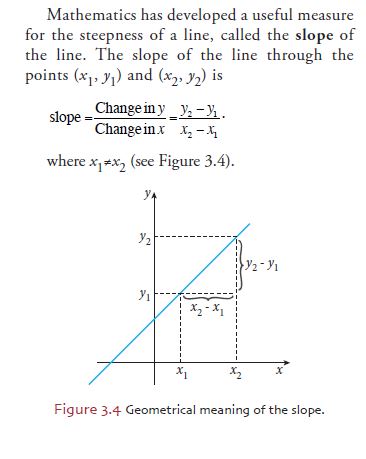 if 2y=-10x+4 y=-5x+2 and slope=-5
if 2y=-10x+4 y=-5x+2 and slope=-5Soru 37
Which of the following is the point of intersection of the lines y=3x-14 and y=-x-2?
Seçenekler
A
(3,4)
B
(2,3)
C
(-5,3)
D
(3,5)
E
(3,-5)
Açıklama:
We find the common
solution. For this, 3x-14=-x-2
3x+x=14-2
4x=12
x=3
Now we write x=3 in the equation y=-x-2=-3-2=-5 . So, (3,-5) is the intersection point of the lines
solution. For this, 3x-14=-x-2
3x+x=14-2
4x=12
x=3
Now we write x=3 in the equation y=-x-2=-3-2=-5 . So, (3,-5) is the intersection point of the lines
Soru 38
Which of the following the slope of the line passing through the points (1, 2) and (-2, -1)?
Seçenekler
A
-2
B
-1
C
1
D
1/2
E
2
Açıklama:
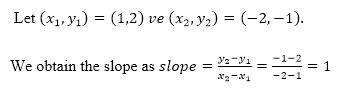
Soru 39
- Which of the following the line equation passing through the points (1, 2) and (-2, -1) ?
Seçenekler
A
y=-2x-1
B
y=2x+2
C
y=-x+2
D
y=3x-2
E
y=x+1
Açıklama:
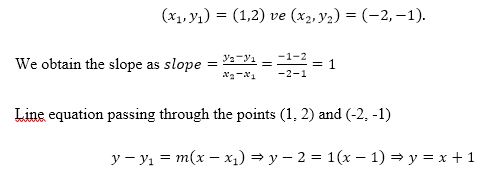
Soru 40

Seçenekler
A
(1,3)
B
(-1,2)
C
(3,0)
D
(-3,3)
E
(3,6)
Açıklama:
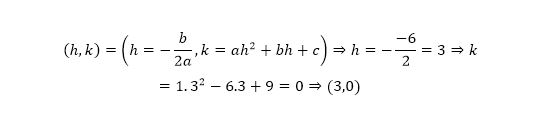
Ünite 4
Soru 1

Seçenekler
A
1
B
100
C
1000
D
0
E
10
Açıklama:

Soru 2
ln(x2) - ln(4 e2 x) = -2. x = ?
Seçenekler
A
e
B
4
C
1 / e
D
2 / (1 - e)
E
e2
Açıklama:
2 ln x - In 4 - 2 In e - In x = -2 ; In x = In 4 ; x = 4. Correct answer is B.
Soru 3
ln(1 / (x - 1))2 ) = -4. x = ?
Seçenekler
A
e2 + 1
B
-4 / (e - 1)
C
2 e
D
4 e3
E
e - 4
Açıklama:
-2 ln(x - 1) = -4 ; ln(x - 1) = 2 = ln e2 ; x - 1 = e2 ; x = e2 + 1. Correct answer is A.
Soru 4
a = log2 5, b = log2 10. 2(a - b) log9 3 = ?
Seçenekler
A
0.25
B
1
C
9
D
3
E
1.50
Açıklama:
c = log2 (5 / 10) = log2 2-1 ; log2 c = 2-1 ; 3 = 91/2 ; x = 2-1 1/2 = 2-2 = 0.25 . Correct answer is A.
Soru 5
log29 . log58 . log925 = ?
Seçenekler
A
30
B
90
C
6
D
18
E
1
Açıklama:
change of base : x = (ln 9 / ln 2) (ln 8 / ln 5) (ln 25 / ln 9) = (1 / ln 2) (3 In 2 / In 5) (2 In 5) = 6. Correct answer is C.
Soru 6
Which power of 2 is between 500 and 600 ?
Seçenekler
A
11
B
8
C
7
D
9
E
10
Açıklama:
512 = 29 . Correct answer is D.
Soru 7
e-2x + e-x = 0. x = ?
Seçenekler
A
e
B
-e
C
no solution
D
1 / e
E
-1 / e
Açıklama:
for all x : e-2x > 0, e-x > 0 ; no solution. Correct answer is C.
Soru 8
A bacteria population increases exponentially. At t = 0, its population is 50. At t = 1 hour, its population is 250. At t = 4 hours, what is its population ?
Seçenekler
A
3.125
B
10.000
C
6.500
D
2.500
E
7.750
Açıklama:
P(t) = P0 ek t ; P(0) = P0 = 50 ; P(1) = 50 ek 1 = 250 ; ek = 5 ; ln ek = ln 5 ; k = ln 5 ; x = 50 e(ln5) 4 ; a = ln 54 ; x = 50 ea = 50 54 = 10 55 = 3.125. Correct answer is A.
Soru 9
According to the Richter scale, earthquake magnitude 7.0 is how many times greater than 5.0 ?
Seçenekler
A
500
B
25
C
10
D
1.000
E
100
Açıklama:
7 = log10 107 ; 6 = log10 105 ; x = 107 / 105 = 100. Correct answer is E.
Soru 10
What is the half-life of a radioactive substance if 90% of the initial amount remains at the end of 25 years ?
Seçenekler
A
50 (ln 0.5) ln 0.9
B
75 (ln 0.9) / ln 0.5
C
25 (ln 0.5) / ln 0.9
D
100 ln (0.5 / 0.9)
E
150 ln (0.9 / 0.5)
Açıklama:
Q(t) = Q0 ek t ; 0.9 Q0 = Q0 ek 25 ; ln 0.9 = k 25 ; k = (ln 0.9) / 25 ; 0.5 Q0 = Q0 e((ln 0.9) / 25) t ; ln 0.5 = ((ln 0.9) / 25) t ; t = 25 (ln 0.5) / ln 0.9 . Correct answer is C.
Soru 11
Evaluate the expression log216/ln2.
Seçenekler
A
ln(e4+2)
B
1/2
C
1
D
ln(e4/2)
E
ln(e4-2)
Açıklama:
log216=log224=4
(4/ln2)=(4lne)/ln2=lne4/ln2=ln(e4/2)
(4/ln2)=(4lne)/ln2=lne4/ln2=ln(e4/2)
Soru 12

Seçenekler
A
-2/3
B
-8/9
C
2/5
D
3/8
E
7/2
Açıklama:
log3(1/(x+1))=2→ 3²=1/(X+1)→9=1/(X+1) then 9x+9=1→x=-8/9
Soru 13
What is the solution of the equation ln(81x4)=20?
Seçenekler
A
e3/3
B
e2/5
C
0
D
1
E
e5/3
Açıklama:
We write 81x4 = (3x)4 and use the law
ln ab = b ln a,
then, 4ln(3x)=20→ln(3x)=5→e5=3x→e5/3=x
ln ab = b ln a,
then, 4ln(3x)=20→ln(3x)=5→e5=3x→e5/3=x
Soru 14
log52 . log43 . log95=?
Seçenekler
A
1/6
B
1/2
C
1
D
2
E
6
Açıklama:
using the change-of-base formula, log52=ln2/ln5
log43=ln3/ln4=ln3/ln2²=ln3/2ln2
log95=ln5/ln9=ln5/3ln3
then,log52 . log43 . log95=(ln2/ln5) . (ln3/2ln2) . (ln5/3ln3)=1/6
log43=ln3/ln4=ln3/ln2²=ln3/2ln2
log95=ln5/ln9=ln5/3ln3
then,log52 . log43 . log95=(ln2/ln5) . (ln3/2ln2) . (ln5/3ln3)=1/6
Soru 15
Which power of 4 between 4000-4100?
Seçenekler
A
4
B
5
C
6
D
7
E
8
Açıklama:
we can calculate that: 4²=16, 4³=64, 44=256, 45=1024, 46=4096 Then the power of 4, which lies between 4000 and 4100, is 6.
Soru 16
Solve the exponential equation; 52x+3=1/25
Seçenekler
A
-5/2
B
-2
C
0
D
2
E
5/2
Açıklama:
Note that one can rewrite;
52x+3=1/25=52x+3=5-2
Since the exponential function 5x is one-to one, we have
2x+3=-2 then x=-5/2
52x+3=1/25=52x+3=5-2
Since the exponential function 5x is one-to one, we have
2x+3=-2 then x=-5/2
Soru 17
What is one of the solution of the exponential equation e2x - 2ex -15=0
Seçenekler
A
ln2
B
ln3
C
ln4
D
ln5
E
ln6
Açıklama:
e2x - 2ex -15=0 → let ex=a then w can write the equation as, a²-2a-15=0
→ (a-5)(a+3)=0 → ex=a=5, ex=a=-3 then the solution is; ln5 and ln-3.
→ (a-5)(a+3)=0 → ex=a=5, ex=a=-3 then the solution is; ln5 and ln-3.
Soru 18
In a certain culture, the number of cells increases at a rate proportional to the number of cells present. If there are 150 cells present initially and 600 cells in one hour, find the number of cells in 4 hours?
Seçenekler
A
8100
B
16200
C
38400
D
55000
E
102400
Açıklama:
Let the function P(t) denote the number of the cells at time t in this culture.
P(t) = P0ekt
P(0)=P0=150
P(1)=P0ek.1 → P(1)=150ek =600 → ek=4 then k=ln4 =2ln2
The equation is, P(t) = 150e2ln2t
for t=4→P(4)=150e2(ln2).4
=150.28=38400.
P(t) = P0ekt
P(0)=P0=150
P(1)=P0ek.1 → P(1)=150ek =600 → ek=4 then k=ln4 =2ln2
The equation is, P(t) = 150e2ln2t
for t=4→P(4)=150e2(ln2).4
=150.28=38400.
Soru 19
There are 2 earthquakes are given below;
1st earthquake's magnitude is M=7.1 and the 2nd earthquake's magnitude is M=5.2 on the Richter scale.
How many times 1st earthquake has a magnitude greater than 2nd earthquake about?
( On the Richter scale, the magnitude M of an earthquake of intensity I is expressed by the formula: M = log10I.)
1st earthquake's magnitude is M=7.1 and the 2nd earthquake's magnitude is M=5.2 on the Richter scale.
How many times 1st earthquake has a magnitude greater than 2nd earthquake about?
( On the Richter scale, the magnitude M of an earthquake of intensity I is expressed by the formula: M = log10I.)
Seçenekler
A
10
B
25
C
50
D
80
E
125
Açıklama:
For the first earthquake, the intensity is; M = log10I→ 7.1=log10I→ I=107.1
For the second earthquake, the intensity is; M = log10I→ 5.2=log10I→ I=105.2
on the Richter scale yields an intensity change by a factor of
107.1/105.2 =101.9=79.43
Strictly speaking; the fist earthquake had a magnitude about 80 times greater than second earthquake.
For the second earthquake, the intensity is; M = log10I→ 5.2=log10I→ I=105.2
on the Richter scale yields an intensity change by a factor of
107.1/105.2 =101.9=79.43
Strictly speaking; the fist earthquake had a magnitude about 80 times greater than second earthquake.
Soru 20
What is the half-life of a radioactive substance if 95% of the initial amount remains at the end of 10 years?
Seçenekler
A
23,12
B
34,67
C
76,98
D
113,34
E
135,13
Açıklama:
Let Q(t) be the amount of the radioactive substance at time t and A be the amount of initial radioactive substance. Since decay of the amount of radioactive substance is exponential, the function Q(t) has the following form:
Q(t) = Q0ekt
for t=0→A= Q0 then Q(10)=0,95A=A.ek10
ln 0,95=10k and k=(ln0,95)/10
To find the half-life of this radioactive material we should solve the equation;
0,5A=A.e((ln0,95)/10).t
ln0.5=(ln0,95/10)).t →135,13
Q(t) = Q0ekt
for t=0→A= Q0 then Q(10)=0,95A=A.ek10
ln 0,95=10k and k=(ln0,95)/10
To find the half-life of this radioactive material we should solve the equation;
0,5A=A.e((ln0,95)/10).t
ln0.5=(ln0,95/10)).t →135,13
Soru 21
Which of the following is not an exponential function?
Seçenekler
A
f(x)=x3
B
f(x)=4x
C
f(x)=(0.5)x
D
f(y)=(5/2)y
E
f(x)=10x
Açıklama:
The form of the exponential functions is f(x)=ax for all values of a other than 1. So f(x)=x3 is not an exponential function.
Soru 22
Which of the following is not true for an exponential function f(x)=ax if 0
Seçenekler
A
Domain of the exponential function f(x)=ax is (-∞, ∞)
B
Range of the exponential function f(x)=ax is (0, ∞)
C
The exponential function f(x)=ax is increasing
D
As x goes to minus infinity, f(x)=ax goes to infinity
E
As x goes to infinity, f(x)=ax goes to zero
Açıklama:
f(x)=ax is not an increasing function for 0
Soru 23
Which of the following properties are true for the exponential functions?
I.ax+y=axay
II. ax-y=ax/ay
III. (ax)y=ax+y
IV.(ba)y=byay
I.ax+y=axay
II. ax-y=ax/ay
III. (ax)y=ax+y
IV.(ba)y=byay
Seçenekler
A
I, II and III
B
I, II and IV
C
II, III and IV
D
I, III and IV
E
I and IV
Açıklama:
(ax)y=axy , so other than III all the properties hold for exponential functions.
Soru 24
If 10.000 TL is invested for 4 years at an annual rate of interest of 20%, find the value of the investment at the end of 4 years if interest is compounded annually.
Seçenekler
A
8000
B
14000
C
18000
D
20736
E
22462
Açıklama:
Total value at the end=10.000(1.2)4=2.0736*10000=20736
Soru 25
Which of the following are true for the function logax when a>1?
I. Domain of the logarithmic function logax is (0, ∞)
II. Range of the logarithmic function logax is (-∞, ∞)
II. logax is a decreasing function
I. Domain of the logarithmic function logax is (0, ∞)
II. Range of the logarithmic function logax is (-∞, ∞)
II. logax is a decreasing function
Seçenekler
A
Only I
B
Only II
C
Only III
D
I and III
E
I and II
Açıklama:
logax is an increasing function if a>1. So III is false.
Soru 26
How many of the following arguments are true if x>0 and y>0.
- loga(xy)= logax+logay,
- loga(x/y)= logax-logay
- loga(1/y)= -logay
- loga(x)y=y+logax
Seçenekler
A
4
B
3
C
2
D
1
E
0
Açıklama:
Only the last argument is false. loga(x)y=ylogax. So the remaining 3 arguments are true.
Soru 27
Find the solution set of the equation 0=6+e2x - 5ex
Seçenekler
A
(2,3)
B
(ln2, 3)
C
(2, ln3)
D
(ln2, ln3)
E
(ln1, ln4)
Açıklama:
0=6+e2x - 5ex
0=(ex - 3)(ex - 2)
So the system has 2 roots:
ex - 3=0 then ex=3 so x=ln3
ex - 2=0 then ex=2 so x=ln2
Therefore solution set is (ln2, ln3)
0=(ex - 3)(ex - 2)
So the system has 2 roots:
ex - 3=0 then ex=3 so x=ln3
ex - 2=0 then ex=2 so x=ln2
Therefore solution set is (ln2, ln3)
Soru 28
If the half-life of a radioactive material is 3000 years, how much of the 100 grams will remain after 5000 years?
Seçenekler
A
15.6
B
22.7
C
26.8
D
28.6
E
31.5
Açıklama:
The quantity at time t is given by the formula Q(t)=Q(0)*ekt where Q(0) is the initial amount.
Since the half life is 3000 years, we can write:
0.5Q(0)=Q(0)*e3000k which means that:
0.5=e3000k
ln0.5=lne3000k
ln0.5=3000k
ln0.5/3000=k
Thus, after finding k we can calculate:
Q(t=5000)=100*e5000*ln0.5/3000
=100*e5*ln0.5/3
=100*e-1.155=31.49
Since the half life is 3000 years, we can write:
0.5Q(0)=Q(0)*e3000k which means that:
0.5=e3000k
ln0.5=lne3000k
ln0.5=3000k
ln0.5/3000=k
Thus, after finding k we can calculate:
Q(t=5000)=100*e5000*ln0.5/3000
=100*e5*ln0.5/3
=100*e-1.155=31.49
Soru 29
The population of a bacteria doubles in 4 hours. How many bacteria would we have in 10 hours given that we have 1000 bacteria now?
Seçenekler
A
5657
B
3568
C
2563
D
1896
E
567
Açıklama:
Given the initial bacteria population Q(0), the population at time t is given by Q(t)=Q(0)ekt.
Since we know that population doubles in 4 hours, we can write:
2Q(0)=Q(0)e4k
2=e4k
ln2=4k, so k=ln2/4=0.1733
Then Q(t=10)=1000e10k
=1000.e1.733
=5657 (approximately)
Since we know that population doubles in 4 hours, we can write:
2Q(0)=Q(0)e4k
2=e4k
ln2=4k, so k=ln2/4=0.1733
Then Q(t=10)=1000e10k
=1000.e1.733
=5657 (approximately)
Soru 30
A radioactive material losses 20 % of its weight after 10 years. What is the half-life of this material approximately?
Seçenekler
A
31
B
25
C
20
D
16
E
14
Açıklama:
Since 20 percent is lost, 80 percent is remaining at the end of 10 years. Thus we can write:
0.8Q=Q.e10k
ln0.8/10=k=-0.0223
So we can find the half life by:
0.5Q=Q.e-0.0223t
ln0.5=-0.0223t, then t=31.06 years
0.8Q=Q.e10k
ln0.8/10=k=-0.0223
So we can find the half life by:
0.5Q=Q.e-0.0223t
ln0.5=-0.0223t, then t=31.06 years
Soru 31
Which power of 4 is between 250 and 650?
Seçenekler
A
3
B
4
C
5
D
6
E
7
Açıklama:
250<4x<650
4*4*4*4=44=256
x=4
4*4*4*4=44=256
x=4
Soru 32
What is solution of 50?
Seçenekler
A
0
B
1
C
5
D
50
E
500
Açıklama:
50=1
The correct answer is 1.
The correct answer is 1.
Soru 33
Suppose that we have 2000 TL to invest at an annual rate of interest of 10% for 4 years in an account that pays simple interest. What is the value of the investment (total amount) at the end of second year?
Seçenekler
A
2200
B
2420
C
2500
D
2928,2
E
3000,5
Açıklama:
2000.(1+(10/100))4=2000.(1,1)4=2928,2
The correct answer is 2928,2 ₺.
The correct answer is 2928,2 ₺.
Soru 34
What is the solution of log216?
Seçenekler
A
2
B
3
C
4
D
5
E
6
Açıklama:
log216=log224=4
The correct answer is 4.
The correct answer is 4.
Soru 35
If the half-life of 100 grams of radioactive material is 2000 years, how much of the 100 grams will remain after 1000 years?
Seçenekler
A
50.15
B
65.52
C
68.78
D
70.71
E
75.75
Açıklama:

The correct answer is 70,71 gr.
Soru 36
Which power of 6 is between 1200 and 1500?
Seçenekler
A
4
B
5
C
6
D
7
E
8
Açıklama:
1200<6x<1500
6*6*6*6=64=1296
The correct answer is 4.
6*6*6*6=64=1296
The correct answer is 4.
Soru 37
What is the solution of log327?
Seçenekler
A
2
B
3
C
4
D
5
E
6
Açıklama:
log327=log333=3
The correct answer is 3.
The correct answer is 3.
Soru 38
Which power of 7 is between 2000 and 2500
Seçenekler
A
8
B
7
C
6
D
5
E
4
Açıklama:
2000<7x<2500
7*7*7*7=2401; so 74=2401;
2000<74<2500
The correct answer is 4.
7*7*7*7=2401; so 74=2401;
2000<74<2500
The correct answer is 4.
Soru 39
Which power of 2 is between 125 and 250?
Seçenekler
A
4
B
5
C
6
D
7
E
8
Açıklama:
125<2x<250
27=128
The correct answer is 7.
27=128
The correct answer is 7.
Soru 40
What is the solution of log749?
Seçenekler
A
5
B
4
C
3
D
2
E
1
Açıklama:
log749=log772=2
The correct answer is 2.
The correct answer is 2.
Soru 41
What is the solution of the logarithmic equation  ?
?
?Seçenekler
A
1
B
2
C
3
D
4
E
5
Açıklama:

 . We get
  and
and  . Hence, we find the solution to be x=-1 and x=3.
 The definition of logarithmic function cannot be x = -1. The solution is x=3.
Soru 42
What is the solution of the equation  ?
?
?Seçenekler
A
2
B
1/2
C
4
D
3
E
5
Açıklama:
(y=lnx if and only if  )
)
 We find the solution as x-1=1
  x=2.
x=2.Soru 43
What is the solution set of the exponential equation  ?
?
?Seçenekler
A 
B 
C 
D 
E 
Açıklama:


 .
.We find the solutions x=3 or x=-1.
Soru 44
What is the solution set of the equation  ?
?
?Seçenekler
A 
B 
C 
D 
E
Açıklama:
We write and use the ln1=0


 .
.
We find the solution as x=-2 or x=3.
and use the ln1=0.We find the solution as x=-2 or x=3.
Soru 45
What is the solution of the equality  ?
?
?Seçenekler
A
3
B
4
C
5
D
6
E
7
Açıklama:


 .
.We use the law
 . We write 6.1=xx=6.
Soru 46
Çukurhisar (Eskişehir) was devastated by an earthquake which was measured 9.1 on the Richter scale on May 21th 1910. Nearly 101 years later,Gölçük (Kocaeli) was destroyed by an earthquake which is measured 7.4 on the Richter scale on August 13th 2011. How many times Çukurhisar earthquake hada magnitude greater than the Gölçük earthquake?
Seçenekler
A
1,7
B
17
C
25
D
45,8
E
50,1
Açıklama:
We know that, on the Richter scale, the magnitude M of an earthquake of intensity I is expressed by the formula M = log10 I.
For Çukurhisar earthquake, because M = 9,1 we have 9,1 = log10 I and

For Gölçük earthquake, because M = 7,4 we have 7,4 = log10 I and

One can compare that an increase of 9,1 - 7.4 = 1,7 units on the Richter scale yields an intensity change by a factor of

For Çukurhisar earthquake, because M = 9,1 we have 9,1 = log10 I and
For Gölçük earthquake, because M = 7,4 we have 7,4 = log10 I and
One can compare that an increase of 9,1 - 7.4 = 1,7 units on the Richter scale yields an intensity change by a factor of
Soru 47
Evaluate the expression  ?
?
?Seçenekler
A
3
B
-3
C
-4
D
4
E
5
Açıklama:
It is known that


 .
.
.Soru 48
Which power of 4 is between 200 and 300?
Seçenekler
A
2
B
3
C
4
D
5
E
6
Açıklama:
We can calculate that  and
and  . Then the power of 4, which lies between
200 and 300, is 4.
and . Then the power of 4, which lies between200 and 300, is 4.
Soru 49
What is the solution of the equation  ?
?
?Seçenekler
A 
B 
C 
D 
E 
Açıklama:
We consider the equation as
 This equation can be written as the product of factors
 Hence
Hence  . From the inverse relation of ln and the natural exponent, we obtain that the
solution set of this equation is x=ln2 and x=ln3.
This equation can be written as the product of factors Hence . From the inverse relation of ln and the natural exponent, we obtain that thesolution set of this equation is x=ln2 and x=ln3.
Soru 50
What is the solution set of the exponential equation  ?
?
?Seçenekler
A
1
B
-1
C
2
D
-2
E
3
Açıklama:
To solve the exponential equation

 Divide both sides by 6 and use the power rule to give
 Hence the solution of this equation is x = 1 from the equation
Divide both sides by 6 and use the power rule to give Hence the solution of this equation is x = 1 from the equation Soru 51
What is the solution of the logarithmic equation  ?
?
?Seçenekler
A
1
B
2
C
3
D
4
E
5
Açıklama:
To solve the equation
we rewrite , then the solution is
we rewrite
, then the solution is Soru 52
What is the solution of 
Seçenekler
A
1
B
2
C
3
D
4
E
5
Açıklama:
It is known that;
 so
so
 is obtained.
so is obtained.Soru 53
What is the solution of 
Seçenekler
A
1
B
2
C
3
D
4
E
5
Açıklama:
Note that one can rewrite
 Since the exponential function
  is one-to-one, we have
 This is a quadratic function an we express it as
 Then
Then  must be zero. Hence, we obtain the solution as
Since the exponential function is one-to-one, we have This is a quadratic function an we express it as Then must be zero. Hence, we obtain the solution as Soru 54
If 5.000 TL invested for 3 years at an annual rate of interest 10%, find the value of the investment at the end of 3 years if interest is compounded annually?
Seçenekler
A
5650 TL
B
5955 TL
C
6250 TL
D
6655 TL
E
6950 TL
Açıklama:
At the end of 3th year, we have

Soru 55
What is the solution of 
Seçenekler
A 
B 
C 
D 
E 
Açıklama:
Note that we can rewrite  as
as
 then
then
 is obtained.
as then is obtained.Soru 56
If  then what is the solution of
then what is the solution of Seçenekler
A
-2
B
-1
C
0
D
1
E
2
Açıklama:
 Then
Then is obtained.
Soru 57
What is the solution set of  ?
?
?Seçenekler
A 
B 
C 
D 
E 
Açıklama:
The equation can be written as 
This equation can be written as the product of factors
 Then
Then  , or
, or  should be satisfied.
Hence the solution set of this equation is
This equation can be written as the product of factors
Then , or should be satisfied.Hence the solution set of this equation is
Soru 58
What is the solution of the equation 
Seçenekler
A 
B 
C 
D 
E 
Açıklama:
 is obtained.
Soru 59
Which of the following is not represent an exponential function?
Seçenekler
A 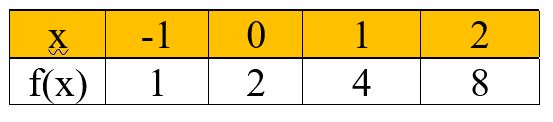
B 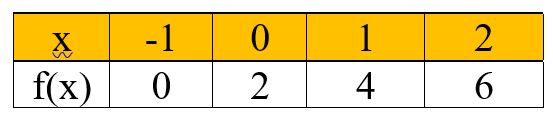
C 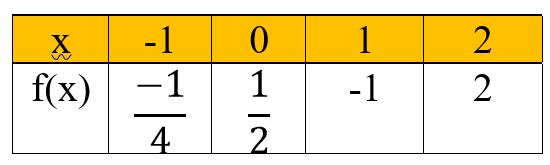
D 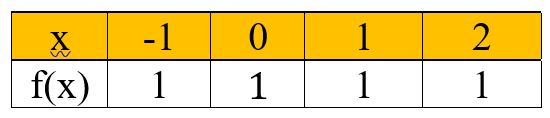
E 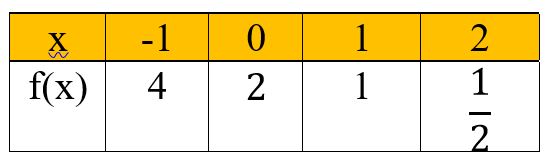
Açıklama:
An exponential function moves multiplicative. However increases arithmetically. Hence the solution is B.
increases arithmetically. Hence the solution is B.Soru 60
In normal conditions, a bacteria increases at a rate of proportionally. If there is 30 bacterias exist initially and 180 bacterias in one hour, find the number of bacterias in four hour?
Seçenekler
A
18.810
B
21.180
C
28.320
D
34.200
E
38.880
Açıklama:
The proportion is 180/30 = 6
Then the increase 30 . 6 . 6 . 6 . 6 = 38.880
Then the increase 30 . 6 . 6 . 6 . 6 = 38.880
Soru 61
Which of the following is not a exponential function?
Seçenekler
A
3x
B
0.5x
C
2x
D
(4/3)x
E
x2
Açıklama:
Exponential functions are in the form f(x)=ax where a is any positive real number other than 1. Thus x2 is not an exponential function because x is in base, not in power.
Soru 62
Find x if 2x+3*5x+1=4000.
Seçenekler
A
4
B
3
C
2
D
1
E
0.5
Açıklama:
2x+3*5x+1=4000
23*2x*5*5x=4000.
40*10x=4000
10x=100
so x=2
23*2x*5*5x=4000.
40*10x=4000
10x=100
so x=2
Soru 63
1000 TL is deposited in a bank account which yields 20 % interest rate on annual base. What will be the interest earning over this account after 3 years?
Seçenekler
A
1728
B
728
C
600
D
440
E
200
Açıklama:
The total amout will be:
1000*1.2*1.2*1.2=1728 TL
So the interest earning is 1728-1000=728
1000*1.2*1.2*1.2=1728 TL
So the interest earning is 1728-1000=728
Soru 64
I. loga(xy) = logax * logay
II. loga(x/y) = logax / logay
III. loga(1/y) = −logay
IV. loga(xy) = ylogax
Which of the above arguments are true?
II. loga(x/y) = logax / logay
III. loga(1/y) = −logay
IV. loga(xy) = ylogax
Which of the above arguments are true?
Seçenekler
A
III and IV
B
II and III
C
I and II
D
I and IV
E
I and III
Açıklama:
I and II are false. Because:
loga(xy) = logax + logay
loga(x/y) = logax - logay
loga(xy) = logax + logay
loga(x/y) = logax - logay
Soru 65
Find x if e2x + 5ex - 6 = 0
Seçenekler
A
-6
B
-1
C
0
D
1
E
5
Açıklama:
If we factorize e2x + 5ex - 6 = 0, we get:
(ex - 1)*(ex + 6)=0
so either ex - 1=0 or ex + 6=0
If ex - 1=0 then ex = 1 which means x=0.
If ex + 6=0 then ex = -6 which can not be the solution because it is not in domain of the natural nase function ex .
Thus x=0.
(ex - 1)*(ex + 6)=0
so either ex - 1=0 or ex + 6=0
If ex - 1=0 then ex = 1 which means x=0.
If ex + 6=0 then ex = -6 which can not be the solution because it is not in domain of the natural nase function ex .
Thus x=0.
Soru 66
Find the solution set of e2x - 7ex + 12= 0.
Seçenekler
A
(ln2, ln6)
B
(1, ln2)
C
(1, ln6)
D
(ln3, ln4)
E
(ln3, ln6)
Açıklama:
e2x - 7ex + 12= 0 can be rewritten as:
(ex - 4)(ex - 3)=0
Thus the equation has two roots:
for ex - 4=0, ex = 4 so x=ln4
for ex - 3=0, ex = 3 so x=ln3
(ex - 4)(ex - 3)=0
Thus the equation has two roots:
for ex - 4=0, ex = 4 so x=ln4
for ex - 3=0, ex = 3 so x=ln3
Soru 67
If ln 2=a, what will be the value of ln 0.5?
Seçenekler
A
1/4 a
B
1/2 a
C
2a
D
-a
E
-2a
Açıklama:
ln 0.5= ln 1/2 = ln1-ln2
Since we know that ln1=0,
ln 0.5=0-a=-a
Since we know that ln1=0,
ln 0.5=0-a=-a
Soru 68
If ln 2=x and ln 5=y what will be the value of ln 200 in terms of x and y?
Seçenekler
A
3x+2y
B
2x+3y
C
3x-2y
D
5x+2y
E
5x-2y
Açıklama:
ln 200 = ln 23*52 = ln 23 + ln 52 = 3 ln 2 + 2 ln 5=3x+2y
Soru 69
There are 100 bacteria initially in a bottle. After 2 hours the number of bacteria increases to 900. How many bacteria will there be in the bottle after 10 hours?
Seçenekler
A
100*38
B
900*35
C
900*310
D
100*35
E
100*310
Açıklama:
The population of the bacteria can be modelled by the equation P(t)=P(0)ekt where P(0) is the initial poulation.
Thus P(t=2)=P(0)e2k . So:
900=100e2k
9=e2k=(ek)2
32=(ek)2
3=ek
The population after 10 hours will be:
P(t=10)=100e10k=100*(ek)10 =100*310
Thus P(t=2)=P(0)e2k . So:
900=100e2k
9=e2k=(ek)2
32=(ek)2
3=ek
The population after 10 hours will be:
P(t=10)=100e10k=100*(ek)10 =100*310
Soru 70
Half-life of the radioactive element x is 400 years. How many grams of x will remain after 600 years if the inital amount is 1 kg?
Seçenekler
A
256
B
354
C
482
D
518
E
646
Açıklama:
Since half-life is 400 years, we can model the amount of element x as:
0.5 Q= Q.e400k
Thus 0.5 = e400k so ln 0.5=ln e400k =400k so k=ln 0.5 /400
Q(t=600)=1000*e600k
let e600k = b,
then 600k = ln b and since we found that k = ln 0.5/400
600* ln 0.5 /400= ln b=1.5 ln 0.5
thus b=(0.5)1.5 = 0.3535
Then Q(t=600)=1000*0.3535=353.5 gr=354 gr (approximately)
0.5 Q= Q.e400k
Thus 0.5 = e400k so ln 0.5=ln e400k =400k so k=ln 0.5 /400
Q(t=600)=1000*e600k
let e600k = b,
then 600k = ln b and since we found that k = ln 0.5/400
600* ln 0.5 /400= ln b=1.5 ln 0.5
thus b=(0.5)1.5 = 0.3535
Then Q(t=600)=1000*0.3535=353.5 gr=354 gr (approximately)
Ünite 5
Soru 1
Which of the following is the value of
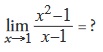
Seçenekler
A
0
B
1
C
2
D
5
E
does not exist.
Açıklama:
we need to factorise the ratio which follows as;
f(x)=(x²-1)/(x-1)=(x-1)(x+1)/(x-1)=x+1
and if we put "1" instead of x, then the answer will be 1+1=2.
f(x)=(x²-1)/(x-1)=(x-1)(x+1)/(x-1)=x+1
and if we put "1" instead of x, then the answer will be 1+1=2.
Soru 2
Which of the following is the value of
 ?
?
?Seçenekler
A
0,6
B
0,36
C
0,18
D
0,09
E
0
Açıklama:
Since the constant function takes the same value for all x∈R, we have
=0,36.
=0,36.Soru 3
Which of the following is the value of lim x→1 (2x³+x-12)/(5x-9)
Seçenekler
A
1/2
B
0
C
1
D
5/2
E
9/4
Açıklama:
From the quotient rule for limits together with limx→1(5x-9)≠0 we obtain limx→1 2x³+x-12=limx→1(2x³+x-12)/limx→1(5x-9) =-9/-4= 9/4
Soru 4
Find the lim x→2 (5x-2)(3x²+1).
Seçenekler
A
11
B
35
C
72
D
104
E
144
Açıklama:
From the product rule for limits, we have, (lim x→2 (5x-2).lim x→2 (3x²+1)) ,so (lim x→2 (5x-2)=8 and lim x→2 (3x²+1)=13 from the product rule again we have, 8*13=104
Soru 5
What is the value of the 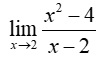 ?
?
?Seçenekler
A
1
B
4
C
8
D
12
E
does not exist
Açıklama:
by fractionating the function f(x)=(x-2)(x+2)/(x-2)=x+2 then lim x→2 x+2= 4
Soru 6
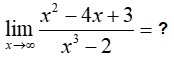
Seçenekler
A
+∞
B
-∞
C
0
D
1
E
does not exist
Açıklama:
The function is a rational function. Since the degree of the numerator is less than the degree of the denominator, the following result is true:
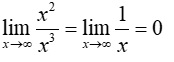
Soru 7
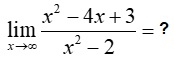
Seçenekler
A
1
B
0
C
∞
D
does not exist
E
-1
Açıklama:
The function is a rational function. Both the numerator and denominator approach infinity as x becomes large and their highest degrees are the same. By the way, the constants before the x² are same, 1/1=1
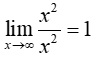
Soru 8
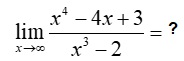
Seçenekler
A
0
B
1
C
-1
D
∞
E
does not exist
Açıklama:
The function is a rational function. Since the degree of the numerator is greater than the degree of the denominator, the following result is;
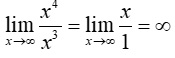
Soru 9
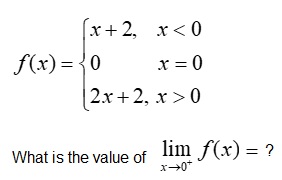
Seçenekler
A
0
B
2
C
4
D
6
E
10
Açıklama:
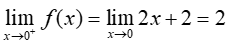
Soru 10
If f: R→R,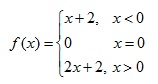 then, which of the following is true?
then, which of the following is true?Seçenekler
A
The function has removable discontinuity at x=0
B
The limit of f(x) does not exist at x=0
C
The value limit of the function is 2 at x=-1
D
The value limit of the function is 6 at x=7
E
The function is discontinuous at x=-5
Açıklama:

Soru 11
limx→-1 5-1 = ?
Seçenekler
A
-1
B
0
C
0.2
D
1
E
-0.2
Açıklama:
0.2 ; limit of a constant is itself. pg. 107. Correct answer is C .
Soru 12
While approaching from the right limx→2 (x2 - x - 2) / (x - 2) = ?
Seçenekler
A
0
B
1
C
does not exist
D
∞
E
3
Açıklama:
(x - 2) (x + 1) / (x - 2) = x + 1 ; x ≠ 2 . pg. 108. Correct answer is E.
Soru 13
limx→2 (x - x-1) (x2 - 1) = ?
Seçenekler
A
4,5
B
1,5
C
2,5
D
0,5
E
5,5
Açıklama:
(2 - 1/2) (4 - 1) = (3/2)/3=(3/2).(1/3)=1/2 =0,5. pg. 110. Correct answer is D.
Soru 14
f(x) = x2 - 2 for x < 3 ; f(x) = x3 - 2 for x > 3 ; while approaching from the left limx→3 f(x) = ?
Seçenekler
A
25
B
3
C
2
D
7
E
Ø
Açıklama:
y = 9 - 2 = 7. pg. 109. Correct answer is D.
Soru 15
While approaching from the right limx→-1 (x + 1) / (x3 + 2 x2 - 1) = ?
Seçenekler
A
0
B
-1
C
∞
D
-1 / 3
E
does not exist
Açıklama:
(x + 1) / (x + 1) (x2 + x - 1) = 1 / (x2 + x - 1) ; 1 / (1 - 1 - 1) = -1 ; x ≠ -1 . pg. 108 . Correct answer is B.
Soru 16
While approaching from the left limx→1 |x - 1| / (x - 1) = ?
Seçenekler
A
1
B
∞
C
0
D
-1
E
does not exist
Açıklama:
(x - 1) / (x - 1) = -1 . pg. 109. Correct answer is D.
Soru 17
limx→∞ (x3 + x2 + 1) / (x4 + x - 1) = ?
Seçenekler
A
∞
B
-∞
C
does not exist
D
1
E
0
Açıklama:
0 ; Since the degree of the numerator is less than the degree of the denominator. pg. 114. Correct answer is E.
Soru 18
What is the set of continuity of f(x) = 2 x / (x3 - 1) ?
Seçenekler
A
(-∞, ∞)
B
R \ {1}
C
R
D
R \ {-1, 1}
E
R \ {-1}
Açıklama:
R \ {1} ; (x3 - 1) = 0 ; x = 1. pg. 117. Correct answer is B.
Soru 19
limx→∞ (x99 - 1) / (-x98 + x97 + 1) = ?
Seçenekler
A
∞
B
does not exist
C
1
D
-∞
E
-1
Açıklama:
-∞ ; Since the degree of the numerator is greater than the degree of the denominator. pg. 114. Correct answer is D.
Soru 20
limx→-∞ (8 x555 - 1) / (4 x555 + 2 x554 + 1) ?
Seçenekler
A
does not exist
B
-∞
C
2
D
-2
E
∞
Açıklama:
2 ; Since the degree of the numerator is equal to the degree of the denominator. pg. 114. Correct answer is C.
Soru 21
Which of the following is the value of limx→5 7?
Seçenekler
A
1
B
3
C
5
D
7
E
9
Açıklama:
Since the constant function takes the same value for all x ∈ R, we have limx→5 7 = 7.
Soru 22
Which of the following is the value of limx→7 [(x2 -2x - 35) / (x - 7)]
Seçenekler
A
6
B
7
C
12
D
24
E
42
Açıklama:
The function is a rational function. Because the limits of the numerator and the denominator are equal to 0, we need to factorise the ratio which follows as
[(x2 -2x - 35) / (x - 7)] = [(x - 7) (x + 5)] / x-7 = x + 5.
Following the limit rules, we find limx→7 x + 5 = 7 + 5 = 12.
[(x2 -2x - 35) / (x - 7)] = [(x - 7) (x + 5)] / x-7 = x + 5.
Following the limit rules, we find limx→7 x + 5 = 7 + 5 = 12.
Soru 23
Which of the following is the value of limx→1 [(x2 +5x -12) / (2x - 8)]
Seçenekler
A
1
B
2
C
6
D
8
E
12
Açıklama:
From the quotient rule for limits together with limx→1 (2x - 8) ≠ 0, we obtain
(12 + 5 . 1 - 12) / (2 . 1 - 8) = -6 / -6 = 1.
(12 + 5 . 1 - 12) / (2 . 1 - 8) = -6 / -6 = 1.
Soru 24
Which of the following is the value of limx→2 (x + 3) (2x - 5)?
Seçenekler
A
-10
B
-5
C
0
D
5
E
10
Açıklama:
From the product rule for limits, we have
limx→2 (x + 3) (2x - 5) = limx→2 (x + 3) . limx→2 (2x - 5)
= (2 + 3) . (4 - 5)
= -5
limx→2 (x + 3) (2x - 5) = limx→2 (x + 3) . limx→2 (2x - 5)
= (2 + 3) . (4 - 5)
= -5
Soru 25
3x2 + 5, x < -3
If f : R - {-3} → R, f (x ) = ⎨-x + 12, x > -3
then which of the following is the the value of limx→-3+ f(x)?
If f : R - {-3} → R, f (x ) = ⎨-x + 12, x > -3
then which of the following is the the value of limx→-3+ f(x)?
Seçenekler
A
3
B
-6
C
9
D
-12
E
15
Açıklama:
Because x approaches -3 from the right side x is more than -3 and for x > -3, f is given by the rule f (x)=-x+12. Hence, the result is as follows.
limx→-3+ f(x) = -(-3) + 12 = 3 + 12 = 15
limx→-3+ f(x) = -(-3) + 12 = 3 + 12 = 15
Soru 26
Evaluate limx→2 ( x / |x-2| ).
Seçenekler
A
-2
B
-∞
C
2
D
+∞
E
The limit does not exist.
Açıklama:
Since the denominator of the expression at x = 2 is 0, we must look at the one-sided limits in order to find the limit at x = 2 if it exists. Then we have,
limx→2+ ( x / |x-2| ) = limx→2+ ( 2 / 0+ ) = +∞
limx→2- ( x / |x-2| ) = limx→2- ( 2 / 0+ ) = +∞
Hence, since the one-sided limits show the same behavior at x = 2, the limit exist at x =2, and it is +∞.
limx→2+ ( x / |x-2| ) = limx→2+ ( 2 / 0+ ) = +∞
limx→2- ( x / |x-2| ) = limx→2- ( 2 / 0+ ) = +∞
Hence, since the one-sided limits show the same behavior at x = 2, the limit exist at x =2, and it is +∞.
Soru 27
What is the limit of the function f(x) = ( x-7 / x - 5) at x = 5?
Seçenekler
A
5
B
7
C
+∞
D
-∞
E
does not exist.
Açıklama:
limx→5- ( x-7 / x - 5) = -2 / 0- = +∞.
limx→5+ ( x-7 / x - 5) = -2 / 0+= -∞.
The limit of the function at x = 5 does not exist due to the different behaviour of one-sided limits.
limx→5+ ( x-7 / x - 5) = -2 / 0+= -∞.
The limit of the function at x = 5 does not exist due to the different behaviour of one-sided limits.
Soru 28
If f (x ) = [(x2 + 3x + 1) / (x5 + 5)], then what is the value of limx→∞ f(x)?
Seçenekler
A
0
B
5/6
C
6/5
D
+∞
E
-∞
Açıklama:
The function is a rational function. Since the degree of the numerator is less than the degree of the denominator, the value of the limit is 0.
Soru 29
Determine the set of continuity of the function f (x) = x2 -1.
Seçenekler
A
(-∞, 0)
B
R
C
R \ {1}
D
R \ {-1,1}
E
R - [-1,1]
Açıklama:
f (x) = x2 -1 is a polynomial function. Hence, it is a continuous function, and its set of continuity is R.
Soru 30
Determine the set of continuity of the function f(x) = [(x - 3) / (x3 - 27)].
Seçenekler
A
R \ {-3, 3}
B
R
C
R \ {3}
D
R \ {0,3}
E
[3, ∞)
Açıklama:
Since a rational function f is continuous on the domain of its definition, f is continuous on its domain. This function is continuous for all real numbers except 3 which makes its denominator 0. Hence, the set of continuity of this function is R \ {3}.
Soru 31
Which of the following is the value of 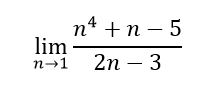 ?
?
?Seçenekler
A
2
B
3
C
4
D
5
E
6
Açıklama:
From the quotient rule for limits together with 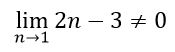 we obtain
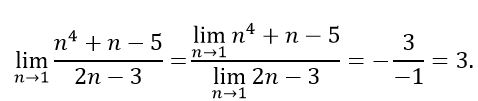 The answer is B.
we obtain The answer is B.Soru 32
Which of the following is the value of 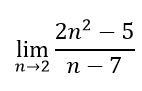 ?
?
?Seçenekler
A
0
B
-1/5
C
-2/3
D
-3/5
E
-2
Açıklama:
From the quotient rule for limits together with 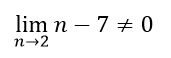 we obtain
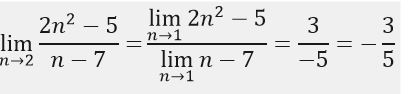 The answer is D.
we obtain The answer is D.Soru 33
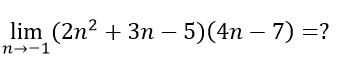
Seçenekler
A
0
B
-66
C
45
D
-13
E
14
Açıklama:
From the product rule for limits, we have
 . The answer is B.
. The answer is B.Soru 34
If  then which of the following is the value of
 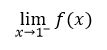 ?
?
then which of the following is the value of ?Seçenekler
A
0
B
1
C
5
D
-2
E
3
Açıklama:
Because x approaches 1 from the left side x is less than 1 and for x<1, f is given by the rule f(x)=-2x+5. So, the result follows as
 . The answer is E.
. The answer is E.Soru 35
If  then which of the following is the value of
 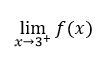 ?
?
then which of the following is the value of ?Seçenekler
A
32
B
-8
C
-15
D
-3
E
0
Açıklama:
Becuase x approaches 3 from the right side x is greater than 3 and for x>3, f is given by the rule  . So, the result follows as
 . The answer is A.
. So, the result follows as. The answer is A.Soru 36
What is the limit of the function 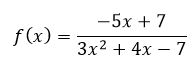 at x=0?
at x=0?Seçenekler
A
0
B
-1
C
1
D
-2
E
-5
Açıklama:
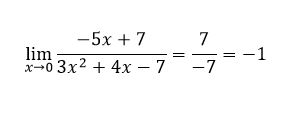 The answer is B.
Soru 37
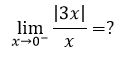
Seçenekler
A
3
B
-1
C
-3
D
1/3
E
-1/3
Açıklama:
Since x approaches 0 from the left side, x is negative and for x<0, |3x|=-3x is true. So, we get following result.
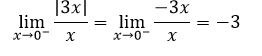 . The answer is C.
. The answer is C.Soru 38
If 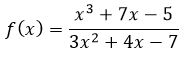 then
then 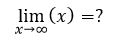
then Seçenekler
A
∞
B
0
C
1
D
-1
E
2
Açıklama:
The function is a rational function. Since the degree o the numerator is greater than the degreeof the denominator, the following result is true:
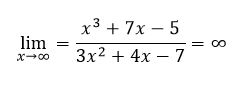 . The answer is A.
. The answer is A.Soru 39
If 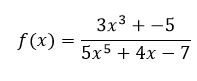 then
then 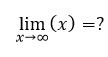
then Seçenekler
A
5
B
1
C
3
D
-1
E
0
Açıklama:
The function is a rational function. Since the degree of the numerator is less than the degree of the denominator, the following result is true:
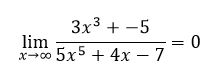 . The answer is E.
. The answer is E.Soru 40
Determine the set of continuity of the function 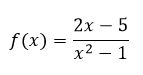 .
.
.Seçenekler
A
(-1, 1)
B
R\{-1, 1}
C
[-1, 1]
D
(0, 1)
E
(-1, 0)
Açıklama:
Since a rational function f is continuous on the domain of its definition, f is continuous on its domain. the is continuous for all real numbers x except -1 and 1. Thus, f is continuous on R\{-1, 1}. The answer is B.
Soru 41
limx→0 00 = ?
Seçenekler
A
0
B
1
C
∞
D
does not exist
E
-1
Açıklama:
1 ; limit of a constant is itself. pg. 107. Correct answer is B
Soru 42
While approaching from the left limx→1 (x3 - 1) / (x - 1) = ?
Seçenekler
A
∞
B
does not exist
C
0
D
3
E
1
Açıklama:
(x - 1) (x2 + x + 1) / (x - 1) = x2 + x + 1 = 3 ; x ≠ 1 . pg. 108. Correct answer is D.
Soru 43
limx→-1 (x3 - x0) (x - 1) = ?
Seçenekler
A
5
B
-1
C
2
D
0
E
4
Açıklama:
(-1 - 1) (-1 - 1) = 4. pg. 110. Correct answer is E.
Soru 44
f(x) = x-1 + 2 for x < -2 ; f(x) = x-2 + 2 for x > -2 ; while approaching from the right limx→-2 f(x) = ?
Seçenekler
A
1.50
B
0
C
2.25
D
2.50
E
1.75
Açıklama:
y = 0.25 + 2 = 2.25. pg. 109. Correct answer is C.
Soru 45
While approaching from the right limx→1 (x2 - 1) / (x4 - 1) = ?
Seçenekler
A
0.5
B
0
C
does not exist
D
∞
E
-1
Açıklama:
(x2 - 1) / (x2 - 1) (x2 + 1) = 1 / (x2 + 1) ; 1 / (1 + 1) = 0.5 ; x ≠ 1 . pg. 108 . Correct answer is A.
Soru 46
While approaching from the right limx→-2 |x + 2| / (x + 2) = ?
Seçenekler
A
-1
B
does not exist
C
1
D
0
E
∞
Açıklama:
(x + 2) / (x + 2) = 1 . pg. 109. Correct answer is C.
Soru 47
limx→-∞ (x4 + x3 - 1) / (x5 + x2 + 1) = ?
Seçenekler
A
1
B
does not exist
C
∞
D
0
E
-∞
Açıklama:
0 ; Since the degree of the numerator is less than the degree of the denominator. pg. 114. Correct answer is D.
Soru 48
What is the set of continuity of f(x) = x2 / (4 - x2) ?
Seçenekler
A
R \ {-2, 2}
B
R \ {-2}
C
(-∞, ∞)
D
R
E
R \ {2}
Açıklama:
R \ {1} ; (4 - x2) = 0 ; x = {-2, 2}. pg. 117. Correct answer is A.
Soru 49
limx→-∞ (-x26 + 1) / (x25 + x24 - 1) = ?
Seçenekler
A
1
B
-1
C
∞
D
does not exist
E
-∞
Açıklama:
∞ ; Since the degree of the numerator is greater than the degree of the denominator. pg. 114. Correct answer is C.
Soru 50
limx→-∞ (10 x397 + 1) / (-2 x397 + 2 x396 - 1) = ?
Seçenekler
A
∞
B
-5
C
5
D
-∞
E
does not exist
Açıklama:
-5 ; Since the degree of the numerator is equal to the degree of the denominator. pg. 114. Correct answer is B.
Soru 51
Assume that a bus travels 2 hours and covers a distance of 140 km and travels for 2 hours more and covers a total distance of 300 km. What would be the average velocity of this bus in its last 2 hours of travel?
Seçenekler
A
80
B
75
C
70
D
65
E
60
Açıklama:
Let's denote the average velocity by Va, denote the distance by X and denote time by t.
Then Va=(X2-X1)/(t2-t1)=(300-140)/(4-2)=80
Then Va=(X2-X1)/(t2-t1)=(300-140)/(4-2)=80
Soru 52
Find the limit of the function f(x)=(x2-5x+6)/(x2-9) for x=3.
Seçenekler
A
0
B
1/6
C
1/5
D
2/3
E
1/3
Açıklama:
f(x)=(x2-5x+6)/(x2-9) = 0/0 which is indefinite for x=3. Thus we have to factorize the denominator and nominator of the function.
f(x)=(x2-5x+6)/(x2-9)=((x-3)(x-2))/((x+3)(x-3))=(x-2)/(x+3)
thus for x=3 lim f(x)=(3-2)/(3+3)=1/6
f(x)=(x2-5x+6)/(x2-9)=((x-3)(x-2))/((x+3)(x-3))=(x-2)/(x+3)
thus for x=3 lim f(x)=(3-2)/(3+3)=1/6
Soru 53
For which values of x is the function f(x)=(x2-5x+6)/(x2-9) is discontinuous?
Seçenekler
A
2 and 3
B
-2 and -3
C
1 and 5
D
-1 and -5
E
3 and -3
Açıklama:
A function would be discontinuous when the value of function is undefined. In this case the values of x which make the denominator (x2-9) equal to zero will make the functiıon discontinuous. Thus for x=3 or x=-3, the denominator x2-9=0
Soru 54
Find the limit of the following function for x=2.
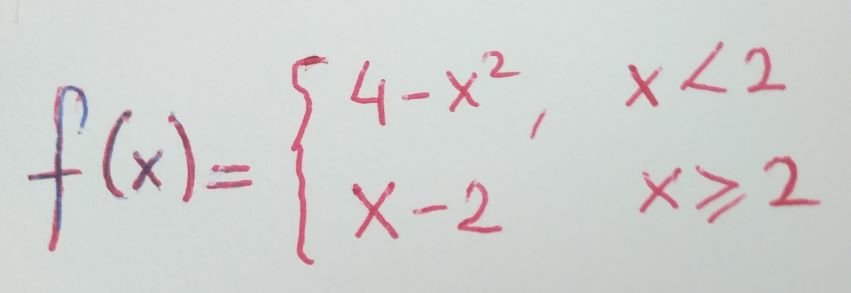
Seçenekler
A
4
B
2
C
0
D
-2
E
-4
Açıklama:
We can take limits from left and right sides.
From left: lim f(x)=4-2*2=0
From right lim f(x)=2-2=0
So limit exists and it is equal to zero. This is obvious from the graph of the function:
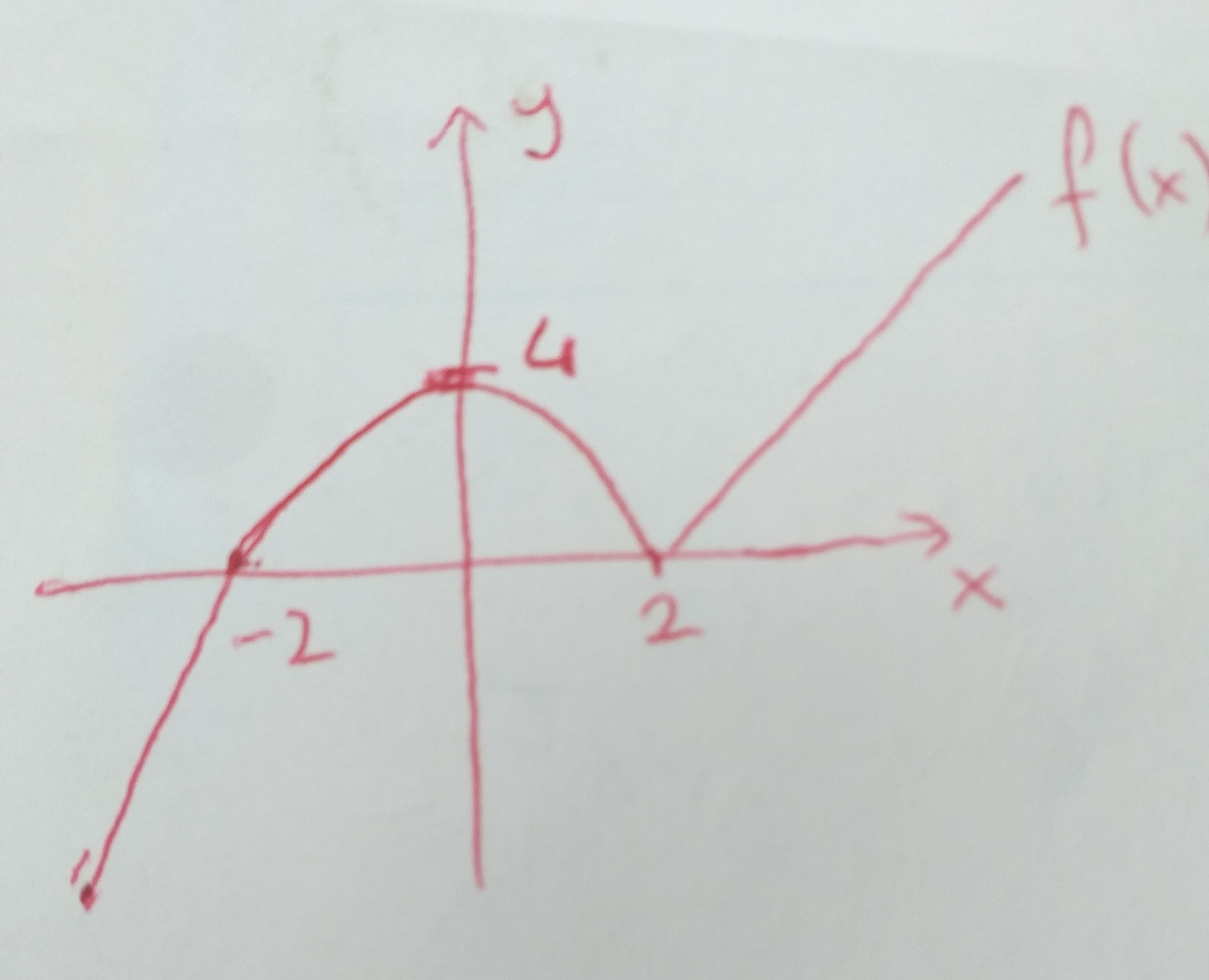
From left: lim f(x)=4-2*2=0
From right lim f(x)=2-2=0
So limit exists and it is equal to zero. This is obvious from the graph of the function:
Soru 55
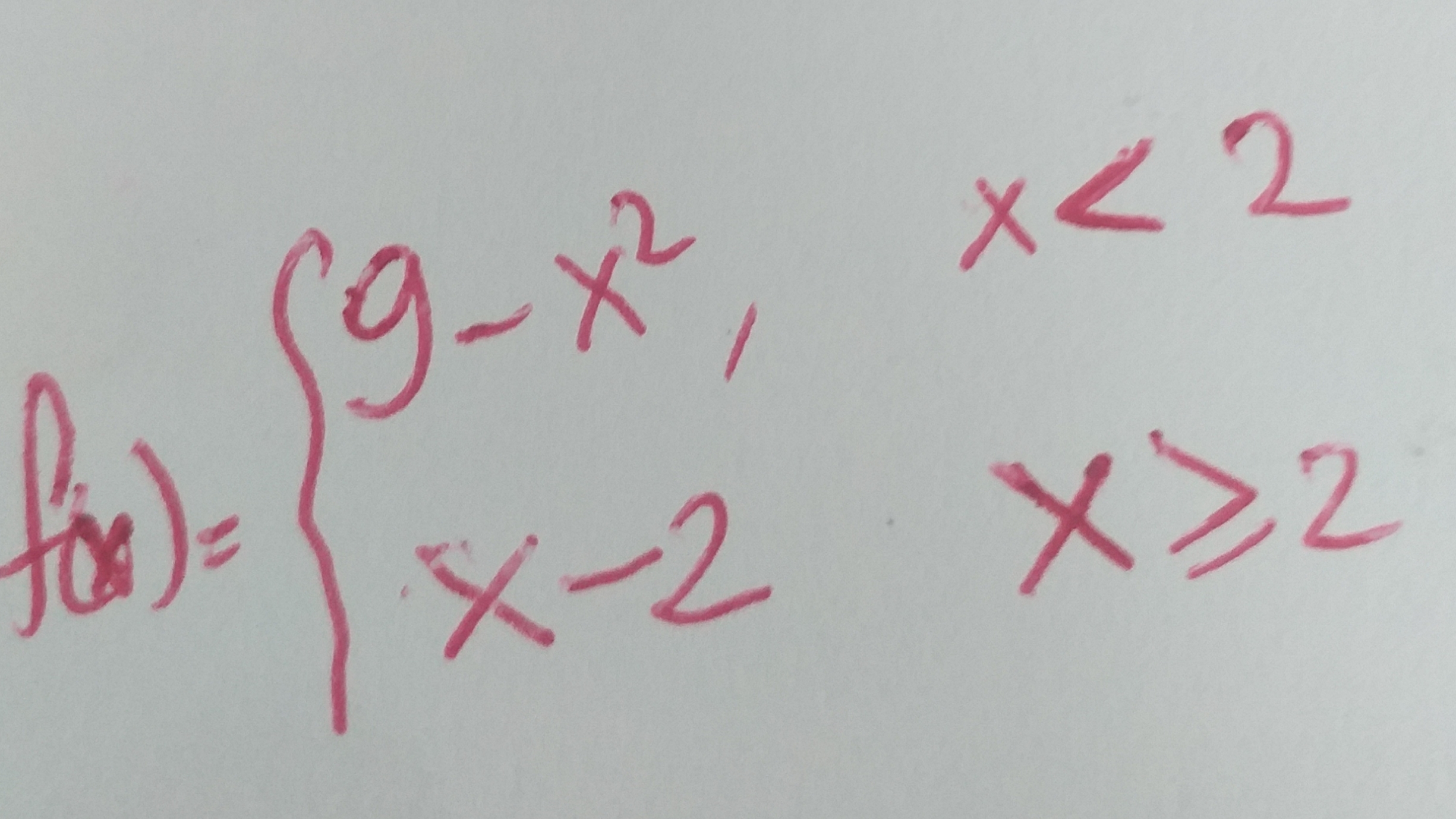 Assume that for x=2, the left limit of f(x) is "a" for x=2, and the right limit of f(x) is "b". Then what will be a-b?
Seçenekler
A
0
B
2
C
3
D
5
E
9
Açıklama:
For x=2:
the left limit of f(x)=9-x2=9-4=5=a
the right limit of f(x)=x-2=2-2=0=b
Then a-b=5-0=5
One can better understand from the graph of the function:
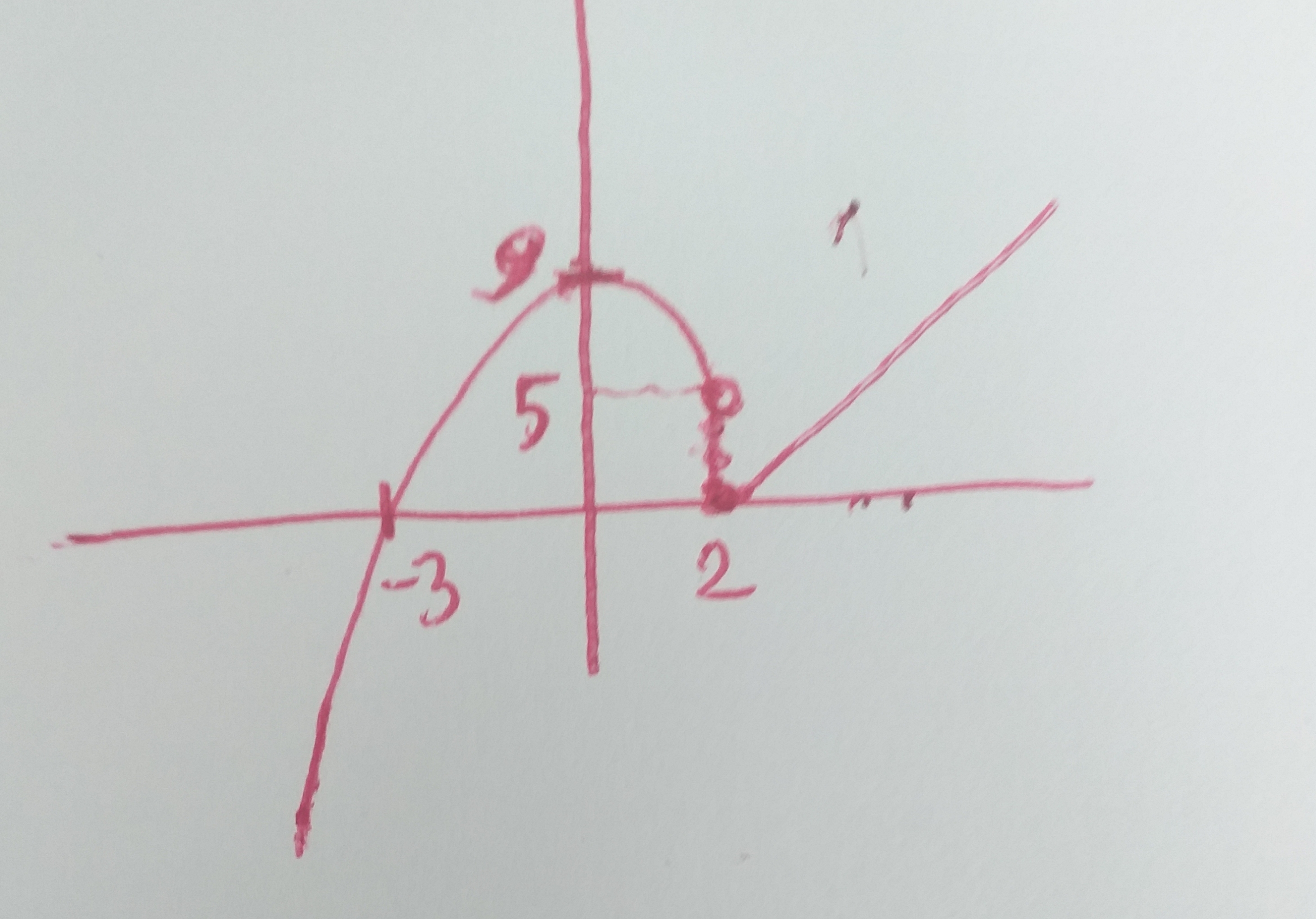 As you can see the function is discontinuous at x=2. So the left and right limits at that point are not equal to each other.
the left limit of f(x)=9-x2=9-4=5=a
the right limit of f(x)=x-2=2-2=0=b
Then a-b=5-0=5
One can better understand from the graph of the function:
As you can see the function is discontinuous at x=2. So the left and right limits at that point are not equal to each other.Soru 56
For which of the following functions the limit is equal to zero as x goes to infinity?
Seçenekler
A
f(x)=(2x-1)/(5x+3)
B
f(x)=(3x2-1)/(x+2)
C
f(x)=(x3-1)/(4x2+5)
D
f(x)=(x4-10)/(x2-5)
E
- f(x)=(x3-1)/(4x7+15)
Açıklama:
The biggest power in denominator must be higher than the biggest power in nominator for limit being equal to zero if x goes to infinity. So the answer is E as 3<7.
Soru 57
Which of the following functions' limit is infinite for x=3?
Seçenekler
A
f(x)=(x2+3x+2)/((x2-x-6)
B
f(x)=(x2-9)/((x2-3x)
C
f(x)=(x2+2x-15)/((x2-2x-3)
D
f(x)=(x2+x-12)/((x2+3x-18)
E
f(x)=(x2-3x)/((x2-9)
Açıklama:
lim f(x)=lim (x2+3x+2)/((x2-x-6)=lim (x+1)(x+2)/(x-3)(x+2)=lim (x+1)/(x-3)=4/0=infinity
So the answer is A. In all other functions limit goes to a finite number.
So the answer is A. In all other functions limit goes to a finite number.
Soru 58
Which of the following functions is continious at x=2?
Seçenekler
A
f(x)=x/(x-2)
B
f(x)=x3/(x2-4)
C
f(x)=(x3-8)/(x2-4)
D
f(x)=(x3-2x-6)/(x2-4)
E
f(x)=(5-x)/(3x-6)
Açıklama:
(x3-8)/(x2-4)=(x-2)(x2+2x+4)/(x-2)(x+2)=(x2+2x+4)/(x+2)=19/4 for x=2. All other expressions are in the form of a/0 for x=2; which equals to infinity, and therefore not continuous. So the answer is C.
Soru 59
In which domain is the function f(x)=(x3-8)/(x2-4) defined?
Seçenekler
A
R
B
R-{-2}
C
R-{2}
D
R-{-2,2}
E
R-{-2, 4}
Açıklama:
(x3-8)/(x2-4)=(x-2)(x2+2x+4)/(x-2)(x+2)=(x2+2x+4)/(x+2) which is infinite for only x=-2. Therefore the domain is R-{-2}
Soru 60
Which of the following functions is continuous at x=0?
Seçenekler
A
f(x)=1/x
B
f(x)=1/x2
C
f(x)=3/x3
D
f(x)= |3x|
E
f(x)=(x2-4)/(x2-2x)
Açıklama:
Other than f(x)= |3x| all the functions goes to infinity for x=0. Therefore they are not continuous. So the answer is D because lim f(x)=f(x)=0 for x=0 when f(x)= |3x|
Ünite 6
Soru 1
For the function  , find the derivative
  at the point x = 2.
, find the derivative at the point x = 2.Seçenekler
A
15
B
10
C
17
D
19
E
21
Açıklama:
 The answer is D.
Soru 2
For the function

, find the derivative
at the point x=0.
, find the derivative
at the point x=0.
Seçenekler
A
8
B
9
C
11
D
e
E
e + 1
Açıklama:
 The answer is A.
Soru 3
Which of the following is the slope of the graph of 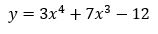 at the point (2, 2)?
at the point (2, 2)?Seçenekler
A
5
B
85
C
136
D
100
E
180
Açıklama:
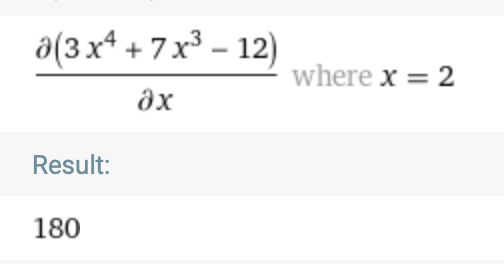
12.8+21.4=180
The answer is E.
Soru 4
Which of the following is the slope of the graph of 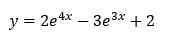 at the point (0, 0)?
at the point (0, 0)?Seçenekler
A
-2
B
2
C
0
D
1
E
-1
Açıklama:
 The answer is E.
Soru 5
Given the function 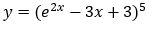 , find the derivative
, find the derivative Seçenekler
A
0
B
-5120
C
-1280
D
-101
E
-1
Açıklama:
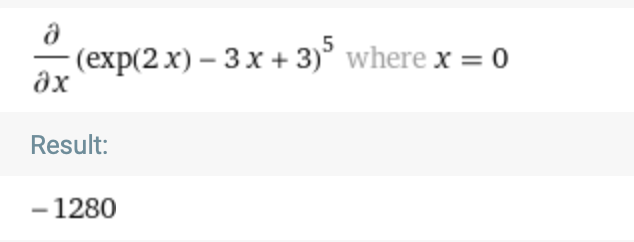
5.(1+3)^4.(2-3)=-1280
The answer is C.
Soru 6
For the function 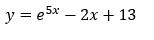 , find the second derivative
, find the second derivative Seçenekler
A
-1
B
1
C
5e
D
25e
E
25
Açıklama:
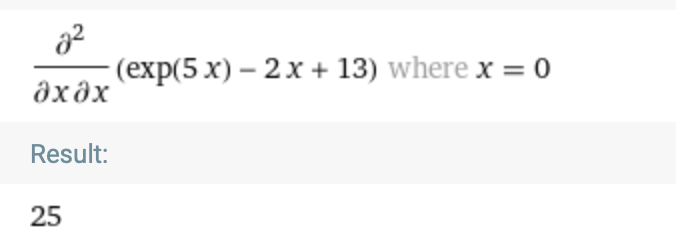
The answer is E.
Soru 7
Given function  , find the second derivative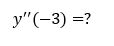
, find the second derivative Seçenekler
A
1/4
B
3/4
C
-1/27
D
-2/27
E
0
Açıklama:
 The answer is D.
Soru 8
At which point on the graph of the function 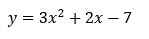 the slope is zero?
the slope is zero?Seçenekler
A
1/3
B
-2/3
C
0
D
-1/3
E
-1
Açıklama:
 The answer is D.
Soru 9
Find the interval of decrease for the function 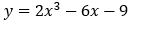 .
.
.Seçenekler
A
(-1, 1)
B
(0, 1)
C
[-1, 0)
D
(0, 1]
E
(-2, 0)
Açıklama:
 The answer is A.
Soru 10
For the function 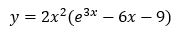 , find the derivative function
, find the derivative function Seçenekler
A
1
B
0
C
6
D
4
E
2
Açıklama:
 The answer is B.
Soru 11
What is the slope of the tangent line to the curve y=3x2-1 at point (2, 11)?
Seçenekler
A
2
B
5
C
6
D
11
E
12
Açıklama:
Let denote the slope with m. Then:
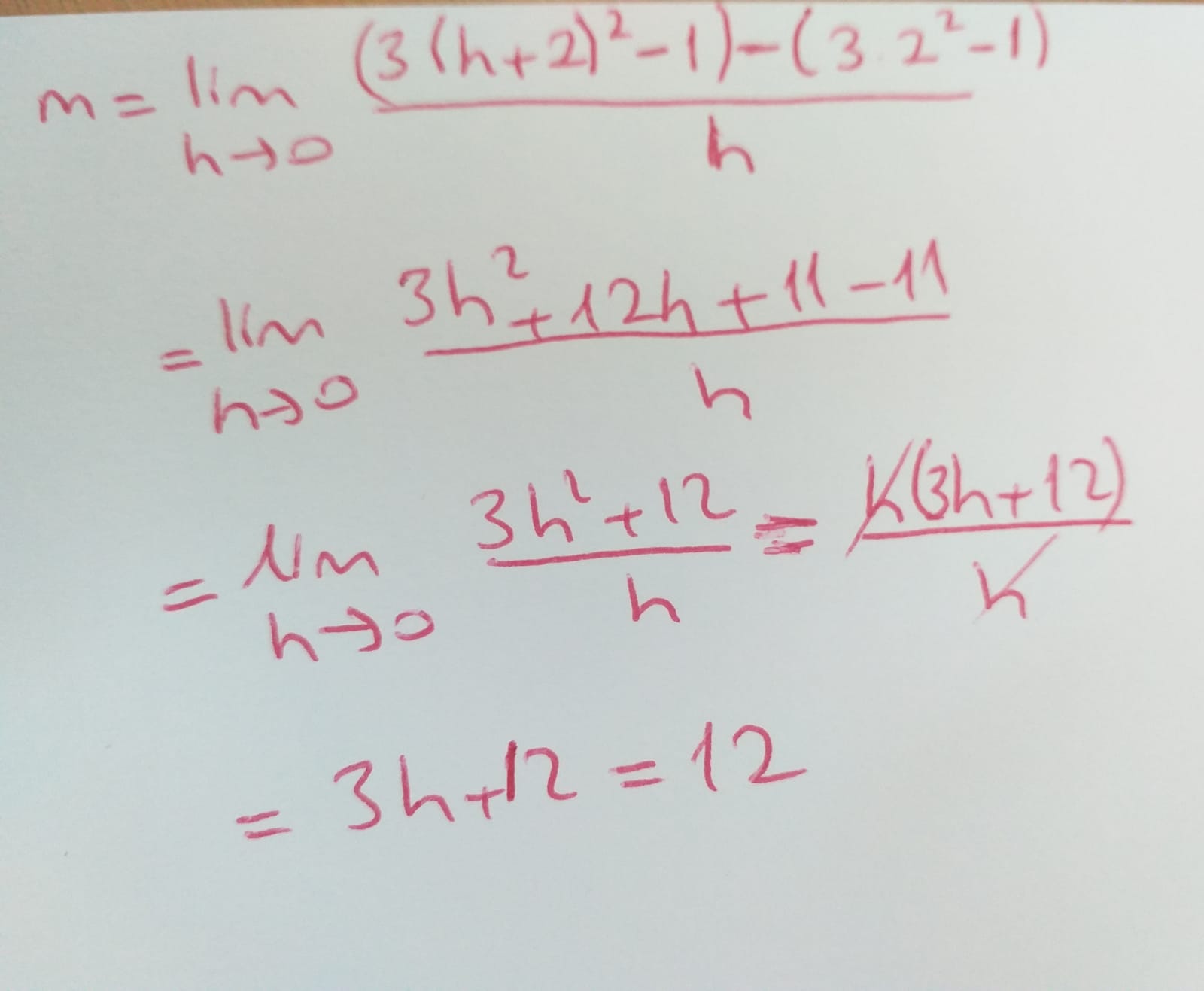
Soru 12
What is the slope of the tangent line to the curve y=x3 at point (-1, -1)?
Seçenekler
A
3
B
-3
C
2
D
-2
E
1
Açıklama:
If we denote the slope of the curve with m, then:
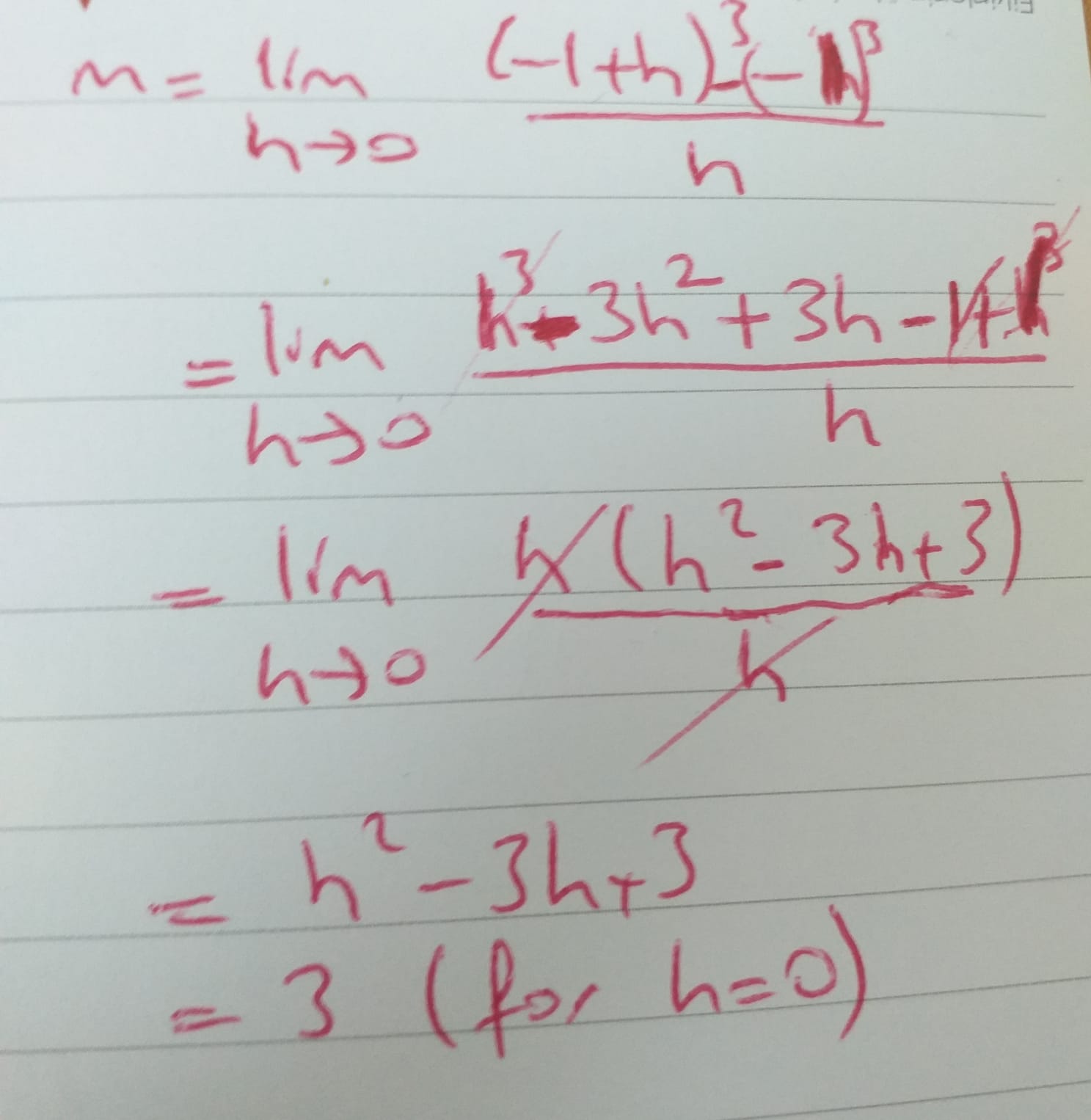
Soru 13
For the function f(x)=-3x+11, find the derivative f'(x) at the point x=0?
Seçenekler
A
-3
B
0
C
11
D
-5
E
7
Açıklama:
f'(x)=(-3x+11)'=-3, f'(0)=-3. So, the answer is A.
Soru 14
For the function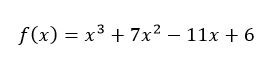 , find the derivative f'(x), at the point x=0?
, find the derivative f'(x), at the point x=0?Seçenekler
A
11
B
-11
C
6
D
12
E
14
Açıklama:
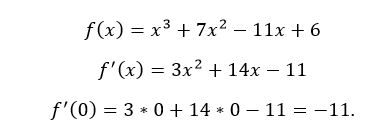 The answer is B.
Soru 15
For the function  , find the derivative function f'(x)?
, find the derivative function f'(x)?Seçenekler
A 
B
C 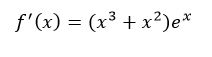
D 
E 
Açıklama:
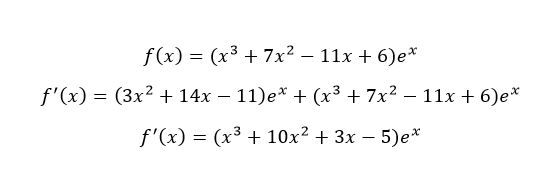 The answer is D.
Soru 16
Which of the following gives the average velocity of a particle in time interval (t1, t2) if its' position at time t is defined by f(t)?
Seçenekler
A
(f(t2)+f(t1))/(t2+t1)
B
(f(t2)-f(t1))/(t2-t1)
C
(f(t2)-f(t1))/(t2+t1)
D
(f(t2)+f(t1))/(t2-t1)
E
f(t2)/t2-f(t1)/t1
Açıklama:
Average velocity could be found by dividing the position difference to the time difference.
Soru 17
The position of a particle moving along the x-axis at time t is given by f(t) = 3t2 -2t (metre). Find the average velocity over the interval [4, 6]
Seçenekler
A
5.6
B
6
C
8
D
13.6
E
28
Açıklama:
f(t) = 3t2 -2t
so:
f(6)=3*62 -2*6=96
f(4)=3*42 -2*4=40
Average velocity(4,6)=(f(6)-f(4))/(6-4)=(96-40)/2=28
so:
f(6)=3*62 -2*6=96
f(4)=3*42 -2*4=40
Average velocity(4,6)=(f(6)-f(4))/(6-4)=(96-40)/2=28
Soru 18
Which of the following gives the instantaneous velocity of a particle at time t if its' position at time t is defined by f(t)?
Seçenekler
A
limh→0 (f(t+h)+f(t))/h
B
limh→0 (f(t+h)-f(t))/t
C
limh→0 (f(t+h)-f(t))/h
D
limh→0 (f(t-h)-f(h))/h
E
limh→0 (f(h)-f(t))/h
Açıklama:
The velocity at time t is the derivative of function f(t) at time t which is defined by the limit given in C.
Soru 19
The motion of a particle is given by the function f(t) = 2t2 - t Find its velocity at the instant t = 3.
Seçenekler
A
4
B
8
C
10
D
11
E
12
Açıklama:
velocity at time t=limh→0 (f(t+h)-f(t))/h
since f(t) = 2t2 - t:
limh→0 (f(t+h)-f(t))/h=((2(t+h)2-(t+h))-(2t2-t))/h
=limh→0 (2t2+2h2 +4th-t-h-2t2+t)/h
=limh→0 (2h2 +4th-h)/h
=h(2h+4t-1)/h
=2h+4t-1
And for t=3 and h=0;
2h+4t-1=11
since f(t) = 2t2 - t:
limh→0 (f(t+h)-f(t))/h=((2(t+h)2-(t+h))-(2t2-t))/h
=limh→0 (2t2+2h2 +4th-t-h-2t2+t)/h
=limh→0 (2h2 +4th-h)/h
=h(2h+4t-1)/h
=2h+4t-1
And for t=3 and h=0;
2h+4t-1=11
Soru 20
What is the derivative of f(x)=axn-bx+c?
Seçenekler
A
ax-b
B
a-b
C
ax+c
D
anx(n-1)-b
E
anx-bx
Açıklama:
df(x)/dx=f '(x)=a*n*x(n-1)-b=anx(n-1)-b
Soru 21
What is the derivative of f(x)=(3x2+5x)/(2x-1)
Seçenekler
A
(6x2-6x-5)/(4x2-4x+1)
B
(6x2+6x-5)/(4x2+4x-1)
C
(12x2-6x-5)/(4x2-4x+1)
D
(12x2-4x-5)/(4x2-4x+1)
E
1/(4x2-4x+1)
Açıklama:
If f(x)=h(x)/g(x) then f '(x)=(h '(x)g(x)-g '(x)h(x))/g2(x) from the Quitent rule.
So if f(x)=(3x2+5x)/(2x-1),
then:
f '(x)=(h '(x)g(x)-g '(x)h(x))/g2(x)=((6x+5)*(2x-1)-2(3x2+5x))/(2x-1)2
=(12x2+4x-5-6x2-10x)/(2x-1)2
=(6x2-6x-5)/(4x2-4x+1)
So if f(x)=(3x2+5x)/(2x-1),
then:
f '(x)=(h '(x)g(x)-g '(x)h(x))/g2(x)=((6x+5)*(2x-1)-2(3x2+5x))/(2x-1)2
=(12x2+4x-5-6x2-10x)/(2x-1)2
=(6x2-6x-5)/(4x2-4x+1)
Soru 22
Which of the following is the slope of the graph of at the point (1, 1)?
at the point (1, 1)?Seçenekler
A
3
B
4
C
5
D
6
E
7
Açıklama:
 The answer is D.
Soru 23
A particle moves along the x-axis in such a way that its position at time t is 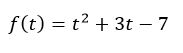 . Find the average velocity over the interval [1, 3].
. Find the average velocity over the interval [1, 3].Seçenekler
A
6
B
7
C
8
D
9
E
11
Açıklama:
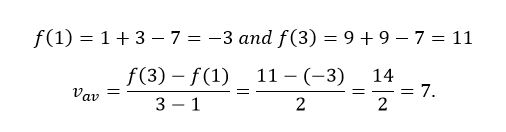 The answer is B.
Soru 24
Given the function 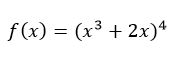 , find the derivative
  at the point x=0.
, find the derivative at the point x=0.Seçenekler
A
-1
B
-3
C
0
D
3
E
4
Açıklama:
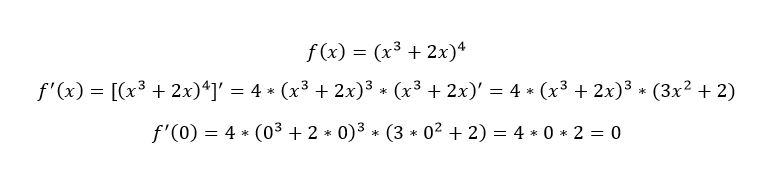 The answer is C.
Soru 25
Given the function f(x)=ln(2x), find the second derivative at the point x=3.
at the point x=3.Seçenekler
A
1/6
B
1
C
0
D
3
E
1/3
Açıklama:
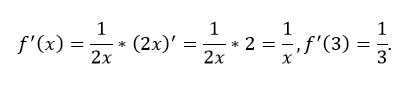 The answer is E.
Soru 26
At which point on the graph of the function 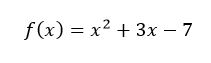 the slope is zero?
the slope is zero?Seçenekler
A
(-3/2, -7)
B
(-3/2, -37/4)
C
(-32/4, -3/2)
D
(0 ,-5)
E
(3, 8)
Açıklama:
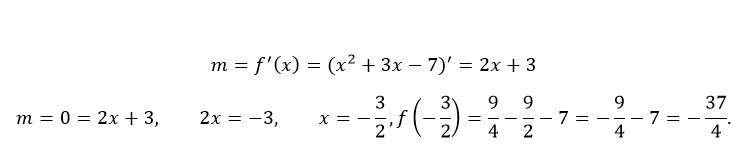 So, the slope of the tangent line to the graph is zero at (-3/2, -37/4). The answer is B.
Soru 27
A particle moves along the x-axis in such a way that its position at time t is 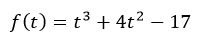 . Find the average velocity over the interval [1, 4].
. Find the average velocity over the interval [1, 4].Seçenekler
A
124/3
B
111/2
C
5
D
43
E
110/3
Açıklama:
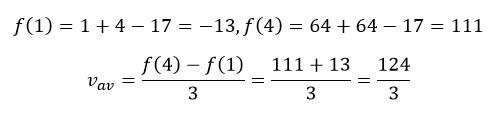 The answer is A.
Soru 28
Given the function  find the second derivative
 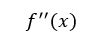 at the point x=1.
find the second derivative at the point x=1.Seçenekler
A
5
B
14
C
26
D
23
E
22
Açıklama:
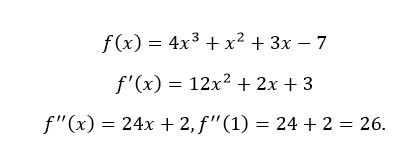 The answer is C.
Soru 29
Find the 3rd derivative of f(x)=x3+lnx. (f'''(x)=?)
Seçenekler
A
6+2/x3
B
6-2/x3
C
6x-(1/x)2
D
6x+(1/x)2
E
6-1/x
Açıklama:
f(x)=x3+lnx
f '(x)=3x2+1/x
f ''(x)=6x-(1/x)2
f '''(x)=6+2/x3
f '(x)=3x2+1/x
f ''(x)=6x-(1/x)2
f '''(x)=6+2/x3
Soru 30
Which of the following functions is monotone increasing in interval (-∞, +∞) | x ≠0?
Seçenekler
A
f(x)=x6
B
f(x)=2x3
C
f(x)=-2x4
D
f(x)=5x2
E
f(x)=10x8
Açıklama:
f(x)=x3
f '(x)=3x2>0 for all values of x other than x=0.
For all other functions f '(x)<0 for (-∞,0) and f '(x)>0 for x>0.
f '(x)=3x2>0 for all values of x other than x=0.
For all other functions f '(x)<0 for (-∞,0) and f '(x)>0 for x>0.
Soru 31
For the function f(x)=-x²+13x-27 find the derivative at the point x=5.
Seçenekler
A
1
B
3
C
8
D
21
E
63
Açıklama:
f(x)=-x²+13x-27
f'(x)=-2x+13
f'(5)=-2.5+13=3.
f'(x)=-2x+13
f'(5)=-2.5+13=3.
Soru 32
What is the derivative of the function which is given below?
f(x)=3x.e-5x
f(x)=3x.e-5x
Seçenekler
A
e-5x
B
9e-5x
C
-12e-5x
D
(1+5x)e-5x
E
(3-15x)e-5x
Açıklama:
f(x)=3x.e-5x
f'(x)=(3x)'.e-5x+3x.(e-5x)'
f'(x)=3.e-5x+3x.(-5e-5x)
f'(x)=(3-15x)e-5x
f'(x)=(3x)'.e-5x+3x.(e-5x)'
f'(x)=3.e-5x+3x.(-5e-5x)
f'(x)=(3-15x)e-5x
Soru 33
Which of the following is the slope of the graph of y=x²+7x-8 at the point (2,10)?
Seçenekler
A
1
B
8
C
10
D
11
E
17
Açıklama:
f(x)=x²+7x-8
f'(x)=2x+7
f'(2)=11
f'(x)=2x+7
f'(2)=11
Soru 34
What is the derivative of the function which is given below?
f(x)=(x²-7)1/2
f(x)=(x²-7)1/2
Seçenekler
A
x/(x²-7)1/2
B
1/(x²-7)1/2
C
2/(x²-7)1/2
D
1/(2(x²-7)1/2)
E
(x²-7)1/2
Açıklama:
By using the chain rule,
f'(x)=1/2.(x²-7)-1/2.(x²-7)'
f'(x)=1/2.(x²-7)-1/2.2x
f'(x)=x.(x²-7)-1/2
f'(x)=x/(x²-7)1/2
f'(x)=1/2.(x²-7)-1/2.(x²-7)'
f'(x)=1/2.(x²-7)-1/2.2x
f'(x)=x.(x²-7)-1/2
f'(x)=x/(x²-7)1/2
Soru 35
What is the derivative of the function f(x)=(x³-7) / (3x²+1) at the point x=1?
Seçenekler
A
0
B
1
C
3
D
5
E
12
Açıklama:
f(x)=(x³-7) / (3x²+1)
f'(x)=[(x³-7)'.(3x²+1) - (x³-7)(3x²+1)'] / (3x²+1)²
f'(x)=[(3x²).(3x²+1) - (x³-7)(6x)] / (3x²+1)²
f'(1)=[(3).(3+1) - (1-7)(6)] / (3+1)² at x=1
f'(1)=[(12) - (-36)] / (4)²
f'(1)=3
f'(x)=[(x³-7)'.(3x²+1) - (x³-7)(3x²+1)'] / (3x²+1)²
f'(x)=[(3x²).(3x²+1) - (x³-7)(6x)] / (3x²+1)²
f'(1)=[(3).(3+1) - (1-7)(6)] / (3+1)² at x=1
f'(1)=[(12) - (-36)] / (4)²
f'(1)=3
Soru 36
What is the second derivative of the function f(x)=e3x ?
Seçenekler
A
e3x
B
3e2x
C
6e2x
D
6ex
E
9e3x
Açıklama:
f(x)=e3x
f'(x)=3e3x
f(x)=9e3x
f'(x)=3e3x
f(x)=9e3x
Soru 37
Given function f(x) = (x+1)(3-x), find the local maximum value for this function
Seçenekler
A
0
B
1
C
2
D
4
E
8
Açıklama:
f(x) = (x+1)(3-x)
f'(x) = (x+1)'(3-x)+ (x+1)(3-x)'
f'(x) = (3-x)+(-x-1)
f'(x) = 2-2x
f'(x) =2-2x=0 → x=1
f(1) = 4
f'(x) = (x+1)'(3-x)+ (x+1)(3-x)'
f'(x) = (3-x)+(-x-1)
f'(x) = 2-2x
f'(x) =2-2x=0 → x=1
f(1) = 4
Soru 38
For the function f(x)=x²-4x+12 which of the followings is correct?
Seçenekler
A
f'(x)=2x
B
f''(x)=0
C
The function has local minimum at (2,8)
D
The function has local maximum at (2,8)
E
The function has no local minimum or local maximum point
Açıklama:
f(x)=x²-4x+12
f'(x)=2x-4
f'(x)=2x-4=0 →x=2
f''(x)=2, 2>0 local minimum.
f(2)=4-8+12=8
f'(x)=2x-4
f'(x)=2x-4=0 →x=2
f''(x)=2, 2>0 local minimum.
f(2)=4-8+12=8
Soru 39
Three sides of a rectangular enclosure having one side along a wall must be fenced. Assume that 500 m of fence is available. Find the largest possible area of the enclosure.
Seçenekler
A
7500 m²
B
15625 m²
C
25000 m²
D
31250 m²
E
50000 m²
Açıklama:
Since the perimeter is x + 2y and the total fence available is 500 m we write x + 2y = 500. From this, x is found as,
x=500-2y and the area of this rectengular is x.y=(500-2y).y = 500y-2y²
f(y)=500y-2y²
f'(y)=500-4y
f'(y)=500-4y=0 (for local maximum value)
y=125m and x=250 m
max area is x.y=125m*250m=31250 m²
x=500-2y and the area of this rectengular is x.y=(500-2y).y = 500y-2y²
f(y)=500y-2y²
f'(y)=500-4y
f'(y)=500-4y=0 (for local maximum value)
y=125m and x=250 m
max area is x.y=125m*250m=31250 m²
Soru 40
At which point on the graph of the function y = x² - 6x - 1 the slope is zero?
Seçenekler
A
(3,-10)
B
(3,10)
C
(-3,-10)
D
(-3,10)
E
(0,3)
Açıklama:
f(x)=x² - 6x - 1
f'(x)=2x - 6
for x=3, f'(x)= 0
and the output of the function at x=3 is f(3)=(3)² -6(3)- 1=9 - 18 - 1 = -10
The point is (3,-10)
f'(x)=2x - 6
for x=3, f'(x)= 0
and the output of the function at x=3 is f(3)=(3)² -6(3)- 1=9 - 18 - 1 = -10
The point is (3,-10)
Soru 41
What is the slope (f'(x)) of function f(x)=2x3-3x2+4x-3 at the point x=2?
Seçenekler
A
18
B
16
C
12
D
9
E
4
Açıklama:
If f(x)=2x3-3x2+4x-3, then f'(x)=6x2-6x+4. And for x=2 f'(x)=16
Soru 42
The position of a vehicle at time t is defined by the function f(t)=5t2-2t+1. What is the average average velocity of vehicle between time interval [1,3]?
Seçenekler
A
15/4
B
4
C
18
D
40
E
46
Açıklama:
The average velocity is defined by vav=(f(t2)-f(t1))/(t2-t1). So we have to calculate f(t) for t=1 and for t=3.
f(t)=5t2-2t+1
f(3)=45-6+1=40
f(1)=5-2+1=4
Then, vav=(f(t2)-f(t1))/(t2-t1)=(40-4)/(3-1)=18 for interval [1,3].
f(t)=5t2-2t+1
f(3)=45-6+1=40
f(1)=5-2+1=4
Then, vav=(f(t2)-f(t1))/(t2-t1)=(40-4)/(3-1)=18 for interval [1,3].
Soru 43
Which one can be said true for derivatives?
Seçenekler
A
The derivative of a differentiable function's second derivative can be called the third derivative of the function.
B
The derivative of a differentiable function can be called the second derivative of the function.
C
For the identity function f(x) = x, the derivative is x, that is, (x)' = x.
D
The slope of the secant line to a curve y = f(x) at (x0, f (x0 )) is m = f ' (x0).
E
A derivative of a constant is equal to that constant.
Açıklama:
If a function y = f(x) is differentiable, its derivative f '(x) is a function of x.
If the derivative f '(x) is differentiable, the derivative of f '(x) is called the second derivative of y = f(x) and is denoted by y˝=f ˝(x).
The derivative of the second derivative, i.e., f ˝(x) is called the third derivative which is denoted by y'''= f ''' (x).
For a constant function f(x) = c the derivative is zero, that is, (c)' = 0.
The slope of the tangent line to a curve y = f(x) at (x0, f (x0 )) is m = f ' (x0).
For the identity function f(x) = x, the derivative is 1, that is, (x)' = 1. The answer is A.
If the derivative f '(x) is differentiable, the derivative of f '(x) is called the second derivative of y = f(x) and is denoted by y˝=f ˝(x).
The derivative of the second derivative, i.e., f ˝(x) is called the third derivative which is denoted by y'''= f ''' (x).
For a constant function f(x) = c the derivative is zero, that is, (c)' = 0.
The slope of the tangent line to a curve y = f(x) at (x0, f (x0 )) is m = f ' (x0).
For the identity function f(x) = x, the derivative is 1, that is, (x)' = 1. The answer is A.
Soru 44
Wthat is he slope of the tangent line to the curve y = x3 - 2x + 5 at the point (0, 4) equal to?
Seçenekler
A
-2
B
2
C
-4
D
4
E
6
Açıklama:
The derivative of the function f is equal to 3x2 - 2. When the point is plug into the derivative it yields to 3*(0)2 - 2 = -2. The answer is -2, choice A.
Soru 45
A car moves along a road in such a way that its position at time t is f(t) = t3 + t2 + t (metre). What is the average velocity over the interval [1, 5] equal to?
Seçenekler
A
38
B
38,5
C
39
D
39,5
E
40
Açıklama:
For the car given, t1=1 and t2=5. The values of f at these points are f(t1) = f(1) = 13+12+1 = 3,
f(t2) = f(5) = 53 + 52 +5 = 155. So, the average velocity is equal to (155 - 3)/(5 - 1) = 152/4 = 38 metres/seconds. The answer is A.
f(t2) = f(5) = 53 + 52 +5 = 155. So, the average velocity is equal to (155 - 3)/(5 - 1) = 152/4 = 38 metres/seconds. The answer is A.
Soru 46
A car moves along a road in such a way that its position at time t is f(t) = t3 + t2 + t (metre). What is the velocity of the car at the instant t=2 equal to?
Seçenekler
A
16
B
17
C
18
D
19
E
20
Açıklama:
In order to find the instantenous velocity the derivative of the function must be taken. This is equal to 3t2 + 2t + 1. The velocity at this instant is equal to the value found when t=2 is plugged in: (3*22)+ (2*2) + 1 = 12 + 4 + 1= 17(metre/seconds). The answer is B.
Soru 47
What is the derivative of f(x) = 2x3 + 5x + 3 at the point x = 3 equal to?
Seçenekler
A
57
B
58
C
59
D
60
E
61
Açıklama:
The derivative of f(x) = 2x3 + 5x + 3 is equal to f'(x) = 6x2 + 5. At point x=3, f'(3) = 6*(3)2 + 5 = 54 + 5 = 59. The answer is C.
Soru 48
For the function f(x) = 2x3 + 3x2 + 5x what is the sum of f'(2) and f(1) equal to?
Seçenekler
A
49
B
50
C
51
D
52
E
53
Açıklama:
The derivative of the function f(x) = 2x3 + 3x2 + 5x is equal to 6x2 + 6x + 5. f'(2) = 6*(2)2 + 6*2 + 5 = 24+12+5=41 and f(1) = 2*(1)3 + 3*(1)2 + 5*1 = 2+3+5=10. the sum of these two values 41+10= 51. The answer is C.
Soru 49
What is the derivative of (2x + 1)3 equal to?
Seçenekler
A
2
B
2(2x + 1)2
C
3(2x + 1)2
D
6(2x + 1)2
E
6(2x + 1)3
Açıklama:
The Chain Rule: The derivative of composite function f (g(x)) is f'(g(x)) * g' (x). For this question our g(x) = 2x+1. The derivative of (2x + 1)3 yields to 3(2x + 1)2 * 2 which is equal to 6(2x + 1)2 . The answer is D.
Soru 50
Which of the statements given is true for the local extreme points of the function x3 + 2x2 - 4x ?
Seçenekler
A
x=-2 is a local minimum
B
x=2/3 is a local maximum
C
x=-2 is a local minimum and x=2/3 is a local maximum
D
x=-2 is a local maximum and x=2/3 is a local minimum
E
x=-2 is a local maximum, x=2/3 is a local minimum and x=2 is a local minimum
Açıklama:
For the function x3 + 2x2 - 4x the derivative is equal to 3x2 + 4x - 4 and the second derivative is equal to 6x + 4. If we equal the derivative functions to zero we would have 3x2 + 4x - 4=0 is (3x-2)(x+2)=0 x will be equal to -2 and 2/3, these are the critical points. When we plug each one to the second derivative we will find 6(-2)+4=-8 and 6(2/3)+4=8. -8<0 which makes x=-2 a local maximum and 8>0 which makes x=2/3 a local minimum. The answer is D.
Soru 51
If f(x) is differentiable on an interval I,
I. f '(x) < 0 for all x ∈ (a, b) then f(x) is called monotone increasing
II. f '(x) > 0 is satisfied for all x ∈ (a, b) then f(x) is called monotone increasing
III. f '(x) > 0 is satisfied for all x ∈ (a, b) then f(x) is called monotone decreasing
IV. f '(x) < 0 for all x ∈ (a, b) then f(x) is called monotone decreasing
which of the given statements is true about monotonicity?
I. f '(x) < 0 for all x ∈ (a, b) then f(x) is called monotone increasing
II. f '(x) > 0 is satisfied for all x ∈ (a, b) then f(x) is called monotone increasing
III. f '(x) > 0 is satisfied for all x ∈ (a, b) then f(x) is called monotone decreasing
IV. f '(x) < 0 for all x ∈ (a, b) then f(x) is called monotone decreasing
which of the given statements is true about monotonicity?
Seçenekler
A
I and II
B
I and III
C
I and IV
D
I, II and III
E
I, II and IV
Açıklama:
The monotonicity property of a function can be investigated by the sign of the derivative. If the
inequality f '(x) > 0 is satisfied for all x ∈ (a, b) then f(x) is called monotone increasing on the
interval (a, b); likewise, if f '(x) < 0 for all x ∈ (a, b) then f(x) is called monotone decreasing on
the interval (a, b). The answer is C.
inequality f '(x) > 0 is satisfied for all x ∈ (a, b) then f(x) is called monotone increasing on the
interval (a, b); likewise, if f '(x) < 0 for all x ∈ (a, b) then f(x) is called monotone decreasing on
the interval (a, b). The answer is C.
Soru 52
For the given f(x) =2x2 + 2x + 2 function which of the statements are true?
Seçenekler
A
This function has a local maximum and minimum point.
B
The critical value is equal to zero.
C
The critical value is a positive number.
D
This function has a local maximum point.
E
This function has a local minimum point.
Açıklama:
Second derivative test for local extrema: if a is a critical point and the second derivative f ˝(a) is
positive, i.e. f ˝(a) > 0, then a is a local minimum point. If f ˝(a) is negative, i.e. f ˝(a) < 0, then a
is a local maximum point. For f(x) the derivative is equal to f'(x)=4x+2 and the second derivative is equal to f''(x)=4 this value is a positive value which indicates a local minimum point. If we equal the derivative to zero, f'(x)=4x+2=0 the x value would be equal to -1/2. The answer is E.
positive, i.e. f ˝(a) > 0, then a is a local minimum point. If f ˝(a) is negative, i.e. f ˝(a) < 0, then a
is a local maximum point. For f(x) the derivative is equal to f'(x)=4x+2 and the second derivative is equal to f''(x)=4 this value is a positive value which indicates a local minimum point. If we equal the derivative to zero, f'(x)=4x+2=0 the x value would be equal to -1/2. The answer is E.
Soru 53
What is the first derivative of the function f(x)=x2+2x+lnx at point x=1?
Seçenekler
A
2
B
3
C
4
D
5
E
3+ln2
Açıklama:
f(x)=x2+2x+lnx
f'(x)=2x+2+(1/x) and for x=1 f'(1)=2+2+1=5
f'(x)=2x+2+(1/x) and for x=1 f'(1)=2+2+1=5
Soru 54
At which (x,y) point is the value of the function
y=f(x)=x2-6x+5 is minimum?
y=f(x)=x2-6x+5 is minimum?
Seçenekler
A
(0,5)
B
(3,0)
C
(6,1)
D
(2,-3)
E
(3,-4)
Açıklama:
The first derivative must be equal to zero and the second derivative must be positive for a minimum value of a function. Thus:
f(x)=x2-6x+5
f'(x)=2x-6=0 so 2x=6, x=3 and when x=3 y=f(x)=9-18+5=-4
The second derivative is:
f''(x)=2>0
Thus for given function, point (3,-4) is the minimum.
f(x)=x2-6x+5
f'(x)=2x-6=0 so 2x=6, x=3 and when x=3 y=f(x)=9-18+5=-4
The second derivative is:
f''(x)=2>0
Thus for given function, point (3,-4) is the minimum.
Soru 55
What is the second derivative(f''(x)) of the function f(x)=x2+lnx-1?
Seçenekler
A
2-(1/x2)
B
2x+(1/x)
C
2x-(1/x)
D
2+(1/x2)
E
2x-1
Açıklama:
f(x)=x2+lnx-1
f'(x)=2x+(1/x)
f''(x)=2-(1/x2)
f'(x)=2x+(1/x)
f''(x)=2-(1/x2)
Soru 56
What is the largest possible area of a rectangle if its perimeter is 80?
Seçenekler
A
800
B
600
C
400
D
300
E
200
Açıklama:
Let x and y be the side lengths of the rectangele. If the perimeter is 80, then 2x+2y=80
x+y=40
y=40-x
The are of the rectangle is A=x*y=x*(40-x)=40x-x2
Since it is a maximization problem the first derivative of the area function (A) must be equal to zero and the second derivative must be negative.
A''(x)=-2<0 (Second derivative rule satisfied)
A'(x)=40-2x=0, 40=2x, 20=x, y=40-x=20 So the area A=20*20=400
x+y=40
y=40-x
The are of the rectangle is A=x*y=x*(40-x)=40x-x2
Since it is a maximization problem the first derivative of the area function (A) must be equal to zero and the second derivative must be negative.
A''(x)=-2<0 (Second derivative rule satisfied)
A'(x)=40-2x=0, 40=2x, 20=x, y=40-x=20 So the area A=20*20=400
Soru 57
Given that g(x)=2x+1 and f(x)=x1/2what is the derivative of f(g(x))?
Seçenekler
A
(2x+1)-1/2
B
x-1/2
C
2x
D
x1/2
E
2
Açıklama:
f(g(x))=(2x+1)1/2
From the chain rule we know that (f(g(x)))'=f'(g(x))g'(x)
Applying the chain rule we get (f(g(x)))'=(1/2)(2x+1)-1/22=(2x+1)-1/2
From the chain rule we know that (f(g(x)))'=f'(g(x))g'(x)
Applying the chain rule we get (f(g(x)))'=(1/2)(2x+1)-1/22=(2x+1)-1/2
Soru 58
What is the equation for the tangent line to the function f(x)=x2-2x+1 at point (2,1)?
Seçenekler
A
y=x-1
B
y=2x-3
C
y=3x-5
D
y=x+1
E
y=x
Açıklama:
The equation of tangent line is given by the formula:
y - f(x0) = f'(x0)(x - x0)
x0=2 and f(x0)=1 are given.
Since f(x)=x2-2x+1 then f'(x)=2x-2 and f'(x0)=2*2-2=2 for x0=2.
Thus the equation for the tangent line will be:
y-1=2(x-2)
y-1=2x-4
y=2x-3
y - f(x0) = f'(x0)(x - x0)
x0=2 and f(x0)=1 are given.
Since f(x)=x2-2x+1 then f'(x)=2x-2 and f'(x0)=2*2-2=2 for x0=2.
Thus the equation for the tangent line will be:
y-1=2(x-2)
y-1=2x-4
y=2x-3
Soru 59
Which of the following is an extreme point for the function f(x)=x3-4x?
Seçenekler
A
x=0
B
x=2
C
x=-2
D
x= (√ 2)/ 3
E
x=1
Açıklama:
For the extreme points the first derivative must be equal to zero. Since f(x)=x3-4x The first derivative of function f(x) will be:
f'(x)=3x2-4
Then we find the roots of the f'(x) as following:
3x2-4=0
3x2=4
x= -√ 2/3 and x= √ 2/3 are the roots of this equation. So the answer is D.
f'(x)=3x2-4
Then we find the roots of the f'(x) as following:
3x2-4=0
3x2=4
x= -√ 2/3 and x= √ 2/3 are the roots of this equation. So the answer is D.
Soru 60
On which interval is the function f(x)=x3-12x increasing?
Seçenekler
A
(-∞, -2)U(0,2)
B
(-∞, -3)U(3,∞)
C
(-∞, -4)U(4,∞)
D
(-∞, -1)U(2,∞)
E
(-∞, -2)U(2,∞)
Açıklama:
A function is increasing where its first derivative is positive. Thus, we have to find the intervals where the first derivative of function is positive.
f(x)=x3-12x
f'(x)=3x2-12
So the function is increasing where f'(x)>0
Namely:
3x2-12>0
3x2>12
x2>4
This is possible when x>2 and when x<-2
Thus the function is increasing in the interval (-∞, -2)U(2,∞)
f(x)=x3-12x
f'(x)=3x2-12
So the function is increasing where f'(x)>0
Namely:
3x2-12>0
3x2>12
x2>4
This is possible when x>2 and when x<-2
Thus the function is increasing in the interval (-∞, -2)U(2,∞)
Soru 61
What is the slope of the tangent line to the function f(x)=x2+3x at point x=2?
Seçenekler
A
7
B
6
C
5
D
4
E
3
Açıklama:
We have to find the derivative of f(x) for x=2.
Let's find it by the help of limit:
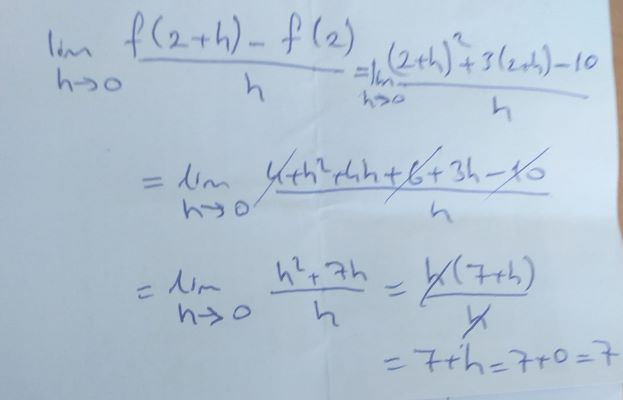 So the answer is A.
Let's find it by the help of limit:
So the answer is A.Soru 62
What is the average velocity of a particle in time interval [4,6] whose time(t) related position is given by the function f(t)=t2+4t?
Seçenekler
A
6
B
8
C
10
D
12
E
14
Açıklama:
average velocity in time interval [x,y]=(f(y)-f(x))/(y-x)
So for given function average velocity in [4,6]=(f(6)-f(4))/(6-4)=((62+4*6)-(42+4*4))/(6-4)=28/2=14
So for given function average velocity in [4,6]=(f(6)-f(4))/(6-4)=((62+4*6)-(42+4*4))/(6-4)=28/2=14
Soru 63
The motion of a particle is given by the function f(t) = 2t2-4t+3. Find its velocity at the instant t = 3.
Seçenekler
A
2
B
4
C
6
D
8
E
9
Açıklama:
The velocity at time t is given by the first derivative of the motion function. So we havee to find f '(t) for f(t) = 2t2-4t+3.
f '(t)=4t-4
Thus for t=3 f '(t)=4t-4=4*3-4=8
f '(t)=4t-4
Thus for t=3 f '(t)=4t-4=4*3-4=8
Soru 64
What is the first derivative of the function f(x)=(2/x)+3x2
Seçenekler
A
6x+2
B
3x+2
C
6x-(2/x2)
D
6x+(2/x2)
E
3x-(2/x2)
Açıklama:
Remember the derivative rule (xa)'=axa-1. So, applying this rule:
f(x)=2x-1+3x2
f '(x)=2*(-1)x-1-1+3*2x=-2x-2+6x=6x-(2/x2)
f(x)=2x-1+3x2
f '(x)=2*(-1)x-1-1+3*2x=-2x-2+6x=6x-(2/x2)
Soru 65
Which of the functions is not differentiable for x=0?
Seçenekler
A
f(x)=3x2
B
f(x)=2x
C
f(x)=6
D
f(x)= |4x|
E
f(x)=3x
Açıklama:
Only the absolute value function is not differentiable at zero because the left limit and right limit are not equal.
Soru 66
What is the first derivative of function f(x)=x2ex
Seçenekler
A
2xex
B
2xex+x2ex
C
2xex-x2ex
D
2x2ex
E
2xex+x2lnx
Açıklama:
We have to appy chain rule here.
let f(x)=h(x)g(x) where g(x)=ex and h(x)=x2
f '(x)=h'(x)g(x)+h(x)g'(x)
Since h'(x)=2x and g'(x)=ex
h'(x)=2xex+x2ex
let f(x)=h(x)g(x) where g(x)=ex and h(x)=x2
f '(x)=h'(x)g(x)+h(x)g'(x)
Since h'(x)=2x and g'(x)=ex
h'(x)=2xex+x2ex
Soru 67
Find the second derivative of f(x)=2x3+(1/x)
Seçenekler
A
12x+(2/x3)
B
12x-(2/x3)
C
12x-(1/x3)
D
12x+lnx
E
12x-lnx
Açıklama:
f(x)=2x3+(1/x)
f '(x)=6x2-(1/x2)
f ''(x)=12x+(2/x3)
f '(x)=6x2-(1/x2)
f ''(x)=12x+(2/x3)
Soru 68
For which values of x does the function f(x)=0.5x4-4x2 has extremum values?
Seçenekler
A
0, 2 and 4
B
-2 and 0
C
0 and 2
D
-2 and 2
E
-2,0 and 2
Açıklama:
f(x)=0.5x4-4x2
f '(x)=2x3-8x=2x(x2-4)
f '(x)=0 for x=-2, x=2, and x=0
f '(x)=2x3-8x=2x(x2-4)
f '(x)=0 for x=-2, x=2, and x=0
Soru 69
A rectangular land plot has a perimeter of 200 metres. What is the possible largest are of this land plot in squaremeters?
Seçenekler
A
2000
B
2500
C
3000
D
3200
E
3500
Açıklama:
Let x and y be the length of sides of the land plot. Then 2x+2y=200, so x+y=100
We can rewrite this equation as y=100-x
The area of rectangle is A=xy=x(100-x)=100x-x2
A is maximum when dA/dx=A'(x)=0 and A''(x)<0.
Thus A'(x)=100-2x=0 so x=50 and y=100-x=50.
So the area A=50*50=2500
Note that A''(x)=-2<0. Thus it is a maximum point.
We can rewrite this equation as y=100-x
The area of rectangle is A=xy=x(100-x)=100x-x2
A is maximum when dA/dx=A'(x)=0 and A''(x)<0.
Thus A'(x)=100-2x=0 so x=50 and y=100-x=50.
So the area A=50*50=2500
Note that A''(x)=-2<0. Thus it is a maximum point.
Soru 70
In which interval is the function f(x)=x2-4x monotone increasing?
Seçenekler
A
0
B
2
C
2
D
4
E
x<2
Açıklama:
For a function to be monotone increasing the first derivative of it must be positive.
Thus for f(x)=x2-4x the first derivative is f '(x)=2x-4
Since 0<2x-4
4<2x
2
Thus for f(x)=x2-4x the first derivative is f '(x)=2x-4
Since 0<2x-4
4<2x
2
Ünite 7
Soru 1
The demand function of a product is given by p=100-4x, and the supply function is p=1/2x-10. Which of the following is the equilibrium price?
Seçenekler
A
11/9
B
3
C
5
D
20/9
E
10/9
Açıklama:
Writing the demand function for x as x=25-1/4p, and writing the supply as x=2p+20 the equilibrium price may be found as
25-1/4p=2p+20
which is written as
25-20=2p+1/4p
and the price is found as
p=20/9. Therefore, the answer is D.
25-1/4p=2p+20
which is written as
25-20=2p+1/4p
and the price is found as
p=20/9. Therefore, the answer is D.
Soru 2
If the demand function of a particular commodity is given by p(q)=350-(q/5) what is the price when the demand is of unit elastic?
Seçenekler
A
175
B
150
C
275
D
135
E
275
Açıklama:
Let us write the demand function for q
q=1750-5p
Taking the derivative with respect to p we get
dq/dp = -5
The price elasticity of demand is
 From this equation we can easily write the price for the unit elasticity which is
1=5p/(1750-5p)
and the sought for price is p=175. Therefore, the answer is A.
q=1750-5p
Taking the derivative with respect to p we get
dq/dp = -5
The price elasticity of demand is
From this equation we can easily write the price for the unit elasticity which is 1=5p/(1750-5p)
and the sought for price is p=175. Therefore, the answer is A.
Soru 3
If the demand function of a particular commodity is given by p(q)=900-q/3 what is the price when demand is of unit elastic?
Seçenekler
A
900
B
175
C
450
D
270
E
350
Açıklama:
Let us write the demand function for q
q=2700-3p
Taking the derivative with respect to p we get
dq/dp = -3
The price elasticity of demand is
 From this equation we can easily write the price for the unit elasticity which is
1=3p/(2700-3p)
and the sought for price is p=450. Therefore, the answer is C.
q=2700-3p
Taking the derivative with respect to p we get
dq/dp = -3
The price elasticity of demand is
From this equation we can easily write the price for the unit elasticity which is 1=3p/(2700-3p)
and the sought for price is p=450. Therefore, the answer is C.
Soru 4
A company produces a certain item whose demand function is p=-4x+150, and supply function is p=6x-275. For what values of x is there a market shortage?
Seçenekler
A
x>42,5
B
x<42,5
C
x<21
D
x>21
E
x<47,5
Açıklama:
We first find the equilibrium point by equating the supply and demand functions. Therefore, the equality
-4x+150=6x-275, x=42,5. Because there will be a shortage in the market, to the left of this point the correct is x<42,5. Therefore, the answer is B.
-4x+150=6x-275, x=42,5. Because there will be a shortage in the market, to the left of this point the correct is x<42,5. Therefore, the answer is B.
Soru 5
Given that the demand function is p=60-x/3, the fixed cost 120 TL, and the variable cost for each item produced is 3 TL, what is the maximum profit?
Seçenekler
A
450,5
B
550,75
C
2317,86
D
1536
E
2316,75
Açıklama:
We know that the total revenue function is given by R=p*x,
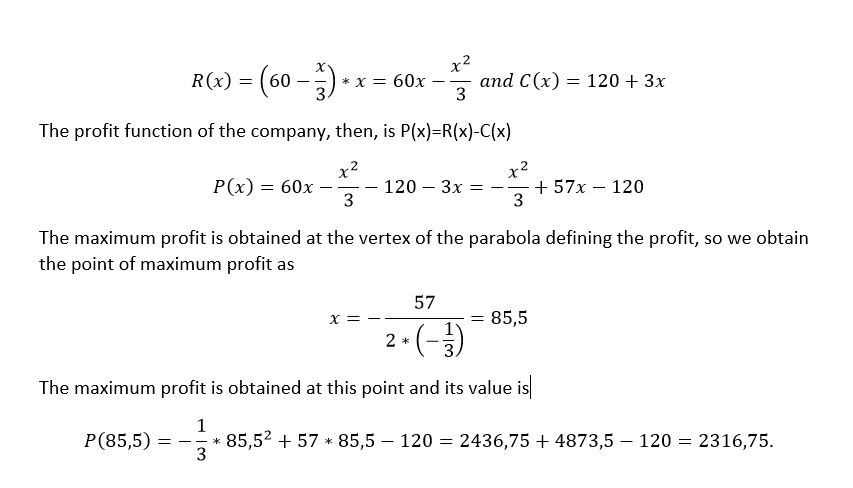 Therefore, the answer is E.
Therefore, the answer is E.Soru 6
The bus company BusAway determines that when a return ticket between Eskişehir and Ankara costs p TL (0
Seçenekler
A
6,5
B
7
C
8
D
10,8
E
12,8
Açıklama:
We need to equate the demand of elasticity to one,
 The answer is D.
The answer is D.Soru 7
The fixed costs of a product is 2750 TL, variable cost of one unit is 1,5 TL, and the selling price of the product is 3 TL. Which of the following is the break-even point?
Seçenekler
A
1850
B
1833,33
C
1733
D
1633,33
E
750,35
Açıklama:
Break-even point is the point where the total cost and the total revenue are equal C(x)=R(x).
For our question, R(x)=p*x=3x and C(x)=v*x+a=1,5x+2750.
1,5x+2750=3x, 1,5x=2750, x=1833,33. The answer is B.
For our question, R(x)=p*x=3x and C(x)=v*x+a=1,5x+2750.
1,5x+2750=3x, 1,5x=2750, x=1833,33. The answer is B.
Soru 8
Let p denote the price and q denote the quantity of a product. If the demand to this product is given by q(p)=450-2(p2), what is the price elasticity of demand when p=10?
Seçenekler
A
1,6
B
1,2
C
1,5
D
2,6
E
2,5
Açıklama:
Once again price elasticity of demand is
The answer is A.
The answer is A.
Soru 9
If the total cost function of a product is given by C(x)=4x+750, and the demand is p=10-(2x/4) which of the following is the maximum profit obtained through the sales of this product?
Seçenekler
A
3
B
6
C
5
D
7
E
9
Açıklama:
The total revenue function for the product is,
R(x)=p*x=10-(2x/4)*x=10x-2(x^2)/4
Since the total profit is the difference between the total revenue and the total cost function we have
 The answer is C.
R(x)=p*x=10-(2x/4)*x=10x-2(x^2)/4
Since the total profit is the difference between the total revenue and the total cost function we have
The answer is C.Soru 10
A company produces a certain item whose demand function is p=-5x+500, and supply functionis p=2x-200. For what values of x is there a market shortage?
Seçenekler
A
x>25
B
x>120
C
x<120
D
x>100
E
x<100
Açıklama:
We first find the equilibrium point by equating the supply and demand functions. Therefore, the equality
-5x+500=2x-200
gives
7x=700, x=100
Since there will be a shortage in the market, to the left o this point the correct answer x<100. The answer is E.
-5x+500=2x-200
gives
7x=700, x=100
Since there will be a shortage in the market, to the left o this point the correct answer x<100. The answer is E.
Soru 11
________ tells us the desire or willingness of a customer to pay a certain price for a particular item she wants to buy.
Seçenekler
A
Supply
B
Market
C
Demand
D
Equilibrium
E
Shortage
Açıklama:
in the simplest terms the definition of demand tells us the desire or willingness of a customer to pay a certain price for a particular item she wants to buy. Suppose that the seasonal price of a pair of sneakers is 180 TL. The same sneakers cost 100 TL in the discount season. A customer therefore may prefer to buy it at the discount season, and even maybe buys two pairs instead of one pair. Therefore, demand is proportional to the price of the goods.
Soru 12
The point where the quantity demanded equals the supply provided is called ________.
Seçenekler
A
Supply
B
Demand
C
the Equilibrium Point
D
Shortage
E
the Break-Even Point
Açıklama:
The point where the quantity demanded equals the supply provided is called the equilibrium point.
Soru 13
_______ is the point at which cost or expenses and revenue are equal.
Seçenekler
A
Surplus
B
the Equilibrium Point
C
Shortage
D
the Break-Even Point
E
the Total Revenue
Açıklama:
The break-even point is the point at which cost or expenses and revenue are equal: there is no net loss or gain, and one is said to have “broken even.”
Soru 14
The additional cost needed to produce or purchase one more unit of a good or service is called________.
Seçenekler
A
the Marginal Analysis
B
the Marginal Cost
C
the Marginal Revenue
D
the Marginal Profit
E
the Margianl Risk
Açıklama:
The additional cost needed to produce or purchase one more unit of a good or service is called the marginal cost. It corresponds to the derivative of the total cost function C(x).
Soru 15
A hardware manufacturer company sells its new product for 130 TL per item. Total cost consists of a fixed cost of 4400 TL, and the production cost of 50 TL per item. How many items must the manufacturer sell to gain a profit of 2500 TL?
Seçenekler
A
80 units
B
82,65 units
C
86,25 units
D
87,75 units
E
85,50 units
Açıklama:
If the company wants to make a profit of 2500TL then the profit function must be equal to this quantity. In other words,
P(x)= 2500 ⇒ 80 x−4400=2500⇒80 x=6900 so that
x=86,25 units.
P(x)= 2500 ⇒ 80 x−4400=2500⇒80 x=6900 so that
x=86,25 units.
Soru 16
If demand is elastic, which of the followings is correct?
Seçenekler
A
|Ep|<1, revenue R increases as price p increases.
B
|Ep|>1, revenue R(p)=p q(p) decreases as price p increases.
C
|Ep|<1, revenue R decreases as price p increases.
D
|Ep|>1, revenue R(p)=p q(p) increases as price p increases.
E
|Ep|=1, revenue is unaffected by a small change in price.
Açıklama:
If demand is elastic, i.e. |Ep|>1, revenue R(p)=p q(p) decreases as price p increases.
If demand is inelastic, i.e. |Ep|<1, revenue R increases as price p increases.
If demand is of unit elasticity, i.e. |Ep|=1, revenue is unaffected by a small change in
price.
If demand is inelastic, i.e. |Ep|<1, revenue R increases as price p increases.
If demand is of unit elasticity, i.e. |Ep|=1, revenue is unaffected by a small change in
price.
Soru 17
A hardware manufacturer company sells its new product for 130 TL per item. Total cost consists of a fixed cost of 4400 TL, and the production cost of 50 TL per item. What is the break-even point?
Seçenekler
A
45
B
50
C
55
D
60
E
65
Açıklama:
Let x denote the number of items produced and sold. The total revenue is
R (x) = 130 x
and the total cost is
C (x) = 50 x + 4400
To find the break-even point we equate total cost to total revenue, so
C(x)=R(x)⇒ 50 x+4400=130 x⇒80 x=4400
so that
x =55
Thus, the manufacturer has to sell at least 55 units to break even, i.e. no profit, or no loss.
R (x) = 130 x
and the total cost is
C (x) = 50 x + 4400
To find the break-even point we equate total cost to total revenue, so
C(x)=R(x)⇒ 50 x+4400=130 x⇒80 x=4400
so that
x =55
Thus, the manufacturer has to sell at least 55 units to break even, i.e. no profit, or no loss.
Soru 18
The mobile phone manufacturer BuyMe&UseMe predicts that the demand to their brand new smartphone will be 2000 units if its price is set to 1200 TL, and the demand will be 3000 units if the price is reduced 200 TL per item. What is the demand function for this new product?
Seçenekler
A
p=-x/4 +1600
B
p=-x/5-1600
C
p=-x/5 +2000
D
p=-x/5 +1600
E
p=x/6 +1600
Açıklama:
let x denote the demand and p the price of the product. We are given (x1,p1)=2000,1200) and (x2, p2)=(3000,1000), since there is TL discount in the price. The demand line that passes through these points has slope m=-1/5 and its equation is p=-x/5 +1600
Soru 19
If demand is of unit elasticity,which of the following is true?
Seçenekler
A
Ep=0
B
Ep=1
C
Ep>1
D
Ep<1
E
Ep<0
Açıklama:
If demand is of unit elasticity, i.e. |Ep|=1, revenue is unaffected by a small change in price.
Soru 20
The private electric company EsLeki supplying electric to the citizens of Eskişehir has a monthly demand of p(x)=200-3x, where x corresponds to one kilowatt hour. The cost function of the company is given by C(x)=75+80x-x2, 0≤x≤40. What is the value of x ?
Seçenekler
A
10
B
20
C
30
D
40
E
50
Açıklama:
The profit function we would like to maximise is P(x)=R(x)−C(x)
R(x)=x p(x)=x ⋅(200−3x)=200x −3x2
so that
P(x)=−2x 2 +120x−75
To find the maximum price, let us take the derivative of P(x) and equate it to zero:
P'(x)=−4x+120 = 0 ⇒ x=30
R(x)=x p(x)=x ⋅(200−3x)=200x −3x2
so that
P(x)=−2x 2 +120x−75
To find the maximum price, let us take the derivative of P(x) and equate it to zero:
P'(x)=−4x+120 = 0 ⇒ x=30
Soru 21
The demand function of A is p = 1.200 - 3 x, and the supply function of A is p = 5 x - 400. Which of the following is the equilibrium price ?
Seçenekler
A
600
B
500
C
400
D
300
E
200
Açıklama:
p : price ; x : quantity ; at equilibrium : 1.200 - 3 x = 5 x - 400 ; 1.600 = 8 x ; x = 200 ; p = 600. pg. 160. Correct answer is A.
Soru 22
The demand function of A is p(q) = 515 - (q / 5). What is the price when the demand is of unit elastic ?
Seçenekler
A
555.0
B
812.5
C
257.5
D
1.110.0
E
55.5
Açıklama:
Ep = |(p / q) (dq / dp)| = 1 for unit elastic ; q = 2.575 - (5 p) ; dq / dp = -5 ; Ep = |(p / (2.575 - (5 p))) (-5)| = 1 ; p / (2.575 - (5 p)) (-5) = 1 ; 5 p / (2.575 - 5 p) = 1 ; 10 p = 2.575 ; p = 257.5 . pg. 166. Correct answer is C.
Soru 23
The demand function of A is p = 60 - 3 x / 4, the fixed cost is 120 TL, and the variable cost is 10 TL for each units produced ; which of the following is the profit function ?
Seçenekler
A
-0.75 x2 - 60
B
-0.75 x2 + 50 x - 180
C
-0.75 x2 + 70 x - 120
D
-0.75 x2 + 50 x - 120
E
-0.75 x2 - 50 x - 120
Açıklama:
P(x) = R(x) - C(x) ; R(x) = (60 - (3 / 4) x) x ; C(x) = 120 + 10 x ; P(x) = -0.75 x2 + 50 x - 120 . pg. 161. Correct answer is D.
Soru 24
The demand function of A is p = 40 - (x / 2), the fixed cost 48 TL, and the variable cost for each item produced is 4 TL ; what is the maximum profit ?
Seçenekler
A
448
B
860
C
600
D
1.022
E
1.296
Açıklama:
P(x) = R(x) - C(x) ; R(x) = (40 - (x / 2)) x ; C(x) = 48 + 4 x ; P(x) = -0.5 x2 + 36 x - 48 ; P'(x) = -x + 36 = 0 ; x = 36 ; P(36) = 600 . pg. 164. Correct answer is C.
Soru 25
The demand function of A is p = -3 x + 3333, and supply function is p = 5 x + 333. For what values of x is there a surplus for A ?
Seçenekler
A
< 403
B
> 330
C
< 220
D
> 111
E
> 375
Açıklama:
-3 x + 3.333 = 5 x + 333 ; 8 x = 3.000 ; for surplus : x > 375 . pg. 160 . Correct answer is E.
Soru 26
The demand for A is q = 600 - 0.02 p2 , (0 ≤ p ≤ 250). Which of the following is the value of p for which the demand is of unit elastic ?
Seçenekler
A
60
B
80
C
100
D
75
E
45
Açıklama:
Ep = |(p / q) (dq / dp)| = 1 for unit elastic ; dq / dp = -0.04 p ; Ep = |(p / (600 - (0.02 p2))) (-0.04 p)| = 1 ; p / (600 - (0.02 p2)) (-0.04 p) = 1 ; 0.04 p2 / (600 - 0.02 p2) = 1 ; 0.06 p2 = 600 ; p2 = 10.000 ; p = 100 . pg. 166. Correct answer is C.
Soru 27
The fixed cost of a product is 4.000 TL, variable cost for one unit is 0.4 TL and the selling price of the product is 4.4 TL. Which of the following is the break-even point ?
Seçenekler
A
1.400
B
900
C
800
D
1.200
E
1.000
Açıklama:
R(x) = p x = 4.4 x ; C(x) 4.0000 + 0.4 x ; 4.4 x = 4.000 + 0.4 x ; 4 x = 4.000 ; x = 1.000 . pg. 161. Correct answer is E.
Soru 28
The demand function of A is q (p) = 492 - 0.03 p2 ; what is the price elasticity of demand when p = 20 ?
Seçenekler
A
0.05
B
0.25
C
0.6
D
1.2
E
1.5
Açıklama:
Ep = |(p / q) (dq / dp)| = ; dq / dp = -0.06 p ; Ep = |(p / (492 - (0.03 p2))) (-0.06 p)| = 0.06 p2 / (492 - (0.03 p2)) ; p = 20 ; Ep = 0.06 x 400 / (492 - 0.03 x 400) = 24 / (492 - 12) = 24 / 480 = 0.05 . pg. 160. Correct answer is A.
Soru 29
The total cost function of A is C(x) = 3 x + 600, and the demand is p = 30 - (x / 4) ; which of the following is the maximum profit obtained through the sales of this product ?
Seçenekler
A
100
B
129
C
140
D
118
E
144
Açıklama:
P(x) = R(x) - C(x) ;
R(x) = (30 - (x / 4)) x ;
P(x) = -0.25 x2 + 27 x - 600 ;
P'(x) = -0.5 x + 27 = 0 ; x = 54 ;
P(54) = 272 - 600 = 729 - 600 = 129. pg. 164. Correct answer is B.
R(x) = (30 - (x / 4)) x ;
P(x) = -0.25 x2 + 27 x - 600 ;
P'(x) = -0.5 x + 27 = 0 ; x = 54 ;
P(54) = 272 - 600 = 729 - 600 = 129. pg. 164. Correct answer is B.
Soru 30
The total cost of A is C (x) = 2.400 + (2 x2 − 120 x) / 3 , where x represents the quantity produced. Which of the following is the production quantity that makes the cost minimum ?
Seçenekler
A
30
B
40
C
64
D
80
E
24
Açıklama:
Local minimum : C'(x) = 4 x - 120 = 0 ; x = 30 ; C'' (30) = 4 > 0 . pg. 164. Correct answer is A.
Soru 31

Seçenekler
A
60
B
120
C
240
D
360
E
480
Açıklama:
Market Equilibrium
Soru 32

Seçenekler
A
100
B
200
C
250
D
300
E
400
Açıklama:
ELASTICITY
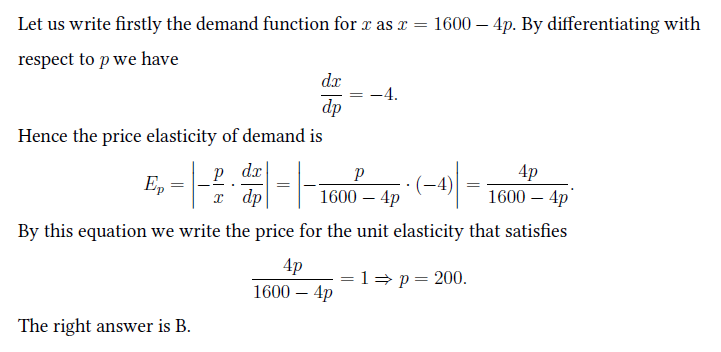
Soru 33

Seçenekler
A
8
B
9
C
10
D
11
E
12
Açıklama:
MARGINAL ANALYSIS
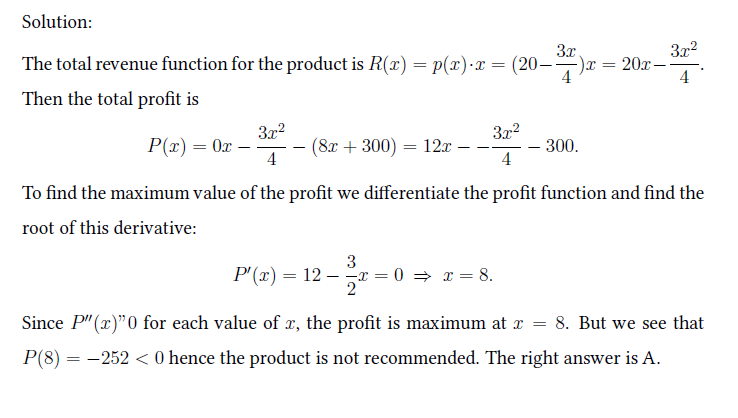
Soru 34

Seçenekler
A
40
B
50
C
60
D
70
E
80
Açıklama:
ELASTICITY
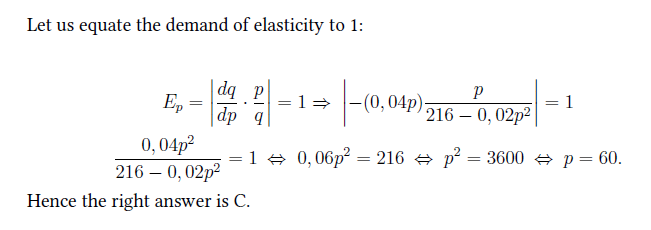
Soru 35

Seçenekler
A
1563
B
1598
C
1635
D
1673
E
1796
Açıklama:
MARGINAL ANALYSIS
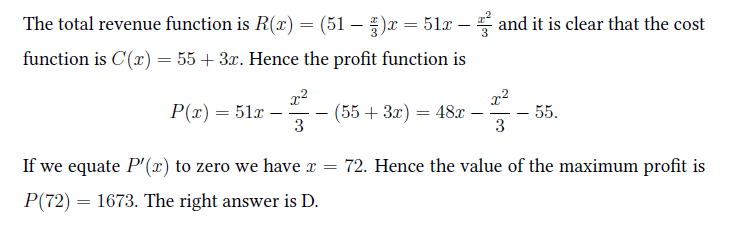
Soru 36

Seçenekler
A
50
B
60
C
75
D
85
E
90
Açıklama:
MARGINAL COST
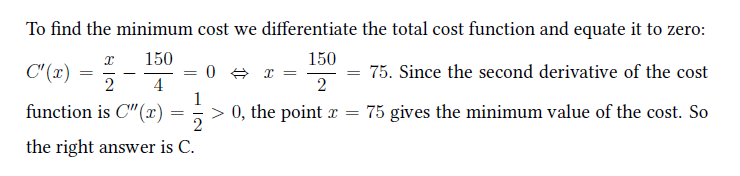
Soru 37

Seçenekler
A 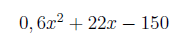
B 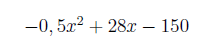
C 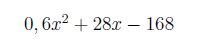
D 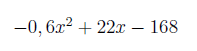
E 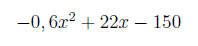
Açıklama:
MARGINAL ANALYSIS
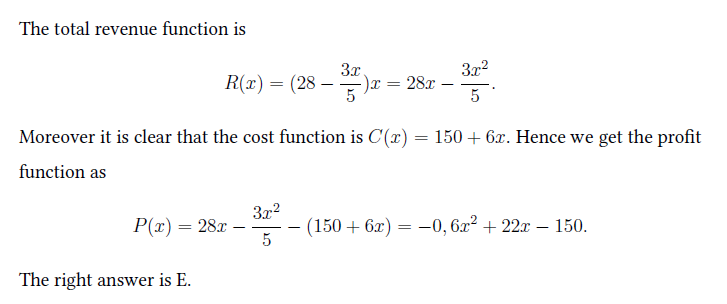
Soru 38

Seçenekler
A
1
B
0,8
C
0,6
D
0,5
E
0,3
Açıklama:
ELASTICITY OF DEMAND
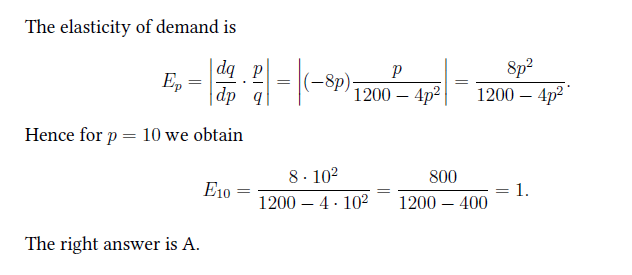
Soru 39

Seçenekler
A 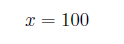
B 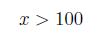
C 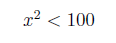
D 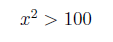
E 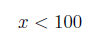
Açıklama:
MARKET EQUILIBRIUM
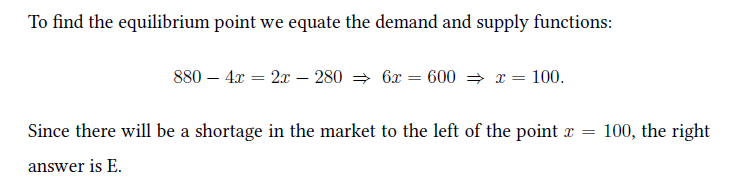
Soru 40

Seçenekler
A
1120
B
1250
C
1280
D
1310
E
1320
Açıklama:
BREAK-EVEN ANALYSIS
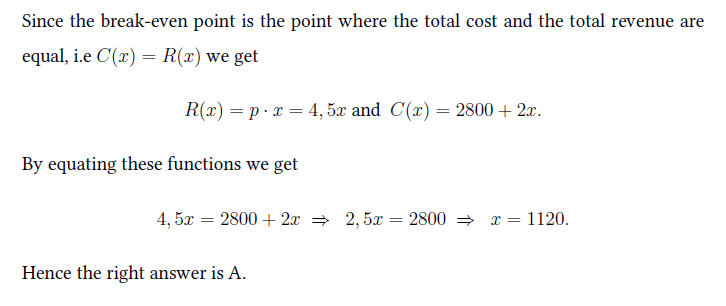
Soru 41
The mobile phone manufacturer BestPhone predicts that the demand to their brand new smartphone will be 5000 units if its price is set to 3000 TL, and the demand will be 6000 units if the price is reduced 500 TL per item. What is the slope of demand function?
Seçenekler
A
1/2
B
-1/2
C
1
D
1/4
E
-1/4
Açıklama:
The slope of the demand function is
 So, we find the slope as (2500-3000)/(6000-5000)=-1/2.
So, we find the slope as (2500-3000)/(6000-5000)=-1/2.Soru 42
Suppose that the olive oil firm Zeytindali supplies 300 bottles onto the market when the price is 100 TL They provide 500 bottles when the price goes upto 150 TL. What is the slope of the supply function?
Seçenekler
A
1/2
B
-1/2
C
1
D
1/4
E
-1/4
Açıklama:
The slope of the demand function is
If x denotes the quantity of supply, and p is the price then we can
write (x1, p1)=(300,100) and (x2,p2)=(500,150). So, the slope is equal to 50/200=1/4.
If x denotes the quantity of supply, and p is the price then we canwrite (x1, p1)=(300,100) and (x2,p2)=(500,150). So, the slope is equal to 50/200=1/4.
Soru 43
A smart TV brand SmartTV has a new product and they predict their demand function as a;
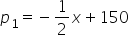 and ther supply function as a;
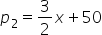 What is the market price of this product?
and ther supply function as a; What is the market price of this product?Seçenekler
A
50
B
75
C
100
D
125
E
150
Açıklama:
The price of a product at the intersection point, provided that it is in the first quadrant, is called market price. We may easily find that the market price of the ne TV in question.
 x is found as 50. When we put it on the demand or supply equations, we find market price as 125.
x is found as 50. When we put it on the demand or supply equations, we find market price as 125.Soru 44
A company has a new product and they predict their demand function for this product as a;
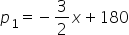 and supply function as a;
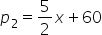 What is the market price for this product would be?
and supply function as a; What is the market price for this product would be?Seçenekler
A
45
B
75
C
135
D
180
E
240
Açıklama:
The price of a product at the intersection point, provided that it is in the first quadrant, is called market price. Equate the supply and demand function giving;
 x is found as 30. When we put it on the demand or supply equation, we find market price as 135.
x is found as 30. When we put it on the demand or supply equation, we find market price as 135.Soru 45
A furniture manufacturer company sells its new product for 500 TL per item. Total cost consists of a fixed cost of 12000 TL, and the
production cost of 300 TL per item. What is the break-even point?
production cost of 300 TL per item. What is the break-even point?
Seçenekler
A
120
B
150
C
180
D
240
E
300
Açıklama:
The break-even point is the point at which cost or expenses and revenue are equal: so;
Cost: 300x+12000
Revenue : 500x
300x+12000=500x, then x=120.
Cost: 300x+12000
Revenue : 500x
300x+12000=500x, then x=120.
Soru 46
A company produces a certain item whose demand function is
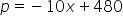 and supply function is
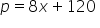 For what values of x is there a market shortage?
and supply function is For what values of x is there a market shortage?Seçenekler
A 
B 
C 
D 
E 
Açıklama:
We first find the equilibrium point by equating the supply and demand functions. Therefore, the equality
 gives
gives
Since there will be a shortage in the market, to the left of this point the correct answer is
gives Since there will be a shortage in the market, to the left of this point the correct answer isSoru 47
The fixed costs of a product is 8000 TL, variable cost for one unit is 3 TL and the selling price of the product is 7 TL. Which of the following is the break-even point?
Seçenekler
A
400
B
800
C
1200
D
1600
E
2000
Açıklama:
Break-even point is the point where the total cost and the total revenue are equal (C(x)=R(x)).

Soru 48
Let p denote the price and q denote the quantity of a product. If the demand to this product is given by
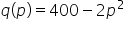 What is the price elasticity of demand when p=10?
What is the price elasticity of demand when p=10?Seçenekler
A
0
B
1
C
2
D
3
E
4
Açıklama:
Price elasticity of demans is
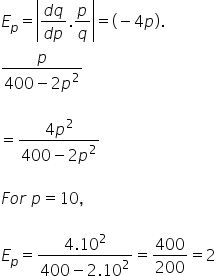
Soru 49
A company has a new product which has a demand function,
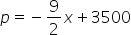 and supply function,
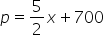 What is the market price?
and supply function, What is the market price?Seçenekler
A
1500
B
1600
C
1700
D
1800
E
1900
Açıklama:
The price of a product at the intersection point, provided that it is in the first quadrant, is called market price.
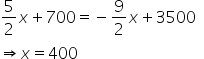 When we put it on the demand or supply equations, we find market price as 1700.
When we put it on the demand or supply equations, we find market price as 1700.Soru 50
A company produces a certain item whose demand function is
and supply function is
For what values of x is there a market surplus?
and supply function is For what values of x is there a market surplus?Seçenekler
A
B
C
D
E
Açıklama:
We first find the equilibrium point by equating the supply and demand functions. Therefore, the equality
gives
Since there will be a surplus in the market, to the right of this point the correct answer is
gives Since there will be a surplus in the market, to the right of this point the correct answer isSoru 51

Seçenekler
A
(4,5)
B
(3,5)
C
(2,5)
D
(1,5)
E
(4,4)
Açıklama:
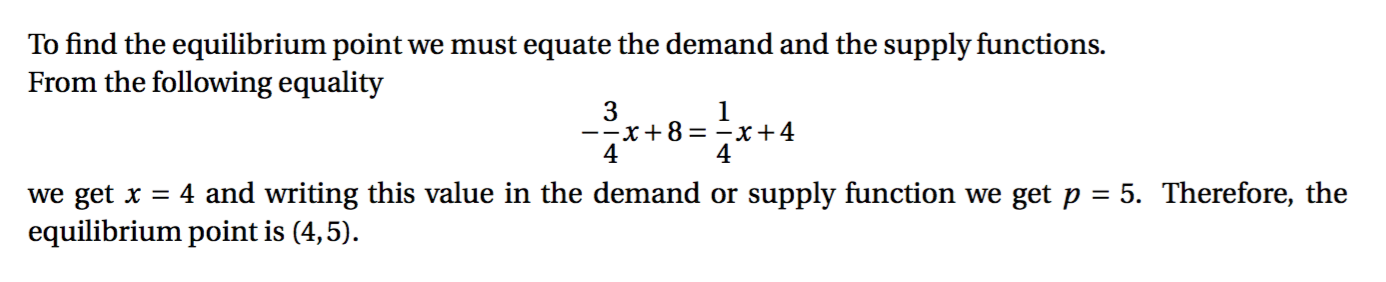
Soru 52

Seçenekler
A 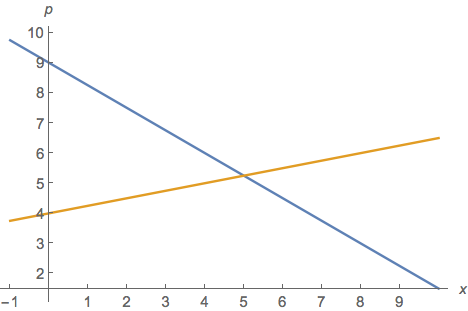
B 
C 
D 
E 
Açıklama:
The equilibrium point of given demand and supply functions is the point (4,5). Therefore, we must look for this point for graphs. Correct answer is B.
Soru 53
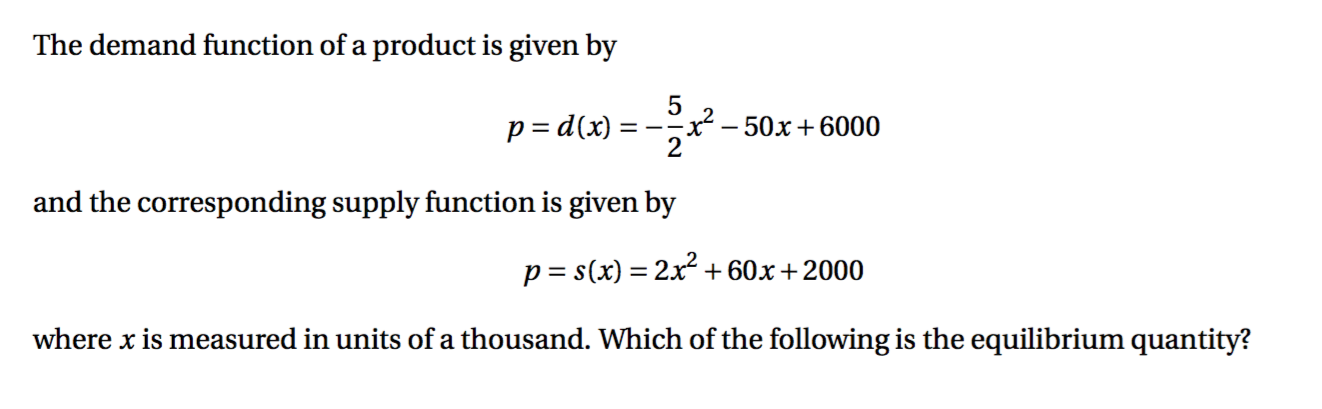
Seçenekler
A
18000
B
19000
C
20000
D
21000
E
22000
Açıklama:
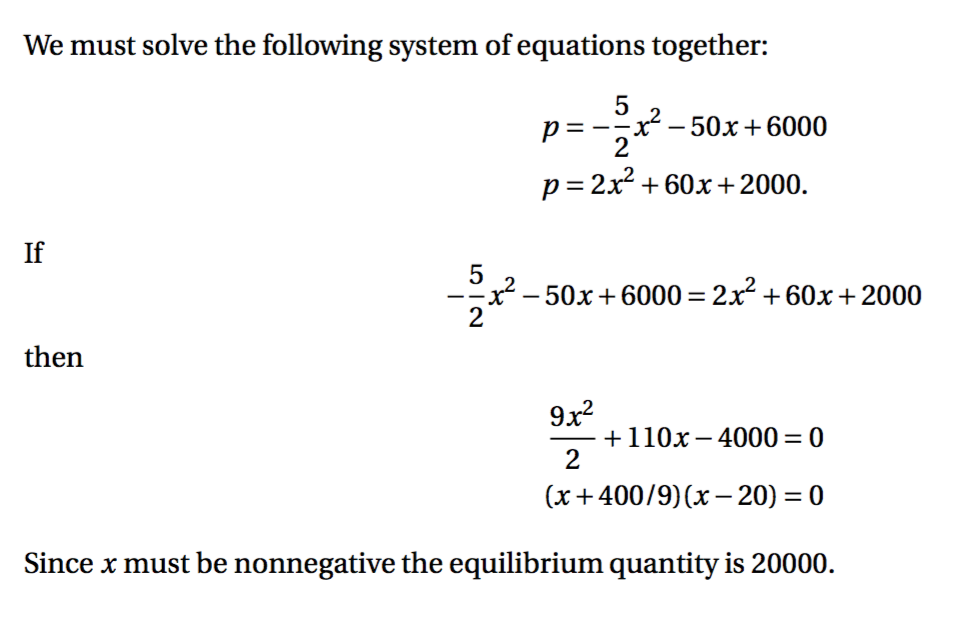
Soru 54
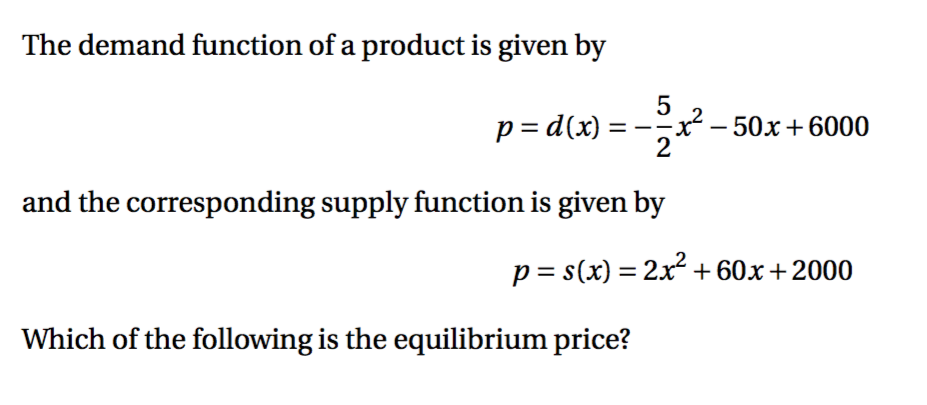
Seçenekler
A
3400
B
3600
C
3800
D
4000
E
4200
Açıklama:
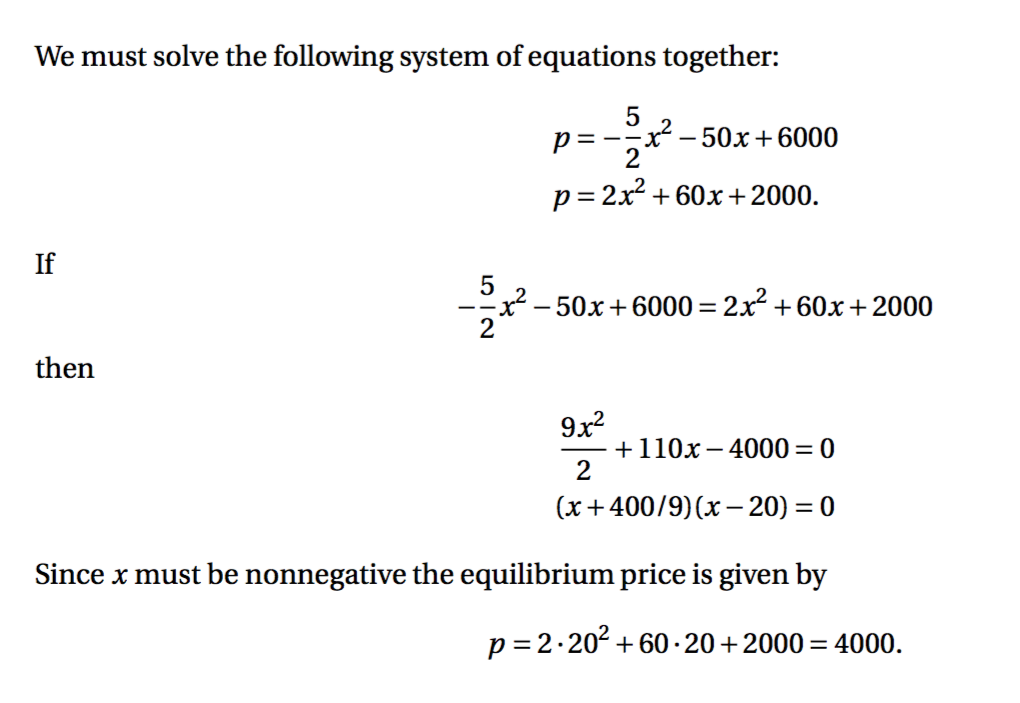
Soru 55

Seçenekler
A 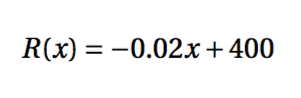
B 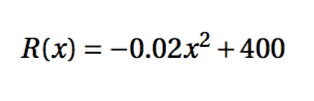
C 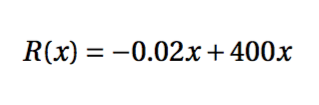
D 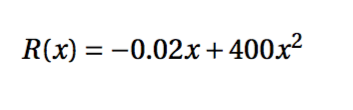
E 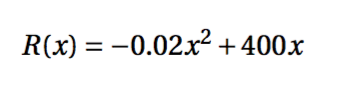
Açıklama:
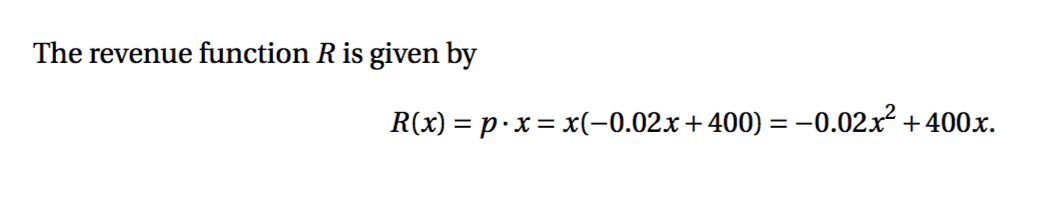
Soru 56

Seçenekler
A 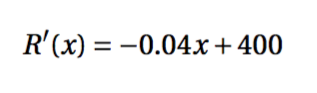
B 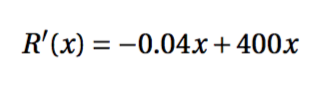
C 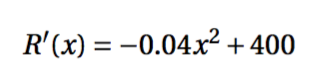
D 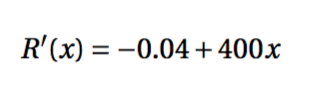
E 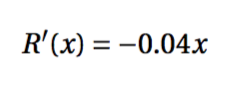
Açıklama:
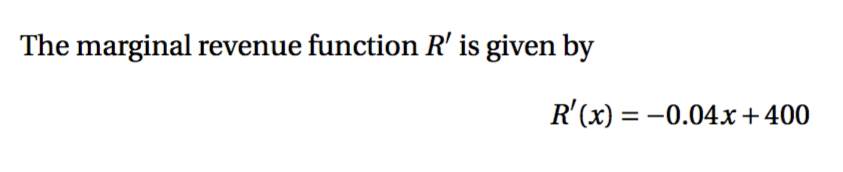
Soru 57
Seçenekler
A 
B 
C 
D 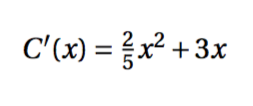
E 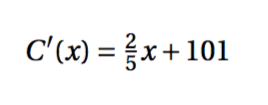
Açıklama:
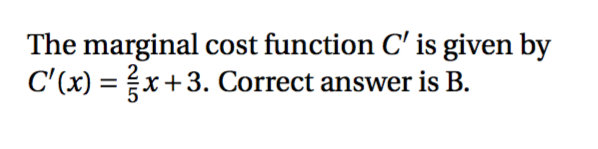
Soru 58
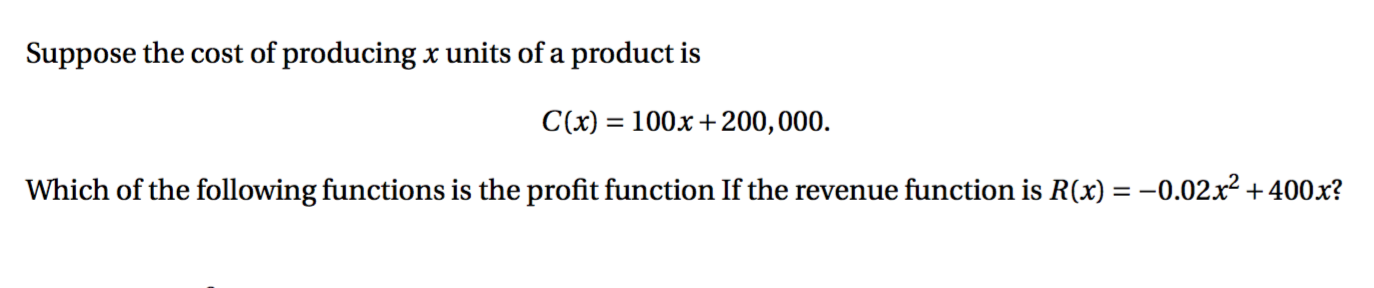
Seçenekler
A 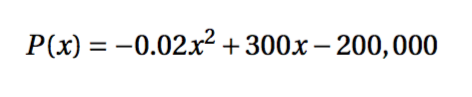
B 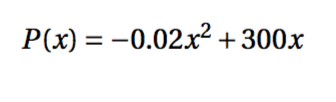
C 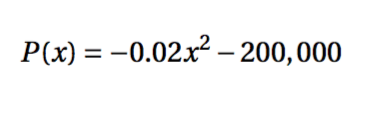
D 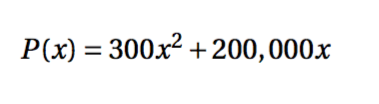
E 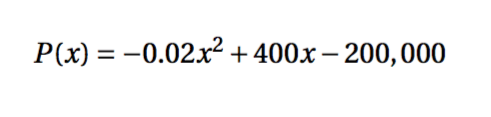
Açıklama:
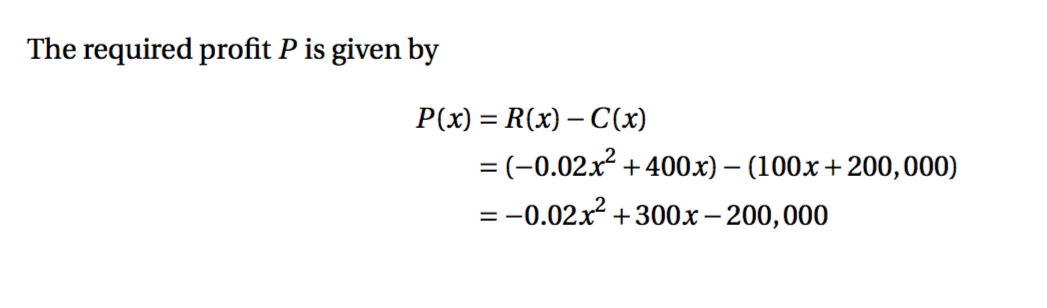
Soru 59

Seçenekler
A 
B 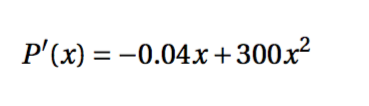
C 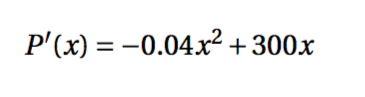
D 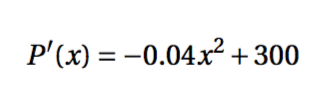
E 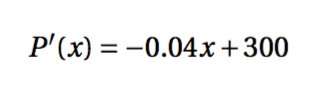
Açıklama:
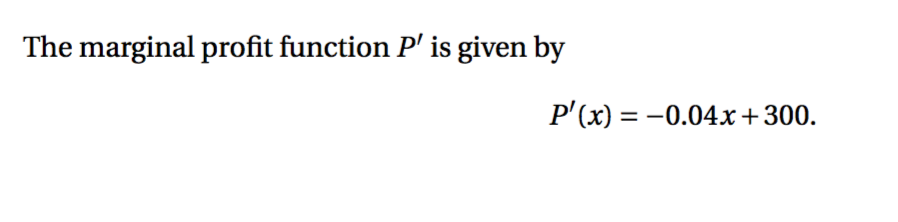
Soru 60

Seçenekler
A 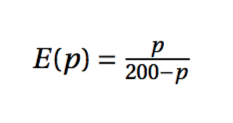
B 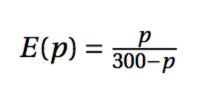
C 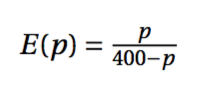
D 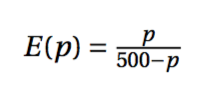
E 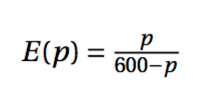
Açıklama:
Soru 61
Suppose the total cost function is 200+2x2+4x and total revenue function is 350-x2+19x, where x denotes the production amount for a company. For what value of x is the break even point?
Seçenekler
A
x=12
B
x=10
C
x=7
D
x=5
E
x=3
Açıklama:
For break even point total revenue is equal to total cost. Thus:
200+2x2+4x = 350-x2+19x
3x2-15x-150=0
and dividing both sides by 3 we get:
x2-5x-50=0 so:
(x-10)(x+5)=0
Therefore x=10 and x=-5 are the roots of this equation. Since production amount can not be negative, the answer is x=10.
200+2x2+4x = 350-x2+19x
3x2-15x-150=0
and dividing both sides by 3 we get:
x2-5x-50=0 so:
(x-10)(x+5)=0
Therefore x=10 and x=-5 are the roots of this equation. Since production amount can not be negative, the answer is x=10.
Soru 62
Assume that total cost function is 200+3x2+5x. For which level of production is the marginal cost is equal to 95?
Seçenekler
A
x=5
B
x=10
C
x=15
D
x=18
E
x=19
Açıklama:
Marginal cost is the first derivative of the total cost. Thus since TC=200+3x2+5x,
MC=dTC/dx=6x+5
So:
6x+5=95
6x=90
x=15
MC=dTC/dx=6x+5
So:
6x+5=95
6x=90
x=15
Soru 63
Assume that total revenue function of a factory producing trucks is given by 2x2+x and the total cost function is given by 100+x2+17x. What is the profit maximizing level of production?
Seçenekler
A
x=20
B
x=15
C
x=12
D
x=10
E
x=8
Açıklama:
The profit is the diiferecnce between total revenue and total cost.
Thus profit function P(x)=TR(x)-TC(x)=2x2+x - (100+x2+17x)=x2-16x-100
For maximum profit first derivative must be equal to zero. Thus:
dP(x)/dx=2x-16=0
Thus x=8
Thus profit function P(x)=TR(x)-TC(x)=2x2+x - (100+x2+17x)=x2-16x-100
For maximum profit first derivative must be equal to zero. Thus:
dP(x)/dx=2x-16=0
Thus x=8
Soru 64
Suppose that the demand function is p=100-2x for quantity produced (x) in a factory, where p denotes the price. What will be the marginal revenue for 6th product?
Seçenekler
A
76
B
72
C
58
D
42
E
24
Açıklama:
Total Revenue=p*x=(100-2x)x=100x-2x2
Since marginal revenue is the first derivative of the total revenue:
MR=dTR/dx=100-4x
and for x=6, MR=100-4*6=76
Since marginal revenue is the first derivative of the total revenue:
MR=dTR/dx=100-4x
and for x=6, MR=100-4*6=76
Soru 65
Assume that the demand function (price) for a good is defined as p(x)=100-2x. What will be the price elasticity of demand for p=40?
Seçenekler
A
-3/2
B
-4/3
C
-3/4
D
-2/3
E
-1/2
Açıklama:
price elasticity of demand=(dx/dp)*(p/x)
so we first have to write x as a function of p.
Therefore:
p=100-2x
2x=100-p
x=50-0.5p
Thus dx/dp=-0.5
And for p=40, x=50-0.5*40=30
Thus for x=30 and p=40;
price elasticity of demand=(dx/dp)*(p/x)=-0.5*40/30=-20/30=-2/3
so we first have to write x as a function of p.
Therefore:
p=100-2x
2x=100-p
x=50-0.5p
Thus dx/dp=-0.5
And for p=40, x=50-0.5*40=30
Thus for x=30 and p=40;
price elasticity of demand=(dx/dp)*(p/x)=-0.5*40/30=-20/30=-2/3
Soru 66
Assume that labor demand function of a company is defined as L=300-2w where w denotes the hourly wage rate and L denotes the amount of labor hour demanded. For what level of wage rate will the labor cost be maximum for a company?
Seçenekler
A
50
B
60
C
75
D
150
E
300
Açıklama:
Labor cost(LC)=L*w=(300-2w)w=300w-2w2
The labor cost will be maximum when the first derivative is equal to zero. Thus:
dLC/dw=300-4w=0
w=75
The labor cost will be maximum when the first derivative is equal to zero. Thus:
dLC/dw=300-4w=0
w=75
Soru 67
For which of the following total cost functions, is the marginal cost constant?
Seçenekler
A
TC=3x2+180
B
TC=3x+180
C
TC=3x3+180
D
TC=3x2+6x+180
E
TC=180/x
Açıklama:
For only total cost functions in the form of "ax" or "ax+b" the marginal cost is constant and equal to "a". The one in B satisfies this condition.
Soru 68
Assume that the total cost function for a factory is defined as TC=1900+x3-3x2.
For which interval of x is the marginal cost decreasing?
For which interval of x is the marginal cost decreasing?
Seçenekler
A
x<1
B
1
C
2
D
3
E
2>x
Açıklama:
Since TC=1900+x3-3x2.
MC=dTC/dx=3x2-6x
For MC be decreasing, its first derivative, namely dMC/dx must be negative.
Thus:
dMC/dx=6x-6
So for 6x-6<0
6x<6
x<1
MC=dTC/dx=3x2-6x
For MC be decreasing, its first derivative, namely dMC/dx must be negative.
Thus:
dMC/dx=6x-6
So for 6x-6<0
6x<6
x<1
Soru 69
Suppose that supply function for a brand of chocolate is defined as S(p)=5+4p whereas demand function for it is defined as D(p)=35-6p where p denotes its price. What will be the equilibrium price for this chocolate?
Seçenekler
A
10
B
6
C
5
D
4
E
3
Açıklama:
Market equilibrium exists where supply is equal to demand.
Thus 5+4p=35-6p
10p=30
p=3
Thus 5+4p=35-6p
10p=30
p=3
Soru 70
Suppose the supply and demand functions for crackets are defined as S(p)=30+20p and D(p)=150-10p where p denotes its price. For which of the following price there exists an excess demand?
Seçenekler
A
7
B
6
C
5
D
3
E
4
Açıklama:
When price is below equilibrium level there exists an excess demand since demand is higher than supply at that point. So we have to find the equilibrium price first.
S(p)=30+20p = D(p)=150-10p
120=30p
4=p
Since only 3 is less than 4 among the answers, excess demand occurs only when price is equal to 3.
S(p)=30+20p = D(p)=150-10p
120=30p
4=p
Since only 3 is less than 4 among the answers, excess demand occurs only when price is equal to 3.
Ünite 8
Soru 1
limx→0, y→0 (x2 + xy + y2) / (x + xy + y) = ?
Seçenekler
A
1
B
0
C
2
D
does not exist
E
3
Açıklama:
(x2 + x k x + k2 x2) / (x + x k x + k x) = (x2 (1 + k + k2)) / (x (k x + 1 + k)) = (x (1 + k + k2)) / (k x + 1 + k) = 0. pg. 182. Correct answer is B
Soru 2
f(x, y) = ey + yx2 - x - 1 ; ∂f / ∂y = ?
Seçenekler
A
ey + x2 - x
B
ey + 2 x
C
ey + 2 y x2
D
ey + x2
E
ey + y x2
Açıklama:
ey + x2 . pg. 183. Correct answer is D.
Soru 3
f(x, y) = exy + xy2 - xy + 2 ; ∂2f / ∂y2 = ?
Seçenekler
A
x exy + 2 x y - x
B
exy + 2 x
C
x2 exy + x
D
x exy + x
E
x2 exy + 2 x
Açıklama:
∂f / ∂y = x exy + 2xy - x ; ∂2f / ∂y2 = x2 exy + 2x . pg. 183. Correct answer is E.
Soru 4
f (x, y, z) = xyz - xy - xz + yz ; grad f (-1, 2, -3) = ?
Seçenekler
A
(-3, -4, -1)
B
(4, 2, 6)
C
(-5, 1, 1)
D
(2, -1, 4)
E
(1, 5, -6)
Açıklama:
grad f (x, y, z) = (∂f / ∂x , ∂f / ∂y , ∂f / ∂z) = (yz - y - z, xz - x + z, xy - x + y) = (-6 - 2 + 3 , 3 + 1 - 3 , -2 + 1 + 2) = (-5, 1, 1). pg. 187. Correct answer is C.
Soru 5
z = f(x, y) is defined implicitly by xz + yz - 1 = 0 ; ∂f / ∂x (-1, 2, 1) = ?
Seçenekler
A
1
B
-1
C
0
D
-2
E
2
Açıklama:

Soru 6
z = f(x, y) is defined implicitly by xz - yz + 3 = 0 ; Which of the following ones below is the equation of the tangent plane to the graph of z = f (x, y) around the point (1, -2, -1) ?
Seçenekler
A
-x + 2 y + 3 z + 8 = 0
B
2 x - y + 2 z - 7 = 0
C
-x - 3 y + 2 z + 6 = 0
D
x + y - z + 5 = 0
E
-3 x + 3 y + z + 4 = 0
Açıklama:
at (1, -2, -1) : ∂F / ∂x = z = -1 ; ∂F / ∂y = -y = 2 ; ∂F / ∂z = x - y = 3 ; -1 (x - 1) + 2 (y - (-2)) + 3 (z - (-1)) = -(x - 1) + 2 (y + 2) + 3 (z + 1) = -x + 1 + 2 y + 4 + 3 z + 3 = -x + 2 y + 3 z + 8 = 0 . pg. 187. Correct answer is A.
Soru 7
What is the shortest distance between the point P(0, 2) and the line y = x ?
Seçenekler
A
2
B
2-1/2
C
23/2
D
2-1
E
21/2
Açıklama:
22 = (d1)2 + (d2)2 = ((x1)2 + (y1)2)+ ((x1)2 + (2 - y1)2) = ((x1)2 + (x1)2) + ((x1)2 + (2 - x1)2) = (2 (x1)2) + ((x1)2 + 4 - 4 (x1) + (x1)2) = 4 (x1)2 + 4 - 4 (x1) ; 4 (x1)2 - 4 (x1) = 0 ; x1 = 1
y1 = 1 ; d2 = 21/2 . pg. 193. Correct answer is E.
y1 = 1 ; d2 = 21/2 . pg. 193. Correct answer is E.
Soru 8
z = x2 - y ; x = u2 v ; y = u2 + v2 ; at u = v = -1, ∂z / ∂u = ?
Seçenekler
A
-2
B
3
C
-1
D
-4
E
1
Açıklama:
z = u4 v2 - u2 - v2 ; ∂z / ∂u = 4 u3 v2 - 2 u ; at u = v = -1, ∂z / ∂u = -2 . pg. 188. Correct answer is A.
Soru 9
Which of the following is the local minimum point of the function f (x, y) = x2 + 2 y2 + 2 x + 3 y ?
Seçenekler
A
(3, 5)
B
(-1, -4)
C
(3 / 5, 1)
D
(-2, -3 / 4)
E
(1, 2 / 3)
Açıklama:
∂f / ∂x = 2x + 2 = 0 ; x = -2 ; ∂f / ∂y = 4 y + 3 = 0 ; y = -3 / 4 ; a = ∂2f / ∂x2 = 2 > 0 ; b = ∂2f / ∂y2 = 2 ; c = ∂2f / ∂x ∂y = 0 ; D = a . b - c2 = 2 . 2 - 0 = 4 > 0 ; pg. 192. Correct answer is D.
Soru 10
What is the positive stationary vaule of the function f (x, y) = x - y, satisfying the condition x2 - 2 y2 = 10 ?
Seçenekler
A
21/2
B
2-1
C
3-1
D
51/2
E
31/2
Açıklama:
L(x, y, λ )= x - y + λ (x2 - 2 y2 − 10) ; ∂L / ∂x = 1 + 2 λ x = 0 ; λ = -1 / (2 x) ; ∂L / ∂y = -1 - 4 λ y = 0 ; λ = -1 / (4 y) ; 2 x = 4 y ; x = 2 y ; ∂L / ∂λ = 0 ; x2 - 2 y2 = 10 ; (2 y)2 - 2 y2 = 10 ; 2 y2 = 10 ; y = {-51/2 , 51/2}; x = {-2 51/2 , 2 51/2} ; f(x, y) = x - y = 51/2 > 0. pg. 193. Correct answer is D.
Soru 11
What is the domain of the function f(x,y)=√(x2-4y2)
Seçenekler
A 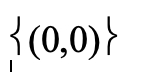
B 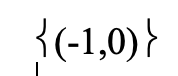
C
(-1,0)
D
(0,1)
E
(0,2)
Açıklama:
Since negative numbers do not have square roots,x2-4y2 must be non-negative. Thus:
x2-4y2≥0
(x-2y)(x+2y)≥0
This can be true only if both (x-2y) and (x+2y) are non-negative or both are non-positive.
I. First we take the first case (both are non-negative).
Thus:
x-2y≥0 which means x≥2y
x+2y≥0 which means x≥-2y
Thus the solution set is x≥2y ∩ x≥-2y
II. Now we take the second case (both are non-positive)
Thus:
0≥x-2y which means 2y≥x
0≥x+2y which means -2y≥x
This can only be true when x=y=0, so the answer is, the answer is A
x2-4y2≥0
(x-2y)(x+2y)≥0
This can be true only if both (x-2y) and (x+2y) are non-negative or both are non-positive.
I. First we take the first case (both are non-negative).
Thus:
x-2y≥0 which means x≥2y
x+2y≥0 which means x≥-2y
Thus the solution set is x≥2y ∩ x≥-2y
II. Now we take the second case (both are non-positive)
Thus:
0≥x-2y which means 2y≥x
0≥x+2y which means -2y≥x
This can only be true when x=y=0, so the answer is
, the answer is ASoru 12
For x→0 and y→0 find lim(x2+3y2)/(x2-3y2).
Seçenekler
A
0
B
1
C
1/3
D
-2
E
The limit does not exit
Açıklama:
If we substitute x=0 and y=0 the result is 0/0 which is undefined. So we will arbitrarirly take y=kx.
Then:
(x2+3y2)/(x2-3y2)=(x2+3k2x2)/(x2-3k2x2)=x2(1+3k2)/x2(1-3k2)=(1+3k2)/(1-3k2)
The result depends on the value of k. For instance if k=2 result is -13/11, but if k=4 result is -49/47.
Therefore the limit does not exit.
Then:
(x2+3y2)/(x2-3y2)=(x2+3k2x2)/(x2-3k2x2)=x2(1+3k2)/x2(1-3k2)=(1+3k2)/(1-3k2)
The result depends on the value of k. For instance if k=2 result is -13/11, but if k=4 result is -49/47.
Therefore the limit does not exit.
Soru 13
What is the partial derivative fx of the function f(x, y)=5x2+xy-y2?
Seçenekler
A
5x+y
B
5x-2y
C
10x+y
D
10x-2y
E
5+xy
Açıklama:
f(x, y)=5x2+xy-y2
fx=10x+y (since the derivative of y2 is zero)
fx=10x+y (since the derivative of y2 is zero)
Soru 14
If f(x,y)=x2+5xy-3y2 find fxy-fyx
Seçenekler
A
2x-5y
B
-3x+11y
C
3x-11y
D
0
E
5
Açıklama:
There is no need to calculation. Since fxy=fyx, fxy-fyx=0
Soru 15
Given that z=(x+y)2, y=u3 x=u2-u find the partial derivative dz/du
Seçenekler
A
9u5-12u4+5u3+6u2-2u
B
9u5+12u4-5u3-6u2+2u
C
6u5-5u3-6u2+2u
D
6u5+10u4-4u3-6u2+2u
E
u5+12u4-u3-6u2+2
Açıklama:
dz/du=(dz/dx)*(dx/du)+(dz/dy)*(dy/du)
Since z=(x+y)2, dz/dx=2x+2y and dz/dy=2x+2y
Since y=u3, dy/du=3u2
x=u2-u, dx/du=2u-1
By substitution
dz/du=(2x+2y)(2u-1)+(2x+2y)3u2=(2x+2y)(3u2+2u-1)=(2(u2-u+3u3)(3u2+2u-1))=(2u2-2u+3u3)(3u2+2u-1)=6u5+10u4-4u3-6u2+2u
Since z=(x+y)2, dz/dx=2x+2y and dz/dy=2x+2y
Since y=u3, dy/du=3u2
x=u2-u, dx/du=2u-1
By substitution
dz/du=(2x+2y)(2u-1)+(2x+2y)3u2=(2x+2y)(3u2+2u-1)=(2(u2-u+3u3)(3u2+2u-1))=(2u2-2u+3u3)(3u2+2u-1)=6u5+10u4-4u3-6u2+2u
Soru 16
The function z=f(x, y) is implicitly defined by x2y-3y2+2zx=0. Find dz/dx
Seçenekler
A
-y-z/x
B
-z-y/x
C
-x-z/y
D
-x-2y
E
x+y
Açıklama:
x2y-3y2+2zx=0
2xydx+x2dy-6ydy+2xdz+2zdx=0
Since we are interested in dz/dx we can take dy=0 (y doesnt is constant).
So 2xydx+2xdz+2zdx=0 then 2xdz=-2xydx-2zdx and divind both sides to dx we obtain 2xdz/dx=-2xy-2z
so dz/dx=(-2xy-2z)/2x=-y-z/x
2xydx+x2dy-6ydy+2xdz+2zdx=0
Since we are interested in dz/dx we can take dy=0 (y doesnt is constant).
So 2xydx+2xdz+2zdx=0 then 2xdz=-2xydx-2zdx and divind both sides to dx we obtain 2xdz/dx=-2xy-2z
so dz/dx=(-2xy-2z)/2x=-y-z/x
Soru 17
The utility function of a consumer is defined by U(x,y)=x0.5y0.5 who is constrained by the budget 120=2x+4y (He has 120 liras to spend on x and y, whose prices are 2 and 4 liras respectively). What are the amounts of (x,y) that maximizes his utility given that he spends all his budget?
Seçenekler
A
(30,20)
B
(30,15)
C
(60,0)
D
(0,30)
E
(40,10)
Açıklama:
We can decrease the number of unknown variables to one by substitution.
Since 120=2x+4y, y=(120-2x)/4=30-0.5x
Then we can rewrite his utility function as U(x,y)=x0.5y0.5=U(x)=x0.5(30-0.5x)0.5=(x(30-0.5x))0.5=(30x-0.5x2)0.5
For the maximum utility the first derivative of utility with respect to x must be equal to zero. Thus:
Ux=0.5(30-x)(30x-0.5x2)-0.5=0
30-x=0, which means x=30. Substituting this in y=30-0.5x=15. Thus the utility maximizing combination of (x,y)=(30,15)
Since 120=2x+4y, y=(120-2x)/4=30-0.5x
Then we can rewrite his utility function as U(x,y)=x0.5y0.5=U(x)=x0.5(30-0.5x)0.5=(x(30-0.5x))0.5=(30x-0.5x2)0.5
For the maximum utility the first derivative of utility with respect to x must be equal to zero. Thus:
Ux=0.5(30-x)(30x-0.5x2)-0.5=0
30-x=0, which means x=30. Substituting this in y=30-0.5x=15. Thus the utility maximizing combination of (x,y)=(30,15)
Soru 18
How many of the following points are stationary points for the function f(x,y)=x4+x2y2-2x2+2y2?
I.(0,0)
II.(1,0)
III.(1,1)
IV. (-1,0)
V.(0,√2)
I.(0,0)
II.(1,0)
III.(1,1)
IV. (-1,0)
V.(0,√2)
Seçenekler
A
5
B
4
C
3
D
2
E
1
Açıklama:
f(x,y)=x4+x2y2-2x2+2y2?
We have to find the points simultaneously satisfy fx=0 and fy=0
fx=4x3+2xy2-4x=0, so x(4x2+2y2-4)=0
fy=2x2y+4y=0, so y(2x2+4)=0
Points given in III and V doesnt satisfy these conditions simultaneously. So the remaining 3 points are stationary points.
We have to find the points simultaneously satisfy fx=0 and fy=0
fx=4x3+2xy2-4x=0, so x(4x2+2y2-4)=0
fy=2x2y+4y=0, so y(2x2+4)=0
Points given in III and V doesnt satisfy these conditions simultaneously. So the remaining 3 points are stationary points.
Soru 19
What can be the maximum area of a rectengular field whose perimeter is 40 metres?
Seçenekler
A
75
B
84
C
91
D
96
E
100
Açıklama:
Let one side be x and other be y. Then 2x+2y=40 if the perimeter is 40. We want to find the maximum of f(x,y)=xy given perimeter is 40. We can decrease the number of unknowns by substitution using the perimeter equation.
2y+2x=40, y=20-x
f(x,y)=g(x)=x(20-x)=20x-x2 will be the function of one variable to be maximized.
gx=20-2x=0 then x=10, since y=20-x=10. So the area will be 10*10=100
2y+2x=40, y=20-x
f(x,y)=g(x)=x(20-x)=20x-x2 will be the function of one variable to be maximized.
gx=20-2x=0 then x=10, since y=20-x=10. So the area will be 10*10=100
Soru 20
What is the shortest distance from point (3,5) to the x=y line?
Seçenekler
A
0.5
B
0.8
C
1
D
√2
E
√3
Açıklama:
(3,5)noktası ile x=y doğrusu arasındaki uzaklık: U= √((x-3)^2+ (x-5)^2 )
en kısa uzaklık için türevi alıp 0^' a eşitleyelim:
U^'= (2 (x-3)+2 (x-5))/(2√((x-3)^2+ (x-5)^2 ))=0
U^'=0 için x=4 olur.
aradaki uzaklık:U= √2 bulunur.
en kısa uzaklık için türevi alıp 0^' a eşitleyelim:
U^'= (2 (x-3)+2 (x-5))/(2√((x-3)^2+ (x-5)^2 ))=0
U^'=0 için x=4 olur.
aradaki uzaklık:U= √2 bulunur.
Soru 21
What is the value of the limit;
lim(x,y)→(0,0) (5x²+y²) / (x²+y²)=?
lim(x,y)→(0,0) (5x²+y²) / (x²+y²)=?
Seçenekler
A
-5
B
0
C
2
D
5
E
does not exist.
Açıklama:
y=kx,
(5x²+k²x²) / (x²+k²x²)=x²(5+k²) / x²(1+k²)=(5+k²) / (1+k²).
By the way we have an answer depending on k, the limit does not exist.
(5x²+k²x²) / (x²+k²x²)=x²(5+k²) / x²(1+k²)=(5+k²) / (1+k²).
By the way we have an answer depending on k, the limit does not exist.
Soru 22
If f(x,y)=5+e-3y+x.lnx
What is the partial derivative ∂f/∂x= ?
What is the partial derivative ∂f/∂x= ?
Seçenekler
A
e-3x
B
e-3x / lnx
C
lnx+1
D
-3y.lnx
E
-3e-3y+x.lnx
Açıklama:
f(x,y)=5+e-3y+x.lnx
∂f/∂x=(x.lnx)'=x'.lnx+x.lnx'
=lnx+1
∂f/∂x=(x.lnx)'=x'.lnx+x.lnx'
=lnx+1
Soru 23
If f(x,y)=3x²y+exy+lny
What is the partial derivative ∂²f /∂x² ?
What is the partial derivative ∂²f /∂x² ?
Seçenekler
A
y.exy
B
xy.exy
C
6xy + yexy
D
6y + y²exy
E
6x+ exy
Açıklama:
If f(x,y)=3x²y+exy+lny
∂f /∂x=6xy+yexy
∂²f /∂x²=6y+y²exy
∂f /∂x=6xy+yexy
∂²f /∂x²=6y+y²exy
Soru 24
Given that f(x,y)=(3lnx+1)/(e-3x) + (y²x²)/(x+y)
What is the value of the partial derivative of ∂f / ∂y at the point (1,2)=?
What is the value of the partial derivative of ∂f / ∂y at the point (1,2)=?
Seçenekler
A
-1/2
B
0
C
1/2
D
8/9
E
3
Açıklama:
f(x,y)=(3lnx+1)/(e-3x) + (y²x²)/(x+y)
∂f / ∂y = [(2x²y).(x+y)-(x²y²).1] / (x+y)²
By the way x=1,y=2
∂f / ∂y = [(4).(3)-(4).1] / (3)²=8/9
∂f / ∂y = [(2x²y).(x+y)-(x²y²).1] / (x+y)²
By the way x=1,y=2
∂f / ∂y = [(4).(3)-(4).1] / (3)²=8/9
Soru 25
Find the gradient of the function f(x,y,z)=xy+zy²+xyz at the point (1,-1,3)?
Seçenekler
A
(-2,-2,2)
B
(-4,-2,0)
C
(4,2,1)
D
(-1,1,3)
E
(3,0,-1)
Açıklama:
grad f=[(y+yz),(x+2zy+xz),(y²+xy)] at (1,-1,3)=(-4,-2,0)
Soru 26
Find the equation of the tangent plane to z = ln ( 2 x + y ) ( − 1 , 3 )
Seçenekler
A
z=4x+2y-2
B
z=x+2y-3
C
z=2x+y-1
D
z=-2x+2y-3
E
z=3x+y-3
Açıklama:
Soru 27
For z = x²+xy, and x=u²-v and y=-uv, find the partial derivative ∂z / ∂v at u=2, v=-1.
Seçenekler
A
-22
B
-12
C
0
D
7
E
9
Açıklama:
∂z / ∂v = (∂z / ∂x) . (∂x / ∂v)+ (∂z / ∂y) . (∂y / ∂v)
∂z / ∂v = (2x+y) . (-1) + (x) . (-u)
Hence, x=u²-v and y=-uv
∂z / ∂v = (2(u²-v)+(-uv)) . (-1) + (u²-v) . (-u)
By the way u=2, v=-1
∂z / ∂v = (2(5)+(2)) . (-1) + (5) . (-2)= -22
∂z / ∂v = (2x+y) . (-1) + (x) . (-u)
Hence, x=u²-v and y=-uv
∂z / ∂v = (2(u²-v)+(-uv)) . (-1) + (u²-v) . (-u)
By the way u=2, v=-1
∂z / ∂v = (2(5)+(2)) . (-1) + (5) . (-2)= -22
Soru 28
For z = x²+ylnx, and x=u³+v² and y=v, find the partial derivative ∂z / ∂v at u=1, v=-3.
Seçenekler
A
-7
B
0
C
3
D
7
E
11
Açıklama:
For z = x²+ylnx, and x=u³+v² and y=v, find the partial derivative ∂z / ∂v at u=1, v=0.
∂z / ∂v = (∂z / ∂x) . (∂x / ∂v)+ (∂z / ∂y) . (∂y / ∂v)
∂z / ∂v = (2x+(y/x)) . (2v) + (lnx) . (1)
Hence, x=u³+v² and y=v
∂z / ∂v = (2(u³+v²)+(v/(u³+v²))) . (2v) + (ln(u³+v²)) . (1)
On substitution u=1, v=0
∂z / ∂v = (2(1)+(0)) . (0) + (0) . (1)= 0
∂z / ∂v = (∂z / ∂x) . (∂x / ∂v)+ (∂z / ∂y) . (∂y / ∂v)
∂z / ∂v = (2x+(y/x)) . (2v) + (lnx) . (1)
Hence, x=u³+v² and y=v
∂z / ∂v = (2(u³+v²)+(v/(u³+v²))) . (2v) + (ln(u³+v²)) . (1)
On substitution u=1, v=0
∂z / ∂v = (2(1)+(0)) . (0) + (0) . (1)= 0
Soru 29
Which of the following is the local minimum point of the function f(x,y)=2x²+2xy+2y²-6x ?
Seçenekler
A
(2,-1)
B
(2,-2)
C
(-2,-1)
D
(-2,0)
E
(0,2)
Açıklama:
∂f / ∂x = 4x+ 2y-6 ∂f / ∂y=2x+4y
for the critical points;
4x+ 2y-6=0 and 2x+4y=0, so x=2, y=-1.
∂²f / ∂x² =4 ∂²f / ∂y² =4 ∂f / ∂xy =2
D=4.4-2²=12.
Since D>0, the function has a local minimum at (2,-1).
for the critical points;
4x+ 2y-6=0 and 2x+4y=0, so x=2, y=-1.
∂²f / ∂x² =4 ∂²f / ∂y² =4 ∂f / ∂xy =2
D=4.4-2²=12.
Since D>0, the function has a local minimum at (2,-1).
Soru 30
A rectangular farming area of 6050 m² needs to be designed. The area is bounded from one side by the wall and requires fencing from the other three parts (one length and two widths). What is the minimum length of the fencing required.
Seçenekler
A
175 m
B
210 m
C
220 m
D
250 m
E
275 m
Açıklama:
xy=6050
L(x, y, λ) = x+2y+ λ(xy-6050).
∂L/∂x =0, ∂L/∂y =0, ∂L/∂λ =0
1+λy=0, 2+λx=0, xy-6050=0
Hence, λ=-1/y=-2/x
x=2y
2y²=6050
y=55, x=110
x+2y=220 m.
L(x, y, λ) = x+2y+ λ(xy-6050).
∂L/∂x =0, ∂L/∂y =0, ∂L/∂λ =0
1+λy=0, 2+λx=0, xy-6050=0
Hence, λ=-1/y=-2/x
x=2y
2y²=6050
y=55, x=110
x+2y=220 m.
Soru 31
What is the value of the limit 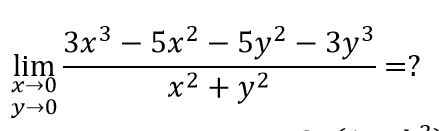
Seçenekler
A
-5
B
3
C
2
D
-3
E
-1
Açıklama:
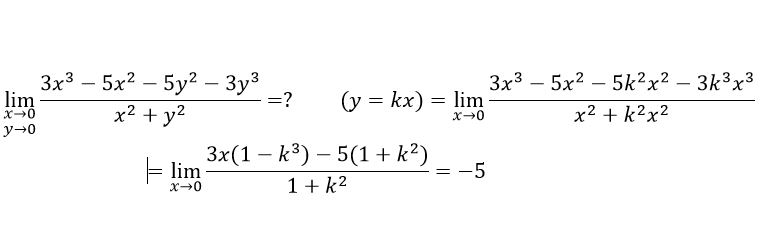 The correct choice is A.
Soru 32
What is the value of the limit 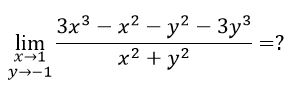
Seçenekler
A
-2
B
-3
C
1
D
2
E
-5
Açıklama:
 The correct choice is D.
Soru 33
If 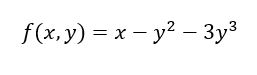 what is the partial derivative
  ?
?
what is the partial derivative ?Seçenekler
A
0
B
3
C 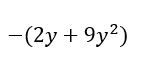
D
2y
E
-2y
Açıklama:
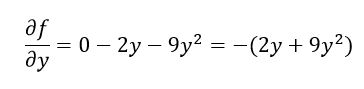 The answer is C.
Soru 34
Given that 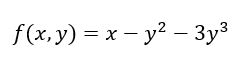 , what is the value of the partial derivative
  at the point (2, 1)?
, what is the value of the partial derivative at the point (2, 1)?Seçenekler
A
-11
B
-21
C
-10
D
5
E
-20
Açıklama:
 The correct answer is E.
Soru 35
Find the gradient of the function  at the point (-1, 2, 3)?
at the point (-1, 2, 3)?Seçenekler
A
(-18, 17, -3)
B
(18, 11, -6)
C
(-18, -17, 3)
D
(18, -17, -3)
E
(18, 17, 3)
Açıklama:
 The correct answer is B.
Soru 36
Find the gradient of the function  at the point (1, 2, 3)?
at the point (1, 2, 3)?Seçenekler
A
(114, 117, 35)
B
(-35, -117, -114)
C
(3, 118, 116)
D
(35, 117, 104)
E
(-35, 117, 114)
Açıklama:
 The correct answer is D.
Soru 37

Seçenekler
A
0
B
-2
C
-3
D
5
E
3
Açıklama:
 The correct answer is A
Soru 38
What is the shortest distance between the point P(2, 0) and a line y=3x.
Seçenekler
A
81
B 
C
90
D
9/10
E
3/10
Açıklama:
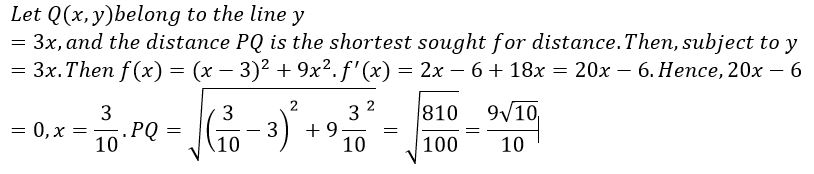 The answer is B.
Soru 39

Seçenekler
A
24
B
36
C
-5
D
42
E
40
Açıklama:
 The answer is D.
Soru 40
Given that 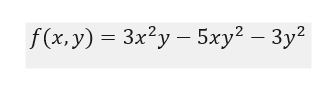 , what is the value of the partial derivative
  (2, -2)?
, what is the value of the partial derivative (2, -2)?Seçenekler
A
-11
B
-21
C
21
D
44
E
-44
Açıklama:
 The answer is E.
Soru 41
limx→0, y→0 (x3 + xy + y2) / (x + xy + y2) = ?
Seçenekler
A
0
B
does not exist
C
3
D
2
E
1
Açıklama:
(x3 + x k x + k2 x2) / (x + x k x + k2 x2) = (x2 (x + k + k2)) / (x (1 + k x + k2 x)) = (x (1 + k + k2)) / ((k2 + k) x + 1) = 0. pg. 182. Correct answer is A
Soru 42
f(x, y) = ey + yx2 - x - 1 ; ∂f / ∂x = ?
Seçenekler
A
ey + x2 - x
B
y + 2 x
C
2 y x2
D
x ey + x2
E
2 y x - 1
Açıklama:
2 y x - 1 . pg. 183. Correct answer is E
Soru 43
f(x, y) = exy + xy2 - xy + 2 ; ∂2f / ∂x2 = ?
Seçenekler
A
y exy + 2 x y - x
B
exy + 2 y
C
y2 exy
D
x exy + 2 x
E
x2 exy + y2
Açıklama:
∂f / ∂y = y exy + y2 - y ; ∂2f / ∂y2 = y2 exy . pg. 183. Correct answer is C
Soru 44
f (x, y, z) = xyz + xy + xz - yz ; grad f (-3, 1, -2) = ?
Seçenekler
A
(-4, -3, -1)
B
(5, 5, -8)
C
(-6, -1, -1)
D
(3, -2, -4)
E
(-3, 5,-7)
Açıklama:

correct answer is E.
Soru 45
z = f(x, y)= xz + yz + 1 so ∂f / ∂y (1, -2, -1) = ?
Seçenekler
A
2
B
-2
C
0
D
-1
E
1
Açıklama:
∂f / ∂y = z so at (1,-2,-1) ∂f / ∂y(1,-2,-1)=-1 pg. 190 . Correct answer is D
Soru 46
z = f(x, y) is defined implicitly by xz + yz - 3 = 0 ; Which of the following ones below is the equation of the tangent plane to the graph of z = f (x, y) around the point (-1, 2, 1) ?
Seçenekler
A
x - 3 y + 2 z + 6 = 0
B
3 x - 2 y + 2 z - 5 = 0
C
-x - 3 y + z + 3 = 0
D
x + y + z - 2 = 0
E
-2 x - 3 y + z - 4 = 0
Açıklama:
at (-1, 2, 1) : ∂F / ∂x = z = 1 ; ∂F / ∂y = z = 1 ; ∂F / ∂z = x + y = 1 ; 1 (x - (-1)) + 1 (y - 2) + 1 (z - 1) = (x + 1) + (y - 2) + (z - 1) = x + 1 + y - 2 + z - 1 = x + y + z - 2 = 0 . pg. 187. Correct answer is D
Soru 47
What is the shortest distance between the point P(0, -4) and the line y = x ?
Seçenekler
A
2
B
21/2
C
2-1/2
D
23/2
E
2-1
Açıklama:
42 = (d1)2 + (d2)2 = 2 (d1)2 ; d1 = 23/2 . pg. 193. Correct answer is D
Soru 48
z = x + y2 ; x = u - v ; y = u v2 ; at u = v = -1, ∂z / ∂v = ?
Seçenekler
A
1
B
4
C
-5
D
-3
E
6
Açıklama:
z = u - v + u2 v4 ; ∂z / ∂v = -1 + 4 u2 v3 ; at u = v = -1, ∂z / ∂v = -5 . pg. 188. Correct answer is C
Soru 49
Which of the following is the local minimum point of the function f (x, y) = 3 x2 + y2 - 2 x - 4 y ?
Seçenekler
A
(3, -4)
B
(1 / 3, 2)
C
(2 / 5, -1)
D
(2, -3 / 4)
E
(-1, 4 / 3)
Açıklama:
∂f / ∂x = 6 x - 2 = 0 ; x = 1 / 3 ; ∂f / ∂y = 2 y - 4 = 0 ; y = 2 ; a = ∂2f / ∂x2 = 6 > 0 ; b = ∂2f / ∂y2 = 2 ; c = ∂2f / ∂x ∂y = 0 ; D = a . b - c2 = 6 . 2 - 0 = 12 > 0 ; pg. 192. Correct answer is B
Soru 50
What is the positive stationary value of the function f (x, y) = x + 2 y, satisfying the condition 2 x2 - y2 = -14 ?
Seçenekler
A
9
B
5
C
6
D
2
E
3
Açıklama:
L(x, y, λ )= x + 2 y + λ (2 x2 - y2 + 14) ; ∂L / ∂x = 1 + 4 λ x = 0 ; λ = -1 / (4 x) ; ∂L / ∂y = 2 - 2 λ y = 0 ; λ = 1 / y ; 4 x = y ; ∂L / ∂λ = 0 ; 2 x2 - y2 = -14 ; 2 x2 - (4 x)2 = -14 ; 14 x2 = 14 ; x = {-1 , 1}; 4 = {-4, 4} ; f(x, y) = x + 2 y = 9 > 0. pg. 193. Correct answer is D
Soru 51
Which of the following (x,y) point is in the domain of the function 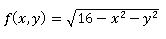 where x and y are real numbers?
where x and y are real numbers?Seçenekler
A
(3,4)
B
(0,5)
C
(5,1)
D
(2,3)
E
(-4,-3)
Açıklama:
The expression in the squareroot must be non-negative because negative numbers do not have real number roots. Thus 0=<16-x2-y2. Only the point in D satisfies this condition.
Soru 52
Which of the following functions is not continuous at point (1,2)?
Seçenekler
A
f(x,y)=5-x2-y2
B
f(x,y)=(5-x2-y2)/2x-3y
C
f(x,y)=(2x-y)/(5-x2-y2)
D
f(x,y)=(4x-1)/(3x-2y)
E
f(x,y)=(2x-2)(y-2)
Açıklama:
For the functions in A, B and E; f(x,y)=0 for x=1 and y=2. For the function in D f(1,2)=3/-1=-3 but for the function in C f(x,y) is not defined because the denominator of the expression is equal to zero.
Soru 53
What is the limit of the function f(x,y)=(x2-y2)/(5x-5y) for x=1 and y=1?
Seçenekler
A
0
B
2/5
C
Undefined
D
Infıinity
E
2
Açıklama:
f(x,y)=(x2-y2)/(5x-5y) for x=1 and y=1 is equal to 0/0 which is undefined. But we have to simplify the expression to check whether it is still undefined or not.
Thus:
f(x,y)=(x2-y2)/(5x-5y)=(x-y)(x+y)/5(x-y)=(x+y)/5=2/5 for x=1 and y=1. So the answer is B.
Thus:
f(x,y)=(x2-y2)/(5x-5y)=(x-y)(x+y)/5(x-y)=(x+y)/5=2/5 for x=1 and y=1. So the answer is B.
Soru 54
What is the partial derivative df(x,y)/dx for f(x,y)=exy?
Seçenekler
A
exy
B
xlny
C
ylnx
D
xexy
E
yexy
Açıklama:
Suppose z=f(x,y).
Then we can rewrite the function as z=exy?
Taking the natural logarithm of both sides we have:
lnz=lnexy=xy
Taking the derivatives of the both sides we have:
(1/z)dz=ydx+xdy
When we take the partial derivative we behave all the other variables as constant. Thus here dy=0. Therefore we can rewrite the last expression as:
(1/z)dz=ydx
Thus dz/dx=yz=yexy since z=exy
Then we can rewrite the function as z=exy?
Taking the natural logarithm of both sides we have:
lnz=lnexy=xy
Taking the derivatives of the both sides we have:
(1/z)dz=ydx+xdy
When we take the partial derivative we behave all the other variables as constant. Thus here dy=0. Therefore we can rewrite the last expression as:
(1/z)dz=ydx
Thus dz/dx=yz=yexy since z=exy
Soru 55
What is the second degree partial derivative d2f(x,y)/dxdy for f(x,y)=exy?
Seçenekler
A
(1+xy)exy
B
xyexy
C
xlny+ylnx
D
lnx/lny
E
(1+lnx)lny
Açıklama:
According to Clairaut’s theorem d2f(x,y)/dxdy=d2f(x,y)/dydx. Thus it makes no difference which variable is partially differentiated first. Let's start with x.
Assume that z=f(x,y)
So z=exy
lnz=lnexy=xy
Taking derivatives of both sides we get:
(1/z)dz=xdy+ydx and for dz/dx we consider dy=0
Thus dz/dx=yz=yexy
Let's assume that t=dz/dx. We now have to find dt/dy according to chain rule. So:
t=yexy?
dt=exydy+yxexydy (from the rule if a=bc then a'=cb'+bc')
So:
dt=(1+xy)exydy
dt/dy=(1+xy)exy
So the answer is A.
Assume that z=f(x,y)
So z=exy
lnz=lnexy=xy
Taking derivatives of both sides we get:
(1/z)dz=xdy+ydx and for dz/dx we consider dy=0
Thus dz/dx=yz=yexy
Let's assume that t=dz/dx. We now have to find dt/dy according to chain rule. So:
t=yexy?
dt=exydy+yxexydy (from the rule if a=bc then a'=cb'+bc')
So:
dt=(1+xy)exydy
dt/dy=(1+xy)exy
So the answer is A.
Soru 56
What is the equations of a tangent plane for a function f (x, y) = x2+3y2 at a point (x, y) = (1, 1)?
Seçenekler
A
z=2x-6y-4
B
z=2x+6y-4
C
z=6x+2y-4
D
z=x+y-4
E
z=3x+4y-8
Açıklama:
In order to find the equation for the tangent plane we have to first find the first partial derivatives fx and fy (which are df(x,y)/dx and df(x,y)/dy respectively).
Thus for f (x, y) = x2+3y2 :
fx =2x=2 for x=1
fy =6y=6 for y=1
and z=f(x,y)=4 for (x,y)=(1,1)
The equation for the tangent plane is given by z=f(a,b)+fx(x-a)+fy(y-b)
Therefore the equation for the tangent plane for a=1, b=1 is given by
z=4+2(x-1)+6(y-1)=2x+6y-4
Thus for f (x, y) = x2+3y2 :
fx =2x=2 for x=1
fy =6y=6 for y=1
and z=f(x,y)=4 for (x,y)=(1,1)
The equation for the tangent plane is given by z=f(a,b)+fx(x-a)+fy(y-b)
Therefore the equation for the tangent plane for a=1, b=1 is given by
z=4+2(x-1)+6(y-1)=2x+6y-4
Soru 57
What is the equations of a normal line for a function f (x, y) = x2+3y2 at a point (x, y) = (1, 1)?
Seçenekler
A
12-6z=3x-3=2y-2
B
4-6z=2x-3=y-1
C
24-6z=3x-3=y-1
D
6z=3x-3=y-1
E
z=3x-3=y-1
Açıklama:
In order to find the equation for the normal line we have to first find the first partial derivatives fx and fy (which are df(x,y)/dx and df(x,y)/dy respectively).
Thus for f (x, y) = x2+3y2 :
fx =2x=2 for x=1
fy =6y=6 for y=1
and z=f(x,y)=4 for (x,y)=(1,1)
The equation for the tangent line is given by z=f(a,b)+fx(x-a)+fy(y-b)
Therefore the equation for the tangent plane for a=1, b=1 is given by
z=4+2(x-1)+6(y-1)=2x+6y-4
therefore the equation for the normal line is
(z-4)/-1=(x-1)/2+(y-1)/6
so 4-z=(x-1)/2+(y-1)/6
which means:
24-6z=3x-3=y-1
Thus for f (x, y) = x2+3y2 :
fx =2x=2 for x=1
fy =6y=6 for y=1
and z=f(x,y)=4 for (x,y)=(1,1)
The equation for the tangent line is given by z=f(a,b)+fx(x-a)+fy(y-b)
Therefore the equation for the tangent plane for a=1, b=1 is given by
z=4+2(x-1)+6(y-1)=2x+6y-4
therefore the equation for the normal line is
(z-4)/-1=(x-1)/2+(y-1)/6
so 4-z=(x-1)/2+(y-1)/6
which means:
24-6z=3x-3=y-1
Soru 58
Assume that z=x2+xy where x=u2v and y=2uv. What is the partial derivative dz/du for u=1 and v=2?
Seçenekler
A
16
B
24
C
32
D
36
E
40
Açıklama:
dz/du=(dz/dx)*(dx/du)+(dz/dy)*(dy/du) from the chain rule.
Given that z=x2+xy where x=u2v and y=2uv:
dz/dx=2x+y
dx/du=2vu
dz/dy=x
dy/du=2v
So for u=1 and v=2; x=u2v=2 and y=2uv=4
dz/dx=2x+y=2u2v+2uv=4+4=8
dx/du=2vu=4
dz/dy=x=2
dy/du=2v=4
Finally:
dz/du=(dz/dx)*(dx/du)+(dz/dy)*(dy/du)=8*4+2*4=40
Given that z=x2+xy where x=u2v and y=2uv:
dz/dx=2x+y
dx/du=2vu
dz/dy=x
dy/du=2v
So for u=1 and v=2; x=u2v=2 and y=2uv=4
dz/dx=2x+y=2u2v+2uv=4+4=8
dx/du=2vu=4
dz/dy=x=2
dy/du=2v=4
Finally:
dz/du=(dz/dx)*(dx/du)+(dz/dy)*(dy/du)=8*4+2*4=40
Soru 59
Which of the following (x,y) points is not a critical one (either maximum, minimum or saddle point) for the function f(x,y)=x2y2-x2-y2?
Seçenekler
A
(0,0)
B
(-1,1)
C
(1,1)
D
(1,0)
E
(-1,-1)
Açıklama:
For critical points the first derivatives df(x,y)/dx=fx and df(x,y)/dy=fy must be equal to zero simultaneously. Namely fx=fy=0.
Since f(x,y)=x2y2-x2-y2?
fx=2xy2-2x=0 so 2x(y2-1)=0 which means either x=0 or y=1 or y=-1
fy=2yx2-2y=0 so 2y(x2-1)=0 which means either y=0 or x=1 or x=-1
But since both equations must be satisfied simultaneously we have 5 critical points:
(0,0), (-1,1), (1,-1), (1,1) and (-1,-1).
As you can see the point (1,0) (namely x=1 and y=0) satisfies the second equation (fy=0) but it does not satisfy the first one. Thus the answer is D.
Since f(x,y)=x2y2-x2-y2?
fx=2xy2-2x=0 so 2x(y2-1)=0 which means either x=0 or y=1 or y=-1
fy=2yx2-2y=0 so 2y(x2-1)=0 which means either y=0 or x=1 or x=-1
But since both equations must be satisfied simultaneously we have 5 critical points:
(0,0), (-1,1), (1,-1), (1,1) and (-1,-1).
As you can see the point (1,0) (namely x=1 and y=0) satisfies the second equation (fy=0) but it does not satisfy the first one. Thus the answer is D.
Soru 60
Which of the following (x,y) points is a local maximum for the function f(x,y)=x2y2-x2-y2?
Seçenekler
A
(0,0)
B
(-1,1)
C
(1,-1)
D
(1,1)
E
(-1,-1)
Açıklama:
Firstly, for critical points the first derivatives df(x,y)/dx=fx and df(x,y)/dy=fy must be equal to zero simultaneously. Namely fx=fy=0.
Since f(x,y)=x2y2-x2-y2?
fx=2xy2-2x=0 so 2x(y2-1)=0 which means either x=0 or y=1 or y=-1
fy=2yx2-2y=0 so 2y(x2-1)=0 which means either y=0 or x=1 or x=-1
But since both equations must be satisfied simultaneously we have 5 critical points:
(0,0), (-1,1), (1,-1), (1,1) and (-1,-1).
And also for a local maximum the following conditions must be satisfied simultaneously
I. fxx<0
II.0xx*fyy-fxy*fyx
Thus we now have to find the second partial derivatives for an evaluation:
fxx=2y2-2
fyy=2x2-2
fxy=fyx =4yx
Among the critical points for only point (0,0) the first condition is satisfied (namely fxx<0). Lets check whether this point also satisfies the second condition:
fxx*fyy-fxy*fyx =(2y2-2)*(2x2-2)-16x2y2=(-2)*(-2)-0=4
since 0<4 the second condition is also satisfied. Therfore point (0,0) is a local maximum.
Since f(x,y)=x2y2-x2-y2?
fx=2xy2-2x=0 so 2x(y2-1)=0 which means either x=0 or y=1 or y=-1
fy=2yx2-2y=0 so 2y(x2-1)=0 which means either y=0 or x=1 or x=-1
But since both equations must be satisfied simultaneously we have 5 critical points:
(0,0), (-1,1), (1,-1), (1,1) and (-1,-1).
And also for a local maximum the following conditions must be satisfied simultaneously
I. fxx<0
II.0
Thus we now have to find the second partial derivatives for an evaluation:
fxx=2y2-2
fyy=2x2-2
fxy=fyx =4yx
Among the critical points for only point (0,0) the first condition is satisfied (namely fxx<0). Lets check whether this point also satisfies the second condition:
fxx*fyy-fxy*fyx =(2y2-2)*(2x2-2)-16x2y2=(-2)*(-2)-0=4
since 0<4 the second condition is also satisfied. Therfore point (0,0) is a local maximum.