Cost and Management Accountıng (ENG) - Tüm Sorular
Ünite 1
Soru 1
Which of the following is wrong with cost accounting?
Seçenekler
A
Purpose of cost accounting is to find the cost of product or service.
B
Expense is the sacrifice, measured by the price paid or to be paid, to acquire goods or services.
C
Cost accounting can be defined as information a system.
D
Purpose of cost accounting is planning and controlling activities.
E
Purpose of cost accounting is decision-making process.
Açıklama:
The correct answer is B. Cost is the sacrifice, measured by the price paid or to be paid, to acquire goods or services. The expense is defined as a noun, a decrease in owners’ equity accompanying the decrease in net assets caused by selling goods or rendering services or by the passage of time.
Soru 2
Which of the following is not the benefit of unit cost information in making important marketing decisions?
Seçenekler
A
Determining the selling price of a product
B
Meeting competition
C
Biddingoncontracts
D
Provides information to external users.
E
Analyzing profitability
Açıklama:
The correct answer is D. Unit cost information is also helpful in making important marketing decisions such as:
- Determining the selling price of a product
- Meeting competition
- Biddingoncontracts
- Analyzing profitability.
Soru 3
Which of the following is one of the production costs?
Seçenekler
A
Direct labor cost
B
Period expenses
C
Period earnings
D
Marketing or selling expenses
E
Administrative expenses
Açıklama:
The correct answer to question is option A. Manufacturing (product) cost is grouped under three headings:
• Direct raw material cost
• Direct labor cost
• Manufacturing (factory) overhead cost
• Direct raw material cost
• Direct labor cost
• Manufacturing (factory) overhead cost
Soru 4
Which of the following is not accurate information about management accounting?
Seçenekler
A
Management accounting is the process of supplying the managers and employees in an organization with relevant information, both financial and nonfinancial.
B
Management accounting measures and reports financial information as well as other types of information.
C
Management accounting as an information system that serves information to their ‘clients’, namely the managers.
D
Management accounting provides information to internal users.
E
Management accounting provides information to external users.
Açıklama:
The correct answer is question E. Financial accounting focuses on external reporting that is directed by authoritative guidelines. Therefore, financial accounting provides information to external users.
Soru 5
In which of the following options have types of inventory of the manufacturing-sector organizations given exactly?
Seçenekler
A
Direct materials inventory, work-inprocess inventory, finished goods inventory
B
Direct materials inventory, work-inprocess inventory, finished goods inventory and goods
C
Direct materials inventory and goods
D
Direct materials inventory and work-inprocess inventory
E
Work-inprocess inventory and finished goods inventory
Açıklama:
Manufacturing-sector organizations typically have one or more of the following three types of inventory: Direct materials inventory, work-inprocess inventory, finished goods inventory.
Soru 6
In which financial statement is the cost of goods sold?
Seçenekler
A
Balance Sheet
B
Cash Flow Statement
C
Income Statement
D
Statement of Changes in Shareholders' Equity
E
Inventory Card
Açıklama:
The correct answer is C. The cost of goods sold is included in the income statement.
Soru 7
I. Not affected by changes in operating volume
II. Varies according to changes in the volume of operations.
Which of the following is the correct matching of the expressions given above?
II. Varies according to changes in the volume of operations.
Which of the following is the correct matching of the expressions given above?
Seçenekler
A
I- Mixed Costs
B
II-Fixed Cost
C
I-Variable Cost
D
I-Mixed Cost
E
I-Fixed Cost
Açıklama:
The correct answer is question E. Variable costs represent cost behavior that is directly related to changes in the volume of operations and increases when the volume of activity increases. Fixed costs, on the other hand, are defined as costs that are not affected by changes in operating volume, at least in the short run.
Soru 8
Under which group of raw materials is inventory, work in process inventory and finished goods inventory are shown under the balance sheet?
Seçenekler
A
Cash
B
Inventory
C
Fixed Assets
D
Intangible Assets
E
Cost of goods sold
Açıklama:
The correct answer is B. Raw materials is inventory, work in process inventory and finished goods inventory are shown under the inventory in the balance sheet.
Soru 9
Which of the following is not use of maccounting information system in decision making?
Seçenekler
A
Performance evaluation and control
B
Developing objectives and plans
C
Allocating resources
D
Providing useful financial information to external users
E
Determining costs and benefits
Açıklama:
The correct answer is D. Management accounting provides information to internal users. The areas of management accounting in decision-making can be explained in detail: Developing objectives and plans, performance evaluation and control, allocating resources, determining costs and benefits.
Soru 10
...................... is period expenses and recorded as an expense in the
current accounting period.
Which of the following should be brought to the space left above?
current accounting period.
Which of the following should be brought to the space left above?
Seçenekler
A
Manufacturing Cost
B
Direct raw material cost
C
Non-manufacturing Cost
D
Direct labor cost
E
Manufacturing (factory) overhead cost
Açıklama:
The correct answer is C. Direct raw material cost, direct labor cost, manufacturing (factory) overhead cost is manufacturing cost. Non-manufacturing cost is period expenses and recorded as an expense in the
current accounting period.
current accounting period.
Soru 11
I. Globalization,
II. Automatization and Industry 4.0 revolution,
III. Technological developments
Which of the above is among the changes that businesses have been exposed to recently?
II. Automatization and Industry 4.0 revolution,
III. Technological developments
Which of the above is among the changes that businesses have been exposed to recently?
Seçenekler
A
Only I
B
Only II
C
I and III
D
II and III
E
I, II and III
Açıklama:
Economic and technological changes in
recent years, many organizations, especially in
the manufacturing sector, have faced significant
changes in their business environment. These
challenges can be summarized under three
headings:
• Globalization,
• Automatization and Industry 4.0 revolution,
• Technological developments.
recent years, many organizations, especially in
the manufacturing sector, have faced significant
changes in their business environment. These
challenges can be summarized under three
headings:
• Globalization,
• Automatization and Industry 4.0 revolution,
• Technological developments.
Soru 12
Which of the following is a financial statement that concerns only internal users?
Seçenekler
A
Balance sheet
B
Income statement
C
Cash flow statement
D
Statement of Changes in Shareholders' Equity
E
Cost of sales table
Açıklama:
Financial accounting produces useful
financial information to external users. Whereas,
cost accounting and management accounting
provide information to internal users.
financial information to external users. Whereas,
cost accounting and management accounting
provide information to internal users.
Soru 13
I. Financial accounting
II. Cost accounting
III. Management accounting
Which of the above provides information for external users?
II. Cost accounting
III. Management accounting
Which of the above provides information for external users?
Seçenekler
A
Only I
B
Only III
C
I and II
D
II and III
E
I, II and III
Açıklama:
Financial accounting produces useful
financial information to external users. Whereas,
cost accounting and management accounting
provide information to internal users.
financial information to external users. Whereas,
cost accounting and management accounting
provide information to internal users.
Soru 14
Which of the following relates to the provision of appropriate information for decision-making, planning, controlling and performance evaluation?
Seçenekler
A
Financaial accounting
B
General accounting
C
Management accounting
D
Cost accounting
E
Creative accounting
Açıklama:
Management accounting relates to the provision of appropriate information for decision-making, planning, controlling and performance evaluation.
Soru 15
I. To find the cost of product or service
II. Planning and controlling activities
III. Decision-making process
Which of the above is one of the objectives of cost accounting?
II. Planning and controlling activities
III. Decision-making process
Which of the above is one of the objectives of cost accounting?
Seçenekler
A
Only I
B
Only II
C
I and III
D
II and III
E
I, II and III
Açıklama:
Cost accounting can be defined as a system in which financial data regarding business transactions are collected, classified, recorded, evaluated and reported for the following three purposes:
• To find the cost of product or service,
• Planning and controlling activities,
• Decision-making process.
• To find the cost of product or service,
• Planning and controlling activities,
• Decision-making process.
Soru 16
Which of the following is included in the "Determining Product Costs and Pricing" purpose of cost accounting?
Seçenekler
A
Determining the selling price of a product
B
Meeting competition
C
Bidding on contracts
D
Assigning responsibility
E
Analyzing profitability
Açıklama:
Assigning responsibility takes place in planning and conrtol.
Soru 17
What is the definition of "A decrease in owners’ equity attendant the decrease in net assets caused by selling goods or provide services"?
Seçenekler
A
Cost
B
Expense
C
Income
D
Loss
E
Revenue
Açıklama:
The expense is defined as a noun, a decrease in owners’ equity attendant the decrease in net assets caused by selling goods or provide services.
Soru 18
What is the definition of "A resource sacrificed or forfeit to achieve a specific objective"?
Seçenekler
A
Cost
B
Expense
C
Loss
D
Income
E
Revenue
Açıklama:
Cost is a resource sacrificed or forfeit to achieve a specific objective.
Soru 19
I. Direct raw material cost
II. Direct labor cost
III. Manufacturing (factory) overhead cost
Which of the above is included in manufacturing costs?
II. Direct labor cost
III. Manufacturing (factory) overhead cost
Which of the above is included in manufacturing costs?
Seçenekler
A
Only I
B
Only III
C
I and II
D
II and III
E
I, II and III
Açıklama:
Manufacturing (product) cost is grouped under three headings:
• Direct raw material cost
• Direct labor cost
• Manufacturing (factory) overhead cost
• Direct raw material cost
• Direct labor cost
• Manufacturing (factory) overhead cost
Soru 20
Which of the following is not in key qualities of management accounting?
Seçenekler
A
Relevance
B
Reliability
C
Comparability
D
Accountability
E
Understandability
Açıklama:
Management accounting information system has many key qualities. These are:
- Relevance
- Reliability
- Comparability
- Understandability
Soru 21
-To find the cost of product or service
-Planning and controlling activities
-Decision-making process
What is the name of the system in which financial data regarding business transactions are collected, classified, recorded, evaluated and reported for the three purposes above?
-Planning and controlling activities
-Decision-making process
What is the name of the system in which financial data regarding business transactions are collected, classified, recorded, evaluated and reported for the three purposes above?
Seçenekler
A
Cost accounting
B
Manufacturing costs
C
Control
D
Planning
E
Pricing
Açıklama:
Cost accounting can be defined as a system in which financial data regarding business transactions are collected, classified, recorded, evaluated and reported for the following three purposes:
• To find the cost of product or service,
• Planning and controlling activities,
• Decision-making process.
• To find the cost of product or service,
• Planning and controlling activities,
• Decision-making process.
Soru 22
I. Determining the selling price of a product
II. Meeting competition
III. Bidding on contracts
IV. Analyzing profitability
Which of the above are among the important marketing decisions in which unit cost information is helpful?
II. Meeting competition
III. Bidding on contracts
IV. Analyzing profitability
Which of the above are among the important marketing decisions in which unit cost information is helpful?
Seçenekler
A
I and II
B
III and IV
C
I, II and III
D
II, III and IV
E
I, II, III and IV
Açıklama:
All of them are among the important marketing decisions in which unit cost information is helpful.
Soru 23
What is the name of the process of establishing objectives or goals for the business and calculating the means by which they will be met?
Seçenekler
A
Control
B
Planning
C
Management Accounting
D
Determining Product Costs
E
Pricing
Açıklama:
Planning is the process of establishing objectives or goals for the business and calculating the means by which they will be met.
Soru 24
I. Assigning Responsibility
II. Periodically Measuring and Comparing Results
III. Taking Necessary Corrective Action
Which of the steps above are necessary for achieving effective control?
II. Periodically Measuring and Comparing Results
III. Taking Necessary Corrective Action
Which of the steps above are necessary for achieving effective control?
Seçenekler
A
Only I
B
Only III
C
I and II
D
II and III
E
I, II and III
Açıklama:
All of them are necessary for achieving effective control.
Soru 25
What is the name of resource sacrificed or forfeit to achieve aspecific objective?
Seçenekler
A
Accounting
B
Function
C
Cost
D
Control
E
Planning
Açıklama:
Cost is a resource sacrificed or forfeit to achieve a specific objective.
Soru 26
What is the collection of cost data in some organized way by means of an accounting system?
Seçenekler
A
Cost assignment
B
Manufacturing overhead costs
C
Direct costs
D
Cost accumulation
E
Indirect costs
Açıklama:
Cost accumulation is the collection of cost data in some organized way by means of an accounting system.
Soru 27
What is the name of the general term that includes both tracing accumulated costs that have a direct relationship to a cost object and allocating accumulated costs that have an indirect relationship to a cost object?
Seçenekler
A
Cost accumulation
B
Cost assignment
C
Direct costs
D
Indirect costs
E
Period costs
Açıklama:
Cost assignment is a general term that includes both tracing accumulated costs that have a direct relationship to a cost object and allocating accumulated costs that have an indirect relationship to a cost object.
Soru 28
Which of the following is recognized as an expense in the period in which they are consumed and transferred to the income statement?
Seçenekler
A
Non-manufacturing expense
B
Period expense
C
Administrative expense
D
Operating expense
E
Selling expense
Açıklama:
Period expenses are recognized as an expense in the period in which they are consumed and transferred to the income statement.
Soru 29
What is the name of the costs that are directly identified with a cost object?
Seçenekler
A
Direct costs
B
Indirect costs
C
Manufacturing costs
D
Period costs
E
The manufacturing overhead costs
Açıklama:
Direct costs: These are the costs that are directly identified with a cost object.
Soru 30
Which of the following is a price that can be completely assigned to the production of specific goods or services?
Seçenekler
A
Indirect cost
B
Manufacturing overhead cost
C
Direct cost
D
Period Cost
E
Direct labor cost
Açıklama:
A direct cost is a price that can be completely assigned to the production of specific goods or services.
Soru 31
What is the name of the costs that are not directly identified with a cost object?
Seçenekler
A
Direct costs
B
Indirect costs
C
Manufacturing costs
D
Period costs
E
The manufacturing overhead costs
Açıklama:
Indirect costs: These are the costs that are not directly identified with a cost object.
Soru 32
I. Relevance
II. Reliability
III. Comparability
IV. Understandability
Which of the above are among the key qualities of management accounting information system?
II. Reliability
III. Comparability
IV. Understandability
Which of the above are among the key qualities of management accounting information system?
Seçenekler
A
I and II
B
III and IV
C
I, II and III
D
II, III and IV
E
I, II, III and IV
Açıklama:
All of them are among the key qualities of management accounting information system.
Soru 33
Which of the following represent cost behavior that is directly related to changes in the volume of operations and increases when the volume of activity increases and is zero?
Seçenekler
A
Fixed costs
B
Semi-fixed costs
C
Semi-variable costs
D
Variable costs
E
Manufacturing Costs
Açıklama:
Variable costs represent cost behavior that is directly related to changes in the volume of operations and increases when the volume of activity increases and is zero.
Soru 34
I. Raw material and supplies inventory
II. Work-in-process inventory
III. Finished goods inventory
Which of the items above are important inventory items in manufacturing organizations?
II. Work-in-process inventory
III. Finished goods inventory
Which of the items above are important inventory items in manufacturing organizations?
Seçenekler
A
Only I
B
Only III
C
I and II
D
II and III
E
I, II and III
Açıklama:
There are three important inventory items in manufacturing organizations:
1. Raw material and supplies inventory
2. Work-in-process inventory
3. Finished goods inventory
1. Raw material and supplies inventory
2. Work-in-process inventory
3. Finished goods inventory
Soru 35
Which of the following is transferred to the related asset account on the balance sheet when the product is completed?
Seçenekler
A
Inventoriable cost
B
Cost of goods sold
C
Product cost
D
Service cost
E
Period cost
Açıklama:
Inventoriable costs are transferred to the related asset account on the balance sheet when the product is completed.
Soru 36
Which of the key qualities of management accounting information system is related to the its having the ability to influence decisions?
Seçenekler
A
Reliability
B
Comparability
C
Understandability
D
Quality
E
Relevance
Açıklama:
Management accounting information system has many key qualities. These are (Atrill and McLaney, 2009: 17-18): • Relevance. Management accounting informationmust havethe ability to influence decisions
Soru 37
Which of the following will enable managers to identify changes in the business over time?
Seçenekler
A
Relevance
B
Comparability
C
Reliability
D
Quality
E
Understandability
Açıklama:
Comparability: This quality will enable managers to identify changes in the business over time.
Soru 38
What is the first step of a management accounting information system?
Seçenekler
A
Information evaluation
B
Information reporting
C
Information analysis
D
Information identification
E
Information recording
Açıklama:
There are four following stages of a management accounting information system. In the first stage, the information is defined and recorded in the other stage, in short, the first two stages are related to the preparation of the information. The third stage is the analysis of the information and the final stage is the reporting of the information. The last two stages emerge as the use of collected information.
Soru 39
What are the costs of purchasing the goods that are resold in the same form for merchandising-sector organizations?
Seçenekler
A
Product costs
B
Direct raw material costs
C
Inventoriable costs
D
Semi-fixed costs
E
Semi-variable costs
Açıklama:
For merchandising-sector organizations, inventoriable costs are the costs of purchasing the goods that are resold in the same form.
Soru 40
Which of the following accounting information users need management and cost accounting information?
Seçenekler
A
Managers
B
Shareholders
C
Creditors
D
Goverment
E
Banks
Açıklama:
The correct answer to question is option A. The users of accounting information can be divided into two categories. Internal parties within the organization such as employers, managers, workers and external parties such as shareholders, creditors, goverment and banks outside the organization. Financial accounting produces useful financial information to external users. Whereas, cost accounting and management accounting provide information to internal users.
Soru 41
I. Planning
II. Decision making
III. Controlling process within the organization
Which of the following types of accounting are listed above?
II. Decision making
III. Controlling process within the organization
Which of the following types of accounting are listed above?
Seçenekler
A
Financial Accounting
B
Corporate Accounting
C
Government Accounting
D
Bank Accounting
E
Cost and Management Accounting
Açıklama:
The correct answer is question E. The role of cost accounting and management accounting have been more strategic in decision making, planning and controlling process within the organization.
Soru 42
..................... is a resource sacrificed or forfeit to achieve a specific objective.
Which of the following should be brought to the space left above?
Which of the following should be brought to the space left above?
Seçenekler
A
Expense
B
Cost
C
Revenue
D
Profit
E
Expenditure
Açıklama:
The correct answer is B. Cost is a resource sacrificed or forfeit to achieve a
specific objective.
specific objective.
Soru 43
Which of the following is directly recognized as an expense without being included in the manufacturing cost?
Seçenekler
A
Direct raw material cost
B
Direct labor cost
C
Manufacturing (factory) overhead cost
D
Marketing or selling expenses
E
Conversion costs
Açıklama:
The correct answer is D. Marketing or selling expenses are recognized as period expense.
Soru 44
Which of the following is not one of the objectives of cost accounting?
Seçenekler
A
Determination of the cost of the product or service produced
B
Helping to make a budget for the future
C
Organize general purpose financial statements for external users
D
Planning and controlling activities
E
Decision-making process
Açıklama:
The correct answer is C. The preparation of general purpose financial statements is one of the purposes of financial accounting.
Soru 45
Which of the following is an example of costs that can be completely assigned to the production of specific goods or services?
Seçenekler
A
Depreciation Expenses
B
Direct labor cost
C
Manufacturing (factory) overhead cost
D
Marketing or selling expenses
E
Administrative expenses
Açıklama:
The correct answer is B. Direct raw material cost and direct labor cost is a costs that can be completely assigned to the production of specific goods or services. Manufacturing (factory) overhead cost are assigned to the product or service cost using the distribution key.
Soru 46
I. Property taxes
II. Direct material cost
III. Rent expense
Which of the above-listed costs are fixed costs?
II. Direct material cost
III. Rent expense
Which of the above-listed costs are fixed costs?
Seçenekler
A
I and II
B
II and III
C
I, II and III
D
I and III
E
Only III
Açıklama:
The correct answer is D. Direct material cost is changes in the volume of operations and increases when the volume of activity increases and is zero.
Soru 47
I. Globalization
II. Automatization and Industry 4.0 revolution
III. Technological developments
Which of the above affects the business enviroment?
II. Automatization and Industry 4.0 revolution
III. Technological developments
Which of the above affects the business enviroment?
Seçenekler
A
Only I
B
Only II
C
I and III
D
II and III
E
I, II and III
Açıklama:
Economic and technological changes in recent years, many organizations, especially in the manufacturing sector, have faced significant changes in their business environment. These challenges can be summarized under three headings:
• Globalization,
• Automatization and Industry 4.0 revolution,
• Technological developments
• Globalization,
• Automatization and Industry 4.0 revolution,
• Technological developments
Soru 48
..................................., inventoriable costs are the costs of purchasing the goods that are resold in the same form.
Which of the following should be brought to the space left above?
Which of the following should be brought to the space left above?
Seçenekler
A
Tourism sector organizations
B
Educational sector organizations
C
Service-sector organizations
D
Merchandising-sector organizations
E
Manufacturing-sector organizations
Açıklama:
The correct answer is D. For merchandising-sector organizations, inventoriable costs are the costs of purchasing the goods that are resold in the same form. Manufacturing-sector organizations, all manufacturing costs are inventoriable costs. In service-sector organizations, there are no inventoriable costs, there are only service costs. Tourism sector and educational sector organizations are service-sector organizations.
Soru 49
I. To find the price of product or service
II. Planning and controlling activities
III. Decision-making process
Which of the above is/are takes place in the main purposes of cost accounting?
II. Planning and controlling activities
III. Decision-making process
Which of the above is/are takes place in the main purposes of cost accounting?
Seçenekler
A
Only I
B
Only II
C
I and III
D
II and III
E
I, II and III
Açıklama:
Cost accounting can be defined as a system in which financial data regarding business transactions are collected, classified, recorded, evaluated and reported for the following three purposes:
• To find the cost of product or service, (NOT THE PRICE OF PRODUCT/SERVICE)
• Planning and controlling activities,
• Decision-making process.
• To find the cost of product or service, (NOT THE PRICE OF PRODUCT/SERVICE)
• Planning and controlling activities,
• Decision-making process.
Soru 50
Which one of the following is not included in the benefits of unit cost information?
Seçenekler
A
Determining the selling price of a product
B
Meeting competition
C
Bidding on contracts
D
Analyzing profitability
E
Contact with customers
Açıklama:
Unit cost information is also helpful in making important marketing
decisions such as:
decisions such as:
- Determining the selling price of a product
- Meeting competition
- Bidding on contracts
- Analyzing profitability
Soru 51
Which of the following does the definition "A resource sacrificed or forfeit to achieve a specific objective" mean?
Seçenekler
A
Cost
B
Purchase
C
Profit
D
Loss
E
Income
Açıklama:
Cost is a resource sacrificed or forfeit to achieve a
specific objective.
specific objective.
Soru 52
Which of the following is incorrect information about cost flows and classifications in a manufacturing company?
Seçenekler
A
Cost of goods sold is showed to the balance sheet.
B
The finished products stand in the balance sheet until they are sold.
C
When raw materials are used in production, their costs are transferred to the Work in Process inventory account as direct materials.
D
Direct labor cost is added directly to Work in Process.
E
Raw materials purchases are recorded in the Raw Materials inventory account.
Açıklama:
The correct answer to question is option A. Cost of goods sold is showed to the income statement.
Soru 53
Which of the following is a direct cost?
Seçenekler
A
Zipper in pants
B
Button in the jacket
C
Flour in the bread
D
Glue in the book
E
Paper in the magazine
Açıklama:
A direct cost is a price that can be
completely assigned to the production
of specific goods or services. However,
indirect costs are costs that are not directly
responsible to a cost object.
completely assigned to the production
of specific goods or services. However,
indirect costs are costs that are not directly
responsible to a cost object.
Soru 54
Which of the following is not one of the area management accounting in decision-making?
Seçenekler
A
Allocating resources
B
Performance evaluation and control
C
Determining costs and benefits
D
Developing objectives and plans
E
Preparation of financial statements
Açıklama:
The correct answer is question E. The areas of management accounting in decision-making can be explained in detail:
- Developing objectives and plans
- Performance evaluation and control
- Allocating resources
- Determining costs and benefits.
Soru 55
Which of the following is an indirect cost?
Seçenekler
A
Flour in the cake
B
Fabric in the jacket
C
Orange in the fruit juice
D
Paper in the book
E
Button in the shirt
Açıklama:
Indirect costs: These are the costs that are not directly identified with a cost object. Example: Lease cost for the company building housing the editors of The X Sports magazine
Soru 56
I. Direct raw material cost
II. Direct labor cost
III. Manufacturing (factory) overhead cost
Which of the above takes place in the manufacturing costs?
II. Direct labor cost
III. Manufacturing (factory) overhead cost
Which of the above takes place in the manufacturing costs?
Seçenekler
A
Only I
B
Only II
C
I and III
D
II and III
E
I, II and III
Açıklama:
Manufacturing (product) cost is grouped under three headings:
• Direct raw material cost
• Direct labor cost
• Manufacturing (factory) overhead cost
• Direct raw material cost
• Direct labor cost
• Manufacturing (factory) overhead cost
Soru 57
Which of the following contains the costs at which all indirect costs associated with production are monitored?
Seçenekler
A
Direct raw material cost
B
Direct labor cost
C
Manufacturing overhead cost
D
Marketing or selling expenses
E
Administrative expenses
Açıklama:
The manufacturing overhead costs are the
costs at which all indirect costs associated
with production are monitored.
costs at which all indirect costs associated
with production are monitored.
Soru 58
Which of the following represents cost behavior that is directly related to changes in the volume of operations and increases when the volume of activity increases and is zero?
Seçenekler
A
Fixed costs
B
Variable costs
C
Mixed costs
D
Total costs
E
Overhead costs
Açıklama:
Variable costs represent cost behavior that is directly related to changes in the volume of operations
and increases when the volume of activity increases and is zero.
and increases when the volume of activity increases and is zero.
Soru 59
Which of the following can be defined as costs that are not affected by changes in operating volume at least in the short run?
Seçenekler
A
Variable costs
B
Mixed costs
C
Fixed costs
D
Overhead costs
E
Total costs
Açıklama:
Fixed costs are defined as costs that are not affected by changes in operating volume at least in the short run.
Ünite 2
Soru 1
Which one of the following costs are the costs of the material used in the product which can be easily traced?
Seçenekler
A
Indirect costs
B
Overhead costs
C
Direct material costs
D
Labour costs
E
Managerial costs
Açıklama:
Direct material costs are the costs of the material used in the product which can be easily traced.
Soru 2
Which one of the following costs are the costs that are related to the product but cannot be traced easily and also there may be some costs that are not included product, but they are consumed for the production purposes?
Seçenekler
A
Indirect costs
B
Direct material costs
C
Standard costs
D
Process costs
E
Actual costs
Açıklama:
Indirect costs are the costs that are related to the product but cannot be traced easily and also there may be some costs that are not included product, but they are consumed for the production purposes.
Soru 3
Which one of the following is not among the expenses for raw materials and supplies can be traced within a four-step approach?
Seçenekler
A
Determination of purchase costs
B
Documentation and recording process
C
Pricing the consumption
D
Determination of consumption
E
Determination of production
Açıklama:
Determination of production is not among the expenses for raw materials and supplies can be traced within a four-step approach.
Soru 4
Which one of the following is used for drawing materials from the warehouse?
Seçenekler
A
Inventory card
B
Raw material
C
Warehouse receipt document
D
Materials request slip
E
Economic order quantity
Açıklama:
Materials Request Slip is used for drawing materials from the warehouse.
Soru 5
XYZ Company purchased 2.000 pieces (a) raw material for 12.000 TL for shoe production. Company also paid 1.500 TL for insurance and 1.000 TL for custom fee. 4.000 of transportation fee belongs to the supplier community. Calculate the purchase cost of the material.
Seçenekler
A
13.000 TL
B
13.500 TL
C
14.500 TL
D
18.500 TL
E
22.000 TL
Açıklama:
Cost of the (a) raw material should be calculated as follows: Material cost + insurance + custom fee. 12.000 + 1.500 + 1.000 = 14.500 TL
Soru 6
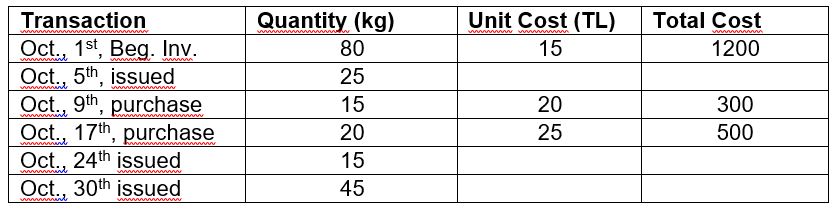 According to the FIFO method which one of the following is the cost of materials used for production?
Seçenekler
A
800 TL
B
900 TL
C
1.000 TL
D
1.200 TL
E
1.300 TL
Açıklama:
According to FIFO cost of the used material is: (25 x 15 TL) + (15 x 15 TL) + (40 x 15 TL) + (5 x 20 TL) = 1.300 TL
Soru 7
According to FIFO, calculate the cost of the material at the warehouse at the end of the period.
Seçenekler
A
700 TL
B
800 TL
C
900 TL
D
1.000 TL
E
1.100 TL
Açıklama:
According to FIFO, cost of the material at the warehouse should be calculated as follows: (15 x 20 TL) + (20 x 25 TL) = 800 TL
According to FIFO, cost of the material at the warehouse should be calculated as follows: (10 x 20 TL) + (20 x 25 TL) = 700 TL
According to FIFO, cost of the material at the warehouse should be calculated as follows: (10 x 20 TL) + (20 x 25 TL) = 700 TL
Soru 8
ABC Company produces heating spirals for refrigerators. The daily use of raw material is 350 kg. Lead time is 3 days and the management determined the safety stock level as 60 kg. Calculate the order point for the material.
Seçenekler
A
410 kg
B
700 kg
C
810 kg
D
1.110 kg
E
1.200 kg
Açıklama:
The daily usage of raw material is 350 kg. With the lead time taken into calculation (3 days), the total amount will be 1.050 kg (350x3). Safety stock is predetermined as 60 kg. So, when lead time and safety stock is considered 1.050 kg + 60 kg = 1.110 kg The company should reorder raw material when the material on hand decreases to 1.110 kg.
Soru 9
Which system classifies and ranks the inventories according to their respective costs or usages?
Seçenekler
A
Order cycling system
B
ABC system
C
Min-max plan
D
The two-bin system
E
VED analysis
Açıklama:
ABC system classifies and ranks the inventories according to their respective costs or usages.
Soru 10
In which inventory monitoring system companies classify their materials according to their “absence” costs?
Seçenekler
A
VED analysis
B
JIT system
C
The two-bin system
D
Min-max plan
E
ABC system
Açıklama:
In VED analysis, companies classify their materials according to their “absence” costs.
Soru 11
......................................... are the costs of the material used in the product which can be easily traced.
Which of the following should come to the dotted place according to the whole sentence?
Which of the following should come to the dotted place according to the whole sentence?
Seçenekler
A
İndirect costs
B
Direct material costs
C
Purchase cost
D
İnverntory flow cost
E
Continuity cost
Açıklama:
It should be Direct material cost
Soru 12
.................................are the costs that are related to the product but cannot be traced easily and also there may be some costs that are not included product, but they are consumed for the production purposes.
Which of the following should come to the dotted place according to the whole sentence?
Which of the following should come to the dotted place according to the whole sentence?
Seçenekler
A
Direct cost
B
İndirect cost
C
labor cost
D
Continuity cost
E
Purchase cost
Açıklama:
It should be indirect cost
Soru 13
The expenses for raw materials and supplies can be traced within a four-step approach.
Which one is not one of them ?
Which one is not one of them ?
Seçenekler
A
Documentation and recording process
B
Determination of purchase costs
C
Determination of consumption
D
Pricing the consumption
E
Determination of labor
Açıklama:
Determination of labor is not one of them
Soru 14
The companies use inventory flow assumptions in order to identify the cost of the material issued to production and the ending inventory.
Which one is not one of these assumptions?
Which one is not one of these assumptions?
Seçenekler
A
Specified Price
B
First-in-First-Out
C
Weighted Average Cost
D
Replacement Cost
E
Lowest-in-First-Out
Açıklama:
Lowest-in-First-Out is not one of them
Soru 15
....................................it is assumed that the material issued to the production is from the initial purchased material from the inventory.
Which of the following should come to the dotted place according to the whole sentence?
Which of the following should come to the dotted place according to the whole sentence?
Seçenekler
A
Last-in-First-Out
B
Highest-in-First-Out
C
Weighted Average Cost
D
Moving Average Cost
E
First-in-First-Out
Açıklama:
ıt should be First-in-First-Out
Soru 16
......................... an average price is calculated for a period by the relation between quantities and costs.The company calculates just one average price for the whole period.
Which of the following should come to the dotted place according to the whole sentence?
Which of the following should come to the dotted place according to the whole sentence?
Seçenekler
A
Specified Price
B
Replacement Cost
C
Standard Cost
D
Weighted Average Cost
E
Highest-in-First-Out
Açıklama:
It should be Weighted Average Cost
Soru 17
Inventories are one of the important assets of a company. Monitoring the inventories is as important as controlling them. There are several ways for monitoring the inventories.
Which one is not one of them ?
Which one is not one of them ?
Seçenekler
A
Min-Max Plan
B
The Two-Bin System
C
Order Cycling System
D
VED Analysis
E
JIB System
Açıklama:
JIB System is not one of them
Soru 18
......................................is one of the oldest inventory monitoring techniques. In this technique, a minimum and a maximum level is determined for each material in the inventory. When the inventory decreases to the minimum level, purchase order is prepared for the material to reach the maximum level.
Which of the following should come to the dotted place according to the whole sentence?
Which of the following should come to the dotted place according to the whole sentence?
Seçenekler
A
The Two-Bin System
B
Order Cycling System
C
ABC Analysis
D
VED Analysis
E
Min-Max Plan
Açıklama:
It should be Min-Max Plan
Soru 19
..................................... system is the purchase of materials just in time and just as the quantity needed. ......................... system is also used for production.
Which of the following should come to the dotted place according to the whole sentence?
Which of the following should come to the dotted place according to the whole sentence?
Seçenekler
A
JIT(Just in time) system
B
VED Analysis
C
Order Cycling System
D
The Two-Bin System
E
ABC System
Açıklama:
It should Just in time(JIT) System
Soru 20
Which of the following is not the raw materials of the product?
Seçenekler
A
Hardboard- Wardrobe
B
Leather-Shoes
C
Rubber- Tire
D
Grape- Wine
E
Paper-Table
Açıklama:
The correct answer is question E. The first item of the table is wood.
Soru 21
What is the monetary value of all materials used or consumed in production?
Seçenekler
A
Direct labor cost
B
Direct cost
C
İndirect cost
D
Direct material cost
E
Manufacturing overhead costs
Açıklama:
The correct answer is D. Direct material costs are the cost of the material used in the product which can be easily traced.
Soru 22
Which of the following is the correct information about direct material cost?
Seçenekler
A
It is not possible to directly determine how much the direct material cost is consumed for which product.
B
The manufacturing company cannot produce its own direct materials directly.
C
Raw material costs can be assigned directly to the product.
D
Raw materials do not form the structure of the product.
E
Raw material is not used directly during production.
Açıklama:
The correct answer is C.
Soru 23
Which of the following is not a inventory flow assumptions?
Seçenekler
A
First-in-First-Out (FIFO)
B
Weighted Average Cost
C
Factory cost method
D
Replacement Cost
E
Last-in-First-Out (LIFO)
Açıklama:
The correct answer is C. The companies use inventory flow assumptions in order to identify the cost of the material issued to production and the ending inventory. These assumptions are;
• Specified Price
• First-in-First-Out (FIFO)
• Last-in-First-Out (LIFO)
• Highest-in-First-Out (HIFO)
• Weighted Average Cost
• Moving Average Cost
• Replacement Cost
• Standard Cost
• Specified Price
• First-in-First-Out (FIFO)
• Last-in-First-Out (LIFO)
• Highest-in-First-Out (HIFO)
• Weighted Average Cost
• Moving Average Cost
• Replacement Cost
• Standard Cost
Soru 24
Which of the following cannot be inventory for a enterprises located across?
Seçenekler
A
Shirt- Textile Factory
B
Bread-Bakery
C
Peanut- Chocolate Factory
D
Board-Table Factory
E
Ink-Hotel
Açıklama:
The correct answer is question E. Hotels is a service business. Therefore they do not have stocks.
Soru 25
The inventory movements of the raw material in March of a manufacturing company are as follows:
According to this information, what is the cost of the material sent to production in March according to FIFO method?
| Date of Purchase | Transaction | Quantity (liters) | Unit Cost | Total Cost |
| 1 March | Beginning Inventory | 700 | 600 | |
| 12 March | purchase | 800 | 650 | 420.000 |
| 18 March | issued | 900 | 520.000 | |
| 23 March | purchase | 1.000 | 600 | 600.000 |
| 27 March | issued | 1.200 |
Seçenekler
A
1.320.000
B
1.336.000
C
1.600.000
D
1.273.000
E
1.300.000
Açıklama:
According to FIFO method:
18 March: 700X600= 420.000 and 200x650=130.000
27 March: 600x650=390.000 and 600x600=360.000
Inventory cost sent to total production= 1.300.000
18 March: 700X600= 420.000 and 200x650=130.000
27 March: 600x650=390.000 and 600x600=360.000
Inventory cost sent to total production= 1.300.000
Soru 26
The inventory movements of the raw material in March of a manufacturing company are as follows:
According to this information, what is end of period inventory cost in March according to FIFO method?
| Date of Purchase | Transaction | Quantity (liters) | Unit Cost | Total Cost |
| 1 March | Beginning Inventory | 700 | 600 | |
| 12 March | purchase | 800 | 650 | 420.000 |
| 18 March | issued | 900 | 520.000 | |
| 23 March | purchase | 1.000 | 600 | 600.000 |
| 27 March | issued | 1.200 |
Seçenekler
A
1.00.000
B
1.100.000
C
1.200.000
D
1.300.000
E
1.400.000
Açıklama:
At the end of the period, there are 600 unit inventory with a unit cost of 600 TL. End of period inventory cost is 1.200.000 TL
Soru 27
The inventory movements of the raw material in March of a manufacturing company are as follows:
According to this information, what is the cost of the material sent to production in March according to LIFO method?
| Date of Purchase | Transaction | Quantity (liters) | Unit Cost | Total Cost |
| 1 March | Beginning Inventory | 700 | 600 | |
| 12 March | purchase | 800 | 650 | 420.000 |
| 18 March | issued | 900 | 520.000 | |
| 23 March | purchase | 1.000 | 600 | 600.000 |
| 27 March | issued | 1.200 |
Seçenekler
A
900.000
B
1.000.000
C
1.150.000
D
1.200.000
E
1.300.000
Açıklama:
According to LIFO method:
18 March: 800X650=520.000 and 100X600=60.000
27 March: 1.000X600=600.000 and 200X600=120.000
Inventory cost sent to total production= 1.300.000
18 March: 800X650=520.000 and 100X600=60.000
27 March: 1.000X600=600.000 and 200X600=120.000
Inventory cost sent to total production= 1.300.000
Soru 28
The inventory movements of the raw material in March of a manufacturing company are as follows:
According to this information, what is the end of period inventory cost in March according to LIFO method?
| Date of Purchase | Transaction | Quantity (liters) | Unit Cost | Total Cost |
| 1 March | Beginning Inventory | 700 | 600 | |
| 12 March | purchase | 800 | 650 | 420.000 |
| 18 March | issued | 900 | 520.000 | |
| 23 March | purchase | 1.000 | 600 | 600.000 |
| 27 March | issued | 1.200 |
Seçenekler
A
230.000
B
240.000
C
250.000
D
260.000
E
270.000
Açıklama:
At the end of the period, there are 400 unit inventory with a unit cost of 600 TL. End of period inventory cost is 240.000 TL
Soru 29
The inventory movements of the raw material in March of a manufacturing company are as follows:
According to this information, what is the cost of the material sent to production in March according to Weighted Average Method?
| Date of Purchase | Transaction | Quantity (liters) | Unit Cost | Total Cost |
| 1 March | Beginning Inventory | 700 | 600 | |
| 12 March | purchase | 800 | 650 | 420.000 |
| 18 March | issued | 900 | 520.000 | |
| 23 March | purchase | 1.000 | 600 | 600.000 |
| 27 March | issued | 1.200 |
Seçenekler
A
1.295.910
B
1.300.000
C
1.425.000
D
1.500.000
E
1.530.000
Açıklama:
According to Weighted Average Method:
18 March : 900X626,6=563.940 TL
27 March: 1.200X609,975= 731.970 TL
Inventory cost sent to total production: 1.295.910 TL
18 March : 900X626,6=563.940 TL
27 March: 1.200X609,975= 731.970 TL
Inventory cost sent to total production: 1.295.910 TL
Soru 30
Which one is correct about direct material costs?
Seçenekler
A
Direct maretial costs cannot be traced easily.
B
Direct material costs are the cost of the material used in the product.
C
Direct materials can both be in the product and also they are used in the production process.
D
Direct materials are recognized as overhead costs when they are consumed.
E
Direct costs have to be allocated for the products produced.
Açıklama:
Direct costs are the costs that can be traced easily within the cost object. These aredirect material costs and direct labor costs. Direct material costs are the cost of the material used in the product which can be easily traced. For example, if the company can calculate the amount of carbon fiber material used in the frame of a carbon bicycle, then the carbon fiber used is assigned as direct material cost for the product.
Soru 31
__________ is used for drawing materials from the warehouse.
Seçenekler
A
Materials request slip
B
Warehouse receipt document
C
Balance column
D
Purchase cost
E
Periodic inventory systems
Açıklama:
Materials are drawn from the warehouse by the Materials Request Slip. This is the substantiating document that shows the inventory flow from the warehouse to the production plant. The slip carries information about the name, code and the quantity of the material, the name of the requester, sender and receiver and some other necessary information.
Soru 32
When the material is consumed, it is recorded into ______________ with amount, unit cost and total cost.
Seçenekler
A
Balance column
B
Issued column
C
Receipt column
D
Explanation column
E
Debit column
Açıklama:
When the company makes purchases the amount and the unit cost of the material is recorded into the Receipts column with the total cost. When the material is consumed, it is recorded into the Issues column with amount, unit cost and total cost. The difference between receipt and consumed is recorded as remaining material into the Balance column.
Soru 33
In periodic inventory system what gives us the materials that are consumed?
Seçenekler
A
Beginning inventory-Puchases=Material consumed
B
Beginning inventory-Ending inventory=Material consumed
C
Ending inventory+Begiinning inventory=Material used
D
Material available for consuming+Beginning inventory=Material consumed
E
Material available for consuming-Ending inventory=Materail consumed
Açıklama:
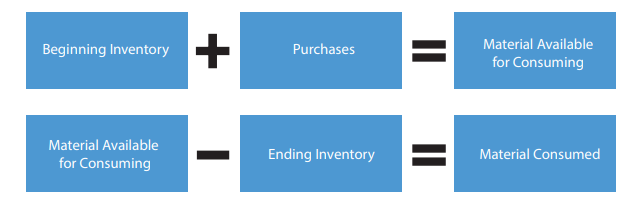
Soru 34
In which method it is assumed that the material issued to the production is from the initial purchased material from the inventory?
Seçenekler
A
FIFO method
B
LIFO metfod
C
HIFO
D
Specified method
E
Standard Method
Açıklama:
In FIFO method, it is assumed that the material issued to the production is from the initial purchased material from the inventory.
Soru 35
In which method an average price is calculated for a period by the relation between quantities and costs?
Seçenekler
A
FIFO
B
HIFO
C
LIFO
D
Weighted avarage method
E
Moving avarage method
Açıklama:
In weighted average method, an average price is calculated for a period by the relation between quantities and costs. The company calculates just one average price for the whole period. The average price is calculated as;
(Cost of Beginning Inventory+Cost of Receipts)/(Beginning Inventory+TotalQuantityof Receipts)
(Cost of Beginning Inventory+Cost of Receipts)/(Beginning Inventory+TotalQuantityof Receipts)
Soru 36
When the company wants to use a simple method for valuing its inventories, which method should it use?
Seçenekler
A
HIFO
B
Weighted avarage method
C
Moving avarage method
D
Replacement cost method
E
Standard cost method
Açıklama:
When the company wants to use a simple method for valuing its inventories, it is the standard cost method. Standard cost of a material is the cost that is predetermined by specific methods for a period that is affected by various factors like market prices, transportation costs, etc
Soru 37
___________ involves order point and economic order quantity.
Seçenekler
A
Investment control
B
Economic ordering quantity
C
Inventory planning
D
Safeguarding of materials
E
Segregating of duties
Açıklama:
The investment control consisting order point and the economic order quantity. Order point is an important issue for inventory policies. Over investment in materials yields to unproductivity so as lack of materials for production have the same effect on the company.
Soru 38
________ is used to determine when the materials should be replenished.
Seçenekler
A
VED analysis
B
Min-max system
C
ABC system
D
The two-bin system
E
Order cycling system
Açıklama:
The two-bin system is used to determine when the materials should be replenished. The first bin is for the materials that are being used in the production. The second bin is the substitute bin that is used in the lead time. When the materials in the first bin consumed, a new material order is given. Until the arrival of the new material, production is carried on with the materials in the second bin.
Soru 39
_________ is the purchase of materials just in time and just as the quantity needed.
Seçenekler
A
VED analysis
B
ABC system
C
JIT system
D
Order cycling system
E
The two-bin system
Açıklama:
JIT(Just-in-Time) system is the purchase of materials just in time and just as the quantity needed. Just-in-time system is also used for production. As a whole, JIT system aims not only decrease the inventory levels so as the costs related to inventory but also shortens production time, decrease the level of spoilage and defects, leaning the procedures of purchasing and simplifies the accounting transactions.
Ünite 3
Soru 1
Which of the following is one of the labour costs related to actual work?
Seçenekler
A
Week and Holiday Pays
B
Production and Efficiency Premium
C
Education and Training Payments
D
Health Payments
E
Severance Payments
Açıklama:
Labour costs related to actual work are:
- Basic pay
- Overtime pay
- Production and Efficiency Premium
Soru 2
Which of the following is not a labor cost related to legal or/and contractual enforcement or discretionary reasons?
Seçenekler
A
Overtime Pay
B
Night/Shift Premium
C
Holiday Pay
D
Social Security Premiums
E
Allowences
Açıklama:
Labor Costs related to Legal or/and Contractual Enforcement or Discretionary Reasons are:
- Week and Holiday Pays
- Overtime Premium
- Night/Shift Premium
- Social Welfare Contributions
- Health Payments
- Holiday Pay
- Allowances
- Education and Training Payments
- Severance Payments
- Social Security Premiums
- Unemployment Insurance Premiums
Soru 3
I.Time-based system
II. Piece based system
III. Premium based system
Which of the systems above ignores productivity?
II. Piece based system
III. Premium based system
Which of the systems above ignores productivity?
Seçenekler
A
Only I
B
Only II
C
Only III
D
I and II
E
I, II and III
Açıklama:
Under the time-based system, the important point is the time that employee spends at work. The measure of time can be the hour, day, week or month. Under this system, productivity is ignored, only time is considered.
Soru 4
In which account are direct labor costs incurred in a manufacturing company tracked?
Seçenekler
A
740 Cost of Production of Services
B
730 Manufacturing Overhead
C
723 Direct Labor Time Differences
D
720 Direct Labor Expenses
E
722 Direct Labor Wage Differences
Açıklama:
Direct labor costs incurred in a manufacturing company are tracked by 720 Direct Labor Expenses account.
Soru 5
Which account shows indirect labor costs incurred in a service company?
Seçenekler
A
721 Reflection Accounts for Direct Labor Expenses
B
722 Direct Labor Wage Differences
C
723 Direct Labor Time Differences
D
730 Manufacturing Overhead
E
740 Cost of Production of Services
Açıklama:
Direct labor costs incurred in a service company are tracked by 740 Cost of Production of Services account and indirect labor costs incurred in a service company are tracked again by 740 Cost of Production of Services account.
Soru 6
Which of the following refers to wages paid for an unproductive time caused by several ordinary and extraordinary reasons?
Seçenekler
A
Overtime Premium
B
Labor Costs
C
Idle Time
D
Payroll
E
Allowences
Açıklama:
Idle time refers to wages paid for an unproductive time caused by several ordinary and extraordinary reasons.
Soru 7
Which of the following terms refers to work which exceeds forty-five hours a week?
Seçenekler
A
Overtime work
B
Idle time
C
Labor cost
D
Time-based system
E
Premium based system
Açıklama:
Overtime work is defined in the Labor Act of Turkey Law no. 4857. Article 41 states that overtime work is work which exceeds forty-five hours a week.
Soru 8
Which is not one of the circumstances in which idle time may occur?
Seçenekler
A
Lack of orders
B
Machine or computer breakdowns
C
Poor scheduling
D
Need to increase output
E
Maintenance or repair of the machines
Açıklama:
Idle time is not related to a particular product; on the contrary, it is related to ordinary and/or extraordinary circumstances. Those circumstances can be lack of orders, machine or computer breakdowns, work delays, poor scheduling, maintenance or repair of the machines.
Soru 9
Which of the following terms refers to the process that includes calculating wages, withholding taxes and other deductions?
Seçenekler
A
Overtime work
B
Premium
C
Payroll
D
Idle time
E
Labor cost
Açıklama:
Payroll is not a salary or wage. Payroll or payroll register is a process. The process includes calculating wages, withholding taxes and other deductions.
Soru 10
Which of the following terms refers to the costs that are traceable to a specific cost object?
Seçenekler
A
Idle time
B
Overtime work
C
Premium
D
Indirect labor cost
E
Direct labor cost
Açıklama:
Costs that are traceable to a specific cost object are referred to as direct costs; costs that are not traceable to a specific cost object are referred to as indirect costs.
Soru 11
Which of the followings is not one of the elements of labor cost?
Seçenekler
A
Week and Holiday Pays
B
Employment Insurance Premiums
C
Education and Training Payments
D
Social Welfare Contributions
E
Production and Efficiency Premium
Açıklama:
ELEMENTS OF LABOR COSTS
Not Employment Insurance Premiums but Unemployment Insurance Premiums.
Not Employment Insurance Premiums but Unemployment Insurance Premiums.
Soru 12
Which of the followings is one of the labor costs related to actual work?
Seçenekler
A
Week and Holiday Pays
B
Overtime Premium
C
Night/Shift Premium
D
Production and Efficiency Premium
E
Social Welfare Contributions
Açıklama:
ELEMENTS OF LABOR COSTS
Production and Efficiency Premium is one of the Labor Costs Related to Actual Work
Production and Efficiency Premium is one of the Labor Costs Related to Actual Work
Soru 13
Which of the followings is a feature of "Direct Labor Costs"?
Seçenekler
A
It does not matter whether the employee is working for that company for full time or not.
B
They cover all payments done for indirect labor.
C
They refer to employees who are necessary for operations but who are not directly involved in the production or service process.
D
In a manufacturing plant, the supervisor that oversees operations but not involved in the production process is a part of direct labor cost.
E
In a restaurant payment for cleaning person that works in the kitchen but never works for cooking is a part of direct labor cost.
Açıklama:
Direct Labor Costs
It does not matter whether the employee is working for that company for full time or not. Direct labor comprises not only full- time employees but also part-time employees, temporary employees, and contractual employees as long as they are directly involved in operations.
It does not matter whether the employee is working for that company for full time or not. Direct labor comprises not only full- time employees but also part-time employees, temporary employees, and contractual employees as long as they are directly involved in operations.
Soru 14
Which of the followings refers to payments made to employees for regular work plus other payments such as premiums, allowances, social welfare payments and etc?
Seçenekler
A
Wage
B
Basic pay
C
Vested wage
D
Gross wage
E
Net Pay
Açıklama:
DETERMINING LABOR COSTS
Vested wage refers to payments made to employees for regular work plus other payments such as premiums, allowances, social welfare payments and etc.
Vested wage refers to payments made to employees for regular work plus other payments such as premiums, allowances, social welfare payments and etc.
Soru 15
Which of the followings refers to wage, which has not yet been object to any deduction due to legal enforcement?
Seçenekler
A
Wage
B
Basic wage
C
Vested wage
D
Gross wage
E
Net wage
Açıklama:
DETERMINING LABOR COSTS
Gross wage refers to wage, which has not yet been object to any deduction due to legal enforcement.
Gross wage refers to wage, which has not yet been object to any deduction due to legal enforcement.
Soru 16
Which of the followings is a process calculating wages, withholding taxes and other deductions?
Seçenekler
A
Payroll
B
Payment System
C
Indirect Labor Cost
D
Idle Time
E
Overtime Work
Açıklama:
Payroll Related Issues
Payroll is not a salary or wage. Payroll or payroll register is a process. The process includes calculating wages, withholding taxes and other deductions.
Payroll is not a salary or wage. Payroll or payroll register is a process. The process includes calculating wages, withholding taxes and other deductions.
Soru 17
Which of the followings refers to wages paid for an unproductive time caused by several ordinary and extraordinary reasons?
Seçenekler
A
Direct labor cost
B
Indirect Labor Cost
C
Payment System
D
Idle Time
E
Overtime Work
Açıklama:
Idle time refers to wages paid for an unproductive time caused by several ordinary and extraordinary reasons.
Soru 18
Which of the following statements is not true regarding labor costs?
Seçenekler
A
Labor is classified as direct labor and indirect labor.
B
Direct and indirect labor distinction depends on the employer.
C
If an employee directly involved in the production of goods and services, and then that employee is considered direct labor.
D
If an employee is not directly involved in the production, that employee is considered as indirect labor.
E
Direct labor cost includes wages paid to direct labor.
Açıklama:
Identify direct labor costs and indirect labor costs
Labor is classified as direct labor and indirect labor. This kind of distinction depends on the employee.
Labor is classified as direct labor and indirect labor. This kind of distinction depends on the employee.
Soru 19
Which of the following statements is true for the premium-based system?
Seçenekler
A
It focuses on the target, and the employee is paid a basic wage and premium for his/her efficient work.
B
It focuses on output and ignores the time spent at work.
C
Lack of this system is ignoring the competitiveness among employees to earn much more money.
D
Management of this system is difficult when the behavior employees are considered.
E
There are two main applications of this system; money accord and time accord.
Açıklama:
Identify direct labor costs and indirect labor costs
The premium-based system focuses on the target, and the employee is paid a basic wage and premium for his/her efficient work.
The premium-based system focuses on the target, and the employee is paid a basic wage and premium for his/her efficient work.
Soru 20
Which of the following statements is not true regarding the elements that are subject to labor costs?
Seçenekler
A
Wage is the main element of labor cost.
B
There is no basic wage paid to employees because of their normal work and some other additional payments.
C
Other than actual work of labor, employees are paid due to legal or/and contractual enforcement or discretionary reasons.
D
Wage is the amount of money to be paid in cash by an employer or by a third party to a person in return for work performed by him.
E
Payments are all related to the actual work of labor.
Açıklama:
Define the elements that are subject to labor costs
There is a basic wage paid to employees because of their normal work and some other additional payments such as overtime payment and premium payment for production and efficiency. They are all related to the actual work of labor.
There is a basic wage paid to employees because of their normal work and some other additional payments such as overtime payment and premium payment for production and efficiency. They are all related to the actual work of labor.
Soru 21
Which of the following excludes indirect labor cost?
Seçenekler
A
Holiday payments
B
Night/shift premium
C
Over-time premium
D
Wage
E
Social welfare contributions
Açıklama:
The correct answer is D. Indirect labor costs includes week and holiday payments, over-time premium, night/shift premium, social welfare contributions, health payments, holiday pay, allowances, education and training payments, severance payments, social security premiums and unemployment insurance premiums.
Soru 22
.................. are fixed payments to employees for their performance and productivity working on a monthly basis. However, ............. are payments to employees working on an hourly or daily basis.
Which of the following should be brought to the places left blank above?
Which of the following should be brought to the places left blank above?
Seçenekler
A
Salaries- wages
B
Holiday Pay-Wages
C
Salaries- Health Payments
D
Health Payments-Holiday Pays
E
Wages- Social Security Premiums
Açıklama:
The correct answer to question is option A. Salaries are fixed payments to employees for their performance and productivity working on a monthly basis. However, wages are payments to employees working on an hourly or daily basis.
Soru 23
I. Lack of this system is ignoring the competitiveness among employees to earn much more money.
II. It focuses on output.
III. It ignores the time spent at work.
Which of the following options is given above?
II. It focuses on output.
III. It ignores the time spent at work.
Which of the following options is given above?
Seçenekler
A
Piece-based system
B
Premium-based system
C
Money accord system
D
Time-based system
E
Time accord system
Açıklama:
The correct answer to question is option A. The piece-based system focuses on output and ignores the time spent at work. Lack of this system is ignoring the competitiveness among employees to earn much more money. There are two main applications of this piece-based system; money accord and time accord.
Soru 24
The definition of "the amount of money to be paid by the employer by a third party to a person in return for work performed by him" refers to which of the following?
Seçenekler
A
Wage
B
Salary
C
Cost
D
Income
E
Spending
Açıklama:
Wage is defined in the Labor Act of Turkey
Law no. 4857 by Article 32 as follows; “Wage
is, in general terms, the amount of money to
be paid in cash by an employer or by a third
party to a person in return for work performed
by him”
Law no. 4857 by Article 32 as follows; “Wage
is, in general terms, the amount of money to
be paid in cash by an employer or by a third
party to a person in return for work performed
by him”
Soru 25
Direct labor costs incurred in a manufacturing company are tracked by .......................
Which of the following accounts should be brought to the space left above?
Which of the following accounts should be brought to the space left above?
Seçenekler
A
730 Manufacturing Overhead account
B
740 Cost of Production of Services
C
720 Direct Labor Expenses account
D
722 Direct Labor Wage Differences
E
721 Reflection Accounts for Direct Labor Expenses
Açıklama:
The correct answer is C. Direct labor costs incurred in a manufacturing company are tracked by 720 Direct Labor Expenses account.
Soru 26
I. Basic Pay
II. Week and Holiday Pays
III. Social Security Premiums
Which of the above takes place in elements of labor cost?
II. Week and Holiday Pays
III. Social Security Premiums
Which of the above takes place in elements of labor cost?
Seçenekler
A
Only I
B
Only II
C
I and III
D
II and III
E
I, II and III
Açıklama:
Below the elements of labor cost are listed;
• Basic Pay
• Week and Holiday Pays
• Overtime Payment/Premium
• Night/Shift Payment/Premium
• Production and Efficiency Premium
• Holiday Pay
• Allowances (ie. traveling allowance)
• Education and Training Payments
• Social Welfare Contributions
• Health Payments
• Severance Payments
• Social Security Premiums
• Unemployment Insurance Premiums
• Basic Pay
• Week and Holiday Pays
• Overtime Payment/Premium
• Night/Shift Payment/Premium
• Production and Efficiency Premium
• Holiday Pay
• Allowances (ie. traveling allowance)
• Education and Training Payments
• Social Welfare Contributions
• Health Payments
• Severance Payments
• Social Security Premiums
• Unemployment Insurance Premiums
Soru 27
What is the definition of "fixed payments for employees for their performance and productivity work on a monthly basis" mean?
Seçenekler
A
Cost
B
Salary
C
Wage
D
Income
E
Spending
Açıklama:
Salaries are fixed payments to employees for their performance and productivity working on a monthly basis.
Soru 28
I. Basic pay
II. Overtime pay
III. Holiday pay
Which of the above is included in labor costs related to actual work?
II. Overtime pay
III. Holiday pay
Which of the above is included in labor costs related to actual work?
Seçenekler
A
Only I
B
Only III
C
I and II
D
II and III
E
I, II and III
Açıklama:
Basic pay, overtime pay and production and efficiency payment are directly related to the actual work of the employee.
Soru 29
Which of the following is not included in labor costs related to legal or/and contractual enforcement or discretionary reasons?
Seçenekler
A
Social Welfare Contributions
B
Production and Efficiency Premium
C
Education and Training Payments
D
Social Security Premiums
E
Unemployment Insurance Premiums
Açıklama:
Basic pay, overtime pay and production and efficiency payment are directly related to the actual work of the employee.
Soru 30
Which of the following is a direct labor cost?
Seçenekler
A
Allowances
B
Holiday Pay
C
Overtime Pay
D
Severance Payments
E
Health Payments
Açıklama:
Only basic payment, overtime payment, and production and efficiency payment of direct labor are considered direct labor costs.
Soru 31
Which of the following systems is based on "the time that employee spends at work"?
Seçenekler
A
Piece-based system
B
Time-based system
C
Accord system
D
Premium-based system
E
Salary-based system
Açıklama:
Under the time-based system, the important point is the time that employee spends at work.
Soru 32
Which of the following focuses on the units that
employees produce and ignores the time spent
employees produce and ignores the time spent
Seçenekler
A
Time-based system
B
Piece-based system
C
Premium-based system
D
Salary-based system
E
Wage-based system
Açıklama:
Under the piece-based system, the output is
considered. This system focuses on the units that
employees produce and ignores the time spent.
considered. This system focuses on the units that
employees produce and ignores the time spent.
Soru 33
Which of the following is the journal entry for the record to of indirect labor
cost in a manufacturing company?
cost in a manufacturing company?
Seçenekler
A
Manufacturing Overhead debit, Payables to Employees, Taxes and Funds Payable, Social Security Premiums Payable credit.
B
Direct Labor Expenses debit, Payables to Employees, Taxes and Funds Payable credit.
C
Manufacturing Overhead debit, Payables to Employees credit.
D
Manufacturing Overhead debit, Payables to Employees, Taxes and Funds Payable credit.
E
Payables to Employees, Taxes and Funds Payable debit, Manufacturing Overhead credit
Açıklama:
The correct answer to question is option A. The journal entry for the record of indirect labor cost in a manufacturing company is Manufacturing Overhead debit, Payables to Employees, Taxes and Funds Payable, Social Security Premiums Payable credit.
Soru 34
Which of the following based on the approach that employee is paid a basic wage and premium for his/her efficient work?
Seçenekler
A
Time-based system
B
Piece-based system
C
Premium-based system
D
Salary-based system
E
Accord system
Açıklama:
Under premium-based system employee is paid a basic wage and premium for his/her efficient work.
Soru 35
Which of the below the account in which direct labor costs incurred in a service
company are tracked?
company are tracked?
Seçenekler
A
Manufacturing Overhead
B
Payables to Employees
C
Social Security Premiums Payable
D
Taxes and Funds Payable
E
Cost of Production of Services
Açıklama:
The correct answer is option E. Direct labor costs incurred in a service company are tracked by 740 Cost of Production of Services account.
Soru 36
Which of the following is also known as "accord system"?
Seçenekler
A
Time-based system
B
Piece-based system
C
Premium-based system
D
Salary-based system
E
Wage-based system
Açıklama:
Piece-based system is also known as "accord system".
Soru 37
...................... focuses on the target, and the employee is paid a basic wage and premium for his/her efficient work.
Which of the following should be brought to the space left above?
Which of the following should be brought to the space left above?
Seçenekler
A
The piece-based system
B
The time-based system
C
The premium-based system
D
Money accord system
E
Time accord system
Açıklama:
The correct answer is C. The premium-based system focuses on the target, and the employee is paid a basic wage and premium for his/her efficient work.
Soru 38
Which of the following in which accounts indirect labor costs incurred in a manufacturing company are tracked?
Seçenekler
A
721 Reflection Accounts for Direct Labor Expenses
B
740 Cost of Production of Services
C
720 Direct Labor Expenses
D
730 Manufacturing Overhead account.
E
723 Direct Labor Time Differences
Açıklama:
The correct answer is D. İndirect labor costs incurred in a manufacturing company are tracked by 730 Manufacturing Overhead account.
Soru 39
Anadolu Company determines basic wage by money accord approach. This company decided that an employee could produce 5 units of product per hour in normal conditions. Hourly payment is 20 TL ,which has been determined by a collective bargaining agreement. During May 2019, Employee X worked for 150 hours and produced 500 units of product.
According to the information given above, how much is gross Wage per month?
According to the information given above, how much is gross Wage per month?
Seçenekler
A
100
B
200
C
400
D
500
E
600
Açıklama:
Payment per unit= 20/5=4 TL
Gross Wage per month = 4x150 units=600 TL
Gross Wage per month = 4x150 units=600 TL
Soru 40
I. It is regarded as indirect labor costs.
II. It refers to wages paid for an unproductive time caused by several ordinary and extraordinary reasons.
III. It is related to ordinary and/or extraordinary circumstances.
Which type of cost is given in the above statements?
II. It refers to wages paid for an unproductive time caused by several ordinary and extraordinary reasons.
III. It is related to ordinary and/or extraordinary circumstances.
Which type of cost is given in the above statements?
Seçenekler
A
Overtime Premium
B
Idle Time
C
Tracking Labor Costs
D
Holiday Pay
E
Health Payments
Açıklama:
The correct answer is B. Idle time labor costs are regarded as indirect labor costs. Idle time refers to wages paid for an unproductive time caused by several ordinary and extraordinary reasons.
Soru 41
Which of the following does the definition "The amount of money to be paid in cash by an employer or by a third party to a person in return for work performed by him" mean?
Seçenekler
A
Wage
B
Cost
C
Payment
D
Income
E
Cost
Açıklama:
Wage is defined in the Labor Act of Turkey
Law no. 4857 by Article 32 as follows; “Wage
is, in general terms, the amount of money to
be paid in cash by an employer or by a third
party to a person in return for work performed
by him”
Law no. 4857 by Article 32 as follows; “Wage
is, in general terms, the amount of money to
be paid in cash by an employer or by a third
party to a person in return for work performed
by him”
Soru 42
Which of the following is not included in the elements of labor cost?
Seçenekler
A
Week and Holiday Pays
B
Production and Efficiency Premium
C
Raw material costs
D
Education and Training Payments
E
Severance Payments
Açıklama:
Below the elements of labor cost are listed;
• Basic Pay
• Week and Holiday Pays
• Overtime Payment/Premium
• Night/Shift Payment/Premium
• Production and Efficiency Premium
• Holiday Pay
• Allowances (ie. traveling allowance)
• Education and Training Payments
• Social Welfare Contributions
• Health Payments
• Severance Payments
• Social Security Premiums
• Unemployment Insurance Premiums
• Basic Pay
• Week and Holiday Pays
• Overtime Payment/Premium
• Night/Shift Payment/Premium
• Production and Efficiency Premium
• Holiday Pay
• Allowances (ie. traveling allowance)
• Education and Training Payments
• Social Welfare Contributions
• Health Payments
• Severance Payments
• Social Security Premiums
• Unemployment Insurance Premiums
Soru 43
Which of the following described as fixed payments to employees for their performance and productivity working on a monthly basis?
Seçenekler
A
Wage
B
Salary
C
Income
D
Cost
E
Profit
Açıklama:
Salaries are fixed payments to employees for their performance and productivity working on a monthly basis.
Soru 44
Which of the following is directly related to the actual work of the employee?
Seçenekler
A
Unemployment Insurance Premiums
B
Social Security Premiums
C
Production and Efficiency Payment
D
Social Welfare Contributions
E
Severance Payments
Açıklama:
Basic pay, overtime pay and production and efficiency payment are directly related to the actual work of the employee.
Soru 45
Which of the following is a direct labor cost?
Seçenekler
A
Overtime Pay
B
Holiday Pay
C
Allowances
D
Health Payments
E
Overtime Premium
Açıklama:
Direct Labor Costs:
- Basic Pay
- Overtime Pay
- Production and Efficiency Premium
Soru 46
I. Time-based system
II. Quality-based system
III. Piece-based system
Which of the above is/are takes place in the main methods to determine basic pay?
II. Quality-based system
III. Piece-based system
Which of the above is/are takes place in the main methods to determine basic pay?
Seçenekler
A
Only I
B
Only II
C
I and III
D
II and III
E
I, II and III
Açıklama:
There are three main methods to determine basic pay. Those methods are the time-based system, piece-based system (accord system) and premium-based system.
Soru 47
Which of the following focuses only the time that employee spends at work and ignores other variances?
Seçenekler
A
Time-Based System
B
Piece Based System
C
Accord System
D
Premium Based System
E
Salary based system
Açıklama:
Under the time-based system, the important point is the time that employee spends at work. The
measure of time can be the hour, day, week or month. Under this system, productivity is ignored, only time is considered.
measure of time can be the hour, day, week or month. Under this system, productivity is ignored, only time is considered.
Soru 48
Which of the following is also known as accord system?
Seçenekler
A
Time-Based System
B
Piece Based System
C
Premium Based System
D
Wage Based System
E
Salary Based System
Açıklama:
Piece Based System is also known as accord system.
Soru 49
Which of the following is a basic pay system that an employee is paid a basic wage and premium for his/her efficient work?
Seçenekler
A
Time-Based System
B
Piece Based System
C
Premium Based System
D
Accord System
E
Salary Based System
Açıklama:
Under premium-based system employee is
paid a basic wage and premium for his/her efficient work.
paid a basic wage and premium for his/her efficient work.
Soru 50
Which of the following does not related to labor costs?
Seçenekler
A
720 Direct Labor Expenses
B
722 Direct Labor Wage Differences
C
730 Manufacturing Overhead
D
710 Direct Raw Materials
E
740 Cost of Production of Services
Açıklama:
There are two main types of labor costs; direct
labor costs and indirect labor costs. Direct labor
costs are regulated under the account group 72 in
Turkish Uniform Chart of Accounts. Indirect labor
costs are accumulated in manufacturing overhead;
therefore, in Turkish Uniform Chart of Accounts
the account groups 73 and 74 are used for indirect
labor cost. Details of the accounts are as follows;
• 720 Direct Labor Expenses
• 721 Reflection Accounts for Direct Labor Expenses
• 722 Direct Labor Wage Differences
• 723 Direct Labor Time Differences
• 730 Manufacturing Overhead (General Manufacturing Expenses)
• 740 Cost of Production of Services
labor costs and indirect labor costs. Direct labor
costs are regulated under the account group 72 in
Turkish Uniform Chart of Accounts. Indirect labor
costs are accumulated in manufacturing overhead;
therefore, in Turkish Uniform Chart of Accounts
the account groups 73 and 74 are used for indirect
labor cost. Details of the accounts are as follows;
• 720 Direct Labor Expenses
• 721 Reflection Accounts for Direct Labor Expenses
• 722 Direct Labor Wage Differences
• 723 Direct Labor Time Differences
• 730 Manufacturing Overhead (General Manufacturing Expenses)
• 740 Cost of Production of Services
Ünite 4
Soru 1
Which of the followings is a process of assigning costs to individual products or time periods?
Seçenekler
A
Cost Pool
B
Cost Allocation
C
Cost scope
D
Cost base
E
Cost decision
Açıklama:
Cost allocation is the process of assigning costs in a cost pool to the appropriate cost objects with the help of representatives.
Soru 2
Which of the followings is not one of the objectives of the strategic role of cost allocation?
Seçenekler
A
Determine accurate departmental and product costs as a basis for the evaluation of the cost efficiency of departments and the profitability of different products.
B
Motivate executives for a high level of effort to achieve the goals targeted by senior management.
C
Right incentives are provided to the managers in order to make a decision consistent with the objectives of the senior management.
D
Control the consumption of user departments to support services.
E
Identify the fairly rewards that managers earn for their effectiveness in their decisions.
Açıklama:
The Strategic Role of Cost Allocation
Controlling the consumption of user departments to support services is not one of the objectives of cost allocation.
Controlling the consumption of user departments to support services is not one of the objectives of cost allocation.
Soru 3
Which of the followings is the task of the Engineering and Production Control Department?
Seçenekler
A
The management and transportation of materials and components required for different jobs.
B
To support all engineering activities in other departments.
C
To determine the full cost of making the specialized machinery.
D
To produce the products or services that constitute the main activities.
E
To determine the amount of the service to request.
Açıklama:
Allocating One Department’s Costs to Another Department
The task of the Engineering and Production Control Department is to support all engineering activities in other departments.
The task of the Engineering and Production Control Department is to support all engineering activities in other departments.
Soru 4
Which of the followings is the ability of the enterprises to produce the products or services that constitute the main activities?
Seçenekler
A
Allocation
B
Capacity
C
Incentive
D
Reimbursement
E
Asset
Açıklama:
Allocating One Department’s Costs to Another Department
The ability of the enterprises to produce the products or services that constitute the main activities is called capacity.
The ability of the enterprises to produce the products or services that constitute the main activities is called capacity.
Soru 5
Which of the followings is the amount that an entity can generate if the normal operating disruptions are considered?
Seçenekler
A
Practical capacity
B
Theoretical capacity
C
Normal capacity
D
Expected capacity
E
Current capacity
Açıklama:
Allocating One Department’s Costs to Another Department
Practical capacity is the amount that an entity can generate if the normal operating disruptions are considered.
Practical capacity is the amount that an entity can generate if the normal operating disruptions are considered.
Soru 6
Which of the following statements is not true regarding "Dual-Rate Method"?
Seçenekler
A
When a company uses a dual-rate method, managers must select allocation bases for both variable and fixed-cost pools of the Material Management Division.
B
Variable costs are assigned based on the budgeted variable cost per hour of 30 TL for actual hours each department uses.
C
Fixed costs are assigned based on budgeted fixed costs per hour and the budgeted number of hours for each department.
D
Budgeted fees are charged from departments for each hour of the actual use of the central facility.
E
Given the budgeted usage of 800 hours for the Machining Department and 2,800 hours for the Assembly Department, the budgeted fixed-cost rate is 40 TL per hour.
Açıklama:
Dual-Rate Method
Budgeted fees are charged from departments for each hour of the actual use of the central facility with a single rate method.
Budgeted fees are charged from departments for each hour of the actual use of the central facility with a single rate method.
Soru 7
Which of the following support departments deal with the revenue of operating departments?
Seçenekler
A
Administration
B
Accounting
C
Housekeeping
D
Purchasing
E
Employee training
Açıklama:
Choosing Allocation Bases
Administration department deal with the revenue of operating departments?
Administration department deal with the revenue of operating departments?
Soru 8
Which of the following support departments deal with the the direct costs of other departments?
Seçenekler
A
Administration
B
Accounting
C
Housekeeping
D
Purchasing
E
Employee training
Açıklama:
Choosing Allocation Bases
Accounting deals with the the direct costs of other departments.
Accounting deals with the the direct costs of other departments.
Soru 9
Which of the following methods allocates each support department’s costs directly to the operating departments?
Seçenekler
A
Direct method
B
Step-down method
C
Reciprocal method
D
Dual-Rate Method
E
Single-Rate Method
Açıklama:
The direct allocation method (often called the direct method) is the most widely used method of allocating support department costs. This method allocates each support department’s costs directly to the operating departments.
Soru 10
In which of the following methods the cost of service departments will be allocated to other service and operating departments depending on whether they provide services or not?
Seçenekler
A
Direct Method
B
Step-down method
C
Reciprocal method
D
Single-Rate Method
E
Dual-Rate Method
Açıklama:
Step-down Method
In this method, the cost of service departments will be allocated to other service and operating departments depending on whether they provide services or not. In the method, first of all, the support departments should be ranked in the order that the step-down allocation will continue.
In this method, the cost of service departments will be allocated to other service and operating departments depending on whether they provide services or not. In the method, first of all, the support departments should be ranked in the order that the step-down allocation will continue.
Soru 11
Which of the following terms refers to the process of assigning costs in a cost pool to the appropriate cost objects with the help of representatives?
Seçenekler
A
Cost objects
B
Production Departments
C
Support Departments
D
Cost allocation
E
Cost pool
Açıklama:
Cost allocation is the process of assigning costs in a cost pool to the appropriate cost objects with the help of representatives.
Soru 12
I.Motivate executives for a high level of effort to achieve the goals targeted by senior management.
II. Identify the fairly rewards that managers earn for their effectiveness in their decisions.
III. Right incentives are provided to the managers in order to make a decision consistent with the objectives of the senior management.
Which of the objectives above can be linked to the strategic role of cost allocation?
II. Identify the fairly rewards that managers earn for their effectiveness in their decisions.
III. Right incentives are provided to the managers in order to make a decision consistent with the objectives of the senior management.
Which of the objectives above can be linked to the strategic role of cost allocation?
Seçenekler
A
Only I
B
Only III
C
I and II
D
II and III
E
I, II and III
Açıklama:
The strategic role of cost allocation is linked to four objectives (Blocher, Stout, and Cokins, 2010: 232):
1. Determine accurate departmental and product costs as a basis for the evaluation of the cost efficiency of departments and the profitability of different products, for financial reporting, and for tax compliance.
2. Motivate executives for a high level of effort to achieve the goals targeted by senior management.
3. Right incentives are provided to the managers in order to make a decision consistent with the objectives of the senior management.
4. Identify the fairly rewards that managers earn for their effectiveness in their decisions.
1. Determine accurate departmental and product costs as a basis for the evaluation of the cost efficiency of departments and the profitability of different products, for financial reporting, and for tax compliance.
2. Motivate executives for a high level of effort to achieve the goals targeted by senior management.
3. Right incentives are provided to the managers in order to make a decision consistent with the objectives of the senior management.
4. Identify the fairly rewards that managers earn for their effectiveness in their decisions.
Soru 13
Which of the following is directly responsible for creating the products or services sold to customers?
Seçenekler
A
Service department
B
Operating department
C
Departmental cost
D
Single rate
E
Dual rate
Açıklama:
Operating department is directly responsible for creating the products or services sold to customers.
Soru 14
I. Allocate service department costs to operating department
II. Allocate operating department costs to products
III. Direct costs are traced directly and indirect costs are allocated to operating and support departments
Which is the correct order of the stages in the allocation of indirect costs?
II. Allocate operating department costs to products
III. Direct costs are traced directly and indirect costs are allocated to operating and support departments
Which is the correct order of the stages in the allocation of indirect costs?
Seçenekler
A
I-II-III
B
II-III-I
C
III-I-II
D
III-II-I
E
II-I-III
Açıklama:
There are three stages in the allocation of indirect costs. The first stage; direct costs are traced directly and indirect costs are allocated to operating and support departments. In addition, if they have period expenses they are also transferred to the income statement. The second stage; allocate service department costs to operating departments. The third stage; allocate operating department costs to products.
Soru 15
Which of the following terms refers to the amount that an entity can generate if the normal operating disruptions are considered?
Seçenekler
A
Theoretical capacity
B
Normal capacity
C
Practical capacity
D
Expected capacity
E
Dual capacity
Açıklama:
Practical capacity is the amount that an entity can generate if the normal operating disruptions are considered
Soru 16
Which is not one of the categories of capacity?
Seçenekler
A
Single
B
Normal
C
Practical
D
Expected
E
Theoritical
Açıklama:
The ability of the enterprises to produce the products or services that constitute the main activities is called capacity. The capacity term is classified into four different headings: theoretical capacity, practical capacity, normal capacity, and expected capacity.
Soru 17
I. Direct method
II. Step-down method
III. Reciprocal method
Which of the methods above can be used to allocate support departments costs to operating departments?
II. Step-down method
III. Reciprocal method
Which of the methods above can be used to allocate support departments costs to operating departments?
Seçenekler
A
Only II
B
Only III
C
I and II
D
II and III
E
I, II and III
Açıklama:
Three allocation methods can be used to allocate support departments costs to operating departments: • Direct method • Step-down method • Reciprocal method
Soru 18
Which is another term for reciprocal method?
Seçenekler
A
Single rate method
B
Step-down method
C
Direct method
D
Algebraic method
E
Dual rate method
Açıklama:
This method is also known as algebraic method.
Soru 19
In which method the cost of service departments is allocated to other service and operating departments depending on whether they provide services or not?
Seçenekler
A
Step-down method
B
Single-rate method
C
Dual-rate method
D
Reciprocal method
E
Direct method
Açıklama:
In step-down method, the cost of service departments will be allocated to other service and operating departments depending on whether they provide services or not. In the method, first of all, the support departments should be ranked in the order that the step-down allocation will continue.
Soru 20
I. Assembly department
II. Plant maintenance
III. Information systems
Which of the departments above is part of support departments?
II. Plant maintenance
III. Information systems
Which of the departments above is part of support departments?
Seçenekler
A
Only I
B
Only II
C
I and III
D
II and III
E
I, II and III
Açıklama:
Support departments:
- Information systems
- Plant maintenance
Soru 21
The process of assigning costs in a cost pool to the appropriate cost objects with the help of representatives is called:
Seçenekler
A
Cost operation.
B
Cost allocation.
C
Cost tracing.
D
Cost discounting.
E
Cost identification.
Açıklama:
Cost allocation is the process of assigning costs in a cost pool to the appropriate cost objects with the help of representatives. Contrast with cost tracing, cost allocations involve the use of a representative rather than direct measures.
Soru 22
The product to which the cost is allocated is called:
Seçenekler
A
Cost base.
B
Allocation base.
C
Cost driver.
D
Cost pool.
E
Cost object.
Açıklama:
Then cost object is the product to which costs are allocated. The basis that is used to allocate costs to cost objects (i.e. the number of material receipts in our example) is called an allocation base or cost driver.
Soru 23
The strategic role of cost allocation is linked to four objectives except:
Seçenekler
A
Determine accurate departmental and product costs as a basis for the evaluation of the cost efficiency of departments.
B
Motivate executives for a high level of effort to achieve the goals targeted by senior management.
C
Measure income and assets for reporting to external parties.
D
Right incentives are provided to the managers in order to make a decision consistent with the objectives of the senior management.
E
Identify the fairly rewards that managers earn for their effectiveness in their decisions.
Açıklama:
The strategic role of cost allocation is linked to four objectives: 1. Determine accurate departmental and product costs as a basis for the evaluation of the cost efficiency of departments and the profitability of different products, for financial reporting, and for tax compliance. 2. Motivate executives for a high level of effort to achieve the goals targeted by senior management. 3. Right incentives are provided to the managers in order to make a decision consistent with the objectives of the senior management. 4. Identify the fairly rewards that managers earn for their effectiveness in their decisions.
Soru 24
Which of the followings is an example of an operating department in a furniture making company?
Seçenekler
A
Assembly.
B
Materials store room.
C
Cafeteria.
D
Maintenance.
E
General factory.
Açıklama:
An operating department (also called a production department in manufacturing companies) adds value to a product or service that is observable by a customer. These departments are directly responsible for creating the products or services sold to customers. In a manufacturing setting such as an automobile manufacturer or a furniture manifacturer, production departments are those that work directly on the products being manufactured (e.g., assembly and painting).
Soru 25
"Reciprocal flows" refers to:
Seçenekler
A
Flow of services between support departments.
B
Flow of services between production departments.
C
Flow of goods between production departments.
D
Flow of costs from production departments to the products.
E
Flow of services between support and production departments.
Açıklama:
The second stage allocates support department costs to the production departments. This is the most complex of the allocation stages because services can flow back and forth between the support departments. These are often called reciprocal flows.
Soru 26
The rate charging method which divides the cost of each support department into two different variable and fixed costs pools is called:
Seçenekler
A
Budgeted rate method.
B
Actual rate method.
C
Single rate method.
D
Dual rate method.
E
Different rate method.
Açıklama:
The single-rate method does not discriminate between fixed and variable costs. It allocates costs in each cost pool to cost objects using a single charging rate. In contrast, the dual-rate method divides the cost of each support department into two separate pools, variable and fixed. It distributes the cost of each pool by using a different charging rate.
Soru 27
The first step in allocating support department costs to operating departments is:
Seçenekler
A
Assign costs to cost pools.
B
For each support department cost pool, choose an allocation base.
C
Identify support and operating department cost pools.
D
Allocate support costs from the operating departments to units of goods or services.
E
Explain the purpose of the allocation.
Açıklama:
The process for allocating support department costs to operating departments involves the following steps: 1. Explain the purpose of the allocation. 2. Identify support and operating department cost pools. 3. Assign costs to cost pools. 4. For each support department cost pool, choose an allocation base. 5. Choose and apply a method for allocating support department costs to operating departments. 6. If relevant, allocate support costs from the operating departments to units of goods or services.
Soru 28
"The collection of costs to be assigned to a set of cost objects" is a definition for:
Seçenekler
A
Allocation base.
B
Cost pool.
C
Support costs.
D
Cost driver.
E
Cost base.
Açıklama:
A cost pool is a collection of costs to be assigned to a set of cost objects. Many organizations already accumulate costs by the department within their organizational structure. Departments are often used as cost pools.
Soru 29
"The most widely used method of allocating support department costs, where costs accumulated in service departments are allocated directly to the operating departments" is:
Seçenekler
A
Step-down method.
B
Reciprocal method.
C
Algeabric method.
D
Direct allocation method.
E
Single rate method.
Açıklama:
The direct allocation method (often called the direct method) is the most widely used method of allocating support department costs. This method allocates each support department’s costs directly to the operating departments. In this method costs accumulated in service departments are allocated to the manufacturing departments depending on the services that each of the manufacturing department requires from each of the service department.
Soru 30
Direct method, step-down method and reciprocal method are methods of:
Seçenekler
A
Assigning costs to cost pools.
B
Allocation based on the demand for materials-handling services.
C
Allocate support departments costs to operating departments.
D
Allocate operating departments costs to support departments.
E
Choosing allocation bases.
Açıklama:
Three allocation methods can be used to allocate support departments costs to operating departments:Direct method, step-down method and reciprocal method.
Soru 31
Which of the following is not among the objectives of cost allocation?
Seçenekler
A
To provide information for economic decisions
B
To motivate managers and employees
C
To justify costs or calculate reimbursement
D
To measure income and assets for reporting to external parties
E
To increase the prices for a bigger profit
Açıklama:
Indirect costs are not directly identified with a cost object. Indirect costs of a particular cost object are costs that are related to that cost object but cannot be traced to it in an economically feasible or cost-effective way. Indirect costs often comprise a sizable percentage of the costs assigned to cost objects such as products, distribution channels, and customers. The four objectives for allocating indirect costs to these cost objects are as follows (Bhimani, Horngren, Datar and Rajan, 2015: 124):
1. To provide information for economic decisions,
2. To motivate managers and employees,
3. To justify costs or calculate reimbursement,
4. To measure income and assets for reporting to external parties
The correct answer is E.
1. To provide information for economic decisions,
2. To motivate managers and employees,
3. To justify costs or calculate reimbursement,
4. To measure income and assets for reporting to external parties
The correct answer is E.
Soru 32
Which objective linked to strategic role of cost allocation is achieved when the cost allocation effectively empowers authorized individual managers to act autonomously with the goals of the senior management?
Seçenekler
A
Determine accurate departmental and product costs as a basis for the evaluation of the cost efficiency of departments
B
Identify the fairly rewards that managers earn for their effectiveness in their decisions
C
Measure income and assets for reporting to external parties
D
Motivate executives for a high level of effort to achieve the goals targeted by senior management.
E
Right incentives are provided to the managers in order to make a decision consistent with the objectives of the senior management
Açıklama:
The third objective that provides incentives for decision-making is achieved when the cost allocation effectively empowers authorized individual managers to act autonomously with the goals of the senior management.
The correct answer is E.
The correct answer is E.
Soru 33
Which of the following is the term used to refer to the process of assigning costs in a cost pool to the appropriate cost objects with the help of representatives?
Seçenekler
A
Financial reporting
B
Cost efficiency
C
Practical capacity
D
Cost allocation
E
Cost pool
Açıklama:
Cost allocation is the process of assigning costs in a cost pool to the appropriate cost objects with the help of representatives.
The correct answer is D.
The correct answer is D.
Soru 34
What is the amount that an entity can generate if the normal operating disruptions are considered?
Seçenekler
A
Cost pool
B
Cost allocation
C
Cost efficiency
D
Practical capacity
E
Financial reporting
Açıklama:
Practical capacity is the amount that an entity can generate if the normal operating disruptions are considered. The correct answer is D.
Soru 35
Which of the following terms is used to refer to the collection of costs to be assigned to a set of cost objects?
Seçenekler
A
Cost efficiency
B
Financial reporting
C
Cost pool
D
Cost allocation
E
Practical capacity
Açıklama:
A cost pool is a collection of costs to be assigned to a set of cost objects.
The ccorrrect answer is C.
The ccorrrect answer is C.
Soru 36
Which of the following costs should be allocated to all departments?
Seçenekler
A
Direct manufacturing costs
B
Cost of raw materials
C
Cost of the responsible manager
D
Cost of labor
E
Cost of direct supplies
Açıklama:
Direct manufacturing costs, raw materials, and labor are traced directly to the departments. For example, in particular, direct raw materials and supplies used in the production departments and direct labor costs are directly traced to these departments. In the same way, direct raw materials and supplies and direct labor costs used in the support section are also traced to these departments. Indirect costs (manufacturing overhead), a predetermined cost driver is allocated to the departments that use these resources. For example, in all operating and support sections of the factory, the cost of the responsible manager is an indirect cost and must be allocated to all departments. While the indirect labor for inspection of the output of the two operating departments would be allocated only to those two operating departments (Blocher, Stout, and Cokins, 2010: 234). The correct answer is C.
Soru 37
Which of the following methods allocates costs by explicitly including the mutual services provided among all support departments?
Seçenekler
A
Incremental cost-allocation method
B
Step-down cost-allocation method
C
Reciprocal cost-allocation method
D
Single-rate cost allocation method
E
Dual-rate cost-allocation method
Açıklama:
Reciprocal Method This method is also known as algebraic method. The reciprocal allocation method allocates costs by explicitly including the mutual services provided among all support departments. Theoretically, the direct method and the step-down method are less accurate when support departments provide services to one another reciprocally.
The correct answer is C.
The correct answer is C.
Soru 38
Which of the following methods requires the cost of service departments to be allocated to other service and operating departments depending on whether they provide services, or not?
Seçenekler
A
Incremental cost-allocation method
B
Step-down cost-allocation method
C
Reciprocal cost-allocation method
D
Single-rate cost allocation method
E
Dual-rate cost-allocation method
Açıklama:
Step-down Method
In this method, the cost of service departments will be allocated to other service and operating departments depending on whether they provide services or not. In the method, first of all, the support departments should be ranked in the order that the step-down allocation will continue.
The correct answer is B.
In this method, the cost of service departments will be allocated to other service and operating departments depending on whether they provide services or not. In the method, first of all, the support departments should be ranked in the order that the step-down allocation will continue.
The correct answer is B.
Soru 39
Which of the following methods allocates each support department’s costs directly to the operating departments?
Seçenekler
A
Reciprocal cost-allocation method
B
Direct cost-allocation method
C
Dual-rate cost-allocation method
D
Single-rate cost allocation method
E
Step-down cost-allocation method
Açıklama:
The direct allocation method (often called the direct method) is the most widely used method of allocating support department costs. This method allocates each support department’s costs directly to the operating departments. In this method costs accumulated in service departments are allocated to the manufacturing departments depending on the services that each of the manufacturing department requires from each of the service department. In this method, firstly, we have to identify the service carried out by each of the service department. The correct answer is B.
Soru 40
Which of the following methods divides the cost of each support department into two separate pools, variable and fixed, and distributes the cost of each pool by using a different charging rate?
Seçenekler
A
Dual-rate cost-allocation method
B
Incremental cost-allocation method
C
Single-rate cost allocation method
D
Step-down cost-allocation method
E
Reciprocal cost-allocation method
Açıklama:
The single-rate method does not discriminate between fixed and variable costs. It allocates costs in each cost pool to cost objects using a single charging rate. In contrast, the dual-rate method divides the cost of each support department into two separate pools, variable and fixed. It distributes the cost of each pool by using a different charging rate. When using either the single-rate method or the dual-rate method, managers can allocate support-department costs to operating divisions based on either a budgeted rate or the eventual actual cost rate (Datar and Rajan, 2018: 622).
The correct answer is A.
The correct answer is A.
Soru 41
Which of the following refers to the process of assigning costs in a cost pool to the appropriate cost objects with the help of representatives?
Seçenekler
A
Cost allocation
B
Operating departments
C
Departmental cost
D
Practical capacity
E
Cost pool
Açıklama:
Cost allocation refers to the process of assigning costs in a cost pool to the appropriate cost objects with the help of representatives.
Soru 42
I. To provide information for economic decisions
II. To motivate managers and employees,
III. To justify costs or calculate reimbursement
IV. To measure income and assets for reporting to external parties.
Which of the objectives above are the objectives for allocating indirect costs to cost objects?
II. To motivate managers and employees,
III. To justify costs or calculate reimbursement
IV. To measure income and assets for reporting to external parties.
Which of the objectives above are the objectives for allocating indirect costs to cost objects?
Seçenekler
A
Only I
B
Only IV
C
II and III
D
I, III and IV
E
I, II, III and IV
Açıklama:
The four objectives for allocating indirect costs to these cost objects are as follows (Bhimani, Horngren, Datar and Rajan, 2015: 124): 1. To provide information for economic decisions, 2. To motivate managers and employees, 3. To justify costs or calculate reimbursement, 4. To measure income and assets for reporting to external parties.
Soru 43
Which of the following belongs to the operating departments in a bank?
Seçenekler
A
Tellers' salaries
B
Bankruptcy prediction software
C
Depriciation on hardware
D
Telephone costs
E
Salary of CEO
Açıklama:
Opearting departments in a bank include:
Auto Loans: Loan processors' salaries, Forms and supplies
Commercial Lending: Lending offiicers' salaries, Depreciation on offiice equipment, Bankruptcy prediction software
Personal Banking: Supplies and postage for statements
Auto Loans: Loan processors' salaries, Forms and supplies
Commercial Lending: Lending offiicers' salaries, Depreciation on offiice equipment, Bankruptcy prediction software
Personal Banking: Supplies and postage for statements
Soru 44
Which of the following does not belong to the support departments of a furniture making company?
Seçenekler
A
Depriciation on building
B
Security
C
Depriciation on stoves
D
Supervisor's salary
E
Food
Açıklama:
A furniture maker may include the following support departments:
Materials Storeroom: Clerk's salary, Depreciation on forklift
Cafeteria: Food, Cooks' salaries, Depreciation on stoves
Maintenance: Janitors' salaries, Cleaning supplies, Machine oil and lubricants,
General Factory: Depreciation on building, Security, Utilities
Materials Storeroom: Clerk's salary, Depreciation on forklift
Cafeteria: Food, Cooks' salaries, Depreciation on stoves
Maintenance: Janitors' salaries, Cleaning supplies, Machine oil and lubricants,
General Factory: Depreciation on building, Security, Utilities
Soru 45
I. The choice of a single or a dual charging rate
II. The use of budgeted versus actual support department costs
III. The process for allocating support department costs to operating departments
Which of the issues above must be considered while calculating the charging rate?
II. The use of budgeted versus actual support department costs
III. The process for allocating support department costs to operating departments
Which of the issues above must be considered while calculating the charging rate?
Seçenekler
A
Only I
B
Only II
C
Only III
D
I and II
E
I, II and III
Açıklama:
There are two important issues in calculating the charging rate:
1. The choice of a single or a dual charging rate and
2. The use of budgeted versus actual support department costs.
1. The choice of a single or a dual charging rate and
2. The use of budgeted versus actual support department costs.
Soru 46
Which of the following terms refers to the amount that an entity can generate if the normal operating disruptions are considered?
Seçenekler
A
Allocating costs
B
Support departments
C
Practical capacity
D
Single-rate
E
Actual rates
Açıklama:
Practical capacity is the amount that an entity can generate if the normal operating disruptions are considered.
Soru 47
Which of the following steps of allocating support department costs to operating departments must precede the others?
Seçenekler
A
Choose and apply a method for allocating support department costs to operating departments.
B
Identify support and operating department cost pools.
C
Assign costs to cost pools.
D
For each support department cost pool, choose an allocation base.
E
Allocate support costs from the operating departments to units of goods or services.
Açıklama:
The process involves the following steps (Eldenburgh and Wolcott, 2005: 301):
1. Explain the purpose of the allocation.
2. Identify support and operating department cost pools.
3. Assign costs to cost pools.
4. For each support department cost pool, choose an allocation base.
5. Choose and apply a method for allocating support department costs to operating departments.
6. If relevant, allocate support costs from the operating departments to units of goods or services.
1. Explain the purpose of the allocation.
2. Identify support and operating department cost pools.
3. Assign costs to cost pools.
4. For each support department cost pool, choose an allocation base.
5. Choose and apply a method for allocating support department costs to operating departments.
6. If relevant, allocate support costs from the operating departments to units of goods or services.
Soru 48
Which of the statements about the direct method is FALSE?
Seçenekler
A
It is also called direct allocation method.
B
It is the least used method of allocating support department costs.
C
This method allocates each support department’s costs directly to the operating departments.
D
Costs accumulated in service departments are allocated to the manufacturing departments depending on the services that each of the manufacturing department requires from each of the service department.
E
In this method, the service carried out by each of the service department must be identified first.
Açıklama:
The direct allocation method (often called the direct method) is the most widely used method of allocating support department costs. This method allocates each support department’s costs directly to the operating departments. In this method costs accumulated in service departments are allocated to the manufacturing departments depending on the services that each of the manufacturing department requires from each of the service department. In this method, firstly, we have to identify the service carried out by each of the service department.
Soru 49
Which of the following method is also known as algebraic method?
Seçenekler
A
Reciprocal method
B
Direct method
C
Step-down method
D
Dual-rate method
E
Single-rate method
Açıklama:
Reciprocal method is also known as algebraic method.
Soru 50
In which method the cost of service departments will be allocated to other service and operating departments depending on whether they provide services or not?
Seçenekler
A
Direct method
B
Reciprocal method
C
Step-down method
D
Single-rate method
E
Dual-rate method
Açıklama:
In step-down method, the cost of service departments will be allocated to other service and operating departments depending on whether they provide services or not.
Ünite 5
Soru 1
In which method expenditures for all manufacturing related factors are included in the product cost?
Seçenekler
A
Direct costing method
B
Variable costing method
C
Full costing method
D
Throughput costing method
E
Normal costing method
Açıklama:
In full costing method, expenditures for all manufacturing related factors are included in the product cost.
Soru 2
... also suggests covering all manufacturing factors as product cost in parallel to the full costing method; however, in this method costs of indirect manufacturing factors are allocated to products depending on the utilization rates of these factors.
Which one of the following fills the blank correctly?
Which one of the following fills the blank correctly?
Seçenekler
A
Normal costing method
B
Variable costing method
C
Throughput costing method
D
Direct costing method
E
Super variable costing method
Açıklama:
Normal costing method also suggests covering all manufacturing factors as product cost in parallel to the full costing method; however, in normal costing method costs of indirect manufacturing
factors are allocated to products depending on the utilization rates of these factors.
factors are allocated to products depending on the utilization rates of these factors.
Soru 3
In which method product cost is calculated at year-end by using the cost data that incurred during the year?
Seçenekler
A
Standart costing method
B
Normal costing method
C
Direct costing method
D
Actual costing method
E
Variable costing method
Açıklama:
In actual costing method, product cost is calculated at year-end by using the cost data that incurred during the year.
Soru 4
... represents the amount of overhead cost allocated to jobs whenever a unit of allocation base is used/spent during the accounting period.
Which one of the following fills the blank correctly?
Which one of the following fills the blank correctly?
Seçenekler
A
Direct costing
B
Process costing
C
Normal costing
D
Job costing
E
Allocation rate
Açıklama:
Allocation rate represents the amount of overhead cost allocated to jobs whenever a unit of allocation base is used/spent during the accounting period.
Soru 5
... is a derived measure of output that reflects the number of completed units that could be produced with the same quantity of input consumed for both finished goods and work-in-process inventories.
Which one of following correctly fills the blank?
Which one of following correctly fills the blank?
Seçenekler
A
Allocation rate
B
Equivalent unit
C
Materials requisition records
D
Job costing
E
Process costing
Açıklama:
Equivalent unit is a derived measure of output that reflects the number of completed units that could be produced with the same quantity of input consumed for both finished goods and work-in- process inventories.
Soru 6
Which one of the following is the name given to a costing system that broadly averages or spreads the cost of resources uniformly to cost objects?
Seçenekler
A
Normal costing
B
Variable costing
C
Peanut butter costing
D
Direct costing
E
Standard costing
Açıklama:
Peanut butter costing is the name given to a costing system that broadly averages or spreads the cost of resources uniformly to cost objects.
Soru 7
Which one of the following is used to define the situation in which over-costing in one or more products results in under-costing in other products?
Seçenekler
A
Process costing
B
Peanut butter costing
C
Materials requisition records
D
Super variable costing
E
Product-cost-cross subsidization
Açıklama:
Product-cost cross-subsidization is the term used to define the situation in which over-costing in one or more products results in under-costing in other products.
Soru 8
Which one of the following is a refined version of simple costing system, with increased number of cost pools and allocation bases?
Seçenekler
A
Process costing
B
Activity-based costing
C
Job costing
D
Actual costing
E
Standard costing
Açıklama:
Activity-based costing (ABC) is a refined version of simple costing system, with increased number of cost pools and allocation bases.
Soru 9
Which one of the following is the first step of the activity-based costing?
Seçenekler
A
Identify the cost object
B
Identify the direct costs
C
Identify the indirect costs to allocate
D
Select the cost allocation base to use in allocation of indirect costs
E
Calculate the allocation rate per unit of allocation base
Açıklama:
Step 1: Identify the cost object.
Soru 10
Which one of the following is the last step of the activity-based costing?
Seçenekler
A
Identify the direct costs
B
Calculate the indirect cost allocated to products
C
Identify the indirect costs to allocate
D
Compute the total cost of the products
E
Identify the cost object
Açıklama:
Step 7: Compute the total cost of the products
Soru 11
There are different types costing methods by the scope of product
cost coverage .
Which one is not one of them?
cost coverage .
Which one is not one of them?
Seçenekler
A
Full costing method
B
Normal Costing Method
C
Variable Costing Method
D
Indirect Costing Method
E
Throughput Costing Method
Açıklama:
Indirect Costing Method is not one of them
Soru 12
In.......................penditures for all manufacturing related factors are included in the
product cost.
Which of the following should come to the dotted place according to the whole sentence?
product cost.
Which of the following should come to the dotted place according to the whole sentence?
Seçenekler
A
Normal Costing Method
B
Variable Costing Method
C
Full Costing Method
D
Direct Costing Method
E
Throughput Costing Method
Açıklama:
It should be Full Costing Method.
Soru 13
.......................................d, which is also called as super variable costing, does not have widespread use in practice. Under this method, only the direct material cost is the product cost, while all other manufacturing related expenditures are considered as period expenses to be reported in the income statement.
Which of the following should come to the dotted place according to the whole sentence?
Which of the following should come to the dotted place according to the whole sentence?
Seçenekler
A
Full Costing Method
B
Normal Costing Method
C
Variable Costing Method
D
Throughput Costing Method
E
Direct Costing Method
Açıklama:
It should be Throughput Costing Method
Soru 14
To calculate the unit cost, there is a five-step procedure of process costing.
Which one is not one of them ?
Which one is not one of them ?
Seçenekler
A
Summarize the flow of physical units of output
B
Compute the cost per equivalent unit
C
Assign total cost to completed units and ending work-in-process inventory
D
Compute output in terms of total cost
E
Summarize the total cost to account for
Açıklama:
Compute output in terms of total cost is not one of them
Soru 15
.................................................is the name given to a costing system
that broadly averages or spreads the cost of resources uniformly to cost objects.
Which of the following should come to the dotted place according to the whole sentence?
that broadly averages or spreads the cost of resources uniformly to cost objects.
Which of the following should come to the dotted place according to the whole sentence?
Seçenekler
A
Peanut butter costing
B
product-cost cross costing
C
Refinement costing
D
Activity-Based costing
E
Further costing
Açıklama:
It should be Peanut butter costing
Soru 16
To calculate the unit cost, there is a five-step procedure of process costing.
The steps are as follows:
1)Summarize the flow of physical units of output.The steps are as follows:
2)Compute the cost per equivalent unit
3)Summarize the total cost to account for
4)Compute output in terms of equivalent units
5)Assign total cost to completed units and ending work-in-process inventory
Which two must change for the ranking to be correct?
The steps are as follows:
1)Summarize the flow of physical units of output.The steps are as follows:
2)Compute the cost per equivalent unit
3)Summarize the total cost to account for
4)Compute output in terms of equivalent units
5)Assign total cost to completed units and ending work-in-process inventory
Which two must change for the ranking to be correct?
Seçenekler
A
2-4
B
2-3
C
3-4
D
4-5
E
1-5
Açıklama:
2-4 should be change
Soru 17
Depending on the product type, managers can choose among different costing systems for assigning costs to products.
Which is one of them?
Which is one of them?
Seçenekler
A
Job Costing
B
Requisition costing
C
Actual costing
D
Standart costing
E
Fixed costing
Açıklama:
It should be Job Costing or process costing
Soru 18
..........................methodology defines production as the combination of subsequent processes and analyze the cost of each process separately. The product cost is calculated by accumulating the shares that the product gets from the cost of each process.
Which of the following should come to the dotted place according to the whole sentence?
Which of the following should come to the dotted place according to the whole sentence?
Seçenekler
A
Standart costing
B
Fixed costing
C
Actual costing
D
Requisition costing
E
Process costing
Açıklama:
It shoudl be Process costing
Soru 19
...................................method, product cost is calculated at year-end by using the cost data that incurred during the year. In order to calculate the product cost, it is necessary that the production is completed and all related expenditures have incurred.
Which of the following should come to the dotted place according to the whole sentence?
Which of the following should come to the dotted place according to the whole sentence?
Seçenekler
A
Standard Costing Method
B
Actual Costing Method
C
Fixed costing method
D
Requisition costing method
E
Process costing method
Açıklama:
It should be Actual Costing Method
Soru 20
In.............................................costs of all manufacturing factors (direct materials, direct labor and manufacturing overhead) are based on the standards that are previously determined using scientific techniques and methods. Thus, product cost is already known at the beginning of the year. At the end of the year, standard costs and actual costs are compared and, if necessary, the standard costs are adjusted to actual
values to be reflected in financial statements.
Which of the following should come to the dotted place according to the whole sentence?
values to be reflected in financial statements.
Which of the following should come to the dotted place according to the whole sentence?
Seçenekler
A
Actual Costing Method
B
Requisition costing Method
C
Standard Costing Method
D
Fixed costing Method
E
Job costing method
Açıklama:
It should be Standard Costing Method
Soru 21
Which is not a costing method?
Seçenekler
A
Full Costing Method
B
Normal Costing Method
C
Variable Costing Method
D
Indirect Costing Method
E
Throughput Costing Method
Açıklama:
The costing methods by the scope of product cost coverage are;
• Full Costing Method
• Normal Costing Method
• Variable Costing Method
• Direct Costing Method
• Throughput Costing Method
• Full Costing Method
• Normal Costing Method
• Variable Costing Method
• Direct Costing Method
• Throughput Costing Method
Soru 22
In which method, are expenditures for all manufacturing related factors included in the product cost?
Seçenekler
A
Direct Costing Method
B
Variable Costing Method
C
Throughput Costing Method
D
Full Costing Method
E
Normal Costing Method
Açıklama:
In this method, expenditures for all manufacturing related factors are included in the product cost.
Soru 23
In which costing method, are only the variable manufacturing costs included in the product cost?
Seçenekler
A
Variable Costing Method
B
Full Costing Method
C
Direct Costing Method
D
Throughput Costing Method
E
Normal Costing Method
Açıklama:
In variable costing method, only the variable manufacturing costs are included in the product cost.
Soru 24
Which costing method accepts only direct costs such as direct materials cost and direct labor cost?
Seçenekler
A
Throughput Costing Method
B
Variable Costing Method
C
Normal Costing Method
D
Full Costing Method
E
Direct Costing Method
Açıklama:
Direct costing method accepts only direct costs (direct materials cost and direct labor cost)
Soru 25
Under which method, only the direct material cost is the product cost, while all other manufacturing related expenditures are considered as period expenses to be reported in the income statement?
Seçenekler
A
Throughput Costing Method
B
Full Costing Method
C
Normal Costing Method
D
Variale Costing Method
E
Direct Costing Method
Açıklama:
Throughput costing method, which is also called as super variable costing, does not have widespread use in practice. Under this method, only the direct material cost is the product cost, while all other manufacturing related expenditures are considered as period expenses to be reported in the income statement.
Soru 26
In which costing method, does product cost cover all direct costs and all indirect costs, irrespective of whether these factors are really used in production at full capacity or not?
Seçenekler
A
Direct Costing Method
B
Throughput Costing Method
C
Full Costing Method
D
Normal Costing Method
E
Variable Costing Method
Açıklama:
In this method, expenditures for all manufacturing related factors are included in the product cost (Lazol, 2011: 131). Direct materials cost, direct labor cost, and manufacturing overhead costs are all included in the product cost with their total lump sum amount. In other words, product cost covers all direct costs and all indirect costs, irrespective of whether these factors are really used in production at full capacity or not.
Soru 27
- All fixed costs are considered as period expenses.
- Fixed costs would still exist even if there were no production and this makes those factors irrelevant for calculating the manufacturing cost.
- Variable non-manufacturing costs are excluded despite their variable nature.
Seçenekler
A
Full Costing Method
B
Normal Costing Method
C
Variable Costing Method
D
Direct Costing Method
E
Throughput Costing Method
Açıklama:
As the name states, in variable costing method, only the variable manufacturing costs are included in the product cost (Lazol, 2011: 132), irrespective of whether the cost in question is direct or indirect. Within the scope of variable costing method, all fixed costs are considered as period expenses, suggesting that fixed costs would still exist even if there were no production and this makes those factors irrelevant for calculating the manufacturing cost. Only the variable manufacturing costs are treated as product costs under variable costing method, variable non-manufacturing costs are excluded despite their variable nature.
Soru 28
- It is also called as super variable costing.
- It does not have widespread use in practice.
- Only the direct material cost is the product cost, while all other manufacturing related expenditures are considered as period expenses to be reported in the income statement.
Seçenekler
A
Full Costing Method
B
Throughput Costing Method
C
Variable Costing Method
D
Normal Costing Method
E
Direct Costing Method
Açıklama:
Throughput costing method, which is also called as super variable costing, does not have widespread use in practice. Under this method, only the direct material cost is the product cost, while all other manufacturing related expenditures are considered as period expenses to be reported in the income statement.
Soru 29
What contains information about the cost of direct materials used on a specific job and in a specific department?
Seçenekler
A
Labor-time sheets
B
Materials requisition records
C
Process costing
D
Job costing
E
Allocation rates
Açıklama:
Materials requisition records are the records containing information about the cost of direct materials used on a specific job and in a specific department.
Soru 30
What is the name given to a costing system that broadly averages or spreads the cost of resources uniformly to cost objects?
Seçenekler
A
Peanut butter costing
B
Product-cost cross-subsidization
C
Activity-based costing system
D
Equivalent unit
E
Process Costing
Açıklama:
Peanut butter costing is the name given to a costing system that broadly averages or spreads the cost of resources uniformly to cost objects
Soru 31
Which of the following is not one of the costing methods based on the scope of product cost coverage?
Seçenekler
A
Full Costing Method
B
Indirect Costing Method
C
Normal Costing Method
D
Variable Costing Method
E
Throughput Costing Method
Açıklama:
Depending on the nature of the product/production process, management chooses among costing methods that differ in the extent of product cost definition. All manufacturing related factors are considered as part of product cost within the scope of the most extensive method, whereas the definition of the product cost includes only the cost of direct materials used, in the least extensive one. The costing methods by the scope of product
cost coverage are;
• Full Costing Method
• Normal Costing Method
• Variable Costing Method
• Direct Costing Method
• Throughput Costing Method
cost coverage are;
• Full Costing Method
• Normal Costing Method
• Variable Costing Method
• Direct Costing Method
• Throughput Costing Method
Soru 32
"Actual Costing Method....................." Which of the following best completes the statement above?
Seçenekler
A
At the start of the year, actual costs are calculated first to make predictions about actual values
B
At the end of the year, standard costs and actual costs are compared to adjust to actual values to be reflected in financial statements.
C
product cost is already known at the beginning of the year without any prior calculation
D
costs of all manufacturing factors are based on the standards that are previously determined using scientific techniques and methods.
E
product cost is calculated at year-end by using the cost data that incurred during the year
Açıklama:
Actual Costing Method
In actual costing method, product cost is calculated at year-end by using the cost data that incurred during the year. In order to calculate the product cost, it is necessary that the production is completed and all related expenditures have incurred. Direct costs (direct material and direct labor) incur in parallel to the production process and they are traced to products, so they can be measured on time. However, for determining the actual manufacturing overhead cost per unit, an allocation is required, and this is possible only at the end of the year, when all
overhead for the year can be measured.
In actual costing method, product cost is calculated at year-end by using the cost data that incurred during the year. In order to calculate the product cost, it is necessary that the production is completed and all related expenditures have incurred. Direct costs (direct material and direct labor) incur in parallel to the production process and they are traced to products, so they can be measured on time. However, for determining the actual manufacturing overhead cost per unit, an allocation is required, and this is possible only at the end of the year, when all
overhead for the year can be measured.
Soru 33
Which of the following is one of the main costing systems?
Seçenekler
A
Demand costing
B
Sales costing
C
Process costing
D
Labour costing
E
Product costing
Açıklama:
Depending on the product type, managers can choose among different costing systems for assigning costs to products. These systems, in fact, are separately applicable, but with the help of technological improvements, it became easier to collect and process cost data; which makes it possible to combine these methods and reach a more accurate costing system by dedicating the same amount of resources in terms of cost and effort. Fundamentally, there are two main costing systems that differ in costing style:
• Job Costing
• Process Costing
• Job Costing
• Process Costing
Soru 34
Which of the following is not one of the steps in process costing?
Seçenekler
A
Summarize the flow of physical units of output
B
Compute output in terms of equivalent units
C
Summarize the total cost to account for
D
Assign predicted cost to all units under production
E
Compute the cost per equivalent unit
Açıklama:
To calculate the unit cost, there is a five-step procedure of process costing. The steps are as follows:
1. Summarize the flow of physical units of output
2. Compute output in terms of equivalent units
3. Summarize the total cost to account for
4. Compute the cost per equivalent unit
5. Assign total cost to completed units and ending work-in-process inventory
1. Summarize the flow of physical units of output
2. Compute output in terms of equivalent units
3. Summarize the total cost to account for
4. Compute the cost per equivalent unit
5. Assign total cost to completed units and ending work-in-process inventory
Soru 35
"Peanut butter costing........................................."
Which of the following best completes the statement above?
Which of the following best completes the statement above?
Seçenekler
A
explains the importance of considering the semi-finished products as well as the finished goods
B
is the name given to a costing system that broadly averages or spreads the cost
of resources uniformly to cost objects
of resources uniformly to cost objects
C
relates the production methods and technologies with the costing methods chosen and comment on the prices
D
explores the differences between the application of weighted average and FIFO
methods.
methods.
E
produces a small variety of goods with much simpler processes with high costs
Açıklama:
Peanut butter costing is the name given to a costing system that broadly averages or spreads the cost of resources uniformly to cost objects. Producing higher variety of products causes companies to incur a higher variety of costs, as different products need different resources. In other words, every product does not use the same resources. This means that the cost of each unit should include only the cost of resources used in it’s production. Therefore, averaging the total cost to each unit (with the name given to it “peanut butter costing”) does not result in accurate cost calculation anymore.
Soru 36
"Product-cost cross-subsidization.............................."
Which of the following best completes the statement above?
Which of the following best completes the statement above?
Seçenekler
A
is used to compute the number of equivalent units to calculate the work needed to complete the beginning work-in-process
B
is a term used to exclude sales from cost calculations as they are are already added to the previous period.
C
is a term used to estimate the costs with the relevant period-specific production volumes and costs per equivalent unit
D
is the term used to define the situation in which over-costing in one or more products results in under-costing in other products.
E
is the term incurred to complete the beginning work-in-process inventory added to the cost carried from the previous period
Açıklama:
Product-cost cross-subsidization is the term used to define the situation in which over-costing in one or more products results in under-costing in other products.
Soru 37
Which of the following is true about "Refinement of Costing System"?
Seçenekler
A
Refined costing system provides a more detailed analysis of cost assignment
B
Refined costing system cannot be used indirect costs’ allocation
C
In refined costing system, the share of direct costs in total is not increased
D
In refined costing system, the number of indirect cost pools is decreased
E
In refined costing system, less allocation bases are used for more diversified
activities
activities
Açıklama:
A refined costing system provides a more detailed analysis of cost assignment (rather than broad averaging), especially in terms of indirect costs’ allocation. In order to succeed in this, there are some key points, such as increasing the share of direct costs in total, increasing the number of indirect cost pools, and using more allocation bases for more diversified activities, etc
Soru 38
Which of the following is true about Activity-Based Costing System?
Seçenekler
A
In activity-based costing, costs of individual activities are calculated at the end
B
In activity-based costing, individual activities are not the fundamental cost objects
C
Activity-based costing is a refined version of simple costing system.
D
Activity-based costing uses decreased number of cost pools and allocation bases
E
In activity-based costing, the whole process is considered as seperate units
Açıklama:
Activity-based costing (ABC) is a refined version of simple costing system, with increased number of cost pools and allocation bases. In an ABC system, the whole process is considered as a chain of activities and individual activities are the fundamental cost objects. With the most basic definition of the system, costs of individual activities are calculated at first, and then each of these costs are assigned to products to the extent the relevant activities are needed for their production.
Soru 39
"Activity....................." Which of the following best completes the statement above?
Seçenekler
A
allocates each unit if management uses indirect labor hours or machine hours
B
traces the direct costs as it is more reliable than allocating the indirect costs
C
increases the direct costs’ share in total cost decreasing the reliability of cost assignment
D
is defined as any event or task that is carried out in order to meet a specific goal.
E
is ignored in refined costing system for a more detailed analysis of cost assignment
Açıklama:
Activity can be defined as any event or task that is carried out in order to meet a specific goal, such as designing, assembling, testing, etc.
Soru 40
"Equivalent unit....................................."
Which of the following is true about equivalent unit?
Which of the following is true about equivalent unit?
Seçenekler
A
covers direct labor and manufacturing overhead costs to incur concurrently with each other
B
is calculated by accumulating the shares that the product gets from the cost of each process
C
is defined as the combination of subsequent processes to analyze the cost of each process separately.
D
is not a possible way to calculate the product cost if all sales figures are not available
E
is a derived measure of output that reflects the number of completed units that could be produced with the same quantity of inpu
Açıklama:
Equivalent unit is a derived measure of output that reflects the number of completed units that could be produced with the same quantity of input consumed for both finished goods and workin-process inventories.
Soru 41
Which of the following takes place in the costing methods by the scope of product cost?
Seçenekler
A
Full Costing Method
B
Normal Costing Method
C
Variable Costing Method
D
Process Costing Method
E
Throughput Costing Method
Açıklama:
The costing methods by the scope of product cost coverage are;
• Full Costing Method
• Normal Costing Method
• Variable Costing Method
• Direct Costing Method
• Throughput Costing Method
• Full Costing Method
• Normal Costing Method
• Variable Costing Method
• Direct Costing Method
• Throughput Costing Method
Soru 42
In which costing method, product cost covers all direct costs and all indirect costs, irrespective of whether these factors are really used in production at full capacity or not?
Seçenekler
A
Variable Costing Method
B
Full Costing Method
C
Normal Costing Method
D
Direct Costing Method
E
Throughput Costing Method
Açıklama:
In full costing method, expenditures for all manufacturing related factors are included in the
product cost. Direct materials cost, direct labor cost, and manufacturing overhead costs are all included in the product cost with their total lump sum amount.
product cost. Direct materials cost, direct labor cost, and manufacturing overhead costs are all included in the product cost with their total lump sum amount.
Soru 43
In which costing method costs of indirect manufacturing factors are allocated to products depending on the utilization rates of these factors?
Seçenekler
A
Full Costing Method
B
Variable Costing Method
C
Normal Costing Method
D
Direct Costing Method
E
Throughput Costing Method
Açıklama:
In normal costing method costs of indirect manufacturing factors are allocated to products depending on the utilization rates of these factors.
Soru 44
In which costing method, all fixed costs are considered as period expenses?
Seçenekler
A
Full Costing Method
B
Normal Costing Method
C
Variable Costing Method
D
Direct Costing Method
E
Throughput Costing Method
Açıklama:
Within the scope of variable costing method, all fixed costs are considered as period expenses, suggesting that fixed costs would still exist even if there were no production and this makes those factors irrelevant for calculating the manufacturing cost.
Soru 45
Which costing method accepts only direct costs as the product cost and all indirect costs are treated as period expenses?
Seçenekler
A
Full Costing Method
B
Normal Costing Method
C
Variable Costing Method
D
Throughput Costing Method
E
Direct Costing Method
Açıklama:
Direct costing method accepts only direct costs (direct materials cost and direct labor cost) as the product cost and all indirect costs are treated as period expenses. The sum of direct materials cost and direct labor cost is also called as prime cost.
Soru 46
Which costing method bases on the thought of "only the direct material cost is the product cost"?
Seçenekler
A
Full Costing Method
B
Normal Costing Method
C
Variable Costing Method
D
Direct Costing Method
E
Throughput Costing Method
Açıklama:
Under throughput costing method, only the direct material cost is the product cost, while all other manufacturing related expenditures are considered as period expenses to be reported in the income
statement.
statement.
Soru 47
Which costing method is also called as " super variable costing"?
Seçenekler
A
Full Costing Method
B
Normal Costing Method
C
Variable Costing Method
D
Direct Costing Method
E
Throughput Costing Method
Açıklama:
Throughput costing method is also called as super variable costing
Soru 48
Which of the following is a costing method by costing time?
Seçenekler
A
Standard Costing Method
B
Job Costing Method
C
Process Costing Method
D
Direct Costing Method
E
Normal Costing Method
Açıklama:
In standard costing method, costs of all manufacturing factors (direct materials, direct labor and manufacturing overhead) are based on the standards that are previously determined using scientific techniques and methods. Thus, product cost is already known at the beginning of the year.
Soru 49
In which costing metod, product cost is calculated at year-end by using the cost data that incurred during the year?
Seçenekler
A
Standard Costing Method
B
Actual Costing Method
C
Direct Costing Method
D
Full Costing Method
E
Normal Costing Method
Açıklama:
In actual costing method, product cost is
calculated at year-end by using the cost data that
incurred during the year.
calculated at year-end by using the cost data that
incurred during the year.
Soru 50
Which of the following is a costing method by costing approach?
Seçenekler
A
Actual Costing
B
Variable Costing
C
Process Costing
D
Standard Costing
E
Direct Costing
Açıklama:
Fundamentally, there are two main costing systems that differ in costing approach:
• Job Costing
• Process Costing
• Job Costing
• Process Costing
Ünite 6
Soru 1
- Budget is a quantitative expression of the managements’ plans for a specific period of time, either in physical or financial terms or both.
- Master budgeting is the process of evaluating the feasibility of a project, using some indicators such as rate of return, the time needed to pay back, etc.
- Capital budgeting is the combination of operational and financial budgets covering all aspects of company’s operations for a period of time.
- The master budget is made of two separate series of schedules and budgets; operating budgets and financial budgets.
Seçenekler
A
I and II
B
II and III
C
I and IV
D
I, III and IV
E
II, III and IV
Açıklama:
- Budget is a quantitative expression of the managements’ plans for a specific period of time, either in physical or financial terms or both.
- Capital budgeting is the process of evaluating the feasibility of a project, using some indicators such as rate of return, the time needed to pay back, etc.
- A master budget is the combination of operational and financial budgets covering all aspects of company’s operations for a period of time.
- The master budget is made of two separate series of schedules and budgets; operating budgets and financial budgets.
Soru 2
- A budget represents the detailed plan of how the company will acquire and use financial and other resources during the following budget period.
- A budget includes both financial and non-financial aspects to better guide the operations and project their results.
- In terms of planning, budgets translate the goals and strategies into operational terms for the corresponding time span, usually a fiscal year.
- Budgets are the statements that quantitatively represent the management’s plans for a specific period of time.
- Budget is a quantitative expression of the managements’ plans for a specific period of time in financial terms only.
Seçenekler
A
I and II
B
I, III and IV
C
II, III and V
D
I, II, III and IV
E
II, III, IV and V
Açıklama:
A budget represents the detailed plan of how the company will acquire and use financial and other resources during the following budget period. It includes both financial and non-financial aspects to better guide the operations and project their results. In terms of planning, budgets translate the goals and strategies into operational terms for the corresponding time span, usually a fiscal year. In summary, budgets are the statements that quantitatively represent the management’s plans for a specific period of time. As also understood from the information given, the statements in the options I, II, III and IV are correct, so the correct anser is D. The statement in the option V is not correct because of the fact that budget is a quantitative expression of the managements’ plans for a specific period of time, either in physical or financial terms or both.
Soru 3
- allocating the company’s resources to each operation effectively
- communicating the objectives and goals to the subordinates
- motivating the superiors and subordinates towards the goals
- providing coordination among all divisions or employees
- comparing the actual and budgeted results, and take corrective actions, if necessary
- taking necessary precautions for the possible bottlenecks that the company may face in the following period
Seçenekler
A
I and IV
B
II and V
C
I, III and IV
D
II, IV, V and VI
E
I, II, III, IV, V and VI
Açıklama:
The overall purpose of budgeting is to plan different phases of business operations, coordinate the activities of different departments of the company and to ensure effective control over it. Managers prepare budgets with the objectives of;
- allocating the company’s resources to each operation effectively,
- communicating the objectives and goals to the subordinates,
- motivating the superiors and subordinates towards the goals,
- providing coordination among all divisions or employees,
- comparing the actual and budgeted results, and take corrective actions, if necessary,
- taking necessary precautions for the possible bottlenecks that the company may face in the following period.
Soru 4
- Efficient Resource Allocation
- Communication
- Coordination
- Time Management
- Motivation
Seçenekler
A
I and II
B
II and III
C
I, III and IV
D
II, III, IV and V
E
I, II, III, IV and V
Açıklama:
There are many benefits that result from the preparation and use of budgets. For example, businesses can better coordinate their activities, employees become more cost conscious and try to conserve resources, the company reviews its organization plan and changes it when necessary, etc. Benefits of budgeting can be explained as follows:
- Efficient Resource Allocation: By preparing the budget, the required amount of all resources to use in operations can be predicted approximately, before the period begins. Therefore, any unnecessary resources in an operation can be transferred to any other operation to full utilization of capacity (Edmonds, et al., 2000: 285). For example, in the case that the company predicts the low volume of production in a product next year, the labors will not fully utilize their capacity next period. By transferring some labor from the production of that product to another (or by not hiring some employees any more), managers may provide full utilization of resources for remaining labors. Unnecessary production and inventory storage can also be prevented by using the sales forecasts for the upcoming period.
- Communication: Once the objectives are determined and the plans are prepared, management should ensure that all subordinates and superiors understand the objectives and the short-term plan. The budgets are used at this point as a communication tool that translates the objectives into action plans for the company as a whole. In other words, working to attain the budgeted targets means implying the short-term plans determined by management.
- Coordination: Since the organization of a company is a chain of operations, any inefficiency in a division affects the whole organization’s success. In other words, the way to reach the organizational goal is made of paths to attain divisional/departmental goals. Thus, all divisions and employees should work in coordination; otherwise, it becomes almost impossible to reach the common objective. This coordination is provided by the budget because the goals of each division and their interrelationships are determined by the budget. In summary, budgets coordinate all divisions to arrange their activities to attain a common objective (Edmonds, et al., 2000: 285). Performance Evaluation: By determining goals for each division, the budget reveals targets for superiors or subordinates to meet during the budget period. When the period ends, these targets are compared with the actual results and performance of managers and employees can be evaluated by considering the deviations from the target. In summary, the budget determines the standards to meet during the period by management.
- Time Management: Comparing the actual results with the targets does not help managers only with evaluating the performance, but also saves their time by identifying current and potential bottlenecks in operations. Management receives the advanced notices of shortages and bottlenecks through the variance analysis, and gain the opportunity to take corrective actions to minimize the anticipated adverse effects for the next period (Edmonds, et al., 2000: 286; Blocher et al., 2010: 365). For example, a manager may realize the need for additional raw materials for the next period and start searching for suppliers with better conditions. If the budget variances on direct (raw) materials had not signed this need, the company would have to purchase the additional materials for higher prices in a short time, when faced with a shortage of the raw material.
- Motivation: Providing reasonable targets to employees motivates them to work efficiently in order to attain the expected results. Because they know what is expected from them; and that the results will be evaluated at the end of the period. Therefore, the primary objective of employees become reaching pre-determined goals, which are determined by management and communicated via budgets.
Soru 5
- Short-term budgets
- Long-term budgets
- Master budgets
- Static (fixed) budgets
- Flexible budgets
Seçenekler
A
I and II
B
I and III
C
II and III
D
IV and V
E
I, II and III
Açıklama:
Classification According to Time Covered
A well-organized decision by management consists of two planning phases. First of these phases is attaining the short-term objectives and the second phase is attaining the long-term objectives, which is possible through the first one. Therefore, companies prepare two types of budgets; one for short-term objectives and the other for long-term objectives.
Short-term budgets determine the goals to reach in the short-term period, which is usually a 12 months period. Even if the budget covers 12 months, companies also prepare quarterly budgets as subcomponents in order to keep the operations under control and have the opportunity to take corrective actions, if necessary. Companies are increasingly preparing rolling (perpetual; continuous; revolving) budgets that always utilize the 12-months period by periodically adding an incremental timeperiod to the end of the budget period, upon completion of month/quarter. By using rolling budgets, management stays in connection with the budgeting process and this provides better control over the operations.
Long-term budgets, on the other hand, are prepared considering the strategic goals and the mission of the company. Long-term budgets cover longer periods such as 5 to 10 years. These budgets include the capital budget, which represents the company’s long-term plans regarding the capacity investments, such as the purchase of property, plant, and equipment, or adding a new product line, to assist the shortterm operations. In other words, capital budgets bring the capabilities of companies in line with their long-term plans.
Classification According to the Scope of Coverage
Similar to the fact that successful implementation of short-term plans constructs the way to reach the long-term objectives, attainment of objectives at narrow scope is the path to follow in order to reach the objectives at a broader sense. Therefore, companies prepare different budgets that reveal objectives at a different scope.
Master budget; is the comprehensive set of schedules and budgets that covers all phases of the company’s operations and describes the company’s overall financial plans for the following period. It represents the short-term objectives of a company in all aspects. A master budget can be divided into two budget categories as operating budgets and financial budgets.
Operating budgets; are the budgets that companies assign objectives for the income generating operations of the company, such as sales, production, operating activities, etc. Preparation of the master budget starts with the preparation of operating budgets and the ultimate outcome of operating budgets is the pro-forma (budgeted) income statement. The number and scope of operating budget depends on the company’s characteristics, such as firm size, the complexity of production, etc.
Financial budgets; are the budgets representing the sources and uses of cash during the budget period, as well as the expected financial position as of the end of the period. They represent the plan of how the company is expected to direct its cash flows in terms of both timing and amount. Additionally, the target financial position of the company as of the end of the budget period is also represented by financial budgets.
Functional Budgets; are the components of the master budget, and they are separately prepared for each process or department. Management prepares department -or process- based plans to lead the company through the plans that the operating budgets based on. Managers use functional budgets to determine the cost and income targets for particular departments and communicate them with subordinates.
Classification According to Capacity Utilization
For most companies, once the target is determined, it stays constant until the year-end and at the end of the year, the target is compared with the actual results to assess whether the targets are met or not. However, it may not help the management in determining the reason for any deviation from the target. Because a deviation may arise because of either the difference between the actual and expected sales in units or unit costs and sales prices may be different than the standards.
Static (Fixed) budgets; are the budgets, in which the predetermined sales levels are used in preparing the budgets. In other words, the static budget remains unchanged irrespective of the actual level of activity. This kind of budget does not consider a possible difference between the actual and budgeted production volumes. Therefore, any deviation from the budget may result because of the difference between either the actual and budgeted volume or different-than-standard unit costs/prices. It mainly aims to coordinate sectional activities to attain company objectives.
Flexible budgets; are prepared to prevent the unexpected effects of uncertainties in activity volumes, as opposed to static budgets. The flexible budgets are prepared for a specific interval, rather than a specific activity level, by considering the cost behavior pattern. These budgets help management with the variance analysis and make it easier to match the variances with the corresponding responsibility centers. For example, if the actual income differs from the budgeted income, which portion of the deviation results from the deviation in sales volume and which portion results from the difference between standard and actual unit costs (and/or sales prices) can be revealed with the help of flexible budgets. The effectiveness of using the flexible budget passes through the understanding of cost structure (cost behavior) for a specific time and/ or interval of activity volume. If there is not a direct relationship between the costs and relevant outputs of a specific activity, that activity cannot be budgeted in accordance with the principles of flexible budget.
As also understood from the information given static (fixed) budget and flexible budgets are the budget types depending on the classification according to capacity utilization, so the correct answer is D.
A well-organized decision by management consists of two planning phases. First of these phases is attaining the short-term objectives and the second phase is attaining the long-term objectives, which is possible through the first one. Therefore, companies prepare two types of budgets; one for short-term objectives and the other for long-term objectives.
Short-term budgets determine the goals to reach in the short-term period, which is usually a 12 months period. Even if the budget covers 12 months, companies also prepare quarterly budgets as subcomponents in order to keep the operations under control and have the opportunity to take corrective actions, if necessary. Companies are increasingly preparing rolling (perpetual; continuous; revolving) budgets that always utilize the 12-months period by periodically adding an incremental timeperiod to the end of the budget period, upon completion of month/quarter. By using rolling budgets, management stays in connection with the budgeting process and this provides better control over the operations.
Long-term budgets, on the other hand, are prepared considering the strategic goals and the mission of the company. Long-term budgets cover longer periods such as 5 to 10 years. These budgets include the capital budget, which represents the company’s long-term plans regarding the capacity investments, such as the purchase of property, plant, and equipment, or adding a new product line, to assist the shortterm operations. In other words, capital budgets bring the capabilities of companies in line with their long-term plans.
Classification According to the Scope of Coverage
Similar to the fact that successful implementation of short-term plans constructs the way to reach the long-term objectives, attainment of objectives at narrow scope is the path to follow in order to reach the objectives at a broader sense. Therefore, companies prepare different budgets that reveal objectives at a different scope.
Master budget; is the comprehensive set of schedules and budgets that covers all phases of the company’s operations and describes the company’s overall financial plans for the following period. It represents the short-term objectives of a company in all aspects. A master budget can be divided into two budget categories as operating budgets and financial budgets.
Operating budgets; are the budgets that companies assign objectives for the income generating operations of the company, such as sales, production, operating activities, etc. Preparation of the master budget starts with the preparation of operating budgets and the ultimate outcome of operating budgets is the pro-forma (budgeted) income statement. The number and scope of operating budget depends on the company’s characteristics, such as firm size, the complexity of production, etc.
Financial budgets; are the budgets representing the sources and uses of cash during the budget period, as well as the expected financial position as of the end of the period. They represent the plan of how the company is expected to direct its cash flows in terms of both timing and amount. Additionally, the target financial position of the company as of the end of the budget period is also represented by financial budgets.
Functional Budgets; are the components of the master budget, and they are separately prepared for each process or department. Management prepares department -or process- based plans to lead the company through the plans that the operating budgets based on. Managers use functional budgets to determine the cost and income targets for particular departments and communicate them with subordinates.
Classification According to Capacity Utilization
For most companies, once the target is determined, it stays constant until the year-end and at the end of the year, the target is compared with the actual results to assess whether the targets are met or not. However, it may not help the management in determining the reason for any deviation from the target. Because a deviation may arise because of either the difference between the actual and expected sales in units or unit costs and sales prices may be different than the standards.
Static (Fixed) budgets; are the budgets, in which the predetermined sales levels are used in preparing the budgets. In other words, the static budget remains unchanged irrespective of the actual level of activity. This kind of budget does not consider a possible difference between the actual and budgeted production volumes. Therefore, any deviation from the budget may result because of the difference between either the actual and budgeted volume or different-than-standard unit costs/prices. It mainly aims to coordinate sectional activities to attain company objectives.
Flexible budgets; are prepared to prevent the unexpected effects of uncertainties in activity volumes, as opposed to static budgets. The flexible budgets are prepared for a specific interval, rather than a specific activity level, by considering the cost behavior pattern. These budgets help management with the variance analysis and make it easier to match the variances with the corresponding responsibility centers. For example, if the actual income differs from the budgeted income, which portion of the deviation results from the deviation in sales volume and which portion results from the difference between standard and actual unit costs (and/or sales prices) can be revealed with the help of flexible budgets. The effectiveness of using the flexible budget passes through the understanding of cost structure (cost behavior) for a specific time and/ or interval of activity volume. If there is not a direct relationship between the costs and relevant outputs of a specific activity, that activity cannot be budgeted in accordance with the principles of flexible budget.
As also understood from the information given static (fixed) budget and flexible budgets are the budget types depending on the classification according to capacity utilization, so the correct answer is D.
Soru 6
- The production budget describes how many units to produce in order to satisfy the ending inventory requirements, after selling the expected number of units.
- In order to plan the production, managers should consider expected sales volume, units of beginning inventory, and desired level of ending inventory.
- If the company is a merchandising company, no production budget is prepared.
- Instead of production budget, merchandising companies prepare Merchandise Purchase Budget to identify the needed units of merchandise inventory to purchase during the year.
- The basic format of Merchandise Purchase Budget budget is the same as the production budget, except that the bottom line represents “budgeted purchases”.
Seçenekler
A
I and II
B
II and IV
C
I, III and IV
D
I, II, III and V
E
I, II, III, IV and V
Açıklama:
The production budget describes how many units to produce in order to satisfy the ending inventory requirements, after selling the expected number of units. In order to plan the production, managers should consider expected sales volume, units of beginning inventory, and desired level of ending inventory.
If the company is a merchandising company, no production budget is prepared. Instead, merchandising companies prepare Merchandise Purchase Budget to identify the needed units of merchandise inventory to purchase during the year. The basic format of this budget is the same as the production budget, except that the bottom line represents “budgeted purchases”.
As also understood from the information given all of the statemements in the options are correct, so the answer is E.
If the company is a merchandising company, no production budget is prepared. Instead, merchandising companies prepare Merchandise Purchase Budget to identify the needed units of merchandise inventory to purchase during the year. The basic format of this budget is the same as the production budget, except that the bottom line represents “budgeted purchases”.
As also understood from the information given all of the statemements in the options are correct, so the answer is E.
Soru 7
If the operations are suggested to incur cumulatively over the years which budgeting technique is preferable?
Seçenekler
A
Incremental Budgeting
B
Zero-Based Budgeting
C
Activity-Based Budgeting
D
Kaizen Budgeting
E
Direct Materials Usage Budget
Açıklama:
Over the years, budgeting techniques have taken different forms in order to improve the efficiency of planning and executing the operations. Different approaches are developed for different companies, depending on the nature and variety of their operations. If the operations are suggested to incur cumulatively over the years, “incremental budgeting” is preferable; whereas “zero-based budgets” may be better for planning each year separate than the preceding one.
As also understood from the information given, if the operations are suggested to incur cumulatively over the years, “incremental budgeting” is preferable, so the correct answer is A.
The information about the budgeting techniques taking place in the options:
Incremental budgeting technique does not require complex calculations or assumptions and can be achieved for various departments easily. Additionally, as the current year’s budget is the basis for it, no large deviations incur in the following year’s assessments, providing the companies a more stable budget year-by-year. Another benefit of using this budget is that the value of equality is created among all departments as all departments are given a small amount of improvement in their targets. However, at this point, this budgeting technique may have some shortcomings as managers may determine lower targets, within which high spending or low revenue generation ability is tolerated. Departments do not need to be innovative or to decrease the costs as far as the budgets are met with the current level of efficiency.
As opposed to traditional budgeting that starts with the current budget, zero-based budgeting requires managers to prepare the budget with zero-base, meaning that all items to be included in the following year’s budget should be analyzed and determined by considering only the next year’s operations. No item can be added to the budget unless the managers justify its need and usefulness for the company.
With the fact that preparing the budget on a departmental basis does not provide accurate information on drivers of success on a company, many companies apply Activity-Based Budgeting (ABB) technique. By applying this technique, the budgeting process is saved from the chart of accounts structure (such as depreciation, marketing, salaries, etc.).
With the kaizen budgets, expectations on continuous improvement are incorporated with the budgeting process. The required amounts of resources are adjusted every time according to the desired levels of efficiency and productivity. Kaizen budgeting approach is much more effective when combined with activity-based budgeting technique.
With the fact that preparing the budget on a departmental basis does not provide accurate information on drivers of success on a company, many companies apply Activity-Based Budgeting (ABB) technique. By applying this technique, the budgeting process is saved from the chart of accounts structure (such as depreciation, marketing, salaries, etc.).
Managers use production budgets to prepare plans for gathering the necessary resources for the budgeted production. One of those necessary resources is direct materials. Plans regarding the direct materials are prepared with the help of two budgets, which are;
As also understood from the information given, if the operations are suggested to incur cumulatively over the years, “incremental budgeting” is preferable, so the correct answer is A.
The information about the budgeting techniques taking place in the options:
Incremental budgeting technique does not require complex calculations or assumptions and can be achieved for various departments easily. Additionally, as the current year’s budget is the basis for it, no large deviations incur in the following year’s assessments, providing the companies a more stable budget year-by-year. Another benefit of using this budget is that the value of equality is created among all departments as all departments are given a small amount of improvement in their targets. However, at this point, this budgeting technique may have some shortcomings as managers may determine lower targets, within which high spending or low revenue generation ability is tolerated. Departments do not need to be innovative or to decrease the costs as far as the budgets are met with the current level of efficiency.
As opposed to traditional budgeting that starts with the current budget, zero-based budgeting requires managers to prepare the budget with zero-base, meaning that all items to be included in the following year’s budget should be analyzed and determined by considering only the next year’s operations. No item can be added to the budget unless the managers justify its need and usefulness for the company.
With the fact that preparing the budget on a departmental basis does not provide accurate information on drivers of success on a company, many companies apply Activity-Based Budgeting (ABB) technique. By applying this technique, the budgeting process is saved from the chart of accounts structure (such as depreciation, marketing, salaries, etc.).
With the kaizen budgets, expectations on continuous improvement are incorporated with the budgeting process. The required amounts of resources are adjusted every time according to the desired levels of efficiency and productivity. Kaizen budgeting approach is much more effective when combined with activity-based budgeting technique.
With the fact that preparing the budget on a departmental basis does not provide accurate information on drivers of success on a company, many companies apply Activity-Based Budgeting (ABB) technique. By applying this technique, the budgeting process is saved from the chart of accounts structure (such as depreciation, marketing, salaries, etc.).
Managers use production budgets to prepare plans for gathering the necessary resources for the budgeted production. One of those necessary resources is direct materials. Plans regarding the direct materials are prepared with the help of two budgets, which are;
- Direct materials usage budget, and
- Direct materials purchase budget.
Soru 8
- With the kaizen budgets, expectations on continuous improvement are incorporated with the budgeting process.
- Kaizen budgeting approach is much more effective when combined with activity-based budgeting technique.
- Kaizen budgeting should not be confused with traditional cost-cutting methods, in which the level of productive activities is decreased in cases of diminishing profits, decreasing sales, etc.
- Kaizen budgeting is related to performing the same activities with higher efficiency and higher quality.
- Managers may apply kaizen in both internal and external improvements.
Seçenekler
A
Only II
B
I and II
C
I, III and IV
D
II, III, IV and V
E
I, II, III, IV and V
Açıklama:
With the kaizen budgets, expectations on continuous improvement are incorporated with the budgeting process. The required amounts of resources are adjusted every time according to the desired levels of efficiency and productivity. Kaizen budgeting approach is much more effective when combined with activity-based budgeting technique. However, it should not be confused with traditional cost-cutting methods, in which the level of productive activities is decreased in cases of diminishing profits, decreasing sales, etc. Kaizen budgeting is related to performing the same activities with higher efficiency and higher quality. Managers may apply kaizen in both internal and external improvements. By decreasing the waste rates or increasing the capacity utilization rates internal improvements can be reached. On the other hand, many companies are arranging with their suppliers on providing improved quality with cheaper prices; so, they are decreasing their costs while increasing the quality by external improvements. As also understood from the information given, all of the statements in the options about the kaizen budgeting are correct, so the answer is E.
Soru 9
Which of the below is one of the behavioral issues of budgeting, which states that managers consciously include higher expenditures and lower revenues than they actually believe will occur?
Seçenekler
A
Budgetary slack
B
Goal congruence
C
Authoritative / Participative Budgeting
D
Difficulty of Target to Reach
E
Compensation and Budgeted Performance
Açıklama:
There are behavioral issues relating to budgets such as budgetary slack and goal congruence. These behavioral issues become more obvious when subordinates’ actual performance is to be compared with and evaluated against budget performance. Some of the behavioral issues of budgeting are as follows:
Budgetary slack (padding the budget); is one of those behavioral issues, which states that managers consciously include higher expenditures and lower revenues than they actually believe will occur. This provides them to be assessed more successful at the end of the budget period. Budgetary slack also causes lower capacity utilization of resources and may lead labors to make half-hearted efforts to meet the targets (Blocher et al., 2010: 394). As also understood from the information given, the correct answer is A.
The information about the behavioral issues of budgeting taking place in the other options:
Goal congruence; is a term that states the consistency between the objectives of the organization and its subordinates is important to achieve the desired results. A budget that aligns the objectives of the company with those of labors has much more chance of being successful and attaining the goals. The factors explained below are suggested to affect the level of congruence:
Budgetary slack (padding the budget); is one of those behavioral issues, which states that managers consciously include higher expenditures and lower revenues than they actually believe will occur. This provides them to be assessed more successful at the end of the budget period. Budgetary slack also causes lower capacity utilization of resources and may lead labors to make half-hearted efforts to meet the targets (Blocher et al., 2010: 394). As also understood from the information given, the correct answer is A.
The information about the behavioral issues of budgeting taking place in the other options:
Goal congruence; is a term that states the consistency between the objectives of the organization and its subordinates is important to achieve the desired results. A budget that aligns the objectives of the company with those of labors has much more chance of being successful and attaining the goals. The factors explained below are suggested to affect the level of congruence:
- Authoritative / Participative Budgeting: “Authoritative (imposed) budgeting” is a top-down process of budgeting, in which managers set the goals and communicate to subordinates. However, “participative budgeting” represents a bottom-up approach that involves all levels of people in the company in the budgeting process. Authoritative budgeting is better for decision-making control but does not provide a commitment of subordinates. On the other hand, participative budgeting provides more realistic goals, because subordinates have in-depth knowledge of what can be done in the field. Additionally, they become more motivated and less fearful about reaching the targets. However, management should ensure that the goals determined by employees are in line with the long-term goals of top management.
- Difficulty of Target to Reach: Assignment of an easy target discourages the employees to pay their best efforts, while a very difficult one prevents managers even to try. Instead, a highly achievable target (about 80/85% of all can achieve) works well for companies.
- Compensation and Budgeted Performance: By using the difference between actual results and fixed targets as a part of the compensation function, employees can be motivated towards reaching and exceeding the targets determined by management. However, this case may lead managers through budgetary slack to make the performance indicators look better.
Soru 10
- Authoritative (imposed) budgeting is a top-down process of budgeting, in which managers set the goals and communicate to subordinates.
- Participative budgeting represents a bottom-up approach that involves all levels of people in the company in the budgeting process.
- Participative budgeting is better for decision-making control but does not provide a commitment of subordinates.
- Authoritative budgeting provides more realistic goals, because subordinates have in-depth knowledge of what can be done in the field.
Seçenekler
A
I and II
B
I and III
C
II and III
D
I, II and IV
E
II, III and IV
Açıklama:
Authoritative / Participative Budgeting: “Authoritative (imposed) budgeting” is a top-down process of budgeting, in which managers set the goals and communicate to subordinates. However, “participative budgeting” represents a bottom-up approach that involves all levels of people in the company in the budgeting process. Authoritative budgeting is better for decision-making control but does not provide a commitment of subordinates. On the other hand, participative budgeting provides more realistic goals, because subordinates have in-depth knowledge of what can be done in the field. Additionally, they become more motivated and less fearful about reaching the targets. However, management should ensure that the goals determined by employees are in line with the long-term goals of top management.
As also understood from the information given, the statements about Authoritative / Participative Budgeting in the options I and II are correct, so the answer is A. The statement in the option III is not correct because of the fact that authoritative budgeting is better for decision-making control but does not provide a commitment of subordinates. The statement in the option IV is not correct because of the fact that participative budgeting provides more realistic goals, because subordinates have in-depth knowledge of what can be done in the field.
As also understood from the information given, the statements about Authoritative / Participative Budgeting in the options I and II are correct, so the answer is A. The statement in the option III is not correct because of the fact that authoritative budgeting is better for decision-making control but does not provide a commitment of subordinates. The statement in the option IV is not correct because of the fact that participative budgeting provides more realistic goals, because subordinates have in-depth knowledge of what can be done in the field.
Soru 11
"Capital budgeting.........................." Which of the following best completes the statement above?
Seçenekler
A
is a quantitative expression of the managements’ plans for a specific period of
time, either in physical or financial terms or both.
time, either in physical or financial terms or both.
B
should be backed by realities and depend on reasonable expectations and be applicable.
C
is the process of evaluating the feasibility of a project, using some indicators such as rate of return and the time needed to pay back
D
represents the detailed plan of how the company will acquire and use financial and other resources during the following budget period
E
reflect the expected results of their planned actions and control the balance between their revenues and expenses
Açıklama:
The strategy provides the general framework for long-term plans, which are the action plans for 5 to 10 years. This kind of plan is based on capital budgeting techniques. Management synchronizes the company’s capabilities with the long-term objectives by using the capital budgets. The capacity of the company for the following period is determined by using capital budgets. Capital budgeting is the process of evaluating. the feasibility of a project, using some indicators such as rate of return, the time
needed to pay back, etc.
needed to pay back, etc.
Soru 12
Which of the following is true about "Operating budgets"?
Seçenekler
A
Operating budgets prevent the company from failing in the financial aspects of the company, such as the company’s income, cash flows, and financial position
B
Operating budgets are used to keep a balance in the financial state of the company’s plans, such as the company’s income, cash flows, and financial position
C
Operating budgets represent the maximum profit of the company in cash flows, and financial position
D
Operating budgets represent the financial aspects of the company’s plans, such as the company’s income, cash flows, and financial position
E
Operating budgets reflect the company’s short-term plans related to the implementation of strategic projects
Açıklama:
Operating budgets reflect the company’s short-term plans related to the implementation of strategic projects, and result in the preparation of budgeted income statement. The scope and the number of operating budgets may change from company to company depending on the company’s characteristics, such as company size or the types of existing operations.
Soru 13
Which of the following is not an objective of managers for budgeting?
Seçenekler
A
informaing employees about the actual and budgeted results, and take corrective actions
B
allocating the company’s resources to each operation effectively,
C
communicating the objectives and goals to the subordinates,
D
motivating the superiors and subordinates towards the goals
E
providing coordination among all divisions or employees
Açıklama:
Managers prepare budgets with the objectives of;
a. allocating the company’s resources to each operation effectively,
b. communicating the objectives and goals to the subordinates,
c. motivating the superiors and subordinates towards the goals,
d. providing coordination among all divisions or employees,
e. comparing the actual and budgeted results, and take corrective actions, if necessary,
f. taking necessary precautions for the possible bottlenecks that the company may face in the following period.
a. allocating the company’s resources to each operation effectively,
b. communicating the objectives and goals to the subordinates,
c. motivating the superiors and subordinates towards the goals,
d. providing coordination among all divisions or employees,
e. comparing the actual and budgeted results, and take corrective actions, if necessary,
f. taking necessary precautions for the possible bottlenecks that the company may face in the following period.
Soru 14
Which of the following cannot be considered as a benefit of budgetting?
Seçenekler
A
Efficient resource allocation
B
Cost management
C
Communication
D
Coordination
E
Performance evaluation
Açıklama:
There are many benefits that result from the preparation and use of budgets. For example, businesses can better coordinate their activities, employees become more cost conscious and try to conserve resources, the company reviews its organization plan and changes it when necessary, etc. Benefits of budgeting can be explained as follows:
Efficient Resource Allocation
Communication
Coordination
Performance Evaluation
Time Management
Motivation
Efficient Resource Allocation
Communication
Coordination
Performance Evaluation
Time Management
Motivation
Soru 15
Which of the following is not one of the categories of budgets according to scope of coverage?
Seçenekler
A
Master budget
B
Operating budgets
C
Financial budgets
D
Functional budgets
E
Short-term budgets
Açıklama:
Similar to the fact that successful implementation of short-term plans constructs the way to reach the long-term objectives, attainment of objectives at narrow scope is the path to follow in order to reach the objectives at a broader sense.
Therefore, companies prepare different budgets that reveal objectives at a different scope;
Master budget
Operating budgets
Financial budgets
Functional Budgets
Therefore, companies prepare different budgets that reveal objectives at a different scope;
Master budget
Operating budgets
Financial budgets
Functional Budgets
Soru 16
Which of the following is not one of the resources of information in budgeting process?
Seçenekler
A
Historical data
B
Previous year's production figures
C
Previous year's sales figures
D
Within comporate competition
E
Exchange rates
Açıklama:
At the beginning of the budgeting process, budget director alerts every division to the need for gathering information to help to make predictions about the future. There are several resources for gathering the data. Historical data is also a possible source; however, it is not enough for accurate predictions. For example, the previous year’s production may provide good input for predicting the next year’s production, but unless it is supported by market research, it cannot be a reliable source for predictions. Some companies apply a bottom-to-top approach and collect sales predictions from individual salespeople and combine together to have the forecast for the company, region or a product line. Then the upper-level managers consider some additional information to improve the accuracy of these sales forecasts; such as general economic conditions, competition, pricing policies, etc. On the other hand, some companies supplement the sales forecasts by using more formal approaches, such as econometric modeling, industry analysis and trend analysis. Budgeting relies on some other factors as usual. Costs and cash-related items, for example, have important roles in the budgeting process. The same factors that are considered in the sales forecast (inflation, exchange rates, competition, etc.) are used in forecasting the costs for the coming period.
Soru 17
"Bill of materials ................................."
Which of the following best completes the statement above?
Which of the following best completes the statement above?
Seçenekler
A
describes how many units to produce in order to satisfy the ending inventory requirements
B
identifies the use of direct materials in production, including the sequence and required amount of materials to produce each finished unit.
C
represents the amount and budgeted cost of direct materials that is required to produce the planned number of units
D
use production budgets to prepare plans for gathering the necessary resources for the budgeted production
E
reflects the needed volumes of production for each quarter, considering the seasonality in sales and inventory
Açıklama:
Usually, engineering departments or industrial designers determine the expected usage of direct materials, by analyzing the input-output relationship and update the bill of materials records stored in the computer system of the company. For example, the bill of materials records of MGD Corp. shows that each leather shoe requires 0.70 m of leather. Bill of materials is a kind of recipe for production. It identifies the use of direct materials in production, including the sequence and required amount of materials to produce each finished unit.
Soru 18
"The direct labor budget........................."
Which of the following best completes the statement above?
Which of the following best completes the statement above?
Seçenekler
A
represents the number of hours and corresponding costs of direct labor needed
for making the budgeted production
for making the budgeted production
B
prefers to make lans by separately considering the variable and fixed overhead costs.
C
provides an important input for the preparation of both pro forma balance
sheet and cost of goods sold budget
sheet and cost of goods sold budget
D
is separated as variable and fixed overhead costs; whereas in others cost hierarchy is considered
E
is crucial for a company on the way to attaining the shortterm objectives
Açıklama:
The direct labor budget represents the number of hours and corresponding costs of direct labor needed for making the budgeted production. Similar to direct materials, the usage of direct labor hours per unit is determined with the help of technological relationships (such as time-motion analyses of engineers) between the number of labor hours and corresponding output units.
Soru 19
"Financial leverage......................"
Which of the following best completes the statement above?
Which of the following best completes the statement above?
Seçenekler
A
pays the suppliers for direct material purchases
B
creates a cash inflow at the beginning of the year
C
is adjusted for the net effect of operations on cash flow
D
is the use of debt in financing the acquisition of new assets
E
is the desired minimum ending cash amounts when making purchase
Açıklama:
Financial leverage, is the use of debt in financing the acquisition of new assets. By using debt financing, a return that is generated over equity is increased as well as the tax to pay decreases, because of interest expense.
Soru 20
Which of the following is not one of the budgeting techniques?
Seçenekler
A
Incremental Budgeting
B
Zero-Based Budgeting
C
Activity-Based Budgeting
D
Activity-Based Budgeting
E
Profit-based budgeting
Açıklama:
Over the years, budgeting techniques have taken different forms in order to improve the efficiency of planning and executing the operations. Different approaches are developed for different companies, depending on the nature and variety of their operations. If the operations are suggested to incur cumulatively over the years, “incremental budgeting” is preferable; whereas “zero-based budgets” may be better for planning each year separate than the preceding one. On the other hand, companies with a high variety of activities may plan for and assess the performance of their operations by using the “Activity-Based Budgeting (ABB)” technique. As a philosophy of continuous improvement, it may be the best choice to apply kaizen budgeting instead of the other techniques.
Soru 21
What is a quantitative expression of the managements’ plans for a specific period of time, either in physical or financial terms or both?
Seçenekler
A
Budget
B
Capital budgeting
C
Master budget
D
Time coverage
E
Long-term budget
Açıklama:
Budget is a quantitative expression of the managements’ plans for a specific period of time, either in physical or financial terms or both.
Soru 22
What is the process of evaluating the feasibility of a project, using some indicators such as rate of return, the time needed to pay back, etc?
Seçenekler
A
Master budget
B
Efficient Resource Alocation
C
Coordination
D
Performance Evaluation
E
Capital budgeting
Açıklama:
Capital budgeting is the process of evaluating the feasibility of a project, using some indicators such as rate of return, the time needed to pay back, etc.
Soru 23
What is the combination of operational and financial budgets covering all aspects of company’s operations for a period of time?
Seçenekler
A
Capital budgeting
B
Time management
C
Master budget
D
Motivation
E
Bill of materials
Açıklama:
A master budget is the combination of operational and financial budgets covering all aspects of company’s operations for a period of time
Soru 24
- Allocating the company’s resources to each operation effectively
- Communicating the objectives and goals to the subordinates
- Motivating the superiors and subordinates towards the goals
- Providing coordination among all divisions or employees
Seçenekler
A
I, II and III
B
I, III and IV
C
I, II and IV
D
II, III and IV
E
I, II, III and IV
Açıklama:
Managers prepare budgets with the objectives of;
- allocating the company’s resources to each operation effectively,
- communicating the objectives and goals to the subordinates,
- motivating the superiors and subordinates towards the goals,
- providing coordination among all divisions or employees,
- comparing the actual and budgeted results, and take corrective actions, if necessary,
- taking necessary precautions for the possible bottlenecks that the company may face in the following period.
Soru 25
- Efficient resource allocation
- Communication
- Coordination
- Perfomance evaluation
- Time management
Seçenekler
A
I, II, III and IV
B
II, III, IV and V
C
I, III, IV and V
D
I, II, III and V
E
I, II, III, IV and V
Açıklama:
Benefits of budgeting can be explained as follows:
- Efficient Resource Allocation
- Communication
- Coordination
- Performance Evaluation
- Time Management
- Motivation
Soru 26
Which type of budgets determines the goals to reach in the short-term period, which is usually a 12 months period?
Seçenekler
A
Long-term budgets
B
Master budgets
C
Operating budgets
D
Short-term budgets
E
Financial budgets
Açıklama:
Short-term budgets determine the goals to reach in the short-term period, which is usually a 12 months period
Soru 27
Which type of budgets is the comprehensive set of schedules and budgets that covers all phases of the company’s operations and describes the company’s overall financial plans for the following period?
Seçenekler
A
Short-term budgets
B
Master budgets
C
Functional budgets
D
Operating budgets
E
Static budgets
Açıklama:
Master budget; is the comprehensive set of schedules and budgets that covers all phases of the company’s operations and describes the company’s overall financial plans for the following period.
Soru 28
- These are the budgets, in which the predetermined sales levels are used in preparing the budgets.
- This type of budget remains unchanged irrespective of the actual level of activity.
- This kind of budget does not consider a possible difference between the actual and budgeted production volumes.
Seçenekler
A
Financial budgets
B
Functional budgets
C
Flexible budgets
D
Static budgets
E
Master budgets
Açıklama:
Static (Fixed) budgets; are the budgets, in which the predetermined sales levels are used in preparing the budgets. In other words, the static budget remains unchanged irrespective of the actual level of activity. This kind of budget does not consider a possible difference between the actual and budgeted production volumes. Therefore, any deviation from the budget may result because of the difference between either the actual and budgeted volume or different-than-standard unit costs/prices. It mainly aims to coordinate sectional activities to attain company objectives.
Soru 29
- These budgets are prepared to prevent the unexpected effects of uncertainties in activity volumes.
- This kind of budgets is prepared for a specific interval, rather than a specific activity level, by considering the cost behavior pattern.
- These budgets help management with the variance analysis and make it easier to match the variances with the corresponding responsibility centers.
Seçenekler
A
Flexible budgets
B
Static budgets
C
Functional budgets
D
Operating budgets
E
Short-term budgets
Açıklama:
Flexible budgets; are prepared to prevent the unexpected effects of uncertainties in activity volumes, as opposed to static budgets. The flexible budgets are prepared for a specific interval, rather than a specific activity level, by considering the cost behavior pattern. These budgets help management with the variance analysis and make it easier to match the variances with the corresponding responsibility centers. For example, if the actual income differs from the budgeted income, which portion of the deviation results from the deviation in sales volume and which portion results from the difference between standard and actual unit costs (and/or sales prices) can be revealed with the help of flexible budgets.
Soru 30
- Incremental budgeting
- Zero-based budgeting
- Flexible budgeting
- Activity-based budgeting
- Kaizen budgeting
Seçenekler
A
I, II, III and IV
B
I, III, IV and V
C
I, II, IV and V
D
I, II, III and V
E
I, II, III, IV and V
Açıklama:
Over the years, budgeting techniques have taken different forms in order to improve the efficiency of planning and executing the operations. Different approaches are developed for different companies, depending on the nature and variety of their operations. If the operations are suggested to incur cumulatively over the years, “incremental budgeting” is preferable; whereas “zero-based budgets” may be better for planning each year separate than the preceding one. On the other hand, companies with a high variety of activities may plan for and assess the performance of their operations by using the “Activity-Based Budgeting (ABB)” technique. As a philosophy of continuous improvement, it may be the best choice to apply kaizen budgeting instead of the other techniques.
Soru 31
Which of the following reflects the company’s short-term plans related to the implementation of strategic projects, and result in the preparation of budgeted income statement?
Seçenekler
A
Operating budget
B
Financial budget
C
Master budget
D
Capital budgeting
E
Strategic plan
Açıklama:
Operating budgets reflect the company’s short-term plans related to the implementation of strategic projects, and result in the preparation of budgeted income statement.
Soru 32
Which of the following is the combination of operational and financial budgets covering all aspects of company’s operations for a period of time?
Seçenekler
A
Financial budget
B
Master budget
C
Capital budgeting
D
Operating budget
E
Financial budget
Açıklama:
A master budget is the combination of operational and financial budgets covering all aspects of company’s operations for a period of time
Soru 33
I. Efficient Resource Allocation
II. Communication
III. Coordination
IV. Performance Evaluation
Which of the above are among the benefits of budgeting?
II. Communication
III. Coordination
IV. Performance Evaluation
Which of the above are among the benefits of budgeting?
Seçenekler
A
I and II
B
II and IV
C
I, II and III
D
I, III and IV
E
I, II, III and IV
Açıklama:
Benefits of budgeting can be explained as follows: Efficient Resource Allocation, Communication, Coordination, Performance Evaluation, Time Management, Motivation
Soru 34
Which of the following is prepared considering the strategic goals and the mission of the company?
Seçenekler
A
Static budget
B
Master budget
C
Long-term budget
D
Functional Budget
E
Financial budget
Açıklama:
Long-term budgets, on the other hand, are prepared considering the strategic goals and the mission of the company
Soru 35
Which of the following is the comprehensive set of schedules and budgets that covers all phases of the company’s operations and describes the company’s overall financial plans for the following period.
Seçenekler
A
Short-term budget
B
Operating budget
C
Long-term budget
D
Financial budget
E
Master budget
Açıklama:
Master budget; is the comprehensive set of schedules and budgets that covers all phases of the company’s operations and describes the company’s overall financial plans for the following period.
Soru 36
Which of the following is the first budget to prepare in the budgeting process?
Seçenekler
A
Sales budget
B
Master budget
C
Operating Bbudget
D
Production budget
E
Direct materials budget
Açıklama:
The first budget to prepare in the budgeting process is the sales budget.
Soru 37
Which of the following provides an important input for the preparation of both pro forma balance sheet and cost of goods sold budget?
Seçenekler
A
Ending inventories budget
B
Manufacturing overhead budget
C
Direct materials purchase budget
D
Direct materials purchase budget
E
Production budget
Açıklama:
Ending inventories budget provides an important input for the preparation of both pro forma balance sheet and cost of goods sold budget.
Soru 38
Which of the following is the use of debt in financing the acquisition of new assets?
Seçenekler
A
The budgeted balance sheet
B
Financial leverage
C
Budgeted Income Statement
D
Bill of materials
E
Budgeted Production
Açıklama:
Financial leverage, is the use of debt in financing the acquisition of new assets.
Soru 39
In which technique, must managers adjust the current year’s budget for small changes?
Seçenekler
A
Activity-Based Budgeting
B
Kaizen Budgeting
C
Zero-Based Budgeting
D
Incremental Budgeting
E
Participative Budgeting
Açıklama:
In this easy-to-implement technique, what managers need to do is just adjusting the current year’s budget for small changes.
Soru 40
Which of the following is a term that states the consistency between the objectives of the organization and its subordinates is important to achieve the desired results?
Seçenekler
A
Goal congruence
B
Budgetary slack
C
Participative budgeting
D
Performance indicator
E
Kaizen budget
Açıklama:
Goal congruence; is a term that states the consistency between the objectives of the organization and its subordinates is important to achieve the desired results.
Soru 41
.......................... can be defined as quantitative expressions of management’s
plans of actions for a specific period of time.
Which of the following should be brought to the space left above?
plans of actions for a specific period of time.
Which of the following should be brought to the space left above?
Seçenekler
A
Cost
B
Revenue
C
Budget
D
Mission
E
Vision
Açıklama:
The correct answer is C. Budget is a quantitative expression of the managements’ plans for a specific period of time, either in physical or financial terms or both
Soru 42
Which is the combination of operational and financial budgets covering all aspects of company’s operations for a period of time?
Seçenekler
A
Zero-Based Budget
B
Flexible Budget
C
Static Budget
D
Master budget
E
Capital budgeting
Açıklama:
The correct answer is D. Master budget translates the objectives into actions by reflecting the operational and financial plans for the following period. Therefore, it is made of two separate series of schedules and budgets; operating budgets and financial budgets.
Soru 43
Which of the following is not one of the benefits of budgets?
Seçenekler
A
Efficient allocation of resources
B
Communicate business expectations to subordinates
C
Ensuring coordination by setting a goal for everyone
D
Calculate the cost of products and services
E
Opportunity to save their time by foreseeing the possible bottlenecks in operations
Açıklama:
The correct answer is D. Budgets help the companies by providing efficient allocation of resources among operations. They are used in communicating the expectations from each component of the business to all subordinates and provides coordination among every component by assigning a common goal for all. Besides, budgets provide an opportunity to save their time by foreseeing the possible bottlenecks in operations and taking preventive actions.
Soru 44
Which of the following is classification according to time covered budget type?
Seçenekler
A
Master budget
B
Operating budget
C
Short-term budget
D
Financial budget
E
Functional Budget
Açıklama:
The correct answer is C. The other budget types given in the options are among the budget types according to their scope.
Soru 45
I. It is among the budgets according to its scope.
II. It is budget representing the sources and uses of cash during the budget period.
What is the type of budget that the features listed above?
II. It is budget representing the sources and uses of cash during the budget period.
What is the type of budget that the features listed above?
Seçenekler
A
Financial budgets
B
Functional Budgets
C
Long-term budgets
D
Operating budgets
E
Static budgets
Açıklama:
The correct answer to question is option A. Financial budgets are the budgets representing the sources and uses of cash during the budget period, as well as the expected financial position as of the end of the period.
Soru 46
Which of the following is not an example of a financial budget?
Seçenekler
A
Capital Budget
B
Cash Budget
C
Pro Forma Balance Sheet
D
Cost of Goods Sold Budget
E
Budgeted Statement of Cash Flows
Açıklama:
The correct answer is D. Cost of Goods Sold Budget is an example of an operating budget.
Soru 47
Which of the following is the type of budget that managers focus on the activities and resources needed to meet the customer demands for the following year?
Seçenekler
A
Kaizen Budgeting
B
Incremental Budgeting
C
Activity-Based Budgeting
D
Fixed Budget
E
Short term budget
Açıklama:
The correct answer is C. In ABB, managers focus on the activities and resources needed to meet the customer demands for the following year.
Soru 48
If the operations are suggested to incur cumulatively over the years, ......................is preferable; whereas ................. may be better for planning each year separate than the preceding one.
Which of the following should be brought to the places left blank above?
Which of the following should be brought to the places left blank above?
Seçenekler
A
İncremental budgeting- Zero-based budgets
B
Fixed budget-Capital budget
C
Financial budget- Capital budget
D
Activity-Based Budgeting-Kaizen budgeting
E
Capital budget- Operational budget
Açıklama:
The correct answer to question is option A. If the operations are suggested to incur cumulatively over the years, incremental budgeting is preferable; whereas zero-based budgets may be better for planning each year separate than the preceding one.
Soru 49
Which of the following is not one of the negative behavioral aspects of budgeting?
Seçenekler
A
All levels of personnel are included in the budgeting process.
B
Managers must create a proper atmosphere to motivate the subordinates
C
Goals of the company should be in line with the goals of subordinates.
D
Managers provide the consistency between the objectives of the organization and its subordinates is important to achieve the desired results.
E
Managers consciously include higher expenditures and lower revenues than they actually believe will occur.
Açıklama:
The correct answer is question E. When managers consciously include higher expenditures and lower revenues than they actually believe will occur, budgetary slack (padding the budget is occured. Budgetary slack is one of those negative behavioral issues. Because budgetary slack causes lower capacity utilization of resources and may lead labors to make half-hearted efforts to meet the targets
Soru 50
The final stage of which budget is the preparation of the proforma income statement?
Seçenekler
A
Operating budget
B
Cash budget
C
Capital budget
D
Budgeted balance sheet
E
Budgeted statement of cash flows
Açıklama:
The correct answer to question is option A. Once the revenues and costs are calculated, budgets for operating activities are created and all input become ready for a pro forma income statement. This statement is the last schedule for the operating budget.
Ünite 7
Soru 1
Which standards reflect the production process that is as efficient as possible under normal conditions?
Seçenekler
A
Currently achievable standards
B
The level of difficulty
C
Fixed standards
D
Level of participation to the standard-setting process
E
Kaizen standards
Açıklama:
Many managers prefer currently achievable standards to the ideal standards. Because these standards reflect the production process that is as efficient as possible under normal conditions.
Soru 2
For which costs, purchasing and consumption incur at the same time?
Seçenekler
A
Manufacturing Overhead Costs
B
Direct Labor Costs
C
Cost of Goods Sold
D
Direct Material Costs
E
Variable Overhead Costs
Açıklama:
The difference is that for labor cost, purchasing and consumption incur at the same time.
Soru 3
Which of the following terms refers to the difference between the actual results and budgeted amounts?
Seçenekler
A
Variance
B
Standards
C
Costing
D
Cost Flows
E
Finished Goods
Açıklama:
The difference between the actual results and budgeted amounts is called “variance”.
Soru 4
"In order to use their time more effectively, managers separate the deviations as significant and insignificant deviations and follow up only the material ones." What is this procedure called?
Seçenekler
A
Setting the Standards
B
Flexible Budget Variance
C
Management by Exception
D
Efficiency Variance
E
Standard Cost Sheet
Açıklama:
In order to use their time more effectively, managers separate the deviations as significant and insignificant deviations and follow up only the material ones. This is called management by exceptions.
Soru 5
Which of the following reflects the production process that is as efficient as possible under normal conditions?
Seçenekler
A
Ideal standards
B
Currently achievable standards
C
Fixed standards
D
Kaizen standards
E
Authoritative standards
Açıklama:
Currently achievable standards reflect the production process that is as efficient as possible under normal conditions. These standards allow for inefficiencies and imperfections at a reasonable level, and it should be kept in mind that, in intensely competitive environments, the allowed level of inefficiency may negatively affect the success of operations.
Soru 6
I. Fixed standards
II. Authoritative standards
III. Kaizen standards
Which of the above standards fall under the classification according to updating frequency?
II. Authoritative standards
III. Kaizen standards
Which of the above standards fall under the classification according to updating frequency?
Seçenekler
A
Only II
B
Only III
C
I and II
D
I and III
E
I, II and III
Açıklama:
Classification According to Updating Frequency: The two contrast types of standards are “fixed standards” and “kaizen (continuous-improvement) standards”. Fixed standards are determined for the conditions at the beginning and not changed for many years. Kaizen standards are exactly opposite of fixed standards because they require continuous updating by their nature. These standards are continuous-improvement standards that reflect planned improvements year by year.
Soru 7
I. Kaizen standards
II. Ideal standards
III. Authoritative standards
Which of the above standards fall under the classification according to subject of the standard?
II. Ideal standards
III. Authoritative standards
Which of the above standards fall under the classification according to subject of the standard?
Seçenekler
A
Only I
B
Only III
C
I and III
D
II and III
E
I, II and III
Açıklama:
Classification According to the Level of Participation to Standard Setting Process: The standards are called either “authoritative standards” or “participative standards” depending on the level of inclusion of others in the standard-setting process.
Soru 8
Which of the following is not one of the merits of standard costing?
Seçenekler
A
Traditional standard costing systems focus on the efficiency of direct labor.
B
It is easier to compare the actual results with budgeted results.
C
Managers can spend their time on significant problems rather than wasting for insignificant ones.
D
Variances provide benchmark points for the managers to evaluate the performance.
E
Timeliness of cost data to use in pricing decisions eases the pricing process.
Açıklama:
Traditional standard costing systems are blamed for focusing too much on the efficiency of direct labor, which loses its relative value in modern production systems. Therefore, this is not one of the benefits; it shows a drawback.
Soru 9
What is "the record that specifies the details of standard costs for all manufacturing factors needed for producing one unit" called?
Seçenekler
A
Management by exceptions
B
Standard costing
C
Manufacturing overhead
D
Cost for direct materials
E
Standard cost sheet
Açıklama:
A standard cost sheet is a record that specifies the details of standard costs (including both price and quantity) for all manufacturing factors needed for producing one unit.
Soru 10
Which of the following terms refers to the amount of cost allocated to each unit of the allocation base?
Seçenekler
A
Debit
B
Credit
C
Rate
D
Cost
E
Variance
Açıklama:
The rate refers to the amount of cost allocated to each unit of the allocation base.
Soru 11
Which of the following adjusts the revenues and expenses according to actual sales volume?
Seçenekler
A
Financial control
B
Favorable variance
C
Overhead costs
D
Flexible budget
E
Direct materials cost
Açıklama:
Flexible budget is the budget that adjusts the revenues and expenses according to actual sales volume.
Soru 12
Direct labors in XYZ Company have worked for 43,200 hours in order to produce 8,000 trays. The actual wage rate that the Company has incurred for each hour is 15TL, although the standard wage rate was 13TL for the year. Can you calculate the direct labor price variance?
Seçenekler
A
28,800TL
B
32,000TL
C
43,200TL
D
51,200TL
E
86,400TL
Açıklama:
Direct labor price variance = (Actual rate - Budgeted rate) x Actual labor hours worked
Direct labor price variance = (15 - 13) x 43,200 = 86,400TL (U)
Direct labor price variance = (15 - 13) x 43,200 = 86,400TL (U)
Soru 13
According to which standats are there two contrast types of standards as “fixed standards” and “kaizen standards?
Seçenekler
A
Subject of Standard
B
The Level of Difficulty
C
Updating Frequency
D
The Level of Participation to Standard Setting Process
E
Length of time
Açıklama:
Classification According to Updating Frequency: The two contrast types of standards are “fixed standards” and “kaizen (continuous-improvement) standards”
Soru 14
I. Quality
II. Quantity
III. Price
Which of the following is/are the facets of the standard cost for direct materials?
II. Quantity
III. Price
Which of the following is/are the facets of the standard cost for direct materials?
Seçenekler
A
Only I
B
Only III
C
I ve II
D
I ve III
E
I, II VE III
Açıklama:
The standard cost for direct materials has three facets as quality, quantity, and price.
Soru 15
I. It makes it easier to compare the actual results with budgeted results.
II. Using the standard costs helps management with pricing decisions.
III. Standard costing is worse than the actual costing in terms of timeliness of cost data to use in pricing decision.
Which of the statements above are true about standart costing?
II. Using the standard costs helps management with pricing decisions.
III. Standard costing is worse than the actual costing in terms of timeliness of cost data to use in pricing decision.
Which of the statements above are true about standart costing?
Seçenekler
A
Only I
B
Only III
C
I and II
D
II and III
E
I, II and III
Açıklama:
Use of standard costing makes it easier to compare the actual results with budgeted results, by providing the opportunity to determine a new target that is adjusted for the actual output level, instead of a fixed level of production. Next to planning, correction, and performance evaluation benefits, using the standard costs instead of the actual costs helps management with pricing decisions, too. Additionally, standard costing is better than the actual costing in terms of timeliness of cost data to use in pricing decisions.
Soru 16
Which of the following incur at the same time as a difference in labor cost?
Seçenekler
A
Labor and consumption
B
Material and consumption
C
Purchasing and material
D
Purchasing and labor
E
Purchasing and consumption
Açıklama:
The difference is that for labor cost, purchasing and consumption incur at the same time.
Soru 17
Which of the following refers to the amount of cost allocated to each unit of the allocation base?
Seçenekler
A
Allocation
B
Capacity
C
Cost
D
Rate
E
Budget
Açıklama:
The rate refers to the amount of cost allocated to each unit of the allocation base.
Soru 18
Which costs are generally accepted as the investments that companies incur in order to create the needed capacity?
Seçenekler
A
Variable Overhead Costs
B
Fixed Overhead Costs
C
Direct Labor Costs
D
Direct Material Costs
E
Cost of Goods Sold
Açıklama:
These costs are generally accepted as the investments that companies incur in order to create the needed capacity.
Soru 19
Which of the following reflects the company’s efficiency in using the materials?
Seçenekler
A
Direct materials efficiency variance
B
Materials usage ratio
C
Direct labor flexible-budget variance
D
Direct Materials Price Variance
E
Flexible-Budget Variance on Finished Goods
Açıklama:
The second component of direct materials flexible-budget variance is the direct materials efficiency variance, which reflects the company’s efficiency in using the materials. Efficiency variance is the difference between the actual quantity of materials used and the standard quantity that should have been used for producing the actual output, multiplied by the standard price per unit of direct material.
Soru 20
Which of the following is the cost determined by careful analyses that states how much something cost to the company under normal conditions?
Seçenekler
A
Normal cost
B
Standard cost
C
Actual cost
D
Estimated cost
E
Optimum cost
Açıklama:
Standard cost is the cost determined by careful analyses that states how much something cost to the company under normal conditions.
Soru 21
Which of the following is the difference between the actual results and budgeted amounts?
Seçenekler
A
Variance
B
Error
C
Loss
D
Mistake
E
Profit
Açıklama:
The difference between the actual results and budgeted amounts is called “variance”.
Soru 22
Which of the following is not in the classification of the standards of costs?
Seçenekler
A
The level of difficulty
B
Updating frequency
C
Subject of standards
D
Level of participation to the standard-setting
process
process
E
Time of cost realization
Açıklama:
There are several types of standards that can be classified from different perspectives, such as:
a. the level of difficulty,
b. updating frequency,
c. subject of standards, and
d. level of participation to the standard-setting process.
a. the level of difficulty,
b. updating frequency,
c. subject of standards, and
d. level of participation to the standard-setting process.
Soru 23
Which of the following reflects the peak operating efficiency without any production disruptions?
Seçenekler
A
Fixed standards
B
Practical standards
C
Attainable standards
D
Available standards
E
Ideal standards
Açıklama:
Ideal standards reflect the peak operating efficiency without any
production disruptions.
production disruptions.
Soru 24
Which of the following are continuous-improvement standards that reflect planned improvements year-by-year?
Seçenekler
A
Kaizen standards
B
Fixed standards
C
Attainable standards
D
Practical standards
E
Currently achievable standards
Açıklama:
Kaizen standards are exactly the opposite of fixed standards because they require continuous updating by their nature. These standards are continuous-improvement standards that reflect planned improvements year-by-year.
Soru 25
Which of the following divides standards into "quantity standard" and "price standard"?
Seçenekler
A
Classification According to the Level of Difficulty
B
Classification According to Updating Frequency
C
Classification According to Subject of Standard
D
Classification According to the Level of Participation to Standard Setting Proces
E
Classification According to the time of cost realization
Açıklama:
Classification According to Subject of Standard divides standards into "quantity standard" and "price standard" According to the answer to the question “what should be the …. of inputs to use in producing one unit”, the name of the standard is determined. If the answer specifies the needed quantity of resource consumption the standard is “quantity standard”; however, if the answer gives the price information on inputs, it is “price standard” that the company sets.
Soru 26
"If the standards are set solely or primarily by the management only, they are called the .............. standards."
Which of the following correctly completes the blank in the above sentence?
Which of the following correctly completes the blank in the above sentence?
Seçenekler
A
Authoritative
B
Participative
C
Kaizen
D
Fixed
E
Ideal
Açıklama:
If the standards are set solely or primarily by the management only, they are called the authoritative standards.
Soru 27
"The accounting system, in which standard costs and associated variances are recorded in the
formal accounting records is called the ......."
Which of the following correctly completes the blank in the above sentence?
formal accounting records is called the ......."
Which of the following correctly completes the blank in the above sentence?
Seçenekler
A
Order costing
B
Actual costing
C
Stage costing
D
Standard costing
E
Variable costing
Açıklama:
The accounting system, in which standard costs and associated variances are recorded in the
formal accounting records is called the “standard costing”.
formal accounting records is called the “standard costing”.
Soru 28
Which of the following is the budget that adjusts the revenues and expenses according to actual sales volume?
Seçenekler
A
Variable budget
B
Static budget
C
Flexible budget
D
Historical budget
E
Tight budget
Açıklama:
Flexible budget is the budget that adjusts the revenues and expenses according to actual sales volume.
Soru 29
How can we calculate the sales-volume variance?
Seçenekler
A
(Actual sales volume + Budgeted sales volume) x Budgeted selling price
B
(Actual sales volume - Budgeted sales volume) x Budgeted selling price
C
(Actual sales volume + Budgeted sales volume) / Budgeted selling price
D
(Actual sales volume - Budgeted sales volume) / Budgeted selling price
E
(Actual sales volume + Budgeted sales volume) x Actual selling price
Açıklama:
Sales-volume variance = (Actual sales volume - Budgeted sales volume) x Budgeted selling price
Soru 30
What is the purpose of management's standards in budgeting?
Seçenekler
A
Evaluate the efficiency of the activity
B
Compare actual and budgeted results
C
Calculate income and expenses
D
Performance evaluation
E
Evaluate productivity
Açıklama:
The correct answer is B. The management uses standards to prepare the budgets of the coming period; so that at the end of the period they can evaluate the performance of operations by comparing the actual results with the budgeted targets that are determined with the help of standards.
Soru 31
I. Managers work together with the engineers to determine the standards. II. Historical data has no use. III. In this method is analyzed the tasks during the production. What is setting the standard method that fetures listed above?
Seçenekler
A
Analysis of historical data
B
Task Analysis
C
Variance
D
Standard Cost
E
Management-by-exception
Açıklama:
The correct answer is B. Managers use two methods for setting the cost standards: historical data analysis and task analysis. Task Analysis method, historical data has no use. Managers work together with the engineers to determine the standards. By analyzing the tasks during the production the standards.
Soru 32
Which of the following is a feature of kaizen standards?
Seçenekler
A
These standards are continuous-improvement standards.
B
These standards not changed for many years.
C
These standards are determined for the conditions.
D
These standards are not appropriate for analyzing the effectiveness of operations.
E
These standards can be used for analyzing the trend.
Açıklama:
The correct answer to question is option A. The features given in other options are those of fix standards.
Soru 33
Which of the following matching is incorrect?
Seçenekler
A
Classification According to the Level of Difficulty- İdeal Standards
B
Classification According to Updating Frequency- Fixed standards
C
Classification According to the Level of Participation to Standard Setting Process- Authoritative standards
D
Classification According to Updating Frequency- Quantity standard
E
Classification According to the Level of Participation to Standard Setting Process- Participative standards
Açıklama:
The correct answer is D. Quantity standard is classification according to subject of standard. Classification According to Updating Frequency are fixed standards and kaizen standards.
Soru 34
Which of the following is accurate information about establishing the standard cost for direct materials?
Seçenekler
A
İndustrial engineers, production personnel, labor union representatives and managerial accountants work together.
B
The industrial engineering techniques such as time-motion studies and job samplingare used.
C
During this process, opinions of experienced employees are used.
D
The standard cost for direct materials has three facets as quality, quantity, and price.
E
İn this establishing standards is considered the transactions and qualifications
required for the work.
required for the work.
Açıklama:
The correct answer is D. The statements in the other embodiments refer directly to establishing the standard cost for direct labor.
Soru 35
........................is a record that specifies the details of standard costs (including both price and quantity) for all manufacturing factors needed for producing one unit.
Which of the following should be brought to the space left above?
Which of the following should be brought to the space left above?
Seçenekler
A
Flexible Budget Variance
B
Authoritative standards
C
A standard cost sheet
D
Production Volume Variance
E
Participative standards
Açıklama:
The correct answer is C. A standard cost sheet is a record that specifies the details of standard costs (including both price and quantity) for all manufacturing factors needed for producing one unit.
Soru 36
Which of the following these two variances that managers consider to learn about efficiencies (inefficiencies) in purchasing or using the resources, and if necessary, take corrective actions?
Seçenekler
A
Price and Quantity
B
Quantity and Cost
C
Price and Revenue
D
Sales and Revenue
E
Cost and Revenue
Açıklama:
The correct answer to question is option A. Managers consider these two variances for price and quantity (efficiency) to learn about efficiencies (inefficiencies) in purchasing or using the resources, and if necessary, take corrective actions.
Soru 37
Which of the following variance arises when the wage rate that a company pays is different from the standard rates predetermined before the beginning of the period?
Seçenekler
A
Sales-volume variance
B
Direct materials price variance
C
Direct materials efficiency variance
D
Direct labor price variance
E
Selling price variance
Açıklama:
The correct answer is D. Direct labor price variance arises when the wage rate that a company pays is different from the standard rates predetermined before the beginning of the period.
Soru 38
Which of the following is wrong with the materials usage ratio?
Seçenekler
A
Many companies use materials usage ratios to evaluate the necessity of material purchases.
B
It represents the relationship between the quantity used and the quantity purchased.
C
A low value of this ratio suggests that the company purchases direct materials for inventories.
D
This ratio is used when it may be required to consider the price variance together with the amount of purchases, for performance evaluation purposes.
E
This ratio is evaluated direct materials efficiency.
Açıklama:
The correct answer is question E. Because this ratio is evaluated the necessity of material purchases.
Soru 39
In the Çelik Company budgeted price is 42 per kg of steel, but the Company has paid 45 for each kg. Company has purchased 30,000 kg of steel. According to this information, what is direct material price variance?
Seçenekler
A
50.000
B
60.000
C
70.000
D
80.000
E
90.000
Açıklama:
Direct Price Variance = (45-42) x (30.000) =90.000 is the total variance on purchases.
Soru 40
____________ is the cost determined by careful analyses that states how much something cost to the company under normal conditions.
Seçenekler
A
Analysis of historical data
B
Standard cost
C
Updating frequency
D
Subject of standards
E
Standard setting process
Açıklama:
In a budgetary control system, the standards are set, at first. These standards represent what it should cost the company to produce one unit of finished goods. Then, the standards are multiplied with the production volume to determine the total budgeted production cost for the upcoming period. When the period ends, the actual production cost is measured and deviations from the budgeted costs are determined. Standard cost is the cost determined by careful analyses that states how much something cost to the company under normal conditions.
Soru 41
The difference between the actual results and budgeted amounts is called ________.
Seçenekler
A
Deviation
B
Standard cost
C
Variance
D
Exception
E
Standard
Açıklama:
The difference between the actual results and budgeted amounts is called “variance”. The amount of variation also depends on the standards as the benchmark point. For providing the variances tell the true story, standards must also be determined correctly. If the targets are mistaken, even if the operations are effective, they will seem to need corrections. Therefore, the effectiveness of the controlling process depends partially on the effectiveness of standard setting.
Soru 42
In which clarification type standards are classified as “ideal (perfection; theoretical) standards” and “currently achievable (practical; attainable) standards”?
Seçenekler
A
Clarification according to difficulty
B
Clarification according to experience
C
Clarification according to level of participation to the standard-setting process
D
Clarification according to subject of standards
E
Clarification according to updating frequency
Açıklama:
Classification According to the Level of Difficulty: Standards are classified as “ideal (perfection; theoretical) standards” and “currently achievable (practical; attainable) standards” according to the difficulty in attaining the standards. Ideal standards reflect the peak operating efficiency without any production disruptions.
Soru 43
Which one is among the benefits of standard costing?
Seçenekler
A
Traditional standard costing systems focus too much on the efficiency of direct labor.
B
Shortening product-life-cycles shortens the duration of standards’ validity.
C
New standard development is required each time a new product is launched.
D
They tend to focus only on cost minimization.
E
Managers may spend their time on significant problems.
Açıklama:
Use of standard costing makes it easier to compare the actual results with budgeted results, by providing the opportunity to determine a new target that is adjusted for the actual output level, instead of a fixed level of production. Considering the size of variations from target results, managers may spend their time on significant problems rather than wasting for insignificant ones. These variances also provide benchmark points for the managers to evaluate the performance. As a result of the evaluations, employees may be punished or rewarded; both motivate them to meet the standards.
Soru 44
- Quality
- Purchase
- Price
Seçenekler
A
Only I
B
Only II
C
Only III
D
I and III
E
II and III
Açıklama:
The standard cost for direct materials has three facets as quality, quantity, and price. The first step is to specify the desired quality of direct materials. The quality of direct materials determines the quality of the product and changes the production schedules to some extent. Because, the amount of direct materials needed for desired production level, time to process and complete the production, needed extent and frequency of supervision, and the purchase price are all affected by the quality of direct materials.
Soru 45
_____________ are those that increase operating income.
Seçenekler
A
Static budget
B
Unfavorable variance
C
Favorable variance
D
Financial control
E
Fixed overhead cost
Açıklama:
The financial dimension of control is provided by comparing the budgeted numbers with actual results. The budgeted numbers represent the standard amounts that signal the targets to reach and provides benchmark points for the company to evaluate the performance. In this frame, budgets are important tools for financial control. By comparing the actual results with the budgeted targets, the deviations (variances) are calculated. Considering the amounts and directions of variances (either favorable or unfavorable) management takes actions either to keep the ongoing processes or correct the inefficient operations.
Soru 46
____________ is the budget that adjusts the revenues and expenses according to actual sales volume.
Seçenekler
A
Flexible budget
B
Financial control
C
Static budget
D
Sales volume variance
E
Selling price variance
Açıklama:
The master budget is useful for planning and coordination purposes; however, its static nature limits its usefulness for performance evaluation. Operating conditions usually do not match the conditions that management expects or forecasts at the time budgets are prepared. In order to evaluate the short-term financial performance, companies at first revise the static budgets for the actual sales volume and this newly created budget is called “flexible budget”.
Soru 47
How is sales-volume variance for sales revenue calculated?
Seçenekler
A
Sales-volume variance =(Actual rate - Budgeted rate) x Actual labor hours worked
B
Sales-volume variance = (Actual quantity - Budgeted quantity) x Budgeted price
C
Sales-volume variance = (Actual price - Budgeted price) x Actual quantity purchased
D
Sales-volume variance = (Actual sales volume - Budgeted sales volume) x Budgeted selling price
E
Sales-volume variance =(Actual selling price - Budgeted selling price) x Actual sales-volume
Açıklama:
The Sales-Volume Variance explains the difference as a result of selling at different volumes. The calculation of Sales-Volume Variance for sales revenue is as follows:
Sales-volume variance = (Actual sales volume - Budgeted sales volume) x Budgeted selling price
Sales-volume variance = (Actual sales volume - Budgeted sales volume) x Budgeted selling price
Soru 48
In a company, budgeted price is 25tl per kg of steel, but the Company has paid 27tl for each kg. Company has purchased 30,000 kg of steel. What is the direct materials price variance?
Seçenekler
A
70.000
B
60.000
C
50.000
D
40.000
E
30.000
Açıklama:
DM Price Variance = (T27 - T25) x (30,000) =T60,000 (U) is the total variance on purchases.
Soru 49
Direct labors in a company have worked for 49,400 hours in order to produce 13,000 swords. The actual wage rate that the Company has incurred for each hour is 11tl (=T543,400 total labor cost /49,400 hours worked), although the standard wage rate was T10 for the year. What is the resulting unfavorable price variance?
Seçenekler
A
69,400
B
59,500
C
59,400
D
49,500
E
49,400
Açıklama:
Direct labor price variance = (11 - 10) x 49,400 = 49,400tl (U)
Soru 50
Which of the following can be described as "The cost determined by careful analyses that states how much something cost to the company under normal conditions."
Seçenekler
A
Standard cost
B
Actual cost
C
Variable cost
D
Fixed cost
E
Residual cost
Açıklama:
Standard cost is the cost determined by careful
analyses that states how much something cost to the
company under normal conditions.
analyses that states how much something cost to the
company under normal conditions.
Soru 51
Which of the following can be described as "The difference between the actual results and budgeted amounts."
Seçenekler
A
Ratio
B
Variance
C
Gap
D
Difference
E
Distinction
Açıklama:
The difference between the actual results and budgeted amounts is called “variance”.
Soru 52
I. Historical data analysis
II. Actual data analysis
III. Task analysis
Which of the above is/are takes placa in the methods that managers use for
setting the cost standards?
II. Actual data analysis
III. Task analysis
Which of the above is/are takes placa in the methods that managers use for
setting the cost standards?
Seçenekler
A
Only I
B
Only II
C
I and III
D
II and III
E
I, II and III
Açıklama:
Generally, managers use two methods for setting the cost standards: historical data analysis and task analysis.
Soru 53
Which of the following does not take place in the standard clasification perspectives?
Seçenekler
A
Classification According to the Level of Difficulty
B
Classification According to Updating Frequency
C
Classification According to Subject of Standard
D
Classification According to the Level of Participation to Standard Setting Process
E
Classification According to Market Concentration
Açıklama:
There are several types of standards that can be classified from different perspectives, such as:
a. the level of difficulty,
b. updating frequency,
c. subject of standards, and
d. level of participation to the standard-setting process.
a. the level of difficulty,
b. updating frequency,
c. subject of standards, and
d. level of participation to the standard-setting process.
Soru 54
In which classification perspective, standards are calassified as "ideal standards” and “currently achievable standards”?
Seçenekler
A
Classification According to the Level of Difficulty
B
Classification According to Updating Frequency
C
Classification According to the Level of Participation to Standard Setting Process
D
Classification According to Market Concentration
E
Classification According to Subject of Standard
Açıklama:
Classification According to the Level of Difficulty: Standards are classified as “ideal (perfection; theoretical) standards” and “currently achievable (practical; attainable) standards” according to the difficulty in attaining the standards.
Soru 55
I. Fixed standards
II. Kaizen standards
III. Ideal standards
Which of the above is/are takes place under the classification according to updating frequency?
II. Kaizen standards
III. Ideal standards
Which of the above is/are takes place under the classification according to updating frequency?
Seçenekler
A
Only I
B
Only III
C
I and II
D
II and III
E
I, II and III
Açıklama:
Classification According to Updating Frequency: The two contrast types of
standards are “fixed standards” and “kaizen (continuous-improvement) standards”.
standards are “fixed standards” and “kaizen (continuous-improvement) standards”.
Soru 56
Which of the following is the budget that adjusts the revenues and expenses according to actual sales volume.
Seçenekler
A
Stable budget
B
Comparative budget
C
Flexible budget
D
Traditional budget
E
Operational budget
Açıklama:
Flexible budget is the budget that adjusts the revenues and expenses according to actual sales volume.
Soru 57
Which of the following is the ratio that represents the relationship between the quantity used and the quantity purchased.
Seçenekler
A
Proprietary ratio
B
Absolute liquidity ratio
C
Net working capital ratio
D
Inventory turnover ratio
E
Materials usage ratio
Açıklama:
Materials usage ratio is the ratio that represents the relationship between the quantity used and the quantity purchased.
Soru 58
Which of the followig correctly calculates the direct materials price variance?
Seçenekler
A
(Actual price + Budgeted price) x Actual quantity purchased
B
(Actual price - Budgeted price) x Actual quantity purchased
C
(Actual quantity - Budgeted quantity) x Budgeted price
D
(Actual quantity + Budgeted quantity) x Budgeted price
E
(Actual rate - Budgeted rate) x Actual labor hours worked
Açıklama:
Direct materials price variance = (Actual price - Budgeted price) x Actual quantity purchased
Soru 59
Which of the followig correctly calculates the direct labor efficiency variance?
Seçenekler
A
(Actual overhead cost - Budgeted overhead cost) x Actual quantity purchased
B
(Actual rate - Budgeted rate) x Actual labor hours worked
C
(Actual price - Budgeted price) x Actual quantity purchased
D
(Actual labor hours - Budgeted labor hours) x Budgeted rate
E
(Actual quantity - Budgeted quantity) x Budgeted price
Açıklama:
Direct labor efficiency variance = (Actual labor hours - Budgeted labor hours) x Budgeted rate
Ünite 8
Soru 1
Which one of the following is the first stage of decision making activity?
Seçenekler
A
Collecting all the data needed for decision making
B
Identifying and explaining the problems
C
Determining which basis to decide
D
Formulating an application plan
E
Reviewing the alternatives
Açıklama:
Determining which basis to decide is the first stage of decision making activity
Soru 2
Which one of the following are the routinely repeated decisions?
Seçenekler
A
Strategic decisions
B
Managerial decisions
C
Non-programmed decisions
D
Operational decisions
E
Programmed decisions
Açıklama:
Programmed (Routine) Decisions: Programmed decisions are routinely repeated decisions.
Soru 3
Which one of the following are related to the implementation of general plans and programs?
Seçenekler
A
Managerial decisions
B
Operational decisions
C
Strategic decisions
D
Programmed decisions
E
Non-programmed decisons
Açıklama:
Decisions related to the implementation of general plans and programs are called operational decisions.
Soru 4
Which one of the following is not among the costs for decision making?
Seçenekler
A
Variable cost
B
Marginal cost
C
Differential cost
D
Relevant cost
E
Opportunity cost
Açıklama:
Variable cost is not among the costs for decision making
Soru 5
Which one of the following are affected by the decisions to be taken and are therefore obligatory to be taken into account in a managerial decision?
Seçenekler
A
Opportunity cost
B
Sunk cost
C
Marginal cost
D
Relevant cost
E
Differential cost
Açıklama:
Relevant Cost: These are the costs affected by the decisions to be taken and are therefore obligatory to be taken into account in a managerial decision.
Soru 6
The expected revenue of an alternative is 14.000 TL and the expected expenditure is 11.000 TL. The opportunity cost is 1.200 TL. What is the net economic earning of this alternative?
Seçenekler
A
1.000 TL
B
1.200 TL
C
1.600 TL
D
1.800 TL
E
2.200 TL
Açıklama:
Expected Profit = Expected Revenue - Expected
Expenditure
= 14.000 - 11.000
= 3.000
Net Economic Earning = Expected Profit -
Opportunity Cost
= 3.000 - 1.200
= 1.800 TL
Expenditure
= 14.000 - 11.000
= 3.000
Net Economic Earning = Expected Profit -
Opportunity Cost
= 3.000 - 1.200
= 1.800 TL
Soru 7
The main function of cost accounting is to produce cost information related to the production activity of the business. The information produced by cost accounting contributes to somethings.
Which of the following is not one of them?
Which of the following is not one of them?
Seçenekler
A
Planning
B
Contributing special purpose decisions
C
Providing expense control
D
Determination of unit cost
E
Determination of every improtant cost
Açıklama:
E is not one of them.
Soru 8
............................is a choice among two or more alternatives.
which of the following should come to the dotted place according to the continuation of the sentence?
which of the following should come to the dotted place according to the continuation of the sentence?
Seçenekler
A
Decision
B
Effecient
C
Practicable
D
Made on time
E
Decision making
Açıklama:
ıt should be decision
Soru 9
which of the following is not a quality characteristic of good decision making?
Seçenekler
A
Effective
B
Efficient
C
Practicable
D
Made on time
E
unsustainable
Açıklama:
answer should be unsustainable
Soru 10
When decision making is handled systematically, since decision-making activity is considered as a process, it naturally has several stages.
which of the following is not one of them?
which of the following is not one of them?
Seçenekler
A
determining which basis to decide
B
collecting all the data needed for decision making
C
reviewing the alternatives
D
formulating an application plan
E
establishing non-objectives
Açıklama:
establishing non-objectives is not one of them
Soru 11
As cost information is used within the decisionmaking process and to measure activity, various cost information concepts have emerged. Costs for decision making can be classified.
which of the following is not one of them?
which of the following is not one of them?
Seçenekler
A
Relevant cost
B
Differential cost
C
Opportunity cost
D
Sunk cost
E
Strong cost
Açıklama:
Strong cost is not one of them
Soru 12
...............................is the most economically beneficial alternative which has been missed out when choosing one alternative over another. In other words, an ........................... represents the explicit earnings from the given up alternative.
Which of the following should come to the dotted place according to the whole sentence?
Which of the following should come to the dotted place according to the whole sentence?
Seçenekler
A
Sunk cost
B
Opportunity cost
C
Strong cost
D
Relevant cost
E
Marginal cost
Açıklama:
ıt should be opportunity cost
Soru 13
.........................is the additional cost incurred when making or producing (of a good or service) one additional unit. In other words, the change in total cost that arises from the quantity changes by one unit is called ........................
Which of the following should come to the dotted place according to the whole sentence?
Which of the following should come to the dotted place according to the whole sentence?
Seçenekler
A
Sunk cost
B
marginal cost
C
relevant cost
D
strong cost
E
Differential
Açıklama:
ıt should be marginal cost
Soru 14
There are many internal and external factors that determine the profit that a business will provide. We can list the essential factors that have a role in making a profit.
If we list which one is not one of them?
If we list which one is not one of them?
Seçenekler
A
Price of the product (service) per unit
B
Sales amount of the product (service)
C
Variable cost of the product (service) per unit
D
Total amount of fixed cost of the product
(service)
(service)
E
Unit amount of fixed cost of product
Açıklama:
Unit amount of fixed cost of product is not one of them
Soru 15
It is essential to make assumptions in CVP analysis so as to help managers while decision making. Managers should evaluate the results by taking these assumptions into consideration.
Assumptions can be grouped under some heading which one is not one of them?
Assumptions can be grouped under some heading which one is not one of them?
Seçenekler
A
Expenses must be classified as fixed and variable.
B
It must be assumed that total fixed expenses aren’t affected by the rise in the volume of activity and that variable expenses can change regarding the rise in the volume of
activity. In other words, the cost function is assumed to be linear
activity. In other words, the cost function is assumed to be linear
C
It is assumed that the efficiency of production factors are constant
D
No extraordinary income or expenditure has emerged
E
Risks and uncertain conditions are accepted
Açıklama:
Risks and uncertain conditions are accepted is not one of them
Soru 16
As one of the essential means in decision making, all or some of the advantages of CVP Analysis can be used while decision making in businesses.The advantages of CVP analysis for business managers is too much.
Which one is not one of them ?
Which one is not one of them ?
Seçenekler
A
It determines the lowest amount of production that will prevent the business to make a loss.
B
It determines the unit cost and the working capital needed in various amounts of production
C
It evaluates the implemented managerial policies by comparing the planned and the actual breakeven point
D
It helps to choose the most profitable production types and helps to generate product mix
E
It determines the highest sale price of production
Açıklama:
It determines the lowest sale price of production
Soru 17
I. Programmed Decisions
II. Strategic Decisions
III. Operational Decisions
Which of the decision types above is related to management levels?
II. Strategic Decisions
III. Operational Decisions
Which of the decision types above is related to management levels?
Seçenekler
A
Only I
B
Only III
C
I and II
D
II and III
E
I, II and III
Açıklama:
Decisions which are related to management levels are:
- Strategic Decisions
- Operational Decisions
- Managerial Decisions.
Soru 18
Which of the following terms refers to the amount found out when the opportunity cost is subtracted from the expected profit?
Seçenekler
A
Net economic earning
B
Sunk cost
C
Marginal cost
D
Expected revenue
E
Cost-Volume-Profit
Açıklama:
Net economic earning is the amount found out when the opportunity cost is subtracted from the expected profit.
Soru 19
Which of the statements about cost - volume - profit analysis assumptions is false?
Seçenekler
A
Expenses must be classified as fixed and variable.
B
It is assumed that the efficiency of production factors are constant.
C
Risks and uncertain conditions are taken into consideration.
D
No extraordinary income or expenditure has emerged.
E
There is a complete synchronization between sales and inventories.
Açıklama:
These assumptions can be grouped under the following headings (Horngren, Foster and Datar, 2001, p:60):
- Expenses must be classified as fixed and variable.
- It must be assumed that total fixed expenses aren’t affected by the rise in the volume of activity and that variable expenses can change regarding the rise in the volume of activity. In other words, the cost function is assumed to be linear.
- Since the sales price is supposed to be fixed, the total revenue function is accepted to be linear.
- It is assumed that there will be no change in the product mix in case multiple products are sold.
- It is assumed that the efficiency of production factors are constant.
- There is a complete synchronization between sales and inventories.
- Tangible fixed assets are constant despite various production volumes.
- Risks and uncertain conditions are ignored.
- No extraordinary income or expenditure has emerged.
- The analysis method is accepted as accurate for the short-term. Thus, it is implementable.
Soru 20
Which is one of the advantages of CVP analysis?
Seçenekler
A
The errors in the analysis can be caused due to market conditions.
B
Most of the fixed cost factors have the feature of semi-variable cost, which can be ignored in the analysis.
C
It is assumed that the total revenue and total cost are linear.
D
A great number of production is made.
E
It determines the lowest sale price of production.
Açıklama:
The advantages of CVP analysis for business managers are as follows (ICSI, 2017: 326):
- It determines the lowest amount of production that will prevent the business to make a loss.
- It determines the unit cost and the working capital needed in various amounts of production.
- It evaluates the implemented managerial policies by comparing the planned and the actual breakeven point.
- It helps to choose the most profitable production types and helps to generate product mix.
- It determines the lowest sale price of production.
- It determines the necessary activity volume to achieve profit targets.
- It determines the effects of the products, their selling prices, their costs and the changes in demand on profit.
- It determines the activity volume that will meet the new investments.
- It helps the decisions on products to be produced, investments to be made and the sales prices of the products.
- It determines the sales price that will meet the rise in activity volume.
Soru 21
Which is one of the disadvantages of CVP analysis?
Seçenekler
A
It determines the lowest amount of production.
B
It determines the activity volume that will meet the new investments.
C
It evaluates the implemented managerial policies by comparing the planned and the actual breakeven point.
D
It is assumed that the total revenue and total cost are linear.
E
It helps to choose the most profitable production types and helps to generate product mix.
Açıklama:
Business managers should take some aspects into consideration while implementing CVP analysis in decision making. The disadvantages of CVP analysis are listed as follows:
- The variable and fixed cost classification used in CVP analysis may not reflect the truth. This can make the managers take wrong decisions.
- Most of the fixed cost factors have the feature of semi-variable cost. This can be ignored in the analysis.
- It is assumed that the total revenue and total cost are linear. In fact, this relationship is not linear or is about to be linear in most businesses.
- The errors in the analysis can be caused due to market conditions.
- If numerous products are produced, the determination of their contribution to total sales will be hard. This may cause errors in the results of the analysis.
- As a product contributes the production of other products, a great number of production is made. Thus, there would be difficulties in determining the cost of the products.
Soru 22
Which of the following terms refers to the difference between the unit sales price and the unit variable cost?
Seçenekler
A
Profit
B
Contribution
C
Revenue
D
Cost
E
Volume
Açıklama:
Contribution (Margin) is the difference between the unit sales price and the unit variable cost.
Soru 23
In a production business, the unit sales price of each product is 2,200TL. It is defined that the total fixed cost of the business is to be 1,800,000TL and variable cost of each product is to be 1,700TL. Since the business management has targeted income of 300,000TL, what is the units of products to achieve the target income?
Seçenekler
A
500
B
1,800
C
2,200
D
3,900
E
4,200
Açıklama:
Total Revenue (TR) - Total Cost (TC) = Profit (P)
(SP x X) - (V x X) - TFC = P
(2,200 x X) - (1,700 x X) - 1,800,000 = 300,000
500X - 1,800,000 = 300,000
500X = 2.100,000
X = 4.200 units of products
(SP x X) - (V x X) - TFC = P
(2,200 x X) - (1,700 x X) - 1,800,000 = 300,000
500X - 1,800,000 = 300,000
500X = 2.100,000
X = 4.200 units of products
Soru 24
Which of the following terms refers to the volume of production or sales where total costs are equal to revenue?
Seçenekler
A
Contribution
B
Total revenue
C
Unit sales price
D
Net economic earning
E
Break even point
Açıklama:
Break Even Point is the volume of production or sales where total costs are equal to revenue.
Soru 25
Which is not one of the factors taken into consideration while making pricing decisions?
Seçenekler
A
Customer Demands
B
Market Skimming
C
Impacts of the Competitors
D
Political and Legal Regulations
E
Costs
Açıklama:
Businesses should take these four factors into consideration while making pricing decisions (Kaygusuz and Dokur, 2012: 235).
- Customer Demands
- Impacts of the Competitors
- Costs
- Political and legal regulations
Soru 26
"Production businesses can get subcontractors to carry on some services which are out of their production field."
Which of the special decisions based on the information of cost accounting below is the statement above relevant to?
Which of the special decisions based on the information of cost accounting below is the statement above relevant to?
Seçenekler
A
The Use of Cost Information in the Decisions of Outsourcing
B
The Use of Cost Information in Investment Decisions
C
The Use of Cost Information in the Decision of Ceasing or Breakdown of a Product
D
The Use of Cost Information While Accepting a Special Sales Price
E
The Use of Cost Information in Determining the Appropriate Product Mix
Açıklama:
The Use of Cost Information in the Decisions of Outsourcing: Businesses are able to reduce their costs and gain competitive advantage via meeting their activities which are not in their professional field over other businesses specialized in this field. Production businesses can get subcontractors to carry on some services which are out of their production field. In addition to services such as cleaning, security, automation, technical unit, catering service or staff transportation, production businesses may prefer outsourcing in marketing and advertising services
Soru 27
Which of the following is not one of the contribution of the information produced
by cost accounting?
by cost accounting?
Seçenekler
A
Determination of unit cost
B
Providing expense control
C
Planning
D
Contributing special purpose decisions
E
Decreasing costs
Açıklama:
The main function of cost accounting is to produce cost information related to the production activity of the business. The information produced by cost accounting contributes to the following functions:
• Determination of unit cost,
• Providing expense control,
• Planning,
• Contributing special purpose decisions
• Determination of unit cost,
• Providing expense control,
• Planning,
• Contributing special purpose decisions
Soru 28
Which of the following is not expected to be effective in managers' decision making processes?
Seçenekler
A
Financial matters
B
Their judgement
C
Their intution
D
Their mood
E
Personal values
Açıklama:
Decision making is a flexible action. In decision making, the manager’s judgment, intuition, mood, and personal values can also be effective.
Soru 29
Which of the following is not a type of administrative decision?
Seçenekler
A
Routine decisions
B
Operational decisions
C
Managerial decisions
D
Emotional decisions
E
Strategic decisions
Açıklama:
It is possible to classify administrative decisions into two categories as programmed (routine) and non-programmed (nonroutine) decisions.
Decisions which are taken in businesses can be classified into three categories: top-level management, mid-level management, low-level management.
Strategic Decisions, Managerial Decisions and Operational Decisions.
Decisions which are taken in businesses can be classified into three categories: top-level management, mid-level management, low-level management.
Strategic Decisions, Managerial Decisions and Operational Decisions.
Soru 30
Which of the following is not one category of costs for decision making?
Seçenekler
A
Relevant cost
B
Opportunity cost
C
Marginal cost
D
Differential cost
E
Unexpected cost
Açıklama:
As cost information is used within the decisionmaking process and to measure activity, various cost information concepts have emerged. Costs for decision making can be classified as follows:
• Relevant cost
• Sunk cost
• Opportunity cost
• Marginal cost
• Differential cost
• Relevant cost
• Sunk cost
• Opportunity cost
• Marginal cost
• Differential cost
Soru 31
Which of the following is not one of the essential factors that have a role in making a profit?
Seçenekler
A
Price of the product (service) per unit
B
Total amount of order for product (service)
C
Sales amount of the product (service)
D
Variable cost of the product (service) per unit
E
Total amount of fixed cost of the product (service)
Açıklama:
We can list the essential factors that have a role in making a profit as follows:
• Price of the product (service) per unit
• Sales amount of the product (service)
• Variable cost of the product (service) per unit
• Total amount of fixed cost of the product (service
• Price of the product (service) per unit
• Sales amount of the product (service)
• Variable cost of the product (service) per unit
• Total amount of fixed cost of the product (service
Soru 32
"Cost-Volume-Profit analysis ..........................." Which of the following best completes the statement above?
Seçenekler
A
is the additional cost incurred when making or producing one additional unit
B
is selling price(s) of the product(s) ordered to achieve targeted profit in a trade business
C
is the amount of sales and sales volume needed to achieve a profit within a company
D
is the study of the effects on future profit of changes in fixed cost, variable cost, sales price, quantity as a whole.
E
make assumptions about the future planning of the activities owing to the problems experienced
Açıklama:
Cost-Volume-Profit analysis is the study of the effects on future profit of changes in fixed cost, variable cost, sales price, quantity as a whole
Soru 33
Which of the following is not a factor affecting the pricing decisions?
Seçenekler
A
Company Structure
B
Customer Demands
C
Impacts of the Competitors
D
Costs
E
Political and legal regulations
Açıklama:
How companies price their products or services are mainly based on supply and demand for products and services. However, on supply and demand,there areeffects of customers, competitors, costs and political and legal regulations. For this reason, businesses should take these four factors into consideration while making pricing decisions.
Customer Demands
Impacts of the Competitors
Costs
Political and legal regulations
Customer Demands
Impacts of the Competitors
Costs
Political and legal regulations
Soru 34
Which of the following is not an objective of pricing?
Seçenekler
A
Maintaining or increasing market share
B
Determining socially responsible prices
C
Maintaining the minimum return on investment rate
D
Being customer focused
E
Advertising the company
Açıklama:
One or more of the following objectives are taken into account in pricing decisions:
• Maximizing profits: Maximizing business profitability is the leading objective of any pricing policy.
• Maintaining or increasing market share: Maintaining and increasing the market
share of the business in the sector is closely related to the pricing decisions.
• Determining socially responsible prices: Today, most of the businesses take various social objectives such as environmental factors, legal restrictions, moral factors into consideration while determining their pricing policies.
• Maintaining the minimum return on investment rate: Businesses consider each
product or service as an investment. They do not invest in any production or service unless they provide a minimum return. Businesses try to determine a price that will provide a minimum return on their investments.
• Being customer focused: It is aimed to make the customer feel that the customer needs and sensitivities have been reflected in the price while determining the prices.
• Maximizing sales revenues: In the case of cash need or uncertainty in the market, businesses can set a price to increase their sales instead of their profits.
• Maximizing profits: Maximizing business profitability is the leading objective of any pricing policy.
• Maintaining or increasing market share: Maintaining and increasing the market
share of the business in the sector is closely related to the pricing decisions.
• Determining socially responsible prices: Today, most of the businesses take various social objectives such as environmental factors, legal restrictions, moral factors into consideration while determining their pricing policies.
• Maintaining the minimum return on investment rate: Businesses consider each
product or service as an investment. They do not invest in any production or service unless they provide a minimum return. Businesses try to determine a price that will provide a minimum return on their investments.
• Being customer focused: It is aimed to make the customer feel that the customer needs and sensitivities have been reflected in the price while determining the prices.
• Maximizing sales revenues: In the case of cash need or uncertainty in the market, businesses can set a price to increase their sales instead of their profits.
Soru 35
Which of the following is a method that is used in implementing market-skimming pricing strategies?
Seçenekler
A
Penetrating the market
B
Retaining pricing
C
Market barriers
D
Promoting
E
Driving out the competitors
Açıklama:
Market - skimming pricing strategies can be implemented by the following:
• Market skimming
• Award pricing
• Image - creating pricing
• Retaining pricing
• Market skimming
• Award pricing
• Image - creating pricing
• Retaining pricing
Soru 36
"Production businesses............................." Which of the following best completes the statement below?
Seçenekler
A
able to reduce their costs and gain competitive advantage via meeting their activities
B
will provide significant benefits to the managers while making decisions in production businesses
C
are businesses that use advanced technology in production processes and have
to follow technology closely
to follow technology closely
D
have to be higher than the cash outflows for producing the product cost.
E
may end up with the production of all the products, services or may have a breakdown
Açıklama:
Production businesses are businesses that use advanced technology in production processes and have to follow technology closely. Accordingly, they allocate shares in their budgets so as to purchase new equipment and machines or to renovate the current ones.
Soru 37
Which one of the following is the study of the effects on future profit of changes in fixed cost, variable cost, sales price, quantity as a whole?
Seçenekler
A
Cost-volume-profit analysis
B
Differential cost
C
Marginal cost
D
Relevant cost
E
Sunk cost
Açıklama:
Cost-Volume-Profit analysis is the study of the effects on future profit of changes in
fixed cost, variable cost, sales price, quantity as a whole.
fixed cost, variable cost, sales price, quantity as a whole.
Soru 38
Which one of the following is the difference between the unit sales price and the unit variable cost?
Seçenekler
A
Sunk cost
B
Cost-volume-profit analysis
C
Contribution
D
Net profit
E
Differential cost
Açıklama:
Contribution (Margin) is the difference between the unit sales price and the unit variable cost.
Soru 39
In a production business, each product is sold by a unit price of 500 TL and the total fixed cost 6.000 TL monthly. In this production business, there is a 200 TL variable cost for each unit. So, what is the units of products to be produced and sold in order to reach the break-even point?
Seçenekler
A
10 units
B
20 units
C
25 units
D
30 units
E
50 units
Açıklama:
500 - 300 = 200 TL
6.000 / 200 = 30 units
6.000 / 200 = 30 units
Soru 40
Which one of the following is not among the factors that taken into consideration while making pricing decisions by businesses?
Seçenekler
A
Costs
B
Political and legal regulations
C
Customer demands
D
Impacts of the competitors
E
Size of the company
Açıklama:
Size of the company is not among the factors that taken into consideration while making pricing decisions by businesses.
Soru 41
- Sorting alternatives through their significance
- Selecting and evaluating the most optimal alternative
- Introducing all alternatives that may be the basis of the decision
Seçenekler
A
Only II
B
I and II
C
II and III
D
I and III
E
I, II and III
Açıklama:
Decision making is a flexible action. In decision making, the manager’s judgment, intuition, mood, and personal values can also be effective. Decisionmaking problem basically involves three stages:
- Introducing all alternatives that may be the basis of the decision,
- Sorting alternatives through their significance,
- Selecting and evaluating the most optimal alternative
Soru 42
- Effective
- Efficient
- Morally Good
- Practicable
- Made on Time
Seçenekler
A
I, II, III and IV
B
I, II, IV and V
C
II, III, IV and V
D
I, II, III and V
E
I, II, III, IV and V
Açıklama:
A good decision should have the following qualities:
- Effective
- Efficient
- Practicable
- Made on time
Soru 43
- These decisions are routinely repeated decisions.
- Most of the daily decisions are considered as this type of decisions.
- Managers don’t need to allocate time for these types of decisions.
- Most of the decisions taken by lower-level managers and mid-level managers are scheduled decisions.
- Decisions related to staff affairs or decisions related to the purchase of raw materials and supplies are examples of this type of decisions.
Seçenekler
A
Programmed Decisions
B
Non-programmed Decisions
C
Strategic Decisions
D
Managerial Decisions
E
Operational Decisions
Açıklama:
Programmed (Routine) Decisions: Programmed decisions are routinely repeated decisions. Such decisions are implemented in the same way as they have been once taken. Most of the daily decisions are considered as this type of decisions. Managers don’t need to allocate time for these types of decisions. Most of the decisions taken by lower-level managers and mid-level managers are scheduled decisions. Decisions related to staff affairs or decisions related to the purchase of raw materials and supplies are examples of this type of decisions.
Soru 44
- These decisions are special decisions that will affect the profitability of businesses in future periods.
- This type of decisions are often unacceptable and can not be taken as a reference.
- These decisions can be taken by top level managers.
- Good examples of these decisions are purchasing additional machinery to increase the capacity of the business or changing the location of the business.
Seçenekler
A
Programmed (Routine) Decisions
B
Non-programmed (Nonroutine) Decisions
C
Strategic Decisions
D
Managerial Decisions
E
Operational Decisions
Açıklama:
Non-programmed (Nonroutine) Decisions: Non-programmed decisions are special decisions that will affect the profitability of businesses in future periods. This type of decisions are often unacceptable and can not be taken as a reference. Non-programmed decisions can be taken by toplevel managers. Purchasing additional machinery to increase the capacity of the business or changing the location of the business can be given as an example for non-programmed decisions.
Soru 45
- Relevant cost
- Sunk cost
- Opportunity cost
- Marginal cost
- Differential cost
Seçenekler
A
I, II, III and IV
B
I, II, III and V
C
I, III, IV and V
D
I, II, IV and V
E
I, II, III, IV and V
Açıklama:
As cost information is used within the decisionmaking process and to measure activity, various cost information concepts have emerged. Costs for decision making can be classified as follows (ICAI, 2012: 11):
- Relevant cost
- Sunk cost
- Opportunity cost
- Marginal cost
- Differential cost
Soru 46
What is the value of benefit sacrificed in favor of an alternative course of action?
Seçenekler
A
Sunk cost
B
Relevant cost
C
Marginal cost
D
Opportunity cost
E
Differential cost
Açıklama:
Opportunity cost is the value of benefit sacrificed in favor of an alternative course of action.
Soru 47
- This is the additional cost incurred when making or producing (of a good or service) one additional unit.
- The change in total cost that arises from the quantity changes by one unit is this type of cost.
Seçenekler
A
Differential cost
B
Marginal cost
C
Opportunity cost
D
Sunk cost
E
Relevant cost
Açıklama:
Marginal cost is the additional cost incurred when making or producing (of a good or service) one additional unit. In other words, the change in total cost that arises from the quantity changes by one unit is called marginal cost.
Soru 48
- This type of cost is excluded from future business decisions.
- It doesn’t need to be taken into consideration while decision making.
- All costs that do not qualify as relevant costs are this type of cost.
- They are not related to future decisions and they do not change between various alternatives.
Seçenekler
A
Sunk cost
B
Opportunity cost
C
Differential cost
D
Relevant cost
E
Marginal cost
Açıklama:
The sunk cost is excluded from future business decisions. Thus, it doesn’t need to be taken into consideration while decision making. In other words, all costs that do not qualify as relevant costs are called sunk costs. Main features of sunk costs are that they are not related to future decisions and they do not change between various alternatives.
Soru 49
Which type of cost is the difference in total cost that will arise from the selection of one alternative to the other?
Seçenekler
A
Marginal cost
B
Sunk cost
C
Differential cost
D
Relevant cost
E
Opportunity cost
Açıklama:
Differential cost is the difference in total cost that will arise from the selection of one alternative to the other
Soru 50
- Price of the product (service) per unit
- Sales amount of the product (service)
- Variable cost of the product (service) per unit
- Total amount of fixed cost of the product (service)
Seçenekler
A
I, II and III
B
I, III and IV
C
II, III and IV
D
I, II and IV
E
I, II, III and IV
Açıklama:
We can list the essential factors that have a role in making a profit as follows:
- Price of the product (service) per unit
- Sales amount of the product (service)
- Variable cost of the product (service) per unit
- Total amount of fixed cost of the product (service)
Soru 51
Which of the following does not take place in functions of cost accounting information?
Seçenekler
A
Determination of unit cost
B
Providing expense control
C
Planning
D
Contributing special purpose decisions
E
Estimating sale amounts
Açıklama:
The main function of cost accounting is to
produce cost information related to the production
activity of the business. The information produced
by cost accounting contributes to the following
functions:
• Determination of unit cost,
• Providing expense control,
• Planning,
• Contributing special purpose decisions.
produce cost information related to the production
activity of the business. The information produced
by cost accounting contributes to the following
functions:
• Determination of unit cost,
• Providing expense control,
• Planning,
• Contributing special purpose decisions.
Soru 52
I. Effective
II. Efficient
III. Practicable
Which of the above is/are takes place in the qualities of a good decision?
II. Efficient
III. Practicable
Which of the above is/are takes place in the qualities of a good decision?
Seçenekler
A
Only I
B
Only II
C
I and III
D
II and III
E
I, II and III
Açıklama:
A good decision should have the following qualities:
• Effective
• Efficient
• Practicable
• Made on time
• Effective
• Efficient
• Practicable
• Made on time
Soru 53
Which one of the following decisions is classified in types of administrative decisions?
Seçenekler
A
Programmed Decisions
B
Strategic Decisions
C
Managerial Decisions
D
Operational Decisions
E
Effective decisions
Açıklama:
It is possible to classify administrative decisions
into two categories as programmed (routine)
and non-programmed (nonroutine) decisions.
into two categories as programmed (routine)
and non-programmed (nonroutine) decisions.
Soru 54
I. Decision making under certainty
II. Decision making under risk
III. Decision making under pressure
Which of the following is/are takes place in the types of decision-making conditions?
II. Decision making under risk
III. Decision making under pressure
Which of the following is/are takes place in the types of decision-making conditions?
Seçenekler
A
Only I
B
Only III
C
I and II
D
I and III
E
I, II and III
Açıklama:
There are three types of decision-making conditions
• Decision making under certainty,
• Decision making under risk,
• Decision making under uncertainty
• Decision making under certainty,
• Decision making under risk,
• Decision making under uncertainty
Soru 55
I. Cost information
II. Management information
III. Market information
Which of the above is not provided by cost accounting system?
II. Management information
III. Market information
Which of the above is not provided by cost accounting system?
Seçenekler
A
Only I
B
Only III
C
II and III
D
I and II
E
I, II and III
Açıklama:
Information provided by cost accounting system
can be divided into two groups:
• cost information (related to the balance
sheet and income statement)
• management information (related to
utilization in the decision making process)
can be divided into two groups:
• cost information (related to the balance
sheet and income statement)
• management information (related to
utilization in the decision making process)
Soru 56
I. are related to past
II. can be changed among the alternatives
III. are affected by the decisions
Which of the above is/are takes place in the main
features of relevant cost?
II. can be changed among the alternatives
III. are affected by the decisions
Which of the above is/are takes place in the main
features of relevant cost?
Seçenekler
A
Only I
B
Only II
C
I and III
D
II and III
E
I, II and III
Açıklama:
Main features of relevant cost are as follows:
• are related to future
• can be changed among the alternatives
• are affected by the decisions
• are related to future
• can be changed among the alternatives
• are affected by the decisions
Soru 57
Which of the following can be described as "The most economically beneficial alternative which has been missed out when choosing one alternative over another."?
Seçenekler
A
Opportunity Cost
B
Sunk Cost
C
Marginal Cost
D
Differential Cost
E
Variable cost
Açıklama:
Opportunity cost is the most economically
beneficial alternative which has been missed out
when choosing one alternative over another. In
other words, an opportunity cost represents the
explicit earnings from the given up alternative
beneficial alternative which has been missed out
when choosing one alternative over another. In
other words, an opportunity cost represents the
explicit earnings from the given up alternative
Soru 58
Which of the following can be described as "the additional cost incurred when making or producing one additional unit."?
Seçenekler
A
Opportunity Cost
B
Marginal Cost
C
Differential Cost
D
Sunk Cost
E
Relevant Cost
Açıklama:
Marginal cost is the additional cost incurred when making or producing (of a good or service) one
additional unit. In other words, the change in total cost that arises from the quantity changes by one unit is called marginal cost.
additional unit. In other words, the change in total cost that arises from the quantity changes by one unit is called marginal cost.
Soru 59
Which of the following can be described as "The increase in total cost in case one alternative is chosen among various alternatives."?
Seçenekler
A
Relevant Cost
B
Sunk Cost
C
Opportunity Cost
D
Marginal Cost
E
Differential Cost
Açıklama:
Differential cost is the difference in total cost that will arise from the selection of one alternative to the other.
Soru 60
Which of the following is the correct profit function?
Seçenekler
A
Total Revenue (Sales) (TR) + Total Cost (TC)
B
Total Revenue (Sales) (TR) - Total Cost (TC)
C
Total Cost (TC) - Total Revenue (Sales) (TR)
D
Total Revenue (Sales) (TR) / Total Cost (TC)
E
Total Cost (TC) / Total Revenue (Sales) (TR)
Açıklama:
Total Profit (P) = Total Revenue (Sales) (TR) - Total Cost (TC)