Busıness Management (ENG) - Tüm Sorular
Ünite 1
Soru 1
According to the resource based approach to management, which resource refers to usable data needed to make effective managerial decisions?
Seçenekler
A
Physical resources
B
Human resources
C
Financial resources
D
Information resources
E
Raw materials
Açıklama:
Management is well understood from
a resource-based perspective. Regardless of the
type and size, all organizations utilize four main
resources. These resources are human, financial,
physical, and information. Talent and labor are
included in human resources. Financial resources
refer to the sources of capital used by organization
to finance its current and future operations.
Physical resources are raw materials, offices,
facilities, factories, and machinery/equipment.
Finally, information refers to usable data needed to
make effective managerial decisions.
Regardless of the type and size, all organizations utilize four main resources. These resources are human, financial, physical, and information. Talent and labor are included in human resources. Financial resources refer to the sources of capital used by organization to finance its current and future operations. Physical resources are raw materials, offices, facilities, factories, and machinery/equipment. Finally, information refers to usable data needed to make effective managerial decisions.
a resource-based perspective. Regardless of the
type and size, all organizations utilize four main
resources. These resources are human, financial,
physical, and information. Talent and labor are
included in human resources. Financial resources
refer to the sources of capital used by organization
to finance its current and future operations.
Physical resources are raw materials, offices,
facilities, factories, and machinery/equipment.
Finally, information refers to usable data needed to
make effective managerial decisions.
Regardless of the type and size, all organizations utilize four main resources. These resources are human, financial, physical, and information. Talent and labor are included in human resources. Financial resources refer to the sources of capital used by organization to finance its current and future operations. Physical resources are raw materials, offices, facilities, factories, and machinery/equipment. Finally, information refers to usable data needed to make effective managerial decisions.
Soru 2
Which description below is related to effectiveness?
Seçenekler
A
Effectiveness is about how organization uses its valuable resources.
B
Effectiveness shows an organization’s performance in achieving pre-set goals.
C
It refers to not wasting resources when achieving organizational goals.
D
It is about minimum costs maximum outcome.
E
Effectiveness is not about making the right decisions.
Açıklama:
Effectiveness and efficiency are the key concepts
almost in all definitions of management. In brief,
effectiveness is about making the right decisions
and it also involves successful implementation of
these decisions. Effectiveness basically shows an
organization’s performance in achieving pre-set
goals. On the other hand, efficiency is mainly
about how organization uses its valuable resources.
Effectiveness shows an organization’s performance in achieving pre-set goals.
almost in all definitions of management. In brief,
effectiveness is about making the right decisions
and it also involves successful implementation of
these decisions. Effectiveness basically shows an
organization’s performance in achieving pre-set
goals. On the other hand, efficiency is mainly
about how organization uses its valuable resources.
Effectiveness shows an organization’s performance in achieving pre-set goals.
Soru 3
Organizing is a function of management related to establishing and maintaining organizational structures and systems. Which approach below is about "effective allocation of organizational resources"?
Seçenekler
A
Effectiveness principle
B
Planning function
C
Fayol's management principles
D
Mintzberg’s managerial roles
E
Efficiency rule
Açıklama:
Mintzberg’s managerial roles view organizing
as the effective allocation of organizational
resources. The managers’ role as resource allocators
is very extensive in nature and broadly defined.
The resource allocator role involves all types of
resources including time, funds, equipment,
and workforce.
as the effective allocation of organizational
resources. The managers’ role as resource allocators
is very extensive in nature and broadly defined.
The resource allocator role involves all types of
resources including time, funds, equipment,
and workforce.
Soru 4
Managers can use three types of organizational
control in the controlling process. Among these which one "involves identifying
and preventing possible problems before they occur"?
control in the controlling process. Among these which one "involves identifying
and preventing possible problems before they occur"?
Seçenekler
A
Feedback control
B
Tight control
C
Feedforward control
D
Backward control
E
Concurrent control
Açıklama:
Managers can use three types of organizational
control in the controlling process. All three
controlling methods enable managers to spot
deviations and fluctuations in the steps toward
organizational goals. Feedforward control is the one that involves identifying
and preventing possible problems before they occur.
control in the controlling process. All three
controlling methods enable managers to spot
deviations and fluctuations in the steps toward
organizational goals. Feedforward control is the one that involves identifying
and preventing possible problems before they occur.
Soru 5
Organizations must maintain balance between managerial effectiveness and managerial efficiency. What is the result when there is "high efficiency and low
effectiveness"?
effectiveness"?
Seçenekler
A
Low goal attainment, but good
use of resources
use of resources
B
Low goal attainment and poor
use of resources
use of resources
C
Low performance
D
High goal attainment and good
use of resources
use of resources
E
High goal attainment, but poor
use of resources
use of resources
Açıklama:
Managerial effectiveness and
managerial efficiency cover all these different types
of organizational resources. Organizations must
utilize all these resources optimally and prevent
wastage and underutilization. High efficiency and low
effectiveness means there is low goal attainment, but the resources are utilized well.
Low goal attainment, but good
use of resources
managerial efficiency cover all these different types
of organizational resources. Organizations must
utilize all these resources optimally and prevent
wastage and underutilization. High efficiency and low
effectiveness means there is low goal attainment, but the resources are utilized well.
Low goal attainment, but good
use of resources
Soru 6
What type of managers are responsible for
coordinating the work of a small group of
people while acting as a catalyst or facilitator?
coordinating the work of a small group of
people while acting as a catalyst or facilitator?
Seçenekler
A
Top managers
B
Lower level managers
C
Middle managers
D
Supervisors
E
Team leaders
Açıklama:
In recent years, a type of manager has emerged in
the vertical classification of managers. This fourth
type of managers is generally titled as team leaders.
The main reason behind the emergence of team
leaders is that organizations are now working more
with autonomous and self-managing teams
in which no formal managers are needed. Team
leaders are mainly responsible for coordinating the
work of a small group of people while acting as a
catalyst or facilitator.
the vertical classification of managers. This fourth
type of managers is generally titled as team leaders.
The main reason behind the emergence of team
leaders is that organizations are now working more
with autonomous and self-managing teams
in which no formal managers are needed. Team
leaders are mainly responsible for coordinating the
work of a small group of people while acting as a
catalyst or facilitator.
Soru 7
According to Mintzberg's typology, what are the magerial roles in the informational category?
Seçenekler
A
The entrepreneurial role, the disturbance handler role, the resource allocator
role, and the negotiator role
role, and the negotiator role
B
The figurehead role, the leader role, and the liaison role.
C
The monitor role, the disseminator role, and the spokesperson
role
role
D
The entrepreneurial role, the disturbance handler role, and the resource allocator
role
role
E
The figurehead role, the leader role, and the resource allocator
role
role
Açıklama:
Mintzberg’s typology of managerial roles has three major categories: interpersonal, informational, and decisional. According to Mintzberg,
each category includes specific roles. In the informational role category for managers are the monitor role, the disseminator role, and the spokesperson
role.
each category includes specific roles. In the informational role category for managers are the monitor role, the disseminator role, and the spokesperson
role.
Soru 8
Which managerial skill avoids managers to most likely fail in getting people to work together for meeting the organizational goals?
Seçenekler
A
Technical skills
B
Any skill type
C
Conceptual skills
D
Human skills
E
Managerial skills
Açıklama:
The managerial roles are important, it
is also crucial to note that the skills of the managers
also contribute to the organizational performance.
Because different roles of management would
be performed best only when supported with
managerial skills. Human skills refer to a manager’s ability to
communicate with other people, develop healthy
relationships, support employee development,
manage conflicts, and enhance motivation.
is also crucial to note that the skills of the managers
also contribute to the organizational performance.
Because different roles of management would
be performed best only when supported with
managerial skills. Human skills refer to a manager’s ability to
communicate with other people, develop healthy
relationships, support employee development,
manage conflicts, and enhance motivation.
Soru 9
Which managerial role is related to sharing information with
subordinates after learning about the organization’s plans for a manager's
department?
subordinates after learning about the organization’s plans for a manager's
department?
Seçenekler
A
The leader role
B
The liason role
C
The decision maker role
D
The spokeperso's role
E
The disseminator
role
role
Açıklama:
A manager is not only a receiver of information.
Managers also send information to relevant parties.
A manager who learns about the organization’s plans for his or her
department and shares this information with his or
her subordinates is an example of the disseminator
role.
The disseminator role
Managers also send information to relevant parties.
A manager who learns about the organization’s plans for his or her
department and shares this information with his or
her subordinates is an example of the disseminator
role.
The disseminator role
Soru 10
Ethics and social responsibility are critical current issue for 21st century managers. Which one below describes social responsibility?
Seçenekler
A
It set standards of conduct for what is “good”
and “right” as opposed to “bad” and “wrong”.
and “right” as opposed to “bad” and “wrong”.
B
It is the approach that organizations should seek ways to benefit from the
diversity in the workplace.
diversity in the workplace.
C
The belief that businesses should conduct their operations ethically and to benefit both employees and the larger society.
D
The approach about building competencies
and capabilities to innovate constantly.
and capabilities to innovate constantly.
E
It refers to code of moral principles in a business environment.
Açıklama:
Social responsibility refers to the belief that businesses have a
responsibility to conduct their affairs ethically to benefit both employees and the larger society. Although there are costs associated with acting in a socially responsible manner, benefits of social responsibility are
greater than the costs.
Social responsibility is the belief that businesses should conduct their operations ethically and to benefit both employees and the larger society.
responsibility to conduct their affairs ethically to benefit both employees and the larger society. Although there are costs associated with acting in a socially responsible manner, benefits of social responsibility are
greater than the costs.
Social responsibility is the belief that businesses should conduct their operations ethically and to benefit both employees and the larger society.
Soru 11
What is the act of getting people work together to achieve organizational goals through effective and efficient use of resources?
Seçenekler
A
Organization
B
Development
C
Management
D
Participation
E
Resilience
Açıklama:
Management is the act of getting people work together to achieve organizational goals through effective and efficient use of resources. Management is essentially needed in all types of organizations regardless of the size and scope of operations at all organizational levels. Setting the organizational goals and strategies, building an organizational structure to enable organization to effectively and efficiently achieving these goals, motivating the members of the organization and leading people to achieve organizational goals, and finally monitoring and evaluating the organizational performance are the main activities within the boundaries of management. The answer is C.
Soru 12
What are the key concepts almost in all definitions of management?
Seçenekler
A
Effectiveness and efficiency
B
Participation and belief
C
Standards and timing
D
Managers and directors
E
Budget and performance
Açıklama:
Effectiveness and efficiency are the key concepts almost in all definitions of management. In brief, effectiveness is about making the right decisions and it also involves successful implementation of these decisions. Effectiveness basically shows an organization’s performance in achieving pre-set goals. On the other hand, efficiency is mainly about how organization uses its valuable resources. Efficiency refers to not wasting resources when achieving organizational goals. If an organization is wasting its resources when trying to achieve its goals, then the value of achieving the goals would be diminished. Both effectiveness and efficiency are the key concepts of management and successful organizations are those concurrently effective and efficient in their operations. The answer is C.
Soru 13
In which of the following the management functions are listed in the correct order?
Seçenekler
A
Leading/directing, controlling, planning and organizing
B
Controlling, planning, leading/directing and organizing
C
Organizing, planning,, leading/directing and controlling
D
Planning, organizing, leading/directing and controlling
E
Planning, organizing, controlling and leading/directing
Açıklama:
Management functions are not a random listing. Planning, organizing, leading/directing and controlling are listed in an order. Each function is followed by the next one. However, execution of management functions is not a linear process. All functions are interrelated and execution of all functions is a cyclical (continuous) process. The answer is D.
Soru 14
What is the first function of management?
Seçenekler
A
Organizing
B
Controlling
C
Timing
D
Planning
E
Leading/Directing
Açıklama:
Planning is the first function of management. Planning requires an organization to perform certain tasks. First of these tasks is establishing the organizational goals. Others involve determining the steps necessary to achieve intended goals, identifying and acquiring the necessary resources required by the organization, setting up rules, policies, and procedures that regulate the organizational activities, developing solid plans, and making meaningful estimations regarding the future of the organization. The answer is D.
Soru 15
Which one of the management functions refers to mobilizing and directing people toward organizational goals?
Seçenekler
A
Controlling
B
Leading
C
Timing
D
Planning
E
Directing
Açıklama:
The leading function refers to mobilizing and directing people toward organizational goals. Motivating the members of the organization, building a shared vision, communicating organizational goals to employees, and dealing with the possible conflicts within the organization are the main issues covered by the leading function. The answer is B.
Soru 16
Which of the following can be said about organizational control mechanisms?
Seçenekler
A
Organizational control mechanisms can't focus on issues of a process.
B
Organizational control mechanisms can focus only on issues during a process.
C
Organizational control mechanisms can focus only on issues after a process.
D
Organizational control mechanisms can focus only on issues before a process.
E
Organizational control mechanisms can focus on issues before, during and/or after a process.
Açıklama:
Organizational control mechanisms can focus on issues before, during and/or after a process. These different approaches are known as feedforward controls, concurrent controls and feedback controls accordingly. The answer is E.
Soru 17
Which of the following can't be listed among the organizational resources categories?
Seçenekler
A
Human resources
B
Motivation resources
C
Capital resources
D
Monetary resources
E
Raw materials
Açıklama:
All organizations have goals and business managers allocate and utilize the organizational resources effectively and efficiently to achieve these goals. These organizational resources can be classified into four groups:
1. Human resources
2. Monetary resources
3. Raw materials
4. Capital resources
The answer is B.
1. Human resources
2. Monetary resources
3. Raw materials
4. Capital resources
The answer is B.
Soru 18
Although there are different approaches to classifying managers, common approaches classify managers
in two categories. Which of the following has these two categories correct?
in two categories. Which of the following has these two categories correct?
Seçenekler
A
Personal classification and institutional classification
B
Principle-based classification and budget-based classification
C
Vertical classification and lateral classification
D
Priority classification and secondary classification
E
Basic classification and advanced classification
Açıklama:
Although there are different approaches to classifying managers, common approaches classify managers
in two categories as vertical classification and lateral classification. Lateral classification of managerial positions are subdivided into two subcategories known as functional and general managers. At vertical classification there are three main hierarchical levels of management: top management, middle management, and first-line management. The answer is C.
in two categories as vertical classification and lateral classification. Lateral classification of managerial positions are subdivided into two subcategories known as functional and general managers. At vertical classification there are three main hierarchical levels of management: top management, middle management, and first-line management. The answer is C.
Soru 19
Which of the following is mainly responsible for coordinating the work of a small group of people while acting as a catalyst or facilitator?
Seçenekler
A
Team leaders
B
Motivators
C
Monetary department
D
Manager
E
Human resources department
Açıklama:
Although these three types of managers are categorized under the vertical classification of managers, it is important to mention a change that has been observed in the last three decades. In recent years, the fourth type of manager has emerged in the vertical classification of managers. This fourth type of managers is generally titled as team leaders. The main reason behind the emergence of team leaders is that organizations are now working more with autonomous and self-managing teams in which no formal managers are needed. Team leaders are mainly responsible for coordinating the work of a small group of people while acting as a catalyst or facilitator. Project managers, program managers, process managers, and task force leaders are among the titles used for team leader positions. The answer is A.
Soru 20
Which are a manager’s ability to communicate with other people?
Seçenekler
A
Monetary skills
B
Motivation skills
C
Technical skills
D
Human skills
E
Conceptual skills
Açıklama:
Human skills refer to a manager’s ability to communicate with other people, develop healthy relationships, support employee development, manage conflicts, and enhance motivation. Human skills are crucial skills for all managers since they achieve organizational goals through joint efforts of the people. A manager who lacks human skills will most likely to fail in getting people to work together for meeting the organizational goals. The answer is D.
Soru 21
Not among all four functions of management involves in the definition of management?
Seçenekler
A
Planning
B
Organizing
C
Human resources
D
Leading/ influencing
E
Controlling
Açıklama:
The correct answer to the question is option C. Management involves all four functions of management: planning, organizing, leading/ influencing, and controlling.
Soru 22
Which of the following is not one of the features in management definitions?
Seçenekler
A
To achieve organizational goals
B
Efficient use of resources
C
Efficient use of resources
D
Making profit
E
Ensuring cooperation
Açıklama:
The correct answer to the problem is option D. Making profit is among the business objectives.
Soru 23
What is the name of an organization's performance in achieving predetermined goals?
Seçenekler
A
Effectiveness
B
Efficiency
C
Cooperation
D
Economy
E
Audit
Açıklama:
The correct answer to the question is option A. Effectiveness is about making the right decisions and it also involves successful implementation of these decisions. Effectiveness basically shows an organization’s performance in achieving pre-set goals.
Soru 24
................... refers to not wasting resources when achieving organizational goals.
Which of the following should be brought to the empty space above?
Which of the following should be brought to the empty space above?
Seçenekler
A
Organizing
B
Planning
C
Effectiveness
D
Controling
E
Efficiency
Açıklama:
The correct answer to the question is E option. Efficiency is mainly about how organization uses its valuable resources. Efficiency refers to not wasting resources when achieving organizational goals.
Soru 25
Which of the following is one of the management functions related to establish
organizational goals and determining necessary steps to achieve intended goals?
organizational goals and determining necessary steps to achieve intended goals?
Seçenekler
A
Organizing
B
Planning
C
Controlling
D
Leading
E
Directing
Açıklama:
The correct answer to the question is option B. Planning are to establish organizational goals and determining necessary steps to achieve intended goals.
Soru 26
............................ are the ingredients used directly in manufacturing of products.
Which of the following should be brought to the empty space above?
Which of the following should be brought to the empty space above?
Seçenekler
A
Monetary resources
B
Human resources
C
Raw materials
D
Capital resources
E
Managerial resources
Açıklama:
The correct answer to the question is option C. Human resources are the people working within the organization. Monetary resources refer to the money used by managers to purchase goods and services for the organization. Capital resources refer to the machinery and equipment used in the production process.
Soru 27
Which of the following is one of the top management of the business?
Seçenekler
A
Chief executive officer
B
Team leaders
C
Supervisor
D
Foreman
E
Project managers
Açıklama:
The correct answer to the question is option A. Other statements given in the choices are middle management; and first-line management.
Soru 28
Which managers are the technical skılls mostly?
Seçenekler
A
Middle Management
B
CEO
C
Top Management
D
First-line Management
E
Chairwoman
Açıklama:
The correct answer to the problem is option D. First-line Management has technical skills. Middle Management has human skills. Top management has conceptual skills.
Soru 29
Which of the following is not among the changes that affect management activities?
Seçenekler
A
Globalization
B
İnnovation
C
Technological changes
D
Social responsibility
E
Natural disasters
Açıklama:
The correct answer to the question is E option. Current changes that affect managerial activities globalization, technological changes, innovation, ethics and social responsibility, communication technologies.
Soru 30
Which of the following is one of the informational roles?
Seçenekler
A
The entrepreneurial role
B
The resource allocator role
C
The disturbance handler role
D
The monitor role
E
The negotiator role
Açıklama:
The correct answer to the problem is option D. There are four decisional roles: the entrepreneurial role, the disturbance handler role, the resource allocator role, and the negotiator role. But the monitor role is one of the types of informational roles.
Soru 31
I. Organizing
II. Designing
III. Planning
IV. Promoting
Which of the above is/are among the functions of management?
II. Designing
III. Planning
IV. Promoting
Which of the above is/are among the functions of management?
Seçenekler
A
Only I
B
I and III
C
II, III, and IV
D
II and IV
E
III and IV
Açıklama:
There are various definitions of management, one of which defines management as “an act of getting people to work together to achieve organizational goals through effective and efficient use of resources”. This brief definition of management involves all four functions of management: planning, organizing, leading/ influencing, and controlling. All managerial activities performed by business managers are represented in these four functions.
I. and III
I. and III
Soru 32
I. Leading
II. Organizing
III. Planning
IV. Supporting
Which of the above is/are among the functions of management?
II. Organizing
III. Planning
IV. Supporting
Which of the above is/are among the functions of management?
Seçenekler
A
Only I
B
I and II
C
I, II, and III
D
II, III, and IV
E
I, II, III, and IV
Açıklama:
There are various definitions of management, one of which defines management as “an act of getting people to work together to achieve organizational goals through effective and efficient use of resources”. This brief definition of management involves all four functions of management: planning, organizing, leading/ influencing, and controlling. All managerial activities performed by business managers are represented in these four functions.
I, II, and III
I, II, and III
Soru 33
In management, which of the following concepts refers to not wasting resources when achieving organizational goals?
Seçenekler
A
Assessment
B
Promotion
C
Evaluation
D
Efficiency
E
Engagement
Açıklama:
Effectiveness and efficiency are the key concepts almost in all definitions of management. In brief, effectiveness is about making the right decisions and it also involves successful implementation of these decisions. Effectiveness basically shows an organization’s performance in achieving pre-set goals. On the other hand, efficiency is mainly about how organization uses its valuable resources. Efficiency refers to not wasting resources when achieving organizational goals
Soru 34
The tasks of establishing the organizational goals can be listed under which function of management?
Seçenekler
A
Planning
B
Controlling
C
Leading
D
Influencing
E
Organizing
Açıklama:
Planning is the first function of management. Planning requires an organization to perform certain tasks. First of these tasks is establishing the organizational goals. Others involve determining the steps necessary to achieve intended goals, identifying and acquiring the necessary resources required by the organization, setting up rules, policies, and procedures that regulate the organizational activities, developing solid plans, and making meaningful estimations regarding the future of the organization.
Soru 35
The tasks of identifying and acquiring the necessary resources required by the organization can be listed under which function of management?
Seçenekler
A
Controlling
B
Planning
C
Directing
D
Organizing
E
Leading
Açıklama:
Planning is the first function of management. Planning requires an organization to perform certain tasks. First of these tasks is establishing the organizational goals. Others involve determining the steps necessary to achieve intended goals, identifying and acquiring the necessary resources required by the organization, setting up rules, policies, and procedures that regulate the organizational activities, developing solid plans, and making meaningful estimations regarding the future of the organization
Soru 36
The tasks of establishing the line of command can be listed under which function of management?
Seçenekler
A
Planning
B
Leading
C
Organizing
D
Assessing
E
Controlling
Açıklama:
Organizing is the second management function after planning. The organizing function involves determining tasks and jobs, finding and hiring the best possible people to perform these tasks and jobs, defining the hierarchical relations within the organization, establishing the line of command, and finally coordinating the efforts of the employees. Organizing is a function of management related to establishing and maintaining organizational structures and systems.
Soru 37
The tasks of defining the hierarchical relations within the organization can be listed under which function of management?
Seçenekler
A
Planning
B
Directing
C
Leading
D
Controlling
E
Organizing
Açıklama:
Organizing involves determining tasks and jobs; finding and hiring best possible people to perform these tasks and jobs; defining the hierarchical relations within the organization; establishing the line of command; and finally coordinating the efforts of the employees.
Soru 38
he tasks of communicating organizational goals to employees, can be listed under which function of management?
Seçenekler
A
Controlling
B
Assessment
C
Organizing
D
Leading
E
Planning
Açıklama:
The leading function refers to mobilizing and directing people toward organizational goals. Motivating the members of the organization, building a shared vision, communicating organizational goals to employees, and dealing with the possible conflicts within the organization are the main issues covered by the leading function.
Soru 39
The tasks of building a shared vision can be listed under which function of management?
Seçenekler
A
Leading
B
Planning
C
Controlling
D
Organizing
E
Assessment
Açıklama:
The leading function refers to mobilizing and directing people toward organizational goals. Motivating the members of the organization, building a shared vision, communicating organizational goals to employees, and dealing with the possible conflicts within the organization are the main issues covered by the leading function.
Soru 40
The tasks of comparing actual performance to desired results can be listed under which function of management?
Seçenekler
A
Planning
B
Controlling
C
Leading
D
Directing
E
Organizing
Açıklama:
The controlling function briefly refers to monitoring and measuring organizational outcomes. The controlling process compares actual results with desired results and aims to figure out if there are any significant gaps. All the actual results are compared with the standards defined in the planning phase.
Soru 41
Which of the following is not among the main aspects of management?
Seçenekler
A
Getting people work together
B
Achieving organizational goals
C
Using resources effectively and efficiently
D
Motivating the members of organization
E
Concentrating only on the financial resources
Açıklama:
Management is the act of getting people work together to achieve organizational goals through effective and efficient use of resources. So, concentrating only on the financial resources can not be an essential characteristic of management.
Soru 42
Which of the following is not among the resources that any organizations utilizes?
Seçenekler
A
Motivational
B
Pyhsical
C
Human
D
Information
E
Financial
Açıklama:
Regardless of the type and size, all organizations utilize four main
resources. These resources are human, financial, physical, and information. Motivational resources are not one of the resource type that an organization utilizes.
resources. These resources are human, financial, physical, and information. Motivational resources are not one of the resource type that an organization utilizes.
Soru 43
_________ and ________ are the key concepts in all definitions of management.
Seçenekler
A
Resources - Planning
B
Effectiveness - Efficiency
C
Motivation - Utilization
D
Effectiveness - Quality
E
Development - Service
Açıklama:
Effectiveness and efficiency are the key concepts almost in all definitions of management.
Soru 44
_________ is about making the right decisions and successful execution of these decisions.
Seçenekler
A
Efficiency
B
Planning
C
Effectiveness
D
Controlling
E
Management
Açıklama:
Effectiveness is about making the right decisions and it also involves successful execution of these decisions.
Soru 45
_________ is about not wasting resources when achieving organizational goals.
Seçenekler
A
Efficiency
B
Planning
C
Effectiveness
D
Controlling
E
Management
Açıklama:
Efficiency refers to not wasting resources when achieving organizational goals.
Soru 46
Which of the following is the management function of which the basic tasks are to establish organizational goals and determining necessary steps to achieve intended goals?
Seçenekler
A
Organizing
B
Controlling
C
Leading/directing
D
Planning
E
Developing
Açıklama:
Basic tasks of planning are to establish organizational goals and determining necessary steps to achieve intended goals.
Soru 47
Which of the following is the management function that refers to mobilizing and directing people toward organizational goals?
Seçenekler
A
Organizing
B
Controlling
C
Leading/directing
D
Planning
E
Developing
Açıklama:
The leading function refers to mobilizing and directing people toward organizational goals.
Soru 48
Which of the following statements is the hierarchical level of management that represents decisions affecting entire organization?
Seçenekler
A
Second-line management
B
Top management
C
Middle management
D
Hierarchical management
E
First-line management
Açıklama:
Top managers possess a high level in the organizational hierarchy. They are mainly responsible for setting the overall direction of the organization, building extensive strategies, and making sure that
organizational goals are met. Decisions made by top management affect the entire organization.
organizational goals are met. Decisions made by top management affect the entire organization.
Soru 49
Which of the following is an organizational controlling approach that involves identifying and preventing possible problems before they occur?
Seçenekler
A
Concurrent control
B
Source control
C
Feedback controls
D
Channel control
E
Feedforward control
Açıklama:
Feedforward control involves identifying and preventing possible problems before they occur.
Soru 50
Which of the following is a managerial role that refers to relations and behaviors among people that are necessary for effectively managing the organization?
Seçenekler
A
Decisional roles
B
Directional roles
C
Communicational roles
D
Interpersonal roles
E
Informational roles
Açıklama:
Interpersonal roles refer to interpersonal relations and behaviors necessary for effectively managing the organization.
Ünite 2
Soru 1
Environmental forces affect the practice of management. Which forces include unemployment rates, fiscal policies and legislations, inflation rates, interest rates, and general economic conditions?
Seçenekler
A
Economic forces
B
Social forces
C
Political forces
D
Technological forces
E
Managerial forces
Açıklama:
Economic forces refer to the factors that determine the nature of the economic conditions in which businesses operate. Unemployment rates, fiscal policies and legislations, inflation rates, interest rates, and general economic conditions such as crises, stagnation, and recession are among the major economic factors.
Soru 2
Which description below is about the systematic
management approach?
management approach?
Seçenekler
A
It is a rational set of principles for structuring organization in the most effective and efficient manner.
B
It focused on the methods to use workforce
more efficiently and finding the best way.
more efficiently and finding the best way.
C
It is an attempt to build specific procedures
and processes to systematize organizational
activities and ensure coordination.
and processes to systematize organizational
activities and ensure coordination.
D
It focuses on the whole organizational management.
E
It focused on organizational management.
Açıklama:
The systematic management approach focused on
operational economy, adequate staffing, inventory
management that meets customer requirements,
and organizational control.
It is an attempt to build specific procedures
and processes to systematize organizational
activities and ensure coordination.
operational economy, adequate staffing, inventory
management that meets customer requirements,
and organizational control.
It is an attempt to build specific procedures
and processes to systematize organizational
activities and ensure coordination.
Soru 3
The management theories all have a focus and also explain the environmental characteristics of different periods. Which one below describes the focus of the General Administrative management?
Seçenekler
A
The work itself
B
Technical aspects of the work
C
The whole organizational management
D
The human resources
E
The scientific aspects of management
Açıklama:
While systematic and scientific
management focused on tasks and labor efficiency,
general administrative management approach
focused on organizational management.
The whole organizational management
management focused on tasks and labor efficiency,
general administrative management approach
focused on organizational management.
The whole organizational management
Soru 4
Which one below is true for the results of the Hawthorne studies in the composition of the behavioral management theory?
Seçenekler
A
The studies revealed the significance of psychological and social factors in
the workplace.
the workplace.
B
The studies revealed the quantitative approach to management.
C
The studies revealed the significance of technical expertise in the work place.
D
The studies revealed the productivity factors.
E
The studies revealed the negative impact of psychological and social factors in
the workplace.
the workplace.
Açıklama:
The Hawthorne studies revealed the significance of the human interaction as well as the psychological and social factors in the workplace. Findings of the Hawthorne studies had a major impact on the management studies.
The studies revealed the significance of psychological and social factors in
the workplace
The studies revealed the significance of psychological and social factors in
the workplace
Soru 5
Which management approach helped managers to solve business problems
that cannot be solved by common sense and the rule of thumb alone?
that cannot be solved by common sense and the rule of thumb alone?
Seçenekler
A
Behavioral approach
B
Neo-classic management
C
Classic management
D
Conditional management approach
E
Quantitative management approach
Açıklama:
The quantitative approach to management refers to a perspective
on management that emphasizes use of a group of
methods in managerial decision making, based on
the scientific method. Today, quantitative approach
is mainly represented by management science and
operations research.
Quantitative management approach
on management that emphasizes use of a group of
methods in managerial decision making, based on
the scientific method. Today, quantitative approach
is mainly represented by management science and
operations research.
Quantitative management approach
Soru 6
In the systems approach, there are several key concepts such as
open and closed system, entropy and negative
entropy, synergy and interdependence between
the subsystems. What is the description for synergy?
open and closed system, entropy and negative
entropy, synergy and interdependence between
the subsystems. What is the description for synergy?
Seçenekler
A
Self-contained entities and thus they
are not affected by the changes occurring in its
external environment.
are not affected by the changes occurring in its
external environment.
B
Systems that depend on the external environment in
order to survive.
order to survive.
C
System’s tendency to go into a decline and die.
D
The whole is greater than the sum of its parts.
E
All attempts and efforts to slow entropy.
Açıklama:
A system basically refers to a structure of
interrelated parts. Systems transform inputs
into outputs to achieve specific goals. Synergy basically means that
the whole is greater than the sum of its parts.
Synergy, as a key concept in the systems theory,
is also important for managers. Because synergy
emphasizes the value of working together in
collaboration to achieve organizational goals.
interrelated parts. Systems transform inputs
into outputs to achieve specific goals. Synergy basically means that
the whole is greater than the sum of its parts.
Synergy, as a key concept in the systems theory,
is also important for managers. Because synergy
emphasizes the value of working together in
collaboration to achieve organizational goals.
Soru 7
What is the main base of the contingency approach to management?
Seçenekler
A
It argues that there is the best solution for all organizational problems.
B
Its basis is the classical management approach.
C
It rejects the idea that there is a best way or a solution for all
organizational and managerial problems.
organizational and managerial problems.
D
It argues that the best approach is the behavioral thinking.
E
It is based on the quantitative research.
Açıklama:
In contrast to the classical management theory’s search for the best way to solve organizational problems, the contingency approach rejects the idea that there is a best way or a solution for all organizational problems. According to the contingency approach, managerial practices are shaped by contingent and situational circumstances.
It rejects the idea that there is a best way or a solution for all
organizational and managerial problems.
It rejects the idea that there is a best way or a solution for all
organizational and managerial problems.
Soru 8
According to the contingency theory, what would be the approach of a manager if s/he is working with inexperienced subordinates?
Seçenekler
A
The manager should lead this group in the same way than if the subordinates were experienced.
B
The manager should lead this group in a different way than if the subordinates were experienced.
C
The manager should lead this group by the behavioral principles.
D
The approach would be the same with any other group.
E
The manager should not be working with such a group.
Açıklama:
According to the contingency approach, managerial practices are shaped by
contingent and situational circumstances. Actually, this approach emphasized an “if-then” relationships.
In other words, “if ” a contingent variable exists, “then” a manager would most likely to act accordingly.
For example, if a manager is responsible for a group of inexperienced subordinates, then, according to the
contingency approach, the manager should lead this group in a different way than if the subordinates were
experienced.
The manager should lead this group in a different way than if the subordinates were experienced.
contingent and situational circumstances. Actually, this approach emphasized an “if-then” relationships.
In other words, “if ” a contingent variable exists, “then” a manager would most likely to act accordingly.
For example, if a manager is responsible for a group of inexperienced subordinates, then, according to the
contingency approach, the manager should lead this group in a different way than if the subordinates were
experienced.
The manager should lead this group in a different way than if the subordinates were experienced.
Soru 9
McGregor introduced theories of X and Y which reflect opposing attitiudes towards employees. Which one below is a description for theory X?
Seçenekler
A
It is based on the assumption that people are encouraged to work.
B
It is based on the assumption that
people dislike work.
people dislike work.
C
It is based on the assumption that employees are enthusiastic about success.
D
It is based on the assumption that
people like work.
people like work.
E
It is based on the assumption that people are positive with each other.
Açıklama:
McGregor suggested
that managers should give more attention to the
social and self-actualizing needs of the employees.
McGregor’s theory was based on two opposing
views. He called the negative set of employee
behaviors and attitudes as Theory X and positive
ones as Theory Y. Theory X suggests that people prefer
not to take any responsibilities and initiative.
Typical employees resist change and show no
ambition toward their jobs. Thus it requires
a more autocratic and controlling management
approach.
It is based on the assumption that
people dislike work.
that managers should give more attention to the
social and self-actualizing needs of the employees.
McGregor’s theory was based on two opposing
views. He called the negative set of employee
behaviors and attitudes as Theory X and positive
ones as Theory Y. Theory X suggests that people prefer
not to take any responsibilities and initiative.
Typical employees resist change and show no
ambition toward their jobs. Thus it requires
a more autocratic and controlling management
approach.
It is based on the assumption that
people dislike work.
Soru 10
Which condition below causes an organization to go into entropy?
Seçenekler
A
Match between the organization and the environment.
B
Disalignment of organizational goals and strageties.
C
Positive alignment with the environment.
D
Negative financial standing in the market.
E
Alignment of organizational goals and strageties.
Açıklama:
Entropy refers to the system’s tendency
to go into a decline and die. No system is capable
of stopping entropy. In other words, entropy
can be slowed down but can never be stopped
completely. Organizations are open systems and
managers strive to resist entropy by establishing
an effective and efficient management system.
Disalignment of organizational goals and strageties.
to go into a decline and die. No system is capable
of stopping entropy. In other words, entropy
can be slowed down but can never be stopped
completely. Organizations are open systems and
managers strive to resist entropy by establishing
an effective and efficient management system.
Disalignment of organizational goals and strageties.
Soru 11
- social
- political
- economic
- technological
Which of the the given words above fill in the blank correctly?
Seçenekler
A
I - II - III - IV
B
I - II - III
C
II - III - IV
D
I - III - IV
E
I - II - IV
Açıklama:
Organizations and their practices are shaped by social, political, economic, and technological forces.
Soru 12
Which of the following statement is incorrect?
Seçenekler
A
Social forces refer to macro factors within social, cultural, and historical context.
B
Political forces refer to the affects of political and legal institutions on organizations and individuals.
C
Economic forces refer to the factors that determine the nature of the economic conditions in which businesses operate.
D
Economic forces refer to macro factors within social, cultural, and historical context.
E
Technological forces refer to the innovations and changes in technology that can potentially affect the business processes.
Açıklama:
Social forces refer to macro factors within social, cultural, and historical context.
Soru 13
- systematic management
- scientific management
- bureaucracy
- general administrative management
Which of the given words above fill in the blank correctly?
Seçenekler
A
I - II - III - IV
B
II - III - IV
C
I - III - IV
D
I - II - IV
E
I - II - III
Açıklama:
The classical management theory involves several approaches: systematic management, scientific management, bureaucracy, and general administrative management.
Soru 14
- Careful definition of tasks and responsibilities
- Standardized methods for performing these tasks
- Effective means of gathering, sharing, and analyzing information
- Systems such as cost accounting, wage management, and production control to enhance organizational coordination and communication
Seçenekler
A
I - II - III
B
I - II - IV
C
I - III - IV
D
II - III - IV
E
I- II - III - IV
Açıklama:
According to the systematic management approach, these goals can be achieved through: 1. Careful definition of tasks and responsibilities, 2. Standardized methods for performing these tasks, 3. Effective means of gathering, sharing, and analyzing information, 4. Systems such as cost accounting, wage management, and production control to enhance organizational coordination and communication.
Soru 15
- planning
- organizing
- commanding
- coordinating
- controlling
Seçenekler
A
I - II - III - IV - V
B
I - II - III - IV
C
I - II - III - V
D
I - II - IV - V
E
I - III - IV - V
Açıklama:
Henri Fayol (1841-1925) was the leading name in the general administrative management approach. Fayol played an important role in the history of management thought. He identified five managerial functions namely, planning, organizing, commanding, coordinating, and controlling.
Soru 16
- how managers should behave to motivate employees
- encourage the employees to perform better
- improve employees' loyalty to the organization
- improve employees' loyalty to its goals
Seçenekler
A
I - II - III - IV
B
I - II - III
C
I - II - IV
D
I - III - IV
E
II - III - IV
Açıklama:
Behavioral management theory focused on how managers should behave to motivate employees, encourage them to perform better, and improve their loyalty to the organization and its goals.
Soru 17
- statistics
- linear programming
- network analysis
- decision trees
- computer simulations
Seçenekler
A
I - II - III - IV
B
I - II - III - V
C
I - II - IV - V
D
I - III - IV - V
E
I - II - III - IV - V
Açıklama:
Statistics, linear programming, network analysis, decision trees, and computer simulations are among the quantitative tools and methods adopted by the quantitative management approach.
Soru 18
- inputs
- transforming process
- outputs
- environment
- feedback
Seçenekler
A
II - III - IV - V
B
I - III - IV - V
C
I - II - IV - V
D
I - II - III - V
E
I - II - III - IV - V
Açıklama:
All open systems have five main aspects: inputs, transforming process, outputs, environment, and feedback.
Soru 19
- Entropy refers to the system’s tendency to go into a decline and die.
- Synergy means that the whole is greater than the sum of its parts.
- All attempts and efforts to slow entropy down are known as negative entropy.
- Closed systems are self-contained entities and thus they are not affected by the changes occurring in its external environment.
- Open systems depend on the external environment in order to survive.
Seçenekler
A
I - II - III - IV - V
B
I - II - III - IV
C
II - III - IV - V
D
I - III - IV - V
E
I - II - IV - V
Açıklama:
- Entropy refers to the system’s tendency to go into a decline and die.
- Synergy means that the whole is greater than the sum of its parts.
- All attempts and efforts to slow entropy down are known as negative entropy.
- Closed systems are self-contained entities and thus they are not affected by the changes occurring in its external environment.
- Open systems depend on the external environment in order to survive.
Soru 20
- The contingency approach rejects the idea that there is a best way or a solution for all organizational problems.
- According to the contingency approach, managerial practices are shaped by contingent and situational circumstances.
- Actually, this approach emphasized an “if-then” relationships. In other words, “if” a contingent variable exists, “then” a manager would most likely to act accordingly.
- In general, this approach attempts to outline the conditions and situations in which various management tools and techniques have the best chance of success.
Seçenekler
A
I - II - III - IV
B
I - II - III
C
I - II - IV
D
I - III - IV
E
II - III - IV
Açıklama:
In contrast to the classical management theory’s search for the best way to solve organizational problems, the contingency approach rejects the idea that there is a best way or a solution for all organizational problems. According to the contingency approach, managerial practices are shaped by contingent and situational circumstances. Actually, this approach emphasized an “if-then” relationships. In other words, “if” a contingent variable exists, “then” a manager would most likely to act accordingly. For example, if a manager is responsible for a group of inexperienced subordinates, then, according to the contingency approach, the manager should lead this group in a different way than if the subordinates were experienced. In general, this approach attempts to outline the conditions and situations in which various management tools and techniques have the best chance of success.17 An important advantage of the contingency approach is that it enables managers to analyze specific and situational issues before making their decisions. Basically, organizational structures and control mechanisms managers choose depend on the characteristics of the environment in which the organization operates. According to the contingency approach, the characteristics of the environment directly affect an organization’s ability to obtain resources. It should be noted that how managers design the organizational hierarchy, choose the control mechanism, and lead their employees are contingent on the characteristics of the organizational environment.18
Soru 21
Which of the following refers to macro factors within social, cultural, and historical context?
Seçenekler
A
Social forces
B
Political forces
C
Economic forces
D
Technological forces
E
Managerial practices
Açıklama:
Social forces refer to macro factors within social, cultural, and historical context. All these macro factors have a direct impact on organizations. Values, attitudes, beliefs, and all requirements of the people within the society in which the organization operates can be considered as the elements of social forces. Furthermore, social forces are important for the organizations since they regulate the relations between individuals in a society. The answer is A.
Soru 22
Managerial practices can be traced throughout the history of humankind. When do the oldest known practices date back to?
Seçenekler
A
To 9,000-4,000 BCE
B
To 8,000-3,000 BCE
C
To 100-500 CE
D
To 600-1,000 CE
E
To 1,000-3500 CE
Açıklama:
Managerial practices can be traced throughout the history of humankind. The oldest known practices date back to 8,000-3,000 BCE. The extant ancient Sumerian documents contain commercial records and they also prove that the Sumerians used these records to manage information as we do today. Similarly, construction of the pyramids in Egypt required effective execution of all management functions. The answer is B.
Soru 23
Which of the following management theory involves several approaches that are systematic management, scientific management, bureaucracy, and general administrative management?
Seçenekler
A
Douglas McGregor’s Theory X and Theory Y
B
Hawthorne Studies
C
Behavioral management theory
D
Classical management theory
E
Quantitative Management Approach
Açıklama:
The classical period extended from the midst of the 19th century through the early 1950s. The classical management theory involves several approaches: systematic management, scientific management, bureaucracy, and general administrative management. The answer is D.
Soru 24
Which of the following was the major issue brought about by the industrialization and did become a subject for the scientific management approach?
Seçenekler
A
Efficiency
B
Effectiveness
C
Productivity
D
Creativity
E
Timing
Açıklama:
The roots of the scientific management approach can be traced back to the early 20th century. Increasing number of factories and growing industries led to the emergence of important managerial problems. Productivity was the major issue brought about by the industrialization. The answer is C.
Soru 25
Which of the following states Henri Fayol's activities directly involved with industrial projects correctly?
Seçenekler
A
Technical, Financial, Security, Accounting, Managerial
B
Technical, Commercial, Financial, Security, Accounting, Managerial
C
Managerial, Commercial, Financial, Accounting
D
Managerial, Commercial, Financial
E
Technical, Commercial, Managerial
Açıklama:
Henri Fayol (1841-1925) was the leading name in the general administrative management approach. Fayol played an important role in the history of management thought. He identified five managerial functions namely, planning, organizing, commanding, coordinating, and controlling. According to Fayol, there are six activities directly involved with industrial projects.
1. Technical: Activities related to production,
2. Commercial: Activities related to buying, selling, and exchange,
3. Financial: Activities related to search for, and optimum use of capital,
4. Security: Activities related to securing property and individuals,
5. Accounting: Activities related to quantitative/statistical analysis,
6. Managerial: Activities related to planning, organizing, commanding, coordinating, and controlling.
The answer is B.
1. Technical: Activities related to production,
2. Commercial: Activities related to buying, selling, and exchange,
3. Financial: Activities related to search for, and optimum use of capital,
4. Security: Activities related to securing property and individuals,
5. Accounting: Activities related to quantitative/statistical analysis,
6. Managerial: Activities related to planning, organizing, commanding, coordinating, and controlling.
The answer is B.
Soru 26
Which of the following laid the foundations for contemporary organization theory?
Seçenekler
A
The Hawthrone studies
B
Mary Parker Follett's behavioral management theory
C
Frank and Lillian Gilbreth's scientific management approach
D
Henri Fayol's general administrative management approach
E
Weber’s ideal bureaucracy
Açıklama:
Bureaucracy approach was introduced by the German sociologist Max Weber (1864-1920). Although Weber lived and worked at the same time as Fayol and Taylor, his contributions to the management thought were not recognized until some years had passed. Weber’s most important work was not translated into English until 1947. Weber’s ideal bureaucracy laid the foundations for contemporary organization theory. Bureaucracy refers to a rational set of principles for structuring organization in the most effective and efficient manner. Weber identified the basic principles of his theory of ideal bureaucracy as well as the advantages of these principles for the organization. The answer is E.
Soru 27
Which of the following revealed the significance of psychological and social factors in the workplace?
Seçenekler
A
Douglas McGregor’s Theory X and Theory Y
B
The contingency approach
C
The system approach
D
The Hawthorne studies
E
The quantitative approach
Açıklama:
The Hawthorne studies revealed the significance of psychological and social factors in the workplace. Findings of the Hawthorne studies had a major impact on the management studies. The answer is D.
Soru 28
Which of the following did the formation of operations research teams to solve sophisticated military problems during the World War II and their solutions to these problems pave the way for?
Seçenekler
A
The quantitative approach
B
The system approach
C
The contingency approach
D
Behavioral management theory
E
McGregor’s Theory X and Theory Y
Açıklama:
Formation of operations research teams to solve sophisticated military problems during the World War II and their solutions to these problems paved the way for the quantitative approach to management after the war. The quantitative approach to management refers to a perspective on management that emphasizes use of a group of methods in managerial decision making, based on the scientific method. Today, quantitative approach is mainly represented by management science and operations research. Statistics, linear programming, network analysis, decision trees, and computer simulations are among the quantitative tools and methods adopted by the quantitative management approach. Decisions regarding inventory control, plant-site locations, quality control, and many other decisions require objective information. Quantitative tools and methods can be used effectively in making such decisions. The answer is A.
Soru 29
What is the name of a structure of interrelated parts?
Seçenekler
A
Organization
B
Management
C
System
D
Programme
E
Team
Açıklama:
A system basically refers to a structure of interrelated parts. Systems transform inputs into outputs to achieve specific goals. All open systems have five main aspects: inputs, transforming process, outputs, environment, and feedback. From the organizational standpoint, raw materials, human resources, financial resources, and information resources are a few examples of inputs. These inputs are used by the organization to produce outputs (products and services). The answer is C.
Soru 30
What is the system’s tendency to go into a decline and die?
Seçenekler
A
Negativity
B
Entropy
C
Contingency
D
Morbidity
E
Creativity
Açıklama:
Entropy is a common quality of both open and closed systems. Entropy refers to the system’s tendency
to go into a decline and die. No system is capable of stopping entropy. In other words, entropy can be slowed down but can never be stopped completely. Organizations are open systems and managers strive to resist entropy by establishing an effective and efficient management system. All attempts and efforts to slow entropy down are known as negative entropy. Negative entropy is very important for business survival. The answer is B.
to go into a decline and die. No system is capable of stopping entropy. In other words, entropy can be slowed down but can never be stopped completely. Organizations are open systems and managers strive to resist entropy by establishing an effective and efficient management system. All attempts and efforts to slow entropy down are known as negative entropy. Negative entropy is very important for business survival. The answer is B.
Soru 31
Which of the following is not among the environmental forces that affect management practices?
Seçenekler
A
Economic forces
B
Political forces
C
Social forces
D
Technical forces
E
Technological forces
Açıklama:
Organizations and their practices are shaped by social, political, economic and technological forces. For this reason, the correct answer is D.
Soru 32
Which of the following is not among the economic forces that affect organizations?
Seçenekler
A
Unemployment rates
B
Inflation rates
C
Legal and political issues
D
Interest rates
E
Crises
Açıklama:
Unemployment rates, fiscal policies and legislations, inflation rates, interest rates, and general economic conditions such as crises, stagnation, and recession are among the major economic factors. Legal and political issues are the main political forces that affect organizations. For this reason, the correct answer is C.
Soru 33
Which of the following is not one of the managerial functions according to Henri Fayol?
Seçenekler
A
Planning
B
Organizing
C
Commanding
D
Coordinating
E
Leading
Açıklama:
Henri Fayol identified five managerial functions namely; planning, organizing, commanding, coordinating and controlling. For this reason, the correct answer is E.
Soru 34
Which of the following is not among the principles of Weber’s ideal bureaucracy?
Seçenekler
A
All employees are selected and promoted through formal procedures based on performance and qualifications
B
Written rules and regulations specifying the desired behaviors from the employees enhance coordination and ensure uniformity in practices.
C
Social and psychological factors should be taken into consideration.
D
Jobs are broken down into well-defined tasks.
E
Positions in the organization are defined by well-rounded reporting relations.
Açıklama:
Weber identified the basic principles of his theory of ideal bureaucracy. Division of labor, authority of hierarchy, formal selection, career orientation, formal framework of rules and impersonality are the main principles of Weber’s ideal bureaucracy. Social and psychological factors considered in the Hawthorne studies. For this reason, the correct answer is C.
Soru 35
Which of the following is the management approach that focused on how managers should behave to motivate employees, encourage them to perform better?
Seçenekler
A
Behavioral management approach
B
Classical management
C
Contingency approach
D
Quantitative management approach
E
Systems approach
Açıklama:
Behavioral management theory focused on how managers should behave to motivate employees, encourage them to perform better, and improve their loyalty to the organization and its goals. For this reason, the correct answer is A.
Soru 36
Which of the following is a leading name in the behavioral management theory?
Seçenekler
A
Elton Mayo
B
Frederick W.Taylor
C
Ludwig von Bertalanf
D
Mary Parker Follett
E
James Thompson
Açıklama:
Behavioral management theory focused on how managers should behave to motivate employees, encourage them to perform better, and improve their loyalty to the organization and its goals. Mary Parker Follett (1868-1933) was the leading name in the behavioral management theory. For this reason, the correct answer is D.
Soru 37
Which of the following is a leading name in the Hawthorne studies?
Seçenekler
A
Elton Mayo
B
Frederick W.Taylor
C
Ludwig von Bertalanf
D
Mary Parker Follett
E
James Thompson
Açıklama:
The Hawthorne studies were conducted from 1924 to 1932 at the Western Electric Company in Chicago led by Elton Mayo, a scholar from Harvard Business School. For this reason, the correct answer is A.
Soru 38
Which of the following is one of the assumptions of Douglas McGregor’s Theory Y?
Seçenekler
A
People dislike work.
B
People prefer not to take any responsibilities and initiative.
C
Employees can only be managed through close supervision and imminent punishment.
D
Employees prefer to have control over their jobs rather than controlled by the managers.
E
Employees require a more autocratic and controlling management approach.
Açıklama:
McGregor’s theory was based on two opposing views. He called the negative set of employee behaviors and attitudes as Theory X and positive ones as Theory Y. Theory Y assumes that employees are willing to work and have the skills to direct themselves. Besides, they are willing to take responsibilities and initiatives. According to Theory Y, employees prefer to have control over their jobs rather than controlled by the managers. They are self-motivated and creative. Theory Y requires a more democratic and participative management approach. For this reason, the correct answer is D.
Soru 39
Which of the following is the concept that the whole is larger than its parts?
Seçenekler
A
Entropy
B
Interdependence
C
Negative entropy
D
Open system
E
Synergy
Açıklama:
Synergy basically means that the whole is greater than the sum of its parts. For this reason, the correct answer is E.
Soru 40
Which of the following management theory rejects the idea that there is the best way or a solution for all organizational problems?
Seçenekler
A
Administrative management approach
B
Behavioral management theory
C
Contingency approach
D
Scientific management approach
E
Systematic management approach
Açıklama:
In contrast to the classical management theory’s search for the best way to solve organizational problems, the contingency approach rejects the idea that there is a best way or a solution for all organizational problems. According to the contingency approach, managerial practices are shaped by contingent and situational circumstances. For this reason, the correct answer is C.
Ünite 3
Soru 1
The analysis of the .......................... is called PEST analysis. Which of the following terms completes the given sentence?
Seçenekler
A
External environment
B
General environment
C
Task environment
D
Internal environment
E
Organizational culture
Açıklama:
The analysis of the general environment is called PEST (Political and legal, Economic, Sociocultural, and Technological factors) analysis. The correct answer is B.
Soru 2
Which of the following is NOT among the sociocultural components?
Seçenekler
A
Attitudes
B
Lifestyles
C
Patterns of behavior
D
Interest rates
E
Traditions
Açıklama:
Sociocultural factors are one of the dimensions of the general environment. The sociocultural component within sociocultural factors is concerned with societal and cultural factors such as values, attitudes, trends, traditions, lifestyles, beliefs, tastes, and patterns of behavior. Among the answers, D is the correct one because interest rates is one of the economic factors.
Soru 3
........................ are outcomes of changes in international relationships, changes in a nation’s economic, political, and legal systems, and changes in technology. Which of the following completes the sentence above?
Seçenekler
A
Sociocultural component
B
Global mindset
C
Economic factors
D
Global factors
E
Legal factors
Açıklama:
Global factors are outcomes of changes in international relationships, changes in a nation’s economic, political, and legal systems, and changes in technology. The correct answer is D.
Soru 4
Which of the following refers to individuals or organizations providing businesses with inputs such as raw materials, semi-finished materials, and energy?
Seçenekler
A
Suppliers
B
Substitute products
C
Customers
D
Competitors
E
Complementary products
Açıklama:
Suppliers are individuals or organizations providing businesses with inputs such as raw materials, semi-finished materials, and energy. The correct answer is A.
Soru 5
Which is NOT one of the factors that the internal environment includes?
Seçenekler
A
Organizational structures
B
Organizational culture
C
Stock market fluctuations
D
Human resources
E
Financial strength
Açıklama:
The internal environment includes leadership and management styles, organizational culture, human resources, organizational structures, business assets, financial strength, and operational and managerial processes. On the other hand, stock market fluctuations is among the economic elements of the general environment. Therefore, the correct answer is C.
Soru 6
Which of the following indicates overall values of work relations among employees as well as attitudes towards customers?
Seçenekler
A
Business assets
B
Organizational culture
C
Organizational structure
D
Internal environment
E
Human resources
Açıklama:
Organizational culture indicates overall values of work relations among employees as well as attitudes towards customers. The correct answer is B.
Soru 7
Which of the following emphasizes the crucial necessity for ethical approach in management practices starting with the decision-making process?
Seçenekler
A
Utilitarianism
B
Ethical egoism
C
Altruism
D
Code of ethics
E
Managerial ethics
Açıklama:
Managerial ethics emphasizes the crucial necessity for ethical approach in management practices starting with the decision-making process. The correct answer is E.
Soru 8
Which of the following declares the values, ethics, objectives, and responsibilities of the companies?
Seçenekler
A
Ethical egoism
B
Chief ethics officer
C
Whistle-blower
D
Managerial ethics
E
Code of ethics
Açıklama:
A code of ethics declares the values, ethics, objectives, and responsibilities of the companies. Codes of ethics commonly address such issues as conflict of interest, privacy of information, gift giving, and giving and receiving political contributions. The correct answer is E.
Soru 9
Which of the following contends that firms must be responsible for the quality of life of the many groups affected by the firm’s actions?
Seçenekler
A
The stakeholder viewpoint
B
Philanthropic responsibilities
C
The stockholder viewpoint
D
Corporate social performance
E
Corporate social responsibility
Açıklama:
The stakeholder viewpoint contends that firms must be responsible for the quality of life of the many groups affected by the firm’s actions. The correct answer is A.
Soru 10
Which of the following refers to voluntary obligations a business firm assumes?
Seçenekler
A
Ethical responsibilities
B
Legal responsibilities
C
Philanthropic responsibilities
D
Economic responsibilities
E
Corporate social performance
Açıklama:
Philanthropic responsibilities are voluntary obligations a business firm assumes. Among them are contributions, training the unemployed, and providing day-care centers. The correct answer is C.
Soru 11
Which one is an internal environmental factor?
Seçenekler
A
modifying organizational structures
B
global economic conditions
C
changes in the demographic characteristics of a society
D
technological changes
E
global political conditions
Açıklama:
Internal environmental factors affect organizations, they are in turn, affected by the decisions of managers. For example, by developing plans and revising processes, managers can regain or maintain control over internal factors. Similarly, actions like modifying organizational structures, increasing/ decreasing tangible assets, and hiring/developing human resources are some of the very basic managerial activities towards this end.
Soru 12
Which one includes 'suppliers' factor?
Seçenekler
A
external environment
B
general environment
C
task environment
D
business environment
E
internal environment
Açıklama:
The task environment typically includes competitors, suppliers, and buyers (customers or distributors); businesses that produce substitute products to those sold in the industry; and businesses that provide complementary products/services.
Soru 13
I. Political
II. Economic
III. Sociocultural
IV. Technological
Which factors above are dimensions of the general environment?
II. Economic
III. Sociocultural
IV. Technological
Which factors above are dimensions of the general environment?
Seçenekler
A
I and II
B
II and III
C
II and IV
D
II, III and IV
E
I, II, III and IV
Açıklama:
The dimensions of the general environment are political and legal economic, sociocultural, technological, and global factors.
Soru 14
Which of the following factors are the changes that significantly effect the dynamics of the economy now and in the future?
Seçenekler
A
Structural changes
B
Economic cycles
C
Current economic conditions
D
Economic elements
E
Sociocultural component
Açıklama:
Structural changes denote the changes that significantly effect the dynamics of the economy now and in the future.
Soru 15
Which of the following factors are outcomes of changes in international relationships, changes in nation’s economic, political, and legal systems, and changes in technology?
Seçenekler
A
Global factors
B
Sociocultural factors
C
Technological factors
D
Economic factors
E
Political and legal factors
Açıklama:
Global factors are outcomes of changes in international relationships, changes in nation’s economic, political, and legal systems, and changes in technology.
Soru 16
Which of the following is individuals or organizations providing businesses with inputs such as raw materials, semi-finished materials, and energy?
Seçenekler
A
Competitors
B
Suppliers
C
Customers
D
Producers
E
Global managers
Açıklama:
Suppliers are individuals or organizations providing businesses with inputs such as raw materials, semi-finished materials, and energy
Soru 17
Which of the following does typically reflect the managerial layers, lines of authority, rights, and responsibilities of a business in a firm?
Seçenekler
A
Organizational culture
B
Business assets
C
Organizational structure
D
Business process
E
Human resources
Açıklama:
Organizational structure of a business typically reflects the managerial layers, lines of authority, rights, and responsibilities in a firm.
Soru 18
Which of the following is a standardized set of behaviors used to manage anxieties?
Seçenekler
A
Rites
B
Myth
C
Saga
D
Legend
E
Ritual
Açıklama:
Ritual: A standardized set of behaviors used to manage anxieties.
Soru 19
Which of the following is an element of strong cultures in an organization?
Seçenekler
A
Values widely shared
B
Culture sends contradictory messages about what’s important
C
Little connection between shared values and behaviors
D
Employees have little identification with culture
E
Values limited to a few people-usually top management
Açıklama:
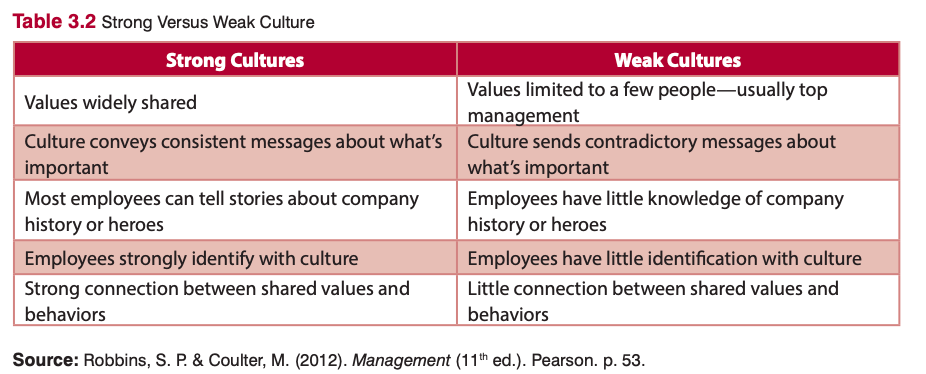
Soru 20
Which of the following dimensions of an organization’s culture define stability?
Seçenekler
A
Managers focus on results or outcomes rather than on how these outcomes are achieved.
B
Work is organized around teams rather than individuals.
C
Employees are encouraged to be innovative and to take risks.
D
Organizational decisions and actions emphasize maintaining the status quo.
E
Employees are aggressive and competitive rather than cooperative.
Açıklama:
Organizational decisions and actions emphasize maintaining the status quo
Soru 21
Business environments can be divided into
two broad categories: external environment
and internal environment.
What is the basic difference between the external and the internal business environment?
two broad categories: external environment
and internal environment.
What is the basic difference between the external and the internal business environment?
Seçenekler
A
The external environment comprises of
factors affect business organizations indirecty; whereas internal environment affects directly.
factors affect business organizations indirecty; whereas internal environment affects directly.
B
The external environment comprises of
factors affect business organizations directly; internal environment affect is indirect.
factors affect business organizations directly; internal environment affect is indirect.
C
Both environment factors affect directly.
D
Both environment factors have an indirect affect on organizations.
E
Both environments have the same amount of affect on businesses.
Açıklama:
Business environments can be divided into
two broad categories: external environment
and internal environment. Two types of environments have different affects.The external environment comprises of
factors affecting organizations indirectly such as competitors, laws, global actors and what managers can do to control them is
very limited.The internal environment includes
leadership and management styles,
organizational culture, human resources,
organizational structures, business assets,
financial strength, and operational and
managerial processes.
The external environment comprises of
factors affect business organizations indirecty;
whereas internal environment affects directly.
two broad categories: external environment
and internal environment. Two types of environments have different affects.The external environment comprises of
factors affecting organizations indirectly such as competitors, laws, global actors and what managers can do to control them is
very limited.The internal environment includes
leadership and management styles,
organizational culture, human resources,
organizational structures, business assets,
financial strength, and operational and
managerial processes.
The external environment comprises of
factors affect business organizations indirecty;
whereas internal environment affects directly.
Soru 22
Which one of the external environments composes factors such as political, sociocultural, economic conditions, global and technological environments?
Seçenekler
A
Task environment
B
General environment
C
Internal environment
D
Global environment
E
International environment
Açıklama:
The external environment has two main components:
general environment and task environment. The general
environment includes those factors that might not have
a direct impact on the daily operations of a firm but will
indirectly influence it.The general environment includes
political, sociocultural, economic conditions, global and
technological environments. These factors eventually affect
all businesses.
general environment and task environment. The general
environment includes those factors that might not have
a direct impact on the daily operations of a firm but will
indirectly influence it.The general environment includes
political, sociocultural, economic conditions, global and
technological environments. These factors eventually affect
all businesses.
Soru 23
Elements in the general environment influence the
organization through the medium of the task environment of a business.
Which one below includes some elements of the task environment?
organization through the medium of the task environment of a business.
Which one below includes some elements of the task environment?
Seçenekler
A
Global and technological environments
B
Political, sociocultural, and economic conditions,
C
Governmental factors
D
Competitors, suppliers, and buyers
E
Foreign governments
Açıklama:
The task environment typically includes competitors,
suppliers, and buyers (customers or distributors);
businesses that produce substitute products for those sold
in the industry; and businesses that provide complementary
products/services.
Competitors, suppliers, and buyers
suppliers, and buyers (customers or distributors);
businesses that produce substitute products for those sold
in the industry; and businesses that provide complementary
products/services.
Competitors, suppliers, and buyers
Soru 24
_____________ is described as the
shared values, principles, traditions, and
ways of doing things that influence the way
organizational members act.
Which term below completes the above definition?
shared values, principles, traditions, and
ways of doing things that influence the way
organizational members act.
Which term below completes the above definition?
Seçenekler
A
Organizational structure
B
Organization chart
C
National culture
D
Managerial structure
E
Organizational culture
Açıklama:
Organizational culture is described as the
shared values, principles, traditions, and ways of
doing things that influence the way organizational
members act. These shared values and practices
evolve over time and determine to a large extent
“how things are done around here”.
Organizational culture should be taken as an identity distinguisher for organizations.
shared values, principles, traditions, and ways of
doing things that influence the way organizational
members act. These shared values and practices
evolve over time and determine to a large extent
“how things are done around here”.
Organizational culture should be taken as an identity distinguisher for organizations.
Soru 25
Research on organizational culture suggests
following dimensions can be used to identify an
organization’s culture.
Which alternative below is about the "stability" dimension?
following dimensions can be used to identify an
organization’s culture.
Which alternative below is about the "stability" dimension?
Seçenekler
A
Employees
are encouraged to be innovative and to take risks.
are encouraged to be innovative and to take risks.
B
Employees are
expected to exhibit precision, analysis, and attention to details.
expected to exhibit precision, analysis, and attention to details.
C
Organizational decisions and actions
emphasize maintaining the status quo.
emphasize maintaining the status quo.
D
Employees are aggressive
and competitive rather than cooperative.
and competitive rather than cooperative.
E
Management decisions
take into account the effects on people in the organization.
take into account the effects on people in the organization.
Açıklama:
Describing an organization using these dimensions
gives a composite picture of the organization’s
culture. In many organizations, one cultural
dimension often is emphasized and essentially
shapes the organization’s personality and the way
organizational members work.
Organizational decisions and actions
emphasize maintaining the status quo.
gives a composite picture of the organization’s
culture. In many organizations, one cultural
dimension often is emphasized and essentially
shapes the organization’s personality and the way
organizational members work.
Organizational decisions and actions
emphasize maintaining the status quo.
Soru 26
Describing an organization using these dimensions
gives a composite picture of the organization’s
culture. In many organizations, one cultural
dimension often is emphasized and essentially
shapes the organization’s personality and the way
organizational members work.
Which organizational dimension below has a focus on "competition"?
gives a composite picture of the organization’s
culture. In many organizations, one cultural
dimension often is emphasized and essentially
shapes the organization’s personality and the way
organizational members work.
Which organizational dimension below has a focus on "competition"?
Seçenekler
A
Outcome orientation
B
Agressiveness dimension
C
Attention to detail
D
Innovation and risk taking
E
People orientation
Açıklama:
Innovation and risk taking culture
encourages employees to be innovative and to take
risks.
encourages employees to be innovative and to take
risks.
Soru 27
Organizational cultures are studied in three levels. Which level elements are accepted as they are without questioning; they reflect the beliefs concerning
human nature and reality?
human nature and reality?
Seçenekler
A
Deepest level; assumptions
B
Middle level; goals and standarts
C
Middle level; values
D
Surface level; artifacts
E
Surface level; symbols, slogans
Açıklama:
In the deepest section of the organizational culture are basic assumptions.
Assumptions are accepted as they are without questioning; they reflect the beliefs concerning human nature
and reality. The middle layer includes values which are principles, standards, and goals. On the surface are
artifacts that anyone can easily observe.
Deepest level; assumptions
Assumptions are accepted as they are without questioning; they reflect the beliefs concerning human nature
and reality. The middle layer includes values which are principles, standards, and goals. On the surface are
artifacts that anyone can easily observe.
Deepest level; assumptions
Soru 28
Decisions regarding the ethics content and the consequences
can be grouped as: ethical egoism, utilitarianism,
and altruism. Which of these is a"egocentric (selfish) approach for making decisions"?
can be grouped as: ethical egoism, utilitarianism,
and altruism. Which of these is a"egocentric (selfish) approach for making decisions"?
Seçenekler
A
Utilitarianism
B
Ethical egoism
C
Ethnocentric approach
D
Unethical decision
E
Altruism
Açıklama:
An ethical and socially responsible workplace is
a critical and challenging obligation primarily for
top managers, but a leading concept for managers
of all levels. In any type of decision-making process, ethical
concerns of different nature are involved. Decisions
regarding the ethics content and the consequences
can be grouped as: ethical egoism, utilitarianism,
and altruism.38 Ethical egoism highlights an
egocentric (selfish) approach for making decisions.
a critical and challenging obligation primarily for
top managers, but a leading concept for managers
of all levels. In any type of decision-making process, ethical
concerns of different nature are involved. Decisions
regarding the ethics content and the consequences
can be grouped as: ethical egoism, utilitarianism,
and altruism.38 Ethical egoism highlights an
egocentric (selfish) approach for making decisions.
Soru 29
___________ is a step beyond further of utilitarianism
and opposite to ethical egoism, has a focus on
benefiting others at the highest level.
Which ethics approach in decision making completes the above sentence?
and opposite to ethical egoism, has a focus on
benefiting others at the highest level.
Which ethics approach in decision making completes the above sentence?
Seçenekler
A
Utilitarianistic approach
B
Egocentric decision making
C
Unethical approach
D
Ethical egoism
E
Altruism
Açıklama:
Altruism, a step further of utilitarianism and opposite to
ethical egoism, has a focus on benefiting others
at the highest level. A leader, more than a regular
manager, seeks a positive outcome for employees
even if the consequences are contrary to her/his
own interest. Altruist ethics are more attached to
social leaders who seek not their own interest but
only benefiting groups which may be considered as
a rare status. During the independence movement and
the realization of the Republic, Atatürk’s concern was
only the future of the Turkish nation.
ethical egoism, has a focus on benefiting others
at the highest level. A leader, more than a regular
manager, seeks a positive outcome for employees
even if the consequences are contrary to her/his
own interest. Altruist ethics are more attached to
social leaders who seek not their own interest but
only benefiting groups which may be considered as
a rare status. During the independence movement and
the realization of the Republic, Atatürk’s concern was
only the future of the Turkish nation.
Soru 30
Businesses have an increasing obligation
to care about outside groups affected by an organization.Fulfilling this type of responsibility requires regular auditing. What is "the extent
to which a firm answers to the demands of its stakeholders
to behave in a socially responsible way" called ?
to care about outside groups affected by an organization.Fulfilling this type of responsibility requires regular auditing. What is "the extent
to which a firm answers to the demands of its stakeholders
to behave in a socially responsible way" called ?
Seçenekler
A
Corporate social responsibility
B
Corporate social performance
C
Social responsibility
D
Ethics in business
E
Ethical decision making
Açıklama:
Many people believe that businesses have an obligation
to care about outside groups affected by an organization.
Corporate social responsibility is the idea that firms have
obligations to society beyond their economic obligations to
owners or stockholders and beyond those prescribed by law
or contract. Corporate social performance is the extent
to which a firm answers to the demands of its stakeholders
to behave in a socially responsible way.
to care about outside groups affected by an organization.
Corporate social responsibility is the idea that firms have
obligations to society beyond their economic obligations to
owners or stockholders and beyond those prescribed by law
or contract. Corporate social performance is the extent
to which a firm answers to the demands of its stakeholders
to behave in a socially responsible way.
Soru 31
Changes in the regulations in a neighboring country can be considered under which factor of the general environment of a a business?
Seçenekler
A
Global
B
Economical
C
Political
D
Sociocultural
E
Technological
Açıklama:
One of the critical aspects of the external environment is the direction and stability of political factors. Political and legal factors represent the law and regulations, not only the home country’s but also others in today’s global marketplace.
Soru 32
Stability of the central government can be considered under which factor of the general environment of a a business?
Seçenekler
A
Global
B
Economical
C
Political
D
Sociocultural
E
Technological
Açıklama:
One of the critical aspects of the external environment is the direction and stability of political factors. Political and legal factors represent the law and regulations, not only the home country’s but also others in today’s global marketplace. Stability of the central government, legislation on antitrust and fair trade, nationalization and/or privatization approaches, consumer and environmental protection, foreign trade regulations, customs legislation, health and safety regulations are among the political factors that businesses should take into account.
Soru 33
stock market fluctuations can be considered under which factor of the general environment of a a business?
Seçenekler
A
Global
B
Economic
C
Political
D
Sociocultural
E
Technological
Açıklama:
The economy influences directly all the sectors and suppliers, producers of goods and services, wholesalers and retailers, nongovernmental organizations operating in those sectors, people, and even the government. Economic factors related to the condition and the direction of the economy are critical ones for businesses to survive and accomplish their goals. Among the most important economic elements are interest rates, inflation, changes in disposable income, stock market fluctuations, and business cycle stages.
Soru 34
The current level of inflation can be considered under which factor of the general environment of a a business?
Seçenekler
A
Global
B
Economic
C
Political
D
Sociocultural
E
Technological
Açıklama:
The economy influences directly all the sectors and suppliers, producers of goods and services, wholesalers and retailers, nongovernmental organizations operating in those sectors, people, and even the government. Economic factors related to the condition and the direction of the economy are critical ones for businesses to survive and accomplish their goals. Among the most important economic elements are interest rates, inflation, changes in disposable income, stock market fluctuations, and business cycle stages.
Soru 35
The age distribution of the population can be considered under which factor of the general environment of a a business?
Seçenekler
A
Global
B
Economic
C
Political
D
Sociocultural
E
Technological
Açıklama:
The age distribution of the population is another critical sociocultural issue. Some countries worry about their aging society that may cause them to lose competitiveness in the future. Governments develop measures to increase the birth rate. On the other hand, some countries have relatively younger populations and faster birth rates
Soru 36
Values of the society regarding a company's products or services can be considered under which factor of the general environment of a a business?
Seçenekler
A
Global
B
Economic
C
Political
D
Sociocultural
E
Technological
Açıklama:
Lifestyles, values, attitudes, and behaviors change in time. The demand for products and services will respond to sociocultural changes. As individuals in society try to control and adapt to environmental factors, change in the sociocultural factors will be unavoidable.
Soru 37
Which of the followings is an indicator of a weak culture in a business?
Seçenekler
A
High loyalty to the company
B
Contradictory messages about what’s important
C
Strong identification with culture
D
Widely shared values
E
Easier communication and cooperation
Açıklama:
The primary benefits of a strong culture include easier communication and cooperation. Employees who exhibit unity of direction and consensus are easier to reach.25 Also, in organizations with strong cultures, employees are more loyal. Strong cultures are associated with high organizational performance because organizational values are clear and widely accepted, employees know what they are supposed to do and what is expected of them; they can act quickly to take care of problems. However, a strong culture also might prevent employees from trying new approaches especially when conditions are changing rapidly.
Contradictory messages about what’s important
Contradictory messages about what’s important
Soru 38
Which of the followings is the declaration of the values, ethics, objectives, and responsibilities of a company?
Seçenekler
A
Ethics monitoring
B
Evaluation report
C
Confrontation document
D
Social responsibility report
E
Code of ethics
Açıklama:
Creating, distributing, and continually improving a company’s code of ethics and starting ethics programs are among the important steps managers should take to create an ethical workplace. A code of ethics declares the values, ethics, objectives, and responsibilities of the companies.
Soru 39
In a company, if managers focus on results rather than on how these outcomes are achieved, under which organizational culture dimension we can classify this approach?
Seçenekler
A
Stability
B
Outcome orientation
C
Agressiveness
D
Attention to detail
E
Team orientation
Açıklama:
Outcome orientation: Managers focus on results or outcomes rather than on how these outcomes are achieved.
Soru 40
A military conflict between the home country of a company and a country it exports products can be considered under which factor of the general environment of a a business?
Seçenekler
A
Economic
B
Global
C
Sociocultural
D
Technological
E
Political
Açıklama:
Global factors are outcomes of changes in international relationships, changes in nation’s economic, political, and legal systems, and changes in technology. Today’s managers recognize that their firms compete in a global and highly integrated market. They regard the global environment as a source of opportunities and threats to which they must respond.
Ünite 4
Soru 1
What is the consequences of not trying to see the future?
Seçenekler
A
It ends up with being proactive
B
There would be a lot of time to think over
C
It enables not to waste resources
D
You can form alternative plans for each scenario
E
You lose the chance of shaping the future
Açıklama:
By trying to figure out what the future is going to look like through a number of highly probable scenarios, we can form alternative plans for each. Besides, if we do not try to guess what is awaiting us and do not decide what we want to do, we can only be on the defensive side and be reactive rather than proactive. Typically, when we just react we do not have a lot of time to think over what to do. Then, it is more likely that we make mistakes and waste resources. If you do not plan for the future, then you lose the chance of shaping the future. The correct answer is E.
Soru 2
I- The nature of planning changes with the level of management
II- Middle-level managers do not deal with long- or short-term planning
III- Low-level managers do not deal with medium-term planning
Which of the statement(s) is/are true concerning levels of planning?
II- Middle-level managers do not deal with long- or short-term planning
III- Low-level managers do not deal with medium-term planning
Which of the statement(s) is/are true concerning levels of planning?
Seçenekler
A
Only I
B
I-II
C
II-III
D
I-II-III
E
I-III
Açıklama:
The nature of planning changes with the level of management. High-level managers deal with long-term planning, whereas low-level managers plan for the short term. However, this does not necessarily mean that middle-level managers do not deal with long- or short-term planning, or low-level managers do not deal with medium-term planning. In fact, they do. Middle-level managers also plan for the long term and short term, but their planning is dominantly for the medium-term. By the same token, low-level managers also plan with different time horizons, but mainly plan for the short term. The correct answer is A.
Soru 3
"A company plans to provide a training for its employees about time management."
What type of planning is the example given above?
What type of planning is the example given above?
Seçenekler
A
Long-term Planning
B
Strategic Planning
C
Short-Term Planning
D
Medium-Term Planning
E
Managerial Planning
Açıklama:
By looking at the present through the collection of hourly, daily, monthly data, short-term planning shapes the near future of the organization. This planning addresses short-term concerns like the condition of machinery and equipment used in production. With these quick fixes, short-term planning is in fact assisting the organization in moving gradually toward its longer-term goals. The correct answer is C.
Soru 4
... is the process whereby managers assess an organization’s goals and create a plan of action for meeting those goals.
Which of the following best completes the definition below?
Which of the following best completes the definition below?
Seçenekler
A
Short-term planning
B
Medium-term planning
C
Long-term planning
D
Decision-making process
E
Managerial planning
Açıklama:
Managerial planning is the process whereby managers assess an organization’s goals and create a plan of action for meeting those goals. The correct answer is E.
Soru 5
I- they are guided by the mission and vision statements
II- they must be written in measurable and quantifiable terms
III- they refer the company's life long process
IV- they must be challenging and too difficult
Which of the statements given above are true for organizational goals?
II- they must be written in measurable and quantifiable terms
III- they refer the company's life long process
IV- they must be challenging and too difficult
Which of the statements given above are true for organizational goals?
Seçenekler
A
I-II-III
B
I-II
C
I-III
D
II-III-IV
E
I-II-IV
Açıklama:
Organizational goals should be;
• guided by the mission and vision statements, and organizational strategy,
• written in measurable and quantifiable terms,
• stated in terms of anticipated outcomes rather
than actions,
• clear as to a time frame, and
• challenging yet attainable.
The correct answer is B.
• guided by the mission and vision statements, and organizational strategy,
• written in measurable and quantifiable terms,
• stated in terms of anticipated outcomes rather
than actions,
• clear as to a time frame, and
• challenging yet attainable.
The correct answer is B.
Soru 6
Which of the followings deal with work methods and technologies?
Seçenekler
A
Production plans
B
Logistics plans
C
Financial plans
D
Marketing plans
E
Human resource plans
Açıklama:
• Production plans (deal with work methods and technologies)
• Logistics plans (deal with suppliers and acquiring resources)
• Financial plans (deal with money and capital investments)
• Marketing plans (deal with selling and distributing goods or services)
• Human resource plans (deal with building a talented workforce)
The correct answer is A.
• Logistics plans (deal with suppliers and acquiring resources)
• Financial plans (deal with money and capital investments)
• Marketing plans (deal with selling and distributing goods or services)
• Human resource plans (deal with building a talented workforce)
The correct answer is A.
Soru 7
A unit is planning to reduce production waste in 10 months in order to cut costs 15 per cent. What type of plans are used in this example?
Seçenekler
A
Tactical and operational plans
B
Strategic and tactical plans
C
Operational and strategic plans
D
Operational and single-use plans
E
Strategic and single-use plans
Açıklama:
Tactical plans translate strategic plans into specific goals for specific parts of the organization. They specify how the organization’s resources can be used to put strategies into action. Tactical plans in business often take the form of functional plans that indicate how different operations within the organization will contribute to the overall strategy. Moreover, operational plans translate tactical plans into specific goals and actions for small units of the organization and focus on the near term (12 months or less). The correct answer is A.
Soru 8
Which type of budget presents expected cash inflow and outflow for a designated time period?
Seçenekler
A
Master budget
B
Operating budget
C
Cash budget
D
Expense budget
E
Program budget
Açıklama:
Cash budget presents expected cash inflow and outflow for a designated time period. The correct answer is C.
Soru 9
I- The decision-making process can only end with implementation.
II- The less change is involved with the decision, the more resistance will come out.
III- Resistance to implement a decision can stem from the fact that the implementer of the decision did not take any part in making the decision.
Which of the statement(s) given above about implementing the decision is/are right?
II- The less change is involved with the decision, the more resistance will come out.
III- Resistance to implement a decision can stem from the fact that the implementer of the decision did not take any part in making the decision.
Which of the statement(s) given above about implementing the decision is/are right?
Seçenekler
A
I-II
B
I-III
C
II-III
D
Only III
E
I-II-III
Açıklama:
Making a decision does not necessarily guarantee its implementation. The main reason for that is resistance. Resistance to implement a decision can stem from the fact that the implementer of the decision did not take or was not given any part in making the decision. The more change is involved with the decision, the more resistance will come out. This is a natural human reaction. Moreover, the decision-making process does not end with implementation, because there is the possibility of not realizing expected results. The correct answer is D.
Soru 10
Which of the followings are not among five aspects of intuition in decision making?
Seçenekler
A
Experience-based decisions
B
Ration-based decisions
C
Cognitive-based decisions
D
Subconscious mental processing
E
Values or ethics-based decisions
Açıklama:
Intuition is knowing or understanding something instinctively or
subconsciously without reasoning or proof. In this model, decisions are taken through five different aspects of intuition. Starting with experience-based decisions, managers use their past experiences. The second aspect of intuition in decisions are
feelings and emotions (affect-initiated decisions). In the third, managers make decisions based on skills, knowledge, and training (cognitive-based decisions). The fourth facet of intuitive decision-making utilizes values or ethics as guides. Lastly, the subconscious mental processing comes into play in executive decision-making. Thus, the correct answer is B.
subconsciously without reasoning or proof. In this model, decisions are taken through five different aspects of intuition. Starting with experience-based decisions, managers use their past experiences. The second aspect of intuition in decisions are
feelings and emotions (affect-initiated decisions). In the third, managers make decisions based on skills, knowledge, and training (cognitive-based decisions). The fourth facet of intuitive decision-making utilizes values or ethics as guides. Lastly, the subconscious mental processing comes into play in executive decision-making. Thus, the correct answer is B.
Soru 11
Which of the following is defined as the achievement of organizational goals?
Seçenekler
A
Planning
B
Effectiveness
C
Efficiency
D
Eco-efficiency
E
Progress
Açıklama:
Planning is the process of determining where to go by doing what. Planning is intertwined with effectiveness, which is defined as the achievement of organizational goals. In fact, the planning process involves determining those goals and how to reach them. Another important concept that planning serves is efficiency, being defined as how good the organization is in its use of resources. As we talk more and more about resource scarcity on our planet, planning gains importance so that businesses can become more sustainable through eco-efficiency (producing by wasting less resources). The correct answer is Choice B.
Soru 12
Which of the following is/are true about the levels of planning?
- High-level managers deal with long-term planning.
- The planning horizon for middle-level managers changes between less than a year to three years.
- For most business organizations, long-term planning has a time horizon that is more than three years.
Seçenekler
A
I
B
II
C
III
D
I-II
E
I-III
Açıklama:
High-level managers deal with long-term planning, whereas low-level managers plan for the short term. However, this does not necessarily mean that middle-level managers do not deal with long- or short-term planning, or low-level managers do not deal with medium-term planning. In fact, they do. Even though the time horizons for long-term and short-term might change from one sector to the other and from one company to the other, for most business organizations long-term planning has a time horizon that is more than 3 years, whereas short-term planning is done for a period less than a year. For medium-term planning, which is dealt with by the middle management, it is more than a year- 3 years. The correct answer is Choice E.
Soru 13
Which of the following is one of the countries influencing the two unanticipated economical crisis since 1990s?
Seçenekler
A
The United Kingdom
B
Germany
C
France
D
The United States
E
Italy
Açıklama:
Since 1990s, the world economy has gone through two major unanticipated financial crises:8 one originating from and contained in Asia and the other originating from the United States but impacting the world. The correct answer is Choice D.
Soru 14
Which of the following illustrates the right sequence of the managerial process?
- Identify resources that are needed
- Implement and evaluate the plans
- Set the goals and objectives
- Identify adjustments to be made
- Determine the action plans
Seçenekler
A
II-III-V-I-IV
B
III-II-V-IV-I
C
III-I-V-II-IV
D
V-IV-II-III-I
E
I-II-III-V-IV
Açıklama:
Managerial planning is the process whereby managers assess an organization’s goals and create a plan of action for meeting those goals. Goals are the desired outcomes or results that people intend to achieve. Organizational goals can also be called as overall objectives. As planning is of great importance to an organization, the whole process of planning should be carried out in a systematic manner.
- Set the goals and objectives
- Identify resources that are needed
- Determine the action plans
- Implement and evaluate the plans
- Identify adjustments to be made
Soru 15
Which of the following is/are one/some of the expected characteristics of organizational goals?
- They should be over-challenging.
- They should be stated in terms of anticipated actions.
- They should be written in measurable and quantifiable terms.
Seçenekler
A
I
B
II
C
III
D
I-II
E
I-II-III
Açıklama:
Organizational goals should be
• guided by the mission and vision statements, and organizational strategy,
• written in measurable and quantifiable terms,
• stated in terms of anticipated outcomes rather than actions,
• clear as to a time frame, and
• challenging yet attainable12(not too easy or trivial, nor too difficult).
The correct answer is Choice C.
• guided by the mission and vision statements, and organizational strategy,
• written in measurable and quantifiable terms,
• stated in terms of anticipated outcomes rather than actions,
• clear as to a time frame, and
• challenging yet attainable12(not too easy or trivial, nor too difficult).
The correct answer is Choice C.
Soru 16
Which of the following focuses on the broad future and identifies the long-term direction the organization will take as a whole?
Seçenekler
A
Logistics plans
B
Strategic plans
C
Marketing plans
D
Human resource plans
E
Production plans
Açıklama:
The most often used classification of organizational plans is strategic, tactical and operational plans.15 Strategic plans focus on the broad future and identify the long-term direction the organization will take as a whole. Tactical plans translate strategic plans into specific goals for specific parts of the organization. They specify how the organization’s resources can be used to put strategies into action. Tactical plans in business often take the form of functional plans that indicate how different operations within the organization will contribute to the overall strategy. Such functional plans might include:
• Production plans (deal with work methods and technologies)
• Logistics plans (deal with suppliers and acquiring resources)
• Financial plans (deal with money and capital investments)
• Marketing plans (deal with selling and distributing goods or services)
• Human resource plans (deal with building a talented workforce)
Standing plans are ongoing plans that provide guidance for activities performed repeatedly, like policies and procedures. The correct answer is Choice B.
• Production plans (deal with work methods and technologies)
• Logistics plans (deal with suppliers and acquiring resources)
• Financial plans (deal with money and capital investments)
• Marketing plans (deal with selling and distributing goods or services)
• Human resource plans (deal with building a talented workforce)
Standing plans are ongoing plans that provide guidance for activities performed repeatedly, like policies and procedures. The correct answer is Choice B.
Soru 17
Which of the following is one of the characteristics of operational plans?
Seçenekler
A
The time horizon is typically 3-5 years.
B
Typically focused on a strategic business unit.
C
The most complex and general, because of potentially covering different industries and business (for groups of companies).
D
Impact is usually restricted to a specific department or organization unit.
E
Interdependence is high.
Açıklama:
Key Differences Between Strategic, Tactical, and Operational Plans are:
Strategic Plans:
Time Horizon: Typically 3-5 years
Scope: Broadest; focus on the entire organization
Complexity: The most complex and general, because of potentially covering different industries and business (for groups of companies)
Impact: Have the potential to dramatically impact, both positively and negatively, the survival and success of the organization
Interdependence: High; must take into account the resources and capabilities of the entire organization and its external environments.
Tactical Plans:
Time Horizon: Often focused on 1-2 years in the future
Scope: Typically focused on a strategic business unit
Complexity: Complex but more specific, with a more limited domain of application
Impact: Affect specific business units, but the effect on the entire organization is measured
Interdependence: Moderate; must take into account the resources and capabilities of several units within a business
Operational Plans:
Time Horizon: Usually focused on the next 12 months or less
Scope: Narrowest; usually centered on departments or smaller organizational units
Complexity: The least complex, because of usually focusing on small, homogenous units
Impact: Impact is usually restricted to a specific
department or organization unit
Interdependence: Low; the plans may be linked to higher-level tactical and strategic plans but are less interdependent
The correct answer is Choice D.
Strategic Plans:
Time Horizon: Typically 3-5 years
Scope: Broadest; focus on the entire organization
Complexity: The most complex and general, because of potentially covering different industries and business (for groups of companies)
Impact: Have the potential to dramatically impact, both positively and negatively, the survival and success of the organization
Interdependence: High; must take into account the resources and capabilities of the entire organization and its external environments.
Tactical Plans:
Time Horizon: Often focused on 1-2 years in the future
Scope: Typically focused on a strategic business unit
Complexity: Complex but more specific, with a more limited domain of application
Impact: Affect specific business units, but the effect on the entire organization is measured
Interdependence: Moderate; must take into account the resources and capabilities of several units within a business
Operational Plans:
Time Horizon: Usually focused on the next 12 months or less
Scope: Narrowest; usually centered on departments or smaller organizational units
Complexity: The least complex, because of usually focusing on small, homogenous units
Impact: Impact is usually restricted to a specific
department or organization unit
Interdependence: Low; the plans may be linked to higher-level tactical and strategic plans but are less interdependent
The correct answer is Choice D.
Soru 18
Which of the following allows resources to vary in proportion with various levels of activity?
Seçenekler
A
Master budget
B
Operating budget
C
Cash budget
D
Flexible budget
E
Expense budget
Açıklama:
Master budget is an overall financial and operating plan for a forthcoming calendar or fiscal year. Operating budget shows income and expenses that are likely to be produced through the current operations of the organization (does not include non-operating items such as income from investments). Cash budget presents expected cash inflow and outflow for a designated time period. Flexible budget allows resources to vary in proportion with various levels of activity (e.g. setting aside extra money to have it available for hiring and paying temporary workers, in case sales increase and so does the need for production). Expense budget includes the money planned to be spent on all the primary activities of a unit together with the amount to be spent on each item during a year. The correct answer is Choice D.
Soru 19
Which of the following illustrates the right sequence of the decision-making process?
- Evaluate alternatives
- Generate alternatives
- Monitor and evaluate results
- Identify the decision situation
- Implement the decision
- Select the best alternative
- Develop decision criteria
Seçenekler
A
V-IV-VI-III-I-II-VII
B
III-I-V-VI-IV-VII-II
C
II-III-V-IV-VI-I-VII
D
I-II-V-IV-VI-VII-III
E
IV-VII-II-I-VI-V-III
Açıklama:
The steps for decision-making process are:
- Identify the decision situation
- Develop decision criteria
- Generate alternatives
- Evaluate alternatives
- Select the best alternative
- Implement the decision
- Monitor and evaluate results
Soru 20
Which of the following is one of the characteristics of intuitive decision making?
Seçenekler
A
Suggests that the decision makers, typically managers, are fully rational.
B
The model is built on the fact that managers, as human beings, are limited by their ability to process information, therefore, they tend to satisfice rather than optimize.
C
It is also known as the classical model of decision making.
D
The model suggests the idea that in decision making, rationality is limited by (a) the information at hand, (b) the cognitive limitations of the human mind, and (c) the finite amount of time to make a decision.
E
In general it comprises five aspects.
Açıklama:
The decision-making process discussed above is also known as the rational model of decision making, but this classical model is not the only model put forward to explain managerial decision making. There is the bounded rationality model which challenges the rational model for not being realistic enough and a third model, namely, intuitive decision making, which will be discussed under the title of decision models. The rational model or approach to decision making27 takes its name from its major premise that the decision makers, typically managers, are fully rational. Also known as the classical model of decision making, this model is built on a number of assumptions that constitute rationality. The bounded rationality model is built on the fact that managers, as human beings, are limited by their ability to process information, therefore, they tend to satisfice rather than optimize. Satisficing means, the decision maker settles for the first satisfactory alternative that comes to his or her attention. Bounded rationality is the idea that in decision making, rationality is limited by (a) the information at hand, (b) the cognitive limitations of the human mind, and (c) the finite amount of time to make a decision. When compared with the rational model, another realistic model or approach would be intuitive decision making. Intuition is knowing or understanding something instinctively or subconsciously without reasoning or proof. In this model, decisions are taken through five different aspects of intuition.Starting with experience-based decisions, managers use their past experiences. The second aspect of intuition in decisions are feelings and emotions (affect-initiated decisions). In the third, managers make decisions based on skills, knowledge, and training (cognitive-based decisions). The fourth facet of intuitive decision-making utilizes values or ethics as guides. Lastly, the subconscious mental processing comes into play in executive decision-making. The main reason for managers’ using intuition is to make decisions fast and this is very important for the business organizations that function in more and more innovative and competitive environments. The correct answer is Choice E.
Soru 21
Which type of plans are ongoing plans that provide guidance for activities performed repeatedly, like policies and procedures?
Seçenekler
A
Operational
B
Tactical
C
Strategic
D
Procedural
E
Standing
Açıklama:
Standing plans are ongoing plans that provide guidance for activities performed repeatedly, like policies and procedures. The correct answer is E.
Soru 22
Which of the following refers to short-range plans that emphasize the current operations of various parts of the organization, such as production, marketing and human resources?
Seçenekler
A
Operational
B
Procedural
C
Standing
D
Strategic
E
Tactical
Açıklama:
Tactical plans are short-range plans that emphasize the current operations of various parts of the organization, such as production, marketing and human resources. The correct answer is E.
Soru 23
Which of the following is the first step in the managerial planning process?
Seçenekler
A
Determine plans of action
B
Identify adjustments to be made
C
Implement and evaluate the plans
D
Set the goals and objectives
E
Identify resources needed for objectives
Açıklama:
The first step of the planning process is to identify organizational goals and objectives. Even though some distinguish between goals and objectives stating that goals are general qualitative statements showing intention and objectives are the measurable descriptions of how intentions will be put into practice, for the sake of simplicity. The correct answer is D.
Soru 24
Which of the following is not among the features that organizational goals should have?
Seçenekler
A
Measurable
B
Results-oriented
C
Realistic
D
Pessimistic
E
Challenging
Açıklama:
Organizational goals should be measurable, results-oriented, realistic, challenging, and have a clear time frame. The correct answer is D.
Soru 25
Which of the following refers to a plan that presents information to direct people in their day-to-day tasks that will support and enable the tactical plan?
Seçenekler
A
Strategic plans
B
Procedural plans
C
Operational plans
D
Standing plans
E
Policy
Açıklama:
An operational plan presents information to direct people in their day-to-day tasks that will support and enable the tactical plan. The correct answer is C.
Soru 26
Which of the following budget types is an overall financial and operating plan for a forthcoming calendar or fiscal year?
Seçenekler
A
Operating
B
Flexible
C
Master
D
Capital expenditure
E
Program
Açıklama:
Master budget is an overall financial and operating plan for a forthcoming calendar or fiscal year. The correct answer is C.
Soru 27
Which of the following budget types specifies the significant amount of money planned to be spent on items that have long-term use such as manufacturing equipment, land, and buildings?
Seçenekler
A
Operating budget
B
Capital expenditure
C
Flexible budget
D
Program budget
E
Cash budget
Açıklama:
Capital expenditure budget specifies the significant amount of money planned to be spent on items that have long-term use such as manufacturing equipment, land, and buildings. The correct answer is B.
Soru 28
Which of the following budgeting types starts from scratch, and every part of the organization is analyzed for its short-term needs?
Seçenekler
A
Activity-based budgeting
B
Zero-based budgeting
C
Incremental budgeting
D
Expense budgeting
E
Cash budgeting
Açıklama:
Zero-based budgeting starts from scratch, and every part of the organization is analyzed for its short-term needs. The correct answer is B.
Soru 29
Which budgeting type emphasizes the expected cost of the planned activities that will be consumed for a process, service, product or department?
Seçenekler
A
Activity-based budgeting
B
Zero-based budgeting
C
Expense budgeting
D
Incremental budgeting
E
Cash budgeting
Açıklama:
Activity-based budgeting emphasizes the expected cost of the planned activities that will be consumed for a process, service, product or department. The correct answer is A.
Soru 30
Which of the following is not one of the aspects of intuition in decision making?
Seçenekler
A
Budget-based decisions
B
Experience-based decisions
C
Values or ethics-based decisions
D
Subconscious mental processing
E
Cognitive-based decisions
Açıklama:
In this model, decisions are taken through five different aspects of intuition. Starting with experience-based decisions, managers use their past experiences. The second aspect of intuition in decisions are feelings and emotions (affect-initiated decisions). In the third, managers make decisions based on skills, knowledge, and training (cognitive-based decisions). The fourth facet of intuitive decisionmaking utilizes values or ethics as guides. Lastly, the subconscious mental processing comes into play in executive decision-making. The main reason for managers’ using intuition is to make decisions fast and this is very important for the business organizations that function in more and more innovative and competitive environments. The correct answer is A.
Soru 31
What do we call the process of determining where to go by doing what?
Seçenekler
A
Planning
B
Management
C
Decision making
D
Effectiveness
E
Operation
Açıklama:
Planning is the process of determining where to go by doing what. The correct answer is "A".
Soru 32
Which of the followings are true about the levels of planning?
I. Long-term planning is high-level managers’ responsibility.
II. Middle-level managers are mainly responsible for medium-term planning.
III. Lower level managers are mainly responsible for planning for the short term.
IV. Everyone needs to understand the long-term plans and objectives.
I. Long-term planning is high-level managers’ responsibility.
II. Middle-level managers are mainly responsible for medium-term planning.
III. Lower level managers are mainly responsible for planning for the short term.
IV. Everyone needs to understand the long-term plans and objectives.
Seçenekler
A
I, II, III
B
I, II, IV
C
I, III, IV
D
II, III, IV
E
I, II, III, IV
Açıklama:
Long-term planning is high-level managers’ responsibility whereas middle-level managers are mainly responsible for medium-term planning and lower level managers are mainly responsible for planning for the short term. Even though the main responsibility for strategic planning lies on the shoulders of high-level managers in organizations, everyone needs to understand the long-term plans and objectives. The correct answer is "E".
Soru 33
Steps in the Managerial Planning Process are given below.
1. Implement and evaluate the plans
2. Set the goals and objectives
3. Identify resources that are needed
4. Identify adjustments to be made
5. Determine the action plans
Which of the following is the correct order in the process?
1. Implement and evaluate the plans
2. Set the goals and objectives
3. Identify resources that are needed
4. Identify adjustments to be made
5. Determine the action plans
Which of the following is the correct order in the process?
Seçenekler
A
1,2,3,4,5
B
2, 3, 5, 1, 4
C
3, 4, 1, 5, 2
D
2, 5, 1, 3, 4
E
4, 5, 1, 2, 3
Açıklama:
Steps in the Managerial Planning Process:
Set the goals and objectives
Identify resources that are needed
Determine the action plans
Implement and evaluate the plans
Identify adjustments to be made
The correct answer is "B".
Set the goals and objectives
Identify resources that are needed
Determine the action plans
Implement and evaluate the plans
Identify adjustments to be made
The correct answer is "B".
Soru 34
Which of the following is not correct about the organizational goals?
Seçenekler
A
They should be measurable.
B
They should be results-oriented.
C
They should be realistic.
D
They should have an indefinite time frame.
E
They should be challenging.
Açıklama:
Organizational goals should be measurable, results-oriented, realistic, challenging, and have a clear time frame. The correct answer is "D".
Soru 35
Which type of plan focuses on the broad future and identifies the long-term direction the organization will take as a whole?
Seçenekler
A
Strategic plan
B
Tactical plan
C
Operational plan
D
Financial plan
E
Functional plan
Açıklama:
Strategic plans focus on the broad future and identify the long-term direction the organization will take as a whole. These plans ideally set forth the goals and objectives needed to accomplish the organization’s vision. The correct answer is "A".
Soru 36
__________ plans are the least complex, because of usually focusing on small, homogenous units.
Seçenekler
A
Strategic plans
B
Tactical plans
C
Operational plans
D
Marketing plans
E
Production plans
Açıklama:
Operational plans are the least complex, because of usually focusing on small, homogenous units. The correct answer is "C".
Soru 37
What type of budget is an overall financial and operating plan for a forthcoming calendar or fiscal year?
Seçenekler
A
Operating budget
B
Master budget
C
Flexible budget
D
Expense budget
E
Cash budget
Açıklama:
Master budget is an overall financial and operating plan for a forthcoming calendar or fiscal year. The correct answer is B".
Soru 38
_________uses the previous period’s budget or actual performance as a basis with some additions made for the new budget.
Seçenekler
A
Activity-based budgeting
B
Zero-based budgeting
C
Incremental budgeting
D
Proposed budget
E
Approved budget
Açıklama:
Incremental budgeting uses the previous period’s budget or actual performance as a basis with some additions made for the new budget. The correct answer is "C".
Soru 39
Which of the followings are the stages of decision-making process?
I. Developing decision criteria
II. Generating decision alternative
III. Evaluating alternatives
IV. Selecting the best alternative
V. Implementing the decision
I. Developing decision criteria
II. Generating decision alternative
III. Evaluating alternatives
IV. Selecting the best alternative
V. Implementing the decision
Seçenekler
A
I, II, III, IV
B
I, II, IV, V
C
II, III, IV, V
D
I, III, IV, V
E
I, II, III, IV, V
Açıklama:
The decision-making process is constituted by the following stages:
1. Identifying a problem or opportunity
2. Developing decision criteria
3. Generating decision alternatives
4. Evaluating alternatives
5. Selecting the best alternative
6. Implementing the decision
7. Monitoring and evaluating the results
The correct answer is "E".
1. Identifying a problem or opportunity
2. Developing decision criteria
3. Generating decision alternatives
4. Evaluating alternatives
5. Selecting the best alternative
6. Implementing the decision
7. Monitoring and evaluating the results
The correct answer is "E".
Soru 40
What favors objectivity, logic, and a formal process of analysis over subjectivity and intuition?
Seçenekler
A
Rational model of decision making
B
Bounded rationality model
C
Intuitive decision making model
D
Experience-based decisions
E
Cognitive-based decisions
Açıklama:
Rational model of decision making favors objectivity, logic, and a formal process of
analysis over subjectivity and intuition. The correct answer is "A".
analysis over subjectivity and intuition. The correct answer is "A".
Soru 41
To which questions for a prepare a plan we should seek for answers?
Seçenekler
A
With planning, we seek answers to these two main questions; where do we want to go? And How will we get there?
B
Even though we are attempting to shape our nowadays, we need to get experience as much as possible?
C
How managers should conduct and decide?
D
İs it required to achieve selling goods?
E
Starting with planning, what managers do in fulfilling all four managerial functions is that they decide.
Açıklama:
With planning, we seek answers to these two main questions:
• Where do we want to go?
• How will we get there? In other words, what should we do to go there?
• Where do we want to go?
• How will we get there? In other words, what should we do to go there?
Soru 42
What are the three levels of a planning?
Seçenekler
A
Levels of planning are contingency planning, scenario planning, participatory planning.
B
Planning levels are divided into three as short, medium and long terms planning.
C
Planning process are goal-setting, analysis, strategy formation, strategy implementation and strategy monitoring.
D
Planning process should be the analyze the situation, communication objective and positioning and strategy outline.
E
Implementation process includes the planning, designing, building and testing, integration, training, launching and evaluation.
Açıklama:
Long-term planning is high-level managers’ responsibility whereas middle-level managers are mainly responsible for medium-term planning and lower level managers are mainly responsible for planning for the short term.
Soru 43
What is the purpose of Elliott Jaques theory?
Seçenekler
A
He claimed a procedural planning theory that deals with the making and implementing of plans.
B
It is concerned with the processes and techniques which are employed by planners in their work as well as the operating modes of planning agencies.
C
E. Jaques claimed that most people worked comfortably with a 3-month time span whereas just a few people could handle a 20-year time frame.
D
He argued that a planners seek to represent the interests of various groups within society.
E
Advocacy planning is a theory of urban planning that was formulated in the 1960s by Elliott Jaques
Açıklama:
Elliott Jaques’s theory on the differences of human capabilities to think with different time horizons seem to support these findings. E. Jaques claimed that most people worked comfortably with a 3-month time span whereas just a few people could handle a 20-year time frame.
Soru 44
What is managerial planning?
Seçenekler
A
Managerial planning can be more ambiguous as they may involve qualitative terms in their statements.
B
Managerial planning are inevitably ambiguous and/or qualitative, but through time they should be revised to be made more specific and clear.
C
A management plan takes into consideration short- and long-term competitive strategies.
D
Managerial planning is the process whereby managers assess an organization’s goals and create a plan of action for meeting those goals.
E
Management goals or objectives are a system of plans a company communicates to its employees to achieve.
Açıklama:
Managerial planning is the process whereby managers assess an organization’s goals and create a plan of action for meeting those goals. Goals are the desired outcomes or results that people intend to achieve. Organizational goals can also be called as overall objectives.
Soru 45
How should organizational goals be achieved ?
Seçenekler
A
By creating an organizational strategy is to be establishing aims and estimating the direction for your business.
B
Organize homework assignments and set a designated study space.
C
It should be for "specific," "measurable," "attainable," "relevant," and "time-bound.
D
The two main types of organizational goals are official and operative.
E
Organizational goals should be measurable, results-oriented, realistic, challenging, and have a clear time frame.
Açıklama:
Organizational goals should be measurable, results-oriented, realistic, challenging, and have a clear time frame. Organizational goals should be guided by the mission and vision statements, and organizational strategy, written in measurable and quantifiable terms, stated in terms of anticipated outcomes rather than actions,
Soru 46
What is meant by management by objectives?
Seçenekler
A
MBO is a process by which managers and employees at all levels set mutually agreed- upon goals.
B
Management by objectives (MBO) is a strategic planning model that aims to improve the performance of an organization by clearly defining the goal of company.
C
The main objective of any organization should be to utilize human and material resources to the maximum possible advantage.
D
It is improvement for the Improvement objectives, and personal development objectives.
E
The main aim is to help employees reach company goals and maintain company standards and policies.
Açıklama:
Many organizations use management by objectives (MBO) instead of this traditional perspective. MBO is a process by which managers and employees at all levels set mutually agreed- upon goals. Those participatively set goals are used for motivating employees14 as well as for evaluating performance.
Soru 47
What questions should we ask when identifying resources?
Seçenekler
A
Know what work is required. Make sure that you have a clear brief before the project starts.
B
In identifying the resources needed, these three questions should be answered: Which resources? How much? When?
C
There are three basic resources or factors of production: land, labor and capital.
D
Identify resources is divided the factors of production into four categories: land, labor, tax, and competitors.
E
In the managerial planning process, after resources are identified, action plans (tasks for accomplishing goals) should be determined.
Açıklama:
In identifying the resources needed, these three questions should be answered: Which resources? How much? When? Typically, two types of resources are taken into consideration: financial and human resources.
Soru 48
What is a standing plan?
Seçenekler
A
Standing plans are plans designed to be used again and again.
B
The advantage of standing plans is that they foster unity and fairness within an organization.
C
Standing plans are ongoing plans that provide guidance for activities performed repeatedly, like policies and procedures.
D
A standing plans is once formulated, they will be used for a short term.
E
A standing plan is a step-by-step sequence of activities that must be followed to perform a task.
Açıklama:
Standing plans are ongoing plans that provide guidance for activities performed repeatedly, like policies and procedures.
Soru 49
What is the difference between proposed budget and approved budget?
Seçenekler
A
A categorical list of anticipated project costs that represent the Principal Investigator's best estimate of the funds needed to support the work described in a proposal.
B
A project proposal is the document that facilitates a professional relationship between an organization and outside contributors.
C
A budget consists of all direct costs, facilities and administrative costs, and cost sharing commitments proposed.
D
With the proposed budget, the money requirement is determined and the approved budget is checked by manager.
E
Depending on the feasibility of estimates, budgets are of three types -- balanced budget, surplus budget and deficit budget.
Açıklama:
Most organizations have a two-phase process in making budgets. In the first phase, managers form a proposed budget. This provides a plan of the amount of money needed and is submitted to a superior or budget review committee. Then, by the end of the second phase, the manager receives an approved budget.
Soru 50
What is meant by cost benefit analysis?
Seçenekler
A
Cost-benefit analysis is a process by which organizations can analyze decisions, systems or Project for rival company.
B
Cost-benefit analysis is to determine whether to go ahead with a project.
C
CBA helps predict whether the earnings of a policy outweigh its return, relative to other alternatives.
D
CBA identifies choices which increase earnings from a non-utilitarian perspective.
E
Cost-benefit analysis compares the expected cost of an alternative to its expected benefits.
Açıklama:
Cost-benefit analysis compares the expected cost of an alternative to its expected benefits. In other words, it is simply guessing the downside and upside of choosing an alternative and weighing one side against the other.
Soru 51
How do you define decision-making process?
Seçenekler
A
The decision maker has to follow it up in order to check whether it is producing the expected benefits and generating some unexpected costs.
B
Choices may involve options for solution to an investment problem in hand, choosing a path at cross road.
C
Assess the Situation. Take the time to identify the situation clearly and then organize the issues that need to be addressed.
D
All possible alternatives cannot be generated and thoroughly analyzed even with sophisticated analytical tools (it is just impossible).
E
The search for alternatives may be abandoned too quickly, which leaves the decision maker with a small set of alternatives.
Açıklama:
The decision-making process does not necessarily end with putting the decision into effect. The decision maker has to follow it up in order to check whether it is producing the expected benefits and generating some unexpected costs. At this stage, the decision maker or the implementer needs to collect information in order to see whether things are going in the right direction. In determining whether things are on track, one needs to know that implementation does not usually bring immediate results. In that case, the person who is making the decision should have a good enough idea about how long to wait before starting to collect and analyze the results.
Soru 52
Which of the following planning has a time horizon that is more than 3 years?
Seçenekler
A
Long-term planning
B
Low level management planning
C
Medium-term planning
D
Middle level management planning
E
Short-term planning
Açıklama:
Even though the time horizons for long-term and short-term might change from one sector to the other and from one company to the other, for most business organizations long-term planning has a time horizon that is more than 3 years, whereas short-term planning is done for a period less than a year. For this reason, the correct answer is A.
Soru 53
Which of the following planning-term can be example of calling for the service personnel to repair a machine breakdown or returning the product to the relevant phase of production to fixing a small quality problem in it instantly?
Seçenekler
A
Long-term planning
B
Low level management planning
C
Medium-term planning
D
Middle level management planning
E
Short-term planning
Açıklama:
By looking at the present through the collection of hourly, daily, monthly data, short-term planning shapes the near future of the organization. This planning addresses short-term concerns like the condition of machinery and equipment used in production. For example, instant planning for the repair of a machine breakdown (calling and waiting for the service personnel) or fixing a small quality problem in a product (returning it back to the relevant phase of production for a reworking) are things that happen in the short run. For this reason, the correct answer is E.
Soru 54
Which of the following is the first step in the planning process?
Seçenekler
A
Determine plans of action
B
Identify adjustments to be made
C
Identify resources needed for objectives
D
Implement and evaluate the plans
E
Set the goals and objectives
Açıklama:
The first step of the planning process is to identify organizational goals and objectives. For this reason, the correct answer is E.
Soru 55
Which of the following is not one of the characteristics that goals should have?
Seçenekler
A
Challenging
B
Clear time frame
C
Measurable
D
Process-oriented
E
Realistic
Açıklama:
Organizational goals should be measurable, results-oriented, realistic, challenging, and have a clear time frame. They should be stated in terms of anticipated outcomes rather than actions. For this reason, the answer is D.
Soru 56
Which of the following is not one of the characteristics of tactical planning?
Seçenekler
A
Affect specific business units, but the effect on the entire organization is measured
B
Complex but more specific; with a more limited domain of application
C
Moderate interdependence; must take into account the resources and capabilities of several units within a business
D
Often focused on the next 12 months or less
E
Typically focus on a strategic business unit
Açıklama:
In terms of time horizon, tactical planning often focused on 1-2 years in the future. For this reason, the answer is D.
Soru 57
Which of the following types of plans guide employees’ day-to-day tasks?
Seçenekler
A
Functional plan
B
Managerial plan
C
Operational plan
D
Strategic plan
E
Tactical plan
Açıklama:
An operational plan presents information to direct people in their day-to-day tasks that will support and enable the tactical plan. For this reason, the correct answer is C.
Soru 58
Which of the following is the process of identifying a problem or opportunity and selecting among available alternatives to solve the problem or capitalize on the opportunity?
Seçenekler
A
Budgeting process
B
Decision-making process
C
Operational process
D
Planning process
E
Supporting process
Açıklama:
Decision making is the process of identifying a problem or opportunity and selecting among available alternatives to solve the problem or capitalize on the opportunity. For this reason, the correct answer is B.
Soru 59
Which of the following steps of the decision-making process comes first?
Seçenekler
A
Evaluating alternatives
B
Generating decision alternatives
C
Identifying a problem or opportunity
D
Implementing the decision
E
Monitoring and evaluating the results
Açıklama:
The decision-making process does not start unless the relevant person or people see a problem or opportunity. A problem can be defined as an unfavorable difference between a desired position and a current position, whereas an opportunity can be defined as a possibility for bettering a position. For this reason, the correct answer is C.
Soru 60
Which of the following is the model that demonstrates that managers as human being are limited to their ability to process information, so they tend to satisfy rather than optimize?
Seçenekler
A
Bounded rational model
B
Ethical decision making model
C
Intuitive decision making model
D
Organizational decision making model
E
Rational decision making model
Açıklama:
Bounded rationality is the idea that in decision making, rationality is limited by the information at hand, the cognitive limitations of the human mind, and the finite amount of time to make a decision. The bounded rationality model is built on the fact that managers, as human beings, are limited by their ability to process information, therefore, they tend to satisfice rather than optimize. For this reason, the correct answer is A.
Soru 61
Which of the following is not one of the aspects of the intuitive decision making model?
Seçenekler
A
Affect-initiated decisions
B
Behavior-based decisions
C
Experience-based decisions
D
Subconscious mental processing
E
Values or ethics based decisions
Açıklama:
In intuitive decision making model, decisions are taken through five different aspects of intuition: experience-based decisions (managers use their past experiences), affect-initiated decisions (feelings and emotions), skills, cognitive-based decisions (knowledge, and training), values or ethics as guides and the subconscious mental processing. For this reason, the correct answer is B.
Soru 62
.................is the process of determining where to go by doing what.
What should be at dotted place?
What should be at dotted place?
Seçenekler
A
Planning
B
Objectiving
C
Operating
D
Proceding
E
Budgeting
Açıklama:
It should be Planning
Soru 63
Overall, being more effective in planning and decision-making in our world, in our times, requires managers to do something.
Which of following is not one of them?
Which of following is not one of them?
Seçenekler
A
Never refrain from taking input from those who will be influenced by the plans and
decisions and those who will be implementing them. Engaging the relevant stakeholders in both planning and decision-making activities will build a positive and constructive organizational climate rather than resistance.
decisions and those who will be implementing them. Engaging the relevant stakeholders in both planning and decision-making activities will build a positive and constructive organizational climate rather than resistance.
B
Consider the utilization of planning and decision-making tools and techniques such
as PERT/CPM and time series analysis.
as PERT/CPM and time series analysis.
C
As the lack of information is an important threat to effectiveness in both planning
and decision-making, then it is ultimately important for managers to deal with big
data management.
and decision-making, then it is ultimately important for managers to deal with big
data management.
D
Managers at all levels should always try to see where the decision they are about
to take fits in the bigger picture (need for strategic thinking).
to take fits in the bigger picture (need for strategic thinking).
E
Don't consider the utilization of after-planning and after-decision-making tools and techniques
Açıklama:
Don't consider the utilization of after-planning and after-decision-making tools and techniques,is not one of them
Soru 64
.............................is knowing or understanding something instinctively or subconsciously without reasoning or proof.
What should be at dotted place?
What should be at dotted place?
Seçenekler
A
Intuition
B
Bounded rationality
C
Decision modelling
D
Monitoring and Evaluating
E
Evaluating Alternatives
Açıklama:
It should be Intuition
Soru 65
In Intuitive Decision Making model, decisions are taken through five different aspects of intuition.
Which of following is not one of them?
Which of following is not one of them?
Seçenekler
A
Innovation-based decisions
B
Affect-initiated decisions
C
Cognitive baseddecisions
D
Subconscious mental processing
E
Values or ethics-based decisions
Açıklama:
Innovation-based decisions is not one of them
Soru 66
According to the bounded rationality model, the decision-making process can be outlined in somethings.
Which of the following is not one of them?
Which of the following is not one of them?
Seçenekler
A
Set the goal you want to pursue, or define the problem you want to solve
B
Establish a minimum performance or criterion level.
C
Employ heuristics to narrow the solution to a double promising alternative
D
If you cannot identify a feasible alternative, lower your aspiration level and search for a
different solution
different solution
E
After identifying a feasible alternative, evaluate it to determine its acceptability
Açıklama:
Employ heuristics to narrow the solution to a double promising alternative is not one of them
Soru 67
............................is the idea that in decision making, rationality is limited by
the information at hand, the cognitive limitations of the human mind, and the
finite amount of time to make a decision.
Which of following should be at dotted place?
the information at hand, the cognitive limitations of the human mind, and the
finite amount of time to make a decision.
Which of following should be at dotted place?
Seçenekler
A
Bounded rationality
B
Single rationality
C
Intuition
D
rational decision-making
E
Cost-benefit analysing
Açıklama:
It should be Bounded rationality
Soru 68
.................................... is a step-by-step process for making logically sound decisions. This model assumes that the decision maker has full or perfect
information.
Which of following should be at the dotted place?
information.
Which of following should be at the dotted place?
Seçenekler
A
Rational decision-making model
B
Bounded decision-making model
C
Expected future decision making model
D
Cost-benefit decision making model
E
Zero-based decision making model
Açıklama:
It should be Rational decision-making model
Soru 69
Which of following is not one of Step of the Decision-making Process?
Seçenekler
A
Identify the decision situation
B
Develop decision criteria
C
Generate alternatives
D
Evaluate alternatives
E
Finishing decision
Açıklama:
Finishing decision is not one of them
Soru 70
...............................uses the previous period’s budget or actual performance as a basis with some additions made for the new budget.
Which following should be at dotted place?
Which following should be at dotted place?
Seçenekler
A
zero-based budgeting
B
Incremental budgeting
C
activity-based budgeting
D
Decision based budgeting
E
Approved budgeting
Açıklama:
It should be Incremental budgeting
Soru 71
............................ starts from scratch, and every part of the organization is analyzed for its short-term need.
Which of following should be at dotted place?
Which of following should be at dotted place?
Seçenekler
A
activity-based budgeting
B
Zero-based budgeting
C
Incremental budgeting
D
approved budgetting
E
proposed budgetting
Açıklama:
It should be zero-base budgetting
Soru 72
Which of the following is true about planning?
Seçenekler
A
Planning is often called the primary function of management.
B
It is easy to succeed without planning, but it makes the results better.
C
Planning isn't necessary but it's useful to predict where a business is going.
D
Although planning does not directly affect organizing, leading or
controlling; it is useful.
controlling; it is useful.
E
Without planning; organizing, leading and controlling will take less time but more there will be more mistakes.
Açıklama:
From a vacation with friends to your own career, from starting a small new business to managing a large corporation, you can hardly succeed without planning. For instance, one can hardly find a successful start-up business story without a business plan or any planning whatsoever. Even for funding a business for expansion or a start-up through seeking new investors and creditors, a business plan is a must. The main reason for this is that without planning there is no way one can figure out where a business is going.
Thus, without planning, the remaining managerial functions of organizing, leading and controlling can hardly be done. Specifically, if we do not plan, then the other three functions will take more time and more mistakes will be generated along the way. For instance, the organizational goals set in planning, form the basis for standards against which managers can evaluate (control) the performance of the organization. This is why planning is often called the primary function of management.
Thus, without planning, the remaining managerial functions of organizing, leading and controlling can hardly be done. Specifically, if we do not plan, then the other three functions will take more time and more mistakes will be generated along the way. For instance, the organizational goals set in planning, form the basis for standards against which managers can evaluate (control) the performance of the organization. This is why planning is often called the primary function of management.
Soru 73
Which is not true about planning?
Seçenekler
A
It helps us check the level of goal achievement
B
It helps us determine the level of goal achievement
C
It shows any need for modifying
D
It shows any need for changing
E
It wastes a lot of time
Açıklama:
Let’s assume that a firm plans to increase the sales of its product X to 1000 units in the upcoming year. If there is no seasonality in demand, this means it needs to sell 250 units per quarter. Later, by the end of the first quarter, if 400 units of product X are sold, then the firm needs to increase production. However, if only 175 units are sold, then new plans must be devised to increase sales. No matter what has been done to increase the sales, if the sales continue to be lower than planned by the end of second and third quarters, then managers of this firm would start to think about revising the product or developing a new product.
Therefore, with the help of this example, one can easily see how planning gives us a direction through setting of goals, helps us check and determine the level of goal achievement, and shows any need for modifying and changing the earlier plans or goals in order to become more effective.
Therefore, with the help of this example, one can easily see how planning gives us a direction through setting of goals, helps us check and determine the level of goal achievement, and shows any need for modifying and changing the earlier plans or goals in order to become more effective.
Soru 74
What is defined as how good the organization is in its use of resources?
Seçenekler
A
Planning
B
Goal
C
Efficiency
D
Management
E
Budget
Açıklama:
Planning gives us a direction through setting of goals, helps us check and determine the level of goal achievement, and shows any need for modifying and changing the earlier plans or goals in order to become more effective.
Another important concept that planning serves is efficiency, being defined as how good the organization is in its use of resources. As we talk more and more about resource scarcity on our planet, planning gains importance so that businesses can become more sustainable through eco-efficiency (producing by wasting less resources). Simply, by planning, resources will be wasted less, because managers also plan for efficiency in their operations.
Another important concept that planning serves is efficiency, being defined as how good the organization is in its use of resources. As we talk more and more about resource scarcity on our planet, planning gains importance so that businesses can become more sustainable through eco-efficiency (producing by wasting less resources). Simply, by planning, resources will be wasted less, because managers also plan for efficiency in their operations.
Soru 75
Which one is the idea of "producing by wasting less
resources"?
resources"?
Seçenekler
A
Planning
B
Efficiency
C
Eco-efficiency
D
Budget
E
Goal
Açıklama:
Another important concept that planning serves is efficiency, being defined as how good the organization is in its use of resources. As we talk more and more about resource scarcity on our planet, planning gains importance so that businesses can become more sustainable through eco-efficiency (producing by wasting less resources). Simply, by planning, resources will be wasted less, because managers also plan for efficiency in their operations.
Soru 76
Which one would be true according to the dominant planning trends that are held by particular levels of management(managerial levels)?
Seçenekler
A
High level of management generally makes medium-term plans(more than a
year - 3 years)
year - 3 years)
B
High level of management generally makes short-term plans(less than a
year)
year)
C
Medium level of management generally makes long-term plans(more than 3
years)
years)
D
Medium level of management generally makes short-term plans(less than a
year)
year)
E
Low level of management generally makes short-term plans(less than a
year)
year)
Açıklama:
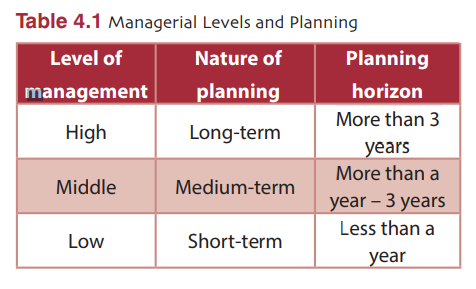
Soru 77
Which one of the following is true about strategic planning?
Seçenekler
A
It is the planning that low-level managers do
B
It is the planning that middle-level managers do
C
It is to find more permanent solutions to short-term problems
D
By setting the long-term plans and directions for the entire organization, it sets the context for other levels
E
By looking at the present through the collection of data, it shapes the near future of the organization.
Açıklama:
By looking at the present through the collection of hourly, daily, monthly data, short-term planning shapes the near future of the organization.
In order to be more effective and efficient in their operations, managers need to make sure that day-to-day problems do not recur or are solved in a much better way. Therefore, in the medium term, more permanent solutions to short-term problems are sought out.
The planning that high-level managers do is also called strategic planning, because strategies are developed to guide the organization in reaching its vision. By setting the long-term plans and directions for the entire organization, high-level management sets the context for lower levels of management to work on useful short-term and medium-term plans. As we go down in the managerial hierarchy, planning gets to be divided into parts.
In order to be more effective and efficient in their operations, managers need to make sure that day-to-day problems do not recur or are solved in a much better way. Therefore, in the medium term, more permanent solutions to short-term problems are sought out.
The planning that high-level managers do is also called strategic planning, because strategies are developed to guide the organization in reaching its vision. By setting the long-term plans and directions for the entire organization, high-level management sets the context for lower levels of management to work on useful short-term and medium-term plans. As we go down in the managerial hierarchy, planning gets to be divided into parts.
Soru 78
What is the second step in managerial planning process?
Seçenekler
A
Identifying adjustments to be made
B
Determining the action plans
C
Setting the goals and objectives
D
Identifying resources that are needed
E
Implementing and evaluating the plans
Açıklama:
We should identify resources that are needed right after setting the goals and objectives.
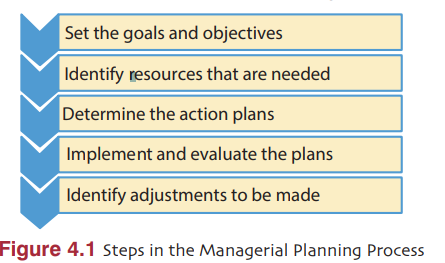
Soru 79
Which of the following is false about organizational goals?
Seçenekler
A
They are challenging yet attainable
B
They are stated in terms of actions rather than outcomes
C
They are written in measurable and quantifiable terms
D
They are clear as to a time frame
E
They are guided by the mission and vision statements, and organizational strategy.
Açıklama:
Organizational goals should be
• guided by the mission and vision statements, and organizational strategy,
• written in measurable and quantifiable terms,
• stated in terms of anticipated outcomes rather than actions,
• clear as to a time frame, and
• challenging yet attainable(not too easy or trivial, nor too difficult).
• guided by the mission and vision statements, and organizational strategy,
• written in measurable and quantifiable terms,
• stated in terms of anticipated outcomes rather than actions,
• clear as to a time frame, and
• challenging yet attainable(not too easy or trivial, nor too difficult).
Soru 80
In which stage should tasks associated with the accomplishment of each goal be identified?
Seçenekler
A
Setting the goals and objectives
B
Identifying resources that are needed
C
Determining the action plans
D
Implementing and evaluating the plans
E
Identifying adjustments to be made
Açıklama:
The third step in the managerial planning process is determining the action plans. At this stage, concrete and detailed plans, specifically, statements of action steps (put in a chronological order) should be developed. In other words, tasks associated with the accomplishment of each goal should be identified.
For example, developing advanced sales techniques and then training the company’s salespeople on those techniques can be relevant tasks (two steps of action) for the goal of raising profits by 20 percent. During this stage, together with the timelines for completing the tasks, the units and individual employees to whom the tasks are to be assigned have to be decided. Similarly, for the goal of increasing sales by 20 percent, the sales manager may give the salespeople monthly sales quotas to stay on track.
For example, developing advanced sales techniques and then training the company’s salespeople on those techniques can be relevant tasks (two steps of action) for the goal of raising profits by 20 percent. During this stage, together with the timelines for completing the tasks, the units and individual employees to whom the tasks are to be assigned have to be decided. Similarly, for the goal of increasing sales by 20 percent, the sales manager may give the salespeople monthly sales quotas to stay on track.
Soru 81
Which type of plans deal with suppliers and acquiring resources?
Seçenekler
A
Production plans
B
Logistics plans
C
Financial plans
D
Marketing plans
E
Human resource plans
Açıklama:
• Production plans (deal with work methods and technologies)
• Logistics plans (deal with suppliers and acquiring resources)
• Financial plans (deal with money and capital investments)
• Marketing plans (deal with selling and distributing goods or services)
• Human resource plans (deal with building a talented workforce)
• Logistics plans (deal with suppliers and acquiring resources)
• Financial plans (deal with money and capital investments)
• Marketing plans (deal with selling and distributing goods or services)
• Human resource plans (deal with building a talented workforce)
Ünite 5
Soru 1
If any company is able to surpass its competitors or the industry average over an extended period, what does it acquire?
Seçenekler
A
Core competence
B
Sustainable competitive advantage
C
Higher customer loyalty
D
More niche markets
E
A developed brand image
Açıklama:
One essential strategic feature of markets is competition. Producers, whether manufacturers or service providers, would like to be ahead of their competitors for achieving their goals such as profit, growth, and market share. A company which reaches a higher performance relative to other rivals in the same industry or the industry average has a competitive advantage. Competitive advantage is always relative, not absolute. To evaluate competitive advantage, we compare company performance to either the performance of other companies in the same industry or an industry average. A company which can surpass its competitors or the industry average over an extended period has a sustainable competitive advantage.
Soru 2
I- High profit
II- Achieving a particular goal.
III- Competition
IV- Leading
V- People's well-being
From the etymology of the term "strategy", which ones of the above characteristics are included in it?
II- Achieving a particular goal.
III- Competition
IV- Leading
V- People's well-being
From the etymology of the term "strategy", which ones of the above characteristics are included in it?
Seçenekler
A
I and II
B
II and III
C
I, II, and IV
D
II, III, and IV
E
I, II, III, IV, and V
Açıklama:
Strategy and Strategic Management
The root of the word of strategy is found in the Greek: strategia, which means “office or command of a general”. Strategia’s root is strategos, “general, commander of an army”, also the title of various civil officials and magistrates, which is composed of stratos, “multitude, army, expedition, encamped army”, and agos, “leader”.5 As we see from the etymology of the word, strategy relates to competition, leading, and achieving a particular goal.
The root of the word of strategy is found in the Greek: strategia, which means “office or command of a general”. Strategia’s root is strategos, “general, commander of an army”, also the title of various civil officials and magistrates, which is composed of stratos, “multitude, army, expedition, encamped army”, and agos, “leader”.5 As we see from the etymology of the word, strategy relates to competition, leading, and achieving a particular goal.
Soru 3
"We want to be biggest retailer in Europe in terms of sales volume by 2025."
The statement above is an example for which one of the following?
The statement above is an example for which one of the following?
Seçenekler
A
Vision
B
Mision
C
Value system
D
Corporate philosophy
E
Corporate ethics
Açıklama:
Developing Statements of Vision, Mission, and Values
A vision is a statement about where the company wants to be in the future. It is composed of the desired achievements of the company. A clearly phrased vision communicates management’s aspirations to stakeholders about “where we are going” and helps channel the energies of company personnel in a common direction.
A vision is a statement about where the company wants to be in the future. It is composed of the desired achievements of the company. A clearly phrased vision communicates management’s aspirations to stakeholders about “where we are going” and helps channel the energies of company personnel in a common direction.
Soru 4
I- The number of producers in the market,
II- Companies’ degree of pricing power,
III- Whether the customers are sophisticated
IV- Whether the products offered are undifferentiated or differentiated
V- Whether the market is consolidated or fragmented
A company tries to analyze the market structure. Which one of the variables above is needed for this analysis?
II- Companies’ degree of pricing power,
III- Whether the customers are sophisticated
IV- Whether the products offered are undifferentiated or differentiated
V- Whether the market is consolidated or fragmented
A company tries to analyze the market structure. Which one of the variables above is needed for this analysis?
Seçenekler
A
I, II, and III
B
II, III, and IV
C
I, II, IV and V
D
II, III, IV and V
E
I, II, III, IV and V
Açıklama:
The analysis of market structure
We observe different behavior patterns by producers across markets to a great degree. In some markets, producers are highly competitive; in others, they seem in some ways to coordinate their actions to avoid competing with one another; and, in some markets, there is no competition at all. For understanding markets and explaining the behaviors in them, economists have developed four principal models of market structure which are based on four dimensions:20 21 (1) the number of producers in the market, (2) the companies’ degree of pricing power, (3) whether the products offered are undifferentiated or differentiated (products that are different but viewed substitutable by customers), and (4) the market is consolidated or fragmented (market share for the leading four firms is equal to or less than 40% of total industry sales).
We observe different behavior patterns by producers across markets to a great degree. In some markets, producers are highly competitive; in others, they seem in some ways to coordinate their actions to avoid competing with one another; and, in some markets, there is no competition at all. For understanding markets and explaining the behaviors in them, economists have developed four principal models of market structure which are based on four dimensions:20 21 (1) the number of producers in the market, (2) the companies’ degree of pricing power, (3) whether the products offered are undifferentiated or differentiated (products that are different but viewed substitutable by customers), and (4) the market is consolidated or fragmented (market share for the leading four firms is equal to or less than 40% of total industry sales).
Soru 5
...................................... refers to a framework that was developed for identifying opportunities and threats facing a specific company in the industrial context.
Which one of the following completes the above sentence correctly?
Which one of the following completes the above sentence correctly?
Seçenekler
A
The Generic Strategy
B
SWOT analysis
C
PEST
D
Market structure analysis
E
The Five Forces Model
Açıklama:
External Analysis
Michael E. Porter’s well-known analytical framework, the Five Forces model is essential in identifying opportunities and threats facing a specific company in an industrial context. Porter developed two important assumptions that form the basis of his five forces model: (1) rather than defining competition narrowly as rivalry to explain and predict a firm’s performance, competition must be viewed more broadly through considering the other forces in an industry, (2) the profit potential of an industry is a function of the five forces that shape competition.
Michael E. Porter’s well-known analytical framework, the Five Forces model is essential in identifying opportunities and threats facing a specific company in an industrial context. Porter developed two important assumptions that form the basis of his five forces model: (1) rather than defining competition narrowly as rivalry to explain and predict a firm’s performance, competition must be viewed more broadly through considering the other forces in an industry, (2) the profit potential of an industry is a function of the five forces that shape competition.
Soru 6
A company has a unique strength in R&D to launch new products to its markets much faster than the competition. This is called ........................?
Seçenekler
A
Capability
B
Competitive advantage
C
Core competency
D
Skill set
E
Strategic mindset
Açıklama:
Internal analysis
Core competencies are unique strengths, that are deeply embedded within a company. Core competencies are key for sustainable competitive advantage. Being superior in marketing, in creating algorithms, or in designing products are some examples of core competencies. Companies preserve their core competencies through resources and capabilities: resources reinforce and capabilities orchestrate core competencies. Core competencies leverage company activities, which will lead to competitive advantage.
Core competencies are unique strengths, that are deeply embedded within a company. Core competencies are key for sustainable competitive advantage. Being superior in marketing, in creating algorithms, or in designing products are some examples of core competencies. Companies preserve their core competencies through resources and capabilities: resources reinforce and capabilities orchestrate core competencies. Core competencies leverage company activities, which will lead to competitive advantage.
Soru 7
.............................is the process whereby a company determines the costs associated with organizational activities.
Seçenekler
A
Managerial Accounting
B
PEST analysis
C
Value chain analysis
D
SWOT analysis
E
Cost accounting
Açıklama:
Internal Analysis
Value chain analysis (VCA) is the process whereby a company determines the costs associated with organizational activities. The value chain analysis aims to identify where cost advantages or disadvantages exist anywhere along the value chain. The VCA process can enable a company to better identify its own strengths and weaknesses, especially as compared to a competitors’ value chain analyses and their own data examined over time. The initial step in implementing VCA is to divide a firm’s operations into specific activities or business processes. Then the analyst attempts to attach a cost to each discrete activity; the costs could be in terms of both time and money. Finally, the analyst converts the cost data into information by looking for competitive cost strengths and weaknesses that may yield competitive advantage or disadvantage. It is important to note that value chains differ vastly across industries and companies.
Value chain analysis (VCA) is the process whereby a company determines the costs associated with organizational activities. The value chain analysis aims to identify where cost advantages or disadvantages exist anywhere along the value chain. The VCA process can enable a company to better identify its own strengths and weaknesses, especially as compared to a competitors’ value chain analyses and their own data examined over time. The initial step in implementing VCA is to divide a firm’s operations into specific activities or business processes. Then the analyst attempts to attach a cost to each discrete activity; the costs could be in terms of both time and money. Finally, the analyst converts the cost data into information by looking for competitive cost strengths and weaknesses that may yield competitive advantage or disadvantage. It is important to note that value chains differ vastly across industries and companies.
Soru 8
Executives in a large company discuss about what businesses to operate. Some of them favor food industry while some others favor electronics. What type of strategies these executives deal with?
Seçenekler
A
International level strategy
B
Corporate-level strategy
C
Business-level strategy
D
Functional-level strategy
E
Both business and functional level strategies
Açıklama:
STRATEGIC MANAGEMENT PROCESS: FORMULATION AND IMPLEMENTATION
Corporate-level strategy includes the determination of the long-term goals and objectives, the allocation of resources, and the adoption of courses of action in seeking competitive advantage when competing in more than one industry and market simultaneously. It concerns the broad question, where to compete and effects the entire business. Thus, corporate-level strategy is concerned with decisions about in what businesses to operate.
Corporate-level strategy includes the determination of the long-term goals and objectives, the allocation of resources, and the adoption of courses of action in seeking competitive advantage when competing in more than one industry and market simultaneously. It concerns the broad question, where to compete and effects the entire business. Thus, corporate-level strategy is concerned with decisions about in what businesses to operate.
Soru 9
AZY company has a business manufacturing refrigerator. Market share of this business is relatively higher compared to the rest of the rivals; but, market growth is slow.
How would you name this business according to the BCG matrix.
How would you name this business according to the BCG matrix.
Seçenekler
A
Cash cow
B
Question mark
C
Dog
D
Star
E
Both star and dog
Açıklama:
Corporate-Level Strategy
The BCG matrixseparates SBUs into four categories. Stars are SBUs that have a large share of a fast-growing market. To take advantage of a star, the corporation must invest considerably in it. Question marks are SBUs that have a small share of a fast-growing market. If the corporation invests in these companies, they may finally become stars, but their relatively small share in the market makes investing in question marks more risky than investing in stars. Cash cows are SBUs which have a large share of a slow-growing market. SBUs in this situation are often highly profitable, therefore the name “cash cow.” Finally, dogs are SBUs which have a small share of a slow-growing market. As the name suggests, having a small share of a slow-growth market is often not profitable. Since dogs lose money, they should either be sold to other companies or closed down and liquidated for their resources.
The BCG matrixseparates SBUs into four categories. Stars are SBUs that have a large share of a fast-growing market. To take advantage of a star, the corporation must invest considerably in it. Question marks are SBUs that have a small share of a fast-growing market. If the corporation invests in these companies, they may finally become stars, but their relatively small share in the market makes investing in question marks more risky than investing in stars. Cash cows are SBUs which have a large share of a slow-growing market. SBUs in this situation are often highly profitable, therefore the name “cash cow.” Finally, dogs are SBUs which have a small share of a slow-growing market. As the name suggests, having a small share of a slow-growth market is often not profitable. Since dogs lose money, they should either be sold to other companies or closed down and liquidated for their resources.
Soru 10
................................includes the determination of the long-term goals and objectives, the allocation of the resources, and the adoption of courses of action in seeking competitive advantage when competing around the world.
Which of the following completes best the sentence above?
Which of the following completes best the sentence above?
Seçenekler
A
Corporate strategy
B
Functional strategy
C
Business strategy
D
Generic strategy
E
Global strategy
Açıklama:
Global strategy refers to the determination of the long-term goals and objectives, the allocation of the resources, and the adoption of courses of action in seeking competitive advantage when competing around the world.
Companies primarily confront two sets of pressures in the global context: cost reduction and local responsiveness. The framework that considers these two sets of pressure is called the global integration-local responsiveness framework which indicates: cost pressure often require global integration and local responsiveness press companies to adapt locally. In both domestic and international competition, pressures for cost reductions are almost universal. What is unique in international competition is the pressure for local responsiveness, which is reflected in different consumer preferences and host country demands. Consumer preferences vary extremely around the world
Companies primarily confront two sets of pressures in the global context: cost reduction and local responsiveness. The framework that considers these two sets of pressure is called the global integration-local responsiveness framework which indicates: cost pressure often require global integration and local responsiveness press companies to adapt locally. In both domestic and international competition, pressures for cost reductions are almost universal. What is unique in international competition is the pressure for local responsiveness, which is reflected in different consumer preferences and host country demands. Consumer preferences vary extremely around the world
Soru 11
Which of the following is the situation of either being ahead of competitors or achieving higher performance than the industrial average for a long time?
Seçenekler
A
Global strategy
B
Stakeholder approach
C
Strategic management
D
Sustainable competitive advantage
E
Total shareholder return
Açıklama:
Sustainable competitive advantage is either being ahead of competitors or achieving higher performance than the industrial average for a long time. For this reason, the correct answer is D.
Soru 12
Which of the following is the market structure model that has many producers which sell an undifferentiated product with a little or no pricing power in a fragmented market?
Seçenekler
A
Monopoly
B
Monopolistic competition
C
Oligopoly
D
Perfect competition
E
Triopoly
Açıklama:
Perfect competition markets have many producers which sell an undifferentiated product such as iron, crude oil, and olives with a little or no pricing power in a fragmented market. For this reason, the correct answer is D.
Soru 13
Which of the following refers to a framework developed to identify opportunities and threats faced by a particular company in an industrial context?
Seçenekler
A
Five forces model
B
Market analysis
C
SWOT analysis
D
PESTEL analysis
E
Value chain analysis
Açıklama:
Michael E. Porter’s well-known analytical framework, the Five Forces model is essential in identifying opportunities and threats facing a specific company in an industrial context. For this reason, the correct answer is A.
Soru 14
When the industry is dominated by a small number of companies and there are few good substitutes which competitive force is probably high?
Seçenekler
A
Rivalry among existing competitor
B
Threats of new entrants
C
Bargaining power of buyers
D
Bargaining power of suppliers
E
Threats of substitute products
Açıklama:
If the suppliers’ industry is dominated by a small number of companies and suppliers threaten to be rival producers, companies are not important customers for suppliers. When there are few good substitutes, which can be used instead of others, and suppliers do not depend heavily on the industry for a large portion of their revenues, the bargaining power of suppliers is high. For this reason, the correct answer is D.
Soru 15
Which of the following is the situation when the threat of substitute products is low?
Seçenekler
A
Customer companies grow more comfortable with using substitutes.
B
Customers have high costs in switching to substitutes.
C
Good substitutes are readily available or new ones are emerging.
D
Substitutes are attractively priced.
E
Substitutes have comparable or better performance characteristics.
Açıklama:
The threat of substitute products is high if (1) good substitutes are readily available or new ones are emerging; (2) substitutes are attractively priced; (3) substitutes have comparable or better performance characteristics; (4) customers have low costs in switching to substitutes; and (5) customer companies grow more comfortable with using substitutes. For this reason, the correct answer is B.
Soru 16
Which of the following is one of the primary activities of companies?
Seçenekler
A
Accounting
B
Finance
C
Human resource management
D
Research and development
E
Sales and distribution
Açıklama:
A company’s value chain contains two categories of activities that create value: the primary activities that create value for customers directly, and the support activities that facilitate and increase the performance of the primary activities. Supply chain management, production, sales and distribution, and after-sale services are primary activities of many companies. Support activities of many companies are human resource management, accounting, finance, and research and development (R&D). For this reason, the correct answer is E.
Soru 17
Which of the following is the differentiation strategy that gets 70% to 94% of revenue from one business which shares its resources, capabilities, and core competencies with all the other SBUs?
Seçenekler
A
Single-business diversification
B
Dominant-business diversification
C
Related diversification
D
Unrelated diversification
E
Horizontal diversification
Açıklama:
Dominant-business diversification happens as a company gains 70% to 94% of the revenue from one business, which shares its resources, capabilities, and core competencies with all the other SBUs. For this reason, the correct answer is B.
Soru 18
Which of the following is the strategy implemented by hybridizing cost leadership and differentiation?
Seçenekler
A
Diversification
B
Global-standardization
C
Integration
D
Product innovation
E
Process innovation
Açıklama:
There are a few companies that can hybridize cost leadership and differentiation. The essence of an integration strategy is offering customers more value for the money by satisfying their desires and reducing costs compared to competitors with similar caliber product offerings. For this reason, the correct answer is C.
Soru 19
Which of the following is one of the tools used by the production department to achieve lower costs based on decreases in average costs per unit of production as output increases?
Seçenekler
A
Complements
B
Economies of scale
C
Experience effects
D
Process innovation
E
Product innovation
Açıklama:
Production strategy plays the leading role when a company adopts a cost leadership strategy. There are three major tools utilized by production department for achieving lower costs: economies of scale, experience effects, and process innovation. Economies of scale which refers to decreases in average costs per unit of production as output increases, have important effects on lowering costs. For this reason, the correct answer is B.
Soru 20
Which of the following is not one of the strategic decisions within the framework of The Global Integration - Local Responsiveness Framework?
Seçenekler
A
Global standardization strategy
B
Glocalization strategy
C
Home replication strategy
D
Localization strategy
E
Transnational strategy
Açıklama:
Based on the integration-responsiveness framework, there are four strategic choices for companies: home replication, localization, global standardization, and transnational strategy. For this reason, the correct answer is B.
Soru 21
Which of the following refers to the situation when a company is either being ahead of competitors or achieving higher performance than the industrial average for a long time?
Seçenekler
A
Monopoly
B
Vision
C
Oligopoly
D
Value chain analysis
E
Sustainable competitive advantage
Açıklama:
Sustainable competitive advantage is either being ahead of competitors or achieving higher performance than the industrial average for a long time. The correct answer is E.
Soru 22
Which of the following is an internal stakeholder?
Seçenekler
A
Customers
B
Suppliers
C
Alliance partners
D
Creditors
E
Executive officers
Açıklama:
Internal stakeholders are stockholders, board of directors, executive officers, other managers, and employees. External stakeholders are all other individuals and groups that have some claim on the company. This group includes customers, suppliers, alliance partners, creditors, local and national governments, unions, local communities, media, and the public. The correct answer is E.
Soru 23
Which of the following is an external stakeholder?
Seçenekler
A
Employees
B
Managers
C
Executive officers
D
Customers
E
Board of directors
Açıklama:
Stakeholders can be divided into two groups: internal stakeholders and external stakeholders. Internal stakeholders are stockholders, board of directors, executive officers, other managers, and employees. External stakeholders are all other individuals and groups that have some claim on the company. This group includes customers, suppliers, alliance partners, creditors, local and national governments, unions, local communities, media, and the public. The correct answer is D.
Soru 24
Which of the following states where the company wants to be in the future?
Seçenekler
A
Exit barrier
B
Value
C
Competitive advantage
D
Vision
E
Mission
Açıklama:
A vision is a statement about where the company wants to be in the future. It is composed of the desired achievements of the company. The correct answer is D.
Soru 25
Which of the following is an example for monopoly in Turkey?
Seçenekler
A
T-shirts
B
Chocolate
C
Rail transportation
D
Cola beverages
E
Smart phones
Açıklama:
In a monopoly, a single producer sells an undifferentiated product such as water, natural gas, and rail transportation in Turkey with a large degree of pricing power in a consolidated market. The correct answer is C.
Soru 26
In which market structure does a single producer sell an undifferentiated product such as natural gas, and rail transportation?
Seçenekler
A
Duopoly
B
Oligopoly
C
Monopoly
D
Monopolistic competition
E
Perfect competition
Açıklama:
Inamonopoly, a single producer sells an undifferentiated product such as water, natural gas, and rail transportation in Turkey with a large degree of pricing power in a consolidated market. The correct answer is C.
Soru 27
Which market structure has many producers which sell an undifferentiated product with a little or no pricing power in a fragmented market?
Seçenekler
A
Monopolistic competition
B
Perfect competition
C
Duopoly
D
Oligopoly
E
Monopoly
Açıklama:
Perfect competition markets have many producers which sell an undifferentiated product with a little or no pricing power in a fragmented market. The correct answer is B.
Soru 28
Which of the following refers to the difference between value and total costs?
Seçenekler
A
Margin
B
Exit barriers
C
Intangible resources
D
Tangible resources
E
Value Chain
Açıklama:
Margin is the difference between value and total costs. The correct answer is A.
Soru 29
Which market structure has a couple of producers which sell a differentiated or an undifferentiated product with some pricing power in a consolidated market?
Seçenekler
A
Oligopoly
B
Perfect competition
C
Monopolistic competition
D
Duopoly
E
Monoploy
Açıklama:
Oligopolies have a couple of producers which sell a differentiated or an undifferentiated product with some pricing power in a consolidated market. The correct answer is A.
Soru 30
Which of the following is not true about substitutes?
Seçenekler
A
Customer companies grow more comfortable with using substitutes.
B
Customers have high costs in switching to substitutes.
C
Substitutes have comparable or better performance characteristics.
D
Substitutes are attractively priced.
E
Good substitutes are readily available or new ones are emerging.
Açıklama:
Substitutes. These are products which can replace other products. For example, tea can be a substitute for coffee and vice versa. The threat of substitute products is high if (1) good substitutes are readily available or new ones are emerging; (2) substitutes are attractively priced; (3) substitutes have comparable or better performance characteristics; (4) customers have low costs in switching to substitutes; and (5) customer companies grow more comfortable with using substitutes. The correct answer is B.
Soru 31
Which of the following is true for the tem of "Sustainable competitive advantage"?
Seçenekler
A
It includes analysis of the firm’s external and internal environments, formulation of corporate, business, and functional strategies
B
It is either ahead of competitors or achieving higher performance than the industrial for a long time.
C
It is usually a theory of the company explains how the competition is going to and how that evolution can be used for competitive advantage.
D
It is the most common metric for the company performance.
E
It is a way to evaluate company performance and competitive advantage is assessing stock market performance
Açıklama:
Sustainable competitive advantage is either being ahead of competitors or achieving higher performance than the industrial average for a long time.
Soru 32
Which of the following cannot be considered as an internal stakeholder?
Seçenekler
A
Board of directors
B
Executive officers
C
Managers
D
Employees
E
Trade partners
Açıklama:
Stakeholders are the actors who can affect or can be affected by the achievement of a company’s objective. Internal stakeholders are stockholders, board of directors,
executive officers, other managers, and employees. External stakeholders are all other individuals and groups that have some claim on the company.
executive officers, other managers, and employees. External stakeholders are all other individuals and groups that have some claim on the company.
Soru 33
Which of the following is true for the term of "oligopoly"?
Seçenekler
A
Oligopolic market structure refer to the ideal types which were developed by economists for understanding markets and explaining the behaviors in them.
B
Oligopolycomprise the analyses of the market structure and industry structure.
C
Oligopoly has a couple of producers which sell a differentiated or an undifferentiated product with some pricing power in a consolidated market.
D
Oligopoly has just one producer who sells an undifferentiated product with a considerable pricing power in a consolidated market.
E
Oligopolic markets have many producers each sell a differentiated product with some pricing power in a consolidated or fragmented market.
Açıklama:
In oligopoly, a few producers-more than one but not a large number-sell products which may be either undifferentiated or differentiated such as mobile phone service in Turkey, cola beverages in the global market, and manufacturing of commercial airplanes with some pricing power in a consolidated market. Oligopolies have a couple of producers which sell a differentiated or an undifferentiated product with some pricing power in a consolidated market.
Soru 34
Which of the following is true for Michael E. Porter’s well-known analytical framework, the Five Forces model?
Seçenekler
A
It focuses on the profit potential of an industry without putting much focus on risks
B
It claims that competition must not be viewed more broadly through considering the other forces in an industry
C
It defines competition narrowly as an opportunity to explain and predict a firm’s performance
D
It refers to a framework that was developed for identifying opportunities ignoring threats faced by a specific company
E
It is essential in identifying opportunities and threats facing a specific company in an industrial context
Açıklama:
The analysis of industry structure. The concept of market structure has proven to be very useful in informing both research and government policy. However, the concept can sometimes be inconvenient to use to identify threats in a company’s local environment.22 Michael E. Porter’s well-known analytical framework, the Five Forces model, is essential in identifying opportunities and threats facing a specific company in an industrial context. Porter developed two important assumptions that form the basis of his five forces model: (1) rather than defining competition narrowly as rivalry to explain and predict a firm’s performance, competition must be viewed more broadly through considering the other forces in an industry, (2) the profit potential of an industry is a function of the five forces that shape competition.
Soru 35
According to Porter, which of the following is not one of the forces that could be used to analyze the competitiveness of an industry?
Seçenekler
A
Rivalry among existing competitors
B
Cost efficiency
C
Threats of new entrants
D
Bargaining power of buyers and suppliers
E
Substitute products
Açıklama:
The Five Forces Model refers to a framework that was developed for identifying opportunities and threats facing a specific company in the industrial context. Porter suggested that the competitiveness of an industry can be analyzed based on five forces: rivalry among existing competitors; threats of new entrants; bargaining power of buyers and suppliers; and substitute products.
Soru 36
Which of the following is not true for the "assets" of a company?
Seçenekler
A
Resources refers to all assets which the company can exploit
B
Tangible resources have physical attributes
C
Tangible resources are visible
D
Intangible resources have partially physical attributes
E
Intangible resources are not visible
Açıklama:
Resources, capabilities, and core competencies. All assets which the company can use when formulating and implementing strategies are resources. Resources can be tangible or intangible. Tangible resources, such as labor, capital, and land, have physical characteristics and are visible. Intangible resources, such as brand equity, reputation, and intellectual property (e.g. patents, copyrights, and trade secrets), have no physical characteristics and are invisible. Competitive advantage tends to be developed from intangible rather than tangible resources. Tangible resources can be bought on the open market easily by anyone who has the necessary cash. However, it is very difficult to buy intangible resources if not impossible and it takes longer to build them.
Soru 37
"It is the cooperation of companies for realizing their strategic objectives"
Which of the following is defined in the statement above?
Which of the following is defined in the statement above?
Seçenekler
A
Outsourcing
B
Merger
C
Nonequity alliances
D
Strategic alliance
E
Equity alliance
Açıklama:
Strategic alliance is the cooperation of companies for realizing their strategic objectives. Companies can choose to bring their resources and capabilities together. An “alliance” is any medium to long-term cooperative relationship between companies. It excludes one-time or short-term contracts and other agreements and does not imply some joint working relationship between companies over time. We term alliances often “strategic” because they are normally formed to help the partner companies realize their strategic objectives on the basis that this can be done better through cooperation than alone.
Soru 38
"Incremental innovation.........."
Which of the following most appropriately completes the sentence above?
Which of the following most appropriately completes the sentence above?
Seçenekler
A
refer to the products that add value to the products of companies in an industry
B
refers to exploiting the existing knowledge base and small improvements of existing products
C
is the determination of the long-term goals and objectives, the allocation of the resources, and the adoption of the courses of action
D
refers to offering customers more value for the money by satisfying their desires and reducing costs c
E
is a technique that uses IT to develop a continuous relationship with customers to maximize the value of a company
Açıklama:
Incremental innovation refers to exploiting the existing knowledge base and small improvements of existing products whereas radical innovation refers to exploring novel
knowledge and development of new and different products.
knowledge and development of new and different products.
Soru 39
"It includes decreases in average costs per unit of production as output increases"
Which of the following is defined in the statement above?
Which of the following is defined in the statement above?
Seçenekler
A
Economies of scope
B
Economies of scale
C
Customer relation management
D
Experience effect
E
Process innovation
Açıklama:
Economies of scale, which refers to decreases in average costs per unit of production as output increases, have important effects on lowering costs. The main reasons for decreasing costs while increasing production output are (1) spreading fixed, advertising, selling, and distributing costs over more units; (2) having specialized employees and systems and equipment like 3-D printers and manufacturing robots, which lead to higher efficiency; and (3) providing discounts on bulk purchases of raw material inputs and component.
Soru 40
Which of the following is not one of the elements in the Global Integration-Local Responsiveness Framework?
Seçenekler
A
Global standardization strategy
B
Transnational strategy
C
Localization strategy
D
Home replication strategy
E
Global strategy
Açıklama:
Global integrationlocal responsiveness framework indicates that cost pressure often require global integration and local responsiveness press companies to adapt locally. In both domestic and international competition, pressures for cost reductions are almost universal. What is unique in international competition is the pressure for local responsiveness, which is reflected in different consumer preferences and host country demands. Consumer preferences vary extremely around the world.
A home replication strategy includes selling the same products in both domestic and foreign markets. It enables companies to leverage their home-based core competencies in foreign markets. A home replication strategy is either the first step companies take when beginning to conduct business abroad, or adopted by companies which own luxury brands.
A localization strategy requires maximizing local responsiveness hoping that local consumers will perceive the products as local ones. A localization strategy results from the combination of high pressure for local responsiveness and low pressure for cost reductions.
A global-standardization strategy is composed of achieving significant economies of scale and low cost inputs by pursuing a global division of labor based on wherever best-of-class capabilities reside at the lowest cost. This strategy results from the combination of high pressure for cost reductions and low pressure for local responsiveness.
A transnational strategy combines the benefits of a localization strategy (high local responsiveness) with those of a global-standardization strategy (lowest-cost position attainable). This strategy is generally used by companies that adopt an integration strategy at the business level by attempting to reconcile product differentiations at low cost. Moreover, global learning and diffusion of innovations (from home country to host countries and vice versa) are important elements of a transnational strategy.
A home replication strategy includes selling the same products in both domestic and foreign markets. It enables companies to leverage their home-based core competencies in foreign markets. A home replication strategy is either the first step companies take when beginning to conduct business abroad, or adopted by companies which own luxury brands.
A localization strategy requires maximizing local responsiveness hoping that local consumers will perceive the products as local ones. A localization strategy results from the combination of high pressure for local responsiveness and low pressure for cost reductions.
A global-standardization strategy is composed of achieving significant economies of scale and low cost inputs by pursuing a global division of labor based on wherever best-of-class capabilities reside at the lowest cost. This strategy results from the combination of high pressure for cost reductions and low pressure for local responsiveness.
A transnational strategy combines the benefits of a localization strategy (high local responsiveness) with those of a global-standardization strategy (lowest-cost position attainable). This strategy is generally used by companies that adopt an integration strategy at the business level by attempting to reconcile product differentiations at low cost. Moreover, global learning and diffusion of innovations (from home country to host countries and vice versa) are important elements of a transnational strategy.
Ünite 6
Soru 1
The ... is concerned with arranging and assigning tasks, allocating resources, and structuring work in order to reach organizational objectives.
Which of the following correctly completes the sentence above?
Which of the following correctly completes the sentence above?
Seçenekler
A
management function
B
human resources
C
organizational change
D
division of labor
E
departmentalization
Açıklama:
The organizing function is concerned with arranging and assigning tasks, allocating resources, and structuring work in order to reach organizational objectives. The correct answer is A.
Soru 2
I- Workers with different skill-levels can be assigned to work.
II- Workers concentrate on one small aspect of production.
III- Managers can assign sophisticated tasks to only highly skilled workers.
IV- The job tasks can become repetitive and boring.
Which of the statement(s) given above is/are among the disadvantages of the division of labor?
II- Workers concentrate on one small aspect of production.
III- Managers can assign sophisticated tasks to only highly skilled workers.
IV- The job tasks can become repetitive and boring.
Which of the statement(s) given above is/are among the disadvantages of the division of labor?
Seçenekler
A
I-II-IV
B
I-II-III
C
Only IV
D
II-III-IV
E
III-IV
Açıklama:
We can readily see in a production process such as an automobile assembly line where each worker works on only certain parts of a car (and not the whole car). Since workers concentrate on one small aspect of production, this helps them to be more efficient as their skills at performing those tasks tend to increase. Further, workers with different skill-levels can be assigned to work on parts of the tasks which match their particular skill levels. Since highly skilled workers are more expensive than unskilled workers, managers can assign sophisticated tasks to only highly skilled workers to avoid inefficient use of resources. Although the division of labor is advantageous, too much specialization leads to problems as the job tasks can become repetitive and boring. The correct answer is C.
Soru 3
Which of the following is two forms of authority?
Seçenekler
A
legitimate authority - reward authority
B
expert authority - referent authority
C
coercive authority - informational authority
D
line authority - staff authority
E
power authority - direct authority
Açıklama:
There are two forms of authority: line authority and staff authority. Line authority takes the form of the employer-employee relationship that moves from top to bottom according to the chain of command. Staff authority on the other hand, is created to assist, support, and advise the work of line managers. The correct answer is D.
Soru 4
I-Design job activities to reach those objectives II- Group similar activities to specific jobs III- Examine objectives IV-Assign individuals to those jobs Which one is the right sequence to follow for dividing job activities?
Seçenekler
A
III-II-I-IV
B
IV-III-I-II
C
III-I-II-IV
D
I-II-IV-III
E
II-I-IV-III
Açıklama:
The most basic method to divide job activities for managers is to follow the sequence of activities:
➢ Examine objectives,
➢ Design job activities to reach those objectives,
➢ Group similar activities to specific jobs, and
➢ Assign individuals to those jobs. The correct answer is C.
➢ Examine objectives,
➢ Design job activities to reach those objectives,
➢ Group similar activities to specific jobs, and
➢ Assign individuals to those jobs. The correct answer is C.
Soru 5
Which of the following is not among the factors that influence centralization versus decentralization?
Seçenekler
A
Higher level of environmental dynamism
B
Time of crisis or risk of failure
C
Adaptive organizational culture
D
Risk taking and innovation
E
Information technology resources
Açıklama:
In general, there are some factors influencing centralization versus decentralization:
• Higher level of environmental dynamism (greater change and uncertainty) is associated with decentralized decision making while a stable environment is associated with centralization.
• In time of crisis or risk of failure, authority may be centralized at the top.
• Adaptive organizational culture is more appropriate for decentralization.
• Risk taking and innovation and associated with decentralized authority. The correct answer is E.
• Higher level of environmental dynamism (greater change and uncertainty) is associated with decentralized decision making while a stable environment is associated with centralization.
• In time of crisis or risk of failure, authority may be centralized at the top.
• Adaptive organizational culture is more appropriate for decentralization.
• Risk taking and innovation and associated with decentralized authority. The correct answer is E.
Soru 6
-Here, each department targets a specific customer classification in order to serve the needs of identifiable customer groups. -Each group would have the needs that can best be served by a certain set of specialists. -Sales associates can specialize in products for each particular customer’s interest. -There may be redundancies and increased costs because of the duplication of efforts. Which type of departmentalization is described above?
Seçenekler
A
Functional departmentalization
B
Customer departmentalization
C
Product departmentalization
D
Geographic departmentalization
E
Process departmentalization
Açıklama:
In customer departmentalization, each department targets a specific customer classification and each group would have the needs that can best be served by a certain set of specialists. For example, large clothing stores are often grouped according to men’s, women’s, children’s and baby’s departments. This way, shoppers can readily identify where to go for specific items. Similar to product departmentalization, there may be redundancies and increased costs because of the duplication of efforts. The correct answer is B.
Soru 7
Which of the following is true for functional structures?
Seçenekler
A
It is made up of separate divisions according to similarities
B
It is often used by small and medium-sized enterprises
C
There may be high cost of waste costs during production
D
Some units may be totally independent
E
It allows managers to focus on the specific products
Açıklama:
In a functional structure, activities are grouped according to their similar or related skills, expertise and use of the same resources. It is often used by SMEs (small and medium-sized enterprises) around basic business functions such as production, marketing and sales, and finance and accounting. We can readily see the benefits of grouping by specialization: it encourages in-depth skills development and core competence, high standards and efficient use of resources. Centralized operations within each function enhance the coordination of work activities. Correct answer is B.
Soru 8
... is categorized according to the level of mechanization of the manufacturing process.
Which of the following best completes the sentence?
Which of the following best completes the sentence?
Seçenekler
A
Unit production
B
Mass production
C
Routine technologies
D
Technical complexity
E
Process production
Açıklama:
Technical complexity is categorized according to the level of mechanization of the manufacturing process. The correct answer is D.
Soru 9
- It is also known as horizontal team.
- Members are brought together to deal with a specific activity or to solve mutual problems.
- Team members report to their functional departments and to the team leader.
Seçenekler
A
Cross-functional teams
B
Virtual teams
C
Global teams
D
Problem-solving teams
E
Self-managed teams
Açıklama:
A cross-functional or horizontal team is composed of employees from different departments or functions. Members are brought together to deal with a specific activity or to solve mutual problems. In large companies, members can come from different business units or divisions. Cross-functional teams may be involved in a form of matrix structure. Therefore, team members report to their functional departments and to the team leader. The correct answer is A.
Soru 10
At which stage of team development conflict is resolved and agreements about the roles of members, values, and acceptable behaviors are reached?
Seçenekler
A
The forming stage
B
The storming stage
C
The norming stage
D
The performing stage
E
The adjourning stage
Açıklama:
The norming stage is reached when conflict is resolved and agreements about the roles of members, values, and acceptable behaviors are reached. The team leader should emphasize unity and harmony within the team. The correct answer is C.
Soru 11
Mr. Kara is the founder and CEO of small company founded 10 years ago. The business started with a couple key personel. Over the years, number of personnel has increased enormously and work environment become hectic. Mr. Kara asked his personel to prepare a visual representation of an organization structure showing the tasks or major activities and how employees and tasks are grouped, the line of authority (who people report to) including the flow of communication and the levels in the hierarchy.
So, what did Mr. Kara asked from his personel to prepare?
So, what did Mr. Kara asked from his personel to prepare?
Seçenekler
A
An organizational structure
B
An organization chart
C
A vision statement
D
A mission statement
E
A matrix organization structure
Açıklama:
Importance of Organizing
Organizational structure is a system that consists of rules and policies to outline work roles, responsibilities and reporting relationships, and how they fit within the overall system.5 A visual representation of an organization structure is an organization chart. It shows the tasks or major activities and how employees and tasks are grouped, the line of authority (who people report to) including the flow of communication and the levels in the hierarchy. A simple organization chart for a manufacturing firm is illustrated in Figure 6.1. It shows an organization chart with four departments where the tasks are grouped by functions (Sales, Production, Finance, and HR). The sales department is further divided into three groups that focus on geographical location of customers (Asia, North America and Europe).
Organizational structure is a system that consists of rules and policies to outline work roles, responsibilities and reporting relationships, and how they fit within the overall system.5 A visual representation of an organization structure is an organization chart. It shows the tasks or major activities and how employees and tasks are grouped, the line of authority (who people report to) including the flow of communication and the levels in the hierarchy. A simple organization chart for a manufacturing firm is illustrated in Figure 6.1. It shows an organization chart with four departments where the tasks are grouped by functions (Sales, Production, Finance, and HR). The sales department is further divided into three groups that focus on geographical location of customers (Asia, North America and Europe).
Soru 12
.................................. refers to the right of a person to give instructions, make decisions and allocate resources.
Which of the following completes the sentence above?
Which of the following completes the sentence above?
Seçenekler
A
Authority
B
Chain of command
C
Division of labor
D
Responsibility
E
Delegation
Açıklama:
KEY ELEMENTS IN ORGANIZATIONAL DESIGN
Authority refers to the right of a person to give instructions, make decisions and allocate resources. In an organization, a manager has the formal authority from his or her position that is accepted by subordinates. The authority flows down the hierarchy such that top managers have more authority than those at the bottom. Managers work within their authority in order to be accepted by their subordinates. However, if they give orders beyond their area of authority then they may face resistance. Also if managers are given too little authority then their jobs may be more difficult.
Authority refers to the right of a person to give instructions, make decisions and allocate resources. In an organization, a manager has the formal authority from his or her position that is accepted by subordinates. The authority flows down the hierarchy such that top managers have more authority than those at the bottom. Managers work within their authority in order to be accepted by their subordinates. However, if they give orders beyond their area of authority then they may face resistance. Also if managers are given too little authority then their jobs may be more difficult.
Soru 13
Mr. Ak, Finance Unit Manager, wants to make all the decisions and be consulted almost in each business situation. What does Mr Ak do poorly in this case?
Seçenekler
A
Planning
B
Controlling
C
Delegating
D
Creativity
E
Leading
Açıklama:
KEY ELEMENTS IN ORGANIZATIONAL DESIGN
Delegation occurs when a manager divides work among subordinates and gives them the responsibility and authority to accomplish tasks. A manager is responsible for all work in an area and can only complete the work by delegating part of the work to subordinates. This process continues down the chain of command. In general, the delegation process involves:
➢ Assign responsibility or the duty to perform certain tasks,
➢ Give authority to complete those tasks, and
➢ Create accountability for successful completion of the tasks.
To be more effective at delegation, managers should keep in mind to select the right person for the job, to ensure that authority equals responsibility, to maintain feedback and to evaluate and to reward performance. In today’s dynamic business environment, managers may need to delegate more to lower level employees especially those who regularly face customers. This way, organizations can be more responsive to customer needs while becoming more flexible and adaptable to the changes in the environment.
Delegation occurs when a manager divides work among subordinates and gives them the responsibility and authority to accomplish tasks. A manager is responsible for all work in an area and can only complete the work by delegating part of the work to subordinates. This process continues down the chain of command. In general, the delegation process involves:
➢ Assign responsibility or the duty to perform certain tasks,
➢ Give authority to complete those tasks, and
➢ Create accountability for successful completion of the tasks.
To be more effective at delegation, managers should keep in mind to select the right person for the job, to ensure that authority equals responsibility, to maintain feedback and to evaluate and to reward performance. In today’s dynamic business environment, managers may need to delegate more to lower level employees especially those who regularly face customers. This way, organizations can be more responsive to customer needs while becoming more flexible and adaptable to the changes in the environment.
Soru 14
I- Authority is a right that comes with a professional capacity or position.
II- Power is a personal trait or capacity to influence others’ actions, decisions, and performances.
III- Authority flows downward through the hierarchy, power flows in any direction.
IV- Individuals can be powerful even though they have little authority.
Which ones of the above are correct regarding power and authority?
II- Power is a personal trait or capacity to influence others’ actions, decisions, and performances.
III- Authority flows downward through the hierarchy, power flows in any direction.
IV- Individuals can be powerful even though they have little authority.
Which ones of the above are correct regarding power and authority?
Seçenekler
A
I and III
B
II, III, IV
C
Only IV
D
III and IV
E
I, II, III, and IV
Açıklama:
KEY ELEMENTS IN ORGANIZATIONAL DESIGN
Authority is a right that comes with a professional capacity or position. Power is a personal trait or capacity to influence others’ actions, decisions, and performances. The major source of power is knowledge and expertise. While authority flows downward through the hierarchy, power flows in any direction and individuals can be powerful even though s/he has little authority.
Authority is a right that comes with a professional capacity or position. Power is a personal trait or capacity to influence others’ actions, decisions, and performances. The major source of power is knowledge and expertise. While authority flows downward through the hierarchy, power flows in any direction and individuals can be powerful even though s/he has little authority.
Soru 15
I- When workers perform similar tasks and those tasks are simple.
II- When tasks are complex and interrelated.
III- When physical locations of subordinates are distant.
IV- When use of standard operating procedures is in place.
Which ones of the above represent favorable environment for large span of control?
II- When tasks are complex and interrelated.
III- When physical locations of subordinates are distant.
IV- When use of standard operating procedures is in place.
Which ones of the above represent favorable environment for large span of control?
Seçenekler
A
I and II
B
II and III
C
I and IV
D
I, II, and IV
E
I, II, III, and IV
Açıklama:
Another issue in designing organization structure is the span of control or span of management which refers to the number of employees directly supervised by a manager. The question is the appropriate number of subordinates each manager can efficiently and effectively manage in the hierarchy. To use human resources effectively, managers should manage as many employees as they can. However, if they supervise too many subordinates then they may lose part of their effectiveness. Therefore, managers should limit the size in order to maintain closer control. There is no magic number of how many employees a manager should supervise. In today’s organizations, the span of control is believed to be determined by various contingency variables. In other words, organizations, employees and situations are different therefore require different spans of control for managers.
In a mass production setting for example, workers perform similar tasks and those tasks are simple. In this case, a supervisor can manage larger numbers of workers. However, a CEO of a large firm probably cannot effectively manage many top executives all at once as their work is complex and interrelated. Therefore, in general, a manager’s ability to directly control subordinates is limited by the complexity of tasks and the interrelatedness of the subordinates’ tasks.1
If the physical locations of subordinates are distant or if they need much coordination then the spans of control should be narrow. Also, when subordinates and/or supervisor are knowledgeable these factors would tend to widen the span of control. Managers can further implement some other forms of control within the company’s information systems used by employees in their jobs. This way, managers are able to widen the spans of control. For the same reason, the use of standard operating procedures would lead to a higher level of standardization of work activities and allow managers to supervise larger numbers of employees.
In a mass production setting for example, workers perform similar tasks and those tasks are simple. In this case, a supervisor can manage larger numbers of workers. However, a CEO of a large firm probably cannot effectively manage many top executives all at once as their work is complex and interrelated. Therefore, in general, a manager’s ability to directly control subordinates is limited by the complexity of tasks and the interrelatedness of the subordinates’ tasks.1
If the physical locations of subordinates are distant or if they need much coordination then the spans of control should be narrow. Also, when subordinates and/or supervisor are knowledgeable these factors would tend to widen the span of control. Managers can further implement some other forms of control within the company’s information systems used by employees in their jobs. This way, managers are able to widen the spans of control. For the same reason, the use of standard operating procedures would lead to a higher level of standardization of work activities and allow managers to supervise larger numbers of employees.
Soru 16
In today's work environments, flat organization structures are much more preferable. What is the main reason for this?
Seçenekler
A
They provide tax advantages
B
Many different voices in decision-making
C
They shorten the time to make a decision
D
Lots of managers can be employed
E
They are more prestigious
Açıklama:
Flat and tall organizations
The span of control in a company influences the height of its hierarchy. A flat organization structure has relatively fewer layers of management while a tall structure has multiple layers. Generally, the lower the height of the structure, the wider the span of control. It shows a typical consulting firm structure where partners/managers can supervise relatively large numbers of associates, i.e. wider span of control. This is because in these types of firms, both partners and associates are knowledgeable about the topics in which they specialize.
We can see that companies with tall structures tend to make decisions at a slower rate because the decisions need to pass through more layers of management in the hierarchy. Today’s business environment requires that organizations speed up their decision making and therefore have been flattening their structures. Also, businesses with fewer numbers of managers can reduce the human resources expenses. Larger spans of control and flattening of structures are consistent with managers’ efforts to speed up decision making, to increase flexibility and to reduce costs.
The span of control in a company influences the height of its hierarchy. A flat organization structure has relatively fewer layers of management while a tall structure has multiple layers. Generally, the lower the height of the structure, the wider the span of control. It shows a typical consulting firm structure where partners/managers can supervise relatively large numbers of associates, i.e. wider span of control. This is because in these types of firms, both partners and associates are knowledgeable about the topics in which they specialize.
We can see that companies with tall structures tend to make decisions at a slower rate because the decisions need to pass through more layers of management in the hierarchy. Today’s business environment requires that organizations speed up their decision making and therefore have been flattening their structures. Also, businesses with fewer numbers of managers can reduce the human resources expenses. Larger spans of control and flattening of structures are consistent with managers’ efforts to speed up decision making, to increase flexibility and to reduce costs.
Soru 17
| · Centralized decision making |
| · Clear cut chain of command |
| · Narrow span of control |
| · High formalization |
| · Rigid departmentalization |
Seçenekler
A
An Accounting Firm
B
An Advertisement Agency
C
A Casting Agency
D
A Movie Studio
E
An R&D firm
Açıklama:
Mechanistic Versus Organic Design
The characteristics exhibited in the question are the ones that mechanistic organizational structures. A mechanistic structure is characterized by a rigid bureaucratic structure that is controlled by rules and procedures in a clear hierarchy of authority or chain of command. It is tightly controlled or that the span of control is narrow which leads to a relatively tall structure. Work activities are standardized with high degree of specialization.
Tasks in an accounting firm are very specific, rigid, routine, requiring strict rules and regulations. That's why accounting firms will exhibit a much more mechanistic organization structure.
The characteristics exhibited in the question are the ones that mechanistic organizational structures. A mechanistic structure is characterized by a rigid bureaucratic structure that is controlled by rules and procedures in a clear hierarchy of authority or chain of command. It is tightly controlled or that the span of control is narrow which leads to a relatively tall structure. Work activities are standardized with high degree of specialization.
Tasks in an accounting firm are very specific, rigid, routine, requiring strict rules and regulations. That's why accounting firms will exhibit a much more mechanistic organization structure.
Soru 18
I- Environmental uncertainty is low
II- Firm wishes to switch to customized products
III- Instead of mass production, company will use unit production.
Which ones of the above conditions would encourage the company to adopt an organic organizational structure?
II- Firm wishes to switch to customized products
III- Instead of mass production, company will use unit production.
Which ones of the above conditions would encourage the company to adopt an organic organizational structure?
Seçenekler
A
Only I
B
I and II
C
I and III
D
II and III
E
I, II, and III
Açıklama:
CONTINGENCY FACTORS AND ORGANIZATIONAL STRUCTURE
A mechanistic designis more appropriate for a firm with stable or low uncertainty in its external environment.
An organization can use its skills and knowledge (core competencies) to produce unique or differentiated products or services following a differentiation strategy. In this case, it should develop new and innovative products and bring them to market quickly. This requires organizational flexibility and innovations with a high level of communication and coordination among important functions such as production, marketing and R&D. Therefore, firms should follow organic design.
Both the unit production and process production require a higher level of direct supervision and decentralized decision making, that is it needs to be responsive to customers. The overall structure is organic.
A mechanistic designis more appropriate for a firm with stable or low uncertainty in its external environment.
An organization can use its skills and knowledge (core competencies) to produce unique or differentiated products or services following a differentiation strategy. In this case, it should develop new and innovative products and bring them to market quickly. This requires organizational flexibility and innovations with a high level of communication and coordination among important functions such as production, marketing and R&D. Therefore, firms should follow organic design.
Both the unit production and process production require a higher level of direct supervision and decentralized decision making, that is it needs to be responsive to customers. The overall structure is organic.
Soru 19
................................ is composed of employees from different departments or functions.
Which one of the following completes the sentence above?
Which one of the following completes the sentence above?
Seçenekler
A
A global team
B
A self-managed team
C
A virtual team
D
A problem-solving team
E
A cross-functional team
Açıklama:
TEAMWORK
A cross-functional or horizontal team is composed of employees from different departments or functions. Members are brought together to deal with a specific activity or to solve mutual problems. In large companies, members can come from different business units or divisions. Cross- functional teams may be involved in a form of matrix structure. Therefore, team members report to their functional departments and to the team leader.
A cross-functional or horizontal team is composed of employees from different departments or functions. Members are brought together to deal with a specific activity or to solve mutual problems. In large companies, members can come from different business units or divisions. Cross- functional teams may be involved in a form of matrix structure. Therefore, team members report to their functional departments and to the team leader.
Soru 20
Which ones of the followings can be used by managers to positively influence organizational change
I- Offer incentives such as higher wages or better benefits for employees
II- Listen to employees’ advice about some aspects of change that may lead to potential problems.
III- Provide support through employees training of new skills and emotional support.
IV- Force people to accept a change or lose (such as rewards, promotions or loss of jobs).
I- Offer incentives such as higher wages or better benefits for employees
II- Listen to employees’ advice about some aspects of change that may lead to potential problems.
III- Provide support through employees training of new skills and emotional support.
IV- Force people to accept a change or lose (such as rewards, promotions or loss of jobs).
Seçenekler
A
I and II
B
I and III
C
II- III
D
II, III, IV
E
I, II, III, and IV
Açıklama:
Kolter and Schlesinger provide ways that managers can positively influence organizational change:
- Education and communication: Employees should be educated and communicated about any changes beforehand through discussions (one- on-one), presentations (groups) or with memos and reports. They need adequate and accurate information and analysis to understand change.
- Participation and involvement: Managers can use employees’ advice about some aspects of change that may lead to potential problems. Participation often leads to commitment and increasing the chance of successful change.
- Facilitation and support: Managers should provide support through employees training of new skills and emotional support in order to deal with personal fear and anxiety that cause the resistance in the first place.
- Negotiation and agreement: Managers can offer incentives such as higher wages or better benefits for employees. Negotiation is needed to win acceptance and approval, especially when someone may lose out as a result of change.
- Organizations are facing rapidly changing environments such that managers need to respond and to adjust to those changes effectively to stay competitive.
- Manipulation and cooptation: Managers can try to influence others by the selective use of information or the structuring of events. Cooptation involves giving an individual or a group desirable roles in the change process.
- Explicit and implicit coercion: Managers can force people to accept a change or lose something (such as rewards, promotions or loss of jobs). This can be used when the firm is in a crisis situation or when there are no other options.
- Education and communication: Employees should be educated and communicated about any changes beforehand through discussions (one- on-one), presentations (groups) or with memos and reports. They need adequate and accurate information and analysis to understand change.
- Participation and involvement: Managers can use employees’ advice about some aspects of change that may lead to potential problems. Participation often leads to commitment and increasing the chance of successful change.
- Facilitation and support: Managers should provide support through employees training of new skills and emotional support in order to deal with personal fear and anxiety that cause the resistance in the first place.
- Negotiation and agreement: Managers can offer incentives such as higher wages or better benefits for employees. Negotiation is needed to win acceptance and approval, especially when someone may lose out as a result of change.
- Organizations are facing rapidly changing environments such that managers need to respond and to adjust to those changes effectively to stay competitive.
- Manipulation and cooptation: Managers can try to influence others by the selective use of information or the structuring of events. Cooptation involves giving an individual or a group desirable roles in the change process.
- Explicit and implicit coercion: Managers can force people to accept a change or lose something (such as rewards, promotions or loss of jobs). This can be used when the firm is in a crisis situation or when there are no other options.
Soru 21
What does organizing create for the organization?
Seçenekler
A
structure
B
assigning tasks
C
allocating resources
D
structuring work
E
arranging tasks
Açıklama:
Organizing is one of the main management functions that typically follows the planning function. The organizing function is concerned with arranging and assigning tasks, allocating resources, and structuring work in order to reach organizational objectives. In other words, the organizing function creates the organization’s structure.
Soru 22
What is a system that consists of rules and policies to outline work roles, responsibilities and reporting relationships and how they fit within the overall system called?
Seçenekler
A
Organization chart
B
Organizational structure
C
Organizing function
D
Division of labor
E
Chain of command
Açıklama:
Organizational structure is a system that consists of rules and policies to outline work roles, responsibilities and reporting relationships, and how they fit within the overall system.5
Soru 23
What is the possible problem with division of labor?
Seçenekler
A
Specialization
B
Efficiency
C
Boredom
D
skillfulness
E
sophistication
Açıklama:
Although the division of labor is advantageous, too much specialization leads to problems as the job tasks can become repetitive and boring.6 This can lead to lower morale as workers become resentful and lose their motivation. Further, errors may creep in as they get bored. Therefore, managers need to maintain a balance between work specialization and workers’ motivation.
Soru 24
Which of the following moves from top to bottom?
Seçenekler
A
Staff authority
B
Power
C
Division of labor
D
Line authority
E
Chain of command
Açıklama:
There are two forms of authority: line authority and staff authority. Line authority takes the form of the employer-employee relationship that moves from top to bottom according to the chain of command.10 This consists of the right to direct and control subordinates and to make decisions. We refer to line managers as those whose functions are linked directly with the achievement of organizational objectives.
Soru 25
Which of the below defines coercive power?
Seçenekler
A
based on a person’s right in the formal hierarchy to make demands.
B
based on a person’s ability to compensate another for compliance.
C
based on a person’s skill and knowledge.
D
based on a person’s perceived attractiveness, worthiness and a right to others’ respect.
E
based on the belief that a person can punish others for noncompliance.
Açıklama:
Coercive Power - based on the belief that a person can punish others for noncompliance.
Soru 26
Which of the below is not one of the sequence of activities?
Seçenekler
A
Design objectives
B
Examine objectives
C
Design job activities to reach those objectives,
D
Group similar activities to specific jobs, and
E
Assign individuals to those jobs.
Açıklama:
The most basic method to divide job activities for managers is to follow the sequence of activities:
➢ Examine objectives,
➢ Design job activities to reach those objectives,
➢ Group similar activities to specific jobs, and
➢ Assign individuals to those jobs.
➢ Examine objectives,
➢ Design job activities to reach those objectives,
➢ Group similar activities to specific jobs, and
➢ Assign individuals to those jobs.
Soru 27
Which of the below managers has a narrow span of control?
Seçenekler
A
Manager A: 6 employees
B
Manager B: 3 employees
C
Manager C: 5 employees
D
Manager D: 7 employees
E
Manager E: 11 employees
Açıklama:
As for the span of control: manager A supervises two employees while manager B supervises five employees. Manager A is said to have a narrow span of control.
Soru 28
What refers to the use of written or computerized documents to describe and guide behaviors and activities of employees?
Seçenekler
A
Decentralization
B
Centralization
C
Formalization
D
Departmentalization
E
Mechanization
Açıklama:
Another key building block of organizations is formalization which refers to the use of written or computerized documents to describe and guide behaviors and activities of employees. Documentation includes rules, procedures, regulations, policy manuals and job descriptions.
Soru 29
Which of the below is NOT true about Organic Structure?
Seçenekler
A
Spans of Control: Wide
B
Formalization: Low
C
Work Activities: Collaborative teams
D
Decision making: Centralized
E
Chain of Command: Looser
Açıklama:
Mechanistic Versus Organic Form
| Design Choices | Mechanistic Form | Organic Form |
| Decision making | Centralized | Decentralized |
| Chain of Command | Clear cut | Looser |
| Spans of Control | Narrow | Wide |
| Formalization | High | Low |
| Work Activities | Rigid departmentalization | Collaborative teams |
Soru 30
Which of the below has several business units or divisions and makes use of different forms of structures in order to tailor to an organization’s specific needs?
Seçenekler
A
Divisional Structure
B
Virtual Network Structure
C
Team Structure
D
Matrix Structure
E
Hybrid Structure
Açıklama:
A large and complex organization in particular often operates with a hybrid structure. A hybrid structure has several business units or divisions and makes use of different forms of structures in order to tailor to an organization’s specific needs.
Soru 31
"The organizing function is ......................." Which of the following best completes the sentence above?
Seçenekler
A
concerned with arranging and assigning tasks, allocating resources, and structuring work in order to reach organizational objectives.
B
one of the main management functions that are typically organized out of planning function
C
to design organizations and assign roles and responsibilities to promote organisational efficiency of managers
D
divided into specific jobs by not assigning tasks and responsibilities for each job and coordinating the assigned tasks
E
seen when managers do not allocate organizational resources efficiently and
effectively by specifying the needs to be met
effectively by specifying the needs to be met
Açıklama:
The organizing function is concerned with arranging and assigning tasks, allocating resources, and structuring work in order to reach organizational objectives.
Soru 32
Which of the following is true for the term of "the chain of command"?
Seçenekler
A
The chain of command is a visual representation of an organization
structure within a company
structure within a company
B
The chain of command refers to the right of a person to give instructions, make decisions and allocate resources.
C
The chain of command is defined as the hierarchy of authority and the reporting
relationships from one management level to the next
relationships from one management level to the next
D
The chain of command is a system that consists of rules and policies to outline work roles, responsibilities and reporting relationships
E
The chain of command is the degree to which work activities are divided into separate jobs
Açıklama:
The chain of command is defined as the hierarchy of authority and the reporting
relationships from one management level to the next. It clearly shows who is responsible for each task and who has the authority to make decisions. The authority flows from upper levels to lower levels such that employees would know who reports to whom.
relationships from one management level to the next. It clearly shows who is responsible for each task and who has the authority to make decisions. The authority flows from upper levels to lower levels such that employees would know who reports to whom.
Soru 33
"It is based on a person’s right in the formal hierarchy to make demands"
Which of the following is defined in the statement above?
Which of the following is defined in the statement above?
Seçenekler
A
Informational power
B
Expert power
C
Referent power
D
Reward power
E
Legitimate power
Açıklama:
Bases of power
Legitimate Power - based on a person’s right in the formal hierarchy to make demands.
Reward Power - based on a person’s ability to compensate another for compliance.
Expert Power - based on a person’s skill and knowledge.
Referent Power - based on a person’s perceived attractiveness, worthiness and a right to others’ respect.
Coercive Power - based on the belief that a person can punish others for noncompliance.
Informational Power - based on a person’s ability to control the information that others need to accomplish something
Legitimate Power - based on a person’s right in the formal hierarchy to make demands.
Reward Power - based on a person’s ability to compensate another for compliance.
Expert Power - based on a person’s skill and knowledge.
Referent Power - based on a person’s perceived attractiveness, worthiness and a right to others’ respect.
Coercive Power - based on the belief that a person can punish others for noncompliance.
Informational Power - based on a person’s ability to control the information that others need to accomplish something
Soru 34
"Delegation establishes manager/employee relationship that is a basis for management hierarchy" Which of the following is defined in the statement above?
Seçenekler
A
Effective management
B
Employees' development
C
Employees' motivation
D
Basis of hierarchy
E
Organisational growth
Açıklama:
Importance of Delegation
Effective management - Managers can pass routine work activities to subordinates so they can focus on important issues. Delegation reduces the workload of managers.
Employees’ development - Employees have opportunities to develop their skills, utilize their talents and gain work experience.
Employee’s motivation - When managers share their responsibilities and authority, employees may gain the feeling of belongingness and trust and become more motivated.
Organizational growth - Delegation leads to division of labor and work specialization that brings effective coordination within the organization, which is important for organizational growth.
Basis of hierarchy - Delegation establishes manager/employee relationship that is a basis for management hierarchy.
Effective management - Managers can pass routine work activities to subordinates so they can focus on important issues. Delegation reduces the workload of managers.
Employees’ development - Employees have opportunities to develop their skills, utilize their talents and gain work experience.
Employee’s motivation - When managers share their responsibilities and authority, employees may gain the feeling of belongingness and trust and become more motivated.
Organizational growth - Delegation leads to division of labor and work specialization that brings effective coordination within the organization, which is important for organizational growth.
Basis of hierarchy - Delegation establishes manager/employee relationship that is a basis for management hierarchy.
Soru 35
Which of the following is not one of the factors influencing centralization and
decentralization?
decentralization?
Seçenekler
A
Higher level of environmental dynamism
B
A stable environment
C
The risk of failure
D
Adaptive organizational culture
E
The amount of capital
Açıklama:
In general, there are some factors influencing centralization versus
decentralization:
• Higher level of environmental dynamism (greater change and uncertainty) is associated with decentralized decision making while a stable environment is associated with centralization.
• In time of crisis or risk of failure, authority may be centralized at the top.
• Adaptive organizational culture is more appropriate for decentralization.
• Risk taking and innovation and associated with decentralized authority.
decentralization:
• Higher level of environmental dynamism (greater change and uncertainty) is associated with decentralized decision making while a stable environment is associated with centralization.
• In time of crisis or risk of failure, authority may be centralized at the top.
• Adaptive organizational culture is more appropriate for decentralization.
• Risk taking and innovation and associated with decentralized authority.
Soru 36
Which of the following is not one of the types of departmentalization?
Seçenekler
A
Sales departmentalization
B
Functional departmentalization
C
Product departmentalization
D
Customer departmentalization
E
Geographic departmentalization
Açıklama:
The Types of Departmentalization
Functional departmentalization groups work activities together by the functions employees perform.
Product departmentalization groups resources according to specific products or services offered by an organization.
Customer departmentalization targets specific customer classifications in order to serve the needs of identifiable customer groups.
Geographic departmentalization is based on the geographic markets or the locations where work is done.
Process departmentalization is used to divide the organizations according to production process of goods or services.
Functional departmentalization groups work activities together by the functions employees perform.
Product departmentalization groups resources according to specific products or services offered by an organization.
Customer departmentalization targets specific customer classifications in order to serve the needs of identifiable customer groups.
Geographic departmentalization is based on the geographic markets or the locations where work is done.
Process departmentalization is used to divide the organizations according to production process of goods or services.
Soru 37
Which of the following is a true definition of "divisional structure"?
Seçenekler
A
Divisional structure is the opposite end of design choices where the structure is more adaptive and flexible with looser chain of command.
B
A divisional structure is made up of separate divisions according to similarities or demands of product, customers, or geography
C
Divisional structure combines people and resources by function and by product or project
D
Divisional structure is where most major functions or business processes are subcontracted to other firms
E
Divisional structure emphasizes work groups or project type teams with few or no functional hierarchy and with team authority as its building block.
Açıklama:
A divisional structure is made up of separate divisions according to similarities or demands of product, customers, or geography. Each division has its own functional departments therefore, allowing managers to focus on the specific products sold by the company. However, it also more expensive as the company needs multiple sets of support functions. Therefore, some central support functions can be used to provide support services for all divisions. For example, Information Technology and Finance departments may be centralized at the top (headquarters) such that all business units can make use of those functions.
Soru 38
Which of the following is not one of the elements that a team should have according to Katzenbach and Smith?
Seçenekler
A
Common commitment and purpose
B
Performance goals
C
Complementary skills
D
Mutual accountability
E
Organisational transparency
Açıklama:
A team is a group of people who interact and coordinate their work together to achieve shared goals. Katzenbach and Smith assert that a team should have a small size and must contain four elements:
• Common commitment and purpose - team members do not perform as individuals but as a powerful unit of collective performance with a purpose they can believe in.
• Performance goals - a common purpose is translated into specific and measurable performance goals which help define work products, facilitates clear communications and maintains focus.
• Complementary skills - a team should develop the right mix of skills or the complementary skills necessary to do the team’s job.
• Mutual accountability - a team must hold itself accountable as a team.
• Common commitment and purpose - team members do not perform as individuals but as a powerful unit of collective performance with a purpose they can believe in.
• Performance goals - a common purpose is translated into specific and measurable performance goals which help define work products, facilitates clear communications and maintains focus.
• Complementary skills - a team should develop the right mix of skills or the complementary skills necessary to do the team’s job.
• Mutual accountability - a team must hold itself accountable as a team.
Soru 39
Which of the following is not one of the necessary skills that a small team must have?
Seçenekler
A
Technical skills
B
Problem-solving skills
C
Interpersonal skills
D
Organisational skill
E
Interactional skill
Açıklama:
A small team must still have the necessary skills to do the team’s job. These skills include:
• Technical skills in a specific discipline such as finance or market research.
• Problem-solving skills to be able to analyze difficult situations and to craft solutions.
• Interpersonal skills especially the ability to collaborate with others effectively.
• Organizational skills including networking, communicating well with other parts of the firm, ability to navigate political landscape, and to avoidconflict.
• Technical skills in a specific discipline such as finance or market research.
• Problem-solving skills to be able to analyze difficult situations and to craft solutions.
• Interpersonal skills especially the ability to collaborate with others effectively.
• Organizational skills including networking, communicating well with other parts of the firm, ability to navigate political landscape, and to avoidconflict.
Soru 40
Which of the following is not one of the ways that managers can use to positively influence organisational change according to Kolter and Schlesinger?
Seçenekler
A
Education and communication
B
Training and competition
C
Participation and involvement
D
Facilitation and support
E
Negotiation and agreement
Açıklama:
Kolter and Schlesinger provide ways that managers can positively influence organizational change:
• Education and communication: Employees should be educated and communicated about any changes beforehand through discussions (oneon-one), presentations (groups) or with memos and reports. They need adequate and accurate information and analysis to understand change.
• Participation and involvement: Managers can use employees’ advice about some aspects of change that may lead to potential problems. Participation often leads to commitment and increasing the chance of successful change.
• Facilitation and support: Managers should provide support through employees training of new skills and emotional support in order to deal with personal fear and anxiety that cause the resistance in the first place.
• Negotiation and agreement: Managers can offer incentives such as higher wages or better benefits for employees. Negotiation is needed to win acceptance and approval, especially when someone may lose out as a result of change
• Manipulation and cooptation: Managers can try to influence others by the selective use of information or the structuring of events. Cooptation involves giving an individual or a group desirable roles in the change process.
• Explicit and implicit coercion: Managerscan force people to accept a change or lose something (such as rewards, promotions or loss of jobs). This can be used when the firm is in a crisis situation or when there are no other options.
• Education and communication: Employees should be educated and communicated about any changes beforehand through discussions (oneon-one), presentations (groups) or with memos and reports. They need adequate and accurate information and analysis to understand change.
• Participation and involvement: Managers can use employees’ advice about some aspects of change that may lead to potential problems. Participation often leads to commitment and increasing the chance of successful change.
• Facilitation and support: Managers should provide support through employees training of new skills and emotional support in order to deal with personal fear and anxiety that cause the resistance in the first place.
• Negotiation and agreement: Managers can offer incentives such as higher wages or better benefits for employees. Negotiation is needed to win acceptance and approval, especially when someone may lose out as a result of change
• Manipulation and cooptation: Managers can try to influence others by the selective use of information or the structuring of events. Cooptation involves giving an individual or a group desirable roles in the change process.
• Explicit and implicit coercion: Managerscan force people to accept a change or lose something (such as rewards, promotions or loss of jobs). This can be used when the firm is in a crisis situation or when there are no other options.
Ünite 7
Soru 1
Which of the following is true about leadership?
Seçenekler
A
Leadership power comes from followers.
B
Leadership emerged with the Industrial Revolution.
C
Leadership is attaining goals through others.
D
Leadership authority is based on legal authority.
E
Leadership is based on strict rules.
Açıklama:
• Management emerged with the Industrial Revolution.
• Management is based on position; leadership is about personal qualifications.
• Managers are appointed; a leader is a role model who earns the title and is embraced by the followers.
• Management aims at formal goals whereas leaders generate informal goals.
• Management is attaining goals through others; leadership is pursuing goals with others.
• Management is based on rules, leadership is spontaneous and inspirational.
• Managers focus on completing tasks efficiently; leaders focus on goals for development, improvement, and change.
• Management authority is based on legal authority; leadership power comes from followers.
• Management produces order and consistency; leadership produces change and movement. The correct answer is A.
• Management is based on position; leadership is about personal qualifications.
• Managers are appointed; a leader is a role model who earns the title and is embraced by the followers.
• Management aims at formal goals whereas leaders generate informal goals.
• Management is attaining goals through others; leadership is pursuing goals with others.
• Management is based on rules, leadership is spontaneous and inspirational.
• Managers focus on completing tasks efficiently; leaders focus on goals for development, improvement, and change.
• Management authority is based on legal authority; leadership power comes from followers.
• Management produces order and consistency; leadership produces change and movement. The correct answer is A.
Soru 2
Which of the following is true about leadership?
Seçenekler
A
Tool is their legal authority.
B
They seek followers’ involvement.
C
They manage hierarchy.
D
They are assigned, formal, and impersonal.
E
They are visible in the organization chart.
Açıklama:
Management authority is based on legal authority; leadership power comes from followers.
Soru 3
Which leadership approach focuses on the match between environmental factors and leader’s behaviors?
Seçenekler
A
Behavioral approach
B
Traits approach
C
Initiating structure
D
Transactional leadership
E
Situational approach
Açıklama:
Contingency models of leadership focus on the match between environmental factors and leader’s behaviors. Some of the factors examined are organizational goals, leader employee relations, task structure, and position power. Let’s briefly explain some of the contingency approaches to leadership: situational leadership; Fiedler’s contingency theory. The correct answer is E.
Soru 4
What is "the process of influencing others in dynamic ways towards attaining goals" called?
Seçenekler
A
Leadership
B
Management
C
Charisma
D
Motivation
E
Personal style
Açıklama:
Leadership is the process of influencing others - a group, employees, or followers depending on the environment- in dynamic ways towards attaining goals.
Soru 5
Which of the following is NOT one of the differences between management and leadership?
Seçenekler
A
Management aims at formal goals whereas leaders generate informal goals.
B
Management is based on rules, leadership is spontaneous and inspirational.
C
Management authority is based on legal authority; leadership power comes from followers.
D
Management produces order and consistency; leadership produces change and movement.
E
Management is about personal qualifications; leadership is based on position.
Açıklama:
The management and leadership roles, which are critical dimensions of the world of business, have distinguishing characteristics:
• Management emerged with the Industrial Revolution.
• Management is based on position; leadership is about personal qualifications.
• Managers are appointed; a leader is a role model who earns the title and is embraced by the followers.
• Management aims at formal goals whereas leaders generate informal goals.
• Management is attaining goals through others; leadership is pursuing goals with others.
• Management is based on rules, leadership is spontaneous and inspirational.
• Managers focus on completing tasks efficiently; leaders focus on goals for development, improvement, and change.
• Management authority is based on legal authority; leadership power comes from followers.
• Management produces order and consistency; leadership produces change and movement.
• Management emerged with the Industrial Revolution.
• Management is based on position; leadership is about personal qualifications.
• Managers are appointed; a leader is a role model who earns the title and is embraced by the followers.
• Management aims at formal goals whereas leaders generate informal goals.
• Management is attaining goals through others; leadership is pursuing goals with others.
• Management is based on rules, leadership is spontaneous and inspirational.
• Managers focus on completing tasks efficiently; leaders focus on goals for development, improvement, and change.
• Management authority is based on legal authority; leadership power comes from followers.
• Management produces order and consistency; leadership produces change and movement.
Soru 6
According to Michigan studies, which type of behaviors indicate a focus on production and technical aspects of a job?
Seçenekler
A
Product-oriented behaviors
B
Process-oriented behaviors
C
Task-oriented behaviors
D
Outcome-oriented behaviors
E
Achievement-oriented behaviors
Açıklama:
According to Michigan studies, task-oriented behaviors indicate a focus on production and technical aspects of a job.
Soru 7
According to Michigan studies, which type of behaviors indicate a supportive approach to subordinates?
Seçenekler
A
Subordinate-oriented behaviors
B
Support-oriented behaviors
C
People-oriented behaviors
D
Task-oriented behaviors
E
Production-oriented behaviors
Açıklama:
According to the Michigan studies, people-oriented behaviors indicate a supportive approach to subordinates.
Soru 8
According to the Ohio State studies, which leadership style shows the emphasis on formal processes such as designing roles and responsibilities?
Seçenekler
A
Concluding structure
B
Finalizing structure
C
Initiating structure
D
Consideration behavior
E
Managerial Grid
Açıklama:
According to the Ohio State studies on leadership behavior, initiating structure shows the emphasis on formal processes such as designing roles and responsibilities.
Soru 9
According to the Ohio State studies, which type of leadership behavior is a form of people orientation and indicates the extent of concern for the relationships with subordinates and their feelings.?
Seçenekler
A
Concern behavior
B
Subordination behavior
C
Consideration behavior
D
Emotional behavior
E
Initiating structure
Açıklama:
According to the Ohio State studies, consideration behavior is a form of people orientation and indicates the extent of concern for the relationships with subordinates and their feelings.
Soru 10
Which of the following is NOT a component of the Managerial (Leadership) Grid?
Seçenekler
A
Impoverished management
B
Empowering management
C
Team management
D
Middle of the Road management
E
Country Club management
Açıklama:
The Managerial Grid consists of five managerial or leadership styles reflected in two dimensions which are concern for people (vertical) and concern for production (horizontal): (1,1) Impoverished management - low in both dimensions; (1,9) Country Club management - high in concern for people and low in concern for production; (9,9) Team management - high in both concerns; (9,1) Authority Compliance - high in concern for production and low in concern for people; and (5,5) Middle of the Road management - intermediate in both dimensions. "Empowering management" is not a component of this grid.
Soru 11
Which type of leadership was initiated by Downton and developed by Burns?
Seçenekler
A
Contingency leadership
B
Situational leadership
C
Contemporary leadership
D
Transformational leadership
E
Charismatic leadership
Açıklama:
The introduction of transformational leadership was initiated by Downton and developed by Burns.
Soru 12
Which type of leadership inspires and motivates people beyond what they would normally do?
Seçenekler
A
Transformational leadership
B
Charismatic leadership
C
Transactional leadership
D
Servant leadership
E
Authentic leadership
Açıklama:
Charismatic leadership is inspiring and motivating people beyond what they would normally do.
Soru 13
Which term explains the belief that one’s own culture is superior to others?
Seçenekler
A
Ethnocentrism
B
Ethnorelativism
C
Cultural convergence
D
Cultural divergence
E
Glass ceiling
Açıklama:
Ethnocentrism is the belief that one’s own culture is superior to others which creates barriers between members of a group or a work team.
Soru 14
“Different situations demand different kinds of leadership”.
Which leadership approach is the premise above suitable for?
Which leadership approach is the premise above suitable for?
Seçenekler
A
Behavioral approach
B
Traits approach
C
Transformational approach
D
Great Man theory
E
Situational approach
Açıklama:
Situational leadership emphasizes that leaders match their approach according to the degree that subordinates are ready for the task. The premise of the situational leadership model is: “Different situations demand different types of leadership”. The correct answer is E.
Soru 15
Which leadership approach indicates a supportive approach to subordinates?
Seçenekler
A
Contingency approach
B
Situational approach
C
Traits approach
D
People-oriented behaviors approach
E
Task-oriented behaviors approach
Açıklama:
People-oriented behaviors indicate a supportive approach to subordinates. Managers with this type of orientation dealt with high performance goals and human needs. Today, we must emphasize that the success and effectiveness of different behaviors depend on the necessity of the circumstances which is influenced by constant change. The correct answer is D.
Soru 16
According to Maslow hierarchy of needs theory, which motivational need refers to a person’s need for friendship, belongingness, acceptance, and love?
Seçenekler
A
Physiological needs
B
Safety needs
C
Social needs
D
Self-actualization needs
E
Esteem needs
Açıklama:
Social needs are a person’s need for friendship, belongingness, acceptance, and love. Employees and group or team members of a company become satisfied by the work environment beyond basic needs when they have good relationships with their peers and managers. The correct answer is C.
Soru 17
According to Maslow’s hierarchy of needs theory, which motivational need refers to the internal and external needs such as self-respect and self-image, recognition and respect by others?
Seçenekler
A
Physiological needs
B
Esteem needs
C
Safety needs
D
Social needs
E
Self-actualization needs
Açıklama:
Esteem needs can be internal such as self-respect and self-image, and extrinsic such as recognition and respect by others. Thus, managers can satisfy the extrinsic needs through visible symbols such as titles and nice physical conditions; intrinsic esteem needs through assigning challenging tasks or providing opportunities for accomplishment. The correct answer is B.
Soru 18
According to Maslow’s hierarchy of needs, which motivational need stands the highest?
Seçenekler
A
Safety needs
B
Social needs
C
Esteem needs
D
Self-actualization needs
E
Physiological needs
Açıklama:
Maslow introduced five types of needs: psychological needs; safety needs; social needs; esteem needs; and self-actualization needs. The needs are in sequence. As one level of needs are satisfied, they are no longer effective and the next level of needs become activated. The correct answer is D.
Soru 19
As for the organizational challenge regarding women’s promotion to top administrative positions, which of the following indicates to an invisible barrier for upward mobility of women and other ethnic, religious, or gender minorities in an organization?
Seçenekler
A
Educational attainment
B
Ethnorelativism
C
Glass ceiling
D
Cultural convergence
E
Cultural orientation
Açıklama:
The glass ceiling is one of the most discussed terms for organizational challenge regarding women’s promotion to top administrative positions. It indicates an invisible barrier for upward mobility of women and other ethnic, religious, or gender minorities in an organization. The correct answer is C.
Soru 20
Which of the following is not one of the advantages of a diversified work place that is managed and coordinated successfully?
Seçenekler
A
Employees feeling discriminated
B
Promotion of equality
C
More efficient problem solving
D
More effective customer relations
E
An enriched work environment
Açıklama:
Depending on the organizationals goals, if managed and coordinated successfully a diversified work place, a group, or a work team has advantages such as:
• An enriched work environment,
• Promotion of equality,
• Employees feeling more valued,
• More effective customer relations,
• More efficient problem solving,
•More creative and innovative processes which require out of the box thinking, and
• Reduced costs associated with high turnover and lawsuits.
The correct answer is A.
• An enriched work environment,
• Promotion of equality,
• Employees feeling more valued,
• More effective customer relations,
• More efficient problem solving,
•More creative and innovative processes which require out of the box thinking, and
• Reduced costs associated with high turnover and lawsuits.
The correct answer is A.
Soru 21
I- Demographic characteristics of the organization
II- Followers
III- Goals
IV- Circumstances- Economic, political, social, etc.
V-Personal style
Which ones of the above are the components of leadership?
II- Followers
III- Goals
IV- Circumstances- Economic, political, social, etc.
V-Personal style
Which ones of the above are the components of leadership?
Seçenekler
A
I and II
B
II and III
C
I, II, and III
D
I, II, III, and IV
E
II, III, IV, and V
Açıklama:
Definition of Leadership
Leadership is a blend of factors shaped by the environmental impact. Goals are guides for leaders and their followers which govern the leadership process. Personality and values shape a person’s leadership skills.
The latter become most influential when charismatic individuals emerge in times of crisis-whether generated from external threats-such as economic crises, changes in the political environment, or internal threats
such as upending reorganizational change, succession, and new partnering caused by mergers and acquisitions, etc. Finally, the acceptance of followers and/or encouragement is where leaders draw most of their power.
Leadership is a blend of factors shaped by the environmental impact. Goals are guides for leaders and their followers which govern the leadership process. Personality and values shape a person’s leadership skills.
The latter become most influential when charismatic individuals emerge in times of crisis-whether generated from external threats-such as economic crises, changes in the political environment, or internal threats
such as upending reorganizational change, succession, and new partnering caused by mergers and acquisitions, etc. Finally, the acceptance of followers and/or encouragement is where leaders draw most of their power.
Soru 22
I- Manages hierarchy
II- Tool is her/his power
III- Does what is essential
IV- Assigned, formal, and impersonal
Which ones of the above do belong to leaders?
II- Tool is her/his power
III- Does what is essential
IV- Assigned, formal, and impersonal
Which ones of the above do belong to leaders?
Seçenekler
A
I, II,III, and IV
B
Only III
C
II and III
D
I and IV
E
II, III, and IV
Açıklama:
LEADERSHIP AND MANAGEMENT
Differing characteristics of leaders and managers are as follows:
Differing characteristics of leaders and managers are as follows:
| Leader | Manager |
| Tool is her/his power | Tool is her/his legal authority |
| Does what is essential | Does things right |
| Creates new targets | Does the planned and required |
| Seeks followers’ involvement | Complies with rules and regulations |
| Elected, accepted, and informal | Assigned, formal, and impersonal |
| Leads teams | Manages hierarchy |
| Invisible in the formal structure | Visible in the organization chart |
Soru 23
In Michigan studies, which one of the following includes right pair of competing behaviors shown by managers?
Seçenekler
A
Task oriented / People oriented
B
Production oriented / Human resources oriented
C
White collar oriented / Blue collar oriented
D
Technical oriented / soft-skills oriented
E
Internal organization oriented / External organization oriented
Açıklama:
Behaviorial Approaches to Leadership
Based on interviews with managers and employees, this group of studies identified two basic forms of leadership behaviors: task/production oriented behaviors and people/employee oriented behaviors.7 Task-oriented behaviors indicate a focus on production and technical aspects of a job. Managers who were task-oriented were concerned about issues such as keeping low costs and scheduling meetings. People-oriented behaviors indicate a supportive approach to subordinates. Managers with this type of orientation dealt with high performance goals and human needs. Today, we must emphasize that the success and effectiveness of different behaviors depend on the necessity of the circumstances which is influenced by constant change.
Based on interviews with managers and employees, this group of studies identified two basic forms of leadership behaviors: task/production oriented behaviors and people/employee oriented behaviors.7 Task-oriented behaviors indicate a focus on production and technical aspects of a job. Managers who were task-oriented were concerned about issues such as keeping low costs and scheduling meetings. People-oriented behaviors indicate a supportive approach to subordinates. Managers with this type of orientation dealt with high performance goals and human needs. Today, we must emphasize that the success and effectiveness of different behaviors depend on the necessity of the circumstances which is influenced by constant change.
Soru 24
What do the Contingency models of leadership focus on?
Seçenekler
A
The balance between environmental pressures and organizational resistance
B
The match between environmental factors and leader’s behaviors
C
The mechanisms that deal with organizational uncertainty
D
Developing leadership skills in dynamic work environments
E
Recruiting effective managers through dynamic HRM processes
Açıklama:
CONTINGENCY APPROACHES TO LEADERSHIP
Contingency models of leadership focus on the match between environmental factors and leader’s behaviors. Some of the factors examined are organizational goals, leader- employee relations, task structure, and position power.
Contingency models of leadership focus on the match between environmental factors and leader’s behaviors. Some of the factors examined are organizational goals, leader- employee relations, task structure, and position power.
Soru 25
...............................................emphasizes that leaders match their approach according to the degree that subordinates are ready for the task. In other words, characteristics of people which impact the leadership behaviors.
Seçenekler
A
Transformational leadership
B
Traits theory
C
Contemporary approach to leadership
D
Situational leadership
E
Transactional leadership
Açıklama:
CONTINGENCY APPROACHES TO LEADERSHIP
Situational leadership emphasizes that leaders match their approach according to the degree that subordinates are ready for the task. In other words, characteristics of people which impact the leadership behaviors. Hence, the model introduces two basic parts: leadership styles and the development level of employees. Main leadership styles are identified in groups such as: supportive (relationship oriented) and directive (task oriented).
Situational leadership emphasizes that leaders match their approach according to the degree that subordinates are ready for the task. In other words, characteristics of people which impact the leadership behaviors. Hence, the model introduces two basic parts: leadership styles and the development level of employees. Main leadership styles are identified in groups such as: supportive (relationship oriented) and directive (task oriented).
Soru 26
What is the common feature of charismatic/visionary leadership, leader-member exchange theory, transformational and transactional leadership servant leadership, team leadership, and authentic leadership.styles?
Seçenekler
A
All of them focus chiefly on competitiveness
B
The importance of changing environment
C
The increasing role of information and communication technologies
D
Focus on global leadership
E
The increasing importance of human asset
Açıklama:
These are all contemporary leadership models. The concept of leadership has been subject to change in organizational settings. The emerging dimensions of technology, communication, human relations, and social interaction force new leader figures and new ways of leading people. Consequently, some leadership styles that are recently introduced are charismatic/visionary leadership, leader-member exchange theory, transformational and transactional leadership servant leadership, team leadership, and authentic leadership.
contemporary leadership approach has its own details, one common feature of different contemporary leadership styles is the increasing importance of human asset, thus inclusiveness and communication.
contemporary leadership approach has its own details, one common feature of different contemporary leadership styles is the increasing importance of human asset, thus inclusiveness and communication.
Soru 27
I- The leaders create in-groups and out- groups.
II- The leaders then trusts the in-group members more than the others.
III- In-groups can be formal or informal.
Which contemporary leadership theory does embrace all the arguments above?
II- The leaders then trusts the in-group members more than the others.
III- In-groups can be formal or informal.
Which contemporary leadership theory does embrace all the arguments above?
Seçenekler
A
Transformational Leadership Theory
B
Transactional Leadership
C
Leader-Member Exchange Theory
D
Management by exception approach
E
Authentic Leadership Theory
Açıklama:
CONTEMPORARY LEADERSHIP
LMX suggests that leaders create in-groups and out- groups that they decide at the beginning of their relationship with their subordinates or followers.15The leader then trusts the in-group members more than the others, consults and works closely with them, brings them to certain authority and responsibility positions, and also may reward them more in the form of their appraisals and promotions. In-groups can be formal or informal. In other words, they can take place in organizational charts or not.
LMX suggests that leaders create in-groups and out- groups that they decide at the beginning of their relationship with their subordinates or followers.15The leader then trusts the in-group members more than the others, consults and works closely with them, brings them to certain authority and responsibility positions, and also may reward them more in the form of their appraisals and promotions. In-groups can be formal or informal. In other words, they can take place in organizational charts or not.
Soru 28
I- Articulates a vision,
II- Transforms the thinking of individuals,
III-Brings out individuals' creativity,
IV- engages in the organizational atmosphere,
V- empowers followers to accomplish goals, and moreoever to reach their full potential.
What type of leader does aim to carry out the above?
II- Transforms the thinking of individuals,
III-Brings out individuals' creativity,
IV- engages in the organizational atmosphere,
V- empowers followers to accomplish goals, and moreoever to reach their full potential.
What type of leader does aim to carry out the above?
Seçenekler
A
A transformational leader
B
A transactional leader
C
An authentic leader
D
A charismatic leader
E
A servant leader
Açıklama:
Transformational leaders differ from others by their charisma and the ability to inspire radical change. Transformational leadership is more than charismatic leadership which is “inspiring and motivating people beyond what they would normally do”. Charismatic leadership is inspiring and motivating people beyond what they would normally do.
A transformational leader articulates a vision, transforms the thinking of individuals, brings out their creativity, engages in the organizational atmosphere, and empower followers to accomplish goals, and moreoever reach their full potential.
A transformational leader articulates a vision, transforms the thinking of individuals, brings out their creativity, engages in the organizational atmosphere, and empower followers to accomplish goals, and moreoever reach their full potential.
Soru 29
........................is acknowledging and understanding of differences: gender,
age, background, cultural values, physical condition, nationality, religion, race, sexual orientation, language, skills, and personality.
Which one of the following completes the sentence best?
age, background, cultural values, physical condition, nationality, religion, race, sexual orientation, language, skills, and personality.
Which one of the following completes the sentence best?
Seçenekler
A
Effective leadership
B
Diversity
C
Holistic approach
D
Succesful HRM
E
Demographics
Açıklama:
LEADING DIVERSITY
Diversity is acknowledging and understanding of differences: gender, age, background, cultural values, physical condition, nationality, religion, race, sexual orientation, language,
skills, and personality. The term is defined in various sources from different perspectives. The Business Dictionary refers to diversity as “Feature of a mixed workforce that
provides a wide range of abilities, experience, knowledge, and strengths due to its heterogeneity in age, background, ethnicity, physical abilities, political and religious beliefs, sex, and other attributes”.
Diversity is acknowledging and understanding of differences: gender, age, background, cultural values, physical condition, nationality, religion, race, sexual orientation, language,
skills, and personality. The term is defined in various sources from different perspectives. The Business Dictionary refers to diversity as “Feature of a mixed workforce that
provides a wide range of abilities, experience, knowledge, and strengths due to its heterogeneity in age, background, ethnicity, physical abilities, political and religious beliefs, sex, and other attributes”.
Soru 30
I- Composed of a variety of backgrounds, cultures, languages, and ideologies as well as religions
II- Different ethnic groups; minorities, underrepresented and disadvantaged groups
III- diversified gender groups.
Which ones of the above are characteristics of a diversified work place?
II- Different ethnic groups; minorities, underrepresented and disadvantaged groups
III- diversified gender groups.
Which ones of the above are characteristics of a diversified work place?
Seçenekler
A
I and II
B
II and III
C
I and III
D
I, II, and III
E
Only I
Açıklama:
Ingredients of diversity
A diversified work place is a blend of multi-characteristics possessed by the members of a business organization. Hence,a diversified work place is: multi-generational; composed ofa variety of backgrounds, cultures, languages, and ideologiesas well as religions; covers different ethnic groups; minorities, underrepresented and disadvantaged groups; and finallydiversified gender groups.
A diversified work place is a blend of multi-characteristics possessed by the members of a business organization. Hence,a diversified work place is: multi-generational; composed ofa variety of backgrounds, cultures, languages, and ideologiesas well as religions; covers different ethnic groups; minorities, underrepresented and disadvantaged groups; and finallydiversified gender groups.
Soru 31
- Goal
- Personal Style/Charisma
- Circumstances_Economic, political, social, sectoral, organizational
- Followers
Seçenekler
A
I and II
B
I and IV
C
II and III
D
I, II and III
E
I, II, III and IV
Açıklama:
Leadership is a blend of factors shaped by the environmental impact. Components of Leadership are as follows:
- CircumstancesEconomic, political, social, sectoral, organizational
- Goal/s
- Personal style/Charisma
- Followers
Soru 32
- Management aims at formal goals whereas leaders generate informal goals.
- Management is attaining goals through others; leadership is pursuing goals with others.
- Management is based on rules, leadership is spontaneous and inspirational.
- Managers focus on completing tasks efficiently; leaders focus on goals for development, improvement, and change.
- Management authority is based on legal authority; leadership power comes from followers.
- Management produces order and consistency; leadership produces change and movement.
Seçenekler
A
I and II
B
II, III and IV
C
I, IV, V and VI
D
I, II, III, IV and VI
E
I, II, III, IV, V and VI
Açıklama:
Let’s remember the definition for management: “Achieving goals through planning, organizing, leading, motivating, and controlling”. These processes have similarities but they are also much apart from one another.
Management and leadership are similar in terms of:
Management and leadership are similar in terms of:
- Focus on attaining goals
- Group function
- Process of interaction and influence
- Practice changing with circumstances
- Management emerged with the Industrial Revolution.
- Management is based on position; leadership is about personal qualifications.
- Managers are appointed; a leader is a role model who earns the title and is embraced by the followers.
- Management aims at formal goals whereas leaders generate informal goals.
- Management is attaining goals through others; leadership is pursuing goals with others.
- Management is based on rules, leadership is spontaneous and inspirational.
- Managers focus on completing tasks efficiently; leaders focus on goals for development, improvement, and change.
- Management authority is based on legal authority; leadership power comes from followers.
- Management produces order and consistency; leadership produces change and movement.
Soru 33
- Tool is her/his power
- Does what is essential
- Seeks followers’ involvement
- Elected, accepted, and informal
- Invisible in the formal structure
Seçenekler
A
I and II
B
III and IV
C
I, III and IV
D
I, II, III and V
E
I, II, III, IV and V
Açıklama:
Recommended Revision:
Page 183
As managerial and leadership atttitudes and skills converge,…
As managerial and leadership attitudes and skills converge,…
A manager uses legal authority for attaining goals, whereas a leader possesses power, ability to lead, for accomplishing organizational goals through followers’ needs and expectations. Leaders and managers may have different personalities in an organization. Some tend to possess characteristics close to that of a manager. Some stand as a sole leader. As managerial and leadership atttitudes and skills converge, same person is a manager and a leader which we see as an ideal situation. Managerial orientation for leader, manager, and leader manager is as follows:
Managerial Orientation for Leader, Manager, and Leader Manager
As also understood from the table given, the answer is E.
Page 183
As managerial and leadership atttitudes and skills converge,…
As managerial and leadership attitudes and skills converge,…
A manager uses legal authority for attaining goals, whereas a leader possesses power, ability to lead, for accomplishing organizational goals through followers’ needs and expectations. Leaders and managers may have different personalities in an organization. Some tend to possess characteristics close to that of a manager. Some stand as a sole leader. As managerial and leadership atttitudes and skills converge, same person is a manager and a leader which we see as an ideal situation. Managerial orientation for leader, manager, and leader manager is as follows:
Managerial Orientation for Leader, Manager, and Leader Manager
| Leader | Manager | Leader Manager |
| Tool is her/his power | Tool is her/his legal authority | Leading skills outperform positional authority |
| Does what is essential | Does things right | Generates and coaches the achievement process |
| Creates new targets | Does the planned and required | Inspires and enpowers to get things accomplished |
| Seeks followers’ involvement | Complies with rules and regulations | Primary concern is the subordinates’ acceptance and involvement |
| Elected, accepted, and informal | Assigned, formal, and impersonal | Elected or assigned |
| Leads teams | Manages hierarchy | Uses leading skills first |
| Invisible in the formal structure | Visible in the organization chart | Formally positioned also perceived as a leader |
Soru 34
- Traits approach
- Task-oriented behaviors
- People-oriented behaviors
- Initiating structure behavior
- Consideration behavior
Seçenekler
A
I and II
B
I and IV
C
II and III
D
I, III and IV
E
I, IV and V
Açıklama:
TRADITIONAL APPROACHES TO LEADERSHIP
It is not difficult to argue that first leaders emerged when people started living in groups. However, we prefer to focus on scientific studies that examine the leadership process in organizational as well as formal settings. Thus, early leadership studies point out to traits and behaviors of leaders.
Leadership traits, as mentioned above, are sought for distingusihing leaders from non-leaders. However, as circumstances changed especially for business, leadership traits were developed and enhanced. It has been acknowledged that not one person can possess all positive traits. It has become more complicated to determine one set of traits for successfuly leading in all types of envrironments.
It is not difficult to argue that first leaders emerged when people started living in groups. However, we prefer to focus on scientific studies that examine the leadership process in organizational as well as formal settings. Thus, early leadership studies point out to traits and behaviors of leaders.
- Traits Approach to Leadership
Leadership traits, as mentioned above, are sought for distingusihing leaders from non-leaders. However, as circumstances changed especially for business, leadership traits were developed and enhanced. It has been acknowledged that not one person can possess all positive traits. It has become more complicated to determine one set of traits for successfuly leading in all types of envrironments.
- Behaviorial Approaches to Leadership
- The Michigan studies: Based on interviews with managers and employees, this group of studies identified two basic forms of leadership behaviors: task/production oriented behaviors and people/ employee oriented behaviors.
- Task-oriented behaviors indicate a focus on production and technical aspects of a job. Managers who were task-oriented were concerned about issues such as keeping low costs and scheduling meetings.
- People-oriented behaviors indicate a supportive approach to subordinates. Managers with this type of orientation dealt with high performance goals and human needs. Today, we must emphasize that the success and effectiveness of different behaviors depend on the necessity of the circumstances which is influenced by constant change.
- The Ohio State studies: The results of this group of research were akin to Michigan studies. The researchers from Ohio State University introduced two basic leader behaviors or styles: initiating structure behavior and consideration behavior.
- Initiating structure is parallel to the task oriented behavior and shows the emphasis on formal processes such as designing roles and responsibilities.
- Consideration behavior is a form of people orientation and indicates the extent of concern for the relationships with subordinates and their feelings.
- The Managerial Grid: This model, which was renamed as the Leadership Grid, intersects two basic leadership behaviors, concern for people and concern for production. It also indicates the behavioral pattern of managers. The Managerial (Leadership) Grid is about the behaviorial dimension of leadership. The Managerial Grid consists of five managerial or leadership styles reflected in two dimensions which are concern for people and concern for production.
Soru 35
- The results of Ohio State studies were akin to Michigan studies.
- The researchers from Ohio State University introduced two basic leader behaviors or styles.
- Initiating structure is parallel to the task oriented behavior and shows the emphasis on formal processes such as designing roles and responsibilities.
- Consideration behavior is a form of people orientation and indicates the extent of concern for the relationships with subordinates and their feelings.
Seçenekler
A
I and II
B
II and III
C
I, II and IV
D
II, III and IV
E
I, II, III and IV
Açıklama:
The results of this group of research were akin to Michigan studies. The researchers from Ohio State University introduced two basic leader behaviors or styles: initiating structure behavior and consideration behavior. Initiating structure is parallel to the task oriented behavior and shows the emphasis on formal processes such as designing roles and responsibilities. Consideration behavior is a form of people orientation and indicates the extent of concern for the relationships with subordinates and their feelings.
As also understood from the information given, the answer is E. All of the statements related to The Ohio State studies in the options are correct.
As also understood from the information given, the answer is E. All of the statements related to The Ohio State studies in the options are correct.
Soru 36
- It is a useful tool for managers to observe which category in the grid their leadership style fits.
- It is also a model that can be used during training programs for organizational development.
- It has been criticized for simplifying the behaviorial styles to only two dimensions.
- The factors that shape the leadership behaviors are not solidly considered.
Seçenekler
A
I and II
B
II and III
C
I, III and IV
D
II, III and IV
E
I, II, III and IV
Açıklama:
The managerial grid is a useful tool for managers to observe which category in the grid their leadership style fits. It is also a model that can be used during training programs for organizational development. This approach has been criticized for simplifying the behaviorial styles to only two dimensions. Also, the factors that shape the leadership behaviors are not solidly considered. As also understood from the information given, the answer is E. All of the statements related to the managerial grid in the options are correct.
Soru 37
- Fiedler’s contingency model examines the most effective match between the leadership style and the situation.
- The focus of the Fiedler’s contingency model is to detect the leadership style and the situation correctly, so the most effective match can be decided.
- Leadership styles in Fiedler’s contingency model are people (relationship) oriented and task oriented styles, similar to the situational model.
- Fiedler’s model includes the Least Prefered Co-Worker (LPC) scale for measuring leader styles.
- According to Fiedler’s contingency model, leaders with high LPC are people oriented; leaders with low LPC are task oriented.
Seçenekler
A
I and II
B
II and III
C
I, IV and V
D
I, II, III and IV
E
I, II, III, IV and V
Açıklama:
Fiedler’s Contingency Model: This model examines the match between the leadership style and the situation. The difference from the situational model is that Fiedler’s model adds organizational aspects to the situational variables. The focus of the Fiedler’s contingency model is to detect the leadership style and the situation correctly, so the most effective match can be decided. If this match is the right one then the group is most likely to be successful; if the match is not appropriate the group performance will be relatively low. Let’s examine how the leadership style and the situation is detected.
Leadership styles in Fiedler’s contingency model are people (relationship) oriented and task oriented styles, similar to the situational model. What is different is that Fiedler suggests that leadership styles are pretty much fixed. Therefore, the leader matches her/his style with the situation that is most suitable for her/his effectiveness. Fiedler’s model includes the Least Prefered Co-Worker (LPC) scale for measuring leader styles. If a leader scores someone s/he least prefers high, it means that s/he is willing to develop good relationships and it is considered a relationship oriented style. If this score is low, it means the leader pays more attention on achieving the task and it is considered a task oriented style. According to Fiedler’s contingency model: leaders with high LPC are people oriented; leaders with low LPC are task oriented.
As also understood from the information given, the answer is E. All of the statements related to Fiedler’s contingency model in the options are correct.
Leadership styles in Fiedler’s contingency model are people (relationship) oriented and task oriented styles, similar to the situational model. What is different is that Fiedler suggests that leadership styles are pretty much fixed. Therefore, the leader matches her/his style with the situation that is most suitable for her/his effectiveness. Fiedler’s model includes the Least Prefered Co-Worker (LPC) scale for measuring leader styles. If a leader scores someone s/he least prefers high, it means that s/he is willing to develop good relationships and it is considered a relationship oriented style. If this score is low, it means the leader pays more attention on achieving the task and it is considered a task oriented style. According to Fiedler’s contingency model: leaders with high LPC are people oriented; leaders with low LPC are task oriented.
As also understood from the information given, the answer is E. All of the statements related to Fiedler’s contingency model in the options are correct.
Soru 38
- Quality of leader-member relations
- Task structure
- Position power
- Inspirational motivation
- Individualized consideration
Seçenekler
A
I and IV
B
IV and V
C
I, II and III
D
III, IV and V
E
I, II, IV and V
Açıklama:
After the leadership style is determined as whether people or task oriented, the stuation must be examined. By this token, the situational variables of Fiedler’s contingency model are: the quality of leader-member relations; the degree of task structure, and the position power.
As also undersood from the information given, the answer is C. “Quality of leader-member relations”, “Task structure” and “Position power” are the situational variables of Fiedler’s contingency model. “Inspirational motivation” and “Individualized consideration” are related to transformational leadership. Transformational leadership is explained in four I’s: charisma or idealized influence; inspirational motivation; intellectual stimulation; and individualized consideration.
- Quality of leader-member relations involves factors such as the employees’ or group members’ trust and loyalty for the leader. This relationship can be either positive and good or negative and poor.
- Task structure is about to what extent the job requirements as well as the goals are clearly defined, formalized and standardized. Thus, a task structure can be a highly structured routine one or weakly structured which is out of routine. For example, the Mc Donalds franchising system works with highly standardized and clearly defined tasks of service, cooking, decorating, and cleaning of stores anywhere in the world.
- Position power is the amount of power that a leader has over her/his subordinates in terms of hiring, firing, promotion, and work orders. Thus, regarding these factors the power of a leader based on the position can be strong or weak.
As also undersood from the information given, the answer is C. “Quality of leader-member relations”, “Task structure” and “Position power” are the situational variables of Fiedler’s contingency model. “Inspirational motivation” and “Individualized consideration” are related to transformational leadership. Transformational leadership is explained in four I’s: charisma or idealized influence; inspirational motivation; intellectual stimulation; and individualized consideration.
Soru 39
- Business partners
- Top administration teams
- Heads of departments
- Board of directors
- Different committee members
- Invisible in-group members
Seçenekler
A
I and II
B
I, III and IV
C
IV, V and VI
D
I, II, III, IV and V
E
I, II, III, IV, V and VI
Açıklama:
Leader-Member Exchange Theory (LMX)
Take a moment to think about your direct or indirect experiences in any organization or a work place. Do you observe leaders, managers, or administrators being in close work relations with some but not as much with others, and even almost ignoring a number of people? Do you happen to be one of your manager’s favorite co-workers or have you ever or any of your peers felt left out?
The answers to the questions above describes leader-member exchange theory (LMX). LMX suggests that leaders create in-groups and outgroups that they decide at the beginning of their relationship with their subordinates or followers. The leader then trusts the in-group members more than the others, consults and works closely with them, brings them to certain authority and responsibility positions, and also may reward them more in the form of their appraisals and promotions. In-groups can be formal or informal. In other words, they can take place in organizational charts or not. Business partners, top administration teams, heads of departments, board of directors, different committee members, or invisible in-group members are examples of LMX types of structures depending on the type and size of the enterprise, whether a business company or an informal social organization. As also understood from the information given, the answer is E.
Take a moment to think about your direct or indirect experiences in any organization or a work place. Do you observe leaders, managers, or administrators being in close work relations with some but not as much with others, and even almost ignoring a number of people? Do you happen to be one of your manager’s favorite co-workers or have you ever or any of your peers felt left out?
The answers to the questions above describes leader-member exchange theory (LMX). LMX suggests that leaders create in-groups and outgroups that they decide at the beginning of their relationship with their subordinates or followers. The leader then trusts the in-group members more than the others, consults and works closely with them, brings them to certain authority and responsibility positions, and also may reward them more in the form of their appraisals and promotions. In-groups can be formal or informal. In other words, they can take place in organizational charts or not. Business partners, top administration teams, heads of departments, board of directors, different committee members, or invisible in-group members are examples of LMX types of structures depending on the type and size of the enterprise, whether a business company or an informal social organization. As also understood from the information given, the answer is E.
Soru 40
- Transactional leadership is employed where the accomplishment of organizational goals is the primary focus and the leader is fixed on the results.
- Transactional leaders are devoted managers who aim to accomplish organizational goals in an efficient way.
- Transactional leaders also attach importance to issues such as communication, developing human resources, and motivation.
- A division manager, a CEO, a rector, or a supervisor may perform as transactional managers.
- Transformational and transactional leadership are different in the ways they approach motivating individuals or employees.
- For the transactional leader the motive is the achievement of the organizational goals.
- For the transformational leader it is getting the individuals to reach their fullest potential through inspiration and individual consideration.
Seçenekler
A
I and II
B
I, III and IV
C
II, III, V and VI
D
III, IV, V, VI and VII
E
I, II, III, IV, V, VI and VII
Açıklama:
Transformational leadership is discussed compared to transactional leadership for a better analysis. Transactional leadership is employed where the accomplishment of organizational goals is the primary focus and the leader is fixed on the results. We may as well mention that transactional leaders are devoted managers who aim to accomplish organizational goals in an efficient way. Transactional leaders also attach importance to issues such as communication, developing human resources, and motivation. A division manager, a CEO, a rector, or a supervisor may perform as transactional managers.
Transformational and transactional leadership are different in the ways they approach motivating individuals or employees. For the transactional leader the motive is the achievement of the organizational goals; for the transformational leader it is getting the individuals to reach their fullest potential through inspiration and individual consideration.
As also understood from the information given, the answer is E. All of the statements related to transformational leadership and transactional leadership in the options are correct?
Transformational and transactional leadership are different in the ways they approach motivating individuals or employees. For the transactional leader the motive is the achievement of the organizational goals; for the transformational leader it is getting the individuals to reach their fullest potential through inspiration and individual consideration.
As also understood from the information given, the answer is E. All of the statements related to transformational leadership and transactional leadership in the options are correct?
Soru 41
- Multiculturalism refers to differences in values, beliefs, attittudes, customs, and norms that are held by people from different cultures.
- Ethnorelativism is the approach that cultures are equal as well as being able to think from the perspectives of others.
- Ethnocentrism is the belief that one’s own culture is superior to others.
- Organizational culture is shared values that lead the way of operating towards the goal accomplishment.
- Cultural convergence is a process that eliminates the differences in values between nations, groups, or organizations.
Seçenekler
A
I and II
B
I and V
C
II, III and IV
D
I, III, IV and V
E
I, II, III, IV and V
Açıklama:
The charm of the global competition cause businesses strive to go beyond their national borders and grow in international markets. Going international is a milestone for a business to get involved in cultures different from home. Culture encompasses values, beliefs, and norms that shape the way of living and thinking in a society. Culture strongly affects individuals and organizations within a society; thus we consider it the national culture of a country. The cultural conditioning process happens under the influence of values shaped by authority figures and environmental surroundings. The concept of multiculturalism emphasizes diversity in terms of cultural differences. Hence, multiculturalism refers to differences in values, beliefs, attittudes, customs, and norms that are held by people from different cultures.46 Note that, different regions or different communities in a country also may possess distinctive cultural characteristics as language, folklore, or traditions such as the Black Sea region in Turkey, the Quebecois region of Canada, or the aboriginal people of Australia.
Considering the description of culture by Hofstede as “mental conditioning” for individuals such conditioning recurs in different settings throughout life: family culture; national culture; Professional culture; and organizational culture. Organizational culture is shared values that lead the way of operating towards the goal accomplishment. Organizations are sub-cultures of a national culture, embracing common values with national cultures.
Managers in a multicultural work environment should possess a behavioral pattern such as ethnorelativism which is the opposite of ethnocentrism. Ethnorelativism is the approach that cultures are equal as well as being able to think from the perspectives of others. This type of thinking allows managers to create the best harmony utilizing the richness of the work force instead of unfairly judging others with different values. Ethnocentrism is the belief that one’s own culture is superior to others which creates barriers between members of a group or a work team.
The fact that companies- namely international, multinational, or global- operating in foreign countries work with a diversified group of people, makes cultural encounters critical. Hence behaviors such as cultural awareness and cultural sensitivity then become bridging attitudes for employees of all levels from around the world towards unified goals.
Managers in the global markets apply varying techniques and tools for successfully leading a diversified and multicultural workplace. On the other hand, factors such as technology, education, and industralization bring economies, cultures, and organizations closer. Cultural convergence is one of the results of such rapprochement. Cultural convergence is a process that eliminates the differences in values between nations, groups, or organizations.
As also undertood from the information given, the answer is E. All of the definitions above related to leading across cultures in the options are correct.
Considering the description of culture by Hofstede as “mental conditioning” for individuals such conditioning recurs in different settings throughout life: family culture; national culture; Professional culture; and organizational culture. Organizational culture is shared values that lead the way of operating towards the goal accomplishment. Organizations are sub-cultures of a national culture, embracing common values with national cultures.
Managers in a multicultural work environment should possess a behavioral pattern such as ethnorelativism which is the opposite of ethnocentrism. Ethnorelativism is the approach that cultures are equal as well as being able to think from the perspectives of others. This type of thinking allows managers to create the best harmony utilizing the richness of the work force instead of unfairly judging others with different values. Ethnocentrism is the belief that one’s own culture is superior to others which creates barriers between members of a group or a work team.
The fact that companies- namely international, multinational, or global- operating in foreign countries work with a diversified group of people, makes cultural encounters critical. Hence behaviors such as cultural awareness and cultural sensitivity then become bridging attitudes for employees of all levels from around the world towards unified goals.
Managers in the global markets apply varying techniques and tools for successfully leading a diversified and multicultural workplace. On the other hand, factors such as technology, education, and industralization bring economies, cultures, and organizations closer. Cultural convergence is one of the results of such rapprochement. Cultural convergence is a process that eliminates the differences in values between nations, groups, or organizations.
As also undertood from the information given, the answer is E. All of the definitions above related to leading across cultures in the options are correct.
Soru 42
- The basic process for motivating employees starts with needs; continues with actions for the fulfilment of the needs; and results in satisfaction and rewards.
- Satisfaction as well as relief by completing a mission or innovating a product is an intrinsic reward.
- Satisfaction that is obtained from outside in the form of company shares, promotion, or being praised by the team leader is an extrinsic reward.
- It is highly critical that managers maintain a balance for intrinsic and extrinsic rewards.
- Employees who get work satisfaction only by internal or external rewards will in time seek other type of rewards.
Seçenekler
A
I and II
B
II and III
C
III, IV and V
D
I, II, III and IV
E
I, II, III, IV and V
Açıklama:
Motivation is a drive to be willing to perform a task, take an action, or achieve a goal usually for a desired or expected outcome. The basic process for motivating employees starts with needs; continues with actions for the fulfilment of the needs; and results in satisfaction and rewards. The process starts with the needs that change by individuals and circumstances. Because all individuals have needs of this or that kind, motivation is a basic tool for all managers to create a happy and efficient work place. The motivation process continues with actions towards the fullfillment of the needs by the person, others, and most importantly by managers. The result of these actions are satisfactions and rewards either intrinsicly from within the person or extrinsicly from outside. Satisfaction as well as relief by completing a mission or innovating a product is an intrinsic reward. Satisfaction that is obtained from outside in the form of company shares, promotion, or being praised by the team leader is an extrinsic reward. It is highly critical that managers maintain a balance for intrinsic and extrinsic rewards. Employees who get work satisfaction only by internal or external rewards will in time seek other type of rewards.
As also understood from the information given, the answer is E. All of the statements related to motivation in the options are correct.
As also understood from the information given, the answer is E. All of the statements related to motivation in the options are correct.
Soru 43
- Equity theory
- Expectancy theory
- Goal setting
- The two factor theory
- Three-needs theory
Seçenekler
A
I and V
B
IV and V
C
I, II and III
D
I, IV and V
E
II, III and V
Açıklama:
Process perspectives focus on peoples’ behaviors which may be affected by environmental factors besides needs. The important point for managers is how to cause employees to repeat or not repeat those behaviors. Some known process perspectives of motivation are equity theory, expectancy theory, and goal setting.
As also undertood from the information given, the answer is C. The information about the two factor theory and three-needs theory is as follows:
The two-factor theory This perspective on motivation was introduced by Frederick Herzberg, also named as the motivationhygiene theory. Herzberg’s theory investigates employees’ relationship to the job. The theory content is based on interviews he conducted to find out when employees were satisfied and when dissatisfied, thus when they were motivated and unmotivated to work. The interview results proposed that the work factors which caused employees’ satisfaction were siginificantly different from the factors which caused dissatisfaction. The findings suggested that employees mentioned dissatisfaction based on extrinsic factors such as work conditions, supervision, interpersonal relations, security, and pay. On the other hand, work satisfaction is based on intrinsic factors such as achievement, responsibility, and success.
Acquired needs perspective, also called three-needs theory and developed by David McClelland, proposes that certain needs acquired throughout one’s lifetime determine the motivation at work. The most common needs are: need for achievement(nAch); need for power (nPow); and need for affiliation (nAff).
As also undertood from the information given, the answer is C. The information about the two factor theory and three-needs theory is as follows:
The two-factor theory This perspective on motivation was introduced by Frederick Herzberg, also named as the motivationhygiene theory. Herzberg’s theory investigates employees’ relationship to the job. The theory content is based on interviews he conducted to find out when employees were satisfied and when dissatisfied, thus when they were motivated and unmotivated to work. The interview results proposed that the work factors which caused employees’ satisfaction were siginificantly different from the factors which caused dissatisfaction. The findings suggested that employees mentioned dissatisfaction based on extrinsic factors such as work conditions, supervision, interpersonal relations, security, and pay. On the other hand, work satisfaction is based on intrinsic factors such as achievement, responsibility, and success.
Acquired needs perspective, also called three-needs theory and developed by David McClelland, proposes that certain needs acquired throughout one’s lifetime determine the motivation at work. The most common needs are: need for achievement(nAch); need for power (nPow); and need for affiliation (nAff).
Soru 44
Which of the following is not a similar aspect of leadership and management?
Seçenekler
A
Group function
B
Focus on attaining goals
C
Based on legal authority
D
Practice changing with circumstances
E
Process of interaction and influence
Açıklama:
Management and leadership are similar in terms of focus on attaining goals, group function, process of interaction and influence and practice changing with circumstances. When we compare leadership and management in terms of authority, management authority is based on legal authority, but leadership power comes from followers. For this reason, the correct answer is C.
Soru 45
Which of the following are evaluated in behavioral leadership approaches?
- Leader-member exchange theory
- The Michigan studies
- Fiedler’s contingency model
- The Managerial Grid
- The Ohio State studies
Seçenekler
A
I, II and III
B
I, III and IV
C
II, III and V
D
II, IV and V
E
III, IV and V
Açıklama:
Behavioral leadership approaches consist of Michigan studies, Ohio State studies and Managerial Grid model. Other options are not evaluated within the framework of behavioral leadership approaches. For this reason, the correct answer is D
Soru 46
Which of the following are two basic leadership behaviors identified in Michigan studies?
Seçenekler
A
Initiating structure - consideration behavior
B
Impoverished management - team management
C
Task-oriented behaviors - people-oriented behaviors
D
Boss centred leadership - employee centred leadership
E
Country club management - middle of the road management
Açıklama:
Based on interviews with managers and employees, Michigan studies identified two basic forms of leadership behaviors: task/production oriented behaviors and people/ employee-oriented behaviors. For this reason, the correct answer is C.
Soru 47
Which of the following is the characteristics of consideration behavior from the leadership styles of Ohio state studies?
Seçenekler
A
Focus on production
B
Concern about keeping low costs and scheduling
C
Concern about the relationships with subordinates and their feelings.
D
Focus on technical aspects of a job
E
Focus on formal processes like designing roles and responsibilities
Açıklama:
Consideration behavior is a form of people orientation and indicates the extent of concern for the relationships with subordinates and their feelings. For this reason, the correct answer is C.
Soru 48
Which of the following are two basic dimensions of Managerial Grid?
Seçenekler
A
People-oriented - production oriented
B
Task-oriented behaviors - people-oriented behaviors
C
Initiating structure - consideration behavior
D
Boss centered leadership - employee centered leadership
E
Impoverished management - team management
Açıklama:
The Managerial Grid consists of five managerial or leadership styles reflected in two dimensions which are concern for people (vertical) and concern for production (horizontal). For this reason, the correct answer is A.
Soru 49
Which of the following is the leadership style that adopts the idea of different situations demand different types of leadership
Seçenekler
A
Charismatic leadership
B
Situational leadership
C
Transformational leadership
D
Transactional leadership
E
Authentic leadership
Açıklama:
The premise of the situational leadership model is: “Different situations demand different types of leadership”. For this reason, the correct answer is B.
Soru 50
Which of the following is not one of the contemporary leadership approaches?
Seçenekler
A
Servant leadership
B
Situational leadership
C
Authentic leadership
D
Transactional leadership
E
Authentic leadership
Açıklama:
Some leadership styles that are recently introduced are charismatic/visionary leadership, leader-member exchange theory, transformational and transactional leadership, servant leadership, team leadership, and authentic leadership. For this reason, the correct answer is B.
Soru 51
Which of the following is not a dimension of transformational leadership?
Seçenekler
A
Charisma or idealized influence
B
Inspirational motivation
C
Intellectual stimulation
D
Individualized consideration
E
Contingent reward
Açıklama:
Transformational leadership is explained in four I’s: charisma or idealized influence; inspirational motivation; intellectual stimulation; and individualized consideration. For this reason, the correct answer is E.
Soru 52
Which of the following is not a content perspective on motivation?
Seçenekler
A
The hierarchy of needs theory
B
ERG theory
C
Expectancy theory
D
The two-factor theory
E
Acquired needs perspective
Açıklama:
The hierarchy of needs theory, ERG theory, the two-factor theory and acquired needs perspective theories are considered as content theories. But expectancy theory is considered as process perspectives on motivation. For this reason, the correct answer is C.
Soru 53
Which motivation theory is described by “the perceived probability of success by an individual about performing a task”?
Seçenekler
A
Three-needs theory
B
Equity theory
C
The two-factor theory
D
Expectancy theory
E
ERG theory
Açıklama:
Expectancy or effort performance linkage is the perceived probability of success by an individual about performing a task. For this reason, the correct answer is D.
Ünite 8
Soru 1
I- Setting performance standards
II- Measuring actual Performance
III- Comparing actual standards with other firms
IV- Taking corrective actions if necessary
V- Punishing workers
Which ones of the above are the steps in managerial control function?
II- Measuring actual Performance
III- Comparing actual standards with other firms
IV- Taking corrective actions if necessary
V- Punishing workers
Which ones of the above are the steps in managerial control function?
Seçenekler
A
I and II
B
I, II, and III
C
I, II, and IV
D
I, II, III, and IV
E
I, II, III, IV, and V
Açıklama:
MANAGEMENT AND CONTROL
The steps in managerial control are:
I- Setting performance standards
II- Measuring actual Performance
III- Comparing actual standards with the performance standards
IV- Taking corrective actions if necessary
The steps in managerial control are:
I- Setting performance standards
II- Measuring actual Performance
III- Comparing actual standards with the performance standards
IV- Taking corrective actions if necessary
Soru 2
I- Protect the company’s assets against waste, fraud, and inefficiency.
II- Ensure the reliability and integrity of accounting and operating data.
III- Promote operational efficiency.
IV- Increase the level of quality of the goods the company produces.
Which ones of the above are the goals that Internal control aim to accomplish?
II- Ensure the reliability and integrity of accounting and operating data.
III- Promote operational efficiency.
IV- Increase the level of quality of the goods the company produces.
Which ones of the above are the goals that Internal control aim to accomplish?
Seçenekler
A
I, IIi, and III
B
I, II, III, and IV
C
III, IV
D
II, III, and IV
E
Only IV
Açıklama:
Internal control consists of a set of rules, procedures and organizational structures which aim to:
• Protect the company’s assets against waste,fraud, and inefficiency.
• Ensure the reliability and integrity ofaccounting and operating data.
• Promote operational efficiency.
• Ensure that operations comply with allexisting rules and regulations.
• Protect the company’s assets against waste,fraud, and inefficiency.
• Ensure the reliability and integrity ofaccounting and operating data.
• Promote operational efficiency.
• Ensure that operations comply with allexisting rules and regulations.
Soru 3
................................... is designed by companies for the purpose of efficient and effective business processes, reliable financial reporting, and compliance with rules and regulations are assessed through internal audit activities.
Which of the following completes the sentece best?
Which of the following completes the sentece best?
Seçenekler
A
Accounting system
B
İnternal control system
C
Financial auditing
D
Financial budgeting
E
Budgeting
Açıklama:
Internal auditing is an essential part of internal control. The internal control system is designed by companies for the purpose of efficient and effective business processes, reliable financial reporting, and compliance with rules and regulations are assessed through internal audit activities. The internal audit examines the adequacy and effectiveness of internal controls and makes recommendations where control improvements are needed. Internal auditors are company employees who continuously evaluate the effectiveness of a company’s internal control systems. Internal auditors play a significant role in the verification that management has met its responsibility. Internal audits are internal but independent assurance functions.
Soru 4
I- Increasing the sales by 10% in the first quarter.
II- Improving the quality of goods and services that the firm produces by the end of this year.
III- Improving the customer loyalty by 5% by the end of the year.
Which ones of the above are considered a successful performance standard statement?
II- Improving the quality of goods and services that the firm produces by the end of this year.
III- Improving the customer loyalty by 5% by the end of the year.
Which ones of the above are considered a successful performance standard statement?
Seçenekler
A
Only I
B
I and II
C
Only III
D
II and III
E
I and III
Açıklama:
Establish Standards and Methods to Measure Performance
The first and the third statements are quantifiable. It is possible to measure them. However, in the second statement, there is an ambiguity. To what extent improving the quality of goods is not clear.
The first and the third statements are quantifiable. It is possible to measure them. However, in the second statement, there is an ambiguity. To what extent improving the quality of goods is not clear.
Soru 5
Types of Control Transformation phases
I- Concurrent control A- Output
II- Feedforward control B- Processes
III- Feedback control C- Input
The table above is presented in mixed way. Considering the types of controls and corresponding transformation phase which one of the following is the correct match?
I- Concurrent control A- Output
II- Feedforward control B- Processes
III- Feedback control C- Input
The table above is presented in mixed way. Considering the types of controls and corresponding transformation phase which one of the following is the correct match?
Seçenekler
A
I-C
II-B
III-A
II-B
III-A
B
I-A
II-B
III-C
II-B
III-C
C
I-B
II-A
III-C
II-A
III-C
D
I-B
II-C
III-A
II-C
III-A
E
I-C
II-A
III-B
II-A
III-B
Açıklama:
TYPES OF MANAGERIAL CONTROL
Types of Control Transformation phases
I- Concurrent control B- Processes
II- Feedforward control A- Input
III- Feedback control C- Output
Types of Control Transformation phases
I- Concurrent control B- Processes
II- Feedforward control A- Input
III- Feedback control C- Output
Soru 6
A-..are designed to determine how well those types of objectives and goals are being met.
B-...involves the fundamental control arrangements of the organization, those with which its members have to live day to day.
C-..regulates the day- to-day output relative to schedules, specifications, and costs.
I- Operational control
II- Tactical control
III- Strategic control
What are the appropriate combination between the concepts and their corresponding explanations?
B-...involves the fundamental control arrangements of the organization, those with which its members have to live day to day.
C-..regulates the day- to-day output relative to schedules, specifications, and costs.
I- Operational control
II- Tactical control
III- Strategic control
What are the appropriate combination between the concepts and their corresponding explanations?
Seçenekler
A
I- A
II- B
III- C
II- B
III- C
B
I- A
II- B
III- C
II- B
III- C
C
I- B
II- A
III- C
II- A
III- C
D
I- C
II- A
III- B
II- A
III- B
E
I- C
II- B
III- A
II- B
III- A
Açıklama:
SCOPE OF CONTROL
Strategic control is a specialized form of management control. Strategic control systems are designed to determine how well those types of objectives and goals are being met. Strategic control is concerned with tracking the strategy as it is being implemented, detecting any problems or potential problem areas, and making any necessary adjustments.
Tactical control focuses on implementing a strategy. Thus, this level of control forms the heart of an organization’s total set of controls. Tactical control involves the fundamental control arrangements of the organization, those with which its members have to live day to day.
Operational control regulates the day- to-day output relative to schedules, specifications, and costs because the term operational generally indicates short-term goals.
Strategic control is a specialized form of management control. Strategic control systems are designed to determine how well those types of objectives and goals are being met. Strategic control is concerned with tracking the strategy as it is being implemented, detecting any problems or potential problem areas, and making any necessary adjustments.
Tactical control focuses on implementing a strategy. Thus, this level of control forms the heart of an organization’s total set of controls. Tactical control involves the fundamental control arrangements of the organization, those with which its members have to live day to day.
Operational control regulates the day- to-day output relative to schedules, specifications, and costs because the term operational generally indicates short-term goals.
Soru 7
I- Stakeholder perspective
II- Customer perspective
III- Internal business processes
IV- Financial perspective
V- Learning and growth perspective
Which ones of the above are among the very well known perspective in the Balanced Scorecard technique?
II- Customer perspective
III- Internal business processes
IV- Financial perspective
V- Learning and growth perspective
Which ones of the above are among the very well known perspective in the Balanced Scorecard technique?
Seçenekler
A
I, II, and III
B
II, III, and IV
C
II, III, IV and V
D
I and V
E
II and V
Açıklama:
THE LEVEL AND FOCUS OF CONTROL SYSTEMS
The financial perspective reflects a concern that the organization’s activities contribute to improving short and long-term financial performance.
The customer perspective helps managers evaluate the question, “How do customers see us?”
The internal business processes perspective helps managers address the question, “At what business processes must we excel to satisfy customer and financial objectives?”
The organization’s potential for learning and growth perspective helps managers assess the question, “How can we continue to improve and create value?” The learning and growth perspective focuses on three factors: “employee capabilities”, “information system capabilities”, and “the company’s climate for action".
The financial perspective reflects a concern that the organization’s activities contribute to improving short and long-term financial performance.
The customer perspective helps managers evaluate the question, “How do customers see us?”
The internal business processes perspective helps managers address the question, “At what business processes must we excel to satisfy customer and financial objectives?”
The organization’s potential for learning and growth perspective helps managers assess the question, “How can we continue to improve and create value?” The learning and growth perspective focuses on three factors: “employee capabilities”, “information system capabilities”, and “the company’s climate for action".
Soru 8
.......................................is a set of budgets that forecast revenues and expenses such as sales revenue, cost of goods sold, and operating expenses.
Which of the following completes the sentence above correctly?
Which of the following completes the sentence above correctly?
Seçenekler
A
Operating budget
B
Strategic budget
C
Master budget
D
Financial budget
E
Cash budget
Açıklama:
Types of budgets
The operating budget is a set of budgets that forecast revenues and expenses such as sales revenue, cost of goods sold, and operating expenses. The first and perhaps most crucial component of an operating budget is the sales budget, because sales affect most other components of a master budget. After projecting sales revenue, the following must be prepared: a projected cost of goods sold budget, an inventory and purchasing budget, and a budget for operating expenses must be prepared.
The operating budget is a set of budgets that forecast revenues and expenses such as sales revenue, cost of goods sold, and operating expenses. The first and perhaps most crucial component of an operating budget is the sales budget, because sales affect most other components of a master budget. After projecting sales revenue, the following must be prepared: a projected cost of goods sold budget, an inventory and purchasing budget, and a budget for operating expenses must be prepared.
Soru 9
Which inventory management and control system is used to ensure timely delivery of a product or service and related inputs?
Seçenekler
A
Total Quality Management
B
Financial Controls
C
Activity-Based Costing (ABC)
D
Just-in-Time
E
Cost-Volume-Profit (CVP) Analysis
Açıklama:
MOST COMMON TOOLS AND TECHNIQUES FOR CONTROLLING
A Just-in-Time (JIT) system is an inventory management and control system that ensures timely delivery of a product or service and related inputs. The objective is to produce a product or service only as needed with only the necessary materials, equipment, and employee time that will add value to the product or service. JIT emphasizes maintaining organizational operations by using only the resources that are absolutely necessary to meet customer demand.
A Just-in-Time (JIT) system is an inventory management and control system that ensures timely delivery of a product or service and related inputs. The objective is to produce a product or service only as needed with only the necessary materials, equipment, and employee time that will add value to the product or service. JIT emphasizes maintaining organizational operations by using only the resources that are absolutely necessary to meet customer demand.
Soru 10
I- It is one of popular approaches based on a decentralized control philosophy.
II- It builds on continuous improvement of products and processes.
III- It emphasizes that quality inspection is in all processes and at all stages of production or service output.
IV- TQM emphasizes the importance of each manager in the company and requires a commitment from managers at all levels.
Which ones of the above statement are correct with regard to the TQM approach?
II- It builds on continuous improvement of products and processes.
III- It emphasizes that quality inspection is in all processes and at all stages of production or service output.
IV- TQM emphasizes the importance of each manager in the company and requires a commitment from managers at all levels.
Which ones of the above statement are correct with regard to the TQM approach?
Seçenekler
A
I and II
B
I, II, and III
C
I, II, III, and IV
D
II, III, and IV
E
Only IV
Açıklama:
MOST COMMON TOOLS AND TECHNIQUES FOR CONTROLLING
Another popular approach based on a decentralized control philosophy is Total Quality Management (TQM). TQM is an organization-wide effort to integrate quality into every activity in a company through continuous improvement of products and processes. TQM emphasizes the importance of each person in the company and requires a commitment from employees
at all levels. In traditional quality control, a separate team of experts inspect products or services for defects or errors after completion. But TQM emphasizes “quality at the source,” that is, quality inspection in all processes and at all stages of production or service output. Therefore, some quantitative techniques, such as statistical process control, and nonquantitative techniques, such as employee empowerment should be used.
Another popular approach based on a decentralized control philosophy is Total Quality Management (TQM). TQM is an organization-wide effort to integrate quality into every activity in a company through continuous improvement of products and processes. TQM emphasizes the importance of each person in the company and requires a commitment from employees
at all levels. In traditional quality control, a separate team of experts inspect products or services for defects or errors after completion. But TQM emphasizes “quality at the source,” that is, quality inspection in all processes and at all stages of production or service output. Therefore, some quantitative techniques, such as statistical process control, and nonquantitative techniques, such as employee empowerment should be used.
Soru 11
I. Personnel
II. Directors
III. Managers
Which of the factors above is internal control affected by?
II. Directors
III. Managers
Which of the factors above is internal control affected by?
Seçenekler
A
Only I
B
Only II
C
Only III
D
II and III
E
I, II and III
Açıklama:
Internal control is a process, effected by an entity’s board of directors, management, and other personnel, designed to provide reasonable assurance regarding the achievement of objectives relating to operations, reporting, and compliance.
Soru 12
Which of the following examines the adequacy and effectiveness of internal controls and makes recommendations where control improvements are needed?
Seçenekler
A
Internal audit
B
Control process
C
Performance standards
D
Feedforward controls
E
Human resources
Açıklama:
The internal audit examines the adequacy and effectiveness of internal controls and makes recommendations where control improvements are needed.
Soru 13
Which of the following is NOT one of the steps that the basic control process involves?
Seçenekler
A
Establish standards and methods to measure performance
B
Measure performance
C
Compare what is expected to what is realized
D
Measure expectations of costumers
E
Take corrective action as needed
Açıklama:
The basic control process typically involves four steps: establish standards and methods to measure performance; measure performance; compare performance to standards; and take corrective action as needed.
Soru 14
Which of the following refers to the specific goals created during the planning process?
Seçenekler
A
Deviation
B
Internal audit
C
Performance standards
D
Actual performance
E
Corrective action
Açıklama:
Performance standards are the specific goals created during the planning process.
Soru 15
Which is the next step to take in control process when the variance is acceptable?
Seçenekler
A
Correct the performance
B
Do nothing
C
Revise standards
D
Identify the cause of variation
E
Measure actual performance
Açıklama:
The purpose of the control system is to determine whether plans are working. No corrective action is required if the evaluation reveals that events are proceeding according to plan or when the deviations are within acceptable limits. Doing nothing, however, does not mean giving up responsibility. (Figure 8.3)
Soru 16
Which of the following is designed to detect and anticipate deviations from standards at various points before relevant work is performed?
Seçenekler
A
Feedforward control
B
Internal control
C
Feedback control
D
Concurrent control
E
Internal audit
Açıklama:
Feedforward controls or pre controls are designed to detect and anticipate deviations from standards at various points before relevant work is performed.
Soru 17
Which of the following is one of the characteristics of strategic controls?
Seçenekler
A
Limited time frame
B
Controls relate to organization as a whole
C
Comparisons made within organization
D
Focus on implementation of strategy
E
Specific time frame
Açıklama:
Strategic controls:
- have long, unspecific time frame,
- Controls relate to organization as a whole
- Comparisons made to other organizations
- focus on determination of overall organizational strategy
Soru 18
Which of the following refers to a management control system that enables organizations to clarify their vision and strategy and translate them into action?
Seçenekler
A
Concurrent control
B
Outcome control
C
Internal business process
D
Balanced scorecard
E
Customer perspective
Açıklama:
Balanced scorecard is a management control system that enables organizations to clarify their vision and strategy and translate them into action.
Soru 19
Which of the following is an example of measures about financial effectiveness according to the balanced scorecard?
Seçenekler
A
Order rate fulfillment
B
Employee retention
C
Cost-per-order
D
Customer loyalty
E
Return on investment
Açıklama:
Examples of measures about financial effectiveners: return on investment, profit
(Figure 8.7)
(Figure 8.7)
Soru 20
Which of the following is FALSE about types of budgets?
Seçenekler
A
Another term used for operational budget is operating budget.
B
Flexible budgets are prepared for various levels of sales volume.
C
The financial budget includes cash budget and budgeted financial statements.
D
The master budget includes three separate but interdependent budgets.
E
Strategic budgets are long-term financial plans to coordinate activities.
Açıklama:
Operational budgets are short-term financial plans to coordinate activities needed to achieve the shortterm goals of a company. On the other hand, The operating budget is a set of budgets that forecast revenues and expenses such as sales revenue, cost of goods sold, and operating expenses. Therefore, they are different types of budgets.
Soru 21
- The word control reminds us “to check, test, constrain or verify by evidence or experiment”.
- To control means to adjust or to bring conformity to specifications or objectives that have been set.
- Control is the opposite of chance. It is related to the notions of command and regulation.
- Controlling is the systematic process of regulating organizational activities to make them consistent with expectations established in plans, targets, and standards of performance.
- Controlling is the process of ensuring that all activities in the organization go according to planned activities
Seçenekler
A
I - II - III - IV - V
B
IV - V
C
I - II - III
D
I - III - V
E
II - IV
Açıklama:
The word control reminds us “to check, test, constrain or verify by evidence or experiment”. To control means to adjust or to bring conformity to specifications or objectives that have been set.2 Control is the opposite of chance. It is related to the notions of command and regulation.3 Controlling is one of the vital functions of management. When we look at the controlling function of management, it involves regulating activities and behaviors within an organization, measuring performance and then taking corrective action/s if goals are not being achieved. Controlling is the systematic process of regulating organizational activities to make them consistent with expectations established in plans, targets, and standards of performance.4 So, controlling is the process of ensuring that all activities in the organization go according to planned activities. Controlling is related to implementing plans and evaluating the results of business operations by comparing the actual results to planned goals or standards. As you can see, controlling is one of the main responsibilities of management.
Soru 22
- Internal control
- Effective internal control system
- The internal control system
- The internal audit
- is a process, effected by an entity’s board of directors, management, and other personnel, designed to provide reasonable assurance regarding the achievement of objectives relating to operations, reporting, and compliance.
- has five components. These five components work to support the achievement of an entity’s mission, strategies, and related business objectives which are: control environment; risk assessment; control activities; information and communication; and monitoring.
- designed by companies for the purpose of efficient and effective business processes, reliable financial reporting, and compliance with rules and regulations are assessed through internal audit activities.
- examines the adequacy and effectiveness of internal controls and makes recommendations where control improvements are needed.
Seçenekler
A
I - A
II - B
III - C
IV - D
II - B
III - C
IV - D
B
I - B
II - C
III - D
IV - A
II - C
III - D
IV - A
C
I - C
II - D
III - A
IV - B
II - D
III - A
IV - B
D
I - D
II - A
III - B
IV - C
II - A
III - B
IV - C
E
I - D
II - B
III - A
IV - C
II - B
III - A
IV - C
Açıklama:
Internal control is a process, effected by an entity’s board of directors, management, and other personnel, designed to provide reasonable assurance regarding the achievement of objectives relating to operations, reporting, and compliance.
In an “effective” internal control system, five components work to support the achievement of an entity’s mission, strategies, and related business objectives which are: control environment; risk assessment; control activities; information and communication; and monitoring.
The internal control system designed by companies for the purpose of efficient and effective business processes, reliable financial reporting, and compliance with rules and regulations are assessed through internal audit activities.
The internal audit examines the adequacy and effectiveness of internal controls and makes recommendations where control improvements are needed.
In an “effective” internal control system, five components work to support the achievement of an entity’s mission, strategies, and related business objectives which are: control environment; risk assessment; control activities; information and communication; and monitoring.
The internal control system designed by companies for the purpose of efficient and effective business processes, reliable financial reporting, and compliance with rules and regulations are assessed through internal audit activities.
The internal audit examines the adequacy and effectiveness of internal controls and makes recommendations where control improvements are needed.
Soru 23
- establish standards and methods to measure performance,
- measure performance,
- compare the actual performance with the established standards, whether performance matches the standard
- take corrective action as needed.
Seçenekler
A
II - III - IV - I
B
III - IV - I - II
C
I - II - III - IV
D
IV - I - II - III
E
IV - III - II - I
Açıklama:
Steps in the basic control process follow the logic of planning: (1) establish standards and methods to measure performance, (2) measure performance, (3) compare the actual performance with the established standards, whether performance matches the standard and then (4) taking corrective action as needed.
Soru 24
Which alternative gives the correct definition of "Deviation"?
Seçenekler
A
They are the specific goals created during the planning process.
B
It is a predetermined price, cost, or quantity which is expected under regular conditions.
C
It corrects problems at once to get performance back on track.
D
It is the difference between “what is” and “what should be”.
E
It looks at how and why performance deviated before correcting the source of deviation.
Açıklama:
Deviation is the difference between “what is” and “what should be”.
Soru 25
- Feedforward Control
- Concurrent Control
- Feedback Control
- Anticipates problems
- Corrects problems as they happen
- Corrects problems after they occur
Seçenekler
A
I - B
II - C
III - A
II - C
III - A
B
I - C
II - A
III - B
II - A
III - B
C
I - A
II - C
III - B
II - C
III - B
D
I - B
II - A
III - C
II - A
III - C
E
I - A
II - B
III - C
II - B
III - C
Açıklama:
Feedforward Control - Anticipates problems
Concurrent Control - Corrects problems as they happen
Feedback Control - Corrects problems after they occur
Concurrent Control - Corrects problems as they happen
Feedback Control - Corrects problems after they occur
Soru 26
- The strategic control process
- Tactical control
- Operational control
- is closely related to strategic planning process.
- is the assessment and regulation of the day-to-day functions of the organization and its major units during the implementation of its strategies.
- regulates the activities or methods an organization uses to produce the goods and services it supplies to its customers.
Seçenekler
A
I - A
II - B
III - C
II - B
III - C
B
I - A
II - C
III - B
II - C
III - B
C
I - B
II - A
III - C
II - A
III - C
D
I - B
II - C
III - A
II - C
III - A
E
I - C
II - A
III - B
II - A
III - B
Açıklama:
The strategic control process is closely related to strategic planning process.
Tactical control is the assessment and regulation of the day-to-day functions of the organization and its major units during the implementation of its strategies.
Operational control regulates the activities or methods an organization uses to produce the goods and services it supplies to its customers.
Tactical control is the assessment and regulation of the day-to-day functions of the organization and its major units during the implementation of its strategies.
Operational control regulates the activities or methods an organization uses to produce the goods and services it supplies to its customers.
Soru 27
- Organizations use the Balanced Scorecard as a management control system to integrate different performance measures.
- The Balanced Scorecard which is a management control system that enables organizations to clarify their vision and strategy and translate them into action.
- The Balanced Scorecard balances traditional financial measures with operational measures.
- The balanced scorecard is used primarily by top and upper-level managers.
Seçenekler
A
I - II - III
B
I - II - III - IV
C
I - II - IV
D
I - III - IV
E
II - III - IV
Açıklama:
Organizations use the Balanced Scorecard as a management control system to integrate different performance measures.
The Balanced Scorecard which is a management control system that enables organizations to clarify their vision and strategy and translate them into action.
The Balanced Scorecard balances traditional financial measures with operational measures.
The balanced scorecard is used primarily by top and upper-level managers.
The Balanced Scorecard which is a management control system that enables organizations to clarify their vision and strategy and translate them into action.
The Balanced Scorecard balances traditional financial measures with operational measures.
The balanced scorecard is used primarily by top and upper-level managers.
Soru 28
- Behavioral controls involve the direct evaluation of managerial and employee decision making, not the results of managerial decisions.
- Behavior control is based on manager observation of employee actions to see whether the individual follows desired procedures and performs tasks as structured.
- Outcome control is based on monitoring and rewarding results, and managers might pay little attention to how results are obtained.
- With outcome control, managers don’t superviseemployees in thetraditional sense.
Seçenekler
A
I - II - III
B
I - II - IV
C
I - III - IV
D
II - III - IV
E
I - II - III - IV
Açıklama:
- Behavioral controls involve the direct evaluation of managerial and employee decision making, not the results of managerial decisions.
- Behavior control is based on manager observation of employee actions to see whether the individual follows desired procedures and performs tasks as structured.
- Outcome control is based on monitoring and rewarding results, and managers might pay little attention to how results are obtained.
- With outcome control, managers don’t superviseemployees in thetraditional sense.
Soru 29
- budgetary control
- financial controls
- break-even analysis
- activity-based costing
- just-in-time inventory control
- total quality management
Seçenekler
A
I - II - III
B
IV - V - VI
C
I - III - V
D
II - IV - VI
E
I - II - III - IV - V - VI
Açıklama:
Managers use a large number of tools and techniques for effective controlling. Therefore, we need to discuss specific techniques for managing the control process. First we will discuss budgetary control and then we will discuss financial controls and other control tools and techniques such as break-even analysis, activity-based costing, just-in-time inventory control, and total quality management.
Soru 30
- The master budget
- The operating budget
- The capital expenditures budget
- The financial budget
- includes three separate but interdependent budgets: the operating budget; the capital expenditures budget; and the financial budget.
- is a set of budgets that forecast revenues and expenses such as sales revenue, cost of goods sold, and operating expenses.
- presents a company’s plan for projects and long-term assets such as purchases of property, plant equipment, and other long-term assets.
- lays out how an organization will acquire its cash and how it intends to use the cash.
Seçenekler
A
I - B
II - C
III - D
IV - A
II - C
III - D
IV - A
B
I - A
II - B
III - C
IV - D
II - B
III - C
IV - D
C
I - C
II - D
III - A
IV - B
II - D
III - A
IV - B
D
I - D
II - A
III - B
IV - C
II - A
III - B
IV - C
E
I - D
II - B
III - C
IV - A
II - B
III - C
IV - A
Açıklama:
The master budget includes three separate but interdependent budgets: the operating budget; the capital expenditures budget; and the financial budget.
The operating budget is a set of budgets that forecast revenues and expenses such as sales revenue, cost of goods sold, and operating expenses.
The capital expenditures budget presents a company’s plan for projects and long-term assets such as purchases of property, plant equipment, and other long-term assets.
The financial budget lays out how an organization will acquire its cash and how it intends to use the cash.
The operating budget is a set of budgets that forecast revenues and expenses such as sales revenue, cost of goods sold, and operating expenses.
The capital expenditures budget presents a company’s plan for projects and long-term assets such as purchases of property, plant equipment, and other long-term assets.
The financial budget lays out how an organization will acquire its cash and how it intends to use the cash.
Soru 31
Which of the following is not true about "Control"?
Seçenekler
A
It is the systematic process of regulating organizational activities
B
It organizes the activities to make them consistent with expectations
C
Controlled activities are consistent with expectations established in plans, targets
D
It is the process of ensuring that actual activities conform to planned activities.
E
Control cannot be claimed to be a management function
Açıklama:
Controlling is the systematic process of regulating organizational activities to make them consistent with expectations established in plans, targets, and standards of performance. Simply stated, controlling is the process of ensuring that actual activities conform to planned activities.
Soru 32
Which of the following is not one of the components that work to support the achievement of an entity’s mission, strategies, and related business objectives?
Seçenekler
A
Control Environment
B
Risk Assessment
C
Information and Communication
D
Scoring
E
Monitoring
Açıklama:
In an “effective” internal control system, the following five components work to support the achievement of an entity’s mission, strategies, and related business objectives:
1. Control Environment
2. Risk Assessment
3. Control Activities
4. Information and Communication
5. Monitoring
1. Control Environment
2. Risk Assessment
3. Control Activities
4. Information and Communication
5. Monitoring
Soru 33
"The internal control system designed by companies for the purpose of efficient and effective business processes, reliable financial reporting, and compliance with rules and regulations..............."
Which of the following most appropriately completes the sentence above?
Which of the following most appropriately completes the sentence above?
Seçenekler
A
are not considered within the scope of internal audit activities
B
are assessed through internal audit activities.
C
are parts of internal control
D
are closely related to performance-based budgeting
E
are evaluated with strategic planning
Açıklama:
The internal control system designed by companies for the purpose of efficient and effective business processes, reliable financial reporting, and compliance with rules and regulations is assessed through internal audit activities. The internal audit examines the adequacy and effectiveness of internal controls and
makes recommendations where control improvements are needed.
makes recommendations where control improvements are needed.
Soru 34
Which of the following is not one of the components at the planning stage of Planning-Control Link?
Seçenekler
A
Actions
B
Goals
C
Objectives
D
Strategies
E
Plans
Açıklama:
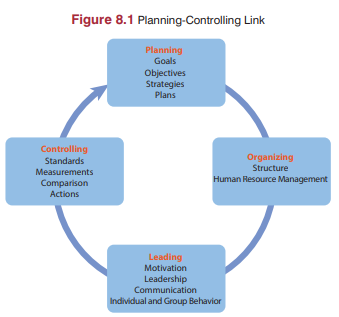
Soru 35
Which of the following is not one of the steps of the control process?
Seçenekler
A
Establish standards and methods to measure performance
B
Measure performance
C
Compare what is expected to what is realized
D
Scoring the poor performance
E
Take corrective action as needed
Açıklama:
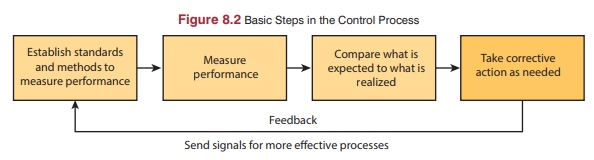
Soru 36
Which of the following is not one of the standards that managers can establish about the operative goals?
Seçenekler
A
Profitability standards
B
Managerial development standards
C
Market position standards
D
Productivity standards
E
Product leadership standards
Açıklama:
Managers determine all important areas of organizational performance and establish corresponding standards in each area. Managers can establish different kinds of standards related to operative goals. Some examples include the following:
• Profitability standards
• Market position standards
• Productivity standards
• Product leadership standards
• Employee development standards
• Social responsibility standards
• Profitability standards
• Market position standards
• Productivity standards
• Product leadership standards
• Employee development standards
• Social responsibility standards
Soru 37
What is the most basic advantage of "Immediate corrective action" over "Basic corrective action"?
Seçenekler
A
It makes the company easy to manage
B
It can be done anyone on duty
C
It helps consumers make more profit
D
It facilitates providing feedback about the performance
E
It makes it possible to get performance back on track.
Açıklama:
Immediate corrective action corrects problems at once to get performance back on track. Basic corrective action looks at how and why performance deviated before correcting the source of deviation.
Soru 38
"Tactical control ..............."
Which of the following most appropriately completes the sentence above?
Which of the following most appropriately completes the sentence above?
Seçenekler
A
is the assessment and regulation of the day-to-day functions of the organization and its major units during the implementation of its strategies.
B
regulates the activities or methods an organization uses to produce the goods and services it supplies to its customers.
C
is designed to detect and anticipate deviations from standards at various points before relevant work is performed.
D
is post-performance controls as the control takes place after the activity has been completed.
E
is a specialized form of management control. It is the assessment and regulation of how the organization as a whole fits its external environment and meets its long-term objectives and goals
Açıklama:
Tactical control is the assessment and regulation of the day-to-day functions of the organization and its major units during the implementation of its strategies. The most common types of tactical control systems are financial controls, budgets, the supervisory structure, and human resource policies and procedures. Financial and budgetary control contains elements of both strategic and tactical control systems. To the extent they focus on the entire organization, they tend to be more toward the strategic end of the continuum. The more they focus on specific units within an overall organization, they tend to be toward the tactical end. We choose to discuss them in this section since they focus on organizational units but note that they can also be used for some strategic control considerations.
Soru 39
Which of the following is true about "Strategic budgets"?
Seçenekler
A
Strategic budgets are short-term financial plans to coordinate activities needed to achieve the short-term goals of a company.
B
Strategic budgets are long-term financial plans to coordinate the activities needed to achieve long-term goals of a company.
C
Strategic budgets are the sets of budgets that forecast revenues and expenses such as sales revenue, cost of goods sold and operating expenses
D
Strategic budgets are used in the process of setting targets for an organization’s expenditures, monitoring results and comparing them to the budget, and making changes as needed.
E
Strategic budgets include three separate but interdependent budgets: the operating budget; the capital expenditures budget; and the financial budget.
Açıklama:
There are different purposes for budgeting; therefore, there can be different types of budgets. Budgets can be classified as strategic and operational budgets on a time basis. While strategic budgets are long-term financial plans to coordinate the activities needed to achieve long-term goals of a company, operational budgets are short-term financial plans to coordinate activities needed to achieve the short-term goals of a company.
Soru 40
Which of the following is true about "Total Cost"?
Seçenekler
A
Some examples of the total cost are insurance, interest expense, property taxes, utility expenses, and depreciation of assets
B
A total cost is a cost that does not change with an increase or decrease in the amount of goods or services produced.
C
Total costs will vary depending on a company’s production volume and they rise as production increases and fall as production decreases
D
The total cost is simply the sum of fixed and variable costs associated with production at a certain level of output.
E
An expense that fluctuates with the number of products produced is a total cost
Açıklama:
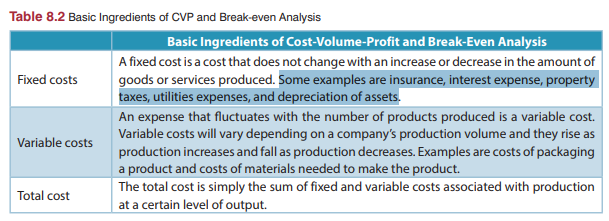
Soru 41
............... is a predetermined price, cost, or quantity which is expected under regular conditions?
Seçenekler
A
A benchmark
B
Performance
C
A standard
D
Strategic planning
E
A corrective action
Açıklama:
A standard is a predetermined price, cost, or quantity which is expected under regular conditions.
Soru 42
............... is a process, effected by an entity’s board of directors, management, and other personnel, designed to provide reasonable assurance regarding the achievement of objectives relating to operations, reporting, and compliance?
Seçenekler
A
Risk management
B
Internal auditing
C
Organizing
D
Internal control
E
Feedback controls
Açıklama:
Internal control is a process, effected by an entity’s board of directors, management, and other personnel, designed to provide reasonable assurance regarding the achievement of objectives relating to operations, reporting, and compliance.
Soru 43
Which of the following is not one of five components of an effective internal control system?
Seçenekler
A
Risk assessment
B
Information and communication
C
Monitoring
D
Controlling the environment
E
Planning
Açıklama:
In an “effective” internal control system, the following five components work to support the achievement of an entity’s mission, strategies, and related business objectives:
1. Control Environment
2. Risk Assessment
3. Control Activities
4. Information and Communication
5. Monitoring
1. Control Environment
2. Risk Assessment
3. Control Activities
4. Information and Communication
5. Monitoring
Soru 44
I. Protect the company’s assets against waste, fraud, and inefficiency
II. Ensure the reliability and integrity of accounting and operating data
III. Promote operational efficiency
IV. Ensure that operations comply with all existing rules and regulations
Which of the above can be considered objectives of internal control?
II. Ensure the reliability and integrity of accounting and operating data
III. Promote operational efficiency
IV. Ensure that operations comply with all existing rules and regulations
Which of the above can be considered objectives of internal control?
Seçenekler
A
I and II
B
I and III
C
I, II and III
D
I, II and IV
E
I, II, III and IV
Açıklama:
Internal control consists of a set of rules, procedures and organizational structures which aim to:
• Protect the company’s assets against waste, fraud, and inefficiency.
• Ensure the reliability and integrity of accounting and operating data.
• Promote operational efficiency.
• Ensure that operations comply with all existing rules and regulations.
• Protect the company’s assets against waste, fraud, and inefficiency.
• Ensure the reliability and integrity of accounting and operating data.
• Promote operational efficiency.
• Ensure that operations comply with all existing rules and regulations.
Soru 45
Company A is having problems with the profitability of Service X and hoping to bring a new service, Service Y, to the market. What types of managerial control would you recommend to Company A to (1) increase the profitability of Services X and (2) to ensure a smooth entry to the market for Service Y?
Seçenekler
A
Feedforward control for Service X and concurrent control for Service Y
B
Feedforward control for Service X and feedback control for Service Y
C
Concurrent control for Service X and feedback control for Service Y
D
Concurrent control for Service X and feedforward control for Service Y
E
Feedback control for Service X and concurrent control Service Y
Açıklama:
Concurrent controls apply to business operations as they happen. In order to increase the profitability of Service X, concurrent controls must be used, since the operations are already ongoing.
Feedforward controls or pre controls are designed to detect and anticipate deviations from standards at various points before relevant work is performed. Therefore Company A should use feedforward controls before they launch Service Y to the market.
Feedforward controls or pre controls are designed to detect and anticipate deviations from standards at various points before relevant work is performed. Therefore Company A should use feedforward controls before they launch Service Y to the market.
Soru 46
Which of the following statement is not correct?
Seçenekler
A
Tactical controls relate to specific and functional areas whereas strategic controls relate the organization as a whole.
B
Strategic control is used for the implementation of strategy whereas tactical and operational controls deal assess the day-to-day functions of the organization.
C
In tactical control, comparisons are made within the organization whereas strategic controls make comparisons to other organizations.
D
Strategic controls are broader in scope when compared to tactical and operational controls.
E
Tactical controls have a limited time frame as opposed to strategic controls that have a long and unspecific time frame.
Açıklama:
Strategic control deals with determination of overall organizational strategy and tactical controls are used to implement that strategy.
Soru 47
Which of the below is not one of the four perspectives of the balanced scorecard?
Seçenekler
A
The competitors perspective
B
The financial performance perspective
C
The internal business process perspective
D
The customer service
E
Organization's potential for learning and growth
Açıklama:
The four perspectives of the balanced scorecard are financial performance; customer service; internal business processes; and the organization’s capacity for learning and growth.
Soru 48
The acid-test ratio aims to determine if a company has sufficient short-term assets to cover its short-term liabilities. Unlike the current ratio, the acid-test ratio pays attention to only cash and cash equivalents, marketable securities and accounts receivables and their proportion to current liabilities. Therefore, the acid-test ratio is ...............?
Seçenekler
A
An activity ratio
B
A profitability ratio
C
A liquidity ratio
D
A leverage ratio
E
A solvency ratio
Açıklama:
Liquidity ratios measure an organization’s ability to meet its current debt obligations. For example, the current ratio (current assets divided by current liabilities) tells whether a company has sufficient current assets to convert into cash to pay off its debts. The acid-test ratio is a more focused version of current ratio, as explained in the question.
Soru 49
What are two different approaches to evaluating and controlling a team or individual performance and allocating rewards?
Seçenekler
A
Performance control and internal control
B
Behavior control and internal control
C
Outcome control and performance control
D
Behavior control and outcome control
E
Behavior control and performance control
Açıklama:
There are two different approaches to evaluating and controlling a team or individual performance and allocating rewards. One approach focuses primarily on how people do their jobs, whereas the other focuses primarily on the outcomes that people produce. First is behavior control and the second is outcome control.
Soru 50
Continuous improvement, Six Sigma principles, benchmarking and reduced cycle time are some of the techniques used in ...............?
Seçenekler
A
CVP Analysis
B
ABC
C
TQM
D
BEP
E
JIT
Açıklama:
The implementation of total quality management involves the use of many techniques such as quality circles, benchmarking, Six Sigma principles, reduced cycle time, and continuous improvement.