Busıness Fınance II (ENG) - Tüm Sorular
Ünite 1
Soru 1
What is included in internal cash flow?
Seçenekler
A
Internal cash flow is generated from retained earnings and depreciation.
B
Internal cash flow is existing capital structure of the company,
C
Internal cash flow is availability of security.
D
These are generally in the forms of bank borrowing,
E
Internal cash flow is capital expenditures.
Açıklama:
Internal cash flow is generated from retained earnings and depreciation.
Soru 2
What is long term financing?
Seçenekler
A
The long-term financial requirements are the internal sources such as retained earning and depreciation provide financing to the corporate.
B
The long-term financial requirement means the finance needed to acquire land and building for business concern, purchase of plant and machinery and other fixed expenditures.
C
Long term financing is legal and tax issues.
D
Long term financing is bank lending capacity and relation with banks.
E
The Long term financing is based on the same principle as the revolving loans, but the limit of the credit is set as a debit of a company’s current account.
Açıklama:
The long-term financial requirement means the finance needed to acquire land and building for business concern, purchase of plant and machinery and other fixed expenditures. Long-term loans (payback period over 5 years, up to about 30 years such as for mortgage credits.
Soru 3
What happens when you have an overdraft?
Seçenekler
A
If you try to use your debit card when there is not enough money in your account to cover the transaction and your account can allow overdrawing to pay later without interest.
B
If your bank does pay your overdraft, you will not be charged a hefty fee for each overdraft transaction.
C
If the limit is overdrawn, the borrower pays a penalty interest rate.
D
Select the current account you would like to see the overdraft limit for.
E
Even if your current account is always in credit, it can be a good idea to have an overdraft facility arranged with your bank.
Açıklama:
The bank overdraft is based on the same principle as the revolving loans, but the limit of the credit is set as a debit of a company’s current account. If the limit is overdrawn, the borrower pays a penalty interest rate. Loans are granted by financial institutions after a client presents anapplication form.
Soru 4
How do bank fees work?
Seçenekler
A
Inflation will also affect interest rate levels.
B
Interest rate risk is the probability of a decline in the value of an asset resulting from unexpected fluctuations in interest rates.
C
Ask for accounts for older people or students.
D
Bank fees and charges are determined depending on the type of loan and on the lender.
E
Compare banks with similar features.
Açıklama:
Other fees and charges are determined depending on the type of loan and on the lender. Arrangement fees are commitment or administration charges payable to the lender to reserve the funds. Fees will vary depending on the complexity of the business, its size, and risk. Interest is charged and will vary dependingon risk of default.
Soru 5
What is differency between debt and equity?
Seçenekler
A
Debt is an ownership interest, equity represents an ownership of company.
B
The corporation’s payment of interest on debt is considered a cost of doing business but is not fully tax deductible.
C
One of the costs of issuing debt represents the possibility of financial success.
D
Equity can be in the form of term loans, debentures, and bonds, but dept can be in the form of shares and stock.
E
Debt holders are the creditors, whereas equityholders are the owners of the company.
Açıklama:
The main differences between debt and equity are the following:
• Debt is not an ownership interest in the firm. Creditors do not generally have votingpower.
• The corporation’s payment of interest ondebt is considered a cost of doing business and is fully tax deductible. Dividends paid to stockholders are not tax deductible.
• Unpaid debt is a liability of the firm. If itis not paid, the creditors can legally claim the assets of the firm. This action can result in liquidation or reorganization, two of the possible consequences of bankruptcy. Thus, one of the costs of issuing debt is the possibility of financial failure. This possibility does not arise when equity is issued.
• Debt is not an ownership interest in the firm. Creditors do not generally have votingpower.
• The corporation’s payment of interest ondebt is considered a cost of doing business and is fully tax deductible. Dividends paid to stockholders are not tax deductible.
• Unpaid debt is a liability of the firm. If itis not paid, the creditors can legally claim the assets of the firm. This action can result in liquidation or reorganization, two of the possible consequences of bankruptcy. Thus, one of the costs of issuing debt is the possibility of financial failure. This possibility does not arise when equity is issued.
Soru 6
What do you mean by optimal capital structure?
Seçenekler
A
Optimum capital structure is the capital structure at which the weighted average cost of capital is minimum and thereby the value of the firm is maximum.
B
An optimal capital structure is the best mix of debt.
C
A company's capital structure is arguably one of its most important choices.
D
The capital structure is how a firm finances its overall operations and growth by using different sources of funds.
E
The capital structure is defined as the careful balance between equity and debt.
Açıklama:
The decision to issue security in the form of debt or stock depends on the optimal capital structure of a corporate. The capitalization of a company can be defined as the balance sheet value of stocks and bonds outstanding. In this framework, capital structure refers to the kinds of securities and the proportionate amounts that make up capitalization.
Soru 7
What is a Eurobond?
Seçenekler
A
International bonds are issued in a country by a domestic entity.
B
A Eurobond is a bond issued in multiple countries but denominated in a single currency and those bonds have become an important way to raise capital for many international companies and governments.
C
A Eurobond is denominated in returnsas the company's stock other than that, of its country of issue.
D
Eurobond the stock market is unpredictable it is very easy to lose money by investing in the wrong stocks.
E
A Eurobond is an national bond that is denominated in a currency not native to the country where it is issued.
Açıklama:
A Eurobond is a bond issued in multiple countries but denominated in a single currency and those bonds have become an important way to raise capital for many international companies and governments. A Eurobond was once defined as a debt instrument underwritten by an international syndicate and offered for sale immediately in a number of countries. Eurobonds are issued outside the restrictions that apply to domestic offerings and are syndicated and traded mostly from London. However, trading can and does take place anywhere there are buyers and sellers.
Soru 8
what is common stock?
Seçenekler
A
A common stock is a representation of partial dept in a company, and is the dept of company.
B
If the company issues only common stock, with preferred shares then common stock equals the proffered shares.
C
A company's book value is equal to a company's assets minus its liabilities and found on the company's balance sheet.
D
Common stock, also named as equity shares, represents equity or an ownership position in a corporation.
E
The most common measure of a stock is the price/earnings ratio, which takes the share price and divides it by a company's annual net income.
Açıklama:
Common stock, also named as equity shares, represents equity or an ownership position in a corporation. The conceptual structure of the corporation assumes that shareholders elect directors who, in turn, hire management to carry out their directives. Shareholders, therefore, control the corporation through the right to elect the directors.
Soru 9
What is the concept of leasing?
Seçenekler
A
A lease is a contract outlining the terms under which one party agrees to give property owned by another party.
B
Known as the owner, buying of an asset and guarantees the seller the property owner or landlord, regular payments from the buyer for a specified number of months or years.
C
A lease agreement is a contract between a landlord and a buyer that covers the selling of property for long periods of time.
D
Vehicle using is the leasing of a motor vehicle for a fixed period of time at an agreed amount of money for the using.
E
A lease is a contractual agreement between a lessee and lessor establishing that the lessee has the right to use an asset and in return must make periodic payments to the lessor who is the owner of the asset.
Açıklama:
A lease is a contractual agreement between a lessee and lessor establishing that the lessee has the right to use an asset and in return must make periodic payments to the lessor who is the owner of the asset. The lessor is either the asset’s manufacturer or an independent leasing company.
Soru 10
How do floating rate bonds work?
Seçenekler
A
By the time the changing interest environment in the international financial markets, floating rate bonds (floaters) began to be issued in which, the coupon payments are adjustable.
B
A floating rate bond, where the bond has five years until maturity.
C
Some characteristics of the floaters have been developed in order to protect the investors.
D
A floating rate fund is a fund that invests in financial instruments paying but a fixed interest rate.
E
Floating rate notes are bonds that have a variable coupon, equal to a money market reference rate.
Açıklama:
The bonds conventionally have fixed interest payments up to maturity as calculated based on the fixed par value. However, by the time the changing interest environment in the international financial markets, floating-rate bonds (floaters) began to be issued in which, the coupon payments are adjustable. The adjustments are tied to an interest rate index such as the Treasury bill interest rate or the 30-year Treasury bond rate and the value of a floating-rate bond depends on exactly how the coupon payment adjustments are defined.
Soru 11
- Retained Earnings
- Depreciation
- Short-term Borrowings
- Long-term Debt
- Equity Finance
Seçenekler
A
I and II
B
I and III
C
II and III
D
I, II and IV
E
III, IV and V
Açıklama:
The financial management of a company requires the management of funds’ uses as well as optimizing the funding of those uses. The uses of cash flows are for net working capital and others and also for capital expenditures. In order to fund those uses, there exist two types of cash sources. Internal cash flow is generated from retained earnings and depreciation. External cash flow is generated from short-term borrowings and long-term debt and equity finance. As can also be understood from the information given, “short-term borrowings” , “long-term debt” and “equity finance” are the cash sources which external cash flow is generated from, so the correct answer is E.
Soru 12
- Debt Issuance
- Equity Finance
- Securitization
- Retained Earning
- Depreciation
Seçenekler
A
I and II
B
IV and V
C
I, II and III
D
III, IV and V
E
II, III, IV and V
Açıklama:
For funding investments and/or other cash uses by medium and long-term sources, the companies have four different alternatives. These are generally in the forms of bank borrowing, borrowing from special institutions, debt issuance and equity finance, securitization. Furthermore, depending on the peculiarities of the funding needs leasing can be another source of medium and long-term financing. Additionally, the internal sources such as Retained Earning and Depreciation provide financing to the corporate. As can also be understood from the information given “Retained Earning” and “Depreciation” are the internal sources which provide financing to the corporate, so the correct answer is B.
Soru 13
- Classical Loans
- Revolving Credits
- Bank Overdraft
- Project Loans
- Syndication Loans
Seçenekler
A
I and II
B
II and III
C
II and V
D
III and IV
E
IV and V
Açıklama:
According to the type of drawing and paying back, the loans are categorized as classical, revolving credits, bank overdraft, project loans, and syndication loans.
- With “classical” loans, after the drawing phase, the principal is paid gradually or by a single payment until a zero balance is achieved together with the interest for the period.
- With revolving credits, a limit of credit is set on the credit account of the borrower and both limits of credit and the due date are determined in a loan agreement. From concluding a loan contract till maturity date the borrower can draw the credit repeatedly within the limit.
- The bank overdraft is based on the same principle as the revolving loans, but the limit of the credit is set as a debit of a company’s current account. If the limit is overdrawn, the borrower pays a penalty interest rate. Loans are granted by financial institutions after a client presents an application form.
- The main medium and long term funding provided by banks are in the form of Project Finance. Project finance is the process of financing a specific economic unit that the sponsors create, in which creditors share much of the venture’s business risk and funding is obtained strictly for the project itself.
- Syndication loans are credits granted by a group of banks to a borrower. In a syndication loan, two or more banks agree jointly to make a loan to a borrower.
Soru 14
- Debt is not an ownership interest in the firm.
- The corporation’s payment of interest on debt is considered a cost of doing business and is fully tax deductible.
- Creditors do not generally have voting power.
- Dividends paid to stockholders are tax deductible.
- Unpaid debt is a liability of the firm.
Seçenekler
A
I and II
B
I and III
C
I, II and IV
D
I, II, III and V
E
II, III, IV and V
Açıklama:
Securities issued by corporations may be classified roughly as equity securities or debt securities. The main differences between debt and equity are the following:
- Debt is not an ownership interest in the Creditors do not generally have voting power.
- The corporation’s payment of interest on debt is considered a cost of doing business and is fully tax deductible. Dividends paid to stockholders are not tax deductible.
- Unpaid debt is a liability of the If it is not paid, the creditors can legally claim the assets of the firm. This action can result in liquidation or reorganization, two of the possible consequences of bankruptcy. Thus, one of the costs of issuing debt is the possibility of financial failure. This possibility does not arise when equity is issued.
Soru 15
- Desired Level of Leverage
- Nature of the business
- Size of the company
- Legal requirements
- Requirement of investors
Seçenekler
A
I and II
B
II and V
C
II, III and IV
D
I, III, IV and V
E
II, III, IV and V
Açıklama:
The following factors are considered while deciding the capital structure of the firm:
- Desired Level of Leverage: Financially, leverage refers to furnish the ability to use assets or funds with a fixed cost to increase the return to its shareholders. It is the basic and important factor, which affects the capital structure. It uses fixed-cost financing such as debt, equity and preference share capital and closely related to the overall cost of capital.
- Cost of Capital: Cost of capital is the main determining factor of the capital structure of a firm. Normally long-term finance such as equity and debt consist of fixed cost security issuance. When the cost of capital increases, the value of the firm will also decrease.
- Nature of the business: Use of fixed interest/dividend bearing finance depends upon the nature of the business. If the business consists of a long period of operation, it will apply for equity than debt, and it will reduce the cost of capital.
- Size of the company: It also affects the capital structure of a firm. If the firm belongs to a large scale, it can manage the financial requirements with the help of internal sources. Wheraes, if it is small size, they will go for external finance. It consists of a high cost of capital.
- Legal requirements: Some companies, such as banks are legally restricted to raise funds from some sources.
- Requirement of investors: In order to collect funds from a different type of investors, it will be appropriate for companies to issue different sources of securities.
Soru 16
- Debt securities are typically called notes, debentures, or bonds depending on their peculiarities.
- Issues with an original maturity of 10 years or less are often called bonds
- Longer-term issues are called notes.
- Long-term debt can be issued in two different forms, public-issue and privately-placed.
- Although the major terms and conditions are the same, under privately placed issues all of the bonds are sold to a single lender, not offered to the public.
Seçenekler
A
I and II
B
I, II and III
C
I, IV and V
D
I, II, IV and V
E
II, III, IV and V
Açıklama:
Debt securities are typically called notes, debentures, or bonds depending on their peculiarities. Despite the fact that a bond is a secured debt, it generally refers to all kinds of secured and unsecured debt. The difference between notes and bonds is the original maturity. Issues with an original maturity of 10 years or less are often called notes, longer-term issues are called bonds.
As can also be understood from the information given the statements “Debt securities are typically called notes, debentures, or bonds depending on their peculiarities.”, “Long-term debt can be issued in two different forms, public-issue and privately-placed.” and “Although the major terms and conditions are the same, under privately placed issues all of the bonds are sold to a single lender, not offered to the public.” are correct, so the correct answer is C.
The statements “Issues with an original maturity of 10 years or less are often called bonds” and “Longer-term issues are called notes.” are not correct. . Issues with an original maturity of 10 years or less are often called notes, longer-term issues are called bonds.
As can also be understood from the information given the statements “Debt securities are typically called notes, debentures, or bonds depending on their peculiarities.”, “Long-term debt can be issued in two different forms, public-issue and privately-placed.” and “Although the major terms and conditions are the same, under privately placed issues all of the bonds are sold to a single lender, not offered to the public.” are correct, so the correct answer is C.
The statements “Issues with an original maturity of 10 years or less are often called bonds” and “Longer-term issues are called notes.” are not correct. . Issues with an original maturity of 10 years or less are often called notes, longer-term issues are called bonds.
Soru 17
- The Par Value of a Bond
- The Face Value
- Common Stock
- Collateral
- Lease
Seçenekler
A
I and II
B
I and V
C
II and III
D
III and IV
E
IV and V
Açıklama:
The par value of a bond is almost always the same as the face value, and the terms are used interchangeably, so the correct answer is A.
Common stock, also named as equity shares, represnts equity or an ownership position in a corporation.
Collateral is a general term that frequently means securities that are pledged as security for payment of debt.
A lease is a contractual agreement between a lessee and lessor establishing that the lessee has the right to use an asset and in return must make periodic payments to the lessor who is the owner of the asset.
Common stock, also named as equity shares, represnts equity or an ownership position in a corporation.
Collateral is a general term that frequently means securities that are pledged as security for payment of debt.
A lease is a contractual agreement between a lessee and lessor establishing that the lessee has the right to use an asset and in return must make periodic payments to the lessor who is the owner of the asset.
Soru 18
- The basic terms of the bonds
- The total amount of bonds issued
- A description of property used as security
- The repayment arrangements
- The call provisions
- Details of the protective covenants
Seçenekler
A
I and II
B
I, II and III
C
III, IV and V
D
I, III, IV, V and VI
E
I, II, III, IV, V and VI
Açıklama:
The bond indenture is a legal document. It can run in several hundred pages it generally includes the following provisions:
- The basic terms of the bonds
- The total amount of bonds issued
- A description of property used as security
- The repayment arrangements
- The call provisions
- Details of the protective covenants
Soru 19
- No fixed dividend payment obligation
- Irredeemable
- Obstacles in Managemeent
- Limited Income to Investor
- Loss of Leverage Contributions
Seçenekler
A
I and II
B
II and III
C
I, III and IV
D
I, II, III and IV
E
II, III, IV and V
Açıklama:
Common stock is the most common security to provide finance for the corporate. This way of financing has the following disadvantages:
Irredeemable: Common stock cannot be redeemed during the lifetime of the company. Over capitalization is a very costly phenomenon financially so all companies must search for optimum capital structure.
Obstacles in management: Common stock holders can put obstacles in management by manipulation and organizing themselves. The managers may use their power in such ways that are against the wealth of the shareholders.
Limited income to investor: The investors who desire to invest in safe securities with a fixed income have no attraction for equity shares.
Loss of leverage contributions: When the company raises capital only with the help of equity, the company cannot take advantage of leverage
“Irredeemable”, “Obstacles in management”, “Limited income to investor” and “Loss of leverage contributions” are disadvantages of common stock, so the correct answer is E. “No fixed dividend payment obligation” is one of the advantages of common stock.
Advantages of common stock are as follows:
Permanent sources of finance: Common stock is a long-term permanent nature of sources of finance; hence, it can be used for long-term or fixed capital requirement of the business.
No fixed dividend payment obligation: The issuance of common stock does not create any obligation to pay a fixed rate of dividend. If the company earns a profit, owners are eligible for profit, they are eligible to get dividend otherwise, and they cannot claim any dividend from the company.
Lower cost of capital: Cost of capital is the major factor, which affects the value of the company. A company with a strong capital base can secure funding less costly as the capital base is considered as a buffer for risks buy the debtors.
Retained earnings: When the company have more share capital, it will be suitable for retained earning which is the fewer cost sources of finance while compared to other sources of finance.
Irredeemable: Common stock cannot be redeemed during the lifetime of the company. Over capitalization is a very costly phenomenon financially so all companies must search for optimum capital structure.
Obstacles in management: Common stock holders can put obstacles in management by manipulation and organizing themselves. The managers may use their power in such ways that are against the wealth of the shareholders.
Limited income to investor: The investors who desire to invest in safe securities with a fixed income have no attraction for equity shares.
Loss of leverage contributions: When the company raises capital only with the help of equity, the company cannot take advantage of leverage
“Irredeemable”, “Obstacles in management”, “Limited income to investor” and “Loss of leverage contributions” are disadvantages of common stock, so the correct answer is E. “No fixed dividend payment obligation” is one of the advantages of common stock.
Advantages of common stock are as follows:
Permanent sources of finance: Common stock is a long-term permanent nature of sources of finance; hence, it can be used for long-term or fixed capital requirement of the business.
No fixed dividend payment obligation: The issuance of common stock does not create any obligation to pay a fixed rate of dividend. If the company earns a profit, owners are eligible for profit, they are eligible to get dividend otherwise, and they cannot claim any dividend from the company.
Lower cost of capital: Cost of capital is the major factor, which affects the value of the company. A company with a strong capital base can secure funding less costly as the capital base is considered as a buffer for risks buy the debtors.
Retained earnings: When the company have more share capital, it will be suitable for retained earning which is the fewer cost sources of finance while compared to other sources of finance.
Soru 20
- Retained earnings are one of the least costly sources of finance since it does not involve any floatation cost as in the case of raising funds by issuing different types of securities.
- Retained earnings are most useful to expansion and diversification of the business activities.
- If the companies use equity finance they have to pay a dividend.
- When the company uses the retained earnings as the sources of finance for their financial requirements, the cost of capital is more expensive than the other sources of finance.
- Retained earnings provide opportunities for evasion of excessive tax in a company when it has a small number of shareholders.
Seçenekler
A
I and II
B
I, III and IV
C
III, IV and V
D
I, II, III and V
E
I, II, III, IV and V
Açıklama:
Retained earnings are another method of internal sources of finance and it is basically an accumulation of profits by a company for its expansion and diversification activities. The advantages of retained earnings are stated below:
The statement “When the company uses the retained earnings as the sources of finance for their financial requirements, the cost of capital is more expensive than the other sources of finance.” is not correct, because “when the company uses the retained earnings as the sources of finance for their financial requirements, the cost of capital is very cheaper than the other sources of finance.” Hence the value of the share will increase.
- Retained earnings are most useful to expansion and diversification of the business activities.
- Retained earnings are one of the least costly sources of finance since it does not involve any floatation cost as in the case of raising funds by issuing different types of securities.
- If the companies use equity finance they have to pay a dividend. Instead, if the companies use debt finance, they have to pay interest. However, if the company uses retained earnings as sources of finance, they need not pay any fixed obligation regarding the payment of dividend or interest.
- Retained earnings allow the financial structure to remain completely flexible. The company need not raise loans for further requirements if it has retained earnings.
- When the company uses the retained earnings as the sources of finance for their financial requirements, the cost of capital is very cheaper than the other sources of finance. Hence the value of the share will increase.
- Retained earnings provide opportunities for evasion of excessive tax in a company when it has a small number of shareholders.
The statement “When the company uses the retained earnings as the sources of finance for their financial requirements, the cost of capital is more expensive than the other sources of finance.” is not correct, because “when the company uses the retained earnings as the sources of finance for their financial requirements, the cost of capital is very cheaper than the other sources of finance.” Hence the value of the share will increase.
Soru 21
I. Capital Expenditures
II. Net working capital + other uses
III. Short-term debt
IV. Internal Cash Flow (Retained earnings + Depreciation)
Which of the above are among the "uses of cash flow"?
II. Net working capital + other uses
III. Short-term debt
IV. Internal Cash Flow (Retained earnings + Depreciation)
Which of the above are among the "uses of cash flow"?
Seçenekler
A
I and II
B
III and IV
C
I, II and III
D
II, III and IV
E
I, II, III and IV
Açıklama:
"Short-term debt" and "Internal Cash Flow (Retained earnings + Depreciation)" are among the sources of cash flow.
Soru 22
I. Long-term debt and equity
II. Short-term debt
III. Net working capital + other uses
IV. Internal Cash Flow (Retained earnings + Depreciation)
Which of the above are among the "sources of cash flow"?
II. Short-term debt
III. Net working capital + other uses
IV. Internal Cash Flow (Retained earnings + Depreciation)
Which of the above are among the "sources of cash flow"?
Seçenekler
A
I and II
B
III and IV
C
I, II and IV
D
II, III and IV
E
I, II, III and IV
Açıklama:
"Net working capital + other uses" are among the uses of cash flow.
Soru 23
In which bank loan type, after the drawing phase, the principal is paid gradually or by a single payment until a zero balance is achieved together with the interest for the period?
Seçenekler
A
Classical
B
Revolving credits
C
Bank overdraft
D
Project loans
E
Syndication loans
Açıklama:
With “classical” loans, after the drawing phase, the principal is paid gradually or by a single payment until a zero balance is achieved together with the interest for the period.
Soru 24
In which bank loan type, a limit of credit is set on the credit account of the borrower and both limits of credit and the due date are determined in a loan agreement?
Seçenekler
A
Classical
B
Revolving credits
C
Bank overdraft
D
Project loans
E
Syndication loans
Açıklama:
With revolving credits, a limit of credit is set on the credit account of the borrower and both limits of credit and the due date are determined in a loan agreement.
Soru 25
I. Debt is not an ownership interest in the firm.
II. The corporation’s payment of interest on debt is considered a cost of doing business and is fully tax deductible.
III. Unpaid debt is a liability of the firm.
Which of the above are among the main differences between debt and equity?
II. The corporation’s payment of interest on debt is considered a cost of doing business and is fully tax deductible.
III. Unpaid debt is a liability of the firm.
Which of the above are among the main differences between debt and equity?
Seçenekler
A
Only I
B
Only III
C
I and II
D
II and III
E
I, II and III
Açıklama:
All the things mentioned are among the main differences between debt and equity.
Soru 26
I. Desired Level of Leverage
II. Cost of Capital
III. Nature of the Business
IV. Size of the Company
Which of the above are among the factors determining capital structure?
II. Cost of Capital
III. Nature of the Business
IV. Size of the Company
Which of the above are among the factors determining capital structure?
Seçenekler
A
I and II
B
III and IV
C
I, II and IV
D
II, III and IV
E
I, II, III and IV
Açıklama:
All of the factors mentioned are among the factors determining capital structure.
Soru 27
I. The basic terms of the bonds
II. The total amount of bonds issued
III. The repayment arrangements
IV. Details of the protective covenants
Which of the above are among the provisions the bond indenture includes?
II. The total amount of bonds issued
III. The repayment arrangements
IV. Details of the protective covenants
Which of the above are among the provisions the bond indenture includes?
Seçenekler
A
I and II
B
III and IV
C
I, III and IV
D
II, III and IV
E
I, II, III and IV
Açıklama:
The bond indenture is a legal document. It can run in several hundred pages it generally includes the following provisions:
1. The basic terms of the bonds.
2. The total amount of bonds issued.
3. A description of property used as security.
4. The repayment arrangements.
5. The call provisions.
6. Details of the protective covenants.
1. The basic terms of the bonds.
2. The total amount of bonds issued.
3. A description of property used as security.
4. The repayment arrangements.
5. The call provisions.
6. Details of the protective covenants.
Soru 28
I. The maturity of the shares
II. Residual claim on income
III. Right to control
IV. Voting rights
Which of the above are among the important features of common stock?
II. Residual claim on income
III. Right to control
IV. Voting rights
Which of the above are among the important features of common stock?
Seçenekler
A
I and II
B
III and IV
C
I, III and III
D
II, III and IV
E
I, II, III and IV
Açıklama:
All the things mentioned are among the important features of common stock.
Soru 29
I. Permanent sources of finance
II. Irredeemable
III. No fixed dividend payment obligation
IV. Lower cost of capital
Which of the above are among the advantages of common stock?
II. Irredeemable
III. No fixed dividend payment obligation
IV. Lower cost of capital
Which of the above are among the advantages of common stock?
Seçenekler
A
I and II
B
III and IV
C
I, III and IV
D
II, III and IV
E
I, II, III and IV
Açıklama:
"Irredeemable" is among the disadvantages of common stock.
Soru 30
I. Obstacles in management
II. Loss of leverage contributions
III. Retained earnings
IV. Lower cost of capital
Which of the above are among the disadvantages of common stock?
II. Loss of leverage contributions
III. Retained earnings
IV. Lower cost of capital
Which of the above are among the disadvantages of common stock?
Seçenekler
A
I and II
B
III and IV
C
I, II and IV
D
II, III and IV
E
I, II, III and IV
Açıklama:
"Retained earnings" and "Lower cost of capital" are among the advantages of common stock.
Soru 31
Which of the following is an internal source of cash flow?
Seçenekler
A
Short-term debt
B
Long-term debt
C
Equity
D
Retained earnings
E
Capital expenditure
Açıklama:
Retained earnings are undistritued profits which become part of eqity and they are sources of cash flows to the company.
Soru 32
Which stakeholders have the highest priority in terms of claims on the income of the company?
Seçenekler
A
Common stockholders
B
Preferred stockholders
C
Bond holders
D
Employees
E
Customers
Açıklama:
Equity shareholders (common stockholders) have the right to get income left after paying for bondholders, as well as the fixed rate of dividend to preference shareholders. Thus, bondholders have the highest priority. Neither employees nor customers have claims on th income of the company.
Soru 33
The right which allows current shareholders to purchase their proportionate number of shares in any new stock offering in order to maintain their ownership in the company is referred to as .......
Seçenekler
A
Pre-emptive right
B
Right to vote
C
Right to control the management
D
Right to receive claims on the income
E
Right to receive claims on the assets
Açıklama:
Pre-emptive right offers the existing shareholders the first opportunity to purchase additional equity shares in proportion to their current holding capacity.
Soru 34
The following sources of financing are tax deductible except for...........
Seçenekler
A
Issuing bonds
B
Issuing shares of stock
C
Medium-term bank loans
D
Lon-term bank loans
E
Short-term bank loans
Açıklama:
Debt financing is tax deductible. Thus, except for issuing shares of stock, which is equity financing, the other sources given are tax deductible.
Soru 35
What is the name of the account managed by the bond trustee for the purpose of repaying the bonds?
Seçenekler
A
Treasury stock
B
Retained earnings
C
Coupon payments
D
Sinking fund
E
Savings account
Açıklama:
A sinking fund is an account managed by the bond trustee for the purpose of repaying the bonds.
Soru 36
Which of the following are accepted to be one of the main causes of the 2008-2009 financial crises?
Seçenekler
A
Government bonds
B
Callable bonds
C
Convertable bonds
D
Premium bonds
E
Securitized bonds
Açıklama:
Asset-backed, or securitized, bonds have been frequently used since the 2000s by the borrowers and for several years, there has been rapid growth in so-called subprime mortgage loans, which are mortgages made to individuals with less than top-quality credit. Those kinds of bonds are accepted to be one of the main causes of 2008-2009 financial crises.
Soru 37
Which type of bonds are issued in a foreign currency to the investors in the country?
Seçenekler
A
Yankee bonds
B
Samurai bonds
C
Rembrandt
D
Bulldog bonds
E
Eurobonds
Açıklama:
A Eurobond is usually denominated in a currency (or unit of account) that is foreign to a large number of buyers. The other choices give are foreign bonds. A foreign bond is similar to a domestic bond except that the issuer of the foreign bond is a foreign entity. Hence they are issued in the domestic currency of the country in which they are issued.
Soru 38
A bond with ............. attached, the buyers also receive the right to purchase a predetermined number of shares of stock of the company at a fixed price per share over the subsequent life of the bond.
Seçenekler
A
options
B
convertible feature
C
warrant
D
covenant
E
debenture
Açıklama:
For a bond with warrants attached, the buyers also receive the right to purchase a predetermined number of shares of stock of the company at a fixed price per share over the subsequent life of the bond.
Soru 39
Capital structure is a mix of the following sources of financing except for.....
Seçenekler
A
Short-term loans
B
Long-term loans
C
Preffered stock
D
Common stock
E
Debentures
Açıklama:
Capital structure is the mix of different sources of long-term sources such as equity shares, preference shares, debentures, long-term loans, and retained earnings. Hence, it does not inlude short-term loans.
Soru 40
Which of the following are used to reduce the tax burden and overall profitability of the company?
Seçenekler
A
Retained earnings
B
Depreciation funds
C
Emergency funds
D
Sinking funds
E
Saving accounts
Açıklama:
Depreciation funds are used to reduce the tax burden and overall profitability of the company
Soru 41
I. retained earnings
II. short-term borrowings
III. long-term debt
IV. depreciation
V. equity finance
Which of the cash sources above are used to generate funds for internal cash flows?
II. short-term borrowings
III. long-term debt
IV. depreciation
V. equity finance
Which of the cash sources above are used to generate funds for internal cash flows?
Seçenekler
A
I and II
B
I and III
C
I and IV
D
II and V
E
III and V
Açıklama:
The financial management of a company requires the management of funds’ uses as well as optimizing the funding of those uses. The uses of cash flows are for net working capital and others and also for capital expenditures. In order to fund those uses, there exist two types of cash sources. Internal cash flow is generated from retained earnings and depreciation. External cash flow is generated from short-term borrowings and long-term debt and equity finance. The correct answer is C.
Soru 42
In common stocks, what is the terms used to refer to the legal right of the existing shareholders?
Seçenekler
A
Pre-emptive right
B
Limited liability
C
Residual claims on assets
D
Right to control
E
Voting rights
Açıklama:
Pre-emptive right: Equity shareholders have pre-emptive rights. The pre-emptive right is the legal right of the existing shareholders. It is attested by the company in the first opportunity to purchase additional equity shares in proportion to their current holding capacity. The correct answer is A.
Soru 43
Which of the following is not true about revolving loans?
Seçenekler
A
With revolving credits, a limit of credit is set on the credit account of the borrower.
B
The limits of credit and the is determined in a loan agreement.
C
From concluding a loan contract till maturity date the borrower can draw the credit repeatedly within the limit.
D
The limit of the credit is set as a debit of a company’s current account if the limit is overdrawn.
E
The due date is determined in a loan agreement.
Açıklama:
With revolving credits, a limit of credit is set on the credit account of the borrower and both limits of credit and the due date are determined in a loan agreement. From concluding a loan contract till maturity date the borrower can draw the credit repeatedly within the limit. The bank overdraft is based on the same principle as the revolving loans, but the limit of the credit is set as a debit of a company’s current account. The correct answer is D.
Soru 44
Which of the following is not among the ways that a project finance creates value?
Seçenekler
A
decreasing the leverage ratios
B
reducing the costs of funding
C
maintaining the sponsor’s financial flexibility
D
reducing corporate taxes
E
improving risk management
Açıklama:
Project finance is the process of financing a specific economic unit that the sponsors create, in which creditors share much of the venture’s business risk and funding is obtained strictly for the project itself. Project finance creates value by reducing the costs of funding, maintaining the sponsor’s financial flexibility, increasing the leverage ratios, avoiding contamination risk, reducing corporate taxes, improving risk management, and reducing the costs associated with market imperfections. The correct answer is A.
Soru 45
In regards with the main differences between debt and equity, which of the following is true?
Seçenekler
A
Debt is an ownership interest in the firm.
B
In debt, creditors generally have voting power.
C
Payment of interest on debt is fully tax deductible.
D
Unpaid debt is a liability of the creditors.
E
One of the costs of issuing equity is the possibility of financial failure.
Açıklama:
The main differences between debt and equity are the following:
• Debt is not an ownership interest in the firm. Creditors do not generally have voting power.
• The corporation’s payment of interest on debt is considered a cost of doing business and is fully tax deductible. Dividends paid to stockholders are not tax deductible.
• Unpaid debt is a liability of the firm. If it is not paid, the creditors can legally claim the assets of the firm. This action can result in liquidation or reorganization, two of the possible consequences of bankruptcy. Thus, one of the costs of issuing debt is the possibility of financial failure. This possibility does not arise when equity is issued.
The correct answer is C.
• Debt is not an ownership interest in the firm. Creditors do not generally have voting power.
• The corporation’s payment of interest on debt is considered a cost of doing business and is fully tax deductible. Dividends paid to stockholders are not tax deductible.
• Unpaid debt is a liability of the firm. If it is not paid, the creditors can legally claim the assets of the firm. This action can result in liquidation or reorganization, two of the possible consequences of bankruptcy. Thus, one of the costs of issuing debt is the possibility of financial failure. This possibility does not arise when equity is issued.
The correct answer is C.
Soru 46
What is the term used to define the decrease in the value of an asset due to wear and tear, lapse of time, obsolescence, exhaustion and accident?
Seçenekler
A
Depreciation
B
Interest
C
Arrangement fees
D
Covenant compliance costs
E
Flotation costs
Açıklama:
Depreciation funds are the major part of internal sources of finance, which is used to meet the working capital requirements of the business concern. Depreciation means a decrease in the value of an asset due to wear and tear, lapse of time, obsolescence, exhaustion and accident. Generally, depreciation is changed against fixed assets of the company at a fixed rate for every year. The correct answer is A.
Soru 47
Which of the following is true about retained earnings?
Seçenekler
A
As a source of finance, retained earnings include floatation costs.
B
When the retained earnings are used, companies need to pay both the interest and the dividend.
C
Retained earnings prevent the financial structure from remaining completely flexible.
D
They provide opportunities for evasion of excessive tax when it has a small number of shareholders.
E
In retained earnings, the cost of capital is much more expensive than other sources of finance.
Açıklama:
The advantages of retained earnings are stated below:
• Retained earnings are most useful to expansion and diversification of the business activities.
• Retained earnings are one of the least costly sources of finance since it does not involve any floatation cost as in the case of raising funds by issuing different types of securities.
• If the companies use equity finance they have to pay a dividend. Instead, if the companies use debt finance, they have to pay interest. However, if the company uses retained earnings as sources of finance, they need not pay any fixed obligation regarding the payment of dividend or interest.
• Retained earnings allow the financial structure to remain completely flexible. The company need not raise loans for further requirements if it has retained earnings.
• When the company uses the retained earnings as the sources of finance for their financial requirements, the cost of capital is very cheaper than the other sources of finance. Hence the value of the share will increase.
• Retained earnings provide opportunities for evasion of excessive tax in a company when it has a small number of shareholders.
The correct answer is D.
• Retained earnings are most useful to expansion and diversification of the business activities.
• Retained earnings are one of the least costly sources of finance since it does not involve any floatation cost as in the case of raising funds by issuing different types of securities.
• If the companies use equity finance they have to pay a dividend. Instead, if the companies use debt finance, they have to pay interest. However, if the company uses retained earnings as sources of finance, they need not pay any fixed obligation regarding the payment of dividend or interest.
• Retained earnings allow the financial structure to remain completely flexible. The company need not raise loans for further requirements if it has retained earnings.
• When the company uses the retained earnings as the sources of finance for their financial requirements, the cost of capital is very cheaper than the other sources of finance. Hence the value of the share will increase.
• Retained earnings provide opportunities for evasion of excessive tax in a company when it has a small number of shareholders.
The correct answer is D.
Soru 48
Which of the following is true about financial leases?
Seçenekler
A
Financial leases provide for maintenance and service by the lessor.
B
The lessee has the sole responsibility to make all payments.
C
The lessor has a right to renew the lease on expiration.
D
Generally, financial leases can be canceled easily.
E
Financial leases are partially amortized.
Açıklama:
Financial leases are basically a medium-term financing alternative referring to its basic characteristics indicated below:
• Financial leases do not provide for maintenance or service by the lessor.
• Financial leases are fully amortized.
• The lessee usually has a right to renew the lease on expiration.
• Generally, financial leases cannot be canceled. The lessee has the sole responsibility to make all payments.
The correct answer is B.
• Financial leases do not provide for maintenance or service by the lessor.
• Financial leases are fully amortized.
• The lessee usually has a right to renew the lease on expiration.
• Generally, financial leases cannot be canceled. The lessee has the sole responsibility to make all payments.
The correct answer is B.
Soru 49
Which of the following is an advantage of common stock?
Seçenekler
A
Being irredeemable
B
Obstacles in management
C
lack of fixed dividend payment obligation
D
Limited income to investor
E
Loss of leverage contributions
Açıklama:
Advantages of Common Stock Common stock is the most common security to provide finance for the corporate. This way of financing has the following advantages:
Permanent sources of finance: Common stock is a long-term permanent nature of sources of finance; hence, it can be used for long-term or fixed capital requirement of the business.
No fixed dividend payment obligation: The issuance of common stock does not create any obligation to pay a fixed rate of dividend. If the company earns a profit, owners are eligible for profit, they are eligible to get dividend otherwise, and they cannot claim any dividend from the company.
Lower cost of capital: Cost of capital is the major factor, which affects the value of the company. A company with a strong capital base can secure funding less costly as the capital base is considered as a buffer for risks buy the debtors.
Retained earnings: When the company have more share capital, it will be suitable for retained earning which is the fewer cost sources of finance while compared to other sources of finance.
The correct answer is C.
Permanent sources of finance: Common stock is a long-term permanent nature of sources of finance; hence, it can be used for long-term or fixed capital requirement of the business.
No fixed dividend payment obligation: The issuance of common stock does not create any obligation to pay a fixed rate of dividend. If the company earns a profit, owners are eligible for profit, they are eligible to get dividend otherwise, and they cannot claim any dividend from the company.
Lower cost of capital: Cost of capital is the major factor, which affects the value of the company. A company with a strong capital base can secure funding less costly as the capital base is considered as a buffer for risks buy the debtors.
Retained earnings: When the company have more share capital, it will be suitable for retained earning which is the fewer cost sources of finance while compared to other sources of finance.
The correct answer is C.
Soru 50
In common stocks, if the company is wound up, the ordinary or equity shareholders have the right to get the claims on assets. These rights are only available to the equity shareholders.
Which of the following terms is used to refer to this situation?
Which of the following terms is used to refer to this situation?
Seçenekler
A
The maturity of the shares
B
Right to control
C
Pre-emptive right
D
Residual claims on assets
E
Voting rigths
Açıklama:
Residual claims on assets: If the company is wound up, the ordinary or equity shareholders have the right to get the claims on assets. These rights are only available to the equity shareholders. The correct answer is D.
Soru 51
Which of the followings is not among the altenratives for funding investments and/or other cash uses by medium and long-term sources?
Seçenekler
A
Securitization.
B
Borrowing from special institutions.
C
Debt issuance and equity finance.
D
Trading of auto-issued bonds.
E
Bank borrowing.
Açıklama:
Page 3.
For funding investments and/or other cash uses by medium and long-term sources, the companies have four different alternatives. These are generally in the forms of bank borrowing, borrowing from special institutions, debt issuance and equity finance, securitization. Therefore, the correct option is D.
For funding investments and/or other cash uses by medium and long-term sources, the companies have four different alternatives. These are generally in the forms of bank borrowing, borrowing from special institutions, debt issuance and equity finance, securitization. Therefore, the correct option is D.
Soru 52
Which of the followings is one of the internal alternatives for the companies to fund their investments?
Seçenekler
A
Leasing.
B
Depreciation.
C
Securitization.
D
Debt issuance.
E
Equity finance.
Açıklama:
Page 3.
For funding investments and/or other cash uses by medium and long-term sources, the companies have four different alternatives. These are generally in the forms of bank borrowing, borrowing from special institutions, debt issuance and equity finance, securitization. Furthermore, depending on the peculiarities of the funding needs leasing can be another source of medium and long-term financing. Additionally, the internal sources such as Retained Earning and Depreciation provide financing to the corporate. Therefore, the correct option is B.
For funding investments and/or other cash uses by medium and long-term sources, the companies have four different alternatives. These are generally in the forms of bank borrowing, borrowing from special institutions, debt issuance and equity finance, securitization. Furthermore, depending on the peculiarities of the funding needs leasing can be another source of medium and long-term financing. Additionally, the internal sources such as Retained Earning and Depreciation provide financing to the corporate. Therefore, the correct option is B.
Soru 53
I. Legal and tax issues,
II. Availability of security,
III. Marginal benefit,
IV. Capital market depth.
Which of the ones listed above is among the important factors affecting the decision for finding resources for the companies to fund investments?
II. Availability of security,
III. Marginal benefit,
IV. Capital market depth.
Which of the ones listed above is among the important factors affecting the decision for finding resources for the companies to fund investments?
Seçenekler
A
I, II & III.
B
II, III & IV.
C
I, II & IV.
D
II & III.
E
I & IV.
Açıklama:
Page 3.
Some of the important factors affecting the decision amongst those alternatives are: • Peculiarities of the fund use (whether machinery or equipment purchase financing or construction, etc.)Some of the important factors affecting the decision amongst those alternatives are:
• Peculiarities of the fund use (whether machinery or equipment purchase financing or construction, etc.)
• Bank lending capacity and relation with banks,
• Availability of security,
• Existing capital structure of the company,
• Capital market depth,
• Financial climate (Boom or boost financial market conditions),
• Legal and tax issues,
• The approach of top management with regards to equity sharing.
Therefore, the correct option is C.
Some of the important factors affecting the decision amongst those alternatives are: • Peculiarities of the fund use (whether machinery or equipment purchase financing or construction, etc.)Some of the important factors affecting the decision amongst those alternatives are:
• Peculiarities of the fund use (whether machinery or equipment purchase financing or construction, etc.)
• Bank lending capacity and relation with banks,
• Availability of security,
• Existing capital structure of the company,
• Capital market depth,
• Financial climate (Boom or boost financial market conditions),
• Legal and tax issues,
• The approach of top management with regards to equity sharing.
Therefore, the correct option is C.
Soru 54
I. Short-term debt,
II. Long-term debt,
III. Depreciation,
IV. Retained earnings.
Which of the ones listed above is among the internal cash flow?
II. Long-term debt,
III. Depreciation,
IV. Retained earnings.
Which of the ones listed above is among the internal cash flow?
Seçenekler
A
I & II.
B
Only III.
C
II & IV.
D
I & IV.
E
III & IV.
Açıklama:
Page 3.
In order to fund those uses, there exist two types of cash sources. Internal cash flow is generated from retained earnings and depreciation. External cash flow is generated from short-term borrowings and long-term debt and equity finance. As a general principle, short-term uses are proposed to be financed by short-term sources and vice versa. Long-term uses of cash are basically for funding the future of the company by new investments. Therefore, the correct option is E.
In order to fund those uses, there exist two types of cash sources. Internal cash flow is generated from retained earnings and depreciation. External cash flow is generated from short-term borrowings and long-term debt and equity finance. As a general principle, short-term uses are proposed to be financed by short-term sources and vice versa. Long-term uses of cash are basically for funding the future of the company by new investments. Therefore, the correct option is E.
Soru 55
Which of the followings is an example of long-term loans?
Seçenekler
A
Mortgage.
B
Payday loans.
C
Credit card debts.
D
Revolving credits.
E
Overdraft.
Açıklama:
Page 3.
The funding provided by the banks are classified into short-term loans (payback period up to 1 year), medium-term loans (payback period 1 to 5 years) and long-term loans (payback period over 5 years, up to about 30 years such as for mortgage credits. Therefore, the correct option is A.
The funding provided by the banks are classified into short-term loans (payback period up to 1 year), medium-term loans (payback period 1 to 5 years) and long-term loans (payback period over 5 years, up to about 30 years such as for mortgage credits. Therefore, the correct option is A.
Soru 56
I. Surety for a person.
II. Feasibility,
III. Pledge,
IV. Leasing.
Which of the factors listed above is assessed by the banks while deciding on a loan?
II. Feasibility,
III. Pledge,
IV. Leasing.
Which of the factors listed above is assessed by the banks while deciding on a loan?
Seçenekler
A
I, II & III.
B
Only I.
C
II, III & IV.
D
Only II.
E
I, III & IV.
Açıklama:
Page 4.
Loans are granted by financial institutions after a client presents an application form. Before deciding about providing the loan, financial institutions consider all details of the client’s financial position, the feasibility of their business plans, and they require securing the loan with real estate (pledge), backing it by a third person (surety for a person), by a bank guarantee etc. Therefore, the correct option is A.
Loans are granted by financial institutions after a client presents an application form. Before deciding about providing the loan, financial institutions consider all details of the client’s financial position, the feasibility of their business plans, and they require securing the loan with real estate (pledge), backing it by a third person (surety for a person), by a bank guarantee etc. Therefore, the correct option is A.
Soru 57
Which of the followings is the main form that banks provide medium and long term funding?
Seçenekler
A
Leasing.
B
Project finance.
C
Classical loans.
D
Overdraft.
E
Revolving credits.
Açıklama:
Page 4.
The main medium and long term funding provided by banks are in the form of Project Finance. Project finance is the process of financing a specific economic unit that the sponsors create, in which creditors share much of the venture’s business risk and funding is obtained strictly for the project itself. Therefore, the correct option is B.
The main medium and long term funding provided by banks are in the form of Project Finance. Project finance is the process of financing a specific economic unit that the sponsors create, in which creditors share much of the venture’s business risk and funding is obtained strictly for the project itself. Therefore, the correct option is B.
Soru 58
Which of the followings is not among the possible costs considering long-term loans?
Seçenekler
A
Covenant compliance fees.
B
Arrangement fees.
C
Lease.
D
Professional advice.
E
Interest.
Açıklama:
Page 4.
Project finance transactions are complex undertakings, they have higher costs of borrowing when compared to conventional financing and the negotiation of the financing and operating agreements is time-consuming. The costs applicable loans can be in the forms of:
• interest
• arrangement fees
• covenant compliance costs
• professional advice.
Therefore, the correct option is C.
Project finance transactions are complex undertakings, they have higher costs of borrowing when compared to conventional financing and the negotiation of the financing and operating agreements is time-consuming. The costs applicable loans can be in the forms of:
• interest
• arrangement fees
• covenant compliance costs
• professional advice.
Therefore, the correct option is C.
Soru 59
Which of thefollowings is the type of loan which multple banks agree upon and undertake?
Seçenekler
A
Project finance.
B
Syndication loans.
C
Mortgage.
D
Bank overdraft.
E
Revolving credits.
Açıklama:
Page 5.
Syndication loans are credits granted by a group of banks to a borrower. In a syndication loan, two or more banks agree jointly to make a loan to a borrower. Every syndicate member has a separate claim on the debtor, although there is a single loan agreement contract. Therefore, the correct option is B.
Syndication loans are credits granted by a group of banks to a borrower. In a syndication loan, two or more banks agree jointly to make a loan to a borrower. Every syndicate member has a separate claim on the debtor, although there is a single loan agreement contract. Therefore, the correct option is B.
Soru 60
When debt and equity are considered, which of the followings is correct?
Seçenekler
A
Unpaid debt is a liability of the firm.
B
Debt is an ownership interest in the firm.
C
Creditors generally have voting power over debt.
D
Creditors cannot legally claim the assets of the firm over unpaid debt.
E
Interest on debt is not tax deductible.
Açıklama:
Page 6.
The main differences between debt and equity are the following:
• Debt is not an ownership interest in the firm. Creditors do not generally have voting power.
• The corporation’s payment of interest on debt is considered a cost of doing business and is fully tax deductible. Dividends paid to stockholders are not tax deductible.
• Unpaid debt is a liability of the firm. If it is not paid, the creditors can legally claim the assets of the firm. This action can result in liquidation or reorganization, two of the possible consequences of bankruptcy. Thus, one of the costs of issuing debt is the possibility of financial failure. This possibility does not arise when equity is issued.
Therefore, the correct option is A.
The main differences between debt and equity are the following:
• Debt is not an ownership interest in the firm. Creditors do not generally have voting power.
• The corporation’s payment of interest on debt is considered a cost of doing business and is fully tax deductible. Dividends paid to stockholders are not tax deductible.
• Unpaid debt is a liability of the firm. If it is not paid, the creditors can legally claim the assets of the firm. This action can result in liquidation or reorganization, two of the possible consequences of bankruptcy. Thus, one of the costs of issuing debt is the possibility of financial failure. This possibility does not arise when equity is issued.
Therefore, the correct option is A.
Ünite 2
Soru 1
What is the average cost of the mix of debt and equity?
Seçenekler
A
Cost of capital
B
Cost of debt
C
Cost of equity
D
Cost of common equity
E
Mrginal cost of capital
Açıklama:
Every business requires capital to invest. Therefore, capital is the most important factor of production and the cost of capital is the most significant determinant in investment decisions. The cost of capital is the average cost of the capital mix (the mix of debt and equity in financing decisions). The correct answer is A.
Soru 2
What is the weighted average cost of capital?
Seçenekler
A
The average cost of the capital mix
B
The weight of the debt component
C
The average cost of the different types of capital
D
The weight of the equity component
E
The return a company requires to decide
Açıklama:
Normally, a business follows a target capital structure, where the percentages of different financing sources are set in an effort to minimize the average cost of capital. The weighted average cost of capital (WACC) is the average cost of the different types of capital employed by the firm. The correct answer is C.
Soru 3
Which of the following equations is used to measure WACC?
Seçenekler
A 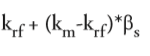
B 
C 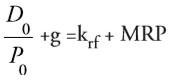
D 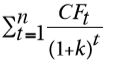
E 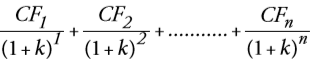
Açıklama:
The weighted average cost of capital (WACC) is the average cost of the different types of capital employed by the firm and is measured with the equation below:
where wD is the weight of the debt component and wCE is the weight of the equity component. T is the tax rate and after-tax cost of debt component is calculated by multiplying the before-tax cost of debt (kD) by the tax deductibility. Cost of equity component is denoted as kCE in the above equation. The correct answer is B.
where wD is the weight of the debt component and wCE is the weight of the equity component. T is the tax rate and after-tax cost of debt component is calculated by multiplying the before-tax cost of debt (kD) by the tax deductibility. Cost of equity component is denoted as kCE in the above equation. The correct answer is B.Soru 4
What is the benchmark rate that represents the interest rate at which banks offer to lend funds to one another in the international interbank market for short-term loans?
Seçenekler
A
Bond yield
B
Risk premium
C
Common equity
D
LIBOR
E
Risk free rate
Açıklama:
Banks borrow from international bank loans at floating rates and the index is almost always the LIBOR (London Interbank Offered Rate). LIBOR is a benchmark rate that represents the interest rate at which banks offer to lend funds to one another in the international interbank market for short-term loans. LIBOR is an average value of the interestrate which is calculated from estimates submitted by the leading global banks on a daily basis. The correct answer is D.
Soru 5
In which of the following is the interest rate floating and not fixed?
Seçenekler
A
Callable bonds
B
Convertible bonds
C
Preferred bonds
D
Bonds with sinking funds
E
Indexed bonds
Açıklama:
In bond issues, if the interest rate is floating and not fixed, then it is called as an indexed bond. The index can be any economic indicator but mostly it is a price index, such as the inflation rate, the oil price or the gold price index. The correct answer is E.
Soru 6
- They are issued without a maturity.
- The stockholder receives floating dividends that are deductible.
- In some ways, they resemble to bonds, in others to common stocks.
- Preferred dividends are paid out before the dividends to common stockholders.
Seçenekler
A
I and II
B
III and IV
C
I, II and III
D
I, III and IV
E
II, III and IV
Açıklama:
Preferred stocks;
- are issued without a maturity (I),
- resemble to bonds in some ways, in others to common stocks (III),
- require preferred dividends to be paid out before the dividends to common stockholders (IV).
Soru 7
XLM Corp. has a bond issue outstanding for which the yield-to-maturity is 8.45%. Analysts estimate a risk premium of 3.15% for the company's stock. What is the expected cost of equity of XLM according to the bond-yield-plus-risk-premium approach?
Seçenekler
A
05.53%
B
10.30%
C
11.60%
D
12.45%
E
14.90%
Açıklama:
The bond-yield-plus-risk-premium approach provides a practical but highly subjective solution to the estimation of the cost of equity. The approach is based upon adding up a risk premium over the firm’s bond yield. Thus, the cost of equity is calculated straightforward by the following simple computation:
 k= 0.0845 + 0.0315= 0.1160
According to the bond-yield-plus-risk-premium approach, XLM’s expected cost of equity is 11.60%. The correct answer is C.
k= 0.0845 + 0.0315= 0.1160According to the bond-yield-plus-risk-premium approach, XLM’s expected cost of equity is 11.60%. The correct answer is C.
Soru 8
Which of the following equations is used to adjust the cost of equity to flotation costs?
Seçenekler
A 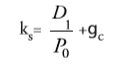
B 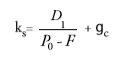
C 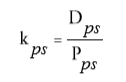
D 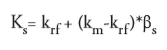
E 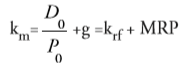
Açıklama:
Firms may also raise external equity capital by issuing new shares. In this case, the firm will have to incur some flotation (transaction) costs which will eventually raise the cost of equity. In order to adjust the cost of equity to flotation costs, we use the following equation:
where F shows the flotation costs incurred during the issue of the new shares. By incorporating the flotation costs in the model, the rise in the cost of equity after new stock offerings is accounted for. The correct answer is B.
where F shows the flotation costs incurred during the issue of the new shares. By incorporating the flotation costs in the model, the rise in the cost of equity after new stock offerings is accounted for. The correct answer is B.Soru 9
A & B Corp. has the following optimal capital structure:
- Long-term Debt 20%
- Preferred Stocks 10%
- Common Equity 40%
Seçenekler
A
4.24%
B
4.60%
C
5.46%
D
6.30%
E
8.14%
Açıklama:
The cost of each capital component is weighed at the proportions in the capital structure to quantify the firm’s WACC.
 , where wD is the weight of debt financing in the capital structure, kD is the cost component of debt funds, T is the tax rate, accordingly wPS is the weight of preferred stocks, kPS is its cost component, wCE is the weight of common equity and kCE is the cost of equity capital. Therefore;
WACC=0.20*0.07*(1-0.40)+0.10*0.13+0.40*0.15=0.0814
As it can be seen from the above calculation the WACC for A & B is 8.14%. The correct answer is E.
, where wD is the weight of debt financing in the capital structure, kD is the cost component of debt funds, T is the tax rate, accordingly wPS is the weight of preferred stocks, kPS is its cost component, wCE is the weight of common equity and kCE is the cost of equity capital. Therefore;WACC=0.20*0.07*(1-0.40)+0.10*0.13+0.40*0.15=0.0814
As it can be seen from the above calculation the WACC for A & B is 8.14%. The correct answer is E.
Soru 10
NEO Corp. has the following optimal capital structure:
- Long-term Debt 40%
- Preferred Stocks 30%
- Common Equity 60%
Seçenekler
A
15.80%
B
16.40%
C
18.50%
D
20.60%
E
22.70%
Açıklama:
The cost of each capital component is weighed at the proportions in the capital structure to quantify the firm’s WACC.
, where wD is the weight of debt financing in the capital structure, kD is the cost component of debt funds, T is the tax rate, accordingly wPS is the weight of preferred stocks, kPS is its cost component, wCE is the weight of common equity and kCE is the cost of equity capital. Therefore;
WACC=0.40*0.10*(1-0.35)+0.30*0.20+0.60*0.12=0.1580
As it can be seen from the above calculation the WACC for A & B is 15.80%. The correct answer is A.
, where wD is the weight of debt financing in the capital structure, kD is the cost component of debt funds, T is the tax rate, accordingly wPS is the weight of preferred stocks, kPS is its cost component, wCE is the weight of common equity and kCE is the cost of equity capital. Therefore;WACC=0.40*0.10*(1-0.35)+0.30*0.20+0.60*0.12=0.1580
As it can be seen from the above calculation the WACC for A & B is 15.80%. The correct answer is A.
Soru 11
Which of the following is a benchmark rate that represents the interest rate at which banks offer to lend funds to one another in the international interbank market for short-term loans?
Seçenekler
A
LIBOR
B
Convertible bond
C
Floating rates
D
Risk premium
E
Option
Açıklama:
LIBOR is a benchmark rate that represents the interest rate at which banks offer to lend funds to one another in the international interbank market for short-term loans.
Soru 12
XYZ Corp. borrows $200,000 as a bank loan at an annual interest rate of 10%. The company pays 25% corporate tax rate. What is the after-tax rate of borrowing for XYZ Corp.?
Seçenekler
A
0.025
B
0.05
C
0.075
D
0.1
E
0.15
Açıklama:
After-tax kD=kD*(1-T)
After-tax kD=0.10*(1-0.25)= 0.075
After-tax kD=0.10*(1-0.25)= 0.075
Soru 13
BB Corp. borrows $50,000 as a bank loan at an annual interest rate of 5%. The company pays 20% corporate tax rate. What is the after-tax rate of borrowing for BB Corp.?
Seçenekler
A
0.04
B
0.05
C
0.06
D
0.075
E
0.08
Açıklama:
After-tax kD=kD*(1-T)
After-tax kD=0.05*(1-0.20)= 0.05 * 0.80= 0.04
After-tax kD=0.05*(1-0.20)= 0.05 * 0.80= 0.04
Soru 14
- The cost of equity is the return a company requires to decide if an investment meets capital return requirements.
- A firm uses cost of equity to assess the relative attractiveness of investments
- A business can raise equity capital either through a common stock issue or a preferred stock issue.
Seçenekler
A
Only I
B
I and II
C
II and III
D
I and III
E
I, II and III
Açıklama:
- The cost of equity is the return a company requires to decide if an investment meets capital return requirements.
- A firm uses cost of equity to assess the relative attractiveness of investments
- A business can raise equity capital either through a common stock issue or a preferred stock issue.
Soru 15
Which of the following is not true for preferred stocks?
Seçenekler
A
Preferred stocks are hybrid assets
B
In some ways they resemble to bonds and in others to common stocks
C
Preferred dividends are paid out before the dividends to common stockholders.
D
Preferred stockholders have voting rights.
E
A preferred stockholder receives fixed preferred dividends that are not tax deductible.
Açıklama:
Preferred stockholders have higher claims on the earnings and the assets of the firm, though they have no voting rights.
Soru 16
ABC Corp. recently issued preferred stocks for raising additional $200,000 of equity funds. Investors bought each share paying a price of $100, however ABC had to incur 5% flotation costs on the preferred stock issue. The preferred dividends are $10 per share. What is the return of the preferred stockholders?
Seçenekler
A
%10
B
%12
C
%15
D
%18
E
%20
Açıklama:
= 10 / 100 = 0.10
Soru 17
ABC Corp. has a historical beta of 1.25 and the expected market return is 10%, whereas the risk free rate is 5%. What is the required return of the stockholders of ABC?
Seçenekler
A
0.1575
B
0.1525
C
0.1300
D
0.1215
E
0.1125
Açıklama:
k= 0.05 + (0.10-0.05)*1.25= 0.05 + 0.0625=0.1125
Soru 18
The marginal cost of capital (MCC) is the composite cost of the last dollar of new capital raised.
Seçenekler
A
Capital asset pricing model
B
Risk premium
C
Bond yield plus risk premium approach
D
Weighted average cost of capital
E
Marginal cost of capital
Açıklama:
The marginal cost of capital (MCC) is the composite cost of the last dollar of new capital raised.
Soru 19
- The WACC estimation should be based on the market values of the capital components.
- The weights of the capital components should not be computed on book values.
- In the evaluation of the capital budgeting projects, the WACC of the firm should be used as a decision criterion.
Seçenekler
A
Only I
B
I and II
C
II and III
D
I and III
E
I, II and III
Açıklama:
- The WACC estimation should be based on the market values of the capital components.
- The weights of the capital components should not be computed on book values.
- In the evaluation of the capital budgeting projects, the WACC of the firm should be used as a decision criterion.
Soru 20
ABC Corp. in the above example grows at 6%. Last year’s dividend was $1.50 per share and currently the stock sells at 29. If ABC issues new shares to raise external equity, flotation costs of $4/share will be incurred. What is the cost of external equity?
Seçenekler
A
0.0952
B
0.1015
C
0.1020
D
0.1125
E
0.1224
Açıklama:
(1.5 +( 1*0.06))/(29-4) =1.56 / 25=0.0624 +0.06 =0.1224
Soru 21
... is a benchmark rate that represents the interest rate at which banks offer to lend funds to one another in the international interbank market for short-term loans.
Seçenekler
A
FOREX
B
LIBOR
C
SWIFT
D
Licensing
E
Franchising
Açıklama:
LIBOR is a benchmark rate that represents the interest rate at which banks offer to lend funds to one another in the international interbank market for short-term loans.
Soru 22
If a company borrows 250.000 tl as a bank loan at an annual interest rate % 8. The company pays % 25 corporate tax rate. What will be the after-tax rate of borrowing for this company.
Seçenekler
A
0.04
B
0.60
C
0.06
D
0.40
E
0.66
Açıklama:
0.08 x (1 - 0.25)
0.08 x 0.75 = 0.06
0.08 x 0.75 = 0.06
Soru 23
... is the return a company requires to decide if an investment meets capital return requirements.
Which one of the following completes the sentence?
Which one of the following completes the sentence?
Seçenekler
A
Debt financing
B
A convertible bond
C
LIBOR
D
The cost of equity
E
FOREX
Açıklama:
The cost of equity is the return a company requires to decide if an investment meets capital return requirements.
Soru 24
Which one of the following estimates the required return of a stock investment in relation to its systematic risk which cannot be diversified away in a portfolio context?
Seçenekler
A
Capital asset pricing model
B
Cost of common equity
C
Bond-Yield-Plus-Risk-Premium approach
D
Dividend-growth model
E
Cost of preferred stocks
Açıklama:
The CAPM (Capital Asset Pricing Model) estimates the required return of a stock investment in relation to its systematic risk which cannot be diversified away in a portfolio context.
Soru 25
A corporation has a bond issue outstanding for which the yield-to-maturity is % 6.75. Analysts estimate a risk premium of % 4.80 of the company's stock. What is the expected cost of equity of this corporation?
Seçenekler
A
% 1.15
B
% 4.80
C
% 6.75
D
% 10.95
E
% 11.55
Açıklama:
k = 0.0675 + 0.0480
= 0.1155
% 11.55
= 0.1155
% 11.55
Soru 26
Which one of the following provides a practical but highly subjective solution to the estimation of the cost of equity?
Seçenekler
A
Cost of common equity
B
Capital asset pricing model
C
The bond-yield-plus-risk-premium approach
D
Dividend-growth model
E
Cost of preferred stocks
Açıklama:
The bond-yield-plus-risk-premium approach provides a practical but highly subjective solution to the estimation of the cost of equity.
Soru 27
... is an average value of the interest rate which is calculated from estimates submitted by the leading global banks on a daily basis.
Which one of the following completes the sentence?
Which one of the following completes the sentence?
Seçenekler
A
Franchise
B
LIBOR
C
SWIFT
D
Cost of equity
E
Bond yield
Açıklama:
LIBOR is an average value of the interestrate which is calculated from estimates submitted by the leading global banks on a daily basis.
Soru 28
Which one of the following is the uncertainty inherent to the entire market or entire market segment?
Seçenekler
A
Systematic risk
B
Capital asset pricing model
C
Cost of preferred stocks
D
A convertible bond
E
Risk premium
Açıklama:
Systematic risk is the uncertainty inherent to the entire market or entire market segment.
Soru 29
Which one of the following is the composite cost of the last dollar of new capital raised?
Seçenekler
A
Capital asset pricing model
B
Weighted average cost of capital
C
Bond-yield-plus-risk-premium
D
Dividend-growth model
E
The marginal cost of capital
Açıklama:
The marginal cost of capital (MCC) is the composite cost of the last dollar of new capital raised.
Soru 30
Which one of the following is a ratio measuring the profitability on equity capital and it is the division of the net income by the total common equity?
Seçenekler
A
Capital asset pricing model
B
Bond yield
C
Dividend payout ratio
D
Return on equity
E
Return on investment
Açıklama:
The ROE is a ratio measuring the profitability on equity capital and it is the division of the net income by the total common equity.
Soru 31
XYZ Corp. has a historical beta of 0.9 and the expected market return is 8%, whereas the risk-free rate is 2%. What is the required return of the stockholders of XYZ?
Seçenekler
A
7.2 %
B
7.4 %
C
5.4 %
D
9.2 %
E
10 %
Açıklama:
Using the CAPM formula, the required rate of return is 2 % + 0.9 * (8%-2%) = 7.4 %
Soru 32
Which of the following is the measure of sytematic risk of a stock?
Seçenekler
A
Alpha
B
Beta
C
Theta
D
Vega
E
Gamma
Açıklama:
Beta is s the measure of sytematic risk of a stock.
Soru 33
The return of the market in excess of the risk-free rate is referred to as .............
Seçenekler
A
Systematic risk
B
Unsystematic risk
C
Market risk
D
Stock risk premium
E
Market risk premium
Açıklama:
The return of the market in excess of the risk-free rate is referred to as market risk premium.
Soru 34
According to the Dividend Growth Model, the cost of equity reflects ..........
Seçenekler
A
Dividend yield
B
Capital gains yield
C
Growth rate of the dividend
D
Dividend yield plus capital gains yield
E
Bond yield
Açıklama:
Cost of equity is the sum of the dividend yield and the capital gains yield which is equal to the constant growth rate.
Soru 35
XYZ Corp. borrows $100,000 as a bank loan at an annual interest rate of 5%. The company pays 30% corporate tax rate. What is the after-tax rate of borrowing for XYZ Corp.?
Seçenekler
A
3 %
B
3.5 %
C
4 %
D
4.5 %
E
5 %
Açıklama:
As interest expense is tax deductible, after tax rate of borrowing is 5 % * (1-30 %) = 3.5 %.
Soru 36
Cost of capital depends on the following factors except for ...........
Seçenekler
A
Proportion of debt financing in the capital structure
B
Proportion of equity financing in the capital structure
C
Cost of debt financing
D
Cost of equity financing
E
Dividend payout ratio
Açıklama:
Cost of capital depends on proportion of debt financing and proportion of equity financing in the capital structure as well as the cost of debt and equity financing, but not the dividend payout ratio.
Soru 37
XYZ Corp. distributes 50% of its net income as dividends. The firm’s ROE is 20% and last year stockholders received $1 dividends per share. Currently the stock sells at $20. What is the cost of equity for XYZ Corp?
Seçenekler
A
14 %
B
14.5 %
C
15 %
D
15.5 %
E
16 %
Açıklama:
Expected growth rate equals retention rate (1-0.5) times ROE (0.20), which is 10 %. Cost of equity equals D1 divided by the stock price plus the growth rate. Thus it is [1*(1+0.1)]/20+0.1 = 15.5 %
Soru 38
ABC Corp. has the following optimal capital structure:
Long-term Debt 50%
Preferred Stocks 10%
Common Equity 40%
The interest rate on the company’s long-term borrowings is 10%. Preferred stockholders require 12% return on their investments and common shareholders are paid 17% on equity capital. The company has a tax rate of 30%. What is the WACC for ABC Corp.?
Long-term Debt 50%
Preferred Stocks 10%
Common Equity 40%
The interest rate on the company’s long-term borrowings is 10%. Preferred stockholders require 12% return on their investments and common shareholders are paid 17% on equity capital. The company has a tax rate of 30%. What is the WACC for ABC Corp.?
Seçenekler
A
11.5 %
B
12%
C
12.5%
D
13%
E
13.5%
Açıklama:
WACC= =0,50*0,10*0,70+0,12*0,10+0,40*0,17= 11.5
Soru 39
ABC Corp. has a bond issue outstanding for which the yield-to-maturity is 10%. Analysts estimate a risk premium of 4% for the company’s stock. ABC's beta is 1.5. What is the expected cost of equity of ABC Corp.?
Seçenekler
A
14 %
B
16 %
C
19 %
D
20 %
E
21 %
Açıklama:
According to the bond-yield-plus-risk-premium approach, k= 10% + 4 % = 14 %.
Soru 40
XYZ Corp. distributes 70% of its net income as dividends. The firm’s ROE is 20% What is the expected growth rate?
Seçenekler
A
6 %
B
8 %
C
10 %
D
12 %
E
14 %
Açıklama:
g = (1-0.70) * 0.20 = 0.06 = 6 %
Soru 41
I. Dept
II. Equity
III. Goods
Which of above is/are included in cost of the capital mix?
II. Equity
III. Goods
Which of above is/are included in cost of the capital mix?
Seçenekler
A
I only
B
II only
C
I and II
D
II and III
E
I, II and III
Açıklama:
The cost of capital is the average cost of the capital mix (the mix of debt and equity in financing decisions).
Soru 42
All of the following is a component of WACC, except...
Seçenekler
A
Weight of the debt component
B
Weight of the equity component
C
Tax rate component
D
Cost of the goods sold component
E
Cost of debt component
Açıklama:
There are five components of WACC and cost of the goods sold is not one of them.
Soru 43
Which of the following rate is the most used by banks borrowing from international bank loans at floating rates?
Seçenekler
A
LIBOR
B
Prime rate
C
Market rate
D
Risk free rate
E
Inflation rate
Açıklama:
Banks borrow from international bank loans at floating rates and the index is almost always the LIBOR (London Interbank Offered Rate).
Soru 44
"In bond issues if the interest rate is floating and not fixed, then it is called as .......... bond."
Which of the following would best fill the blank above?
Which of the following would best fill the blank above?
Seçenekler
A
A zero coupon
B
An indexed
C
A corporate
D
A treasury
E
A convertible
Açıklama:
In bond issues if the interest rate is floating and not fixed, then it is called as an indexed bond
Soru 45
XYZ Corp. borrows $50,000 as a bank loan at an annual interest rate of %8. The company pays 25% corporate tax rate. What is the after-tax rate of borrowing for XYZ Corp.?
Seçenekler
A
%8
B
%7
C
%6
D
%5
E
%4
Açıklama:
After-tax rate=0.08*(1-0.25)=0.06
Soru 46
"A business can raise equity capital either through ............ issue or ............. issue"
Which of the following pairs would best fill the blanks above?
Which of the following pairs would best fill the blanks above?
Seçenekler
A
Common stock and bond
B
Common stock and preferred stock
C
Preferred stock and bond
D
Bond and commercial paper
E
Common stock and commercial paper
Açıklama:
A business can raise equity capital either through a common stock issue or a preferred stock issue
Soru 47
ABC Corp. recently issued preferred stocks for raising additional $100,000 of equity funds. Investors bought each share paying a price of $80. The preferred dividends are $15 per share. What is the return of the preferred stockholders?
Seçenekler
A
%18.75
B
%16.5
C
%16
D
%15.2
E
%13.75
Açıklama:
K=15/80=0.1875
Soru 48
I. CAPM
II. Bond-Yield-Plus-Risk-Premium Model
III. Dividend-Growth Model
Which of the above is/are among the methods used for estimating the cost of equity?
II. Bond-Yield-Plus-Risk-Premium Model
III. Dividend-Growth Model
Which of the above is/are among the methods used for estimating the cost of equity?
Seçenekler
A
I only
B
II only
C
I and II
D
II and III
E
I, II and III
Açıklama:
All of the given models are used as a mix of methods for estimating the cost of equity.
Soru 49
"The WACC estimation should be based on the ........ values of the capital components"
Which of the following would best fill the blank above?
Which of the following would best fill the blank above?
Seçenekler
A
Intrinsic
B
Market
C
Book
D
Economic
E
Fair
Açıklama:
The WACC estimation should be based on the market values of the capital components.
Soru 50
X Corp.'s capital structure consist of %40 long-term dept and %60 common equity. The interest rate on the corp.'s long-term dept is %12 and common shareholders are paid %18 on equity capital. If the tax rate of the corp. is %25, what would be the WACC for the corp.?
Seçenekler
A
%18.2
B
%17.5
C
%16.8
D
%15.6
E
%14.4
Açıklama:
WACC= 0.4*0.12*(1-0.25)+0.60*0.18=0.144
Soru 51
What is the average cost of capital mix of debt and equity in financing decisions?
Seçenekler
A
The component cost
B
The cost of capital
C
The weight of debt component
D
The weight of equity component
E
The weighted average cost of component
Açıklama:
The average cost of the capital mix of debt and equity in financing decisions is the cost of capital. The correct answer is B.
Soru 52
 What is the formula above used to calculate?
Seçenekler
A
The weight of debt
B
The before-tax cost of debt
C
The after-tax cost of debt
D
The cost of equity
E
The weighted average cost of capital
Açıklama:
 The weighted average cost of capital (WACC) is the average cost of the different types of capital employed by the firm. Where wD is the weight of the debt component, wCE is the weight of the equity component. T is the tax rate and after-tax cost of debt component is calculated by multiplying the before-tax cost of debt (kD) by the tax deductibility. Cost of equity component is denoted as kCE in the above equation. The correct answer is E.
Soru 53
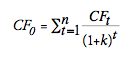 What does k denote in the DCF equation above?
Seçenekler
A
Cost of capital
B
Cash inflow
C
Cash outflow
D
Cost of equity
E
Cash flow
Açıklama:
In the DCF (discounted cash flow) equation, CFo is the cash inflow from the financing source at t=0, CFt is the cash outflow at time to the investors. The cash outflows can be interest or coupon payments, principal repayments and dividend payments according to the capital component employed. The cost of the capital component is denoted by k, which is the discount rate in the above equation. The correct answer is A.Soru 54
- It is a benchmark rate that represents the interest rate at which banks offer to lend funds to one another in the international interbank market for short-term loans.
- It is an average value of the interest- rate which is calculated from estimates submitted by the leading global banks on a daily basis.
- It is an index that is used to determine the interest payments for each period if the rate is floating.
- It is an additional risk premium payment that banks make when they borrow from the international banks.
Seçenekler
A
I and II
B
III and IV
C
I, II and III
D
I, II and IV
E
II, III and IV
Açıklama:
LIBOR (London Interbank Offered Rate) is a benchmark rate that represents the interest rate at which banks offer to lend funds to one another in the international interbank market for short-term loans. LIBOR is an average value of the interest-rate which is calculated from estimates submitted by the leading global banks on a daily basis. A company may raise debt financing either through bank loans or bond issues. In both types of borrowing, the interest rate may be either fixed or floating. If the rate is floating, then an index is used to determine the interest payments for each period. For example, banks borrow from international bank loans at floating rates and the index is almost always the LIBOR. Hence, a bank borrowing from the international banks pays LIBOR as the base rate and an additional risk premium. The correct answer is C.
Soru 55
What is it called if the interest rate is floating and not fixed in bond issues?
Seçenekler
A
Convertible bond
B
Common index
C
Callable bond
D
Indexed bond
E
Price index
Açıklama:
In bond issues, if the interest rate is floating and not fixed, then it is called as an indexed bond. The index can be any economic indicator but mostly it is a price index, such as the inflation rate, the oil price or the gold price index. The correct answer is D.
Soru 56
A corporation borrows $100,000 as a bank loan at an annual interest rate of 5%. The company pays 30% corporate tax rate. What is the after-tax rate of borrowing for this corporation?
Seçenekler
A
0.025
B
0.030
C
0.035
D
0.040
E
0.045
Açıklama:
If this corporation raises $100,000 as equity, there is no interest payment and the company pays $3,000 corporate taxes. However, in case of borrowing $100,000 at an interest rate of 5%, ABC pays $5,000 of interest which is deducted from the earnings which results in $1,500 of tax payments. By paying $5,000 interest, ABC waives from $1,500 tax payment. Therefore, the real cost of borrowing is $5,000-$1,500 which is $3,500. This can also be observed by the difference in the net income between the two financing options:
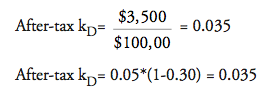 The correct answer is C.
The correct answer is C.Soru 57
ANT Corp. issues bonds to borrow $500,000 required for capital investments. The bonds have a face value of $1,000, pay 5% annual coupons and mature in 8 years. The bonds are sold at par; however, the company incurs flotation (commissions and fees) costs of 4% on the bond issue. ANT's tax rate is 35%.
What is the after-tax cost of the bond issue?
What is the after-tax cost of the bond issue?
Seçenekler
A
0.036627
B
0.073254
C
0.109881
D
0.183135
E
0.549405
Açıklama:
Although the investors pay the face value of $1,000 to buy a share of ANT bonds, the company will net 96% of this amount as 4% flotation cost is incurred on the bond issue. However, the coupon payments are made on the face value. ANT receives:
$500,000*0.96= $480,000
The coupon payments are: $500,000*0.05= $25,000
The before-tax cost of the bonds is calculated from the equation below:
 k= 0.056349
After-tax k= 0.056349*(1-0.35) = 0.036627
The correct answer is A.
$500,000*0.96= $480,000
The coupon payments are: $500,000*0.05= $25,000
The before-tax cost of the bonds is calculated from the equation below:
k= 0.056349After-tax k= 0.056349*(1-0.35) = 0.036627
The correct answer is A.
Soru 58
Which of the following equations is used to calculate the cost of the preferred stock?
Seçenekler
A 
B 
C 
D 
E 
Açıklama:
The cost of the preferred stock is:
Where kps is the component cost of preferred stocks, Dps shows the fixed dividend payments and Pps the price of the security. The above equation is derived from the perpetuity valuation model with fixed cash flows for an infinite time period. The correct answer is B.
Where kps is the component cost of preferred stocks, Dps shows the fixed dividend payments and Pps the price of the security. The above equation is derived from the perpetuity valuation model with fixed cash flows for an infinite time period. The correct answer is B.Soru 59
ABC Corp. distributes 60% of its net income as dividends. The firm’s ROE is 16% and last year stockholders received $1.60 dividends per share. Currently the stock sells at $34.60.
What is the cost of equity of ABC Corp.?
What is the cost of equity of ABC Corp.?
Seçenekler
A
3.46%
B
5.64%
C
6.34%
D
11.32%
E
18.11%
Açıklama:
The expected growth rate of ABC Corp. is:

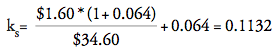 PRS retains 40% of its net income, thus the expected growth rate is 6.40% when calculated from the retention growth model. Hence, the cost of equity is 11.32%. The correct answer is D.
PRS retains 40% of its net income, thus the expected growth rate is 6.40% when calculated from the retention growth model. Hence, the cost of equity is 11.32%. The correct answer is D.Soru 60
LDP Corp. has the following optimal capital structure: Long-term Debt 30%; Preferred Stocks 20%; Common Equity 50%. The interest rate on the company’s long-term borrowings is 8%. Preferred stockholders require 12% return on their investments and common shareholders are paid 15% on equity capital. The company has a tax rate of 35%.
What is the WACC for LDP Corp.?
What is the WACC for LDP Corp.?
Seçenekler
A
2.4%
B
3.12%
C
5.73%
D
8.6%
E
11.46%
Açıklama:
WACC= 0.30*0.08*(1-0.35)+0.20*0.12+0.50*0.15=0.1146
As it can be seen from the above calculation the WACC for LDP is 11.46%. The correct answer is E.
As it can be seen from the above calculation the WACC for LDP is 11.46%. The correct answer is E.
Ünite 3
Soru 1
How does debt financing work?
Seçenekler
A
Debt financing occurs when a firm raises money for working capital or capital expenditures by issuing corporate bonds to raise debt financing.
B
Firms use a mixture of debt and equity for raising the required funds to invest.
C
Debt financing refers to the likelihood that a company will be unable to meet its debt obligations.
D
Debt financing negatively affects the value of a firm.
E
Dept financing refers to the use of a company's balance sheet assets, including short-term investments, inventory and accounts receivable, to borrow money or get a loan.
Açıklama:
Firms can either borrow from financial intermediaries such as banks or they can issue corporate bonds to raise debt financing. Debt financing occurs when a firm raises money for working capital or capital expenditures by issuing corporate bonds to raise debt financing.
Soru 2
What is the definition of equity financing?
Seçenekler
A
When an equity investor agrees to invest in your company, they invest in exchange for ownership in the business.
B
Equity financing is the process of raising capital through the sale of shares in an enterprise, and so raised equity funds from their shareholders
C
Equity financing involves the sale of the company's stock and giving a portion of the ownership of the company to investors in exchange for cash.
D
It starts with the fact that equity is riskier than debt. Because a company typically has no legal obligation to pay dividends to common shareholders, those shareholders want a certain rate of return.
E
Debt is much less risky for the investor because the firm is legally obligated to pay it.
Açıklama:
Firms raise equity funds from their shareholders, who own a direct share of the net income and the net worth of the company. As shareholders hold residual claims on both the earnings and the assets of the business.
Soru 3
What are financial risks in business?
Seçenekler
A
The financial risk is related to the uncertainty in the business operations of the firm. financial risk is influenced by numerous factors, including sales volume, per-unit price, input costs, competition, the overall economic conditions.
B
The future expected profit from operations and the future expected capital investments are tried to be forecasted without certainty.
C
Financial risk is the additional risk borne by the stockholders when the company raises debt financing.
D
Financial risks involve financial transactions, such as company expectations and competitions to go into default.
E
Risk assessment is a general term used across many industries to determine the likelihood of loss on an asset, loan, or investment
Açıklama:
Financial risk is the additional risk borne by the stockholders when the company raises debt financing. As debt holders have prior claims in sharing the earnings and the assets of the firm, the use of debt capital (financial leverage) concentrates all of the business risks on the stockholders, putting equity capital to more risk than if the company were all equity financed. Therefore, financial leverage rises the cost of equity investments.
Soru 4
What is net income approach?
Seçenekler
A
The model assumes that the cost of debt, the weighted average cost of capital (WACC) and the value of the firm is irrespective of financial leverage.
B
Net operating income is a calculation used to analyze the profitability of real estate investments that generate income.
C
The net income approach is the proportion of debt and equity in which a corporate finances its business.
D
The net income approach advocates that a firm can boost its value by lowering its the weighted average cost of capital (WACC), which is possible by increasing financial leverage in its capital structure.
E
The income approach to measuring gross domestic product (GDP) is based on the accounting reality that all expenditures in an economy should equal the total incomegenerated by the production of all economic goods and services.
Açıklama:
The net income approach advocates that a firm can boost its value by lowering its he weighted average cost of capital-WACC, which is possible by increasing financial leverage in its capital structure. In this approach, it is assumed that the cost of debt is always less than the cost of equity and that the increase in the debt ratio does not lead to a change in the risk perception of the investors.
Soru 5
What is traditional approach of capital structure?
Seçenekler
A
The traditional approach to capital structure suggests that there exist an optimal debt to cash ratio where the overall cost of capital is the minimum and market value of the firm is the maximum.
B
Accounting for financial transactions can be classified into two types of approaches. One is the Traditional Approach and another one is the modern approach.
C
Traditional management systems focus on goals and objectives that the senior management of the company establishes.
D
An optimal capital structure is the best mix of debt, preferred stock and common stock that maximizes a company's stock price by minimizing its cost of capital.
E
A traditional approach is an intermediate model, compromising between the net income approach and the net operating income approach. Traditional approach assumes an optimal capital structure where the weighted average cost of capital (WACC) is minimized and the value of the firm is maximized.
Açıklama:
A traditional approach is an intermediate model, compromising between the net income approach and the net operating income approach. Traditional approach assumes an optimal capital structure where the WACC is minimized and the value of the firm is maximized. The model suggests that up to a certain level of leverage, the use of debt financing reduces the WACC, but after that optimal level, the WACC escalates depressing the firm value. The cost of debt remains constant more or less up to a certain level, however, above that level, interest rate rises with the increase in the likelihood of financial distress.
Soru 6
What is the trade off theory of capital structure?
Seçenekler
A
Theory that the firm's capital structure is determined by a trade-off of the value of tax shields against the costs of bankruptcy
B
Capital markets are perfect with rational investors that can freely buy and sell assets.
C
Investors and companies can borrow at the same rate with no restrictions.
D
There are no transaction costs in financial asset trading.
E
All investors can access the same information as the managers of a company without paying any information cost.
Açıklama:
In MM’s world, there are no bankruptcy costs whereas in real life companies face severe costs in case of bankruptcy. High legal costs related to customer, supplier and employee settlements are incurred. Furthermore, a bankrupt firm’s assets will most probably be liquidated at cheaper prices, lowering the worth of its assets. Not only bankruptcy, but the possibility of financial distress can also create problems leading to higher interest rates, contractions in credit purchases, employee jump ship and loss of customers. Therefore, financial distress or bankruptcy costs refrain firms from abundant debt financing. Especially firms with higher business risk should rely less on debt financing.
Soru 7
How do you determine the optimal capital structure?
Seçenekler
A
Capital structure suggests that agency problems may arise if managers (agents) pursue different objectives other than those of the shareholders (principals).
B
An Appropriate Capital Structure is that capital structure at that level of debt - net income proportion.
C
The capital structure is how a firm finances its overall operations and growth by using different sources of funds.
D
A company raises new capital, it will focus on maintaining this target or optimal capital structure.
E
The optimal capital structure is estimated by calculating the mix of debt and equity and free cash flows are capitalized at the calculated WACC to determine the firm value.
Açıklama:
Mixing debt and equity in building up the capital structure of the firm is essential for value maximization. Estimating the optimal capital structure requires a careful analysis with repetitions. The managers normally start with a trial capital structure and evaluate shareholders’ wealth. They continue the same practice until they identify a capital structure maximizing the firm value. At each trial, the cost of debt and equity are projected in order to quantify the WACC. Then the forecasted free cash flows are capitalized at the calculated WACC to determine the firm value. As a final step, debt is deducted from the value of the firm to measure the value of the equity and the stock price.
Soru 8
What is meant by agency theory?
Seçenekler
A
The agency theory is a supposition that explains the conflict between principals and agents in business.
B
Agency theory suggests that agency problems may arise if managers (agents) pursue different objectives other than those of the shareholders (principals).
C
Agency theory, then, examines the cost of interest that can arise between principals and agents.
D
The problem addressed in agency theory typically arises when stockholders hire managers to run their company.
E
The agent represents the principal in a particular business transaction and is expected to represent the best interests of the principal together self-interest.
Açıklama:
Agency theory suggests that agency problems may arise if managers (agents) pursue different objectives other than those of the shareholders (principals). Shareholders’ seek for wealth maximization which can be attained by the maximization of the value of the firm. However, managers often waste shareholders’ wealth by consuming perquisites or investing in pet projects. Hence, high debt levels can be a solution to prevent these agency problems, since higher borrowing costs discipline managers to funnel cash flows to interest payments.
Soru 9
What is the other factors affected by the capital structure of an enterprise
Seçenekler
A
Factors that affect the capital structure are: tangibility, firm size, profitability, and free cash flows.
B
Other factors are structure of assets, non-debt tax shields, profitability, size of the company and free cash flow.
C
Factors that affect the capital structure are, economic environment, industry specific factors and firm-specific factors.
D
It is important for a company to have an appropriate capital structure
E
There are two types of capital structure according to the nature and type of the firm, viz, (a) simple and (b) complex. a. simple: when the capital structure is composed of equity capital only or with retained earnings, the same is known as simple capital structure.
Açıklama:
As the main goal of investors is wealth maximization, companies seek to attain an optimal capital structure which maximizes the firm value. However, there cannot be a prescribed optimal capital structure for any business because there are many different factors influencing the capital structure decisions. Even for a single company, the optimal capital mix might require variations in the level of financial leverage over time in relation to changing market forces as a , economic environment, industry specific factors and firm-specific factors.
Soru 10
How does the economic environment affect the business?
Seçenekler
A
Such factors include GDP of the economy, per capita income, availability of capital, utilization of resources.
B
The term economic environment refers to all the external economic factors.
C
These factors are often beyond a company's control, and may be either large-scale (macro) or small-scale (micro).
D
The economic environment consists of both macroeconomic factors involving such things as market condution, forces of demand and suppley, inflation, interest rates and taxes.
E
Each firm has specific features affecting its asset structure, risk, and competitive strength.
Açıklama:
The economic conditions in general impact the investment and financing decisions simultaneously. The economic policies of the country where the company is established to determine the market conditions shaping up both the forces of demand and supply. The political and economic stability affect the level of risk at the macro and micro levels. The inflation rate leads to the interest rate. Furthermore, the tax rates directly impel the level of investments and financing mechanisms. Risk escalates in an economic
Soru 11
Which one of the following explains the likelihood that a company will be unable to meet its debt obligations?
Seçenekler
A
Equity
B
Fixed assets
C
Total assets
D
Bankruptcy risk
E
Total liabilites
Açıklama:
Bankruptcy risk refers to the likelihood that a company will be unable to meet its debt obligations.
Soru 12
.... is an indicator of financial risk and occurs in case of borrowing.
Which one of the following completes the sentence above?
Which one of the following completes the sentence above?
Seçenekler
A
Financial leverage
B
Financial risk
C
Debt
D
Equity
E
Degree of operating leverage
Açıklama:
Financial leverage is an indicator of financial risk and occurs in case of borrowing
Soru 13
NOPAT/Capital
Which one of the following is the refers to this formula?
Which one of the following is the refers to this formula?
Seçenekler
A
Degree of operating leverage
B
Return on invested capital
C
Value of the firm
D
Value of equity
E
Value of debt
Açıklama:
ROIC=NOPAT/Capital (ROIC means return on invested capital)
Soru 14
Which one of the following is an intermediate model, compromising between the net income approach and the net operating income approach?
Seçenekler
A
Modigliani and Miller Capital Structure Theory
B
Agency theory
C
Signaling theory
D
Trade-off theory
E
Traditonal approach
Açıklama:
A traditional approach is an intermediate model, compromising between the net income approach and the net operating income approach.
Soru 15
Which one of the following is the mix of debt and equity?
Seçenekler
A
Fixed assets
B
Total assets
C
Capital structure
D
Bankruptcy
E
The value of the firm
Açıklama:
The debt and equity mix is called the capital structure of a firm.
Soru 16
How it is possible to measure level of the fixed costs in total costs?
Seçenekler
A
Return of invested capital
B
Weighted average cost of capital
C
Total liabilites and equity
D
Working capital
E
Degree of operating leverage
Açıklama:
The level of the fixed costs in total costs which are measured by the degree of-operating leverage.
Soru 17
... asserts that investors regard an equity issue negatively and usually the stock price falls.
Which one of the following completes the sentence?
Which one of the following completes the sentence?
Seçenekler
A
Business risk
B
The signaling theory
C
Debt financing
D
Financial risk
E
Return on invested capital
Açıklama:
The signaling theory asserts that investors regard an equity issue negatively and usually the stock price falls.
Soru 18
The variance ... is an indicator of the business risk and a higher variance demonstrates a higher business risk.
Seçenekler
A
In the DOL
B
In the FCF
C
In the NOPAT
D
Financial leverage
E
In the ROIC
Açıklama:
The variance in the ROIC is an indicator of the business risk and a higher variance demonstrates a higher business risk.
Soru 19
Which one of the following is not among the assumptions of Modigliani and Miller Capital Structure Theory?
Seçenekler
A
There are no bankruptcy costs
B
Investors have homogenous expectations
C
There are high taxes
D
Investors and companies can borrow at the same rate with no restrictions
E
There are no transaction costs in financial asset trading
Açıklama:
There are no taxes is one of the assumptions of Modigliani and Miller Capital Structure Theory
Soru 20
... occurs when one party from a financial transaction has different information than the other.
Seçenekler
A
Agency theory
B
Symmetric information
C
Financial leverage
D
Asymmetric information
E
Financial risk
Açıklama:
Asymmetric information occurs when one party from a financial transaction has different information than the other.
Soru 21
"Bankruptcy risk................."
Which of the following best completes the sentence above?
Which of the following best completes the sentence above?
Seçenekler
A
refers to the highest risk that companies may face in their transactions
B
refers to the likelihood that a company will be unable to meet its debt obligations
C
refers to the failure in meeting the product-related needs
D
refers to a company's potential to maximize its income
E
refers to the possibility of a company to fail to earn enough income
Açıklama:
Bankruptcy risk refers to the likelihood that a company will be unable to meet its debt obligations.
Soru 22
"The value of the firm is measured as................................."
Which of the following best completes the sentence above?
Which of the following best completes the sentence above?
Seçenekler
A
the residual claims in sharing the earnings
B
the bankruptcy risk negatively affecting the value of a firm.
C
the corporate bonds to raise debt financing
D
the sum of the value of the firm’s equity and the value of the debt.
E
the free cash flows drop with the loss of confidence in the firm
Açıklama:
The value of the firm is measured as the sum of the value of the firm’s equity and the value of the debt.
Soru 23
Which of the following is not one of the factors affecting the business risk of a firm?
Seçenekler
A
Shifts in the demand for the products/ services of the company.
B
Fluctuations in the sales price due to market volatility.
C
Changes in input costs
D
The cost structure of the company
E
The ability to adapt profit-effective measures
Açıklama:
There are many factors affecting the business risk of a firm, however, to summarize we can cite the following:
• Shifts in the demand for the products/ services of the company. Higher volatility of demand for the products/services of the firm escalates the business risk.
• Fluctuations in the sales price due to market volatility. Firms operating in markets with high output price variations are prone to higher business risk.
• Changes in input costs. Uncertainty and excessive volatility in input costs raise the business risk.
• The cost structure of the company, especially the level of the fixed costs in total costs which are measured by the degree of operating leverage (DOL). If the DOL
is high, the firm will be exposed to higher business risk.
• The ability to adapt cost-effective measures to changes in both the input costs and output prices. Some firms can quickly implement cost-effective processes to adjust
to the fluctuations in input costs or output prices. This ability reduces the business risk faced by the company.
• Shifts in the demand for the products/ services of the company. Higher volatility of demand for the products/services of the firm escalates the business risk.
• Fluctuations in the sales price due to market volatility. Firms operating in markets with high output price variations are prone to higher business risk.
• Changes in input costs. Uncertainty and excessive volatility in input costs raise the business risk.
• The cost structure of the company, especially the level of the fixed costs in total costs which are measured by the degree of operating leverage (DOL). If the DOL
is high, the firm will be exposed to higher business risk.
• The ability to adapt cost-effective measures to changes in both the input costs and output prices. Some firms can quickly implement cost-effective processes to adjust
to the fluctuations in input costs or output prices. This ability reduces the business risk faced by the company.
Soru 24
"Financial leverage is .................."
Which of the following appropriately completes the sentence above?
Which of the following appropriately completes the sentence above?
Seçenekler
A
an indicator of managerial risks
B
an indicator of all risks
C
an indicator of financial risk
D
an indicator of financial guarantee
E
an indicator of the profit rate
Açıklama:
Financial leverage is an indicator of financial risk and occurs in case of borrowing
Soru 25
" A firm can boost its value by lowering its WACC, which is possible by increasing financial leverage in its capital structure"
Which approach is described in the sentence above?
Which approach is described in the sentence above?
Seçenekler
A
Net Income Approach
B
Net Operating Income Approach
C
Traditional Approach
D
Profit Approach
E
Net Cost Approach
Açıklama:
The net income approach advocates that a firm can boost its value by lowering its WACC, which is possible by increasing financial leverage in its capital structure. In this approach, it is assumed that the cost of debt is always less than the cost of equity and that the increase in the debt ratio does not lead to a change in the risk perception of the investors.
Soru 26
Which of the following is not one of the assumptions of Modigliani and Miller Capital Structure Theory?
Seçenekler
A
Investors have homogenous expectations
B
There are no bankruptcy costs
C
There are no taxes
D
There are no transaction costs in financial asset trading
E
Investors and companies cannot borrow at the same rate without any restrictions
Açıklama:
Franco Modigliani and Merton Miller (MM) are the founders of modern capital structure theory. Their first article (1958) is one of the most influential studies in academia. MM’s study is based on the following assumptions:
1. Capital markets are perfect with rational investors that can freely buy and sell assets.
2. Investors have homogenous expectations.
3. There are no bankruptcy costs.
4. There are no taxes.
5. There are no transaction costs in financial asset trading.
6. Investors and companies can borrow at the same rate with no restrictions.
7. All investors can access the same information as the managers of a company without paying any information cost.
8. Operating income (EBIT) is not affected by the use of debt.
9. All earnings are distributed to stockholders as dividends (dividend payout ratio is 100%).
10. Well-informed investors have the option of arbitrage.
1. Capital markets are perfect with rational investors that can freely buy and sell assets.
2. Investors have homogenous expectations.
3. There are no bankruptcy costs.
4. There are no taxes.
5. There are no transaction costs in financial asset trading.
6. Investors and companies can borrow at the same rate with no restrictions.
7. All investors can access the same information as the managers of a company without paying any information cost.
8. Operating income (EBIT) is not affected by the use of debt.
9. All earnings are distributed to stockholders as dividends (dividend payout ratio is 100%).
10. Well-informed investors have the option of arbitrage.
Soru 27
Which of the following cannot be claimed to be a result of financial distress?
Seçenekler
A
Higher interest rates
B
Contractions in credit purchases
C
Employee jump ship
D
Ease in access to bank credit
E
Loss of customers
Açıklama:
Not only bankruptcy, but the possibility of financial distress can also create problems leading to higher interest rates, contractions in credit purchases, employee jump ship and loss of customers. Therefore, financial distress or bankruptcy costs refrain firms from abundant debt financing. Especially firms with higher business risk should rely less on debt financing.
Soru 28
"Asymmetric information occurs ........................."
Seçenekler
A
when one firm is provided different information about the market
B
when one party from a financial transaction has different information than the other.
C
when one party from a financial transaction does not have different information
D
when one party in a company has similar information to the other.
E
when one party from a financial transaction has different information than the other
Açıklama:
Asymmetric information occurs when one party from a financial transaction has different information than the other.
Soru 29
Which of the following is true about "Agency Theory"?
Seçenekler
A
When the average cost of capital is maximized, the firm value is mminimized.
B
The managers don't have to maximize the shareholders’ wealth by maximizing the value of the firm
C
Financial distress or bankruptcy costs refrain firms from abundant debt financing
D
agency problems may arise if managers pursue different objectives other than those of the shareholders
E
managerial discretion may convey signals to outside investors other than the decisions on the surface
Açıklama:
Agency theory suggests that agency problems may arise if managers (agents) pursue different objectives other than those of the shareholders (principals). Shareholders seek for wealth maximization which can be attained by the maximization of the value of the firm. However, managers often waste shareholders’ wealth by consuming perquisites or
investing in pet projects
investing in pet projects
Soru 30
Which of the following is not a true classification of the factors affecting the capital structure?
Seçenekler
A
Industry-specific factors
B
Country-specific factors
C
Location-specific factors
D
Employee-specific factors
E
Profit-specific factors
Açıklama:
Other factors that affect the capital structure are industry-specific factors, environment-specific factors, and firm-specific factors.
Soru 31
Which of the following terms refers to the likelihood that a company will be unable to meet its debt obligations?
Seçenekler
A
Capital structure
B
Capital yield
C
Market value
D
Capital budgeting
E
Bankruptcy risk
Açıklama:
Bankruptcy risk refers to the likelihood that a company will be unable to meet its debt obligations. The correct answer is E.
Soru 32
How is the value of a firm measured?
Seçenekler
A
As the value of the debt deducted from the value of the firm’s equity
B
As the value of the firm’s equity deducted from the value of the debt
C
As the value of the firm’s equity multiplied by the value of the debt
D
As the value of the firm’s equity divided by the value of the debt
E
As the sum of the value of the firm’s equity and the value of the debt
Açıklama:
The value of the firm is measured as the sum of the value of the firm’s equity and the value of the debt. The correct answer is E.
Soru 33
Which of the following is not among the effects of bankruptcy risks?
Seçenekler
A
Bankruptcy risk negatively affects the value of a firm.
B
The before-tax cost of debt increases which makes debt financing more costly.
C
The stockholders holding residual claims in sharing the earnings and assets demand a higher yield.
D
The cost of the funds raised by the company reduces the weighted average cost of capital (WACC).
E
The rising probability of bankruptcy heighten the risk borne by the stockholders.
Açıklama:
Bankruptcy risk negatively affects the value of a firm. Firstly, as mentioned above the before-tax cost of debt increases which makes debt financing more costly. Secondly, the stockholders who hold residual claims in sharing the earnings and assets of the company demand a higher yield. Since creditors have a priority in their claims, higher debt ratios and the rising probability of bankruptcy heighten the risk borne by the stockholders. As a result, the cost of the funds raised by the company, no matter debt or equity upsurge, raises the weighted average cost of capital (WACC). The WACC is the average cost of the capital mix.
The correct answer is D.
The correct answer is D.
Soru 34
I. Shifts in the demand for the products/ services of the company.
II. Fluctuations in the sales price due to market volatility.
III. Changes in input costs.
IV. The cost structure of the company
Which of the factors above affects the business risk of a firm?
II. Fluctuations in the sales price due to market volatility.
III. Changes in input costs.
IV. The cost structure of the company
Which of the factors above affects the business risk of a firm?
Seçenekler
A
I and II
B
I and III
C
II and IV
D
III and IV
E
I, II, III, and IV
Açıklama:
There are many factors affecting the business risk of a firm, however, to summarize we can cite the following:
• Shifts in the demand for the products/ services of the company. Higher volatility of demand for the products/services of the firm escalates the business risk. • Fluctuations in thesales price dueto market volatility. Firms operating in markets with high output price variations are prone to higher business risk.
• Changes in input costs. Uncertainty and excessive volatility in input costs raise the business risk.
• The cost structure of the company, especially the level of the fixed costs in total costs which are measured by the degreeof-operating leverage (DOL). If the DOL is high, the firm will be exposed to higher business risk.
• The ability to adapt cost-effective measures to changes in both the input costs and output prices. Some firms can quickly implement cost-effective processes to adjust to the fluctuations in input costs or output prices. This ability reduces the business risk faced by the company. The correct answer is E.
• Shifts in the demand for the products/ services of the company. Higher volatility of demand for the products/services of the firm escalates the business risk. • Fluctuations in thesales price dueto market volatility. Firms operating in markets with high output price variations are prone to higher business risk.
• Changes in input costs. Uncertainty and excessive volatility in input costs raise the business risk.
• The cost structure of the company, especially the level of the fixed costs in total costs which are measured by the degreeof-operating leverage (DOL). If the DOL is high, the firm will be exposed to higher business risk.
• The ability to adapt cost-effective measures to changes in both the input costs and output prices. Some firms can quickly implement cost-effective processes to adjust to the fluctuations in input costs or output prices. This ability reduces the business risk faced by the company. The correct answer is E.
Soru 35
Which of the following situations increases the financial risk?
Seçenekler
A
Fluctuations in the sales price due to market volatility.
B
Changes in input costs.
C
The rise in the company's debt financing.
D
Shifts in the demand for the products/ services of the company.
E
The ability to adapt cost-effective measures.
Açıklama:
Financial risk is the additional risk borne by the stockholders when the company raises debt financing. The correct answer is C.
Soru 36
In terms of the factors affecting the capital structure, which of the following is regarded as a firm-specific factor?
Seçenekler
A
The economic policies of the country
B
The political stability in a country
C
Legal status of the company
D
The inflation rate
E
The tax rates
Açıklama:
Other than the economy-wide and industry-specific factors, firm characteristics are also highly influential in capital structure decisions. Each firm has unique features affecting its asset structure, risk appetite, and competitive strength. The firm age, size, and its legal status are among other elements that impact capital structure. Additionally, the performance of the company, its short and long-term solvency, its level of leverage determines its creditworthiness. Credit-worthy businesses can have easy access to available funds both in debt and equity. Thus, they will enjoy more flexibility in capital structure decisions.
The correct answer is C.
The correct answer is C.
Soru 37
In terms of the factors affecting the capital structure, which of the following is among the economic environment factors?
Seçenekler
A
The age and size of the firm
B
The political stability in a country
C
Legal status of the company
D
The performance of the company
E
Company's short and long-term solvency
Açıklama:
Economic Environment
The economic conditions in general impact the investment and financing decisions simultaneously. The economic policies of the country where the company is established to determine the market conditions shaping up both the forces of demand and supply. The political and economic stability affect the level of risk at the macro and micro levels. The inflation rate leads to the interest rate. Furthermore, the tax rates directly impel the level of investments and financing mechanisms. Risk escalates in an economic environment with high inflation and interest rates. Thus both debt and equity become more expensive and scarce. In such an environment businesses are hesitant in making new investments. Additionally, foreign exchange rates influence overseas investments and trading. Overseas transactions may bring some benefits and disadvantages at the same time. Companies may increase their income, however, investments abroad raise the risk undertaken.
The correct answer is B.
The economic conditions in general impact the investment and financing decisions simultaneously. The economic policies of the country where the company is established to determine the market conditions shaping up both the forces of demand and supply. The political and economic stability affect the level of risk at the macro and micro levels. The inflation rate leads to the interest rate. Furthermore, the tax rates directly impel the level of investments and financing mechanisms. Risk escalates in an economic environment with high inflation and interest rates. Thus both debt and equity become more expensive and scarce. In such an environment businesses are hesitant in making new investments. Additionally, foreign exchange rates influence overseas investments and trading. Overseas transactions may bring some benefits and disadvantages at the same time. Companies may increase their income, however, investments abroad raise the risk undertaken.
The correct answer is B.
Soru 38
Which of the following capital structure theories advocates that a firm can boost its value by lowering its WACC, which is possible by increasing financial leverage in its capital structure?
Seçenekler
A
Signaling Theory
B
The net income approach
C
Modigliani and Miller Capital Structure Theory
D
Traditional Approach
E
Trade-Off Theory
Açıklama:
The net income approach advocates that a firm can boost its value by lowering its WACC, which is possible by increasing financial leverage in its capital structure. In this approach, it is assumed that the cost of debt is always less than the cost of equity and that the increase in the debt ratio does not lead to a change in the risk perception of the investors. The correct answer is B.
Soru 39
Which of the following capital structure theories assumes that the cost of debt, the WACC and the value of the firm is irrespective of financial leverage?
Seçenekler
A
Net Operating Income Approach
B
Trade-Off Theory
C
Modigliani and Miller Capital Structure Theory
D
Traditional Approach
E
The net income approach
Açıklama:
The model assumes that the cost of debt, the WACC and the value of the firm is irrespective of financial leverage. The value of the firm is its net operating income which is also independent of leverage, capitalized at the constant WACC. The correct answer is A.
Soru 40
Which of the following capital structure theories suggests that managerial discretion may convey signals to outside investors other than the decisions on the surface?
Seçenekler
A
The signaling theory
B
Agency Theory
C
Trade-off theory
D
Modigliani and Miller Capital Structure Theory
E
Net Income Approach
Açıklama:
According to the signaling theory, managerial discretion may convey signals to outside investors other than the decisions on the surface. The correct answer is A.
Soru 41
Which term refers to the likelihood that a company will be unable to meet its debt obligations?
Seçenekler
A
Debt financing
B
Working capital
C
Bankruptcy
D
Equity
E
Fixed assets
Açıklama:
Bankruptcy risk refers to the likelihood that a company will be unable to meet its debt obligations.
Soru 42
What is an indicator of financial risk and occurs in case of borrowing?
Seçenekler
A
Financial leverage
B
Business risk
C
Debt financing
D
Equity
E
Fixed assets
Açıklama:
Financial leverage is an indicator of financial risk and occurs in case of borrowing
Soru 43
- Shifts in the demand for the products/ services of the company
- Fluctuations in the sales price due to market volatility
- Changes in input costs
- The cost structure of the company
- The ability to adapt cost-effective measures to changes in both the input costs and output prices
Seçenekler
A
I, II, III and IV
B
I, II, III and V
C
I, II, IV and V
D
II, III, IV and V
E
I, II, III, IV and IV
Açıklama:
There are many factors affecting the business risk of a firm, however, to summarize we can cite the following:
- Shifts in the demand for the products/ services of the company. Higher volatility of demand for the products/services of the firm escalates the business risk.
- Fluctuations in thesales price dueto market volatility. Firms operating in markets with high output price variations are prone to higher business risk.
- Changes in input costs. Uncertainty and excessive volatility in input costs raise the business risk
- The cost structure of the company, especially the level of the fixed costs in total costs which are measured by the degreeof-operating leverage (DOL). If the DOL is high, the firm will be exposed to higher business risk.
- The ability to adapt cost-effective measures to changes in both the input costs and output prices. Some firms can quickly implement cost-effective processes to adjust to the fluctuations in input costs or output prices. This ability reduces the business risk faced by the company.
Soru 44
Which one is not among the factors affecting the business risk of a firm?
Seçenekler
A
Shifts in the demand for the products/ services of the company
B
Fluctuations in the sales price due to market volatility
C
Changes in input costs
D
The cost structure of the company
E
The value of the firm
Açıklama:
There are many factors affecting the business risk of a firm, however, to summarize we can cite the following:
- Shifts in the demand for the products/ services of the company. Higher volatility of demand for the products/services of the firm escalates the business risk.
- Fluctuations in thesales price dueto market volatility. Firms operating in markets with high output price variations are prone to higher business risk.
- Changes in input costs. Uncertainty and excessive volatility in input costs raise the business risk
- The cost structure of the company, especially the level of the fixed costs in total costs which are measured by the degreeof-operating leverage (DOL). If the DOL is high, the firm will be exposed to higher business risk.
- The ability to adapt cost-effective measures to changes in both the input costs and output prices. Some firms can quickly implement cost-effective processes to adjust to the fluctuations in input costs or output prices. This ability reduces the business risk faced by the company.
Soru 45
- This approach advocates that a firm can boost its value by lowering its WACC, which is possible by increasing financial leverage in its capital structure.
- In this approach, it is assumed that the cost of debt is always less than the cost of equity and that the increase in the debt ratio does not lead to a change in the risk perception of the investors.
- Both the cost of debt and equity remain constant no matter how heavily debt capital is induced to the capital structure of the firm.
Seçenekler
A
Net Income Approach
B
Net Operating Income Approach
C
Traditional Approach
D
Modigliani and Miller Capital Structure Theory
E
Trade-Off Theory
Açıklama:
The net income approach advocates that a firm can boost its value by lowering its WACC, which is possible by increasing financial leverage in its capital structure. In this approach, it is assumed that the cost of debt is always less than the cost of equity and that the increase in the debt ratio does not lead to a change in the risk perception of the investors. Therefore, both the cost of debt and equity remain constant no matter how heavily debt capital is induced to the capital structure of the firm. Consequently, in an environment where there are no taxes, the higher the financial leverage, the lower the WACC, thus the higher the firm value. The net income approach ignores the rising bankruptcy risk at higher leverage. In real life conditions, the likelihood of financial distress heightens both the cost of debt and equity raising the WACC.
Soru 46
Which capital structure theory model assumes that the cost of debt, the WACC and the value of the firm is irrespective of financial leverage?
Seçenekler
A
Net Income Approach
B
Net Operating Income Approach
C
Traditional Approach
D
Modigliani and Miller Capital Structure Theory
E
Trade-Off Theory
Açıklama:
The model assumes that the cost of debt, the WACC and the value of the firm is irrespective of financial leverage. The value of the firm is its net operating income which is also independent of leverage, capitalized at the constant WACC. Therefore, the firm value will remain unchanged by the financing decisions under the assumption of no corporate taxes.
Soru 47
- This approach is an intermediate model, compromising between the net income approach and the net operating income approach.
- This approach assumes an optimal capital structure where the WACC is minimized and the value of the firm is maximized.
- The model suggests that up to a certain level of leverage, the use of debt financing reduces the WACC, but after that optimal level, the WACC escalates depressing the firm value.
Seçenekler
A
Net Income Approach
B
Net Operating Income Approach
C
Traditional Approach
D
Modigliani and Miller Capital Structure Theory
E
Trade-Off Theory
Açıklama:
A traditional approach is an intermediate model, compromising between the net income approach and the net operating income approach. Traditional approach assumes an optimal capital structure where the WACC is minimized and the value of the firm is maximized. The model suggests that up to a certain level of leverage, the use of debt financing reduces the WACC, but after that optimal level, the WACC escalates depressing the firm value. The cost of debt remains constant more or less up to a certain level, however, above that level, interest rate rises with the increase in the likelihood of financial distress. The same is true for the cost of equity since stockholders require a higher return at higher financial leverage. Therefore, the WACC decreases up to a certain level of debt financing, but after that optimal point, it inclines rapidly
Soru 48
- Capital markets are perfect with rational investors that can freely buy and sell assets.
- Investors have homogenous expectations.
- There are no bankruptcy costs.
- There are no taxes.
- There are no transaction costs in financial asset trading.
Seçenekler
A
I, II, III and IV
B
II, III, IV and V
C
I, III, IV and V
D
II, III, IV and V
E
I, II, III, IV and V
Açıklama:
Franco Modigliani and Merton Miller (MM) are the founders of modern capital structure theory. Their first article (1958) is one of the most influential studies in academia. MM’s study is based on the following assumptions: 1. Capital markets are perfect with rational investors that can freely buy and sell assets. 2. Investors have homogenous expectations. 3. There are no bankruptcy costs. 4. There are no taxes. 5. There are no transaction costs in financial asset trading. 6. Investors and companies can borrow at the same rate with no restrictions. 7. All investors can access the same information as the managers of a company without paying any information cost. 8. Operating income (EBIT) is not affected by the use of debt. 9. All earnings are distributed to stockholders as dividends (dividend payout ratio is 100%). 10. Well-informed investors have the option to arbitrage.
Soru 49
Which theory suggests that agency problems may arise if managers (agents) pursue different objectives other than those of the shareholders (principals)?
Seçenekler
A
Signaling Theory
B
Agency Theory
C
Trade-off Theory
D
Modigliani and Miller Capital Structure Theory
E
Traditional Approach
Açıklama:
Agency theory suggests that agency problems may arise if managers (agents) pursue different objectives other than those of the shareholders (principals). Shareholders’ seek for wealth maximization which can be attained by the maximization of the value of the firm. However, managers often waste shareholders’ wealth by consuming perquisites or investing in pet projects.
Soru 50
What occurs when one party from a financial transaction has different information than the other?
Seçenekler
A
Asymmetric information
B
Value of Equity
C
Financial leverage
D
Financial Risk
E
Business Risk
Açıklama:
Asymmetric information occurs when one party from a financial transaction has different information than the other.
Soru 51
Which of the following statements about the cost of capital is CORRECT?
Seçenekler
A
Equity financing provides a tax shield.
B
Cost of debt financing increases with bankcuptcy risk.
C
Cost of capital depends on the capital structure as well as cost of debt financing and cost of equity financing.
D
Value of the debt of a company depends on the cost of debt financing.
E
The smaller the tax rate, the smaller the after-tax cost of debt financing.
Açıklama:
Cost of debt financing increases with bankcuptcy risk as creditors require higher interest rates to lend, because of rising bankruptcy risk.
Soru 52
The smaller the cost of capital, ......................................
Seçenekler
A
the smaller the value of the firm.
B
the greater the value of the firm.
C
the smaller the value of the equity of the firm.
D
the greater the value of the equity of the firm.
E
the greater the value of the liabilities of the firm.
Açıklama:
The value of the firm can be computed by discounting the future expected cash flows with the cost of capital. Thus, the smaller the cost of capital,the greater the value of the firm. (Formula on p.52)
Soru 53
What do we call the mix of debt and equity that maximizes the value of the firm?
Seçenekler
A
Maximum capital structure
B
Minimum capital structure
C
Optimal capital structure
D
Optimal capital budget
E
Optimal investment structure
Açıklama:
We call the mix of debt and equity that maximizes the value of the firm optimal capital structure.
Soru 54
Which of the following assumes an optimal capital structure where the WACC is minimized and the value of the firm is maximized?
Seçenekler
A
Net Income approach
B
Net Operating Income approach
C
Traditional aproach
D
Modigliani and Miller Capital Structure Theory
E
Signalling Theory
Açıklama:
Traditional approach assumes an optimal capital structure where theWACC is minimized and the value of the firm is maximized. The model suggests that up to a certain level of leverage, the use of debt financing reduces the WACC, but after that optimal level, the WACC escalates depressing the firm value.
Soru 55
............... claims that firms follow a hierarchy of funds in financing. Firstly, internal funds are exhausted by reinvesting the net income, and in raising external capital, debt is preferred over equity.
Seçenekler
A
Net Income approach
B
Net operating approach
C
Traditional approach
D
Pecking order theory
E
Agency theory
Açıklama:
Pecking order theory suggests that firms follow a hierarchy of funds in financing. Firstly, internal funds are exhausted by reinvesting the net income, and in raising external capital, debt is preferred over equity.
Soru 56
Who are the founders of modern capital structure theory?
Seçenekler
A
Fama & French
B
Myers & Majluf
C
Kahneman & Tversky
D
Black & Scholes
E
Modigliani & Miller
Açıklama:
Franco Modigliani and Merton Miller (MM) are the founders of modern capital structure theory. Their first article (1958) is one of the most influential studies in academia.
Soru 57
Given the information below, compute the WACC for XYZ Corporation.
Equity financing = TL 300,000
Cost of equity = 16%
Debt financing = TL 900,000
Cost of debt = 12%
Tax rate = 25%
Equity financing = TL 300,000
Cost of equity = 16%
Debt financing = TL 900,000
Cost of debt = 12%
Tax rate = 25%
Seçenekler
A
13 %
B
12 %
C
11 %
D
10.75 %
E
10.5 %
Açıklama:
WACC = 300/1200*0,16 + 900/1200*0,12*(1-0,25) = 0,1075 (10,75%)
Soru 58
Given the information below, compute the WACC for XYZ Corporation.
Shareholders Equity= TL 250,000
Cost of equity = 17%
Total Assets= TL 750,000
Cost of debt = 14%
Tax rate = 20%
Shareholders Equity= TL 250,000
Cost of equity = 17%
Total Assets= TL 750,000
Cost of debt = 14%
Tax rate = 20%
Seçenekler
A
15 %
B
14 %
C
13.5 %
D
13.3 %
E
13 %
Açıklama:
Total Liabilites = 750,000-250,000= 500,000
WACC=(250,000/750,000)*0,17+(500,000/750,000)*0,14*(1-0.2) =13.3 %
WACC=(250,000/750,000)*0,17+(500,000/750,000)*0,14*(1-0.2) =13.3 %
Soru 59
The type of risk that is related to the uncertainty in the business operations of the firm is referred to as .............
Seçenekler
A
Business risk
B
Financial risk
C
Credit risk
D
Default risk
E
Systemic risk
Açıklama:
The type of risk that is related to the uncertainty in the business operations of the firm is referred to as business risk.
Soru 60
According to the Trade-off Theory of capital structure theories, what does financial distress or bankruptcy costs refrain firms from?
Seçenekler
A
Abundant operational leverage
B
Abundant financial leverage
C
Abundant equity financing
D
Abundant dividend payments
E
Abundant stock issue
Açıklama:
According to the Trade-off Theory of capital structure theories, what does financial distress or bankruptcy costs refrain firms from abundant debt financ,ng, in other words, financial leverage.
Soru 61
What is the rate of interest paid on debt if the firm has a 25% tax rate, a 18% expected rate of return to equity holders, a 15% WACC, and a 50% debt-asset ratio?
Seçenekler
A
20%
B
12%
C
15%
D
16%
E
18%
Açıklama:
WACC=wD*kD*(1-T)+wE*kE
0.15=0.5*kd*(1-0.25)+0.5*0.18
kd=0.16=16%
0.15=0.5*kd*(1-0.25)+0.5*0.18
kd=0.16=16%
Soru 62
What is the return on invested capital (ROIC) if EBIT is $400,000, capital is $1,400,000 and tax rate is %40?
Seçenekler
A
28.57%
B
17.15%
C
16.34%
D
26.20%
E
15%
Açıklama:
ROIC=NOPAT/Capital=EBIT*(1-T)/Capital
ROIC=400,000*(1-0.40)/1,400,000=0.1715=17.15%
ROIC=400,000*(1-0.40)/1,400,000=0.1715=17.15%
Soru 63
Which of the following is not one of the factors affecting the business risk of a firm?
Seçenekler
A
Shifts in the demand for the products/ services of the company.
B
Fluctuations in the sales price due to market volatility.
C
Changes in input cost.
D
If the degree of-operating leverage is low, the firm will be exposed to higher business risk.
E
The ability to adapt cost-effective measures to changes in both the input costs and output prices.
Açıklama:
There are many factors affecting the business risk of a firm, however, to summarize we can cite the following:
• Shifts in the demand for the products/ services of the company. Higher volatility of demand for the products/services of the firm escalates the business risk.
• Fluctuations in the sales price due to market volatility. Firms operating in markets with high output price variations are prone to higher business risk.
• Changes in input costs. Uncertainty and excessive volatility in input costs raise the business risk.
•The cost structure of the company, especially the level of the fixed costs in total costs which are measured by the degree of-operating leverage (DOL). If the DOL is high, the firm will be exposed to higher business risk.
• The ability to adapt cost-effective measures to changes in both the input costs and output prices. Some firms can quickly implement cost-effective processes to adjust to the fluctuations in input costs or output prices. This ability reduces the business risk faced by the company.
• Shifts in the demand for the products/ services of the company. Higher volatility of demand for the products/services of the firm escalates the business risk.
• Fluctuations in the sales price due to market volatility. Firms operating in markets with high output price variations are prone to higher business risk.
• Changes in input costs. Uncertainty and excessive volatility in input costs raise the business risk.
•The cost structure of the company, especially the level of the fixed costs in total costs which are measured by the degree of-operating leverage (DOL). If the DOL is high, the firm will be exposed to higher business risk.
• The ability to adapt cost-effective measures to changes in both the input costs and output prices. Some firms can quickly implement cost-effective processes to adjust to the fluctuations in input costs or output prices. This ability reduces the business risk faced by the company.
Soru 64
X Corp. expects $500,000 EBIT. The cost of equity is 12% and the company pays 8% on its borrowings.What is the firm value at $1,000,000 leverage amount?
Seçenekler
A
$8,000,000
B
$4,500,000
C
$6,000,000
D
$2,500,000
E
$3,000,000
Açıklama:
| EBIT | 500,000 |
| Interest exp | -80,000 |
| EBT | 420,000 |
| EBT/ke (Value of equity) | 3,500,000 |
| Value of debt | 1,000,000 |
| Value of the firm | 4,500,000 |
Soru 65
What is the WACC if the company has a $300,000 EBIT, $750,000 value of debt and $500,000 value of equity?
Seçenekler
A
6%
B
12%
C
14%
D
18%
E
24%
Açıklama:
WACC=EBIT/Firm value
WACC=300,000/(750,000+500,000)=0.24=24%
WACC=300,000/(750,000+500,000)=0.24=24%
Soru 66
ADF Corp. expects $500,000 in EBIT. If the cost of debt is 12% for $1,200,000 borrowing and the WACC is 16%, what is the value of equity for ADF Corp.?
Seçenekler
A
$1,200,000
B
$3,125,000
C
$4,200,000
D
$1,925,000
E
$900,000
Açıklama:
Value of the firm=EBIT/WACC
Value of the firm=500,000/0.16=$3,125,000
Value of equity=value of the firm- value of the debt = 3,125,000-1,200,000=$1,925,000
Value of the firm=500,000/0.16=$3,125,000
Value of equity=value of the firm- value of the debt = 3,125,000-1,200,000=$1,925,000
Soru 67
Which of the following is not one of the assumptions of Modigliani and Merton Miller Capital Structure Theory?
Seçenekler
A
Capital markets are perfect with rational investors that can freely buy and sell assets.
B
Investors have homogenous expectations.
C
Investors and companies can borrow at the same rate with no restrictions.
D
Operating income (EBIT) is increasing by the use of debt.
E
Well-informed investors have the option to arbitrage.
Açıklama:
MM’s study is based on the following assumptions:
1. Capital markets are perfect with rational investors that can freely buy and sell assets.
2. Investors have homogenous expectations.
3. There are no bankruptcy costs.
4. There are no taxes.
5. There are no transaction costs in financial asset trading.
6. Investors and companies can borrow at the same rate with no restrictions.
7. All investors can access the same information as the managers of a company without paying any information cost.
8. Operating income (EBIT) is not affected by the use of debt.
9. All earnings are distributed to stockholders as dividends (dividend payout ratio is 100%).
10. Well-informed investors have the option to arbitrage.
1. Capital markets are perfect with rational investors that can freely buy and sell assets.
2. Investors have homogenous expectations.
3. There are no bankruptcy costs.
4. There are no taxes.
5. There are no transaction costs in financial asset trading.
6. Investors and companies can borrow at the same rate with no restrictions.
7. All investors can access the same information as the managers of a company without paying any information cost.
8. Operating income (EBIT) is not affected by the use of debt.
9. All earnings are distributed to stockholders as dividends (dividend payout ratio is 100%).
10. Well-informed investors have the option to arbitrage.
Soru 68
Which of the following sentence defined as managerial discretion may convey signals to outside investors other than the decisions on the surface?
Seçenekler
A
Trade-off Theory
B
Signaling Theory
C
MM Theory
D
Agency Theory
E
Net Income Theory
Açıklama:
Signaling Theory:Within the assumption of perfect capital markets, symmetric information holds a significant stand, however, in real life, asymmetric information is observed. Investors do not have and cannot access the same information about the firm as its managers can. Thus, outside investors have a disadvantage in information gathering and this fact has a significant impact on the capital structure decisions. According to the signaling theory, managerial discretion may convey signals to outside investors other than the decisions on the surface.
Soru 69
Which of the following theory assumes that the cost of debt, the WACC and the value of the firm is irrespective of financial leverage?
Seçenekler
A
Net Income Approach
B
Net Operating Income Approach
C
Agency Theory
D
Signaling Theory
E
MM Theory
Açıklama:
Net Operating Income Approach: The model assumes that the cost of debt, the WACC and the value of the firm is irrespective of financial leverage. The value of the firm is its net operating income which is also independent of leverage, capitalized at the constant WACC. Therefore, the firm value will remain unchanged by the financing decisions under the assumption of no corporate taxes.
Soru 70
Which of the capital structure theory assumes an optimal capital structure where the WACC is minimized and the value of the firm is maximized?
Seçenekler
A
Net Income Approach
B
Net Operating Income Approach
C
Traditional Approach
D
Modigliani and Miller Capital Structure Theory
E
Trade-Off Theory
Açıklama:
Traditional Approach: A traditional approach is an intermediate model, compromising between the net income approach and the net operating income approach. Traditional approach assumes an optimal capital structure where the WACC is minimized and the value of the firm is maximized. The model suggests that up to a certain level of leverage, the use of debt financing reduces the WACC, but after that optimal level, the WACC escalates depressing the firm value.
Soru 71
- Appraisal of the financing sources
- Evaluation of the sources' risk
- Examination of the maturity-cost relation of debt
- Equalization of working capital and assets with liabilities
- Estimation of the cost of equity for different capital budget amounts
Seçenekler
A
I, II and III
B
III, IV and V
C
I, II, III, IV
D
I, II, III and V
E
II, III, IV and V
Açıklama:
As a broad definition, we can say that the debt and equity mix is called the capital structure of a firm. Because the capital structure determines the value of the firm, a target capital structure is tried to be maintained for shareholders’ wealth maximization, nevertheless, the actual portions of debt and equity financing alter over time. Assessing the target capital structure requires an appraisal of the financing sources, the evaluation of their risk, the examination of the maturity-cost relation of debt and the estimation of the cost of equity for different capital budget amounts. The correct answer is D.
Soru 72
Which of the following is not negatively affected by bankruptcy risk?
Seçenekler
A
The tax rate
B
The risk of the stockholders
C
Debts financing
D
The free cash flows
E
The underinvestment in positive NPV projects
Açıklama:
Bankruptcy risk negatively affects the value of a firm. Firstly, the before-tax cost of debt increases which makes debt financing more costly. Secondly, the stockholders who hold residual claims in sharing the earnings and assets of the company demand a higher yield. Since creditors have a priority in their claims, higher debt ratios and the rising probability of bankruptcy heighten the risk borne by the stockholders. As a result, the cost of the funds raised by the company, no matter debt or equity upsurge, raises the weighted average cost of capital (WACC). The value of the firm declines as the bankruptcy risk rises since the free cash flows (FCF) drop with the loss of confidence in the firm. Another problem that is caused by the rising bankruptcy risk is the underinvestment in positive NPV projects. The correct answer is A.
Soru 73
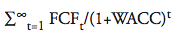 What is the formula above used to calculate?
Seçenekler
A
The value of the debts
B
The value of the firm
C
The sum of the firm's equity
D
The net working capital of the firm
E
The average cost of capital of the firm
Açıklama:
The value of the firm is measured as the sum of the value of the firm’s equity and the value of the debt:
 The correct answer is B.
The correct answer is B.Soru 74
As more debt is raised, the risk borne by the shareholder’s increases, leading to ...... .
Which of the following completes the sentence above?
Which of the following completes the sentence above?
Seçenekler
A
a higher cash flow
B
a lower cash flow
C
a higher cost of equity
D
a lower cost of equity
E
a higher stock price
Açıklama:
Firms raise equity funds from their shareholders, who own a direct share of the net income and the net worth of the company. As shareholders hold residual claims on both the earnings and the assets of the business, they bear more risk than the creditors. Therefore, equity financing becomes more expensive than debt financing. Furthermore, as more debt is raised, the risk borne by the shareholder’s increases, leading to a higher cost of equity. The correct answer is A.
Soru 75
- Stockholders
- Sales volume
- Per-unit price
- Input costs
- Competition
Seçenekler
A
I, II and III
B
II, III and IV
C
I, II, III and IV
D
I, II, III and V
E
II, III, IV and V
Açıklama:
The business risk is related to the uncertainty in the business operations of the firm. Business risk is influenced by numerous factors, including sales volume, per-unit price, input costs, competition, the overall economic conditions and etc. If not diversified, the stockholders bear both the business risk and the financial risk of the company. The correct answer is E.
Soru 76
Which of the following is the equation used to calculate ROIC?
Seçenekler
A
ROIC=Capital/NOPAT=EBIT*(1-T)/Capital
B
ROIC=NOPAT/Capital=EBIT*(1-T)/Capital
C
ROIC=EBIT/Capital=NOPAT*(1-T)/Capital
D
ROIC=NOPAT*(1-T)/Capital=EBIT/Capital
E
ROIC=EBIT*(1-T)/Capital=NOPAT/Capital
Açıklama:
The return on invested capital (ROIC) measures the operating profitability on capital investments:
ROIC=NOPAT/Capital=EBIT*(1-T)/Capital
NOPAT is the net operating profit after taxes and the capital is the amount of capital investment required for the persistence of the operations. The correct answer is B.
ROIC=NOPAT/Capital=EBIT*(1-T)/Capital
NOPAT is the net operating profit after taxes and the capital is the amount of capital investment required for the persistence of the operations. The correct answer is B.
Soru 77
- Agency theory
- Trade-off theory
- Optimal capital theory
- Traditional approach
- Net operating income approach
Seçenekler
A
I, II and III
B
III, IV and V
C
I, II, III and IV
D
I, II, IV and V
E
II, III, IV and V
Açıklama:
Maximizing the value of the firm is the main objective and the key to wealth maximization lies in the capital structure decisions. In an attempt to find the best practice in attaining this goal, academicians brought up a number of theoretical models:
- Net income approach
- Net operating income approach
- Traditional approach
- Modigliani and Miller Capital Structure Theory
- Trade-off theory
- Signaling theory
- Agency theory
Soru 78
Which capital structure theory advocates that a firm can boost its value by lowering its WACC, which is possible by increasing financial leverage in its capital structure?
Seçenekler
A
Traditional approach
B
Trade-off theory
C
Net income approach
D
Net Operating Income Approach
E
Modigliani and Miller Capital Structure Theory
Açıklama:
The net income approach advocates that a firm can boost its value by lowering its WACC, which is possible by increasing financial leverage in its capital structure. In this approach, it is assumed that the cost of debt is always less than the cost of equity and that the increase in the debt ratio does not lead to a change in the risk perception of the investors. The correct answer is C.
Soru 79
- Projecting the cost of debt and equity in order to quantify the WACC
- Identifying a capital structure maximizing the firm value
- Deducting debt from the value of the firm to measure the value of the equity and the stock price
- Evaluating shareholders’ wealth
- Capitalizing the forecasted free cash flows at the calculated WACC to determine the firm value
Seçenekler
A
1-2-4-3-5
B
2-4-1-3-5
C
2-1-4-5-3
D
4-1-2-3-5
E
4-2-1-5-3
Açıklama:
Estimating the optimal capital structure requires a careful analysis with repetitions. The managers normally start with a trial capital structure and (4) evaluate shareholders’ wealth. They continue the same practice until they (2) identify a capital structure maximizing the firm value. At each trial, (1) the cost of debt and equity are projected in order to quantify the WACC. Then, (5) the forecasted free cash flows are capitalized at the calculated WACC to determine the firm value. As a final step, (3) debt is deducted from the value of the firm to measure the value of the equity and the stock price. In practice, we can utilize the earnings per share (EPS) analysis to determine the shareholders’ wealth:
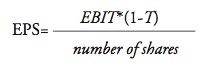 The correct answer is E.
The correct answer is E.Soru 80
Which of the following is not among the other factors that affect the capital structure?
Seçenekler
A
The age of the market
B
The political stability
C
The firm's level of leverage
D
The demand volatility
E
The legal status of the firm
Açıklama:
There are other factors that affect the capital structure. The political stability (economic environment-specific factors), the demand volatility (industry-specific factors), the legal status of the firm and the firm's level of leverage (firm-specific factors) are among these factors. The correct answer is A.
Ünite 4
Soru 1
Which of the following refers to all kinds of spendings made to acquire, sustain and increase production factors?
Seçenekler
A
Investment
B
Capital expenditure
C
Capital budgeting
D
Cash flow
E
Net present value
Açıklama:
Investment refers to all kinds of spendings made to acquire, sustain and increase production factors. The correct answer is A.
Soru 2
What is capital expenditure?
Seçenekler
A
Strategies for company’s whole portfolio of resources, and strategies for business unit’s products as well
B
The outlay of funds by the firm that is expected to produce benefits over a period of time longer than one year
C
A cash outlay that has already been incurred and that cannot be recovered regardless of whether the project is accepted or rejected
D
The return on the best alternative use of an asset; the highest return that will not be earned if funds are invested in a particular project
E
The process of evaluating and selecting long-term investments which are consistent with the firm's main objective of maximizing shareholders' wealth
Açıklama:
Capital expenditure refers to the outlay of funds by the firm that is expected to produce benefits over a period of time longer than one year. The correct answer is B.
Soru 3
- Implementing and monitoring the investment projects selected
- Identifying potential investments
- Analyzing the set of investment opportunities, isolating those that will create shareholder value, and prioritizing them if necessary
Seçenekler
A
1-2-3
B
1-3-2
C
2-1-3
D
2-3-1
E
3-2-1
Açıklama:
Capital budgeting activity is explained as a process, consisting of a number of stages. The three basic steps of this process are:
- Identifying potential investments,
- Analyzing the set of investment opportunities, isolating those that will create shareholder value, and prioritizing them if necessary,
- Implementing and monitoring the investment projects selected.
Soru 4
- Objective projects
- Independent projects
- Contingent projects
- Mutually exclusive projects
Seçenekler
A
I and II
B
III and IV
C
I, II and III
D
I, II and IV
E
II, III and IV
Açıklama:
Relative state of the investments regarding dependence on each other may be one of the following:
- Mutually exclusive projects: the type of projects in which selecting one project prevents other projects from being undertaken.
- Independent projects: the type of projects in which projects are not in direct competition with one another.
- Contingent projects: the type of projects in which approval or rejection of a project is contingent on approval or rejection of another project.
Soru 5
Which of the following is not a capital investment project analysis technique?
Seçenekler
A
Payback period
B
Profitability index
C
Decision tree analysis
D
Net present value
E
Internal rate of return
Açıklama:
Commonly applied capital investment project analysis techniques are payback period, discounted payback period, net present value, internal rate of return, modified internal rate of return, and profitability index. Decision trees are, however, tools to associate probabilities to each possible outcome for an event and map out the possible outcomes and the value of the investment opportunity associated with these different outcomes. The correct answer is C.
Soru 6
Which capital budgeting evaluation technique tells the length of time it takes cumulative present values of cash inflows will be equal to the initial cash outflow?
Seçenekler
A
Payback period
B
Discounted payback period
C
Net present value
D
Initial rate of return
E
Modified internal rate of return
Açıklama:
Same as payback period, discounted payback period tells the length of time it takes to get the initial cash outflow back, that is the period from the initial cash outflow to the time when the investment project’s cash inflows add up to the initial cash outflow. The only difference is cumulative present values of cash inflows (rather than numerical sum values) will be equal to the initial cash outflow. The correct answer is B.
Soru 7
- Estimating cash flow
- Adding up the discounted cash flows to obtain NPV
- Discounting cash flows by an appropriate discount rate
- Projecting the risk differences of different projects
Seçenekler
A
I and III
B
II and IV
C
I, II and III
D
I, II and IV
E
II, III and IV
Açıklama:
Tthere are three steps of calculating NPV:
- Estimating cash flows,
- Discounting cash flows by an appropriate discount rate,
- Adding up the discounted cash flows to obtain NPV.
Soru 8
Which of the following projects does internal rate of return technique approve if it is mutually exclusive?
Seçenekler
A
The project that provides the highest IRR
B
The project that provides the lowest IRR
C
The project that provides IRR greater than the expected rate of return
D
The project that provides IRR smaller than the expected rate of return
E
The project that provides IRR equal to the maximum rate of return
Açıklama:
According to internal rate of return technique, if a project is mutually exclusive, the project that provides the highest IRR (that is greater than the expected rate of return (discount rate used in NPV technique)) is approved. The correct answer is A.
Soru 9
- Real options analysis
- Scenario analysis
- Decision trees
- Sensitivity analysis
- Simulation analysis
Seçenekler
A
I, II and III
B
III, IV and V
C
I, II, III and IV
D
I, II, IV and V
E
II, III, IV and V
Açıklama:
Most of the time, because of the nature of risk, making adjustments to cash flows or discount rates is not enough for financial managers. They want to know the sources and possible effects of certain risks of a project. They want to measure a project’s risks coming from various sources rather than in general manner. Sensitivity analysis, scenario and simulation analysis, and decision trees are used for this purpose. However, one or more of these analyses sometimes lead(s) financial managers to consider real options available in a capital investment project because in reality there are various types of uncertainties that exist about these projects. The correct answer is E.
Soru 10
Which of the following options provide withdrawal of resources from a project failing to live up to short-run expectations?
Seçenekler
A
Expansion
B
Follow-on
C
Flexibility
D
Abandonment
E
Valuation
Açıklama:
Abandonment options are options to withdraw resources from a project that fails to live up to short-run expectations. These withdrawals might be the entire commitment to a project. With an abandonment option, company obtains an opportunity to withdraw part or all of its commitment to a project. The correct answer is D.
Soru 11
Which one of the following refers to all kinds of spendings made to acquire, sustain, and increase production factors?
Seçenekler
A
Cash flow
B
Payback period
C
Capital expenditure
D
Capital budgeting
E
Investment
Açıklama:
Investment refers to all kinds of spendings made to acquire, sustain, and increase production factors
Soru 12
... refers to the process of evaluating and selecting long-term investments which are consistent with the firm’s main objective of maximizing shareholders’ wealth.
Which one of the following completes the sentence?
Which one of the following completes the sentence?
Seçenekler
A
Capital budgeting
B
Investment
C
Capital expenditure
D
Cash flow
E
Payback period
Açıklama:
Capital budgeting refers to the process of evaluating and selecting long-term investments which are consistent with the firm’s main objective of maximizing shareholders’ wealth.
Soru 13
... refers to the process of evaluating and selecting long-term investments which are consistent with the firm’s main objective of maximizing shareholders’ wealth.
Which one of the following completes the sentence?
Which one of the following completes the sentence?
Seçenekler
A
Investment
B
Capital budgeting
C
Capital expenditure
D
Payback period
E
Cash flow
Açıklama:
Capital expenditure refers to outlay of funds by the firm that is expected to produce benefits over a period of time longer than one year.
Soru 14
...refers to a firm’s attribute that may allow the firm to generate economic profits.
Which one of the following completes the sentence?
Which one of the following completes the sentence?
Seçenekler
A
Strategy
B
Corporate strategy
C
Economic profit
D
Competitive advantage
E
Contingent projects
Açıklama:
Competitive advantage refers to a firm’s attribute that may allow the firm to generate economic profits.
Soru 15
Which one of the following refers to the risk-adjusted present value of revenue minus all costs, including the opportunity cost of capital?
Seçenekler
A
Competitive advantage
B
Economic profit
C
Corporate strategy
D
Externalities
E
Incremental cash flow
Açıklama:
Economic profit refers to the risk-adjusted present value of revenue minus all costs, including the opportunity cost of capital.
Soru 16
Which one of the following is the equation of (Net income of project + Depreciation)?
Seçenekler
A
Externalities
B
Opportunity cost
C
Earnings before interest
D
A project's cash flow
E
Economic profit
Açıklama:
A project’s cash flow = Net income of project + Depreciation
Soru 17
Which one of the following tells the length of time it takes cumulative present values of cash inflows will be equal to the initial cash outflow?
Seçenekler
A
Payback period
B
Discounted payback period technique
C
Incremental cash flow
D
Opportunity cost
E
Sunk cost
Açıklama:
Discounted payback period technique tells the length of time it takes cumulative present values of cash inflows will be equal to the initial cash outflow.
Soru 18
Which one of the following is the first step of calculating the Net Present Value?
Seçenekler
A
Discounting cash flows by an appropriate discount rate
B
Estimating depreciation
C
Estimating cash flows
D
Adding up the discounted cash flows to obtain NPV
E
Calculating Internat Rate of Return
Açıklama:
Estimating cash flows is the first step of calculating the Net Present Value.
Soru 19
Whic one of the following tells the ratio of the present value of a project’s cash inflows to the present value of all cash outflows or initial cash outflow?
Seçenekler
A
Profitability index technique
B
Terminal value
C
Internal rate of return technique
D
Modified internal rate of return technique
E
Net present value technique
Açıklama:
Profitability index technique tells the ratio of the present value of a project’s cash inflows to the present value of all cash outflows or initial cash outflow.
Soru 20
Which one of the following refer to the options of managers about capital investment projects which can be priced by using stock option-pricing methodologies?
Seçenekler
A
Adjusted cash flow
B
Adjusted discount rate
C
Profitability index
D
Net present value technique
E
Real options
Açıklama:
Real options refer to the options of managers about capital investment projects which can be priced by using stock option-pricing methodologies.
Soru 21
Which of the following term refers to all kinds of spendings made for acquiring, sustaining, and increasing production factors?
Seçenekler
A
Capital budgeting
B
Capital expenditure
C
Competityive advantage
D
Economic profit
E
Investment
Açıklama:
Investment consists all kinds of spendings made for acquiring, sustaining, and increasing production factors.
Soru 22
Which of the following shows the correct order of the process of capital budgeting activity?
Seçenekler
A
Analyzing investment opportunities/ Identifying potential investments/ Prioritizing investment opportunities / Implementing investment projects
B
Analyzing investment opportunities / Prioritizing investment opportunities /Identifying potential investments/ Implementing investment projects
C
Identifying potential investments/ Analyzing investment opportunities/ Prioritizing investment opportunities / Implementing investment projects
D
Implementing investment projects/ Identifying potential investments/ Analyzing investment opportunities/ Prioritizing investment opportunities
E
Prioritizing investment opportunities / Analyzing investment opportunities/ Identifying potential investments/ Implementing investment projects
Açıklama:
In many textbooks, capital budgeting activity is explained as a process, consisting of a number of stages. Megginson et al. (2010) briefly explain this process in three basic steps:
- Identifying potential investments
- Analyzing the set of investment opportunities, isolating those that will create shareholder value, and prioritizing them if necessary
- Implementing and monitoring the investment projects selected.
Soru 23
A company has a budget of $50,000 for expansion projects. There are two projects such as A and B. If Projects A and B each cost $40,000, which of the following investment type explains the dependence between projects A and B?
Seçenekler
A
Capital investment projects
B
Contingent projects
C
Independent projects
D
Mutually exclusive projects
E
Replacement projects
Açıklama:
Projects A and B are mutually exclusive. If the company pursues A, it cannot also afford to pursue B and vice versa.
Soru 24
A company has a budget of $50,000 for expansion projects. There are three projects such as A, B and C. If Projects A and B each cost $40,000, and Project C costs only $10,000, which of the following investment type explains the dependence of Project C?
Seçenekler
A
Capital investment projects
B
Contingent projects
C
Independent projects
D
Mutually exclusive projects
E
Replacement projects
Açıklama:
If the company pursues A, it cannot also afford to pursue B and vice versa. Project C, however, is independent. Regardless of which other project is pursued, the company can still afford to pursue C as well. The acceptance of either A or B does not impact the viability of C, and the acceptance of C does not impact the viability of either of the other projects.
Soru 25
A company decides to build houses and roads before building a factory in a remote area. Which of the following investment type explains the situation?
Seçenekler
A
Capital investment projects
B
Contingent projects
C
Independent projects
D
Mutually exclusive projects
E
Replacement projects
Açıklama:
Contingent projects are the type of projects in which approval or rejection of a project is contingent on approval or rejection of another project.
Soru 26
Which of the following term refers to a firm’s attribute that may allow the firm to generate economic profits?
Seçenekler
A
Competitive advantage
B
Corporate strategy
C
Economic profit
D
Opportunity cost
E
Strategy
Açıklama:
Competitive advantage refers to a firm’s attribute that may allow the firm to generate economic profits.
Soru 27
Which of the following term refers to a change in a firm’s net cash flow attributable to an investment project?
Seçenekler
A
Capital budgeting
B
Capital expenditure
C
Incremental cash flow
D
Opportunity cost
E
Sunk cost
Açıklama:
Incremental cash flow refers to a change in a firm’s net cash flow attributable to an investment project.
Soru 28
Which of the following term refers to the sum of present value of all cash inflaws and cash outflows of a project over its life?
Seçenekler
A
Net present value
B
Payback period
C
Internal rate of return
D
Terminal value
E
Discounted payback period
Açıklama:
Net present value of a project is the sum of present value of all cash inflaws and cash outflows of a project over its life.
Soru 29
Which of the following technique is used to find the rate of return that causes the net present value of a project to be zero?
Seçenekler
A
Payback period
B
Terminal value
C
Net present value
D
Discounted payback period
E
Internal rate of return
Açıklama:
Internal rate of return is the rate of return that causes the net present value of a project to be zero.
Soru 30
Which of the following is the effect of the present value of the delayed capital expenditure of future cost savings in real options?
Seçenekler
A
Effect of stock’s price in stock options
B
Effect of the exercise (strike) price of the option in stock options
C
Effect of the risk-free interest rate in stock options
D
Effect of the volatility of stock’s price in stock options
E
Effect of the time remaining to the expiration of the option in stock options
Açıklama:
Effect of the exercise (strike) price of the option in stock options is the effect of the present value of the delayed capital expenditure of future cost savings in real options.
Soru 31
- Capital budgeting includes long-term decisions about non-current assets of a company.
- Decisions about non-current assets need extra attention from managers because they are more expensive than the current assets.
- The outcome of capital budgeting is either approval or rejection of the investment project.
- In order to come to approval or rejection point, a financial manager needs analytical tools to make analysis.
- There are a number of simple and sophisticated analytical tools that managers use for project analysis.
- Main consideration is “return and risk” and “benefit and cost” of each project proposal.
- In the end, if a financial manager approves an investment project, we can assume that he/she thinks that returns/benefits from the project will be greater than the associated risks/costs.
Seçenekler
A
I and II
B
II, III and IV
C
I, IV, V and VI
D
I, II, IV, V, VI and VII
E
I, II, III, IV, V, VI and VII
Açıklama:
Like every other financial decision area, capital budgeting decisions can be seen as financial managers’ strategic tool to use to contribute to the maximization of shareholder wealth, or creation of firm value. Capital budgeting includes long-term decisions about non-current assets of a company. Decisions about these assets need extra attention from managers because they are more expensive than the current assets, and unlike current assets, it is difficult to unwind once proceeded difficult to resell in the market quickly. The outcome of capital budgeting is either approval or rejection of the investment project. In order to come to that point, a financial manager needs analytical tools to make analysis and come to a conclusion according to the results of the analysis together with his/her intuition about the project. There are a number of simple and sophisticated analytical tools that managers use for project analysis. However, main consideration, of course, is “return and risk” and “benefit and cost” of each project proposal. In the end, if a financial manager approves an investment project, we can assume that he/she thinks that returns/benefits from the project will be greater than the associated risks/costs.
As also understood from the information given, the answer is E. All of the statements related to capital budgeting in the options are correct.
As also understood from the information given, the answer is E. All of the statements related to capital budgeting in the options are correct.
Soru 32
- In order to position the capital budgeting in business finance, it is essential to identify the relationships between capital budgeting, cost of capital, and capital structure.
- A financial manager should consider a number of factors indicating whether a capital investment project has a positive effect on the firm value or not.
- One of the most important factors is the cost of capital because it determines how capital investment projects will be financed, and how capital structure will be changed.
- The cost of capital is used as a kind of measure or reference point to make an investment decision.
- Expected rate of return from a capital investment project should at least be equal to the cost of capital.
- If the cost of capital used in the evaluation is calculated wrong, then a financial manager may approve projects that should be rejected (overinvest), or may reject projects that should be approved (underinvest).
Seçenekler
A
I and II
B
II and III
C
I, IV and VI
D
I, II, III, IV and VI
E
I, II, III, IV, V and VI
Açıklama:
In order to position the capital budgeting in business finance, it is essential to identify the relationships between capital budgeting, cost of capital, and capital structure. A financial manager should consider a number of factors indicating whether a capital investment project has a positive effect on the firm value or not. One of the most important factors is the cost of capital because it determines how capital investment projects will be financed, and how capital structure will be changed. These two may change the value of the firm. At the same time, the cost of capital is used as a kind of measure or reference point to make an investment decision. Expected rate of return from a capital investment project should at least be equal to the cost of capital. If the cost of capital used in the evaluation is calculated wrong, then a financial manager may approve projects that should be rejected (overinvest), or may reject projects that should be approved (underinvest). Both overinvestment and underinvestment cost a company a lot of money because of the inefficient use of a company’s scarce resources and they both hamper managers’ efforts to create shareholder value.
As also understood from the information given, the answer is E. All of the statements related to capital budgeting in the options are correct.
As also understood from the information given, the answer is E. All of the statements related to capital budgeting in the options are correct.
Soru 33
- Investment of any kind is made with the intention of gaining returns over the money, time, and effort spent for making the investment.
- Investment consists all kinds of spendings made for acquiring, sustaining, and increasing production factors.
- If a financial manager approves any investment to be made, we can assume that he/she thinks that benefits/returns will be more than the costs/risks.
- Decisions about operating expenditures from which benefits are expected to be received within a year are easier to make than the decisions about capital expenditures from which benefits are expected to be received over a period of time, longer than one year.
Seçenekler
A
I and II
B
II and III
C
I, III and IV
D
II, III and IV
E
I, II, III and IV
Açıklama:
Investment of any kind is made with the intention of gaining returns over the money, time, and effort spent for making the investment. Investment consists all kinds of spendings made for acquiring, sustaining, and increasing production factors. If a financial manager approves any investment to be made, we can assume that he/she thinks that benefits/returns will be more than the costs/risks. Decisions about operating expenditures from which benefits are expected to be received within a year are easier to make than the decisions about capital expenditures from which benefits are expected to be received over a period of time, longer than one year.
As also understood from the information given, the answer is E. All of the statements in the options related to investment are correct.
As also understood from the information given, the answer is E. All of the statements in the options related to investment are correct.
Soru 34
- Investment refers to all kinds of spendings made to acquire, sustain, and increase production factors.
- Capital expenditure refers to outlay of funds by the firm that is expected to produce benefits over a period of time longer than one year.
- Capital budgeting refers to the process of evaluating and selecting long-term investments which are consistent with the firm’s main objective of maximizing shareholders’ wealth.
- Capital budgeting activity is a process consisting of a number of stages.
Seçenekler
A
I and II
B
II and III
C
I, II and III
D
II, III and IV
E
I, II, III and IV
Açıklama:
Investment of any kind is made with the intention of gaining returns over the money, time, and effort spent for making the investment. Investment consists all kinds of spendings made for acquiring, sustaining, and increasing production factors. If a financial manager approves any investment to be made, we can assume that he/she thinks that benefits/returns will be more than the costs/risks. Decisions about operating expenditures from which benefits are expected to be received within a year are easier to make than the decisions about capital expenditures from which benefits are expected to be received over a period of time, longer than one year. Capital expenditure is the outlay of funds by the firm that is expected to produce benefits over a period of time longer than one year. Capital budgeting is the process of evaluating and selecting longterm investments which are consistent with the firm’s main objective of maximizing shareholders’ wealth.
“Companies make capital expenditures for many reasons. The basic motives for capital expenditures are to expand operations, to replace or renew fixed assets, or to obtain some other, less tangible benefit over a long period” (Gitman and Zutter, 2012:361).
In many textbooks, capital budgeting activity is explained as a process, consisting of a number of stages.
As also undertstood from the information given, the answer is E. All of the definitions in the options are correct.
“Companies make capital expenditures for many reasons. The basic motives for capital expenditures are to expand operations, to replace or renew fixed assets, or to obtain some other, less tangible benefit over a long period” (Gitman and Zutter, 2012:361).
In many textbooks, capital budgeting activity is explained as a process, consisting of a number of stages.
As also undertstood from the information given, the answer is E. All of the definitions in the options are correct.
Soru 35
- Capital budgeting activity is explained as a process consisting three basic steps.by Megginson et al.
- These steps are “Identifying potential investments”, “Analyzing the set of investment opportunities, isolating those that will create shareholder value, and prioritizing them if necessary” and “Implementing and monitoring the investment projects selected”.
- If management does not spend enough effort to identify good investments, it will be pointless to analyze and prioritize projects because the outcome will not provide enough return regardless of the project evaluation techniques used.
- If management does not work enough on controlling and monitoring the projects, all money, time and effort spent on project evaluation will be wasted because without good monitoring, a project cannot sustain generating cash flows as expected in the first place.
Seçenekler
A
I and II
B
II and III
C
I, II and IV
D
II, III and IV
E
I, II, III and IV
Açıklama:
In many textbooks, capital budgeting activity is explained as a process, consisting of a number of stages. Megginson et al. (2010) briefly explain this process in three basic steps:
As also understood from the information given, the answer is E. All of the the statements related to capital budgeting activity in the options are correct.
- Identifying potential investments
- Analyzing the set of investment opportunities, isolating those that will create shareholder value, and prioritizing them if necessary
- Implementing and monitoring the investment projects selected
As also understood from the information given, the answer is E. All of the the statements related to capital budgeting activity in the options are correct.
Soru 36
What is the type of projects in which selecting one project prevents other projects from being undertaken?
Seçenekler
A
Mutually exclusive
B
Independent
C
Contingent
D
Opportunity cost
E
Externalities
Açıklama:
We can classify capital investment projects based on motivations to make the investment, and based on relative state of the investments regarding dependence on each other. Motivations may vary in various types of ways. Generally, reasons to make a capital investment project fall in one of the following groups:
The other two terms in the options i.e. externalities and opportunity cost are the terms related to estimating project cash flows.
Opportunity cost refers to the return on the best alternative use of an asset; the highest return that will not be earned if funds are invested in a particular project.
Externalities refer to the way in which accepting a project affects the cash flows in other areas of the firm.
- Replacement of the existing plant and equipment
- Modernization of the existing plant and equipment
- Expansion of the existing and new products
- Mutually exclusive projects: the type of projects in which selecting one project prevents other projects from being undertaken.
- Independent projects: the type of projects in which projects are not in direct competition with one another.
- Contingent projects: the type of projects in which approval or rejection of a project is contingent on approval or rejection of another project.
The other two terms in the options i.e. externalities and opportunity cost are the terms related to estimating project cash flows.
Opportunity cost refers to the return on the best alternative use of an asset; the highest return that will not be earned if funds are invested in a particular project.
Externalities refer to the way in which accepting a project affects the cash flows in other areas of the firm.
Soru 37
- Strategy refers to formulation and implementation of a company’s key decisions.
- Corporate strategy refers to strategies for company’s whole portfolio of resources, and strategies for business unit’s products, as well.
- Competitive advantage refers to a firm’s attribute that may allow the firm to generate economic profits.
- Economic profit refers to the risk-adjusted present value of revenue minus all costs, including the opportunity cost of capital.
Seçenekler
A
I and II
B
I and III
C
II and III
D
I, II and IV
E
I, II, III and IV
Açıklama:
Corporate Strategy and Capital Budgeting
Capital budgeting decisions are part of a company’s objectives, goals, and strategies, rather than being stand-alone ideas of managers. Engineering department, marketing department, or any other department proposes an investment project to senior managers. Then, managers allocate company’s funds to projects that they believe will create a positive value. These investment projects are ideas which stem from and which are in line with the company’s main objectives, goals and strategies. Let’s remember the concept of strategy. “A strategy is the formulation and implementation of a company’s key decisions” (Baker and English, 2011). Corporate strategy includes both strategies for company’s whole portfolio of resources and strategies for only business unit’s products (Baker and English, 2011). For capital budgeting matters, the aim of corporate strategy is to find investment projects which provide positive net present value for the company. In perfectly competitive markets it is assumed that it is not possible to find such a project. This assumption makes calculations of project valuation easy to make. At the same time, this assumption shows the importance of competition for capital budgeting decisions. The higher the competition levels in the market, the more difficult the profitable investment projects to find. There are two main explanations to this. First, entry barriers are higher in more competitive markets. Second, arbitrage possibilities are less in more competitive markets. However, the market for capital investments is not perfectly competitive (market imperfection). It means that it is possible to find projects which add value to a company’s competitive advantage that is why they create shareholder value. Competitive advantage, “a firm’s attribute that may allow the firm to generate economic profits” is key here (Baker and English, 2011). Here, economic profit refers to the risk-adjusted present value of revenue minus all costs, including the opportunity cost of capital. Together with market imperfection, cost-saving projects that will create competitive advantage can be a source for positive economic profit. After valuations on the paper, investment projects are approved or rejected, but before starting to make any valuation, financial managers look at the structure of the market and see if the project contributes to the differentiation of the company from others and gaining competitive advantage. If the answer is yes, then they start choosing the technique, estimating the discount rate, estimating cash flows, and estimating initial cost.
As also understood from the information given, the answer is E. All of the statements above related to corporate strategy and capital budgeting are correct.
Positive economic profits (or positive net present value projects) can stem from two sources: i) market imperfections, ii) creating competitive advantage.
Capital budgeting decisions are part of a company’s objectives, goals, and strategies, rather than being stand-alone ideas of managers. Engineering department, marketing department, or any other department proposes an investment project to senior managers. Then, managers allocate company’s funds to projects that they believe will create a positive value. These investment projects are ideas which stem from and which are in line with the company’s main objectives, goals and strategies. Let’s remember the concept of strategy. “A strategy is the formulation and implementation of a company’s key decisions” (Baker and English, 2011). Corporate strategy includes both strategies for company’s whole portfolio of resources and strategies for only business unit’s products (Baker and English, 2011). For capital budgeting matters, the aim of corporate strategy is to find investment projects which provide positive net present value for the company. In perfectly competitive markets it is assumed that it is not possible to find such a project. This assumption makes calculations of project valuation easy to make. At the same time, this assumption shows the importance of competition for capital budgeting decisions. The higher the competition levels in the market, the more difficult the profitable investment projects to find. There are two main explanations to this. First, entry barriers are higher in more competitive markets. Second, arbitrage possibilities are less in more competitive markets. However, the market for capital investments is not perfectly competitive (market imperfection). It means that it is possible to find projects which add value to a company’s competitive advantage that is why they create shareholder value. Competitive advantage, “a firm’s attribute that may allow the firm to generate economic profits” is key here (Baker and English, 2011). Here, economic profit refers to the risk-adjusted present value of revenue minus all costs, including the opportunity cost of capital. Together with market imperfection, cost-saving projects that will create competitive advantage can be a source for positive economic profit. After valuations on the paper, investment projects are approved or rejected, but before starting to make any valuation, financial managers look at the structure of the market and see if the project contributes to the differentiation of the company from others and gaining competitive advantage. If the answer is yes, then they start choosing the technique, estimating the discount rate, estimating cash flows, and estimating initial cost.
As also understood from the information given, the answer is E. All of the statements above related to corporate strategy and capital budgeting are correct.
- Strategy refers to formulation and implementation of a company’s key decisions.
- Corporate strategy refers to strategies for company’s whole portfolio of resources, and strategies for business unit’s products, as well.
- Competitive advantage refers to a firm’s attribute that may allow the firm to generate economic profits.
- Economic profit refers to the risk-adjusted present value of revenue minus all costs, including the opportunity cost of capital.
Positive economic profits (or positive net present value projects) can stem from two sources: i) market imperfections, ii) creating competitive advantage.
Soru 38
- Managers have to realize and distinguish which variables are relevant to a particular project’s cash flow estimation, and which are not.
- Only information which is relevant to the project’s analysis is used in developing forecasts.
- Incremental cash flow refers to a change in a firm’s net cash flow attributable to an investment project.
- Incremental cash flows occur as a direct result of accepting the project, and should be included in the evaluation.
- Incremental cash flows may occur at the start of the project, may continue during the project, or may occur at the end of the project.
Seçenekler
A
I and II
B
I and III
C
II, III and IV
D
I, II, IV and V
E
I, II, III, IV and V
Açıklama:
Recommended Correction:
Page 76
Financial managers develop cash flow forecasts by using the input data coming from other departmets such as engineering, manufacturing, marketing, accounting, etc.
Financial managers develop cash flow forecasts by using the input data coming from other departments such as engineering, manufacturing, marketing, accounting, etc.
Financial managers develop cash flow forecasts by using the input data coming from other departmets such as engineering, manufacturing, marketing, accounting, etc. At that point, managers have to realize and distinguish which variables are relevant to a particular project’s cash flow estimation, and which are not. Only information which is relevant to the project’s analysis is used in developing forecasts. This is called incremental cash flow, a change in a firm’s net cash flow attributable to an investment project (Besley and Brigham, 2012: 496). Incremental cash flows occur as a direct result of accepting the project, and should be included in the evaluation. Incremental cash flows may occur at the start of the project, may continue during the project, or may occur at the end of the project.
As also understood from the information given, the answer is E. All of the statements above related to incremental cash flow are correct.
Page 76
Financial managers develop cash flow forecasts by using the input data coming from other departmets such as engineering, manufacturing, marketing, accounting, etc.
Financial managers develop cash flow forecasts by using the input data coming from other departments such as engineering, manufacturing, marketing, accounting, etc.
Financial managers develop cash flow forecasts by using the input data coming from other departmets such as engineering, manufacturing, marketing, accounting, etc. At that point, managers have to realize and distinguish which variables are relevant to a particular project’s cash flow estimation, and which are not. Only information which is relevant to the project’s analysis is used in developing forecasts. This is called incremental cash flow, a change in a firm’s net cash flow attributable to an investment project (Besley and Brigham, 2012: 496). Incremental cash flows occur as a direct result of accepting the project, and should be included in the evaluation. Incremental cash flows may occur at the start of the project, may continue during the project, or may occur at the end of the project.
As also understood from the information given, the answer is E. All of the statements above related to incremental cash flow are correct.
Soru 39
- Sunk costs
- Opportunity costs
- Externalities
- Shipping and installation costs
- Inflation
Seçenekler
A
I and II
B
III and IV
C
I, IV and V
D
I, II, IV and V
E
I, II, III, IV and V
Açıklama:
Besley and Brigham (2012) list problematic areas related to incremental cash flows (which should be included in the evaluation). Some are simple to identify, but some are not. The ones that are not always very easy to identify are sunk costs, opportunity costs, externalities, shipping and installation costs, and inflation. As also understood from the information given, the answer is E. All of them are problematic areas related to incremental cash flows that are not always very easy to identify.
Sunk cost is defined as a cash outlay that has already been incurred and that cannot be recovered regardless of whether the project is accepted or rejected. Therefore, it should not be included in the analysis as it is not an incremental cash flow. Opportunity cost is defined as the return on the best alternative use of an asset; the highest return that will not be earned if funds are invested in a particular project. Opportunity cost should be included in the analysis as it is an incremental cash flow. Externalities are defined as the way in which accepting a project affects the cash flows in other areas of the firm. Externalities should not be included in the analysis as they are not an incremental cash flow. Shipping and installation costs should be included in the analysis as it is an incremental cash flow because they generally require cash payments. Lastly, effects of inflation on cash flows should be included in the analysis as it may be considered as an incremental cash flow because it changes the real value of a cash flow.
Sunk cost is defined as a cash outlay that has already been incurred and that cannot be recovered regardless of whether the project is accepted or rejected. Therefore, it should not be included in the analysis as it is not an incremental cash flow. Opportunity cost is defined as the return on the best alternative use of an asset; the highest return that will not be earned if funds are invested in a particular project. Opportunity cost should be included in the analysis as it is an incremental cash flow. Externalities are defined as the way in which accepting a project affects the cash flows in other areas of the firm. Externalities should not be included in the analysis as they are not an incremental cash flow. Shipping and installation costs should be included in the analysis as it is an incremental cash flow because they generally require cash payments. Lastly, effects of inflation on cash flows should be included in the analysis as it may be considered as an incremental cash flow because it changes the real value of a cash flow.
Soru 40
- There are two very important items that are related to the estimation of investment projects’ cash flows: financing costs and depreciation.
- Financing costs are irrelevant cash flows to capital investment project evaluation which should not be included in the analysis.
- Financing costs are incorporated in the capital budgeting analysis with the determination of discount rate, rather than with the estimation of cash flows.
- Depreciation is considered as a relevant cash flow to capital investment project evaluation which should be included in the analysis.
- A project’s cash flow is equal to net income of project plus depreciation.
Seçenekler
A
I and II
B
III and IV
C
I, IV and V
D
II, III, IV and V
E
I, II, III, IV and V
Açıklama:
There are two very important items that are related to the estimation of investment projects’ cash flows: financing costs and depreciation.
A project’s cash flow = Net income of project + Depreciation
As also understood from the information given, the answer is E. All of the statements above related to the estimation of investment projects’ cash flows are correct.
- Financing costs are irrelevant cash flows to capital investment project evaluation which should not be included in the analysis. Although interest and loan payments require cash outflow, one should exclude them while making estimations of cash flows. The reason is cost of financing or minimum rate of required return is included in the capital budgeting analysis in the discount rate. Financing costs are incorporated in the process with the discount rate. Therefore, it would be double-considering if we included financing costs as cash outflows.
- Depreciation is considered as a relevant cash flow to capital investment project evaluation which should be included in the analysis. In fact, depreciation is a non-cash expense item, but it affects the taxable income of a company. It means that although one does not need any cash to pay depreciation expense each year, it changes the amount of taxes paid which is a cash expense. Remember the income statement and note that depreciation expense is subtracted from revenue, and EBITDA (earnings before interest, tax, depreciation and amortization) is found. It means that it is deducted before the tax expense is calculated. By this way, depreciation creates a tax-shield. Likewise, in capital investment project’s income statement, depreciation is deducted before the tax expense is calculated. To calculate the cash flow of a project, we should add depreciation amount back to the project’s net income.
A project’s cash flow = Net income of project + Depreciation
As also understood from the information given, the answer is E. All of the statements above related to the estimation of investment projects’ cash flows are correct.
Soru 41
- It is easy to apply and easy to explain to non-financial personnel;
- It focuses on cash flow, not accounting-based measures such as profit;
- It accounts for the time value of money;
- It adjusts for differences in risk across projects
- It leads to higher firm value in any company (and higher stock prices in public firms)
Seçenekler
A
I and II
B
III and IV
C
I, II and IV
D
I, II, IV and V
E
I, II, III, IV and V
Açıklama:
“To decide which investments to undertake, managers need an analytical tool that: 1) is easy to apply and easy to explain to non-financial personnel; 2) focuses on cash flow, not accounting-based measures such as profit; 3) accounts for the time value of money; 4) adjusts for differences in risk across projects; and 5) leads to higher firm value in any company (and higher stock prices in public firms)” (Megginson, Smart, Graham, 2010:232).
As also understood from the information given, the answer is E. All of them are the characteristics of an analytical tool which managers need to decide which investments to undertake.
As also understood from the information given, the answer is E. All of them are the characteristics of an analytical tool which managers need to decide which investments to undertake.
Soru 42
- Payback period
- Discounted payback period
- Net present value
- Internal rate of return
- Modified internal rate of return
- Profitability index
Seçenekler
A
I and III
B
II, III and IV
C
I, IV, V and VI
D
I, III, IV, V and VI
E
I, II, III, IV, V and VI
Açıklama:
Techniques explained in this section do not incorporate the concept of “risk” in the evaluation. In other words, they all assume that all investment projects the same same level of risk. All calculations are based on this assumption. Information about how risk can be incorporated in the evaluation process will be provided in the next section. Commonly applied capital investment project analysis techniques are payback period, discounted payback period, net present value, internal rate of return, modified internal rate of return, and profitability index.
As also understood from the information given, the answer is E. All of them are commonly applied capital investment project analysis techniques.
As also understood from the information given, the answer is E. All of them are commonly applied capital investment project analysis techniques.
Soru 43
- If a project is independent, approve the project(s) that pays the initial investment back less than a specified payback period.
- If a project is mutually exclusive, choose the project that provides the shortest payback period.
- Payback period technique tells the length of time it takes to get the initial cash outflow back.
- All you have to do is find when cumulative cash inflows will be equal to initial cash outflow.
- Payback period technique assumes that all investment projects have the same level of risk.
Seçenekler
A
I and II
B
I and IV
C
II, III and IV
D
II, III, IV and V
E
I, II, III, IV and V
Açıklama:
Payback period tells the length of time it takes to get initial cash outflow back, that is the period from the initial cash outflow to the time when the investment project’s cash inflows add up to the initial cash outflow. This technique is a simple, easy to use and easy to understand technique. It is commonly used among managers because it quickly tells when a project pays the initial cash outflow back. It is also easy to explain to managers who are not experts in finance. All you have to do is find when cumulative cash inflows will be equal to initial cash outflow. The assumption is that cash flow occurs at a constant rate throughout the year. It means that you can use a fraction of year while equaling cumulative total amount of cash inflows and the initial cash outflow. This technique also assumes that all investment projects have the same level of risk. Actually, it does not account for the risk of the project at all. Risk is not inherited in the calculation of payback period. Moreover, this technique does not account for the time value of money.
Payback period technique tells the length of time it takes to get the initial cash outflow back.
The decision rule for the payback period technique is simple. Only a project with a payback period shorter than (or equal to) the management’s specified payback period can be approved. And, a project with shorter payback period is better than a project with longer payback period. Besides its easiness, payback period technique has important drawbacks. It does not account for the cash flows after the payback period. However, a project may be very valuable to a company, but since it provides a big cash inflow after the cutoff point in time, a manager would miss it. Besides this drawback, payback period technique is criticized because it does not account for the time value of money and for the risk differences among projects. In order to consider the time value of money, discounted payback period technique is developed.
If a project is independent, approve the project(s) that pays the initial investment back less than a specified payback period.
If a project is mutually exclusive, choose the project that provides the shortest payback period.
As also understood from the information given, the answer is E. All of the statements above related to payback period technique are correct.
Payback period technique tells the length of time it takes to get the initial cash outflow back.
The decision rule for the payback period technique is simple. Only a project with a payback period shorter than (or equal to) the management’s specified payback period can be approved. And, a project with shorter payback period is better than a project with longer payback period. Besides its easiness, payback period technique has important drawbacks. It does not account for the cash flows after the payback period. However, a project may be very valuable to a company, but since it provides a big cash inflow after the cutoff point in time, a manager would miss it. Besides this drawback, payback period technique is criticized because it does not account for the time value of money and for the risk differences among projects. In order to consider the time value of money, discounted payback period technique is developed.
If a project is independent, approve the project(s) that pays the initial investment back less than a specified payback period.
If a project is mutually exclusive, choose the project that provides the shortest payback period.
As also understood from the information given, the answer is E. All of the statements above related to payback period technique are correct.
Soru 44
- Discounted payback tells the length of time it takes to get the initial cash outflow back.
- The only difference is cumulative present values of cash inflows (rather than numerical sum values) will be equal to the initial cash outflow.
- Projected cash flows are discounted at an appropriate discount rate and their present values are used to calculate payback period.
- Assumptions are the same with payback period technique.
- This technique assumes that cash flow occurs at a constant rate throughout the year, and assumes that all investment projects have the same level of risk.
- If a project is independent approve the project(s) that pays the initial investment back less than a specified payback period.
- If a project is mutually exclusive, choose the project that provides the shortest discounted payback period.
Seçenekler
A
I and II
B
II, IV and V
C
III, IV, V, VI and VII
D
I, II, III, IV, V and VI
E
I, II, III, IV, V, VI and VII
Açıklama:
Same as payback period, discounted payback tells the length of time it takes to get the initial cash outflow back, that is the period from the initial cash outflow to the time when the investment project’s cash inflows add up to the initial cash outflow. The only difference is cumulative present values of cash inflows (rather than numerical sum values) will be equal to the initial cash outflow. Projected cash flows are discounted at an appropriate discount rate and their present values are used to calculate payback period. Assumptions are the same with payback period technique. This technique assumes that cash flow occurs at a constant rate throughout the year, and assumes that all investment projects have the same level of risk. Note that it accounts for the risk which is inherited in the discount rate. However, it does not account for the risk differences of different projects.
Discounted payback period technique tells the length of time it takes cumulative present values of cash inflows will be equal to the initial cash outflow.
If a project is independent approve the project(s) that pays the initial investment back less than a specified payback period.
If a project is mutually exclusive, choose the project that provides the shortest discounted payback period. Discounted payback period technique has the same drawback with payback period technique. It does not account for the cash flows after the payback period. However, a project may be very valuable to a company, but since it provides a big cash inflow after the cutoff point in time, a manager would miss it.
“Discounted payback does correct the payback rule’s problem of implicity applying a 0% discount rate to all cash flows that occur before the cutoff point” (Megginson, Smart, Graham, 2010: 237).
As also understood from the information given the answer is E. All of the statements above related to discounted payback period technique are correct.
Discounted payback period technique tells the length of time it takes cumulative present values of cash inflows will be equal to the initial cash outflow.
If a project is independent approve the project(s) that pays the initial investment back less than a specified payback period.
If a project is mutually exclusive, choose the project that provides the shortest discounted payback period. Discounted payback period technique has the same drawback with payback period technique. It does not account for the cash flows after the payback period. However, a project may be very valuable to a company, but since it provides a big cash inflow after the cutoff point in time, a manager would miss it.
“Discounted payback does correct the payback rule’s problem of implicity applying a 0% discount rate to all cash flows that occur before the cutoff point” (Megginson, Smart, Graham, 2010: 237).
As also understood from the information given the answer is E. All of the statements above related to discounted payback period technique are correct.
Soru 45
- If the net present value is greater than zero (positive net present value) for a project, it means that the project will increase the shareholder value by that amount.
- If the net present value is smaller than zero (negative net present value) for a project, it means that the project will decrease the shareholder value by that amount.
- Net present value technique finds the sum of present value of all cash inflaws and cash otflows of a project over its life.
- If a project is independent, approve the project(s) that provide a positive net present value.
- If a project is mutually exclusive, choose the project that provides the biggest net present value.
Seçenekler
A
I and II
B
III and IV
C
II, III and IV
D
I, II, III and IV
E
I, II, III, IV and V
Açıklama:
Net present value of a project is the sum of present value of all cash inflaws and cash outflows of a project over its life. If the NPV is greater than zero (positive NPV) for a project, it means that the project will increase the shareholder value by that amount. If the NPV is smaller than zero (negative NPV) for a project, it means that the project will decrease the shareholder value by that amount. There are three steps of calculating NPV:
1. Estimating cash flows
2. Discounting cash flows by an appropriate discount rate
3. Adding up the discounted cash flows to obtain NPV
In order to find the present value of cash flows, discounting is used. So, we can say that net present value technique accounts for the time value of money. On the other hand, this technique assumes that all investment projects have the same level of risk. Note that it accounts for the risk which is inherited in the discount rate. However, it does not account for the risk differences of different projects. Nevertheless, risk differences may be considered in the technique by using different discount rates for projects with different levels of risk. One should use a higher discount rate for finding the NPV of riskier projects and reflect the extra amount of return demanded by investors in order to compensate for the risk. That is because the riskier the project, the higher the expected rate of return. Decision rule for net present value technique is quite straightforward. For independent projects, approve projects with positive NPV . Reject projects with negative NPV For mutually exclusive projects, choose the project with the biggest NPV. “A positive NPV means the project’s cash inflows are sufficient to repay the initial upfront (time zero) costs as well as the financing cost (at discount rate) over the project’s life. Since NPV is greater than zero, project’s return is greater than the cost of capital (the discount rate)… Projects with negative net present values are not acceptable to a firm. They provide returns lower than the cost of capital and would cause the value of the firm to fall” (Melicher, Nortan, 2011: 486-487).
Net present value technique finds the sum of present value of all cash inflaws and cash otflows of a project over its life.
If a project is independent, approve the project(s) that provide a positive net present value.
If a project is mutually exclusive, choose the project that provides the biggest net present value.
As also understood from the information given, the answer is E. All of the statements above related to net present value technique are correct.
1. Estimating cash flows
2. Discounting cash flows by an appropriate discount rate
3. Adding up the discounted cash flows to obtain NPV
In order to find the present value of cash flows, discounting is used. So, we can say that net present value technique accounts for the time value of money. On the other hand, this technique assumes that all investment projects have the same level of risk. Note that it accounts for the risk which is inherited in the discount rate. However, it does not account for the risk differences of different projects. Nevertheless, risk differences may be considered in the technique by using different discount rates for projects with different levels of risk. One should use a higher discount rate for finding the NPV of riskier projects and reflect the extra amount of return demanded by investors in order to compensate for the risk. That is because the riskier the project, the higher the expected rate of return. Decision rule for net present value technique is quite straightforward. For independent projects, approve projects with positive NPV . Reject projects with negative NPV For mutually exclusive projects, choose the project with the biggest NPV. “A positive NPV means the project’s cash inflows are sufficient to repay the initial upfront (time zero) costs as well as the financing cost (at discount rate) over the project’s life. Since NPV is greater than zero, project’s return is greater than the cost of capital (the discount rate)… Projects with negative net present values are not acceptable to a firm. They provide returns lower than the cost of capital and would cause the value of the firm to fall” (Melicher, Nortan, 2011: 486-487).
Net present value technique finds the sum of present value of all cash inflaws and cash otflows of a project over its life.
If a project is independent, approve the project(s) that provide a positive net present value.
If a project is mutually exclusive, choose the project that provides the biggest net present value.
As also understood from the information given, the answer is E. All of the statements above related to net present value technique are correct.
Soru 46
- Internal rate of return technique finds the rate of return that causes the net present value of a project to be zero.
- Internal rate of return technique assumes that all investment projects have the same level of risk.
- If a project is independent, approve the project(s) that provides internal rate of return that is greater than the expected rate of return (discount rate used in net present value technique).
- If a project is mutually exclusive, choose the project that provides the highest internal rate of return (that is greater than the expected rate of return (discount rate used in net present value technique)).
Seçenekler
A
I and II
B
I and III
C
II and IV
D
I, II and III
E
I, II, III and IV
Açıklama:
Internal rate of return is the rate of return that causes the net the present value of a project to be zero. It means that present value of cash inflows equals the present value of cash outflows. Numerical value of this rate can be used by a trial and error process or by a financial calculator. Details of how to calculate internal rate of return is not explained here. Instead, just its meaning and its use in project evaluation is explained. Internal rate of return technique assumes that all investment projects have the same level of risk. Decision rule for internal rate of return technique is as follows. If a project is independent, approve the project(s) that provides IRR that is greater than the expected rate of return (discount rate used in NPV technique). If a project is mutually exclusive, choose the project that provides the highest IRR (that is greater than the expected rate of return (discount rate used in NPV technique)).
Internal rate of return technique finds the rate of return that causes the net present value of a project to be zero.
If a project is independent, approve the project(s) that provides IRR that is greater than the expected rate of return (discount rate used in NPV technique).
If a project is mutually exclusive, choose the project that provides the highest IRR (that is greater than the expected rate of return (discount rate used in NPV technique)).
As also understood from the information given, the answer is E. All of the statements above related to Internal rate of return technique are correct.
Internal rate of return technique finds the rate of return that causes the net present value of a project to be zero.
If a project is independent, approve the project(s) that provides IRR that is greater than the expected rate of return (discount rate used in NPV technique).
If a project is mutually exclusive, choose the project that provides the highest IRR (that is greater than the expected rate of return (discount rate used in NPV technique)).
As also understood from the information given, the answer is E. All of the statements above related to Internal rate of return technique are correct.
Soru 47
- Modified internal rate of return technique finds the rate of return that equates the future value of all cash outflows with the sum of the future value of all cash inflows as of the end of the project’s life.
- Terminal value refers to the sum of the future value of all cash inflows as of the end of the project’s life.
- If a project is independent approve the project(s) that provides MIRR that is greater than the minimum rate of return (discount rate used in NPV technique).
- If a project is mutually exclusive, choose the project that provides the highest MIRR (that is greater than the minimum rate of return (discount rate used in NPV technique)).
Seçenekler
A
I and II
B
I and III
C
II and IV
D
II, III and IV
E
I, II, III and IV
Açıklama:
IRR technique is sometimes criticized because of a main reason. When the capital investment projects are mutually expensive, IRR may conflict with the results of NPV if cash outflows and inflows are not created respectively.
Modified internal rate of return technique was developed in order to overcome these drawbacks. There is a three-step calculation as follows.
Modified internal rate of return technique finds the rate of return that equates the future value of all cash outflows with the sum of the future value of all cash inflows as of the end of the project’s life.
Terminal value refers to the sum of the future value of all cash inflows as of the end of the project’s life.
If a project is independent approve the project(s) that provides MIRR that is greater than the minimum rate of return (discount rate used in NPV technique).
If a project is mutually exclusive, choose the project that provides the highest MIRR (that is greater than the minimum rate of return (discount rate used in NPV technique)).
As also understood from the information given, the answer is E. All of the statements above related to modified internal rate of return technique are correct.
Modified internal rate of return technique was developed in order to overcome these drawbacks. There is a three-step calculation as follows.
- Finding present value of all cash outflows (by using required rate of return as a discount rate)
- Finding future value of all cash inflows as of the end of project’s life (by using required rate of return as a compounding rate) and sum them up. This is called terminal value.
- Finding the discount rate which equates the future value of all cash outflows with the terminal value.
Modified internal rate of return technique finds the rate of return that equates the future value of all cash outflows with the sum of the future value of all cash inflows as of the end of the project’s life.
Terminal value refers to the sum of the future value of all cash inflows as of the end of the project’s life.
If a project is independent approve the project(s) that provides MIRR that is greater than the minimum rate of return (discount rate used in NPV technique).
If a project is mutually exclusive, choose the project that provides the highest MIRR (that is greater than the minimum rate of return (discount rate used in NPV technique)).
As also understood from the information given, the answer is E. All of the statements above related to modified internal rate of return technique are correct.
Soru 48
- Profitability index technique tells the ratio of the present value of a project’s cash inflows to the present value of all cash outflows or initial cash outflow.
- Profitability index technique assumes that all investment projects the same same level of risk.
- If a project is independent, approve the project(s) that provides profitability index greater than 1.
- If a project is mutually exclusive, choose the project that provides the biggest profitability index (which is also greater than 1).
Seçenekler
A
I and II
B
I and IV
C
II and III
D
I, III and IV
E
I, II, III and IV
Açıklama:
Profitability index is the ratio between the present value of all cash inflows and the present value of all cash outflows. This ratio is also project’s benefit/cost ratio. Profitability index technique assumes that all investment projects the same same level of risk. Decision rule is as follows. In order a project to be approved, profitability index have to exceed 1. Projects with profitability index less than 1 should be rejected. If a project is mutually exclusive, the project that provides the biggest profitability index (which is also greater than 1) should be chosen.
Profitability index technique tells the ratio of the present value of a project’s cash inflows to the present value of all cash outflows or initial cash outflow.
If a project is independent, approve the project(s) that provides profitability index greater than 1.
If a project is mutually exclusive, choose the project that provides the biggest profitability index (which is also greater than 1).
As also understood from the information given, the answer is E. All of the statements above related to profitability index technique are correct.
Profitability index technique tells the ratio of the present value of a project’s cash inflows to the present value of all cash outflows or initial cash outflow.
If a project is independent, approve the project(s) that provides profitability index greater than 1.
If a project is mutually exclusive, choose the project that provides the biggest profitability index (which is also greater than 1).
As also understood from the information given, the answer is E. All of the statements above related to profitability index technique are correct.
Soru 49
- A simple approach to incorporate risk differences among alternative investment projects to evaluation process is making adjustments to either cash flows or the discount rate according to the risk of the projects.
- One can account for risk differences among alternative investment projects by making adjustments to either cash flows or the discount rate.
- Certainty-equivalent coefficient refers to a number between 0 and 1 which is used in order to reflect the risk of a project to evaluation.
- In adjusted cash flow approach, one should use risk-free interest rate as a discount rate while calculating net present value because risk of a project is already included in cash flow adjustment.
- If a project’s risk is substantially above the firm’s general risk, discount rate will be above the weighted average cost of capital.
- If a project’s risk is substantially below the firm’s general risk, discount rate will be below the weighted average cost of capital.
- For a given capital investment project, it would be appropriate to expect that a manager who is risk-averse adds a greater risk premium to discount rate than a manager who is risk-seeking.
Seçenekler
A
I, II and IV
B
I, III, IV, V and VI
C
II, III, IV, V and VII
D
I, II, III, IV, V and VI
E
I, II, III, IV, V, VI and VII
Açıklama:
Until this point, capital budgeting evaluation techniques_ “Payback period”, “Discounted payback period”, “Net present value”, “Internal rate of return”, “Modified internal rate of return”, “Profitability index”_have assumed that all investment project alternatives of a firm have the same level of risk. There are three kinds of risk sources when we talk about the risk of an investment project. The first one is stand-alone risks that a project exhibits when evaluated alone rather than as part of a combination or portfolio of assets. The second one is within-firm risks that a project has on the total overall riskiness of the company. The third one is market risks that a project has and assessed from the standpoint of a stockholder who has a portfolio of assets (Besley and Brigham, 2012: 522). A simple approach to incorporate risk differences among alternative investment projects to evaluation process is making adjustments to either cash flows or the discount rate according to the risk of the projects. After adjustments, net present value is calculated. This way, net present values includes the information about riskiness of the project, and also risk differences between projects.
One can account for risk differences among alternative investment projects by making adjustments to either cash flows or the discount rate.
Estimating project cash flows is a task which already includes these kinds of adjustments only to a certain degree. Nevertheless, a special attention to incorporate risk into project evaluation is needed. Certainty-equivalent coefficient, which has values between 0 and 1, is used in order to reflect the risk of a project to evaluation. With an increase of the riskiness of the future cash inflow, certaintyequavalent coefficient approaches to 0, and with a decrease of the riskiness of the future cash inflow, certainty-equivalent coefficient approaches to 1. In finding net present value of a project, present value of each year’s expected cash inflow is simply multiplied by the specified certainty-equivalent coefficient that is associated with that cash inflow which is called adjusted cash flow. Note that one should use risk-free interest rate as a discount rate while calculating net present value with adjusted cash flows, because the risk of a project is already included in cash flow adjustment.
Certainty-equivalent coefficient refers to a number between 0 and 1 which is used in order to reflect the risk of a project to evaluation.
In adjusted cash flow approach, one should use risk-free interest rate as a discount rate while calculating net present value because risk of a project is already included in cash flow adjustment.
Establishing discount rate for a project is another task that also includes these kinds of adjustments. Remember that financing of an investment project is the starting point for establishing a discount rate The discount rate should be at least as much as a weighted average cost of capital (WACC). This is the cost of a project’s financing rather than the whole company’s financing. If a project’s risk is substantially above the firm’s general risk, discount rate will be above the WACC. If a project’s risk is substantially below the firm’s general risk, discount rate will be below the WACC. When we think of Net Present Value, we can remember that conceptions about the risk of projects are reflected in the discount rate. The discount rate can be adjusted in a way that it represents the risk differences. That is, when the risk of a project increases, we should increase the discount rate accordingly which is called adjusted discount rate. How much to increase the discount rate is quite subjective and judgmental. Actually, it depends on whether the financial manager who evaluates the project is risk seeking, risk-neutral, or risk-averse. For a given capital investment project, it would be appropriate to expect that a manager who is risk-averse adds a greater risk premium to discount rate than a manager who is risk-seeking.
If a project’s risk is substantially above the firm’s general risk, discount rate will be above the WACC.
If a project’s risk is substantially below the firm’s general risk, discount rate will be below the WACC.
For a given capital investment project, it would be appropriate to expect that a manager who is risk-averse adds a greater risk premium to discount rate than a manager who is risk-seeking.
Most of the time, because of the nature of risk, making adjustments to cash flows or discount rates is not enough for financial managers. They want to know the sources and possible effects of certain risks of a project. They want to measure a project’s risks coming from various sources rather than in general manner. Further analysis is needed to do that. Sensitivity analysis, scenario and simulation analysis, and decision trees are used for this purpose.
As also understood from the information given, the answer is E. All of the statements above related to incorporating risk in capital budgeting are correct.
One can account for risk differences among alternative investment projects by making adjustments to either cash flows or the discount rate.
Estimating project cash flows is a task which already includes these kinds of adjustments only to a certain degree. Nevertheless, a special attention to incorporate risk into project evaluation is needed. Certainty-equivalent coefficient, which has values between 0 and 1, is used in order to reflect the risk of a project to evaluation. With an increase of the riskiness of the future cash inflow, certaintyequavalent coefficient approaches to 0, and with a decrease of the riskiness of the future cash inflow, certainty-equivalent coefficient approaches to 1. In finding net present value of a project, present value of each year’s expected cash inflow is simply multiplied by the specified certainty-equivalent coefficient that is associated with that cash inflow which is called adjusted cash flow. Note that one should use risk-free interest rate as a discount rate while calculating net present value with adjusted cash flows, because the risk of a project is already included in cash flow adjustment.
Certainty-equivalent coefficient refers to a number between 0 and 1 which is used in order to reflect the risk of a project to evaluation.
In adjusted cash flow approach, one should use risk-free interest rate as a discount rate while calculating net present value because risk of a project is already included in cash flow adjustment.
Establishing discount rate for a project is another task that also includes these kinds of adjustments. Remember that financing of an investment project is the starting point for establishing a discount rate The discount rate should be at least as much as a weighted average cost of capital (WACC). This is the cost of a project’s financing rather than the whole company’s financing. If a project’s risk is substantially above the firm’s general risk, discount rate will be above the WACC. If a project’s risk is substantially below the firm’s general risk, discount rate will be below the WACC. When we think of Net Present Value, we can remember that conceptions about the risk of projects are reflected in the discount rate. The discount rate can be adjusted in a way that it represents the risk differences. That is, when the risk of a project increases, we should increase the discount rate accordingly which is called adjusted discount rate. How much to increase the discount rate is quite subjective and judgmental. Actually, it depends on whether the financial manager who evaluates the project is risk seeking, risk-neutral, or risk-averse. For a given capital investment project, it would be appropriate to expect that a manager who is risk-averse adds a greater risk premium to discount rate than a manager who is risk-seeking.
If a project’s risk is substantially above the firm’s general risk, discount rate will be above the WACC.
If a project’s risk is substantially below the firm’s general risk, discount rate will be below the WACC.
For a given capital investment project, it would be appropriate to expect that a manager who is risk-averse adds a greater risk premium to discount rate than a manager who is risk-seeking.
Most of the time, because of the nature of risk, making adjustments to cash flows or discount rates is not enough for financial managers. They want to know the sources and possible effects of certain risks of a project. They want to measure a project’s risks coming from various sources rather than in general manner. Further analysis is needed to do that. Sensitivity analysis, scenario and simulation analysis, and decision trees are used for this purpose.
As also understood from the information given, the answer is E. All of the statements above related to incorporating risk in capital budgeting are correct.
Soru 50
- Expansion options are options to expand earlier successful investments of a company.
- Follow-on investment options are options to make additional investments to earlier successful investments of a company.
- Abandonment options are options to withdraw resources from a project that fails to live up to shortrun expectations
- Flexibility options are options to have some flexibility about the course of a project such as input flexibility, operating flexibility, and capacity flexibility.
Seçenekler
A
I and II
B
I and III
C
III and IV
D
I, II and III
E
I, II, III and IV
Açıklama:
One or more of the before mentioned analyses (sensitivity, scenario, simulation, and decision tree) sometimes lead(s) financial managers to consider real options available in a capital investment project because in reality there are various types of uncertainties that exist about these projects. Real options approach is getting more attention from managers as it allows them to include uncertainty and other strategic quantitative factors to their valuation of an investment project. Moreover, managers can price those strategic quantitative factors by using option-pricing methods, and include this price to the net present value of projects. What can be considered as an option? Shapiro (2005:94) has an answer for this question. “Any investment that requires an additional infusion of funds for its completion and offers an uncertain payoff can be viewed as an option”.
Real options refer to the options of managers about capital investment projects which can be priced by using stock option-pricing methodologies.
Exhibit: Typical Options Embedded in Capital Investment Projects (Megginson et al., 2010:340)
After considering real options associated with a capital investment project, the value of the option will be calculated with an option pricing methodology, and then, value of the option is added up to the traditional net present value (NPV) of the project. After that, decision rule of NPV will be applied in the same way. If projects are independent, positive net present value projects will be approved, but negative net present value projects will be rejected. If projects are mutually exclusive, the project providing the biggest NPV will be prefered.
Real options refer to the options of managers about capital investment projects which can be priced by using stock option-pricing methodologies.
Exhibit: Typical Options Embedded in Capital Investment Projects (Megginson et al., 2010:340)
- Expansion options are options to expand earlier successful investments of a company. This kind of option would be used only if initial investment has favorable outcomes. Company obtains an opportunity to choose between to expand or not to expand.
- Follow-on investment options are options to make additional investments to earlier successful investments of a company. Like expansion options, this kind of option would be used only if initial investment has favorable outcomes. Company obtains an opportunity to choose between to make or not to make additional investments.
- Abandonment options are options to withdraw resources from a project that fails to live up to shortrun expectations. These withdrawals might be the entire commitment to a project. With an abandonment option, company obtains an opportunity to withdraw part or all of its commitment to a project.
- Flexibility options are options to have some flexibility about the course of a project such as input flexibility, operating flexibility, and capacity flexibility. Company obtains an opportunity to favor value added by the flexibility.
- Effect of the time remaining to the expiration of the option in stock options is the effect of the project’s useful life in real options.
After considering real options associated with a capital investment project, the value of the option will be calculated with an option pricing methodology, and then, value of the option is added up to the traditional net present value (NPV) of the project. After that, decision rule of NPV will be applied in the same way. If projects are independent, positive net present value projects will be approved, but negative net present value projects will be rejected. If projects are mutually exclusive, the project providing the biggest NPV will be prefered.
Soru 51
The type of projects in which selecting one project prevents other projects from being undertaken are referred to as ..................
Seçenekler
A
Mutually inclusive projects
B
Mutually exclusive projects
C
Contingent projects
D
Dependent projects
E
Independent projects
Açıklama:
The type of projects in which selecting one project prevents other projects from being undertaken are referred to as mutually exclusive projects.
Soru 52
The process of evaluating and selecting longterm investments which are consistent with the firm’s main objective of maximizing shareholders’ wealth is referred to as ......
Seçenekler
A
Economic analysis
B
Strategic analysis
C
Capital expenditure
D
Capital structure
E
Capital budgeting
Açıklama:
The process of evaluating and selecting longterm investments which are consistent with the firm’s main objective of maximizing shareholders’ wealth is referred to as ......
Soru 53
What does the sum of present value of all cash inflaws and cash outflows of a project over its life show?
Seçenekler
A
Net present value of the project
B
Cumulative value of the project
C
Internal rate of return of the project
D
Payback period of the project
E
Annuity of the project
Açıklama:
The sum of present value of all cash inflaws and cash outflows of a project over its life shows the net present value of the project.
Soru 54
At which rate does the present value of cash inflows equal the present value of cash outflows?
Seçenekler
A
Required rate of return
B
Financing rate
C
Cost of capital
D
Internal rate of return
E
Profitability index
Açıklama:
The present value of cash inflows equals the present value of cash outflows at the internal rate of return of the project. Hence, the NPV is 0 when cashflows are discounted at IRR.
Soru 55
When NPV is greater than "0", then IRR is ........ the cost of capital. When NPV is smaller than "0", then IRR is ........ the cost of capital.
Seçenekler
A
greater than, smaller than
B
smaller than, greater than
C
equal to, smaller than
D
smaller than, equal to
E
greater than, equal to
Açıklama:
When NPV is greater than zero, project’s return (IRR) is greater than the cost of capital (the discount rate). When NPV is smaller than zero, project’s return (IRR) is smaller than the cost of capital (the discount rate).
Soru 56
The discount rate which equates the present value of all cash outflows with the future value of all cash inflows (terminal value) is referred to as ........................
Seçenekler
A
Internal rate of return
B
Expected rate of return
C
Modified internal rate of return
D
Cumulatie value
E
Equivalent annual annuity
Açıklama:
In the textbook the expression is "The discount rate which equates the FUTURE value of all cash outflows with the future value of all cash inflows (terminal value)..., BUT this is wrong. It should be :"The discount rate which equates the PRESENT value of all cash outflows with the future value of all cash inflows (terminal value).
The discount rate which equates the present value of all cash outflows with the future value of all cash inflows (tern-minal value) is referred to as modified internal rate of return.
The discount rate which equates the present value of all cash outflows with the future value of all cash inflows (tern-minal value) is referred to as modified internal rate of return.
Soru 57
The greater the risk of an investment project, the ........ will be the requried rate of return from the project and accordingly the ....... will be discount rate since there is a ..... relationship between risk and return.
Seçenekler
A
greater, greater, positive
B
smaller, smaller, negative
C
greater, smaller, positive
D
smaller, greater, positive
E
smaller, greater, negative
Açıklama:
The greater the risk of an investment project, the greater will be the requried rate of return from the project and accordingly the greater will be discount rate since there is a positive relationship between risk and return.
Soru 58
Whcih of the following analysis is likely to generate relatively more realistic results?
Seçenekler
A
Scenario analysis
B
A type sensitivity analysis
C
B type sensitivity analysis
D
Risk analysis
E
Simulation analysis
Açıklama:
analysis is likely to generate relatively more realistic results
Soru 59
In terms of a real option, uncertainty of the project’s cash flows plays the same role as:
Seçenekler
A
The stock price
B
The exercise price
C
The variance of stock’s price
D
Risk-free interest rate
E
The strike price
Açıklama:
Effect of the volatility of stock’s price in stock options is uncertainty of the project’s cash flows in real options.
Soru 60
Which of the follwoing statements about discounted payback period is FALSE?
Seçenekler
A
It shows the length of time it takes to get the initial cash outflow back
B
Present values of projected cash flows are used to calculate payback period.
C
It does not consider the time value of money.
D
It does not account for the cash flows after the payback period.
E
It shows the time at which cumulative present values of cash inflows will be equal to the initial cash outflow
Açıklama:
Contary to the payback period method, discounted payback period method DOES conisder time value of money as projected cash flows are discounted at an appropriate discount rate and their present values are used to calculate payback period.
Soru 61
Which of the following refers to the outlay of funds by the firm that is expected to produce benefits over a period of time longer than one year?
Seçenekler
A
Capital expenditure
B
Capital budgeting
C
Investment
D
Economic profit
E
Net income
Açıklama:
The outlay of funds by the firm that is expected to produce benefits over a period of time longer than one year is called capital expenditure. Capital budgeting is the process of evaluating and selecting long-term investments which are consistent with the firm’s main objective of maximizing shareholders’ wealth. Investment consists all kinds of spendings made for acquiring, sustaining, and increasing production factors. Economic profit refers to the risk-adjusted present value of revenue minus all costs, including the opportunity cost of capital. Net income is equal to net earnings (profit) calculated as sales less cost of goods, selling, general and administrative expenses, operating expenses, depreciation, interest, taxes and other expenses. The correct answer is A.
Soru 62
- Identifying potential investments
- Analyzing the set of investment opportunities
- Implementing and monitoring the selected investment projects
- Sustaining generation of the expected cash flow
Seçenekler
A
I and II
B
III and IV
C
I, II and III
D
I, II and IV
E
II, III and IV
Açıklama:
In many textbooks, capital budgeting activity is explained as a process, consisting of a number of stages. Megginson et al. (2010) briefly explain this process in three basic steps, all of which are critical in the process:
- Identifying potential investments,
- Analyzing the set of investment opportunities, isolating those that will create shareholder value, and prioritizing them if necessary,
- Implementing and monitoring the investment projects selected.
Soru 63
Which of the following are the type of projects in which selecting one project prevents other projects from being undertaken?
Seçenekler
A
Independent projects
B
Mutually exclusive projects
C
Contingent projetcs
D
Replacement projects
E
Modernization projects
Açıklama:
Relative state of the investments regarding dependence on each other may be one of the following:
- Mutually exclusive projects: the type of projects in which selecting one project prevents other projects from being undertaken.
- Independent projects: the type of projects in which projects are not in direct competition with one another.
- Contingent projects: the type of projects in which approval or rejection of a project is contingent on approval or rejection of another project.
Soru 64
Positive economic profits (or positive net present value projects) can stem from two sources: 1) ...... , 2) creating competitive advantage.
Which of the following completes the sentence above?
Which of the following completes the sentence above?
Seçenekler
A
Corporate strategy
B
Competitive markets
C
Investment projects
D
Market imperfections
E
Capital budgeting
Açıklama:
Positive economic profits (or positive net present value projects) can stem from two sources: i) market imperfections, ii) creating competitive advantage. The correct answer is D.
Soru 65
- It requires projected cash flows are discounted at an appropriate discount rate.
- It tells the length of time it takes to get initial cash outflow back.
- It is a simple, easy to use and easy to understand technique.
- It has the assumption that cash flow occurs at a constant rate throughout the year.
Seçenekler
A
I and II
B
III and IV
C
I, II and III
D
I, II and IV
E
II, III and IV
Açıklama:
Payback period (II) tells the length of time it takes to get initial cash outflow back, that is the period from the initial cash outflow to the time when the investment project’s cash inflows add up to the initial cash outflow. This technique is (III) a simple, easy to use and easy to understand technique. The assumption is that (IV) cash flow occurs at a constant rate throughout the year. The fact that projected cash flows are discounted at an appropriate discount rate and their present values are used to calculate payback period is in effect in discounted payback period technique. The correct answer is E.
Soru 66
Which capital budgeting evaluation technique finds the sum of present value of all cash inflows and cash outflows of a project over its life?
Seçenekler
A
Payback period technique
B
Discounted payback period technique
C
NPV technique
D
IRR technique
E
PI technique
Açıklama:
NPV (Net Present Value) technique finds the sum of present value of all cash inflows and cash outflows of a project over its life. The correct answer is C.
Soru 67
In which of the following is the decision rule for internal rate of return technique given correctly if a project is independent?
Seçenekler
A
Approve the project that provides IRR that is greater than the expected rate of return.
B
Approve the project that provides IRR that is lower than the expected rate of return.
C
Approve the project that provides the equal cash inflows to cash outflows.
D
Approve the project that provides the highest IRR.
E
Approve the project that provides the lowest IRR.
Açıklama:
Decision rule for internal rate of return technique is as follows: If a project is independent, approve the project(s) that provides IRR that is greater than the expected rate of return (discount rate used in NPV technique). If a project is mutually exclusive, choose the project that provides the highest IRR (that is greater than the expected rate of return (discount rate used in NPV technique)). The correct answer is A.
Soru 68
- Profitability risks
- Market risks
- Within-firm risks
- Stand-alone risks
Seçenekler
A
I and III
B
II and IV
C
I, II and III
D
I, II and IV
E
II, III and IV
Açıklama:
There are three kinds of risk sources when we talk about the risk of an investment project. The first one is (IV) stand-alone risks that a project exhibits when evaluated alone rather than as part of a combination or portfolio of assets. The second one is (III) within-firm risks that a project has on the total overall riskiness of the company. The third one is (II) market risks that a project has and assessed from the standpoint of a stockholder who has a portfolio of assets. The correct answer is E.
Soru 69
Which of the following is not one of the approaches to measuring a project’s risks coming from various sources rather than in general manner?
Seçenekler
A
Simulation analysis
B
Real options analysis
C
Scenario analysis
D
Decision tree analysis
E
Sensitivity analysis
Açıklama:
To measure a project’s risks coming from various sources rather than in general manner, further analysis is needed. Sensitivity, scenario and simulation and decision tree analyses are used for this purpose. Real options approach, however, refers to the options of managers about capital investment projects which can be priced by using stock option-pricing. The correct answer is B.
Soru 70
Which of the following is the real option correspondent of the effect of stock's price in stock options in the valuation of a stock option?
Seçenekler
A
The same risk-free interest rate in real options
B
Uncertainty of the project’s cash flows in real options
C
The effect of the project’s useful life in real options
D
The effect of the present value of cash flows from the investment opportunity in real options
E
The effect of the present value of the delayed capital expenditure of future cost savings in real options
Açıklama:
Real options are priced in a similar way like stock options which is called real option valuation (ROV). Peterson and Fabozzi (2002: 153) list five factors that are important in the valuation of a stock option. Then, they list the real option correspondent of each factor as follows.
- Effect of stock’s price in stock options is the effect of the present value of cash flows from the investment opportunity in real options.
- Effect of the exercise (strike) price of the option in stock options is the effect of the present value of the delayed capital expenditure of future cost savings in real options.
- Effect of the risk-free interest rate in stock options is the same risk-free interest rate in real options.
- Effect of the volatility of stock’s price in stock options is uncertainty of the project’s cash flows in real options.
- Effect of the time remaining to the expiration of the option in stock options is the effect of the project’s useful life in real options.
Ünite 5
Soru 1
There are four type stock repurchases which one is not one of them?
Seçenekler
A
Open-market repurchase
B
Tender Offer
C
Dutch auction
D
Targeted Repurchase
E
Close-market Repurchase
Açıklama:
Close market Repurhase is not one of them.
Soru 2
Which one is not one of them of advantages of Repurchases?
Seçenekler
A
Repurchases have a tax advantage over dividends due to the deferred tax on capital gains
B
Due to the signaling effects, stock repurchase is perceived as a positive signal that the company’s stock is undervalued in the financial markets; therefore when a company engages in the stock repurchase, investors prefer to purchase additional shares.
C
A company can repurchase stock to minimize the “dilution effect” associated with exercising the stock options that have been given to employees as bonuses
D
When a company has more equity than its target capital structure, the company can directly change its capital structure by repurchasing. For instance, a company may issue debt and use the proceeds to repurchase stocks for adjusting its capital structure
E
A company can not repurchase stock to distribute excess cash without changing the amount of dividends. Because managements are reluctant to decrease the dividends unless management is confident in the future. Also, they are reluctant to decrease the dividend because of the negative signal.
Açıklama:
A company can repuchase that is why it not correct.
Soru 3
.................................The company can repurchase a number of shares through a tender offer in which it offers to buy shares at a specified price.
According to text,which one should be dotted part?
According to text,which one should be dotted part?
Seçenekler
A
Open market repurchase
B
Tender offer
C
Dutch auction
D
Targeted Repurchase
E
Close-market repurchase
Açıklama:
ıt should be tender offer
Soru 4
.......................... is a type of dividend paid out for additional shares of stock to the current shareholders. According to text,which should be at dotted part?
Seçenekler
A
Stock dividend
B
Stock split
C
Dividend irrelevance theory
D
The bird-in-the-hand dividend theory
E
Dividend information content hypothesis
Açıklama:
Stock dividend should be at dotted part
Soru 5
.....................involves exchanging old shares of stock more than one new share. When a ...................... is declared, each old share of stock is split up into more than one new shares. According to text,which should be at dotted part?
Seçenekler
A
Stock Split
B
Stock dividend
C
Dividend irrelevance theory
D
The bird-in-the-hand dividend theory
E
The dividend signaling hypothesis
Açıklama:
It should be stock split stock
Soru 6
According to dividend irrelevance theory which of the following is incorrect?
Seçenekler
A
investors can buy and sell stocks without any transaction costs
B
companies can issue stocks without any costs
C
There are big amount taxes and transaction costs
D
The markets are perfectly efficient
E
There are no conflicts of interest between managers and owners
Açıklama:
there are no taxes and transaction costs so C is not correct
Soru 7
Ross (1977) and Bhattacharya (1979) initiated the ................................................. , also called, dividend information content hypothesis stating that if there is a larger than expected dividend increase, it signals to investors that managers anticipate bright future prospects of the company. According to text which should be at dotted part?
Seçenekler
A
Dividend signaling hypothesis
B
Dividend irrelevance hypothesis
C
Stock split hypothesis
D
Stock dividend hypothesis
E
Repurchases hypothesis
Açıklama:
It should be dividend signaling hypothesis
Soru 8
If The company has to perform the some steps to establish its target payout ratio. Which one is not one of them?
Seçenekler
A
Determine the optimal capital budget
B
Determine the amount of equity needed to finance this budget
C
Use retained earnings to meet equity requirements to the extent possible
D
Pay dividends only if more earnings are available than are needed to support the optimal capital budget
E
Determine the future maximum budget
Açıklama:
It should be Determine the optimal capital budget
Soru 9
Which one is not the factor that affect the dividend decision ?
Seçenekler
A
Constraints on dividend payments
B
Investment opportunities:
C
Alternative sources of capital
D
Citizenship dilution
E
Effects of dividend policy on the cost of common stock equity
Açıklama:
It should be Ownership dilution
Soru 10
According to Effects of dividend policy on the cost of common stock equity There are four factors that affect dividend policy on the cost of common stock equity.Which one is not one of them ?
Seçenekler
A
İnvestors’ desire for current versus future income
B
The perceived riskiness of dividends versus capital gains
C
Tax differences on capital gains versus dividends
D
Information (signaling) content in dividend announcements
E
Tax equality on capital gains versus dividends
Açıklama:
Tax equality on capital gains versus dividends is not correct, ıt should be tax differences
Soru 11
Which of the following is one the dividend payment procedures?
Seçenekler
A
Dividend Date
B
Record Date
C
Last Date
D
Due Date
E
Deadline Date
Açıklama:
The company will pay the dividend only to the registered shareholders of record on a specific date which is called record date.
Soru 12
"The company sends a dividend check to each of the registered shareholders at the date."
What is this process called?
What is this process called?
Seçenekler
A
Declaration Date
B
Ex-Dividend Date
C
Record Date
D
Payment Date
E
Dividend Date
Açıklama:
The company sends a dividend check to each of the registered shareholders at the date which is called payment date.
Soru 13
Which of the following is another term for repurchase?
Seçenekler
A
Buyback
B
Sellback
C
Purchaseback
D
Shareback
E
Takeback
Açıklama:
Another way to pay cash to its shareholders is repurchase of its own share of stock, in another words known as a buyback.
Soru 14
Which of the following is a type of stock repurchase?
Seçenekler
A
Dutch Sellback
B
Targeted Offer
C
Market Repurchase
D
French Offer
E
Tender Offer
Açıklama:
Tender Offer: The company can repurchase a number of shares through a tender offer in which it offers to buy shares at a specified price.
Soru 15
Which of the following can be seen in dividend irrelevance theory?
Seçenekler
A
There are taxes and transaction costs.
B
Investors can't buy and sell stocks without any transaction costs.
C
There are no conflicts of interest between managers and owners.
D
Companies can issue stocks with predetermined costs.
E
Investors are completely irrational.
Açıklama:
This is called a dividend irrelevance theory set in a perfect world where there are no taxes and transaction costs.
Soru 16
"A tendency of a company to attract a set of investors whose particular needs for current versus future cash flow match with company’s dividend payouts."
What is the correct term for this definition?
What is the correct term for this definition?
Seçenekler
A
Buyer Effect
B
Customer Effect
C
Clientele Effect
D
Patron Effect
E
Purchaser Effect
Açıklama:
Clientele effect is a tendency of a company to attract a set of investors whose particular needs for current versus future cash flow match with company’s dividend payouts.
Soru 17
Which of the following is not one of the factors influencing dividend policy?
Seçenekler
A
Constraints on dividend payments
B
Investment opportunities
C
Alternative sources of capital
D
Political Factors
E
Ownership dilution
Açıklama:
In this section, the factors that affect the dividend decision are discussed as follows;
1-Constraints on dividend payments
2-Investment opportunities
3-Alternative sources of capital
4-Ownership dilution
5-Effects of dividend policy on the cost of common stock equity
1-Constraints on dividend payments
2-Investment opportunities
3-Alternative sources of capital
4-Ownership dilution
5-Effects of dividend policy on the cost of common stock equity
Soru 18
What does FCF stand for?
Seçenekler
A
For Cash Flow
B
Further Cash Flow
C
Free Cash Flow
D
Flooded Cash Flow
E
Flew Cash Flow
Açıklama:
Free Cash Flow is the amount of cash available for distribution to all investors after paying expenses and taxes. This chapter focuses on a use of FCF.
Soru 19
"The amount of cash available for distribution to all investors after paying expenses and taxes."
What is the correct term for above definition?
What is the correct term for above definition?
Seçenekler
A
Interest Payments
B
Principal Payments
C
Dividends
D
Free Cash Flows
E
Stock Repurchases
Açıklama:
Free Cash Flow is the amount of cash available for distribution to all investors after paying expenses and taxes.
Soru 20
What does the target payout ratio mean?
Seçenekler
A
The percentage of net income paid out as stock repurchases.
B
Percentage of dividend paid out additional shares of stock to the current shareholders.
C
The percentage of net income paid out as cash dividends.
D
Percentage of net income distributed to the shareholders through cash dividends or stock repurchases.
E
Percentage of dividend paid out additional shares of stock to the new shareholders.
Açıklama:
Target payout ratio is the percentage of net income paid out as cash dividends.
Soru 21
"Target distribution ratio................................"
Which of the following best completes the sentence above?
Which of the following best completes the sentence above?
Seçenekler
A
is the distribution made in the form of cash dividends or stock purchases
B
is the percentage of net income distributed to the shareholders through cash dividends or stock repurchases
C
is the proportion of the earnings to be distributed based on income
D
is the rate of the distribution ratio including both cash dividends and stock repurchases
E
is the percentage of net income paid out as cash dividends
Açıklama:
The target distribution ratio is the percentage of net income distributed to the shareholders through cash dividends or stock repurchases; while the target payout ratio is the percentage of net income paid out as cash dividends. As the distribution ratio includes both cash dividends and stock repurchases, the distribution ratio must be higher than the payout ratio
Soru 22
"Declaration date........................"
Which of the following best completes the sentence above?
Which of the following best completes the sentence above?
Seçenekler
A
is t send a check to each of the registered shareholders at the date
B
is the date sequenced to make key dates associated with paying out
C
is the date the board of directors announces to pay the dividend
D
is the date two business days before the date of record
E
is to pay the dividend only to the registered shareholders of record on a specific date
Açıklama:
The date the board of directors announces to pay the dividend is the declaration date. After declaring this date, the company is obligated to make the payment. The company will pay the dividend only to the registered shareholders of record on a specific date which is called record date. While registration takes three business days, anyone purchasing the company’s stock at least three business days before the date of record can claim the right to receive the dividend. Therefore, the date two business days before the date of the record is called the ex-dividend date. The company sends a dividend check to each of the registered shareholders at the date which is called payment date
Soru 23
Which of the following is not one of the four types for stock repurchases?
Seçenekler
A
Free offer
B
Open-market repurchase
C
Tender offer
D
Dutch auction
E
Targeted Repurchase
Açıklama:
There are four types for stock repurchases;
1. Open-market repurchase. The company makes a public announcement to buy back its own share of stock in the open market that is the most common method. There exist certain daily buy-back limits on the number of shares in open market share repurchases. For instance, the SEC Rule 10b-18, introduced in 1983, dictates that the company cannot repurchase more than 25 % of the average daily trading volume in the US.
2. Tender Offer. The company can repurchase a number of shares through a tender offer in which it offers to buy shares at a specified price.
3. Dutch auction. The company specifies a price range that it is willing to pay, and shareholders offer how many shares they are willing to sell at that specific price range. The company then buys shares from the lowest priced offers. If there are not enough shares offered at the lowest price to accomplish the desired buy-back, the issuer may accept offers from the next higher priced.
4. Targeted Repurchase. The company can repurchase a block of shares at a negotiated price from major shareholders. The most important example is greenmail transactions, in which the shares are repurchased at a large premium over the current market price.
1. Open-market repurchase. The company makes a public announcement to buy back its own share of stock in the open market that is the most common method. There exist certain daily buy-back limits on the number of shares in open market share repurchases. For instance, the SEC Rule 10b-18, introduced in 1983, dictates that the company cannot repurchase more than 25 % of the average daily trading volume in the US.
2. Tender Offer. The company can repurchase a number of shares through a tender offer in which it offers to buy shares at a specified price.
3. Dutch auction. The company specifies a price range that it is willing to pay, and shareholders offer how many shares they are willing to sell at that specific price range. The company then buys shares from the lowest priced offers. If there are not enough shares offered at the lowest price to accomplish the desired buy-back, the issuer may accept offers from the next higher priced.
4. Targeted Repurchase. The company can repurchase a block of shares at a negotiated price from major shareholders. The most important example is greenmail transactions, in which the shares are repurchased at a large premium over the current market price.
Soru 24
Which of the following is not one of the principal advantages of repurchases?
Seçenekler
A
A company can repurchase stock to distribute excess cash without changing the number of dividends.
B
When a company has more equity than its target capital structure, the company can directly change its capital structure by repurchasing.
C
A company can repurchase stock to minimize the “dilution effect” associated with exercising the stock options that have been given to employees as bonuses
D
The stock repurchase is perceived as a positive signal that the company’s stock is undervalued in the financial markets
E
Repurchases have a tax advantage over dividends as no tax is paid on capital gains
Açıklama:
The principal advantages of repurchases are as follows;
1. A company can repurchase stock to distribute excess cash without changing the number of dividends. Because managements are reluctant to increase the dividends unless management is confident in the future. Also, they are reluctant to decrease the dividend because of the negative signal.
2. When a company has more equity than its target capital structure, the company can directly change its capital structure by repurchasing. For instance, a company may issue debt and use the proceeds to repurchase stocks for adjusting its capital structure.
3. A company can repurchase stock to minimize the “dilution effect” associated with exercising the stock options that have been given to employees as bonuses.
4. Due to the signaling effects, stock repurchase is perceived as a positive signal that the company’s stock is undervalued in the financial markets; therefore when a company engages in the stock repurchase, investors prefer to purchase additional shares.
5. Repurchases have a tax advantage over dividends due to the deferred tax on capital gains.
1. A company can repurchase stock to distribute excess cash without changing the number of dividends. Because managements are reluctant to increase the dividends unless management is confident in the future. Also, they are reluctant to decrease the dividend because of the negative signal.
2. When a company has more equity than its target capital structure, the company can directly change its capital structure by repurchasing. For instance, a company may issue debt and use the proceeds to repurchase stocks for adjusting its capital structure.
3. A company can repurchase stock to minimize the “dilution effect” associated with exercising the stock options that have been given to employees as bonuses.
4. Due to the signaling effects, stock repurchase is perceived as a positive signal that the company’s stock is undervalued in the financial markets; therefore when a company engages in the stock repurchase, investors prefer to purchase additional shares.
5. Repurchases have a tax advantage over dividends due to the deferred tax on capital gains.
Soru 25
"The stock dividend ....................."
Which of the following best completes the sentence above?
Which of the following best completes the sentence above?
Seçenekler
A
is a type of dividend paid out for additional shares of stock to the current shareholders.
B
is a type of dividend paid out for tax-excluded profit to the current shareholders.
C
is a type of dividend paid out to the past shareholders for past incomes
D
is a type of dividend paid out to the investors of a company
E
is the increase in the number of shares of current shareholders
Açıklama:
Stock dividends and stock splits are related to the company’s dividend payout policies. The stock dividend is a type of dividend paid out for additional shares of stock to the current shareholders.
Soru 26
"Stock split ..........................."
Which of the following best completes the sentence above?
Which of the following best completes the sentence above?
Seçenekler
A
exchanges old shares of stock with the reserve share
B
calculates the share based on exchanging with the old share
C
involves exchanging old shares of stock more than one new share
D
excludes old shares in exchange with the new share
E
involves keeping old shares of stock with one old share.
Açıklama:
Stock split involves exchanging old shares of stock more than one new share. When a stock split is declared, each old share of stock is split up into more than one new shares. For example, in a declaration of a two-for-one stock split, each old share is split into two new shares, therefore doubling the number of shares outstanding and reducing the par value of each share to one-two of the pre-split value.
Soru 27
Which of the following is not true about " dividend irrelevance theory"?
Seçenekler
A
Investors can buy and sell stocks without any transaction costs
B
Companies can issue stocks without any costs
C
There is too much tax and transaction cost
D
The markets are perfectly efficient
E
There are no conflicts of interest between managers and owners
Açıklama:
This is called a dividend irrelevance theory set in a perfect world where
(1) investors can buy and sell stocks without any transaction costs,
(2) companies can issue stocks without any costs,
(3) there are no taxes and transaction costs,
(4) the markets are perfectly efficient,
(5) investors are completely rational and
(6) there are no conflicts of interest between managers and owners.
(1) investors can buy and sell stocks without any transaction costs,
(2) companies can issue stocks without any costs,
(3) there are no taxes and transaction costs,
(4) the markets are perfectly efficient,
(5) investors are completely rational and
(6) there are no conflicts of interest between managers and owners.
Soru 28
Which of the following is true about "the bird-in-the-hand dividend theory"?
Seçenekler
A
Most investors do not incur transaction costs while selling stock in the market
B
The required rate of return on equity is different from dividend policy which implies that investors have the same dividends
C
Dividend payout policy has an impact on the riskiness of the company’s cash flows to investors in the long run
D
Investors are more certain of receiving dividend payments than receiving capital gains resulting from retained earnings
E
investors value a dollar of expected dividends less than a dollar of expected capital gains
Açıklama:
As a counterpart to Modigliani and Miller’s (1961) dividend irrelevance theorem, Myron Gordon (1963) and John Lintner (1962) proposed their arguments for dividends. In particular, they argued that investors are more certain of receiving dividend payments than receiving capital gains resulting from retained earnings that are called the bird-in-the-hand dividend theory. In another word, investors value a dollar of expected dividends more highly than a dollar of expected capital gains as the risk associated with capital gains is higher than that with dividends. Therefore, when a company decides to distribute more dividends, the required rate of return on equity decreases
Soru 29
Which of the following is not one of the steps that a company has to perform to establish its target payout ratio?
Seçenekler
A
To determine the optimal capital budget
B
To keep dividends even if more earnings are available than needed
C
To determine the amount of equity needed to finance this budget
D
To use retained earnings to meet equity requirements to the extent possible
E
To pay dividends only if more earnings are available than are needed to support the optimal capital budget.
Açıklama:
The company has to perform the following steps to establish its target payout ratio:
1. determine the optimal capital budget
2. determine the amount of equity needed to finance this budget
3. use retained earnings to meet equity requirements to the extent possible
4. pay dividends only if more earnings are available than are needed to support the optimal capital budget.
1. determine the optimal capital budget
2. determine the amount of equity needed to finance this budget
3. use retained earnings to meet equity requirements to the extent possible
4. pay dividends only if more earnings are available than are needed to support the optimal capital budget.
Soru 30
Which of the following is not one of the factors that Influence Dividend Policy?
Seçenekler
A
Constraints on dividend payments
B
Investment opportunities
C
Alternative sources of capital
D
Ownership dilution
E
Amount of common stock about dividend share
Açıklama:
The Factors Influencing Dividend Policy: the previous parts, the theories of investors’ preferences for dividends and the other dividend policy issues are described. In this section, the factors that affect the dividend decision are discussed as follows;
- Constraints on dividend payments
- Investment opportunities
- Alternative sources of capital
- Ownership dilution
- Effects of dividend policy on the cost of common stock equity
Soru 31
What is the date called on which the company sends a dividend check to each of the registered shareholders?
Seçenekler
A
Declaration date
B
Ex-dividend date
C
Record date
D
Purchase date
E
Payment date
Açıklama:
The date the board of directors announces to pay the dividend is the declaration date. After declaring this date, the company is obligated to make the payment. The company will pay the dividend only to the registered shareholders of record on a specific date which is called record date. While registration takes three business days, anyone purchasing the company’s stock at least three business days before the date of record can claim the right to receive the dividend. Therefore, the date two business days before the date of record is called ex-dividend date. The company sends a dividend check to each of the registered shareholders at the date which is called payment date. The correct answer is E.
Soru 32
What is the date called on which the board of directors announces to pay the dividend?
Seçenekler
A
Record date
B
Purchase date
C
Payment date
D
Ex-dividend date
E
Declaration date
Açıklama:
The date the board of directors announces to pay the dividend is the declaration date. After declaring this date, the company is obligated to make the payment. The correct answer is E.
Soru 33
What is the date two business days before the date of record called?
Seçenekler
A
Declaration date
B
Purchase date
C
Payment date
D
Ex-dividend date
E
Record date
Açıklama:
Therefore, the date two business days before the date of record is called ex-dividend date. The company sends a dividend check to each of the registered shareholders at the date which is called payment date. The correct answer is D.
Soru 34
Which of the following refers to the repurchase of a company's own share of stock?
Seçenekler
A
Ownership dilution
B
Capital gain
C
Dividend irrelevance
D
Buyback
E
Cash dividend
Açıklama:
Another way to pay cash to its shareholders is repurchase of its own share of stock, in another words known as a buyback. A company sometimes repurchases stock to distribute excess funds, especially when the stock price is considered as undervalued. The correct answer is D.
Soru 35
In which of the following types of stock repurchases does the company make a public announcement to buy back its own share of stock?
Seçenekler
A
Tender Offer
B
Dutch auction
C
Open-market repurchase
D
Targeted Repurchase
E
Untargeted repurchase
Açıklama:
Open-market repurchase. The company makes a public announcement to buy back its own share of stock in the open market that is the most common method. There exist certain daily buy-back limits on the number of shares in open market share repurchases. For instance, the SEC Rule 10b-18, introduced in 1983, dictates that the company cannot repurchase more than 25 % of the average daily trading volume in the US.
The correct answer is C.
The correct answer is C.
Soru 36
The company specifies a price range that it is willing to pay, and shareholders offer how many shares they are willing to sell at that specific price range. The company then buys shares from the lowest priced offers.
Which of the following types of stock repurchases refers to the situation explained above?
Which of the following types of stock repurchases refers to the situation explained above?
Seçenekler
A
Tender Offer
B
Dutch auction
C
Targeted Repurchase
D
Open-market repurchase
E
Untargeted repurchase
Açıklama:
Dutch auction. The company specifies a price range that it is willing to pay, and shareholders offer how many shares they are willing to sell at that specific price range. The company then buys shares from the lowest priced offers. If there are not enough shares offered at the lowest price to accomplish the desired buy-back, the issuer may accept offers from the next higher priced.
The correct answer is B.
The correct answer is B.
Soru 37
Which of the following is not among the advantages of repurchases?
Seçenekler
A
Company may distribute excess cash without changing the amount of dividends.
B
Repurchases may help minimize the “dilution effect” associated with exercising the stock options.
C
A company's stock repurchase causes investors to sell their shares.
D
Repurchases provide a tax advantage over dividends due to the deferred tax on capital gains.
E
The company can directly change its capital structure by repurchasing.
Açıklama:
Advantages of Repurchases
The principal advantages of repurchases are as follows;
1. A company can repurchase stock to distribute excess cash without changing the amount of dividends. Because managements are reluctant to increase the dividends unless management is confident in the future. Also, they are reluctant to decrease the dividend because of the negative signal.
2. When a company has more equity than its target capital structure, the company can directly change its capital structure by repurchasing. For instance, a company may issue debt and use the proceeds to repurchase stocks for adjusting its capital structure.
3. A company can repurchase stock to minimize the “dilution effect” associated with exercising the stock options that have been given to employees as bonuses.
4. Due to the signaling effects, stock repurchase is perceived as a positive signal that the company’s stock is undervalued in the financial markets; therefore when a company engages in the stock repurchase, investors prefer to purchase additional shares.
5. Repurchases have a tax advantage over dividends due to the deferred tax on capital gains.
The correct answer is C.
The principal advantages of repurchases are as follows;
1. A company can repurchase stock to distribute excess cash without changing the amount of dividends. Because managements are reluctant to increase the dividends unless management is confident in the future. Also, they are reluctant to decrease the dividend because of the negative signal.
2. When a company has more equity than its target capital structure, the company can directly change its capital structure by repurchasing. For instance, a company may issue debt and use the proceeds to repurchase stocks for adjusting its capital structure.
3. A company can repurchase stock to minimize the “dilution effect” associated with exercising the stock options that have been given to employees as bonuses.
4. Due to the signaling effects, stock repurchase is perceived as a positive signal that the company’s stock is undervalued in the financial markets; therefore when a company engages in the stock repurchase, investors prefer to purchase additional shares.
5. Repurchases have a tax advantage over dividends due to the deferred tax on capital gains.
The correct answer is C.
Soru 38
Which of the following terms refers to the tendency of a company to attract a set of investors whose particular needs for current versus future cash flow match with company’s dividend payouts?
Seçenekler
A
Residual dividend policy
B
Clientele effect
C
Floatation cost
D
Ownership dilution
E
Tender offer
Açıklama:
Clientele effect is a tendency of a company to attract a set of investors whose particular needs for current versus future cash flow match with company’s dividend payouts. The correct answer is B.
Soru 39
Which of the following theories suggests that while dividend policy does not have any impact on either the value of the company’s stock and its cost of capital, the value of the company is determined only by the earnings power and risk of its investments ?
Seçenekler
A
Dividend irrelevance theory
B
The bird-in-the-hand dividend theory
C
Tax preference theory
D
Dividend signaling hypothesis
E
The Clientele Effect
Açıklama:
Merton Miller and Franco Modigliani (1961) (MM) argued that while dividend policy does not have any impact on either the value of the company’s stock and its cost of capital, the value of the company is determined only by the earnings power and risk of its investments ( Merton H. Miller and Franco Modigliani, (1961) ). This is called a dividend irrelevance theory.
The correct answer is A.
The correct answer is A.
Soru 40
Which of following theories of investors preference holds the idea that the difference in the tax treatment of dividends versus capital gains influences investor’s preferences?
Seçenekler
A
Tax preference theory
B
The clientele effect
C
Dividend irrelevance theory
D
The bird-in-the-hand dividend theory
E
Dividend signaling hypothesis
Açıklama:
Tax Preference Theory: Capital Gains are preferred The difference in the tax treatment of dividends versus capital gains influences investor’s preferences. While dividends are taxed at a higher rate than capital gains before 2003, the Jobs and Growth Act of 2003 equalized the tax rates on dividends and capital gains. However, there is still a tax advantage for capital gains returns relative to dividend income. While capital gains taxes are deferred until the stock is actually sold, taxes on dividend income is immediately paid when the dividends are received. Although dividends and capital gains are taxed nearly equally, the present value of taxes paid in the future has a lower effective cost than the value paid today. Also, if investors do not prefer to sell their stocks, they will not incur any obligation to pay taxes.
The correct answer is A.
The correct answer is A.
Soru 41
What is the percentage of net income distributed to the shareholders through cash dividends or stock repurchases?
Seçenekler
A
Target payout ratio
B
Target distribution ratio
C
Repurchase
D
Buyback
E
Free Cash Flow
Açıklama:
Target distribution ratio is the percentage of net income distributed to the shareholders through cash dividends or stock repurchases.
Soru 42
What is the percentage of net income paid out as cash dividends?
Seçenekler
A
Target distribution ratio
B
Free cash flow
C
Target payout ratio
D
Dividend payment procedure
E
Rerpurchase
Açıklama:
Target payout ratio is the percentage of net income paid out as cash dividends
Soru 43
- Open-market repurchase
- Tender Offer
- Dutch Auction
- Targeted Repurchase
Seçenekler
A
I, II, III and IV
B
I, II and III
C
II, III and IV
D
I, II and IV
E
I, III and IV
Açıklama:
There are four types for stock repurchases; 1. Open-market repurchase. The company makes a public announcement to buy back its own share of stock in the open market that is the most common method. There exist certain daily buy-back limits on the number of shares in open market share repurchases. For instance, the SEC Rule 10b-18, introduced in 1983, dictates that the company cannot repurchase more than 25 % of the average daily trading volume in the US. 2. Tender Offer. The company can repurchase a number of shares through a tender offer in which it offers to buy shares at a specified price. 3. Dutch auction. The company specifies a price range that it is willing to pay, and shareholders offer how many shares they are willing to sell at that specific price range. The company then buys shares from the lowest priced offers. If there are not enough shares offered at the lowest price to accomplish the desired buy-back, the issuer may accept offers from the next higher priced. 4. Targeted Repurchase. The company can repurchase a block of shares at a negotiated price from major shareholders. The most important example is greenmail transactions, in which the shares are repurchased at a large premium over the current market price
Soru 44
- The company can repurchase a block of shares at a negotiated price from major shareholders.
- The most important example is greenmail transactions, in which the shares are repurchased at a large premium over the current market price.
Seçenekler
A
Open-market repurchase
B
Tender offer
C
Ducth auction
D
Targeted repurchase
E
Stock split
Açıklama:
Targeted Repurchase. The company can repurchase a block of shares at a negotiated price from major shareholders. The most important example is greenmail transactions, in which the shares are repurchased at a large premium over the current market price.
Soru 45
- The company specifies a price range that it is willing to pay, and shareholders offer how many shares they are willing to sell at that specific price range.
- The company then buys shares from the lowest priced offers.
- If there are not enough shares offered at the lowest price to accomplish the desired buy-back, the issuer may accept offers from the next higher priced.
Seçenekler
A
Open-market repurchase
B
Tender offer
C
Dutch auction
D
Targeted repurchase
E
Stock split
Açıklama:
Dutch auction. The company specifies a price range that it is willing to pay, and shareholders offer how many shares they are willing to sell at that specific price range. The company then buys shares from the lowest priced offers. If there are not enough shares offered at the lowest price to accomplish the desired buy-back, the issuer may accept offers from the next higher priced.
Soru 46
In which kind of stock repurchase does a company buy a number shares at a specified rate?
Seçenekler
A
Open-market repurchase
B
Dutch Auction
C
Targeted repurchase
D
Stock split
E
Tender Offer
Açıklama:
Tender Offer. The company can repurchase a number of shares through a tender offer in which it offers to buy shares at a specified price
Soru 47
What is paid in the form of additional shares of stock rather than cash?
Seçenekler
A
Stock dividend
B
Stock split
C
Dividen irrelevance
D
Residual dividend
E
Constant dividend
Açıklama:
Stock dividend is a dividend paid in the form of additional shares of stock rather than cash.
Soru 48
Which theory states that a company’s dividend policy has no effect on whether its value or its cost of capital?
Seçenekler
A
Bird-in-the-Hand Theory
B
Tax Preference Theory
C
Dividend Irrelevance Theory
D
Open-market Repurchase
E
Clientele Effect
Açıklama:
Dividend irrelevance theory states that a company’s dividend policy has no effect on whether its value or its cost of capital.
Soru 49
What is a tendency of a company to attract a set of investors whose particular needs for current versus future cash flow match with company’s dividend payouts?
Seçenekler
A
Residual Dividend Policy
B
Clientele effect
C
Dividend signaling hypothesis
D
Dividend information content hypothesis
E
Bird-in-the-Hand Theory
Açıklama:
Clientele effect is a tendency of a company to attract a set of investors whose particular needs for current versus future cash flow match with company’s dividend payouts.
Soru 50
Which of the below states that a company’s value will be maximized by setting a high dividend payout ratio?
Seçenekler
A
Tax Preference Theory
B
Dividend Information Content Hypothesis
C
Bird-in-the-hand Dividend Theory
D
Dividend Signaling Hypothesis
E
Dividend Irrelevance Theory
Açıklama:
Bird-in-the-hand dividend theory states that a company’s value will be maximized by setting a high dividend payout ratio.
Soru 51
Which of the following is the percentage of net income paid out as cash dividends?
Seçenekler
A
Target distribution ratio
B
Target payout ratio
C
Optimal payout policy
D
Free cash flow
E
Declaration date
Açıklama:
Target payout ratio is the percentage of net income paid out as cash dividends.
Soru 52
The company will pay the dividend only to the registered shareholders of record on a specific date defined as?
Seçenekler
A
Declaration date
B
Payment date
C
Ex-dividend rate
D
Record date
E
Optimal payout date
Açıklama:
The company will pay the dividend only to the registered shareholders of record on a specific date which is called record date.
Soru 53
What does the ex-dividend date mean?
Seçenekler
A
The date the board of directors announces to pay the dividend.
B
The company will pay the dividend only to the registered shareholders of record on a specific date.
C
The date two business days before the date of record.
D
The company sends a dividend check to each of the registered shareholders at the date.
E
The distribution of earnings to shareholders by repurchasing shares of its stock date.
Açıklama:
Therefore, the date two business days before the date of record is called ex-dividend date.
Soru 54
Which of the following is not one of the repurchases type?
Seçenekler
A
Open-market repurchase
B
Tender offer
C
Dutch auction
D
Targeted repurchase
E
Ex-dividend repurchase
Açıklama:
There are four types for stock repurchases;
1. Open-market repurchase. The company makes a public announcement to buy back its own share of stock in the open market that is the most common method. There exist certain daily buy-back limits on the number of shares in open market share repurchases. For instance, the SEC Rule 10b-18, introduced in 1983, dictates that the company cannot repurchase more than 25 % of the average daily trading volume in the US.
2. Tender Offer. The company can repurchase a number of shares through a tender offer in which it offers to buy shares at a specified price.
3. Dutch auction. The company specifies a price range that it is willing to pay, and shareholders offer how many shares they are willing to sell at that specific price range. The company then buys shares from the lowest priced offers. If there are not enough shares offered at the lowest price to accomplish the desired buy-back, the issuer may accept offers from the next higher priced.
4. Targeted Repurchase. The company can repurchase a block of shares at a negotiated price from major shareholders. The most important example is greenmail transactions, in which the shares are repurchased at a large premium over the current market price.
1. Open-market repurchase. The company makes a public announcement to buy back its own share of stock in the open market that is the most common method. There exist certain daily buy-back limits on the number of shares in open market share repurchases. For instance, the SEC Rule 10b-18, introduced in 1983, dictates that the company cannot repurchase more than 25 % of the average daily trading volume in the US.
2. Tender Offer. The company can repurchase a number of shares through a tender offer in which it offers to buy shares at a specified price.
3. Dutch auction. The company specifies a price range that it is willing to pay, and shareholders offer how many shares they are willing to sell at that specific price range. The company then buys shares from the lowest priced offers. If there are not enough shares offered at the lowest price to accomplish the desired buy-back, the issuer may accept offers from the next higher priced.
4. Targeted Repurchase. The company can repurchase a block of shares at a negotiated price from major shareholders. The most important example is greenmail transactions, in which the shares are repurchased at a large premium over the current market price.
Soru 55
The company can repurchase a block of shares at a negotiated price from major shareholders defined as?
Seçenekler
A
Dutch auction
B
Open-market repurchase
C
Ex-dividend repurchase
D
Tender offer
E
Targeted repurchase
Açıklama:
Targeted Repurchase. The company can repurchase a block of shares at a negotiated price from major shareholders. The most important example is greenmail transactions, in which the shares are repurchased at a large premium over the current market price.
Soru 56
Which of the following is one of the advantages of repurcheses?
Seçenekler
A
A company can repurchase stock to distribute excess cash with changing the amount of dividends.
B
When a company has more target capital structure than its equity, the company can directly change its capital structure by repurchasing.
C
A company can repurchase stock to minimize the signaling effect associated with exercising the stock options that have been given to employees as bonuses.
D
Due to the dilution effects, stock repurchase is perceived as a positive signal that the company’s stock is undervalued in the financial markets.
E
Repurchases have a tax advantage over dividends due to the deferred tax on capital gains.
Açıklama:
The principal advantages of repurchases are as follows;
1. A company can repurchase stock to distribute excess cash without changing the amount of dividends. Because managements are reluctant to increase the dividends unless management is confident in the future. Also, they are reluctant to decrease the dividend because of the negative signal.
2. When a company has more equity than its target capital structure, the company can directly change its capital structure by repurchasing. For instance, a company may issue debt and use the proceeds to repurchase stocks for adjusting its capital structure.
3. A company can repurchase stock to minimize the “dilution effect” associated with exercising the stock options that have been given to employees as bonuses.
4. Due to the signaling effects, stock repurchase is perceived as a positive signal that the company’s stock is undervalued in the financial markets; therefore when a company engages in the stock repurchase, investors prefer to purchase additional shares.
5. Repurchases have a tax advantage over dividends due to the deferred tax on capital gains.
1. A company can repurchase stock to distribute excess cash without changing the amount of dividends. Because managements are reluctant to increase the dividends unless management is confident in the future. Also, they are reluctant to decrease the dividend because of the negative signal.
2. When a company has more equity than its target capital structure, the company can directly change its capital structure by repurchasing. For instance, a company may issue debt and use the proceeds to repurchase stocks for adjusting its capital structure.
3. A company can repurchase stock to minimize the “dilution effect” associated with exercising the stock options that have been given to employees as bonuses.
4. Due to the signaling effects, stock repurchase is perceived as a positive signal that the company’s stock is undervalued in the financial markets; therefore when a company engages in the stock repurchase, investors prefer to purchase additional shares.
5. Repurchases have a tax advantage over dividends due to the deferred tax on capital gains.
Soru 57
On May 15, 2020, the directors of XXX Corporation declared the regular quarterly dividend of 50 cents per share, payable to holders of record as of Friday, June 5. When is the ex-dividend date?
Seçenekler
A
June 3
B
May 13
C
June 2
D
May 20
E
June 7
Açıklama:
The company will pay the dividend only to the registered shareholders of record on a specific date which is called record date. While registration takes three business days, anyone purchasing the company’s stock at least three business days before the date of record can claim the right to receive the dividend. Therefore, the date two business days before the date of record is called ex-dividend date.
Soru 58
Which of the following is not one of the principles of dividend irrelevance theory?
Seçenekler
A
Investors can buy and sell stocks without any transaction costs.
B
Companies can issue stocks without any costs.
C
There are taxes and transaction costs.
D
Investors are completely rational.
E
There are no conflicts of interest between managers and owners.
Açıklama:
Merton Miller and Franco Modigliani (1961) (MM) argued that while dividend policy does not have any impact on either the value of the company’s stock and its cost of capital, the value of the company is determined only by the earnings power and risk of its investments ( Merton H. Miller and Franco Modigliani, (1961) ). This is called a dividend irrelevance theory set in a perfect world where
(1) investors can buy and sell stocks without any transaction costs,
(2) companies can issue stocks without any costs,
(3) there are no taxes and transaction costs,
(4) the markets are perfectly efficient,
(5) investors are completely rational and
(6) there are no conflicts of interest between managers and owners.
(1) investors can buy and sell stocks without any transaction costs,
(2) companies can issue stocks without any costs,
(3) there are no taxes and transaction costs,
(4) the markets are perfectly efficient,
(5) investors are completely rational and
(6) there are no conflicts of interest between managers and owners.
Soru 59
When there is a larger than expected dividend increase, it signals to investors that managers anticipate bright future prospects of the company defined as?
Seçenekler
A
Clientele Effects
B
Agency Cost
C
The Bird-In-The-Hand Theory
D
Tax Effect Theory
E
Dividend Information Content Hypothesis
Açıklama:
Ross (1977) and Bhattacharya (1979) initiated the dividend signaling hypothesis, also called, dividend information content hypothesis stating that if there is a larger than expected dividend increase, it signals to investors that managers anticipate bright future prospects of the company. On the contrary, if the dividend decreases or it is less than expected, it signals to investors that managers forecast poor future earnings. In another words, as a dividend rise conveys confidence to investors, a dividend cut conveys a lack of confidence.
Soru 60
Which of the following factor influencing dividend policy defined as A company may retain more earnings rather than selling new stocks if management is concerned about maintaining control?
Seçenekler
A
Ownership dilution
B
Constraints on dividend payment
C
Effects of dividend policy on the cost of common stock equity
D
Alternative sources of capital
E
Investment opportunities
Açıklama:
Ownership dilution: A company may retain more earnings rather than selling new stocks if management is concerned about maintaining control.
Soru 61
The percentage of net income distributed to the shareholders through cash dividends or stock repurchases is called.....
Seçenekler
A
Distribution ratio
B
Payout ratio
C
Price/earning ratio
D
Earning per share ratio
E
Price to book value ratio
Açıklama:
Target distribution ratio is the percentage of net income distributed to the shareholders through cash dividends or stock repurchases
Soru 62
I. Cash dividends
II. Stock repurchases
III. Earning retains
Which of above is/are among the ways how companies can pay out cash to shareholders?
II. Stock repurchases
III. Earning retains
Which of above is/are among the ways how companies can pay out cash to shareholders?
Seçenekler
A
I only
B
II only
C
I and II
D
II and III
E
I, II and III
Açıklama:
Companies can pay out cash to shareholders through cash dividends and stock repurchases.
Soru 63
Which one of the following is the date buyers of stock can no longer receive dividend?
Seçenekler
A
Declaration date
B
Record date
C
Ex-dividend date
D
Payment date
E
Offering date
Açıklama:
Buyers of stock on or after ex-dividend date do not receive dividend
Soru 64
All of the following can be said about stock repurchases, except...
Seçenekler
A
Can be used to protect against takeover attempts
B
Implemented especially when the stock price is considered as overvalued
C
Can be used for adjusting companies' capital structure
D
Can be implemented to ensure sufficient stocks are available when employees exercise their options.
E
Stock repurchase is the distribution of earnings to shareholders by repurchasing shares of its stock.
Açıklama:
Stock repurchases are implemented especially when the stock price is considered as not overvalued but undervalued.
Soru 65
I. Tender offer
II. Dutch auction
III. Targeted repurchase
Which one of the above is/are among the types for stock repurchases?
II. Dutch auction
III. Targeted repurchase
Which one of the above is/are among the types for stock repurchases?
Seçenekler
A
I only
B
II only
C
I and II
D
II and III
E
I, II and III
Açıklama:
All the given types are for stock repurchases.
Soru 66
Greenmail transactions are example of....
Seçenekler
A
Targeted repurchase
B
Dutch auction
C
Tender offer
D
Oper-market repurchase
E
None of above
Açıklama:
The most important example for targete repurchase is greenmail transactions.
Soru 67
"...... is an action taken by a company to increase the number of shares outstanding"
Which of the following would best fill the blank above?
Which of the following would best fill the blank above?
Seçenekler
A
Cash dividend
B
Stock repurchase
C
Stock dividend
D
Stock split
E
None of above
Açıklama:
Stock split is an action taken by a company to increase the number of shares outstanding.
Soru 68
I. Dividend irrelevance theory
II. Bird-in-the-hand theory
III. Tax effect theory
Which of the above is/are among the theories of investor preference for dividend yield versus capital gains?
II. Bird-in-the-hand theory
III. Tax effect theory
Which of the above is/are among the theories of investor preference for dividend yield versus capital gains?
Seçenekler
A
I only
B
II only
C
I and II
D
II and III
E
I, II and III
Açıklama:
All of the given theories are among the theories of investor preferences for dividend yield versus capital gains.
Soru 69
All of the following is an assumption of the perfect world of dividend irrelevance theory, except...
Seçenekler
A
Companies can issue stocks without any costs.
B
There are no taxes and transaction costs.
C
Investors are completely rational
D
The markets are entirely inefficient
E
There are no conflicts of interest between managers and owners.
Açıklama:
One of the assumption of the theory is "the markets are perfectly efficient".
Soru 70
"......is a tendency of a company to attract a set of investors whose particular needs for current versus future cash flow match with company’s dividend payouts."
Which of the following would best fill the blank above?
Which of the following would best fill the blank above?
Seçenekler
A
Residual dividend policy
B
Signaling hypothesis
C
Clientele effect
D
Sticky price effect
E
Information content effect
Açıklama:
Clientele effect is a tendency of a company to attract a set of investors whose particular needs for current versus future cash flow match with company’s dividend payouts.
Soru 71
- Dividends
- Interest payments
- Stock repurchases
- Cost and taxes
Seçenekler
A
I and II
B
III and IV
C
I-II-III
D
I-II-IV
E
II-III-IV
Açıklama:
Dividends, interest payments and stock repurchases are uses of FCF together with principal payments and purchase of short term investments. The correct answer is C.
Soru 72
Which of the following is the percentage of net income distributed to the shareholders through cash dividends or stock repurchases?
Seçenekler
A
Target distribution ratio
B
Target payout ratio
C
Optimal payout policy
D
Stock splits
E
Dividend policy
Açıklama:
Target distribution ratio is the percentage of net income distributed to the shareholders through cash dividends or stock repurchases. The correct answer is A.
Soru 73
- Claim date
- Record date
- Payment date
- Declaration date
- Ex-dividend date
Seçenekler
A
I-II-III
B
III-IV-V
C
I-II-III-IV
D
I-III-IV-V
E
II-III-IV
Açıklama:
Companies follow a dividend declaration procedure, which usually revolves around a declaration date, an ex-dividend date, a record date, and a payment date. The correct answer is E.
Soru 74
A way for a company to pay cash to its shareholders is repurchase of its own share of stock, in another words known as a ....... .
Which of the following completes the statement above?
Which of the following completes the statement above?
Seçenekler
A
Auction
B
Buyback
C
Tender offer
D
In-house sale
E
Targeted repurchase
Açıklama:
Another way for a company to pay cash to its shareholders is repurchase of its own share of stock, in another words known as a buyback. The correct answer is B.
Soru 75
- Tender offer
- Stock split
- Dutch auction
- Targeted repurchase
- Open-market repurchase
Seçenekler
A
I-II-III
B
II-III-IV
C
III-IV-V
D
I-III-IV-V
E
II-III-IV-V
Açıklama:
There are four types for stock repurchases:
- Open-market repurchase,
- Tender offer,
- Dutch auction,
- Targeted repurchase.
Soru 76
Which of the following is not one of the principal advantages of stock repurchases?
Seçenekler
A
Repurchases have a tax advantage over dividends due to the deferred tax on capital gains.
B
A company can repurchase stock to maximize the “dilution effect” associated with exercising the stock options that have been given to employees as bonuses.
C
Due to the signaling effects, stock repurchase is perceived as a positive signal that the company’s stock is undervalued in the financial markets; therefore when a company engages in the stock repurchase, investors prefer to purchase additional shares.
D
When a company has more equity than its target capital structure, the company can directly change its capital structure by repurchasing. For instance, a company may issue debt and use the proceeds to repurchase stocks for adjusting its capital structure.
E
A company can repurchase stock to distribute excess cash without changing the amount of dividends. Because managements are reluctant to increase the dividends unless management is confident in the future. Also, they are reluctant to decrease the dividend because of the negative signal.
Açıklama:
The principal advantages of repurchases are as follows;
- A company can repurchase stock to distribute excess cash without changing the amount of dividends. Because managements are reluctant to increase the dividends unless management is confident in the future. Also, they are reluctant to decrease the dividend because of the negative signal.
- When a company has more equity than its target capital structure, the company can directly change its capital structure by repurchasing. For instance, a company may issue debt and use the proceeds to repurchase stocks for adjusting its capital structure.
- A company can repurchase stock to minimize (not maximize) the “dilution effect” associated with exercising the stock options that have been given to employees as bonuses.
- Due to the signaling effects, stock repurchase is perceived as a positive signal that the company’s stock is undervalued in the financial markets; therefore when a company engages in the stock repurchase, investors prefer to purchase additional shares.
- Repurchases have a tax advantage over dividends due to the deferred tax on capital gains.
Soru 77
- They do not change the par value of the stock.
- They increase the number of shares of current shareholders.
- They involve exchanging old shares of stock more than one new share.
- They are dividends paid in the form of additional shares of stock rather than cash.
Seçenekler
A
I-II
B
III-IV
C
I-II-III
D
I-II-IV
E
II-III-IV
Açıklama:
Stock dividend are dividends paid in the form of additional shares of stock rather than cash. They increase the number of shares of current shareholders, but they do not change the par value of the stock. What involves exchanging old shares of stock more than one new share is stock splits. The correct answer is D.
Soru 78
 Which of the following can be calculated with the equation above?
Seçenekler
A
The number of shares of common stock outstanding
B
The current market price of the company’s common stock
C
Funds that are necessary for required investment operations
D
Funds transferred from the common stock and paid-in capital accounts to retained earnings account
E
Funds transferred from the retained earnings account to common stock and paid-in capital accounts
Açıklama:
With a stock dividend, the par value of the stock is not changed; however, the funds are transferred from the retained earnings account to common stock and paid-in capital accounts. These funds are calculated as:
The correct answer is E.
The correct answer is E.Soru 79
Which of the following states that a company’s dividend policy has no effect on whether its value or its cost of capital?
Seçenekler
A
Optimum payout policy
B
Birth in the hand theory
C
Dividend irrelevance theory
D
Target distribution ratio
E
Tax preference theory
Açıklama:
Dividend irrelevance theory states that a company’s dividend policy has no effect on whether its value or its cost of capital. The correct answer is C.
Soru 80
Which of the following is not one of alternative dividend payout policies?
Seçenekler
A
Tax preference dividend theory
B
Residual dividend policy
C
Constant dividend payout ratio
D
A stable dollar dividend per share policy
E
Low regular dividend plus extras
Açıklama:
Several alternative dividend payout policies are residual dividend policy, a stable dollar dividend per share policy, constant dividend payout ratio and low regular dividend plus extras. The correct answer is A.
Soru 81
" The date the board of directors announces to pay the dividend is ................. "
Which of the following choices correctly completes the sentence above?
Which of the following choices correctly completes the sentence above?
Seçenekler
A
the declaration date.
B
record date.
C
ex-dividend date.
D
payment date.
E
procedure date.
Açıklama:
The date the board of directors announces to pay the dividend is the declaration date. After declaring this date, the company is obligated to make the payment. The company will pay the dividend only to the registered shareholders of record on a specific date which is called record date. While registration takes three business days, anyone purchasing the company’s stock at least three business days before the date of record can claim the right to receive the dividend. Therefore, the date two business days before the date of record is called ex-dividend date. The company sends a dividend check to each of the registered shareholders at the date which is called payment date. Doğru cevap " A " dır.
Soru 82
" It is the distribution of earnings to shareholders by repurchasing shares of its stock. "
Which of the following is true for the sentence above?
Which of the following is true for the sentence above?
Seçenekler
A
Shareholder
B
Stock repurchase
C
Dutch auction
D
Tender Offer
E
Intermediary
Açıklama:
Stock repurchase is the distribution of earnings to shareholders by repurchasing
shares of its stock. Doğru cevap " B " dir.
shares of its stock. Doğru cevap " B " dir.
Soru 83
Which of the following choices is not one of the principal advantages of repurchases?
Seçenekler
A
A company can repurchase stock to distribute excess cash without changing the amount of dividends.
B
When a company has more equity than its target capital structure, the company can directly change its capital structure by repurchasing.
C
A stock repurchase can be also used to protect against takeover attempt.
D
Due to the signaling effects, stock repurchase is perceived as a positive signal that the company’s stock is undervalued in the financial markets.
E
Repurchases have a tax advantage over dividends due to the deferred tax on capital gains.
Açıklama:
Advantages of Repurchases
The principal advantages of repurchases are as follows;
1. A company can repurchase stock to distribute excess cash without changing the amount of dividends. Because managements are reluctant to increase the dividends unless management is confident in the future. Also, they are reluctant to decrease the dividend because of the negative signal.
2. When a company has more equity than its target capital structure, the company can directly change its capital structure by repurchasing. For instance, a company may issue debt and use the proceeds to repurchase stocks for adjusting its capital structure.
3. A company can repurchase stock to minimize the “dilution effect” associated with exercising the stock options that have been given to employees as bonuses.
4. Due to the signaling effects, stock repurchase is perceived as a positive signal that the company’s stock is undervalued in the financial markets; therefore when a company engages in the stock repurchase, investors prefer to purchase additional shares.
5. Repurchases have a tax advantage over dividends due to the deferred tax on capital gains. Doğru cevap " C " dir.
The principal advantages of repurchases are as follows;
1. A company can repurchase stock to distribute excess cash without changing the amount of dividends. Because managements are reluctant to increase the dividends unless management is confident in the future. Also, they are reluctant to decrease the dividend because of the negative signal.
2. When a company has more equity than its target capital structure, the company can directly change its capital structure by repurchasing. For instance, a company may issue debt and use the proceeds to repurchase stocks for adjusting its capital structure.
3. A company can repurchase stock to minimize the “dilution effect” associated with exercising the stock options that have been given to employees as bonuses.
4. Due to the signaling effects, stock repurchase is perceived as a positive signal that the company’s stock is undervalued in the financial markets; therefore when a company engages in the stock repurchase, investors prefer to purchase additional shares.
5. Repurchases have a tax advantage over dividends due to the deferred tax on capital gains. Doğru cevap " C " dir.
Soru 84
Which of the following statements is true for the concept of " Stock Split "?
Seçenekler
A
It is a dividend paid in the form of additional shares of stock rather than cash.
B
It entirely compensates them for the decrease in share price.
C
It specifies a price range that it is willing to pay.
D
It is an action taken by a company to increase the number of shares outstanding.
E
It can repurchase a block of shares at a negotiated price from major shareholders.
Açıklama:
Stock split involves exchanging old shares of stock more than one new share. When a stock split is declared, each old share of stock is split up into more than one new shares. Stock split is an action taken by a company to increase the number of shares outstanding. Doğru cevap " D " dir.
Soru 85
The dividend payout policy which aims to establish a balance between dividend gain and capital gain is referred to as ...........
Seçenekler
A
Minimum payout policy
B
Maximum payout policy
C
Random payout policy
D
Optimal payout policy
E
Irrelevant payout policy
Açıklama:
Optimal payout must strike a balance between cash dividends and capital gains.
Soru 86
Which of the following choices is not one of the Dvidend Irrelevance Theory set?
Seçenekler
A
Companies can issue stocks without any costs,
B
There are no taxes and transaction costs,
C
The markets are perfectly efficient,
D
Investors are completely rational,
E
The retained account has decreased,
Açıklama:
Dividend irrelevance theory states that a company’s dividend policy has no effect on whether its value or its cost of capital. This is called a dividend irrelevance theory set in a perfect world where
(1) investors can buy and sell stocks without any transaction costs,
(2) companies can issue stocks without any costs,
(3) there are no taxes and transaction costs,
(4) the markets are perfectly efficient,
(5) investors are completely rational and
(6) there are no conflicts of interest between managers and owners. Doğru cevap " E " dir.
(1) investors can buy and sell stocks without any transaction costs,
(2) companies can issue stocks without any costs,
(3) there are no taxes and transaction costs,
(4) the markets are perfectly efficient,
(5) investors are completely rational and
(6) there are no conflicts of interest between managers and owners. Doğru cevap " E " dir.
Soru 87
Which of the following statements about stock dividends is FALSE?
Seçenekler
A
Stock dividend increases the number of shares outstanding
B
Current shareholders receive additional shares of stock by this way
C
Stock dividends are usually expressed in percentages.
D
Stock dividends are paid in cash
E
Wealth of the shareholders is not affected by stock dividends
Açıklama:
Stock dividend is a dividend paid in the form of additional shares of stock rather than cash.
Soru 88
In case of a 25 percent stock dividend, which of the following consequences is FALSE?
Seçenekler
A
A current shareholder receives one new share for every four current shares
B
Number of shares of every current shareholder increases by 25 %
C
Total number of shares outstanding increases by 25 %
D
The wealth of the shareholders increases by 25 %
E
No cash payment is made
Açıklama:
While stock dividend increases the number of shares of current shareholders, there will be no impact on their fundamental wealth position.
Soru 89
What does bird-in-the-hand dividend theory state?
Seçenekler
A
It states that a company’s value will be maximized by setting a high dividend payout ratio.
B
It states that MM’s argument holds both for any increase and decrease in dividends.
C
It states that there are no conflicts of interest between managers and owners.
D
It states that there are no taxes and transaction costs.
E
It states that the markets are perfectly efficient.
Açıklama:
Bird-in-the-hand dividend theory states that a company’s value will be maximized by setting a high dividend payout ratio. Doğru cevap " A " dır.
Soru 90
Which of the following is not dıscussed in this section of the unit?
Seçenekler
A
time value,
B
future loose,
C
taxation,
D
risk,
E
additional factors,
Açıklama:
While a risk, time value, and taxation which are discussed in the previous part is important, managers have to consider some additional factors in setting the company’s optimal dividend payout policy. Three of these views are discussed in this section. Doğru cevap " B " dir.
Soru 91
A 3 for 1 stock split implies the following outcomes EXCEPT FOR ......
Seçenekler
A
Old shares of stock is split into three new shares
B
The number of shares outstanding triples
C
The par value of each share is reduced to one-third of the pre split value
D
Book value per share after the split is the same as the book value per share before the split
E
The market capitalization after the split is the same as the market capitilization before the split
Açıklama:
See Table 5-4 on page 111
Book value per share after the split is is less than the book value per share before the split
Book value per share after the split is is less than the book value per share before the split
Soru 92
Which of the following statements is true for the concept of " Clientele Effect "?
Seçenekler
A
It is under the assumption that investors are indifferent between dividends and capital gains.
B
It uses retained earnings to meet equity requirements to the extent possible.
C
It is a tendency of a company to attract a set of investors.
D
It states that a company pays dividends after meeting its investment needs.
E
It implies that dividends can only be paid out of leftover earnings.
Açıklama:
Clientele effect is a tendency of a company to attract a set of investors whose particular needs for current versus future cash flow match with company’s dividend payouts. Doğru cevap " C " dir.
Soru 93
Dividend Irrelevance Theory which claims that the value of the company does not depend on how the income, produced by its investments, is split between dividends and retained earnings was proposed by ............
Seçenekler
A
Modigliani and Miller
B
Black and Scholes
C
Fama and French
D
Sharpe
E
Merton
Açıklama:
Dividend Irrelevance Theory was proposed by Merton Miller and Franco Modigliani.
Soru 94
Which of the following statements is FALSE according to the bird-in-the-hand dividend theory?
Seçenekler
A
The risk associated with capital gains is higher than that with dividends
B
Investors value a dollar of expected dividends more highly than a dollar of expected capital gains
C
When a company decides to distribute more dividends, the required rate of return on equity decreases
D
A company’s value will be maximized by setting a high dividend payout ratio
E
Investors are indifferent between dividends and capital gains
Açıklama:
According to the bird-in-the-hand dividend theory, investors prefer to make an investment on companies who pay regular dividends. Thus, they are NOT indifferent between dividends and capital gains.
Soru 95
Which of the follwing statements about the Tax Preference Theory of investors is FALSE?
Seçenekler
A
Capital gains are preferred rather than dividends
B
There is a tax advantage for capital gains returns relative to dividend income
C
A company’s value will be maximized by setting a low dividend payout ratio
D
A company’s cost of equity will be minimized by setting a low dividend payout ratio
E
Taxes on dividend income are deferred until the stock is actually sold
Açıklama:
While capital gains taxes are deferred until the stock is actually sold, taxes on dividend income is immediately paid when the dividends are received.
Soru 96
Why do conflicts of interests that exist between the company’s managers and shareholders arise?
Seçenekler
A
Because the changes in the policies will result in the purchase.
B
Because different groups of investors, or clienteles, have different preferences about dividend payout policies.
C
As a dividend rise conveys confidence to investors.
D
Due to the separation of ownership and control.
E
Due to less need for current income, so they can reinvest their dividends.
Açıklama:
Conflicts of interests that exist between the company’s managers and shareholders arise due to the separation of ownership and control. The recognition of this potential agency costs can be overcome with dividend payout policies that are set by managers. Managers generally pursue company policies that benefit themselves at the expense of minority shareholders, by retaining cash flow rather than pay it out to shareholders. Doğru cevap " D " dir.
Soru 97
The hypothesis which states that investors regard dividend changes as signals of management’s earnings forecasts is referred to as .... hypothesis.
Seçenekler
A
Dividend Information Content
B
Clientele Effect
C
Agency Cost
D
Dividend Irrelevance
E
Tax Preference
Açıklama:
Dividend information content hypothesis states that if there is a larger than expected dividend increase, it signals to investors that managers anticipate bright future prospects of the company. On the contrary, if the dividend decreases or it is less than expected, it signals to investors that managers forecast poor future earnings.
Soru 98
Which of the following choices is not one of the factors that affect the dividend decision?
Seçenekler
A
Constraints on dividend payments,
B
Investment opportunities,
C
Alternative sources of capital,
D
Effects of dividend policy on the cost of common stock equity,
E
Low Regular Dividend Plus Extras,
Açıklama:
In the previous parts, the theories of investors’ preferences for dividends and the other dividend policy issues are described. In this section, the factors that affect the dividend decision are discussed as follows;
1. Constraints on dividend payments:
2. Investment opportunities:
3. Alternative sources of capital:
4. Ownership dilution:
5. Effects of dividend policy on the cost of common stock equity:
Doğru cevap " E " dir.
1. Constraints on dividend payments:
2. Investment opportunities:
3. Alternative sources of capital:
4. Ownership dilution:
5. Effects of dividend policy on the cost of common stock equity:
Doğru cevap " E " dir.
Soru 99
The economic effect of a stock split resembles .............
Seçenekler
A
paying cash dividend
B
paying stock dividend
C
declaring dividend payout
D
reverse stock split
E
repurchasing stock
Açıklama:
The economic effects of stock dividends and stock splits are virtually identical.
Soru 100
Managers may prefer to retain cash flows rather than pay it out to shareholders due to conflicts of interests between managers and investors. This practice leads to ...........
Seçenekler
A
floatation costs
B
clientele costs
C
agency costs
D
consulting costs
E
opportunity costs
Açıklama:
Managers generally pursue company policies that benefit themselves at the expense of minority shareholders, by retaining cash flow rather than pay it out to shareholders, which leads to agency costs.
Soru 101
What is “the date two business days before the date of record” called?
Seçenekler
A
Ex-dividend date
B
Declaration date
C
Payment date
D
Record date
E
Purchase date
Açıklama:
Dividend Payment Procedures
The date two business days before the date of record is called ex-dividend date.
The date two business days before the date of record is called ex-dividend date.
Soru 102
What is the distribution of earnings to shareholders by repurchasing shares of its stock?
Seçenekler
A
Stock dividend
B
Stock split
C
Purchase date
D
Stock repurchase
E
ex-dividend date
Açıklama:
STOCK REPURCHASES: AN ALTERNATIVE TO CASH DIVIDENDS
Stock repurchase ist he distribution of earnings to shareholders by repurchasing shares of its stock.
Stock repurchase ist he distribution of earnings to shareholders by repurchasing shares of its stock.
Soru 103
What is the type for stock repurchases when a company repurchases a number of shares through a tender offer in which it offers to buy shares at a specified price?
Seçenekler
A
Open-market repurchase
B
Tender Offer
C
Dutch auction
D
Targeted Repurchase
E
Stock repurchase
Açıklama:
STOCK REPURCHASES: AN ALTERNATIVE TO CASH DIVIDENDS
Tender Offer; The company can repurchase a number of shares through a tender offer in which it offers to buy shares at a specified price.
Tender Offer; The company can repurchase a number of shares through a tender offer in which it offers to buy shares at a specified price.
Soru 104
Which of the following principal advantages of repurchases is not true?
Seçenekler
A
A company can repurchase stock to distribute excess cash without changing the amount of dividends.
B
When a company has more equity than its target capital structure, the company can directly change its capital structure by repurchasing.
C
A company cannot repurchase stock to minimize the “dilution effect” associated with exercising the stock options that have been given to employees as bonuses.
D
Due to the signaling effects, stock repurchase is perceived as a positive signal that the company’s stock is undervalued in the financial markets
E
Repurchases have a tax advantage over dividends due to the deferred tax on capital gains.
Açıklama:
Advantages of Repurchases
A company can repurchase stock to minimize the “dilution effect” associated with exercising the stock options that have been given to employees as bonuses.
A company can repurchase stock to minimize the “dilution effect” associated with exercising the stock options that have been given to employees as bonuses.
Soru 105
What is “the action taken by a company to increase the number of shares outstanding” called?
Seçenekler
A
Stock split
B
Stock dividend
C
Buyback
D
Clientele effect
E
Targeted Repurchase
Açıklama:
STOCK DIVIDEND AND STOCK SPLITS
Stock split is an action taken by a company to increase the number of shares outstanding.
Stock split is an action taken by a company to increase the number of shares outstanding.
Soru 106
Which of the following theories states that a company’s dividend policy has no effect on whether its value or its cost of capital?
Seçenekler
A
The bird-in-the-hand theory
B
The dividend irrelevance theory
C
The signaling effect theory
D
The clientele effect
E
The tax preference theory
Açıklama:
THE THEORIES OF INVESTORS PREFERENCES
The dividend irrelevance theory states that a company’s dividend policy has no effect on whether its value or its cost of capital.
The dividend irrelevance theory states that a company’s dividend policy has no effect on whether its value or its cost of capital.
Soru 107
Which of the following principals is not true according to the dividend irrelevance theory?
Seçenekler
A
Investors can buy and sell stocks without any transaction costs,
B
Companies can issue stocks without any costs,
C
There are minimum taxes and transaction costs
D
The markets are perfectly efficient
E
Investors are completely rational
Açıklama:
THE THEORIES OF INVESTORS PREFERENCES
There are no taxes and transaction costs
There are no taxes and transaction costs
Soru 108
Which of the following theories states that a company’s value will be maximized by setting a high dividend payout ratio?
Seçenekler
A
The bird-in-the-hand theory
B
The dividend irrelevance theory
C
The signaling effect theory
D
The clientele effect
E
The tax preference theory
Açıklama:
THE THEORIES OF INVESTORS PREFERENCES
Bird-in-the-hand dividend theory states that a company’s value will be maximized by setting a high dividend payout ratio.
Bird-in-the-hand dividend theory states that a company’s value will be maximized by setting a high dividend payout ratio.
Soru 109
"If there is a larger than expected dividend increase, it signals to investors that managers anticipate bright future prospects of the company. On the contrary, if the dividend decreases or it is less than expected, it signals to investors that managers forecast poor future earnings."
Which of the following policies suggest this thesis?
Which of the following policies suggest this thesis?
Seçenekler
A
Dividend signaling hypothesis
B
Residual dividend policy
C
The dividend irrelevance theory
D
The signaling effect theory
E
The bird-in-the-hand theory
Açıklama:
OTHER DIVIDEND POLICY ISSUES
Dividend signaling hypothesis, also called, dividend information content hypothesis stating that if there is a larger than expected dividend increase, it signals to investors that managers anticipate bright future prospects of the company. On the contrary, if the dividend decreases or it is less than expected, it signals to investors that managers forecast poor future earnings.
Dividend signaling hypothesis, also called, dividend information content hypothesis stating that if there is a larger than expected dividend increase, it signals to investors that managers anticipate bright future prospects of the company. On the contrary, if the dividend decreases or it is less than expected, it signals to investors that managers forecast poor future earnings.
Soru 110
What is a tendency of a company to attract a set of investors whose particular needs for current versus future cash flow match with company’s dividend payouts?
Seçenekler
A
Stock split
B
The clientele effect
C
Repurchase
D
Stock dividend
E
Target distribution ratio
Açıklama:
Clientele Effects
The clientele effect is a tendency of a company to attract a set of investors whose particular needs for current versus future cash flow match with company’s dividend payouts.
The clientele effect is a tendency of a company to attract a set of investors whose particular needs for current versus future cash flow match with company’s dividend payouts.
Ünite 6
Soru 1
Which is not one of the four categories of multinational companies?
Seçenekler
A
A decentralized corporation with a strong presence in its home country
B
A global, centralized corporation that acquires a cost advantage where cheap resources are available
C
A global company that builds on the parent corporation’s research and development
efforts
efforts
D
A transnational enterprise that uses all three categories mentioned above.
E
local, centerless corporation that acquires a cost advantage where cheap resources are available
Açıklama:
According to our text 'a local, centerless corporation that acquires a cost advantage where cheap resources are available' is not correct.
Soru 2
Which one is not a type of business according to the balance of payment?
Seçenekler
A
Payments for goods and services
B
Current transfers
C
Capital transfers
D
Direct and portfolio investment
E
Future transfers
Açıklama:
Future transfer is not type of this
Soru 3
According types of international flows of economic relations which one is not correct?
Seçenekler
A
İnternational trade
B
İnvestments and credits
C
Speculation
D
Balancing
E
Loan
Açıklama:
Loan is not correct.
Soru 4
The amount and direction of financial flows depend on various factors, including but not limited to the some factors which one is not one of them?
Seçenekler
A
the size of the international trade barriers
B
the differential break of inflation’s rate and the level of interest rates
C
the increase of balance of payments’ deficits due to the imbalance of international payments.
D
the decrease of balance of payments’ deficits due to the imbalance of international payments
E
different rates of economic development of the countries (synchrony or asynchrony in the major countries’ economies)
Açıklama:
decreasing is not correct about that
Soru 5
Although there can be various types and structures of an MNC, there are four categories of multinationals that exist.Which one is not one of them?
Seçenekler
A
A decentralized corporation with a strong presence in its home country
B
A global, centralized corporation that acquires a cost advantage where cheap resources are available
C
A global company that builds on the parent corporation’s research and development efforts
D
A transnational enterprise that uses all three categories mentioned above
E
A local, centralized corporation that acquires a cost advantage where cheap resources are not available
Açıklama:
This sentence is not correct it should be like A
Soru 6
Which one is not characteristics of the multinational corporations?
Seçenekler
A
Small size
B
International Operation
C
Oligopolistic structure
D
Development
E
Collective Transfer of Resources
Açıklama:
It should be big size
Soru 7
....................take the opposite position of each side of a trade. When two parties agree on the terms of a transaction, a clearinghousesits in the middle, acting as both the buyer and the seller
According to text,what should be the dotted part?
According to text,what should be the dotted part?
Seçenekler
A
Clearinghouses
B
Exporting
C
Franchising
D
Licensing
E
FX market
Açıklama:
It should be clearinghouses
Soru 8
.............................This is the rate between two currencies and represents the relative price of two currencies (the offer to exchange one currency into another).
According to text,what should be the dotted part?
According to text,what should be the dotted part?
Seçenekler
A
Nominal Exchange Rate
B
Real exchange rate
C
Nominal effective exchange rate
D
Ordinal exhange rate
E
Ordinal effective exchange rate
Açıklama:
According to text it should be nominal exchange rate
Soru 9
.....................this is the nominal exchange rate adjusted for the relative price levels in the home country and in the whose currency is used quated process with national currency.
According to text what should be the dotted part?
According to text what should be the dotted part?
Seçenekler
A
Nominal exchange rate
B
Ordinal exchange rate
C
Real exchange rate
D
Real effective exhange rate
E
Ordinal effective exchange rate
Açıklama:
ıt should be real exchange rate
Soru 10
......................................It is calculated as the ratio between the national currency and the currencies of other countries, weighted according to the proportion of countries in currency transactions of the country. According to text what should be dotted part?
Seçenekler
A
Nominal efecttive exchange rates
B
Ordinal exchange rate
C
Ordinal effective exchange rate
D
Real exchange rate
E
Real effective exchange rate
Açıklama:
it should be as A
Soru 11
In which year the General Aggrement on Tariffs and Trade was signed?
Seçenekler
A
1945
B
1946
C
1947
D
1948
E
1949
Açıklama:
The General Agreement on Tariffs and Trade (GATT) which was signed in 1947.
Soru 12
In which year Japan started to liberalize?
Seçenekler
A
1975
B
1978
C
1980
D
1982
E
1984
Açıklama:
Japan started to liberalize in 1984.
Soru 13
Which one of the following is not among the economic relations of international financial flows?
Seçenekler
A
International trade
B
Payments for goods and services
C
Speculation
D
Balancing
E
Investment and credits
Açıklama:
Payments for goods and services are among the type of business according to the balance of payment, not among the economic relations.
Soru 14
In which year Swift operations began in Europe?
Seçenekler
A
1973
B
1976
C
1979
D
1984
E
1988
Açıklama:
The widely used communications network is the Society of Worldwide Interbank Financial Telecommunications (SWIFT), which began operations in Europe in 1973.
Soru 15
... produces a different range of products in different countries.
Which one of the following completes the sentence?
Which one of the following completes the sentence?
Seçenekler
A
Franchising
B
Vertically integrated multinational corporation
C
Oligopolistic structure
D
Conglomerate multinational corporation
E
Horizontally integrated multinational corporation
Açıklama:
Conglomerate multinational corporation produces a different range of products in different countries.
Soru 16
Which one of the following is the most popular low-risk entry strategy as it involves little investment and exit is unproblematic?
Seçenekler
A
International joint venture
B
Licensing
C
Fully owned subsidiaries
D
Exporting
E
Franchising
Açıklama:
Exporting: It is the most popular low-risk entry strategy as it involves little investment and exit is unproblematic.
Soru 17
Which one of the following is an agreement by two or more companies, one or more is foreign, to produce a product or service together?
Seçenekler
A
Franchise
B
International joint venture
C
Licencing
D
Exporting
E
Fully owned subsidiaries
Açıklama:
International Joint Venture (IJV): An IJV is an agreement by two or more companies, one or more is foreign, to produce a product or service together.
Soru 18
... relates to the possibility of losses on claims to foreign government or government institutions in the form of bonds and loans.
Seçenekler
A
Sovereign risk
B
Oligopolistic structure
C
Political risk
D
Country risk
E
Business risk
Açıklama:
Sovereign risk, on the other hand, relates to the possibility of losses on claims to foreign government or government institutions in the form of bonds and loans.
Soru 19
... is a financial instrument whose value depends upon the value of another asset.
Seçenekler
A
Ask rate
B
FOREX
C
The derivative security
D
The bid price
E
The bid-ask spread
Açıklama:
A derivative security is a financial instrument whose value depends upon the value of another asset.
Soru 20
When two parties agree on the terms of a transaction, ... sits in the middle, acting as both the buyer and the seller.
Which one of the following completes the sentence?
Which one of the following completes the sentence?
Seçenekler
A
Financial manager
B
Oligopolistic structure
C
Franchisee
D
Franchiser
E
A clearinghouse
Açıklama:
When two parties agree on the terms of a transaction, a clearinghouse sits in the middle, acting as both the buyer and the seller.
Soru 21
What type of multinational corporations produces a different range of products in different countries, aiming to spread risks, and maximize returns by careful buying of assets overseas?
Seçenekler
A
oligopolistic corporations
B
monopolistic corporations
C
horizontally integrated multinational corporations
D
vertically integrated multinational corporations
E
conglomerate multinational corporations
Açıklama:
Conglomerate multinational corporation produces a different range of products in different countries. By this diversification process, conglomerate multinationals look to spread risks, and maximize returns by careful buying of assets overseas. The correct answer is E.
Soru 22
What type of multinational corporations involves the production of essentially the same product in different countries aiming to grow by the means of expansion into many different types of new markets?
Seçenekler
A
monopolistic multinational corporations
B
oligopolistic multinational corporations
C
conglomerate multinational corporations
D
vertically integrated multinational corporation
E
horizontally integrated multinational corporations
Açıklama:
Horizontally integrated multinational corporation involves the production of essentially the same product in different countries. The main object here is for the corporation to continue to grow by the means of expansion into many different types of new markets. The correct answer is E.
Soru 23
What type of multinational corporation commences various stages of production in different countries, aiming to be able to obtain or have more control over the costs and to reduce the uncertainty of the business environment?
Seçenekler
A
monopolistic multinational corporations
B
oligopolistic multinational corporations
C
conglomerate multinational corporations
D
vertically integrated multinational corporation
E
horizontally integrated multinational corporations
Açıklama:
Vertically integrated multinational corporation commences various stages of production in different countries. The essential motive behind this growth strategy is for the corporations to be able to obtain or have more control over the costs and to reduce the uncertainty of the business environment. The correct answer is D.
Soru 24
Which entry strategy to international trade happens through giving a complete package comprising the owner's trademark, products and services, and a complete set of operating principles thereby creating the illusion of a worldwide company for a fee and royalty payments?
Seçenekler
A
franchising
B
international joint venture
C
fully owned subsidiaries:
D
contract manufacturing and service provision:
E
exporting
Açıklama:
Franchising is a more comprehensive type of licensing. The franchisee receives a complete package comprising the franchiser’s trademark, products and services, and a complete set of operating principles thereby creating the illusion of a worldwide company for a fee and royalty payments. the correct answer is A.
Soru 25
Which type of entry to international trade is based on an agreement by two or more companies, one or more is foreign, to produce a product or service together?
Seçenekler
A
licensing
B
international joint venture
C
fully owned subsidiaries
D
franchising
E
exporting
Açıklama:
International Joint Venture (IJV): An IJV is an agreement by two or more companies, one or more is foreign, to produce a product or service together. It involves a much higher level of investment and therefore of risk than the previous entry strategies. Generally, an IJV consists of a multinational corporation and a local partner. Equity proportions vary but usually relative ownership approximates to 50-50 although there are many variations including IJVs with more than two partners including relatively passive partners with minority holdings. The correct answer is B.
Soru 26
Which of the following entry strategies to international operations is applied when firms prefer to outsource production, allowing a firm to concentrate on enhancing products by focusing on R&D, marketing and design while enjoying the cost advantages brought in by the expertise of contract manufacturers?
Seçenekler
A
exporting
B
international joint venture
C
franchising
D
contract manufacturing and service provision:
E
licensing
Açıklama:
Contract Manufacturing and Service Provision: Firms often prefers to outsource production and the main form of outsourcing in many industries is a contract manufacturing agreement. Outsourcing allows a firm to concentrate on enhancing products by focusing on R&D, marketing and design while enjoying the cost advantages brought in by the expertise of contract manufacturers (CM). For decades, many of the MNCs outsource production in different countries in order to benefit the labor cost advantages, as well as the logistical proximity. The best example is specified as Nike that distinguishes design, product development, and marketing from shoe and clothing manufacturing geographically. The correct answer is D.
Soru 27
Which of the following is the most popular low-risk entry strategy to international operations?
Seçenekler
A
fully owned subsidiaries
B
international joint venture
C
exporting
D
franschising
E
licensing
Açıklama:
Exporting: It is the most popular low-risk entry strategy as it involves little investment and exit is unproblematic. It is a fact that for the firms with insufficient resources for other types of internationalization strategies, exporting is the only way to reach to foreign consumers. However, success is entirely dependent on being able to identify efficient and reliable distribution channels. Other critical factors are import tariffs and quotas as well as freight costs. The correct answer is C.
Soru 28
According to international credit ratings, which of the following is regarded as the worst rate of the scheme?
Seçenekler
A
middle quality
B
in default
C
lowest quality
D
low quality
E
predominantly speculative
Açıklama:
The ratings lie on a spectrum ranging between highest credit quality on one end and default or “junk” on the other. Long-term credit ratings are denoted with a letter: a triple A (AAA) is the highest credit quality, and C or D (depending on the agency issuing the rating) is the lowest or junk quality. Within this spectrum, there are different degrees of each rating, which are, depending on the agency, sometimes denoted by a plus or negative sign or a number. The correct answer is B.
Soru 29
Which of the following is not among the benefits of global financial system?
Seçenekler
A
It facilitates specialization and promoting trade.
B
It mobilizes resources globally.
C
It increases the efficiency of advertising.
D
It facilitates risk management.
E
It increases the set of opportunities available to companies.
Açıklama:
It is a fact that the global financial system promotes economic growth by several means: - facilitating specialization and promoting trade; - mobilizing resources globally; - Increasing the set of opportunities available to companies, entrepreneurs, and individuals to participate in and contribute to global economic growth. - facilitating risk management, - obtaining information for the evaluation of businesses and allocating capital. The correct answer is C.
Soru 30
Which of the following defines the ask rate?
Seçenekler
A
The rate at which they sell base currency.
B
The rate at which they want to buy a base currency.
C
The difference between bid and ask rates.
D
Future rate of exchange.
E
The rate determined in the market.
Açıklama:
The correct answer is A.
Soru 31
Which of the following is not one of the types of Type of business according to the balance of payment?
Seçenekler
A
Payments for goods and services
B
Salaries for residents
C
Income from investments
D
Current transfers
E
Capital transfers
Açıklama:
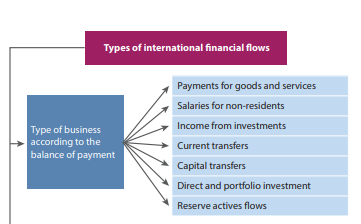
Soru 32
Which of the following is not one of the factors that the amount and direction of financial flows depend on?
Seçenekler
A
The condition of the global economy
B
The size of the international trade barriers
C
The differential break of inflation’s rate and the level of interest rates
D
Similar rates of economic development of the countries
E
The increase in the balance of payments’ deficits due to the imbalance of international payments
Açıklama:
The amount and direction of financial flows depend on various factors, including but not limited to the following factors:
- the condition of the global economy. The global economic conditions change over time along with the economic and business cycles, the economy goes through
expansion and contraction. Economic conditions are considered to be sound or positive when an economy is expanding and are seen as adverse or negative when the economy is contracting. Furthermore, the economic recession in developed countries usually causes a decline in the world trade by reducing the demand for goods, this, in turn, affects the developing country economies,
- the size of the international trade barriers;
- different rates of economic development of the countries (synchrony or asynchrony in the major countries’ economies);
- the differential break of inflation’s rate and the level of interest rates,
- the increase of balance of payments’ deficits due to the imbalance of international payments.
- the condition of the global economy. The global economic conditions change over time along with the economic and business cycles, the economy goes through
expansion and contraction. Economic conditions are considered to be sound or positive when an economy is expanding and are seen as adverse or negative when the economy is contracting. Furthermore, the economic recession in developed countries usually causes a decline in the world trade by reducing the demand for goods, this, in turn, affects the developing country economies,
- the size of the international trade barriers;
- different rates of economic development of the countries (synchrony or asynchrony in the major countries’ economies);
- the differential break of inflation’s rate and the level of interest rates,
- the increase of balance of payments’ deficits due to the imbalance of international payments.
Soru 33
Which of the following is not one of the types and structures of a multinational company?
Seçenekler
A
A global, centralized corporation that acquires a profit advantage selling expensive products
B
A decentralized corporation with a strong presence in its home country
C
A global, centralized corporation that acquires a cost advantage where cheap resources are available
D
A global company that builds on the parent corporation’s research and development efforts
E
A transnational enterprise that uses all the categories mentioned B, C and D
Açıklama:
A multinational corporation (MNC) consists of a parent company in the firm’s resident country and the operating subsidiaries, branches, and affiliates it controls both at home and abroad. Although there can be various types and structures of an MNC, there are four categories of multinationals that exist. They include:
- A decentralized corporation with a strong presence in its home country
- A global, centralized corporation that acquires a cost advantage where cheap resources are available
- A global company that builds on the parent corporation’s research and development efforts
- A transnational enterprise that uses all three categories mentioned above
Soru 34
Which of the following is not one of the chracteristics of multinational corporations?
Seçenekler
A
Efficiency
B
International Operation
C
Collective Transfer of Resources
D
Monopolistic Structure
E
Development
Açıklama:
The characteristics of the multinational corporations are:
- Efficiency
- Big Size
- International Operation
- International Operation
- Collective Transfer of Resources
- Development
Soru 35
" It is the most popular low-risk entry strategy as it involves little investment and exit is unproblematic"
Which of the following entry strategies to international operations is described in the sentence above?
Which of the following entry strategies to international operations is described in the sentence above?
Seçenekler
A
Exporting
B
Licensing
C
Franchising
D
Contract Manufacturing and Service Provision
E
International Joint Venture
Açıklama:
Exporting is the most popular low-risk entry strategy as it involves little investment and exit is unproblematic. It is a fact that for the firms with insufficient resources for other types of internationalization strategies, exporting is the only way to reach to foreign consumers. However, success is entirely dependent on being able to identify efficient and reliable distribution channels. Other critical factors are import tariffs and quotas as well as freight costs
Soru 36
"Nominal Exchange Rate...................."
Which of the following best completes the sentence above?
Which of the following best completes the sentence above?
Seçenekler
A
is the ratio of the consumer basket abroad, transmitted from foreign currencies into national currency, using the nominal exchange rate and consumer price basket of the same goods in the home country
B
is used for comparing the purchasing power of two currencies in the exchange market
C
is calculated as the ratio between the national currency and the currencies of
other countries, weighted according to the proportion of countries in currency
transactions of the country.
other countries, weighted according to the proportion of countries in currency
transactions of the country.
D
is the rate between two currencies and represents the relative price of two currencies
E
is the nominal exchange rate adjusted for the relative price levels in the home country and in the country whose currency is used in the quoted process with the national currency
Açıklama:
Nominal Exchange Rate is the rate between two currencies and represents the relative price of two currencies (the offer to exchange one currency into another). The exchange rate is generally determined in the exchange rate market under the demand and supply conditions. The foreign exchange rate used in the contracts is generally the rate as determined by the intermediary financial institutions referring to the rate determined in the market.
Soru 37
"Bid rate ......................................." Which of the following best completes the sentence above?
Seçenekler
A
is based on two-way prices
B
is to maximize the ultimate profit
C
is the rate at which traders want to buy a base currency
D
is always more than the ask price
E
is the rate at which traders sell the base currency
Açıklama:
With the ultimate goal of profit maximization, traders in the interbank market try to buy and sell various foreign currencies and so they quote two-way prices. The bid rate is the rate at which they want to buy a base currency and the ask rate is the rate at which they sell the base currency. The difference between these two rates is known as the bid-ask spread.
Soru 38
Which of the following is not one of the principal functions of the foreign exchange market?
Seçenekler
A
To create a financial instrument whose value depends upon the value of
another asset.
another asset.
B
To set the prices of some currencies with respect to others
C
To allow for the realization of currency risk coverage
D
To favor the exchange of funds between different countries which have excess
liquidity and which are in need of foreign currency liquidity
liquidity and which are in need of foreign currency liquidity
E
To finance international trade, whose transactions represent a significant part of
the currency market
the currency market
Açıklama:
The principal functions of the foreign exchange market are the following:
• To set the prices of some currencies with respect to others (currency pairs).
• To allow for the realization of currency risk coverage, for example, when investments are made in another currency.
• To favor the exchange of funds between different countries that have excess liquidity and which are in need of foreign currency liquidity.
• To finance international trade, whose transactions represent a significant part of the currency market.
• To set the prices of some currencies with respect to others (currency pairs).
• To allow for the realization of currency risk coverage, for example, when investments are made in another currency.
• To favor the exchange of funds between different countries that have excess liquidity and which are in need of foreign currency liquidity.
• To finance international trade, whose transactions represent a significant part of the currency market.
Soru 39
Which of the following is one of the three main types of exchange
rate risks?
rate risks?
Seçenekler
A
Balance risk
B
Currency risk
C
Turbulent risk
D
Political risk
E
Transaction risk
Açıklama:
Three main types of exchange rate risks are:
- Transaction risk
- Translation risk
- Economic risk
Soru 40
Which of the following is not one of the means by which the global financial
system promotes economic growth?
system promotes economic growth?
Seçenekler
A
Facilitating specialization and promoting trade
B
Mobilizing resources globally
C
Facilitating risk management
D
Ignoring the opportunities available to companies, entrepreneurs, and
individuals to participate in
individuals to participate in
E
Obtaining information for the evaluation of businesses and allocating capital
Açıklama:
The global financial system is immense, variant and interconnected. It consists of many different types of financial institutions, as well as financial markets in stocks, bonds, commodities, and derivatives. It is a fact that the global financial
the system promotes economic growth by several means:
- facilitating specialization and promoting trade;
- mobilizing resources globally;
- Increasing the set of opportunities available to companies, entrepreneurs, and
individuals to participate in and contribute to global economic growth.
- facilitating risk management,
- obtaining information for the evaluation of businesses and allocating capital
the system promotes economic growth by several means:
- facilitating specialization and promoting trade;
- mobilizing resources globally;
- Increasing the set of opportunities available to companies, entrepreneurs, and
individuals to participate in and contribute to global economic growth.
- facilitating risk management,
- obtaining information for the evaluation of businesses and allocating capital
Soru 41
What is the abbreviated form of General Agreement on Tariffs and Trade?
Seçenekler
A
GATAT
B
GOTAT
C
GAOTAT
D
GATT
E
GTT
Açıklama:
"On the trade side, the General Agreement on Tariffs and Trade (GATT) which was signed in..."
Soru 42
When was the General Agreement on Tariffs and Trade signed?
Seçenekler
A
1927
B
1937
C
1947
D
1957
E
1967
Açıklama:
On the trade side, the General Agreement on Tariffs and Trade which was signed in 1947 was designed to encourage free trade between member states by regulating and reducing tariffs on traded goods.
Soru 43
Which of the following is a type of business according to the balance to the payment?
Seçenekler
A
Capital Transfers
B
International Trade
C
Loan
D
Long-Term
E
Official
Açıklama:
Types of business according to the balance of payment:
-Payments for goods and services
-Salaries for non-residents
-Income from investments
-Current transfers
-Capital transfers
-Direct and portfolio investment
-Reserve actives flows
-Payments for goods and services
-Salaries for non-residents
-Income from investments
-Current transfers
-Capital transfers
-Direct and portfolio investment
-Reserve actives flows
Soru 44
What does SWIFT stand for?
Seçenekler
A
Society of Wide Interbank Financial Telecommunications
B
Society of Worldwide Interbank Financial Telecommunications
C
Society of Worldwide Interbank for Telecommunications
D
Structure of Worldwide Interbank for Telecommunications
E
Society of Worldwide Internet Financial Telecommunications
Açıklama:
The widely used communications network is the Society of Worldwide Interbank Financial Telecommunications (SWIFT).
Soru 45
When did the SWIFT begin operations in Europe?
Seçenekler
A
1930s
B
1950s
C
1970s
D
1990s
E
2010s
Açıklama:
The widely used communications network is the Society of Worldwide Interbank Financial Telecommunications (SWIFT), which began operations in Europe in 1973, and is jointly owned by more than 2,000 member banks.
Soru 46
"After the transaction is electronically confirmed over SWIFT, the USD transfers are generally done through ______?"
Which of the following completes the blank correctly?
Which of the following completes the blank correctly?
Seçenekler
A
CHIPS
B
SETS
C
VAR
D
WTO
E
GATT
Açıklama:
After the transaction is electronically confirmed over SWIFT, the USD transfers are generally done through the Clearing House Interbank Payments System (CHIPS).
Soru 47
"The decentralized worldwide market in which currencies are traded."
What is the correct term for above definition?
What is the correct term for above definition?
Seçenekler
A
CHIPS
B
FOREX
C
MNC
D
GATT
E
SWIFT
Açıklama:
The foreign currency or foreign exchange market (FOREX market) is the decentralized worldwide market in which currencies are traded.
Soru 48
Between the determinants of foreign exchange rate, which of the following is related with political risk?
Seçenekler
A
Strength of banking system
B
Forward exchange rates
C
Uncovered interest arbitrage
D
Black market in currencies
E
Portfolio investment
Açıklama:
Determinants of Foreign Exchange Rate:
a- Political Riss
1. Capital controls
2. Black market in currencies
3. Exchange rate spreads
4. Risk premium on securities and FDI
a- Political Riss
1. Capital controls
2. Black market in currencies
3. Exchange rate spreads
4. Risk premium on securities and FDI
Soru 49
"The rate at which traders in the interbank want to buy a base currency."
Which of the following is the correct term for above description?
Which of the following is the correct term for above description?
Seçenekler
A
Ask Rate
B
Fund Rate
C
Bid Rate
D
Credit Rate
E
Trade Rate
Açıklama:
The bid rate is the rate at which they want to buy a base currency.
Soru 50
Which of the following defines the real exchange rate?
Seçenekler
A
The nominal exchange rate, multiplied by the price index for foreign countries.
B
The offer to exchange one currency into another.
C
The relative price of two currencies.
D
The rate predetermined for the forward transaction.
E
The averaged dynamics of the movement of national currency against several currencies.
Açıklama:
Real Exchange Rate: This is the nominal exchange rate adjusted for the relative price levels in the home country and in the country whose currency is used in the quoted process with the national currency.
Soru 51
General Agreement on Tariffs and Trade (GATT) which was signed in .............was designed to encourage free trade between member states by regulating and reducing tariffs on traded goods.
Which of the following should come to the dotted point according to the continuation of the sentence?
Which of the following should come to the dotted point according to the continuation of the sentence?
Seçenekler
A
1943
B
1944
C
1945
D
1946
E
1947
Açıklama:
It should be 1947
Soru 52
The fund’s movements are defined by the relationships between
the economic agents of different countries, state, foreign governments, and local governments and international organizations.
Which of the following is the organization wrongly written in the sentence given above?
the economic agents of different countries, state, foreign governments, and local governments and international organizations.
Which of the following is the organization wrongly written in the sentence given above?
Seçenekler
A
Foreign government
B
Local government
C
İnternational organizations
D
economic agents of different countries
E
state
Açıklama:
Local government is not one of them
Soru 53
The types of international financial flows can be classified according to some terms.
Which of following is not one of them?
Which of following is not one of them?
Seçenekler
A
economic activity
B
structure of the balance of payments
C
the economic relationship between the residents
D
The terms of financial transactions
E
the form of ownership of the sources of financial flows
Açıklama:
It should be the economic relationship between the non-residents
Soru 54
Which of following is not one of type of business according to the balance of payment?
Seçenekler
A
Payments for goods and services
B
Salaries for non-residents
C
Income from investments
D
Current transfers
E
Reserve passive flows
Açıklama:
Reserve passive flows is not one of them
Soru 55
Which of the following is not included under the heading Economic relations within the scope of international financial flow types?
Seçenekler
A
International trade
B
Investment and credits
C
Speculation
D
Balancing
E
Local trade
Açıklama:
Local trade is not one of them
Soru 56
Which of the following exist under the terms of the relationship under International financial flow types?
Seçenekler
A
Mid-Short term
B
Middle term
C
Mid-Long term
D
Instant term
E
Endless term
Açıklama:
It should be middle term
Soru 57
The amount and direction of financial flows depend on various factors, including but not limited to the some factors Which of following is not one of them?
Seçenekler
A
the size of the international trade barriers
B
different rates of economic development of the countries (synchrony or asynchrony in
the major countries’ economies);
the major countries’ economies);
C
the differential break of inflation’s rate and the level of interest rates
D
The decrease of balance of payments’ deficits due to the imbalance of international
payments
payments
E
The condition of the global economy
Açıklama:
It should be increase
Soru 58
Although there can be various types and structures of an MNC, there are four categories of multinationals that exist. Do they include some terms Which of the following is not one of them?
Seçenekler
A
A decentralized corporation with a strong presence in its home country
B
A global, centralized corporation that acquires a cost advantage where cheap
resources are available
resources are available
C
A global company that builds on the parent corporation’s research and development
efforts
efforts
D
A transnational enterprise that uses all three categories.
E
A decentralized corporation with a strong presence in its contiguous country
Açıklama:
A decentralized corporation with a strong presence in its contiguous country is not one of them
Soru 59
Which of the followings are not one of the characteristics of the multinational corporations?
Seçenekler
A
Oligopolistic Structure
B
International Operation
C
Big Size
D
Efficiency
E
Individual Transfer of Resources
Açıklama:
Individual Transfer of Resources is not one of them
Soru 60
In order to make economic assessments, several types of foreign exchange rates are used.
Which of the followings is one of them?
Which of the followings is one of them?
Seçenekler
A
Efficient Exchange Rate
B
Stabile Exchange Rate
C
Variable Exchange Rate
D
Controlled Exchange Rate
E
Real Exchange Rate
Açıklama:
In order to make economic assessments, several types of foreign exchange rates are used:
- Nominal Exchange Rate:...
- Real Exchange Rate: ...
- Nominal Effective Exchange Rate:...
- Nominal Exchange Rate:...
- Real Exchange Rate: ...
- Nominal Effective Exchange Rate:...
Soru 61
Which of the following risks is relatively more important than the other risks for a multinational corporation?
Seçenekler
A
Interest rate risk
B
Inflation risk
C
Country risk
D
Exchange rate risk
E
Political risk
Açıklama:
The main business risk for a multinational corporation is foreign exchange
rate risk.
rate risk.
Soru 62
An agreement granting a firm in a host country the right to produce and sell a product for a specified period in return for a fee is referred to as ..........
Seçenekler
A
Exporting
B
Importing
C
Franchising
D
Licensing
E
International Joint Venture
Açıklama:
A licensing agreement gives a firm in a host country the right to produce and sell a product for a specified period in return for a fee.
Soru 63
Which of the following entry strategies to international operations is relatively riskier than the others?
Seçenekler
A
Exporting
B
Licensing
C
Franchising
D
Contract manufacturing
E
International Joint Venture
Açıklama:
IJV involves a much higher level of investment and therefore of risk than the other entry strategies mentioned.
Soru 64
In which currency the majority of the reserves held by the world´s central banks are denominated?
Seçenekler
A
US Dollar
B
Euro
C
Japanese Yen
D
British Pound
E
Chinese Yuan
Açıklama:
More than 60% of the reserves held by the world´s central banks are denominated in USD.
Soru 65
The forex market where banks and other financial institutions trade currencies is called the ............. market.
Seçenekler
A
Central
B
Retail
C
Capital
D
Derivative
E
Interbank
Açıklama:
The world’s major banks, and other financial institutions make up the interbank market that act as the wholesale part ofthe forex market where banks manage inventories of currencies.
Soru 66
The exchange rate risk that affects the firm’s present value of future operating
cash flows (resulting from revenues and operating expenses) from exchange rate movements is associated with ...........
cash flows (resulting from revenues and operating expenses) from exchange rate movements is associated with ...........
Seçenekler
A
Transaction risk
B
Translation risk
C
Income statement risk
D
Balance sheet risk
E
Economic risk
Açıklama:
Economic risk reflects basically the risk to the firm’s present value of future operatingcash flows from exchange rate movements. In essence, economic risk concerns the effect of exchange rate changes on revenues (domestic sales and exports) and operating expenses (cost of domestic inputs and imports).
Soru 67
The transaction which involves simultaneous purchase and sale of identical amounts of one currency for another at a later date is referred to as a ...........
Seçenekler
A
FX forward
B
FX futures
C
FX option
D
FX swap
E
FX swaption
Açıklama:
A forex swap transaction (swap) is a combination of a spot transaction and a forward transaction. A swap is the simultaneous purchase and sale of identical amounts of one currency for another at a later date.
Soru 68
The risk management strategy that is used in limiting or offsetting probability of loss from fluctuations in the prices of commodities, currencies or securities is referred to as ..........
Seçenekler
A
Futures
B
Forward
C
Derivative
D
Speculating
E
Hedging
Açıklama:
The risk management strategy that is used in limiting or offsetting probability of loss from fluctuations in the prices of commodities, currencies or securities is referred to as hedging.
Soru 69
Offshore capital markets in which securities are traded with the currency other than the official currency of the country where the transaction takes place are referred to as .........
Seçenekler
A
Petro dollar markets
B
FX markets
C
Foreign markets
D
Euro markets
E
Interbank markets
Açıklama:
Eurobond market is an offshore market where borrowers and lenders meet because of its lower costs and lack of regulation. It is just one segment of the so-called Euromarket, which also includes Euro currency, Euro notes, Euro commercial paper, and Euro equity markets. Euro markets are offshore capital markets, in the sense that the currency of denomination is not the official currency of the country where the transaction takes place.
Soru 70
The credit rating which gives an indication about the risk level associated with investing in a particular country is called .......
Seçenekler
A
Political credit rating
B
Default credit rating
C
Bond rating
D
Soverign credit rating
E
International rating
Açıklama:
The credit rating which gives an indication about the risk level associated with investing in a particular country is called soverign credit rating.
Ünite 7
Soru 1
According to the Basel Committee, what is the term used to refer to the risk of losses arising from movements in market prices?
Seçenekler
A
Quantifying Risk
B
Liquidity Risk
C
Operational Risk
D
Market Risk
E
Credit Risk
Açıklama:
According to the Basel Committee, market risk is defined as the risk of losses arising from movements in market prices. The correct answer is D.
Soru 2
What is the term used to refer to the risk that a borrower fails to meet obligations for a loan granted?
Seçenekler
A
Quantifying Risk
B
Liquidity Risk
C
Operational Risk
D
Credit Risk
E
Market Risk
Açıklama:
Broadly speaking, credit risk is the risk that a borrower fails to meet obligations for a loan granted. The correct answer is D.
Soru 3
What is the term used to refer to the risk of loss resulting from inadequate or failed internal processes, people and systems or from external events?
Seçenekler
A
Quantifying Risk
B
Liquidity Risk
C
Operational Risk
D
Credit Risk
E
Market Risk
Açıklama:
With the enhancement of the Basel-II, the Basel Committee added a new class of risk into the calculation of risk-based capital charges. The Committee defined the operational risk as the “risk of loss resulting from inadequate or failed internal processes, people and systems or from external events”. The correct answer is C.
Soru 4
What kind of risk can human error, fraud and malice, failures of information systems, problems related to personnel management, commercial disputes, accidents, fires, and floods lead to?
Seçenekler
A
Quantifying Risk
B
Liquidity Risk
C
Operational Risk
D
Credit Risk
E
Market Risk
Açıklama:
With the enhancement of the Basel-II, the Basel Committee added a new class of risk into the calculation of risk-based capital charges. The Committee defined the operational risk as the “risk of loss resulting from inadequate or failed internal processes, people and systems or from external events”. This definition includes human error, fraud and malice, failures of information systems, problems related to personnel management, commercial disputes, accidents, fires, and floods. In other words, its scope seems so wide that, with no significant prior data available to extract a meaningful and accurate risk profile, the practical application is difficult to immediately perceive. The correct answer is C.
Soru 5
Which risk measurement approach is defined as simulation approach that calculates the hypothetical change in the value of the current portfolio in the light of actual historical movements in risk factors?
Seçenekler
A
Variance-Covariance Method
B
Historical Simulation Method
C
exponentially weighted moving average procedure
D
Monte Carlo Simulation
E
Extreme Value Theory (EVT)
Açıklama:
The Basel Committee defines the historical simulation methodology as a simulation approach that calculates the hypothetical change in the value of the current portfolio in the light of actual historical movements in risk factors (Basel Committee on Banking Supervision, 1996b). The correct answer is B.
Soru 6
Which risk measurement approach is based on the idea of simulating the changes in the portfolio value by randomly drawing from the imposed theoretical distribution function?
Seçenekler
A
Variance-Covariance Method
B
Monte Carlo Simulation
C
Exponentially Weighted Moving Average Procedure
D
Extreme Value Theory (EVT)
E
Historical Simulation Method
Açıklama:
The Monte Carlo (MC) approach is based on the idea of simulating the changes in the portfolio value by randomly drawing from the imposed theoretical distribution function. The power of the MC simulation lies in its capability to provide approximate solutions applied to problems where no explicit probabilistic content is available. The correct answer is B.
Soru 7
Why does the Extreme Value Theory (EVT) approach have the potential to perform better than the VCV, MC simulation, and HS approaches?
Seçenekler
A
Because it estimates VaR by first assuming that a portfolio comprises a small number of risk factors.
B
Because it employs nonparametric method to eliminate the misspecified distribution.
C
Because it simulates the changes in the portfolio value by randomly drawing from the imposed theoretical distribution function.
D
Because it assumes that changes in the values of assets are stationary and independent over time.
E
Because the accurate forecasts of extreme realizations are crucial to VaR analysis.
Açıklama:
Since the accurate forecasts of extreme realizations are crucial to VaR analysis, the EVT approach has the potential to perform better than the VCV, MC simulation, and HS approaches. The correct answer is E.
Soru 8
Which of the following is not true about the Variance-covariance (VCV) method?
Seçenekler
A
It estimates VaR by first assuming that a portfolio comprises a small number of risk factors.
B
Each risk factor is assumed to be drawn from some known theoretical distribution.
C
The statistical distributions of individual risk factors are combined to yield a single theoretical distribution for the returns of the entire portfolio.
D
It is generally used with a normal distribution, which significantly facilitates its calculation.
E
Variance-covariance (VCV) method is known as a non-parametric method.
Açıklama:
The Variance-covariance (VCV hereafter) method estimates VaR by first assuming that a portfolio comprises a small number of risk factors (equities, commodities, etc.). Each risk factor is assumed to be drawn from some known theoretical distribution. The statistical distributions of these individual risk factors are combined to yield a single theoretical distribution for the returns of the entire portfolio. This distribution is then used to calculate the VaR of the portfolio. The VCV method is also known as an analytic or parametric method. It is considered the simplest of the suggested methodologies and thus is often used by banks and other financial institutions, for example, for calculating intra-day VaR figures. The VCV approach is generally used with a normal distribution, which significantly facilitates its calculation. Of course, other distributions can be used, but at a higher computational cost. The correct answer is E.
Soru 9
Which of the following is an example for an operational risk?
Seçenekler
A
accidents
B
equity risk
C
credit spread risk
D
interest rate risk
E
default risk
Açıklama:
With the enhancement of the Basel-II, the Basel Committee added a new class of risk into the calculation of risk-based capital charges. The Committee defined the operational risk as the “risk of loss resulting from inadequate or failed internal processes, people and systems or from external events”.
This definition includes human error, fraud and malice, failures of information systems, problems related to personnel management, commercial disputes, accidents, fires, and floods. The correct answer is A.
This definition includes human error, fraud and malice, failures of information systems, problems related to personnel management, commercial disputes, accidents, fires, and floods. The correct answer is A.
Soru 10
Which of the following is an example for market risk?
Seçenekler
A
Interest rate risk
B
Floods
C
Fires
D
Commercial disputes
E
Accidents
Açıklama:
The risks subject to market risk capital requirements include but are not limited to:
(1) default risk, interest rate risk, credit spread risk, equity risk, foreign exchange (FX) risk and commodities risk for trading book instruments; and
(2) FX risk and commodities risk for banking book instruments.
The correct answer is A.
(1) default risk, interest rate risk, credit spread risk, equity risk, foreign exchange (FX) risk and commodities risk for trading book instruments; and
(2) FX risk and commodities risk for banking book instruments.
The correct answer is A.
Soru 11
Which of the following can be defined as the probability of facing loss or unintended consequences?
Seçenekler
A
Risk
B
Uncertainty
C
Failure
D
Chance
E
Prediction
Açıklama:
Risk is defined as the probability of facing loss or unintended consequences.
Soru 12
Which of the following can be defined as the risk related to a financial institution’s financial condition resulting from unexpected market movements in the price level of certain risk factors?
Seçenekler
A
Market risk
B
Concentration risk
C
Liquidity risk
D
Credit Risk
E
Inflation Risk
Açıklama:
Market risk can be defined as the risk related to a financial institution’s financial condition resulting from unexpected market movements in the price level of certain risk factors.
Soru 13
- Equity prices
- Commodity prices
- Foreign exchange rates
- Interest rates
Seçenekler
A
I and II
B
II and III
C
I, II and IV
D
II, III and IV
E
I, II, III and IV
Açıklama:
Market risk can be defined as the risk related to a financial institution’s financial condition resulting from unexpected market movements in the price level of certain risk factors. These risk factors can be categorized into four main classes: equity prices, commodity prices, foreign exchange rates, and interest rates.
Soru 14
Which of the following risk is not subject to market risk capital requirements?
Seçenekler
A
Default risk
B
Interest rate risk
C
Credit spread risk
D
Equity risk
E
Operational risk
Açıklama:
The risks subject to market risk capital requirements include but are not limited to: (1) default risk, interest rate risk, credit spread risk, equity risk, foreign exchange (FX) risk and commodities risk for trading book instruments; and (2) FX risk and commodities risk for banking book instruments
Soru 15
- Boundray between the banking book and trading book
- Use and validation of banks’ internal models
- Risk measurement under the internal models approach
- Risk measurement under the standardised approach
Seçenekler
A
I and II
B
II and III
C
I, II and III
D
I, III and IV
E
I, II, III and IV
Açıklama:
- Boundray between the banking book and trading book
- Use and validation of banks’ internal models
- Risk measurement under the internal models approach
- Risk measurement under the standardised approach
Soru 16
Which of the following methods is one of the main methods to assess market risk?
Seçenekler
A
Value-at-risk (VaR)
B
Risk-weighted assets (RWAs)
C
Standardised Approach (SA)
D
Probability of default (PD)
E
Exposure-at-default (EAD)
Açıklama:
Basel uses two main methods to assess market risk
Value at Risk(VaR)
Expected Shortfall(ES)
Value at Risk(VaR)
Expected Shortfall(ES)
Soru 17
Which of the following is the risk that a borrower fails to meet obligations for a loan granted?
Seçenekler
A
Credit risk
B
Market risk
C
Liquidity risk
D
Inflation risk
E
Operational risk
Açıklama:
Credit risk is the risk that a borrower fails to meet obligations for a loan granted.
Soru 18
- Standardized approach
- The internal ratings-based (IRB) approach
- Value at risk approach
Seçenekler
A
Only I
B
Only II
C
I and II
D
I and III
E
I, II and III
Açıklama:
The Basel Committee permits banks to choose between two broad methodologies for calculating their risk-based capital requirements for credit risk:
Standardized approach and the internal ratings-based (IRB) approach.
Standardized approach and the internal ratings-based (IRB) approach.
Soru 19
Which of the following is simply any event that disrupts the normal flow of business processes and which generates financial loss or damage to the image of the bank?
Seçenekler
A
Credit Risk
B
Liquidity risk
C
Operational risk
D
Market risk
E
Inflation risk
Açıklama:
Operational risk is simply any event that disrupts the normal flow of business processes and which generates financial loss or damage to the image of the bank .
Soru 20
- Liquidity may bring substantial losses in a very short period of time.
- Assets carrying the illiquidity premium are rewarded with substantial profits in good times.
- The most profitable financial instruments tend to be illiquid assets.
Seçenekler
A
Only I
B
I and II
C
II and III
D
I and III
E
I, II and III
Açıklama:
Liquidity, frequently overlooked by financial institutions, may bring substantial losses in a very short period of time. The most profitable financial instruments tend to be illiquid assets. Assets carrying the illiquidity premium are rewarded with substantial profits in good times, however, when the tide turns, such assets may rapidly deplete a bank’s resources.
Soru 21
Which of the following is not among the market risks?
Seçenekler
A
default risk
B
interest rate risk
C
credit spread risk
D
equity risk
E
fraud risk
Açıklama:
The risks subject to market risk capital requirements include but are not limited to:
(1) default risk, interest rate risk, credit spread risk, equity risk, foreign exchange (FX) risk and commodities risk for trading book instruments; and
(2) FX risk and commodities risk for banking book instruments. The correct answer is E.
(1) default risk, interest rate risk, credit spread risk, equity risk, foreign exchange (FX) risk and commodities risk for trading book instruments; and
(2) FX risk and commodities risk for banking book instruments. The correct answer is E.
Soru 22
According to the Basel Committee, market risk is defined as the risk of losses arising from _______.
Seçenekler
A
operations
B
credit payment delay
C
commercial disputes
D
human error
E
market prices
Açıklama:
According to the Basel Committee, market risk is defined as the risk of losses arising from movements in market prices. The correct answer is E.
Soru 23
Which of the following is an example for credit risk?
Seçenekler
A
frauds
B
accidents
C
floods
D
mortgage delays
E
commercial disputes
Açıklama:
Broadly speaking, credit risk is the risk that a borrower fails to meet obligations for a loan granted. This risk is of vital importance to banks, as their main business involves lending money to be repaid over a certain period, which in some cases, e.g. mortgages, may be 10 to 20 years or more. The quantification and management of credit risk are radically different from market risk, which focuses mainly on changes in asset prices, and which offers an infinite set of probabilities due to available data. The correct answer is D.
Soru 24
Which of the following is not among the factors that may bring about operational risks?
Seçenekler
A
personnel management problem
B
fraud
C
fire
D
failure in loan requirements
E
human error
Açıklama:
With the enhancement of the Basel-II, the Basel Committee added a new class of risk into the calculation of risk-based capital charges. The Committee defined the operational risk as the “risk of loss resulting from inadequate or failed internal processes, people and systems or from external events”.
This definition includes human error, fraud and malice, failures of information systems, problems related to personnel management, commercial disputes, accidents, fires, and floods. In other words, its scope seems so wide that, with no significant prior data available to extract a meaningful and accurate risk profile, the practical application is difficult to immediately perceive.
The correct answer is D.
This definition includes human error, fraud and malice, failures of information systems, problems related to personnel management, commercial disputes, accidents, fires, and floods. In other words, its scope seems so wide that, with no significant prior data available to extract a meaningful and accurate risk profile, the practical application is difficult to immediately perceive.
The correct answer is D.
Soru 25
Which of the following is true about the variance-covariance method?
Seçenekler
A
It assumes that a portfolio comprises a a large number of risk factors.
B
Each risk factor is assumed to be drawn from some unknown theoretical distribution.
C
It is also known as an analytic or parametric method.
D
That approach is generally used with a normal distribution, which makes its calculation difficult.
E
It is considered as the most complicated of the suggested methodologies.
Açıklama:
The Variance-covariance (VCV hereafter) method estimates VaR by first assuming that a portfolio comprises a small number of risk factors (equities, commodities, etc.). Each risk factor is assumed to be drawn from some known theoretical distribution. The statistical distributions of these individual risk factors are combined to yield a single theoretical distribution for the returns of the entire portfolio. This distribution is then used to calculate the VaR of the portfolio. The VCV method is also known as an analytic or parametric method. It is considered the simplest of the suggested methodologies and thus is often used by banks and other financial institutions, for example, for calculating intra-day VaR figures. The VCV approach is generally used with a normal distribution, which significantly facilitates its calculation. Of course, other distributions can be used, but at a higher computational cost. The correct answer is C.
Soru 26
Which risk measurement method is defined as a simulation approach that calculates the hypothetical change in the value of the current portfolio in the light of actual historical movements in risk factors?
Seçenekler
A
Monte Carlo Simulation
B
Extreme Value Theory
C
Historical Simulation Method
D
Variance-Covariance Method
E
Risk-free Standard Deviation Method
Açıklama:
The Basel Committee defines the historical simulation methodology as a simulation approach that calculates the hypothetical change in the value of the current portfolio in the light of actual historical movements in risk factors (Basel Committee on Banking Supervision, 1996b). The correct answer is C.
Soru 27
Which risk measurement approach is based on the idea of simulating the changes in the portfolio value by randomly drawing from the imposed theoretical distribution function?
Seçenekler
A
Extreme Value Theory
B
Monte Carlo Simulation
C
Historical Simulation Method
D
Variance-Covariance Method
E
Risk-free Standard Deviation Method
Açıklama:
The Monte Carlo (MC) approach is based on the idea of simulating the changes in the portfolio value by randomly drawing from the imposed theoretical distribution function. The correct answer is B.
Soru 28
Which risk measurement approach studies the tail of distributions and deals with the asymptotic behavior of the extreme order statistics of a random sample, such as the maximum or minimum order?
Seçenekler
A
Monte Carlo Simulation
B
Extreme Value Theory
C
Historical Simulation Method
D
Variance-Covariance Method
E
Risk-free Standard Deviation Method
Açıklama:
Extreme value theory (EVT) studies the tail of distributions and deals with the asymptotic behavior of the extreme order statistics of a random sample, such as the maximum or minimum order. The correct answer B.
Soru 29
Which of the following is an example for market risk factors?
Seçenekler
A
equity prices
B
human errors
C
personnel management problems
D
accidents
E
commercial disputes
Açıklama:
Market risk can be defined as the risk related to a financial institution’s financial condition resulting from unexpected market movements in the price level of certain risk factors. These risk factors can be categorized into four main classes: equity prices, commodity prices, foreign exchange rates, and interest rates. The correct answer is A.
Soru 30
When did Basel Committee released its regulation on capital adequacy?
Seçenekler
A
1988
B
1989
C
1990
D
1991
E
1992
Açıklama:
The literature on risk management has grown exponentially in the last two decades. The milestones are the 1988 regulation on capital adequacy by the Basel Committee, the release of RiskMetricsTM Technical Document by JP Morgan in 1994, and the release of Basel-II by the Basel Committee in 2000. The correct answer is A.
Soru 31
_______ can be defined as the “possibility of loss or injury,” or highlighting the perils of putting oneself in a situation in which the outcome is unknown.
What is the appropriate term for the blank?
What is the appropriate term for the blank?
Seçenekler
A
Basel Regulations
B
Risk
C
Classification of Risks
D
Stress Testing
E
Value-at-Risk
Açıklama:
Risk is the “possibility of loss or injury,” highlighting the perils of putting oneself in a situation in which the outcome is unknown.
Soru 32
_______ is the risk related to a financial institution’s financial condition resulting from unexpected market movements in the price level of certain risk factors.
Which of the following terms is appropriate for the blank?
Which of the following terms is appropriate for the blank?
Seçenekler
A
Market Risk
B
Stress Testing
C
Risk Management
D
Scenario Analysis
E
Capital Adequacy
Açıklama:
Market risk can be defined as the risk related to a financial institution’s financial condition resulting from unexpected market movements in the price level of certain risk factors.
Soru 33
Which of the following is a type of risk?
Seçenekler
A
Bargain Risk
B
Functional Risk
C
Classical Risk
D
Credit Risk
E
Loan Risk
Açıklama:
Broadly speaking, credit risk is the risk that a borrower fails to meet obligations for a loan granted.
Soru 34
"The risk of losses arising from movements in market prices."
Which of the risk types is defined above?
Which of the risk types is defined above?
Seçenekler
A
Credit Risk
B
Loan Risk
C
Market Risk
D
Operational Risk
E
Liquidity Risk
Açıklama:
Market risk is defined as the risk of losses arising from movements in market prices.
Soru 35
"The risk that a borrower fails to meet obligations for a loan granted."
Which of the risk types is defined above?
Which of the risk types is defined above?
Seçenekler
A
Loan Risk
B
Market Risk
C
Credit Risk
D
Operational Risk
E
Liquidity Risk
Açıklama:
Broadly speaking, credit risk is the risk that a borrower fails to meet obligations for a loan granted.
Soru 36
"Any event that disrupts the normal flow of business processes and which generates financial loss or damage to the image of the bank."
Which of the risk types is defined above?
Which of the risk types is defined above?
Seçenekler
A
Market Risk
B
Credit Risk
C
Liquidity Risk
D
Value-at-Risk
E
Operational Risk
Açıklama:
Operational risk is simply any event that disrupts the normal flow of business processes and which generates financial loss or damage to the image of the bank.
Soru 37
Which of the following is true?
Seçenekler
A
Risk-free rates are all the same globally.
B
Investments with a greater variance in the size of the future payoff generally pay a lower expected return with less volatility.
C
Risk-free investments are the best benchmark for measuring the risk of all investment strategies even for stock market investments.
D
Investments with higher risk generally have a higher expected return than risk-free investments.
E
Investments that pay a return over a longer time horizon generally have less risk and more preferable.
Açıklama:
As all fund managers and traders know, there is a trade-off between risk and return when money is invested. The greater the risks are taken, the higher the potential returns.
Soru 38
Which of the following measures focuses on the worst possible outcome?
Seçenekler
A
The risk-free rate of return
B
Value at risk.
C
Extreme loss probability.
D
Expected rate of return
E
The standard deviation of return.
Açıklama:
VaR answers the question: how much can I lose with x % probability over a given time horizon.
Soru 39
When the probability of an outcome is zero, then the outcome is_______?
Which of the following options completes the blank?
Which of the following options completes the blank?
Seçenekler
A
certain not to occur.
B
more likely to occur.
C
may occur in the future.
D
certain to occur.
E
less likely to occur
Açıklama:
If the probability of an outcome is zero, you know the outcome is certain not to occur.
Soru 40
Which of the following is necessary when measuring the risk of an asset?
Seçenekler
A
Incorporating a trader’s risktaking an appetite.
B
Measuring the uncertainty about the size of future payoffs.
C
Not using future payoffs since they are not related to today’s risks.
D
Remembering that the concept of risk applies only to financial markets, not to financial intermediaries.
E
Not using other investments to evaluate the asset’s risk.
Açıklama:
Risk is a measure of uncertainty about the future payoff of an investment, assessed over a particular time horizon and relative to a benchmark.
Soru 41
"The probability of facing loss or unintended consequences."
What is the correct term for this definition?
What is the correct term for this definition?
Seçenekler
A
Risk Measurement
B
Risk Management
C
Risk Regulations
D
Value-at-Risk
E
Risk
Açıklama:
How can we define risk? There is no uniform definition, but generally, it is defined as the probability of facing loss or unintended consequences.
Soru 42
"The risk related to a financial institution’s financial condition resulting from unexpected market movements in the price level of certain risk factors."
What is the correct term for this definition?
What is the correct term for this definition?
Seçenekler
A
Exchange Risk
B
Market Risk
C
Financial Risk
D
Movement Risk
E
Value-at-Risk
Açıklama:
Market risk can be defined as the risk related to a financial institution’s financial condition resulting from unexpected market movements in the price level of certain risk factors.
Soru 43
There are four main risk factors of market risk. Which of the following is one of them?
Seçenekler
A
Interest Rates
B
Market Prices
C
Selling Prices
D
Market Rates
E
Shopping Rates
Açıklama:
Market risk can be defined as the risk related to a financial institution’s financial condition resulting from unexpected market movements in the price level of certain risk factors. These risk factors can be categorized into four main classes: equity prices, commodity prices, foreign exchange rates, and interest rates.
Soru 44
Which of the following is one of the classifications of the risk?
Seçenekler
A
Regulation Risk
B
Fisher Risk
C
Bank Risk
D
Operational Risk
E
Participation Risk
Açıklama:
Banks’ activities have been separated into the trading book and the banking book; the former refers to market risk components, and the latter, to credit risk. With the evolution of the Basel-II, a new set of risks, called operational risk, was added to the regulation, this was joined by liquidity risk following the global financial crisis.
Soru 45
"The risk of losses arising from movements in market prices."
What kind of a risk is defined above?
What kind of a risk is defined above?
Seçenekler
A
Market Risk
B
Portfolio Risk
C
Credit Risk
D
Operational Risk
E
Liquidity Risk
Açıklama:
According to the Basel Committee, market risk is defined as the risk of losses arising from movements in market prices.
Soru 46
Which of the following is one of the two methods to assess market risk?
Seçenekler
A
Credit Risk
B
Portfolio Risk
C
Value-at-Risk
D
Operational Risk
E
Liquidity Risk
Açıklama:
Basel uses two main methods to assess market risk: Value-at-risk (VaR) and Expected shortfall (ES).
Soru 47
"The risk that a borrower fails to meet obligations for a loan granted."
What is the correct term for this definition?
What is the correct term for this definition?
Seçenekler
A
Loan Risk
B
Credit Risk
C
Portfolio Risk
D
Market Risk
E
Lending Risk
Açıklama:
Broadly speaking, credit risk is the risk that a borrower fails to meet obligations for a loan granted.
Soru 48
"Any event that disrupts the normal flow of business processes and which generates financial loss or damage to the image of the bank."
What is the correct term for this definition?
What is the correct term for this definition?
Seçenekler
A
Portfolio Risk
B
Credit Risk
C
Liquidity Risk
D
Market Risk
E
Operational Risk
Açıklama:
Operational risk is simply any event that disrupts the normal flow of business processes and which generates financial loss or damage to the image of the bank.
Soru 49
Which of the following is a method of Value-at-Risk calculation?
Seçenekler
A
Expected Shortfall
B
Probability
C
Expected Return
D
Liquidity Coverage Ratio
E
Validation
Açıklama:
A measure of the average of all potential losses exceeding the VaR at a given confidence level, which makes up for VaR’s shortcomings in capturing the risk of extreme losses (ie tail risk).
Soru 50
"The most profitable financial instruments tend to be_______."
Which of the following completes the blank correctly?
Which of the following completes the blank correctly?
Seçenekler
A
Liquid Assets
B
Ratio Assets
C
Stock Assets
D
Illiquid Assets
E
Market Assets
Açıklama:
Liquidity, frequently overlooked by financial institutions, may bring substantial losses in a very short period of time. The most profitable financial instruments tend to be illiquid assets.
Soru 51
In which of the following year a clear-cut risk-based capital were fully documented by the Basel Committee?
Seçenekler
A
1988
B
1992
C
1998
D
2005
E
2010
Açıklama:
Although starting with the 1988 Basel Capital Accord, the roots of a clear-cut risk-based capital were not fully documented until January 1998 by the Basel Committee on Banking Supervision.
Soru 52
"From a financial perspective, ... is the degree of uncertainty about the return of future net cash flows generated from a particular investment"
Which of the following would best fill in the blank above?
Which of the following would best fill in the blank above?
Seçenekler
A
Risk
B
Probability
C
Expected return
D
Average return
E
VaR
Açıklama:
From a financial perspective, risk is the degree of uncertainty about the return of future net cash flows generated from a particular investment.
Soru 53
All of the following is among the risk categories defined by Basel Committee, except...
Seçenekler
A
Market risk
B
Credit risk
C
Operational risk
D
Political risk
E
Liquidity risk
Açıklama:
The Basel Committee has defined some major risk categories that have been easily adopted by market participants as well as banks. These are a market risk, credit risk, operational risk, and liquidity risk.
Soru 54
I. Value-at-risk
II. Expected shortfall
III. Gap analysis
Which of the above is/are among the methods used by Basel to assess market risk?
II. Expected shortfall
III. Gap analysis
Which of the above is/are among the methods used by Basel to assess market risk?
Seçenekler
A
I only
B
II only
C
I and II
D
II and III
E
I, II and III
Açıklama:
Basel uses two main methods to assess market risk: Value-at-risk (VaR) and Expected shortfall (ES).
Soru 55
I. Liquidity Coverage Ratio
II. Business Indicator Component
III. Internal Loss Multiplier
Which of above is/are among the components of operational risk capital?
II. Business Indicator Component
III. Internal Loss Multiplier
Which of above is/are among the components of operational risk capital?
Seçenekler
A
I only
B
II only
C
I and II
D
II and III
E
I, II and III
Açıklama:
The operational risk capital requirement can be summarised as follows:
Operational risk capital = Business Indicator Component (BIC) x
Internal Loss Multiplier (ILM)
Operational risk capital = Business Indicator Component (BIC) x
Internal Loss Multiplier (ILM)
Soru 56
Which one of the following is used as a proxy for systematic risk in CAPM?
Seçenekler
A
Alfa
B
Standart deviation
C
Beta
D
Variance
E
Market risk premium
Açıklama:
Beta is used as a measure of the volatility, or systematic risk, in CAPM.
Soru 57
Which of the following can be regarded as the risk in quantified form?
Seçenekler
A
Expected return
B
Standart deviation
C
Average return
D
Standart error
E
None of above
Açıklama:
Risk can be quantified with standart deviation of the return
Soru 58
I. Variance-covariance
II. Historical simulation
III. Monte Carlo simulation
Which of above is/are among the methods used in calculating VaR?
II. Historical simulation
III. Monte Carlo simulation
Which of above is/are among the methods used in calculating VaR?
Seçenekler
A
I only
B
II only
C
I and II
D
II and III
E
I, II and III
Açıklama:
Methods used for the calculation of VaR are variance-covariance, historical simulation, Monte Carlo simulation, and briefly explains extreme value theory methods.
Soru 59
which one of the following method is based on the idea of simulating the changes in the portfolio value by randomly drawing from the imposed theoretical distribution function to calculate VaR?
Seçenekler
A
Historical simulation
B
Monte carlo simulation
C
Extreme value theory
D
Variance-covariance
E
None of above
Açıklama:
The Monte Carlo (MC) approach is based on the idea of simulating the changes in the portfolio value by randomly drawing from the imposed theoretical distribution function.
Soru 60
All of the following can be used for hedging, except...
Seçenekler
A
Futures
B
Options
C
Swaps
D
Forwards
E
Bonds
Açıklama:
All of the given in the choices is derivative and used specifically for hedging except bonds. Bonds can be use as an underlying product for those derivatives.
Soru 61
The following risks fall into the category of market risk except for .............
Seçenekler
A
Equity price risk
B
Commodity price risk
C
Foreign exchange rate risk
D
Interest rate risk
E
Systemic risk
Açıklama:
Market risk can be categorized into four main classes: equity prices, commodity prices, foreign exchange rates, and interest rates.
Soru 62
Which of the following is the measure of the worst expected loss on a portfolio
of instruments resulting from market movements over a given time horizon and a pre-defined confidence level?
of instruments resulting from market movements over a given time horizon and a pre-defined confidence level?
Seçenekler
A
Value at Risk
B
Expected Risk
C
Expected shortfall
D
Value at loss
E
Expected loss
Açıklama:
Value at Risk is the measure of the worst expected loss on a portfolio of instruments resulting from market movements over a given time horizon and a pre-defined confidence level
Soru 63
Which of the following techniques involves simulating the changes in the portfolio value by randomly drawing from the imposed theoretical distribution function?
Seçenekler
A
Stress testing
B
Bootstrapping
C
Monte Carlo Simulation
D
Scenario Analysis
E
Jackknifing
Açıklama:
The Monte Carlo (MC) approach is based on the idea of simulating the changes in the portfolio value by randomly drawing from the imposed theoretical distribution function.
Soru 64
Any event that disrupts the normal flow of business processes and which generates financial loss or damage to the image of the bank can be categorized as ..............
Seçenekler
A
Credit risk
B
Market risk
C
Operational risk
D
Equity risk
E
Systemic risk
Açıklama:
Operational risk is simply any event that disrupts the normal flow of business processes and which generates financial loss or damage to the image of the bank.
Soru 65
Which of the following risk factors is not an operational risk factor?
Seçenekler
A
Human error
B
Fraud
C
Information system failures
D
Natural disasters
E
Bankruptcy
Açıklama:
Operational risk includes human error, fraud and malice, failures of information systems, problems related to personnel management, commercial disputes, accidents, fires, and floods. Bankruptcy is related to credit risk.
Soru 66
Stock market returns are not normally distributed. Instead, they tend to have fat tails, which implies that extreme events happen more frequently than expected. Thus tge distribution of daily returns are said to be .............
Seçenekler
A
Positively skewed
B
Negatively skewed
C
Mesocurtic
D
Leptocurtic
E
Chaotic
Açıklama:
There is ample evidence that daily returns are far from normally distributed, but instead display very significant leptokurtosis and skewness. Leptokurtosis indicates tails that are fatter than those of the normal distribution.
Soru 67
A bilateral contract or payments exchange agreement whose value derives, as
its name implies, from the value of an underlying asset or underlying reference rate or index is called ..............
its name implies, from the value of an underlying asset or underlying reference rate or index is called ..............
Seçenekler
A
Hedging
B
Speculation
C
Arbitrage
D
Manipulation
E
Derivative
Açıklama:
A derivative is a bilateral contract or payments exchange agreement whose value derives, as its name implies, from the value of an underlying asset or underlying reference rate or index.
Soru 68
Options portfolio risks are measured by the following measures except for .........
Seçenekler
A
Delta
B
Gamma
C
Vega
D
Theta
E
Beta
Açıklama:
Options portfolio risks are very different than vanilla products and can be classified as Delta, Gamma, Vega, Theta and Rho.
Soru 69
Which of the following is NOT a derivative instrument?
Seçenekler
A
Forward
B
Future
C
Option
D
Swap
E
Bond
Açıklama:
Hedging with Derivative Assets involves using futures, options, forwards. This category also includes exotic options, swaps, swaptions, engineered custom products etc., but not bonds.
Soru 70
The weighted sum of the probable returns with associated probabilities shows the ......
Seçenekler
A
Minimum return
B
Maximum return
C
Expected return
D
Minimum risk
E
Maximum risk
Açıklama:
The expected return is the weighted sum of expected returns with associated probabilities. The possible returns can be derived from past
returns or may all be arbitrar
returns or may all be arbitrar
Ünite 8
Soru 1
Which of the following is not a business alliance?
Seçenekler
A
Limited corporates
B
Mergers
C
Joint ventures
D
Strategic alliances
E
Franchises
Açıklama:
Business alliance is formed when two or more firms come together to combine their business activities in different ways. Examples are mergers, acquisitions, joint ventures, strategic alliances, minority investments, franchises, and license agreements. In International Financial Reporting Standards (IFRS) these alliances are named as business combinations, and regulated under Standard Number 3.
Soru 2
Which of the following is the true for "acquisition"?
Seçenekler
A
It is a sale of all of a company or all of a business/product line to another party in exchange for cash or securities
B
It refers to activities of firms that significantly change their business operations and/or financial structure
C
It is taking a controlling ownership in another firm, subsidiary of another firm, or business unit of another firm by an acquirer firm
D
It is a term that refers to different forms of combining business activities of two or more firms
E
It is transaction or other event in which an acquirer obtains control of one or more businesses
Açıklama:
Acquisition is taking a controlling ownership in another firm, subsidiary of another firm, or business unit of another firm by an acquirer firm.
Soru 3
Conglomerate M&A_______. Which of the following most appropriately completes the sentence above?
Seçenekler
A
is a form of business combination among more than three firms none of which is a supplier, or a customer to another
B
is a form of business combination between two firms in the same industry
C
is a form of business combination between two firms of which one them is a supplier, or a customer to another
D
is a form of business combination between two unrelated firms in different industries
E
is a form of business combination between two firms in very similar industries, which are not in any horizontal or vertical relationship
Açıklama:
Forms of M&As
Horizontal M&A is a form of business combination between two firms in the same industry.
Vertical M&A is a form of business combination between two firms of which one them is a supplier, or a customer to another.
Congeneric M&A is a form of business combination between two firms in very similar industries, which are not in any horizontal or vertical relationship.
Conglomerate M&A is a form of business combination between two unrelated firms in different industries.
Cross-border M&A is a form of business combination between two firms in two different countries.
Horizontal M&A is a form of business combination between two firms in the same industry.
Vertical M&A is a form of business combination between two firms of which one them is a supplier, or a customer to another.
Congeneric M&A is a form of business combination between two firms in very similar industries, which are not in any horizontal or vertical relationship.
Conglomerate M&A is a form of business combination between two unrelated firms in different industries.
Cross-border M&A is a form of business combination between two firms in two different countries.
Soru 4
Which of the following is true for "anergy"?
Seçenekler
A
refers to the added value created by joining two separate firms, enabling a greater return to be achieved than by their individual contributions
B
is the price that would be received to sell an asset or paid to transfer a liability in an orderly transaction between market participants
C
refers to economic, socio-cultural, and political forces that shape the way businesses are managed in an economy
D
is the country where business enterprises come from to invest in a foreign country
E
It refers to a condition of joining two separate firms producing an outcome that is less than the sum of separate entities.
Açıklama:
Anergy refers to a condition of joining two separate firms producing an outcome that is less than the sum of separate entities.
Soru 5
Which of the following is true for "tender offer"?
Seçenekler
A
It refers to the current state of firms
B
It is the direct offer of the acquiring firm to stockholders of the target firm, to buy their stocks
C
is the process of bargaining between the acquiring firm and the target firm aimed at coming to an agreement over the terms, needs and aims of both parties
D
It occurs when managements of both the acquiring firm and target firm approves the terms of merger or acquisition, and state it to stockholders
E
It occurs when the management of the target firm resists the merger or acquisition. The acquiring firm then needs to make a direct appeal on stockholders of the target firm
Açıklama:
Friendly takeover occurs when managements of both the acquiring firm and target firm approves the terms of merger or acquisition, and state it to stockholders.
Hostile takeover occurs when the management of the target firm resists the merger or acquisition. The acquiring firm then needs to make a direct appeal on
stockholders of the target firm.
Tender offer is the direct offer of the acquiring firm to stockholders of the target firm, to buy their stocks.
Negotiation in M&A activity is the process of bargaining between the acquiring firm and the target firm aimed at coming to an agreement over the terms, needs and aims of
both parties.
Hostile takeover occurs when the management of the target firm resists the merger or acquisition. The acquiring firm then needs to make a direct appeal on
stockholders of the target firm.
Tender offer is the direct offer of the acquiring firm to stockholders of the target firm, to buy their stocks.
Negotiation in M&A activity is the process of bargaining between the acquiring firm and the target firm aimed at coming to an agreement over the terms, needs and aims of
both parties.
Soru 6
Which of the following is true for "bargaining power"?
Seçenekler
A
It is the need for integrating in order to benefit from synergy is characterized as low or high
B
It refers to the degree of how well merged companies integrate their activities, operations and culture
C
It refers to failure of management in the post acquisition integration process
D
It refers to capability of a negotiating party to change the deal in accordance with their request, or affect the outcome of negotiation
E
It is the managing capabilities of financial managers and success/failure of M&A deal
Açıklama:
Bargaining power refers to capability of a negotiating party to change the deal in accordance with their request, or affect the outcome of negotiation.
Soru 7
"Income-based valuation _____."
Which of the following most appropriately completes the sentence above?
Which of the following most appropriately completes the sentence above?
Seçenekler
A
uses “market multiples” to calculate the value of the target company.
B
focuses on finding the fair value of the company, depending on the future cash
flows
flows
C
focuses on company assets’ acquisition costs reflected in records.
D
is the value of assets minus value of liabilities of a firm
E
is the value of assets that are recorded at a date, at a value, by accounting
records
records
Açıklama:
Income-based valuation: Income-based valuation focuses on finding the fair value of the company, depending on the future cash flows. The key of income-based valuation is future cash flows that a company will generate. The value of a company then, is the sum of present value of its future net cash flows. Calculation of future cash flows is not an easy task, though. It includes long-term business plans, growth plans, and risks associated with future cash flows. After calculating net cash flows, they are discounted at an appropriate discount rate.
Soru 8
Which of the following is true for "book value"?
Seçenekler
A
It is the expected cash flows of the target firm at estimated discount rate in order to find present value of cash flows
B
It is the expected cash flows of the target firm by using pro forma cash flow statements
C
It is the value of assets minus value of liabilities of a firm.
D
It is the value that could be realized if a company were sold individually and not as part of a going concern.
E
It is the value of assets that are recorded at a date, at a value, by accounting records
Açıklama:
Net asset value is the value of assets minus value of liabilities of a firm. Book value is the value of assets that are recorded at a date, at a value, by accounting records. Liquidation value is the value that could be realized if a company were sold individually and not as part of a going concern.
Soru 9
Which of the following is true for "terminal value of a firm"?
Seçenekler
A
It is about risk and return tradeoff between cash and stocks
B
It refers to the value of all future cash flows expected from a company
C
It is about making rapid changes in the organization of the acquired company
D
It is the need for integrating in order to benefit from synergy
E
It is about trying to learn from the experiences of the acquired
Açıklama:
Terminal value of a firm refers to the value of all future cash flows expected from a company
Soru 10
Which of the following is true for "Price to Cash Flow Ratio"?
Seçenekler
A
It shows how much investors are willing to pay in exchange of one unit of earnings per share (EPS)
B
It is convenient for both public and non-public companies
C
It analyses relationship between cash flows and market price
D
It is another widely used methodology to value target firms in M&As
E
It assumes that the average Price/Book value ratio of industry/market is a good representative of a company’s same ratio.
Açıklama:
Price to cash flow ratio analyses relationship between cash flows and market price. This approach suggests using cash flows instead of earnings because companies may use different depreciation techniques. Cash flow is calculated as net income plus depreciation.
Soru 11
Which of the following refers to activities of firms that significantly change their business operations and/or financial structure?
Seçenekler
A
Competitive advantage
B
Merger
C
Consolidation
D
Business alliance
E
Corporate restructuring
Açıklama:
Corporate restructuring refers to activities of firms that significantly change their business operations and/or financial structure.
Soru 12
Which of the following is a combination of two firms in a way that only one firm survives after combining?
Seçenekler
A
Merger
B
Consolidation
C
Business alliance
D
Acquisition
E
Integration
Açıklama:
Merger is a combination of two firms in a way that only one firm survives after combining.
Soru 13
Which of the following is a sale of all of a company or all of a business/product line to another party in exchange for cash or securities?
Seçenekler
A
Divestiture
B
Acquisition
C
Consolidation
D
Merger
E
Business alliance
Açıklama:
Divestiture is a sale of all of a company or all of a business/product line to another party in exchange for cash or securities
Soru 14
- Statutory merger and subsidiary merger are kinds of merger where one firm is bigger or powerful than the other.
- Merger of equals does not include significant amount of premium payment for target firm shareholders.
- It is the joining of two or more firms in order to form a new firm.
Seçenekler
A
Only I
B
I and II
C
II and III
D
I and III
E
I, II and III
Açıklama:
- Statutory merger and subsidiary merger are kinds of merger where one firm is bigger or powerful than the other.
- Merger of equals does not include significant amount of premium payment for target firm shareholders. These statements are true for mergers.
Soru 15
Which of the following is the moving of various operations of a company to another country for reasons such as lower labor costs or more favorable economic conditions in that other country?
Seçenekler
A
Offshoring
B
Outsourcing
C
Licensing Agreement
D
Franchising Alliance
E
Network
Açıklama:
Offshoring: The moving of various operations of a company to another country for reasons such as lower labor costs or more favorable economic conditions in that other country.
Soru 16
Which of the following is defined as the price that would be received to sell an asset or paid to transfer a liability in an orderly transaction between market participants at the measurement date?
Seçenekler
A
Book value
B
Fair value
C
Purchase price
D
Initial price
E
Goodwill
Açıklama:
Fair value is the price that would be received to sell an asset or paid to transfer a liability in an orderly transaction between market participants at the measurement date
Soru 17
Which of the following M&A is a form of business combination between two firms in the same industry?
Seçenekler
A
Horizontal
B
Vertical
C
Congeneric
D
Conglomerate
E
Similar
Açıklama:
Horizontal M&A is a form of business combination between two firms in the same industry
Soru 18
Which of the following refers to a condition of joining two separate firms producing an outcome that is less than the sum of separate entities?
Seçenekler
A
Synergy
B
Anergy
C
Diversification
D
Economies of scope
E
Business alliance
Açıklama:
Anergy refers to a condition of joining two separate firms producing an outcome that is less than the sum of separate entities.
Soru 19
In how many phases DePamphilis (2003) describes M&A processes?
Seçenekler
A
Five
B
Six
C
Seven
D
Nine
E
Ten
Açıklama:
DePamphilis (2003) describes M&A process in 10 phases.
Soru 20
Which of the following is the direct offer of the acquiring firm to stockholders of the target firm, to buy their stocks?
Seçenekler
A
Implementing postclosing integration
B
First Contact
C
Hostile takeover
D
Friendly takeover
E
Tender offer
Açıklama:
Tender offer is the direct offer of the acquiring firm to stockholders of the target firm, to buy their stocks.
Soru 21
Which of the following is a combination of two firms in a way that only one firm survives after combining?
Seçenekler
A
Consolidation
B
Protocol
C
Acquisition
D
Cartel
E
Merger
Açıklama:
Merger is a combination of two firms in a way that only one firm survives after combining. The correct answer is E.
Soru 22
Which of the following is taking a controlling ownership in another firm, subsidiary of another firm, or business unit of another firm by an acquirer firm?
Seçenekler
A
Consolidation
B
Acquisition
C
Protocol
D
Trust
E
Cartel
Açıklama:
Acquisition is taking a controlling ownership in another firm, subsidiary of another firm, or business unit of another firm by an acquirer firm. The acquired firm may continue its existence after the acquisition as a subsidiary of the acquirer. In the opposite position, a divestiture is a sale of all of a company or all of a business/product line to another party in exchange for cash or securities. That means that for an acquired firm, the transaction is a divestiture, while for an acquirer it is an acquisition. The correct answer is B.
Soru 23
Which of the following terms is used to define a company’s purchase of stock (resulting in a less than controlling interest) in another company or a two-way exchange of stock by the two companies?
Seçenekler
A
Joint Venture
B
Equity Partnership
C
Minority Investment
D
Franchising Alliance
E
Strategic Alliance
Açıklama:
Equity partnership: A company’s purchase of stock (resulting in a less than controlling interest) in another company or a two-way exchange of stock by the two companies. An equity interest in a partnership is generally accounted for by each partner in the same manner as an equity investment in a corporation, provided that recourse for partnership liabilities is limited to partnership assets (Finnerty, 2007). The correct answer is B.
Soru 24
Which of the following is the moving of various operations of a company to another country for reasons such as lower labor costs or more favorable economic conditions in that other country?
Seçenekler
A
Outsourcing
B
Offshoring
C
Franchising Alliances
D
Equity Partnership
E
Licensing Agreement
Açıklama:
Offshoring: The moving of various operations of a company to another country for reasons such as lower labor costs or more favorable economic conditions in that other country. The correct answer is B.
Soru 25
Which of the following is the contracting or subcontracting of noncore activities to free up cash, personnel, time, and facilities for activities in which a company holds competitive advantage?
Seçenekler
A
Offshoring
B
Licensing Agreement
C
Outsourcing
D
Franchising Alliances
E
Equity Partnership
Açıklama:
Outsourcing: The contracting or subcontracting of noncore activities to free up cash, personnel, time, and facilities for activities in which a company holds competitive advantage. Companies having strengths in other areas may contract out data processing, legal, manufacturing, marketing, payroll accounting, or other aspects of their businesses to concentrate on what they do best and thus reduce average unit cost. The correct answer is C.
Soru 26
Which of the following is a kind of alliance where a privilege given to a dealer by a manufacturer or service organization to sell the owner’s products or services in a given area, with or without exclusivity?
Seçenekler
A
Equity Partnership
B
Joint Venture
C
Franchising Alliances
D
Outsourcing
E
Offshoring
Açıklama:
Franchising Alliance: A kind of alliance where a privilege given to a dealer by a manufacturer or franchise service organization to sell the franchiser’s products or services in a given area, with or without exclusivity. Such an alliance can be formed by using a franchise agreement, which may include franchisers’ consultation, assistance, and financing. Franchise is a kind of licensing agreement, which is specialized in selling another firm’s products or services (DePamphilis, 2003). Yhe correct answer is C.
Soru 27
Which of the following is a form of business combination between two unrelated firms in different industries?
Seçenekler
A
Congeneric M&A
B
Vertical M&A
C
Cross-border M&A
D
Horizontal M&A
E
Conglomerate M&A
Açıklama:
Conglomerate M&A is a form of business combination between two unrelated firms in different industries. The correct answer is E.
Soru 28
Which of the following is a form of business combination between two firms of which one them is a supplier, or a customer to another?
Seçenekler
A
Vertical M&A
B
Horizontal M&A
C
Congeneric M&A
D
Conglomerate M&A
E
Cross-border M&A
Açıklama:
Vertical M&A is a form of business combination between two firms of which one them is a supplier, or a customer to another. The correct answer is A.
Soru 29
Which of the following refers to the form of business combination between two firms in two different countries?
Seçenekler
A
Cross-border M&A
B
Congeneric M&A
C
Conglomerate M&A
D
Vertical M&A
E
Horizontal M&A
Açıklama:
Cross-border M&A is a form of business combination between two firms in two different countries. The correct answer is A.
Soru 30
Which of the following post-acquisition integration style, are the acquired and the acquirer companies usually in the same industry. The acquirer company makes rapid changes in the organization of the acquired company. And, executives are changed, and the identity is dissolved?
Seçenekler
A
Isolation
B
Maintenance
C
Collaboration
D
Subjugation
E
Diversification
Açıklama:
In subjugation style, acquired and the acquirer companies are usually in the same industry. The acquirer company makes rapid changes in the organization of the acquired company. Executives are changed, and the identity is dissolved. That means, the acquired company’s configuration is dissolved, and the need for integrating in order to benefit from synergy is high. Synergy is generally expected in terms of economies of scale and economies of scope. The correct answer is D.
Soru 31
The activities of firms that expand/downsize their core business operations, or significantly change their assets and financial structure are called as______________
Seçenekler
A
Acquisitions
B
Mergers
C
Franchises
D
Business combinations
E
Corporate restructuring activities
Açıklama:
The activities of firms that expand/downsize their core business operations, or significantly change their assets and financial structure are called as corporate restructuring activities. Such operational restructuring decisions include various forms of combining business activities like mergers, acquisitions, and other business alliances as well as different forms of exiting strategies.
Soru 32
The company that is to pay premium to shareholders of target firm in exchange of hares is called_________.
Seçenekler
A
Target firm
B
Serial acquirer
C
Acquired firm
D
Acquirer firm
E
Alliance firm
Açıklama:
For both mergers and acquisitions, the company that is to be targeted for such a transaction is called “target firm”. After the transaction made, these firms can be called “acquired firm”. On the other hand, the company that is to pay premium to hareholders if target firm in exchange of shares is called “acquirer firm” or “acquiring firm”.
Soru 33
If the acquirer firm assumes the assets and liabilities of the target firm, then it is a ___________ .
Seçenekler
A
Acquisition
B
Consolidation
C
Merger of equals
D
Subsidiary merger
E
Statutory merger
Açıklama:
Merger is a combination of two firms in a way that only one firm survives after combining. Merger can be in three ways. If the acquirer firm assumes the assets and liabilities of the target firm, then it is a statutory merger. If the target firm becomes a subsidiary of the acquired, then it is a subsidiary merger.
Soru 34
____________ is taking a controlling ownership in another firm, subsidiary of another firm, or business unit of another firm by an acquirer firm.
Seçenekler
A
Merger
B
Acquisition
C
Divestiture
D
Fair value
E
Offshoring
Açıklama:
Acquisition is taking a controlling ownership in another firm, subsidiary of another firm, or business unit of another firm by an acquirer firm. The acquired firm may continue its existence after the acquisition as a subsidiary of the acquirer. In the opposite position, a divestiture is a sale of all of a company or all of a business/product line to another party in exchange for cash or securities.
Soru 35
Which one of the following is one of the synergetic benefits from economies of scope?
Seçenekler
A
Cost reduction
B
Producing in large scales
C
Sharing business services
D
The outcomes of vertical integration
E
Lower cost of capital
Açıklama:
Benefits from economies of scope stem from combining the business with suppliers or customers. Benefits are the outcomes of vertical integration.
Soru 36
__________ is the process of bargaining between the acquiring firm and the target firm aimed at coming to an agreement over the terms, needs and aims of both parties.
Seçenekler
A
Closing in M&A activity
B
Negotiation in M&A activity
C
First contact in M&A activity
D
Developing the integration plan in M&A activity
E
The search process in M&A activity
Açıklama:
Negotiation in M&A activity refers to the process of bargaining between the acquiring firm and the target firm aimed at coming to an agreement over the terms, needs and aims of both parties. If the acquiring company’s intention is to continue with the management of the target company after the acquisition, the heart of the negotiation first will be the integration of business activities and management after the closing. Price will be the second theme of the negotiation if both parties have an agreement on the first theme.
Soru 37
___________ refers to failure of management in the post acquisition integration process.
Seçenekler
A
Excessive optimism
B
Poor due diligence
C
Inflated prices
D
Inaccurate valuations
E
Culture clash
Açıklama:
Culture clash is a widely used term to describe the failure of management in the post acquisition integration process. Bringing two different sets of fundamental values of employees in all levels and fuctions together in a context of achieving business goals can create problems. This can lead to “very damaging actions from passive resistance and the loss of good staff to sabotage”
Soru 38
If the acquirer company finances the M&A deal by largely using debt it is called as ___________ .
Seçenekler
A
Acquisition of minority ownership
B
Acquisition of majority ownership
C
Leveraged buyout
D
Governance effect
E
Pricing effect
Açıklama:
If the acquirer company finances the M&A deal by largely using debt it is called as Leveraged Buyout (LBO). Sometimes debtfinancing may be up to 90% for a deal. Typically, the target company’s assets are used as a warranty
for the loan.
for the loan.
Soru 39
__________ focuses on finding the fair value of the company, depending on the future cash flows.
Seçenekler
A
Income-based valuation
B
Market-based valuation
C
Asset-based valuation
D
Book value
E
Net asset value
Açıklama:
Income-based valuation focuses on finding the fair value of the company, depending on the future cash flows. The key of income-based valuation is future cash flows that a company will generate. The value of a company then, is the sum of present value of its future net cash flows. Calculation of future cash flows is not an easy task, though. It includes long-term business plans, growth plans, and risks associated with future cash flows.
Soru 40
_________ analyses relationship between cash flows and market price. This approach suggests using cash flows instead of earnings.
Seçenekler
A
Price to earnings ratio
B
Price to book value ratio
C
Terminal value of a firm
D
Price to cash flow ratio
E
Acquisition premium
Açıklama:
Price to cash flow ratio analyses relationship between cash flows and market price. This approach suggests using cash flows instead of earnings because companies may use different depreciation techniques. Cash flow is calculated as net income plus depreciation.
Soru 41
Which of the following is combination of two firms in a way that only one firm survives after combining?
Seçenekler
A
Cartel
B
Holding
C
Protocol
D
Acquisition
E
Merger
Açıklama:
Merger is a combination of two firms in a way that only one firm survives after combining. Merger can be in three ways. If the acquirer firm assumes the assets and liabilities of the target firm, then it is a statutory merger. If the target firm becomes a subsidiary of the acquired, then it is a subsidiary merger. The correct answer is E.
Soru 42
Which of the following is taking a controlling ownership in another firm, subsidiary of another firm, or business unit of another firm by an acquirer firm?
Seçenekler
A
Merger
B
Consolidation
C
Cartel
D
Divestiture
E
Acquisition
Açıklama:
Acquisition is taking a controlling ownership in another firm, subsidiary of another firm, or business unit of another firm by an acquirer firm. The acquired firm may continue its existence after the acquisition as a subsidiary of the acquirer. The correct answer is E.
Soru 43
Which of the following refers to the moving of various operations of a company to another country for reasons such as lower labor costs or more favorable economic conditions in that other country?
Seçenekler
A
Strategic Alliance
B
Equity partnership
C
Franchising Alliance
D
Offshoring
E
Joint Venture
Açıklama:
Offshoring: The moving of various operations of a company to another country for reasons such as lower labor costs or more favorable economic conditions in that other country. The correct answer is D.
Soru 44
Which of the following shows the value of all future cash flows?
Seçenekler
A
Book value
B
Fair value
C
Market value
D
Terminal value
E
Net Asset Value
Açıklama:
Terminal value of a firm shows the value of all future cash flows. Because the assumption is that firms survive infinite period of time (if not they are founded for a limited time), perpetuity formula is used in order to calculate the terminal value. The correct answer is D.
Soru 45
Which of the following refers to the value that could be realized if a company were sold individually and not as part of a going concern?
Seçenekler
A
Net asset value
B
Book value
C
Liquidation value
D
Terminal Value
E
Market Value
Açıklama:
Liquidation value is the value that could be realized if a company were sold individually and not as part of a going concern The correct answer is C.
Soru 46
Which of the following refers to the value of assets minus value of liabilities of a firm?
Seçenekler
A
Liquidation Value
B
Book Value
C
Net Asset Value
D
Market Value
E
Terminal Value
Açıklama:
Net asset value is the value of assets minus value of liabilities of a firm. The correct answer is C.
Soru 47
Which of the following post-acquisition integration style refers to a situation in which the acquirer company keeps the acquired company at a distance and speed of change in the acquired company’s management is rapid because of the poor financial state?
Seçenekler
A
Maintenance
B
Isolation
C
Collaboration
D
Subjugation
E
Diversification
Açıklama:
In isolation style, the acquirer company keeps the acquired company at a distance. Speed of change in the acquired company’s management is rapid because of the poor financial state. Organizational configuration is dissolved rather than retained, and the need to integrate capabilities for synergy is low. The correct answer is B.
Soru 48
Which of the following type of M&A refers to a form of business combination between two firms one of which is a supplier, or a customer to another?
Seçenekler
A
Vertical
B
Substitute
C
Congeneric
D
Horizontal
E
Conglomerate
Açıklama:
Vertical M&A is a form of business combination between two firms of which one them is a supplier, or a customer to another. The correct answer is A.
Soru 49
Which of the following refers to a form of business combination between two firms in two different countries?
Seçenekler
A
Cross-border M&A
B
Horizontal M&A
C
Vertical M&A
D
Congeneric M&A
E
Conglomerate M&A
Açıklama:
Cross-border M&A is a form of business combination between two firms in two different countries. In highly competitive global markets, M&A is seen as a strategic tool for creating value. The correct answer is A.
Soru 50
Which of the following types of M&A refers to a form of business combination between two unrelated firms in different industries?
Seçenekler
A
Conglomerate M&A
B
Horizontal M&A
C
Congeneric M&A
D
Vertical M&A
E
Cross-border M&A
Açıklama:
Conglomerate M&A is between unrelated firms in different industries. The correct answer is A.
Soru 51
Which of the followings refers to activities of firms that significantly change their business operations and/or financial structure?
Seçenekler
A
Business alliance
B
Merger
C
Consolidation
D
Corporate restructuring
E
Acquisition
Açıklama:
FUNDAMENTAL CONCEPTS ABOUT M&AS
Corporate restructuring refers to activities of firms that significantly change their business operations and/or financial structure.
Corporate restructuring refers to activities of firms that significantly change their business operations and/or financial structure.
Soru 52
Which of the followings is a term that refers to different forms of combining business activities of two or more firms?
Seçenekler
A
Acquisition
B
Corporate restructuring
C
Business alliance
D
Merger
E
Consolidation
Açıklama:
FUNDAMENTAL CONCEPTS ABOUT M&AS
Business alliance is a term that refers to different forms of combining business activities of two or more firms.
Business alliance is a term that refers to different forms of combining business activities of two or more firms.
Soru 53
Which of the followings is a combination of two firms in a way that only one firm survives after combining?
Seçenekler
A
Corporate restructuring
B
Business alliance
C
Merger
D
Consolidation
E
Divestiture
Açıklama:
FUNDAMENTAL CONCEPTS ABOUT M&AS
Merger is a combination of two firms in a way that only one firm survives after combining.
Merger is a combination of two firms in a way that only one firm survives after combining.
Soru 54
Which of the variations of Business Alliances is a firm’s set of relationships, both horizontal and vertical, with other organizations including relationships across industries and countries?
Seçenekler
A
Outsourcing
B
Offshoring
C
Network
D
Minority Investment
E
Franchising Alliance
Açıklama:
FUNDAMENTAL CONCEPTS ABOUT M&AS
Network: A firm’s set of relationships, both horizontal and vertical, with other organizations - be they suppliers, customers, competitors, or other entities - including relationships across industries and countries. These networks are composed of interorganizational ties that are enduring, are of strategic significance for the firms entering them and include strategic alliances, joint ventures, long term buyer-supplier partnerships and a host of similar ties (Koleva, 2002).
Network: A firm’s set of relationships, both horizontal and vertical, with other organizations - be they suppliers, customers, competitors, or other entities - including relationships across industries and countries. These networks are composed of interorganizational ties that are enduring, are of strategic significance for the firms entering them and include strategic alliances, joint ventures, long term buyer-supplier partnerships and a host of similar ties (Koleva, 2002).
Soru 55
Which of the followings is a form of business combination between two firms in the same industry?
Seçenekler
A
Horizontal M&A
B
Vertical M&A
C
Congeneric M&A
D
Conglomerate M&A
E
Cross-border M&A
Açıklama:
Forms of M&As
Horizontal M&A is a form of business combination between two firms in the same industry.
Horizontal M&A is a form of business combination between two firms in the same industry.
Soru 56
Which of the followings is a form of business combination between two firms in very similar industries, which are not in any horizontal or vertical relationship?
Seçenekler
A
Horizontal M&A
B
Vertical M&A
C
Congeneric M&A
D
Conglomerate M&A
E
Cross-border M&A
Açıklama:
Forms of M&As
Congeneric M&A is a form of business combination between two firms in very similar industries, which are not in any horizontal or vertical relationship.
Congeneric M&A is a form of business combination between two firms in very similar industries, which are not in any horizontal or vertical relationship.
Soru 57
Which of the followings refers to a condition of joining two separate firms producing an outcome that is less than the sum of separate entities?
Seçenekler
A
Synergy
B
Anergy
C
Diversification
D
Negotiation
E
Integration
Açıklama:
MOTIVATIONS FOR M&AS
Anergy refers to a condition of joining two separate firms producing an outcome that is less than the sum of separate entities
Anergy refers to a condition of joining two separate firms producing an outcome that is less than the sum of separate entities
Soru 58
Which of the followings occurs when the management of the target firm resists the merger or acquisition?
Seçenekler
A
Due diligence
B
Friendly takeover
C
Tender offer
D
Hostile takeover
E
Corporate matters
Açıklama:
PROCESS OF M&AS
Hostile takeover occurs when the management of the target firm resists the merger or acquisition. The acquiring firm then needs to make a direct appeal on stockholders of the target firm.
Hostile takeover occurs when the management of the target firm resists the merger or acquisition. The acquiring firm then needs to make a direct appeal on stockholders of the target firm.
Soru 59
Which of the followings refers to failure of management in the post acquisition integration process?
Seçenekler
A
Culture clash
B
Bargaining power
C
Pricing effect
D
Leveraged buyout
E
Acquisition premium
Açıklama:
SUCCESS AND FAILURE IN M&As
Culture clash refers to failure of management in the post acquisition integration process.
Culture clash refers to failure of management in the post acquisition integration process.
Soru 60
Which of the followings is about risk and return trade- off between cash and stocks?
Seçenekler
A
Bargaining power
B
Pricing effect
C
Governance effect
D
Leveraged buyout
E
Income-based valuation
Açıklama:
FINANCING OF M&As
Pricing effect is about risk and return trade- off between cash and stocks.
Pricing effect is about risk and return trade- off between cash and stocks.
Soru 61
The resource-based view focuses on...
Seçenekler
A
Competitive advantage concept
B
Risk reduction concept
C
Financial advantage concept
D
individual skills aquiring
E
Customer satisfaction concept
Açıklama:
Resource-based view focuses on the competitive advantage concept.
Soru 62
"... is a combination of two firms in a way that only one firm survives after combining"
Which of the following would best fill the blank above?
Which of the following would best fill the blank above?
Seçenekler
A
Consolidation
B
Acquisition
C
Merger
D
Business alliance
E
Corporate restructruring
Açıklama:
Merger is a combination of two firms in a way that only one firm survives after combining.
Soru 63
"... is a term that refers to different forms of combining business activities of two or more firms."
Which of the following would best fill the blank above?
Which of the following would best fill the blank above?
Seçenekler
A
Consolidation
B
Acquisition
C
Merger
D
Business alliance
E
Corporate restructuring
Açıklama:
Business alliance is a term that refers to different forms of combining business activities of two or more firms.
Soru 64
Which of the following is a form of business combination between two firms of which one of them is a supplier, or a customer to another?
Seçenekler
A
Horizontal M&A
B
Vertical M&A
C
Congeneric M&A
D
Conglomerate M&A
E
None of Above
Açıklama:
Vertical M&A is a form of business combination between two firms of which one them is a supplier, or a customer to another.
Soru 65
I. Joint Venture
II. Offshoring
III. M&A
Which of above is/are among the variations of business alliances?
II. Offshoring
III. M&A
Which of above is/are among the variations of business alliances?
Seçenekler
A
I only
B
II only
C
I and II
D
II and III
E
I, II and III
Açıklama:
All the variations given are among the business alliances.
Soru 66
I. Synergy
II. Anergy
III. Tax considerations
Which of above is/are among the motivations for M&As?
II. Anergy
III. Tax considerations
Which of above is/are among the motivations for M&As?
Seçenekler
A
I only
B
II only
C
I and III
D
II and III
E
I, II and III
Açıklama:
Synergy and tax considerations are among the motivations for M&As. Although anergy can be an outcome of M&As, it is not considered as a motivation factor.
Soru 67
All of the following are among the 10 phases of M&A process, except...
Seçenekler
A
Marketing
B
First contact
C
Negotiation
D
Search process
E
Closing
Açıklama:
Marketing is not in M&A process.
Soru 68
Which of the following is a reason of failure in M&As that occurs in post acquisations stage?
Seçenekler
A
Inaccurate valuations
B
Culture crash
C
Inflated prices
D
Poor due diligence
E
Excessive optimism
Açıklama:
Culture clash is a widely used term to describe the failure of management in the post acquisition integration process.
Soru 69
"... refers to purchase of the target company by using dept as a financing alternative"
Which of the following would best fill the blank above?
Which of the following would best fill the blank above?
Seçenekler
A
Bridge financing
B
Securitization
C
Venture capital
D
Leveraged buyout
E
Angel investing
Açıklama:
Leveraged buyout (LBO) refers to purchase of the target company by using debt as a financing alternative.
Soru 70
I. Income-based valuation
II. Market-based valuation
III. Asset-based valuation
Which of the above is/are among the valuation approaches in M&As?
II. Market-based valuation
III. Asset-based valuation
Which of the above is/are among the valuation approaches in M&As?
Seçenekler
A
I only
B
II only
C
I and II
D
II and III
E
I, II and III
Açıklama:
Valuation approaches can be grouped in three categories of income-based, market-based, and asset-based valuation.
Soru 71
"... are seen as a main source of competitive advantage"
Which one of the following would best fill the blank above?
Which one of the following would best fill the blank above?
Seçenekler
A
Tangible assets
B
Liabilities
C
Marketable securities
D
Intangible assets
E
Fixed assests
Açıklama:
Intangible assets are seen as a main source of competitive advantage.
Soru 72
"... is a combination of two firms in a way that only one firm survives after combining"
Which of the following would best fill the blank above?
Which of the following would best fill the blank above?
Seçenekler
A
Corporate restructuring
B
Business alliance
C
Merger
D
Consolidation
E
None of above
Açıklama:
Merger is a combination of two firms in a way that only one firm survives after combining.
Soru 73
"Slightly different from a merger, ... is the joining of two or more firms in order to form a new firm."
Which of the following would best fill the blank above?
Which of the following would best fill the blank above?
Seçenekler
A
Acquisition
B
Corporate restructuring
C
Business alliance
D
Consolidation
E
Divestiture
Açıklama:
Slightly different from a merger, a consolidation is the joining of two or more firms in order to form a new firm.
Soru 74
Which of the following is a cooperative business relationship formed by two or more separate parties to achieve common strategic objectives?
Seçenekler
A
Strategic alliance
B
Joint venture
C
Equity partnership
D
Licensing agreement
E
Franchising alliance
Açıklama:
Joint venture is a cooperative business relationship formed by two or more separate parties to achieve common strategic objectives. Joint ventures are generally established for a limited time. The parties joining venture maintain their separate existence.
Soru 75
I. Tax considerations
II. Managers' personal preference
III. Diversifivation
Which of above can be seen as a motivation for M&AS?
II. Managers' personal preference
III. Diversifivation
Which of above can be seen as a motivation for M&AS?
Seçenekler
A
I only
B
II only
C
I and II
D
II and III
E
I, II and III
Açıklama:
All the three options given in the question are a motivational factor for M&AS.
Soru 76
All of the following is a phase of M&A process, except...
Seçenekler
A
Financing process
B
Search process
C
Screening process
D
Negotiation
E
Closing
Açıklama:
All but, financing process is a phase of M&A process
Soru 77
Which one of the following phase in M&A refers to the process of bargaining between the acquiring firm and the target firm aimed at coming to an agreement over the terms, needs and aims of both parties?
Seçenekler
A
Integration
B
Negotiation
C
First contact
D
The search process
E
Closing
Açıklama:
Negotiation in M&A activity refers to the process of bargaining between the acquiring firm and the target firm aimed at coming to an agreement over the terms, needs and aims of both parties.
Soru 78
Which one of the following refers to failure of management in the post acquisition integration process?
Seçenekler
A
Culture clash
B
Integration
C
Harmony
D
Synergy
E
Collaboration
Açıklama:
Culture clash refers to failure of management in the post acquisition integration process.
Soru 79
Which one of the following financial alernative refers to purchase of target company by using dept as a financing alternative?
Seçenekler
A
Securitisation
B
Public offering
C
Leveraged buyout
D
Underwriting
E
Bond offering
Açıklama:
Leveraged buyout (LBO) refers to purchase of the target company by using debt as a financing alternative.
Soru 80
I. Income-based valuation
II. Market-based valuation
III. Asset-based valuation
Which one of the above can be considered among the valuation approaches in M&AS?
II. Market-based valuation
III. Asset-based valuation
Which one of the above can be considered among the valuation approaches in M&AS?
Seçenekler
A
I only
B
II only
C
I and II
D
II and III
E
I, II and III
Açıklama:
Valuation approaches can be grouped in three categories of income-based, market-based, and asset-based valuation.
Soru 81
............... is a sale of all of a company or all of a business/product line to another party in exchange for cash or securities?
Seçenekler
A
Merger
B
Joint Venture
C
Divestiture
D
Corporate Restructuring
E
Consolidation
Açıklama:
Divestiture is a sale of all of a company or all of a business/product line to another party in exchange for cash or securities.
Soru 82
The merger between Company A, that sells office supplies, and Company B, that produces paper products is a ............... whereas the acquisition of a Fintech startup by a company from petroleum refining industry is an example of ...............?
Seçenekler
A
horizontal merger - vertical acquisition
B
horizontal merger - conglomerate acquisition
C
horizontal merger - congeneric acquisition
D
vertical merger - conglomerate acquisition
E
vertical merger - congeneric acquisition
Açıklama:
Vertical M&A is a form of a business combination between two firms of which one them is a supplier or a customer to another. Company B is a supplier to Company A.
Conglomerate M&A is a form of a business combination between two unrelated firms in different industries such a Fintech startup and a petroleum refining company.
Conglomerate M&A is a form of a business combination between two unrelated firms in different industries such a Fintech startup and a petroleum refining company.
Soru 83
............... refers to a condition of joining two separate firms producing an outcome that is less than the sum of separate entities?
Seçenekler
A
Synergy
B
Economies of scale
C
Diversification
D
Economies of scope
E
Anergy
Açıklama:
Anergy refers to a condition of joining two separate firms producing an outcome that is less than the sum of separate entities.
Soru 84
I. Securities matters
II. Risk management matters
III. Intellectual property matters
IV. Legal compliance matters
Which of the above are key topics to address in due diligence?
II. Risk management matters
III. Intellectual property matters
IV. Legal compliance matters
Which of the above are key topics to address in due diligence?
Seçenekler
A
I and II
B
I and III
C
I, II and III
D
I, II and IV
E
I, II, III and IV
Açıklama:
DePamphilis’s List of Key Topics to Address in a Due Diligence:
1. Corporate matters
- Affiliates, strategic investments, company documents, agreements, press releases, etc.
2. Securities matters
- Number of shares, issuance/resale of equity/debt securities, reports to shareholders, etc.
3. Tax matters
- Income tax returns, foreign income tax returns, evidence of payment of taxes, tax audits, etc.
4. Financial and accounting matters
- Financial statements, listing of inventory, listed of accrued expenses and deferred revenue, sales
and cost of sales, etc.
5. Risk management matters
- Liability and property insurances, risk management policies, claims, customer warranties, etc.
6. Assets, real property, and personal property matters
- Domestic and foreign facilities owned, restrictions on real properties, documents on ownership/use
of real properties, intangible properties, etc.
7. Conduct of business matters
- Company’s business units’ products and services, sales by product line, largest customers and
suppliers, principal competitors, etc.
8. Intellectual property matters
- Domestic and foreign patents and trademarks, copyrights, pending applications to those, etc.
9. Management, labor, and personnel matters
- Management organization, employees by business units, employment agreements, collective
bargaining agreements, pension plans, personnel procedures, etc.
10. Legal compliance matters
- Legal and ethical conducts, prior circumstances of recorded payments, prior investigations if any,
policies of environmental, safety, and health issues, etc.
11. Ligitation, disputes, and claims matters
- Pending ligitations and claims, any governmental authority against the company, any violation of
any regulations, etc.
12. Information systems matters
- Information processing systems, staffing forecasts, software products utilized, etc
1. Corporate matters
- Affiliates, strategic investments, company documents, agreements, press releases, etc.
2. Securities matters
- Number of shares, issuance/resale of equity/debt securities, reports to shareholders, etc.
3. Tax matters
- Income tax returns, foreign income tax returns, evidence of payment of taxes, tax audits, etc.
4. Financial and accounting matters
- Financial statements, listing of inventory, listed of accrued expenses and deferred revenue, sales
and cost of sales, etc.
5. Risk management matters
- Liability and property insurances, risk management policies, claims, customer warranties, etc.
6. Assets, real property, and personal property matters
- Domestic and foreign facilities owned, restrictions on real properties, documents on ownership/use
of real properties, intangible properties, etc.
7. Conduct of business matters
- Company’s business units’ products and services, sales by product line, largest customers and
suppliers, principal competitors, etc.
8. Intellectual property matters
- Domestic and foreign patents and trademarks, copyrights, pending applications to those, etc.
9. Management, labor, and personnel matters
- Management organization, employees by business units, employment agreements, collective
bargaining agreements, pension plans, personnel procedures, etc.
10. Legal compliance matters
- Legal and ethical conducts, prior circumstances of recorded payments, prior investigations if any,
policies of environmental, safety, and health issues, etc.
11. Ligitation, disputes, and claims matters
- Pending ligitations and claims, any governmental authority against the company, any violation of
any regulations, etc.
12. Information systems matters
- Information processing systems, staffing forecasts, software products utilized, etc
Soru 85
Which of the following is not one of the integration styles used in the M&A process?
Seçenekler
A
isolation
B
surveillance
C
maintenance
D
subjugation
E
collaboration
Açıklama:
In isolation style, the acquirer company keeps the acquired company at a distance. Speed of change in the acquired company’s management is rapid because of the poor financial state. Organizational configuration is dissolved rather than retained, and the need to integrate capabilities for synergy is low.
In maintenance style, generally the acquired company is a well-performing company in a different business. The acquirer company tries to retain the acquired company’s organizational configuration because the business area of the acquired company is different. Therefore, the acquirer company tries to learn from the experiences of the acquired. The speed of change has to be slow, and the capability interaction is low for a long period of time.
In subjugation style, acquired and the acquirer companies are usually in the same industry. The acquirer company makes rapid changes in the organization of the acquired company. Executives are changed, and the identity is dissolved. That means, the acquired company’s configuration is dissolved, and the need for integrating in order to benefit from synergy is high. Synergy is generally expected in terms of economies of scale and economies of scope.
In collaboration style, the acquired company usually is in a good shape, and valuable for the acquirer. At the same time, long run capability interaction is important for the acquirer. So, the acquired firm's organizational configuration is retained, the need for integrating in order to benefit from synergy is high. However, speed of integration between the acquirer and the acquired is slow rather than rapid.
In maintenance style, generally the acquired company is a well-performing company in a different business. The acquirer company tries to retain the acquired company’s organizational configuration because the business area of the acquired company is different. Therefore, the acquirer company tries to learn from the experiences of the acquired. The speed of change has to be slow, and the capability interaction is low for a long period of time.
In subjugation style, acquired and the acquirer companies are usually in the same industry. The acquirer company makes rapid changes in the organization of the acquired company. Executives are changed, and the identity is dissolved. That means, the acquired company’s configuration is dissolved, and the need for integrating in order to benefit from synergy is high. Synergy is generally expected in terms of economies of scale and economies of scope.
In collaboration style, the acquired company usually is in a good shape, and valuable for the acquirer. At the same time, long run capability interaction is important for the acquirer. So, the acquired firm's organizational configuration is retained, the need for integrating in order to benefit from synergy is high. However, speed of integration between the acquirer and the acquired is slow rather than rapid.
Soru 86
I. Short-term financial performance
II. Divestiture performance
III. Accounting-based performance
IV. Innovation performance
Which of the above can be used to assess the performance of mergers and acquisitions?
II. Divestiture performance
III. Accounting-based performance
IV. Innovation performance
Which of the above can be used to assess the performance of mergers and acquisitions?
Seçenekler
A
I and II
B
I and III
C
I, II and III
D
I, III and IV
E
I, II, III and IV
Açıklama:
Scholars assess the performance of mergers and acquisitions with several different approaches. In
The Handbook of M&As (2011), these approaches are classified as i) short-term financial performance, ii) accounting-based performance, iii) longterm financial performance, iv) key informants’ retrospective assessments of performance, v) divestiture performance, vi) integration process performance, vii) innovation performance.
The Handbook of M&As (2011), these approaches are classified as i) short-term financial performance, ii) accounting-based performance, iii) longterm financial performance, iv) key informants’ retrospective assessments of performance, v) divestiture performance, vi) integration process performance, vii) innovation performance.
Soru 87
............... refers to purchase of the target company by using debt as a financing alternative?
Seçenekler
A
CDS
B
IPO
C
LBO
D
ICO
E
ABS
Açıklama:
Leveraged buyout (LBO) refers to purchase of the target company by using debt as a financing alternative.
Soru 88
Which of the following specifically and most accurately describes the price paid for a target firm that exceeds its pre-acquisition market value?
Seçenekler
A
Acquisition Premium
B
Net Asset Value
C
Liquidation Value
D
Tender Offer
E
Fair Value
Açıklama:
Acquisition premium is the price paid for a target firm that exceeds its pre-acquisition market value.
Soru 89
Which of the following statements is not correct?
Seçenekler
A
The key of income-based valuation is future cash flows that a company will generate.
B
Calculation of future cash flows includes long-term business plans, growth plans, and risks.
C
Market-based valuation techniques use “market multiples” to calculate the value of the target company.
D
Book value is the value of assets minus value of liabilities of a firm.
E
Asset-based valuation focus on company assets’ acquisition costs reflected in records.
Açıklama:
Net asset value is the value of assets minus value of liabilities of a firm. Book value is the value of assets that are recorded at a date, at a value, by accounting records.
Soru 90
What is the value of Company A in 2020 rounded to the nearest dollar, if the calculated expected cash flows of Company A for the next three years (2021-2023) are $5,600, $7,200 and $8,400 respectively; the calculated terminal value of cash flows $31,800, and the calculated discount rate is 12%?
Seçenekler
A
$37,849
B
$38,421
C
$39,353
D
$40,758
E
$41,785
Açıklama:
Value of Compan A = (5600/1.12)+(7200/[(1.12)^2])+(40200/[(1.12)^3])
= $39,353
= $39,353