Busıness Decısıon Models (ENG) - Tüm Sorular
Ünite 1
Soru 1
What is the process of choosing the most appropriate one of the alternatives?
Seçenekler
A
Decision making
B
Information
C
Uncertainty
D
Scarce source
E
Number of alternatives
Açıklama:
The concept of decision making is to choose the most appropriate one among the available alternatives, in other words to make the best choice.The correct answer is 'A'.
Soru 2
Which of the following options are true about the benefits of high quality decision?
I. Bring more profitability and lower costs
II. Shorten delivery times
III. Increase shareholder value
IV. Attract more new customers
V. Provide positive responses from customers
I. Bring more profitability and lower costs
II. Shorten delivery times
III. Increase shareholder value
IV. Attract more new customers
V. Provide positive responses from customers
Seçenekler
A
I, II, III, IV
B
II, III, IV, V
C
I, II, III, V
D
I, II, IV, V
E
I, II, III, IV, V
Açıklama:
Although often good decisions yield bad results, successful outcomes will be achieved with decision analysis in the long term. On the other hand, the high quality decision should bring more profitability and lower costs, shorten delivery times, increase shareholder value, attract more new customers and provide positive responses from customers.The correct answer is 'E'.
Soru 3
Which of the following is not one of the reasons for making decisions difficult?
Seçenekler
A
Uncertainty
B
Scarce source
C
Enough information
D
Psychological factors
E
Lots of alternatives
Açıklama:
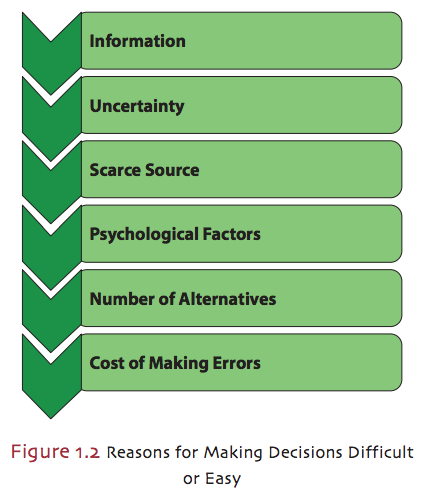
Some decisions are easy to make while some are more difficult. There might be many reasons. Not enough information, uncertainty situations, scarce source, psychological factors, lots of alternatives, high cost of making errors are the reasons. The correct answer is 'C'.
Soru 4
Which of the following is not a common characteristics of decision making?
Seçenekler
A
Decision maker
B
Scarce source
C
Objective
D
Alternatives
E
Events
Açıklama:
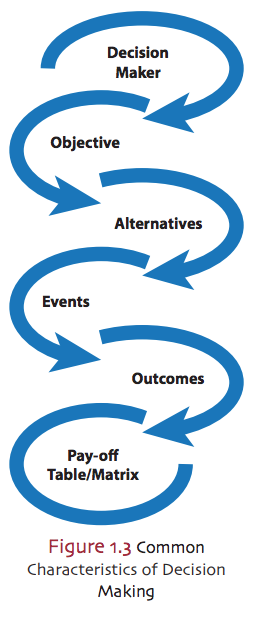
There are some common characteristics of decision making. These are “decision maker”, “objective”, “alternatives (strategies/actions)”, “events (states of nature)”, “outcomes (pay-off)” and “payoff table / pay off matrices.The correct answer is 'B'.
Soru 5
.................... are the values of alternatives and events. They are usually numeric values. Which of the following is written in the blank?
Seçenekler
A
Decision Maker
B
Objective
C
Alternatives
D
Outcomes
E
Events
Açıklama:
Outcomes/Pay-Offs: These are the values of alternatives and events. Outcomes are usually numeric values. The correct answer is "D".
Soru 6
Which one is not one of the steps of the decision making process?
Seçenekler
A
Define decision problem
B
Establish objectives
C
Identify the market
D
List all possible decision alternatives
E
Determine the best alternative
Açıklama:
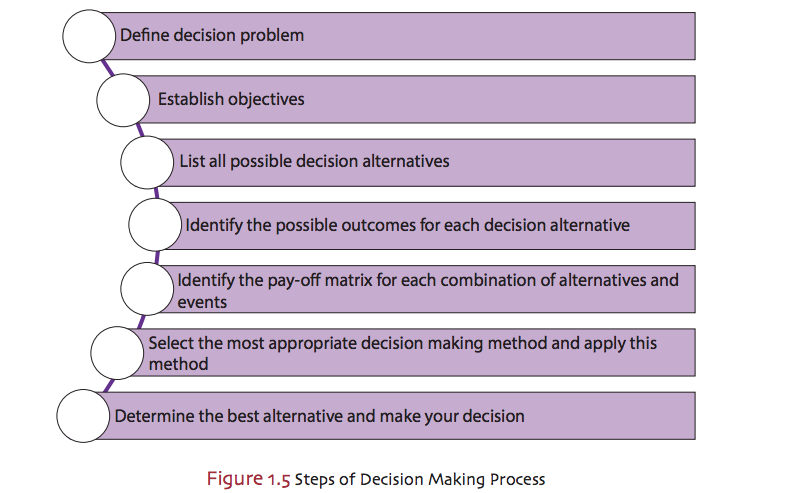
The steps of the decision making process are: Define decision problem, Establish objectives, List all possible decision alternatives, Identify the pay-off matrix for each combination of alternatives and events, Select the most appropriate decision making method and apply this method, Determine the best alternative and make your decision. The correct answer is "C".
Soru 7
If the problem is incorrectly determined in defining decision problem step, how will be the decision?
Seçenekler
A
Wrong
B
Right
C
Clear
D
Concise
E
Important
Açıklama:
Problem statement gives direction and meaning to all other steps of decision making. If the problem is incorrectly determined in this step, the decision will be wrong.
Soru 8
Once the decision problem has been identified, what will be the next step?
Seçenekler
A
Establishing objectives
B
Listing decision alternatives
C
Identifing the possible outcomes for each decision alternative
D
Determining the best alternative
E
Making the decision
Açıklama:
Once the decision problem has been identified, in the second step the objective of the problem must be clearly stated.The correct answer is "A".
Soru 9
What is it called when the decision have information about the probabilities of occurrence of the event?
Seçenekler
A
Decision making under certainty
B
Decision making under risk
C
Decision making under uncertainty
D
Decision making environment
E
Steps of decision making process
Açıklama:
When the decision have information about the probabilities of occurrence of the events, the decision making environment is called “decision making under risk”.The correct answer is "B".
Soru 10
What kind of a decision making environment is when the decision maker knows everything about the problem and outcomes of the events?
Seçenekler
A
Decision making under uncertainty
B
Decision making under risk
C
Decision making under error
D
Decision making under certainty
E
Decision making under complexity
Açıklama:
When the decision maker knows everything about the problem and outcomes of the events, the decision making environment is called “decision making under certainty”. In this case, because the decision maker knows everything about the problem, it is easier to make the best decision. The correct answer is "D".
Soru 11
What is the process of choosing the most appropriate one of the alternatives?
Seçenekler
A
Scarce source
B
Decision maker
C
Decision making
D
Strategies
E
Outcomes
Açıklama:
The process of choosing the most appropriate one of the alternatives is called “decision making”. The correct answer is C.
Soru 12
- Lowering costs
- Bringing more profitability
- Lengthening delivery times
- Increasing shareholder values
Seçenekler
A
I and II
B
III and IV
C
I, II and III
D
I, II and IV
E
II, III and IV
Açıklama:
A high quality decision should bring more profitability and lower costs, shorten (not lengthen) delivery times, increase shareholder value, attract more new customers and provide positive responses from customers. The correct answer is D.
Soru 13
- Information
- Ceryainty
- Number of alternatives
- Psychological factors
Seçenekler
A
I and III
B
II and IV
C
I, II and III
D
I, III and IV
E
II, III and IV
Açıklama:
Some decisions are easy to make while some are more difficult. There might be many reasons. Some of these reasons are: information, uncertainty, scarce source, psychological factors, number of alternatives and cost of making errors. The correct answer is D.
Soru 14
In which of the following cases are mathematical and statistical methods used to calculate the expected value of the profit without simulation?
Seçenekler
A
Uncertainty
B
Little information
C
Scarce source
D
Many alternatives
E
Negative attitude
Açıklama:
In case of uncertainty, two different ways are followed to make a good decisions. One of them is the simulation which different combinations of possible demands and startup costs will be tried on the computer. Thus, this simulation can give us a better idea of the possible values of the profit obtained. The other method is to use mathematical and statistical methods to calculate the expected value of the profit without simulation. The correct answer is A.
Soru 15
Which of the following is not among the common characteristics of decision making?
Seçenekler
A
Outcomes
B
Objectives
C
Strategies
D
Events
E
Risks
Açıklama:
There are some common characteristics of decision making. These are “decision maker”, “objective”, “alternatives (strategies/actions)”, “events (states of nature)”, “outcomes (pay-off)” and “payoff table / pay off matrices”. The correct answer is E.
Soru 16
Which of the following characteristics of decision making are maximization and minimization related to?
Seçenekler
A
Strategies
B
Objective
C
Actions
D
Alternatives
E
Outcomes
Açıklama:
Decisions are given to accomplish a specific purpose. Decision making problems have two objectives: maximization and minimization (selecting the alternative that makes the maximum profit or the number of customers and selecting the alternatives that makes the minimum cost or transportation time). The correct answer is C.
Soru 17
- Events
- Outcomes
- Alternatives
- Objectives
Seçenekler
A
I and III
B
II and IV
C
I, II and III
D
I, III and IV
E
II, III and IV
Açıklama:
The outcomes of all alternatives and events are indicated by a matrix called “pay-off matrix”. When m indicate alternatives and n indicate events, m x n size matrix is obtained. S1, S2, S3, ... , Sm denote the alternatives, and N1, N2, N3, ... , Nn denote the events in the pay-off matrix. Combinations of each strategy and event are indicated by Oij notation. The correct answer is C.
Soru 18
- List all possible decision alternatives
- Define decision problem
- Establish objectives
- Select the most appropriate decision making method and apply this method
- Identify the possible outcomes for each decision alternative
- Determine the best alternative and make your decision
- Identify the pay-off matrix for each combination of alternatives and events
Seçenekler
A
2-3-1-5-7-4-6
B
2-1-3-4-7-5-6
C
2-3-4-6-5-1-6
D
3-2-1-4-7-5-6
E
3-1-2-5-4-7-6
Açıklama:
The steps of the decision making process are as follows:
- Define decision problem
- Establish objectives
- List all possible decision alternatives
- Identify the possible outcomes for each decision alternative
- Identify the pay-off matrix for each combination of alternatives and events
- Select the most appropriate decision making method and apply this method
- Determine the best alternative and make your decision
Soru 19
Which step of decision making process includes a good understanding of management assumptions, organizational boundaries and the desired conditions for the problem?
Seçenekler
A
Establishing objectives
B
Defining decision problem
C
Listing alternatives
D
Identifying outcomes
E
Determining the best alternative
Açıklama:
The first step in the decision-making process is to define the problem. This step includes a good understanding of management assumptions, organizational boundaries and the desired conditions for the problem. In order to identify the problem, all information about it should be collected, factors and causes associated with the problem should be determined. The correct answer is B.
Soru 20
I. Decision making under limited time II. Decision making under certainty III. Decision making under uncertainty IV. Decision making under risks Which of the above are the decision-making environments according to the level of knowledge?
Seçenekler
A
I and II
B
III and IV
C
I, II and III
D
I, III and IV
E
II, III and IV
Açıklama:
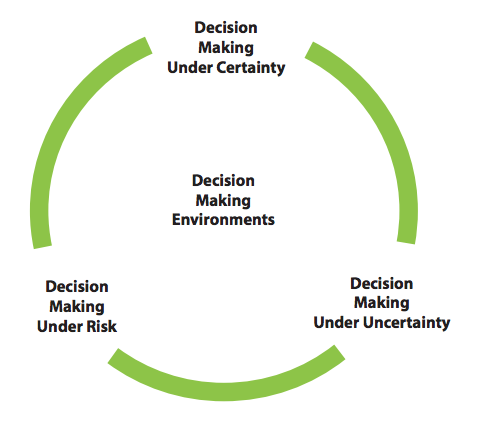
There are three different decision-making environments according to the level of knowledge or information of the decision-maker regarding events or states of nature:
The correct answer is E.
- Decision making under certainty
- Decision making under uncertainty
- Decision making under risks
The correct answer is E.
Soru 21
- Scarce source
- Uncertainty
- Information
- Psychological factors
Seçenekler
A
I, II and III
B
I, III and IV
C
I, II and IV
D
II, III and IV
E
I, II, III and IV
Açıklama:
Soru 22
What is the process of choosing the most appropriate one of the alternatives called?
Seçenekler
A
Information
B
Number of alternatives
C
Objective
D
Outcome
E
Decision making
Açıklama:
The process of choosing the most appropriate one of the alternatives is called “decision making”.
Soru 23
Which of the below are not among the common characteristics of decision making?
Seçenekler
A
Objective
B
Alternatives
C
Events
D
Scarce source
E
Outcomes
Açıklama:
Soru 24
- Define decision problem
- Establish objectives
- Identify the possible outcomes for each decision alternative
- Determine the best alternative and make your decision
Seçenekler
A
I, II and III
B
I, III and IV
C
I, II and IV
D
II, III and IV
E
I, II, III and IV
Açıklama:
Soru 25
- Decision Making Under Certainty
- Decision Making Under Control
- Decision Making Under Risk
- Decision Making Under Uncertainty
Seçenekler
A
I, II and III
B
I, III and IV
C
II, III and IV
D
I, II and IV
E
I, II, III and IV
Açıklama:
Soru 26
When the decision maker has information about the probabilities of occurrence of the events, what is the decision making environment called?
Seçenekler
A
Decision Making Process
B
Cost Of Making Errors
C
Decision Making Under Risk
D
Decision Making Under Certainty
E
Decision Making Under Uncertainty
Açıklama:
When the decision maker has information about the probabilities of occurrence of the events, the decision making environment is called “decision making under risk”.
Soru 27
When the decision maker has no information about the probabilities of occurrence and outcomes of the events, what is the decision making environment called?
Seçenekler
A
Decision Making Under Risk
B
Decision Making Under Certainty
C
Decision Making Under Uncertainty
D
Decision Making Process
E
Scarce Source
Açıklama:
When the decision maker has no information about the probabilities of occurrence and outcomes of the events, the decision making environment is called “decision making under uncertainty”.
Soru 28
When the decision maker knows everything about the problem and outcomes of the events, what is the decision making environment called?
Seçenekler
A
Decision Making Under Certainty
B
Decision Making Under Risk
C
Decision Making Process
D
Decision Making Under Uncertainty
E
Scarce Source
Açıklama:
When the decision maker knows everything about the problem and outcomes of the events, the decision making environment is called “decision making under certainty”.
Soru 29
- When the decision maker knows everything about the problem and outcomes of the events.
- When the decision maker has information about the probabilities of occurrence of the events.
- When the decision maker has no information about the probabilities of occurrence and outcomes of the events.
Seçenekler
A
- Decision making under uncertainty
- Decision making under risk
- Decision making under certainty
B
- Decision making under risk
- Decision making under certainty
- Decision making under uncertainty
C
- Decision making under certainty
- Decision making under uncertainty
- Decision making under risk
D
- Decision making under uncertainty
- Decision making under certainty
- Decision making under risk
E
- Decision making under certainty
- Decision making under risk
- Decision making under uncertainty
Açıklama:
When the decision maker knows everything about the problem and outcomes of the events, the decision making environment is called “decision making under certainty”
When the decision maker has no information about the probabilities of occurrence and outcomes of the events, the decision making environment is called “decision making under uncertainty”.
When the decision maker has information about the probabilities of occurrence of the events, the decision making environment is called “decision making under risk”.
When the decision maker has no information about the probabilities of occurrence and outcomes of the events, the decision making environment is called “decision making under uncertainty”.
When the decision maker has information about the probabilities of occurrence of the events, the decision making environment is called “decision making under risk”.
Soru 30
Which of the following is not among the reasons for making decisions difficultor easy?
Seçenekler
A
Scarce Source
B
Psychological Factors
C
Number of Alternatives
D
Cost of Making Errors
E
Precision
Açıklama:
Precision is not among the reasons for making decisions difficult or easy.
Soru 31
- These are the values of alternatives and events.
- They are usually numeric values.
Seçenekler
A
Strategies or Actions
B
Events or States of Nature
C
Outcomes or Pay-Offs
D
Pay-Off Table or Pay-Off Matrix
E
Objectives
Açıklama:
Outcomes/Pay-Offs: These are the values of alternatives and events. Outcomes are usually numeric values.
Soru 32
What are the uncontrollable environmental factors that influence the choice of the decision maker?
Seçenekler
A
Alternatives
B
Outcomes
C
Pay-Offs
D
Values
E
Events
Açıklama:
Events are environmental factors that influence the choice of the decision maker. However, they are uncontrollable.
Soru 33
What is the first step in the decision-making process?
Seçenekler
A
Defining the problem
B
Establishing objectives
C
Listing all possible decision alternatives
D
Identifying the possible outcomes for each decision alternative
E
Identifying the pay-off matrix for each combination of alternatives
Açıklama:
The first step in the decision-making process is to define the problem. Perhaps this is the most important and most difficult part of the process. At this step, it is very important to describe the problem statement clearly and concisely.
Soru 34
What is the second step in the decision-making process?
Seçenekler
A
Defining the problem
B
Establishing objectives
C
Listing all possible decision alternatives
D
Identifying the possible outcomes for each decision alternative
E
Identifying the pay-off matrix for each combination of alternatives
Açıklama:
Once the decision problem has been identified, in the second step the objective of the problem must be clearly stated. Therefore, "Establishing objectives" is the second step.
Soru 35
What is the third step in the decision-making process?
Seçenekler
A
Defining the problem
B
Establishing objectives
C
Listing all possible decision alternatives
D
Identifying the possible outcomes for each decision alternative
E
Identifying the pay-off matrix for each combination of alternatives
Açıklama:
The third step in the decision making process is "Listing all possible decision alternatives."
Soru 36
What is the fourth step in the decision-making process?
Seçenekler
A
Defining the problem
B
Establishing objectives
C
Listing all possible decision alternatives
D
Identifying the possible outcomes for each decision alternative
E
Identifying the pay-off matrix for each combination of alternatives
Açıklama:
The fourth step in the decision-making process is "Identifying the possible outcomes for each decision alternative."
Soru 37
What is the fifth step in the decision-making process?
Seçenekler
A
Defining the problem
B
Establishing objectives
C
Listing all possible decision alternatives
D
Identifying the possible outcomes for each decision alternative
E
Identifying the pay-off matrix for each combination of alternatives
Açıklama:
The fifth step in the decision making process is "Identifying the pay-off matrix for each combination of alternatives."In this step, the matrix for each alternative and event combination is generated and the outcomes are written to the matrix.
Soru 38
In which decision making environment, the decision maker knows outcomes of events for each decision alternative?
Seçenekler
A
Decision making under certainty
B
Decision making under uncertainty
C
Decision making under risk
D
Decision making under stress
E
Decision making under pressure
Açıklama:
In decision making under certainty, the decision maker knows outcomes of events for each decision alternative. In this case, because the decision maker knows everything about the problem, it is easier to make the best decision.
Soru 39
In which decision making environment, the decision maker has no information and knowledge about outcomes of the events or probability of occurrence of the events?
Seçenekler
A
Decision making under certainty
B
Decision making under uncertainty
C
Decision making under risk
D
Decision making under stress
E
Decision making under pressure
Açıklama:
In decision making under uncertainty, there is more than one event and these may not be identified or measured. Decision maker has no information and knowledge about outcomes of the events or probability of occurrence of the events. In cases where there is no level of information or knowledge about the outcomes of events, the decision is given under uncertainty.
Soru 40
In which decision making environment, the decision maker has information about the probability of occurrence of each event?
Seçenekler
A
Decision making under certainty
B
Decision making under uncertainty
C
Decision making under risk
D
Decision making under stress
E
Decision making under pressure
Açıklama:
In decision making under risk, decision makers have information about the probability of occurrence of each events. The probability value can be known precisely or predicted. These possibilities can be obtained from the personal opinions of the decision-maker, from the statistical records held in the enterprise, from expert opinions, from market research.
Soru 41
Which of the followings are crucial for a basic decision making process?
- Alternatives
- Objective
- Outcomes of the alternatives
- Past decisions
- Occurrence possibilities of the objective
Seçenekler
A
I-II
B
I-II-III
C
I-II-III-IV
D
I-II-IV-V
E
I-II-III-IV-V
Açıklama:
The important issues are alternatives, objective and the outcomes of the alternatives for the decision making process. The issues about the past decisions and objective occurrence possibility are not related to a basic decision making process. The answer is B.
Soru 42
Which of the following is not one of the issues that complicate the decision-making process?
Seçenekler
A
Scarce information
B
Risk attitudes
C
Uncertainty
D
Negative psychological factors for the decision maker
E
Finite alternatives
Açıklama:
Finite alternatives is not an negative issue for decision making. On the contrary, the evaluation and decision process will be easy if there are limited alternatives. But the scarce information, risk attitude, uncertainty and negative physiological factors are the issues that makes the decision process more complicated. The answer is E.
Soru 43
Which of the following presents the values of the alternatives under the events and are considered to evaluate the alternatives?
Seçenekler
A
Outcomes
B
Strategies
C
Actions
D
Certainty
E
Objectives
Açıklama:
The values of alternatives and events are outcomes. The answer is A.
Soru 44
What is the reason of the evaluation of alternatives under the each events?
Seçenekler
A
To select the worst alternative
B
To consider the alternatives comprehensively
C
To identify the objectives
D
To evaluate the past decisions
E
To determine the possibilities of the alternatives
Açıklama:
The determination of all possible future outcomes for each decision alternative is the reason for considering the alternatives comprehensively and selection of the best alternative. Answer is B.
Soru 45
Which of the following is the end process of the decision making?
Seçenekler
A
Detection of the alternatives
B
Select the best alternative
C
Select the worst alternative
D
Define the environment of the alternatives
E
Evaulation of the alternatives
Açıklama:
In this last step, according to the outcomes of the events, the most appropriate alternative is selected. It is considered as the decision that gives the best solution according to the determined objective. Then, the decision-making process ends. The answer is B.
Soru 46
Which of the following is the environment which is the decision maker knows everything about the problem in?
Seçenekler
A
Decision making under uncertainty
B
Decision making under risk
C
Decision making under certainty
D
Decision making under attention
E
Decision making under safety
Açıklama:
In decision making under certainty, the decision maker knows outcomes of events for each decision alternative. In this case, because the decision maker knows everything about the problem, it is easier to make the best decision. The answer is C.
Soru 47
Which of the followings are the way of finding the probabilities that one of the most important issues of decision-making under risk environment?
- Personal opinions of the decision-maker
- Statistical records
- Expert opinions
- Market research
Seçenekler
A
I-II
B
I-III
C
II-III
D
I-III-IV
E
I-II-III-IV
Açıklama:
Decision makers have information about the probability of occurrence of each events. The probability value can be known precisely or predicted. These possibilities can be obtained from the personal opinions of the decision-maker, from the statistical records held in the enterprise, from expert opinions, from market research. The answer is E.
Soru 48
For a person who knows that there will be rain via the weather forecast reports and decides to take an umbrella with him/her, what do “taking an umbrella” and “weather forecast information” represent responsively in the decision-making process?
Seçenekler
A
Best alternative - States
B
Alternatives - environment
C
Environment - states
D
Pay off - Best alternative
E
States - environment
Açıklama:
In that case,
The mentioned person- represents the decision maker
Weather forecast reports - represents the states for decision making about taking an umbrella or not
Taking an umbrella - represents the chosen best alternative,
Not taking an umbrella - represents the other alternative.
The answer is A.
The mentioned person- represents the decision maker
Weather forecast reports - represents the states for decision making about taking an umbrella or not
Taking an umbrella - represents the chosen best alternative,
Not taking an umbrella - represents the other alternative.
The answer is A.
Soru 49
In a decision making process, what kind of transformation the information about the probability of the events makes for the decision environment?
Seçenekler
A
From certainty to uncertainty
B
From certainty to risk
C
From uncertainty to certainty
D
From uncertainty to risk
E
From risk to certainty
Açıklama:
Decision maker has no information and knowledge about outcomes of the events or probability of occurrence of the events. In cases where there is no level of information or knowledge about the outcomes of events, the decision is given under uncertainty.
But,
When the decision have information about the probabilities of occurrence of the events, the decision making environment is called “decision making under risk”.
The answer is D.
But,
When the decision have information about the probabilities of occurrence of the events, the decision making environment is called “decision making under risk”.
The answer is D.
Soru 50
If a broker who has various investment alternatives, is calculating the probability of return by looking at the historical statistics of the values of the investments under various conditions, what is the environment of the decision making process for the broker?
Seçenekler
A
Complex
B
Ambiguous
C
Constant
D
Certainty
E
Risky
Açıklama:
Decision makers have information about the probability of occurrence of each events. The probability value can be known precisely or predicted. These possibilities can be obtained from the personal opinions of the decision-maker, from the statistical records held in the enterprise, from expert opinions, from market research.
For the mentioned case, if the broker is looking for the probabilities of the states of the alternatives, the environment of the decision making process is risky.
The answer is E.
For the mentioned case, if the broker is looking for the probabilities of the states of the alternatives, the environment of the decision making process is risky.
The answer is E.
Ünite 2
Soru 1
A food company is considering to establish a logistics company to manage its own logistics operations. On the other hand, the company has no experience and knowledge in the field of logistics. At this point, which of the following is the type of the decision environment that defines this situation?
Seçenekler
A
Decision making under complexity
B
Decision making under certainty
C
Decision making under uncertainty
D
Decision making under risk
E
Decision making under error
Açıklama:
In a decision problem, the decision maker is aware of various possible events (states of nature) but has insufficient information to assign any probabilities of occurrence to them. This kind of a decision problem is termed as decision making under uncertainty. There are many unknowns and no possibility of knowing what could occur in the future to change the outcome of a decision in decision making under uncertainty.
For firms launching a new product, an important change in marketing strategy or opening first branch can be given examples of decision making under uncertainty.
In the context of the above explanations, the correct answer is C.
For firms launching a new product, an important change in marketing strategy or opening first branch can be given examples of decision making under uncertainty.
In the context of the above explanations, the correct answer is C.
Soru 2
A decision maker who has to decide under uncertainty in a decision problem he faces thinks all events are equally likely. Which of the following methods should the decision maker use?
Seçenekler
A
Criterion of Pessimism
B
Minimax Regret
C
Criterion of Realism
D
Criterion of Optimism
E
Equally Likely
Açıklama:
The Equally Likely Method indicates that all events occur equally likely if the probability of occurrence of events is unknown. Therefore, calculation is made considering that the event’s possibility occur equally. The final decision is made according to the objective (maximum or minimum) of the problem.
Soru 3
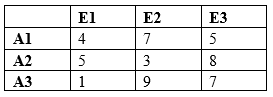 E1, E2, E3 show the events and A1, A2, A3 show the alternatives. The profit values of each event are given in the table above. Which is the most appropriate decision according to the Equally Likely Method?
Seçenekler
A
A1 with 3.33
B
A2 with 5.33
C
A2 with 6.33
D
A3 with 3.67
E
A3 with 5.67
Açıklama:
The correct answer is E as shown below:
The probability of occurrence of each event is 1/3.
A1 = 4*(1/3)+7*(1/3)+5*(1/3) = 5.33
A2 = 5*(1/3)+3*(1/3)+8*(1/3) = 5.33
A3 = 1*(1/3)+9*(1/3)+7*(1/3) = 5.67
The probability of occurrence of each event is 1/3.
A1 = 4*(1/3)+7*(1/3)+5*(1/3) = 5.33
A2 = 5*(1/3)+3*(1/3)+8*(1/3) = 5.33
A3 = 1*(1/3)+9*(1/3)+7*(1/3) = 5.67
Soru 4
A person who runs a soft drink shop plans to buy a vending machine for selling hot drinks in the upcoming winter months. The shopkeeper has identified five types of vending machines. The cost of these machines to the shopkeeper according to the density of the sales in winter is given in the table below.
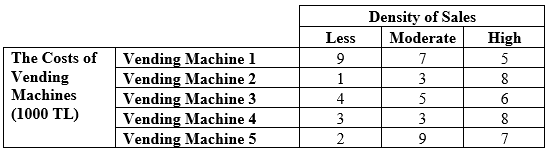 The shopkeeper has optimistic personality structure. Accordingly, which is the most appropriate decision for the shopkeeper?
The shopkeeper has optimistic personality structure. Accordingly, which is the most appropriate decision for the shopkeeper?Seçenekler
A
Vending Machine 1
B
Vending Machine 2
C
Vending Machine 3
D
Vending Machine 4
E
Vending Machine 5
Açıklama:
If decision maker has an optimistic approach, Criterion of Optimism method can be used. In this context, if the problem is the minimization, the best outcome is the lowest value. In this case, the alternative which is the smallest value is chosen. Accordingly, the correct answer is B (vending machine 2) with the smallest value (as seen in table above; 1).
Soru 5
If the problem is the maximization, the best outcome is the highest value. In this case, the alternative which is the highest value is chosen.
According to the explanation given above, which of the following is this method?
According to the explanation given above, which of the following is this method?
Seçenekler
A
Criterion of Realism
B
Criterion of Optimism
C
Minimax Regret
D
Criterion of Pessimism
E
Equally Likely
Açıklama:
In application of the Criterion of Optimism, when the objective function is maximization, the maximum values for the alternatives are determined. The highest of these maximum values is selected.
Soru 6
If decision maker has a pessimistic approach, the Criterion of Pessimism can be used. According to this criterion, the decision maker thinks that the ------- outcome for each alternative will be realized.
Which of the below is appropriate for the blank in the quoted sentence?
Which of the below is appropriate for the blank in the quoted sentence?
Seçenekler
A
highest
B
best
C
worst
D
last
E
first
Açıklama:
If decision maker has a pessimistic approach, the Criterion of Pessimism can be used. The decision maker thinks that the worst outcomes for each alternative will be realized.
Soru 7
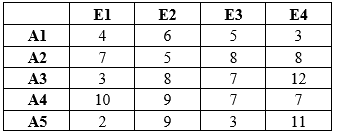 E1, E2, E3 and E4 show the events and A1, A2, A3, A4 and A5 show the alternatives. The profit values of each event are given in the following table. Which is the most appropriate decision according to the Criterion of Pessimism?
Seçenekler
A
A1
B
A2
C
A3
D
A4
E
A5
Açıklama:
In application of to the Criterion of Pessimism, if the problem is maximization, the worst outcome is the lowest value. However, the best alternative (maximum value) of these worst outcomes is chosen. According to this;
The minimum value for A1 = 3
The minimum value for A2 = 5
The minimum value for A3 = 3
The minimum value for A4 = 7
The minimum value for A5 = 2
Among these values, the highest is 7, and this belongs to A4.
The minimum value for A1 = 3
The minimum value for A2 = 5
The minimum value for A3 = 3
The minimum value for A4 = 7
The minimum value for A5 = 2
Among these values, the highest is 7, and this belongs to A4.
Soru 8
The decision maker is a little optimistic, a little pessimistic and the method that involves both cases is called -------.
Which of the below is appropriate for the blank in the quoted sentence?
Which of the below is appropriate for the blank in the quoted sentence?
Seçenekler
A
Criterion of Optimism
B
Minimax Regret
C
Criterion of Pessimism
D
Criterion of Realism
E
Equally Likely
Açıklama:
The decision maker is a little optimistic, a little pessimistic and the method that involves both cases is called Criterion of Realism.
Soru 9
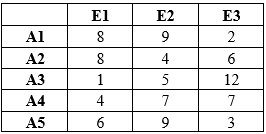
E1, E2, and E3 show the events and A1, A2, A3, A4, and A5 show the alternatives. The cost values of each event are given in the following table. Which is the most appropriate decision according to the Criterion of Realism? (Alpha is 0.60)
Seçenekler
A
A1
B
A2
C
A3
D
A4
E
A5
Açıklama:
First, the minimum values are determined for each alternative. These values are multiplied by the α coefficient. Then the maximum values are determined for each alternative. These values are multiplied by the (1- α) coefficient. These values of each alternative are sum up.
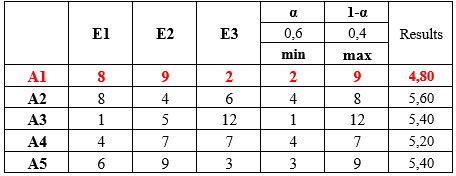 Among these values, the lowest is 4.80, and this belongs to A1.
A1 = 2*0,6 + 9*0,4 = 4,80
Among these values, the lowest is 4.80, and this belongs to A1.A1 = 2*0,6 + 9*0,4 = 4,80
Soru 10
In the Minimax Regret criterion, which value is always selected from the regret matrix?
Seçenekler
A
The highest
B
The medium
C
The smallest
D
The last
E
The first
Açıklama:
In the Minimax Regret criterion, regardless of the objective function, the smallest value is always selected from the regret matrix.
Soru 11
In which method used when making a decision under uncertainty, calculation is made considering that the event’s possibility occur equally?
Seçenekler
A
Equally likely
B
Criterion of optimism
C
Criterion of pessimism
D
Criterion of realism
E
Minimax regret
Açıklama:
In equally likely method calculation is made considering that the event’s possibility occur equally.
Soru 12
In which method, whether the objective of problem is maximization or minimization, the best outcome for each alternative is realised and decision maker select the best among these alternatives?
Seçenekler
A
Laplace
B
Plunger
C
Wald
D
Hurwicz
E
Savage
Açıklama:
In criterion of optimism (plunger), whether the objective of problem is maximization or minimization, the best outcome for each alternative is realized and decision maker select the best among these alternatives.
Soru 13
In which method does the decision maker think that the worst outcomes for each alternative will be realized?
Seçenekler
A
Criterion of pessimism
B
Criterion of optimism
C
Criterion of realism
D
Equally likely
E
Minimax regret
Açıklama:
In criterion of pessimism, the decision maker thinks that the worst outcomes for each alternative will be realized.
Soru 14
Which method allows the decision make to use more than one approach together?
Seçenekler
A
Criterion of pessimism
B
Equally likely
C
Criterion of optimism
D
Criterion of realism
E
Minimax regret
Açıklama:
Criterion of realism method allows the decision
maker to use optimistic and pessimistic approaches together.
maker to use optimistic and pessimistic approaches together.
Soru 15
Which method is defined as the difference between the optimal and the actual pay-off?
Seçenekler
A
Criterion of pessimism
B
Criterion of optimism
C
Criterion of realism
D
Equally likely
E
Minimax regret
Açıklama:
Minimax regret is defined as the difference between the optimal and the actual pay-off.
Soru 16
 E1, E2, E3, E4, E5 show the events and A1, A2, A3 show the alternatives. The profit values of each event are given in the table above. Which is the most appropriate decision according to the Equally Likely Method?
Seçenekler
A
A1 with 10
B
A1 with 15
C
A2 with 20
D
A2 with 17
E
A3 with 14
Açıklama:
A3 with 14 is the most appropriate decision according to equally likely method.
Soru 17
E1, E2, E3, E4, E5 show the events and A1, A2, A3 show the alternatives. The profit values of each event are given in the following table. Which is the most appropriate decision according to the Criterion of realism? (alpha is 0.3)Seçenekler
A
A1 with 6.6
B
A1 with 15
C
A3 with 9,33
D
A3 with 12
E
A2 with 7,33
Açıklama:
A3 with 9,33 is the most appropriate decision according criterion of realism.
Soru 18
"When the decision maker does not know the probabilities of occurrence of events, the
decision-making is called ________." With which of the following should this be filled in?
decision-making is called ________." With which of the following should this be filled in?
Seçenekler
A
pessimistic approaches
B
decision making under uncertainty
C
optimistic approaches
D
decision choice
E
policies of the business
Açıklama:
When the decision maker does not know
the probabilities of occurrence of events, the
decision-making is called “decision making
under uncertainty”. In this sense, the correct answer is B.
the probabilities of occurrence of events, the
decision-making is called “decision making
under uncertainty”. In this sense, the correct answer is B.
Soru 19
Which of the following is not one of the methods of Decision Making Under Uncertainty?
Seçenekler
A
Equally Likely
B
Criterion of Optimism
C
Criterion of Pessimism
D
Minimax Regret
E
Criterion of Pragmatism
Açıklama:
There are some different methods used in decision making under uncertainty.
-Equally Likely (Laplace)
-Criterion of Optimism (Plunger)
-Criterion of Pessimism (Wald)
-Criterion of Realism (Hurwicz)
-Minimax Regret (Savage)
In this sense, the correct answer is option E.
-Equally Likely (Laplace)
-Criterion of Optimism (Plunger)
-Criterion of Pessimism (Wald)
-Criterion of Realism (Hurwicz)
-Minimax Regret (Savage)
In this sense, the correct answer is option E.
Soru 20
Which formula can be applied to calculate Criterion of Optimism?
Seçenekler
A 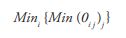
B 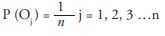
C 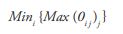
D 
E 
Açıklama:
The correct answer is given in option A. Because if decision maker has an optimistic approach, this method can be used. In this method, whether the objective of problem is maximization or minimization, the best outcome for each alternative is realized and decision maker select the best among these alternatives. If the problem is the minimization, the best outcome is the lowest value. In this case, the alternative which is the smallest value is chosen. The mathematical representation of the method is as follows:
Soru 21
"The decision maker is a little optimistic, a little pessimistic and the method that involves both cases is called ________." Fill in the blank.
Seçenekler
A
Criterion of Realism.
B
Minimax Regret
C
Criterion of Pragmatism
D
Maximise Regret
E
Equally Likely
Açıklama:
The decision maker is a little optimistic, a little pessimistic and the method that involves both cases is called Criterion of Realism. This method allows the decision maker to use these two approaches together. So, the correct answer is A.
Soru 22
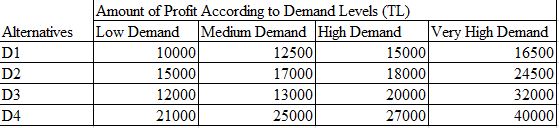
The table provides the possible profit values for the monthly demand levels for each location. The aim of the decision maker is to make the maximum profit. Determine the most appropriate decision for the problem according to the Equally Likely Method.
Seçenekler
A
D1 with 13500
B
D2 with 18625
C
D3 with 19250
D
D1 with 42300
E
D4 with 28250
Açıklama:
There are four events in the problem. So, the probability of occurrence of each event is 1/4.
District 1 = 10.000*1/4 + 12.500*1/4 + 15.000*1/4 + 16.500*1/4 = 13.500 TL
District 2 = 15.000*1/4 + 17.000*1/4 + 18.000*1/4 + 24.500*1/4 = 18.625 TL
District 3 = 12.000*1/4 + 13.000*1/4 + 20.000*1/4 + 32.000*1/4 = 19.250 TL
District 4 = 21.000*1/4 + 25.000*1/4 + 27.000*1/4 + 40.000*1/4 = 28.250 TL
Since the objective of this decision problem is maximization, decision maker chooses the highest value among the alternatives. The decision maker selects district 4 with 28.250 TL.
District 1 = 10.000*1/4 + 12.500*1/4 + 15.000*1/4 + 16.500*1/4 = 13.500 TL
District 2 = 15.000*1/4 + 17.000*1/4 + 18.000*1/4 + 24.500*1/4 = 18.625 TL
District 3 = 12.000*1/4 + 13.000*1/4 + 20.000*1/4 + 32.000*1/4 = 19.250 TL
District 4 = 21.000*1/4 + 25.000*1/4 + 27.000*1/4 + 40.000*1/4 = 28.250 TL
Since the objective of this decision problem is maximization, decision maker chooses the highest value among the alternatives. The decision maker selects district 4 with 28.250 TL.
Soru 23
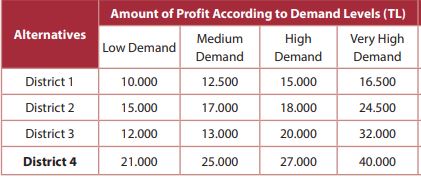
Make a decision with Criterion of Optimism method using the information in the table. (The objective is maximization)
Seçenekler
A
District 1 with 10.000 TL
B
District 2 with 18.000 TL
C
District 3 with 32000 TL
D
District 4 with 40000 TL
E
District 2 with 24500 TL
Açıklama:
First, the maximum values are determined for each alternative. Then, the highest value (40.000 TL) and the alternative for that value (District 4) is selected. The correct answer is D.
Soru 24
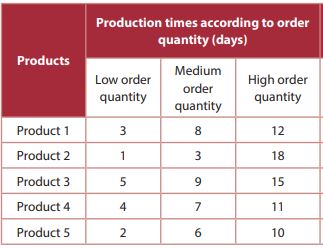
Make a decision with Criterion of Realism method using the information in the Table.
(The objective is minimization.)
(The objective is minimization.)
Seçenekler
A
Product 1 with 9.3 days
B
Product 2 with 12.9 days
C
Product 3 with 12 days
D
Product 4 with 8.9 days
E
Product 5 with 7.6 days
Açıklama:
The alpha coefficient is determined by the decision maker as 0.3. Then 1-alpha becomes 0.7. In this case, the decision maker is optimistic with a probability of 30%, and pessimistic with a probability of 70%.
First, the minimum values are determined for each alternative. These values are multiplied by the α coefficient. Then the maximum values are determined for each alternative. These values are multiplied by the (1- α) coefficient. These values of each alternative are sum up.
Product 1 = 3*0.3 + 12*0.7 = 9.3 days
Product 2 = 1*0.3 + 18*0.7 = 12.9 days
Product 3 = 5*0.3 + 15*0.7 =12 days
Product 4 = 4*0.3 + 11*0.7 = 8.9 days
Product 5 = 2*0.3 + 10*0.7 = 7.6 days
Then, because the objective is minimization the lowest value (7.6 days) and the alternative for that value (Product 5) is selected.
First, the minimum values are determined for each alternative. These values are multiplied by the α coefficient. Then the maximum values are determined for each alternative. These values are multiplied by the (1- α) coefficient. These values of each alternative are sum up.
Product 1 = 3*0.3 + 12*0.7 = 9.3 days
Product 2 = 1*0.3 + 18*0.7 = 12.9 days
Product 3 = 5*0.3 + 15*0.7 =12 days
Product 4 = 4*0.3 + 11*0.7 = 8.9 days
Product 5 = 2*0.3 + 10*0.7 = 7.6 days
Then, because the objective is minimization the lowest value (7.6 days) and the alternative for that value (Product 5) is selected.
Soru 25
"The method used for the loss of opportunities when the best alternative is not selected is _______ ." Fill in the blank.
Seçenekler
A
Criterion of Realism
B
Minimax Regret
C
Criterion of Pessimism
D
Criterion of Optimism
E
Equally Likely
Açıklama:
The method used for the loss of opportunities when the best alternative is not selected is “Minimax Regret”. This method is based on opportunity loss, also called regret. In this sense the correct answer is option B.
Soru 26
Which of the following is not true for the method of Minimax Regret?
Seçenekler
A
This method is based on opportunity loss
B
This method proposed that maximum regret be minimized by choosing the best pay off for each event.
C
This method allows the decision maker to use these two approaches together. There is a coefficient indicating the level of optimism of the decision maker. This coefficient is symbolized by alpha (α).
D
The regret of each event for each alternative is calculated and regret matrix or opportunity loss table is created. This table shows the losses to be incurred if the alternative is not selected for the best outcomes of each event.
E
In this method, regardless of the objective function, the smallest value is always selected from the regret matrix.
Açıklama:
This method is based on opportunity loss, also called regret. It is defined as the difference between the optimal and the actual pay-off. Regret is the amount lost when the best alternative is not selected.
This method proposed that maximum regret be minimized by choosing the best pay off for each event. The regret of each event for each alternative is calculated and regret matrix or opportunity loss table is created. This table shows the losses to be incurred if the alternative is not selected for the best outcomes of each event.
If the objective is maximization, the maximum value of each event is determined. All values of the relevant event are subtracted from this maximum value. If the objective is minimization, the minimum value of each event is determined. The smallest value of each event is subtracted from all values of relevant event. In this way, the regret matrix is obtained.
After the regret matrix has been constructed, the maximum opportunity loss (regret) for each alternative is located. Then the alternative with the smallest value
among these maximum regrets selected.
In this method, regardless of the objective function, the smallest value is always selected from the regret matrix.
According to these information, the correct answer is given in the option C.
This method proposed that maximum regret be minimized by choosing the best pay off for each event. The regret of each event for each alternative is calculated and regret matrix or opportunity loss table is created. This table shows the losses to be incurred if the alternative is not selected for the best outcomes of each event.
If the objective is maximization, the maximum value of each event is determined. All values of the relevant event are subtracted from this maximum value. If the objective is minimization, the minimum value of each event is determined. The smallest value of each event is subtracted from all values of relevant event. In this way, the regret matrix is obtained.
After the regret matrix has been constructed, the maximum opportunity loss (regret) for each alternative is located. Then the alternative with the smallest value
among these maximum regrets selected.
In this method, regardless of the objective function, the smallest value is always selected from the regret matrix.
According to these information, the correct answer is given in the option C.
Soru 27
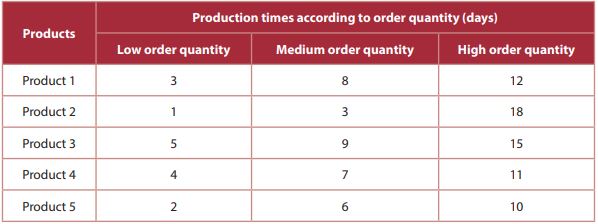
Make a decision with method of Minimax Regret using the information in the Table.
(The objective is minimization.)
(The objective is minimization.)
Seçenekler
A
Product 1 = maximum regret = 5 days
B
Product 2 = maximum regret = 8 days
C
Product 3 = maximum regret = 6 days
D
Product 4 = maximum regret = 4 days
E
Product 5 = maximum regret = 3 days
Açıklama:
For the values given in the Table, a regret matrix is created. Because the objective is
minimization, the minimum value of each event is selected. The smallest value of each event is subtracted from all other values in relevant column. Thus, a regret matrix is created. This table shows the regret matrix of the problem.
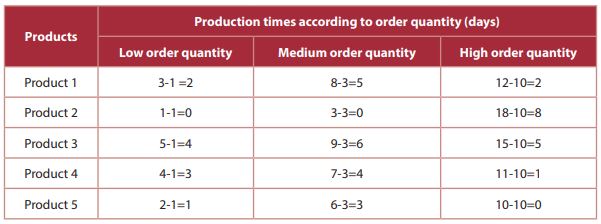 According to the results in Table, maximum regret of each alternatives are as follows:
Product 1 = maximum regret = 5 days
Product 2 = maximum regret = 8 days
Product 3 = maximum regret = 6 days
Product 4 = maximum regret = 4 days
Product 5 = maximum regret = 3 days
The alternative with the smallest value (product 5) is chosen among the maximum regrets. The correct answer is E.
minimization, the minimum value of each event is selected. The smallest value of each event is subtracted from all other values in relevant column. Thus, a regret matrix is created. This table shows the regret matrix of the problem.
According to the results in Table, maximum regret of each alternatives are as follows:Product 1 = maximum regret = 5 days
Product 2 = maximum regret = 8 days
Product 3 = maximum regret = 6 days
Product 4 = maximum regret = 4 days
Product 5 = maximum regret = 3 days
The alternative with the smallest value (product 5) is chosen among the maximum regrets. The correct answer is E.
Soru 28
The method of decision making under uncertainty which indicates that all events occur equally likely if the probability of occurrence of events is unknown is called:
Seçenekler
A
Wald.
B
Laplace.
C
Plunger.
D
Hurwicz.
E
Savage.
Açıklama:
Equally Likely (Laplace) method indicates that all events occur equally likely if the probability of occurrence of events is unknown. Therefore, calculation is made considering that the event’s possibility occur equally. The final decision is made according to the objective (maximum or minimum) of the problem.
Soru 29
In the equally likely method, if 'n' represents number of events related to the problem, the possibility of occurrence of each event is:
Seçenekler
A
P (Oj ) = 1/n+1 , j = 0, -1, -2, -3…-n
B
P (Oj ) = n2 , j = 1, 2, 3 …n
C
P (Oj ) = 1/n2 , j = 1, 2, 3 …n
D
P (Oj ) = n , j = 1, 2, 3 …n
E
P (Oj ) = 1/n , j = 1, 2, 3 …n
Açıklama:
Equally likely method indicates that all events occur equally likely if the probability of occurrence of events is unknown. The mathematical representation of the method is as follows: n: number of events related to the problem. Possibility of occurrence of each event = P (Oj ) = 1/n , j = 1, 2, 3 …n.
Soru 30
Which of the following alternatives is true regarding decision making under uncertainty?
Seçenekler
A
The manager’s perspective on events does not influence the choice decision between alternatives.
B
There is only one event which can be identified or measured.
C
Decision maker has complete information and knowledge about probability of occurrence of the events.
D
A firm launching a new product can be given as an example of decision making under uncertainty.
E
Different decision makers make identical decisions about identical decision problems.
Açıklama:
In a decision problem, the decision maker is aware of various possible events but has insufficient information to assign any probabilities of occurrence to them. This kind of a decision problem is termed as decision making under uncertainty. There are many unknowns and no possibility of knowing what could occur in the future to change the outcome of a decision in decision making under uncertainty. For firms launching a new product, an important change in marketing strategy or opening first branch can be given examples of decision making under uncertainty.
Soru 31
Which of the following is not one of the methods of decision making under uncertainty?
Seçenekler
A
Equally likely.
B
Criterion of pessimism.
C
Criterion of optimism.
D
Criterion of realism.
E
Maximum benefit.
Açıklama:
Generally, five different methods can be used for decision making under uncertainty. These methods are: Equally Likely (Laplace), Criterion of Optimism (Plunger), Criterion of Pessimism (Wald), Criterion of Realism (Hurwicz), Minimax Regret (Savage).
Soru 32
Which of the following is true regarding criterion of pessimism?
Seçenekler
A
When the objective function is maximization, the maximum values for the alternatives are determined. The lowest of these maximum values is selected.
B
When the objective function is maximization, the minimum values for the alternatives are determined. The lowest of these minimum values is selected.
C
When the objective function is maximization, the minimum values for the alternatives are determined. The highest of these minimum values is selected.
D
When the objective function is minimization, the minimum values for the alternatives are determined. The smallest of these minimum values is selected.
E
When the objective function is minimization, the maximum values for the alternatives are determined. The highest of these maximum values is selected.
Açıklama:
If decision maker has a pessimistic approach, this method can be used. The decision maker thinks that the worst outcomes for each alternative will be realized. However, when choosing from alternatives, it selects the best alternative for the objective of the problem. If the problem is maximization, the worst outcome is the lowest value. However, the best alternative (maximum value) of these worst outcomes is chosen.
Soru 33
Mini {α*Min (0ij)j + (1 - α)*Max (0ij)j}. This is the mathematical representation of:
Seçenekler
A
A minimization problem using criterion of realism method.
B
A maximization problem using criterion of realism method.
C
A minimization problem using criterion of pessimism method.
D
A maximization problem using criterion of pessimism method.
E
A minimization problem using criterion of optimism method.
Açıklama:
Criterion of realism allows the decision maker to use both criterion of pessimism and criterion of realism approaches together. There is a coefficient indicating the level of optimism of the decision maker. This coefficient is symbolized by alpha (α). When decision maker is pessimistic, the 1- α coefficient is used. If the problem is minimization, the best value is the smallest value and this value is multiplied by alpha coefficient. The worst value is the highest value and this value is multiplied by 1-α coefficient. Then, these values are sum up. Finally, the alternative with the best value (minimum value) is selected. The mathematical representation of the method is as follows: Mini {α*Min (0ij)j + (1 - α)*Max (0ij)j}.
Soru 34
In the criterion of realism approach:
Seçenekler
A
When the objective function is maximization, the highest values of the alternatives are multiplied by alpha and the smallest values of the alternatives are multiplied by 1- α.
B
When the objective function is minimization, the highest values of the alternatives are multiplied by α2 and the smallest values of the alternatives are multiplied by α-1.
C
When the objective function is maximization, both the highest values and the smallest values of the alternatives are multiplied by α.
D
When the objective function is minimization, both the highest values and the smallest values of the alternatives are multiplied by 1- α.
E
When the objective function is minimization, the highest values of the alternatives are multiplied by alpha and the smallest values of the alternatives are multiplied by 1- α.
Açıklama:
In the criterion of realism approach there is a coefficient indicating the level of optimism of the decision maker. This coefficient is symbolized by alpha (α). When decision maker is pessimistic, the 1- α coefficient is used. When the objective function is maximization, the highest values of the alternatives are multiplied by alpha and the smallest values of the alternatives are multiplied by 1- α.
Soru 35
The amount lost when the best alternative is not selected is called:
Seçenekler
A
Optimal pay-off.
B
Regret.
C
Actual pay-off.
D
Sunk cost.
E
Risk.
Açıklama:
The Minimax Regret (Savage) method is based on opportunity loss, also called regret. It is defined as the difference between the optimal and the actual pay-off. Regret is the amount lost when the best alternative is not selected.
Soru 36
In the criterion of realism approach, the decision maker is pessimistic if alpha is equal to:
Seçenekler
A
-10
B
-1
C
0
D
1
E
10
Açıklama:
Criterion of realism allows the decision maker to use optimism and pessimism approaches together. There is a coefficient indicating the level of optimism of the decision maker. This coefficient is symbolized by alpha (α). When decision maker is pessimistic, the 1- α coefficient is used. The alpha is between 0 and 1. When the alpha is equal to 1, the decision maker is optimistic. When it is equal to 0, the decision maker is pessimistic. The alpha coefficient is determined by the decision maker.
Soru 37
Which method of decision making under uncertainty is based on opportunity loss?
Seçenekler
A
Equally likely.
B
Criterion of realism.
C
Criterion of realism.
D
Minimax regret.
E
Criterion of pessimism.
Açıklama:
Minimax regret method is based on opportunity loss, also called regret. It is defined as the difference between the optimal and the actual pay-off. Regret is the amount lost when the best alternative is not selected.
Soru 38
__________ indicates that all events occur equally likely if the probability of occurrence of events is unknown. Therefore, calculation is made considering that the event’s possibility occur equally.
Seçenekler
A
Criterion of pessimism
B
Equally likely
C
Criterion of optimism
D
Minimax regret
E
Criterion of realism
Açıklama:
Equally Likely (Laplace) method indicates that all events occur equally likely if the probability of occurrence of events is unknown. Therefore, calculation is made considering that the event’s possibility occur equally. The final decision is made according to the objective (maximum or minimum) of the problem.
Soru 39
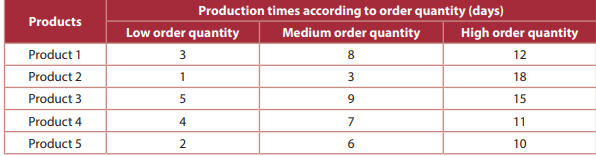 There are five different medical product of a company. The table shows production times of each products according to the order quantities. The aim of the decision maker is to complete the production in minimum time. Which product would be the most appropriate decision for the problem according to the Equally Likely Method?
Seçenekler
A
Product 1
B
Product 2
C
Product 3
D
Product 4
E
Product 5
Açıklama:
There are three events in the problem. So, the probability of occurrence of each event is 1/3.
Product 1 = 3*1/3 + 8*1/3 + 12*1/3 = 23/3 days
Product 2 = 1*1/3 + 3*1/3 + 18*1/3 = 22/3 days
Product 3 = 5*1/3 + 9*1/3 + 15*1/3 = 29/3 days
Product 4 = 4*1/3 + 7*1/3 + 11*1/3 = 22/3 days
Product 5 = 2*1/3 + 6*1/3 + 10*1/3 = 18/3 days
Since the objective of this decision problem is minimization, decision maker chooses the lowest value among the alternatives. The decision maker selects product 5 with 18/3 (6 days).
Product 1 = 3*1/3 + 8*1/3 + 12*1/3 = 23/3 days
Product 2 = 1*1/3 + 3*1/3 + 18*1/3 = 22/3 days
Product 3 = 5*1/3 + 9*1/3 + 15*1/3 = 29/3 days
Product 4 = 4*1/3 + 7*1/3 + 11*1/3 = 22/3 days
Product 5 = 2*1/3 + 6*1/3 + 10*1/3 = 18/3 days
Since the objective of this decision problem is minimization, decision maker chooses the lowest value among the alternatives. The decision maker selects product 5 with 18/3 (6 days).
Soru 40
When the objective function is minimization, which one would be true?
Seçenekler
A
The minimum values for the alternatives are determined and the highest of minimum values is selected.
B
The maximum values for the alternatives are determined and the highest of minimum values is selected.
C
The maximum values for the alternatives are determined and the smallest of minimum
values is selected.
values is selected.
D
The maximum values for the alternatives are determined and the highest of maximum values is selected.
E
The maximum values for the alternatives are determined and the smallest of maximum values is selected.
Açıklama:
When the objective function is minimization, the maximum values for the alternatives are determined. The smallest of these maximum values is selected. When the objective function is maximization, the minimum values for the alternatives are determined. The highest of these minimum values is selected.
Soru 41
The method used for the loss of opportunities when the best alternative is not selected is ___________.
Seçenekler
A
Equally Likely
B
Criterion of Optimism
C
Criterion of Pessimism
D
Criterion of Realism
E
Minimax regret
Açıklama:
This method is based on opportunity loss, also called regret. It is defined as the difference between the optimal and the actual pay-off. Regret is the amount lost when the best alternative is not selected. This method proposed that maximum regret be minimized by choosing the best pay off for each event. The regret of each event for each alternative is calculated and regret matrix or opportunity loss table is created. This table shows the losses to be incurred if the alternative is not selected for the best outcomes of each event.
Soru 42
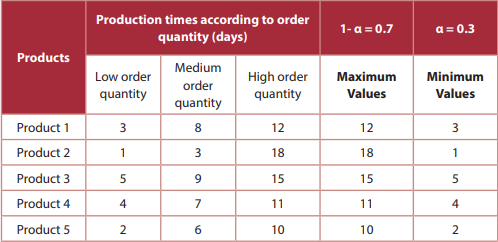 If the objective is minimization, which product would be the correct option?
Seçenekler
A
Product 1
B
Product 2
C
Product 3
D
Product 4
E
Product 5
Açıklama:
Product 1 = 3*0.3 + 12*0.7 = 9.3 days
Product 2 = 1*0.3 + 18*0.7 = 12.9 days
Product 3 = 5*0.3 + 15*0.7 =12 days
Product 4 = 4*0.3 + 11*0.7 = 8.9 days
Product 5 = 2*0.3 + 10*0.7 = 7.6 days
Then, because the objective is minimization the lowest value (7.6 days) and the alternative for that value (Product 5) is selected.
Product 2 = 1*0.3 + 18*0.7 = 12.9 days
Product 3 = 5*0.3 + 15*0.7 =12 days
Product 4 = 4*0.3 + 11*0.7 = 8.9 days
Product 5 = 2*0.3 + 10*0.7 = 7.6 days
Then, because the objective is minimization the lowest value (7.6 days) and the alternative for that value (Product 5) is selected.
Soru 43
In which method, regardless of the objective function, the smallest value is always selected from the regret matrix?
Seçenekler
A
Criterion of positivism
B
Criterion of realism
C
Minimax regret
D
Criterion of pessimism
E
Equally likely
Açıklama:
This method proposed that maximum regret be minimized by choosing the best pay off for each event. The regret of each event for each alternative is calculated and regret matrix or opportunity loss table is created. This table shows the losses to be incurred if the alternative is not selected for the best outcomes of each event.
Soru 44
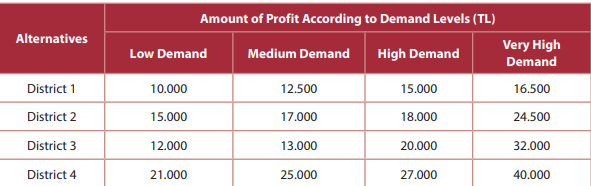 If the objective is maximization, according to minimax regret method which regret is the right choice?
Seçenekler
A
None
B
District 4
C
District 3
D
District 2
E
District 1
Açıklama:
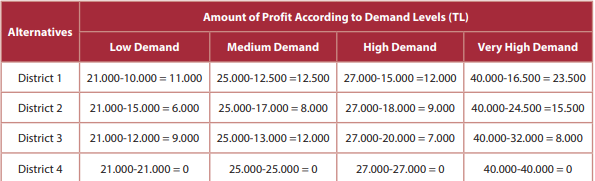 According to the results, maximum regret of each alternatives are as follows:
District 1 = maximum regret = 23.500
District 2 = maximum regret = 15.500
District 3 = maximum regret = 12.000
District 4 = maximum regret = 0
The alternative with the smallest value (District 4) is chosen among the maximum regrets.
Soru 45
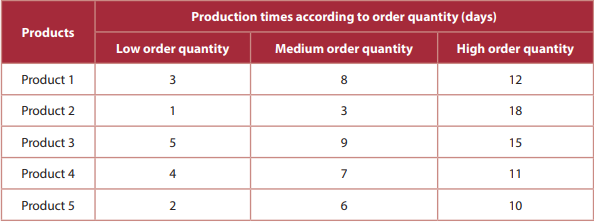 If the objective is minimization which product is the right choice according to minimax regret method?
Seçenekler
A
Product 5
B
Product 4
C
Product 3
D
Product 2
E
Product 1
Açıklama:
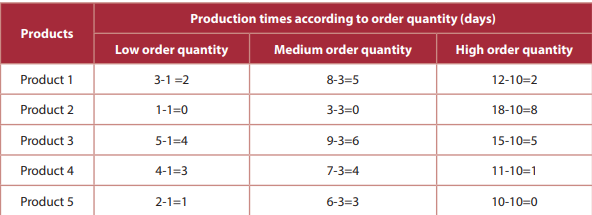 According to the results, maximum regret of each alternatives are as follows:
Product 1 = maximum regret = 5 days
Product 2 = maximum regret = 8 days
Product 3 = maximum regret = 6 days
Product 4 = maximum regret = 4 days
Product 5 = maximum regret = 3 days
The alternative with the smallest value (product 5) is chosen among the maximum regrets.
Soru 46
- Reaction of competitiors
- Stable economy
- Technological changes
Seçenekler
A
Only I
B
Only II
C
Only III
D
I and II
E
I and III
Açıklama:
For firms launching a new product, an important change in marketing strategy or opening first branch can be given examples of decision making under uncertainty. These decisions could be influenced by such factors as the reaction of competitors, changes in customer demand, technological changes, economic shifts, government regulations and the situations beyond the control of decision makers.
Soru 47
Which one is correct about decision makers under uncertainty?
Seçenekler
A
Different decision makers can make the same decisions about the same decision problem.
B
the psychological status of the decision maker won't affect the decision.
C
Their attitude and approach towards the events won't affect the decision.
D
Decision maker has insufficient information to assign any probabilities of occurrence to them.
E
Decision maker has enough knowledge about outcomes of the events.
Açıklama:
In a decision problem, the decision maker is aware of various possible events (states of nature) but has insufficient information to assign any probabilities of occurrence to them. This kind of a decision problem is termed as decision making under uncertainty. There are many unknowns and no possibility of knowing what could occur in the future to change the outcome of a decision in decision making under uncertainty.
Ünite 3
Soru 1
Decision situations in which the chance of occurrence of each state of nature is known or can be estimated are defined as _____.
Which of the following is best to fill in the blank above?
Which of the following is best to fill in the blank above?
Seçenekler
A
probabilities
B
decision made under risk
C
risk
D
business opportunity
E
decision maker
Açıklama:
Decision situations in which the chance of occurrence of each state of nature is known or can be estimated are defined as decisions made under risk. Such decision-making problems are also known as probabilistic or stochastic decision problems.
Soru 2
Which of the following is not one of the approaches to decision making process under risk?
Seçenekler
A
Expected Value
B
Expected Monetary Value
C
Maximum risk
D
Expected Opportunity Loss
E
Maximum Probability
Açıklama:
In the decision making process under risk, a probability value must be determined for the chance of realization of all states of nature in the strategy table and the sum of all probabilities of states of nature must be equal to 1. After these possibilities are added to the strategy table, the decision maker should determine which approach will be used to select the best course of action. These approaches are Expected Value (EV) (or Expected Monetary Value (EMV)), Expected Opportunity Loss (EOL), and the Maximum Probability which will be explained in the following section.
Soru 3
Which of the following describes when the expected value criterion is commonly used in decision making at risk?
Seçenekler
A
when comparing alternatives that involve money
B
when the expected profit maximized
C
when potential consequences multiplied
D
when there is failure to select the best alternative
E
when minimum expected opportunity loss is calculated
Açıklama:
In decision making at risk, the expected value criterion is commonly used when comparing alternatives. And when the decision’s consequences involve only money, we can calculate the Expected Monetary Value (EMV).
Soru 4
States of Nature
S1(0.4) S2(0.6)
A1 50 110
A2 100 60
A3 60 100
A4 70 90
A5 90 70
Which decision alternative (A1..A5) of the TL gain strategy table above should be chosen depend on Expected Monetary Value criterion ?
S1(0.4) S2(0.6)
A1 50 110
A2 100 60
A3 60 100
A4 70 90
A5 90 70
Which decision alternative (A1..A5) of the TL gain strategy table above should be chosen depend on Expected Monetary Value criterion ?
Seçenekler
A
A5
B
A4
C
A3
D
A2
E
A1
Açıklama:
EMV max : x = 50 (0.4) + 110 (0.6) = 86. pg. 36. Correct answer is E.
Soru 5
States of Nature
S1(0.6) S2(0.4)
A1 50 110
A2 100 60
A3 60 100
A4 70 90
A5 90 70
Which decision alternative (A1..A5) of the TL cost strategy table above should be chosen depend on Expected Monetary Value criterion?
S1(0.6) S2(0.4)
A1 50 110
A2 100 60
A3 60 100
A4 70 90
A5 90 70
Which decision alternative (A1..A5) of the TL cost strategy table above should be chosen depend on Expected Monetary Value criterion?
Seçenekler
A
A1
B
A2
C
A3
D
A4
E
A5
Açıklama:
EMV max : x = 50 (0.6) + 110 (0.4) = 74 . pg. 36. Correct answer is A.
Soru 6
States of Nature
S1(0.3) S2(0.5) S3(0.2)
A1 50 110 30
A2 100 60 50
A3 70 90 60
What is the Expected Monetary Value of the TL gain strategy table above ?
S1(0.3) S2(0.5) S3(0.2)
A1 50 110 30
A2 100 60 50
A3 70 90 60
What is the Expected Monetary Value of the TL gain strategy table above ?
Seçenekler
A
76
B
74
C
70
D
72
E
78
Açıklama:
EMV max : x = 70 (0.3) + 90 (0.5) + 60 (0.2) = 21 + 45 + 12 = 78 . pg. 36. Correct answer is E.
Soru 7
States of Nature
S1(0.5) S2(0.2) S3(0.3)
A1 50 110 30
A2 90 40 50
A3 70 100 10
What is the Expected Monetary Value of the TL cost strategy table above ?
S1(0.5) S2(0.2) S3(0.3)
A1 50 110 30
A2 90 40 50
A3 70 100 10
What is the Expected Monetary Value of the TL cost strategy table above ?
Seçenekler
A
56
B
62
C
68
D
64
E
58
Açıklama:
EMV min : x = 50 (0.3) + 110 (0.2) + 30 (0.3) = 56 . pg. 36. Correct answer is A.
Soru 8
States of Nature
S1(0.3) S2(0.5) S3(0.2)
A1 50 110 30
A2 100 60 50
A3 70 90 60
What is the maximum Expected Opportunity Loss of the TL gain strategy table above ?
S1(0.3) S2(0.5) S3(0.2)
A1 50 110 30
A2 100 60 50
A3 70 90 60
What is the maximum Expected Opportunity Loss of the TL gain strategy table above ?
Seçenekler
A
27
B
23
C
21
D
25
E
19
Açıklama:
A1 : x1 = (100 - 50) (0.3) + (110 - 110) (0.5) + (60 - 30) (0.2) = 15 + 0 + 6 = 21 ; A2 : x2 = (100 - 100) (0.3) + (110 - 60) (0.5) + (60 - 50) (0.2) = 0 + 25 + 2 = 27 ; A3 : x3 = (100 - 70) (0.3) + (110 - 90) (0.5) + (60 - 60) (0.2) = 9 + 10 + 0 = 19 . pg. 37 . Correct answer is A.
Soru 9
States of Nature
S1(0.2) S2(0.3) S3(0.5)
A1 50 110 30
A2 100 60 50
A3 70 90 60
What is the minimum Expected Opportunity Loss of the TL cost strategy table above ?
S1(0.2) S2(0.3) S3(0.5)
A1 50 110 30
A2 100 60 50
A3 70 90 60
What is the minimum Expected Opportunity Loss of the TL cost strategy table above ?
Seçenekler
A
25
B
17
C
12
D
22
E
20
Açıklama:
A1 : x1 = (100 - 50) (0.2) + (110 - 110) (0.3) + (60 - 30) (0.5) = 10 + 0 + 15 = 25 ; A2 : x2 = (100 - 100) (0.2) + (110 - 60) (0.3) + (60 - 50) (0.5) = 0 + 15 + 5 = 20 ; A3 : x3 = (100 - 70) (0.2) + (110 - 90) (0.3) + (60 - 60) (0.5) = 6 + 6 + 0 = 12 . pg. 37 . Correct answer is C.
Soru 10
States of Nature
S1(0.5) S2(0.2) S3(0.3)
A1 50 110 30
A2 90 40 50
A3 70 100 10
What is the highest gain value of the TL gain strategy table above according to the maximum probability criterion ?
S1(0.5) S2(0.2) S3(0.3)
A1 50 110 30
A2 90 40 50
A3 70 100 10
What is the highest gain value of the TL gain strategy table above according to the maximum probability criterion ?
Seçenekler
A
100
B
50
C
90
D
70
E
110
Açıklama:
90 . pg. 39 . Correct answer is C.
Soru 11
States of Nature
S1(0.2) S2(0.3) S3(0.5)
A1 50 110 30
A2 90 40 50
A3 70 100 10
What is the lowest loss value of the TL gain strategy table above according to the maximum probability criterion ?
S1(0.2) S2(0.3) S3(0.5)
A1 50 110 30
A2 90 40 50
A3 70 100 10
What is the lowest loss value of the TL gain strategy table above according to the maximum probability criterion ?
Seçenekler
A
40
B
70
C
50
D
30
E
10
Açıklama:
10 . pg. 39 . Correct answer is E.
Soru 12
For a TL cost strategy table the lowest expected value is 625 and the expected value with perfect information is 575. What is the expected value of perfect information ?
Seçenekler
A
25
B
100
C
50
D
1.200
E
600
Açıklama:
x = 625 - 575 = 50 . pg. 40 . Correct answer is C.
Soru 13
The probability of A1 is 0.20, the probability of A2 is 0.80. The probability that A1 costs 100 TL is 0.80, and the probability that A2 costs 100 TL is 0.20. It costed 100 TL. What is the probability that A2 occured ?
Seçenekler
A
0.16
B
0.64
C
0.40
D
0.50
E
0.25
Açıklama:
(0.8) (0.2) / ((0.2) (0.8) + (0.8) (0.2)) = 0.5 . pg. 49 . Correct answer is D.
Soru 14
What is "expected regret" in decision making?
Seçenekler
A
Comparing alternatives
B
Expected Monetary Value (EMV)
C
Expected Value (EV)
D
Decision’s consequences
E
Expected opportunity loss (EOL)
Açıklama:
In decision making, instead of expected monetary value (EMV), it can also be used the expected opportunity loss (EOL) criterion, which is another approach based on a decision will be taken, also known as expected regret.
Soru 15
Which of the following is true about maximum probability criterion?
Seçenekler
A
All the potential consequences multiplied by their associated probabilities.
B
The expected monetary value of each decision alternative is calculated.
C
The investor chooses the biggest one among the expected monetary values.
D
Decision maker confronts the various possible states of nature in a decision under risk.
E
It demonstrates the average additional amount the investor would have achieved by making the right decision.
Açıklama:
In this criterion, the decision maker confronts the various possible states of nature in a decision under risk and; he or she chooses the alternative that is best for the most likely state of nature, rather than calculating in all states of nature. With another saying, it states that the decision maker should ignore all possible events except the one most likely to occur, and should select the best possible result (maximum gain or minimum loss) in the given circumstances.
Soru 16
_____ is a graphical technique that represents all the elements in the decision problem with various geometric symbols.
Which of the following best completes the blank above?
Which of the following best completes the blank above?
Seçenekler
A
Branch
B
Decision tree
C
chance node
D
matrix
E
Payoff
Açıklama:
The decision tree is a graphical technique that represents all the elements in the decision problem with various geometric symbols. It provides all the elements and details of the decision problem, as well as graphically, and performs the expected value calculations on the tree and provides the solution of the problem at the same time.
Soru 17
What is the expected value of perfect information (EVPI)?
Seçenekler
A
the difference between the expected value under certainty and the expected value under risk
B
the criterion that demonstrates the average additional amount the investor would have achieved by making the right decision instead of a wrong one
C
an anticipated value for a given investment at some point in the future
D
the calculation by including the probabilities in decision making under risk.
E
confronting the various possible states of nature in a decision under risk
Açıklama:
The expected value of perfect information (EVPI) is the difference between the expected value under certainty and the expected value under risk.
Soru 18
What is a decision node in a decision tree?
Seçenekler
A
consequence resulting from a specific combination of a decision alternative and a state of nature
B
one of a finite number of states of nature is expected to occur at this point in the process
C
a point from which two or more branches emerge.
D
the difference between the expected value under certainty and the expected value under risk
E
The line connecting the nodes on a decision tree
Açıklama:
The decision node, represented in a square shape on the decision tree is a point from which two or more branches emerge. Each branch from a decision node represents a possible alternative to be chosen by the decision-maker.
Soru 19
Bayes’ theorem provides a way for _____ prior probabilities with probabilities obtained by other sources; revised or posterior probabilities.
Which of the following best fills the blank above?
Which of the following best fills the blank above?
Seçenekler
A
eliminating
B
risking
C
deciding
D
excluding
E
combining
Açıklama:
Bayes’ theorem provides a way for combining prior probabilities with probabilities obtained by other sources; revised or posterior probabilities.
Soru 20
What is the decision situation in which the decision maker knows the probability of occurrence of each state of nature?
Seçenekler
A
Decision making under certainty
B
Decision making under uncertainty
C
Decision making under half-certainty
D
Decision making optimistically
E
Decision making under risk
Açıklama:
In decision making under risk, there exist more than one state of nature and the decision maker has sufficient information to assign probabilities to the occurrence of each of these states. The probabilities can be obtained from past records or the subjective judgment of the decision maker. In other word, decision situations in which the chance of occurrence of each state of nature is known or can be estimated are defined as decisions made under risk.
Soru 21
What are the decision situations in which the chance of occurrence of each state of nature is known or can be estimated called?
Seçenekler
A
Decision making under risk
B
Decision making under uncertainity
C
Guided decision making
D
Safe decision making
E
Optimistic decision making
Açıklama:
The decision situations in which the chance of occurrence of each state of nature is known or can be estimated are called decision making under risk.
Soru 22
What is the range of the probability values?
Seçenekler
A
5 to 10
B
0 to 100
C
0 to 1000
D
0 to 1
E
0 to 10
Açıklama:
The probability values change from 0 to 1, where 0 means the event occurrence probability is low and 1 means this probability is high.
Soru 23
What is an anticipated value for a given investment at some point in the future called?
Seçenekler
A
Expected value
B
Expected opportunity loss
C
Maximum probability
D
Expected profit
E
Risky investment
Açıklama:
An anticipated value for a given investment at some point in the future is called expected value.
Soru 24
What demonstrates the average additional amount the investor would have achieved by making the right decision instead of a wrong one?
Seçenekler
A
Expected value criterion
B
Expected opportunity loss criterion
C
Maximum probability criterion
D
Expected profit criterion
E
Risky investment criterion
Açıklama:
Expected opportunity loss, demonstrate the average additional amount the investor would have achieved by making the right decision instead of a wrong one.
Soru 25
"In this criterion, the decision maker confronts the various possible states of nature in a decision under risk and; he or she chooses the alternative that is best for the most likely state of nature, rather than calculating in all states of nature."
Which criterion is described above?
Which criterion is described above?
Seçenekler
A
Expected value criterion
B
Expected opportunity loss criterion
C
Maximum probability criterion
D
Expected profit criterion
E
Risky investment criterion
Açıklama:
In maximum probability criterion, the decision maker confronts the various possible states of nature in a decision under risk and; he or she chooses the alternative that is best for the most likely state of nature, rather than calculating in all states of nature.
Soru 26
What is the line connecting the nodes on a decision tree called?
Seçenekler
A
State of nature
B
Payoff
C
Chance node
D
Decision node
E
Branch
Açıklama:
The line connecting the nodes on a decision tree is called a branch.
Soru 27
What is the starting point in a decision tree?
Seçenekler
A
Payoff
B
Branch
C
Decision node
D
Chance node
E
State of nature
Açıklama:
Since the decision tree is usually initiated by the first decision, a decision node positioned at the left side of the decision tree is also the starting node.
Soru 28
What indicates that one of a finite number of states of nature is expected to occur at that point in the process in decision tree?
Seçenekler
A
Branch
B
Decision node
C
Chance node
D
Payoff
E
Probability
Açıklama:
A chance node, represented in a circle shape on the decision tree, indicates that one of a finite number of states of nature is expected to occur at this point in the process.
Soru 29
What refers to the consequence resulting from a specific combination of a decision alternative and a state of nature in a decision tree?
Seçenekler
A
Payoff
B
Chance node
C
Decision node
D
Branch
E
State of probability
Açıklama:
In decision analysis payo refers to the consequence resulting from a specific combination of a decision alternative and a state of nature.
Soru 30
Which of the following values can we see in a decision node in a decision tree?
Seçenekler
A
Prototype or not?
B
Success
C
Failure
D
Profit
E
Loss
Açıklama:
Other options can be found in payoff section of a decision tree.
Soru 31
A decision tree is a graphical approach that helps decision-makers see _________ they may encounter.
Which option below completes the sentence above best?
Which option below completes the sentence above best?
Seçenekler
A
all the scenarios
B
the probabilities of loss
C
the possibilities of harm
D
measurable uncertainty
E
the distance from certainty and risk
Açıklama:
In a decision problem, occurrences are chance occurrences and all the chance occurrences are governed by probabilities. In the decision making with probability information, a strategy matrix is created and the best results are determined. Another approach used to solve such decision problems is the decision tree. A decision tree is a graphical approach that helps decision-makers see all the scenarios they may encounter. The correct answer is A.
Soru 32
How are decision situations in which the chance of occurrence of each state of nature is known or can be estimated defined?
Seçenekler
A
Certainty decision problems
B
Uncertainty decision problems
C
Expected decision problems
D
Stochastic decision problems
E
Future-oriented decision problems
Açıklama:
han one state of nature and the decision maker has sufficient information to assign probabilities to the occurrence of each of these states. The probabilities can be obtained from past records or the subjective judgment of the decision maker. In other word, decision situations in which the chance of occurrence of each state of nature is known or can be estimated are defined as decisions made under risk. Such decision-making problems are also known as probabilistic or stochastic decision problems. The correct answer is D.
Soru 33
In the decision making process under risk, a probability value must be determined for the chance of realization of all states of nature in the strategy table. So, what must the sum of all probabilities of states of nature be equal to ?
Seçenekler
A
0
B
1
C
-1
D
10
E
100
Açıklama:
As known, the probability values change from 0 to 1, where 0 means the event occurrence probability is low and 1 means this probability is high. The process of determining probabilities for states of nature is very important. In the decision making process under risk, a probability value must be determined for the chance of realization of all states of nature in the strategy table and the sum of all probabilities of states of nature must be equal to 1. After these possibilities are added to the strategy table, the decision maker should determine which approach will be used to select the best course of action. The correct answer is B.
Soru 34
I. Expected Monetary Value
II. Expected Opportunity Loss
III. Maximum Certainty
IV. Maximum Probability
Which of the criterions above are among decision theory criterions?
II. Expected Opportunity Loss
III. Maximum Certainty
IV. Maximum Probability
Which of the criterions above are among decision theory criterions?
Seçenekler
A
I and II
B
III and IV
C
I, II and III
D
I, II and IV
E
I, II, III and IV
Açıklama:
Expected (Monetary) Value criterion (EMV), Expected Opportunity Loss criterion (EOL), and the maximum probability criterion are the criterions in decision theory. The correct answer is D.
Soru 35
Which of the following is false according to the EMV (Expected Monetary Value) criterion?
Seçenekler
A
It is an anticipated value for a given investment at some point in the future.
B
It is commonly used when comparing alternatives
C
It is used for maximizing expected loss or minimizing expected profit.
D
The profit or cost that will arise from each alternative is handled by certain possibilities.
E
When the decision’s consequences involve only money, we can calculate the Expected Monetary Value (EMV).
Açıklama:
The Expected Value (EV) is an anticipated value for a given investment at some point in the future. In decision making at risk, the expected value criterion is commonly used when comparing alternatives, based on maximizing expected profit or minimizing expected loss. The expected value criterion attempts to find the expected profit maximized or the expected cost minimized. The profit or cost that will arise from each alternative is handled by certain possibilities. When the decision’s consequences involve only money, we can calculate the Expected Monetary Value (EMV). The correct answer is B.
Soru 36
According to ____________ criterion, the decision maker should ignore all possible events except the one most likely to occur, and should select the best possible result in the given circumstances.
Seçenekler
A
Expected Monetary Value
B
Expected Opportunity Loss
C
Expected Regret
D
Maximum Probability
E
Expected Value of Perfect Information
Açıklama:
In this criterion, the decision maker confronts the various possible states of nature in a decision under risk and; he or she chooses the alternative that is best for the most likely state of nature, rather than calculating in all states of nature. With another saying, it states that the decision maker should ignore all possible events except the one most likely to occur, and should select the best possible result (maximum gain or minimum loss) in the given circumstances. The correct answer is D.
Soru 37
I. Branches
II. Probability Nodes
III. Chance Nodes
IV. Payoffs
Which of the elements listed above are among the components of a decision tree?
II. Probability Nodes
III. Chance Nodes
IV. Payoffs
Which of the elements listed above are among the components of a decision tree?
Seçenekler
A
I and II
B
II and III
C
II, III and IV
D
I, II and III
E
I, III and IV
Açıklama:
A decision tree is composed of some components as; branches, decision nodes, chance nodes, and payoffs. The correct answer is E.
Soru 38
In decision making problems, decision branches are used to represent _________ and chance branches are used to show the states of _________.
Which of the following options complete the definition above ?
Which of the following options complete the definition above ?
Seçenekler
A
events / nature
B
alternatives / strategies
C
alternatives / nature
D
nature /events
E
strategies / alternatives
Açıklama:
The line connecting the nodes on a decision tree is called a branch. A branch is a single strategy that connects either two nodes or a node and an outcome. When a decision tree is drawn, a general approach is the direction from left to right is shown; therefore the line that comes to the right of a decision node is called the decision branch, while the line to the right of a chance node is called the chance branch. In decision making problems, decision branches are used to represent alternatives (strategies) and chance branches are used to show the states of nature (events). The chance branch is labeled with a probability which represents the decision maker’s estimate of the probability that a particular branch will be followed. The correct answer is C.
Soru 39
Which of the following is false according to Bayes' Theorem?
Seçenekler
A
It is used as a normative tool, which tells how it should be revised our probability assessments when new information becomes available.
B
Bayes’ theorem is basically a process of revising the known possibilities of an event under the light of existing knowledge.
C
Bayes’ theorem provides a way for combining prior probabilities with probabilities obtained by other sources; revised or posterior probabilities.
D
In the use of Bayes’ theorem in solving a decision problem; firstly the prior probability distribution of the parameters to be estimated according to the subjective and objective information obtained is determined.
E
With the formula used in Bayes’s theorem, while the result of a given event is certain, the possibility of the causes of this result is investigated.
Açıklama:
Bayes’ theorem is basically a process of revising the known possibilities of an event under the light of new knowledge. The correct answer is B.
Soru 40
What refers to the consequence resulting from a specific combination of a decision alternative and a state of nature in the decision tree?
Seçenekler
A
Chance nodes
B
Decision nodes
C
Payoffs
D
Decision branches
E
Chance branches
Açıklama:
Payoff: In decision analysis payoff refers to the consequence resulting from a specific combination of a decision alternative and a state of nature. Payoffs can be expressed in terms of profit, cost, time, distance, or any other measure appropriate for the decision problem being analyzed. The correct answer is C.
Soru 41
Decision making under risk is also known as:
Seçenekler
A
Strategic decision making.
B
Stochastic decision making.
C
Decision making under certainty.
D
Decision making under uncertainty.
E
Calculated decision making.
Açıklama:
In decision making under risk, there exist more than one state of nature and the decision maker has sufficient information to assign probabilities to the occurrence of each of these states. Such decision-making is also known as probabilistic or stochastic decision making.
Soru 42
Which of the following is not one of the approaches used to select the best course of action in the decision making process under risk?
Seçenekler
A
Expected value.
B
Expected monetary value.
C
Expected opportunity loss.
D
Expected marginal benefit.
E
Maximum probability.
Açıklama:
In the decision making process under risk, a probability value must be determined for the chance of realization of all states of nature in the strategy table and the sum of all probabilities of states of nature must be equal to 1. After these possibilities are added to the strategy table, the decision maker should determine which approach will be used to select the best course of action. These approaches are Expected Value (EV) (or Expected Monetary Value (EMV)), Expected Opportunity Loss (EOL), and the Maximum Probability.
Soru 43
In the decision making process under risk, the sum of all probabilities assigned to the chance of realization the states of nature must be equal to:
Seçenekler
A
0
B
0.1
C
1
D
10
E
0.01
Açıklama:
As known, the probability values change from 0 to 1, where 0 means the event occurrence probability is low and 1 means this probability is high. The process of determining probabilities for states of nature is very important. In the decision making process under risk, a probability value must be determined for the chance of realization of all states of nature in the strategy table and the sum of all probabilities of states of nature must be equal to 1.
Soru 44
Which of these approaches implies that the decision maker should ignore all possible events except the one most likely to occur, and should select the best possible result in the given circumstances?
Seçenekler
A
Uncertainty criterion.
B
Expected value criterion.
C
Expected monetary value criterion.
D
Expected opportunity loss criterion.
E
Maximum probability criterion
Açıklama:
In maximum probability criterion, the decision maker confronts the various possible states of nature in a decision under risk and; he or she chooses the alternative that is best for the most likely state of nature, rather than calculating in all states of nature. With another saying, it states that the decision maker should ignore all possible events except the one most likely to occur, and should select the best possible result (maximum gain or minimum loss) in the given circumstances.
Soru 45
What makes maximum probability criterion a weaker decision making criterion?
Seçenekler
A
Its complexity in calculation.
B
Too much information is needed to be able to use this approach.
C
It can be used only when the decision’s consequences only involve money.
D
It can only be used when comparing alternatves based on minimizing expected loss.
E
It ignores substantive information related to the less likely states of nature.
Açıklama:
While maximum probability criterion has the advantage of simplicity, ignoring substantive information related to the less likely states of nature makes it a weaker decision making criterion. Because it does not mean that the state of nature which has a low probability will not occur. On the contrary, it indicates that there is a possibility of occurrence of the event, but it has a low chance of occurring according to other alternatives.
Soru 46
The difference between the expected value under certainty and the expected value under risk is called:
Seçenekler
A
Expected value of perfect information.
B
Expected monetary value.
C
Expected opportunity cost.
D
Expected payoff.
E
Expected marginal benefit.
Açıklama:
The expected value of perfect information is used to place an upper limit on what you should pay for information that will aid in making a better decision. That is if we have perfect information about a state of nature before the decision is made, how much is this information worth? The expected value of perfect information (EVPI) is the difference between the expected value under certainty and the expected value under risk.
Soru 47
In an investment problem, expected value with perfect information is 569 and the expected value without perfect information is 183. What is the expected value of perfect information?
Seçenekler
A
-386
B
386
C
752
D
3.1
E
0.31
Açıklama:
EVPI = EVwPI - EVwoPI, where EVwPI stands for expected value with perfect information and EVwoPI stands for expected value without perfect information. So EVPI = 569 - 183 = 386.
Soru 48
Which of the following is an element of the decision tree that indicates that one of a finite number of states of nature is expected to occur at this point in the process?
Seçenekler
A
Chance node.
B
Decision node.
C
Payoff.
D
Branch.
E
Trunk.
Açıklama:
A chance node, represented in a circle shape on the decision tree, indicates that one of a finite number of states of nature is expected to occur at this point in the process. The states of nature are shown on the tree as branches to the right of the chance nodes and the assumed probabilities of the states of nature are written above the branches.
Soru 49
The probability multiplication in the denominator of Bayes' rule equality is called:
Seçenekler
A
Prior probability.
B
Conditional probability.
C
Joint probability.
D
Posterior probability.
E
Revised probability.
Açıklama:
The probability multiplication in the denominator of Bayes rule equality is called joint probability. In order to obtain any multiplication result in the denominator, the researcher needs to know what state of nature has emerged, as well as which B result is reached with this state of nature. The joint probabilities calculated in the denominator, correspond to each scenario mentioned in decision tree definitions in decision making problems.
Soru 50
Which of the following is false regarding Bayes' theorem?
Seçenekler
A
It is a process of revising the known possibilities of an event under new knowledge.
B
It says that the posterior is the likelihood times the prior, divided by a sum of likelihoods times prior.
C
It investigates the uncertain results of a given event.
D
The probability multiplication in the denominator of Bayes rule equality is called joint probability.
E
The decision tree is also used to solve the Bayes’ rule.
Açıklama:
With the formula used in Bayes’s theorem, while the result of a given event is certain, the possibility of the causes of this result is investigated. From the other perspective, in Bayes’ formula, the cause and result are displaced.
Ünite 4
Soru 1
- The foundation of operations research is mostly cited to studies and applications in the U.S. Army right before The World War II.
- Leonid V. Kantorovich is recognized as the first to explore operations research area.
- In 1939, Kantorovich published a paper on a method for a production plan which he claimed to be the optimal way.
- The systematic solution which is called “simplex algorithm” was introduced by George B. Dantzig, who had planning experience in the U.S. Army Air Force.
- Tjalling C. Koopmans, who built a model for ship routes, was another contributor to the field.
- Tjalling C. Koopmans and Kantorovich shared 1975 Nobel Prize in economics for their studies on the optimal allocation of resources.
Seçenekler
A
I and II
B
II, III and IV
C
III, IV and V
D
I, II, III, V and VI
E
I, II, III, IV, V and VI
Açıklama:
Recommended Corrections:
Page 63
Industrial applications of linear programming Stemmed from the oil industry...
Industrial applications of linear programming stemmed from the oil industry...
Page 63
This section develops The basics of linear programming, which include …
This section develops the basics of linear programming, which include …
Page 63
However, LeonidV. Kantorovich…
However, Leonid V. Kantorovich…
The foundation of operations research is mostly cited to studies and applications in the U.S. Army right before The World War II. However, Leonid V. Kantorovich is recognized as the first to explore this area. In 1939, Kantorovich published a paper on a method for a production plan which he claimed to be the optimal way. This study included a linear program without a systematic solution. The systematic solution which is called “simplex algorithm” was later introduced by George B. Dantzig, who had planning experience in the U.S. Army Air Force. Tjalling C. Koopmans, who built a model for ship routes, was another contributor to the field. He and Kantorovich shared 1975 Nobel Prize in economics for their studies on the optimal allocation of resources. Industrial applications of linear programming stemmed from the oil industry after William W. Cooper and his colleagues’ publications about the efficient blending of aviation fuels. As the computational ability of the solver systems advanced rapidly, operations research started to be used widely. Operations research applications, particularly linear programming, is now a standard method used in a variety of areas and processes. Some of these are urban planning, currency arbitrage, investment, production planning, inventory control, blending and refining, manpower planning, agricultural planning, diet & nutrition, transportation and, logistics.
As also understood from the information given, the correct answer is E. All of the statements above about the historical development of operations research are correct.
Page 63
Industrial applications of linear programming Stemmed from the oil industry...
Industrial applications of linear programming stemmed from the oil industry...
Page 63
This section develops The basics of linear programming, which include …
This section develops the basics of linear programming, which include …
Page 63
However, LeonidV. Kantorovich…
However, Leonid V. Kantorovich…
The foundation of operations research is mostly cited to studies and applications in the U.S. Army right before The World War II. However, Leonid V. Kantorovich is recognized as the first to explore this area. In 1939, Kantorovich published a paper on a method for a production plan which he claimed to be the optimal way. This study included a linear program without a systematic solution. The systematic solution which is called “simplex algorithm” was later introduced by George B. Dantzig, who had planning experience in the U.S. Army Air Force. Tjalling C. Koopmans, who built a model for ship routes, was another contributor to the field. He and Kantorovich shared 1975 Nobel Prize in economics for their studies on the optimal allocation of resources. Industrial applications of linear programming stemmed from the oil industry after William W. Cooper and his colleagues’ publications about the efficient blending of aviation fuels. As the computational ability of the solver systems advanced rapidly, operations research started to be used widely. Operations research applications, particularly linear programming, is now a standard method used in a variety of areas and processes. Some of these are urban planning, currency arbitrage, investment, production planning, inventory control, blending and refining, manpower planning, agricultural planning, diet & nutrition, transportation and, logistics.
As also understood from the information given, the correct answer is E. All of the statements above about the historical development of operations research are correct.
Soru 2
- Problem definition
- System analysis for the problem and data gathering
- Model construction
- Model solution and testing
- The decision of implementing the solution
Seçenekler
A
I-II-III-IV-V
B
II-I-III-V-IV
C
III-I-II-IV-V
D
III-V-I-II-IV
E
III-II-I-IV-V
Açıklama:
Operations research is an analytical method for the management of organizations that provides mathematical solutions to decision-making problems. There are definitive steps of this approach that make it analytical:
- Problem definition
- System analysis for the problem and data gathering
- Model construction
- Model solution and testing
- The decision of implementing the solution
Soru 3
- Proportionality
- Additivity
- Divisibility
- Certainty
Seçenekler
A
Only I
B
I and II
C
II and III
D
I, II and III
E
I, II, III and IV
Açıklama:
In practice, linear programming has some limitations that deteriorate the model fitness to real-life situations. There is a trade-off between suitability and solvability of the problem. Linear programming provides solutions under some assumptions. These are proportionality, additivity, divisibility and certainty assumptions. As also understood from the information given, the correct answer is E. These are important to mention as it will be easier for operations researcher to evaluate how well linear programming applies to a given problem. In both the objective function and constraints, the contribution of every decision variable is proportional to its value. As a result, proportionality assumption casts out any variable that has an exponent other than 1. Consider a firm that aims to maximize its profits under the constraint of its production costs. In practice, production costs are not the same for different levels of production as higher production lowers costs by the economies of scale. To avoid a violation of the proportionality assumption, some characteristics of real-life situations such as economies of scale must be ignored. That undoubtedly makes the model less reliable. Either it is the objective or the constraints, every function is the sum of the individual contribution of the respective variables. This is called the additivity assumption, which prohibits cross-product terms in the expressions of a linear program. This assumption restricts the model design as well. For instance, a linear maximization model of aggregate revenue to be received from complementary products has to exclude cross-product terms that proxy the multiplier effect of each product over the other. In a linear program, decision variables are not limited to integer values. In fact, they are divisible. In certain situations, the divisibility assumption does not hold as some decision variables can only be an integer. Methods of integer programming, which are not in the scope of this book, overcome this obstacle. The last assumption is certainty, which means that each parameter of a linear programming model is constant in all conditions. In real applications, factors affecting the decisions are not as stable as they are strictly assumed. In the modeling phase, all these assumptions need to be considered while preserving an acceptable level of similarity between reality and what is realized.
Soru 4
- The modeling phase is the transformation of verbal description of the problem into a mathematical model under the linear programming assumptions.
- Mathematical model is a system of equations and inequalities representing the objective and the constraints.
- The decision to be derived from the model is related to quantifiable variables that are in control.
- The variables of decision x1, x2, ... , xn are called the parameters.
- The constants (i.e. the coefficients and right-hand side values of the inequalities) are called the decision variables.
Seçenekler
A
I and II
B
I and V
C
I, II and III
D
I, III, IV and V
E
II, III, IV and V
Açıklama:
The modeling phase is the transformation of verbal description of the problem into a mathematical model under the linear programming assumptions. This model is a system of equations and inequalities representing the objective and the constraints. The decision to be derived from the model is related to quantifiable variables that are in control. These variables of decision x1, x2, ... , xn and the constants (i.e. the coefficients and right-hand side values of the inequalities) are called the decision variables and the parameters respectively. The objective function (for example, Z= 2x1 + x2) is an appropriate measure of performance for the problem. It can be maximized or minimized depending on the desired achievement. Finally, a constraint is a restriction on decision variables by means of equality or inequality (for example, 5x1 + 6x2 ≤ 30). As also understood from the information given, the statements in the options I, II and III are correct, so the correct answer is C. The statements in the option IV and V are not correct because of the fact that These variables of decision x1, x2, ... , xn and the constants (i.e. the coefficients and right-hand side values of the inequalities) are called the decision variables and the parameters respectively.
Soru 5
- In the maximization models, the objective function is alternatively named profit function.
- In the maximization models the value of Z needs to be increased as much as possible.
- A finite number of iso-profit lines can be drawn for increasing values of Z.
- Under the constraints of the model, the highest possible value of Z must reside in the feasible region.
Seçenekler
A
I and II
B
I and III
C
II and IV
D
I, II and IV
E
II, III and IV
Açıklama:
In the maximization models, the objective function is alternatively named profit function. The logic behind this is the utmost goal of maximizing something is to gain a benefit or a “profit”. In the maximization models the value of Z needs to be increased as much as possible. An infinite number of iso-profit lines can be drawn for increasing values of Z. However, under the constraints of the model, the highest possible value of Z must reside in the feasible region.
As also understood from the information given, the statements in the options I, II and IV about the maximization models are correct, so the correct answer is D. The statement in the option III is not correct because of the fact that an infinite number of iso-profit lines can be drawn for increasing values of Z. However, under the constraints of the model, the highest possible value of Z must reside in the feasible region.
As also understood from the information given, the statements in the options I, II and IV about the maximization models are correct, so the correct answer is D. The statement in the option III is not correct because of the fact that an infinite number of iso-profit lines can be drawn for increasing values of Z. However, under the constraints of the model, the highest possible value of Z must reside in the feasible region.
Soru 6
- In the minimization models, the objective function is alternatively named profit function.
- The ultimate goal of minimizing something is to reduce loss or “cost”.
- In the minimization models, a line is drawn parallel to the objective function and near to the origin.
- This line should contain at least one point of the feasible region.
- The coordinates of this point are found by solving the equations of the drawn line and the boundary line(s) of the feasible region.
Seçenekler
A
I and II
B
II and III
C
I, II and V
D
II, IV and V
E
II, III, IV and V
Açıklama:
In the minimization models, the objective function is alternatively named cost function. The reason for this is the ultimate goal of minimizing something is to reduce loss or “cost”. In the minimization models, draw a line parallel to the objective function and near to the origin. This line should contain at least one point of the feasible region. Find the coordinates of this point by solving the equations of the drawn line and the boundary line(s) of the feasible region.
As also understood from the information given, the statements about the minimization models in the options II, III, IV and V are correct, so the correct answer is E. The statement in the option I is not correct because of the fact that in the minimization models, the objective function is alternatively named cost function.
As also understood from the information given, the statements about the minimization models in the options II, III, IV and V are correct, so the correct answer is E. The statement in the option I is not correct because of the fact that in the minimization models, the objective function is alternatively named cost function.
Soru 7
- Urban Planning
- Currency Arbitrage
- Inventory Control
- Agricultural Planning
- Logistics
Seçenekler
A
I and II
B
II and III
C
I, III and IV
D
I, III, IV and V
E
I, II, III, IV and V
Açıklama:
Operations research applications, particularly linear programming is now a standard method used in a variety of areas and processes. Some of these are urban planning, currency arbitrage, investment, production planning, inventory control, blending and refining, manpower planning, agricultural planning, diet & nutrition, transportation and, logistics.
As also understood from the information given, all of the areas in the options are among the ones in which operations research applications, particularly linear programming, are now used as a standard method for decision making, so the correct answer is E.
As also understood from the information given, all of the areas in the options are among the ones in which operations research applications, particularly linear programming, are now used as a standard method for decision making, so the correct answer is E.
Soru 8
Who introduced the systematic solution which is called “simplex algorithm”?
Seçenekler
A
Leonid V. Kantorovich
B
George B. Dantzig
C
Tjalling C. Koopmans
D
William W. Cooper
E
Chester Barnard
Açıklama:
The foundation of operations research is mostly cited to studies and applications in the U.S. Army right before The World War II. However, Leonid V. Kantorovich is recognized as the first to explore this area. In 1939, Kantorovich published a paper on a method for a production plan which he claimed to be the optimal way. This study included a linear program without a systematic solution. The systematic solution which is called “simplex algorithm” was later introduced by George B. Dantzig, who had planning experience in the U.S. Army Air Force.
As also understood from the information given, the correct answer is B.
Information about the other names in the options:
Tjalling C. Koopmans, who built a model for ship routes, was another contributor to the field. He and Kantorovich shared 1975 Nobel Prize in economics for their studies on the optimal allocation of resources.
Industrial applications of linear programming Stemmed from the oil industry after William W. Cooper and his colleagues’ publications about the efficient blending of aviation fuels. As the computational ability of the solver systems advanced rapidly, operations research started to be used widely.
Sometime in the midst of the last century, Chester Barnard, a retired telephone executive and author of The Functions of the Executive, imported the term “decision making” from the lexicon of public administration into the business world.
As also understood from the information given, the correct answer is B.
Information about the other names in the options:
Tjalling C. Koopmans, who built a model for ship routes, was another contributor to the field. He and Kantorovich shared 1975 Nobel Prize in economics for their studies on the optimal allocation of resources.
Industrial applications of linear programming Stemmed from the oil industry after William W. Cooper and his colleagues’ publications about the efficient blending of aviation fuels. As the computational ability of the solver systems advanced rapidly, operations research started to be used widely.
Sometime in the midst of the last century, Chester Barnard, a retired telephone executive and author of The Functions of the Executive, imported the term “decision making” from the lexicon of public administration into the business world.
Soru 9
- x1 , x2 , x3 ≥ 0
- 8x2 - x1 ≥ 0
- x1, x2, ≥ 0
- ei , xi ≥ 0 for all i = 1,...,4
- xi,j ≥ 0 (i=1,2,3) (j=1,2,3,4)
Seçenekler
A
I and II
B
III and IV
C
II, III and IV
D
I, II, IV and V
E
I, II, III, IV and V
Açıklama:
A linear expression appears below; the powers of its variables x and y are equal to one.
2x - 3y
A linear constraint requires a linear expression to be equal to a number, to be less/greater than or equal to a number.
x + y = 4
x - 3y ≤ 2
x ≥ y
The last expression stated above is called a non-negativity constraint, which requires the value x to be greater or equal to zero. A linear program either minimizes or maximizes a linear expression subject to defined linear constraints.
As also understood from the information given, the correct answer is E. All expressions in the options are non-negativity constraints.
2x - 3y
A linear constraint requires a linear expression to be equal to a number, to be less/greater than or equal to a number.
x + y = 4
x - 3y ≤ 2
x ≥ y
The last expression stated above is called a non-negativity constraint, which requires the value x to be greater or equal to zero. A linear program either minimizes or maximizes a linear expression subject to defined linear constraints.
As also understood from the information given, the correct answer is E. All expressions in the options are non-negativity constraints.
Soru 10
Which of the terms below can be defined as the function of a linear programming model that is desired to be maximized or minimized?
Seçenekler
A
An objective function
B
An optimal solution
C
A mathematical model
D
A linear expression
E
A non-negativity constraint
Açıklama:
An objective function is the function of a linear programming model that is desired to be maximized or minimized. As also understood from the information given, the correct answer is A.
Information related to the other terms in the options as follows:
An optimal solution is a feasible solution that reaches the most favorable value of the objective function.
A mathematical model is an abstraction of the analyzed system using mathematical expressions.
Linear models consist of constraints and an objective in the form of a linear expression.
A non-negativity constraint requires the value x to be greater or equal to zero.
Information related to the other terms in the options as follows:
An optimal solution is a feasible solution that reaches the most favorable value of the objective function.
A mathematical model is an abstraction of the analyzed system using mathematical expressions.
Linear models consist of constraints and an objective in the form of a linear expression.
A non-negativity constraint requires the value x to be greater or equal to zero.
Soru 11
Which of the following is a linear expression?
Seçenekler
A
x+y=4
B
2x-3y
C
x - 3y ≤ 2
D
x - 3y ≤ 0
E
x ≥ y
Açıklama:
A linear expression appears below; the powers of its variables x and y are equal to one.
2x - 3y
A linear constraint requires a linear expression to be equal to a number, to be less/greater than or equal to a number.
x + y = 4
x - 3y ≤ 2
x ≥ y .
The correct answer is B.
2x - 3y
A linear constraint requires a linear expression to be equal to a number, to be less/greater than or equal to a number.
x + y = 4
x - 3y ≤ 2
x ≥ y .
The correct answer is B.
Soru 12
When the steps of operations research are taken into consideration, which is the step to be followed after model construction?
Seçenekler
A
Problem definition
B
System analysis for the problem
C
Data gathering
D
Model solution and testing
E
The decision of implementing the solution
Açıklama:
Operations research is an analytical method for the management of organizations that provides mathematical solutions to decision-making problems. There are definitive steps of this approach that make it analytical: 1. Problem definition 2. System analysis for the problem and data gathering 3. Model construction 4. Model solution and testing 5. The decision of implementing the solution. So, the correct answer is D.
Soru 13
The contribution of every decision variable is proportional to its value. As a result, _________ assumption casts out any variable that has an exponent other than 1.
Which of the following completes the sentence above?
Which of the following completes the sentence above?
Seçenekler
A
Proportionality
B
Constraint
C
Additivity
D
Feasibility
E
Certainty
Açıklama:
In both the objective function and constraints, the contribution of every decision variable is proportional to its value. As a result, proportionality assumption casts out any variable that has an exponent other than 1. Consider a firm that aims to maximize its profits under the constraint of its production costs. In practice, production costs are not the same for different levels of production as higher production lowers costs by the economies of scale. To avoid a violation of the proportionality assumption, some characteristics of real-life situations such as economies of scale must be ignored. That undoubtedly makes the model less reliable. The correct answer is A.
Soru 14
Which assumption of linear modeling means that each parameter of a linear programming model is constant in all conditions?
Seçenekler
A
Additivity
B
Proportionality
C
Certainty
D
Constraint
E
Feasibility
Açıklama:
The last assumption is certainty, which means that each parameter of a linear programming model is constant in all conditions. In real applications, factors affecting the decisions are not as stable as they are strictly assumed. In the modeling phase, all these assumptions need to be considered while preserving an acceptable level of similarity between reality and what is realized. The correct answer is C.
Soru 15
"An airport ground operations firm seeks to minimize the cost of human resource for its passenger services. The airport runs 7/24 and the number of passengers fluctuates with the time of the day. To maintain the quality of the service, the operations manager keeps the passengers-to-service personnel ratio at a threshold level. Hence the number of personnel needed has to be optimized as the number of passengers change. The personnel works eight successive hours a day only with five-shift schedule starting at 4 a.m., 8 a.m., 12 p.m., 4 p.m. and 8 p.m."
The problem given above is an example of which of the following?
The problem given above is an example of which of the following?
Seçenekler
A
Manpower planning
B
Inventory control
C
Production planning
D
Nutrition problem
E
Agricultural planning
Açıklama:
The problem is related to the number of workers and therefore it is about manpower planning. The correct answer is A.
Soru 16
An investor has $1,000 to invest in bonds and stocks of a company. A bond costs $5 and pays $1 coupon annually. The expected one-year yield on this bond is 25%. A stock costs $10 per share and pays $0.8 dividend. The total rate of return expectation for stock B is 50%. For liquidity reasons, investor demands at least $80 of cash from dividends (or coupons) at the end of the year. So as to manage the risk of the portfolio, investor sets an upper and lower limit to the percentage of the funds to be invested in stocks, which are 40% and 20%, respectively. The investor has to decide the optimal amount of shares which makes the total rate of return for the portfolio is maximum.
According to the information above, what are the decision variables?
According to the information above, what are the decision variables?
Seçenekler
A
Maximize Z = (5 × 0.25)x1 + (10 × 0.50)x2
B
The quantities, x1 for bonds and x2 for stocks
C
x1 + 0.8x2 ≥ 80
D
5x1 + 10x2 ≤ 1000
E
6x2 - 2x1 ≤ 0 and 8x2 - x1 ≥ 0
Açıklama:
The decision variables are The quantities, x1 for bonds and x2 for stocks. The objective function seeks to maximize total yields of the holdings and is thus expressed as Maximize Z = (5 × 0.25)x1 + (10 × 0.50)x2 A constraint of the model reflects the liquidity requirements at the end of the year x1 + 0.8x2 ≥ 80 Another constraint is about the size of the portfolio and related to prices of the securities 5x1 + 10x2 ≤ 1000 Percentage limits of the funds to be invested in stocks should not be less than 20% and more than 40%. That means the money spent on stocks cannot exceed the %40 of the total amount of money spent on both types of security. On the other side, the money spent on stocks cannot drop down under %20. These constraints are 10x2 ≤ 0.40 (5x1 + 10x2 ) 10x2 ≥ 0.20 (5x1 + 10x2 ) Simplified expressions of these are 6x2 - 2x1 ≤ 0 and 8x2 - x1 ≥ 0. The correct answer is B.
Soru 17
In the maximization models, how is the objective function is alternatively named?
Seçenekler
A
Optimal function
B
Maximum function
C
Minimum function
D
Profit function
E
Program function
Açıklama:
In the maximization models, the objective function is alternatively named profit function. The logic behind this is the utmost goal of maximizing something is to gain a benefit or a “profit”. The correct answer is D.
Soru 18
In the minimization models, what is the objective function is alternatively named?
Seçenekler
A
Profit function
B
Cost function
C
Alternative function
D
Program function
E
Objective function
Açıklama:
In the minimization models, the objective function is alternatively named cost function. The reason for this is the ultimate goal of minimizing something is to reduce loss or “cost”. The correct answer is B.
Soru 19
In the minimization models, draw a line ________ to the objective function and_______ to the origin. This line should contain at least one point of the feasible region. Find the coordinates of this point by solving the equations of the drawn line and the boundary line(s) of the feasible region. Which option completes the rules above correctly?
Seçenekler
A
parallel / farthest
B
parallel/ near
C
closest / near
D
closest / farthest
E
vertical / near
Açıklama:
In the minimization models, draw a line parallel to the objective function and near to the origin. This line should contain at least one point of the feasible region. Find the coordinates of this point by solving the equations of the drawn line and the boundary line(s) of the feasible region. The correct answer is B.
Soru 20
Which disadvantage of linear modeling is described below?
"Linear programming is only effective if the model you use reflects the real world."
"Linear programming is only effective if the model you use reflects the real world."
Seçenekler
A
Modeling
B
Minimizing
C
Reality
D
Linearity
E
Inflexibility
Açıklama:
Reality Linear programming is only effective if the model you use reflects the real world. Every model relies on certain assumptions and they may be invalid: you assume, for example, that tripling production will triple sales, but in reality it saturates the market. Linear equations sometimes give results that don’t make sense in the real world, such as a result indicating that you should contract to build 23.75 battleships for the Navy to maximize profits how will you deal with the 0.75 in practical terms? Skilled linear programmers can tweak models and equations to deal with these problems, however. The correct answer is C.
Soru 21
Which of the following is not among the definitive steps of operations research?
Seçenekler
A
Problem definition
B
Model construction
C
System analysis for the problem and data gathering
D
Model solution and testing
E
Objective function
Açıklama:
LINEAR PROGRAMMING BASICS
Operations research is an analytical method for the management of organizations that provides mathematical solutions to decision-making problems. There are definitive steps of this approach that make it analytical:
1. Problem definition
2. System analysis for the problem and data gathering
3. Model construction
4. Model solution and testing
5. The decision of implementing the solution
The correct answer is E.
Operations research is an analytical method for the management of organizations that provides mathematical solutions to decision-making problems. There are definitive steps of this approach that make it analytical:
1. Problem definition
2. System analysis for the problem and data gathering
3. Model construction
4. Model solution and testing
5. The decision of implementing the solution
The correct answer is E.
Soru 22
Which of the following is the last step of an operations research application?
Seçenekler
A
Model solution and testing
B
Problem definition
C
The decision of implementing the solution
D
System analysis for the problem and data gathering
E
Model construction
Açıklama:
Operations research is an analytical method for the management of organizations that provides mathematical solutions to decision-making problems. There are definitive steps of this approach that make it analytical:
1. Problem definition
2. System analysis for the problem and data gathering
3. Model construction
4. Model solution and testing
5. The decision of implementing the solution
The correct answer is C.
1. Problem definition
2. System analysis for the problem and data gathering
3. Model construction
4. Model solution and testing
5. The decision of implementing the solution
The correct answer is C.
Soru 23
Which of the following expresses a non-negativity constraint?
Seçenekler
A
2x - 3y
B
x + y = 4
C
x - 3y ≤ 2
D
2x + 3y
E
x ≥ y
Açıklama:
A linear expression appears below; the powers of its variables x and y are equal to one.
2x - 3y
A linear constraint requires a linear expression to be equal to a number, to be less/greater than or equal to a number.
x + y = 4
x - 3y ≤ 2
x ≥ y
The last expression stated above is called a non-negativity constraint, which requires the value x to be greater or equal to zero. A linear program either minimizes or maximizes a linear expression subject to defined linear constraints. The correct answer is E.
2x - 3y
A linear constraint requires a linear expression to be equal to a number, to be less/greater than or equal to a number.
x + y = 4
x - 3y ≤ 2
x ≥ y
The last expression stated above is called a non-negativity constraint, which requires the value x to be greater or equal to zero. A linear program either minimizes or maximizes a linear expression subject to defined linear constraints. The correct answer is E.
Soru 24
Which of the following is the function of a linear programming model that is desired to be maximized or minimized?
Seçenekler
A
Model solution
B
Model construction
C
An optimal solution
D
An objective function
E
Feasible Region
Açıklama:
An objective function is the function of a linear programming model that is desired to be maximized or minimized.
The correct answer is D.
The correct answer is D.
Soru 25
Who is the person who is recognized as the first to explore the field of operations research?
Seçenekler
A
William W. Cooper
B
George B. Dantzig
C
Tjalling C. Koopmans
D
Leonid V. Kantorovic
E
Fraser Sherman
Açıklama:
The foundation of operations research is mostly cited to studies and applications in the U.S. Army right before The World War II. However, LeonidV. Kantorovich is recognized as the first to explore this area. In 1939, Kantorovich published a paper on a method for a production plan which he claimed to be the optimal way. This study included a linear program without a systematic solution. The systematic solution which is called “simplex algorithm” was later introduced by George B. Dantzig, who had planning experience in the U.S. Army Air Force. Tjalling C. Koopmans, who built a model for ship routes, was another contributor to the field. He and Kantorovich shared 1975 Nobel Prize in economics for their studies on the optimal allocation of resources. The correct answer is D.
Soru 26
A non-negativity constraint requires ________. Which of the following completes the statement above?
Seçenekler
A
the value x to be equal to y
B
the value x to be less than y
C
the value x to be greater or equal to zero
D
the value y to be greater or equal to x
E
the value y to be less than or equal to zero
Açıklama:
x ≥ y
The last expression stated above is called a non-negativity constraint, which requires the value x to be greater or equal to zero. A linear program either minimizes or maximizes a linear expression subject to defined linear constraints. The correct answer is C.
The last expression stated above is called a non-negativity constraint, which requires the value x to be greater or equal to zero. A linear program either minimizes or maximizes a linear expression subject to defined linear constraints. The correct answer is C.
Soru 27
Which of the following is a feasible solution that reaches the most favorable value of the objective function?
Seçenekler
A
Model solution
B
Optimal solution
C
Model Construction
D
Objective function
E
Additivity assumption
Açıklama:
An optimal solution is a feasible solution that reaches the most favorable value of the objective function. The correct answer is B.
Soru 28
Which of the following assumptions means that each parameter of a linear programming model is constant in all conditions?
Seçenekler
A
Proportionality
B
Certainty
C
Additivity
D
Divisibility
E
Non-negativity
Açıklama:
The last assumption is certainty, which means that each parameter of a linear programming model is constant in all conditions. The correct answer is B.
Soru 29
Which of the following assumptions state that either it is the objective or the constraints, every function is the sum of the individual contribution of the respective variables?
Seçenekler
A
Proportionality
B
Additivity
C
Non-negativity
D
Divisibility
E
Certainty
Açıklama:
Either it is the objective or the constraints, every function is the sum of the individual contribution of the respective variables. This is called the additivity assumption, which prohibits cross-product terms in the expressions of a linear program. This assumption restricts the model design as well.
The correct answer is B.
The correct answer is B.
Soru 30
Which of the following assumptions casts out any variable that has an exponent other than 1?
Seçenekler
A
Proportionality
B
Additivity
C
Divisibility
D
Certainty
E
Non-negativity
Açıklama:
Proportionality assumption casts out any variable that has an exponent other than 1. The correct answer is A.
Soru 31
Who was the person/institution recognized as the first to explore the area of operations research?
Seçenekler
A
British army.
B
Tjalling C. Koopmans.
C
George B. Dantzig.
D
Leonid V. Kantorovich.
E
William W. Cooper.
Açıklama:
The foundation of operations research is mostly cited to studies and applications in the U.S. Army right before The World War II. However, Leonid V. Kantorovich is recognized as the first to explore this area. In 1939, Kantorovich published a paper on a method for a production plan which he claimed to be the optimal way. This study included a linear program without a systematic solution.
Soru 32
A feasible solution that reaches the most favorable value of the objective function is called:
Seçenekler
A
Optimal solution.
B
Linear solution.
C
Algorithmic solution.
D
Algebraic solution.
E
Objective solution.
Açıklama:
To get a solid grasp on modeling with linear programming, few other explanations have to be made about the program solution: Each feasible solution determines an objective value for the objective function that is being minimized or maximized. The smallest value for minimization program or the largest value for maximization program is the optimal value of the optimal solution. An optimal solution is a feasible solution that reaches the most favorable value of the objective function.
Soru 33
Which of the following is not one of the steps of the operations research approach?
Seçenekler
A
Problem definition.
B
Implementing the solution.
C
Making a prediction based on some hypothesis.
D
Model construction.
E
System analysis for the problem and data gathering.
Açıklama:
Operations research is an analytical method for the management of organizations that provides mathematical solutions to decision-making problems. There are definitive steps of this approach that make it analytical: 1. Problem definition 2. System analysis for the problem and data gathering 3. Model construction 4. Model solution and testing 5. The decision of implementing the solution
Soru 34
Which of the following is a linear expression?
Seçenekler
A
X2+Y
B
3Y-Z.
C
3Y3+1.
D
5+Z+Z2
E
(X/2)3 +Z
Açıklama:
A linear expression is one where the powers of its variables x and y are equal to one.
Soru 35
What is the objective function in this given linear program: "Maximize Z=2x+y subject to the constraints 5x + 6y ≤ 30, -x + 4y ≤ 12, x ≥ 0, y ≥ 0."
Seçenekler
A
Z = 2x+y
B
5x + 6y ≤ 30
C
-x + 4y ≤ 12
D
x ≥ 0
E
y ≥ 0
Açıklama:
This linear program has an objective function that is a maximization. An objective function is the function of a linear programming model that is desired to be maximized or minimized.
Soru 36
Which of the following is a feasible solution to this linear program: "Minimize Z=x+3y subject to the constraints: y ≤ 2x, x+y ≤ 10, x ≥ 0, y ≥ 0.
Seçenekler
A
(-1,3)
B
(0,8)
C
(2,8)
D
(-7,-9)
E
(2,3)
Açıklama:
A feasible solution to this linear program is a value set of these decision variables which satisfy each of the constraints. The only values that satisfy all of the constraints in this linear program are (x,y) = (2,3).
Soru 37
The assumption in linear programming that casts out any variable that has an exponent other than 1 is called:
Seçenekler
A
Proportionality assumption.
B
Additivity assumption.
C
Homogeneity assumption.
D
Divisibility assumption.
E
Certainty assumption.
Açıklama:
Linear programming provides solutions under some assumptions. These are proportionality, additivity, divisibility and certainty assumptions. In both the objective function and constraints, the contribution of every decision variable is proportional to its value. As a result, proportionality assumption casts out any variable that has an exponent other than 1.
Soru 38
A little kid has 20TL of pocket money that he wants to spend at the local market. He wants to buy his favorite chocolates, biscuits and chips with that money. Price of chocolates is 2TL, price of biscuits is 1,5TL and price of chips is 3TL. He wants to buy the largest quantity of these goods that is possible, provided he gets at least one of each of them. What is a necessary component of the problem above?
Seçenekler
A
2x1>1,5x2
B
2x1+1,5x2+3x3 ≤ 20.
C
x1≤0
D
2x+1,5x+3x=20
E
Z=Min(x1+x2+x3)
Açıklama:
2x1+1,5x2+3x3 ≤ 20 is one of the constraints for the problem above.
Soru 39
Which of the alternatives below is true regarding this given linear program: Maximize Z = 2x1 + x2 subject to 5x1 + 6x2 ≤ 30, -x1 + 4x2 ≤ 12, x1≥ 0, x2 ≥ 0.
Seçenekler
A
There is no solution area for this problem.
B
The solution area is in the second quadrant of the coordinate plane.
C
The origin is not inside the feasible region.
D
The point (2,2) is inside the feasible region.
E
The objective function for this linear program is 5x1 + 6x2 = 30.
Açıklama:
First and foremost, the non-negativity constraints of the model restrict the solution area to the first quadrant, which lies above the x1 axis and to the right of the x2 axis. Also the point (2,2) is inside the feasible region for the given constraints.
Soru 40
In the minimization models, the objective function is alternatively named:
Seçenekler
A
Algorithmic function.
B
Cost function.
C
Profit function.
D
Solution function.
E
Feasible function.
Açıklama:
In the minimization models, the objective function is alternatively named cost function. The reason for this is the ultimate goal of minimizing something is to reduce loss or “cost”.
Ünite 5
Soru 1
A ------ variable represents the remainder of an expendable resource and applies to less than or equal constraints. On the other hand, a ------- represents the excess amount of a restricted resource and applies to greater than or equal constraints.
Which of the followings are complete the gaps, in the sentence above, with the correct order?
Which of the followings are complete the gaps, in the sentence above, with the correct order?
Seçenekler
A
artficial - decision
B
slack - surplus
C
constraint - artificial
D
decision - artifical
E
surplus -slack
Açıklama:
A slack variable represents the remainder of an expendable resource and applies to less than or equal constraints. On the other hand, a surplus represents the excess amount of a restricted resource and applies to greater than or equal constraints.
Soru 2
A system of equations has six variables (n=6) in its three equations (m=3). How many basic solutions does the system have?
Seçenekler
A
18
B
20
C
24
D
30
E
35
Açıklama:
Thus, the solution space is presented by m linear equations and n variables. If the numbers of the linear equations and the variables are equal, the system has only one solution. However, the majority of linear programs have a greater number of variables compared equations n>m.
A basic solution whether it is feasible or not is a corner point of the solution space. The corner points of system of equations are obtained by setting n - m number of variables equal to zero and solving the equations for the remaining m number of variables. The number of basic solutions can be calculated as below:
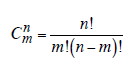 Here, the system has two equations (m = 3) and four variables. (n = 6) Thus, there are 20 basic solutions:
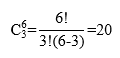
A basic solution whether it is feasible or not is a corner point of the solution space. The corner points of system of equations are obtained by setting n - m number of variables equal to zero and solving the equations for the remaining m number of variables. The number of basic solutions can be calculated as below:
Here, the system has two equations (m = 3) and four variables. (n = 6) Thus, there are 20 basic solutions:Soru 3
- Identify the corners (corner point feasible solution) of the feasible region, of which one is expected to be the optimum.
- Use iso-profit (iso-cost) lines based on the maximum (minimum) objective function to determine the optimum corner point feasible solution.
- Represent the problem with a system of equations, which has m equations and n non-negative variables.
- Determine the basic feasible solutions of the equations, of which one is expected to be the optimum.
- Use the objective function to determine the optimum basic feasible solution.
Seçenekler
A
I and II only
B
I, II, and III
C
II and IV only
D
II, III, and IV
E
III, IV, and V
Açıklama:
The phases of algebraic method are these:
- Represent the problem with a system of equations, which has m equations and n non-negative variables.
- Determine the basic feasible solutions of the equations, of which one is expected to be the optimum.
- Use the objective function to determine the optimum basic feasible solution.
Soru 4
How do you describe the concept which is a repetition of a mathematical procedure applied to the result of a previous application?
Seçenekler
A
Adjacent
B
Variable
C
Constraint
D
Slack
E
Iteration
Açıklama:
Iteration is a repetition of a mathematical procedure applied to the result of a previous application.
Soru 5
The simplex algorithm iteratively switches to the next ------- solution that is adjacent to the previous -------- solution until it reaches the optimum Z.
Which of the followings is complete the gaps in the sentence above?
Which of the followings is complete the gaps in the sentence above?
Seçenekler
A
Basic feasible
B
Bayesian rule
C
Corner point feasible
D
Decision tree
E
Complex feasible
Açıklama:
The simplex algorithm iteratively switches to the next basic feasible solution that is adjacent to the previous basic feasible solution until it reaches the optimum Z.
Soru 6
Max Z = 2x1 + 6x2 + 5x3 + 0s1 + 0s2 is the objective function of a linear program. The initial basic feasible solution for this program is (0, 0, 0, 40, 20). Which of the following is the first variable that enters to basic variables?
Seçenekler
A
s1
B
s2
C
x1
D
x2
E
x3
Açıklama:
The coefficients of the variables in the objective function refer to the effect of one-unit increase of respective variable on the function output Z. Hence, these coefficients correspond to the rate of improvements of the respective variables in Z. According to the objective function of the program, increasing x2 from zero yields more than increasing other variables from zero. Thus, the entering variable is x2.
Soru 7
In the simplex algorithm, what should we do if the basic feasible solution is optimal?
Seçenekler
A
We should reform the mathematical model.
B
We should converse the equations to the proper form for checking for the optimality.
C
If the solution is optimal, then we stop the process.
D
We should choose the leaving variable.
E
We should choose the entering variable.
Açıklama:
If the solution is optimal, then we stop the process.
Soru 8
What is the term used to describe the n×n square matrix with ones on the main diagonal and zeros elsewhere?
Seçenekler
A
Pay-off matrix
B
Null matrix
C
Identity matrix
D
Decision matrix
E
Rectengular matrix
Açıklama:
Identity matrix of n is the n×n square matrix with ones on the main diagonal and zeros elsewhere. An identity matrix is also called a unity matrix.
Soru 9
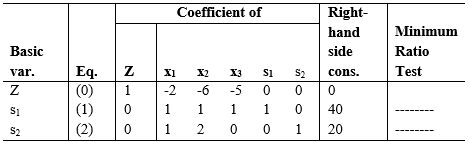 What is the pivot number in the tableau above?
Seçenekler
A
-2
B
-5
C
-6
D
1
E
2
Açıklama:
The pivot number in the tableau below is 2:
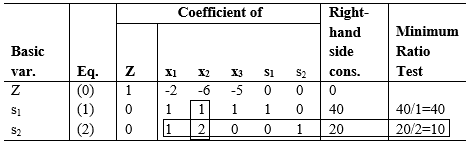
Soru 10
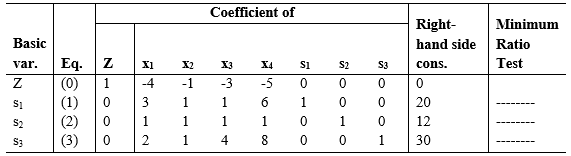 What is the pivot number in the tableau above?
Seçenekler
A
2
B
3
C
4
D
6
E
8
Açıklama:
The pivot number in the tableau below is 6:
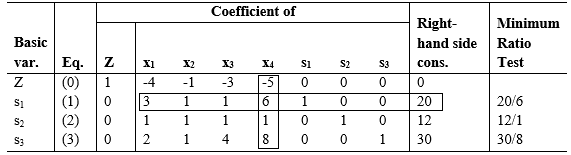
Soru 11
A system has 4 equations and 7 variables. For this system of equations, how many non-basic variable(s) are required to determine the basic solutions ?
Seçenekler
A
0
B
11
C
7
D
4
E
3
Açıklama:
n = 7 ; m = 4 ; x = 7 - 4 = 3 . pg. 87. Correct answer is E.
Soru 12
A system has 4 equations and 7 variables. For this system of equations, how many basic solutions are there ?
Seçenekler
A
35
B
28
C
7
D
11
E
14
Açıklama:
(7 !) / ((4 !) ((7 - 4) !)) = (7 6 5) / (3 2) = 35 . pg. 87. Correct answer is A.
Soru 13
A basic solution is a .... of the solution space.
Which one is appropriate for the blank ?
Which one is appropriate for the blank ?
Seçenekler
A
surface
B
curve
C
middle point
D
corner point
E
line
Açıklama:
corner point . pg. 87. Correct answer is D.
Soru 14
Max Z = x1 - 3 x2 + 2 x3 + 0 s1 + 0 s2 is the objective function of a linear program. The initial basic feasible solution for this program is (0, 0, 0, 5, 26). Which of the following is the 1st variable that enters to basic variables ?
Seçenekler
A
x1
B
x2
C
x3
D
s1
E
s2
Açıklama:
x3 : it has the maximum positive coefficient. pg. 95. Correct answer is C
Soru 15
Min Z = x1 - 3 x2 + 2 x3 + 0 s1 + 0 s2 is the objective function of a linear program. The initial basic feasible solution for this program is (0, 0, 0, 5, 26). Which of the following is the 1st variable that enters to basic variables ?
Seçenekler
A
x2
B
s2
C
x1
D
s1
E
x3
Açıklama:
Max -Z = -x1 + 3 x2 - 2 x3 - 0 s1 - 0 s2 ; x2 : it has the maximum positive coefficient . pg. 95 . Correct answer is A.
Soru 16
Min Z = x1 + 3 x2 + 2 x3 + 5 x4 + 4 x5 is the objective function of a linear program. The initial basic feasible solution for this program is (0, 0, 0, 0, 0). Which of the following is the 1st variable that enters to basic variables ?
Seçenekler
A
x2
B
x4
C
x1
D
x5
E
x3
Açıklama:
Max -Z = -x1 - 3 x2 - 2 x3 - 5 x4 - 4 x5 ; no positive coefficient ; x1 : it has the maximum negative coefficient . pg. 95 . Correct answer is C.
Soru 17
I. ⌈1 0 0⌉ II. ⌈0 0 1⌉ III. ⌈1 0 1⌉
|0 1 0| |0 1 0| |0 1 0|
⌊0 0 1⌋ ⌊1 0 0⌋ ⌊1 0 1⌋
Which one of the matrices above is the identity matrix ?
|0 1 0| |0 1 0| |0 1 0|
⌊0 0 1⌋ ⌊1 0 0⌋ ⌊1 0 1⌋
Which one of the matrices above is the identity matrix ?
Seçenekler
A
II
B
I
C
III
D
both I and II
E
both II and III
Açıklama:
I . pg. 100 . Correct answer is B.
Soru 18
An iterative algorithm aims to find .... results.
Which one is appropriate for the blank ?
Which one is appropriate for the blank ?
Seçenekler
A
exact
B
approximate
C
simplex
D
basic
E
adjacent
Açıklama:
approximate . pg. 89 . Correct answer is B.
Soru 19
Max Z = 2 x1 + 8 x2 is the objective function of the linear program, which has only one constraint other than the non-negativity constraints. Which of the constraints below ensures that the program does not have an optimal solution ?
Seçenekler
A
x1 + x2 ≤ 256
B
- x1 - 5 x2 ≥ -128
C
2 x1 ≤ -3 x2
D
-3 x1 + 4 x2 ≥ 64
E
x1 + 2 x2 ≤ 0
Açıklama:
-3 x1 + 4 x2 ≥ 64 : unbounded. pg. 99 . Correct answer is D.
Soru 20
Max Z = 16 x1 + 4 x2 is the objective function of the linear program, which has only one constraint other than the non-negativity constraints. Which of the constraints below ensures that the program has an optimal solution ?
Seçenekler
A
x1 + x2 ≥ 512
B
- x1 - 5 x2 ≤ -1024
C
2 x1 ≥ -3 x2
D
-6 x1 + 7 x2 ≤ 0
E
8 x1 + 2 x2 ≤ 128
Açıklama:
8 x1 + 2 x2 ≤ 128 : bounded . pg. 99 . Correct answer is E.
Soru 21
Who found the simplex method?
Seçenekler
A
Adam Smith
B
Dale Carnegie
C
George Dantzig
D
Otto von Bismarck
E
Edmund Burke
Açıklama:
The concept of linear programming and its solution method “simplex” was first introduced by George Dantzig.
Soru 22
Where is the optimum solution located in a linear programme?
Seçenekler
A
at left corner of the feasible region
B
at right corner of the feasible region
C
at one of the corners of the feasible region
D
at top corner of the feasible region
E
at bottom corner of the feasible region
Açıklama:
In a linear program, the optimum solution is at one of the corners of the feasible region, i.e., the solution space.
Soru 23
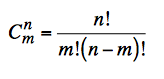 What can be calculated with the equation above?
Seçenekler
A
Number of basic solutions
B
Number of variables
C
The corner points of system of equations
D
Number of slack variables
E
Number of non-basic solutions
Açıklama:
The number of basic solutions can be calculated with this equation.
Soru 24
What are the variables that are set to zero called?
Seçenekler
A
confounding variables
B
non-basic solution
C
basic solution
D
basic variables
E
non-basic variables
Açıklama:
The variables that are set to zero are called non-basic variables.
Soru 25
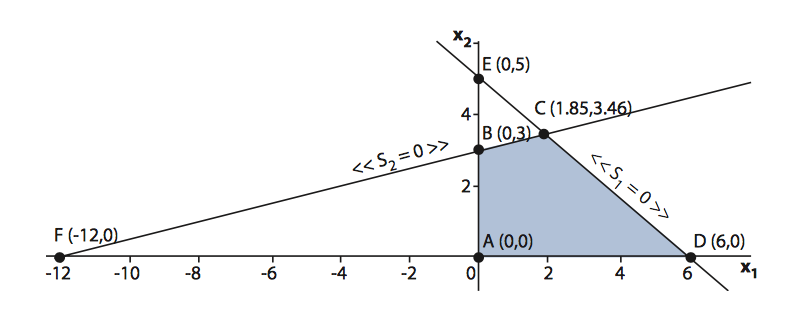 In the chart above which points are not feasible?
Seçenekler
A
F
B
A
C
A, C
D
F, E
E
E, C, B
Açıklama:
The corner points E and F are infeasible, as they do not meet the non-negativity constraints of the augmented model.
Soru 26
If two corner-point feasible solutions are connected by a line segment, what are they called?
Seçenekler
A
compound
B
adjacent
C
non-basic solution
D
basic solution
E
basi feasible solution
Açıklama:
If two corner-point feasible solutions are connected by a line segment, these corner- point feasible solutions are adjacent.
Soru 27
1. Iteration 2. Test for optimality 3. Inıtialization If there isn't a better CPF solution in a simplex method which steps are taken respectively?
Seçenekler
A
3, 2, 1
B
3, 2
C
3, 1, 2
D
3, 2, 1, 2
E
1, 2
Açıklama:
If there isn't a better CPF solution iteration is not applied.
Soru 28
Who first introduced concept of linear programming and its solution method “simplex”?
Seçenekler
A
Fraser Sherman
B
Leonid V. Kantorovic
C
William W. Cooper
D
Tjalling C. Koopmans
E
George Dantzig
Açıklama:
The concept of linear programming and its solution method “simplex” was first introduced by George Dantzig, the so-called father of linear programming. His research on the planning methods for the US Army Air Force was a game changer, as the method had great potential for dealing with difficult decision making problems by utilizing technological/computational advances.
The correct answer is E.
The correct answer is E.
Soru 29
Which of the following explains the non-basic variables?
Seçenekler
A
The variables that are greater than 1
B
The variables that are less than zero
C
The variables that are set to 1
D
The variables that are greater than zero
E
The variables that are set to zero
Açıklama:
The variables that are set to zero are called non-basic variables. These have zero coefficients and are not related to the basic solution, as they have no effect on the objective function. On the contrary, the remaining are the only variables that determine the basic solution.
The correct answer is E.
The correct answer is E.
Soru 30
What is the value at the intersection of the pivotal column and row?
Seçenekler
A
Non-basic variable
B
Basic feasible solutions
C
Corner-point feasible
D
Pivotal number
E
Iteration
Açıklama:
The value at the intersection of the pivotal column and row is called the pivotal number. It is alternatively called as pivot number or pivot element
The correct answer is D.
The correct answer is D.
Soru 31
What is the corner point of the solution space?
Seçenekler
A
Pivotal number
B
Iteration
C
Corner-point feasible
D
A basic solution
E
Non-basic variables
Açıklama:
A basic solution-whether it is feasible or not-is a corner point of the solution space. The corner points of system of equations are obtained by setting n - m number of variables equal to zero and solving the equations for the remaining m number of variables.
The correct answer is D.
The correct answer is D.
Soru 32
When the system has two equations (m = 2) and four variables, how many basic solutions are there?
Seçenekler
A
4
B
5
C
6
D
7
E
8
Açıklama:
Here, the system has two equations (m = 2) and four variables. (n = 4) Thus, there are 6 basic solutions.
C2-4 = 4!/ 2!(4 − 2)! = 6
The correct answer is C.
C2-4 = 4!/ 2!(4 − 2)! = 6
The correct answer is C.
Soru 33
For this system of equations, how can basic solutions be determined?
Seçenekler
A
by setting two of the variables to -1 and solving the equations for the remaining two
B
by setting only one of the variables to zero and solving the equations for the remaining one
C
by setting two of the variables to zero and solving the equations for the remaining two
D
by setting two of the variables to 1 and solving the equations for the remaining two
E
by setting two of the variables to 2 and solving the equations for the remaining two
Açıklama:
For this system of equations, basic solutions can be determined by setting two (n - m = 2) of the variables to zero and solving the equations for the remaining two (m = 2).
The correct answer is C.
The correct answer is C.
Soru 34
If two corner-point feasible solutions are connected by a line segment, these corner-point feasible solutions are ______.
Which of the following completes the statement above?
Which of the following completes the statement above?
Seçenekler
A
equal
B
adjacent
C
slack variables
D
surplus
E
optimal
Açıklama:
If two corner-point feasible solutions are connected by a line segment, these cornerpoint feasible solutions are adjacent. Two corner-point feasible solutions are adjacent if all but one of their respective variables have the same value.
The correct answer is B.
The correct answer is B.
Soru 35
Which of the following does surplus represent?
Seçenekler
A
The remainder of an expendable resource
B
The excess amount of a restricted resource
C
Functional constraints
D
Equation format
E
Less than or equal constraints
Açıklama:
A slack or surplus is utilized to reconstruct a constraint to obtain equation format. A slack variable represents the remainder of an expendable resource and applies to less than or equal constraints. On the other hand, a surplus represents the excess amount of a restricted resource and applies to greater than or equal constraints.
The correct answer is B.
The correct answer is B.
Soru 36
Which of the following does a slack variable represent?
Seçenekler
A
The remainder of an expendable resource
B
The excess amount of a restricted resource
C
Functional constraints
D
Equation format
E
Greater than or equal constraint
Açıklama:
A slack or surplus is utilized to reconstruct a constraint to obtain equation format. A slack variable represents the remainder of an expendable resource and applies to less than or equal constraints.
The correct answer is A.
The correct answer is A.
Soru 37
Which of the following is not one of the steps of determining the pivotal row?
Seçenekler
A
Determine the entering variable to test the optimality.
B
Divide each of these into the right-hand side constant for the corresponding row.
C
Identify the row that has the minimum ratio.
D
Take each positive coefficient in the pivotal column.
E
Pivotal row is the row that is identified in the previous step.
Açıklama:
In the simplex tableau, this is implied by a negative coefficient in the pivotal column. Before moving forward, the steps of determining the pivotal row are given below:
1. Take each positive coefficient in the pivotal column.
2. Divide each of these into the right-hand side constant for the corresponding row.
3. Identify the row that has the minimum ratio.
4. Pivotal row is the row that is identified in the previous step.
The correct answer is A.
1. Take each positive coefficient in the pivotal column.
2. Divide each of these into the right-hand side constant for the corresponding row.
3. Identify the row that has the minimum ratio.
4. Pivotal row is the row that is identified in the previous step.
The correct answer is A.
Soru 38
I. The method solely focuses on CPF solutions, i.e., BF solutions.
II The selection between the adjacent BF solutions is based on the improvement in Z.
III The preferred initial BF solution is the CPF solution at the origin, where all decision variables areset to zero.
IV Optimality test subject changes from a BF solution to an adjacent one.
Which one or ones are true about simplex method?
II The selection between the adjacent BF solutions is based on the improvement in Z.
III The preferred initial BF solution is the CPF solution at the origin, where all decision variables areset to zero.
IV Optimality test subject changes from a BF solution to an adjacent one.
Which one or ones are true about simplex method?
Seçenekler
A
Only I
B
II, III, IV
C
III, IV
D
I, IV
E
I, II, III, IV
Açıklama:
All of them are true for simplex method.
Soru 39
What is the value at the intersection of the pivotal column and row called?
Seçenekler
A
Pivot number
B
Basic variable
C
Non-basic variable
D
Coefficient
E
Alternative
Açıklama:
The value at the intersection of the pivotal column and row is called the pivotal number.
Soru 40
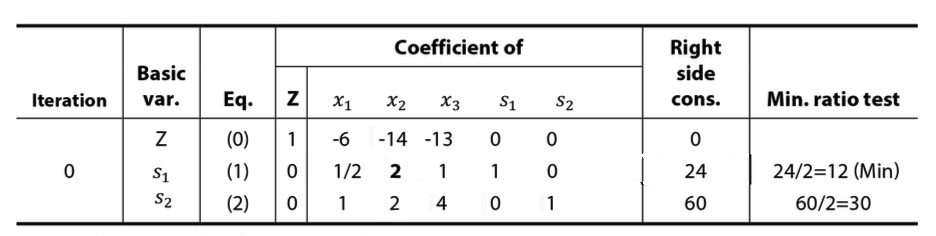 What is the pivot number in the tableau above?
Seçenekler
A
-13
B
-6
C
2
D
4
E
6
Açıklama:
Pivot number is 2 in this tableau.
Soru 41
The repetition of a mathematical procedure applied to the result of a previous application is called:
Seçenekler
A
Test for optimality.
B
Iteration.
C
Initialization.
D
Tracing.
E
Slack.
Açıklama:
Iteration is a repetition of a mathematical procedure applied to the result of a previous application. An iterative algorithm aims to obtain successively closer approximations to the solution.
Soru 42
A corner point of the solution space in linear programs is called:
Seçenekler
A
Surplus solution.
B
Slack solution.
C
Complex solution.
D
Basic solution.
E
Adjacent solution.
Açıklama:
A basic solution-whether it is feasible or not-is a corner point of the solution space. The corner points of system of equations are obtained by setting n - m number of variables equal to zero and solving the equations for the remaining m number of variables.
Soru 43
If the solution space is presented by m linear equations and n variables, the corner points of system of equations are obtained by:
Seçenekler
A
Setting n - m number of variables equal to zero.
B
Setting slack variables equal to 0.
C
Equalizing slack variables.
D
Equalizing non basic variables.
E
Eleminating n - m number of linear equations.
Açıklama:
The corner points of system of equations are obtained by setting n - m number of variables equal to zero and solving the equations for the remaining m number of variables.
Soru 44
Which of the following is false regarding simplex method?
Seçenekler
A
The method solely focuses on CPF solutions.
B
It is an iterative algorithm.
C
The preferred initial BF solution is the CPF solution at the origin, where all decision variables are set to zero.
D
Optimality test subject changes from a BF solution to an adjacent one.
E
The selection between the adjacent BF solutions is based on the deterioration in Z.
Açıklama:
The selection between the adjacent BF solutions is based on the improvement, not deterioration in Z. If there are many adjacent BF solutions that improve the Z, the one providing the largest improvement is selected. If none of the adjacent BF solutions improve Z, the current BF solution is optimal.
Soru 45
Which of the following is true regarding artificial variables?
Seçenekler
A
These variables are required to satisfy the negativity constraints.
B
They have a crucial meaning in the real problem.
C
They represent the remainder of an expendable resource.
D
They are otherwise called basic variables.
E
They leave from the basic variables as the operation iterates.
Açıklama:
Artificial variables are dummy variables, which intend to initiate the iterations and leave from the basic variables as the operation iterates. This is provided by modifying the objective function with the artificial variables that have a large negative coefficient -M. Artificial variables are required to satisfy the non-negativity constraints and have no physical meaning in the real problem. Once an artificial variable leaves the basic variables, it can be omitted in the next iterations, since it will not be chosen against any other non-basic variable as an entering variable.
Soru 46
If a system has three equations and five variables, how many basic solutions does it have?
Seçenekler
A
3
B
5
C
6
D
10
E
15
Açıklama:
If a system has three equations (m=3) and five variables (n=5) then the number of basic solutions is 5!/(3!*(5-3)!) = 120/(6*2) = 120/12 = 10.
Soru 47
Which of the following is not one of the steps of determining a pivotal row?
Seçenekler
A
Take each positive coefficient in the pivotal column.
B
Divide each of the positive coefficients into the right-hand side constant for the corresponding row.
C
Identify the row that has the minimum ratio.
D
Multiply the pivotal row by the pivotal number.
E
Pivotal row is the row that has the minimum ratio.
Açıklama:
The steps of determining the pivotal row are given below: 1. Take each positive coefficient in the pivotal column. 2. Divide each of these into the right-hand side constant for the corresponding row. 3. Identify the row that has the minimum ratio. 4. Pivotal row is the row that is identified in the previous step.
Soru 48
Two corner-point feasible solutions are adjacent if:
Seçenekler
A
They are both feasible points.
B
All but one of their respective variables have the same value.
C
Z has the same value for both of them.
D
They have identical respective variables.
E
They have opposite values of Z.
Açıklama:
If two corner-point feasible solutions are connected by a line segment, these cornerpoint feasible solutions are adjacent. Two corner-point feasible solutions are adjacent if all but one of their respective variables have the same value.
Soru 49
Which of the following variables represents the remainder of an expendable resource and applies to less than or equal constraints?
Seçenekler
A
Artificial variable.
B
Basic variable.
C
Slack variable.
D
Entering variable.
E
Leaving variable.
Açıklama:
A slack or surplus is utilized to reconstruct a constraint to obtain equation format. A slack variable represents the remainder of an expendable resource and applies to less than or equal constraints. On the other hand, a surplus represents the excess amount of a restricted resource and applies to greater than or equal constraints.
Soru 50
If the objective function of a linear program is "Minimize Z = 3x + 12y + 3", this is equivalent to:
Seçenekler
A
Minimize Z = -3x - 12y - 3.
B
Minimize Z = -3x - 12y
C
Minimize Z = 3x + 12
D
Maximize Z = 3x - 12
E
Maximize Z = -3x - 12y - 3.
Açıklama:
The objective of minimizing Z is identical to maximizing -Z, and vice versa. Therefore, the maximization of -Z can be solved in substitute of minimization of Z.
Ünite 6
Soru 1
In transportation models, the total supply equals the total demand. Some transportation problems may be less restrictive; the total supply may exceed aggregate demand. In such a case, what should it be done for balancing of the model?
Seçenekler
A
A dummy destination must be defined.
B
One of the destination which has the highest cost must be removed.
C
The nearest solution should be accepted.
D
The solution must be obtained instinctively.
E
One of the destination which has the lowest cost must be removed.
Açıklama:
In transportation models, the total supply equals the total demand. Some transportation problems may be less restrictive; the total supply may exceed aggregate demand. In such a case, a dummy destination must be defined to fictionally absorb an excessive amount of the supply. Thus, the model becomes balanced and fits the general form of the transportation model.
Soru 2
- Check the optimality of the basic feasible solution as the simplex method does. If it is not, optimal, then move to the next step. If optimal, stop
- Iterate to the next basic feasible solution by determining the entering and leaving variable using the rate of improvement on the objective value. Return to step 2
- Determine a basic feasible solution to initiate
Seçenekler
A
I-II-III
B
II-I-III
C
II-III-I
D
III-I-II
E
III-II-I
Açıklama:
The solution of a transportation model follows the steps that the simplex method offers:
- Determine a basic feasible solution to initiate,
- Check the optimality of the basic feasible solution as the simplex method does. If it is not, optimal, then move to the next step. If optimal, stop.
- Iterate to the next basic feasible solution by determining the entering and leaving variable using the rate of improvement on the objective value. Return to step 2.
Soru 3
"------- refers that the objective value of Z and the objective value of W are equal only if the basic feasible solution is the optimal for the primal as well as the dual model."
Which of the below is appropriate for the blank in the quoted sentence?
Which of the below is appropriate for the blank in the quoted sentence?
Seçenekler
A
Optimal solution property
B
Strong duality property
C
Complementary solutions property
D
Transportation duality property
E
Weak duality property
Açıklama:
Strong duality property refers that the objective value of Z and the objective value of W are equal only if the basic feasible solution is the optimal for the primal as well as the dual model
Soru 4
In a transportaion problem, quantities of items to be sent from m locations are a1, a2, …, am and to be received from n destinations are b1, b2, …, bn. In this context, how many basic variables does the balanced transportation problem have in its basic feasible solution?
Seçenekler
A
m+n
B
(m+n) / 2
C
2*(m/n)
D
2*(m+n)
E
m+n-1
Açıklama:
A balanced transportation problem has m + n - 1 basic variables in its basic feasible solution, whereas the number of its dual variables is m + n.
Soru 5
- Least-cost method
- Northwest corner method
- The Modified Distribution Method
- The Hungarian Method
- Vogel’s approximation method
Seçenekler
A
I and II only
B
I, III, and V
C
I, II, and V
D
II, III, and IV
E
III and IV only
Açıklama:
There are various methods for selecting an arbitrary variable; the most prominent ones are:
- Northwest corner method
- Least-cost method
- Vogel’s approximation method
Soru 6
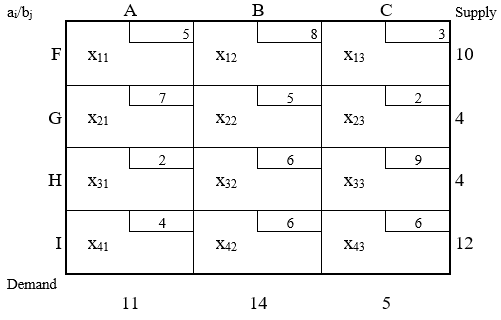 For the given cost matrix, how much is the total transportation cost calculated by Northwest Corner Method solution? (all costs in Turkish liras)
Seçenekler
A
157
B
159
C
145
D
168
E
175
Açıklama:
The initial basic feasible solution obtained in the table below has the basic variables given below.
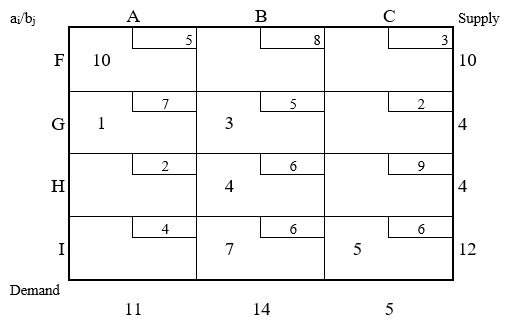 x11 = 10, x21 = 1, x22 = 3, x32 = 4, x42 = 4, x43 = 5,
The objective value for this solution, which is the total transportation cost is 168 TL.
Z = 5× 10 + 1 × 7 + 3 × 5 + 4× 6+ 4 × 6+ 5 × 6 = 168 TL.
x11 = 10, x21 = 1, x22 = 3, x32 = 4, x42 = 4, x43 = 5,The objective value for this solution, which is the total transportation cost is 168 TL.
Z = 5× 10 + 1 × 7 + 3 × 5 + 4× 6+ 4 × 6+ 5 × 6 = 168 TL.
Soru 7
For the given cost matrix, how much is the total transportation cost calculated by Least-cost Method solution? (all costs in Turkish liras)Seçenekler
A
141
B
149
C
157
D
165
E
168
Açıklama:
The initial basic feasible solution obtained in the table below has the basic variables given below.
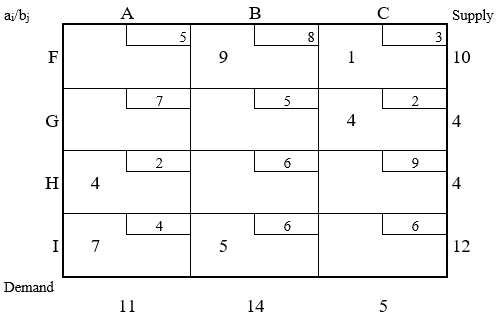 x12 = 9, x13 = 1, x23 = 4, x31 = 4, x41 = 7, x42 = 5,
The objective value for this solution, which is the total transportation cost is 149 TL.
Z = 8× 9 + 3 × 1 + 2 × 4 + 2× 4+ 4 ×7+ 6 × 8 = 149 TL.
x12 = 9, x13 = 1, x23 = 4, x31 = 4, x41 = 7, x42 = 5,The objective value for this solution, which is the total transportation cost is 149 TL.
Z = 8× 9 + 3 × 1 + 2 × 4 + 2× 4+ 4 ×7+ 6 × 8 = 149 TL.
Soru 8
" The term -------- refers to the case of job allocations to a group of workers."
Which of the below is appropriate for the blank in the quoted sentence?
Which of the below is appropriate for the blank in the quoted sentence?
Seçenekler
A
assignment
B
transportation
C
project
D
optimality
E
feasible
Açıklama:
The term “Assignment” refers to the case of job allocations to a group of workers.
Soru 9
- Identify the optimal solution by the coordinates of the zero-valued elements in the present matrix.
- If the number of masked out rows and columns is equal to n, then the optimum can be obtained from the present matrix; move on to the next step. If not, skip to Step 6.
- Identify the smallest value of each row for the cost matrix of the assignment problem. Subtract each row’s smallest value from all the costs in the respective row.
- Identify the smallest value except for the ones in masked out rows and columns. This value is then subtracted from the values of unmasked rows and columns and, added to the intersections of masked out rows and columns. Return to Step 3.
- Identify the smallest value of each column for this altered matrix. Subtract each column’s smallest value from all the costs in the respective column.
- Mask the columns and rows out that have a zero value. The number of masked out rows and columns must be at a minimum.
Seçenekler
A
I-II-III-IV-V-VI
B
I-III-IV-II-V-VI
C
II-I-VI-III-IV-V
D
III-V-VI-II-I-IV
E
V-II-III-VI-IV-I
Açıklama:
The assignment model has a tailored solution method such as the transportation model does. The solution method of the assignment model is called the Hungarian Method, named by the nationality of its developers. The steps of Hungarian Method are given below.
- Identify the smallest value of each row for the cost matrix of the assignment problem. Subtract each row’s smallest value from all the costs in the respective row.
- Identify the smallest value of each column for this altered matrix. Subtract each column’s smallest value from all the costs in the respective column.
- Mask the columns and rows out that have a zero value. The number of masked out rows and columns must be at a minimum.
- If the number of masked out rows and columns is equal to n, then the optimum can be obtained from the present matrix; move on to the next step. If not, skip to Step 6.
- Identify the optimal solution by the coordinates of the zero-valued elements in the present matrix.
- Identify the smallest value except for the ones in masked out rows and columns. This value is then subtracted from the values of unmasked rows and columns and, added to the intersections of masked out rows and columns. Return to Step 3.
Soru 10
Four workers will be assigned to five machines in a manufacturing plant. The labor costs of the workers on the machines are given in TL below.
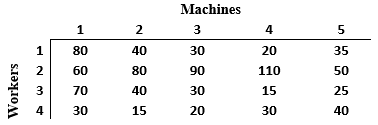 In the solution of the above assignment problem carried out with the Hungarian Algorithm, and the following table was reached in the last step.
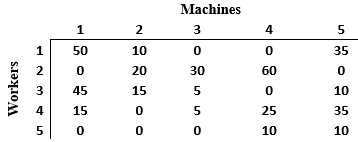
What is the objective value of the optimum solution for this problem?
In the solution of the above assignment problem carried out with the Hungarian Algorithm, and the following table was reached in the last step.What is the objective value of the optimum solution for this problem?
Seçenekler
A
100
B
110
C
150
D
170
E
430
Açıklama:
The optimum basic feasible solution has basic variables given below
x13 = 1, x25 = 1, x34 = 1, x42 = 1, x51 = 1
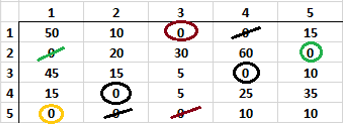 The lowest cost of the assignments is 110 TL.
Z = 1 × 30 + 1 × 50 + 1 × 15 + 1 × 15+ 1 × 0= 110 TL.
x13 = 1, x25 = 1, x34 = 1, x42 = 1, x51 = 1
The lowest cost of the assignments is 110 TL.Z = 1 × 30 + 1 × 50 + 1 × 15 + 1 × 15+ 1 × 0= 110 TL.
Soru 11
I. Check the optimality of the basic feasible solution as the simplex method does. If it is not, optimal, then move to the next step. If optimal, stop.
II. Iterate to the next basic feasible solution by determining the entering and leaving variable using the rate of improvement on the objective value.
III. Determine a basic feasible solution to initiate.
Which of the following is the correct order of the steps of solution of a transportation model?
II. Iterate to the next basic feasible solution by determining the entering and leaving variable using the rate of improvement on the objective value.
III. Determine a basic feasible solution to initiate.
Which of the following is the correct order of the steps of solution of a transportation model?
Seçenekler
A
I,II,III
B
I,III,II
C
II,III,I
D
III,I,II
E
III,II,I
Açıklama:
The solution of a transportation model follows the steps that the simplex method offers:
1. Determine a basic feasible solution to initiate,
2. Check the optimality of the basic feasible solution as the simplex method does. If it is not, optimal, then move to the next step. If optimal, stop.
3. Iterate to the next basic feasible solution by determining the entering and leaving variable using the rate of improvement on the objective value.
1. Determine a basic feasible solution to initiate,
2. Check the optimality of the basic feasible solution as the simplex method does. If it is not, optimal, then move to the next step. If optimal, stop.
3. Iterate to the next basic feasible solution by determining the entering and leaving variable using the rate of improvement on the objective value.
Soru 12
_____ interchanges costs and constraints of the primal model, and converts the objective from maximization to minimization.
Which of the following best fills the blank above?
Which of the following best fills the blank above?
Seçenekler
A
The dual model
B
A linear program
C
Cost and constraint coefficients
D
Primal model
E
Modified distribution model
Açıklama:
A linear program can be related to another one reflecting the opposite of itself. These two programs have the same conditions (cost and constraint coefficients), yet they are modeled from counter-viewpoints. Consequently, they reach the same optimal solution mutually. Here, the inversed pair of the original model is called the dual of the original (or primal) model. The dual model interchanges costs and constraints of the primal model, and converts the objective from maximization to minimization.
Soru 13
What does weak duality property refer to?
Seçenekler
A
The objective value of Z and the objective value of W are equal only if the basic feasible solution is the optimal for the primal as well as the dual model
B
The objective value, Z is equal or greater than W, the objective value of the corresponding dual solution.
C
Switching the dual variable from the partitioned one.
D
Altering the regular version of the simplex algorithm for the solution of a balanced transportation model.
E
The inverted pair of the primal model in a solution.
Açıklama:
For a basic feasible solution of the primal model, the objective value, Z is equal or greater than W, the objective value of the corresponding dual solution. This is called weak duality property: the researcher begins at any point, then reaches the optimum at a level by lowering the costs and thus increasing the revenues simultaneously.
Soru 14
_____ allows checking for the optimality of the primal solution by inspecting the feasibility of its dual solution.
Which of the following best fills the blank above?
Which of the following best fills the blank above?
Seçenekler
A
Strong duality property
B
The dual model
C
balanced transportation model
D
complementary solutions property
E
weak duality property
Açıklama:
The simplex method concurrently identifies basic feasible solutions for a primal model and its dual. This is a property of the duality called complementary solutions property. This property allows checking for the optimality of the primal solution by inspecting the feasibility of its dual solution.
Soru 15
The dual of a balanced transportation problem is interpreted as a problem of ____________.
Which of the following completes the defintion given above?
Which of the following completes the defintion given above?
Seçenekler
A
a counterpart who provides an alternative to transportation.
B
the total cost of each route.
C
linear optimization
D
minimizing the total transportation cost.
E
feasibility of the transportation.
Açıklama:
The dual of a balanced transportation problem is interpreted as a problem of a counterpart who provides an alternative to transportation. The decision variables of the dual model are the prices of the alternative service offered by the counterpart actor. The correct answer is A.
Soru 16
Which method considers the respective costs of the variables so as to find a basic feasible solution that approximates the optimum solution more and begins with selecting the route that has the smallest unit cost of transportation?
Seçenekler
A
Dual Model
B
Northwest Corner Method
C
Least-Cost Method
D
Vogel's Approximation Model
E
The Hungarian Method
Açıklama:
Least-cost Method: The Least-cost method considers the respective costs of the variables so as to find a basic feasible solution that approximates the optimum solution more. Unlike the Northwest Method, the Leastcost algorithm begins with selecting the route that has the smallest unit cost of transportation. If there is more than one variable that has the smallest cost, any variable among these can be selected arbitrarily. The value allocated to the selected route is the greater one of the values of the supply and demand. The satisfied column (corresponding demands) or row (corresponding supplies) is masked out with grey and ignored for the next allocations. Next, subtract the allocation value from the supply and demand and repeat the same allocation process with the remainders of the supply and demand. The process continues until the last row or column is satisfied. The correct answer is C.
Soru 17
The Hungarian method consists of six basic steps. Which is the first step to be followed?
Seçenekler
A
Identify the optimal solution by the coordinates of the zero-valued elements in the present matrix.
B
Mask the columns and rows out that have a zero value. The number of masked out rows and columns must be at a minimum.
C
Identify the smallest value of each column for this altered matrix. Subtract each column’s smallest value from all the costs in the respective column.
D
Identify the smallest value of each row for the cost matrix of the assignment problem. Subtract each row’s smallest value from all the costs in the respective row.
E
If the number of masked out rows and columns is equal to n, then the optimum can be obtained from the present matrix; move on to the next step
Açıklama:
The assignment model has a tailored solution method such as the transportation model does. The solution method of the assignment model is called the Hungarian Method, named by the nationality of its developers. The steps of Hungarian Method is given below. 1. Identify the smallest value of each row for the cost matrix of the assignment problem. Subtract each row’s smallest value from all the costs in the respective row. 2. Identify the smallest value of each column for this altered matrix. Subtract each column’s smallest value from all the costs in the respective column. 3. Mask the columns and rows out that have a zero value. The number of masked out rows and columns must be at a minimum. 4. If the number of masked out rows and columns is equal to n, then the optimum can be obtained from the present matrix; move on to the next step. If not, skip to Step 6. 5. Identify the optimal solution by the coordinates of the zero-valued elements in the present matrix. 6. Identify the smallest value except for the ones in masked out rows and columns. This value is then subtracted from the values of unmasked rows and columns and, added to the intersections of masked out rows and columns. Return to Step 3. The correct answer is D.
Soru 18
What is the difference between Least Cost Method and Vogel's Approximation Method?
Seçenekler
A
While the first one is balanced, the second one is unbalanced.
B
While the first one uses the direct cost of the transportation, the second one utilizes the concept of the penalty cost.
C
While the first one focuses on minimization, the second one focuses on maximization.
D
Unlike the second one, the Leas-tcost algorithm begins with selecting the route that has the smallest unit cost of transportation.
E
While the first one seeks to minimize the costs, the second one seeks for the optimal price.
Açıklama:
Vogel’s Approximation Method: Vogel’s approximation method (VAM) can be regarded as an improved version of the least-cost method. Instead of using the direct cost of the transportation, VAM utilizes the concept of the penalty cost. Each row or column has its own penalty cost, which is used for determining which variables are the basic ones. A penalty cost is the difference between the smallest cost of a row (or column) and the cost that is smaller than the others except the smallest one for that row (or column).
Soru 19
The solution of a transportation model follows three steps to reach the optimum. Which of the options include these three steps in the correct order?
Seçenekler
A
Determining a basis / Checking the optimality of the solution / Iterating to a new basic feasible solution if needed
B
Checking the optimality of the solution /Determining a basis / Iterating to a new basic feasible solution if needed
C
Checking the optimality of the solution / Introducing the initial basic feasible solution / Iterating to a new basic feasible solution if needed
D
Introducing the initial basic feasible solution / Iterating to a new basic feasible solution if needed / Checking the optimality of the solution.
E
Introducing the initial basic feasible solution / Checking the optimality of the solution / Iterating to a new basic feasible solution if needed.
Açıklama:
The solution of a transportation model follows three steps to reach the optimum. First step is to determine a basis, which is the initial basic feasible solution. The next step is to check the optimality of the solution. The third step is conditional to the second: if the current solution is not optimal, then the process is to iterate to a new basic feasible solution that includes the entering variable determined in the previous step. The correct answer is A.
Soru 20
Which model do the steps given below belong to ?
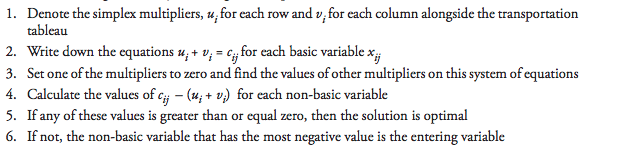
Seçenekler
A
Northwest- Corner Method
B
Balanced Transportation Model
C
Modified Distribution Model
D
The Hungarian Method
E
Least-Cost Method
Açıklama:
Also known as the method of simplex multipliers or the u-v method, MODI is a tailored version of the simplex method for the transportation model. MODI determines whether a basic feasible solution is optimal or not, and if not, identifies the entering variable by following these steps: 1. Denote the simplex multipliers, ui for each row and vi for each column alongside the transportation tableau 2. Write down the equations ui + vi = cij for each basic variable xij 3. Set one of the multipliers to zero and find the values of other multipliers on this system of equations 4. Calculate the values of cij - (ui + vi ) for each non-basic variable 5. If any of these values is greater than or equal zero, then the solution is optimal 6. If not, the non-basic variable that has the most negative value is the entering variable. The correct answer is C.
Soru 21
How can the optimality of a basic feasible solution for the transportation model be tested?
Seçenekler
A
by checking the feasibility of basic solution
B
by checking the feasibility of the dual solution
C
by checking the optimality of the basic solution
D
by checking the optimality of the dual solution
E
by minimizing the total transportation costs
Açıklama:
A transportation problem is a linear optimization problem, which seeks to minimize the total transportation cost from the origins to the destinations. The total cost is the sum of the total cost of each route, which is the multiplication of the unit cost with the amount of the units to be transported on the respective route. The decision variables of this problem are the amounts of shipment, as the transportation costs are given data. A balanced transportation model is a linear model with equality constraints. The inverse of a linear problem can be modeled as the dual of the original model. The dual of a balanced transportation problem is interpreted as a problem of a counterpart who provides an alternative to transportation. The decision variables of the dual model are the prices of the alternative service offered by the counterpart actor. At the optimum point, the objective value of the primal and the dual models are the same, and the optimum solution is the only solution that meets the restrictions for both models. Hence, the optimality of a basic feasible solution for the transportation model can be tested by checking the feasibility of the dual solution. The correct answer is B.
Soru 22
Which property of dual model refers that the objective value of Z and the objective value of W are equal only if the basic feasible solution is the optimal for the primal as well as the dual model?
Seçenekler
A
Maximum duality property
B
Minimum duality property
C
Weak duality property
D
Strong duality property
E
Complementary solutions property
Açıklama:
Strong duality property refers that the objective value of Z and the objective value of W are equal only if the basic feasible solution is the optimal for the primal as well as the dual model. In the equation below, the asterisk denotes that x and y are the optimum feasible solutions. cx* = Z = W = y* b. The correct answer is D.
Soru 23
"A feasible solution of the primal solution (x) is not optimal if the dual solution (y) violates a constraint of the dual model. The simplex method concurrently identifies basic feasible solutions for a primal model and its dual."
Which property is defined above?
Which property is defined above?
Seçenekler
A
Minimum duality property
B
Maximum duality property
C
Weak duality property
D
Strong duality property
E
Complementary solutions property
Açıklama:
When the primal-dual pairs’ objective values are equal, the solutions are optimal if the solutions are both feasible-neither of the solutions does violate their respective constraints. Put differently, a feasible solution of the primal solution (x) is not optimal if the dual solution (y) violates a constraint of the dual model. The simplex method concurrently identifies basic feasible solutions for a primal model and its dual. This is a property of the duality called complementary solutions property. This property allows checking for the optimality of the primal solution by inspecting the feasibility of its dual solution.
Soru 24
_______ is the most convenient method to initialize the solution of a transportation model.
Which of the following completes the sentence above best?
Which of the following completes the sentence above best?
Seçenekler
A
Northwest Corner Method
B
Dual Model
C
Modified Distribution Method
D
Vogel's Approximation Method
E
Least-Cost Method
Açıklama:
Northwest Corner Method: The first basic variable is the one that is at the northwest on the transportation tableau. The value allocated to this variable is the value of the smaller one of the supply and demand. If the respective origin has any supply remaining after the allocation, then move one column to the right and allocate the value in the same manner as the first one. Otherwise, move one row down and repeat the allocation process with the remaining demand. The process is finalized when there is nothing left to allocate at the last row. The correct answer is A.
Soru 25
Why are purchasing is not a real option for the Factory in dual problems?
Seçenekler
A
because the factory already did it.
B
because the factory cannot afford it.
C
because the dual problems are imaginary.
D
because the dual problems does not include money.
E
because the goods are semi-finished.
Açıklama:
the dual problems are imaginary and thus, purchasing is not a real option for the Factory. The purchasing price concept in the text is sometimes called shadow price so as to stress the virtuality. The real alternative for this factory is “not to produce”, no purchasing.
Soru 26
When does a degenerate basic variable act as a non-basic variable?
Seçenekler
A
In complementary solutions property
B
In a degenerate basic feasible solution
C
In Northwest corner method
D
In Least-cost method
E
In Vogel’s approximation method
Açıklama:
In a degenerate basic feasible solution, a degenerate basic variable acts as a non-basic variable, however, it does not prevent reaching to the optimal.
Soru 27
Which of the following is one of the methods for selecting an arbitrary variable in initialization methods?
Seçenekler
A
the Modified Distribution Method
B
Least-cost method
C
Iteration
D
the Hungarian Method
E
linear model with equality constraints
Açıklama:
There are various methods for selecting an arbitrary variable; the most prominent ones are:
- Northwest corner method
- Least-cost method
- Vogel’s approximation method
Soru 28
Which of the following phrases can not be said about the Transportation Model?
Seçenekler
A
A transportation problem is a linear optimization problem, which seeks to minimize the total costs of shipment of items from certain origins to a number of destinations while fulfilling the requirements of destinations and emptying the origins.
B
Some transportation problems may be less restrictive; the total supply may exceed aggregate demand.
C
This model has the origin locations from where a single unit can be transported to a dedicated destination, and vice versa-the model has the destinations to which a single unit is sent solely from one origin location.
D
The decision variables of this problem are the amounts to be shipped for each origin-destination pairs.
E
A transportation problem has a feasible solution only if the total availability meets all the requirements.
Açıklama:
A transportation problem is a linear optimization problem, which seeks to minimize the total costs of shipment of items from certain origins to a number of destinations while fulfilling the requirements of destinations and emptying the origins. The decision variables of this problem are the amounts to be shipped for each origin-destination pairs.
Some transportation problems may be less restrictive; the total supply may exceed aggregate demand. In such a case, a dummy destination must be defined to fictionally absorb an excessive amount of the supply. Thus, the model becomes balanced and fits the general form of the transportation model. Note that a transportation problem has a feasible solution only if the total availability meets all the requirements.
According to these, the correct answer is given in the option C.
Some transportation problems may be less restrictive; the total supply may exceed aggregate demand. In such a case, a dummy destination must be defined to fictionally absorb an excessive amount of the supply. Thus, the model becomes balanced and fits the general form of the transportation model. Note that a transportation problem has a feasible solution only if the total availability meets all the requirements.
According to these, the correct answer is given in the option C.
Soru 29
Which of the following is not one of the steps that the transportation model has taken to reach a solution?
Seçenekler
A
Identify the smallest value of each row for the cost matrix of the assignment problem.
B
Determine a basic feasible solution to initiate
C
Check the optimality of the basic feasible solution as the simplex method does
D
If it is not, optimal, then move to the next step. If optimal, stop.
E
Iterate to the next basic feasible solution by determining the entering and leaving variable using the rate of improvement on the objective value.
Açıklama:
The solution of a transportation model follows the steps that the simplex method offers:
1. Determine a basic feasible solution to initiate,
2. Check the optimality of the basic feasible solution as the simplex method does. If it is not, optimal, then move to the next step. If optimal, stop.
3. Iterate to the next basic feasible solution by determining the entering and leaving variable using the rate of improvement on the objective value. Return to step 2.
In this sense, the correct answer is A.
1. Determine a basic feasible solution to initiate,
2. Check the optimality of the basic feasible solution as the simplex method does. If it is not, optimal, then move to the next step. If optimal, stop.
3. Iterate to the next basic feasible solution by determining the entering and leaving variable using the rate of improvement on the objective value. Return to step 2.
In this sense, the correct answer is A.
Soru 30
"The _________ interchanges costs and constraints of the primal model, and converts the objective from maximization to minimization." Fill in the blank with the correct concept.
Seçenekler
A
balanced transportation model
B
dual model
C
Least-cost method
D
Northwest corner method
E
assignment model
Açıklama:
The dual model interchanges costs and constraints of the primal model, and converts the objective from maximization to minimization. Moreover, the values of the decision variables of the dual model reveal the prices for the constraints of the original problem
for a basic feasible solution. This interpretation provides an economic perspective for solving the primal problem. Combining this economic insight and the properties of duality allows for an easier method altering the regular version of the simplex algorithm for the solution of a balanced transportation model. According tı these, the correct answer is given in the option B.
for a basic feasible solution. This interpretation provides an economic perspective for solving the primal problem. Combining this economic insight and the properties of duality allows for an easier method altering the regular version of the simplex algorithm for the solution of a balanced transportation model. According tı these, the correct answer is given in the option B.
Soru 31
Which of the following option is the description of the "weak duality property"?
Seçenekler
A
the objective value of Z and the objective value of W are equal only if the basic feasible solution is the optimal for the primal as well as the dual model.
B
A feasible solution of the primal solution (x) is not optimal if the dual solution (y) violates a constraint of the dual model. The simplex method concurrently identifies basic feasible solutions for a primal model and its dual.
C
Eliminates the computations required by the simplex method and eases off finding the dual solution
D
When the primal-dual pairs’ objective values are equal, the solutions are optimal if the solutions are both feasible-neither of the solutions does violate their respective constraints.
E
The objective value, Z is equal or greater than W, the objective value of the corresponding dual solution.
Açıklama:
Some of the properties of duality contribute solving of the primal problem by considering primal-dual model relationships. Before getting into these, recall that x’s are the components of a feasible solution for the primal model and, whereas the corresponding dual solution comprises of y’s. For a basic feasible solution of the primal model, the objective value, Z is equal or greater than W, the objective value of the corresponding dual solution. This is called weak duality property: the researcher begins at any point, then reaches the optimum at a level by lowering the costs and thus increasing the revenues simultaneously. In this sense the correct answer is E.
Soru 32
Which of the following can not be said about the Dual of the Transportation Model?
Seçenekler
A
The difference is that the constraints of the transportation model are in the form of equality. Thus, the duality relation here is asymmetric.
B
For the problem of the production decision, a counterpart actor was assumed as if it provided a purchasing alternative.
C
The original problem is to select the most economical distribution routes that meet the demands of the destinations.
D
Total cost of the shipment depends on total costs of transportation for the selected routes.
E
Dual transportation model is a transportation model, where the supply and demand constraints are equality, and the total supply equals total demand.
Açıklama:
The transportation problem, as it was formulated at the beginning of this chapter, is a minimization problem just as the one exemplified for the economic interpretation of the dual model. However, the difference is that the constraints of the transportation model are in the form of equality. Thus, the duality relation here is asymmetric.
The dual model interchanges costs and constraints of the primal model, and converts the objective from maximization to minimization. Hence, there is a dual variable y for each constraint. In the case of the transportation model, the dual variable y is defined with a pair of variables; u, for the constraints of origins and v, for the constraints of destinations.
The dual of the transportation model can be interpreted as the dual model explained in the previous subsection. For the problem of the production decision, a counterpart actor was assumed as if it provided a purchasing alternative. A similar assumption can be made to interpret the dual of the transportation model. The original problem is to select the most economical distribution routes that meet the demands of the destinations. Total cost of the shipment depends on total costs of transportation for the selected routes. The decision variables for the primal model are the amounts to be carried from the origins (e.g. production locations) to the destinations (e.g. retailing locations).
According to these information, the correct answer is option E.
The dual model interchanges costs and constraints of the primal model, and converts the objective from maximization to minimization. Hence, there is a dual variable y for each constraint. In the case of the transportation model, the dual variable y is defined with a pair of variables; u, for the constraints of origins and v, for the constraints of destinations.
The dual of the transportation model can be interpreted as the dual model explained in the previous subsection. For the problem of the production decision, a counterpart actor was assumed as if it provided a purchasing alternative. A similar assumption can be made to interpret the dual of the transportation model. The original problem is to select the most economical distribution routes that meet the demands of the destinations. Total cost of the shipment depends on total costs of transportation for the selected routes. The decision variables for the primal model are the amounts to be carried from the origins (e.g. production locations) to the destinations (e.g. retailing locations).
According to these information, the correct answer is option E.
Soru 33
"A balanced transportation problem has ________ (1) basic variables in its basic feasible solution, whereas the number of the constraint equations is _______ (2)." Fill in the blanks with correct equations.
Seçenekler
A
(1): m + n - 1
(2): m + n
(2): m + n
B
(1): m + n - 2n
(2): m + n - 1
(2): m + n - 1
C
(1): m + n - 2
(2): m + n
(2): m + n
D
(1): m + n - 2
(2): m + n - 1
(2): m + n - 1
E
(1): m + n
(2): m + n - 1
(2): m + n - 1
Açıklama:
The solution of a transportation problem begins with determining a basic feasible solution to proceed to the next phase. A balanced transportation problem has m + n - 1 basic variables in its basic feasible solution, whereas the number of the constraint equations is m + n. The correct answer is given in option A.
Soru 34
Selecting a variable to be basic means allocating the greatest value possible to the respective variable, under the constraints of the total supply and demand for the origins and destinations, respectively. There are various methods for selecting an arbitrary variable. In which of the following, these methods are given correctly?
Seçenekler
A
1. Balanced transportation method
2. Least-cost method
3. Vogel’s approximation method
2. Least-cost method
3. Vogel’s approximation method
B
1. Northwest corner method
2. Duality properties method
3. Vogel’s approximation method
2. Duality properties method
3. Vogel’s approximation method
C
1. Northwest corner method
2. Least-cost method
3. Vogel’s approximation method
2. Least-cost method
3. Vogel’s approximation method
D
1. Northwest corner method
2. Least-cost method
3. Complementary solutions method
2. Least-cost method
3. Complementary solutions method
E
1. Northwest corner method
2. Duality properties method
3. Complementary solutions method
2. Duality properties method
3. Complementary solutions method
Açıklama:
Selecting a variable to be basic means allocating the greatest value possible to the respective variable, under the constraints of the total supply and demand for the origins and destinations, respectively. There are various methods for selecting an arbitrary variable; the most prominent ones are:
1. Northwest corner method
2. Least-cost method
3. Vogel’s approximation method
The correct answer is C.
1. Northwest corner method
2. Least-cost method
3. Vogel’s approximation method
The correct answer is C.
Soru 35
What is the difference between balanced transportation model and an unbalanced one?
Seçenekler
A
Maximum value of the upper limits for the decision variables
B
The number of degenerate variables in the optimum solution
C
The equality between the total supply and total demand
D
The requirement of a basis to test the optimality
E
Derivability of its dual model
Açıklama:
(based on the model on page 114)
As a linear algebraic property of balanced transportation model, the number of independent equations is m + n - 1. Therefore, a feasible basic solution has m + n - 1 basic variables.
As a linear algebraic property of balanced transportation model, the number of independent equations is m + n - 1. Therefore, a feasible basic solution has m + n - 1 basic variables.
Soru 36
Which of the following cannot be said about the Least-cost Method?
Seçenekler
A
The Least-cost method considers the respective costs of the variables so as to find a basic feasible solution that approximates the optimum solution more.
B
Unlike the Northwest Method, the Leastcost algorithm begins with selecting the route that has the smallest unit cost of transportation.
C
If there is more than one variable that has the smallest cost, any variable among these can be selected arbitrarily.
D
The value allocated to this variable is the value of the smaller one of the supply and demand.
E
The value allocated to the selected route is the greater one of the values of the supply and demand.
Açıklama:
The Least-cost method considers the respective costs of the variables so as to find a basic feasible solution that approximates the optimum solution more. Unlike the Northwest Method, the Leastcost algorithm begins with selecting the route that has the smallest unit cost of transportation. If there is more than one variable that has the smallest cost, any variable among these can be selected arbitrarily. The value allocated to the selected route is the greater one of the values of the supply and demand. In this sense, the correct aswer is the option D.
Soru 37
Which of the following is the most convenient method to initialize the solution of a transportation model?
Seçenekler
A
Northwest corner method
B
Least-cost method
C
Vogel’s approximation method
D
Russel’s approximation method
E
Hungarian method
Açıklama:
Northwest Corner Method: The first basic variable is the one that is at the northwest on the transportation tableau. The value allocated to this variable is the value of the smaller one of the supply and demand. If the respective origin has any supply remaining after the allocation, then move one column to the right and allocate the value in the same manner as the first one. Otherwise, move one row down and repeat the allocation process with the remaining demand. The process is finalized when there is nothing left to allocate at the last row. Northwest corner method is the most convenient method to initialize the solution of a transportation model as compared to least-cost and Vogel's approximation methods. so the answer for this question is A.
Soru 38
Which one of the following is true for an assignment model?
Seçenekler
A
The value of the decision variables must be non-negative
B
The value of the decision variables are greater than 1
C
The number of the origins is equal to the destinations
D
Cannot be solved by the simplex algorithm
E
The objective function is a maximization
Açıklama:
As a special form of the linear programming model, the transportation model and its solution method have been introduced thus far. This section introduces the assignment model, a special case of the transportation model. The term “Assignment” refers to the case of job allocations to a group of workers. In general, a worker has a single job and a job is done by a single worker. Similarly, the assignment model has the origin locations from where a single unit can be transported to a dedicated destination, and vice versa-the model has the destinations to which a single unit is sent solely from one origin location. Simply put, the number of the origins (represented by the workers) and the destinations (represented by the jobs) are equal, and the amount to be sent and received is strictly 1.
(see the relevant section in your book for more details.)
(see the relevant section in your book for more details.)
Soru 39
"The assignment model has a tailored solution method such as the transportation model does. The solution method of the assignment model is called the___________." Fill in the blank with correct concept.
Seçenekler
A
Modified Distribution Method
B
Hungarian Method
C
Vogel’s Approximation Method
D
Least-cost Method
E
Northwest Corner Method
Açıklama:
The assignment model has a tailored solution method such as the transportation model does. The solution method of the assignment model is called the Hungarian Method, named by the nationality of its developers. So, the correct answer is option B.
Soru 40
Which of the following can not be one of the steps of Hungarian Method?
Seçenekler
A
Identify the smallest value of each row for the cost matrix of the assignment problem. Subtract each row’s smallest value from all the costs in the respective row.
B
Identify the smallest value of each column for this altered matrix. Subtract each column’s smallest value from all the costs in the respective column
C
Mask the columns and rows out that have a zero value. The number of masked out rows and columns must be at a maximum.
D
If the number of masked out rows and columns is equal to n, then the optimum can be obtained from the present matrix; move on to the next step. If not, skip to Step 6.
E
Identify the optimal solution by the coordinates of the zero-valued elements in the present matrix.
Açıklama:
The steps of Hungarian Method is given below.
1. Identify the smallest value of each row for the cost matrix of the assignment problem. Subtract each row’s smallest value from all the costs in the respective row.
2. Identify the smallest value of each column for this altered matrix. Subtract each column’s smallest value from all the costs in the respective column.
3. Mask the columns and rows out that have a zero value. The number of masked out rows and columns must be at a minimum.
4. If the number of masked out rows and columns is equal to n, then the optimum can be obtained from the present matrix; move on to the next step. If not, skip to Step 6.
5. Identify the optimal solution by the coordinates of the zero-valued elements in the present matrix.
6. Identify the smallest value except for the ones in masked out rows and columns. This value is then subtracted from the values of unmasked rows and columns and, added to the intersections of masked out rows and columns. Return to Step 3.
According to these, the correct answer is given in option C.
1. Identify the smallest value of each row for the cost matrix of the assignment problem. Subtract each row’s smallest value from all the costs in the respective row.
2. Identify the smallest value of each column for this altered matrix. Subtract each column’s smallest value from all the costs in the respective column.
3. Mask the columns and rows out that have a zero value. The number of masked out rows and columns must be at a minimum.
4. If the number of masked out rows and columns is equal to n, then the optimum can be obtained from the present matrix; move on to the next step. If not, skip to Step 6.
5. Identify the optimal solution by the coordinates of the zero-valued elements in the present matrix.
6. Identify the smallest value except for the ones in masked out rows and columns. This value is then subtracted from the values of unmasked rows and columns and, added to the intersections of masked out rows and columns. Return to Step 3.
According to these, the correct answer is given in option C.
Soru 41
Which of the followings interchanges costs and constraints of the primal model, and converts the objective from maximization to minimization?
Seçenekler
A
Balanced Transportation Model
B
Dual Model
C
Northwest Corner Method
D
Least-Cost Method
E
Vogel’s Approximation Method
Açıklama:
Duality, the Concept and the Properties
The dual model interchanges costs and constraints of the primal model, and converts the objective from maximization to minimization.
The dual model interchanges costs and constraints of the primal model, and converts the objective from maximization to minimization.
Soru 42
Which of the followings refers that the objective value of Z and the objective value of W are equal only if the basic feasible solution is the optimal for the primal as well as the dual model?
Seçenekler
A
Weak duality property
B
Strong duality property
C
Complementary solutions property
D
Degenerate basic feasible solution
E
Initial basic feasible solution
Açıklama:
Duality, the Concept and the Properties
Strong duality property refers that the objective value of Z and the objective value of W are equal only if the basic feasible solution is the optimal for the primal as well as the dual model.
Strong duality property refers that the objective value of Z and the objective value of W are equal only if the basic feasible solution is the optimal for the primal as well as the dual model.
Soru 43
Which of the followings is a feature of "complementary solutions property"?
Seçenekler
A
It allows checking for the optimality of the primal solution by inspecting the feasibility of its dual solution.
B
The researcher begins at any point, then reaches the optimum at a level by lowering the costs and thus increasing the revenues simultaneously.
C
The objective value, Z is equal or greater than W, the objective value of the corresponding dual solution.
D
The objective value of Z and the objective value of W are equal only if the basic feasible solution is the optimal for the primal as well as the dual model.
E
When the primal-dual pairs’ objective values are equal, the solutions are optimal if the solutions are both feasible-neither of the solutions does violate their respective constraints.
Açıklama:
Duality, the Concept and the Properties
This property allows checking for the optimality of the primal solution by inspecting the feasibility of its dual solution.
This property allows checking for the optimality of the primal solution by inspecting the feasibility of its dual solution.
Soru 44
Which of the following statements is not true regarding "the dual model"?
Seçenekler
A
Interchanges costs and constraints of the primal model.
B
Converts the objective from maximization to minimization.
C
The values of the decision variables of the dual model reveal the prices for the constraints of the original problem for a basic feasible solution.
D
Allows for an easier method altering the regular version of the simplex algorithm for the solution of a balanced transportation model.
E
Considers the respective costs of the variables so as to find a basic feasible solution that approximates the optimum solution more.
Açıklama:
Duality, the Concept and the Properties
The Least-cost method considers the respective costs of the variables so as to find a basic feasible solution that approximates the optimum solution more.
The Least-cost method considers the respective costs of the variables so as to find a basic feasible solution that approximates the optimum solution more.
Soru 45
Which of the followings can be regarded as an improved version of the least-cost method.and utilizes the concept of the penalty cost?
Seçenekler
A
Northwest Corner Method
B
Vogel’s Approximation Method
C
The Modified Distribution Method
D
The Hungarian Method
E
Balanced Transportation Model
Açıklama:
Initialization Methods
Vogel’s approximation method (VAM) can be regarded as an improved version of the least-cost method. Instead of using the direct cost of the transportation, VAM utilizes the concept of the penalty cost.
Vogel’s approximation method (VAM) can be regarded as an improved version of the least-cost method. Instead of using the direct cost of the transportation, VAM utilizes the concept of the penalty cost.
Soru 46
Which of the followings considers the respective costs of the variables so as to find a basic feasible solution that approximates the optimum solution more?
Seçenekler
A
Balanced Transportation Model
B
Northwest Corner Method
C
Least-Cost Method
D
Vogel’s Approximation Method
E
The Modified Distribution Method
Açıklama:
The Least-cost method considers the respective costs of the variables so as to find a basic feasible solution that approximates the optimum solution more. Unlike the Northwest Method, the Least- cost algorithm begins with selecting the route that has the smallest unit cost of transportation.
Soru 47
Which of the following properties is about "Northwest Corner Method" ?
Seçenekler
A
Considers the respective costs of the variables so as to find a basic feasible solution that approximates the optimum solution more.
B
Algorithm begins with selecting the route that has the smallest unit cost of transportation.
C
If there is more than one variable that has the smallest cost, any variable among these can be selected arbitrarily.
D
The value allocated to this variable is the value of the smaller one of the supply and demand.
E
The value allocated to the selected route is the greater one of the values of the supply and demand.
Açıklama:
Initialization Methods
Northwest Corner Method: The first basic variable is the one that is at the northwest on the transportation tableau. The value allocated to this variable is the value of the smaller one of the supply and demand.
Northwest Corner Method: The first basic variable is the one that is at the northwest on the transportation tableau. The value allocated to this variable is the value of the smaller one of the supply and demand.
Soru 48
Which of the following features is about "least-cost method"?
Seçenekler
A
The first basic variable is the one that is at the northwest on the transportation tableau.
B
The value allocated to this variable is the value of the smaller one of the supply and demand.
C
If there is more than one variable that has the smallest cost, any variable among these can be selected arbitrarily.
D
Instead of using the direct cost of the transportation, it utilizes the concept of the penalty cost.
E
Each row or column has its own penalty cost, which is used for determining which variables are the basic ones.
Açıklama:
Initialization Methods
Least-cost Method: The Least-cost method considers the respective costs of the variables so as to find a basic feasible solution that approximates the optimum solution more. Unlike the Northwest Method, the Least- cost algorithm begins with selecting the route that has the smallest unit cost of transportation. If there is more than one variable that has the smallest cost, any variable among these can be selected arbitrarily.
Least-cost Method: The Least-cost method considers the respective costs of the variables so as to find a basic feasible solution that approximates the optimum solution more. Unlike the Northwest Method, the Least- cost algorithm begins with selecting the route that has the smallest unit cost of transportation. If there is more than one variable that has the smallest cost, any variable among these can be selected arbitrarily.
Soru 49
Which of the followings determines whether a basic feasible solution is optimal or not, and if not, identifies the entering variable?
Seçenekler
A
The Hungarian Method
B
Northwest Corner Method
C
Least-Cost Method
D
Vogel’s Approximation Method
E
The Modified Distribution Method
Açıklama:
Test for Optimality
The application is presented as a standalone method called the Modified Distribution Method (MODI). Also known as the method of simplex multipliers or the u-v method, MODI is a tailored version of the simplex method for the transportation model. MODI determines whether a basic feasible solution is optimal or not, and if not, identifies the entering variable.
The application is presented as a standalone method called the Modified Distribution Method (MODI). Also known as the method of simplex multipliers or the u-v method, MODI is a tailored version of the simplex method for the transportation model. MODI determines whether a basic feasible solution is optimal or not, and if not, identifies the entering variable.
Soru 50
Which of the following statements is not true regarding "the assignment model"?
Seçenekler
A
It is a transportation model with an equal number of origins and destinations that have exactly one unit to be sent and received.
B
For convenience, the construct of such model is represented by the terms of the assignment concept.
C
In an assignment model, the origins and destinations are the families and the children, respectively.
D
The decision variables can only take values of either one or zero.
E
The method performs a series of computations on the costs matrix and obtains the optimum solution by determining zero-valued elements in the final matrix.
Açıklama:
Model and solve an assignment problem.
In an assignment model, the origins and destinations are the workers and the jobs, respectively.
In an assignment model, the origins and destinations are the workers and the jobs, respectively.
Ünite 7
Soru 1
⌈2 4 5 0⌉
|0 1 -1 3|
⌊2 6 7 1⌋
What is the upper value of this matrix game ?
|0 1 -1 3|
⌊2 6 7 1⌋
What is the upper value of this matrix game ?
Seçenekler
A
2
B
6
C
7
D
3
E
5
Açıklama:
greatest in columns : 2 6 7 3 ; min : 2. pg. 151. Correct answer is A.
Soru 2
⌈-3 -5 -2 4 6⌉
|-2 3 0 1 -4|
⌊-1 4 -6 2 -2⌋
What is the lower value of this matrix game ?
|-2 3 0 1 -4|
⌊-1 4 -6 2 -2⌋
What is the lower value of this matrix game ?
Seçenekler
A
-5
B
-6
C
-4
D
-1
E
-2
Açıklama:
lowest in rows : -5 -4 -6 ; max : -4 . pg. 151. Correct answer is C.
Soru 3
⌈-1 -2⌉
|-6 -3|
⌊-4 1⌋
What is the sum of the lower and the upper values of this matrix game ?
|-6 -3|
⌊-4 1⌋
What is the sum of the lower and the upper values of this matrix game ?
Seçenekler
A
-10
B
0
C
-5
D
-3
E
-9
Açıklama:
lowest in rows : -2 -6 -4 ; max : -2 ; greatest in columns : -1 1 ; min : -1 ; sum = -2 + -1 = -3 . pg. 151. Correct answer is D.
Soru 4
⌈1 4 6⌉
⌊3 8 5⌋
What is the equilibrium pair of this matrix game ?
⌊3 8 5⌋
What is the equilibrium pair of this matrix game ?
Seçenekler
A
{1st row, 2nd column}
B
{1st row, 3rd column}
C
{2nd row, 1st column}
D
{2nd row, 3rd column}
E
{1st row, 1st column}
Açıklama:
equilibrium point = saddle point ; lowest in rows : { 1 3 } ; max = 3 ; greatest in columns : { 3 8 6 } ; min = 3 ; max min : { 2nd row , 1st column } . pg. 152. Correct answer is C.
Soru 5
⌈-3 0 -4 -4 -5⌉
⌊-1 1 -2 2 -6⌋
What is the minimax strategy of Player II in this matrix game ?
⌊-1 1 -2 2 -6⌋
What is the minimax strategy of Player II in this matrix game ?
Seçenekler
A
-6
B
-1
C
1
D
2
E
-5
Açıklama:
greatest in columns : -1 1 -2 2 -5 ; min : -5 . pg. 158 . Correct answer is E.
Soru 6
⌈3 -2 -4⌉
|-5 -4 4|
|2 0 5|
⌊-3 -2 -4⌋
What is the maximin strategy for Player I in this game ?
|-5 -4 4|
|2 0 5|
⌊-3 -2 -4⌋
What is the maximin strategy for Player I in this game ?
Seçenekler
A
-4
B
4
C
0
D
5
E
-5
Açıklama:
lowest in rows : -4 -5 0 -4 ; max : 0 . pg. 158. Correct answer is C.
Soru 7
⌈2 3⌉
⌊4 1⌋
Which of the following is the value of the game above ?
⌊4 1⌋
Which of the following is the value of the game above ?
Seçenekler
A
4 / 3
B
3 / 2
C
5 / 3
D
7 / 3
E
5 / 2
Açıklama:
2 p + 3 (1 - p) = 4 p + 1 (1 - p ) ; -p + 3 = 3 p + 1 ; 4 p = 2 ; p = 1 / 2 ; 2 (1 / 2) + 3 (1 - (1 / 2)) = 1 + (3 / 2) = 5 / 2 . pg. 152. Correct answer is E.
Soru 8
⌈5 3⌉
⌊2 7⌋
Which of the following is the mixed strategy of the row player of the game above ?
⌊2 7⌋
Which of the following is the mixed strategy of the row player of the game above ?
Seçenekler
A
(4 / 7 , 3 / 7)
B
(2 / 5 , 3 / 5)
C
(2 / 3 , 1 / 3)
D
(1 / 2 , 1 / 2)
E
(1 / 4 , 3 / 4)
Açıklama:
5 p + 3 (1 - p) = 2 p + 7 (1 - p ) ; 2 p + 3 = -5 p + 7 ; 7 p = 4 ; p = 4 / 7 ; (1 - p) = 3 / 7 . pg. 153. Correct answer is A.
Soru 9
⌈1 -5⌉
|-2 3|
|-3 1|
⌊-4 0⌋
For Player I of the game above, which of the following is the expected pay-off of choosing 3rd row ?
|-2 3|
|-3 1|
⌊-4 0⌋
For Player I of the game above, which of the following is the expected pay-off of choosing 3rd row ?
Seçenekler
A
-3 p + 1
B
-4 p + 1
C
-3 + p
D
-4 + p
E
-3 p
Açıklama:
-3 p + 1 (1 - p) = -4 p + 1 . pg. 164. Correct answer is B.
Soru 10
⌈11 5 9⌉
⌊15 7 10⌋
What is the equilibrium pair of this matrix game ?
⌊15 7 10⌋
What is the equilibrium pair of this matrix game ?
Seçenekler
A
{2nd row, 2nd column}
B
{1st row, 3rd column}
C
{2nd row, 1st column}
D
{1st row, 1st column}
E
{2nd row, 3rd column}
Açıklama:
lowest in rows : 5 7 ; max : 7 ; greatest in columns : 15 7 10 ; min 7 ; max min : 2nd row , 2nd column . pg. 164. Correct answer is A.
Soru 11
Which notion below can be individuals, organizations,teams or, in some cases, nature?
Seçenekler
A
Strategy
B
Players
C
Pay-off
D
Pay-off Matrix
E
Saddle Point
Açıklama:
BASIC TERMINOLOGY AND CLASSIFICATION OF GAMES
Players can be individuals, organizations, teams or, in some cases, nature itself. The
number of players must be finite and must be known.
Players can be individuals, organizations, teams or, in some cases, nature itself. The
number of players must be finite and must be known.
Soru 12
"In the game of Rock-PaperScissors, if a player would choose to only play Rock for each interdependent trial,regardless of the other player’s strategy." Which notion is about the given example?
Seçenekler
A
A pure strategy
B
A mixed strategy
C
Pay-off
D
Saddle point
E
Pay-off Matrix
Açıklama:
BASIC TERMINOLOGY AND CLASSIFICATION OF GAMES
A pure strategy is an unconditional decision always to select a particular course of action. For example, in the game of Rock-PaperScissors, if a player would choose to only play Rock for each interdependent trial, regardless of the other player’s strategy, it would be the player’s pure strategy.
A pure strategy is an unconditional decision always to select a particular course of action. For example, in the game of Rock-PaperScissors, if a player would choose to only play Rock for each interdependent trial, regardless of the other player’s strategy, it would be the player’s pure strategy.
Soru 13
Which game below is also known as The Game of Chicken which is an example of conflict for two players in the game theory?
Seçenekler
A
The Prisoner’s Dilemma
B
Matching Coins
C
Battle of the Sexes
D
Hawk-Dove
E
Rock, Paper, Scissors
Açıklama:
BASIC TERMINOLOGY AND CLASSIFICATION OF GAMES
Hawk-Dove: Hawk-Dove game, is also known as The Game of Chicken is an example of conflict for two players in the game theory. Two animals are fighting for some prey. An animal that plays the strategy Hawk (H) behaves aggressively, while the other one plays the strategy Dove (D) behaves passively.
Hawk-Dove: Hawk-Dove game, is also known as The Game of Chicken is an example of conflict for two players in the game theory. Two animals are fighting for some prey. An animal that plays the strategy Hawk (H) behaves aggressively, while the other one plays the strategy Dove (D) behaves passively.
Soru 14
I.There should be at least one player
II.Each player’s chosen strategies determine the outcome of the game
III.Each player acts rationally to maximize his/her gains
Which one/ones above is/are correct about games?
II.Each player’s chosen strategies determine the outcome of the game
III.Each player acts rationally to maximize his/her gains
Which one/ones above is/are correct about games?
Seçenekler
A
Only I
B
I-II
C
I-III
D
II-III
E
I-II-III
Açıklama:
Classification of Games
A game is defined to be any situation in which
• There are at least two players,
• Each player has a finite number of strategies,
• Each player’s chosen strategies determine the outcome of the game,
• Each player acts rationally to maximize his/her gains,
• The different strategies of each player and the amount of gain is known to each player in advance.
A game is defined to be any situation in which
• There are at least two players,
• Each player has a finite number of strategies,
• Each player’s chosen strategies determine the outcome of the game,
• Each player acts rationally to maximize his/her gains,
• The different strategies of each player and the amount of gain is known to each player in advance.
Soru 15
If the value of a game is zero what is it called as?
Seçenekler
A
Saddle point
B
Fair game
C
Unfair game
D
Pay-off
E
Pay-off Matrix
Açıklama:
TWO-PERSON ZERO-SUM GAMES
If the value of a game is zero, then it is called a fair game
If the value of a game is zero, then it is called a fair game
Soru 16
Which one below is something that a ration player never use?
Seçenekler
A
Pure strategy
B
Saddle point
C
Mixxed strategy
D
Dominated strategy
E
Pay-off
Açıklama:
Dominance Strategies
A rational player never plays a dominated strategy.
A rational player never plays a dominated strategy.
Soru 17
Which step below is not for solving m×2 games?
Seçenekler
A
Draw two vertical axes one unit apart. These two lines are 0 and 1.
B
Take the probabilities of the two alternatives of the column player as q and (1-q), then expected pay-offs of row player for each strategy are expressed with equations.
C
Draw n straight lines for j=1, 2… n and determine the lowest point of the upper envelope obtained. This will be the minimax point.
D
Draw n straight lines for j=1, 2… n and determine the highest point of the lower envelope obtained. This will be the maximin point.
E
The two or more lines passing through the minimax point determines the reduced 2 x 2 payoff matrix.
Açıklama:
GRAPHICAL SOLUTION OF 2×n AND m×2 GAMES
The steps of the method for solving m×2 games are as follows:
Step 1. Draw two vertical axes one unit apart. These two lines are 0 and 1.
Step 2. Take the probabilities of the two alternatives of the column player as q and (1-q), then expected pay-offs of row player for each strategy are expressed with equations.
Step 3. These equations are then plotted on the graph.
Step 4. Draw n straight lines for j=1, 2… n and determine the lowest point of the upper envelope obtained. This will be the minimax point.
Step 5. The two or more lines passing through the minimax point determines the reduced 2 x 2 payoff matrix. The optimum solution of the game is obtained as in 2 x 2 game.
The steps of the method for solving m×2 games are as follows:
Step 1. Draw two vertical axes one unit apart. These two lines are 0 and 1.
Step 2. Take the probabilities of the two alternatives of the column player as q and (1-q), then expected pay-offs of row player for each strategy are expressed with equations.
Step 3. These equations are then plotted on the graph.
Step 4. Draw n straight lines for j=1, 2… n and determine the lowest point of the upper envelope obtained. This will be the minimax point.
Step 5. The two or more lines passing through the minimax point determines the reduced 2 x 2 payoff matrix. The optimum solution of the game is obtained as in 2 x 2 game.
Soru 18
I.Two-person zero-sum games are also called matrix games.
II.The row player must choose 1 of m strategies and the column player must choose 1 of strategies, one after another.
III.In these games, every dollar one player wins comes out of the other player’s pocket.
Which one/ones above is/are correct about two person-zero sum games?
II.The row player must choose 1 of m strategies and the column player must choose 1 of strategies, one after another.
III.In these games, every dollar one player wins comes out of the other player’s pocket.
Which one/ones above is/are correct about two person-zero sum games?
Seçenekler
A
Only I
B
I-II
C
I-III
D
II-III
E
I-II-III
Açıklama:
Two-Person Zero-Sum Games
The row player must choose 1 of m strategies and the column player must choose 1 of n strategies, simultaneously.
The row player must choose 1 of m strategies and the column player must choose 1 of n strategies, simultaneously.
Soru 19
" All players have the same actions and even in case of interchanging players, the
actions of players remain the same." Which notion below is explained in the definition?
actions of players remain the same." Which notion below is explained in the definition?
Seçenekler
A
One-person game
B
Two-person games
C
N- person game
D
Symmetric games
E
Asymmetric games
Açıklama:
Classification of Games
In symmetric games, all players have the same actions and even in case of interchanging players, the actions of players remain the same. The other words,
the actions in a symmetric game depend on the strategies used, not on the players of the game.
In symmetric games, all players have the same actions and even in case of interchanging players, the actions of players remain the same. The other words,
the actions in a symmetric game depend on the strategies used, not on the players of the game.
Soru 20
What kind of a game is Poker?
Seçenekler
A
A constant-sum game
B
A zero-sum game
C
A variable-game
D
A non-cooperative game
E
A symmetric game
Açıklama:
Classification of Games
A constant-sum game is a game of total conflict and the sum of total possible winnings
remains constant no matter what actions the players take. Poker, for example, is a constant-sum game because the player compete for a constant sum of money, though its distribution shifts in the course of play. The decisions of each players do not affect
the available winningsç.
A constant-sum game is a game of total conflict and the sum of total possible winnings
remains constant no matter what actions the players take. Poker, for example, is a constant-sum game because the player compete for a constant sum of money, though its distribution shifts in the course of play. The decisions of each players do not affect
the available winningsç.
Soru 21
Who proposed the game theory for the first time?
Seçenekler
A
Emil Borel
B
John von Neumann
C
Oskar Morgenstern
D
John Nash
E
Albert Einstein
Açıklama:
Historically, the game theory was first proposed by the French mathematician Emil Borel in 1921.
Soru 22
Who developed the game theory extensively in the 1950s?
Seçenekler
A
Emil Borel
B
John von Neumann
C
Oskar Morgenstern
D
John Nash
E
Albert Einstein
Açıklama:
The game theory was developed extensively by John Nash in the 1950s.
Soru 23
Each individual (interested party) is called a ........ who makes decisions that are interdependent. Which term completes the blank in the previous sentence best?
Seçenekler
A
Strategy
B
Player
C
Organization
D
Pay-off
E
Saddle point
Açıklama:
Each individual (interested party) is called a player who makes decisions that are interdependent.
Soru 24
Which term completes the blank in the following sentence best? A ............. is a complete description of a player’s course of action during the game.
Seçenekler
A
Strategy
B
Player
C
Game
D
Pay-off
E
Saddle point
Açıklama:
A strategy is a complete description of a player’s course of action during the game.
Soru 25
Which term is described by “unconditional decision always to select a particular course of action”?
Seçenekler
A
Pay-off
B
Saddle point
C
Pure strategy
D
Mixed strategy
E
Pay-off Matrix
Açıklama:
A pure strategy is an unconditional decision always to select a particular course of action. For example, in the game of Rock-Paper-Scissors, if a player would choose to only play Rock for each interdependent trial, regardless of the other player’s strategy, it would be the player’s pure strategy.
Soru 26
Which term is described by “decision to choose a course of action for each play in accordance with some particular probability”?
Seçenekler
A
Pay-off
B
Saddle point
C
Mixed strategy
D
Pure strategy
E
Pay-off Matrix
Açıklama:
A mixed strategy is a decision to choose a course of action for each play in accordance with some particular probability.
Soru 27
Which term is described by “a numerical value which indicates the amount gained or lost by a player at the end of the game contingent upon the course of actions all of other players”?
Seçenekler
A
Pay-off
B
Saddle point
C
Mixed strategy
D
Pure strategy
E
Pay-off Matrix
Açıklama:
A pay-off is a numerical value which indicates the amount gained or lost by a player at the end of the game contingent upon the course of actions all of other players.
Soru 28
Which term completes the blank in the following sentence best? A ........... shows the gains and losses that result from a combination of players’ strategy choices.
Seçenekler
A
Pay-off
B
Saddle point
C
Mixed strategy
D
Pure strategy
E
Pay-off Matrix
Açıklama:
A payoff matrix shows the gains and losses that result from a combination of players’ strategy choices.
Soru 29
In which game, a couple Mark and Kelly wish to go out together, but they have different preferences?
Seçenekler
A
Matching Coins
B
Battle of the Sexes
C
Hawk-Dove
D
Rock, Paper, Scissors
E
The Prisoner’s Dilemma
Açıklama:
Battle of the Sexes is a two-person game in the game theory. In this game, a couple Mark and Kelly wish to go out together, but they have different preferences. Mark prefers to go to the football match while Kelly wants to go to the opera. In this game both players wish to coordinate their behavior, but they have conflict interests. That is, there are two steady states: one in which Mark and Kelly always choose football match and one in which they always choose opera.
Soru 30
In which game two players show simultaneously either one finger or two fingers?
Seçenekler
A
The Prisoner’s Dilemma
B
Matching Coins
C
Hawk-Dove
D
The Odds and Evens
E
Rock, Paper, Scissors
Açıklama:
The Odds and Evens Game: In this game, two players (called Odd and Even) show simultaneously either one finger or two fingers. If the sum of the fingers put out both players is odd, the Odd wins $1 from the Even. If the sum of the fingers is even, the Even wins $1 from the Odd.
Soru 31
Which of the following basic concepts of game theory is a complete description of a player’s course of action during the game?
Seçenekler
A
Players
B
Strategy
C
Pay-off
D
Pay-off Matrix
E
Saddle Point
Açıklama:
BASIC TERMINOLOGY AND CLASSIFICATION OF GAMES
A strategy is a complete description of a player’s course of action during the game.
A strategy is a complete description of a player’s course of action during the game.
Soru 32
Which of the following basic concepts of game theory is an element of the pay-off matrix that is simultaneously the smallest element in its row and the largest element in its column?
Seçenekler
A
Players
B
Strategy
C
Pay-off
D
Pay-off Matrix
E
Saddle Point
Açıklama:
BASIC TERMINOLOGY AND CLASSIFICATION OF GAMES
A saddle point is an element of the pay-off matrix that is simultaneously the smallest element in its row and the largest element in its column. Furthermore, saddle point is also regarded as an equilibrium point in the theory of games.
A saddle point is an element of the pay-off matrix that is simultaneously the smallest element in its row and the largest element in its column. Furthermore, saddle point is also regarded as an equilibrium point in the theory of games.
Soru 33
Which of the following strategic games is an example of conflict for two players in the game theory?
Seçenekler
A
The Prisoner’s Dilemma
B
Matching Coins
C
Battle of the Sexes
D
Hawk-Dove
E
Rock, Paper, Scissors
Açıklama:
Basic Concepts of Game Theory
Hawk-Dove game, is also known as The Game of Chicken is an example of conflict for two players in the game theory.
Hawk-Dove game, is also known as The Game of Chicken is an example of conflict for two players in the game theory.
Soru 34
Which of the following strategic games is a game of total conflict and the sum of total possible winnings remains constant no matter what actions the players take?
Seçenekler
A
N-person game
B
Constant-sum game
C
Zero-sum game
D
Non-cooperative game
E
Symmetric game
Açıklama:
Classification of Games
A constant-sum game is a game of total conflict and the sum of total possible winnings remains constant no matter what actions the players take.
A constant-sum game is a game of total conflict and the sum of total possible winnings remains constant no matter what actions the players take.
Soru 35
Which of the following games is a sample of "a symmetric game"?
Seçenekler
A
Poker
B
The Prisoner’s Dilemma
C
A car seller and a buyer
D
Rock, Paper, Scissors
E
Battle of the Sexes
Açıklama:
Classification of Games
The Prisoner’s Dilemma is an example of a symmetric game.
The Prisoner’s Dilemma is an example of a symmetric game.
Soru 36
Which of the following statements is not true regarding games?
Seçenekler
A
There are two players.
B
Each player has a finite number of strategies.
C
Each player’s chosen strategies determine the outcome of the game.
D
Each player acts rationally to maximize his/her gain.
E
The different strategies of each player and the amount of gain is known to each player in advance.
Açıklama:
Classification of Games
There are at least two players.
There are at least two players.
Soru 37
Which of the following statements is not true regarding the game theory and related concepts of the game theory?
Seçenekler
A
The Game Theory analyzes interaction strategic decision making in mathematically.
B
The Game Theory provides tools for analyzing situations in which a number of players make decisions that are interdependent.
C
A game involves a number of players, player’s strategies and pay-offs that quantitatively describes in terms of amount that each player gains.
D
The players in a game can be individuals or groups such as teams, firms and so on.
E
A pay-off is the income of a game that depends on the chosen strategies of players.
Açıklama:
Define the game theory and related concepts of the game theory.
A pay-off is the outcome of a game that depends on the chosen strategies of players.
A pay-off is the outcome of a game that depends on the chosen strategies of players.
Soru 38
Which of the following statements is not true regarding optimal strategies of a two-person zero-sum game?
Seçenekler
A
In a two-person zero-sum game, there are at least two players.
B
The losses of one player are equivalent to the gains of the other player so that the sum of their net gains is zero.
C
These games may be deterministic or probabilistic.
D
The deterministic two-person zero-sum games have saddle points and pure strategies.
E
Probabilistic games have mixed strategies are obtained with the help of probabilities.
Açıklama:
Find optimal strategies of a two-person zero-sum game.
In a two-person zero-sum game, there are only two players called Row Player and Column Player.
In a two-person zero-sum game, there are only two players called Row Player and Column Player.
Soru 39
Which of the following orders is true of the steps of the method for solving 2×n games?
Seçenekler
A
Step 1. Draw two vertical axes one unit apart. These two lines are 0 and 1.
Step 2. Take the probabilities of the two alternatives of the row player as p and (1-p), then expected pay- offs of column player for each strategy are expressed with equations.
Step 3. These equations are then plotted on the graph.
Step 4. Draw n straight lines for j=1, 2... n and determine the highest point of the lower envelope obtained. This will be the maximin point.
Step 5. The two or more lines passing through the maximin point determines the reduced 2 x 2 payoff matrix. The optimum solution of the game is obtained as in 2 x 2 game.
Step 2. Take the probabilities of the two alternatives of the row player as p and (1-p), then expected pay- offs of column player for each strategy are expressed with equations.
Step 3. These equations are then plotted on the graph.
Step 4. Draw n straight lines for j=1, 2... n and determine the highest point of the lower envelope obtained. This will be the maximin point.
Step 5. The two or more lines passing through the maximin point determines the reduced 2 x 2 payoff matrix. The optimum solution of the game is obtained as in 2 x 2 game.
B
Step 1.Draw n straight lines for j=1, 2... n and determine the highest point of the lower envelope obtained. This will be the maximin point.
Step 2. Take the probabilities of the two alternatives of the row player as p and (1-p), then expected pay- offs of column player for each strategy are expressed with equations.
Step 3. These equations are then plotted on the graph.
Step 4.Draw two vertical axes one unit apart. These two lines are 0 and 1.
Step 5. The two or more lines passing through the maximin point determines the reduced 2 x 2 payoff matrix. The optimum solution of the game is obtained as in 2 x 2 game.
Step 2. Take the probabilities of the two alternatives of the row player as p and (1-p), then expected pay- offs of column player for each strategy are expressed with equations.
Step 3. These equations are then plotted on the graph.
Step 4.Draw two vertical axes one unit apart. These two lines are 0 and 1.
Step 5. The two or more lines passing through the maximin point determines the reduced 2 x 2 payoff matrix. The optimum solution of the game is obtained as in 2 x 2 game.
C
Step 1.Take the probabilities of the two alternatives of the row player as p and (1-p), then expected pay- offs of column player for each strategy are expressed with equations.
Step 2. Draw n straight lines for j=1, 2... n and determine the highest point of the lower envelope obtained. This will be the maximin point.
Step 3. These equations are then plotted on the graph.
Step 4.Draw two vertical axes one unit apart. These two lines are 0 and 1.
Step 5. The two or more lines passing through the maximin point determines the reduced 2 x 2 payoff matrix. The optimum solution of the game is obtained as in 2 x 2 game.
Step 2. Draw n straight lines for j=1, 2... n and determine the highest point of the lower envelope obtained. This will be the maximin point.
Step 3. These equations are then plotted on the graph.
Step 4.Draw two vertical axes one unit apart. These two lines are 0 and 1.
Step 5. The two or more lines passing through the maximin point determines the reduced 2 x 2 payoff matrix. The optimum solution of the game is obtained as in 2 x 2 game.
D
Step 1. Draw two vertical axes one unit apart. These two lines are 0 and 1.
Step 2. Draw n straight lines for j=1, 2... n and determine the highest point of the lower envelope obtained. This will be the maximin point.
Step 3. These equations are then plotted on the graph.
Step 4.Take the probabilities of the two alternatives of the row player as p and (1-p), then expected pay- offs of column player for each strategy are expressed with equations.
Step 5. The two or more lines passing through the maximin point determines the reduced 2 x 2 payoff matrix. The optimum solution of the game is obtained as in 2 x 2 game.
Step 2. Draw n straight lines for j=1, 2... n and determine the highest point of the lower envelope obtained. This will be the maximin point.
Step 3. These equations are then plotted on the graph.
Step 4.Take the probabilities of the two alternatives of the row player as p and (1-p), then expected pay- offs of column player for each strategy are expressed with equations.
Step 5. The two or more lines passing through the maximin point determines the reduced 2 x 2 payoff matrix. The optimum solution of the game is obtained as in 2 x 2 game.
E
Step 1. Draw two vertical axes one unit apart. These two lines are 0 and 1.
Step 2. Draw n straight lines for j=1, 2... n and determine the highest point of the lower envelope obtained. This will be the maximin point.
Step 3.The two or more lines passing through the maximin point determines the reduced 2 x 2 payoff matrix. The optimum solution of the game is obtained as in 2 x 2 game.
Step 4.Take the probabilities of the two alternatives of the row player as p and (1-p), then expected pay- offs of column player for each strategy are expressed with equations.
Step 5. These equations are then plotted on the graph.
Step 2. Draw n straight lines for j=1, 2... n and determine the highest point of the lower envelope obtained. This will be the maximin point.
Step 3.The two or more lines passing through the maximin point determines the reduced 2 x 2 payoff matrix. The optimum solution of the game is obtained as in 2 x 2 game.
Step 4.Take the probabilities of the two alternatives of the row player as p and (1-p), then expected pay- offs of column player for each strategy are expressed with equations.
Step 5. These equations are then plotted on the graph.
Açıklama:
Plot graphics of 2×n and m×2 games.
Step 1. Draw two vertical axes one unit apart. These two lines are 0 and 1.
Step 2. Take the probabilities of the two alternatives of the row player as p and (1-p), then expected pay- offs of column player for each strategy are expressed with equations.
Step 3. These equations are then plotted on the graph.
Step 4. Draw n straight lines for j=1, 2... n and determine the highest point of the lower envelope obtained. This will be the maximin point.
Step 5. The two or more lines passing through the maximin point determines the reduced 2 x 2 payoff matrix. The optimum solution of the game is obtained as in 2 x 2 game.
Step 1. Draw two vertical axes one unit apart. These two lines are 0 and 1.
Step 2. Take the probabilities of the two alternatives of the row player as p and (1-p), then expected pay- offs of column player for each strategy are expressed with equations.
Step 3. These equations are then plotted on the graph.
Step 4. Draw n straight lines for j=1, 2... n and determine the highest point of the lower envelope obtained. This will be the maximin point.
Step 5. The two or more lines passing through the maximin point determines the reduced 2 x 2 payoff matrix. The optimum solution of the game is obtained as in 2 x 2 game.
Soru 40
Which of the following orders is true for the steps of the method for solving m×2 games
Seçenekler
A
Step 1.Draw n straight lines for j=1, 2... n and determine the lowest point of the upper envelope obtained. This will be the minimax point.
Step 2. Take the probabilities of the two alternatives of the column player as q and (1-q), then expected pay-offs of row player for each strategy are expressed with equations.
Step 3. These equations are then plotted on the graph.
Step 4. Draw two vertical axes one unit apart. These two lines are 0 and 1.
Step 5. The two or more lines passing through the minimax point determines the reduced 2 x 2 payoff matrix. The optimum solution of the game is obtained as in 2 x 2 game.
Step 2. Take the probabilities of the two alternatives of the column player as q and (1-q), then expected pay-offs of row player for each strategy are expressed with equations.
Step 3. These equations are then plotted on the graph.
Step 4. Draw two vertical axes one unit apart. These two lines are 0 and 1.
Step 5. The two or more lines passing through the minimax point determines the reduced 2 x 2 payoff matrix. The optimum solution of the game is obtained as in 2 x 2 game.
B
Step 1. Draw two vertical axes one unit apart. These two lines are 0 and 1.
Step 2. Take the probabilities of the two alternatives of the column player as q and (1-q), then expected pay-offs of row player for each strategy are expressed with equations.
Step 3. These equations are then plotted on the graph.
Step 4. Draw n straight lines for j=1, 2... n and determine the lowest point of the upper envelope obtained. This will be the minimax point.
Step 5. The two or more lines passing through the minimax point determines the reduced 2 x 2 payoff matrix. The optimum solution of the game is obtained as in 2 x 2 game.
Step 2. Take the probabilities of the two alternatives of the column player as q and (1-q), then expected pay-offs of row player for each strategy are expressed with equations.
Step 3. These equations are then plotted on the graph.
Step 4. Draw n straight lines for j=1, 2... n and determine the lowest point of the upper envelope obtained. This will be the minimax point.
Step 5. The two or more lines passing through the minimax point determines the reduced 2 x 2 payoff matrix. The optimum solution of the game is obtained as in 2 x 2 game.
C
Step 1.Take the probabilities of the two alternatives of the column player as q and (1-q), then expected pay-offs of row player for each strategy are expressed with equations.
Step 2.Draw n straight lines for j=1, 2... n and determine the lowest point of the upper envelope obtained. This will be the minimax point.
Step 3. These equations are then plotted on the graph.
Step 4. Draw two vertical axes one unit apart. These two lines are 0 and 1.
Step 5. The two or more lines passing through the minimax point determines the reduced 2 x 2 payoff matrix. The optimum solution of the game is obtained as in 2 x 2 game.
Step 2.Draw n straight lines for j=1, 2... n and determine the lowest point of the upper envelope obtained. This will be the minimax point.
Step 3. These equations are then plotted on the graph.
Step 4. Draw two vertical axes one unit apart. These two lines are 0 and 1.
Step 5. The two or more lines passing through the minimax point determines the reduced 2 x 2 payoff matrix. The optimum solution of the game is obtained as in 2 x 2 game.
D
Step 1.Take the probabilities of the two alternatives of the column player as q and (1-q), then expected pay-offs of row player for each strategy are expressed with equations.
Step 2.Draw n straight lines for j=1, 2... n and determine the lowest point of the upper envelope obtained. This will be the minimax point.
Step 3. Draw two vertical axes one unit apart. These two lines are 0 and 1.
Step 4. These equations are then plotted on the graph.
Step 5. The two or more lines passing through the minimax point determines the reduced 2 x 2 payoff matrix. The optimum solution of the game is obtained as in 2 x 2 game.
Step 2.Draw n straight lines for j=1, 2... n and determine the lowest point of the upper envelope obtained. This will be the minimax point.
Step 3. Draw two vertical axes one unit apart. These two lines are 0 and 1.
Step 4. These equations are then plotted on the graph.
Step 5. The two or more lines passing through the minimax point determines the reduced 2 x 2 payoff matrix. The optimum solution of the game is obtained as in 2 x 2 game.
E
Step 1.Take the probabilities of the two alternatives of the column player as q and (1-q), then expected pay-offs of row player for each strategy are expressed with equations.
Step 2.Draw n straight lines for j=1, 2... n and determine the lowest point of the upper envelope obtained. This will be the minimax point.
Step 3. Draw two vertical axes one unit apart. These two lines are 0 and 1.
Step 4. The two or more lines passing through the minimax point determines the reduced 2 x 2 payoff matrix. The optimum solution of the game is obtained as in 2 x 2 game.
Step 5. These equations are then plotted on the graph.
Step 2.Draw n straight lines for j=1, 2... n and determine the lowest point of the upper envelope obtained. This will be the minimax point.
Step 3. Draw two vertical axes one unit apart. These two lines are 0 and 1.
Step 4. The two or more lines passing through the minimax point determines the reduced 2 x 2 payoff matrix. The optimum solution of the game is obtained as in 2 x 2 game.
Step 5. These equations are then plotted on the graph.
Açıklama:
Plot graphics of 2×n and m×2 games.
Step 1. Draw two vertical axes one unit apart. These two lines are 0 and 1.
Step 2. Take the probabilities of the two alternatives of the column player as q and (1-q), then expected pay-offs of row player for each strategy are expressed with equations.
Step 3. These equations are then plotted on the graph.
Step 4. Draw n straight lines for j=1, 2... n and determine the lowest point of the upper envelope obtained. This will be the minimax point.
Step 5. The two or more lines passing through the minimax point determines the reduced 2 x 2 payoff matrix. The optimum solution of the game is obtained as in 2 x 2 game.
Step 1. Draw two vertical axes one unit apart. These two lines are 0 and 1.
Step 2. Take the probabilities of the two alternatives of the column player as q and (1-q), then expected pay-offs of row player for each strategy are expressed with equations.
Step 3. These equations are then plotted on the graph.
Step 4. Draw n straight lines for j=1, 2... n and determine the lowest point of the upper envelope obtained. This will be the minimax point.
Step 5. The two or more lines passing through the minimax point determines the reduced 2 x 2 payoff matrix. The optimum solution of the game is obtained as in 2 x 2 game.
Soru 41
Which of the following(s) is/are among basic concepts of game theory?
I. Players
II. Strategy
III. Pay-off
IV. Pay-off matrix
I. Players
II. Strategy
III. Pay-off
IV. Pay-off matrix
Seçenekler
A
Only I and II
B
Only II and IV
C
Only I and III
D
Only II, III and IV
E
I, II, III and IV
Açıklama:
Basic concepts of game theory include Players, Strategy, Pay-off and Pay-off matrix. Accordingly, the correct answer is E.
Soru 42
Which of the following is a complete description of a player’s course of action during the game?
Seçenekler
A
Players
B
Strategy
C
Pay-off
D
Pay-off matrix
E
Prisoner's Dilemma
Açıklama:
Strategy is a complete description of a player’s course of action during the game. Accordingly, the correct answer is B.
Soru 43
Which of the following is numerical value which indicates the amount gained or lost by a player at the end of the game contingent upon the course of actions all of other players?
Seçenekler
A
Players
B
Strategy
C
Pay-off
D
Pay-off matrix
E
Matching coins
Açıklama:
Pay-off refers to the numerical value which indicates the amount gained or lost by a player at the end of the game contingent upon the course of actions all of other players. Accordingly, the correct answer is C.
Soru 44
Which of the following shows the gains and losses that result from a combination of players’ strategy choices?
Seçenekler
A
Strategy
B
Players
C
Pay-off
D
Pay-off matrix
E
Hawk-Dove
Açıklama:
Pay-off matrix shows the gains and losses that result from a combination of players’ strategy choices. Accordingly, the correct answer is D.
Soru 45
Which of the following is not true about a game?
Seçenekler
A
There are at least three players
B
Each player has a finite number of strategies
C
Each player’s chosen strategies determine the outcome of the game
D
Each player acts rationally to maximize his/her gains
E
The different strategies of each player and the amount of gain is known to each
player in advance
player in advance
Açıklama:
There at least two players in a game. Thus, the correct answer is A.
Soru 46
Which of the following criteria are taken into account while classifying games?
I. Number of players
II. Goals of players
III. Being cooperative or non-cooperative
IV. Being symemetric or non-symmetric
I. Number of players
II. Goals of players
III. Being cooperative or non-cooperative
IV. Being symemetric or non-symmetric
Seçenekler
A
Only I and II
B
Only III and IV
C
Only I and III
D
Only II, III and IV
E
I, II, III and IV
Açıklama:
The following criteria are taken into account while classifying games: Number of players, Goals of players, Being cooperative or non-cooperative and Being symemetric or non-symmetric. Thus, the correct answer is E.
Soru 47
Which of the following(s) is/are among the characteristics of a Two-Person Zero-Sum Games?
I. There are two players which have m and n strategies
II. The row player must choose 1 of m strategies
III. The column player must choose 1 of n strategies
IV. If the row player chooses his ith strategy and the column player chooses his jth strategy, the row player gains a(ij) and the column player gains b(ij)
I. There are two players which have m and n strategies
II. The row player must choose 1 of m strategies
III. The column player must choose 1 of n strategies
IV. If the row player chooses his ith strategy and the column player chooses his jth strategy, the row player gains a(ij) and the column player gains b(ij)
Seçenekler
A
Only I and II
B
Only II and IV
C
Only I and III
D
Only II, III and IV
E
I, II, III and IV
Açıklama:
The characteristics of a Two-Person Zero-Sum Games include the followings:
- There are two players which have m and n strategies
- The row player must choose 1 of m strategies
- The column player must choose 1 of n strategies
- If the row player chooses his ith strategy and the column player chooses his jth strategy, the row player gains a(ij) and the column player gains b(ij)
Accordingly, the correct answer is E.
- There are two players which have m and n strategies
- The row player must choose 1 of m strategies
- The column player must choose 1 of n strategies
- If the row player chooses his ith strategy and the column player chooses his jth strategy, the row player gains a(ij) and the column player gains b(ij)
Accordingly, the correct answer is E.
Soru 48
Which of the following refers to the case in which the maximin value of row player is equal to the minimax value of column player in a matrix game?
Seçenekler
A
Dominance strategy
B
Mixed strategy
C
Pay-off matrix
D
Saddle point
E
Value of a game
Açıklama:
In a matrix game, if the maximin value of row player is equal to the minimax value of column player, then this value is called a saddle point. Thus, the correct answer is D.
Soru 49
If the value of a game is zero, then what is it called?
Seçenekler
A
Saddle point
B
Fair game
C
Pay-off
D
Pay-off matrix
E
Zero-sum game
Açıklama:
If the value of a game is zero, then it is called a fair game. Thus, the correct answer is D.
Soru 50
Which of the following is not true about matrix games?
Seçenekler
A
Matrix games are known as two-person zero-sum games
B
For any choice of strategies, the sum of the gains for the players is zero
C
Every dollar one player wins comes out of the other player’s pocket
D
There will be cooperation between the players
E
If a matrix game has a saddle point, both players should play a strategy that contains saddle point
Açıklama:
In matrix games, two players have totally conflicting interest and there would be no cooperation between the players. Thus, the correct answer is D.
Ünite 8
Soru 1
Which of the followings are crucial elements for a stochastic processes?
- Markov chain
- Discrete time
- Continous time
- Probability
- Arithmetic events
Seçenekler
A
I-II-III-IV
B
I-II-IV-V
C
I-III-IV-V
D
II-III-IV-V
E
I-II-III-IV-V
Açıklama:
One of the special kinds of stochastic processes is Markov Chains. Markov chains have a special property that probabilities indicating how the process will evolve in the future depending only on the present state of the process, and so are independent of events in the past. In stochastic processes, events occur over time, and time can be dealt with either in discrete fashion or continuous fashion.
The answer is option A, I-II-III-IV.
The answer is option A, I-II-III-IV.
Soru 2
Which of the followings are Markov property?
- Interested in future
- Dependent of last two states
- Independent of past
- Consider the present
- From beginning to last, spesify all chain
Seçenekler
A
I-II-III
B
I-II-IV
C
I-II-V
D
I-III-IV
E
I-III-V
Açıklama:
The idea of the Markov Property is that some predictions about stochastic processes can be simplified by viewing the future as independent of the past, given the present state of the process. This can be used to simplify predictions about the future state of a stochastic process. The answer is option D.
Soru 3
When given a one-step transition matrix of a process, if the matrix is multiplied by 3 times with itself, what the result shows?
Seçenekler
A
Three-step transition matrix of the process
B
Four-step transition matrix of the process
C
Nine-step transition matrix of the process
D
Same transition matrix of the process
E
Initial transition matrix of the process
Açıklama:
By multiplying the transition matrix with itself, n-step transition matrix is obtained. The system works exponentially. So, if the matrix is multiplied by 3 times with itself, the result shows its four-step transition matrix. The answer is B.
Soru 4
The following matrix presents a weather prediction model. The model has four states and the names of states are a=cloudy, b=rainy, c=snowy, d=sunny.
 According to matrix, which of followings show the possibility of being a sunny day after a snowy day?
Seçenekler
A
0.1
B
0.2
C
0.3
D
0.4
E
0.5
Açıklama:
The answer is the possibility which shows the transition from the snowy-d to sunny-c. The answer is D.
Soru 5
The following matrix presents a weather prediction model. The model has four states and the names of states are a=cloudy, b=rainy, c=snowy, d=sunny.
According to matrix, which of following is a true explanation?
Seçenekler
A
The probability of being a rainy day after a snowy day is 0.3.
B
The probability of being a rainy day after a cloudy day is less than the probability of being a sunny day after a rainy day.
C
The probability of being a sunny day after a snowy day is more than the probability of being a snowy day after a sunny day.
D
The probability of being a rainy day after a snowy day is more than the probability of being a snowy day after a rainy day.
E
The probability of being a cloudy day after a snowy day is 0.2.
Açıklama:
Option A is wrong: The probability of being a rainy day after a snowy day is 0.5.
Option B is wrong: The probability of being a rainy day after a cloudy day is more than the probability of being a sunny day after a rainy day.
Option C is wrong: The probability of being a sunny day after a snowy day is less than the probability of being a snowy day after a sunny day.
Option D is true: The probability of being a rainy day after a snowy day is more than the probability of being a snowy day after a rainy day.
Option E is wrong: The probability of being a cloudy day after a snowy day is 0.3.
The answer is D.
Option B is wrong: The probability of being a rainy day after a cloudy day is more than the probability of being a sunny day after a rainy day.
Option C is wrong: The probability of being a sunny day after a snowy day is less than the probability of being a snowy day after a sunny day.
Option D is true: The probability of being a rainy day after a snowy day is more than the probability of being a snowy day after a rainy day.
Option E is wrong: The probability of being a cloudy day after a snowy day is 0.3.
The answer is D.
Soru 6
Seçenekler
A
a, d
B
b, c
C
b, d
D
a, b
E
c, d
Açıklama:
State i is recurrent if, upon entering state i, the system will definitely return to state i. If a state is not recurrent, it is transient. According to the matrix, b and d are recurrent. The answer is C.
Soru 7
Seçenekler
A
{A, B}
B
{A, B} and {C, D}
C
{A, B} and {D, E}
D
{A, B} and {C, D, E}
E
{A, B, C, D, E}
Açıklama:
For the structure and analysis of transitions in a Markov chain, it is necessary to classify the states. Some states, after being visited once, are certain to be visited again, while some other states this may not to be case. States i and j are in the same communicating class if each state is accessible from the other, i.e., i↔j. According to the diagram there are two communication classes. The answer is D.
Soru 8
I.It has a special property that probabilities indicating how the process will evolve
in the future depending only on the present state of the process.
II.It indicates a decision to the decision maker.
III.It is used to analyse different decision situations, and the most well-known of these situations is “Brand Switching” in customer analysis.
Which one/ones above is/are correct about Markov analysis?
in the future depending only on the present state of the process.
II.It indicates a decision to the decision maker.
III.It is used to analyse different decision situations, and the most well-known of these situations is “Brand Switching” in customer analysis.
Which one/ones above is/are correct about Markov analysis?
Seçenekler
A
Only I
B
I-II
C
I-III
D
II-III
E
I-II-III
Açıklama:
Markov Chains
Markov analysis differs from decision analysis in that it does not indicate a decision to the decision maker.
Markov analysis differs from decision analysis in that it does not indicate a decision to the decision maker.
Soru 9
Why is the random variable identified as a function?
Seçenekler
A
It concerns sequences of events ruled by probability laws.
B
It is defined on a given probability space.
C
It maps the set of all possible outcomes in an experiment into the real numbers.
D
It describes the behavior of a system operating over some period of times.
E
It has a special property that probabilities indicating how the process will evolve
in the future.
in the future.
Açıklama:
Markov chains
A random variable maps the set of all possible outcomes in an experiment into the real numbers, R. Due to this feature of it, a random variable is a function.
A random variable maps the set of all possible outcomes in an experiment into the real numbers, R. Due to this feature of it, a random variable is a function.
Soru 10
Which one below can not be given as an example for stochastic processes?
Seçenekler
A
Radar measurements for the position of an airplane
B
Daily prices of a stock or exchange rate fluctuations
C
Toss a coin
D
Medical data such as a patient’s blood pressure or EKG
E
The time of Tv shows
Açıklama:
Markov Chains
Familiar examples of stochastic processes are as follow:
• daily prices of a stock or exchange rate
fluctuations,
• failures times of a machine,
• medical data such as a patient’s blood
pressure or EKG,
• radar measurements for the position of an
airplane,
• toss a coin
Familiar examples of stochastic processes are as follow:
• daily prices of a stock or exchange rate
fluctuations,
• failures times of a machine,
• medical data such as a patient’s blood
pressure or EKG,
• radar measurements for the position of an
airplane,
• toss a coin
Soru 11
What are the probabilities of going from ones state to another called?
Seçenekler
A
Transition probabilities
B
Discrete-state process
C
Continuous parameter
D
Continuous-state process
E
Stochastic process
Açıklama:
MARKOV PROPERTY AND MARKOV CHAINS
The probabilities of going from one state to another are called transition probabilities.
The probabilities of going from one state to another are called transition probabilities.
Soru 12
When does a transition matrix is called regular?
Seçenekler
A
When there is % 50 probability.
B
If some power of the matrix includes all negative entries.
C
If some power of the matrix includes all positive entries.
D
When zeros occur in the identical places.
E
When the probability is %100 percent.
Açıklama:
Regular Transition Matrix
A transition matrix is called regular if some power of the matrix includes all positive entries.
A transition matrix is called regular if some power of the matrix includes all positive entries.
Soru 13
When does a Markov chain is considered as irreducible?
Seçenekler
A
If a Markov chain has more than one class.
B
If the state space S is a single communicating class.
C
If each state is accessible from the other.
D
If each state is certain to be visited again.
E
If there are direct transitions between states.
Açıklama:
CLASSIFICATION OF STATES
A Markov chain is irreducible if the state space S is a single communicating class. If a Markov chain has more than one class, it is called reducible.
A Markov chain is irreducible if the state space S is a single communicating class. If a Markov chain has more than one class, it is called reducible.
Soru 14
"It is a state that can only return to itself after a fixed number of transitions greater than 1." Which notion below belongs to the given description?
Seçenekler
A
Aperiodic state
B
Periodic state
C
Recurrent state
D
Transient state
E
Accessible state
Açıklama:
Periodic and Aperiodic States
A state is called periodic, if it can only return to itself after a fixed number of transitions greater than 1. Otherwise, a state is said aperiodic.
A state is called periodic, if it can only return to itself after a fixed number of transitions greater than 1. Otherwise, a state is said aperiodic.
Soru 15
In which state does Markov chain lock itself once it is in it?
Seçenekler
A
Recurrent state
B
Transient state
C
Aperiodic state
D
Absorbing state
E
Periodic state
Açıklama:
Absorbing States
A state i of a Markov chain is called an absorbing state if, once the Markov chain enters the state, it locks in there forever.
A state i of a Markov chain is called an absorbing state if, once the Markov chain enters the state, it locks in there forever.
Soru 16
I.The chain does not stop changing.
II.The probabilities do not change with respect to time.
III. Limiting probability may converge to steady-state values that are independent of the initial state.
Which one/ones above is/are correct about "the steady-state (or limiting) behavior of a Markov chain"?
II.The probabilities do not change with respect to time.
III. Limiting probability may converge to steady-state values that are independent of the initial state.
Which one/ones above is/are correct about "the steady-state (or limiting) behavior of a Markov chain"?
Seçenekler
A
Only I
B
I-II
C
I-III
D
II-III
E
I-II-III
Açıklama:
STEADY-STATE BEHAVIOR OF MARKOV CHAINS
Limiting probability and it may converge to steady-state values that are independent of the initial state. The steady-state (or limiting) behavior of a
Markov chain means that the chain does not stop changing but that enough time has elapsed, so that the probabilities do not change with respect to time.
Limiting probability and it may converge to steady-state values that are independent of the initial state. The steady-state (or limiting) behavior of a
Markov chain means that the chain does not stop changing but that enough time has elapsed, so that the probabilities do not change with respect to time.
Soru 17
A state with a self-loop transition is always .........................?
Seçenekler
A
Recurrent
B
Periodic
C
Aperiodic
D
Absorbing
E
Transient
Açıklama:
Periodic and Aperiodic States
A state with a self-loop transition is always aperiodic.
A state with a self-loop transition is always aperiodic.
Soru 18
Which term completes the blank in the following sentence best? ............... generally deals with decision making in the face of uncertainty about one future event.
Seçenekler
A
Decision Analysis
B
Discrete-state process
C
Brand Switching
D
Markov analysis
E
Stochastic process
Açıklama:
Decision Analysis generally deals with decision making in the face of uncertainty about one future event.
Soru 19
Which term completes the blank in the following sentence best? ................... is basically a marketing application and deals with the examination of customer’s commitment to a specific product type, store or supplier.
Seçenekler
A
Decision Analysis
B
Stochastic process
C
Markov analysis
D
Discrete-parameter process
E
Brand Switching
Açıklama:
“Brand Switching” is basically a marketing application and deals with
the examination of customer’s commitment to a specific product type, store or supplier.
the examination of customer’s commitment to a specific product type, store or supplier.
Soru 20
Which term completes the blank in the following sentence best? In ........................, events occur over time, and time can be dealt with either in discrete fashion or continuous fashion.
Seçenekler
A
Decision Analysis
B
Markov chains
C
Stochastic processes
D
Markov analysis
E
Continuous-parameter process
Açıklama:
In stochastic processes, events occur over time, and time can be dealt with either in discrete fashion or continuous fashion.
Soru 21
Which term completes the blank in the following sentence best? If the state space S of a stochastic process is discrete, the process is called discrete-state process often referred as a ................
Seçenekler
A
Brand Switching
B
Random variable
C
Stochastic process
D
Chain
E
Parameter set
Açıklama:
If the state space S of a stochastic process is discrete, the process is called discrete-state process often referred as a chain.
Soru 22
Which of the following is NOT an example of an stochastic process?
Seçenekler
A
Daily prices of a stock or exchange rate fluctuations
B
Failures times of a machine
C
Medical data such as a patient’s blood pressure or EKG
D
Radar measurements for the position of an airplane
E
Minting a coin
Açıklama:
Familiar examples of stochastic processes are as follows:
• daily prices of a stock or exchange rate fluctuations,
• failures times of a machine,
• medical data such as a patient’s blood pressure or EKG,
• radar measurements for the position of an airplane,
• tossing a coin.
"Minting a coin" is not an example of a stochastic process.
• daily prices of a stock or exchange rate fluctuations,
• failures times of a machine,
• medical data such as a patient’s blood pressure or EKG,
• radar measurements for the position of an airplane,
• tossing a coin.
"Minting a coin" is not an example of a stochastic process.
Soru 23
What is the most common dependence structure is called?
Seçenekler
A
Decision Analysis
B
Brand Switching
C
Stochastic Process
D
Markov Property
E
Markov Chain
Açıklama:
The most common dependence structure is called Markov Property.
Soru 24
What are the probabilities of going from one state to another are called?
Seçenekler
A
Matrix multiplication
B
Probability matrix
C
Transition diagram
D
Finite number states
E
Transition probabilities
Açıklama:
The probabilities of going from one state to another are called transition probabilities.
Soru 25
Which term completes the blank in the following sentence best? The ..................... pij(n) is the probability that a process in state j will be in state i after n additional transitions.
Seçenekler
A
n-step transition probability
B
Sum of probabilities
C
Matrix multiplication
D
Transition probability matrix
E
Stochastic process
Açıklama:
The n-step transition probability pij(n) is the probability that a process in state j will be in state i after n additional transitions.
Soru 26
Which term completes the blank in the following sentence best? A transition matrix is called .............. if some power of the matrix includes all positive entries.
Seçenekler
A
Regular
B
Irregular
C
Comprehensive
D
Exhaustive
E
Transitive
Açıklama:
A transition matrix is called regular if some power of the matrix includes all positive entries.
Soru 27
What is a state called if it can only return to itself after a fixed number of transitions greater than 1?
Seçenekler
A
Reducible
B
Irreducible
C
Absorbing
D
Periodic
E
Aperiodic
Açıklama:
A state is called periodic, if it can only return to itself after a fixed number of transitions greater than 1.
Soru 28
Which of the following statements is not true regarding "Markov Chains"?
Seçenekler
A
They are a kind of stochastic processes.
B
They are independent of events in the past.
C
They are used to summarize different decision situations.
D
They have a special property that probabilities indicating how the process will evolve in the future.
E
We need probability models for these kind of systems.
Açıklama:
INTRODUCTION
They are used to analyse different decision situations.
They are used to analyse different decision situations.
Soru 29
Which of the following statements is not true regarding "stochastic process"?
Seçenekler
A
It concerns sequences of events ruled by probability laws.
B
It is a family of definite variables.
C
In a stochastic process, {X(t),t ∈ T} the index set T is called the parameter set of the stochastic process.
D
The values assumed by X(t) are called states, and the set of all possible values forms the state space S of the stochastic process.
E
If the index set T of a stochastic process is discrete, then the process is called a discrete-parameter process.
Açıklama:
STOCHASTIC PROCESSES
It is a family of random variables.
It is a family of random variables.
Soru 30
Which of the following statements is true in a stochastic process?
Seçenekler
A
If the state space S of a stochastic process finite, or countable, then the process is called a chain.
B
If the index set T of a stochastic process is discrete, then the process is called a continuous- parameter process.
C
If T is continuous, then the process is called a discrete-parameter process.
D
If the state space S is continuous, then we have a discrete-state process.
E
A stochastic process is a family of definite variables.
Açıklama:
STOCHASTIC PROCESSES
If the state space S of a stochastic process finite, or countable, then the process is called a chain.
If the state space S of a stochastic process finite, or countable, then the process is called a chain.
Soru 31
Which of the followings is the most common dependence structure?
Seçenekler
A
Transition matrix
B
Recurrent state
C
Markov Property
D
Transient state
E
Absorbing chain
Açıklama:
STOCHASTIC PROCESSES
The most common dependence structure is called Markov Property.
The most common dependence structure is called Markov Property.
Soru 32
Which of the followings is the probability of going from one state to another?
Seçenekler
A
Transition Diagram
B
Transition Probability
C
N-Step Transition Matrix
D
Regular Transition Matrix
E
Regular Markov Chain
Açıklama:
MARKOV PROPERTY AND MARKOV CHAINS
The probabilities of going from one state to another are called transition probabilities.
The probabilities of going from one state to another are called transition probabilities.
Soru 33
Which of the following statements is not true in discrete- time Markov chains?
Seçenekler
A
The transition probabilities only depend on the states, not on the time points
B
One-step transition probabilities are said to be stationary transition probabilities.
C
The n-step transition probability is the probability that a process in state j will be in state i after n additional transitions.
D
Many applications of Markov chains are in finding long run predictions which are always possible with regular transition matrices.
E
A transition matrix is called irregular if some power of the matrix includes all positive entries.
Açıklama:
MARKOV PROPERTY AND MARKOV CHAINS
A transition matrix is called regular if some power of the matrix includes all positive entries.
A transition matrix is called regular if some power of the matrix includes all positive entries.
Soru 34
Which of the following adjectives completes the following statement in the very best way?
"A state with a self-loop transition is always ......."
"A state with a self-loop transition is always ......."
Seçenekler
A
periodic
B
aperiodic
C
recurrent
D
transient
E
reducible
Açıklama:
Periodic and Aperiodic States
A state with a self-loop transition is always aperiodic.
A state with a self-loop transition is always aperiodic.
Soru 35
Which of the following adjectives completes the following statement in the very best way?
"If a state is not recurrent, it is ......."
"If a state is not recurrent, it is ......."
Seçenekler
A
reducible
B
transient
C
periodic
D
aperiodic
E
irreducible
Açıklama:
Transient and Recurrent States
State i is recurrent if, upon entering state i, the system will definitely return to state i. If a state is not recurrent, it is transient.
State i is recurrent if, upon entering state i, the system will definitely return to state i. If a state is not recurrent, it is transient.
Soru 36
Which of the followings is the main goal of a Markov chain?
Seçenekler
A
To sequence of events ruled by probability laws.
B
To calculate the probability that a system occupies a given state Si , when n is very large.
C
To make some assumptions on the dependence between the random variables.
D
To simplify predictions about the future state of a stochastic process.
E
To establish the transition probabilities between states we will need to collect the data.
Açıklama:
STEADY-STATE BEHAVIOR OF MARKOV CHAINS
The main goal of a Markov chain is to calculate the probability that a system occupies a given state Si , when n is very large. This probability is called the limiting probability and it may converge to steady-state values that are independent of the initial state.
The main goal of a Markov chain is to calculate the probability that a system occupies a given state Si , when n is very large. This probability is called the limiting probability and it may converge to steady-state values that are independent of the initial state.
Soru 37
Which of the followings is a mathematical model that develops over time in a probabilistic manner?
Seçenekler
A
The transition matrix
B
A stochastic process
C
Markov chain
D
Recurrent state
E
Absorbing chain
Açıklama:
LO 1
Define the properties of a stochastic process and, explain the relationship between a stochastic process and a Markov chain.
A stochastic process is a mathematical model that develops over time in a probabilistic manner.
Define the properties of a stochastic process and, explain the relationship between a stochastic process and a Markov chain.
A stochastic process is a mathematical model that develops over time in a probabilistic manner.