Audıtıng (ENG) - Tüm Sorular
Ünite 1
Soru 1
Which of the following is definition of information risk?
Seçenekler
A
Information risk reflects the possibility of making mistakes in decisions to be taken regarding the business.
B
Information risk reflects the possibility of not to measure the success of using economic resources.
C
Information risk reflects the conflict of interest between the users of the financial statements and the company managers responsible for the preparation of the financial statements.
D
Information risk means increases in the number of information users.
E
Information risk reflects the need for accurate and reliable information.
Açıklama:
Information risk reflects the possibility of making mistakes in decisions to be taken regarding the business.
Soru 2
All of the following will cause to information risk except:
Seçenekler
A
Interest of regulatory institutions
B
Being far from the information
C
Bias of the information provider
D
Large volume data
E
Complex accounting operations
Açıklama:
Causes of information risk:
• Being far from the information
• Bias of the information provider
• Large volume data
• Complex accounting operations
• Being far from the information
• Bias of the information provider
• Large volume data
• Complex accounting operations
Soru 3
The financial statements of the enterprises should be subject to independent audit by independent auditors for some reasons. One of the reason is "Conflict of Interest". Which of the following parties has a conflict of interest?
Seçenekler
A
There may be conflict of interest between the users of the financial statements and the company managers
responsible for the preparation of the financial statements.
responsible for the preparation of the financial statements.
B
There may be conflict of interest between the internal auditors and the company managers responsible for the preparation of the financial statements.
C
There may be conflict of interest between the internal auditors and external auditors.
D
There may be conflict of interest between the users of the financial statements and the internal auditors
E
There may be conflict of interest between the users of the financial statements and the regulators.
Açıklama:
There may be conflict of interest between the users of the financial statements and the company managers
responsible for the preparation of the financial statements.
responsible for the preparation of the financial statements.
Soru 4
All of the followings are benefits of independent audit except:
Seçenekler
A
Helps the management to increase their wealth with the scarce resources they have.
B
Helps the management to make predictions and analyses regarding the financial statements and to
make healthy future decisions.
make healthy future decisions.
C
Indicates whether the financial statements reflect the truth.
D
Helps business management and employees to prevent cheating.
E
Provides correct flow of information to management.
Açıklama:
The benefits of independent audit can be listed as follows;
1. Provides correct flow of information to management.
2. Helps the management to make predictions and analyses regarding the financial statements and to
make healthy future decisions.
3. Indicates whether the financial statements
reflect the truth.
4. Helps business management and employees
to prevent cheating.
1. Provides correct flow of information to management.
2. Helps the management to make predictions and analyses regarding the financial statements and to
make healthy future decisions.
3. Indicates whether the financial statements
reflect the truth.
4. Helps business management and employees
to prevent cheating.
Soru 5
Which of the following differs between Control and Audit?
Seçenekler
A
Control is the beginning of the audit or the activity that precedes the audit.
B
Control is the examination to find out the truth of something or whether things are being carried out well.
C
Control can be defined as an examination to find out the truth of something.
D
Control is to review, to examine again. It is mostly the examination of financial events and tax accounts.
E
Auditing is mostly used for the re-examination and control of financial events.
Açıklama:
The concept of audit is confused with various concepts such as Control, Inspection and Revision.
Before defining the concept of audit, let’s define the concepts that lead to this confusion.
“Control is the beginning of the audit or the activity that precedes the audit. The measures taken to
achieve the objectives are a control activity.” Certain measures are taken to make sure that something turns
out as desired or to achieve a certain goal.
Before defining the concept of audit, let’s define the concepts that lead to this confusion.
“Control is the beginning of the audit or the activity that precedes the audit. The measures taken to
achieve the objectives are a control activity.” Certain measures are taken to make sure that something turns
out as desired or to achieve a certain goal.
Soru 6
Which of the following is one of the major concepts as a subject of independent audit in Independent Audit definition?
Seçenekler
A
The subject of independent audit is financial statements and footnotes prepared by the company.
B
The subject of independent audit is Generally Accepted Accounting Principles and Concepts (GAAP)
C
The subject of independent audit is Turkey Accounting Standards (TAS).
D
The subject of independent audit is The Generally Accepted Auditing Standards (GAAS).
E
The subject of independent audit is Generellay Accepted Accounting Principles and International Financial
Reporting Standards (IFRS)
Reporting Standards (IFRS)
Açıklama:
Important concepts in the definition of independent audit are shown in Figure 1.4;
The subject of independent audit is financial statements and footnotes prepared by the company.
The subject of independent audit is financial statements and footnotes prepared by the company.
Soru 7
According to the independent audit definition the independent audit is based on predetermined criteria. Which of the following is the major predetermined criteria which the auditors will evaluate the information?
Seçenekler
A
Generally Accepted Accounting Principles and Concepts (GAAP) and Turkey Accounting Standards (TAS)
B
The Generally Accepted Auditing Standards (GAAS)
C
The Generally Accepted Turkish Auditing Standards (GATAS)
D
Turkish Auditing Standards (TAS)
E
American Accounting Association (AAA)
Açıklama:
There are three important elements to be noted
in this definition. The first of these is that the
independent audit is based on predetermined
criteria. These criteria are Generally Accepted
Accounting Principles and Concepts (GAAP) and
Turkey Accounting Standards (TAS), according to
which the auditors will evaluate the information.
in this definition. The first of these is that the
independent audit is based on predetermined
criteria. These criteria are Generally Accepted
Accounting Principles and Concepts (GAAP) and
Turkey Accounting Standards (TAS), according to
which the auditors will evaluate the information.
Soru 8
Which of the followings are types of Audit by Reason?
Seçenekler
A
compulsory audit and optional audit
B
Independent audit and financial statement audit
C
compliance audit and internal audit.
D
Compliance Audit and Public Audit
E
Performance Audit and Operational Audit
Açıklama:
a. Types of Audit by Reason
The types of audit are divided into two according
to the reasons for their execution; compulsory
audit and optional audit.
The types of audit are divided into two according
to the reasons for their execution; compulsory
audit and optional audit.
Soru 9
Compulsory Audit is also known as ....
Seçenekler
A
Legal Audit
B
Optional Audit
C
Supervisory Audit
D
Compliance Audit
E
Public Sector Audit
Açıklama:
Compulsory Audit is also known as Legal Audit
Soru 10
Which of the following auditors are the auditors who are included in the organization chart of the
organization they are affiliated with and operate directly under the board of directors or under the general
manager?
organization they are affiliated with and operate directly under the board of directors or under the general
manager?
Seçenekler
A
Internal auditors
B
Public auditors
C
Public Sector Auditors
D
External auditors
E
Independent auditors
Açıklama:
Internal auditors Internal auditors are the auditors who are included in the organization chart of the
organization they are affiliated with and operate directly under the board of directors or under the general
manager.
organization they are affiliated with and operate directly under the board of directors or under the general
manager.
Soru 11
When was the term audit first used?
Seçenekler
A
1265
B
1270
C
1278
D
1284
E
1289
Açıklama:
The term auditor was first used in 1289.
Soru 12
Which of the following trues about the “Systems Based Audit Approach”?
Seçenekler
A
It was used for the examination of all documents before and after the industrial revolution.
B
It was used in the period of in the period of 1900-1930.
C
It is based on the examination of the internal control structure of the enterprises.
D
It is a result of the widespread use of activity audit as a result of today’s developments in information technology and audit field.
E
It appeared after large-scale financial scandals encountered after the 2000s.
Açıklama:
The “Systems Based Audit Approach”, which has come from the 1930s until today and is based on the examination of the internal control structure of the enterprises.
Soru 13
Which of the following are among information risks?
I. Being far from the information
II. Bias of the information providers
III. Large volume data
IV. Complex accounting operations
I. Being far from the information
II. Bias of the information providers
III. Large volume data
IV. Complex accounting operations
Seçenekler
A
I & II
B
I, II & IV
C
II & III
D
III & IV
E
I, II, III & IV
Açıklama:
Causes of information risk are:
- Being far from the information
- Bias of the information provider
- Large volume data
- Complex accounting operations
Soru 14
Which of the following is a internal information user?
Seçenekler
A
Shareholders
B
Investors
C
Creditors
D
Government
E
Customers
Açıklama:
Owners, Shareholders, Management, & Employees are internal information users.
Soru 15
Which of the following is an external information user?
Seçenekler
A
Owners
B
Suppliers
C
Shareholders
D
Management
E
Employees
Açıklama:
Investors, Creditors, Government, Customers & Suppliers are external information users.
Soru 16
___________ Audit is an audit made by companies or organizations of their own accord without any legal obligation.
Seçenekler
A
Compulsory
B
Legal
C
Internal
D
Optional
E
Compliance
Açıklama:
Optional (Supervisory Audit): It is an audit made by companies or organizations of their own accord without any legal obligation.
Soru 17
Another name for Internal Audit is ……… Audit.
Seçenekler
A
Supervisory
B
Performance
C
Financial Satetement
D
Legal
E
Independent
Açıklama:
Another name for Internal Audit is Performance Audit or Operational Audit.
Soru 18
The purpose of ________ audit is to evaluate the efficiency and effectiveness of the activities of the enterprises.
Seçenekler
A
Supervisory
B
Compliance
C
Financial Statement
D
Internal
E
Optional
Açıklama:
The purpose of internal audit is to evaluate the efficiency and effectiveness of the activities of the enterprises.
Soru 19
___________ audit is carried out in order to determine whether the activities or transactions of the enterprises comply with.
Seçenekler
A
Public
B
Financial Statement
C
Optional
D
Independent
E
Compulsory
Açıklama:
Public Audir or Compliance audit is carried out in order to determine whether the activities or transactions of the enterprises comply with certain methods and rules and the relevant legislation. In compliance audit, it is checked whether the rules determined by an authority are complied with.
Soru 20
Which of the following are among different types of auditors?
I. Private Auditor
II. Independent (External) Auditors
III. Internal Auditors
IV. Public Sector Auditors
I. Private Auditor
II. Independent (External) Auditors
III. Internal Auditors
IV. Public Sector Auditors
Seçenekler
A
I, II & III
B
Only I
C
Only I & IV
D
II, III & IV
E
Only III & IV
Açıklama:
There are three types of auditors:
- Independent (External) Auditors
- Internal Auditors
- Public Sector Auditors
Ünite 2
Soru 1
Which of the following institution is authorized in the development and publication of auditing standards, quality control standards and code of ethics in Turkey?
Seçenekler
A
KGK (Public Oversight, Accounting and Auditing Standards Authority)
B
IFAC (International Federation of Accountants)
C
IAASB (The International Auditing and Assurance Standards Board)
D
AICPA (American Institute of Certified Public Accountants
E
CMB (Capital Market Board)
Açıklama:
If we examine the institutions that are
authorized in the development and publication
of auditing standards, quality control standards
and code of ethics in Turkey and in the World;
IFAC (International Federation of Accountants) is
authorized in the world, KGK (Public Oversight,
Accounting and Auditing Standards Authority) is
authorized in Turkey.
authorized in the development and publication
of auditing standards, quality control standards
and code of ethics in Turkey and in the World;
IFAC (International Federation of Accountants) is
authorized in the world, KGK (Public Oversight,
Accounting and Auditing Standards Authority) is
authorized in Turkey.
Soru 2
IFAC’s strategic actions are grouped under three strategic objectives which are .....
Seçenekler
A
integrity, expertise, transparency
B
Relevance, Usefulness, The best evidence
C
Testimonial, Documentary, Analytical
D
Thorough, Complete, Relevante
E
Complete, precise, accurate.
Açıklama:
IFAC’s member organizations serve the public
interest by enhancing the relevance, reputation, and
value of the global accountancy profession. IFAC’s
strategic actions are grouped under three strategic
objectives (integrity, expertise, transp
IFAC’s strategic actions are grouped under three strategic
objectives (integrity, expertise, transparency) and
leverage IFAC’s unique position.
interest by enhancing the relevance, reputation, and
value of the global accountancy profession. IFAC’s
strategic actions are grouped under three strategic
objectives (integrity, expertise, transp
IFAC’s strategic actions are grouped under three strategic
objectives (integrity, expertise, transparency) and
leverage IFAC’s unique position.
Soru 3
How can the work of the international, independent standard-setting boards support the global economy and
financial markets?
financial markets?
Seçenekler
A
by producing high-quality, global standards for audit and assurance, professional ethics, public sector financial reporting, and professional skills and competencies.
B
by providing objectives, standards, and an evaluation-reward system.
C
by appraising the effectiveness and efficiency of operations and programs.
D
by notifying governmental regulatory agencies of unethical business practices by organization management
E
by reviewing the compliance with laws, regulations, policies, procedures, and contracts
Açıklama:
The work of the international, independent standard-setting boards supports the global economy and
financial markets by producing high-quality, global standards for audit and assurance, professional ethics,
public sector financial reporting, and professional skills and competencies.
financial markets by producing high-quality, global standards for audit and assurance, professional ethics,
public sector financial reporting, and professional skills and competencies.
Soru 4
In order to ensure that the audit is more qualified in Turkey, which institution has the KGK signed a copyright agreement in 2013?
Seçenekler
A
International Federation of Accountants (IFAC)
B
The International Public Sector Accounting Standards Board (IPSASB)
C
International Standards on Related Services (ISR)
D
Institute of Certified Public Accountants (AICPA)
E
Generally accepted auditing standards Board (GAAS)
Açıklama:
In order to ensure audit to be qualified in Turkey, the KGK signed a copyright agreement
with International Federation of Accountants (IFAC) in 2013.
with International Federation of Accountants (IFAC) in 2013.
Soru 5
Which of the following is the measure of the quality of the auditor’s audit performance?
Seçenekler
A
Auditing standards
B
Code of Ethics
C
Quality Control devices
D
Assurance and Related Services Engagements
E
Analytical Procedures
Açıklama:
Auditing standards are the measure of the quality of the auditor’s audit performance.
Soru 6
Which of the following set of systematic guidelines will be used by auditors when conducting audits on companies’ financial records?
Seçenekler
A
Generally accepted auditing standards
B
Generally Accepted Accounting Standards
C
Generally Accepted Accounting Principles
D
Audit Sampling
E
Accounting Estimates
Açıklama:
Generally accepted auditing standards (GAAS) are a set of systematic guidelines used by auditors when
conducting audits on companies’ financial records.
conducting audits on companies’ financial records.
Soru 7
Which of the following standards address the important qualifications of the auditor should possess?
Seçenekler
A
General standards
B
Standards of Field Work
C
The Standards of Reporting
D
The Standards of Circumstances
E
The Standards of quality
Açıklama:
General standards address the important qualifications of the auditor should possess.
Soru 8
Which type of opinion will be expressed by the auditor when the auditor concludes that the financial statements are prepared fairly, in all material respects, in accordance with the applicable financial reporting framework and conformity and accordance with generally accepted accounting principles (GAAP)?
Seçenekler
A
Unmodified opinion
B
Qualified Opinion
C
Unqualified Opinion
D
Modified opinion
E
Fair opinion
Açıklama:
Unmodified opinion : T
The opinion expressed by the auditor when the auditor concludes that
the financial statements are prepared fairly, in all
material respects, in accordance with the applicable
financial reporting framework and conformity and
accordance with generally accepted accounting principles (GAAP)
Unmodified opinion :
The opinion expressed by the auditor when the auditor concludes that
the financial statements are prepared fairly, in all
material respects, in accordance with the applicable
financial reporting framework and conformity and
accordance with generally accepted accounting principles (GAAP)
The opinion expressed by the auditor when the auditor concludes that
the financial statements are prepared fairly, in all
material respects, in accordance with the applicable
financial reporting framework and conformity and
accordance with generally accepted accounting principles (GAAP)
Unmodified opinion :
The opinion expressed by the auditor when the auditor concludes that
the financial statements are prepared fairly, in all
material respects, in accordance with the applicable
financial reporting framework and conformity and
accordance with generally accepted accounting principles (GAAP)
Soru 9
A professional accountant shall comply with each of the fundamental principles. The fundamental
principles of ethics establish the standard of behavior expected of a professional accountant. Which of the following is NOT one of these fundamental principles?
principles of ethics establish the standard of behavior expected of a professional accountant. Which of the following is NOT one of these fundamental principles?
Seçenekler
A
Accuracy
B
Integrity
C
Objectivity
D
Professional Competence and Due Care
E
Confidentiality
Açıklama:
The Fundamental Principles
A professional accountant shall comply with each of the fundamental principles. The fundamental
principles of ethics establish the standard of behavior expected of a professional accountant. These
fundamental principles are:
• Integrity
• Objectivity
• Professional Competence and Due Care
• Confidentiality
• Professional Behavior
A professional accountant shall comply with each of the fundamental principles. The fundamental
principles of ethics establish the standard of behavior expected of a professional accountant. These
fundamental principles are:
• Integrity
• Objectivity
• Professional Competence and Due Care
• Confidentiality
• Professional Behavior
Soru 10
One of the fundamental principles of ethics is "Integrity". Professional accountants must be ..... and ..... during their work in all professional and business relationships at all times.
Seçenekler
A
honest and straightforward
B
objective and accurate
C
careful and precise
D
competent and comply with
E
Confident and professional
Açıklama:
Integrity: Professional accountants must be
honest and straightforward during their work
in all professional and business relationships at
all times.
honest and straightforward during their work
in all professional and business relationships at
all times.
Soru 11
Auditing standards provide a ................ and the objectives to be achieved in an audit
Seçenekler
A
measure of audit quality
B
aim
C
goal
D
assurance
E
principal
Açıklama:
Auditing standards provide a measure of audit quality and the objectives to be achieved in an audit.
Soru 12
.......... is the global organization for the accountancy profession, comprising more than 175 member and associate organizations in 130 countries and jurisdictions, representing nearly 3 million professional accountants.
Seçenekler
A
IFAC
B
IACC
C
ICAAN
D
FAIC
E
FAAC
Açıklama:
IFAC is the global organization for the accountancy profession, comprising more than 175 member and associate organizations in 130 countries and jurisdictions, representing nearly 3 million professional accountants.
Soru 13
The ........ is responsible for achieving an effective public oversight in Turkey. The ........ is also responsible for setting standards that ensure the preparation and auditing of financial statements in compliance with international standards.
Seçenekler
A
KGK
B
ISR
C
IAESB
D
IESBA
E
IPSASB
Açıklama:
The KGK is responsible for achieving an effective public oversight in Turkey. The KGK is also responsible for setting standards that ensure the preparation and auditing of financial statements in compliance with international standards.
Soru 14
.............. develops standards, guidance, and resources for use by public sector entities around the world for preparation of general purpose financial statements.
Seçenekler
A
The International Public Sector Accounting Standards Board
B
The International Ethics Standards Board for Accountants
C
The International Accounting Education Standards Board
D
InternationalStandardsonRelatedServices
E
International Standards on Assurance Engagement
Açıklama:
The International Public Sector Accounting Standards Board develops standards, guidance, and resources for use by public sector entities around the world for preparation of general purpose financial statements.
Soru 15
Which of the followings is responsible for approving generally accepted auditing standards?
Seçenekler
A
AICPA
B
GAAS
C
ISAE
D
ISRS
E
TSRS
Açıklama:
Generally accepted auditing standards have been approved and adopted by the membership of the AICPA
Soru 16
Which of the followings is a standard for reporting in audit?
Seçenekler
A
Adequacy of Onformative Disclosures
B
Adequate Technical Training and Proficiency
C
Understand the Client’s Internal Control
D
Address the qualifications of the auditor and the quality of his/her work
E
Address the planning and performing audit
Açıklama:
Adequacy of Onformative Disclosures is described as reporting standard in Generally Accepted Auditing Standards
Soru 17
The auditor’s responsibility is to form an opinion on the financial statements. Which of the following is related to GAAP standards on reporting?
Seçenekler
A
Expression of Opinion on Financial Statements
B
Circumstances When GAAP not Consistently Followed
C
Whether Statements were Prepared in Accordance With GAAP
D
Adequacy of Informative Disclosures
E
Understand the Client’s Internal Control
Açıklama:
The auditor’s responsibility is to form an opinion on the financial statements. Auditor’s report indicates the degree of the responsibilities. The auditor’s report shall be in writing. The auditor’s opinion varies according to the importance of the violation in the reporting standards and its impact on the financial statement. This called Expression of Opinion on Financial Statements in GAAP
Soru 18
Professional accountants must be honest and straightforward during their work in all professional and business relationships at all times. What is the name of this ethic standard?
Seçenekler
A
Integrity
B
Objectivity
C
Professional Competence and Due Care
D
Confidentiality
E
Professional Behavior
Açıklama:
Professional accountants must be honest and straightforward during their work in all professional and business relationships at all times. This is called integrity in GAAP
Soru 19
Which of the following definitions belong to Objectivity ethic standards in accounting?
Seçenekler
A
Not to compromise professional or business judgment because of bias, conflict of interest or undue influence of others.
B
Be honest and straightforward during their work in all professional and business relationships at all times.
C
Be up to date with technical, professional and business developments.
D
Respect the confidentiality of information acquired as a result of professional and business relationships.
E
Comply with relevant laws and regulations and avoid all actions the accountant knows or should know might discredit the profession.
Açıklama:
A professional accountant shall comply with the principle of objectivity, which requires an accountant not to compromise professional or business judgment because of bias, conflict of interest or undue influence of others.
Soru 20
Which of the followings is related to monitoring in audit?
Seçenekler
A
Designing a process to provide it with reasonable assurance that the policies and procedures relating to the system of quality control are relevant, adequate, and operating effectively.
B
Establishing policies and procedures designed to promote an internal culture recognizing that quality is essential in performing engagements.
C
Establishing policies and procedures designed to provide it with reasonable assurance that the firm and its personnel comply with relevant ethical requirements.
D
Establishing policies and procedures for the acceptance and continuance of client relationships and specific engagements.
E
Establishing policies and procedures designed to provide it with reasonable assurance that engagements are performed in accordance with professional standards and legal and regulatory requirements.
Açıklama:
The firm shall establish a monitoring process designed to provide it with reasonable assurance that the policies and procedures relating to the system of quality control are relevant, adequate, and operating effectively. Policies and procedures related with monitoring are ensuring harmony with professional standards and legal and regulatory requirements and the system of quality control has been appropriately designed and effectively implemented.
Ünite 3
Soru 1
Which ethical requirement is violated by the audit firm if information is disclosed to third parties without proper and specific authority?
Seçenekler
A
Integrity
B
Objectivity
C
Confidentiality
D
Independence
E
Professional behaviour
Açıklama:
Confidentiality is the ethical requirement explained in the question.
To respect the confidentiality of information acquired as a result of professional and business relationships, and therefore, not disclose
any such information to third parties without proper and specific authority, unless there is a legal or professional right or duty to disclose, nor use the information for his/her personal advantage or for the
advantage of third parties.
To respect the confidentiality of information acquired as a result of professional and business relationships, and therefore, not disclose
any such information to third parties without proper and specific authority, unless there is a legal or professional right or duty to disclose, nor use the information for his/her personal advantage or for the
advantage of third parties.
Soru 2
If the auditor’s father is the chief executive officer of the client firm, which ethical requirement is violated?
Seçenekler
A
Independence
B
Integrity
C
Objectivity
D
Confidentiality
E
Professional behaviour
Açıklama:
This is an example of a breach of independence due to family and personal relationship between the auditor and the chief executive officer.
This is related to independence.
This is related to independence.
Soru 3
Which of the following is not one of the policies and procedures of human resources in audit firms?
Seçenekler
A
Recruitment
B
Performance evaluation
C
Promotion
D
Acceptance
E
Career development
Açıklama:
Some of policies and procedures of human
resources in audit firms should include the
following items (ISQC 1.A24):
• Recruitment
• Performance evaluation
• Capabilities
• Competence
• Career development
• Promotion
• Compensation
• The estimation of personnel needs
Acceptance is not related to human resources but it is before that step.
resources in audit firms should include the
following items (ISQC 1.A24):
• Recruitment
• Performance evaluation
• Capabilities
• Competence
• Career development
• Promotion
• Compensation
• The estimation of personnel needs
Acceptance is not related to human resources but it is before that step.
Soru 4
"Work is assigned to staff who have adequate technical training and proficiency."
Which human resource procedure expected from the firm is explained in the following sentence?
Which human resource procedure expected from the firm is explained in the following sentence?
Seçenekler
A
Recruitment
B
Competence
C
Career development
D
Promotion
E
Compensation
Açıklama:
Work is assigned to staff who have
adequate technical training and proficiency
(competence).
The sentence is related to competence.
adequate technical training and proficiency
(competence).
The sentence is related to competence.
Soru 5
"Examples of the ------------------ process include ongoing evaluation
of the audit firm’s system of internal control, annual testing of quality control procedures and periodic inspection of at least one completed engagement."
Which of the following terms could best complete the blank in the sentence above?
of the audit firm’s system of internal control, annual testing of quality control procedures and periodic inspection of at least one completed engagement."
Which of the following terms could best complete the blank in the sentence above?
Seçenekler
A
Monitoring
B
Engagement
C
Human Resources
D
Documentation
E
Acceptance
Açıklama:
Examples of the monitoring process include ongoing evaluation
of the audit firm’s system of internal control, annual testing of quality control procedures and periodic inspection of at least one completed engagement.
Monitoring is the correct answer.
of the audit firm’s system of internal control, annual testing of quality control procedures and periodic inspection of at least one completed engagement.
Monitoring is the correct answer.
Soru 6
Which of the following audit risk types generate from the client firm and the auditor has no effect on it?
Seçenekler
A
Detection risk
B
Business risk
C
Sampling risk
D
Non-sampling risk
E
Risk of material misstatement
Açıklama:
Risk of material misstatement is the risk that financial statements are materially misstated prior to audit (ISA 200.13n). It is generated from the client firm. The auditor has no effect on it.
The risk whose responsibility lies on the firm not the auditor is risk of material misstatement.
The risk whose responsibility lies on the firm not the auditor is risk of material misstatement.
Soru 7
-It is the risk resulting from significant conditions, events,
circumstances, actions and inactions that could adversely affect an entity’s ability to achieve its objectives and execute its
strategies.
-It is a risk generated from setting of inappropriate objectives and strategies.
Which type of audit risk is explained above?
circumstances, actions and inactions that could adversely affect an entity’s ability to achieve its objectives and execute its
strategies.
-It is a risk generated from setting of inappropriate objectives and strategies.
Which type of audit risk is explained above?
Seçenekler
A
Inherent risk
B
Control risk
C
Account risk
D
Business risk
E
Detection risk
Açıklama:
Business risk: It is the risk resulting
from significant conditions, events,
circumstances, actions and inactions that
could adversely affect an entity’s ability
to achieve its objectives and execute its
strategies. It is a risk generated from setting
of inappropriate objectives and strategies
(ISA 315.4b). For example, businesses in
the electronics industry experience high
business risk leading to high inherent
risk for inventory obsolescence due to
technological developments
The answer is business risk.
from significant conditions, events,
circumstances, actions and inactions that
could adversely affect an entity’s ability
to achieve its objectives and execute its
strategies. It is a risk generated from setting
of inappropriate objectives and strategies
(ISA 315.4b). For example, businesses in
the electronics industry experience high
business risk leading to high inherent
risk for inventory obsolescence due to
technological developments
The answer is business risk.
Soru 8
Which management assertion is exemplified in the following sentence?
"All required disclosures related to bankloans are included in the financial statement footnotes."
"All required disclosures related to bankloans are included in the financial statement footnotes."
Seçenekler
A
Accuracy
B
Completeness
C
Valuation
D
Classification
E
Occurence
Açıklama:
"All existing inventory has been counted and
included in the inventory summary." is an example of completeness as a management assertion.
Completeness: The auditor will check whether all amounts that should be included have actually been included.
included in the inventory summary." is an example of completeness as a management assertion.
Completeness: The auditor will check whether all amounts that should be included have actually been included.
Soru 9
Which of the following is the reason why the auditor
cannot guarantee 100% correctness of financial statements?
cannot guarantee 100% correctness of financial statements?
Seçenekler
A
because the auditor obtains audit evidence on whether the financial statements are prepared in compliance with the applicable financial reporting framework.
B
because the auditor is supposed to declare that he/she performed all audit process in line with auditing standards and applicable legal framework.
C
because the audit opinion is based on the audit evidence obtained through audit sampling.
D
because the auditor is responsible for preparing audit documentation for an audit of financial statements.
E
because the auditor obtains audit evidence at each stage.
Açıklama:
Auditor uses audit sampling in performing audit procedures. He/she deals with the use of statistical or
non-statistical sampling when he/she designs and selects the audit sample, performs tests of controls and
tests of details and evaluates the results from the sample (Şavlı, 2019, p. 124-126). Therefore, the auditor
cannot guarantee 100% correctness of financial statements because the audit opinion is based on the audit
evidence obtained through audit sampling. This is another reason why the auditor’s audit opinion is based
on reasonable assurance.
The auditor cannot guarantee 100% correctness because his/her findings are based on evidence selected through audit sampling.
non-statistical sampling when he/she designs and selects the audit sample, performs tests of controls and
tests of details and evaluates the results from the sample (Şavlı, 2019, p. 124-126). Therefore, the auditor
cannot guarantee 100% correctness of financial statements because the audit opinion is based on the audit
evidence obtained through audit sampling. This is another reason why the auditor’s audit opinion is based
on reasonable assurance.
The auditor cannot guarantee 100% correctness because his/her findings are based on evidence selected through audit sampling.
Soru 10
Which of the following is not one of the sub-stages of the reporting stage?
Seçenekler
A
Evaluate results
B
Perform additional tests
C
Accumulate final evidence
D
Issue audit report
E
Perform test of controls
Açıklama:
Perform additional tests for presentation and disclosure
Accumulate final evidence
Evaluate results
Issue audit report
are the substages of reporting stage.
Perform test of controls is not sub stage of reporting.
Accumulate final evidence
Evaluate results
Issue audit report
are the substages of reporting stage.
Perform test of controls is not sub stage of reporting.
Soru 11
Which of the following fundamental principles of ethics refer to being straightforward and honest in all professional and business relationships?
Seçenekler
A
Objectivity
B
Professional competence and due care
C
Confidentiality
D
Integrity
E
Professional behavior
Açıklama:
Integrity refers to being straightforward and honest in all professional and business relationships. The answer is D.
Soru 12
- Inherent Risk
- Sampling Risk
- Control Risk
Seçenekler
A
Only I
B
I and II
C
I and III
D
II and III
E
I, II and III
Açıklama:
Risk of material misstatement is the risk that financial statements are materially misstated prior
to audit. It is generated from the client firm. The auditor has no effect on it. It has two components, namely inherent risk and control risk. The answer is C.
to audit. It is generated from the client firm. The auditor has no effect on it. It has two components, namely inherent risk and control risk. The answer is C.
Soru 13
Which of the following is not one of the transaction-related audit objectives?
Seçenekler
A
Occurrence
B
Completeness
C
Accuracy
D
Classification
E
Existence
Açıklama:
Transaction-related audit objectives are:
• Occurrence: The auditor will check whether recorded transactions have actually occurred.
• Completeness: The auditor will check whether all transactions that should be included in the
journals have actually been included.
• Accuracy: The auditor will check whether recorded transactions are stated at the correct amounts.
• Posting and summarization: The auditor will check whether recorded transactions are properly
included in the master files and are correctly summarized.
• Classification: The auditor will check whether transactions included in the client firm’s general
journals are properly classified.
The answer is E.
• Occurrence: The auditor will check whether recorded transactions have actually occurred.
• Completeness: The auditor will check whether all transactions that should be included in the
journals have actually been included.
• Accuracy: The auditor will check whether recorded transactions are stated at the correct amounts.
• Posting and summarization: The auditor will check whether recorded transactions are properly
included in the master files and are correctly summarized.
• Classification: The auditor will check whether transactions included in the client firm’s general
journals are properly classified.
The answer is E.
Soru 14
Which of the following balance-related audit objectives is related to checking whether transactions are recorded and included in account balances in the proper period?
Seçenekler
A
Cutoff
B
Detail tie-In
C
Realizable Value
D
Rights and Obligations
E
Classification
Açıklama:
Balance-related audit objectives focus on not only verification of the account balance but also verification of the detail that supports the account balance. There are eight general balance-related objectives as follows: existence, completeness, accuracy, classification, cut off, detail tie-in, realizable value, and rights and obligations.
The answer is A.
- Existence: The auditor will check whether the amounts included in the financial statements should actually be included.
- Completeness: The auditor will check whether all amounts that should be included have actually been included.
- Accuracy: The auditor will check whether amounts included are stated at the correct amounts.
- Classification: The auditor will check whether amounts included in the client’s listing are properly classified.
- Cutoff: The auditor will check whether transactions are recorded and included in account balances in the proper period.
- Detail tie-In: The auditor will check the details on lists are accurately prepared, correctly added, and agree with the general ledger.
- Realizable Value: The auditor will check whether an account balance has been reduced for declines from historical cost to net realizable value or when accounting standards require fair market value accounting treatment.
- Rights and Obligations: Most assets must be owned before it is acceptable to include them in the financial statements. Similarly, liabilities must belong to the entity. Rights are always associated with assets and obligations with liabilities. The auditor will check whether assets and liabilities are listed.
The answer is A.
Soru 15
Which of the following terms is about the information used by the auditor in arriving at the conclusions on which the auditor’s opinion is based?
Seçenekler
A
Audit objectives
B
Risk assessment procedures
C
Audit evidence
D
Management assertions
E
Financial statement
Açıklama:
Audit evidence is the information used by the auditor in arriving at the conclusions on which the
auditor’s opinion is based. The answer is C.
auditor’s opinion is based. The answer is C.
Soru 16
Which of the following is not one of the audit techniques that the auditor benefits from when obtaining appropriate audit evidence?
Seçenekler
A
Inspection
B
Detail tie-in
C
Recalculation
D
Inquiry
E
External Confirmation
Açıklama:
In order to obtain sufficient appropriate evidence and to form an audit opinion, the auditor usually
benefits from the following seven audit techniques (ISA 500.A14-A25). These are inspection, observation, external confirmation, recalculation, inquiry, reperformance and analytical procedures. Detail tie-in is one of the managerial assertions. The answer is B.
benefits from the following seven audit techniques (ISA 500.A14-A25). These are inspection, observation, external confirmation, recalculation, inquiry, reperformance and analytical procedures. Detail tie-in is one of the managerial assertions. The answer is B.
Soru 17
- preparation of the audit plan
- the evaluation of the audit evidence obtained,
- forming an audit opinion
- understanding of the client firm’s business and industry
- preparation of the audit report
Seçenekler
A
I, II, IV
B
III, IV, V
C
I, III
D
II, IV, V
E
I, IV
Açıklama:
The risk assessment involves 1) the client acceptance or continuance, 2) understanding of the client firm’s business and 3) industry and preparation of the audit plan.
Risk response involves the processes of obtaining audit evidence.
Reporting involves 1) the evaluation of the audit evidence obtained, 2) forming an audit opinion and 3) preparation of the audit report.
The answer is E.
Risk response involves the processes of obtaining audit evidence.
Reporting involves 1) the evaluation of the audit evidence obtained, 2) forming an audit opinion and 3) preparation of the audit report.
The answer is E.
Soru 18
Which of the following terms refers to the magnitude of misstatements that could reasonably be expected to influence the economic decisions of users made based on the financial statements?
Seçenekler
A
Internal control
B
External Control
C
Analytical procedures
D
Materiality
E
Managerial assertions
Açıklama:
Materiality is the magnitude of misstatements that could reasonably be expected to influence the economic decisions of users made based on the financial statements. The answer is D.
Soru 19
Which of the following terms refers to a set of policies and procedures determined to achieve objectives of the client firm’s management related to financial reporting, operations and compliance?
Seçenekler
A
Materiality
B
Audit
C
External control
D
Inherent risk
E
Internal control
Açıklama:
Internal control is a set of policies and procedures determined to achieve objectives of the client firm’s management related to financial reporting, operations and compliance. The answer is E.
Soru 20
Which of the following is implemented to assess the overall reasonableness of transactions and balances?
Seçenekler
A
Tests of details of balances
B
Substantive analytical procedures
C
Substantive tests of transactions
D
Tests of controls
E
Performance materiality
Açıklama:
Substantive analytical procedures assess the overall reasonableness of transactions and balances. The answer is B.
Ünite 4
Soru 1
Why must the proposal for auditing engagement come from the client?
Seçenekler
A
because the auditing firm cannot advertise itself.
B
because it is risky otherwise.
C
because accuracy is the most important part of the process.
D
because otherwise the auditing firm cannot be independent.
E
because client secrecy is very important.
Açıklama:
Due to the nature of the auditing profession, auditors cannot engage in advertising activities to receive proposals. The proposal must come from
the client. The proposal received by the audit firm is first evaluated by the managers of the audit firm, and then, if the parties agree, then the engagement phase is started.
The proposal for auditing engagement must come from the client because the auditing firm cannot advertise itself.
the client. The proposal received by the audit firm is first evaluated by the managers of the audit firm, and then, if the parties agree, then the engagement phase is started.
The proposal for auditing engagement must come from the client because the auditing firm cannot advertise itself.
Soru 2
Which of the following is one of the objectives of the auditor to
benefit from ARPs?
benefit from ARPs?
Seçenekler
A
To understand the business and the sector in which it operates
B
To compare business data with expected results determined by the auditor
C
To consider fraud risk throughout the entire audit work
D
To compare the data of the business with expected results
E
To assess the client’s business risk and to get to know
the business better.
the business better.
Açıklama:
The objectives of the auditor to
benefit from ARPs are:
• To understand the business and the sector
in which it operates,
To understand the business and the sector in which it operates is an objective of the auditor from the ARP.
benefit from ARPs are:
• To understand the business and the sector
in which it operates,
To understand the business and the sector in which it operates is an objective of the auditor from the ARP.
Soru 3
Which of the following is not among the objectives of the auditor to
benefit from ARPs?
benefit from ARPs?
Seçenekler
A
To understand the business and the sector
in which it operates
in which it operates
B
To reduce the number of detailed tests
C
To attract management’s attention to expected misstatements
D
To evaluate the sustainability (continuity) of the business
E
to recognize the relationship of business and fraud risks with the
financial statements
financial statements
Açıklama:
The objectives of the auditor to
benefit from ARPs are:
• To understand the business and the sector
in which it operates,
• To evaluate the sustainability (continuity)
of the business,
• Attracting management’s attention to
expected misstatements,
• To reduce the number of detailed tests.
To recognize the relationship of business and fraud risks with the
financial statements is not an objective of ARPs.
benefit from ARPs are:
• To understand the business and the sector
in which it operates,
• To evaluate the sustainability (continuity)
of the business,
• Attracting management’s attention to
expected misstatements,
• To reduce the number of detailed tests.
To recognize the relationship of business and fraud risks with the
financial statements is not an objective of ARPs.
Soru 4
What is the minimum number of team members in an audit team?
Seçenekler
A
1
B
2
C
3
D
4
E
5
Açıklama:
According to ISA, it is obligatory to form an
audit team consisting of six persons, at least three
originals and three backups, for each audit work.
Therefore, each audit is carried out by a team
of auditors. The size of this team is determined
according to the number and quality required by
the job, and it cannot be less than three auditors.
three members is the minimum. 6 members with three originals and three backups is the usual.
audit team consisting of six persons, at least three
originals and three backups, for each audit work.
Therefore, each audit is carried out by a team
of auditors. The size of this team is determined
according to the number and quality required by
the job, and it cannot be less than three auditors.
three members is the minimum. 6 members with three originals and three backups is the usual.
Soru 5
Which of the following statements is not true about audit risk assessment?
Seçenekler
A
The auditor wishes to keep the AR level low.
B
The auditor wishes to express an unqualified opinion.
C
A zero of AR means absolute (100%) assurance.
D
If AR is 2%, the confidence level of the audit is 98%.
E
Audit risk (AR) is the possibility of encountering significant misstatements in the financial statements.
Açıklama:
Audit risk (AR) is the
possibility of encountering significant misstatements in the financial statements, although the audit has
been completed and an unqualified opinion is issued. The auditor wishes to keep the AR level low, that
is, the auditor wishes not to express an unqualified opinion, although the financial statements contain
material misstatements. A zero of AR means absolute (100%) assurance which is economically impossible.
AR also tells the level of confidence of an audit. For example, if AR is 2%, the confidence level of the audit
is 98%.
The auditor wishes not to express an unqualified opinion.
possibility of encountering significant misstatements in the financial statements, although the audit has
been completed and an unqualified opinion is issued. The auditor wishes to keep the AR level low, that
is, the auditor wishes not to express an unqualified opinion, although the financial statements contain
material misstatements. A zero of AR means absolute (100%) assurance which is economically impossible.
AR also tells the level of confidence of an audit. For example, if AR is 2%, the confidence level of the audit
is 98%.
The auditor wishes not to express an unqualified opinion.
Soru 6
If the risk exists because of the the existence of related parties, foreign partners, complex agreements, what kind of risk is it regarded as?
Seçenekler
A
Inherent risk
B
Control risk
C
Detection risk
D
Acceptable audit risk
E
Account risk
Açıklama:
Inherent Risk: It is the
evaluation of the probability of
material misstatements in an account
balance or a class of transaction,
regardless of the effectiveness of the
internal control structure. Some
sectors are riskier than in other
sectors. The existence of related
parties, foreign partners, complex
agreements provide grounds for
misstatements. Similarly, some
accounts and transactions may have
more inherent risks than others.
Inherent risk is the answer.
evaluation of the probability of
material misstatements in an account
balance or a class of transaction,
regardless of the effectiveness of the
internal control structure. Some
sectors are riskier than in other
sectors. The existence of related
parties, foreign partners, complex
agreements provide grounds for
misstatements. Similarly, some
accounts and transactions may have
more inherent risks than others.
Inherent risk is the answer.
Soru 7
" _______________ is the maximum amount of misstatement that the auditor can accept."
Which of the following could best fill in the blank in the statement above?
Which of the following could best fill in the blank in the statement above?
Seçenekler
A
the tolerable misstatement level
B
the level of materiality
C
preliminary materiality level
D
the volume of the client business
E
account balance anomaly
Açıklama:
the tolerable misstatement level is the maximum amount of
misstatement that the auditor can accept.
misstatement that the auditor can accept.
Soru 8
Which of the following statements about the distinction between control and audit is not true?
Seçenekler
A
Control is an issue that comes before the audit and should be considered more broadly.
B
While control is a continuous activity, the audit is carried out in a certain period.
C
While the control is carried out simultaneously, the audit is retroactive.
D
While mechanical tools can be used in the control, the audit is carried out by people.
E
While it is not necessary to be independent of the company in the audit, independence is essential in the control.
Açıklama:
While it is not necessary to be independent
of the company in the control, independence
is essential in the audit.
of the company in the control, independence
is essential in the audit.
Soru 9
Which of the following is not one of the primary goals of the internal control system for a business?
Seçenekler
A
Increasing the reliability of the company
B
Ensuring compliance with legislation
C
Providing accurate and timely financial reporting
D
Contributing to operational efficiency
E
Getting familiarized with the ICS of the client business
Açıklama:
Internal controls serve four primary purposes in
a business. These are:
• Increasing the reliability of the company,
• Ensuring compliance with the legislation,
• Providing accurate and timely financial
reporting,
• Contributing to operational efficiency.
E is related to auditor not business company.
a business. These are:
• Increasing the reliability of the company,
• Ensuring compliance with the legislation,
• Providing accurate and timely financial
reporting,
• Contributing to operational efficiency.
E is related to auditor not business company.
Soru 10
Which of the following is not one of the shortcomings of SMEs in Turkey for running Internal Control Systems?
Seçenekler
A
Institutionalism
B
Risk management
C
Written policies and procedures
D
Performance measurement
E
Collection of evidence
Açıklama:
SMEs in Turkey, an advanced ICS is not yet able to be implemented. The main encountered
shortcomings are:
• Institutionalization
• Risk management
• Written policies and procedures (Business processes)
• Performance measurement (predominantly
financial criteria)
• Principle of segregation of duties and
authorization
• IFRS competence
• Periodic control activities (such as regular
inventory count)
• Information security
• Internal audit function
• Some deficiencies in the reporting and
budgeting system,
• Deficiencies in information systems.
Collection of evidence is not a shortcoming of SMEs in terms of ICS.
shortcomings are:
• Institutionalization
• Risk management
• Written policies and procedures (Business processes)
• Performance measurement (predominantly
financial criteria)
• Principle of segregation of duties and
authorization
• IFRS competence
• Periodic control activities (such as regular
inventory count)
• Information security
• Internal audit function
• Some deficiencies in the reporting and
budgeting system,
• Deficiencies in information systems.
Collection of evidence is not a shortcoming of SMEs in terms of ICS.
Soru 11
I. Experienced team members should be involved in the assessment
II. Professional self-reliance
III. Professional skepticism
IV. Professional judgement
Which of the above are some of the requirements for success at the risk assessment phase?
II. Professional self-reliance
III. Professional skepticism
IV. Professional judgement
Which of the above are some of the requirements for success at the risk assessment phase?
Seçenekler
A
I, II, III and IV
B
I, II and IV
C
I, III and IV
D
II and IV
E
III and IV
Açıklama:
The auditor must meet the following requirements to be successful at the risk assessment phase.
The right answer is B.
- Experienced team members should be involved in the assessment,
- Professional skepticism,
- Planning,
- Communication between team members,
- Focus on determining the risk,
- Assessment of management’s approaches to risk (such as internal controls),
- Professional judgment.
The right answer is B.
Soru 12
I. Inherent Risk (IR)
II. Control Risk (CR)
III. Detection Risk (DR)
Which of the following is/are related to “risk of material misstatement” ?
II. Control Risk (CR)
III. Detection Risk (DR)
Which of the following is/are related to “risk of material misstatement” ?
Seçenekler
A
Only I
B
I and II
C
I, II and III
D
I and III
E
Only III
Açıklama:
Audit risk components, or in other words, the audit risk model includes three different types of risks. These are a) Inherent Risk (IR), b) Control Risk (CR) and c) Detection Risk (DR). Audit risk is found by multiplying these three types of risk probabilities. According to ISA 315; The inherent risk and control risk related to the client’s business from these risks is called “risk of material misstatement”. The answer is B .
Soru 13
Which of the following are the steps in auditor’s actions during the auditing process?
Seçenekler
A
Accepting the engagement and arrangement, Audit planning, Performing audit procedures, and Reporting of findings.
B
Accepting the engagement, Risk Assessment, Responding to the risk, and Reporting.
C
Accepting the engagement and arrangement, Risk assessment, Audit planning, and Reporting
D
Accepting the engagement and arrangement, Risk assessment, Audit planning, and Reporting of findings.
E
Risk Assessment, Responding to the risk, and Reporting.
Açıklama:
The auditor ‘s actions can be classified in four steps during the audit process. That are like the following:
Accepting the engagement and arrangement, Audit planning, Performing audit procedures, and Reportingof findings. The conventional audit approach was discarded at the beginning of the 2000s, with the advent of large-scale financial scandals (Enron and Worldcom in the US, Parmalat in Italy and Imar Bank in Turkey), and a ‘risk-based’ approach began to be embraced. Therefore, the audit process turns into another three phases in this approach (also referred to as 3R Audit). These are: Risk Assessment, Responding to the risk, and Reporting. The Answer is A
Accepting the engagement and arrangement, Audit planning, Performing audit procedures, and Reportingof findings. The conventional audit approach was discarded at the beginning of the 2000s, with the advent of large-scale financial scandals (Enron and Worldcom in the US, Parmalat in Italy and Imar Bank in Turkey), and a ‘risk-based’ approach began to be embraced. Therefore, the audit process turns into another three phases in this approach (also referred to as 3R Audit). These are: Risk Assessment, Responding to the risk, and Reporting. The Answer is A
Soru 14
I. Misappropriation of assets
II. Fraudulent financial reporting
III. Corruption
IV. Surveillance
Which of the above are frauds encountered in businesses?
II. Fraudulent financial reporting
III. Corruption
IV. Surveillance
Which of the above are frauds encountered in businesses?
Seçenekler
A
I, II and III
B
I, II and IV
C
I, II, III and IV
D
I and III
E
I, III and IV
Açıklama:
Frauds in businesses are classified into three groups:
The answer is A
- Misappropriation of assets (also called employee fraud)
- Fraudulent financial reporting
- Corruption
The answer is A
Soru 15
I. Planning will help the auditor gather sufficient and appropriate evidence to form an opinion
II. Planning will help the auditor perform the audit at an affordable cost.
III. Planning is a continuous and repetitive process.
IV. Planning will help the auditor avoid misunderstandings about the business
V. Planning is a one-time job
Which of the above can be said related to planning?
II. Planning will help the auditor perform the audit at an affordable cost.
III. Planning is a continuous and repetitive process.
IV. Planning will help the auditor avoid misunderstandings about the business
V. Planning is a one-time job
Which of the above can be said related to planning?
Seçenekler
A
I, II,III and IV
B
I, II, III and V
C
I, II, III, IV and V
D
II, III and IV
E
II, III, IV and V
Açıklama:
Planning will help the auditor gather sufficient and appropriate evidence to form an opinion, perform the audit at an affordable cost, and avoid misunderstandings about the business. Planning is a continuous and repetitive process. The answer is A
Soru 16
Which of the following are related to scope in the creation of audit strategy ?
Seçenekler
A
the level of materiality
B
highrisk areas
C
internal control
D
the provision of other services
E
places to visit
Açıklama:
The matters to be considered in the creation of audit strategy are: Scope of the engagement: Specific features of the sector, financial reporting framework, places to visit, utilization of the internal auditor’s work, the impact of information technologies, relations with group companies. Audit schedule and communication structure: Reporting times of the client business, meeting times with business representatives and team members, meetings between the team members and third parties. Identification of important factors related to the audit: the level of materiality, highriskareas, internal control, the auditor’ s professional skepticism, the results of previous audits, and the provision of other services. The answer is E.
Soru 17
I. Control is an issue that comes before the audit and should be considered more broadly.
II. While control is a continuous activity, the audit is carried out in a certain period.
III. While the control is carried out simultaneously, the audit is retroactive.
IV. Control and the audit is carried out by people.
V. Independence is essential in control and the audit.
Which of the above are true about the differences between control and audit?
II. While control is a continuous activity, the audit is carried out in a certain period.
III. While the control is carried out simultaneously, the audit is retroactive.
IV. Control and the audit is carried out by people.
V. Independence is essential in control and the audit.
Which of the above are true about the differences between control and audit?
Seçenekler
A
I, II and III
B
I, III and IV
C
I, III, IV and V
D
I, III and V
E
IV and V
Açıklama:
Control is an issue that comes before the audit and should be considered more broadly.
The answer is A
- While control is a continuous activity, the audit is carried out in a certain period.
- While the control is carried out simultaneously, the audit is retroactive.
- While mechanical tools can be used in the control, the audit is carried out by people.
- While it is not necessary to be independent of the company in the control, independence is essential in the audit.
The answer is A
Soru 18
The probability of an auditor to miss misstatements in the financial statements of the client’s business with the collected audit evidence (regarding the account balances) is called by which of the following?
Seçenekler
A
Controlled Dedection Risk
B
Planned Detection Risk
C
İnherent Risk
D
Audit Risk
E
Acceptable Audit Risk
Açıklama:
Control Risk: CR is a function of the effectiveness of the internal control designed for financial reporting. It is the auditor’s assessment of the probability of failure in the client’s business internal controls to prevent or reveal the misstatements in an account balance or class of transaction that exceed the acceptable limit.
Inherent Risk: It is the evaluation of the probability of material misstatements in an account balance or a class of transaction, regardless of the effectiveness of the internal control structure.
Detection Risk: The probability of an auditor to miss misstatements in the financial statements of the client’s business with the collected audit evidence (regarding the account balances) is called “Detection Risk” or “Planned Detection Risk”.
The answer is B .
Inherent Risk: It is the evaluation of the probability of material misstatements in an account balance or a class of transaction, regardless of the effectiveness of the internal control structure.
Detection Risk: The probability of an auditor to miss misstatements in the financial statements of the client’s business with the collected audit evidence (regarding the account balances) is called “Detection Risk” or “Planned Detection Risk”.
The answer is B .
Soru 19
Which of the following is not related to Control Environment?
Seçenekler
A
It consists of procedures that reflect the attitudes of the senior managers
B
It consists of partners regarding the internal control system and importance given to it
C
It has a widespread effect
D
Goals should be set in the context of an organizational strategy,
E
The culture and history of the organization directly affect the control environment
Açıklama:
Risk Assessment: All organizations face risks threatening to reach its targets. All internal and external risks should be evaluated. Prerequisite for risk assessment is the determination of different but interrelated targets within the business. Risks should be assessed and managed accordingly.
Setting clear goals is essential to recognize, evaluate, and respond to risks. Creating a set of goals can be quite formal or informal. Goals should be set in the context of an organizational strategy, considering the strengths and weaknesses, risks, and opportunities of the company.
Internal controls help reduce risks in achieving the goals set in a business but do not eliminate all risks. The auditor collects information on how management assesses risks specifically for financial reporting, through questionnaires and interviews. The answer is D.
Setting clear goals is essential to recognize, evaluate, and respond to risks. Creating a set of goals can be quite formal or informal. Goals should be set in the context of an organizational strategy, considering the strengths and weaknesses, risks, and opportunities of the company.
Internal controls help reduce risks in achieving the goals set in a business but do not eliminate all risks. The auditor collects information on how management assesses risks specifically for financial reporting, through questionnaires and interviews. The answer is D.
Soru 20
I. Control environment
II. Risk assessment
III. Control activities
IV. Information and communication
V. Monitoring activities
Which of the above are the components of internal control according to the COSO report?
II. Risk assessment
III. Control activities
IV. Information and communication
V. Monitoring activities
Which of the above are the components of internal control according to the COSO report?
Seçenekler
A
I, II , III and IV
B
I, II and IV
C
I, II, III, IV and V
D
II, III and IV
E
II, IV and V
Açıklama:
Internal Control Components
Control environment,
Risk assessment,
Control activities,
Information and communication,
Monitoring activities. The answer is C
Control environment,
Risk assessment,
Control activities,
Information and communication,
Monitoring activities. The answer is C
Ünite 5
Soru 1
- Know specific audit objectives for classes of transactions, accounts, and disclosures
- Divide financial statements into cycles
- Understand objectives and responsibilities for the audit
- Know management assertions about financial statements
- Know general audit objectives for classes of transactions, accounts, and disclosures
Seçenekler
A
II
B
III
C
IV
D
I
E
V
Açıklama:
The five steps to develop audit objectives are:
- Understand objectives and responsibilities for the audit
- Divide financial statements into cycles
- Know management assertions about financial statements
- Know general audit objectives for classes of transactions, accounts, and disclosures
- Know specific audit objectives for classes of transactions, accounts, and disclosures
Soru 2
Which of the followings is NOT one of the management assertions related to account balances and related disclosures, at the period end?
Seçenekler
A
Occurrence
B
Completeness
C
Accuracy
D
Cutoff
E
Existence
Açıklama:
Six management assertions related to classes of transactions and events and related disclosures, for the period under audit are:
- Existence
- Rights and obligations
- Completeness
- Accuracy, valuation and allocation
- Classification
- Presentation
Soru 3
Which of the following management assertions is tested only for income statement transactions?
Seçenekler
A
Presentation
B
Classification
C
Cut-off
D
Completeness
E
Rights and obligation
Açıklama:
Management assertions tested for income statement transactions and balance sheet items are the same, except for cut-off and rights and obligations. Cut-off is tested only for income statement transactions, whereas rights and obligations is tested for balance sheet items. The answer is C.
Soru 4
Which management assertion and audit objectives matches are related to whether recorded sales are for shipments made to non fictitious customers?
Seçenekler
A
Classification / Classification
B
Classification / Timing
C
Cut-off / Timing
D
Occurrence / Occurrence
E
Accuracy / Posting and summarization
Açıklama:
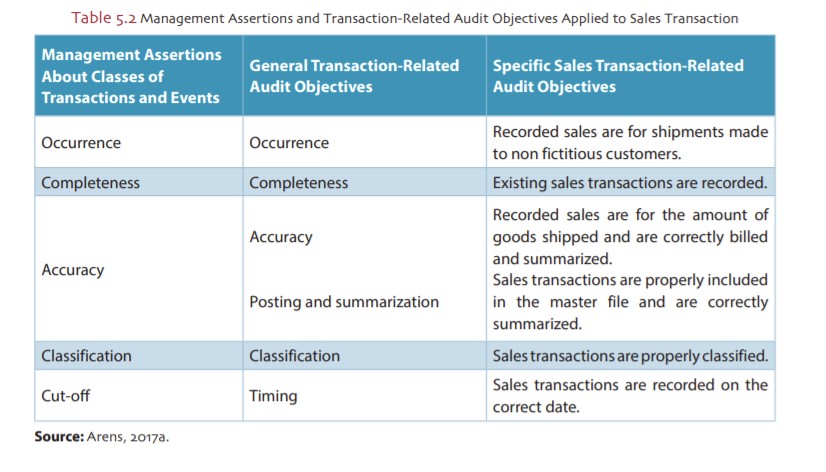 The answer is D.
Soru 5
Which of the following general balance-related audit objectives is about the agreement of inventory totals with the general ledger?
Seçenekler
A
Detail tie-in
B
Accuracy
C
Classification
D
Cut-off
E
Realizable value
Açıklama:
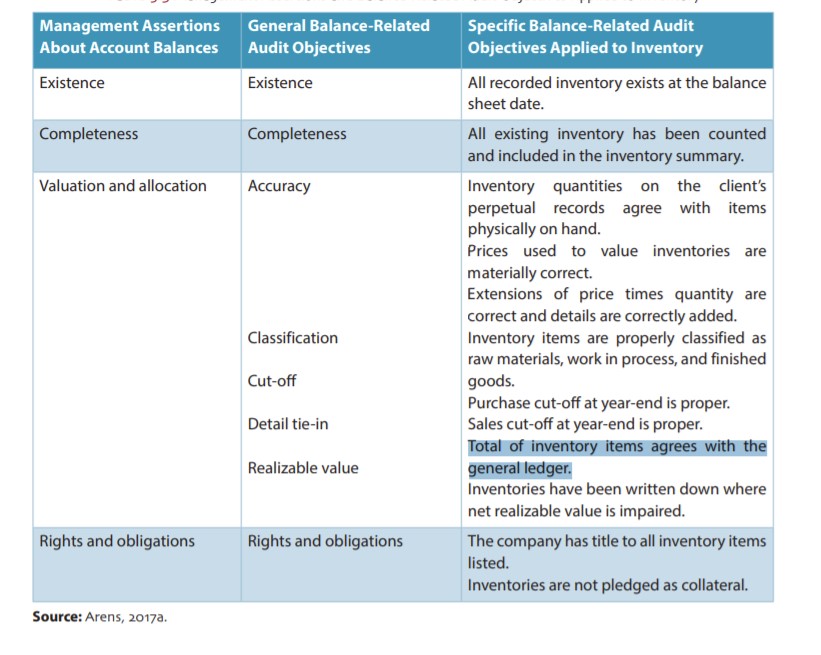
The answer is A.
Soru 6
Which of the followings are performed to determine the type and amount of further audit procedures necessary to form an opinion on the fairness of the financial statements?
Seçenekler
A
Risk assessment procedures
B
Tests of controls
C
Substantive tests of transactions
D
Substantive analytical procedures
E
Tests of details of balances
Açıklama:
Risk Assessment Procedures is an audit procedure to assess the risk that material misstatement exists. They are used to determine the type and amount of further audit procedures necessary to form an opinion on the fairness of the financial statements. The answer is A.
Soru 7
Which of the following audit procedures are carried out to measure the effectiveness of the design and operation of the internal control policies and procedures that should be available in the client business?
Seçenekler
A
Risk assessment procedures
B
Tests of controls
C
Substantive tests of transactions
D
Substantive analytical procedures
E
Tests of details of balances
Açıklama:
During the creation of the overall audit plan, the first stage of the audit process, and the preparation of the audit program, auditors use the following five types of audit tests to determine whether the financial statements are prepared fairly:
• Risk assessment procedures
• Tests of controls
• Substantive tests of transactions
• Substantive analytical procedures
• Tests of details of balances
Tests of controls are audit procedures to test the effectiveness of controls in support of a reduced assessed control risk. The answer is B.
• Risk assessment procedures
• Tests of controls
• Substantive tests of transactions
• Substantive analytical procedures
• Tests of details of balances
Tests of controls are audit procedures to test the effectiveness of controls in support of a reduced assessed control risk. The answer is B.
Soru 8
If an auditor wants to test monetary misstatements in the balances in the financial statements, which of the following analytical procedures will be used?
Seçenekler
A
Substantive analytical procedures
B
Risk assessment procedures
C
Tests of controls
D
Substantive tests of transactions
E
Tests of details of balances
Açıklama:
Tests of details of balances are specific procedures intended to test for monetary misstatements in the balances in the financial statements. The answer is E.
Soru 9
Which of the following is correct about the phases of financial statement audit?
Seçenekler
A
Analytical procedures and tests of details of balances are performed before tests of controls and substantive tests of transactions.
B
In the fourth and last phase, the auditor performs tests of controls to determine the effectiveness of the internal control system.
C
No matter how well the internal controls are, the amount of audit evidence to be accumulated has to be the same across organization for consistency and reliability.
D
Risk assessment procedures are carried out to measure the effectiveness of the design and operation of the internal control policies and procedures.
E
Compliance tests are performed as one of the analytical procedures after deciding on the audit approach.
Açıklama:
All statements, expect for in the fourth and last phase, the auditor performs tests of controls to determine the effectiveness of the internal control system. The answer is C.
Soru 10
- Develop appropriate tests of controls for all internal controls that are used to reduce the preliminary assessment of control risk below maximum.
- Apply the transaction-related audit objectives to the class of transactions being tested, such as sales.
- For potential types of misstatements related to each transaction-related audit objective, design appropriate substantive tests of transactions.
- Identify key controls that should reduce control risk for each transaction-related audit objective.
In which of the following is the four-step approach to reduce assessed control risk given in correct order?
Seçenekler
A
I, II, III, IV
B
II, IV, I, III
C
I, III, IV, II
D
II, I, IV, III
E
III, II, IV, I
Açıklama:
Auditors follow a four-step approach to reduce assessed control risk (Arens, 2017b):
The answer is B.
- Apply the transaction-related audit objectives to the class of transactions being tested, such as sales.
- Identify key controls that should reduce control risk for each transaction-related audit objective.
- Develop appropriate tests of controls for all internal controls that are used to reduce the preliminary assessment of control risk below maximum.
- For potential types of misstatements related to each transaction-related audit objective, design appropriate substantive tests of transactions.
The answer is B.
Soru 11
Which of the following is not one of the steps to develop audit objectives?
Seçenekler
A
Understand objectives and responsibilities for the audit
B
Understand financial statements thoroughly
C
Know management assertions about financial statements
D
Know general audit objectives for classes of transactions, accounts, and disclosures
E
Know specific audit objectives for classes of transactions, accounts, and disclosures
Açıklama:
MANAGEMENT ASSERTIONS AND AUDIT OBJECTIVES
Steps to develop audit objectives (Arens, 2017a)
Steps to develop audit objectives (Arens, 2017a)
- Understand objectives and responsibilities for the audit
- Divide financial statements into cycles
- Know management assertions about financial statements
- Know general audit objectives for classes of transactions, accounts, and disclosures
- Know specific audit objectives for classes of transactions, accounts, and disclosures
Soru 12
_________________________ are the claims made by the management of the company on financial statements.
Seçenekler
A
Management assertions
B
Responsibilities for the audit
C
Financial statements
D
Account balances
E
Audit objectives
Açıklama:
MANAGEMENT ASSERTIONS AND AUDIT OBJECTIVES
Management assertions are the claims made by the management of the company on financial statements.
Management assertions are the claims made by the management of the company on financial statements.
Soru 13
“Transactions and events have been recorded in the proper accounts”.
Which management assertion is described by the above sentence?
Which management assertion is described by the above sentence?
Seçenekler
A
Presentation
B
Occurrence
C
Existence
D
Classification
E
Completeness
Açıklama:
MANAGEMENT ASSERTIONS AND AUDIT OBJECTIVES
1. Management Assertions About Transactions and Events and Related Disclosures
Six management assertions are related to classes of transactions and events and related disclosures, for the period under audit.
1. Management Assertions About Transactions and Events and Related Disclosures
Six management assertions are related to classes of transactions and events and related disclosures, for the period under audit.
- Occurrence-transactions and events that have been recorded have occurred and pertain to the entity
- Completeness-all transactions and events that should have been recorded have been recorded.
- Cutoff-transactions and events have been recorded in the correct accounting period.
- Accuracy-amounts and other data relating to recorded transactions and events have been recorded appropriately.
- Classification-transactions and events have been recorded in the proper accounts.
Soru 14
Which of the following is not one of the general transaction-related audit objectives?
Seçenekler
A
Occurrence-Recorded transactions exist
B
Completeness-Existing transactions are recorded
C
Accuracy-Recorded transactions are stated at the correct amounts
D
Posting and Summarization-Recorded transactions are properly included in the master files and are correctly summarized
E
Tailoring - The specific transaction related objectives are defined
Açıklama:
MANAGEMENT ASSERTIONS AND AUDIT OBJECTIVES
General Transaction-Related Audit Objectives-Six general transaction-related audit objectives are as follows.
General Transaction-Related Audit Objectives-Six general transaction-related audit objectives are as follows.
- Occurrence-Recorded transactions exist.
- Completeness-Existing transactions are recorded.
- Accuracy-Recorded transactions are stated at the correct amounts.
- Posting and Summarization-Recorded transactions are properly included in the master files and are correctly summarized.
- Classification-Transactions included in the client’s journals are properly classified.
- Timing-Transactions are recorded on the correct dates.
Soru 15
I. They show the ways and methods to be followed to obtain audit evidence during the audit task.
II. They can be applied at different stages of the audit together or alone.
III. They consist of risk assessment procedures, tests of controls, substantive tests of transactions, substantive analytical procedures, and tests of details of balances.
Which term is described by the above sentences?
II. They can be applied at different stages of the audit together or alone.
III. They consist of risk assessment procedures, tests of controls, substantive tests of transactions, substantive analytical procedures, and tests of details of balances.
Which term is described by the above sentences?
Seçenekler
A
Audit tests
B
Rights and obligations
C
Balance-related audit objectives
D
Financial statement assertions
E
Audit assertions
Açıklama:
Audit tests show the ways and methods to be followed to obtain audit evidence during the audit task. These tests can be applied at different stages of the audit together or alone. Audit tests consist of risk assessment procedures, tests of controls, substantive tests of transactions, substantive analytical procedures, and tests of details of balances.
Soru 16
The independent auditor should collect sufficient and appropriate ___________ by performing audit procedures.
Seçenekler
A
link
B
purpose
C
evidence
D
finance
E
objective
Açıklama:
Audit Tests
The independent auditor should collect sufficient and appropriate evidence by performing audit procedures.
The independent auditor should collect sufficient and appropriate evidence by performing audit procedures.
Soru 17
“In this phase, an audit approach is designed to collect sufficient and reliable evidence at the lowest cost. In order to estimate the risks of misstatement in the financial statements and to interpret the information obtained during the audit, information is obtained about the client’s business and its line of business. In addition, the internal control system of the business is examined and information about the internal control system is collected. At the same time, control risks are assessed”.
Which phase of a financial statement audit is described by the above sentences?
Which phase of a financial statement audit is described by the above sentences?
Seçenekler
A
Plan and design an audit approach
B
Perform tests of controls and substantive tests of transactions
C
Perform analytical procedures and tests of details of balances
D
Complete the audit and issue an audit report
E
Make management assertions on financial statements
Açıklama:
Audit Tests
Phase 1: Plan and design an audit approach based on risk assessment procedures
Phase 2: Perform tests of controls and substantive tests of transactions
Phase 3: Perform analytical procedures and tests of details of balances
Phase 4: Complete the audit and issue an audit report
Phase 1: Plan and design an audit approach based on risk assessment procedures
Phase 2: Perform tests of controls and substantive tests of transactions
Phase 3: Perform analytical procedures and tests of details of balances
Phase 4: Complete the audit and issue an audit report
Soru 18
Which of the following is not one of audit tests to determine whether the financial statements are prepared fairly or not?
Seçenekler
A
Risk assessment procedures
B
Tests of controls
C
Substantive tests of transactions
D
Substantive analytical procedures
E
Tests of whole balances
Açıklama:
Audit Tests
Risk assessment procedures • Tests of controls • Substantive tests of transactions • Substantive analytical procedures • Tests of details of balances
Risk assessment procedures • Tests of controls • Substantive tests of transactions • Substantive analytical procedures • Tests of details of balances
Soru 19
To obtain sufficient appropriate evidence to support a reduced assessment of control risk, the auditor (Arens, 2017b) does the following except ______________________________.
Seçenekler
A
making inquiries of appropriate client business’ personnel
B
examining documents, records, and reports
C
using risk assessment procedures to assess the risk that material misstatement exists
D
observing implementation of control-related activities
E
reperforming implementation of control procedures by the auditor
Açıklama:
Audit Tests
To obtain sufficient appropriate evidence to support a reduced assessment of control risk, the auditor (Arens, 2017b): • Make inquiries of appropriate client business’ personnel • Examine documents, records, and reports • Observe implementation of control-related activities • Reperform implementation of control procedures by the auditor.
To obtain sufficient appropriate evidence to support a reduced assessment of control risk, the auditor (Arens, 2017b): • Make inquiries of appropriate client business’ personnel • Examine documents, records, and reports • Observe implementation of control-related activities • Reperform implementation of control procedures by the auditor.
Soru 20
“They are the audit procedures testing for monetary misstatements to determine whether the six transaction related audit objectives have been satisfied for each class of transactions”.
Which term is described by the above sentence?
Which term is described by the above sentence?
Seçenekler
A
Substantive Tests of Transactions
B
Dual purpose tests
C
Tests of controls
D
Substantive analytical procedures
E
Tests of details of balances
Açıklama:
Audit Tests
Substantive tests of transactions: audit procedures testing for monetary misstatements to determine whether the six transaction related audit objectives have been satisfied for each class of transactions.
Substantive tests of transactions: audit procedures testing for monetary misstatements to determine whether the six transaction related audit objectives have been satisfied for each class of transactions.
Ünite 6
Soru 1
Which of the following statements about the evidence to be collected by the auditor is correct?
Seçenekler
A
A large portion of supporting evidence is obtained from those outside the business.
B
The evidence to be collected by the auditor is divided into four according to the source.
C
Spreadsheet, journal, ledger, auxiliary ledger are examples of supporting evidence.
D
The accounting records are highly reliable source of information.
E
The reliability of evidence from people outside the business is very low.
Açıklama:
The evidence to be collected by the auditor is divided into two according to the source. These are evidence from the accounting records and supporting evidence. As is known, the accounting record environment within the enterprise refers to all the accounting information available in the enterprise. As an example of the audit evidence in the accounting recording environment; spreadsheet, journal, ledger, auxiliary ledger, accounting handbook, calculations, electronic funds transfer records, cost distributions and reconciliations can be shown. The accounting information available in the accounting record environment is the evidence available to the auditor. This information forms the basis of the financial statements of the client business and it is mandatory to audit these audit evidences. However, this evidence cannot be considered to be completely reliable. Therefore, the auditor has to investigate the reliability of this evidence. This research is done by collecting supporting evidence. While some of the supporting evidence is obtained from the client’s business, a large portion of it is obtained from those outside the business. The reliability of evidence from people outside the business is very high. The correct answer is A.
Soru 2
Which of the following types of evidence is for auditors to compare the data of the audited company with the data of previous years or the data of similar enterprises in the sector and to investigate the relationships between them?
Seçenekler
A
Physical Evidence
B
Written Notifications
C
Analytical Evidence
D
Documented Evidence
E
Third Party Statements
Açıklama:
Analytical Evidence is for auditors to compare the data of the audited company with the data of previous years or the data of similar enterprises in the sector and to investigate the relationships between them. The answer is C.
Soru 3
Which of the following types of auditing investigates whether the events that cause a value movement in the enterprise are reflected in the accounting records based on documents and whether the accounting is kept in accordance with the formal conditions of the generally accepted accounting principles?
Seçenekler
A
Backward Audit
B
Continuous Audit
C
Direct Audit
D
Indirect Audit
E
Form Audit
Açıklama:
A form audit is a way of auditing to investigate the conformity of accounting held in an enterprise in terms of form. In the audit of the form, it is investigated whether the events that cause a value
movement in the enterprise are reflected in the accounting records based on documents and whether the accounting is kept in accordance with the formal conditions of the generally accepted accounting principles. The answer is E.
movement in the enterprise are reflected in the accounting records based on documents and whether the accounting is kept in accordance with the formal conditions of the generally accepted accounting principles. The answer is E.
Soru 4
- Physical Examination and Counting
- Arithmetic examination
- Control of amount transfers
- Inspection
Seçenekler
A
I and IV
B
II, III and IV
C
II and III
D
I, III and IV
E
I, II and IV
Açıklama:
Main audit processes are comparison process, audit of the amount transfers, the arithmetic examination and the document review. The answer is C.
Soru 5
Which of the following evidence collection techniques is the opposite of re-monitoring the recording system?
Seçenekler
A
analytical procedures and confirmation
B
document review
C
inspection
D
observation of inventory count
E
physical examination and counting
Açıklama:
Document review is the auditor’s examination of internal or external records and documents, which form the basis of the subject being audited and are kept in paper, electronic or other media. Document review is the opposite of the technique of re-monitoring the recording system. The answer is B.
Soru 6
Which of the following evidence collection techniques is defined as the research and review of meaningful relationships that are considered to exist between the data in the financial statements?
Seçenekler
A
recalculation
B
investigation
C
inspection
D
analytical procedures
E
re-performance
Açıklama:
Analytical procedures are the research and review of meaningful relationships that are considered to exist between the data in the financial statements. The answer is D.
Soru 7
Which of the following analytical procedures is conducted in order to estimate other data as a variable by considering some data belonging to the business?
Seçenekler
A
Recalculation
B
Trend Analysis
C
Logicality Analysis
D
Comparative Financial Statement Analysis
E
Ratio Analysis
Açıklama:
Logicality Analysis (Rationality Tests) is conducted to estimate other data as a variable by considering some data belonging to the business. The answer is C.
Soru 8
Which management assertion is the expression of ”transactions and events are recorded in appropriate accounts"?
Seçenekler
A
Periodicity
B
Rights and Obligations
C
Completeness
D
Realization
E
Classification
Açıklama:
The assertions regarding the types of transactions and events in the period under audit are as
follows:
follows:
- Reality (Existence): The recorded transactions and events occurred in the enterprise.
- Completeness: All transactions and events are reflected in the records.
- Ownership: The information in the financial statements belongs to the business.
- Valuation: Valuation of the items in the financial statements has been made correctly.
- Classification: Transactions and events are recorded in appropriate accounts.
- Periodicity: Transactions and events are recorded in the correct accounting period.
- Accuracy: Quantities and other data related to the recorded transactions and events are correct, properly recorded.
- Explanation: Adequate explanation has been made about the items in the financial statements.
Soru 9
Which of the following documents can be given as examples of the main working papers to be in the permanent file?
Seçenekler
A
Financial Statements
B
Working Tables
C
Accounting Handbook
D
Work Flow Charts
E
Correspondence
Açıklama:
Permanent file is the file in which the auditor puts the working papers to be used not only in the
relevant audit year, but also in the following years. In other words, these are the files where the working papers containing the information used in more than one period are kept. These types of files provide serious preliminary preparation and convenience in subsequent audits. The following documents can be given as examples of the main working papers to be in the permanent file:
• Information About Customer Business,
• Information About Industry of the Customer Enterprise,
• Enterprise’s Articles of Association,
• Organization Chart,
• Contracts,
• Deals,
• Attorney,
• Signature Example (Circus),
• Statistical Information,
• Account Plan,
• Accounting Handbook,
• Board of Directors Meeting Minutes an
• Annual Reports,
• Copies of Tax Declarations,
• Financial Statements for Previous Years,
• Audit Reports for Previous Years,
• Files of Information Provided to the Public Oversight Board.
The answer is C.
relevant audit year, but also in the following years. In other words, these are the files where the working papers containing the information used in more than one period are kept. These types of files provide serious preliminary preparation and convenience in subsequent audits. The following documents can be given as examples of the main working papers to be in the permanent file:
• Information About Customer Business,
• Information About Industry of the Customer Enterprise,
• Enterprise’s Articles of Association,
• Organization Chart,
• Contracts,
• Deals,
• Attorney,
• Signature Example (Circus),
• Statistical Information,
• Account Plan,
• Accounting Handbook,
• Board of Directors Meeting Minutes an
• Annual Reports,
• Copies of Tax Declarations,
• Financial Statements for Previous Years,
• Audit Reports for Previous Years,
• Files of Information Provided to the Public Oversight Board.
The answer is C.
Soru 10
Which of the following sampling risks is defined as "although the sample results chosen by the auditor indicate that there is no material error in the remaining accounts, there is a risk of material errors in the remaining accounts"?
Seçenekler
A
Theta Risk
B
Wrong Rejection Risk
C
Beta Risk
D
Alpha Risk
E
Wrong Acceptance Risk
Açıklama:
Sampling risk can occur in four different ways: alpha risk, beta risk, false rejection risk, and false
acceptance risk. Alpha risk, beta risk, false rejection risk and false acceptance risk can be briefly
defined as follows (Selimoğlu, 2012):
• Alpha Risk; although the internal control system in the business is reliable enough, the independent auditor concludes that the internal control system is not reliable by looking at the results obtained from the sample.
• Beta Risk; although the internal control system in the enterprise is not reliable enough, the
independent auditor concludes that the internal control system is reliable by looking at the results obtained from the sample.
• Wrong Rejection Risk; although the sample results selected by the auditor indicate that there is
a material error in the remaining accounts, there is a risk of no material errors in the remaining
accounts.
• Wrong Acceptance Risk; although the sample results chosen by the auditor indicate that there
is no material error in the remaining accounts, there is a risk of material errors in the remaining
accounts.
The answer is E.
acceptance risk. Alpha risk, beta risk, false rejection risk and false acceptance risk can be briefly
defined as follows (Selimoğlu, 2012):
• Alpha Risk; although the internal control system in the business is reliable enough, the independent auditor concludes that the internal control system is not reliable by looking at the results obtained from the sample.
• Beta Risk; although the internal control system in the enterprise is not reliable enough, the
independent auditor concludes that the internal control system is reliable by looking at the results obtained from the sample.
• Wrong Rejection Risk; although the sample results selected by the auditor indicate that there is
a material error in the remaining accounts, there is a risk of no material errors in the remaining
accounts.
• Wrong Acceptance Risk; although the sample results chosen by the auditor indicate that there
is no material error in the remaining accounts, there is a risk of material errors in the remaining
accounts.
The answer is E.
Soru 11
What is the basis of the independent audit process?
Seçenekler
A
Collecting evidence
B
Distributing evidence
C
Justifying evidence
D
Verifying evidence
E
Listing evidence
Açıklama:
The book says "Collecting evidence is the basis of the independent audit process. An independent auditor collects evidence to give reasonable assurance whether an entity’s financial statements are fairly fair in accordance with accounting standards".
Soru 12
I. Audit evidence is the information used by the auditor.
II. Audit evidence helps auditor reach conclusion.
III. Audit evidence forms the basis of the financial statement.
IV. Audit evidence defines auditor's personal opinion.
Which of the information above is true about audit evidence?
II. Audit evidence helps auditor reach conclusion.
III. Audit evidence forms the basis of the financial statement.
IV. Audit evidence defines auditor's personal opinion.
Which of the information above is true about audit evidence?
Seçenekler
A
I, II
B
III, IV
C
I, III, IV
D
I, II, III
E
II, III, IV
Açıklama:
In the book, audit evidence is defined using the statements in I, II, III. Audit evidence can be defined as any information, document and record used by the auditor to determine ... all information used by the auditor in reaching the conclusions based on his opinion is audit evidence. Audit evidence includes the information in the accounting records, which form the basis of the financial statements, and other information.
Soru 13
I. Spreadsheet
II. Ledger
III. Accounting handbook
IV. Accountant's personal notes
V. Cost distributions
Which of the above are the examples of the audit evidence?
II. Ledger
III. Accounting handbook
IV. Accountant's personal notes
V. Cost distributions
Which of the above are the examples of the audit evidence?
Seçenekler
A
I, II, II, IV, V
B
Only I
C
II, III, V
D
I, III, IV
E
I, II, III, V
Açıklama:
Spreadsheet, journal, ledger, auxiliary ledger, accounting handbook, calculations, electronic funds transfer records, cost distributions and reconciliations are given as the examples of audit evidence. Therefore, accountant's personal notes can not be considered among the examples.
Soru 14
In which audit method all the records are thoroughly examined within a specific activity period?
Seçenekler
A
Form Audit
B
Continuous Audit
C
Forward Audit
D
Forward Audit and Continous Audit
E
Direct Audit and Form Audit
Açıklama:
Continuous audit is defined as "the review of the records and documents related to all transactions within a time section. The auditor, who performs continuous audits, thoroughly examines all records and documents during the activity period". therefore the correct answer is B.
Soru 15
Which audit procedure is related to the transfer of an amount?
Seçenekler
A
Comparison process
B
Audit of Amount Transfer
C
Arithmetic Examinations
D
Document Review
E
Document Review and Arithmetic Examinations
Açıklama:
According to the book, audit process performed to prevent the transfer of an amount from one place to another incorrectly or to transfer the correct amount to the wrong account is under the Audit of amount transfer.
Soru 16
Which of the evidence collection techniques provide mathematical evidence and supporting oral evidence?
Seçenekler
A
Physical evidence and examination
B
Observation and Observation of Inventory Count
C
Recalculation and Investigation
D
Recalculation and Re-monitoring
E
Inspection and Analytical Procedures
Açıklama:
Recalculation is the evidence collection technique that provides mathematical evidence and is used in conjunction with other audit processes in the evaluation of financial information. Recalculation informs the auditor about the arithmetic accuracy of an amount. In addition to the arithmetic accuracy, supporting oral evidence is collected through the investigation technique.
Soru 17
Which of the procedure considers the meaningful relationships between financial and non-financial data?
Seçenekler
A
Analytical procedures
B
Document Review
C
Inspection
D
Confirmation
E
Ratio Analysis
Açıklama:
Analytical procedures refers to the evaluation of financial information by analyzing meaningful relationships between financial and non-financial data.
Soru 18
I. Audit evidence obtained directly by the auditor is as reliable as the evidence obtained by inference.
II. Audit evidence obtained orally is more reliable than audit evidence obtained in physical form.
III. Audit evidence obtained orally is less reliable than audit evidence obtained in physical form.
IV. Audit evidence obtained directly by the auditor is more reliable than the evidence obtained indirectly.
V. Audit evidence obtained from electronic documents is as reliable as audit evidence obtained from the original.
Which of the above is/are true?
II. Audit evidence obtained orally is more reliable than audit evidence obtained in physical form.
III. Audit evidence obtained orally is less reliable than audit evidence obtained in physical form.
IV. Audit evidence obtained directly by the auditor is more reliable than the evidence obtained indirectly.
V. Audit evidence obtained from electronic documents is as reliable as audit evidence obtained from the original.
Which of the above is/are true?
Seçenekler
A
I, III, IV
B
II, III, IV
C
III, IV
D
I, V
E
I, II, III, V
Açıklama:
Audit evidence obtained directly by the auditor is more reliable than audit evidence obtained indirectly or by inference.
• Audit evidence in physical or electronic form, or audit evidence in the form of documents in another environment, is more reliable than audit evidence obtained orally.
• Audit evidence obtained from the original of a document is more reliable than audit evidence obtained from photocopies and electronic documents.
• Audit evidence in physical or electronic form, or audit evidence in the form of documents in another environment, is more reliable than audit evidence obtained orally.
• Audit evidence obtained from the original of a document is more reliable than audit evidence obtained from photocopies and electronic documents.
Soru 19
In which case is the evidence considered objective?
Seçenekler
A
When there are differences among the auditors' comments about a transaction.
B
When the auditors strongly defend their own comments about a transaction.
C
When there is a court decision about a transaction.
D
When all the auditors reach the same conclusion about a transaction.
E
When majority of the auditors reach the same conclusion about a transaction.
Açıklama:
The objectivity of the evidence is that all auditors reach the same conclusion about a transaction. Accordingly, if two different auditors reach the same opinions based on the same evidence, that evidence is objective. If the Auditing comments of different people acting from the same evidence differ from each other, that evidence is not objective.
Soru 20
I. Documenting the audit processes
II. Creating evidence that the auditor is honest.
III. Providing evidence about the international standards on auditing.
IV. Providing evidence on the background of the auditor.
Which of the above is/are among the benefits of working papers of an audit activity?
II. Creating evidence that the auditor is honest.
III. Providing evidence about the international standards on auditing.
IV. Providing evidence on the background of the auditor.
Which of the above is/are among the benefits of working papers of an audit activity?
Seçenekler
A
I, II,
B
I, III
C
I, IV
D
II, III
E
II, IV
Açıklama:
Some of the benefits of working papers are:
• Documenting the audit processes and the results obtained,
• To create evidence that the audit is conducted in accordance with the relevant legal regulations,
• To indicate compliance with generally accepted auditing standards and international standards on auditing,
• To assist in the evaluation of the internal control system,
• To ensure that the audit is maintained properly,
• Helping the auditor to form an opinion,
• To constitute the basis for the preparation of the audit report,
• Documenting the audit processes and the results obtained,
• To create evidence that the audit is conducted in accordance with the relevant legal regulations,
• To indicate compliance with generally accepted auditing standards and international standards on auditing,
• To assist in the evaluation of the internal control system,
• To ensure that the audit is maintained properly,
• Helping the auditor to form an opinion,
• To constitute the basis for the preparation of the audit report,
Soru 21
What does GAAS stand for in the context of auditing?
Seçenekler
A
Generally Accepted Auditing Standards
B
Global Auditing Acceptance Scale
C
General Area Audit Scale
D
Global Association of Auditing Society
E
Global Arrangement of Auditing Sanctions
Açıklama:
GAAS stands for Generally Accepted Auditing Standards in the context of auditing.
Soru 22
Choose the option that completes the following statement correctly.
".......... is any information, document and record used by the auditor to determine the degree of compliance of the audited information with the predetermined criteria."
".......... is any information, document and record used by the auditor to determine the degree of compliance of the audited information with the predetermined criteria."
Seçenekler
A
International standard
B
Auditing evidence
C
General scale
D
Related concern
E
Workspace design
Açıklama:
Auditing evidence is any information, document and record used by the auditor to determine the degree of compliance of the audited information with the predetermined criteria.
Soru 23
What does ISA stand for in the context of auditing?
Seçenekler
A
Inclusive Scale of Auditing
B
Incorporation Scale on Auditing
C
Issued Standards of Auditing
D
International Standards on Auditing
E
Industrial Scale on Auditing
Açıklama:
ISA stands for International Standards on Auditing in the context of auditing.
Soru 24
Choose the option that completes the following statement correctly.
"The evidence to be collected by the auditor is divided into two according to the source. These are evidence from the accounting records and ..........."
"The evidence to be collected by the auditor is divided into two according to the source. These are evidence from the accounting records and ..........."
Seçenekler
A
audit device
B
audit standards
C
supporting evidence
D
international records
E
financial scale
Açıklama:
The evidence to be collected by the auditor is divided into two according to the source. These are evidence from the accounting records and supporting evidence.
Soru 25
Which of the following is NOT one of the categories of supporting evidence?
Seçenekler
A
physical evidence
B
standardized evidence
C
analytical evidence
D
business employee statements
E
third-party statements
Açıklama:
Supporting evidence can be categorized as; third-party statements, business employee statements, analytical evidence, documented evidence, arithmetic evidence, and physical evidence.
Soru 26
Choose the option that completes the following statement correctly.
".......... is obtained through the renewal of the process. It is the confirmation of the correctness of the calculations related to the subject they are investigating. "
".......... is obtained through the renewal of the process. It is the confirmation of the correctness of the calculations related to the subject they are investigating. "
Seçenekler
A
Arithmetic Evidence
B
Documented Evidence
C
Physical Evidence
D
Analytical Evidence
E
Written Notification
Açıklama:
Arithmetic Evidence is obtained through the renewal of the process. It is the confirmation of the correctness of the calculations related to the subject they are investigating.
Soru 27
Which of the following is NOT one of the main evidence collection techniques?
Seçenekler
A
Physical Examination and Countin
B
Observatio
C
Observation of Inventory Count
D
Sharing Anectodes
E
Recalculation
Açıklama:
The main evidence collection techniques are:
• Physical Examination and Counting,
• Observation,
• Observation of Inventory Count,
• Recalculation,
• Investigation (Inquiries of the Client),
• Inspection,
• Re-Monitoring the Recording System (Re-Performance),
• Document Review,
• Analytical Procedures,
• Confirmation (External Confirmation)
• Physical Examination and Counting,
• Observation,
• Observation of Inventory Count,
• Recalculation,
• Investigation (Inquiries of the Client),
• Inspection,
• Re-Monitoring the Recording System (Re-Performance),
• Document Review,
• Analytical Procedures,
• Confirmation (External Confirmation)
Soru 28
Choose the option that completes the following statement correctly.
".......... is the confirmation of arithmetic operations such as addition, subtraction, division and multiplication by the auditor."
".......... is the confirmation of arithmetic operations such as addition, subtraction, division and multiplication by the auditor."
Seçenekler
A
Inventory counting
B
Observation
C
Recalculation
D
Physical examination
E
Inspection
Açıklama:
Recalculation is the confirmation of arithmetic operations such as addition, subtraction, division and multiplication by the auditor.
Soru 29
Choose the option that completes the following statement correctly.
".......... are the research and review of meaningful relationships that are considered to exist between the data in the financial statements."
".......... are the research and review of meaningful relationships that are considered to exist between the data in the financial statements."
Seçenekler
A
Inspections
B
Analytical Procedures
C
Re-Monitoring the Recording Systems
D
Document Reviews
E
Confirmations
Açıklama:
Analytical procedures are the research and review of meaningful relationships that are considered to exist between the data in the financial statements.
Soru 30
Choose the option that completes the following statement correctly.
"The .......... is that a logical relationship can be established between the evidence to be collected and the purpose of the audit."
"The .......... is that a logical relationship can be established between the evidence to be collected and the purpose of the audit."
Seçenekler
A
time of the evidence
B
source of the evidence
C
objectivity of the evidence
D
validity of the evidence
E
standard of the evidence
Açıklama:
The validity of the evidence is that a logical relationship can be established between the evidence to be collected and the purpose of the audit.
Ünite 7
Soru 1
Which of the following is NOT one of the four main phases in an audit process?
Seçenekler
A
Client acceptance
B
Procedural meetings
C
Planning
D
testing and evidence
E
Completing the audit
Açıklama:
There are four main phases in an audit process. These phases are:
There are four main phases in an audit process. These phases are:
- client acceptance,
- planning,
- testing and evidence and
- completing the audit and reporting.
There are four main phases in an audit process. These phases are:
- client acceptance,
- planning,
- testing and evidence and
- completing the audit and reporting.
Soru 2
Which of the following is NOT contingent liability?
Seçenekler
A
Sales taxes
B
Pending litigation
C
Income tax disputes
D
Guarantees
E
Warranty payable
Açıklama:
Common examples of contingent liabilities are; pending litigation, income tax disputes, guarantees, and warranty payable etc.
Soru 3
Which of the following is NOT a part of final evaluation procedures auditors perform?
Seçenekler
A
performs final analytical procedures
B
reviews the sufficiency of evidence
C
reviews working papers
D
evaluates the company’s ability of going concern
E
reviews contingent liabilities
Açıklama:
Auditors perform final evaluation procedures before preparing the audit report. For this purpose, the auditor performs final analytical procedures, reviews the sufficiency of evidence and working papers, and evaluates the company’s ability of going concern. At this stage the auditor also asks for a letter of representation from the management of the company.
Soru 4
What is the time period for keeping all documents related to the audit work according to Independent Audit Regulation in Turkey?
Seçenekler
A
four years
B
five years
C
seven years
D
ten years
E
twelve years
Açıklama:
In Turkey, Independent Audit Regulation states that the audit institutions have to keep their commercial books, the audit reports issued, including those kept in electronic, magnetic, and similar environments, together with their attachments, and all documents related to the audit work and the quality control system for a period of ten years.
Soru 5
Which International Standards for Auditing (ISA) relates to Subsequent Events?
Seçenekler
A
ISA 560
B
ISA 700
C
ISA 550
D
ISA 805
E
ISA 300
Açıklama:
ISA 560 Subsequent Events requires that all events up to the date of the auditor’s report should be identified and included in the financial reports accordingly.
Soru 6
Which International Standards for Auditing (ISA) relates to Related Parties?
Seçenekler
A
ISA 560
B
ISA 700
C
ISA 550
D
ISA 805
E
ISA 300
Açıklama:
ISA 550 Related Parties suggests that transactions with these parties may give rise to a high risk of material misstatement.
Soru 7
Which International Standards for Auditing (ISA) requires the auditor’s report to be dated no earlier than the date on which the auditor has obtained sufficient appropriate evidence on which to base the auditor’s opinion on the financial statements?
Seçenekler
A
ISA 560
B
ISA 700
C
ISA 550
D
ISA 805
E
ISA 300
Açıklama:
ISA 700 requires the auditor’s report to be dated no earlier than the date on which the auditor has obtained sufficient appropriate evidence on which to base the auditor’s opinion on the financial statements.
Soru 8
Which International Standards for Auditing (ISA) relates to Going Concern?
Seçenekler
A
ISA 560
B
ISA 700
C
ISA 550
D
ISA 570
E
ISA 300
Açıklama:
International Standard on Auditing (ISA) 570 Going Concern, emphasizes that the auditor must examine the appropriateness of the going concern assumption.
Soru 9
Which International Standards for Auditing (ISA) defines purposes of management representation letter?
Seçenekler
A
ISA 560
B
ISA 700
C
ISA 550
D
ISA 570
E
ISA 580
Açıklama:
According to ISA 580, Management representation letter has three main purposes
Soru 10
Which International Standards for Auditing (ISA) explains the responsibilities of auditors and reviewers about quality control procedures?
Seçenekler
A
ISA 560
B
ISA 220
C
ISA 550
D
ISA 570
E
ISA 580
Açıklama:
The responsibilities of auditors and reviewers about quality control procedures are explained in International Standard on Auditing (ISA) 220 Quality Control for an Audit of Financial Statements.
Soru 11
I. To review some part of the audit work
II. To review the audit work as a whole.
III. To get certain assurances from the customer
IV. To eliminate the problems
V. To check whether the corrections are appropriate.
Which of the above are among the purposes of 'complete the audit' procedures?
II. To review the audit work as a whole.
III. To get certain assurances from the customer
IV. To eliminate the problems
V. To check whether the corrections are appropriate.
Which of the above are among the purposes of 'complete the audit' procedures?
Seçenekler
A
I, II, III,
B
I, II, III, IV
C
II, III, V
D
III, IV, V
E
I, V
Açıklama:
The purpose of the “complete the audit” procedures is:
-to review the audit work as a whole,
-get certain assurances from the customer,
-reveal possible problems,
-check the appropriateness of the corrections if any
-to review the audit work as a whole,
-get certain assurances from the customer,
-reveal possible problems,
-check the appropriateness of the corrections if any
Soru 12
...........is an audit inquiry sent to the client’s attorneys in order to obtain or corroborate information about litigation, claims, and assessments.
Seçenekler
A
Legal letter
B
Minutes of meetings
C
Reports of meetings
D
Observation reports
E
Personal letters
Açıklama:
Legal letter is an audit inquiry sent to the client’s attorneys in order to obtain or corroborate information about litigation, claims, and assessments.
Soru 13
I. Inquiry of management
II. Inquiry of the minutes of meetings
III. Reading minutes of meetings
IV. Inquiry of legal council
V. Recognition of legal council
Which of the above does an auditor conduct as a subsequent event after the balance sheet date?
II. Inquiry of the minutes of meetings
III. Reading minutes of meetings
IV. Inquiry of legal council
V. Recognition of legal council
Which of the above does an auditor conduct as a subsequent event after the balance sheet date?
Seçenekler
A
I, III, IV
B
I, II, III
C
III, IV
D
Only I
E
Only III
Açıklama:
In order to gather evidence about subsequent events or events after the balance sheet date auditor conducts procedures like;- Inquiry of management,- - Reading minutes of meetings, and Inquiry of legal council.
Soru 14
What does an auditor do if material misstatements have been detected in the general evaluation?
Seçenekler
A
The auditor asks the client to make necessary adjustments in the financial statement.
B
The auditor suggests the client what to do to correct these misstatements.
C
The auditor cancels the whole auditing process.
D
The auditor corrects the misstatements.
E
The auditor takes legal actions.
Açıklama:
The book suggests that after general evaluation, the auditor asks the client’s management to make necessary adjustments in the financial statements if there are material misstatements.
Soru 15
What is going concern assumption?
Seçenekler
A
The auditor's being concerned with the company is going concern assumption.
B
A company's continuing business for an indefinite time in future is going concern assumption.
C
The company's being unable to continue business in future is going concern assumption.
D
The company's being concerned for his rivals is going concern assumption.
E
The company's having concern for its future is going concern assumption.
Açıklama:
Commonly financial statements are prepared under the going concern assumption. Under this assumption, a firm or a company is seen as a continuing business for the foreseeable future. This means that the company will be able to realize a positive return on its assets and discharge its liabilities in the normal course of business. According to this information, the company's continuing business in indefinite future is going concern assumption.
Soru 16
I. Net liability
II. Withdrawal of financial support
III. Inability to pay liabilities
IV. Ability to pay liabilities
V. Frequent replacement of key management
Which of the above is/are the signs of going concern risks?
II. Withdrawal of financial support
III. Inability to pay liabilities
IV. Ability to pay liabilities
V. Frequent replacement of key management
Which of the above is/are the signs of going concern risks?
Seçenekler
A
I, II, III, V
B
I, II, III, IV
C
II, IV, V
D
I, II, III
E
IV, V
Açıklama:
In the book, the common example of signs of going concern risks are stated as in the following:
1. Net liability,
2. Withdrawal of financial support by creditors,
3. Adverse key financial ratios,
4. Inability to pay liabilities,
5. Loss of key management without replacement.
1. Net liability,
2. Withdrawal of financial support by creditors,
3. Adverse key financial ratios,
4. Inability to pay liabilities,
5. Loss of key management without replacement.
Soru 17
What is a Management letter of representation?
Seçenekler
A
A letter written to the representations of the firm to inform the risks of going concern.
B
A letter written to the representations of the bank by the management about the going concern.
C
A letter written by the auditor to the management to formalize statements about matters of the audit.
D
A letter written by the shareholder to the management to agree with the principles of the auditing.
E
A letter written to the auditor to formalize statements that the client has made about matters of the audit.
Açıklama:
A Management letter of representation is defined as a written communication from the client to the auditor formalizing statements that the client has made about matters of the audit.
Soru 18
I. the information related to the rival firms.
II. issues that remain unsolved
III. modifications and additions to the financial statements
IV. the ways of increasing the liquidity capacity of the firm
V. significant internal control deficiencies
Which of the above does the auditor discuss once the audit phase is completed?
II. issues that remain unsolved
III. modifications and additions to the financial statements
IV. the ways of increasing the liquidity capacity of the firm
V. significant internal control deficiencies
Which of the above does the auditor discuss once the audit phase is completed?
Seçenekler
A
I, IV, V
B
II, III, IV
C
I, IV, V
D
II, III, V
E
Only IV
Açıklama:
According to book, at the completion of the audit phase, the auditor discusses;
-issues that remain unsolved if any,
-modifications and additions to the financial statements
-material misstatements, errors, and frauds
-significant internal control deficiencies and material weaknesses in the design or operation of internal control to the management.
-issues that remain unsolved if any,
-modifications and additions to the financial statements
-material misstatements, errors, and frauds
-significant internal control deficiencies and material weaknesses in the design or operation of internal control to the management.
Soru 19
I. enough money to build a company
II. sufficient experience
III. being objective
IV. being subjective
V. two university degrees on quality control review
Which of the above qualities should a quality control review have?
II. sufficient experience
III. being objective
IV. being subjective
V. two university degrees on quality control review
Which of the above qualities should a quality control review have?
Seçenekler
A
I, V
B
Only V
C
II, III, IV, V
D
II, III, IV
E
III, IV, V
Açıklama:
A quality control reviewer should have sufficient and appropriate experience and authority to objectively evaluate the significant judgments the engagement team made. Money and university degrees are not related to this issue.
Soru 20
What is an engagement quality control review?
Seçenekler
A
It is a process designed to evaluate the auditor and what the auditor does.
B
It is a process designed to provide an objective evaluation of the significant judgements the engagement team made. .
C
It is a process designed to object the significant changes made by the engagement team.
D
It is a process designed to evaluate the conclusions the auditor reached after auditing.
E
It is a process designed to object the decisions the auditor reached in the report.
Açıklama:
Engagement quality control review is a process designed to provide an objective evaluation, on or before the date of the auditor’s report, of the significant judgments the engagement team made and the conclusions it reached in formulating the auditor’s report.
Soru 21
Choose the option that completes the following statement correctly.
".......... is an existing condition, situation, or set of circumstances involving uncertainty as to possible loss to an entity that will ultimately be resolved when some future event occurs or fails to occur."
".......... is an existing condition, situation, or set of circumstances involving uncertainty as to possible loss to an entity that will ultimately be resolved when some future event occurs or fails to occur."
Seçenekler
A
Audit process
B
Contingent liability
C
Evaluation
D
Audit standard
E
Financial reporting
Açıklama:
Contingent liability is an existing condition, situation, or set of circumstances involving uncertainty as to possible loss to an entity that will ultimately be resolved when some future event occurs or fails to occur.
Soru 22
Choose the option that completes the following statement correctly.
".......... is an audit inquiry sent to the client’s attorneys in order to obtain or corroborate information about litigation, claims, and assessments."
".......... is an audit inquiry sent to the client’s attorneys in order to obtain or corroborate information about litigation, claims, and assessments."
Seçenekler
A
Legal letter
B
Contingent liability
C
Audit report
D
Evaluation of the audit
E
Transaction letter
Açıklama:
Legal letter is an audit inquiry sent to the client’s attorneys in order to obtain or corroborate information about litigation, claims, and assessments.
Soru 23
Which of the following is described as a transfer of resources, services, or obligations between related parties, regardless of whether a price is charged?
Seçenekler
A
Standard audit
B
Related party transction
C
Legal letter
D
Contingent liability
E
Subsequent event
Açıklama:
A related party transaction is described as a transfer of resources, services, or obligations between related parties, regardless of whether a price is charged in International Accounting Standard (IAS) 24 Related Party Disclosures.
Soru 24
Choose the option that completes the following statement correctly.
".......... are transactions and other pertinent events that occurred after the balance sheet date that affect the fair presentation or disclosure of the statements being audited."
".......... are transactions and other pertinent events that occurred after the balance sheet date that affect the fair presentation or disclosure of the statements being audited."
Seçenekler
A
Legal letters
B
Related party transactions
C
Contingent liabilities
D
Subsequent events
E
Audit standards
Açıklama:
Subsequent events are transactions and other pertinent events that occurred after the balance sheet date that affect the fair presentation or disclosure of the statements being audited.
Soru 25
Which of the following is a type of subsequent events?
Seçenekler
A
Transaction events
B
Adjusting events
C
Legal events
D
Audit events
E
Standard events
Açıklama:
Subsequent events are categorized under two main headings:
1. Type I: Adjusting events
2. Type II: Non-adjusting events
1. Type I: Adjusting events
2. Type II: Non-adjusting events
Soru 26
Which of the following can be described as the auditor’s record of the work performed and the conclusions reached on the audit?
Seçenekler
A
Audit transactions
B
Standard evaluation
C
Evidence scale
D
Working papers
E
Analytical audit
Açıklama:
Working papers can be described as the auditor’s record of the work performed and the conclusions reached on the audit.
Soru 27
In Turkey, Independent Audit Regulation states that the audit institutions have to keep their commercial books, the audit reports issued and all documents related to the audit work and the quality control system for a period of how many years?
Seçenekler
A
four
B
six
C
eight
D
ten
E
twelve
Açıklama:
In Turkey, Independent Audit Regulation states that the audit institutions have to keep their commercial books, the audit reports issued, including those kept in electronic, magnetic, and similar environments, together with their attachments, and all documents related to the audit work and the quality control system for a period of ten years.
Soru 28
Which of the folowing and ‘working papers’ are used interchangeably for the record of audit procedures performed, relevant audit evidence obtained, and conclusions the auditor reached?
Seçenekler
A
Audit documentation
B
Legal letter
C
Audit transaction
D
Standard evaluation
E
Evaluation scale
Açıklama:
‘Audit documentation’ and ‘working papers’ are used interchangeably for the record of audit procedures performed, relevant audit evidence obtained, and conclusions the auditor reached.
Soru 29
Choose the option that completes the following statement correctly.
"A .......... is a written communication from the client to the auditor formalizing statements that the client has made about matters pertinent to the audit."
"A .......... is a written communication from the client to the auditor formalizing statements that the client has made about matters pertinent to the audit."
Seçenekler
A
legal letter
B
management letter of representation
C
working paper
D
transaction
E
corporate scale
Açıklama:
Management letter of representation is a written communication from the client to the auditor formalizing statements that the client has made about matters pertinent to the audit.
Soru 30
Choose the option that completes the following statement correctly.
".......... is a process designed to provide an objective evaluation, on or before the date of the auditor’s report, of the significant judgments the engagement team made and the conclusions it reached in formulating the auditor’s report."
".......... is a process designed to provide an objective evaluation, on or before the date of the auditor’s report, of the significant judgments the engagement team made and the conclusions it reached in formulating the auditor’s report."
Seçenekler
A
Quality control and audit phase
B
International audit standards scale
C
Evaluation of final audit
D
Engagement quality control review
E
Evaluation of standardized review
Açıklama:
Engagement quality control review is a process designed to provide an objective evaluation, on or before the date of the auditor’s report, of the significant judgments the engagement </
Engagement quality control review is a process designed to provide an objective evaluation, on or before the date of the auditor’s report, of the significant judgments the engagement team made and the conclusions it reached in formulating the auditor’s report.
Engagement quality control review is a process designed to provide an objective evaluation, on or before the date of the auditor’s report, of the significant judgments the engagement team made and the conclusions it reached in formulating the auditor’s report.
Ünite 8
Soru 1
Which of the following opinion would an auditor express if the financial statements have been prepared using the going concern basis of accounting but, in the auditor’s judgment, management’s use of the going concern basis of accounting in the financial statements is inappropriate?
Seçenekler
A
Adverse opinion
B
Qualified opinion
C
Unqualified opinion
D
Neutral opinion
E
Disclaimer of opinion
Açıklama:
If the financial statements have been prepared using the going concern basis of accounting but,
in the auditor’s judgment, management’s use of the going concern basis of accounting in the financial statements is inappropriate, the requirement in paragraph 21 for the auditor to express an adverse opinion applies regardless of whether or not the financial statements include disclosure of the inappropriateness of management’s use of the going concern basis of accounting. The answer is A.
in the auditor’s judgment, management’s use of the going concern basis of accounting in the financial statements is inappropriate, the requirement in paragraph 21 for the auditor to express an adverse opinion applies regardless of whether or not the financial statements include disclosure of the inappropriateness of management’s use of the going concern basis of accounting. The answer is A.
Soru 2
- The appropriateness of the selected accounting policies
- The application of the selected accounting policies
- The appropriateness or adequacy of disclosures in the financial statements
Seçenekler
A
I
B
I and II
C
I and III
D
II and III
E
I, II and III
Açıklama:
A material misstatement of the financial statements may arise in relation to:
a. The appropriateness of the selected accounting policies;
b. The application of the selected accounting policies; or
c. The appropriateness or adequacy of disclosures in the financial statements.
The answer is E.
a. The appropriateness of the selected accounting policies;
b. The application of the selected accounting policies; or
c. The appropriateness or adequacy of disclosures in the financial statements.
The answer is E.
Soru 3
Which of the following deals with the auditor’s responsibility to communicate key audit matters in the auditor’s report?
Seçenekler
A
ISA 705 (Revised)
B
ISA 706 (Revised)
C
ISA 700
D
ISA 701
E
ISA 570
Açıklama:
ISA 701 deals with the auditor’s responsibility to communicate key audit matters in the auditor’s
report. The answer is D.
report. The answer is D.
Soru 4
Which of the following should be expressed when the auditor, having obtained sufficient appropriate audit evidence, concludes that misstatements, individually or in the aggregate, are material, but not pervasive, to the financial statements?
Seçenekler
A
Disclaimer of opinion
B
Adverse opinion
C
Qualified opinion
D
Unqualified opinion
E
Neutral opinion
Açıklama:
The auditor shall express a qualified opinion when the auditor, having obtained sufficient appropriate audit evidence, concludes that misstatements, individually or in the aggregate, are material, but not pervasive, to the financial statements. The answer is C.
Soru 5
- Limitations imposed by management
- Circumstances beyond the control of the auditor
- Circumstances relating to the nature or timing of the auditor’s work
Seçenekler
A
I
B
I and II
C
I and III
D
II and III
E
I, II and III
Açıklama:
The auditor’s inability to obtain sufficient appropriate audit evidence (also referred to as a limitation on the scope of the audit) may arise from:
a. Circumstances beyond the control of the entity;
b. Circumstances relating to the nature or timing of the auditor’s work; or
c. Limitations imposed by management. The answer is C.
a. Circumstances beyond the control of the entity;
b. Circumstances relating to the nature or timing of the auditor’s work; or
c. Limitations imposed by management. The answer is C.
Soru 6
Which of the following opinions should be expressed when the auditor is unable to obtain sufficient appropriate audit evidence on which to base the opinion, and the auditor concludes that the possible effects on the financial statements of undetected misstatements, if any, could be both material and pervasive?
Seçenekler
A
Adverse opinion
B
Qualified opinion
C
Unqualified opinion
D
Disclaimer of opinion
E
Adverse qualified opinion
Açıklama:
The auditor shall disclaim an opinion when the auditor is unable to obtain sufficient appropriate
audit evidence on which to base the opinion, and the auditor concludes that the possible effects
on the financial statements of undetected misstatements, if any, could be both material and
pervasive. The answer is D.
audit evidence on which to base the opinion, and the auditor concludes that the possible effects
on the financial statements of undetected misstatements, if any, could be both material and
pervasive. The answer is D.
Soru 7
- Adverse opinion
- Qualified opinion
- Unqualified opinion
- Disclaimer of opinion
- Adverse qualified opinion
Seçenekler
A
I, II and IV
B
III and V
C
II, III and V
D
II, III and IV
E
I, II, III, IV and V
Açıklama:
When the auditor modifies the audit opinion, the auditor shall use the heading “Qualified Opinion,”
“Adverse Opinion,” or “Disclaimer of Opinion,” as appropriate, for the Opinion section. The answer is A.
“Adverse Opinion,” or “Disclaimer of Opinion,” as appropriate, for the Opinion section. The answer is A.
Soru 8
In our opinion, the accompanying financial statements present fairly, in all material respects, the financial position of the Company as at 31 December 2020, and its financial performance and its cash flows for the year then ended in accordance with Turkish Financial Reporting Standards (TFRS)./Turkish Accounting Standards (TAS).
In which of the following reports are you likely to see the above opinion?
In which of the following reports are you likely to see the above opinion?
Seçenekler
A
Unqualified opinion
B
Adverse Opinion
C
Unmodified Opinion
D
Qualified Opinion
E
Disclaimer of Opinion
Açıklama:
We are more likely to see "In our opinion, the accompanying financial statements present fairly, in all material respects, the financial position of the Company as at 31 December 2020, and its financial performance and its cash flows for the year then ended in accordance with Turkish Financial Reporting Standards (TFRS)./Turkish Accounting Standards (TAS)." in report expressing an unmodified opinion. The answer is C.
Soru 9
- Basis for disclaimer of opinion,
- Responsibilities of Management and Those Charged with Governance
- Key Audit Matters
a listed entity, if disclaimer of opinion has been decided by the auditor?
Seçenekler
A
Only I
B
I and II
C
I and III
D
II and III
E
I, II and III
Açıklama:
Disclaimer of Opinion report should include:
- Disclaimer of Opinion
- Basis for Disclaimer of Opinion
- Responsibilities of Management and Those Charged with Governance for the Financial Statements
- Auditor’s Responsibilities for the Audit of the Financial Statements
- Signature.
Soru 10
- Basis of the opinion
- Material Uncertainty Related to Going Concern
- Key Audit Matters (for Listed Entities)
- Responsibilities of Management and Those Charged with Governance for the Financial Statements
- Auditor’s Responsibilities for the Audit of the Financial Statements
Seçenekler
A
I, IV and V
B
I, III and IV
C
III, IV
D
II and III
E
I, III, IV and V
Açıklama:
Basis of the opinion, Responsibilities of Management and Those Charged with Governance for the Financial Statements and Auditor’s Responsibilities for the Audit of the Financial Statements are found in all reports despite the opinion it expresses. Material Uncertainty Related to Going Concern and Key Audit Matters (for Listed Entities) are listed only in reports in which the opinion is adverse or unmodified. The answer is D.
Soru 11
Which of the following misstatements arising from the two acts, audits are concerened with?
Seçenekler
A
Fraudulent financial reporting and misappropriation of assets.
B
Financial statements without material misstatement and financial fraud.
C
Omission of amounts and omissions of disclosures in financial statements.
D
Misappropriation of assets and violation of ethical principles.
E
Intentional misstatements in financial statements and omissions of amounts in the financial statements.
Açıklama:
Re read the "INTRODUCTION" section of your book.
Audits are concerned with misstatements arising from two distinct types of acts (Pany, 2002):
1-Fraudulent Financial Reporting
2- Misappropriation of assets.
Audits are concerned with misstatements arising from two distinct types of acts (Pany, 2002):
1-Fraudulent Financial Reporting
2- Misappropriation of assets.
Soru 12
Which of the following İnternational Standard on Auditing (ISA) explains forming an opinion and reporting on financial statements?
Seçenekler
A
(ISA)315
B
(ISA)450
C
(ISA)570
D
(ISA) 700
E
(ISA)705
Açıklama:
Re read the section titled "FORMING AN OPINION AND REPORTING ON FINANCIAL STATEMENTS" of your book.
International Standard on Auditing (ISA) 700 (Revised), Forming an Opinion and Reporting on Financial Statements, deals with the auditor’s responsibility to form an opinion on the financial statements. It also deals with the form and content of the auditor’s report issued as a result of an audit of financial statements.
International Standard on Auditing (ISA) 700 (Revised), Forming an Opinion and Reporting on Financial Statements, deals with the auditor’s responsibility to form an opinion on the financial statements. It also deals with the form and content of the auditor’s report issued as a result of an audit of financial statements.
Soru 13
Fill in the blank
ISA 450 defines a misstatement as a difference between the ........of a reported financial statement item and the amount, classification, presentation or disclosure that is required for the item to be in accordance with the applicable financial reporting framework.
I.Amount
II. Classification
III. Presentation
IV. Disclosure
ISA 450 defines a misstatement as a difference between the ........of a reported financial statement item and the amount, classification, presentation or disclosure that is required for the item to be in accordance with the applicable financial reporting framework.
I.Amount
II. Classification
III. Presentation
IV. Disclosure
Seçenekler
A
I and IV
B
II and IV
C
II and III
D
I, II and III
E
I, II, III and IV
Açıklama:
Re read the section titled "CIRCUMSTANCES WHEN A MODIFICATION TO THE AUDITOR’S OPINION IS REQUIRED" of your book.
ISA 450 defines a misstatement as a difference between the amount, classification, presentation, or disclosure of a reported financial statement item and the amount, classification, presentation, or disclosure that is required for the item to be in accordance with the applicable financial reporting framework.
ISA 450 defines a misstatement as a difference between the amount, classification, presentation, or disclosure of a reported financial statement item and the amount, classification, presentation, or disclosure that is required for the item to be in accordance with the applicable financial reporting framework.
Soru 14
Select the circumstances in which the matters shall not be described in the Key Audit Matters section of the auditor's report and the requirements in paragraphs 13-14 do not apply?
I. A matter giving rise to a modified opinion in accordance with ISA 705 (revised)
II. A material uncertainty related to events that create scepticism on the entity's ability to continue as a persistant concern in accordance with ISA 570.
III. A material uncertainty related to concerns that may cast significant doubt on the entity's ability to continue as a going concern in accordance with ISA 570.
I. A matter giving rise to a modified opinion in accordance with ISA 705 (revised)
II. A material uncertainty related to events that create scepticism on the entity's ability to continue as a persistant concern in accordance with ISA 570.
III. A material uncertainty related to concerns that may cast significant doubt on the entity's ability to continue as a going concern in accordance with ISA 570.
Seçenekler
A
I
B
II
C
III
D
II and III
E
I, II and III
Açıklama:
Re read the section titled "Key Audit Matters" of your book.
A matter giving rise to a modified opinion in accordance with ISA 705 (Revised), or a material uncertainty related to events or conditions that may cast significant doubt on the entity’s ability to continue as a going concern in accordance with ISA 570, are by their nature key audit matters. However, in such circumstances, these matters shall not be described in the Key Audit Matters section of the auditor’s report and the requirements in paragraphs 13-14 do not apply.
A matter giving rise to a modified opinion in accordance with ISA 705 (Revised), or a material uncertainty related to events or conditions that may cast significant doubt on the entity’s ability to continue as a going concern in accordance with ISA 570, are by their nature key audit matters. However, in such circumstances, these matters shall not be described in the Key Audit Matters section of the auditor’s report and the requirements in paragraphs 13-14 do not apply.
Soru 15
Which one of the following statement is not one of the deficiencies of the auditors?
Seçenekler
A
Lack of due professional care and professional skepticism to find out schemes.
B
Relying on hearsay evidence provided by management.
C
Not describing the key audit matter in the auditor's report that law precludes public disclosure.
D
Unwillingness to modify the audit opinion to disclose the nature of misstatement
E
Ignoring some problem transactions and materially false assessment.
Açıklama:
Re read the section titled "Key Audit Matters" of your book.
The auditor shall describe each key audit matter in the auditor’s report unless (ISA 701, Para. 14):Law or regulation precludes public disclosure about the matter.
The auditor shall describe each key audit matter in the auditor’s report unless (ISA 701, Para. 14):Law or regulation precludes public disclosure about the matter.
Soru 16
Fill in the blank:
As per ISA 570 (para. A26), if the financial statements have been prepared using the going concern basis of accounting but, in the auditor’s judgment, management’s use of the going concern basis of accounting in the financial statements is inappropriate, the auditor expresses an ..............regardless of whether or not the financial statements include disclosure of the inappropriateness of management’s use of the going concern basis of accounting.
As per ISA 570 (para. A26), if the financial statements have been prepared using the going concern basis of accounting but, in the auditor’s judgment, management’s use of the going concern basis of accounting in the financial statements is inappropriate, the auditor expresses an ..............regardless of whether or not the financial statements include disclosure of the inappropriateness of management’s use of the going concern basis of accounting.
Seçenekler
A
Unmodified opinion
B
Adverse opinion
C
Disclaimer of opinion
D
Unqualified opinion
E
Qualified opinion
Açıklama:
Re read the section titled "Adequate Disclosure of a Material Uncertainty Is Not Made in the Financial Statements" of your book.
As per ISA 570 (para. A26), if the financial statements have been prepared using the going concern basis of accounting but, in the auditor’s judgment, management’s use of the going concern basis of accounting in the financial statements is inappropriate, the auditor expresses an adverse opinion regardless of whether or not the financial statements include disclosure of the inappropriateness of management’s use of the going concern basis of accounting.
As per ISA 570 (para. A26), if the financial statements have been prepared using the going concern basis of accounting but, in the auditor’s judgment, management’s use of the going concern basis of accounting in the financial statements is inappropriate, the auditor expresses an adverse opinion regardless of whether or not the financial statements include disclosure of the inappropriateness of management’s use of the going concern basis of accounting.
Soru 17
Which of the following defines a misstatement as a difference between the amount, classification, presentation, or disclosure of a reported financial statement item and the amount,classification, presentation, or disclosure that is required for the item to be in accordance with the applicable financial reporting framework?
Seçenekler
A
ISA 315
B
ISA 450
C
ISA 570
D
ISA 700
E
ISA 705
Açıklama:
Re read the section titled "CIRCUMSTANCES WHEN A MODIFICATION TO THE AUDITOR’S OPINION IS REQUIRED" of your book.
ISA 450 defines a misstatement as a difference between the amount, classification, presentation, or disclosure of a reported financial statement item and the amount, classification, presentation, or disclosure that is required for the item to be in accordance with the applicable financial reporting framework.
ISA 450 defines a misstatement as a difference between the amount, classification, presentation, or disclosure of a reported financial statement item and the amount, classification, presentation, or disclosure that is required for the item to be in accordance with the applicable financial reporting framework.
Soru 18
Considering appropriateness or adequacy of disclosures in the financial statements, which of the following is an example for material misstatements of a financial statement?
I.The financial statements do not include all of the disclosuresrequired by the applicable financial reporting framework.
II. The disclosures in the financial statements are not presented in accordance with the applicable financial reporting framework.
III.The financial statements do not provide the disclosures necessary to achieve fair presentation.
I.The financial statements do not include all of the disclosuresrequired by the applicable financial reporting framework.
II. The disclosures in the financial statements are not presented in accordance with the applicable financial reporting framework.
III.The financial statements do not provide the disclosures necessary to achieve fair presentation.
Seçenekler
A
I
B
II
C
III
D
I,III
E
I,II,III
Açıklama:
Re read the section titled "Appropriateness or Adequacy of Disclosures in the Financial Statements" of your book.
In relation to the appropriateness or adequacy of disclosures in the financial statements, material misstatements of the financial statements may arise when (ISA 705, Para.A7):
a. The financial statements do not include all of the disclosures required by the applicable financial reporting framework;
b. The disclosures in the financial statements are not presented in accordance with the applicable financial reporting framework; or
c. The financial statements do not provide the disclosures necessary to achieve fair presentation.
In relation to the appropriateness or adequacy of disclosures in the financial statements, material misstatements of the financial statements may arise when (ISA 705, Para.A7):
a. The financial statements do not include all of the disclosures required by the applicable financial reporting framework;
b. The disclosures in the financial statements are not presented in accordance with the applicable financial reporting framework; or
c. The financial statements do not provide the disclosures necessary to achieve fair presentation.
Soru 19
What does ISA stands for?
Seçenekler
A
International Standard on Auditing
B
Intentional Search Application
C
Intensive Search Audit
D
Invasive Standard Applications
E
Internal Standard Audit
Açıklama:
Re read the section titled "FORMING AN OPINION AND REPORTING ON FINANCIAL STATEMENTS" of your book.
(ISA) stands for "International Standard on Auditing"
(ISA) stands for "International Standard on Auditing"
Soru 20
Choose the appropriate options:
When the auditor modifies the opinion on the financial statements, the auditor shall, in addition to the specific elements:
I. Amend the heading “Basis for Opinion” required by paragraph 28 of ISA 700 (Revised) to “Basis for Qualified Opinion,” “Basis for Adverse Opinion,” or “Basis for Disclaimer of Opinion,” as appropriate
II.Amend the heading “Basis for Opinion” required by paragraph 28 of ISA 705 (Revised) to “Basis for Qualified Opinion,” “Basis for Adverse Opinion,” or “Basis for Disclaimer of Opinion,” as appropriate
III. Amend the heading “Basis for Opinion” required by paragraph 28 of ISA 450 (Revised) to “Basis for Qualified Opinion,” “Basis for Adverse Opinion,” or “Basis for Disclaimer of Opinion,” as appropriate;
IV. Within this section, include a description of the matter giving rise to the modification
V. Within this section, include the both new and old versions of the matter for comparison
When the auditor modifies the opinion on the financial statements, the auditor shall, in addition to the specific elements:
I. Amend the heading “Basis for Opinion” required by paragraph 28 of ISA 700 (Revised) to “Basis for Qualified Opinion,” “Basis for Adverse Opinion,” or “Basis for Disclaimer of Opinion,” as appropriate
II.Amend the heading “Basis for Opinion” required by paragraph 28 of ISA 705 (Revised) to “Basis for Qualified Opinion,” “Basis for Adverse Opinion,” or “Basis for Disclaimer of Opinion,” as appropriate
III. Amend the heading “Basis for Opinion” required by paragraph 28 of ISA 450 (Revised) to “Basis for Qualified Opinion,” “Basis for Adverse Opinion,” or “Basis for Disclaimer of Opinion,” as appropriate;
IV. Within this section, include a description of the matter giving rise to the modification
V. Within this section, include the both new and old versions of the matter for comparison
Seçenekler
A
I, III
B
II,V
C
IV, V
D
I,IV
E
II, V
Açıklama:
Re read the section titled "CONTENT OF THE AUDITOR’S REPORT WHEN THE OPINION IS MODIFIED" of your book
When the auditor modifies the opinion on the financial statements, the auditor shall, in addition
to the specific elements (ISA 705, Para.A20):
a. Amend the heading “Basis for Opinion” required by paragraph 28 of ISA 700(Revised) to “Basis for Qualified Opinion,” “Basis for Adverse Opinion,” or “Basis forDisclaimer of Opinion,” as appropriate; and
b. Within this section, include a description of the matter giving rise to the modification
When the auditor modifies the opinion on the financial statements, the auditor shall, in addition
to the specific elements (ISA 705, Para.A20):
a. Amend the heading “Basis for Opinion” required by paragraph 28 of ISA 700(Revised) to “Basis for Qualified Opinion,” “Basis for Adverse Opinion,” or “Basis forDisclaimer of Opinion,” as appropriate; and
b. Within this section, include a description of the matter giving rise to the modification